
Every once in a while, I find myself having fallen under the spell of a particularly noteworthy and engaging book. Such was my fate with this remarkable story of an Englishwoman (1816 -1890) and her journal of fabric swatches, saved from her own life and collected from family, friends, and acquaintances over the course of decades, beginning in September of 1838.
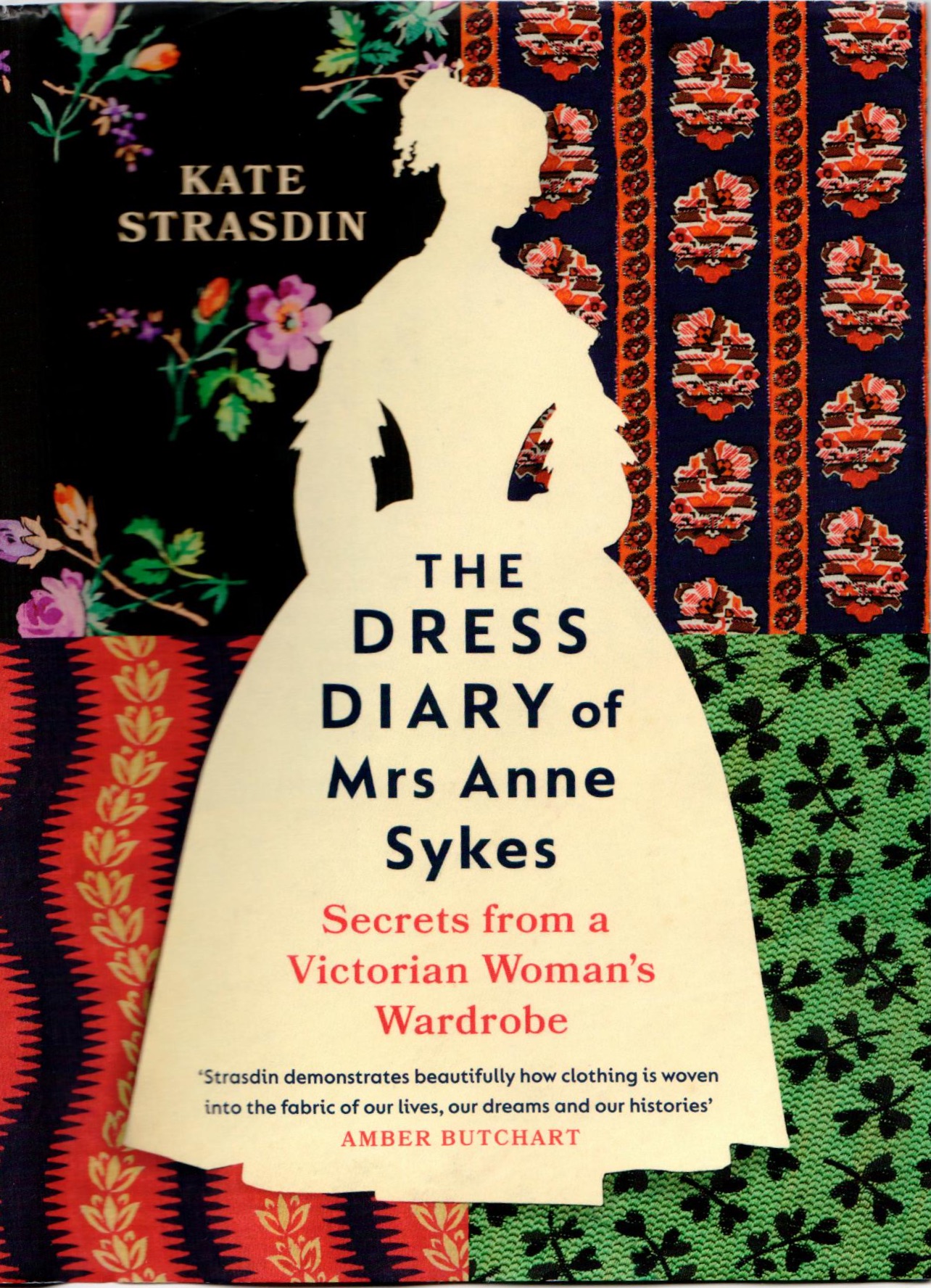
With over 1200 fabric entries, the diary – or journal – gradually revealed its secrets to the author, a fashion historian, who painstakingly transcribed the often sparse notations accompanying each fabric sample, piecing together the fascinating life and times of Anne Burton Sykes. The research is meticulous, and the author, Kate Strasdin, shares her eureka moments which allowed her to expand not only Anne’s life, but those of her friends and family as well. Written in an engaging style, this non-fiction book often reads like a novel, a wonderful story of love, friendship, adventure, and vibrant personalities.
There is so much to learn here about Anne’s life in the larger context of world history and events, but it is the personal experiences and expressions which spoke so loudly to me. Yes, there are many details which, by the nature of the journal, must be extrapolated and surmised, which the author is careful to note. But the picture of Anne – and her husband Adam – which evolves is one of two very likeable people, engaged in their community, industrious and thoughtful, friendly and adventurous, and undoubtably well-dressed.
The first entries in the journal, of Anne’s wedding attire, were actually placed and annotated by Adam. He was the one to give Anne the journal on their wedding day. He refers to her as “my charming Anne.” Not beautiful, not sweet, not dear, but “charming.” That single selection of adjective spoke volumes to me about each of them.
She also must have been brave, enduring a four-month sea voyage from northern England to Singapore, where Adam’s business took them two years after their marriage. There they built a life among other English-speaking neighbors and acquaintances, in the stifling heat and humidity of the south China sea. After seven years in Singapore, they went on to Shanghai for two years (where the diary goes silent for the duration), and then back to England.
Anne’s friendships with other women throughout her life are apparent in the swatches she receives from so many in her circle. The exchange of gifts and tokens of friendship take form in dress-goods (cotton, wool, silk), ribbons, pieces of lace, and snippets of sashes. There appeared to be a remarkable camaraderie among all ages and between the sexes.
The author has done a masterful job in deciphering the life and persona of Mrs. Anne Sykes through so many diverse fabric swatches. Anne’s kindness, her circumspection, her devotion to family and friends, and her small place in history make for a wonderful, enlightening story. I am very grateful to have had the opportunity to read and savor this book.
 fiftydresses
During Anne’s time in Singapore and Shanghai it’s possible that she and her expat lady friends were able to have advantages they couldn’t afford at home in England. Such as maids, cooks, chauffeurs, dressmakers, etc. Was there any indication of a different standard of living for Anne during this period of her life?
I did not get the sense that the swatches were able to divulge such information. Anne was from a successful family and certainly enjoyed certain privileges because of that, and her husband was very successful as a merchant. I believe they lived comfortably both places (England and Singapore; the author was unable to uncover any information on their time in Shanghai.)
This book sounds fascinating. I rarely read nonfiction, but this could be the exception! The two year gap without entries while Anne lived in Shanghai is curious: I am half-Chinese (my late mother traveled from Shanghai to NYC in 1947 to attend graduate school). It could be for any reason, but it piques my curiosity, given my personal connection to that place…
This is one of those non-fiction books which tells a compelling story; as I said in my review, it often reads like a novel.
It is curious there is complete silence from Anne during their time in Shanghai; at this point in time, there is no way of knowing the reason.
Thanks for your review. I first learned about the fabric collection /journal from an article in threads magazine. You have made me more interested in reading the book about it.
I’m glad I did, Susan. I thought it was wonderful book. I had it on a long airplane flight with me, and it made the hours fly by!
What a delightful vicarious journey through another life in another period of time. These personal tidbits make life seem more real than historical overviews. It doesn’t take much to get a pretty good feel for the experience. An older friend asked me to accept a trunk with some memorabilia’s of her youth. As I got older I understood why she’d like to keep those memories alive. Her dance card from a university party the first semester after World War I ended, and the boys were home, and everyone was starting new lives in a new era. . Letters from boys she met at the Army base in Kansas mentioning that this boy whom she had met when she visited had died of flu. And then another one. And another. As much as I appreciate historians explaining the enormity of situations, and movies glamorizing an era, these personal things make more memorable impressions. I look forward to reading this book.
Your thoughts are so “on the money,” Mery. In the small realm of my book review I did not even get into Anne’s brush with some historical figures. It is all just fascinating and told in the context of material goods, all just seems more personal and pertinent. I hope you will enjoy this book as much as I did.
I loved this book, and found it thoroughly engaging. My own family came from the same area as Anne Sykes and around the same time my great grandfather’s family were employed in the cotton mills. My great grandfather is recorded in the census as a 9 year old employee! I wondered if Anne Sykes father might have employed my ancestors.
How fascinating! You may be able to determine that with some sleuthing and probably a lot of time… Yes, this book was thoroughly engaging!
I was frustrated by this book.
A lot of good information about the manufacture and popularity of textiles. However, a photo of Anne and/or her manufacturing husband would have been helpful. And what about children? I would have liked information about why Anne and
Adam had no children. No mention of this essential fact is a glaring omission.
Also, the color plates were difficult to see and that teeny tiny handwriting impossible. It would have been easy for the author to have transcribed the writing. Even with a magnifying glass I could not make it out. Therefore, I didn’t know which fabric the author was writing about.
This book would have been so much better with these additions. I can tell that Strasdin did a lot of research, but she left out too much.