Yearly Archives: 2011

Clothes for Christmas

Another part of the world of vintage patterns, which is now available thanks to the Internet, are old copies of the Vogue Pattern Book magazine.   Published 6 times a year by The Conde Nast Publications, Inc., this magazine featured current and up and coming Vogue patterns, articles on construction and notions, a “question and answer” section,  news on just about anything having to do with personal sewing, and wonderful ads for fabric and sewing machines.  (By the way, it’s still published 6 times a year!)  I’ve been able to purchase a few issues from varying months and years, and sometimes I find a pattern featured which I have already bought on eBay or Etsy.   The December 1957/January1958 issue, which I recently obtained, devotes 8 pages to “The Ladies Love Clothes for Christmas.”
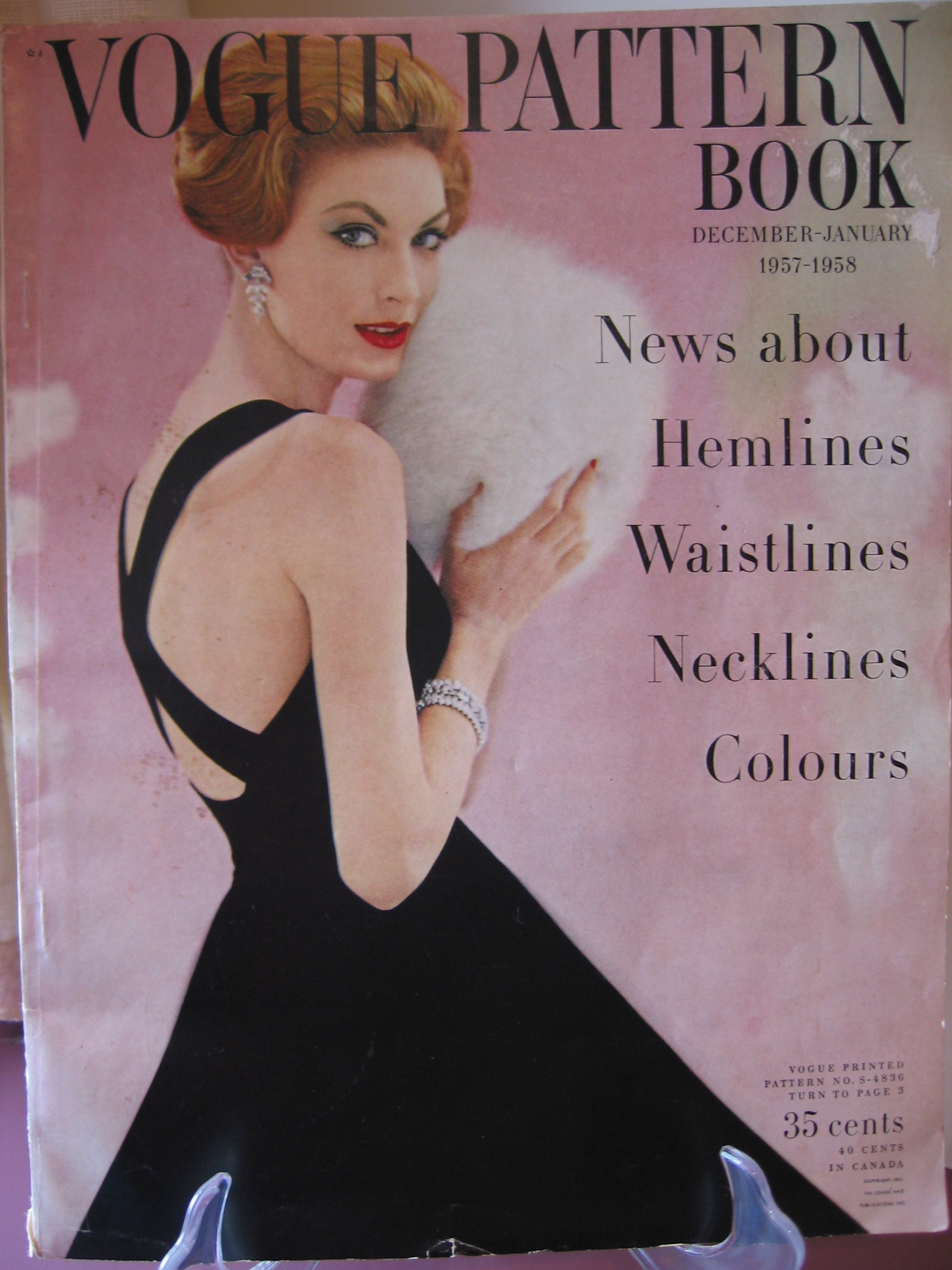
Here is the cover of the December 1957/January 1958 issue.

It features patterns for young girls and for teenagers; there is a section on lingerie and sleepwear; and finally some suggestions for the lady who presumably will be doing all this sewing!  Here is a sampling:
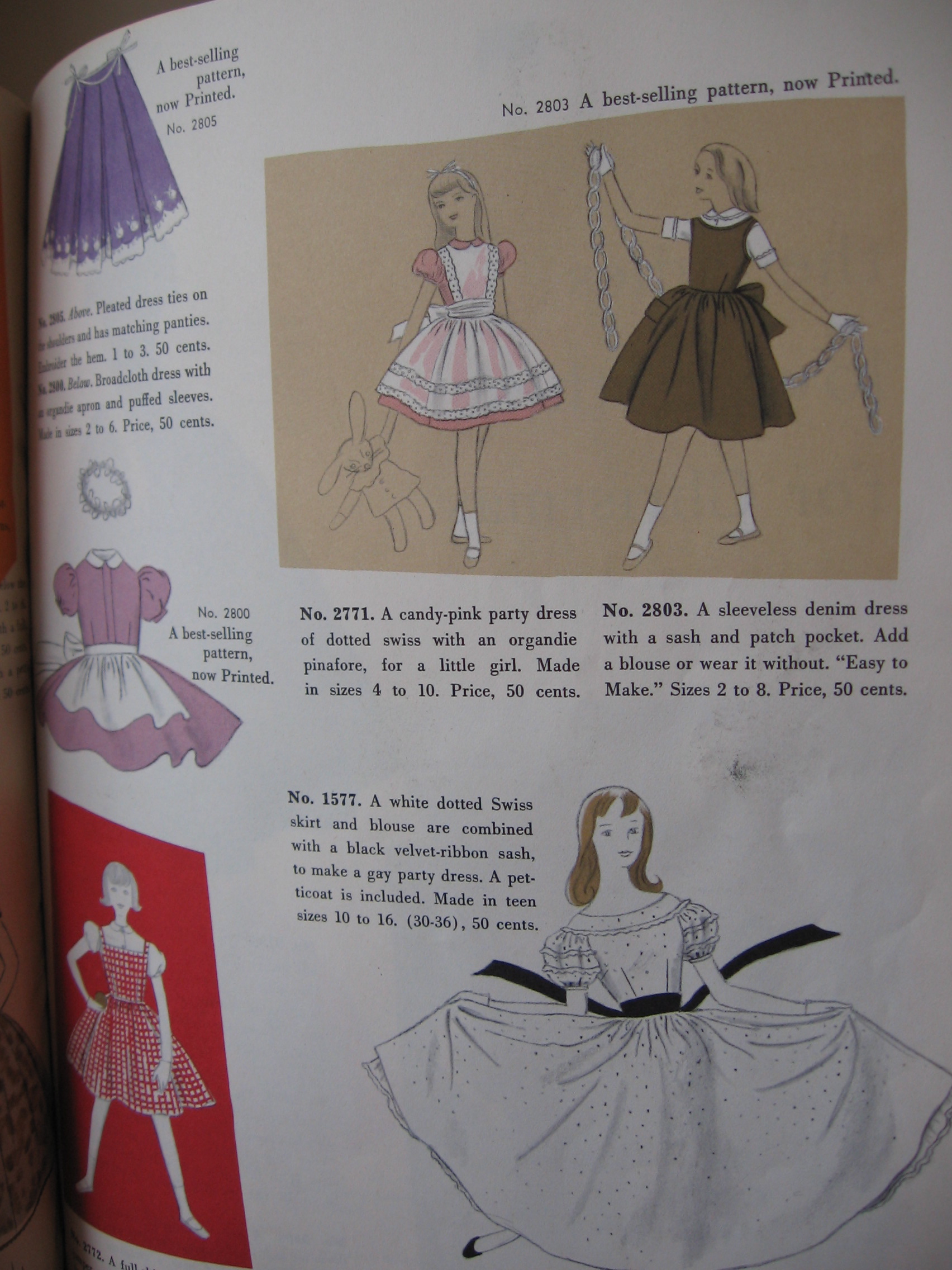
Suggested dresses to make for your little girl and one for your young teen.
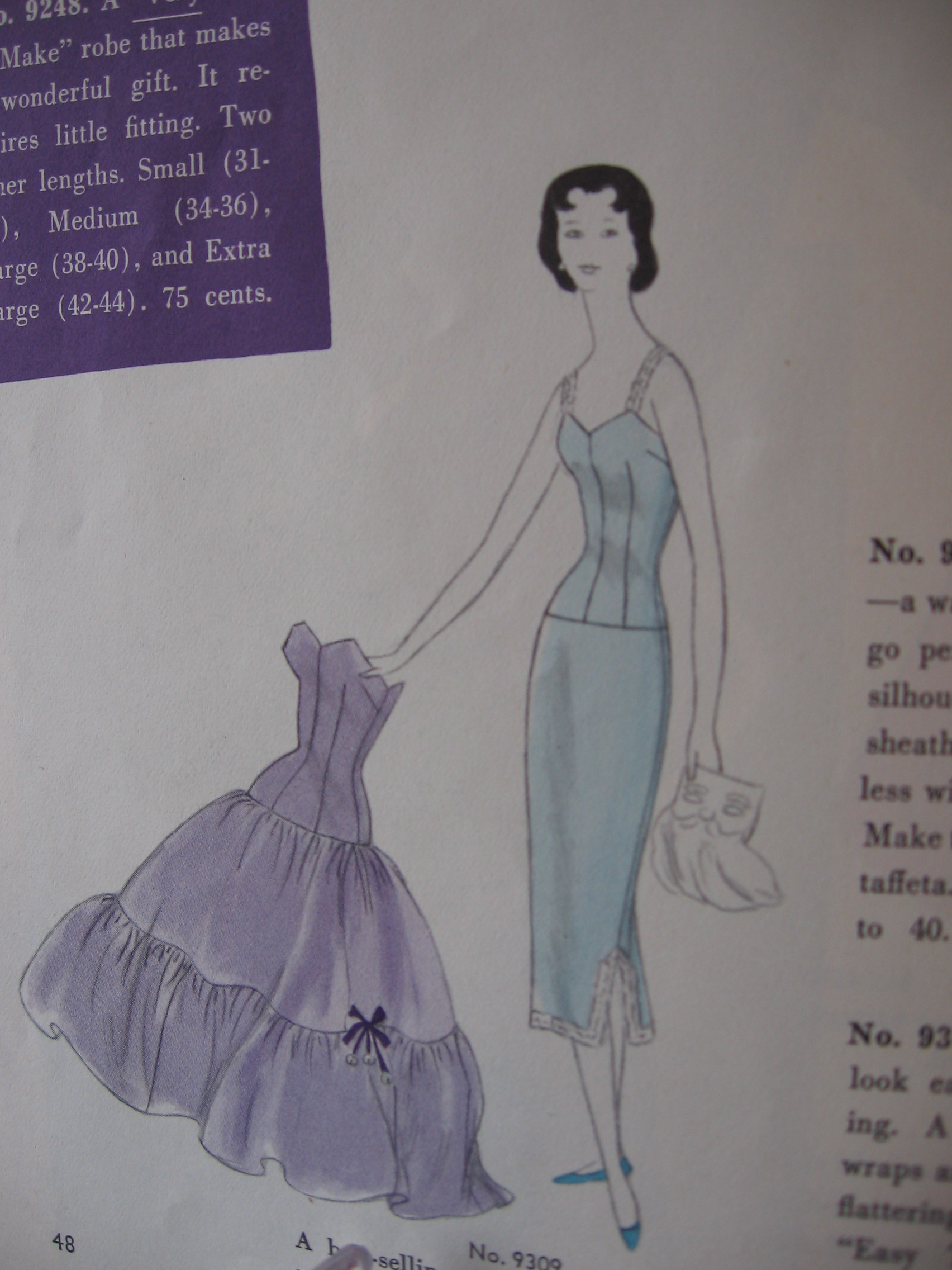
There were patterns like this to make slips - for yourself or as a gift!
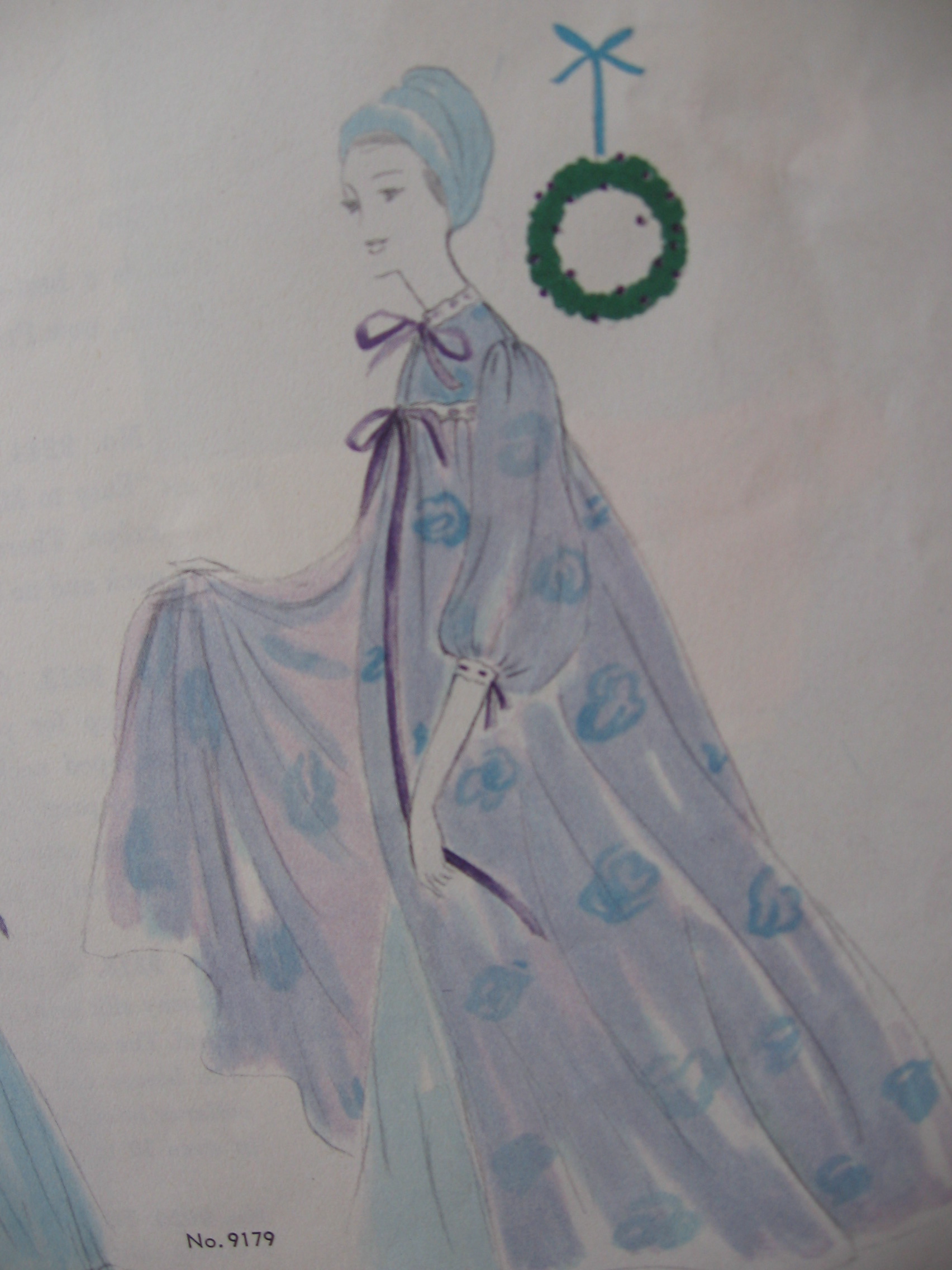
This billowy peignoir and matching nightgown would turn anyone into a vision on Christmas morning! The pattern cost 75 cents.
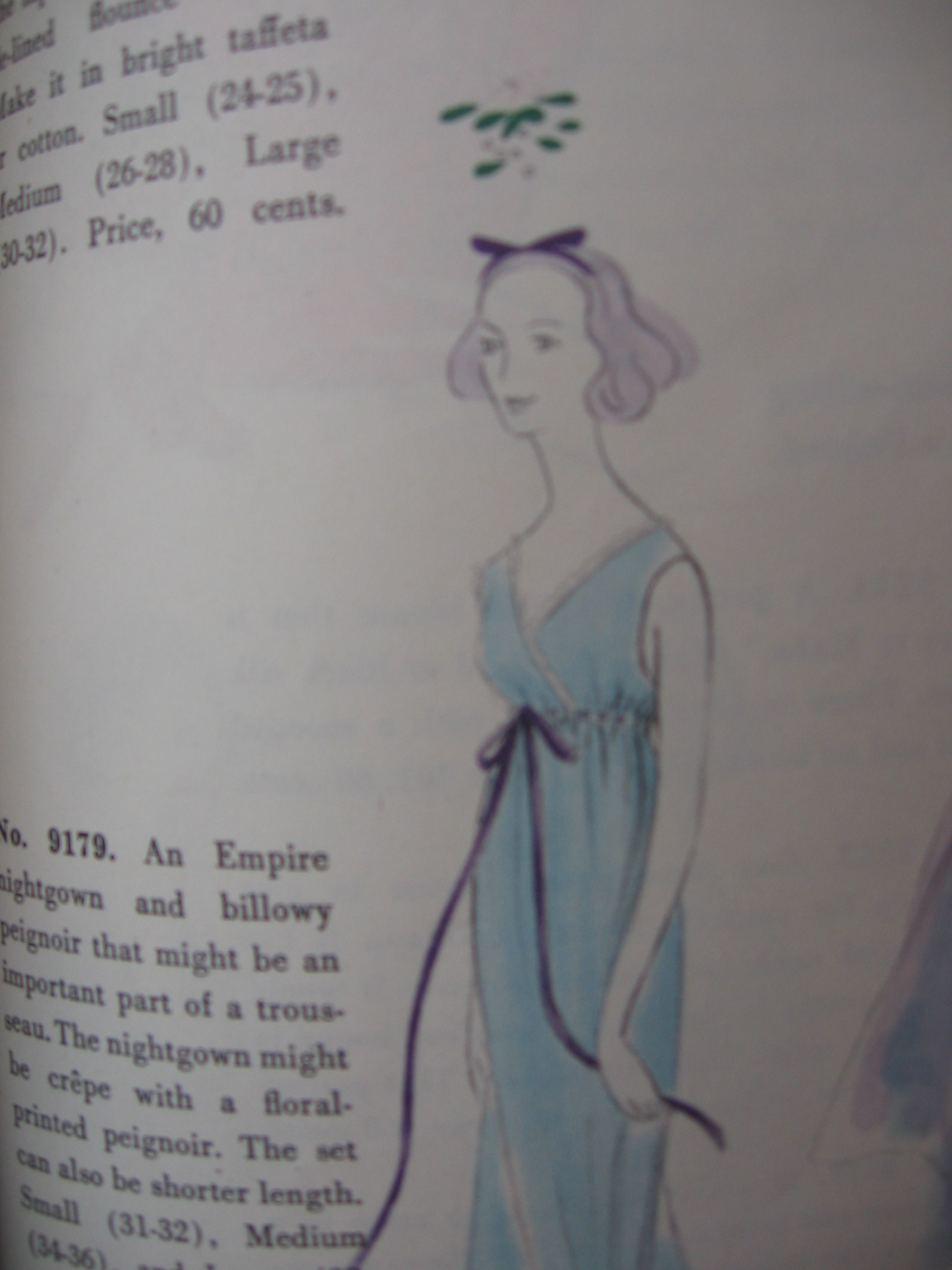
Here is the empire nightgown. I hope you can see that this lovely lady, now sans peignoir, is standing under the mistletoe!
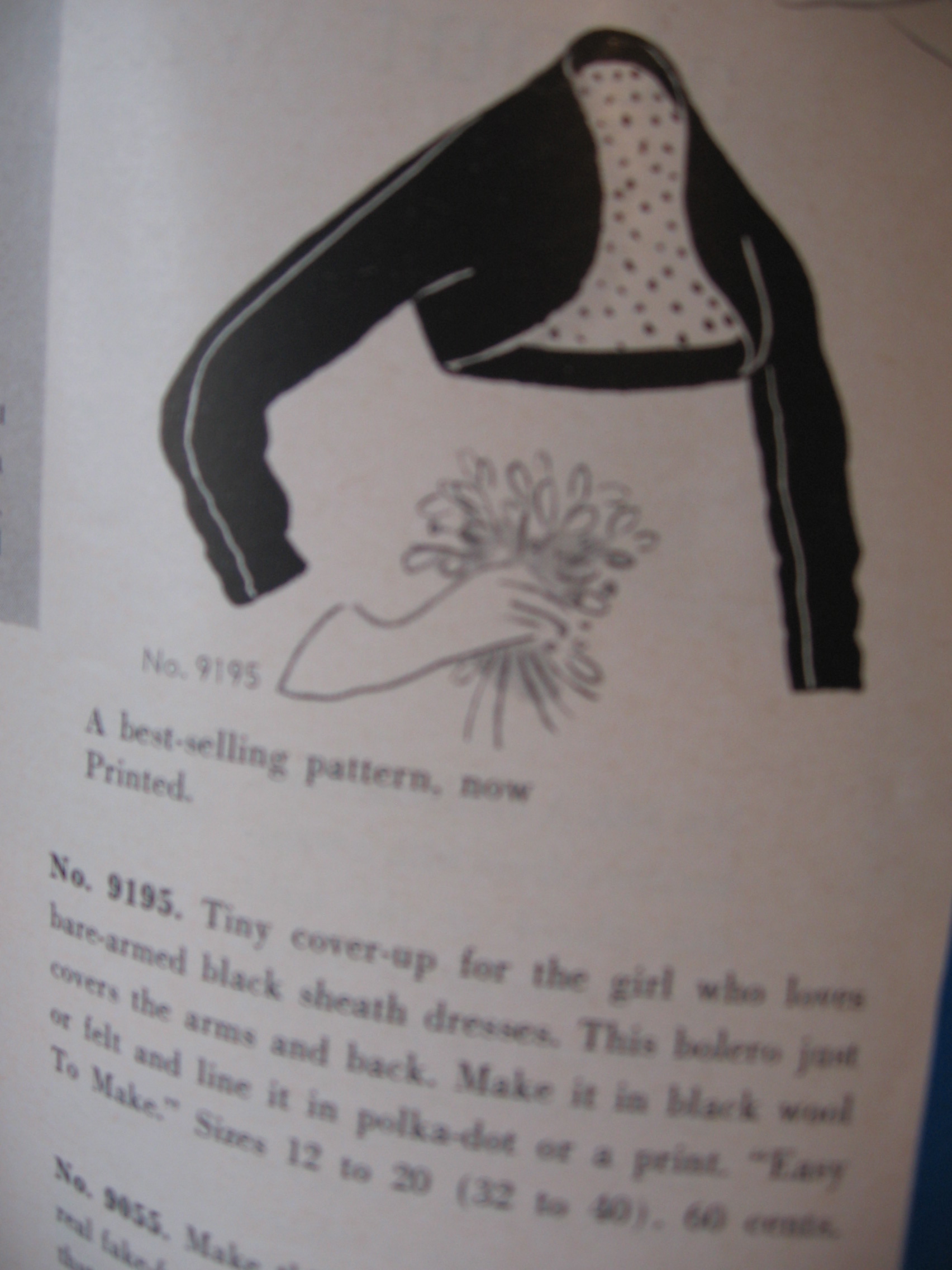
This bolero cover-up, lined in polka dots (no wonder I love this!), would be perfect on New Year's Eve.
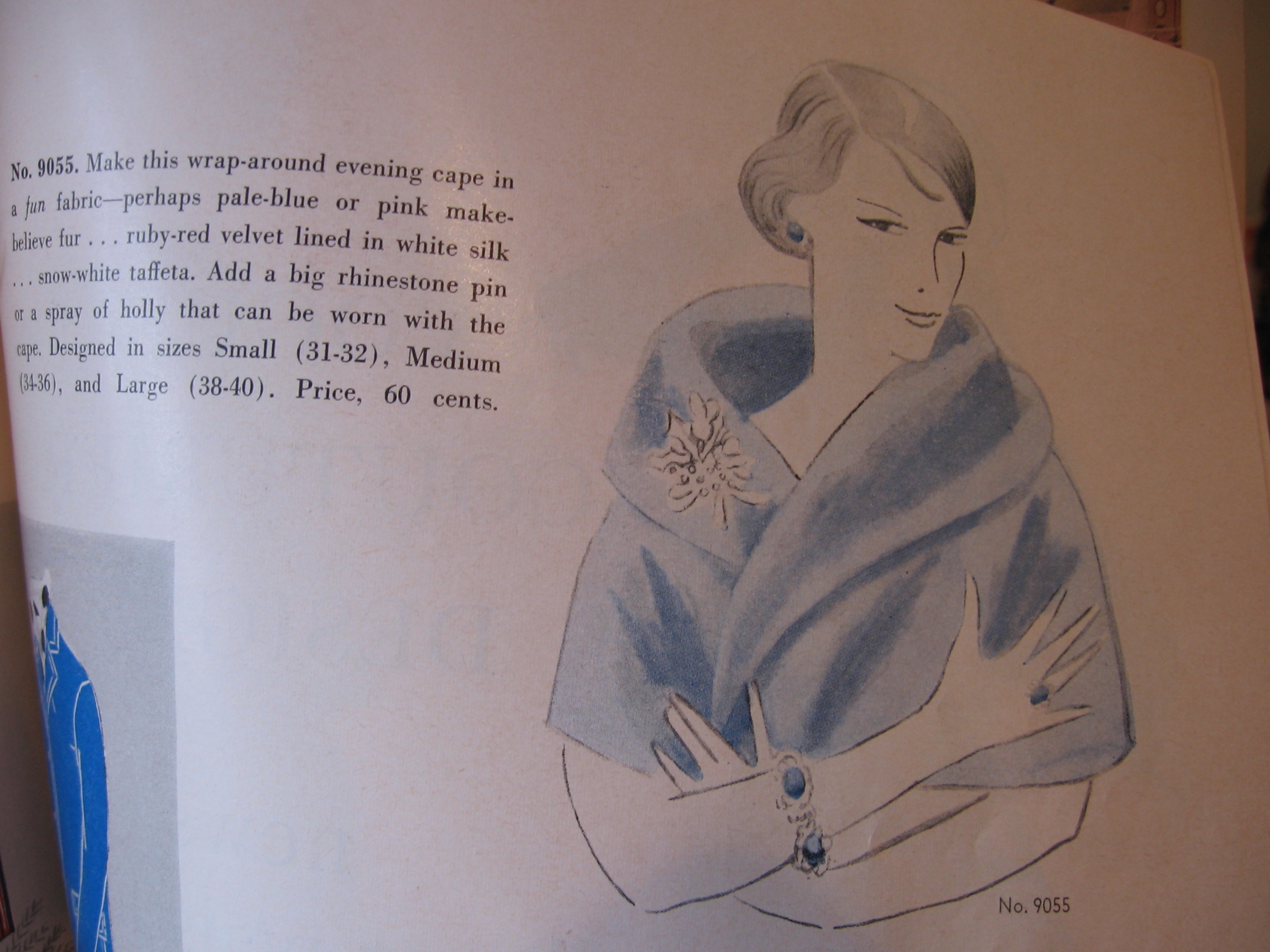
Or - if you are really in a festive mood, they suggest you make this cape in "ruby-red velvet lined in white silk."
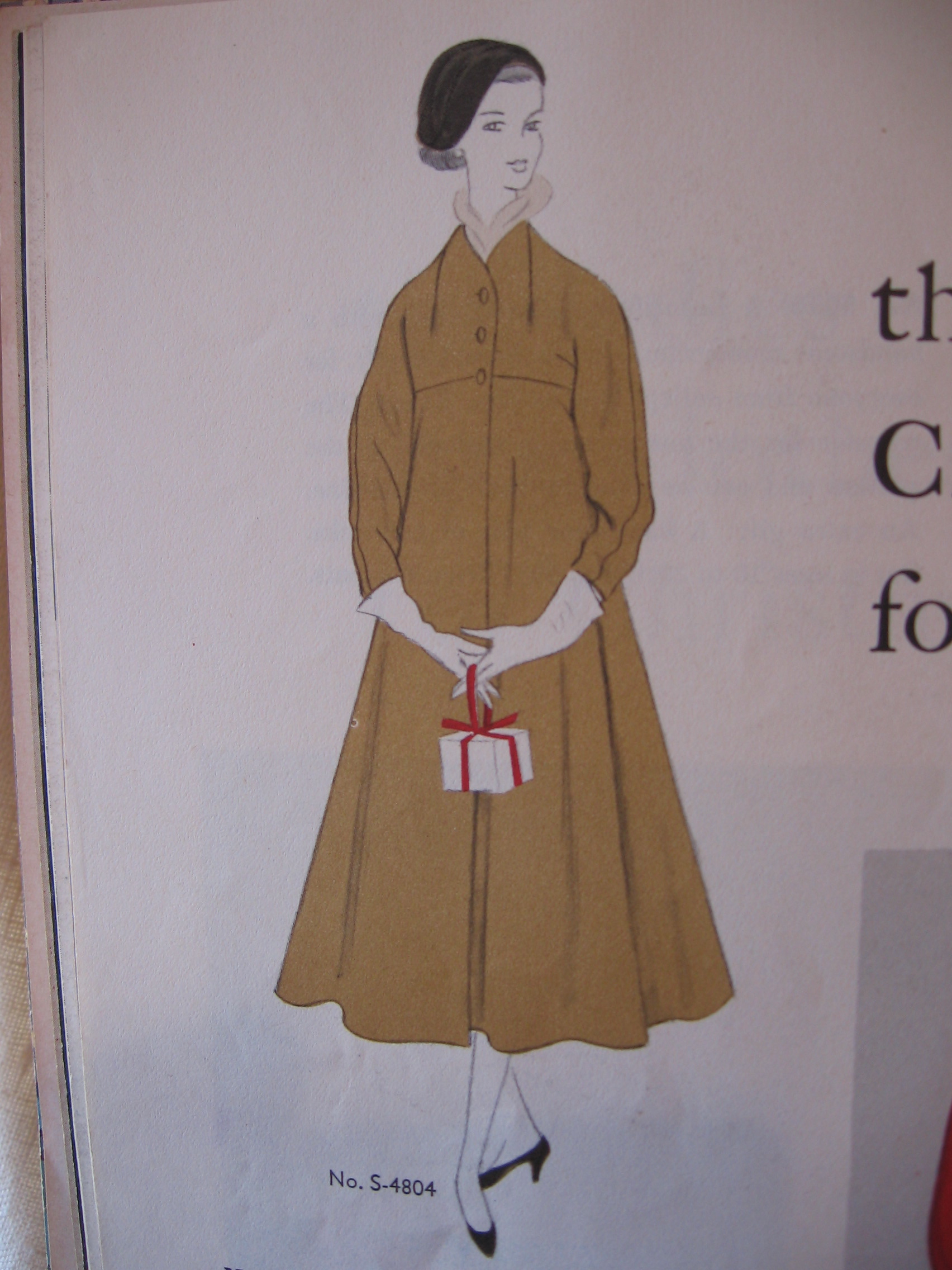
Here is my favorite suggestion, and I quote: "You might give this pattern and enough camel's hair wool to make this coat, to someone who loves to sew." The pattern was priced at $1.00

Here is another suggestion, next to a picture of its pattern envelope.
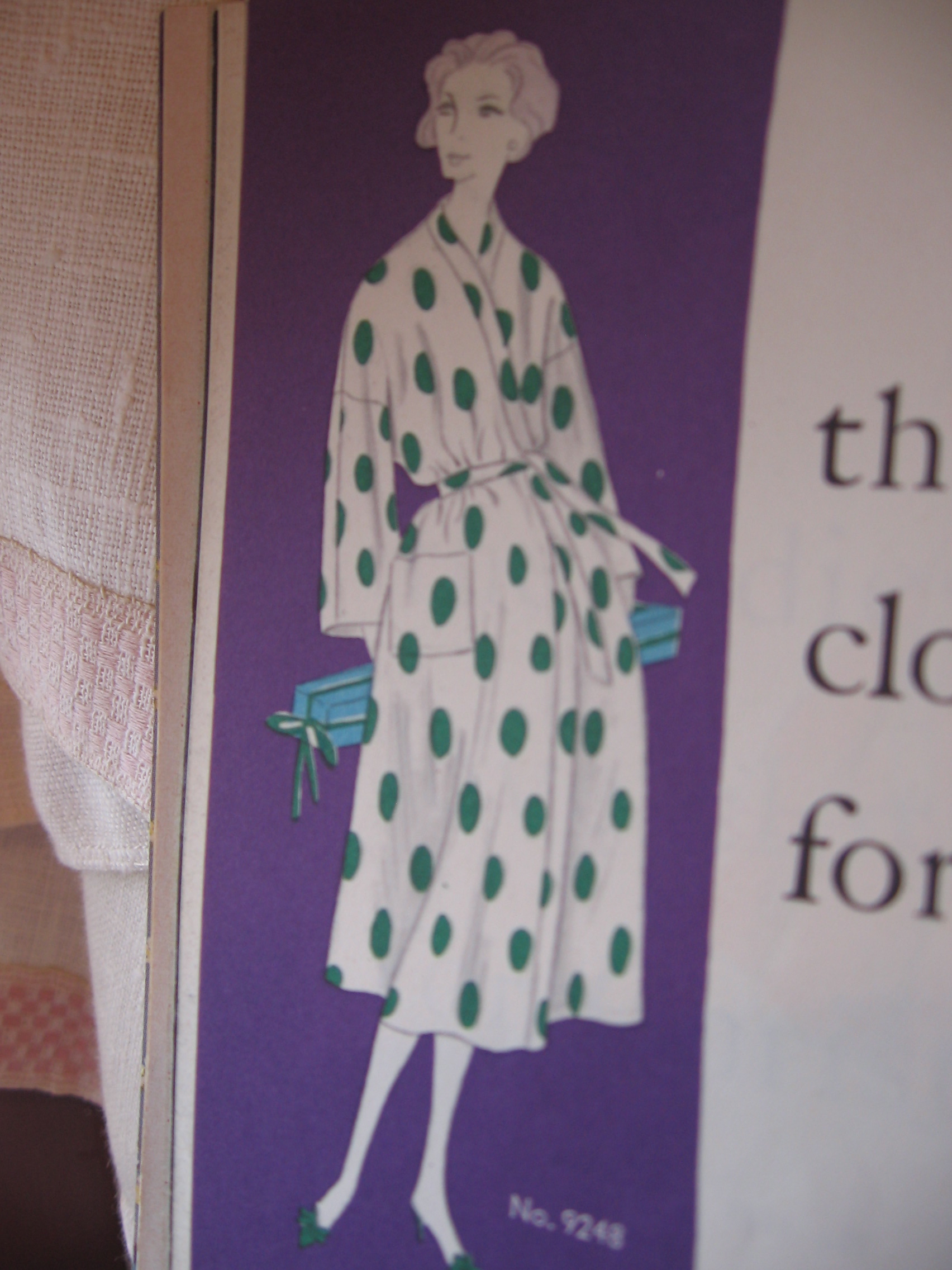
This robe is very easy to make! (I wonder what is in the long wrapped present she is holding behind her back? A rolling pin?)
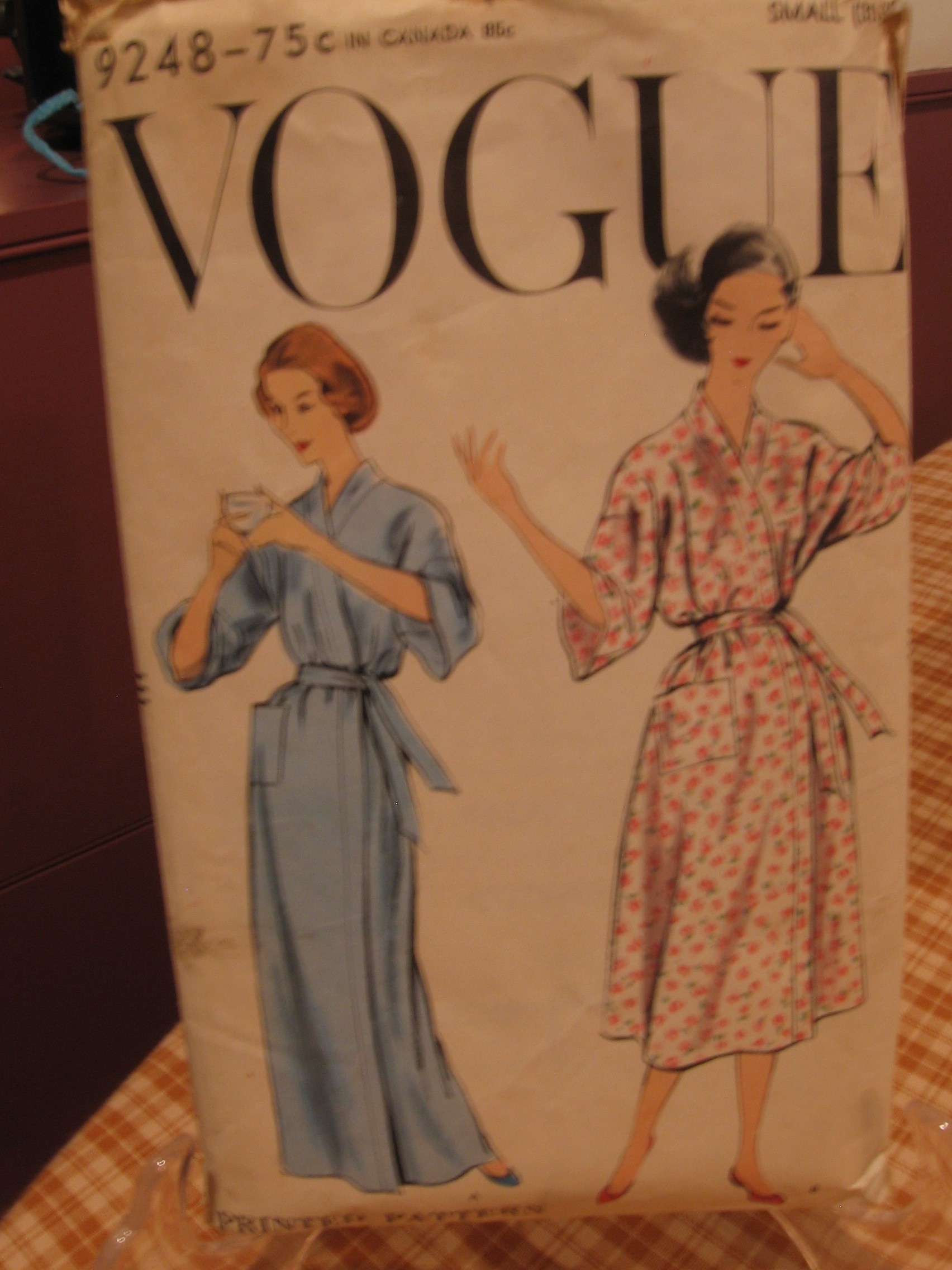
This pattern makes up beautifully into an elegant robe! It has additional pattern pieces and instructions for lining it, as well.


Yes, I purchased this pattern last Spring and have already made it up in the “lower calf” length.  Unfortunately, I did not take a photo of it before it went to its new owner, but here is a shot of a small bit of the silk charmeuse left over from this project.
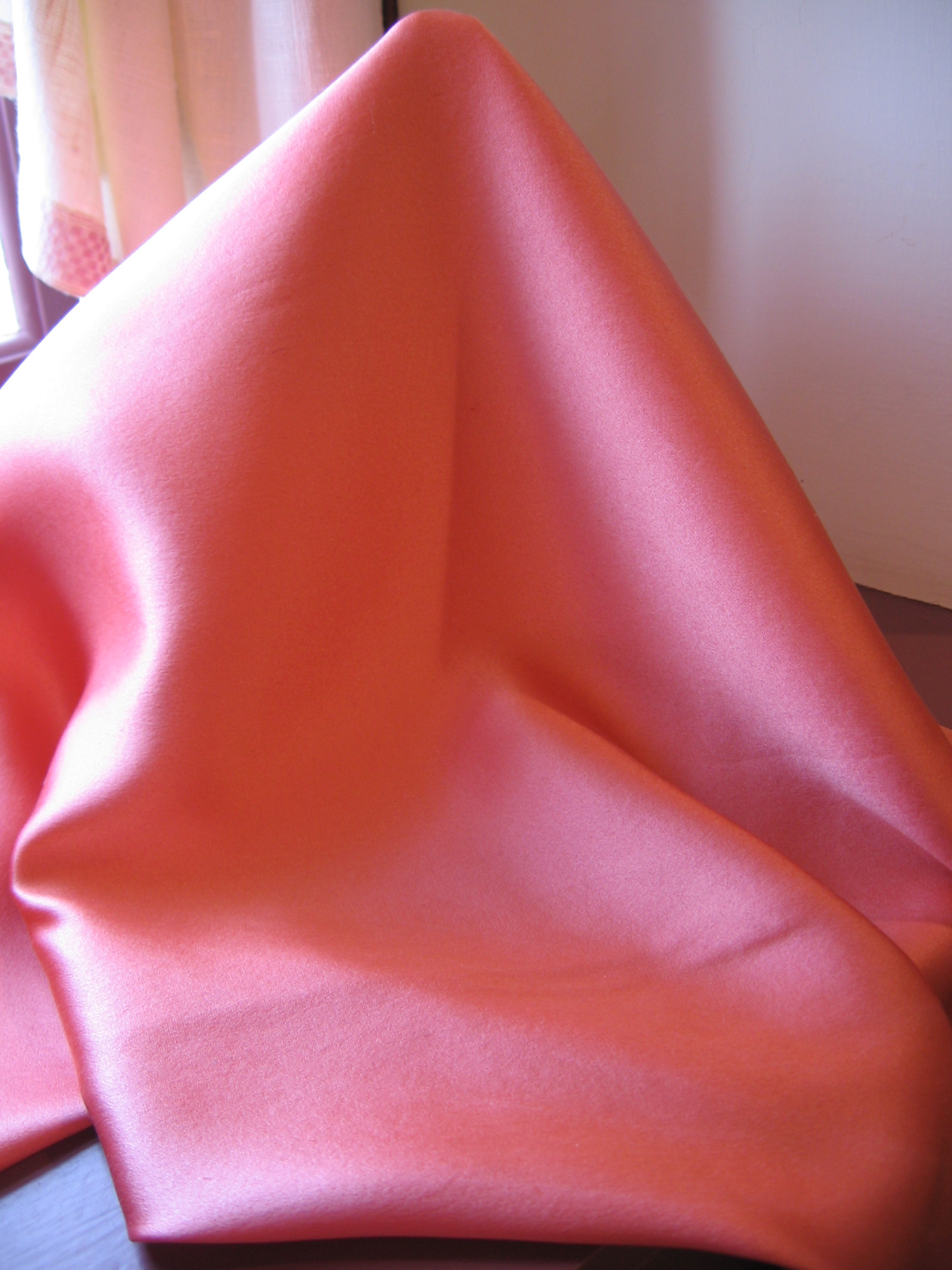
This silk is really more orange-ish than it appears here. I washed and dried it before I cut it out, so that the finished garment would be washable - much more practical for a bathrobe!

The reason I am showing you this, is that last week, Pantone, the color guru of the fashion world, declared a color very close to this as its Color of the Year for 2012.    Specifically, that color is called Tangerine Tango and its number is 17-1463-TCX.

Personally, I have come to appreciate various shades of orange a lot more than I once did. I particularly like to see orange (or coral or tangerine or whatever name you want to give it) paired with hyacinth blue or leaf green or charcoal gray.  Although I am not one to feel like I need to be dressed in the current “fad” color, if I get the opportunity to use it in my sewing this coming year, I definitely will.

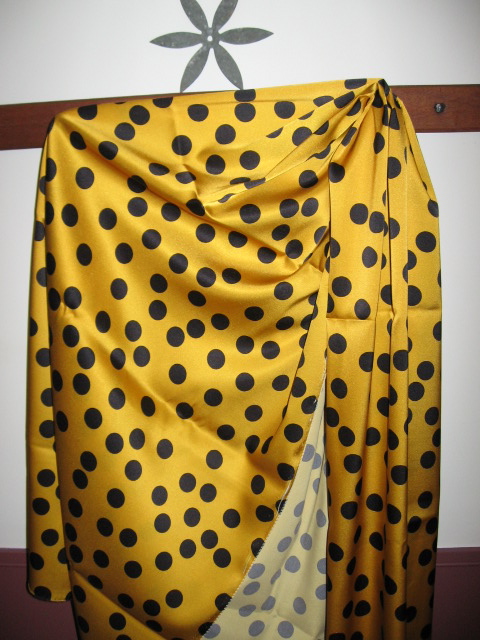
Well, I am digressing from my Christmas theme here, so back to the robe in bright green polka dots.
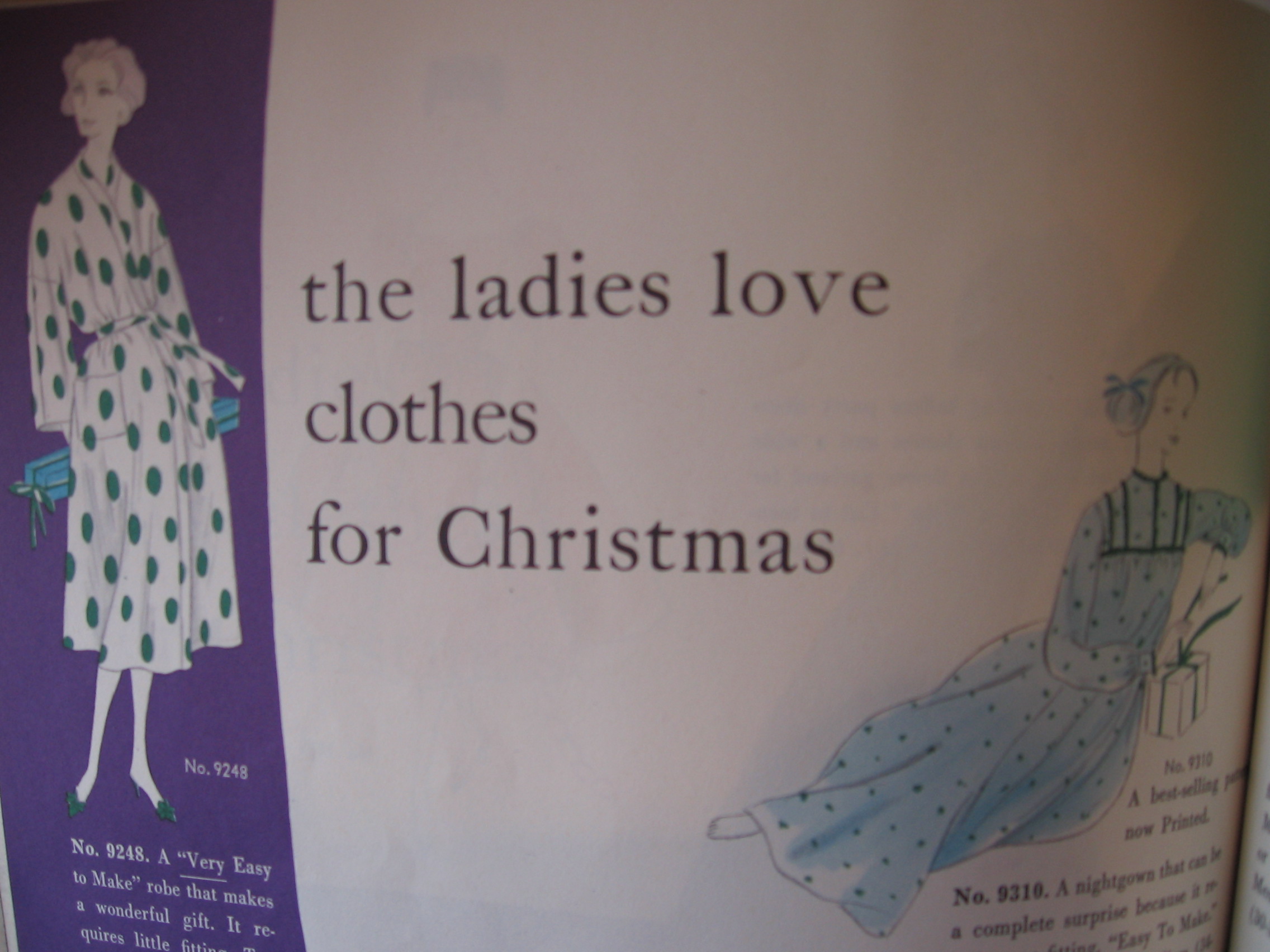
This statement says it all!

If I could ever find such a fabric in a lovely silk suitable for a bathrobe, I would buy it in a minute and make myself this robe in the long version!  For Christmas morning I’d pair it with a long and flowing red silk sash…

Here’s to a fashionable, fun Merry Christmas for each and all – and warm wishes for a colorful New Year!
3 Comments

Filed under Coats, Polka dots, The Conde Nast Publications, Uncategorized, Vogue patterns

Lessons from 1953

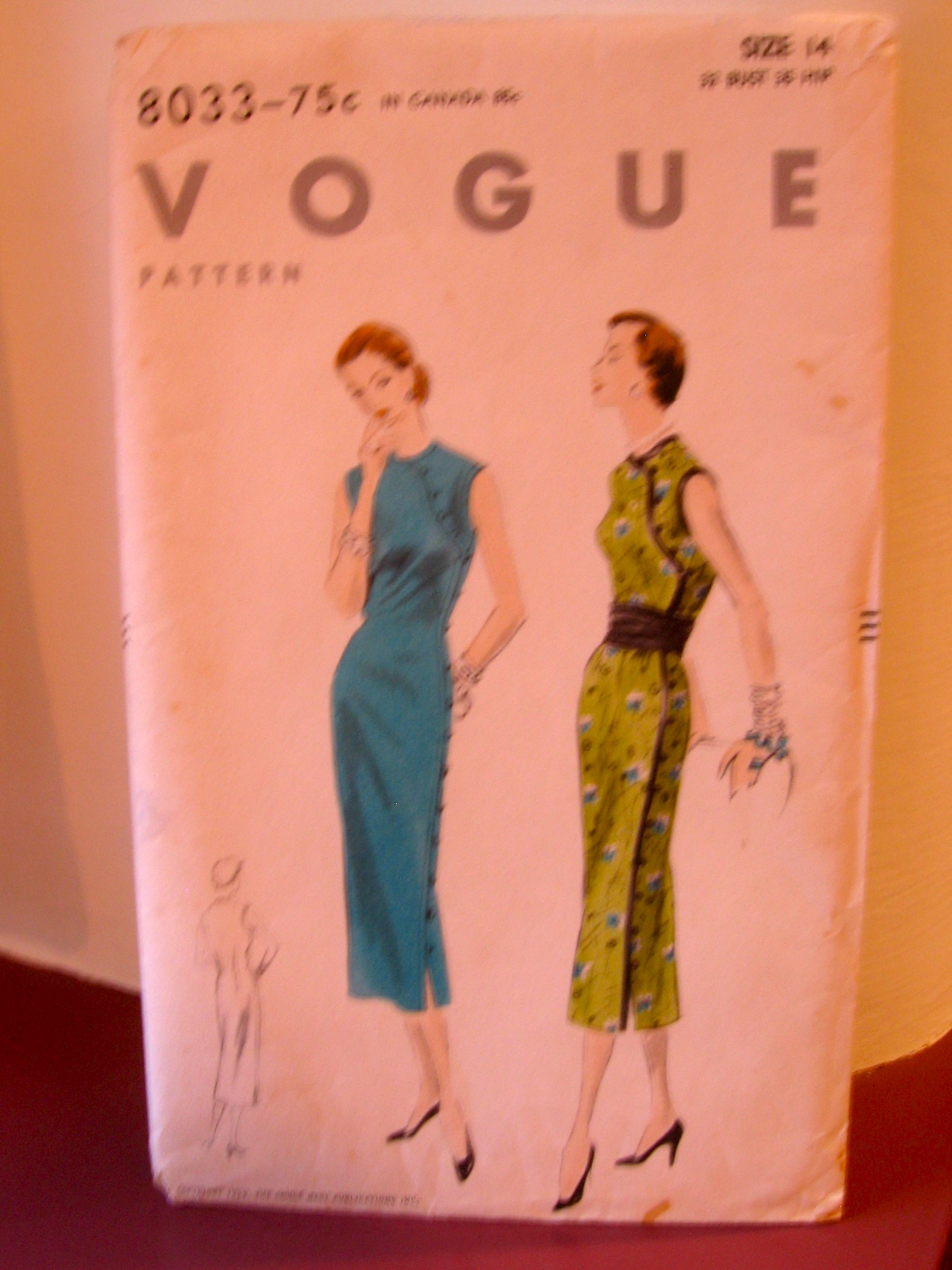
When I first discovered vintage Vogue patterns on eBay last Spring, I was delighted to find that most of the patterns from the 1950s were dated, usually with a line which stated, for example, Copyright 1956 The Conde Nast Publications, Inc..  It took me a couple of weeks to realize that I should also be looking for another important bit of information on the pattern cover: the words Printed Pattern.  I discovered this the hard way;  I purchased a pattern, dated 1953, that was not printed.

I've always liked Asian-inspired dress designs, and I thought this one from 1953 was so pretty. Do you see the size on this pattern? Yes - it's a 14! That's the size one wore in 1953 to fit a 32" bust and 35" hip.


I remember my mother mentioning how difficult unprinted patterns were to use – and I was about to find out why! The tissue pattern pieces were only marked with small holes of varying sizes;  to try to make sense of these markings, I had to look at the instruction layout sheets and translate if they were for a dart,  a stitching line, a pivot point, or some other detail.

These particular pattern pieces had never been used – and I must admit I felt a little guilty taking them from their envelope where they had quietly lived for so many years and pinning them onto my fabric, but pin I did.  I cut that baby out, marked that nebulous galaxy of pattern holes as best I could with chalk, and proceeded to sew, following the directions precisely.

The first thing I realized was that the bust darts were a little too high, but that was an easy fix (seam ripper and redrawing the dart lines).  These early patterns say that the dress should be fitted over the proper foundation garments.  (I don’t think they meant just comfy bra and cotton panties.) Anyone who has watched old movies or even Mad Men recognizes that mid-century look of the pointed and properly perched bosom! That’s one mid-century look I’ll forego.   So that was adjustment # 1.

I lowered the bust line by re-placing the darts.

Next, do you see that band that runs the length of the dress?  The pattern pieces for that were shaped to match the curve of the neck and across the chest.  I thought to myself – now why not just use a bias piece of fabric, which I felt would take the curves better and be easier to topstitch without puckers.  But I followed the pattern exactly – and wouldn’t you know, I had exactly those problems topstitching the curved areas.  As if that were not bad enough, when I tried on the partially completed dress, the neck fit too high and tight, rumpling up the shoulders and it looked awful.

I was going to have to re-cut the neckline, to make it larger. In doing that, I knew the neck area of the band, as it was cut out, would no longer match the new neckline.  I was going to have to piece in another section.  This was not fun, and I was beginning to think this lovely blue dupioni silk was going to end up as a skirt instead of a dress.  But I went back to my original thought – and cut a bias piece to fill in that recut section.  It worked!  That was BIG (ver-r-r-ry BIG) adjustment # 2.

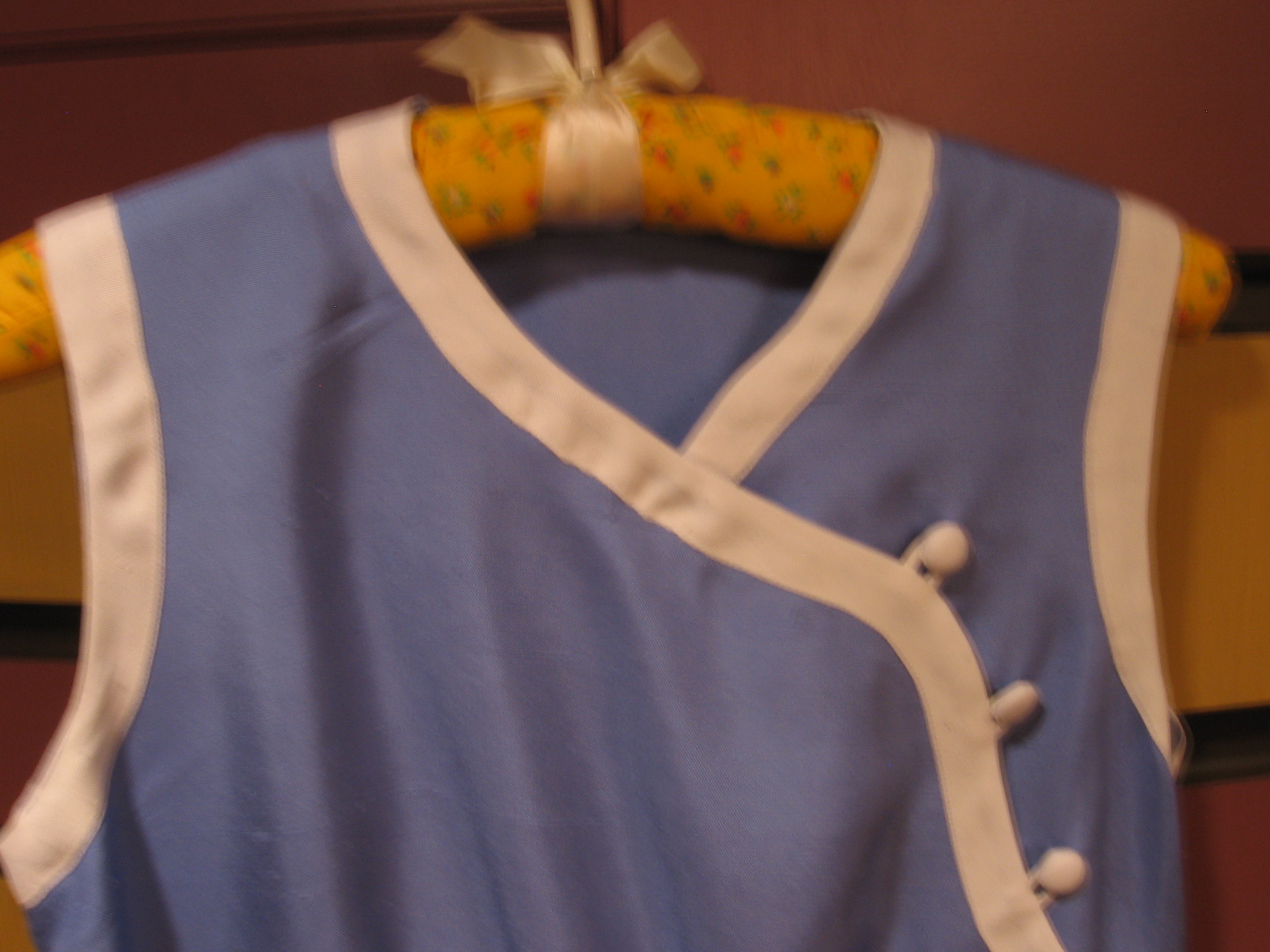
Here is the recut neckline. I was able to hide the pieced seam under the front flap.

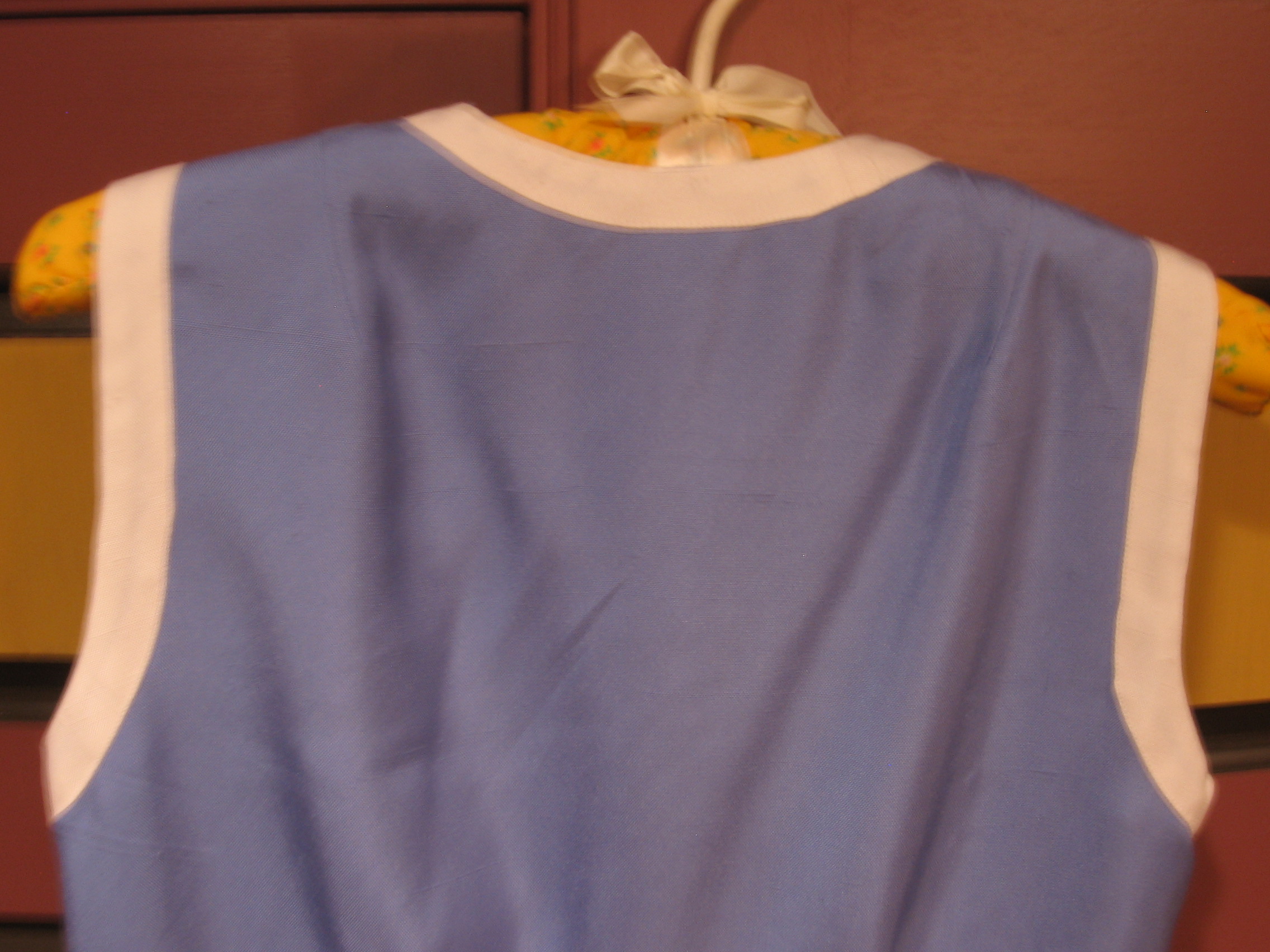
Here is the back of the neckline after I recut it.

Here is a close-up of the bodice and armhole band.

By now I was sick of this dress.  I still had buttons to cover and attach, armholes to do, interior snaps, the hem, and the cummerbund to complete.  Well, you can see from the photos that I did finish this dress, although it was late summer before I sewed the last stitch.

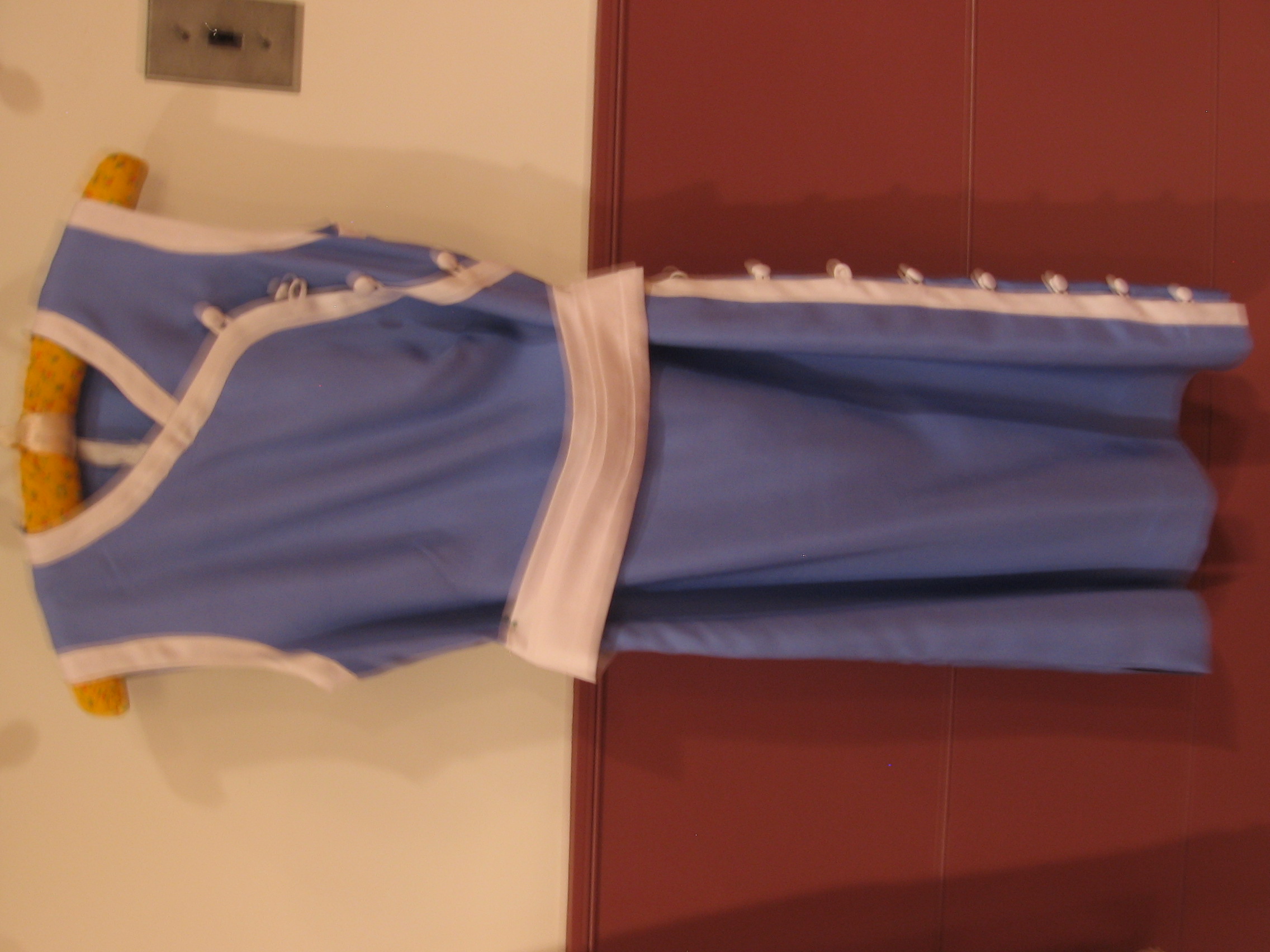
The completed dress. You can see I shortened the hem from mid-calf (as shown on the pattern envelope) to just below the knee.

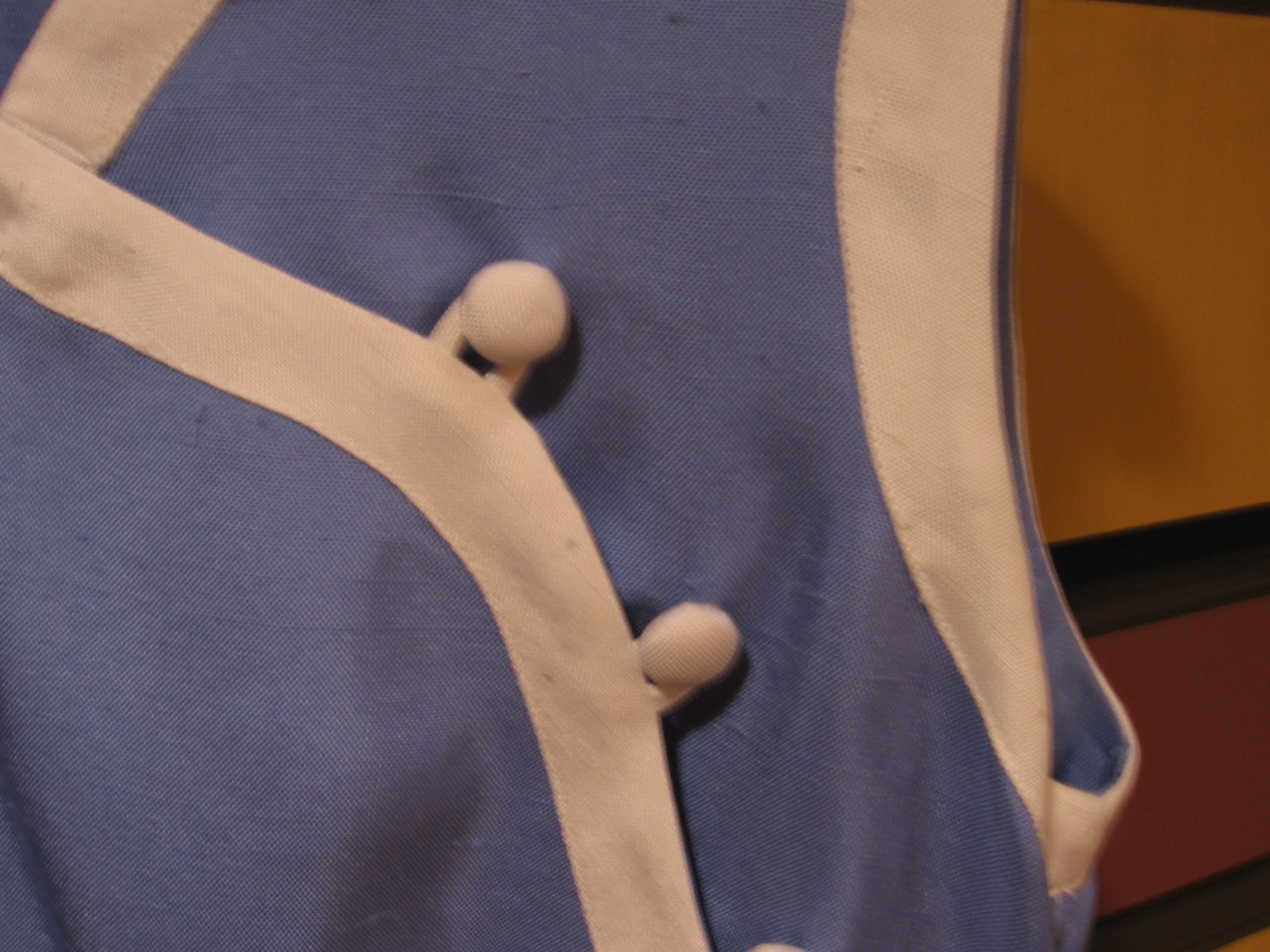
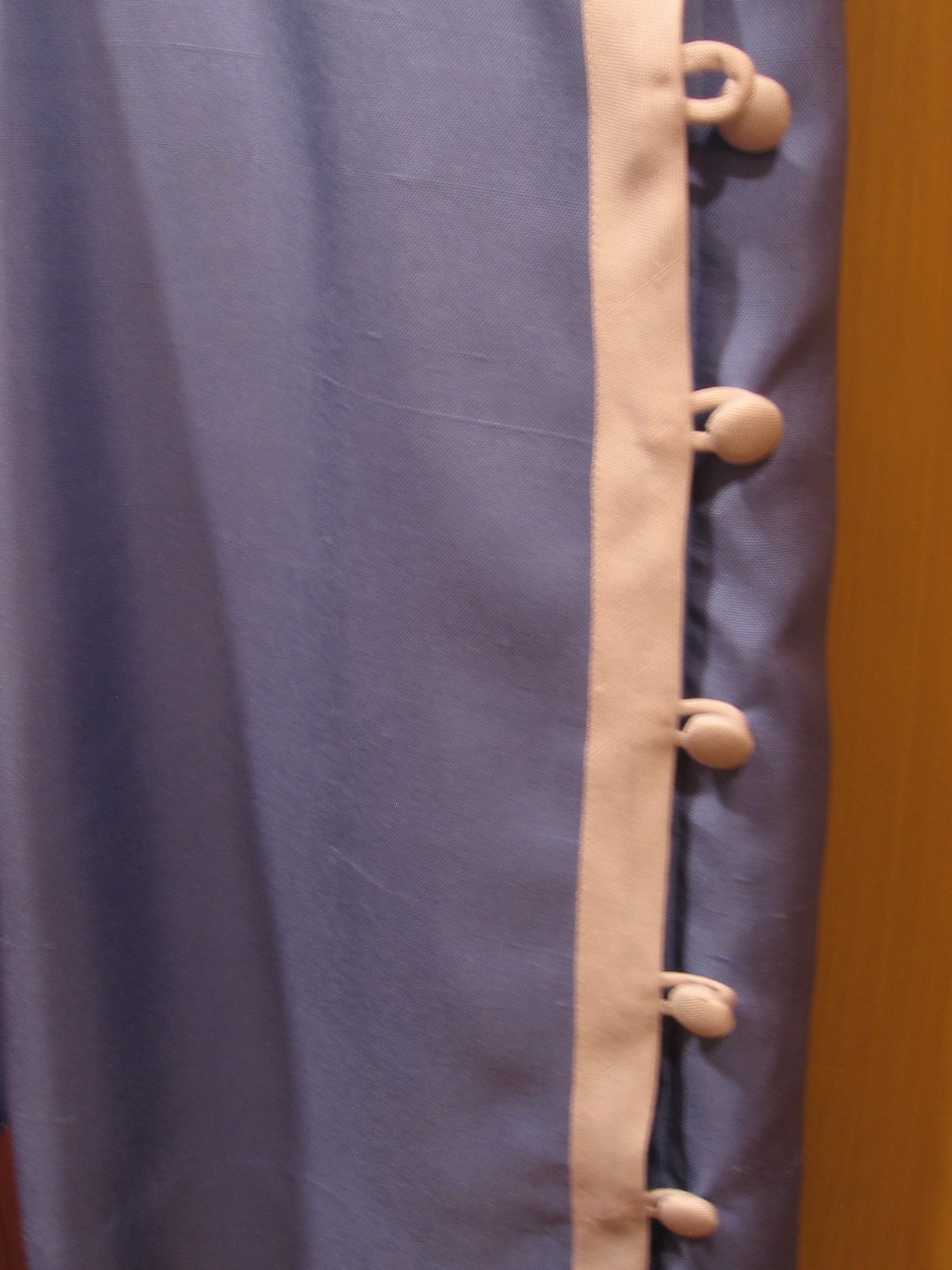
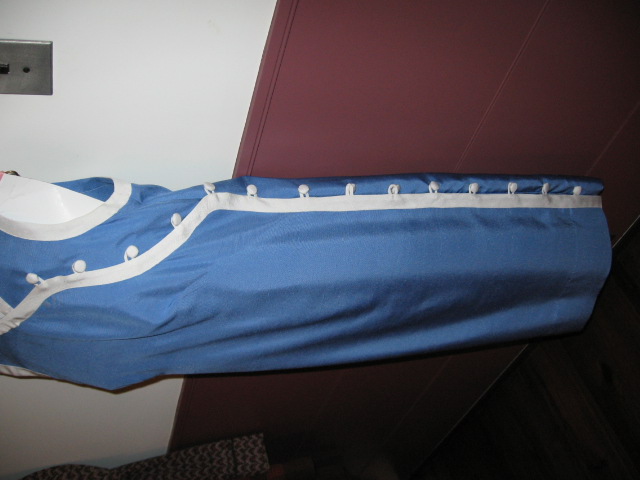
Here is a close-up of the covered buttons and button loops.

I’m still not completely happy with it, but it provided me with these valuable lessons:

1)   Stay away from unprinted patterns.

2)   Check the bustline placement before marking and sewing the darts.

3)   When in doubt, trust my instincts (I should have used all bias for that band and those armholes.)

4)   For best results, make the pattern up in muslin first.  If I had done this, I could have made the bust and neck adjustments before I cut the pattern out in the blue and white silk.

I had a chance to wear this dress during the warm September we had here in eastern Pennsylvania – and I am sure no one suspected I was wearing a dress designed in 1953!  Amazing!

3 Comments

Filed under Asian-inspired dress designs, The Conde Nast Publications, Uncategorized, Unprinted patterns from the 1950s, Vogue patterns

D + D = A+

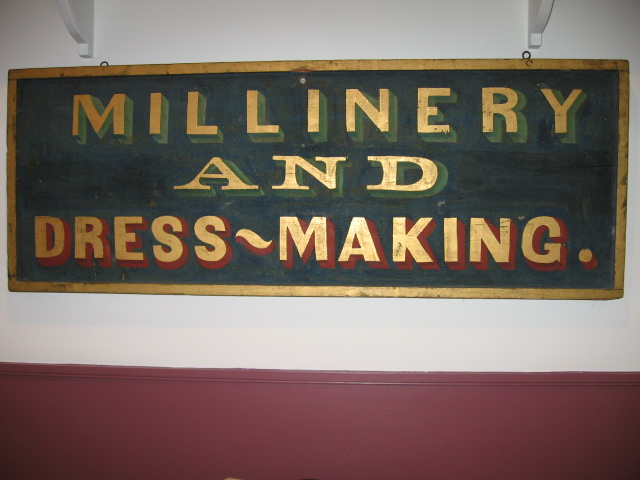
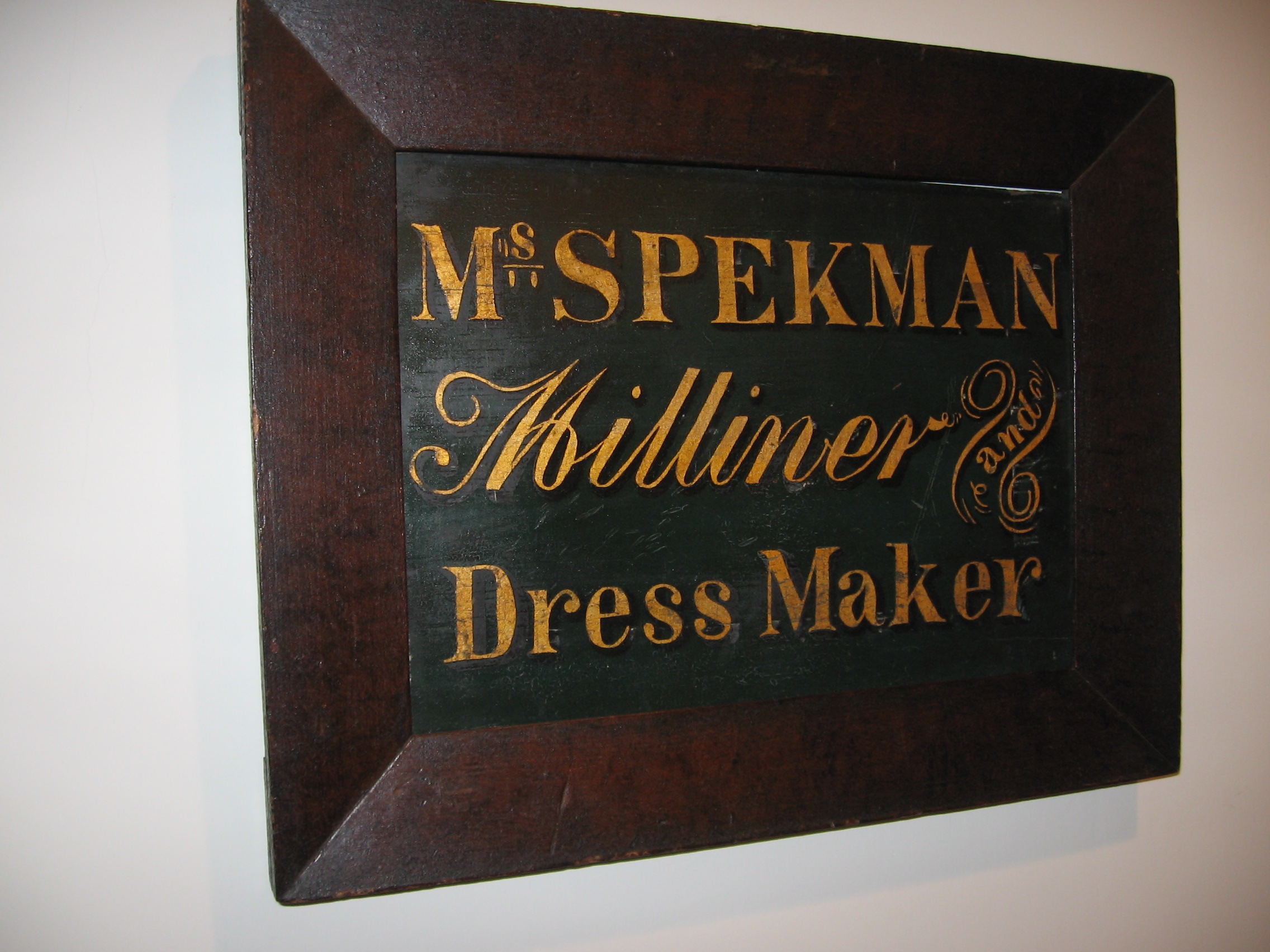
The term “dressmaker” conjures up intriguing, dreamy thoughts for me – and maybe for you, too.  I’ve always liked the connotation of it – obviously a female craftsperson, skilled with a needle and working with patterns, creating clothing for women and children.  It is a term which spans decades, even centuries, in its relevancy (in the 18th century the term “mantua maker” was interchangeable with “dressmaker” and often the preferred term.) I have two 19th-century trade signs hanging in my sewing room, both for Dressmaking & Millinery, and simply their presence gives me inspiration.

One of my inspirational trade signs for dressmaking

Mistress Spekman's sign which now adorns my sewing room

When compared to “fashion designer”, a “dressmaker” might seem to some a bit provincial or less exciting or less creative…

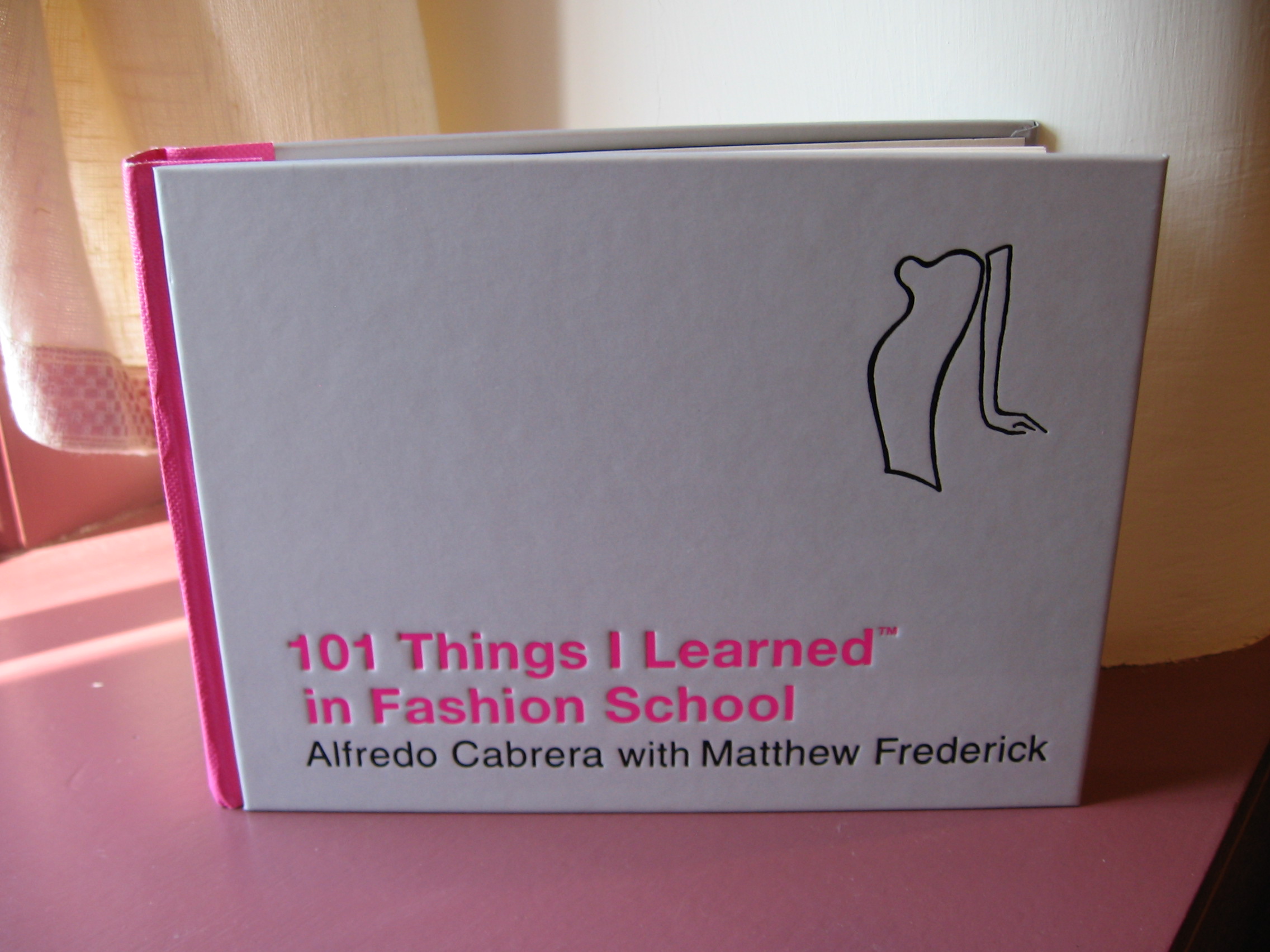
Well, think again.  There is a wonderful entry on “The dressmaker” in a small book entitled 101 Things I Learned in Fashion School (available at Barnes and Noble, where I found my copy).

A little book filled with great information

To quote:

“Dressmakers differ from fashion designers in that they do not design wholly new fashions, but copy or adjust the fashions of the day [or yesterday!  my addition….].  Often they add flourishes such as ruffles, flounces, covered buttons, spaghetti straps, and ribbon trims.  Today, such highly feminized, applied details are still referred to as dressmaker details [my emphasis] whether or not created by a dressmaker….”

The list of possible dressmaker details is a long one, and includes such additional things as choice of fabric, buttonhole treatment, combining two or more patterns (for example, a blouse from one pattern and skirt from another), topstitching, linings, etc.  Hopefully, you can deduce that the possibilities are almost endless, infinitely creative, and require an excellent understanding of fashion design and purpose to be successful.

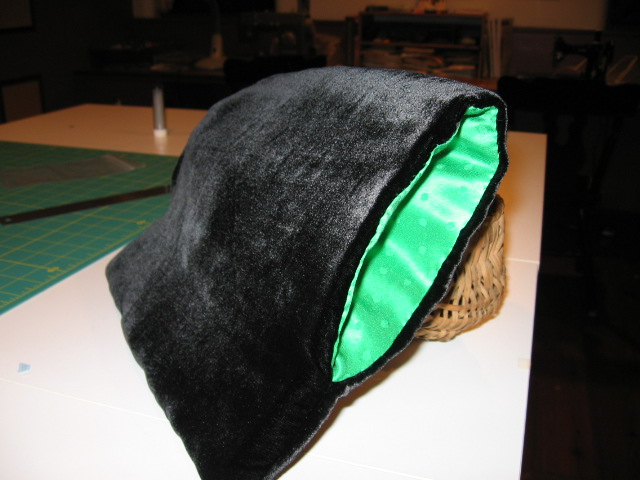
Here is an example of my own added Dressmaker Detail.  I made this evening muff as part of my merchandise for a recent fine crafts boutique/fair.  I made it up in black silk velvet, with a kelly green silk lining.  Made according to the pattern (circa 1959) it was pretty, but not as elegant or eye-catching as I had hoped.

This velvet muff with silk lining was not quite as special as I had hoped.

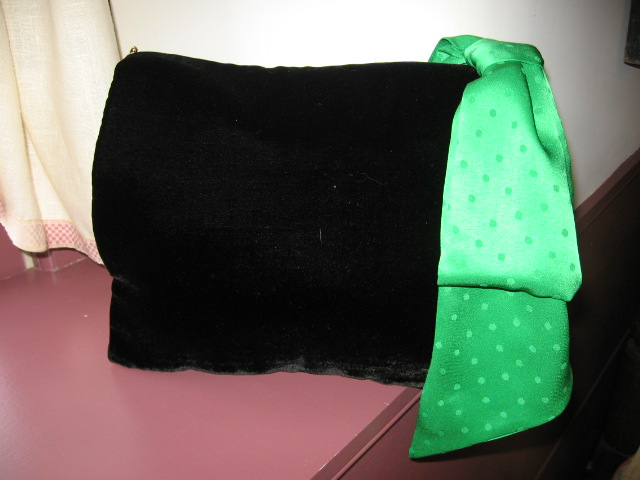
So – I added this constructed bow, which I made out of the green silk – a dressmaker detail which (I think) turns it from nice to  “wow”.

The added silk bow makes a big difference!

Dressmaker           +             Details             =

Absolutely what makes sewing so enjoyable.

4 Comments

Filed under Dressmaker details

Thank goodness I never made this!

I kept thinking that at some point years ago I had purchased yardage of bright pink and navy blue silk to make a dress, but I had never used it.  In my fabric closet I found three yards of pink Moygashel linen and a small quantity of navy blue linen, but I could tell from the odd shape of the blue fabric that it was just leftovers from some other garment (I think a navy blue suit I made for myself in the mid 70’s).  So – I didn’t think this was the fabric I thought I was remembering.

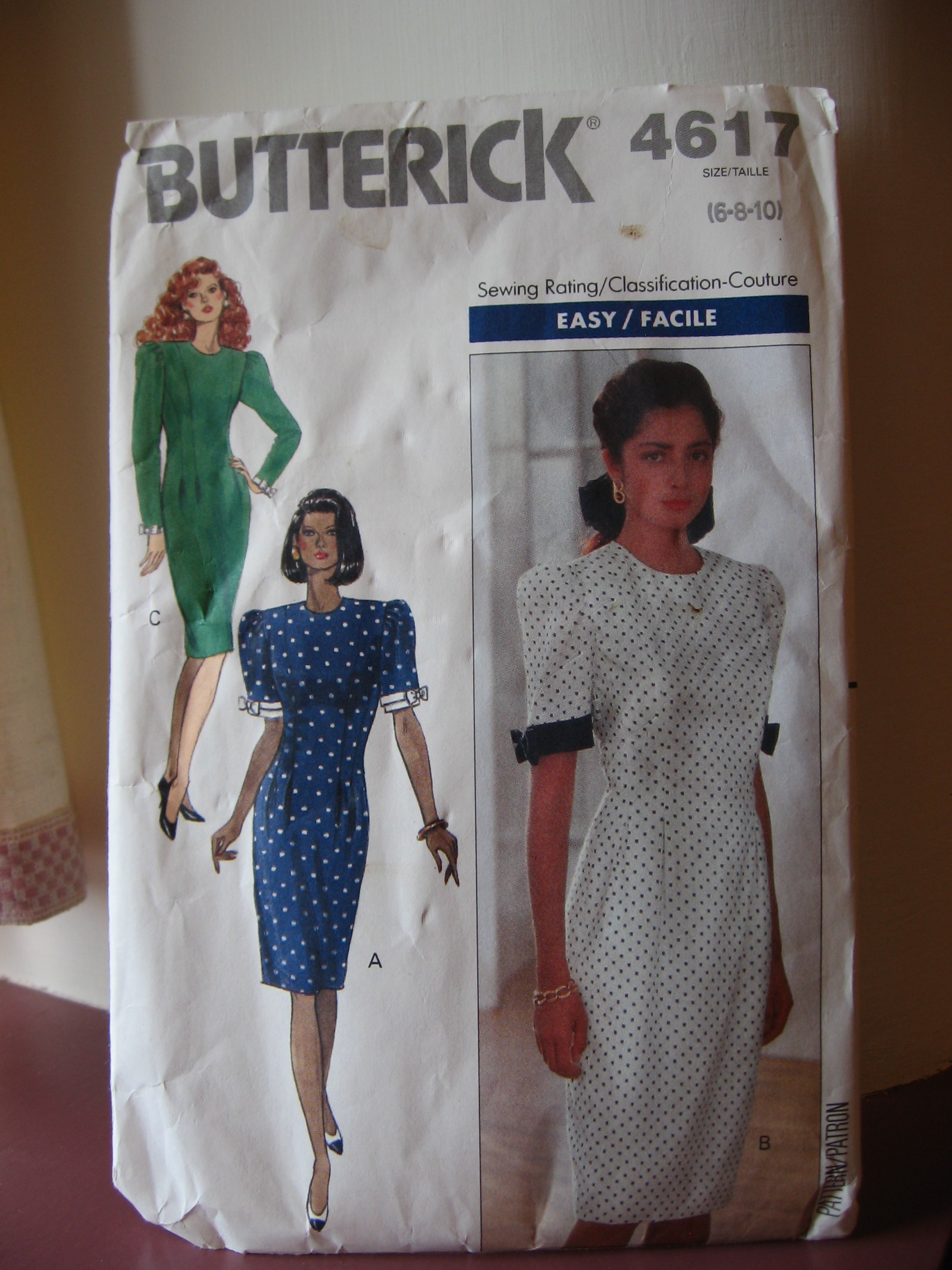
This was really bothering me and from time to time, I would look again in my fabric closet, hoping to find proof of my suspicions.  I found lots of other fabric, but not what I was looking for.  I had just about determined that I simply was mistaken,  when just a few weeks ago, I came across an unmarked white bag in one of the drawers of the high chest in our living room.  Now, I had looked in this drawer just recently, as it was stuffed with fabric scraps, some unfinished projects (I hate to admit this, but it’s true!), and a few patterns.   The white bag had just not caught my attention, as it seemed almost empty.   I took a peek inside – and voila!  Gorgeous pink and navy crepe de chine silk – and this God-awful pattern, which obviously I purchased to make up in pink and navy.  No wonder I lost interest in sewing for myself in the 80’s!!!

1980's Butterick pattern which I did not make - thank goodness!

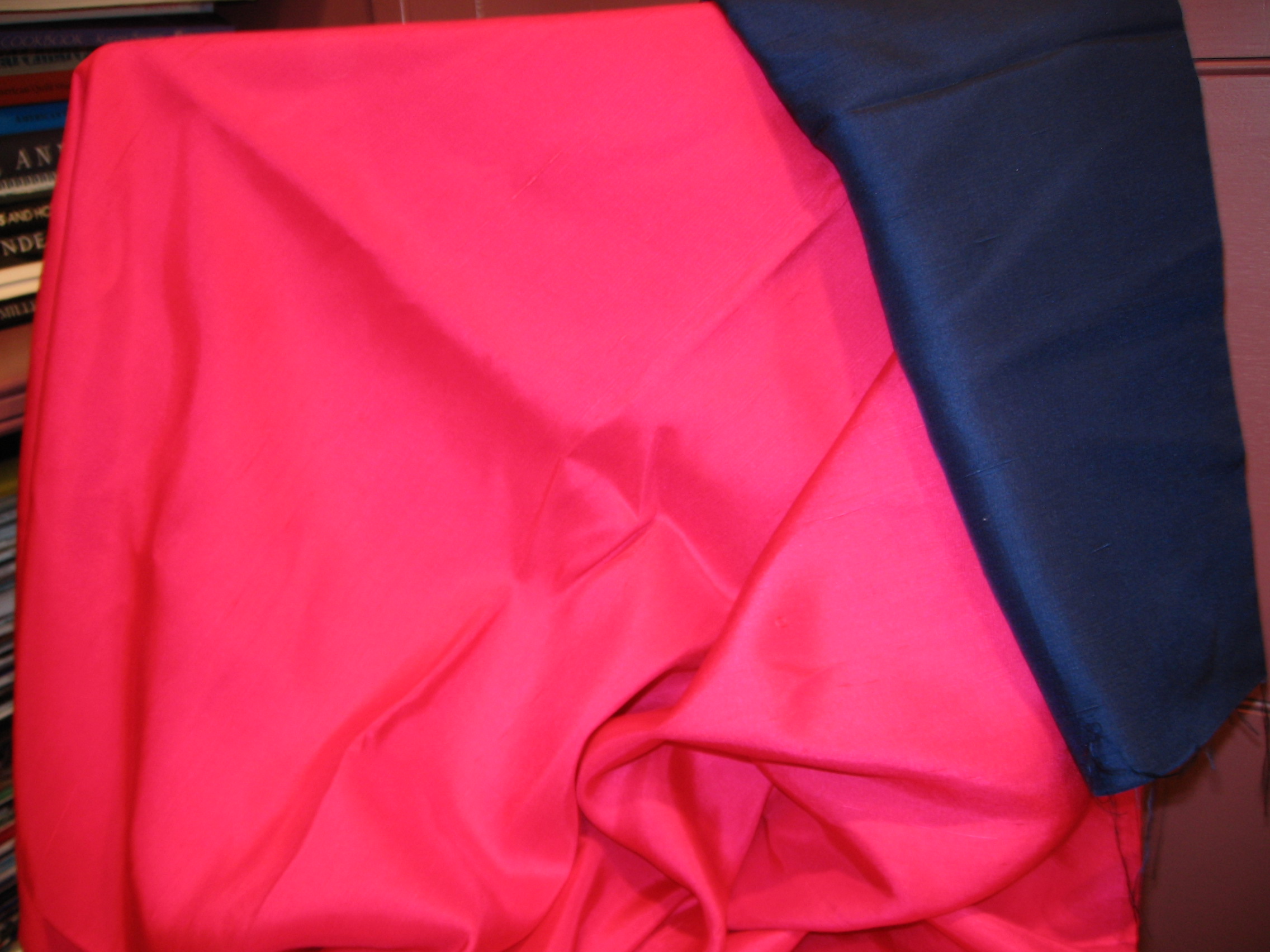
I am absolutely delighted to have rediscovered this fabric – there are about three and half yards of the pink and a half yard of the blue, and it has a fine hand to it.

Pink and blue silk which I found in my fabric drawer

I still love the combination of these two colors, and in the right mid-century style, I think this fabric will finally one day meet its destiny!

3 Comments

Filed under 1980's dress patterns

Seeing stars? No…dots!!

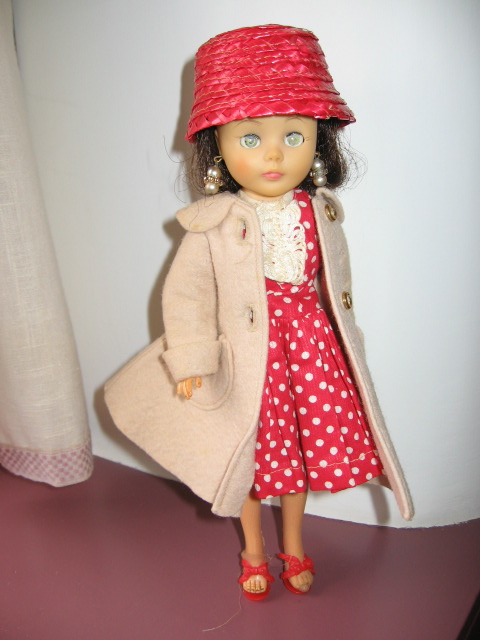
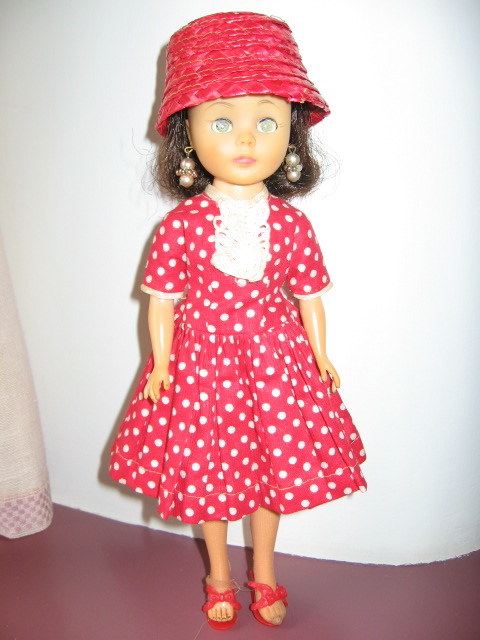
Polka dots, to be precise!  My love of polka dots must have started when I was about 6 or 7, when I received my Toni Fashion doll for Christmas.  She was dressed in a red and white polka dotted dress, with a lovely tan coat, red hat, and high heels.  Here she is, over five decades later: 

This dress could easily have been featured in Vogue Pattern Book for February/March of 1957!

Christian Dior, who died in 1957, was a big fan of polka dots.  Here’s what he said about them in his Little Dictionary of Fashion (first published in 1954 and now available on Amazon, published by Harry N. Abrams, Inc., 2007):

“…They are lovely, elegant, easy, and always in fashion.   …According to their color, they can be versatile…  Black and white for elegance; soft pinks and blues for prettiness; emerald, scarlet, and yellow for gaiety; beige and gray for dignity.”

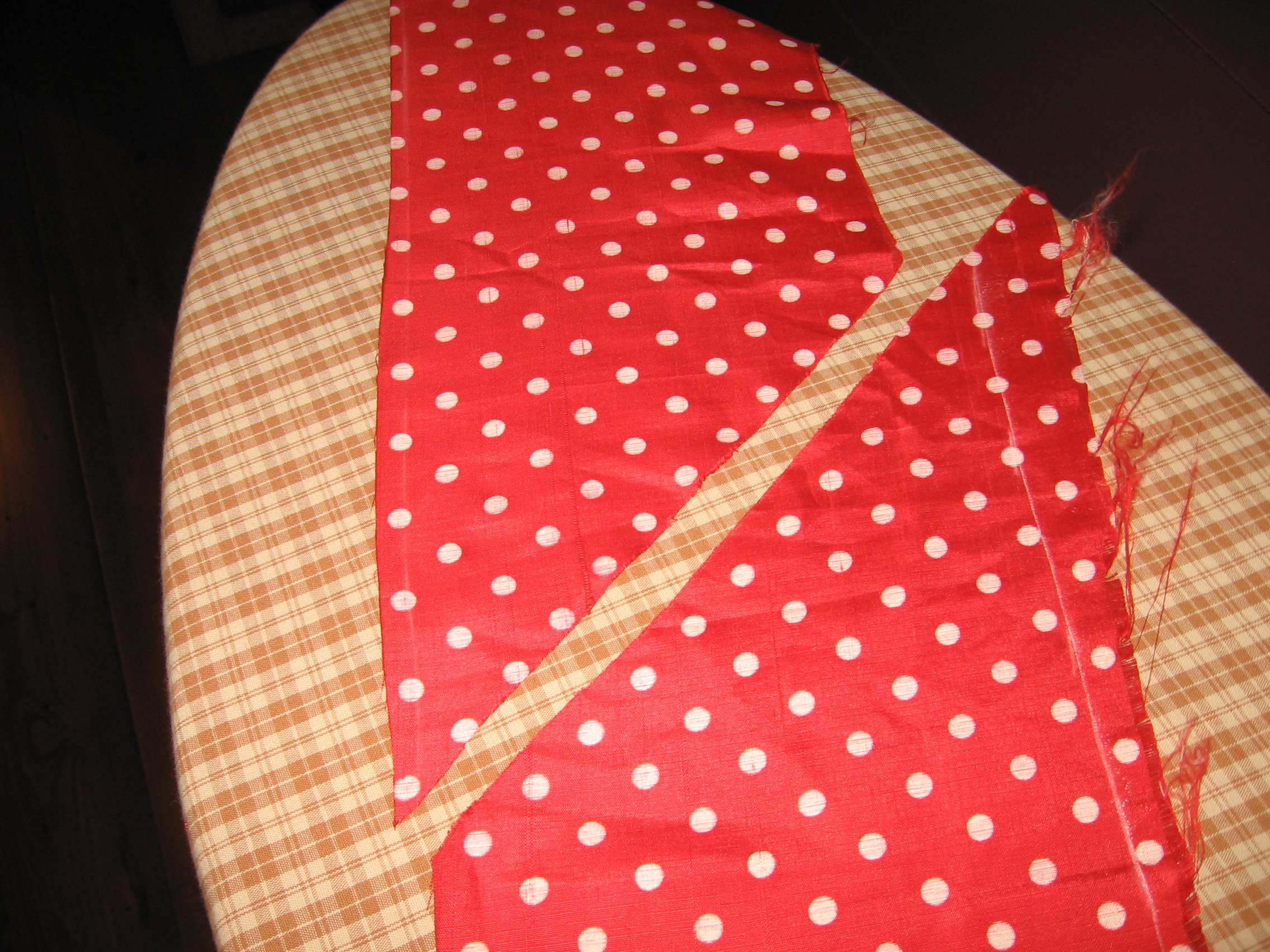
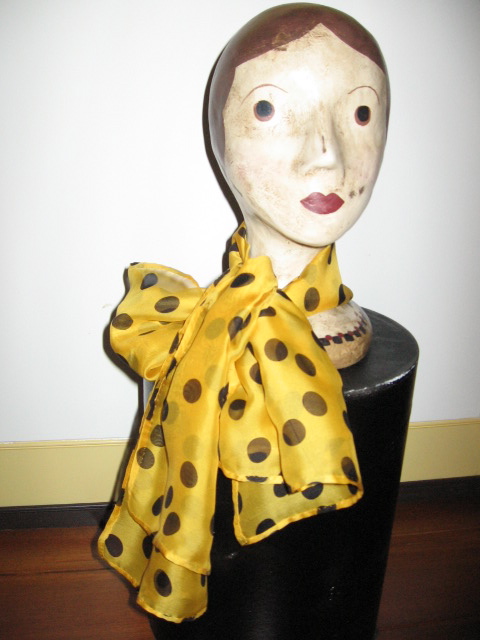
For my “going away” outfit when I was married in 1973, I made a beige silk suit with a red and beige polka dotted blouse.  Sadly I no longer have either the suit or the blouse, but… never one to throw away any scrap of fabric that can be used for something, I found a piece of the silk blouse fabric in one of my “fabric” drawers.  It was an odd shape, but the more I looked at it, the more it became apparent that I could actually make a scarf out of it.  Here’s what I did:

I cut the silk into two pieces, each with a true-bias end. I marked it with chalk to get a precise cutting line.

I joined the two pieces together with a flat felled seam and hand-hemmed around all four sides.

Here it is finished and ready to wear.


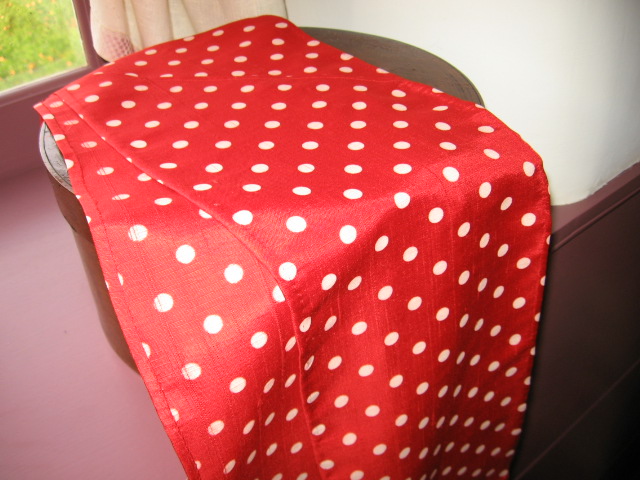
Last summer when my husband, Tom, and I were in California to see our son, Nate, I made a memorable trip to Britex Fabrics on Geary Street in San Francisco.  I knew when I saw this fabric, I wouldn’t be able to leave the store without it:  pure silk charmeuse  – by Dolce and Gabbana, no less!

Here it is propped over two pegs.

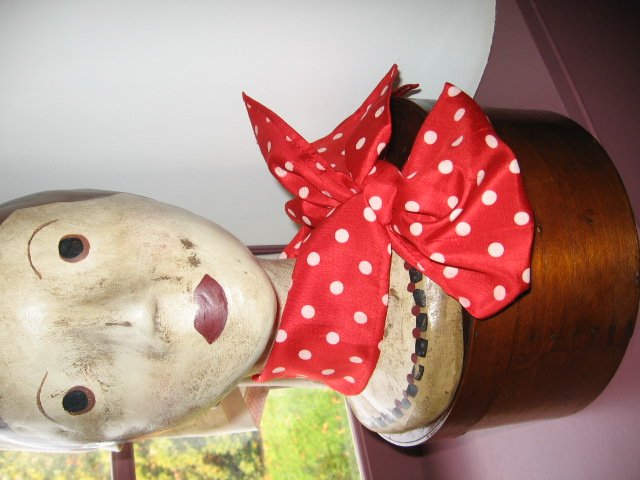
They also carried the matching silk chiffon.  I have been looking for the right pattern to make a blouse out of the charmeuse, and the chiffon is now this scarf, which gets comments whenever I wear it!

In my opinion, dots are stars!

Leave a comment

Filed under Polka dots, Scarves

I love coats!

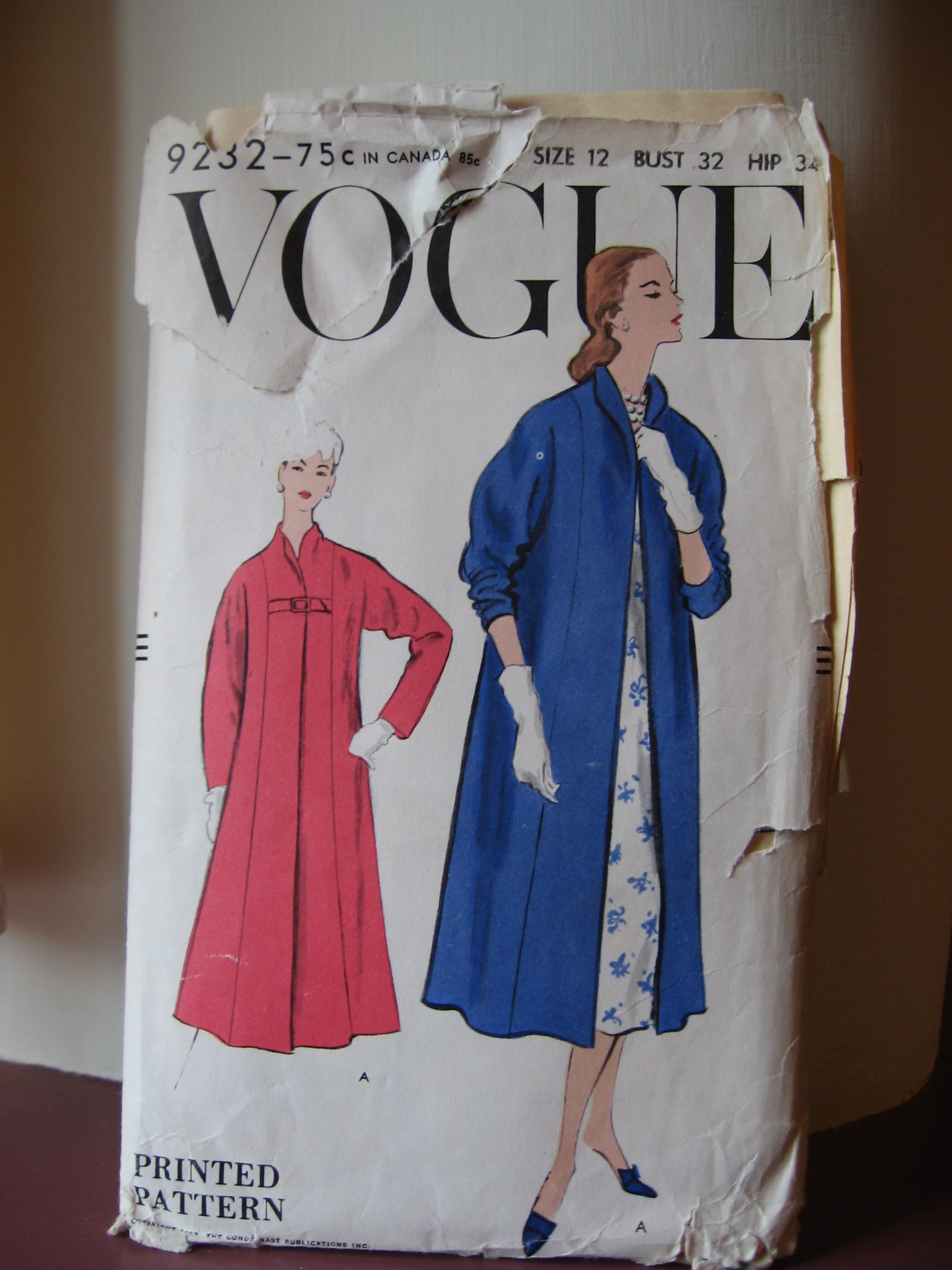
I never realized I love coats so much until I started looking at Vogue patterns on eBay.  It seems like every other pattern that appeals to me is either just a coat or a coat and dress or a coat and skirt or a jacket/coat that can be made in various lengths. One of the first ones I found was this one:

1957 Swing Coat from vintage Vogue pattern

One of my first eBay purchases - a vintage Vogue pattern from 1957

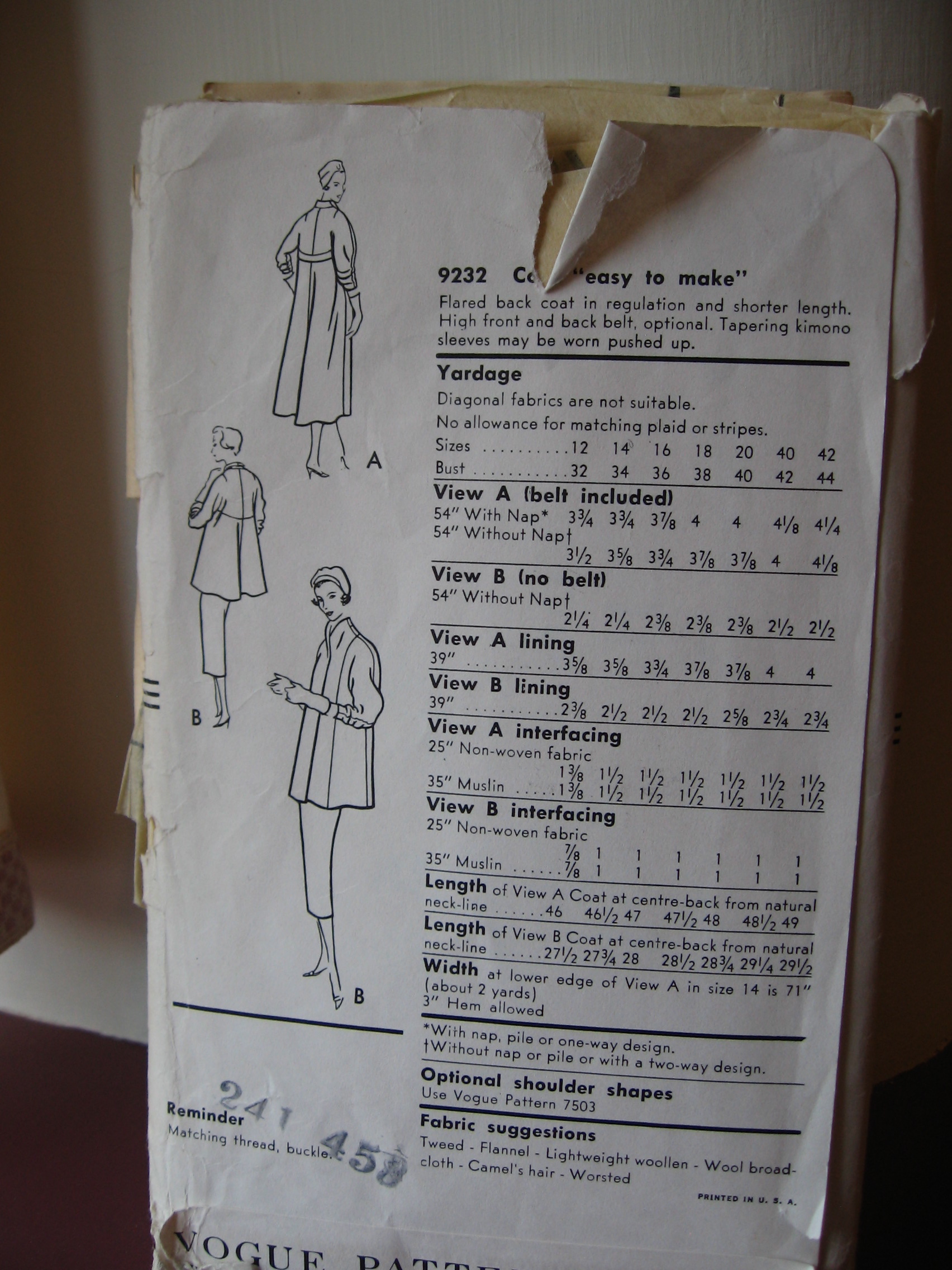
It was a “buy it now” offer rather than an auction – and I thought long and hard before I decided to go for it.  For one thing, there was only a front view of the pattern envelope, so I couldn’t tell what the back of the coat looked like.  When the pattern arrived, I was so excited – the back view of the long version has a high belt, which I think is such a great detail.  The swing of the coat looks lovely, too!  In fact, coats like these were called “swing” coats back in the 50’s.  They were also called “clutch coats” as the front fastenings were minimal or nonexistent, so you had to “clutch” them closed with your hand.

This pattern is copyrighted 1957.  The description on the back of the envelope says “Flared back coat in regulation and shorter length.  High front and back belt, optional.  Tapering kimono sleeves may be worn pushed up.”  (OH, YES!!!  Don’t you love this?  All the better to show off classy bangles and gold cuffs!)  I love the term “regulation length” although I have yet to find a reference to exactly what that means.

I immediately knew I would make this coat in its long version, but not sure what type of fabric I wanted to use.   That would take a few more weeks of deliberation. More on this and other coat patterns that I love in a future post.

5 Comments

Filed under Coats, Vogue patterns

Fifty Dresses begins…

A couple of years ago my daughter, Susanna, asked me what I’d like to do with the rest of my life.  It was a great question – but I didn’t know how to answer it.  I did, however, know what I did not want to be doing for the rest of my life – and that was the “full-time” volunteer work that had gradually taken over my days, often my sleep, and certainly my sense of balance in my day-to-day living.  But it was more complicated than that.  I had to admit that the work I had done and was doing (mostly for The Philadelphia Antiques Show, a major fundraiser for the University of Pennsylvania Hospital) had given me countless friendships, a peculiar source of “identity” and respect, and a sense of accomplishment.  I had to figure out if I really wanted to “give that all up”  – and if so, what would I replace it with?  That was the key question that I could not answer.

How I have come to Fifty Dresses is my “rediscovery” story, a crazy concurrence of events which provided me with an answer to that question which I never could have imagined.

Here’s what happened:

  •  Mad Men on AMC.  The story line is captivating, but it was those early 60’s fashions that really caught my attention.
  • A chance sighting of a book display in a Barnes and Nobel for A Vintage Affair by Isabel Wolff.  The cover illustration of 1950’s style prom dresses piqued my interest.  I bought the book, loved the story, and it started me thinking about vintage clothing and about many of my clothes from my childhood (which my mother made for me) and from my teens and 20’s (which I made for myself).
  • A random search on Google to find an obscure kitchen item lead me to make my first purchase  on eBay, which meant that I had to set up an eBay account and a PayPal account.  Once those were in place, I thought I’d do a search for Vogue patterns, then vintage Vogue patterns.
  • I started to dig out old Vogue patterns which I had sewn with in the 1970’s and had kept because I loved them so much.  In doing so, I found a beautifully tailored  red linen jacket which I had completed except for buttons and handworked buttonholes. I figured if I could sew like that years ago, I could do it again.
  • I went shopping for an outfit to wear to the Preview Party of The Philadelphia Antiques Show.  I found exactly one dressy jacket that I liked.  It was an Armani (!), it was $1,295, and it would need another $100 in alterations to fit me properly.  It wasn’t even silk!!   That’s when I knew it was time to start sewing again…

You’re invited to follow my adventures in sewing from these mid-century patterns and my observations about what I call the Golden Years of Fashion – the 1950s through the 1970s.

13 Comments

Filed under Uncategorized