Category Archives: vintage Vogue patterns from the 1950s

The Calm before the Storm

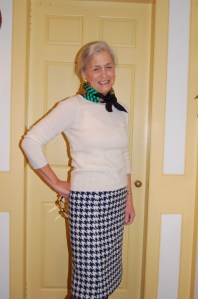
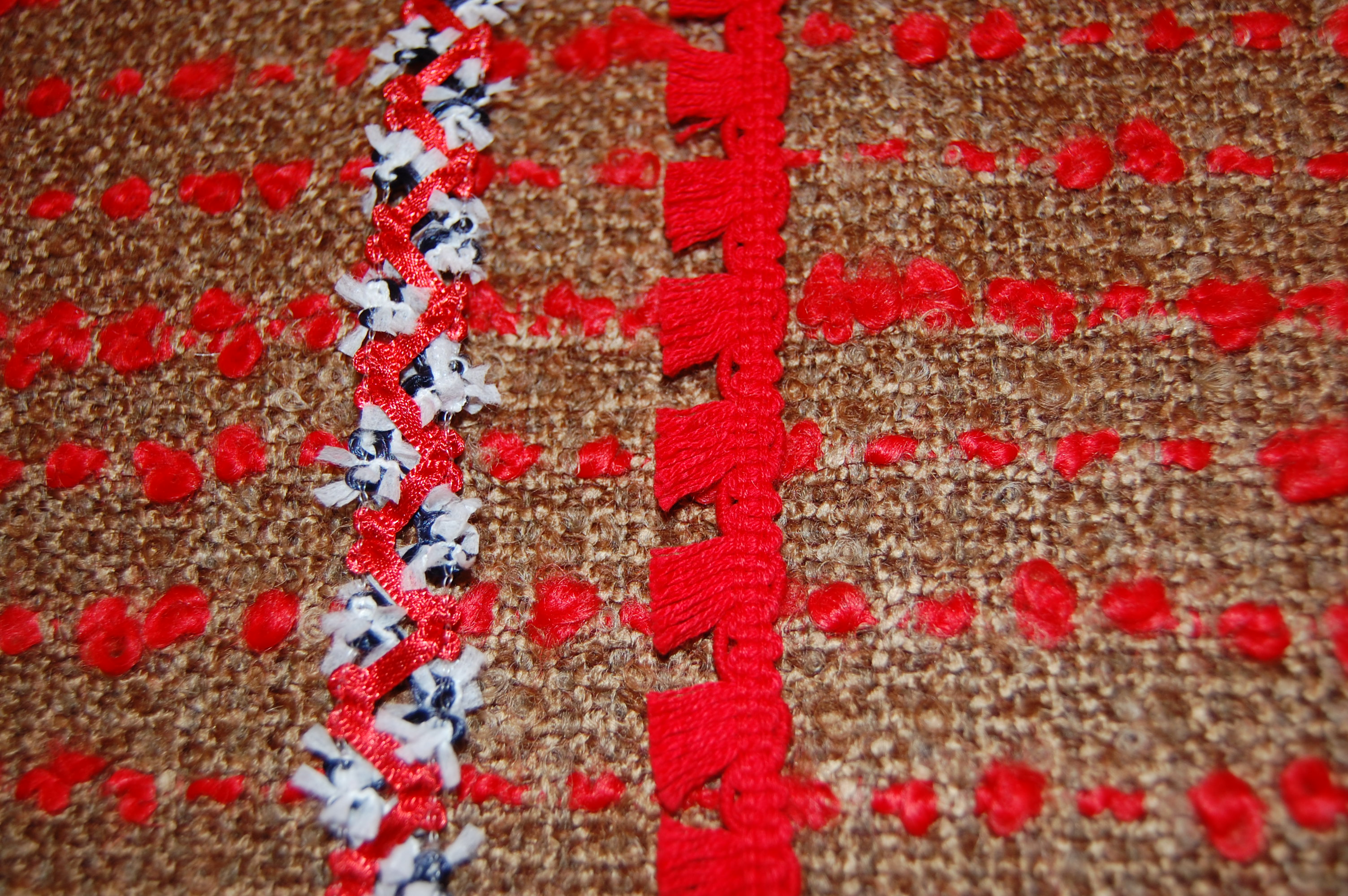
Starting the new year with a “simple” project seemed like the way to go, knowing that I plan to spend the remainder of the winter on a coat and “related apparel.” More on that in my next post. I thought that if I didn’t get this “skirt that was meant to be” cut out and sewn in the first couple of weeks of January, it might not get finished this year.

I found the fabric on eBay – dubbed as a medium-weight wool in good condition – 58” wide, 1+ yard in length, which I figured was enough for a skirt.

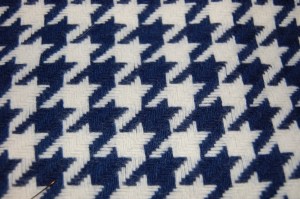
Navy and white houndstooth.

Navy and white houndstooth.

There is always a bit of the unknown when one is bidding on fabric online, especially when it comes to the feel and hand of the fabric. For that reason, I kept my bid fairly low, especially as I seemed to be the only one bidding or even watching this lot. So, you can imagine my surprise when I was OUTBID! I was disappointed, but clearly it was my own fault for not making a stronger bid.

I went on with my day, trying not to think about how much I liked the look of this fabric. And then – eBay sent me a message saying I had a second chance at the fabric – it could be mine for the amount I had bid originally. Hurray! I will never know what happened to make this possible, but clearly the skirt I had planned in my mind was meant to be.

DSC_1090

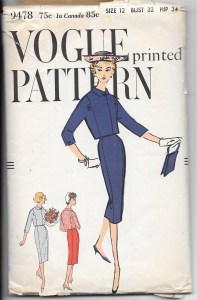
When the fabric arrived, it was lovely, although a bit heavier than I thought it would be. I decided it would make up better if there were few – or no – darts. So I settled on the paneled skirt from this 1958 pattern.

The calm before the storm - pattern

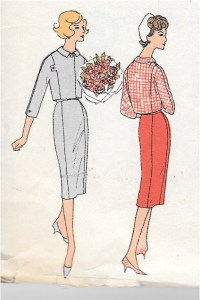
These small drawings show the seams and shaping of the skirt quite well. Obviously, I shortened the length of the skirt.

These small drawings show the seams and shaping of the skirt quite well. Obviously, I shortened the length of the skirt.

The shaping is in the seams, and even though there are a lot of seams (6 of them to be precise), I knew I could control the bulk by using couture techniques.

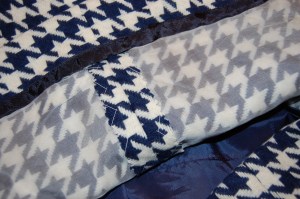
I underlined the skirt with silk organza, and secured the raw edges of each seam with catch-stitching.

I underlined the skirt with silk organza, and secured the raw edges of each seam with catch-stitching.

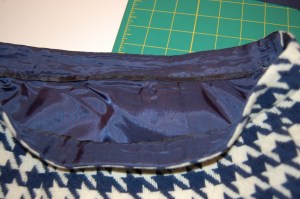
I also lined the waistband, thereby reducing bulk in that area. I used Bemberg rayon for the lining.

It is a little difficult to see, but this photo shows the inside of the lined waistband.

It is a little difficult to see, but this photo shows the inside of the lined waistband.

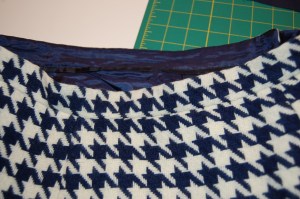
Another look at the waistband.

Another look at the waistband.

DSC_1087

DSC_1091

DSC_1095

DSC_1080

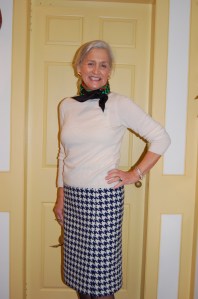
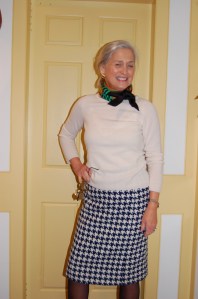
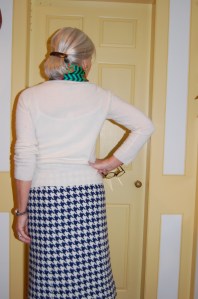
I believe this skirt is going to be a staple in my winter wardrobe – classic houndstooth in navy and white wool is versatile, timeless, and warm. This was a calm and simple way to start the new sewing year. Now I can dig into something much more complicated, and I am excited to do so!

27 Comments

Filed under couture construction, paneled skirts, Uncategorized, Vintage fabric, vintage Vogue patterns from the 1950s, woolens

One Year at a Time

Let’s start with 2016. Although, truthfully, right now in January 2016, I could probably plan at least three years’ worth of sewing. That is how many patterns and fabrics I have tucked away, waiting for their turn. But it is time to concentrate on the year at hand and get on with it!

Some of the year is shaped by events that I know will be happening – such as weddings and fancy parties. Some of it will be devoted to little granddaughters who are already growing too fast for me to indulge all my sewing fantasies for them.   And some of it will be my own self-determined challenges – coats and dresses I want to make – that right now are looking like small Mt. Everests, waiting to be conquered!

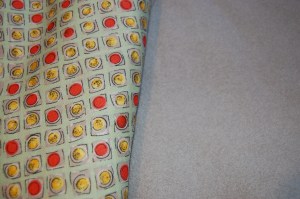
I probably should be sewing right now for Spring and Summer, but I have wools that are too enticing to ignore during these current Winter months:

Wool challis on the left and vintage cashmere on the right.

Wool challis on the left and vintage cashmere on the right.

Navy and white houndstooth.

Navy and white houndstooth.

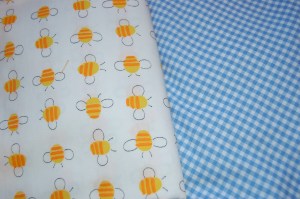
Some cute and classic cottons for little girls should be able to find themselves tucked in amongst my plans for Springtime.

The buzzy bee fabric is a vintage cotton. The blue gingham is new.

The buzzy bee fabric is a vintage cotton. The blue gingham is new.

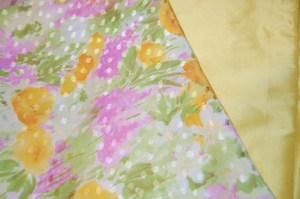
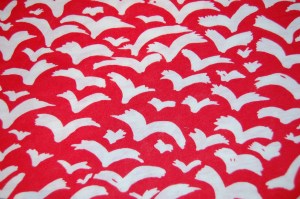
Looking towards Spring weddings already on the calendar, I am excited for the opportunity to use this amazing printed silk for a dress and perhaps pairing it with the plain yellow silk taffeta left over from my fancy dress from last Summer.

One year at a time

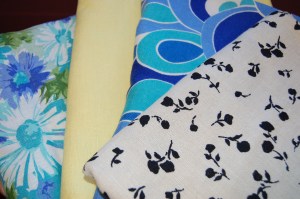
I have so many vintage linens in my collection, that it is difficult to narrow down my focus, but here are four that just may see the sewing shears this year:

These are all vintage Moygashel linen.

These are all vintage Moygashel linen.

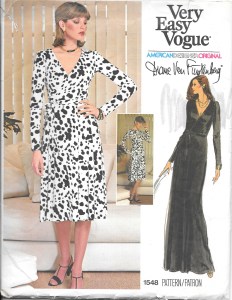
This vintage, authentic Diane von Furstenberg cotton blend knit has been calling my name for quite some time.

One year at a time = DvF

Hopefully this fabric and this pattern will finally find each other this year!

One year at a time - DvF pattern

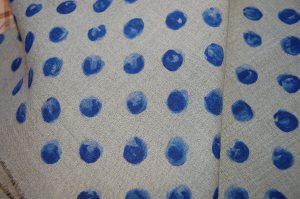
The sewing year will no doubt end next Fall with a return to wool. The polka dotted wool is similar to the wool in a dress I made in Fall of 2015. It is from Mendel Goldberg Fabrics in NYC.

As one who loves polka dots, I could not pass up this wool/silk blend fabric.

As one who loves polka dots, I could not pass up this wool/silk blend fabric.

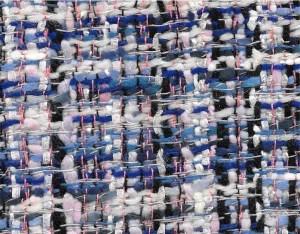
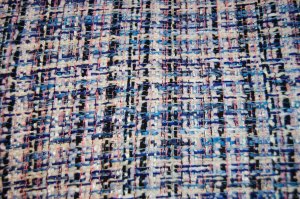
When I purchased it, several swatches of boucle were in the package – and I was in a swoon over this blue and pink sample:

How wonderful that Pantone's two "colors of the year" - pink and blue - are the color way for this boucle.

How wonderful that Pantone’s two “colors of the year” – pink and blue – are the colorway for this boucle.

Lucky me to open a box on Christmas morning to find 2 yards of it (thank you to my dear children!) – enough for another Classic French Jacket.

2 full yards of this glorious boucle! What a wonderful gift!

Two full yards of this glorious boucle! What a wonderful gift!

Some of the patterns I might be using this year are all vintage ones that deserve attention. I tidied up the boxes where I keep my pattern collection and these just happened to be some which would NOT go back in silence, so here they are with all their wily temptations!

One of my big projects for this year is this coat.

One of my big projects for 2016 is this coat.

I have been wanting to make the dress on the right for quite a while - this may be the year it happens!

I have been wanting to make the dress on the right for quite a while – this may be the year it happens!

I really like this shirtwaist dress (a little shorter, of course) and I envision it made out of a lovely summer linen.

I really like this shirtwaist dress (a little shorter, of course) and I envision it made out of a lovely summer linen.

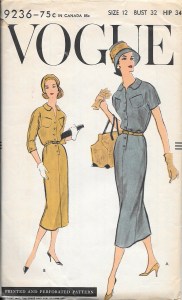
I think I could make either view of this dress over and over and not get tired of it.

I think I could make either view of this dress over and over and not get tired of it.

One thing I learned a long time ago is the importance of flexibility in planning my sewing year. Sometimes things happen that impede my sewing plans. Sometimes I change my mind. And always, always, I plan too much. And when (not if) that happens, there is always 2017 right around the corner.

17 Comments

Filed under Boucle for French style jackets, Diane von Furstenberg Vogue patterns, Linen, Moygashel linen, Polka dots, Sewing for children, Uncategorized, Vintage fabric, vintage Vogue Designer patterns, vintage Vogue patterns from the 1950s, vintage Vogue patterns from the 1960s, vintage Vogue patterns from the 1970s, woolens, Wrap dresses

A Collection of Coats

When the weather turns wintry, warm coats become a wardrobe staple. One or two “practical – wear everywhere” coats are a must. (I just added years to the life of a 2+ decades-old cashmere, classic, double-breasted coat by having the tattered lining replaced by a local tailor – and I will continue to wear this coat often!) But how delightful to have a collection of coats – and how much better if they are not only warm, but also stylish. If you were sewing in the 1950s and 1960s you were fortunate to have many, many coat styles and patterns available to you – and if you are sewing now, you are also fortunate to have access to many of these same patterns through the internet – and they are just as stylish now as they were 50+ years ago. I am, of course, speaking of “dressmaker coats.”

Quoting from Fairchild’s Dictionary of Fashion, (Third Edition, by Charlotte Mankey Calasibetta and Phyllis Tortora; Fairchild Publications, Inc, New York, New York, copyright 2003) a dressmaker coat is: “A woman’s coat designed with softer lines and more details than the average coat. May have a waistline and unusual details, e.g., tucks or pleats.” Such coats are so-called because they are styled more like a dress.

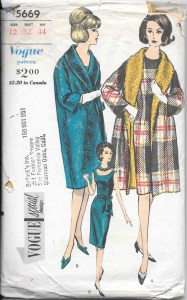
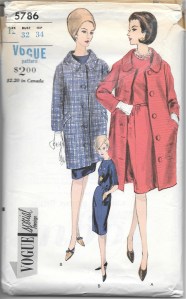
It doesn’t take very long to find examples of such coats in the Vogue Pattern Book Magazines from those two decades. The sheer numbers of patterns for such coats – and coat and dress ensembles – make me believe that home dressmakers from that period of time did not shy away from such sewing challenges. And why should we when so many gorgeous coats are waiting to be sewn?

Here are a few examples to tempt you:

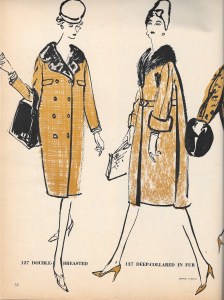
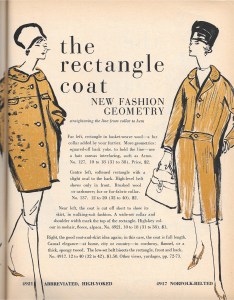
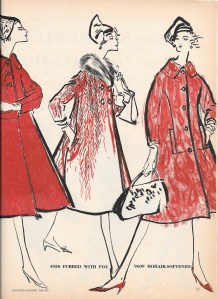
“The Rectangle Coat: New Fashion Geometry” was a feature in the December 1958/January 1959 Vogue Pattern Book Magazine.

Dressmaker coats - rectangle #1

Both of these coats feature fur collars “added by your furrier.” The one on the left has a “slight oval to the back” – and a half belt.

Suggestions for suitable fabrics are given for each of these designs.

Suggestions for suitable fabrics are given for each of these designs.

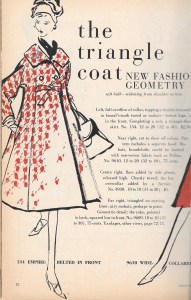
Continuing with the theme of “New Fashion Geometry,” the following pages of the same Vogue Pattern Book Magazine show examples of “the triangle coat.” Other terminology for this style of coat is the A-line coat. First introduced in 1955 by Christian Dior, this coat was “made close and narrow at the shoulders, flaring gently from under the arms to hem; shaped like letter A, made in single-or double-breasted style with or without a collar,” according to Fairchild’s Dictionary of Fashion, page 85.

Dressmaker coats - triamgle coat #1

The coat on the right has unusual princess seaming.

The coat on the right has unusual princess seaming.

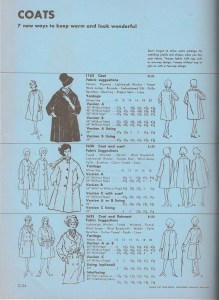
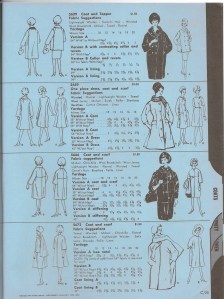
A few years later, the December 1962/January 1963 issue of Vogue Pattern Book Magazine featured “7 new ways to keep warm and look wonderful.”

Dressmaker coats - 7 coats 1

Several of the coats in this section feature "fullness" in the body of the coat.

Several of the designs in this section feature “fullness” in the body of the coat.

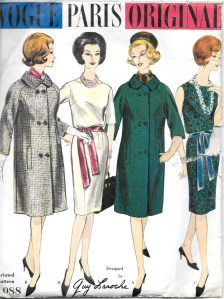
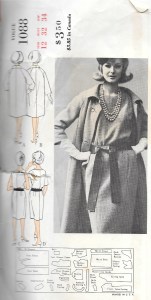
For me, however, it is the “ensembles” that make the ultimate fashion statement when speaking of coats. Christian Dior succinctly sums up their allure in The Little Dictionary of Fashion (Abrams, New York, New York, copyright 2007), page 40: “A very elegant way of dressing is to have a coat and dress matching together, making an ensemble… The frock should be fairly simple and the coat can be either fitted or loose, according to your taste. It can also be either long or short.” Vogue Patterns had no shortage of offerings for such ensembles. Here are four wonderful Vogue patterns – which are part of my pattern collection – and which are “ensembles.”

Note the "fullness" in this coat as well.

Note the “fullness” in this coat as well.

The princess seaming on this coat is similar to the red one mentioned above.

The princess seaming on this coat is similar to the red one mentioned above.

Somehow, this Guy Laroche pattern shows better in this photograph than in its drawing.

Another view of this  Guy Laroche pattern; it seems to show better in a photograph than in its pattern illustration.

This pattern was featured in that same VPB Magazine issue from December 1962/January 1963.

This pattern was featured in that same VPB Magazine issue from December 1962/January 1963.

And here it is in black and white in that issue. Stunning, isn't it?

And here it is in black and white in that issue. Stunning, isn’t it?

I love the knee length coat, although I may substitute another pattern for the coordinating dress.

The neckline on this coat is lovely and perfectly suited for a coordinating dress.

I actually have fabric for three of these patterns – with plans to sew them of course.  (Can you guess which one is the fabric-less orphan?)   However, all of them will remain part of my sewing dreams until after the holiday season – which “officially” begins this week with our American Thanksgiving celebration. I have festive attire and a few homemade gifts to fill my sewing days through December. Building my collection of coats will just have to wait.

Happy, Happy Thanksgiving to all my American readers – and my heartfelt thanks to my loyal readers worldwide in this season of gratitude.

11 Comments

Filed under Coats, Dressmaker coats, Mid-Century style, The Conde Nast Publications, Uncategorized, vintage Vogue Designer patterns, vintage Vogue patterns from the 1950s, vintage Vogue patterns from the 1960s

Oh, The Things We Can Learn!

When is a pattern envelope not just a place to keep a tissue pattern? When it is a mini lesson in sewing, style, history, elegance, and story-telling. Of course, I am thinking primarily of vintage pattern envelopes – and because I primarily sew from Vogue patterns, those are the focus of my thoughts.

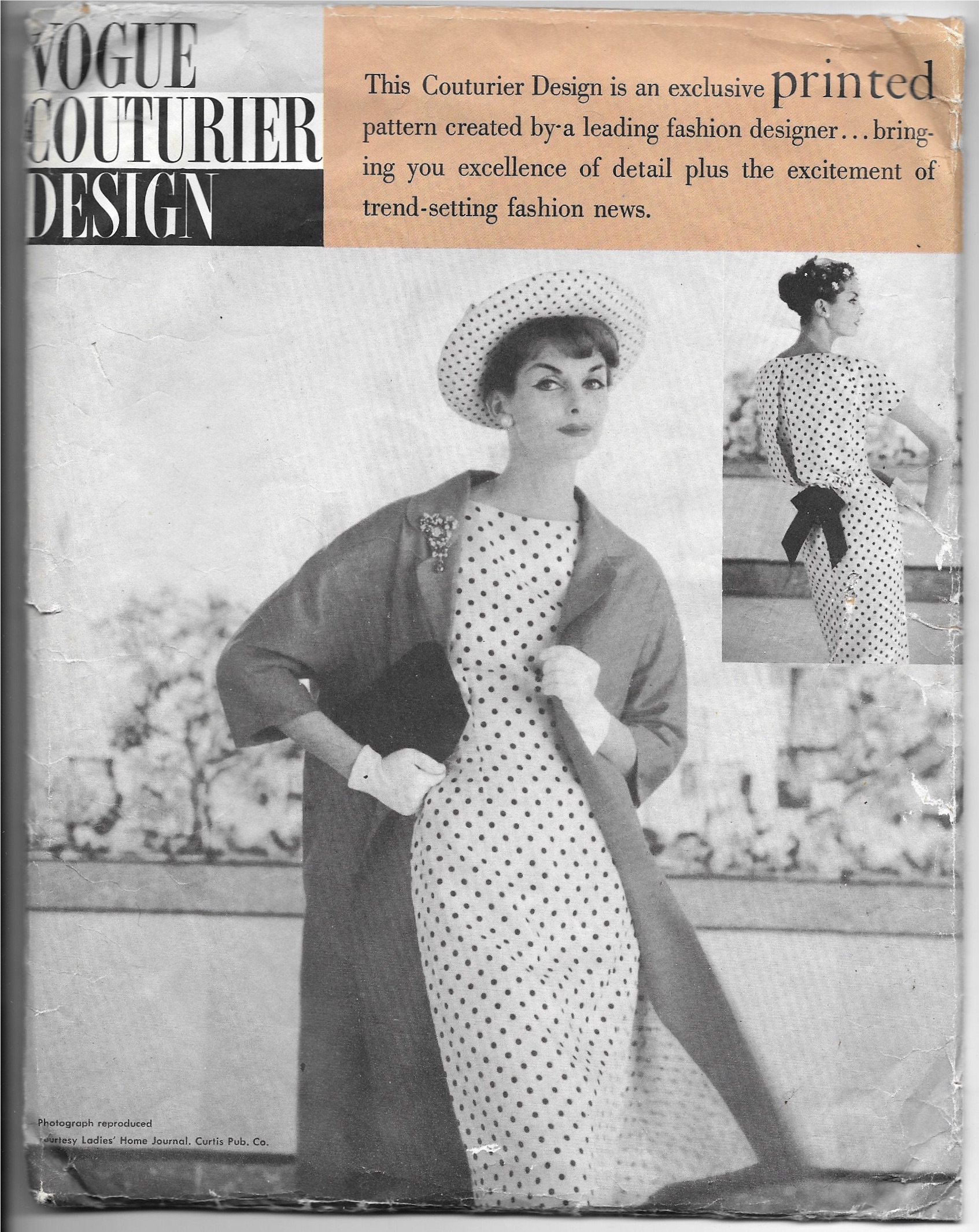
I am also limiting my short exploration of these topics to the course of about ten years, from approximately 1956 until 1966. Most of the pattern art from this time period was in illustration form rather than photography. There were exceptions, such as this classic polka-dotted dress and coat ensemble from 1959:

The reverse of this envelope has very precise sketches of the fronts and backs of the dress and coat. This is one of the few envelopes from this period - 1958 - that I have seen that features photography rather than illustration art.

The reverse of this envelope has very precise sketches of the fronts and backs of the dress and coat. This is one of the few envelopes from this period – 1958 – that I have seen that features photography rather than illustration art.

It was up to the fashion illustrators and artists to represent the pattern accurately. Darts, seams, buttons, belts, pockets, etc. all had to be clearly indicated in the illustrations on the fronts of the envelopes and in the thumbnail sketches on the back of the envelopes. Home dressmakers wanted to know these things about a pattern before purchasing it – we still do! Here is a great example of the clarity of these pattern illustrations in regard to these items:

The darts, seams, and buttons are clearly delineated in this artwork.

The darts, seams, and buttons are clearly delineated in this artwork.

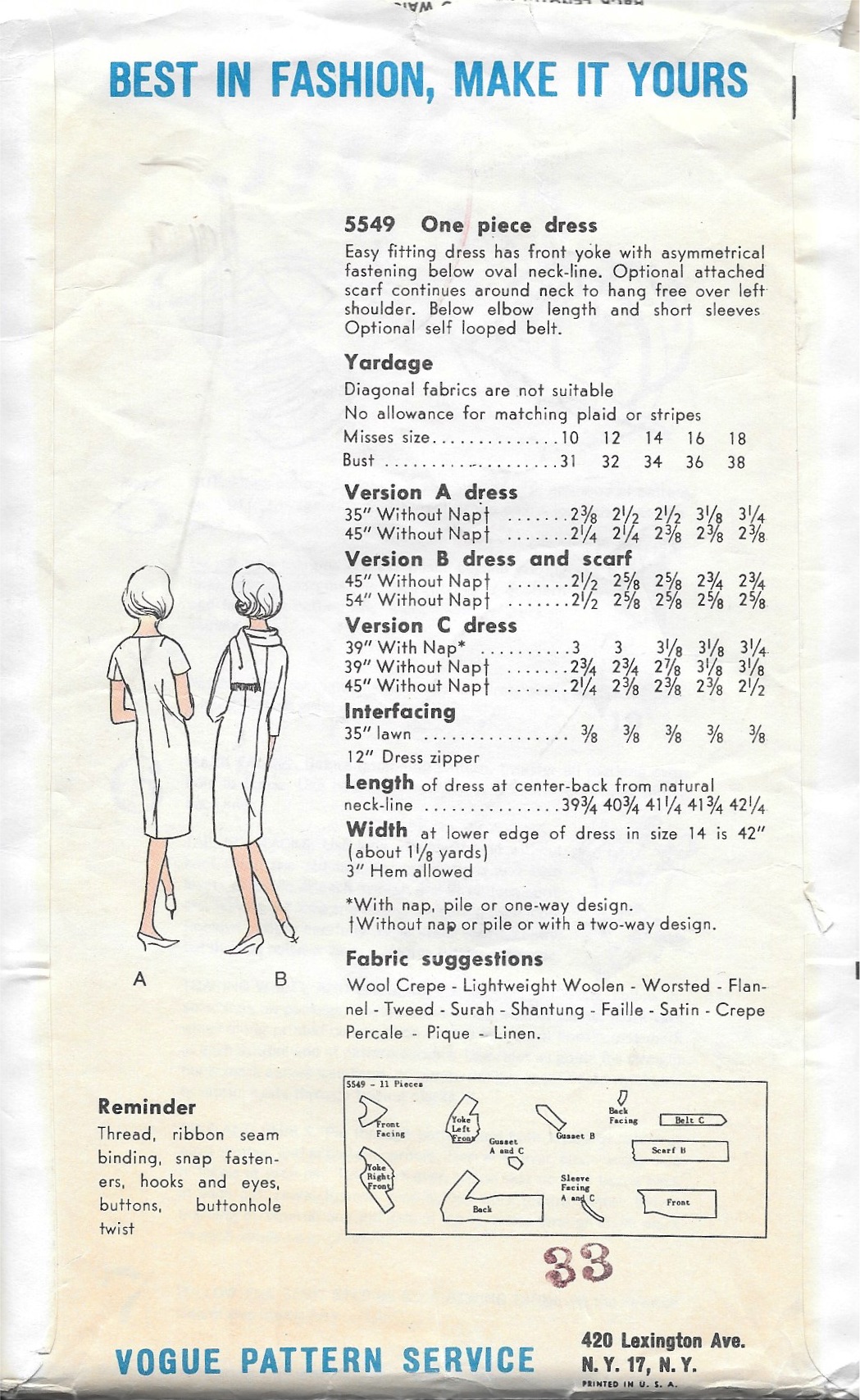
The back of this pattern also gives lots of additional sewing information. The thumbnail sketches clearly show that there is no back zipper. Among the details listed is a 12” zipper. That can only mean that a side zipper is used – which makes sense as it is paired with the front-buttoned bodice.

Oh the things we can learn, no 2

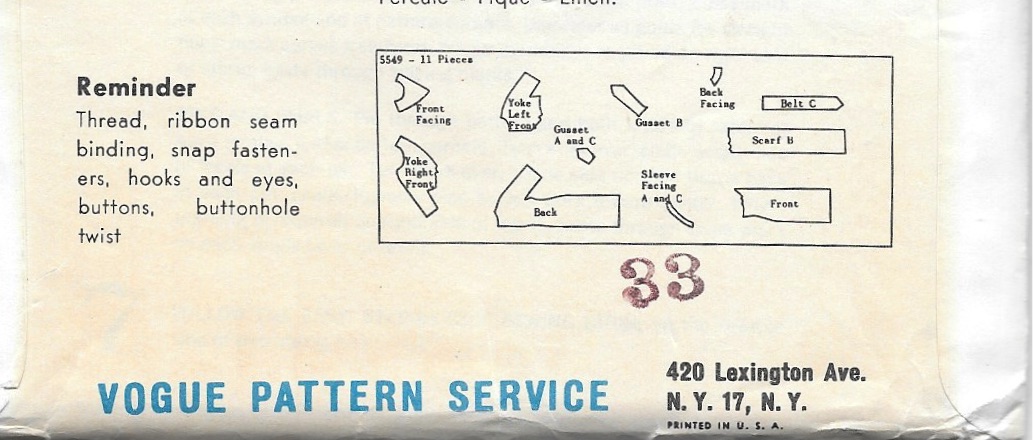
Further scrutiny of the pattern layout shows a gusset, obviously for use under the arm. If you, as a dressmaker, were uncomfortable with putting in a gusset, then maybe you would want to avoid this particular pattern!

It is such an advantage to be able to see the shapes of the pattern pieces in these layouts.

It is such an advantage to be able to see the shapes of the pattern pieces in these layouts.

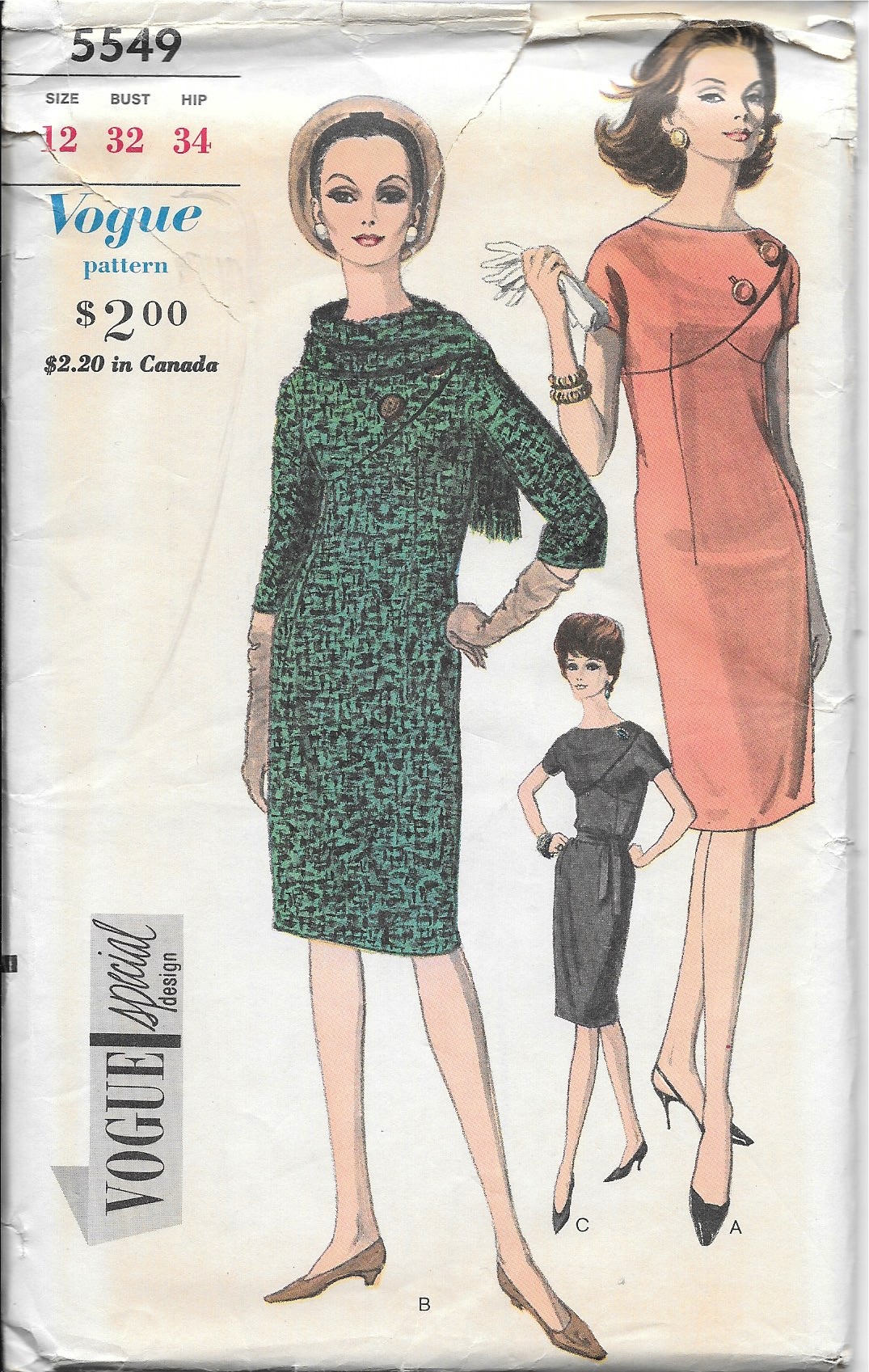
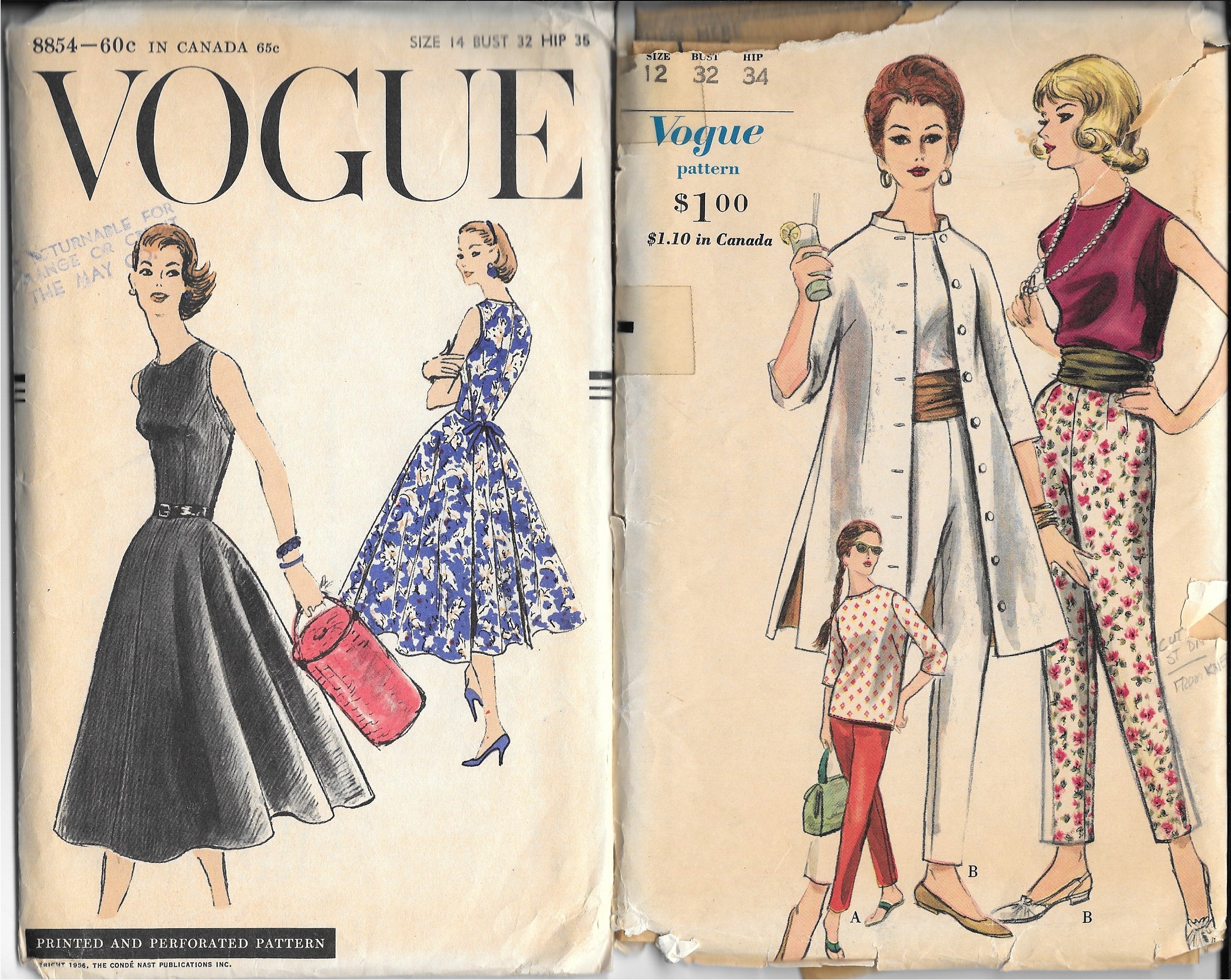
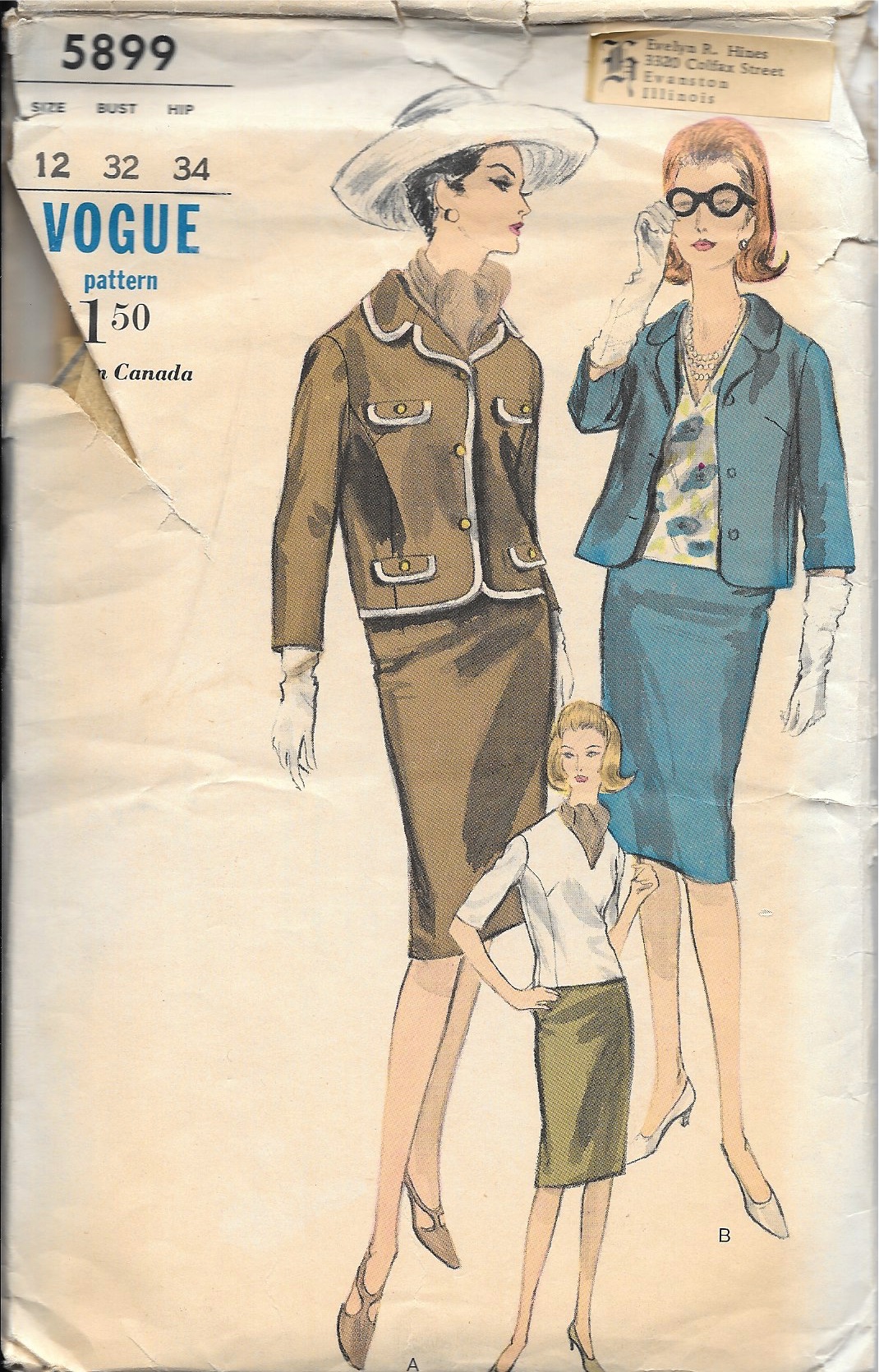
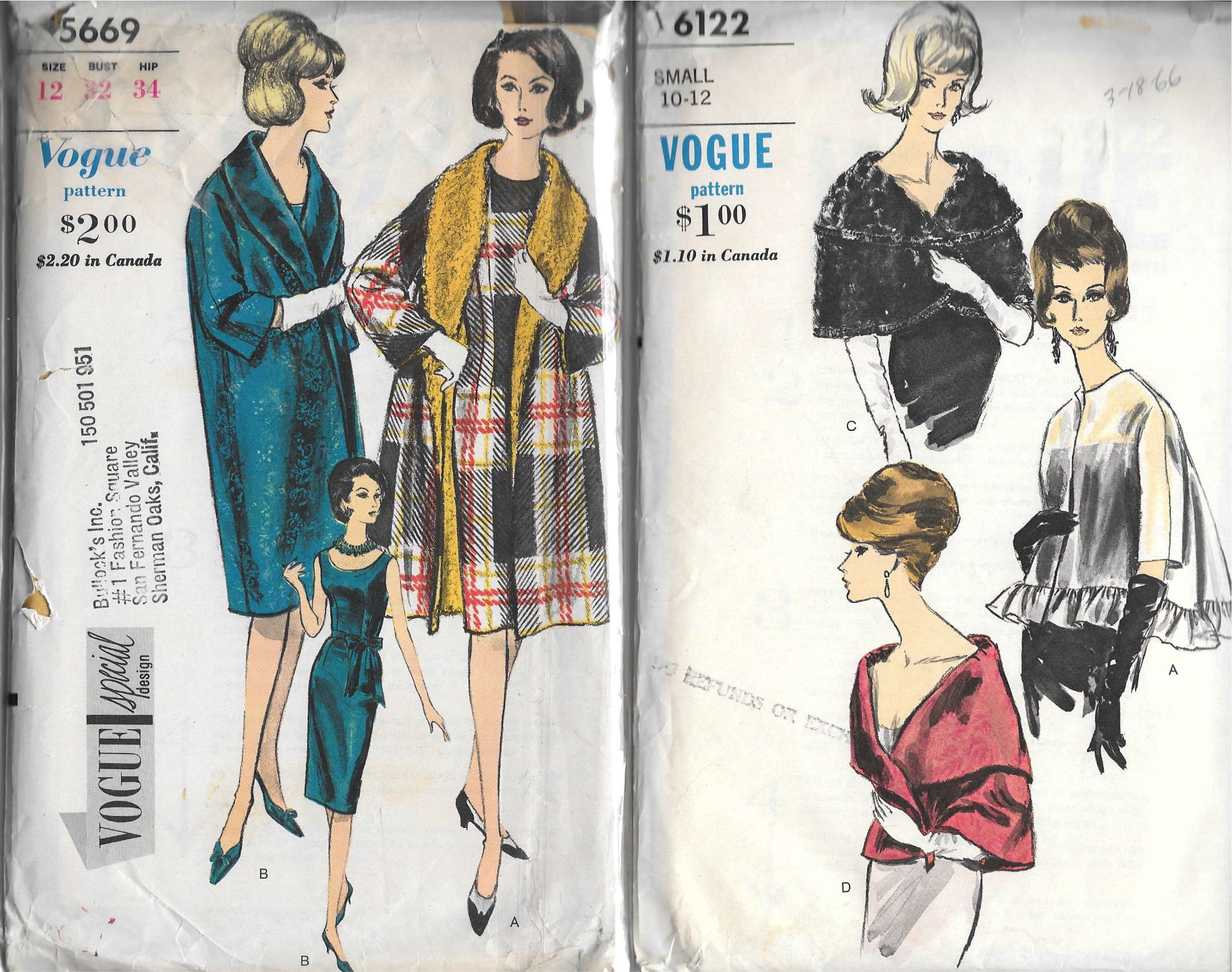
It was also up to the fashion illustrator to make the pattern look relevant to one’s life. Different views were often shown in varying colors, widening the visual appeal. They were also shown in dressier or more casual renditions, making the pattern attractive to different lifestyles and age groups. These two patterns clearly show this endeavor:

Oh the things we can learn, no 4

The inclusion of accessories in the pattern illustration from this time period shows just how much Vogue and other pattern companies were selling a complete look. They were saying “Start with this pattern, add gloves, a bangle bracelet or two, sunglasses or a hat, maybe a scarf, earrings, high heels, and a handbag, and you, too, can walk out looking like a million dollars!” The great desire in looking well-dressed and chic during this time period is so beautifully reflected in these pattern envelopes.

Gloves, gloves and more gloves! And look at those glasses!

Gloves, gloves and hats and scarves…   And look at those glasses!

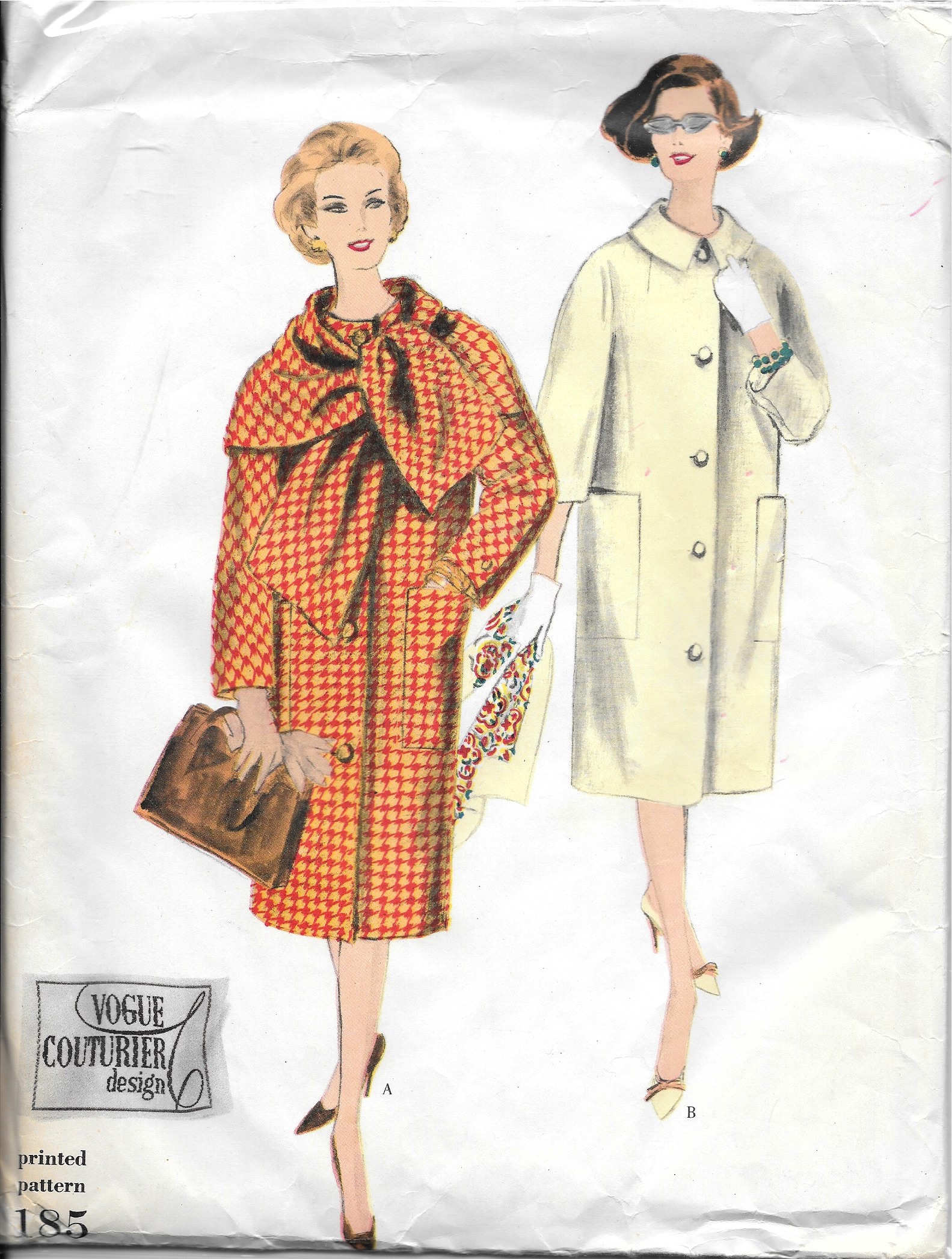
This has got to be one of my favorite examples of pattern art: the model in white holding the scarf so casually, the stylish shoes, and the large clutch handbag on the model on the left - lovely and evocative!

This has got to be one of my favorite examples of pattern art: the model in white holding the scarf so casually, the stylish shoes, and the large clutch handbag on the model on the left – lovely and evocative!

One way of dating pattern envelopes is by looking at the hairstyles of the illustrated “models.” After about 1960, Vogue stopped including the copyright date on their envelopes. But it’s fairly clear by the bouffant and flipped hairstyles on the pattern on the left that we are looking at one from the early to mid-‘60s.  The one on the right is a few years later, based on the hairstyles alone.

Note, too, how the Vogue masthead changed during this short time period.

Note, too, how the Vogue masthead changed during this short time period.

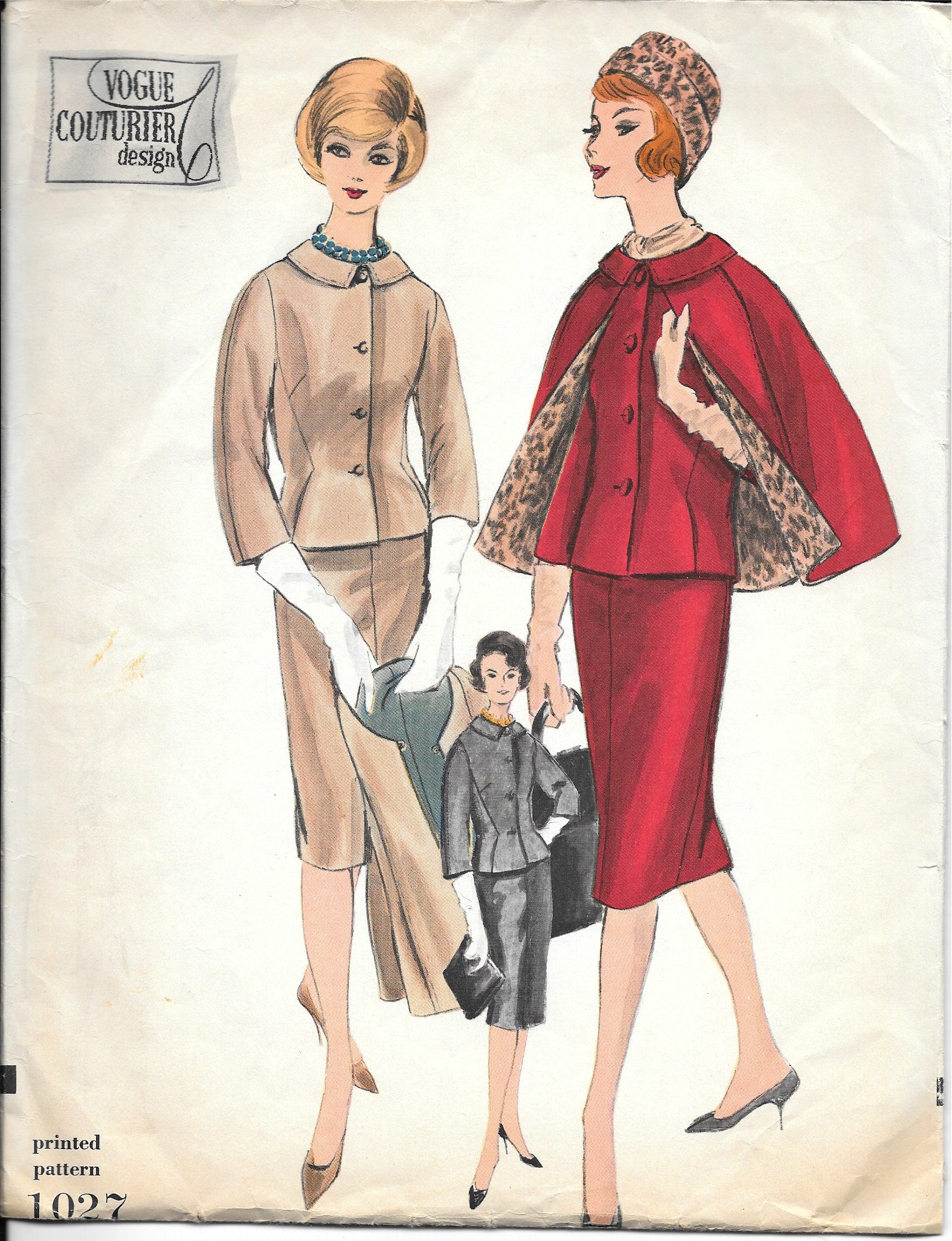
Finally, I am delightfully intrigued by the almost universal depiction of “elegance” on the pattern envelopes from this period. From the leopard print hat and lined cape on this suit from 1959:

Oh the things we can learn, no 8

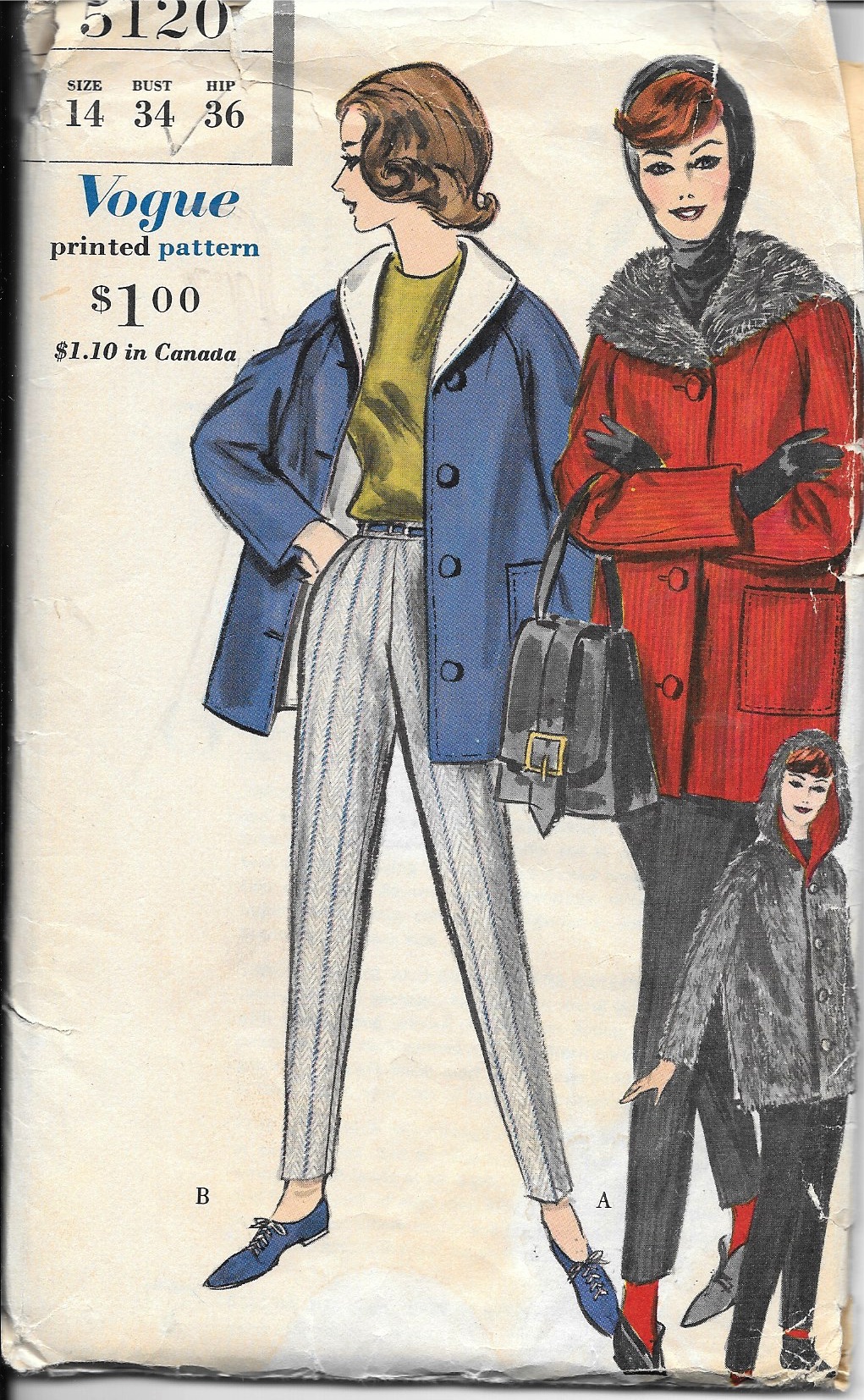
to this reversible car coat from the early ‘60s:

The model in the red version of the coat strikes a chic and elegant pose with her hair tucked under a scarf, her arms casually folded, and with her stylish handbag...

The model in the red version of the coat strikes a chic and elegant pose with her hair tucked under a scarf, her arms casually folded, her stylish handbag looped over one arm …

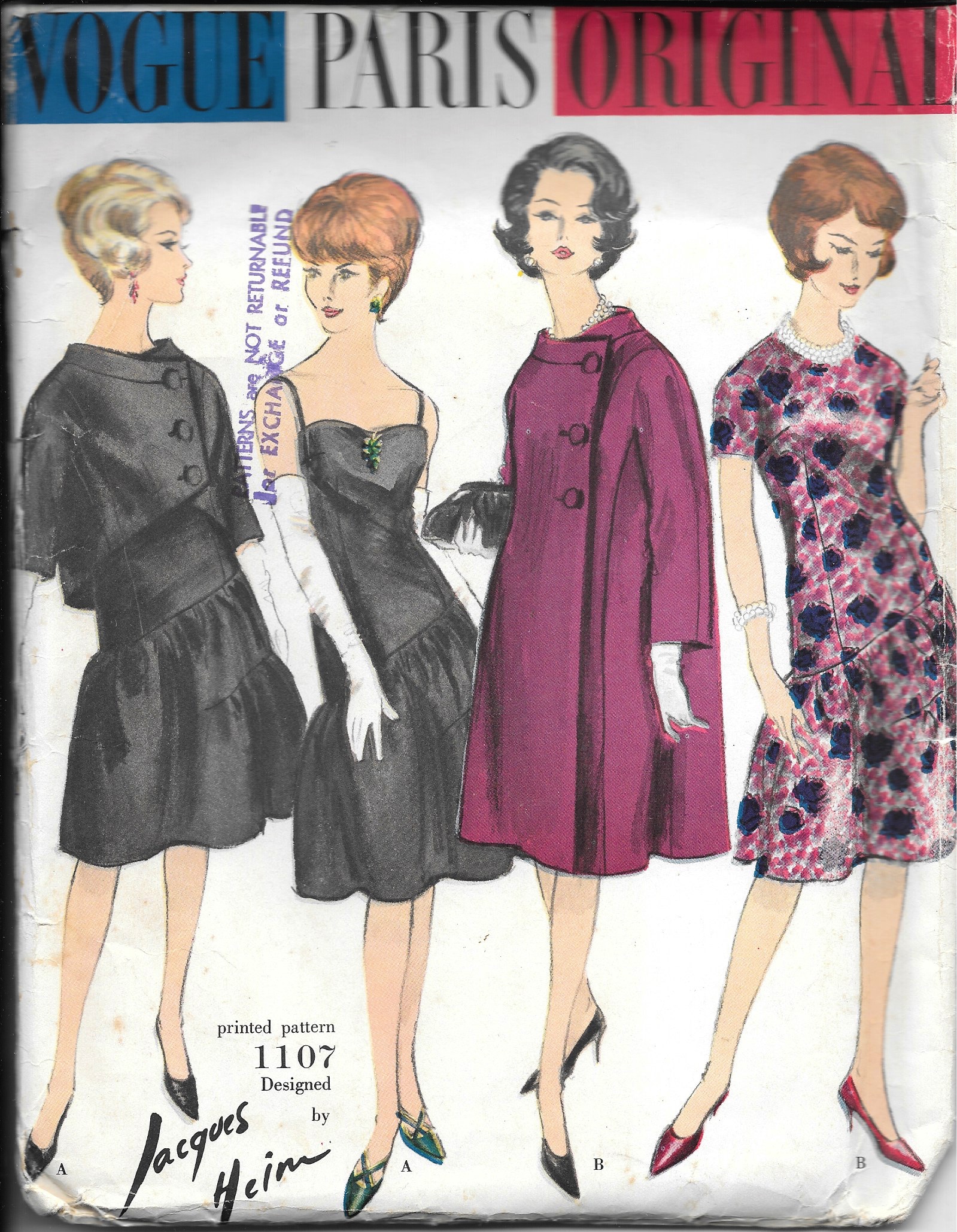
to this cocktail dress and coat ensemble from the mid ‘60s:

Oh the things we can learn, no 10

the message seemed to be: “These beautiful clothes which you can create are ladylike and elegant (even the casual ones), and you will be, too, when you wear them!” Perhaps Virginia Woolf said it best: “There is much to support the view that it is clothes that wear us and not we them; we may make them take the mould of arm or breast, but they would mould our hearts, our brains, our tongues to their liking.”

And therein lies the intrigue of it all. The story, which begins on the outside of the pattern envelope by way of the artist’s hand, becomes our own to finish when we are creators of our own clothing. How much fun is that?

26 Comments

Filed under Mid-Century style, Pattern Art, The Conde Nast Publications, Uncategorized, vintage Vogue patterns from the 1950s, vintage Vogue patterns from the 1960s

Panic and Patterns

Being away, as “on vacation” (or “on holiday” as many express it), can take its toll on sewing projects. If I have to leave a project in mid-stream, it seems to take even longer to get back to it and pick up where I left off. A recent trip to the western state of Wyoming necessitated that I abandon my current “Fall” dress at precisely the time of year when I need to complete it! And now I’ve run into some complications with it.

I guess you could say that panic has set in. Here is what the dress bodice looks like on my dress form:

Panic and patterns

I am using vintage Vogue pattern 2718 for this dress.

The fit seems okay. The neckline will need a little adjustment, but nothing out of the ordinary. The sleeves look good, and I am pleased with the piping so far. So what is the problem? When I try the bodice on, it looks awful. It pulls across the bust, it doesn’t want to move with me at all, and the front seems too short-waisted even though it measures perfectly for me when on the form. Worse still, this fabric is too dear (as in expensive) to put it aside or to think about abandoning this dress.

I think I know what is wrong, and it will take a great deal of effort to try to correct it – and hopefully it will be correctable! I insisted on using an underlining on this stretch silk fabric. I thought I could accommodate the stretch by cutting the underlining on the bias. Guess what? It doesn’t work. The bias pulls from underneath, restricting the stretch of the silk. What this means is that I am going to have to remove the underlining. It is not going to be fun to remove black underlining from black fabric, sewn together with black thread, is it?

I have consoled myself with the thought that I can salvage this project by making a skirt instead of a dress, which may be what I end up doing. Needless to say, I am fighting my discouragement, and trying to stay focused so I can finish this and move on to something more fun.

While traveling is not conducive to sewing, it doesn’t put a damper on looking at more patterns and fabrics online! Sometimes I go weeks without finding a pattern and then I’ll find several all bunched together in the space of a few days. You might be guessing that such was the case during the last few weeks. So while I am struggling with vintage Vogue 2718 right now, I look at my new acquisitions to give me encouragement for the future. Here are some of my “new” finds:

I was delighted to find this DvF pattern in my size, at a reasonable cost!  This one should see some fabric next Spring or Summer.

I was delighted to find this DvF pattern in my size, at a reasonable cost! This one should see some fabric next Spring or Summer.

DSC_0303

This one was too good to pass up, although I don’t have any plans for it right now. This looks like a dress, but it is really a skirt and top, paired with the jacket.

DSC_0304

What can I say? I love coats.

DSC_0305

I have been on the search for this pattern for a long time. I hope I’ll have some reason to make this dress sometime soon…

DSC_0306

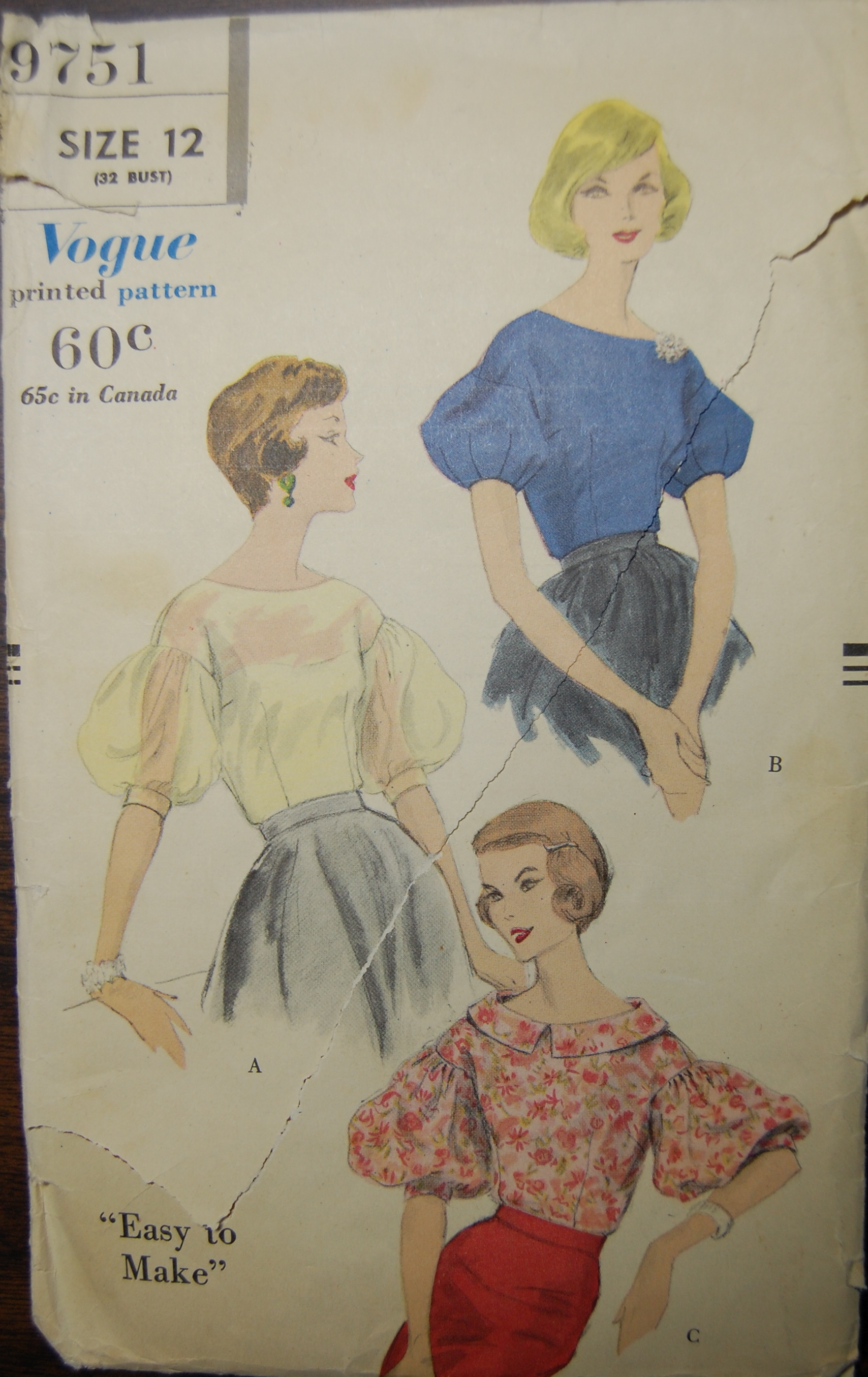
The sleeves on the blue version of this blouse are so pretty!

In addition to these new patterns, I just ordered two Marfy patterns, which should either add to my current sewing anxiety or help alleviate it. I hope it is the latter!

17 Comments

Filed under 1980's dress patterns, Blouse patterns from the 1950's, Coats, Cocktail dresses, piping, Uncategorized, vintage Vogue Designer patterns, vintage Vogue patterns from the 1950s, vintage Vogue patterns from the 1960s, vintage Vogue patterns from the 1970s, Wrap dresses

The Long and Mysterious Journey of Sandhurst 121

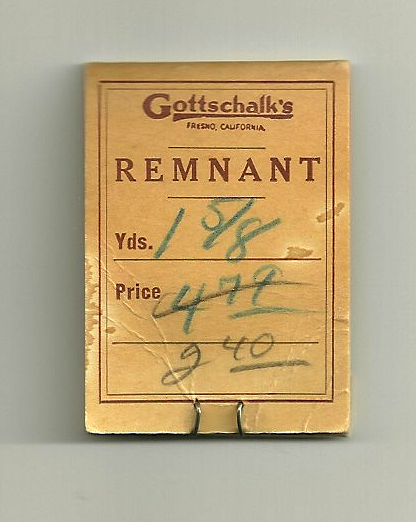
When the piece of linen I had purchased arrived in the mail, I was not sure what to expect. I had bought it with the hope that it was, indeed, a piece of Moygashel linen, but I had nothing to go on except an educated hunch. I knew it was an early piece of fabric, as its width was 35”, a common width for pre-1960’s dress-goods. I liked the design in the photo from which I made my decision, although it was not a colorway to which I normally gravitate. Upon opening the package, I found the only identifying mark on the fabric to be this tag:
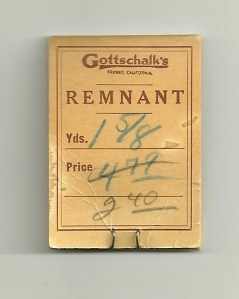
Gottshalk's in Fresno, California obviously sold fine fabrics.

Gottschalk’s in Fresno, California obviously sold fine fabrics.

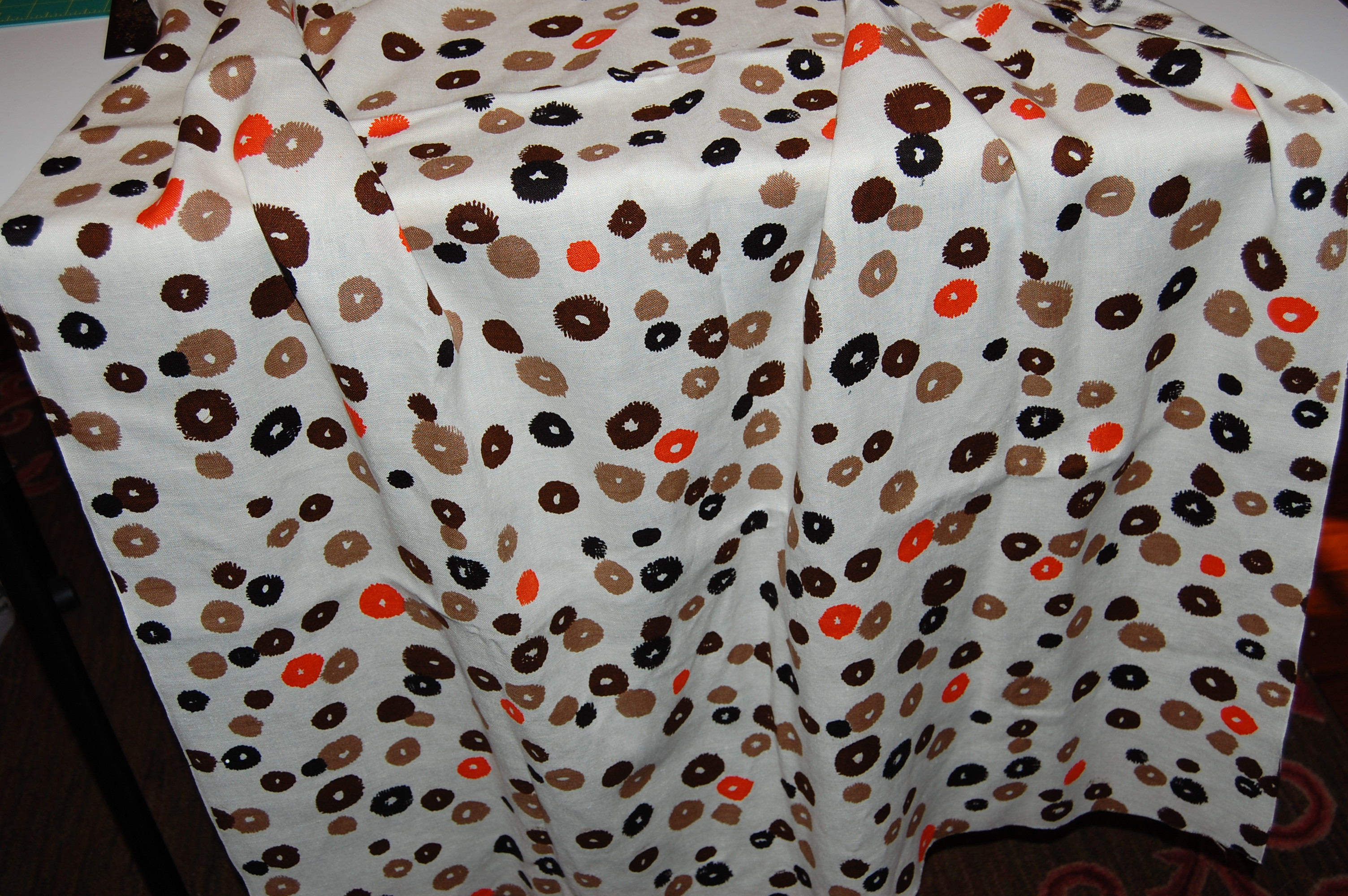
This short length of fabric had been on the remnant table, and, being too good of a bargain to pass by, some home dressmaker in California (USA) scooped it up with all good intentions of making something out of it someday. It must have lived in a dark drawer somewhere, carefully buffered from stains and yellowing. It didn’t even have much of a crease in it. And so, after many years in dormancy, it arrived at my home in Pennsylvania. I knew immediately that it was a Moygashel linen. I could tell by the hand of the fabric, the unique, slightly funky design, and by its amazing survival virtually wrinkle-free.
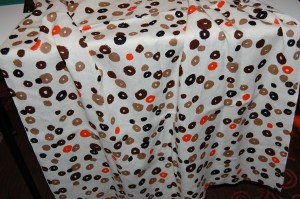
Sandhurst 121

As I mentioned in a former post, my only dilemma was the scant yardage, combined with the narrow width. So, I stuck it in my fabric closet, to think about another day. One thing nagged at me, however. I really, really wanted to know what year it was from.

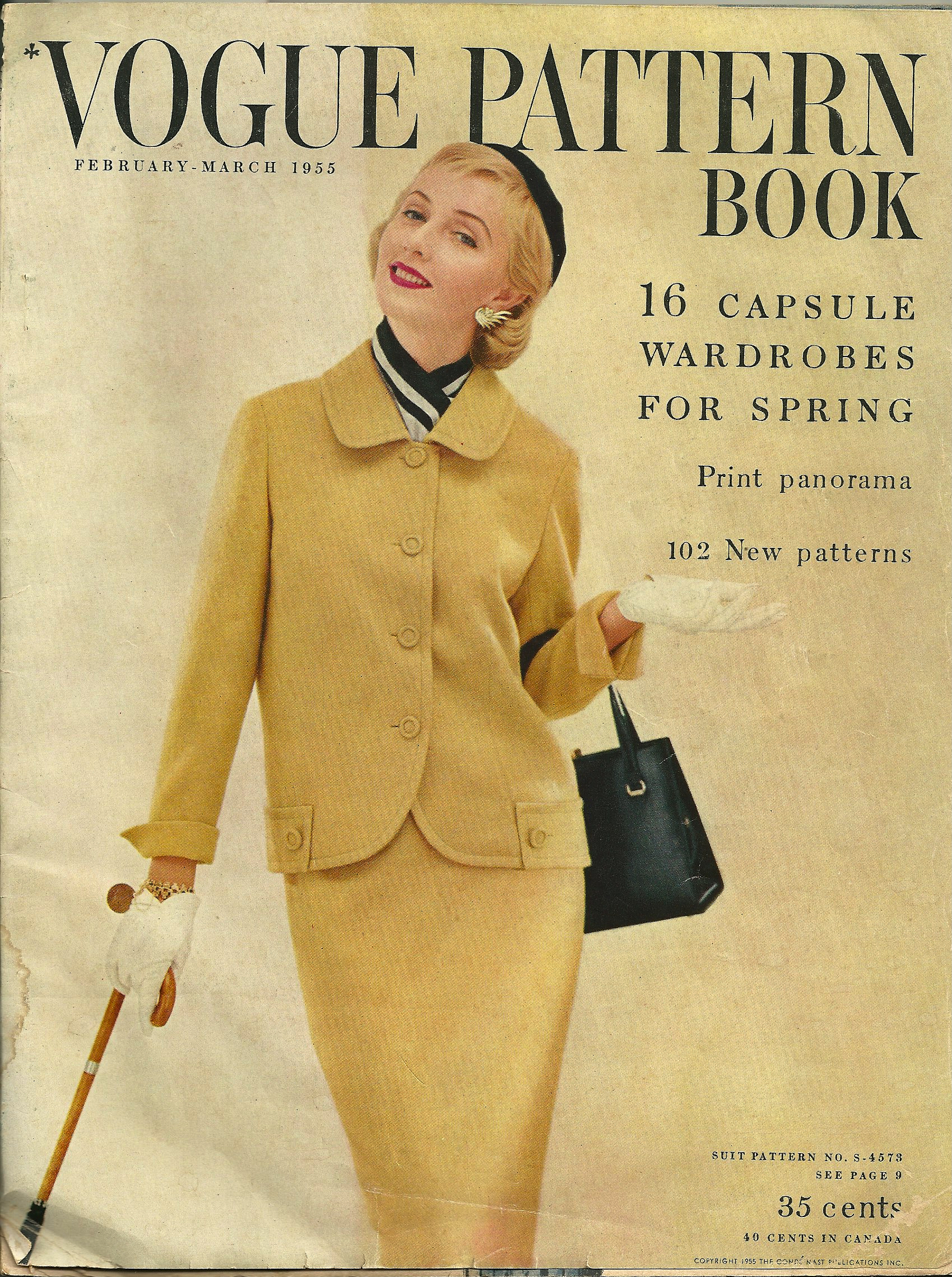
Over the past three years or so, I have had some luck in finding copies of old and older (1950-1980) Vogue Pattern Book Magazines. They are fascinating, and treasure troves of mid-century fashion as it relates to home sewing. I have tried to get a good cross-section of magazines from those three decades. One issue, which I tried a couple of times to get – and did not (on eBay) – finally became available to me. I loved the suit on the cover, and those mid-fifties styles are just so chic, even though most Vogue patterns from that time period were unprinted, and therefore, very difficult to use. (By 1957, Vogue was starting to produce many of their patterns in printed and perforated format.)
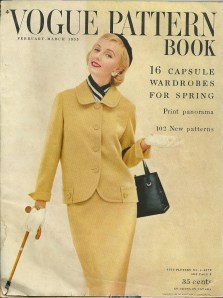
This is the February/March 1955 issue.

This is the February/March 1955 issue.

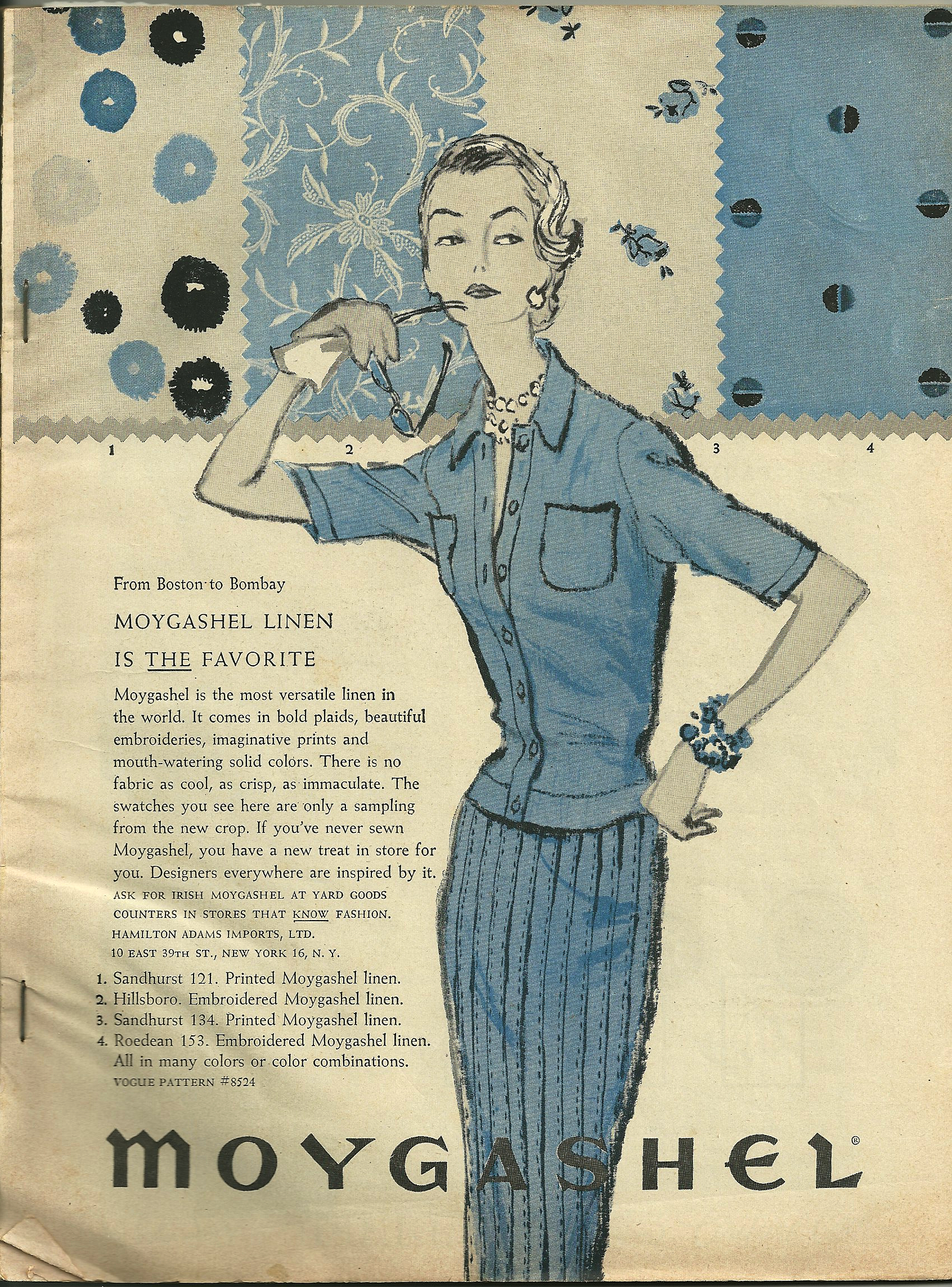
Perhaps you can see where I am going with this? I was looking through this particular issue once again in May of this year, and low and behold, a full-page ad for Moygashel linen clearly pictured “my” linen as one of their “new crop”. The colorway was different, but Moygashel was known for producing their fabrics “all in many colors or color combinations.” Maybe a lot of people wouldn’t get so excited about such a discovery, but I was ecstatic! Now I knew, for certain, that the linen I had purchased made its debut in early 1955. (I would be turning 5 years old a little later that year!) I even had a name for it now – Sandhurst 121. I suddenly very much wanted to sew this linen, this Summer!
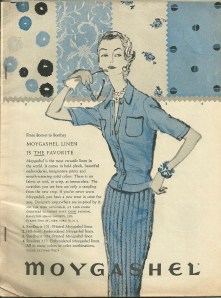
There is my linen in the upper left hand corner of the full-page advertisement.

There is my linen in the upper left hand corner of the full-page advertisement.

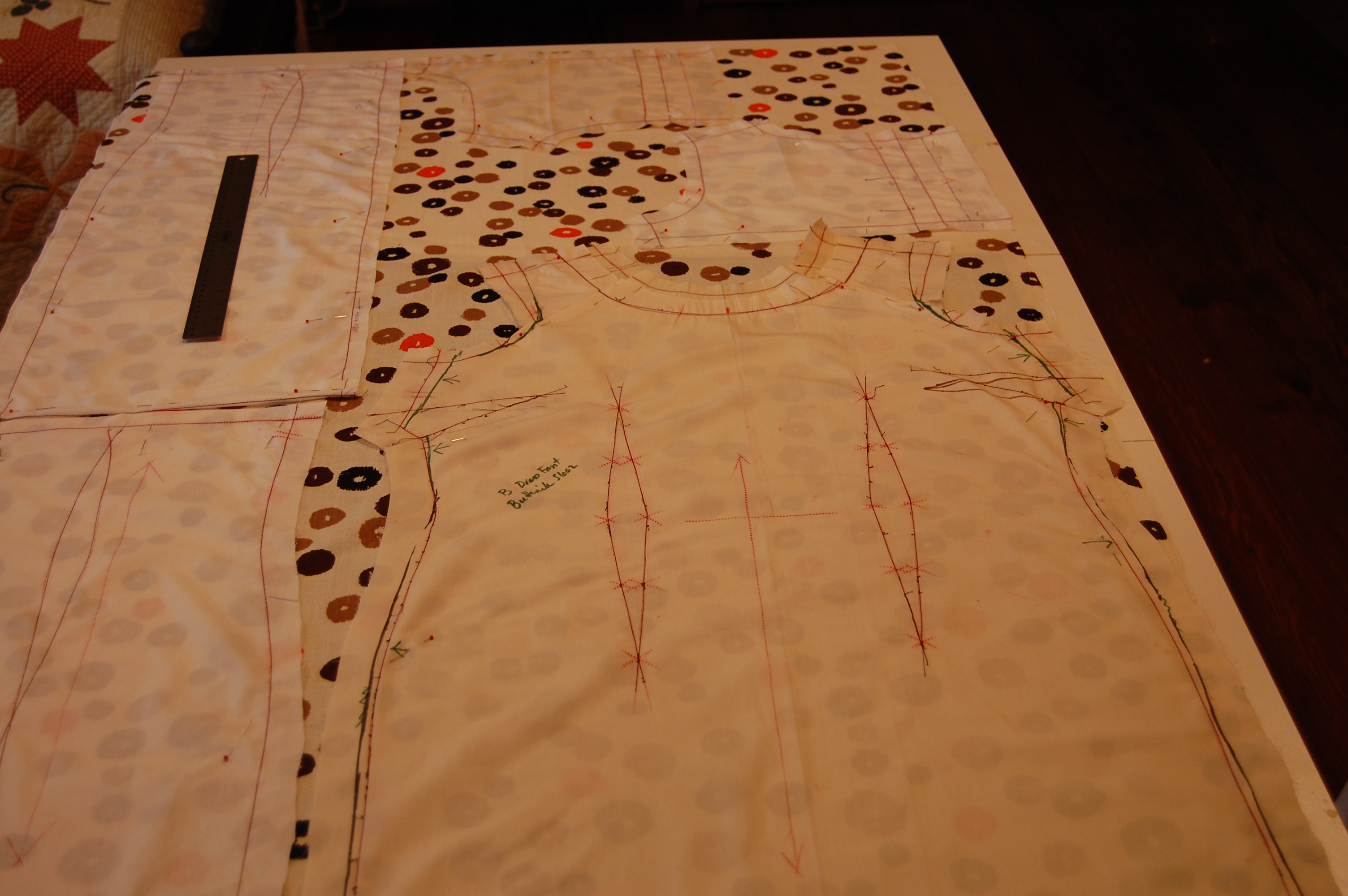
By now, many of you know that I determined to make a sheath dress out of this scant yardage of fabric, and in order to do so, I had to reconfigure my sheath dress pattern to include a back yoke. Here’s the fabric layout, which hopefully will show how sectioning the back enabled me to fit the pattern on the available fabric:
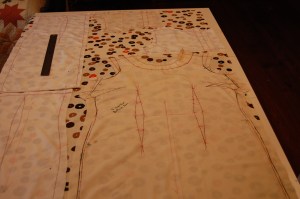
The fabric is shown 35" flat on my cutting table.  The muslin pattern piece for the front of the dress is on the right, and the two shortened back pieces are lined up smack against each other on the left.  The yoke pieces then fit above the dress front.  I did not need facings, as I lined the entire dress in a light weight linen/cotton blend, and finished the neck and armholes all by hand.

The fabric is shown 35″ flat on my cutting table. The muslin pattern piece for the front of the dress is on the right, and the two shortened back pieces are lined up smack against each other on the left. The yoke pieces then fit on the fabric  above the dress front. I did not need facings, as I lined the entire dress in a light weight linen/cotton blend, and finished the neck and armholes all by hand.  I had to face the hem as I did not have enough fabric to do a self hem!

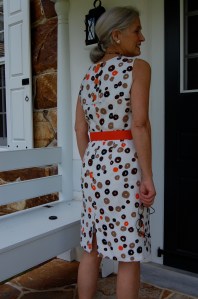
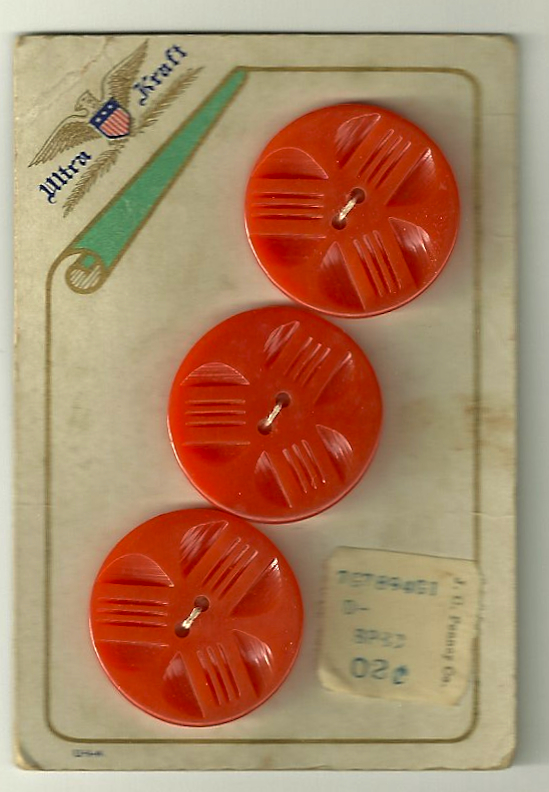
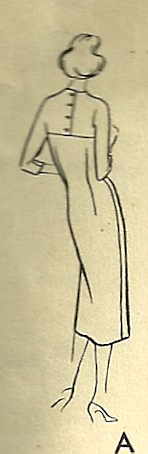
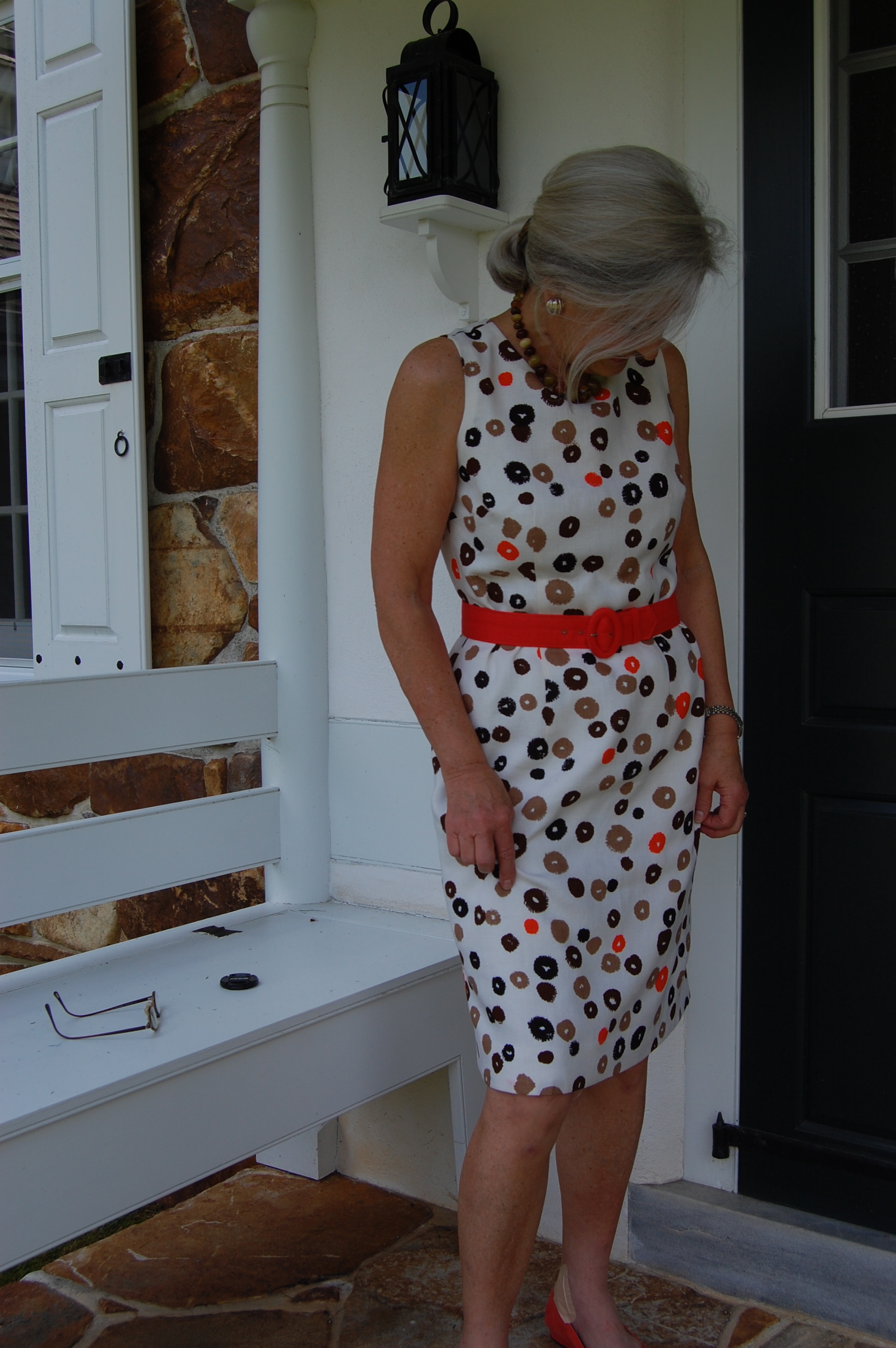
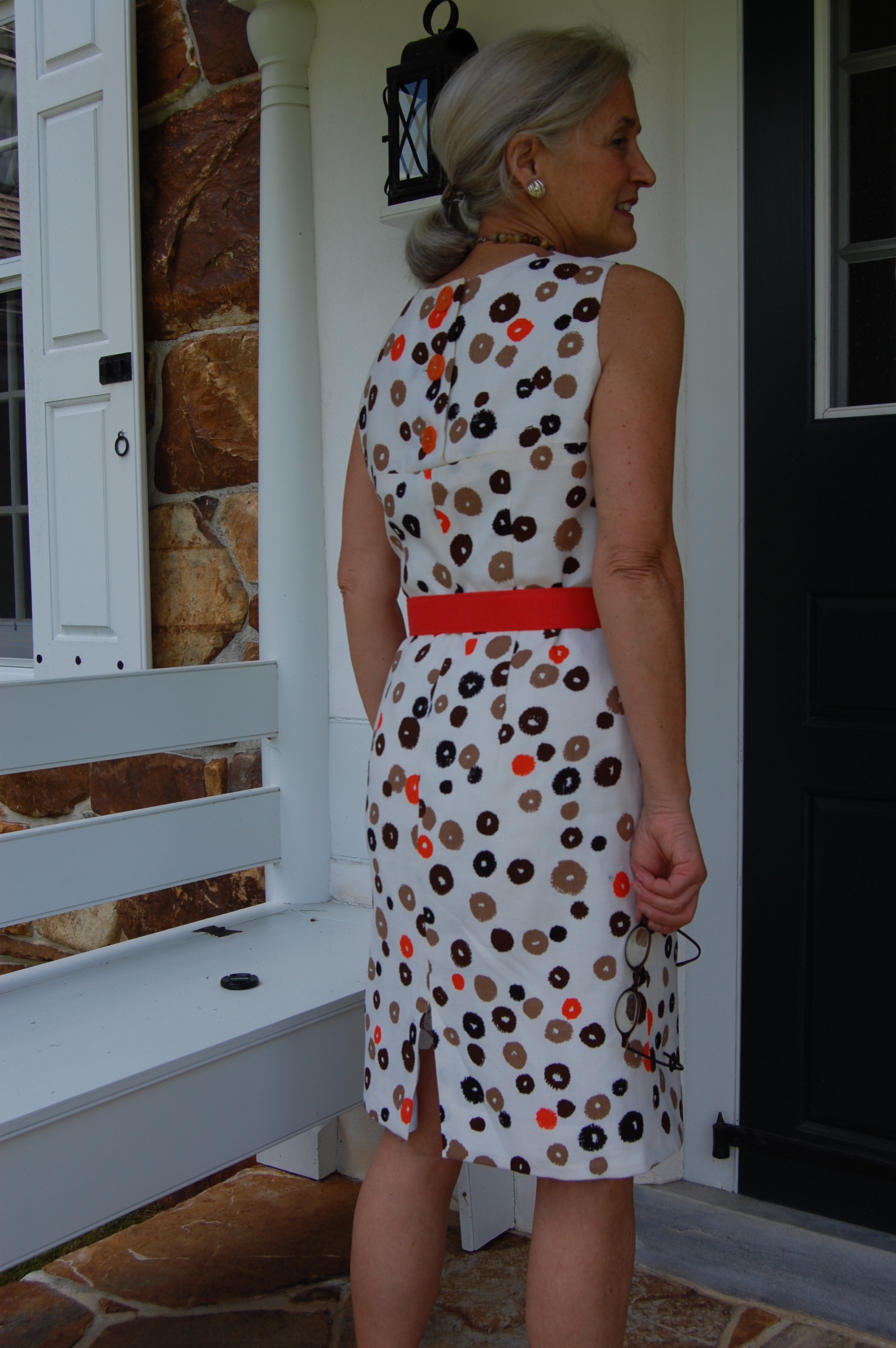
Many of you also know that fortune shone her happy face again on this project when I found three orange vintage buttons, which I knew would help make a back yoke far more interesting. I relied on a Vogue pattern from 1957, which has a back yoke to help me with this reconfigure.
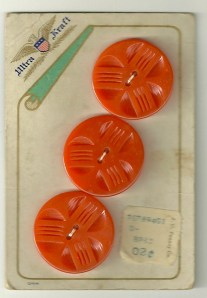
This card of buttons cost 2 cents originally!  They seem to mimic the small orange explosions on the dress fabric.

This card of buttons cost 2 cents originally! They seem to mimic the small orange explosions on the dress fabric.  They may actually be even earlier than the fabric.
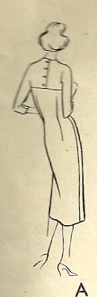
The yoke on this dress uses 4 buttons.  I only had three, but their large size still makes the proportions work well.

The yoke on this dress uses 4 buttons. I only had three, but their large size still makes the proportions work well.
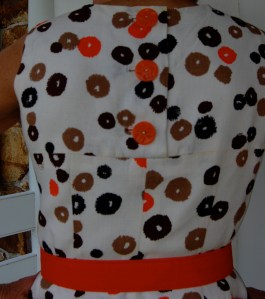
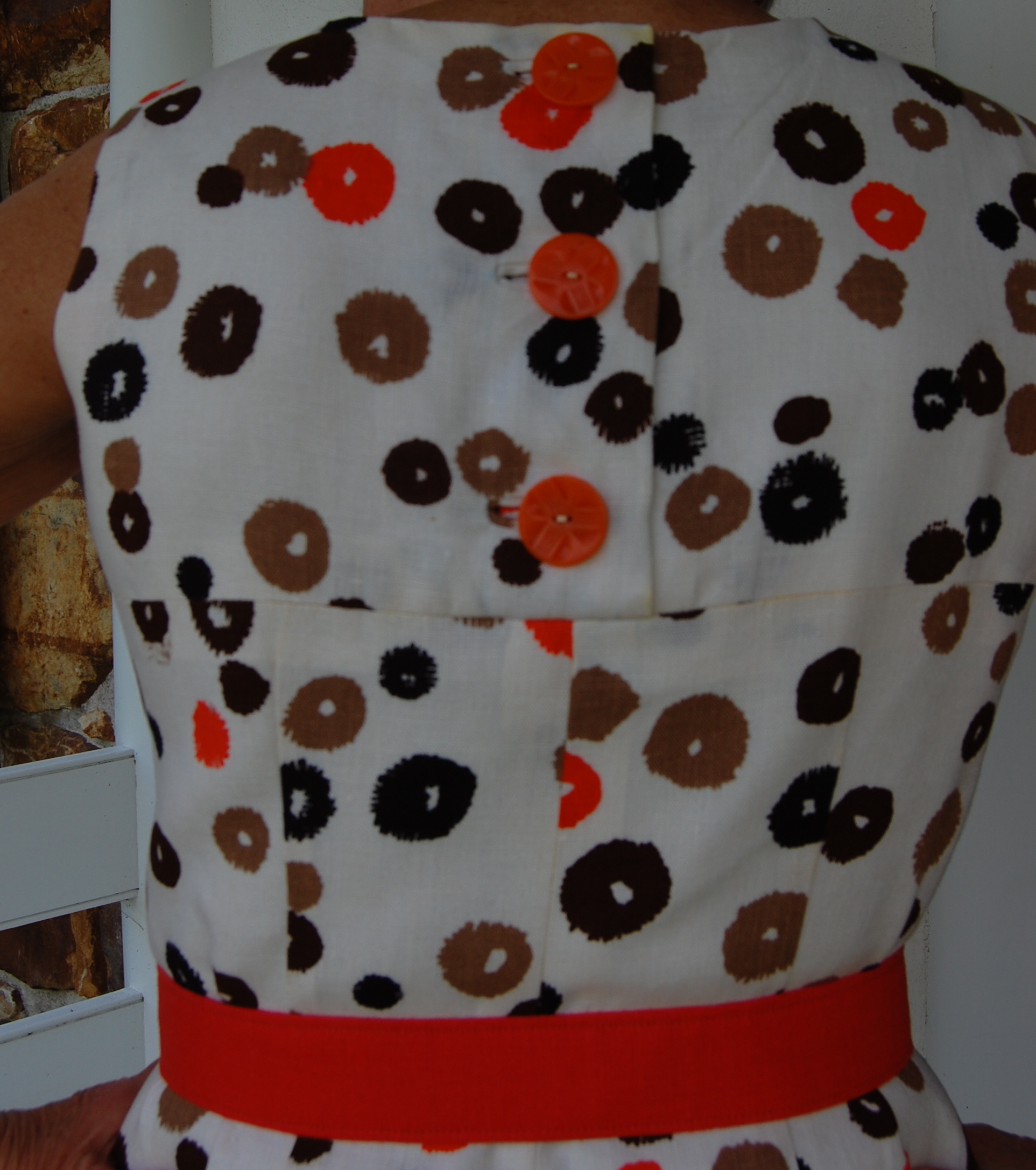
A close-up of the back of the dress.

A close-up of the back of the dress.  I made bound buttonholes – very 1950-ish!

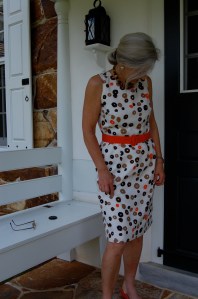
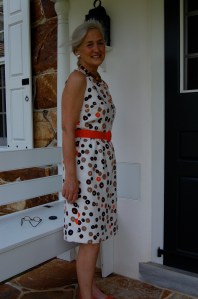
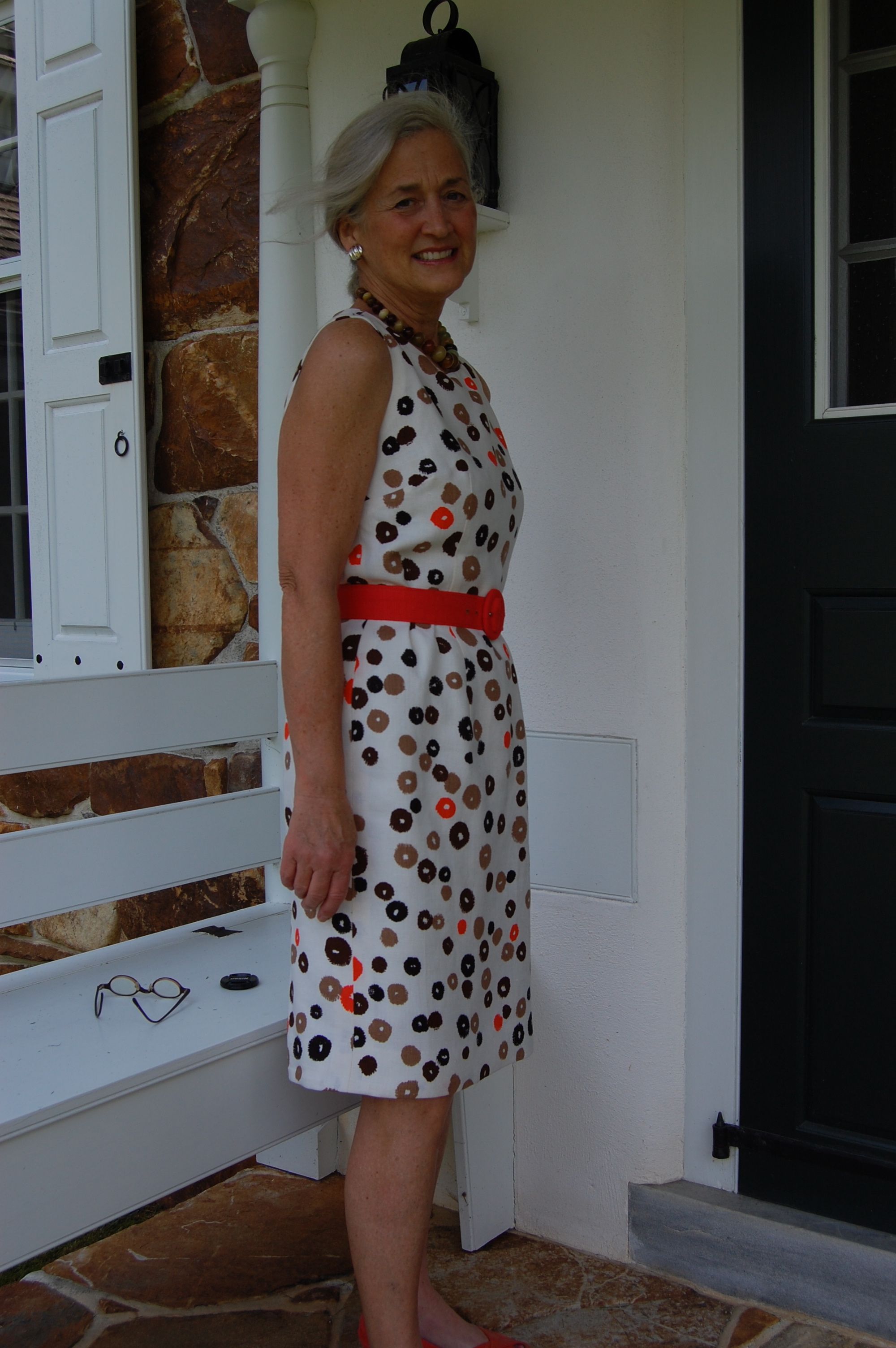
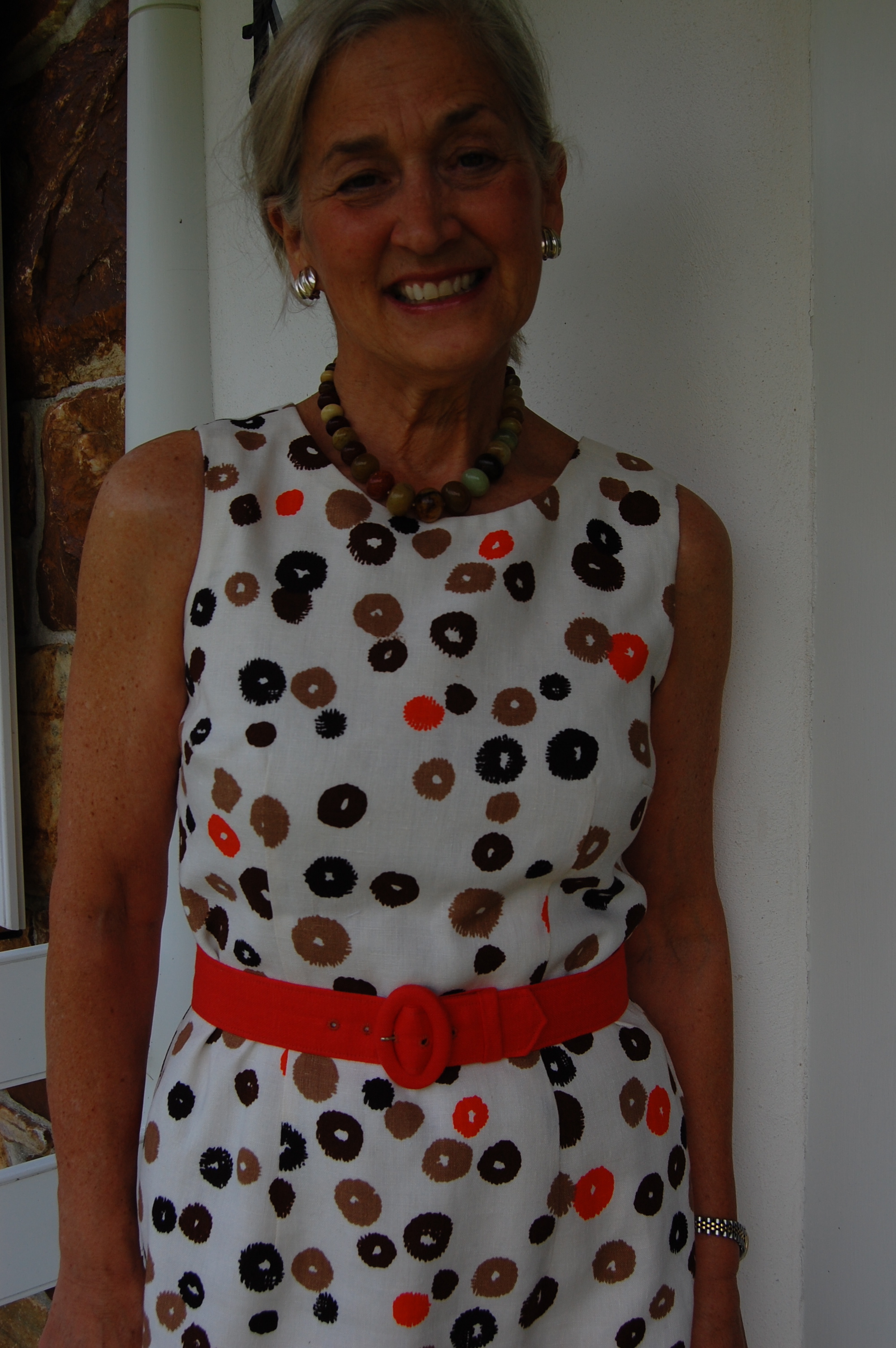
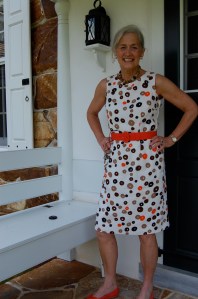
And then, another classic 1950s’ design detail worked right into this dress: I would need to move the zipper to the side in order for the back yoke to look correct. Now I will be the first to tell you that a side zipper is not as convenient as a back zipper, but it is a small sacrifice when everything else is enhanced by this placement.   After these obeisances to ‘50s’ style, I slipped right into 2014 with a bright orange, newly made belt, a widened jewel neckline, slightly cut-in shoulders, and a back slit to enhance comfort. I like to choose the best from the ‘50s, but I really don’t want to look like the 1950s.
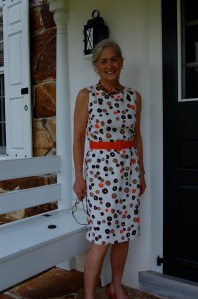
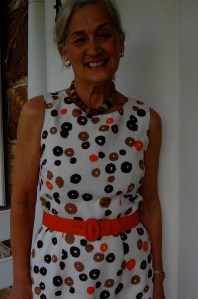
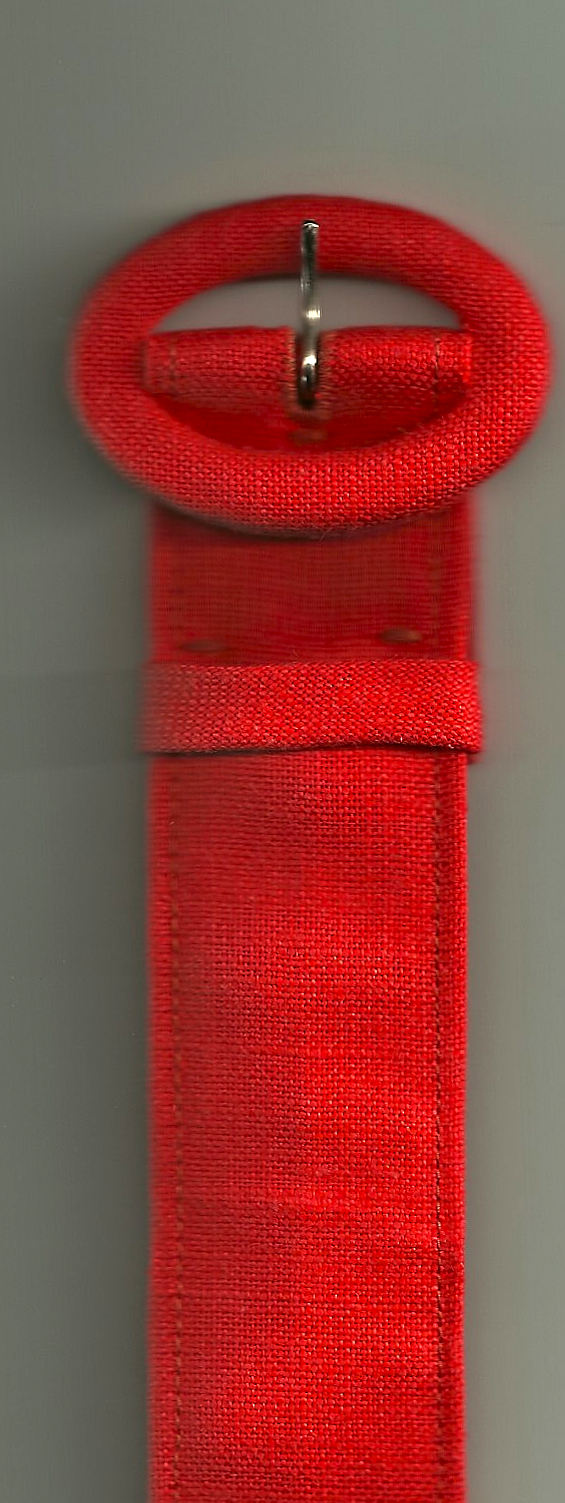
I sent new orange linen to Pat Mahoney of Pat's Custom Belts and Buttons  and this lovely belt came back to me in the mail.

I sent new orange linen to Pat Mahoney of Pat’s Custom Belts and Buttons and this lovely belt came back to me in the mail.

Cool and summery-looking, don't you think?

Cool and summery-looking, don’t you think?
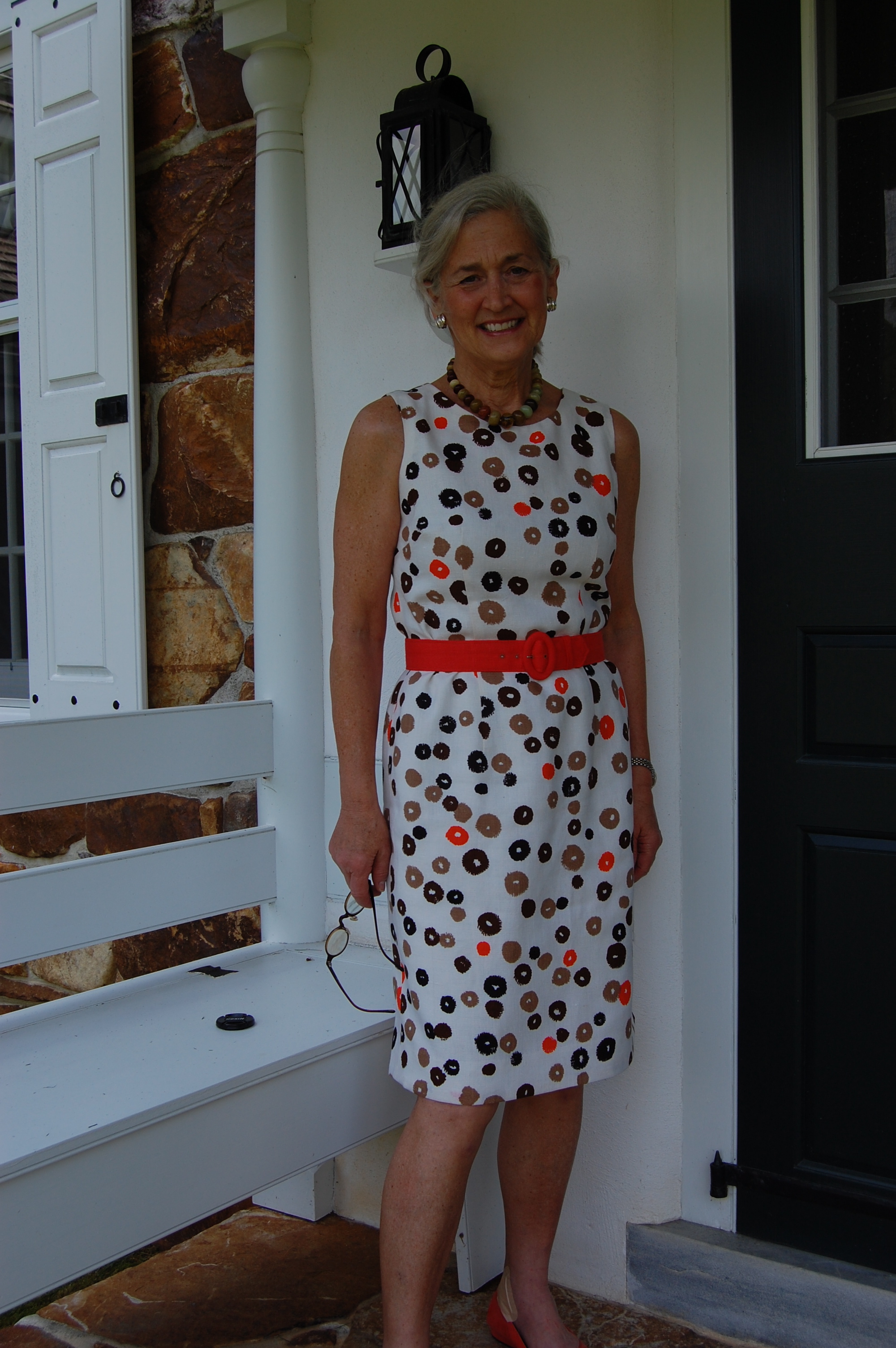
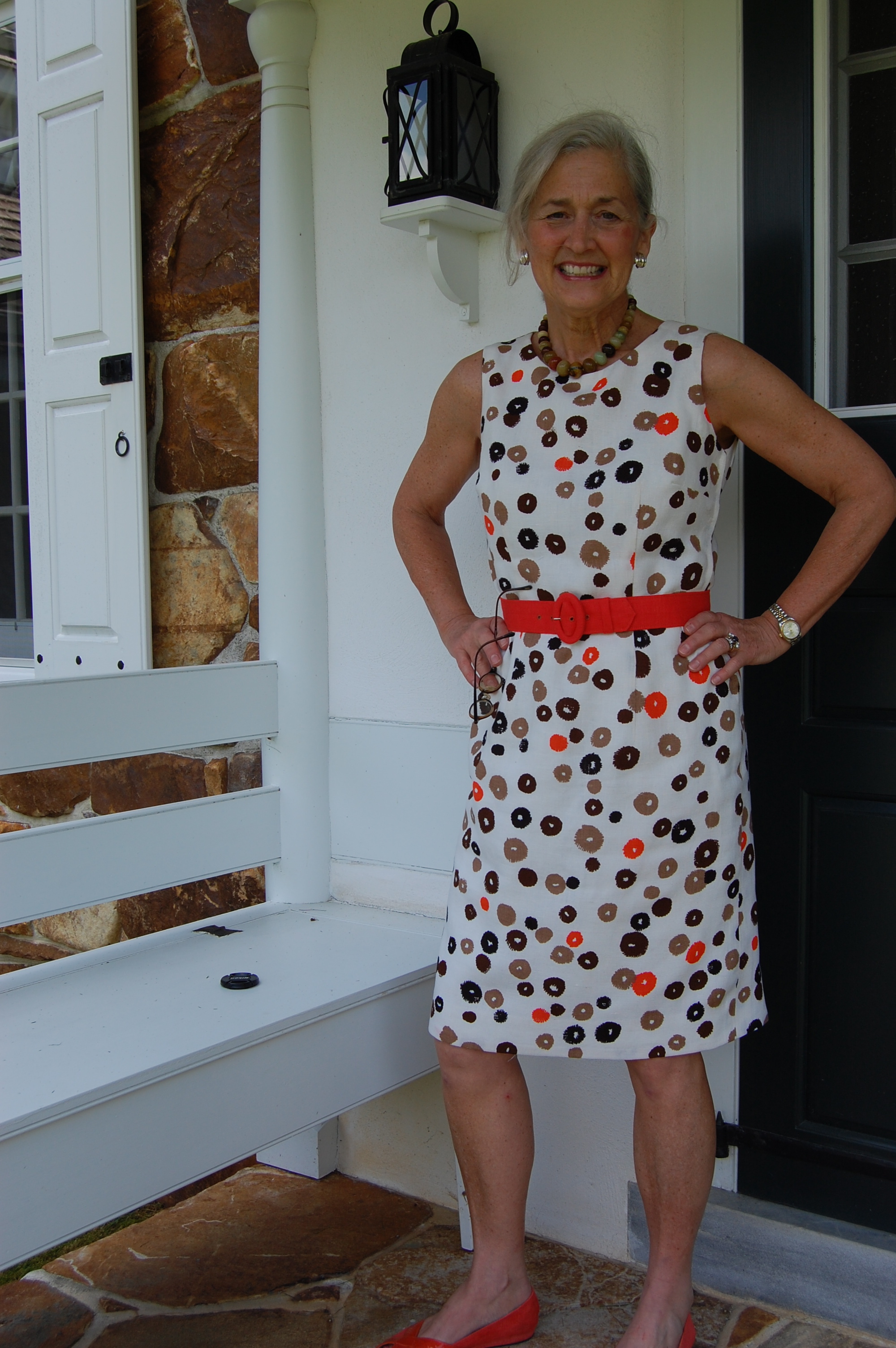
Sandhurst 121

Sandhurst 121

Sandhurst 121

Sandhurst 121

Sandhurst 121

Not every dress can have a story, nor should it. But this fabric, which began its life in Ireland, no doubt entered this country through New York City, ordered by a store in Fresno, California, purchased and squirreled away for decades by persons unknown – has now found a starring role in my wardrobe almost 60 years later. Sewing is just so much fun!



37 Comments

Filed under bound buttonholes, Buttons - choosing the right ones, hand-sewn zippers, Linen, Love of sewing, Moygashel linen, Polka dots, side-placed zippers, The Conde Nast Publications, Uncategorized, Unprinted patterns from the 1950s, vintage buttons, Vintage fabric, vintage Vogue patterns from the 1950s

The Necessary Blouse

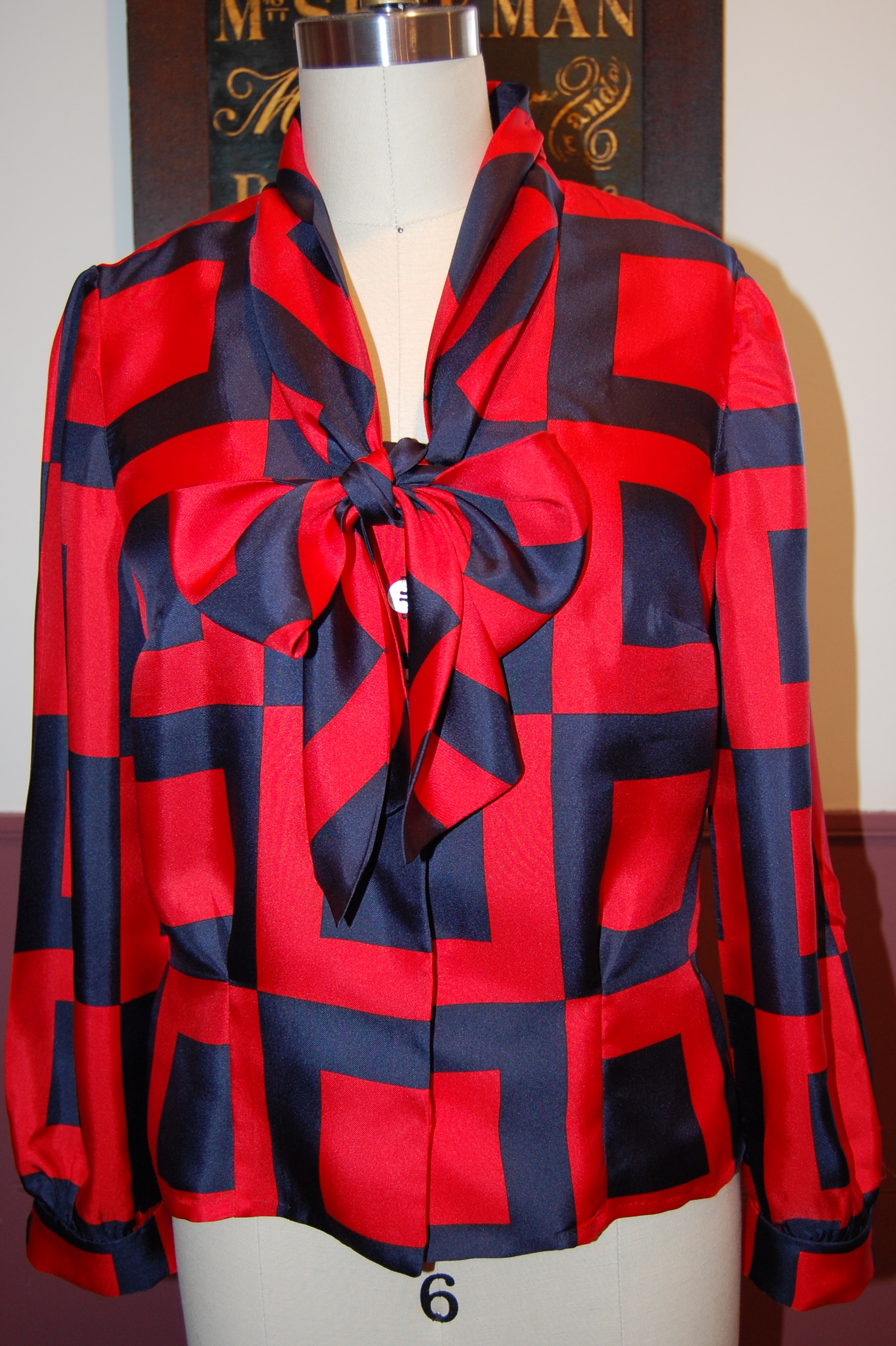
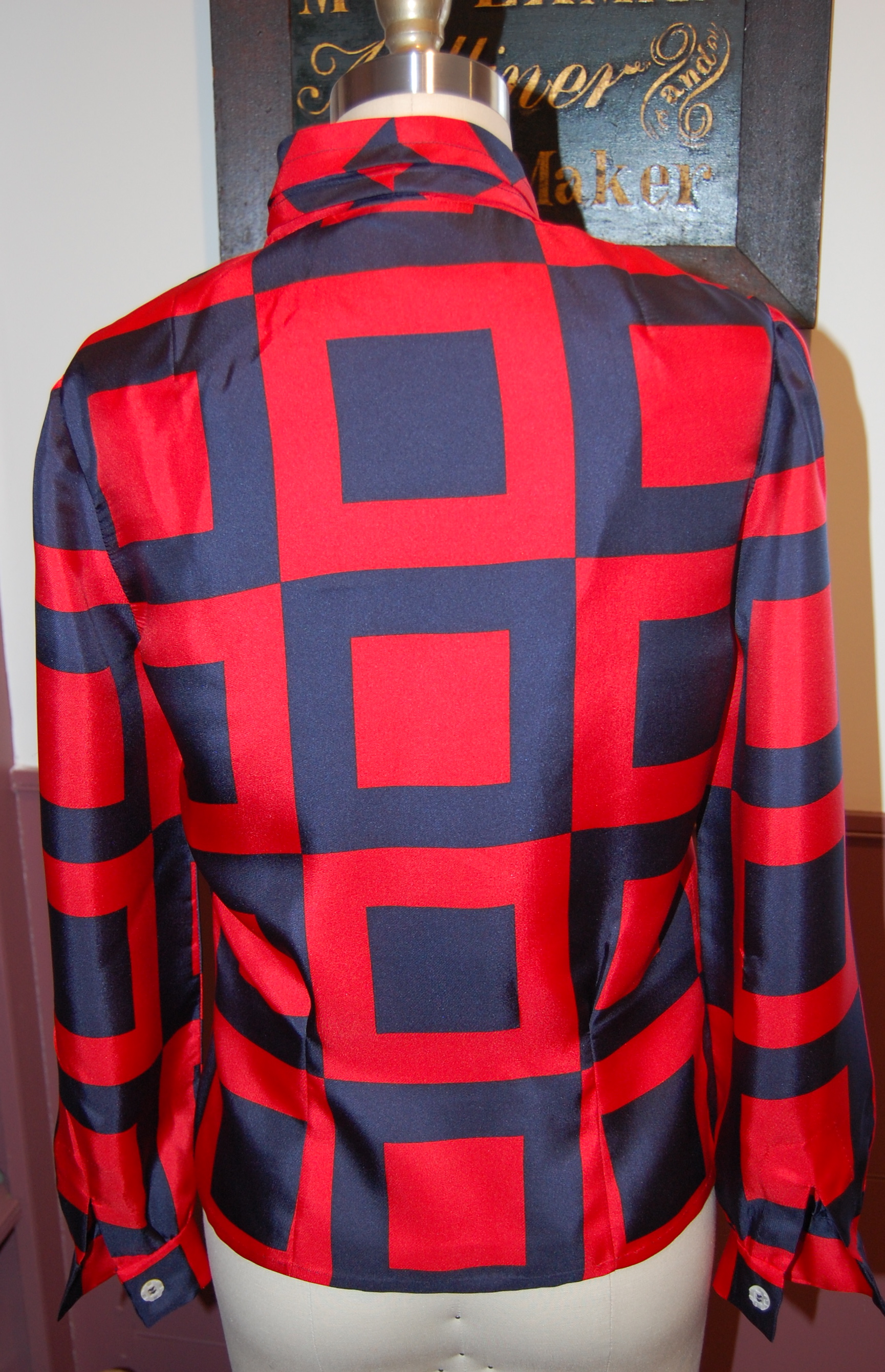
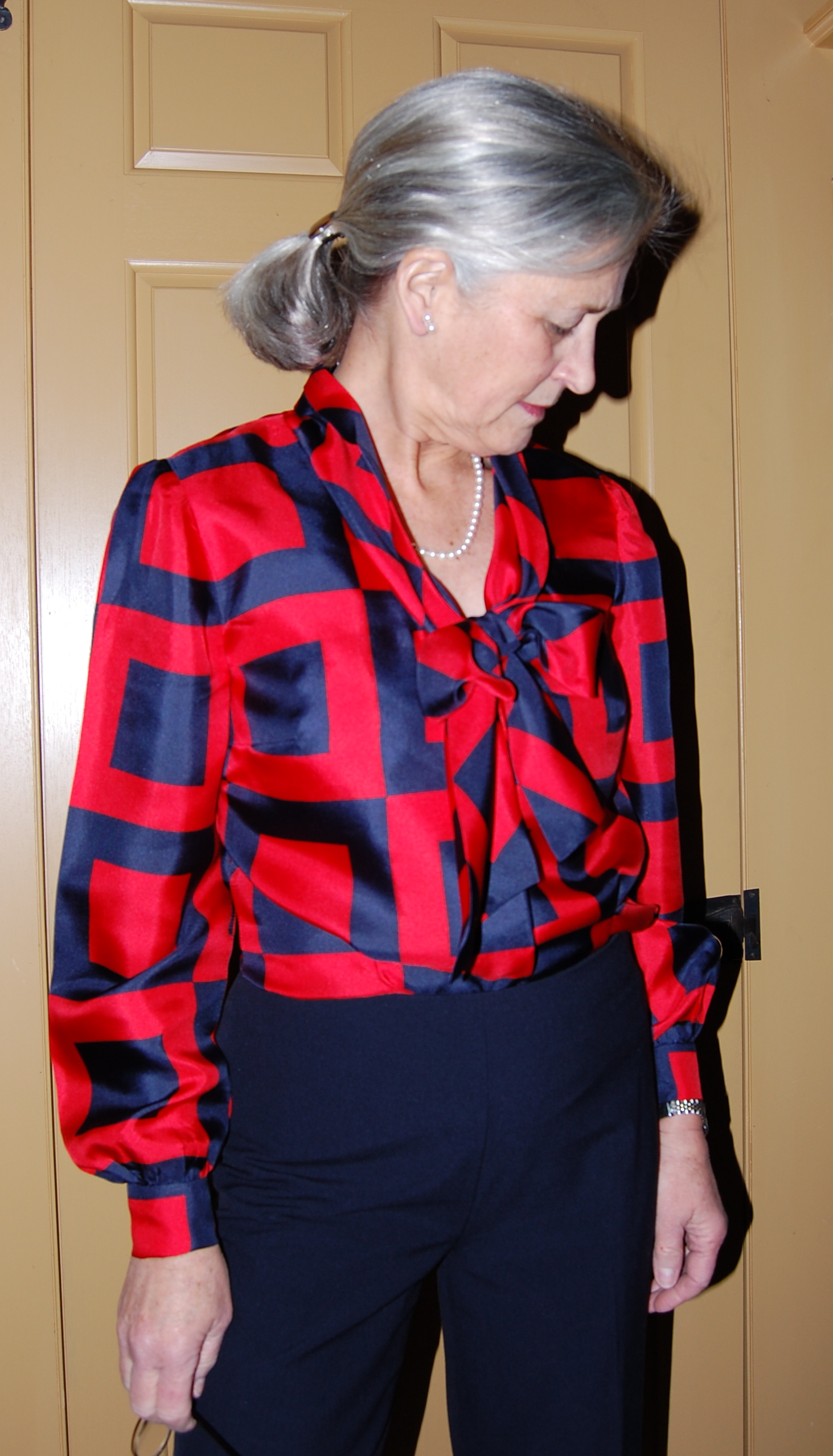
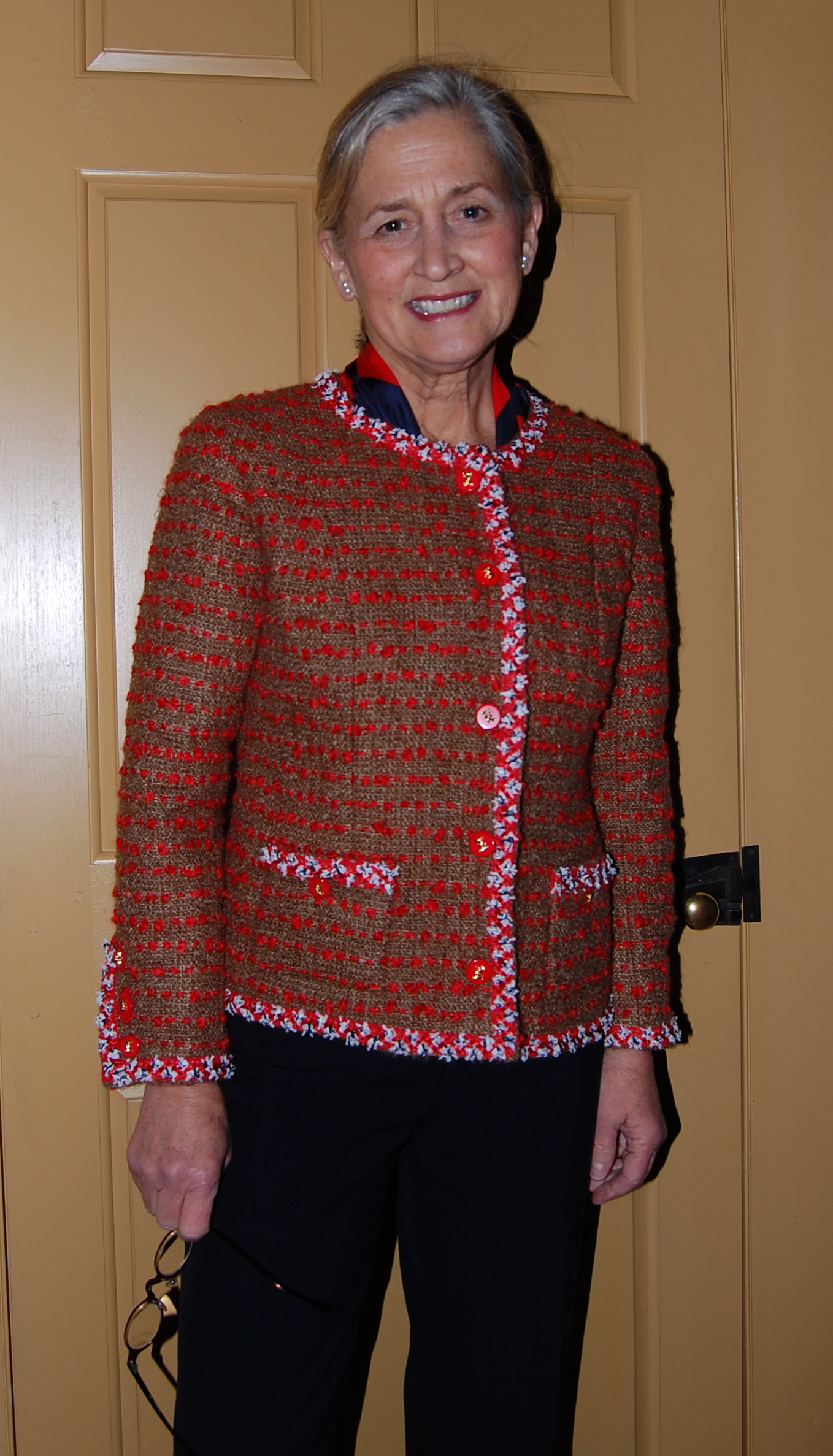
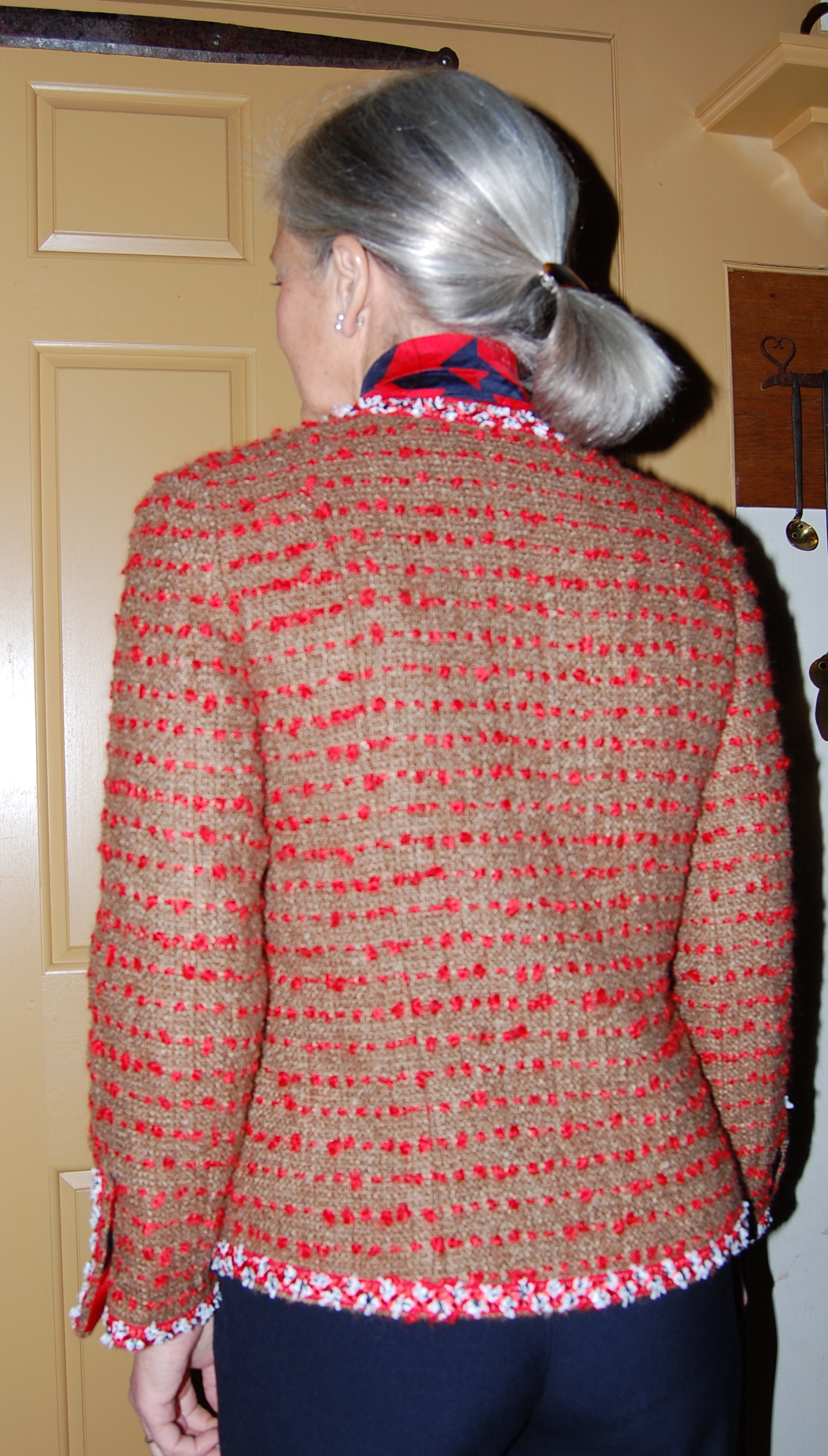
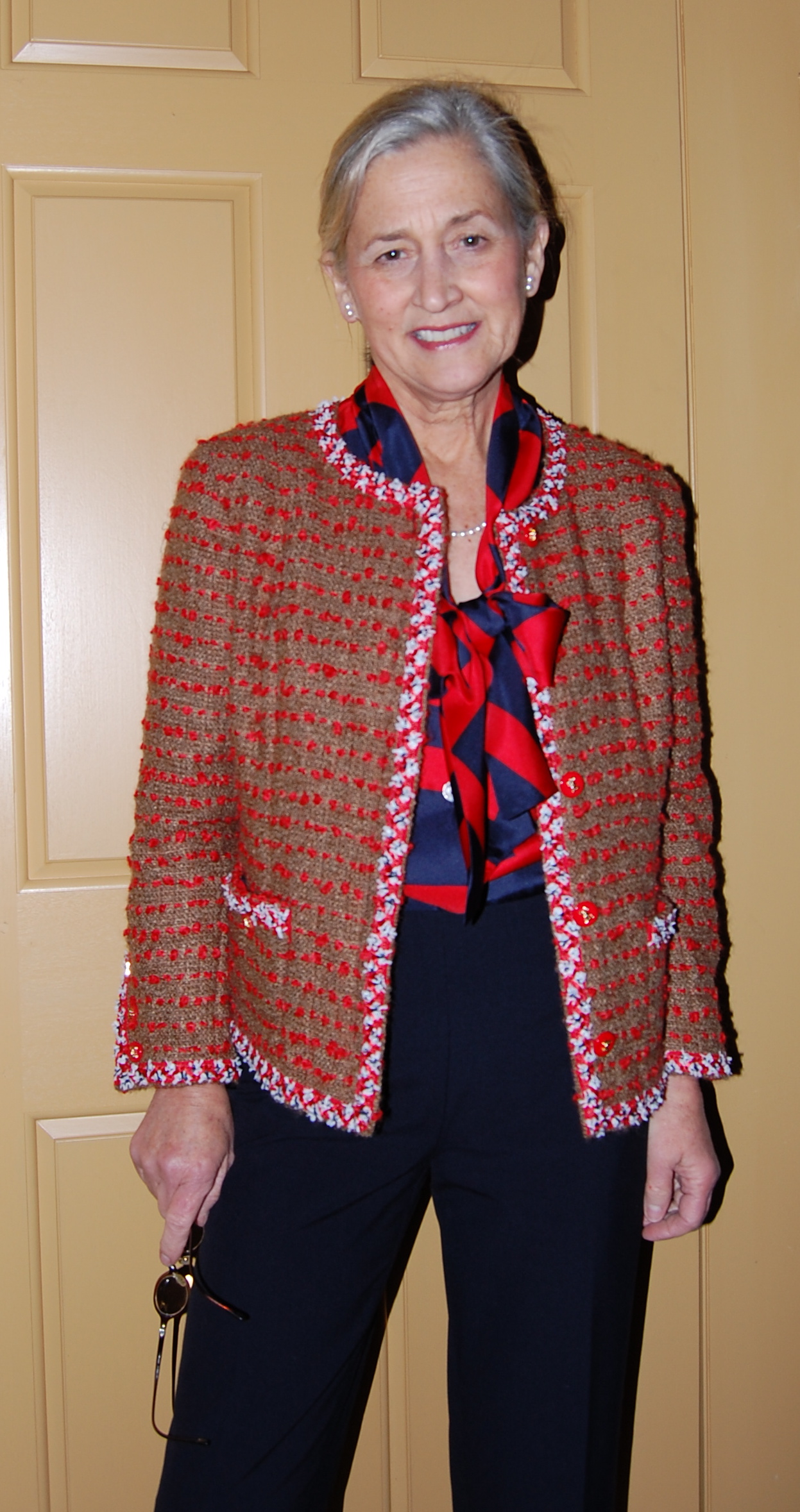
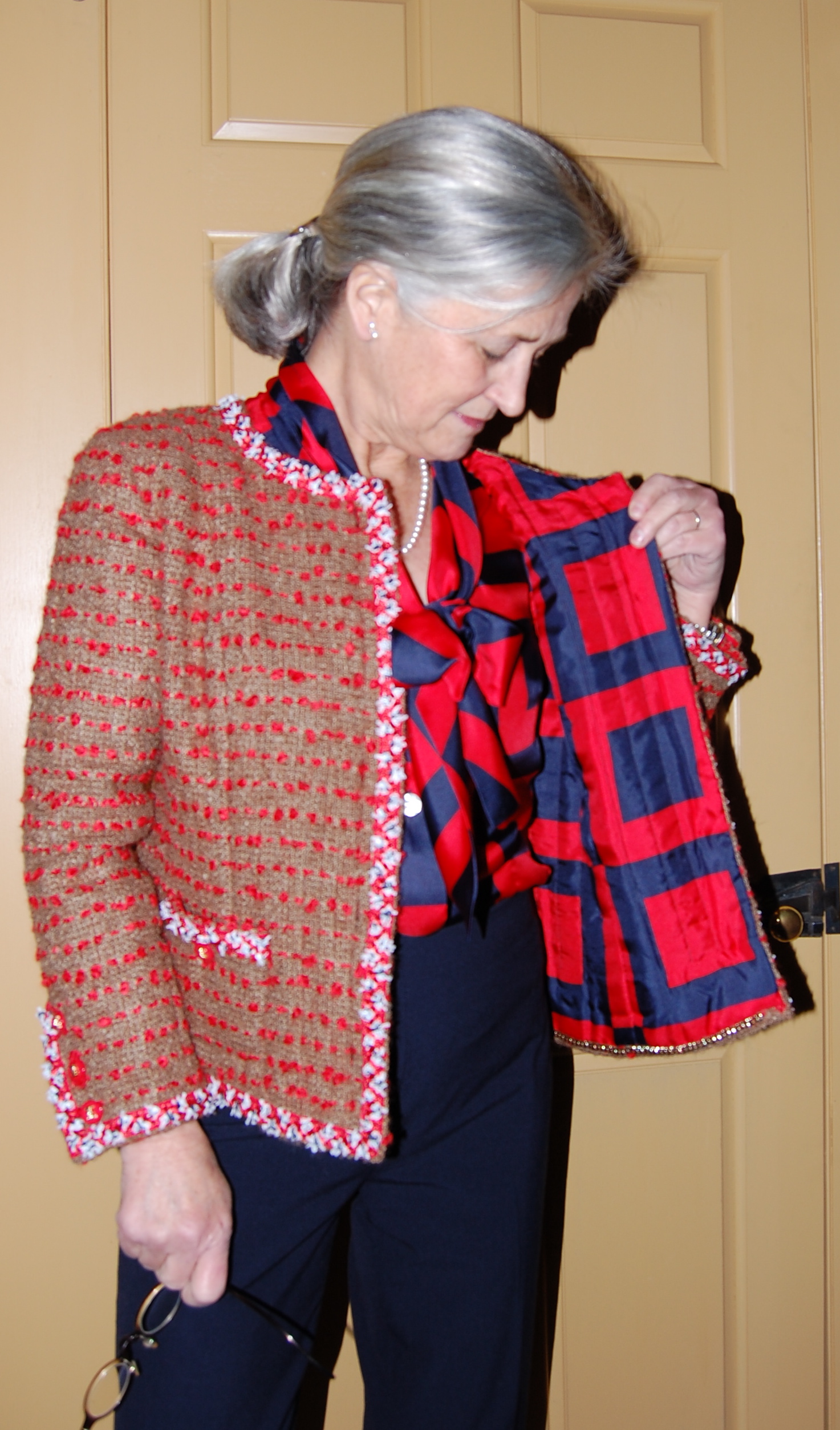
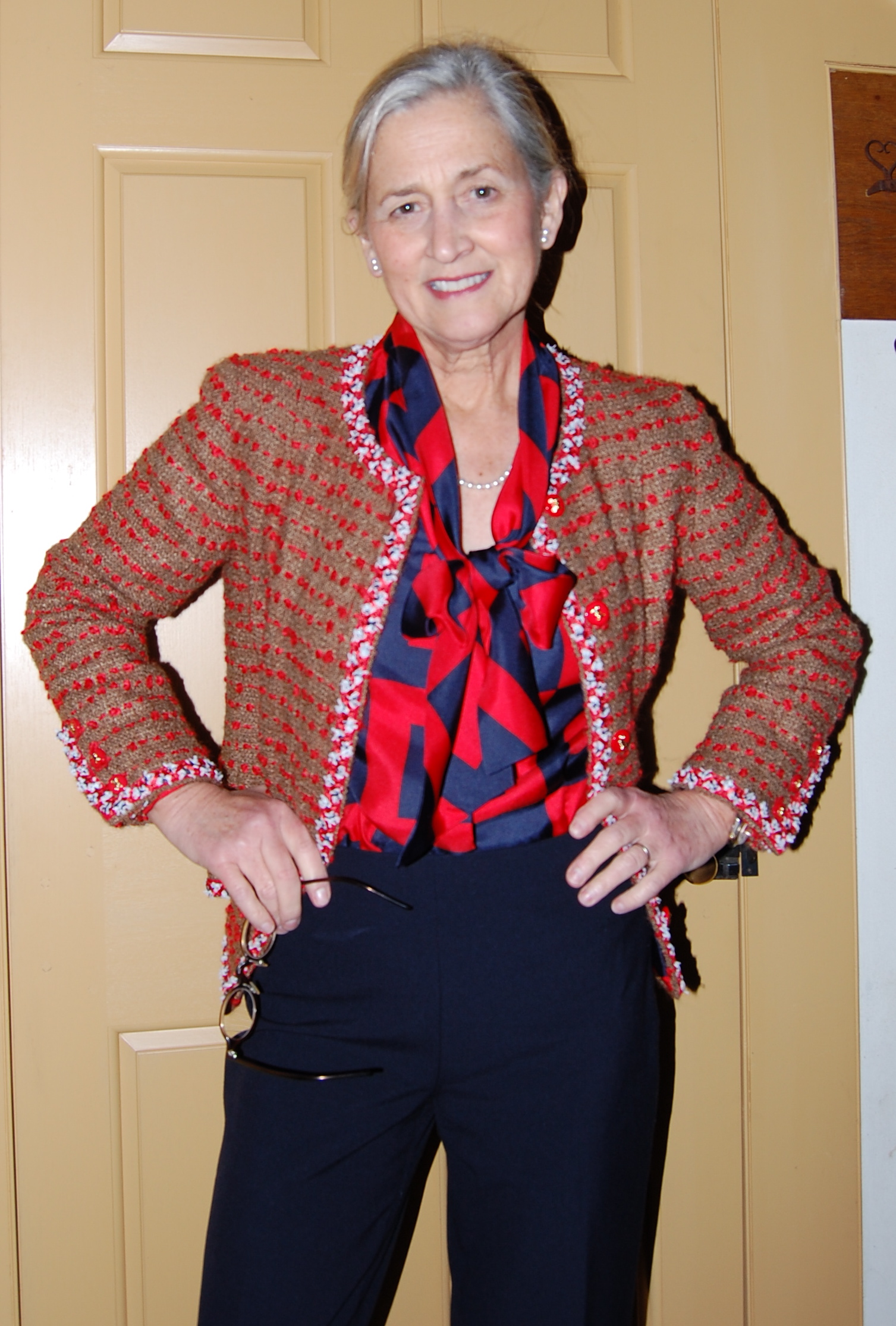
Fashion sewing is an interesting combination of inspiration, aspiration, indulgence and necessity, manifested singly or collectively.  My newly completed bow blouse is an example of a bit of all of these motivations rolled into one.  This is the blouse I made to go with my No. 2 Chanel-inspired jacket, made from the same red and navy blue geometric print silk with which I lined the jacket.

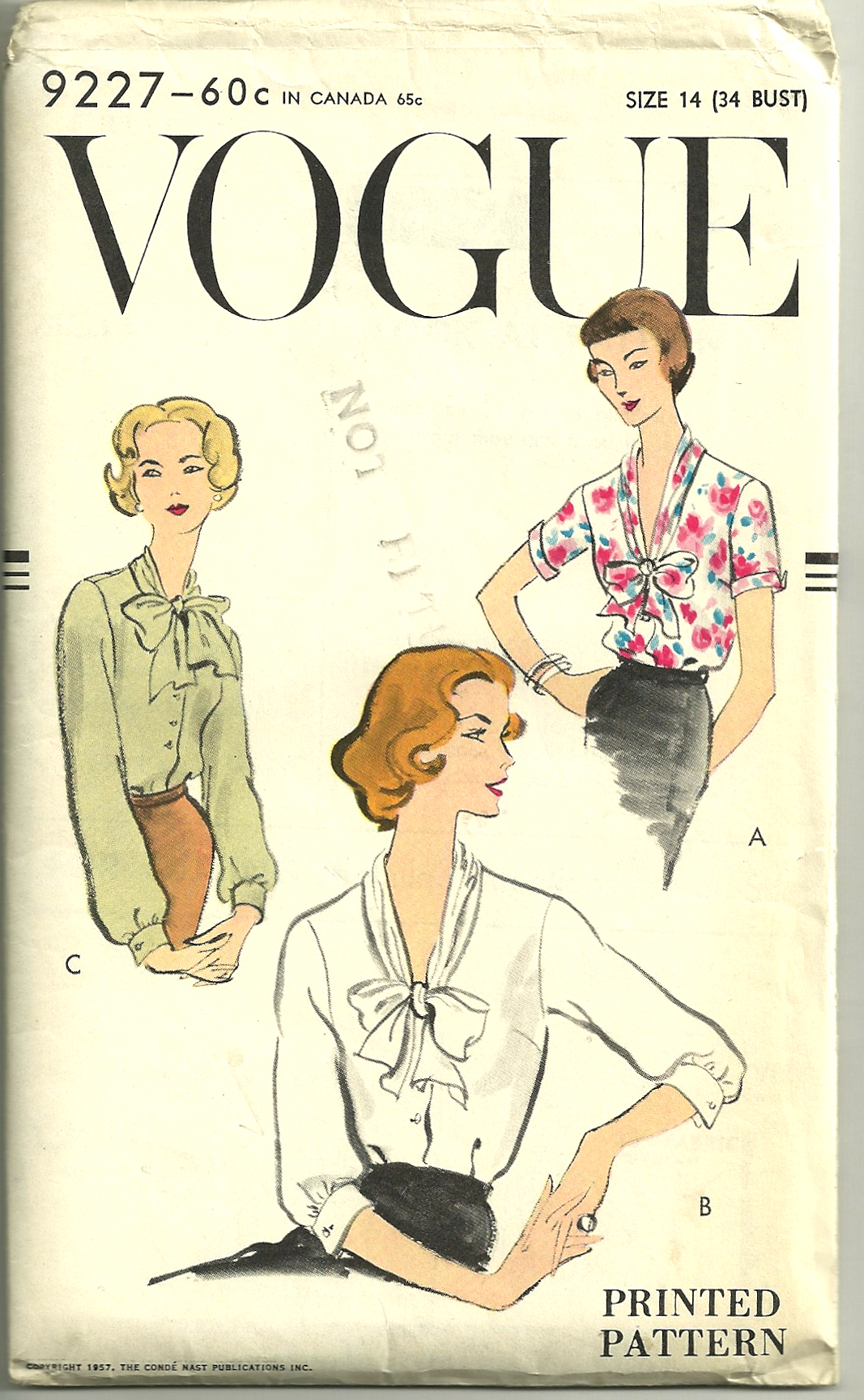
The Necessary Blouse Inspiration came from several sources.  I was mostly inspired by the pattern, which is copyright 1957 by The Conde Nast Publications, Inc. (Vogue Patterns) – so much so, that I purchased it in a size larger than I usually wear, as that was what was available – and with vintage patterns, one is never sure to find a favorite one again soon – or ever.

Looking at blouses 1957

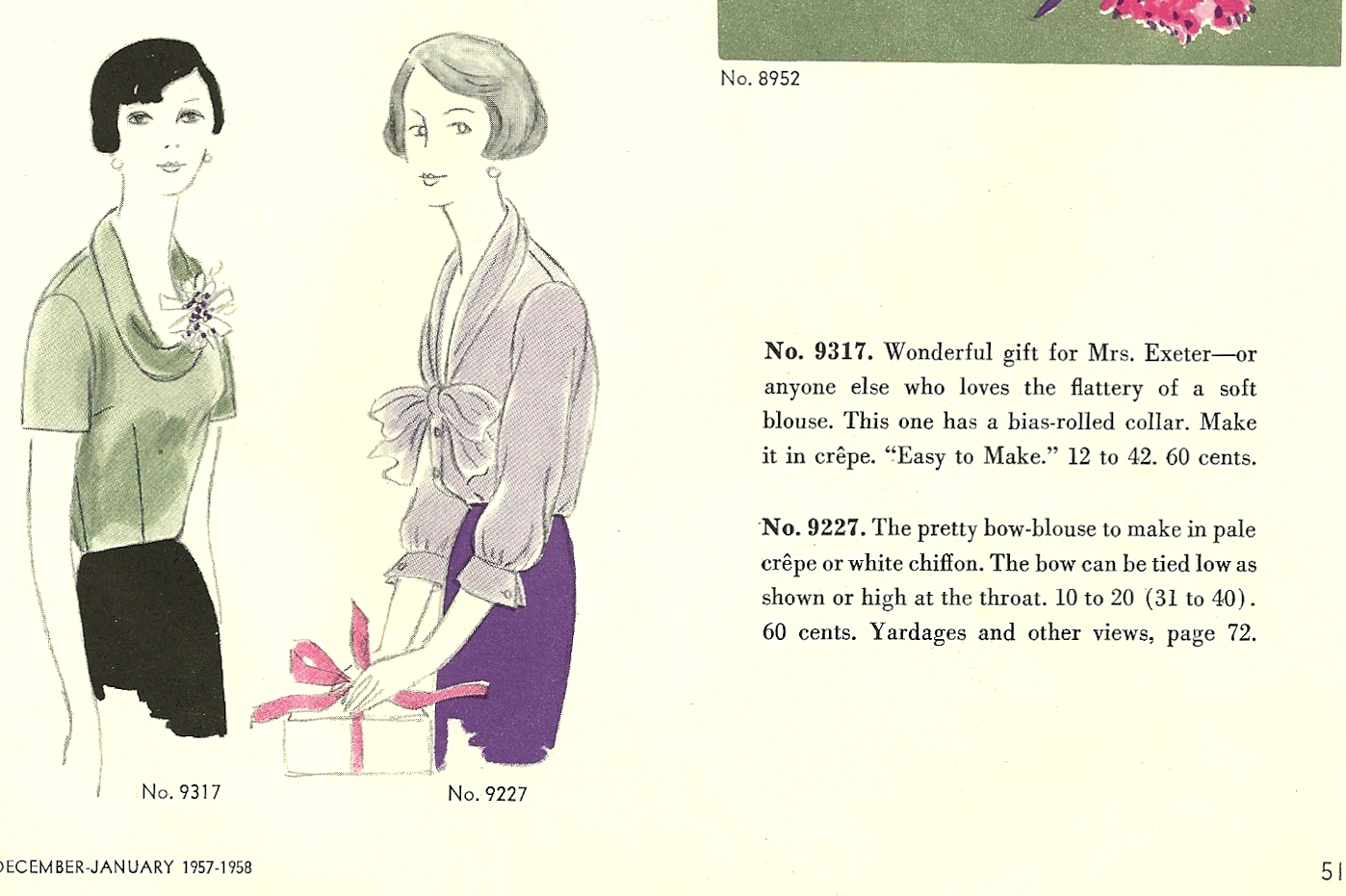
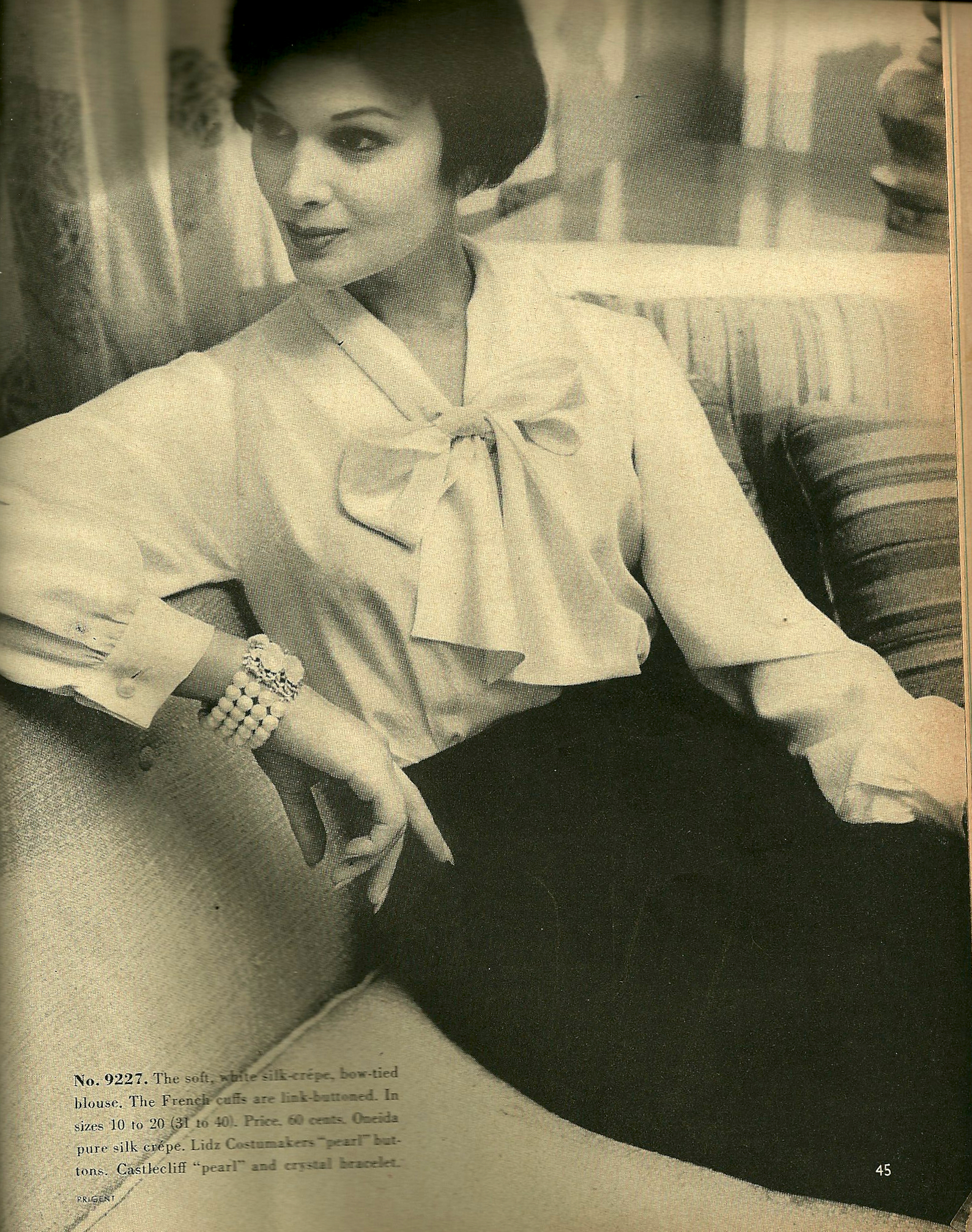
Some of the aspects of the pattern which appealed to me are: 1) the “dropped” bow shown in views A and B; 2) the various sleeve lengths; 3) the shaping in the body of the blouse – soft and understated, but very feminine.  Just for fun, I looked through a few of my Vogue Pattern Book Magazines from 1957 and 1958, to see if I could find examples of this blouse pattern.  That was easy!  Here is one sketch and one photograph of Vogue 9227:

The blouse was featured in the December/January 1957-58 issue.

The blouse was featured in the December/January 1957-58 issue.

Part of a feature entitled "A new era for the soft BLOUSE."  In the August/September, 1957 issue of VPB.

Part of a feature entitled “A new era for the soft BLOUSE.” In the August/September, 1957 issue of VPB. 

After making a sheath dress to coordinate with my Chanel-inspired jacket No. 1, I aspired to pair my Jacket No. 2 with a suitable companion, too.  A bow blouse seemed to be a versatile and useful solution.  And then it became a necessity!   I decided my Jacket No. 2 would not be complete until I finished this blouse.

Back view

Back view

Step number one was to make a muslin (of course), knowing that I would need to alter the pattern to fit me correctly.  Sure enough, I needed to take out the bagginess in the bust and body of the blouse, and I needed to shorten the sleeves.  I went to my favorite book on making alterations which guided me through the correct changes:

I highly recommend this book.

I highly recommend this book.

My muslin showed me that the sleeves were also a little too full for me and for current 2014 styles, so I removed some girth from them as well.  I was skeptical of the bow (cut on the diagonal) when I looked at the pattern and then the muslin.  Would it be too full?  Made up in muslin it seemed a little overwhelming.  But, my silk was so lightweight and fine, that I decided it might just be okay, using the original dimensions.

Here is the bow/collar ready to be attached to the body of the blouse.

Here is the bow/collar ready to be attached to the body of the blouse.

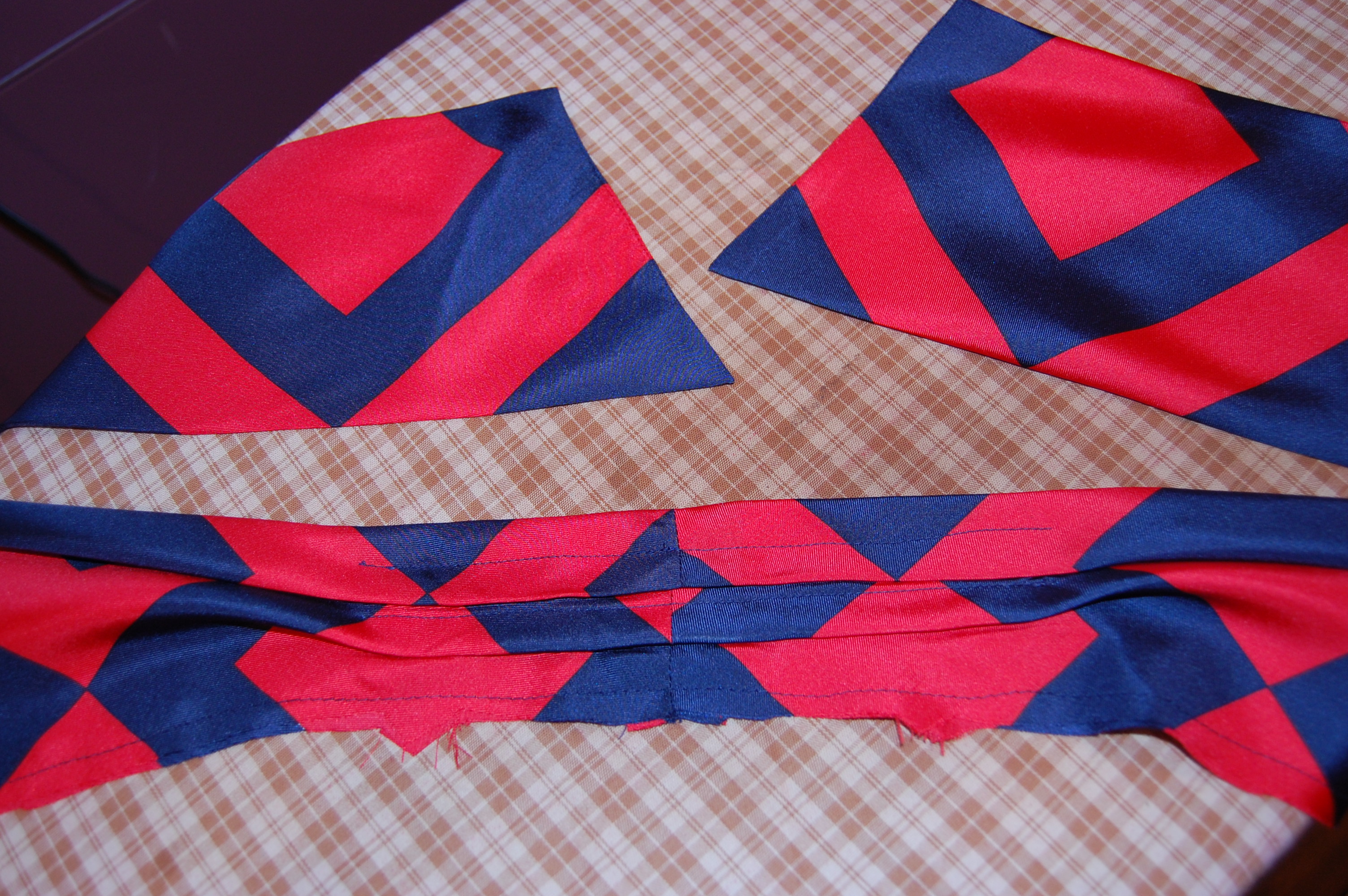
This blouse went together quite as planned, although I worked on one side where the bow/collar joins the corner at the front facing for hours, until I had it inserted correctly.  I kept making the same mistake over and over, which was a little irritating.  I also added some extra hand-sewing, understitching the facing by hand and hand-stitching the hem.

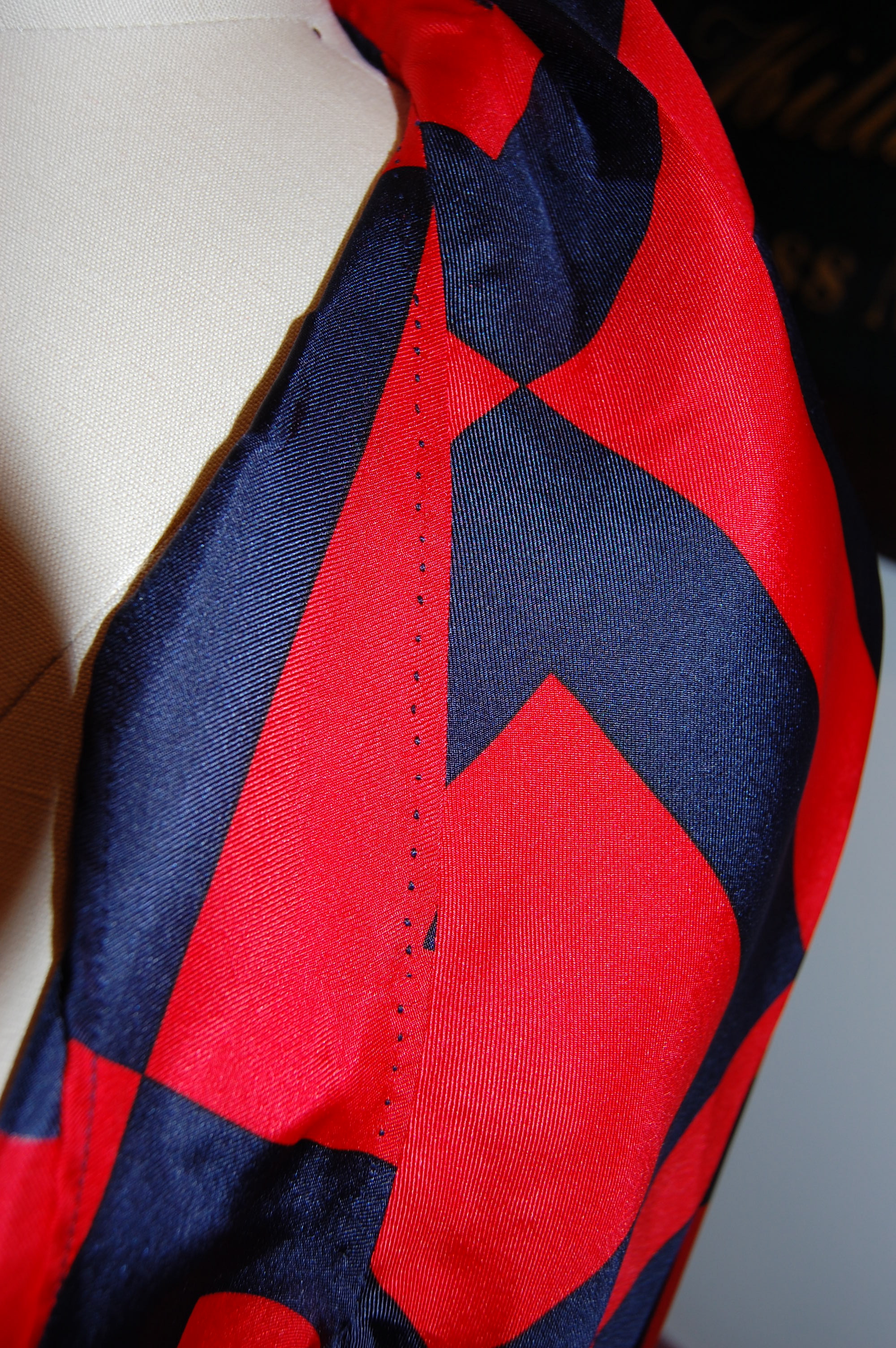
Hand understitching looks just so much nicer than machine stitching!

Hand understitching looks just so much nicer than machine stitching!

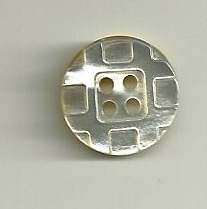
When I started the blouse, I had not yet picked out buttons, thinking I would use some that I have in my vintage collection.  But then I was on Waechter’s website and found these buttons, which seemed just about perfect:

The Necessary Blouse - button

These buttons measure 5/8″. 

(Sadly, Waechter’s is closing their business in Asheville, N. C., to my great dismay.  This makes me even more grateful for Britex Fabrics in San Francisco, from which I purchased all the fabric for this blouse and my Jacket No. 2.)

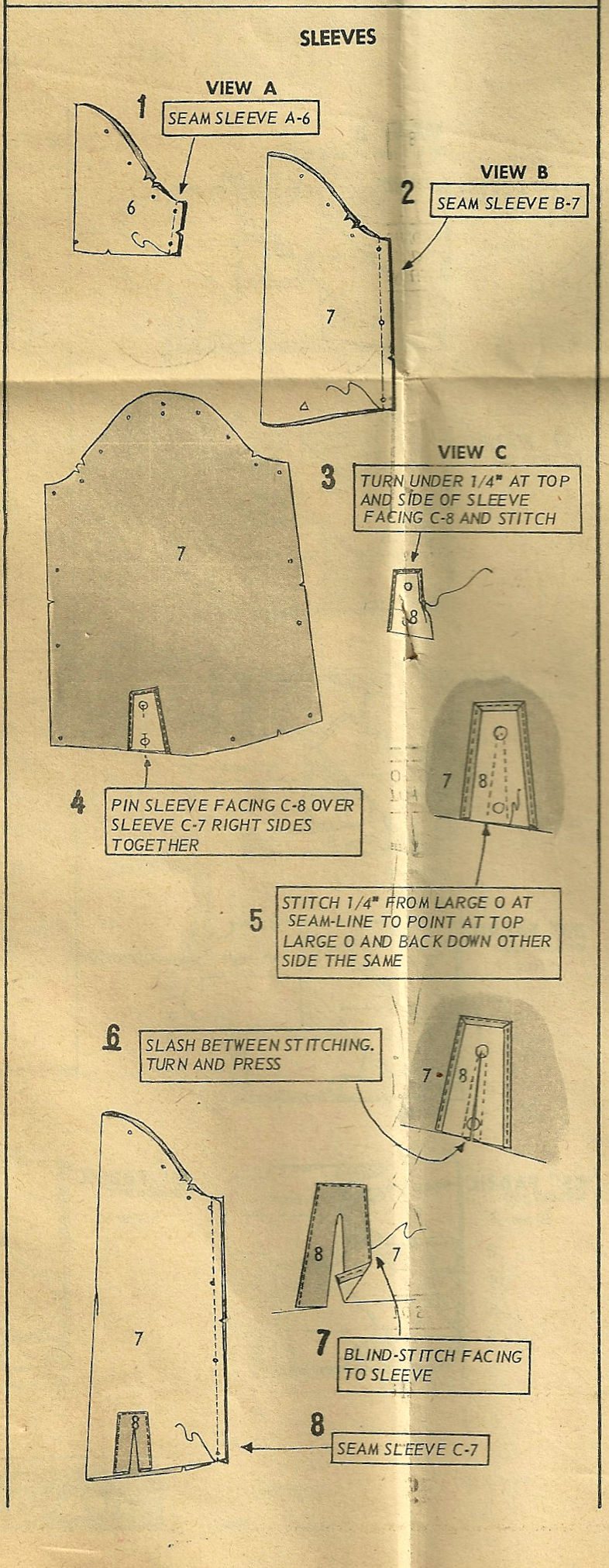
Sewing with vintage patterns is such a pleasure in so many ways.  For example, the sleeve vents had their own separate pattern piece:

The instruction sheet from the pattern . . . .

The instruction sheet from the pattern . . . .

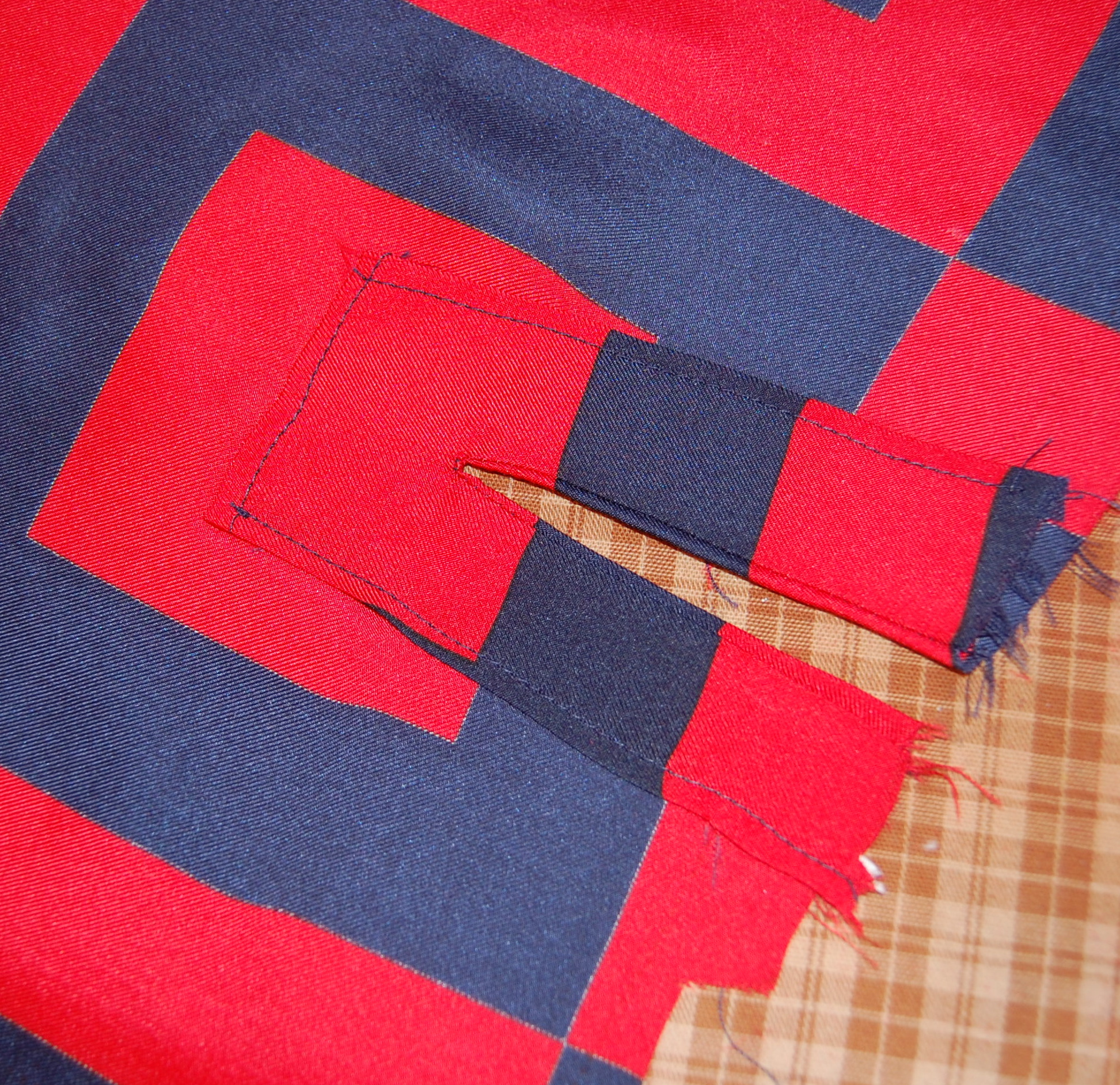
The vent sewn on . . . .

The vent sewn on . . . .

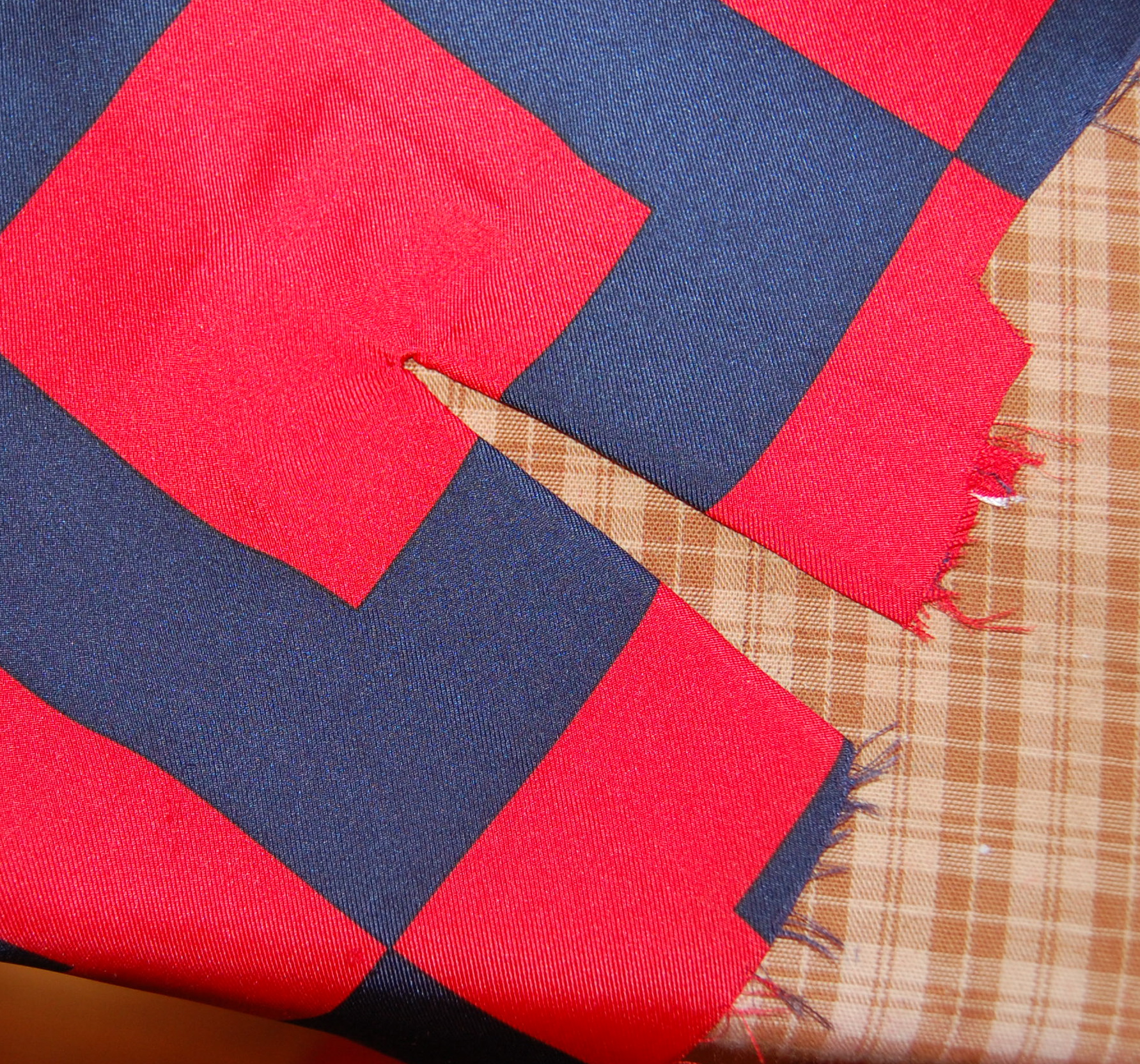
. . . . and the finished vent.

. . . . and the finished vent.

Another classic vintage aspect is the proscribed use of snaps  – in this pattern, at the waist and below, which takes bulk away from the “tuck-in” part of the blouse.

And that bow?  Once I had it made up, was it too much?

I think the bow is just about perfect.

I think the bow is just about perfect.

I am very glad I didn't tinker with the size of the bow!

I am very glad I didn’t tinker with the size of the bow!

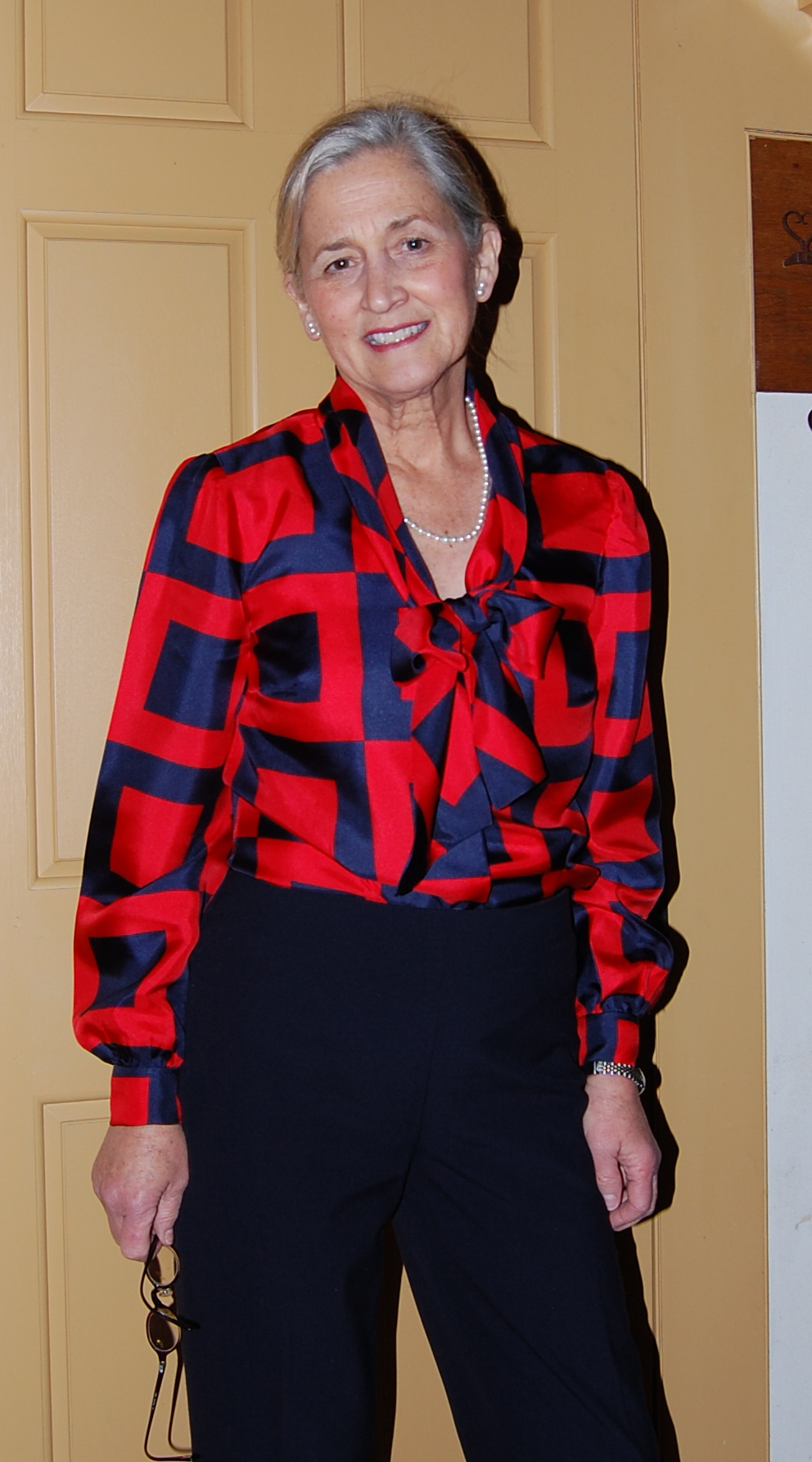
Shown with the jacket.  I really like how the collar on the blouse shows a bit when i have the jacket on.

Shown with the jacket. I really like how the collar on the blouse shows a bit when I have the jacket on.

The Necessary Blouse

A comfortable fit.

The Necessary Blouse

Would be nice with a navy skirt as well …

The Necessary Blouse

Whew!  Blouse and jacket turned out as I had hoped!

Whew! Blouse and jacket turned out as I had hoped!

I am feeling quite good about indulging in the extra fabric and extra time needed to make this blouse.  Now that my No. 2 Jacket is complete, I can indulge in my other current project – my color-blocked coat –  which might add a new word to the vocabulary of fashion sewing – obsession!
16 Comments

Filed under Blouse patterns from the 1950's, Blouses, Buttons - choosing the right ones, Chanel-type jackets, sewing in silk, The Conde Nast Publications, Uncategorized, vintage Vogue patterns from the 1950s, Vogue patterns

Color Wheel

Pantone’s annual announcement of “the color” of the coming year is always notable.  Last week’s revelation of Radiant Orchid as the newest “it” color caught me a little by surprise.  After emerald green’s reign over 2013, I just was not expecting such a dramatic turn on the color wheel.  But, being a “pink” person, I think I can be persuaded to embrace this violet-y pink, although right now I have no fabric or project planned to do so.  I am actually thinking that this color might suit me better in accessories rather than a full outfit in it.  Handbags and shoes?  Yes, I could get excited about that.

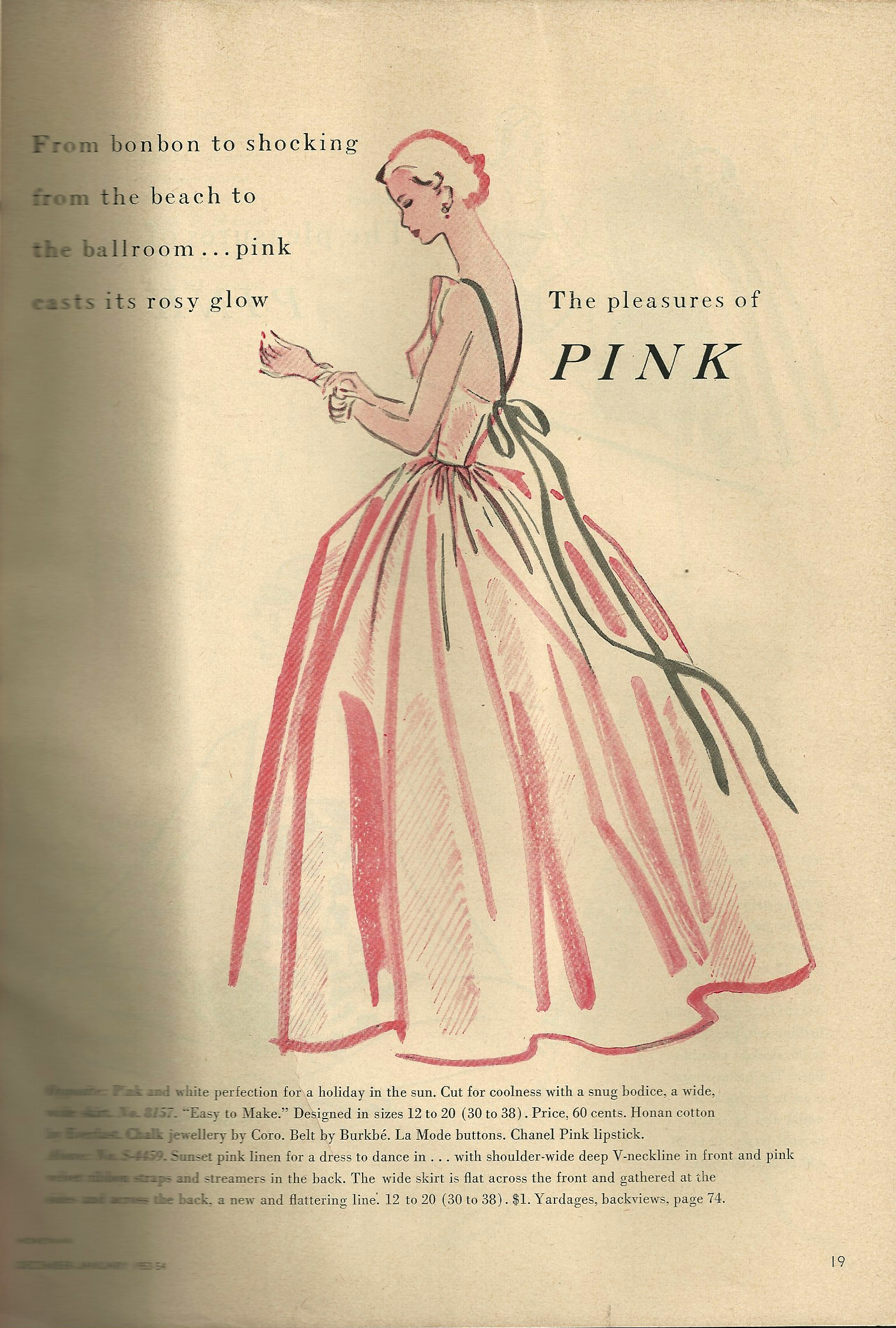
This choice of color made me start to think about predecessors to it, so back I went to my Vogue Pattern Magazines, two from the 1950s and one from the 1960s, to see what I could find.  In December/January of 1953-54, an entire feature focused on The Pleasures of Pink. 

"From bon bon to shocking - from the beach to the ballroom ... pink casts its rosy glow"

“From bon bon to shocking – from the beach to the ballroom … pink casts its rosy glow”

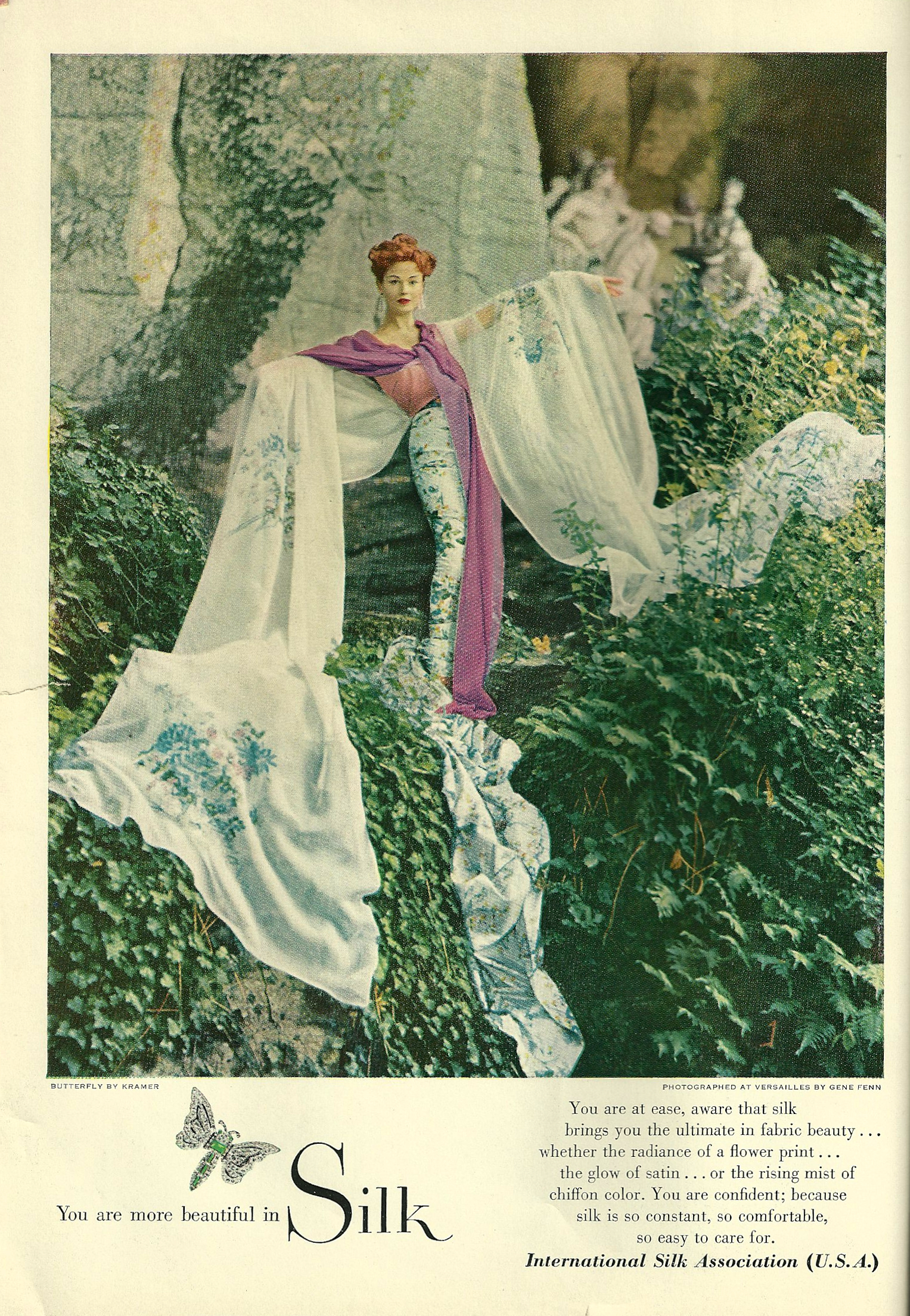
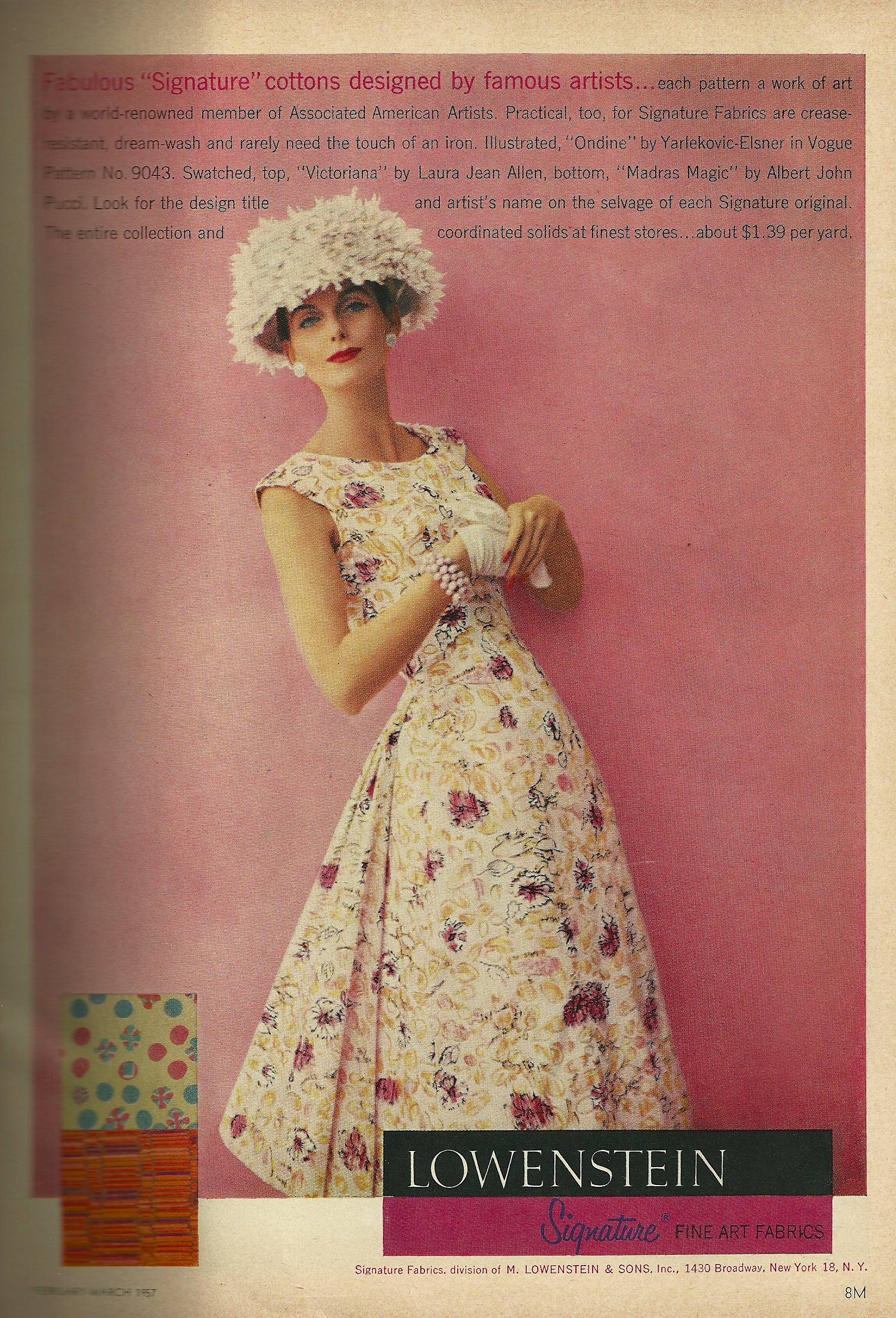
Two ads from the February/March 1957 VPM featured a pink, which is very close to 2014’s radiant orchid.  Who could argue with the statement “You are more beautiful in Silk”?

Here is" Radiant Orchid", mid-century style!
Here is” Radiant Orchid”, mid-century style!

Lowenstein’s ad features “Signature” cottons designed by famous artists.  If you read the caption fully, you will see that the price per yard is listed at “about $1.39”.

And don't you love the hat??

And don’t you love the hat??

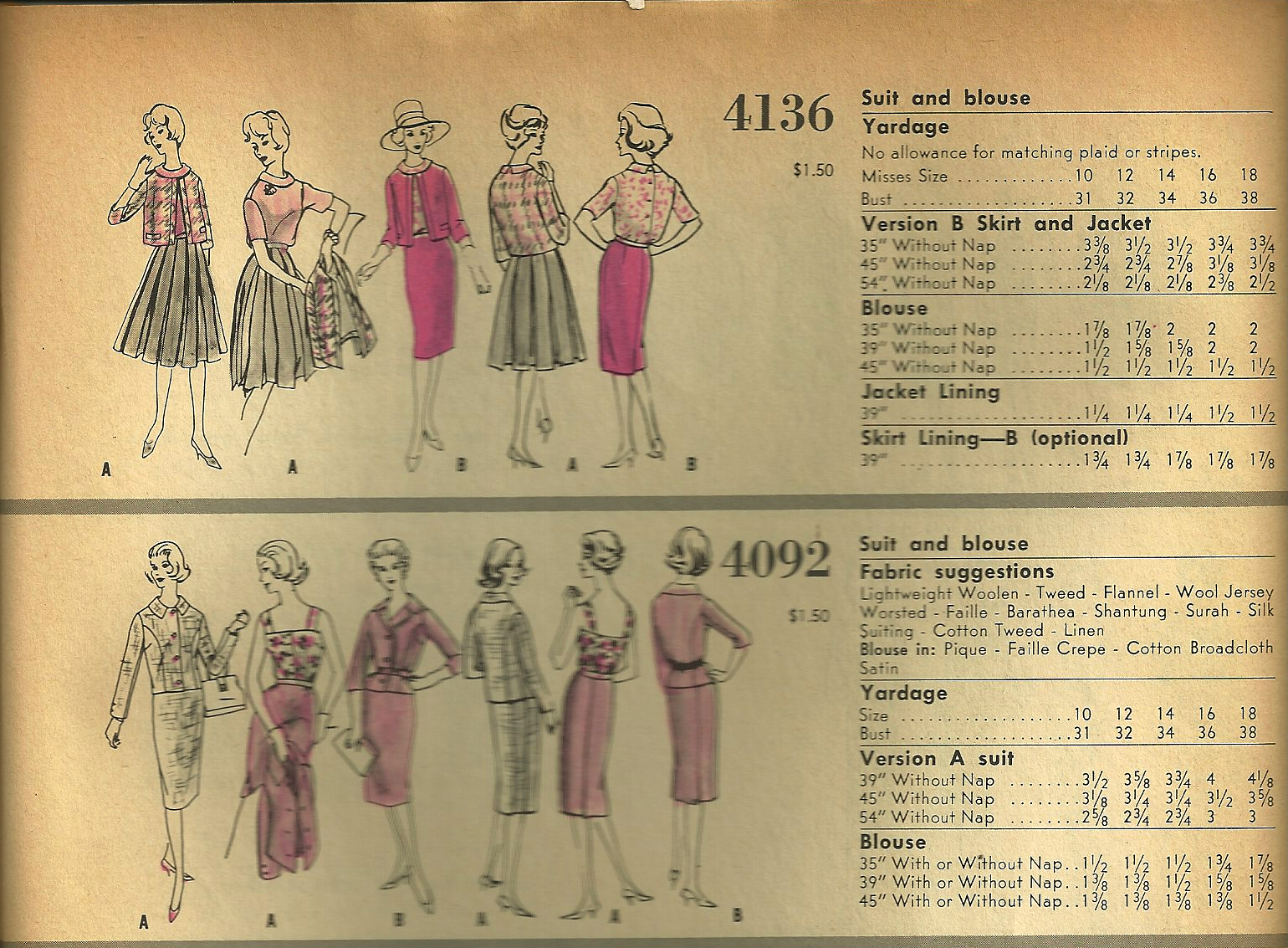
December/January of 1960-61 shows two of the suit and blouse patterns in what could definitely be called Radiant Orchid.

Look at that Chanel-type jacket in Pattern #4136.

Look at that Chanel-type jacket in Pattern #4136. 

While 2014 is set to be the year of “Radiant Orchid”, dear old 2013 is just not quite over yet.  Busy December of every year finds me focusing on the colors of  Christmas and the holiday season more than on the current fashionable colors.

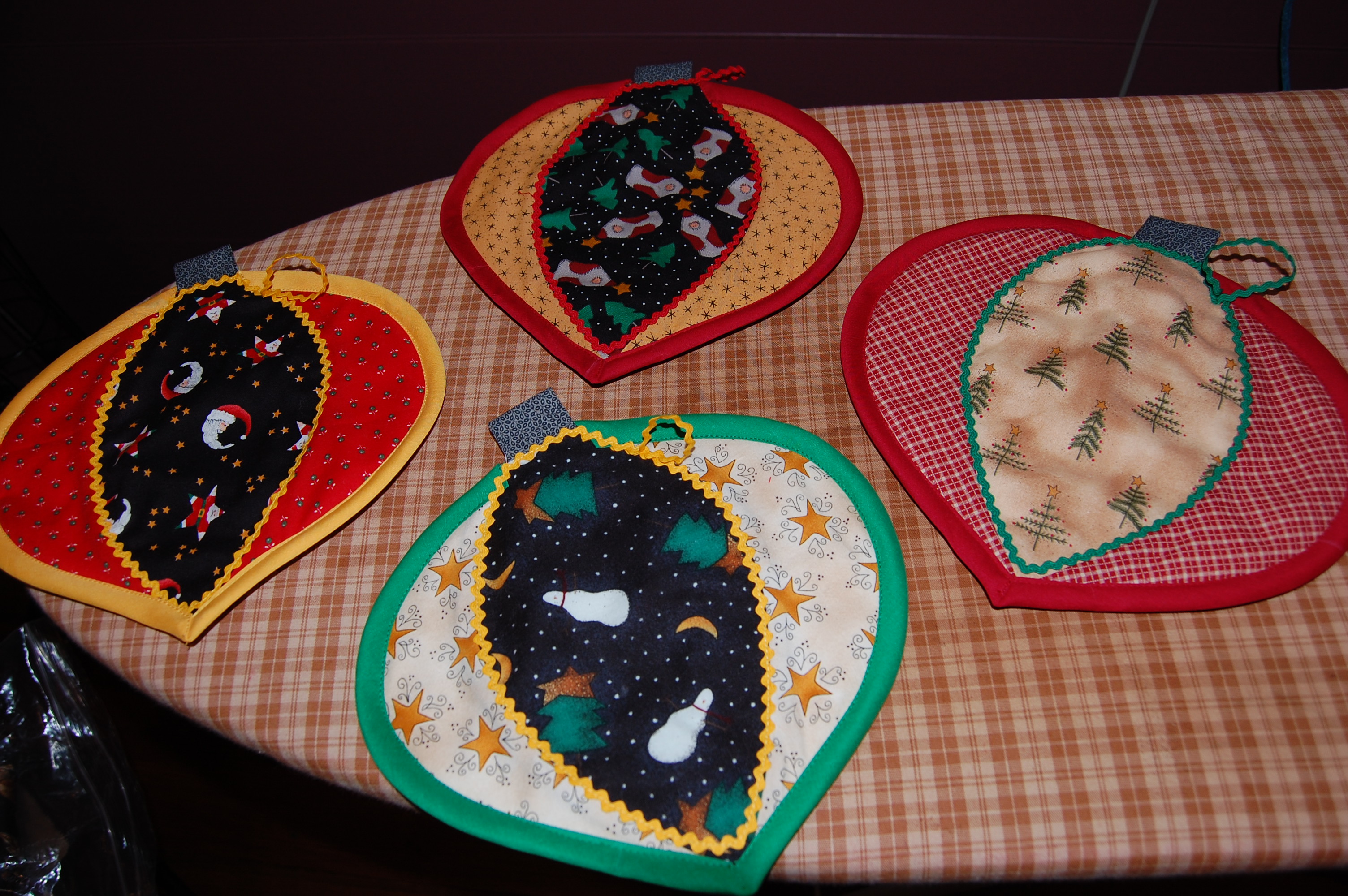
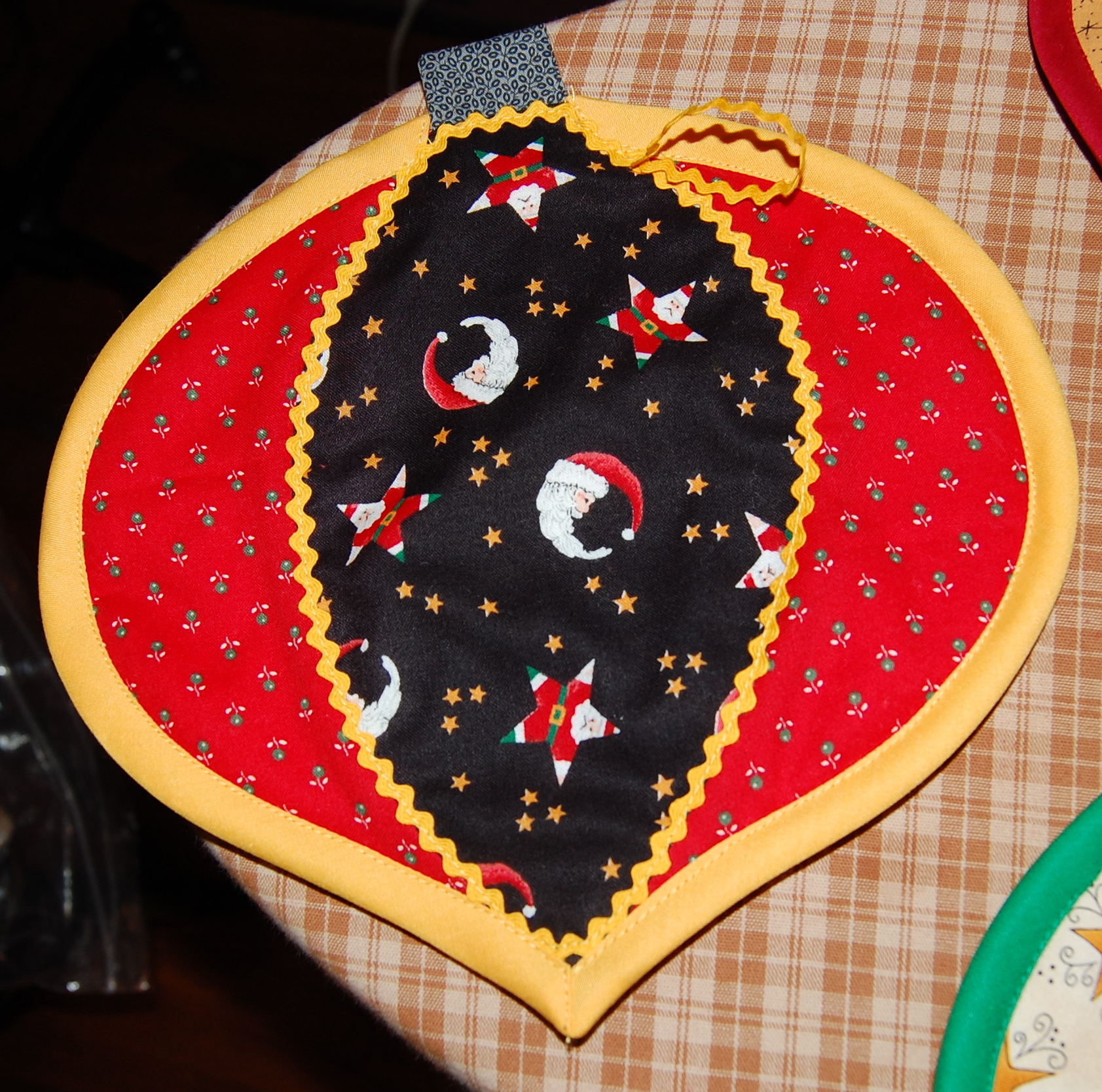
Somehow, Christmas just would not be Christmas if I were not scrambling to finish some handmade gifts.   This year is no different, as I conjured up some crazy idea to design and make Christmas-themed potholders as a small addition to the presents I give to some very wonderful ladies who help me in my house (and vacuum many a thread off the floor of my sewing room!)    I dug through my stash of “quilting” cottons and came up with some holiday themed fabric, which I used as my starting point.  Then I paired each fabric with some complementary small prints, and concocted what I hope looks like fancy Christmas balls – except that they are large enough to use on a hot pan!
Color wheel potholders I indulged my love of rickrack, and the most fun part was deciding which color binding and which color rickrack to use to enhance the finished product.

color wheel potholder

I added a small gray “cap” at the top to simulate a Christmas ball hook-holder, and a rick-rack loop for hanging.

color wheel potholder

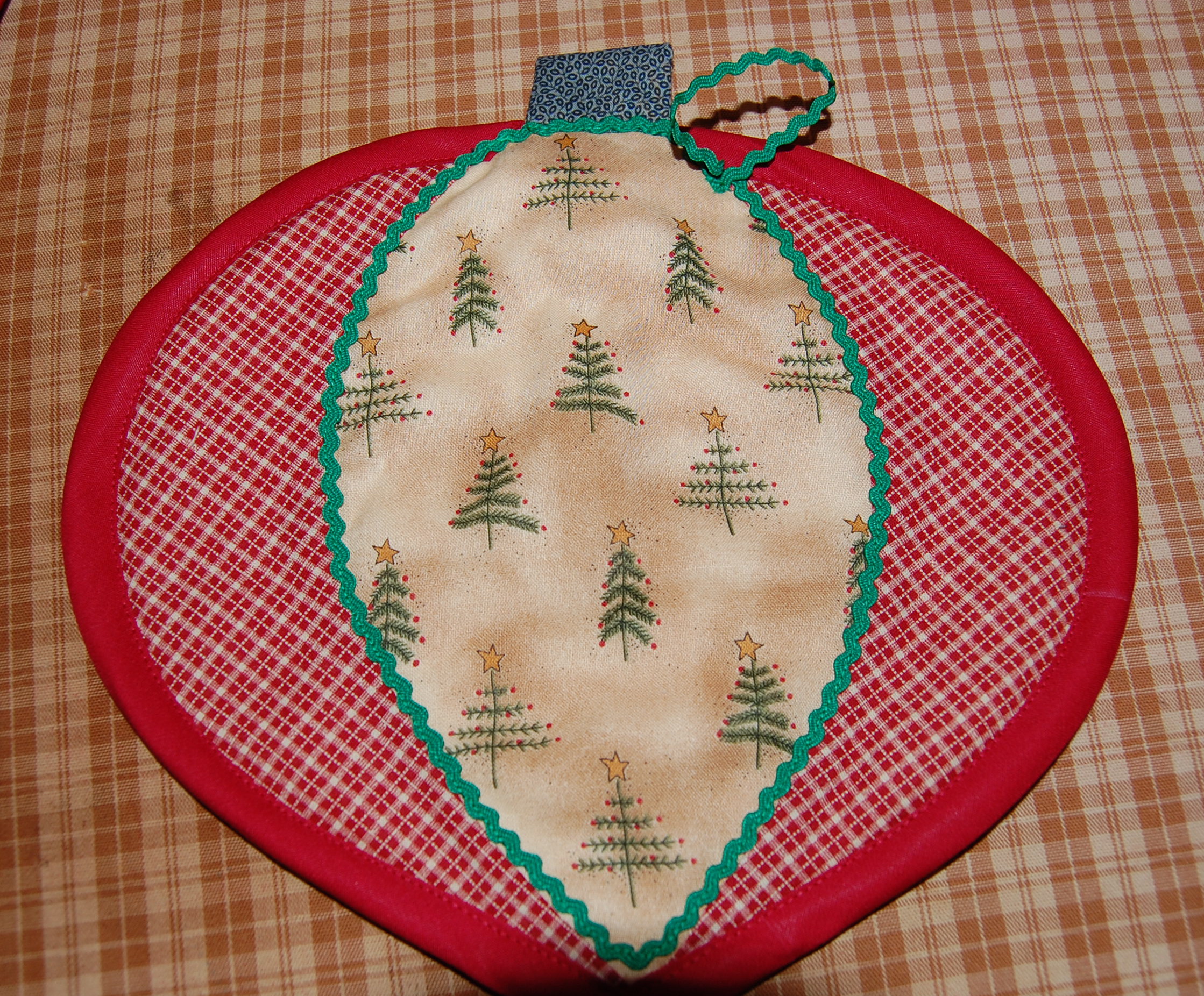
This is my favorite one…

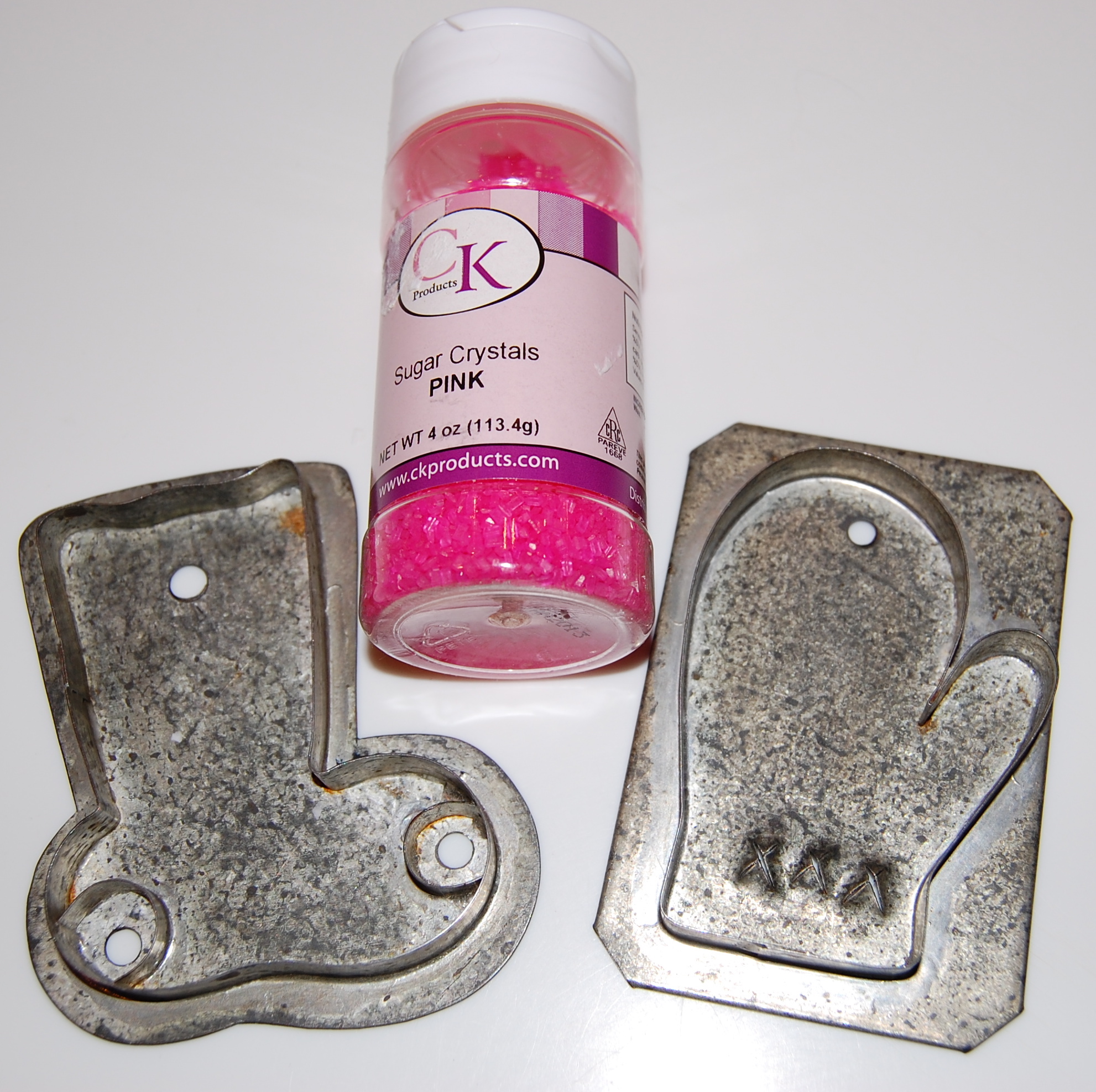
Coming full circle (pardon the pun) on the color wheel brings me back to radiant orchid – and whether  our holiday celebrations will possibly see any pink hues peeking out between the Christmas reds and greens?  Oh, yes!  Once I get around to cookie-making, I’ll be certain to make  fashionably forward stockings and mittens decorated with sparkly pink sugar!
color wheel

14 Comments

Filed under Chanel-type jackets, Uncategorized, vintage Vogue patterns from the 1950s, vintage Vogue patterns from the 1960s

No. 2 ~ The Beginning

I may – or may not – find Chanel No. 5 Paris Parfum in my Christmas stocking, but Chanel-inspired, Classic French Jacket No. 2 can currently, definitely, be found in my sewing room.  Well, actually, it’s not a jacket yet.  It is just lengths of fabric and loose trims and buttons, but that is how these things begin, as every home dressmaker knows.

I actually started planning this jacket long before I took the Classic French Jacket Class with Susan Khalje this past summer.  In September of 2012 when I was at Britex Fabrics in San Francisco, I found this boucle and purchased it – even then – as my intended Jacket No. 2.

This fabric is very soft, perhaps due to a certain percentage of mohair wool in its composition.

This fabric is very soft, perhaps due to a certain percentage of mohair wool in its composition.

My first jacket is definitely very dressy, so I wanted this one to be less so, which meant I had to find just the right lining, trim, and buttons.  It took another, recent, trip to San Francisco to produce those ingredients – and I couldn’t be more pleased with what I found again at Britex.

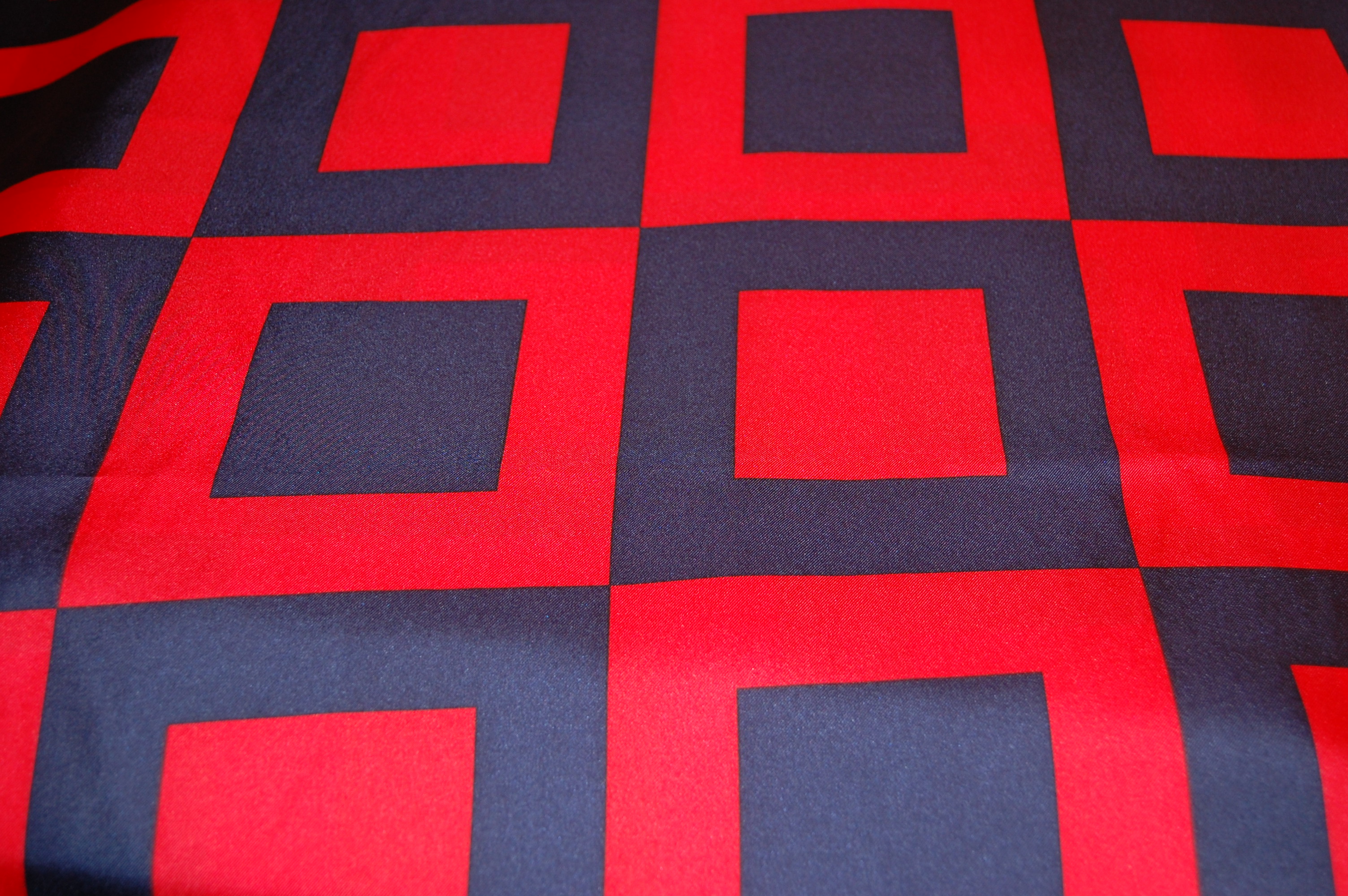
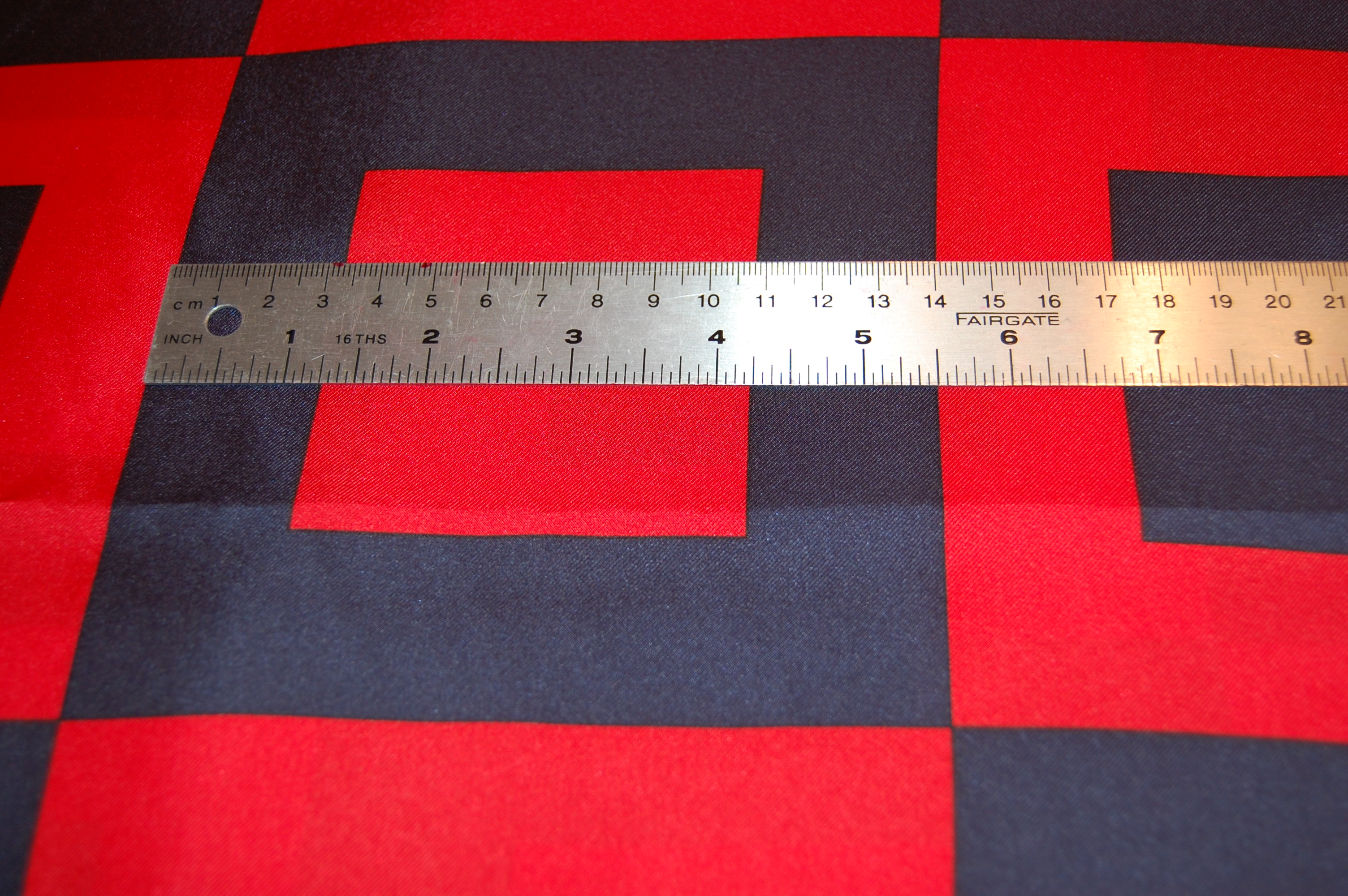
A bolt of this light-weight silk twill was tucked under one of the front tables, and it was love at first sight.  I was hoping to find something with navy blue in it, and the geometric pattern in this fabric makes it bold and less dressy than a floral silk charmeuse would be.

No. 2 jacket

The ruler will help you get a feel for the size of the squares.  Click on the photo for a close-up view.

The ruler will help you get a feel for the size of the squares. Click on the photo for a close-up view.

Immediately, however, I knew that I had to purchase enough for a blouse as well, which I did.  I suspect I’ll be using this pattern from 1957 for a blouse with a bow, which should evoke the correct Coco Chanel look. (A muslin should tell me if I need to tame the bow.  I don’t want it to be overwhelming…)

View B with long sleeves has my vote.

View B with long sleeves has my vote. 

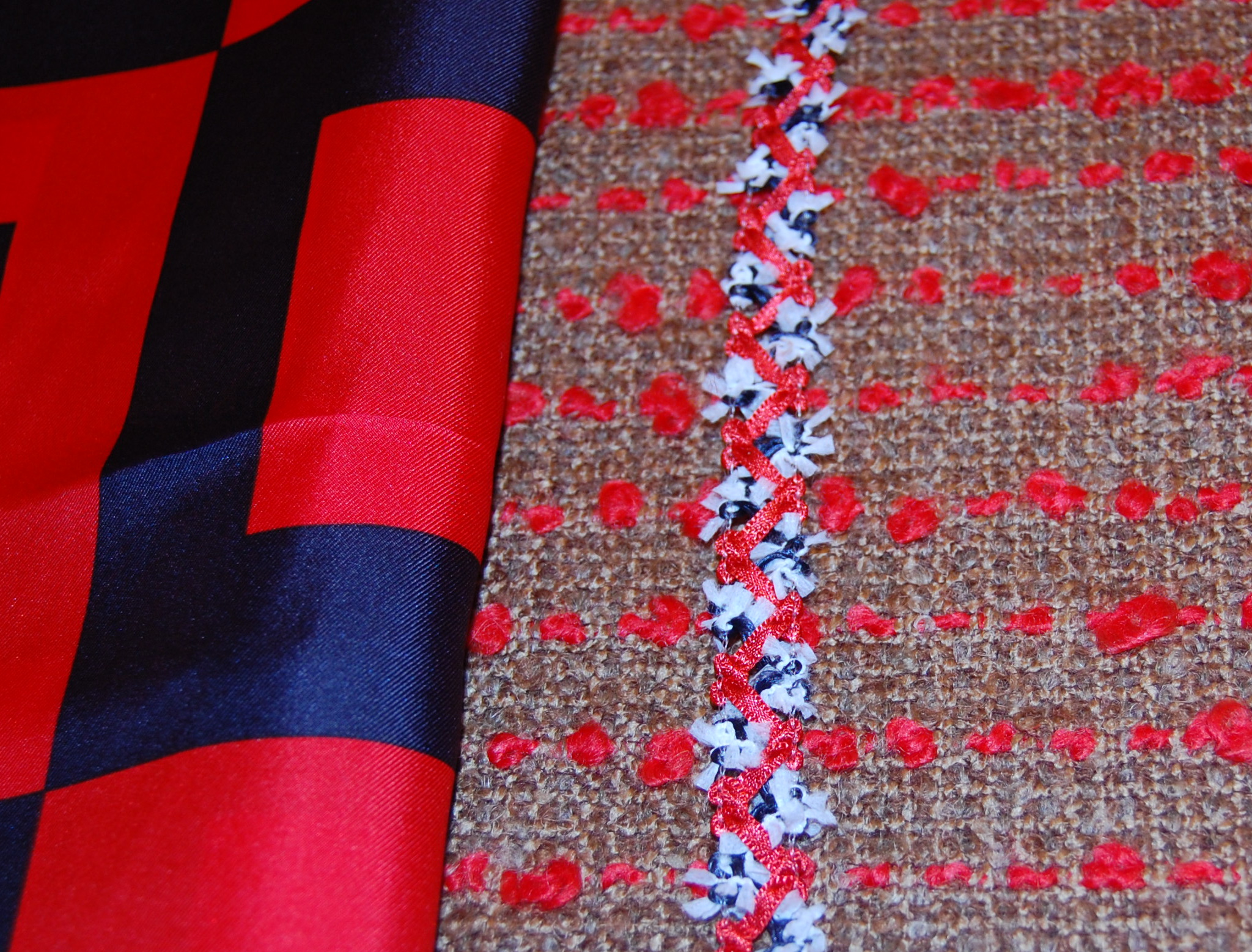
With fabrics in tow, I then headed up to the Buttons and Trims Department on the 3rd floor.  An initial look at the red trims flummoxed me, as none of them seemed right.  Then one of the wonderful assistants in the Department came to my rescue and found these two trims.

No. 2 Jacket

Shown with the lining/blouse fabric...

Shown with the lining/blouse fabric . . .

... and again.

. . . and again. 

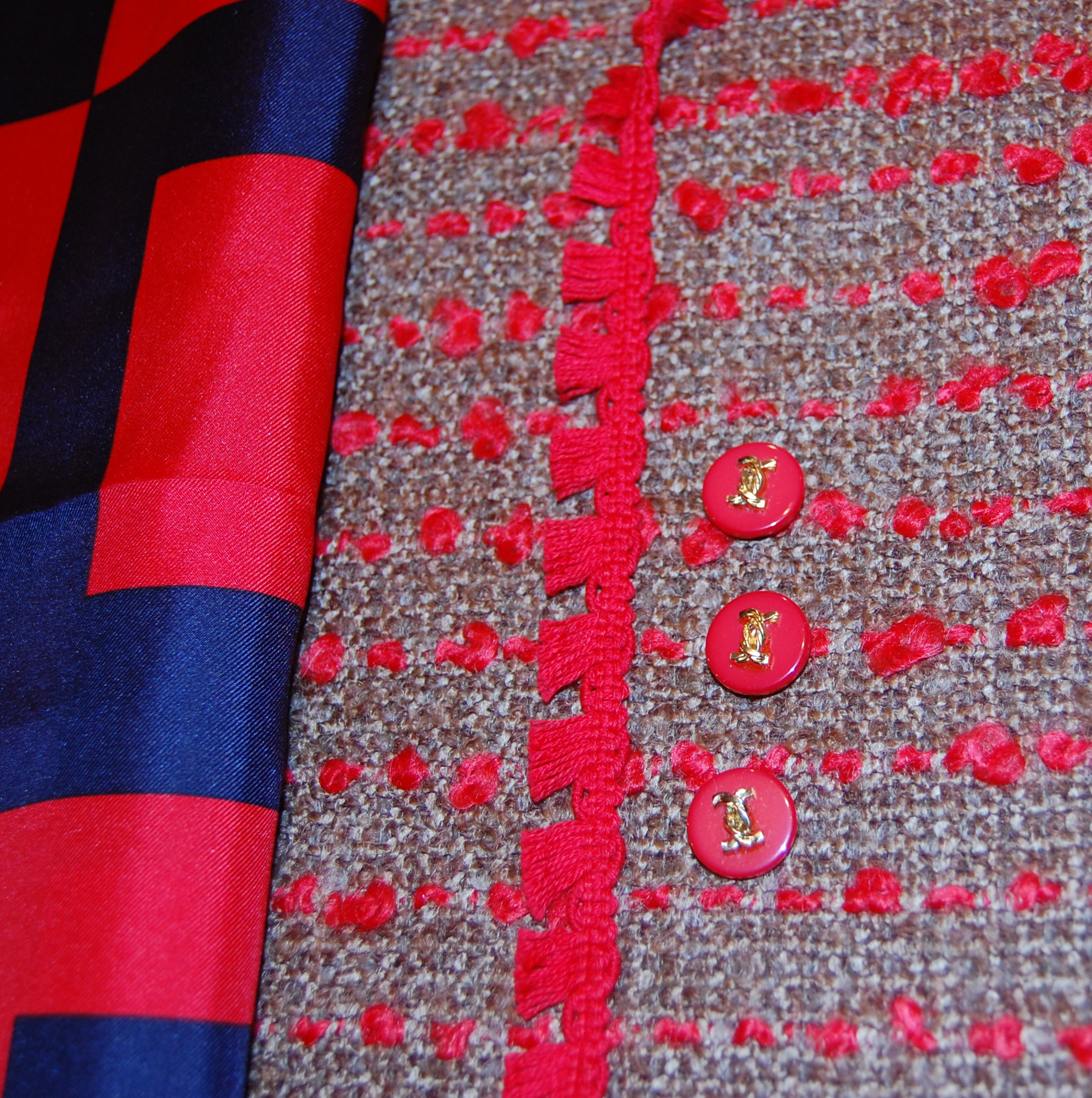
Back and forth I went between them, unable to make a decision.  It was then that I went to my fail-safe method of choosing between two equally wonderful trims:  I bought both of them! ( It certainly helped that neither was terribly expensive – and both very versatile.)

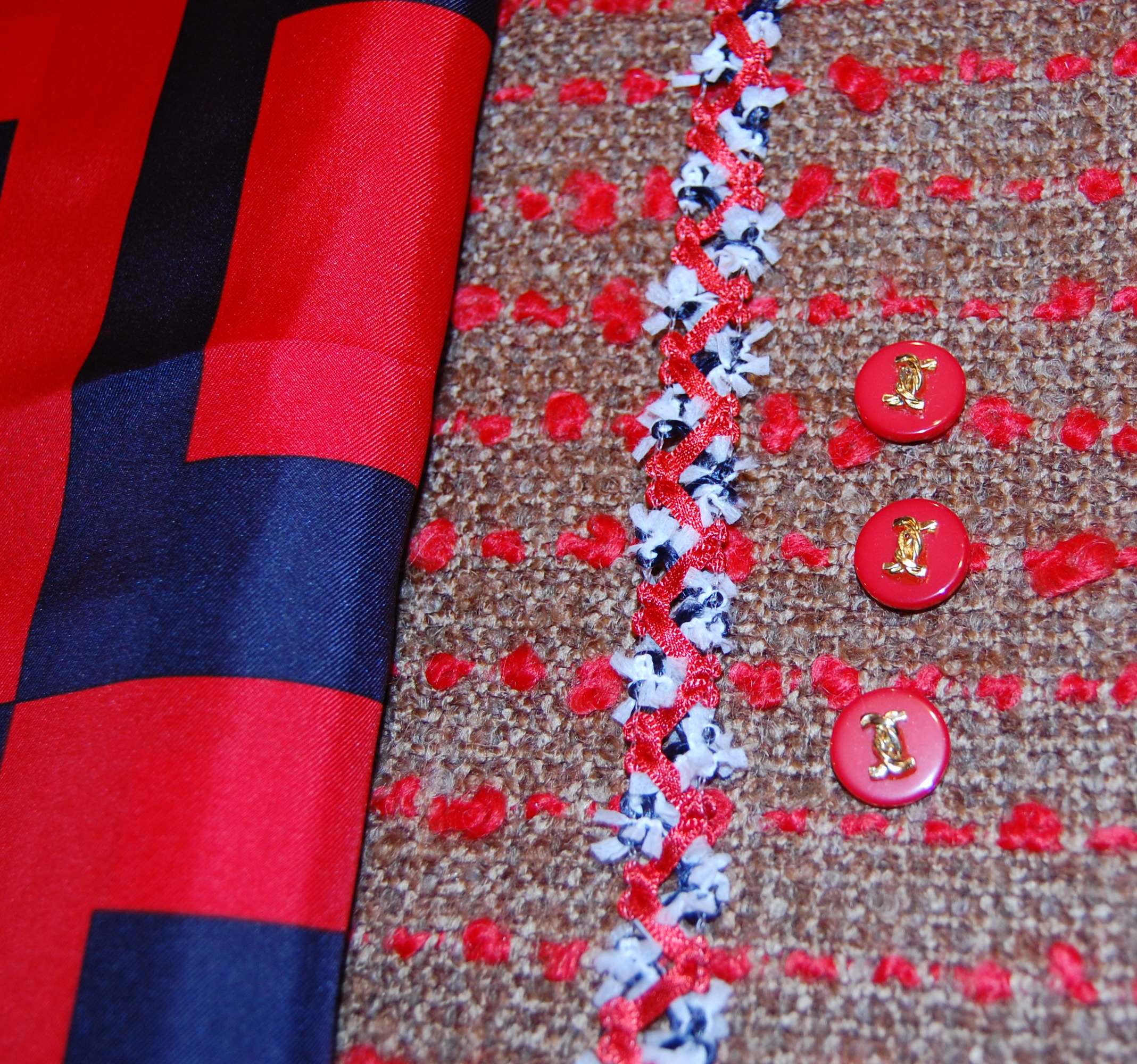
Now that I have them home, I am leaning toward one of them – can you guess which one?  Does it help to see the buttons, too?  Once again, the experienced button assistant quickly found these – and there was no question in my mind that they were just what I wanted for this jacket.

These are shank buttons, with gold decoration reminiscent of Chanel "C"s.

These are shank buttons, with gold decoration slightly reminiscent of intertwined Chanel “C”s.

And here with the other trim.

And here with the other trim. 

Well, as in so much in life, timing is everything – or it sometimes seems that way.  My timing could be better to be starting such a lengthy project.  It is, after all, one month until Christmas.  I have those proverbial stockings to fill and much to do, but I’ll just bet I can squeeze in some sewing time before my sewing room transforms into Santa’s workshop.

15 Comments

Filed under Blouse patterns from the 1950's, Boucle for French style jackets, Buttons - choosing the right ones, Chanel-type jackets, Coco Chanel, Uncategorized, vintage Vogue patterns from the 1950s

Looking at Blouses

In my quest to make a couple of “simple” pieces before I start another “Chanel-inspired” jacket, I decided to make a blouse.  I am very partial to the color of deep pink – and the remains of a length of silk, which I have already used in two projects (here and here), kept surfacing whenever I went through my fabric collection.  The weight is perfect for a blouse – so my plans starting taking shape, based on this fabric.

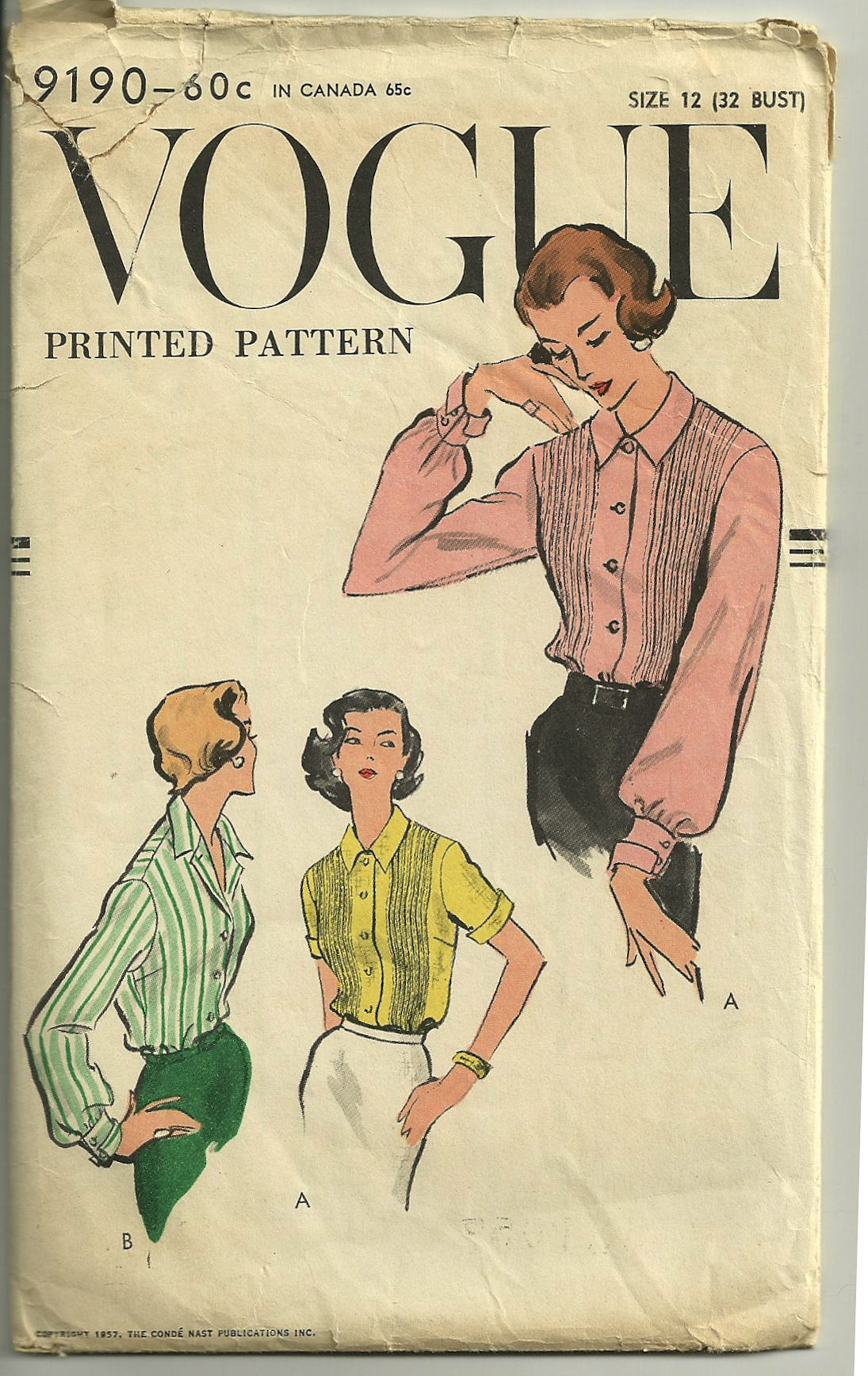
First I went through my pattern collection to see what I could find.  Two blouse patterns from 1957 and one from 1959 are lovely but did not seem quite right for my fabric.

View B is my favorite - and how current is this look?

View B is my favorite – and how current is this look?

I have already used this pattern once, but I think I took some of the fullness out of the sleeves.

I have already used this pattern once, but I think I took some of the fullness out of the sleeves.

This blouse pattern is part of a suit.

This blouse pattern is part of a suit. 

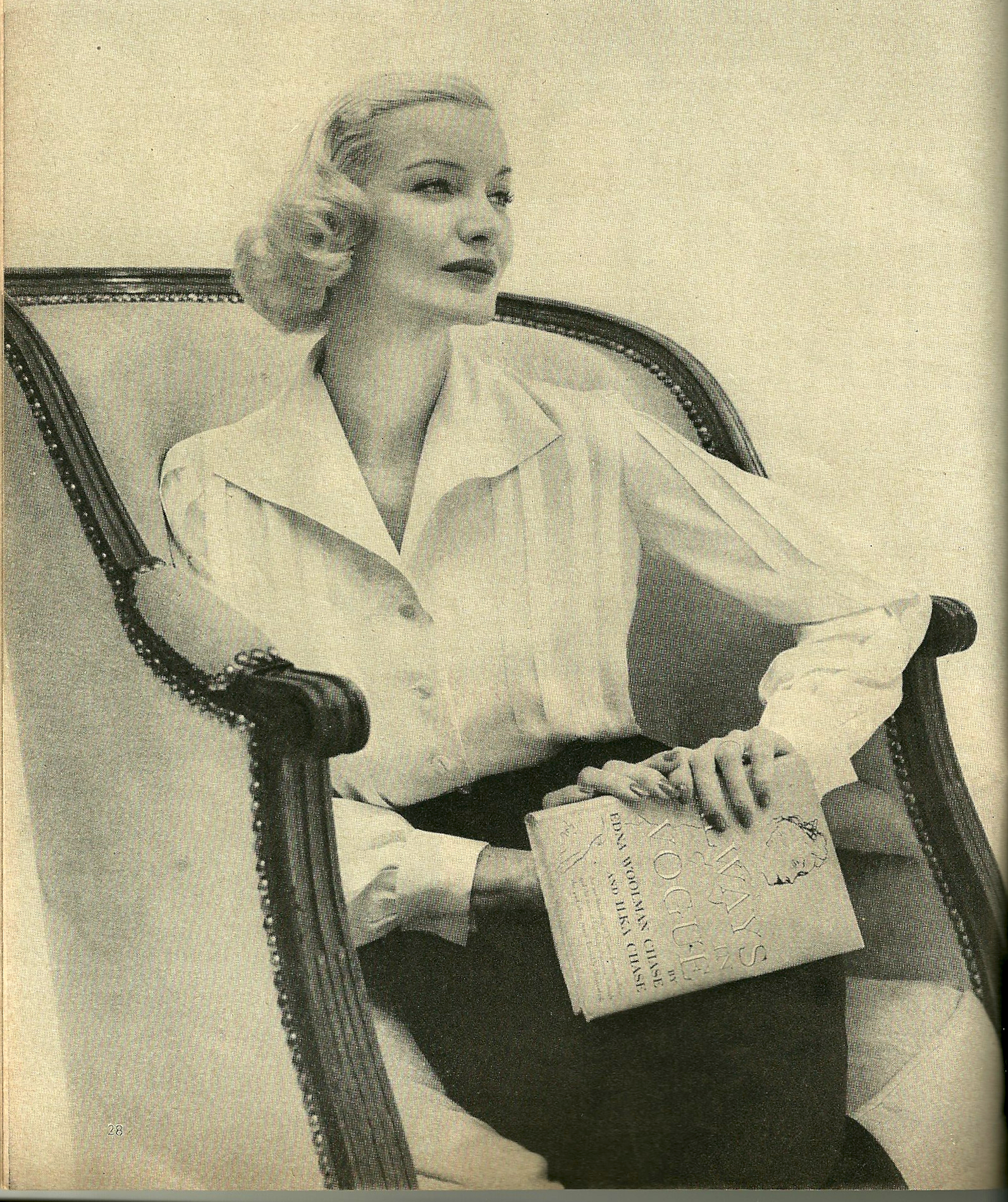
Just for fun, I thought I would look at some of my early Vogue Pattern Book Magazines to see what else was being featured for blouses.  In February/March of 1955, this tucked shirtwaist is the very picture of elegance:

The tucks make this blouse very ladylike.

The tucks make this blouse very ladylike.

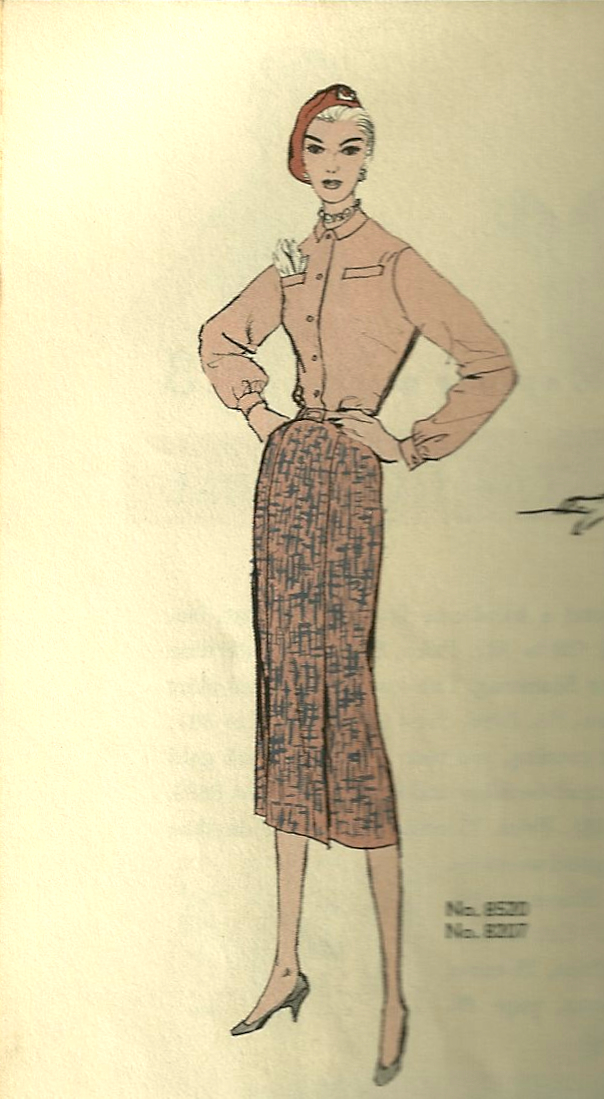
In the same issue, this “bloused jacket” gives the appearance of a classic shirtwaist blouse:

Looking at blouses 1955 - dress shirt style

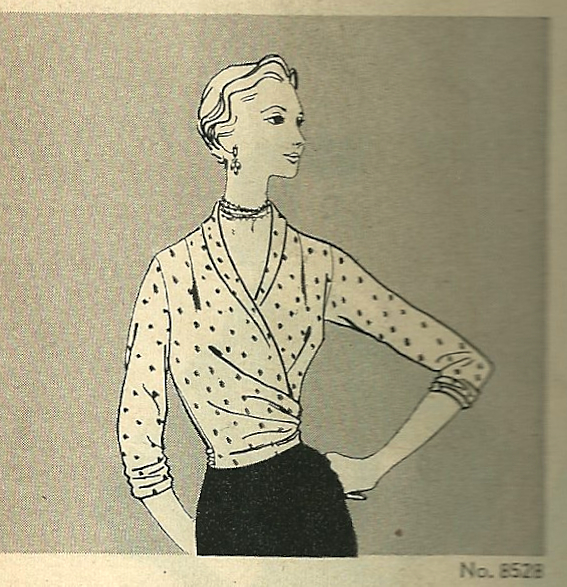
And look at this “wrap” blouse, also from 1955:

Looking at blouses 1955 - wrap style

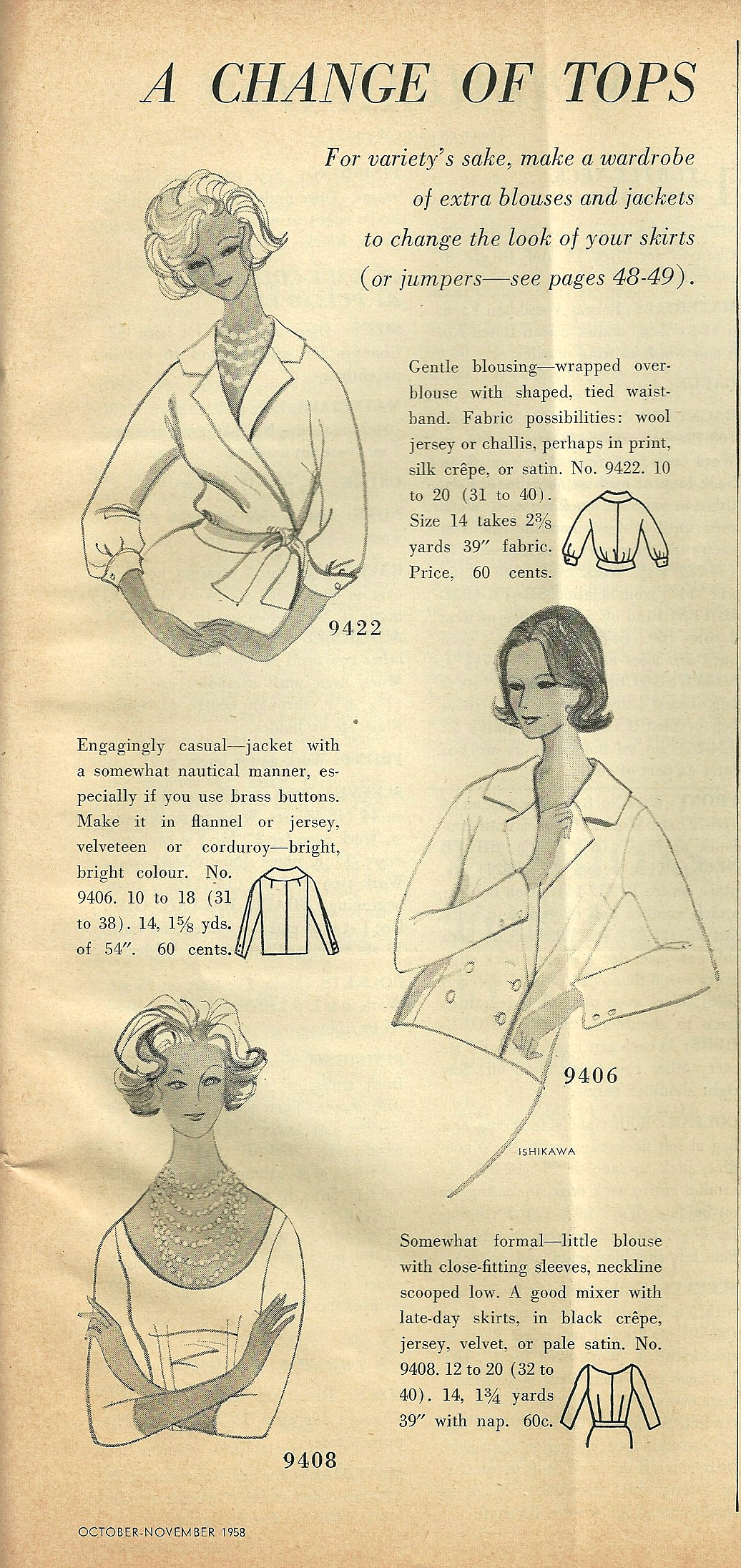
Three years later, in October/November of 1958,  “A Change of Tops” was suggested.  “For variety’s sake, make a wardrobe of extra blouses and jackets to change the look of your skirts…”  That sounds like a good idea to me, especially with the pretty styles that are featured:

Another beautiful wrap blouse among the suggestions!

Another beautiful wrap blouse among the suggestions!

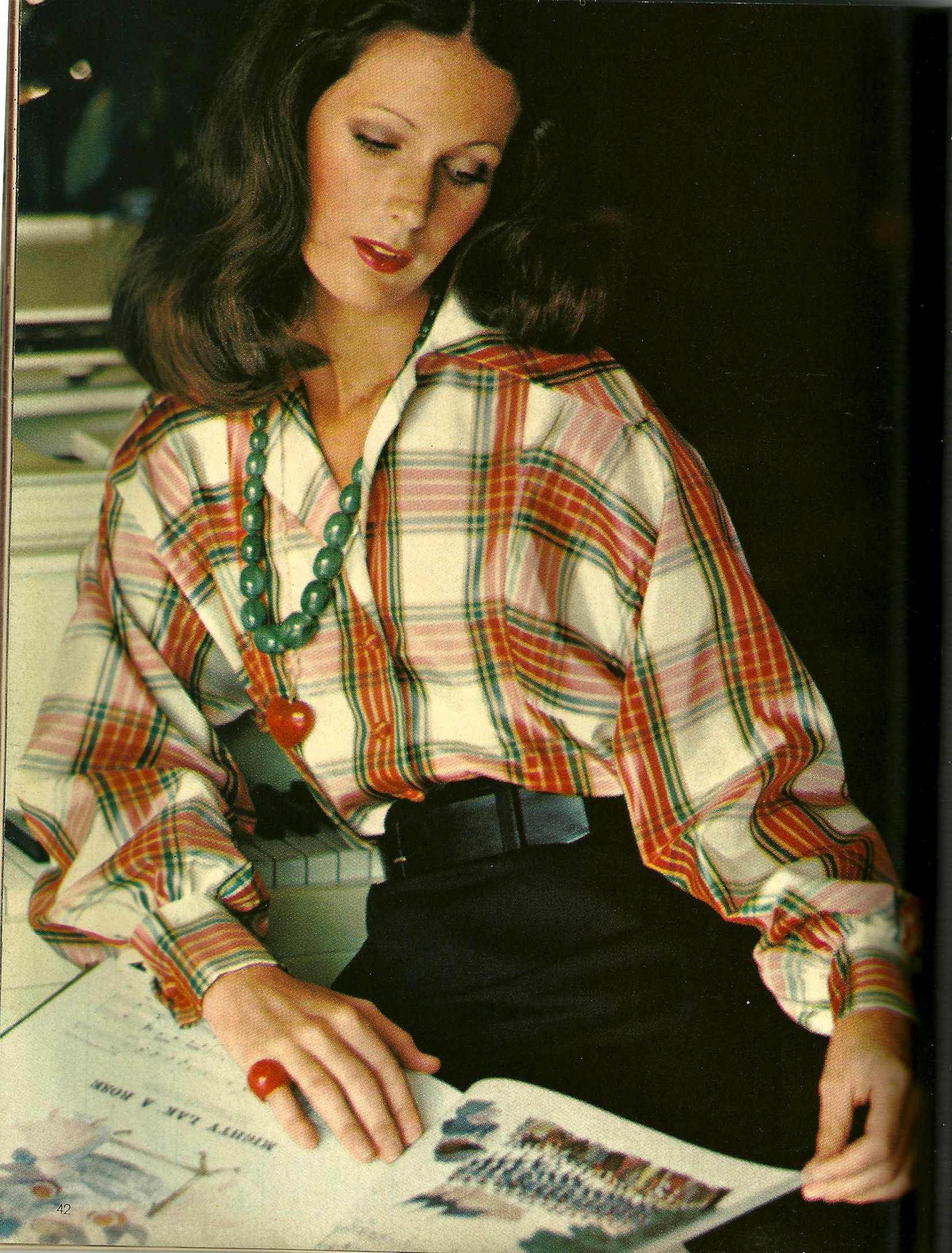
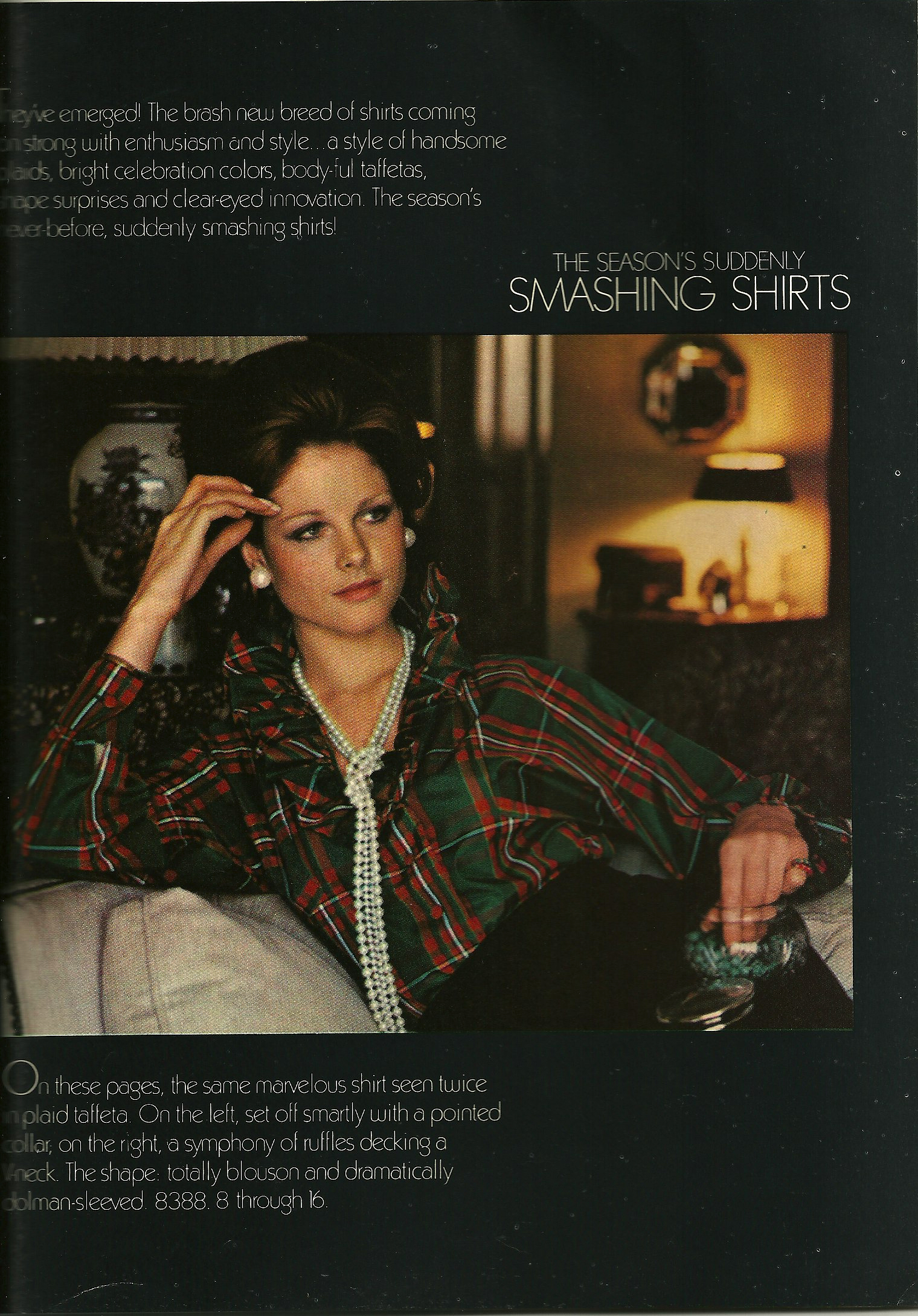
By 1972, collars were beginning to be a bit on the large side for my taste, but these three blouses are still “smashing” even 40 years later!

Made up in a plaid taffeta.

Made up in a plaid taffeta.

This is the same pattern as the blouse above, but with a ruffled collar.

This is the same pattern as the blouse above, but with a ruffled collar.

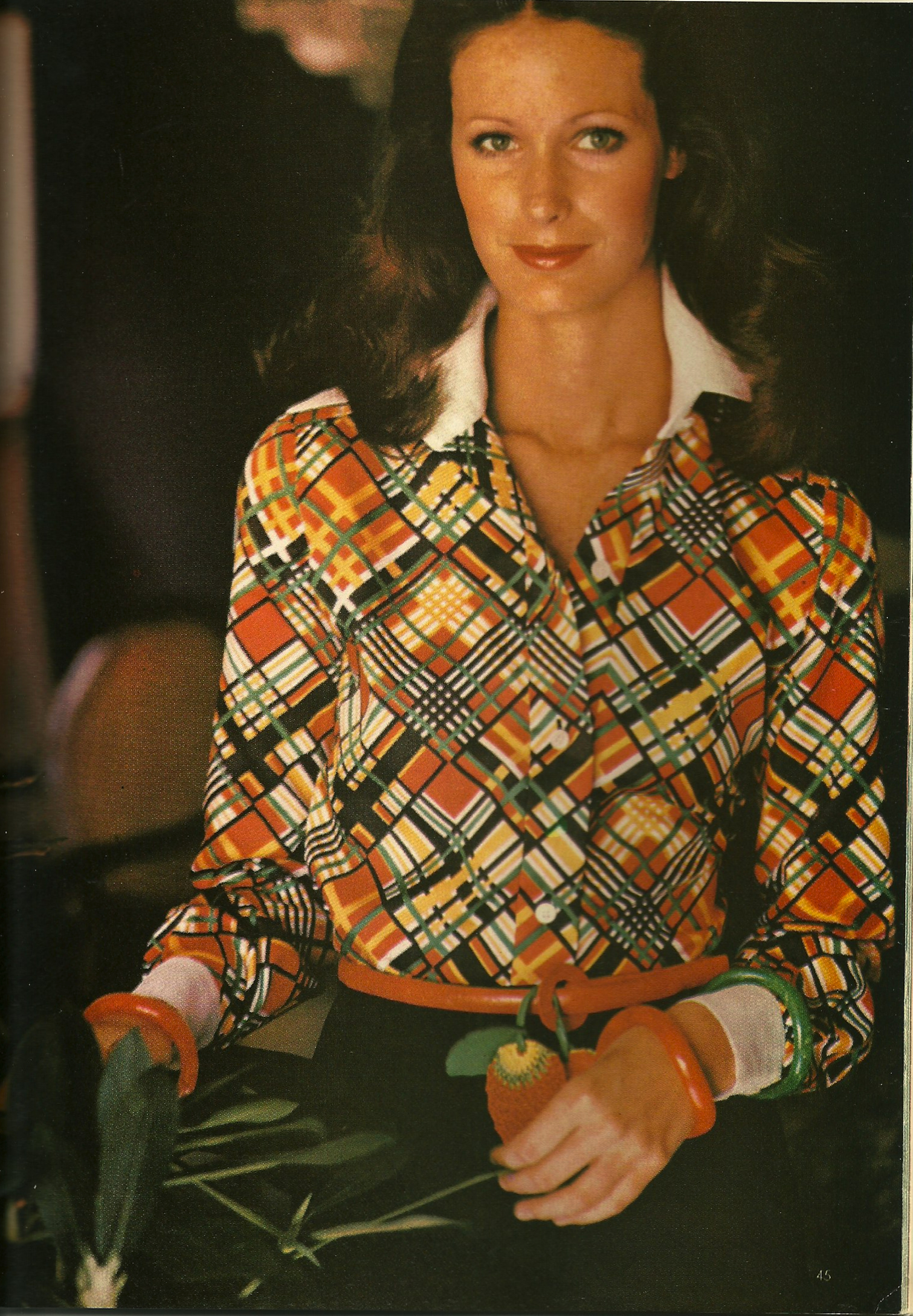
The diagonal print is very effective in this style.

The diagonal print is very effective in this style.

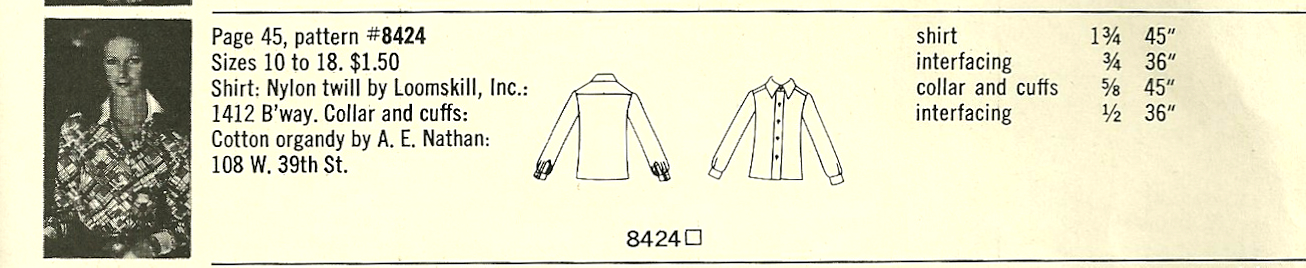
I was particularly drawn to the diagram for the blouse shown above, as it is just a classic shirtwaist style:

Looking at blouses 1972 - plaid 3 sketch

Seeing this blouse reminded me of how much I like an old (very old) RTW David Brooks blouse that I have been wearing for years.

Looking at blouses

It still looks stylish, and I really enjoy wearing it.  So – why not make a “copy” in my pink silk?  Could I possibly find another pattern in my collection that could be suitably altered to achieve this look and style?

Well, I did.  My blouse is currently “under construction” – but the pattern (to be revealed in my next post) is so funny looking that one may truly ask “Why did you ever save that one?”  Hopefully I’ll have a really good, bright pink answer to that soon!

2 Comments

Filed under Blouse patterns from the 1950's, Uncategorized, vintage Vogue patterns from the 1950s, vintage Vogue patterns from the 1970s, Wrap blouses