Category Archives: Chanel-type jackets

Love, Luck and What I Sewed

Many years ago I ran across this little book:
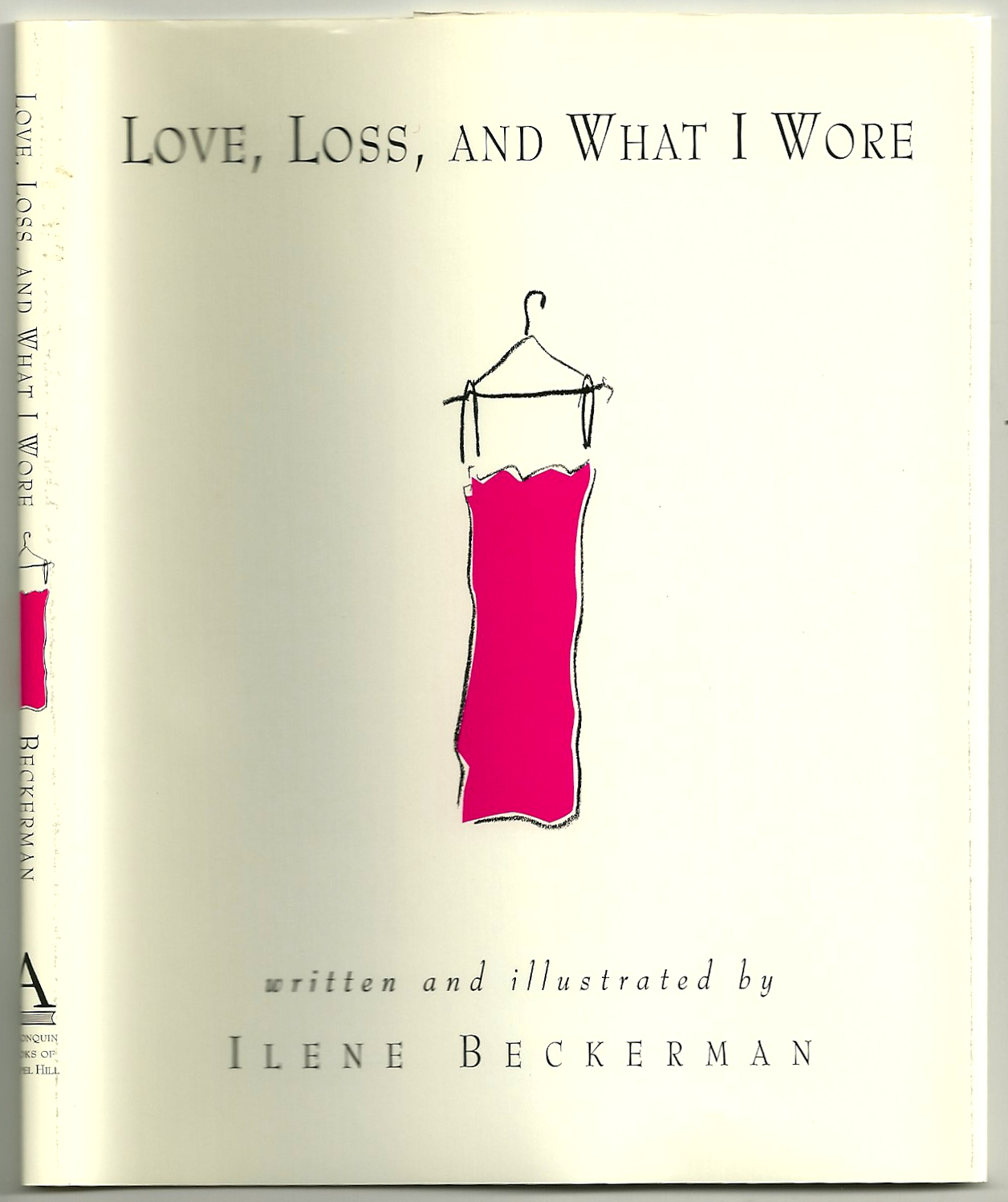
This book was published in 1995 by Algonquin Books of Chapel Hill.  All illustrations are copyright 1995 by Ilene Beckerman.

This book was published in 1995 by Algonquin Books of Chapel Hill. All illustrations are copyright 1995 by Ilene Beckerman.

I don’t remember how I found it or where I saw it, but I bought a copy for my mother-in-law, which she loved.  I finally gave in a few years later and bought one for myself.  It’s a very straightforward kind of book, with un-fancy writing and unsophisticated, but charming, drawings by the author.  Within the book’s simple demeanor, however, is an expressive, and touching tribute to the power of what we wear and how we remember – and measure – our lives.

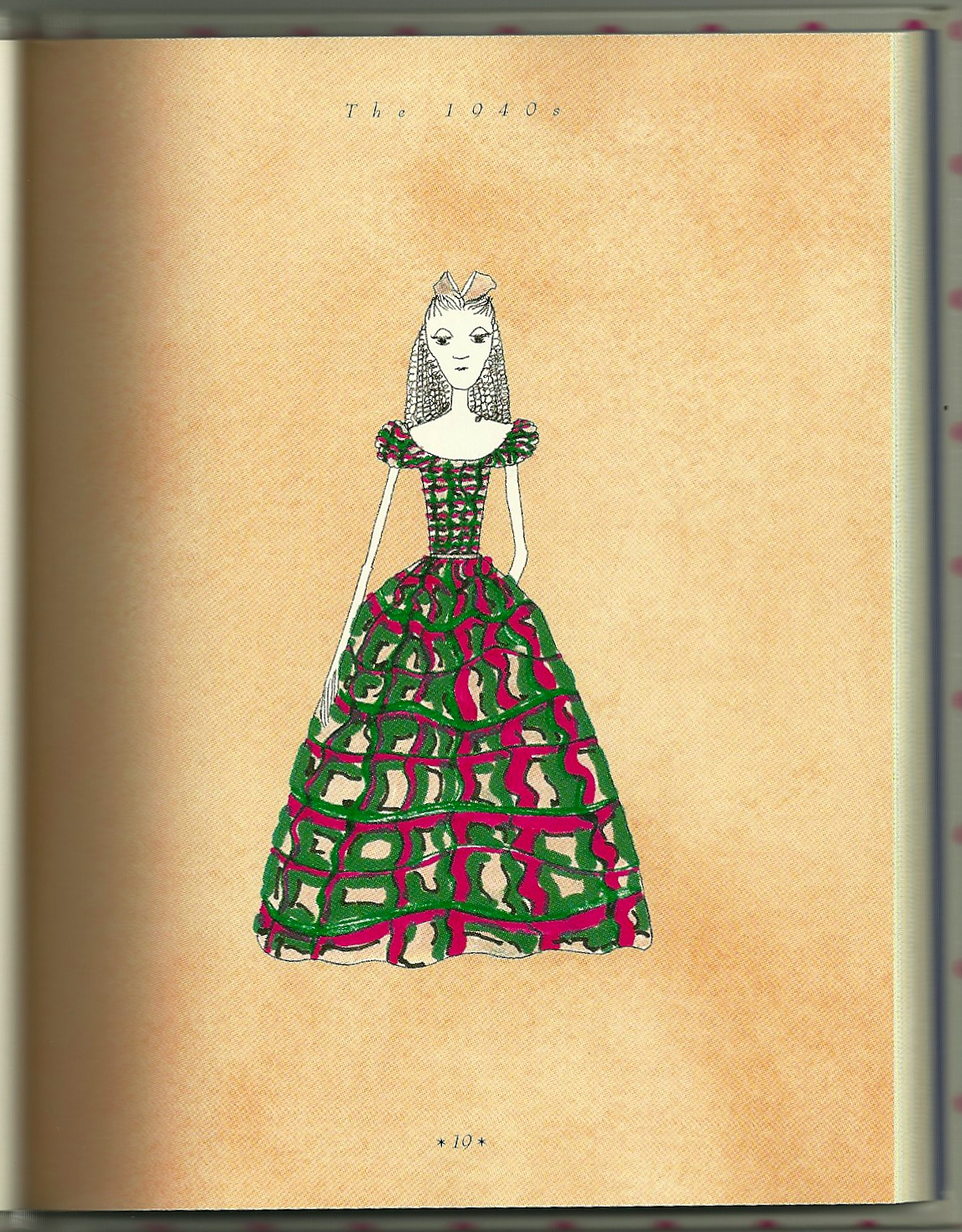
The contents are divided according to decades, starting with the 1940s and continuing into the first part of the 1990s.  The author was born in 1935, so her recollection of clothing and fashion begins when she is a child.  She had the great fortune, as did so many from that era, of having a mother who sewed – beautifully and extensively – for her and her sister.  Here are a few examples:
Love, luck, etc - 1

About this dress which she wore to her cousin’s wedding, Beckerman wrote: “ My mother made this pink, green, and black iridescent-metallic plaid taffeta gown.  We bought the material at Macy’s at Herald Square [New York City].  They had a whole floor for selling patterns and fabrics.”

One of the author’s sister’s dress is featured here:
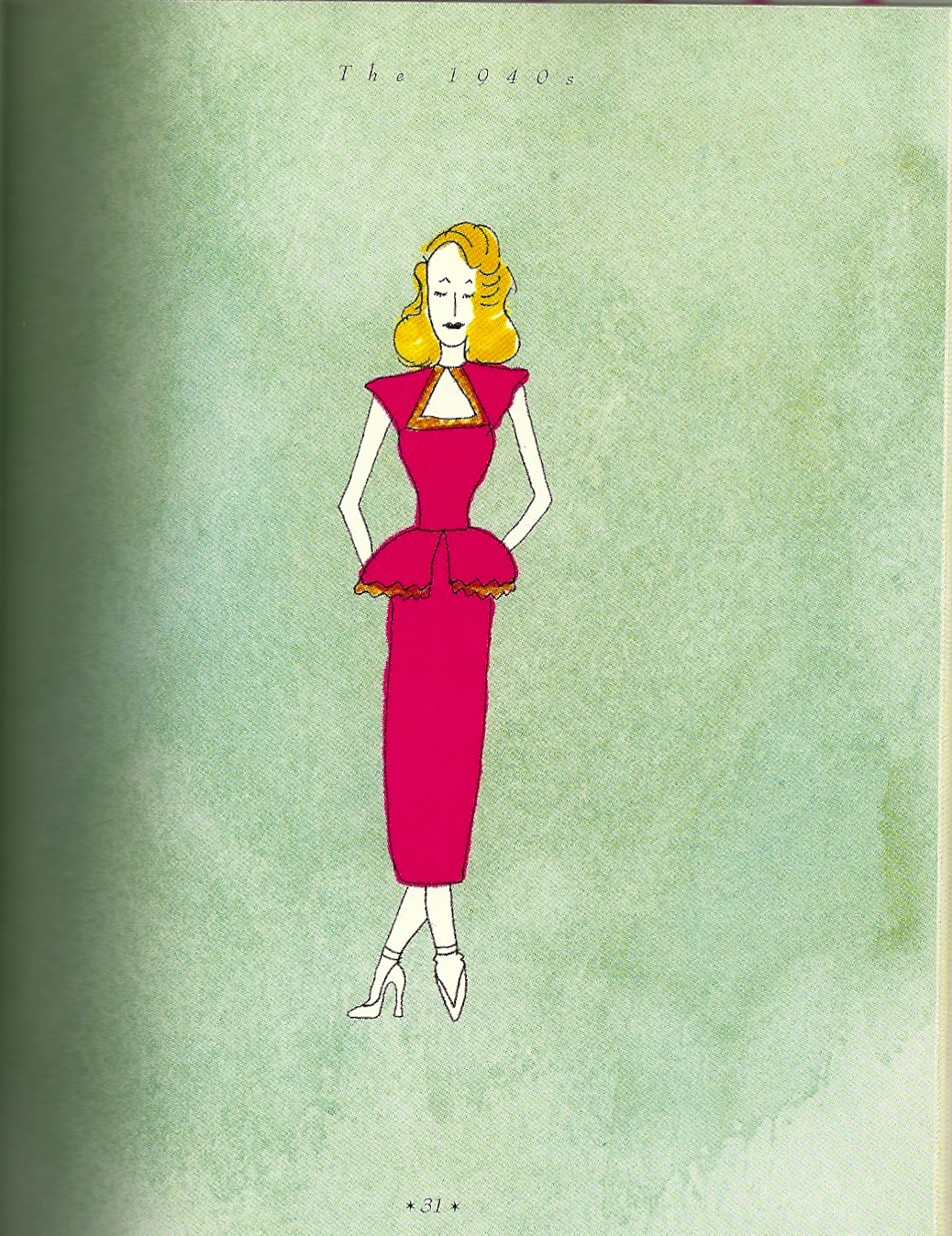
Love, luck, etc - 2 “My mother made this sexy red dress for my sister.  It had a . . . peplum and was accented with hand-sewn gold sequins.”  This prompted the memory of her mother sewing sequins on printed silk scarfs, which served as Christmas gifts for the author’s teachers.

Here is another dress made by the author’s mother – this one for her sister to wear to their cousin’s wedding.
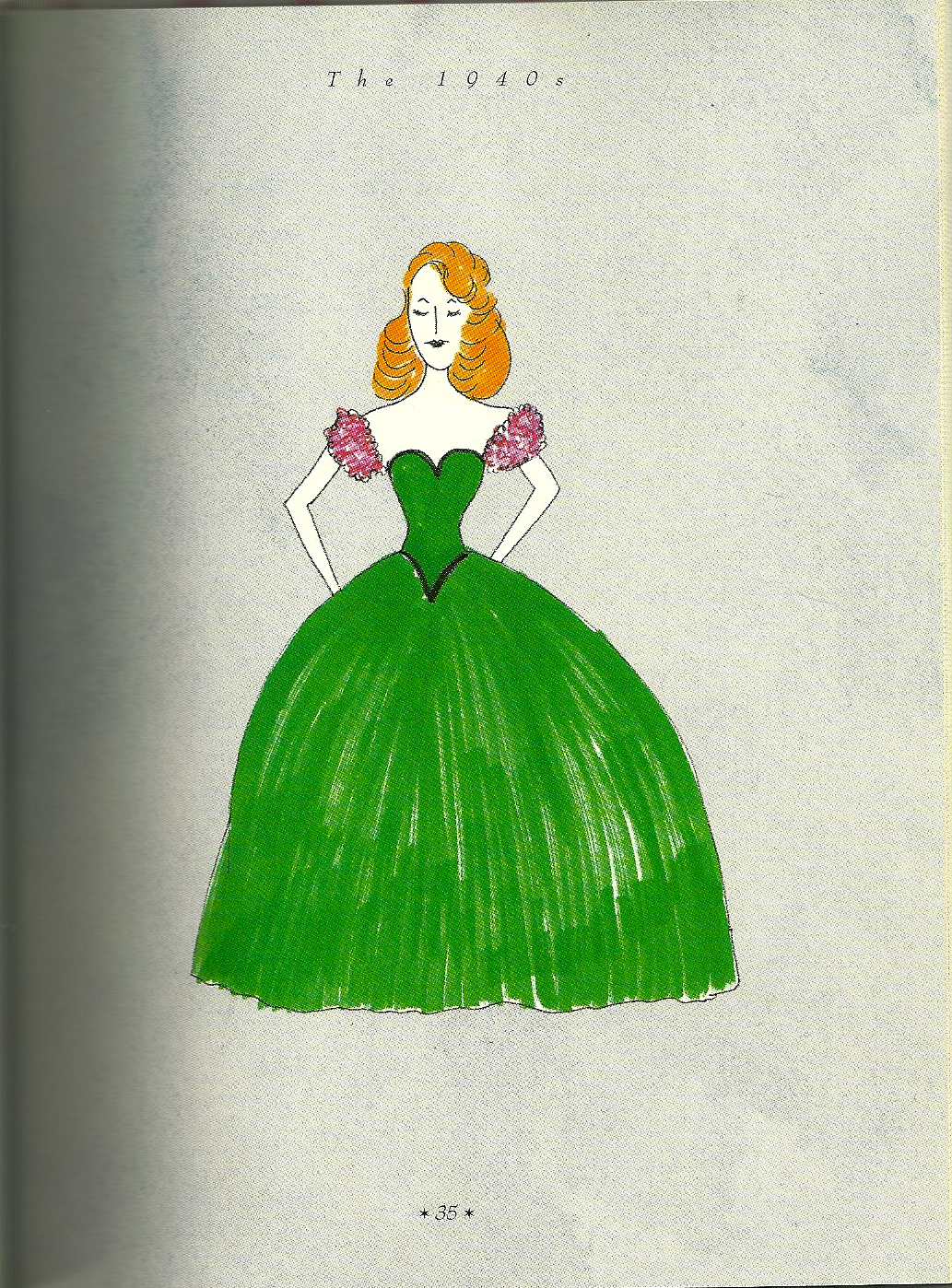
Love, luck, etc - 3 By the 1950s, the author’s mother had died, and with her death came the end of the joy of wearing her sewn creations.  However the author and one of her best friends ventured into some sewing themselves with the making of these cotton circle skirts:
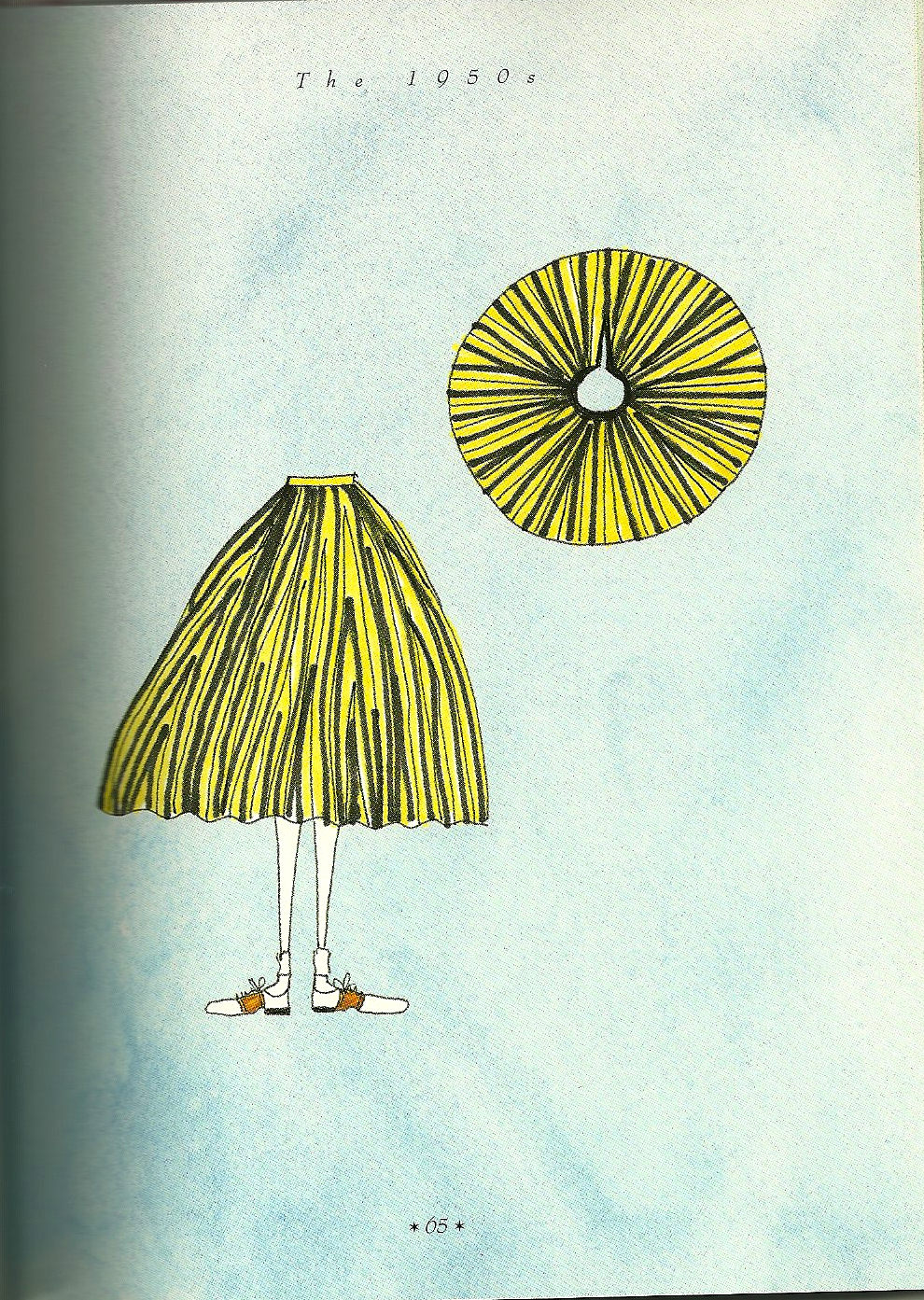
Love, luck, etc - 4 “It took forever to hem them” – says Beckerman, a statement with which any home dressmaker can identify!

This stylish coat was purchased by Ilene, and when shown to another best friend’s mother, Miriam Landey, who happened to be a dress designer/dressmaker, Mrs.Landey told her daughter to go and buy one as well.  Such a compliment!
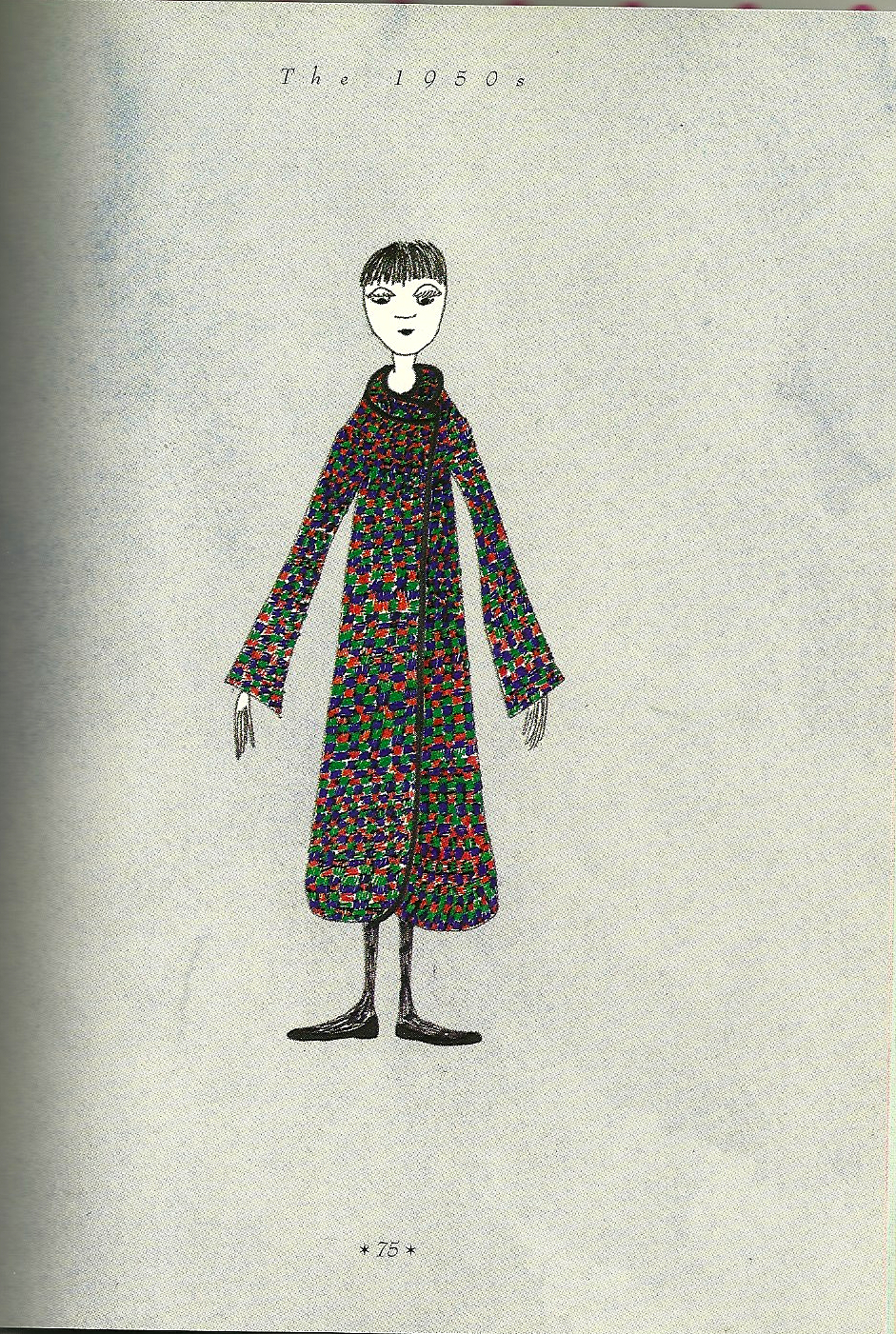
Love, luck, etc - 5 Mrs. Landey, according to Beckerman, “would go to Europe in the summer to buy fine and fancy fabrics…”

The 1960s are marked by only two fashions, one of which is a maternity dress.
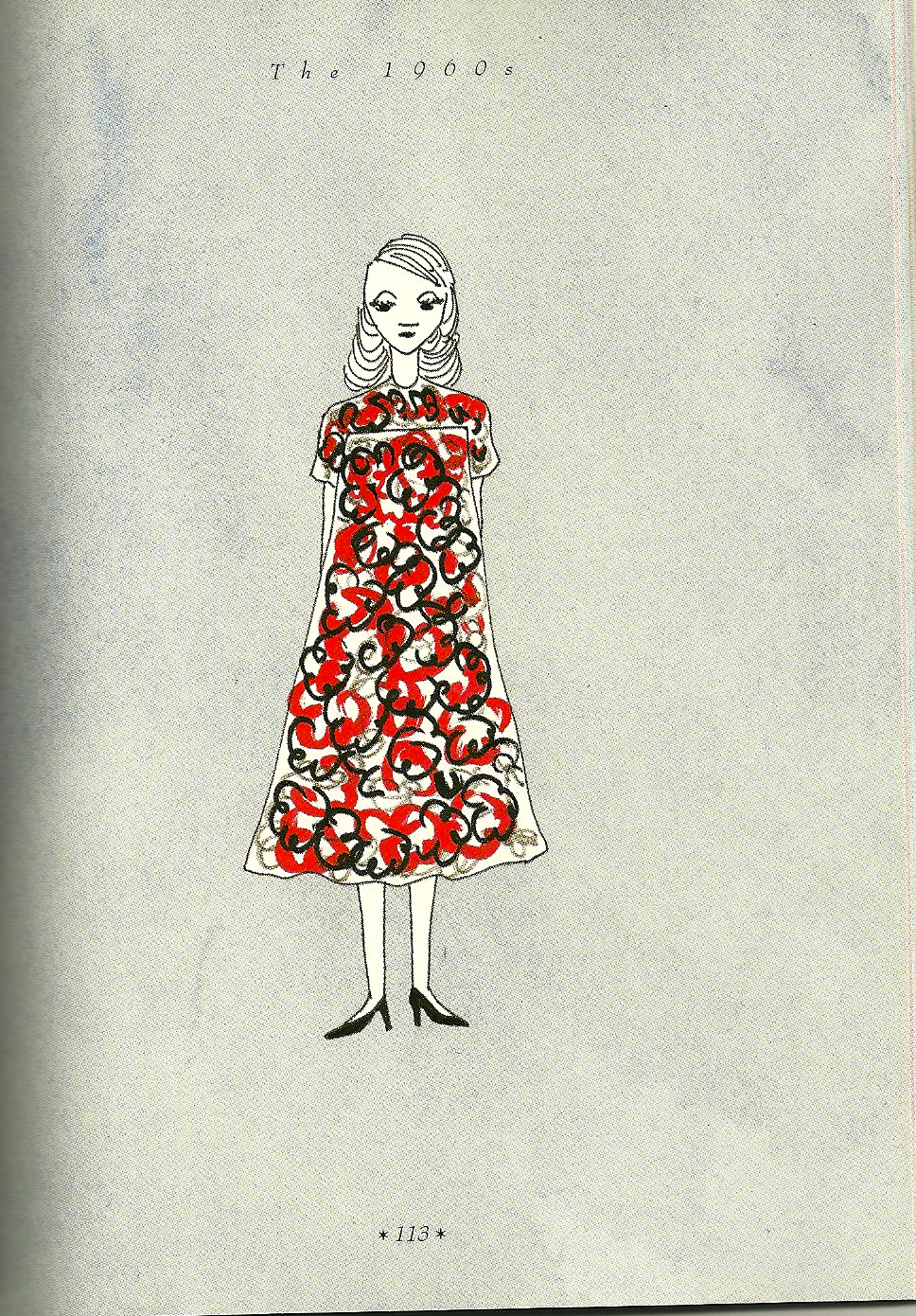
Love, luck, etc - 6 Six pregnancies during the decade surely are the reason for the dearth of fashion memories from that period of time.  Or perhaps the death of one of those children made the memories too painful.

The 1970s, 1980s, and 1990s are lumped together, and are set off most dramatically by this Diane Von Furstenberg wrap dress from the ‘70s.  While wearing this dress, the author came to the decision to end her marriage.  How could one not remember what she wore at such a time in her life?
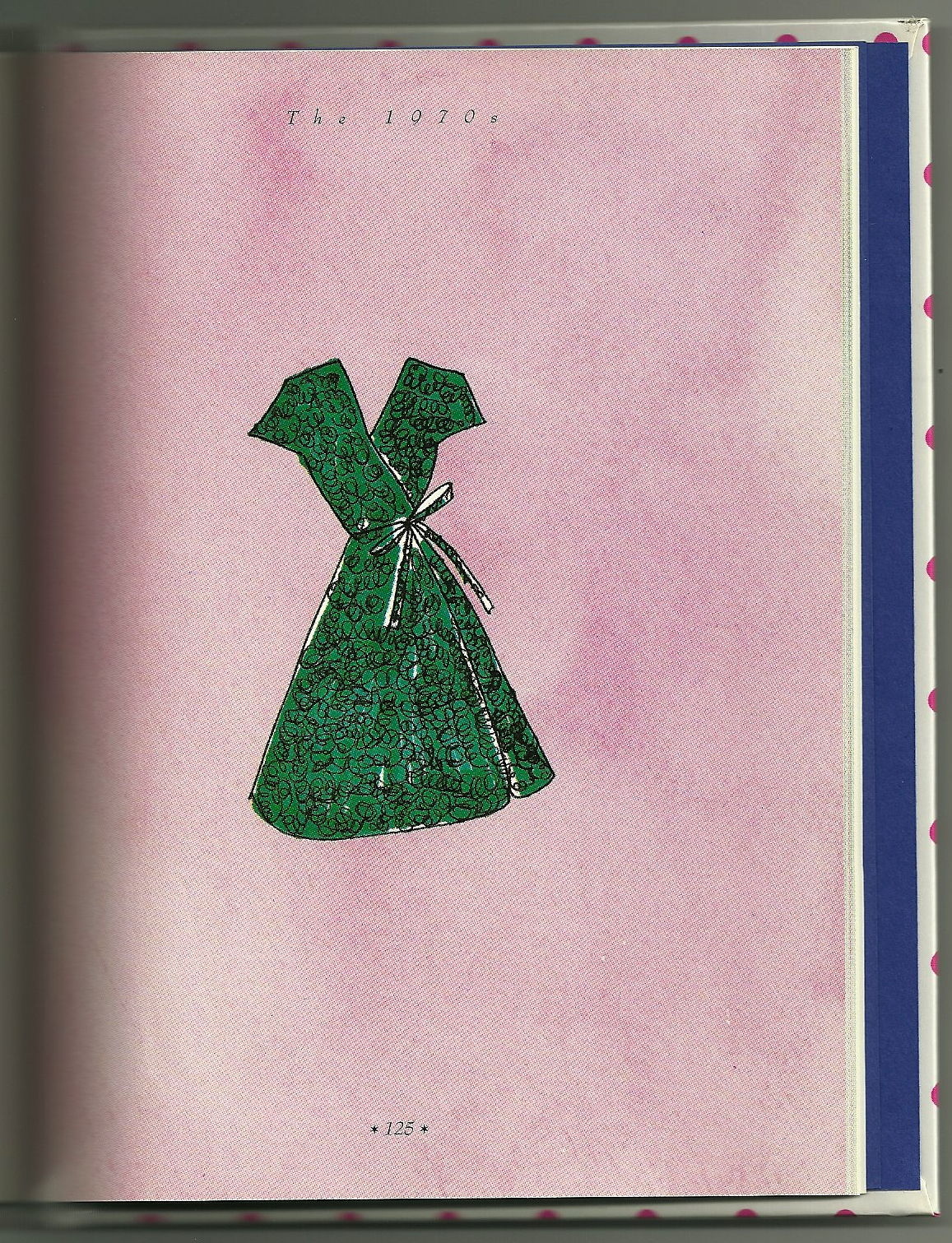
Love, luck, etc - 7 As the story ends, grown children marry and have children of their own.  But at night, says Beckerman, she reflects on her mother and the dresses she made.  “I like to think I got my fashion sense from my mother and from Dora’s mother [Mrs. Landey].”  Thus is a life remembered by what she wore, and so many of those memories have their foundation in home-sewing.

It had been a while since I had looked at this little book, but I had occasion to dig it off the shelf recently, right after I finished my Chanel-inspired red jacket.  I went to it after a difficult life event, which I know I will now always associate with that jacket.

I was happily expecting to finish all the final hand-work on my jacket within a day or two (okay, maybe three!), when, as the saying goes, “life is what happens when you are making other plans”.  After a fairly routine diagnostic medical test, my husband and I unexpectedly found out he had to have open-heart surgery for a triple coronary by-pass.  I was still in shock (my fit, active, healthy husband?), when the surgery was quickly scheduled for the following morning at 6:30 AM.

Suddenly I was relieved that I still had much to complete on my jacket.  Facing what I knew would be some of the longest hours of my life – the 5 to 6 hour operation – I packed up my unfinished jacket, thread, pins, etc. in the very still and long, lonely hours of the night preceding the surgery.  And so – the next morning, sitting in the hospital, I sewed and sewed and sewed as the hours slipped by, the time punctuated by phone calls and, blessedly, by occasional good reports from the Operating Room.  My needle and thread kept me calm – I equated every stitch with repairing my husband’s heart.  And so it was  – beautifully, successfully repaired . . .

The following days took on a life of their own, as I shuttled back and forth to the hospital, spending hours every day by my husband’s bedside.  And then one day, on a whim, I brought in the as-yet-incomplete pockets for my jacket.  I sat and sewed the trim on to the top edge of each one (much to the delight of my husband who did some bragging about my sewing skills), arousing much curiosity among the doctors, nurses, staff, and visitors.
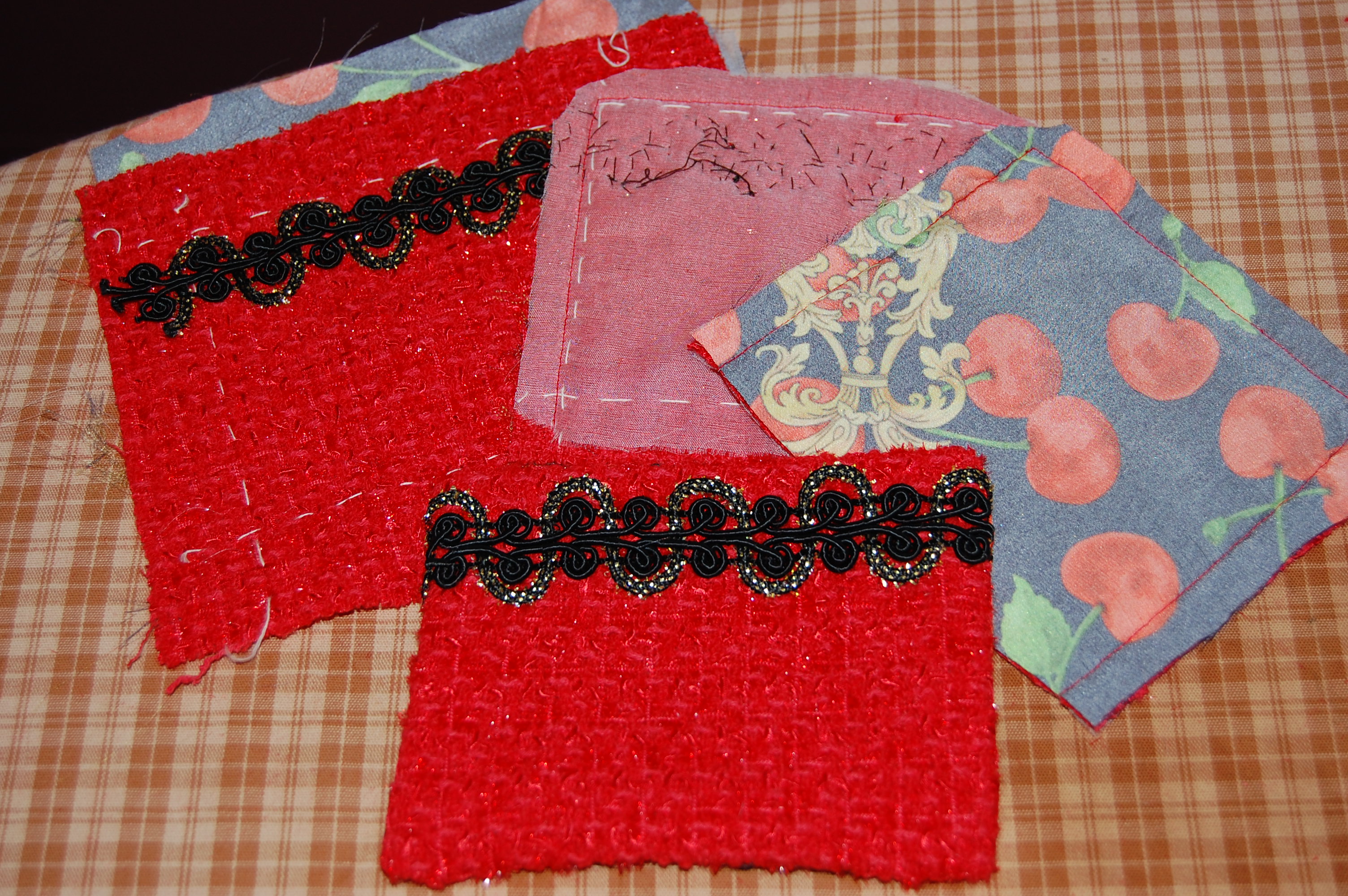
Here are the four pockets, in various stages of completion.  I decided to add silk organza interfacing to them (suggested by Susan Khalje, but optional).

Here are the four pockets, in various stages of completion. I decided to add silk organza interfacing to them (suggested by Susan Khalje, but optional).

It seems that construction of parts of a Chanel-inspired jacket was a first for the Intensive Care Unit and then the Progressive Care Unit!  By the time my husband came home a week after the surgery, he had made tremendous progress.  I had made progress on my jacket, too, but most importantly, sewing on it had given me a sense of normalcy during a time of great uncertainty.

So many people have told us how lucky we are, and it is difficult to express how very correct they are.  Instead of “loss”, we have, indeed, been abundantly blessed with love and luck.
28 Comments

Filed under Book reviews, Chanel-type jackets, Uncategorized

Paris in Baltimore – and Beyond: A Small Fashion Show

Shortly after I returned home from my Classic French Jacket Class with Susan Khalje, an article entitled “The Comeback of Haute Couture” appeared in The Wall Street Journal.  The reporter, fashion editor Christine Binkley, gives an overview – from the haute couture week in Paris, of course – of the frenzied and renewed interest in “astronomically expensive made-to-measure clothing [ranging] from $10,000 to $150,000 or more.”  Among the fashion houses showing haute couture collections was Chanel.  To quote:  “Chanel . . . looked as though the clothes could be easily worn, even if they were assembled, pleated, and embellished by dozens of ‘petite mains,’ as haute couture seamstresses are called. ‘Of course it’s comfortable.  It’s Chanel,’ said designer Karl Lagerfeld . . .”

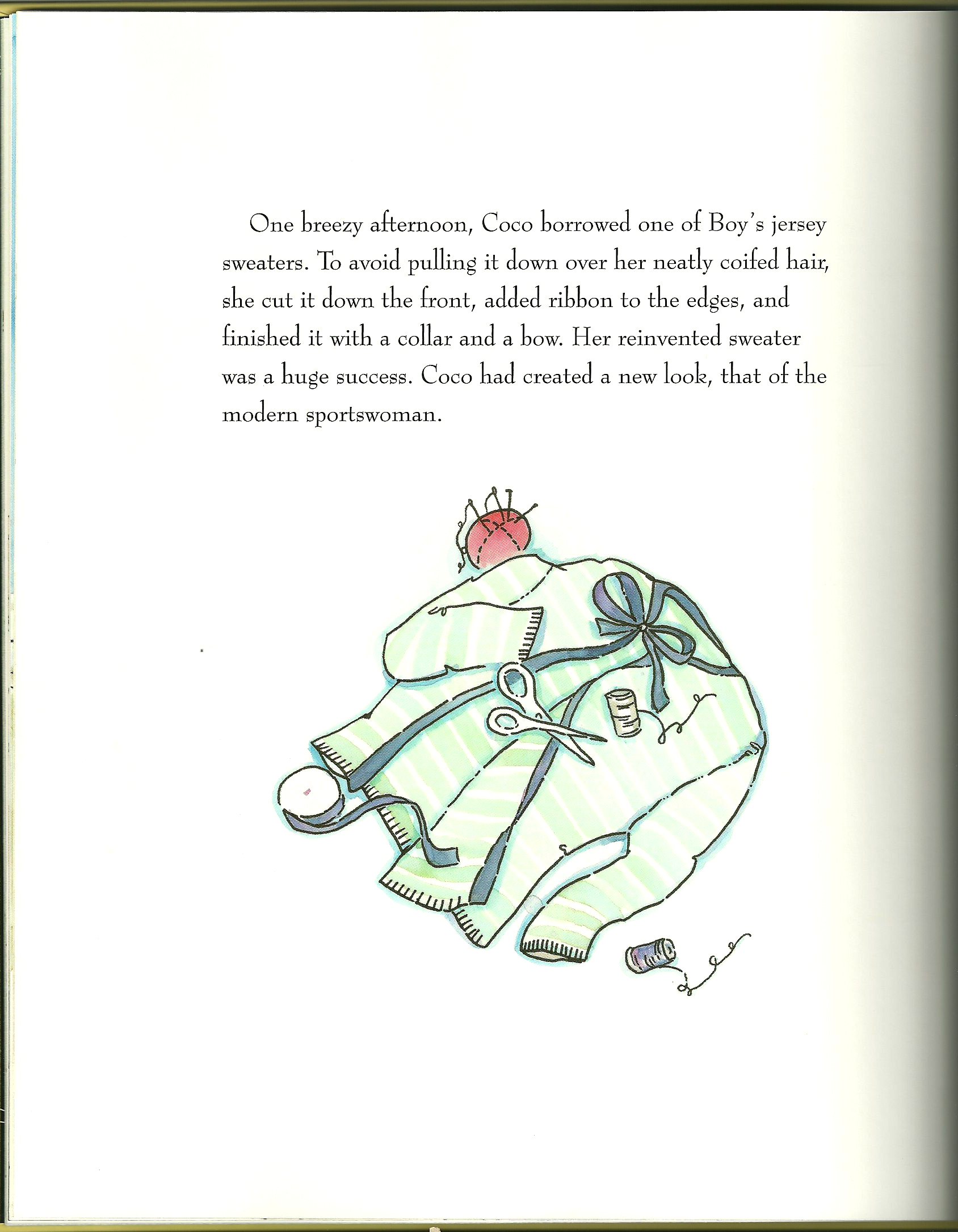
“Comfortable” is a description frequently used by those of us making our own Chanel-inspired jackets.  Of course, everyone knows that the inspiration for Coco Chanel’s original cardigan jacket came when she cut her lover’s cardigan sweater down the front, added some ribbon trim and created a classic.  How the construction of the jacket went from sweater to quilted, silk-lined boucle is unknown to me, but one thing is for sure:  these jackets feel as cozy and comfy as any old favorite sweater.  I think this was a revelation and lovely surprise to all of us.  It makes wearing them all the more rewarding.

And – wear them we are starting to do!  Some of my classmates have kindly given me permission to show their finished jackets here on Fifty Dresses.  I am delighted to share these lovely examples made by “petite mains” Joanne, Holly, Myra, and Sherry:

Joanne’s classic black jacket is elegant and so versatile.  Her lovely floral lining fabric does not show, but trust me that is stunning.

A simply lovely jacket!

A simply lovely jacket!

Holly’s jacket has sparkle to it, just like her!

Look at the beautiful lining that Holly chose.

Look at the beautiful lining that Holly chose.

Isn't this color perfect for Holly?

Isn’t this color perfect for Holly?

The buttons which Holly chose are perfect!

The buttons which Holly chose are perfect!

With a few scraps left over from her lining, Holly made a color-blocked shell to wear with her jacket!

With a few scraps left over from her lining, Holly made a color-blocked shell to wear with her jacket.

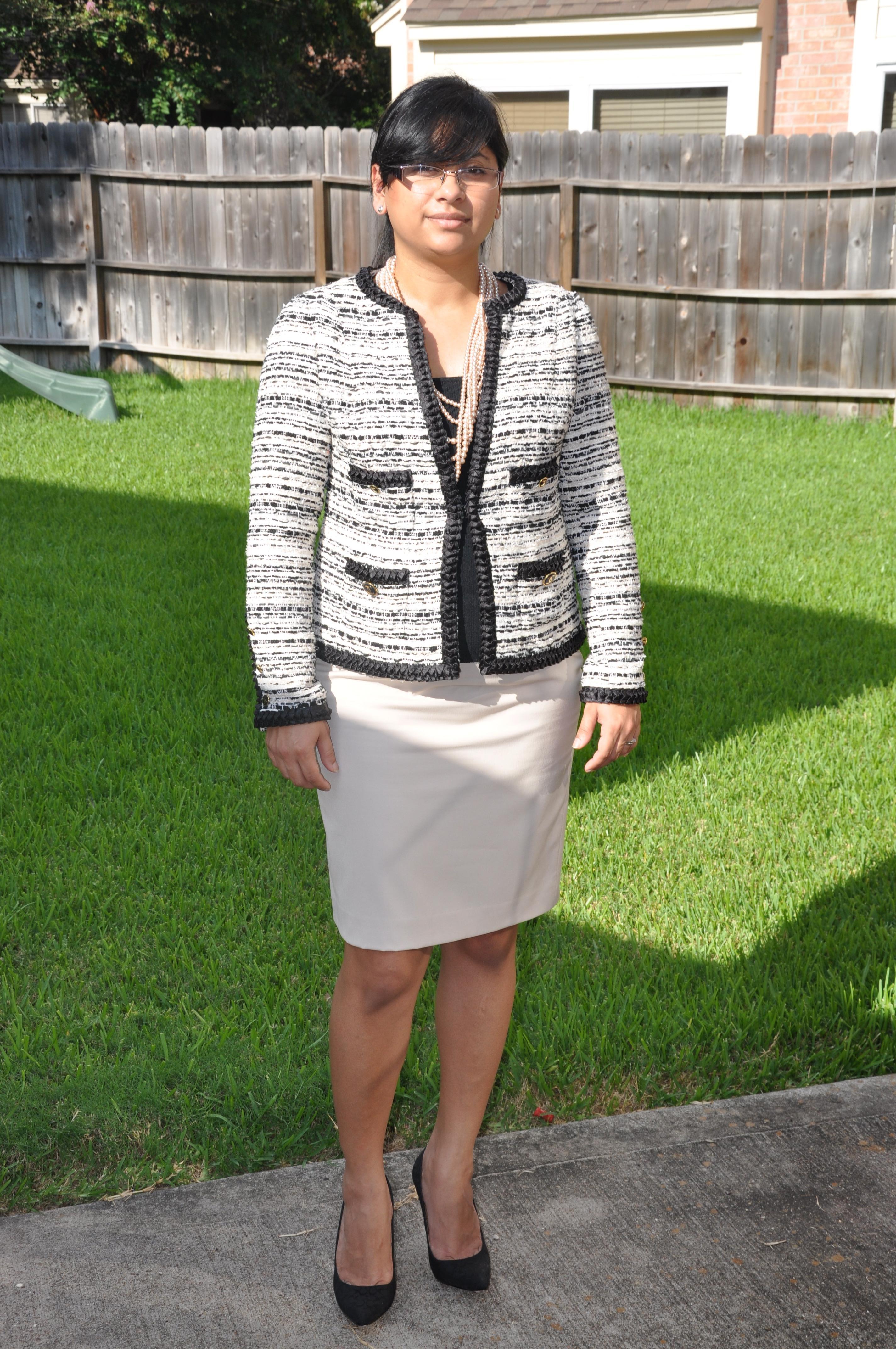
Myra’s horizontally and unevenly striped boucle caused some minor headaches during the pattern placement, but look how beautifully it turned out.

Looking lovely even in the hot sun!

Looking lovely even in the hot sun!

Myra's jacket - 2

Myra's whimsical lining fabric features images of Audrey Hepburn.  She brought this fabric with her to Baltimore and chose her boucle accordingly.

Myra’s whimsical lining fabric features images of Audrey Hepburn. She brought this fabric with her to Baltimore and chose her boucle accordingly.

Sherry chose a creamy white, loosely woven “windowpane” boucle for her jacket, and the result is pure loveliness.

Isn't this beautiful??

Isn’t this beautiful??

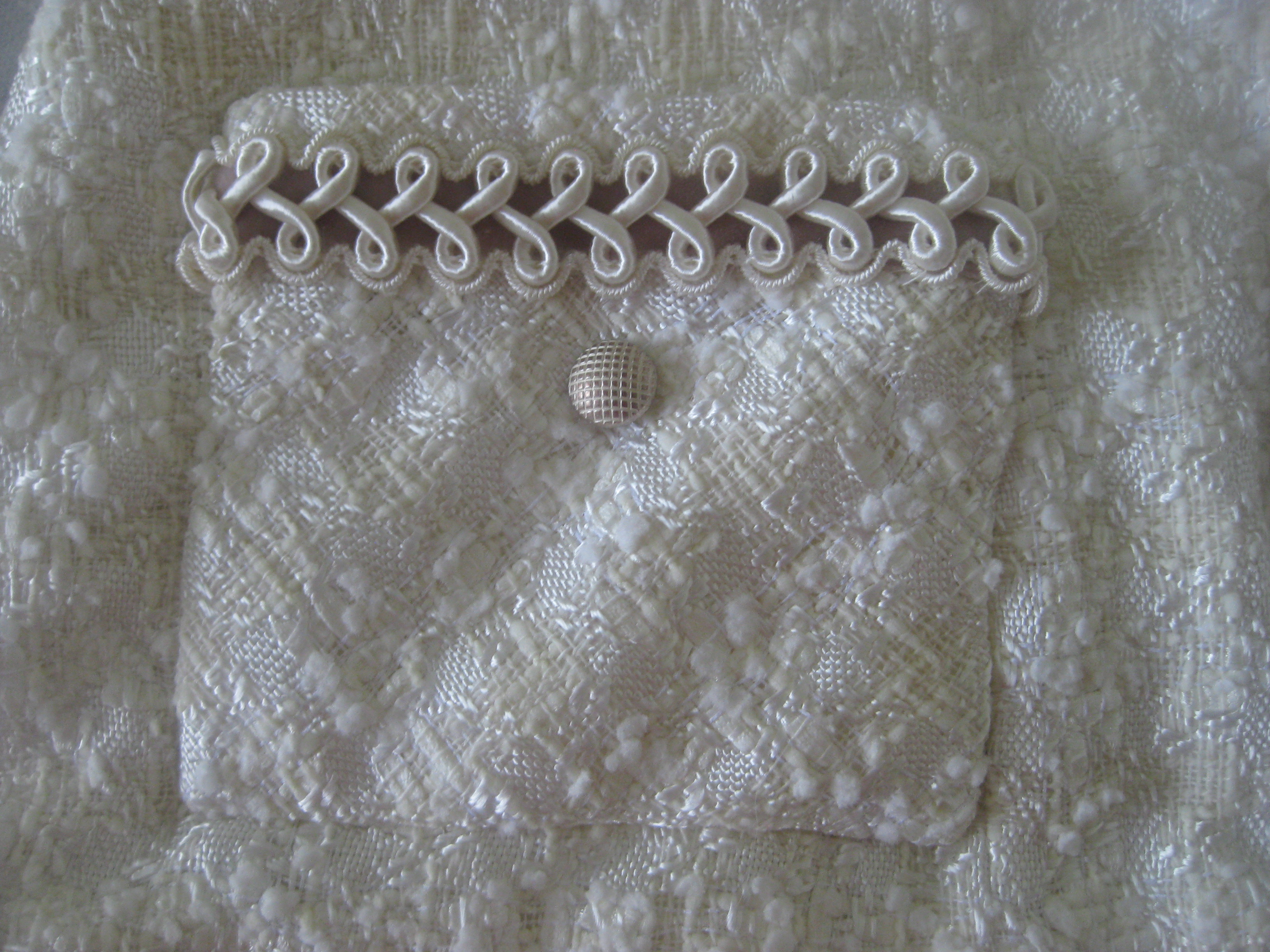
Sherry very cleverly made her pockets on the bias.  The petite buttons are just right for the weave of the fabric.

Sherry very cleverly made her pockets on the bias. The petite buttons are just right for the weave of the fabric.

Look how well Sherry's jacket fits.

Look how well Sherry’s jacket fits. 

One of the many fun aspects of the class was the color variety of jackets being sewn.  While there were other deep shades (raspberry pink, royal blue, true purple) I was the only one making a red jacket.

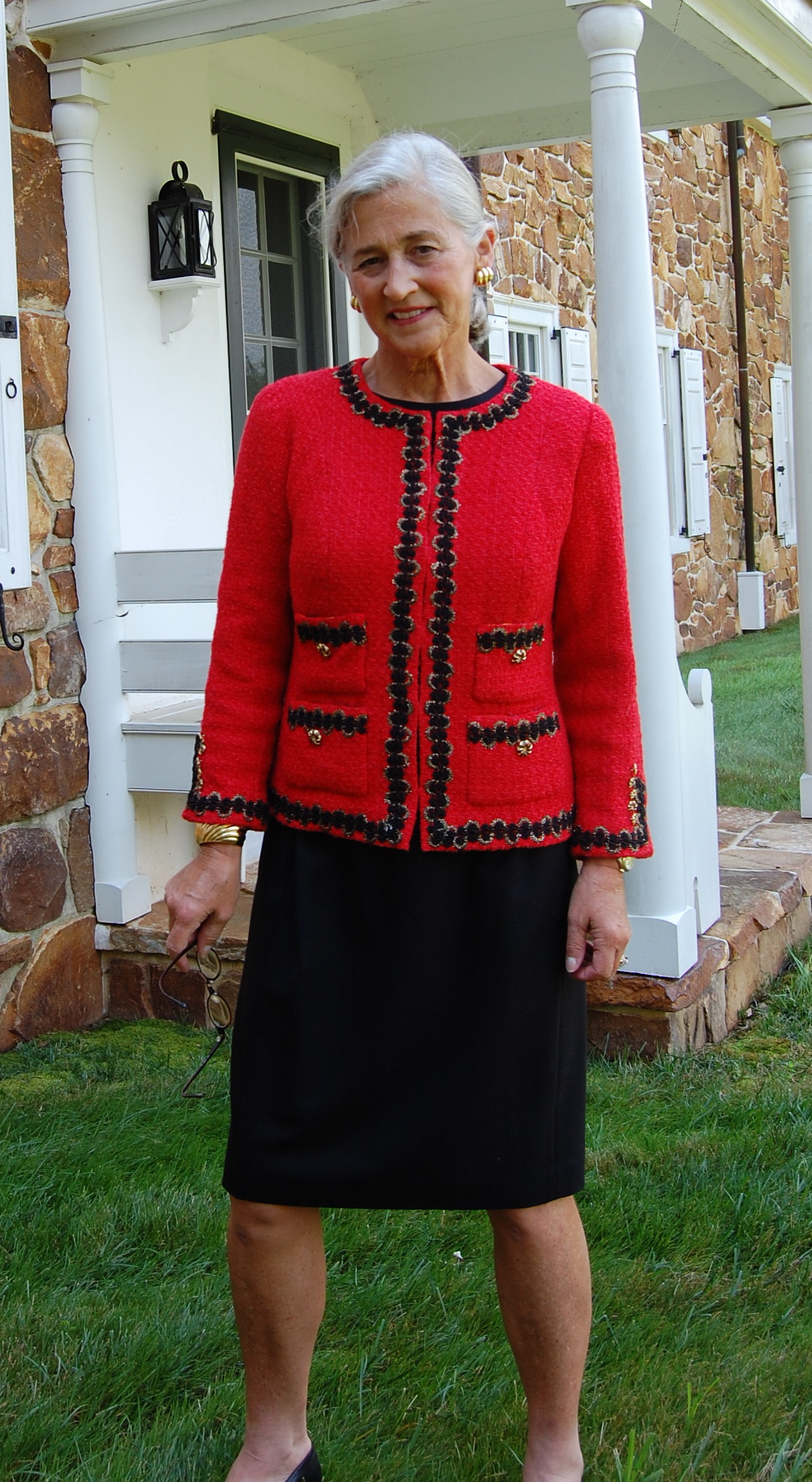
For starters, here is my jacket hanging.

For starters, here is my jacket hanging.

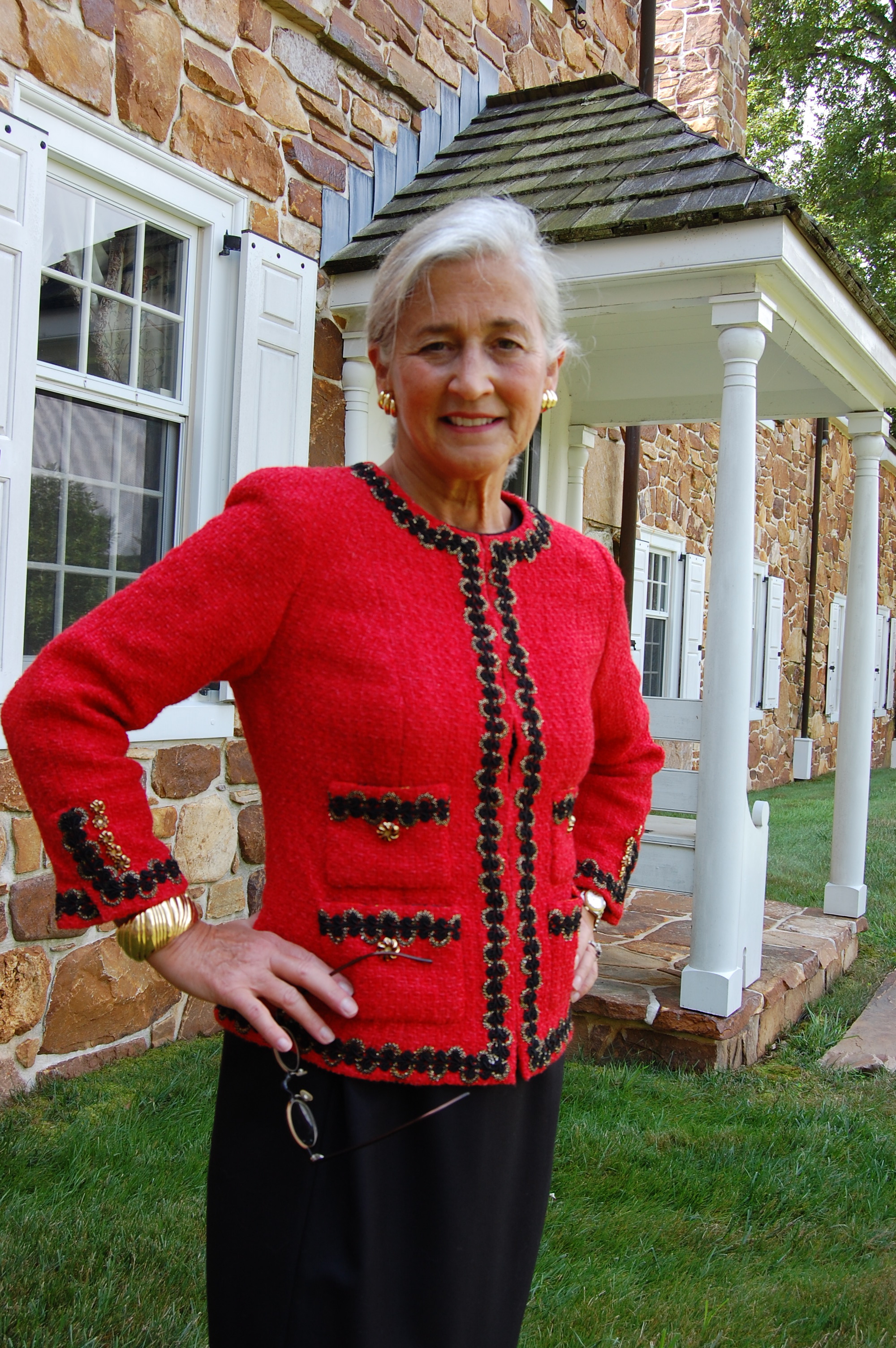
A few details.

A few details.

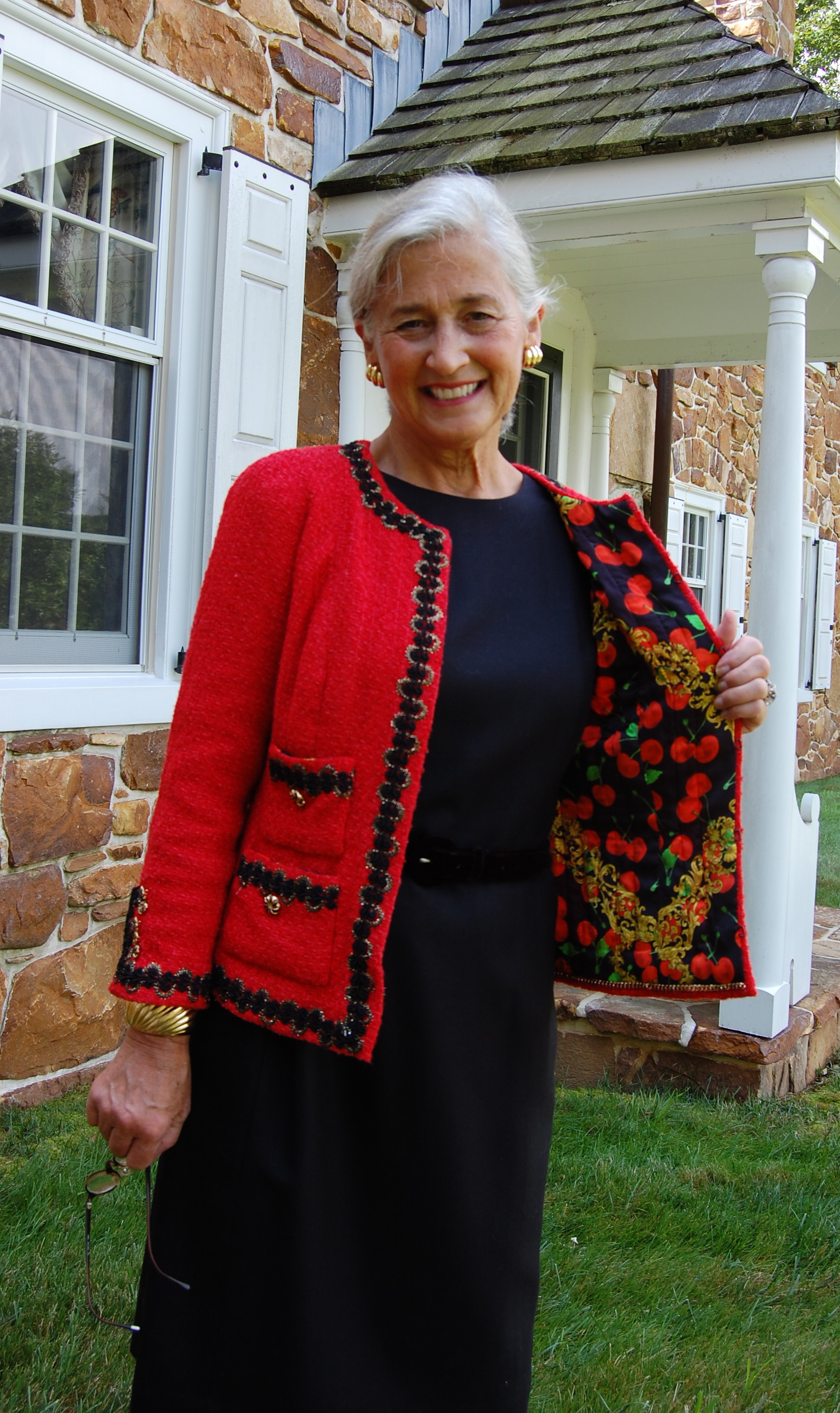
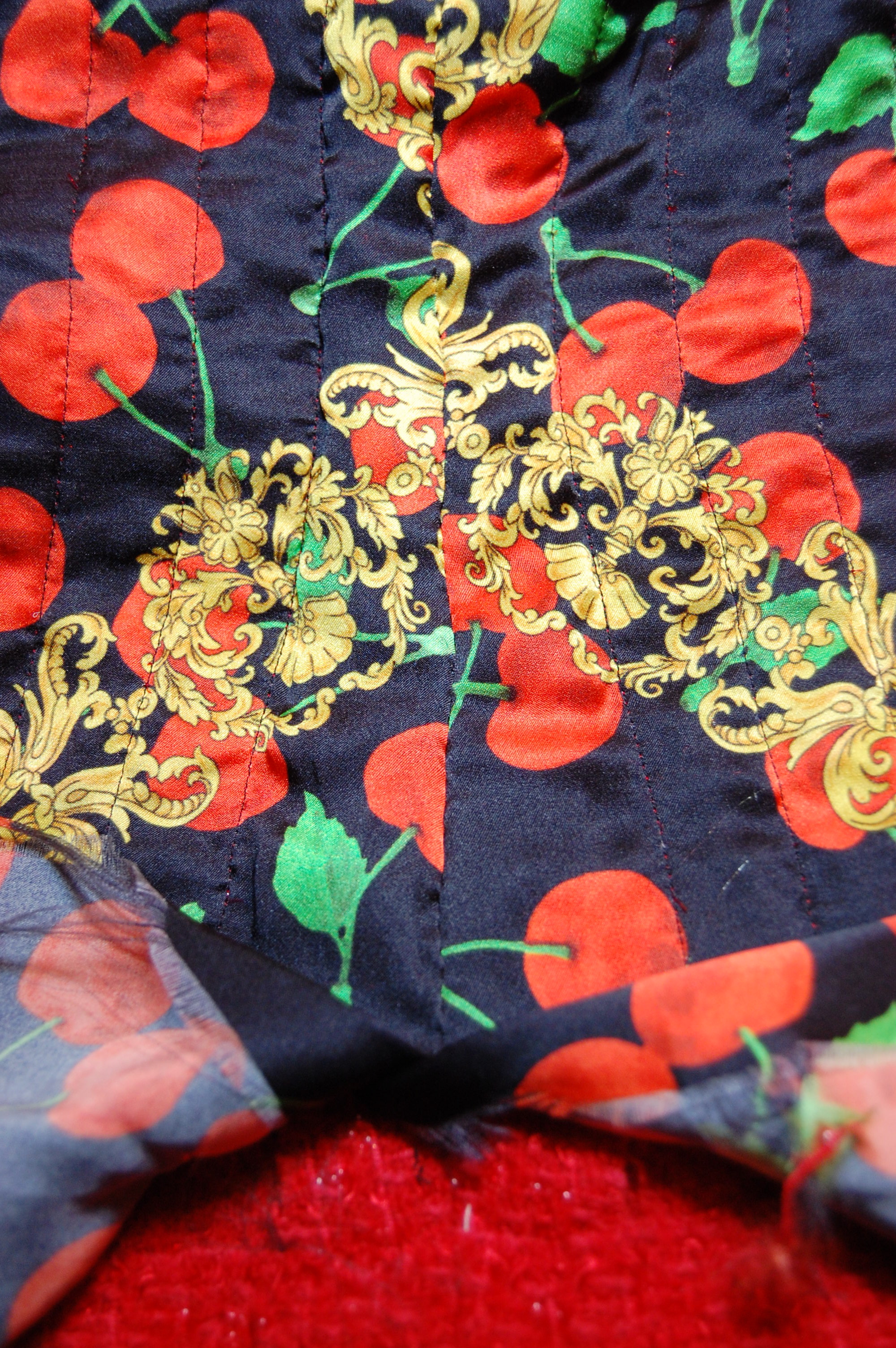
A view of the lining.

A view of the lining.

Shown with basic black.
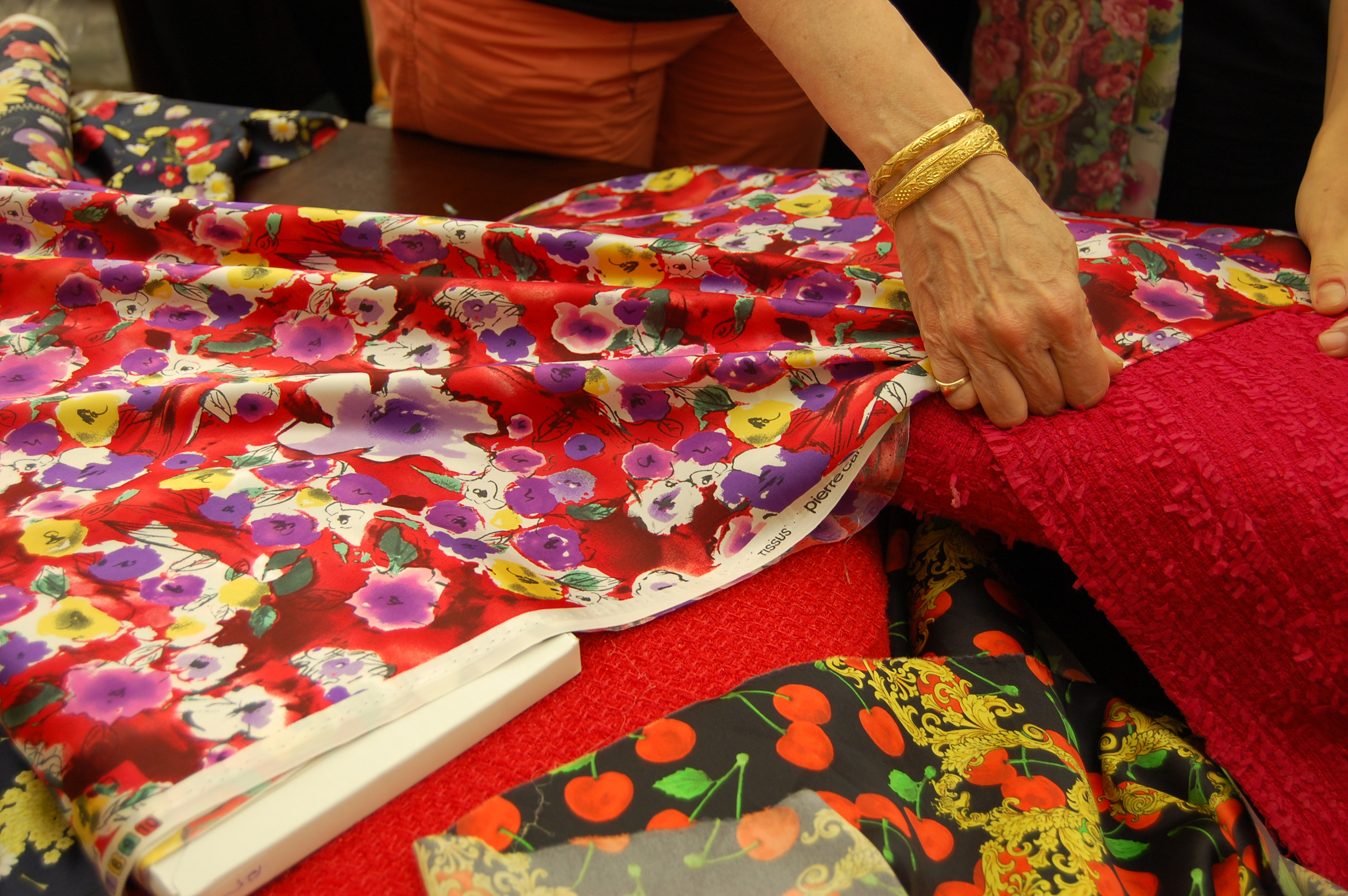
Shown with basic black.
I can't believe it's finished!

I can’t believe it’s finished!

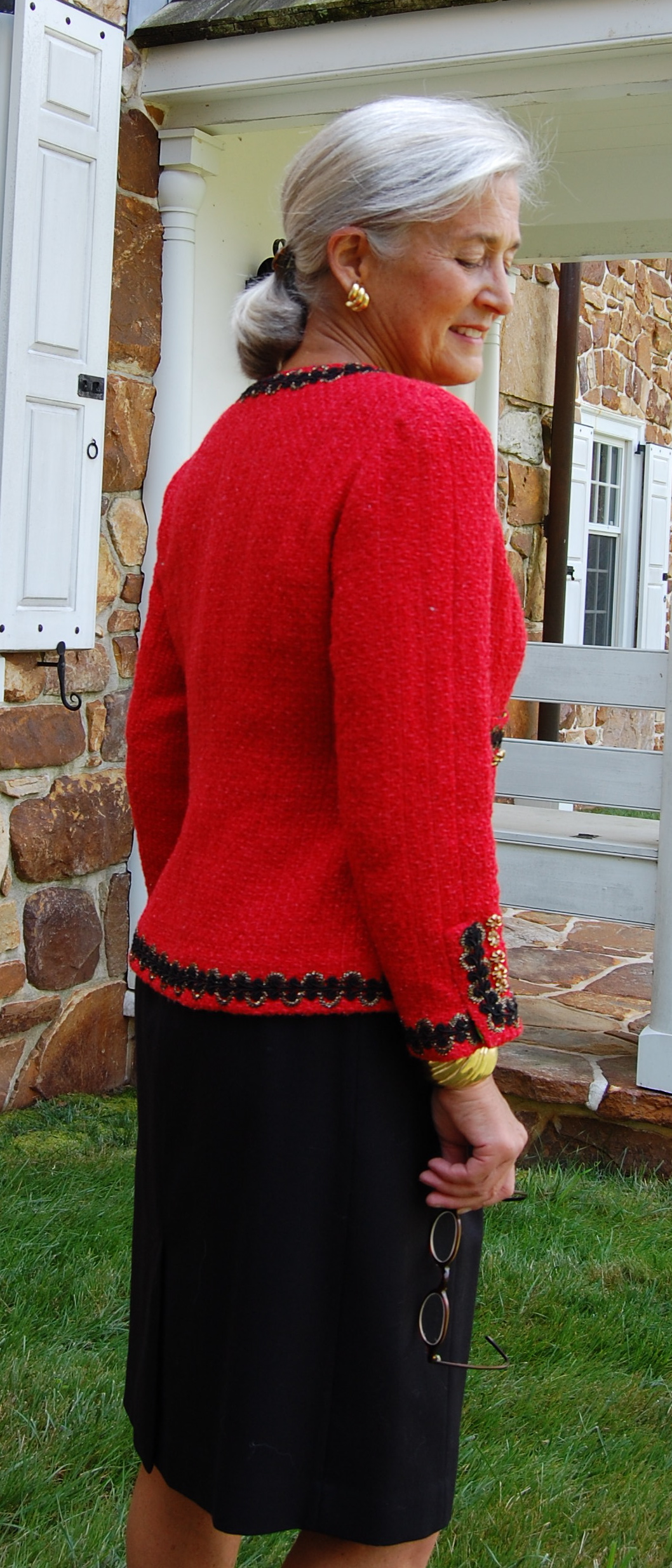
I added a gradual 1/4" to the back length, which gives it a more graceful line, I think.  This was one of Susan's many excellent suggestions.
I added a gradual 1/4″ to the back length, which gives it a more graceful line, I think. This was one of Susan’s many excellent suggestions.

Red Chanel jacket

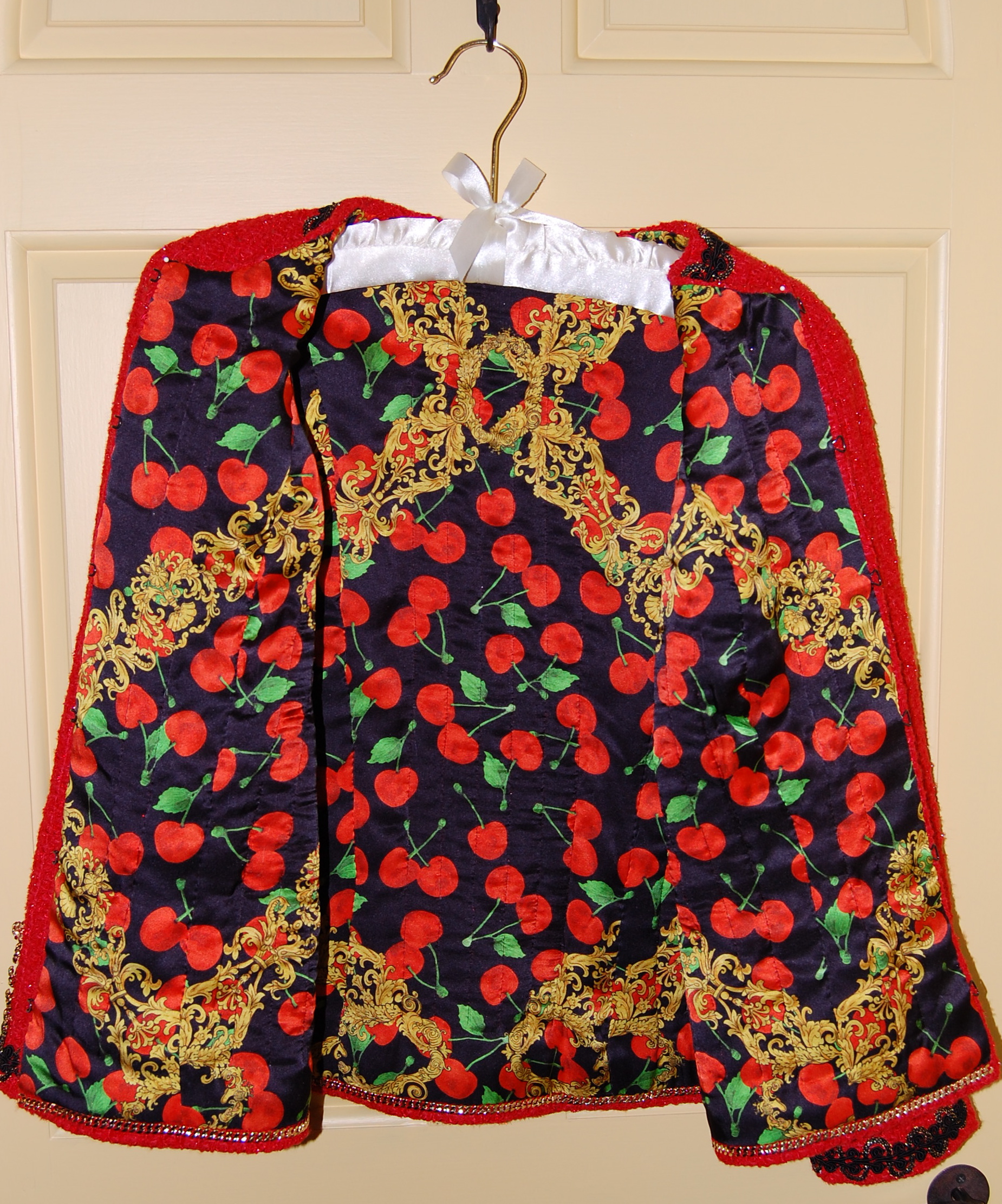
There is nothing shy about this lining fabric!

There is nothing shy about this lining fabric!

During the lengthy process of making my jacket, I have had lots of time to reflect on some of its charms:

1) Boucle is wonderful for hand-sewing, as one’s stitches simply disappear into the fabric.

2) This is “common sense” sewing: every step (of which there are many) adds in subtle or significant ways to its wear-ability, appearance, or fit.

3) Finishing a project like this is empowering.  I felt like I grew as a “dressmaker” during this process.  And beware . . .

4) Finishing a project like this is addictive.  Yes, I already have a boucle for my next one . .

However, before I start my next one, I have one thing to (start and) finish:   That charmeuse I used for the lining?  I purchased enough to make a sleeveless sheath dress to wear with my jacket.

What was I thinking??

28 Comments

Filed under Chanel-type jackets, Coco Chanel, couture construction, sewing in silk, Uncategorized

Paris in Baltimore – Part 1

It might be stretching a point to compare our Classic French Jacket Class, taken with Susan Khalje at her workspace just outside Baltimore, Maryland (USA), to spending time in Paris, France.  However, I could not help but feel that the twelve of us in the class were a small part of a continuum of dressmakers dedicated to haute couture, even if we were all sewing for ourselves!  Certainly the outstanding instruction we received and the techniques we learned are consistent with the standards associated with such fine custom sewing  – and with timeless, classic fashion.

A classic French jacket (or Chanel-inspired jacket) has certain characteristics and sewing techniques which are specific to it. Among these are:

1) These jackets are usually cardigan style, with the front edges abutting rather than over-lapping.

2) The fabrics of choice for these jackets are boucles or sometimes loosely woven tweeds.

3) The lining is machine quilted to the fashion fabric, but does not show because of the nature of the fabrics which are traditionally used.

4) The interior structure and integrity of the garment depends on this quilting and on extra-generous seam allowances (common in haute couture).  The only interior interfacing is a small section at the shoulder, front and back, extending down just to the lower armscye.

5) Shaping of the garment is accomplished by vertical princess seams which form the fullness for the bust line.  Darts are rarely used, but sometimes necessary (as several of my classmates discovered).

Here is Vogue 7975, which is the "go to" pattern for one of these jackets.  (However, as Susan says, the pattern is just a starting point.)  The vertical princess seams can be seen on these drawings.

Here is Vogue 7975, which is the “go to” pattern for one of these jackets. (However, as Susan says, the pattern is just a starting point.) The vertical princess seams can be seen on these drawings.

6) Hand sewing is used extensively in the construction and finish work on these jackets.

Our instruction began the day after our whirlwind trip to NYC to buy our boucle, charmeuse lining, trim and buttons.  Looking back on the week, it seems to me that the process can be divided into specific sections:  (1) preparing and fitting the muslin, and cutting out the fashion fabric and lining, (2) quilting and assembling the body of the jacket, (3) fitting, cutting out, and sewing the sleeves, and (4) all that finish work.  Although none of the techniques is difficult, it is all very time-consuming, and it can not be rushed.

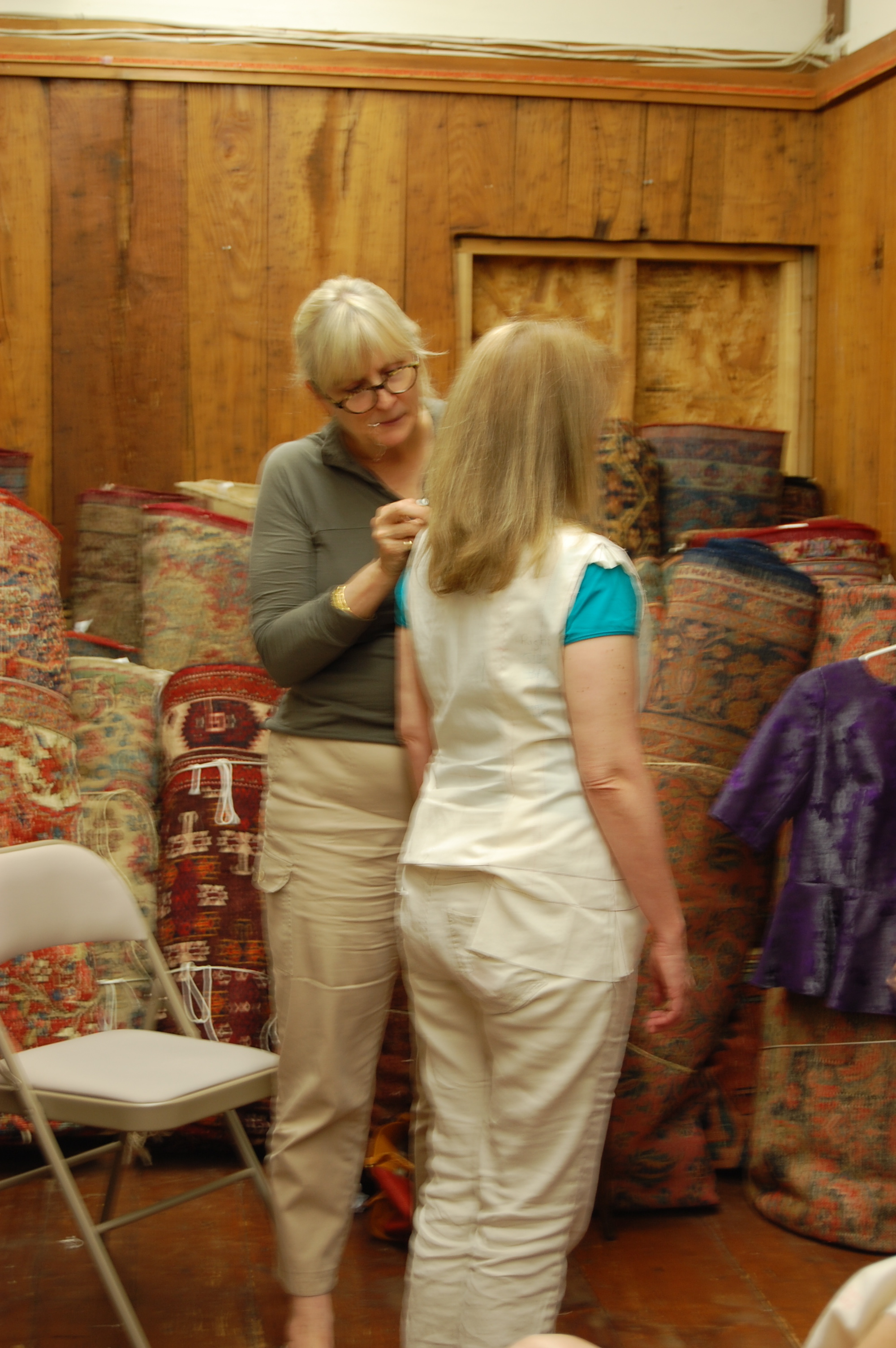
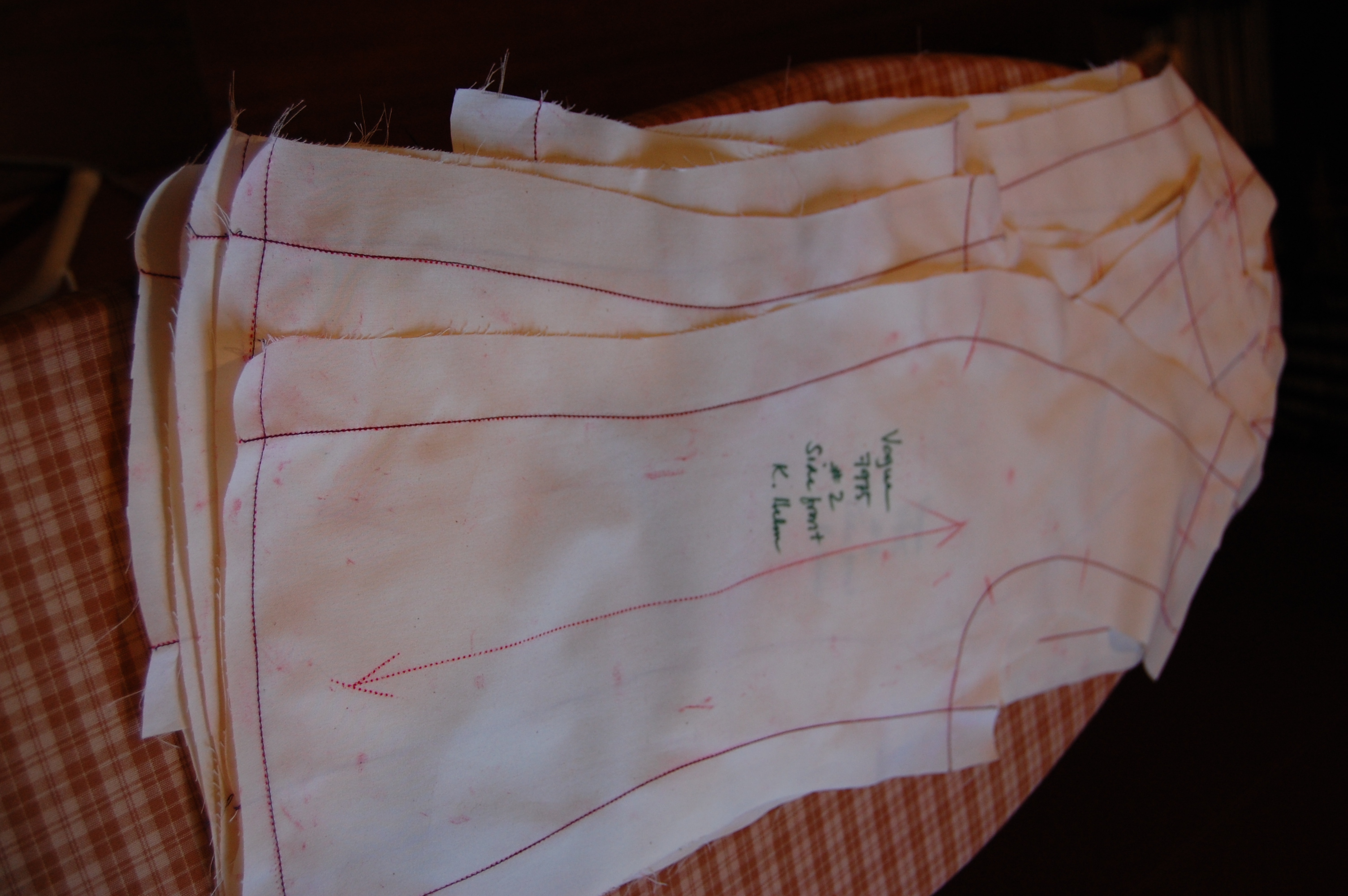
To start the process, we all came to class with pre-prepared thread-traced muslins.  (I believe we were all using the standard Vogue 7975 pattern, details of which are shown above.)  The fitting process began with the body of the jacket, minus the sleeves.  (I quickly lost count of how many jokes were made during the week about our “vests”.  But on about Friday, the thought of making vests instead of jackets was beginning to appeal!)  Susan meticulously and expertly fitted each of our muslins, which was fascinating to watch.  When it came to deciding preferred hem lengths, we usually had a group consensus – collective thought for something like this is incredibly helpful!

Susan making adjustments in Diane's muslin.

Susan making adjustments in classmate  Diane’s muslin.

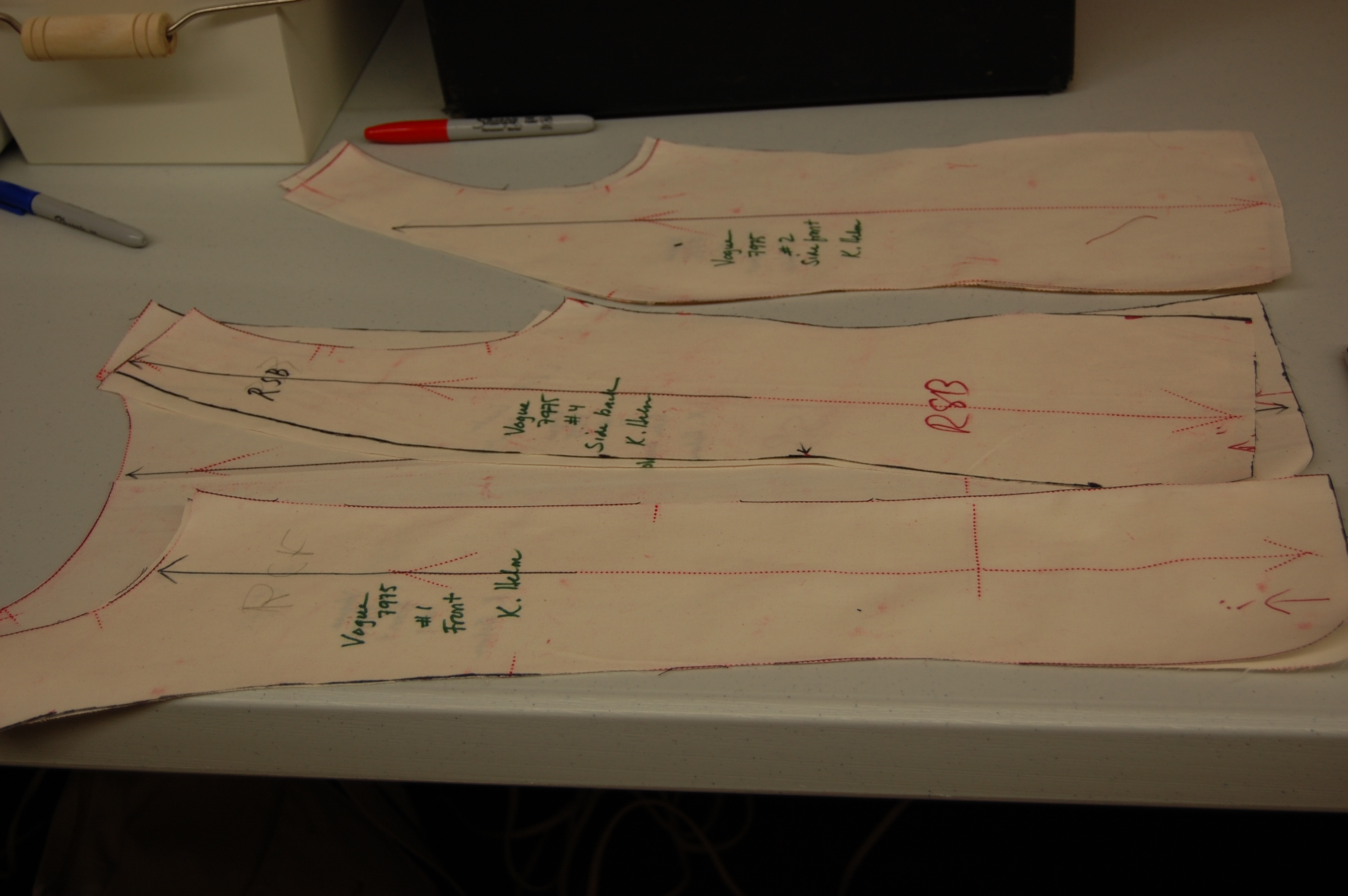
After marking and adding all the fitting changes onto our muslins, part of the uniqueness of the construction of these jackets became apparent.  Why?  Susan instructed us to cut out our muslins on the sewing line – and these pieces became our new pattern.  The extra-generous seam allowances would be added as the pieces were cut out.

Here are some of my trimmed muslin pieces.

Here are some of my trimmed muslin pieces.

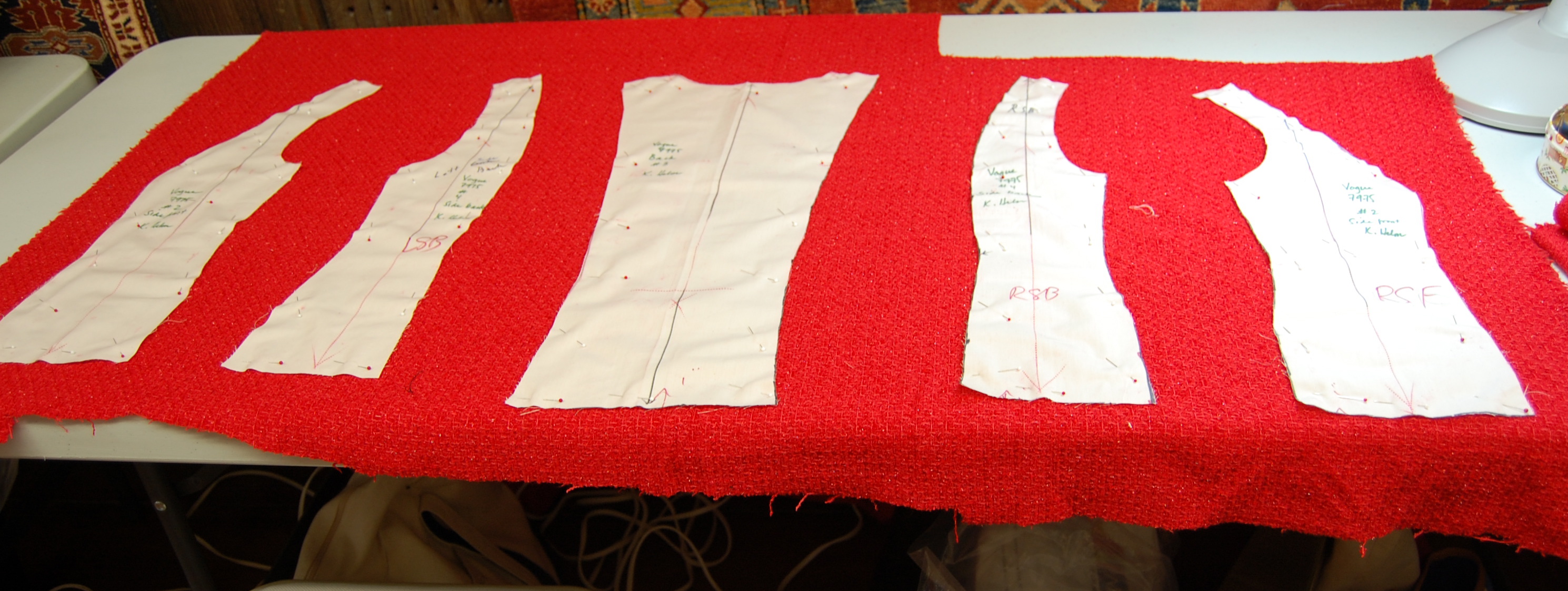
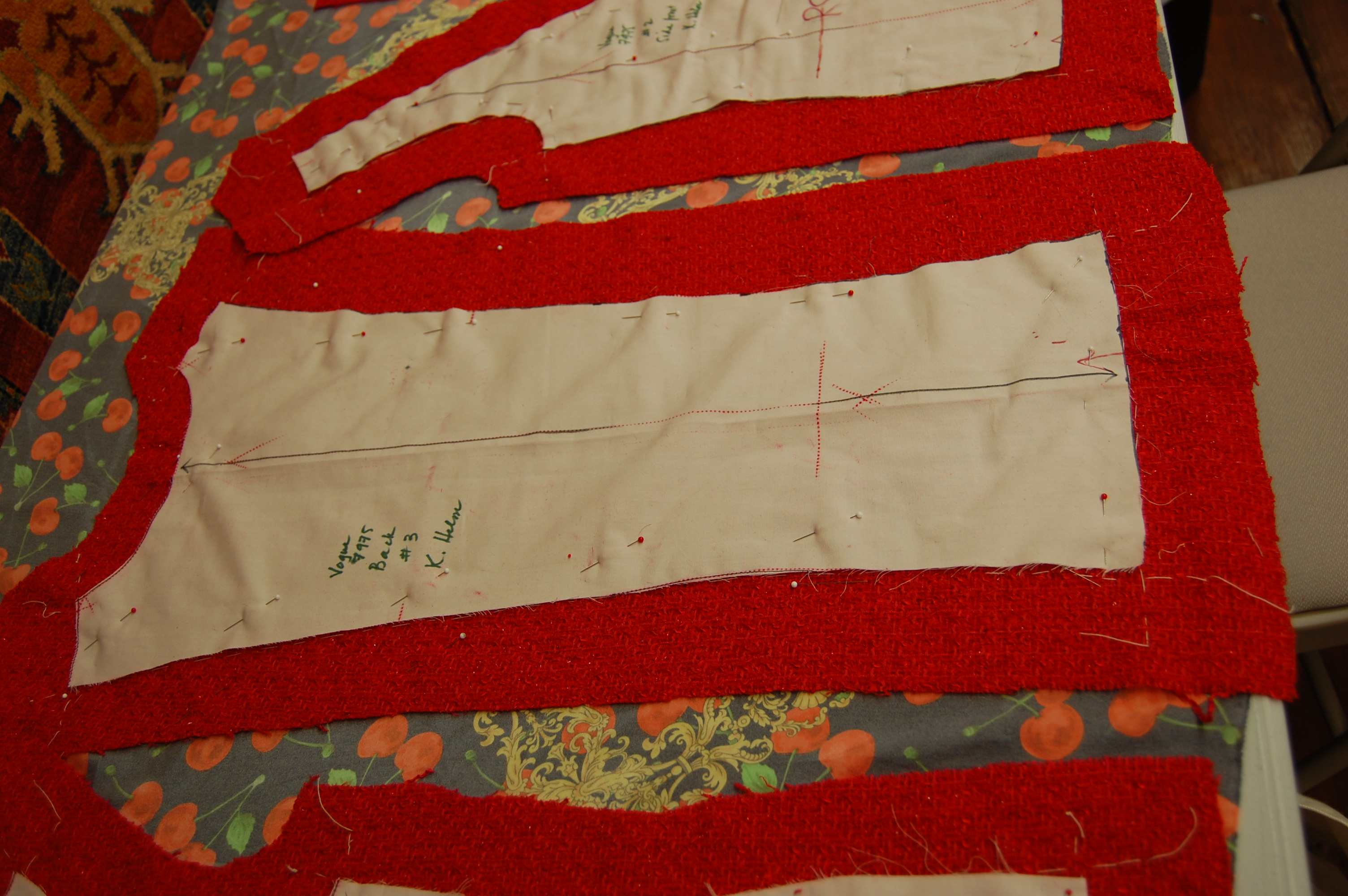
Some of my muslin pattern pieces laid out on my boucle.  Notice the wide spaces between the pieces.  This allowed for very generous seam allowances.

Some of my muslin pattern pieces laid out on my boucle. Notice the wide spaces between the pieces. This allowed for very generous seam allowances.

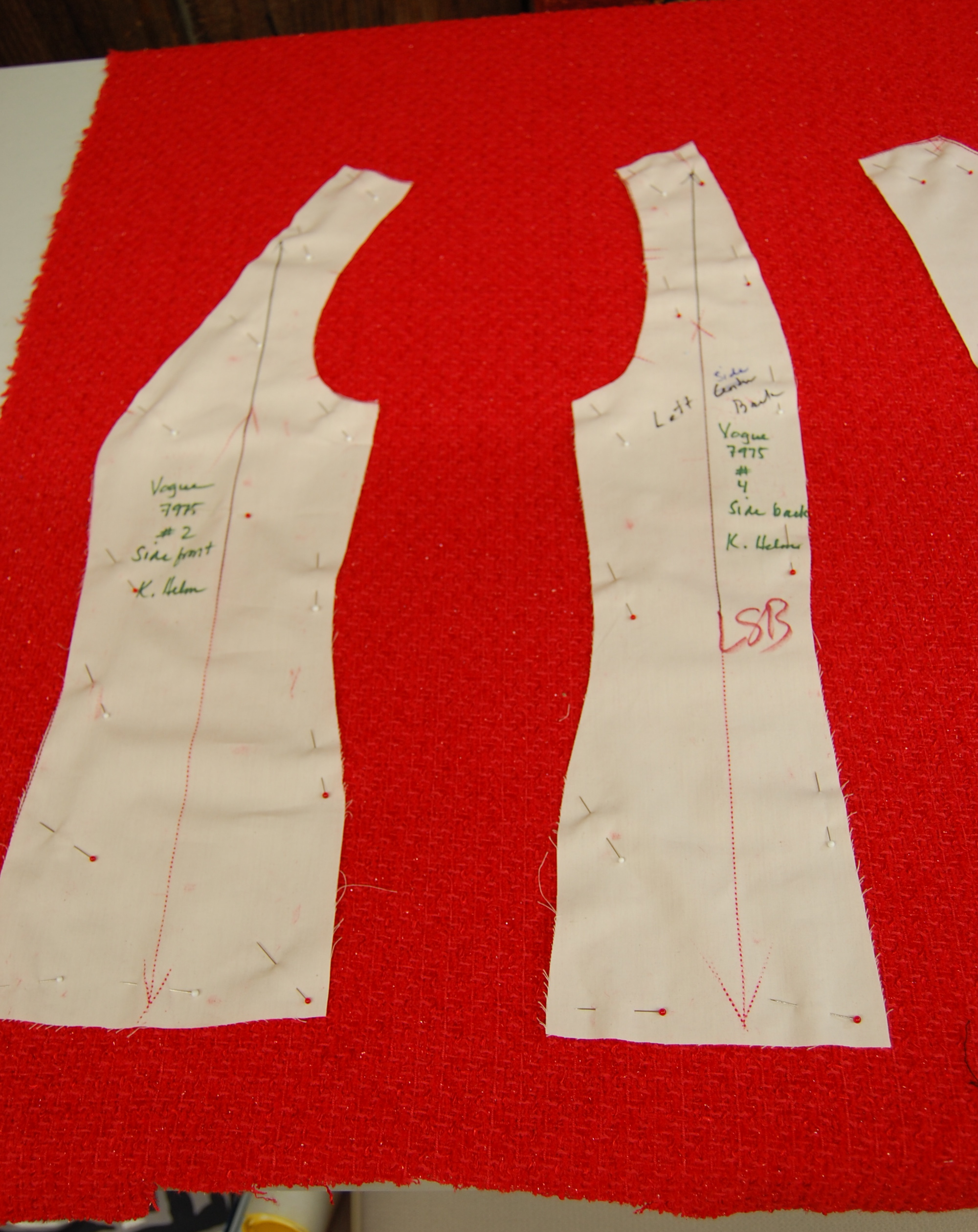
A close-up of the same.

A close-up of the same.

Then we used our cut fashion fabric pieces as the guidelines by which to cut out the charmeuse lining fabric.  With these two fabrics held carefully together with pins, we were ready to machine quilt each separate piece, another technique (with lots of do’s and don’ts to it) which was new to most of us.

Getting ready to cut my lining.

Getting ready to cut my lining.

Sewing the pieces of the body of the jacket together had its own set of rules, especially as the loose edges of the quilted linings had to be avoided in that stitching frenzy!  Those loose edges were finally tidied up and joined together by hand, using  a fell stitch, which helps to make a lovely and soft interior.

Here is a side seam in my jacket, partially closed using the fell stitch.  Machine quilting can be seen on either side of this  seam.

Here is a side seam in my jacket, partially closed using the fell stitch. Machine quilting can be seen on either side of this seam.

By this time, it was late Thursday afternoon, and I was wondering how I would ever get sleeves put in my jacket by Sunday…  This was s-l-o-w sewing, but fascinating and fun and clever and precise.  I was loving every minute of it  (well, almost every minute.)

And those sleeves?  Part 2 will cover those little lovelies.  To be continued . . .

17 Comments

Filed under Chanel-type jackets, couture construction, Uncategorized, Vogue patterns

Shopping for Fabric

Are there any more magical words for those of us who sew?  And what if that shopping trip is to New York City to visit Mendel Goldberg Fabrics?  For those of you unfamiliar with this exceptional purveyor of the finest fabrics, this short statement in their recent (and first) ad in Threads Magazine will help to acquaint you:  “This family-owned business carries European designer fabrics, from French lace to brocades, boucles, Italian silk prints and novelties.  You’ll be amazed by their selection of imported couture fabrics.”

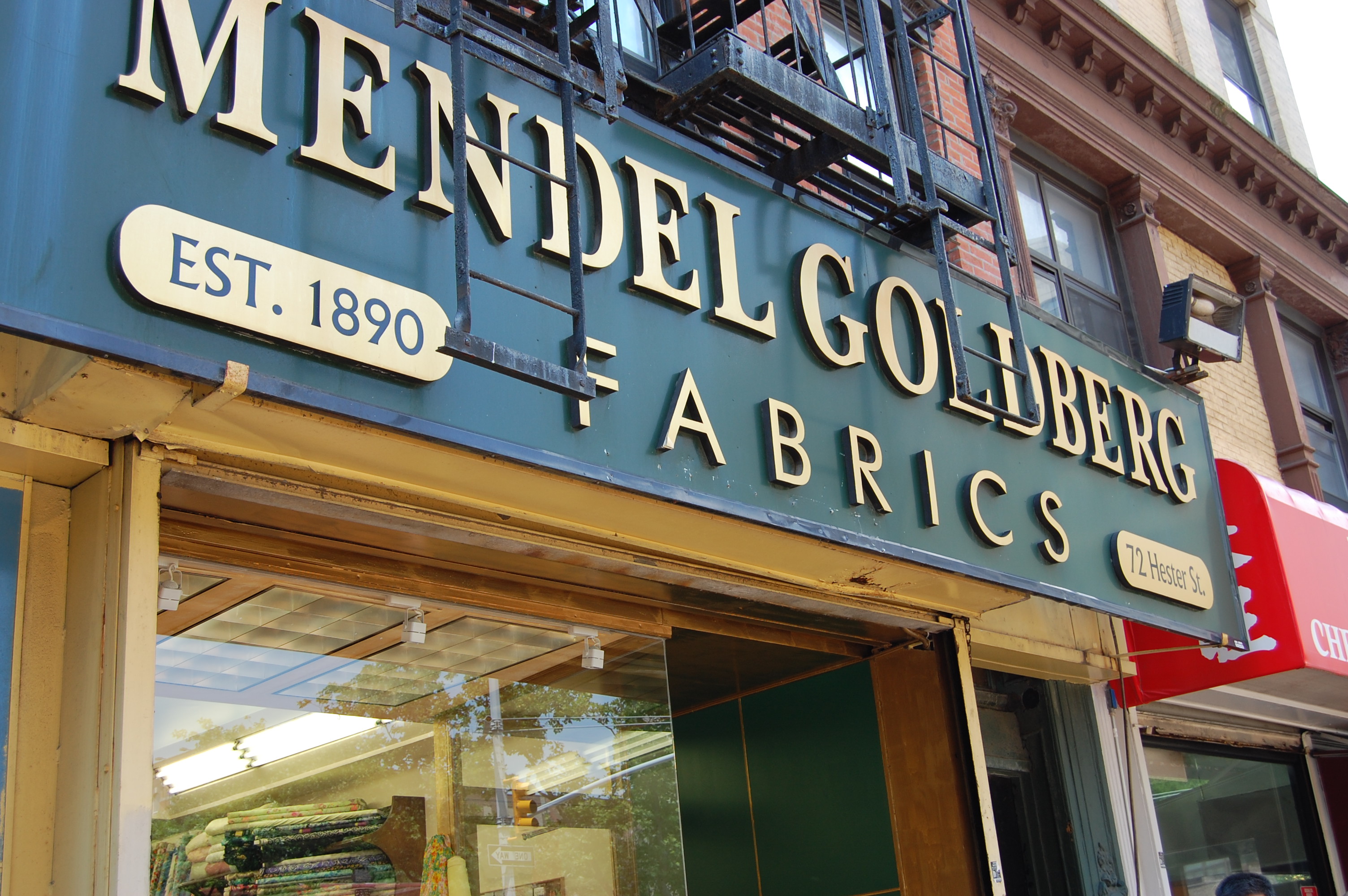
The distinctive sign for Mendel Goldberg Fabrics on Hector Street in NYC.

The distinctive sign for Mendel Goldberg Fabrics on Hester Street in NYC.

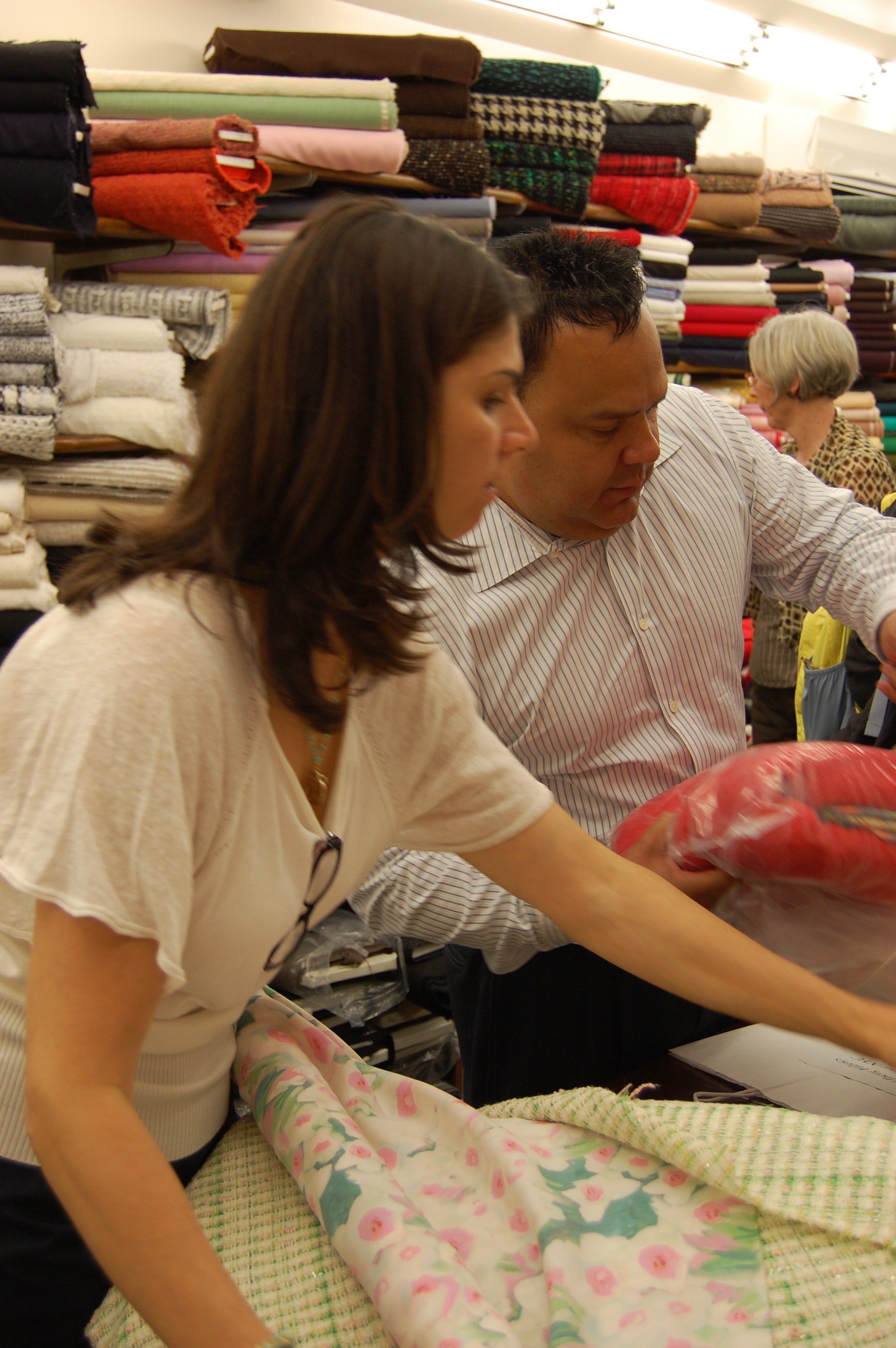
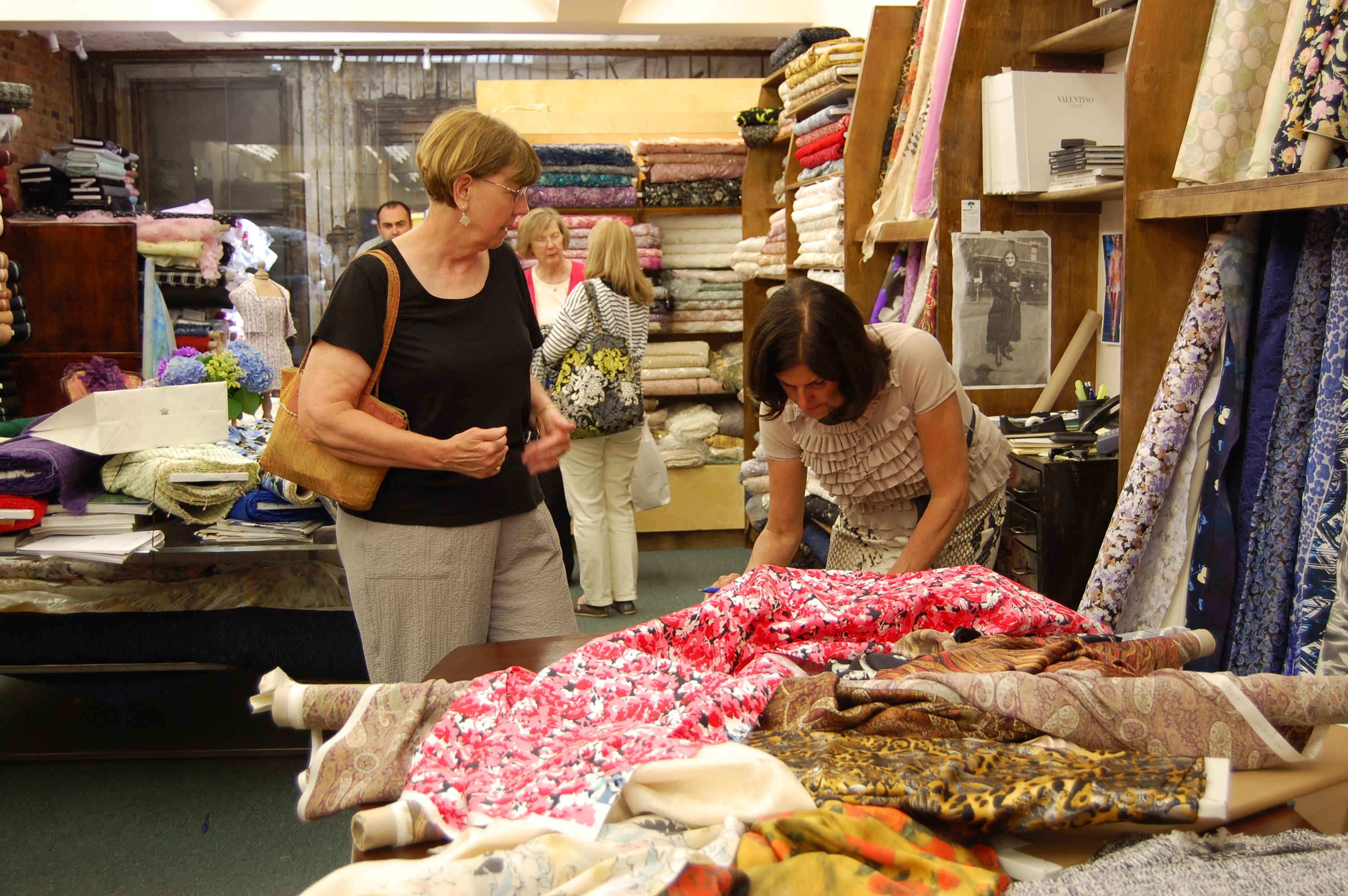
Well, amazed we were – all 11 of us who visited Mendel Goldberg Monday a week ago (June 24) on the first day of our class with Susan Khalje – The Classic French Jacket.  We were also just a little bit giddy (no, we were actually unabashedly giddy) as we viewed the treasures before us.  However, I am getting ahead of myself . . .

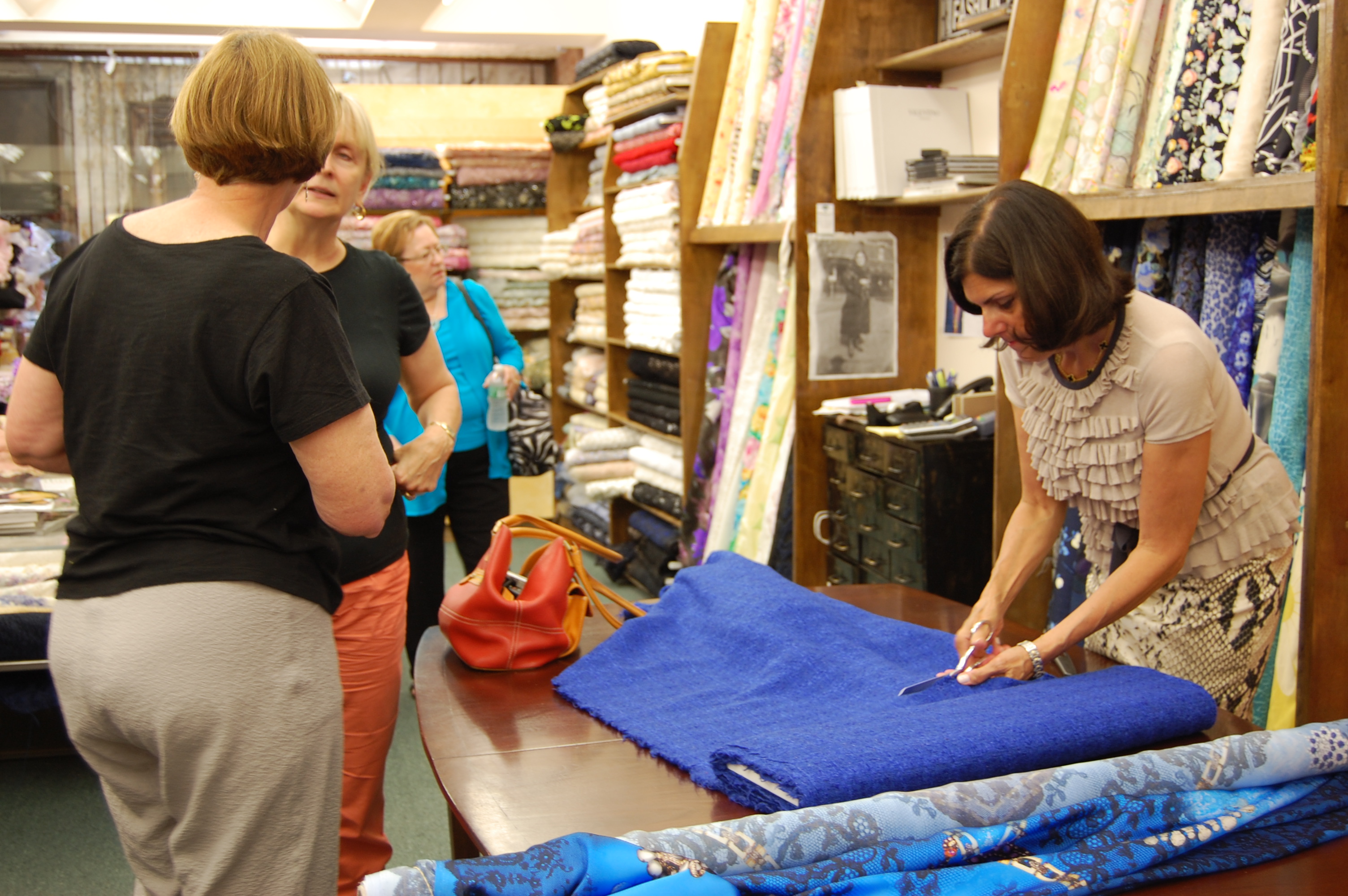
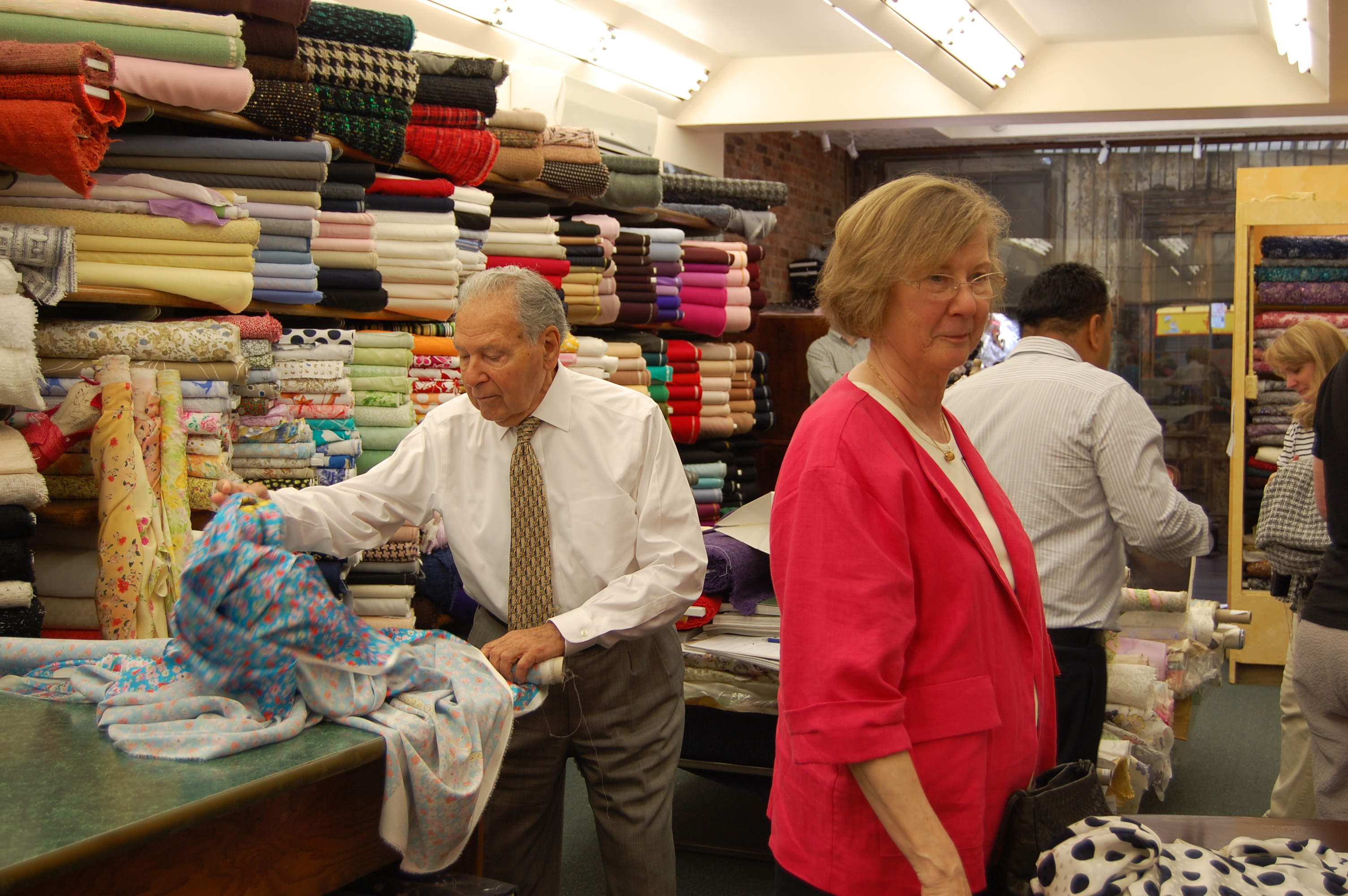
Arriving at the store after our 4-hour drive from Baltimore, we were enthusiastically and graciously met by Alice, the proprietress whose great-grandfather started the business in 1890.  Her daughter Josie works with her, and they are assisted by long-time employee Louis.  Also there to help us was Pierre, a young Frenchman who was interning with the business for two months.

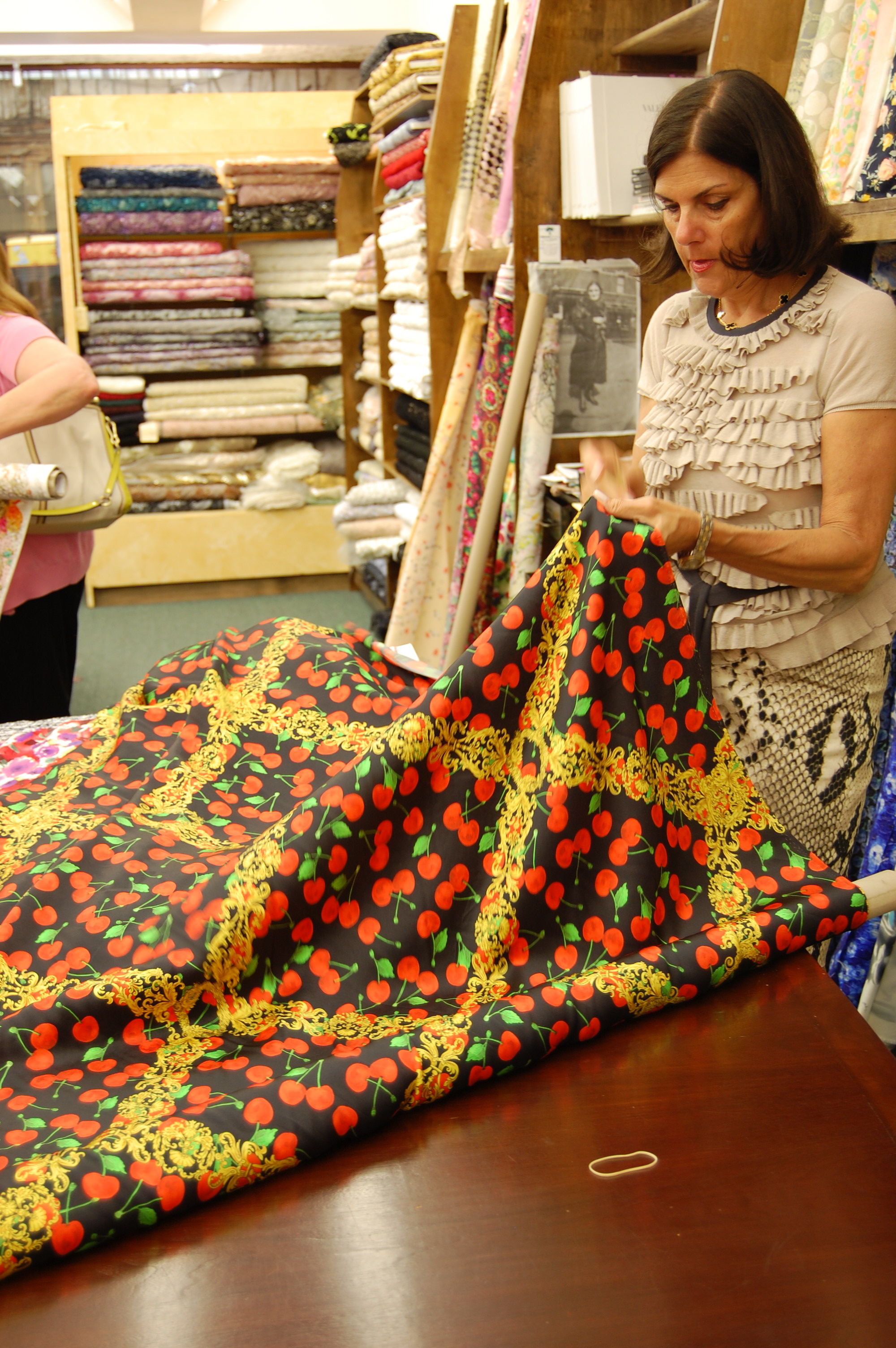
Alice is on the right, in a pose seen often - cutting fabric.

Alice is on the right, in a pose often seen – cutting fabric.

Josie and Louis

Josie and Louis

Pierre shown here in front of all those luscious fabrics.

Pierre shown here in front of all those luscious fabrics.

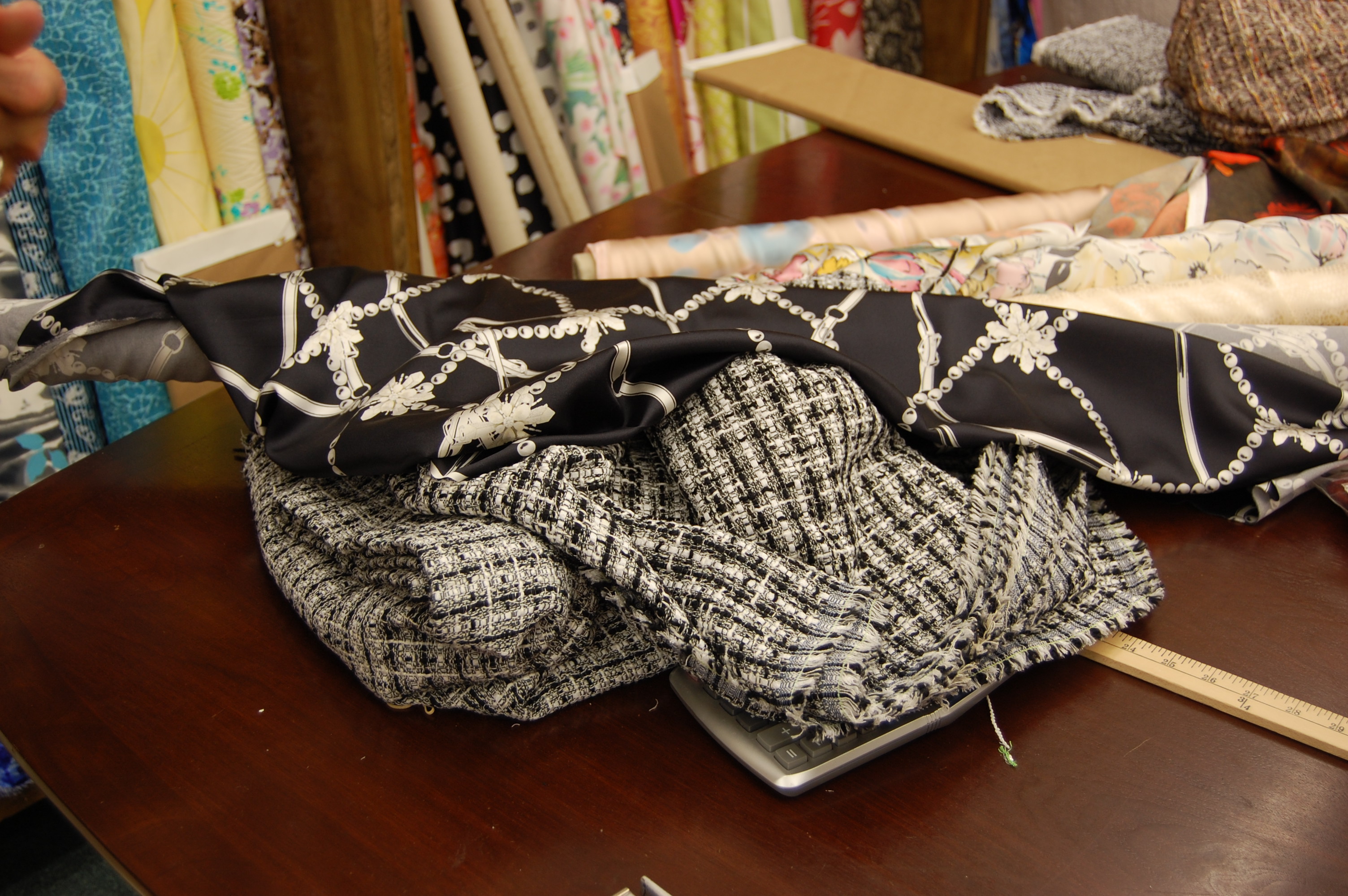
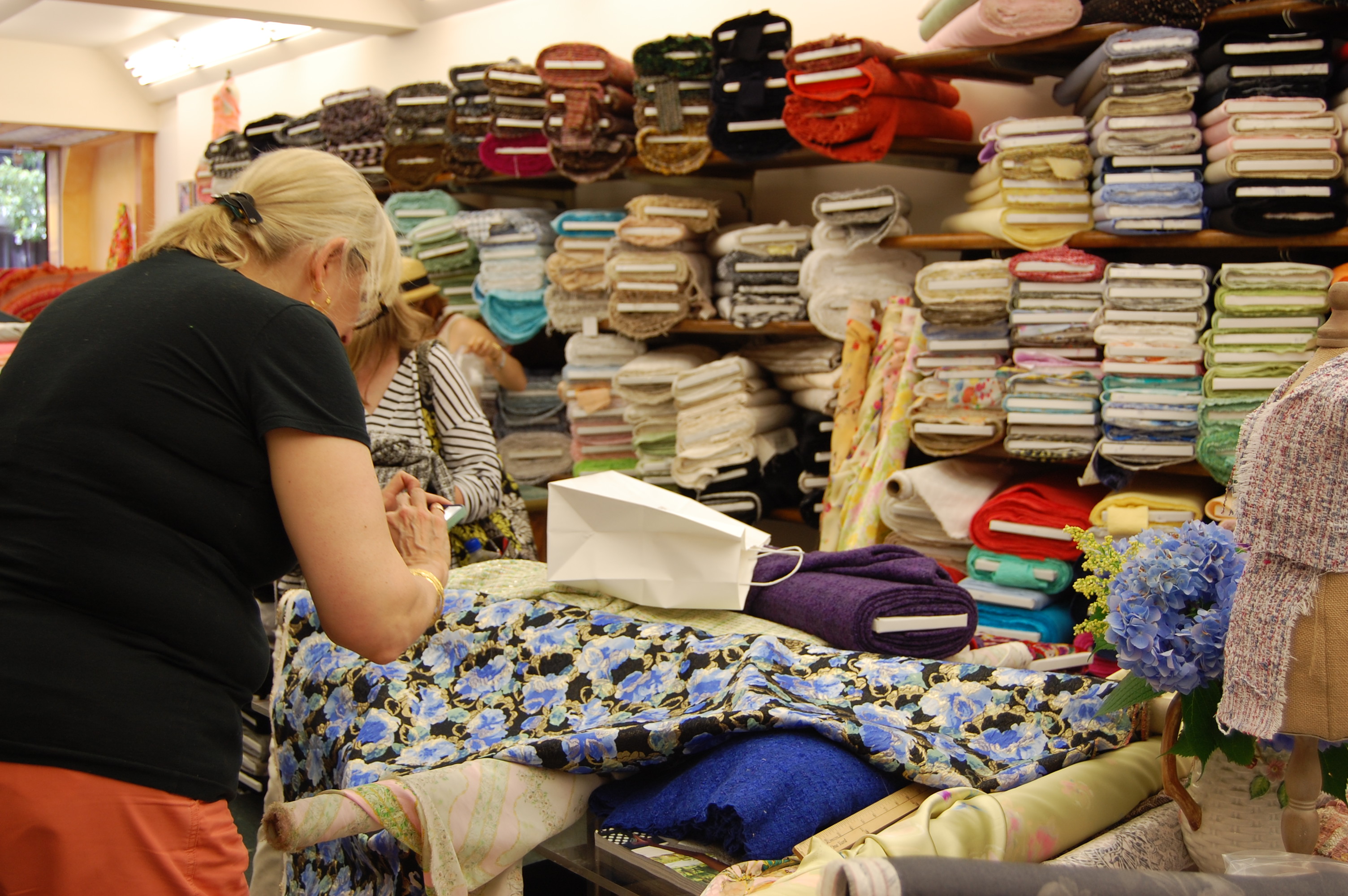
Our mission was to find and purchase our fabrics for the week-long class.  Thus – each of us needed to decide on a boucle for the jacket, and a silk charmeuse (the preferred fabric) for our lining.  The quantity of boucle fabric which Mendel Goldberg carries makes one’s decision fraught with “how can I ever narrow this down to just one?”  Well, of course, being the intrepid shoppers that we were, many of us actually could not narrow down our choice to just one.  Is it any surprise that many more than just 11 lengths each of boucle and charmeuse yardage were cut that day?

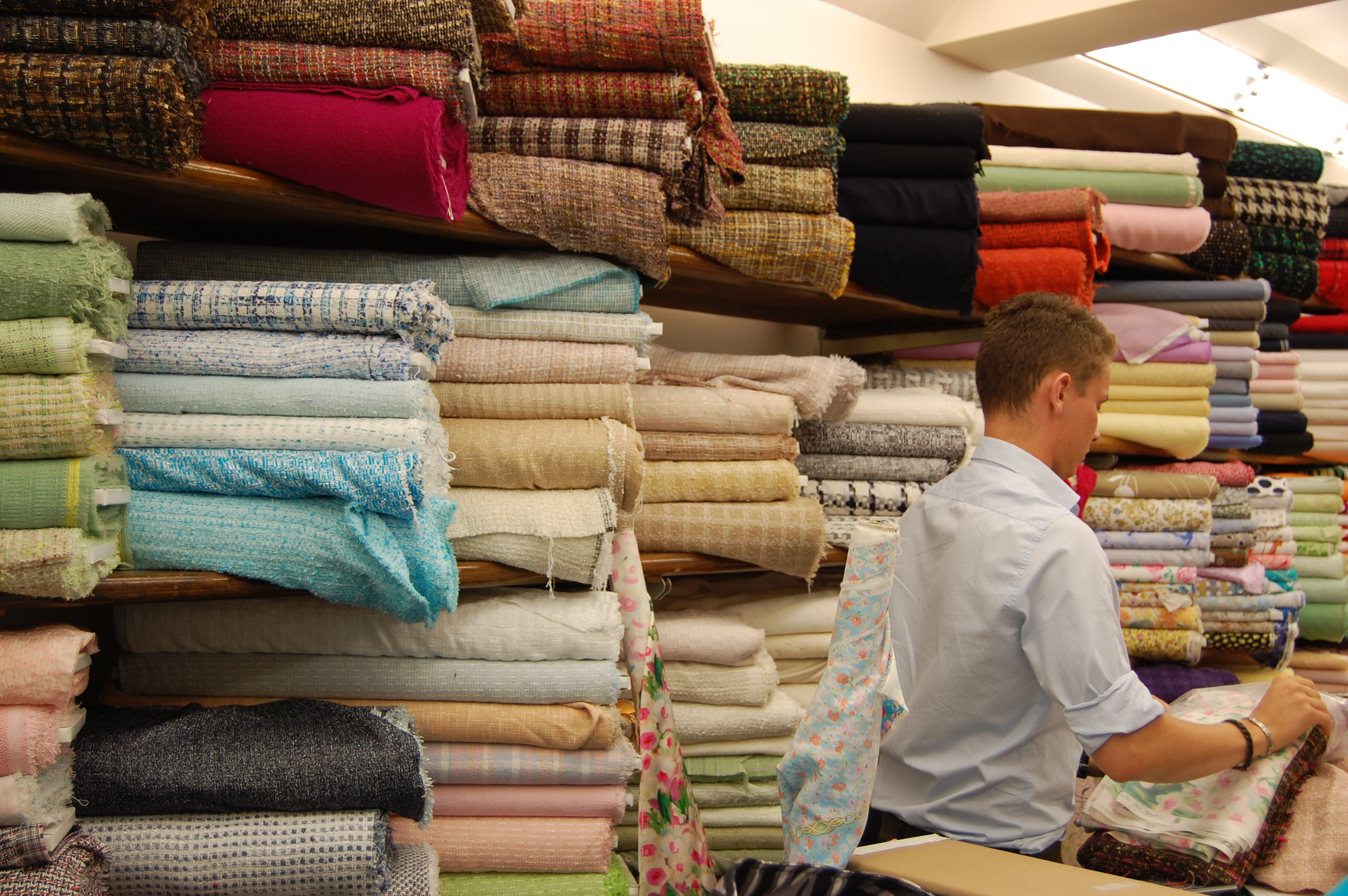
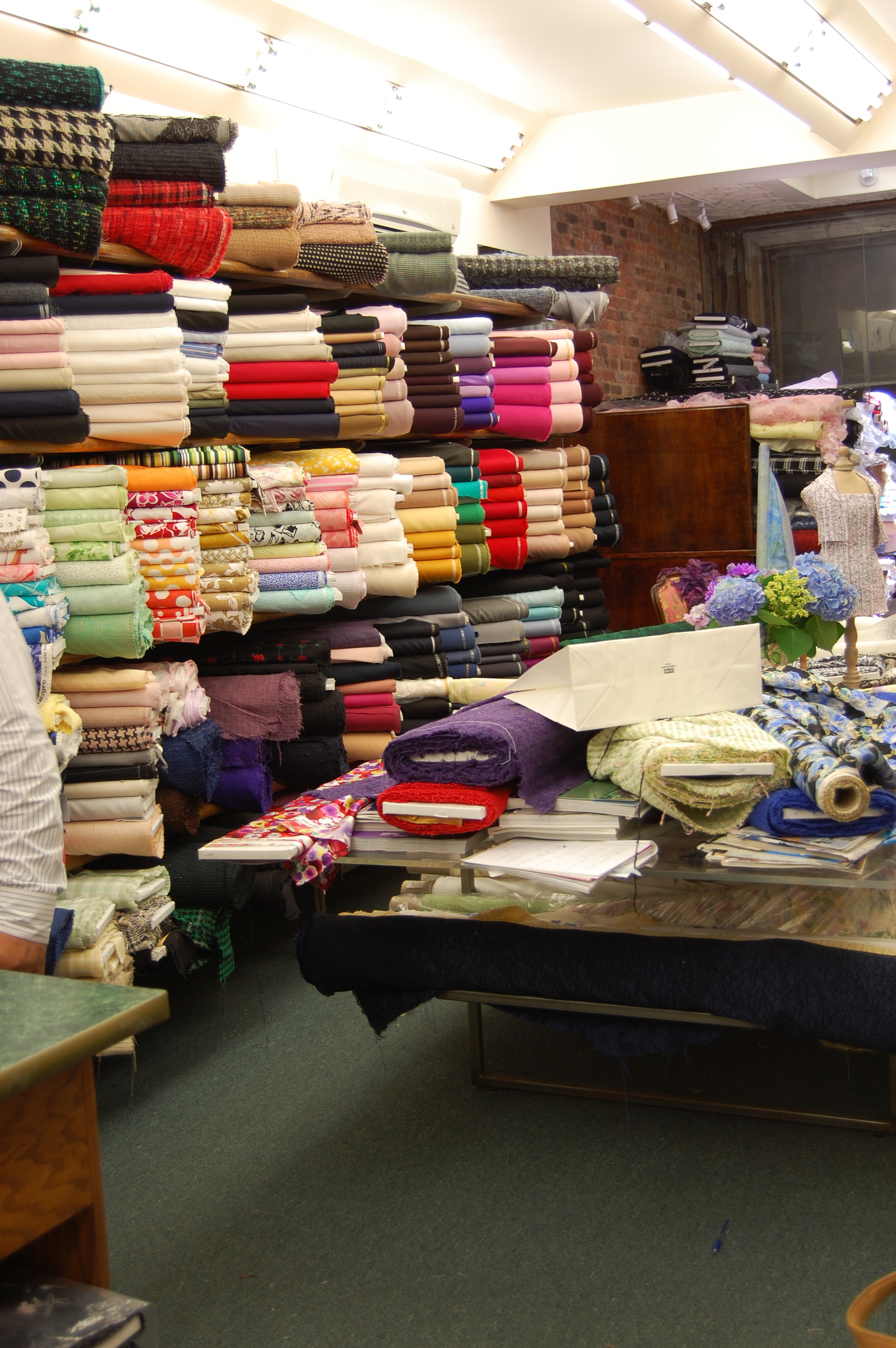
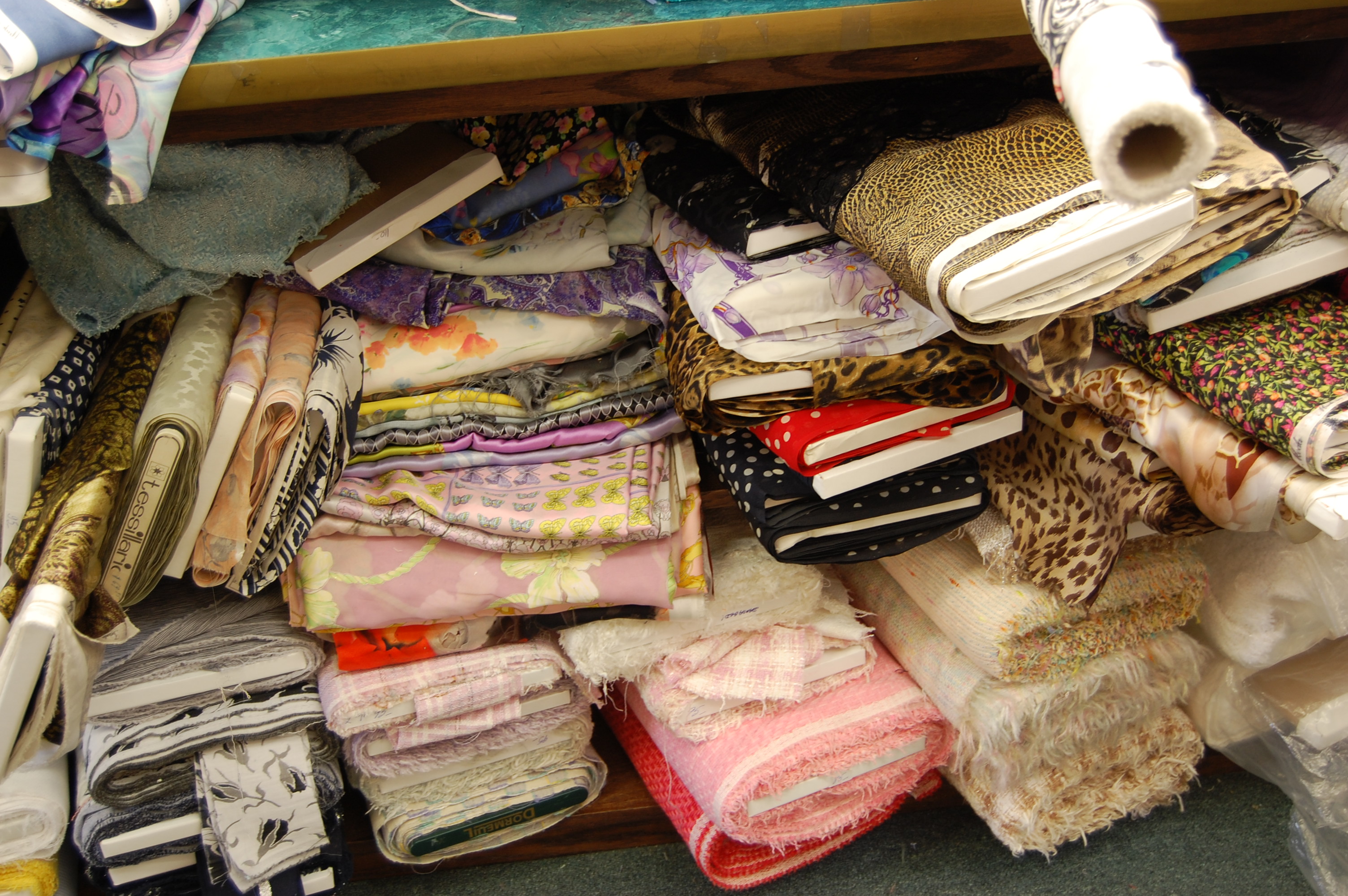
Bolts and bolts of boucles and other fabrics.

Bolts and bolts of boucles and other fabrics.

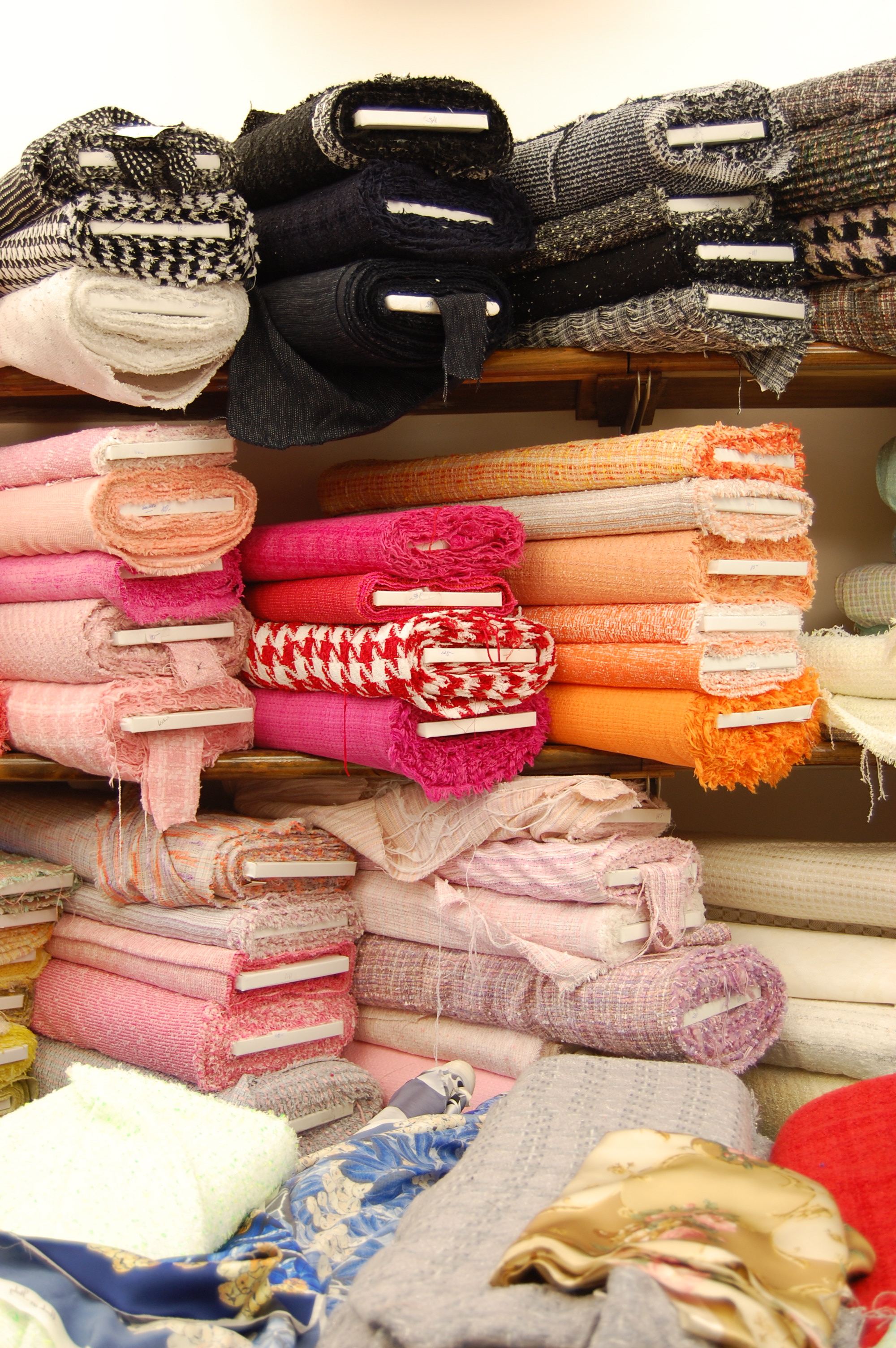
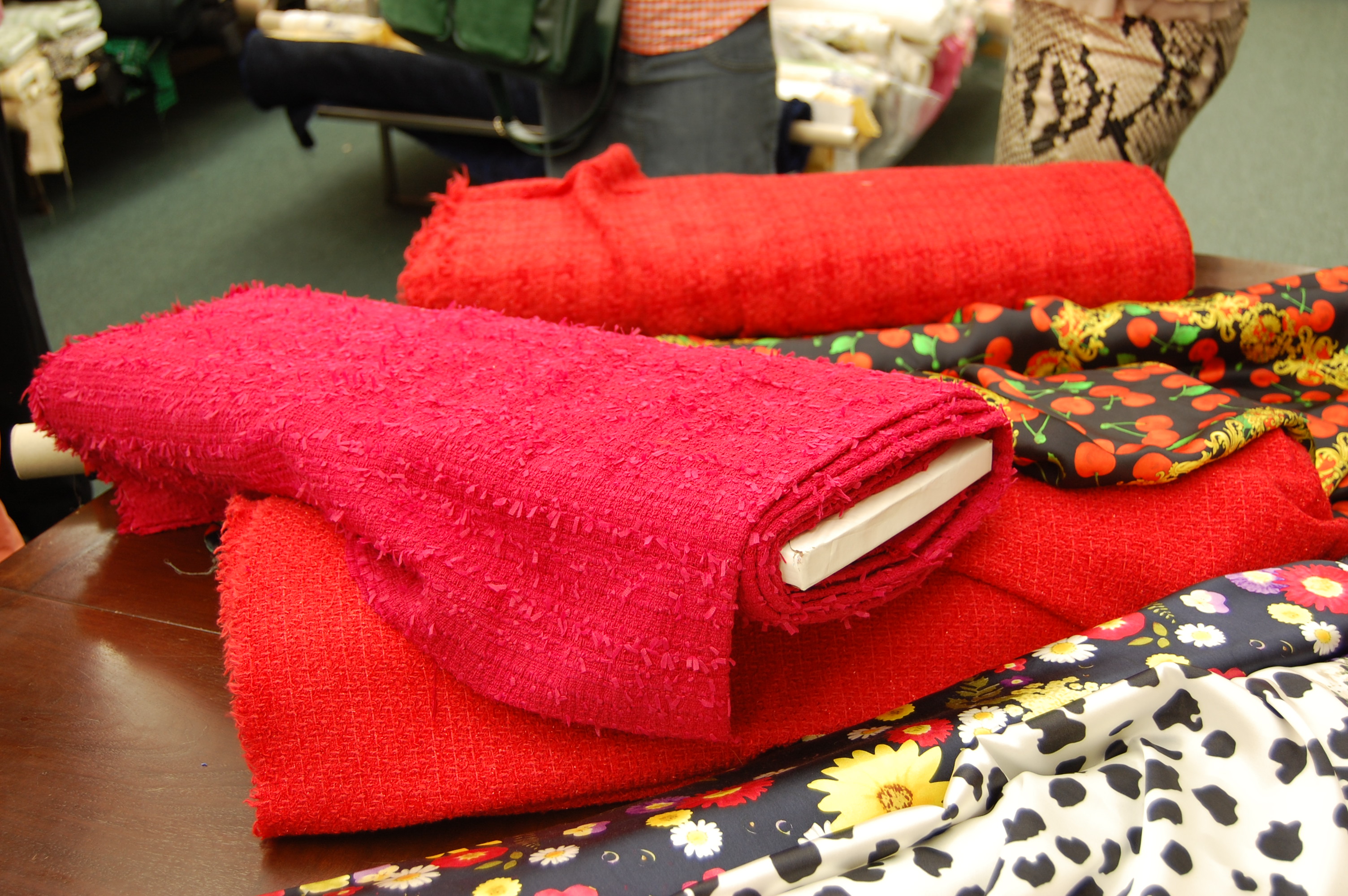
Just a small sampling of the boucles from which to choose.

Just a small sampling of the boucles from which to choose.

More fabric under the cutting tables.

More fabric under the cutting tables.

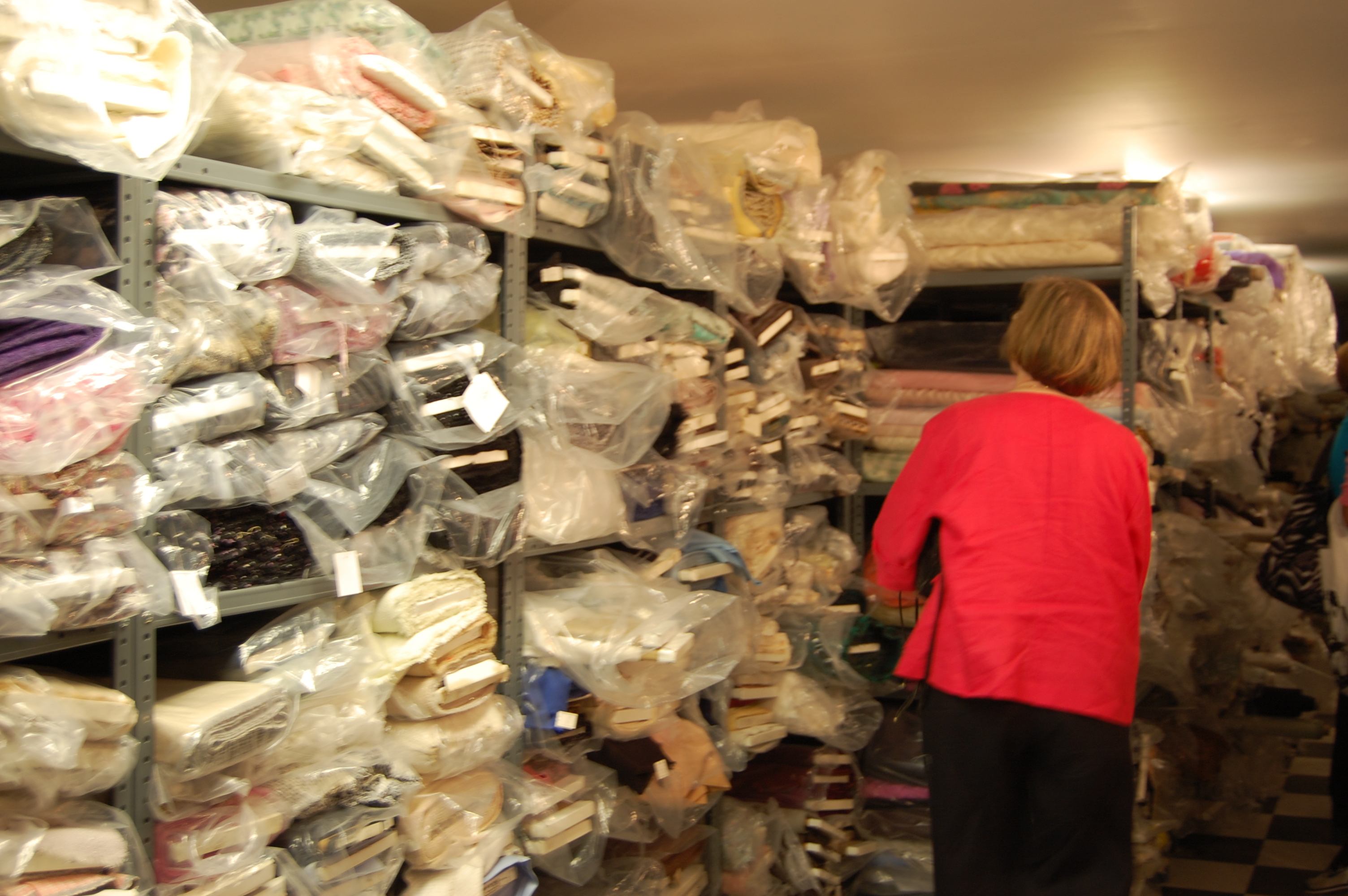
And more bolts in the basement, which we were privileged to visit.

And more bolts in the basement, which we were privileged to visit.

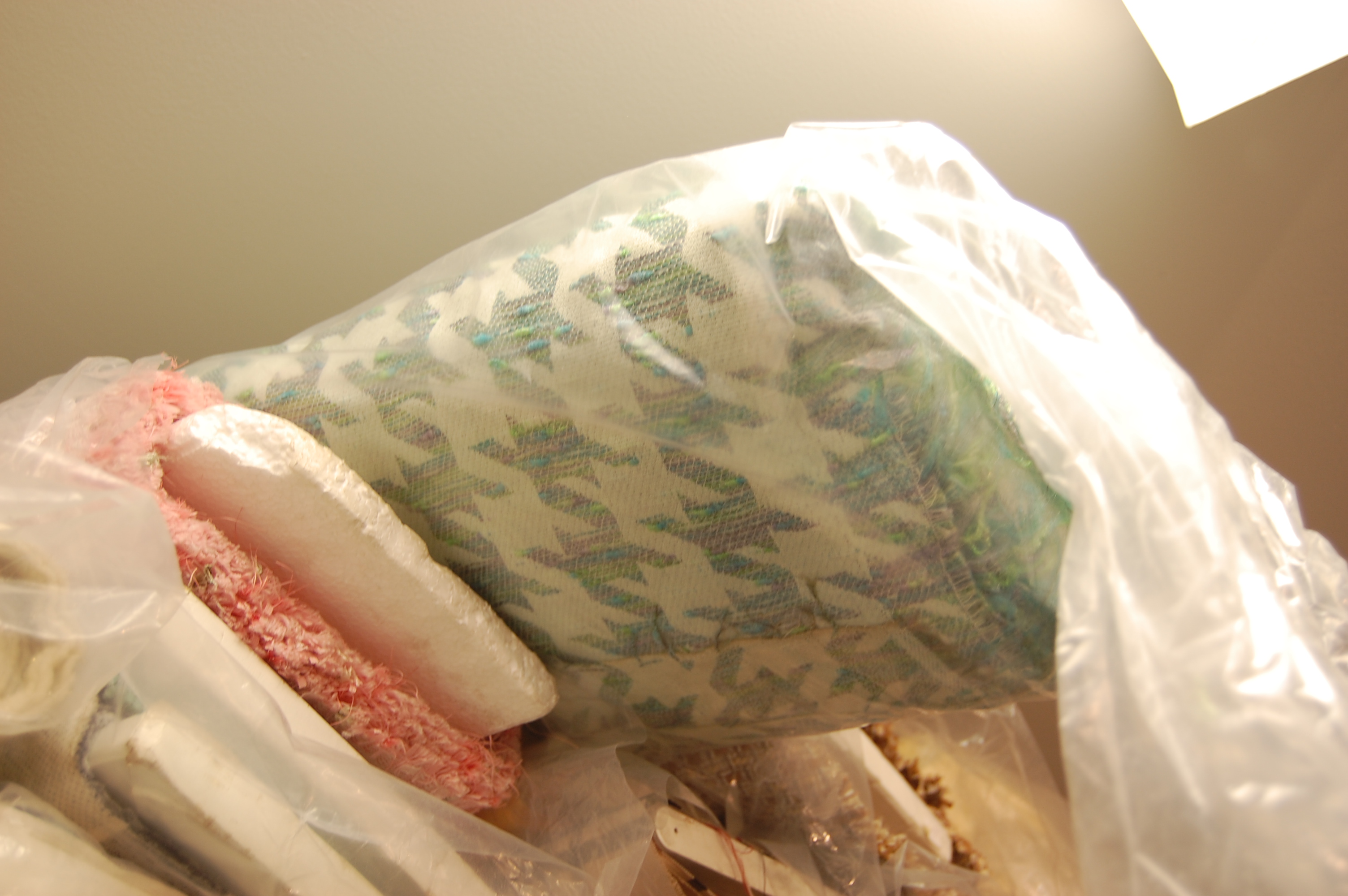
A lovely houndstooth, tucked away in the basement.

A lovely houndstooth, tucked away in the basement.

Deciding on the lining fabric was as much fun as the boucle, and the exquisite designs, unique prints, and lustrous quality of Alice’s charmeuses are something to behold.  Truly, the selection is a testament to Alice’s good taste and her diligence in finding the best that is available in France, Italy and Switzerland, and shipping them home to her store in the States.

So many charmeuses from which to choose.

So many charmeuses from which to choose.

Susan helping with the "match-up".

Susan helping with the “match-up”.

Alice bent over more fabric.

Alice bent over more fabric.

Susan  with a beautiful charmeuse.

Susan with a beautiful charmeuse.

Classmate Diane's final selection of boucle and charmeuse.

Classmate Diane’s final selection of boucle and charmeuse.

Alice cutting the charmeuse I selected for my lining to be paired with a bright red boucle.

Alice cutting the charmeuse I selected for my lining.

Alice's father who still comes in to help.

Alice’s father who still comes in to help.

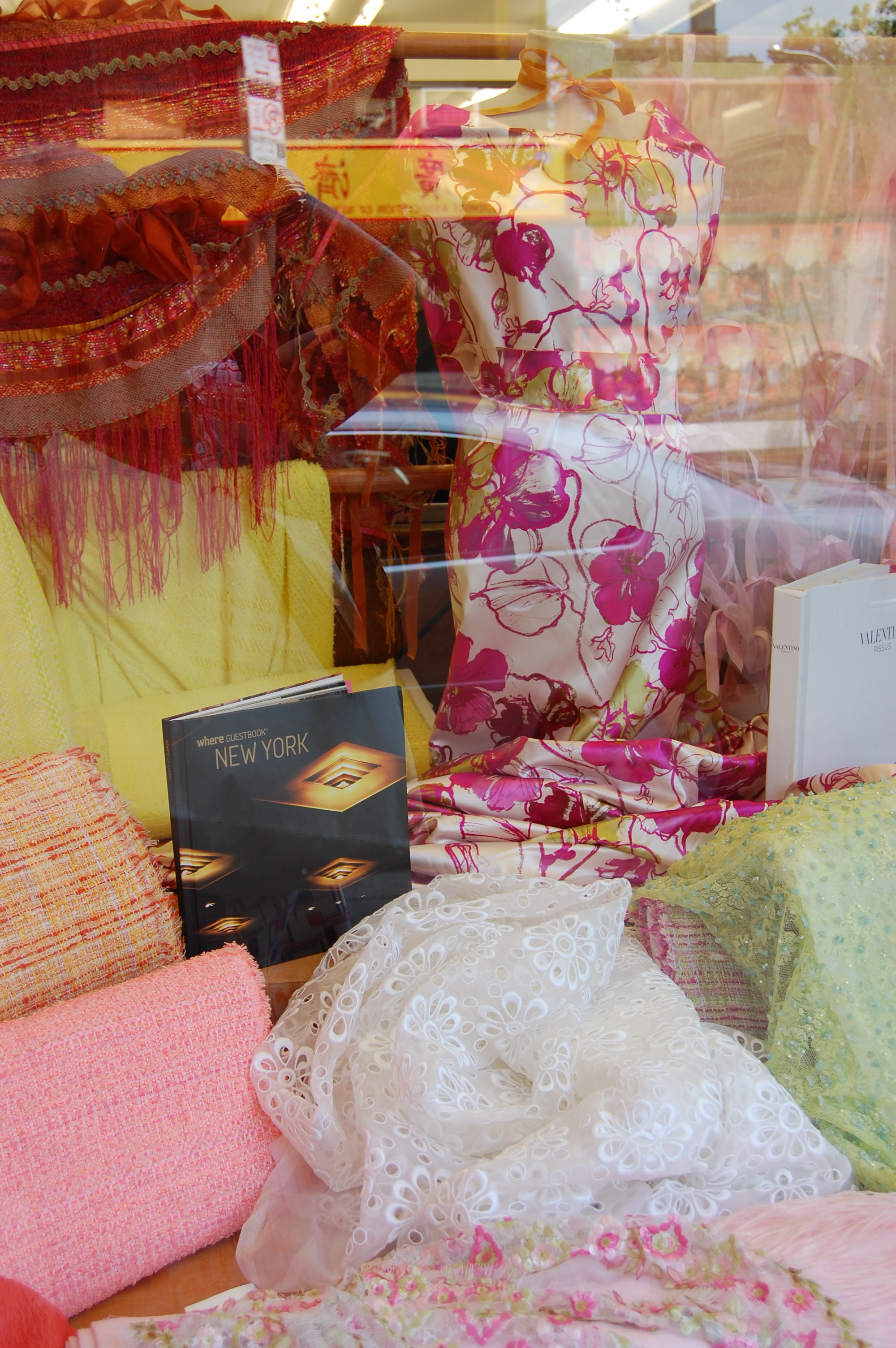
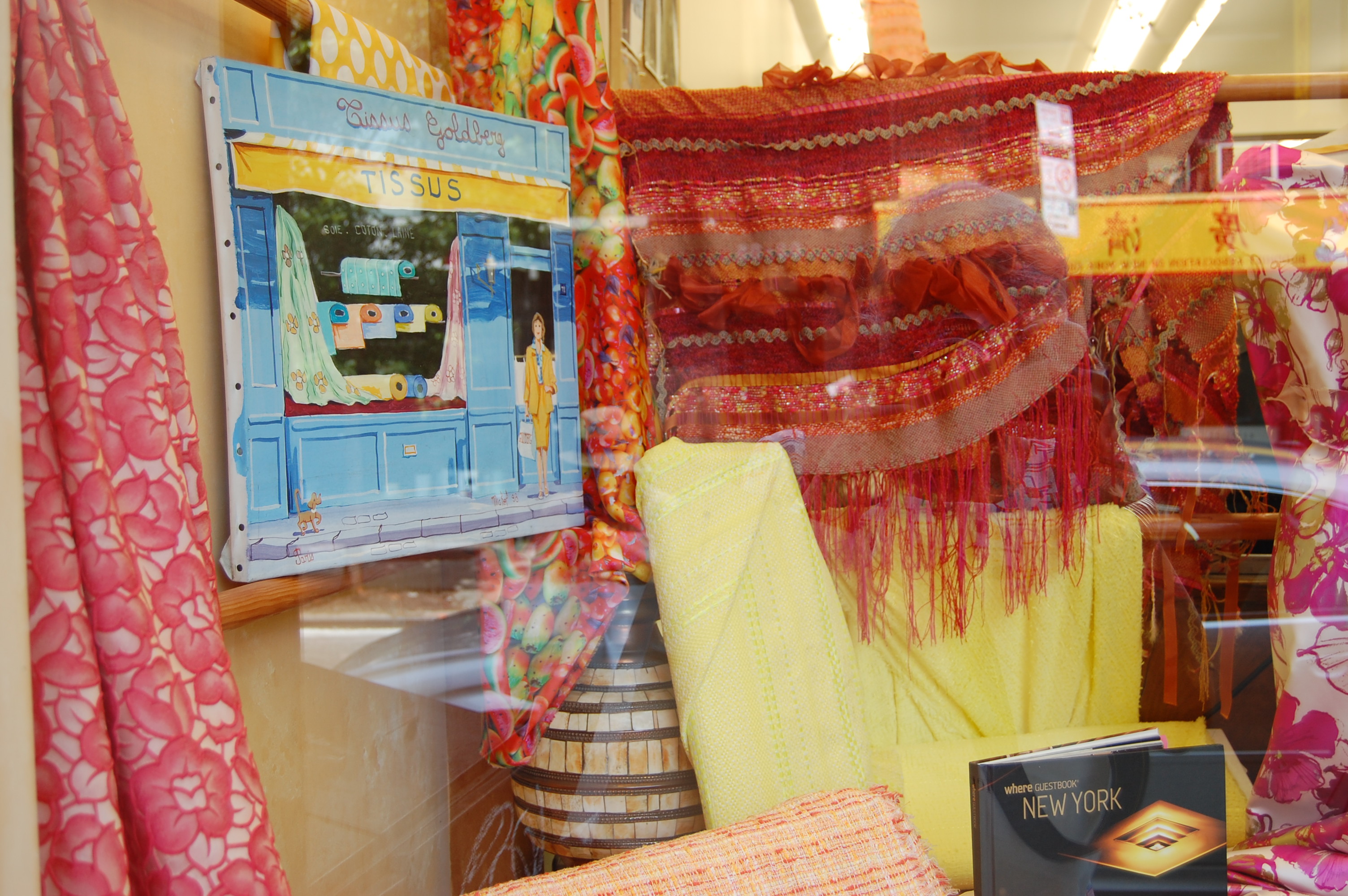
As we left Mendel Goldberg after two quick hours of shopping, I took a moment to view the beautiful display of fabrics in their front window.

Despite the glare, the fabrics still captivate!

Despite the glare, the fabrics still captivate!

More fabric on display in the window.

More fabric on display in the window.

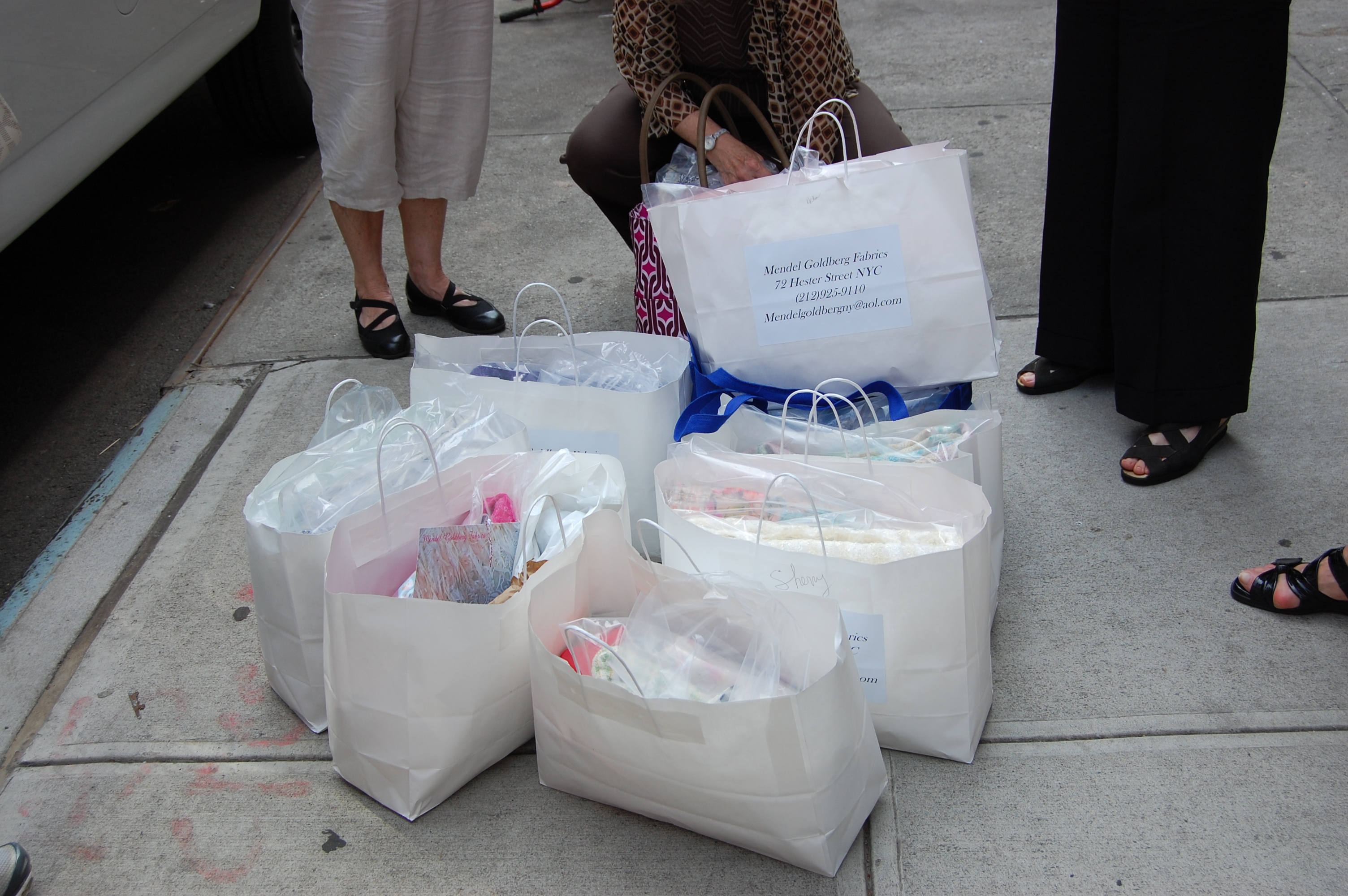
Then we gathered on the street next to our van.  Our bounty of bags spoke to the remarkable, memorable experience of Mendel Goldberg Fabrics.

Just a few of the bags that went home with us!

Just a few of the bags that went home with us!

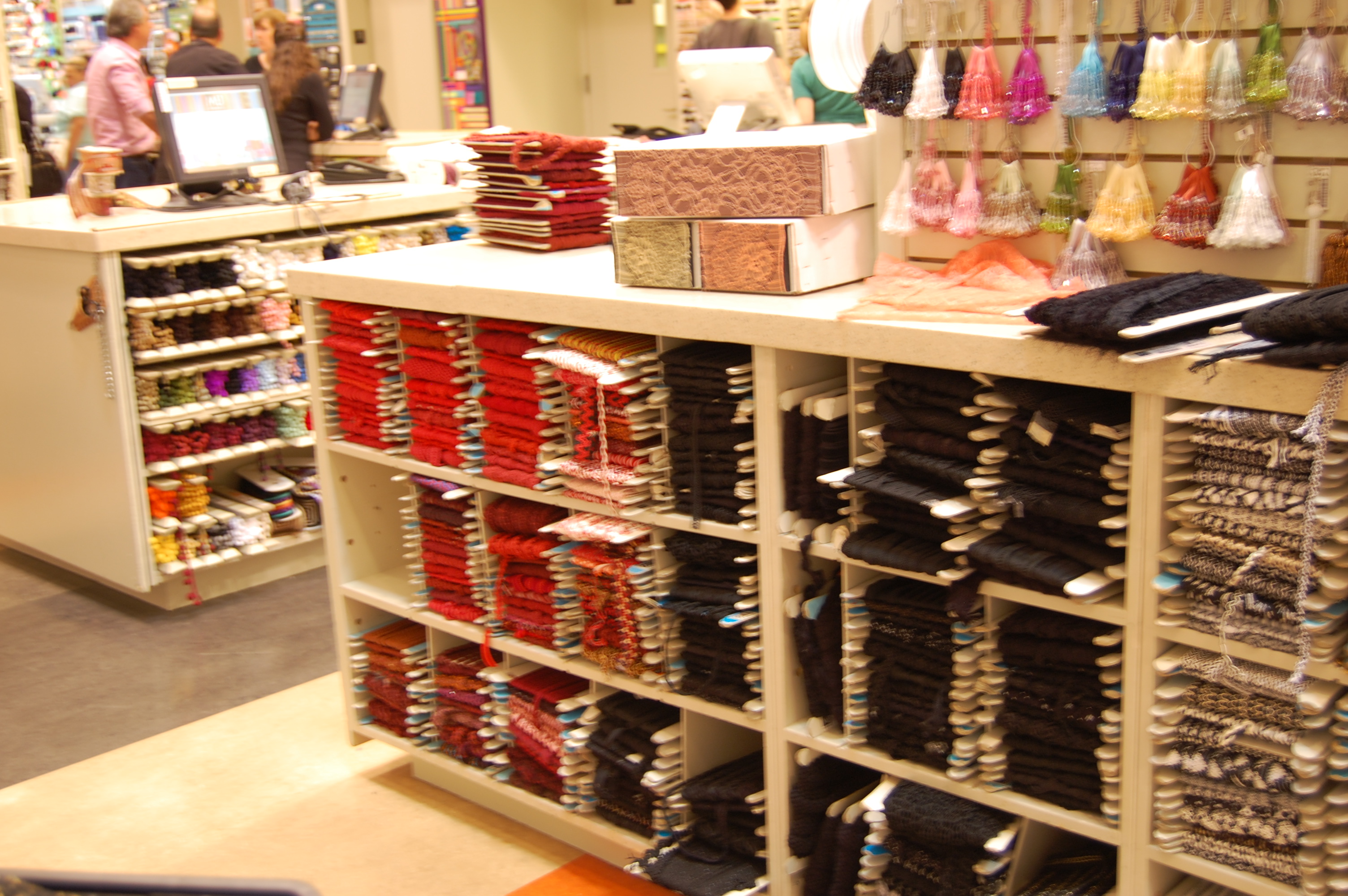
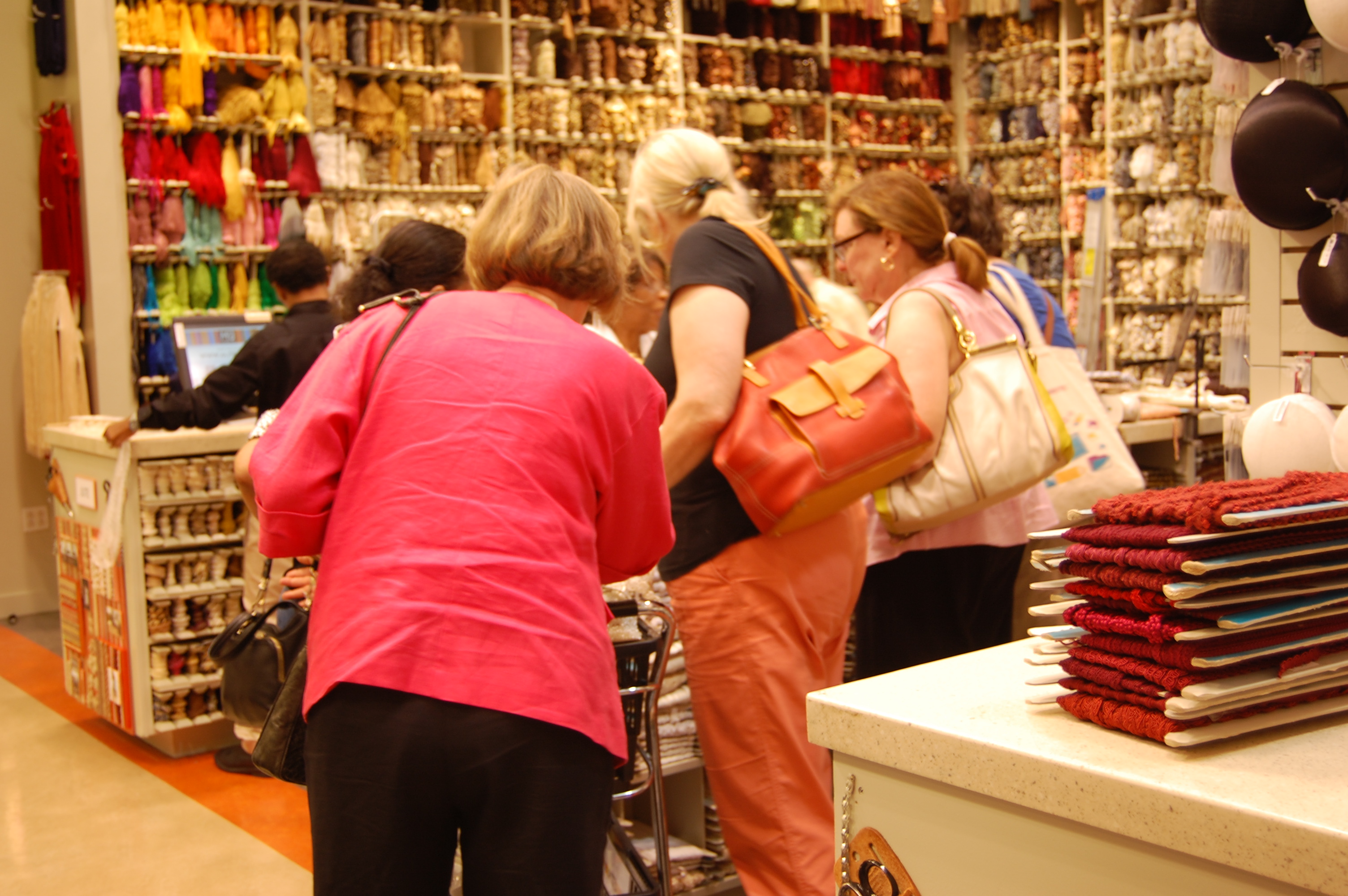
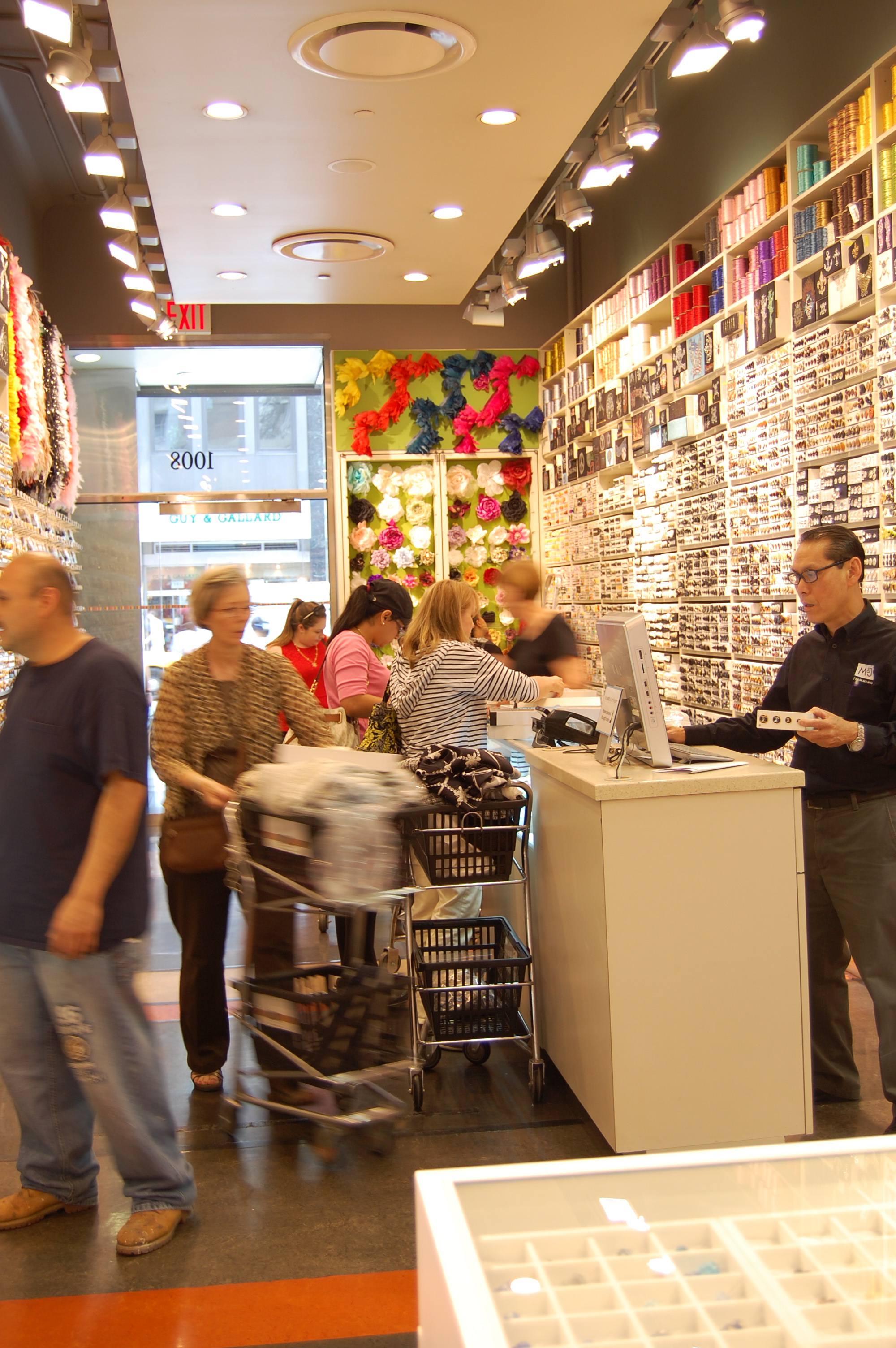
Now that we all had in our possession the two building blocks for our jackets (the fashion fabric and the lining), it was time to look for the embellishments, namely the trim and the buttons.  So off we went to M & J Trimming uptown in the Garment District.   Walking into M & J was a little bit like walking into a penny candy store, only better (no calories and more selection)!  There were trims and people and sales staff everywhere, and it seemed like everyone was on their own important mission.  We certainly were!  With our boucle and our complementary silk charmeuse in hand, we each first needed to find the perfect trim to set off our jackets.  Although numbering in the thousands, the trims were arranged by color and quite logically, so that once we understood the system, we were each able to pick and choose several “possibilities”.  Susan was there to help us make final decisions – and miraculously, we could start to see a glimpse of the final look of each of our own unique jackets.

Red and black trims, waiting for my perusal.

Red and black trims, waiting for my perusal.

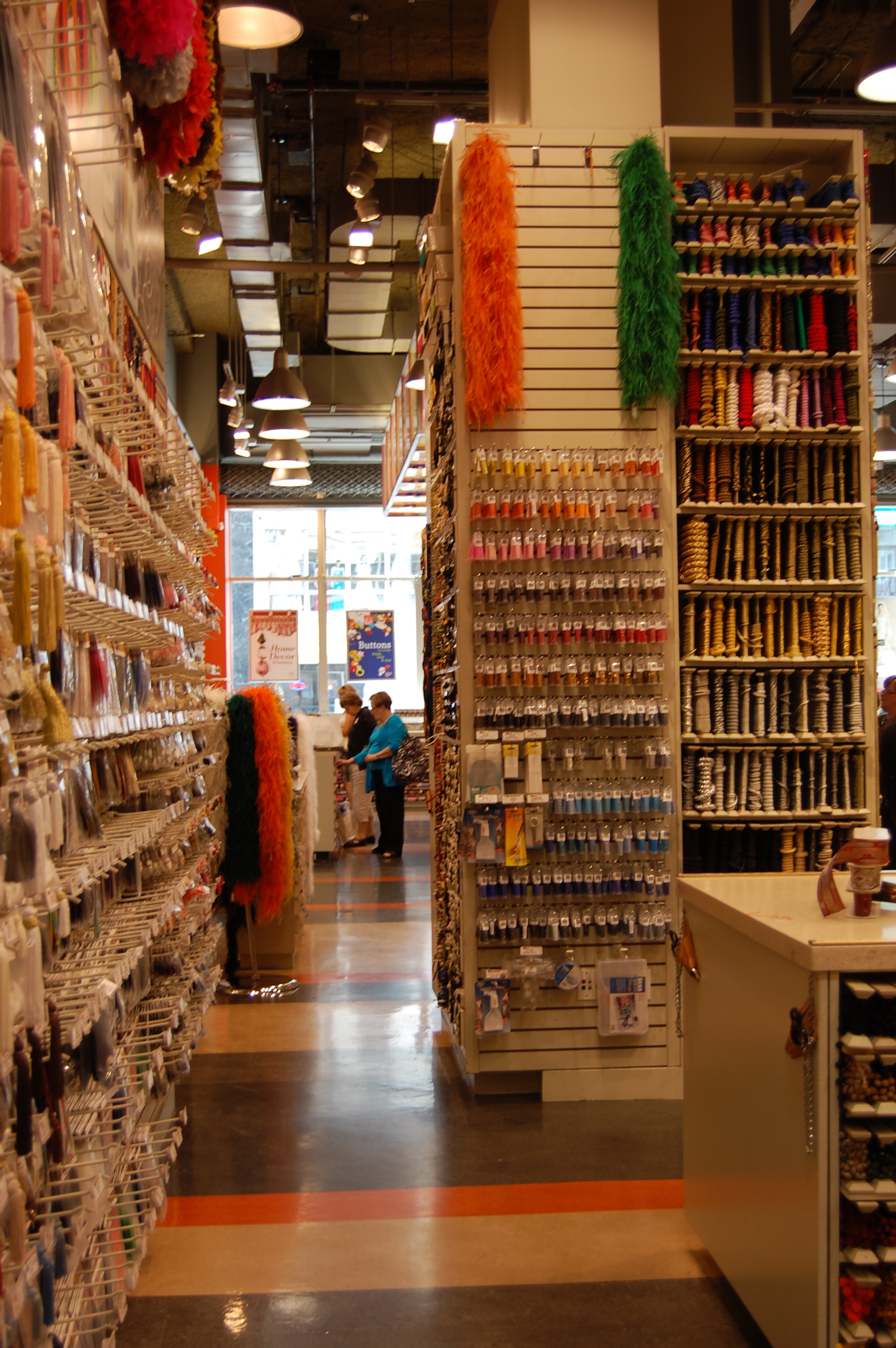
A view inside the store.

A view inside the store.

Classmates Sherry  and Carol being assisted by Susan.

Classmates Sherry and Carol being assisted by Susan.

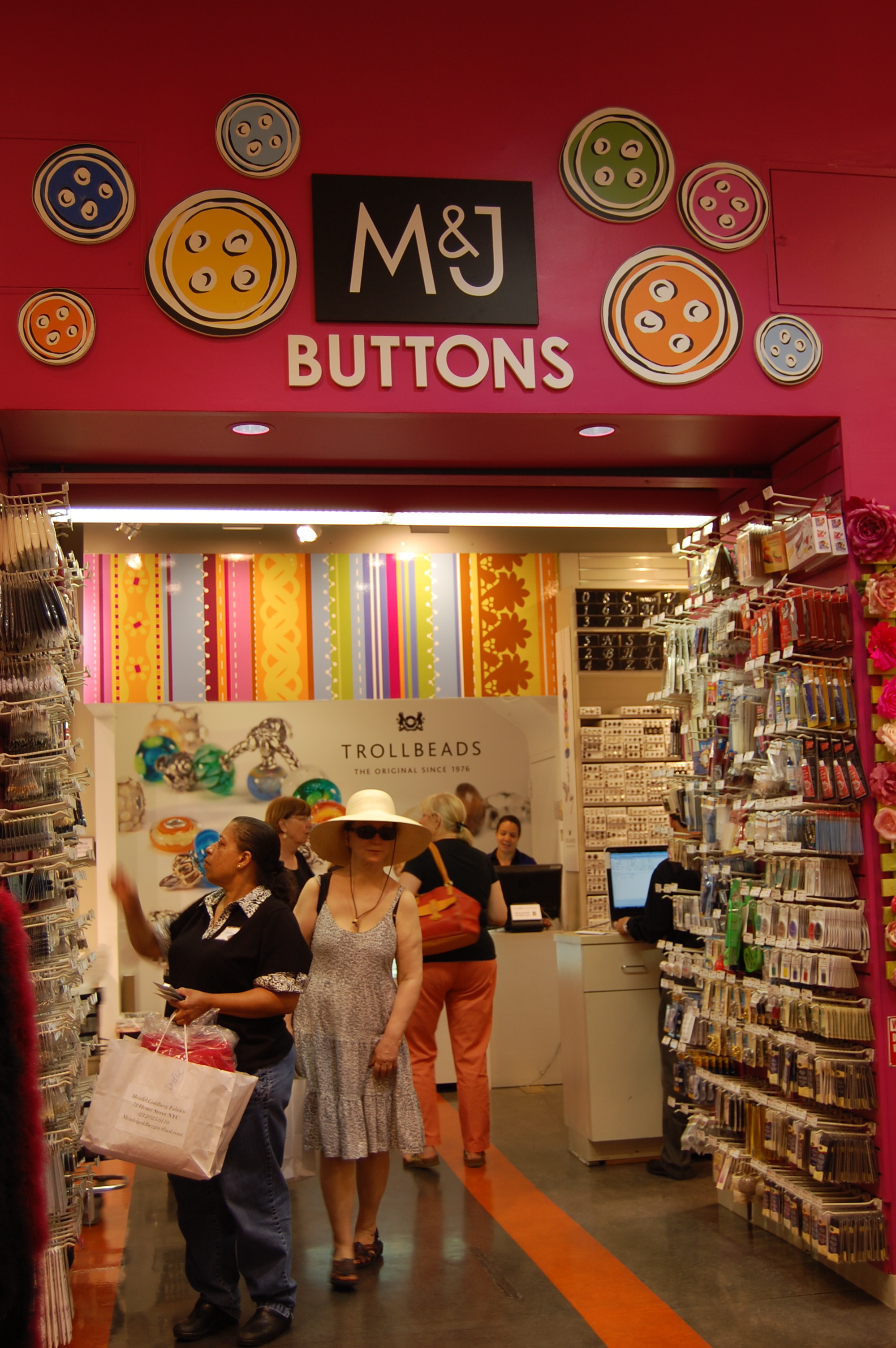
The only thing left to do was pick out buttons.

The entrance to the Button section of  M & J Trims.

The entrance to the Button section of
M & J Trimming.

As an enthusiastic fan of unique and beautiful buttons, I was smitten.  The button displays went from floor to ceiling, arranged by color and type, again very logically.

Buttons and more buttons.

Buttons and more buttons.

As sewers, each of us is accustomed to choosing buttons appropriate to our garment. So – what fun it was to place different ones next to our fabrics and trims so they could audition for the final starring part.  With Susan’s guidance, wonderful suggestions, and knowledgeable nod of approval, we all left the store with little bags filled with  great and varied treasures.

Shopping for Fabric - M & J bag

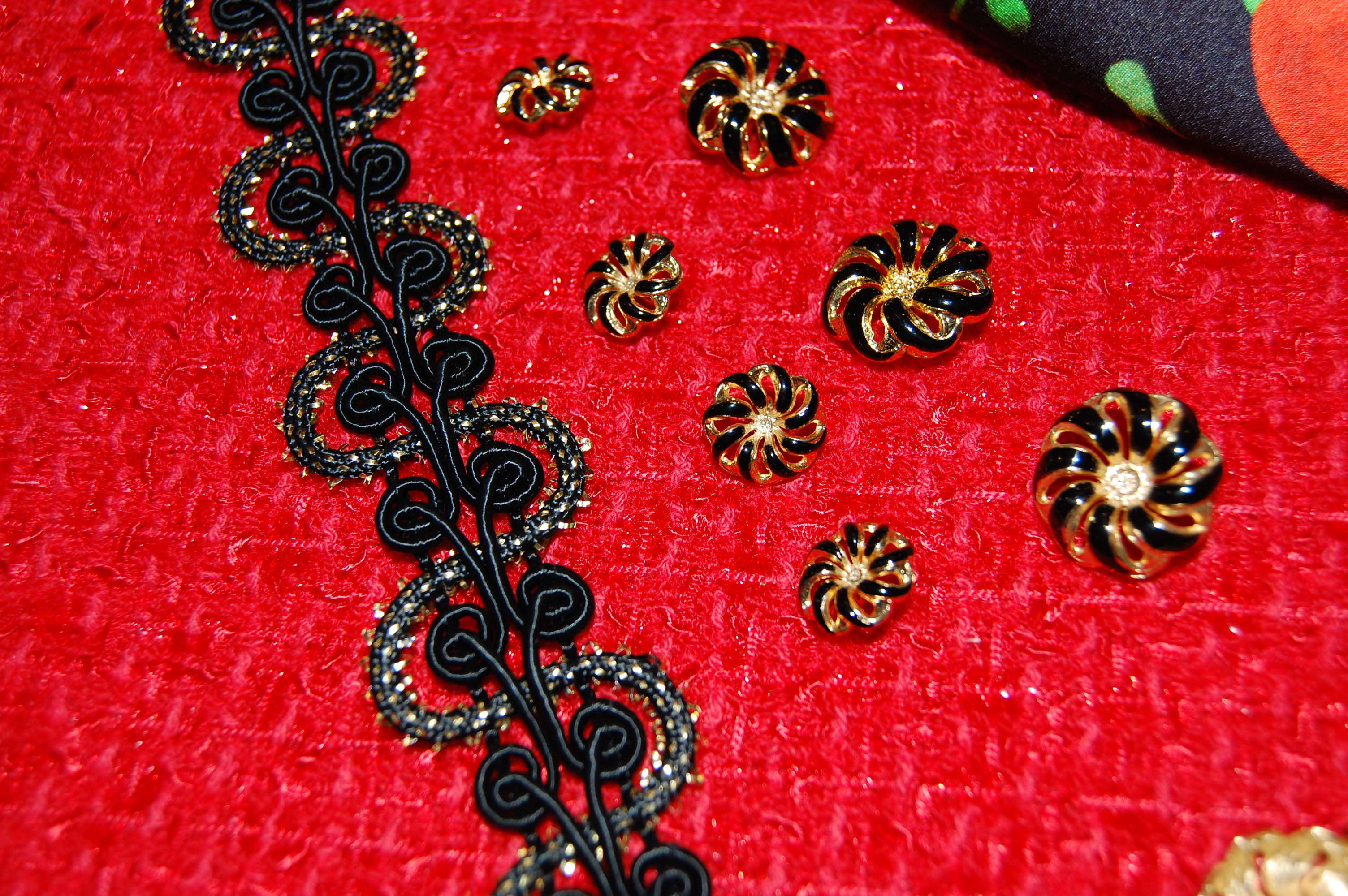
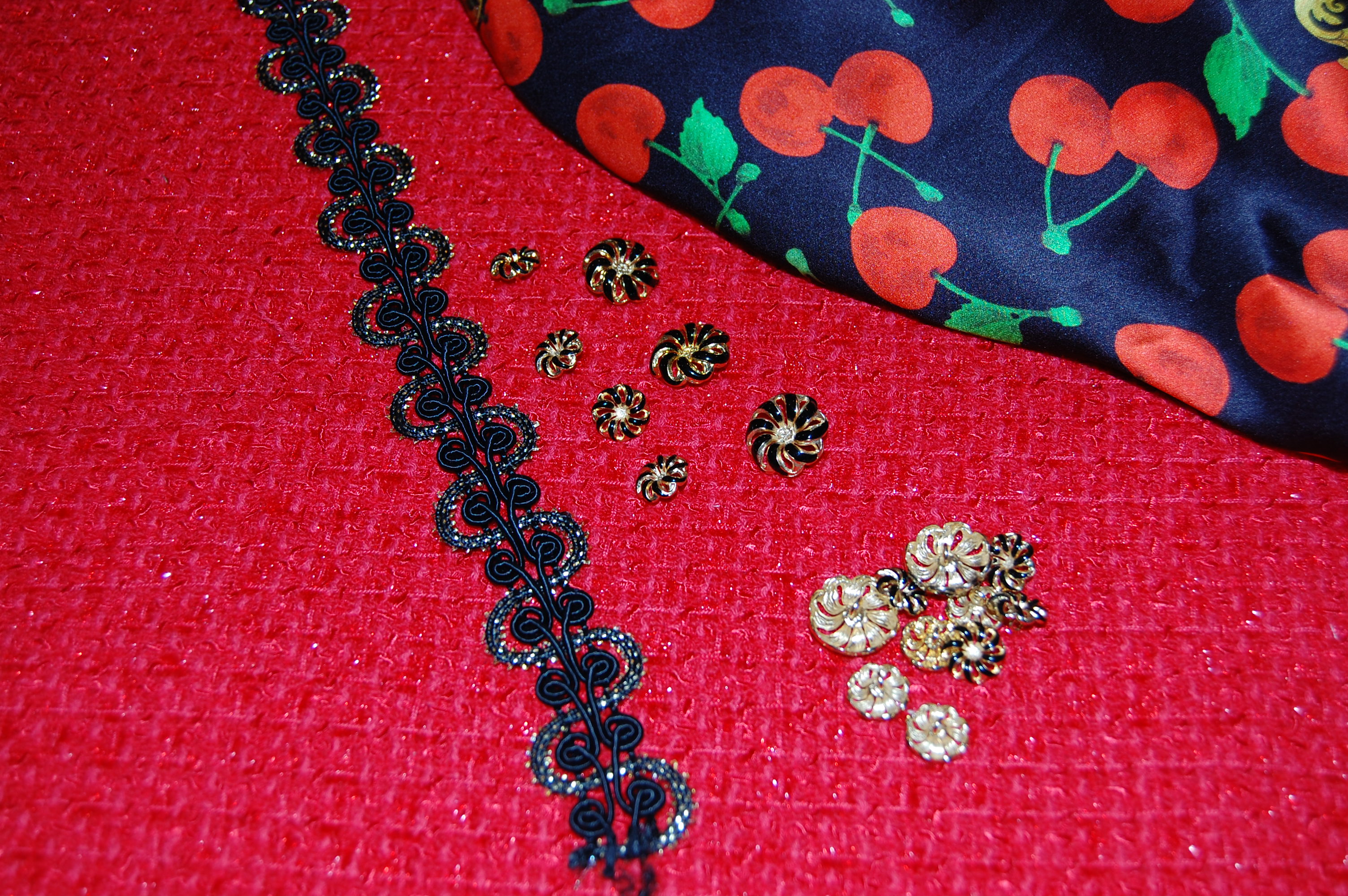
So which of those treasures did I find for my classic French jacket?  I went with the hope of finding a lovely red boucle, which I did.  Paired with that remarkably designed charmeuse shown above, the red seemed to me to be set off most beautifully with black trim and black and gold buttons.

My trim and buttons - click on the photo to see them close-up.

My trim and buttons – click on the photo to see them close-up.

Boucle - charmeuse - trim - buttons.

Boucle – charmeuse – trim – buttons.  All set to begin my jacket . . .

20 Comments

Filed under Buttons - choosing the right ones, Chanel-type jackets, Uncategorized

A “Little” More on Chanel

Coco Chanel has been the fascinating, and sometimes controversial, subject of many, many biographies, several of which I have read.  However, none has charmed me quite the way Different Like Coco has.  This delightful slim book by Elizabeth Matthews is written for the 5 – 9 group.  Now, I don’t mean the fun-loving cocktail ladies, who start sipping at 5:00 PM and finally get to dinner at 9:00.  No, this group is the age-group of 5 – 9, meaning the “little” ones.  Yes, this is a children’s book, a small biography of Coco Chanel, with expressive illustrations, and text which strikes a good balance between simplicity and sophistication.

This bright yellow book jacket hints at the lively story inside.

This bright yellow book jacket hints at the lively story inside.

Different Like Coco was published in 2007 by Candlewick Press, a children’s book publisher located in Massachusetts.  I became acquainted with the newly-minted book when I read a review of it in The Wall Street Journal, by Meghan Cox Gurdon.  Being a “pushover” for all things about the fashion and creative sense of Coco Chanel, I ordered my own copy from Amazon.  (Little did I ever imagine that 6 years later, I would have my own little granddaughter who might just hear this book read to her – oh, who knows how many times?)

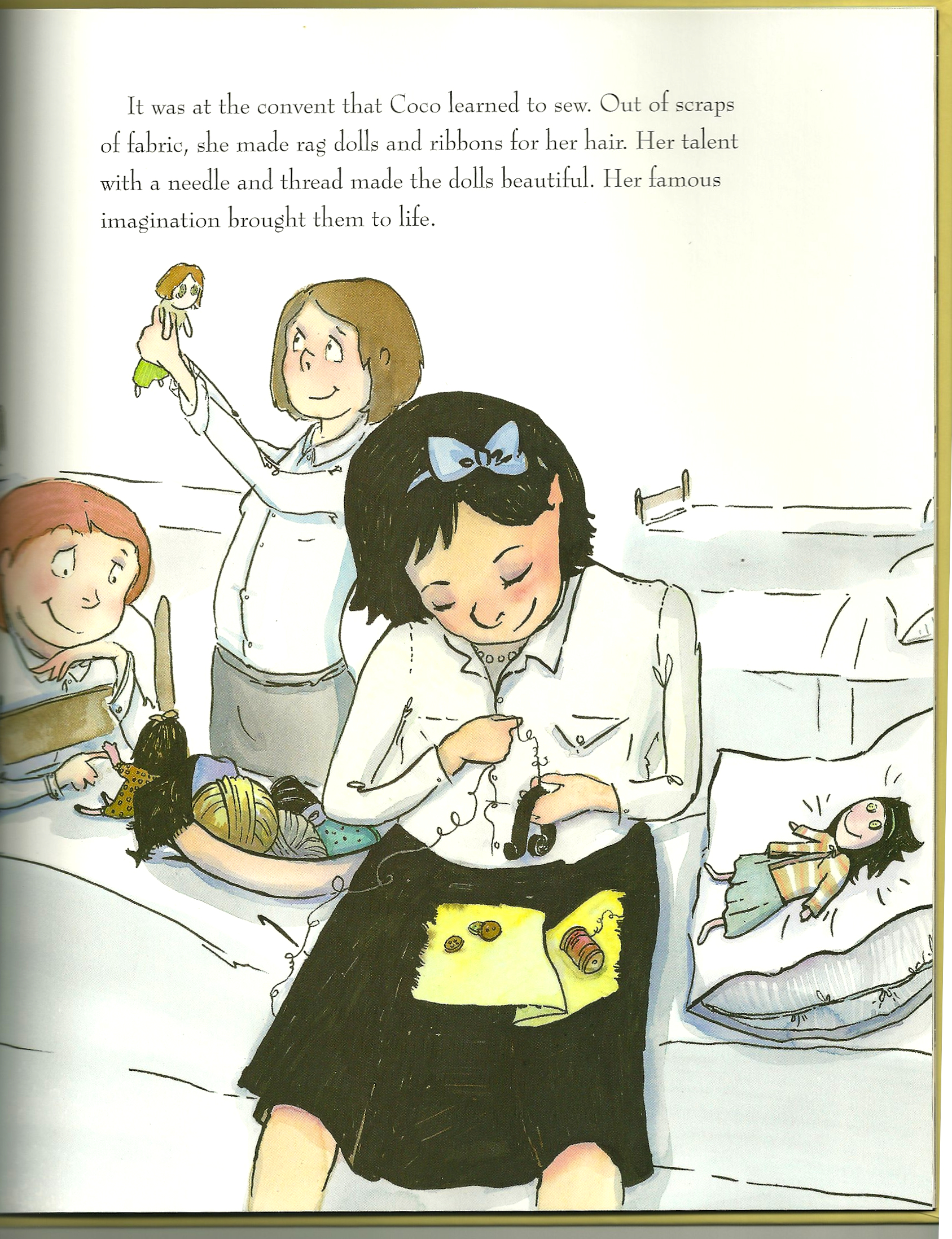
On one level, the book is purely biographical, emphasizing Chanel’s childhood spent in poverty – which she did not allow to define her.  The later part of her childhood was spent in a convent, and it was there where she learned to sew.

The author's charming illustration of Coco as a child with her sewing.

The author’s charming illustration of Coco as a child with her sewing.

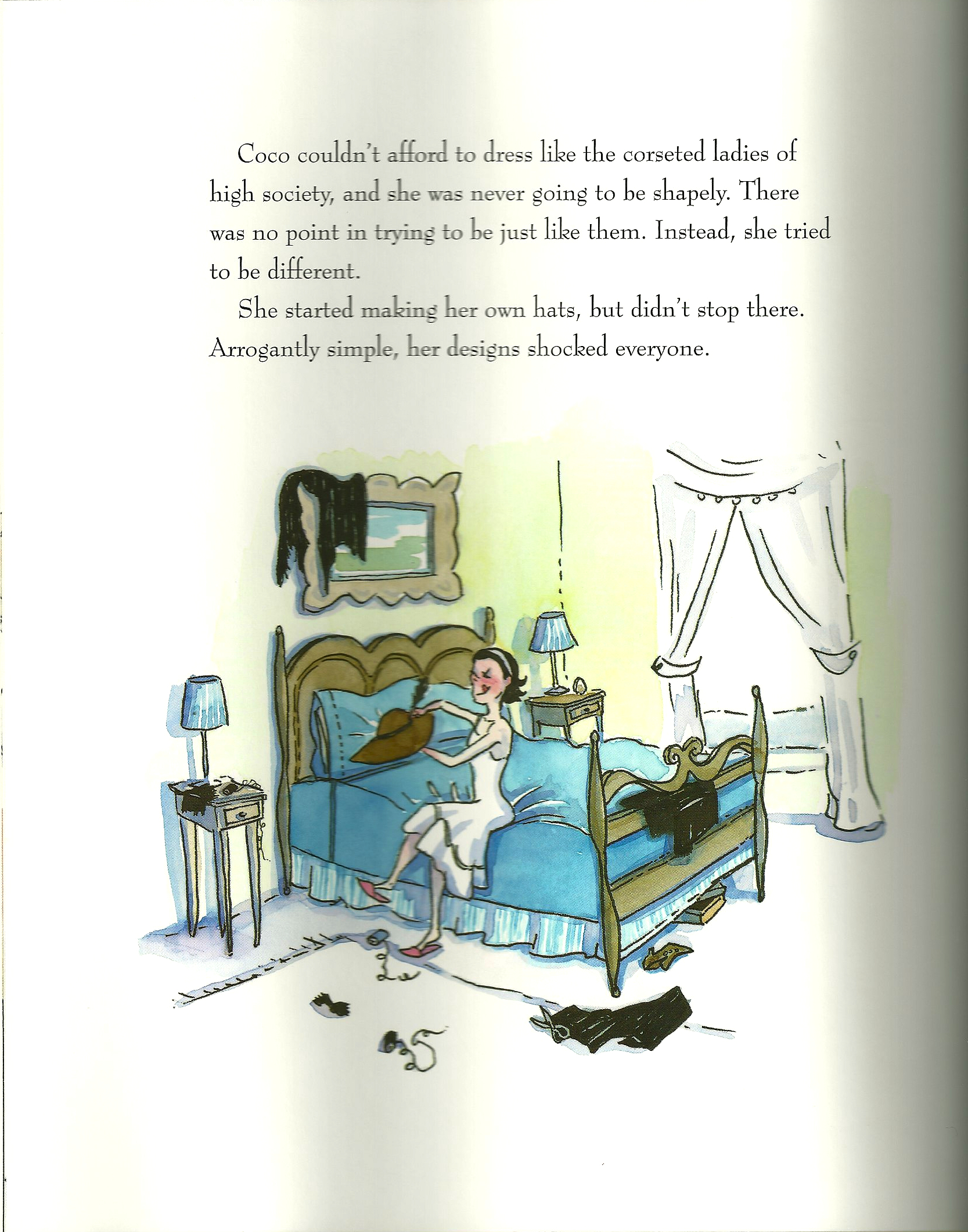
Those sewing skills were the “mechanical” ticket to her success, while her creativity, her determination, her hard work and her daring flounting of convention set her apart from others of her age.

Coco's creativity on display.

Coco’s creativity on display.

The story emphasizes these characteristics for the young readers of this book, which makes it more than a biography.  Indeed, these characteristics are treated as inspirational, which they certainly can be to children.

Some of the more controversial aspects of Chanel’s life are handled discreetly, so that the opening of her first shop and the creation of the classic cardigan jacket (made from one of her lover’s sweaters) are seamless chapters in her life story.

A classic created anew!

A classic, created anew!

For the adult reader of this sweet book, there are two features which I guarantee will be read again and again.  One is the “Timeline” which is in the back of the book (accompanied by a bibliography, too).  All the important dates of Chanel’s life are succinctly listed, including the development of her perfume Chanel No. 5 in 1921; the afore-mentioned creation of her signature jacket, also in 1921, and her debut of the “little black dress” in 1926.

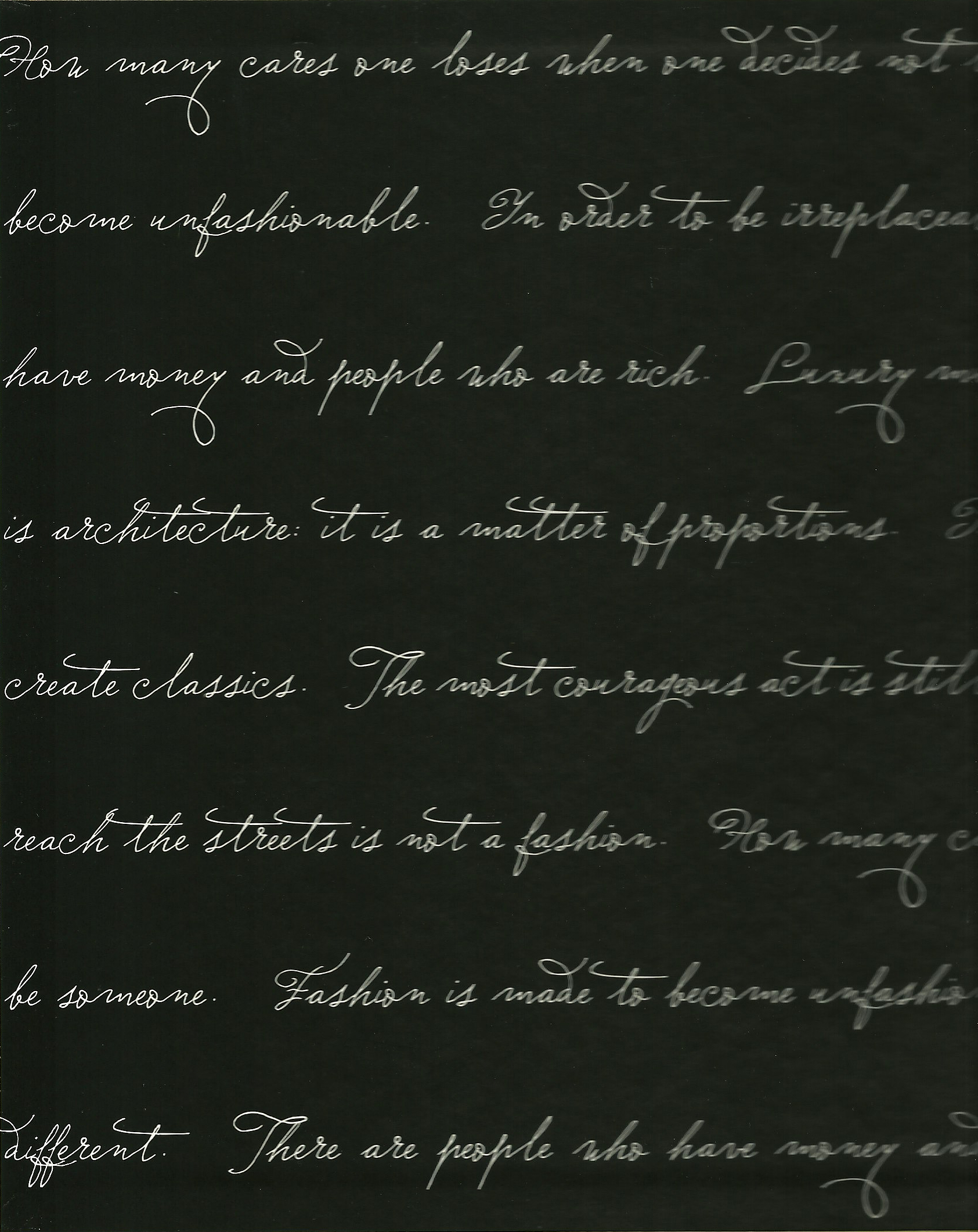
The other compelling aspect of this book is one of pure brilliance from a design point of view:  the lining pages feature a “running commentary” of some of Chanel’s famous and less-known quotes.

One side of the lining pages of the book.

One side of the lining pages of the book.

A sampling of her quotes about fashion:

“Fashion is made to become unfashionable.”

“A fashion that does not reach the streets is not a fashion.”

“Fashion is architecture: it is a matter of proportions.”

And some of her quotes about life:

“There are people who have money and people who are rich.”

“Luxury must be comfortable; otherwise it is not luxury.”

“How many cares one loses when one decides not to be something but to be someone.”

And I so appreciate that this quote is placed centermost:  “The most courageous act is still to think for yourself.  Aloud.”

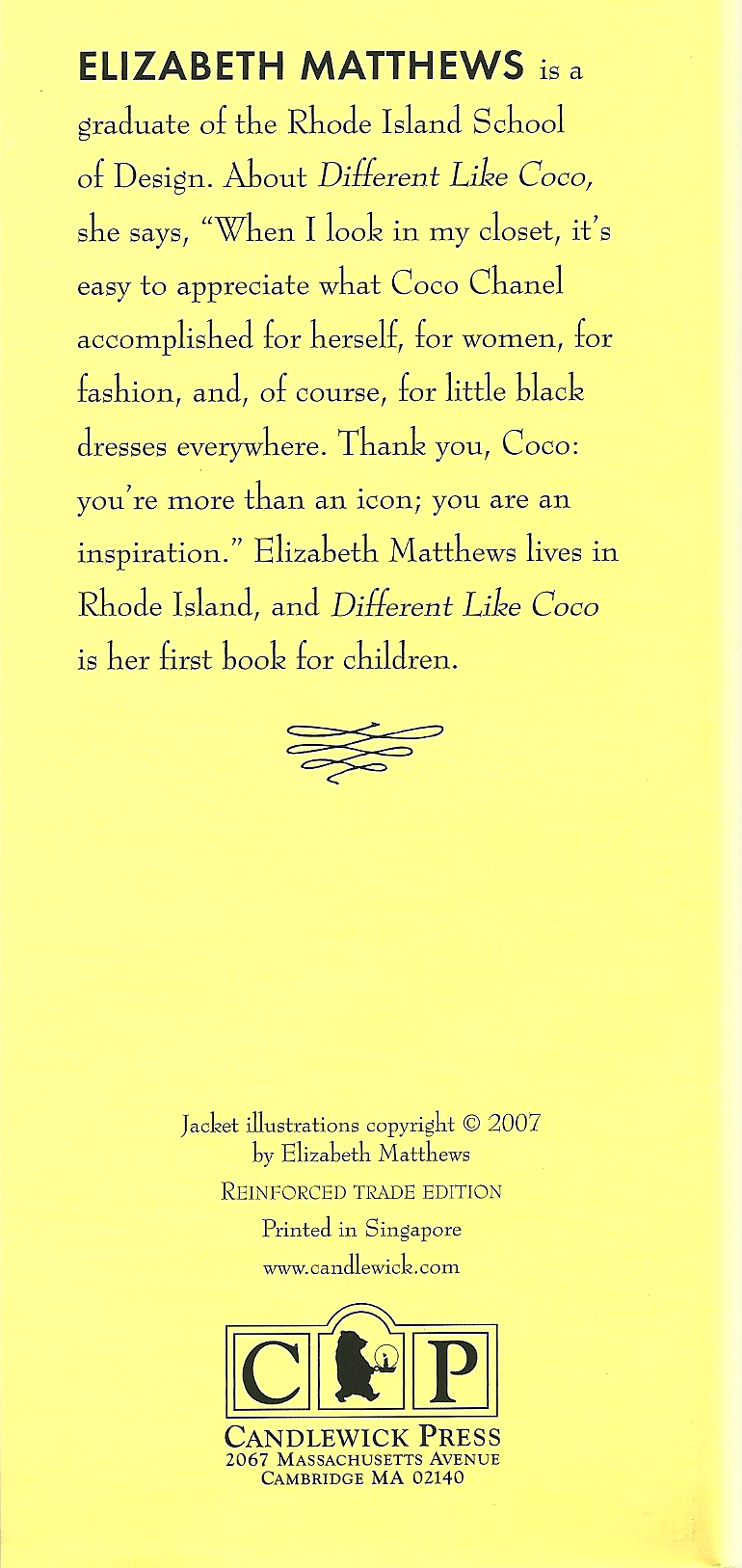
I cannot close this post without a special word about the author, Elizabeth Matthews.  The book jacket has this short statement about her and her motivation to write this book:

Click on the window for an enlarged view.  PLEASE NOTE THAT ALL ILLUSTRATIONS ARE COPYRIGHT 2007, THE CANDLEWICK PRESS.

Click on the window for an enlarged view. PLEASE NOTE THAT ALL ILLUSTRATIONS ARE COPYRIGHT 2007, ELIZABETH MATTHEWS.

Thank you, Elizabeth Matthews, for making the life story of Coco Chanel an inspiring and almost magical tale for 5 to 9-ers of every age!

9 Comments

Filed under Book reviews, Chanel-type jackets, Coco Chanel, Uncategorized

In Pursuit of My Very Own Classic Cardigan (aka Chanel) Jacket

As I eagerly anticipate the Classic French Jacket class I will be taking with Susan Khalje in June, there are several things I am doing to get ready for it.  First, of course, is doing my homework.  That includes selecting the pattern I want to use and making the muslin.  I am sticking with the old stand-by Vogue pattern #7975 (which Susan recommends), as I really do want the classic princess-seamed cardigan look that has evolved from its original “boxy” styling.

Chanel jacket pattern

The view in the lower righthand corner is the version I anticipate starting with.

I’ve prepared my thread-traced muslin pieces, as seen here –

Chanel jacket muslin

And now those pieces are sewn together as well.  We (the members of the class) will be shopping for fabric and trim(s) on the first day of class, so what I end up with is still to de determined.  Am I looking for a particular color?  Yes, sort of, but who knows what wool will entice me – other than probably the most expensive one!

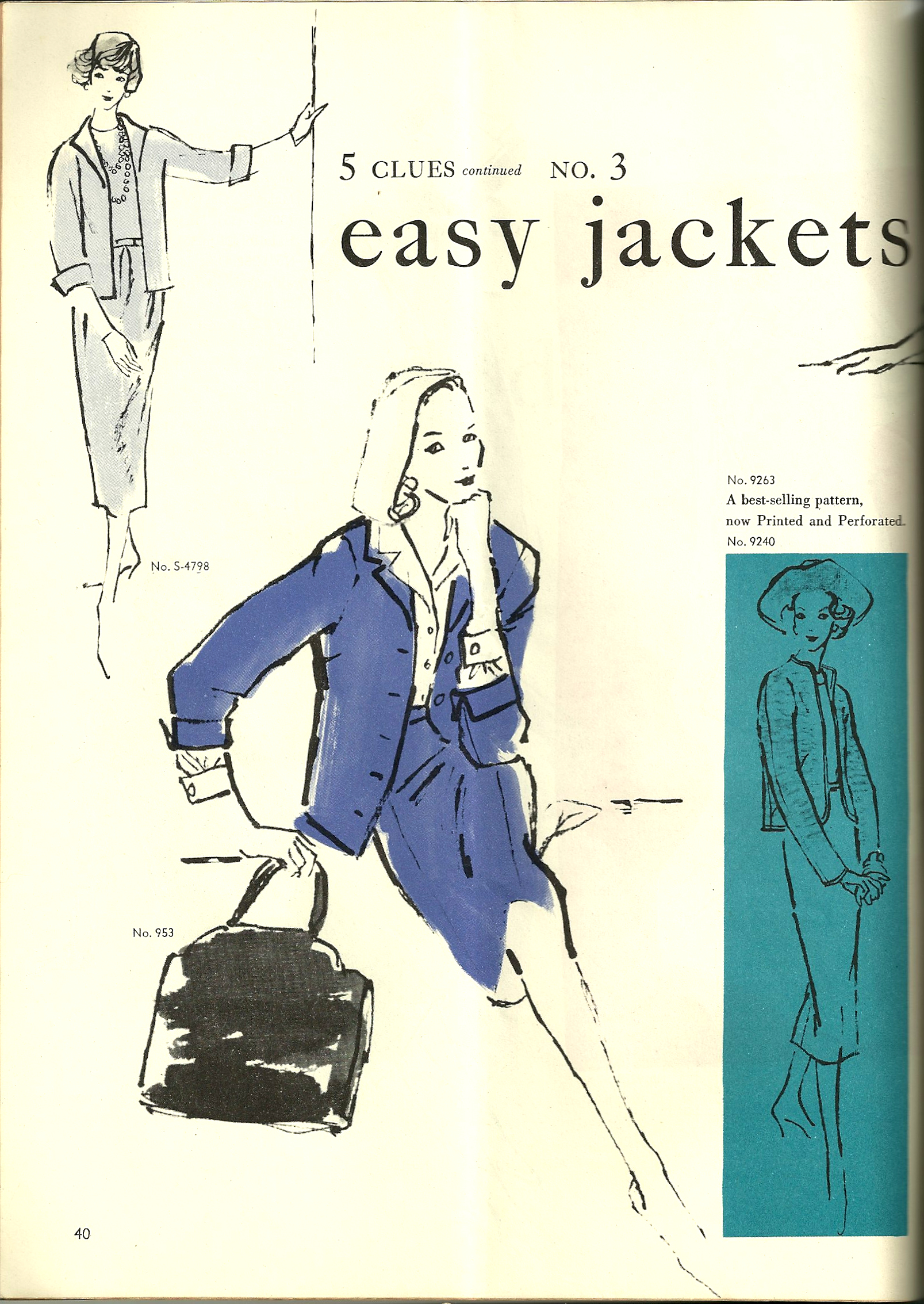
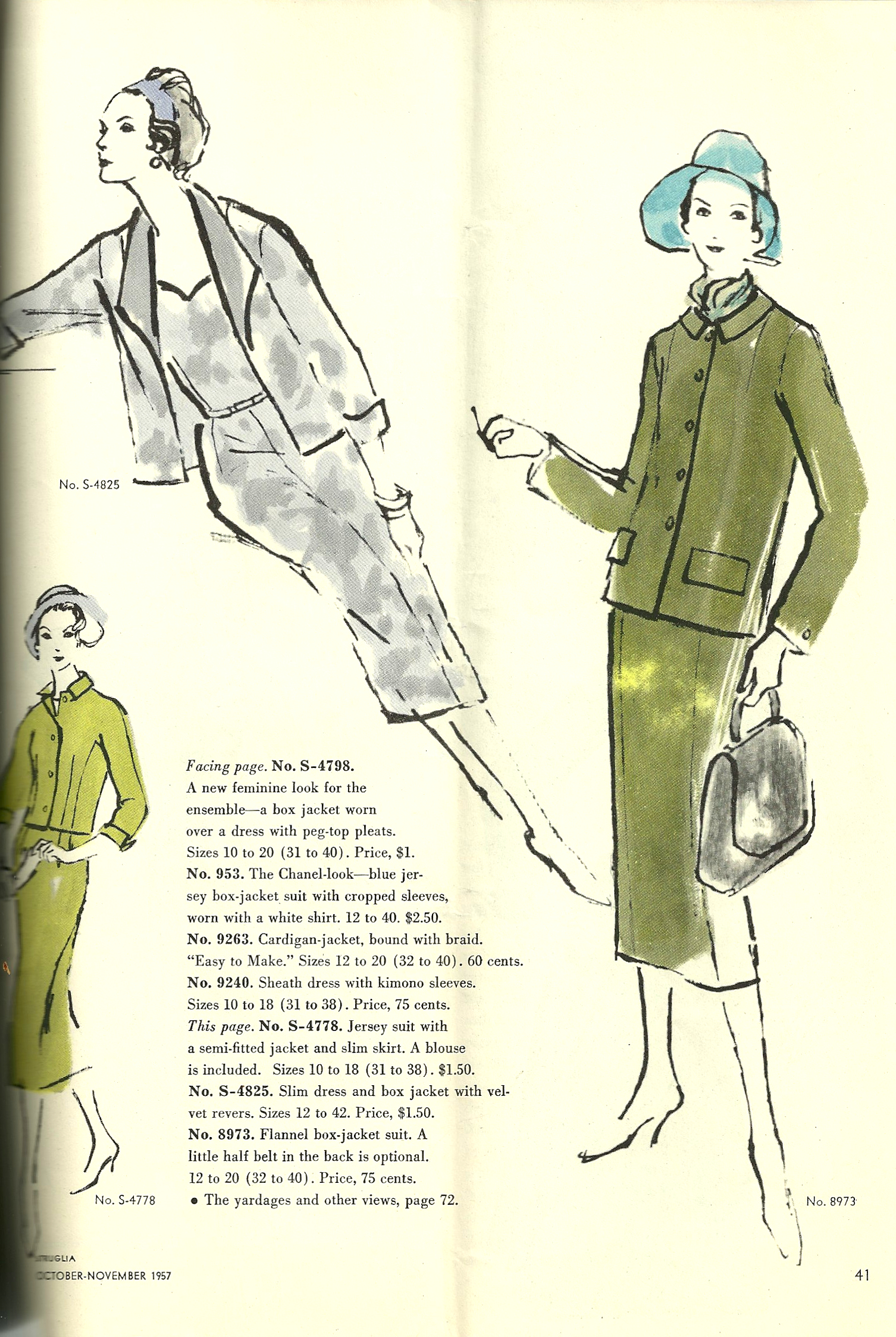
Having classic “Chanel” on my mind has made me think about how enduring this style jacket has been over so many decades.  From looking through some of my Vogue Pattern Book Magazines from the 1950s and 1960s, it is obvious that this is one fashion that is always in Vogue (pardon the pun).  The October/November 1957 issue stated “The Chanel look of the easy jacket is in the news in both suits and ensembles.  Box jackets often have cropped sleeves to show cuff-linked shirt sleeves.”  Here is how that statement is llustrated:

The sketch in jade shows a "best-selling" pattern, newly available printed and perforated.

The sketch in jade shows a “best-selling” pattern, newly available printed and perforated.

Here is the opposing page to the previous illustration - more on the "Chanel look."

Here is the opposing page to the previous illustration – more on the “Chanel look.”

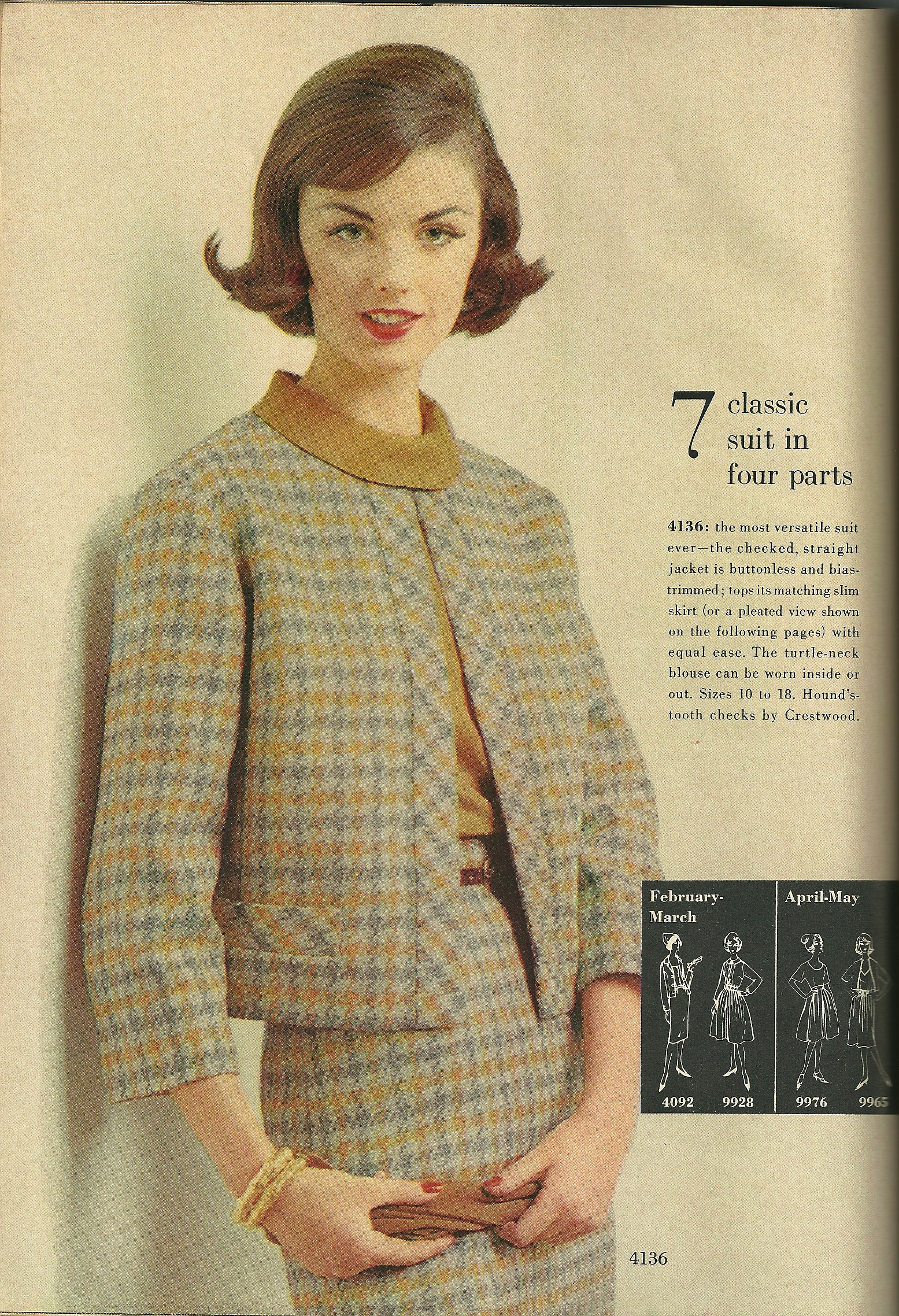
Shades of Chanel are obvious in this style from the August/September 1960 issue, with the statement:  “[T]he most versatile suit ever – the checked, straight jacket is buttonless and bias-trimmed…”

This suit definitely shows shades of Chanel!

This suit definitely shows shades of Chanel!  I like the suit much better than the hairstyle.

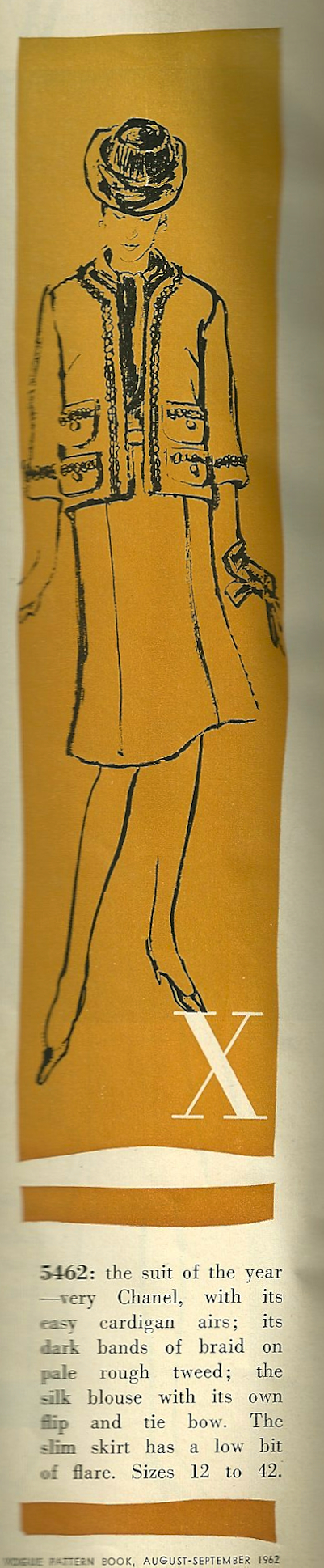
Two years later, the August/September issue included a classic Chanel-look suit in its wardrobe for Vogue’s fictional character, Mrs. Exeter.  Called “the suit of the year”, it is described as “. . . very Chanel, with its easy cardigan airs; its dark bands of braid on pale rough tweed; the silk blouse with its own flip and tier bow.  The slim skirt has a low bit of flare.”

This is the most classic Chanel image I found from the 1960s in my copies if VPB.

This is the most classic Chanel image I found from the 1960s in my copies if VPB.

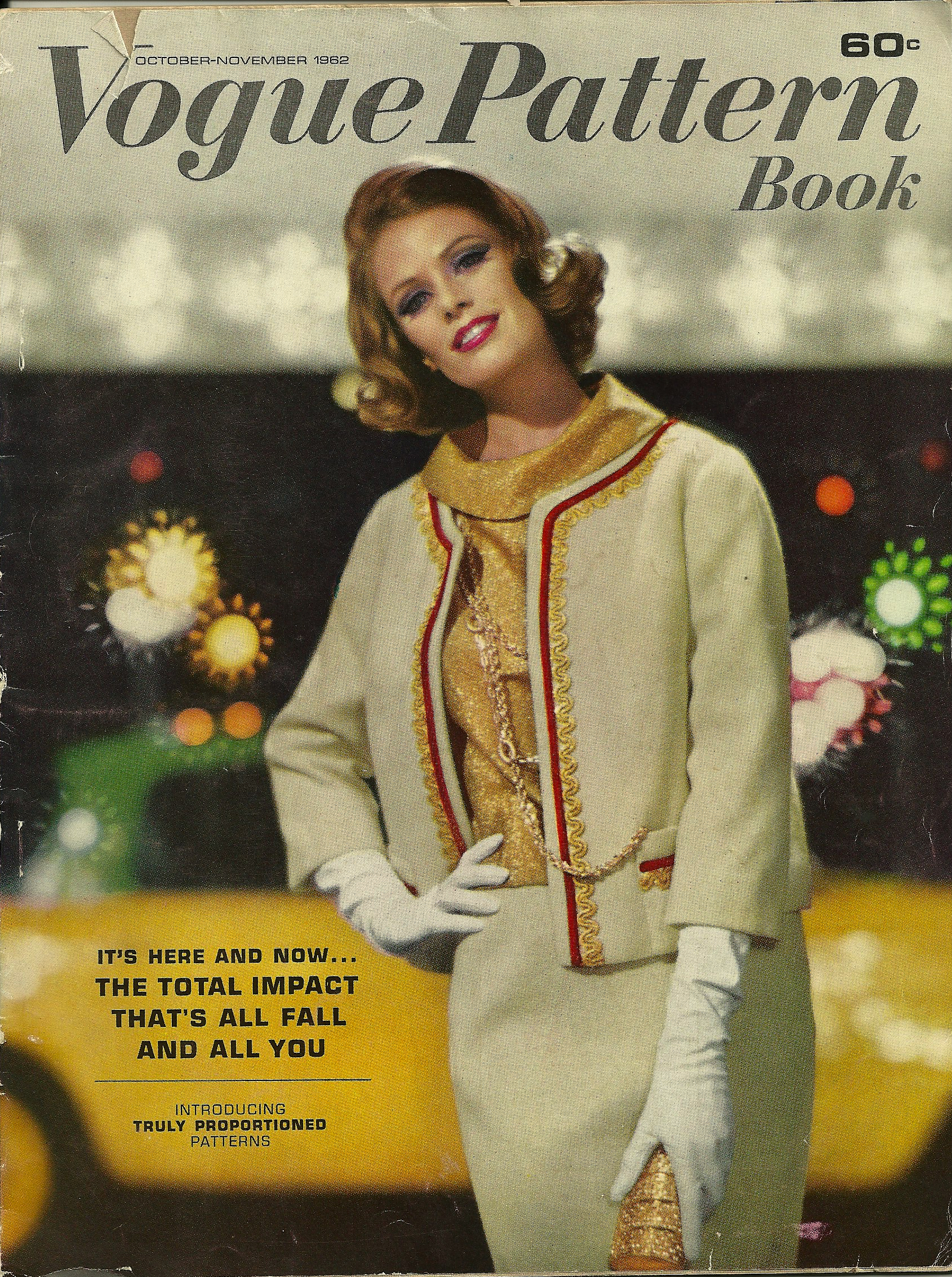
The very next issue in 1962 featured a classic Chanel look on its cover.  The accompanying caption states:  “Take a clean-lined suit design (shades of Chanel) and make it shimmer:  a springy white suit wool scored with gold metallic and red braid . . .”

Chanel jacket images #9

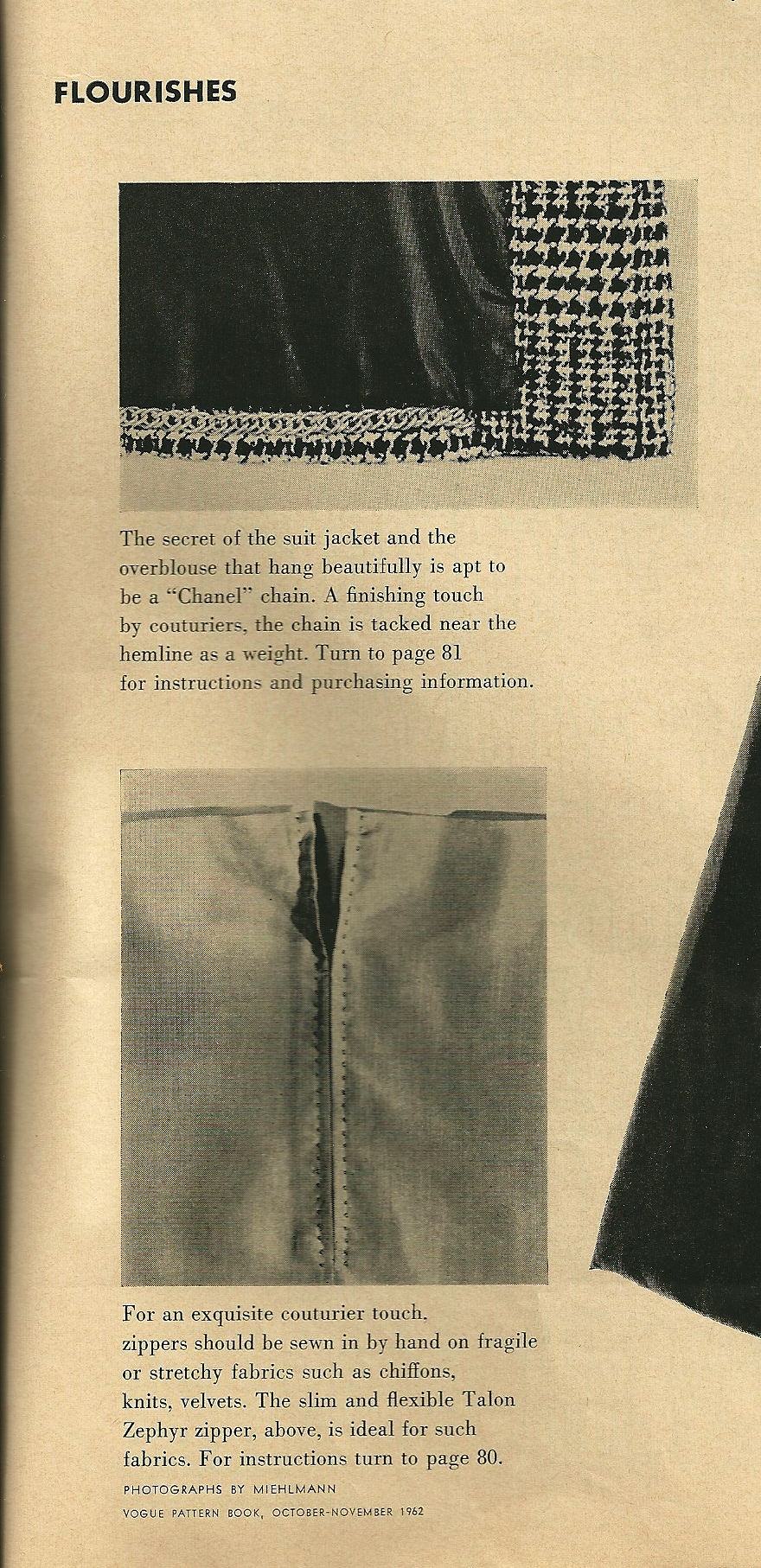
That same issue of Vogue Pattern Book Magazine gave away this “secret” in a feature entitled VPB’s Boutigue Corner:  Couturier Flourishes:  “The secret of the suit jacket and the overblouse that hang beautifully is apt to be a “Chanel” chain.  A finishing touch by couturiers, the chain is tacked near the hemline as a weight.”

The topic figure shows the "Chanel" chain fastened to a hemline.

The topic figure shows the “Chanel” chain fastened to a hemline.

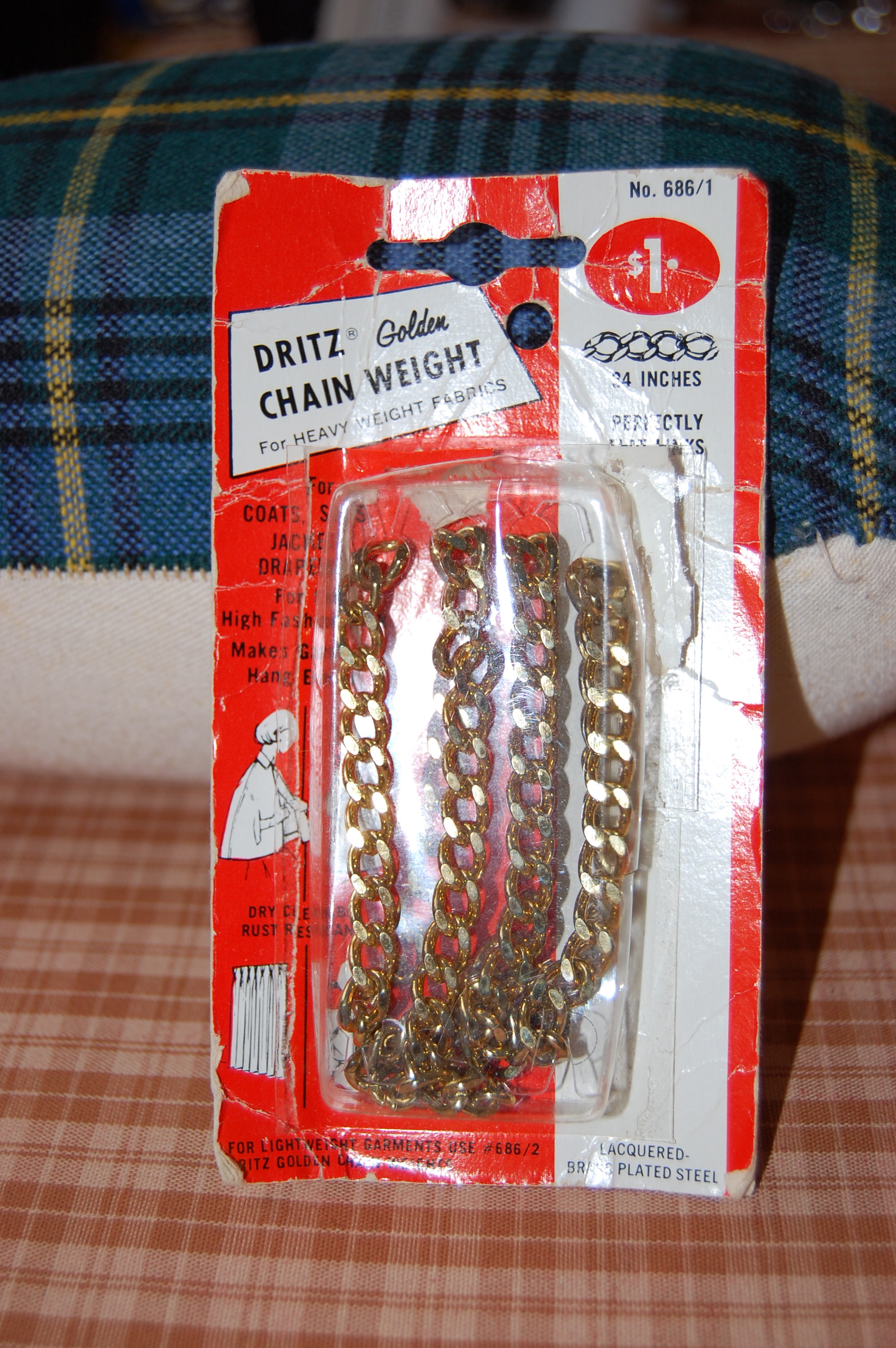
Ordering information for such chains was included in the same issue.  However, I know for a fact that these types of chains could be purchased in fabric stores, as I still have one (in its original –albeit tattered – packaging) that I purchased in the late ‘60s!

This "vintage" chain still looks new!

This “vintage” chain still looks new!

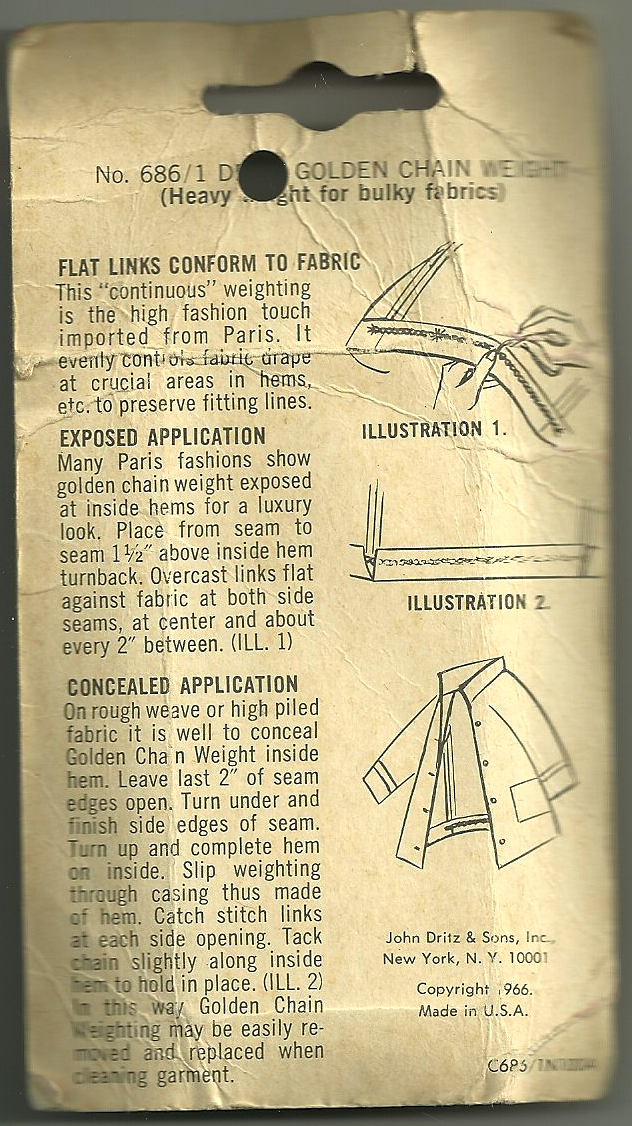
The back of the packeage shows the copyright date, 1966, and includes instructions on attaching the chain.

The back of the package shows the copyright date, 1966, and includes instructions on attaching the chain. 

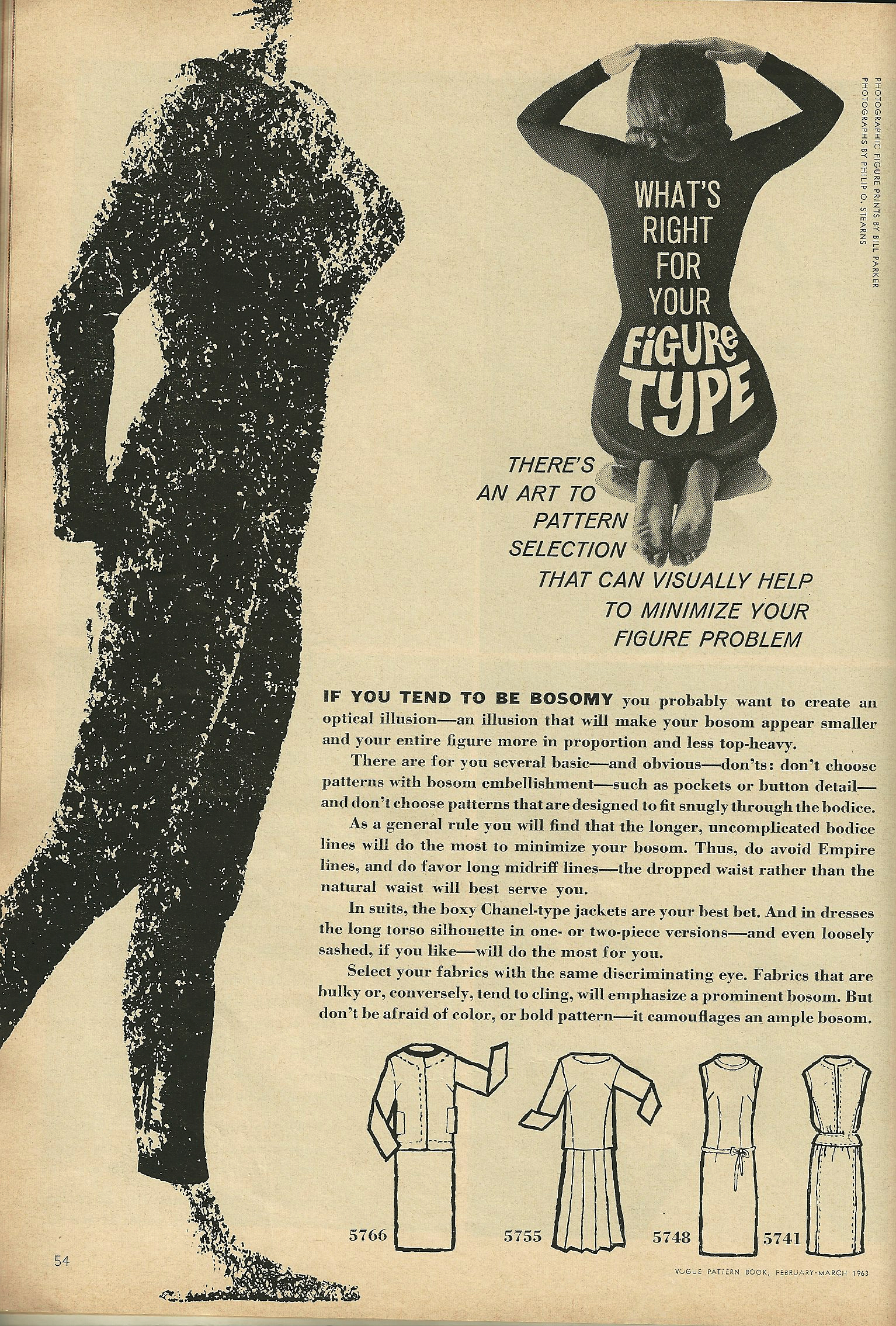
Finally, an article in the February/March 1963 issue of the magazine gave some of that age-old advice on “pattern selection that can visually help to minimize your figure problem.”  The advice given “if you tend to be bosomy” seems like it could be good advice for just about every figure problem (or problem figure, depending on your point of view) as it states “In suits, the boxy Chanel-type jackets are your best bet…”

If you can get past this awful illustration, you can read the accompanying text about Chanel-type jackets!

If you can get past this awful illustration, you can read the accompanying text about Chanel-type jackets!

Gosh, I think Chanel-type jackets are just about perfect for everyone.  How else would this classic style have endured so beautifully for so long?

12 Comments

Filed under Chanel-type jackets, couture construction, The Conde Nast Publications, Uncategorized, vintage Vogue patterns from the 1950s, vintage Vogue patterns from the 1960s, Vogue patterns, woolens

What Do a Chanel Jacket and a Chicken Have in Common?

Not much – unless you were in my sewing room last week.

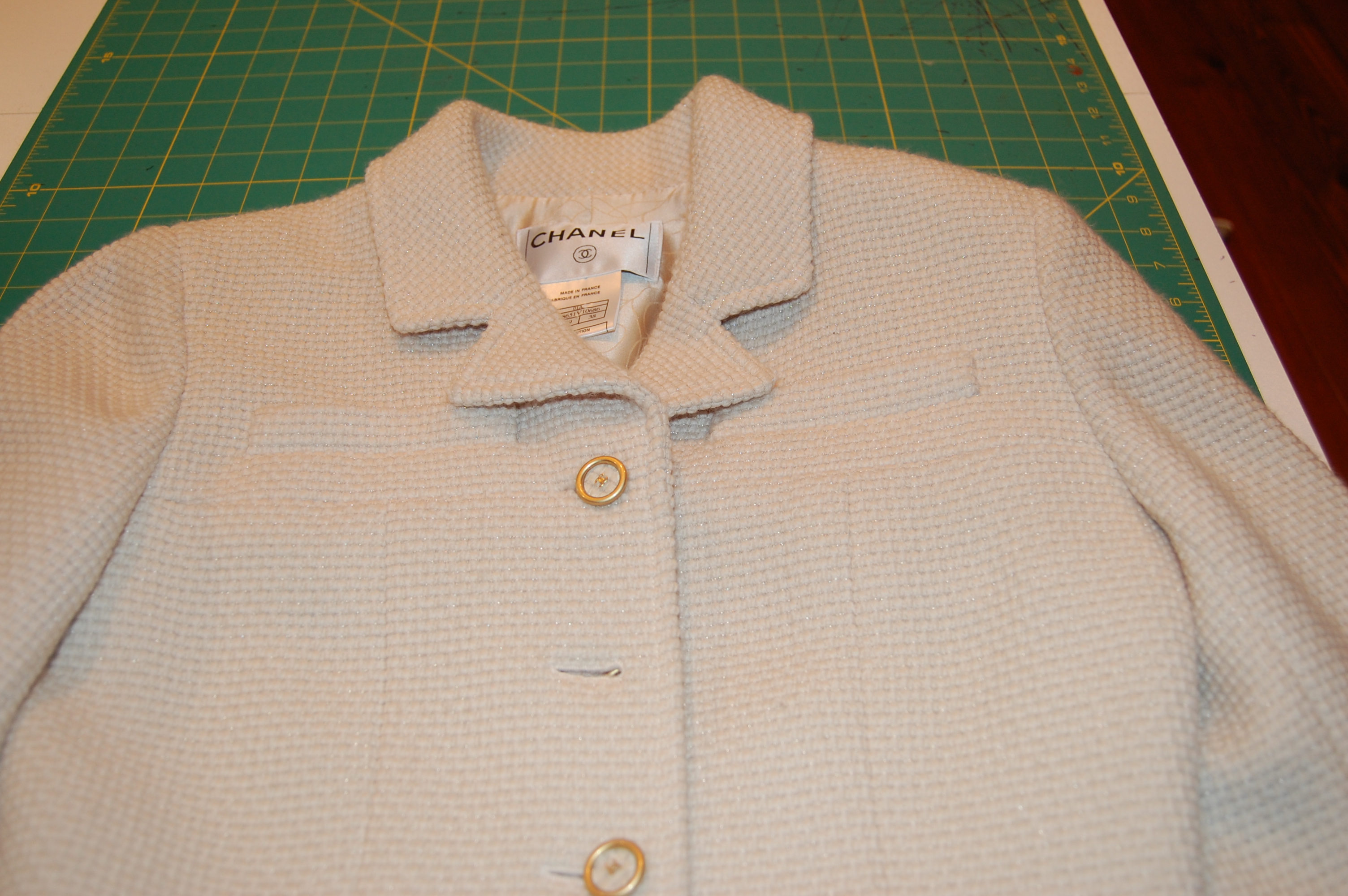
When we were out in California very recently, my son’s girlfriend, Rachel, showed me a Chanel jacket she had found at a store which sells vintage clothing.  Sadly, she had never been able to wear it because it had very prominent shoulder pads, which screamed 1980s.  Otherwise it was a very wearable cropped jacket with petite convertible collar, in a creamy white wool with just a hint of  a sparkly windowpane weave.  Rachel asked me what I thought could be done with it.

Hm-m-m-m, I looked inside it, felt around those shoulder pads hidden inside the lining, and guessed that I could easily remove them and replace them with a much more reasonable sleeve header.  Of course, I’d need to bring the jacket home with me, so in the suitcase it went, landing in my sewing room.

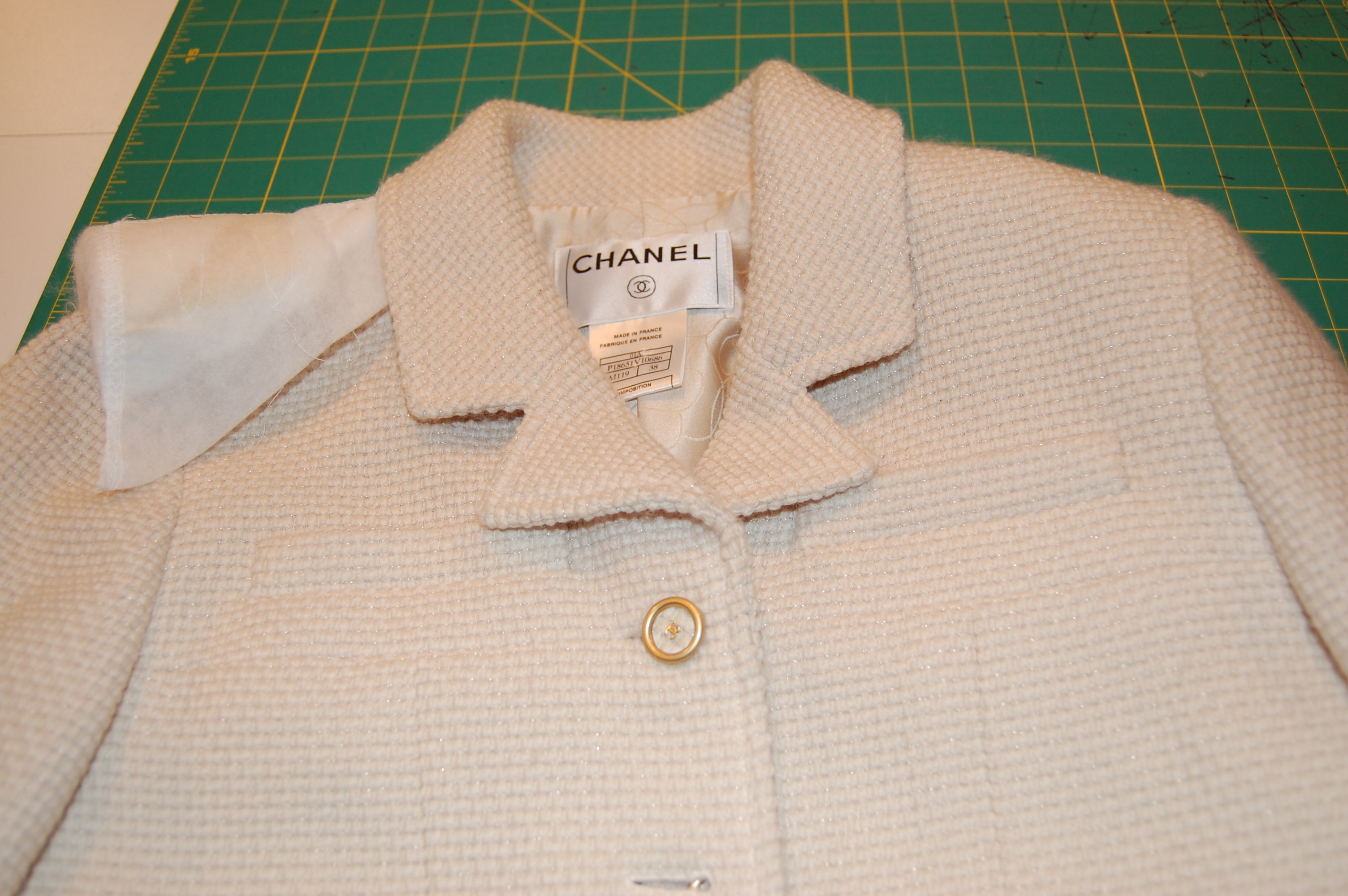
I carefully removed the stitching from the lining at the right shoulder and took a peek.  The shoulder pad had been attached with hand stitches, easily snipped.  Out it came.  I cut a piece of French sleeve heading tape, called Cigarette, which I had purchased from Susan Khalje’s website. (I had used this in my Craftsy course The Couture Dress.)

The shoulder pad is in plain view in this photo.

The jacket has top-center seams on the sleeves, so with that extra fabric bulk, I determined that the simple sleeve heading would be enough shaping.  Here is the jacket with just the side on the left fixed:

Can you see how bulky the shoulder on the right is?

Here I have placed the shoulder pad on top to show some perspective on its bulk.

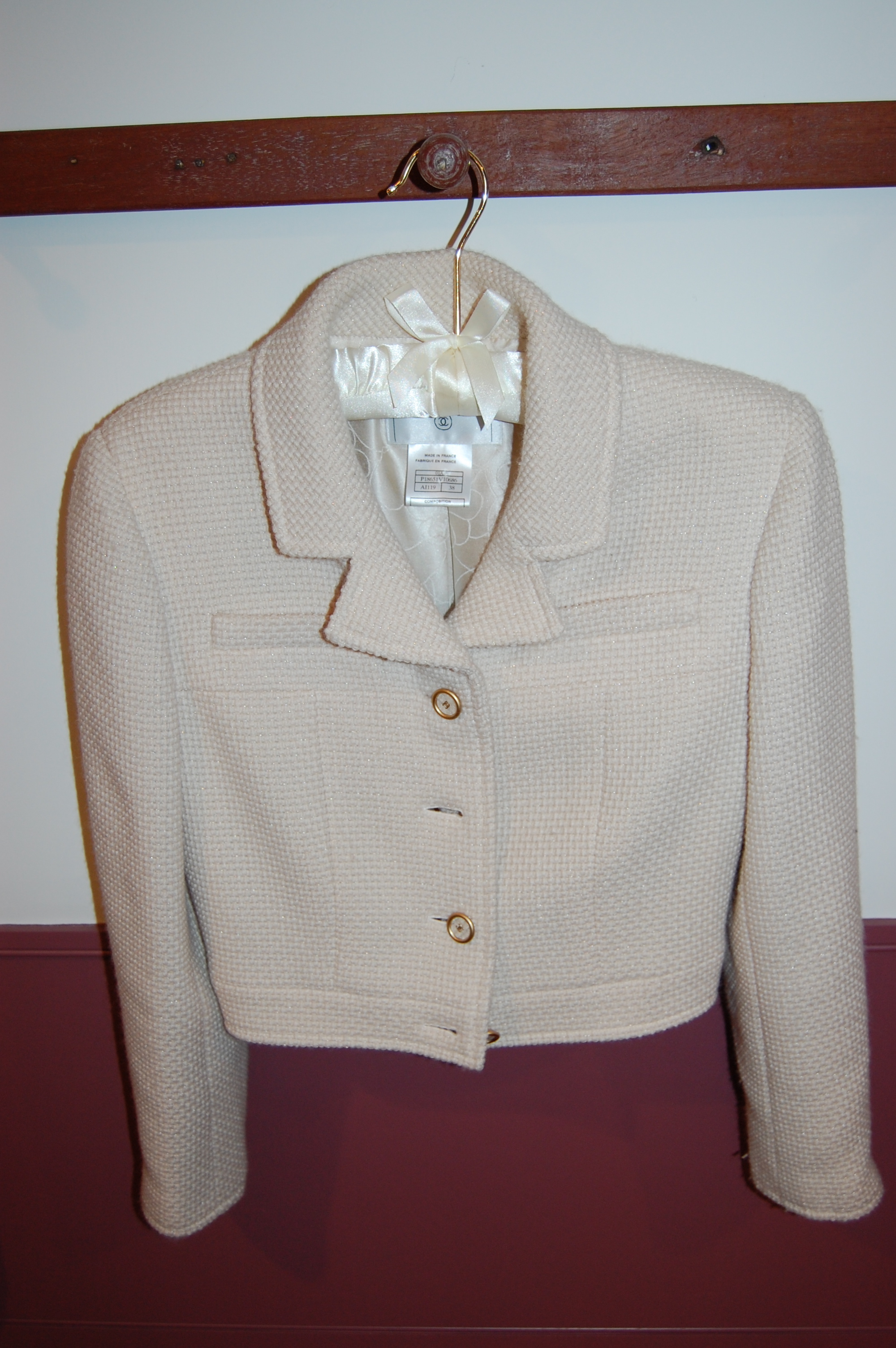
And here is the jacket with both shoulders complete and all sewn up inside (with itty-bitty stitches):

The padded hanger helps to simulate the shoulder line.

Of course, I had to guess a little on the final fit as I did not have Rachel here to try it on.  But I am sure, once it completes its return trip to California, that it has a better chance of being worn now than before!

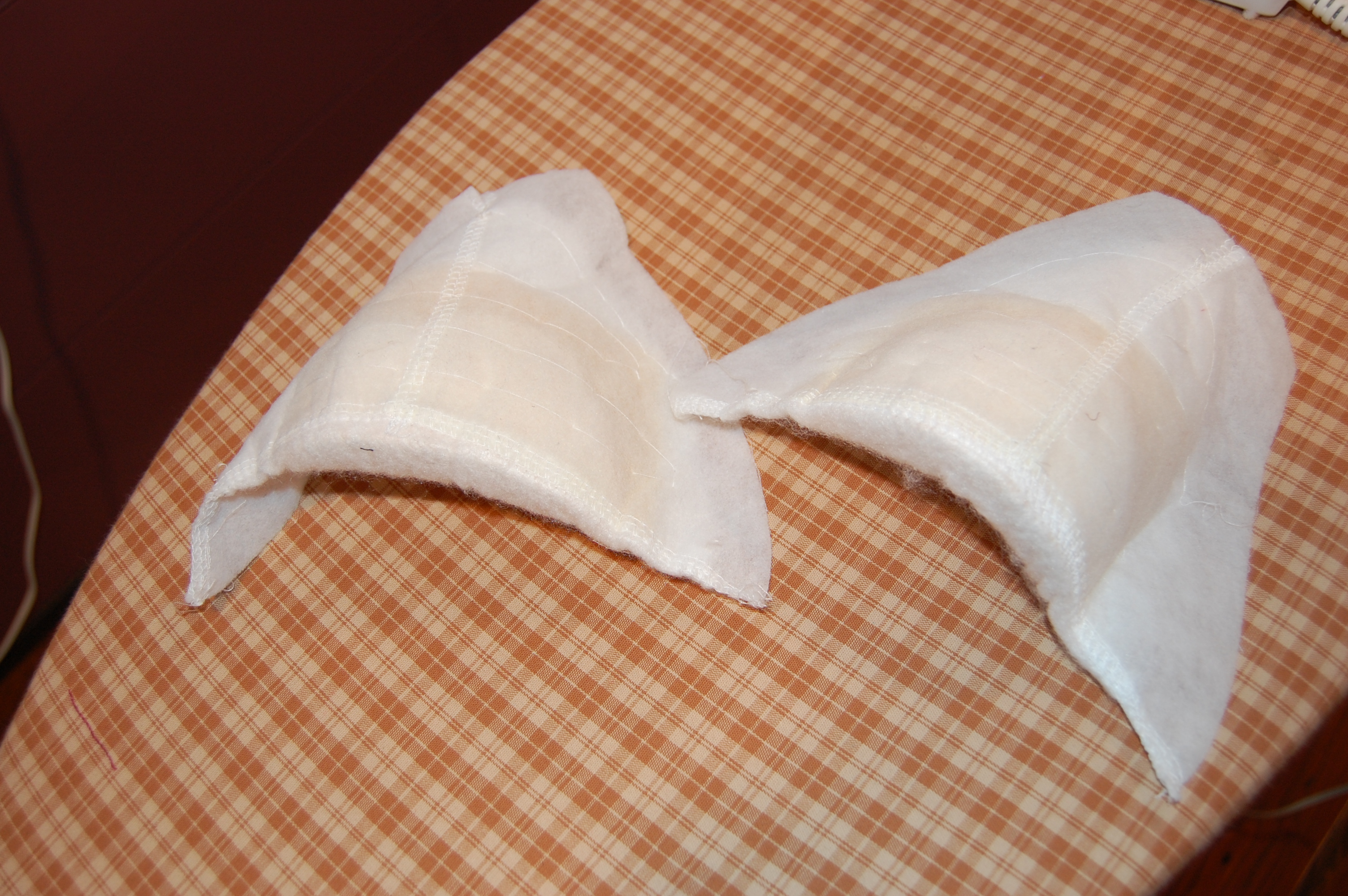
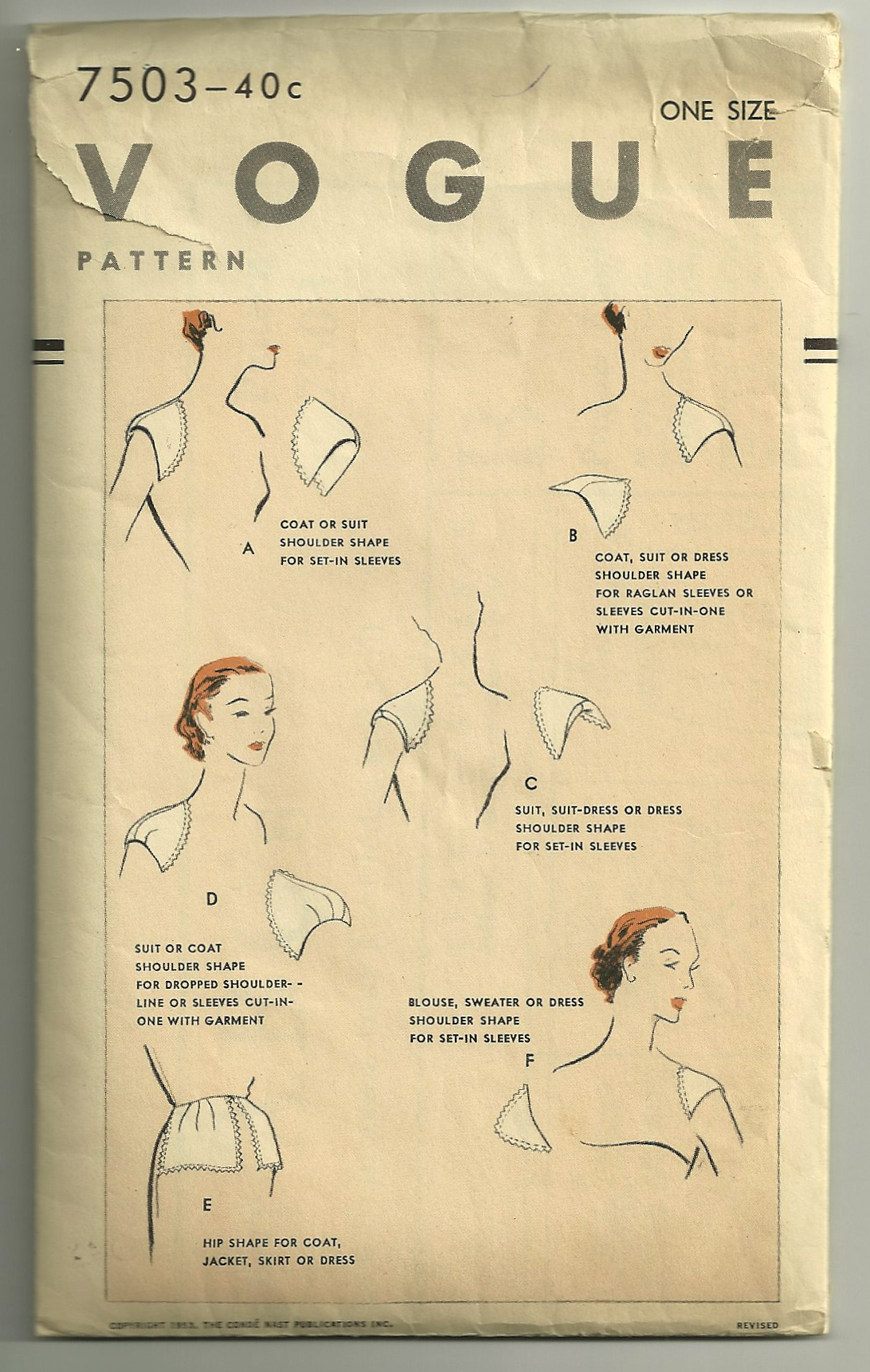
It was interesting for me to be able to see inside a Chanel jacket – I discovered some details I thought I might find – such as 1) the wool fabric was totally underlined in what looks like silk organza; and 2) hand-sewing was evident in quite a few areas.  However, the seams were not catch-stitched to the underlining, which I thought they might be.  The most amazing thing was actually seeing those shoulder pads – as their construction was almost exactly like view C of Vogue 7503, my vintage pattern from 1953. How cool is that?

Two authentic Chanel shoulder pads!

View C is right in the middle.

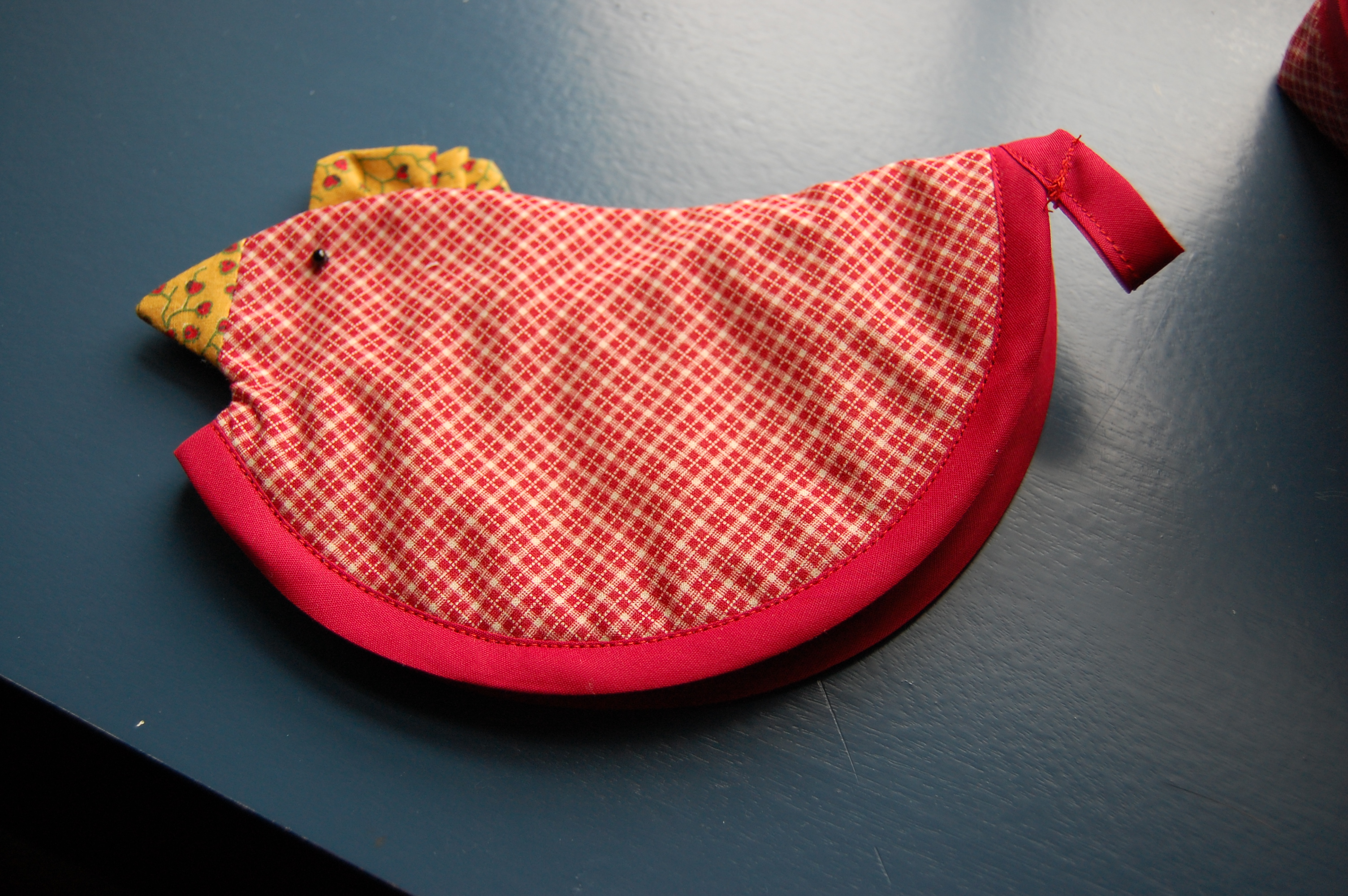
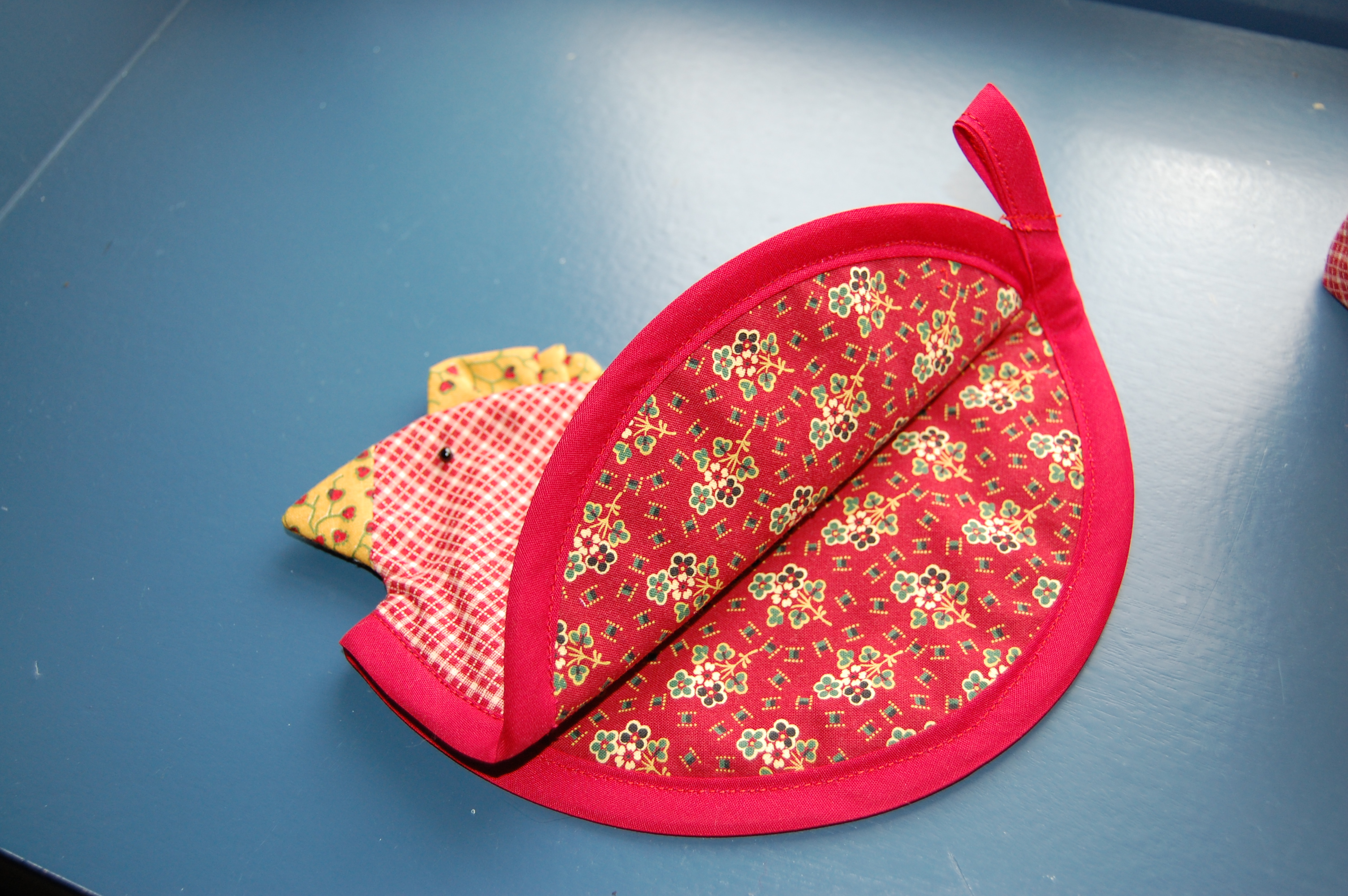
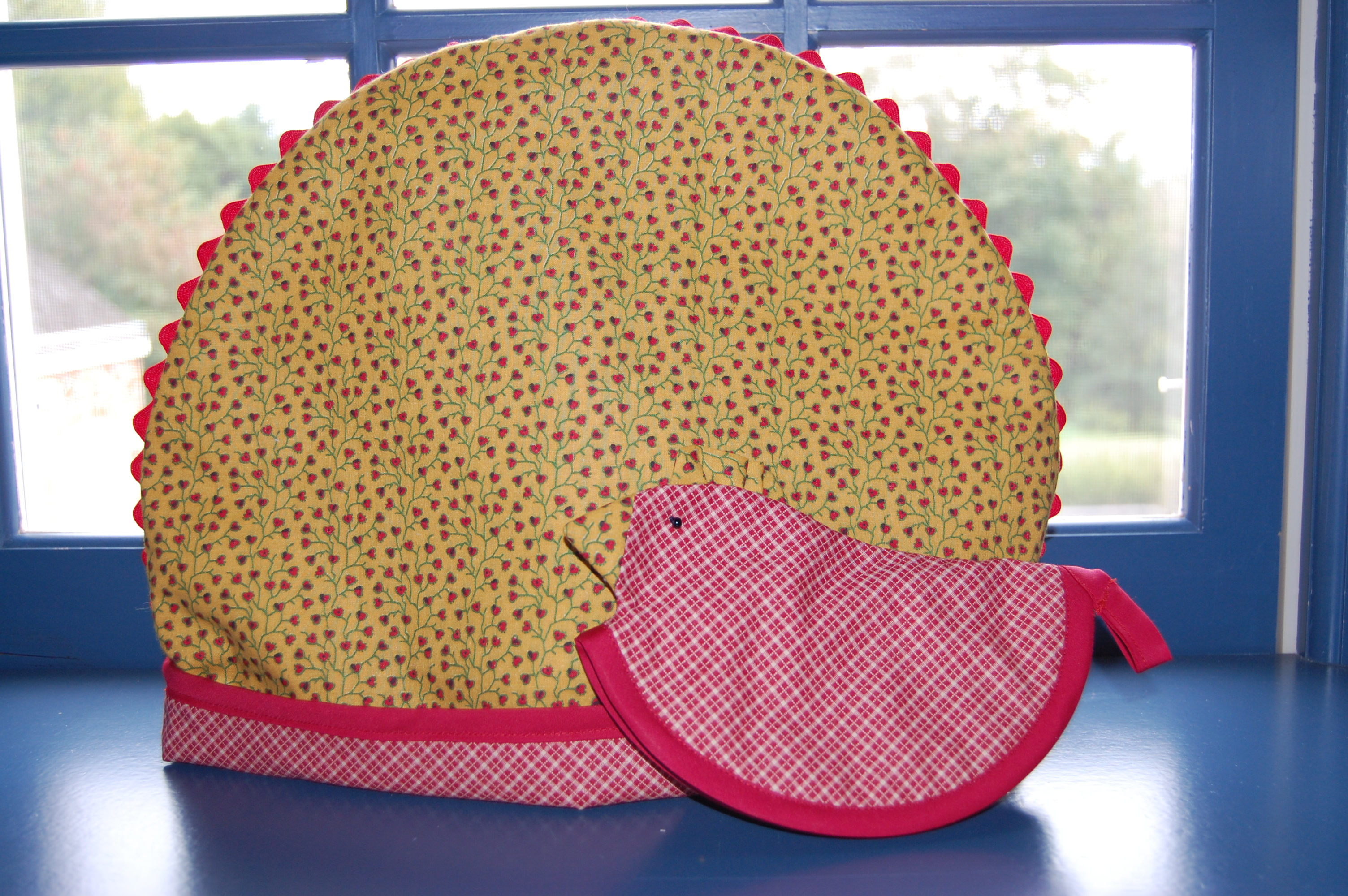
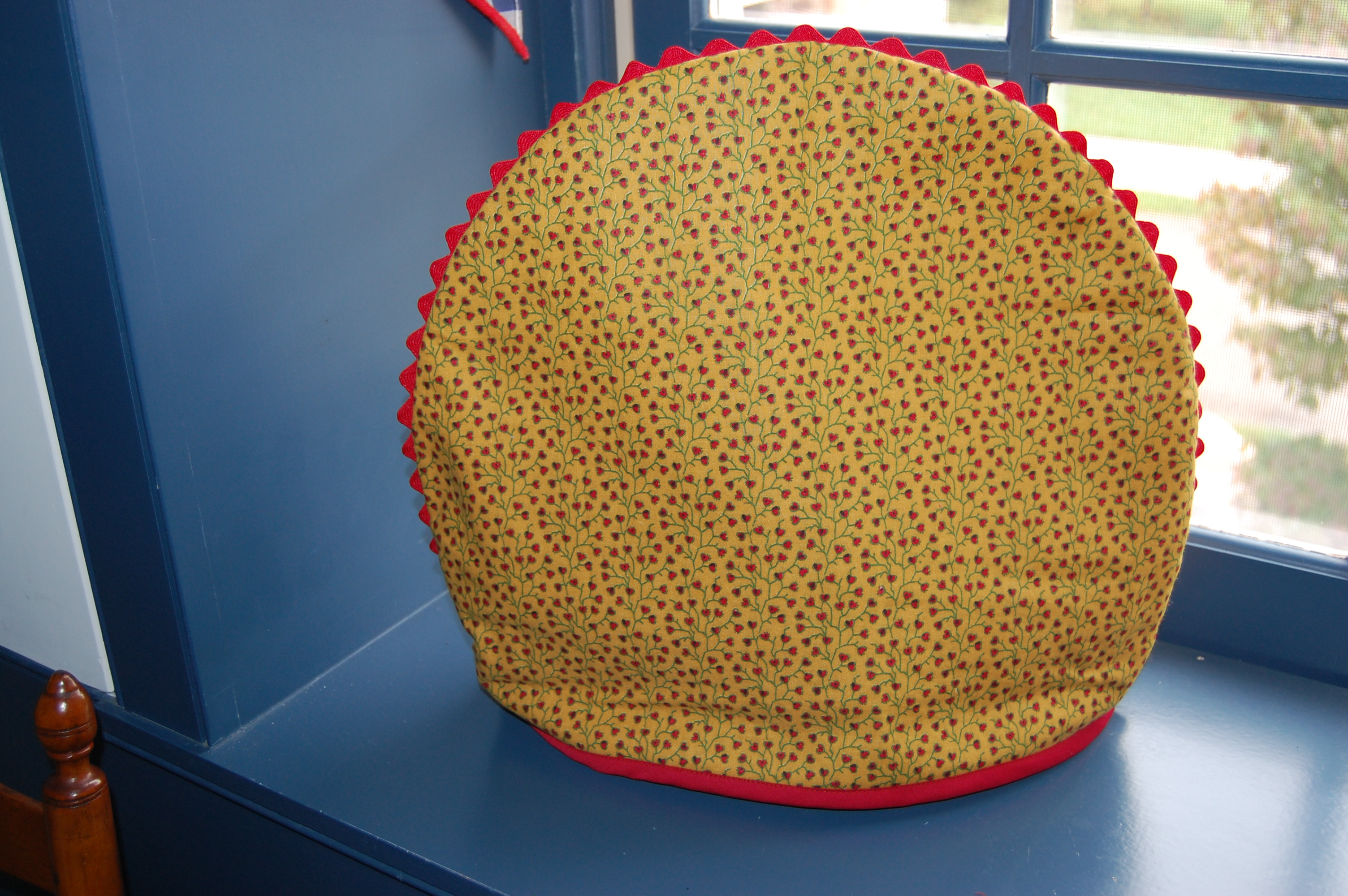
So that was Chanel.  But what about the chicken?  Another project I wanted to finish last week was an auction item for my garden club’s annual fundraiser.  As I am the only one in my club who has a backyard flock of chickens (yes – can you believe it?), I like to put together what I call a “Little Red Hen” basket to add to our auction selection every year or so.  Besides the main attraction of a couple dozen of our farm-fresh eggs, I add other items with a chicken theme.  Some examples are egg poachers, an egg timer, cocktail napkins with chickens on them – things like that.  Of course, as one who sews, it is impossible for me to do a project like this without adding something handmade. So this year, I made a tea cozy with a matching chicken potholder.  I had already completed the tea cozy a couple of weeks ago, but the potholder  – well, it had to take its place behind Chanel.    It did not take long for me to fashion this little hen (in red, of course) to match the cozy. Here she is, ready to perch on the handle of any hot pan:

She is interlined with several layers of heavy cotton flannel.

She’s pretty underneath it all, too!

Here is the little red hen in front of the tea cozy.

Tthe bottom of the tea cozy can be folded out to fit a higher pot.

So what was more fun – and what did really come first– Chanel or the chicken?  Now there are two questions for the ages!

10 Comments

Filed under Chanel-type jackets, couture construction, Shoulder shapes (shoulder pads), Uncategorized, underlinings, Unprinted patterns from the 1950s, vintage Vogue patterns from the 1950s, Vogue pattern 7503 for shoulder shapes, woolens

Missing in Action – or – Doesn’t everyone shop for fabric on vacation?

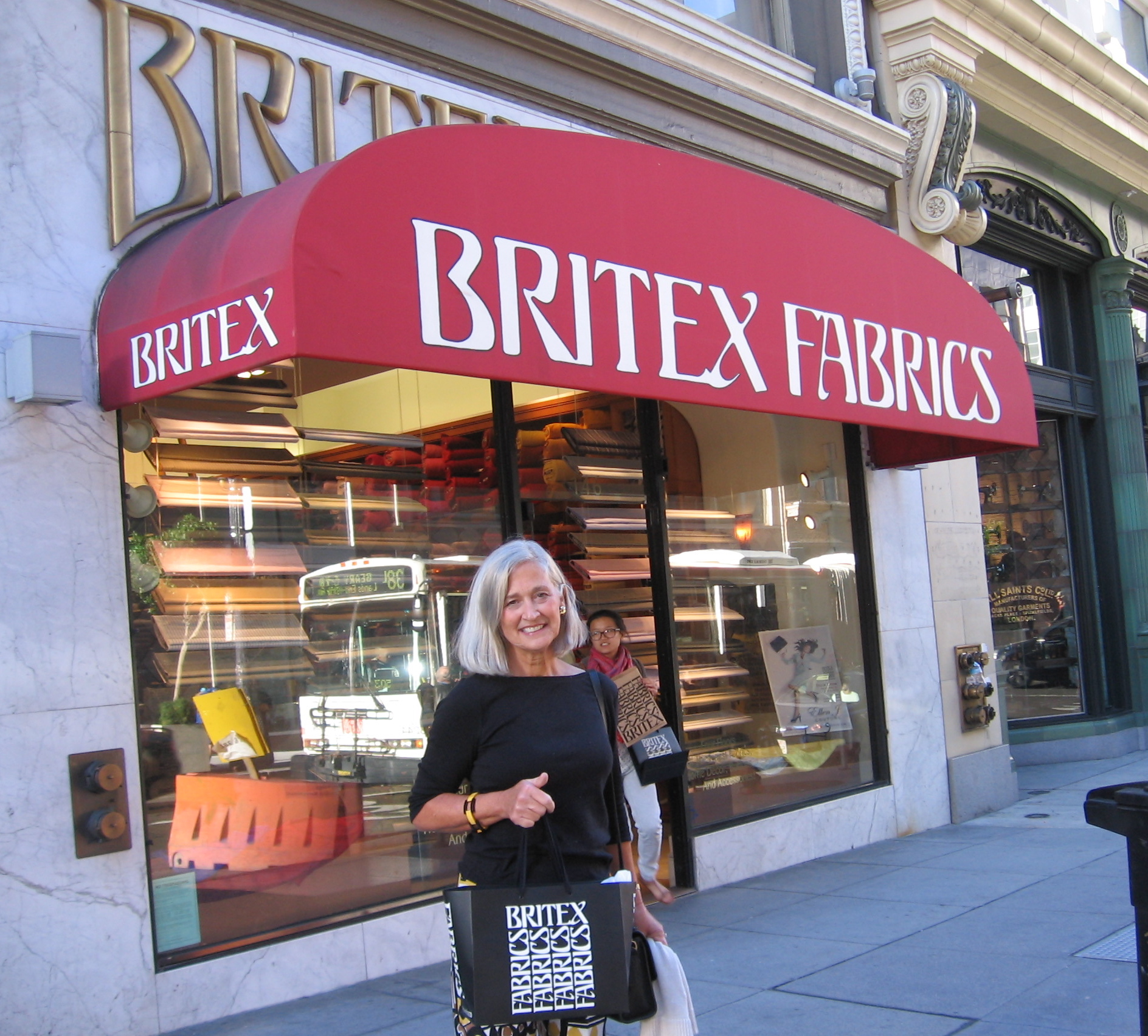
You may have noticed that I’ve not posted anything for almost two weeks.  Mr. Fifty Dresses and I have been away on the West Coast, enjoying some time with our grown son, and seeing some of the majestic scenery in the states of California and Oregon.  Of course, one of the best places to enjoy colorful scenery is always in Britex Fabrics on Geary Street in San Francisco.  My husband and son know by now that no trip to California is complete without fabric shopping!

I am all smiles with my newly-made purchase! I am wearing “my very styish pants” and was delighted to get complimented on them in the store.

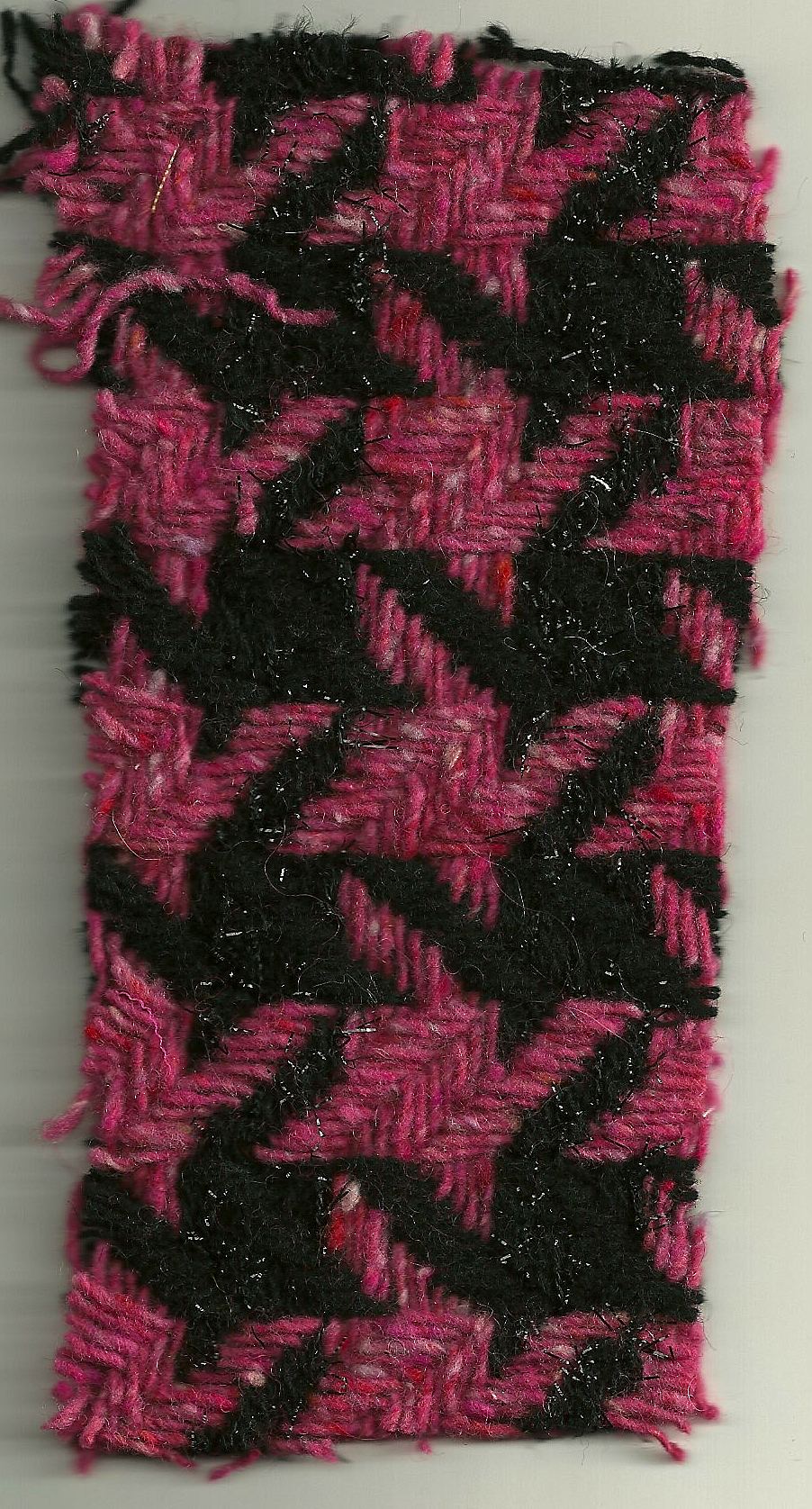
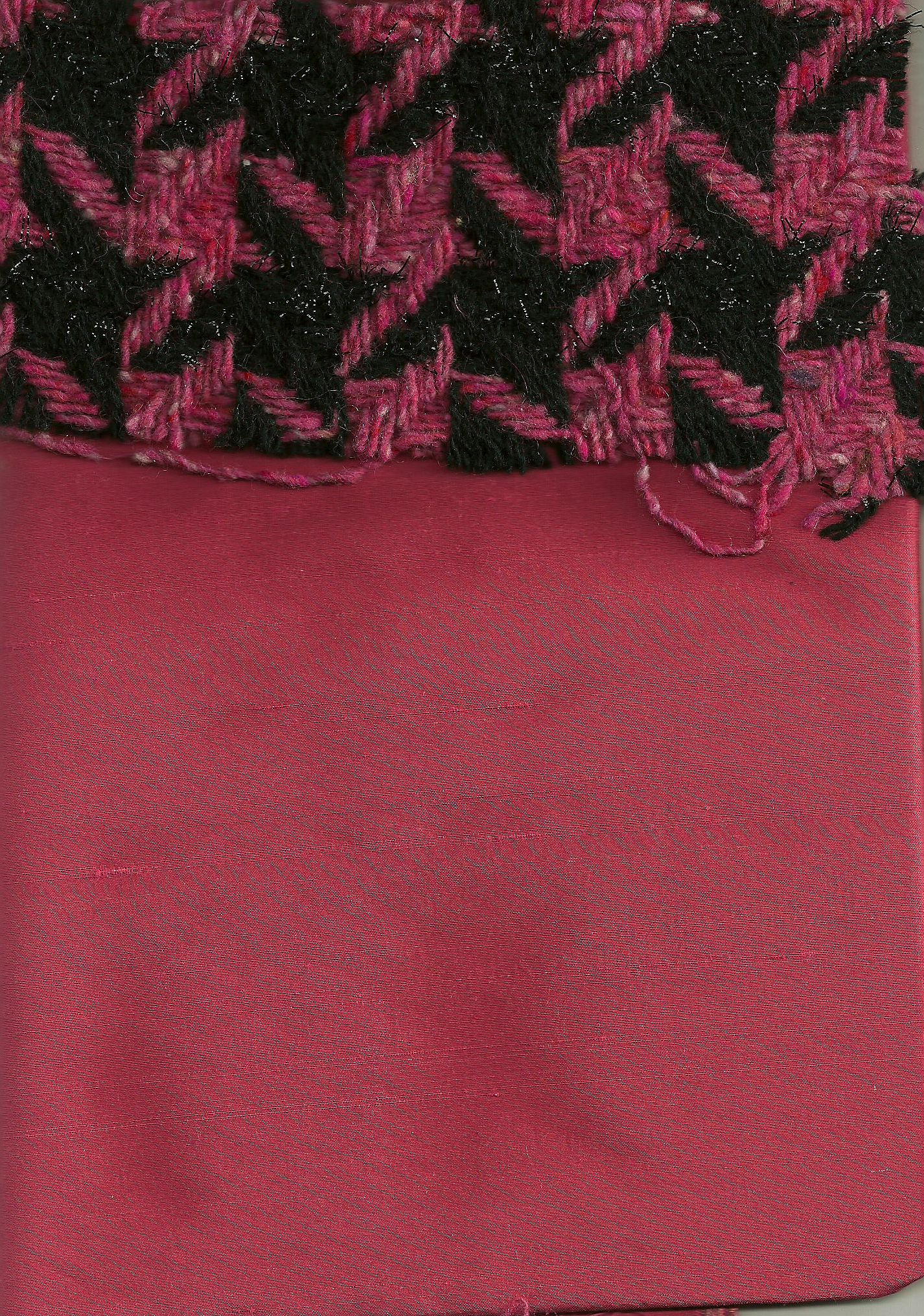
You may recall that I have been looking for a skirt-weight fabric to coordinate with this wool:

This fabric will be a jacket, and I want to make a pink skirt to make it into a “dressy suit”.

That pink is a tricky color, I’ve discovered.  I’ve ordered many swatches, thinking one of them will be “it” and it never was.  So I tucked that pink and black houndstooth- checked wool sample into my carry-on bag so that I could enlist the experts at Britex to assist me.  The bolted wools and silks and designer fabrics are on the first floor, and it did not take long for me to accept Douglas’ kind offer of help.  We looked first at the wools, one beautiful bolt after another, but none that totally complimented the pink.  Next we moved to the silks – and there we struck gold – or perhaps I should say pink gold.  As soon as Douglas pulled out this silk shantung, we knew the color was right.

Just what I was looking for!

We carefully checked the color inside and then took it outside on the steps to check it in sunlight.  Perfect, both places.  Being shantung, it has the correct heft to accompany the wool, but it is light enough to be used for attached trim if I choose to add it around the collar, down the front, and at the bottom of the sleeves.

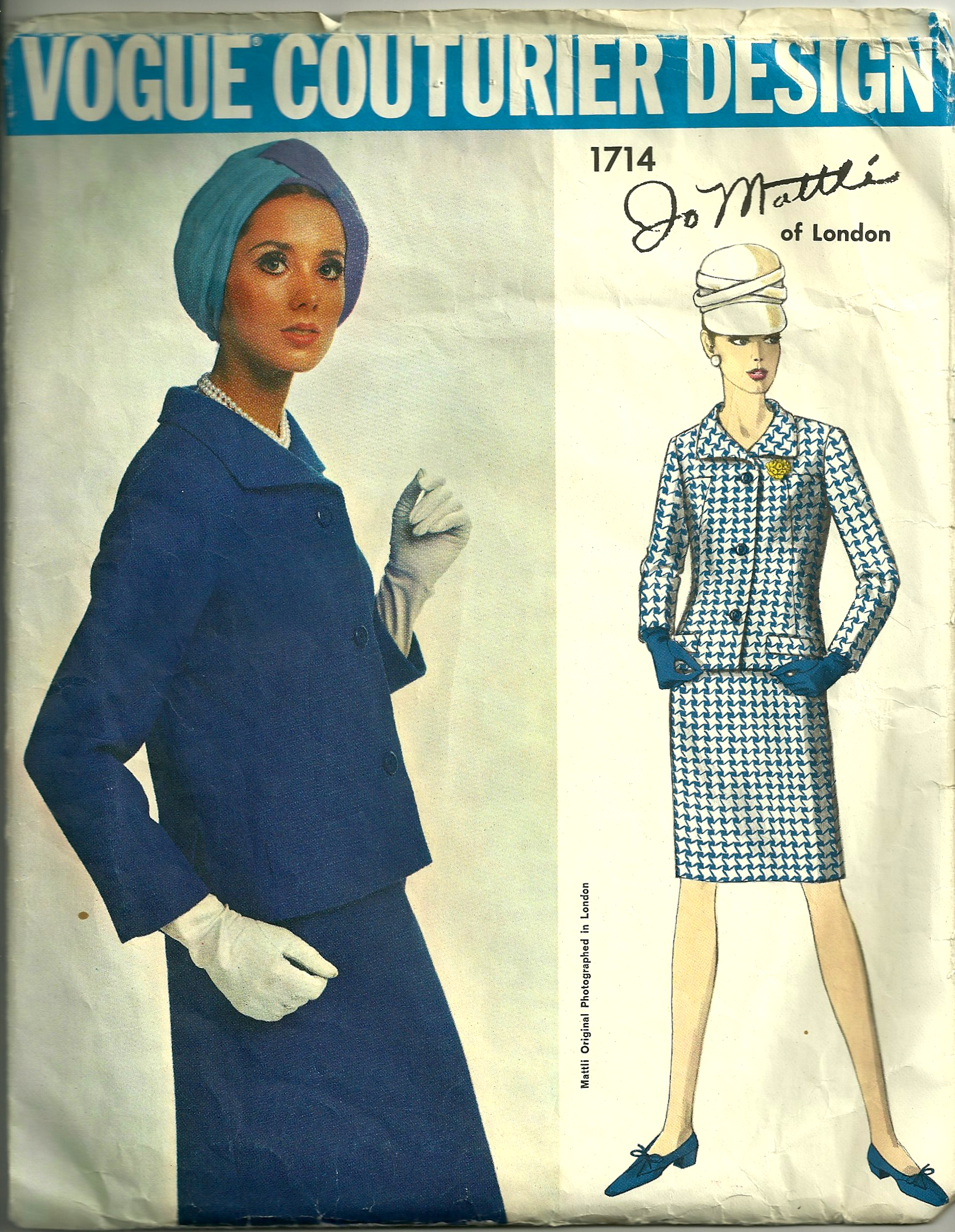
I am probably going to use this 1970s’ pattern for this outfit.

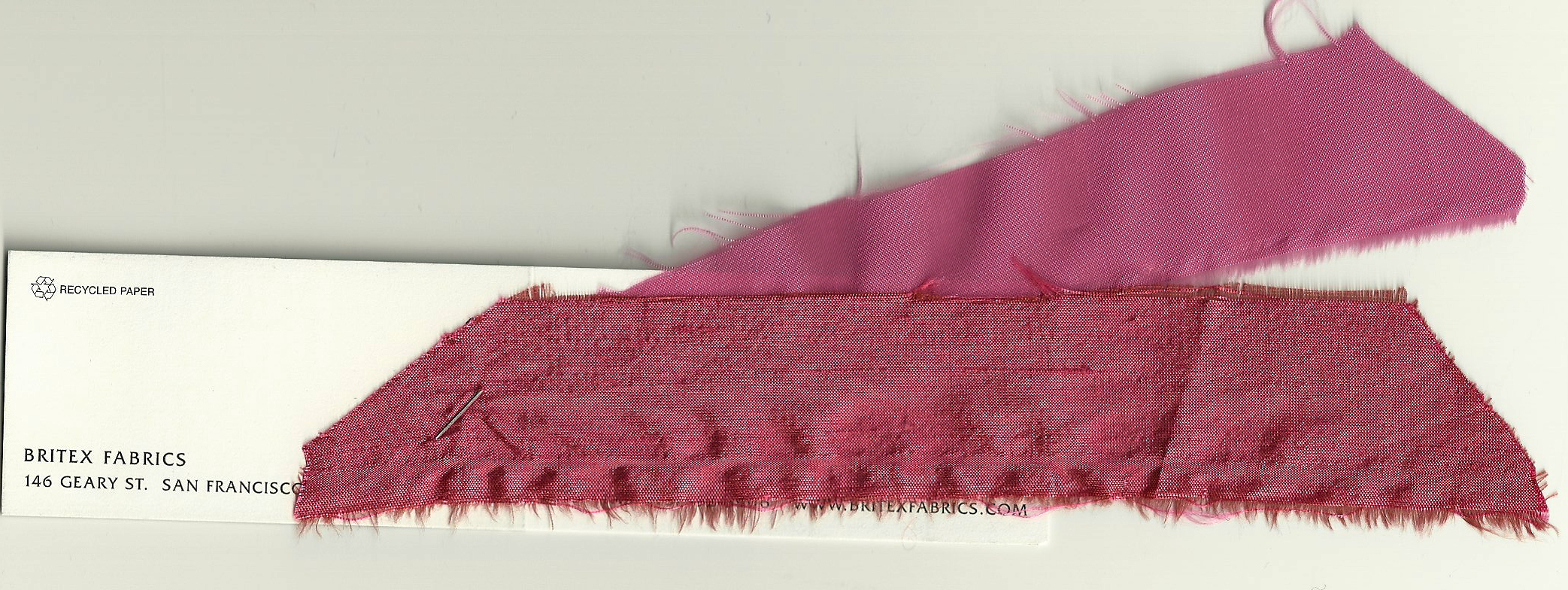
Next we selected a lining fabric, enough for a narrow skirt and the jacket.   Those of you who know Britex, know that the store is on 4 levels, so to accommodate the need to move between floors, I was provided this card with swatches of my newly selected fabrics attached.

The lining is the lighter-colored fabric.

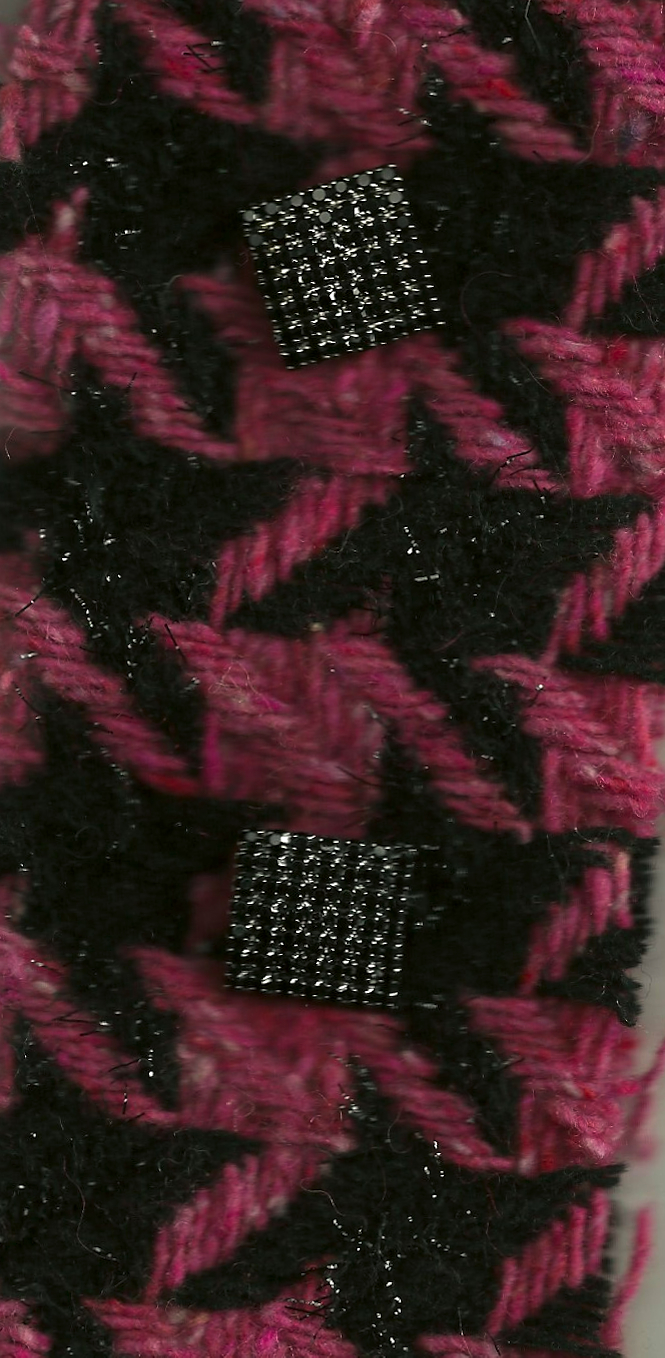
Off I went to the third floor to find buttons.  Oh, the choices!    That little bit of sparkle in the wool – and the sheen in the silk shantung – seem custom made for buttons with a bit of sparkle, too.  I kind of felt like Goldilocks looking at the buttons which the savvy “button lady” pulled out for me.  Some were too frou-frou for me, some were too round (and fought with the angles in the weave), some were too sparkly…  but these were perfect!

When I actually sew these buttons onto the jacket, I promise I’ll have them on straight!

With my tasks accomplished, I decided to check out the remnants on the fourth floor, and took a quick look at the cottons on the second floor, but then I headed back down to the first floor to look at the woolens again.  Britex has a very large selection of wools suitable for “Chanel-type” jackets, including some actual Chanel fabrics.  I am trying to buy only what I can’t live without (which isn’t as limiting as it should be, unfortunately), so I carefully considered all the selections in front of me.  You can probably guess by now that I did indeed find one I deemed necessary for continued life, liberty, and the pursuit of happiness.  I can just imagine this wool in a jacket trimmed in an orangey-red something – all yet to be determined, which is, of course, part of the creative intrigue of sewing.

This fabric is very soft, perhaps due to a certain percentage of mohair wool in its composition.

So – what about the rest of the trip?  Lots of driving those great distances out West, lots of laughs, fun, and brews with husband and son, wonderful days at Crater Lake National Park in Oregon, hiking without a fabric store in sight.  When one is in such a place as Crater Lake, the great expanse and passage of time is ever in one’s presence.  However, I couldn’t help but think about another passage of time, this one personal: the last time I was at Crater Lake was in 1962 when I was twelve years old.  It just so happens that Britex Fabrics celebrated their tenth anniversary that very same year.  Happy 60th Birthday, Britex!

One more smile before closing hour!

15 Comments

Filed under Buttons - choosing the right ones, Chanel-type jackets, sewing in silk, Uncategorized, vintage Vogue Designer patterns, vintage Vogue patterns from the 1970s, woolens