Category Archives: hand-sewn zippers

A Timely Arrival

Last week, as I was putting in some final hours on a suit I have been sewing, I was  thinking about some of the “creative” solutions I had to come up with to make the jacket turn out successfully.  I had, unbeknownst to me, made a “bad” decision about the fabric. Even though I (still) love the color and design of the black and pink hounds-tooth wool blend, it turned out to be a very heavy, bulky fabric to sew.  Well, my newest Threads magazine arrived in the mail last Friday – and right there on page 56 is an article entitled “Better Sewing Habits”.  Number 4, by Claire Shaeffer, is:  Choose fabrics appropriate to the garment design.  Printed in bold is this line:  “Select a fabric that is recommended for the pattern”. 
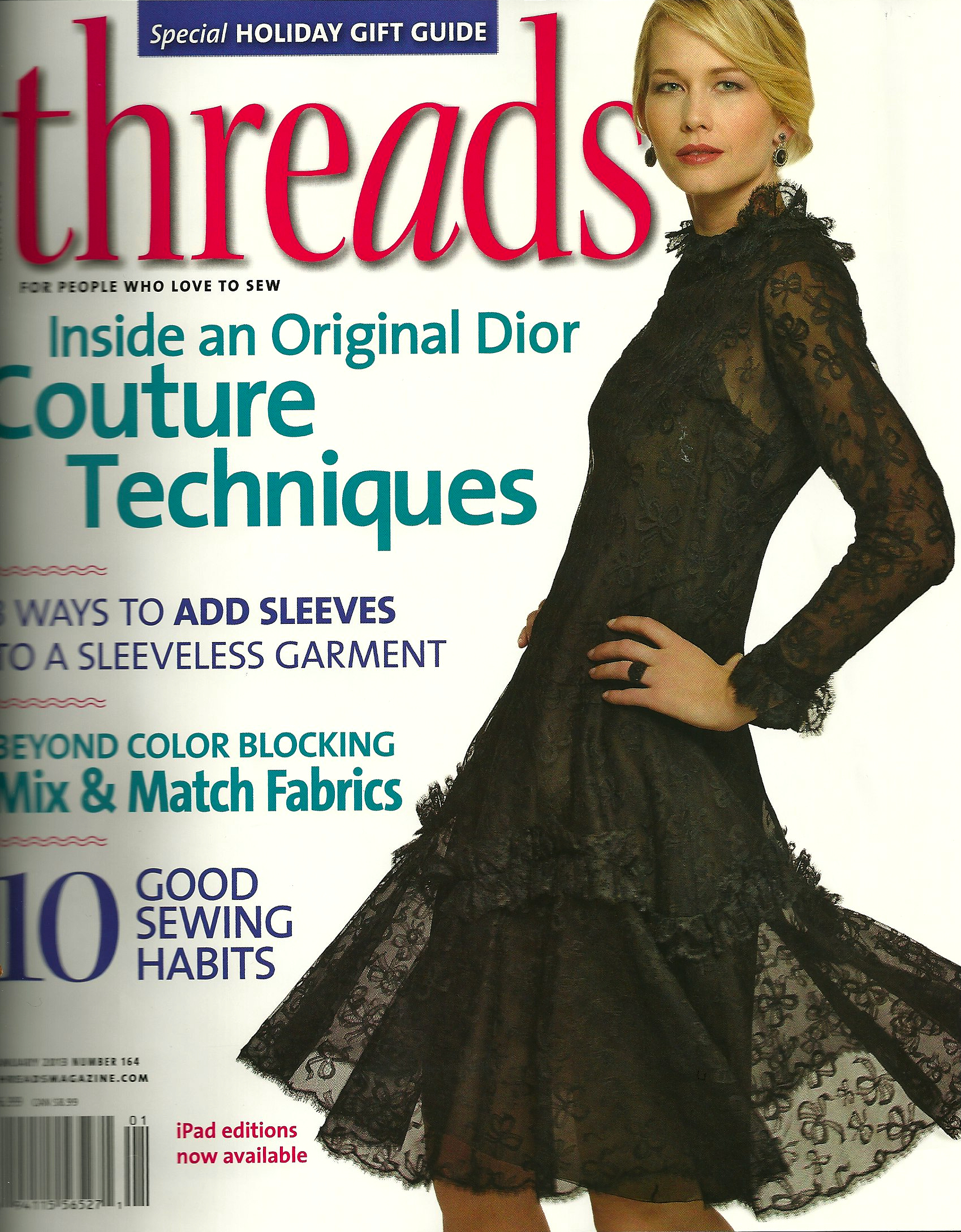
This issue of Threads is packed with all kinds of great advice and ideas!

Sure enough, when I went back to the pattern envelope, there in plain English for the recommended fabrics is:  “Lightweight wool.”  I really felt that sinking feeling, but I tried to console myself by reminding myself that I had made some changes to the pattern and to the construction to accommodate the heavy fabric.  I was trying to feel grateful that I actually have some skills which allow me to make changes and try different approaches to solve sewing problems.  And, actually, now that the jacket is finished, I am happy with it.
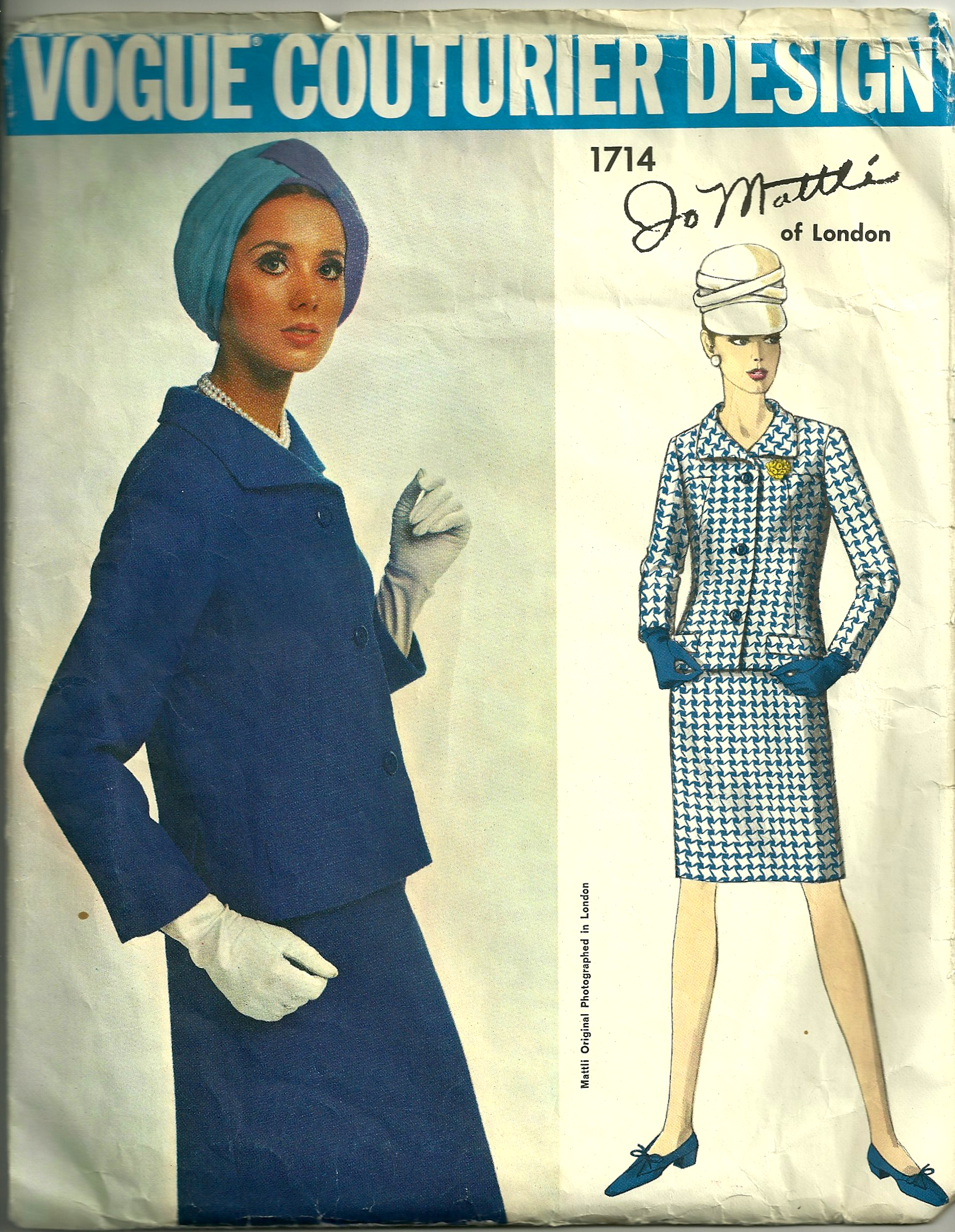
This is the pattern I used – from Vogue’s Designer series, Jo Mattli, circa early 1970s.
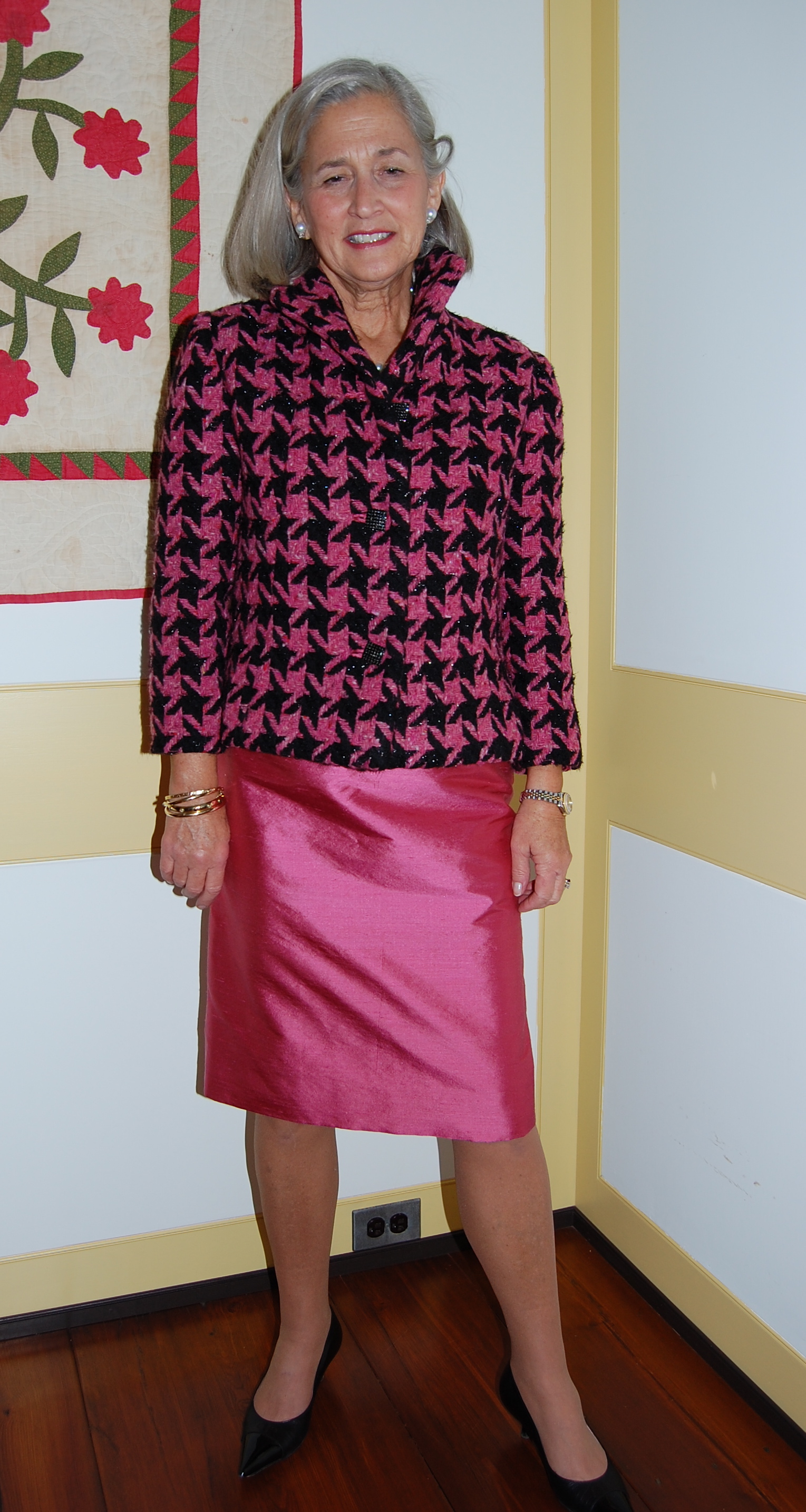
The completed outfit – wool blend jacket and silk skirt.

Here is what went well:

1) I was able to match the design quite well across seam lines, shoulders, and sleeves.

2) I think I nailed the fit!  Of course, I made a muslin first, so it’s not like that just happened.

3) I reduced the spread of the collar, which actually turned out to be a good decision, when I realized how difficult double layers of the fabric were to work with.

Here is what either did not go well or needed to be “creatively” approached:

1) I really wanted to make bound buttonholes, but the loosely woven, heavy fabric gave me pause.  So I decided to make them out of the silk skirt fabric.  I backed the buttonhole strips with silk organza by fusing them together.  This made the silk stiff enough to stand up to that heavy wool.
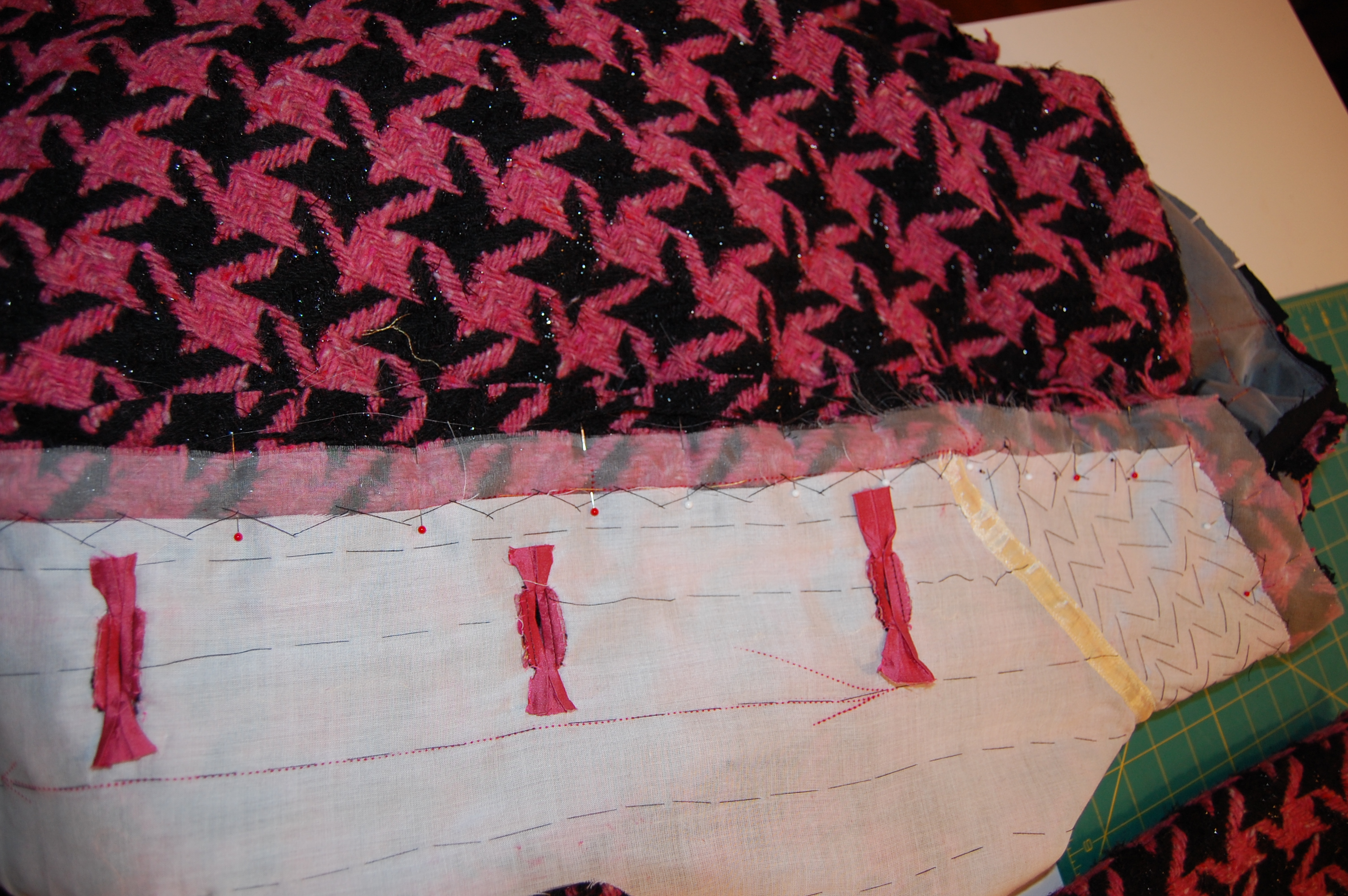
The strips attached for the bound buttonholes.

I made the topmost  buttonhole a “blind” one as I determined that I would not be buttoning that top button anyway.  I knew I could never finish the back of the two remaining buttonholes by the normal method, so I “patched” behind them on the interfacing with a lightweight black wool.
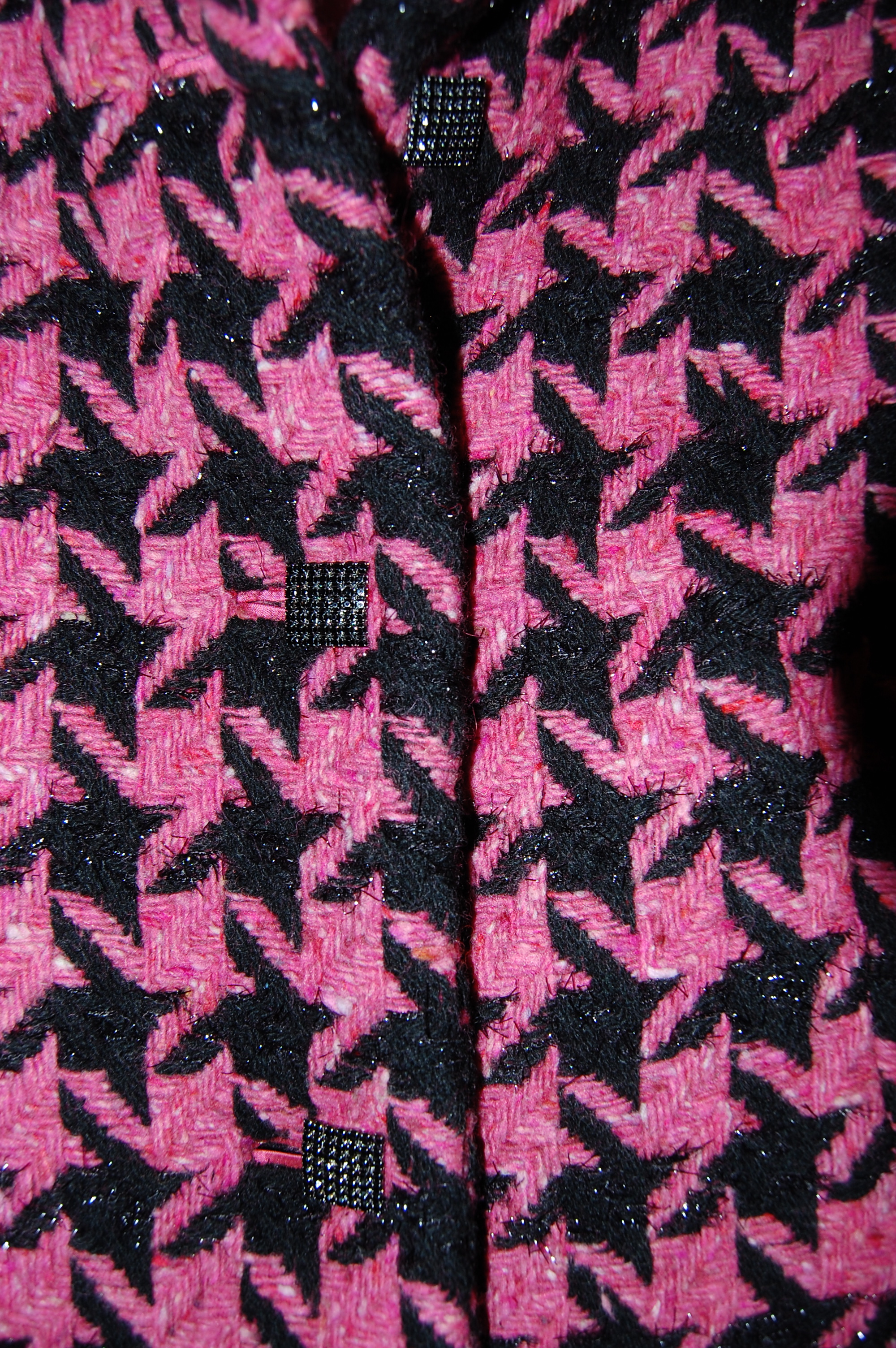
Here is a close-up of the bound buttonholes – and the happily matched front!  Click on the photo for a closer-up view.
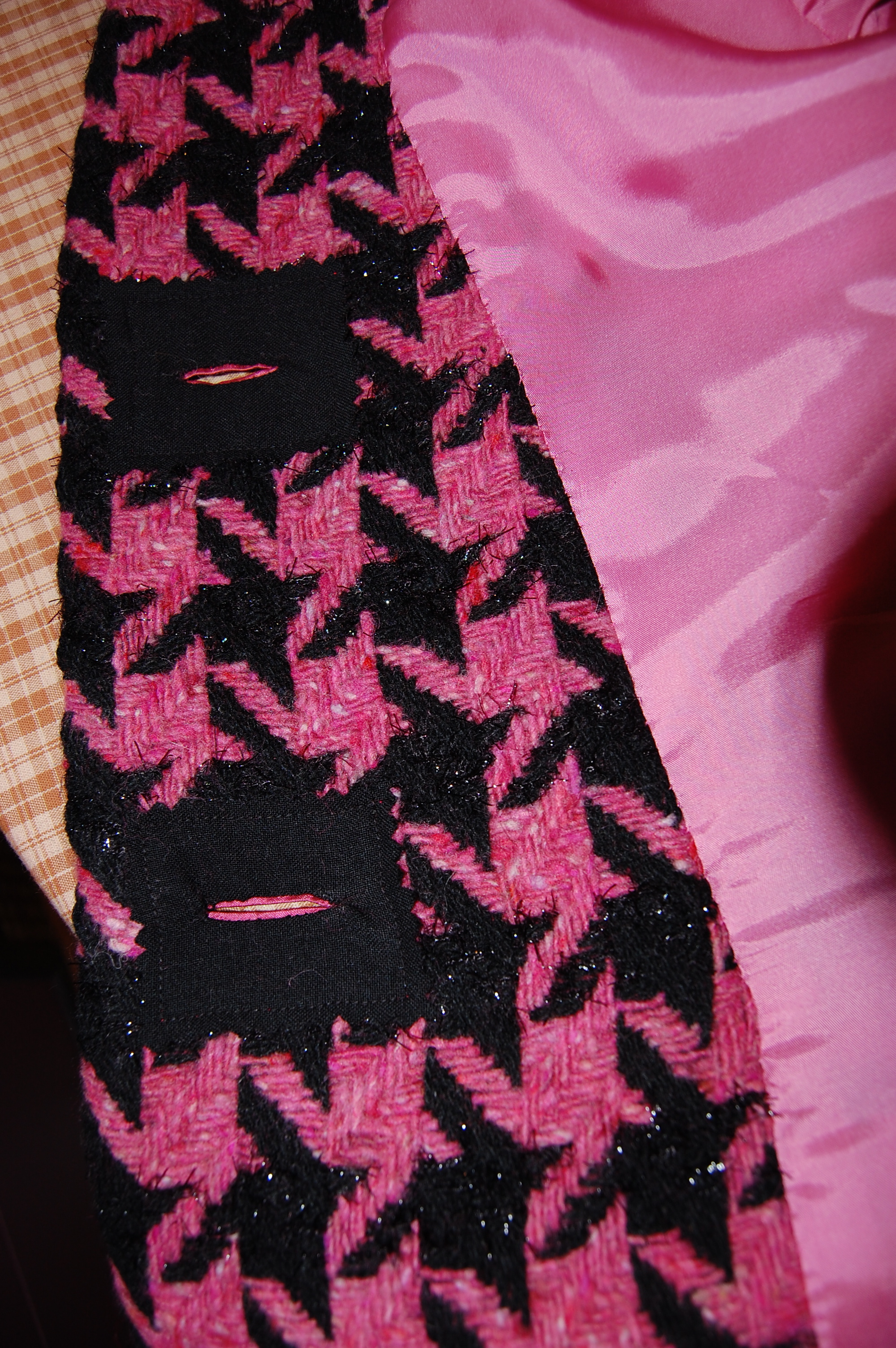
Before I sewed the front facing, I attached these “patches” to back up to the buttonholes. Then I cut away the heavy fabric underneath, so that I could finish the underneath of the buttonholes somewhat successfully. Click on the photo to see this up close.

2) The neck facing was going to be too heavy using the pink/black wool.  So I used that same lightweight black wool for it instead.
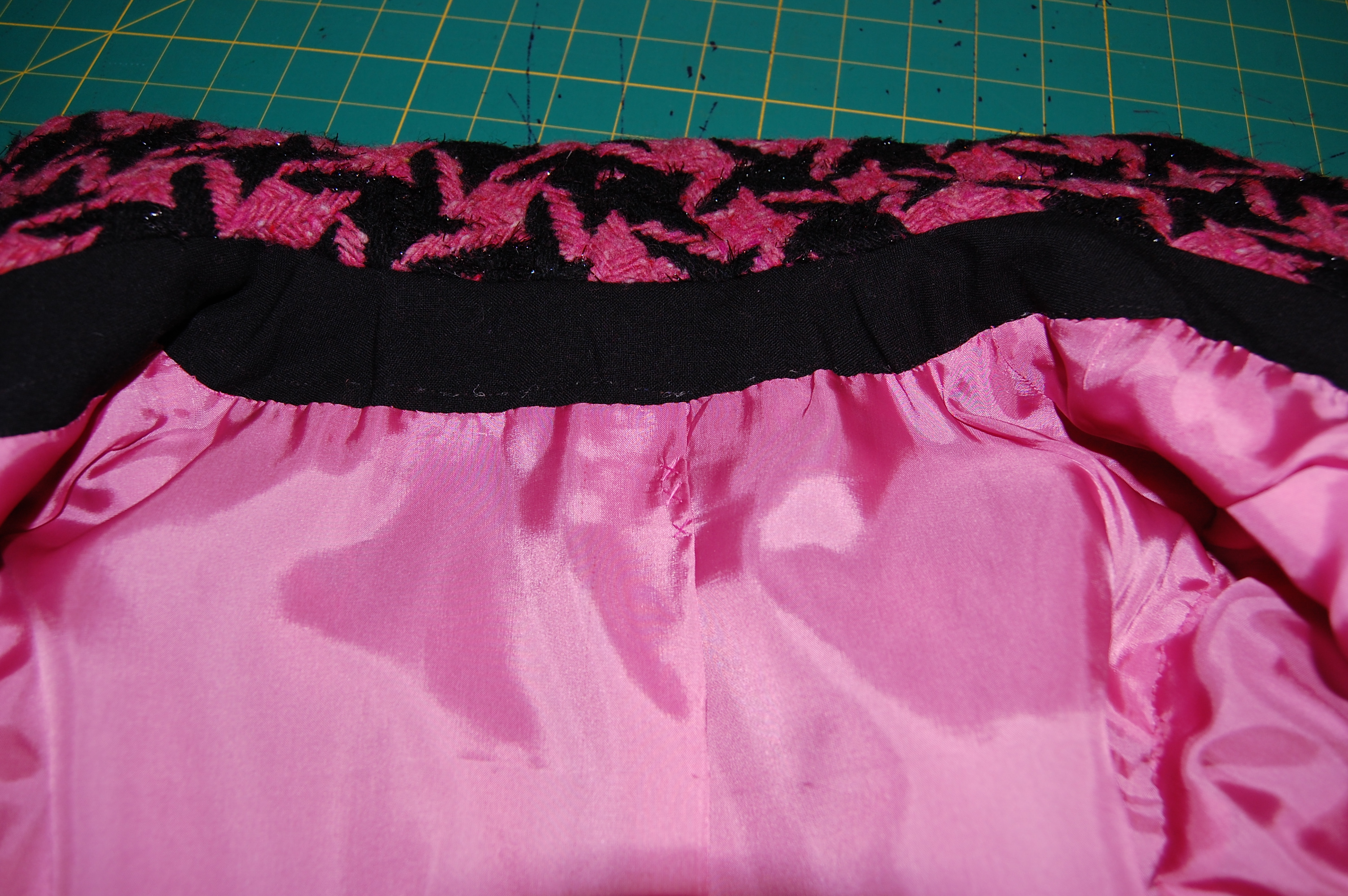
Using a lightweight black wool for the facing made the neckline much more manageable.

3) The back vents were not going to lay flat if I turned in the raw edges as the pattern instructions indicated.  So I bound them with black bias tape instead.
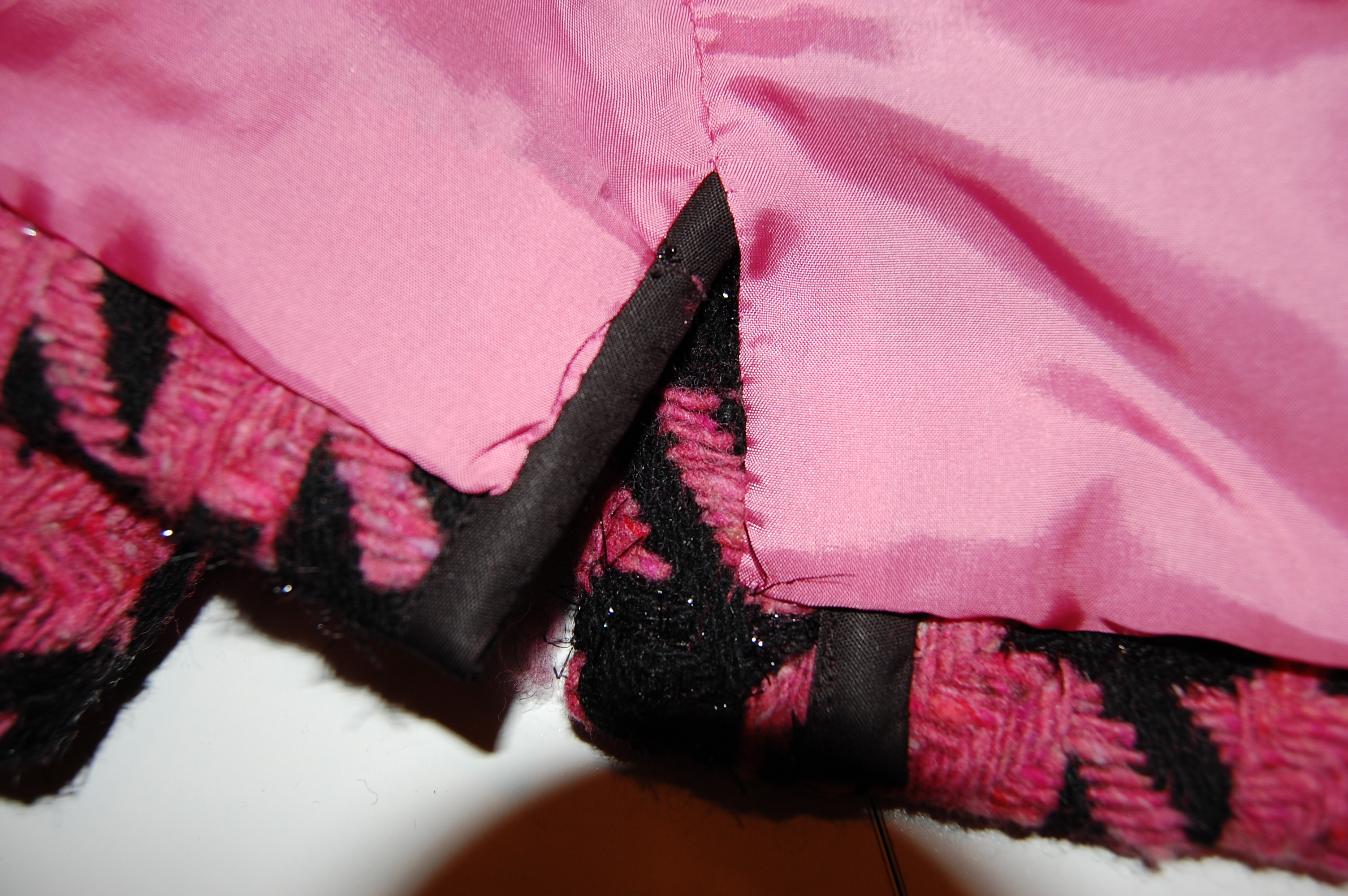
Instead of turning back the facing edge to finish it, I attached this bias binding.

4) Setting in the sleeves was an exercise in sewing terror!  I was sure they would never look good, but somehow they came out unpuckered and pretty well matched.  I only used a sleeve heading to round out the shoulder, even though the pattern called for shoulder pads.

5) I have steamed and steamed, but still feel like the front edge could use some further attention.  I might take the jacket to the dry cleaners and have it professionally steamed….

I actually really liked the engineering of the pattern: with the correct weight fabric, the jacket would go together quite well and the skirt pattern is a winner, with its shaped waistband.
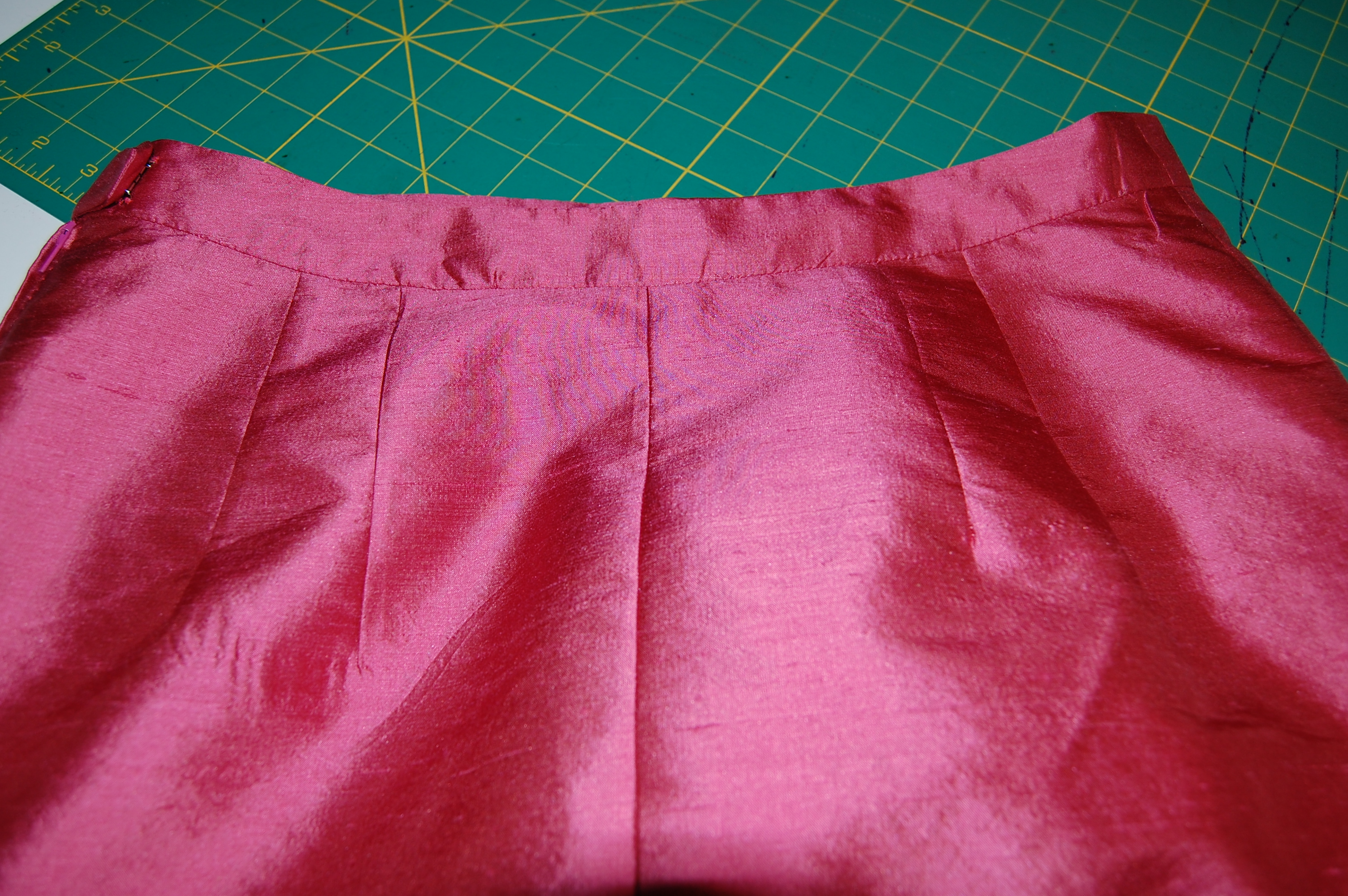
This view of the back waistband shows how it is shaped.
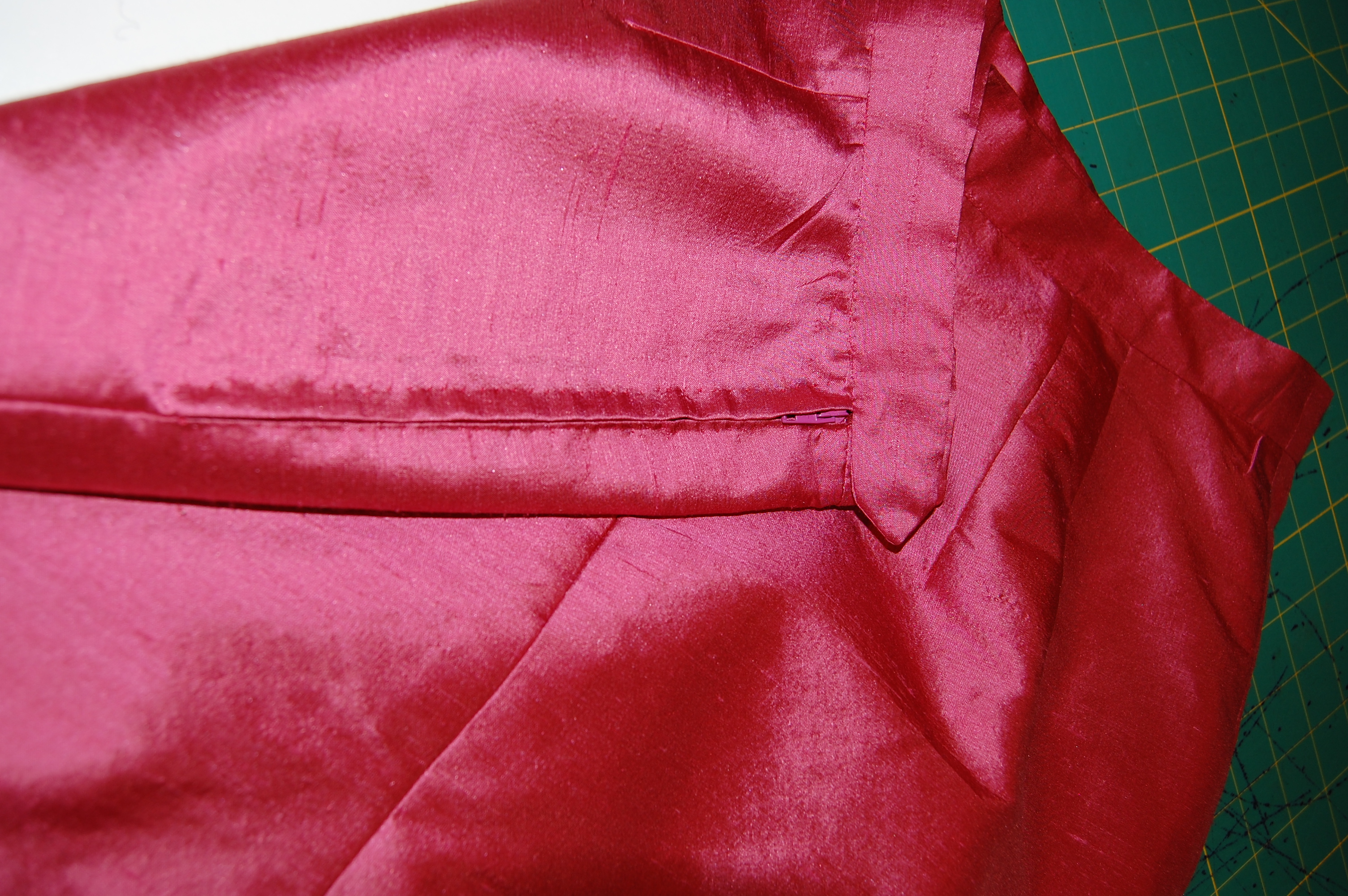
And, of course, I inserted the zipper by hand.
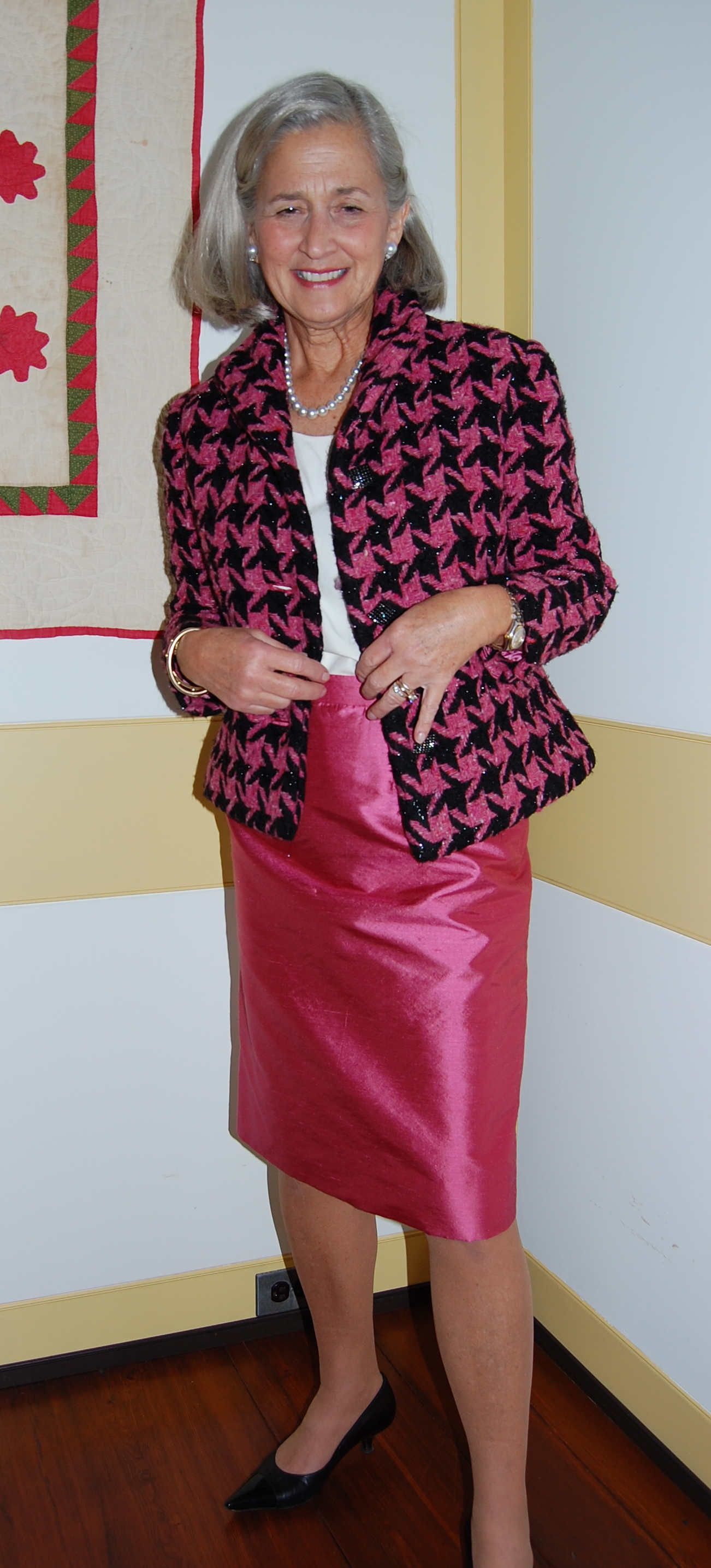
Another look at the finished suit.
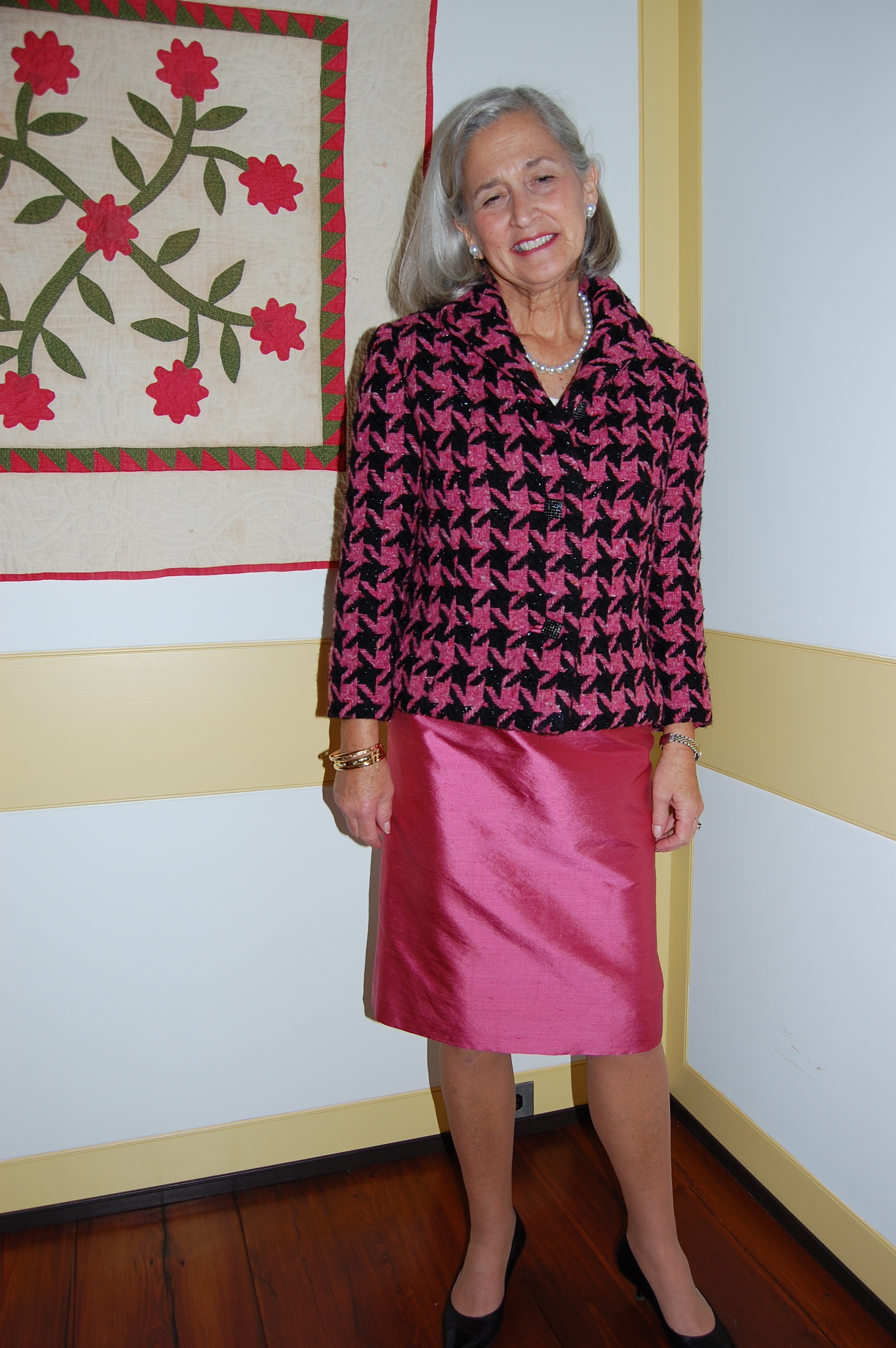
And one more…

Interestingly enough, in the same issue of Threads, the winners of the “Make it with Wool” contest were featured.  I couldn’t believe my eyes when I saw that the Senior Winner of the Mohair Council of America, Marisa Linton, of Mount Olive, North Carolina, had used either the same fabric or one very close to “my” fabric to make the coat for her entry (which is stunning, I might add!).  She had used a very original and successful technique for her buttonholes, which are part of the details which make her outfit so noteworthy.
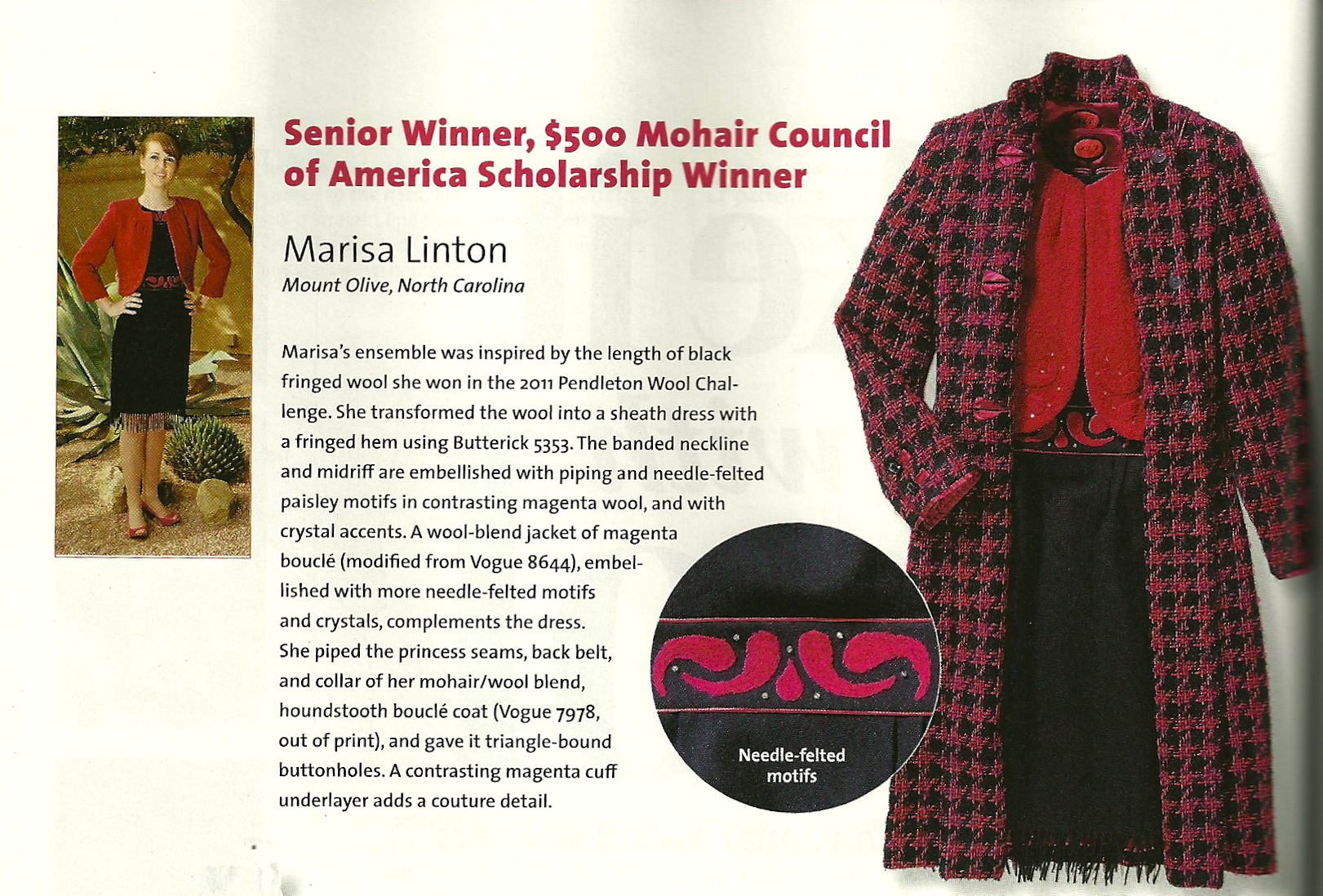
Do you think this is the same fabric? (Threads, January 2013, page 52)

So – it seems the past 7 days have been a time of many arrivals, including a huge and destructive East Coast storm – and the first day of November.    May the next 7 days bring the final arrival of power and comfort to so many who lost so much in the storm, and make us all grateful for resilience, whether it be in life – or in sewing .
13 Comments

Filed under bound buttonholes, hand-sewn zippers, sewing in silk, Shoulder shapes (shoulder pads), Uncategorized, vintage Vogue Designer patterns, vintage Vogue patterns from the 1970s, woolens

A Blouse by Any Other Name Would Be the Same

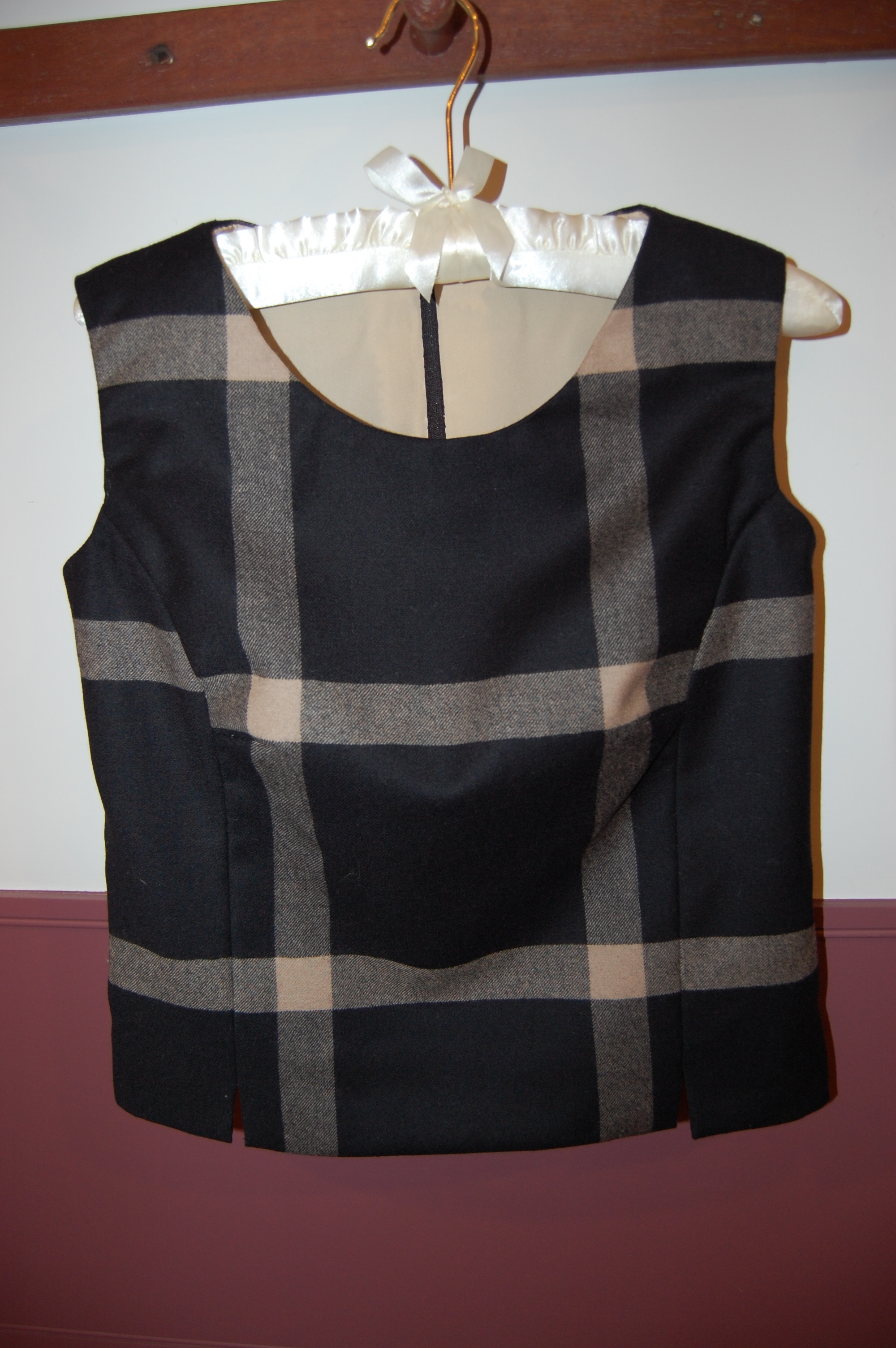
I usually work on only one project at a time, but for the past three weeks I’ve had  two going strong.  I’m furiously working on a “dressy” suit – which needs to be completed this week!  However, last winter I made a mental note to myself to use up the fabric remaining from another suit, to make a matching overblouse.  I knew the pattern I was going to use, and with my newfound techniques from Craftsy’s The Couture Dress  online course, I knew this “small” project would be a great way to practice those skills.   So, I thought, “Oh, I’ll just throw this together in no time at all.”  Why do I ever think such things?  I must be either an eternal optimist or totally divorced from reality.

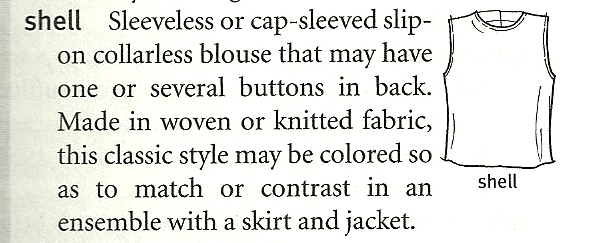
I have always loved sleeveless overblouses – also known as “shells” and sheath tops.  They were particularly popular in the late 1950s and 1960s with or without sleeves (during which time I also knew them as “jerkins” or “weskits” – which are really synonyms for vests).  Fairchild’s Dictionary of Fashion describes an overblouse as “ Any blouse or top worn over the skirt or pants rather than tucked inside.”  And here’s what they say about a “shell”:

From: The Fairchild Dictionary of Fashion, 3rd Edition, New York, New York, 2010, page 37

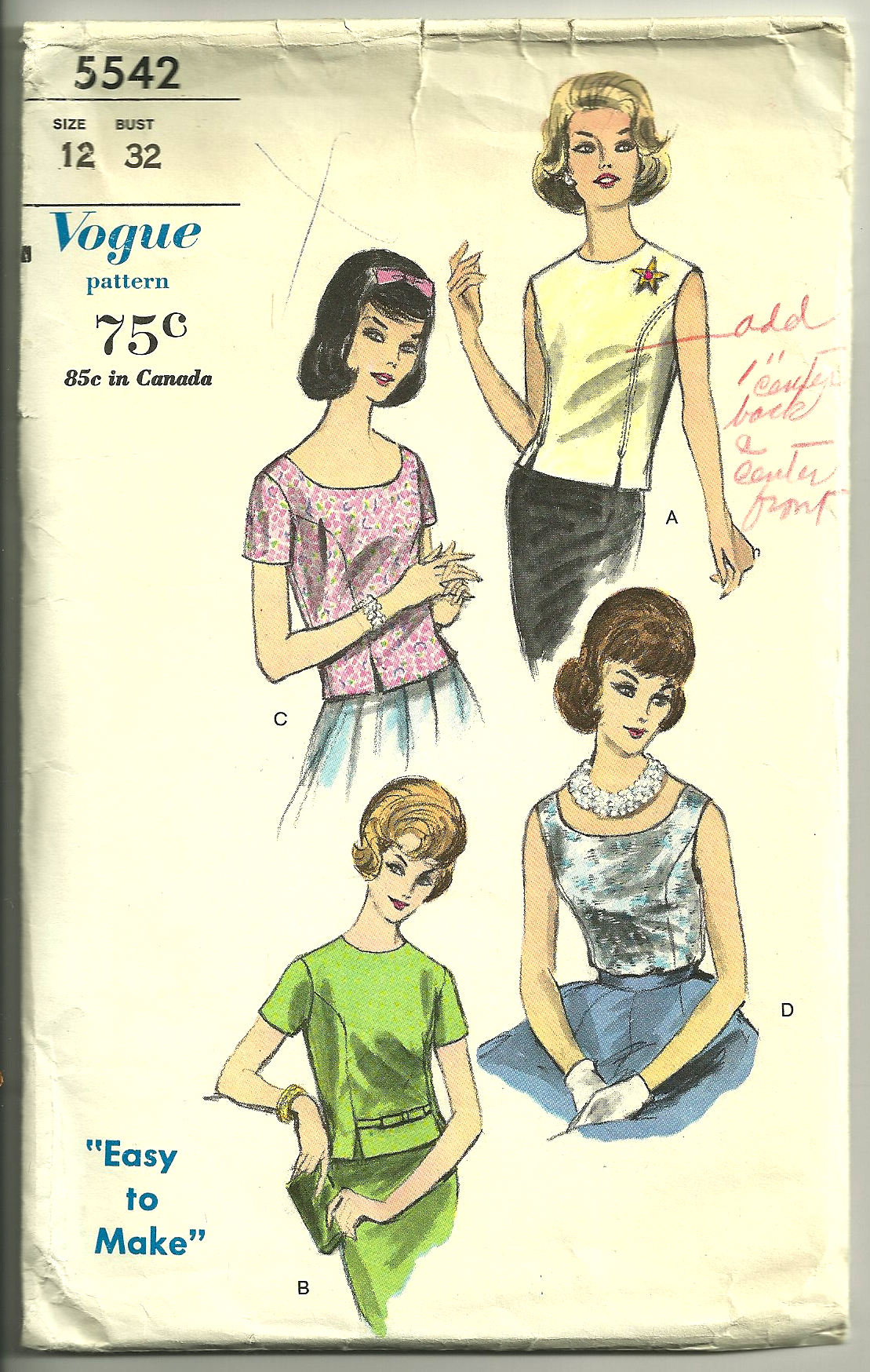
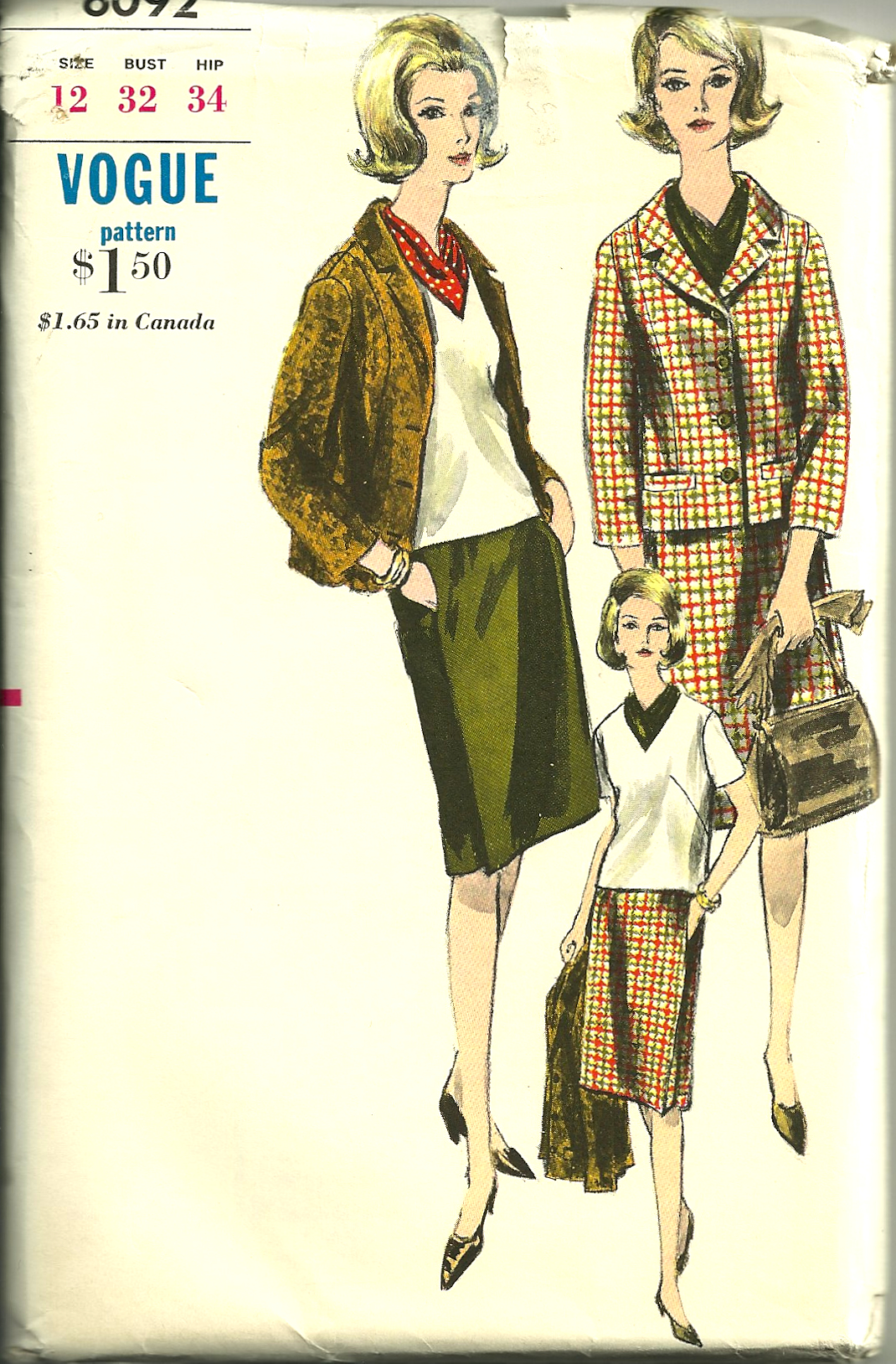
A number of my ‘60s patterns show overblouses paired with suits or as part of two-piece dresses.

This v-neck overblouse is a great pairing with this sporty suit.

The description on the back of the envelope says this overblouse “may be tucked in”.

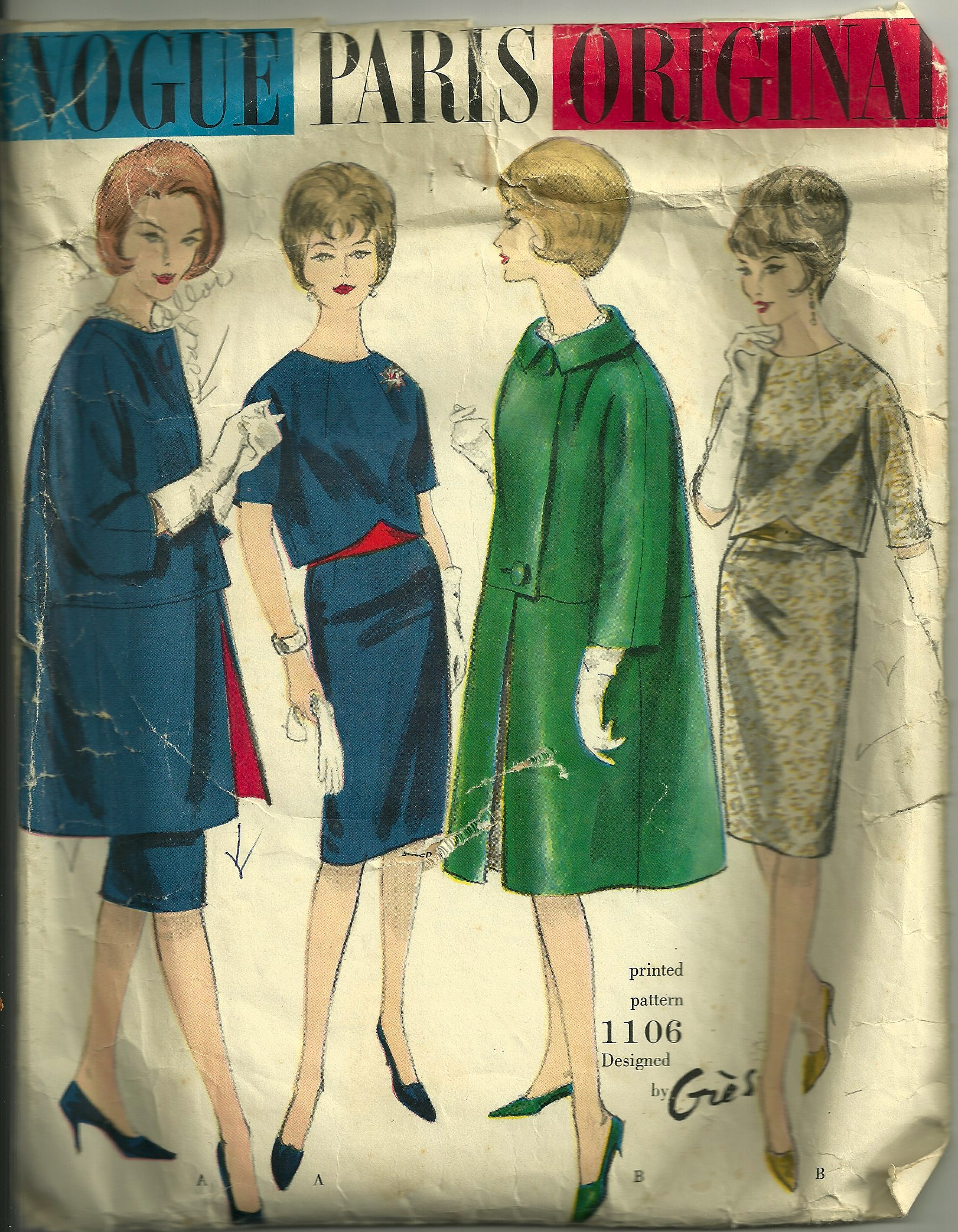
This design by Gres shows a boxy overblouse and skirt combination.

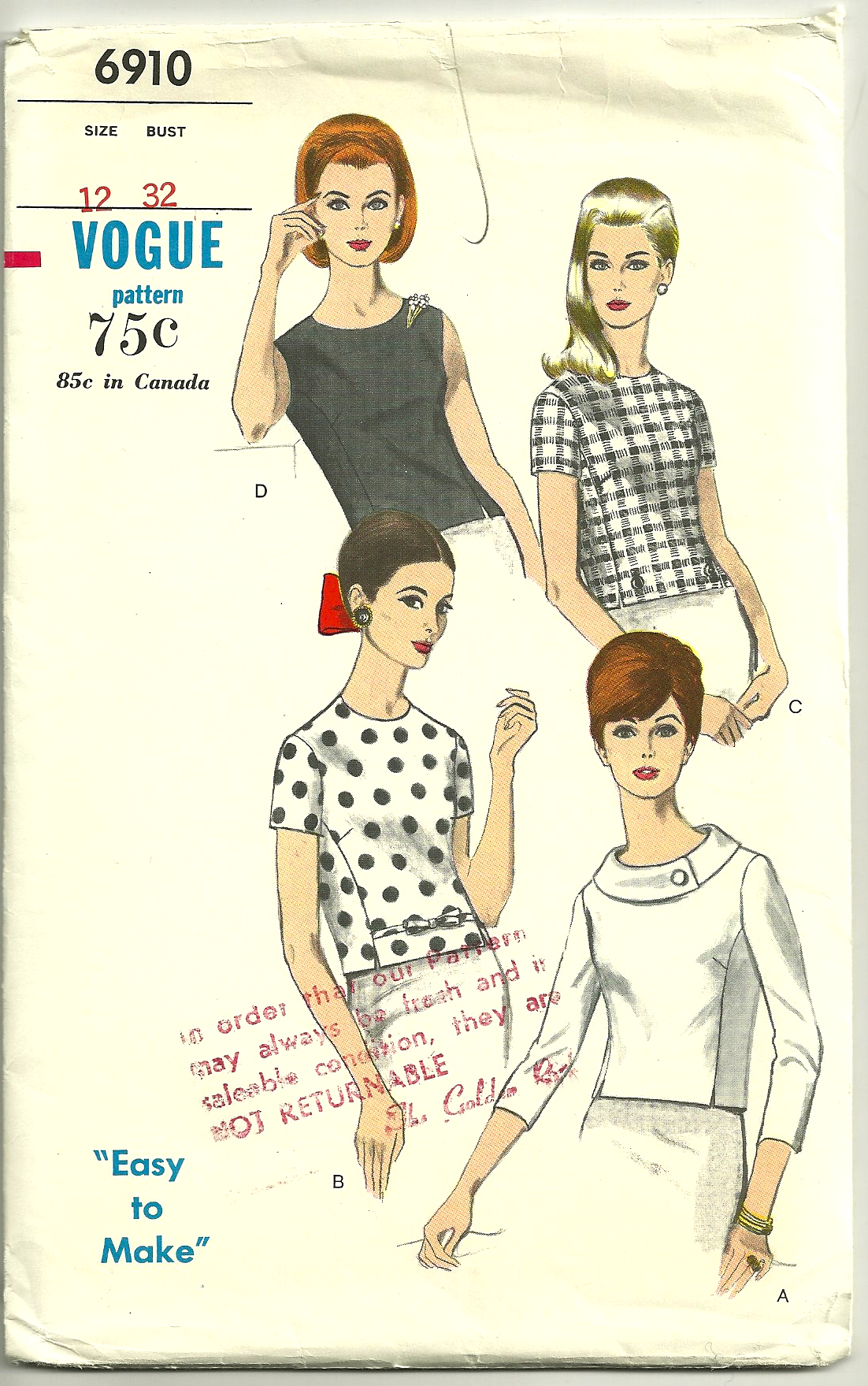
I particularly liked this pattern, with its Dior darts, the slits at the front hem, and its back zipper.  (I was able to pick up a refined separating zipper when I was at Britex in September – many are suitable for outerwear only and too clunky for something like this.)

View D is my choice.

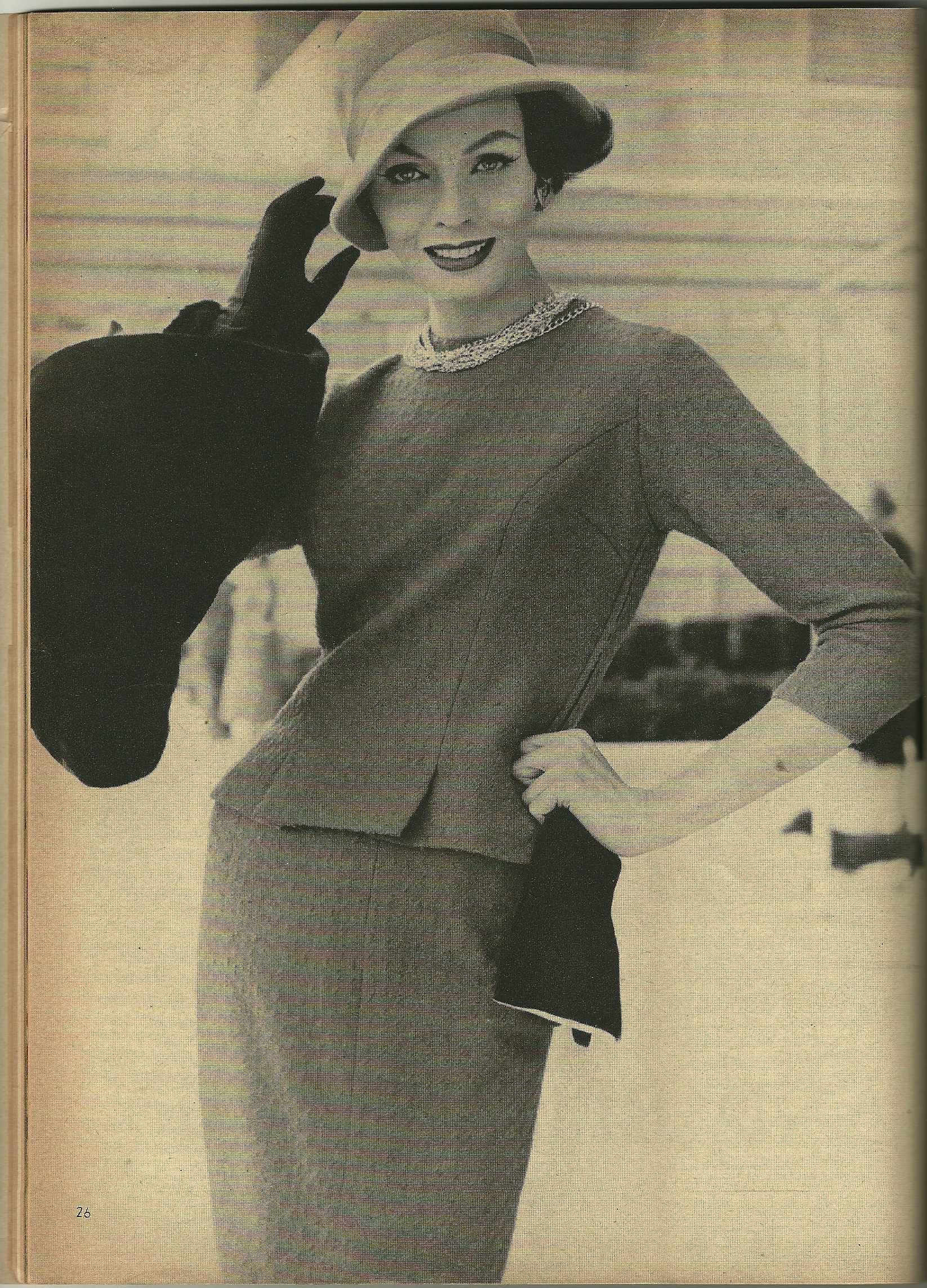
Here is another example of an overblouse with Dior darts, which forms part of a two-piece dress.  Note that the zipper is on the side:

This design was featured in the August/September 1957 Vogue Pattern Book magazine.

I dutifully made up my muslin, to which I made a number of adjustments (lowering the bust line/darts, shortening the darts in the back, lowering and widening the neckline a bit, adding a little more girth to the hipline so it would slip over my matching skirt without buckling, and adding about two inches to the overall length of the blouse.   Hm-m-m, is that all?)  I underlined it with silk organza, matched the plaid everywhere I could, keeping in mind how the windowpane check would line up with the skirt.  I secured all the seam allowances with catch-stitching, and then I hand-picked the separating zipper.  About this time I quietly panicked when I realized how much time I had already put into this blouse!  I put it aside and started working on my suit, with a promise to myself to put in a bit more time on the overblouse whenever I had just 30 or 40 minutes “extra”, whatever that means.

Somehow I have managed to complete it, and I think I’m on track to finish my suit in a day or two, as well.  Whew!  Here are some of the details:

Here is a front view . . .

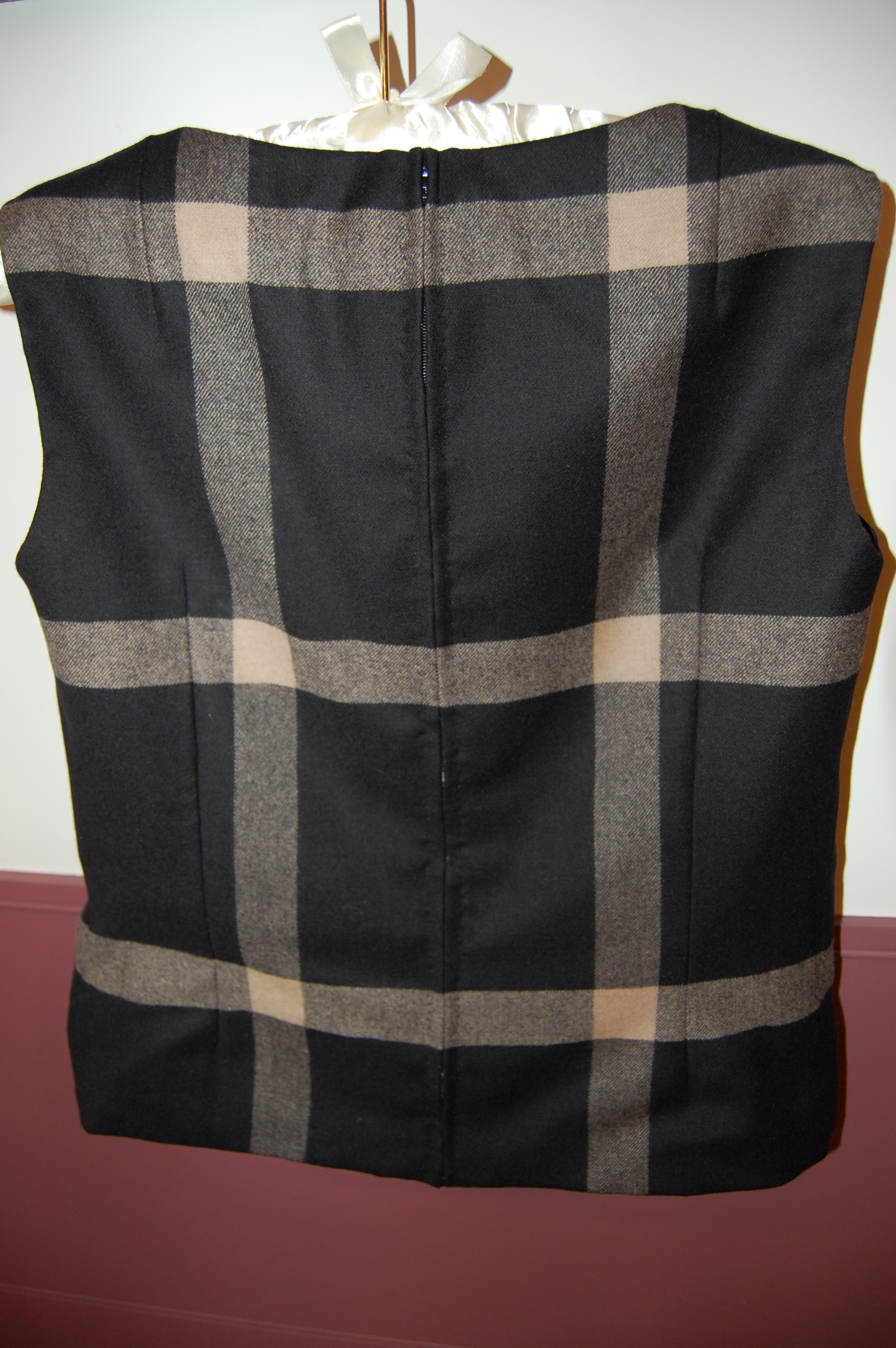
. . . and here is the back view.

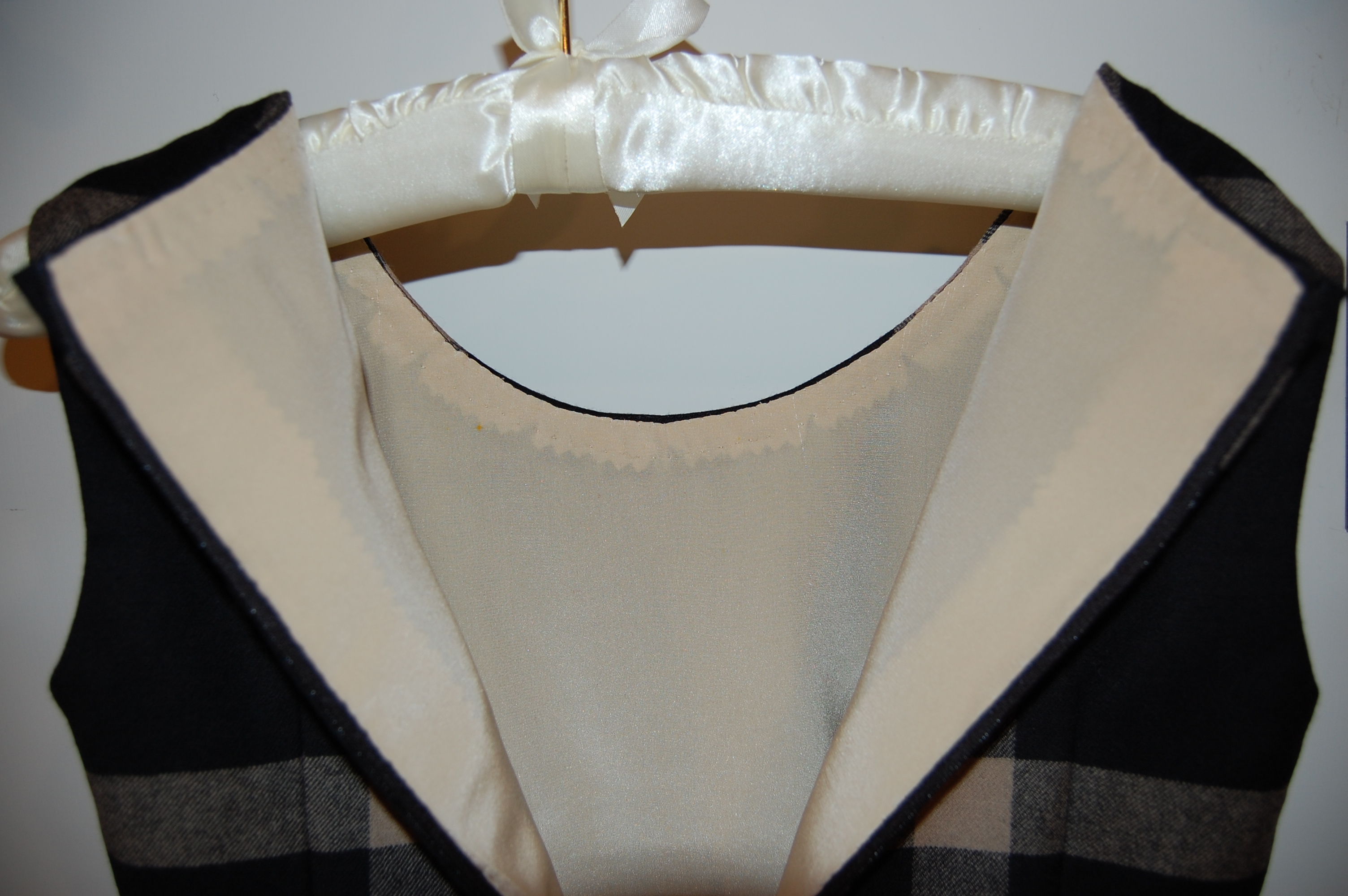
A peek inside the blouse . . .

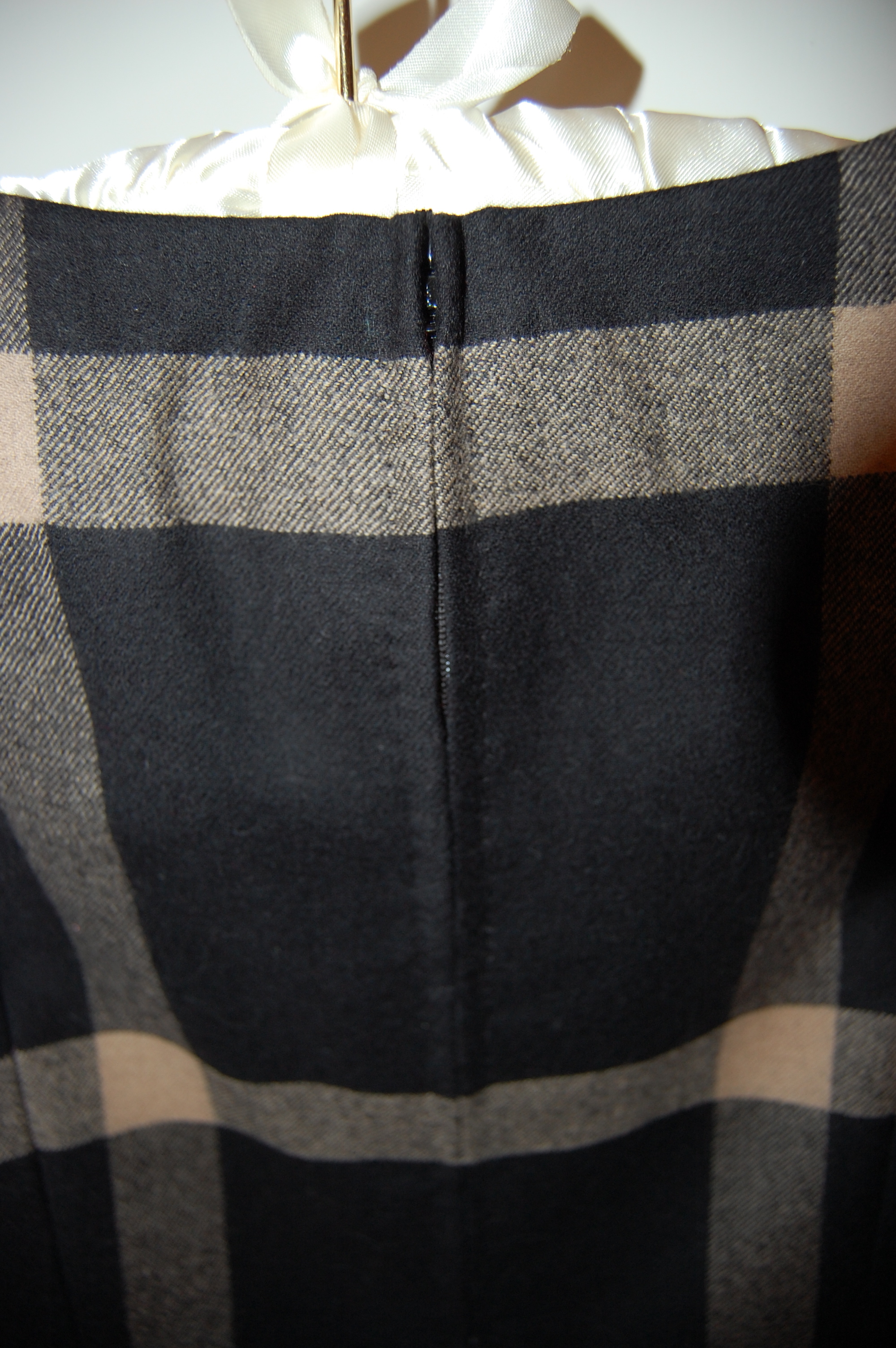
. . . and a look at the hand-picked zipper. This was the first separating zipper I think I have ever put in – and I am happy with the results!

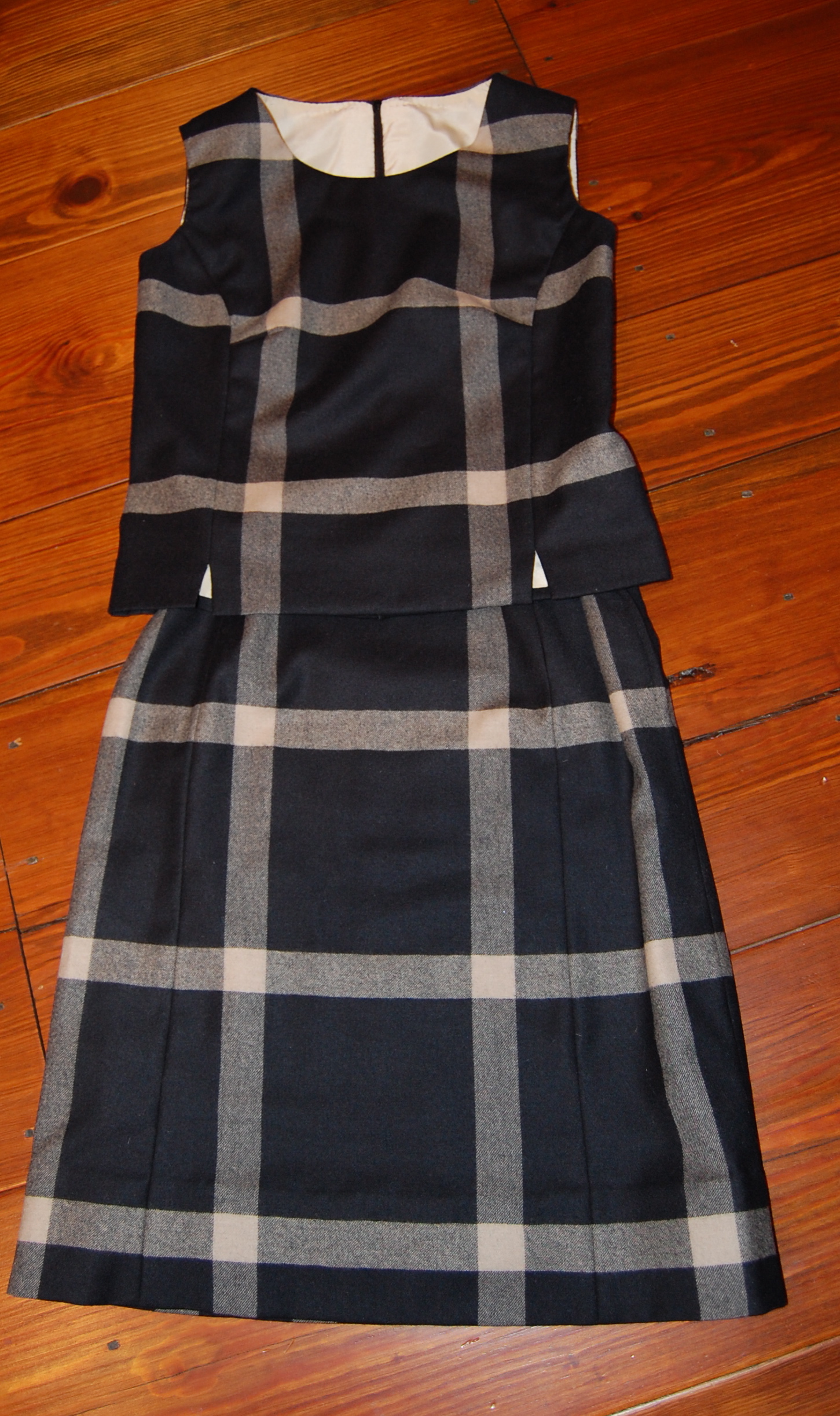
And here is the finished blouse/overblouse/shell/sheath top, shown with the skirt:

An impersonal view, for which I apologize – no tangling with the tripod and camera timer today!

Just as I appreciate the preciseness which couture sewing makes possible when sewing something as “simple” as this shell, so do I also appreciate the many variant words to describe this type of blouse.  My personal favorite name for this blouse?

Finished!

9 Comments

Filed under Blouse patterns from the 1950's, couture construction, Dior darts, hand-sewn zippers, Uncategorized, vintage Vogue patterns from the 1960s, Vogue patterns, woolens

Completely Captivating Couture Construction

I just can’t seem to avoid alliteration in my blog-post titles as of late!  Truthfully, however, this title really seems to sum up just how badly I have been bitten by the “couture” bug.  Earlier in the summer I signed up for Susan Khalje’s class, The Couture Dress, on Craftsy.  I’ve mentioned it several times in my past posts, but now, my couture dress is finished.

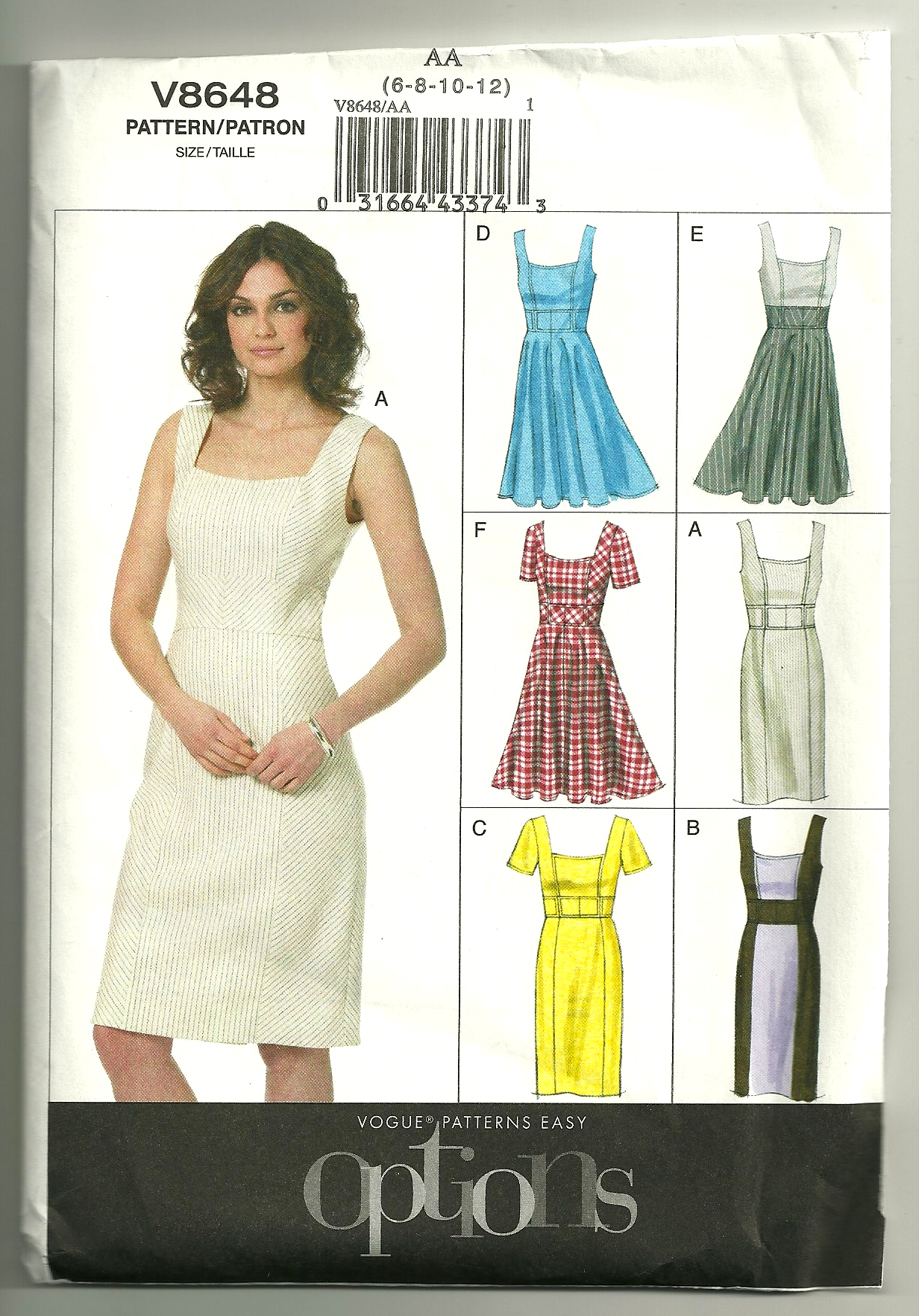
The Craftsy course included this Vogue pattern:

I decided to make this dress in the slim skirt with short sleeves.

Although I could have substituted another pattern for my dress, I decided it would be beneficial to follow the exact steps which Susan takes one through in her course.  (It helped that the view I chose to make reminds me very much of a classic 1960s–style dress).

My idea of making a “muslin” or toile has been completely transformed by this course. I now know it as the most essential ingredient in the proper fit and alteration of a garment – and although the process of producing a useable muslin is time-consuming, every minute is worth it.  There is nothing quite so discouraging as spending a lot of time, energy, and money on a garment and then not being completely satisfied with the fit.  Making a couture muslin eliminates this possibility almost entirely.  Check out the online preview of the course if you want to know more about this concept.

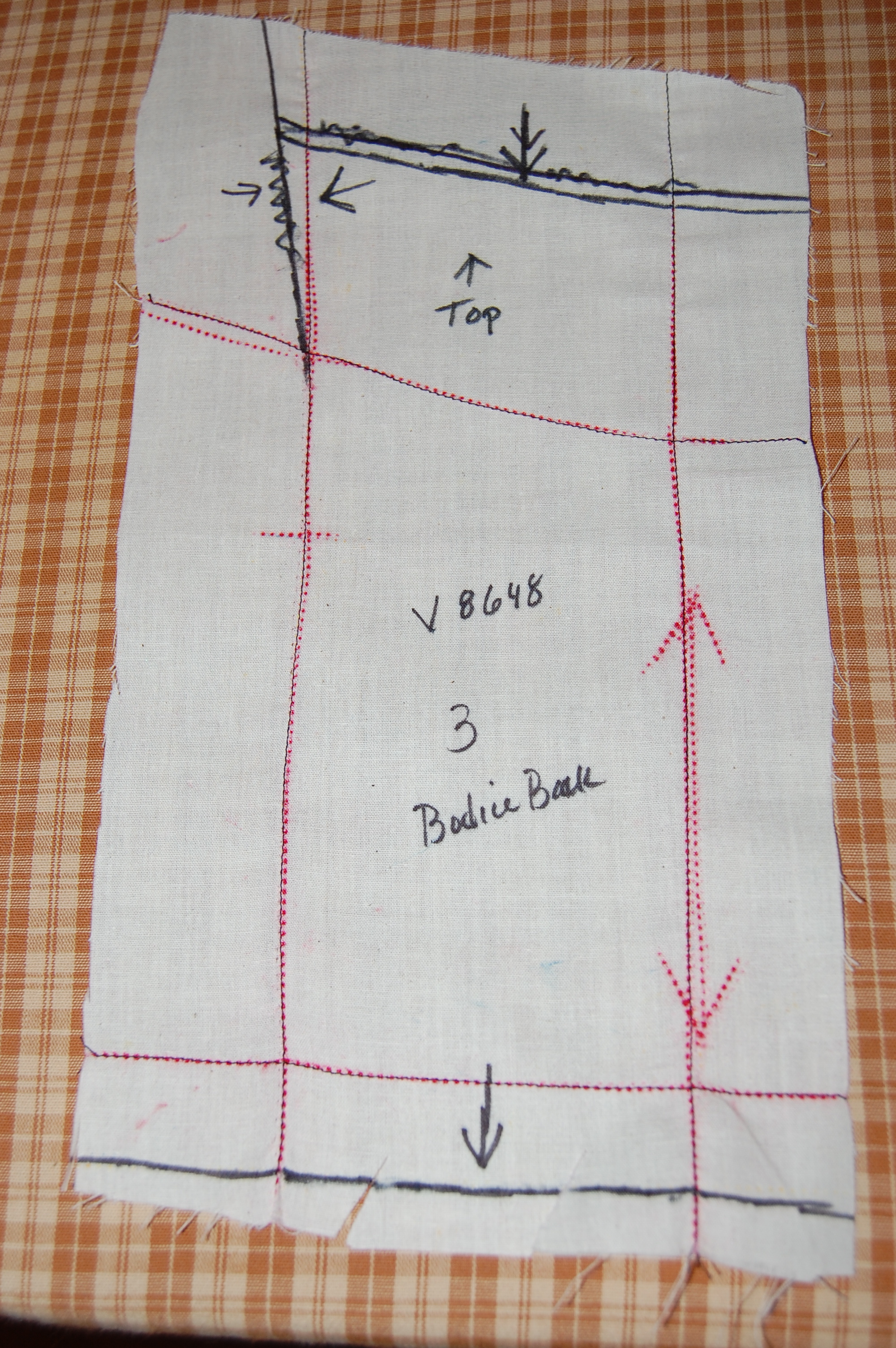
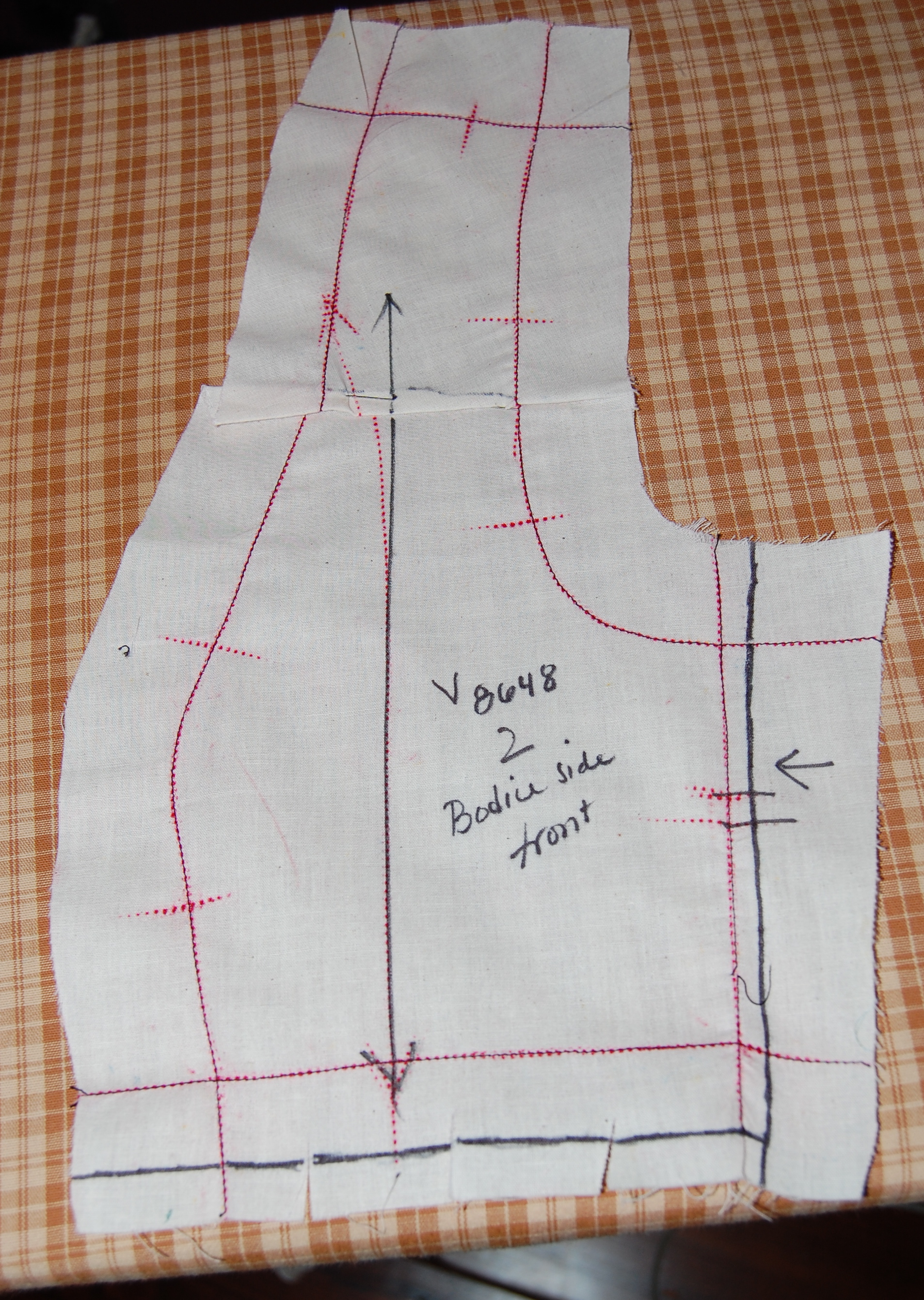
Here is one of my muslin pieces. The lines in red were the original tracings from the pattern and the lines in black are my alterations.

This muslin piece shows the “blind dart” I added to the neck edge. Susan goes over all these details in her course.

There are several “hallmarks” of couture construction, I have learned: Control, Generosity, and that all-important duo of Form and Function.    So what (in a nutshell) do these terms mean?

A few examples of Control are:

1) Control of the fit, which, as stated above, is the purpose of the muslin.

2) Control of the stitching line, which is your reference point for sewing – as opposed to the seam allowance, which is how most of us were taught to sew.  Lots and lots of basting is the key to controlling the stitching line.

3) Control of the inner seams, the raw edges of which are each catch-stitched to the underlining.

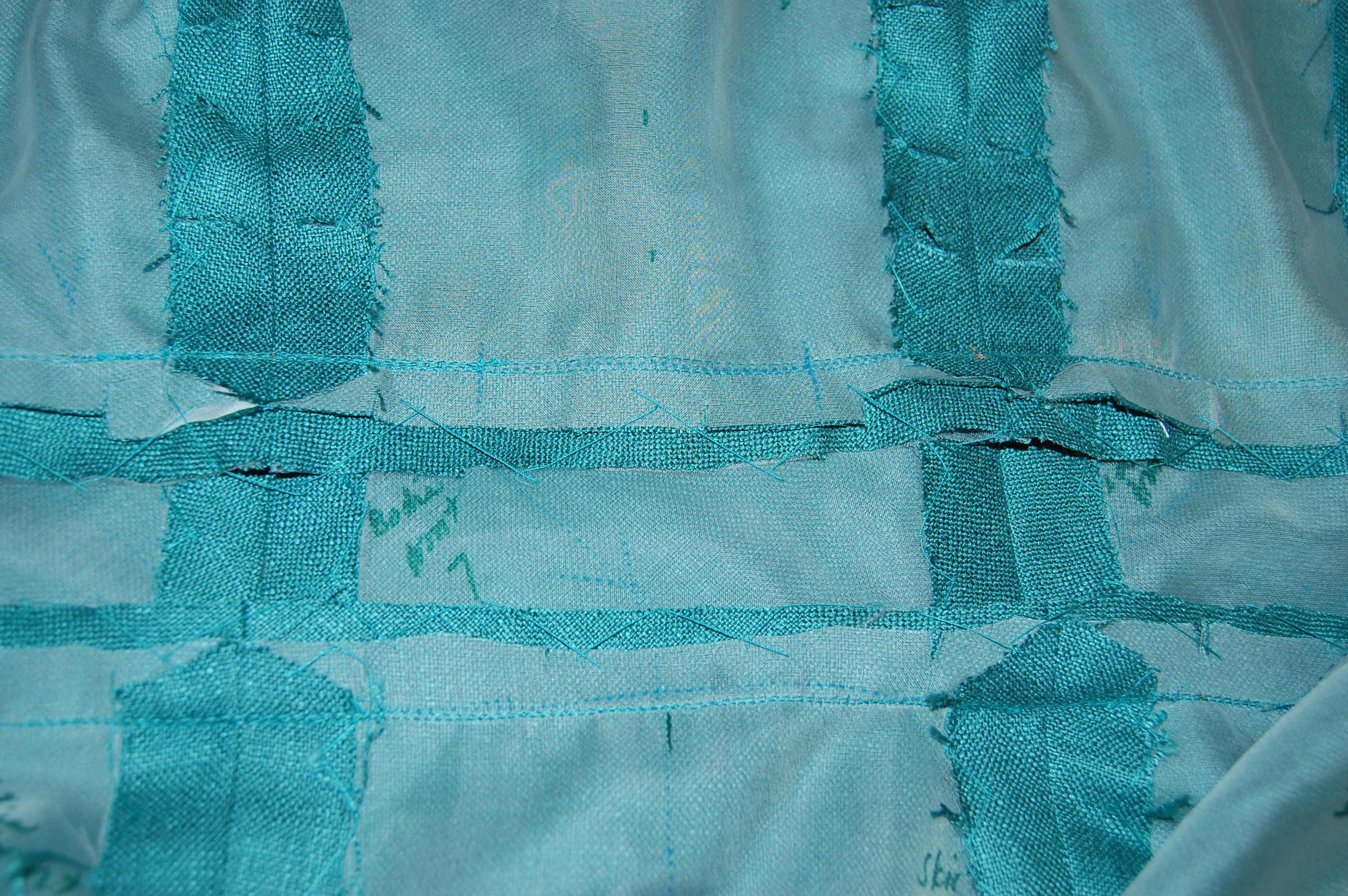
Here you can see the interior of the assembled dress, with every edge catch-stitched in place. The underlining serves as a “tablet” upon which you can make all kinds of notes!

The two big examples of Generosity are:

1) Cutting out the muslin, the underlining and the fashion fabric with very large seam allowances which give you the flexibility you might need to make changes in your final fitting.

2) Allowing – and taking – the time to do a lot of hand-sewing, fitting, and detail work.

If you look closely you can see the hand made loop and the “couture” attachment of the hook at the neck edge.

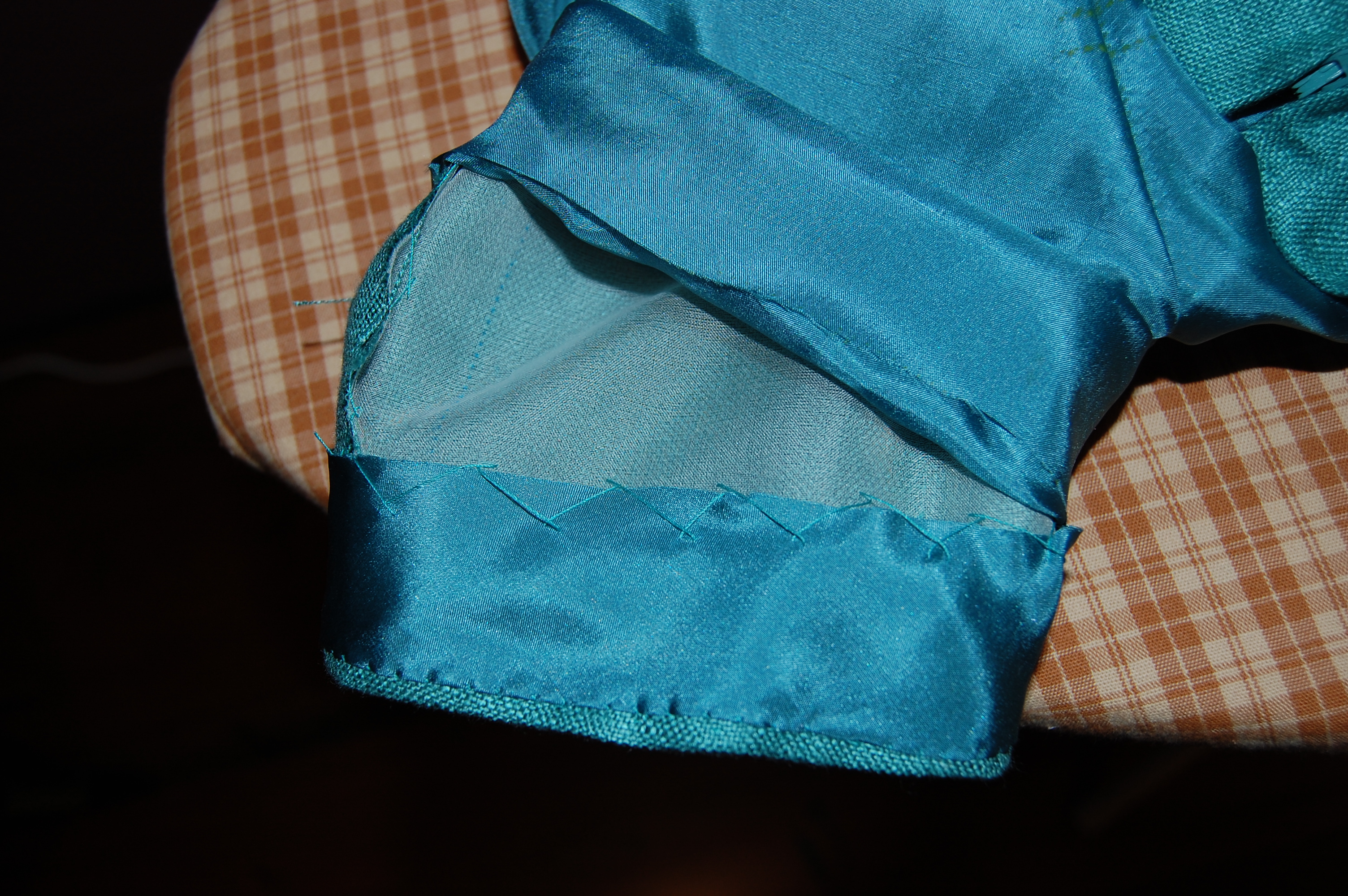
I ended up applying a bias facing to the sleeve edges. At my final fitting, I decided I wanted the sleeves a bit longer than I had originally anticipated, so the bias facing gave me another 3/4 inch in length. This is one more detail which Susan covers in her fabulous course!

Finally, Form and Function are well illustrated by these two examples:

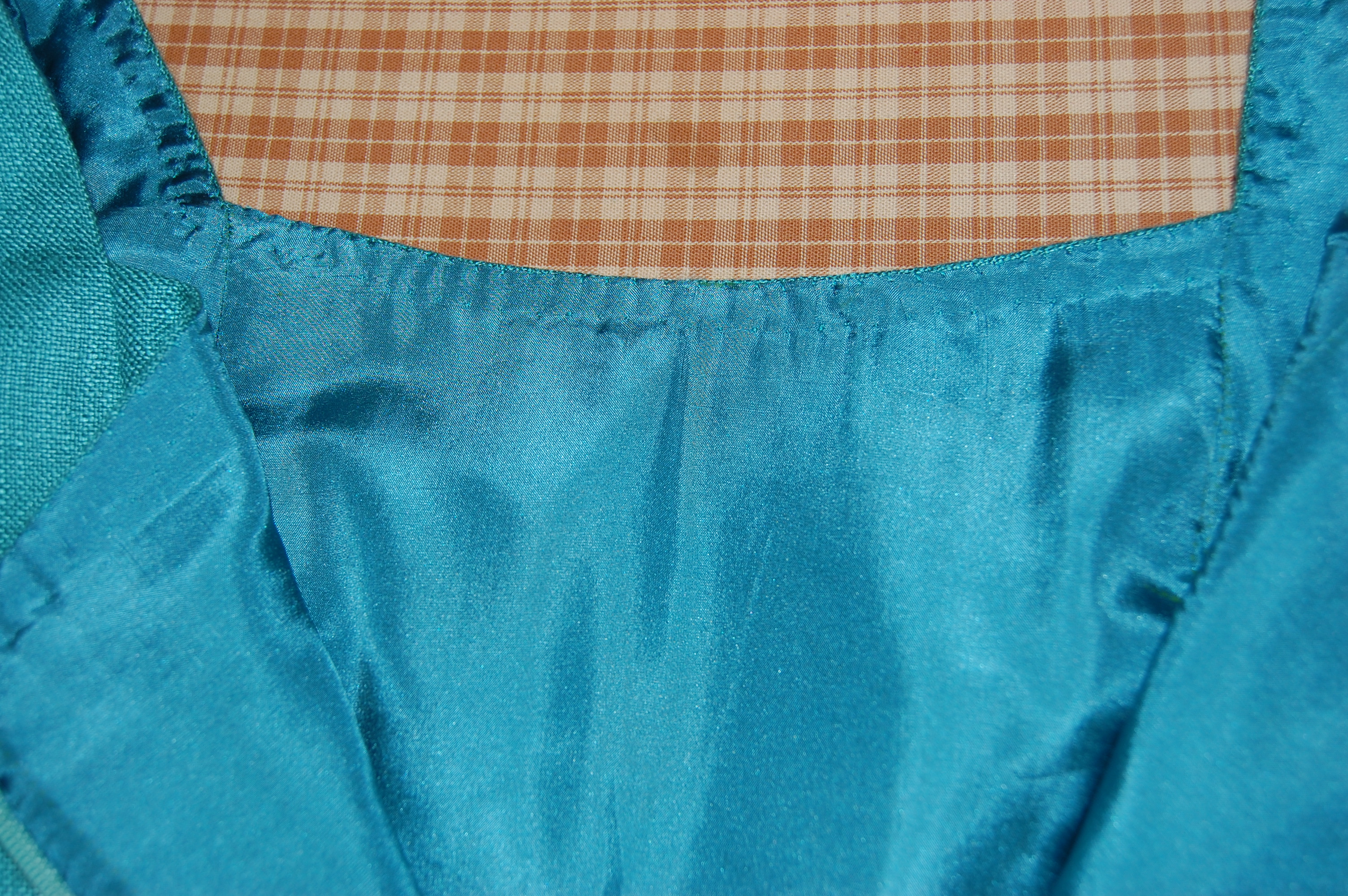
1) A couture lining is always applied by hand, using the fell stitch.  To insure that the lining will not “migrate” to the outside, it is secured by the very lovely pick stitch – doing the job (function) in a truly elegant way (form).

Here is the finished front neck edge, showing the “applied by hand” lining and the pick-stitches which keep the lining from migrating out of the dress!

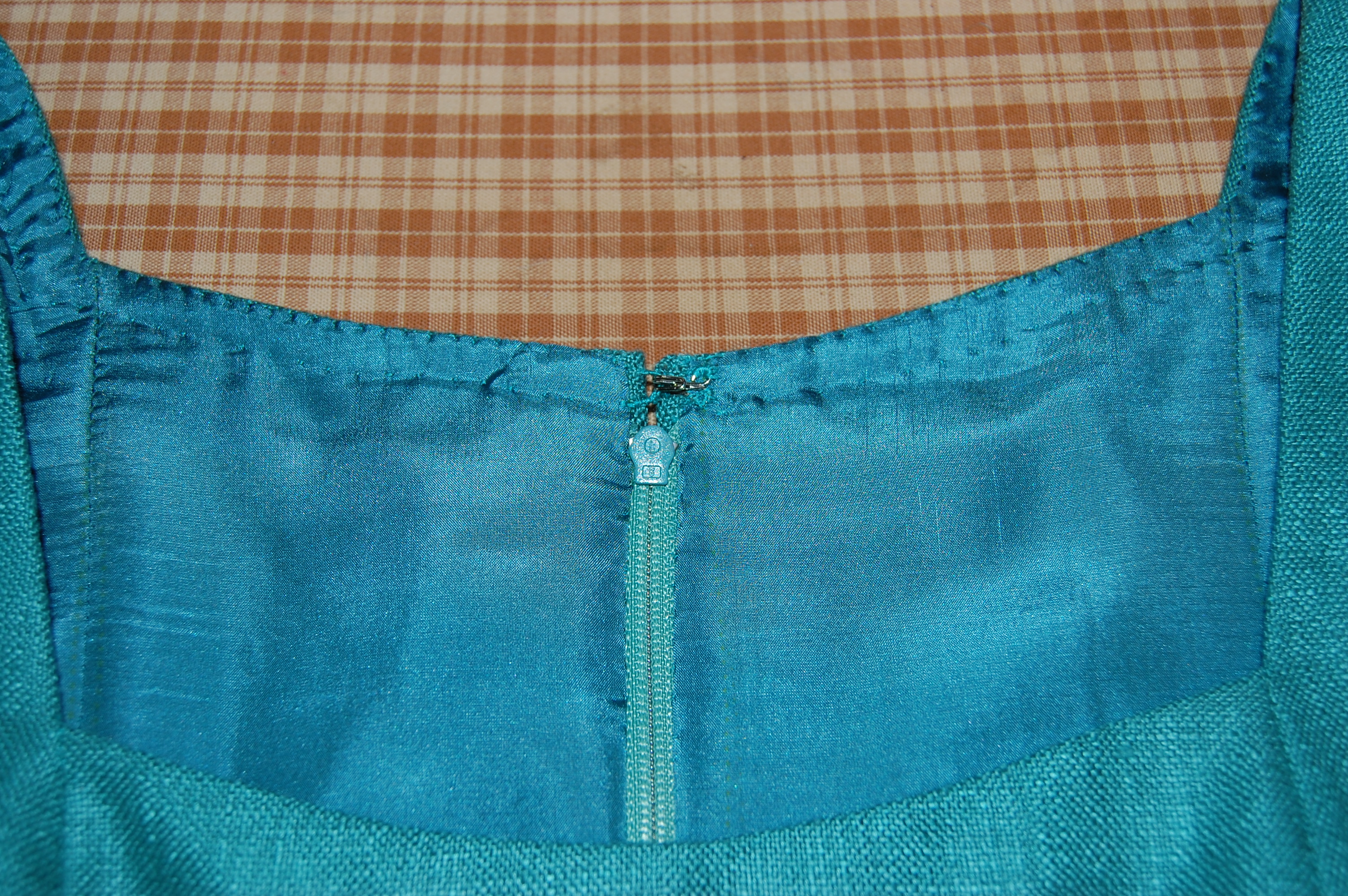
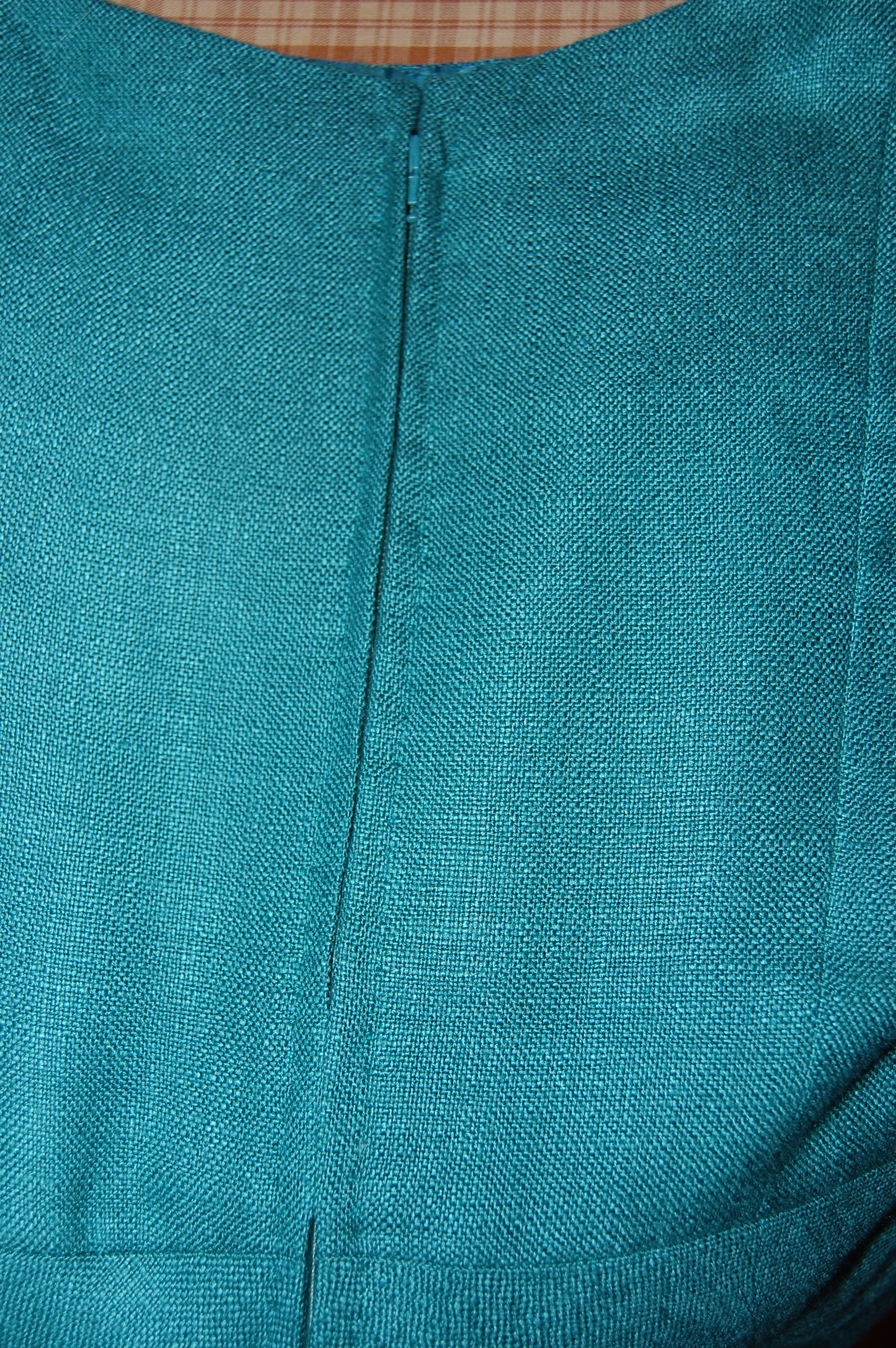
2) The zipper (if you are using one) is a regular zipper (not invisible) which is set in by hand, again using the pick stitch.

The top part of my hand-picked zipper.

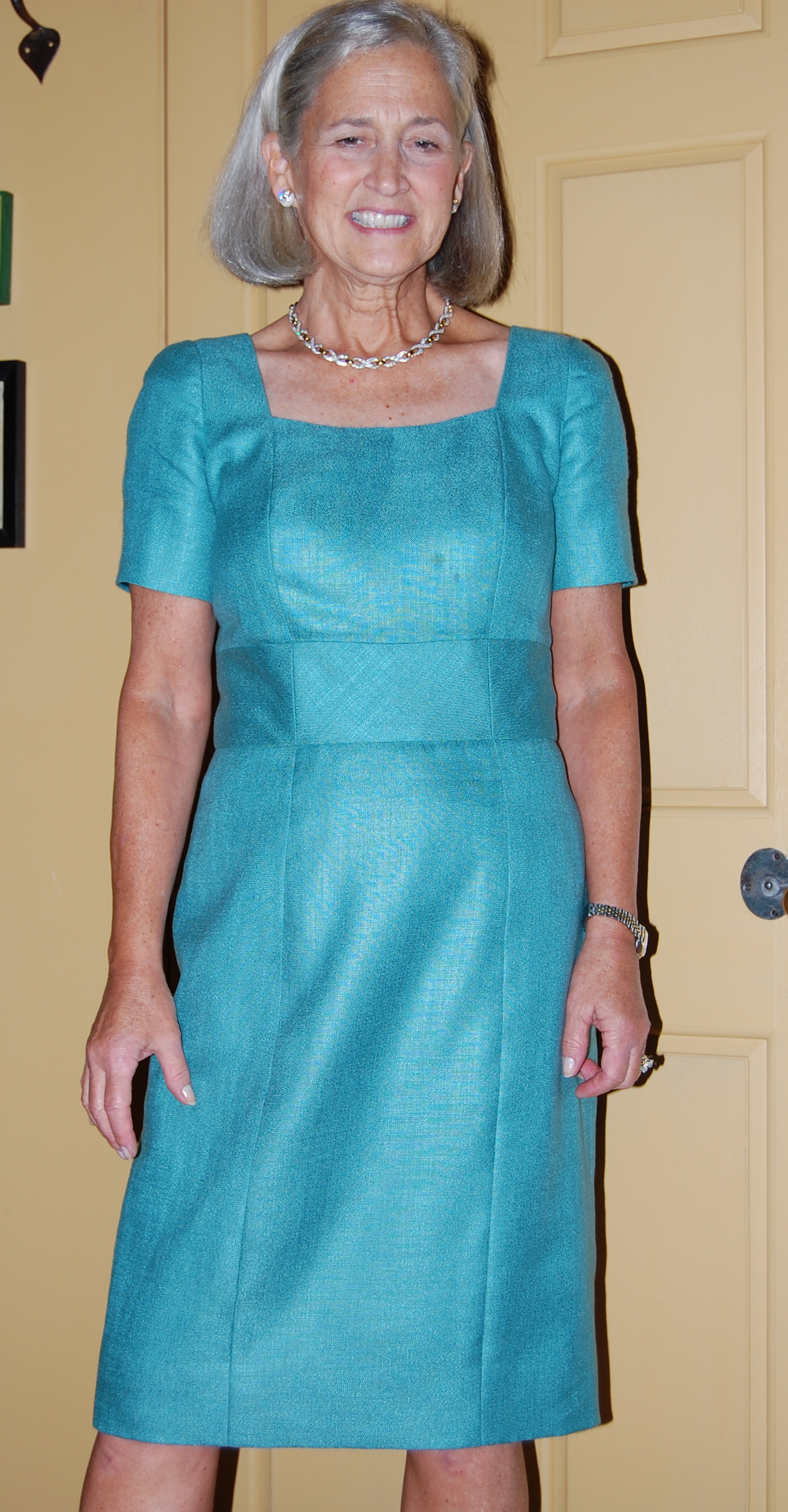
Now that you’ve gotten a few glimpses of my dress inside and out, here it is all finished:

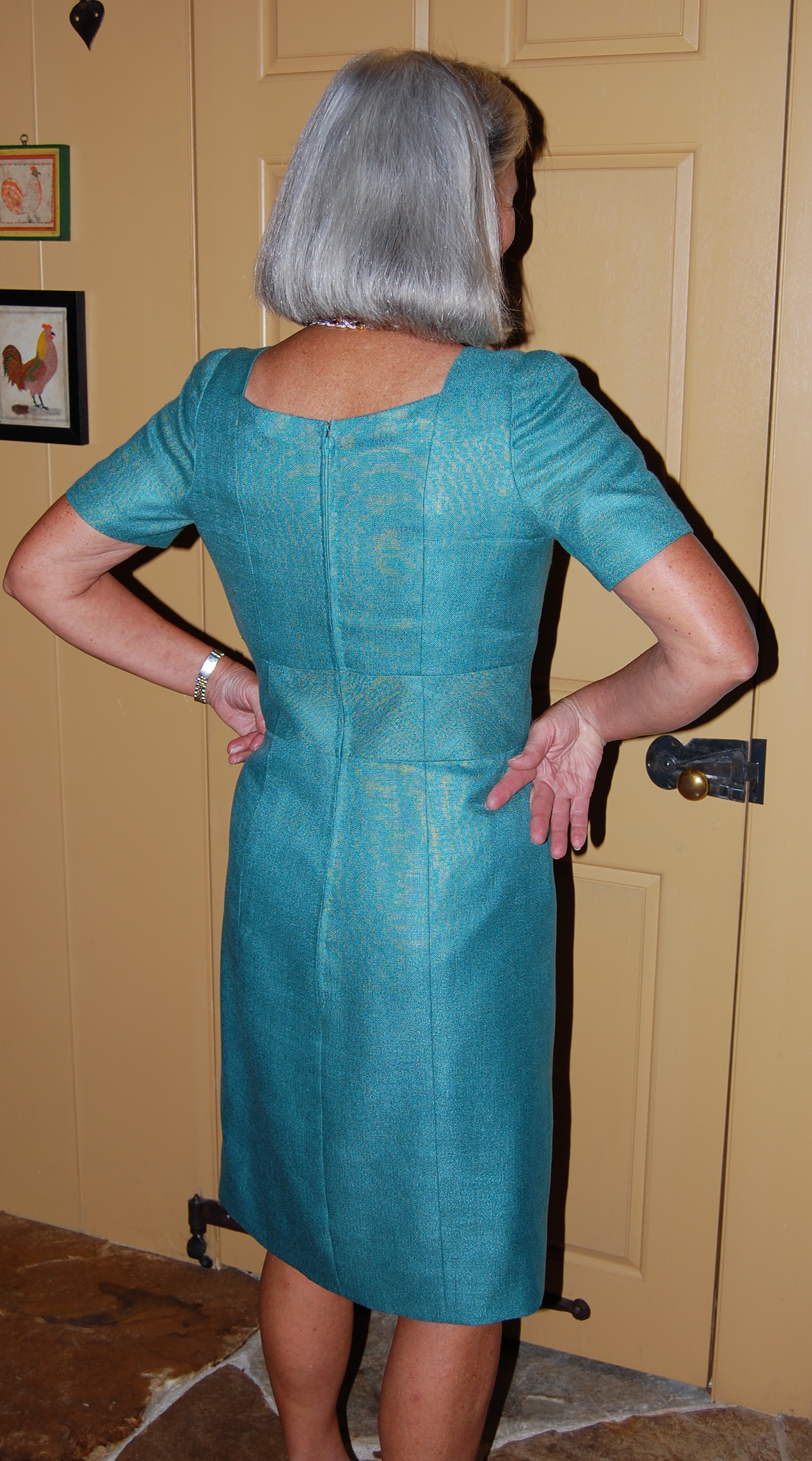
The fabric is a teal green linen; the lining is matching crepe de chine, and the underlining is white silk organza.

Another view…

… and a back view.

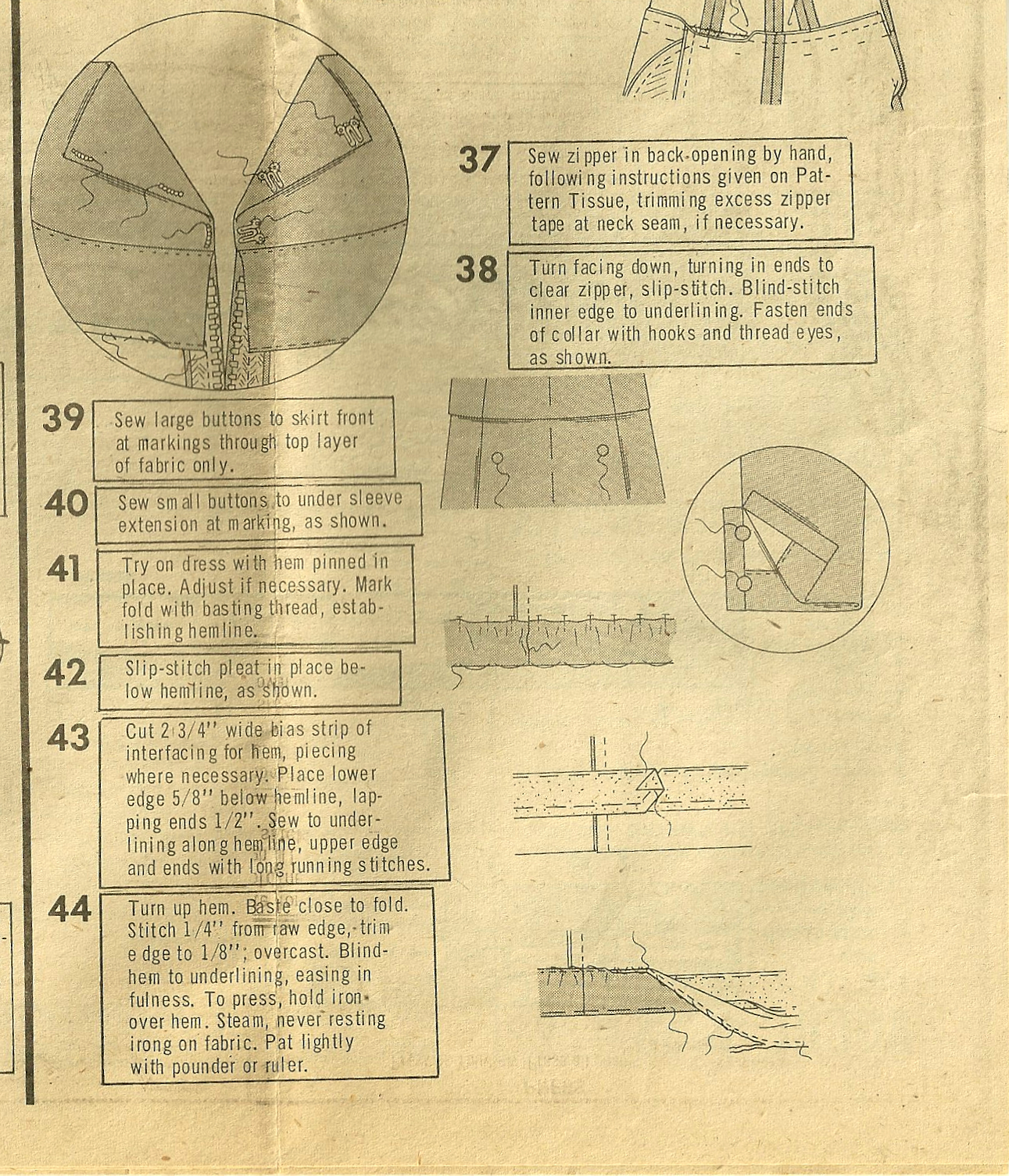
One of the things that appeals to me so much about couture construction is how transferable it is to vintage patterns. In fact, I would go so far as to say that parts of this type of construction are implied in many vintage patterns.  Here is an example from a construction sheet from the early’70s:

The instructions say to sew the zipper in by hand, the hooks and loops are shown in “couture” detail, and the hem treatment is very similar to one I learned in this course. One exception I should note here is that couture does not use facings as shown in the topmost drawing.

Consider for a moment this advantage of using vintage patterns over contemporary ones:  contemporary patterns, which are usually “multi-sized”, are drawn with the cutting line only.  To make one of these patterns usable for couture construction, you must add the stitching line onto the pattern tissue, adding another step in the whole process.  Vintage patterns (except for unprinted ones, of course) have the stitching line drawn on the tissue – ready to be traced onto your muslin fabric (which becomes your ultimate pattern).  All of which brings me to another alliterative phrase  . . .  as I find myself Valuing all the many Virtues of Very Versatile Vintage!

17 Comments

Filed under couture construction, hand-sewn zippers, Linen, sewing in silk, Uncategorized, underlinings, vintage Vogue patterns from the 1970s, Vogue patterns