Category Archives: The Conde Nast Publications

Who is Mrs. Exeter?

And the more important question is – Can she sew?  Yes, she can – and she does!  But first, let me tell you who she is – or actually who she was.  She was a fictional character – a “woman of a certain age” – who started appearing in The Conde Nast Publications’ Vogue magazine in 1949 (as best as I can determine).  She was the focus of a regular style column, which was meant to appeal to older fashionable women –  with the emphasis most definitely  on fashionable.   She must have proved to be an appealing figure to readers, because in 1954, the front cover of the October/November issue of Vogue Pattern Book magazine announced:  Introducing Mrs. Exeter patterns.
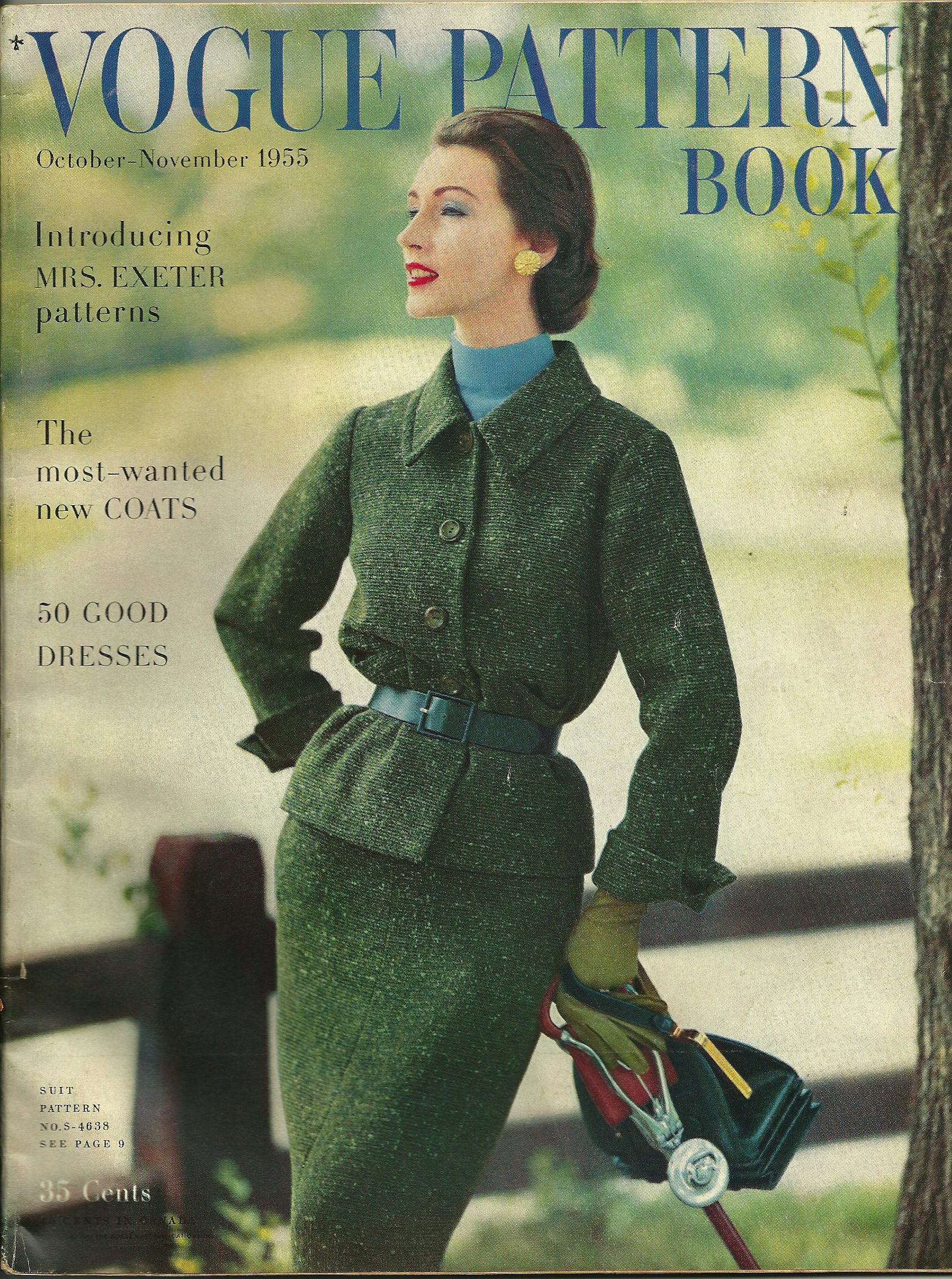
Top billing for the new feature!

Suddenly Mrs. Exeter had discovered the joy of sewing beautiful, classic fashions for herself.  Obviously, Vogue patterns, which already had its own Couturier line of patterns, and its very popular Designer pattern series, knew that its audience included these “older” women who had the time, the talent, and the inclination to sew beautiful fashionable clothes for themselves. The copy accompanying the sketches and photos clearly played into the idea that Mrs. Exeter was very sure of her fashion sense:
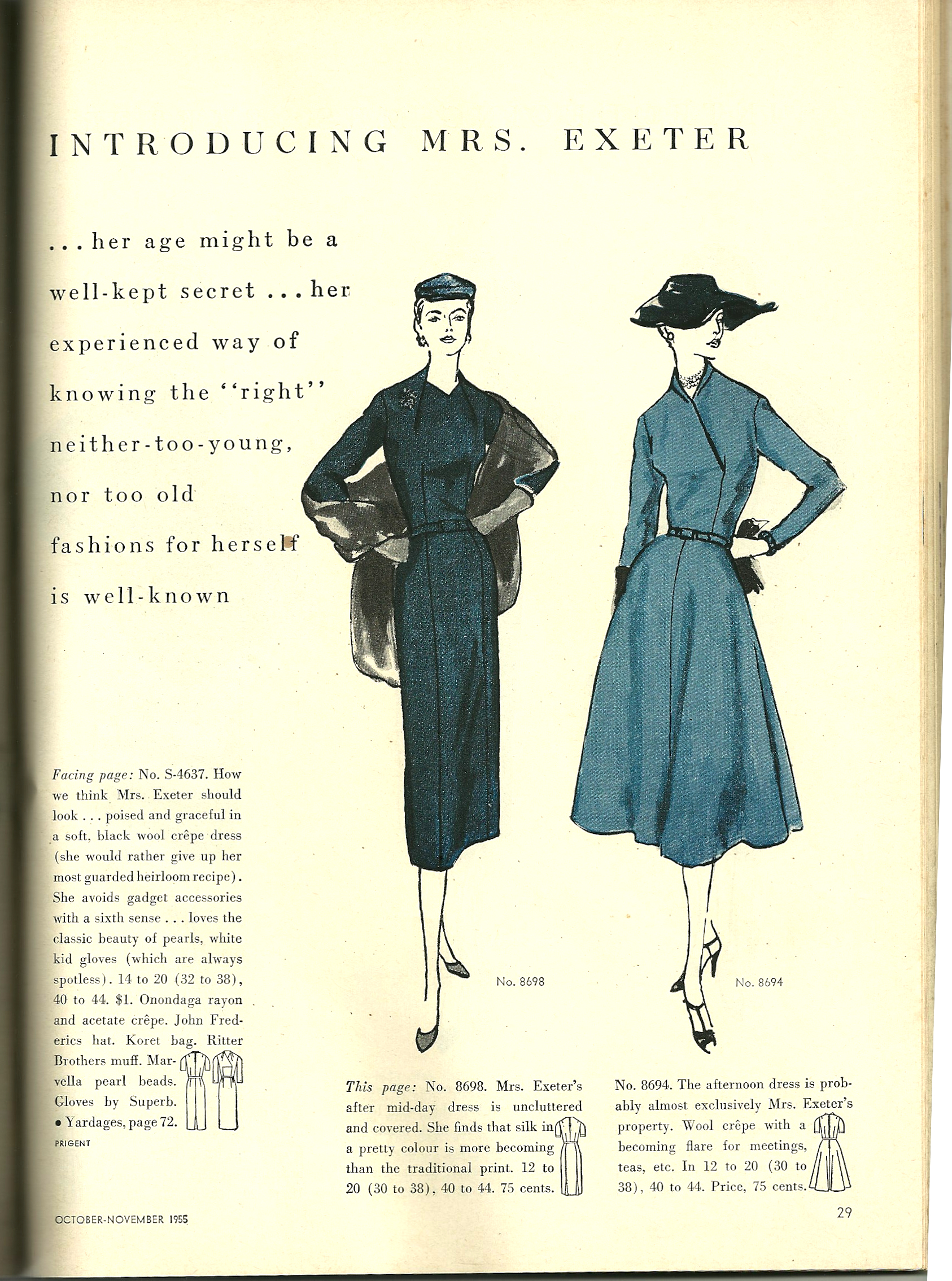
Here we learn about Mrs. Exeter’s “experienced way of knowing the ‘right’ neither-too-young, nor too old fashions for herself…”

She also had color sense, knowing how to play up her features, and showing she was not afraid to branch out from neutrals and basic black.
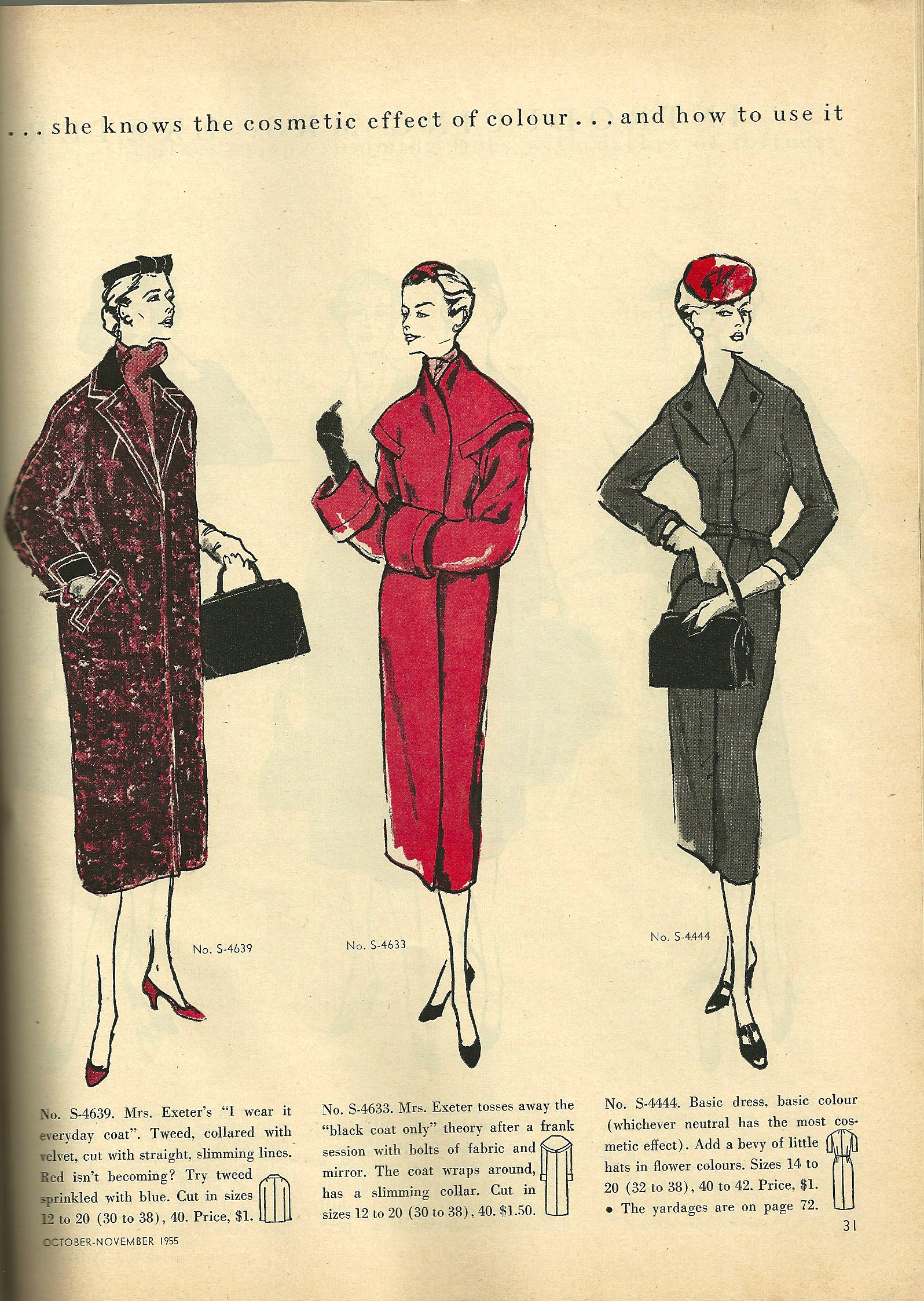
Yes, red can definitely enhance silver hair!

She sounds like she was a fun grandmother, too, as this sketch attests:
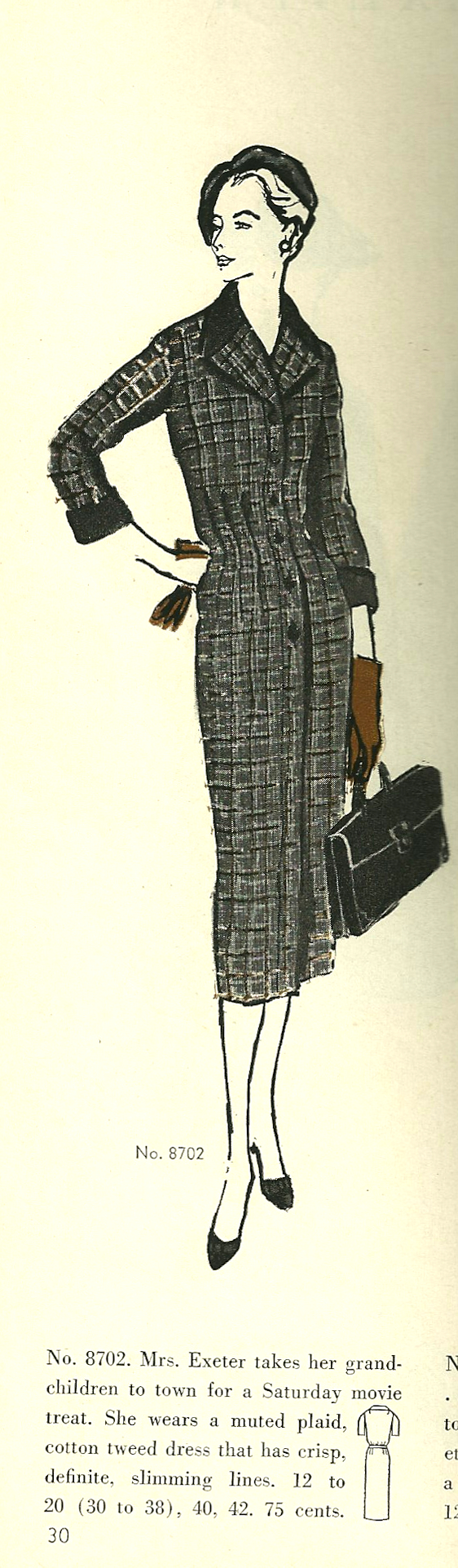
The caption reads: “Mrs. Exeter takes her grandchildren to town for a Saturday movie treat.”

The Mrs. Exeter feature appeared sporadically  throughout the year in the issues of Vogue Pattern Book magazine,  continuing through the decade of the 1950s.  The October/November 1957 issue had this feature:
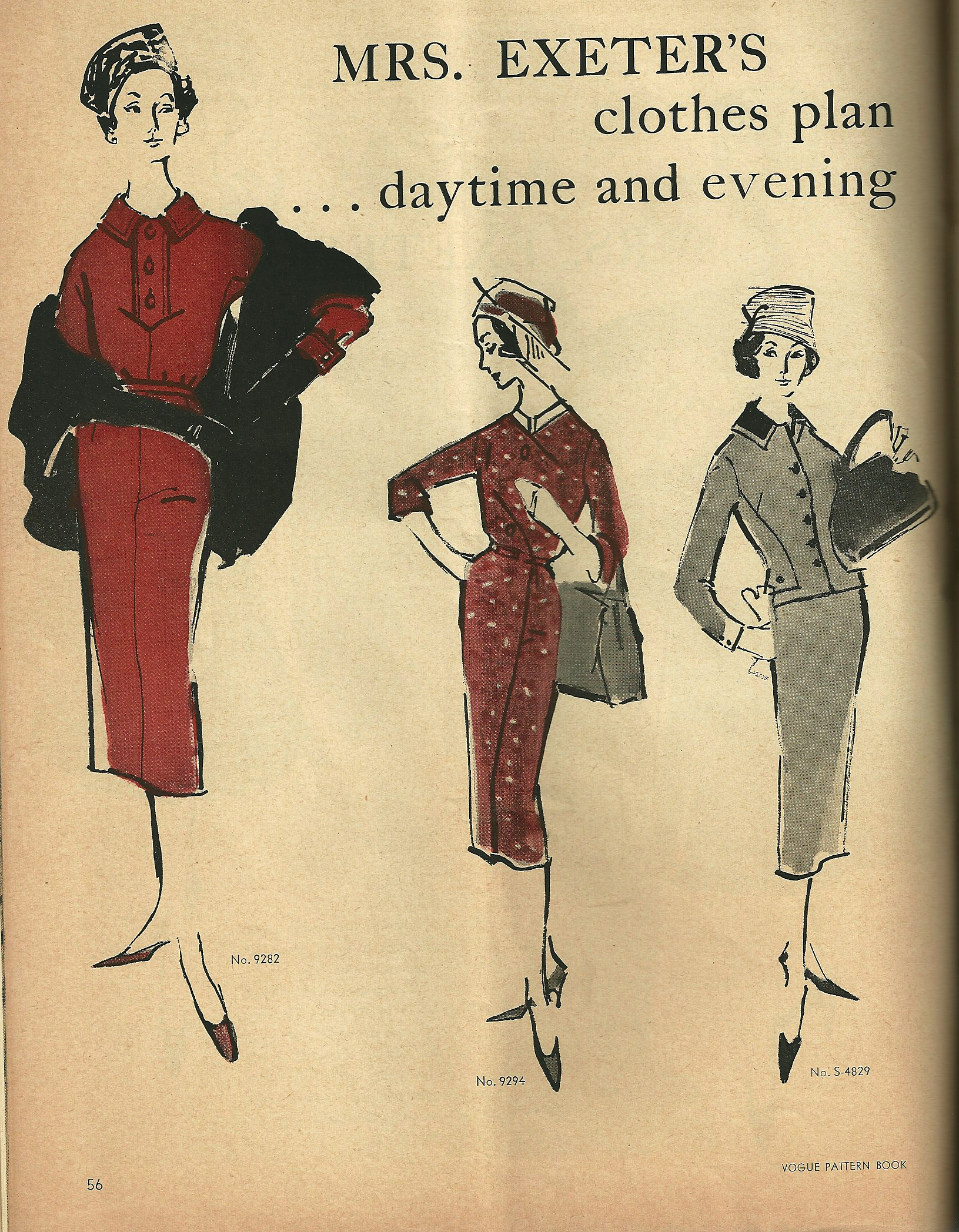
The reader was instructed to “sew jet buttons on the short, fitted jacket and flap pockets” of the gray suit on the right.

That same issue used a real model for the Mrs. Exeter section:
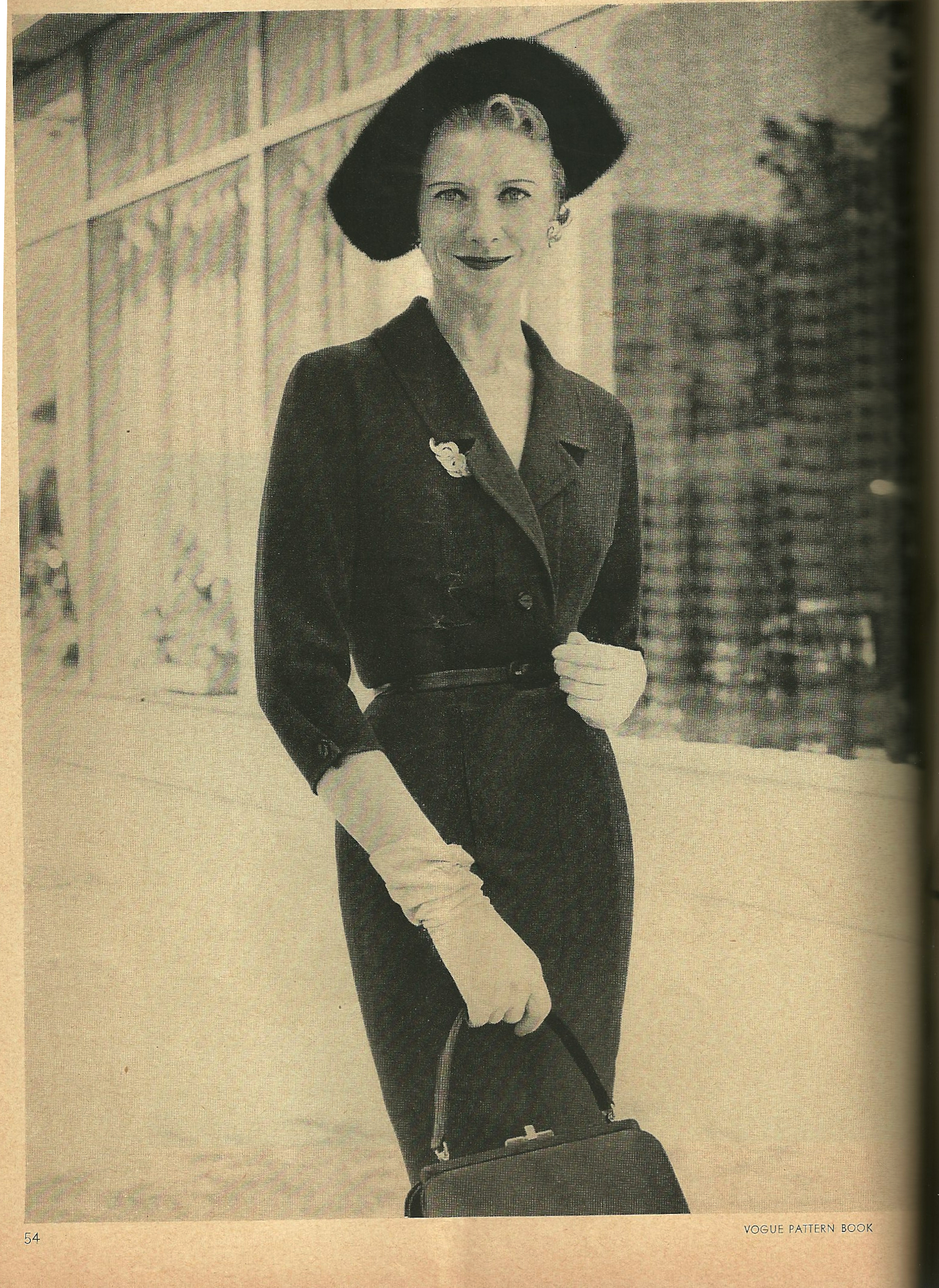
It seems Mrs. Exeter favored white gloves and classic handbags.

And another real model appeared in the February/March 1958 issue:
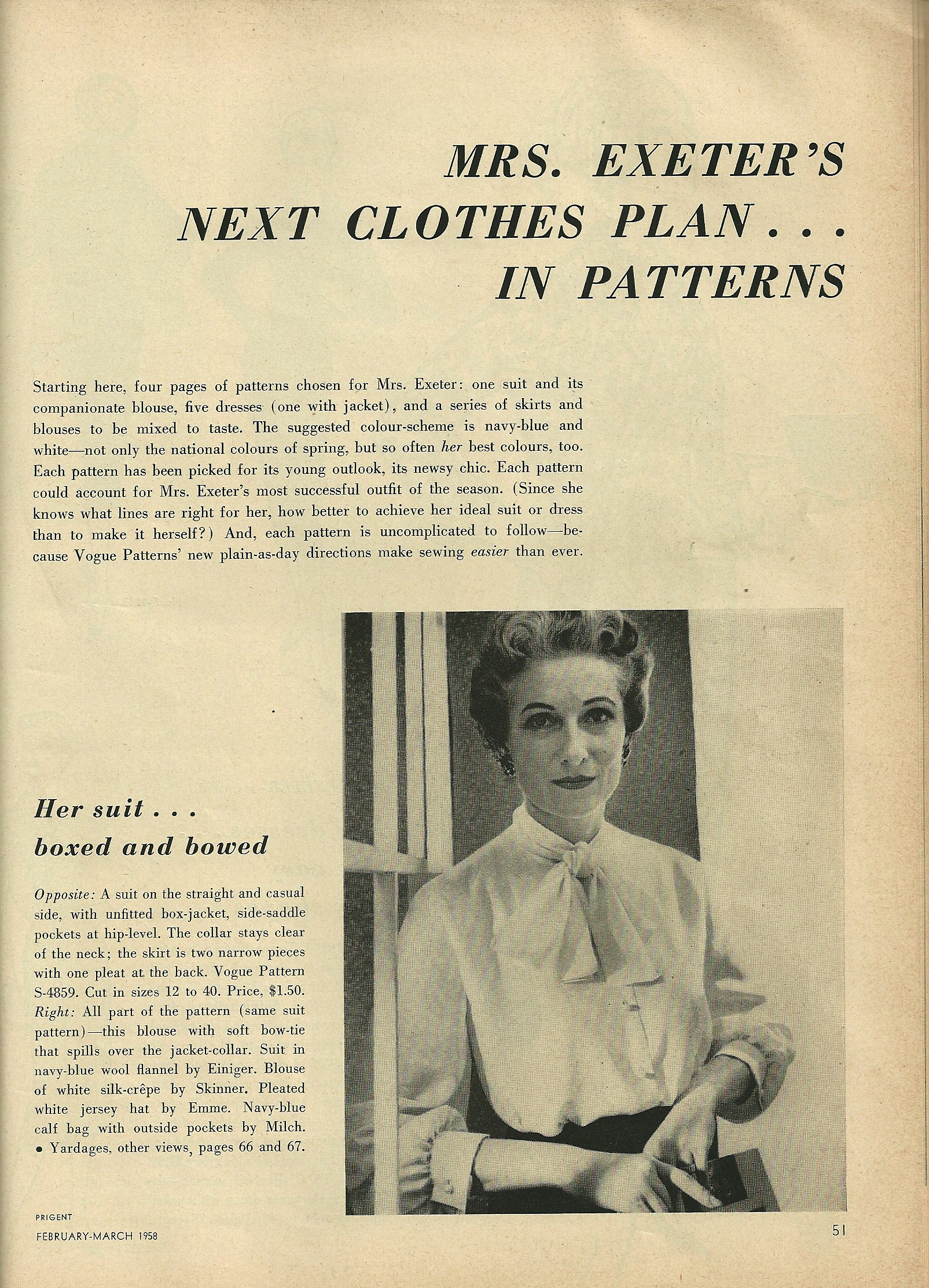
I think this Mrs. Exeter looks a bit insipid!

By the fall of 1958, Mrs. Exeter must have been very popular, as this was the cover of the magazine:
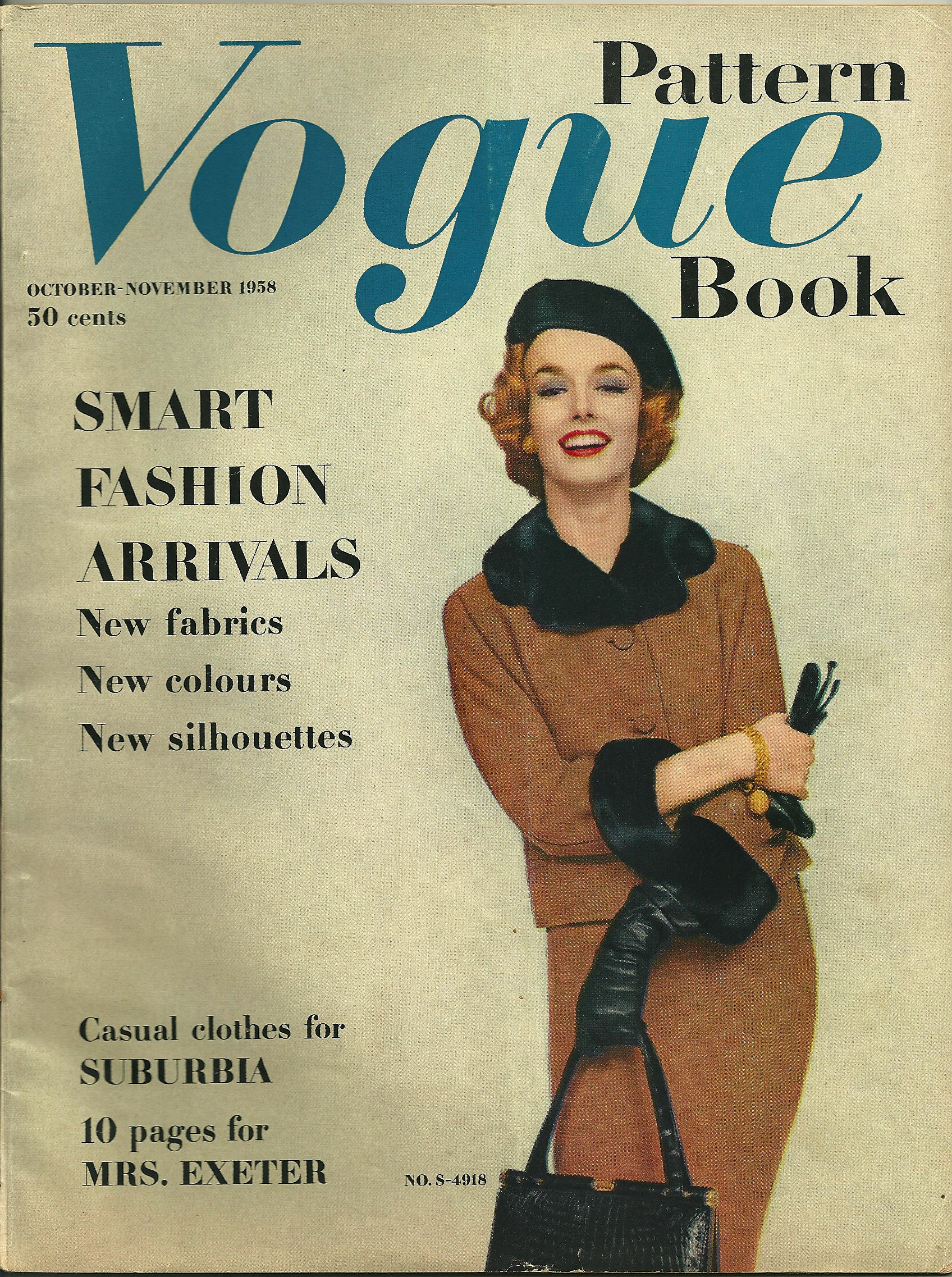
10 pages for Mrs. Exeter patterns!

The Mrs. Exeter appearing here suddenly looked a little less grandmotherly:
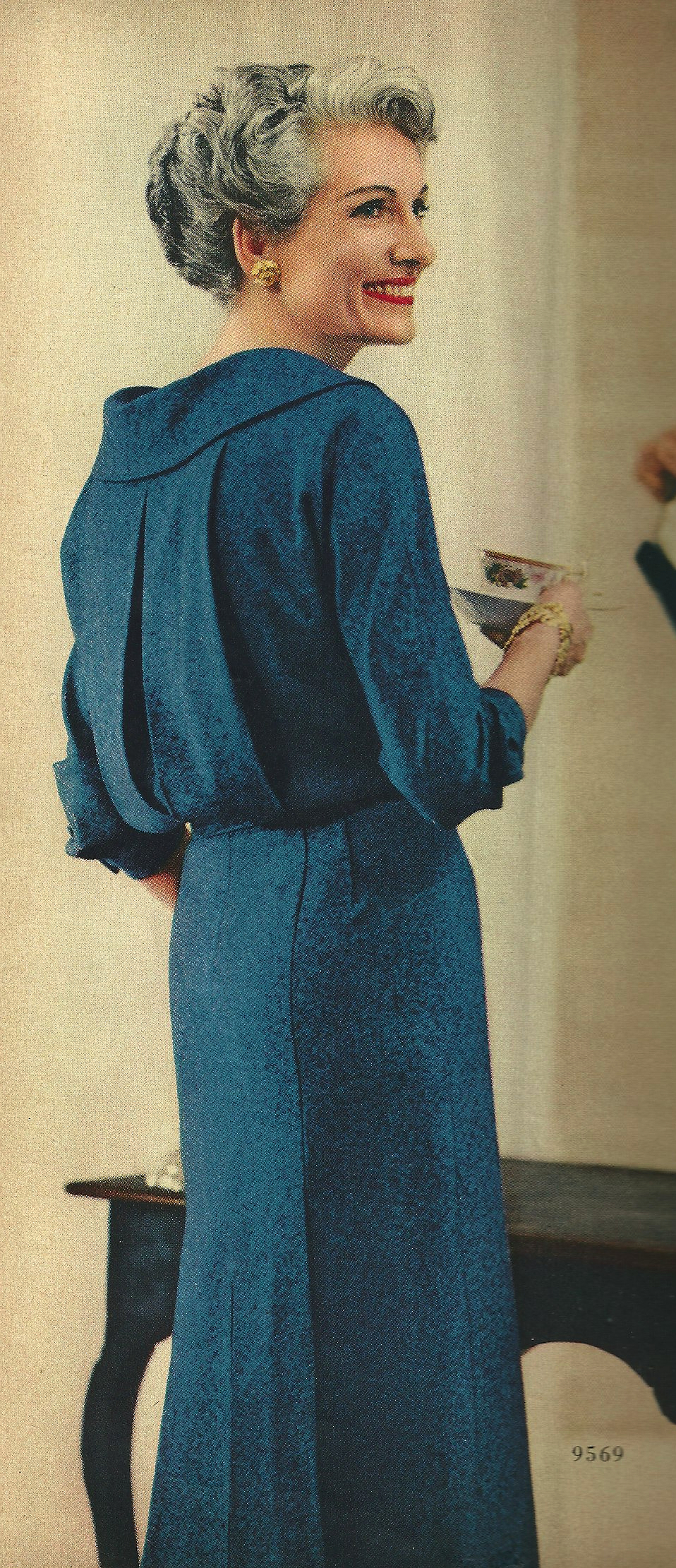
Now this is a lovely woman!

Again, the accompanying text was very flattering to the expertise of the older woman:
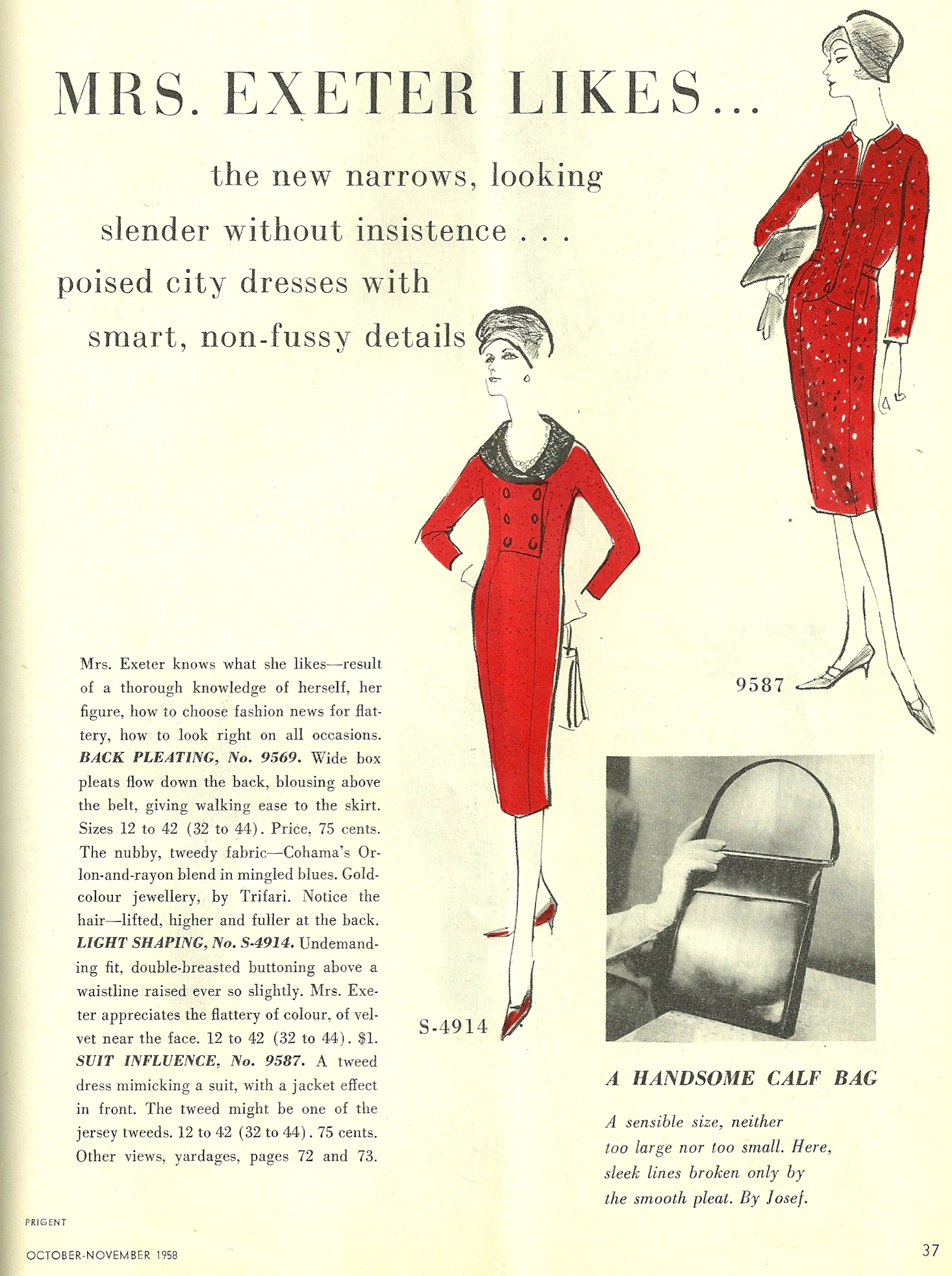
“Mrs. Exeter knows what she likes… how to look right on all occasions.”

And the texts made frequent reference to Mrs. Exeter’s civic and social obligations and interests. One two-page spread showing suits, declared:  “For Mrs. Exeter’s busy calendar of civic and social events, a suit wardrobe is almost a necessity.  Her choices, admirably combining chic, distinction, and flattery – with perhaps a shade more emphasis on flattery.”

She also apparently wore shirtwaist dresses with great aplomb, being careful “to avoid thickness at the waist.”
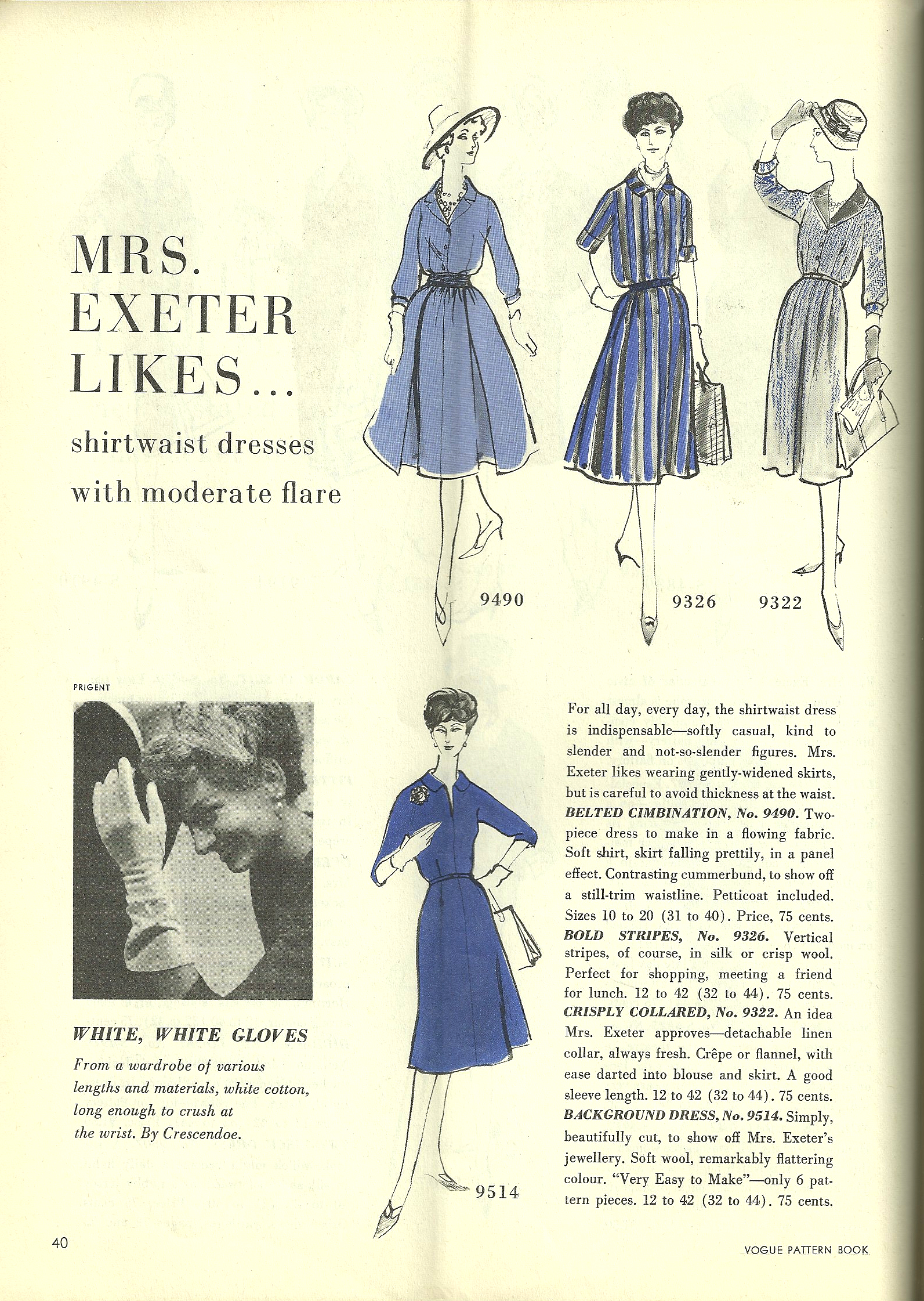
“For all day, every day, the shirtwaist dress is indispensable…” which could be true for 2012 as well!

The Mrs. Exeter feature continued into the early 1960s, but then succumbed to the burgeoning emphasis on youth, disappearing from the magazine by the mid-‘60s.  Indeed, in 1970, Vogue Pattern Book magazine introduced a new feature, this one called “Miss Vogue” in an obvious appeal to the younger generation.  The description of Miss Vogue?  Well, she must have been raised  by Mrs. Exeter:

“She’s the girl with the fabulously fresh smile.  She loves life.  She has fun.  She is active and her versatility knows no bounds.  …She is a sewing expert…  She loves a good challenge.  She’s got talent.  She’s got finesse…  She’s a winner!”

Although Mrs. Exeter might have been “replaced” by Miss Vogue, there were still plenty of 1970s’-era fashions and patterns, which certainly appealed to “the older woman” as well as a stylish younger one.  One of those patterns is the one I am currently using :
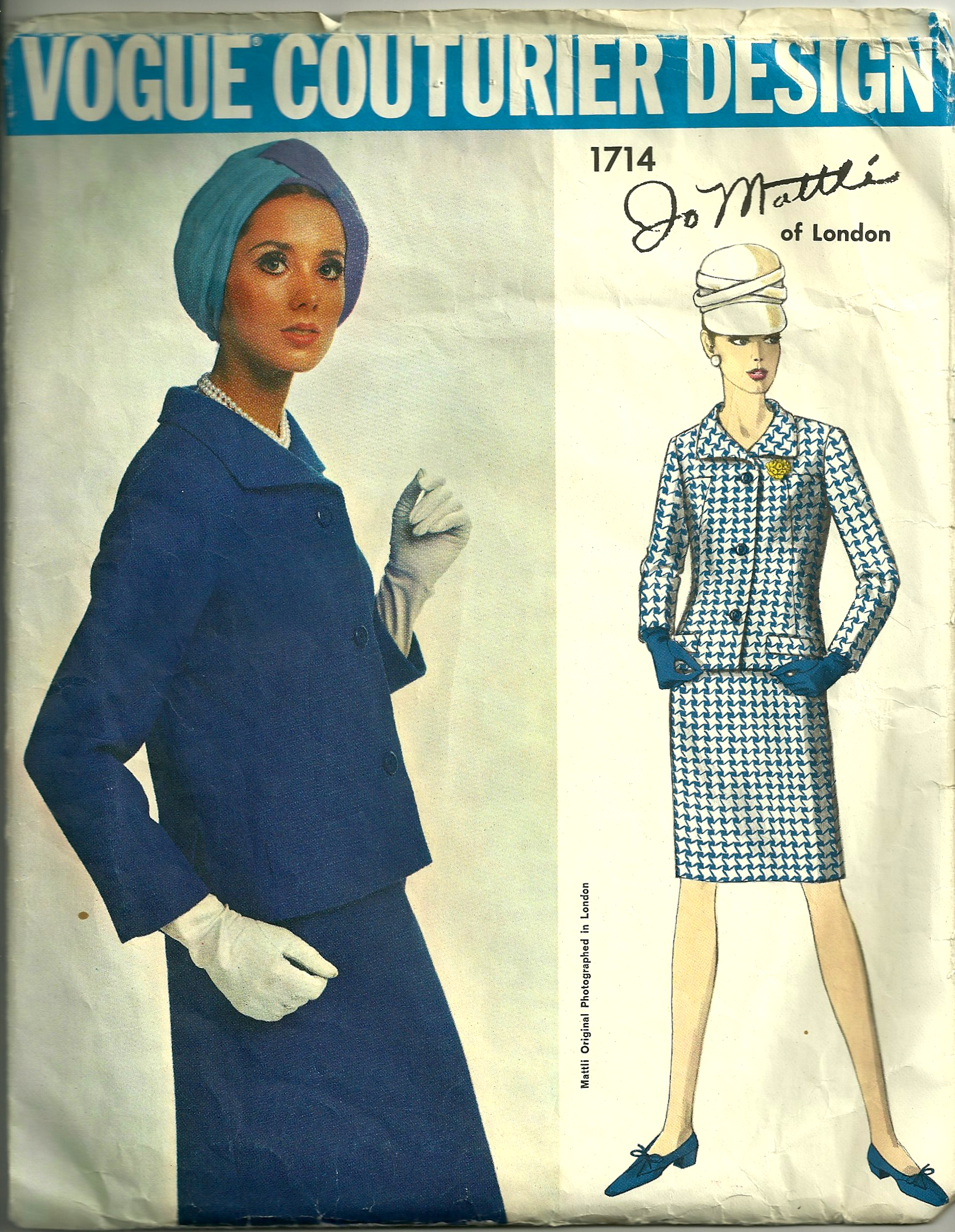
From Vogue’s Designer series, ca 1970.

I have completed the skirt, which incidentally is, to my thinking the perfect “pencil” skirt – as it is narrow, but very comfortable – and it has a shaped, two-part waistband. (I’m an unabashed fan of waistbands!)  I think Mrs. Exeter would approve.  I’ll show you in a future post…
6 Comments

Filed under The Conde Nast Publications, Uncategorized, Unprinted patterns from the 1950s, vintage Vogue Designer patterns, vintage Vogue patterns from the 1950s, vintage Vogue patterns from the 1960s, vintage Vogue patterns from the 1970s, Vogue patterns

A Stitch in Time

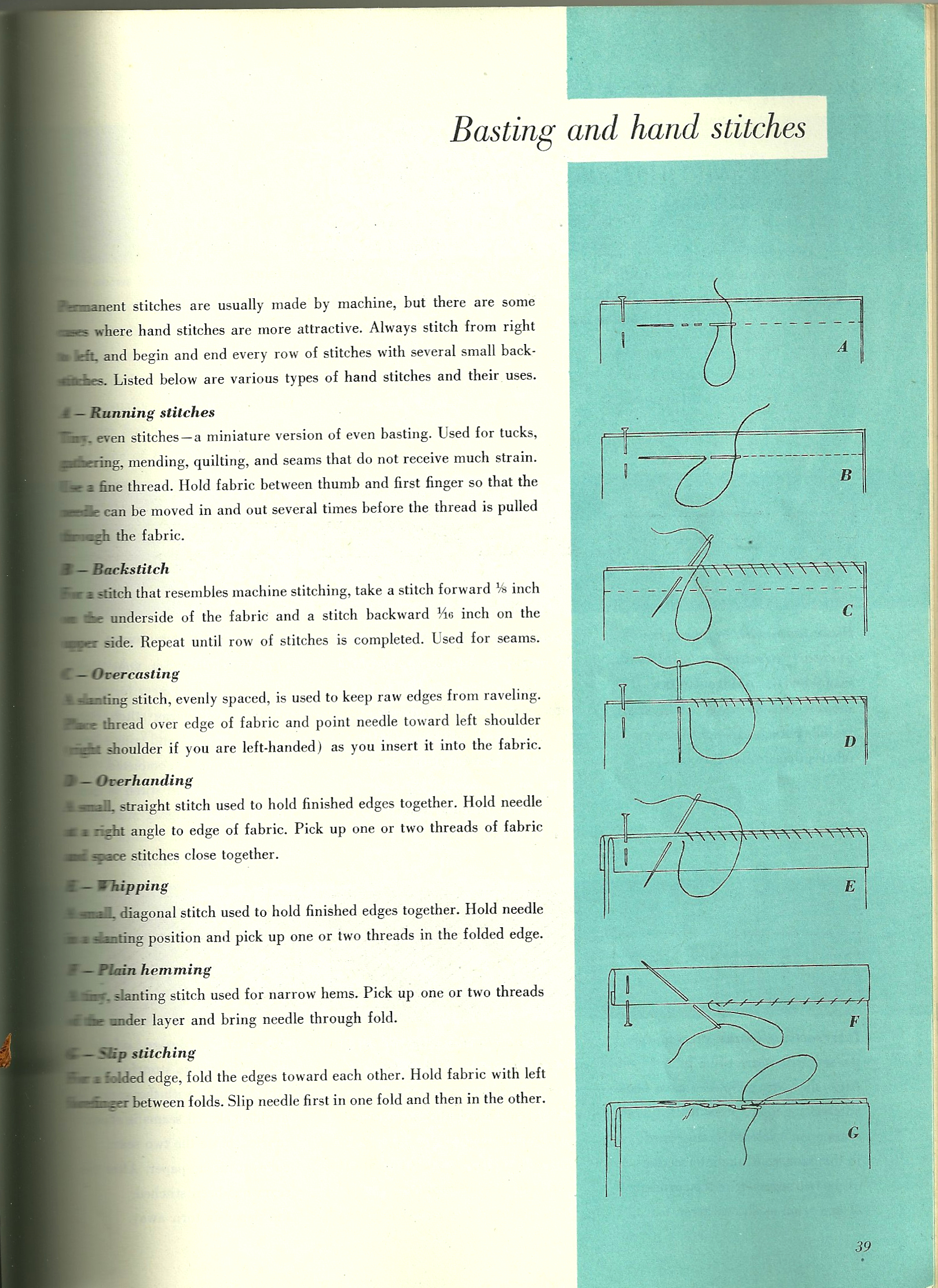
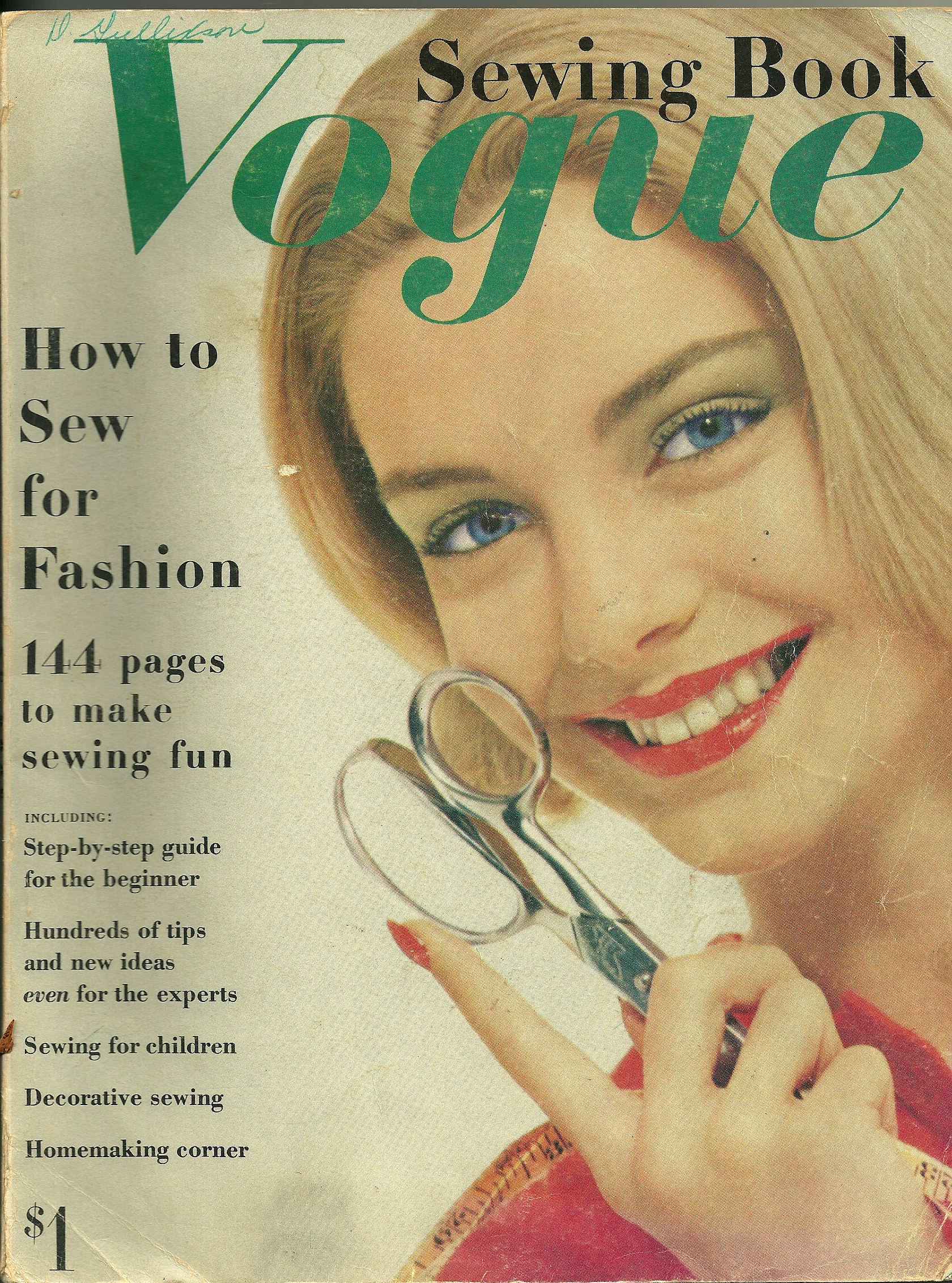
I’ve been doing a lot of hand stitching as I work my way through “The Couture Dress” online class on Craftsy.  It’s mostly been basting (and more basting and even more basting) so far, but I’m now in the “catch-stitch” phase (controlling the raw edges), and that’s always been one of my favorite stitches to do.  All this hand stitching got me thinking about how I learned to do certain stitches – and I think I just taught myself by following directions on pattern instructions and from diagrams in sewing books and magazines.  There were lots of articles on perfecting one’s hand stitches when I was growing up, such as this representative page from Vogue Sewing Book, c1958, The Conde Nast Publications, Inc.:

Sewing in 1958: including tips and new ideas even for the experts!

This is just one page of many detailing stitches and seam finishes.


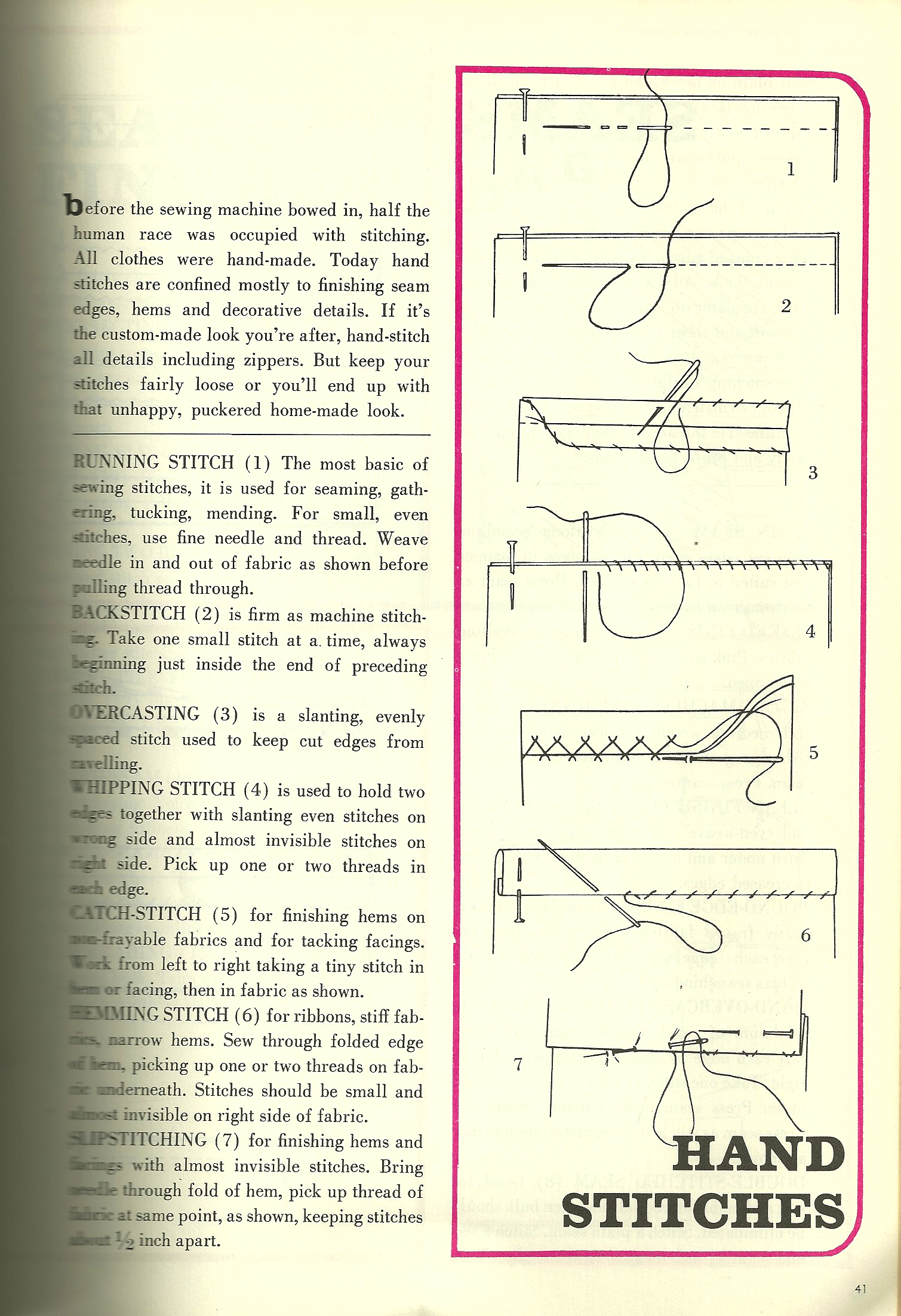
Five years later, another article in Vogue Sewing Book, c1963, The Butterick Company, Inc., featured the same basic stitches.

The introduction to this page gives this advice: “If it’s the custom-look you’re after, hand-stitch all details including zippers. But keep your stitches fairly loose or you’ll end up with that unhappy, puckered home-made look.”

It seems there can never be too much of a good thing, as evidenced by a February/March 2008 article in Threads magazine, by Kenneth D. King, entitled “Master the Hand Stitch: Learn the fine, invisible stitches that are the hallmarks of couture sewing.” This article is especially informative, with photographs and expert tips, all of which serve the modern amateur dressmaker so well.

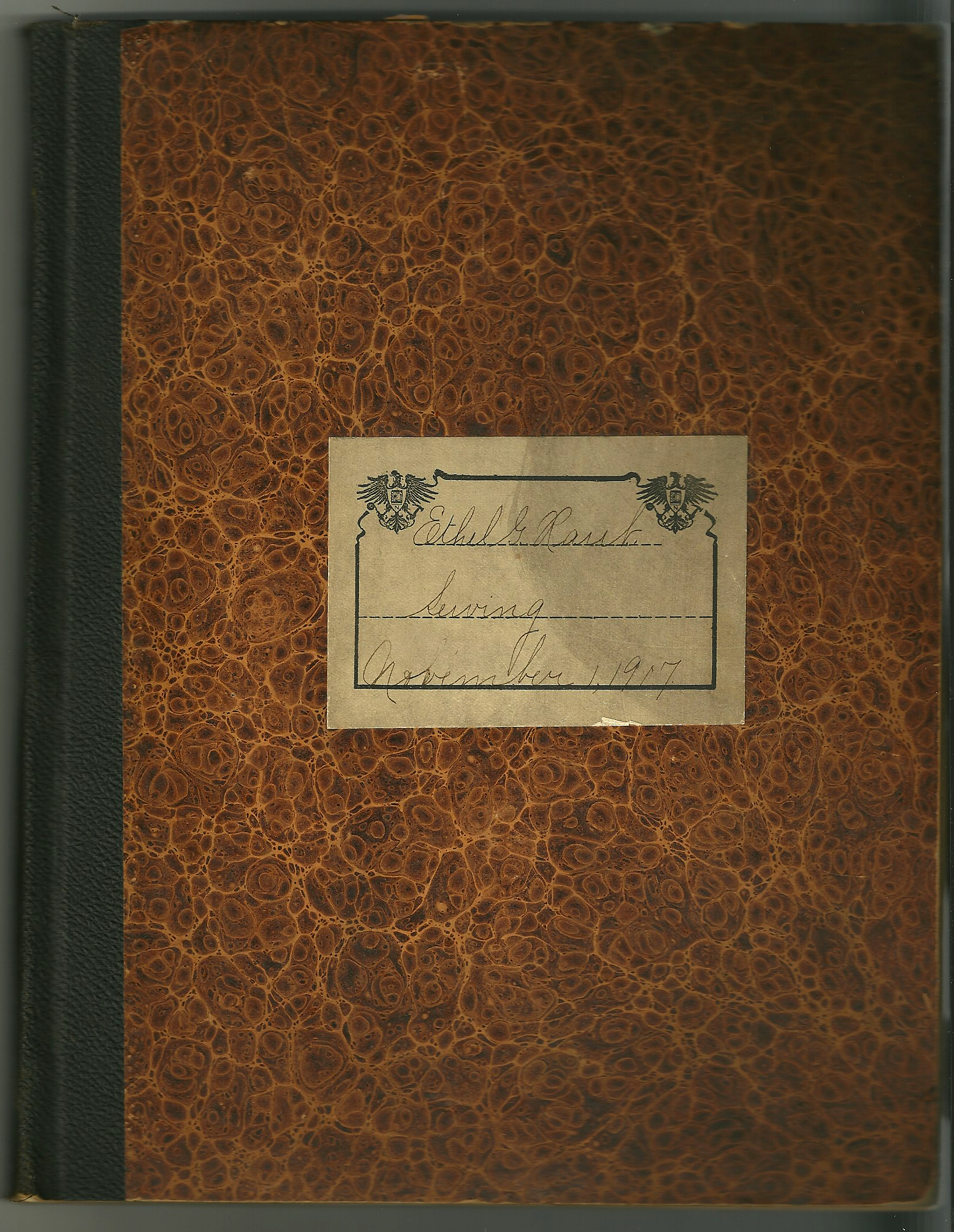
So – how did our grandmothers and great-grandmothers learn the stitches and sewing techniques that are so readily available to us?  Many of them made their own sewing/stitching “example” books in “finishing school”.  My husband’s grandmother was one such young woman.  I am so fortunate that her “Sewing” book, dated November 1, 1907, is in my possession now.  She would have been fourteen years old in late 1907.

There is a label inside the book which tells me that she purchased this book of blank pages at L. B. Herr, Bookseller, Lancaster, PA.

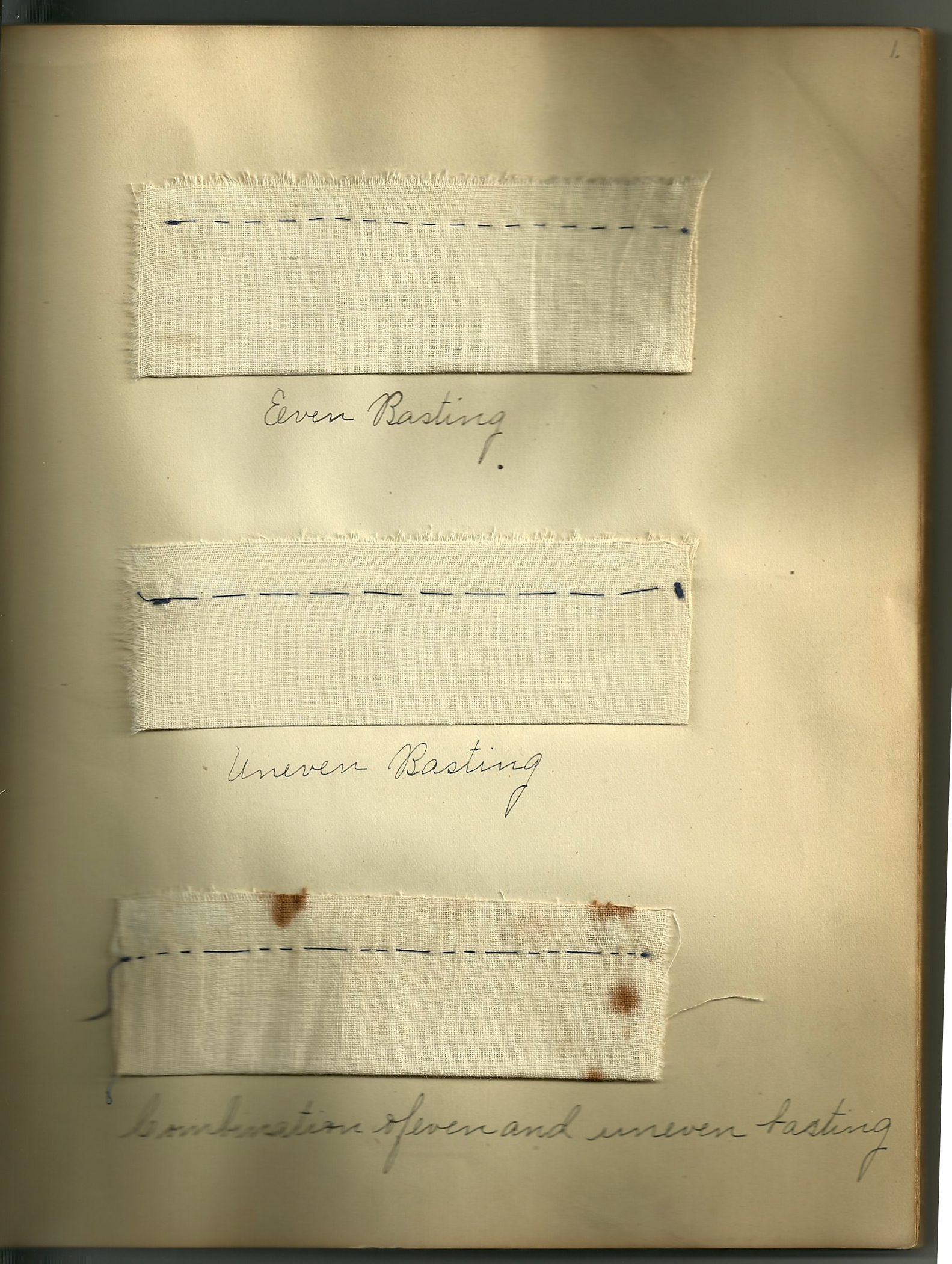
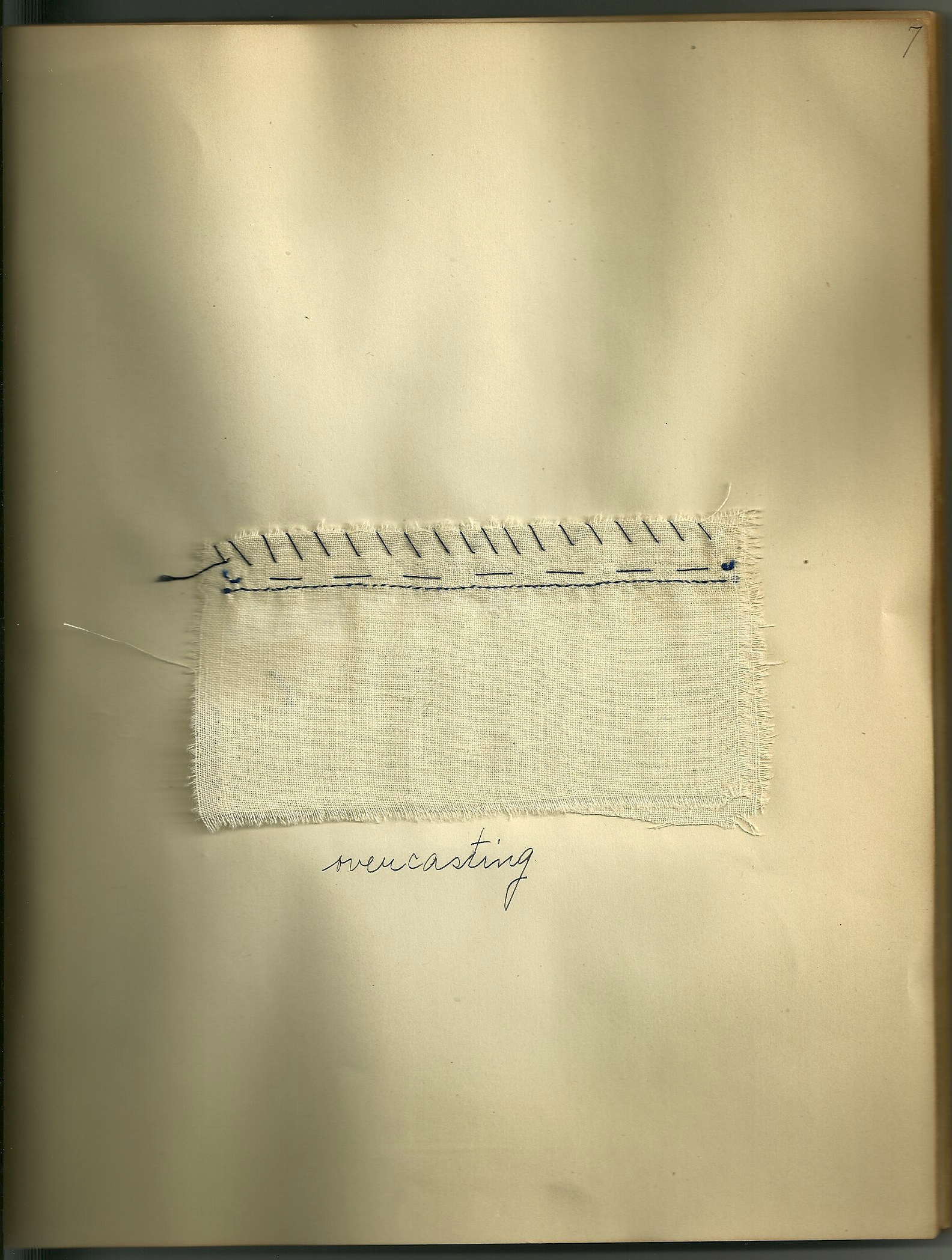
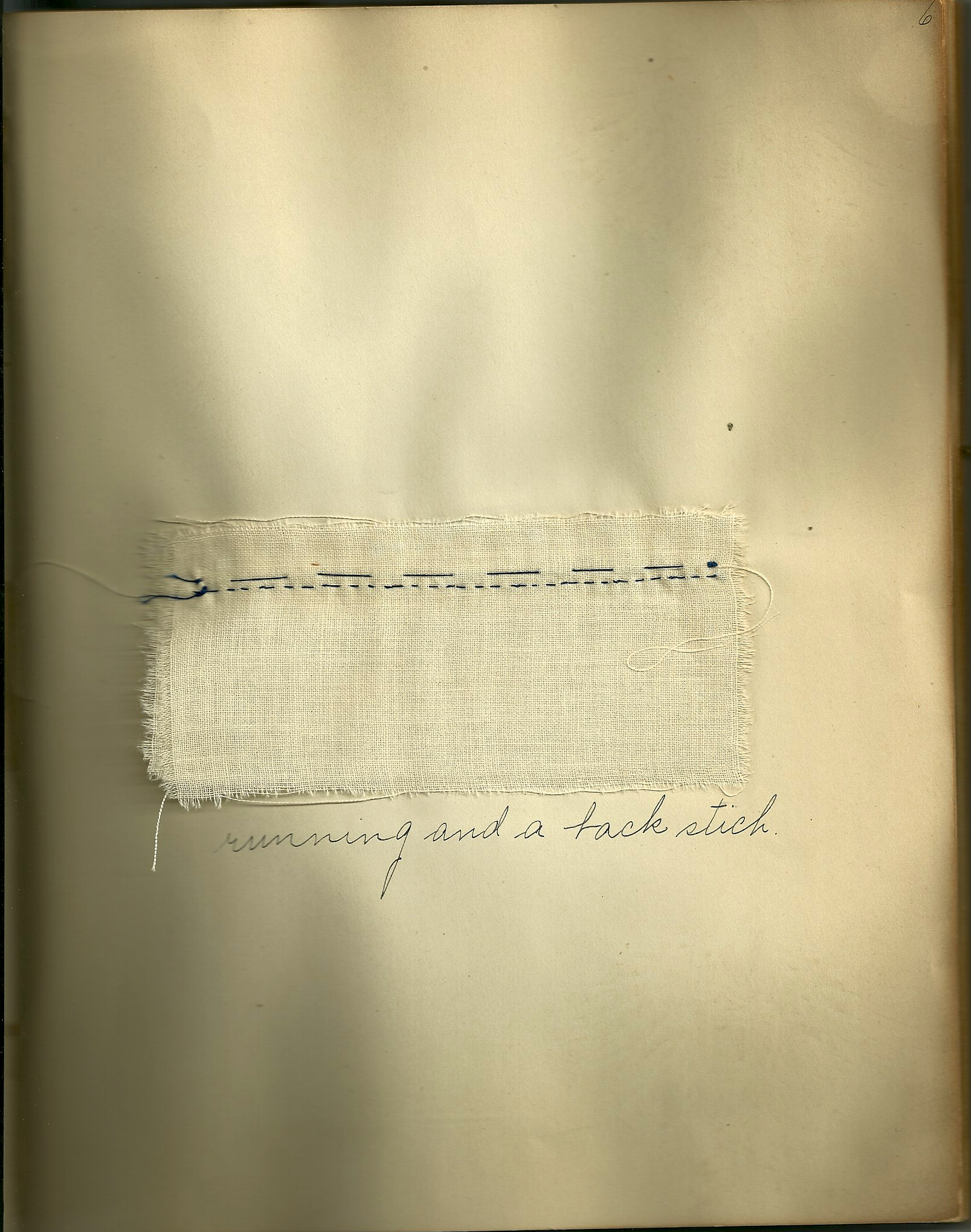
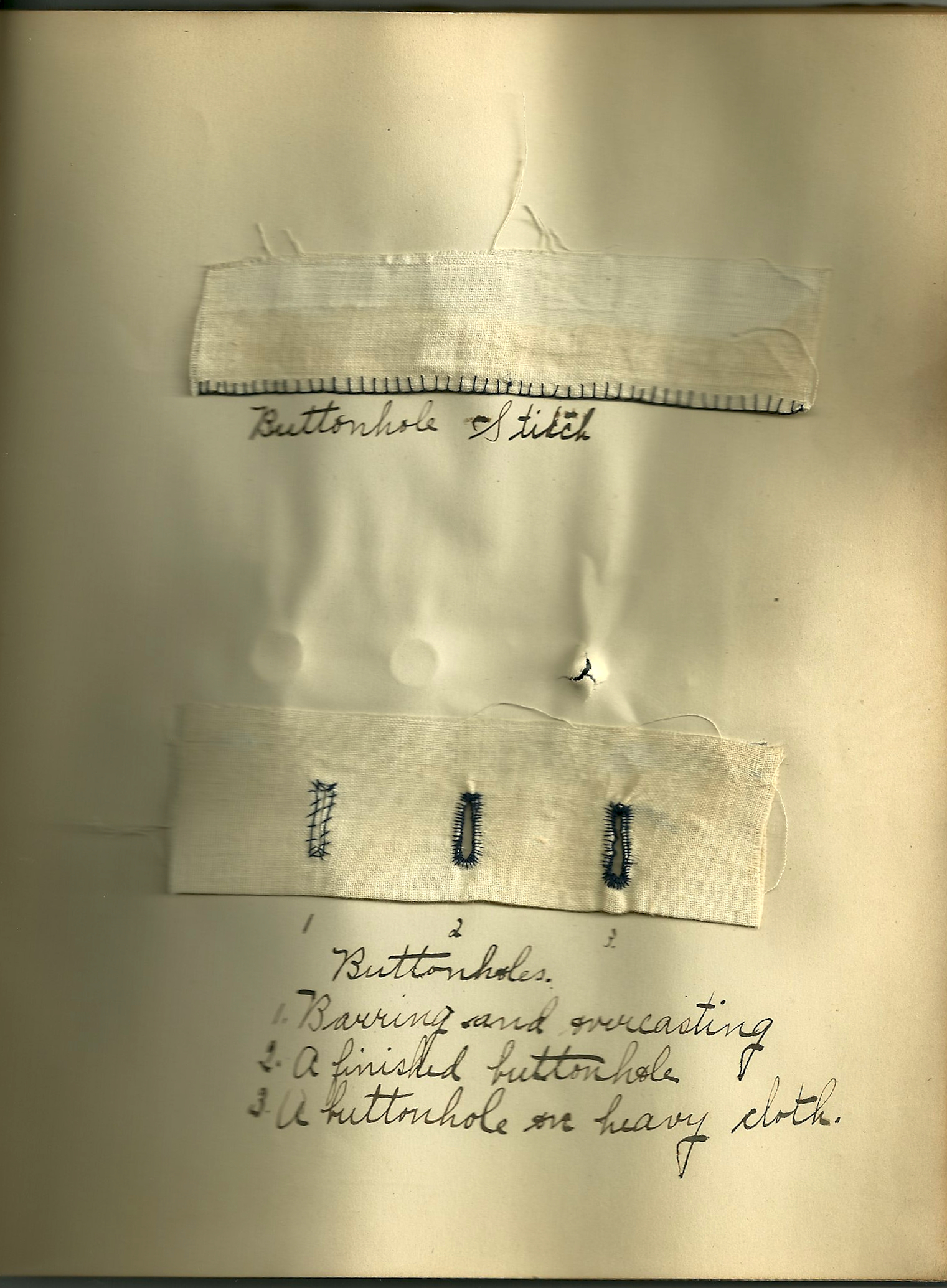
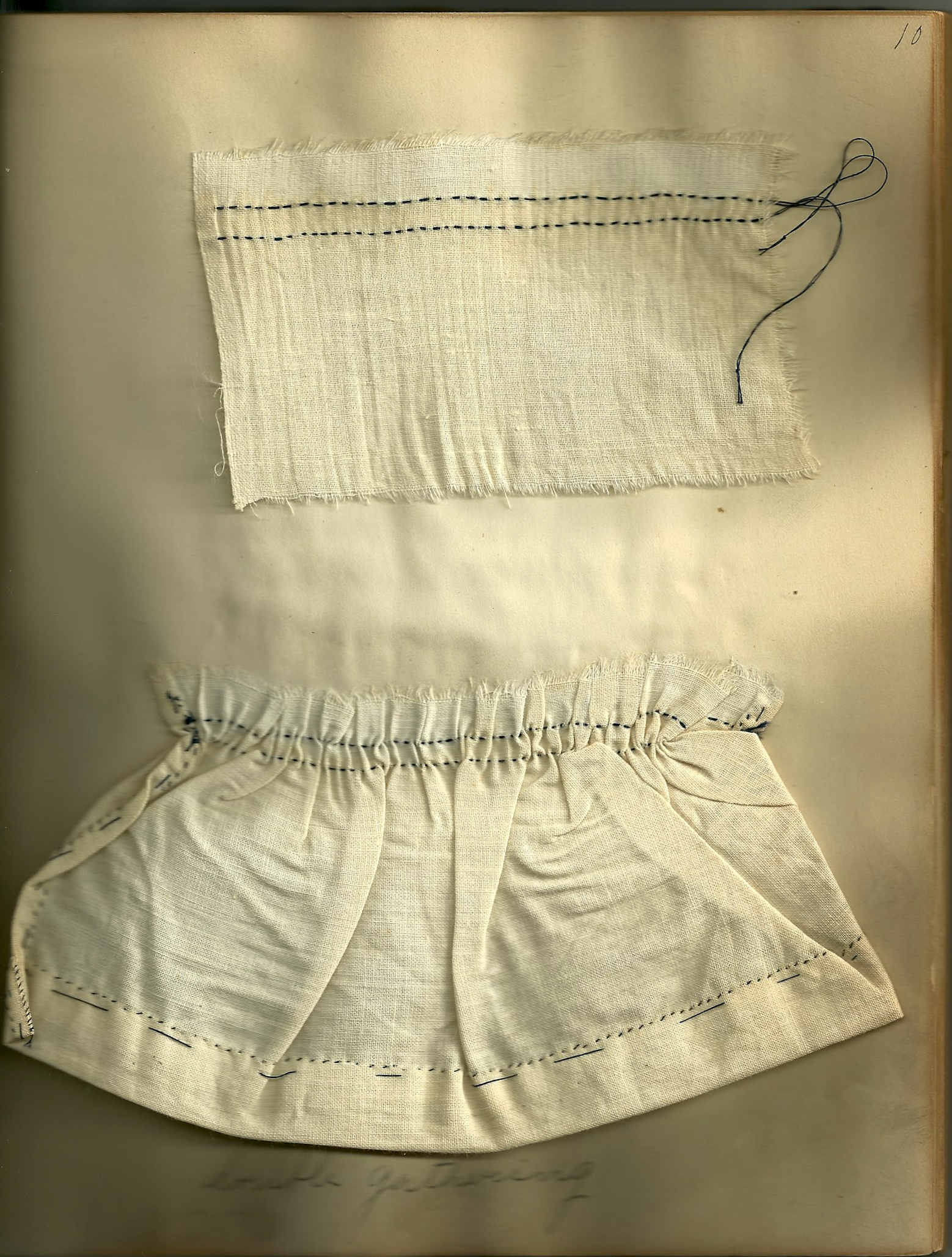
Ethel filled her book with 35 pages of examples of stitches, types of seams, and sewing techniques. Every example was made by her, with a brief description in her handwriting.   Here are a few pages from her remarkable book (click on the photos to see them up close).

Some of the stitches represented are:

Basting stitches – three kinds!

Overcasting.

Running and a back stitch – notice that she spells it “stich”.

All buttonholes were made by hand in 1907 – and Ethel had to learn how to make them as well.  She finally spelled “stitch” correctly – although it looks like it was struggle!

She has examples of many types of seams:

Here is a gathered seam.

And numerous sewing techniques:

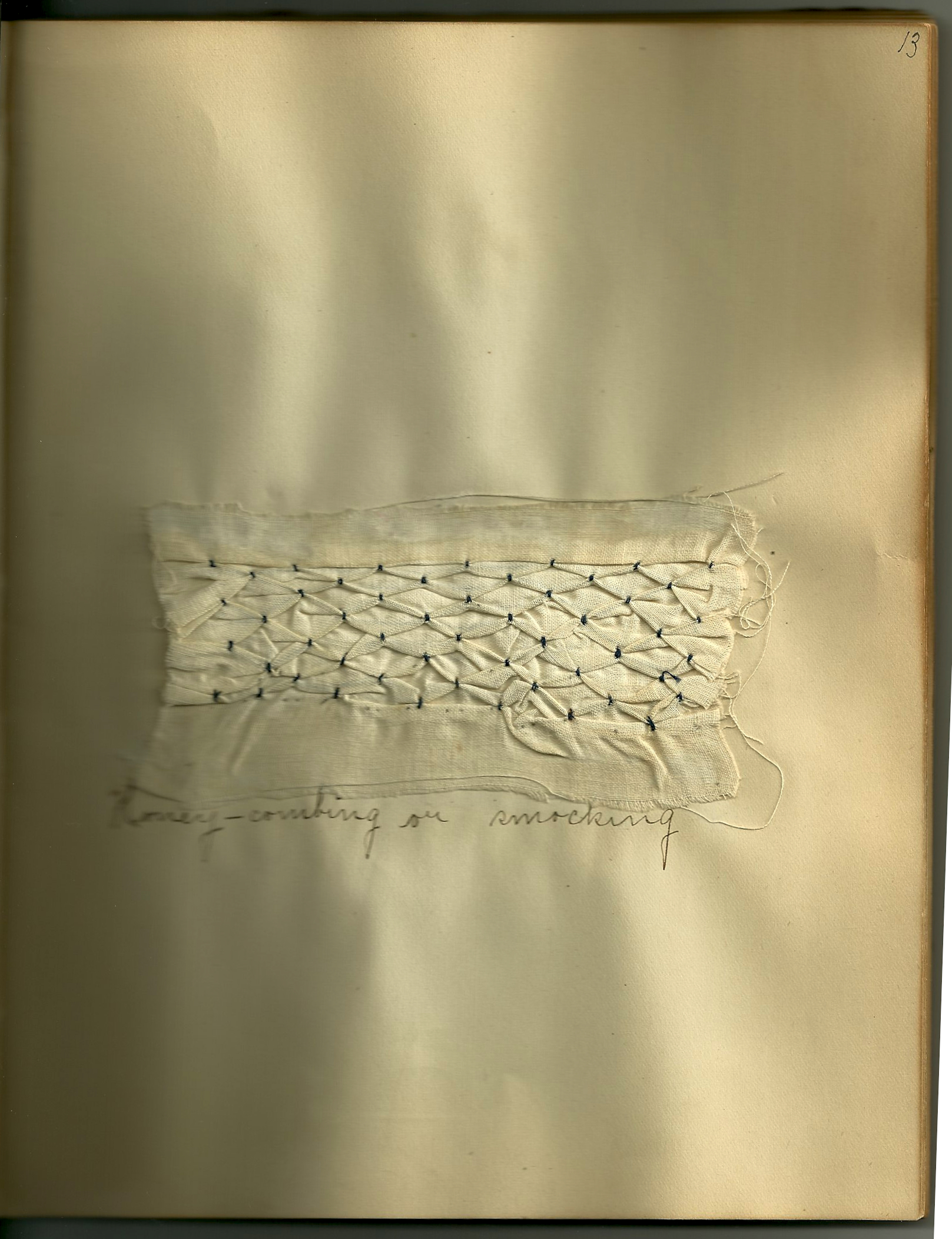
Here is Ethel’s example of Honey-combing or smocking.

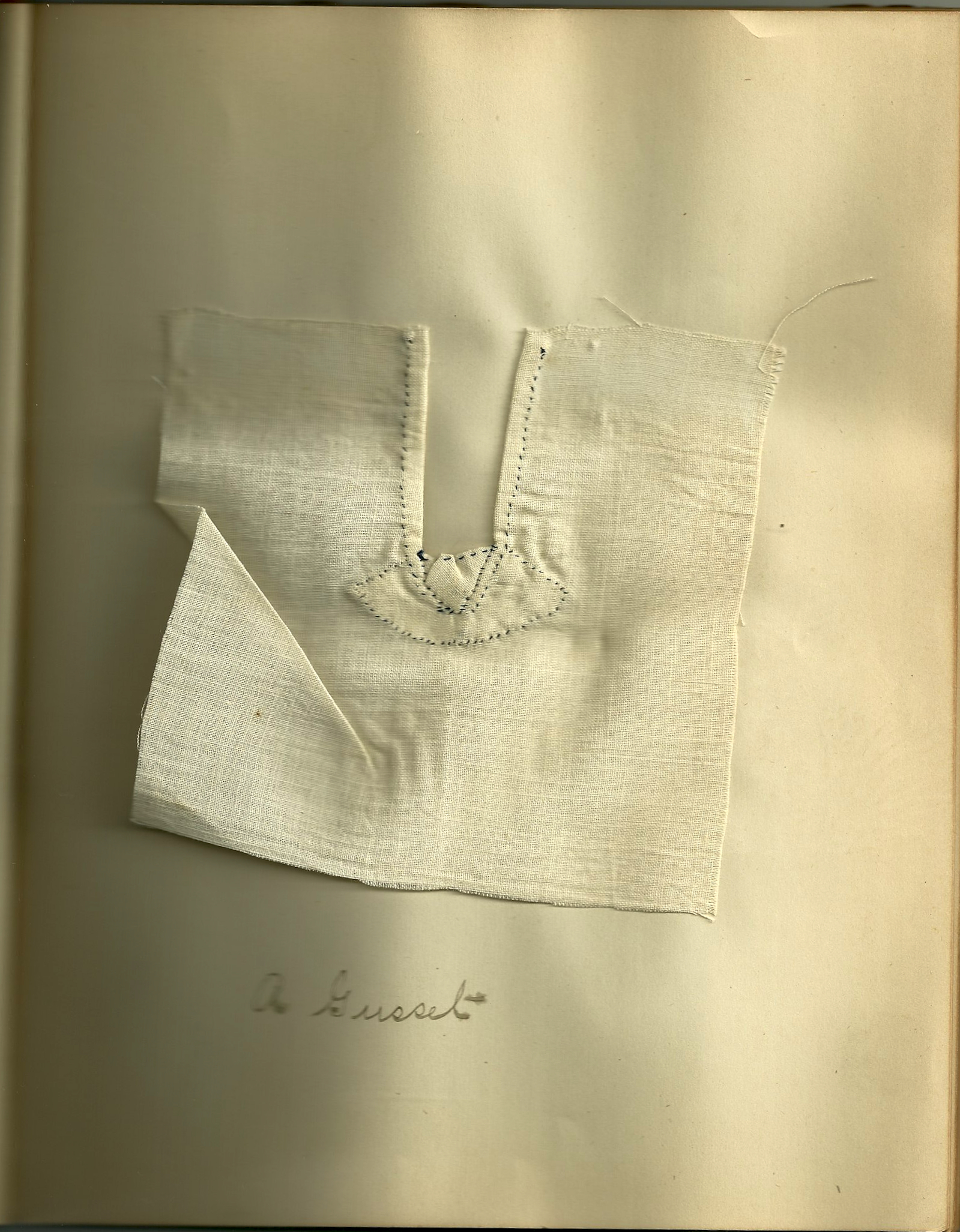
She even learned how to make a gusset!

Although Ethel died before I had the opportunity to meet her, I understand that she was not a particularly great fan of sewing, but nevertheless, she thought enough of her sewing book to save it.  In learning her “stiches”, she was quite clearly carrying on a tradition that generations before her had also done.   Consider this quote from Catherine  E. Beecher’s A Treatise on Domestic Economy, 1843:  “Every young girl should be taught to do the following kinds of stitch, with propriety [my emphasis]. Overstitch, hemming, running, felling, stitching, back-stitch and run, button-stitch, chain-stitch, whipping, darning, gathering and cross-stitch.”

Although I know not every young girl now would be interested in learning such things – I suspect there are lots who would proudly make their own “sewing” book if given the opportunity.  (Maybe without the darning stitch – does anybody darn anymore?)

One interesting omission in Ethel’s book:  that catch stitch I like to do so much.

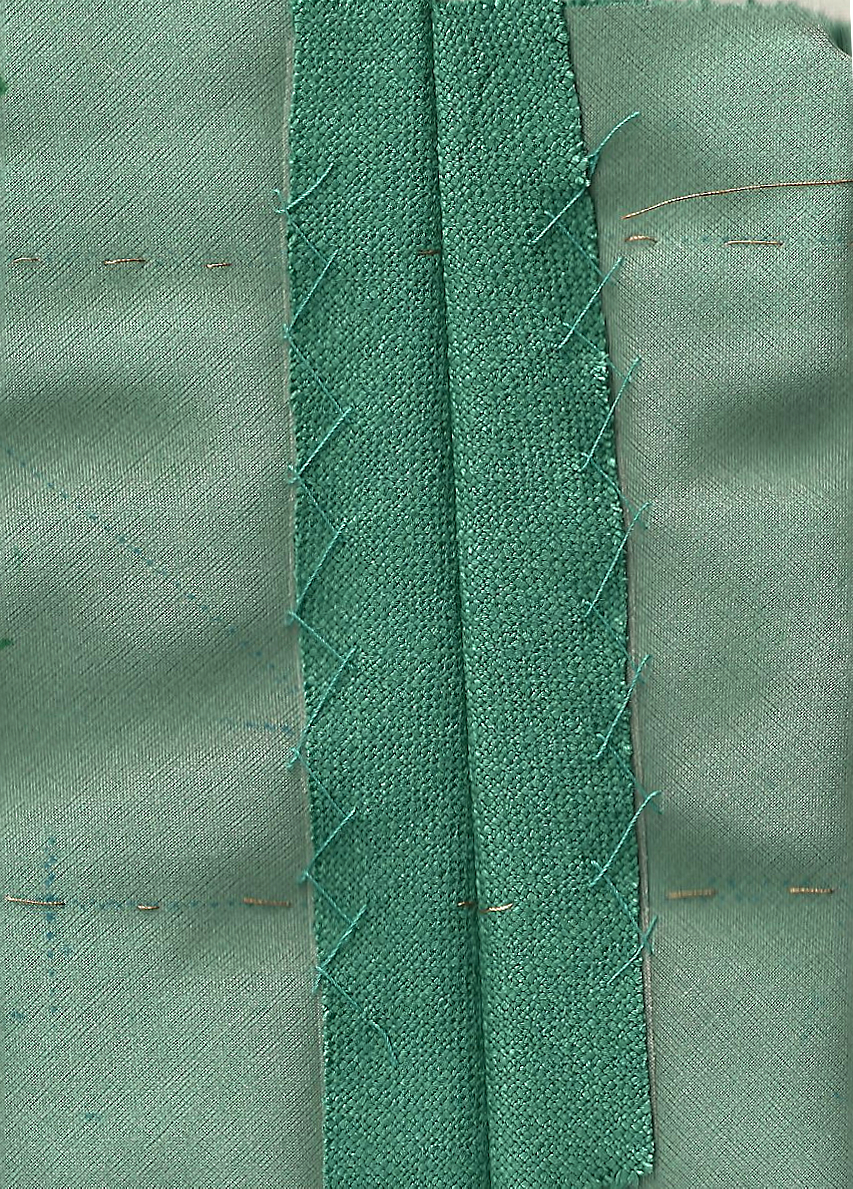
Here is one of my seams in my “couture dress” with the seams properly catch-stitched!

No matter what stitch you are doing – may it  look happy, unpuckered and definitely not home-made!

16 Comments

Filed under The Conde Nast Publications, Uncategorized, underlinings

What should a button do?

The last several things I have sewn have been button-free, using zippers or hooks to accomplish that all-important task of “closure”.  I’ve discovered I can go button-free just so long, and then I have to indulge my passion for those small wonders, with their miraculous power to be both eye-catching and practical.

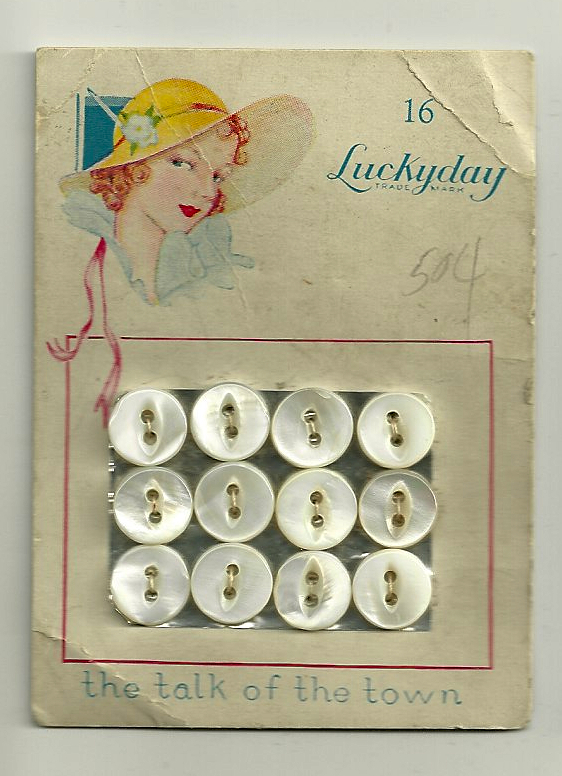
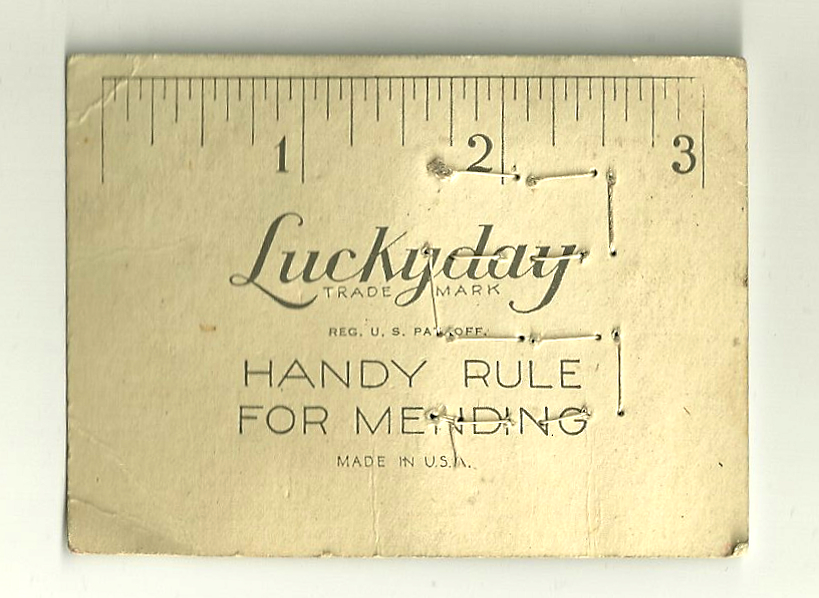
I will leave a serious discussion of vintage buttons to the experts, but looking anew at some of my still-carded vintage buttons has revealed some interesting tidbits, too good not to share.  For example, it seems a lot of attention was given to “presentation” of the buttons on their cards.  These Luckyday buttons not only have a sweet lady on the front of the card, there is also a “Handy Rule for Mending” on the back.

I am guessing these buttons are from the late 1930s or early ’40s.

I love this feature!

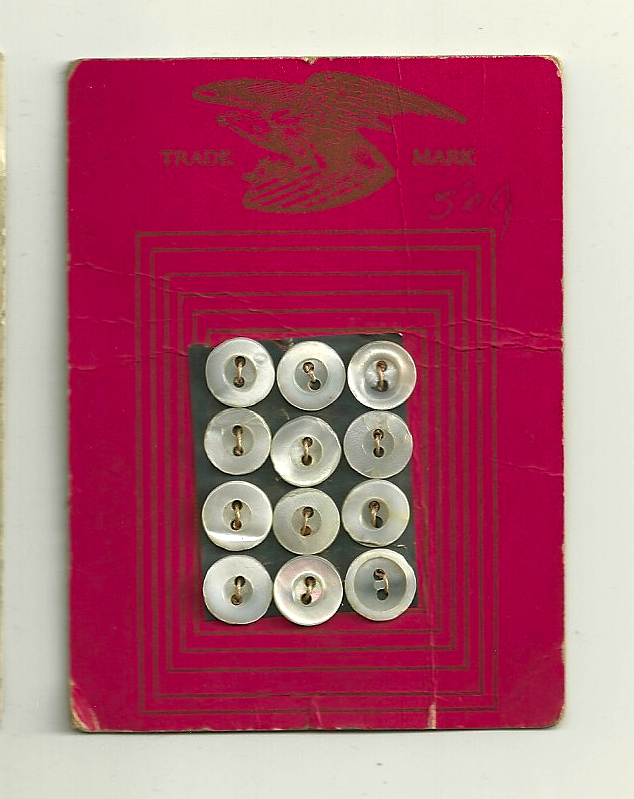
It also seems that patriotic themes were commonplace.  There is no company named on these buttons, just the American eagle on a shield with the words TRADE MARK.

These simple buttons are quite eye-catching on this deep red card.

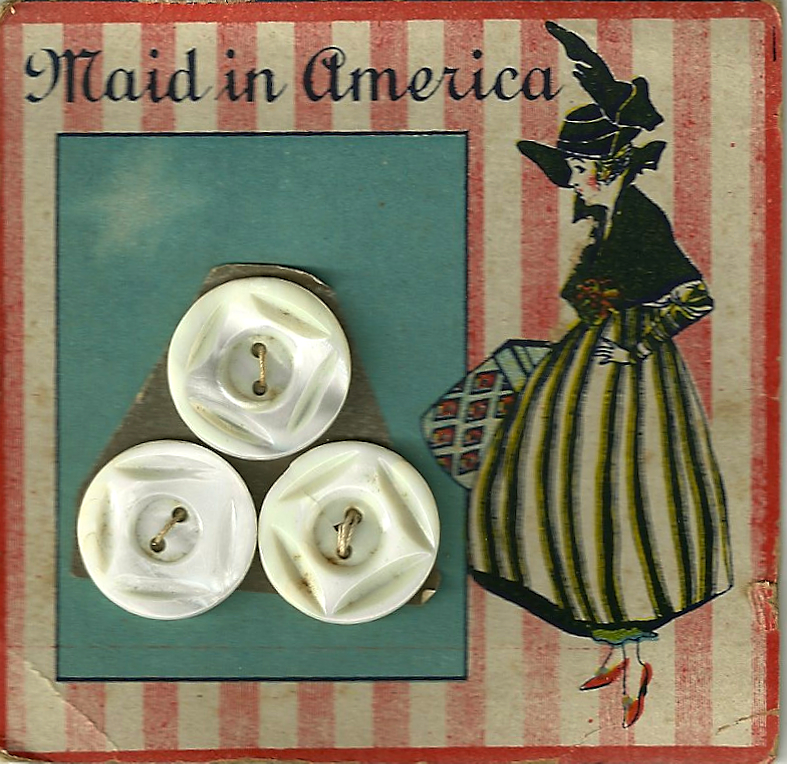
This is one of my favorite button cards of all time, the Maid in America. I doubt I’ll ever use these buttons, as it would seem a shame to take them off this amazing card.

This button card is like a small piece of folk art!

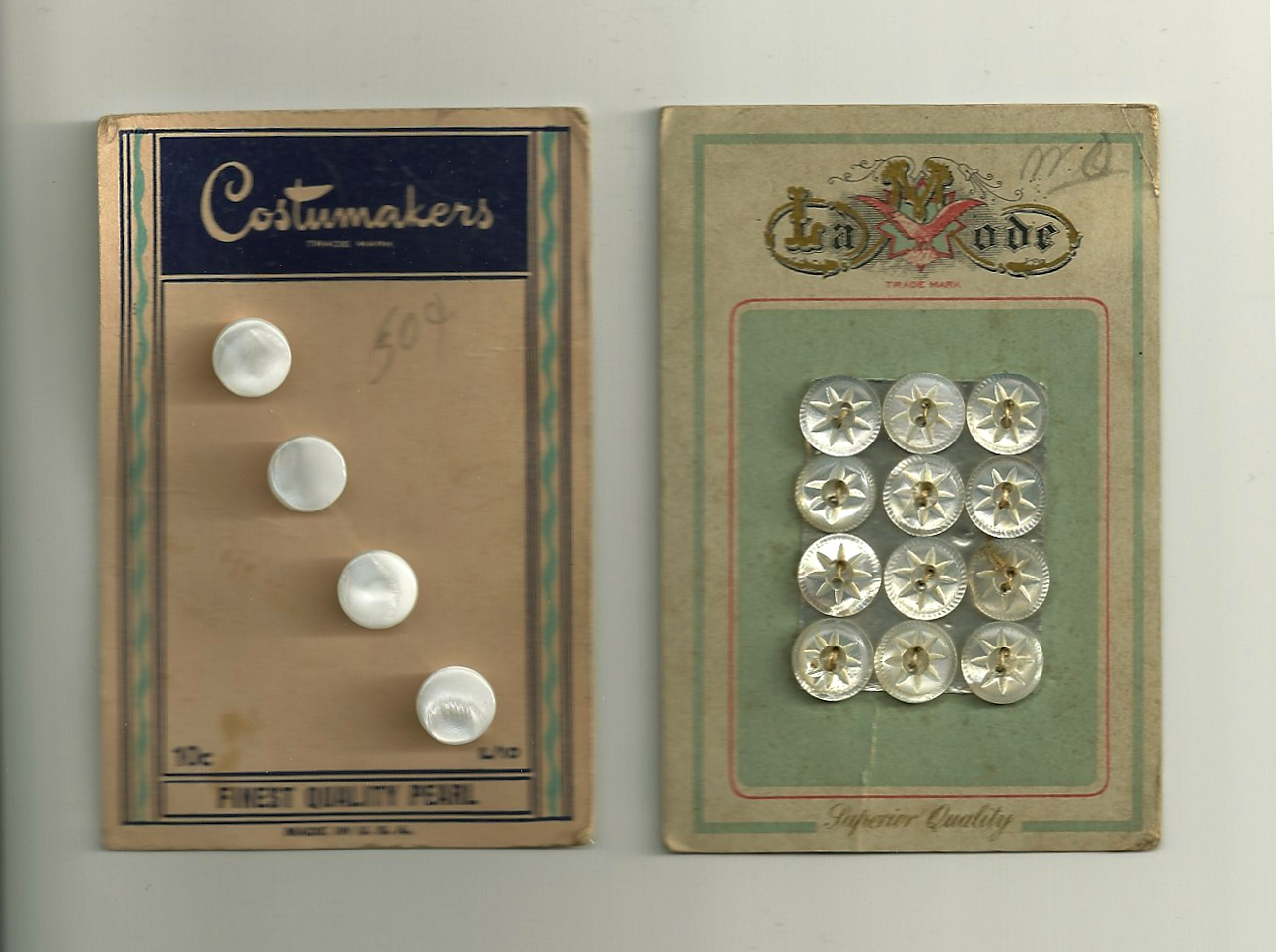
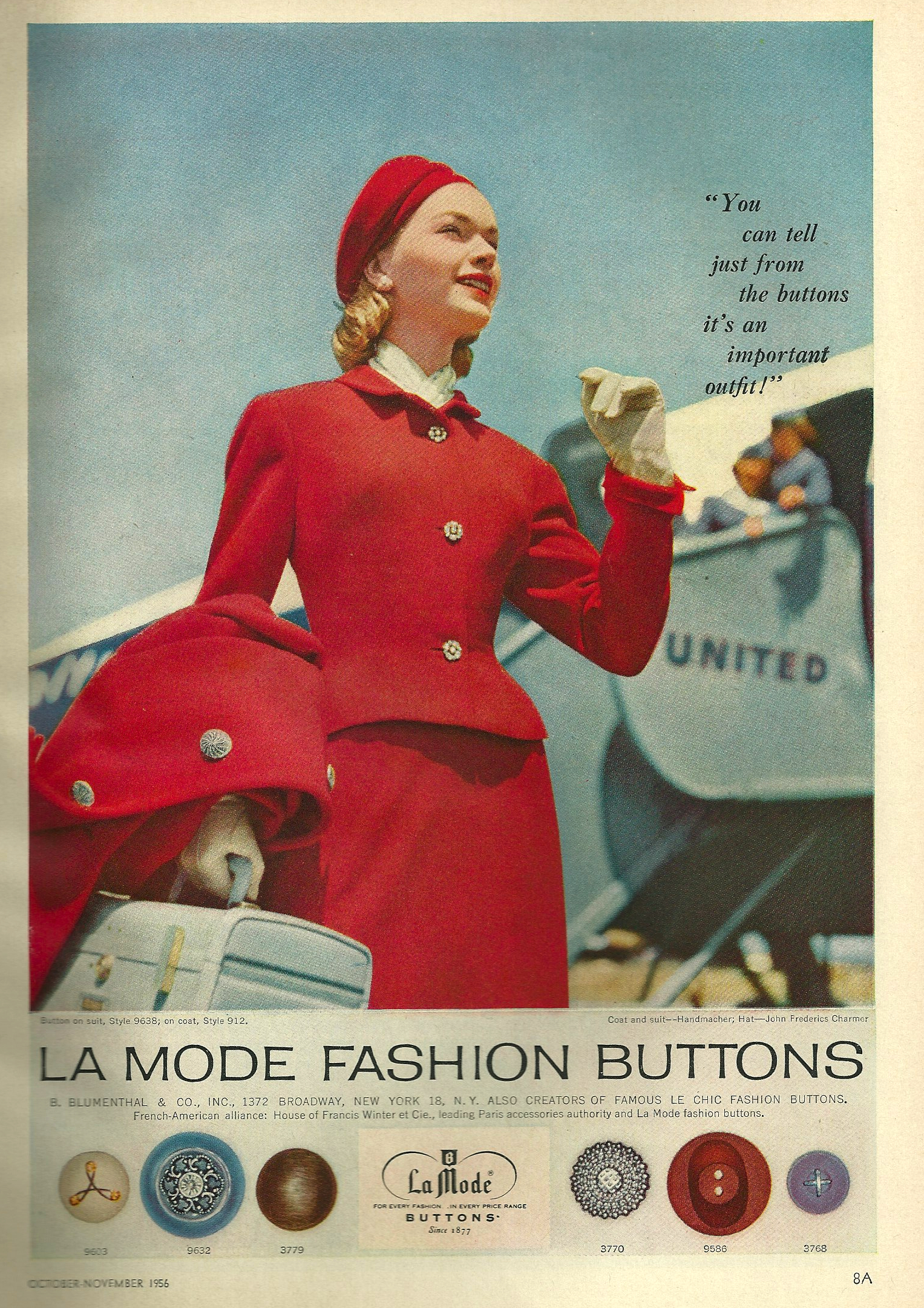
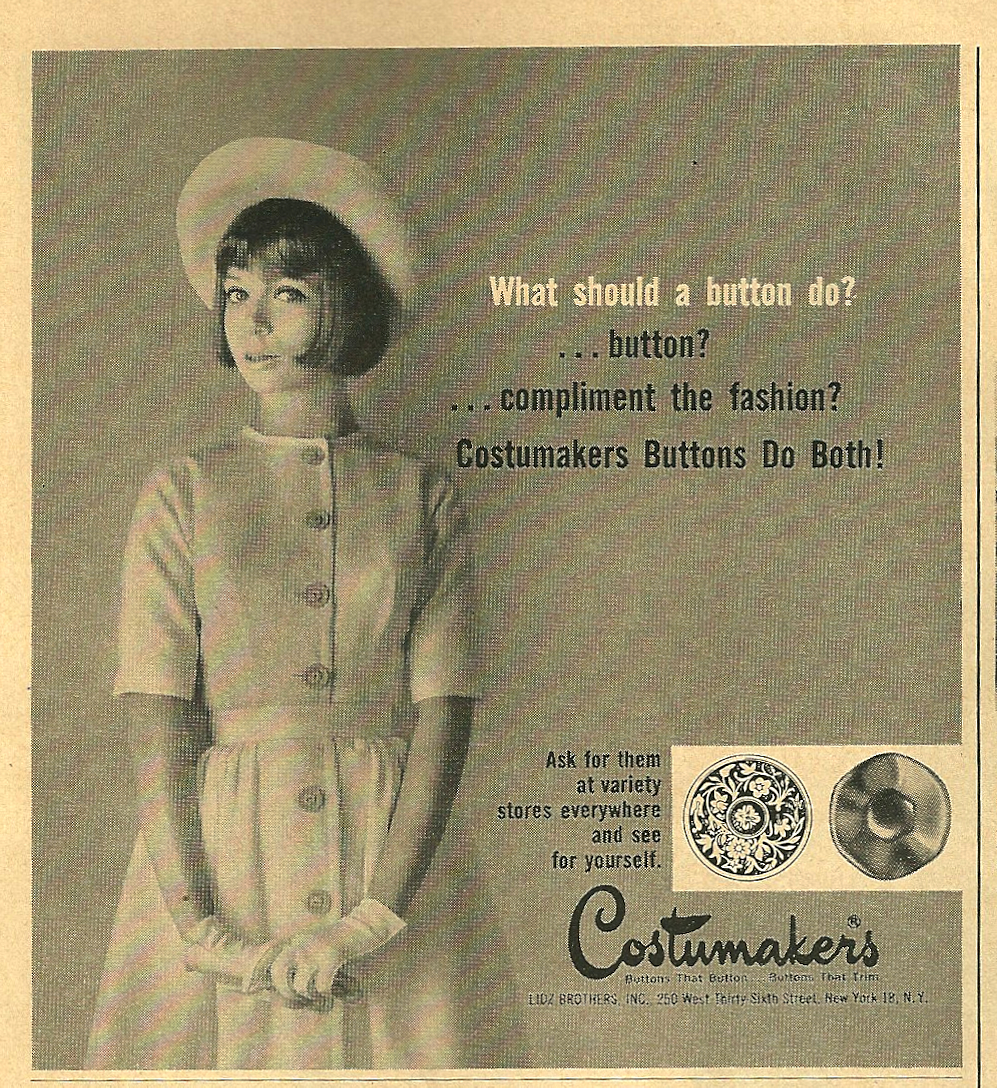
La Mode buttons are still manufactured – and still “Superior Quality”, and Costumaker buttons were “made in the U. S. A.”.

Two well-known button companies!

La Mode advertised frequently in Vogue Pattern Book magazine.  This ad from the October/November 1956 issue has the byline:  “You can tell just from the buttons it’s an important outfit!”

An ad from February/March 1958 features a fashion picture which looks incredibly timely today!

The featured fashion colors are certainly right for 2012!

And by 1960, their ads were beginning to take on a more modern look.

This ad appeared in the October/November 1960 issue of Vogue Pattern Book magazine.

Costumaker buttons also advertised in Vogue Pattern Book magazine.  In August/September 1958, this ad had the byline “Buttons that are more than buttons.”

This ad from April/May 1963 asks the question:  “What should a button do?”  Read the ad to get the answer!

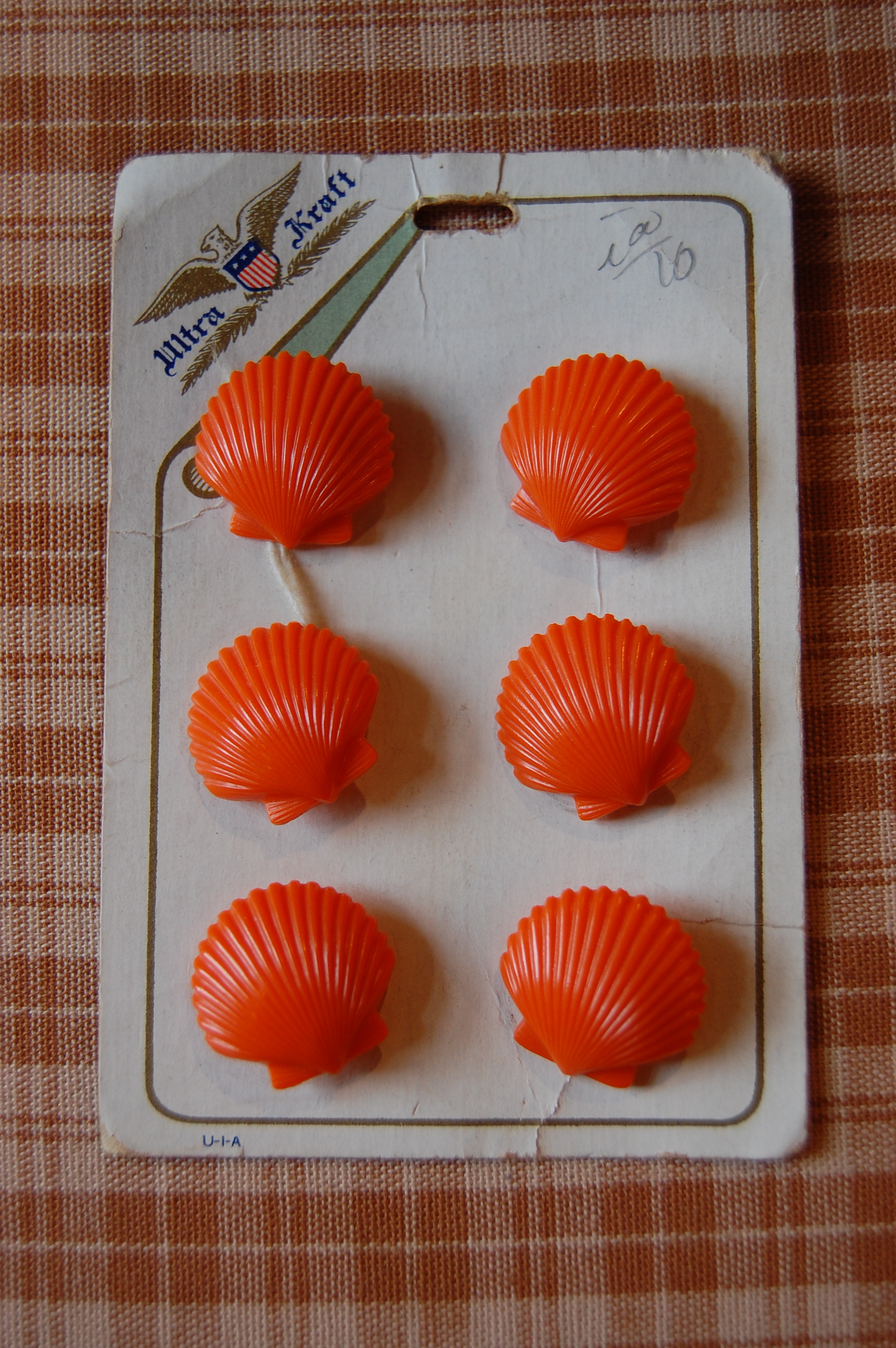
One thing I know a button CAN do is be small but powerful!  The real truth of the matter mentioned in my first paragraph is that I have a set of buttons which I must use, as they have occupied my mind for the past weeks since I received them – it’s really quite that simple.  But they are not simple – they are actually quite demonstrative, and therein lies the rub, to paraphrase from Shakespeare.

The buttons which won’t let me sleep! Notice the American eagle motif on the card!

I have been pondering how to use them and with what color and type of fabric to pair them.  They deserve the perfect venue for more reasons than one.  They were gifted to me by my dear friend, Nancy C., who, when we met for coffee a couple of months ago, met me with her family button box in tow.  She invited me to pick out any buttons which I thought I could use for future sewing projects!  When I got past my incredulity at her offer, I picked out a few amazing single buttons (which you will see eventually) and about three beautiful sets of loose buttons.  These orange shells, however, sewn neatly to their original card, kept catching my eye (how could they not??)  At first, they struck me as just too orange.  I wasn’t sure I would ever be able to use them. Nancy and I kept talking about them over our coffee, pondering their color and shape, and then, before I knew it – I was hooked.

So you know by now that they came home with me.  And something with so much personality moves up in priority on the sewing list!  You’ll soon see them sewn onto a “Fifty Dresses” creation.   Thank you, Nancy, for this amazing gift, which is only eclipsed by your generosity and friendship!!

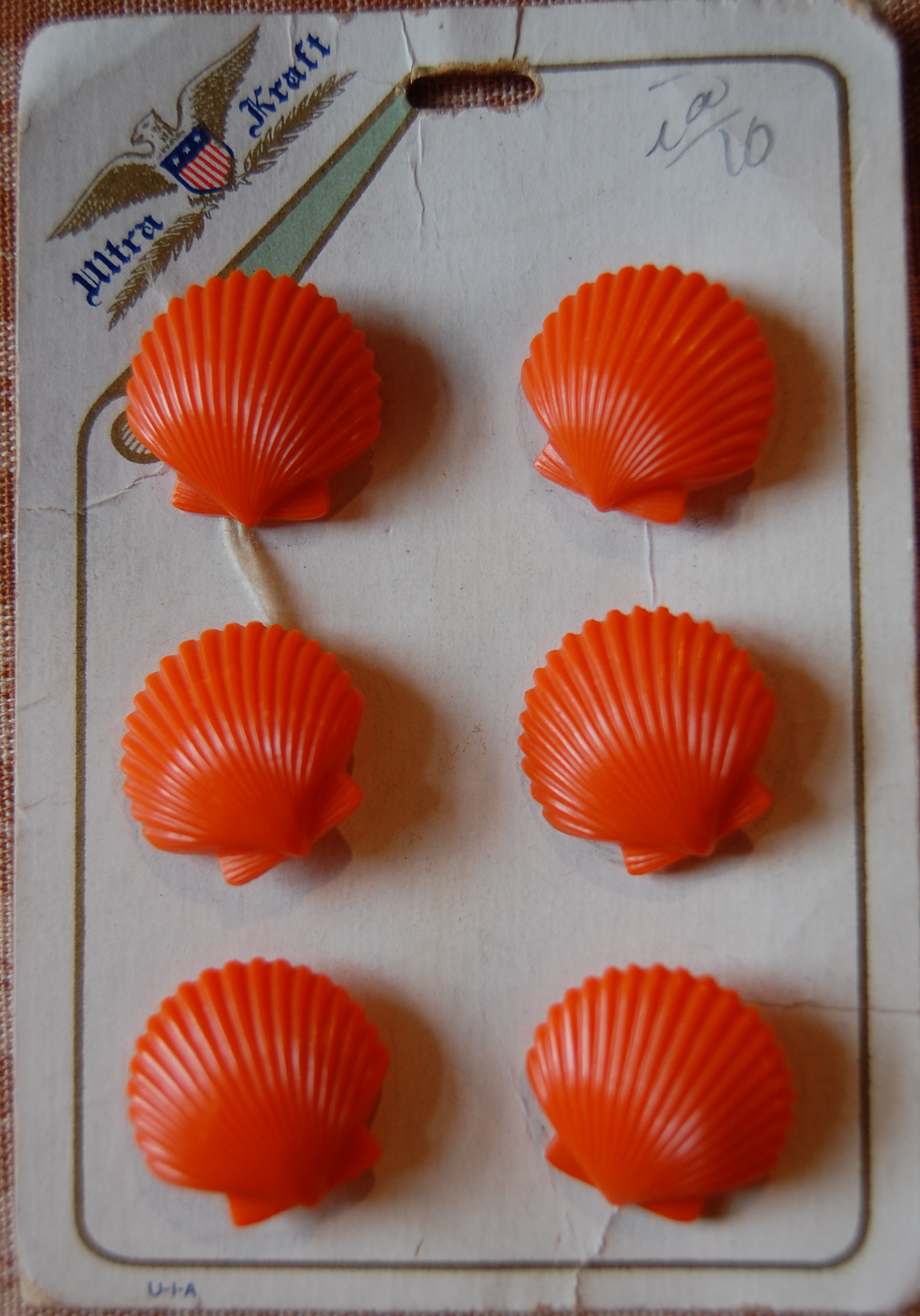
A little closer look at these bright beauties!

Stay tuned to see them doing what good buttons should do…  Gulp!  I’m hoping to do them justice!
6 Comments

Filed under Buttons - choosing the right ones, The Conde Nast Publications, Uncategorized, vintage buttons

Quiz: Match the fabric to the pattern

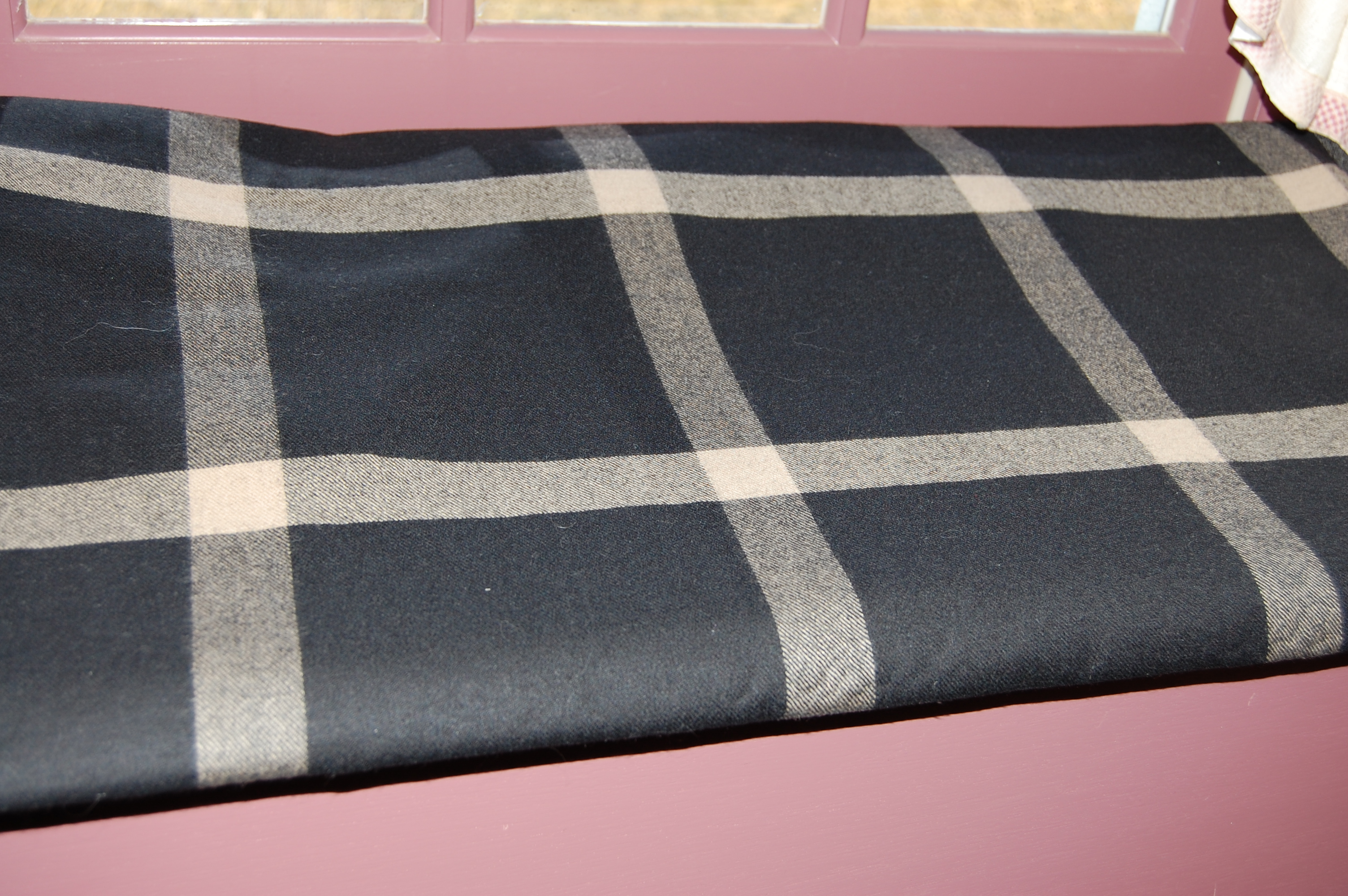
If you follow this blog, you’ll know that I have promised a “next” post on a suit which I’ve been working on.  Another project (non-sewing) has taken me away from it for a few days, so it’s not quite finished yet.  However, to keep my promise, I’m offering a teaser:  can you pick the pattern which I am using to make my suit?

Here is the fabric, a lovely, finely woven and incredibly soft, windowpane check wool from France, which I purchased at Britex last summer in San Francisco:

The repeat on this fabric is 7", so it's a fairly bold check in soft black and beige

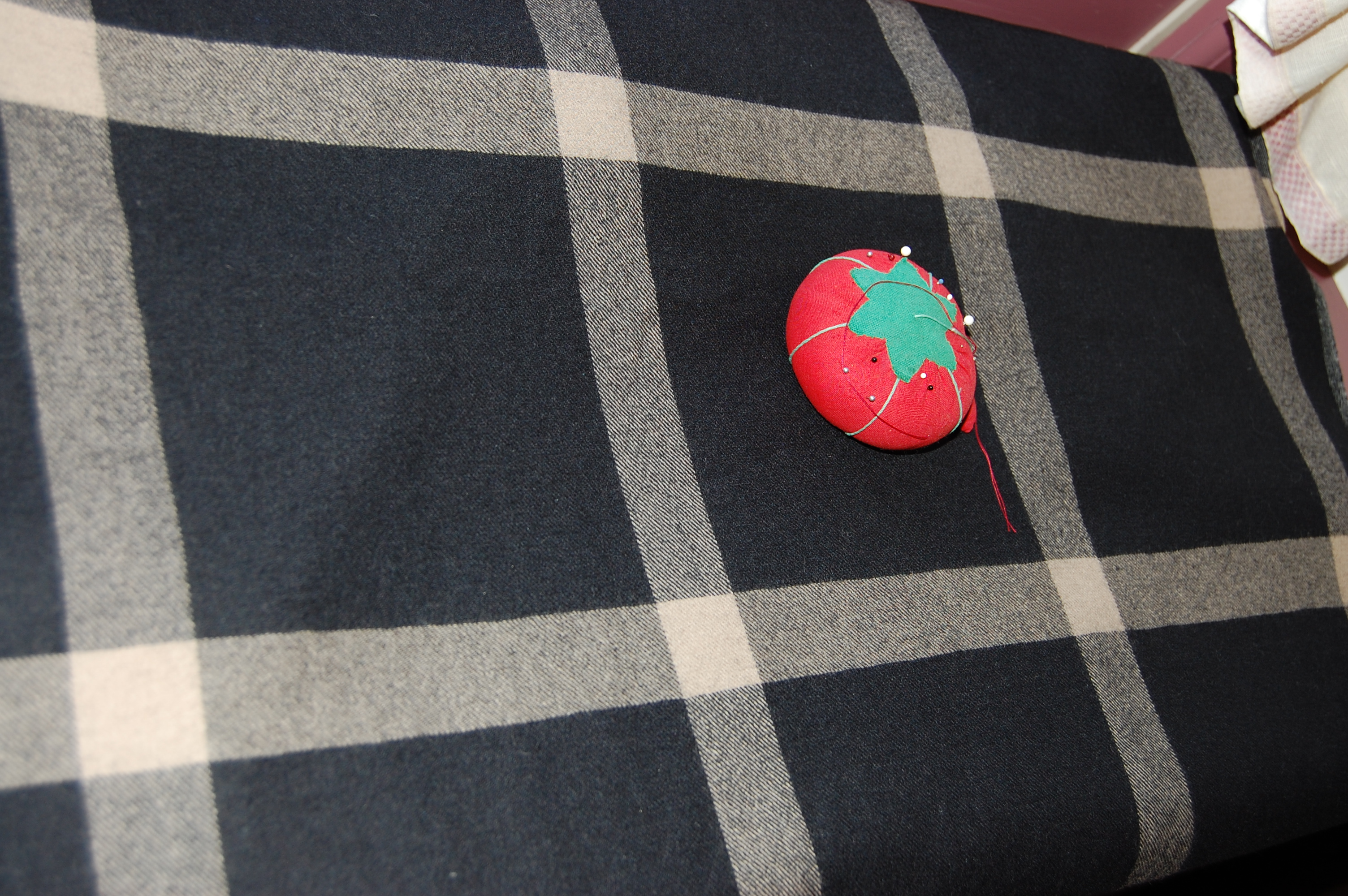
Here is another shot of the fabric, with my tomato pin cushion on it to help you determine its scale.

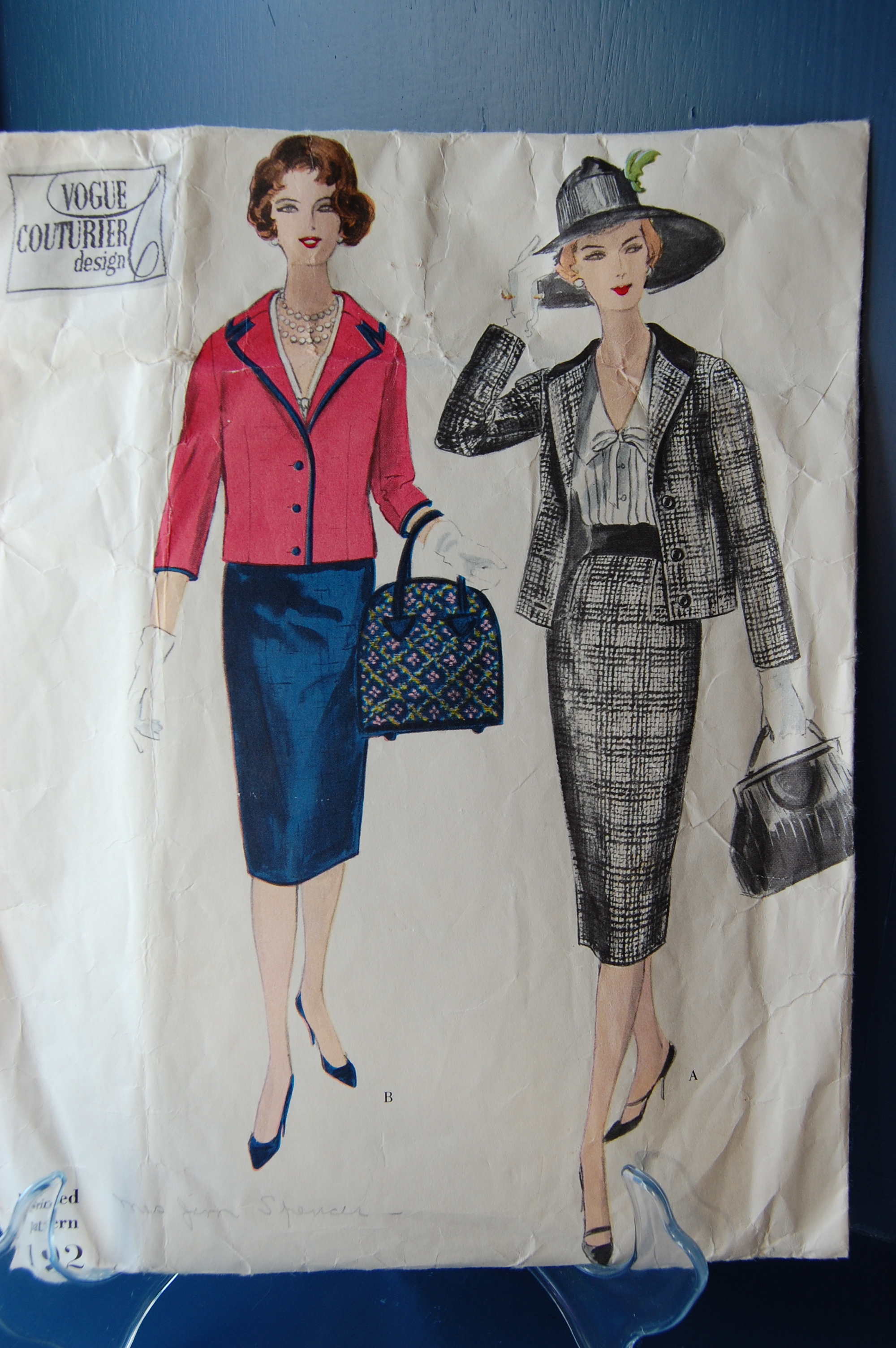
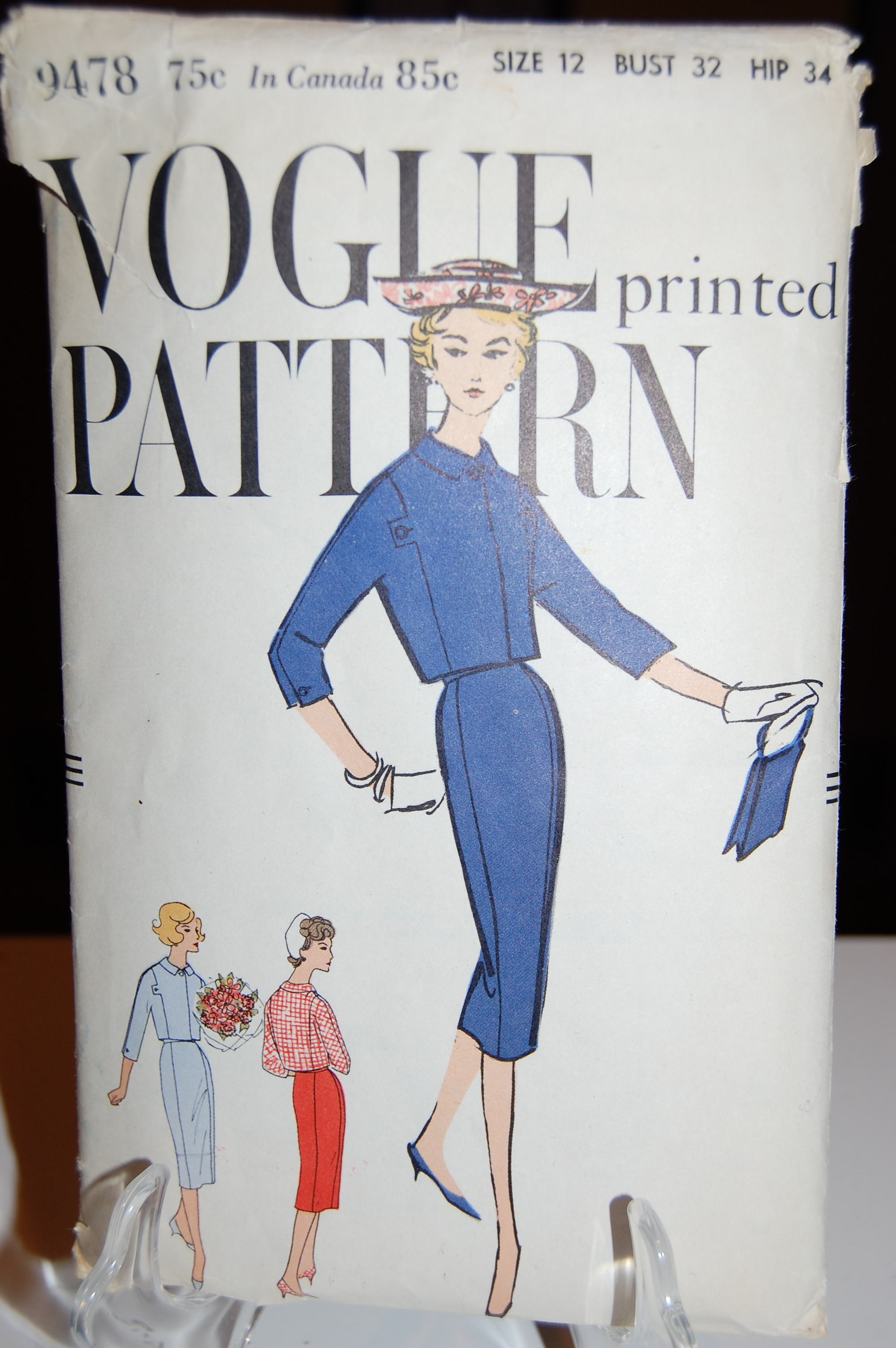
And here are four patterns.  Which one do you think I selected to make in this fabric?  (Click on the photos to see the patterns in more detail.)

Choice # 1: This pattern is copyright 1958. I featured it in an earlier post.

Choice # 2: Here is another pattern which I have already featured in an earlier post. It is copyright 1959. This pattern includes the blouse pattern, too.

Choice # 3: This pattern is also copyright 1958. It has kimono sleeves rather than set-in sleeves, and the skirt has no darts; rather the seams are curved to fit the hips and waist.

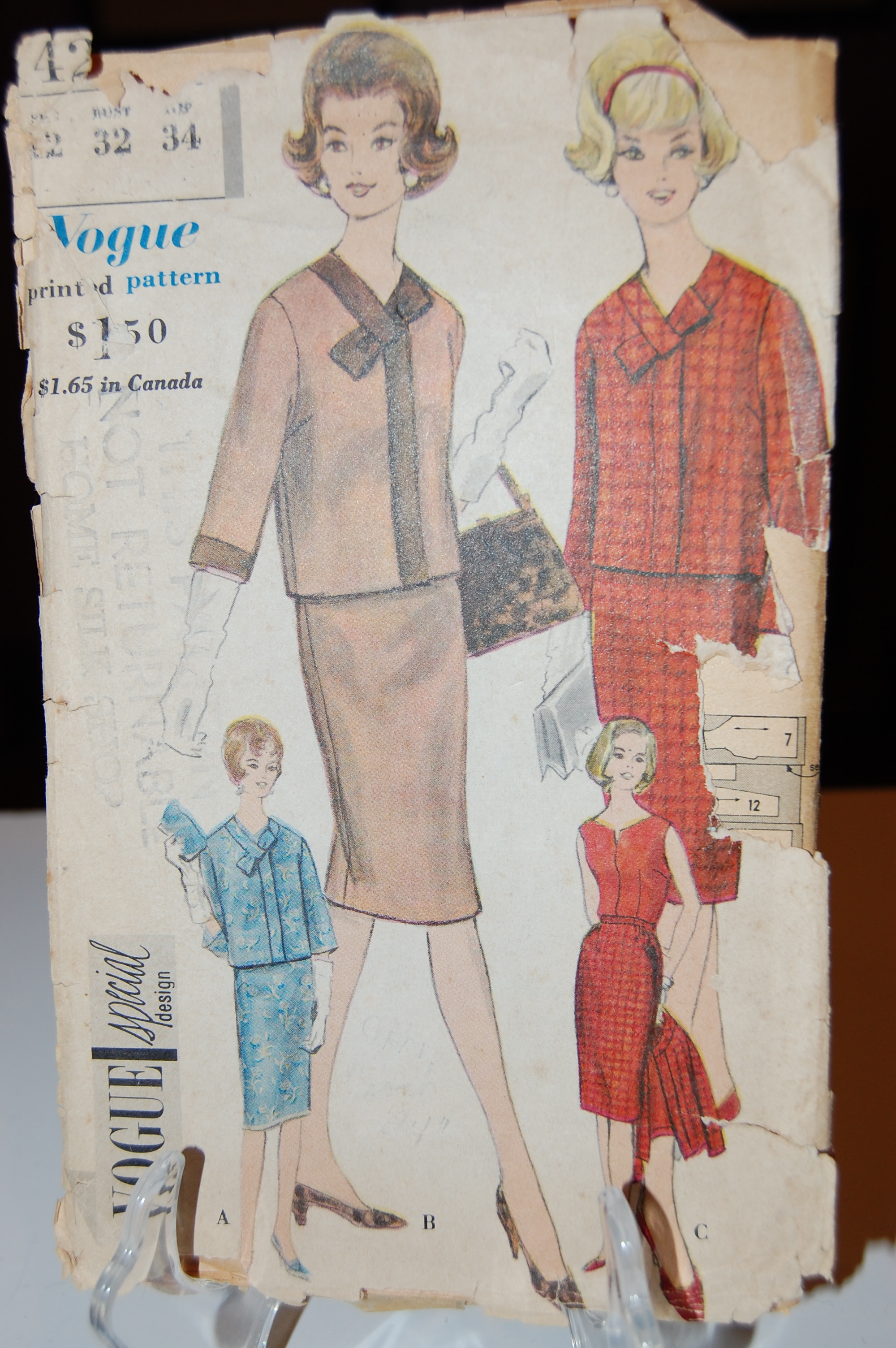
Choice #4: There is no copyright on this pattern, but I judge it to be from about 1962 (the hairdos and the increased pattern price are good clues!) This pattern also includes the blouse pattern.

Keep in mind that this fabric presents significant “plaid matching” challenges, which I had to consider when I decided on the pattern.  The more seams in a pattern, the higher the challenge (usually).  So – was I safe and cautious, or gutsy and daring?

5 Comments

Filed under The Conde Nast Publications, Uncategorized, vintage Vogue patterns from the 1950s, vintage Vogue patterns from the 1960s

“When in doubt, wear red.”

Bill Blass, noted American designer (1922 – 2002), knew of what he spoke when he expressed this savvy advice.   Red, in all its various hues, is a color which commands attention, and therefore, it is no wonder that fashion sketches and dress patterns often feature red.  Red also figures distinctly in three months whose “colors” always include red:  December’s red and green; July’s red, white and blue; and, of course, February’s red, red, and red.

To celebrate February’s red, I have scoured my Vogue Pattern Book Magazines and my collection of vintage patterns to showcase some beautiful fabric and dress/suit/loungewear designs.  No doubt (pardon the pun), Mr. Blass would approve.

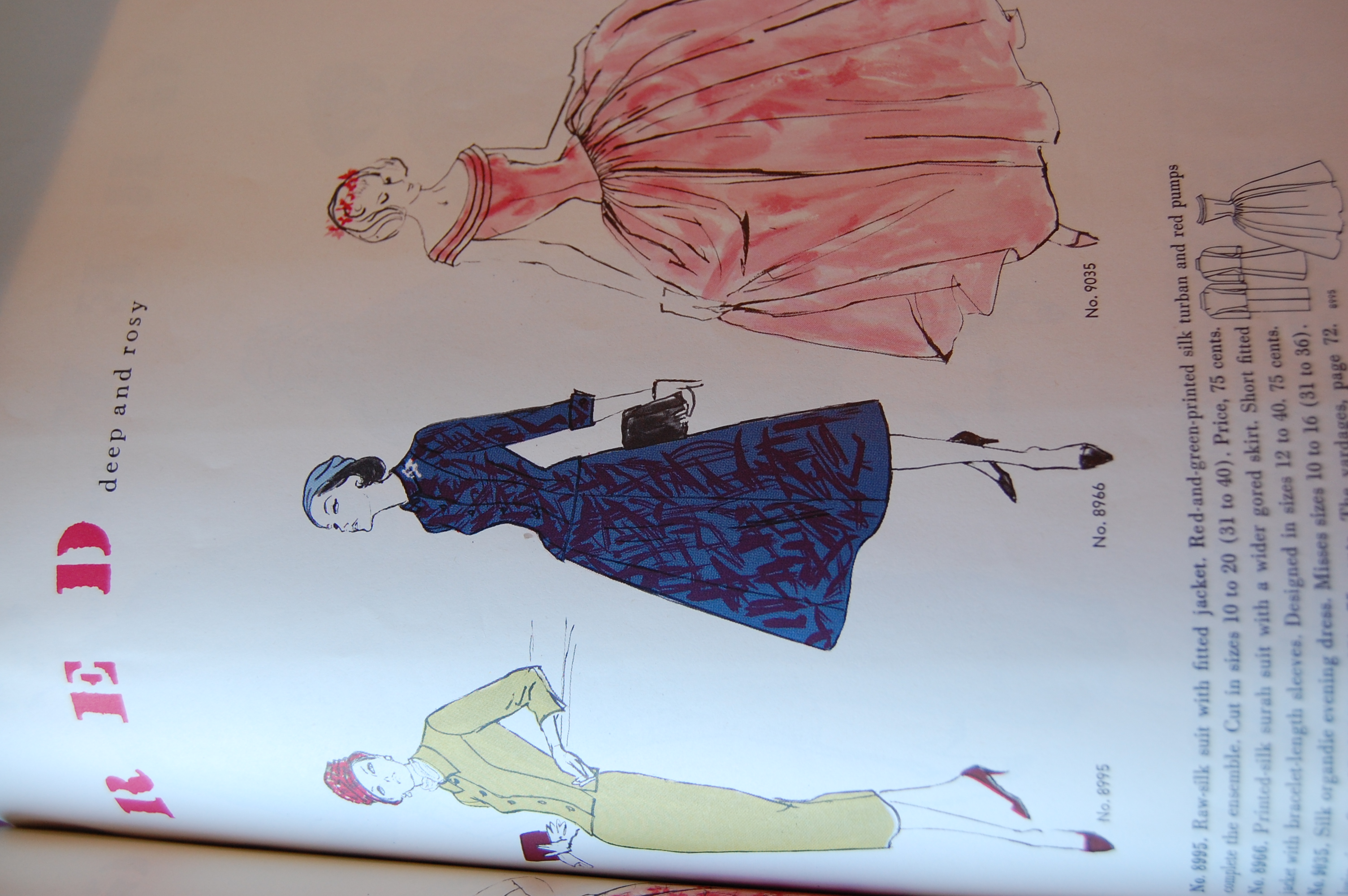
The February/March 1957 issue of  Vogue Pattern Book  magazine shows two pages of “Red – deep and rosy”.  While the red coat and two red dresses are obvious “fits” for the section, the mustard yellow suit (raw silk, according to the caption, which would be so elegant!) is completed with a red and green printed silk turban and red pumps.  (Hint for viewing:  click on the photos to see them larger and clearer.)

The middle suit looks to be a blue and red printed-silk surah, while the evening gown is to be made in a silk organdie.

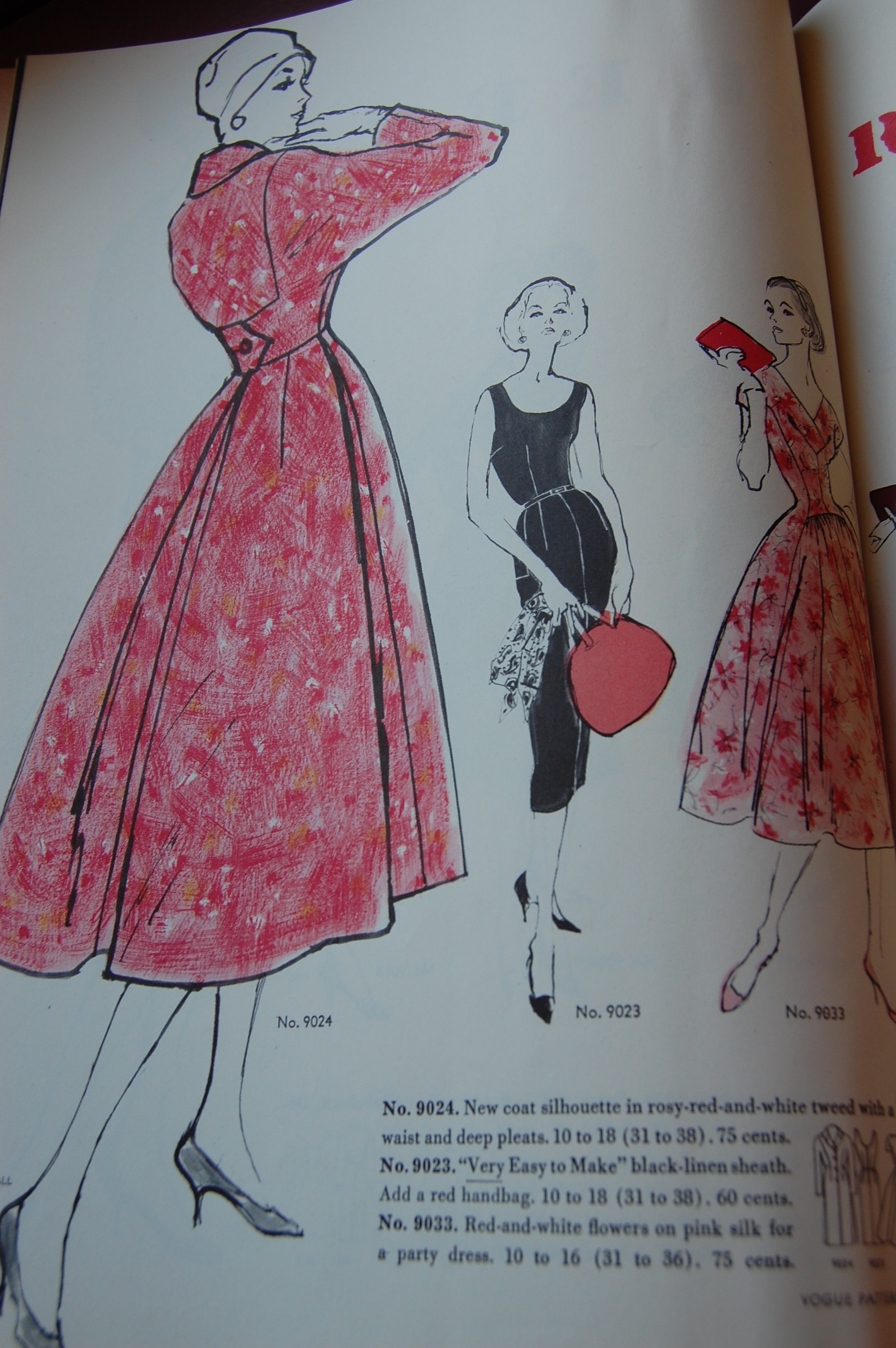
This coat has a high waist and deep pleats. Wear this over the black dress for a stunning look!

That same year, the June/July issue showed this lovely choice in cherry-red pique for “sight-seeing.”  No blue jeans and tee shirts for this excursion.

The wide brim hat with red flowers completes the look.

In 1958 (or in 2012), a chic home sewer could make this suit in a red tweed with self or braid binding.

Notice the stylish shoes!

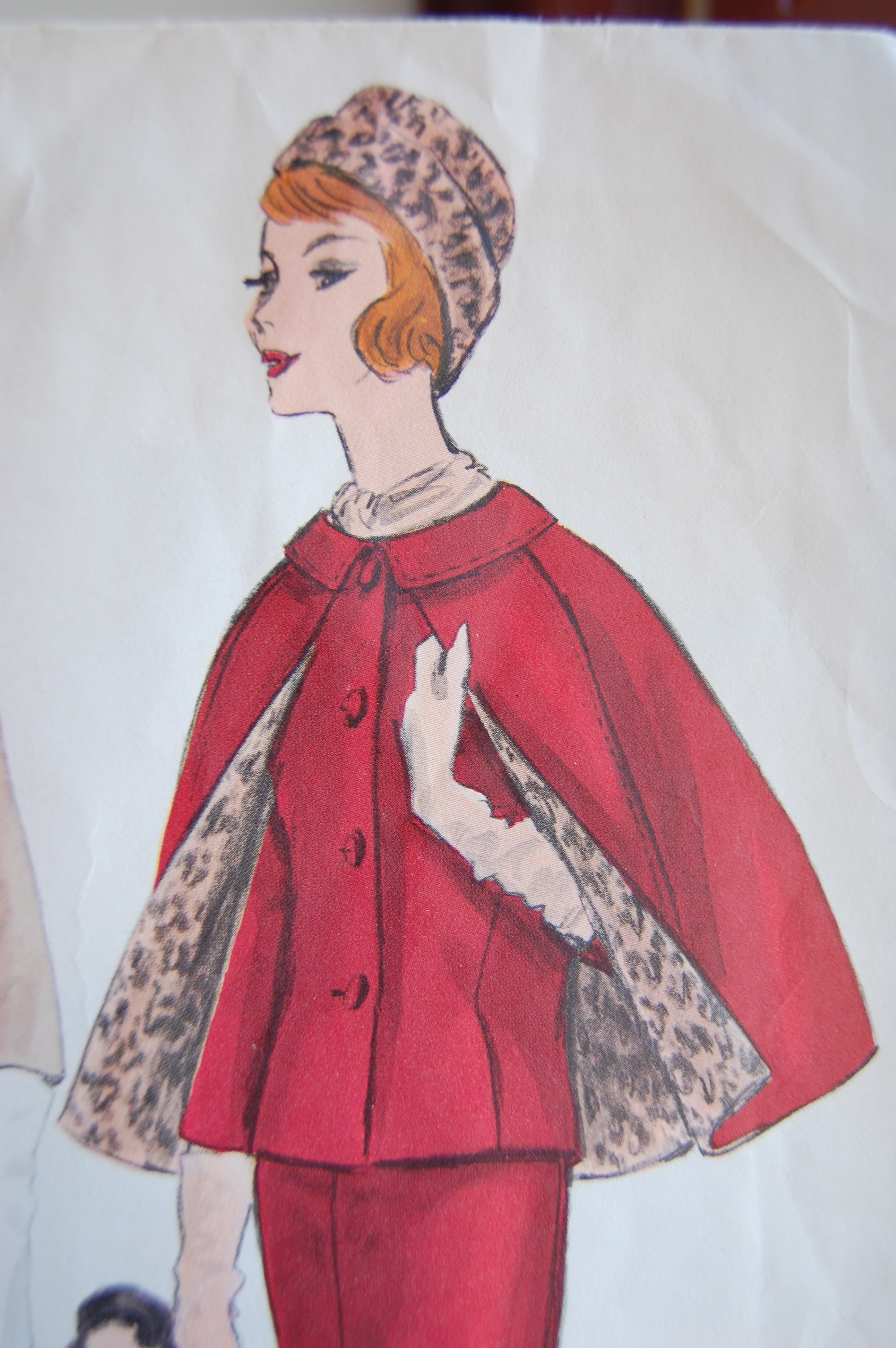
Here is a suit from 1960 with a matching, reversible cape. The cape has arm openings in the side seams and is collarless so that it fits perfectly under the collar on the suit jacket.

Who says "redheads" can't wear red?

Here is a close-up of the cape. The leopard-printed lining matches her hat.

Red print fabrics have spun their own charm over the years.  Here are four, which seem to epitomize another statement from Bill Blass: “…fabric is an inspiration and a tool.” (See International Vogue Pattern Book  October/November 1971, page 27.)  I could definitely be inspired by these prints:

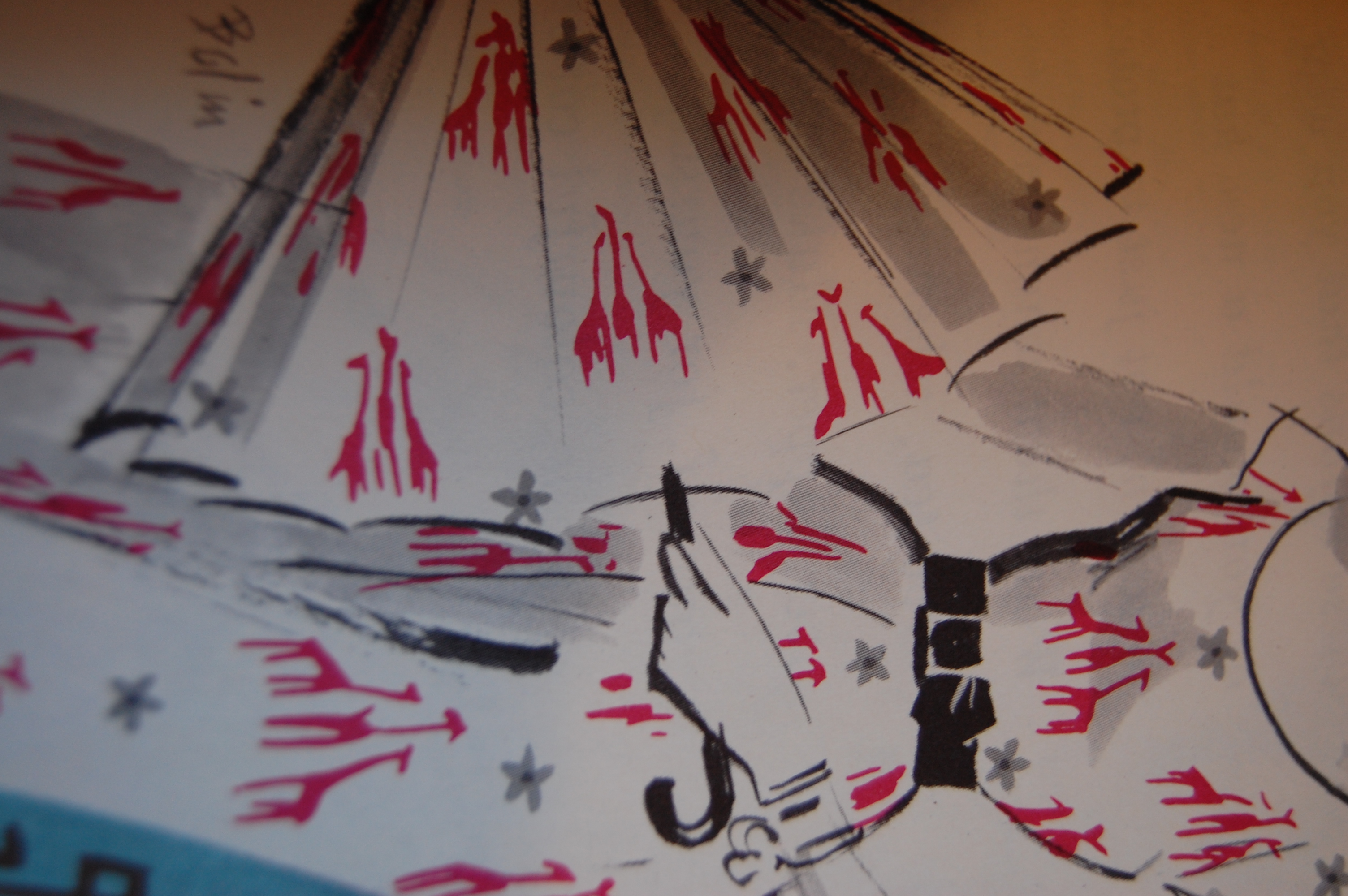
This wonderful giraffe print in red on white cotton, with stars, is shown in a skirt and blouse. There was no mention about the matching parasol. This design is in the April/May 1953 Vogue Pattern Book magazine.

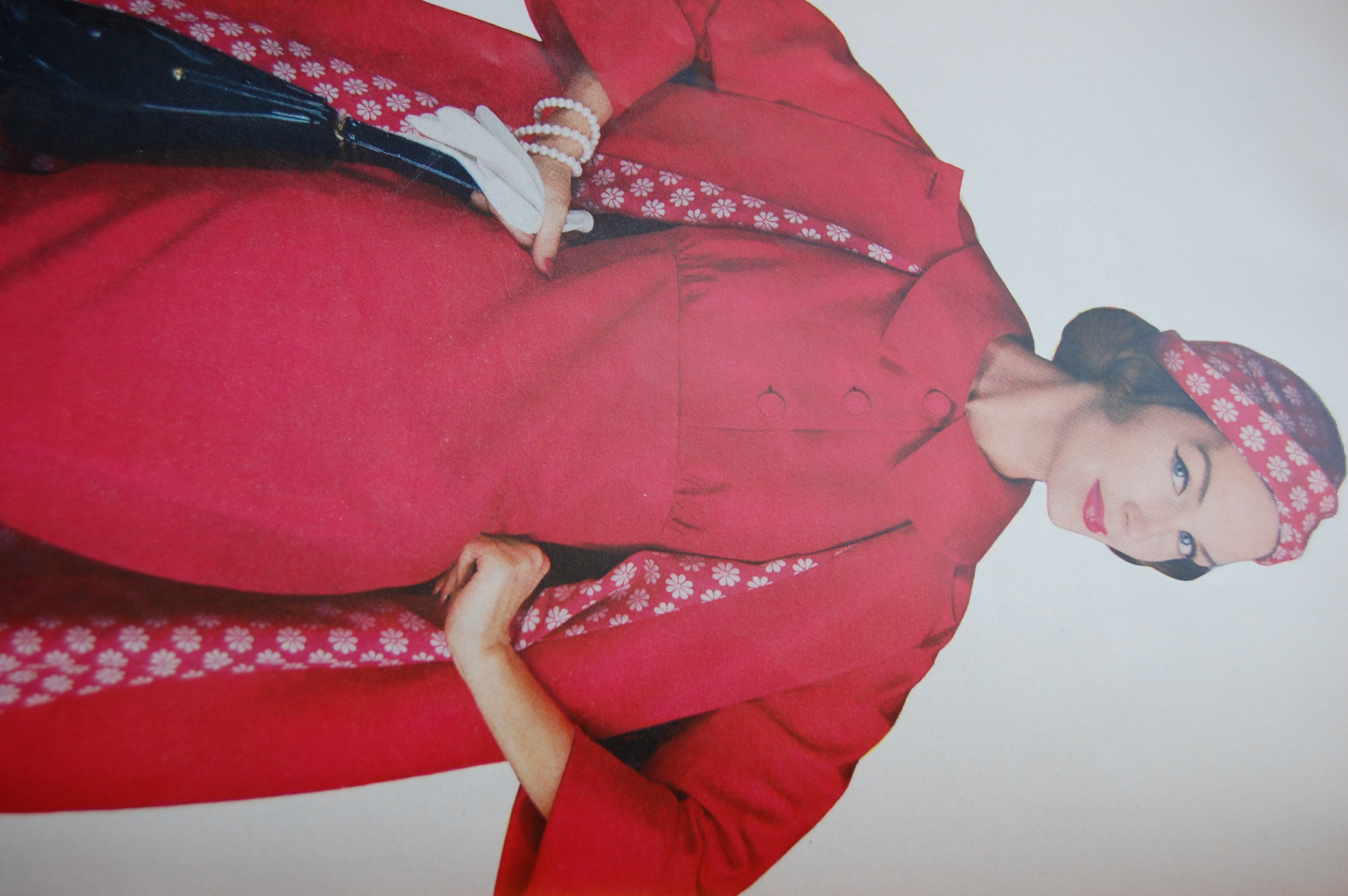
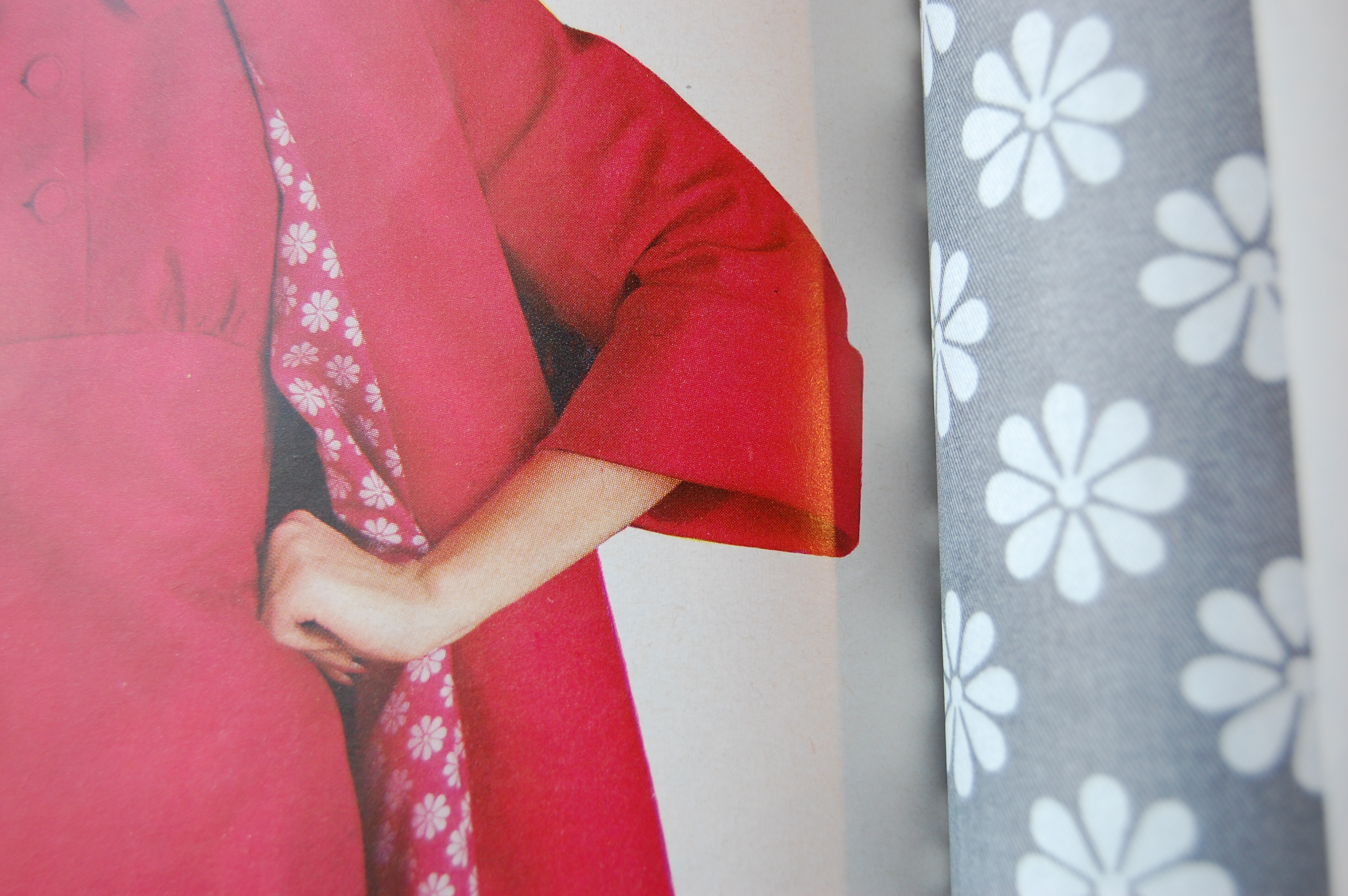
This 1958 design features a daisy print silk lining in the coat.

The dress and coat are made in a slubbed silk barathea while the lining and hat are of silk surah, both by Couture, according to the February/March Vogue Pattern Book of that year.

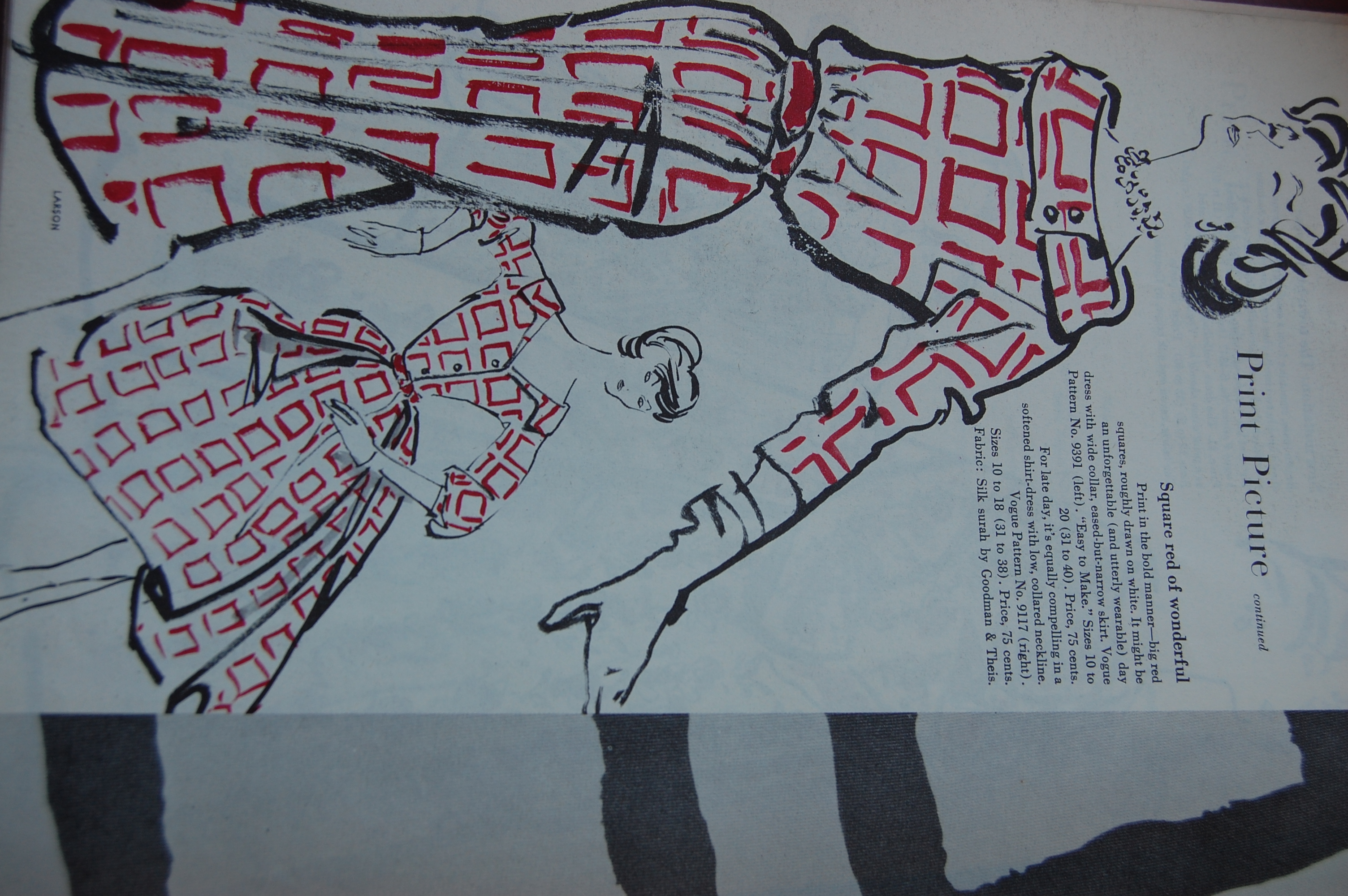
This fabric is rightly referred to as "Square red of wonderful"!

This silk surah looks equally eye-catching in a slim or full skirt. I'll have one of each, thank you!

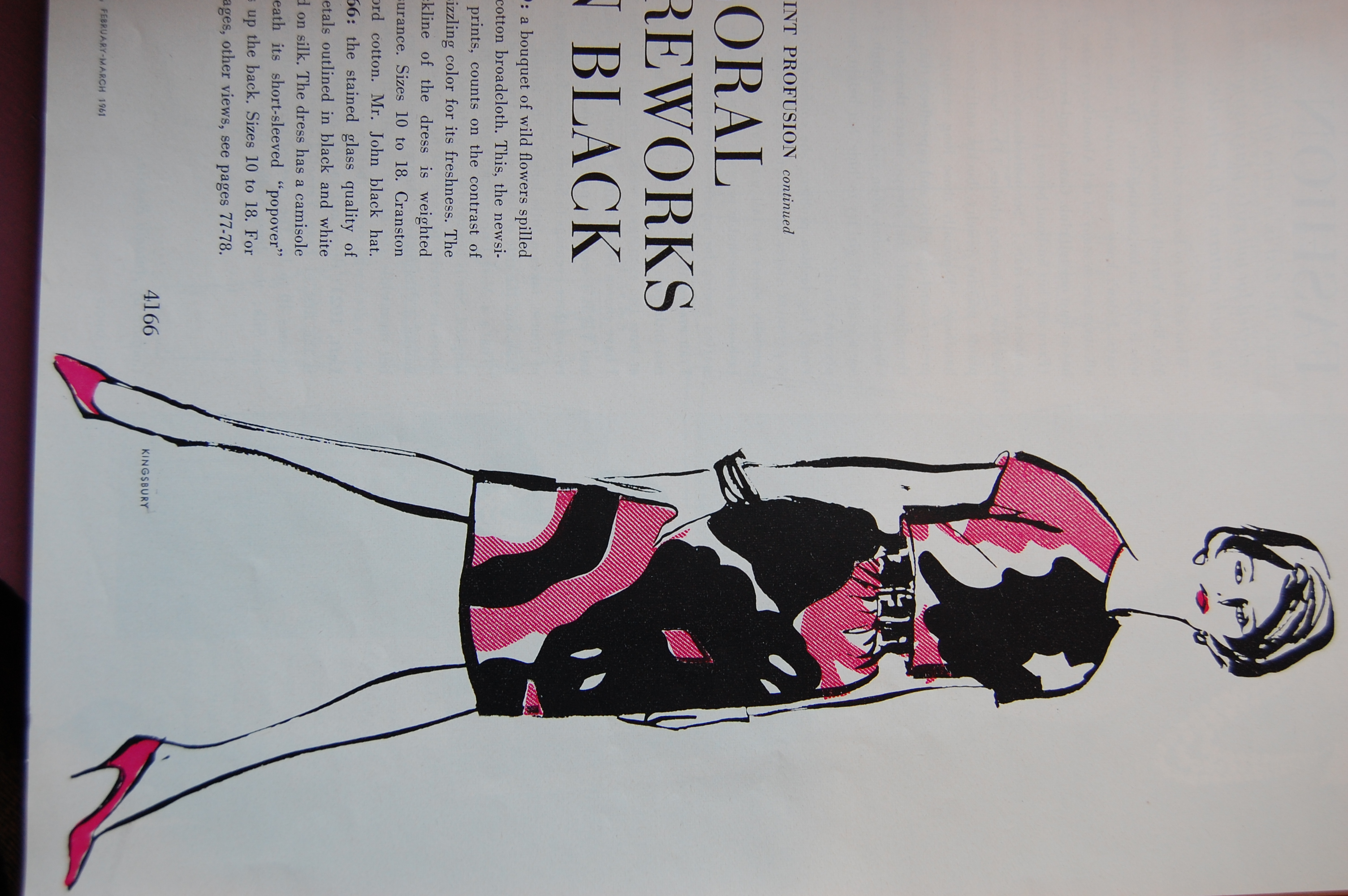
What I wouldn't do to be able to buy this printed silk! This pattern was featured in the February/March 1961 issue of Vogue Pattern Book magazine. According to the description, "this dress has a camisole top underneath its short-sleeved 'popover' top that buttons up the back." With lipstick and shoes to match, it makes a stunning ensemble.

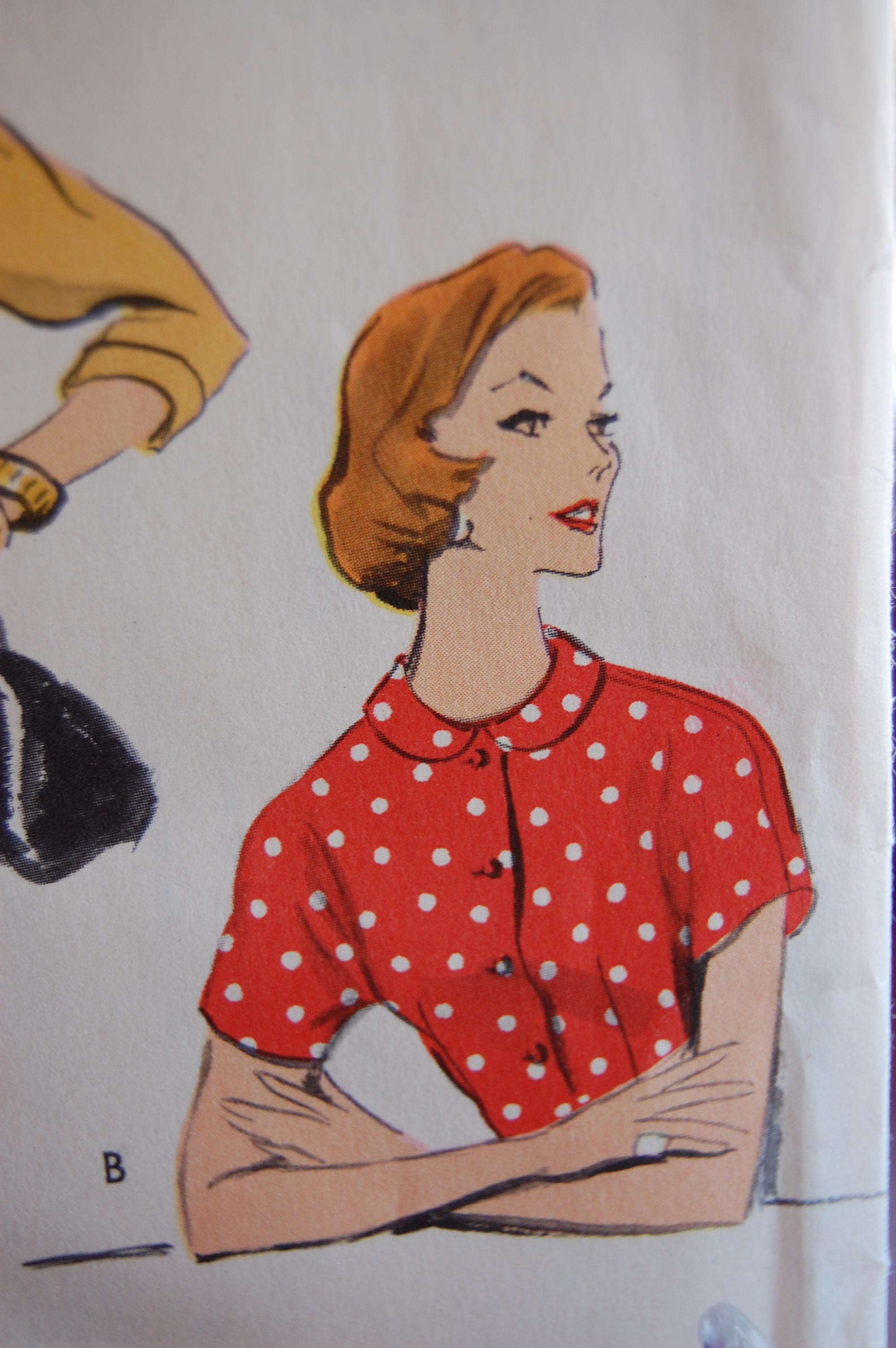
And here are classic polka dots, white on red, in a 1957 blouse design.

A Peter Pan collar and polka dots - a winning combination!

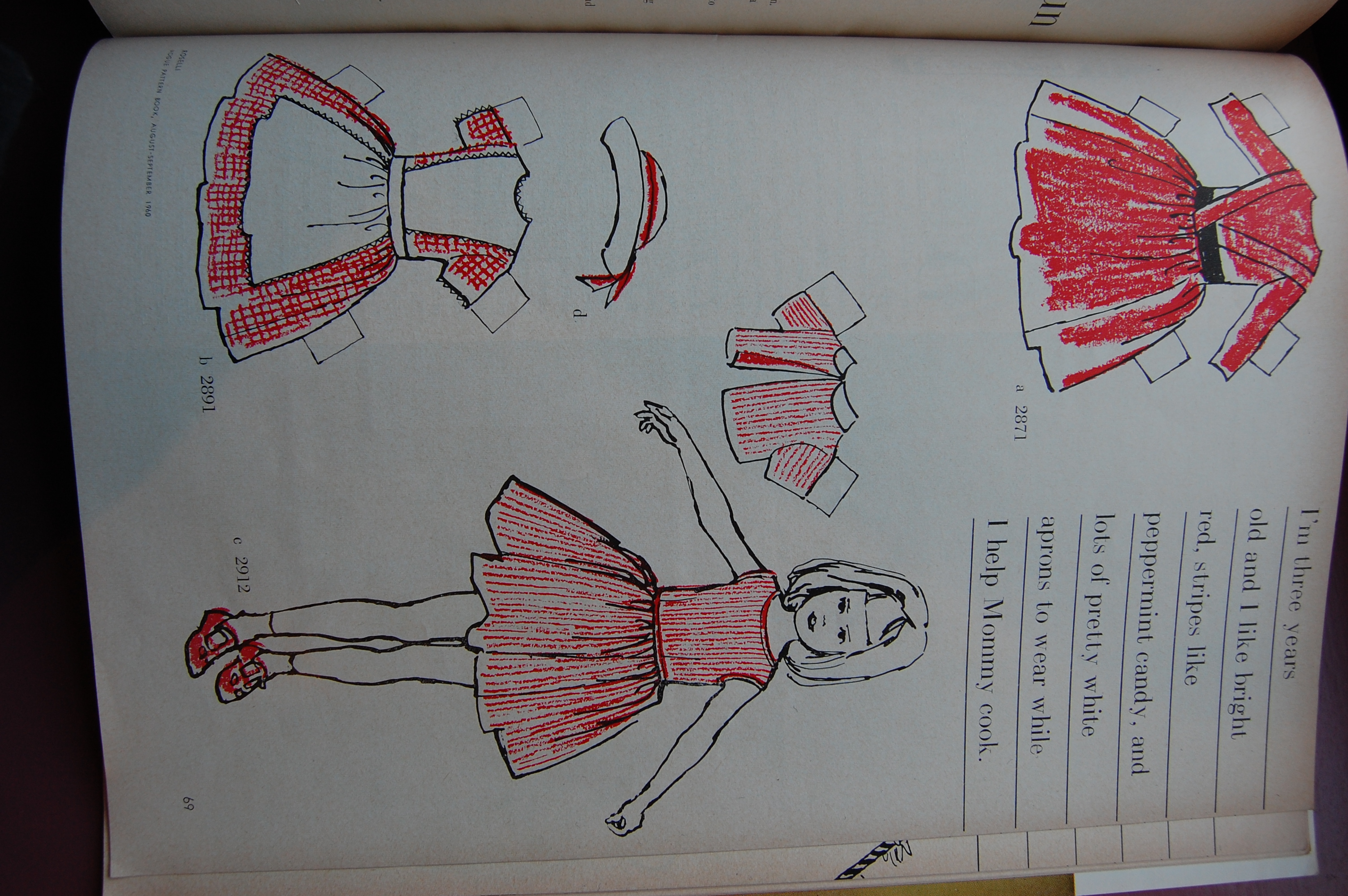
Vogue Pattern Book’s editors often featured styles for college girls and little girls.  Velvet, gingham and candy-striped denim (yes, that’s correct, denim!), all in red, were featured for little girls in the issue for August/September 1960:

This little girl is all set to help "help Mommy cook" in a white pinafore.

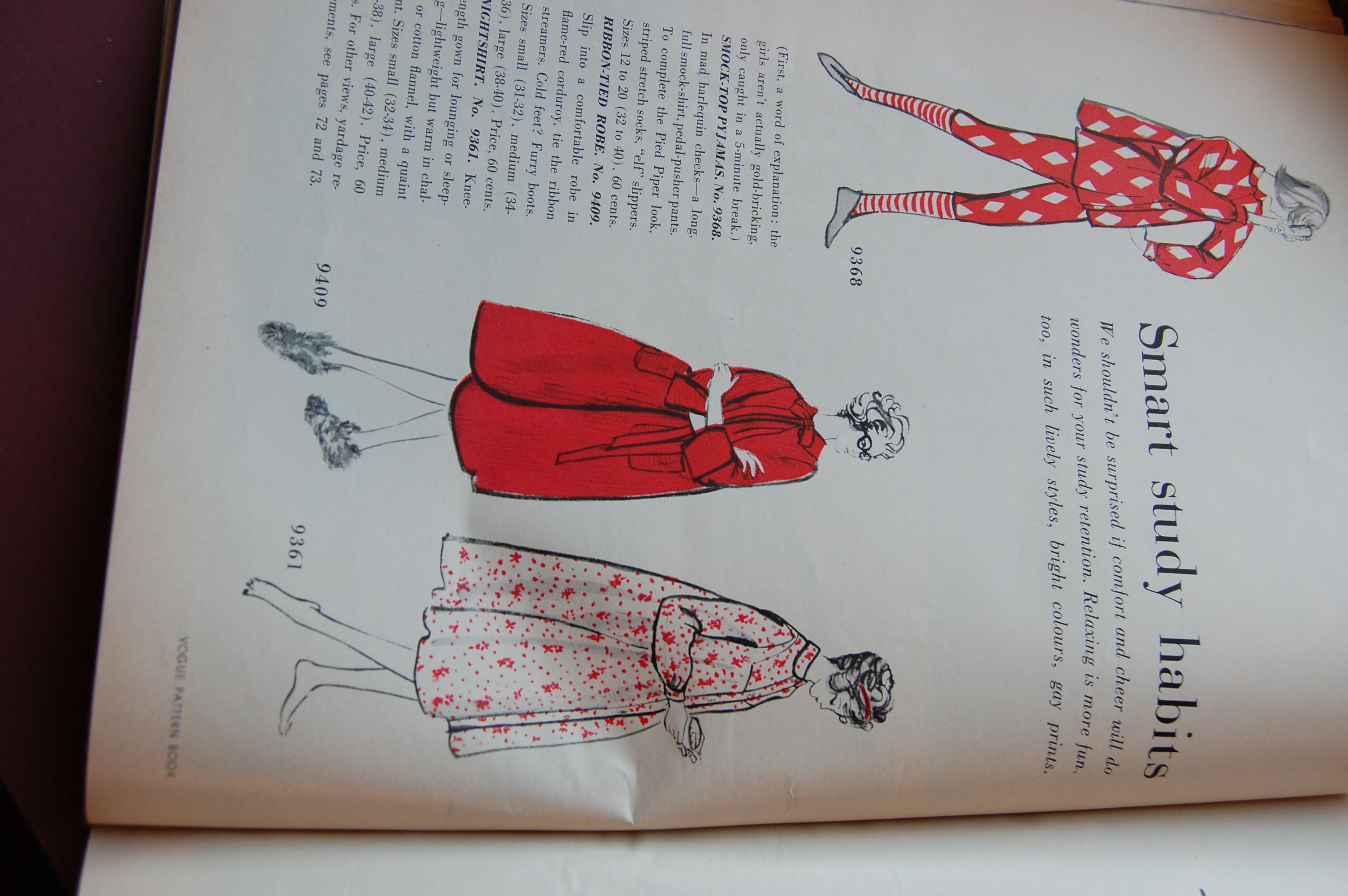
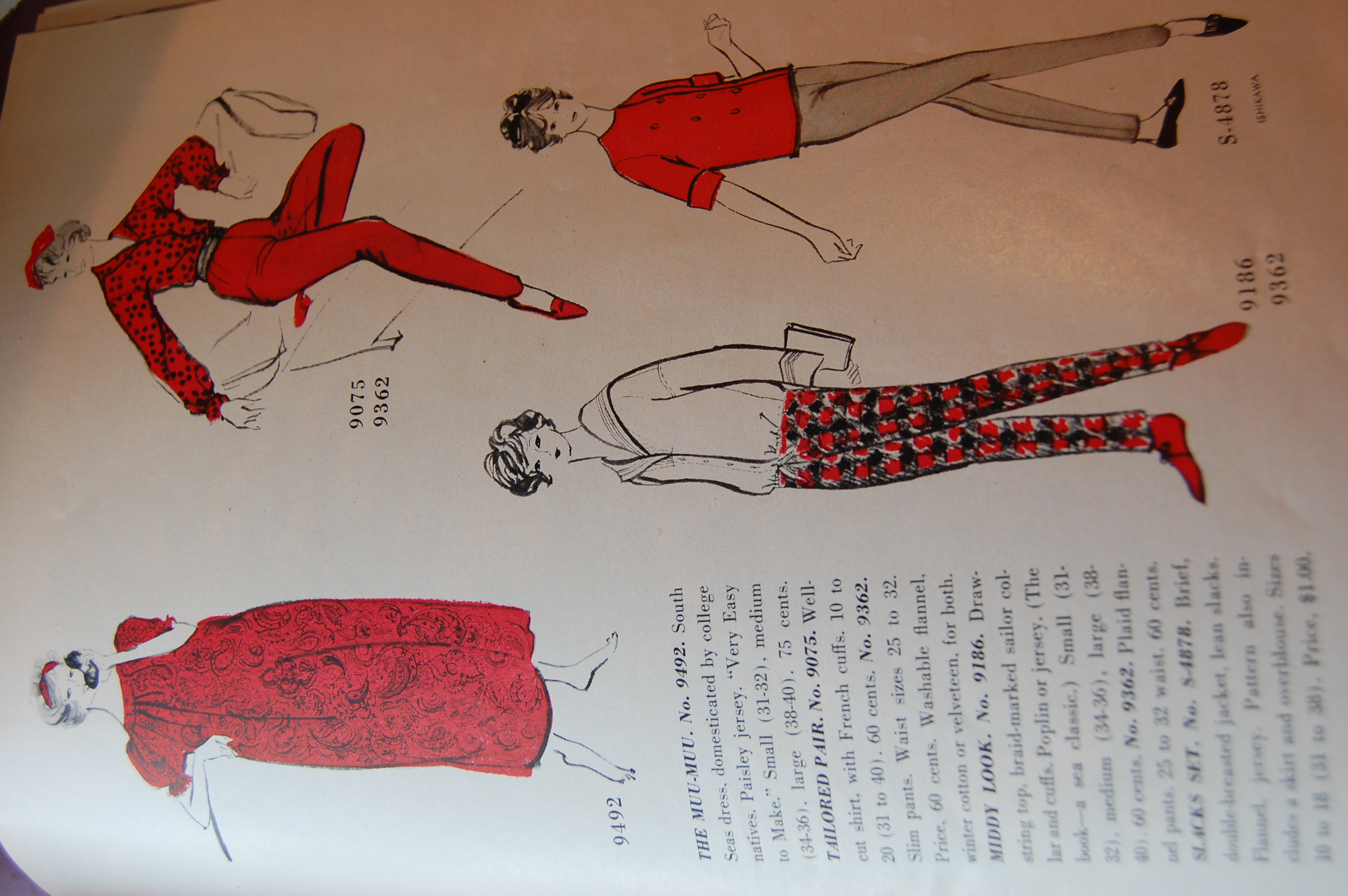
These “coeds”, according to the editors of the August/September issue of 1958, were taking a 5-minute study break to model these dorm fashions!

The girl in the harlequin pedal-pusher pants and smock-top looks to me like she’s actually taking a break from her part-time job with the circus, while Miss Muu-Muu is  — chatting on the phone!   Some things never change, just like the timeless appeal of RED.

5 Comments

Filed under Blouse patterns from the 1950's, Coats, Polka dots, The Conde Nast Publications, Uncategorized, vintage Vogue patterns from the 1950s, vintage Vogue patterns from the 1960s

And – the winning number is 7503

Any serious dressmaker working in the 1950s must surely have known this four-digit number by heart.  This was the number of the Vogue pattern for “shoulder shapes,” what we now call shoulder pads (more on that nomenclature in a minute).   While 1940s’ fashion was dominated by the broad shoulder look, not so the 1950s’ – and that is what is so clever – and remarkably useful – about this pattern, which has a copyright date of 1953.

However, I am getting ahead of myself.  I first learned of Vogue 7503 when I purchased this dress pattern from an online shop called “Stitches and Loops” last Spring.

This pattern gave me my first clue to Vogue 7503

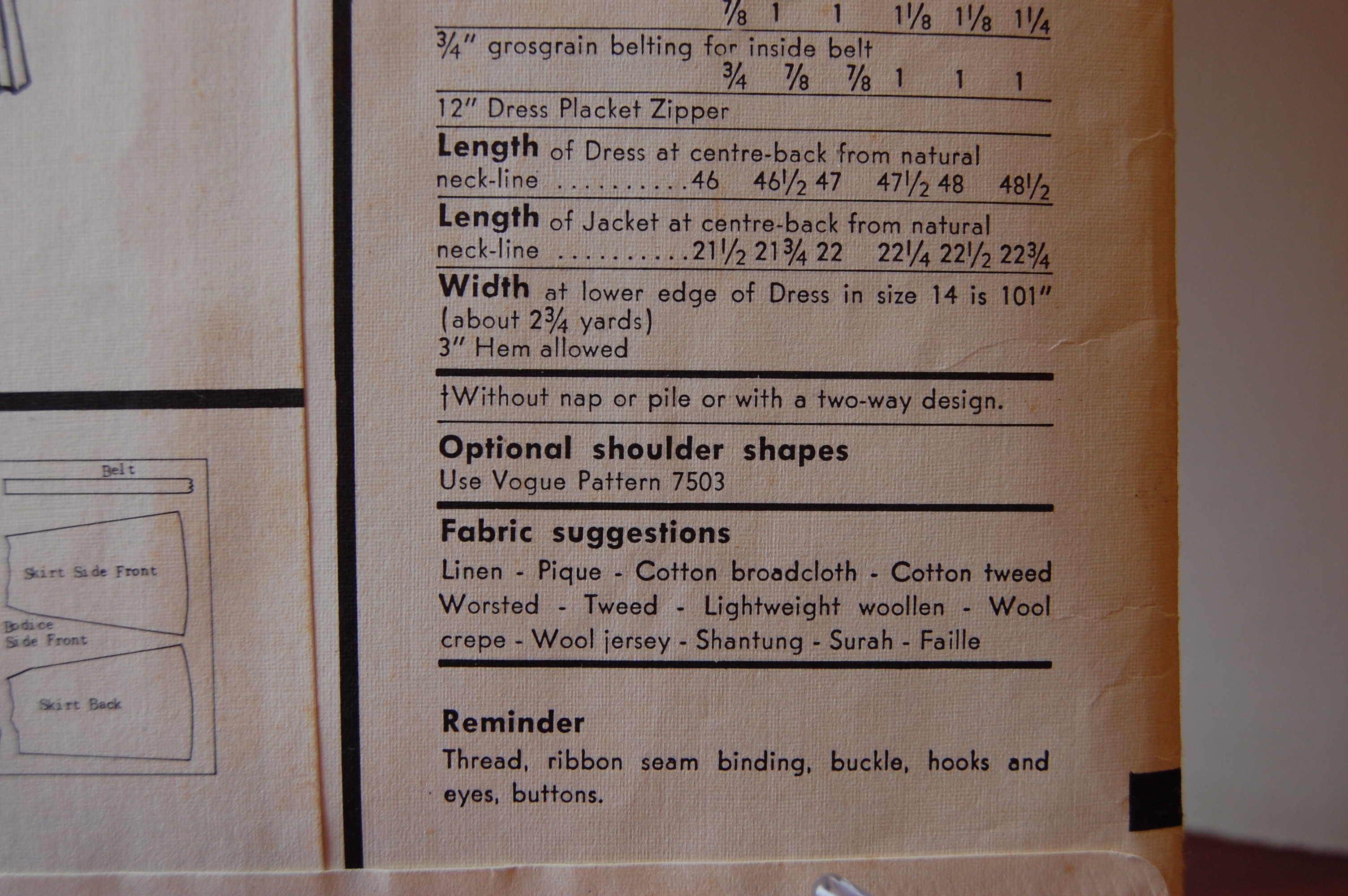
On the back of the envelope, it states:  Optional shoulder shapes  – Use Vogue Pattern 7503

Here is the statement which sent me on my search for Vogue 7503

My interest piqued,  I started looking at some of my other patterns for suits, dresses and blouses from the 1950s.  Some of them, too, had a reference to Vogue Pattern 7503.  Having just made an outfit which required shoulder pads – and for which I had purchased “ready-made” ones which just were not quite the right shape, thickness nor natural feel – I knew that Vogue 7503 was something I needed to find.  A quick Google search told me that I had just missed one that had been available on eBay.  Thus began a months’ long search which ended in early November, when an uncut, ff (factory folded) copy with original envelope was listed by a shop on Etsy.  Excited, I could barely get my order in quickly enough!  Here is my copy of this wonderful dressmaker’s aid:

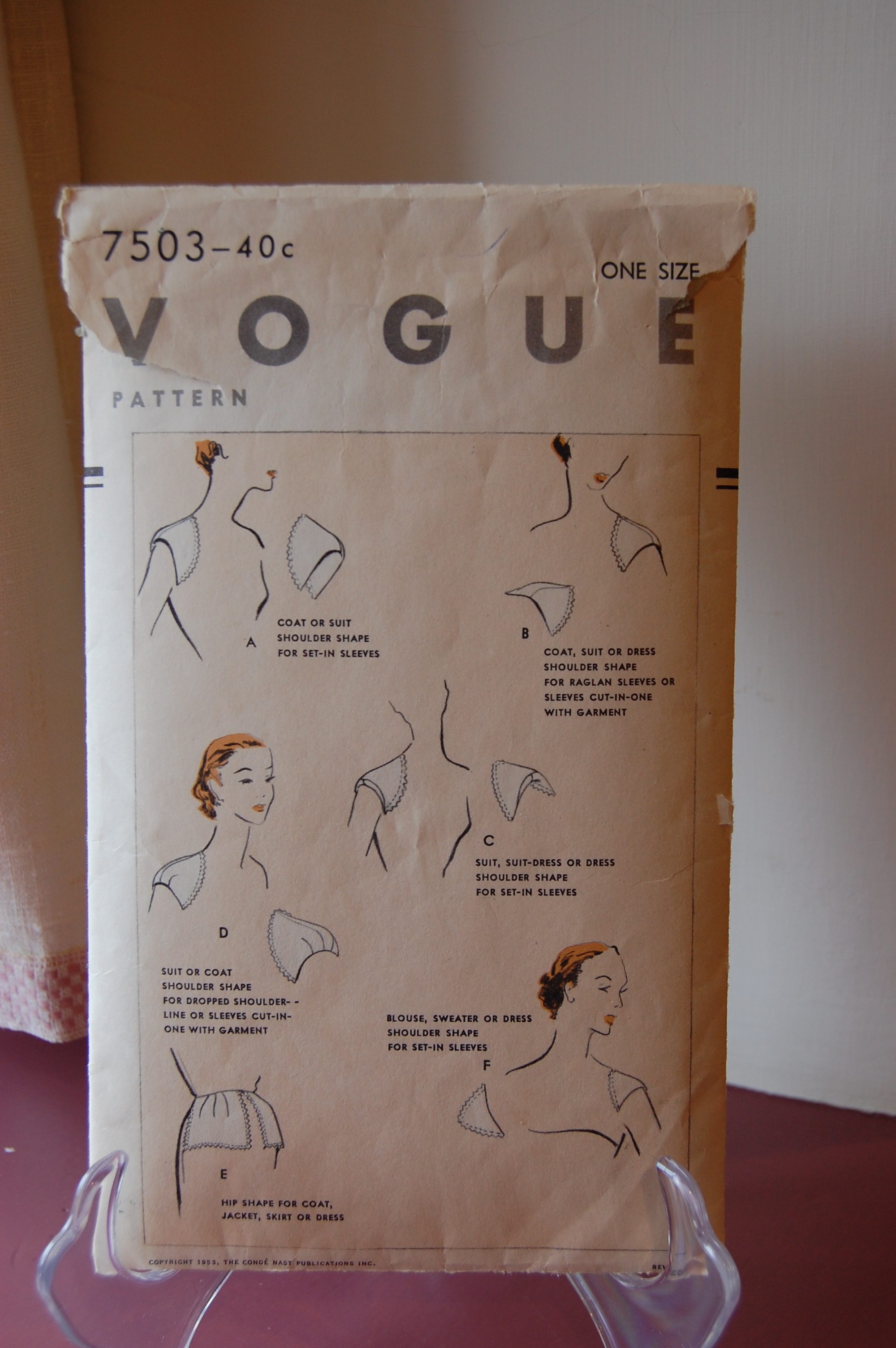
Vogue 7503 - Copyright 1953

Now for the particulars:

1 – My copy is actually copyrighted as Revised 1953.  It is unprinted!  Those of you who follow this blog know that I’m not a fan of unprinted patterns, but this is a little different.  For one thing, the pattern pieces are all small, the directions simple, and each piece can easily be copied onto pattern tracing paper, where I can make all the notations I want.  Interestingly, I have since seen this pattern for sale in its 1957 printed and perforated version, so obviously The Conde Nast Publications, Inc. was keeping up with demand.

2 –The term “shoulder shapes” is so much more precise and useful than “shoulder pads”, as that is what these mini-creations do – they help to shape the shoulder line. I’m not sure why the term “shoulder shapes” was replaced by “shoulder pads.”  Patterns from 1958 still referred to “shapes,” but by 1959, they were being referred to as “pads.”  I guess it’s a minor thing, this particular “nomenclature,” but put me in the “shapes” fan club.

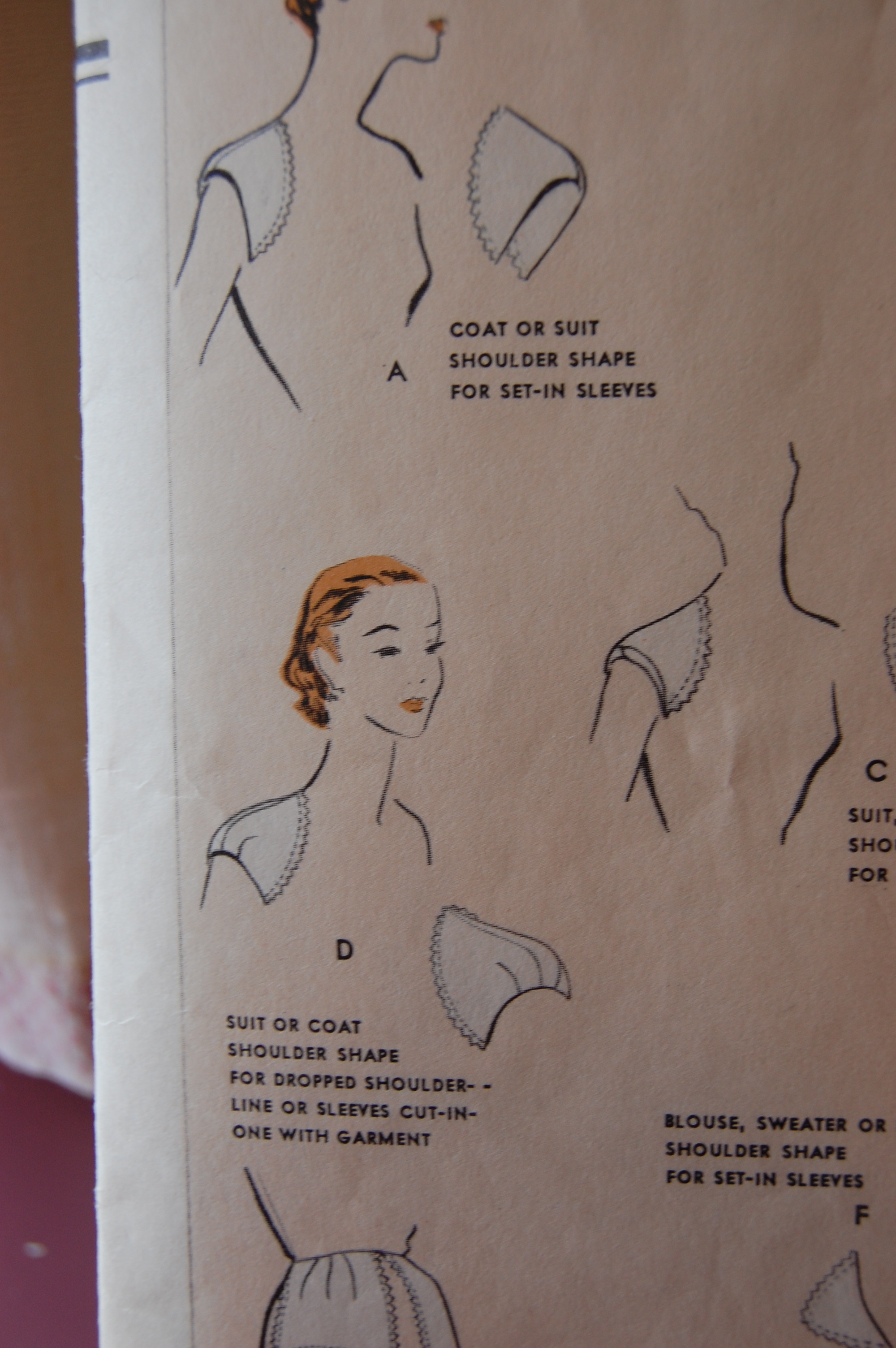
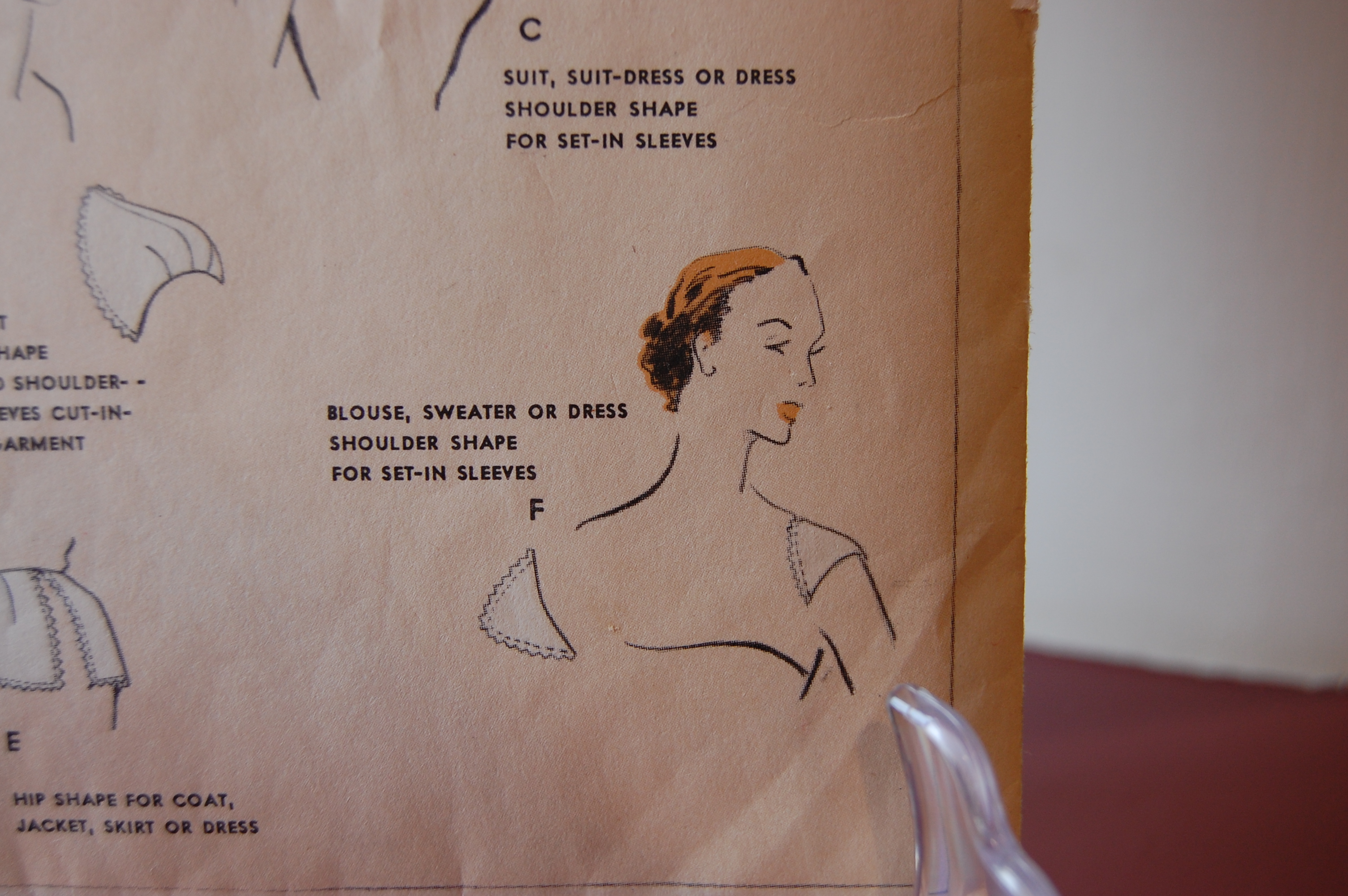
3 – Finally – the remarkable versatility of this pattern becomes apparent when you take the time to look closely at the pattern envelope.  Here you can see all the versions of shoulder shapes for different applications:  for coats and suits with set-in sleeves (two variations); for a coat, suit or dress with raglan sleeves or sleeves cut-in-one with garment; for suits and coats with a dropped shoulder line; and for blouses, sweaters or dresses with set-in sleeves.

Here is a close-up of two variant shapes for use with coats and suits. Notice the extra darts in View D, which add a gentle slope to the shoulder line.

Here is a very simple - "just enough" - shape for blouses, sweaters and dresses.

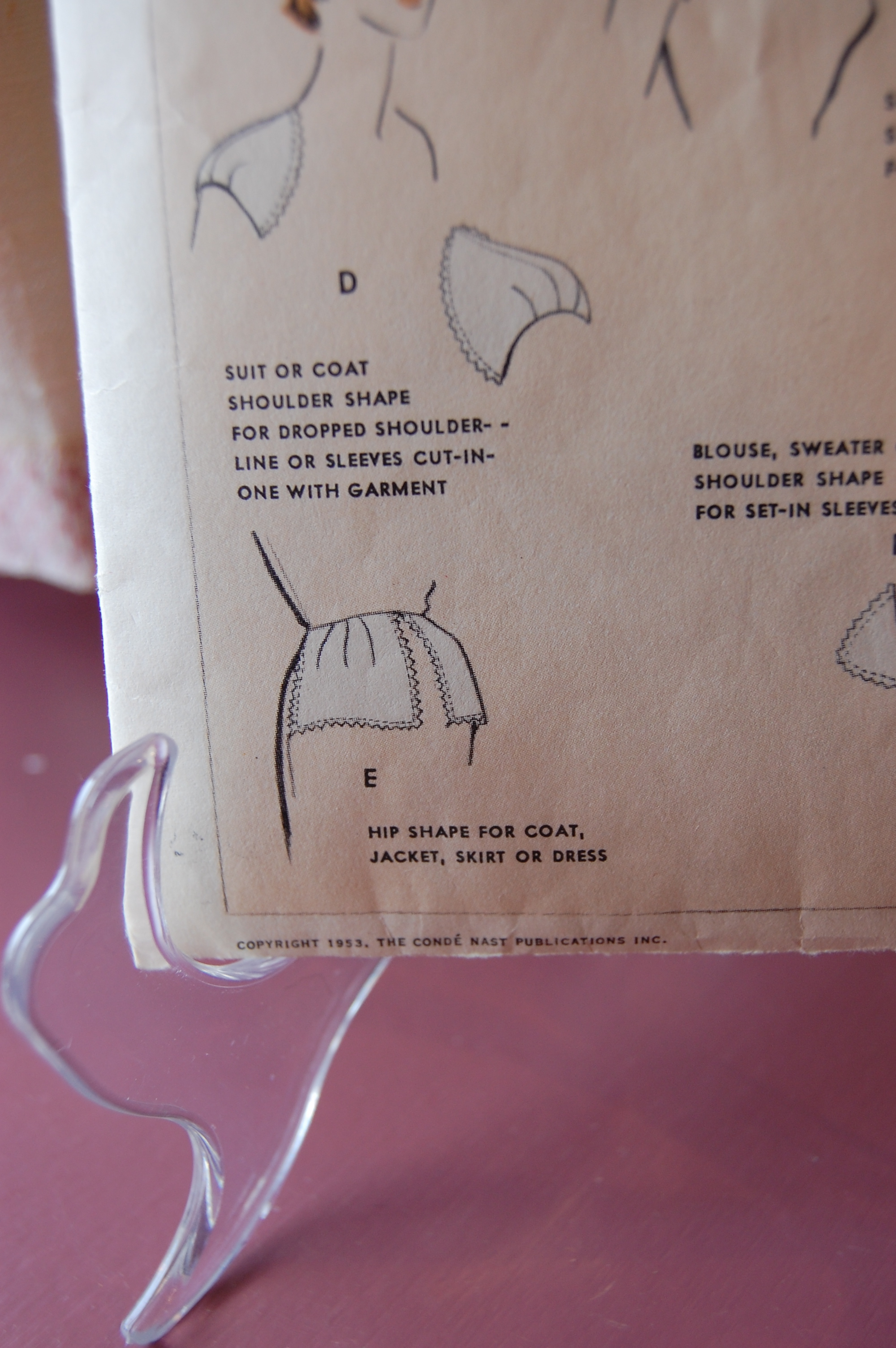
Then if you look in the lower left hand corner, you will see that this pattern also includes a “hip shape” for a coat, jacket, skirt or dress.  Very 1950s.   I guess this was used to accentuate one’s narrow waist – however, this is the only part of this pattern which I just can’t see myself using…

Hip shapes - for those who need it!

I have “view F” cut out for the silk blouse which I am currently sewing – and now that I have this clever pattern, I doubt I will ever again use a purchased shoulder pad  – oops, I mean shoulder shape.

1 Comment

Filed under Shoulder shapes (shoulder pads), The Conde Nast Publications, Unprinted patterns from the 1950s, Vogue pattern 7503 for shoulder shapes, Vogue patterns

Clothes for Christmas

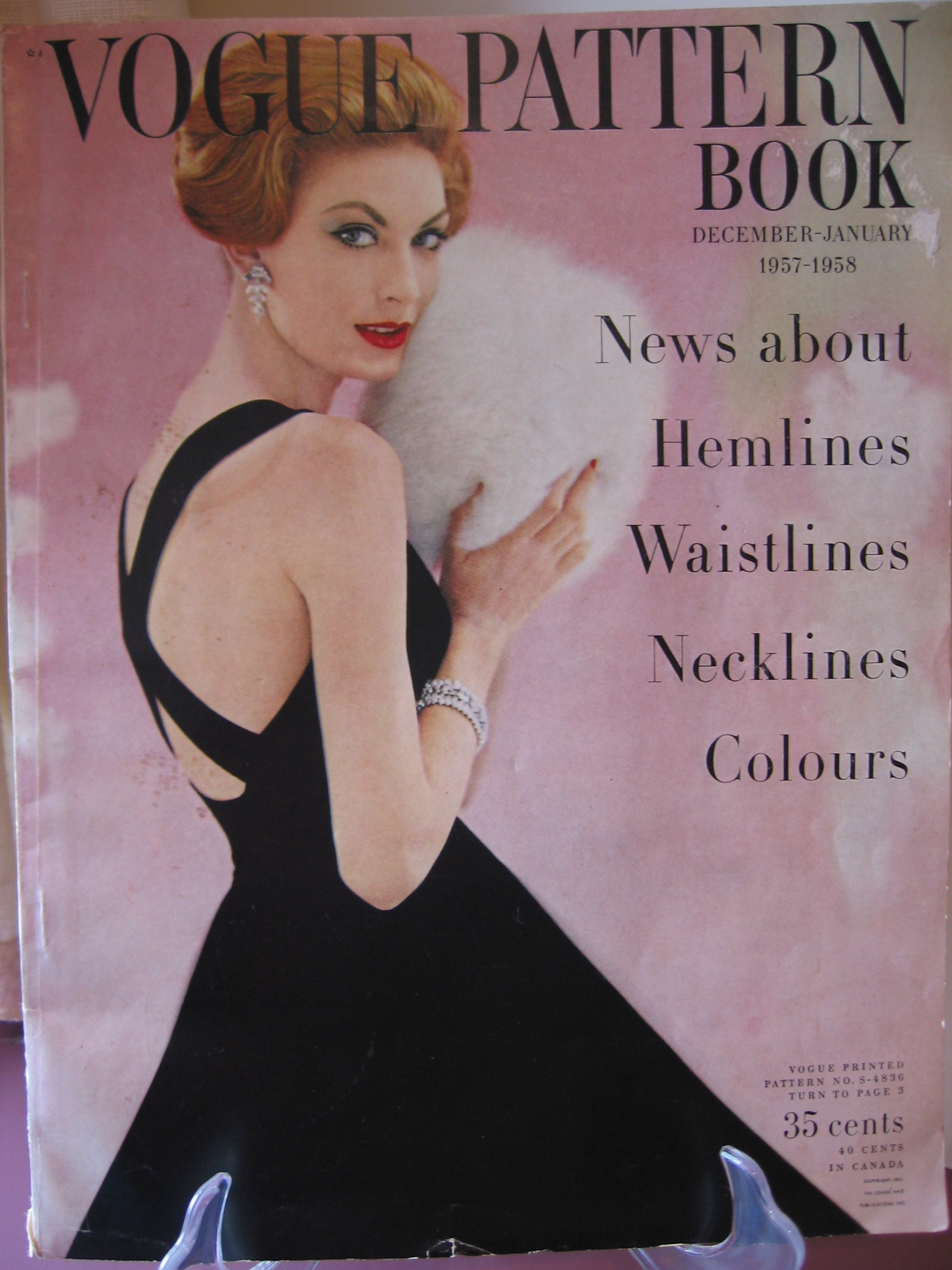
Another part of the world of vintage patterns, which is now available thanks to the Internet, are old copies of the Vogue Pattern Book magazine.   Published 6 times a year by The Conde Nast Publications, Inc., this magazine featured current and up and coming Vogue patterns, articles on construction and notions, a “question and answer” section,  news on just about anything having to do with personal sewing, and wonderful ads for fabric and sewing machines.  (By the way, it’s still published 6 times a year!)  I’ve been able to purchase a few issues from varying months and years, and sometimes I find a pattern featured which I have already bought on eBay or Etsy.   The December 1957/January1958 issue, which I recently obtained, devotes 8 pages to “The Ladies Love Clothes for Christmas.”

Here is the cover of the December 1957/January 1958 issue.

It features patterns for young girls and for teenagers; there is a section on lingerie and sleepwear; and finally some suggestions for the lady who presumably will be doing all this sewing!  Here is a sampling:

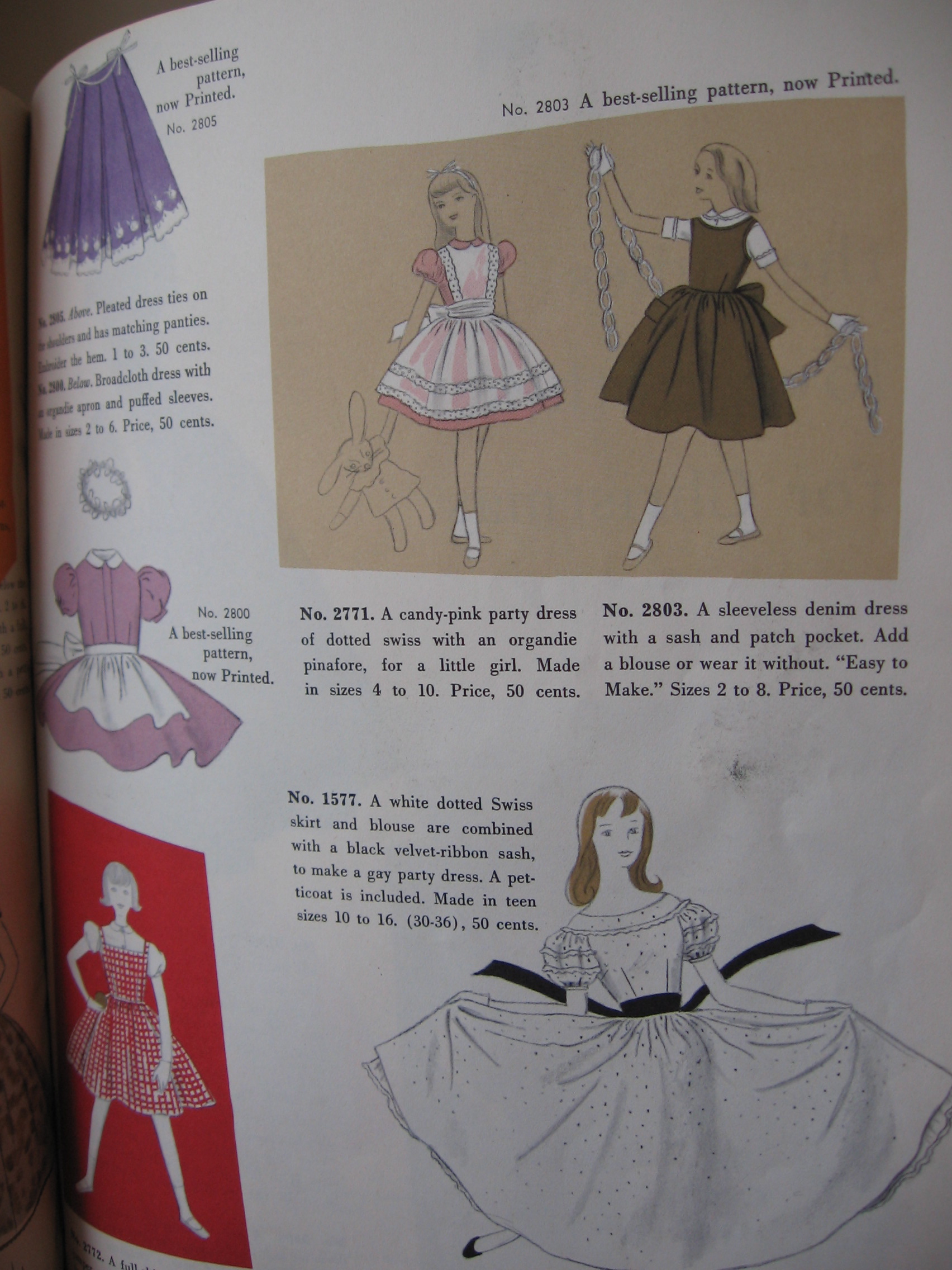
Suggested dresses to make for your little girl and one for your young teen.

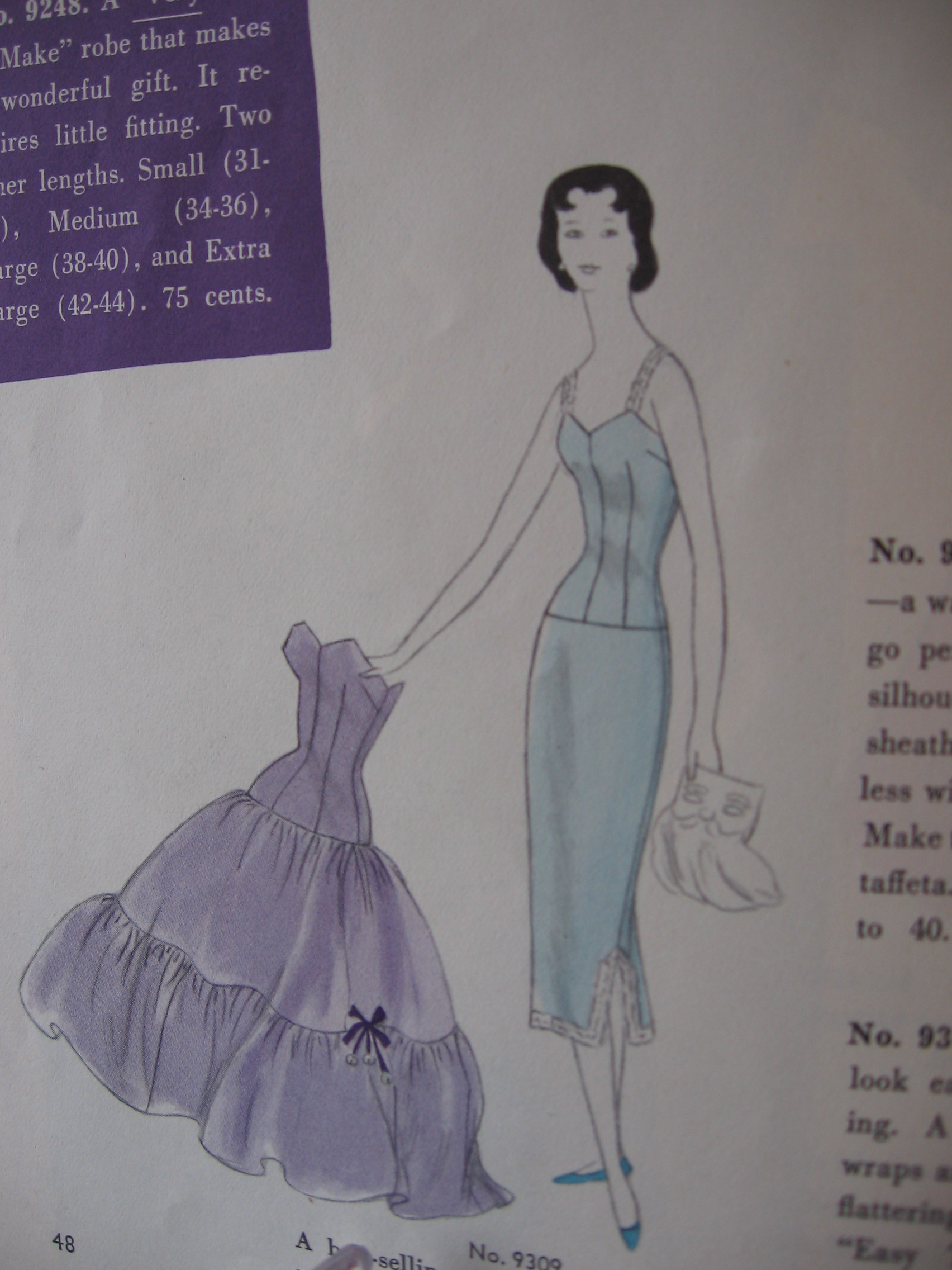
There were patterns like this to make slips - for yourself or as a gift!

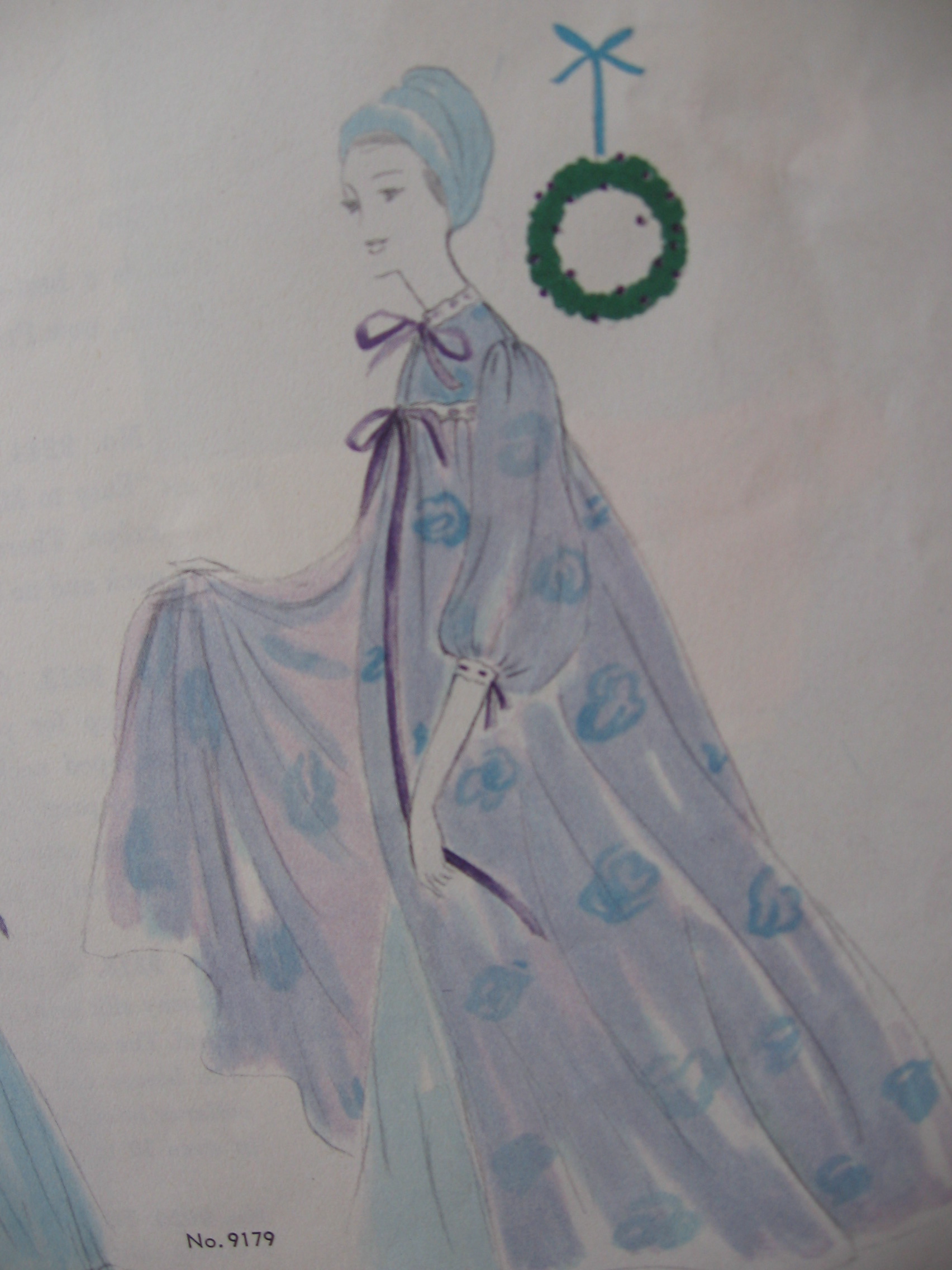
This billowy peignoir and matching nightgown would turn anyone into a vision on Christmas morning! The pattern cost 75 cents.

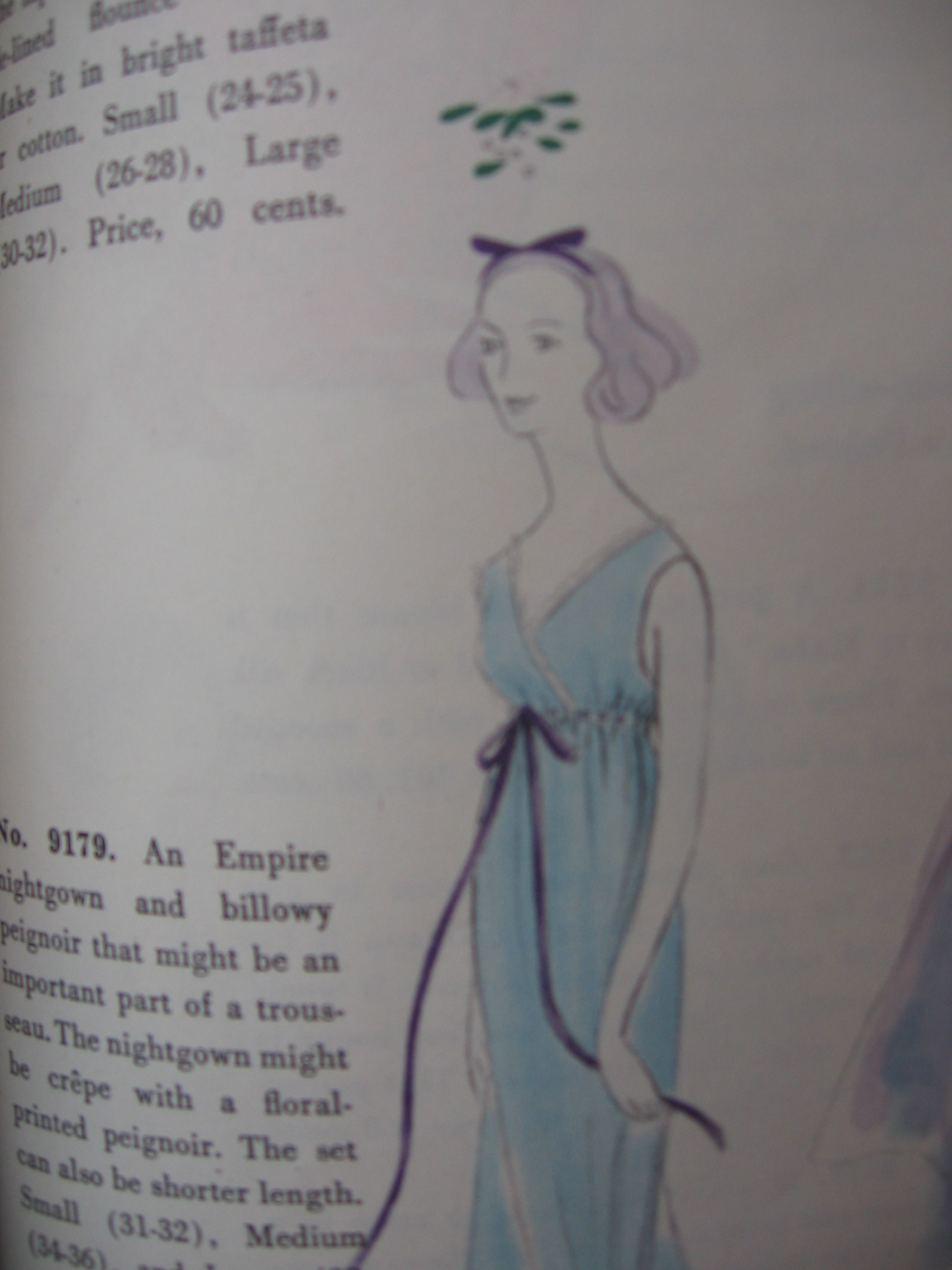
Here is the empire nightgown. I hope you can see that this lovely lady, now sans peignoir, is standing under the mistletoe!

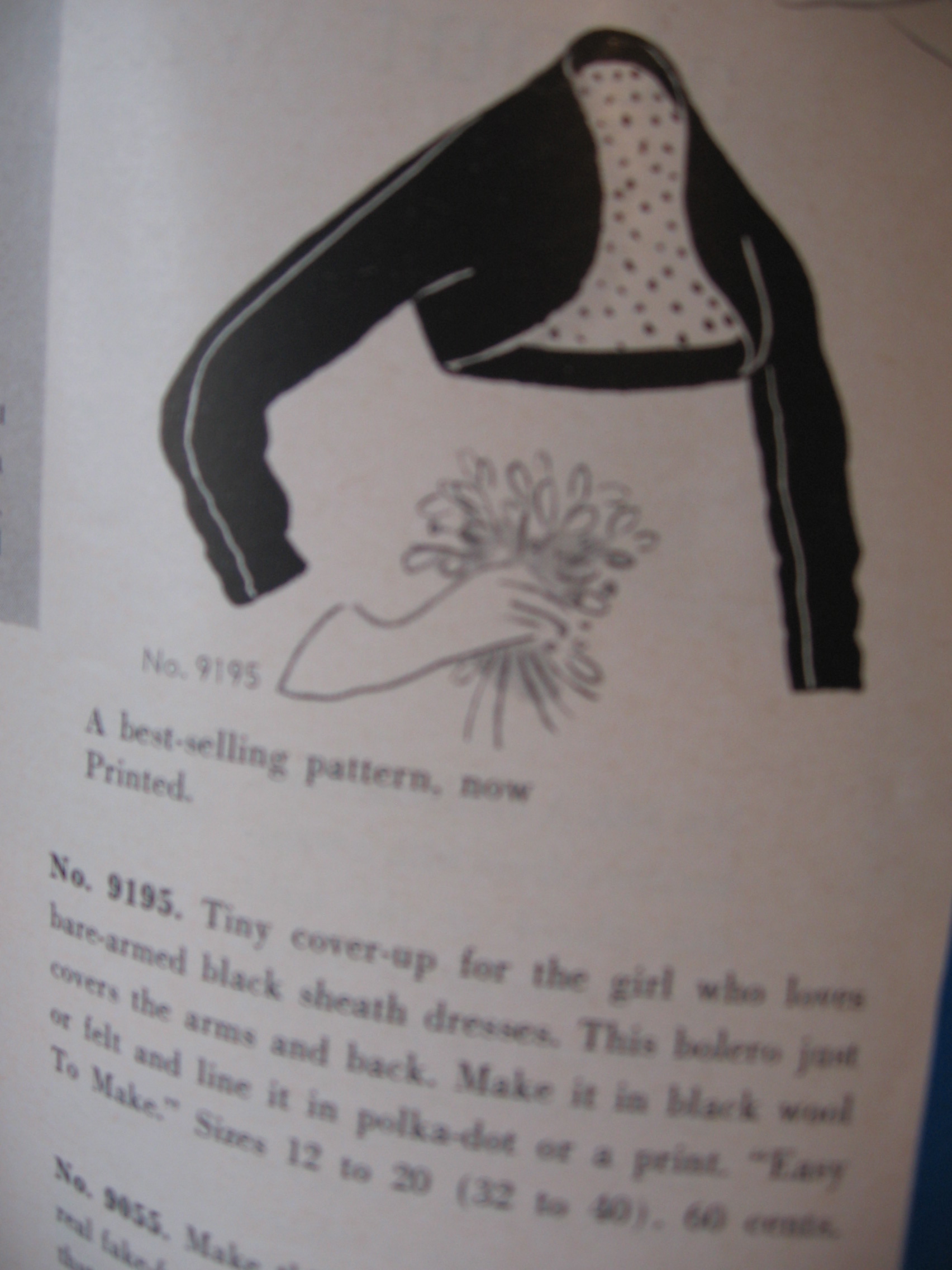
This bolero cover-up, lined in polka dots (no wonder I love this!), would be perfect on New Year's Eve.

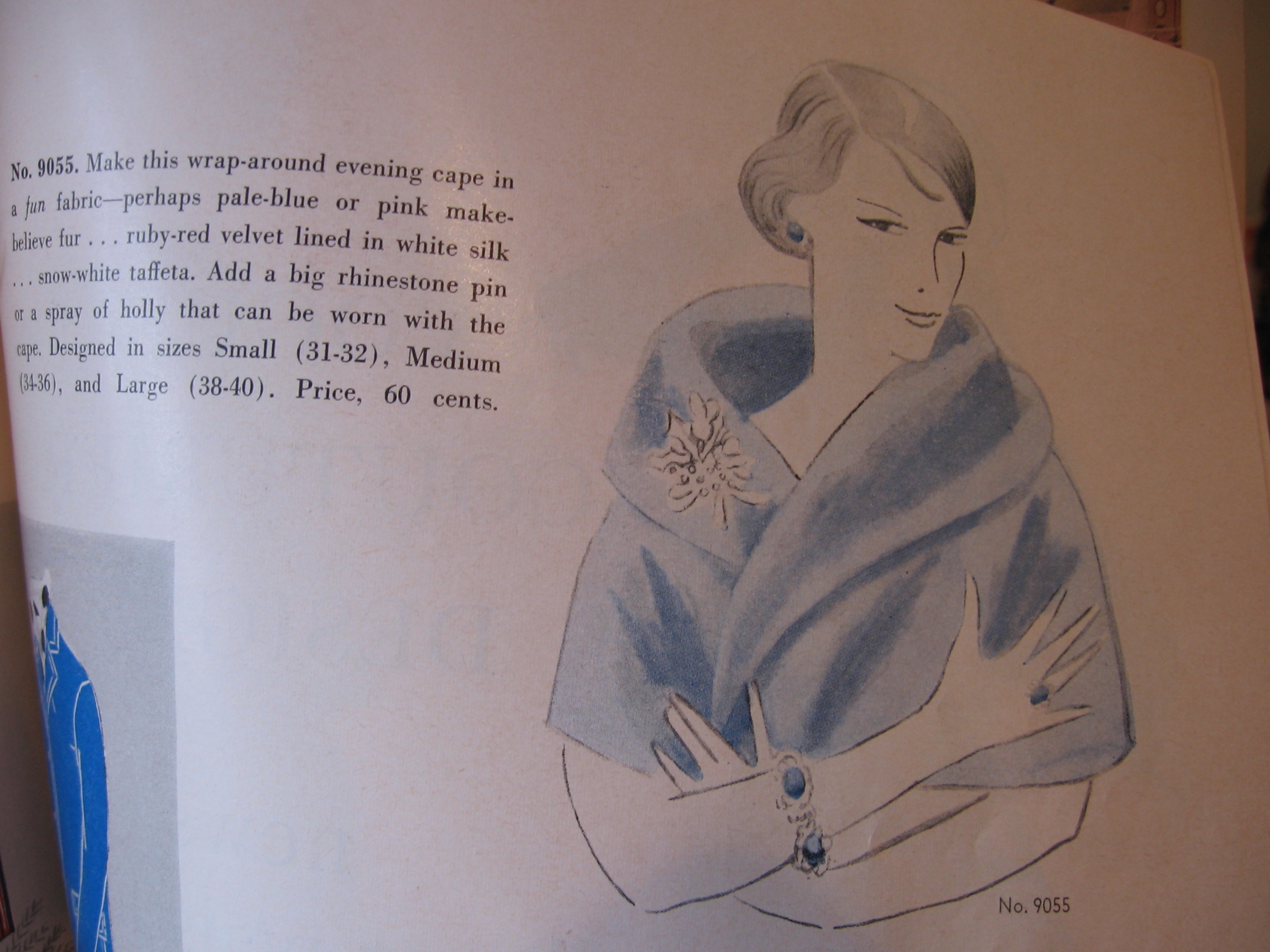
Or - if you are really in a festive mood, they suggest you make this cape in "ruby-red velvet lined in white silk."

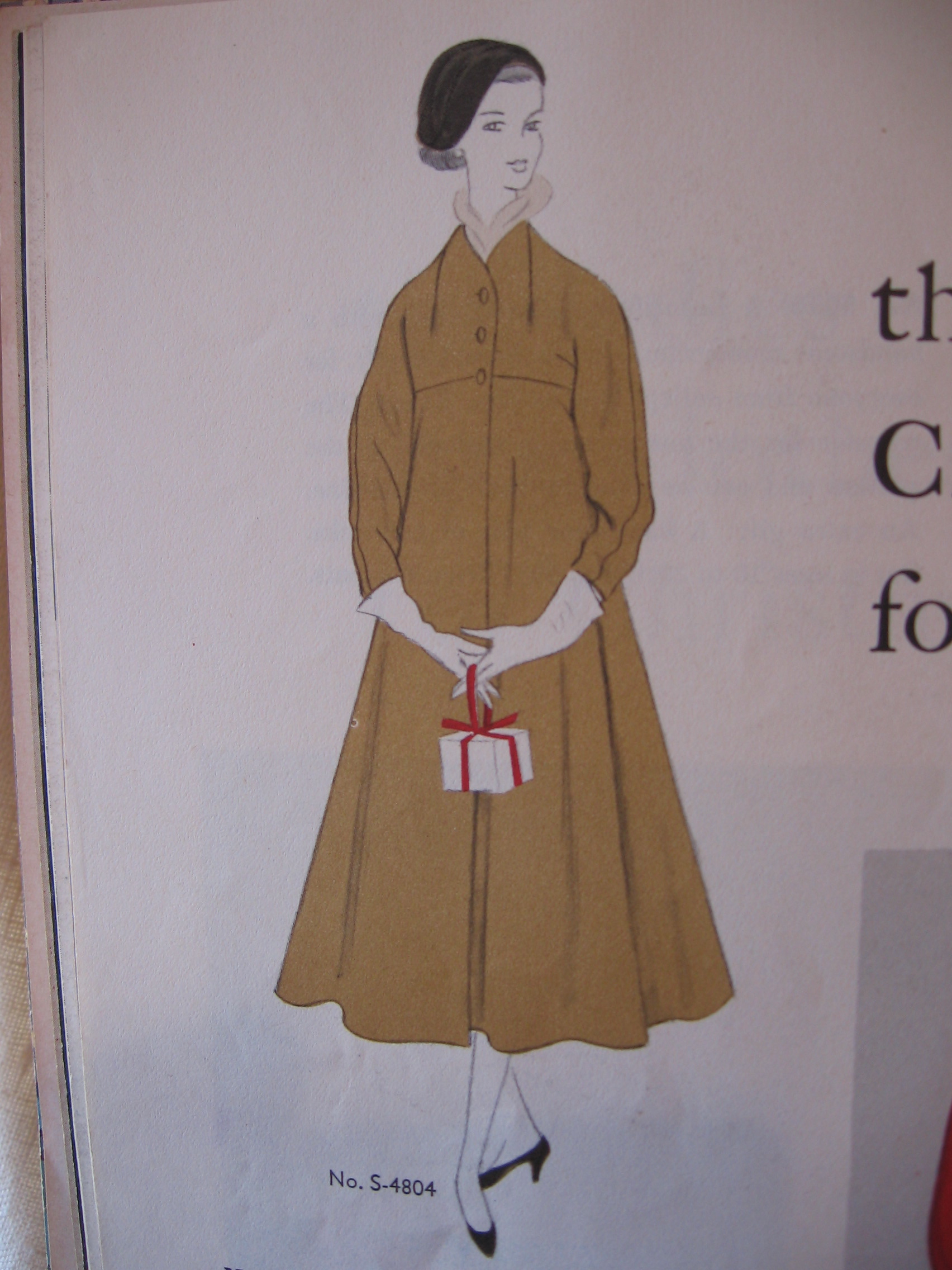
Here is my favorite suggestion, and I quote: "You might give this pattern and enough camel's hair wool to make this coat, to someone who loves to sew." The pattern was priced at $1.00

Here is another suggestion, next to a picture of its pattern envelope.

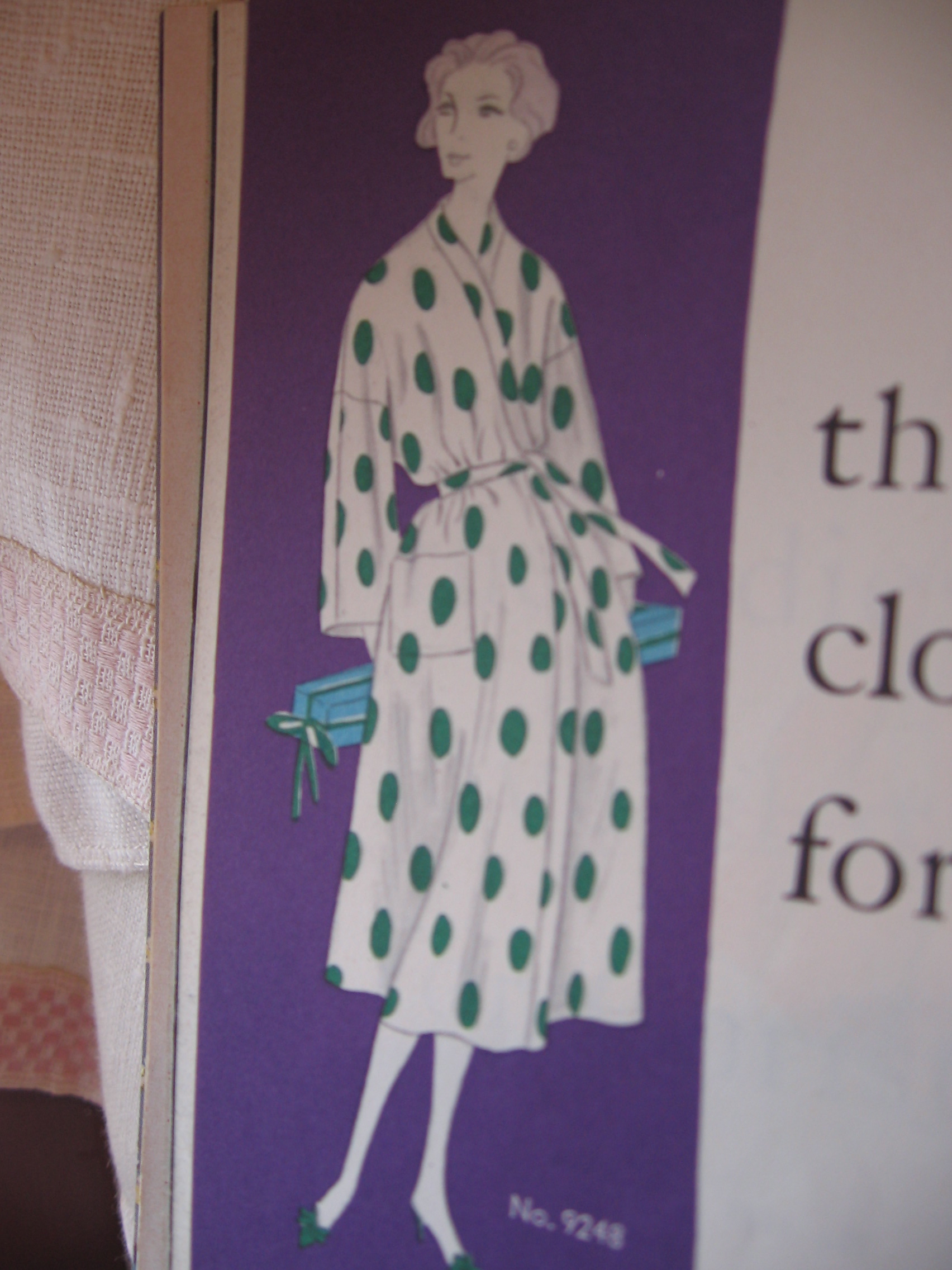
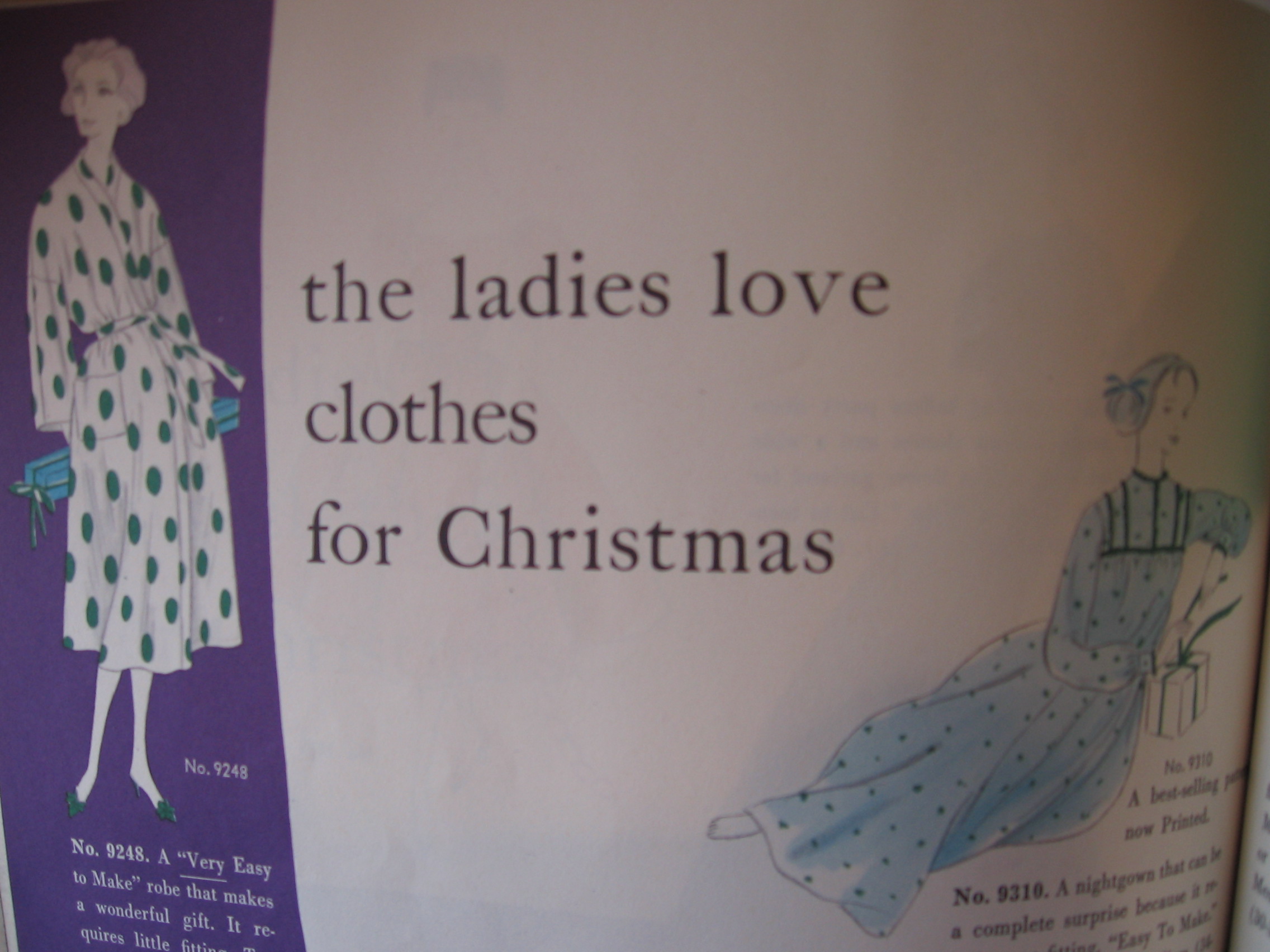
This robe is very easy to make! (I wonder what is in the long wrapped present she is holding behind her back? A rolling pin?)

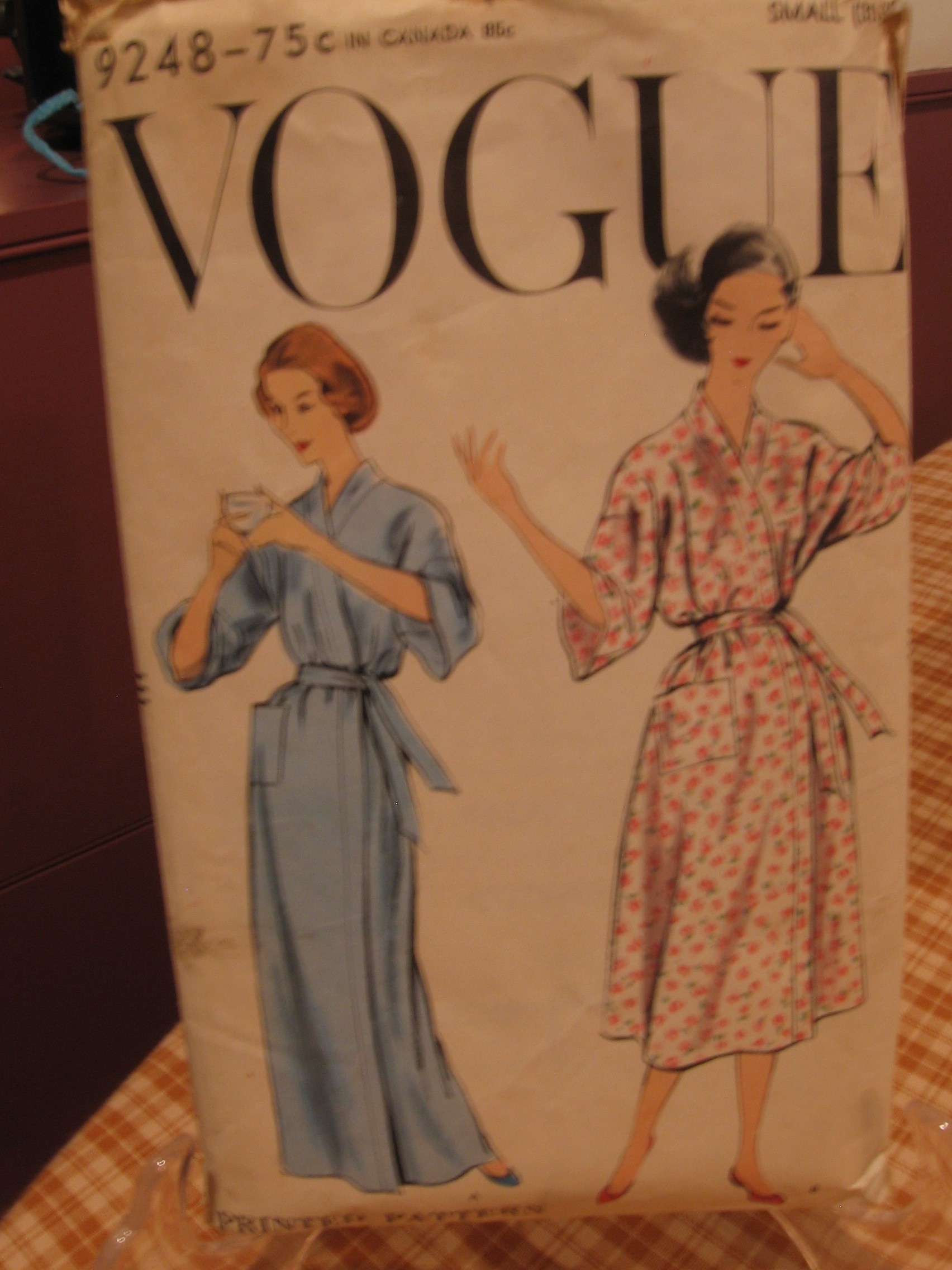
This pattern makes up beautifully into an elegant robe! It has additional pattern pieces and instructions for lining it, as well.


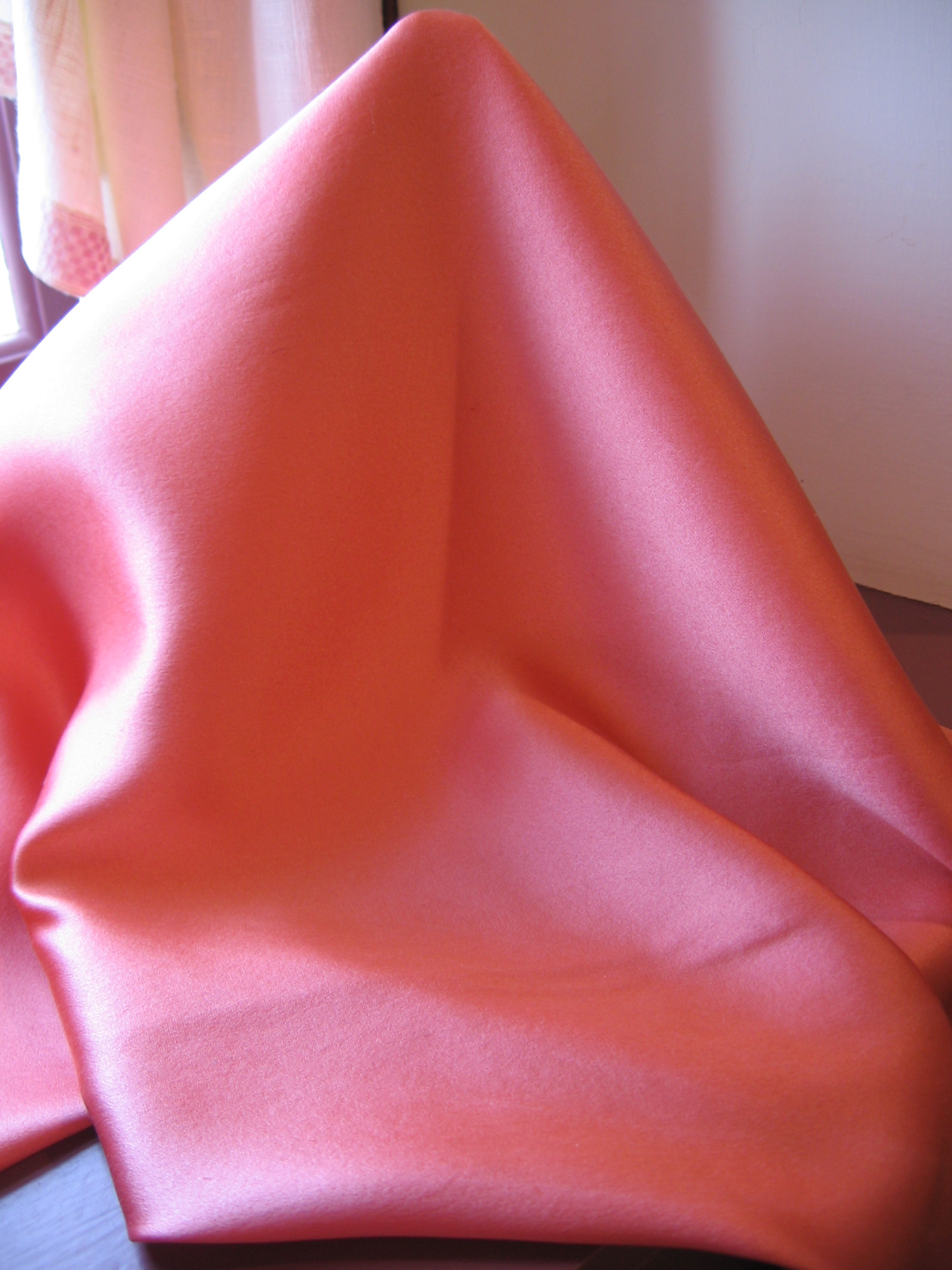
Yes, I purchased this pattern last Spring and have already made it up in the “lower calf” length.  Unfortunately, I did not take a photo of it before it went to its new owner, but here is a shot of a small bit of the silk charmeuse left over from this project.

This silk is really more orange-ish than it appears here. I washed and dried it before I cut it out, so that the finished garment would be washable - much more practical for a bathrobe!

The reason I am showing you this, is that last week, Pantone, the color guru of the fashion world, declared a color very close to this as its Color of the Year for 2012.    Specifically, that color is called Tangerine Tango and its number is 17-1463-TCX.

Personally, I have come to appreciate various shades of orange a lot more than I once did. I particularly like to see orange (or coral or tangerine or whatever name you want to give it) paired with hyacinth blue or leaf green or charcoal gray.  Although I am not one to feel like I need to be dressed in the current “fad” color, if I get the opportunity to use it in my sewing this coming year, I definitely will.

Well, I am digressing from my Christmas theme here, so back to the robe in bright green polka dots.

This statement says it all!

If I could ever find such a fabric in a lovely silk suitable for a bathrobe, I would buy it in a minute and make myself this robe in the long version!  For Christmas morning I’d pair it with a long and flowing red silk sash…

Here’s to a fashionable, fun Merry Christmas for each and all – and warm wishes for a colorful New Year!

3 Comments

Filed under Coats, Polka dots, The Conde Nast Publications, Uncategorized, Vogue patterns

Lessons from 1953

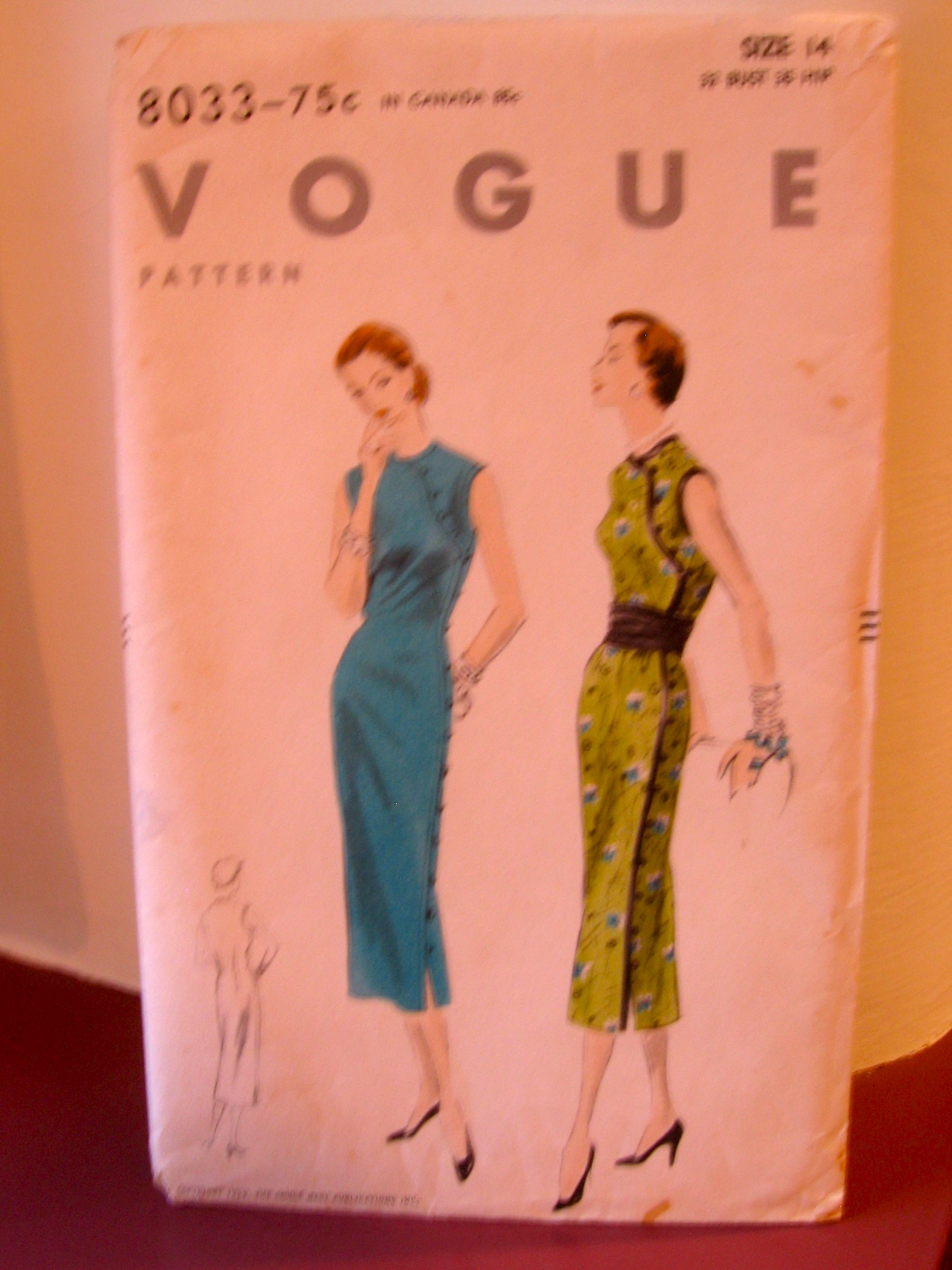
When I first discovered vintage Vogue patterns on eBay last Spring, I was delighted to find that most of the patterns from the 1950s were dated, usually with a line which stated, for example, Copyright 1956 The Conde Nast Publications, Inc..  It took me a couple of weeks to realize that I should also be looking for another important bit of information on the pattern cover: the words Printed Pattern.  I discovered this the hard way;  I purchased a pattern, dated 1953, that was not printed.

I've always liked Asian-inspired dress designs, and I thought this one from 1953 was so pretty. Do you see the size on this pattern? Yes - it's a 14! That's the size one wore in 1953 to fit a 32" bust and 35" hip.


I remember my mother mentioning how difficult unprinted patterns were to use – and I was about to find out why! The tissue pattern pieces were only marked with small holes of varying sizes;  to try to make sense of these markings, I had to look at the instruction layout sheets and translate if they were for a dart,  a stitching line, a pivot point, or some other detail.

These particular pattern pieces had never been used – and I must admit I felt a little guilty taking them from their envelope where they had quietly lived for so many years and pinning them onto my fabric, but pin I did.  I cut that baby out, marked that nebulous galaxy of pattern holes as best I could with chalk, and proceeded to sew, following the directions precisely.

The first thing I realized was that the bust darts were a little too high, but that was an easy fix (seam ripper and redrawing the dart lines).  These early patterns say that the dress should be fitted over the proper foundation garments.  (I don’t think they meant just comfy bra and cotton panties.) Anyone who has watched old movies or even Mad Men recognizes that mid-century look of the pointed and properly perched bosom! That’s one mid-century look I’ll forego.   So that was adjustment # 1.

I lowered the bust line by re-placing the darts.

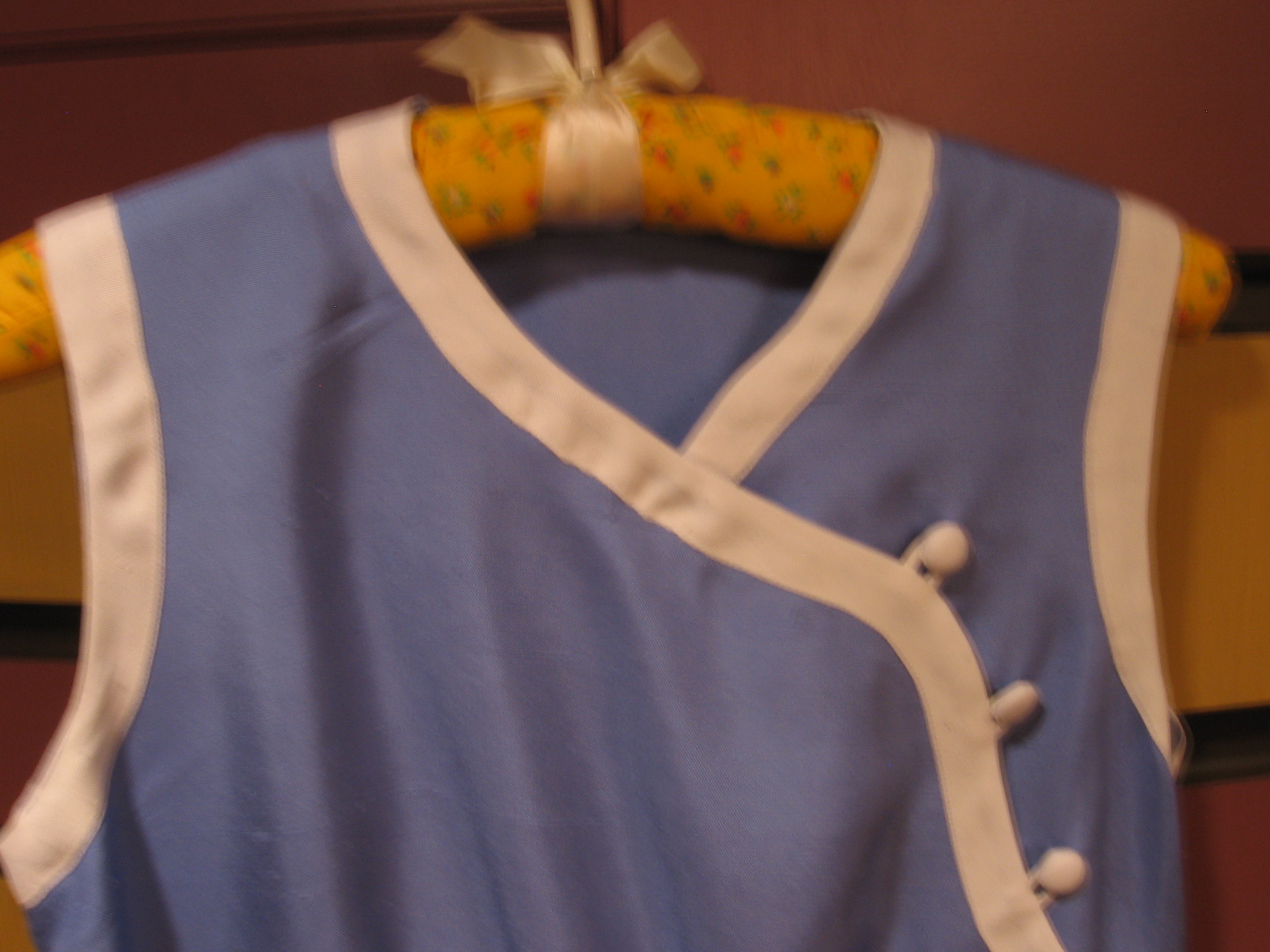
Next, do you see that band that runs the length of the dress?  The pattern pieces for that were shaped to match the curve of the neck and across the chest.  I thought to myself – now why not just use a bias piece of fabric, which I felt would take the curves better and be easier to topstitch without puckers.  But I followed the pattern exactly – and wouldn’t you know, I had exactly those problems topstitching the curved areas.  As if that were not bad enough, when I tried on the partially completed dress, the neck fit too high and tight, rumpling up the shoulders and it looked awful.

I was going to have to re-cut the neckline, to make it larger. In doing that, I knew the neck area of the band, as it was cut out, would no longer match the new neckline.  I was going to have to piece in another section.  This was not fun, and I was beginning to think this lovely blue dupioni silk was going to end up as a skirt instead of a dress.  But I went back to my original thought – and cut a bias piece to fill in that recut section.  It worked!  That was BIG (ver-r-r-ry BIG) adjustment # 2.

Here is the recut neckline. I was able to hide the pieced seam under the front flap.

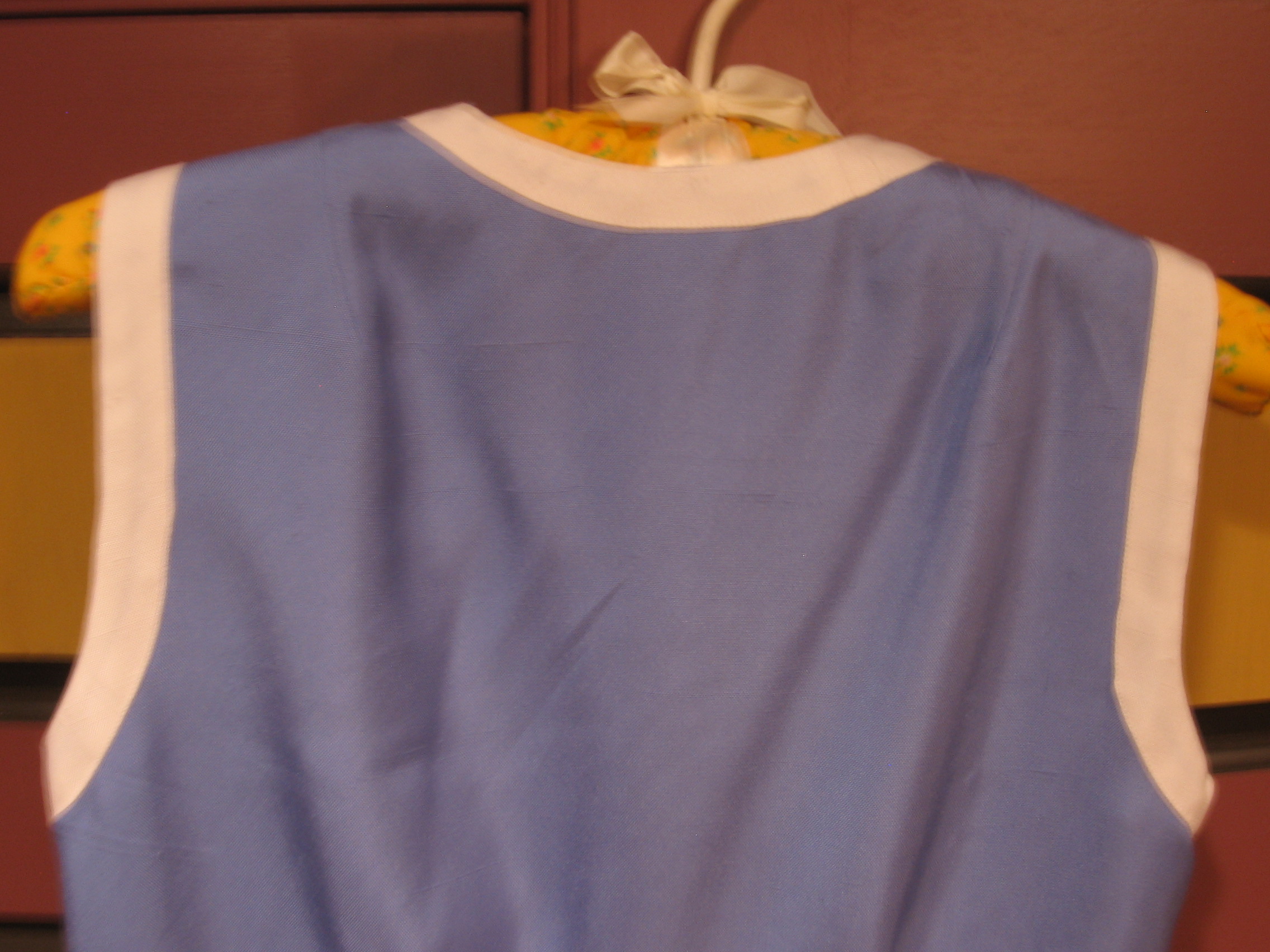
Here is the back of the neckline after I recut it.

Here is a close-up of the bodice and armhole band.

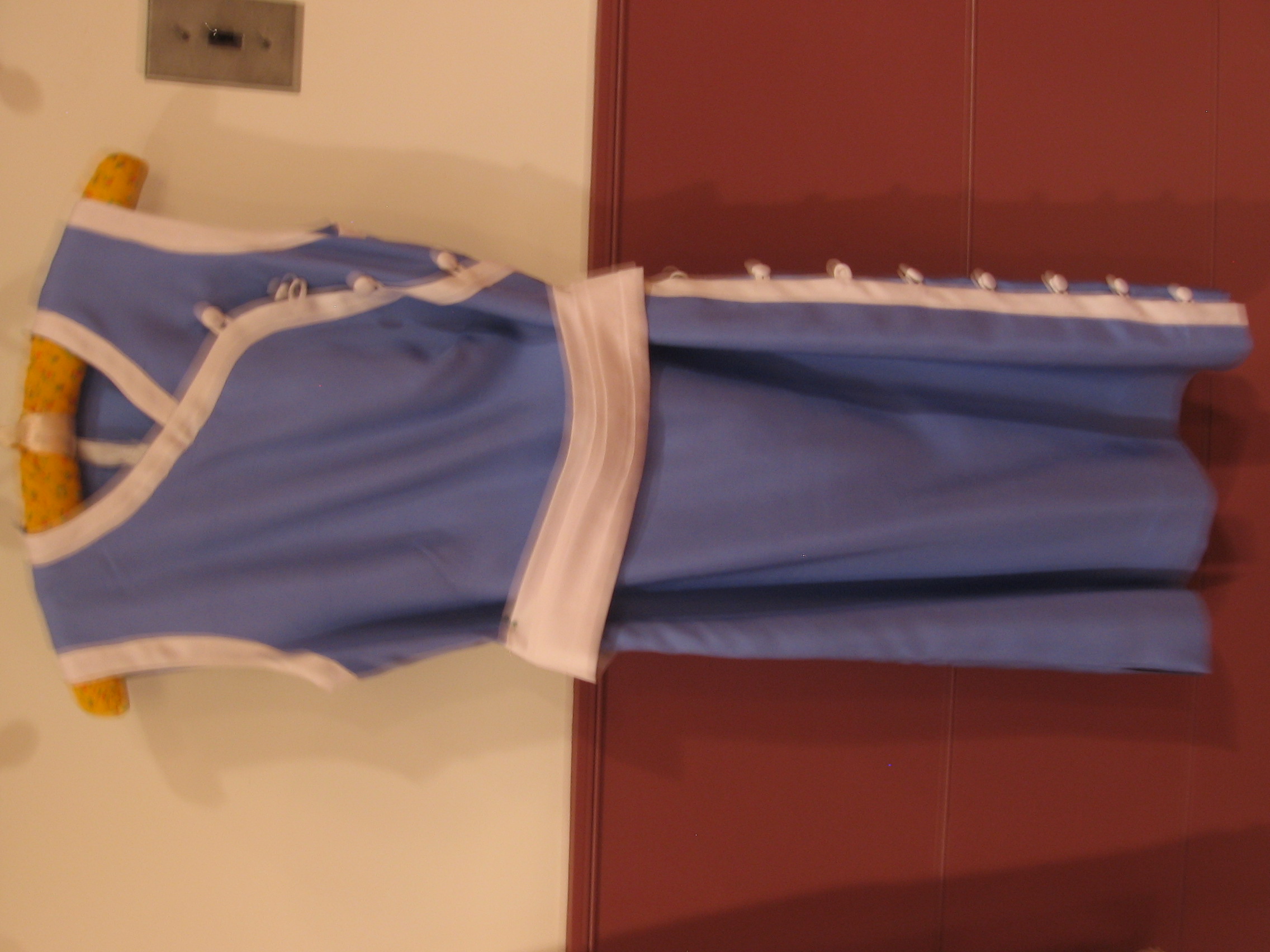
By now I was sick of this dress.  I still had buttons to cover and attach, armholes to do, interior snaps, the hem, and the cummerbund to complete.  Well, you can see from the photos that I did finish this dress, although it was late summer before I sewed the last stitch.

The completed dress. You can see I shortened the hem from mid-calf (as shown on the pattern envelope) to just below the knee.

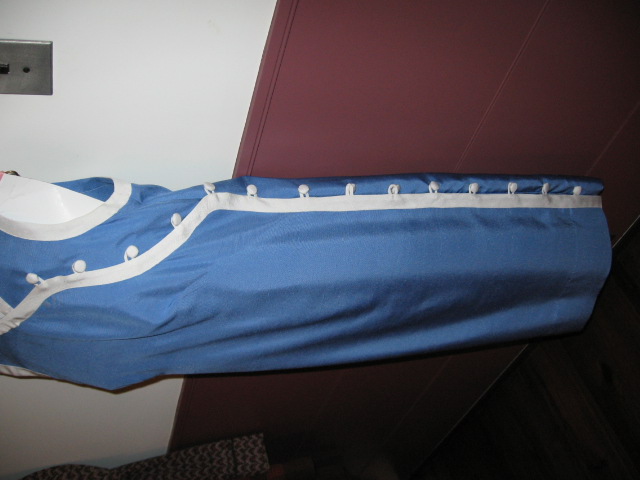
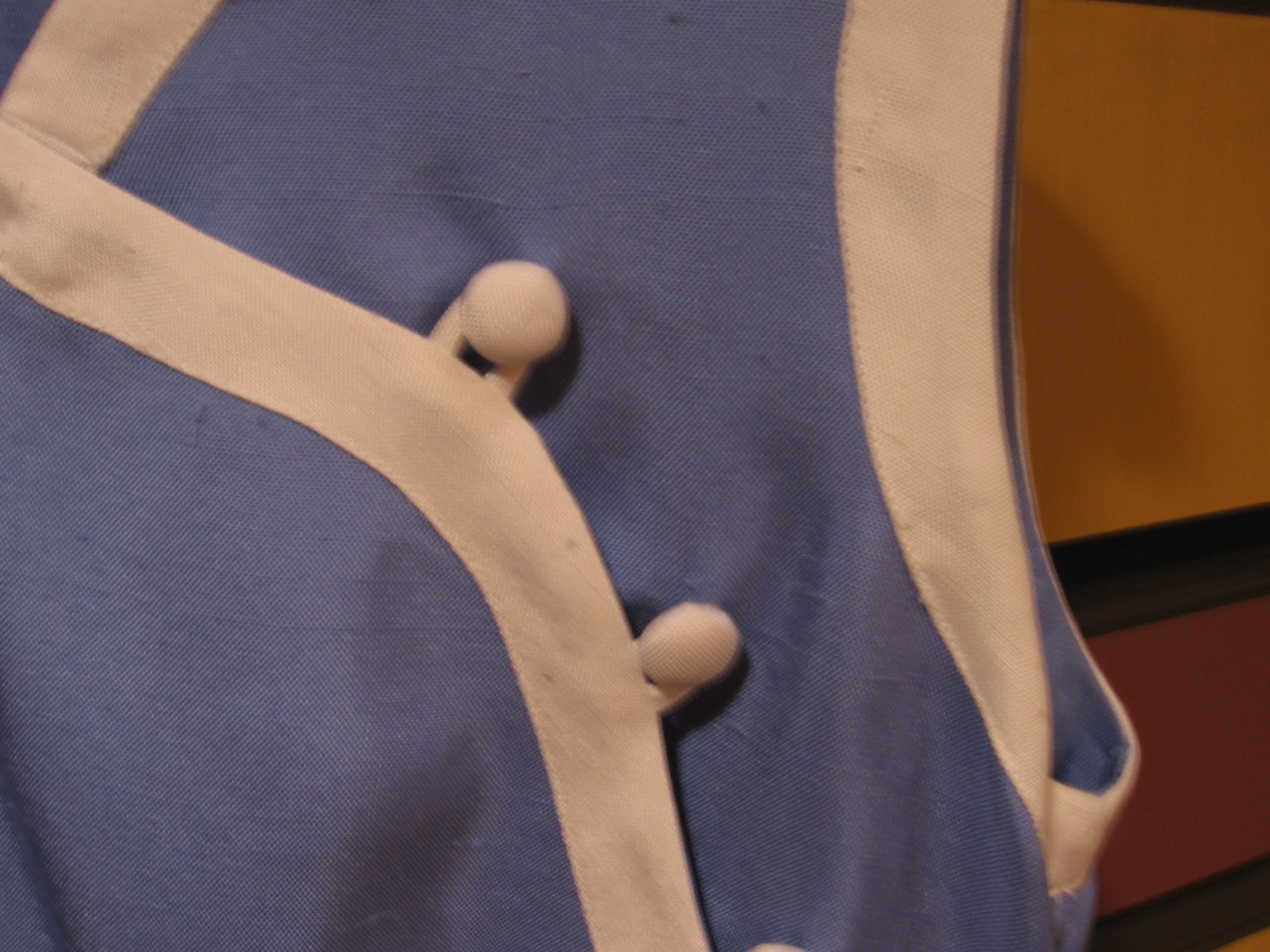
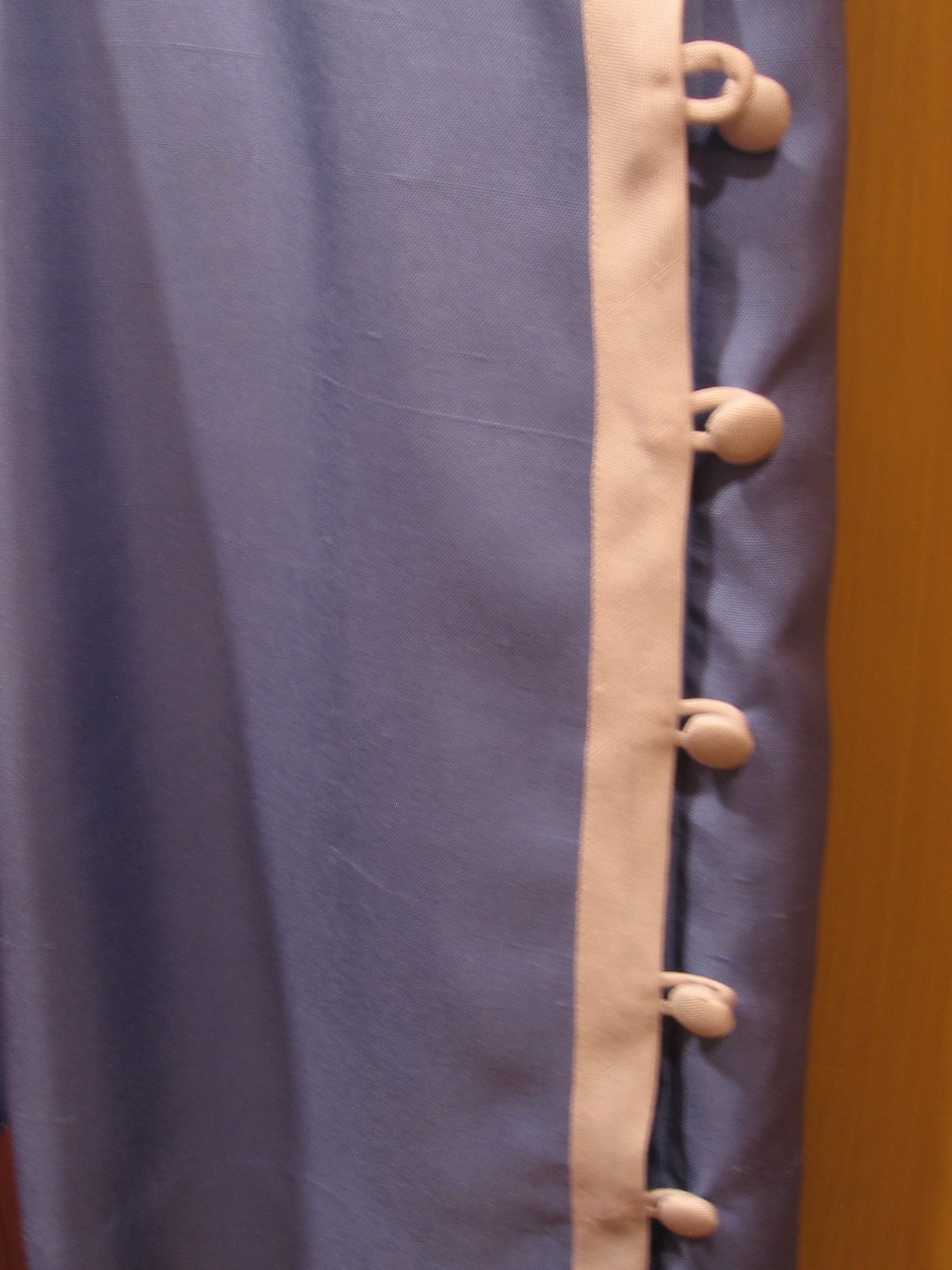
Here is a close-up of the covered buttons and button loops.

I’m still not completely happy with it, but it provided me with these valuable lessons:

1)   Stay away from unprinted patterns.

2)   Check the bustline placement before marking and sewing the darts.

3)   When in doubt, trust my instincts (I should have used all bias for that band and those armholes.)

4)   For best results, make the pattern up in muslin first.  If I had done this, I could have made the bust and neck adjustments before I cut the pattern out in the blue and white silk.

I had a chance to wear this dress during the warm September we had here in eastern Pennsylvania – and I am sure no one suspected I was wearing a dress designed in 1953!  Amazing!

3 Comments

Filed under Asian-inspired dress designs, The Conde Nast Publications, Uncategorized, Unprinted patterns from the 1950s, Vogue patterns