
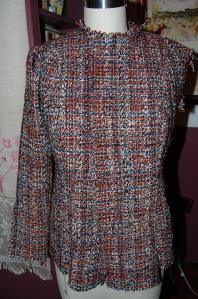
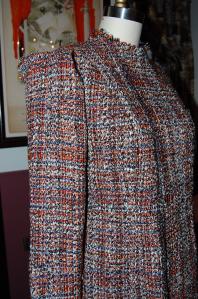
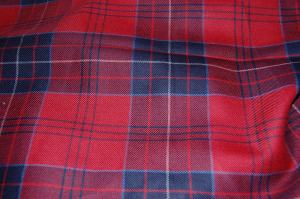
The almost-finished Classic French Jacket hanging on my dress form must be getting a bit impatient with me at this point. I switched gears and decided to give the Jacket (and me) a rest while I took on a “small” project. I had purchased this merino wool from Promenade Fabrics last Fall. It was a “remnant,” but one I knew would be ample enough for me to make a straight skirt.
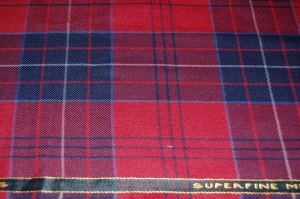
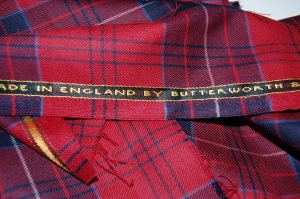
What better month to have a red and navy plaid wool skirt than February, with its heart-colored hues and chilly temperatures? And after the nubbiness of the French jacket boucle, I was ready for some soft, finely woven merino wool. What is it about merino wool that makes it so lovely? The description in Fairchild’s Dictionary reads: “High-quality wool yarn made from fleece of merino sheep, which has short, fine, strong, resilient fibers, and takes dyes well.” ((Page 326, The Fairchild Dictionary of Fashion, by Charlotte Mankey Calasibetta and Phyllis Tortora, Third Edition, New York, New York, 2010.) Made in England by Butterworth and Roberts, this fabric has all those attributes and more.
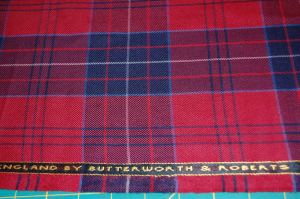
Plaids are always interesting to sew. Obviously the plaid has to be matched, but as important is determining the placement of the plaid, both on your body and on the pattern. Most plaids have a dominant color or block, and this is a good starting point. With this particular piece of wool, I wanted to emphasize the navy rather than the red (even though the red is dominant). I first thought the best way to do this was to place a navy block/stripe down the front middle of the skirt. I quickly discovered this actually emphasized the red instead of the navy. When I placed a red block/stripe in the center, the red receded, and I had the look I wanted.

I also wanted the reveal of the plaid on the front center of the skirt to match the reveal of the back center seam. This enabled navy to predominate the side seams of the skirt, framing the front and back. Perfect!
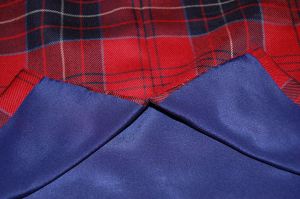
This shows the back vent folded back, but you can see the back seam is sewn so that the front center block and the back center block match.
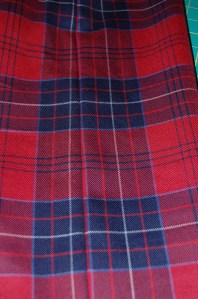
One of the side seams.
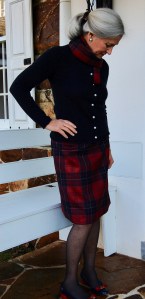
I used Susan Khalje’s straight skirt pattern which I had already used last Fall, and which needed no alterations in my existing muslin. (YAY!) While laying out the muslin pattern, I realized if I was careful, I would be able to save enough fabric to make a matching scarf. That would also mean that practically none of this beautiful wool would be unused.
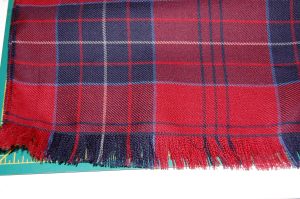
The scarf is 60″ long and 9″ wide. I fringed the short edges, to make a nice finish.
Here are a few tips I used for sewing this plaid skirt:
1) In sewing the seams together, in order to match the lines of the plaid exactly, I used my walking foot. This helped to keep everything perfectly lined up and eliminated slippage of the fabric as I sewed. (Forked pins are useful in this application, too, but I found the walking foot to be just about foolproof.)
2) Even though the front center of the skirt was easily discernable because of the placement of the plaid, I still marked that line with a running stitch. I find that helps to eliminate mistakes! That was the final bit of basting thread which I removed from the skirt when it was finished.
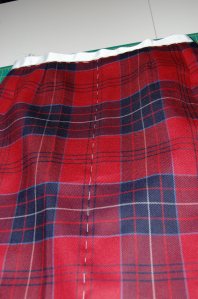
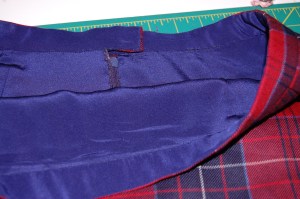
Here is that front center line, marked with a running stitch. You can also see the Petersham ribbon I used to stabilize the waistband.
3) I angled the back vent out about 1/4 inch on each side to help it hang straight while being worn.
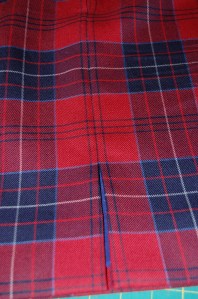
4) I faced the waistband with the lining silk, which makes it comfortable to wear.
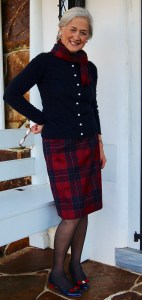
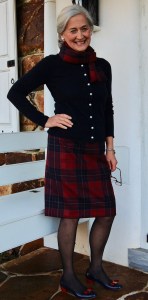
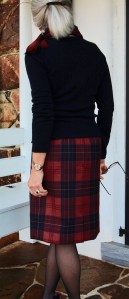
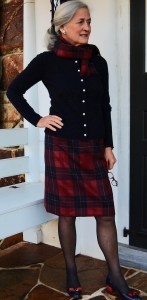
With much of Winter still to come, I suspect I will have numerous occasions to wear this wool skirt. And now I can get back to that French Jacket with at least one thing to show for the year so far!
 fiftydresses
Dior: From Paris to the World in Denver, Colorado: Review of the Exhibition, Part 1
Some opportunities in life just beg to be taken advantage of. Such was the case when I knew that Dior: From Paris to the World would be at the Denver Museum of Art from November, 2108 until March, 2019. Denver is a four-hour plane trip from my home on the East Coast of the United States, but, really, that did not deter me. My husband said he would join me on this expedition, and the icing on the cake was the fact that our son and his girlfriend, who live in California, would rendezvous with us in Denver to have a long weekend together.
Tickets to the Exhibition needed to be purchased in advance, as the Museum had timed entrance to view it.
I had read numerous professional reviews of the Exhibit before arriving in Denver, so I knew that the displays of the clothing did not have captions on them. Instead, attendees each received a “little black book” in which were listed the numbered captions and a replica of the storyboards on display throughout the Exhibit.
I loved this method of captioning. It allowed the clothing to appear uncluttered, reading the captions was easier than trying to share a small space with lots of other exhibition goers, and the little black book makes a wonderful reference to pair with the photos I took. (The only confusing aspect was that many of the fashions on display were not in numerical order, so I had to pay close attention to the numbers on the platforms as I read my little black book.) In addition, the Museum provided each attendee with an audio device, for intermittent descriptions and historical context throughout the Exhibit. Most of the designated audio stops in the Exhibit had not only an adult version, but also a “kids” version, which I thought was a brilliant idea.
The Exhibit was huge, incredibly comprehensive, and beautifully presented. It is not only a retrospective of the Fashion House founded and “grounded” by Christian Dior, it is also a visual history of some of the most important influences on modern, post-war fashion. It reminds us in no uncertain terms of the importance of Christian Dior himself in shaping our current interest and fascination with the world of haute couture – and for those of us who sew – the world of couture dressmaking and sewing.
In this Part I of my review, I will limit myself to the Artistic Directors/Fashion Designers – and their body of work – who have led the House from its beginning in 1947 up until the current day.
It was exactly 72 years ago today, February 12, 1947, when Christian Dior presented his first collection. Although he named the two lines of his collection Corolle (Flower) and En8 (Figure 8), the editor of Harper’s Bazaar, Carmel Snow, immediately gave a new name to this ground-breaking style, calling it the “New Look,” a designation which endures today. Of course, the most recognizable of this New Look is the Bar suit.
Other dresses from the reign of Dior himself include the following:
Wool afternoon dress, Fall-Winter, 1948.
Wool suit with high windbreaker collar, Fall-Winter 1949. I find this a rather remarkable look for 1949.
Taffeta evening dress, Fall-Winter 1952. Dior was known for punctuating his shows with a vibrant red dress at the halfway point.
Satin dress with Chinese motif, Fall-Winter 1956.
Short brocaded silk evening dress, Fall-Winter 1957. This was so gorgeous!
Here is a side view of the same dress.
After Dior’s untimely death of a heart attack in 1957, the House was led by Yves Saint Laurent, who had been 19 when Christian Dior hired him as an assistant in 1955. Only 21 at this pivotal time for the fashion house, Saint Laurent boldly presented a departure in silhouette in his first collection in 1958. The Trapeze – or Triangle – collection was welcomed by fashionable women, and Saint Laurent was embraced as fashion’s new hero despite his young age.
Short evening dress with bobble fringe trim, Fall-Winter 1960.
Wool ensemble, Fall-Winter 1960. Notice the large pompom buttons.
This side view shows the size of the pompoms. This was really a fantastic look.
Short evening dress embellished with satin bows, part of Saint Laurent’s Trapeze line, Spring-Summer 1958.
By 1960, Saint Laurent veered again, presenting his “Beatnik” look, which was too radical at the time to be widely accepted. He left the House of Dior that year and was succeeded by Marc Bohan in 1961.
Bohan had the longest tenure as Creative Director for the House of Dior, leading the firm from 1961-1989. His first collection emphasized slim youthfulness, but with a classic nod to the founder of the House. Elegance, beautiful fabrics, embroidery, restrained but noteworthy color, and exacting fit were his hallmarks.
This image is from a looping video in the Bohan section of the Exhibit. Classic coats with coordinating dresses is what I think of during the 1960s, and Bohan was a master of such.
And here the models show the dresses beneath the coats.
Long printed faille evening dress, Fall-Winter 1971. The placement of the stripes is so well executed, leaving the top of the shoulders in black.
And here is Bohan’s sketch of a similar dress.
The supporting documentary materials in the Exhibit gave another layer of interest to it.
In 1989, the Italian designer Gianfranco Ferre became the Artistic Director of the House of Dior. After a rise in ready-to-wear in the world of fashion, Ferre was part of the revived interest in haute couture, and his designs are rich in color, ornamentation, and volume. He stayed at the House until 1996.
Wool ensemble, Fall-Winter 1989. Doesn’t this look like the 1980s?
Long embroidered quilted lame dress and taffeta coat, Fall-Winter 1992.
Long printed organza satin dress, Spring-Summer 1995. The fabric in this dress is absolutely exquisite.
Printed chiffon dress embroidered with grass stalks, Spring-Summer, 1996.
John Galliano took over the helm in 1997. Although still steeped in the precision and excellence of haute couture, Galliano became known for flamboyance, foreign influences in his designs, and his own rock-star status. And oops! I am lacking photos of examples of Galliano’s work. Never a fan, I read about every one of his works on display, but failed to concentrate on photos.
After the sometimes rocky tenure of Galliano, Raf Simons was a breath of fresh air. He became Artistic Director in 2012, and although known for his minimalism, he followed the heritage of the House of Dior. His designs showed a new romanticism, a love of color, and the influence of some of the world’s best modern art.
Three-quarter length duchess satin evening gown, Fall-Winter 2012.
Two-piece dress, Spring-Summer 2015.
And here is Simon’s notebook, detailing this dress.
Wool tuxedo jacket and wool cigarette pants, Fall-Winter 2012.
After Simons tenure ended in 2015, the House selected its first female Artistic Director. Maria Grazia Chiuri arrived in 2016. She is a great student of Christian Dior and her designs are freshly reminiscent of his. She features flowers, excellence in construction, with an occasional nod also to the modernist artists of the 20th century.
Wool crepe skirt suit, Fall-Winter 2017. More red – I love it.
Tulle ball gown, embroidered with poppies, Spring- Summer 2017.
Are you exhausted yet? There is still so much more to come, but that will be in Part II. And – I have some sewing that needs attention, too. Imagine that! To be continued, both the Exhibit and my sewing.
28 Comments
Filed under Christian Dior, Fashion commentary, Fashion Exhibits, Fashion history, Uncategorized
Tagged as Christian Dior, Fashion Exhibits, vintage fashion