Category Archives: Loops for buttons

Going Around in Circles

When I purchased this sateen, jacquard-woven fabric from Mendel Goldberg a couple of years ago, I wasn’t sure what it would eventually become.  It had a wide repeat to the design (which is something to consider when you know you are facing considerable matching of the design), but it was a lovely 60” wide.  I bought just 2 yards (it was expensive) and hoped I would have enough fabric to finagle something.  

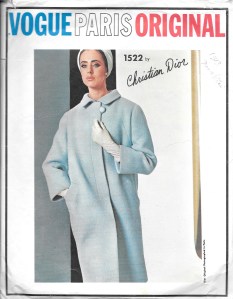
First I thought I would make a midi-skirt to wear with a pretty silk blouse or something.  I even got so far as to make a muslin for a longish skirt, but it just wasn’t going to work.  I didn’t have enough fabric to match the design and create the skirt I wanted.   The next task would be to find a dress pattern which would work.  I kind of viewed this fabric as a good Fall and Spring transition weight, so I wanted sleeves.  And I wanted a pattern which would show off the circle design to its best effect.  One of the patterns in my collection which I have seemed to dwell on frequently is this one:

This pattern is quite interesting. It looks very simple, but in fact, it has a considerable amount of engineering to it and some very nice details.

I like the styling of both the dress and the coat.  I thought I’d take a stab at eyeballing the pattern on my fabric, to see if it might work.  Well, it was going to be a squeaker, but I thought I could manage to get the dress out of the yardage I had – and match all those circles and dots as much as possible. 

One thing I had to consider was the placement of the large dots and the smaller dots on my body.  Working with dots can be a little tricky – you certainly don’t want prominent dots on top of each bust apex, for example, and a row of large dots around the waist might not be all that flattering.  I thought the row of the largest dots would be best as an anchor at the hemline.  That would place the wide band of smaller dots just over the waistline and somewhat below.  This configuration would place one medium size dot over one bust, but I was okay with that since the dot on the other side was off to the side, and therefore not symmetrical.  I also liked the repeat row of largest dots across the upper chest where they were not too obvious.  And – the sleeves followed the line of varying size dots in a pleasing manner, I thought.  It turned out, I had just enough fabric to get things lined up properly – except for the front facing.  No way could I match that to the front of the dress.  

Now, obviously the facing does not show on the right side of the dress.  Still, I like to match across seams if possible.  Which it wasn’t.  I had to give myself permission to have a mismatched facing, and then I moved on.  (I forgot to take a picture of the facing, unfortunately.)  

A word or two about the fabric before I go on.  According to Fairchild’s Dictionary of Fashion, (Third edition, by Charlotte Mankey Calasibetta and Phyllis Tortora, Fairchild Publications, Inc., New York, New York, c2003, page 395) sateen is a “smooth glossy cotton fabric made in the sateen weave with floating crosswise yarns on the right side, giving a lustrous finish.”  This fabric is a combination of cotton sateen, with circles created by a damask weave on a jacquard loom.  It makes for a striking fabric.  And I think the fact it is done in navy blue makes the contrast more definitive.    Christian Dior was a fan of navy blue, calling it “the only one [color] which can ever compete with black, it has all the same qualities.”  (The Little Dictionary of Fashion, Abrams, N.Y., 2007, page 14).  It is a wonderfully versatile color.  

I made a few changes to the pattern.  I cut the neckline a little wider, I shortened the sleeves by a couple of inches, and the big change was I lined the dress in a lovely silk batiste I purchased at Farmhouse Fabrics. (The pattern did not have instructions or pattern pieces for a lining.)   The pleat in the front of the dress was a bit tricky to line, but I figured it out after quite a bit of thought.  By the way, I underlined the dress with silk organza. 

I could only envision gold buttons with this fabric. I’m not sure these are the right buttons, but they will do until I find something better.

The irregularity of the circles precluded exact matching within the “panels” but I rather like the whimsical effect this creates.

The split cuff with its button is one of the nice details of this pattern.

One more thing about the pattern and the dress.  With the pleat in the front of the dress which extends to the hem, it gives the appearance of a coat dress. However, it is not.  Again Fairchild’s gives us a precise definition of a coat dress: “Dress fastened down front from neck to hem, like a coat, in single- or double-breasted style, either belted or unbelted.  A classic since the 1930s.”  ibid., page 84.  Someday I’ll make a coatdress, but this was not it.

The pleat begins below the closure, extending to the hem, giving the dress a nice sway to it.

As I mentioned in an earlier post, I made this dress to wear on my Paris trip, but alas, I never had the opportunity to do so.  I feel certain it will eventually get its debut, but not in Paris!  

26 Comments

Filed under Buttons - choosing the right ones, Christian Dior, Fashion commentary, Loops for buttons, Mid-Century style, Polka dots, Sateen, Uncategorized, underlinings, vintage Vogue patterns from the 1960s, Vogue patterns

Completion – How Sweet It Is. 

It has been a slow start to the new sewing year of 2023.  Although I had anticipated the completion of my first project – this black jacket – to be a speedy endeavor, I anticipated incorrectly!  (Has anyone ever said fashion sewing can be very humbling?)

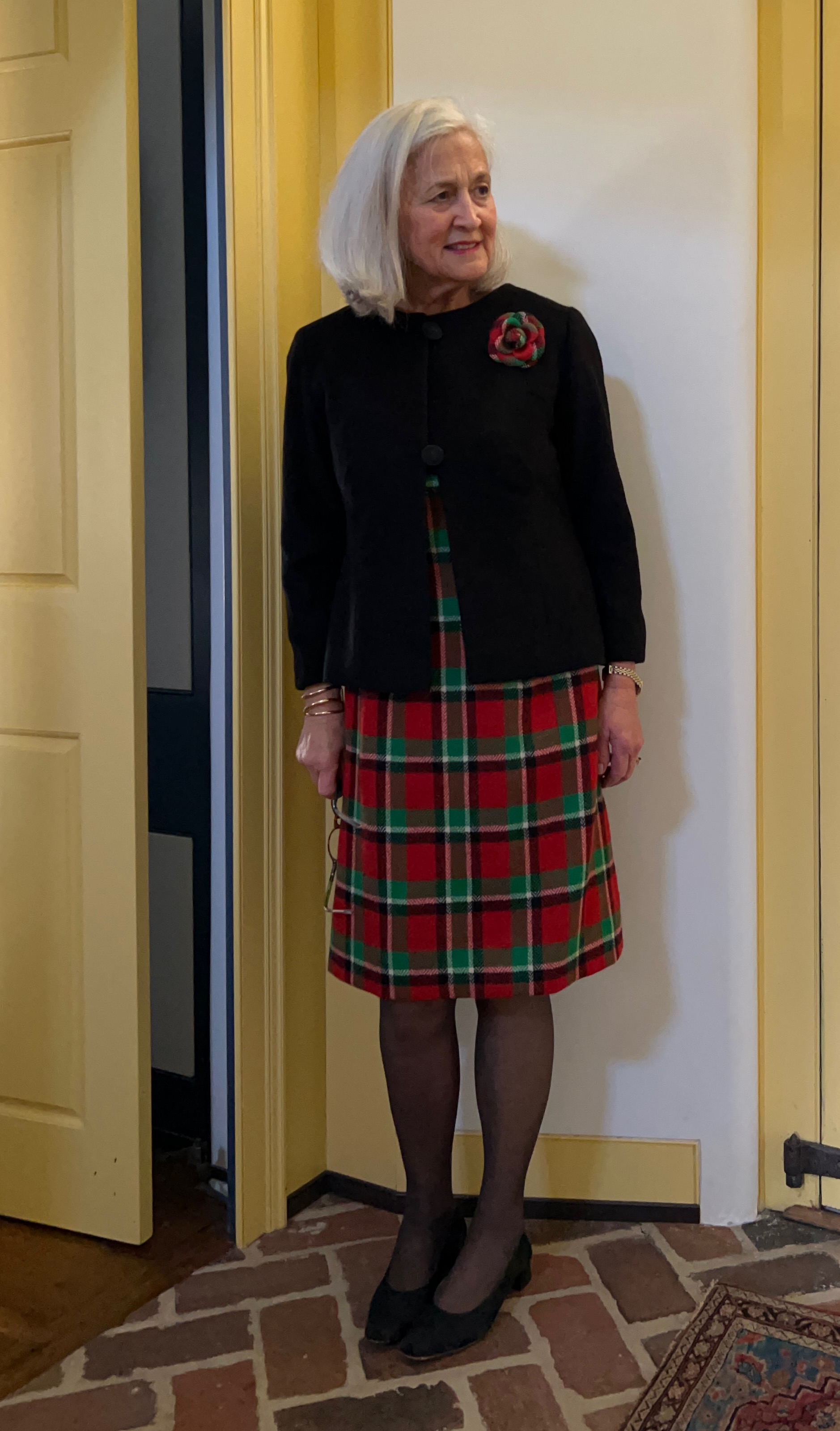
I was making this jacket to go specifically with a wool sheath dress I made two years ago – and also, hopefully, to pair with other dresses or skirts which might benefit from the addition of a somewhat dressy black jacket.  I had the pattern, and I had the fabric, a very soft light-weight cashmere (which I found a number of months ago at Farmhouse Fabrics.) 

I chose this jacket pattern primarily for its “split” center opening which would work well with the unusual center stripe woven into the wool to balance its uneven plaid.

I first needed to make a fitting muslin (toile) and I needed to determine what changes I would make to the original pattern.  That ended up being three items:

  • I changed the neckline to match the neckline of the sheath dress.
  • I added a dart to the top of each sleeve, using that method as a substitute for the running stitches normally used to facilitate the insertion of the sleeve into the armscye. I have used this alteration frequently as it seems to fit my shoulder anatomy well.
  • I shortened the sleeves from full-length to 7/8 length.  I did this as I enjoy wearing bracelets, thus giving them a little “breathing room.”  

Before I started making this jacket, I had the perception I would need to tie the sheath dress and the black jacket together in some way.  Without a shared element, I wasn’t so sure they would necessarily look like they were made for each other.  The only problem was, I had very little yardage remaining from the sheath dress, as I had made it from a limited piece of vintage wool.  What to do?  
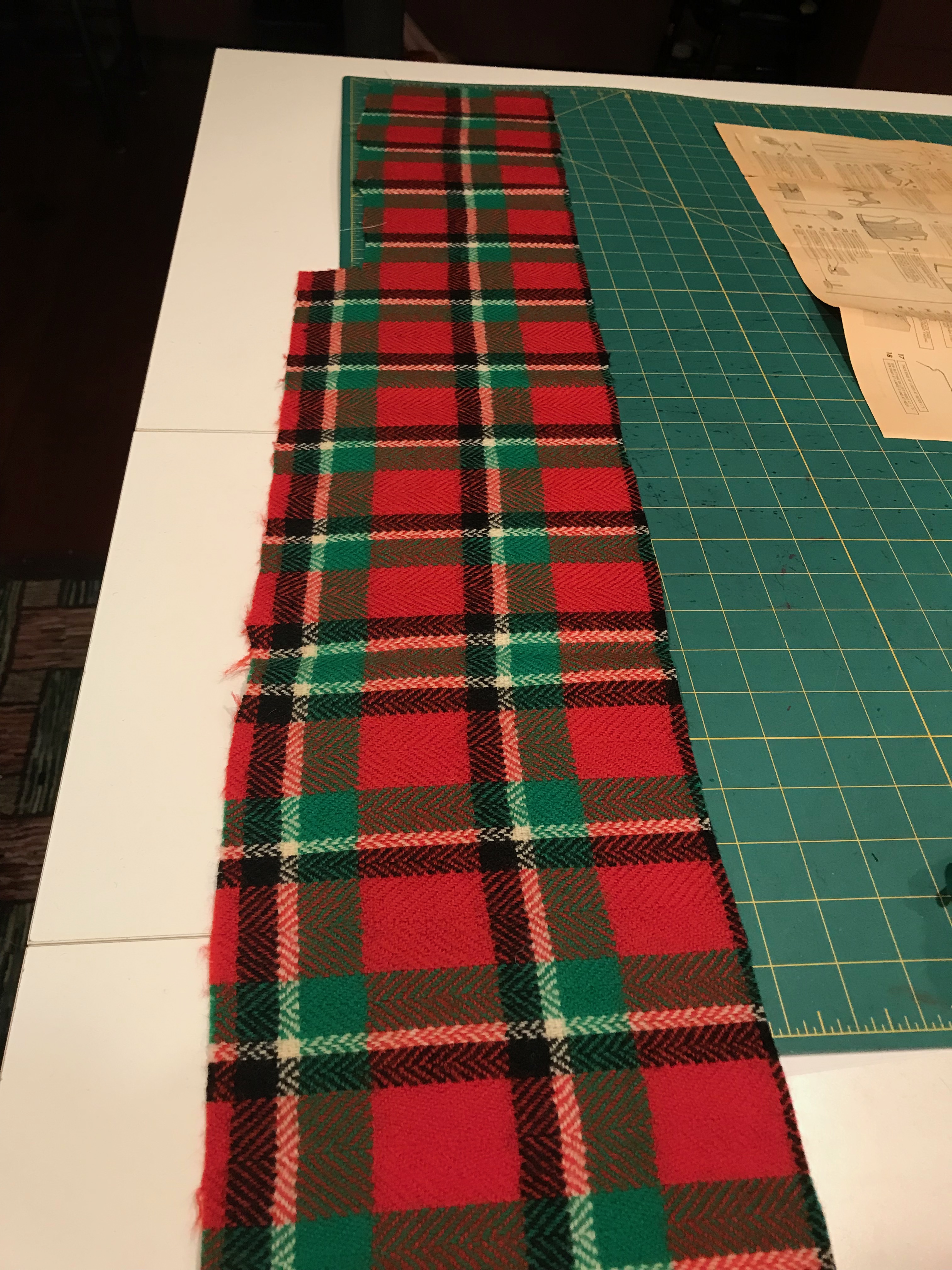
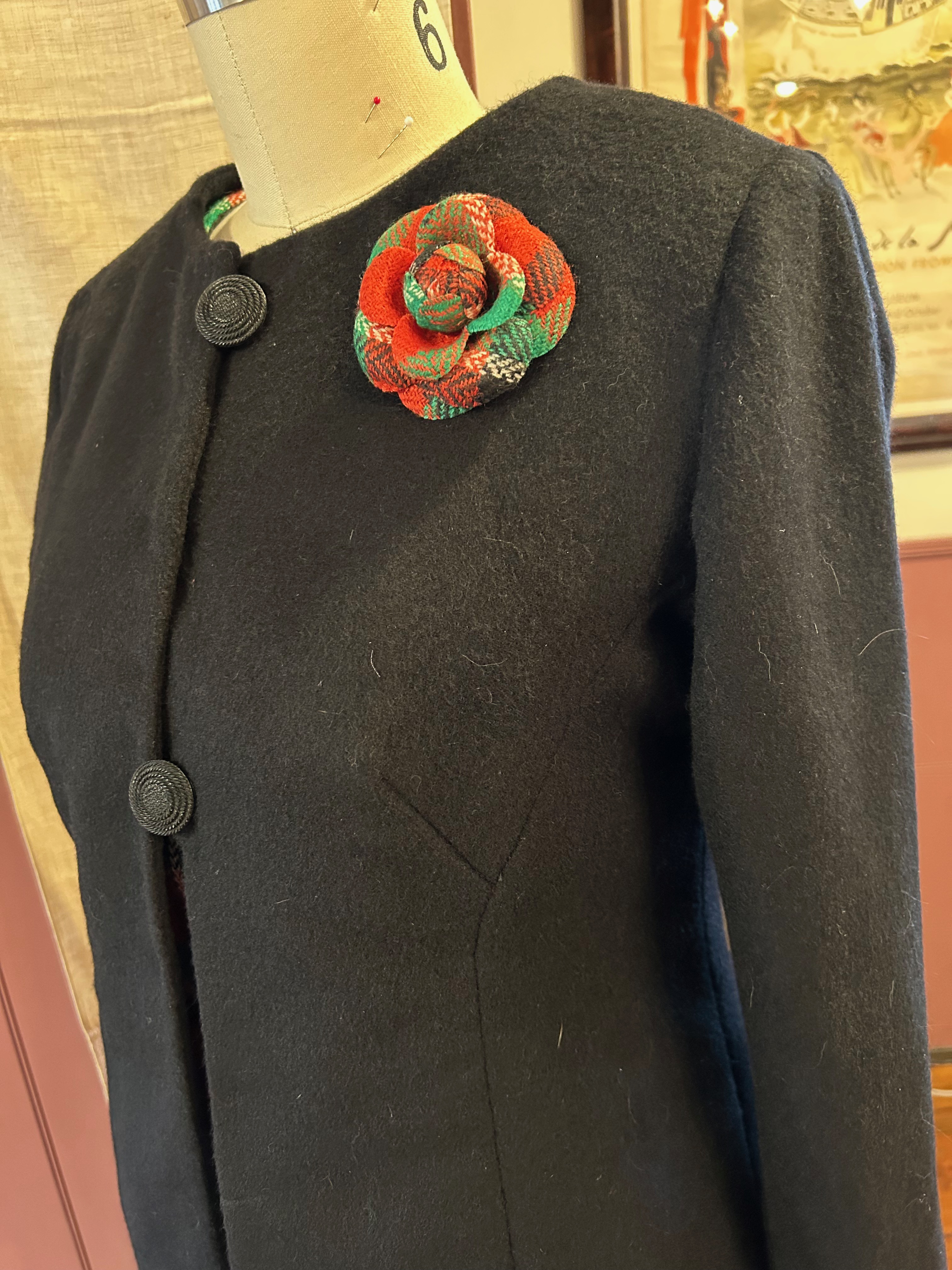
Covered buttons would limit my ability to wear the jacket with other pieces, and besides, I thought they would look stark as the only two small embellishments on a very black jacket.  I did not have enough fabric left, even for a small neck scarf, so that idea never had a chance.  I’m not sure when it came to me, but in a eureka moment, I thought a fabric flower made from the vintage plaid would be just the thing to make this outfit work.  

I knew M & S Schmalberg Custom Fabric Flowers in New York City would be my best bet (or only bet) for having a matching flower made.  I wasn’t sure I had enough fabric even for that, but I contacted them, sent pictures and measurements of my scrap of wool, and they made it work!  

I chose a 3” camellia option for my flower.  Look what they did!

A few other details for the construction of the jacket: (1) I under-stitched the facing to control the front edges and neckline of the jacket.

(2) I used a black crepe de chine lining (and lots of extra light when I was sewing it in!) I should mention that I underlined the jacket with silk organza.
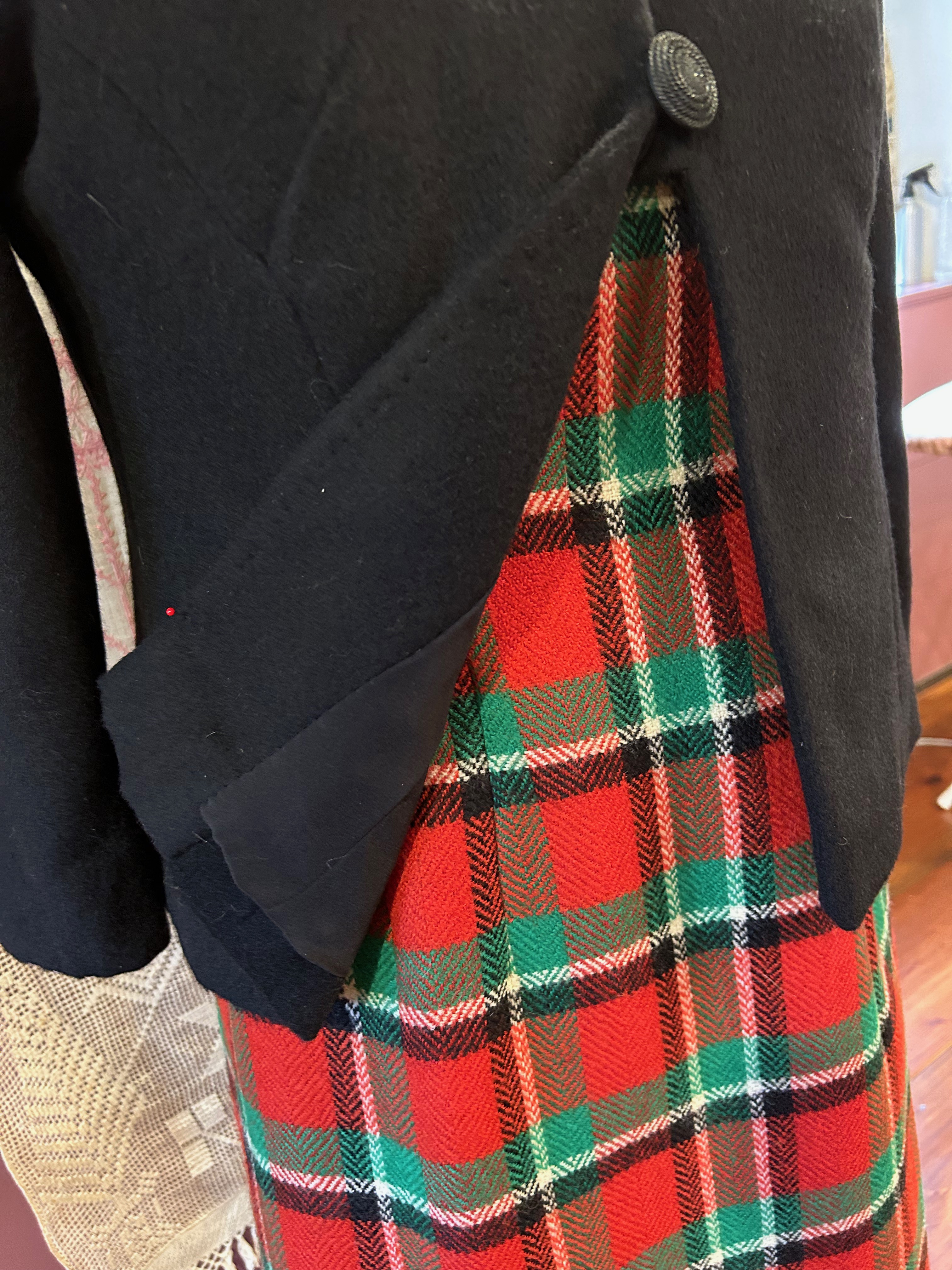
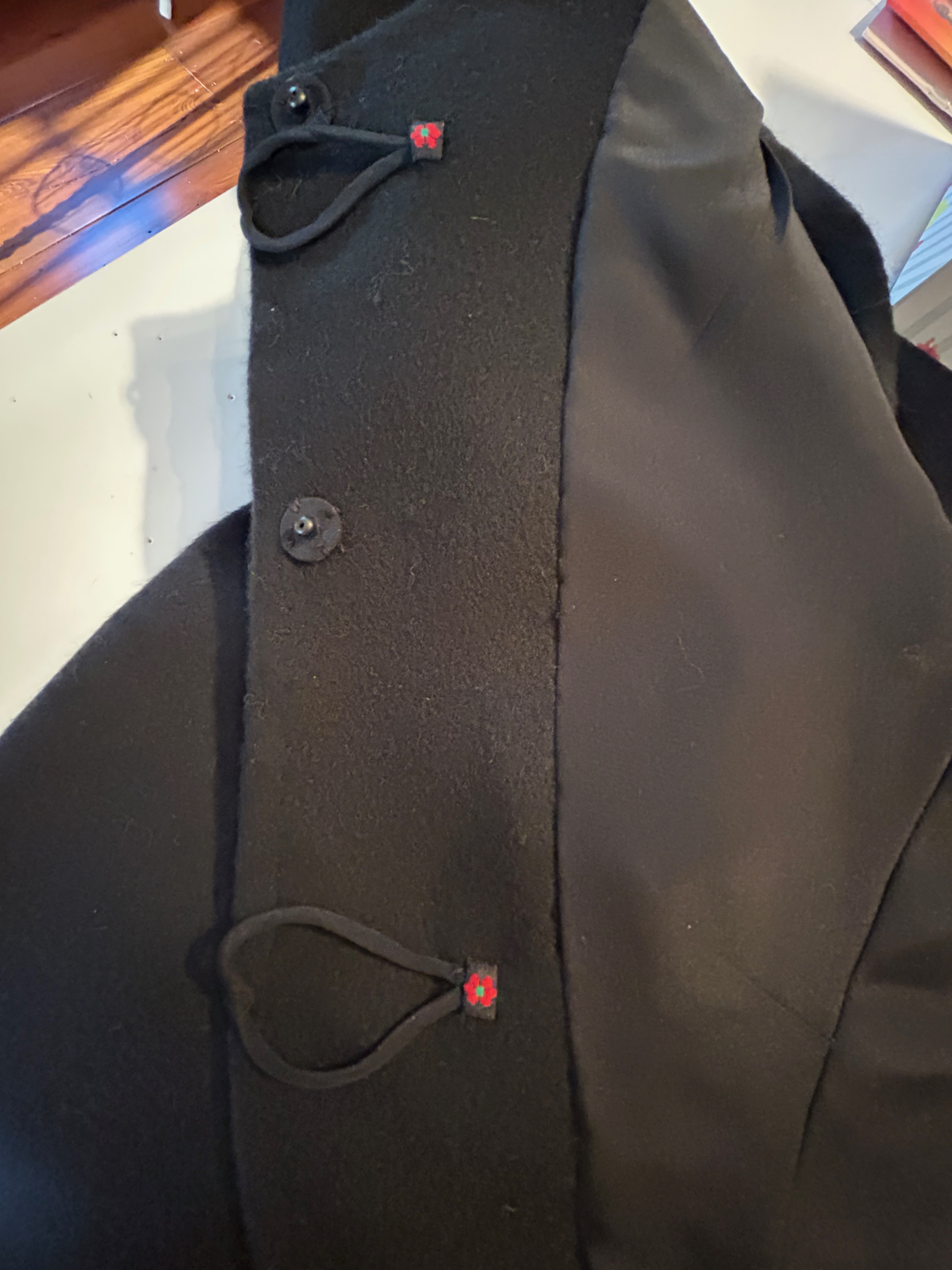
(3) The only bit of whimsy I added to the interior was to cover up the ends of the loops for the two buttons with two small jacquard ribbon pieces appliqued on.  No one will ever see these except for me, but I like them.

This is definitely a “dressmaker detail!”

(4) I covered the required snaps with the lining fabric.

I am so happy to have this jacket completed.  Most of my projects seem to take longer than they should, but that makes completing one just that much sweeter.  

.  
59 Comments

Filed under couture construction, Dressmaker details, Jackets, dressy, Loops for buttons, Mid-Century style, Uncategorized, vintage Vogue patterns from the 1960s, Vogue patterns, woolens

A Blue, White and Pink Tunic Top

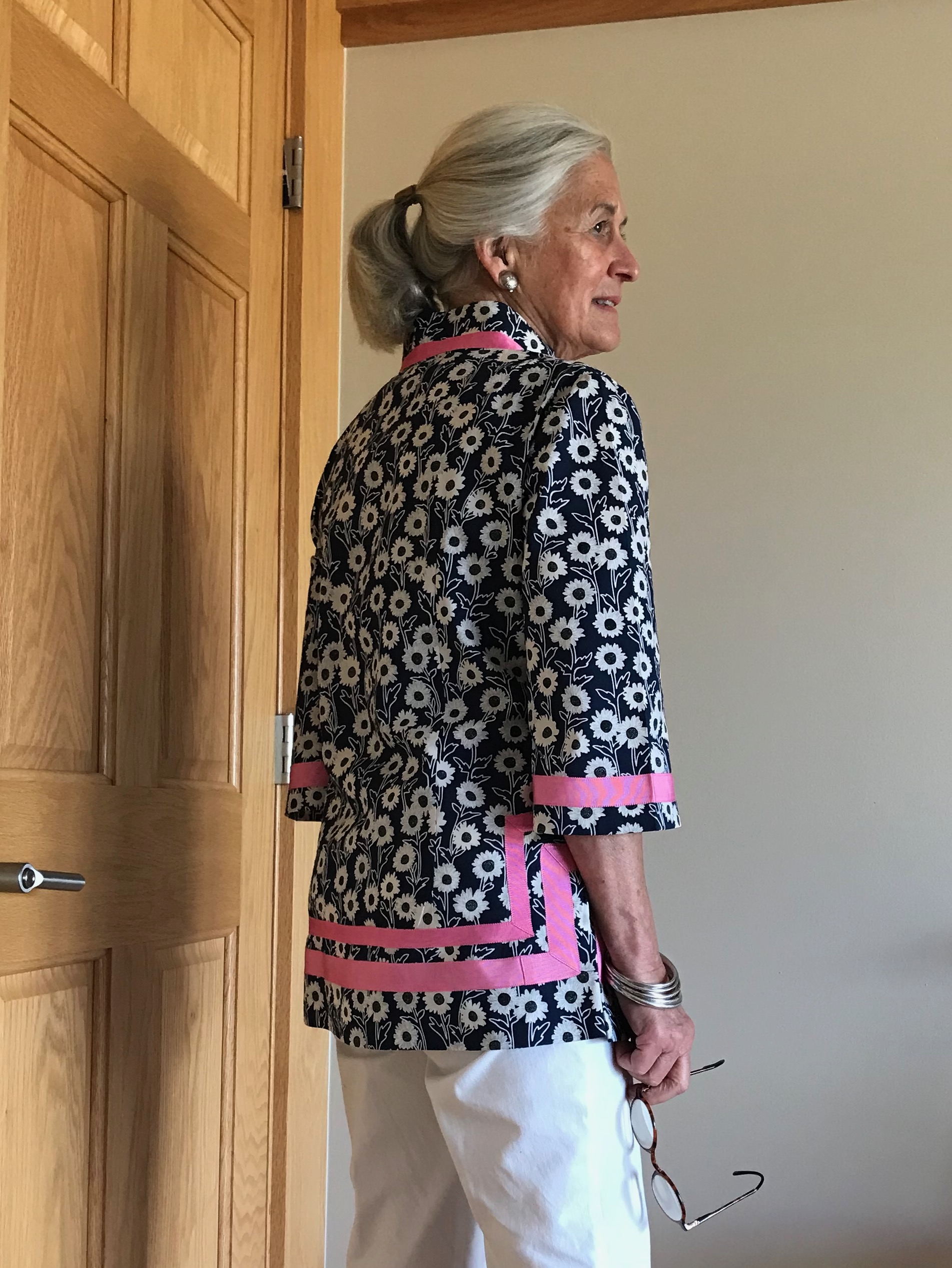
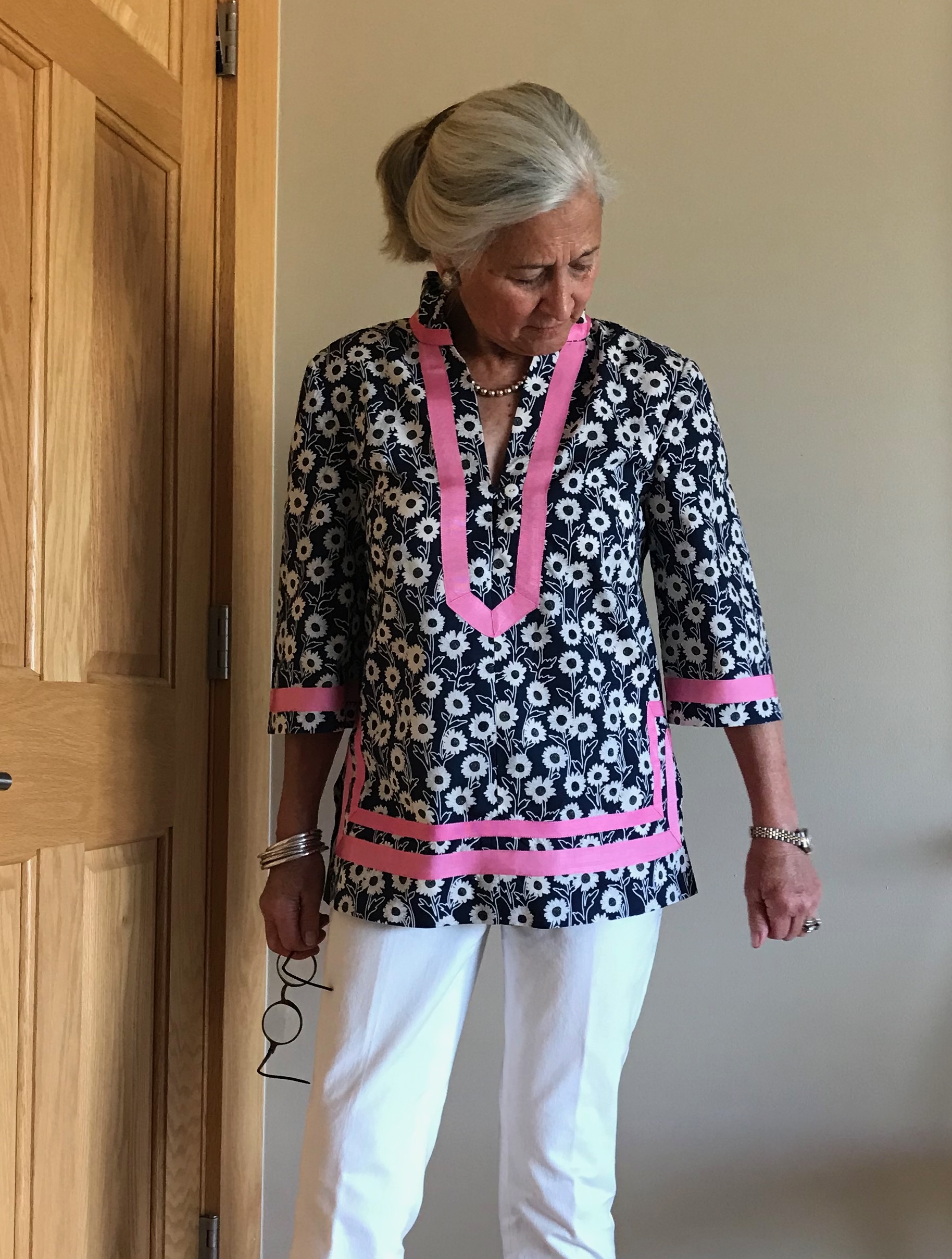
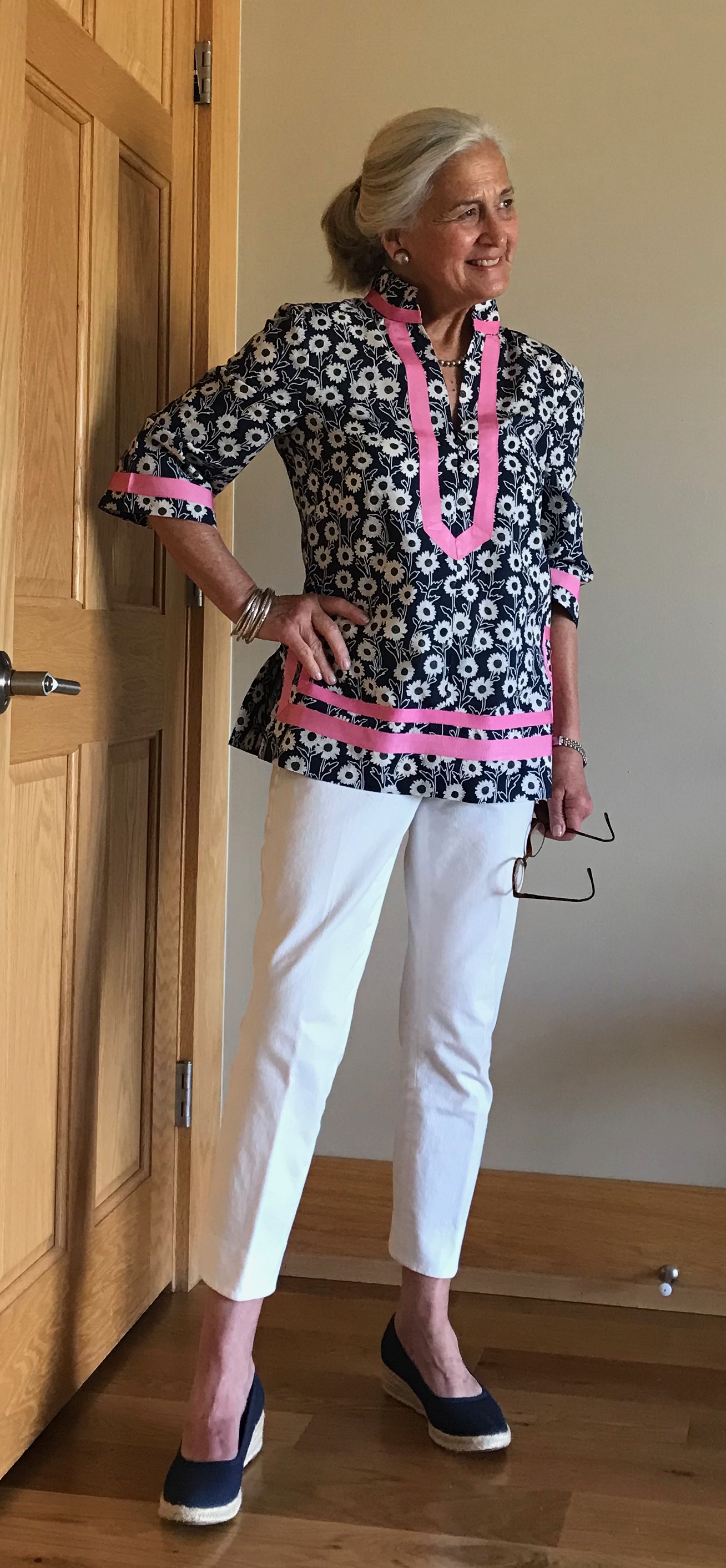
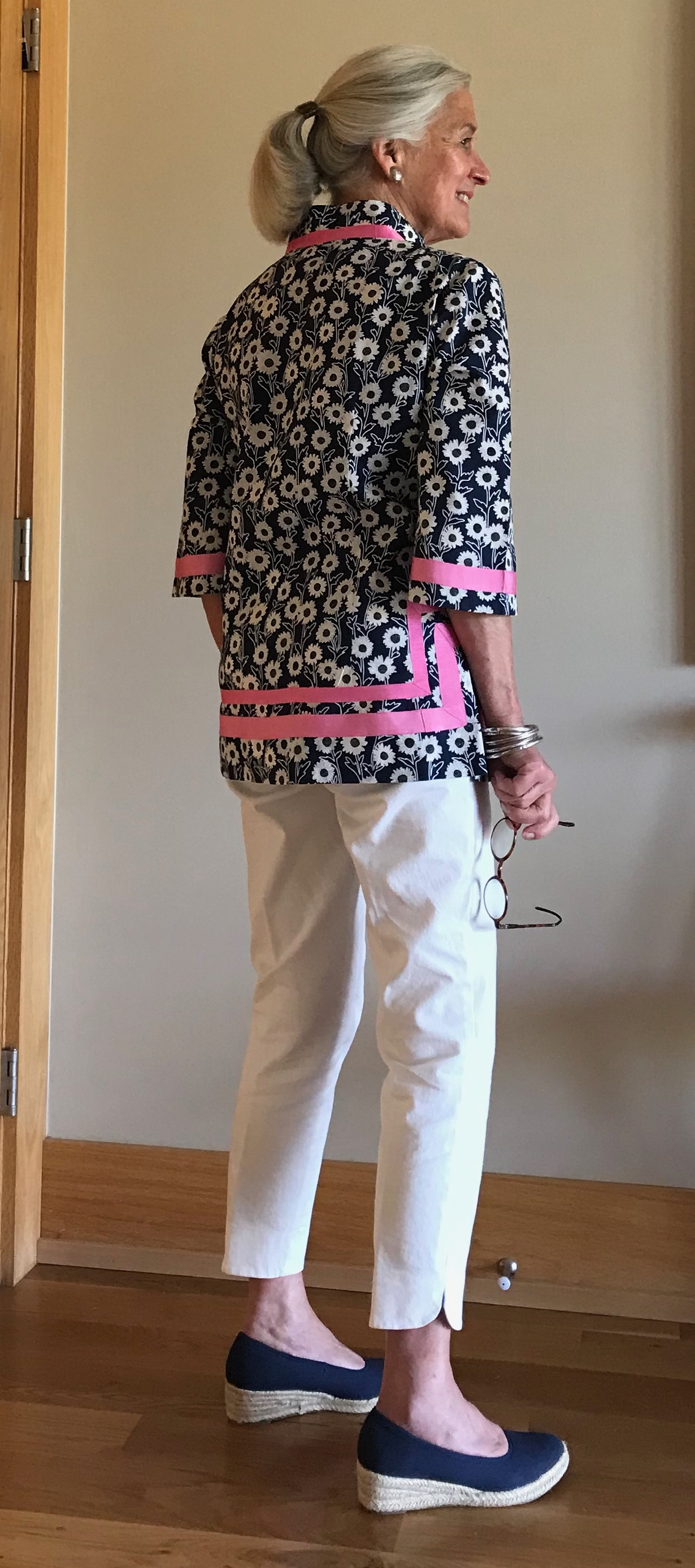
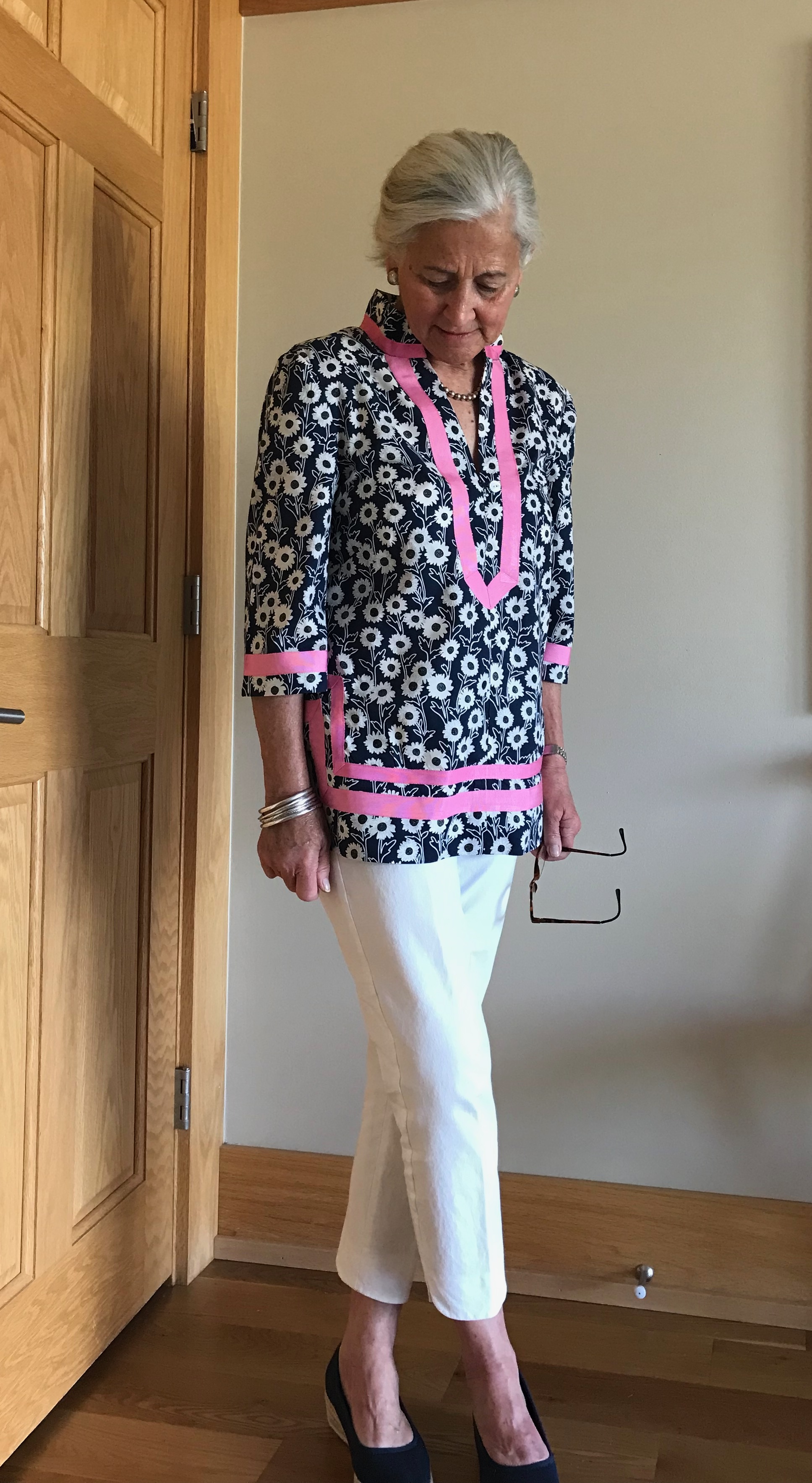
Perhaps many of you are familiar with this famous quote from Edith Head (American costume designer, 1897-1981): “A dress should be tight enough to show you’re a woman and loose enough to prove you’re a lady.”  When it comes to tunic tops, my very inelegant redo of that quote is: “A tunic should be fitted enough to not be baggy and loose enough to be able to get into it.”  I find that combination to be a difficult task.  Let’s see how I did with this one:

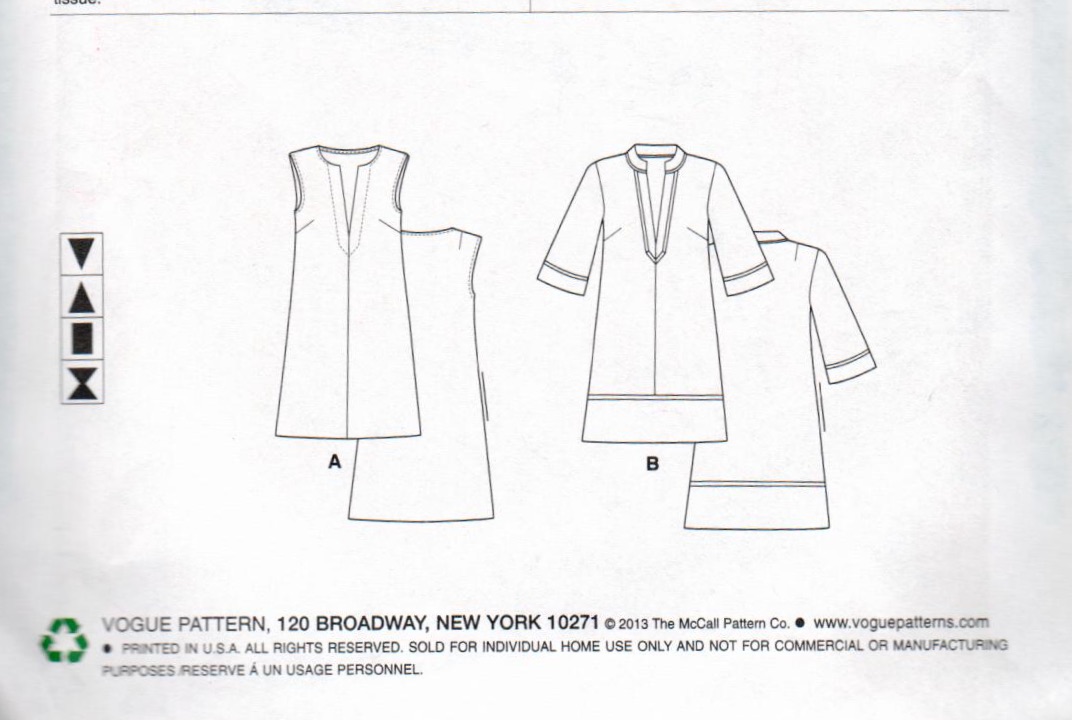
When I saw this pretty fabric on Emma One Socks’s website, I just knew I needed to purchase a length of it. All cotton, it is finely woven and silky soft.  Originally, I thought I would make a dress, but when it arrived, I saw it as a tunic top, trimmed in pink, of course.  I have a couple of tunic patterns, but I went back to this one because the front opening is longer than most, making it easier to get on and get off. 

Yes, I needed to shorten it to be a tunic top rather than a dress, but that’s an easy thing to do.

The interesting thing about this pattern is that there is no fastener/button indicated for that long opening.  I’m not sure how one would keep a degree of modesty – or even keep the tunic properly on one’s body – without a button or at least a hook and eye.  More about that later.

There are a couple of features of this pattern I like, besides that long opening in the front.  It has shoulder darts in the back, which I always find add just a little necessary fitting finesse. 

I love these diagrams which give so much information about the pattern. The shoulder darts are clearly indicated here.

I also like the way the front facing is constructed, and the width of the stand-up collar.  However, the pattern lacks slimming darts in the back.  My limited experience with sewing tunics has taught me that without long defining fisheye darts in the back, my tunic is going to be baggy and look like a sack.  So, I added them.  

There are darts there!

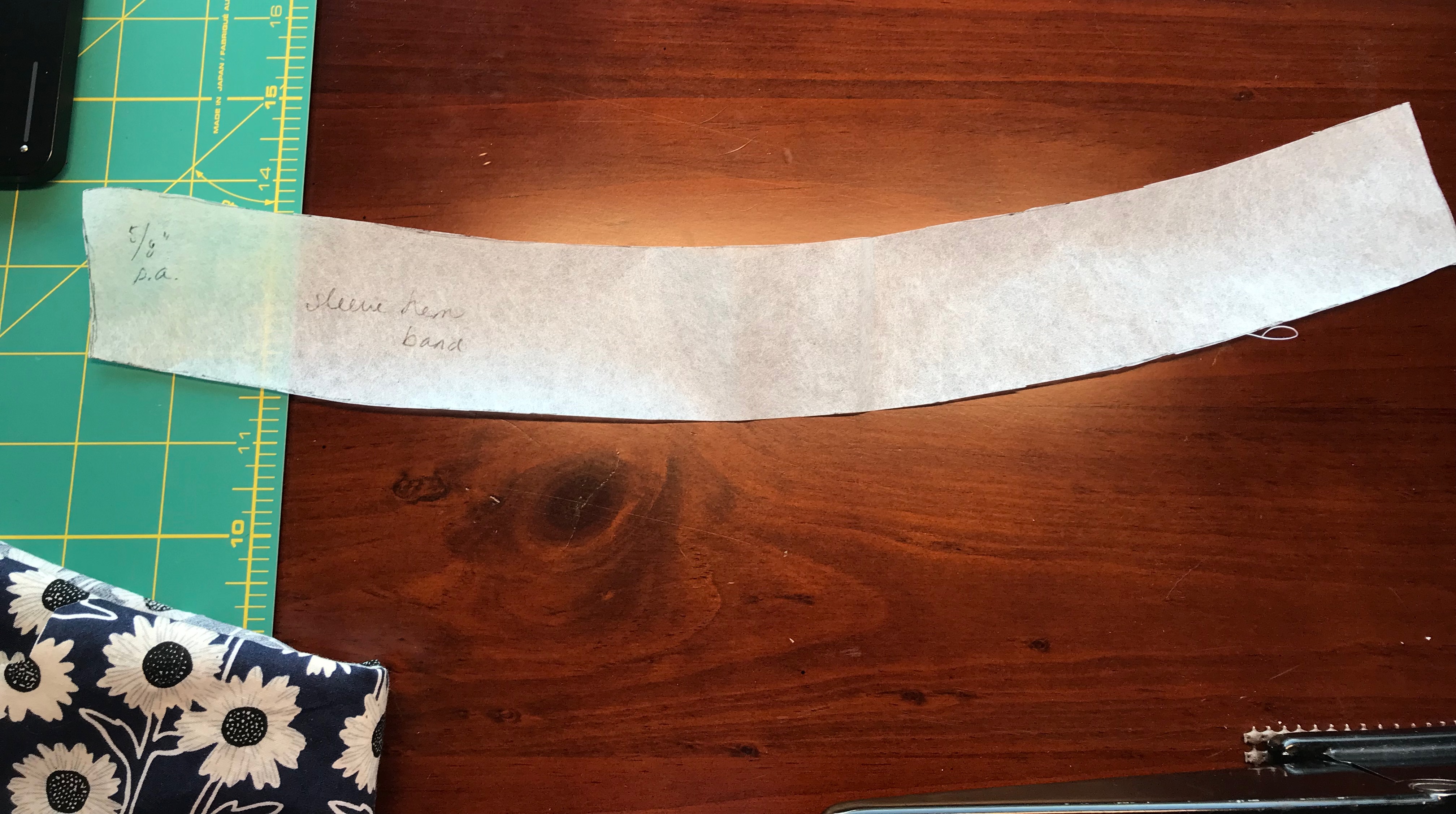
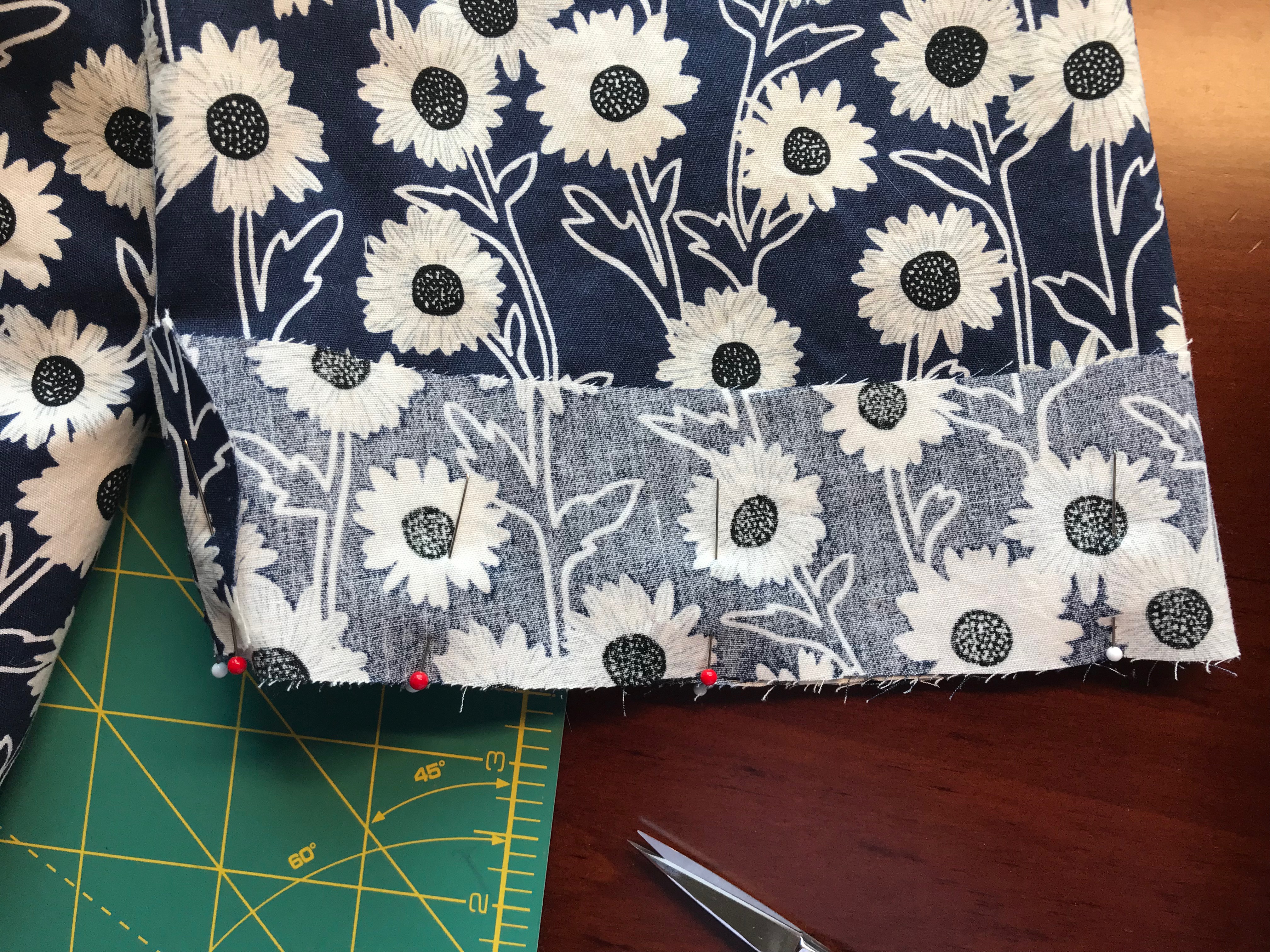
I also shortened the sleeves, as I prefer a length just below the elbow, and I took out some of the width of the “trumpet.”  Even with a narrower sleeve, I knew turning up a hem on it would result in a less than smooth finish.  To get around this, I took the pattern piece for the bottom panel for the long sleeve (shown on the pattern), flipped it, narrowed it, and shortened it to give me a facing which would be a perfect fit into the lower curve of the sleeve.  

The “trumpet” design of the sleeve is evident here.
Here is the facing piece I cut from the pattern.
And here it is pinned in place.
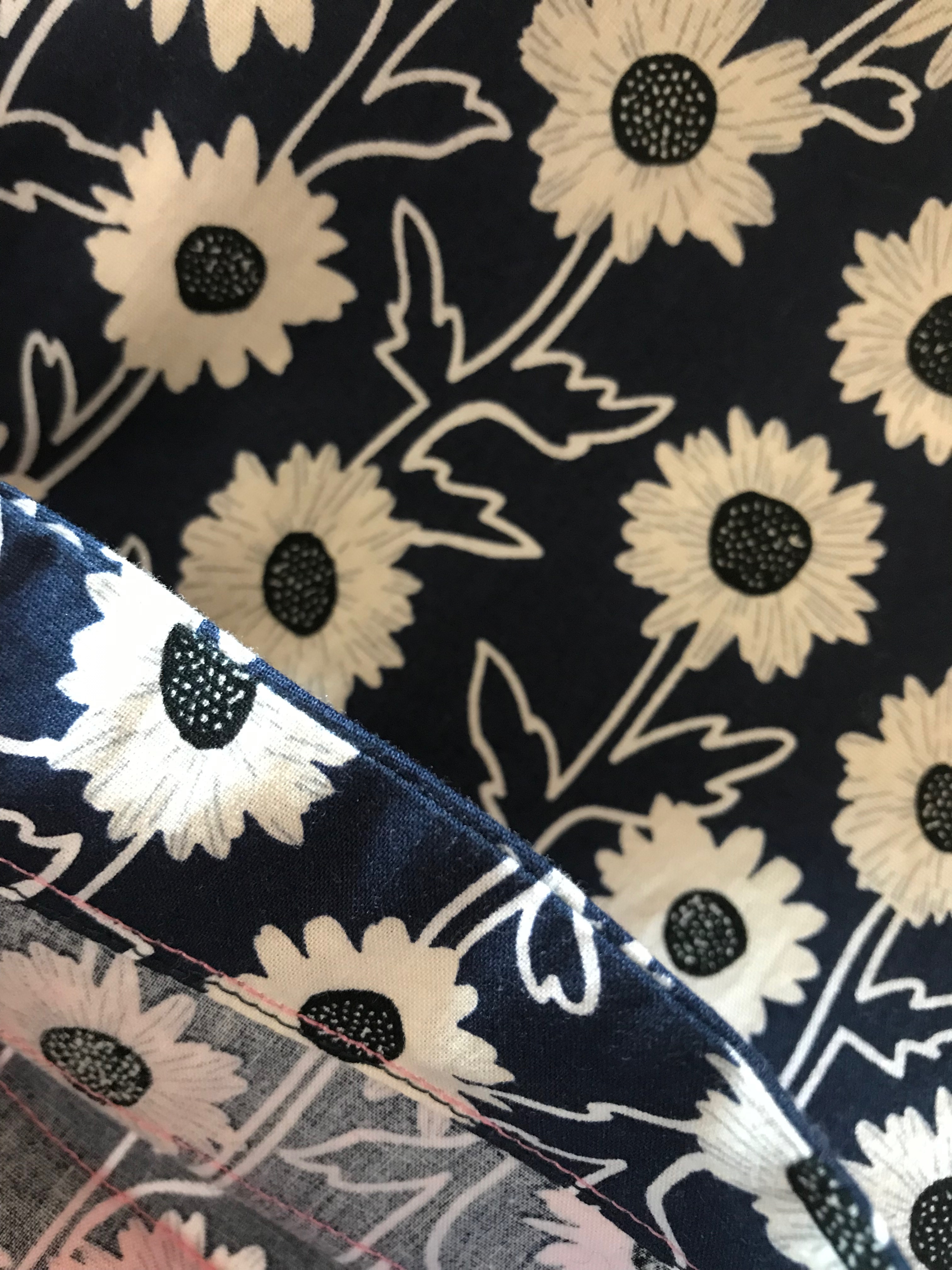
The seam connecting the sleeve to the facing is visible here. I turned up a scant 1/4″ of the unfinished edge of the facing and machine sewed it in place. The pink thread you see is from the attachment of the trim.

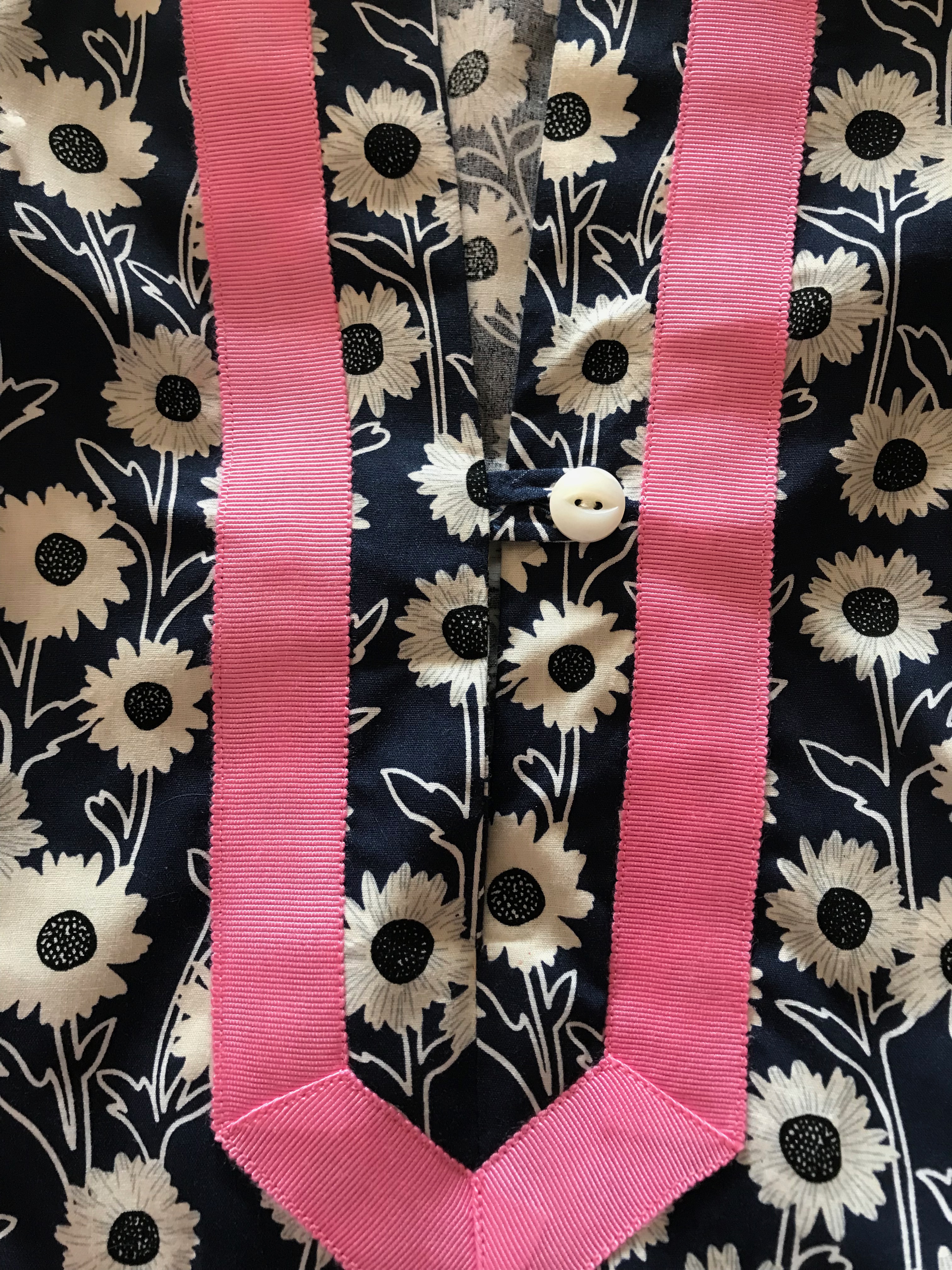
Back to that front opening:  when sewing the facing on, I added a loop to the right side so that I could strategically place a button to keep the gap closed.  On this fabric, it seems hardly noticeable, but oh my, is it necessary!  

One of the beauties of tunics is there are no rules on how trim is applied or placed or even if it is used.  I had purchased two widths of Petersham ribbon for use on this garment, fully intending on using two rows to echo the front opening.  However, I determined that would be too much.  Instead, I used the narrower ribbon on the collar and as the second row around the hem and the side slits.  The sleeves seemed to look better with the wider width of ribbon. The ribbon adds a degree of stability to the hem, especially, which helps the tunic to hang properly.  

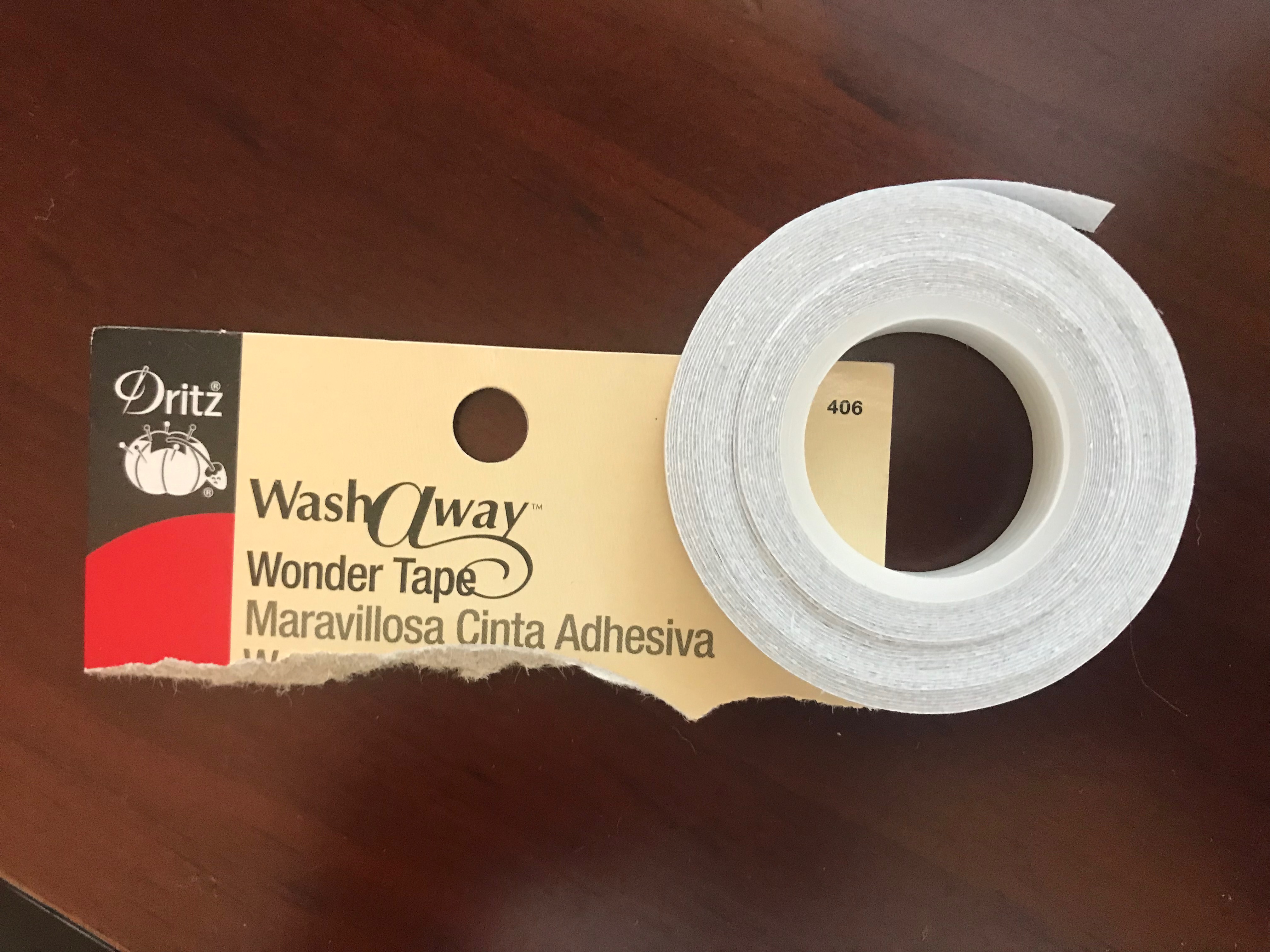
By the way, sewing all that Petersham ribbon on is helped immensely by the use of Dritz WashAway adhesive tape.

Obviously I have not washed this tunic yet, but in its first laundering the tape securing the ribbon will, indeed, wash away. I expect a softer appearance of the ribbon at that point, which seems to have a few waves in it at present.

Pictures often are the best way to check fit on a garment (even after multiple try-ons to fine-tune it), and I was pleased with the final, slightly fitted, non-baggy appearance of this tunic.  In other words, it does not look like a sack!  It is easy to slip on, less so getting it off, but still very manageable.  (Sometimes a side zipper can be – or needs to be – added to help with this task of dressing and undressing.  The abbreviated length of this example precluded that option.) 

If I make this pattern again, I may make the darts a little bit deeper for more definition.

I’m not sure what Edith Head would have thought about tunics, if anything (!), but I am thinking positively about this one.  

27 Comments

Filed under Blouses, Fashion commentary, Loops for buttons, Tunics, Uncategorized, Vogue patterns

The Pink Coat Odyssey, Part 2

Sometimes it is the smallest little detail which can make or break a sewing project.  In the case of my pink coat, it was that single loop at the top front edge.

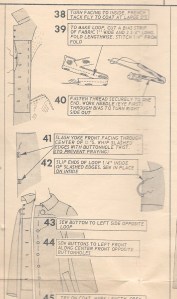
Normally loops are very straightforward, but with this pattern, that was not the case. When I looked ahead at the pattern instructions, this is what I found:

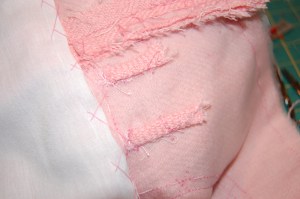
Because the front facing is not a separate piece, but rather folded back from the front edge, there was no seam within which to secure that loop.  The instructions directed me to “slash” the yoke front facing through the center of the “squares,” shown here in basting:

The basted “squares” indicating where the “slashes” should be are in white just to the right of the center fold line in the photo.


And this was supposed to be done after the collar was already on and the facing properly secured in place.  Well, I knew I wasn’t going to be slashing anything without getting a second opinion, and furthermore, I knew I would need to do the installation of the loop before the collar was on and the facing turned.  I did not know how I could ever secure the loop without access to the inside of the facing.

I went online to Susan Khalje’s Couture Sewing Club which is by subscription on Facebook.  Once I posed the question about the best way to accomplish this task, Mary Funt of the blog Cloning Couture suggested I use an awl to work holes where those squares were, separating the wool threads and enlarging the openings to the size I needed.  Then I could whip the edges with silk buttonhole twist to secure them.  Mary also suggested I use a medical clamp (hemostat, which I highly recommend as a vital sewing tool! I have had mine for years and use it frequently), to help flatten the raw ends of the loop.

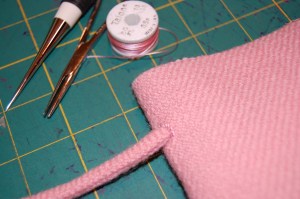
This shows the awl, the hemostat, and my spool of vintage pink silk buttonhole twist, along with a sample “insertion” of the loop.

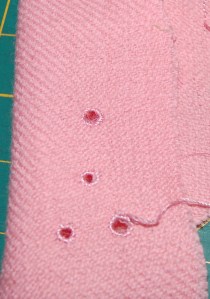
First I practiced! Here are my practice holes:

Practice holes helped me determine how large the hole needed to be to accommodate the loop.

The hemostat was also helpful in pulling the end of the loop through the holes I made.  Susan Khalje further suggested that the loop would need to be very securely fastened inside, and she suggested I under-stitch that part of the facing, catching the loop in the stitching.

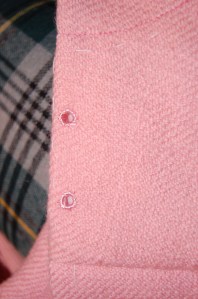
The completed holes, bound with silk twist.

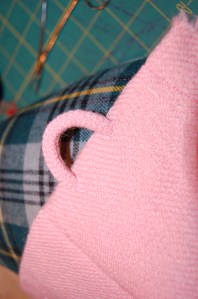
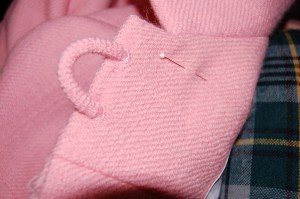
The loop inserted into the facing.

This shows the secured ends of the loop inside the facing.

The under-stitched facing, in which I further secured the loop.

Oh my goodness! Thank you Mary Funt and Susan Khalje!  Using this method produced exactly the results I wanted.

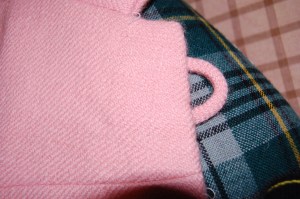
The finished loop.

After the mystery of the loop was solved successfully, it was on to the collar, and ultimately on to the final steps before attaching the lining.  The completion of this coat is in sight, after all this time. I can’t wait!

25 Comments

Filed under Christian Dior, Coats, couture construction, Dressmaker coats, Loops for buttons, Uncategorized, vintage Vogue Designer patterns, vintage Vogue patterns from the 1960s