Tag Archives: quotes about fashion

Can a Coat be Glamorous?

And what exactly is glamour? A recent quote by Carolina Herrera – “It’s important for women to feel glamorous and feminine but always themselves” – prompted me to look up the definition of the word “glamour” – and I was surprised by what I found. Here is how Webster’s defines it in its noun form: 1) the quality of fascinating, alluring, or attracting, esp. by a combination of charm and good looks 2) excitement, adventure, and unusual activity, like the glamour of being an explorer 3) magic or enchantment; spell; witchery. And then there is the definition of “glamorous”: 1) full of glamour; fascinatingly attractive; alluring 2) full of excitement, adventure , and unusual activity: to have a glamorous job.

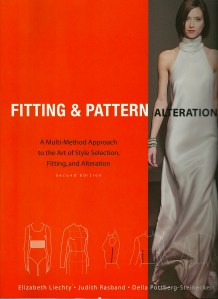
Glamour was the last thing on my mind when I started out on my current coat project. Making a muslin (toile) can be time-consuming and tedious, especially when it shows you that some serious alterations need to be made. Fortunately, my coat muslin revealed only some small changes to the shoulder of my raglan sleeve coat, compensating for my square shoulders. My go-to book to guide me through these complexities is Fitting and Pattern Alteration, by Liechty, Rasband, and Pottberg-Steineckert (recommended to me by Susan Khalje.)
I highly recommend this book.

I highly recommend this book.

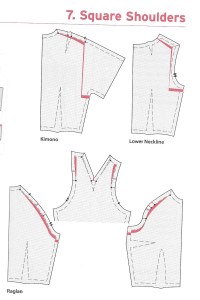
One of the things I love about this book is that it covers all sorts of situations. Square shoulders for Raglan sleeves? Not a problem.
The diagrams take the guess work out of alterations to patterns.

The diagrams take the guess work out of alterations to patterns.

Once I had my muslin adjusted, my silk organza interlining marked and cut (to be used as the pattern for the wool), I felt like I was off to the races. Not so fast. A careful steaming of my wool fabric revealed three small “thin” areas (not holes, but thin enough that I would need to work around them). This is not unusual for vintage fabric, and is one of the reasons why a careful pre-steaming or pre-pressing of any fabric is important, but especially so for vintage goods.
I marked these small imperfections with yellow chalk.
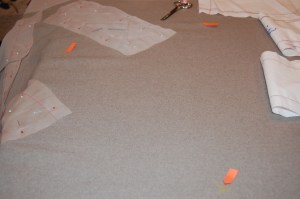
I marked these small imperfections with yellow chalk.

And then double-marked the areas with orange post-its when I was arranging the pattern pieces.

And then double-marked the areas with orange post-its when I was arranging the pattern pieces.

After untold hours of basting the layers of silk organza and fashion fabric together, I was finally ready to sew.   And this is when I think it began to get glamorous. The first major details to be completed were the pocket plackets. I thought I might faint when I had to make that first cut into one of the side panels of the coat front. But bravery saw me through!
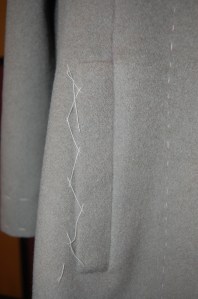
I have the placket catch-stitched temporarily so it does not get caught on something while I finish the remainder of the coat.
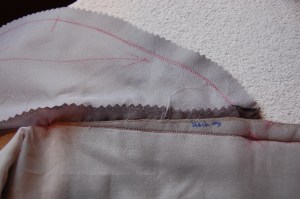
I have the placket catch-stitched temporarily so it does not get caught on something while I finish the remainder of the coat.

Here is the inside of the pocket and placket.

Here is the inside of the pocket and placket.

With the first pocket and pocket placket successfully completed, the second pocket placket was simply fascinating and alluring, my progress encouraged by the charm and good looks of the first one. Definitely glamorous!
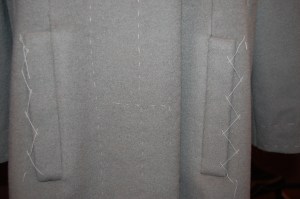
Progress - both pockets/plackets finished!

Progress – both pockets/plackets finished!

More seams ensued, each one carefully pinned, sewn, pressed and catch-stitched. Particularly rewarding were the shoulder seams of the raglan sleeves. Properly clipped, pressed and catch-stitched, the seams lie beautifully and look good, too.
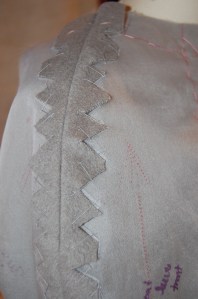
The benefits of a silk organza interlining (or underlining) are manifold, but not least of which is a foundation upon which to secure the seams.

The benefits of a silk organza interlining (or underlining) are manifold, not least of which is a foundation upon which to secure the seams.
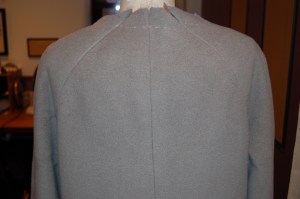
A view of the back of the coat (in progress.)

A view of the back of the coat (in progress.)

Although I have many more hours to go with the construction of this coat, I can’t help but feel that not only is this coat going to be glamorous, with its elegant gray cashmere, its vintage sensibility and all its hidden, inside secrets used to tame those seams, it is also going to be feminine and definitely me.

Perhaps the next question to ask is “Can sewing be glamorous?” It is “fascinatingly attractive, full of excitement, adventure and unusual activity.” It is magical and enchanting, too. The answer would have to be, “Yes, sewing most definitely can be very glamorous!” Even when we are in our bedroom slippers and blue jeans, covered in threads and pins, if we are sewing, I say we are glamorous.
20 Comments

Filed under Coats, couture construction, Dressmaker coats, Love of sewing, Mid-Century style, Uncategorized, underlinings, Vintage fabric, vintage Vogue Designer patterns, vintage Vogue patterns from the 1960s, woolens

Something Old, Something New – and Pulling It All together

Every once in a while, a unique opportunity comes along in the form of fabric. We all know those times – when the end of the bolt is just the amount you need, or a single bolt of one-of-a-kind designer fabric comes to your favorite store, or a long-awaited re-order makes possible your dream of owning that exact piece. For me, it was an offer from a reader of my blog. She had two pieces of vintage wool which had belonged to her aunt, dating from probably the late 1950s or very early 1960s. Once I saw swatches of both fabrics, I immediately saw the possibilities inherent in each one, and the colors were not only yummy, but also ones that I can wear well (a fact which was correctly noted by my dear reader.) I purchased both pieces well over a year ago, and ever since, I have been dreaming about sewing with them, starting with this gray (what I believe to be) coat-weight cashmere.

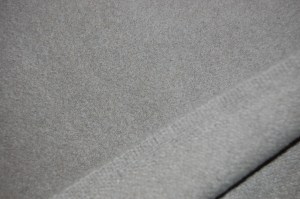
The top part of the photo shows the right side of the fabric. It has a soft, luscious nap to it. The contrast of the weave on the underside is hopefully discernible.

The top part of the photo shows the right side of the fabric. It has a soft, luscious nap to it. The contrast of the weave on the underside is hopefully discernible.

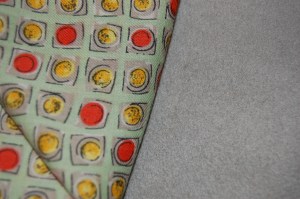
As luck would have it, I had already picked up some swatches of (new) wool challis and various dress-weight silks one of the last times I was at Mendel Goldberg Fabrics in New York City. It did not take me long to pair this Swiss challis with the gray wool.

The gray in each little square is a perfect match to the cashmere.

The gray in each little square is a perfect match to the cashmere.

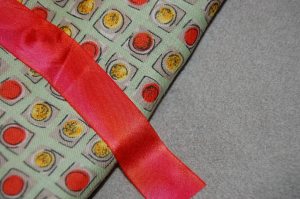
Both fabrics lend themselves to be beautifully complimented by a further pop of color as demonstrated by this silk bias ribbon:

I will definitely be accenting my outfit with something like this.

I will definitely be accenting my outfit with something in this color.

Before I go into patterns and process, I want to share the thoughts of Christian Dior on the color “gray” as written in his The Little Dictionary of Fashion, Abrams, New York, New York, 2007, page 50:

“The most convenient, useful, and elegant neutral color. Lovely in flannel, lovely in tweed, lovely in wool. And, if it suits your complexion, there is nothing more elegant than a wonderful, gray satin evening dress. For day frocks, suits and coats, it is ideal. I would always advise it. And many people who cannot wear black, can wear a dark gray. (Remember that if you are big you must choose a dark gray and if you are petite a light gray is better for you.)

“It is the most convenient color, too, for people who live half in town and half in the country because, with different accessories, a gray suit or coat may be equally suitable for both. It is a good color for accessories, too – almost anything goes with gray. White is perhaps the freshest and sweetest contrast but it is safe to say that whatever your favorite color is, you can safely wear it with gray.”

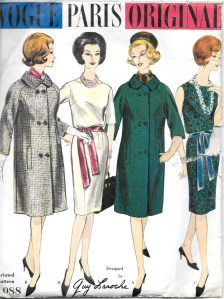
 Armed with this send-off, I immediately began to look in earnest for a coat pattern. I did not want to purchase the wool challis before I had a pattern, but my thought was to line the coat (except for the sleeves, of course) with it, and then make a coordinating dress or blouse as well. When I found this Guy Laroche coat (and dress) pattern, it seemed to be just what I was looking for, even though when I purchased it, I knew that the pocket flap pattern piece was missing. I was confident, however, that piece would be easy to recreate.

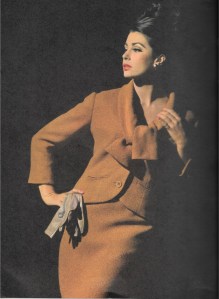
Early Guy Laroche (1921-1989) patterns are somewhat difficult to come by. A Parisian, he worked for Jean Desses (eventually becoming his assistant) from 1949 to 1957, at which time he opened his own atelier. In 1961, his fashion house was known as Guy Laroche Couture. It seems to be about this time that Vogue Patterns began to feature his designs in their Couturier Designer line (Jean Desses designs are also in this line of Vogue patterns). He was one of the featured designers in the 1963 New Vogue Sewing Book, which included “profiles of Europe’s great designers.” This gorgeous suit by him is shown on page 128 in that book:

The collar of this jacket extends so that it can be looped.

The collar of this jacket extends so that it can be looped.

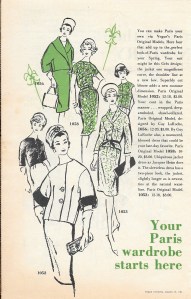
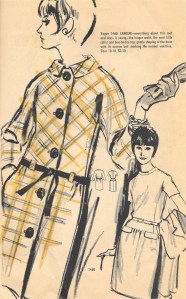
Another one of his suits was shown in Vogue Printed Pattern News from March 15, 1961:

The Laroche design is in the lower lefthand corner. I have never seen this pattern available for purchase...

The Laroche design is in the lower lefthand corner. I have never seen this pattern available for purchase…  (Click on the image to read the caption.)

And a coat and dress ensemble was part of the “French Dressing” section of Vogue Pattern Fashion News from April 1965:

The diagonal direction of the weave in the jacket is a lovely foil for the dress.

The diagonal direction of the weave in the top part of the coat is a lovely contrast for the rest of the ensemble.

I believe the pattern I am using for my gray cashmere coat is from 1962 or 1963. (The patterns from 1961 were priced at $3.00 while my pattern and the ones I have found from 1964-65 were priced at $3.50. That’s one way to help determine a date, although my intuition suggests to me that my pattern is not as late as ’64.)

Once I had my pattern, I ordered the wool challis from Mendel Goldberg (still in stock, thank goodness!) Now, at this point, I did not know exactly how much to order. The body of the coat will be lined in the challis, while the sleeves will be lined in gray Bemberg. I couldn’t go by the yardage on the envelope for the lining since I was “mixing it up.” I think I may have enough of the gray cashmere to make a skirt, but the fabric might be too heavy for a skirt. I’ll know more once I start to sew with it. The rambling on in my head told me that I needed to get enough of the challis to either make a long-sleeved blouse to go with a “maybe” skirt – or enough challis to make an entire dress, as well as the coat lining. So – I ordered PLENTY!! Now I have options.

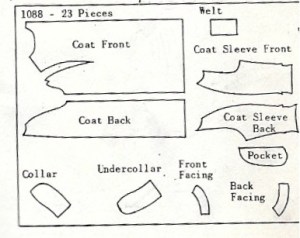
For some reason I always find coats to be a little intimidating – at least at the beginning. However, when you look at the few pattern pieces that go into this design, it seems to look more complicated than it really is (I hope I am not jinxing or deluding myself):

The main body of the coat really has just 8 pattern pieces (the facings you see are for the dress included in the pattern.) Of course, the lining adds more, but compared to the number of pieces in the coat I made two years ago, this is minimal!

The main body of the coat really has just 8 pattern pieces (the facings you see are for the dress included in the pattern.) Of course, the lining adds more, but compared to the number of pieces in the coat I made two years ago, this is minimal!

I am currently working on my muslin, and I am so excited to be starting this project. Thank you, EG, for allowing me to purchase this beautiful vintage fabric. I feel a great responsibility to honor this “something old” wool in a coat worthy of its quality and provenance.

24 Comments

Filed under Coats, Mid-Century style, Uncategorized, Vintage fabric, vintage Vogue Designer patterns, vintage Vogue patterns from the 1960s, woolens

Oh, The Things We Can Learn!

When is a pattern envelope not just a place to keep a tissue pattern? When it is a mini lesson in sewing, style, history, elegance, and story-telling. Of course, I am thinking primarily of vintage pattern envelopes – and because I primarily sew from Vogue patterns, those are the focus of my thoughts.

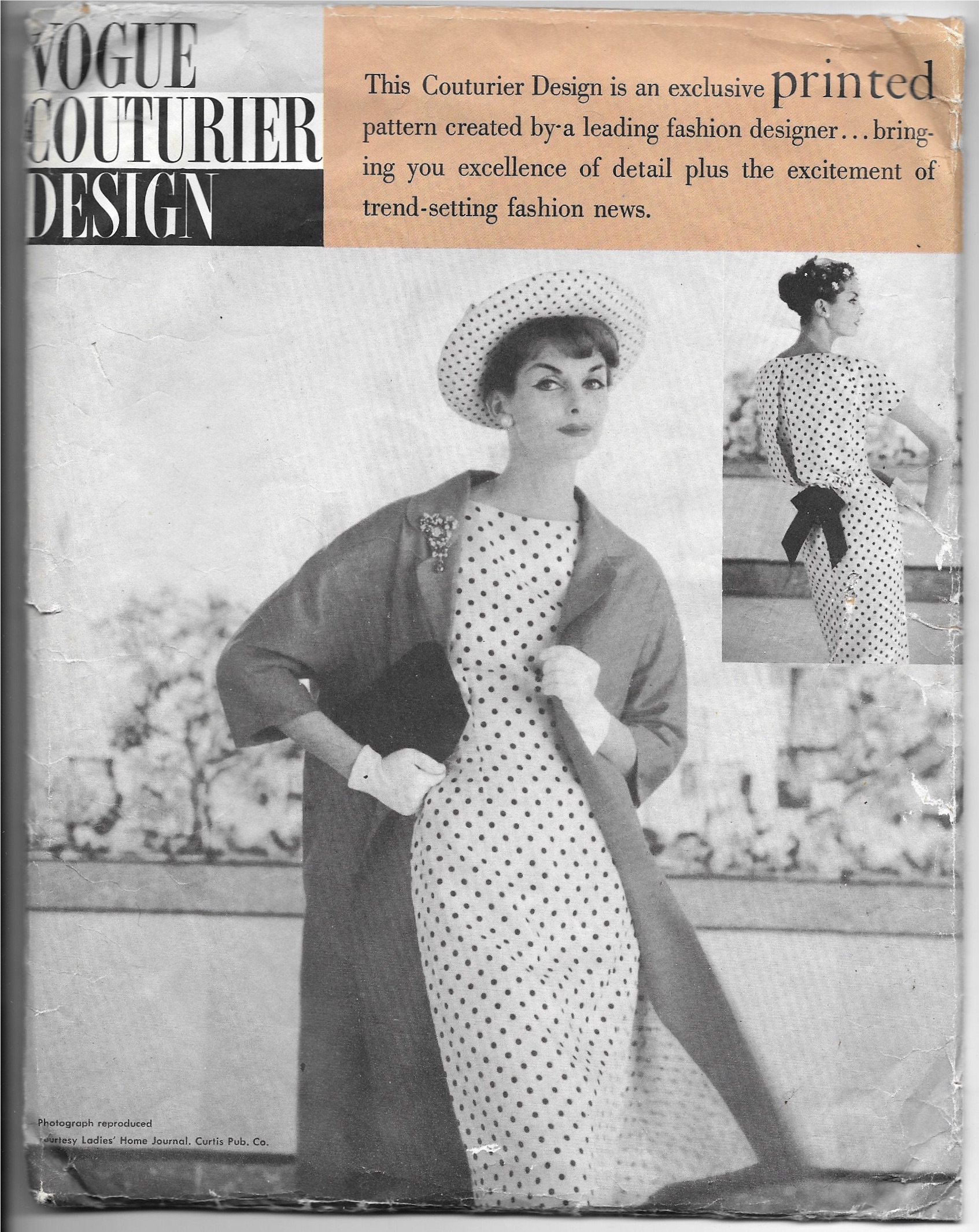
I am also limiting my short exploration of these topics to the course of about ten years, from approximately 1956 until 1966. Most of the pattern art from this time period was in illustration form rather than photography. There were exceptions, such as this classic polka-dotted dress and coat ensemble from 1959:

The reverse of this envelope has very precise sketches of the fronts and backs of the dress and coat. This is one of the few envelopes from this period - 1958 - that I have seen that features photography rather than illustration art.

The reverse of this envelope has very precise sketches of the fronts and backs of the dress and coat. This is one of the few envelopes from this period – 1958 – that I have seen that features photography rather than illustration art.

It was up to the fashion illustrators and artists to represent the pattern accurately. Darts, seams, buttons, belts, pockets, etc. all had to be clearly indicated in the illustrations on the fronts of the envelopes and in the thumbnail sketches on the back of the envelopes. Home dressmakers wanted to know these things about a pattern before purchasing it – we still do! Here is a great example of the clarity of these pattern illustrations in regard to these items:

The darts, seams, and buttons are clearly delineated in this artwork.

The darts, seams, and buttons are clearly delineated in this artwork.

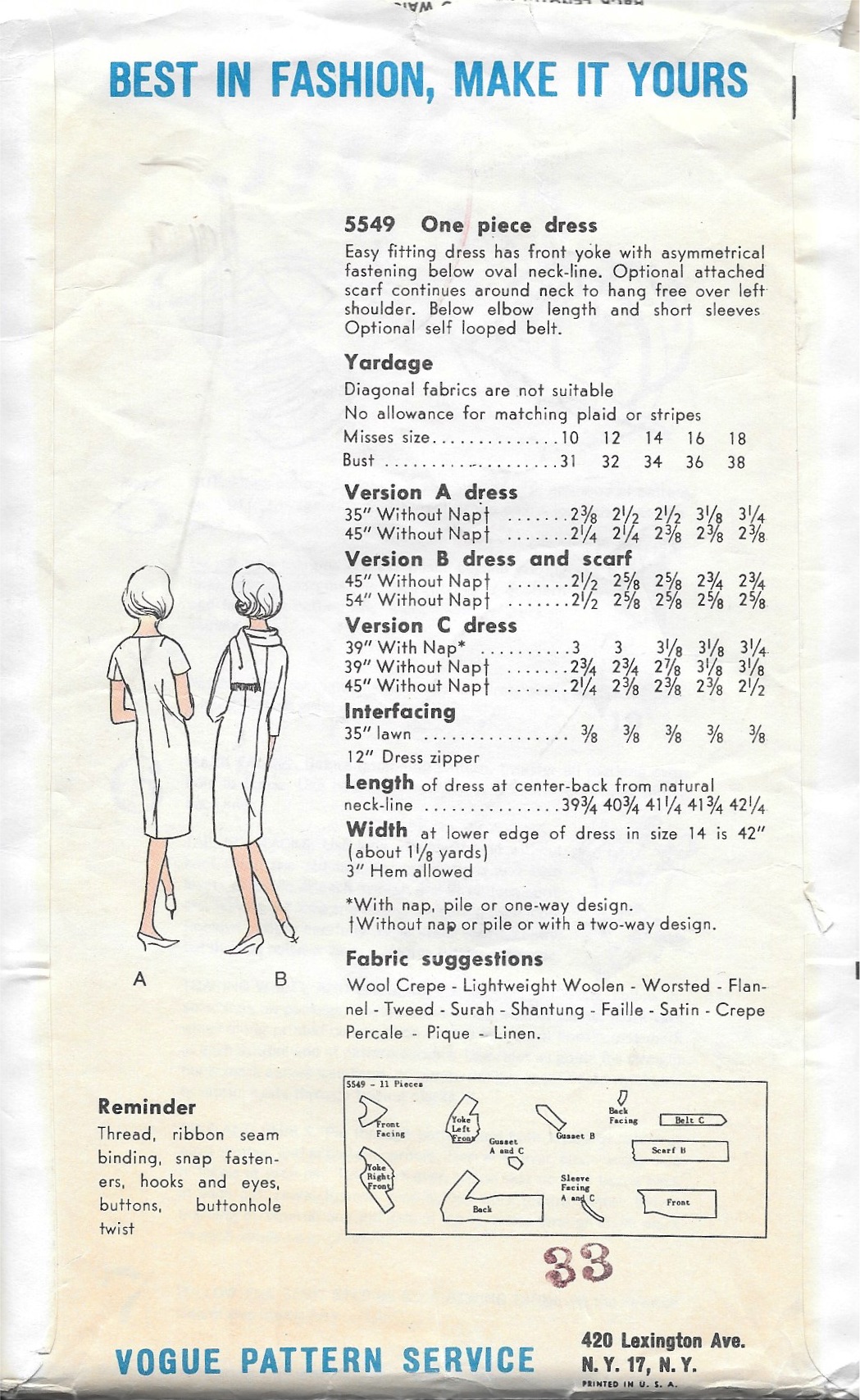
The back of this pattern also gives lots of additional sewing information. The thumbnail sketches clearly show that there is no back zipper. Among the details listed is a 12” zipper. That can only mean that a side zipper is used – which makes sense as it is paired with the front-buttoned bodice.

Oh the things we can learn, no 2

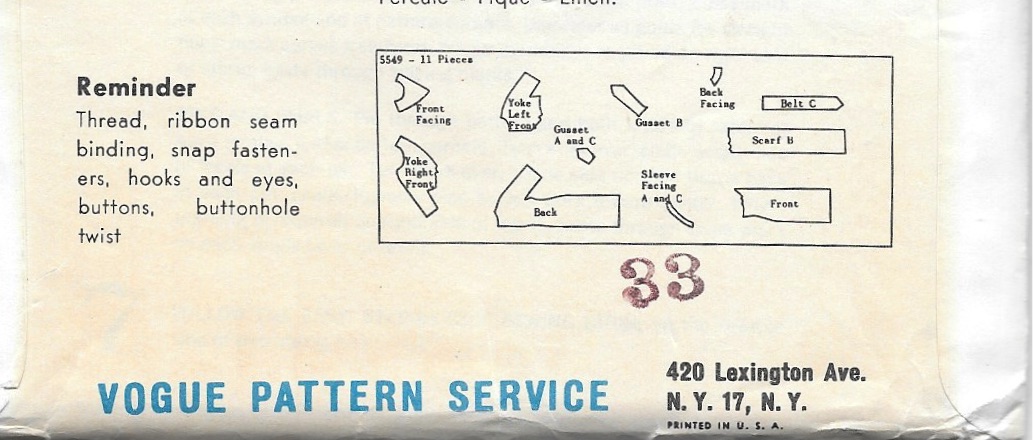
Further scrutiny of the pattern layout shows a gusset, obviously for use under the arm. If you, as a dressmaker, were uncomfortable with putting in a gusset, then maybe you would want to avoid this particular pattern!

It is such an advantage to be able to see the shapes of the pattern pieces in these layouts.

It is such an advantage to be able to see the shapes of the pattern pieces in these layouts.

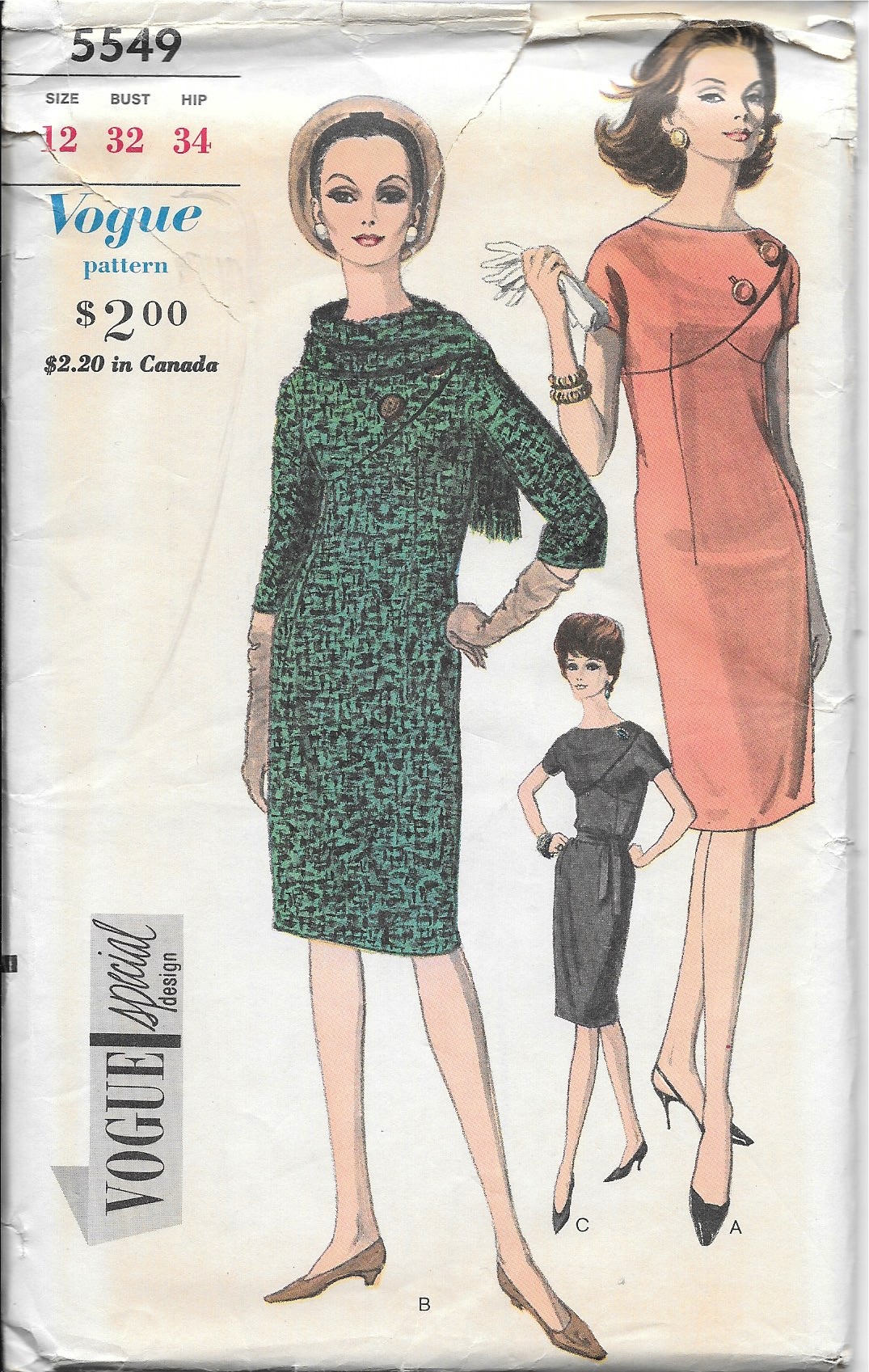
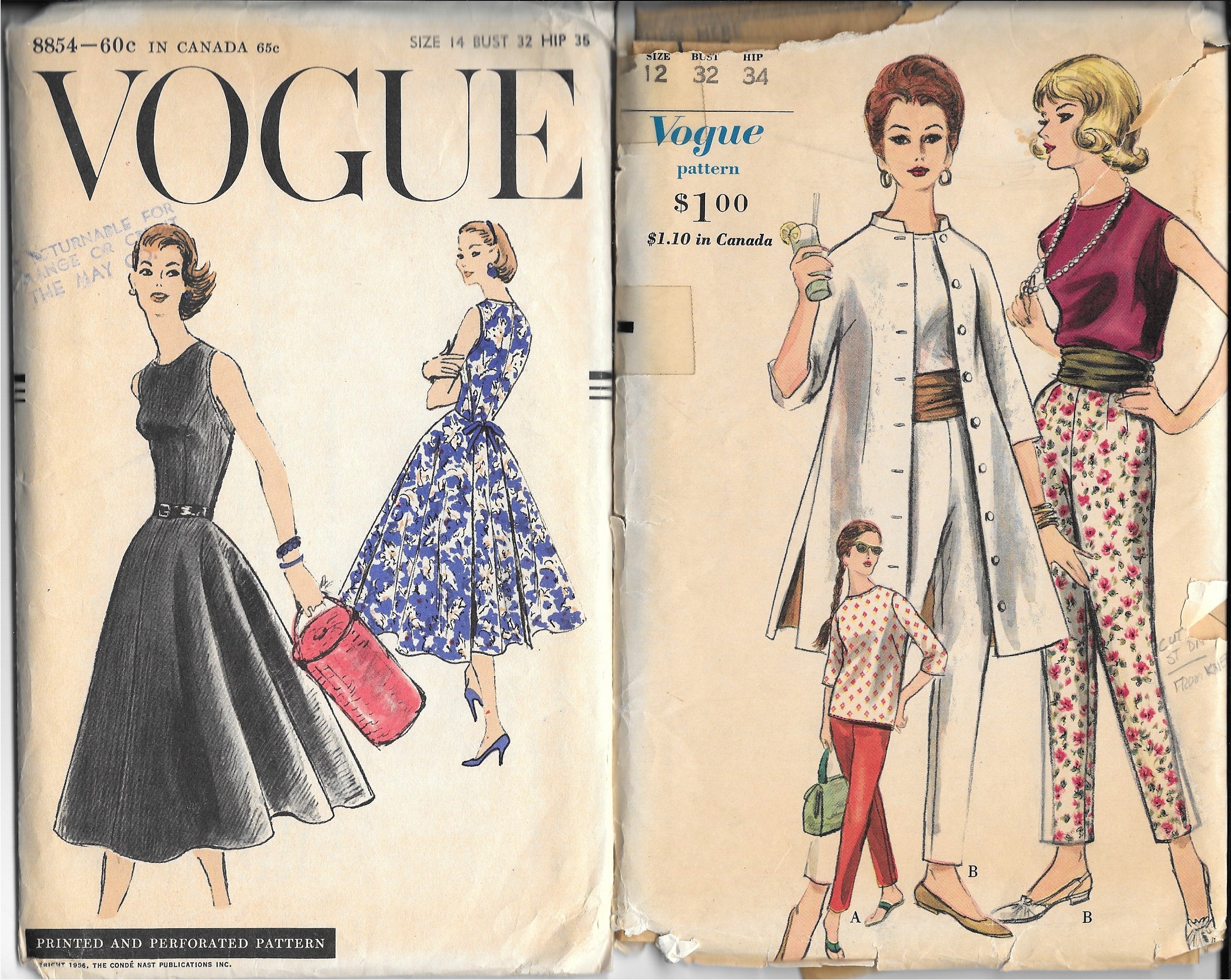
It was also up to the fashion illustrator to make the pattern look relevant to one’s life. Different views were often shown in varying colors, widening the visual appeal. They were also shown in dressier or more casual renditions, making the pattern attractive to different lifestyles and age groups. These two patterns clearly show this endeavor:

Oh the things we can learn, no 4

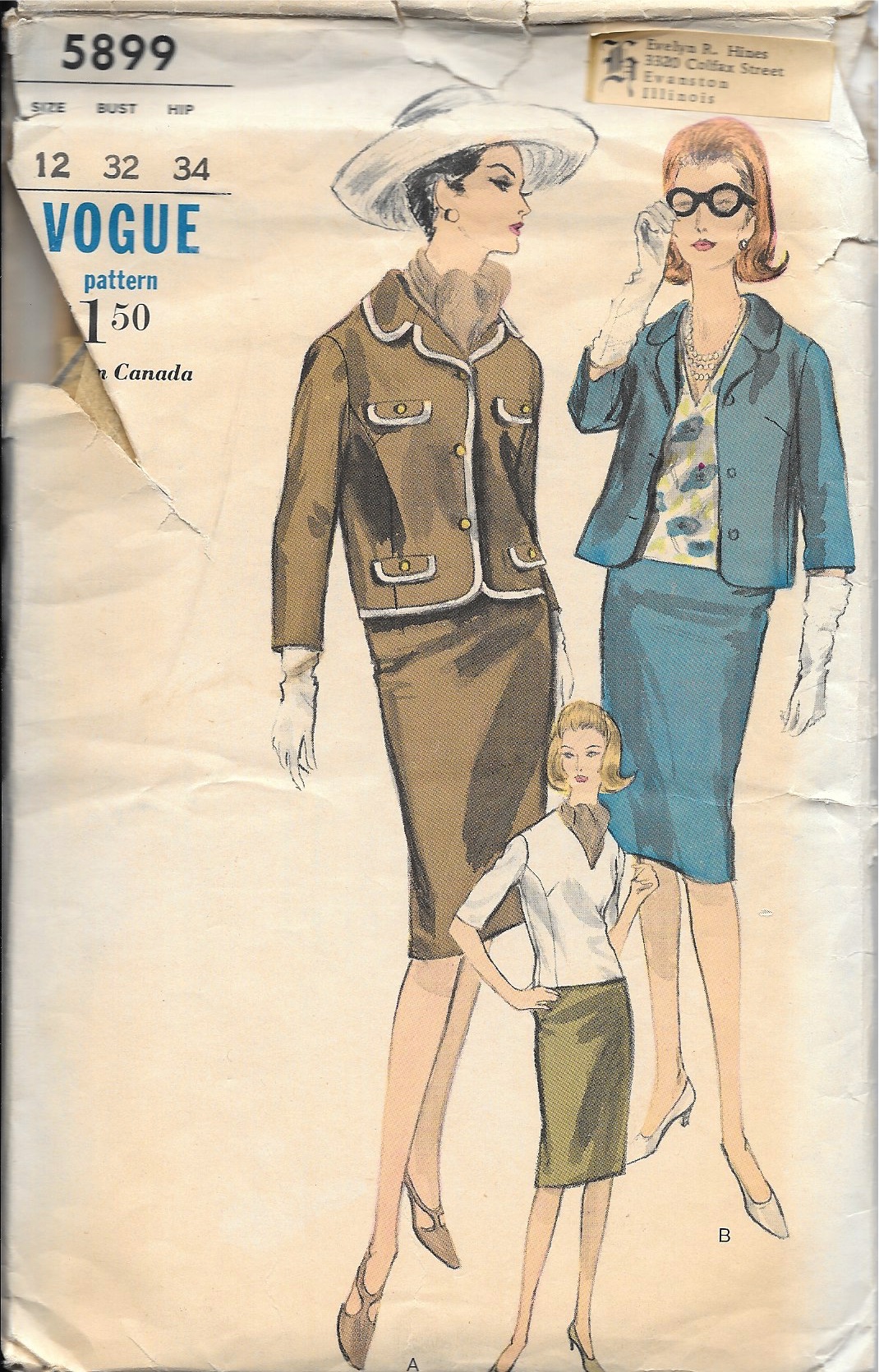
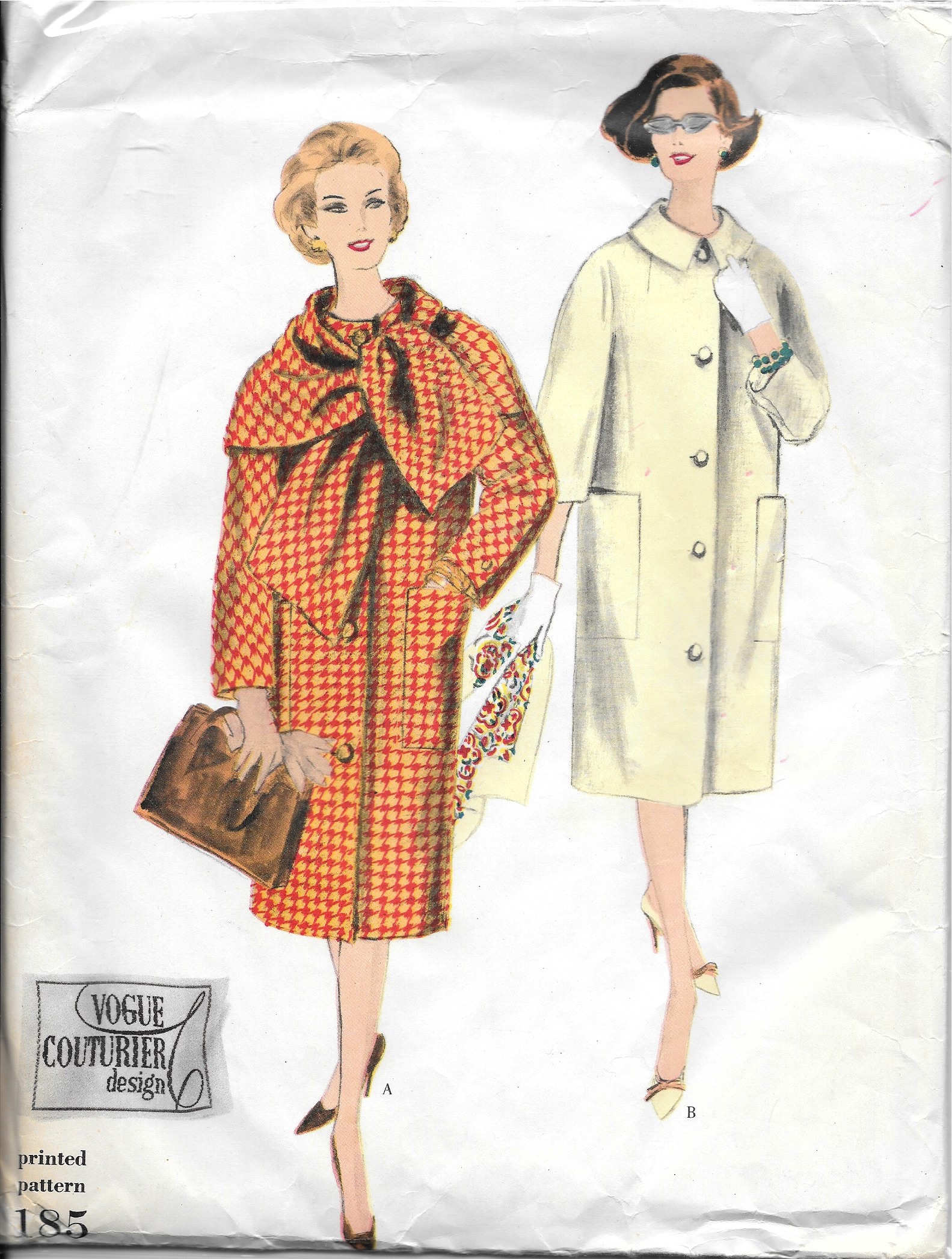
The inclusion of accessories in the pattern illustration from this time period shows just how much Vogue and other pattern companies were selling a complete look. They were saying “Start with this pattern, add gloves, a bangle bracelet or two, sunglasses or a hat, maybe a scarf, earrings, high heels, and a handbag, and you, too, can walk out looking like a million dollars!” The great desire in looking well-dressed and chic during this time period is so beautifully reflected in these pattern envelopes.

Gloves, gloves and more gloves! And look at those glasses!

Gloves, gloves and hats and scarves…   And look at those glasses!

This has got to be one of my favorite examples of pattern art: the model in white holding the scarf so casually, the stylish shoes, and the large clutch handbag on the model on the left - lovely and evocative!

This has got to be one of my favorite examples of pattern art: the model in white holding the scarf so casually, the stylish shoes, and the large clutch handbag on the model on the left – lovely and evocative!

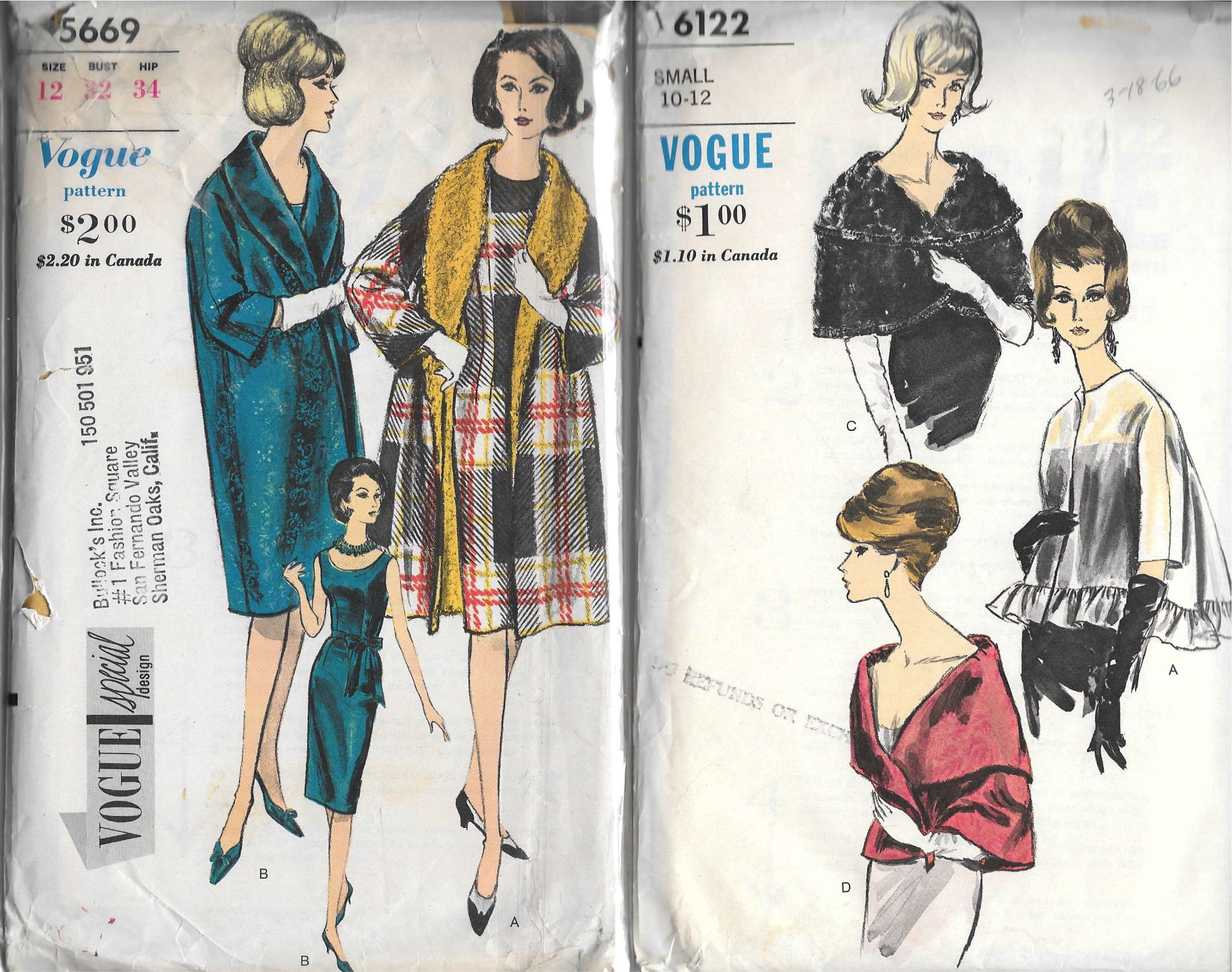
One way of dating pattern envelopes is by looking at the hairstyles of the illustrated “models.” After about 1960, Vogue stopped including the copyright date on their envelopes. But it’s fairly clear by the bouffant and flipped hairstyles on the pattern on the left that we are looking at one from the early to mid-‘60s.  The one on the right is a few years later, based on the hairstyles alone.

Note, too, how the Vogue masthead changed during this short time period.

Note, too, how the Vogue masthead changed during this short time period.

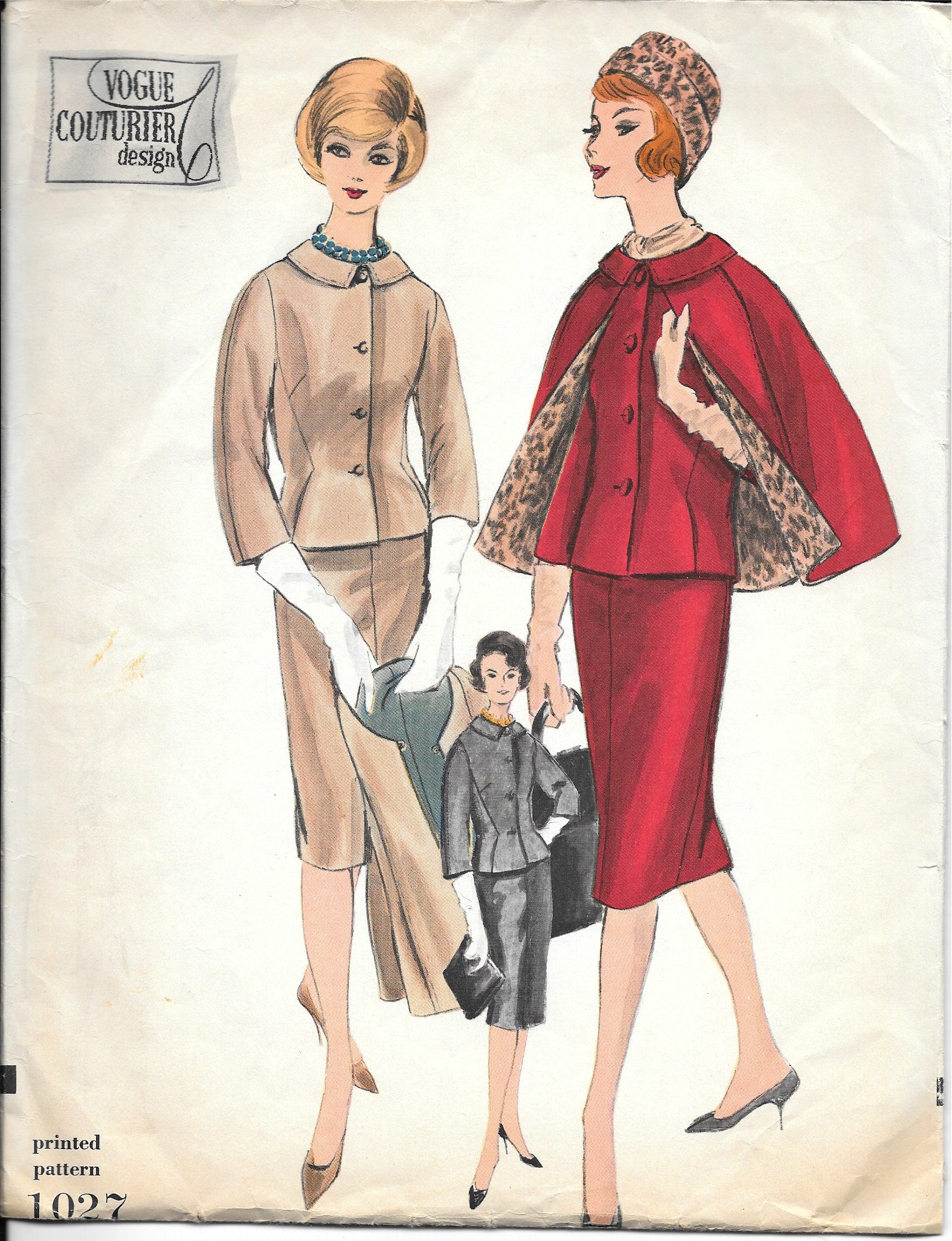
Finally, I am delightfully intrigued by the almost universal depiction of “elegance” on the pattern envelopes from this period. From the leopard print hat and lined cape on this suit from 1959:

Oh the things we can learn, no 8

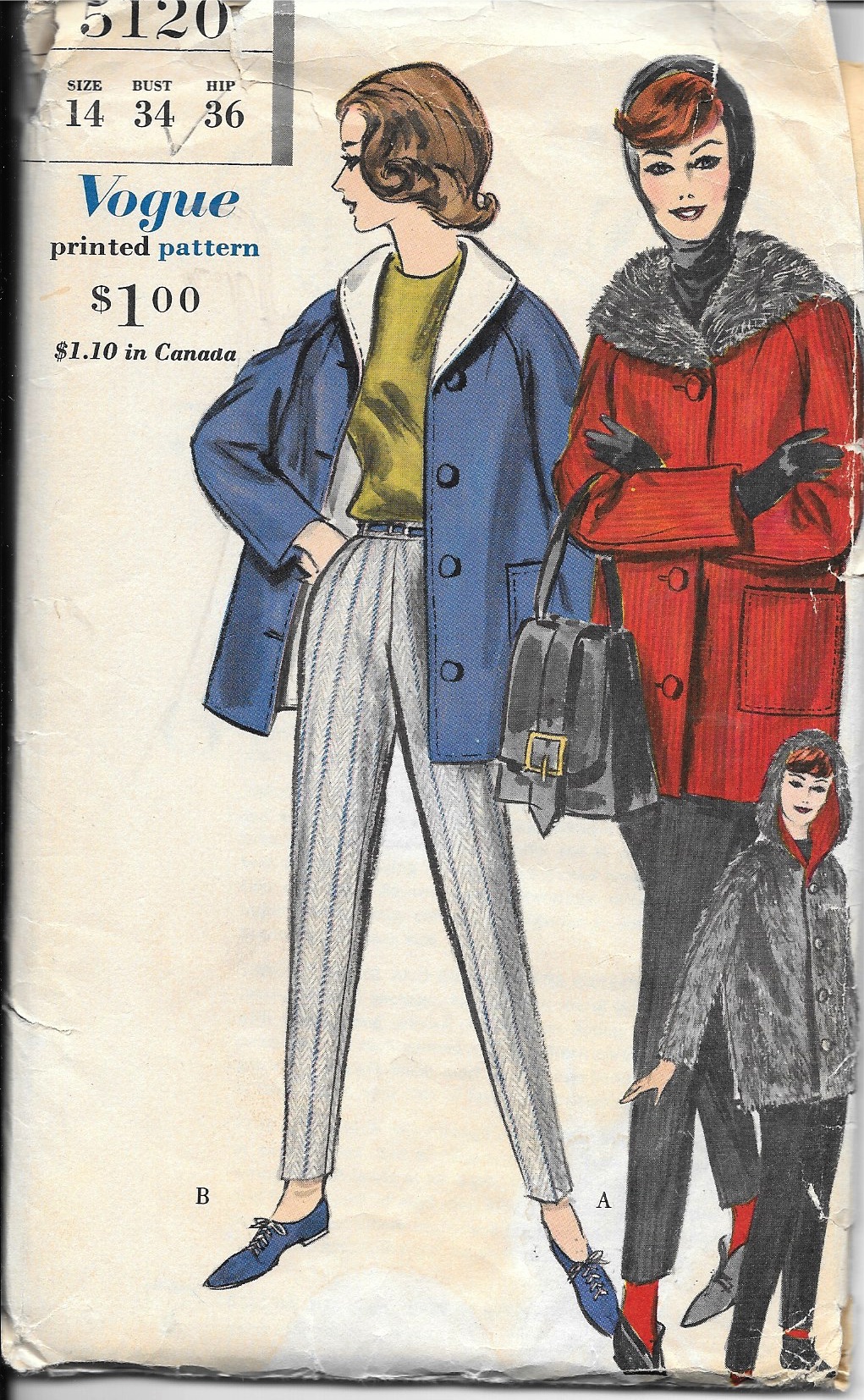
to this reversible car coat from the early ‘60s:

The model in the red version of the coat strikes a chic and elegant pose with her hair tucked under a scarf, her arms casually folded, and with her stylish handbag...

The model in the red version of the coat strikes a chic and elegant pose with her hair tucked under a scarf, her arms casually folded, her stylish handbag looped over one arm …

to this cocktail dress and coat ensemble from the mid ‘60s:

Oh the things we can learn, no 10

the message seemed to be: “These beautiful clothes which you can create are ladylike and elegant (even the casual ones), and you will be, too, when you wear them!” Perhaps Virginia Woolf said it best: “There is much to support the view that it is clothes that wear us and not we them; we may make them take the mould of arm or breast, but they would mould our hearts, our brains, our tongues to their liking.”

And therein lies the intrigue of it all. The story, which begins on the outside of the pattern envelope by way of the artist’s hand, becomes our own to finish when we are creators of our own clothing. How much fun is that?

26 Comments

Filed under Mid-Century style, Pattern Art, The Conde Nast Publications, Uncategorized, vintage Vogue patterns from the 1950s, vintage Vogue patterns from the 1960s

The Allure of Silk, Part 3: Finishing Touches for a Fancy Frock

In planning for my ‘50s-inspired silk party dress, my original intention was to use a red sash, just as shown on the original dress which I first saw on Pinterest.

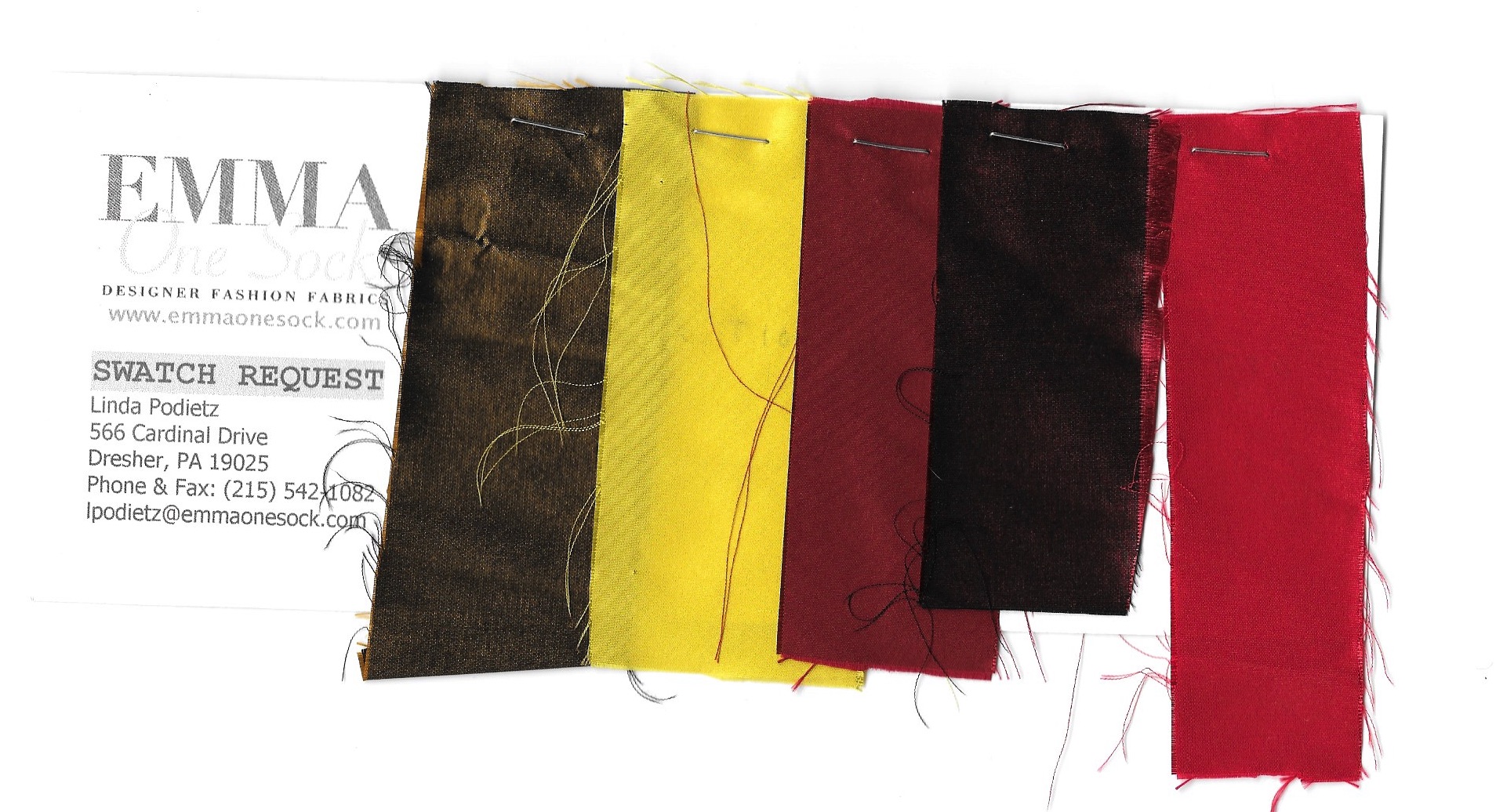
Blue taffeta:silk dress - originalWhen I sent off for swatches of silk taffeta from Emma One Sock Fabrics, however, I requested reds and yellows, just in case I might change my mind. When the swatch card arrived, there were clearly two obvious choices – the clear red and the vibrant yellow.Allure of silk - cummerbund picture

Then a funny thing happened. I ordered the red, which was out-of-stock temporarily. The owner of Emma One Sock (who, I might add, is one of the pleasantest and most helpful people from whom one will ever order fabric!), held up the order, at my request, while I thought about it some more. By the time I went to Baltimore to start my dress in Susan Khalje’s Couture Sewing School, I had just about decided to switch to yellow. With Susan’s hearty endorsement and the additional approval of my classmates, the decision was made: the sash would be yellow, not red.

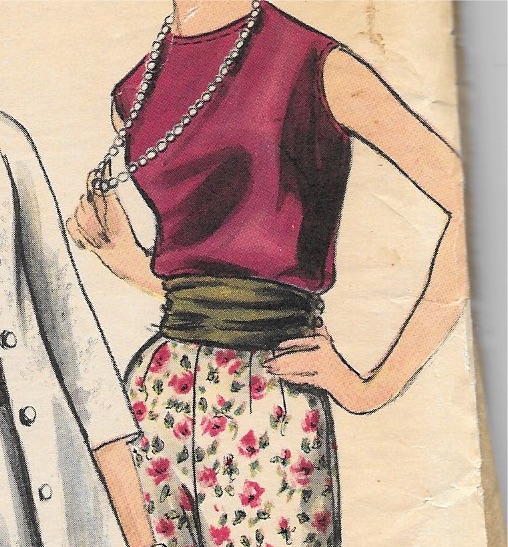
When the yellow silk taffeta arrived, I knew the decision was the right one. All I had to do then was figure out how to make the sash. Easy, right? With lots of time to think about this while I finished the embroidered organza top and the sapphire blue skirt – and the dress lining – I gradually came up with a plan. I decided a more structured cummerbund and bow would be the best look. First I went in search of a cummerbund pattern, which I found in an early 1960s pattern in my collection:

Allure of silk - cummerbund picture-1

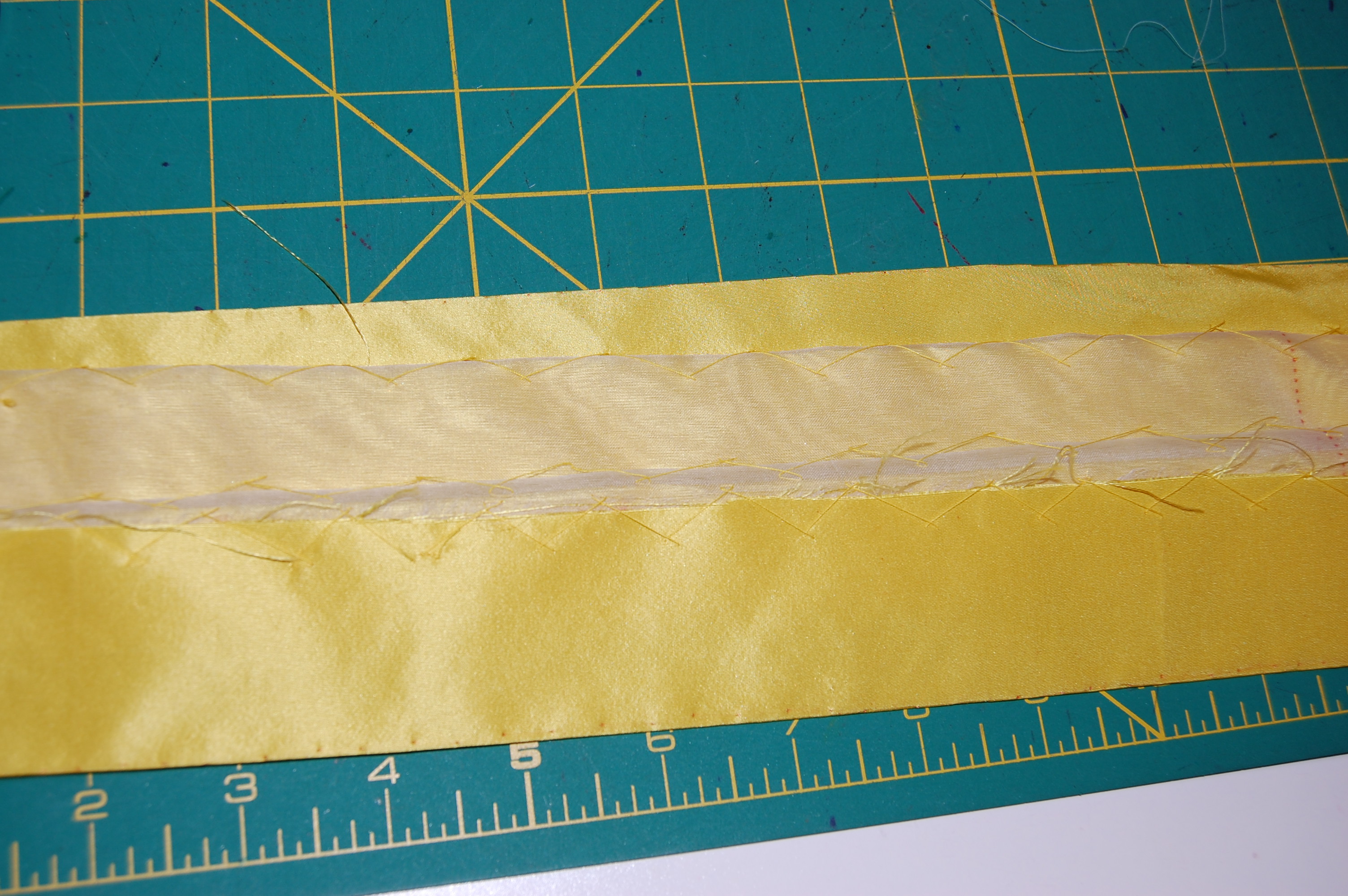
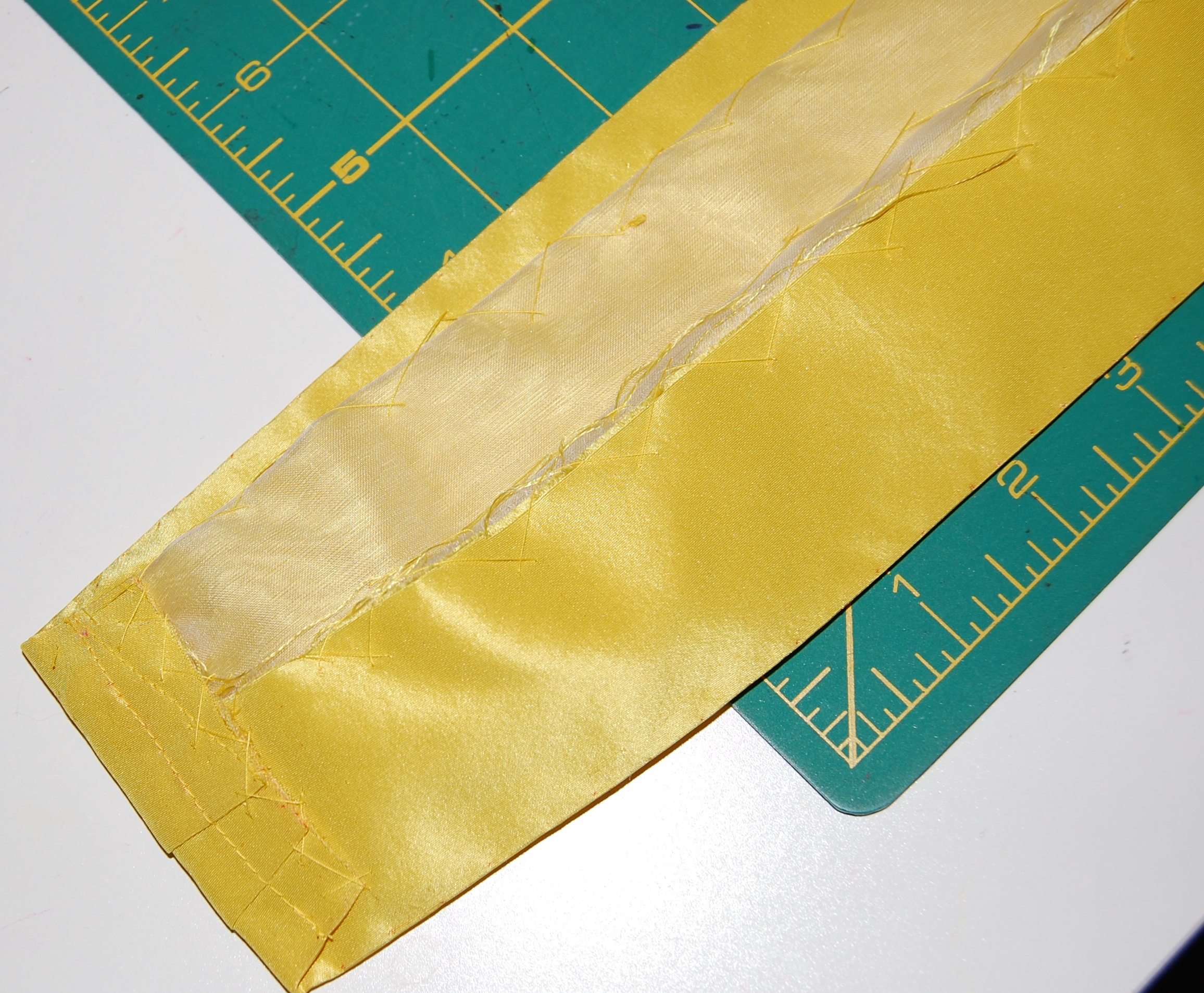
I decided to loosely pleat it instead of gathering it, so it would appear smoother around my waist. Because I had underlined it with silk organza, I had an anchor upon which to secure the soft pleats:

I used a loose catch-stitch to secure the pleats.

I used a loose catch-stitch to secure the pleats.

allure of silk final

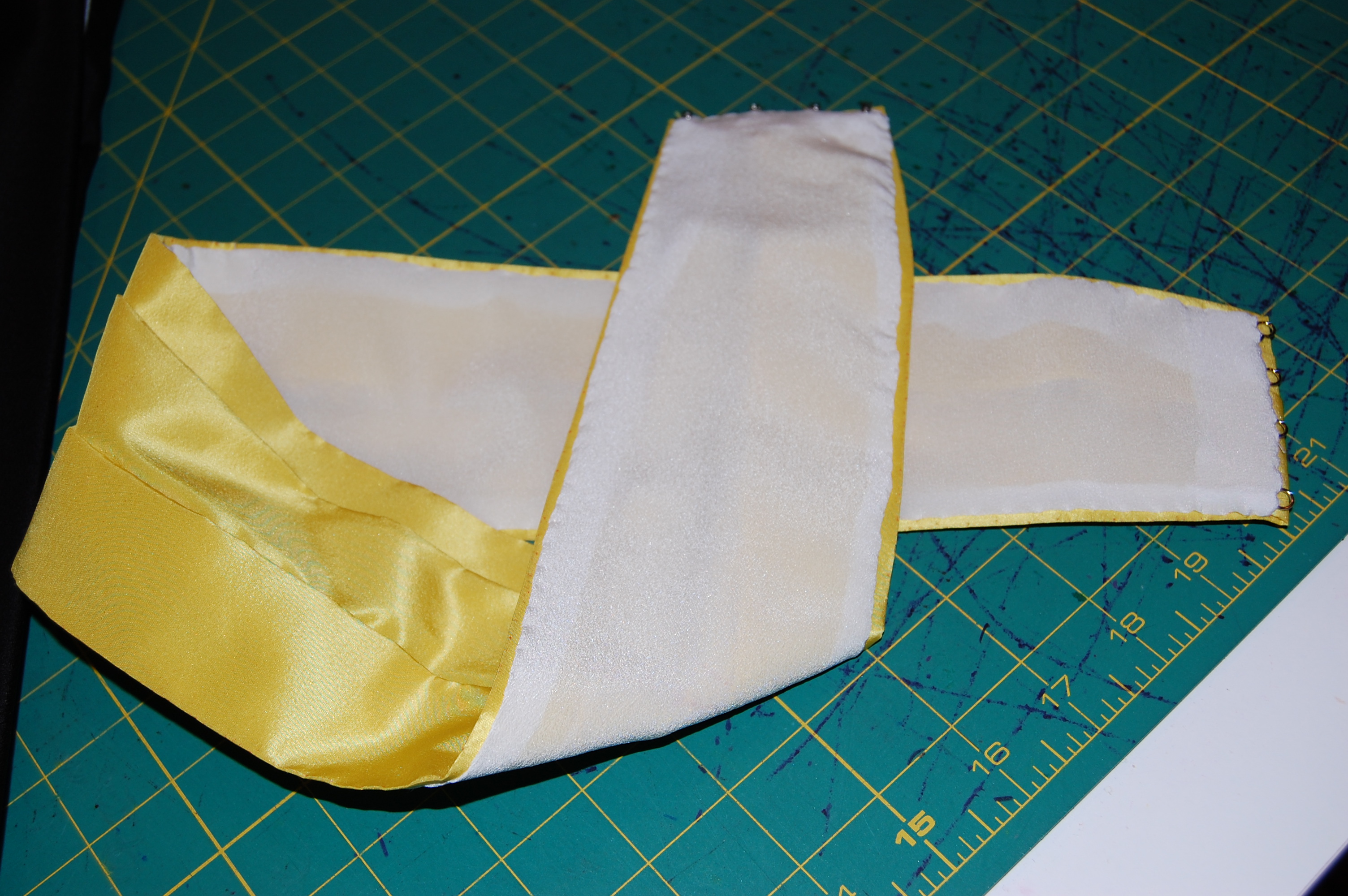
And I folded in the two ends, ready for hooks and eyes.

Then I lined it with silk crepe de chine.

Allure of silk final

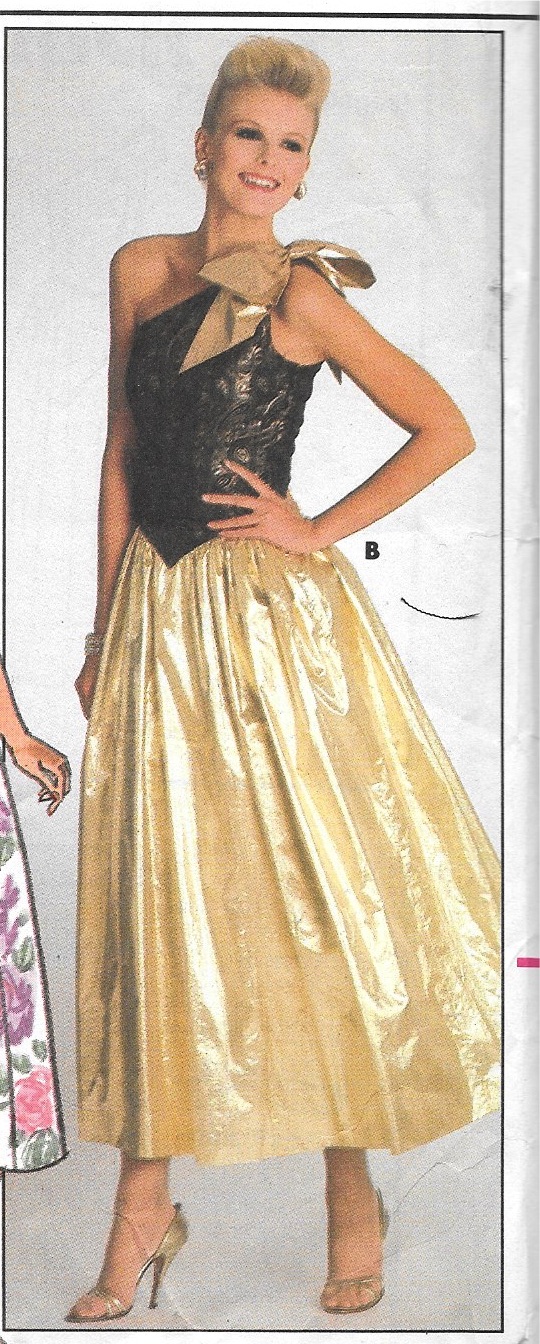
Now –  I really love a beautiful bow. And I knew just where to go to get the perfect bow pattern. I made this Butterick pattern in the early 1990s, and while I still like the dress I made (I’ll feature it sometime… it’s still in my closet!), I love the bow. I have used this bow pattern numerous times, always successfully.

Allure of silk - bow picture-2

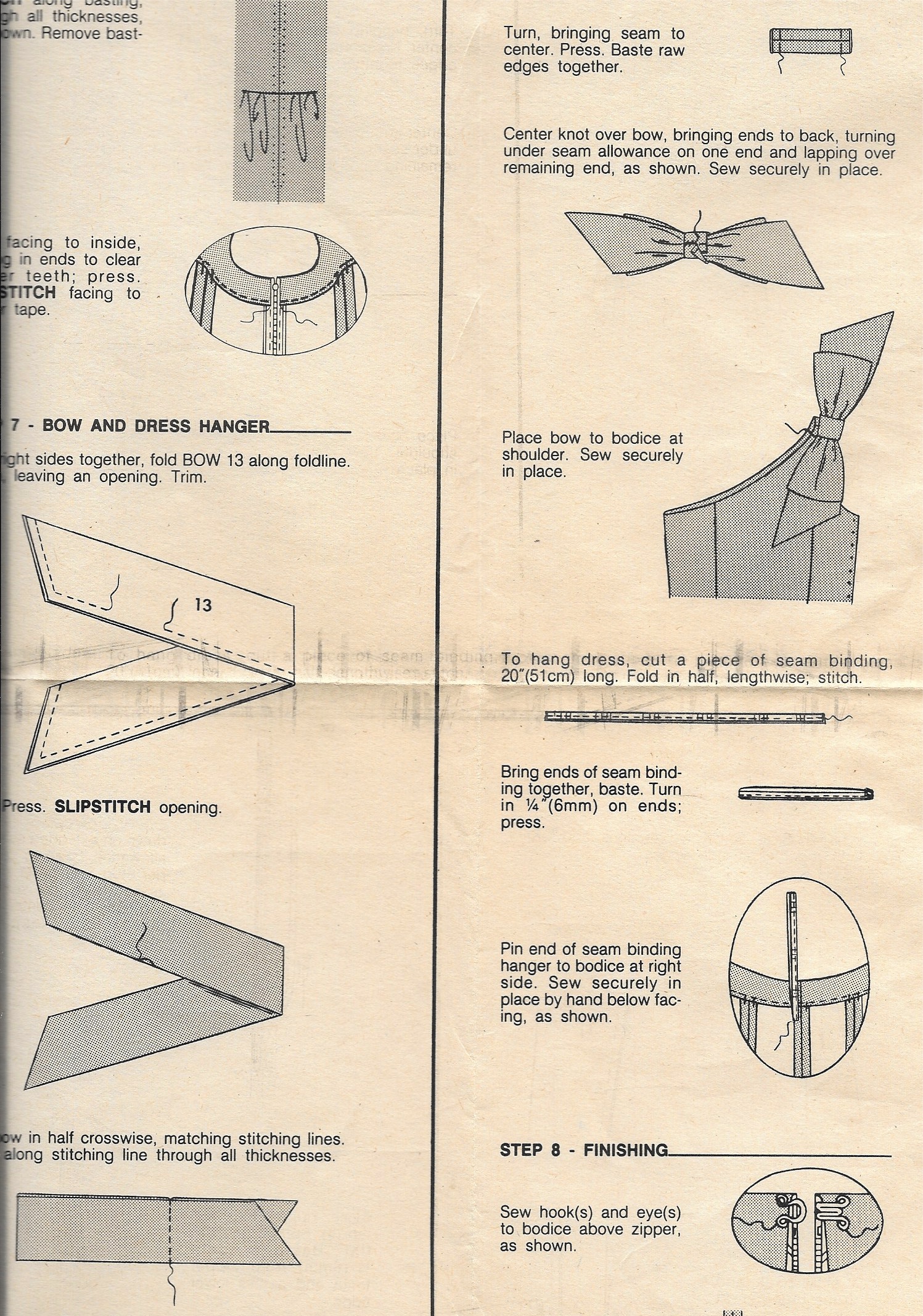
Here is a close-up of the instruction sheet, showing the simple but effective construction of this bow.

Allure of silk - bow diagram-3

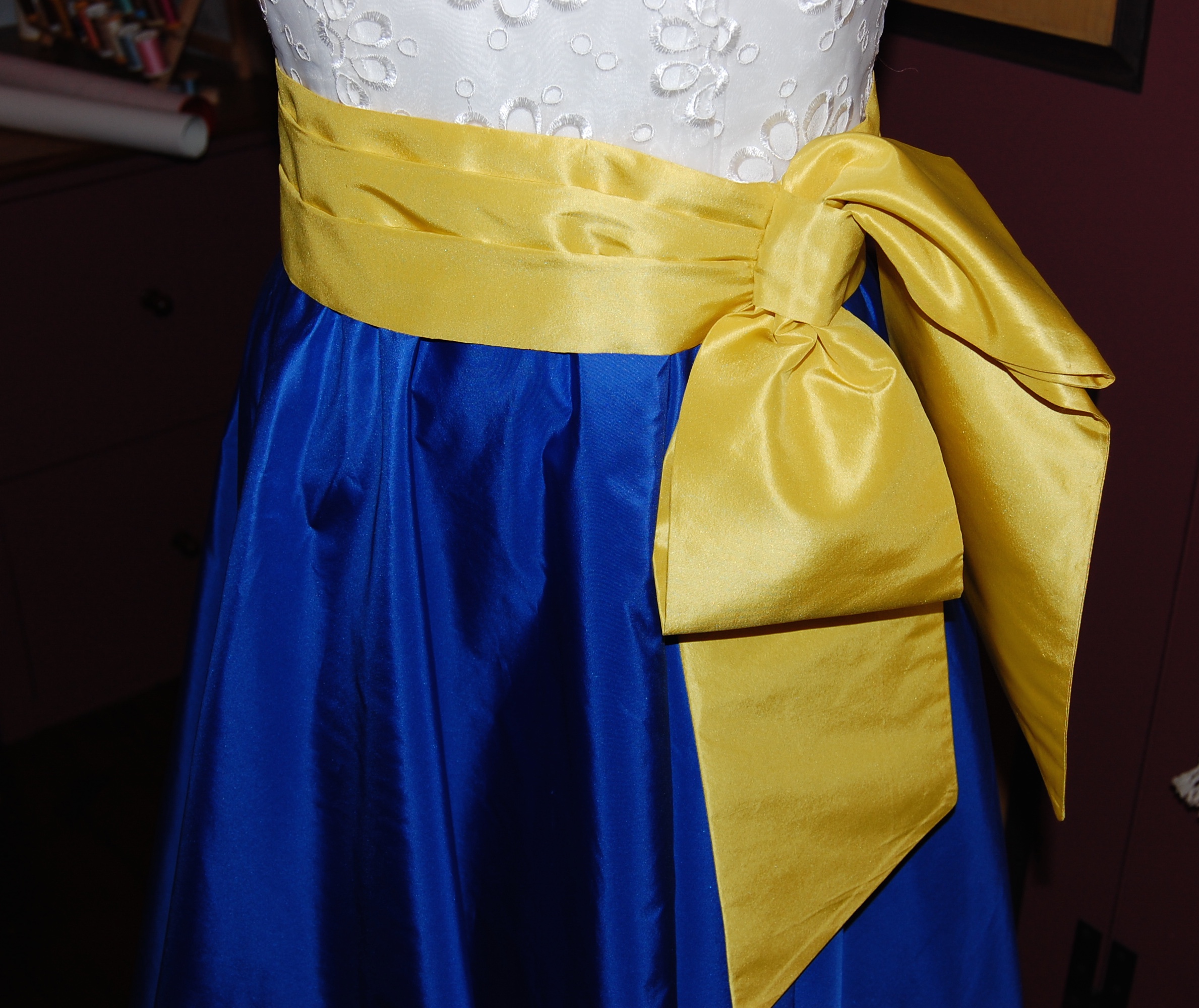
I increased the width and length a bit, as I knew it would need to be a focal point of the dress. I attached the bow to one end of the cummerbund, and used a snap to secure it in place on the other end.

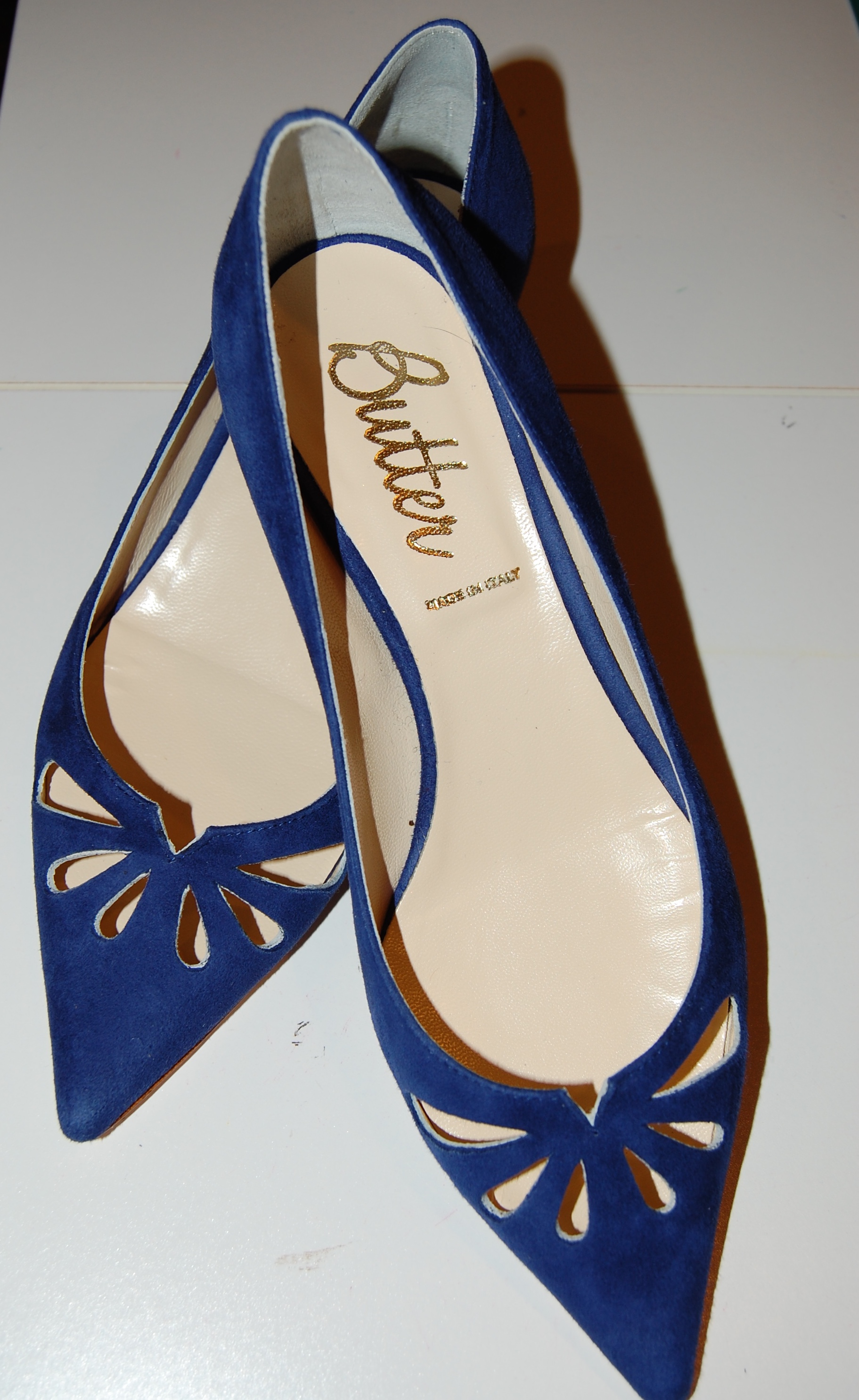
All of this took more time than I could have ever imagined! The event for which I made this dress is next week, and I’ll get proper pbotos taken then. But here is a sneak peek, first of the shoes I found which really seem to be the perfect pairing for this dress:

allure of silk final

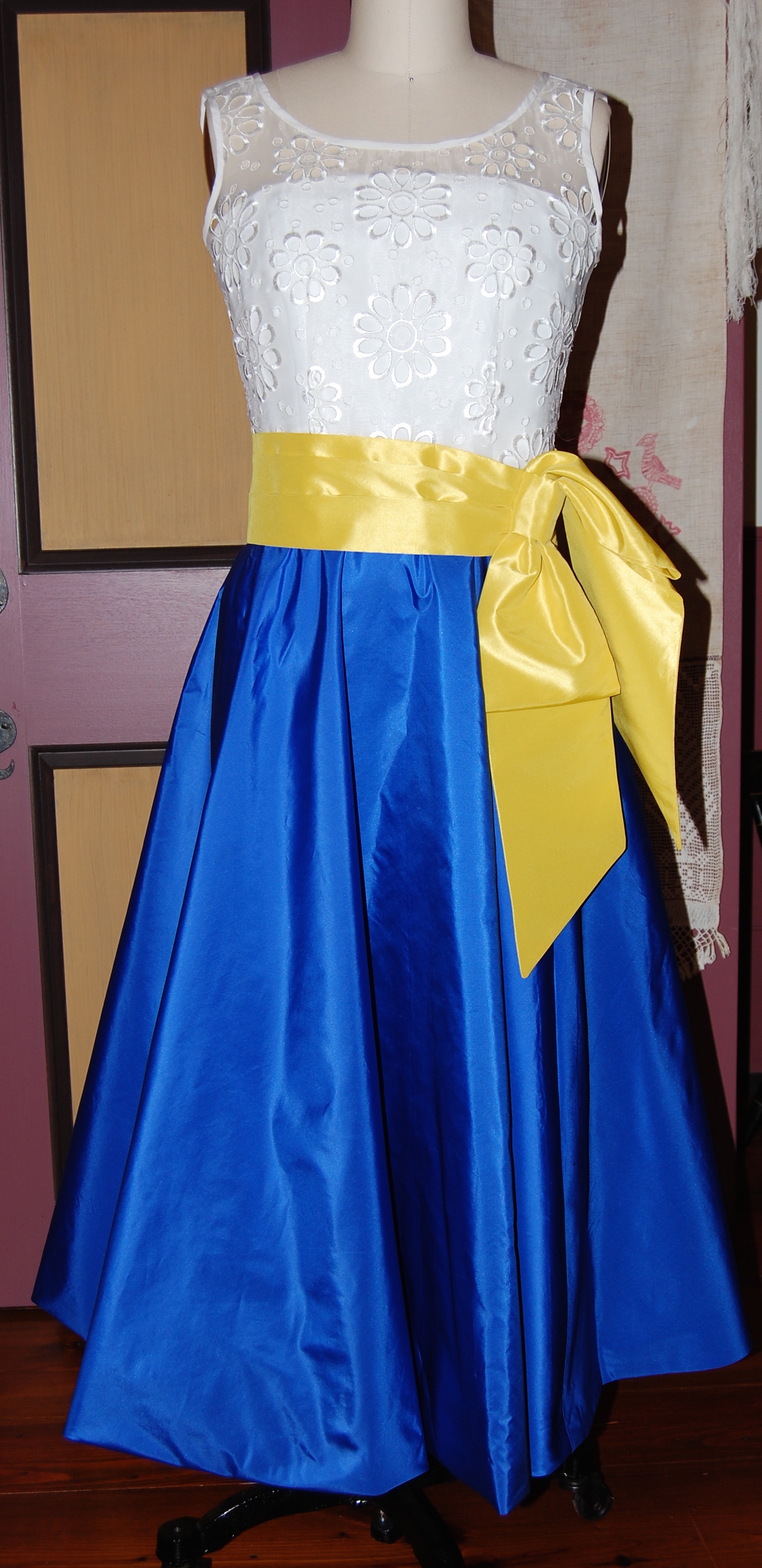
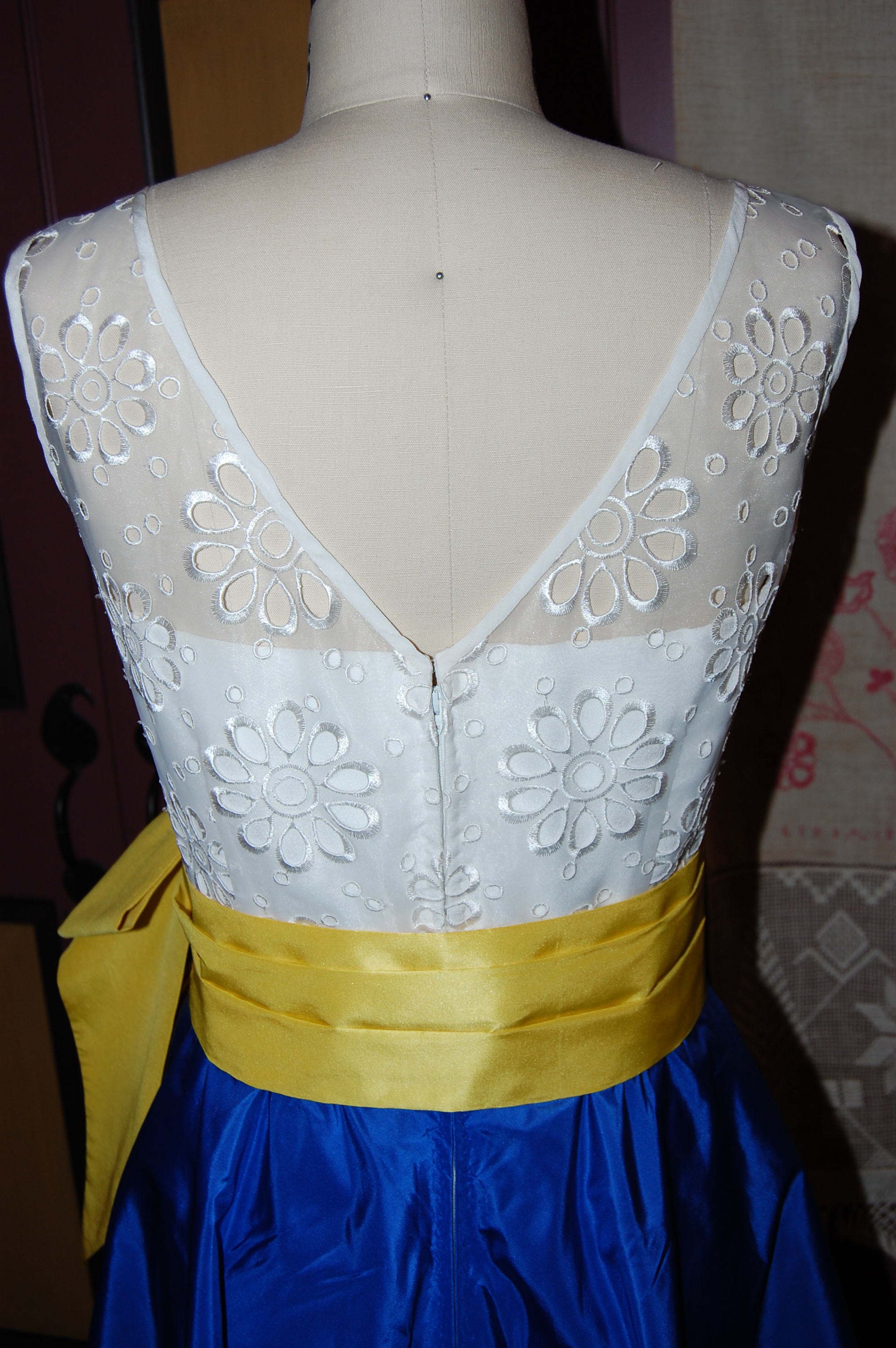
And here is the dress on my dress form:

Allure of silk final

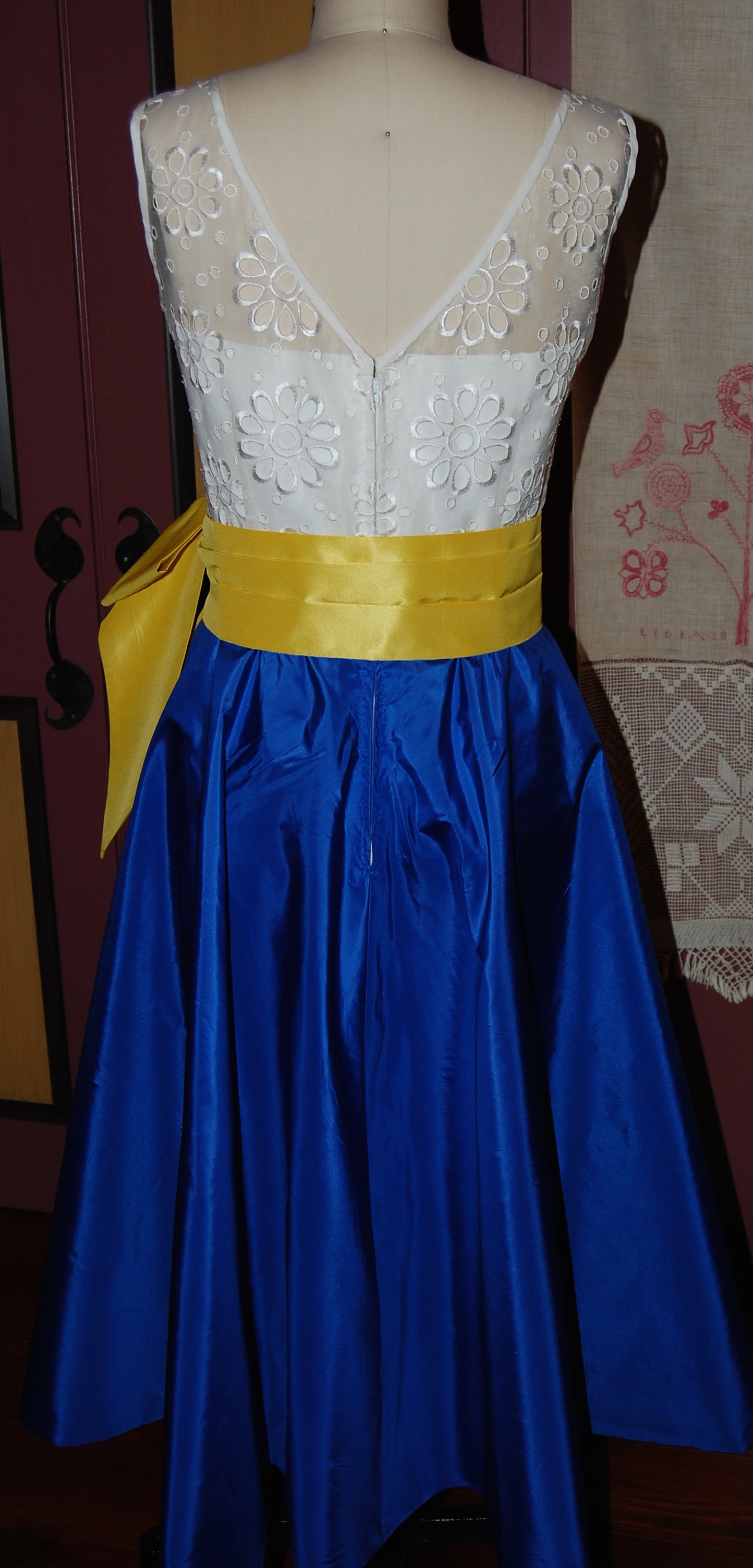
Allure of silk final

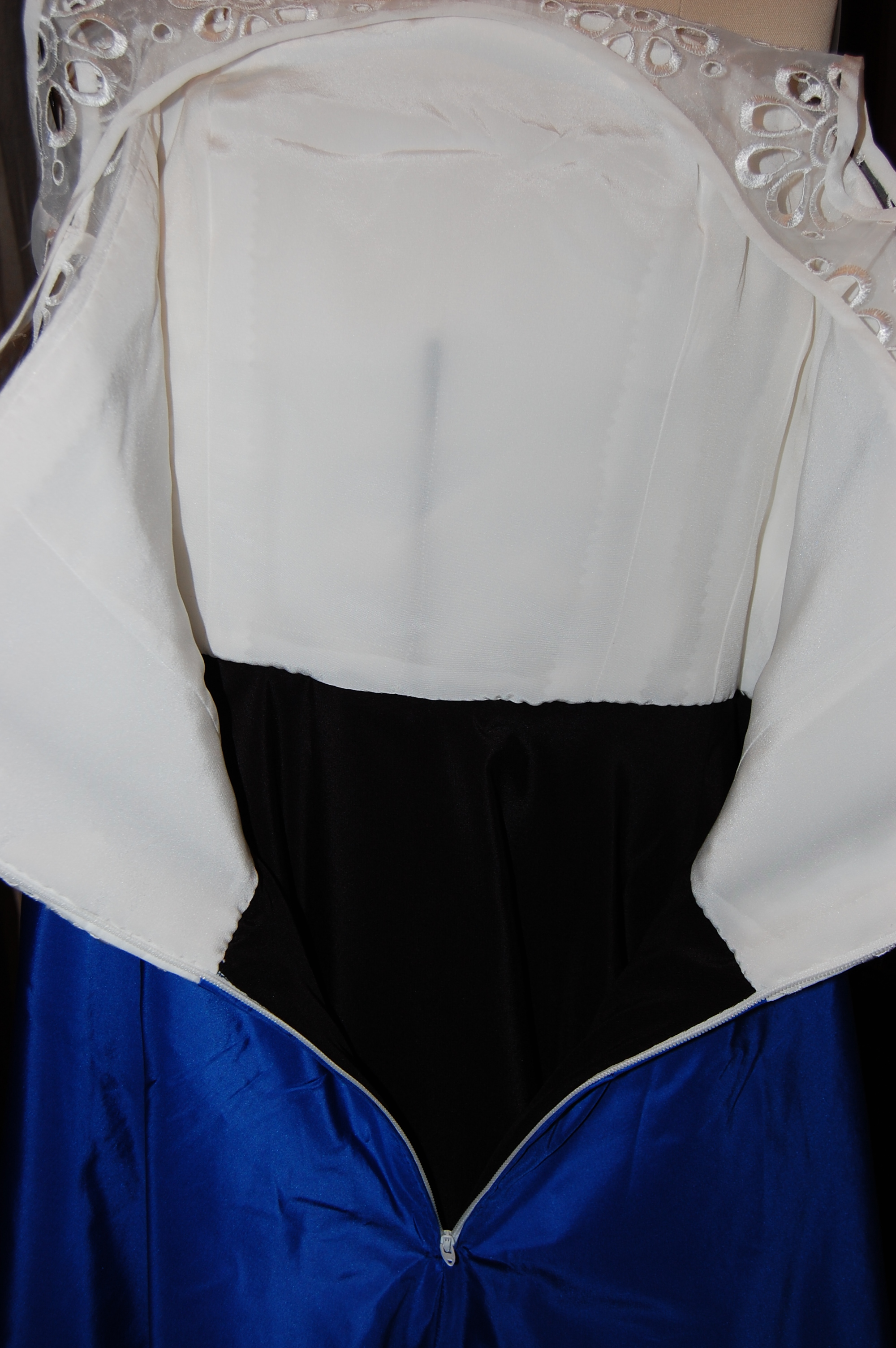
I thought I'd include this photo of the dress lining for anyone interested in seeing it.

I thought I’d include this photo of the dress lining for anyone interested in seeing it.

I am very pleased that I decided to "V" the back of the outer bodice!

I am very pleased that I decided to “V” the back of the outer bodice!

A close-up of the bow.

A close-up of the bow.

One of my favorite fashion quotes is one from Madeleine Vionnet: “The dress must not hang on the body but follow its lines. It must accompany its wearer and when a woman smiles the dress must smile with her.” Will my dress put a smile on my face when I wear it? Yes, if only for the fact that it has been finished just in time!

Details:

Blue silk taffeta:  Britex Fabrics

White embroidered organza:  Waechter’s Fabrics (now out of business)

Yellow silk taffeta:  Emma One Sock Fabrics.

Under bodice and outer bodice pattern:  Vogue 8766

Cummerbund pattern:  Vogue 5234 (vintage)

Bow pattern:  Butterick 3582 (vintage)

Shoes:  Butter, sold by Simply Soles

40 Comments

Filed under Cocktail dresses, couture construction, Mid-Century style, sewing in silk, Shoes to make an outfit complete, Uncategorized, vintage Vogue patterns from the 1960s, Vogue patterns

The Year of Magical Sewing

“Just around the corner in every woman’s mind – is a lovely dress, a wonderful suit, or entire costume which will make an enchanting new creature of her.”                                                               —  Wilhela Cushman

For those of us who sew, this statement takes on extra meaning, as it is in our power to create that lovely dress, wonderful suit or entire costume. But have you ever thought about the process of sewing – and how magical it is?   Magical in the sense of being “mysteriously skillful, effective, and enchanting” (as Webster defines one meaning of magic).   I love that I can start with a piece of fabric – or a pattern – or an idea spawned by something I have seen and admired – and, using skills I have learned, proceed to actually make my own interpretation. It’s a remarkable process, when you really take the time to think about it. So I am dubbing this year, 2015, for me, as The Year of Magical Sewing, with emphasis on the transformational qualities and joys inherent in fashion sewing.

So what do I have planned for my year of magical sewing? I am beginning the year with several new vintage patterns in my collection, which are inspiring me no end. Add to that some amazing fabric selections, both vintage and new, and I am already certain I’ll never complete every thing I’d like to!  So – here is a general outline for 2015:

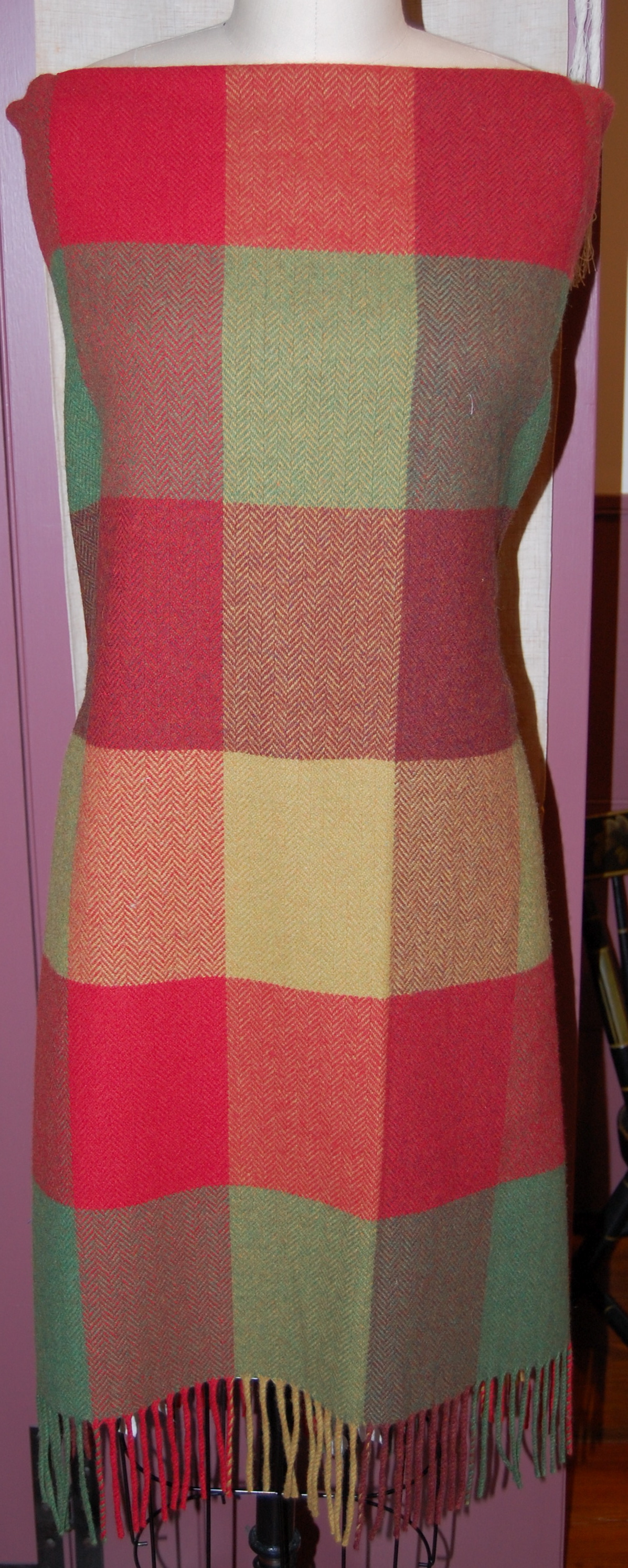
It is always easiest for me to segment the year into its seasons as I think about what I’d like to sew. Starting with Winter, I have two wool projects which will take me into March, I am sure: One is my fringed “blanket” dress, currently underway in my Sewing Room. After that I will be sewing with a piece of navy blue cashmere, from which I hope to squeak out a dress and jacket. (Valentine’s Day will find me interrupting my wool projects to make a sweet treat or two for granddaughter Aida.)

With any luck, I'll soon be wearing my blanket dress.

With any luck, I’ll soon be wearing my blanket dress.

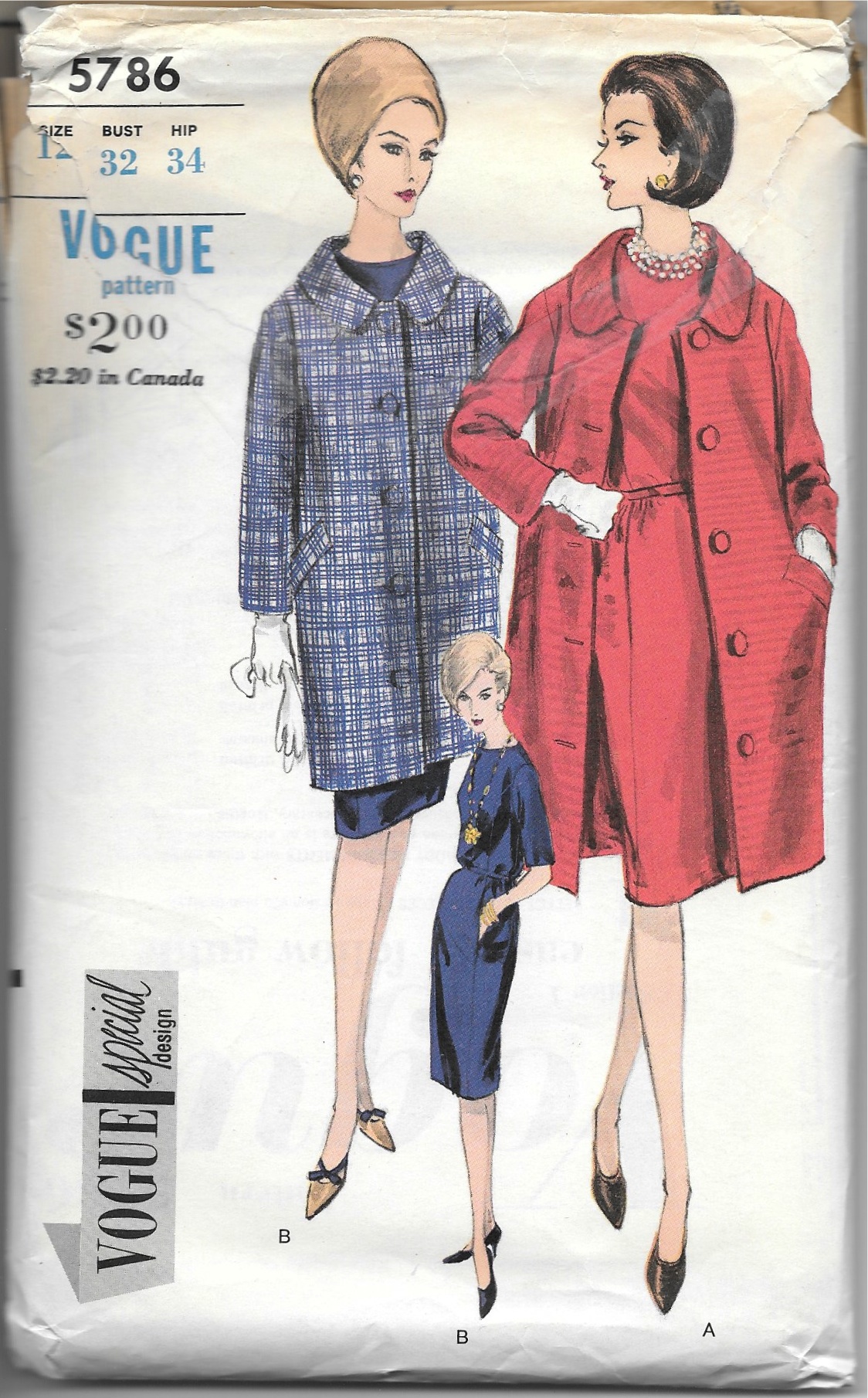
Spring is especially enticing to consider. Somehow I have become obsessed with dress and coat ensembles. Here are two patterns which would make up into “Spring” coats and coordinating dresses. I definitely will be using vintage linen for one of these two-part looks.

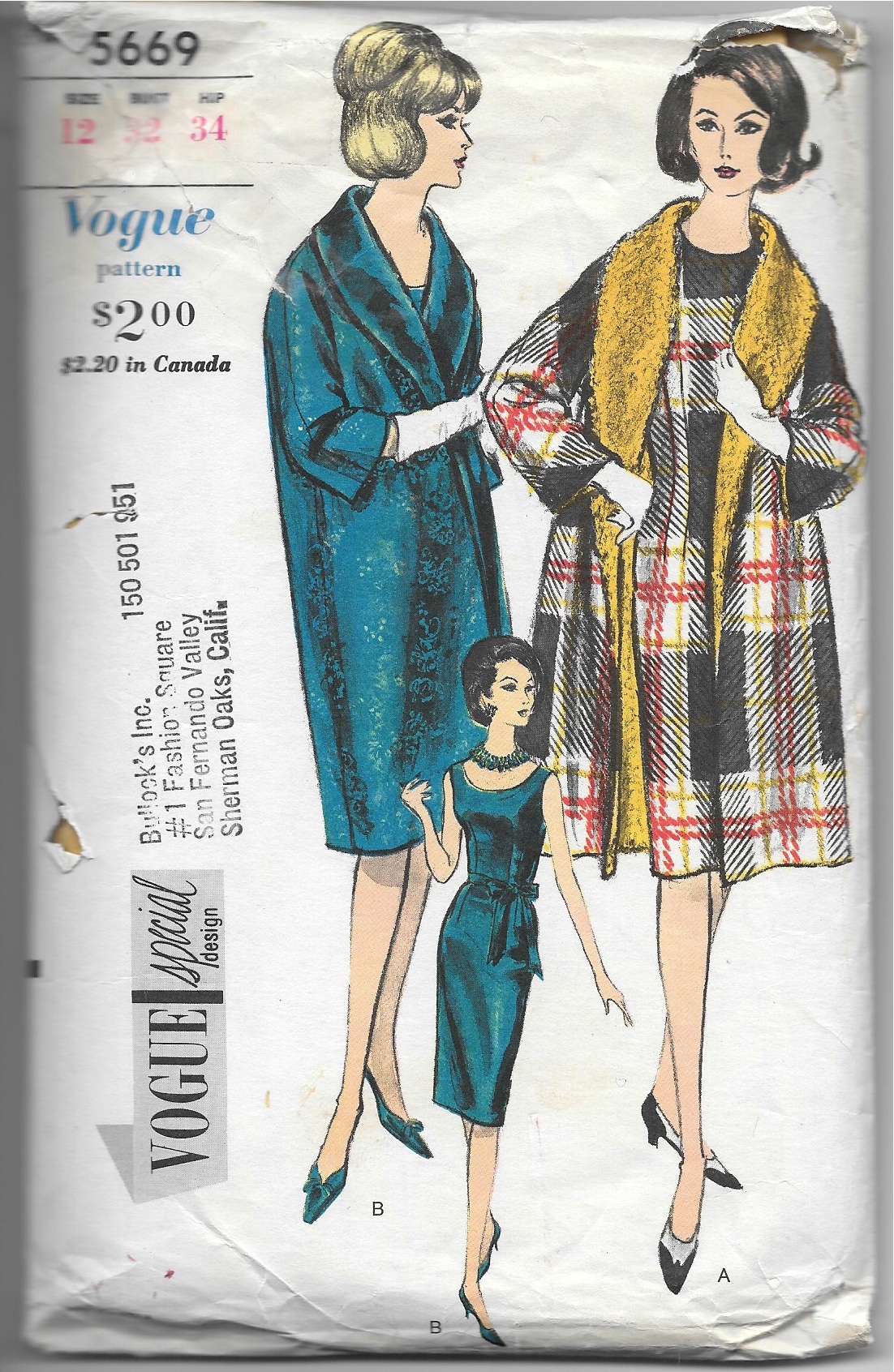
I love the knee length coat, although I may substitute another pattern for the coordinating dress.

I love the knee length coat, although I may substitute another pattern for the coordinating dress.

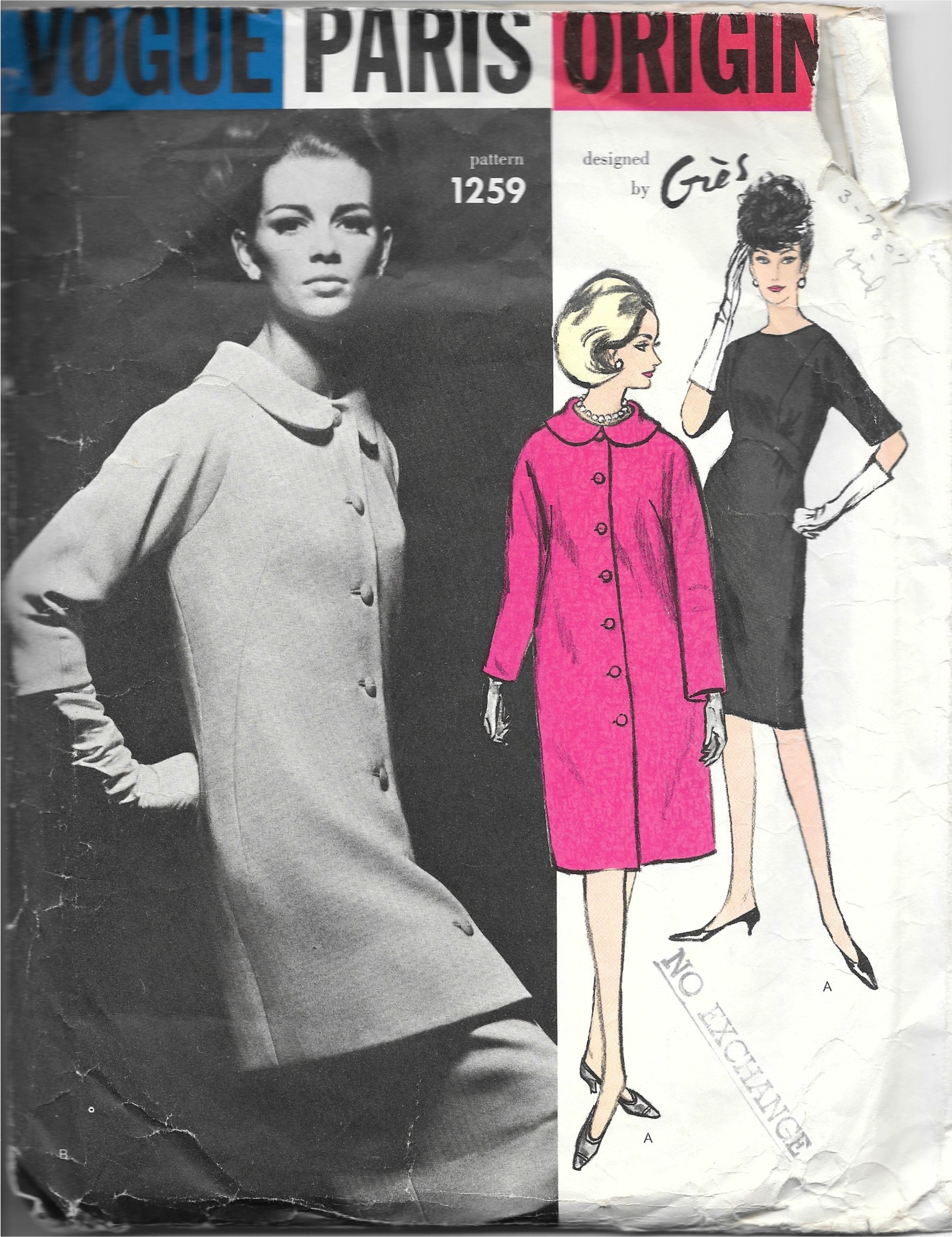
Or I may decide to use this Madame Gres design fopr a coat and dress.  The coat has very unusual darts along the side, which you may be able to see here.

Or I may decide to use this Madame Gres design for a coat and dress. The coat has very unusual darts along the side, which you may be able to see here.

Another Diane von Furstenberg wrap dress is also on my agenda for late Spring/early Summer. Thanks to one of my readers, I was able to purchase some authentic Cohama DvF fabric, so I am excited to contemplate the beginning of this dress.

Circa 1976, this fabric is still soft and lovely.

Circa 1976, this fabric is still soft and lovely.

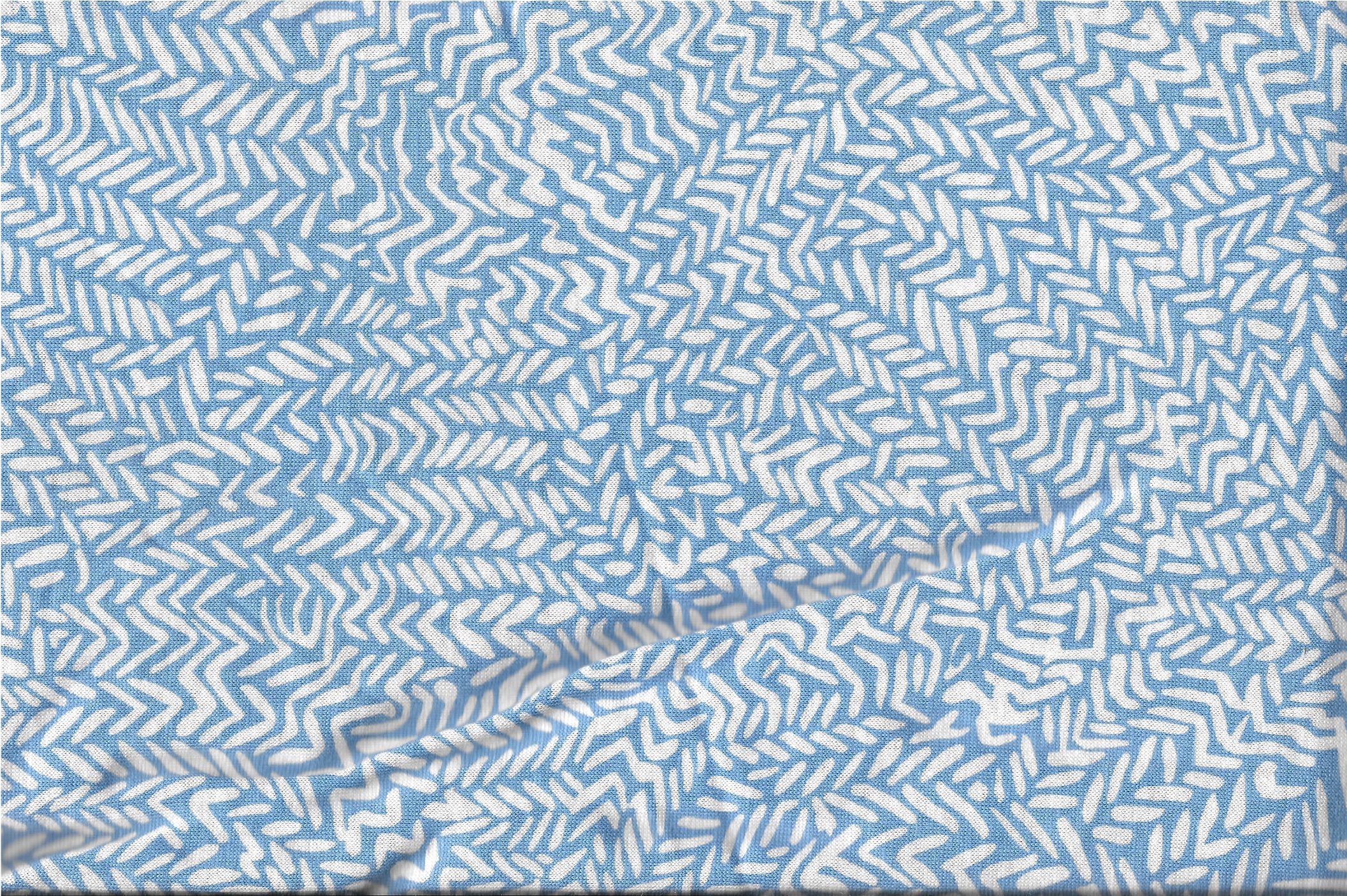
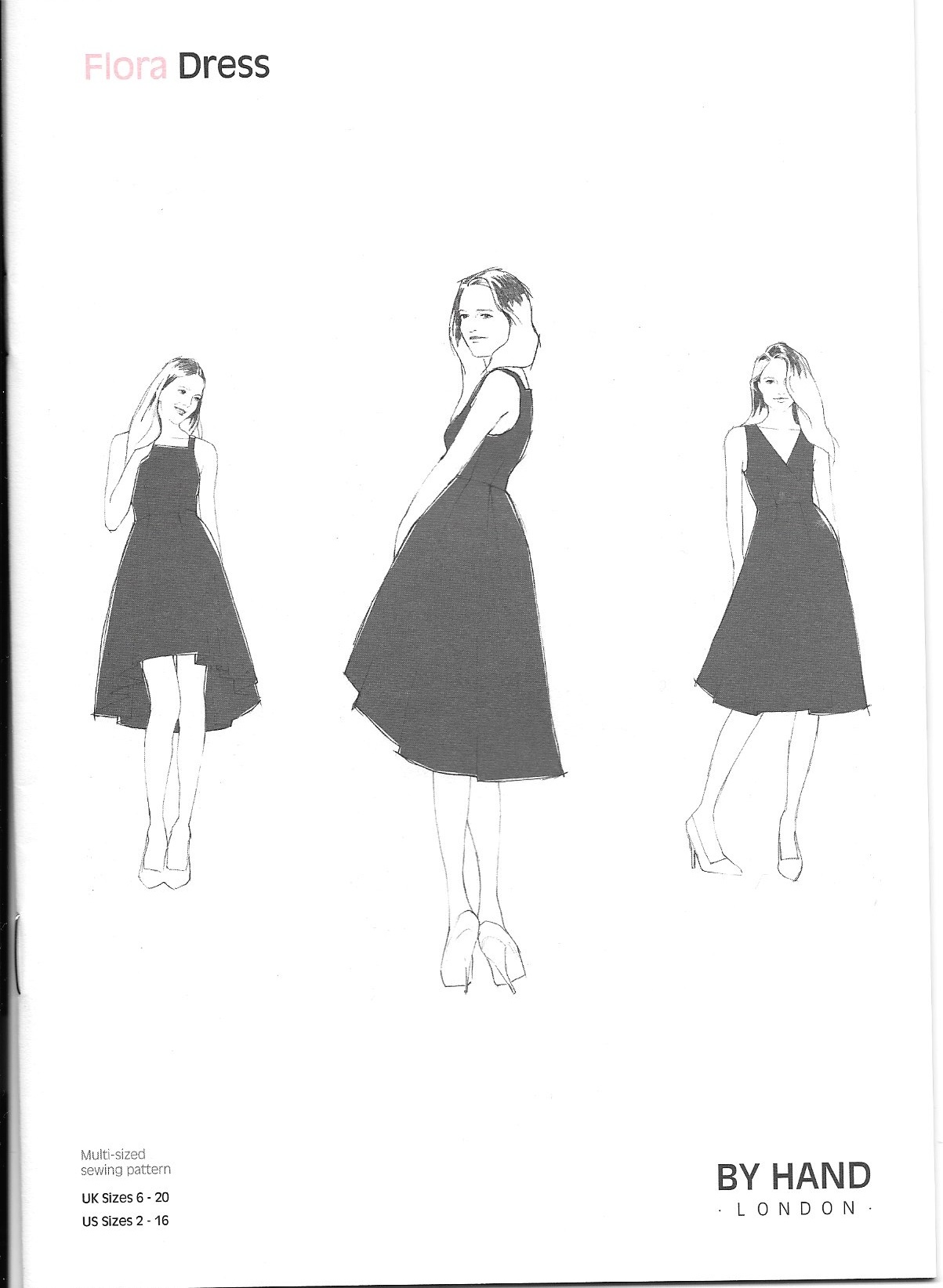
Summer will find us traveling quite a bit, so I am trying to be realistic about the time I’ll have to sew. If I can get one “fancy/formal” dress made, I’ll consider it a success. I might be using this By Hand London “Flora” pattern with this fabric, unless, of course, I change my mind.

Aspects of this pattern remind me of classic Balenciaga.  I'll have to make the skirt longer, however...

Aspects of this pattern remind me of classic Balenciaga. I’ll have to make the skirt longer, however…

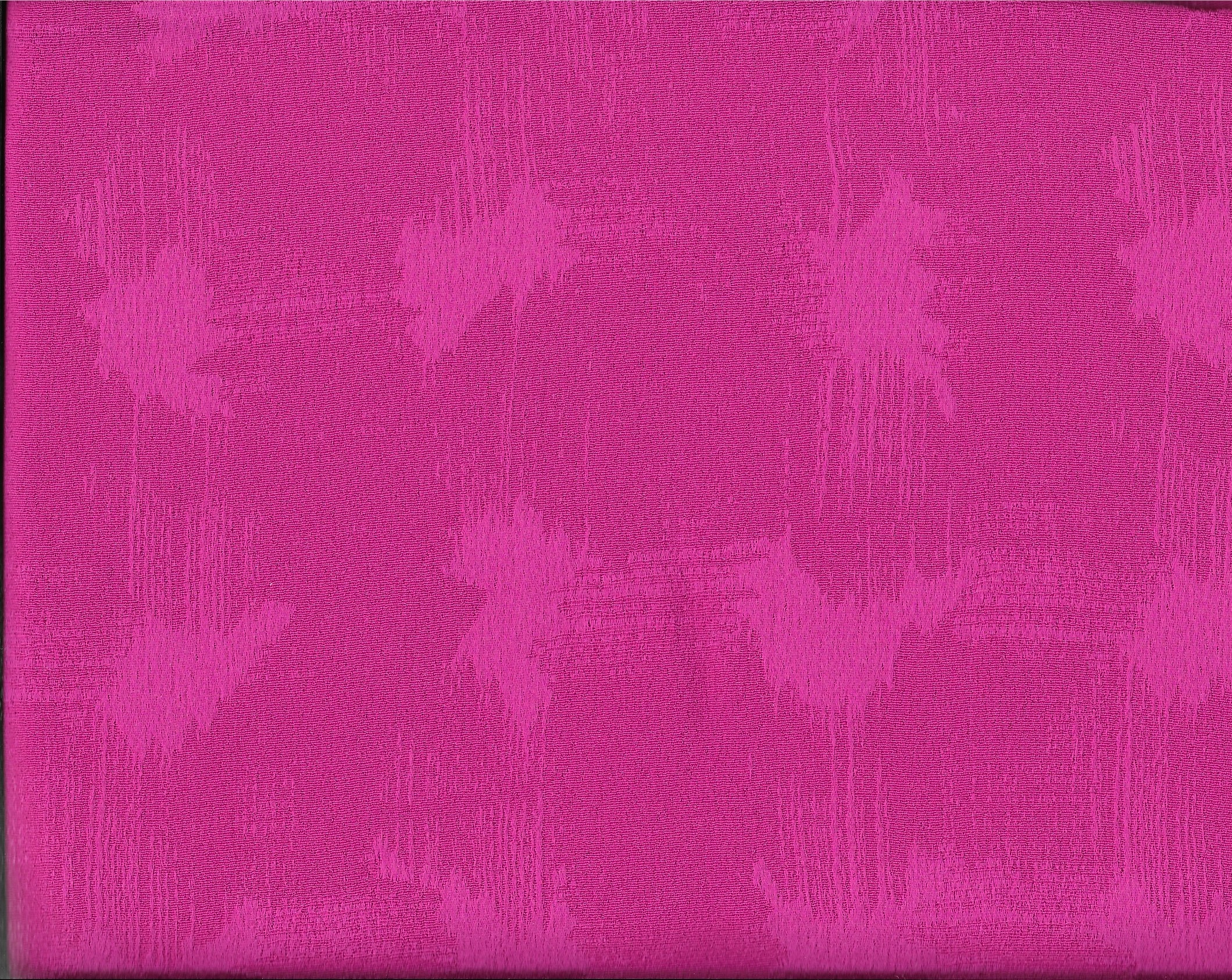
I watched this fabric on the website of Britex Fabrics for months, and finally decided I had to have it.  It is silk charmeuse, very soft with the abstract design woven in.

I watched this fabric on the website of Britex Fabrics for months, and finally decided I had to have it. It is silk charmeuse, very soft, with the abstract design woven in.

Fall will once again find me thinking coats and dresses. One of these two patterns will probably get the nod for a Fall/Winter ensemble:

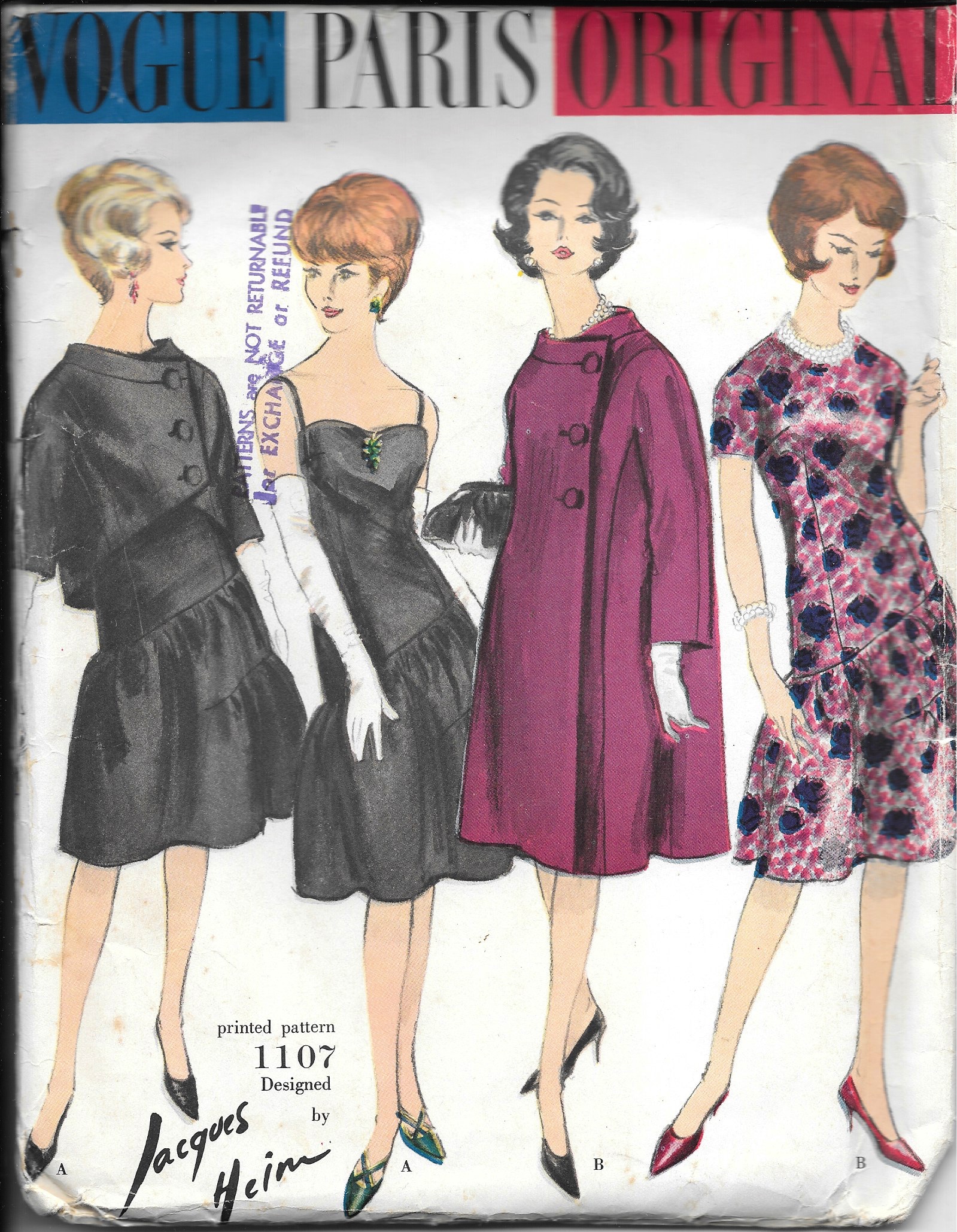
I love both the coat and the dress (with two variations) featured in this pattern.

I love both the coat and the dress (with two variations) featured in this pattern.

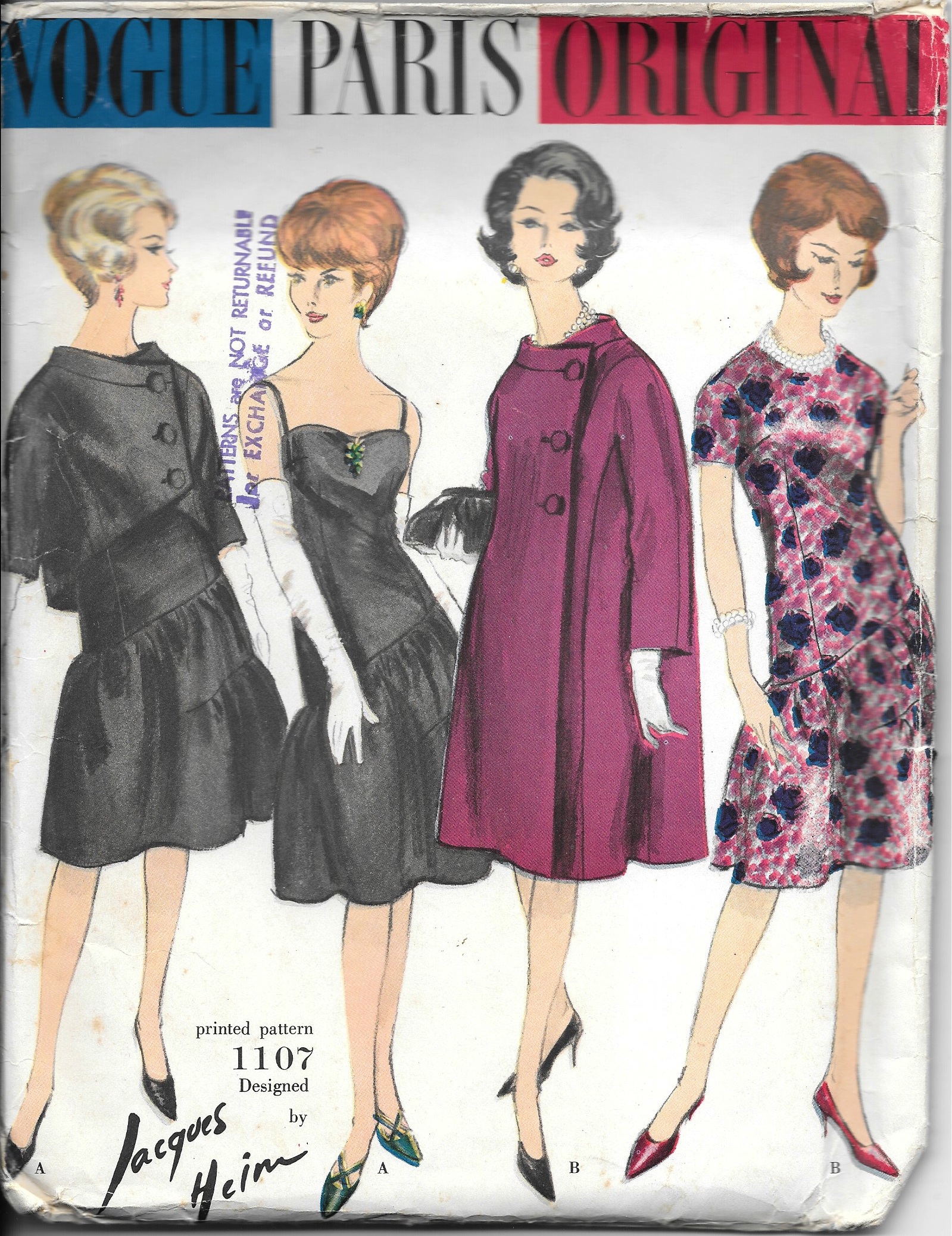
This Jacques Heim design has very unusual seaming in the skirt.  And the short jacket looks like it would be very flattering.  However, this pattern needs just the perfect fabric to showcase the design.

This Jacques Heim design has very clever seaming in the skirt. And the short jacket looks like it would be very flattering. However, this pattern needs just the perfect fabric to showcase the design.

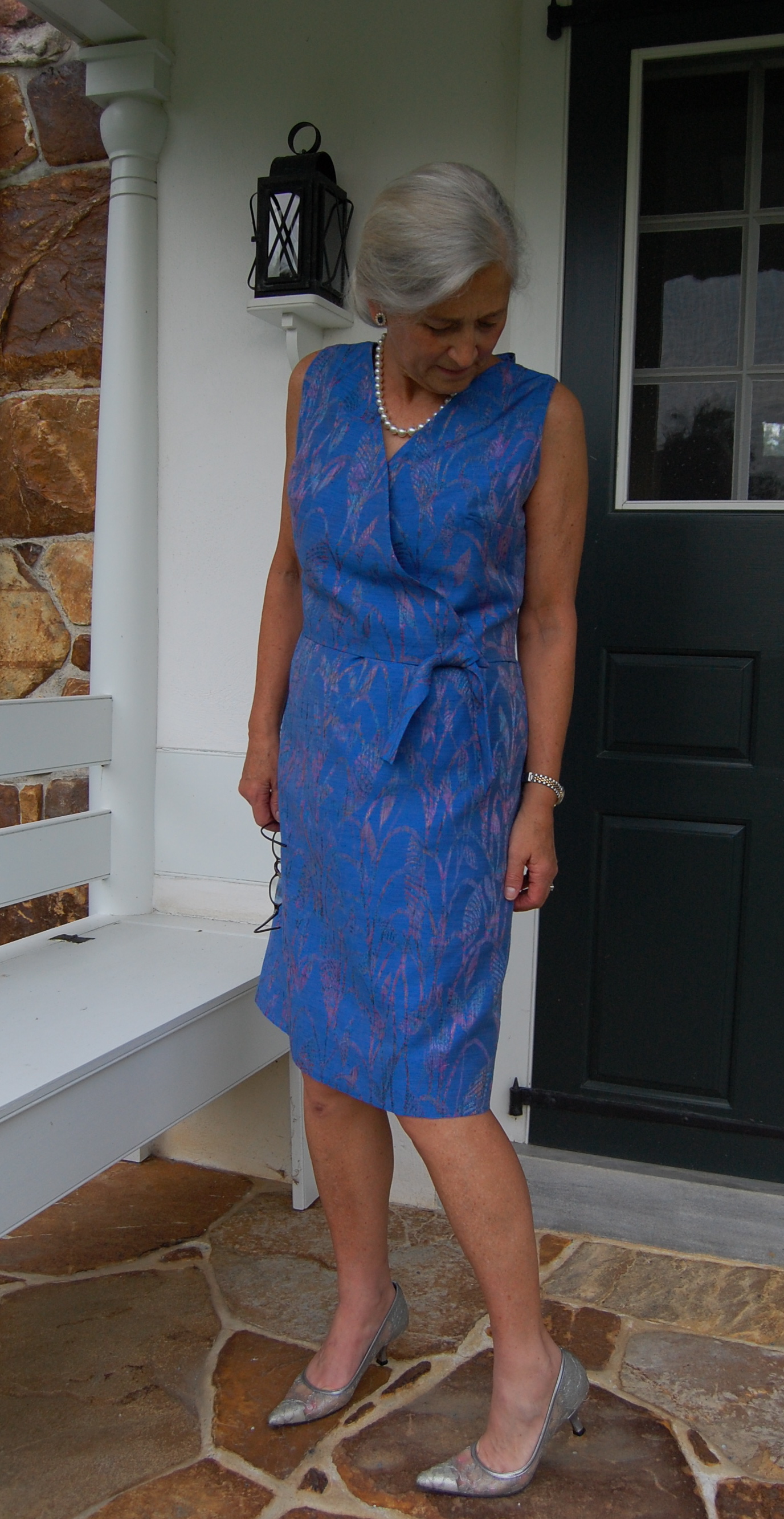
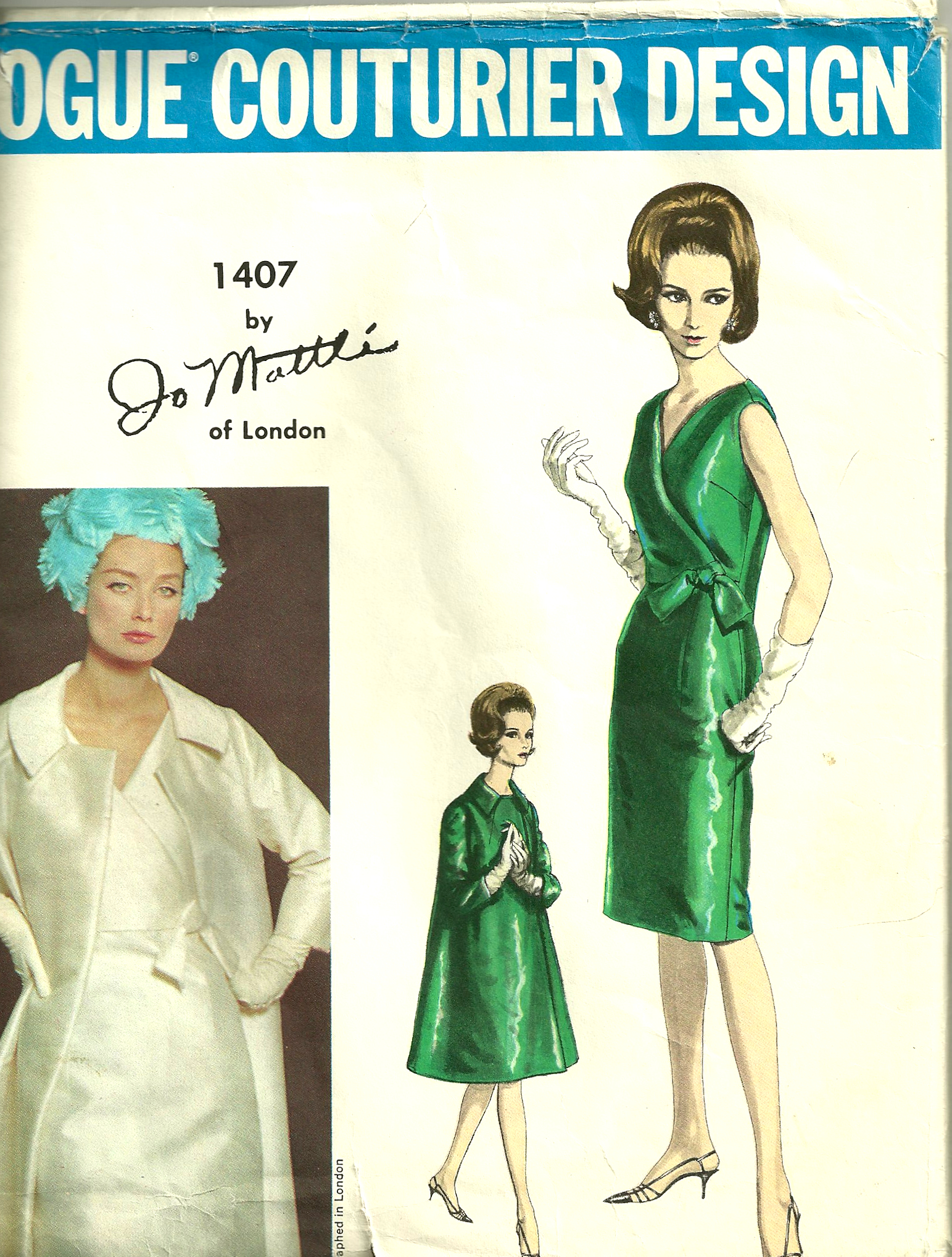
And I am still looking for the perfect fabric with which to make the coordinating coat for this dress which I completed last Fall:

The Year of Magical Sewing

And here is the Mattli pattern showing the coat...

And here is the Mattli pattern showing the coat.

And then there is that baby quilt I want to make for “number 2” grandchild…   And more little dresses to make…

Perhaps the real magic of the year will be in completing even half of all I’d like to sew?  Here’s hoping that what is just around the corner for you, my readers, in 2015, holds its own magic and enchantment!


23 Comments

Filed under Coats, Love of sewing, Uncategorized, Vintage fabric, vintage Vogue Designer patterns, vintage Vogue patterns from the 1960s, Wrap dresses

Powerless in Pennsylvania, Sewing in San Francisco

“She had the loaded handbag of someone who camps out and seldom goes home, or who imagines life must be full of emergencies.”  – Mavis Gallant

Actually, the handbag I took to San Francisco was small, tucked inside a larger tote bag – so that I could use my allotted “carry-on” space for an extra suitcase for fabric purchases.  Off I went on February 1st for Susan Khalje’s Couture Sewing School held at The Sewing Workshop in San Francisco.  I had carefully packed myriad sewing supplies and my prepared muslins, hoping to be ready for any contingency.  Little could I have known that while I was to be sewing on the West Coast, the camping out (or really, camping in!) and the emergencies would be on the East Coast – with the county in Pennsylvania where we live especially hard-hit by a devastating ice storm.  Our house was without power for 5 days, and knowing that my husband was dealing with downed trees, downed power lines, blocked roads, confused pets, a house getting colder and colder with each day, and limited means of communication, weighed on me mightily as I worked away on my color-blocked jacket.

Coats of certain length - 7

Most of us in the class needed to purchase all our fabric or coordinating fabric or supplies for our intended projects, so off we went to Britex Fabrics on Monday after Susan had fitted most of our muslins.  I had thought long and hard about what color combination I would like to have for this coat.  Knowing that many, many hours of work would go into this project, and also realizing that this jacket could be a go-to piece of outerwear if I chose my fabrics carefully, I decided to look for more conservative colors.  So – no hot pink and apricot orange, at least this time.

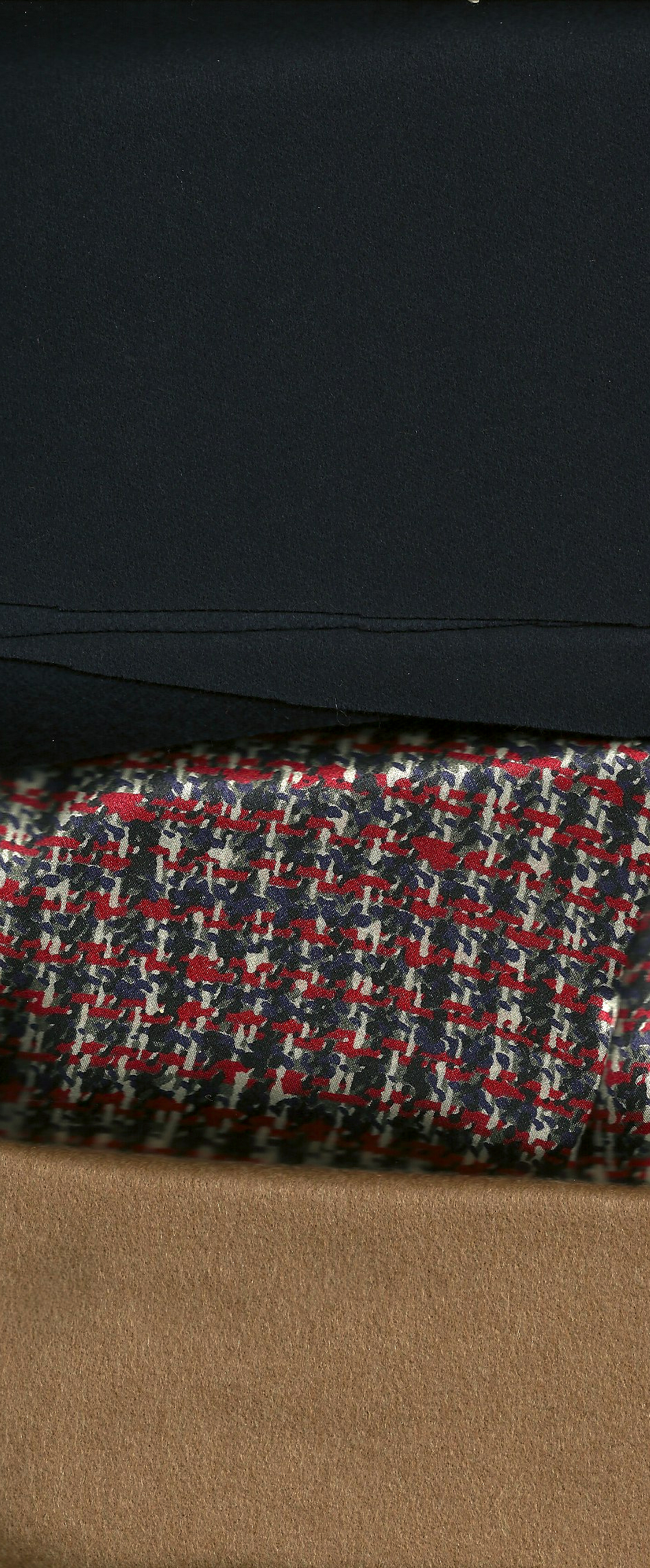
Britex carries an extensive selection of coating wools, so much so that it is definitely advantageous to be helped by one of their incredibly knowledgeable sales assistants.  I was fortunate that Inna, who has such a trained and talented eye for color and texture, was able to assist me. We started with a lovely camel hair coating wool, which had a napped silky sheen on one side and was just the right heft for outerwear.  First I wanted to look at pairing it with gray, but nothing in the gray family seemed to strike my fancy.  Then we moved on to the navy blues – and there nestled in among the bolts was the perfect “medium” navy blue, also with a napped sheen on one side.  It was a little heavier than the camel hair, but Susan felt confident we could make the two fabrics work together, especially because their colors complimented each other so perfectly.

Silk lining fabric was next on the list, and I wanted something figured rather than plain.  Inna pulled out a bolt of Italian charmeuse, which picked up the geometric feel of the jacket, and introduced a little red into the mix.  I couldn’t be happier with it.

I am not so sure this gives the best sense of the colors of the fabrics, but you will see more in a future post.

I am not so sure this photo gives the best sense of the colors of the fabrics, but you will see more in other photos.

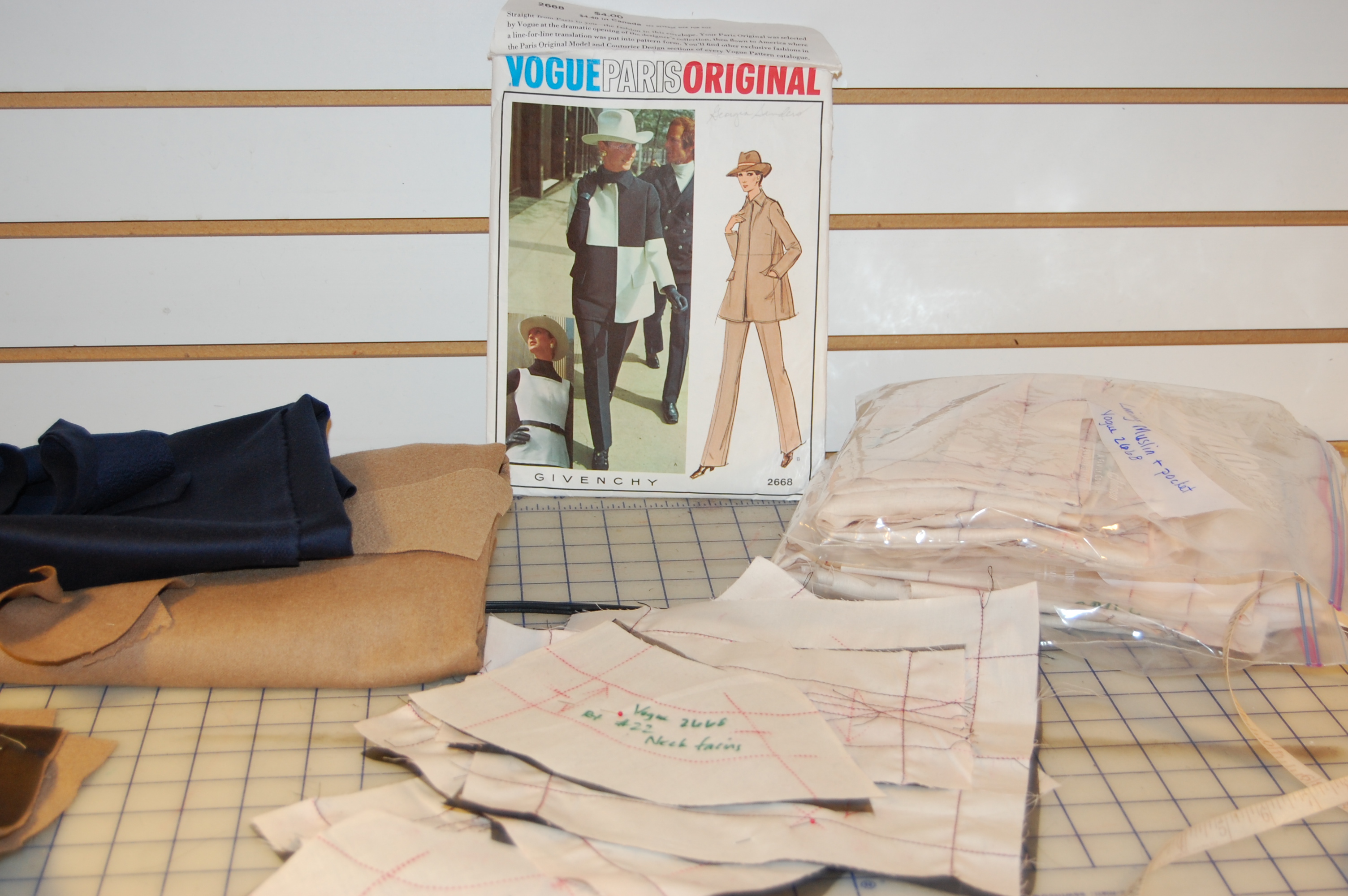
Back at The Sewing Workshop, armed with fabrics and enthusiasm, I spent the next two days cutting out the multi-, multi-pieced pattern (31 separate pieces, all of which would be cut in tandem, making 62 in all, not including the lining!), and basting the silk organza underlinings to each and every piece.

My well-lit and spacious work space at The Sewing Workshop.

My well-lit and spacious work space at The Sewing Workshop.

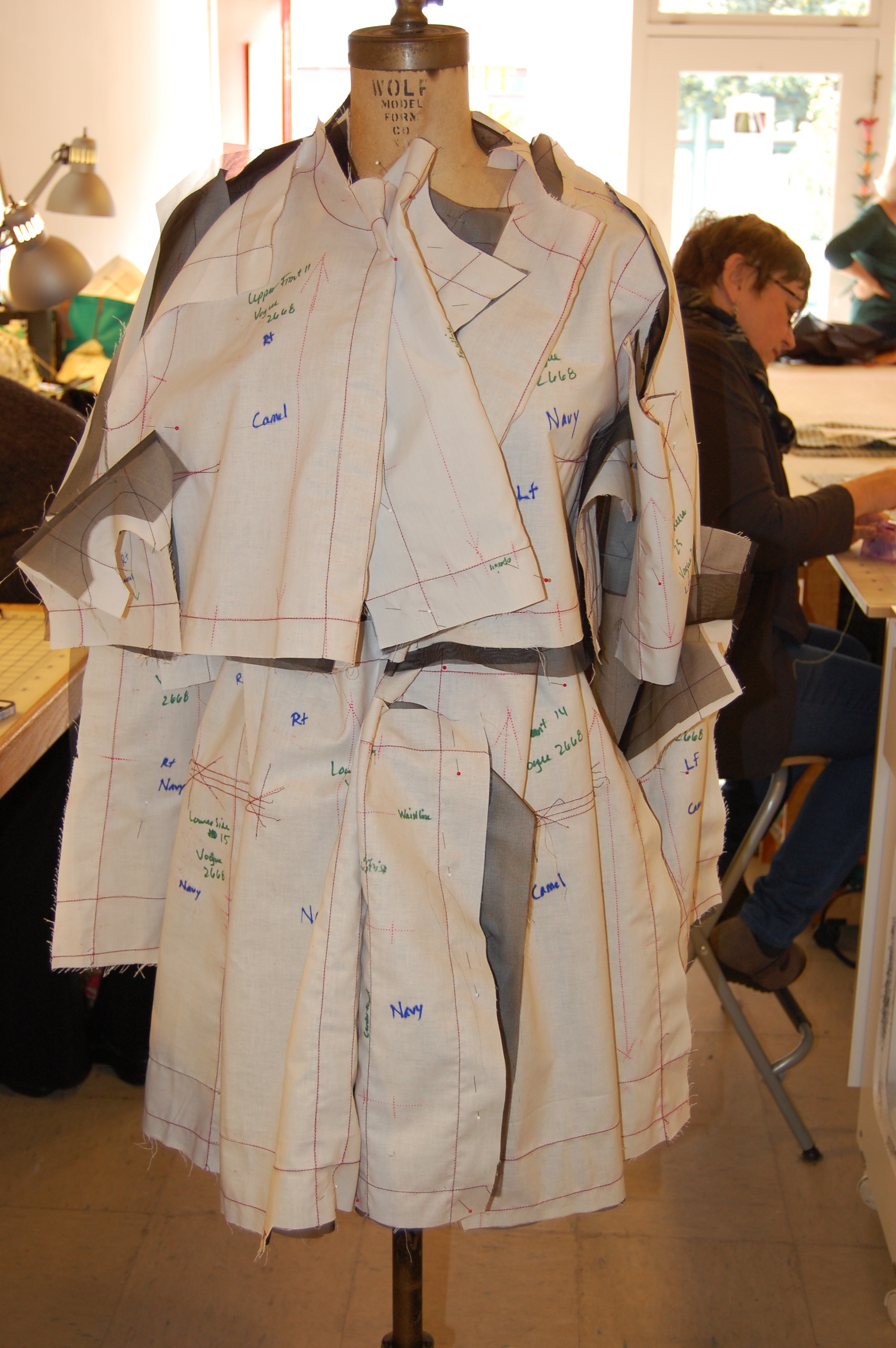
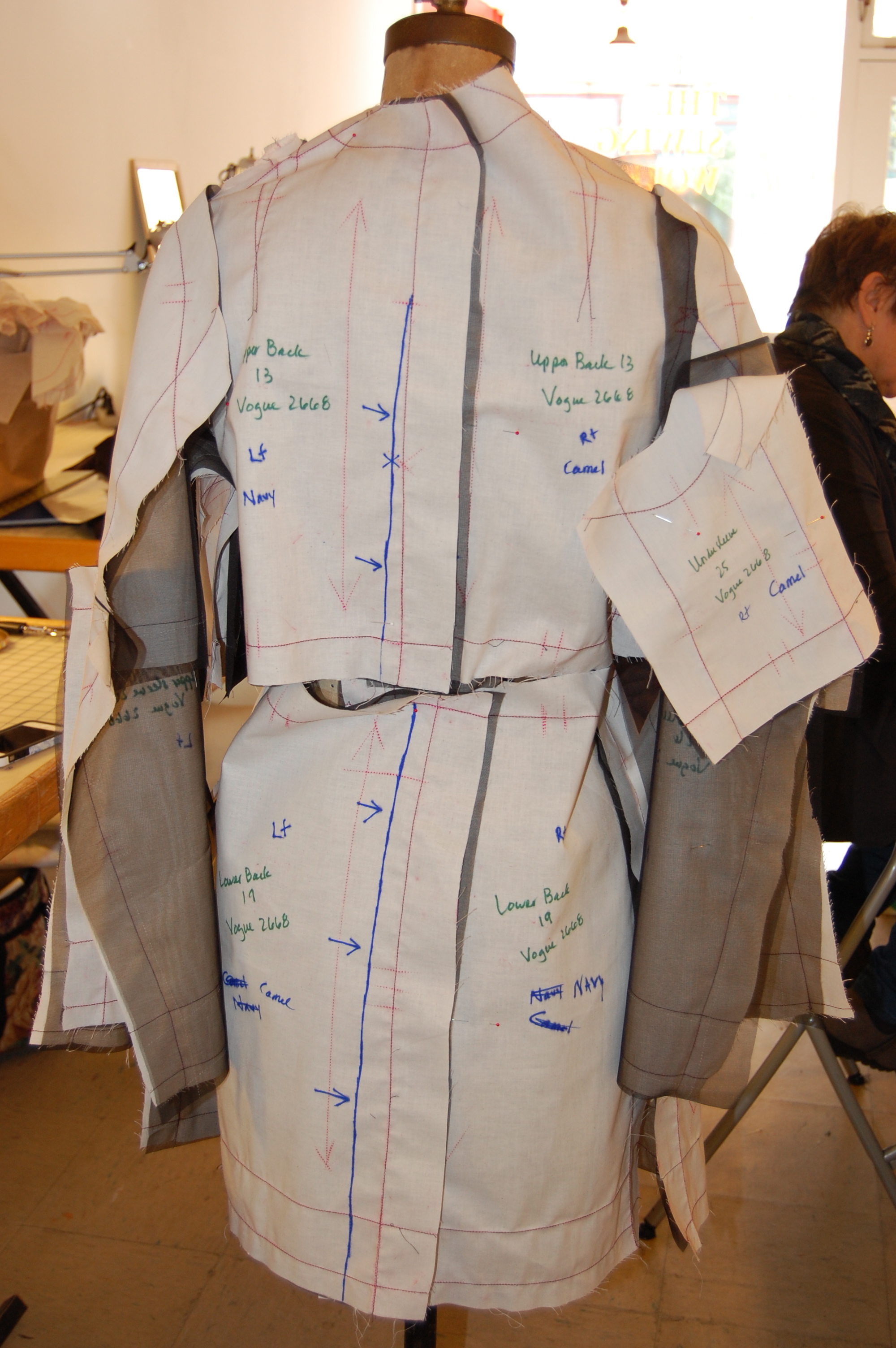
Because of the color blocking, I needed to pay great attention to which piece was to be cut in blue and which piece in camel.  Initially I went through and labeled each muslin piece “navy” or “camel”.  Susan double-checked me, but then suggested that, because I absolutely could not make a costly mistake, that I pin the muslin pieces onto the available dress form in our studio.  What a great idea, one of so many which I picked up from Susan and my classmates!

Here is the "front" of the jacket, pinned onto the dress form.

Here is the “front” of the jacket, pinned onto the dress form.

And here is the back.

And here is the back. 

Now, I felt confident and set about to cut my fashion fabric.

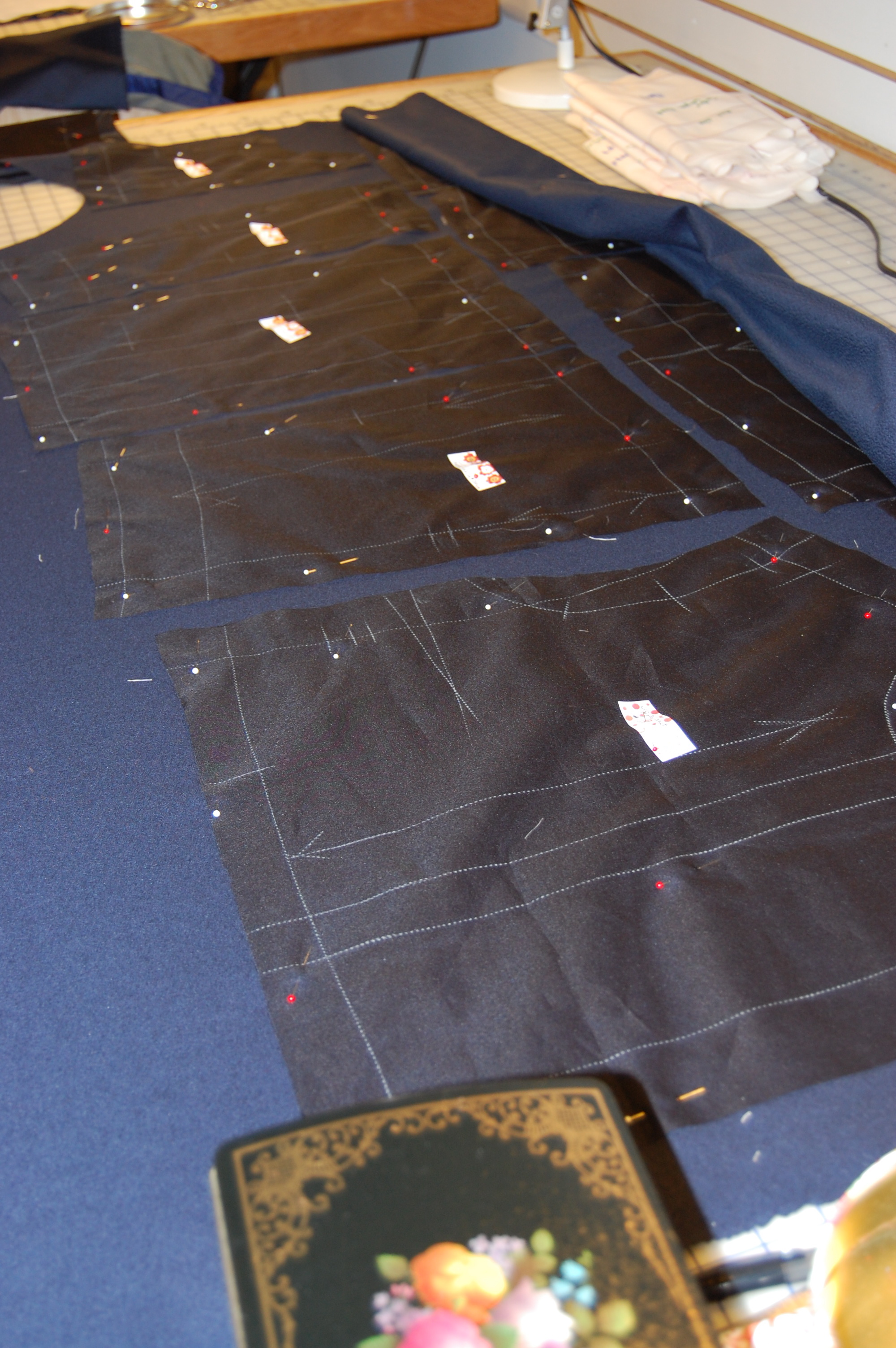
Here are the silk organza underlining pieces arranged on the blue fabric.  I pinned a small tag on each piece, telling me each piece's pattern # and description.  A lot of the pieces look alike!

Here are the silk organza underlining pieces arranged on the blue fabric. I pinned a small tag on each piece, telling me each piece’s pattern number and description. A lot of the pieces look alike!

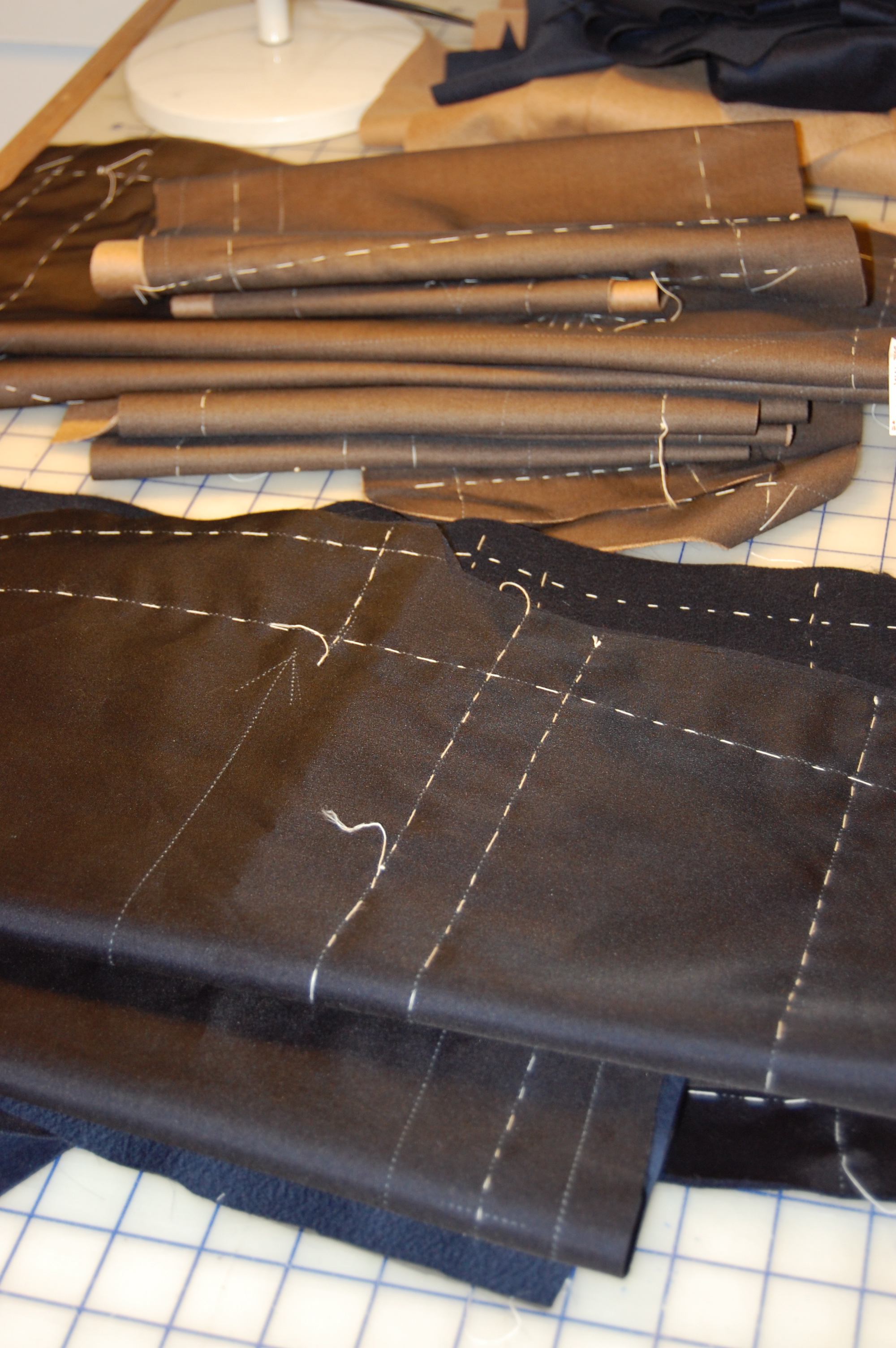
Two piles showing all underlinings basted onto the fashion fabric.

Two piles showing all underlinings basted onto the fashion fabric.

By this time, I was half-way through the 6-day class.  I assessed my situation and determined the parts of the jacket construction upon which I wanted to get expert advice  from Susan:  treatment of the concealed fly front, flap pockets, rolled collar (all of which will be detailed in a future post).  Now I had a plan, which seemed to be much more than anything that was happening back home in Pennsylvania.

My husband joked during one of our few cell-phone conversations, that he had a vision of the power in our house coming back on Sunday evening, February 9th, as he would be driving me home from the airport in Philadelphia.  He was right.  That is exactly what happened.  I came home to a 39F degree house, but the lights were on, and soon the heat was, too.  Almost a week later, it is still snowing and snowing – perfect sewing weather for this sojourner home from San Francisco.

12 Comments

Filed under car coats, Coats, Color blocking, couture construction, Uncategorized, underlinings, vintage Vogue Designer patterns, vintage Vogue patterns from the 1970s, Vogue patterns, woolens

Happy New Sewing Year

“Dresses for breakfasts, and dinners, and balls;

Dresses to sit in, and stand in, and walk in;

Dresses to dance in, and flirt in, and talk in;

Dresses in which to do nothing at all;

Dresses for Winter, Spring, Summer and Fall”

William Allen Butler (1825-1902) may have thought “Nothing to Wear”, from which these lines are taken, was a satirical poem, but he obviously did not know 21st century fashion sewers.  Isn’t January just the perfect time to plan for the creation of “dresses for Winter, Spring, Summer, and Fall”?  Yes, thank you for agreeing with me.

Last year I took a rather theoretical approach to the new sewing year, but this year I am focusing on more specific plans.  Let me start with Winter.

I have three things that I want to complete while the snow is still flying (which gives me until the end of March, more or less):

1)  My Chanel-inspired classic French jacket is my current project, and I am happy to report that I am making slow but steady progress on it.

2) I won’t consider the jacket really complete until I have made the bow blouse that will match its lining.

3) I am excited to say that I am going to be joining one of Susan Khalje’s Couture Sewing Classes in February, and my intended project is — ta-daa — this jacket which I have wanted to make ever since Vogue Patterns first issued it in the 1970s!

I will definitely be doing the color blocked version when I make this coat.

I will definitely be doing the color blocked version when I make this coat.

With any luck (or maybe lots of it will be needed), it may still be Winter when I start this project intended for an event in late April event:

I have an authentic Pucci silk from which to make the dress and line the jacket.

I have an authentic Pucci silk from which to make the dress and line the jacket.

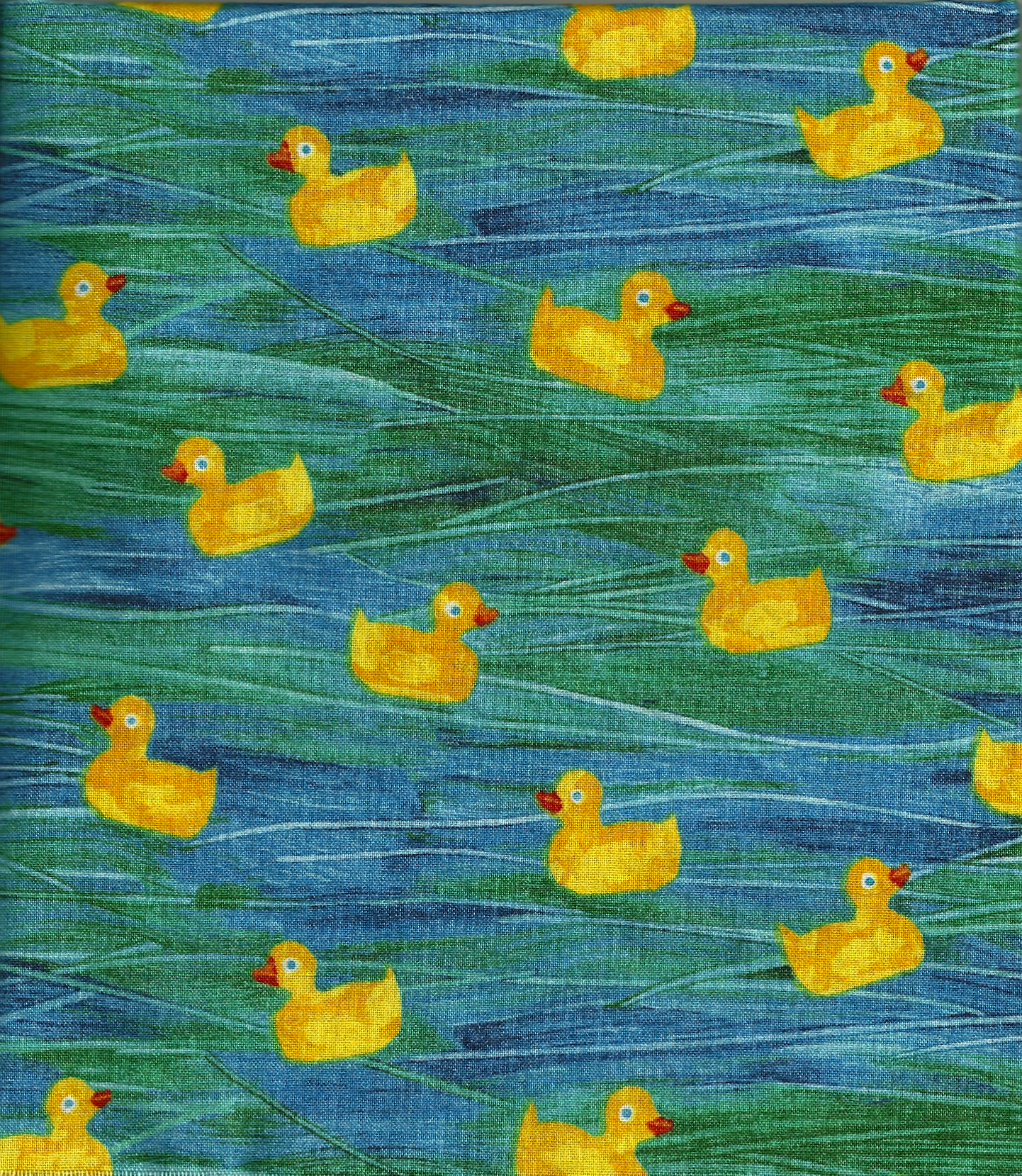
In addition, Spring will not be complete for me until I make a dress for my granddaughter who will be 1-year-old in March.  I purchased this fabric last Fall when I was at the Eric Carle Museum in Amherst, Massachusetts.  You can imagine my excitement when I saw that the gift shop included yardage of soft, quality cotton featuring designs from his books.  I envision these little ducks embellished with yellow rick-rack.

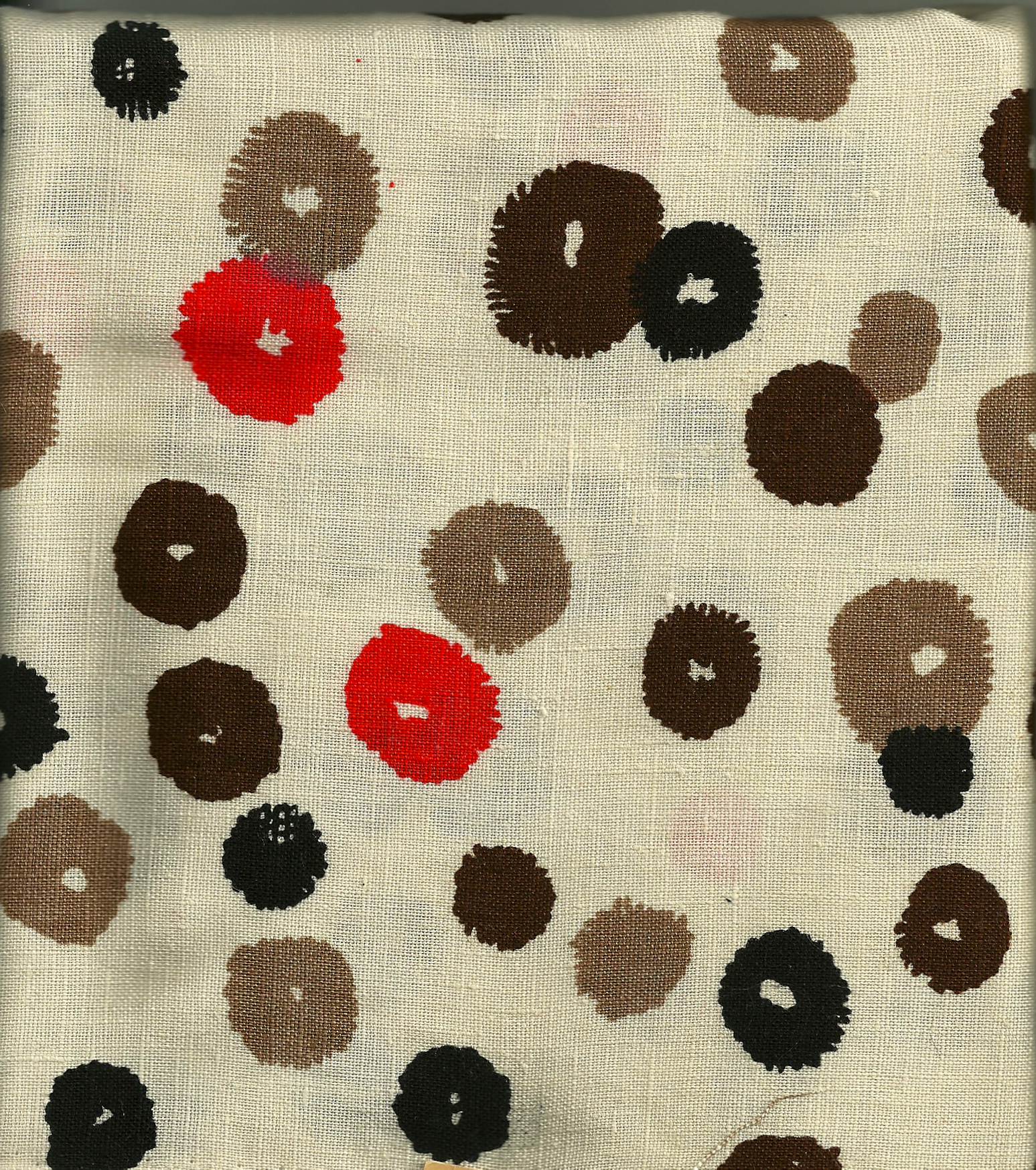
Happy New Sewing Year - carle fabric Before Spring bids us adieu, I may divert from dresses to make another pair of slim pants in this vintage 1950s’ linen:

I only have 1 5/8 yards of this 35" wide fabric, so it remains to be seen if i can squeeze pants out of it.

I only have one and 5/8 yards of this 35″ wide fabric, so it remains to be seen if I can squeeze pants out of it.

If Summer of 2014 is as hot as last Summer (or even if it is not), I’ll be making at least two more cool, linen dresses, one sheath-style and one belted.  More on these linen fabric finds in a future post…

And a bathrobe!!  I am dying to make a swishy bathrobe!

Ah, and then comes Fall (already??), probably my favorite season of all.  I have two projects envisioned:

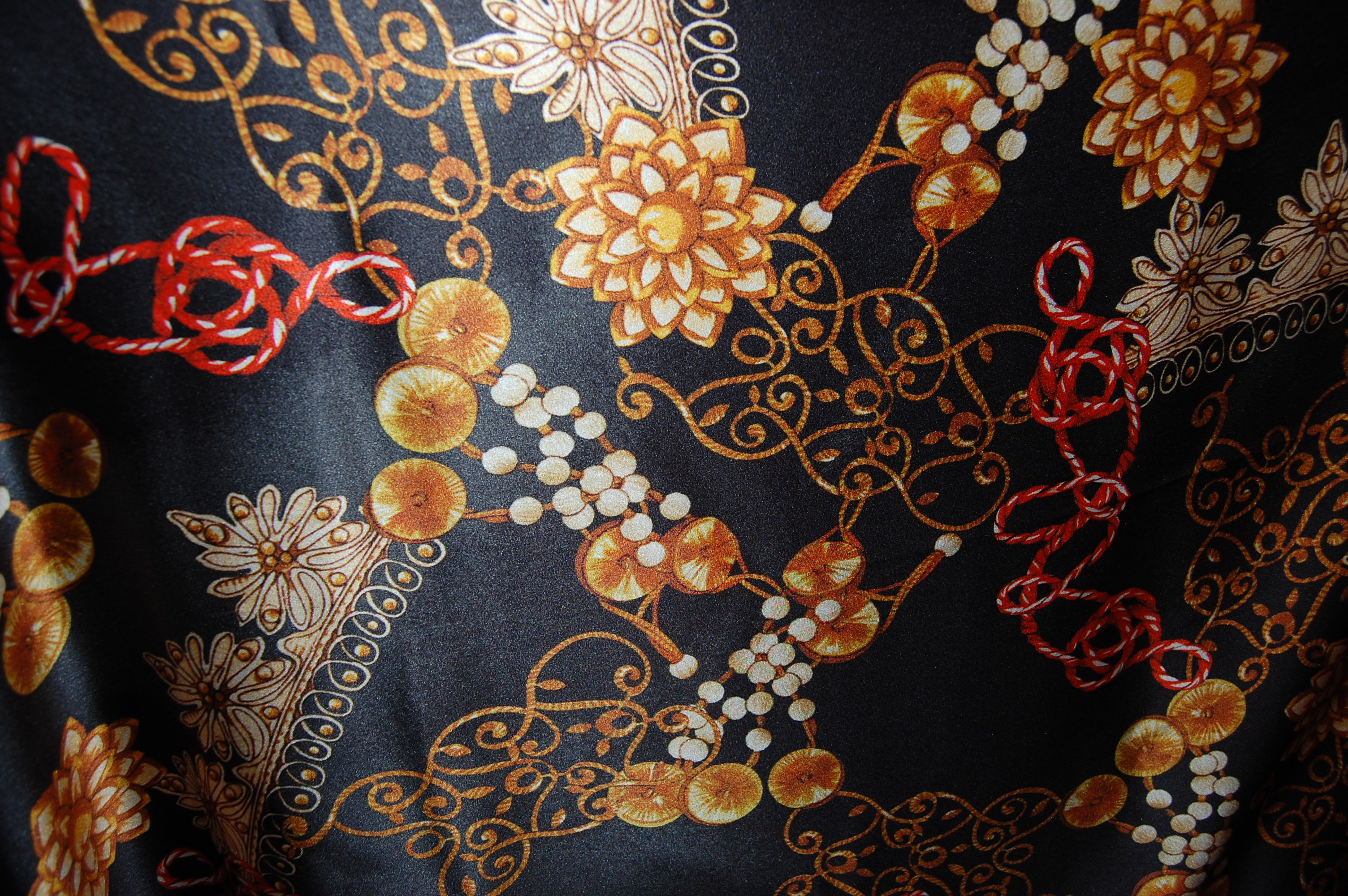
1) I found this stretch silk charmeuse at Mendel Goldberg Fabrics on a quick day trip to NYC in early Fall.

Another gorgeous Italian silk!

Another gorgeous Italian silk!

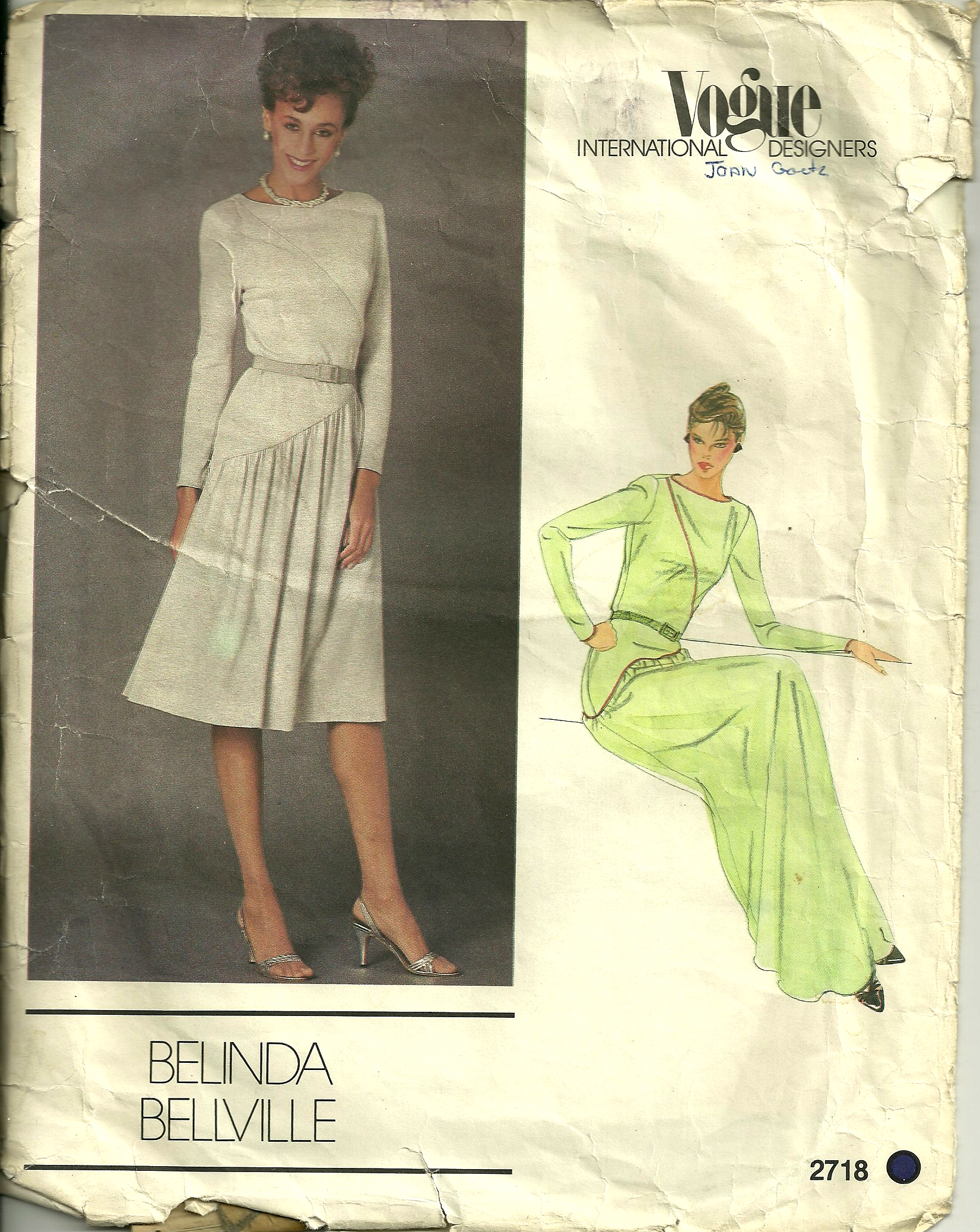
I bought it thinking I may use it for the lining for my No. 2 French jacket, but shortly after that I found this pattern on eBay and promptly decided it would be perfect made up in this dress (which requires a stretch fabric.  Well, it says “ knit fabrics only” but I say stretch fabric will do just fine).

This os one of the few patterns from the 1980s which I really like.  However, i will not be duplicating the hairstyle.

This is one of the few patterns from the 1980s which I really like. However, I will not be duplicating the hairstyle.

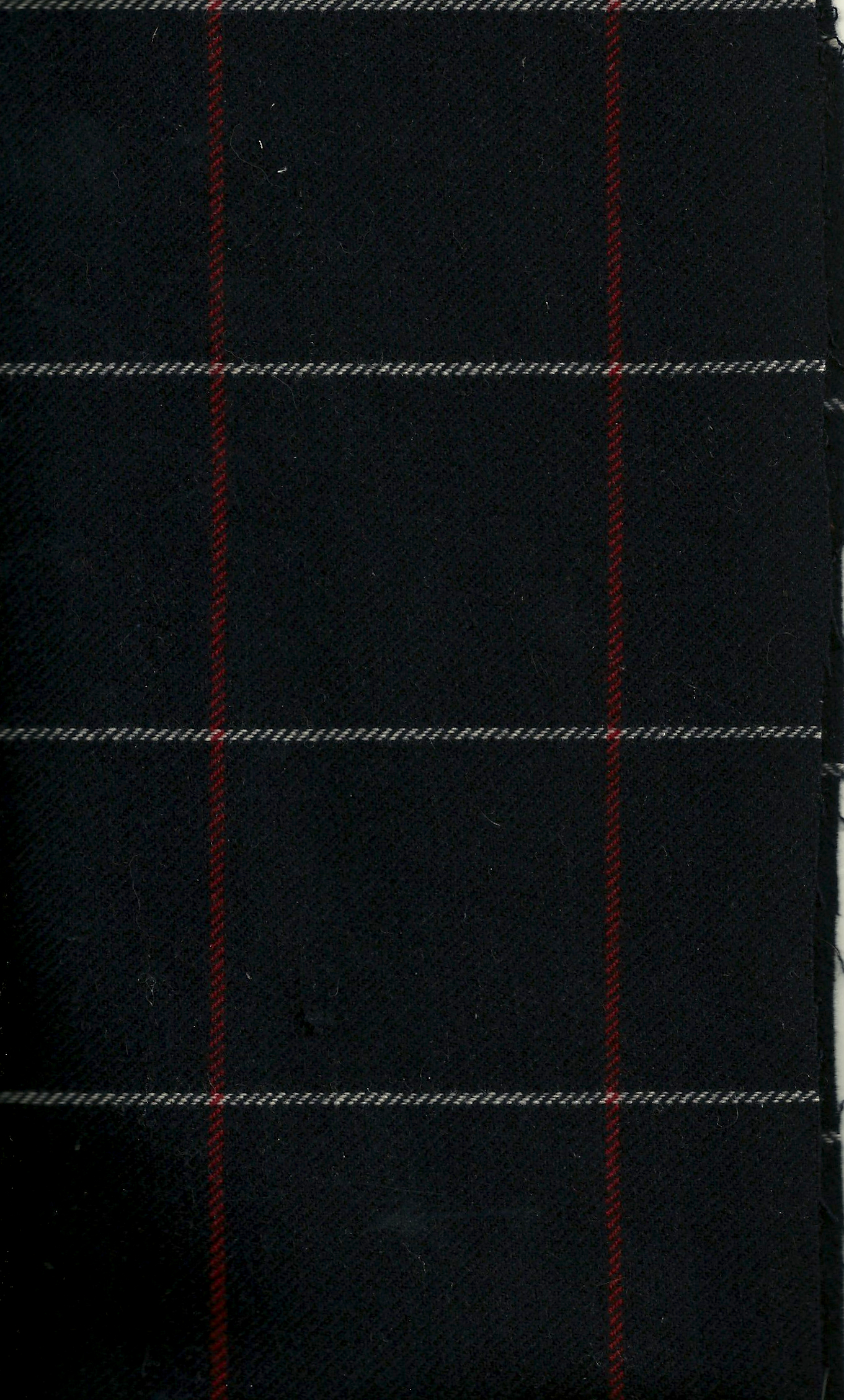
2) I’ve had this buttery soft cashmere wool for a couple of years now.  I originally thought I’d make a suit, but now I’m thinking long-sleeved dress instead.  I’m still sorting this one out in my head so I’m very glad I have until next Fall.

A subtle windowpane check in navy with deep red and ivory intersecting lines.

A subtle windowpane check in navy with deep red and ivory intersecting lines.

Sprinkled among these plans for Winter, Spring, Summer and Fall will surely be more little dresses for granddaughter Aida.  I fully intend for her to have some of the cutest frocks in all of New England.

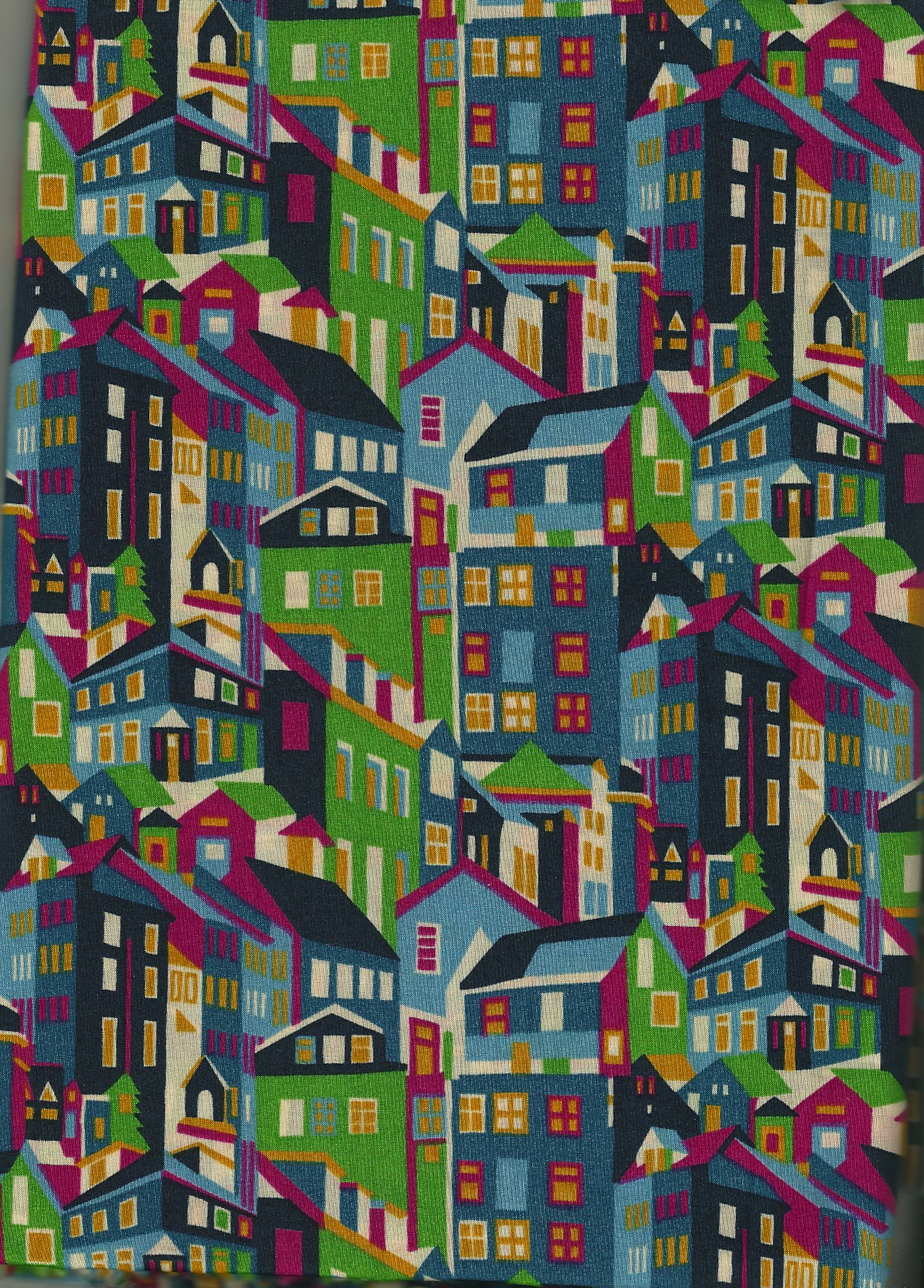
Finally, if 2013 taught me anything, it is that the unexpected is waiting around every corner.

Lots of corners lurking in this Liberty cotton!

Lots of corners lurking in this Liberty cotton!

Life can take sudden turns and twists that are not always sewing-friendly, so I plan to be kind to myself if that happens.  But wouldn’t it be nice for all of us to have the kind of year when we have the extra time to make a dress in which to do “nothing at all”?

14 Comments

Filed under 1980's dress patterns, Boucle for French style jackets, Chanel-type jackets, Coats, Liberty cotton, Linen, Polka dots, Uncategorized, vintage Vogue Designer patterns, vintage Vogue patterns from the 1970s, Vogue patterns, woolens

Paris in Baltimore – and Beyond: A Small Fashion Show

Shortly after I returned home from my Classic French Jacket Class with Susan Khalje, an article entitled “The Comeback of Haute Couture” appeared in The Wall Street Journal.  The reporter, fashion editor Christine Binkley, gives an overview – from the haute couture week in Paris, of course – of the frenzied and renewed interest in “astronomically expensive made-to-measure clothing [ranging] from $10,000 to $150,000 or more.”  Among the fashion houses showing haute couture collections was Chanel.  To quote:  “Chanel . . . looked as though the clothes could be easily worn, even if they were assembled, pleated, and embellished by dozens of ‘petite mains,’ as haute couture seamstresses are called. ‘Of course it’s comfortable.  It’s Chanel,’ said designer Karl Lagerfeld . . .”

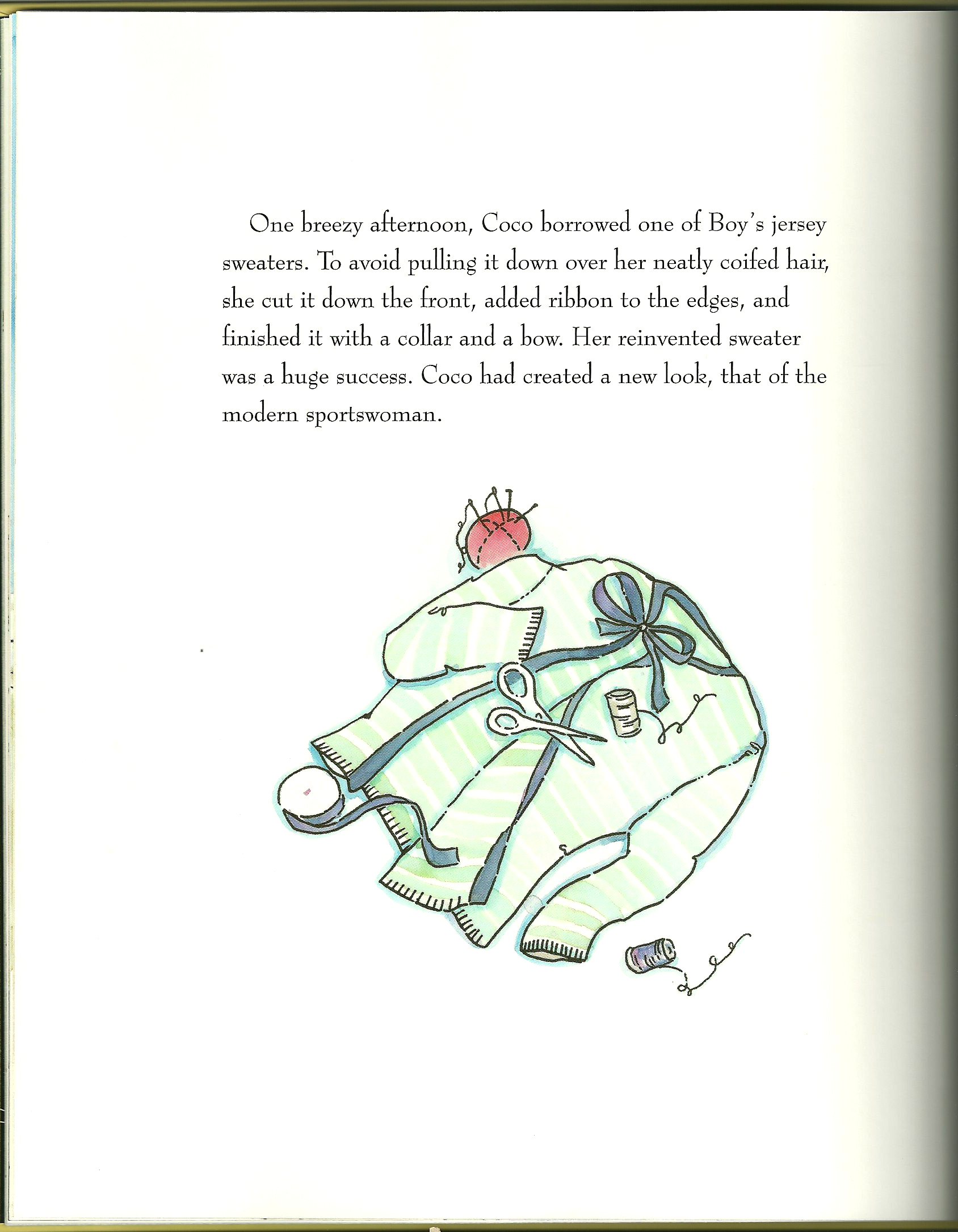
“Comfortable” is a description frequently used by those of us making our own Chanel-inspired jackets.  Of course, everyone knows that the inspiration for Coco Chanel’s original cardigan jacket came when she cut her lover’s cardigan sweater down the front, added some ribbon trim and created a classic.  How the construction of the jacket went from sweater to quilted, silk-lined boucle is unknown to me, but one thing is for sure:  these jackets feel as cozy and comfy as any old favorite sweater.  I think this was a revelation and lovely surprise to all of us.  It makes wearing them all the more rewarding.
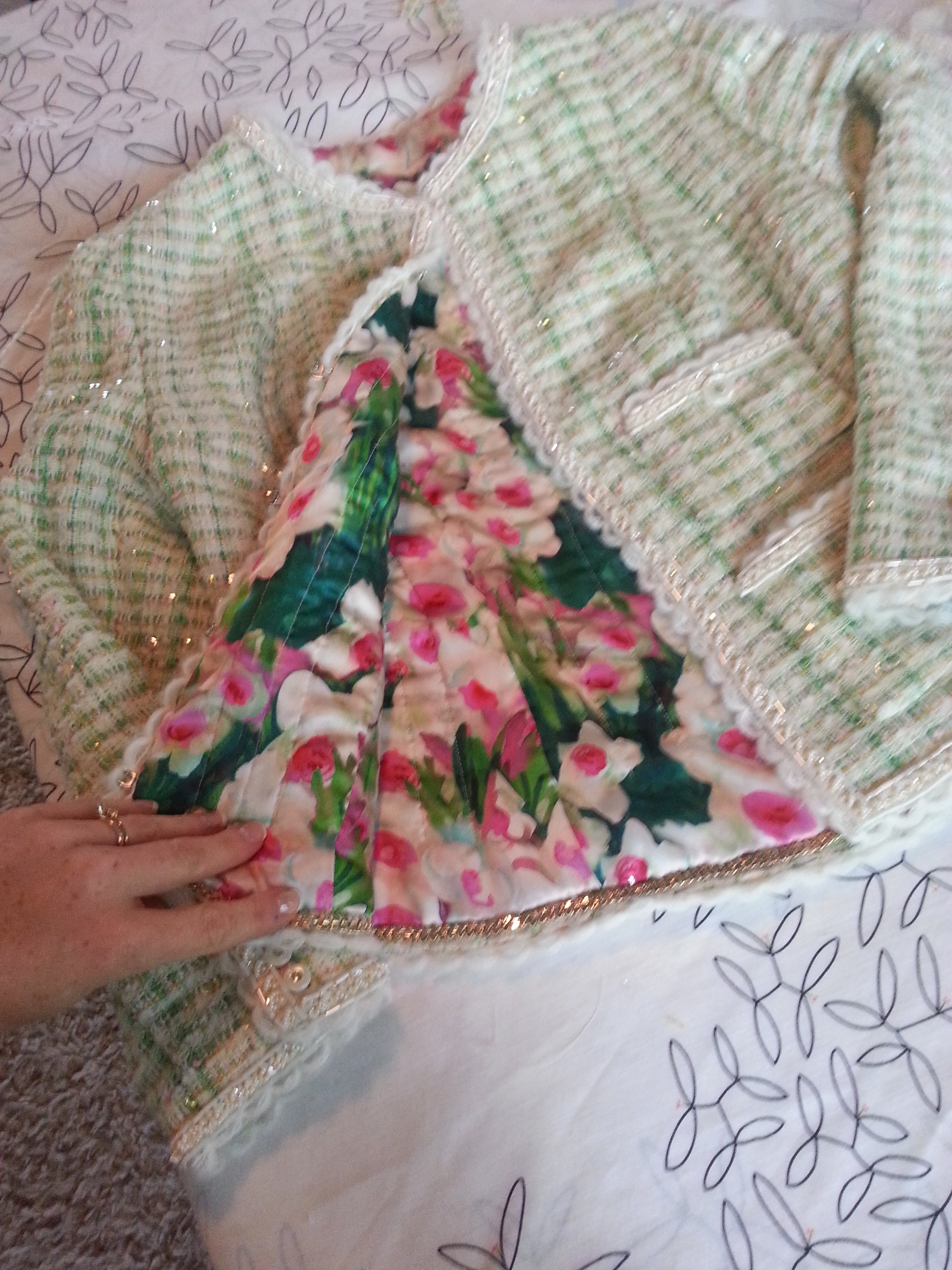
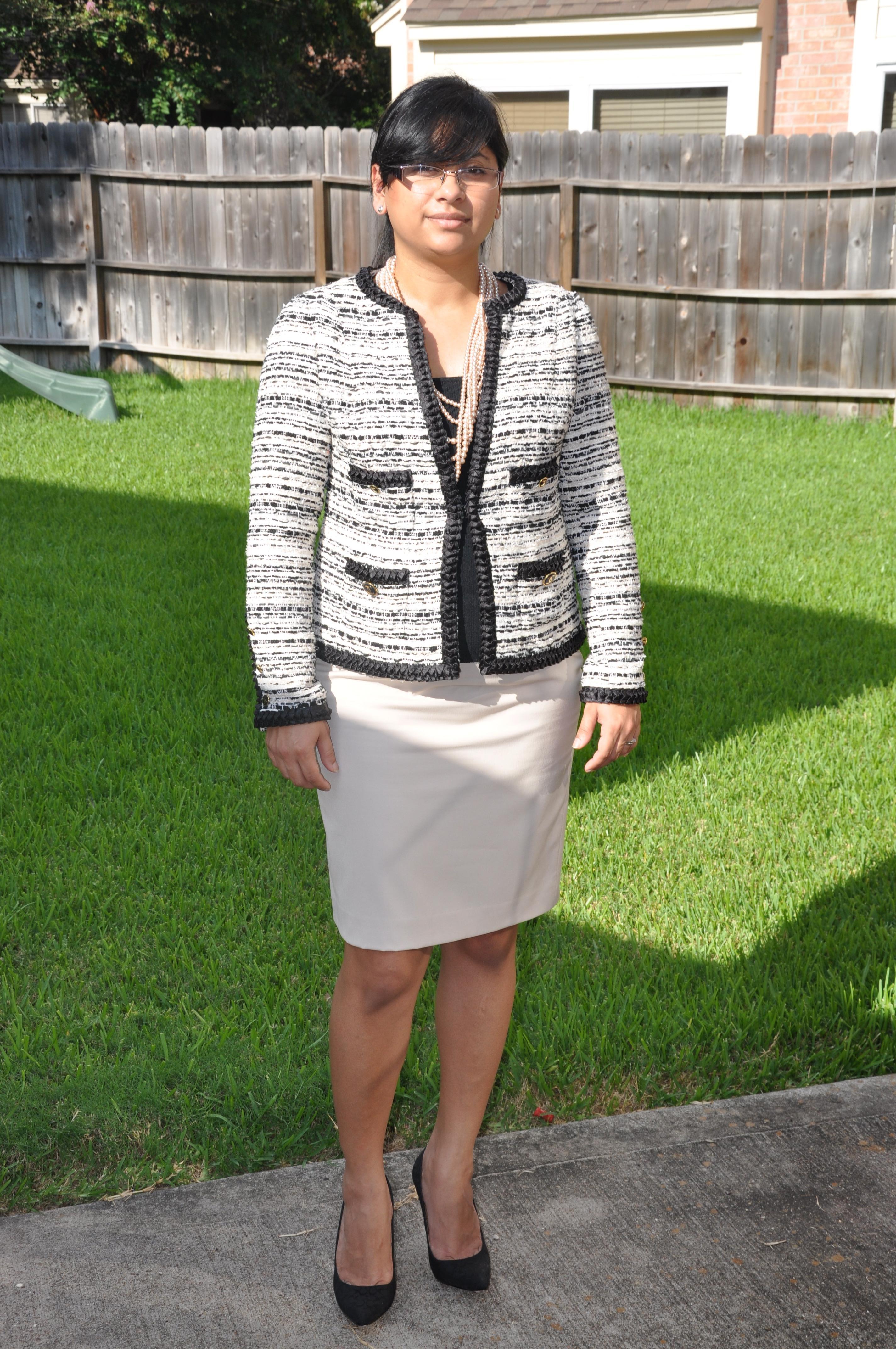
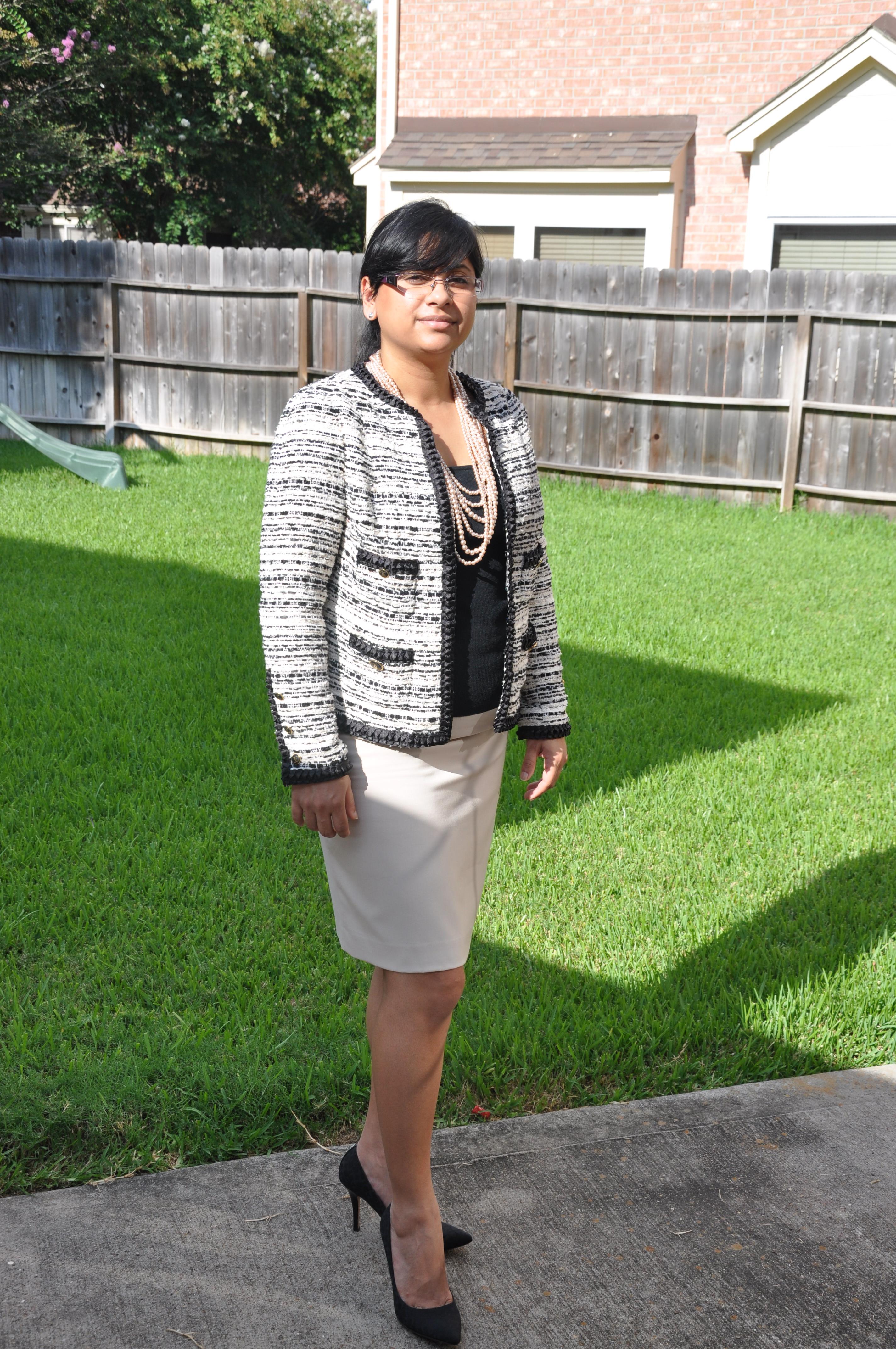
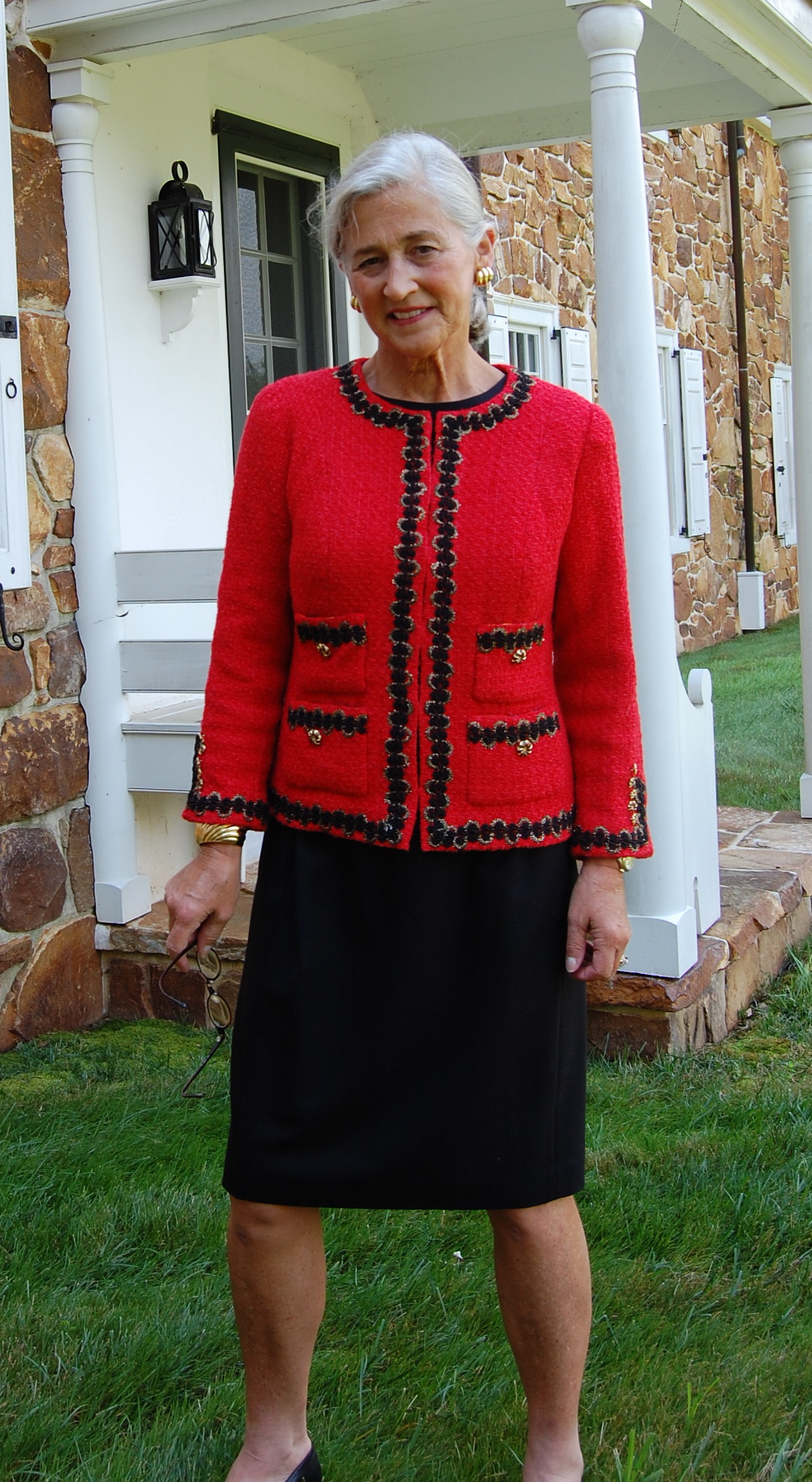
And – wear them we are starting to do!  Some of my classmates have kindly given me permission to show their finished jackets here on Fifty Dresses.  I am delighted to share these lovely examples made by “petite mains” Joanne, Holly, Myra, and Sherry:
Joanne’s classic black jacket is elegant and so versatile.  Her lovely floral lining fabric does not show, but trust me that is stunning.
A simply lovely jacket!

A simply lovely jacket!

Holly’s jacket has sparkle to it, just like her!

Look at the beautiful lining that Holly chose.

Look at the beautiful lining that Holly chose.

Isn't this color perfect for Holly?

Isn’t this color perfect for Holly?

The buttons which Holly chose are perfect!

The buttons which Holly chose are perfect!

With a few scraps left over from her lining, Holly made a color-blocked shell to wear with her jacket!

With a few scraps left over from her lining, Holly made a color-blocked shell to wear with her jacket.

Myra’s horizontally and unevenly striped boucle caused some minor headaches during the pattern placement, but look how beautifully it turned out.

Looking lovely even in the hot sun!

Looking lovely even in the hot sun!

Myra's jacket - 2

Myra's whimsical lining fabric features images of Audrey Hepburn.  She brought this fabric with her to Baltimore and chose her boucle accordingly.

Myra’s whimsical lining fabric features images of Audrey Hepburn. She brought this fabric with her to Baltimore and chose her boucle accordingly.

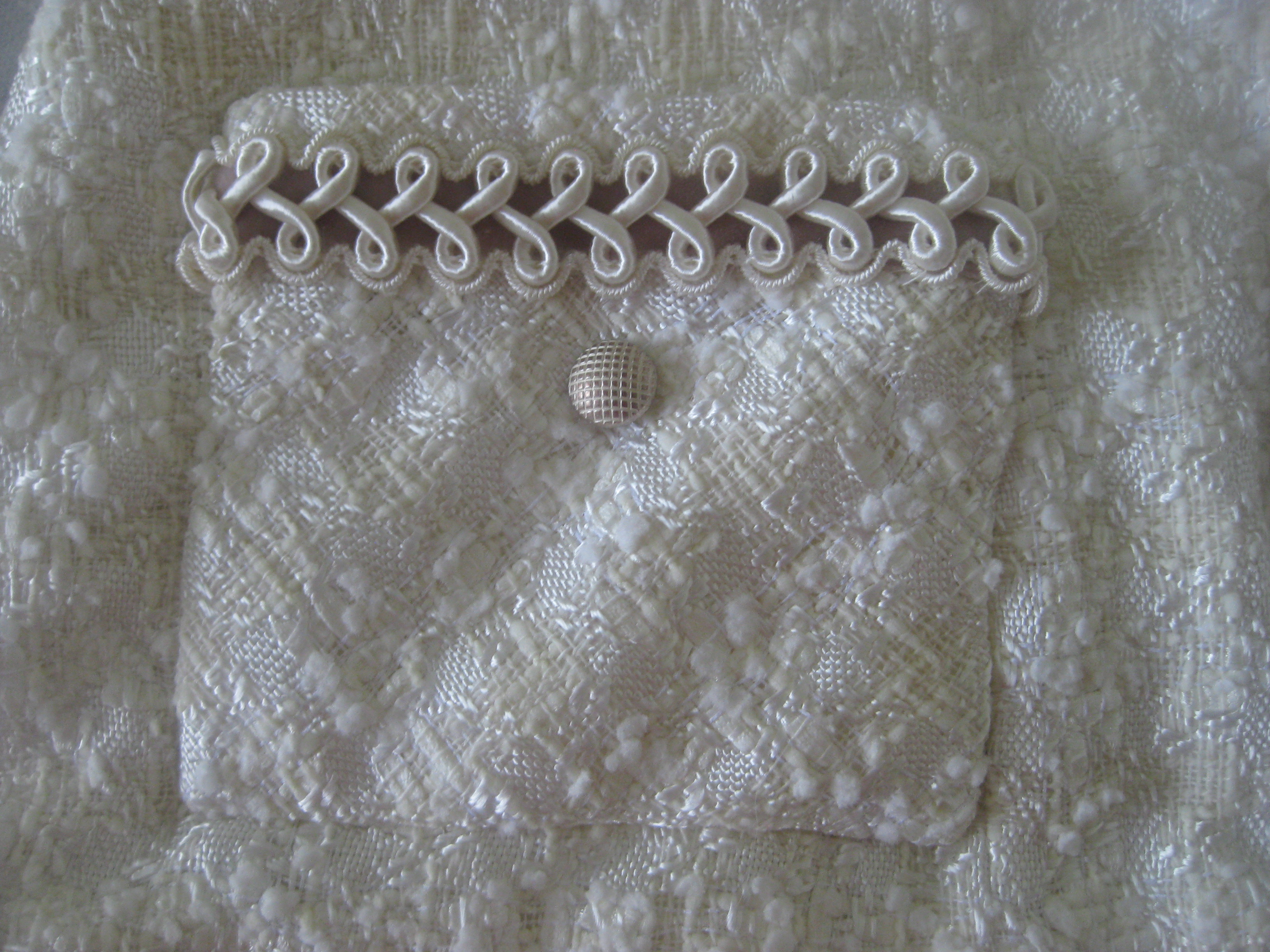
Sherry chose a creamy white, loosely woven “windowpane” boucle for her jacket, and the result is pure loveliness.

Isn't this beautiful??

Isn’t this beautiful??

Sherry very cleverly made her pockets on the bias.  The petite buttons are just right for the weave of the fabric.

Sherry very cleverly made her pockets on the bias. The petite buttons are just right for the weave of the fabric.

Look how well Sherry's jacket fits.

Look how well Sherry’s jacket fits. 

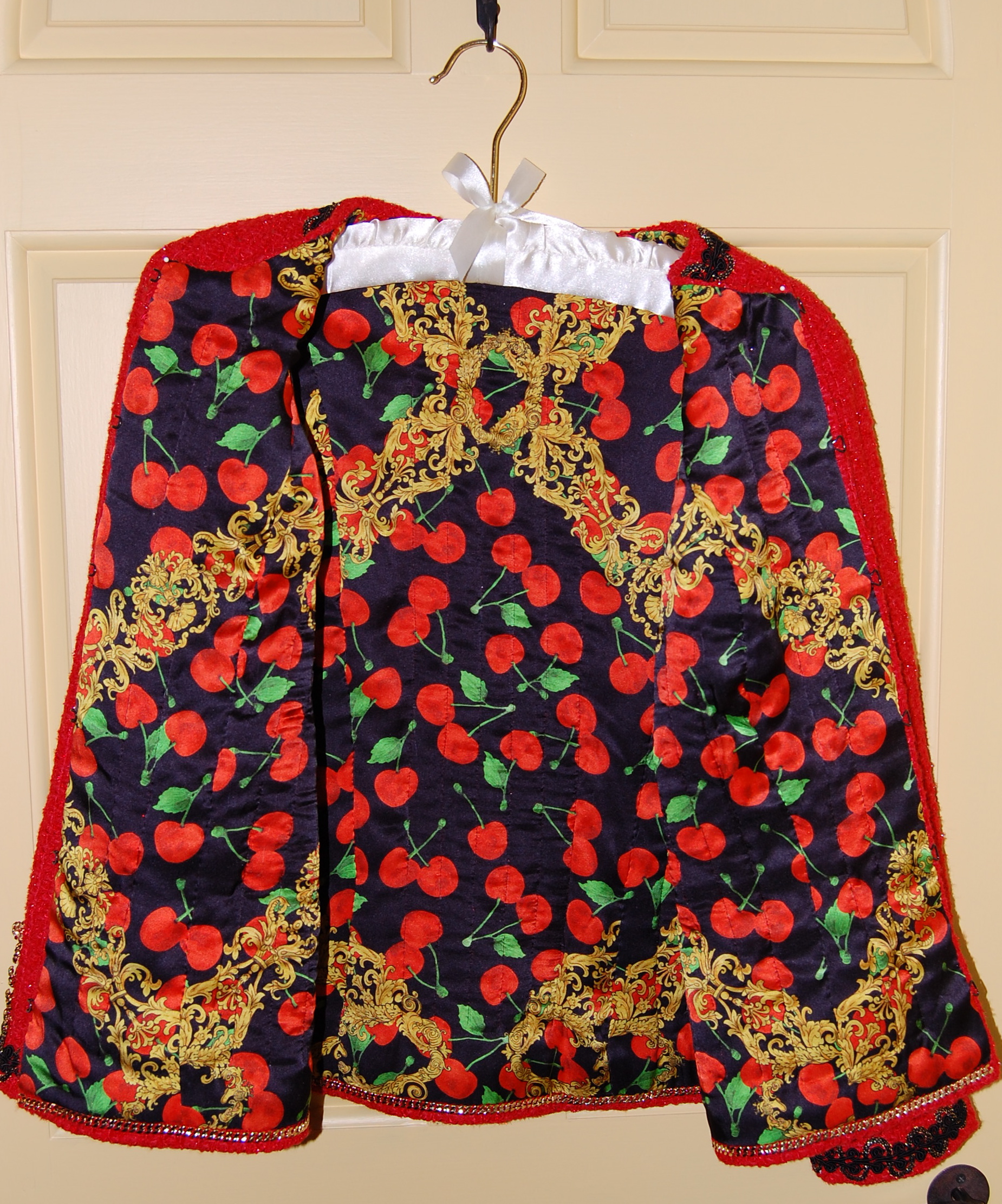
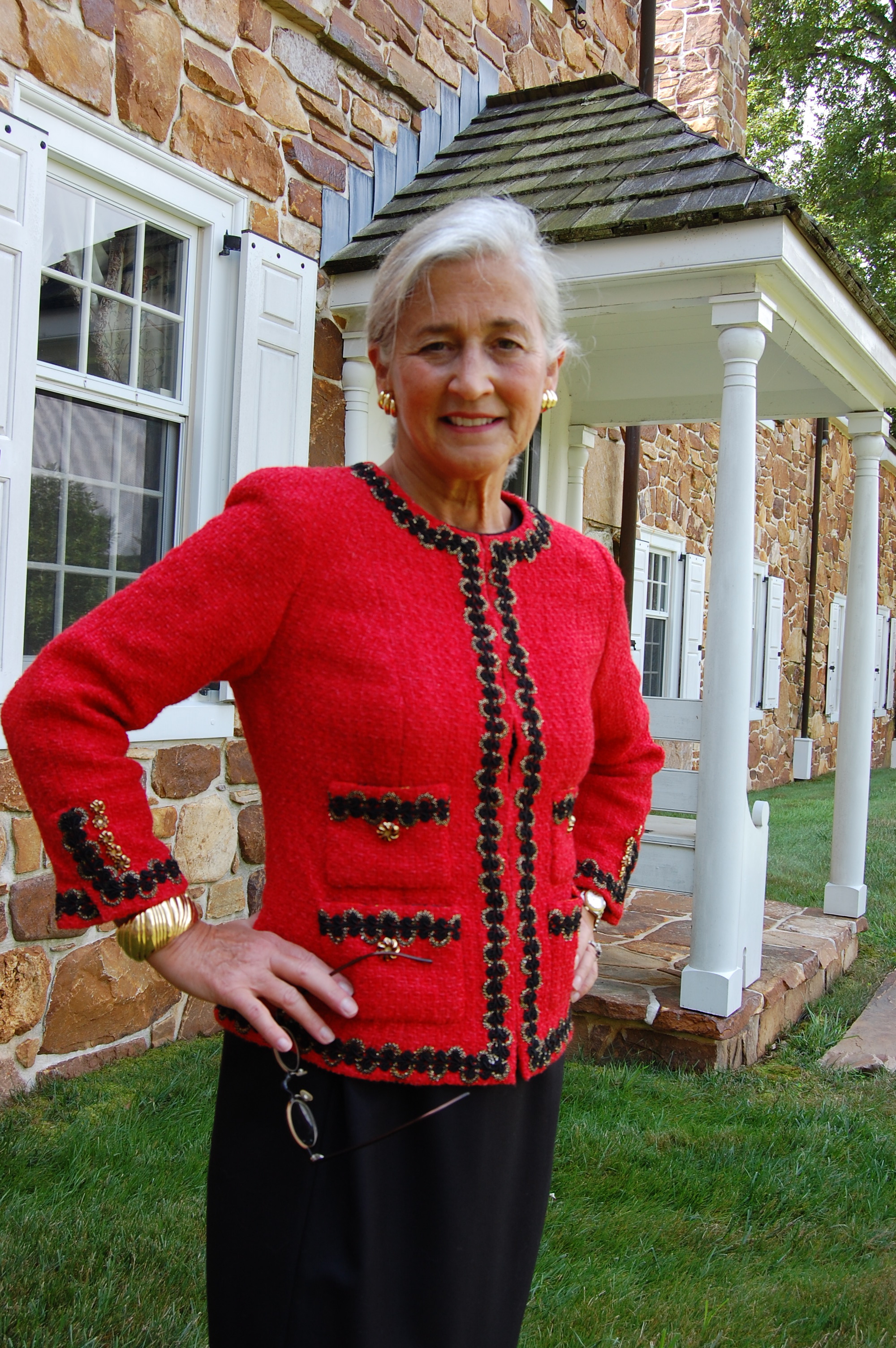
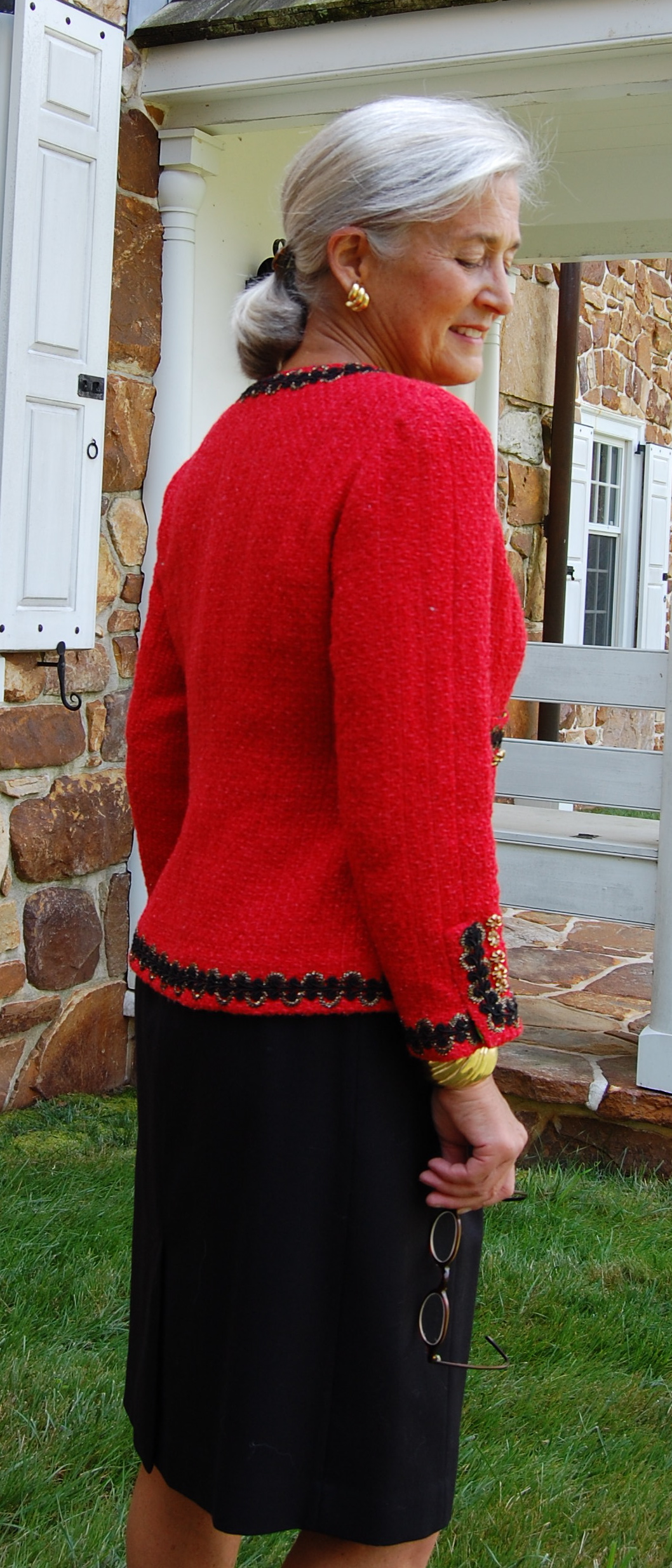
One of the many fun aspects of the class was the color variety of jackets being sewn.  While there were other deep shades (raspberry pink, royal blue, true purple) I was the only one making a red jacket.

For starters, here is my jacket hanging.

For starters, here is my jacket hanging.

A few details.

A few details.

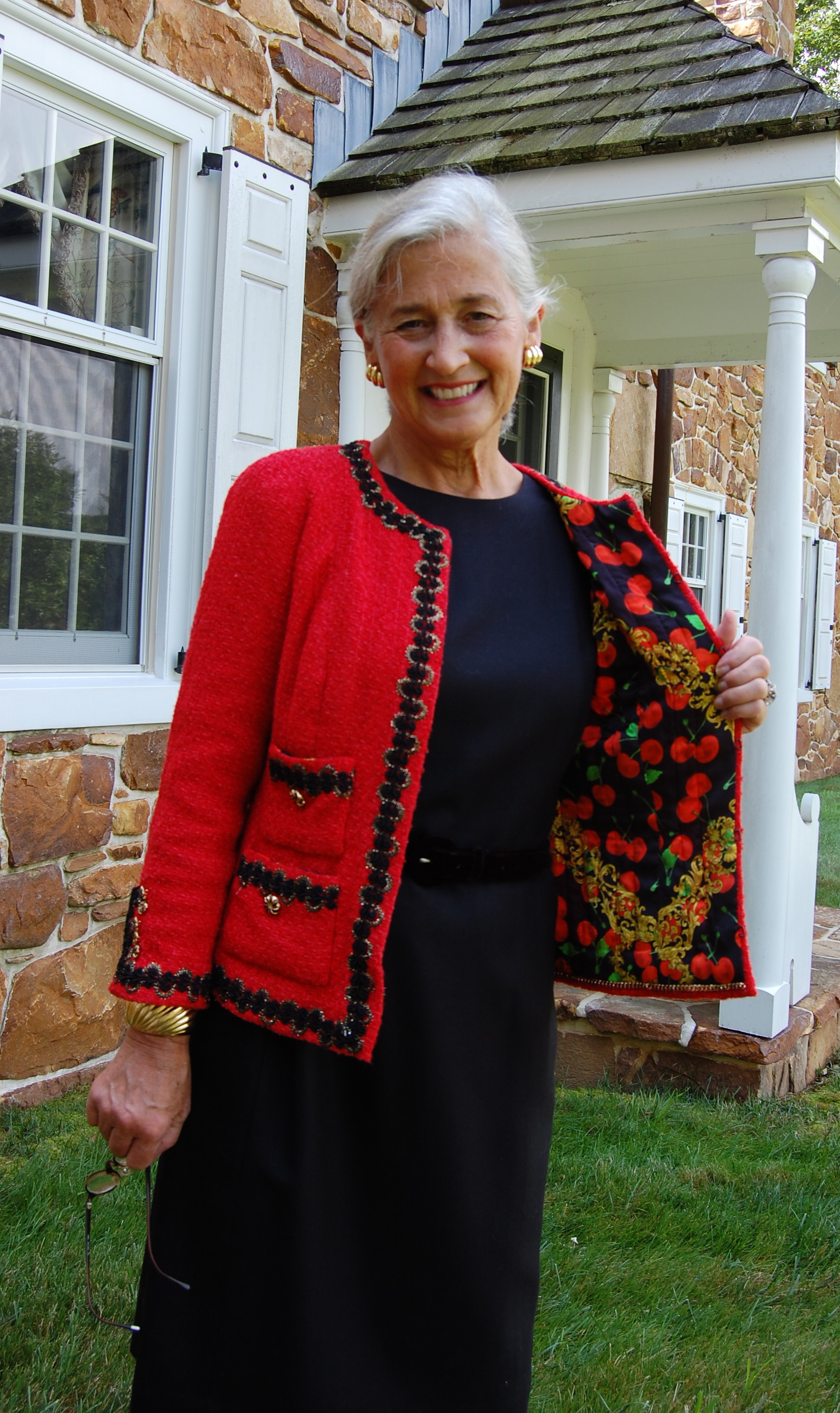
A view of the lining.

A view of the lining.

Shown with basic black.

Shown with basic black.

I can't believe it's finished!

I can’t believe it’s finished!

I added a gradual 1/4" to the back length, which gives it a more graceful line, I think.  This was one of Susan's many excellent suggestions.

I added a gradual 1/4″ to the back length, which gives it a more graceful line, I think. This was one of Susan’s many excellent suggestions.

Red Chanel jacket

There is nothing shy about this lining fabric!

There is nothing shy about this lining fabric!

During the lengthy process of making my jacket, I have had lots of time to reflect on some of its charms:

1) Boucle is wonderful for hand-sewing, as one’s stitches simply disappear into the fabric.

2) This is “common sense” sewing: every step (of which there are many) adds in subtle or significant ways to its wear-ability, appearance, or fit.

3) Finishing a project like this is empowering.  I felt like I grew as a “dressmaker” during this process.  And beware . . .

4) Finishing a project like this is addictive.  Yes, I already have a boucle for my next one . .

However, before I start my next one, I have one thing to (start and) finish:   That charmeuse I used for the lining?  I purchased enough to make a sleeveless sheath dress to wear with my jacket.

What was I thinking??

28 Comments

Filed under Chanel-type jackets, Coco Chanel, couture construction, sewing in silk, Uncategorized

A “Little” More on Chanel

Coco Chanel has been the fascinating, and sometimes controversial, subject of many, many biographies, several of which I have read.  However, none has charmed me quite the way Different Like Coco has.  This delightful slim book by Elizabeth Matthews is written for the 5 – 9 group.  Now, I don’t mean the fun-loving cocktail ladies, who start sipping at 5:00 PM and finally get to dinner at 9:00.  No, this group is the age-group of 5 – 9, meaning the “little” ones.  Yes, this is a children’s book, a small biography of Coco Chanel, with expressive illustrations, and text which strikes a good balance between simplicity and sophistication.

This bright yellow book jacket hints at the lively story inside.

This bright yellow book jacket hints at the lively story inside.

Different Like Coco was published in 2007 by Candlewick Press, a children’s book publisher located in Massachusetts.  I became acquainted with the newly-minted book when I read a review of it in The Wall Street Journal, by Meghan Cox Gurdon.  Being a “pushover” for all things about the fashion and creative sense of Coco Chanel, I ordered my own copy from Amazon.  (Little did I ever imagine that 6 years later, I would have my own little granddaughter who might just hear this book read to her – oh, who knows how many times?)

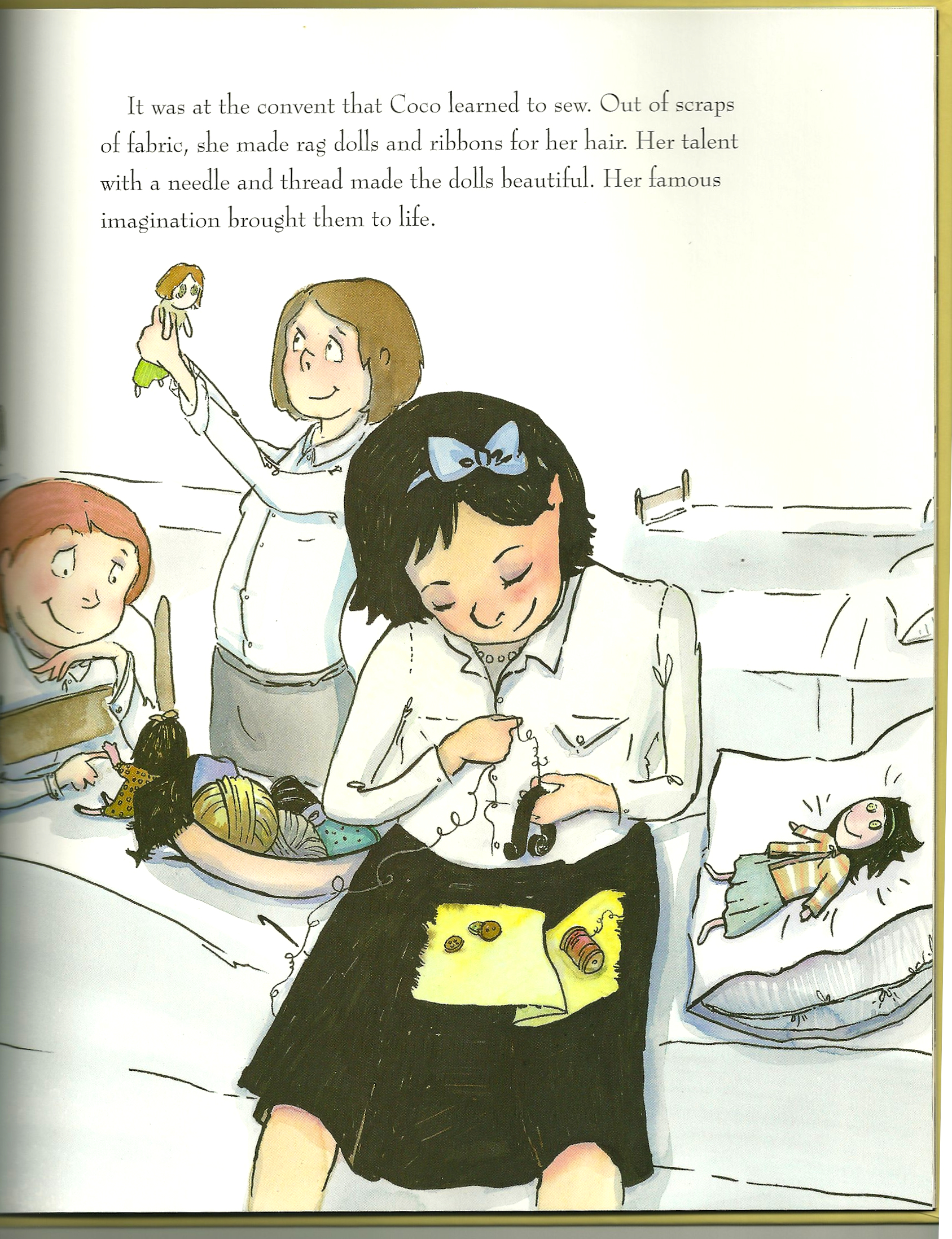
On one level, the book is purely biographical, emphasizing Chanel’s childhood spent in poverty – which she did not allow to define her.  The later part of her childhood was spent in a convent, and it was there where she learned to sew.

The author's charming illustration of Coco as a child with her sewing.

The author’s charming illustration of Coco as a child with her sewing.

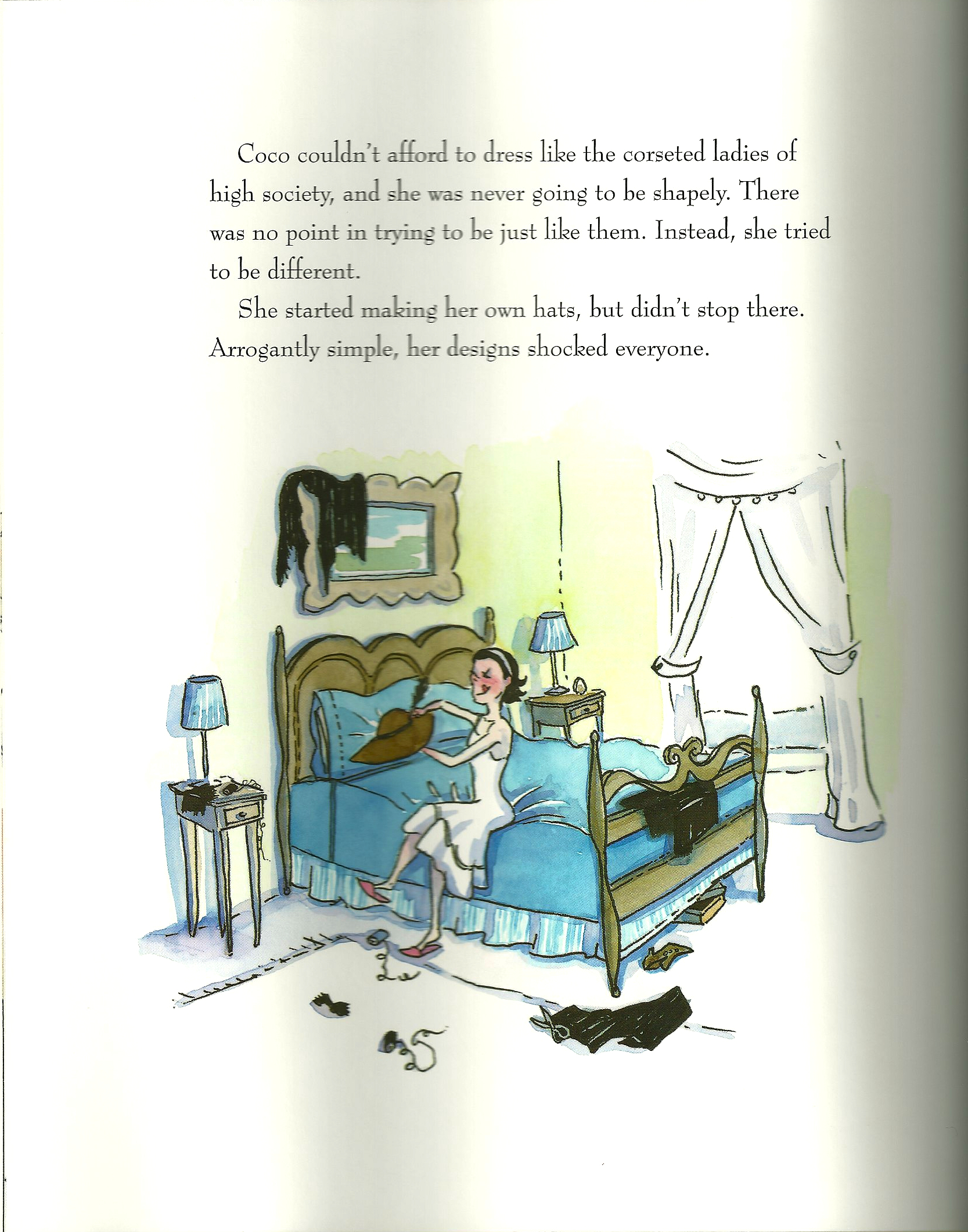
Those sewing skills were the “mechanical” ticket to her success, while her creativity, her determination, her hard work and her daring flounting of convention set her apart from others of her age.

Coco's creativity on display.

Coco’s creativity on display.

The story emphasizes these characteristics for the young readers of this book, which makes it more than a biography.  Indeed, these characteristics are treated as inspirational, which they certainly can be to children.

Some of the more controversial aspects of Chanel’s life are handled discreetly, so that the opening of her first shop and the creation of the classic cardigan jacket (made from one of her lover’s sweaters) are seamless chapters in her life story.

A classic created anew!

A classic, created anew!

For the adult reader of this sweet book, there are two features which I guarantee will be read again and again.  One is the “Timeline” which is in the back of the book (accompanied by a bibliography, too).  All the important dates of Chanel’s life are succinctly listed, including the development of her perfume Chanel No. 5 in 1921; the afore-mentioned creation of her signature jacket, also in 1921, and her debut of the “little black dress” in 1926.

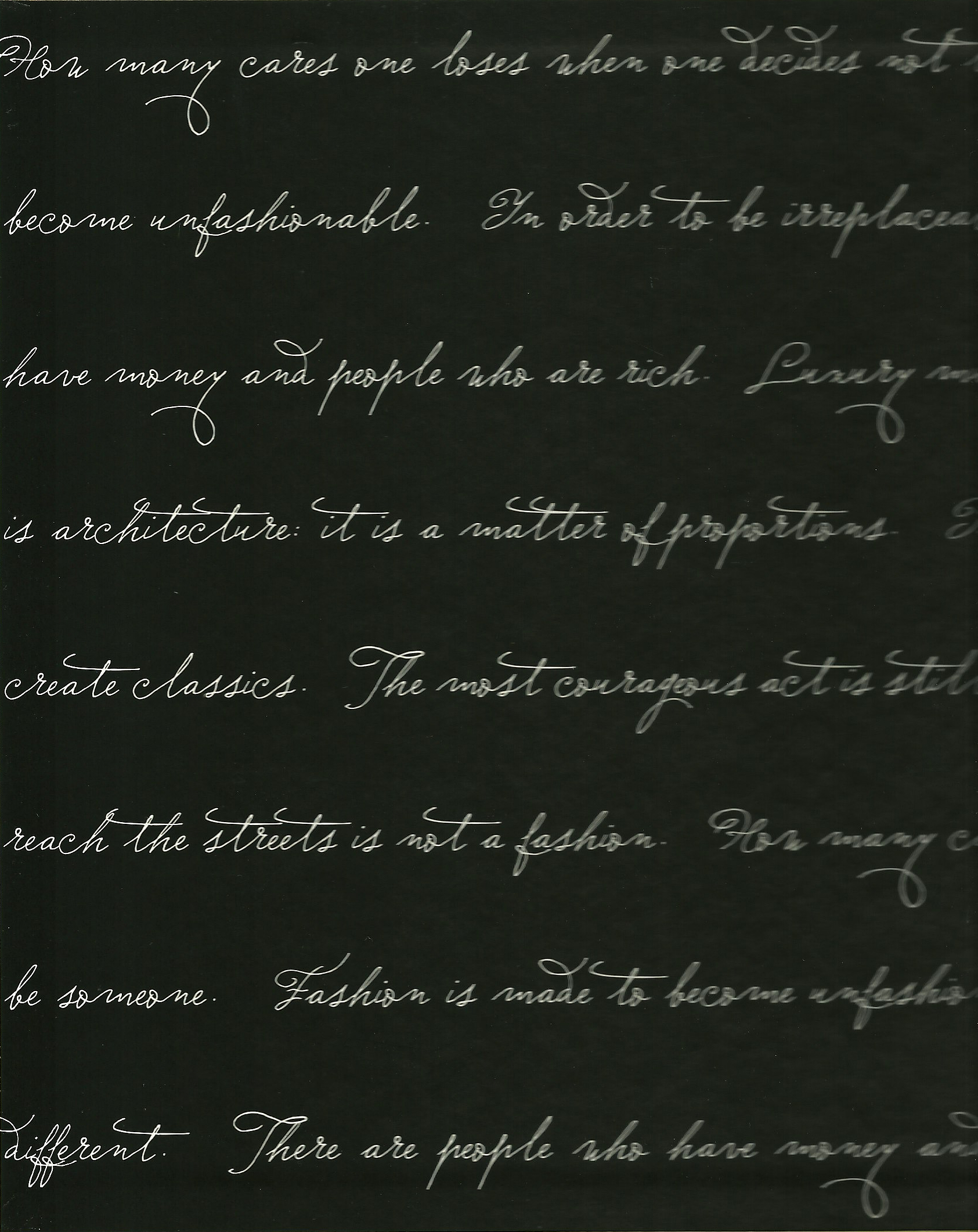
The other compelling aspect of this book is one of pure brilliance from a design point of view:  the lining pages feature a “running commentary” of some of Chanel’s famous and less-known quotes.

One side of the lining pages of the book.

One side of the lining pages of the book.

A sampling of her quotes about fashion:

“Fashion is made to become unfashionable.”

“A fashion that does not reach the streets is not a fashion.”

“Fashion is architecture: it is a matter of proportions.”

And some of her quotes about life:

“There are people who have money and people who are rich.”

“Luxury must be comfortable; otherwise it is not luxury.”

“How many cares one loses when one decides not to be something but to be someone.”

And I so appreciate that this quote is placed centermost:  “The most courageous act is still to think for yourself.  Aloud.”

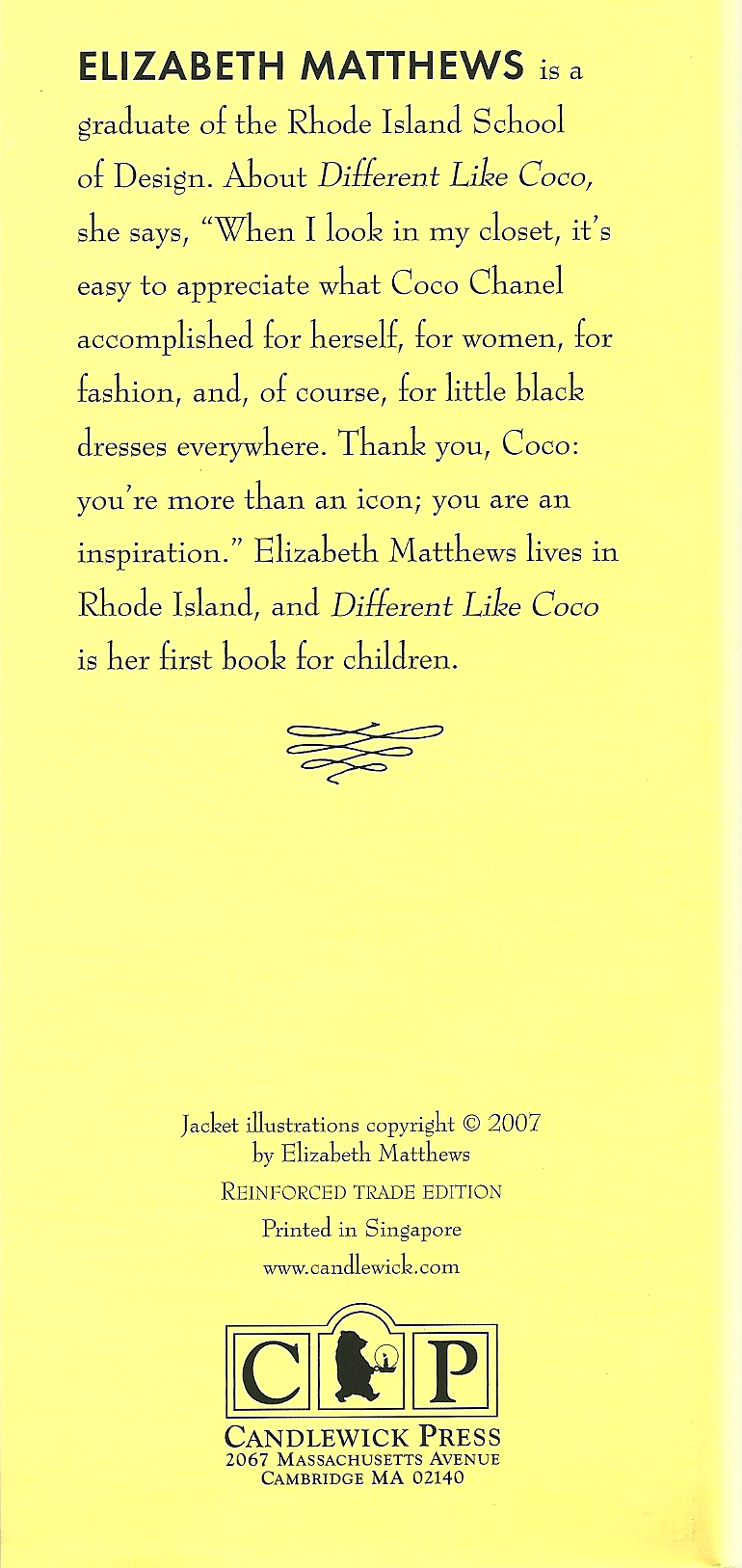
I cannot close this post without a special word about the author, Elizabeth Matthews.  The book jacket has this short statement about her and her motivation to write this book:

Click on the window for an enlarged view.  PLEASE NOTE THAT ALL ILLUSTRATIONS ARE COPYRIGHT 2007, THE CANDLEWICK PRESS.

Click on the window for an enlarged view. PLEASE NOTE THAT ALL ILLUSTRATIONS ARE COPYRIGHT 2007, ELIZABETH MATTHEWS.

Thank you, Elizabeth Matthews, for making the life story of Coco Chanel an inspiring and almost magical tale for 5 to 9-ers of every age!

9 Comments

Filed under Book reviews, Chanel-type jackets, Coco Chanel, Uncategorized

The Return of the Ladylike Suit

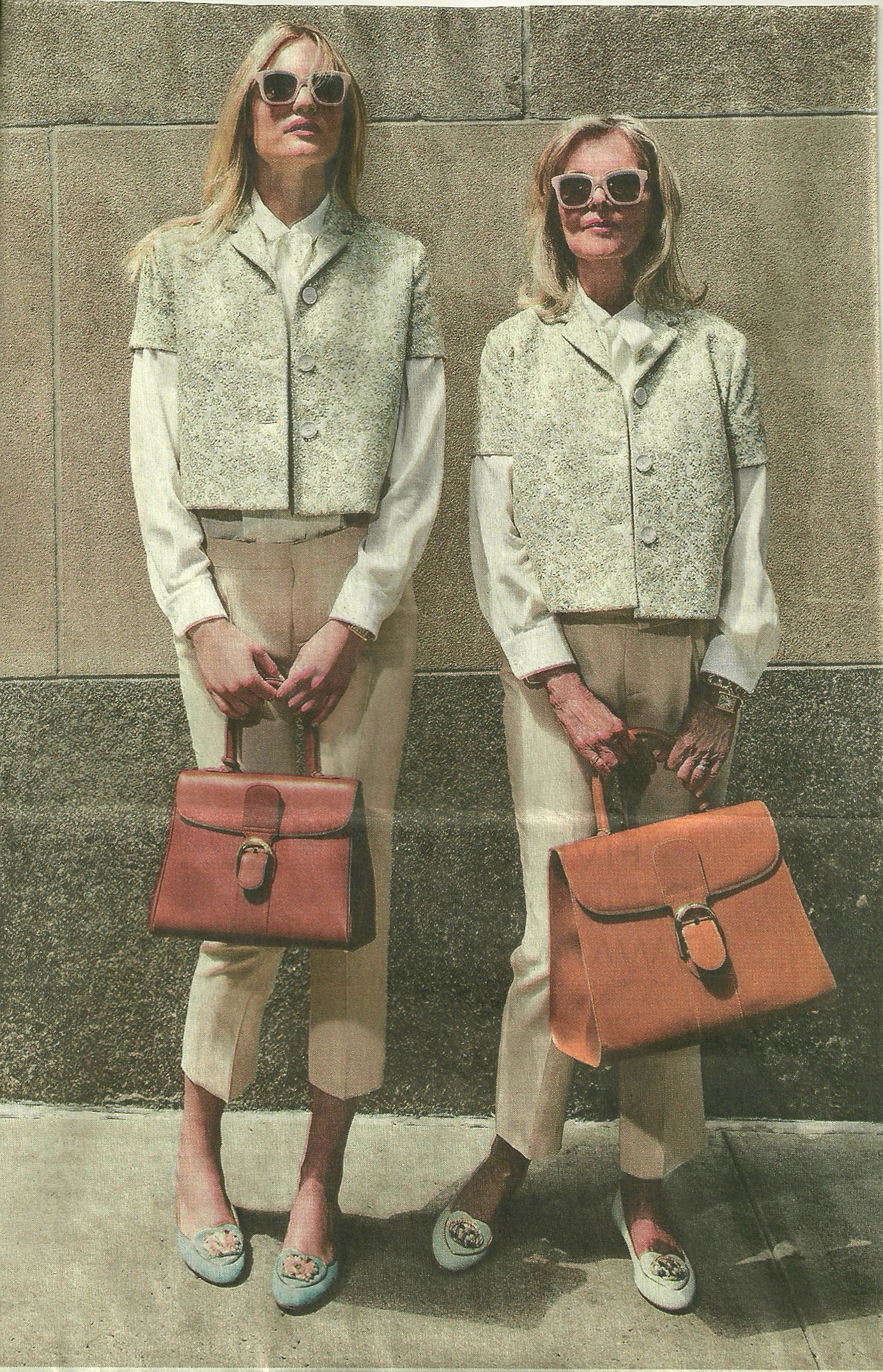
It seems I just can’t get way from that word – ladylike.  Just as I was finishing the jacket to my emerald green silk suit, the weekend Wall Street Journal arrived with this article in the Off Duty – Style & Fashion section:  “Gran Larceny – Fashion’s latest rebellion is co-opting looks from grandma’s closet.”

This photo, copyright The Wall Street Journal, is the lead photo for the article.

This photo, copyright The Wall Street Journal, is the lead photo for the article.

To quote from this article by Alexa Brazilian:

“Is conservative the new radical?    The fashion world certainly seems to think  so  . . .    Designers are reimaging soignée staples for spring and summer – skirt suits, twin sets, below-the-knee dresses, kitten heels and frame bags – that appear anything but moth-eaten.

“ ‘A young girl now doesn’t want to dress like her mother; she finds her grandmother much cooler,’ said Nina Ricci creative director Peter Copping, who designed skirt suits inspired by his own nana.  ‘She wore little smart tweedy suits.  I always had a romantic notion of that.’ “

And then later in the article is this statement by Christopher Kane (which I might frame and put on the wall in my sewing room!):  “Ladylike is the ultimate sexiness,” said the designer.  “It’s clean, elegant and in control.  The famous saying, ‘It’s the quiet ones you need to watch,’ definitely applies to this style.”

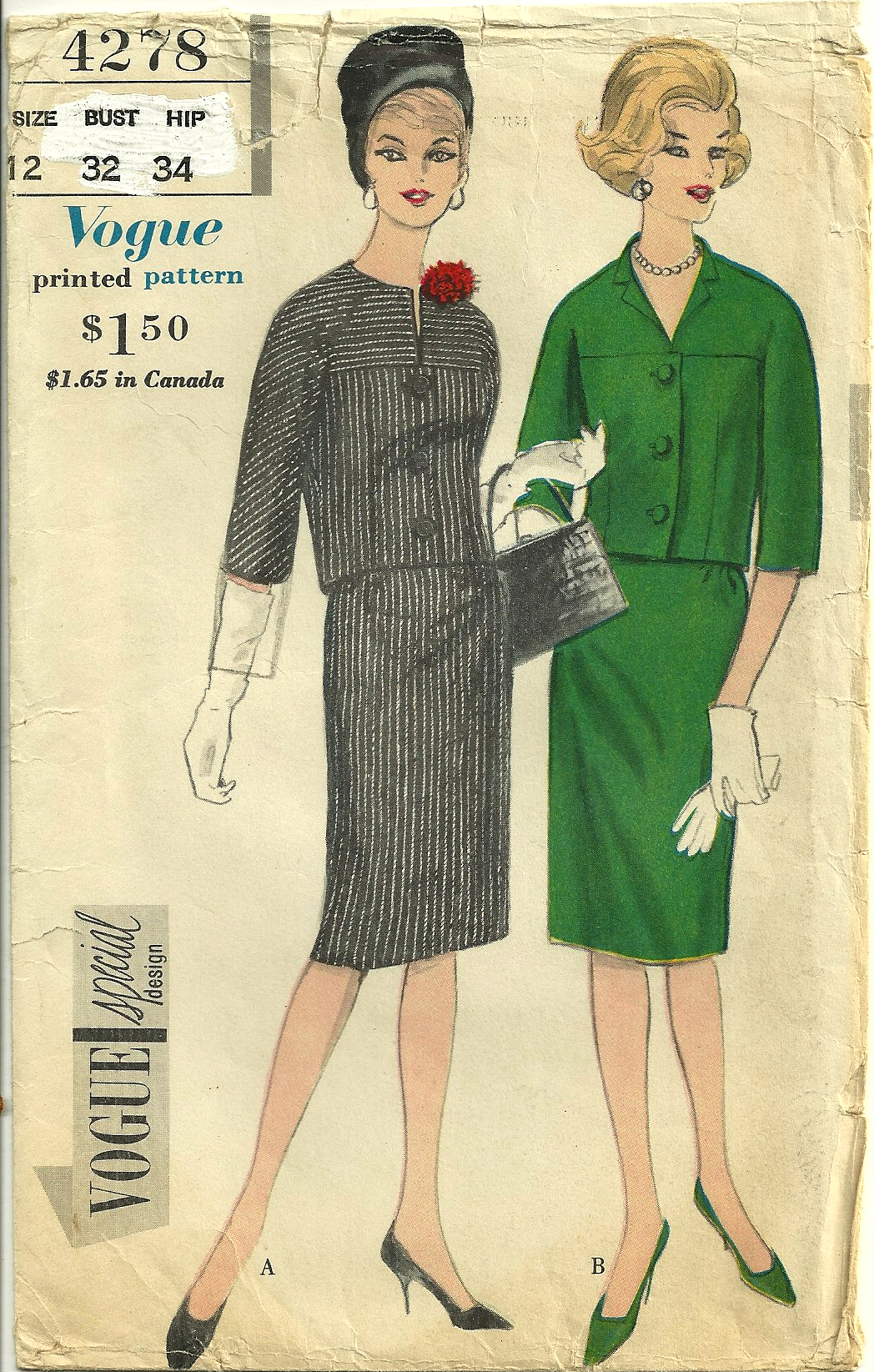
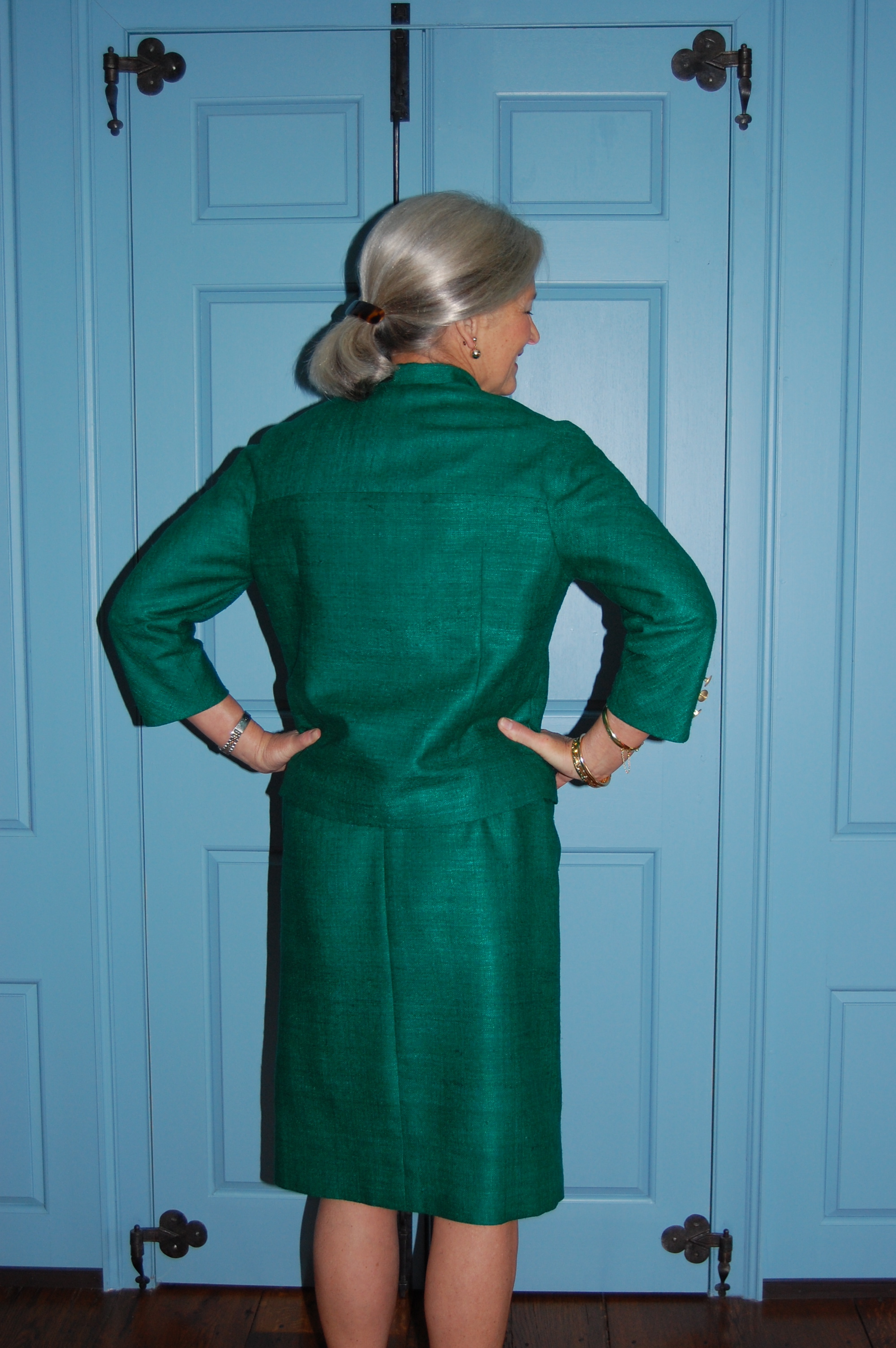
Well, I won’t necessarily feel radical or even sexy when I wear my new green skirt suit, but I do believe it is an example of that ladylike style of the early 1960s — which actually makes sense since the pattern is indigenous to that decade.

This is the pattern from the 1960s I used for my suit.

This is the pattern from the 1960s I used for my suit.

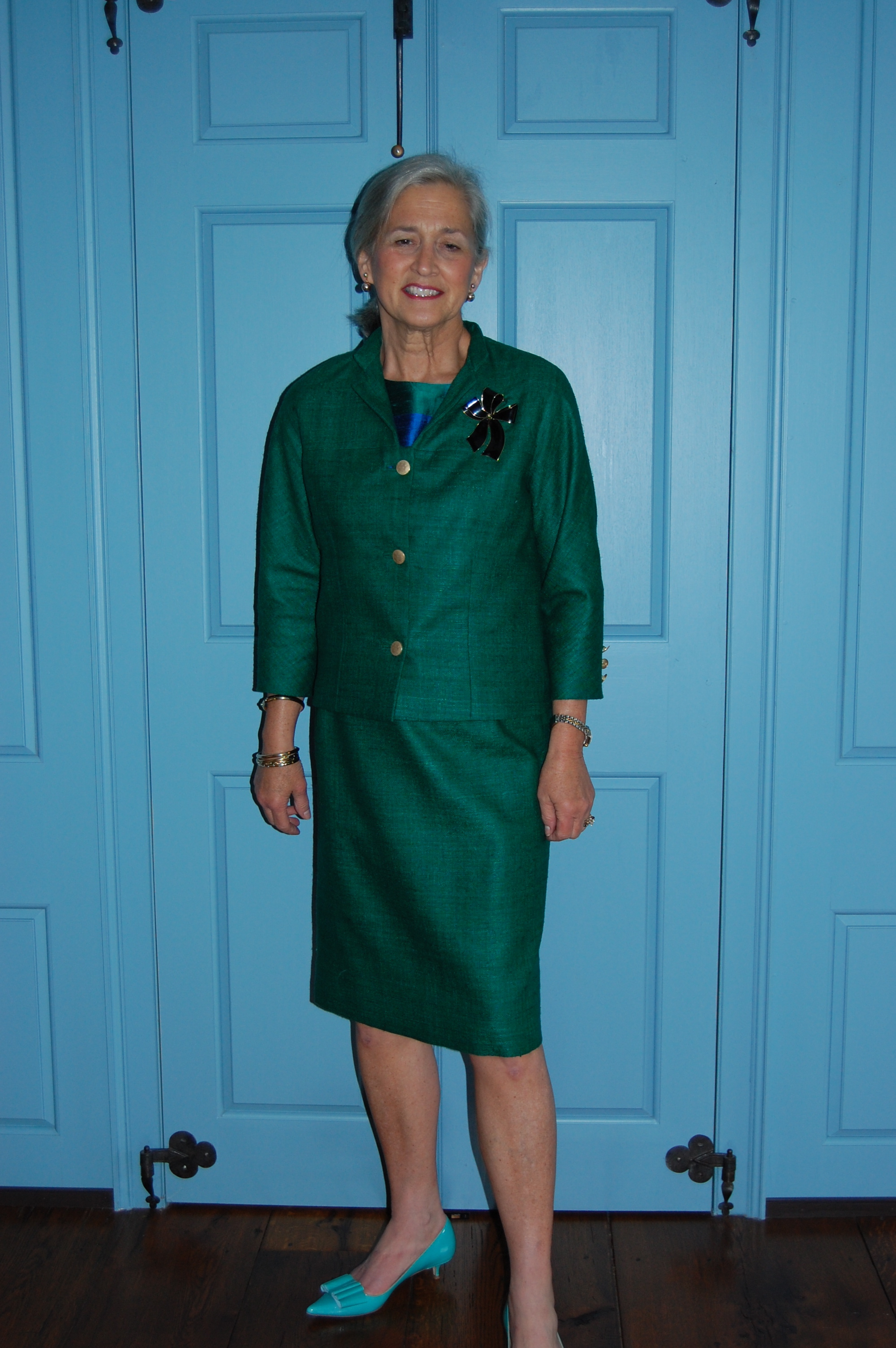
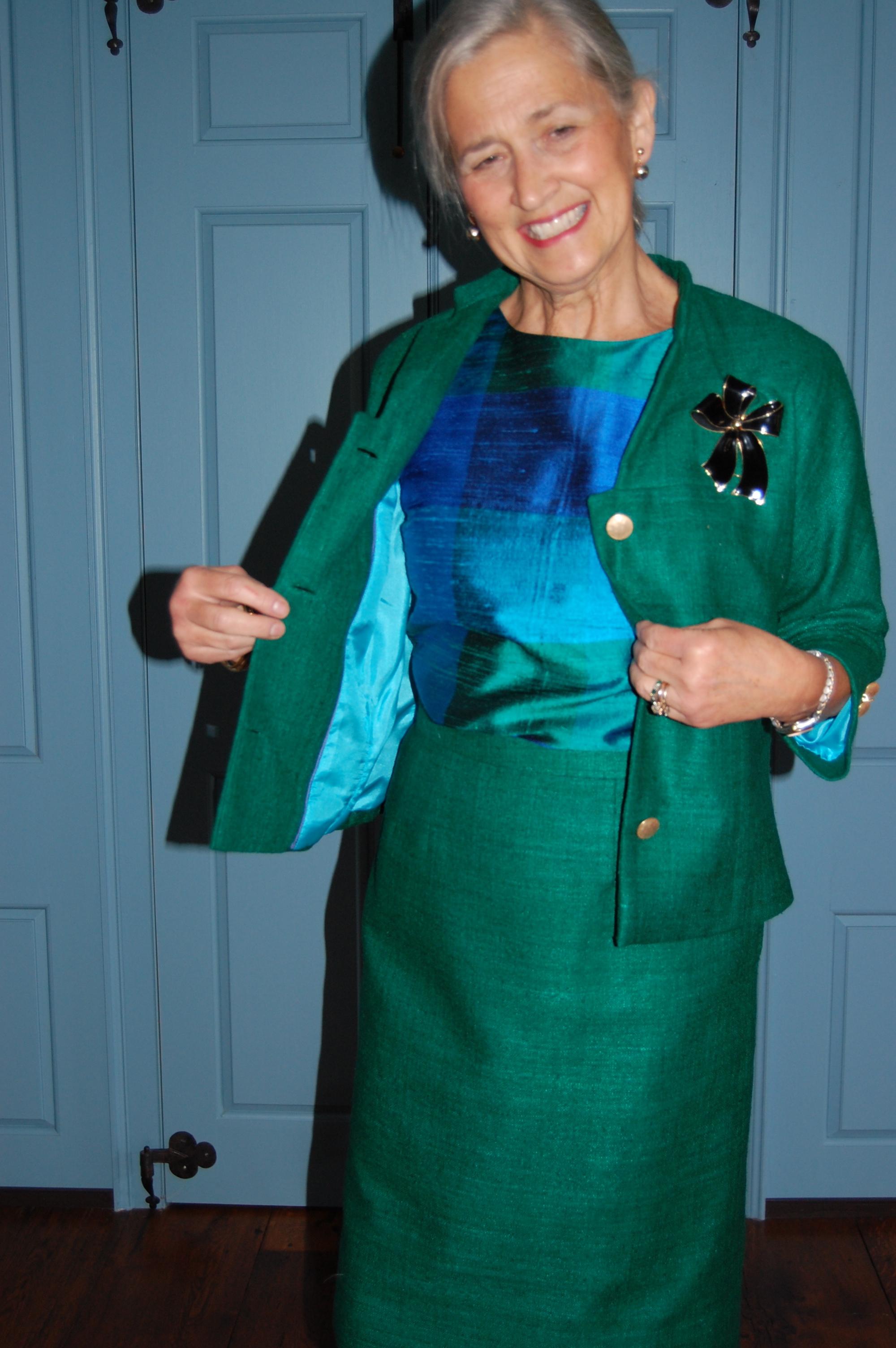
Finally finished!

And here is the suit finally finished.

I make a few changes to the design once I made the muslin for it.  First, I added two tapering darts to the back.  It was supposed to have a boxy feel to it, but I felt a little narrower silhouette would be more flattering to me.  I also lengthened the jacket by about 1 and ½ inches.

The jacket is still "boxy" but less so with the added darts.

The jacket is still “boxy” but less so with the added darts.

I decided to make the sleeves below elbow length, so I added another inch and ½ to them.  Then I had to narrow them a bit as well to make them look proportional.

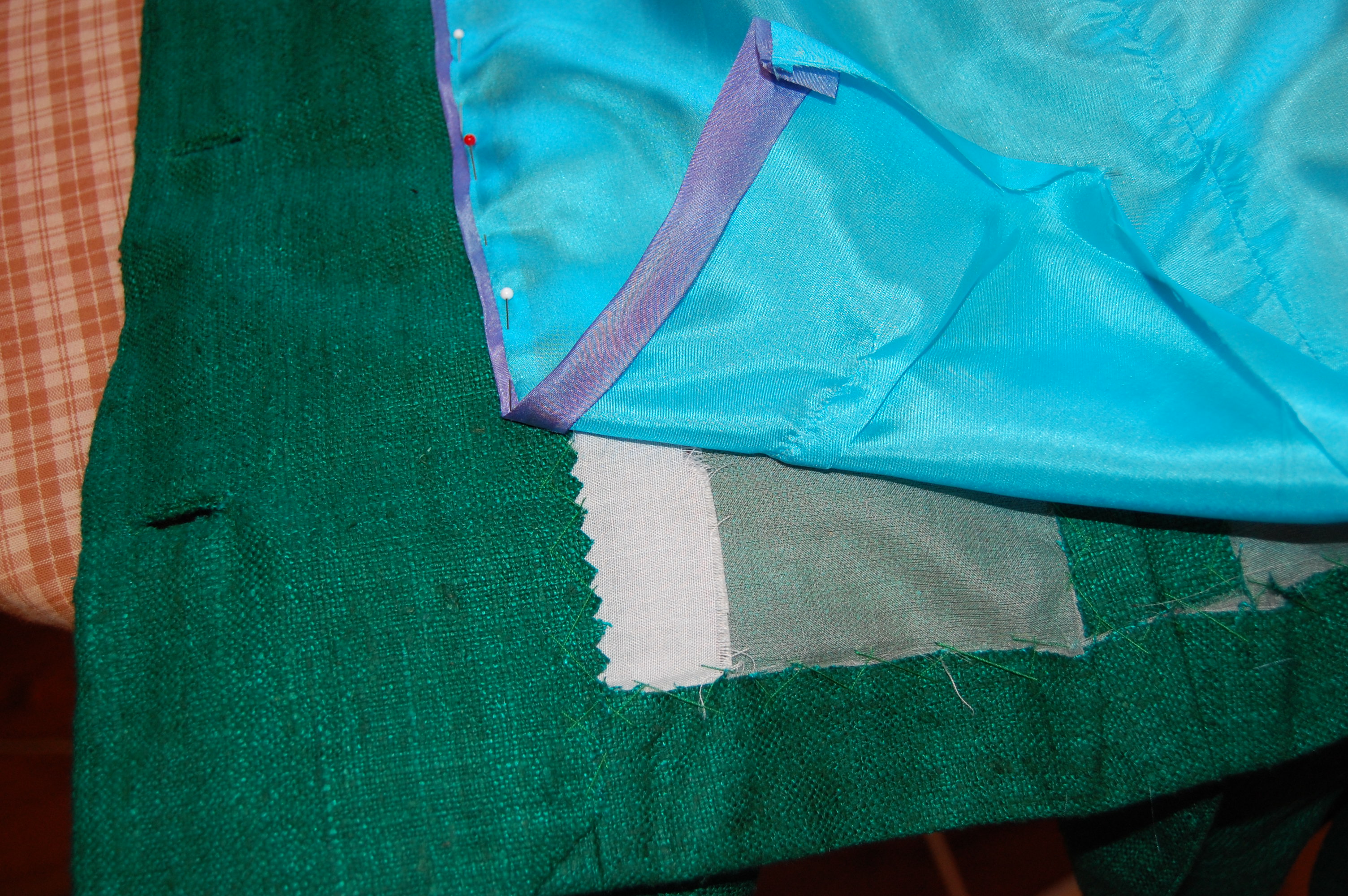
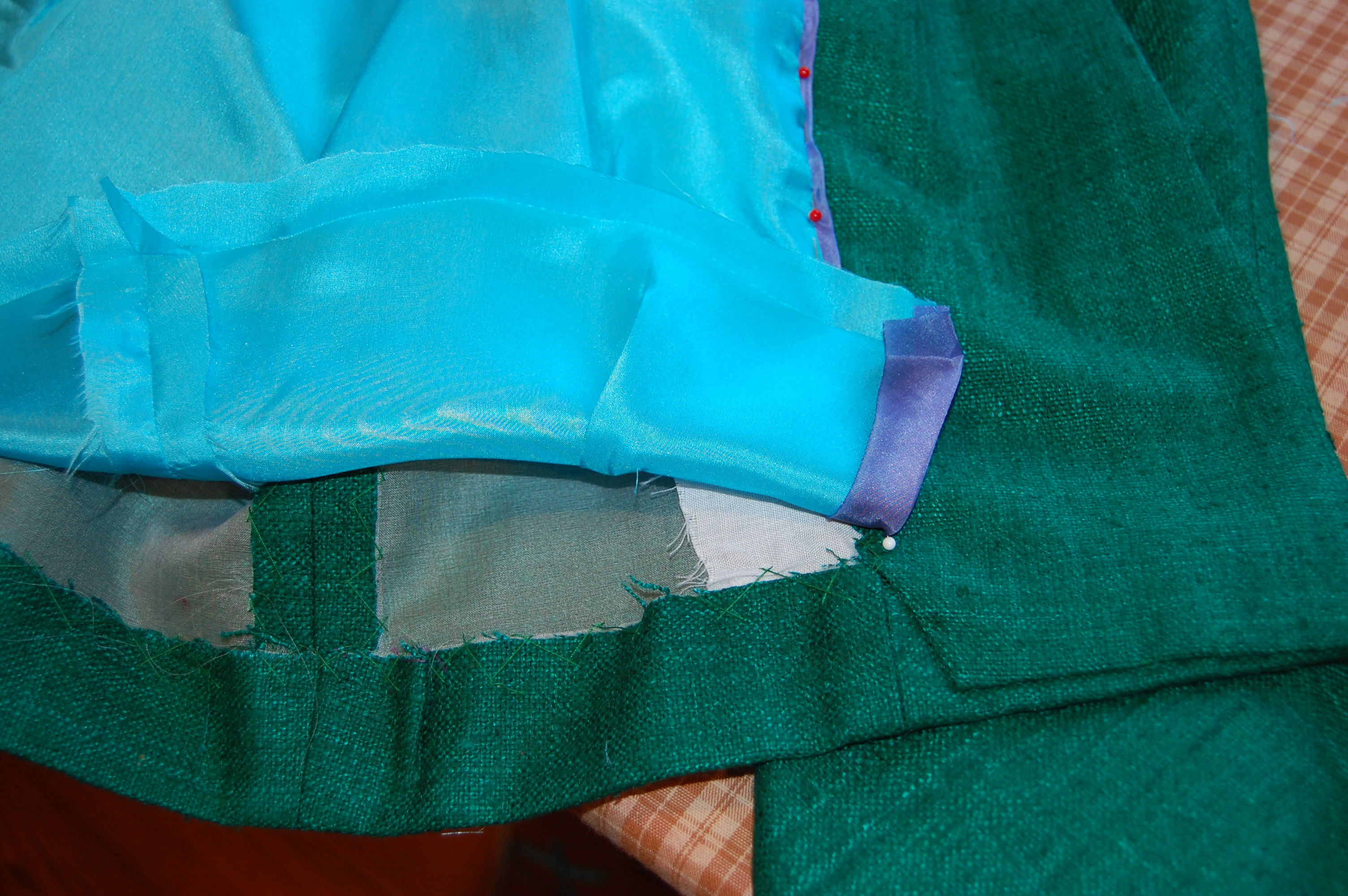
Now to the fun part:  the two dressmaker details I added.  In an earlier post, I already showed the turquoise silk lining fabric I chose.  Once I had such a dramatic contrast in the works, I thought I’d push the envelope a bit farther.  I found silk bias ribbon in a lovely periwinkle color and used it to add an edge detail to the lining in the body of the jacket.

Here is the bias silk ribbon attached to the edge of the lining.

Here is the bias silk ribbon attached to the edge of the lining…  Click on the photos to see them up close.

DSC_0804

… and one more picture of it.

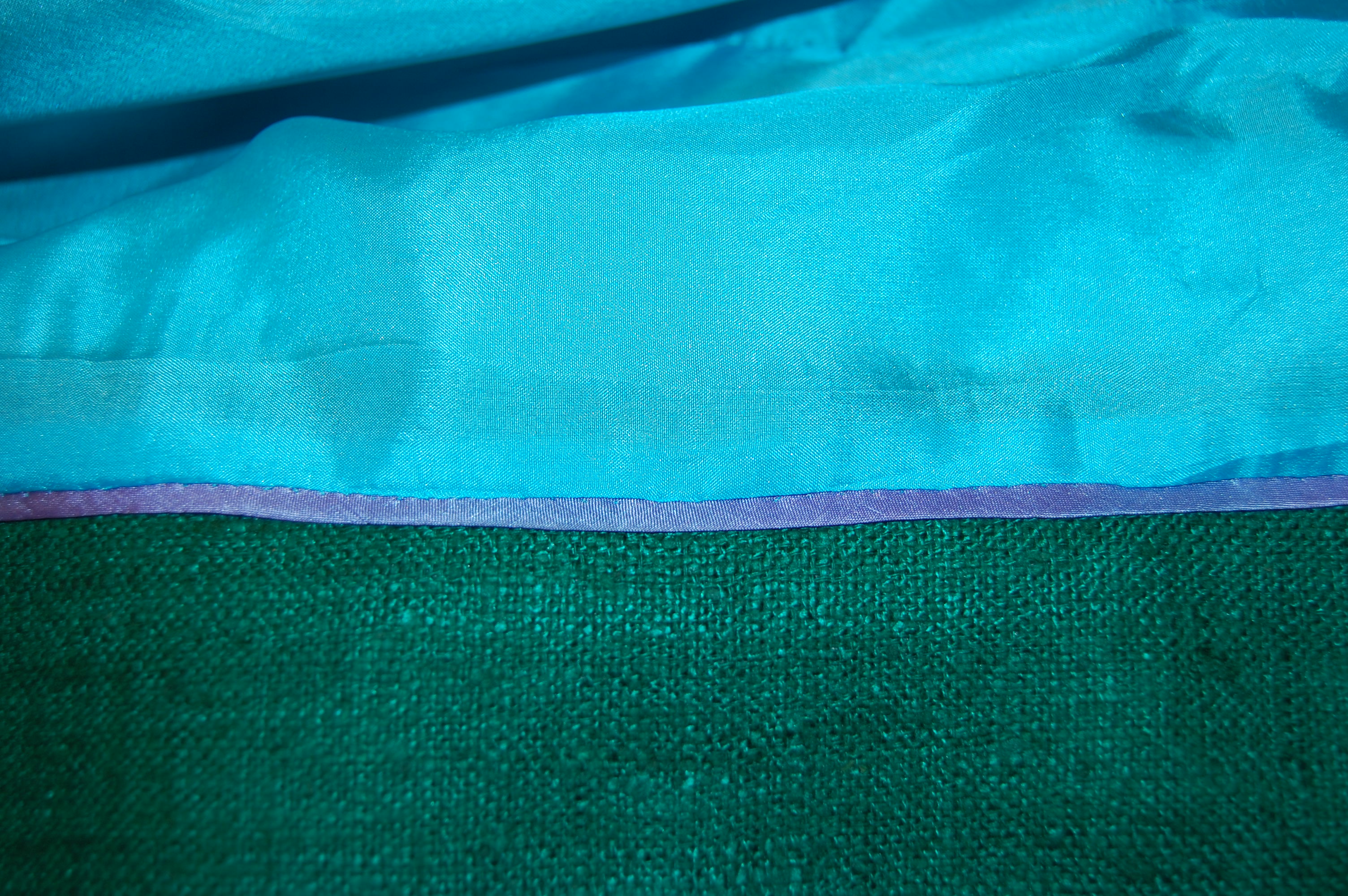
This was so much fun to do and made attaching the lining to the jacket very easy, as all I had to do was “hand-stitch in the ditch” where the silk ribbon and the lining fabric were sewn together.

Here is what the finished edge looks like.

Here is what the finished edge looks like.

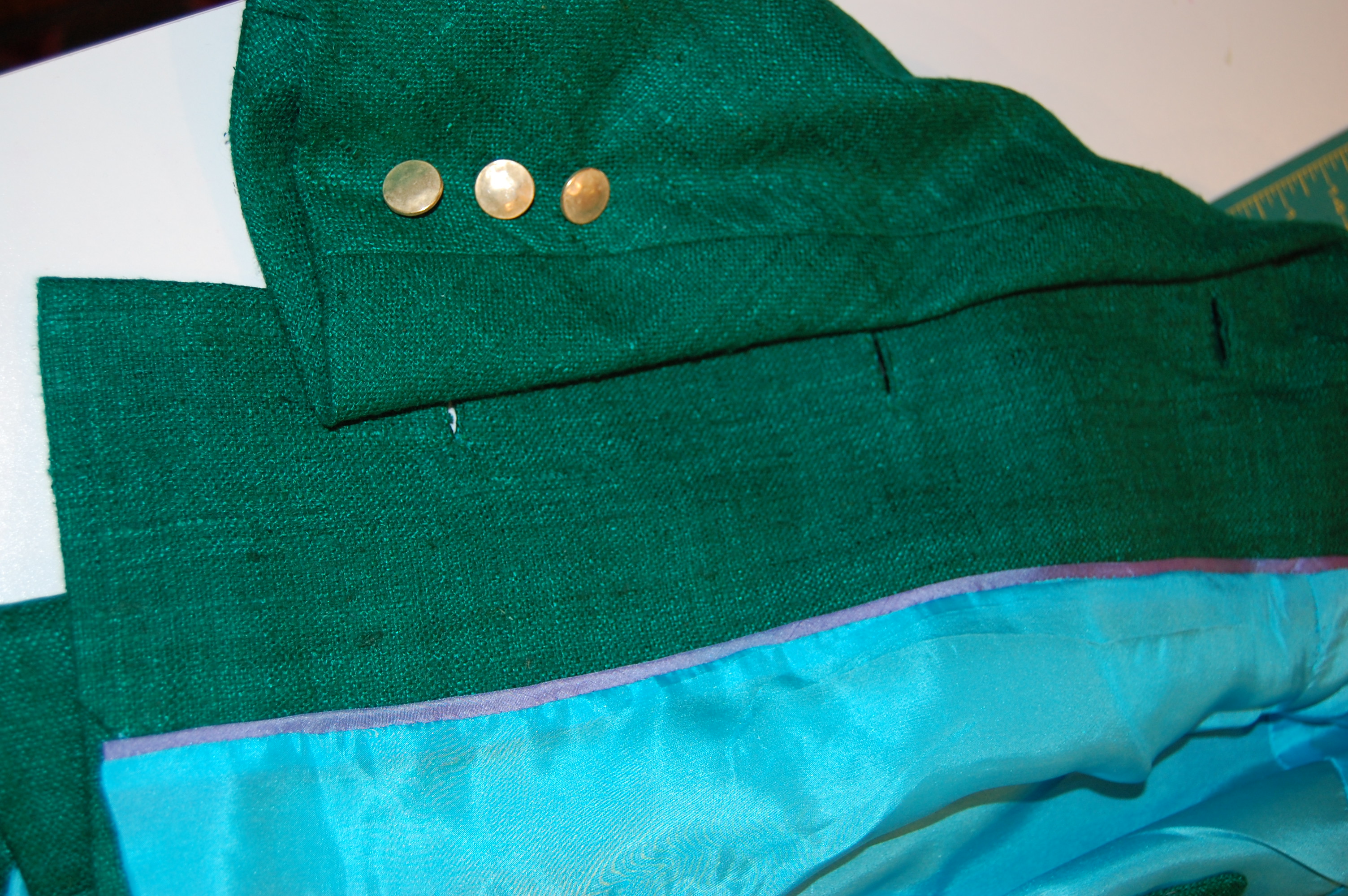
When I found the gold buttons for the jacket, I immediately knew that adding buttons to the sleeves would make it all look more complete.

The gold buttons added to the sleeves and another view of the lining (and the back of the bound buttonholes).

The gold buttons added to the sleeves and another view of the lining (and the back of the bound buttonholes).

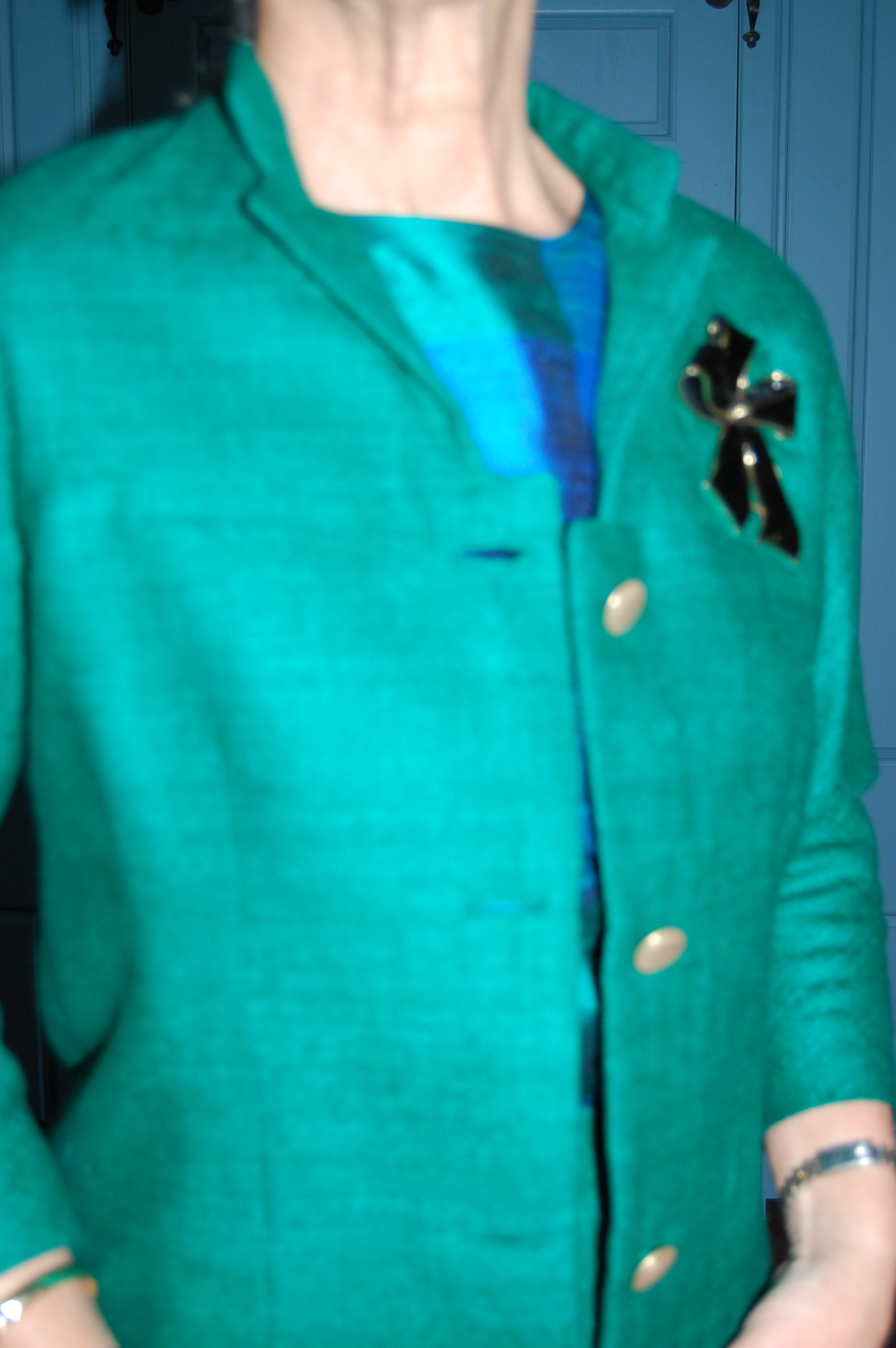
And here is a close-up of the larger buttons for the front of the jacket, with their bound buttonholes.

And here is a close-up of the larger buttons for the front of the jacket, with their bound buttonholes.

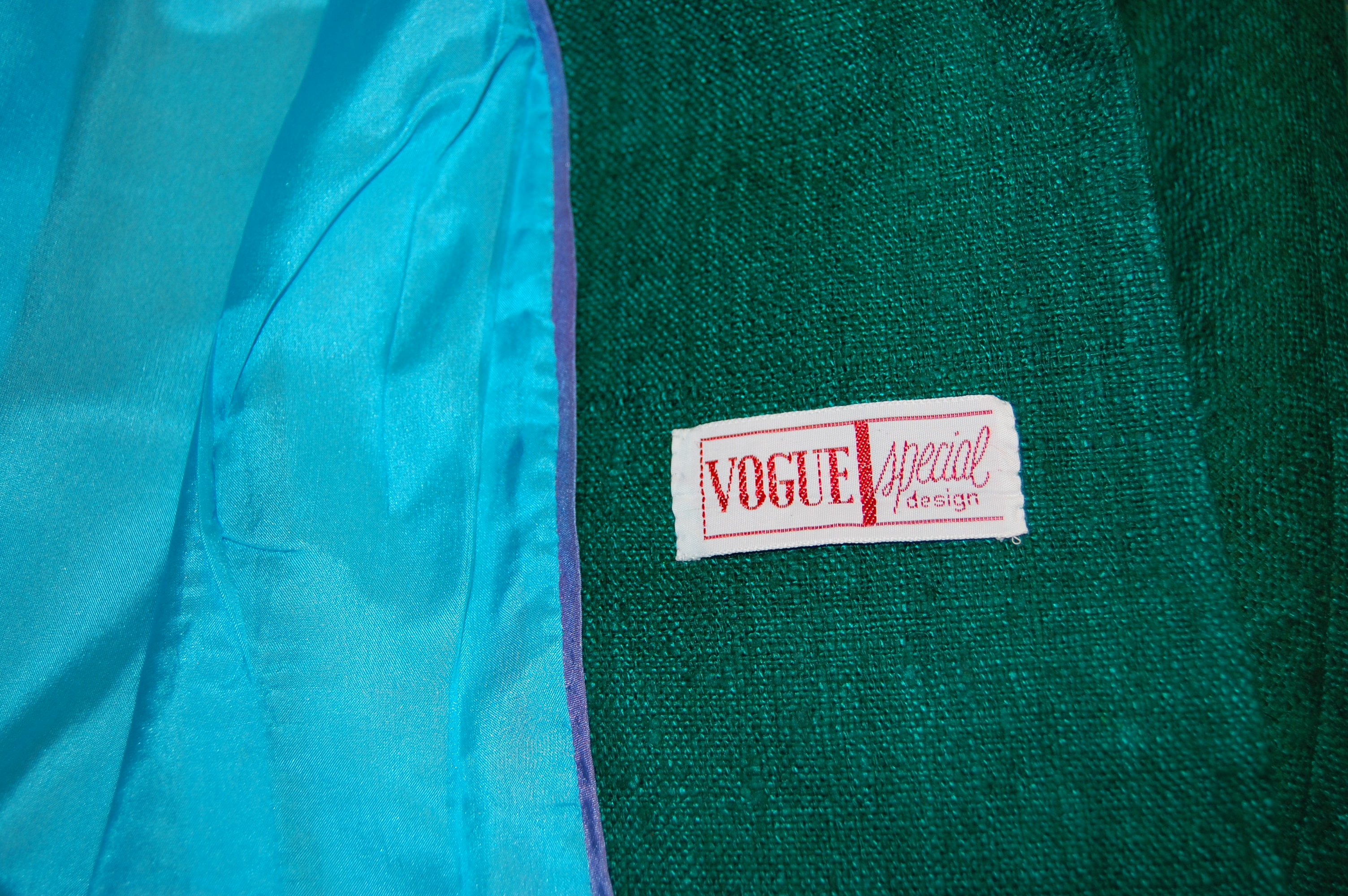
The last thing I did was attach the label to the inside front of the jacket.

Emerald green suit

The silk shell I am wearing is a RTW one!  I purchased it last Spring and now have something with which to wear it!

The silk shell I am wearing is a RTW one. I purchased it last Spring and now have something with which to wear it!

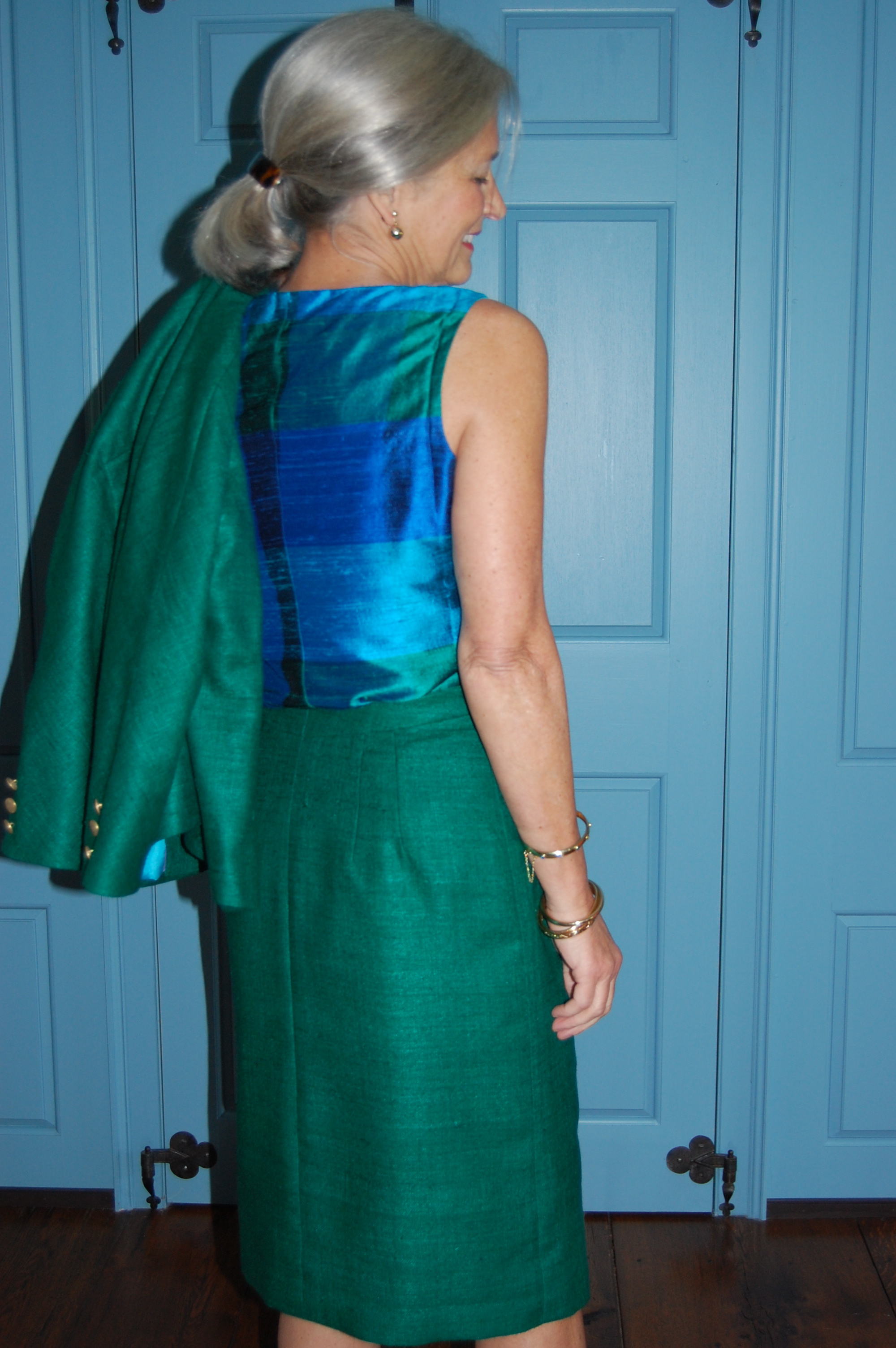
Another view, without jacket.

Another view, with jacket over my shoulder.

When I found this emerald green silk matka online last Fall at Waechter’s Fine Fabrics, I envisioned a skirt suit – or dressmaker suit, as this type of dressy suit is also called – but I had not progressed beyond that in my planning.  Well, now this new grandmother is feeling pretty fortunate that, not only did I grow up with the styles from the 1960s, but they are making me feel quite fashionable now that I am in my 60s!

17 Comments

Filed under Buttons - choosing the right ones, Dressmaker details, Dressmaker suits, sewing in silk, Uncategorized, vintage Vogue patterns from the 1960s, Vogue patterns