Tag Archives: vintage fashion

Pink Stripes 

“You can never go wrong with a little pink… a lot works for me.” Dana Dalgetty

It is extremely difficult for me to resist a bubblegum pink fabric.  And if it is a stripe, too, the odds are very good that fabric will end up in my sewing room.  So it was with this silk and cotton blend found on the website of Mendel Goldberg Fabrics.
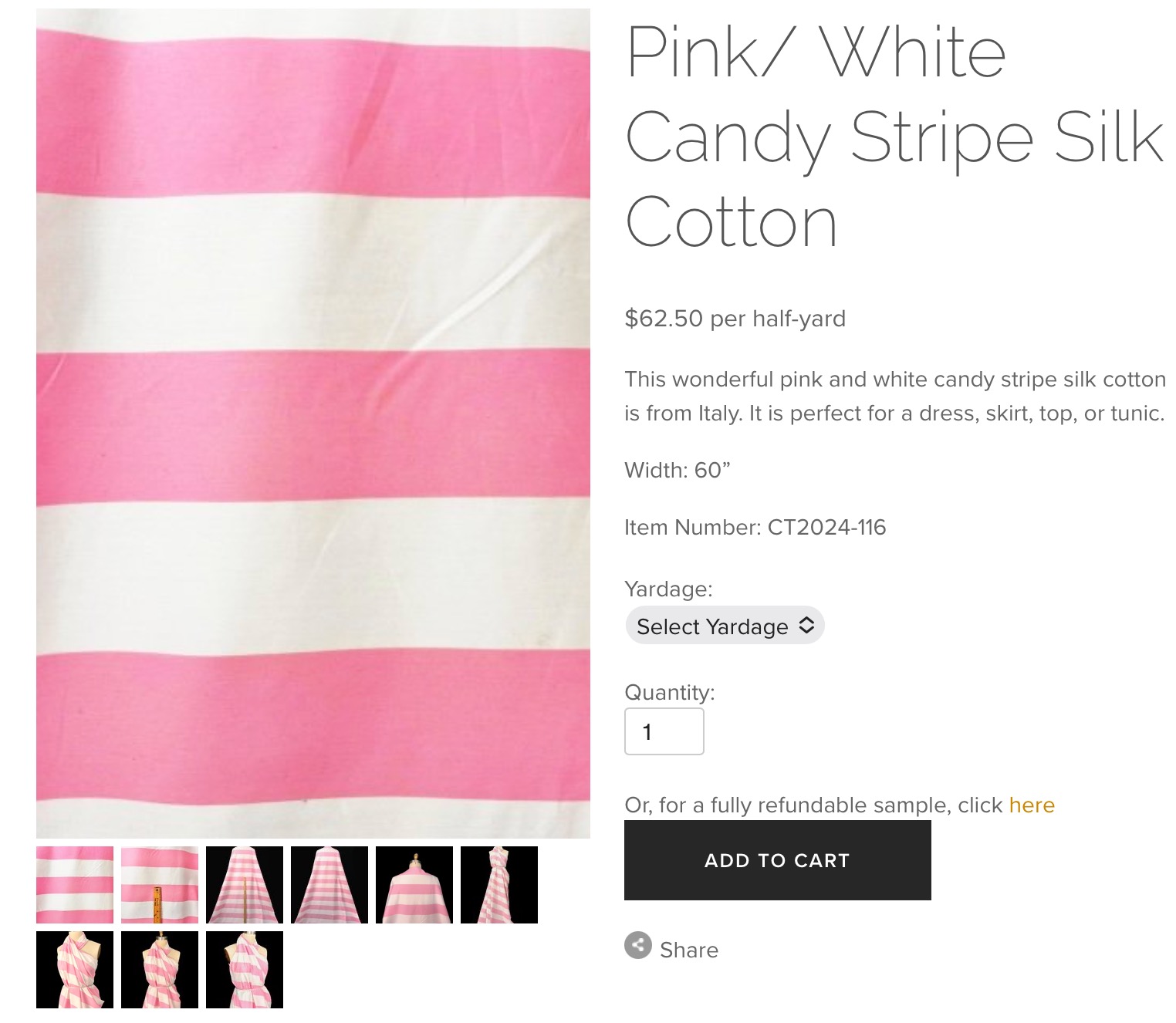
Screenshot

I purchased it last summer during a 20% off sale, and when it arrived, I knew I had made the right decision – although the stripes were a bit bolder in person than I anticipated.  As usual, I wasn’t sure what I was going to make – a coat? a dress? a skirt?  I needed more thinking time so I tucked it away until this Spring.  In the meantime, I purchased this vintage Vogue pattern which I saw as a good basic design which could be easily changed, adapted and altered.  
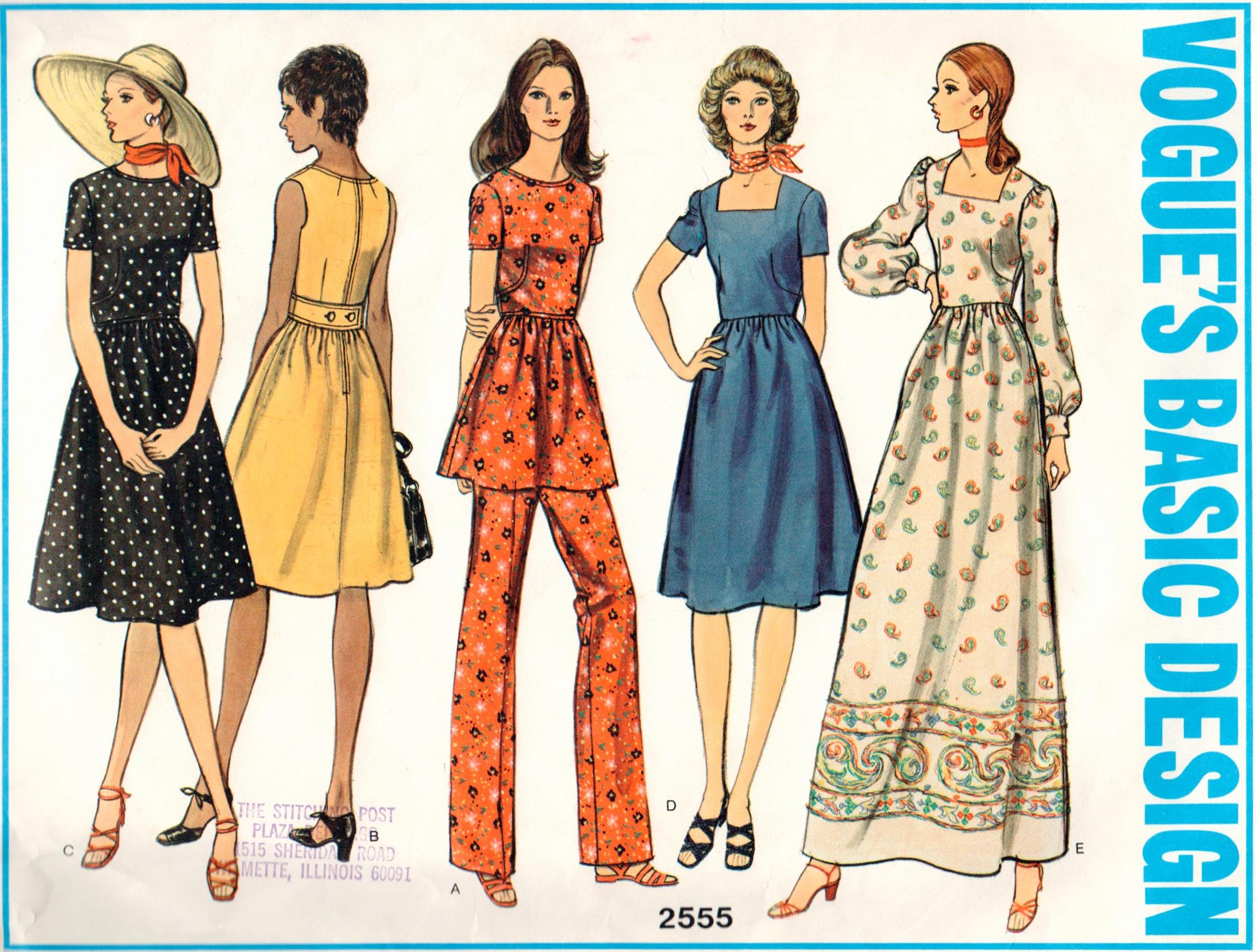
Take note of those curved darts on the bodice, as I will mention them again.

I like dress designs which have some “back“ interest, here the buttoned half belt.  Although I loved the sleeveless view, I have become less comfortable wearing sleeveless dresses as I have gotten older.  Thus, I was drawn to the short-sleeved view (C), knowing I could easily lengthen the sleeves to reach almost to the elbow, if that seemed the way to go.  Thus, it was a logical progression to imagine the pink striped fabric made up in this design, despite the note on the pattern “Not suitable for striped fabrics.” 

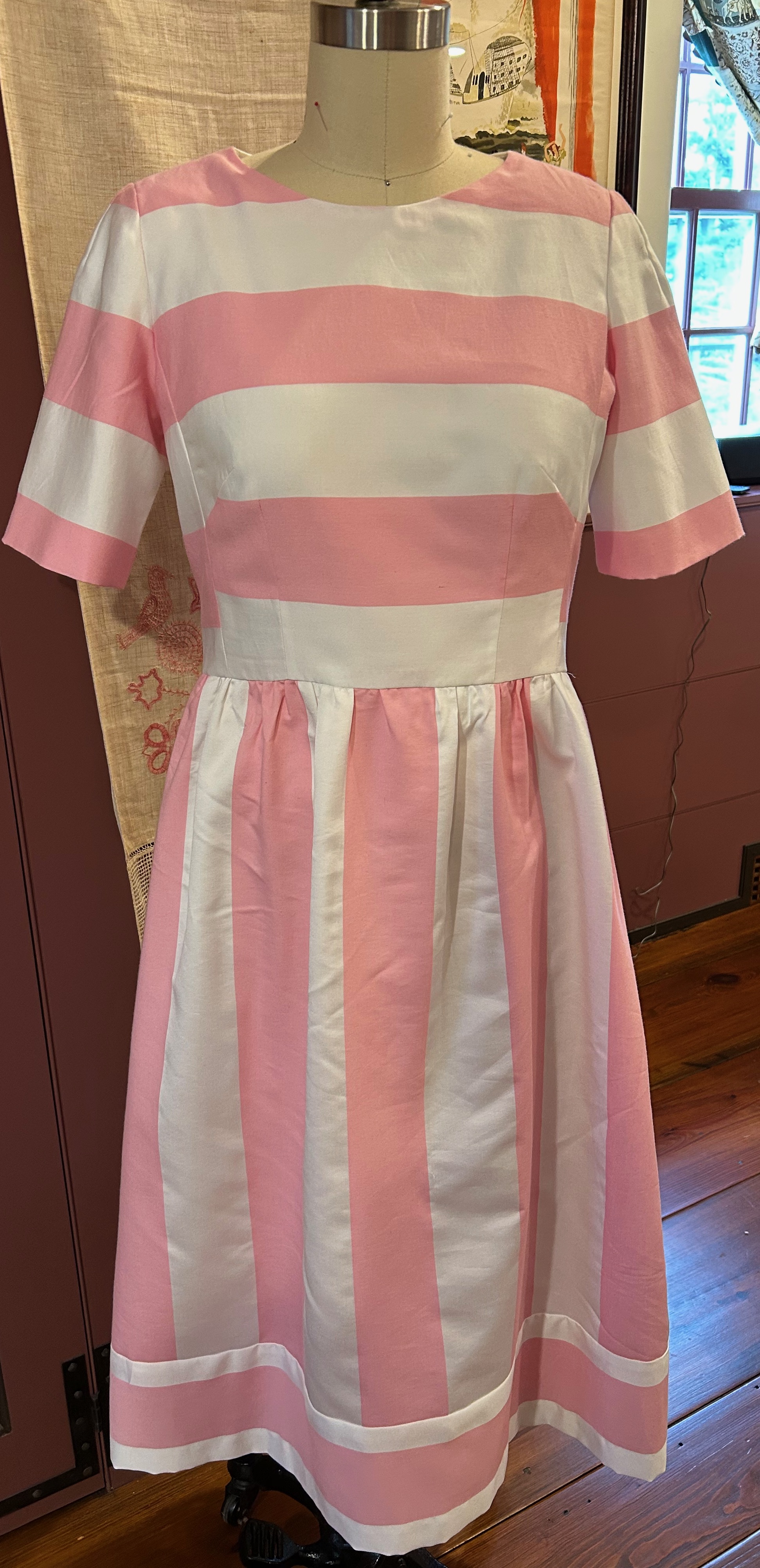
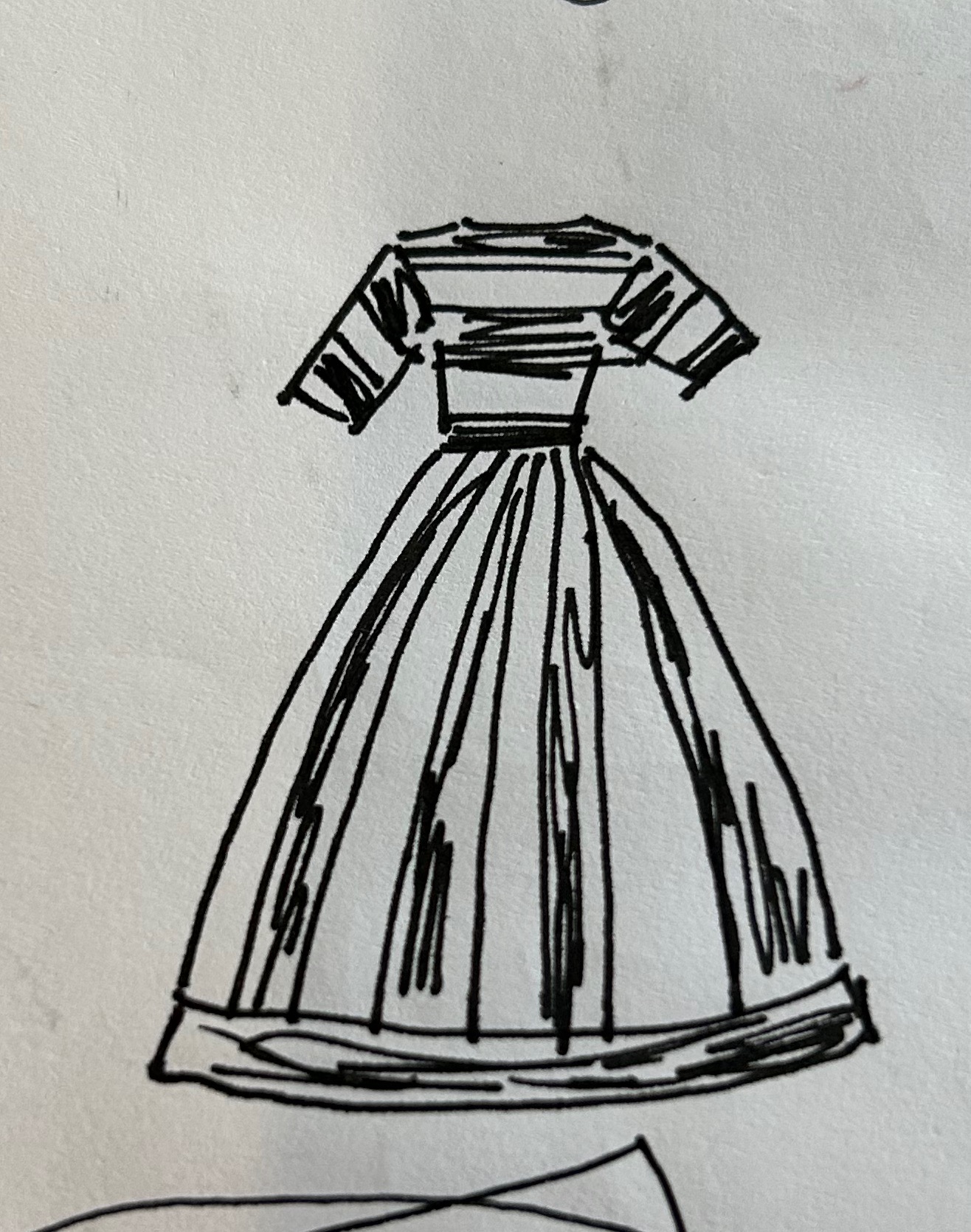
I wasn’t quite ready to forge ahead, however.  My fabric was such a bold stripe, I feared a horizontal orientation of the fabric would be too much, but a vertical orientation was equally problematic.  I went to my Pinterest feed to get some inspiration and in no time at all, the lightbulb went off in my head.  The dress needed a combination horizontal and vertical orientation.  I made this quick sketch, and I knew I had the solution I needed.  
I took these quick photos after I had worn the dress to a party, wrinkles and all. My apologies for the unkempt appearance of the dress!

I set about making a muslin/toile for fitting, and then I hit a brick wall.  Those curved darts you see on the pattern bodice just were not flattering to me, despite my working and reworking them multiple times.  I finally gave up.  I would need to find a substitute pattern for the bodice front and make it work with the bodice back toile which I had fitted successfully.  This was all terribly time-consuming, as you can imagine, but I finally was able to find an existing bodice front in my stash of patterns/toiles which, fingers crossed, would work.  I didn’t know how well it would work until I had the happy surprise of seeing the darts feed into the bold stripes successfully. 
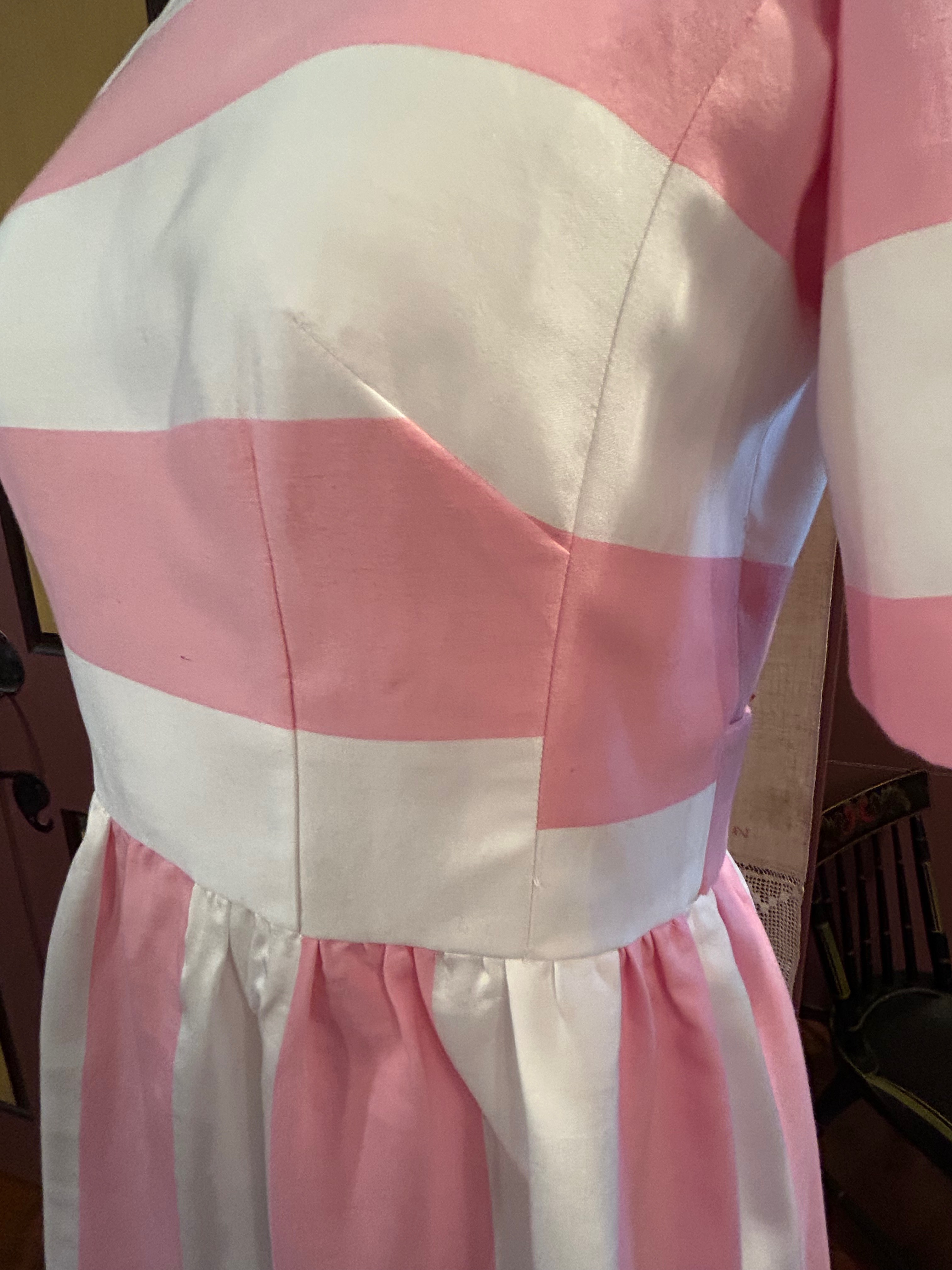
Darts, of course, distort side seams, but this distortion somehow adds to the appearance of the front bodice. I suspect the “unsuitability” of striped fabrics was because of that curved dart, which I unknowingly eliminated when I changed the bodice front.

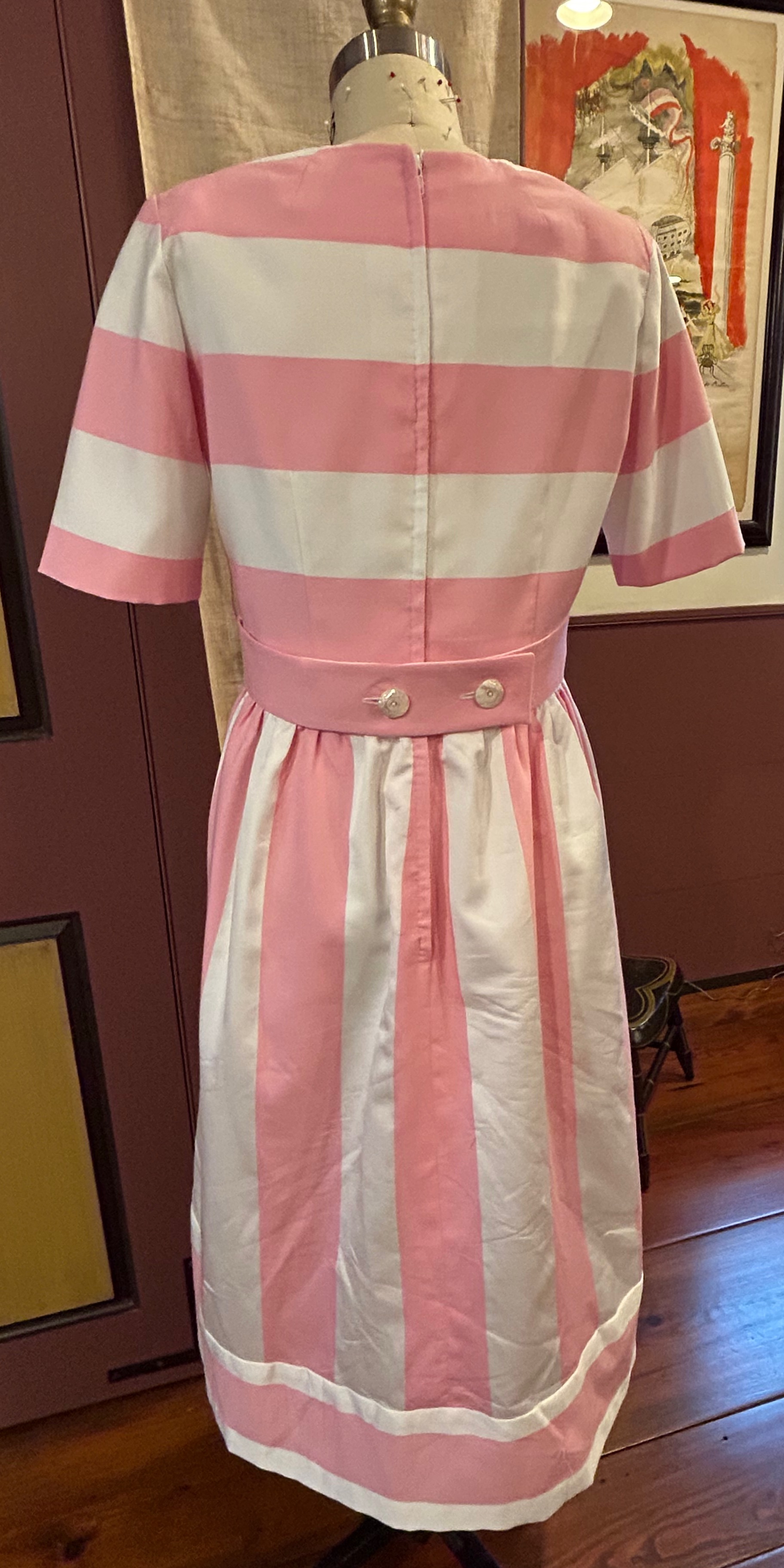
What was not as successful was the proper alignment of the buttons on the back belt to the center of the dress. That is one of the many downsides of fitting oneself – I could not see what I was doing, and although I measured and fiddled, I was still off by a couple of inches.  
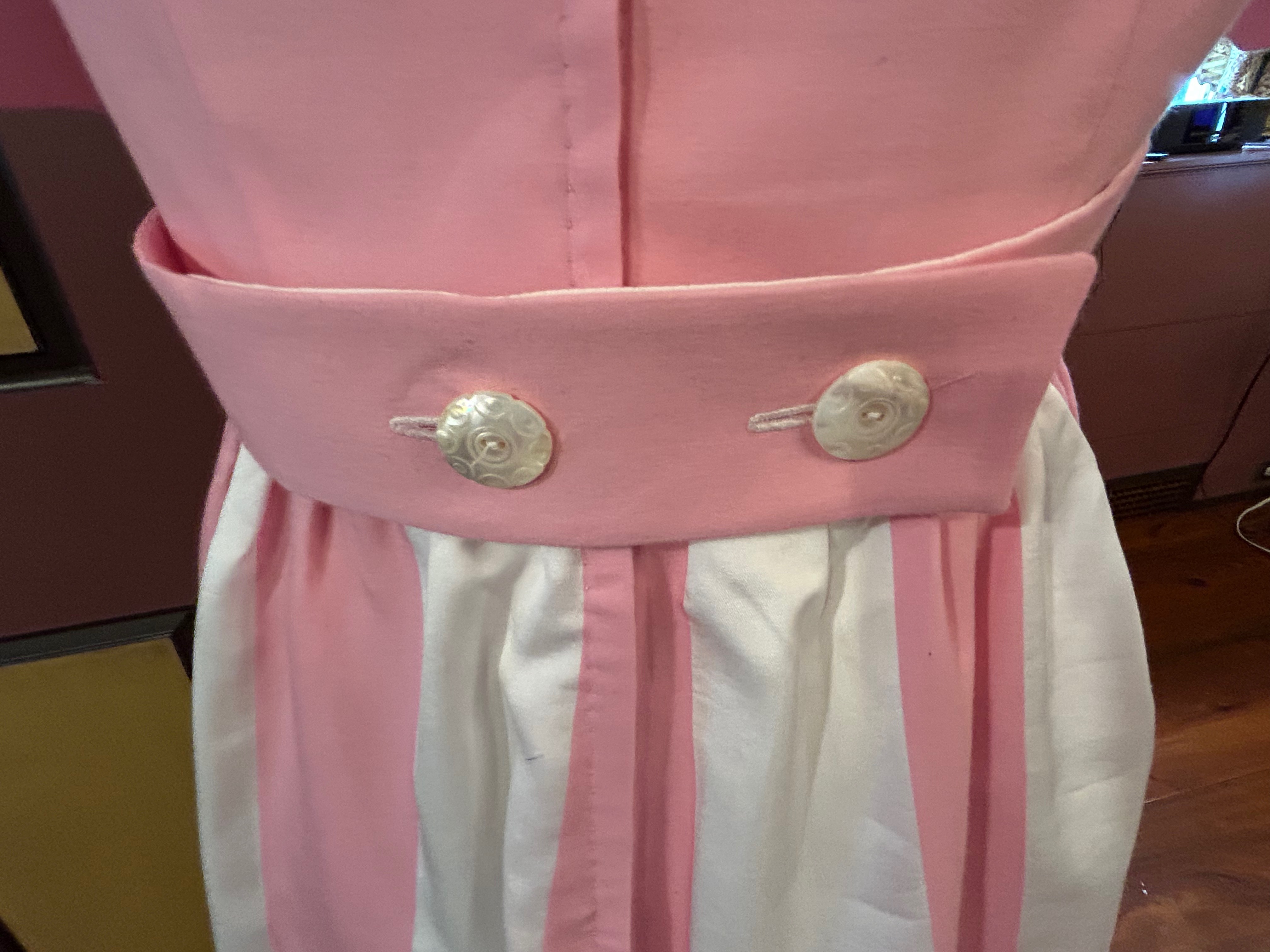
I did a hand-picked lapped zipper and the buttons are vintage mother of pearl from my collection.
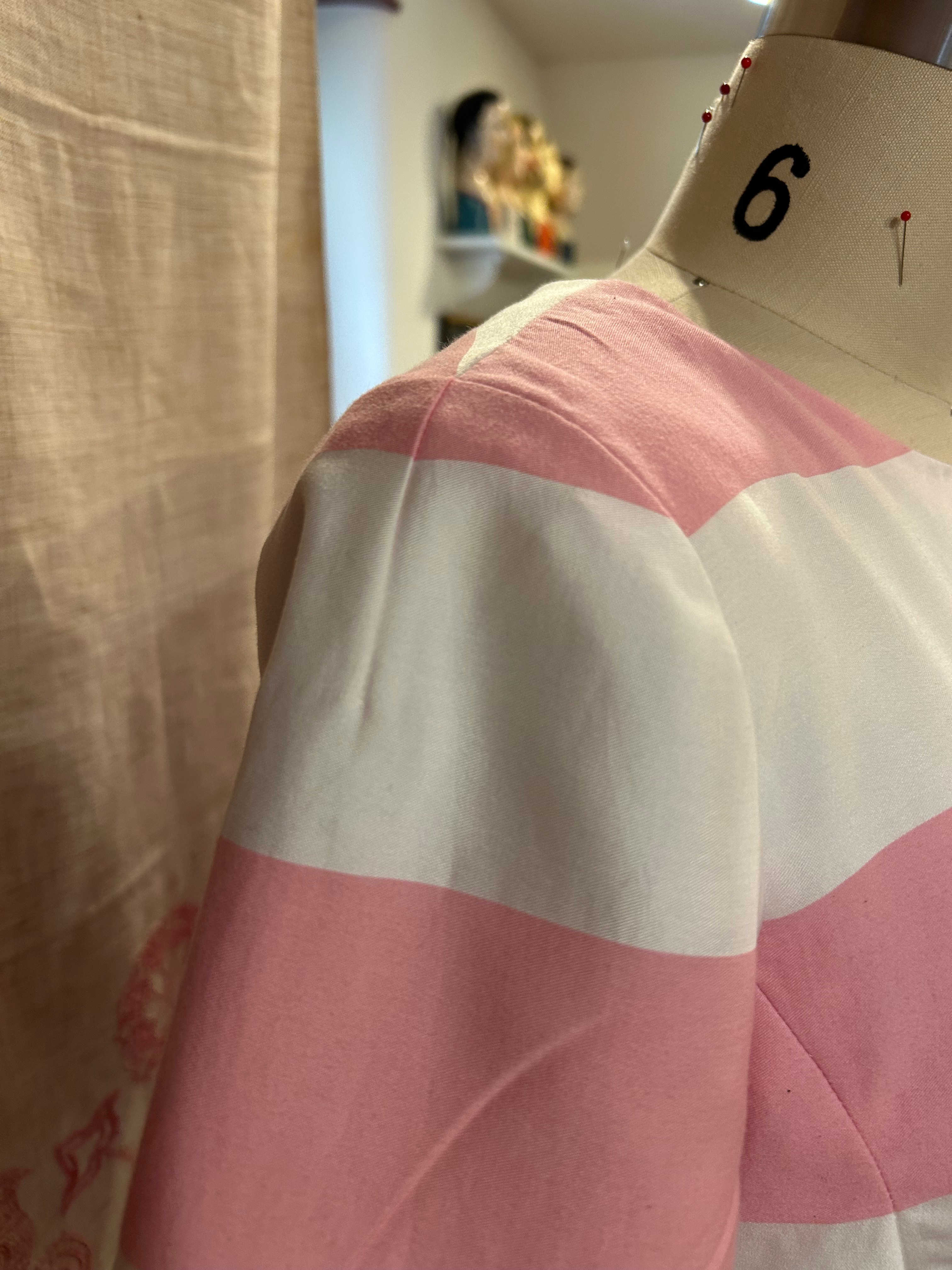
While we are talking details, here is the top of the sleeve. I used a top dart to take in the necessary fullness when setting in the sleeve. This is an alteration I make frequently to accommodate my prominent shoulders.

I lined the entire dress with a soft cotton batiste which complimented the softness of my fabric, adding a little more opaqueness to the finished dress.  I did not use an underlining, reasoning that more structure would not be conducive to the soft flow I wanted in this garment.

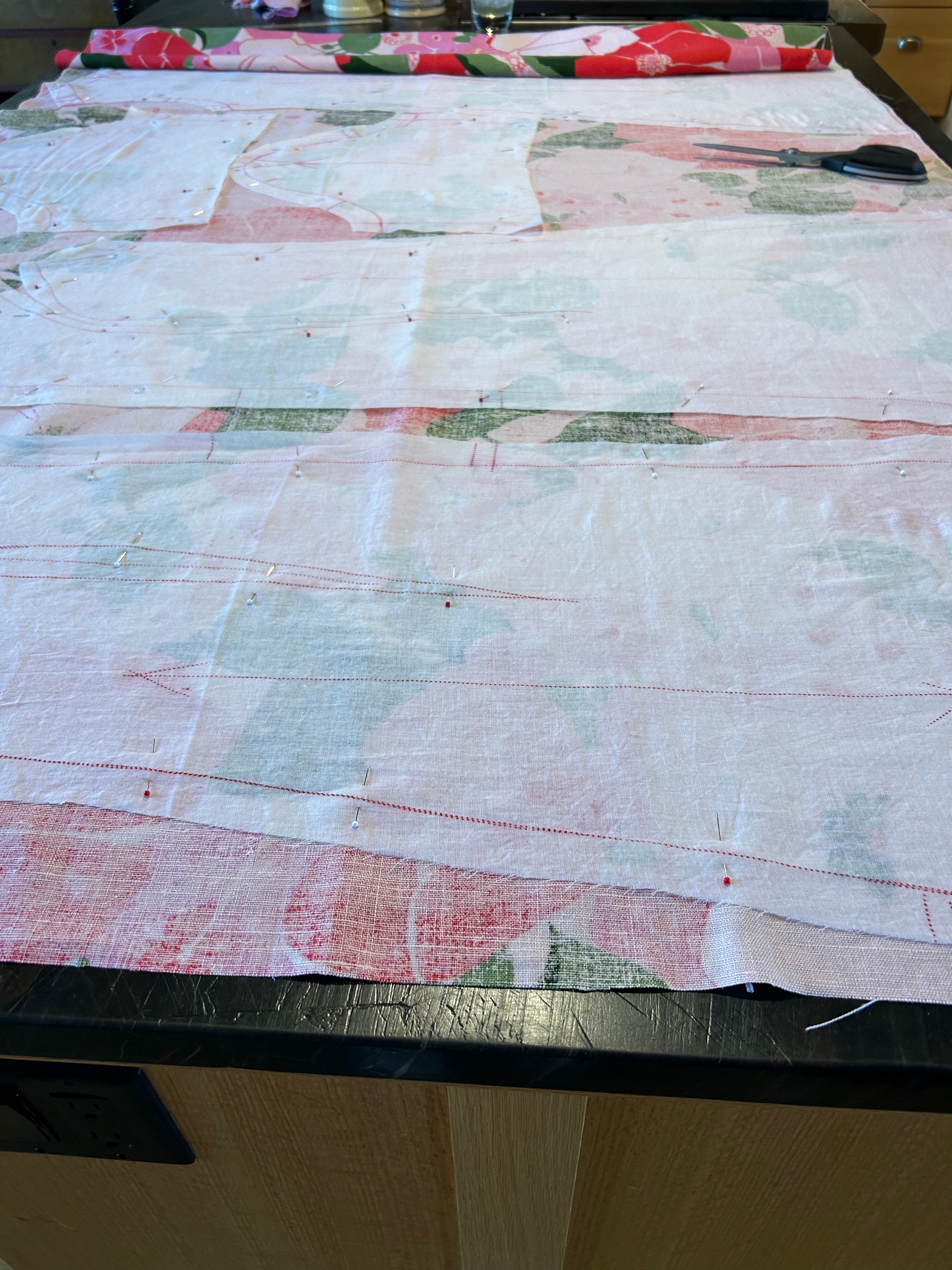
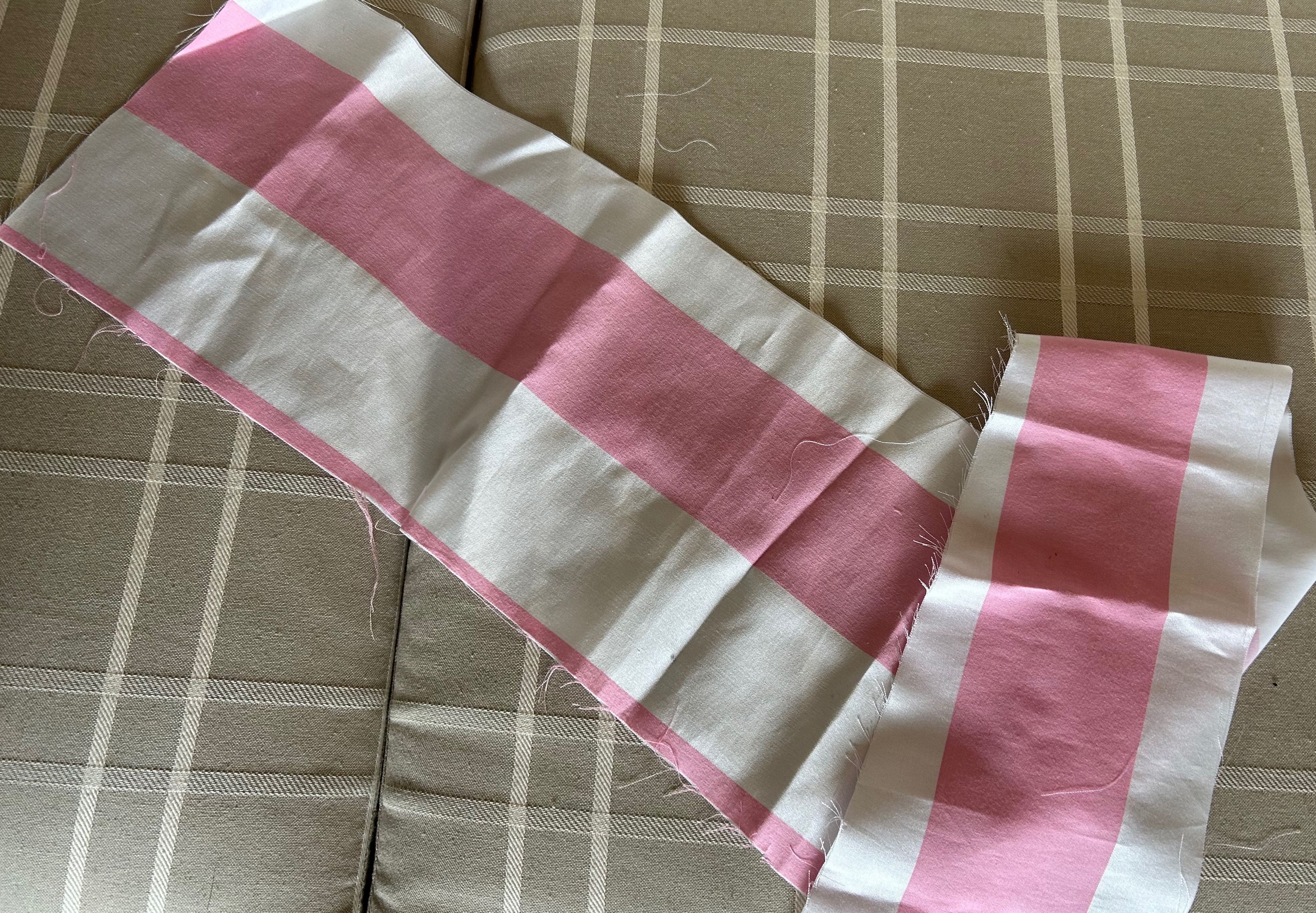
A word here about the panel for the hem.   Wow, was I tight on fabric!  I thought the panel should feature one bold pink stripe, bordered by “half” white stripes.  I barely had enough fabric to make this happen, and because the width of the skirt was just a bit bigger than the width of the fabric, I had to piece that panel.  Whew, I just made it.  Here is all the fabric I had left over:
The seaming of the two panel pieces close to the center back is barely visible! Can you see it?

 I was able to wear this dress for two events in May, feeling perfectly dressed for both of them.  

And that little bit of left-over fabric?  I had plans for that, too, which I will share in a future post.  
26 Comments

Filed under Buttons - choosing the right ones, couture construction, Uncategorized, vintage Vogue patterns from the 1970s

Going Around in Circles

When I purchased this sateen, jacquard-woven fabric from Mendel Goldberg a couple of years ago, I wasn’t sure what it would eventually become.  It had a wide repeat to the design (which is something to consider when you know you are facing considerable matching of the design), but it was a lovely 60” wide.  I bought just 2 yards (it was expensive) and hoped I would have enough fabric to finagle something.  

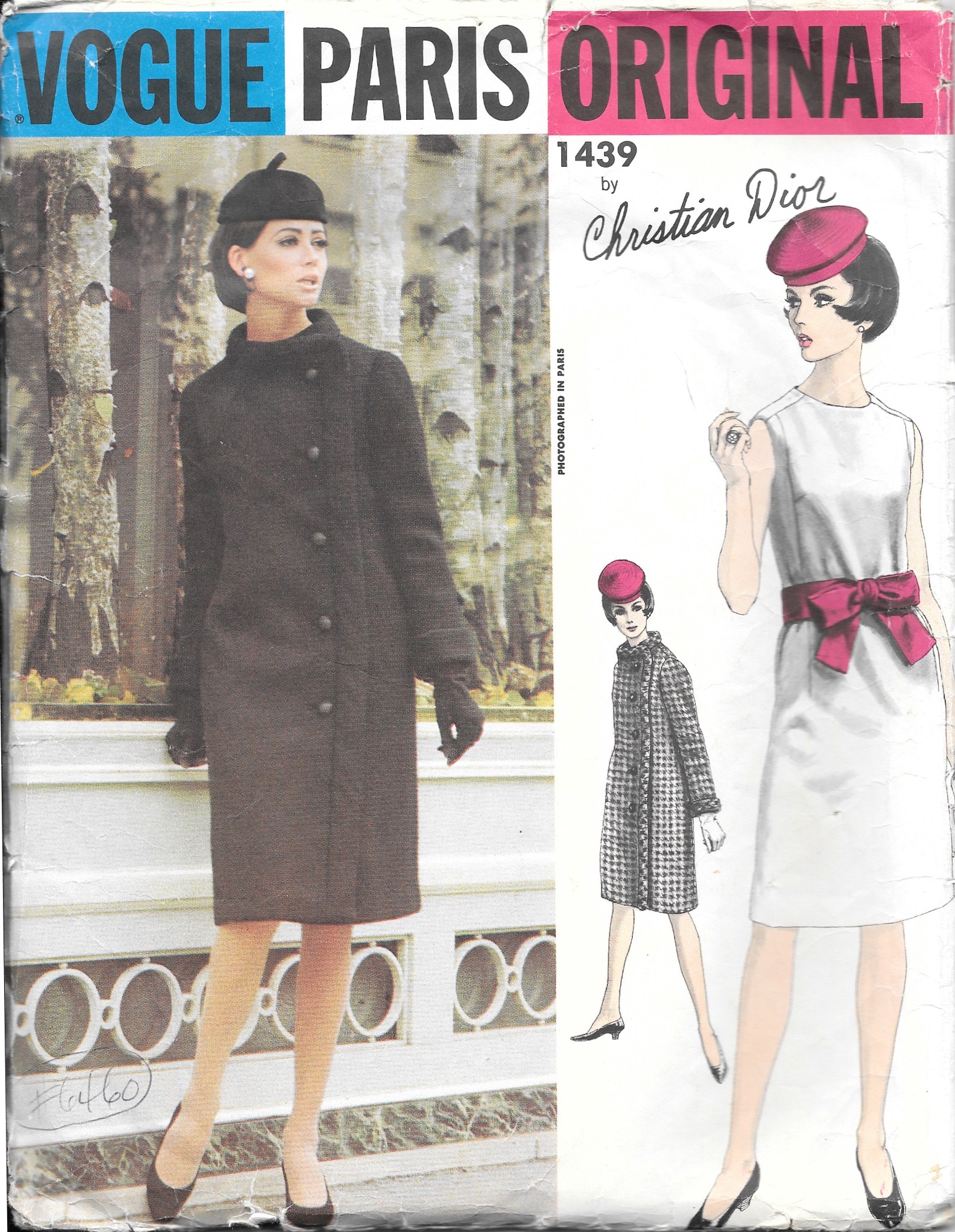
First I thought I would make a midi-skirt to wear with a pretty silk blouse or something.  I even got so far as to make a muslin for a longish skirt, but it just wasn’t going to work.  I didn’t have enough fabric to match the design and create the skirt I wanted.   The next task would be to find a dress pattern which would work.  I kind of viewed this fabric as a good Fall and Spring transition weight, so I wanted sleeves.  And I wanted a pattern which would show off the circle design to its best effect.  One of the patterns in my collection which I have seemed to dwell on frequently is this one:

This pattern is quite interesting. It looks very simple, but in fact, it has a considerable amount of engineering to it and some very nice details.

I like the styling of both the dress and the coat.  I thought I’d take a stab at eyeballing the pattern on my fabric, to see if it might work.  Well, it was going to be a squeaker, but I thought I could manage to get the dress out of the yardage I had – and match all those circles and dots as much as possible. 

One thing I had to consider was the placement of the large dots and the smaller dots on my body.  Working with dots can be a little tricky – you certainly don’t want prominent dots on top of each bust apex, for example, and a row of large dots around the waist might not be all that flattering.  I thought the row of the largest dots would be best as an anchor at the hemline.  That would place the wide band of smaller dots just over the waistline and somewhat below.  This configuration would place one medium size dot over one bust, but I was okay with that since the dot on the other side was off to the side, and therefore not symmetrical.  I also liked the repeat row of largest dots across the upper chest where they were not too obvious.  And – the sleeves followed the line of varying size dots in a pleasing manner, I thought.  It turned out, I had just enough fabric to get things lined up properly – except for the front facing.  No way could I match that to the front of the dress.  

Now, obviously the facing does not show on the right side of the dress.  Still, I like to match across seams if possible.  Which it wasn’t.  I had to give myself permission to have a mismatched facing, and then I moved on.  (I forgot to take a picture of the facing, unfortunately.)  

A word or two about the fabric before I go on.  According to Fairchild’s Dictionary of Fashion, (Third edition, by Charlotte Mankey Calasibetta and Phyllis Tortora, Fairchild Publications, Inc., New York, New York, c2003, page 395) sateen is a “smooth glossy cotton fabric made in the sateen weave with floating crosswise yarns on the right side, giving a lustrous finish.”  This fabric is a combination of cotton sateen, with circles created by a damask weave on a jacquard loom.  It makes for a striking fabric.  And I think the fact it is done in navy blue makes the contrast more definitive.    Christian Dior was a fan of navy blue, calling it “the only one [color] which can ever compete with black, it has all the same qualities.”  (The Little Dictionary of Fashion, Abrams, N.Y., 2007, page 14).  It is a wonderfully versatile color.  

I made a few changes to the pattern.  I cut the neckline a little wider, I shortened the sleeves by a couple of inches, and the big change was I lined the dress in a lovely silk batiste I purchased at Farmhouse Fabrics. (The pattern did not have instructions or pattern pieces for a lining.)   The pleat in the front of the dress was a bit tricky to line, but I figured it out after quite a bit of thought.  By the way, I underlined the dress with silk organza. 

I could only envision gold buttons with this fabric. I’m not sure these are the right buttons, but they will do until I find something better.

The irregularity of the circles precluded exact matching within the “panels” but I rather like the whimsical effect this creates.

The split cuff with its button is one of the nice details of this pattern.

One more thing about the pattern and the dress.  With the pleat in the front of the dress which extends to the hem, it gives the appearance of a coat dress. However, it is not.  Again Fairchild’s gives us a precise definition of a coat dress: “Dress fastened down front from neck to hem, like a coat, in single- or double-breasted style, either belted or unbelted.  A classic since the 1930s.”  ibid., page 84.  Someday I’ll make a coatdress, but this was not it.

The pleat begins below the closure, extending to the hem, giving the dress a nice sway to it.

As I mentioned in an earlier post, I made this dress to wear on my Paris trip, but alas, I never had the opportunity to do so.  I feel certain it will eventually get its debut, but not in Paris!  

26 Comments

Filed under Buttons - choosing the right ones, Christian Dior, Fashion commentary, Loops for buttons, Mid-Century style, Polka dots, Sateen, Uncategorized, underlinings, vintage Vogue patterns from the 1960s, Vogue patterns

A Tale of Two Dresses, Part 2

Whenever I am working with vintage fabric, it seems I either have more yardage than I need or, more frequently, less than I need.  I have learned over the years there is usually a way to work around having less fabric than I really need.  I just have to get creative.  And that’s what I did when I made this dress.

I quickly determined there was no way I could get the dress I wanted by placing the pattern on the lengthwise straight-of-grain.  The flare of the skirt, which I wanted to be mid-calf, precluded any notion of such a layout.  At 45” wide, I knew I could just get the dress length I wanted if I laid out the pattern on the cross-grain, from selvedge to selvedge.  Linen is a very stable fabric, so I was confident the cross-grain would work.  In addition, there were no directional limitations in the floral design of the fabric.  Barely fitting my pattern – from shoulder to hem – on the fabric from selvedge to selvedge, however, would leave no extra fabric to turn up for the hem – or even to face the hem.  I decided to worry about that later.  First I wanted to determine how I could get the four pieces for the dress and the two lengthened sleeves placed on the fabric, keeping in mind three important things:  1) although this was not a fabric to be matched per se, the all-over design of the fabric needed to be on the same plane in contiguous seams; 2) I wanted to space out the larger floral motifs so the dress would be balanced as best as possible (looking critically at the dress I made when I was 23, I clearly could have given this more thought!); and 3) I wanted to avoid large demonstrative blooms at the bust.  Then, and only then, would I worry about the hem.  

I transposed all the markings from my adjusted pattern onto the cotton batiste, then used those pieces as my pattern. I then basted the two layers together to be treated as one, before sewing any seams or darts.

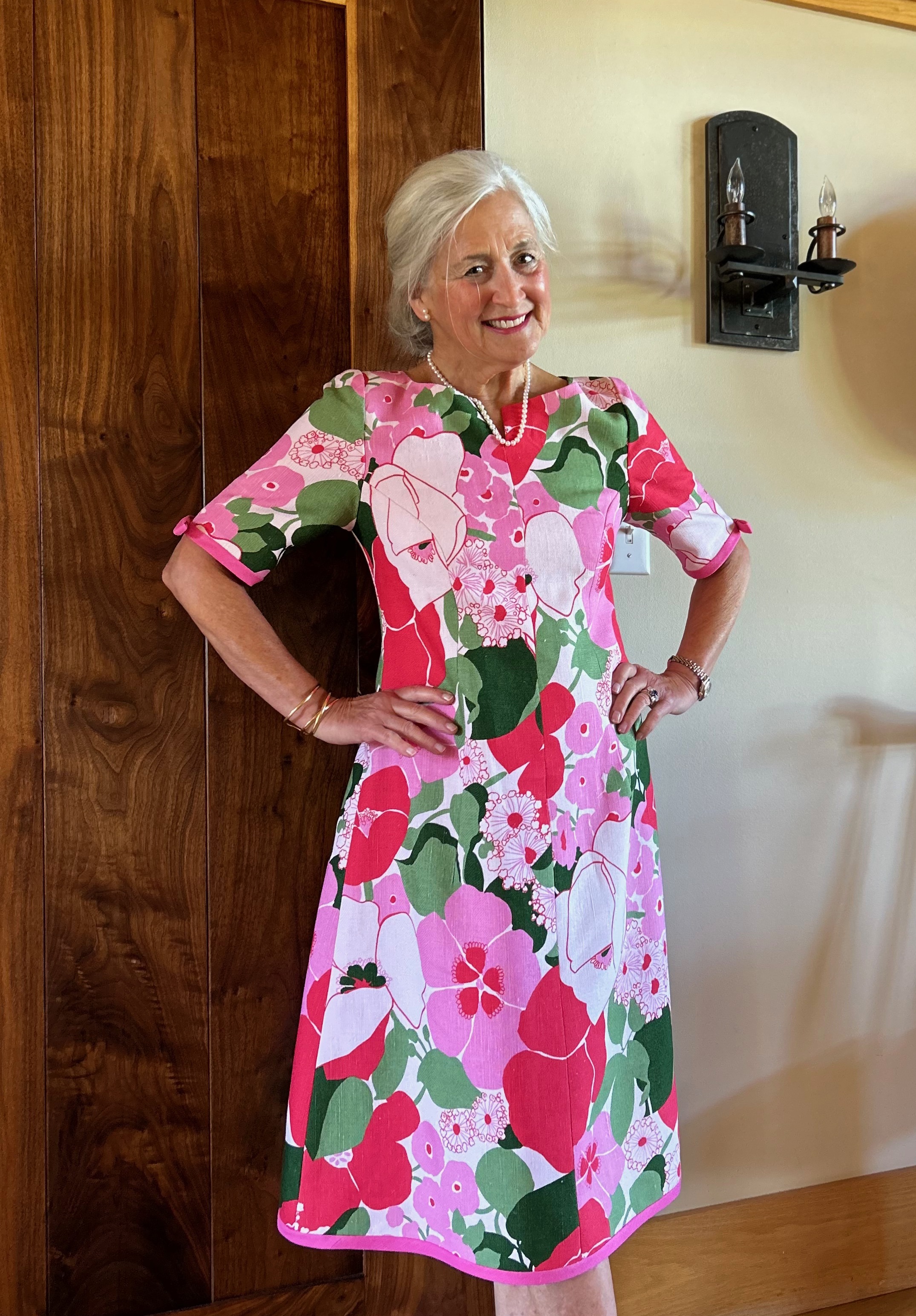
Once I was happy with this placement, I had a eureka moment when I knew I could accomplish two things with a simple bias trim made from the yardage of deep pink linen which coordinated nicely with the floral.  1) I could preserve the full 45” of cross-grain length by applying bias trim to the hem edge instead of turning it under, and I could do the same with the sleeves.  And 2) the trim would add interest to the dress, just as I had vaguely imagined.  (A quick aside here – I have ample yardage of the solid deep pink linen to make a coordinating coat at some point. Every dress needs a coat, right?) 

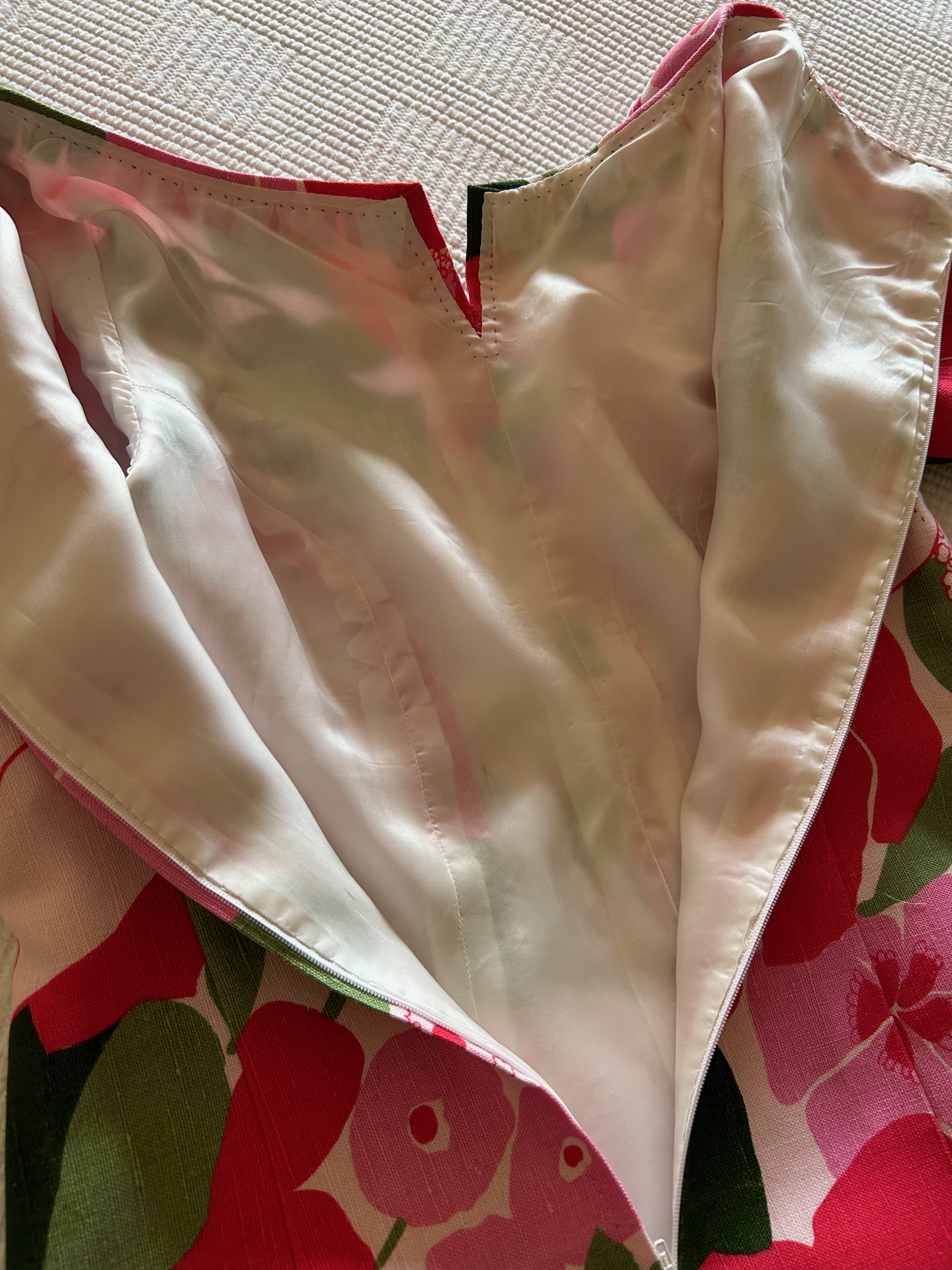
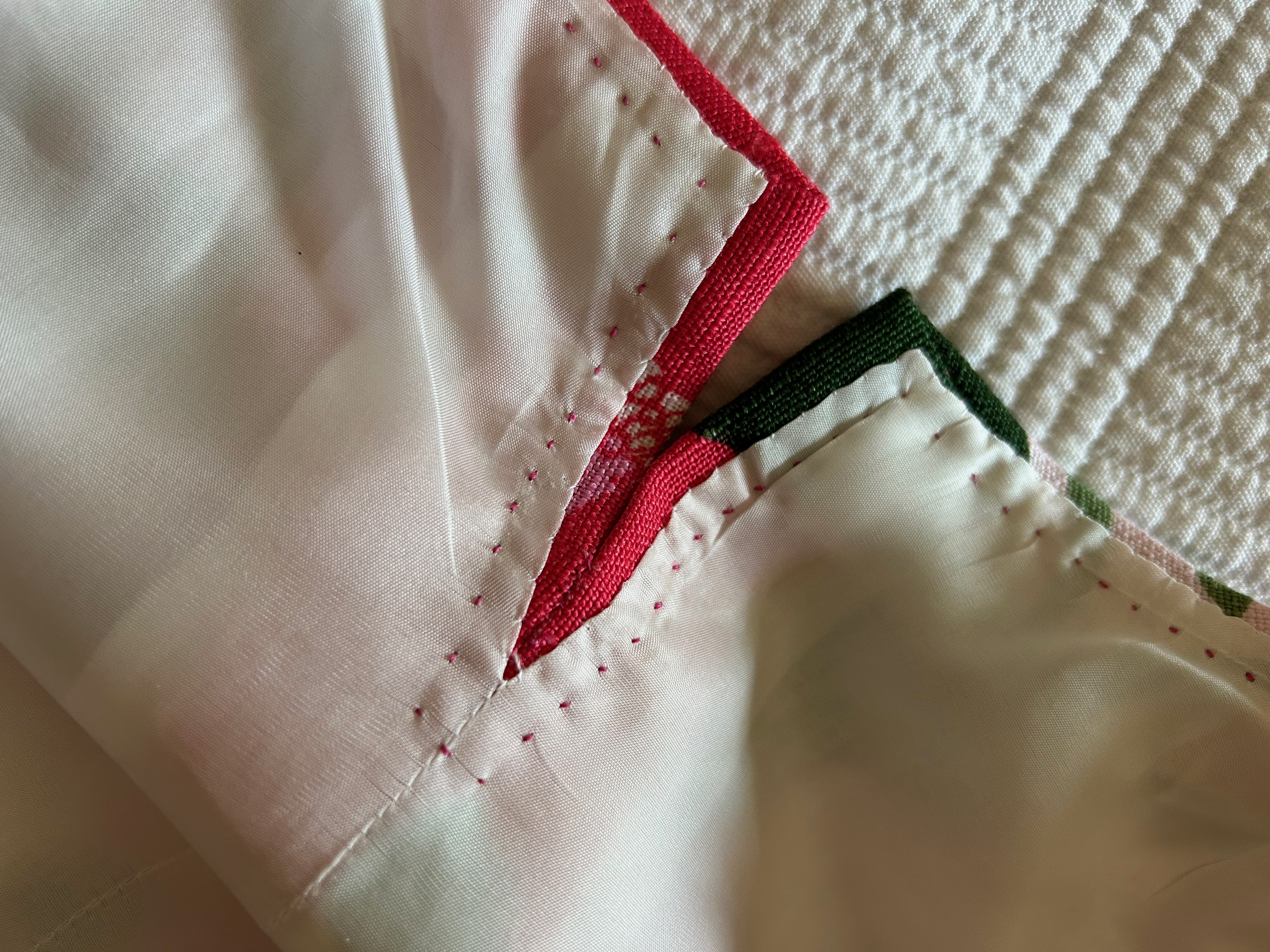
I underlined this dress in a very lightweight, pre-washed, cotton batiste, then I lined it in Bemberg rayon.  Moygashel linen washes beautifully, as does Bemberg lining, which is why I chose Bemberg over silk for this dress. I eliminated the neckline facing, choosing instead to bring the lining up to the edge of the neckline seam, then under-stitching it to secure that edge in place.  

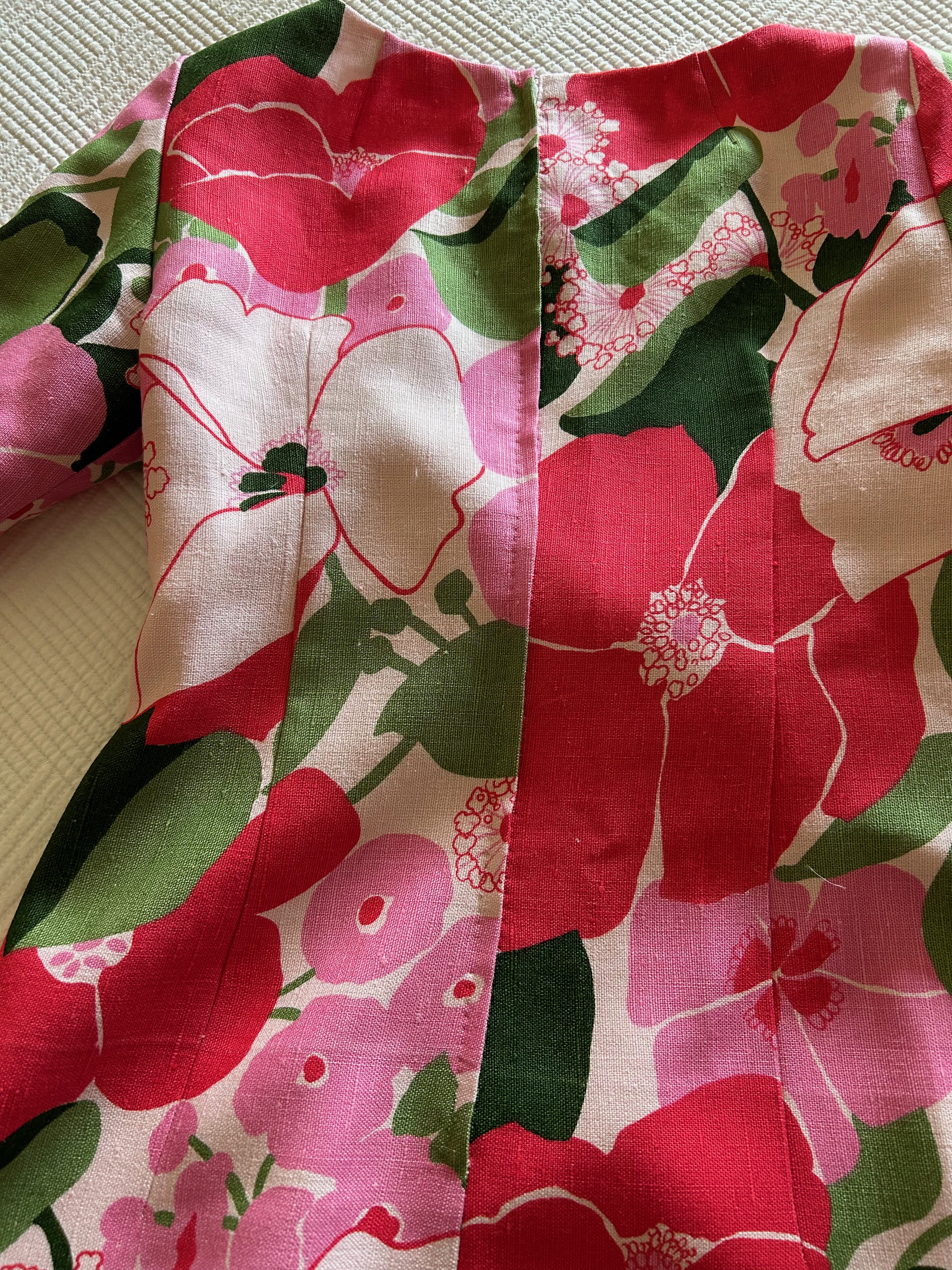
I chose to do a hand-picked, lapped zipper, an application which I think looks so lovely.  Interestingly, I hand-picked the zipper in the dress I made in 1973, although it is a centered application.  

And here is a back view of the 1973 dress. The zipper is metal, which certainly is a telltale sign of a vintage dress.

When it came time to apply the bias-cut trim to the hem and sleeves, I had to experiment around a bit.  I didn’t want it too wide, but it needed to be substantial enough to look like it was meant to be and not an afterthought or decision made in desperation!  I finally settled on an exposure of 1/2”.  

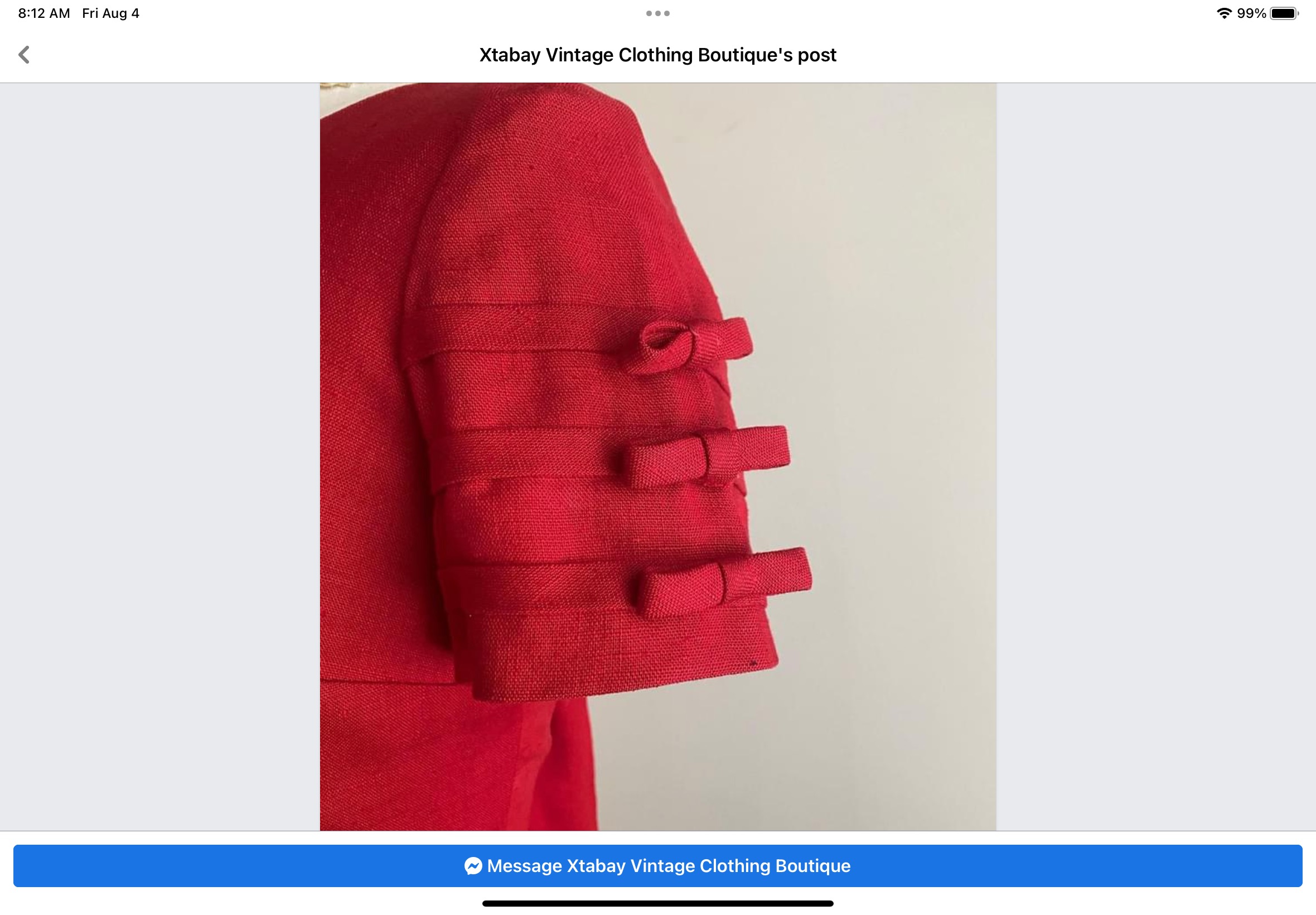
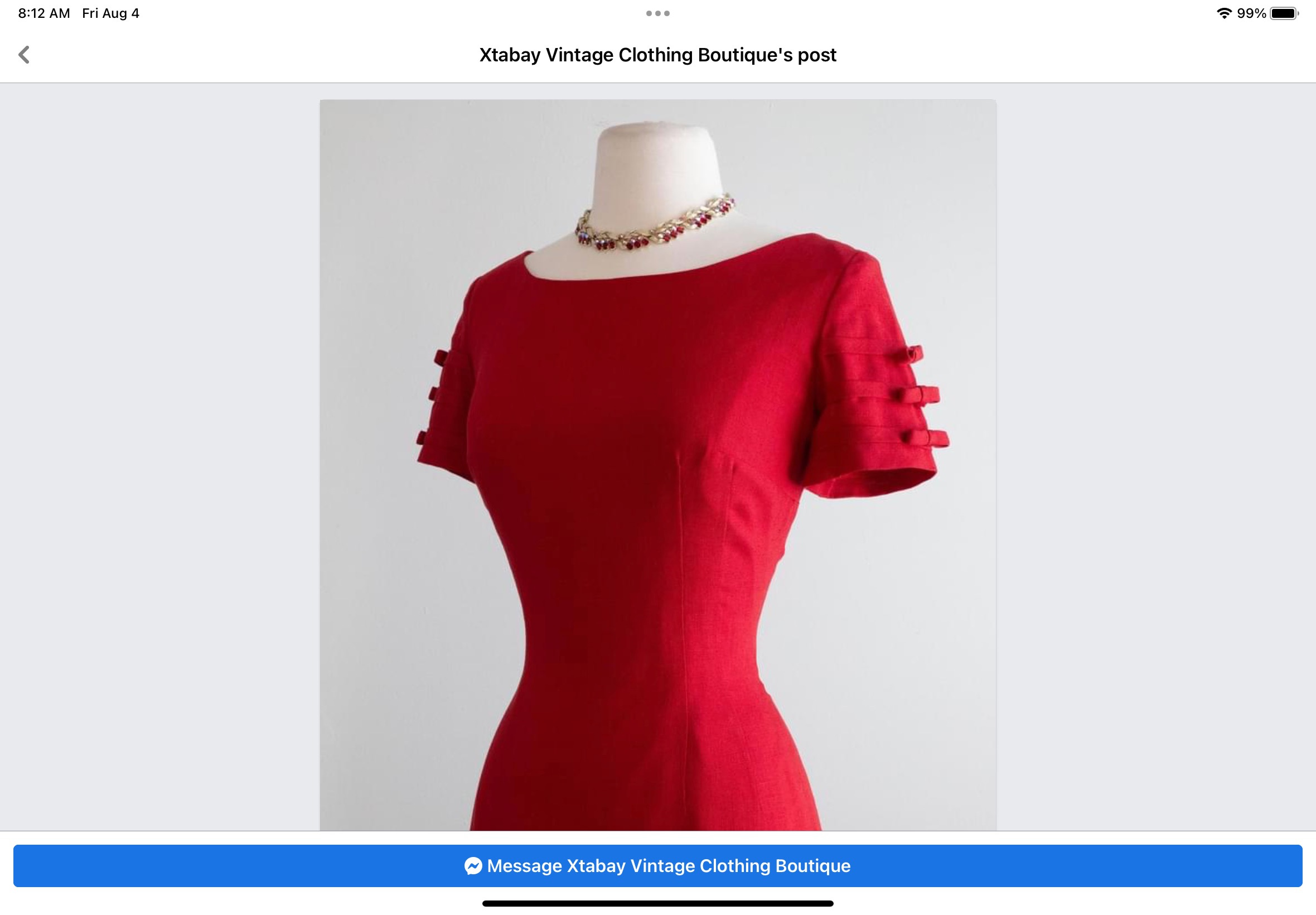
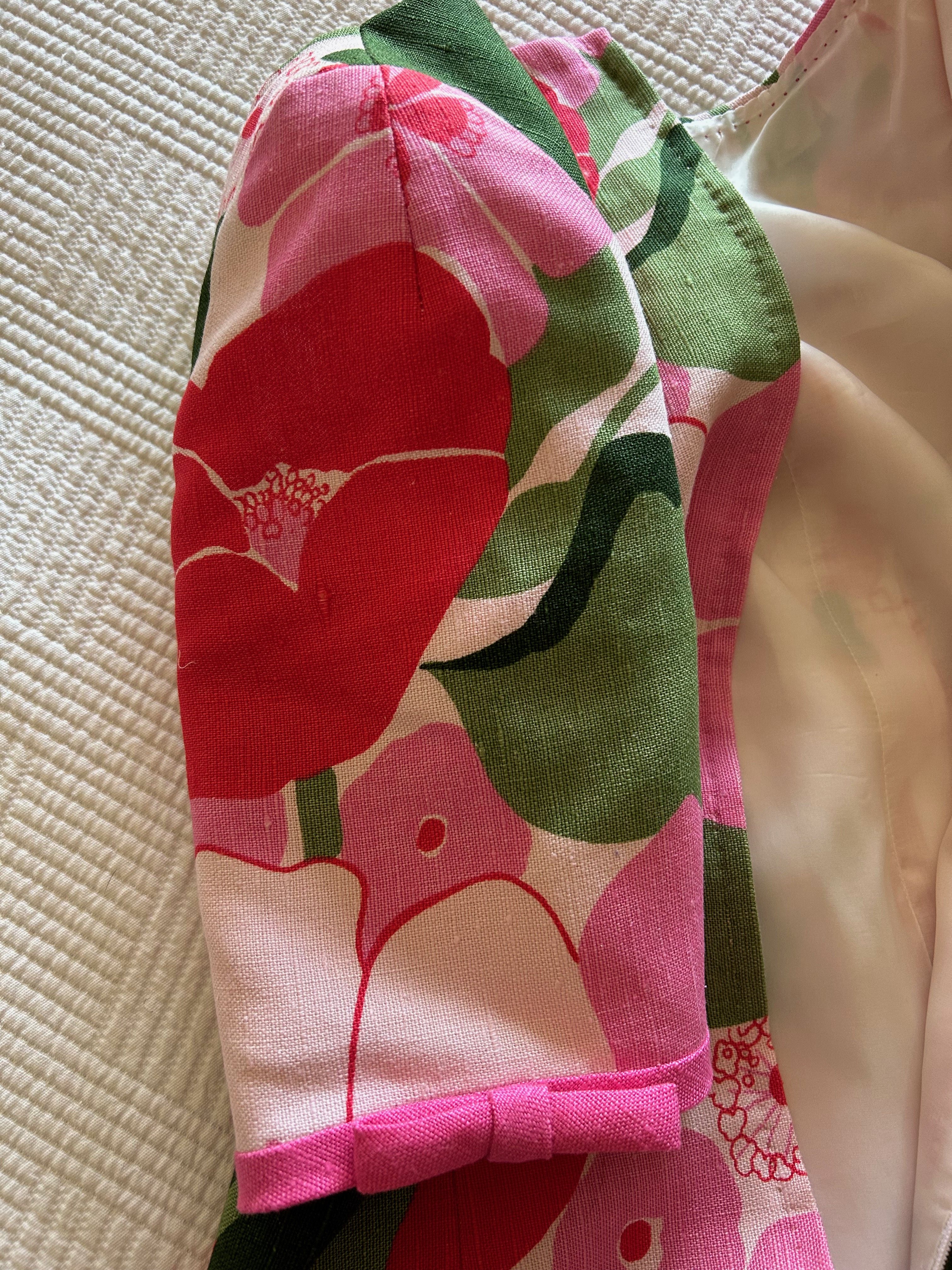
Now this is where it gets interesting.  A few weeks ago I saw a vintage dress on a Facebook/Meta post by Xtabay Vintage Clothing Boutique.  It is obviously Moygashel linen (I can tell by its weave and color), but what really caught my eye were the bias strips and low-profile bows adorning its sleeves.  I tucked this idea in the back of my mind for future consideration.  What I didn’t know was that the future was right around the corner!  Yes – I “borrowed” this idea and added a single bias-cut bow to each sleeve.  Somehow, it just seems to finish the dress.  

I never would have thought of adding a bow to each sleeve had I not seen this pretty vintage dress.

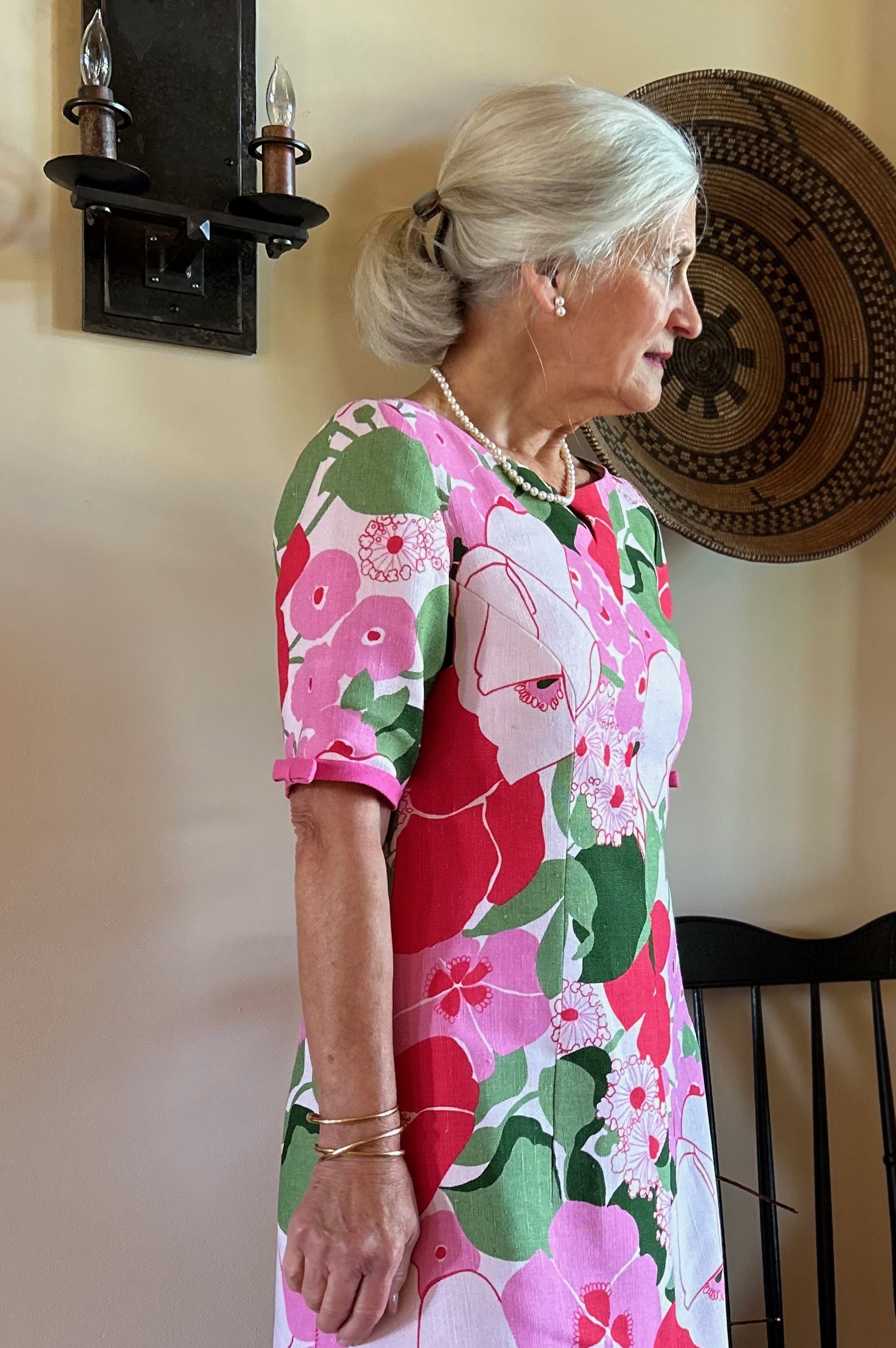
In this view, the princess seam which originates in a dart is visible. This is a nicely engineered, flattering pattern.

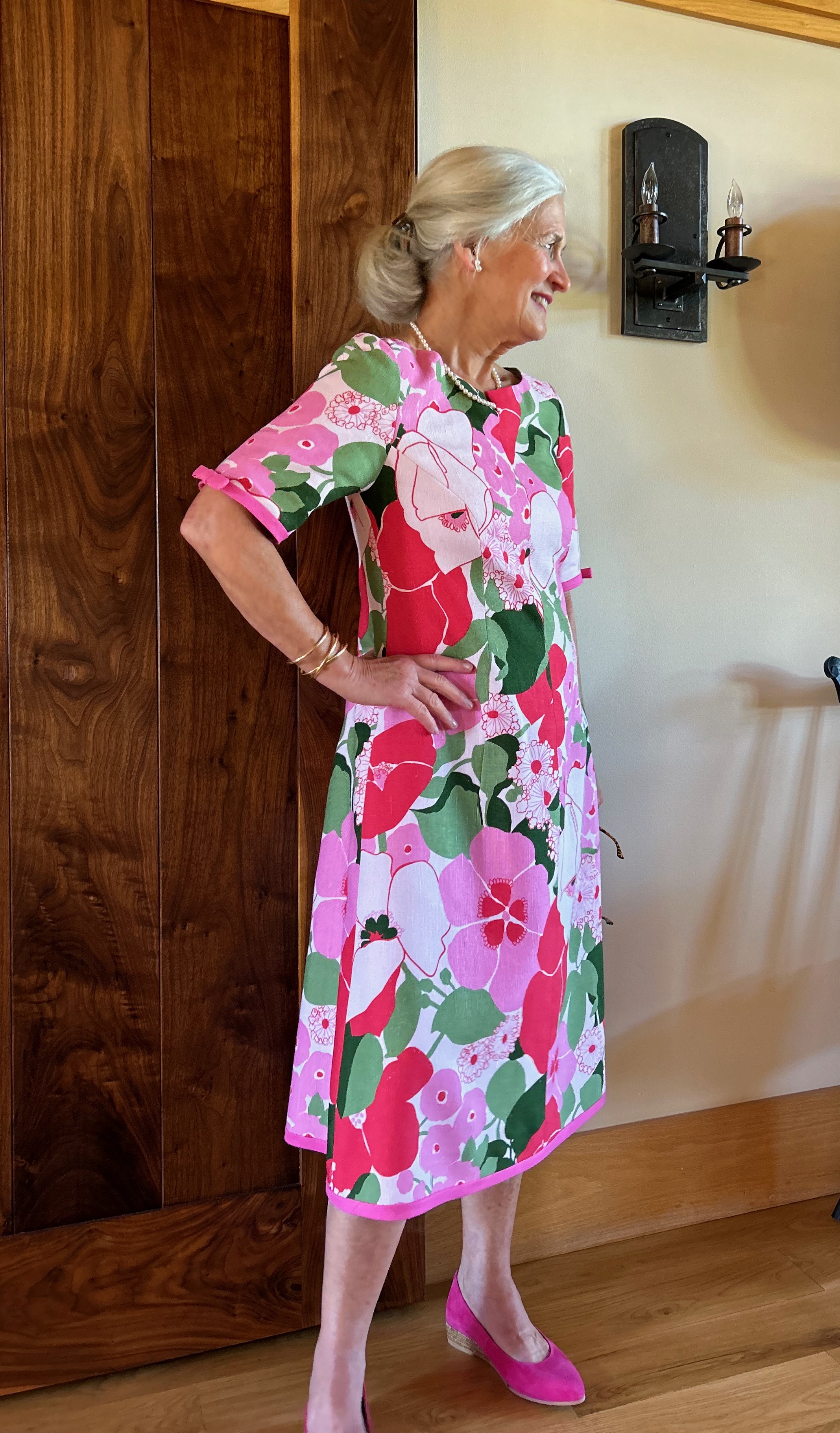
Well, you may have guessed by now the reason for making this dress this year.  I will wear it next week when my husband and I celebrate our 50th Wedding Anniversary.  I have changed a lot in those 50 years (and so has my husband!), but I still love pink in all its shades and I still love Moygashel linen (and I still love my husband, too!)  

50 Comments

Filed under Bows as design feature, couture construction, Dressmaker details, Fashion history, hand-sewn zippers, Hems, Linen, Linings, Mid-Century style, Moygashel linen, Sleeves, Summer sewing, Uncategorized, underlinings, Vintage fabric, vintage Vogue patterns from the 1970s

A Tale of Two Dresses, Part 1

Where to begin with this story?  I have to go back 50 years – which sounds daunting and slightly surreal.  As a 23-year-old about to be married, I had already made my wedding gown that summer of 1973.  I still, however, needed a couple of dresses to take on our upcoming wedding trip in early September.  With that intention, I ventured into Stapler’s Fabric Store on Walnut Street in Philadelphia, Pennsylvania (USA).  Stapler’s was one of the old, notable, family-owned purveyors of fine fabrics and dress goods, and I loved going in the store.  Most of the time I could only look and dream, so going in on a mission made this trip memorable.  

Stapler’s carried high end fabrics and that included the newest offerings of Moygashel Irish linen.  I have written several times about this storied brand of dressmaker linen, known for being wrinkle and crease resistant, known for its exquisite designs and colors, and highly sought after by women of good taste.  I can still feel the excitement I had that Summer day when I saw a quintessential floral Moygashel in vibrant pinks and greens and whites.  

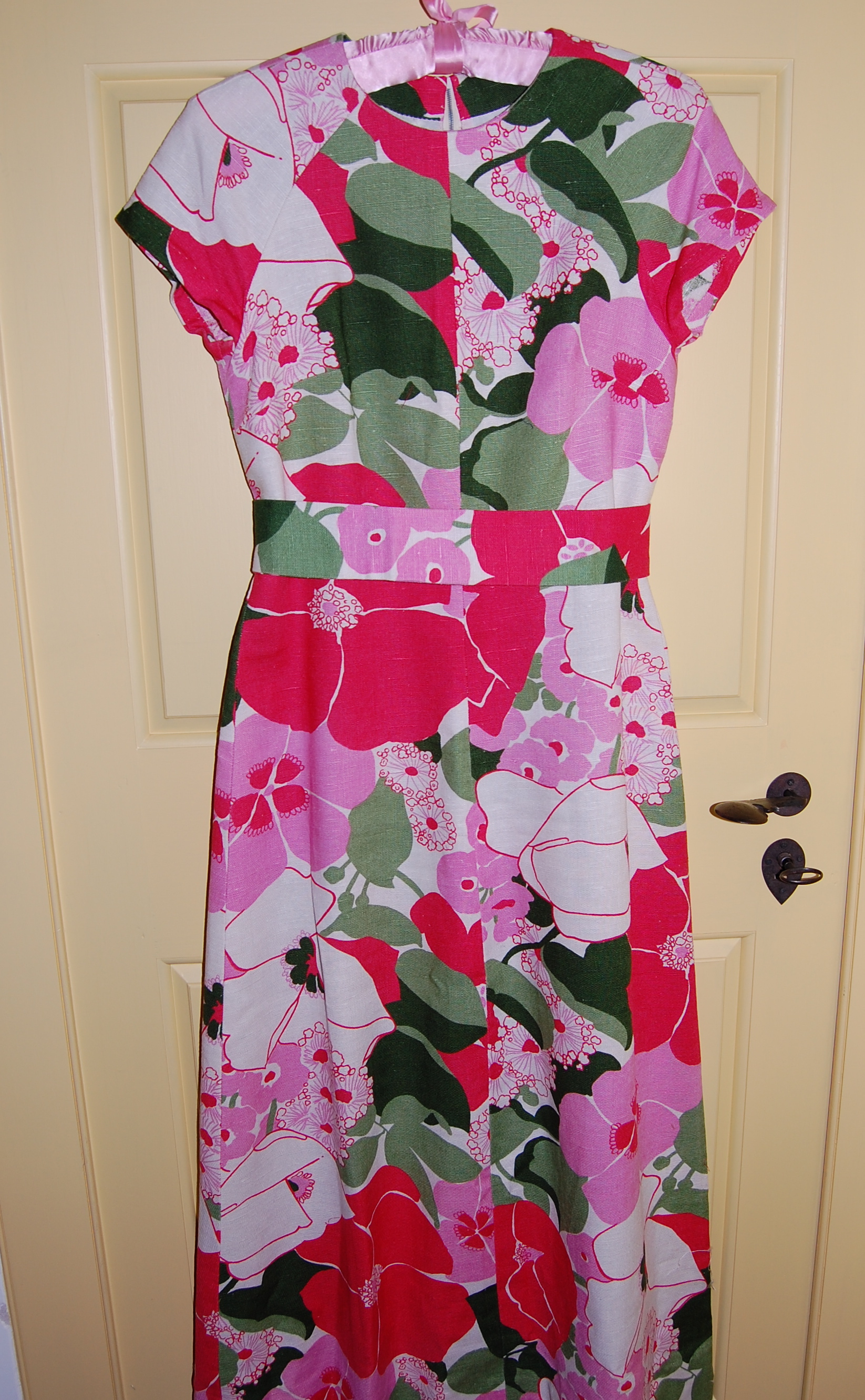
I had already picked out a Very Easy, Very Vogue pattern (the pattern number is lost to the ages by now, as is the pattern itself) to make a long A-line dress with short cut-on sleeves and center front and center back seams.  I purchased the yardage I needed and made this dress:

Ankle-length dresses like this were very fashionable in 1973.

I loved it.  I felt beautiful in it, which has, over the years, become my litmus test for a successfully made garment.  Several years ago I included this dress in a post I titled “Shopping in My Cedar Closet.”  I posed a question to myself – should I take this dress apart and reuse the beautiful fabric – which I still loved – for something else?  By asking myself this question, I knew I had the answer.  Too many memories, too much of the younger me were in this dress for me to cut it apart.  I placed it back in the closet and vowed to keep it as is. 

A few years later a most amazing thing happened.  While searching for vintage Moygashel linen on eBay, I found an offering for a length of the same pink, green and white floral fabric I had purchased so many years ago.  The listing was for 2¼ yards of this 45”wide fabric.  I purchased it immediately, its new rendition to be determined. In my mental sewing calendar, however, I hoped to bring life to this fabric 50 years after I made my first dress from its twin.

The planning began in earnest earlier this year.  I had to decide exactly what silhouette dress I wanted my new dress to have.  With only a little over two yards, I knew my choices were somewhat limited.  And I also knew the fabric itself needed to be the star – with its demonstrative, large design, its medley of colors and its lustrous weave.  It took me a while to realize I had already determined the correct formula 50 years ago.  It needed to be another A-line dress, with some length to it.  This time, however, I would make it using the couture techniques I have learned since then.  

I also knew I wanted: a) longer sleeves, if possible, with the yardage I had; b) to underline and line this dress (but preserve its washability); and c) to add some minor embellishment in some way, perhaps buttons or trim of some sort.

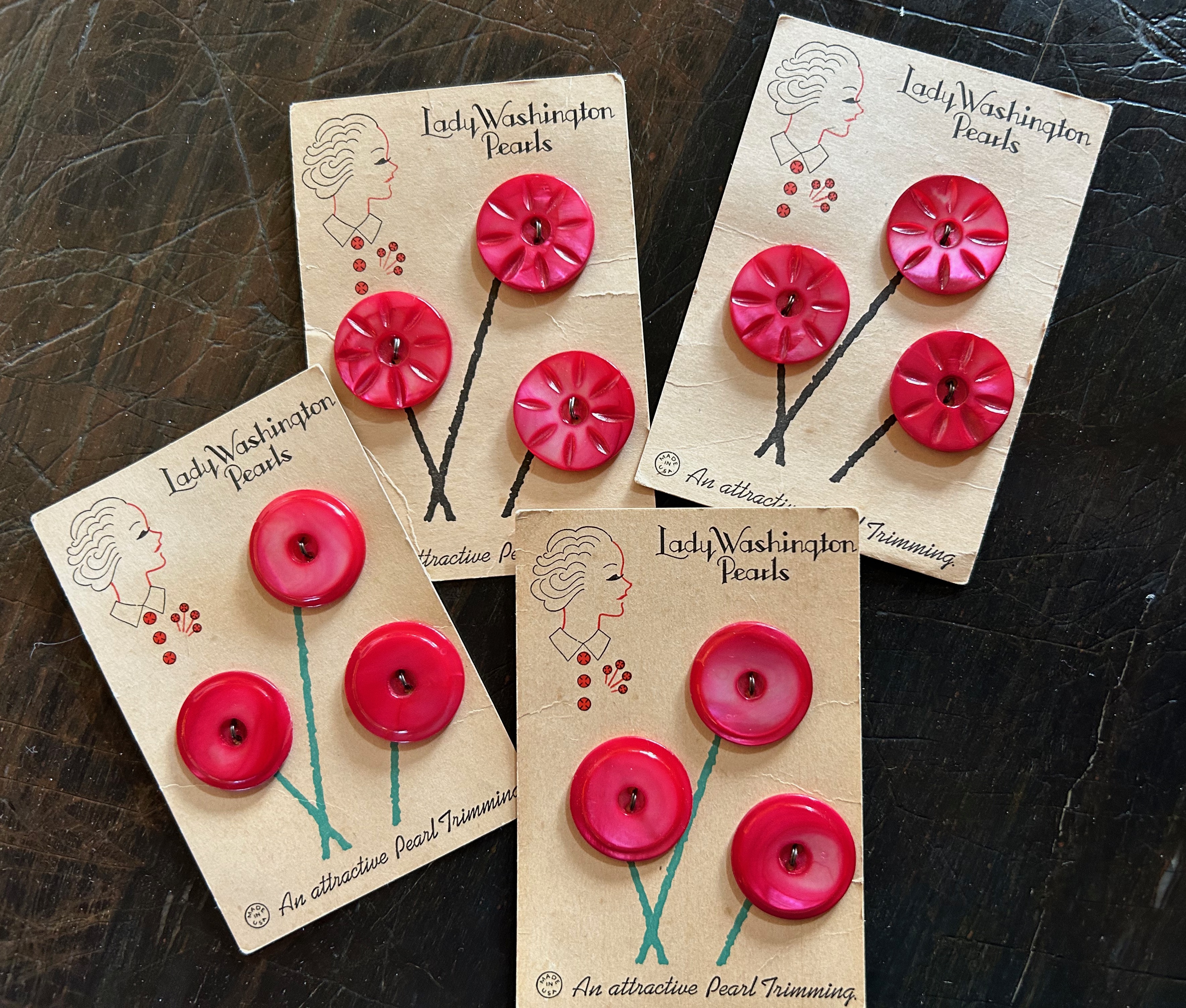
I had these deep pink buttons, one design of which I thought might be a possibility … In the end, I decided they would not work.
And, I had two lengths of Moygashel linen from the 1970s in this deep pink, from which I could make trim, if needed. This proved to be essential to the success of my endeavor.

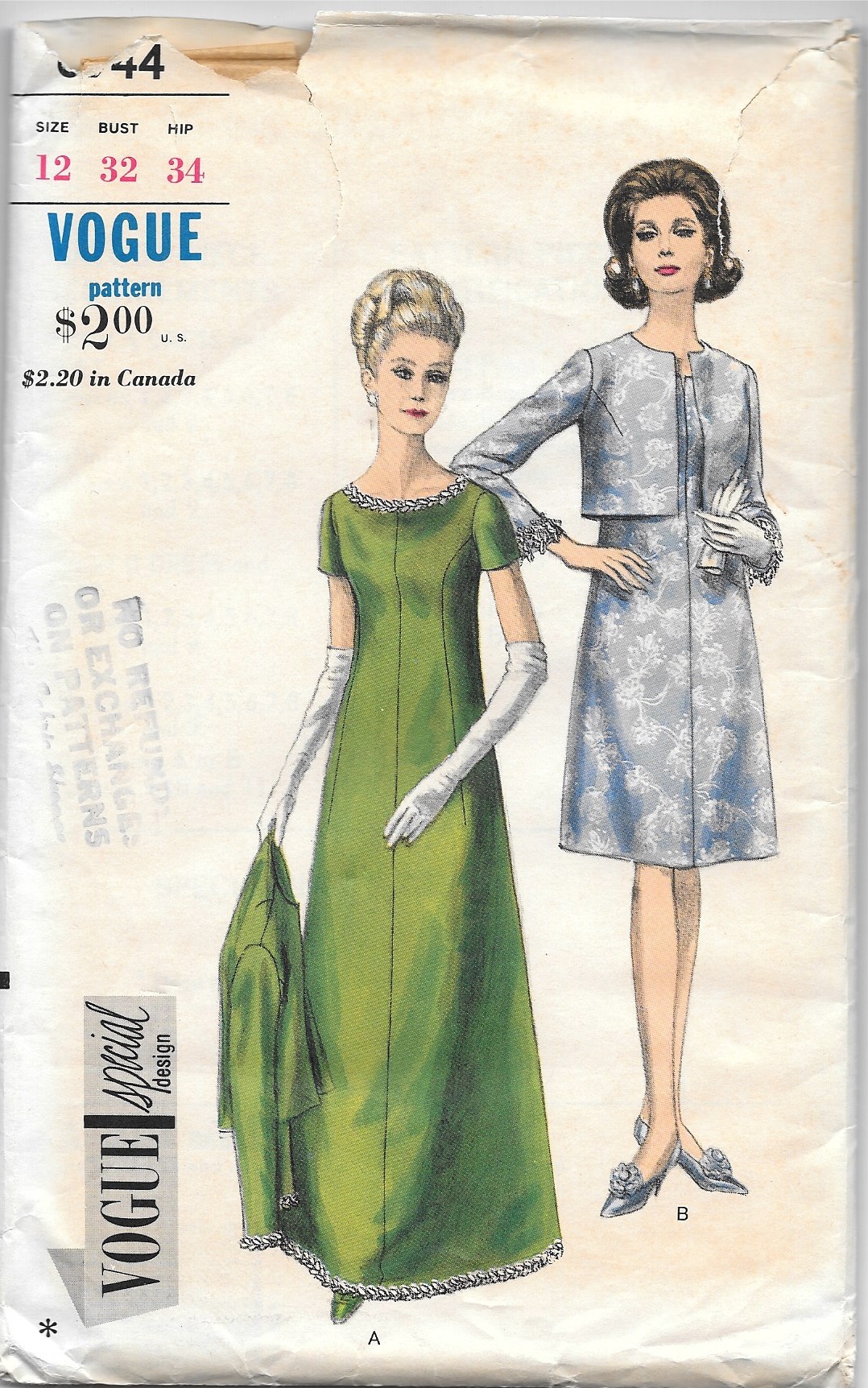
A suitable pattern happened to be one I had already used twice.  

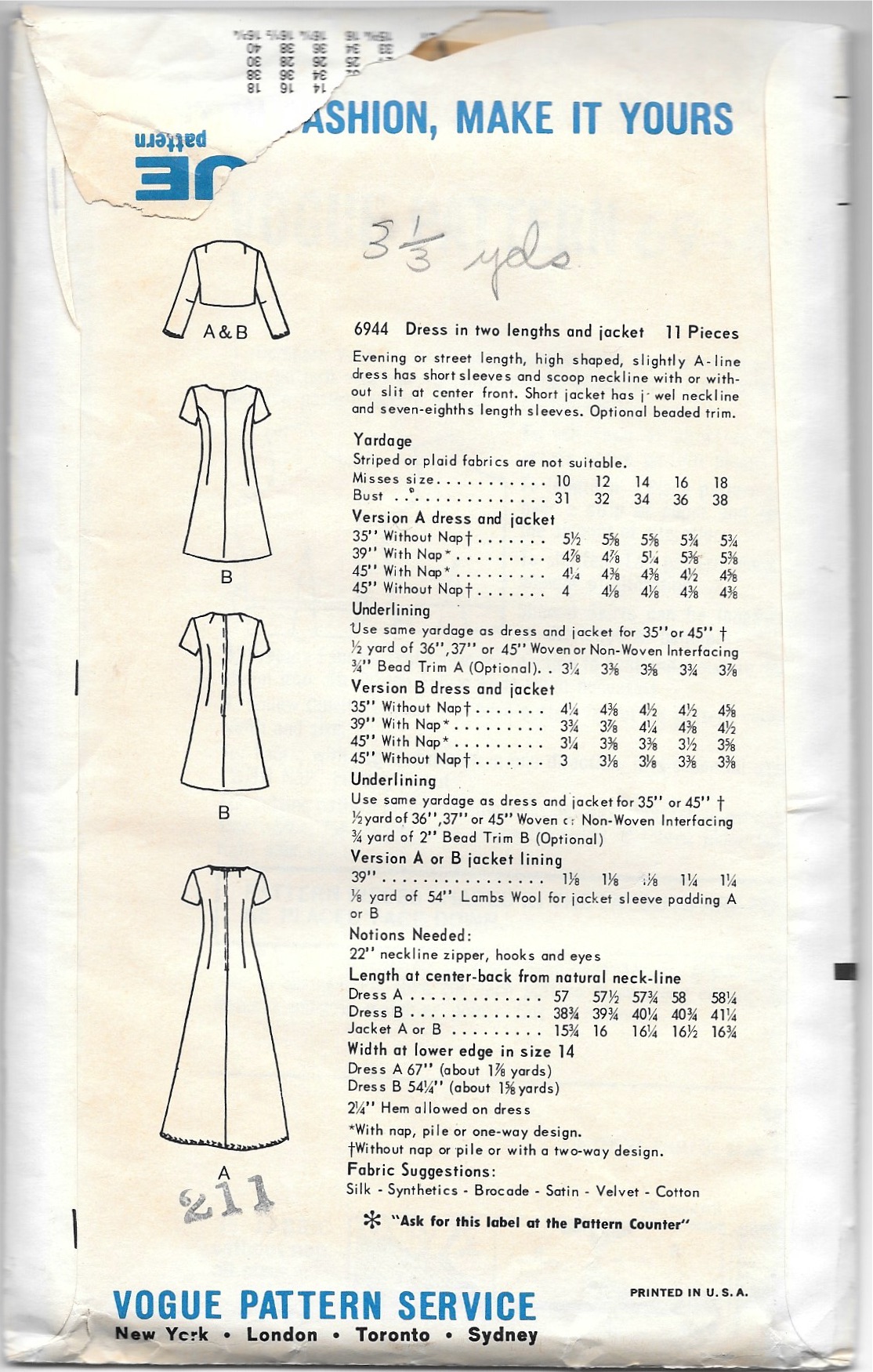
The line drawing for the shorter length shows more detail as to the seaming and the darts. The description on the pattern envelope reads: “evening or street length, high shaped, slightly A-line dress has short sleeves and scoop neckline with or without slit at center front…”

I first used this pattern for this dress:

And then a year or two later, I used it for this dress:

Having a pattern which fits, with pleasing lines and a certain finesse to it, is worth its weight in gold.  Even better, the late 1960s’/early 1970s’ vintage aspect of this pattern made it a perfect fit with fabric from 1973.  The only question I had was a big one.  Did I have enough fabric to make a longer dress with longer sleeves?  The answer: No – and then Yes.

(The story continues in the next post…)

25 Comments

Filed under Fashion history, Linen, Mid-Century style, Moygashel linen, Uncategorized, vintage buttons, Vintage fabric, vintage Vogue patterns from the 1970s

Upcoming!  A Major Fashion Exhibit at Winterthur Museum

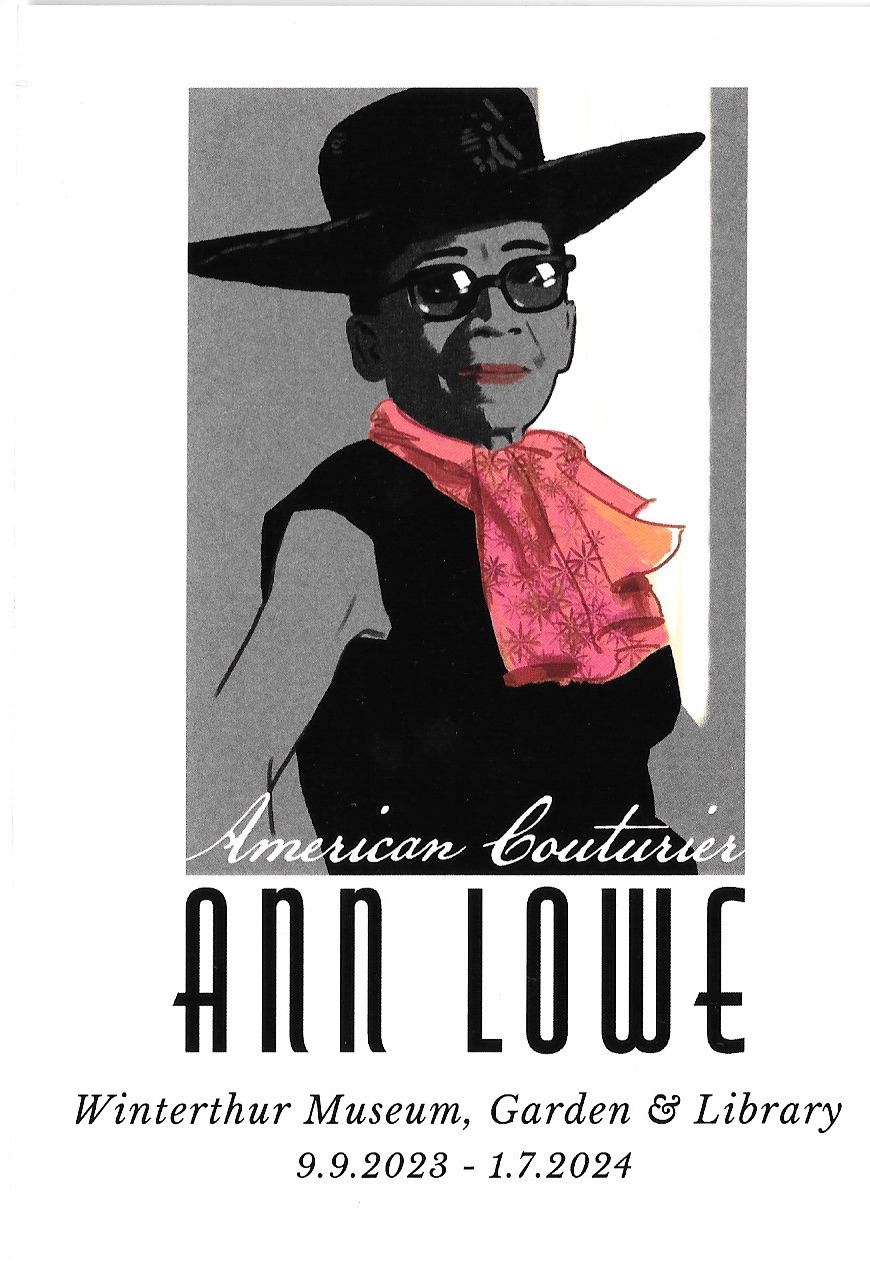
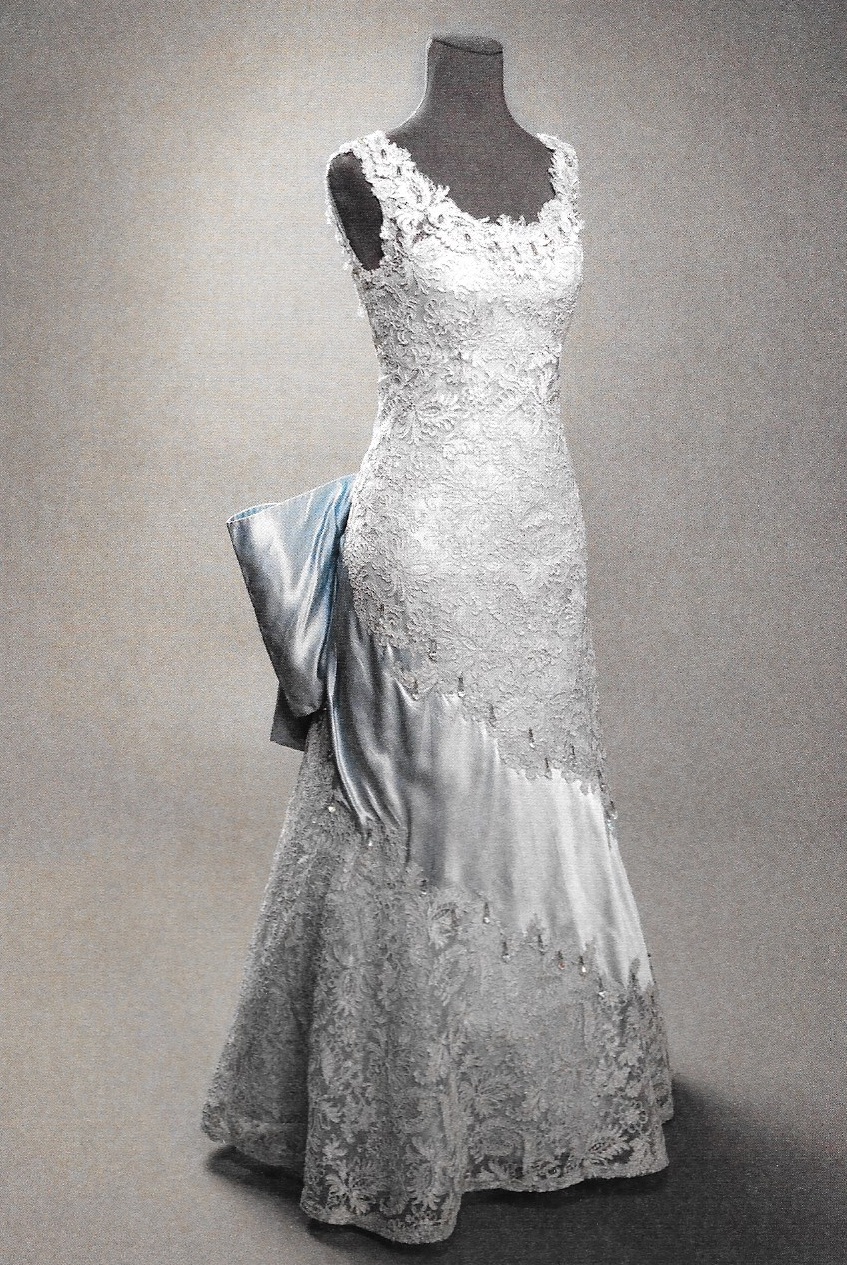
Mark you calendars for a visit to Winterthur Museum in Winterthur Delaware, (USA) in the Fall of 2023.  Ann Lowe, American Couturier opens on September 9th and runs through January 7th, 2024. 

For those of you unfamiliar with Ann Lowe, she probably is best known as the designer of Jackie Kennedy’s wedding gown when she married John F. Kennedy in 1953 –  but Lowe is so much more than that.  For decades she was the designer of choice for “America’s most prominent debutantes, heiresses, actresses, and society brides.”  Despite designing couture-quality dresses and gowns for such an extensive and elite clientele, she remained virtually unknown in the public arena.  Even a feature in the Saturday Evening Post in 1964 calling Ann Lowe “Society’s Best-Kept Secret” failed to secure the recognition she deserved.  Recently, however, her place in the pantheon of American Fashion Designers has begun to be recognized, and this major exhibit of her work will undoubtably elevate Lowe to the pinnacle she so richly deserves.  

I share this short biographical blurb on promotional material from Winterthur Museum:  

Winterthur’s Exhibition will showcase approximately 40 of Lowe’s dresses and gowns, gathered together from museums and private collections across the country.  In addition there will be approximately 10 works by contemporary Black designers, influenced by the timeless style and legacy of Lowe’s volume of work.  

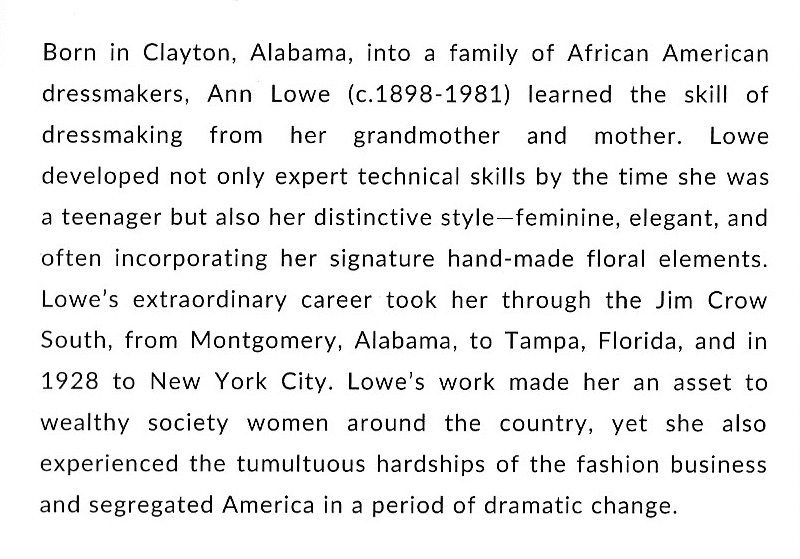
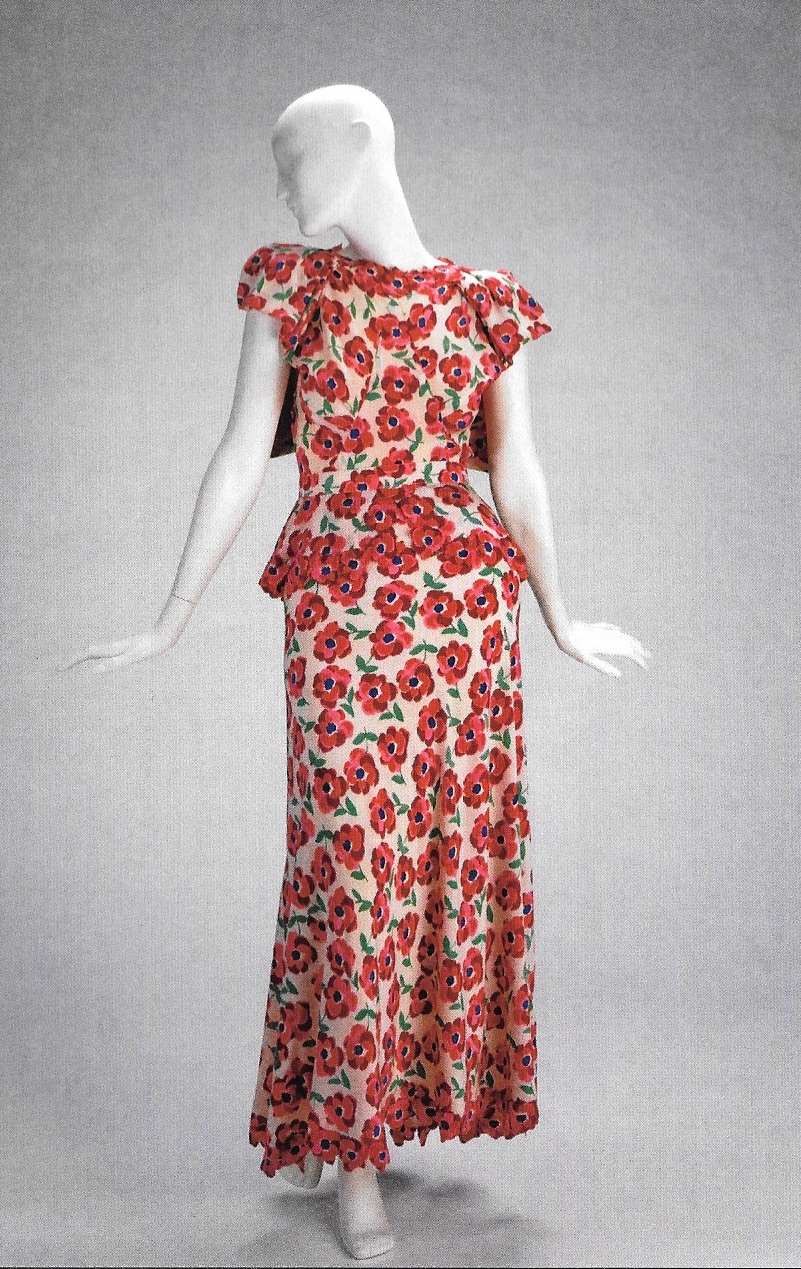
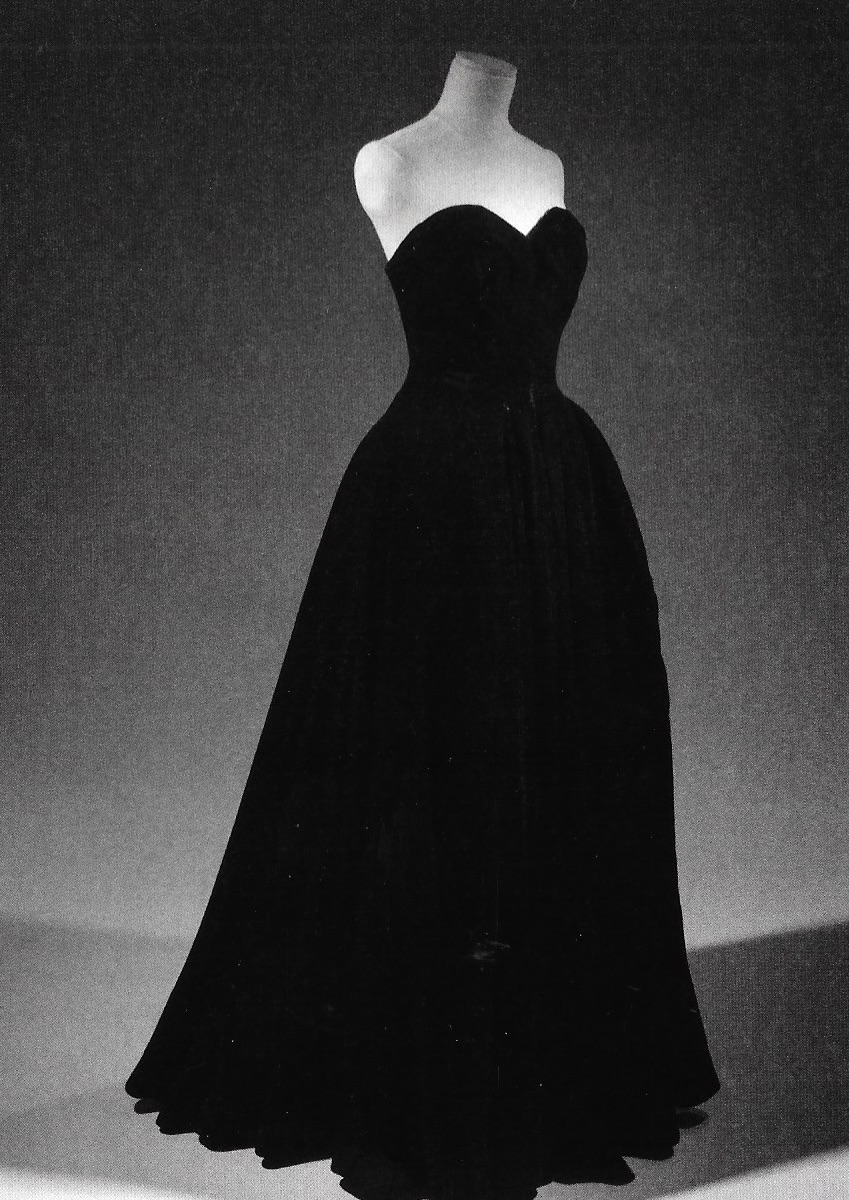
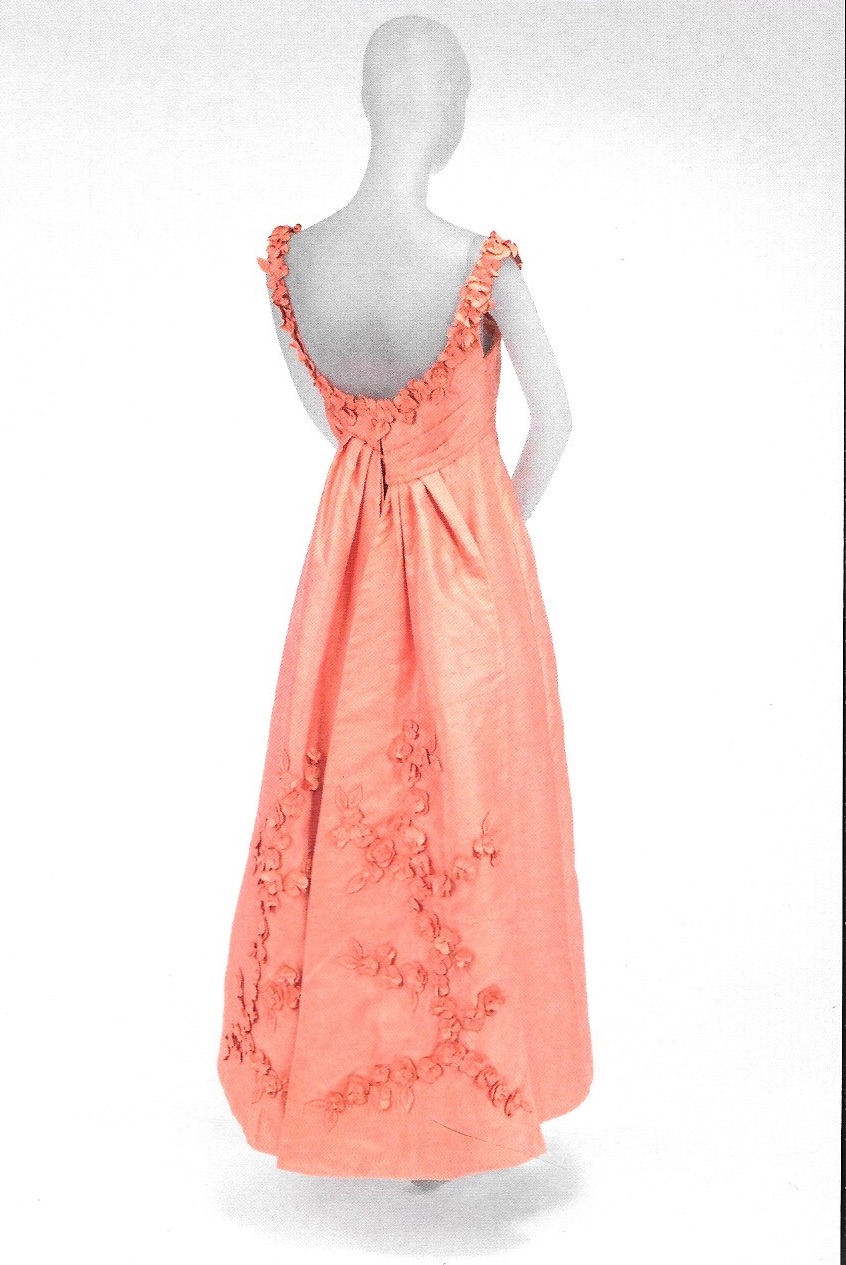
Here I share 4 images of dresses included in the Exhibition:

Printed Silk Ensemble, c. 1930s, Anonymous Gift to the Cincinnati Art Museum
Evening Dress, c. 1955, Silk Velvet, Lent by The Museum at the Fashion Institute of Technology, Gift of Eleanor Cates
Evening Dress, c. 1962-64, Made for Saks Fifth Avenue by Ann Lowe, Lent by The Metropolitan Museum of Art, Gift of Mrs. Carll Tucker Jr.
Elizabeth Mance Concert Gown, c. 1966-67, From the collection of Elizabeth Mance deJonge.

Last Fall I had the privilege of visiting Winterthur’s Conservation Lab where several of Lowe’s dresses and gowns were being prepared for exhibit. Readily apparent in these pieces was the engineering skill of the designer – all those things going on inside the dress to perfect the fit and carriage of it for each client.  Although much of this inside story will obviously not be on display, each and every dress will surely tell its own story of beauty, quality and style.  

This Exhibition is guest-curated by Elizabeth Way, associate curator of costume at The Museum at FIT.  For more information, visit www.Winterthur.org.  

10 Comments

Filed under couture construction, Fashion Exhibits, Fashion history, Uncategorized

Completion – How Sweet It Is. 

It has been a slow start to the new sewing year of 2023.  Although I had anticipated the completion of my first project – this black jacket – to be a speedy endeavor, I anticipated incorrectly!  (Has anyone ever said fashion sewing can be very humbling?)

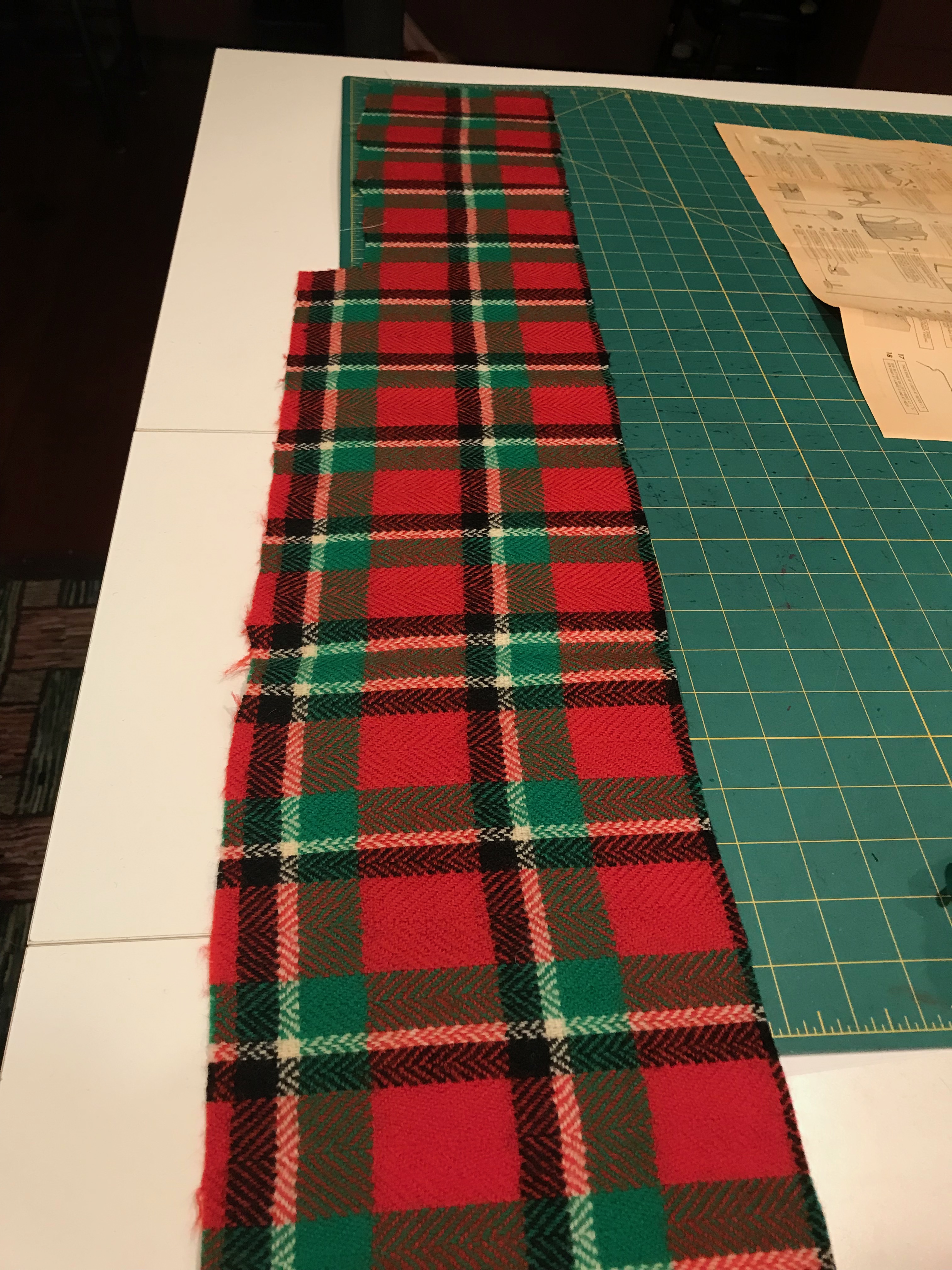
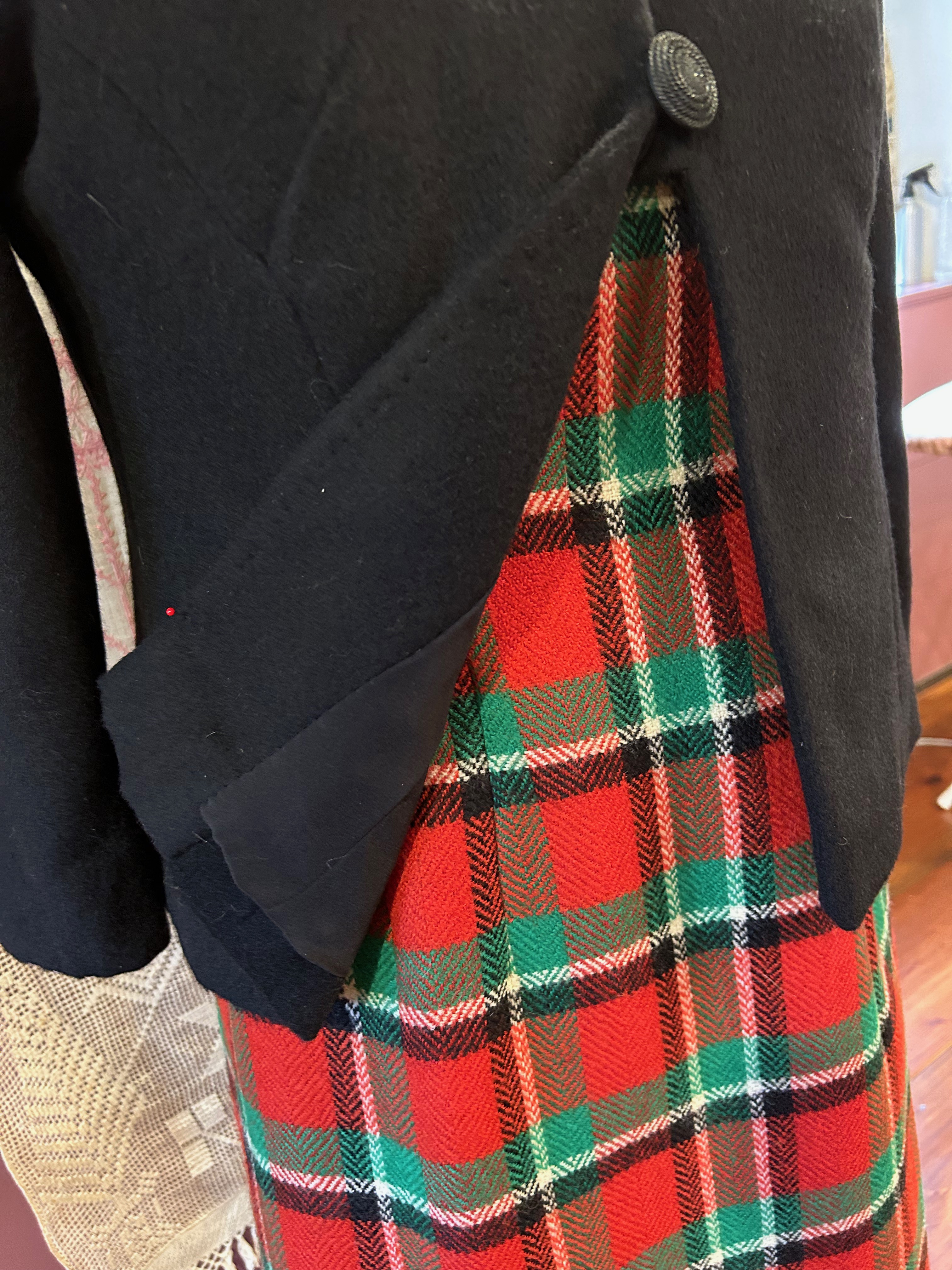
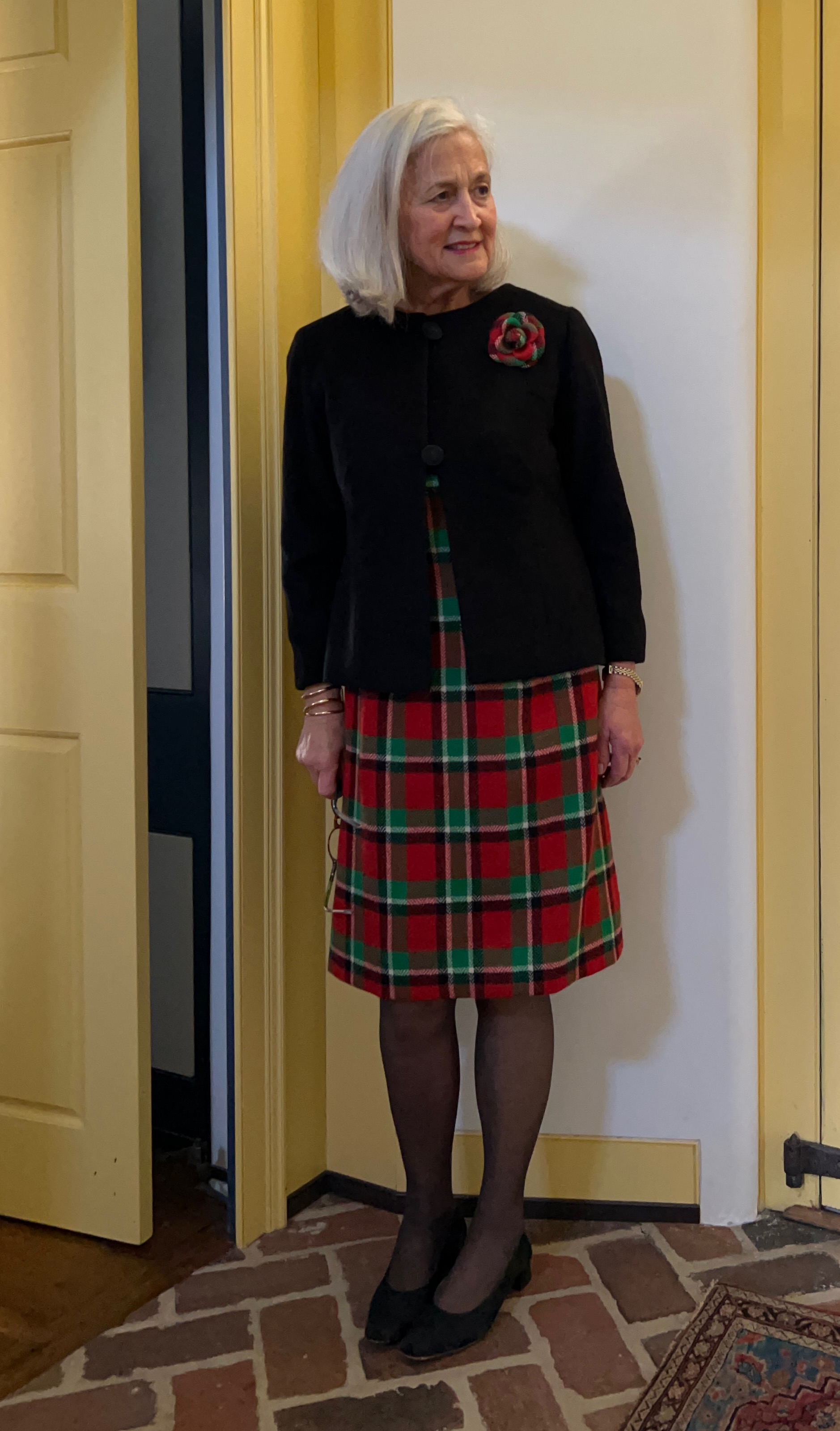
I was making this jacket to go specifically with a wool sheath dress I made two years ago – and also, hopefully, to pair with other dresses or skirts which might benefit from the addition of a somewhat dressy black jacket.  I had the pattern, and I had the fabric, a very soft light-weight cashmere (which I found a number of months ago at Farmhouse Fabrics.) 

I chose this jacket pattern primarily for its “split” center opening which would work well with the unusual center stripe woven into the wool to balance its uneven plaid.

I first needed to make a fitting muslin (toile) and I needed to determine what changes I would make to the original pattern.  That ended up being three items:

  • I changed the neckline to match the neckline of the sheath dress.
  • I added a dart to the top of each sleeve, using that method as a substitute for the running stitches normally used to facilitate the insertion of the sleeve into the armscye. I have used this alteration frequently as it seems to fit my shoulder anatomy well.
  • I shortened the sleeves from full-length to 7/8 length.  I did this as I enjoy wearing bracelets, thus giving them a little “breathing room.”  

Before I started making this jacket, I had the perception I would need to tie the sheath dress and the black jacket together in some way.  Without a shared element, I wasn’t so sure they would necessarily look like they were made for each other.  The only problem was, I had very little yardage remaining from the sheath dress, as I had made it from a limited piece of vintage wool.  What to do?  

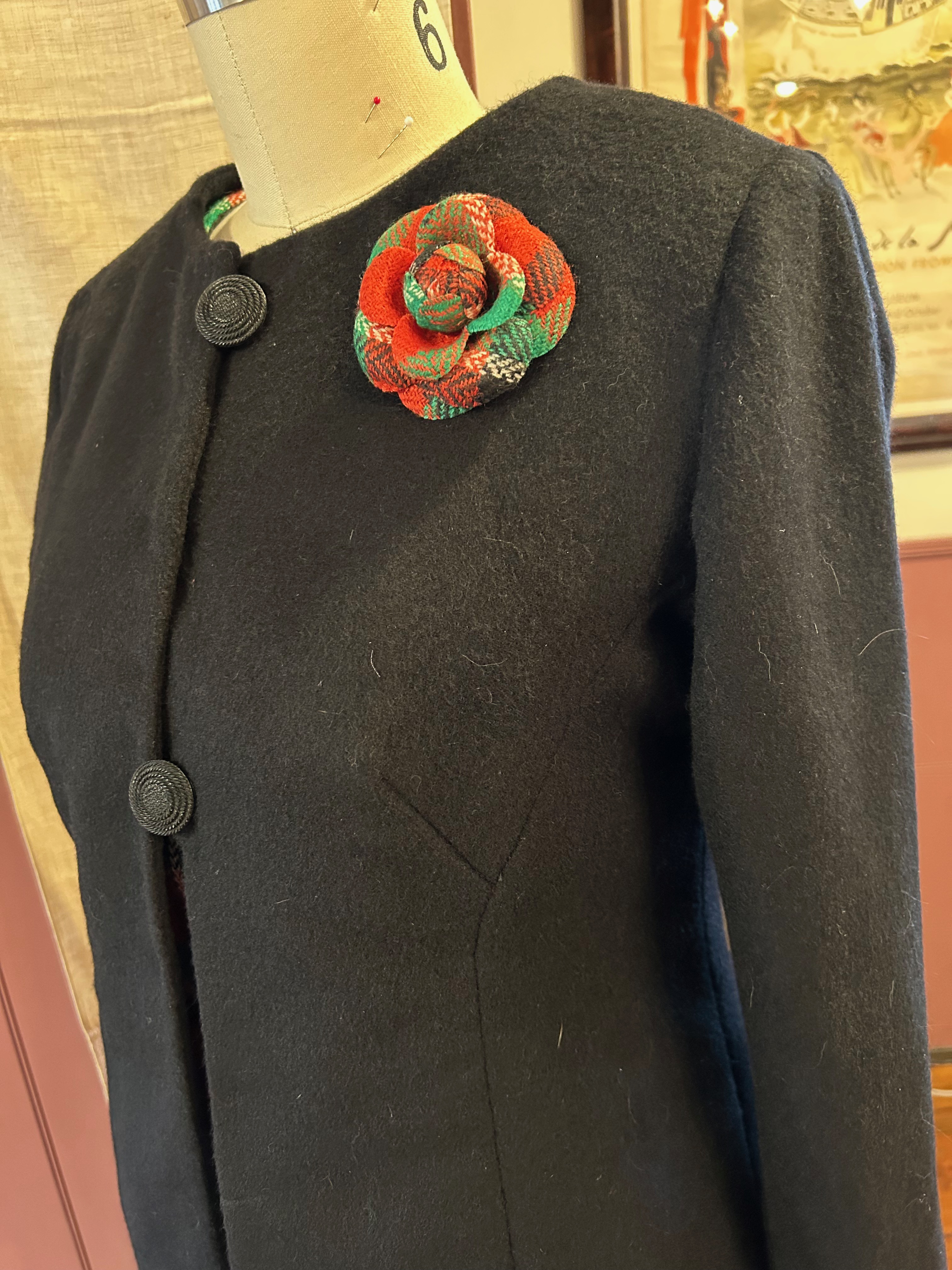
Covered buttons would limit my ability to wear the jacket with other pieces, and besides, I thought they would look stark as the only two small embellishments on a very black jacket.  I did not have enough fabric left, even for a small neck scarf, so that idea never had a chance.  I’m not sure when it came to me, but in a eureka moment, I thought a fabric flower made from the vintage plaid would be just the thing to make this outfit work.  

I knew M & S Schmalberg Custom Fabric Flowers in New York City would be my best bet (or only bet) for having a matching flower made.  I wasn’t sure I had enough fabric even for that, but I contacted them, sent pictures and measurements of my scrap of wool, and they made it work!  

I chose a 3” camellia option for my flower.  Look what they did!

A few other details for the construction of the jacket: (1) I under-stitched the facing to control the front edges and neckline of the jacket.

(2) I used a black crepe de chine lining (and lots of extra light when I was sewing it in!) I should mention that I underlined the jacket with silk organza.

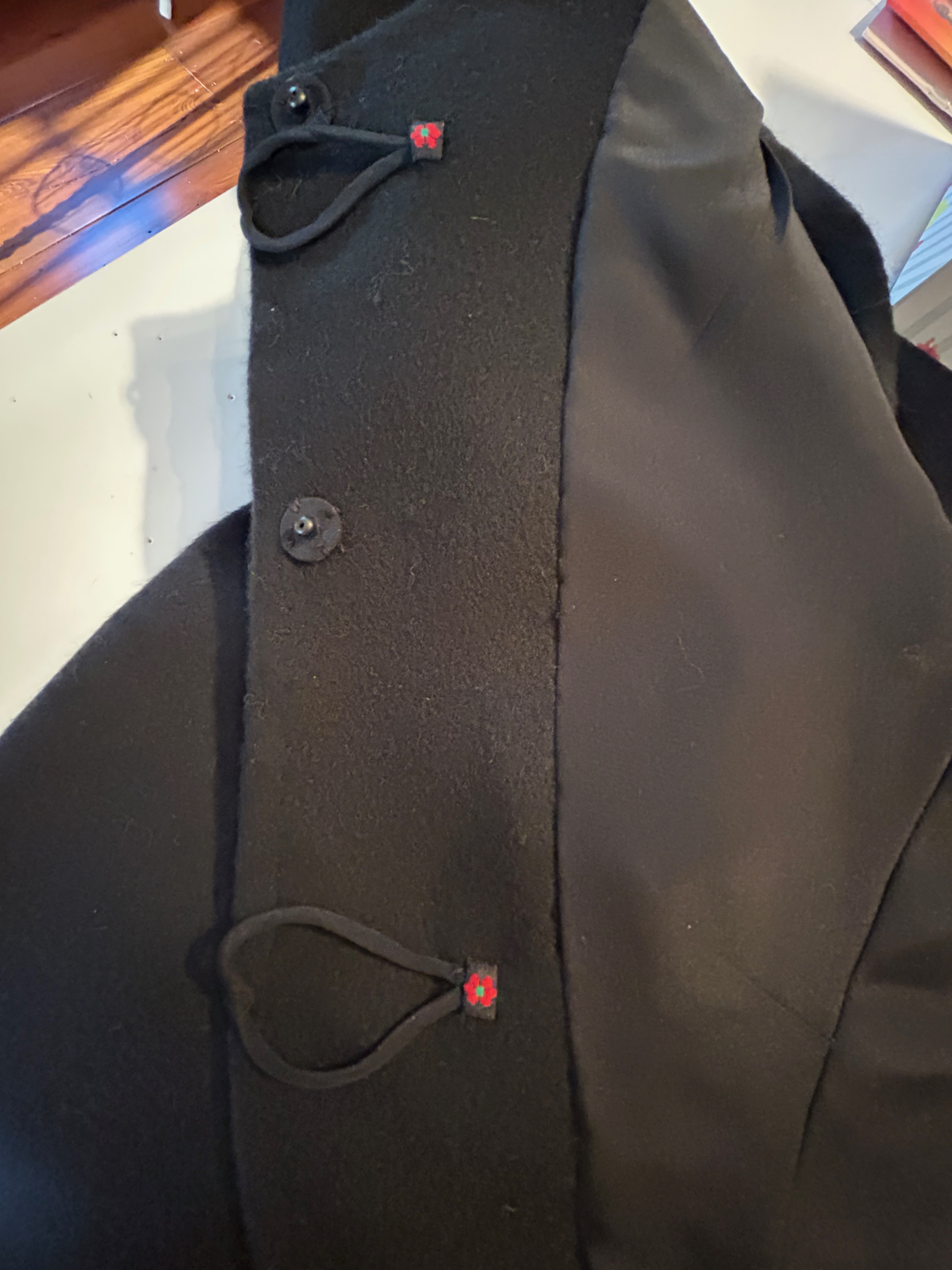
(3) The only bit of whimsy I added to the interior was to cover up the ends of the loops for the two buttons with two small jacquard ribbon pieces appliqued on.  No one will ever see these except for me, but I like them.

This is definitely a “dressmaker detail!”

(4) I covered the required snaps with the lining fabric.

I am so happy to have this jacket completed.  Most of my projects seem to take longer than they should, but that makes completing one just that much sweeter.  

.  

59 Comments

Filed under couture construction, Dressmaker details, Jackets, dressy, Loops for buttons, Mid-Century style, Uncategorized, vintage Vogue patterns from the 1960s, Vogue patterns, woolens

Not Just an Everyday Blouse

Some blouses are worn A LOT.  Those are everyday blouses, and I have quite a few of those (with more to come, I am sure!)  And some blouses are worn infrequently, but equally loved for their unique properties.  These would include exceptional fabric, refined or formal appearance, limited wearing opportunity, or their ability to make a statement.  The blouse I most recently completed has all those properties. 

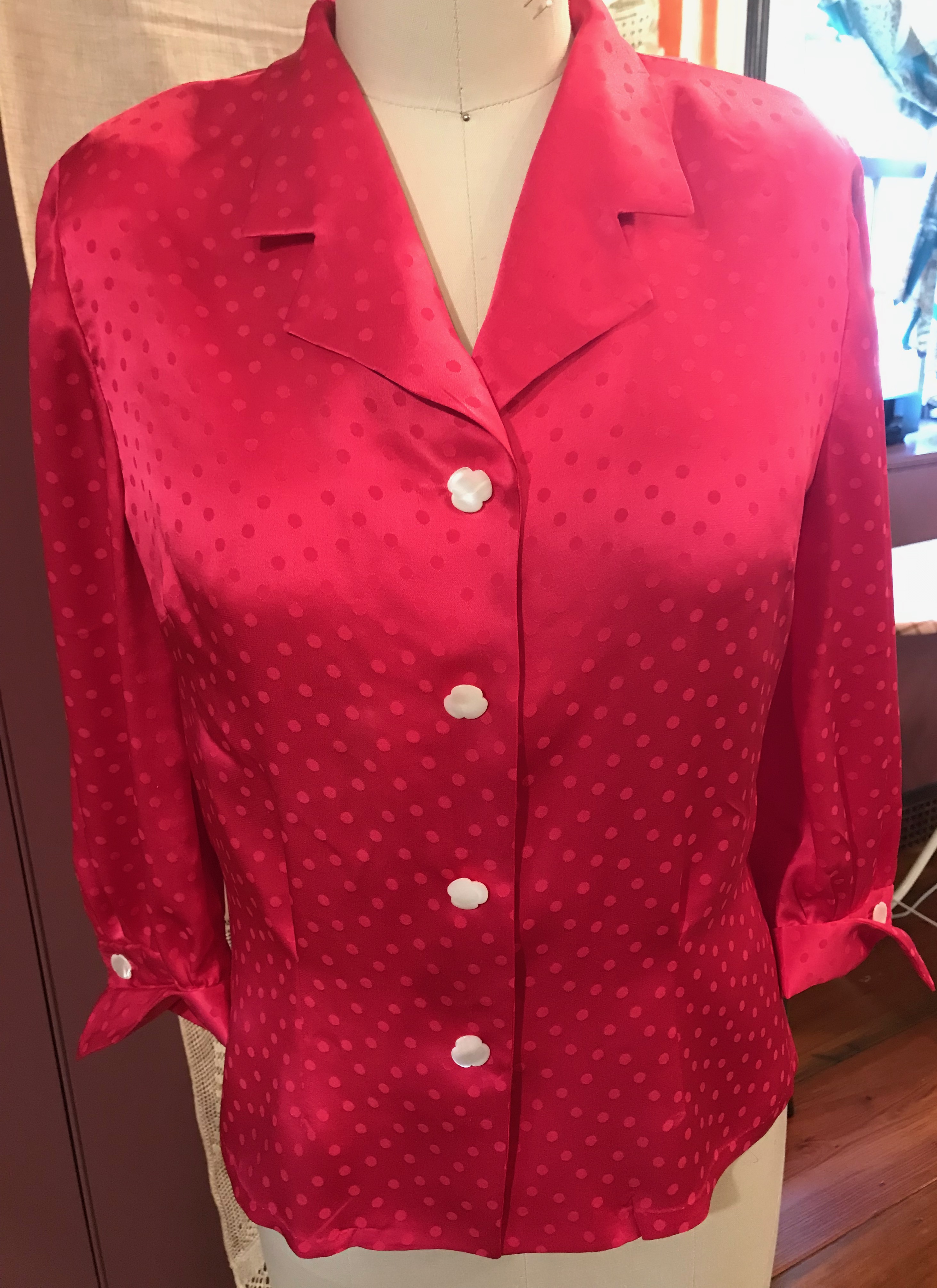
This deep pink silk charmeuse Jacquard has been in my fabric closet for over ten years, having been purchased at Britex Fabrics when I started sewing for myself again, way back when.  Its color, and the polka dot woven motif, both personal favorites, drew me to it.  A couple of years ago, after purchasing another piece of silk – a printed silk twill – I paired the two fabrics together and added them both to my sewing queue.  The skirt may have to wait until next year, but the blouse earned a spot in 2022’s sewing agenda.

Two fabrics meant for each other!

I used a blouse pattern which I have made once before.  From 1957, this pattern is timeless with its elegant collar (which looks good lying flat or propped up around the neck), petite French cuffs and feminine three-quarter length sleeves.  I suppose in 1957, this style blouse may have been considered a casual piece, which the illustrations on the pattern envelope suggest.  I saw this blouse as dressy, however, and that is how I have interpreted it. 

The collar on this blouse is beautifully engineered.
Here is the first blouse, in silk dupioni, I made from this pattern.

One of the details which make this blouse so flattering to wear is the waistline open-ended darts, easily visible above.  They minimize the bulk when the blouse is tucked inside its skirt and add a lovely billow effect above the waist. I made these darts a bit shallower than the pattern indicated.  When making these darts, I secured their upper edges by pulling the thread tail on one side to the other side so that I had the ability to knot those threads with three tight loops.  For those of you who have made a classic French jacket, this is the same method used to secure the quilting stitches at the end of the columns. The photo below helps to show this.

The darts are secured by knots done by hand both top and bottom.
Those open-ended darts are featured on the back of the bodice, too.

Buttons are such fun to select for a blouse like this.  I have had these vintage white pearl buttons for some time, and no doubt they were waiting for this project.  When the skirt is made at some point, the three-lobed profile will play off the designs in the silk twill.  But, more than that, I needed something to act as a foil for the polka-dotted field.  More “round” would have been fine, but not exciting.  Additionally, these buttons are a bit bigger which helps them hold their own on that deep, rich, pink silk.  

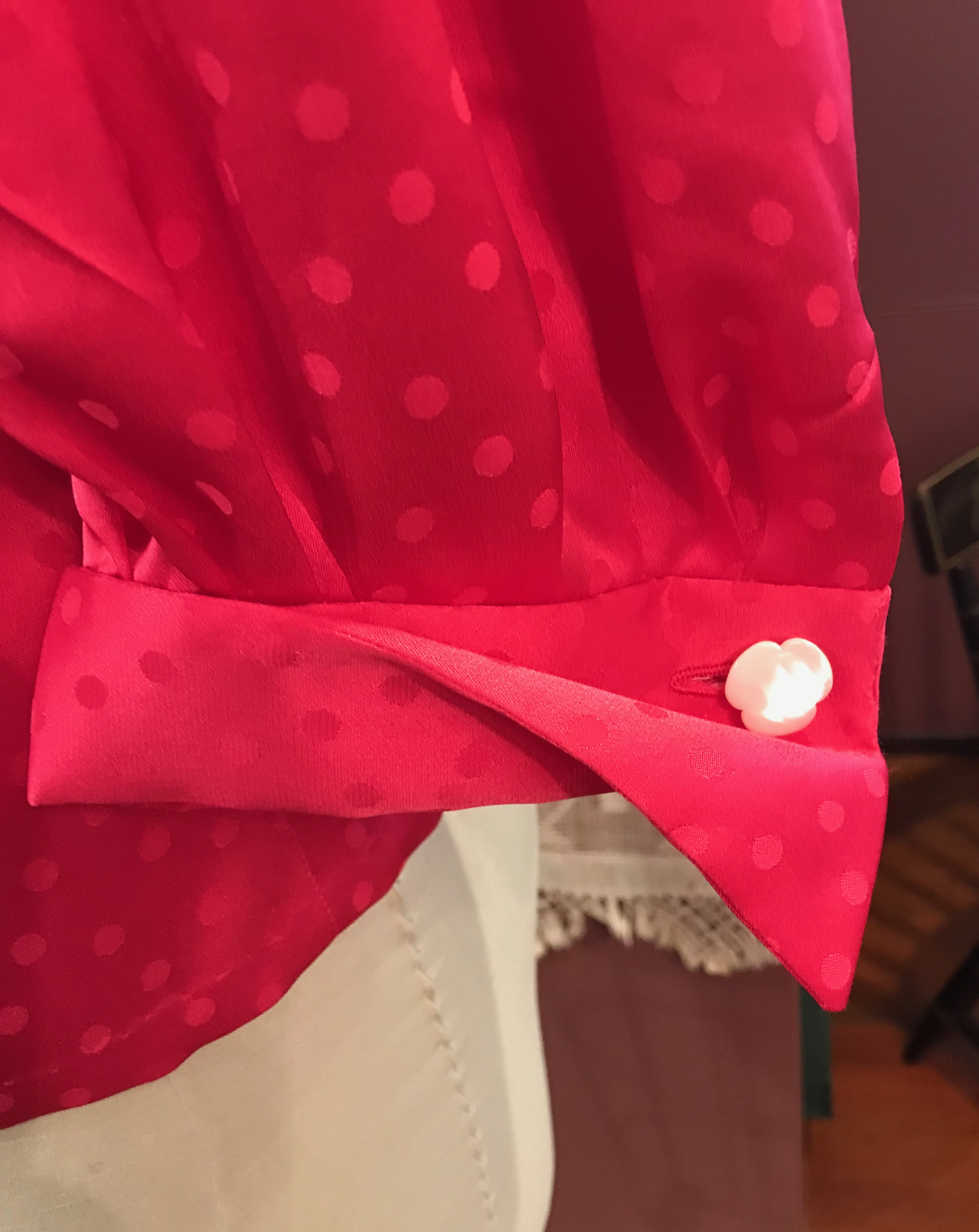
The French cuffs are secured by buttons both front and back.
Love those buttons!

Being the ‘statement” blouse that it is, I doubt I will be wearing this blouse casually. But I’m betting/hoping I will find good reason to wear it not infrequently to one or another tony event.  

25 Comments

Filed under Blouse patterns from the 1950's, Blouses, Buttons - choosing the right ones, Mid-Century style, Polka dots, sewing in silk, Uncategorized, vintage buttons, vintage Vogue patterns from the 1950s

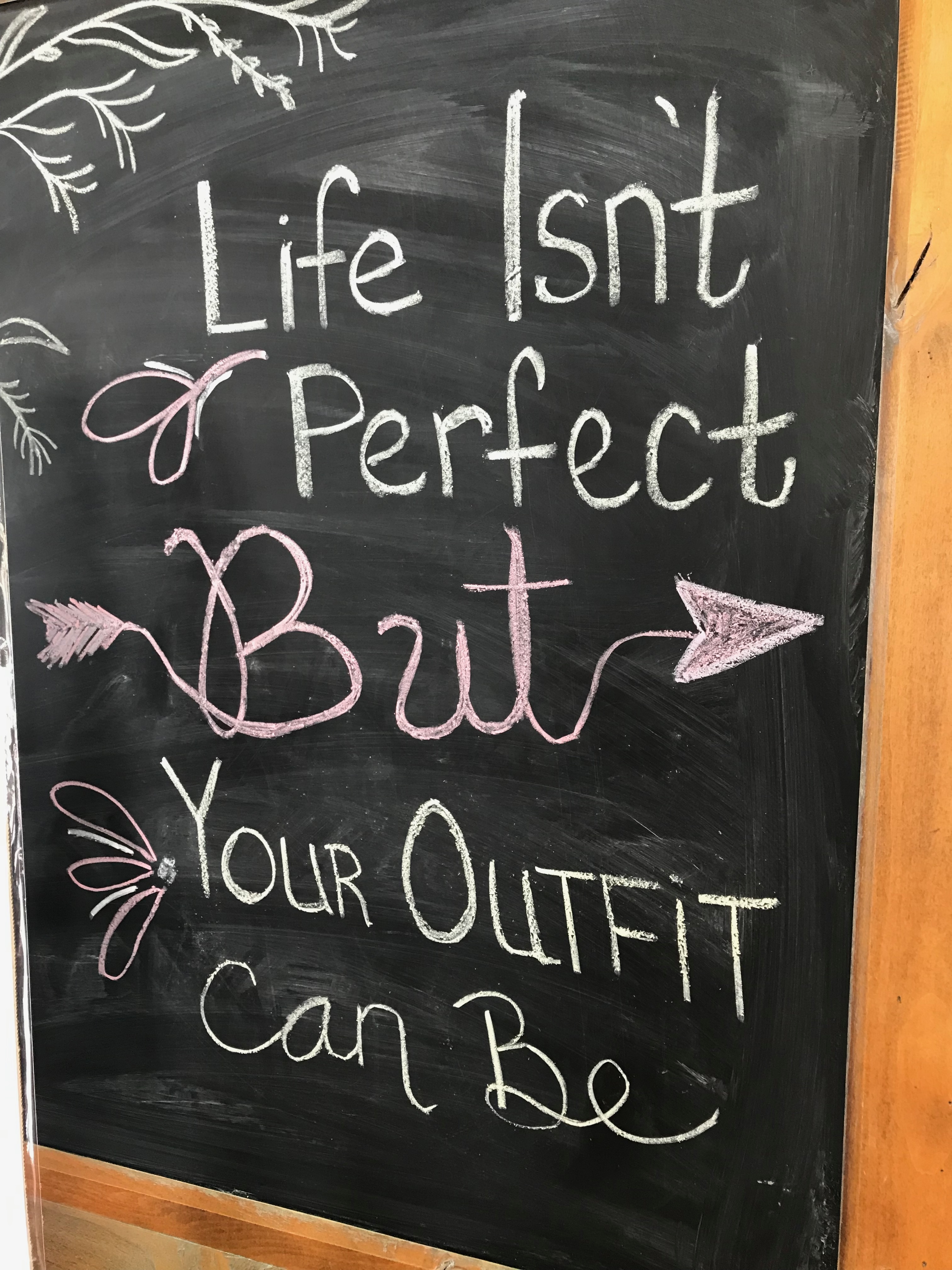
Life Isn’t Perfect…

…but Your Outfit Can Be.  I took a picture last summer of this sign at a Western wear store in Pinedale, Wyoming (Cowboy Shop).   I loved the saying, but little did I know how often I would reflect on it this summer, which has had its difficulties.  

And even when my outfit, like Life, is far from perfect, which has been often, I know there is always Hope, and yes, that is hope with a capital H.  

*******

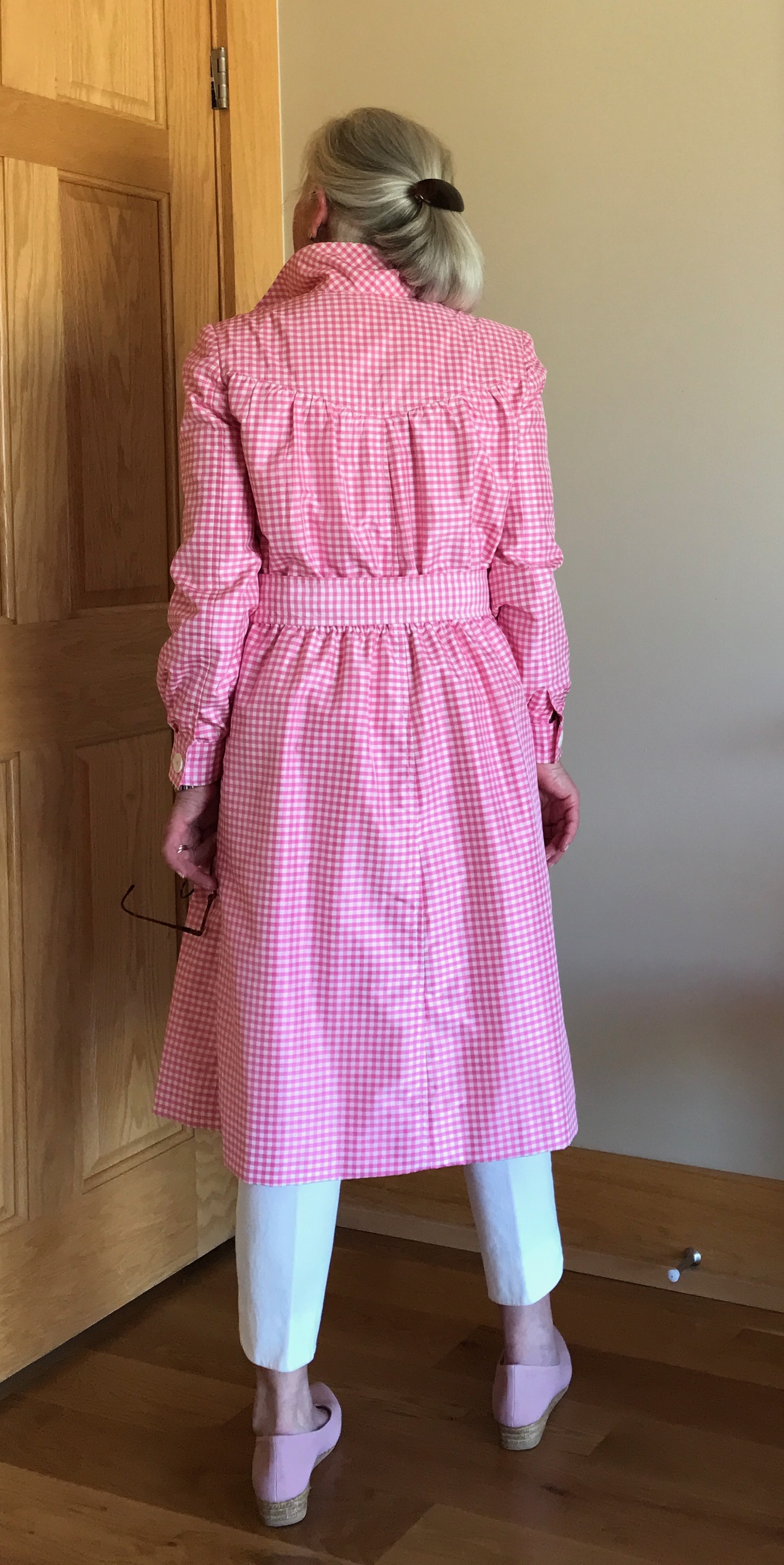
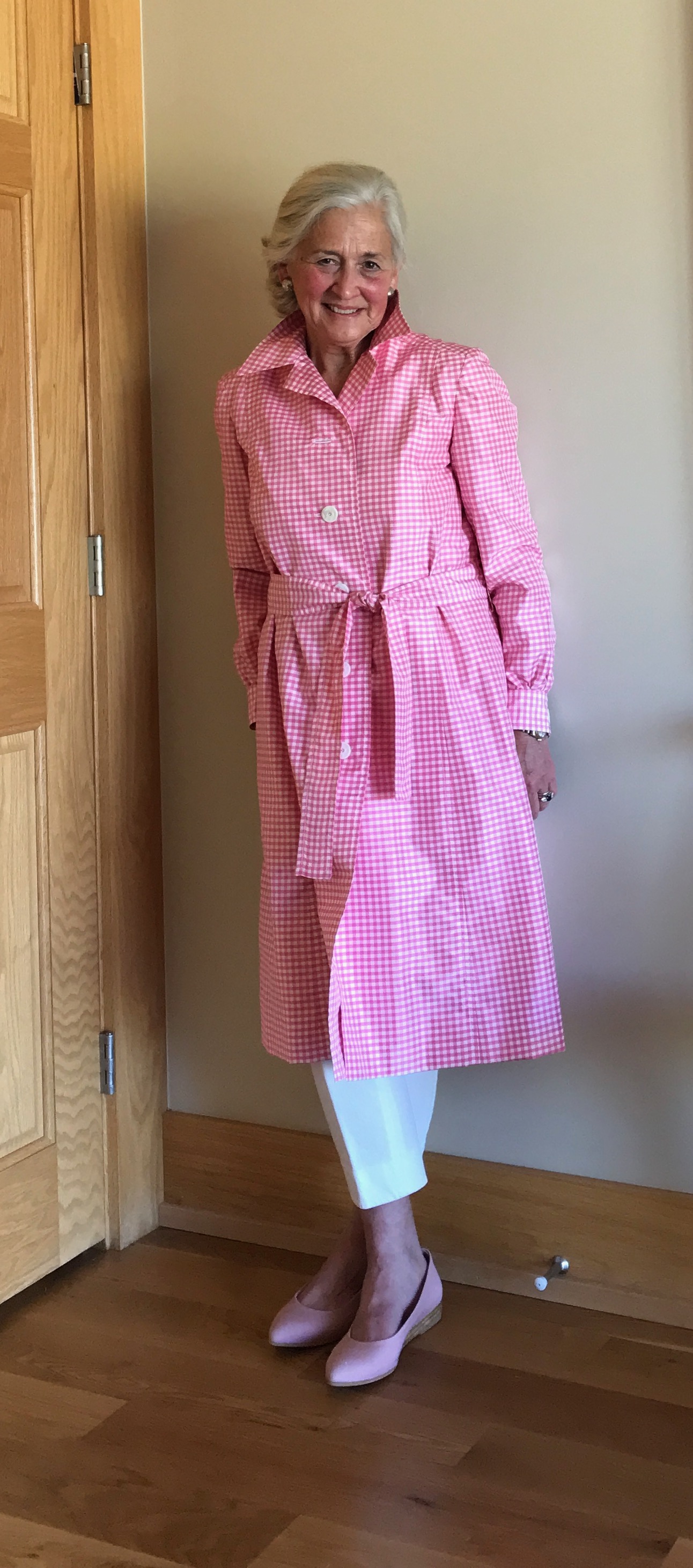
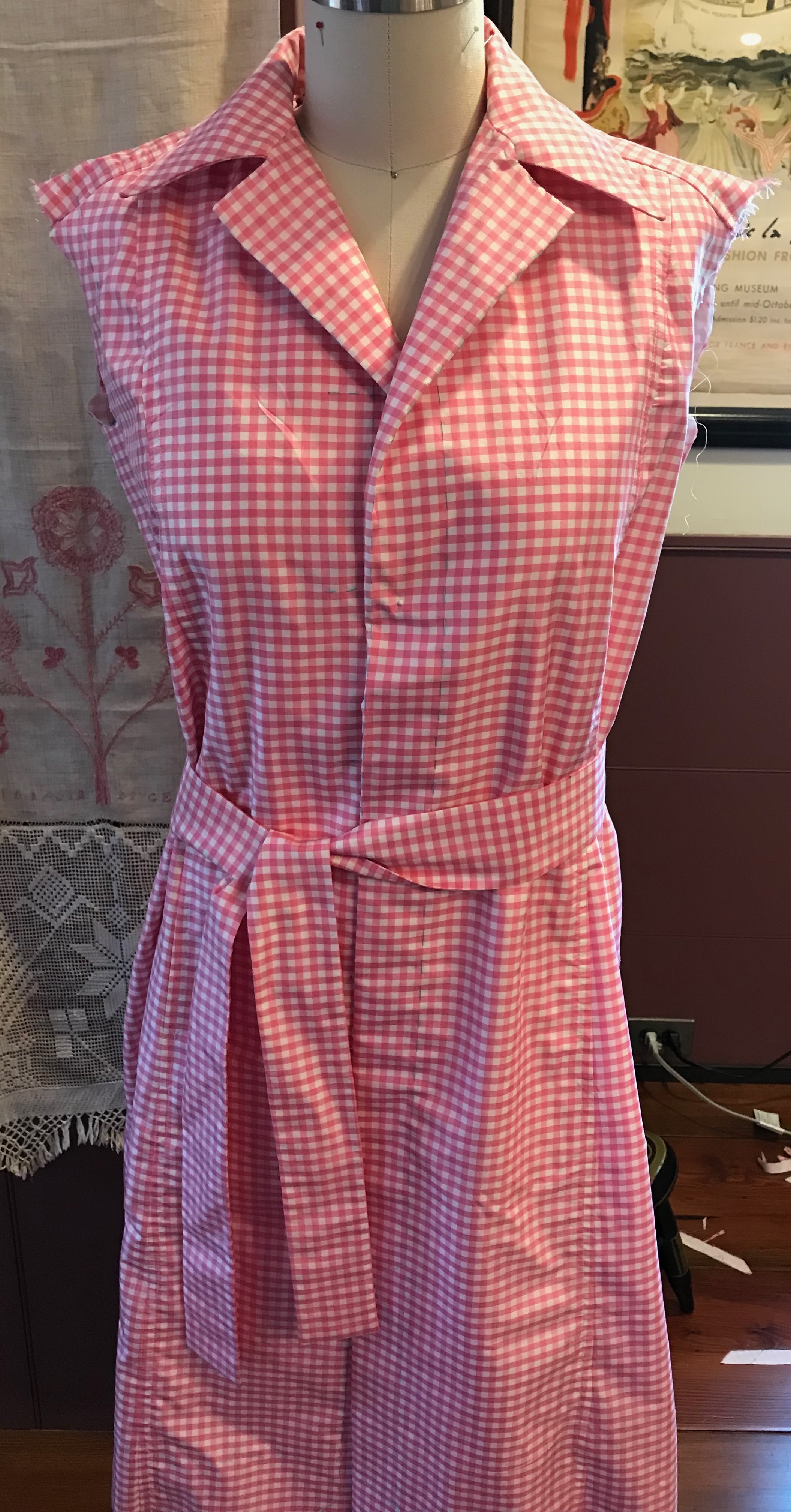
What a long hiatus it has been between my last musings about Trench coats and Dressmaker coats and pink gingham.  The final, finishing  stitch in my pink checked coat was in mid-June, and at this point I can hardly remember what I wanted to say about it.  

I purchased the pink silk gingham from Farmhouse Fabrics several years ago.

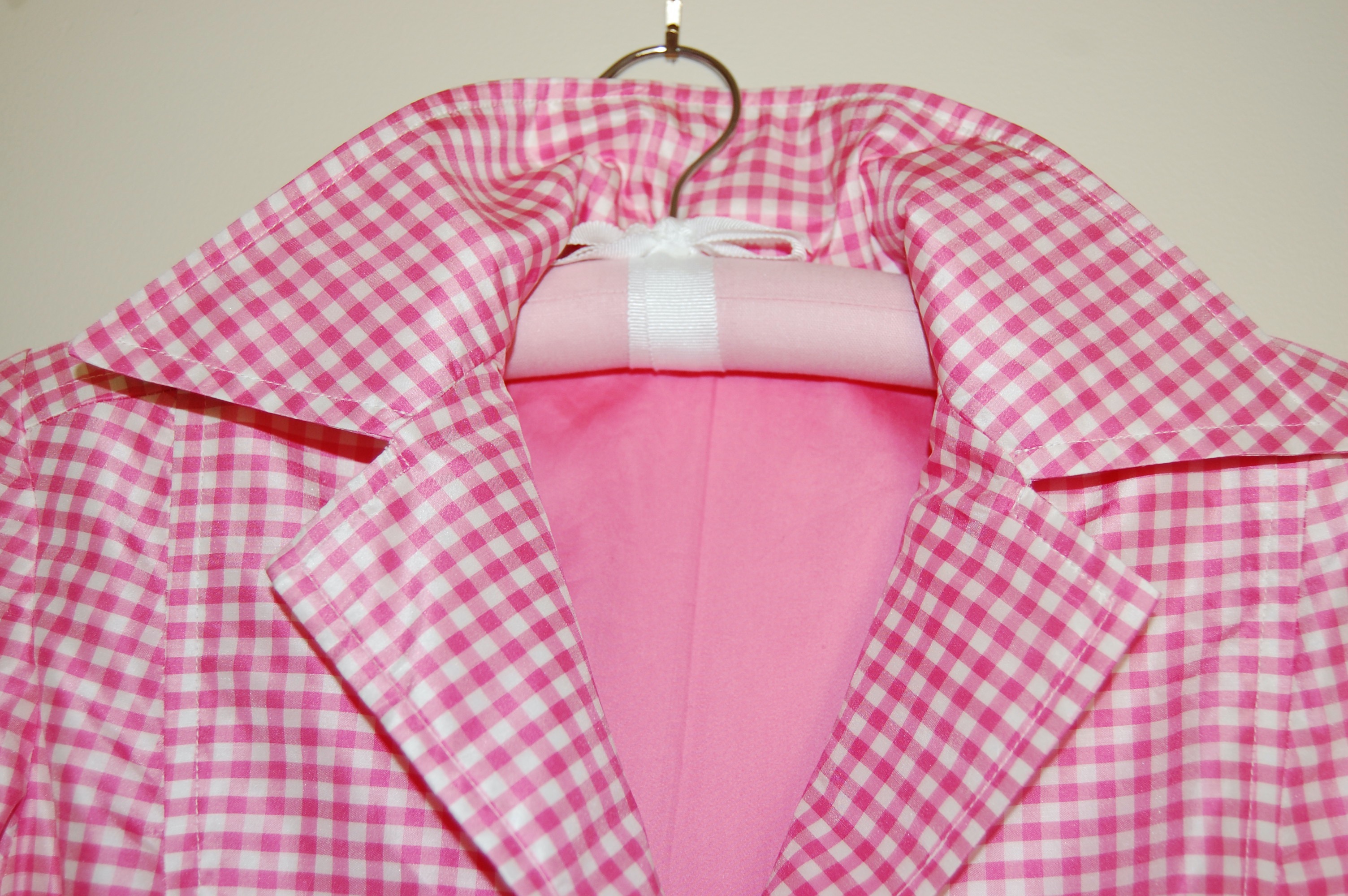
It does seem appropriate to start with the changes I made to the pattern, of which there were two major ones.  The first change was to the size of the collar.  In the 1970s long pointed collars were a trend.  Although I like a pointed collar, one with a more petite profile seemed to be a little more flattering and classic.  To achieve this desired look, I shortened the collar’s points by about an inch on either side.  

For comparison purposes, here is a good look at the original collar.

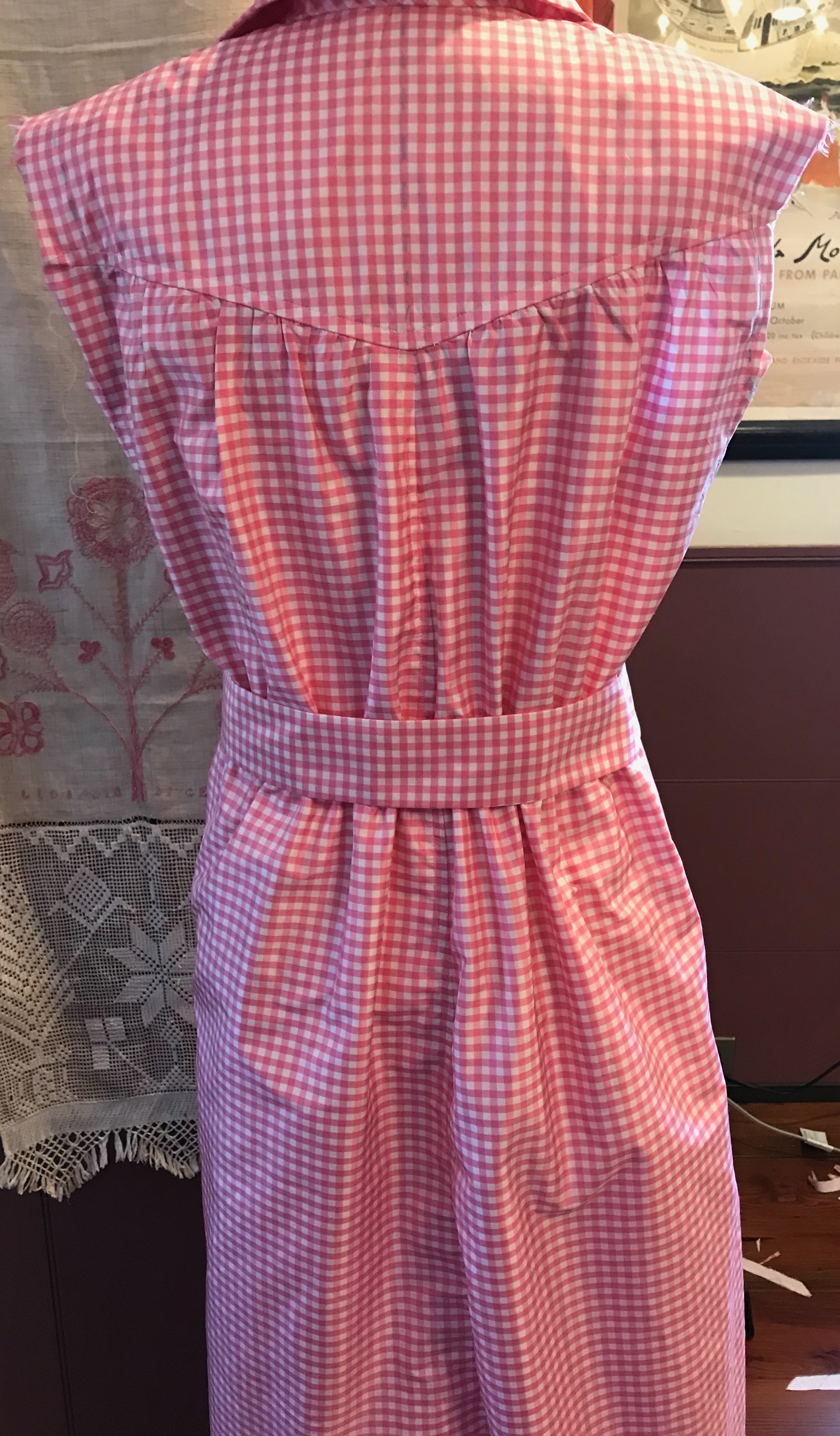
When I made this coat in 1974, I remember being a bit disappointed with the volume of the back of the coat.  I was using a cotton twill, so it was a heavier fabric than the silk taffeta in my new version, making the volume seem even more pronounced.  But even so, I thought I would be happier with a less full back.  I experimented around with my muslin/toile until I got the desired girth.  It turned out I eliminated a total of three inches from the back pattern pieces, 1 ½” from each side back panel.

Again, the image of the 1974 pattern illustrates the volume of the gathering in the original design.

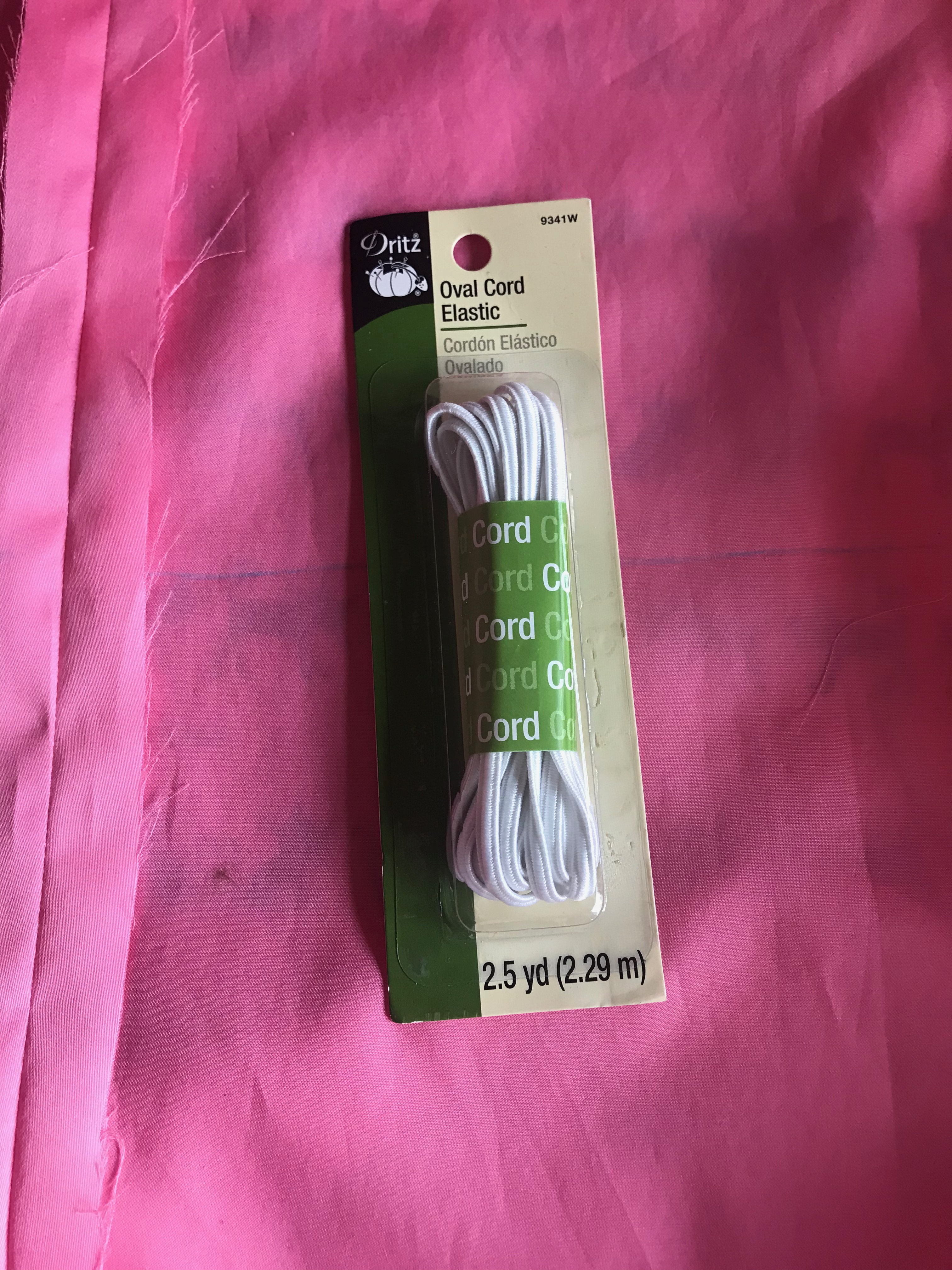
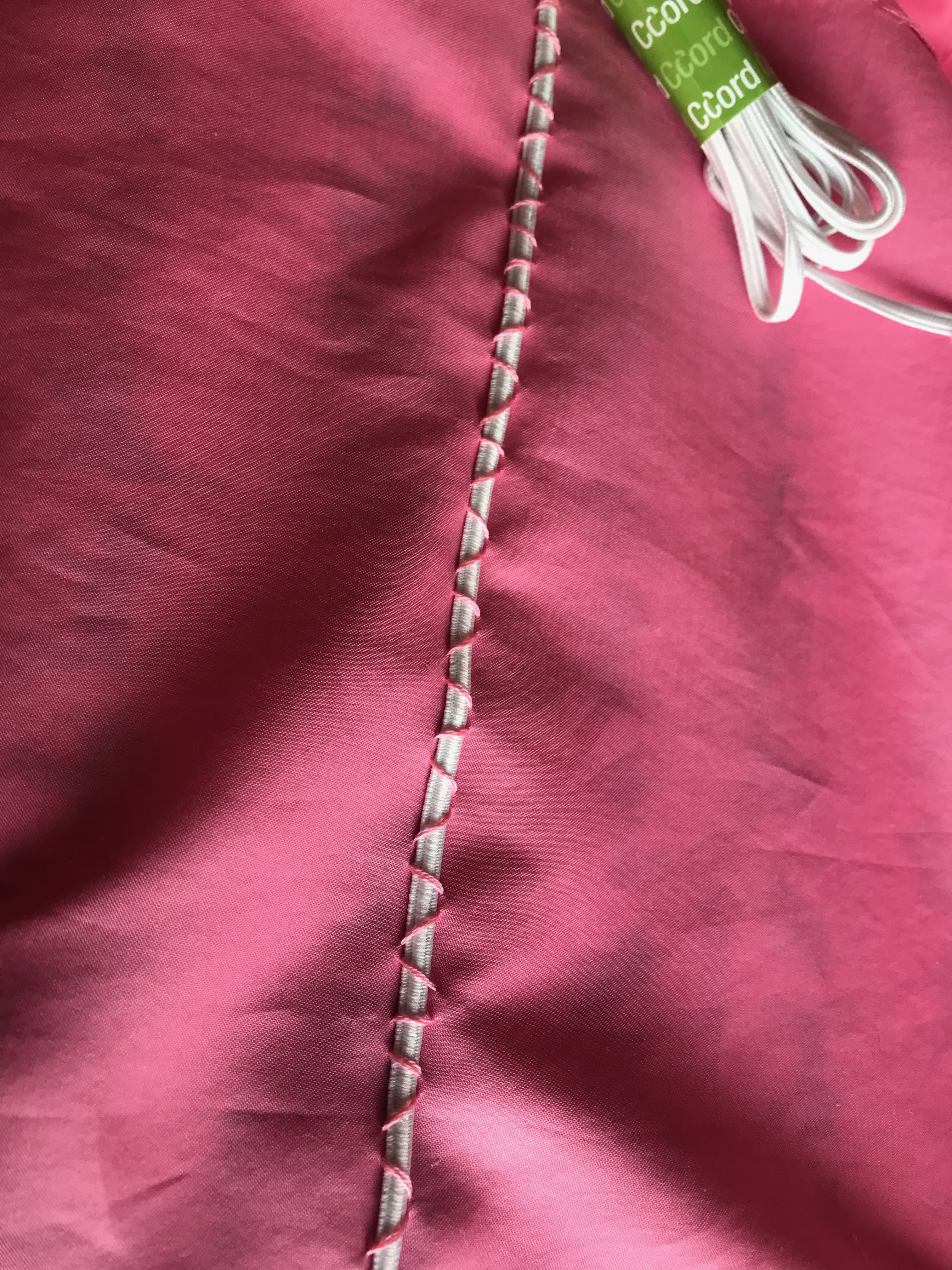
In addition to these alterations, I had a slight construction change.  The instructions for the  gathering of the lining at the back waistline called for using elastic thread.  First of all, I didn’t have any elastic thread, nor did I think it would give the look I wanted even though it would not be very apparent on a lining.  Instead, I had some elastic cord, and I attached it by hand, using embroidery floss in a criss-cross stitch enclosing it the width of the back.  Worked like a charm, and I like the effect it made.

This is the wrong side of the lining, showing the criss cross I achieved with embroidery floss.
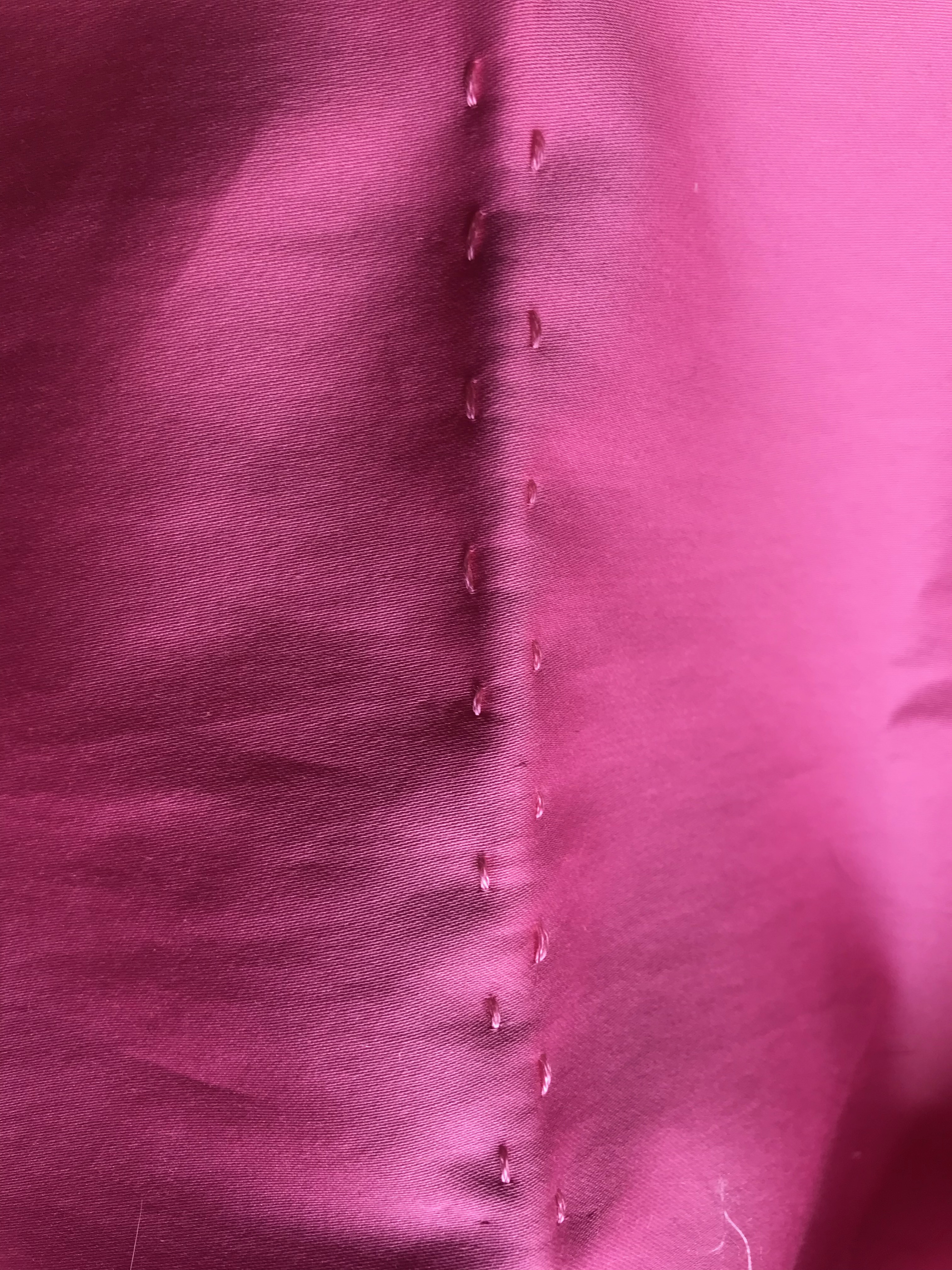
And here is what it looks like on the right side of the lining. The lining gathers beautifully with this thread channel for the elastic cord, as is apparent in the image below.

Once I had the coat partially assembled, I decided I would have liked it to be a bit longer than I planned with the muslin.  I was very tight with fabric, so I really could not have cut it longer and still been able to get the coat out of the fabric I had.  So, to gain another inch and a half, I decided to face the hem right to the point where the lining would be attached.    It certainly took extra effort, but I’m glad I did it as I much prefer the slightly longer length.  

The one thing I would change should I ever make this coat again (which I doubt) would be to add about an inch or so to the diameter of the cuffs.  I would like to keep them buttoned and be able to slip my hands through them.  As they are, they are too tight to do that.  This was something I could have determined had I made a muslin/toile with completed sleeves, which I did not.  All I did was check the length.  A good reminder to me to be more thorough in situations like this.  

When I was planning this coat, I intended to use this vintage silk fabric for the lining.

However, even though I underlined the fashion fabric with white cotton batiste, I felt there was a slight “see-through” of the black details in the print of the intended fabric.  In the meantime, I had ordered a piece of polished cotton in “Paris Pink” from Emma One Sock Fabrics.  Although not an exact match, the two fabrics – the pink checked taffeta and the polished cotton – made a pretty pair so I changed course, and the rest is history.

I am quite happy with this pink lining!

No report on this coat would be complete without mention of the buttons. Again, I went with vintage mother-of-pearl buttons. These have a carved detail in them, which I thought would pair nicely with the gingham.

I chose to do machine buttonholes on this silk coat.

This was an involved, lengthy project.  I was rather in awe of my 24-year-old self for attempting it “back in the day.”  But making it again brought back hidden memories (good ones) and new appreciation for all that I have learned over the ensuing years.  Wearing my new version of this Trench-inspired coat will, I believe, fall into the “nearly perfect“ category.  

44 Comments

Filed under Buttons - choosing the right ones, Christian Dior, Coats, couture construction, Dressmaker coats, Linings, Mid-Century style, Silk taffeta, Uncategorized, vintage buttons, vintage Vogue Designer patterns, vintage Vogue patterns from the 1970s

Is It a Trench Coat – or Is it Not?

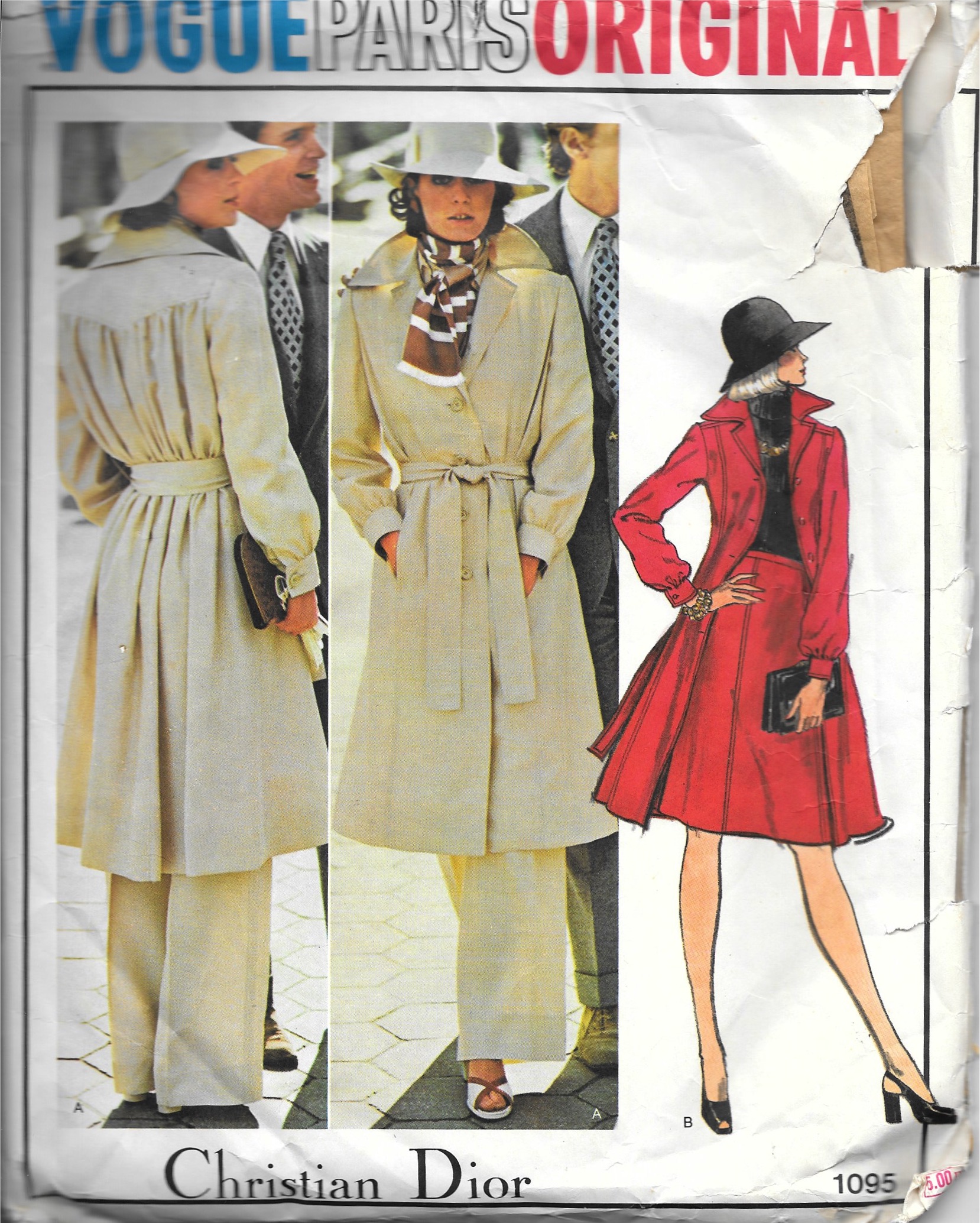
It is not.  However, I am quite sure this classic look from 1974 was inspired by the classic Trench Coat as we know it.  

I am certain this Vogue pattern is from 1974, as it is featured in that year’s July/August issue of Vogue Pattern Book Magazine.  It is part of a section entitled NEW ARRIVALS.  

The caption tells me it is made in silk shantung, a little bit of information unknown to me when I decided to make my (new) version of it in silk taffeta.  

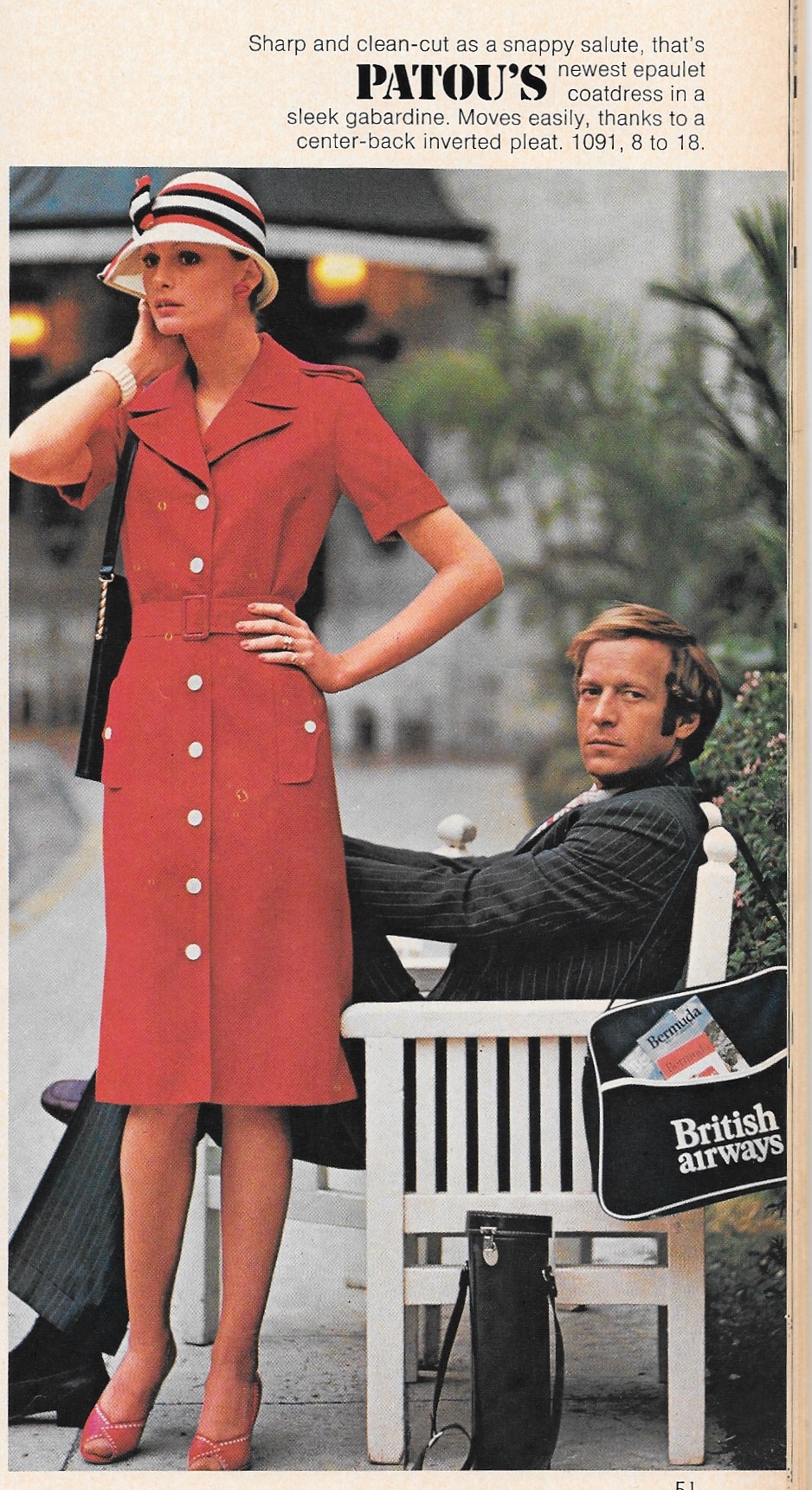
Interestingly, in the same NEW ARRIVALS section, a dress by Patou also is reminiscent of Trench coat style, with its epaulets, slotted pockets with shaped flaps and a belted waist.  It also has a center back inverted pleat.

Fast forward two years and here is a very classic Trench in the 1976 September/October issue of Vogue Pattern Book Magazine.  

The caption reads: “Come rain, come shine, what more liveable coat than the trench!  All that star reporter elan in epaulets, front & back shields, center back inverted pleat.”  This particular pattern also includes a detachable lining for the coat and additional detachable collar. I believe that is the collar you see in red in the above picture from the magazine.  The thumbnail drawings of the pattern are helpful in seeing these details:

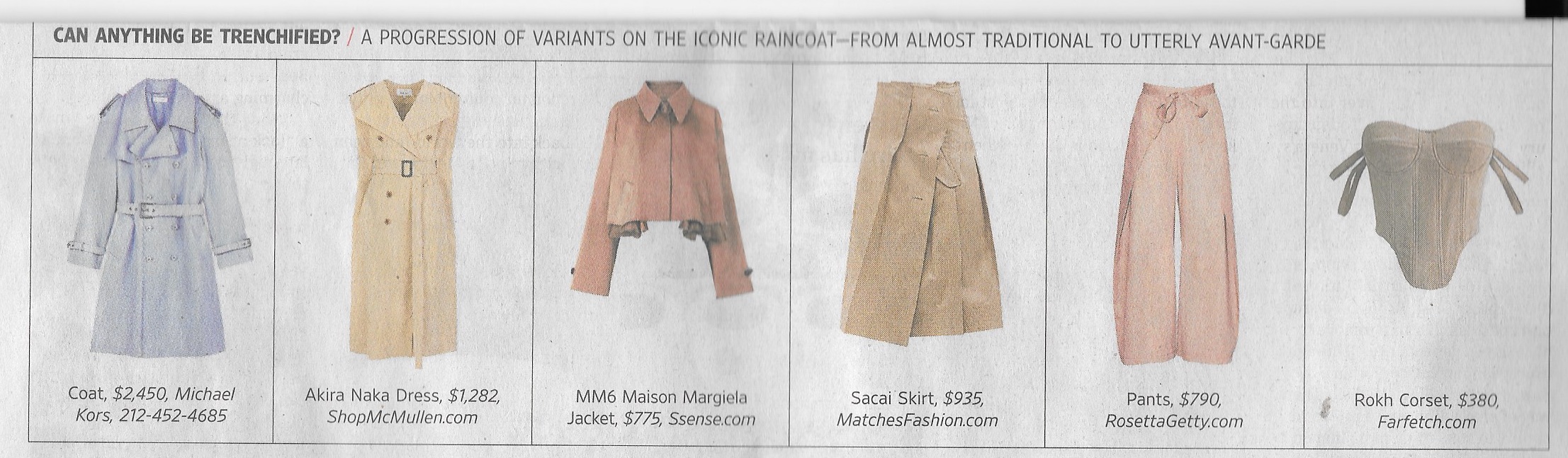
Now, hang onto your hats and fast forward 46 years to 2022.  The Trench Coat, despite being in fashion since the 1940s, is apparently enjoying new attention and reimagination according to an article in the Style & Fashion section of The Wall Street Journal, April 23-24, 2022.  Although I am a little doubtful as to the long-lasting appeal of some of the Trench Coat variations shown and suggested in the article by Katharine K. Zarrella – which include a skirt, pants and a corset (really?) – some of the reflections and thoughts on Trench Coat style by various fashion insiders are worth sharing.  

Michael Kors is quoted as saying:  “A trench coat inherently feels like an old friend that makes you feel very secure…  But you want an old friend to surprise you.”  (Pink checks, anyone?)

Jane Tynan, author of a soon-to-be-released book entitled Trench Coat, says the appeal of the Trench to contemporary women is the “danger and sensuality it conveys.” (Think spies and clandestine meetings.)  However, a certain Loa Patman of Boston, Massachusetts, says, “Anything trench-inspired tends to look somewhat pulled together and professional.”  

Well, I don’t expect to be doing any sleuthing in my Trench-inspired Christian Dior design from 1974, but I do aspire to feel “pulled together” while wearing it.  Right now it is anything but pulled together, as you can see from the photos of my “work in progress”.  

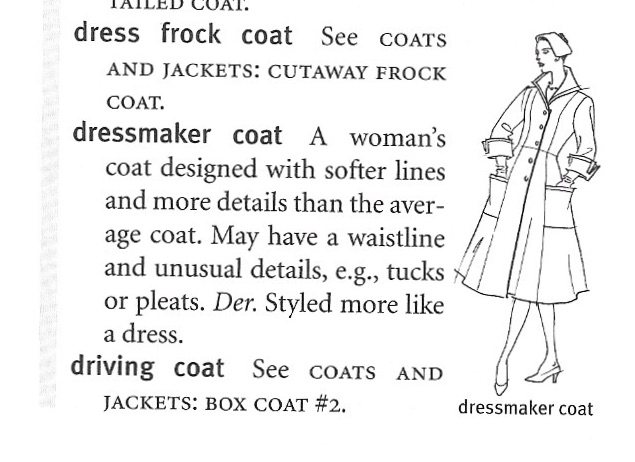
Thinking further about the origins – and definitional category – of this particular design from the House of Dior, it seems to me to be a cross between a dressmaker coat and a Trench. Perhaps “Dressmaker Trench” might be the best description. As you will recall, if you follow this blog, I have referred to “dressmaker coats” before. Fairchild’s Dictionary of Fashion describes it as: “A woman’s coat designed with softer lines and more details than the average coat. May have a waistline and unusual details, e.g., tucks or pleats.” (p. 92, ibid.)

I’m not sure Dressmaker Coat is a descriptor many use anymore, but it certainly is useful. One thing I am quite certain of, once this Trench-inspired Dressmaker Coat is finished – it promises to stand the test of further time. I anticipate it as a staple in my Spring and early Summer wardrobe.

5 Comments

Filed under Christian Dior, Coats, Dressmaker coats, Fashion commentary, Mid-Century style, Silk taffeta, Uncategorized, vintage Vogue patterns from the 1970s

Personal Style – And the Passage of Time

Over the past few weeks, in anticipation of my current project, I have been thinking about personal style and how it changes – or doesn’t change – over the decades of one’s life.  What  prompted my contemplation is this pattern:

I purchased this pattern when it was new about 1974 or ’75, when I was in my mid-twenties.  I loved the style then, and although I was in dire need of clothes to wear to work, such as dresses and skirts, I must have decided I needed this coat more.  I made it in a tan cotton twill, and it accompanied me on many a trip on the commuter rail line into Philadelphia (Pennsylvania.)    At some point years later, I obviously discarded it, along with other pieces I had diligently sewn.  I am certainly glad I kept the pattern, as I still love this style. Working on it now is a true deja vu experience.

I am not sure I recognized it per se, but my fascination with coats must have already been firmly established in my personal style, even then.  For example, I was obsessed with this color-blocked coat pattern:

At the time, I remember resisting the urge to purchase it, as I could not guarantee to myself that I would actually get around to making it.  The pattern was too expensive ($3.50) for me, at that time, to take that risk.  However, though many years passed by, I never forgot it. Those of you who follow this blog know that I did finally purchase this pattern a few years ago and this time, I did make it! It continues to be one of my favorite pieces, and I feel wonderful wearing it.

Then there is this pattern, also purchased in the mid-seventies:  

I must have thought this was a more practical style and worth the cost.  I never made it, but one of these days I intend to.  
Buried deep in my cedar closet is a white wool coat, purchased when I was in high school in the mid-sixties.  I am not sure why I have kept it all these years except that I loved it and perhaps in some way treasured it more since my father bought it for me.  Its style is very similar to the coat of this pattern – a style I still love  – and also hope to make some day. 

I find it interesting that three of the patterns pictured are Christian Dior designs. Hmmmm…

I guess what I am getting at, using these coats as an example, is how consistent my style has remained over almost five decades.  How about you?  Do you still gravitate to the same profiles in clothes that you wore in your twenties (assuming you are at least 40)?  If not, what has changed?  

What has changed for me is not the style, but the choice of fabrics and color.  I am more adventurous in using color than I was as a young woman, although even then, I gravitated towards pink. 

I made this Moygashel linen dress for our Honeymoon in 1973. Pink? YES!

All this makes me wonder if one’s personal style is part of their DNA; why, for example, do I like softly tailored, feminine clothes (and have obviously done so for years) while someone else likes the Bohemian look and wears it well; why does someone prefer to wear black, and more black, while I love color (and the occasional black, too).  Quentin Bell summed this observation up well in his quote:  “Our clothes are too much a part of us ever to be entirely indifferent to their condition; it is as though the fabric were indeed a natural extension of the body or even of the soul.”  [my italics]

And what about the person who follows every fashion trend that comes along?  Do they not have that personal style component in their DNA, or are they governed by different needs?  Toby Fischer-Mirkin, in her book Dress Code addresses this – and offers some frank advice – in her chapter entitled Fashion and Status:  Under the Spell of Haute Couture:  “The unrelenting quest to be fashionable is usually undertaken to fill not a closet, but a personal void….  A woman’s fashion compass should come from within.  When you’re aware of what works for you, you’ll take pride in that aesthetic and, within the boundaries of good taste, project the person you truly are.”  (pages 146-147)

Clarkson Potter/Publishers, New York, New York, c1995

Is your personal style really that important?  Does it allow you to project the person you truly are?  If so, I can understand why one’s personal style does not change very much over the years.  Indeed, Givenchy once said, “With style, you must stay as you are.”  When I was a young woman in my twenties, I never would have guessed I would, decades later, still gravitate towards the same patterns, the same silhouettes, and have the same weaknesses for certain apparel (such as coats.)  I have changed personally in many other ways, but obviously my personal style has not – the recognition of which has been a revelation to me.  

I suspect there are many, many of you who, once you think about it, can say the same thing?  

22 Comments

Filed under Christian Dior, Coats, Fashion commentary, Mid-Century style, Uncategorized