Category Archives: Cocktail dresses

Wedding Ready

Why is it that we so often think every wedding to which we are invited means we need a new dress? Sometimes it is warranted; maybe we really do need a new dress! Maybe what we already have in our closet isn’t right for the season or the “ambience” of the wedding site. Maybe the couple getting married is very dear to us, and it just seems right to celebrate this event with something new and special. Maybe the wedding season is busy enough that we really cannot wear the same dress to multiple events where we will probably see many of the same friends and people. But maybe, just maybe, a wedding invitation is exactly the perfect excuse we need to indulge our love of fancy, dressy clothes.

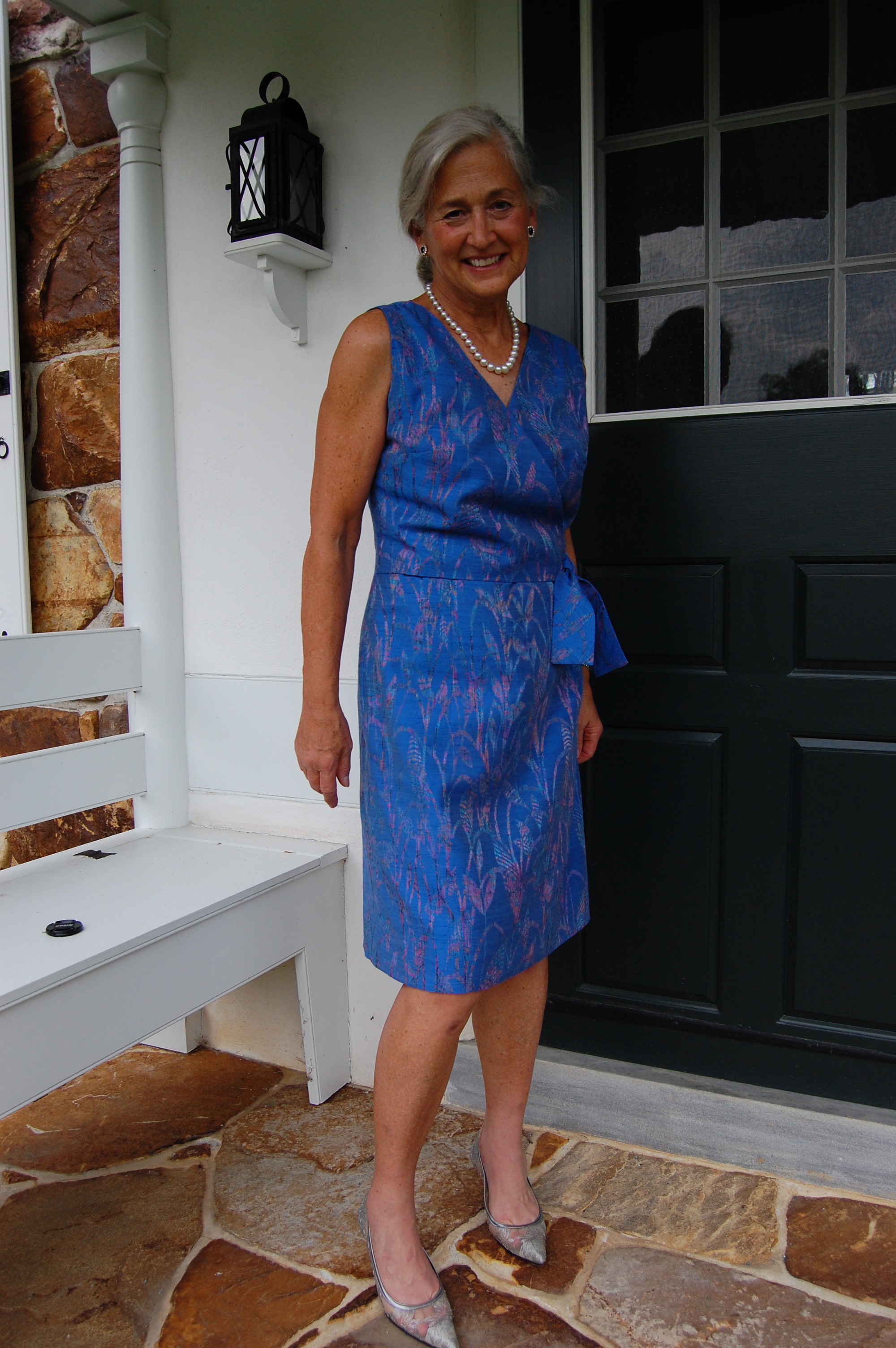
Fortunately, I have not only a wedding to attend, but also, the following weekend, another elegant evening of “cocktails, dinner and dancing,” so it just seemed appropriate – necessary even! – to make a dress/ensemble that could suffice for both. Well, the dress is done, but not the jacket.
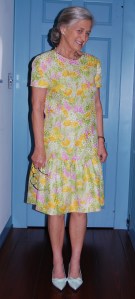
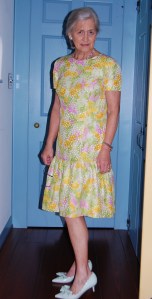
Front . . .
Front . . .

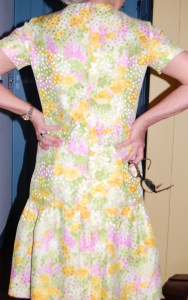
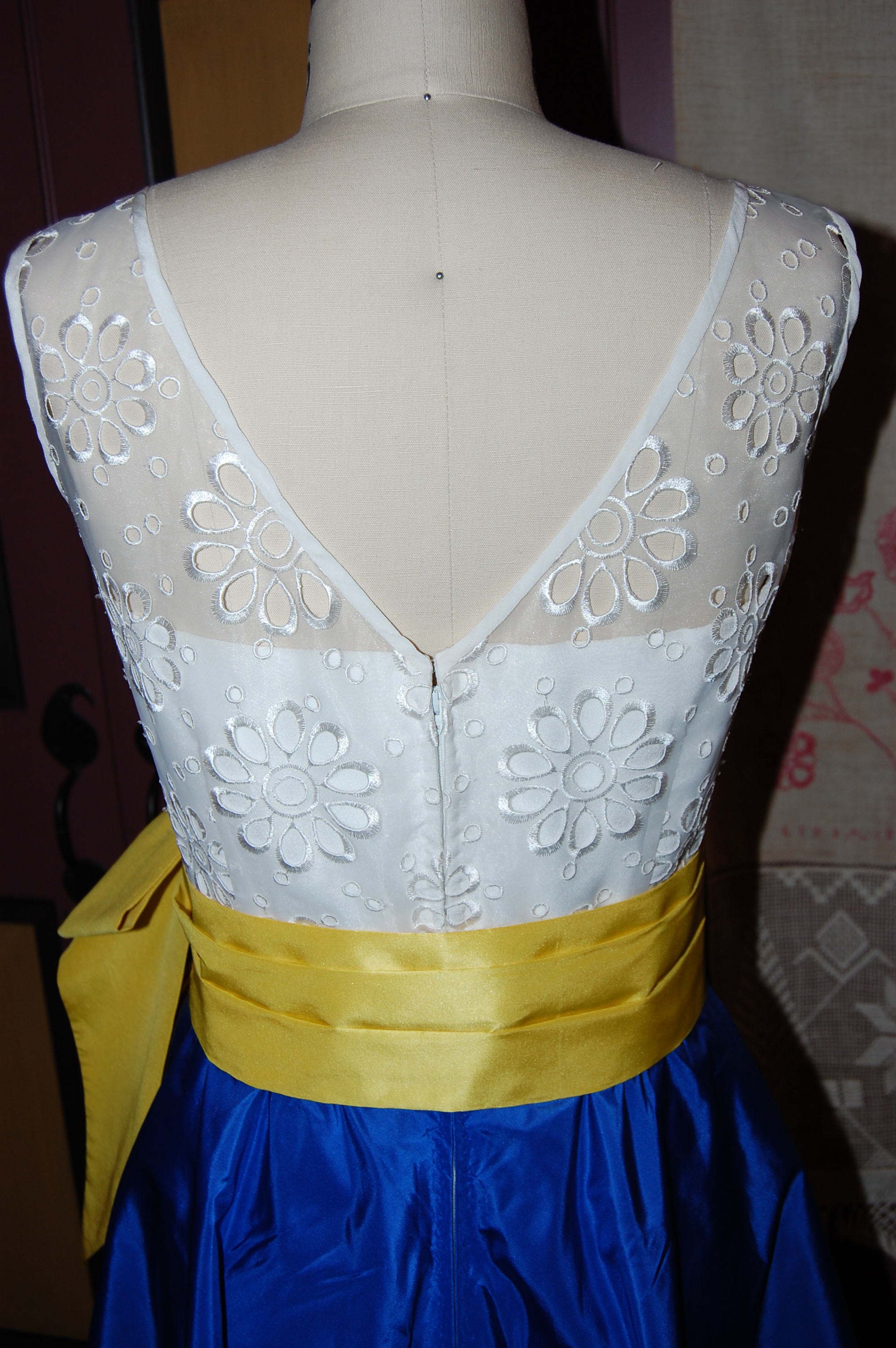
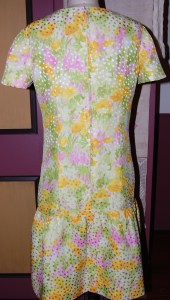
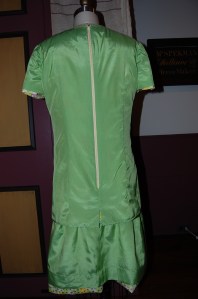
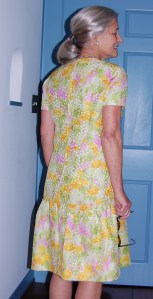
. . . and back

. . . and back

Wedding Ready

This is, of course, the pattern I had to alter in order to fit it onto my available fabric.

Oh the things we can learn, no 10

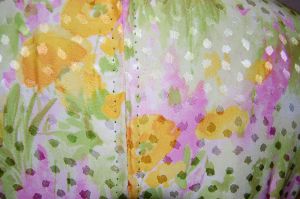
I made a couple more small changes to the dress. I broadened and lowered the neckline by a small amount, to make it more pleasing on me. I eliminated the neck facing and used the couture method of finishing that edge, with the dress lining brought up to the edge, fell-stitched in place, and secured with small back stitches. I also decided to make the center back zipper a focus when I found a vintage spool of green silk buttonhole twist in my collection. Using an idea I had seen one of my readers do (thank you, Cissie!), I pick-stitched the zipper with the twist, leaving a little trail of bright green dots along the center back.
In the Department of “Nothing is Easy,” I ran into a problem with the fullness of the “half-skirt” on the front of the dress. You may recall from my last post, that I doubled one of the back skirt sections to use for the front skirt (replacing the diagonally shaped flounces as shown on the pattern which required more fabric than I had.) When I made my muslin (toile), I did not realize that the front skirt was fuller than the two back skirt sections. I had all three sections of the fashion fabric sewn together, with the seams all catch-stitched, and the lining attached too (in order to treat both pieces as one in the ruffling process.)  I was half way through basting the skirt onto the body of the dress when I realized there was too much fullness in the front. I had to take it all apart, and figure out where I had made the mistake. It turned out that the front section of the dress was narrower than the two back sections sewn together. So I had to do some calculations, coming up with the fact that I had to take 4.5” off the width of the front skirt. That took a whole afternoon of sewing to take care of that adjustment!
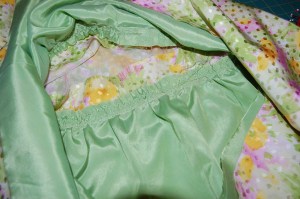
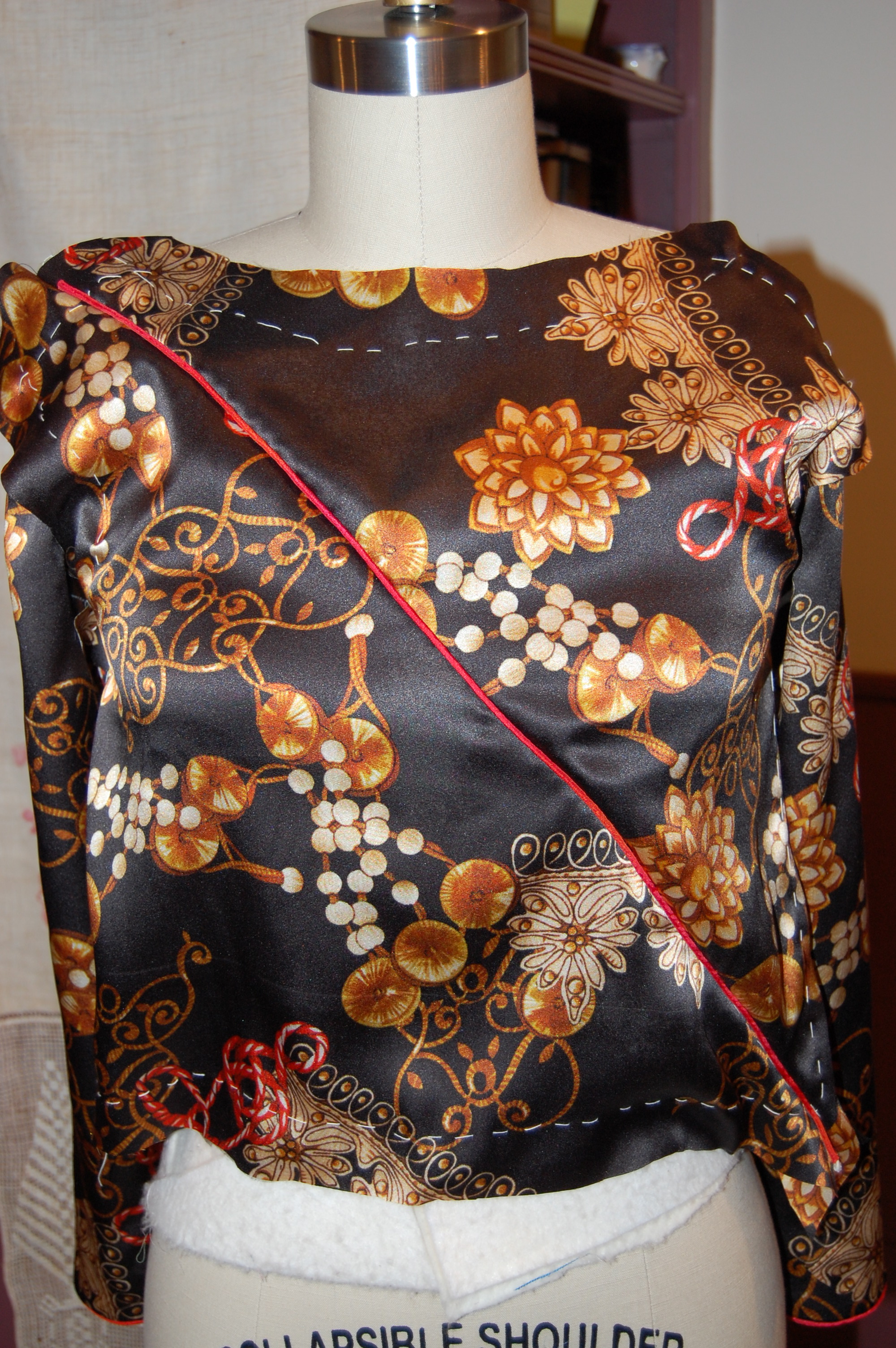
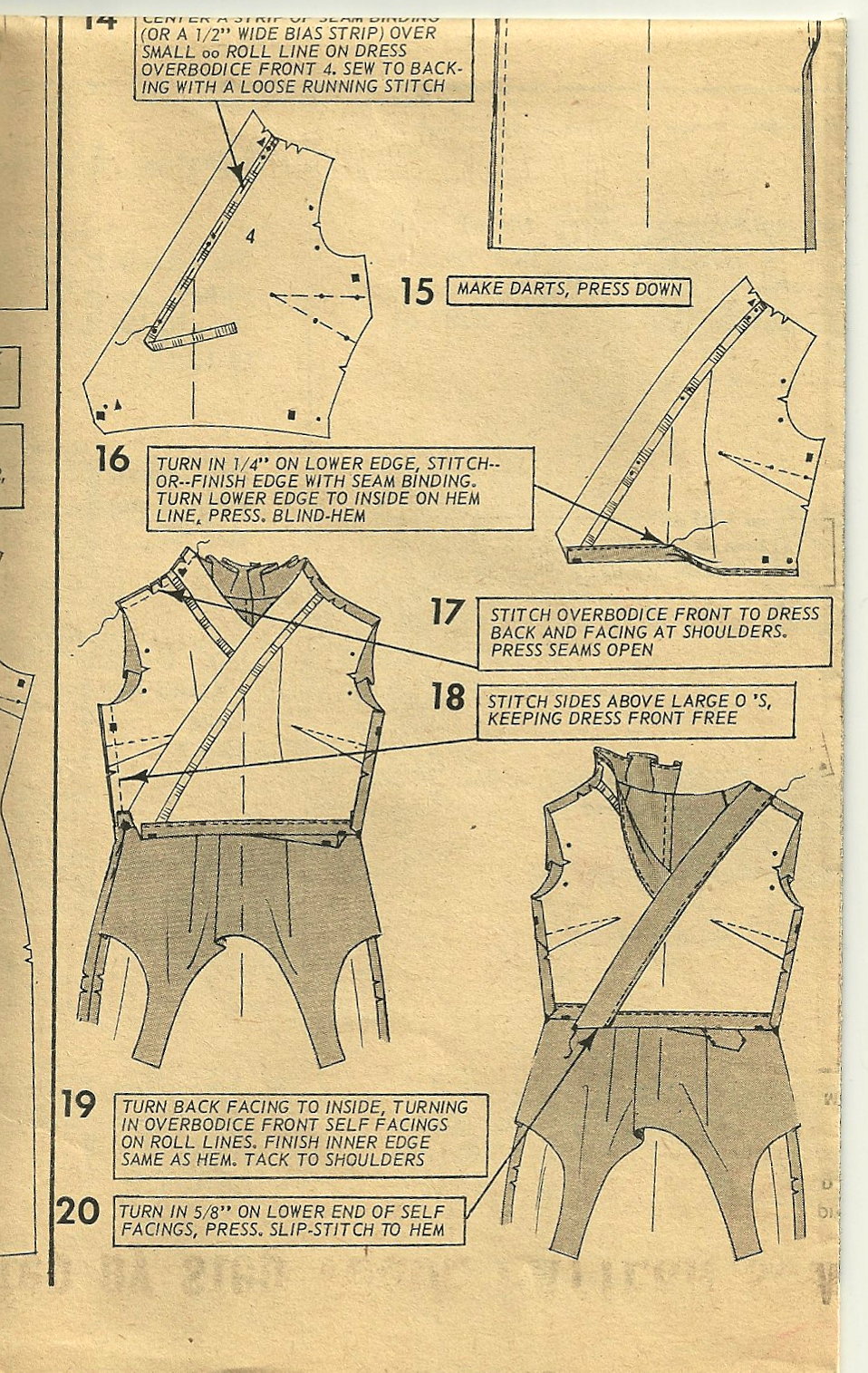
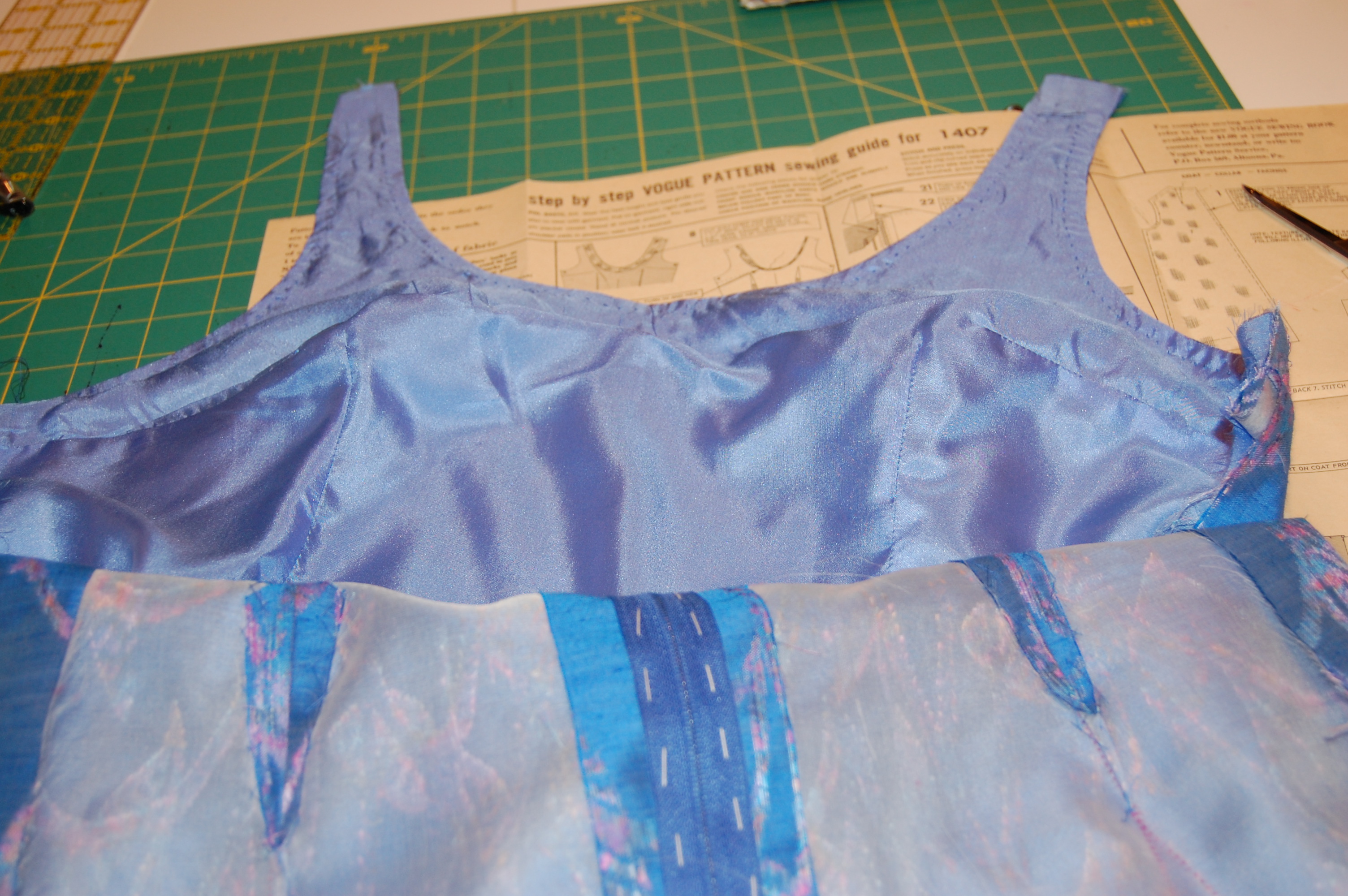
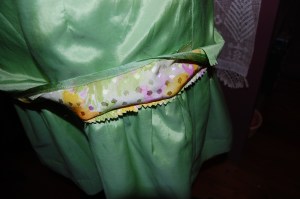
The skirt was attached to the bodice in an rather unusual way as you can see in this photo and the instruction sheet below.
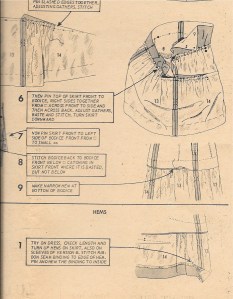
The skirt was attached to the bodice in an rather unusual way as you can see in this photo and the instruction sheet below.

Wedding ready - instruction sheet

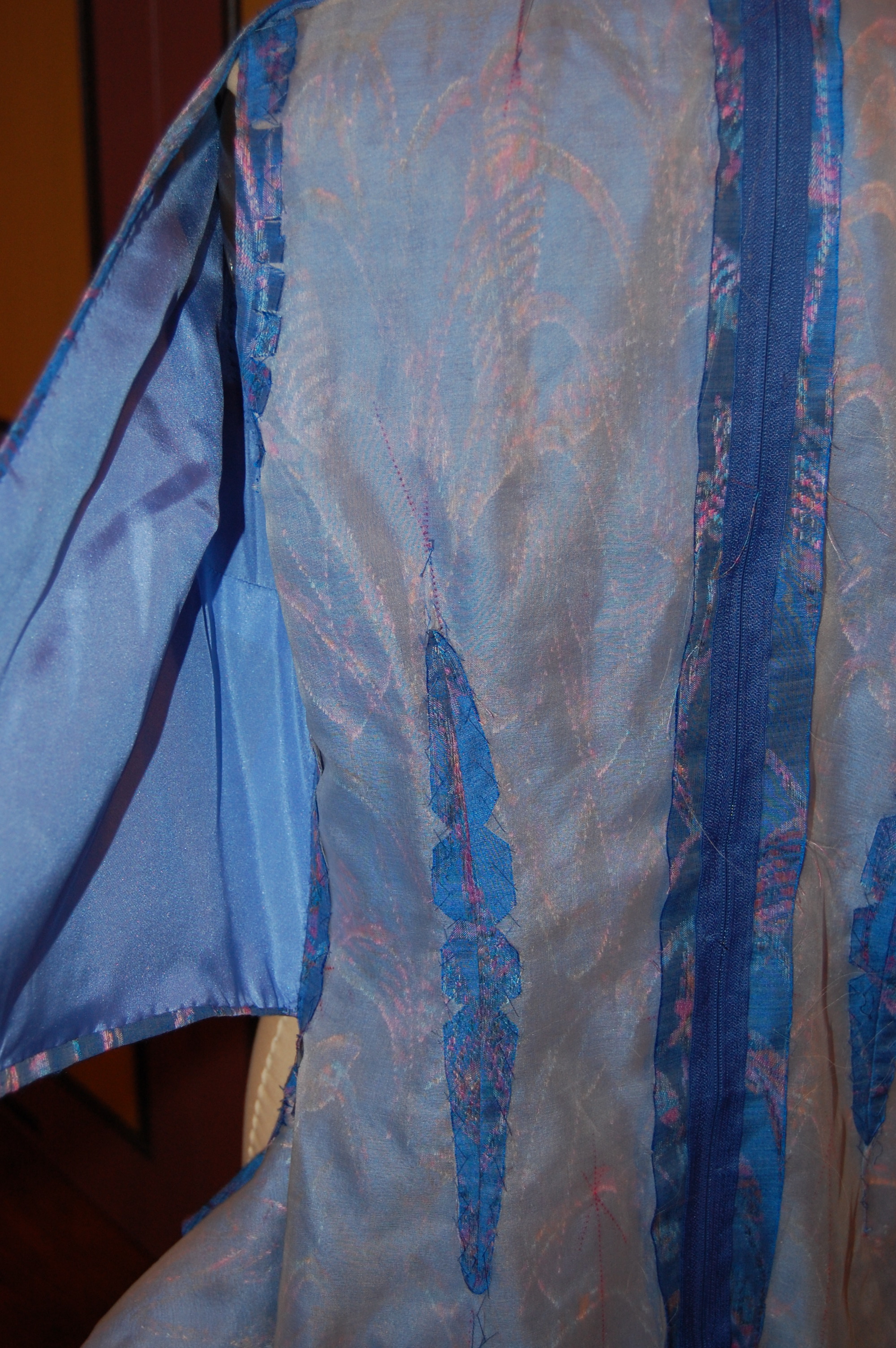
I also had to figure out how to line the top part of the dress. I finally decided to leave the top part of the lining hanging loose inside the dress – and it actually works beautifully!
Wedding ready

The skirt lining is not attached to the bodice lining at all.

The skirt lining is not attached to the bodice lining at all.

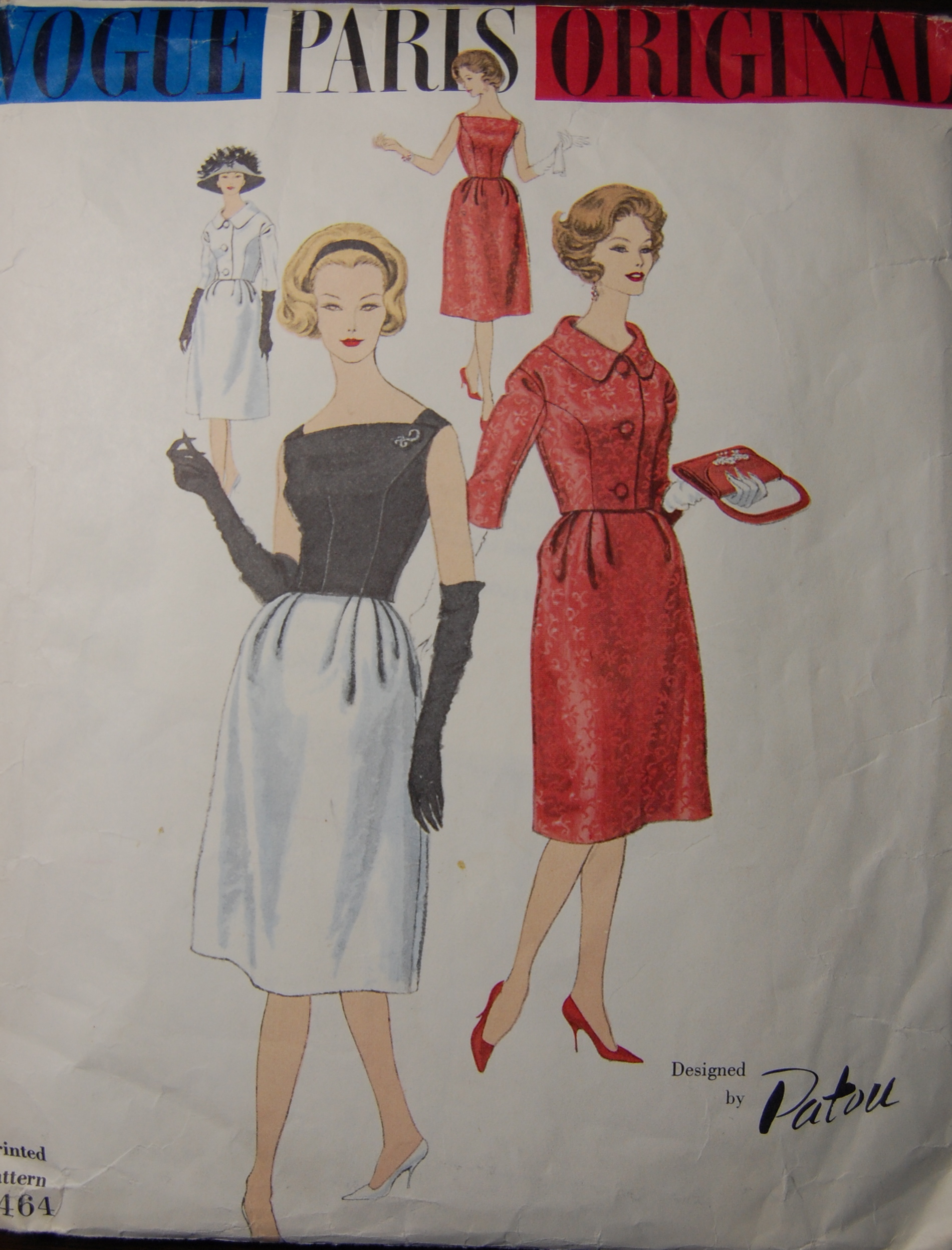
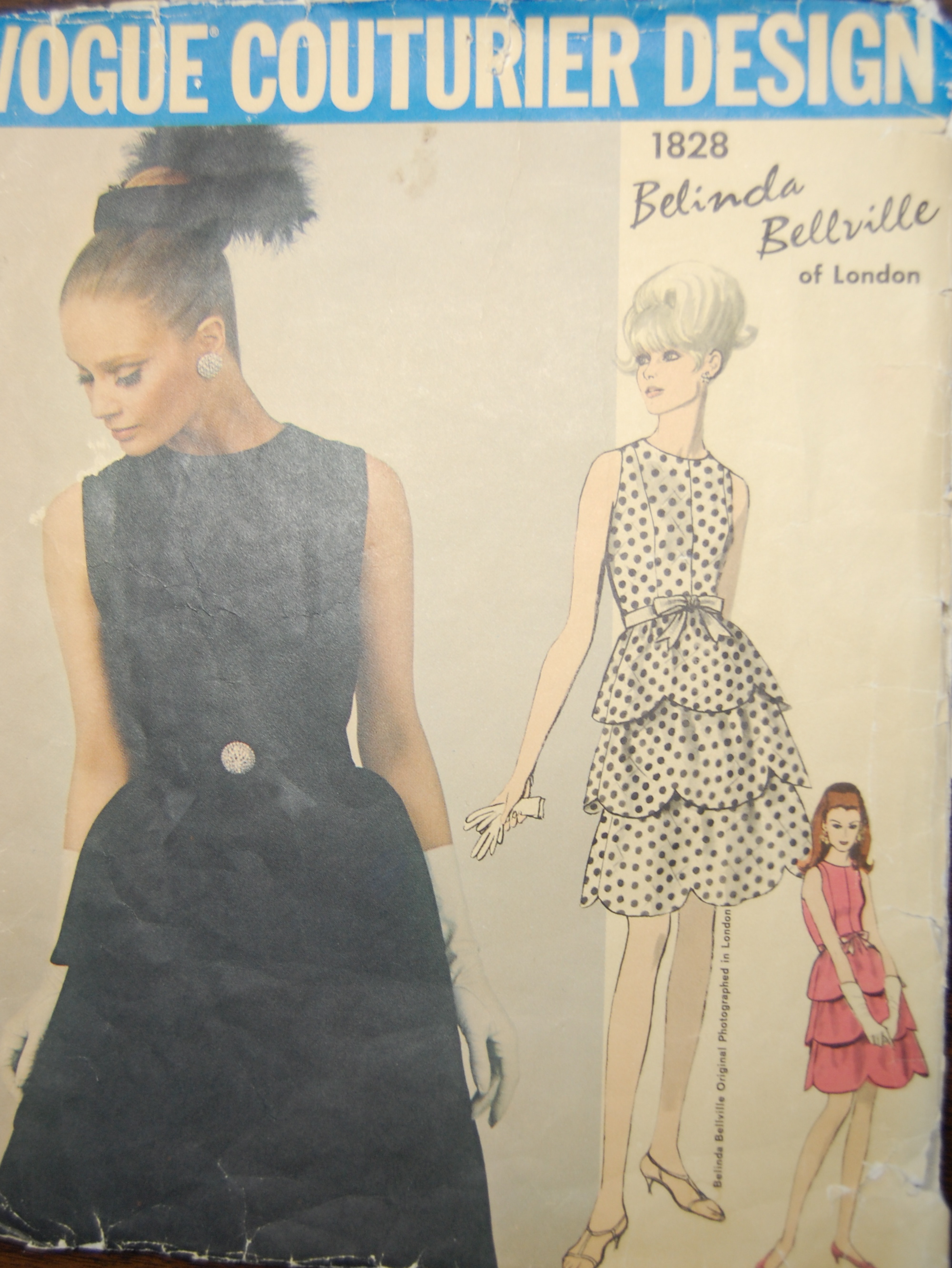
Two small interesting design notes on this pattern are worth noting. First, if you look at the pattern envelope, you see small neckline darts on the back of the dress.
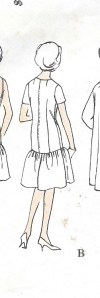
Wedding ready - pattern thumbnailWhen I studied the pattern, those darts were not there! Either the artist made a mistake, or the darts were eliminated when the pattern was drafted.

Another interesting design aspect is the center back seam in the skirt. Usually center back seams are there because there is an opening that the seam needs to accommodate. That is not the case in this dress, as the zipper does not extend into the skirt. However, even though it is very subtle, it just looks better to have a seam in the skirt that matches up with the center back seam of the bodice section.
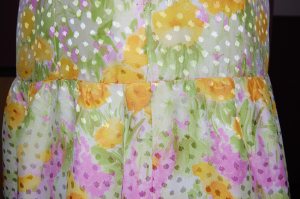
That center back seam which is picked up in the skirt.
That center back seam which is picked up in the skirt.

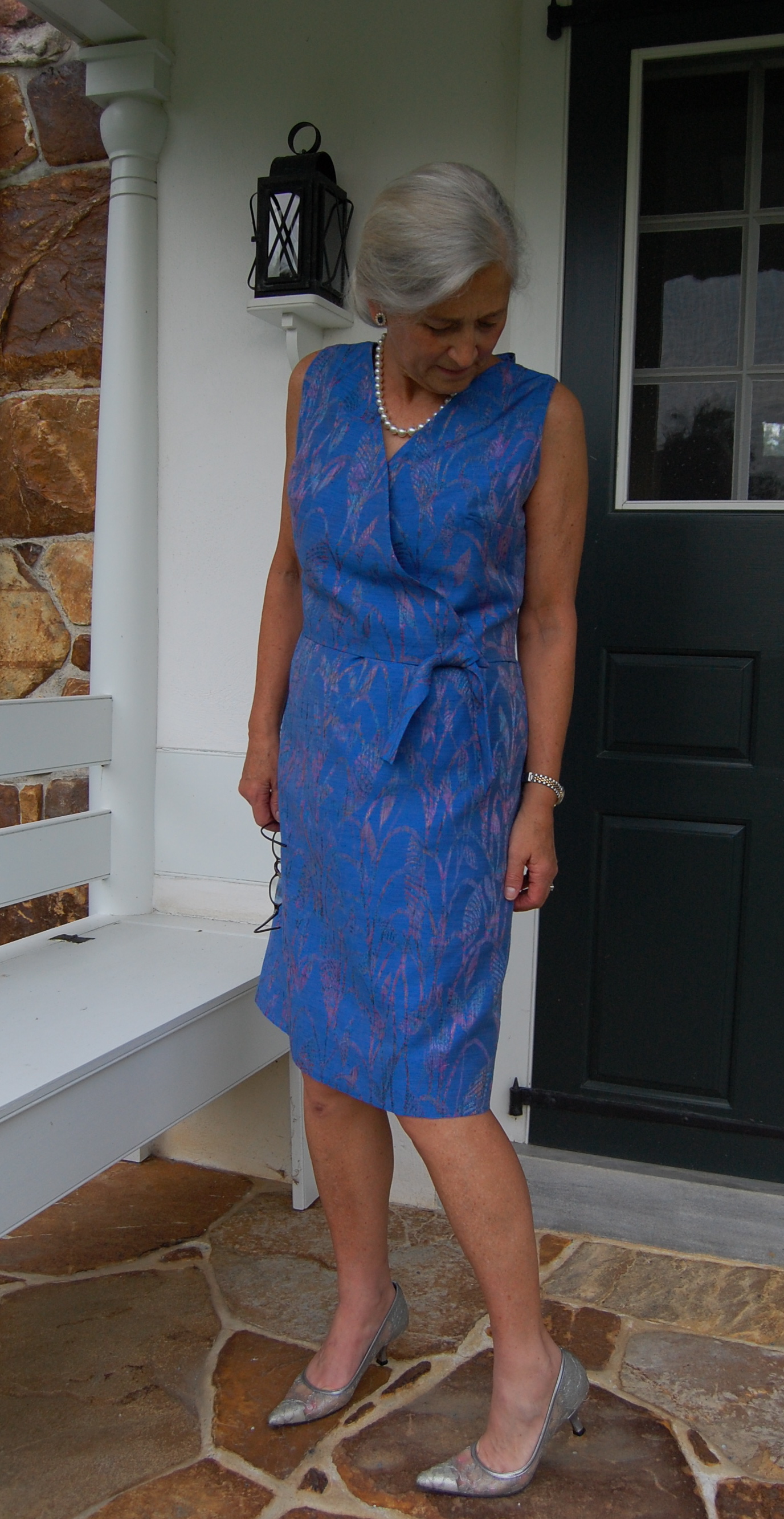
It has been rainy and cold all week so no photos outside. I need a dress like this to remind me that it is actually May.
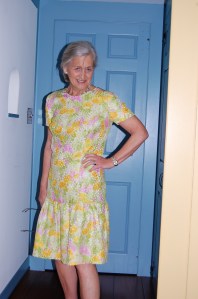
It has been rainy and cold all week so no photos outside. I need a dress like this to remind me that it is actually May.
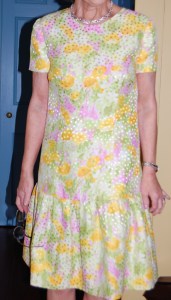
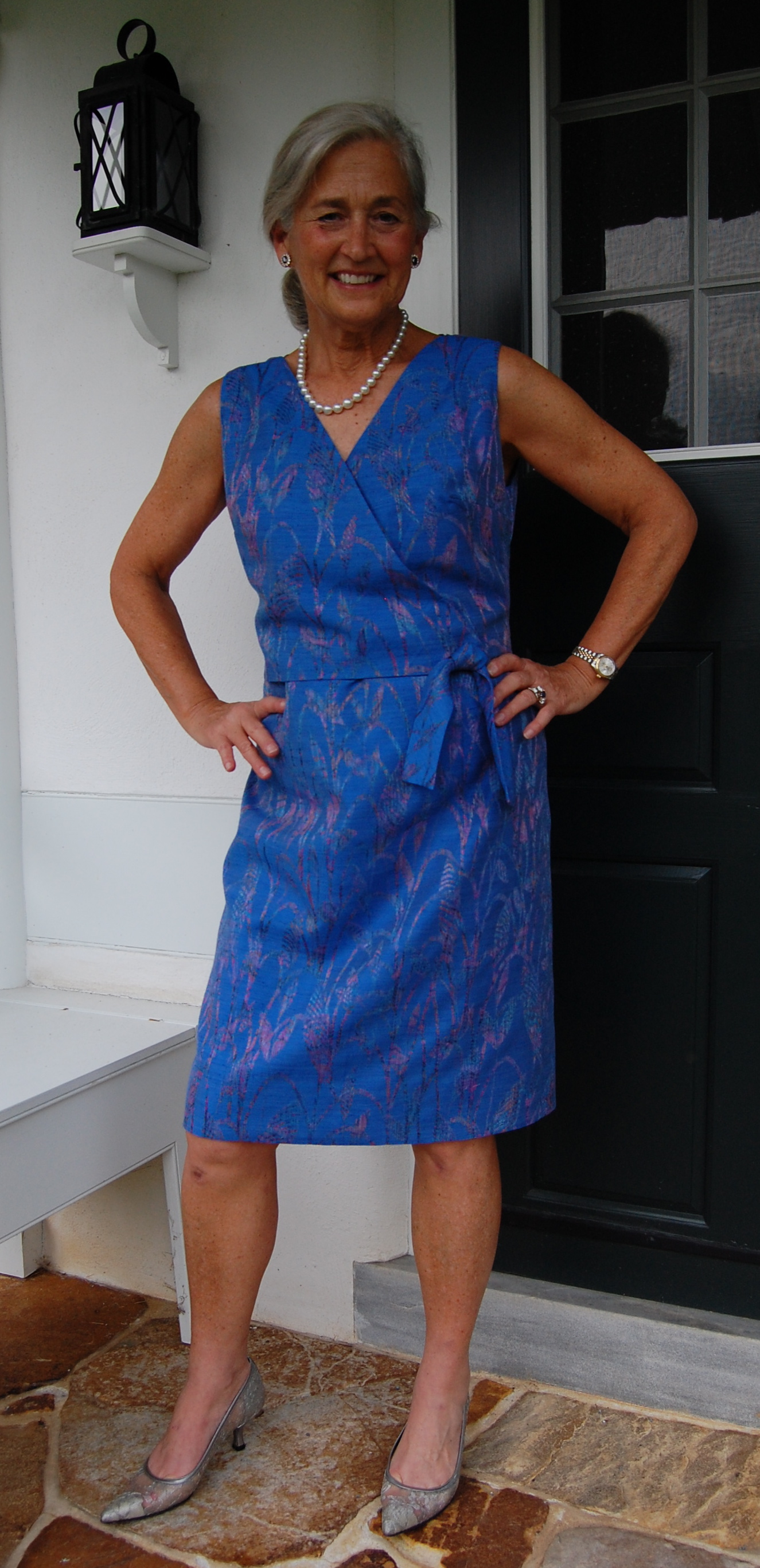
Wedding Ready

Wedding Ready

Wedding Ready

Another back view

Another back view

Wedding Ready

I have decided I am “wedding ready” even without the jacket. However, if I get the jacket finished, I’ll be very happy!
27 Comments

Filed under Cocktail dresses, couture construction, Formal or fancy dresses, Mid-Century style, sewing in silk, Uncategorized, vintage Vogue Designer patterns, vintage Vogue patterns from the 1960s

Out and About in Los Angeles

One sure way to get me away from my sewing room is TRAVEL. Sometimes, however, there is a lot of sewing that happens before that travel commences. The impetus to the creation of my recent fancy dress was, indeed, a recent trip to Los Angeles, California, which was part business for my husband and pure pleasure for me. The lovely hotel where we were staying was actually in Beverly Hills, at the intersection of Wilshire Boulevard and Rodeo Drive. For those of you unfamiliar with Rodeo Drive, it is one of the most exclusive shopping areas for fashion and jewelry in the US. Although I am not much of a shopper at home – either window shopping or real shopping – it is quite a pleasure to do just that while on vacation.

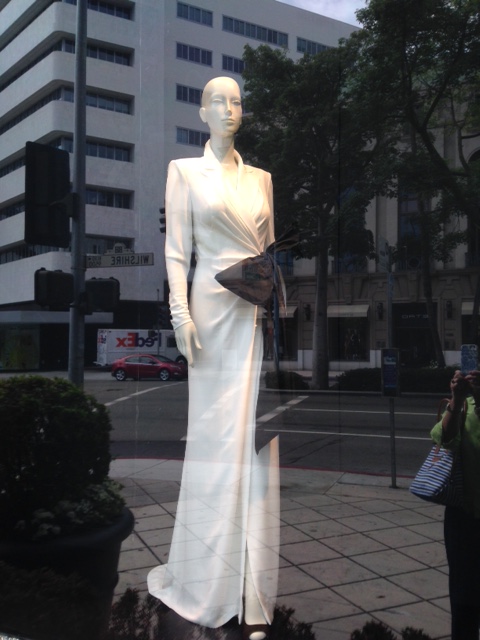
Because I sew, I probably look at fashions with quite a different eye than most people.   My interest in the current influence of mid-century fashion and the use of beautiful, fine fabrics guided my approach, as both were on full view on Rodeo Drive. The first morning while my husband was in business meetings, I went out before most stores were open and snapped a few pictures of store windows. I was delighted to see this tailored Escada gown transformed into a totally feminine look with its voluminous bow:

Escada gown

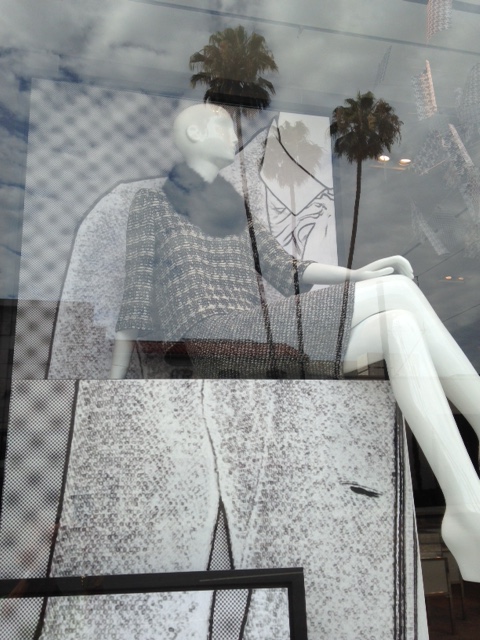
The St. John Store featured this straight skirt and overblouse (with demure fur collar), with a flavor reminiscent of the 1960s:

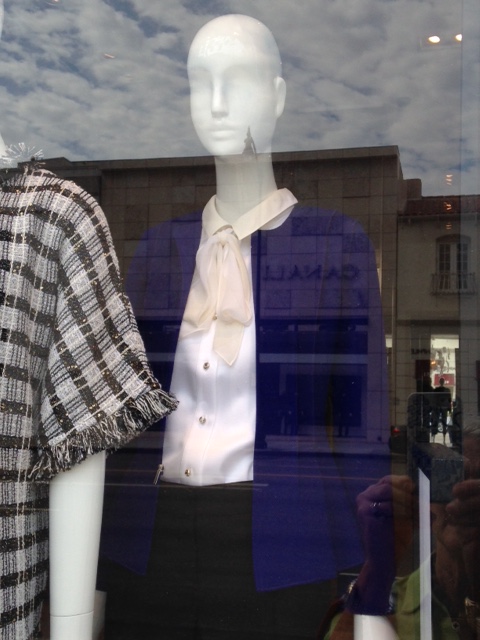
The reflection of palm trees in the window obscures some of the fashions.

The reflection of palm trees in the window obscures some of the fashions, but I love this understated, but sophisticated look.

And what could be more classic than this jacket and blouse with a bow, also St. John.

St John jacket and blouse

How I loved this Little Black Dress by St. John, made with lace-embellished fabric:

A front view ...

A front view …

... and a back view.  The V-back is just lovely!
… and a back view. The V-back is just lovely!
Later in the day, I was captivated by some of the fashions I saw in some of the stores, especially Dolce and Gabbana and Hermes. Unfortunately photos were not allowed, so I cannot show you the classic princess lined coats and lace dresses in Dolce and Gabbana made from fabrics which were either identical to or close relatives to some pique and lace that Mendel Goldberg carries in their store in NYC. And Hermes had a color-blocked coat that looked right out of the early 1970s.

One excursion I wanted to make while we were in LA was to the museum of the Fashion Institute of Design and Marketing. I follow their blog, which regularly features items and fashion from their permanent collection, from all time periods. They have two small exhibit spaces which were currently featuring items from the Helen Larson Historic Fashion collection in one gallery and “Inspired Eye” in another gallery.

Inspired Eye is an exhibit of items from the Donald and Joan Damask Design Collection.  The exhibit  includes classic photographs as well as accessories and items of apparel.

Inspired Eye is an exhibit of items from the Donald and Joan Damask Design Collection. The exhibit includes classic photographs as well as accessories and items of apparel.

It was fun to see this Claire McCardell dress, circa 1950, looking every bit as fashionable now as then.

Claire McCardell dress

(Check out Julie’s recreation of a similar Claire McCardell dress on her blog, JetSetSewing)

Of course, for me, one thing I was looking forward to was the event to which I could wear my new fancy dress. As luck would have it, our camera was acting up for some unknown reason, so my husband had to resort to his iPhone for a couple of pictures of me wearing it.

LA fancy dress

One thing was certain – no one else at the party was wearing anything quite like it!

LA fancy dress

Our trip continued up to northern California, where we spent a few days with our son and his girlfriend, and which also included a trip to Britex Fabrics in San Francisco, where I picked up a few choice notions and buttons. Now we are home and a new project is strewn out in my sewing room, asking for attention before TRAVEL once again will wisk me away.

32 Comments

Filed under Cocktail dresses, Little Black Dress, Mid-Century style, Uncategorized

The Allure of Silk, Part 3: Finishing Touches for a Fancy Frock

In planning for my ‘50s-inspired silk party dress, my original intention was to use a red sash, just as shown on the original dress which I first saw on Pinterest.

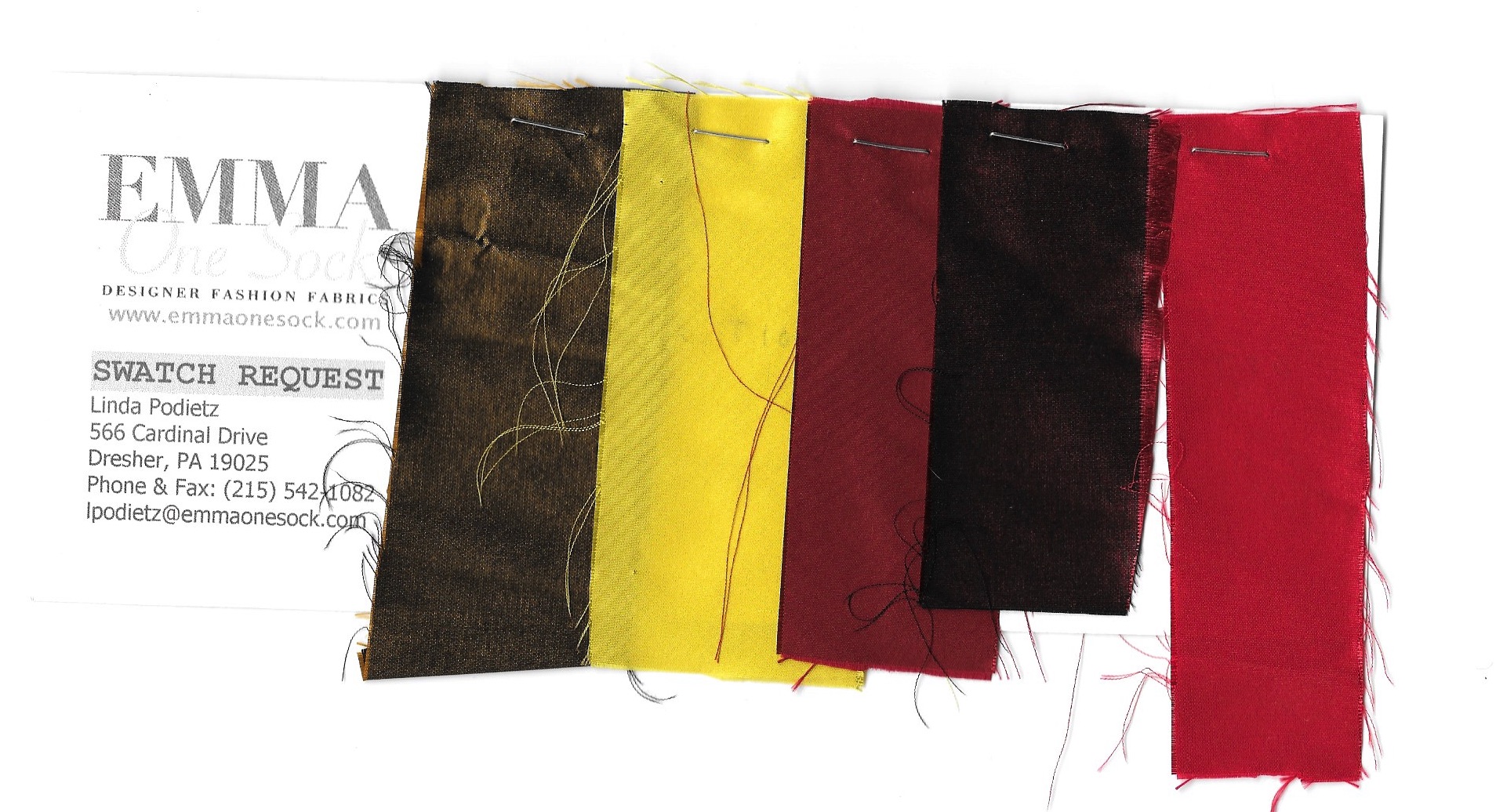
Blue taffeta:silk dress - originalWhen I sent off for swatches of silk taffeta from Emma One Sock Fabrics, however, I requested reds and yellows, just in case I might change my mind. When the swatch card arrived, there were clearly two obvious choices – the clear red and the vibrant yellow.Allure of silk - cummerbund picture

Then a funny thing happened. I ordered the red, which was out-of-stock temporarily. The owner of Emma One Sock (who, I might add, is one of the pleasantest and most helpful people from whom one will ever order fabric!), held up the order, at my request, while I thought about it some more. By the time I went to Baltimore to start my dress in Susan Khalje’s Couture Sewing School, I had just about decided to switch to yellow. With Susan’s hearty endorsement and the additional approval of my classmates, the decision was made: the sash would be yellow, not red.

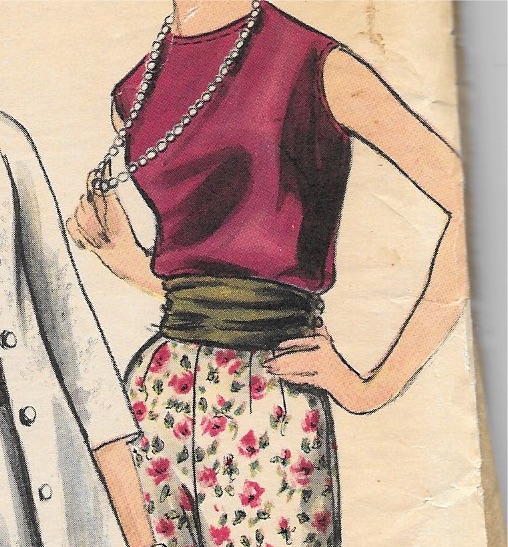
When the yellow silk taffeta arrived, I knew the decision was the right one. All I had to do then was figure out how to make the sash. Easy, right? With lots of time to think about this while I finished the embroidered organza top and the sapphire blue skirt – and the dress lining – I gradually came up with a plan. I decided a more structured cummerbund and bow would be the best look. First I went in search of a cummerbund pattern, which I found in an early 1960s pattern in my collection:

Allure of silk - cummerbund picture-1

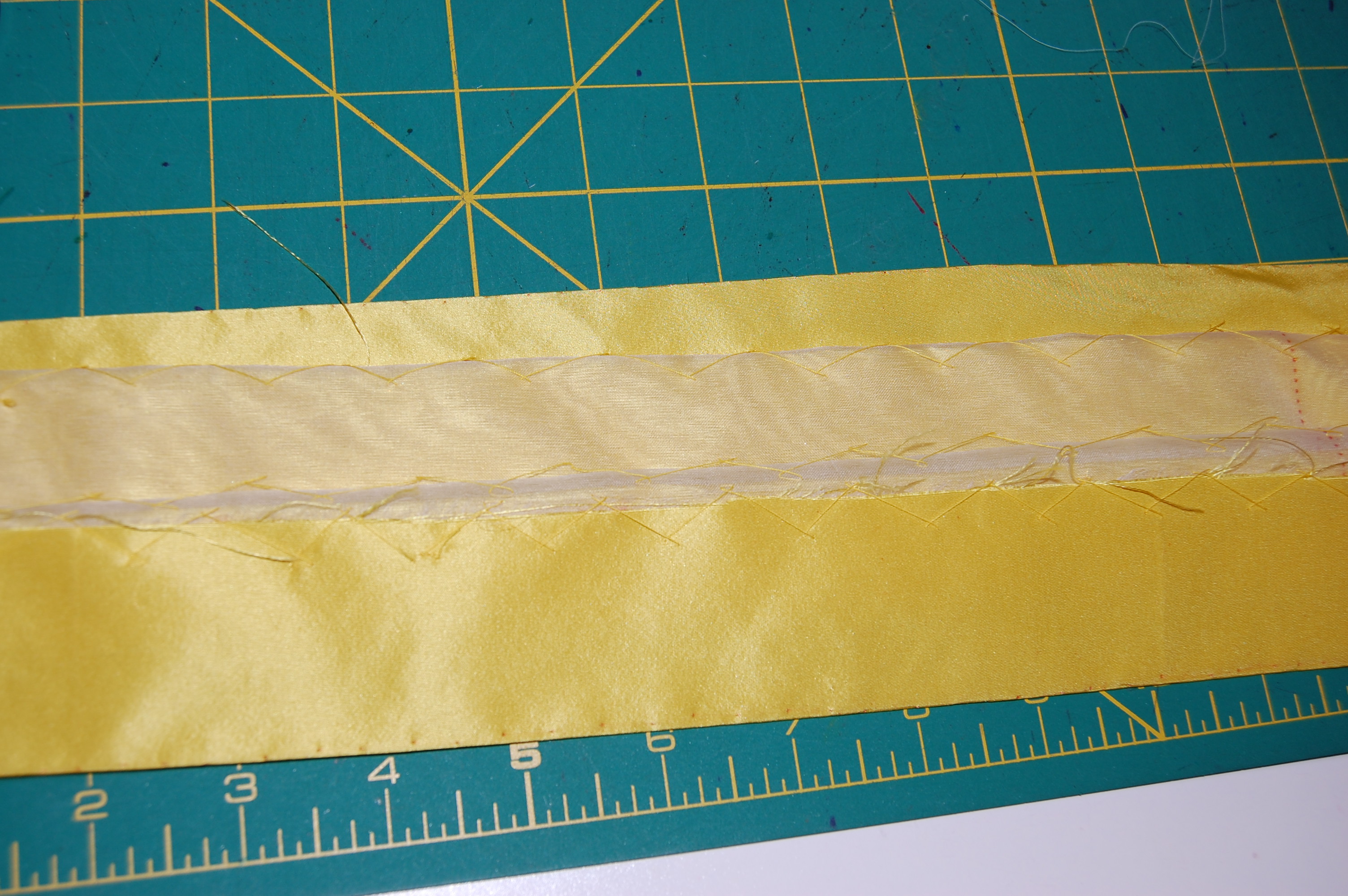
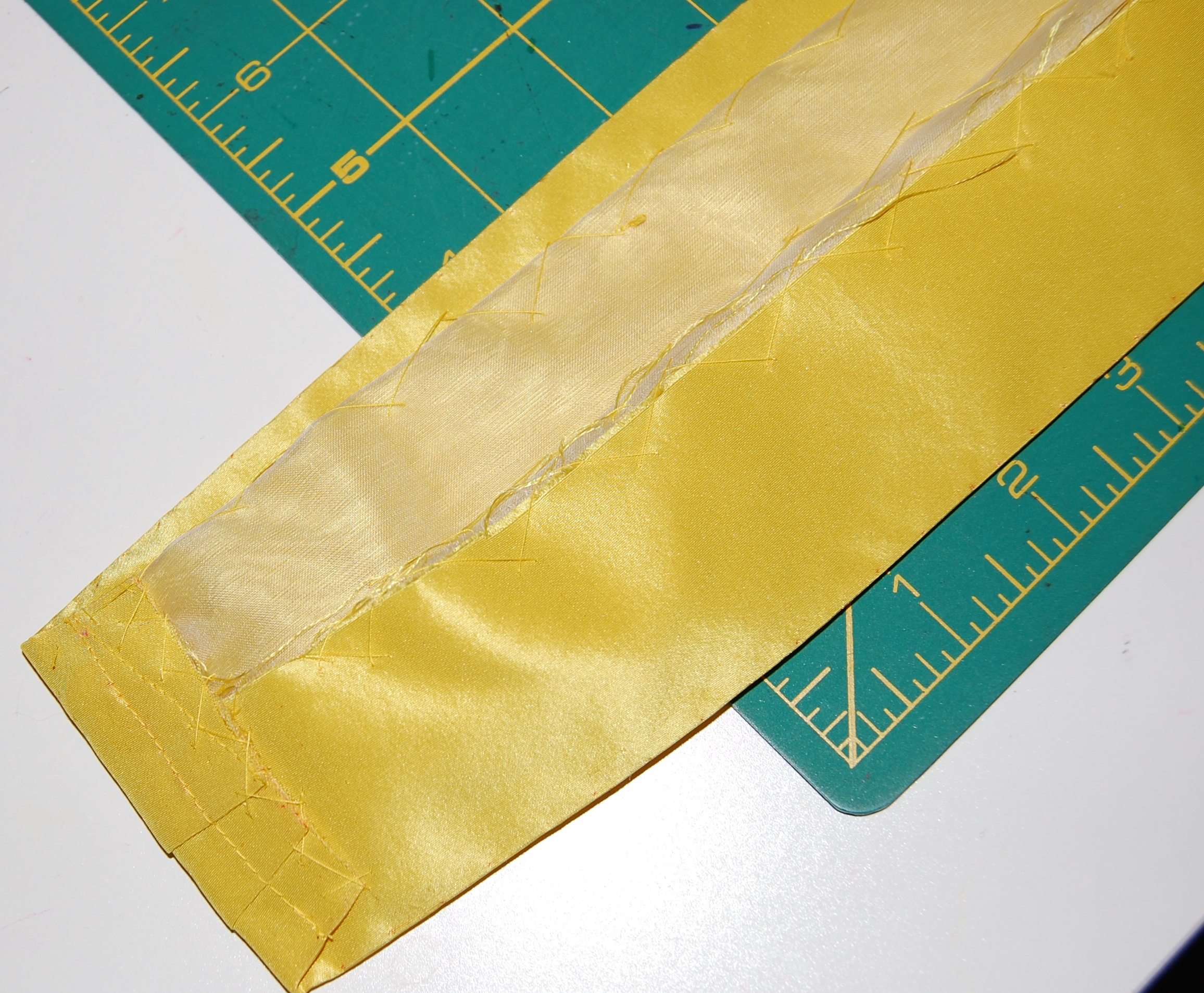
I decided to loosely pleat it instead of gathering it, so it would appear smoother around my waist. Because I had underlined it with silk organza, I had an anchor upon which to secure the soft pleats:

I used a loose catch-stitch to secure the pleats.

I used a loose catch-stitch to secure the pleats.

allure of silk final

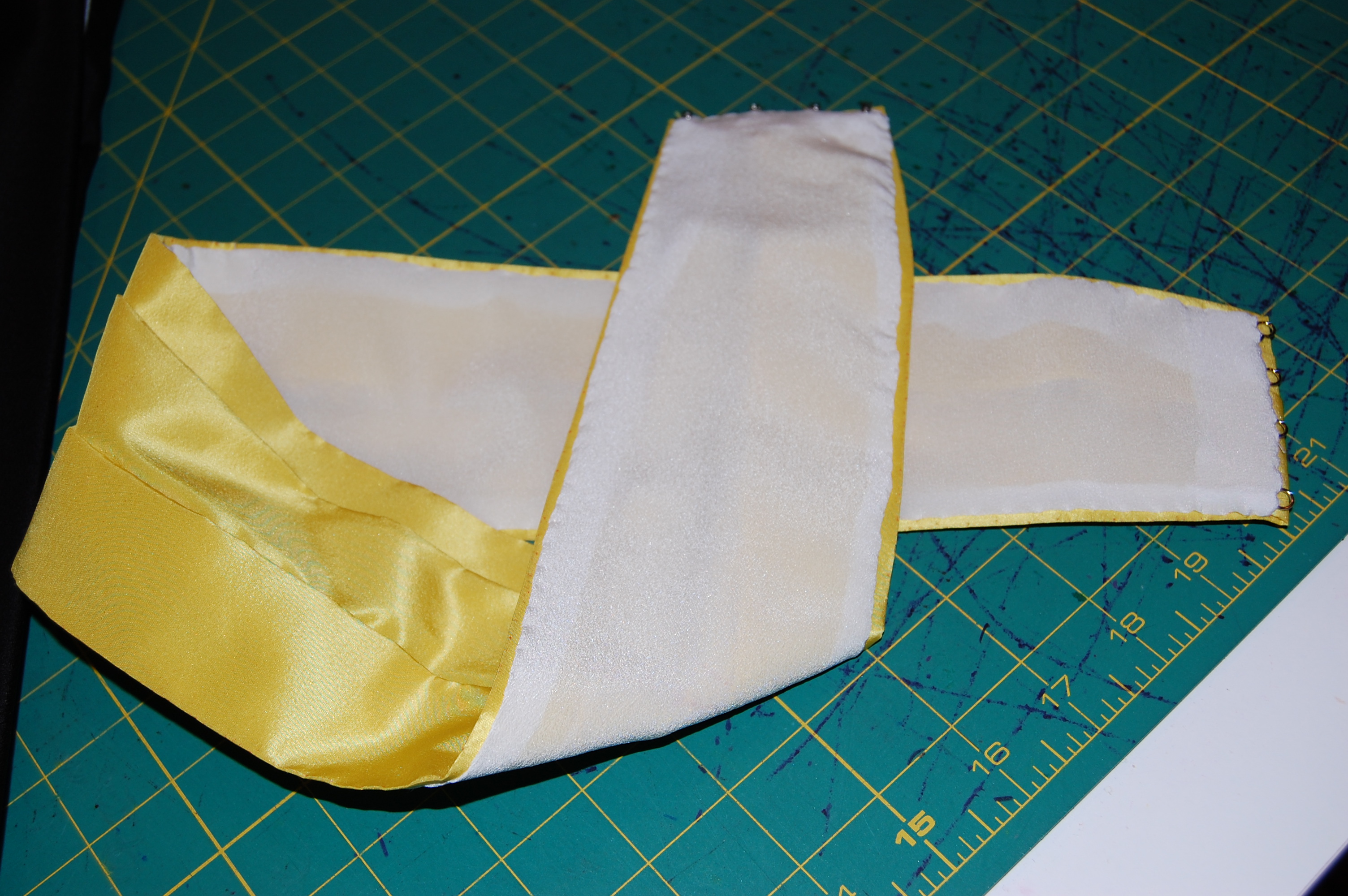
And I folded in the two ends, ready for hooks and eyes.

Then I lined it with silk crepe de chine.

Allure of silk final

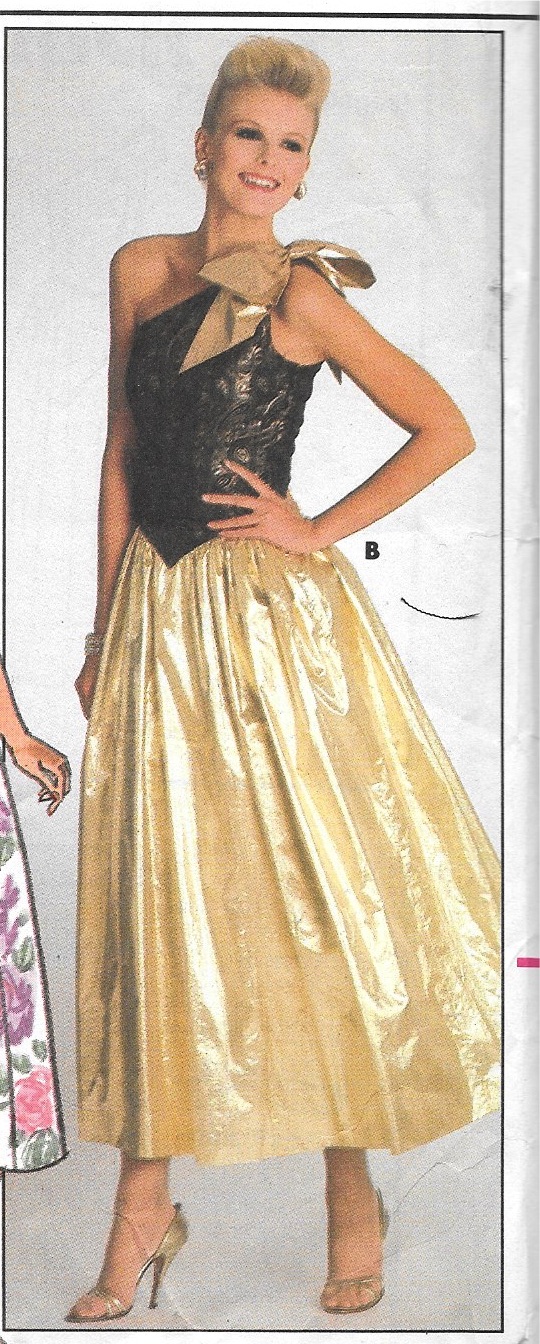
Now –  I really love a beautiful bow. And I knew just where to go to get the perfect bow pattern. I made this Butterick pattern in the early 1990s, and while I still like the dress I made (I’ll feature it sometime… it’s still in my closet!), I love the bow. I have used this bow pattern numerous times, always successfully.

Allure of silk - bow picture-2

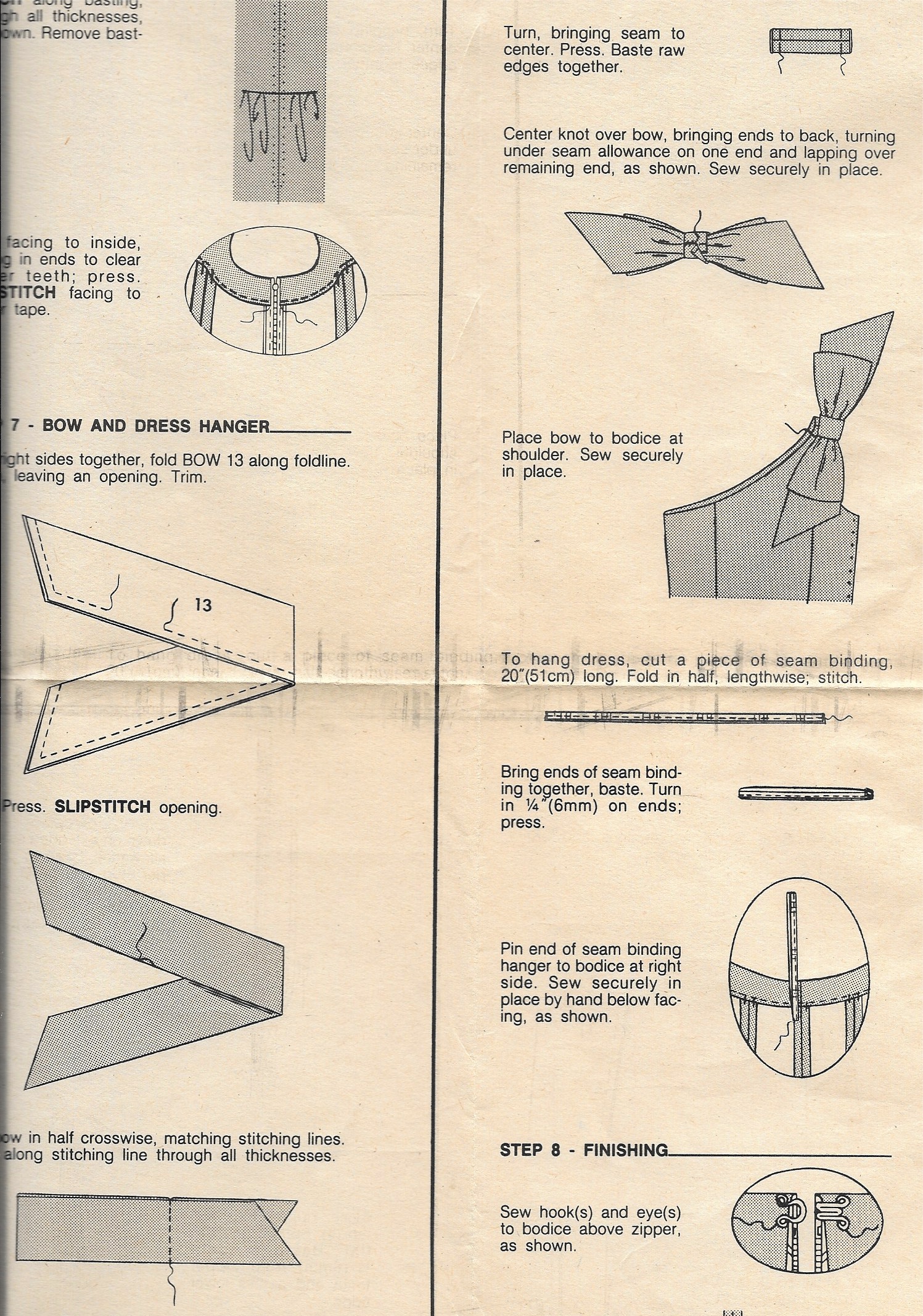
Here is a close-up of the instruction sheet, showing the simple but effective construction of this bow.

Allure of silk - bow diagram-3

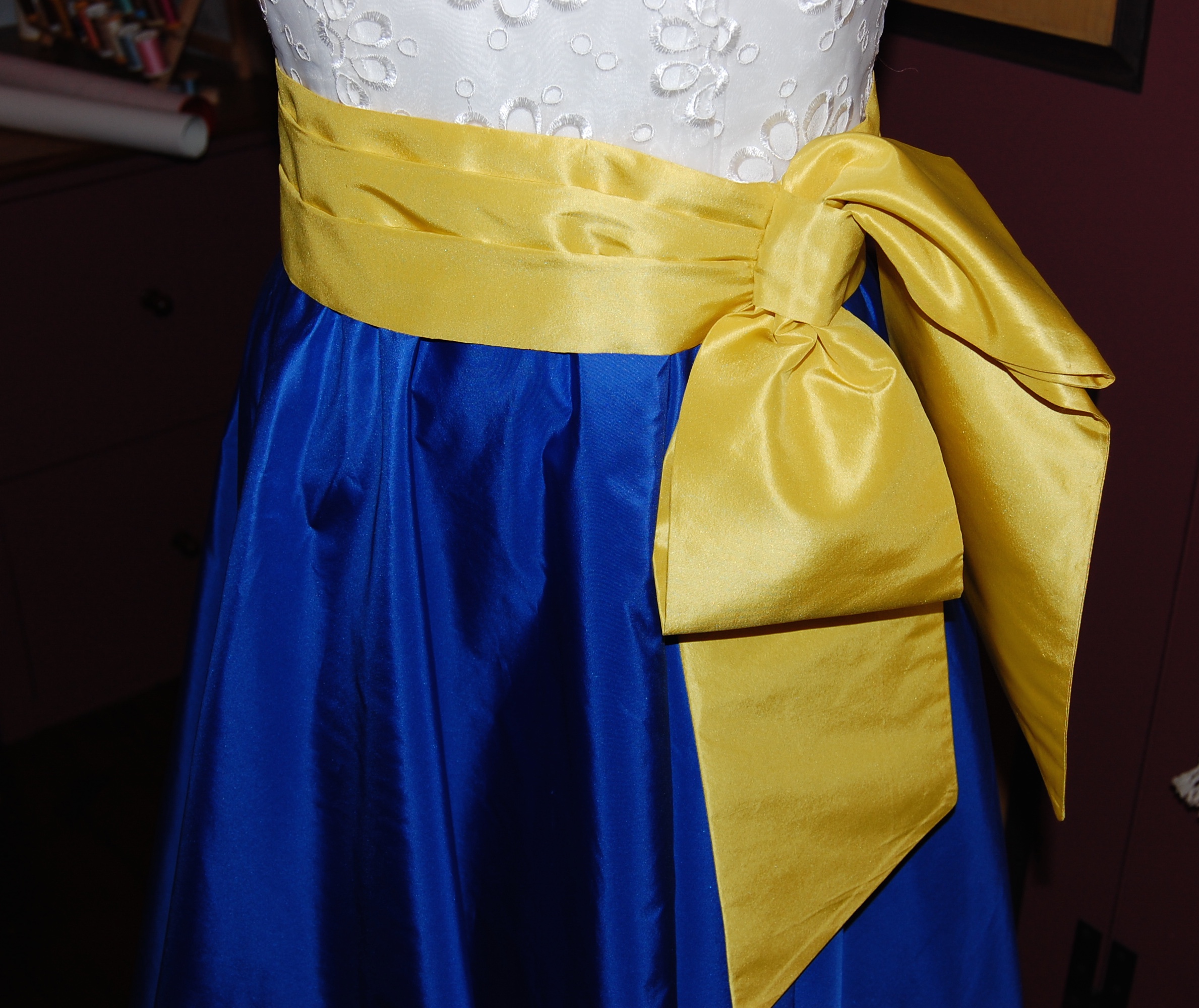
I increased the width and length a bit, as I knew it would need to be a focal point of the dress. I attached the bow to one end of the cummerbund, and used a snap to secure it in place on the other end.

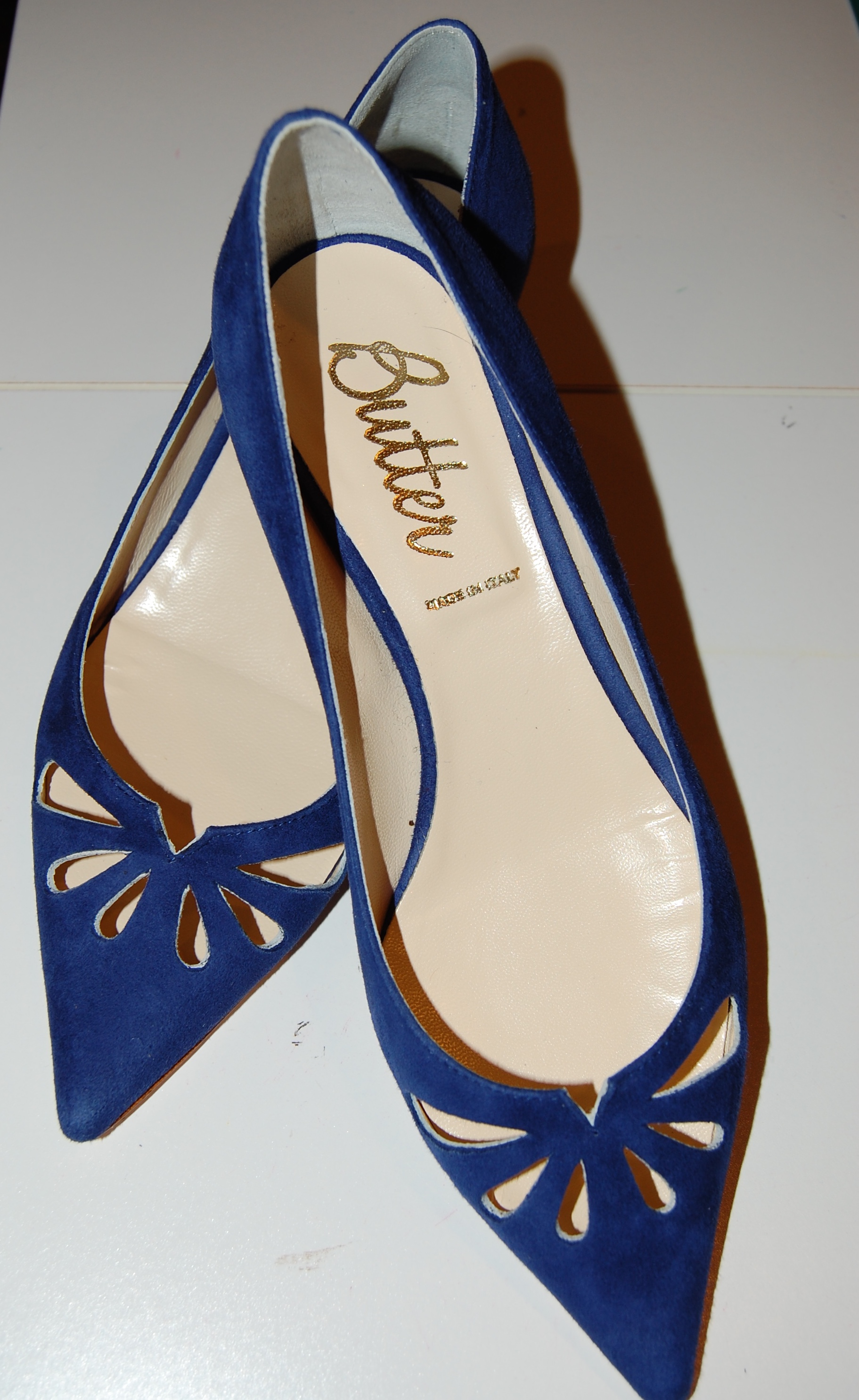
All of this took more time than I could have ever imagined! The event for which I made this dress is next week, and I’ll get proper pbotos taken then. But here is a sneak peek, first of the shoes I found which really seem to be the perfect pairing for this dress:

allure of silk final

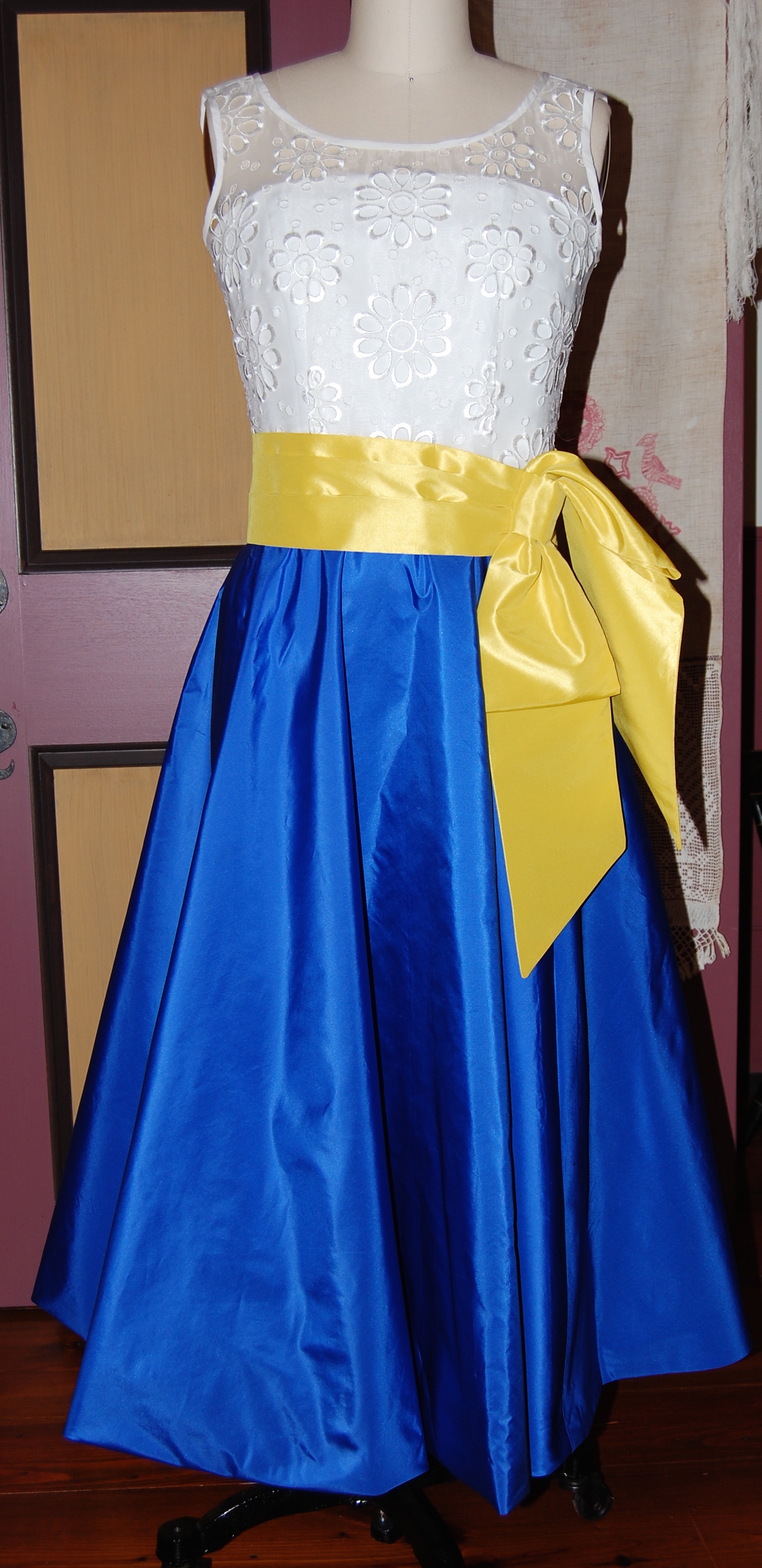
And here is the dress on my dress form:

Allure of silk final

Allure of silk final

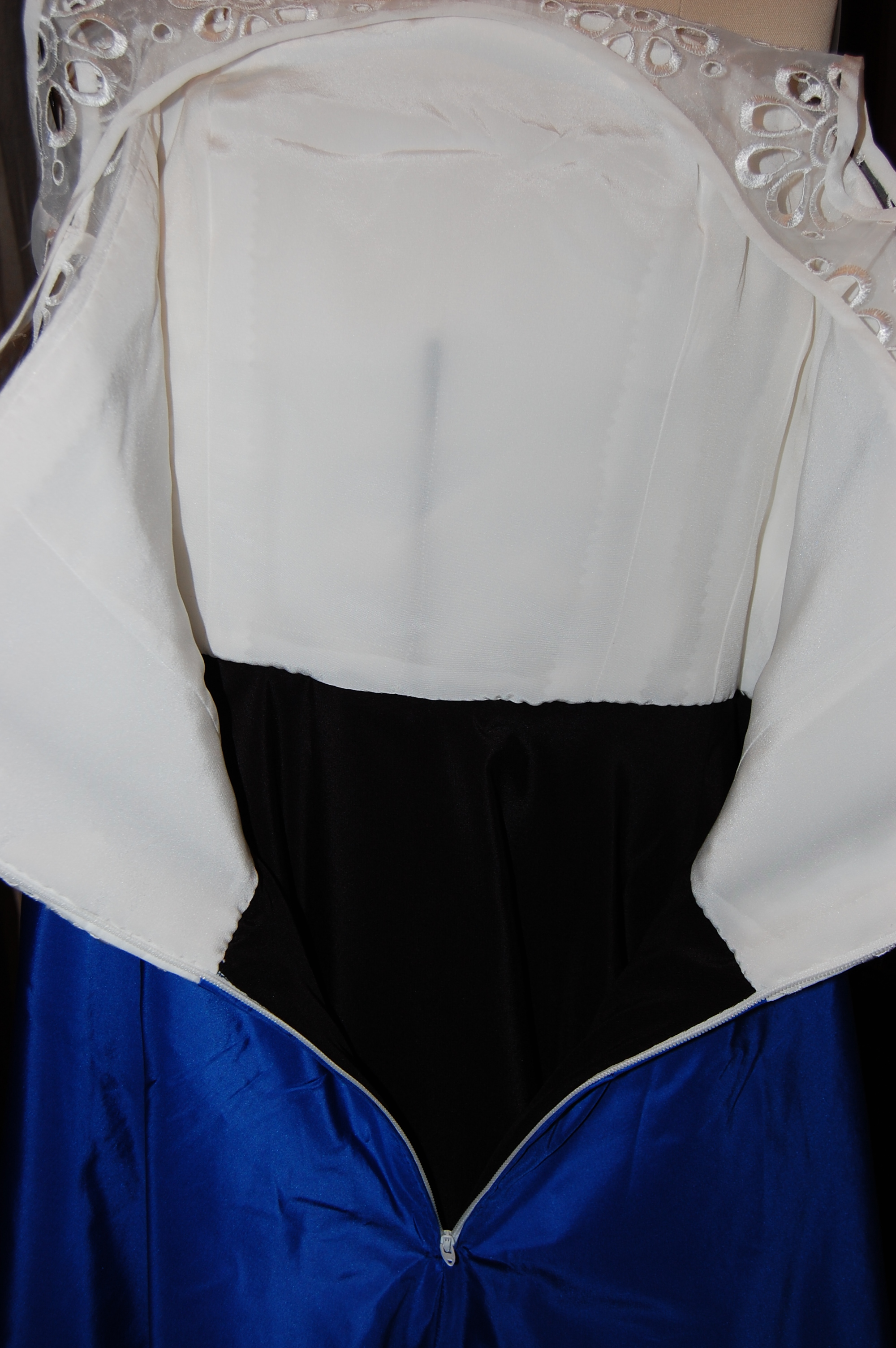
I thought I'd include this photo of the dress lining for anyone interested in seeing it.

I thought I’d include this photo of the dress lining for anyone interested in seeing it.

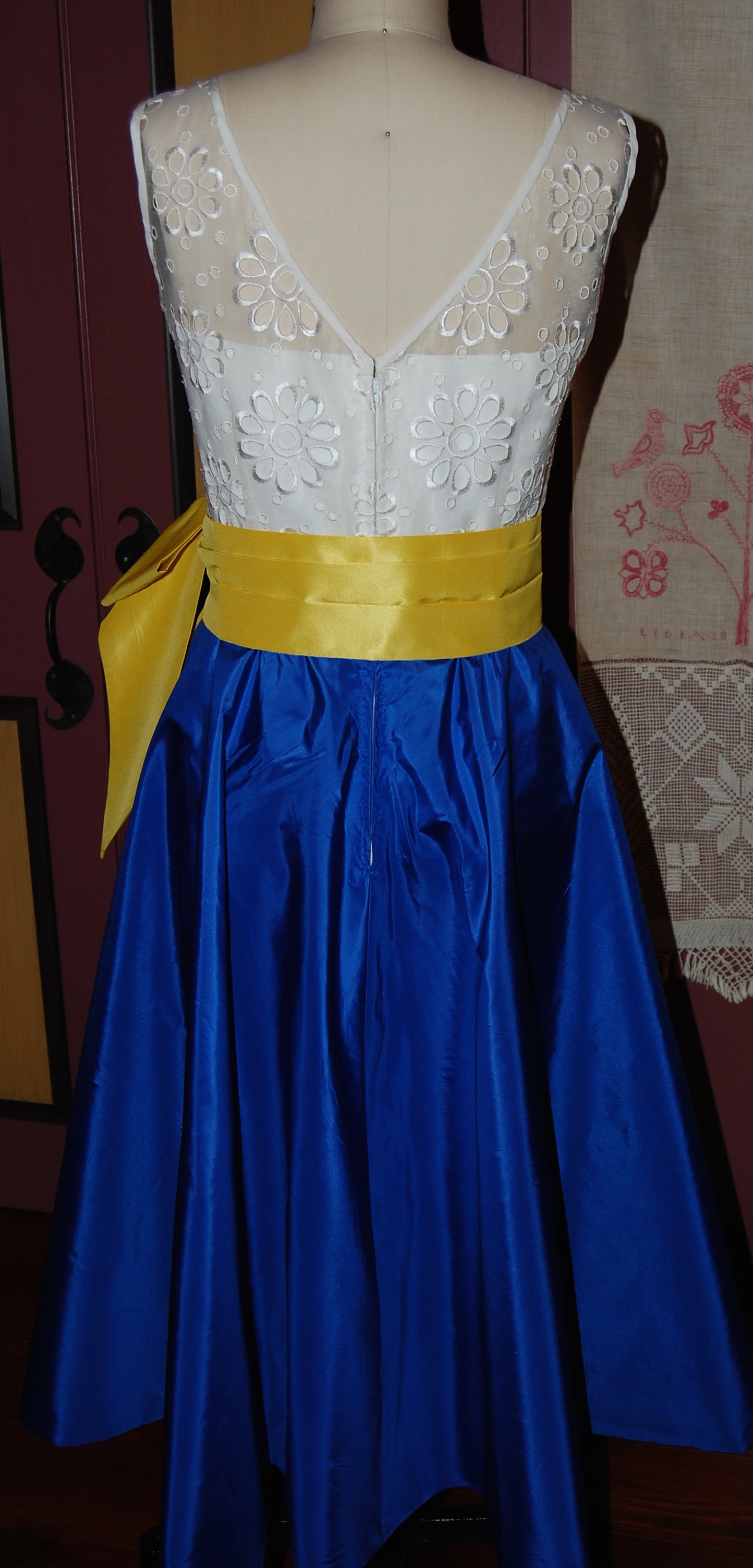
I am very pleased that I decided to "V" the back of the outer bodice!

I am very pleased that I decided to “V” the back of the outer bodice!

A close-up of the bow.

A close-up of the bow.

One of my favorite fashion quotes is one from Madeleine Vionnet: “The dress must not hang on the body but follow its lines. It must accompany its wearer and when a woman smiles the dress must smile with her.” Will my dress put a smile on my face when I wear it? Yes, if only for the fact that it has been finished just in time!

Details:

Blue silk taffeta:  Britex Fabrics

White embroidered organza:  Waechter’s Fabrics (now out of business)

Yellow silk taffeta:  Emma One Sock Fabrics.

Under bodice and outer bodice pattern:  Vogue 8766

Cummerbund pattern:  Vogue 5234 (vintage)

Bow pattern:  Butterick 3582 (vintage)

Shoes:  Butter, sold by Simply Soles

40 Comments

Filed under Cocktail dresses, couture construction, Mid-Century style, sewing in silk, Shoes to make an outfit complete, Uncategorized, vintage Vogue patterns from the 1960s, Vogue patterns

The Evolution of a Suit Dress, Part 4: An Appreciation of Jo Mattli, and Dress-making Days Commence

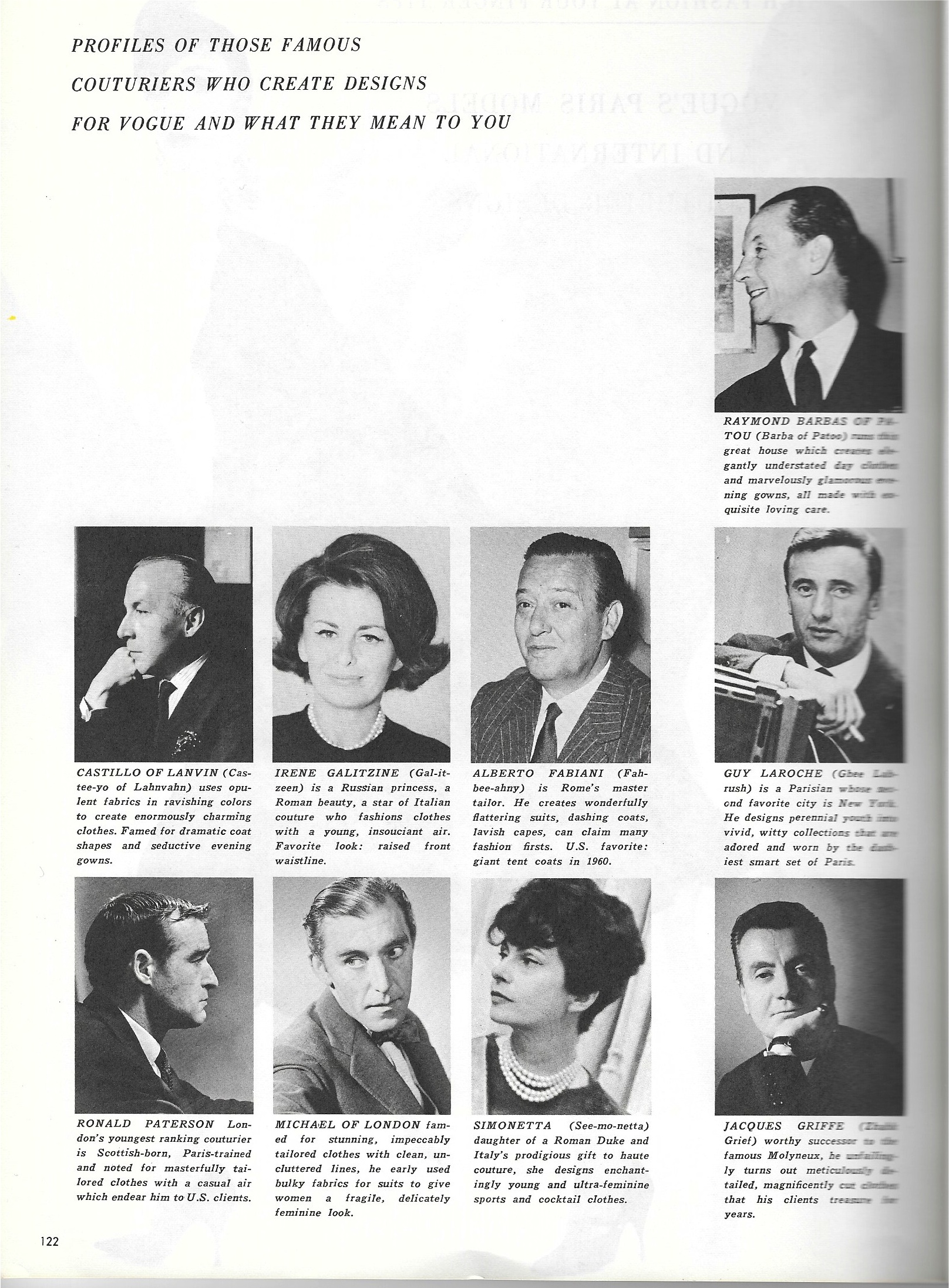
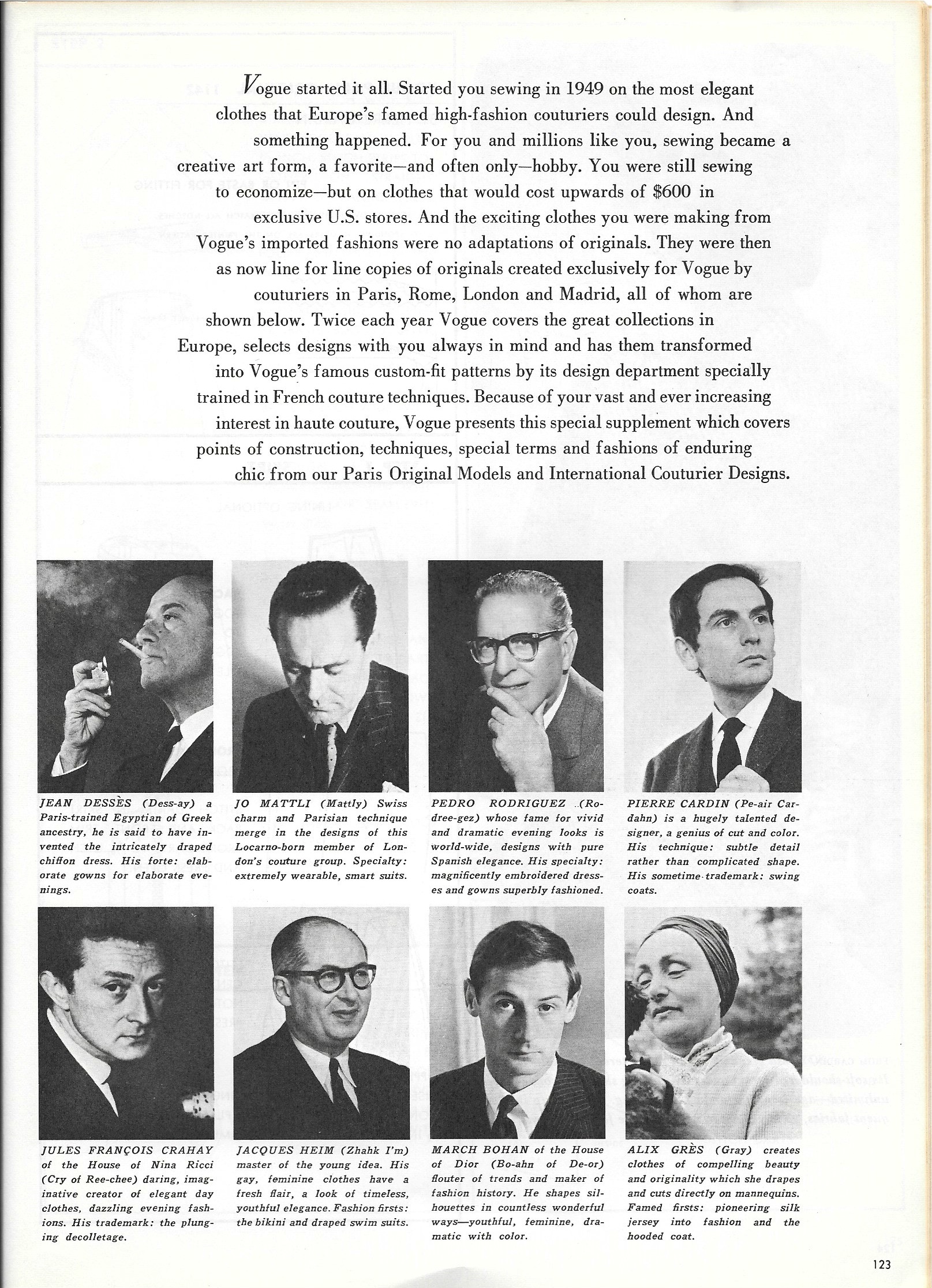
The New Vogue Sewing Book published in 1963 contained a “Couturier Supplement”. According to the Foreword in this magazine-styled book, “Only Vogue Patterns can bring you original designs from the Paris and International Couture houses, because of an exclusive arrangement with world famous designers.” One of the 17 designers featured in the supplement was Jo Mattli.

Designers in Vogue

Designers in Vogue-1

Jo Mattli is second from the left on the top row. Click on the photo to see the image up close.

A quick look at the two-page spread on these designers shows a veritable who’s who of fashion design, with names very much still known today. Except for perhaps Jo Mattli.   (Mattli was born Giuseppe Gustavo Mattli in 1907 in Locarno, Swirtzerland; he died in 1982 in England). He is absent from The St. James Fashion Encyclopedia, even though he was considered one of the “big ten” London couturiers in 1953, when London Society was busy readying for the coronation of Queen Elizabeth II. Perhaps it was his move into ready-to-wear in 1955 that relegated him to lesser status among the world’s great couturiers. This did not keep Vogue Patterns from recognizing his wide appeal to stylish women who appreciated his attention to fine detailing, and his expertise in creating practical, wearable and charming dresses and suits.   As one of Vogue’s featured designers in their Vogue Couturier Design-labeled series, Jo Mattli made his mark. Indeed, even he recognized the value of being part of Vogue Patterns, saying “the royalties from these patterns had helped support his couture business” (from Wikipedia, the free encyclopedia).

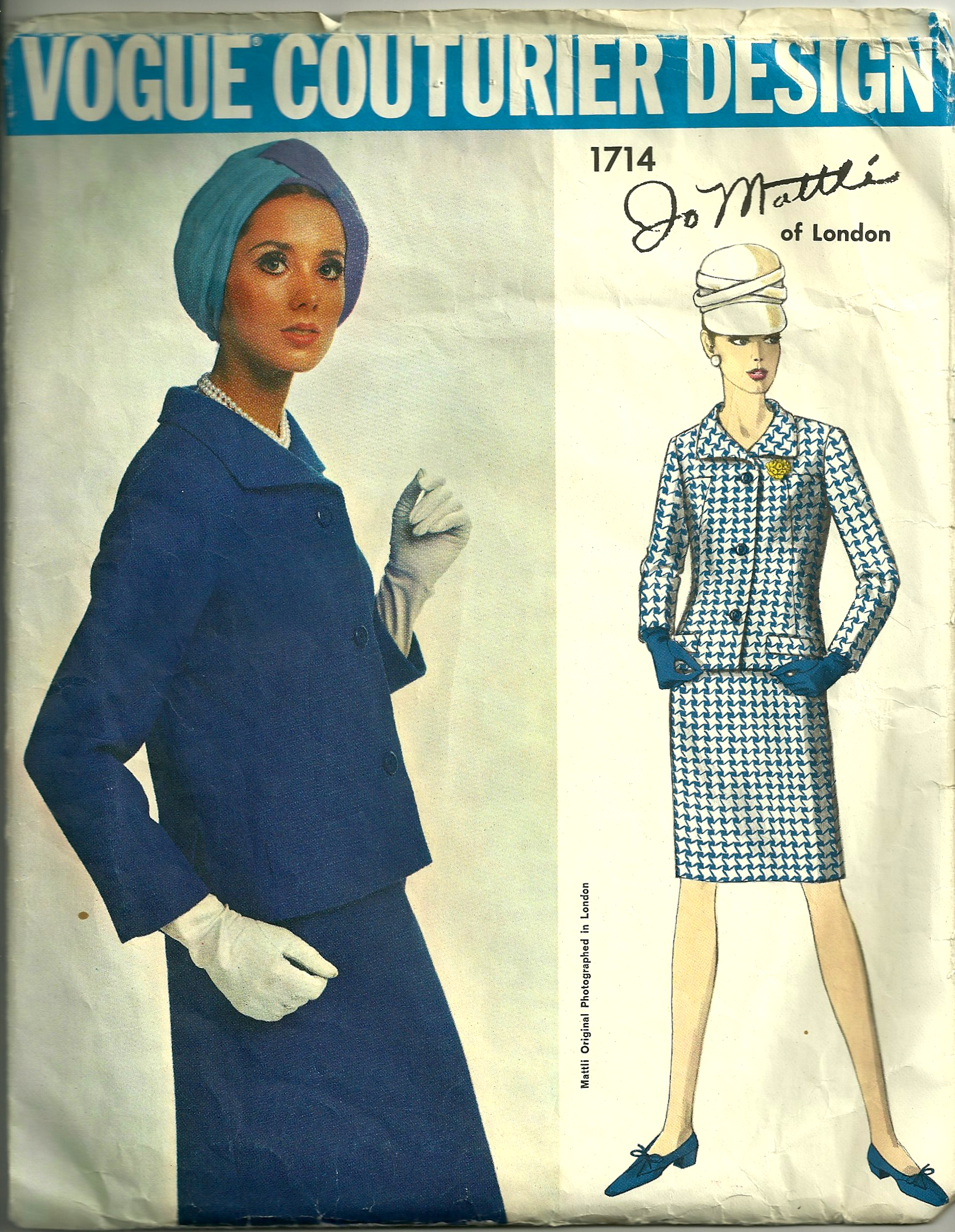
The jacket I just completed (part one of a two-part jacket and dress ensemble) is the third Jo Mattli Vogue design I have sewn. Two years ago I made a suit from this pattern:

From Vogue's Designer series, ca 1970.

I would like to make this pattern again. The first time I made it, the fabric I chose was too heavy, but the fit and the styling were excellent.

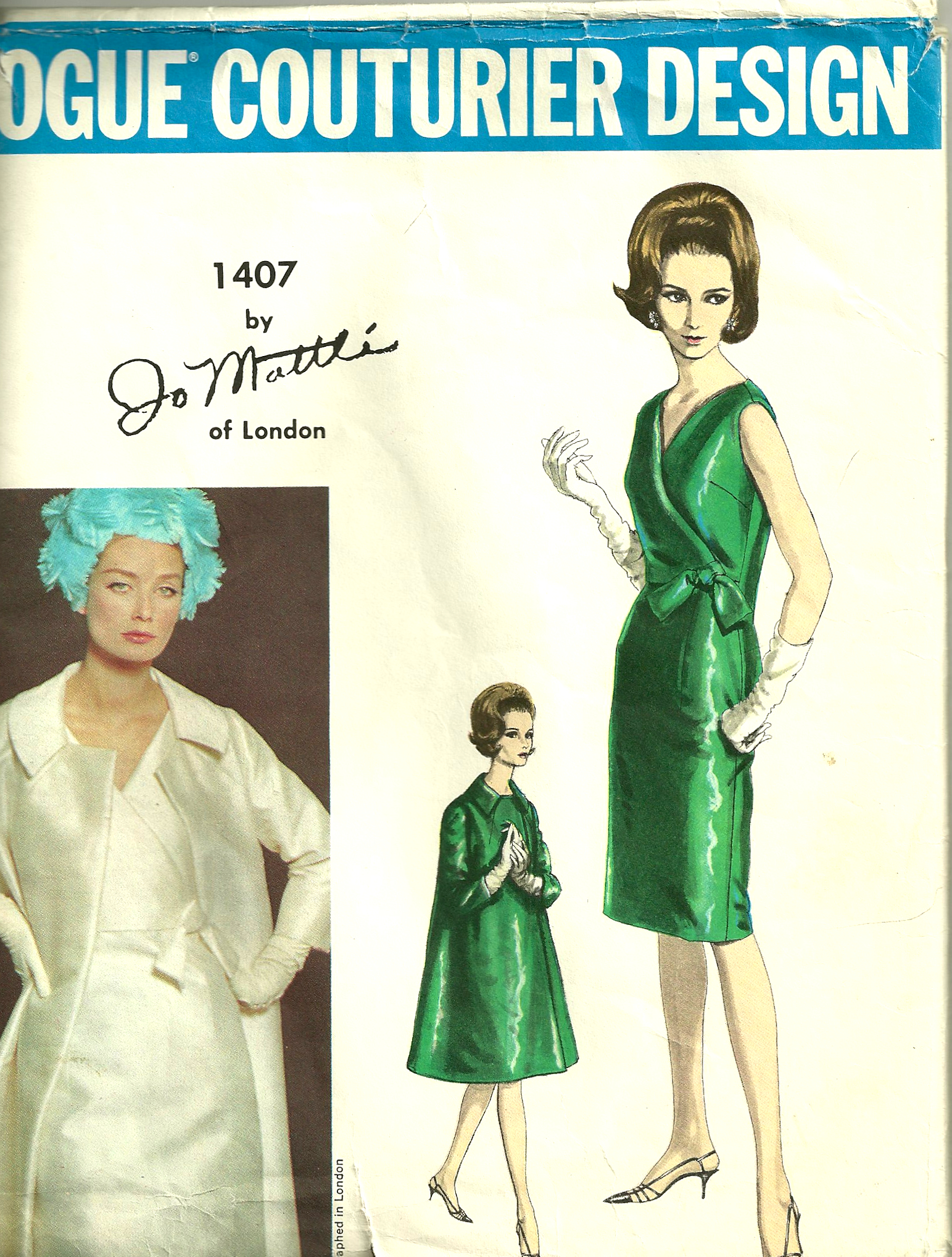
Late last summer I made a cocktail dress from this pattern:

I still have plans to make the coat, to coordinate with the cocktail dress.

I still have plans to make the coat, to coordinate with the cocktail dress.

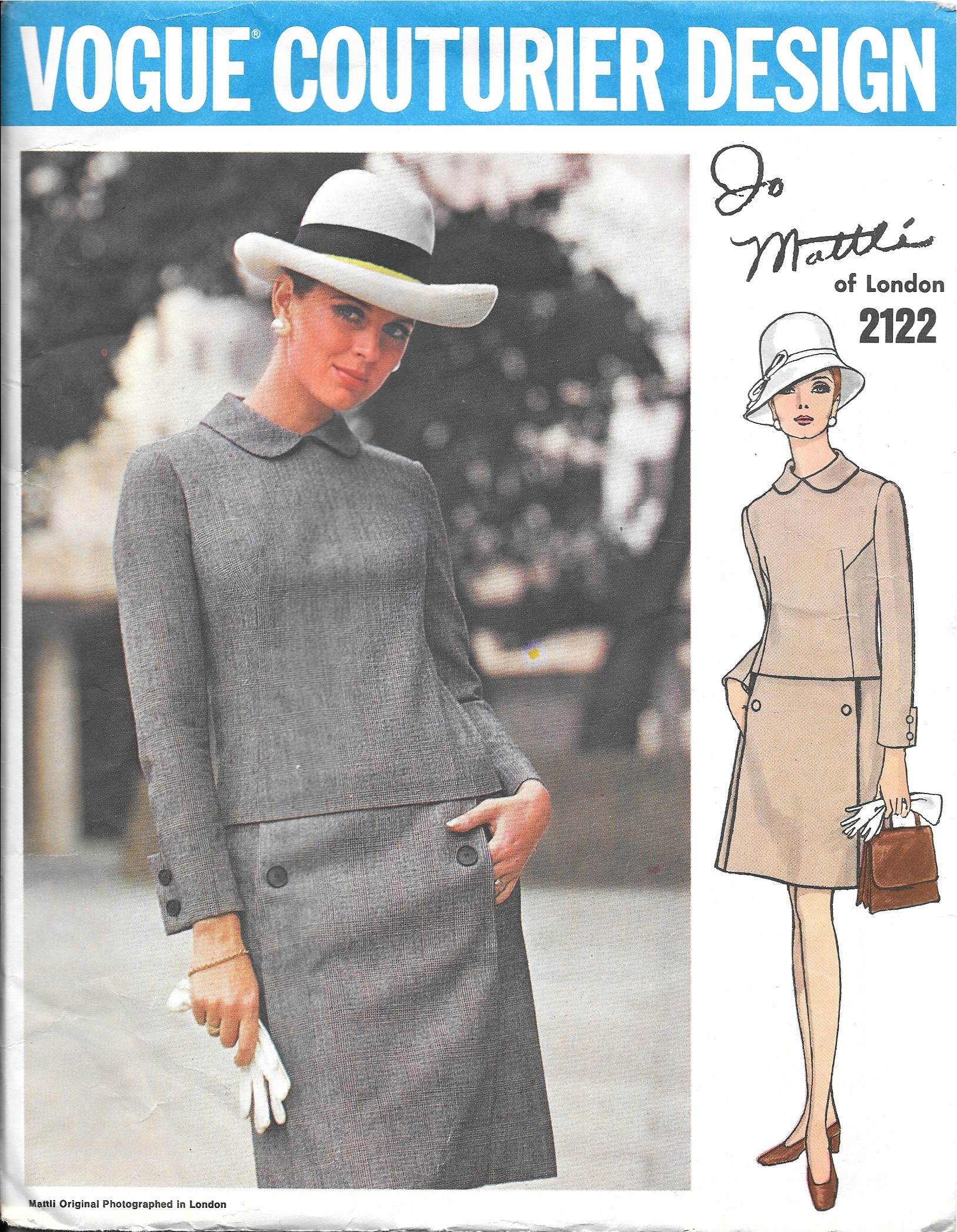
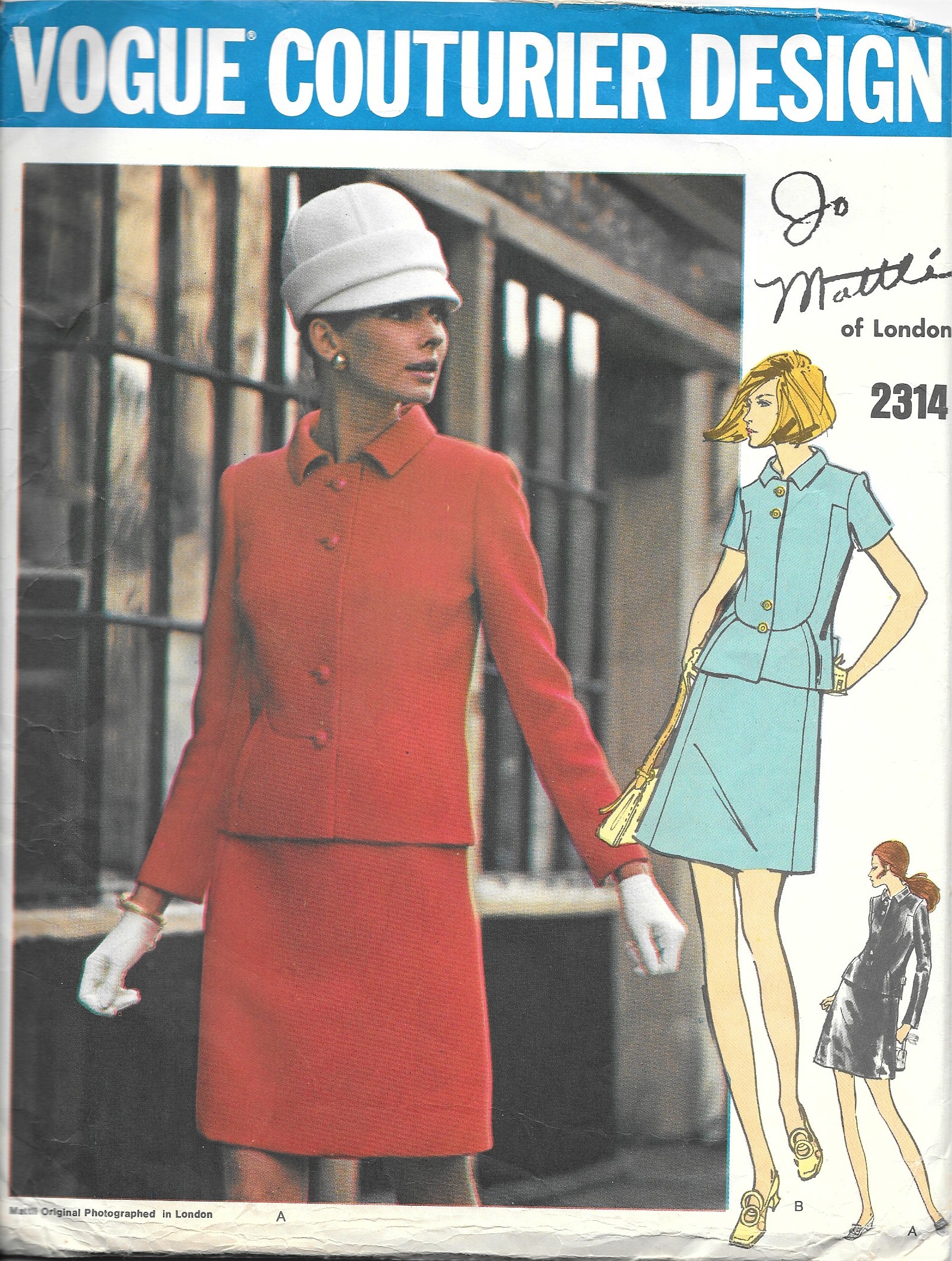
And now with three “makes” under my belt, my appreciation for Mattli’s design and construction sense is growing. Not only that, I realized after going through my pattern collection, that I have two more Mattli patterns, each of which also displays his characteristic and interesting seam detailing.

This is actually a one-piece dress, although it looks like it is a two-piece outfit.

This is actually a one-piece dress, although it looks like it is a two-piece outfit.

Dress Suit - red Mattli suit

Another beautiful suit!

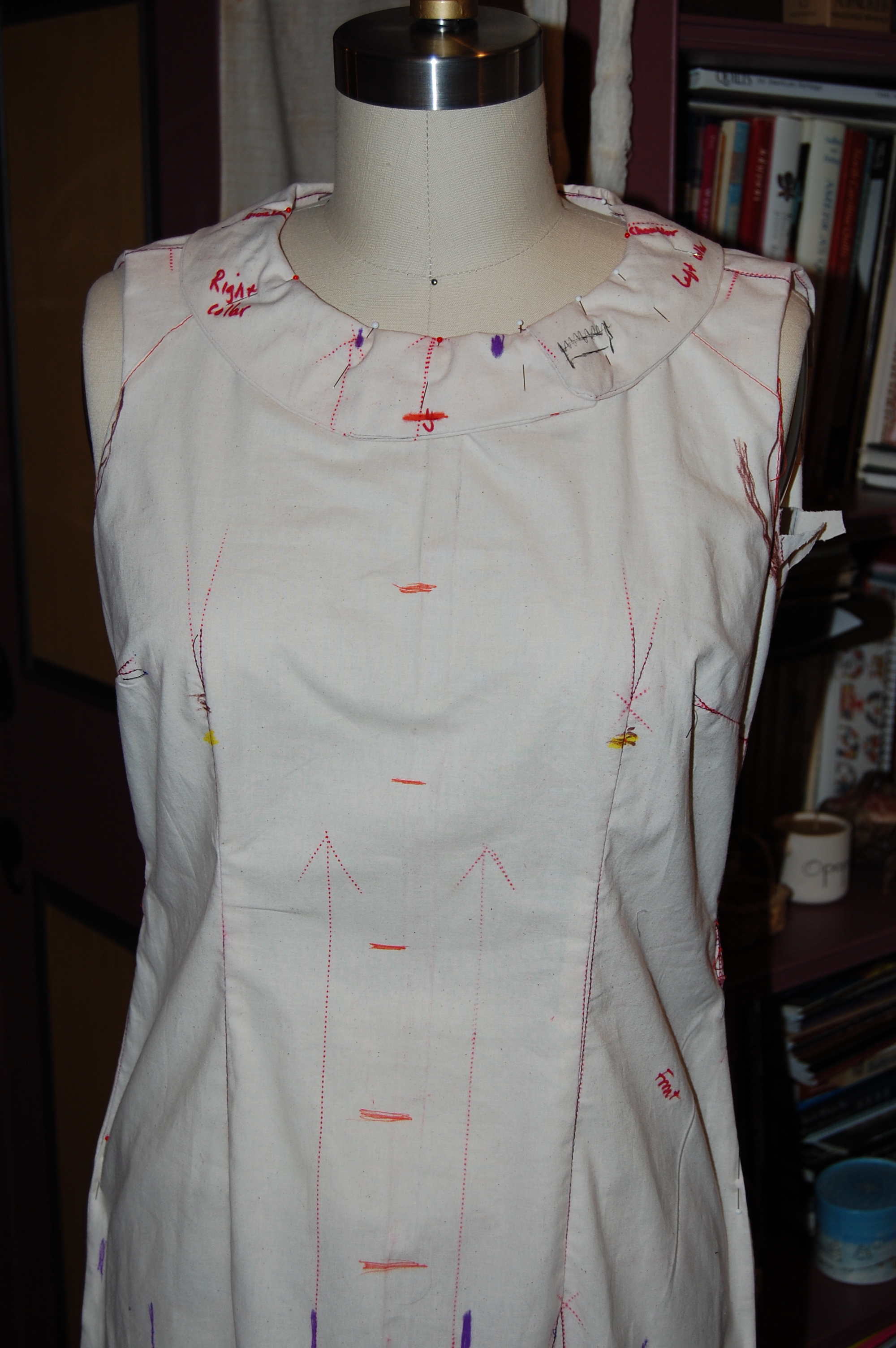
While the Mattli-designed jacket in my suit dress ensemble is certainly the star of the outfit, I am hoping the dress will have its own charms. After being out of town and away from my sewing all last week, I have now been able to turn my attention to the dress part of the outfit. I believe I have successfully combined two patterns (sheath dress and collared blouse) to create – what else? – a collared sheath!

Dress for Mattli jacket

I was still adjusting the fit when I took this photo. Hopefully it will not look like a bag when I actually wear it!

After I had the muslin fitted and completed, I got the idea to make the end of the tab on the collar rounded, to mimic the curves on the jacket’s sleeves and on the jacket’s lower front edges.   I also had to take significant width out of the collar. I am hoping it will work and look good…

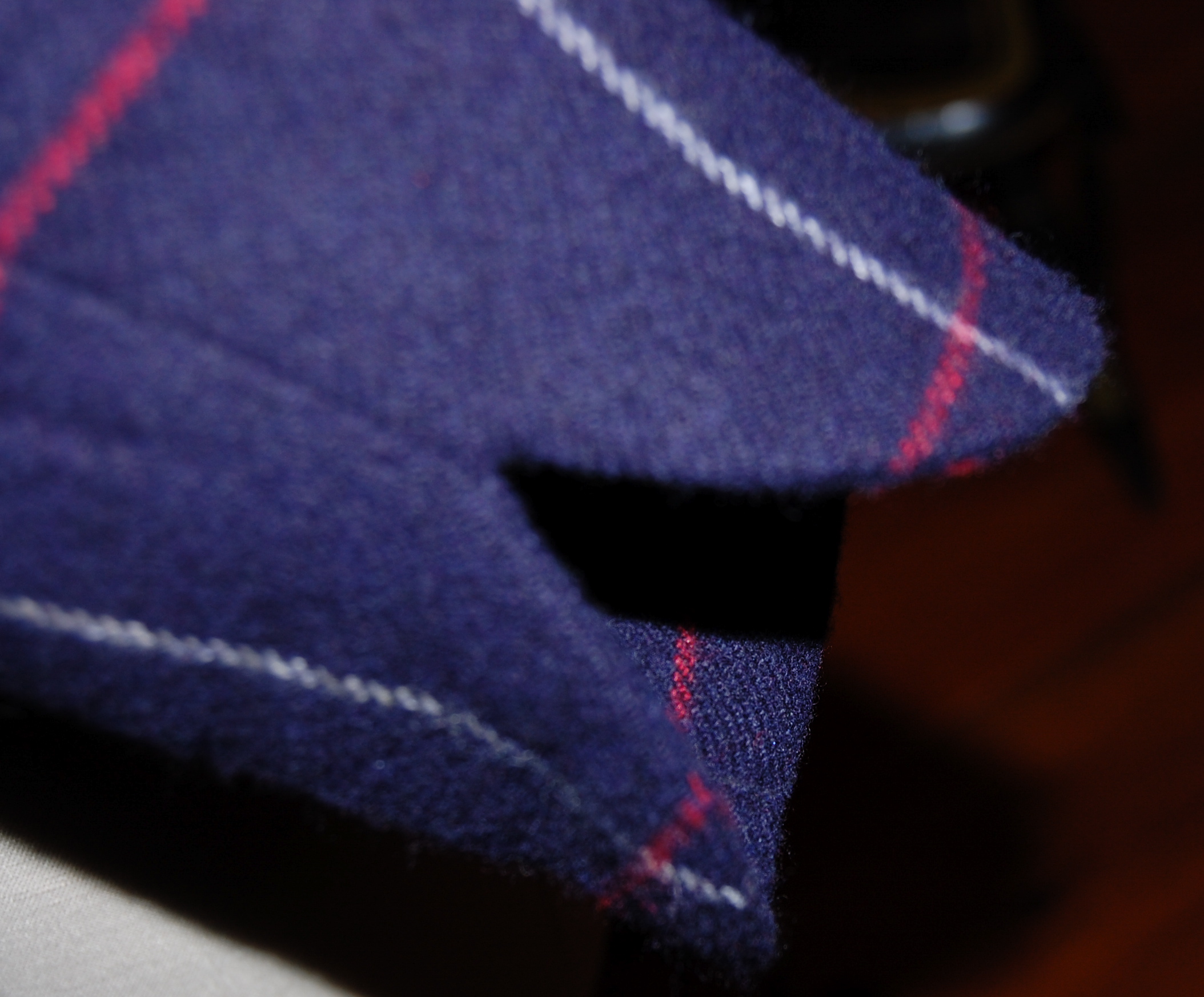
This shows the curved detail on the edge of the sleeve.

This shows the curved detail on the edge of the sleeve.

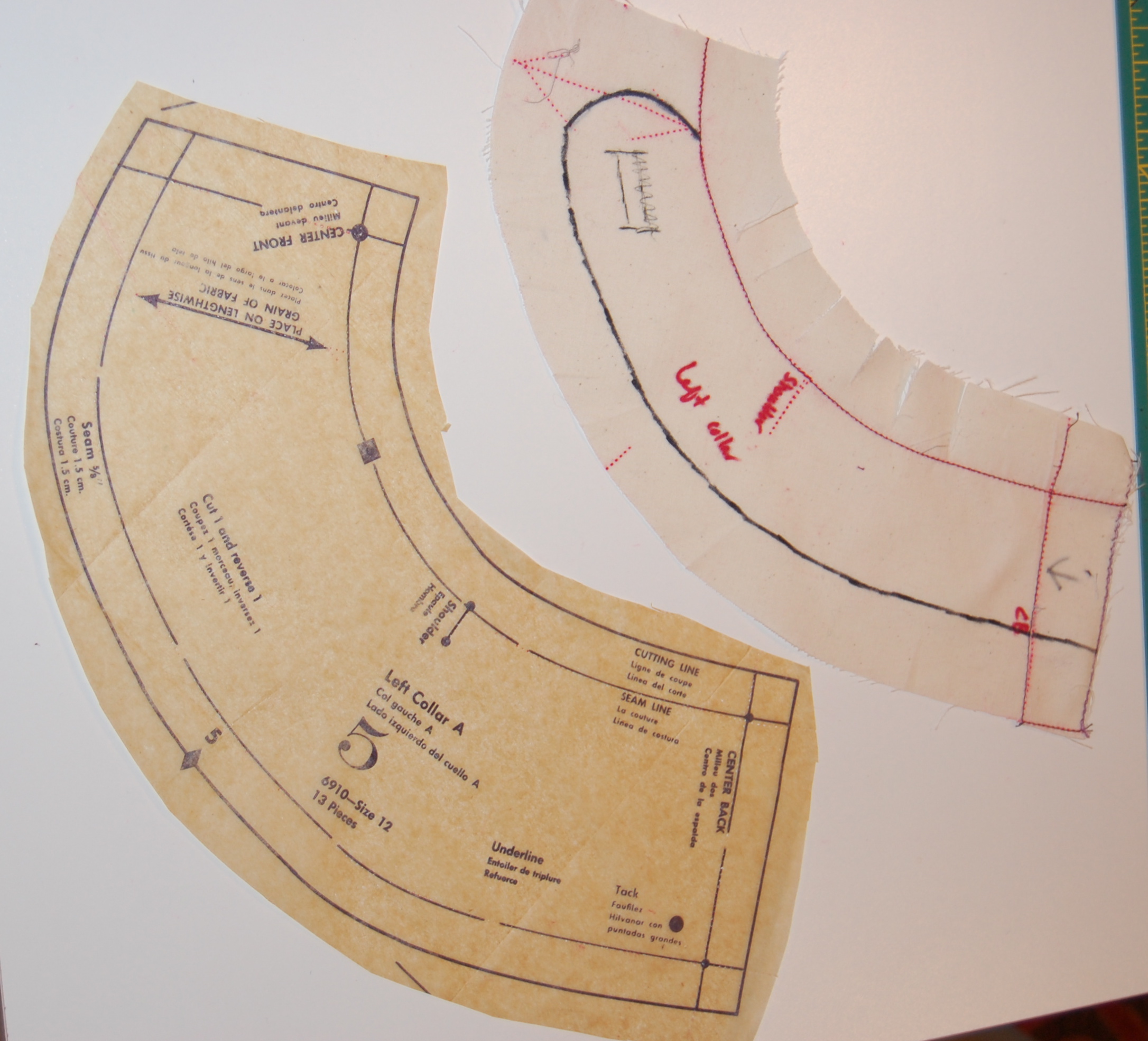
This shows not only the added curve to the collar end, but also how much width I had to remove from the collar pattern

This shows not only the added curve to the left collar end, but also how much width I had to remove from the collar pattern.

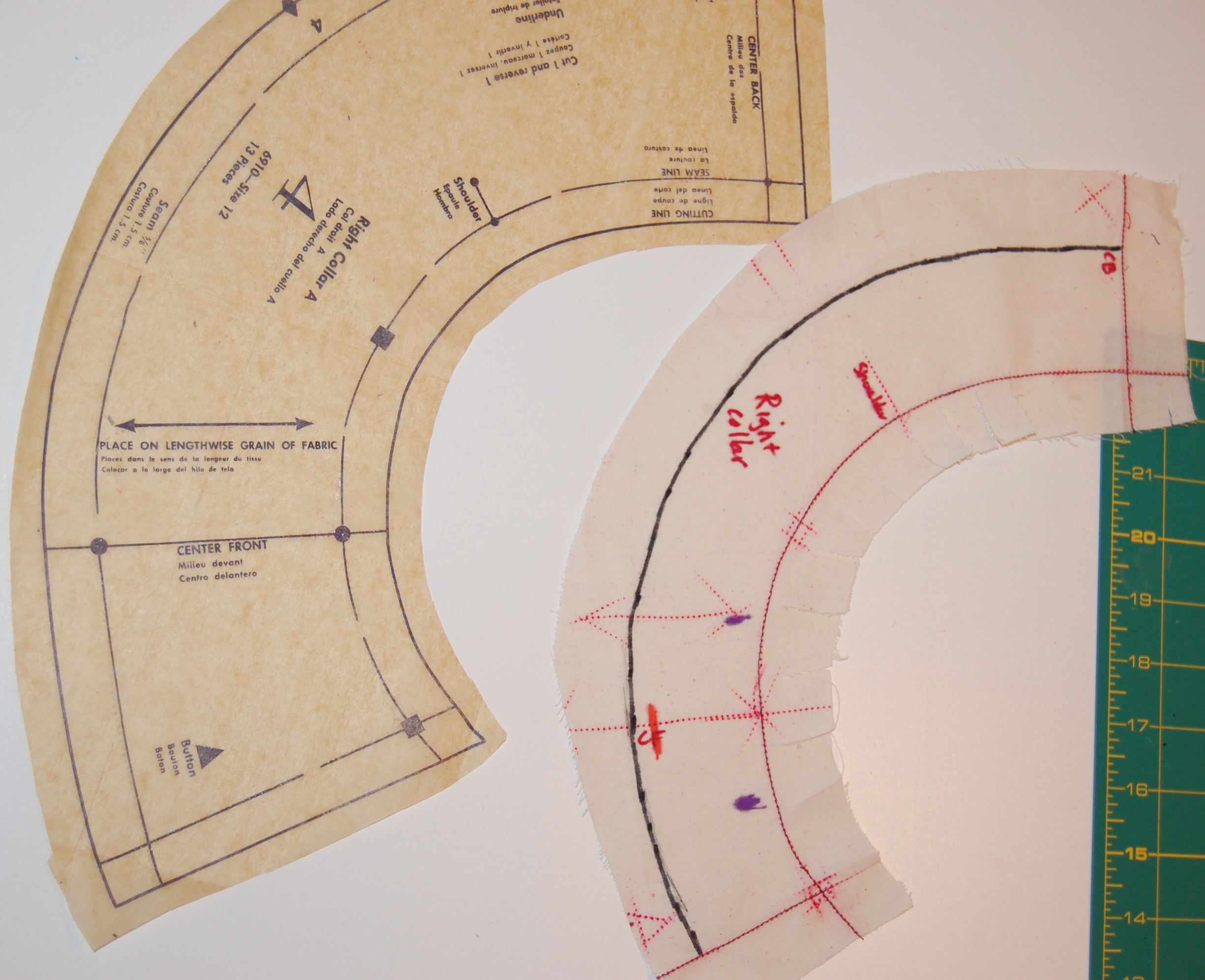
And here is the right collar section.

And here is the right collar section.

I  hope that Jo Mattli would approve of a dress being paired with his jacket. He would probably refer to it as a “slimline afternoon dress” were he alive. I have no doubt he created many such beautiful dresses in his lifetime.

[NOTE: Jo Mattli is the subject of a thesis by Dr. Caroline Ness entitled Famous, Forgotten, Found: rediscovering the career of London couture fashion designer Giuseppe (Jo) Mattli, 1934-1980.]

10 Comments

Filed under Cocktail dresses, Dressmaker suits, Jo Mattli, Suit dresses, Uncategorized, vintage Vogue Designer patterns, vintage Vogue patterns from the 1960s

Panic and Patterns

Being away, as “on vacation” (or “on holiday” as many express it), can take its toll on sewing projects. If I have to leave a project in mid-stream, it seems to take even longer to get back to it and pick up where I left off. A recent trip to the western state of Wyoming necessitated that I abandon my current “Fall” dress at precisely the time of year when I need to complete it! And now I’ve run into some complications with it.

I guess you could say that panic has set in. Here is what the dress bodice looks like on my dress form:

Panic and patterns

I am using vintage Vogue pattern 2718 for this dress.

The fit seems okay. The neckline will need a little adjustment, but nothing out of the ordinary. The sleeves look good, and I am pleased with the piping so far. So what is the problem? When I try the bodice on, it looks awful. It pulls across the bust, it doesn’t want to move with me at all, and the front seems too short-waisted even though it measures perfectly for me when on the form. Worse still, this fabric is too dear (as in expensive) to put it aside or to think about abandoning this dress.

I think I know what is wrong, and it will take a great deal of effort to try to correct it – and hopefully it will be correctable! I insisted on using an underlining on this stretch silk fabric. I thought I could accommodate the stretch by cutting the underlining on the bias. Guess what? It doesn’t work. The bias pulls from underneath, restricting the stretch of the silk. What this means is that I am going to have to remove the underlining. It is not going to be fun to remove black underlining from black fabric, sewn together with black thread, is it?

I have consoled myself with the thought that I can salvage this project by making a skirt instead of a dress, which may be what I end up doing. Needless to say, I am fighting my discouragement, and trying to stay focused so I can finish this and move on to something more fun.

While traveling is not conducive to sewing, it doesn’t put a damper on looking at more patterns and fabrics online! Sometimes I go weeks without finding a pattern and then I’ll find several all bunched together in the space of a few days. You might be guessing that such was the case during the last few weeks. So while I am struggling with vintage Vogue 2718 right now, I look at my new acquisitions to give me encouragement for the future. Here are some of my “new” finds:

I was delighted to find this DvF pattern in my size, at a reasonable cost!  This one should see some fabric next Spring or Summer.

I was delighted to find this DvF pattern in my size, at a reasonable cost! This one should see some fabric next Spring or Summer.

DSC_0303

This one was too good to pass up, although I don’t have any plans for it right now. This looks like a dress, but it is really a skirt and top, paired with the jacket.

DSC_0304

What can I say? I love coats.

DSC_0305

I have been on the search for this pattern for a long time. I hope I’ll have some reason to make this dress sometime soon…

DSC_0306

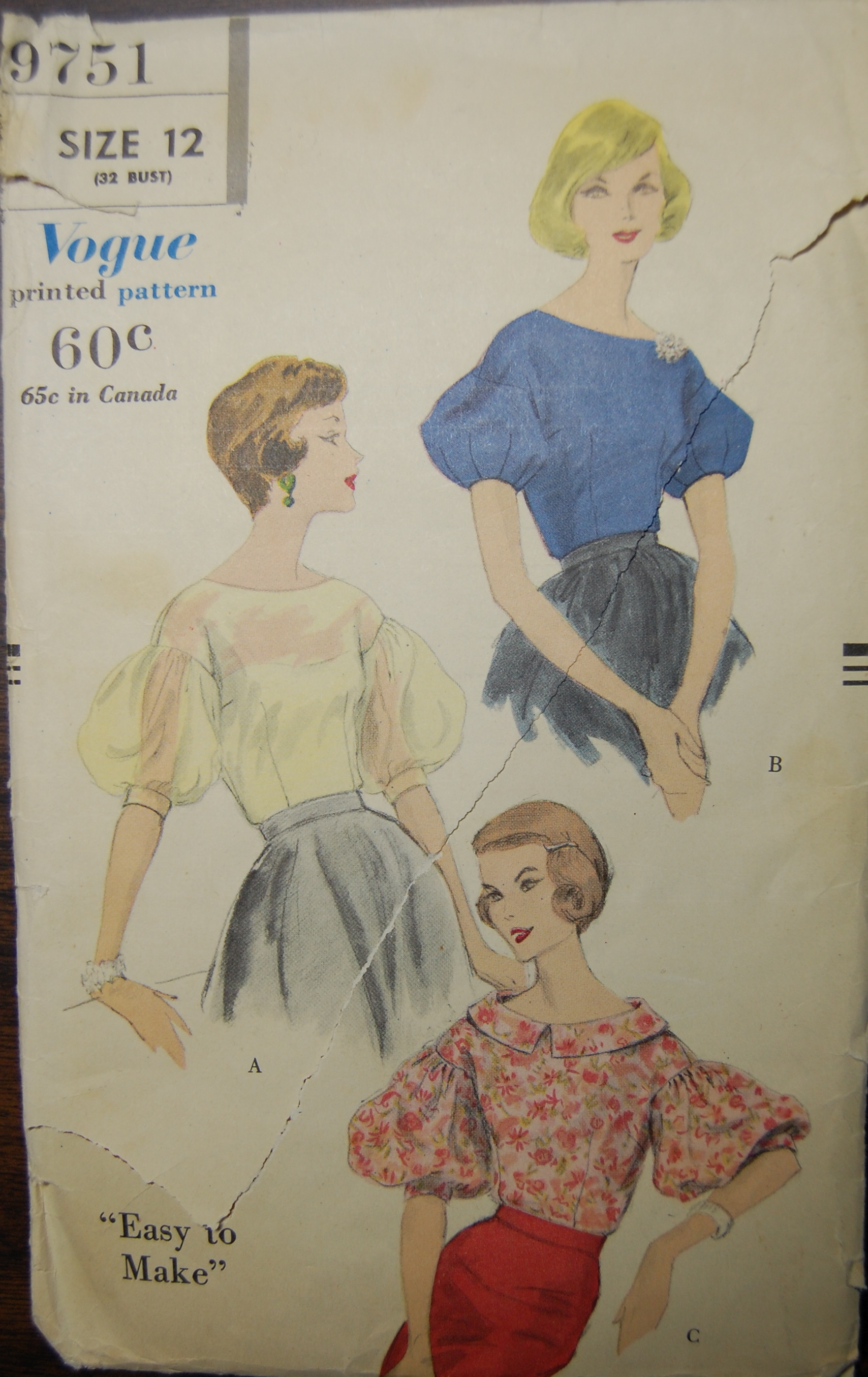
The sleeves on the blue version of this blouse are so pretty!

In addition to these new patterns, I just ordered two Marfy patterns, which should either add to my current sewing anxiety or help alleviate it. I hope it is the latter!

17 Comments

Filed under 1980's dress patterns, Blouse patterns from the 1950's, Coats, Cocktail dresses, piping, Uncategorized, vintage Vogue Designer patterns, vintage Vogue patterns from the 1950s, vintage Vogue patterns from the 1960s, vintage Vogue patterns from the 1970s, Wrap dresses

“Cheers!”

Cocktails in our home – and in our family – are always preceded by a toast of some sort. Usually a simple “Cheers!” will suffice, but sometimes the occasion calls for something more meaningful. One of the most memorable cocktail toasts I have ever heard was standard fare for one of my late mother-in-law’s good friends. By the time I met her, she was a little shaky, which made the toast even more charming. She would raise her trembly glass with great ceremony and declare “To our noble selves!”

As I was working on my latest project – yes, a cocktail dress – I thought about all the possible declarations we, as sewers, could add to the vocabulary of toasts. More about those thoughts later… First up is something to wear to that cocktail/dressy party!

This Vogue Designer pattern is from the early 1960s.

This Vogue Designer pattern is from the early 1960s.

The lengthy process of perfecting the muslin (toile) for my blue cocktail dress revealed a few minor changes I needed to make – four of them, to be exact.   You might be able to see on the pattern envelope, that the “overblouse” in the front actually hits about an inch above the waistline. This just did not look good on me, so I extended the length of those two over-lapping fronts an inch so that they would lay directly at my waist. Second, the under-dress, the top of which is not seen when being worn is cut low so that it does not show beneath the “V” of the overblouse. However, it was cut much lower than I needed, so I raised it a bit.

I thought the shoulders of the overblouse extended a little bit too wide, so I cut the top of the armscye in about ¾ of an inch, graduating it down to join the lower part of the armscye. And fourth – I added a slit at the lower back center seam to make walking easier. I seem to do this frequently with vintage patterns.

The pattern called for the fashion fabric to be underlined, but not lined.   I wanted to line the dress – and actually felt it was a necessity with the fabric I was using. Because of the unusual construction of the dress, I knew that this was going to be interesting – and that I was going to have to make it up as I went. To see what I mean about the unusual construction, take a look at the pattern instructions. The front of the “underdress” is sewn to the back of the dress at the side seams only to the waistline. The bodice part of the front “underdress” hangs loose while the two sections of the overblouse are first sewn to the dress back. Then that bodice is hand sewn in place.

To our sewing selves - pattern diagram

To line the dress, I first sewed the lining to the front underdress at the neck and the armscyes by machine. I under stitched these sections by hand, leaving about an inch free on either end.

Cheers

Next I lined the two front overblouse sections, stitching only the front armscyes by machine; I attached the rest of these linings by hand, using fell stitches.  Then I joined the overblouse sections to the (unlined at this point) dress back.

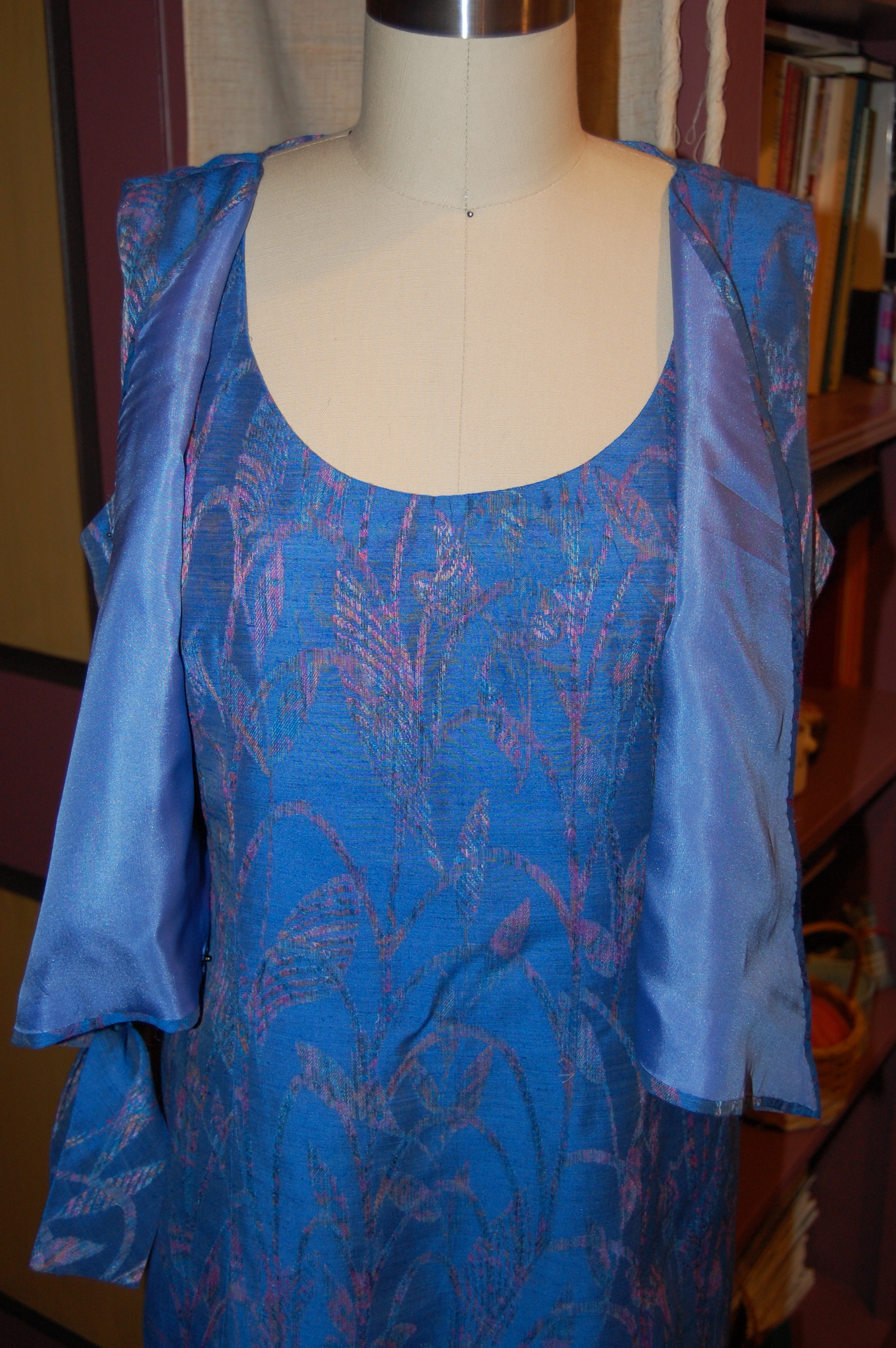
The front overblouse sections are attached to the side seams, but the front underdress is hanging loose, which does not show in this photo.

The front overblouse sections are attached to the side seams, but the front underdress is hanging loose, visible at the lower left.

I had pieces of dress and overblouse and lining hanging every which way! Any of you who have made a “Chanel” type jacket know how unruly the process is before the lining is seamed in place by hand. This reminded me of that. Somehow I would have to make order out of chaos!

To line the back dress section, I pinned the lining to the armscyes and neck and fell stitched in place by hand. Then I was able to sew each side seam on the machine. The shoulder seams were the final ones to finish, which I did by hand. Then it was only a matter of fell stitching the lining to the hand-picked zipper and understitching the neck and arm sections.

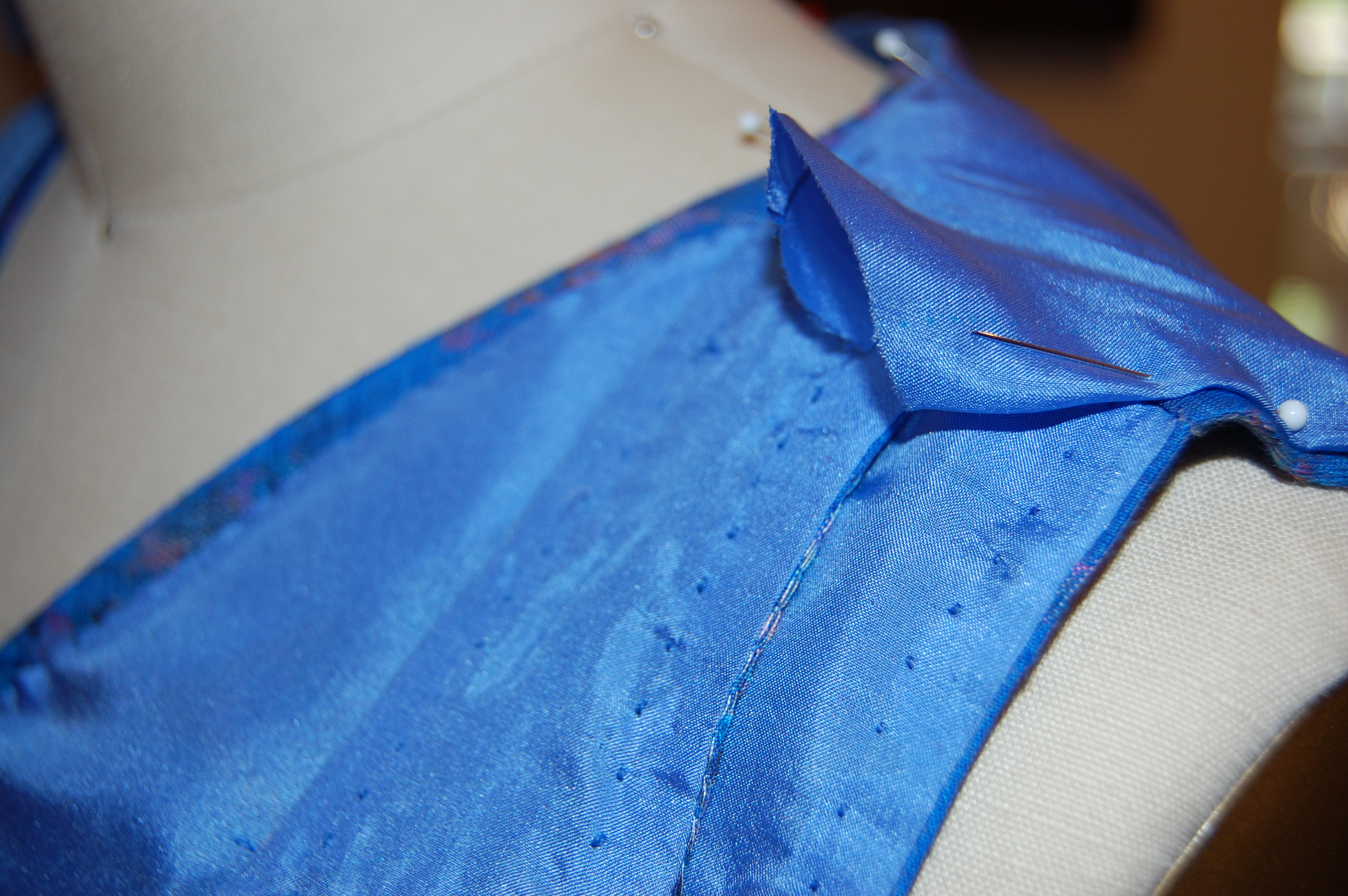
The shoulder seam encloses two finished layers in front.

The shoulder seam encloses two finished layers in front.

It worked! The lining fit perfectly and made for a pretty “insides”!

An inside look at the underdress and the overblouse.

An inside look at the underdress and the overblouse.

The pattern called for tacking the front overblouse sections to the underdress, but I decided to use snaps instead. Ironing this dress will be so much easier with the overblouse sections opened up. However, I did permanently tack the looped tie in place, as indicated in the pattern directions. There was much more hand sewing involved in this dress because of the added lining, but the process was so rewarding in the end.

DSC_1374

Cheers

I anticipate this dress being perfect for not only cocktails, but also weddings and other dressy occasions (particularly if I get the coat made, too!).

Cheers

DSC_1369


DSC_1362

Although I doubt I’ll be clinking my cocktail glass with many other dressmakers, I like the thought of a “virtual” toast with my fellow sewing enthusiasts. Some possibilities I have come up with are “To needle and thread” – or “To weft and to warp” – or “To scissors and seams” – or the one I think I prefer, with thanks to a lady from the past – “To our sew-able selves!”

40 Comments

Filed under Cocktail dresses, couture construction, hand-sewn zippers, sewing in silk, Uncategorized, underlinings, vintage Vogue Designer patterns, vintage Vogue patterns from the 1960s