Category Archives: Linen

From Flora to Flop


In sewing there are various degrees of success. At one end of the spectrum is something which not only fits well, but is flattering, a perfect combination of pattern and fabric, a piece destined to become a staple in one’s wardrobe. At the other end is – a complete flop. Flops are painful, aren’t they? I didn’t realize this project was going to be a flop until I was almost finished with it, although I was beginning to have my doubts about halfway through it.

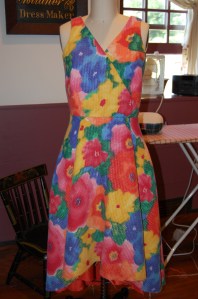
I started out with this really lovely linen blend from Mood Fabrics, which I’ve had for a few years. Here it is draped on my dress form:
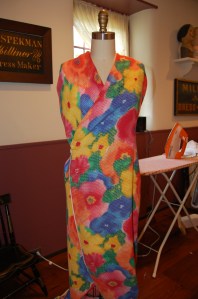
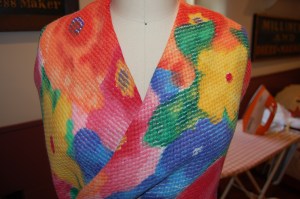
Flowered Flora

The fabric looks like - and is - a somewhat loosely woven linen, but it is surprisingly stable.

The fabric looks like – and is – a somewhat loosely woven linen, but it is surprisingly stable.

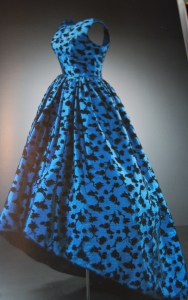
I had purchased the By Hand London “Flora” pattern (a departure for me to buy a “new” pattern!), as it reminded me of a Cristobal Balenciaga dress which I have long admired.
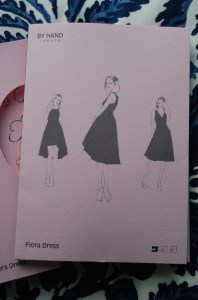
Flowered Flora

Flowered Flora

Evening dress in flocked shantung in blue and black, 1957
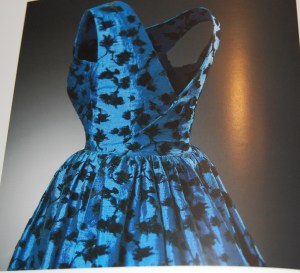
Both images are from: Balenciaga: Cristobal Balenciaga Museoa; Fundazion Cristobal Balenciaga Fundazioa, Editorial NEREA; English Edition 2011; distributed in the USA by Thames & Hudson Inc., NY, NY, page 260.

Both images are from: Balenciaga: Cristobal Balenciaga Museoa; Fundazion Cristobal Balenciaga Fundazioa, Editorial NEREA; English Edition 2011; distributed in the USA by Thames & Hudson Inc., NY, NY, page 260.

I had not intended to use the Flora pattern for this fabric, but somehow I got the notion that it would be really pretty. In addition the fabric was 60” wide, a requirement for the Flora dress, and for once, I had enough yardage. I made a muslin, and liked the way it looked – and I did a fairly good job of perfecting the fit of the bodice. The pattern lends itself to using couture construction techniques, as there are no facings, so that fit right in with how I like to sew. I underlined it all with silk organza. I catch-stitched all the seams. I used a silk crepe de chine lining, and hand sewed it into the bodice. I backstitched all the edges to secure the lining.
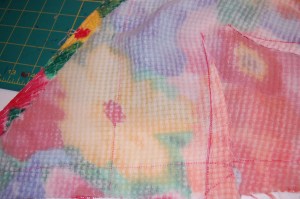
The silk organza added additional stability.
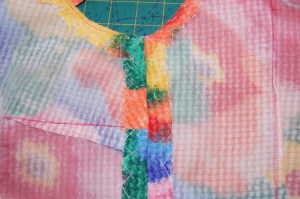
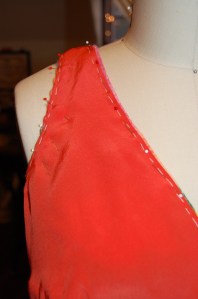
The silk organza added additional stability.

Flowered flora

I chose a pretty orange crepe de chine for the lining.

I chose a pretty orange crepe de chine for the lining.

The skirt is voluminous and that is where my problems began. It seemed okay made up in muslin, but once I had it constructed in the fashion fabric, I looked like I was a dumpling wearing a flowered parachute. The funny thing was that when I had it on my dress form, I thought it was rather attractive. I was fooled into thinking that if I just got it all put together, I’d be happy with it.
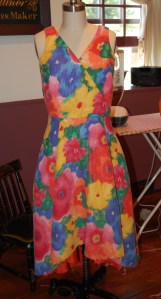
Looks pretty, doesn't it?

Looks pretty, doesn’t it?

I thought the orange lining would be lovely peeking out from the dipped back hem...

I thought the orange lining would be lovely peeking out from the dipped back hem…

I have been trying to figure out what went wrong. I think perhaps the pattern is just too “youthful” looking for me. I think it is such a pretty dress, but perhaps my days of wearing voluminous skirts are over (… although the skirt on my silk dress from last summer looks fine. It is, however, simply a gored skirt with no additional pleats or fullness.)
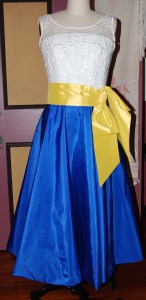
Allure of silk final

The skirt is full, but hangs with no bulk.

Now I am left with trying to salvage something from this project. I like the fabric too much to just abandon it, and I have too much time and effort and money invested in it all, as well.   Right now, however, I am very sick of the whole thing, so it might be a while until I come back to it. But when I do, I am going to separate the bodice from the skirt first.
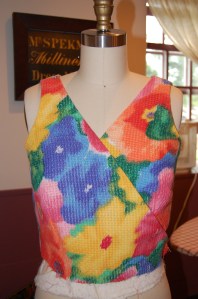
Now I wish i had left the bodice just as you see it here!

Now I wish I had left the bodice just as you see it here!

Then I think I may cut a new slim skirt (no pleats, no gathers, just a nice, slim, matronly skirt!) to attach to the bodice, and perhaps make a self-belt with a tailored bow for the closure.

How does that sound?
 

30 Comments

Filed under couture construction, Linen, Uncategorized

Blame It on the Buttons

It can be a little overwhelming to look at my (growing) collection of beautiful summer linens, and then try to make a decision on which piece to select for my next project.

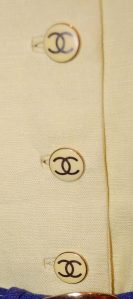
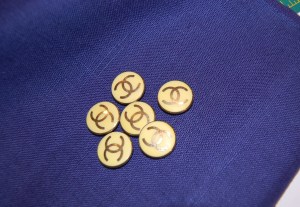
Fortunately, a random purchase of buttons helped me make up my mind this time around. I found these buttons at Britex Fabrics in San Francisco last year, and purchased them on a whim, not knowing when or how I would use them. I also don’t know what possessed me to purchase 6 of them, but that’s what I did.

Yes, those are interlocking "a la Chanel" Cs.

Yes, those are interlocking “a la Chanel” Cs.

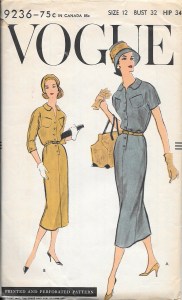
When I got them home, I realized they were a perfect match with a length of vintage, pale yellow, Moygashel linen in my possession. I tucked the fabric and the buttons away together, confident that the perfect pattern would also be found amongst my many vintage Vogue patterns.

It was a bit of a trick finding a pattern that needed 6 (or fewer) ¾” buttons. This one kept surfacing as the most ideal candidate:

I am making the short sleeve version - but a little shorter!

Ideal, except for the yardage needed, that is. Many of you know by now that being a “little shy” of the prescribed fabric usually does not keep me from my desired goal! After making a fitting muslin and making the necessary adjustments, I cut out my underlining (light weight linen/cotton blend) and used that as my pattern. It was immediately evident that I did not have enough of that 35” width linen.

Or did I? I figured if I eliminated the center back box pleat and replaced it with just a slit in the back center seam, I’d save a bit of yardage requirements. I could make the sleeve hem facings out of the underlining, saving a bit more. And if I cut the collar on the horizontal straight of grain rather then the vertical, I could just fit the pattern pieces onto my yardage. It was a good thing I had already decided to eliminate the chest pockets (a little too 1950s.) And a self-belt?   Out of the question!
A belt turned out to be a perplexing question. I had been fortunate enough for a few years to have my belts and covered buttons custom made by Pat Mahoney, but since her retirement last year, I have found no replacement for her services. I was dreading the prospect of making my own belt. The only good thing was I knew I had a piece of vintage Moygashel linen in a medium navy blue (see the button photo above) which would be a good contrasting color for the yellow dress. I decided I would think about actually making the belt after I had the dress itself finished.

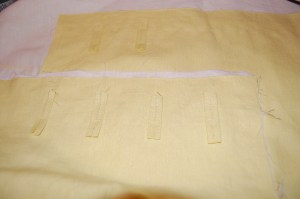
For a simple shirtwaist dress, there were a number of time-consuming details, like the gussets I covered in my last post. There were also six bound buttonholes to work.

It always amazes me how long these buttonholes take to make!

It always amazes me how long these buttonholes take to make!

Blame it on the buttons


There were separate front bodice facings, and a front skirt placket with separate facings. There were sleeve hem facings (as mentioned above), and lots of trimming, clipping, and grading of seams! And then the dress was done.  Except for the belt, of course.

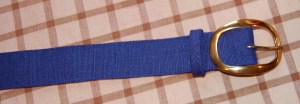
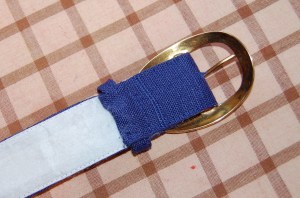
After giving myself a pep talk, I took out one of Pat’s belts and studied it, vowing to duplicate as closely as possible her techniques and precision. Fortunately I had a belt buckle from long ago, which I had saved. It was for a 1.25” width belt, which is exactly what I wanted.  I plunged ahead and this what I made, working the eyelets by hand (which fortunately don’t show much on the dark linen!):

Blame it on the buttons

The underside, just in case you are curious!

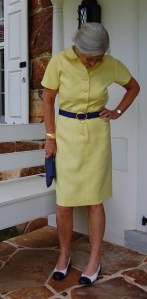
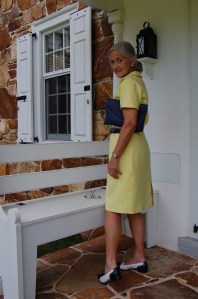
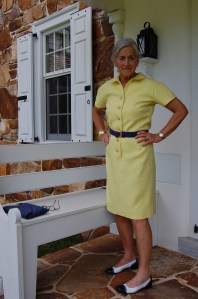
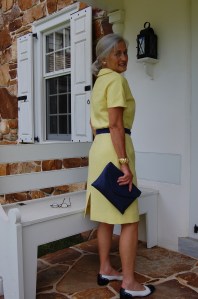
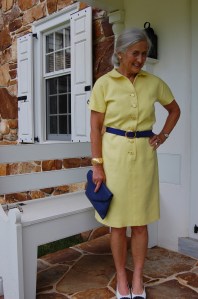
Although not my favorite dress of all time, I think I’ll get good use out of it, and I do love its pairing with “summer” blue.

Blame it on the buttons

Blame it on the buttons

Blame it on the buttons

Blame it on the buttons

The clutch is a perfect match with the belt – how lucky is that?

Cool linen for a hot summer!

Cool linen for a hot summer!

Best of all, the buttons add just the right, somewhat mysterious, touch.

19 Comments

Filed under bound buttonholes, Day dresses, kimono sleeves, Linen, Mid-Century style, Moygashel linen, Uncategorized, Vintage fabric, vintage Vogue patterns from the 1950s

One Year at a Time

Let’s start with 2016. Although, truthfully, right now in January 2016, I could probably plan at least three years’ worth of sewing. That is how many patterns and fabrics I have tucked away, waiting for their turn. But it is time to concentrate on the year at hand and get on with it!

Some of the year is shaped by events that I know will be happening – such as weddings and fancy parties. Some of it will be devoted to little granddaughters who are already growing too fast for me to indulge all my sewing fantasies for them.   And some of it will be my own self-determined challenges – coats and dresses I want to make – that right now are looking like small Mt. Everests, waiting to be conquered!

I probably should be sewing right now for Spring and Summer, but I have wools that are too enticing to ignore during these current Winter months:

Wool challis on the left and vintage cashmere on the right.

Wool challis on the left and vintage cashmere on the right.

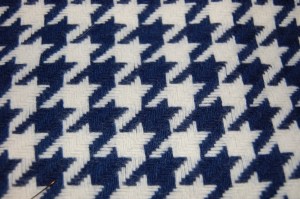
Navy and white houndstooth.

Navy and white houndstooth.

Some cute and classic cottons for little girls should be able to find themselves tucked in amongst my plans for Springtime.

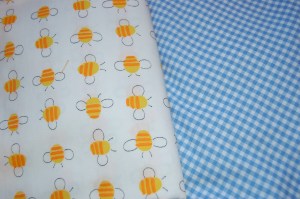
The buzzy bee fabric is a vintage cotton. The blue gingham is new.

The buzzy bee fabric is a vintage cotton. The blue gingham is new.

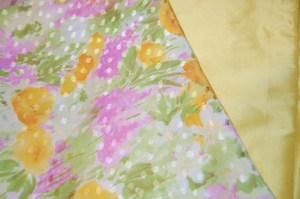
Looking towards Spring weddings already on the calendar, I am excited for the opportunity to use this amazing printed silk for a dress and perhaps pairing it with the plain yellow silk taffeta left over from my fancy dress from last Summer.

One year at a time

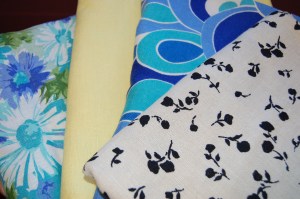
I have so many vintage linens in my collection, that it is difficult to narrow down my focus, but here are four that just may see the sewing shears this year:

These are all vintage Moygashel linen.

These are all vintage Moygashel linen.

This vintage, authentic Diane von Furstenberg cotton blend knit has been calling my name for quite some time.

One year at a time = DvF

Hopefully this fabric and this pattern will finally find each other this year!

One year at a time - DvF pattern

The sewing year will no doubt end next Fall with a return to wool. The polka dotted wool is similar to the wool in a dress I made in Fall of 2015. It is from Mendel Goldberg Fabrics in NYC.

As one who loves polka dots, I could not pass up this wool/silk blend fabric.

As one who loves polka dots, I could not pass up this wool/silk blend fabric.

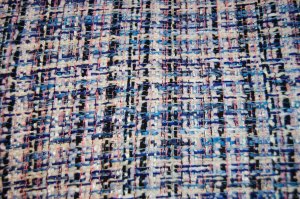
When I purchased it, several swatches of boucle were in the package – and I was in a swoon over this blue and pink sample:

How wonderful that Pantone's two "colors of the year" - pink and blue - are the color way for this boucle.

How wonderful that Pantone’s two “colors of the year” – pink and blue – are the colorway for this boucle.

Lucky me to open a box on Christmas morning to find 2 yards of it (thank you to my dear children!) – enough for another Classic French Jacket.

2 full yards of this glorious boucle! What a wonderful gift!

Two full yards of this glorious boucle! What a wonderful gift!

Some of the patterns I might be using this year are all vintage ones that deserve attention. I tidied up the boxes where I keep my pattern collection and these just happened to be some which would NOT go back in silence, so here they are with all their wily temptations!

One of my big projects for this year is this coat.

One of my big projects for 2016 is this coat.

I have been wanting to make the dress on the right for quite a while - this may be the year it happens!

I have been wanting to make the dress on the right for quite a while – this may be the year it happens!

I really like this shirtwaist dress (a little shorter, of course) and I envision it made out of a lovely summer linen.

I really like this shirtwaist dress (a little shorter, of course) and I envision it made out of a lovely summer linen.

I think I could make either view of this dress over and over and not get tired of it.

I think I could make either view of this dress over and over and not get tired of it.

One thing I learned a long time ago is the importance of flexibility in planning my sewing year. Sometimes things happen that impede my sewing plans. Sometimes I change my mind. And always, always, I plan too much. And when (not if) that happens, there is always 2017 right around the corner.

17 Comments

Filed under Boucle for French style jackets, Diane von Furstenberg Vogue patterns, Linen, Moygashel linen, Polka dots, Sewing for children, Uncategorized, Vintage fabric, vintage Vogue Designer patterns, vintage Vogue patterns from the 1950s, vintage Vogue patterns from the 1960s, vintage Vogue patterns from the 1970s, woolens, Wrap dresses

A Fitting Finish to Summer Sewing

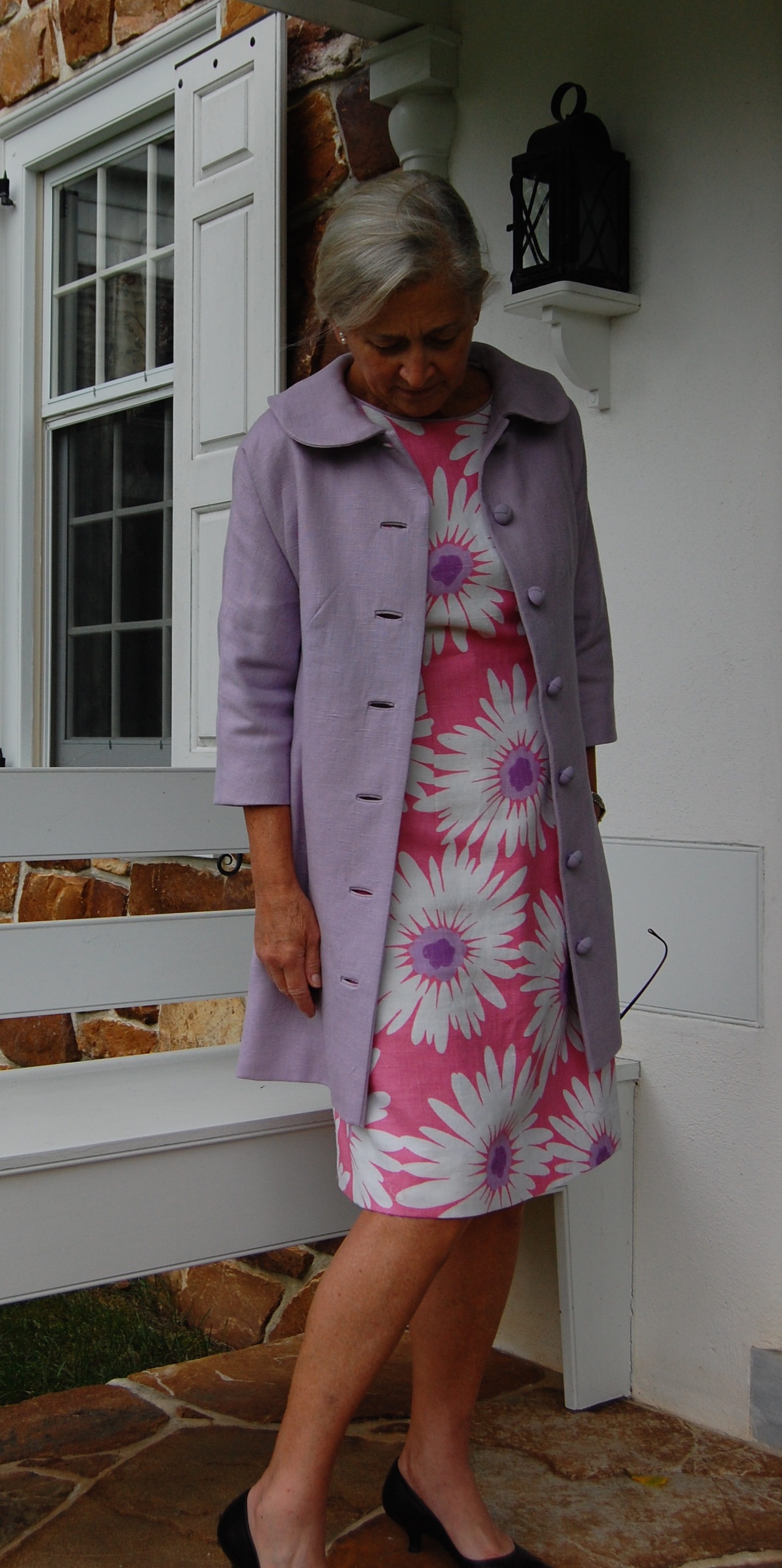
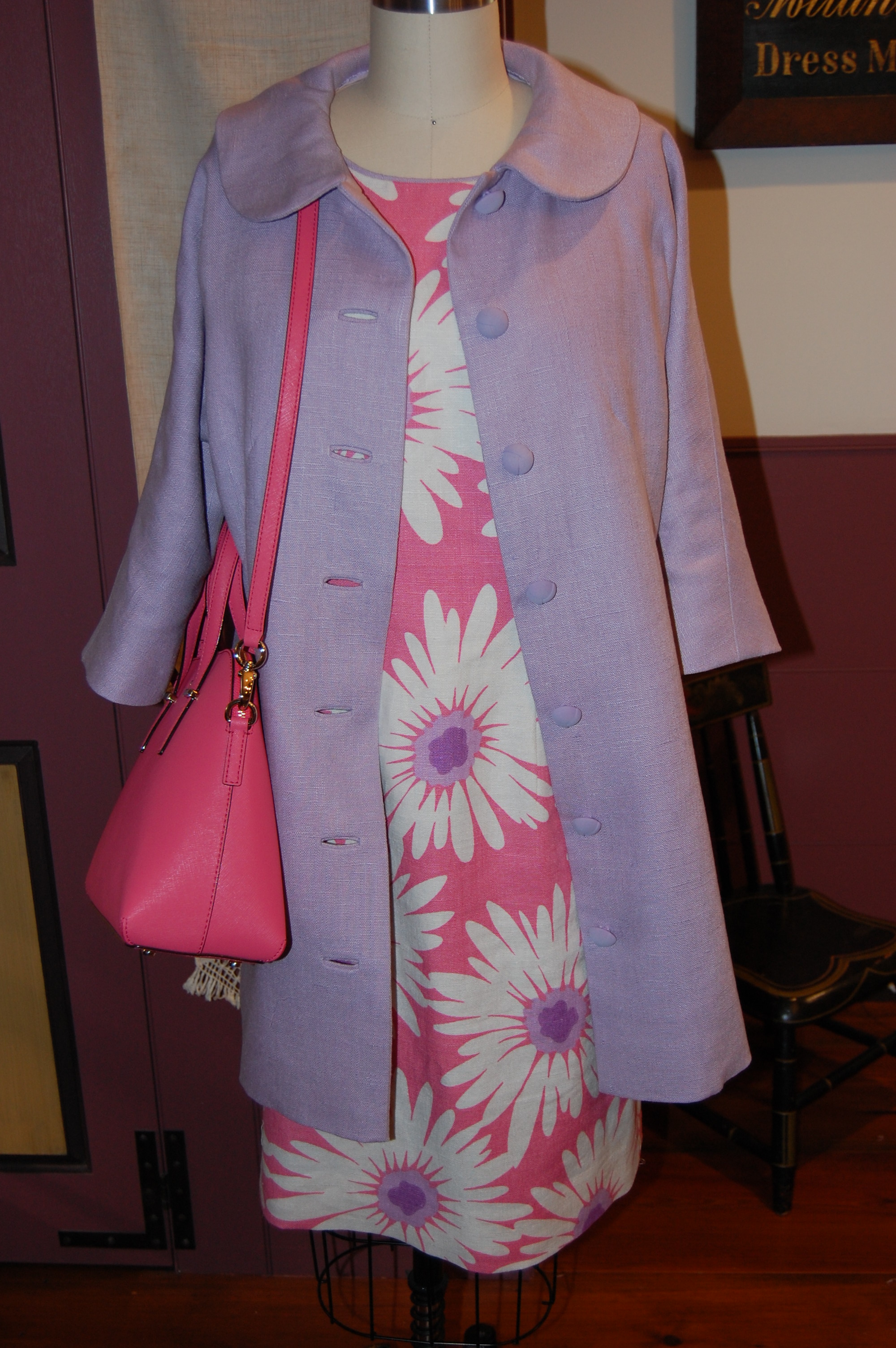
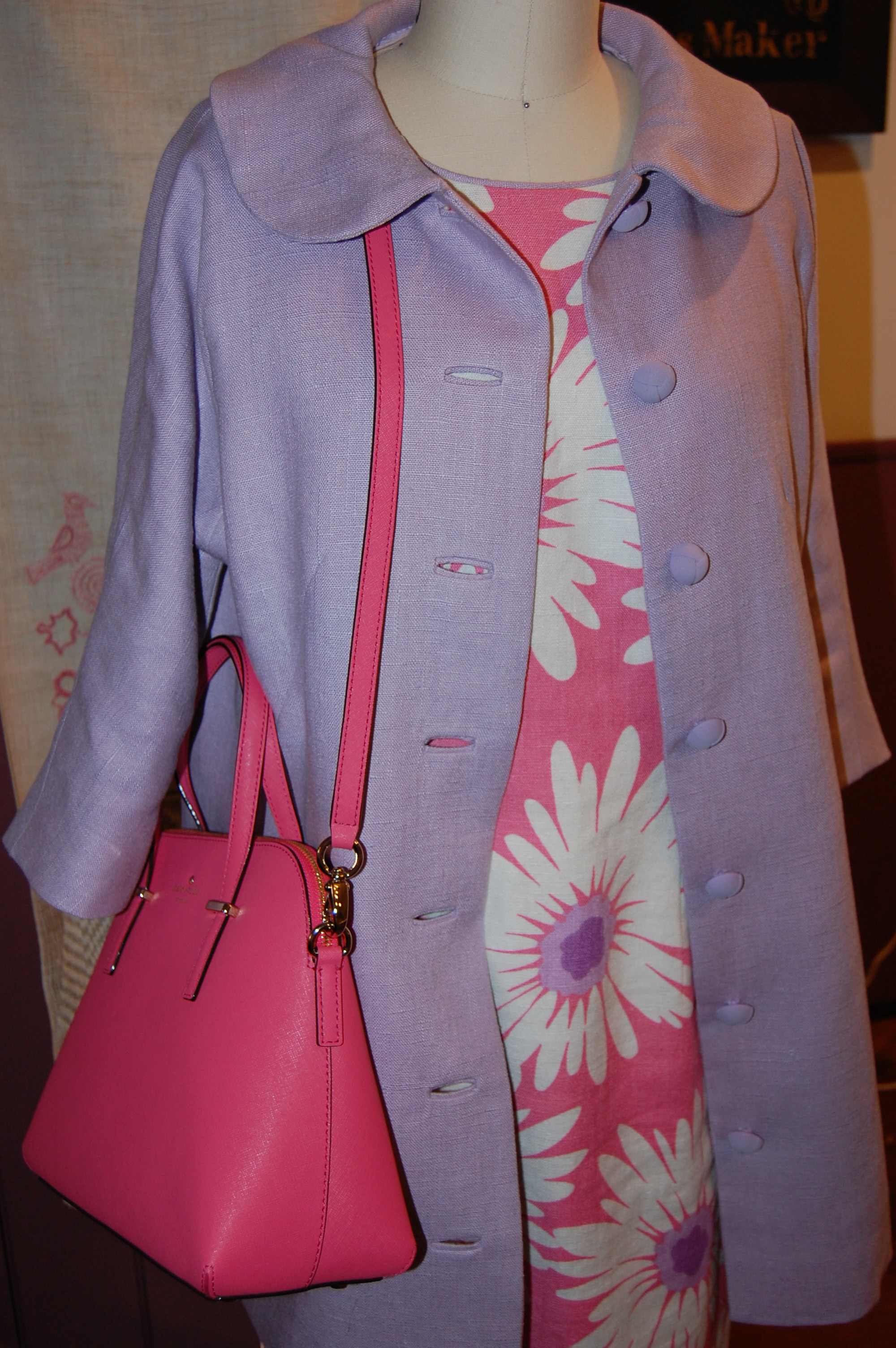
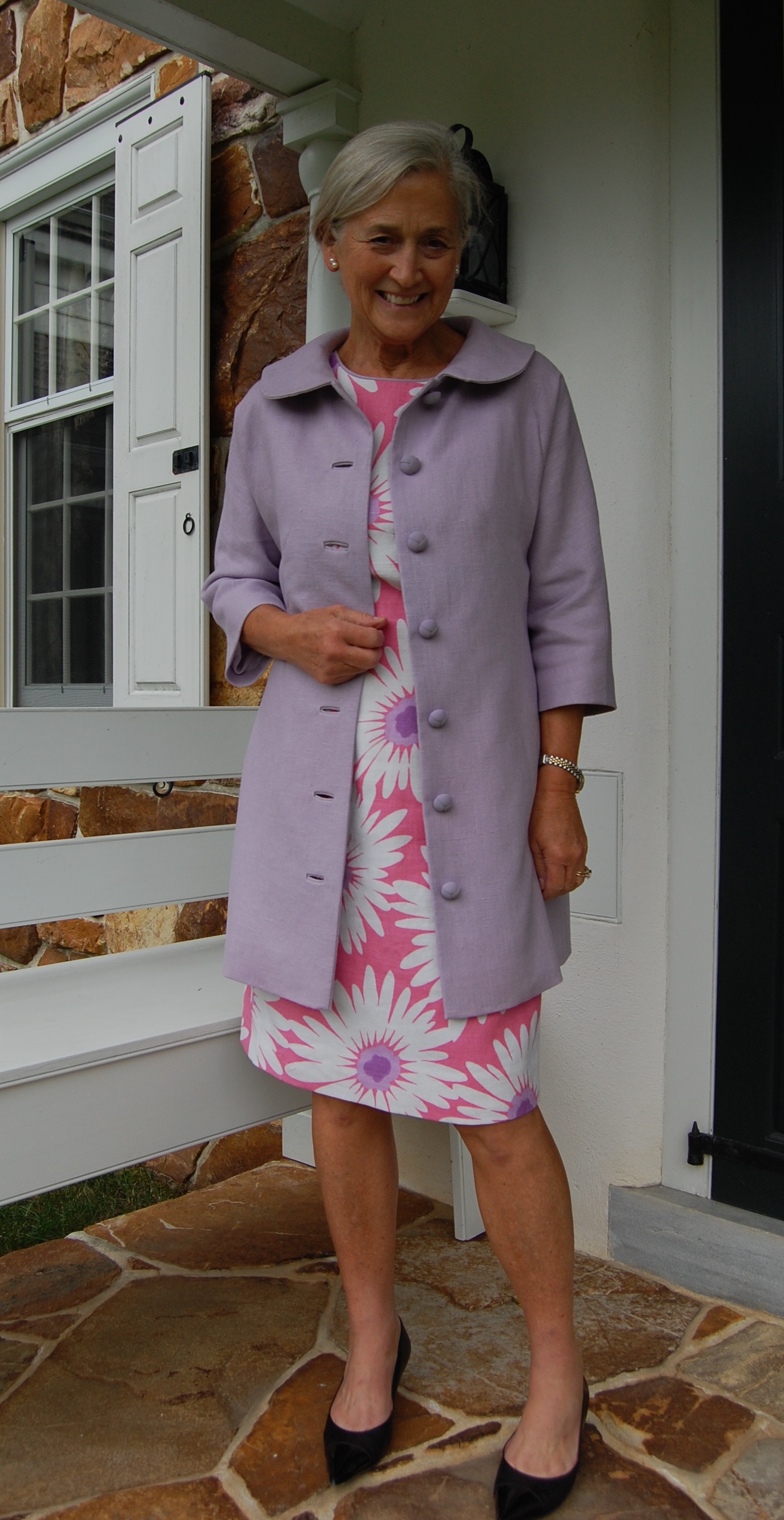
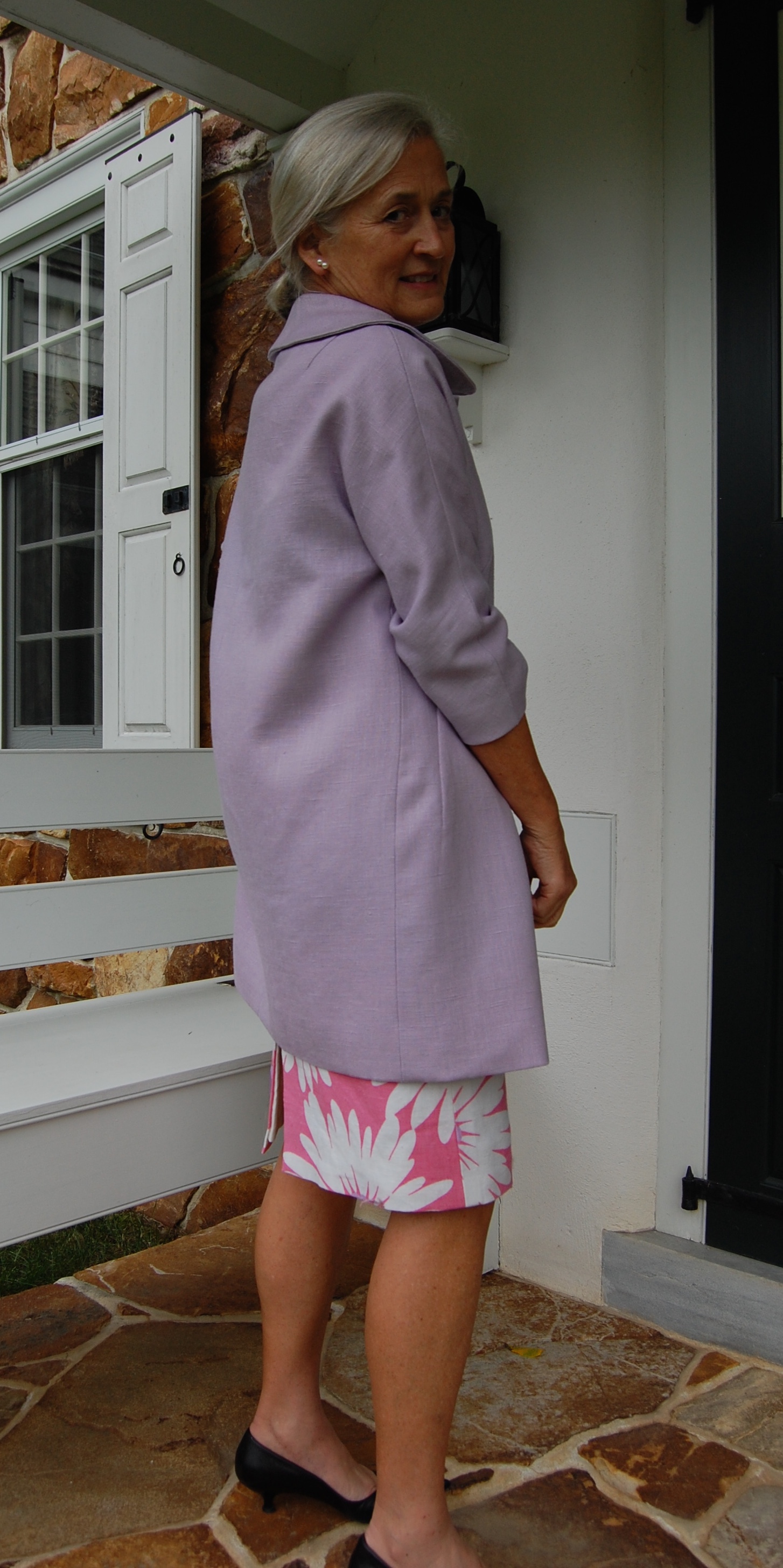
Summer slipped quietly away this week with nary a peep except for the sighs coming from my sewing room. No matter how hard I tried, I could not keep up with the calendar to finish my final Summer project.  However, a few days late on “delivery” doesn’t really upset me, as I can look forward to wearing my Madame Gres-designed coat next Spring.

Vogue Gres coat and dress

DSC_0851

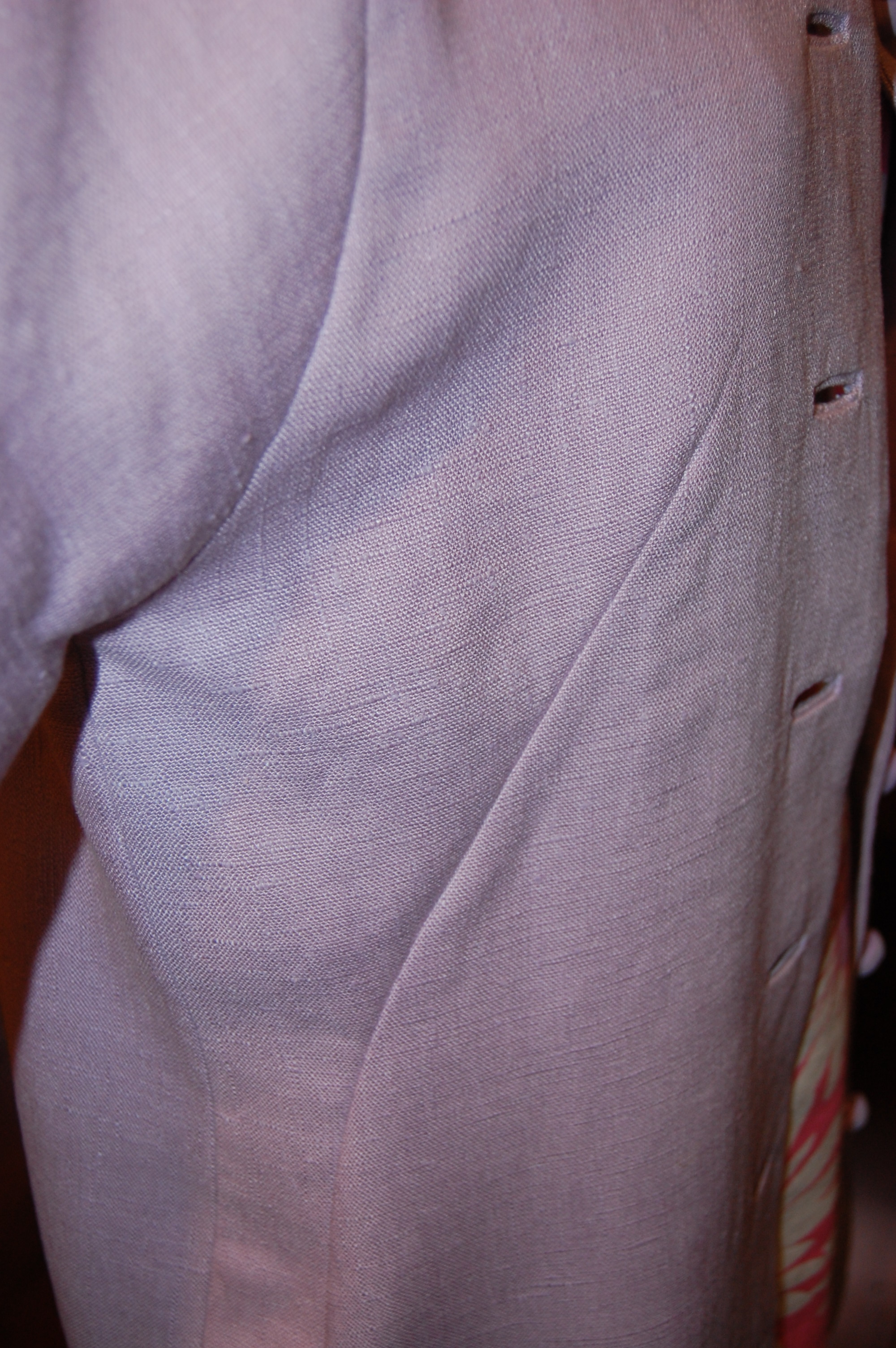
I am not sure I can remember a sewing project which I have enjoyed more. The coat pattern is actually quite a simple design, imaginatively shaped with unusual darts and seams. Perhaps the fact that I made it from vintage Moygashel linen helped make the sewing of it enjoyable, as the linen is so stable. Darts and seams can be crisply sewn and ironed, the grain of the fabric is so easy to see, and the fabric drapes with a fluid sturdiness, if that makes sense.

This shows the side darts which shape the coat and the dart/seam at the front of the kimono sleeve.

This shows the side darts which shape the coat and the dart/seam at the front of the kimono sleeve.

I covered the changes I made to those front darts in an earlier post; those were the only alterations I made to the final design except for lengthening the sleeves by one inch and the length of the coat by 1½ inches. Besides those shaping darts, there is one other feature of this coat which defines it. Do you know what it is?   Yes, it is the bound buttonholes and their buttons. Seven of them, to be precise.

The pattern instruction sheets call for bound buttonholes, as shown here:

I love how these vintage Vogue patterns give such precise instructions; there are various ways to make bound buttonholes, but the method described here is my favorite.

I love how these vintage Vogue patterns give such precise instructions; there are various ways to make bound buttonholes, but the method described here is my favorite.

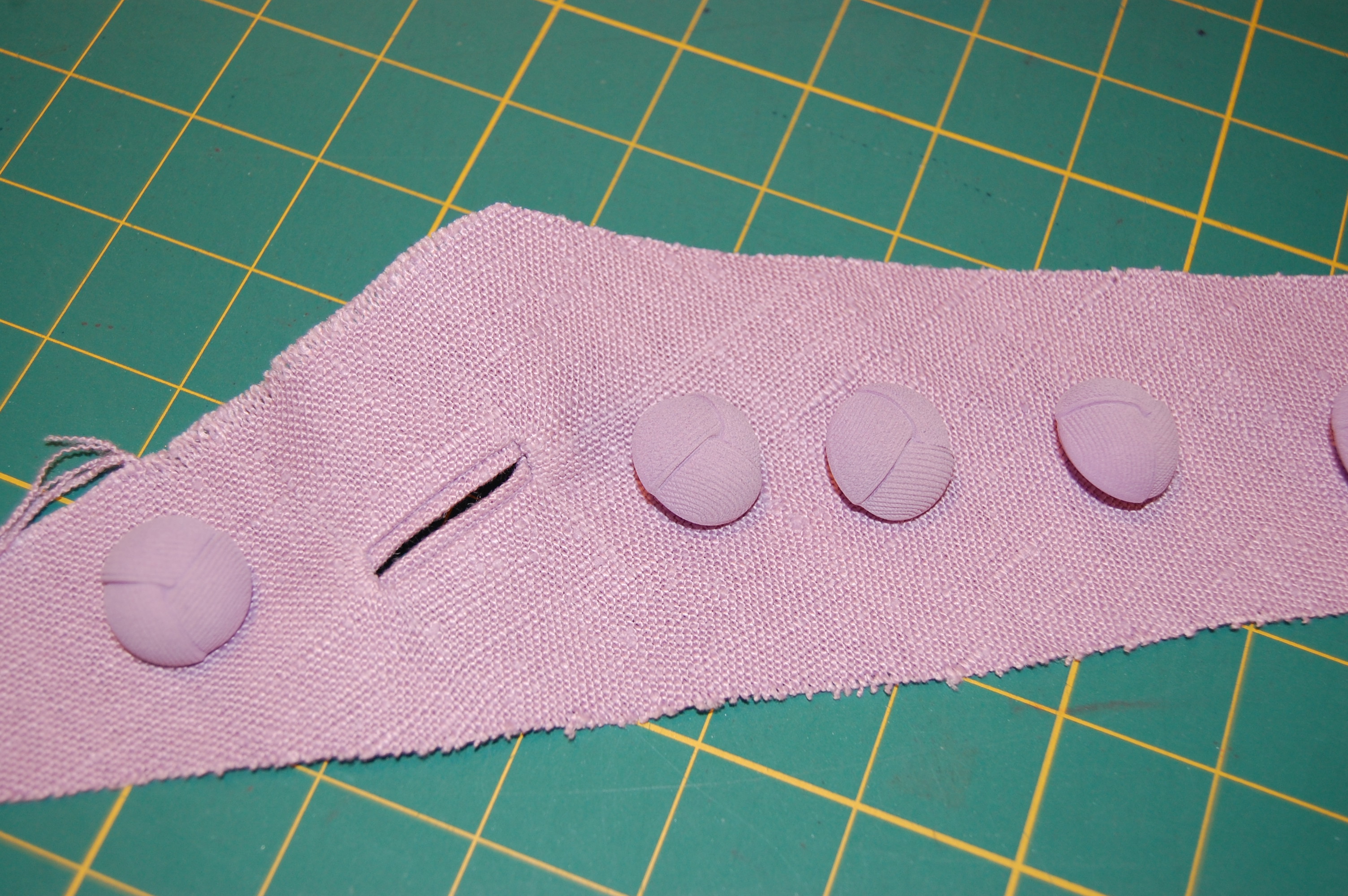
I have made a lot of bound buttonholes in my sewing life, but seven of them lined up as the focal point of the front of my coat is still a little intimidating. First of all, I had to find buttons that were “perfect.” I found some lavender buttons on the Britex website, and although they looked like a good match in color and appearance, ordering something like that online is always imprecise. However, when they arrived, they were, indeed, “perfect!” With buttons in hand, I made a sample buttonhole, as I always do.

DSC_0819

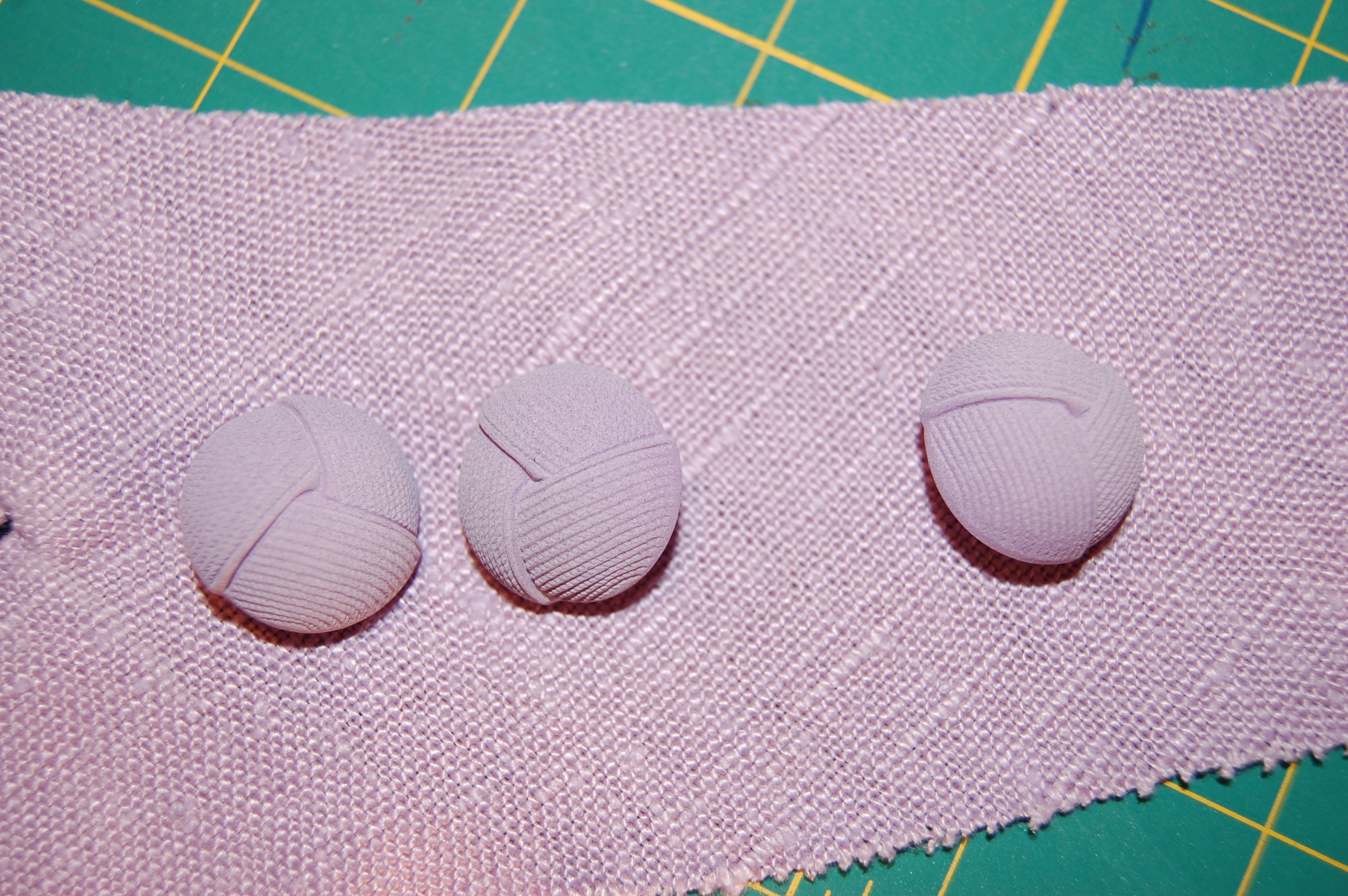
I think this photo shows the "monkey's knot" design in the buttons, which compliments the linen weave, I think.

This photo shows the “monkey’s knot” design in the buttons, which compliments the linen weave, I think.

Then it was on to a marathon buttonhole session one afternoon.

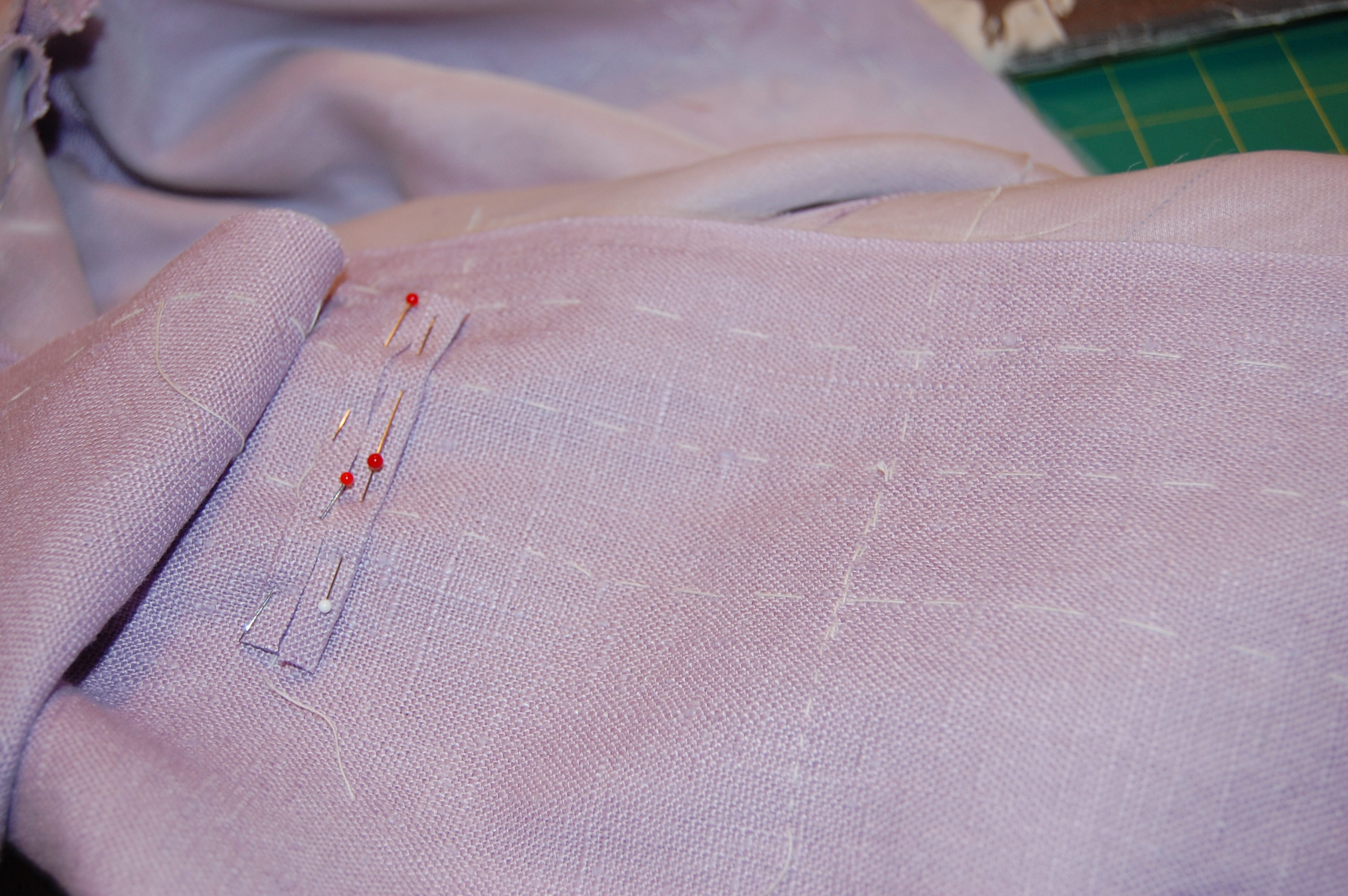
The most important ingredient in making successful bound buttonholes is precise marking.

The most important ingredient in making successful bound buttonholes is precise marking.

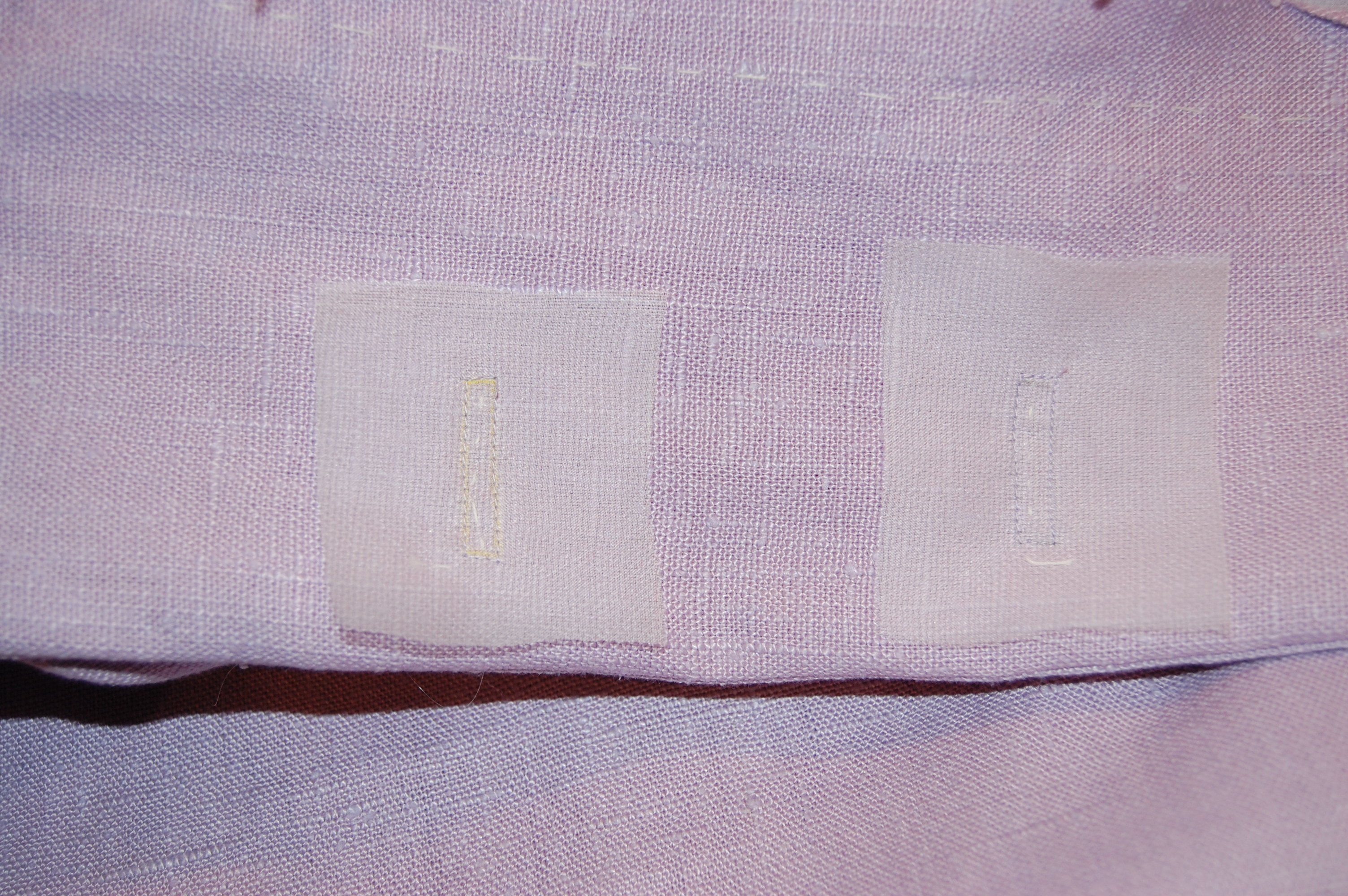
I finished the underside (on the facing) of the buttonholes using organza patches, which makes a beautiful, sturdy finish.

I finished the underside (on the facing) of the buttonholes using organza patches, which makes a beautiful, sturdy finish.

Here is the underside of the buttonholes before I finished the edges.

Here is the underside of the buttonholes before I finished the edges.

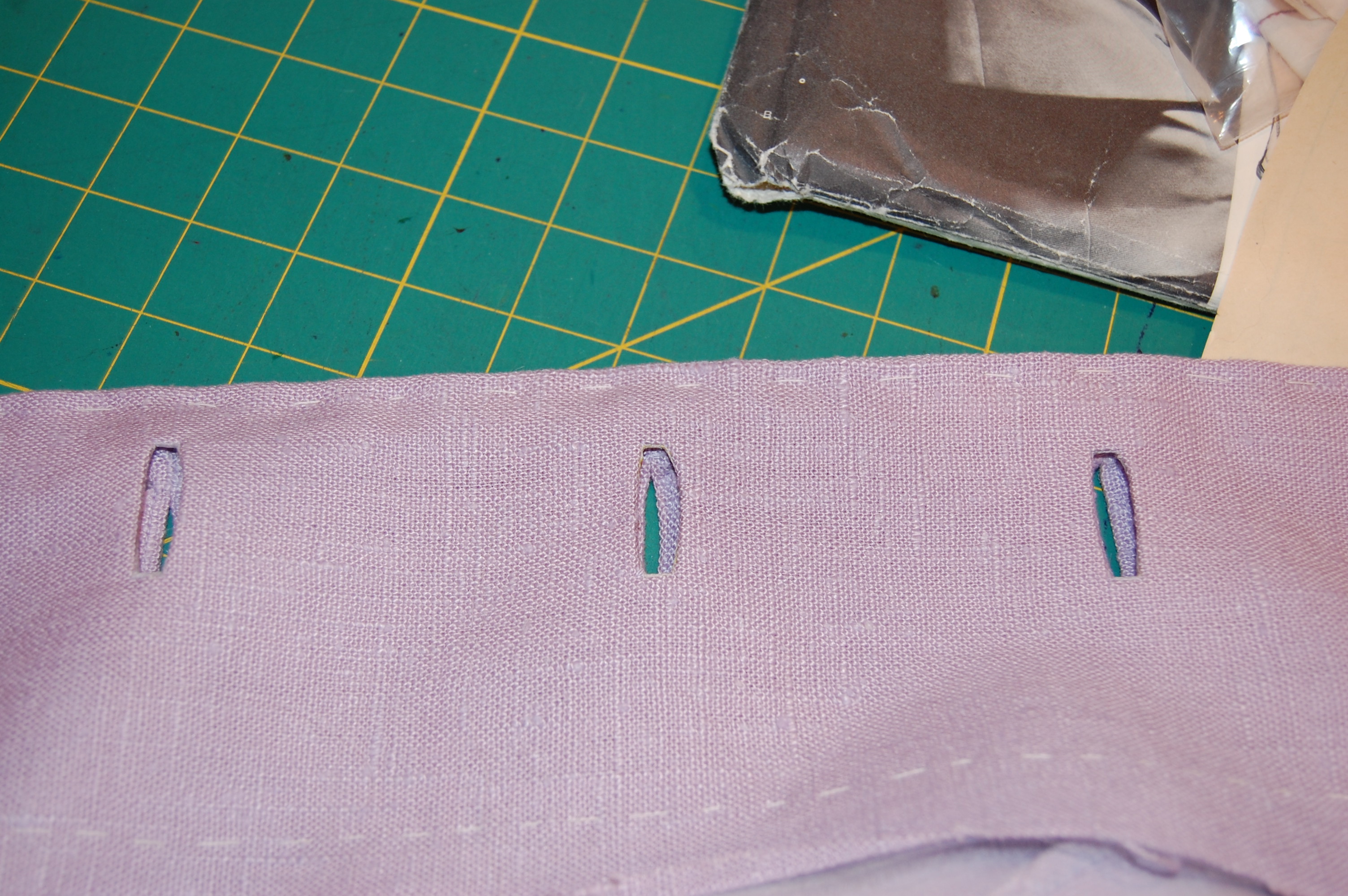
And here is the facing side, finished.

And here is the facing side, finished.

Another charm of this pattern is the coat collar, which is seamed in the center back on the bias, causing it to “turn” beautifully. I under-stitched the undercollar to help keep the perimeter seam properly in line (this is a trick I learned from one of Susan Khalje’s classes):

This is the undercover, showing center back seam and the under-stitching I used to secure the perimeter seam.

This is the undercollar, showing center back seam and the under-stitching I used to secure the perimeter seam.

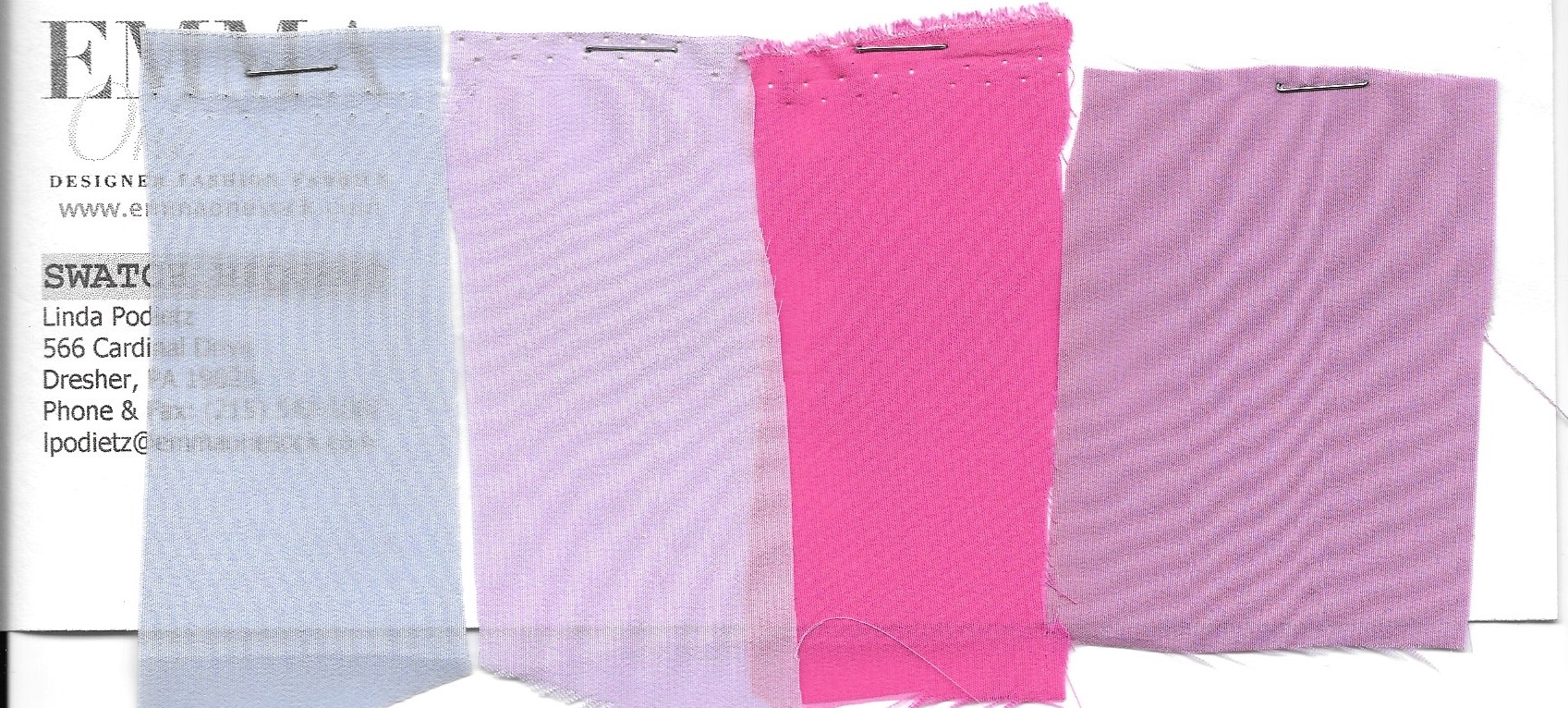
When it came to the lining, I knew I wanted to use silk crepe de chine. I ordered some swatches from Emma One Sock fabrics:

A Fitting finish swatches

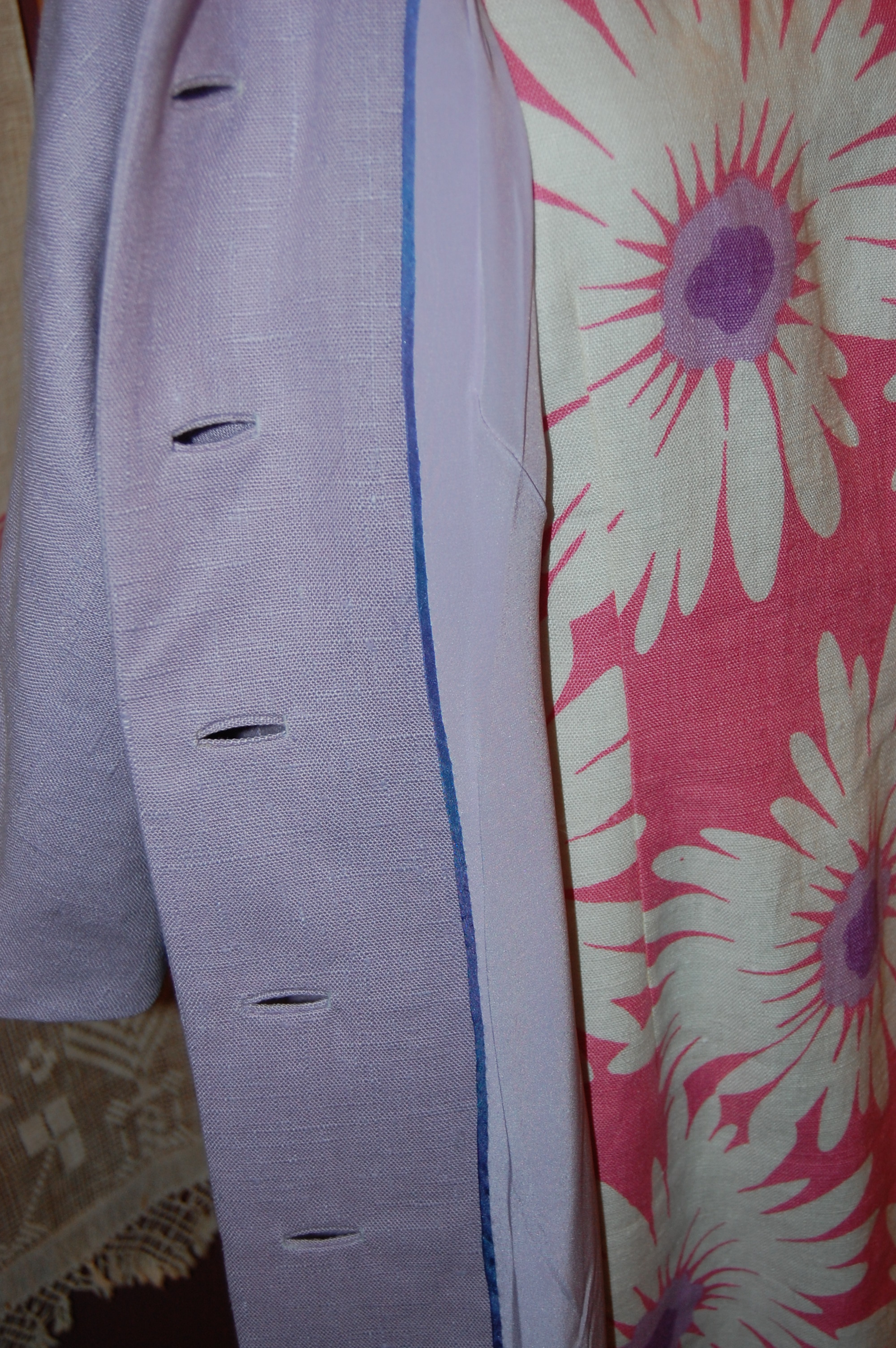
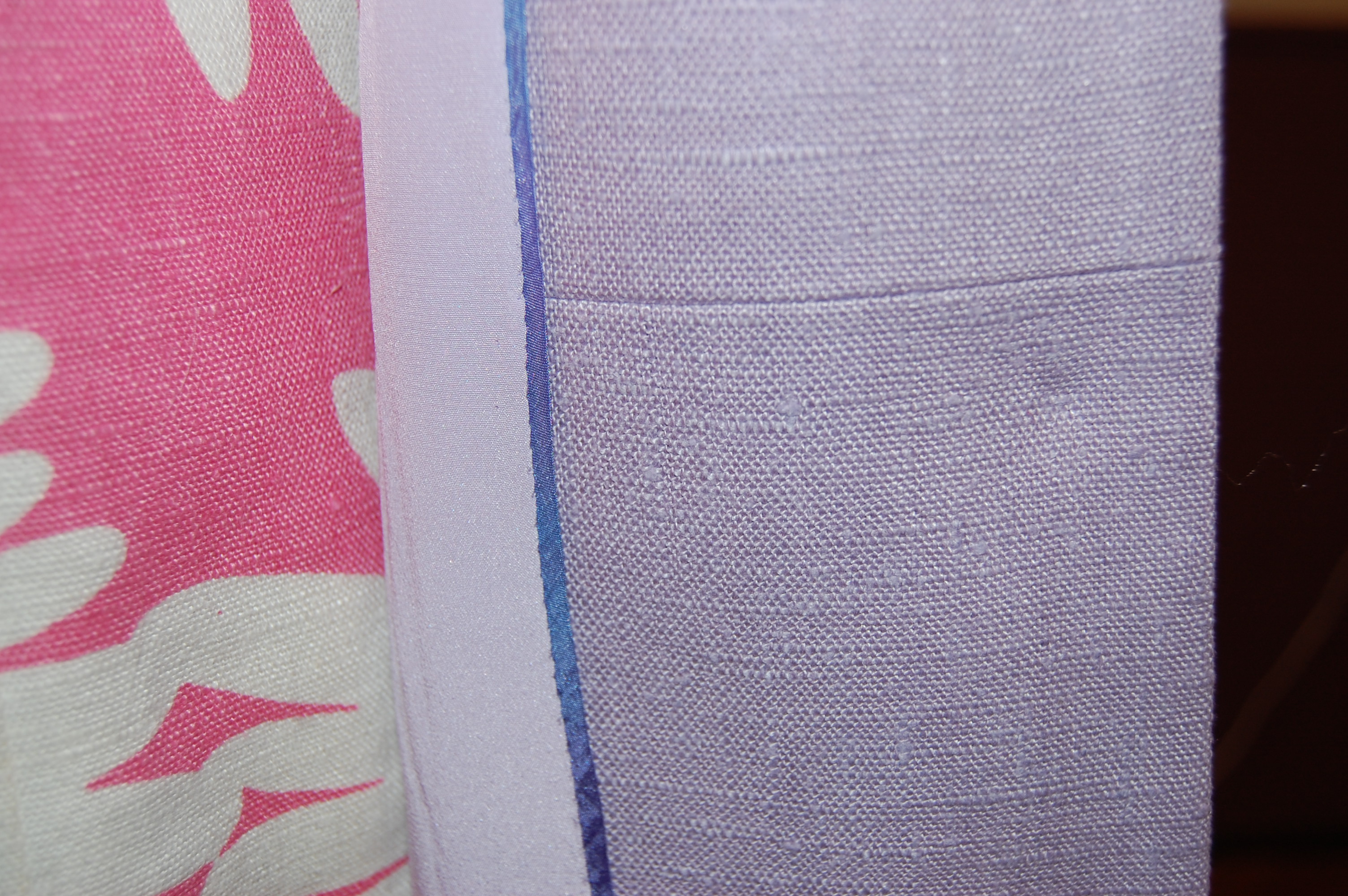
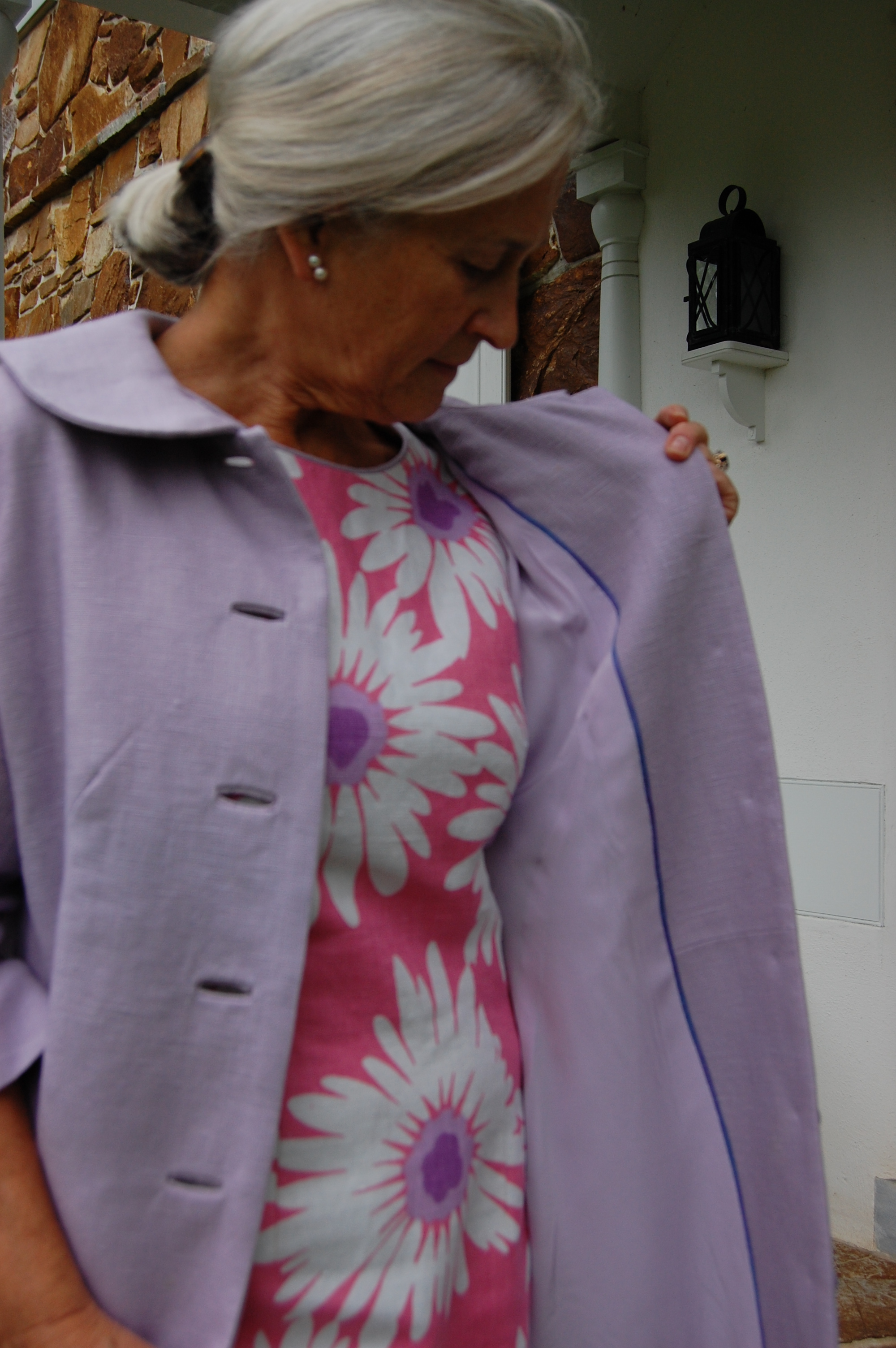
Fortunately my sister was visiting and so I could get her opinion on which one to order. I was a bit smitten with the idea of a bright pink lining, but she wisely asked if I hoped to wear this Spring coat with dresses other than the pink flowered one which had inspired it. Well, yes, I do want that flexibility! That made the decision easy – I chose the pale lavender silk, which is just about a perfect match. I added a bias, flat piped edge to the lining, which is now something I always do with coats and jackets I make. It is so easy and adds so much!

Fitting finish

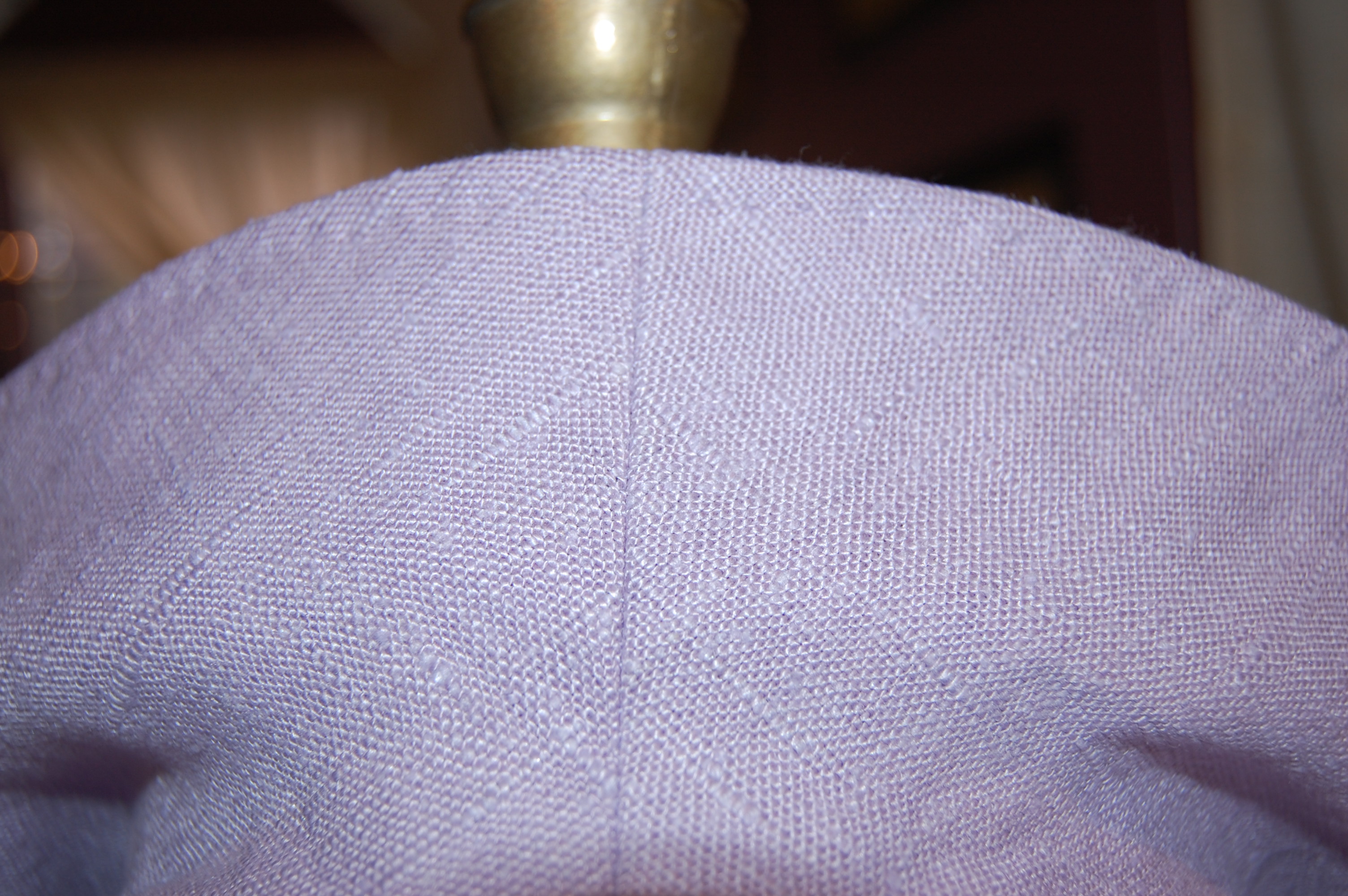
Some of you may recall that I had to piece one of the facings because I was just a little short of the fabric I needed. Here is the seam on the left facing. I really don't think anyone will ever see it! (Except all of you, of course!)

Some of you may recall that I had to piece one of the facings because I was just a little short of  fabric. Here is the seam on the left facing. I really don’t think anyone will ever see it (except all of you, of course!)

DSC_0844

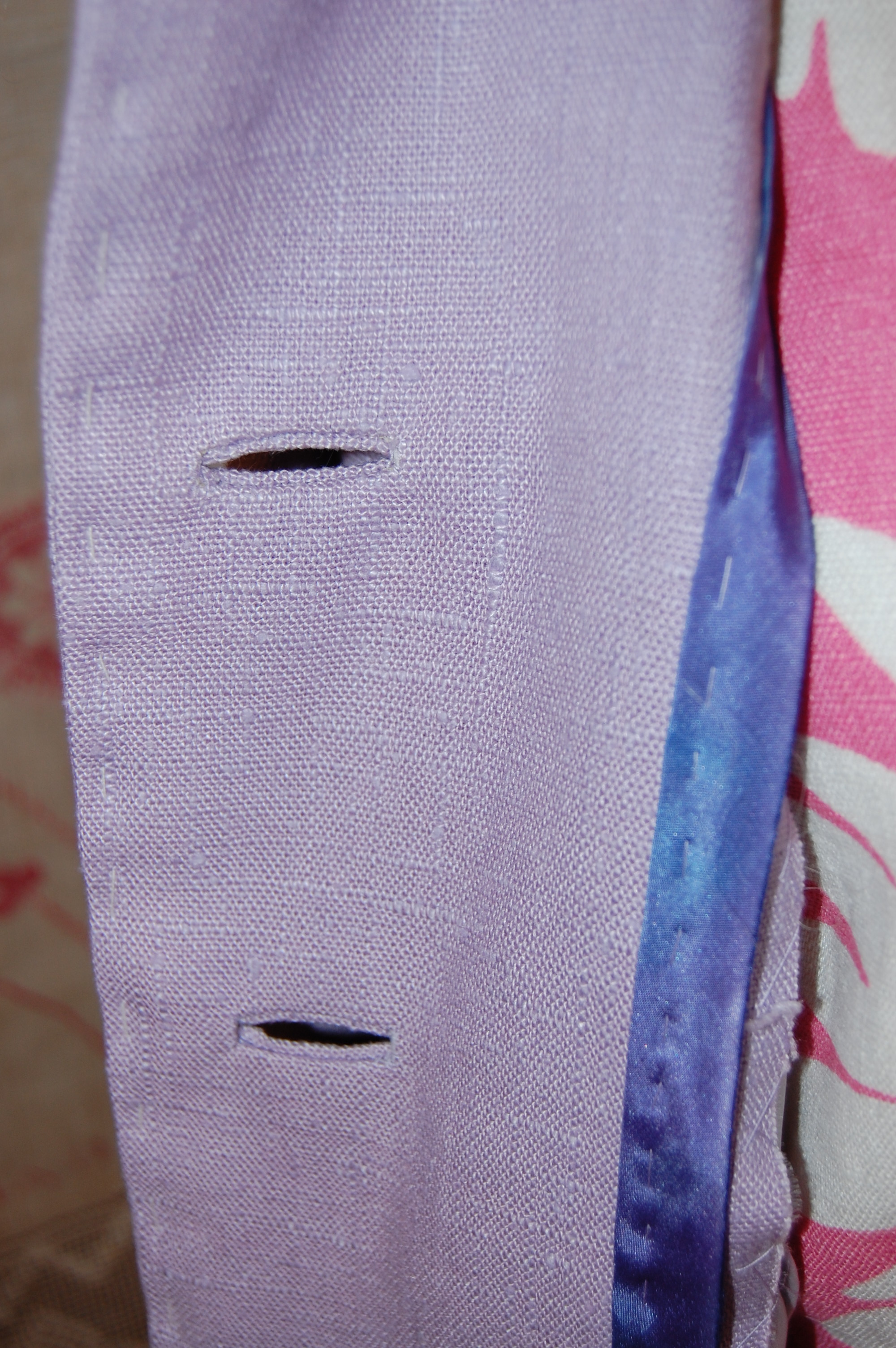
This is a good look at the bound buttonholes and what they add to the overall look of the coat. If you visualize machine made buttonholes in their place, you will get an idea of how vital the bound ones are to the design of the coat.

Another thing that will add to the total look of my 2016 Spring ensemble is this Kate Spade handbag which my grown children gave to me:

Fitting finish

DSC_0855

Fitting Finish

Fitting finish

Fitting finish

DSC_0837

Now all I need are lavender pumps…

43 Comments

Filed under bound buttonholes, Buttons - choosing the right ones, Coats, couture construction, kimono sleeves, Linen, Love of sewing, Moygashel linen, Uncategorized, Vintage fabric, vintage Vogue Designer patterns, vintage Vogue patterns from the 1960s

“Do What You Can…”

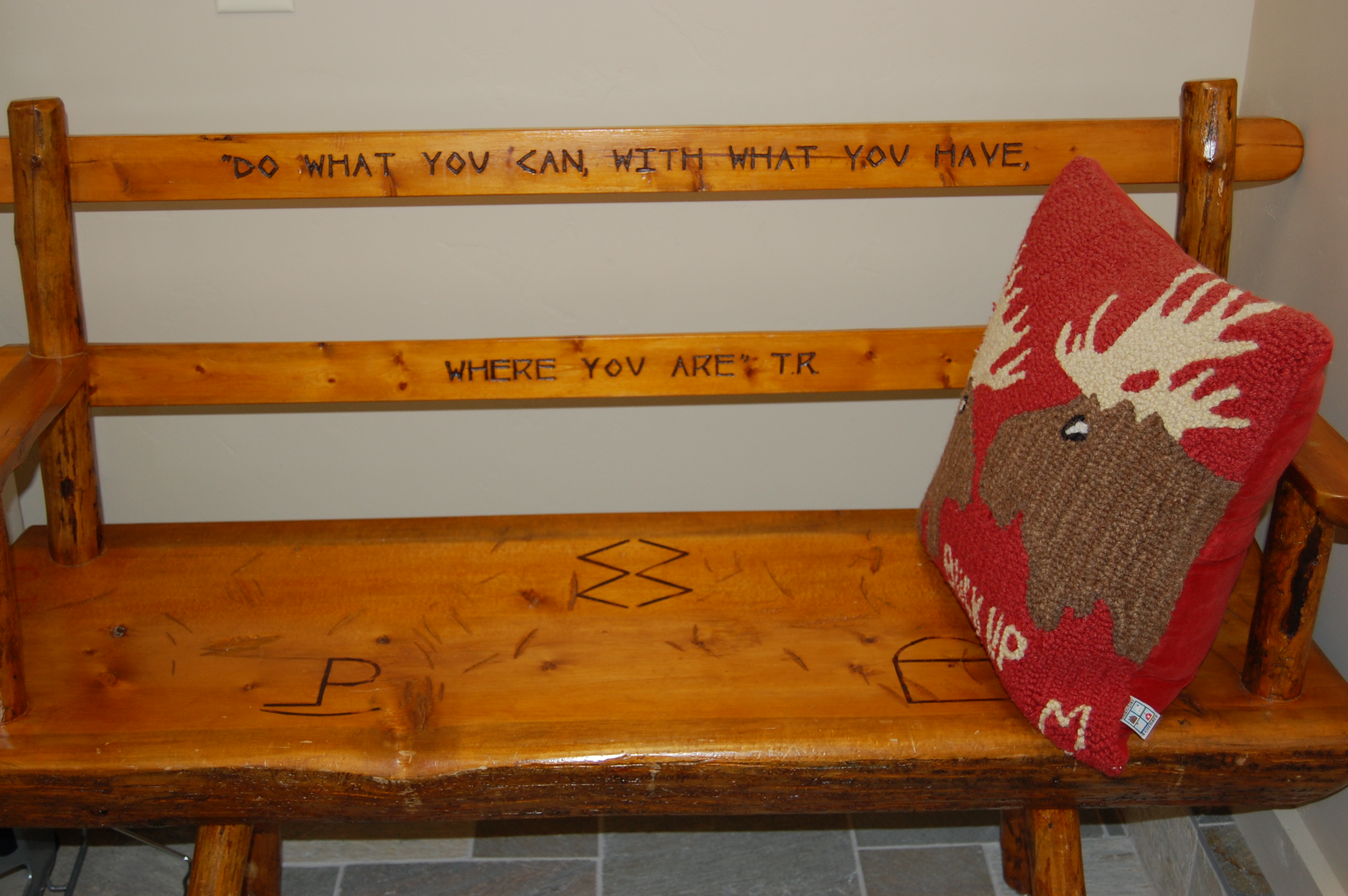
“Do what you can, with what you have, where you are.” – Teddy Roosevelt

I had never seen nor read this quote before three weeks ago, seeing it for first time carved into the slats of this rustic bench:

DSC_0652

There is a lot of wisdom in those few words, especially meaningful to many people in many different walks of life, I am sure, but especially pertinent to those of us who sew. Why so, do you ask?

Do you, as I do, plan sewing projects which are transportable when you travel? Can you quite imagine being without needle and thread – or at the least, a book or magazine on sewing or fashion? What do you do when you can’t (gasp!) bring along your sewing machine when traveling far from home? Well, you do what you can, with what you have, where you are….

What I knew I could do before we left our home in Pennsylvania three weeks ago for a month in Wyoming – was plan to do hand-sewing on two or three projects. What I had for a “first-project-to-finish” before I departed home (sans sewing machine) – was the unfinished pink-flowered linen dress, started what seems like a lifetime ago.

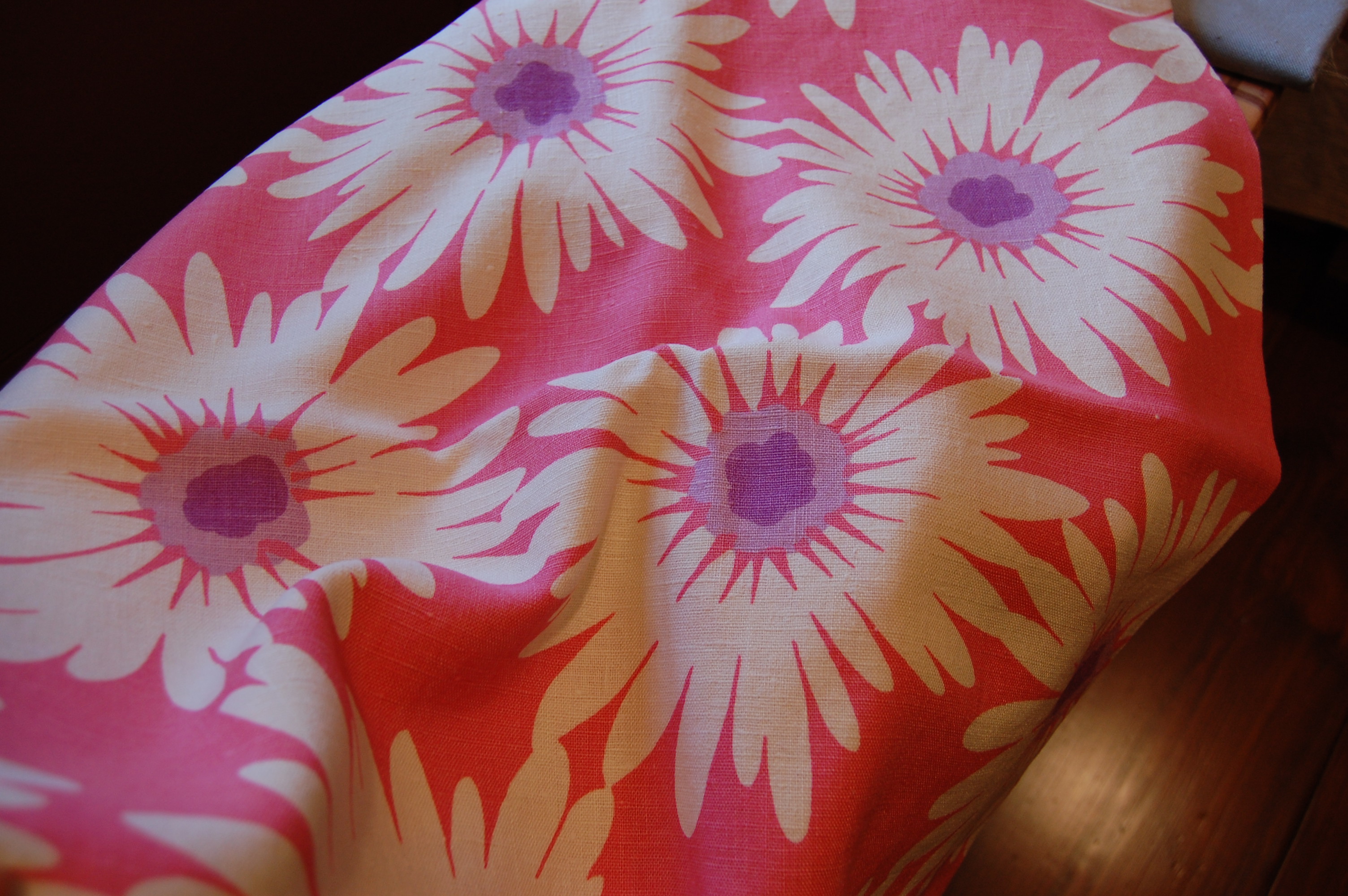
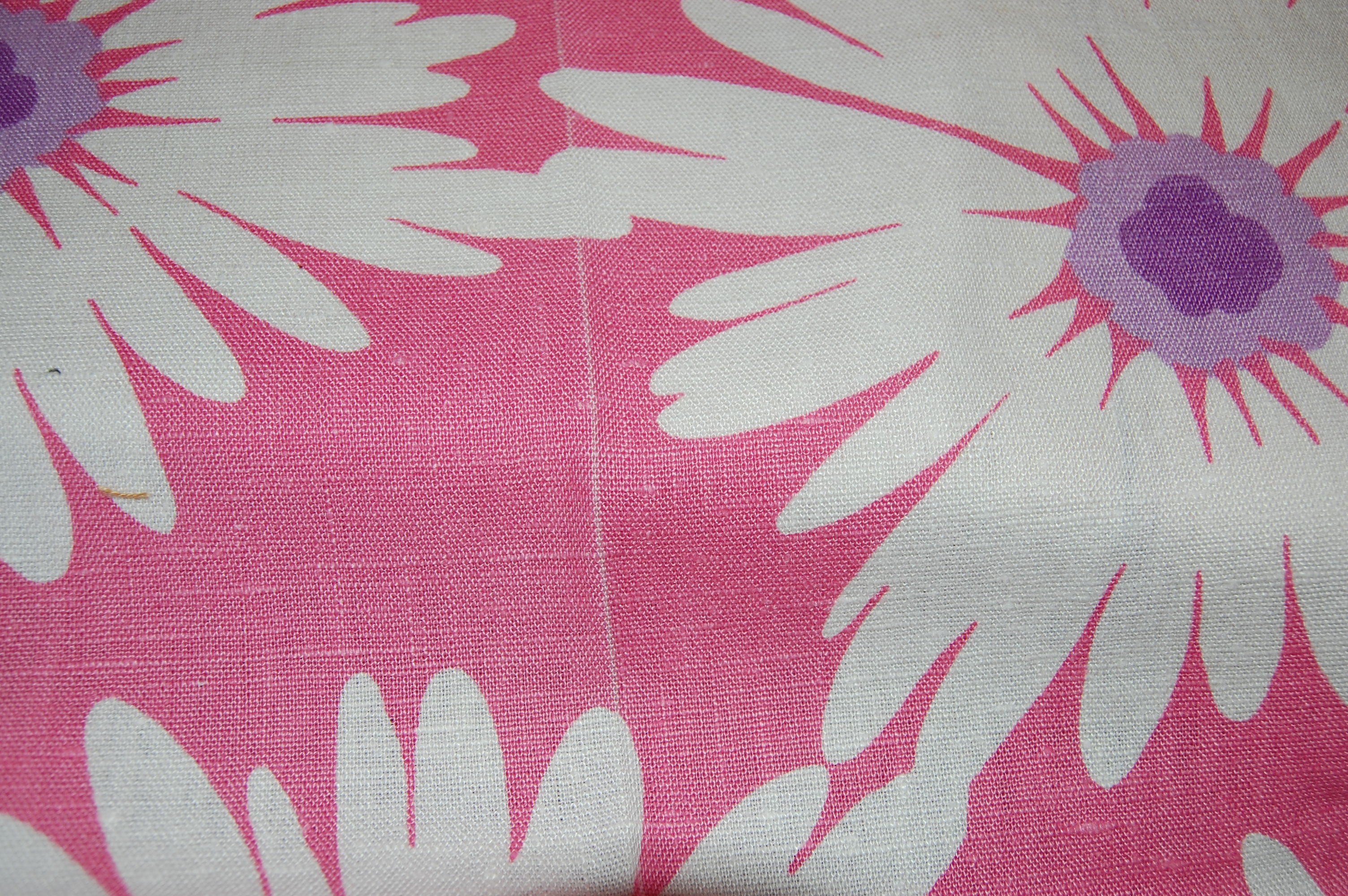
Big, bright daisies with lavender centers.

Big, bright daisies with lavender centers.

And where I was going to be – had possibility and promise and “best plans” written all over it. The possibility and promise have come in bucketfuls, with days and weeks of family fun: hiking; wildlife-sightings; story times with little granddaughters; diaper changing and laundry; shopping a la Western style; cocktail hour every evening; magnificent mountain peaks, valleys, lakes and rivers; grocery shopping and more grocery shopping; and the list goes on and on. I realized a week into our stay that all my planning for some strategic hand-sewing tucked into these busy days was, well, quite simply, not going to happen – at least not while grown children and little grandchildren took loving precedence!

And then suddenly, all too soon, the house was much too quiet, the toys were put away, and while hiking and wildlife sightings are happily still commonplace, my sewing – and my pink linen “not-quite-a-dress-yet” dress – came out to give me a different type of focus.

I was scrambling before I left home to get it to the point where I had only the hand-sewn finishing to complete. The first challenge I had was with the layout of the sheath dress pattern on that large floral print. The linen is a piece of vintage Moygashel, dating to the late 1960s. By this date, Moygashel was being produced in 45” width, rather than 35”. I have found that it is not uncommon to find center crease lines in the linen from this era, where decades of storage have caused the fabric dye to rub off enough to leave a faint pale line.

The fold line - and subsequent faint white line showing dye loss is visible in this photograph.

The fold line – and subsequent faint white line showing dye loss is visible in this photograph.

This left me with only one option: I had to place the dress front and the two side backs on either side of the center line of fabric, to avoid that pale line. But I also had to think about the placement of those large daisies. I wanted to try to match the fabric design as much as possible along the center back seam. To accomplish both these goals, I had to line up the front of the dress and one of the side backs, one above the other. (I forgot to take a photo.)  It turned out I was a couple of inches short of the length I needed to do this. So – I knew I would need to face the hem.

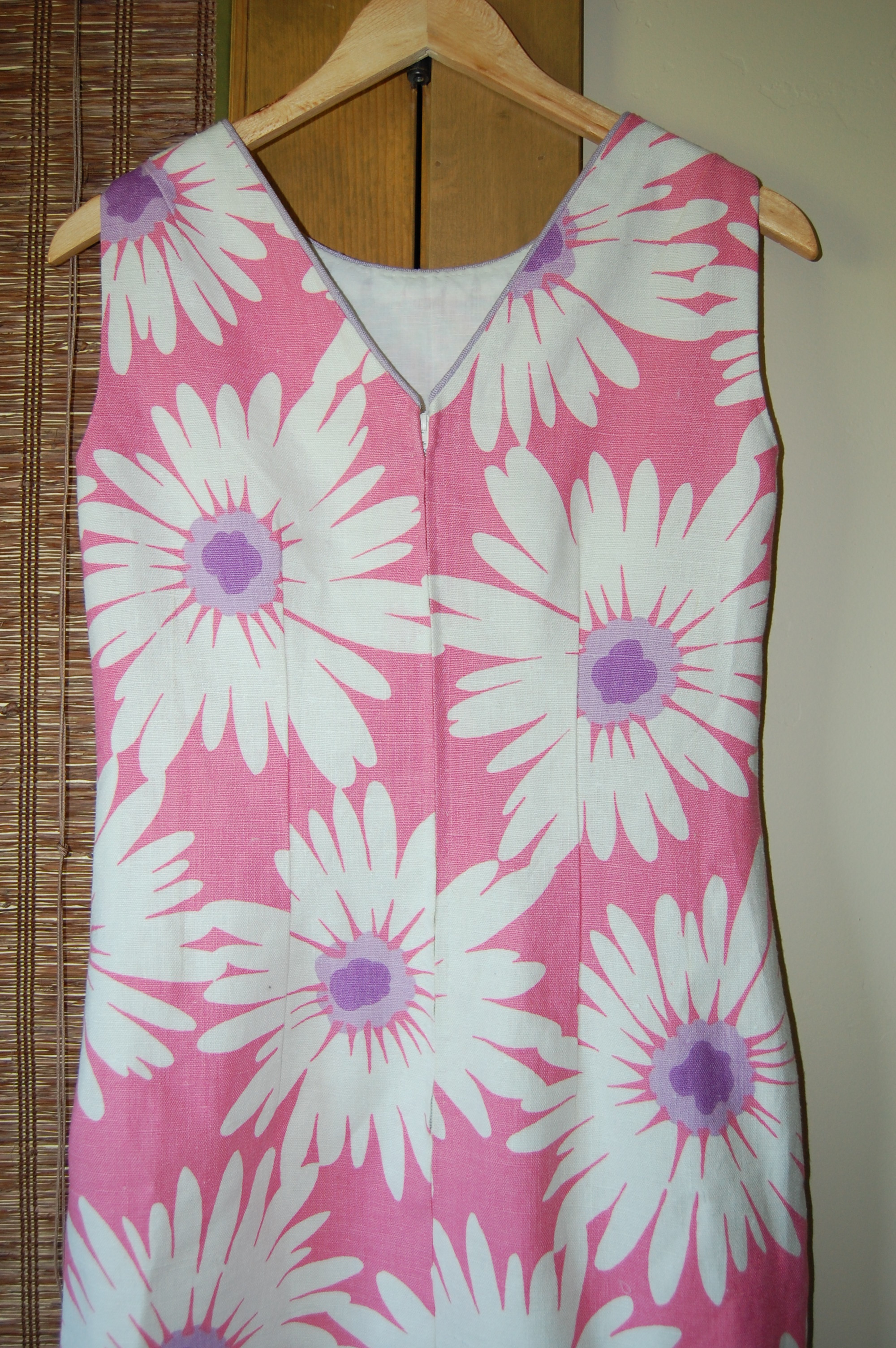
I was fairly successful in matching the flower design along the back seam . . .

I was fairly successful in matching the flower design along the back seam . . .

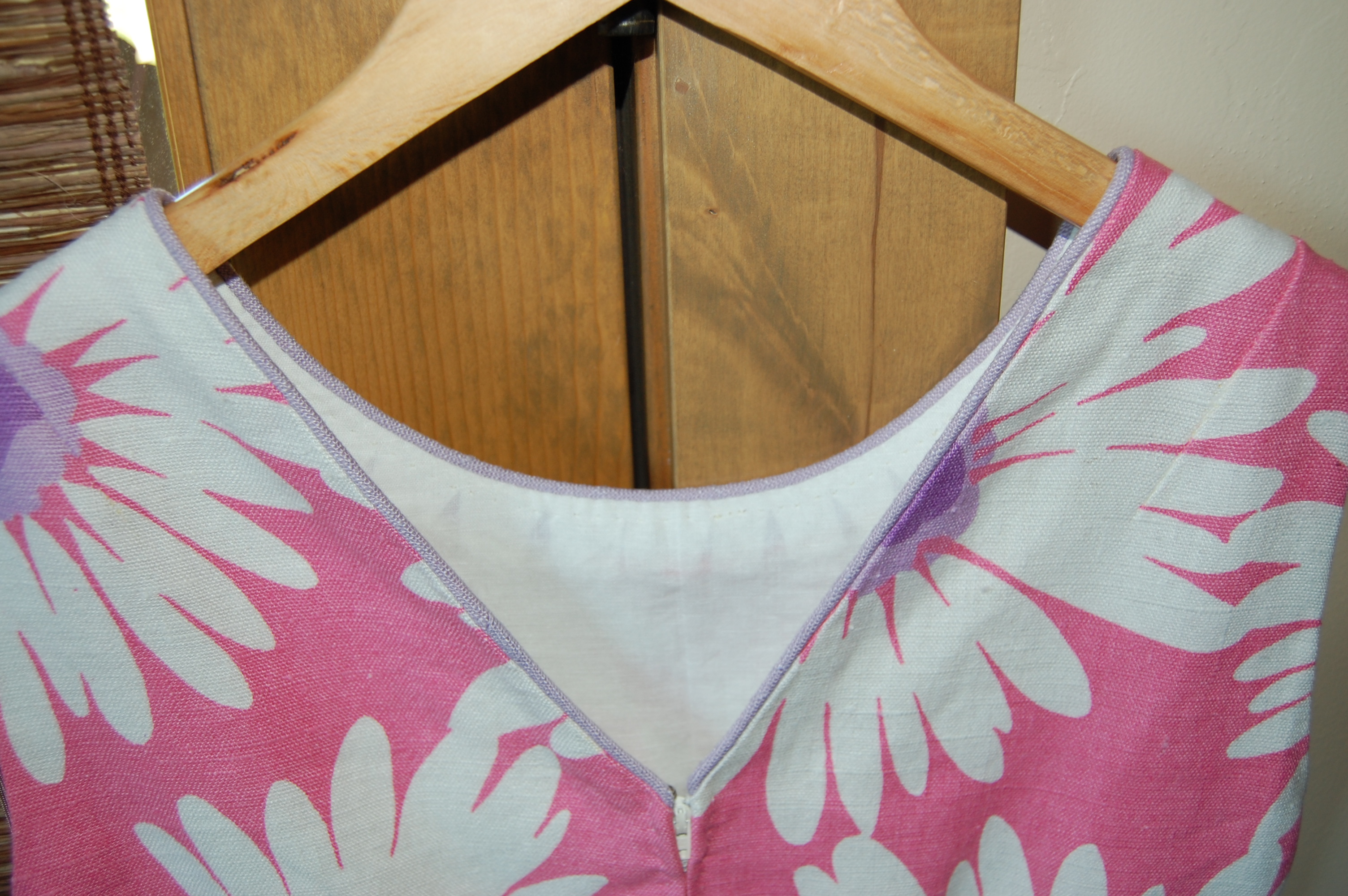
Then on to the machine sewing of darts, seams, seam finishings. With those completed, I turned my attention to the lavender piping I wanted to put around the neck edge. I used the same cotton kitchen string I had used on my “ghost dress” to use as the filler for the piping. The heavier weight of the linen made the piping more substantial, which is exactly what I wanted.

I added piping only to the neck edge.

I added piping only to the neck edge.

With the piping sewn in place, I could proceed to the zipper. Even though I would be hand-picking the zipper, I wanted to complete it, to double-check the fit before I left on our journey. Then I realized that I had purchased the wrong length zipper! I had picked up a 20” zipper, forgetting that I was adding a V to the back neck. I needed a 16” zipper and had no time to make the trip to JoAnn’s to get a new one. In desperation I searched through my notions drawers and found every color and length of zipper under the sun except a 16” white one. (I’m exaggerating, of course.) Then I looked through a bag of zippers I had gotten from my mother, and lo and behold, there was a 16” white metal zipper, still in its original wrapper. Well, why not? A vintage metal zipper would be perfect for vintage linen. Crisis averted.

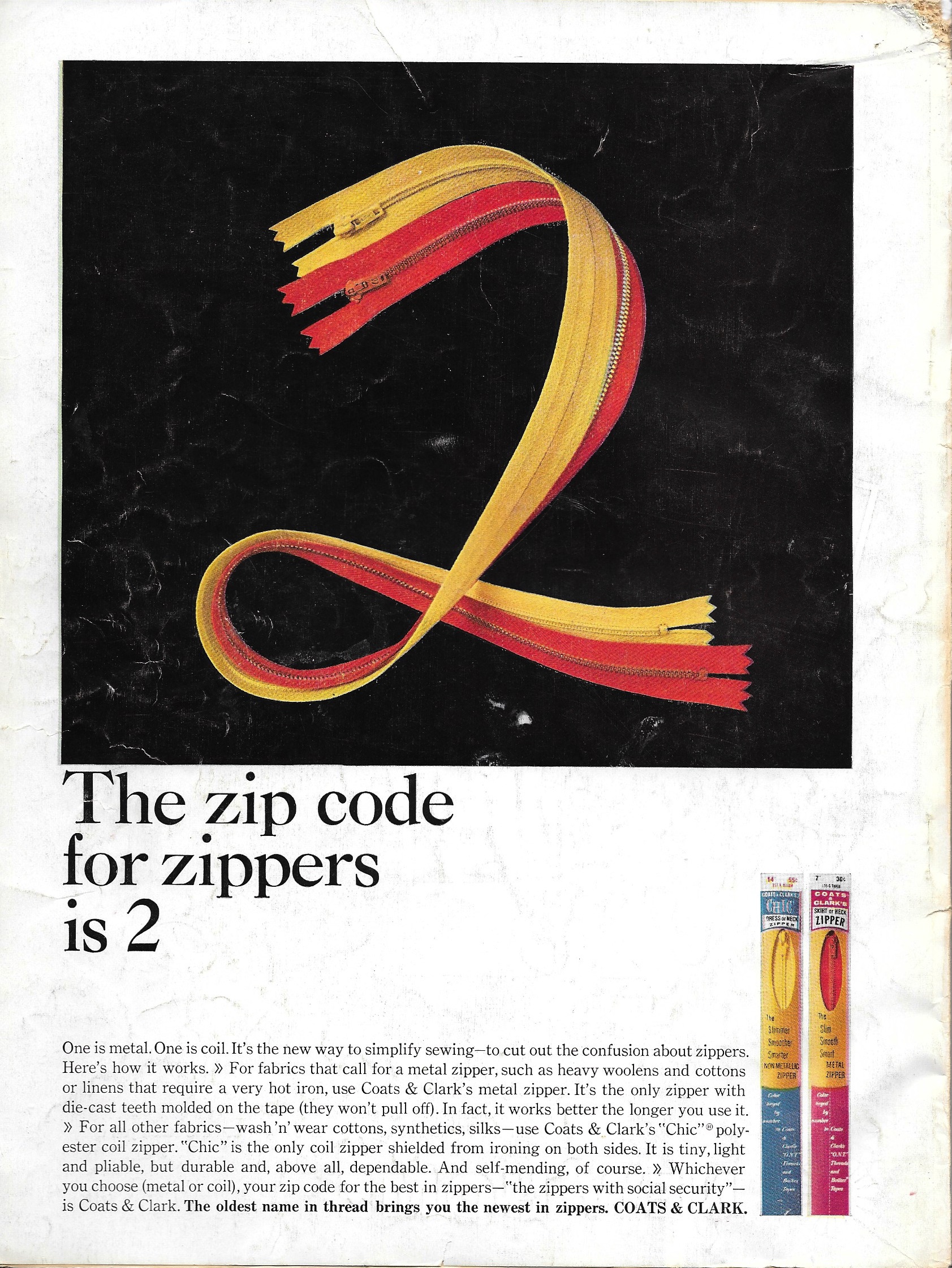
As it turns out, I found this ad for metal versus nylon coil zippers in a 1964 Vogue Pattern Book Magazine. If you read the copy, they recommend using metal zippers for fabrics like cotton and linen which require a hot iron. The quality of nylon coil zippers is now such that they can be used for these fabrics without a worry.

As it turns out, I found this ad for metal versus nylon coil zippers in a 1964 Vogue Pattern Book Magazine. If you read the copy (click on the photo for easier reading), they recommend using metal zippers for fabrics like cotton and linen which require a hot iron. The quality of nylon coil zippers is now such that they can be used for these fabrics without a worry.

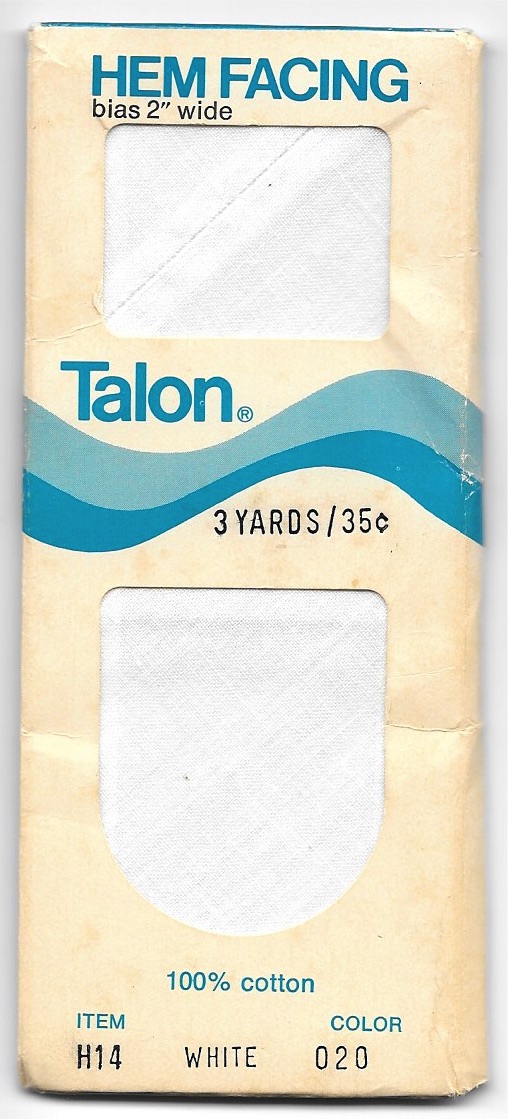
Before I turned my attention to making the lining for the dress, I wanted to address that faced hem. With no time to think about making a facing from the lining fabric, I went back to my notions drawer. Once again, sewing hand-me-downs from my mother came to the rescue! I found this package of white cotton hem facing, which would be perfect for my needs.

Look at the price on this! Also, now I am quite sure the hem facing would be a cotton blend rather than 100% cotton.

Look at the price on this! Also, now I am quite sure purchased hem facing would be a cotton blend rather than 100% cotton.

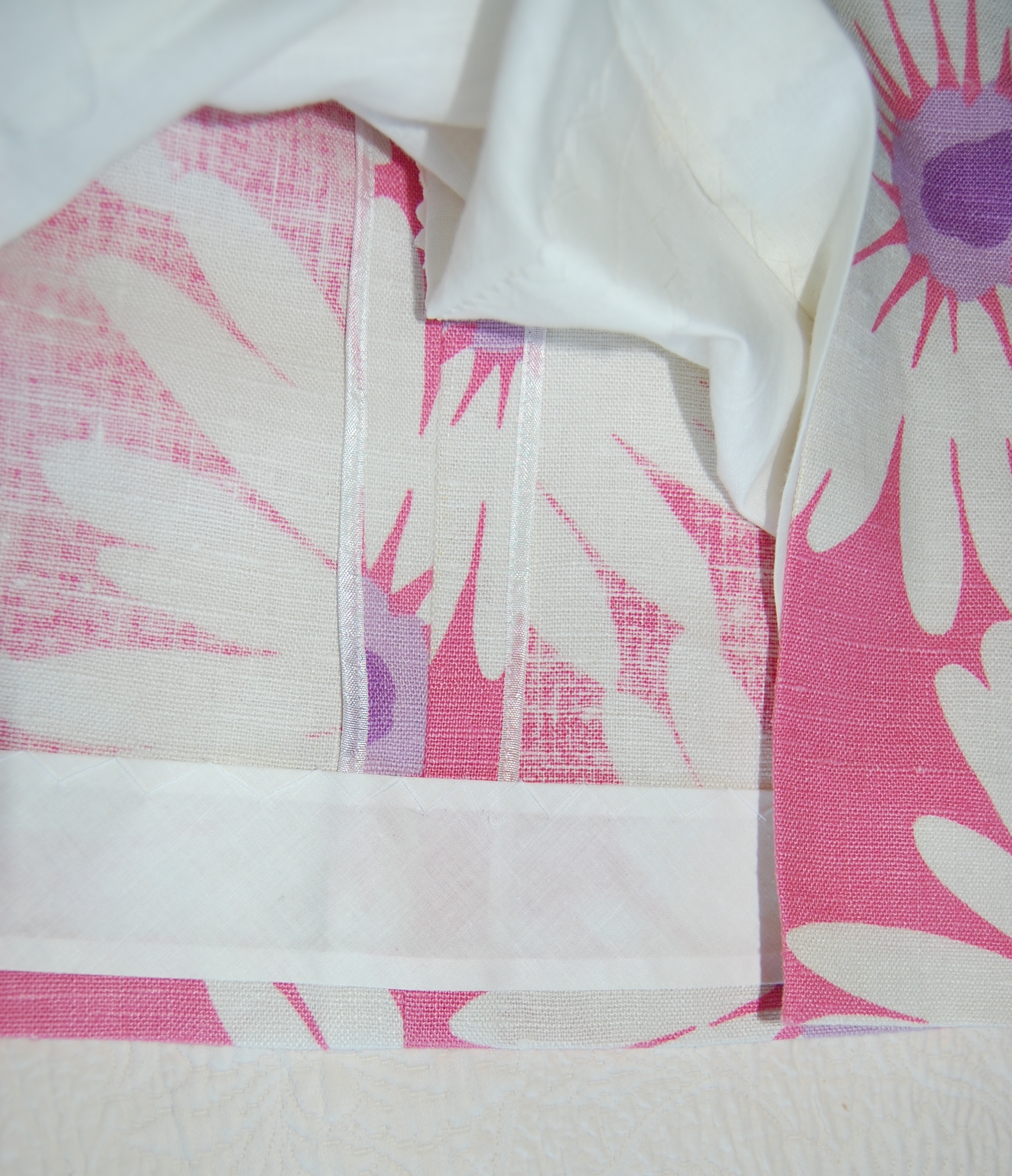
The faced hem, plus a view of the seams which I finished with Hug Snug seam binding.

The faced hem, plus a view of the seams which I finished with Hug Snug seam binding.

Once the lining was sewn, I gathered all the tools and notions I would need to finish the dress by hand. Off it all flew to Wyoming, where finally I finished this flower-powered dress under the expansive Western skies.

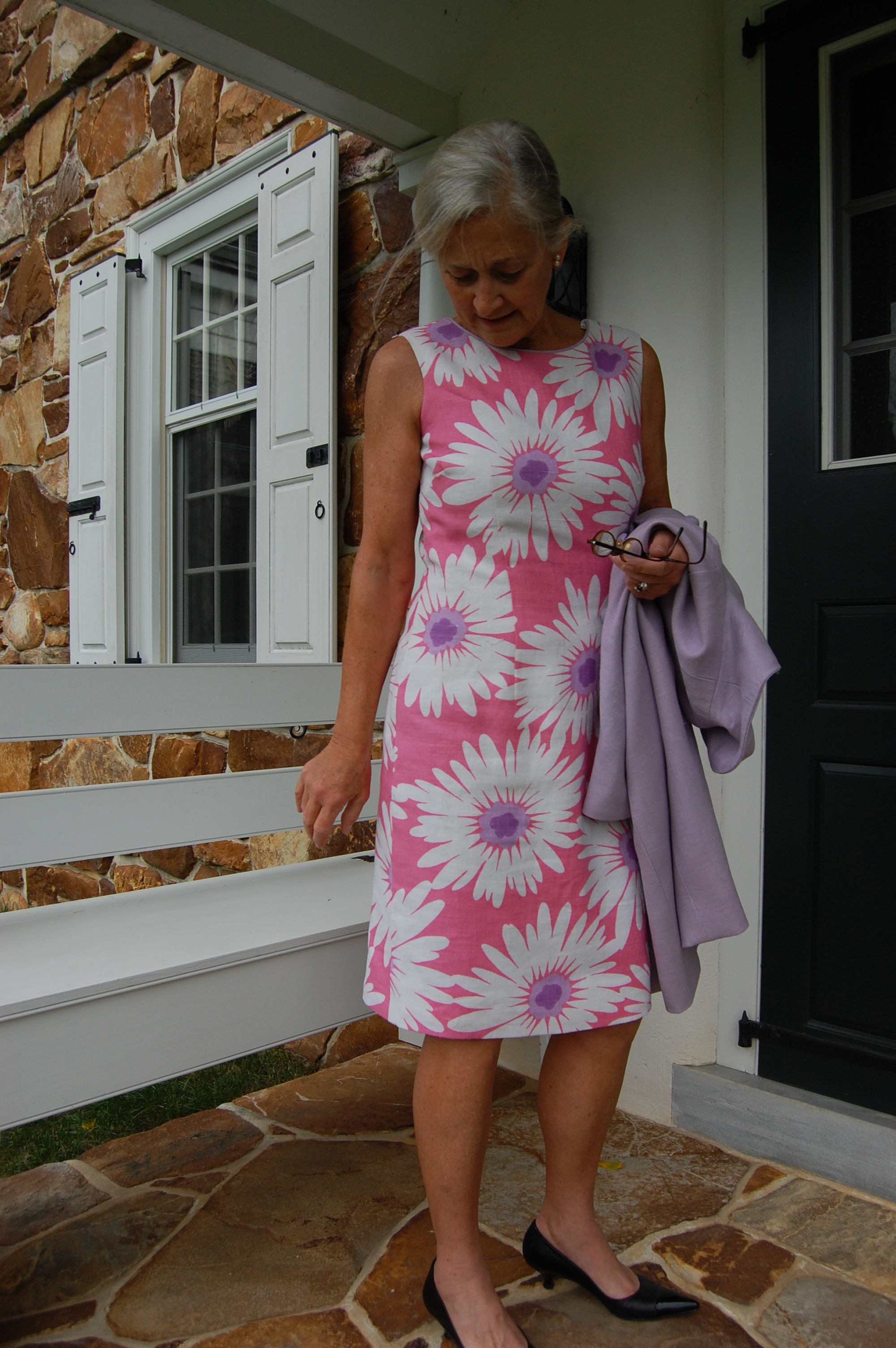
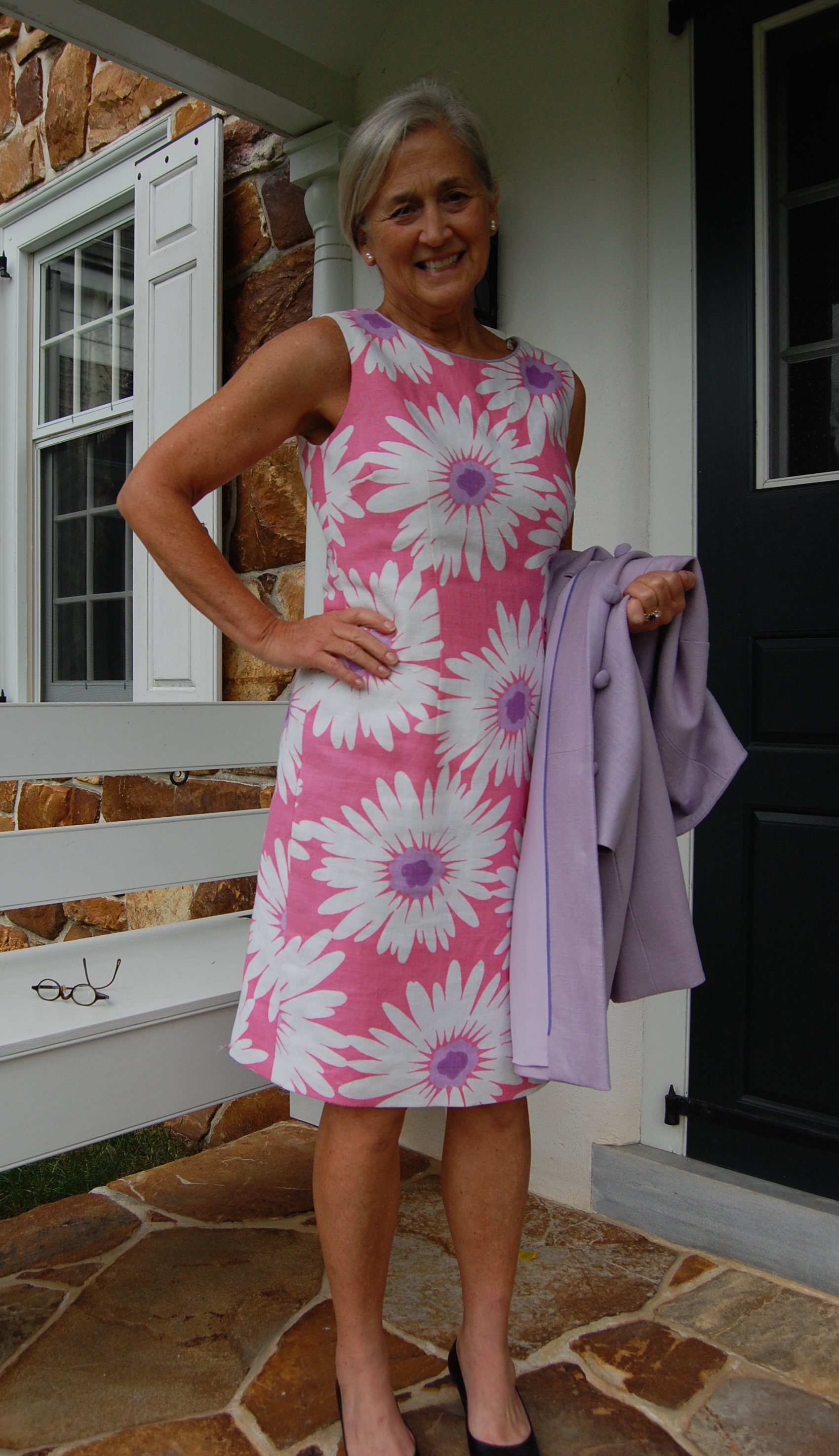
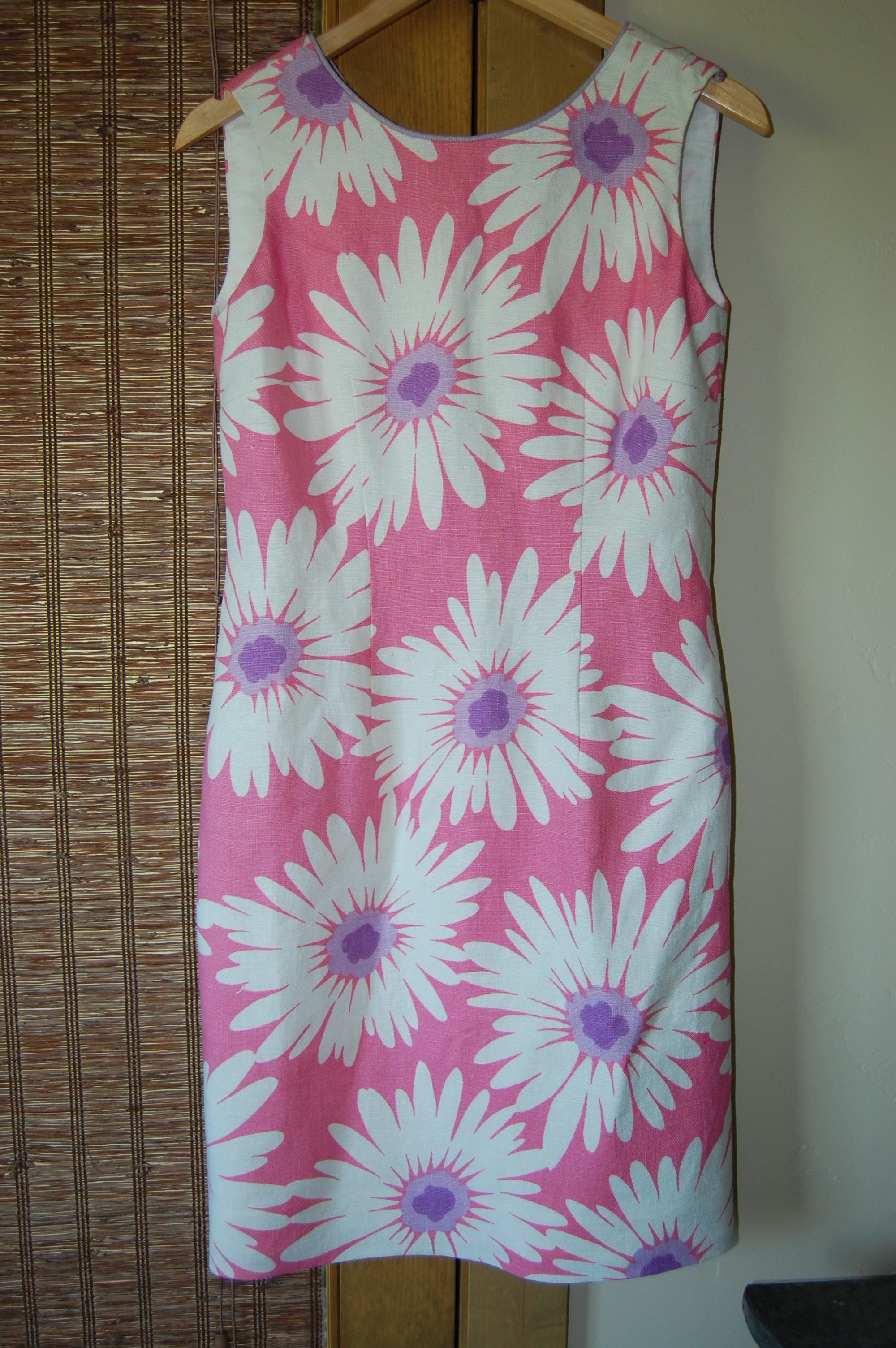
The front of the dress. No time to get photos of me in it yet, unfortunately!

The front of the dress. No time to get photos of me in it yet, unfortunately!

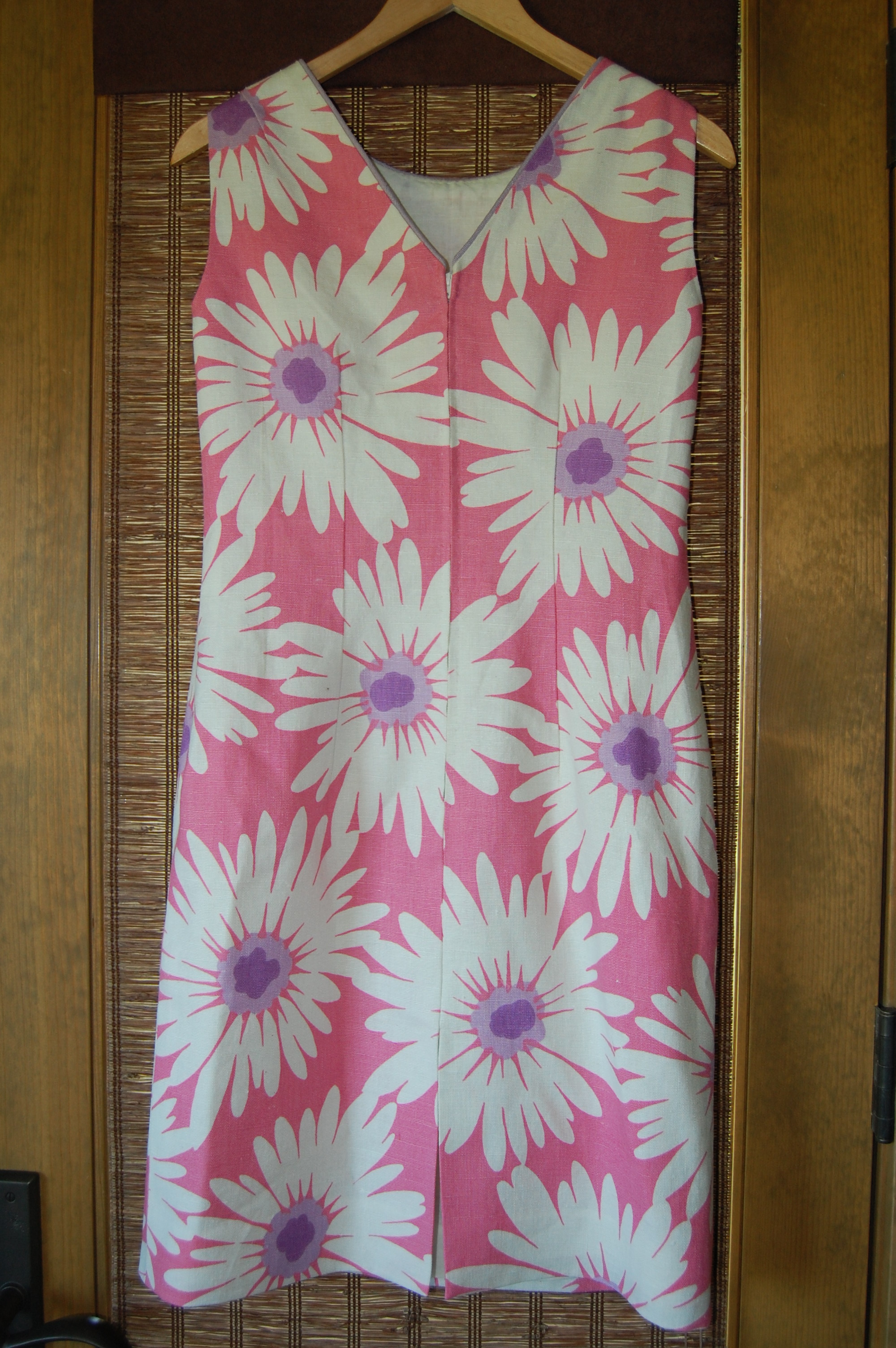
This full photo of the back of the dress shows some more of the pattern matching.

This full photo of the back of the dress shows some more of the pattern matching.

I did what I could, with what I had, where I was.

20 Comments

Filed under Linen, Moygashel linen, piping, Uncategorized, Vintage fabric

The Domino Effect

Being totally smitten with this bold floral linen, purchased within the past year, I have had my heart set on making it into a day dress this Summer.

Big, bright daisies with lavender centers.

Big, bright daisies with lavender centers.

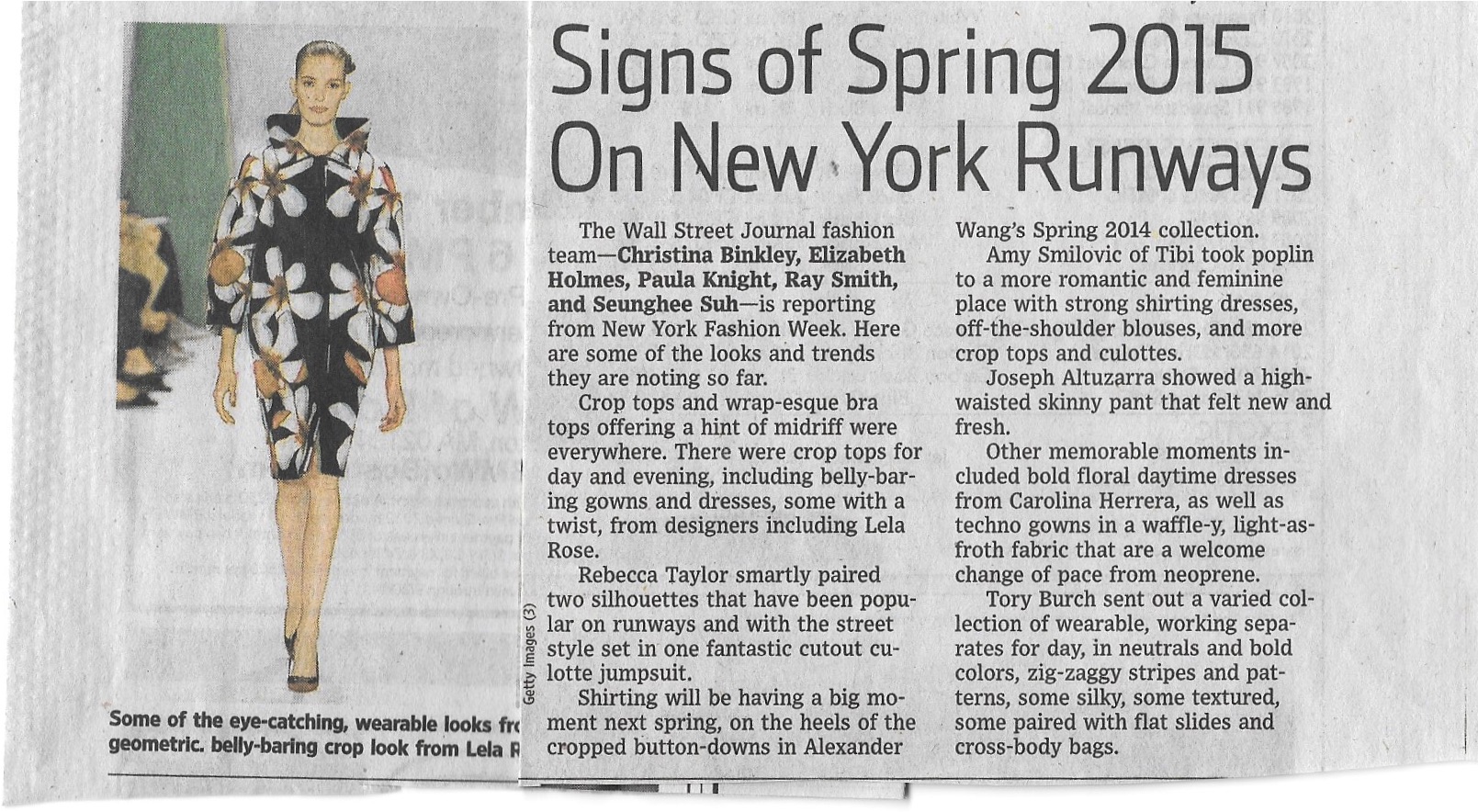
Not long after I purchased it, this small article on “Signs of Spring 2015 On New York Runways” appeared in the September 10, 2014 Wall Street Journal.

"Memorable moments included bold floral daytime dresses from Carolina Herrara..."

“Memorable moments included bold floral daytime dresses from Carolina Herrera…”

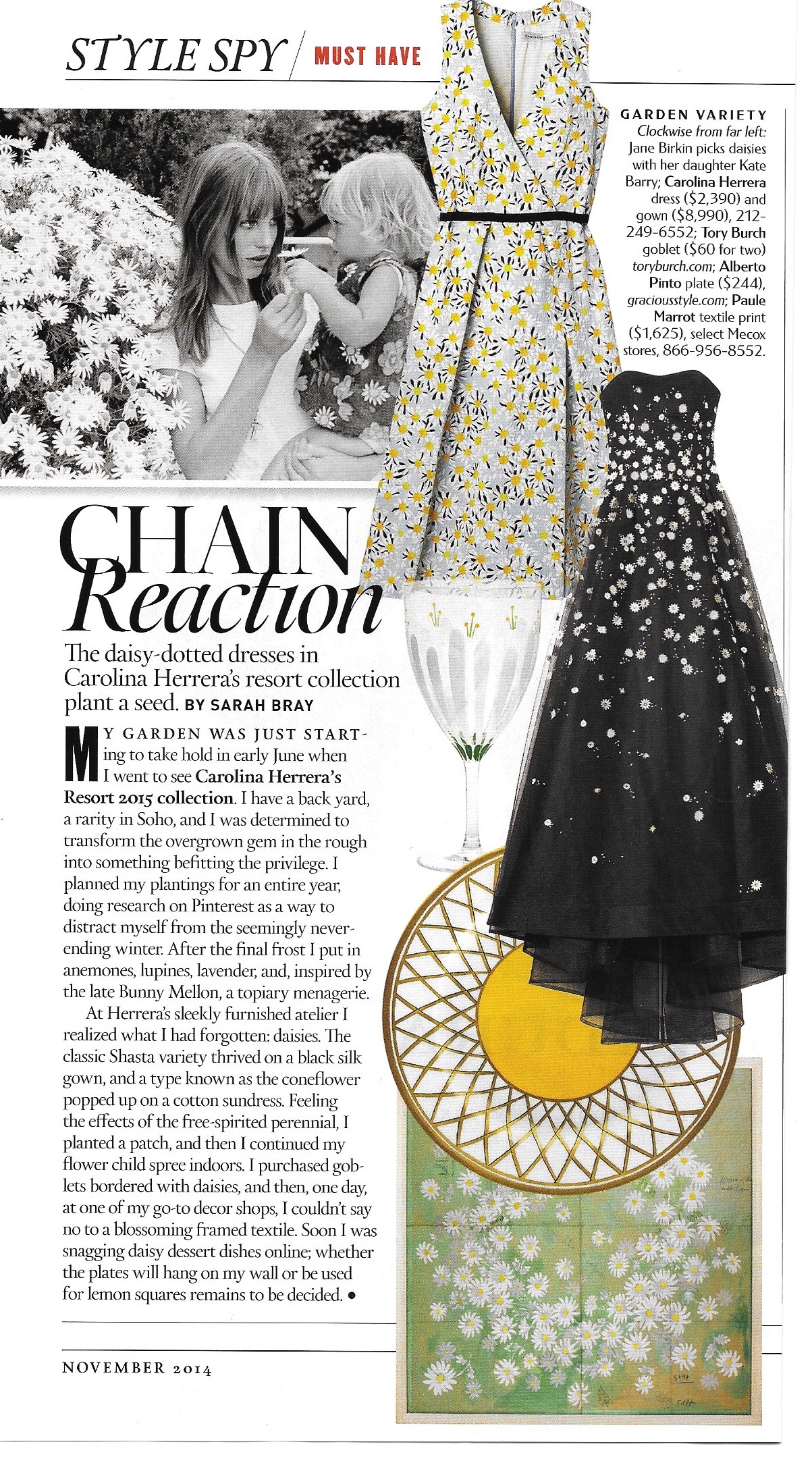
And then in November of 2014, more of Carolina Herrera’s Spring/Resort collection for 2015 was featured in Town & Country magazine.

Perennial daises on two lovely Carolina Herrera dresses.

Perennial daises on two lovely Carolina Herrera dresses.

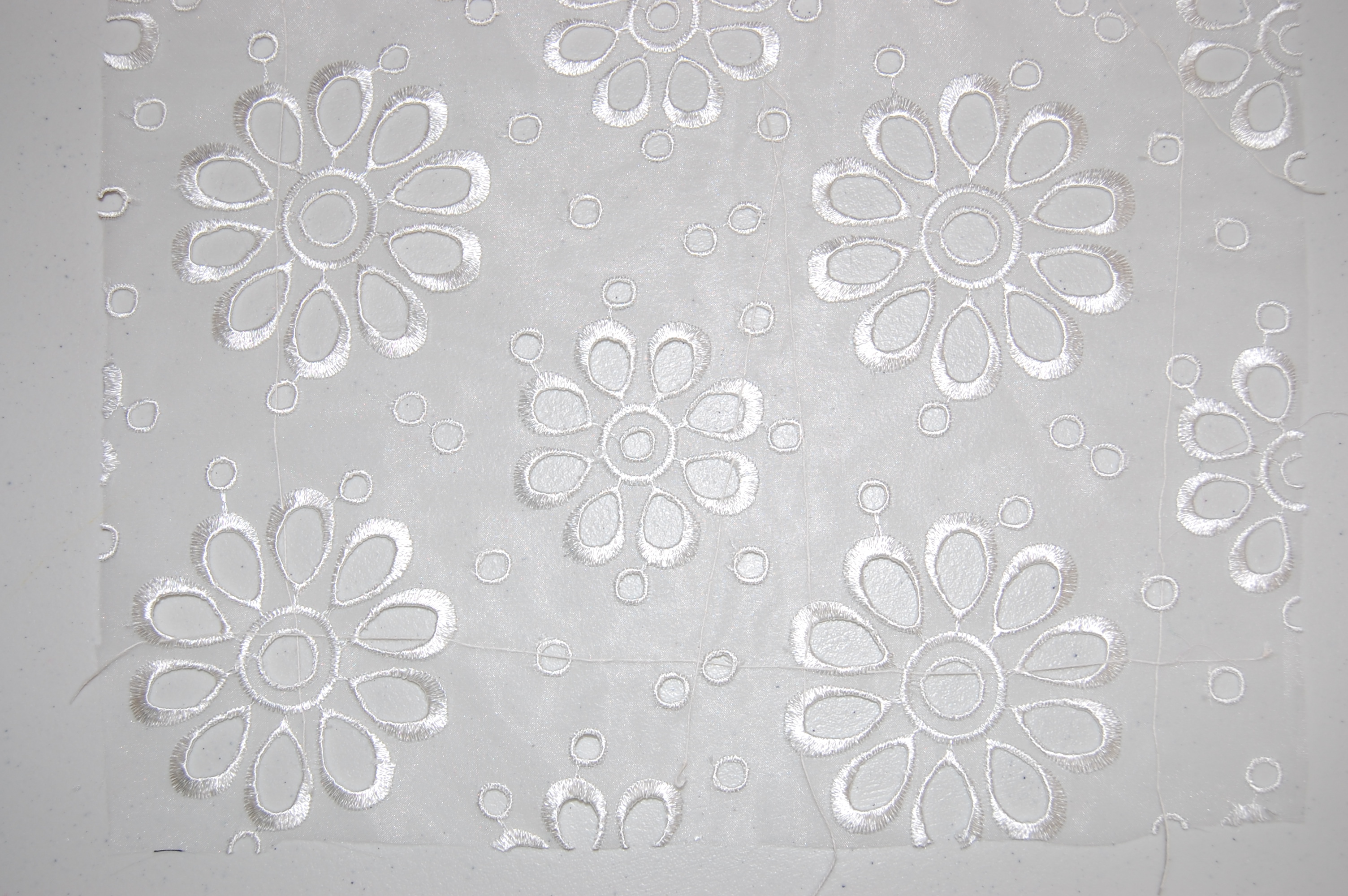
It seems this vintage Moygashel linen from the late 1960s, with its bold daisy design is very much in vogue currently, both for its size and its floral motif. (The bodice of my recent fancy dress also featured a “daisy” motif in the silk embroidered organza):

The Allure of silk, pt 1

Although I am of the mind that daisies are always in vogue, nevertheless, this seems like the perfect year to fashion a dress from this linen. Such a demonstrative print begs for a simply-styled dress, such as – you guessed it – a sheath dress.   The fabric will make this dress, not the pattern. How could I, I wondered, do something a little different and still keep it simple? The answer to that question began to take shape when I found a length of pale lavender Moygashel linen this past Spring. Suddenly I envisioned a V-back to a sheath dress with a rounded neck, detailed with piping made from this lavender linen.

Then it began to get complicated. With just a few inches over 3 yards of the 35” wide lavender fabric, I knew I would have to calculate carefully when I cut bias strips for the piping, if I wanted to fashion another garment out of the lavender. And of course, I do! Actually, when I looked at the lavender fabric, and paired it with any number of my other fabrics and/or dresses, it seemed the only thing to use it for was a “Spring” coat. But would I have enough fabric for both a coat and bias strips for piping?

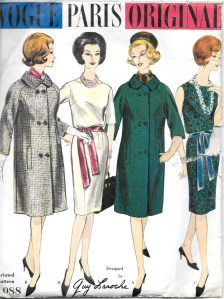
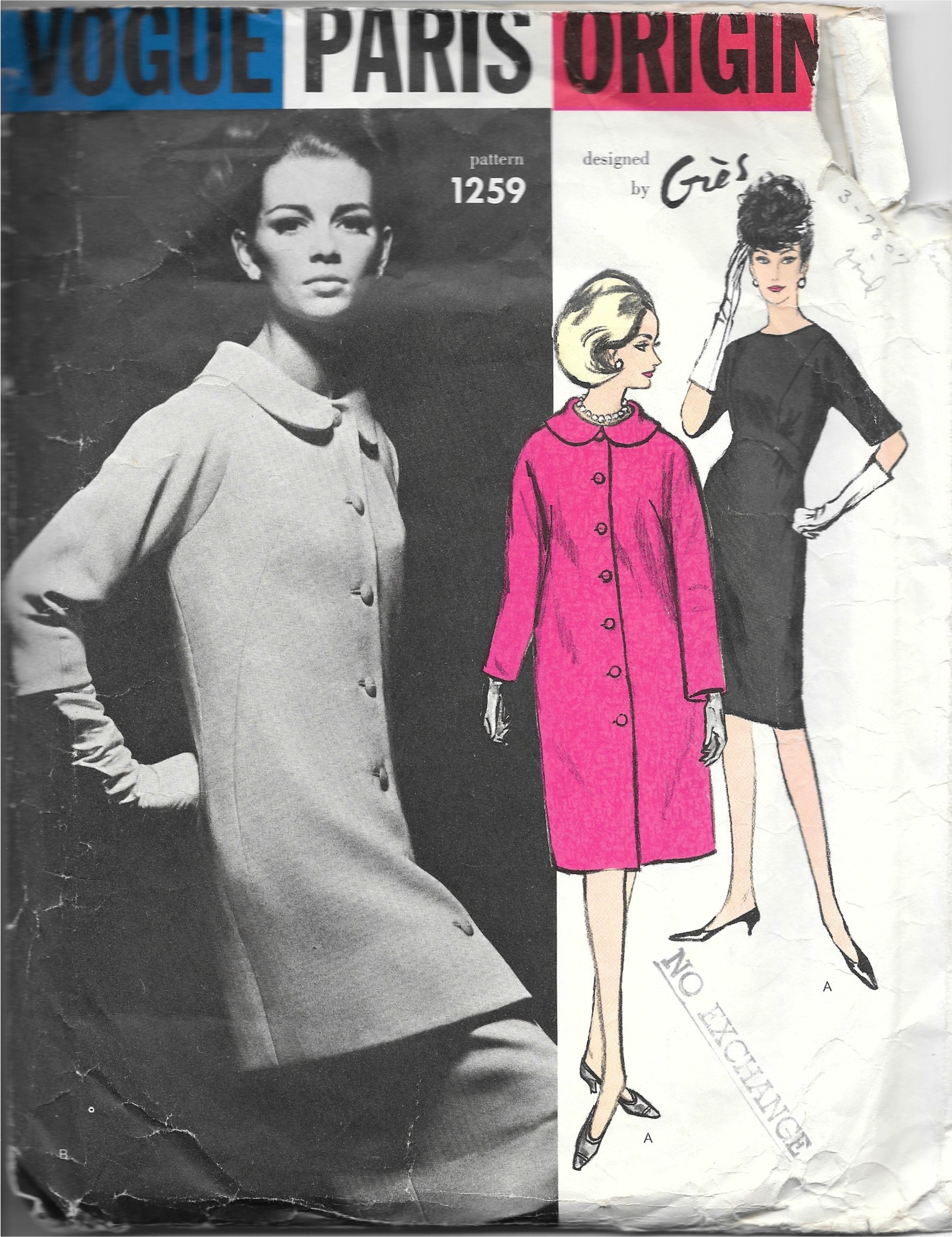
Obviously, I would have to find a coat pattern and lay it out leaving enough space for bias strips, to see if I could manage this minor miracle. Of all my coat patterns, this Madame Gres design is the one I decided had the best chance of working, both for my limited yardage and for the pattern’s simple, uncluttered lines:

The short version of the coat is on the left.

The short version of the coat is on the left.

The fact that it is featured with below elbow length sleeves and in a shorter version – perfect for pairing with coordinating dresses – worked in my favor. The entire coat has only 5 pattern pieces: front, back, collar, undercollar, and front facing. First I positioned the tissue pattern pieces on my fabric, strewn out on the floor selvedge to selvedge. I was heartened enough by this exercise to go ahead and make a muslin, so I could have a “real” pattern to work from. All this time, the pink flowered daisy linen lay folded, awaiting her turn.

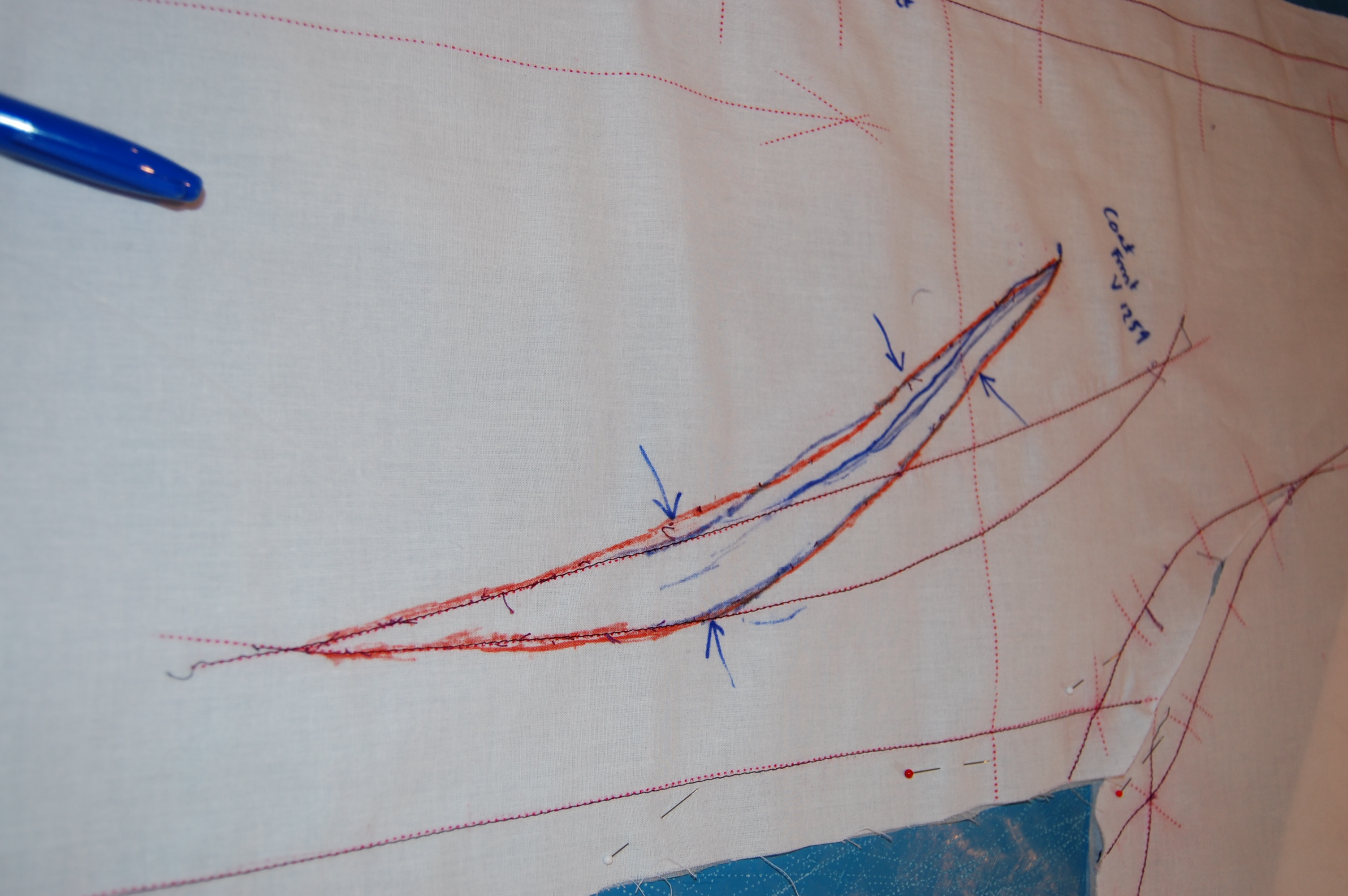
One of the most unusual features of the coat design is the front dart, which serves both as a bust dart and as a side-shaping dart. As is so often the case with these vintage patterns, the dart sewn as indicated on the pattern was too high for me. In addition, it pulled and stretched the kimono shoulder in all the wrong ways. I lowered the apex of the dart and re-sewed it, trying to preserve its curve, and suddenly it fit like a charm.

The newly drawn dart is in orange, while its original position is in red.

The newly drawn dart is in orange, while its original position is in red.

Now that I had a workable pattern, I knew I could just eke out the coat if I “pieced” the left front facing. I could live with that! And, just as important, I would have enough of the fabric to cut bias strips for piping for my daisy sheath. Whew!

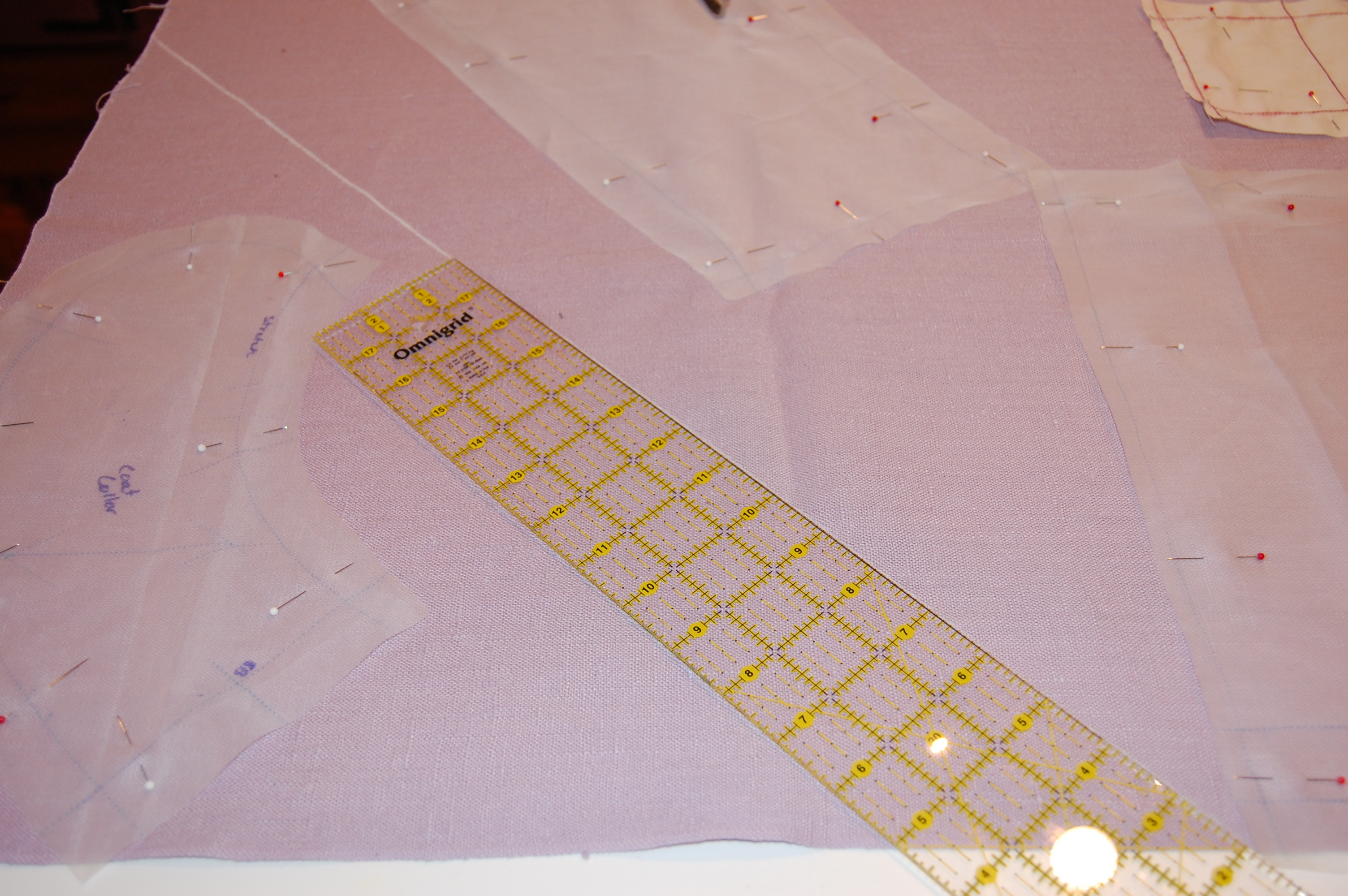
This see-through ruler helped me find a corner from which to cut the bias strips for the piping.

This see-through ruler helped me find a corner from which to cut the bias strips for the piping.

So now, the pieces for the coat, with their silk organza underlinings pinned in place, are taking their turn waiting for further attention. One project started another and now both are lined up like a circle of dominoes, ready to go down in an orderly fashion, albeit in slo-o-o-w motion.

13 Comments

Filed under kimono sleeves, Linen, Moygashel linen, piping, Uncategorized, Vintage fabric, vintage Vogue Designer patterns

A Noisy Spring

The chatter is endless and getting louder. Whenever I walk into my sewing room, I hear it, and there is no avoiding it. All those lengths of linen, most of it vintage Moygashel, are vying for my attention, hoping they might be selected for a starring role in my sewing agenda for Spring and (now, mostly ) Summer of 2015. Is there any fabric I love more? Probably not, although of course I love woolens, silks and cottons, too. However, there is something about linen, with its crispness, its durability, its versatility, and its ability to evoke a summer day in the midst of winter that totally captivates me.

There is linen that looks serene:

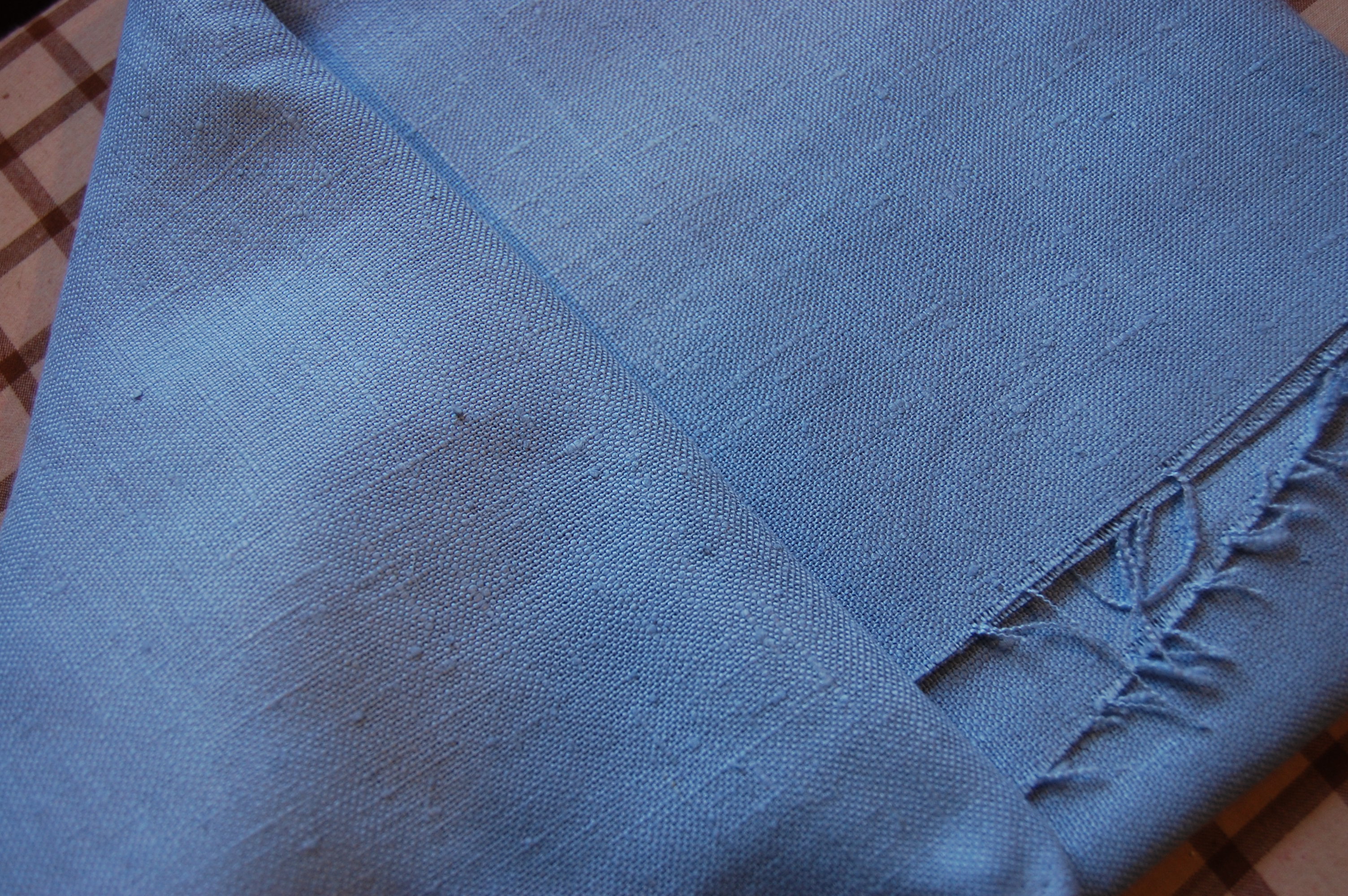
Lovely pale blue

Lovely pale blue

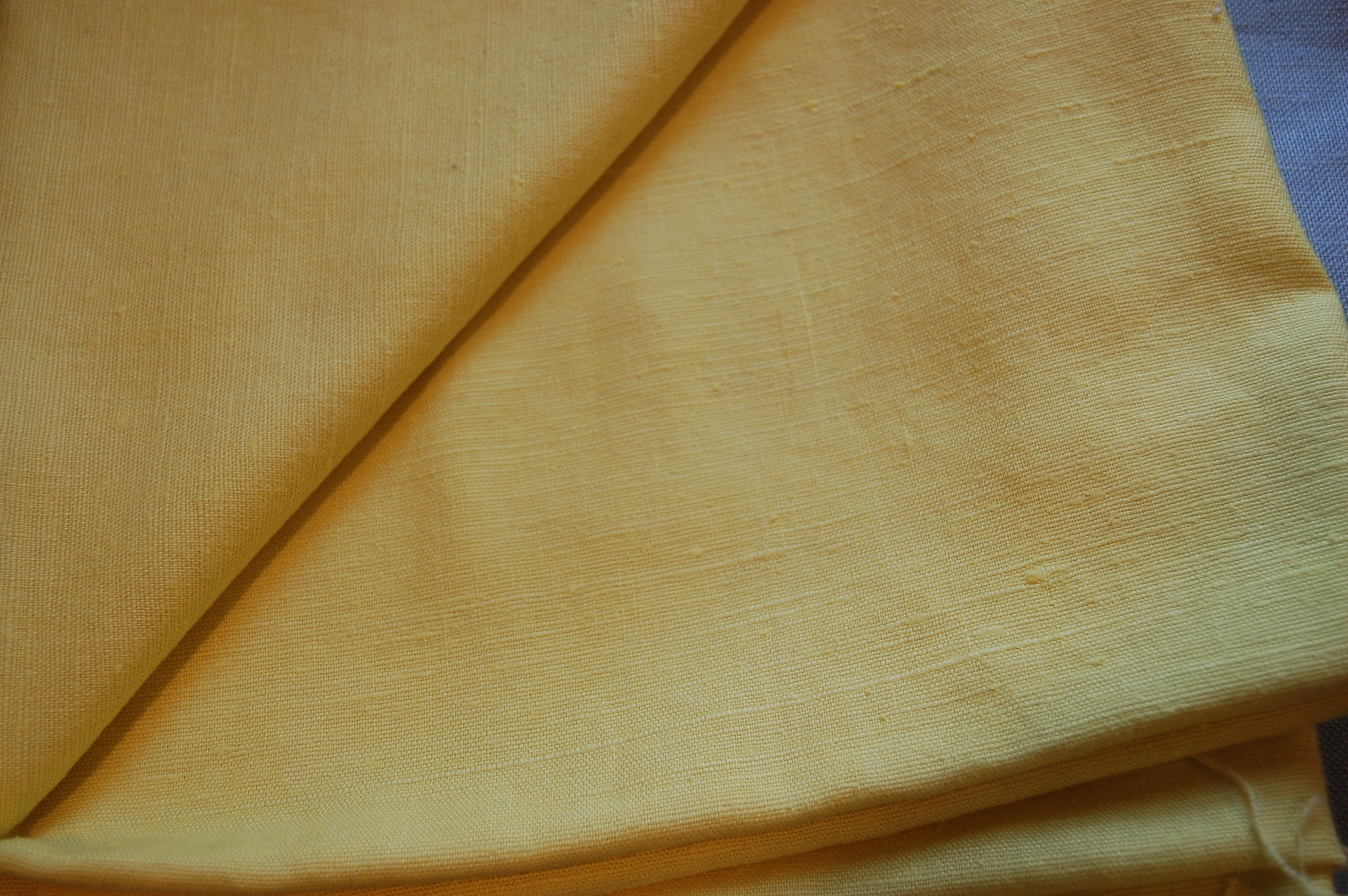
And quiet pale yellow

And quiet pale yellow

There is linen that looks a bit wild and crazy:

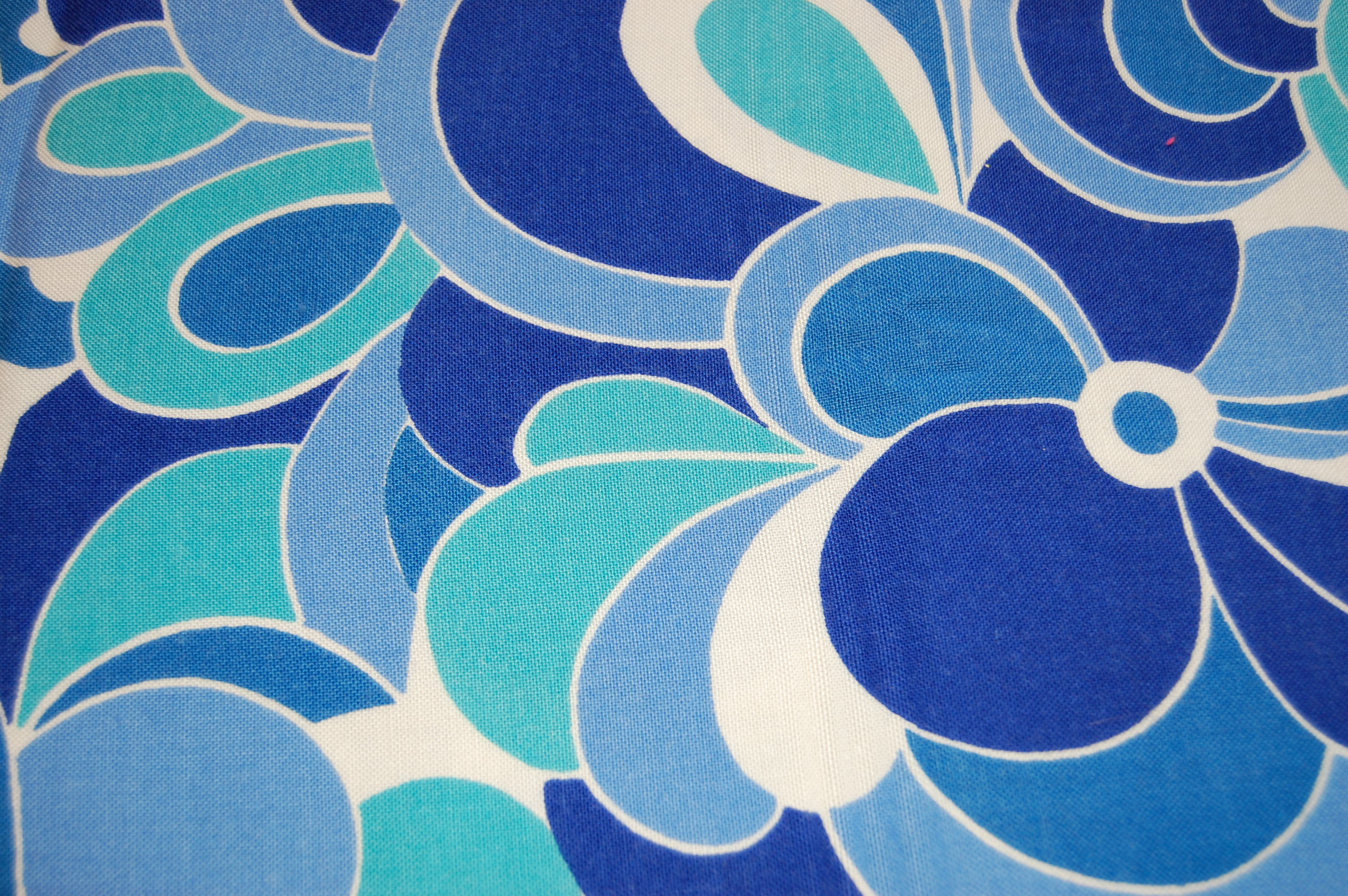
This piece is actually a linen/rayon blend, which has lovely hand to it.

This piece is actually a linen/rayon blend, which has a lovely hand to it.

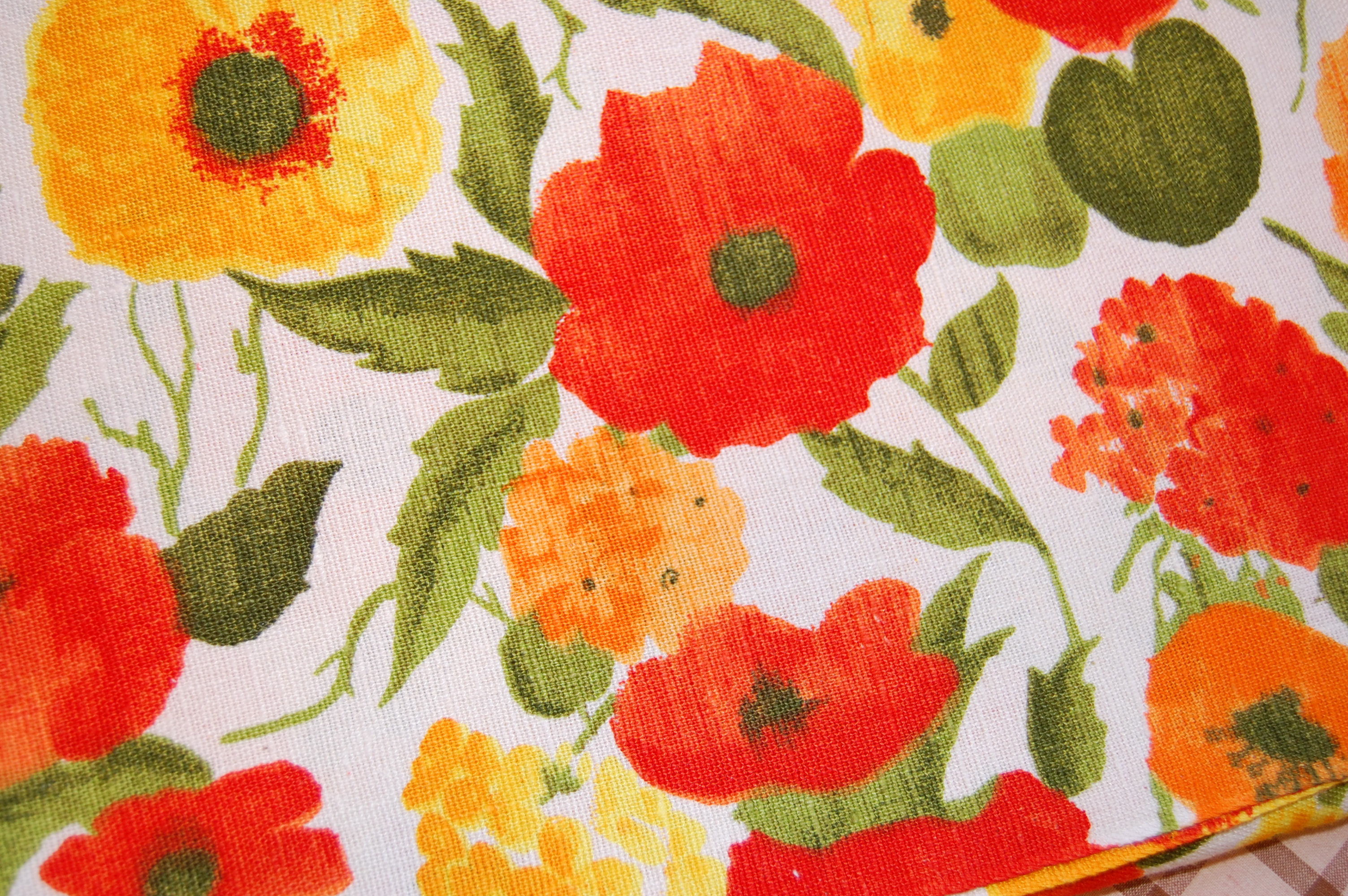
Big, bright daisies!

Big, bright daisies!

There is linen that says “Look at me!”:

Walking in a field of flowers!

Walking in a field of flowers!

There is linen that is demure:

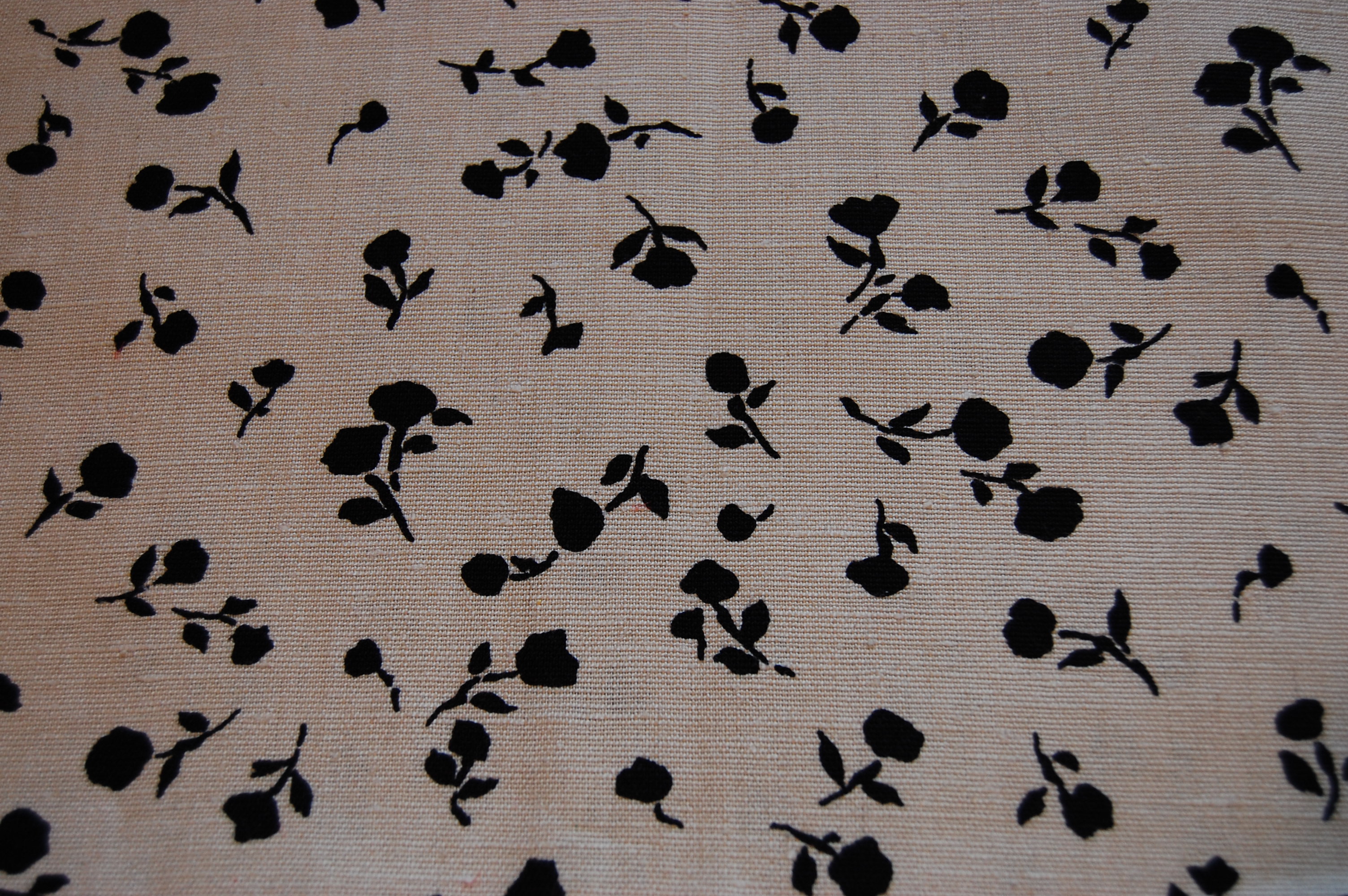
A very early 1950s' linen, petite black flower silhouettes on a pale ecru background.

A very early 1950s’ linen, petite black flower silhouettes on a pale ecru background.

There is linen that is happy:

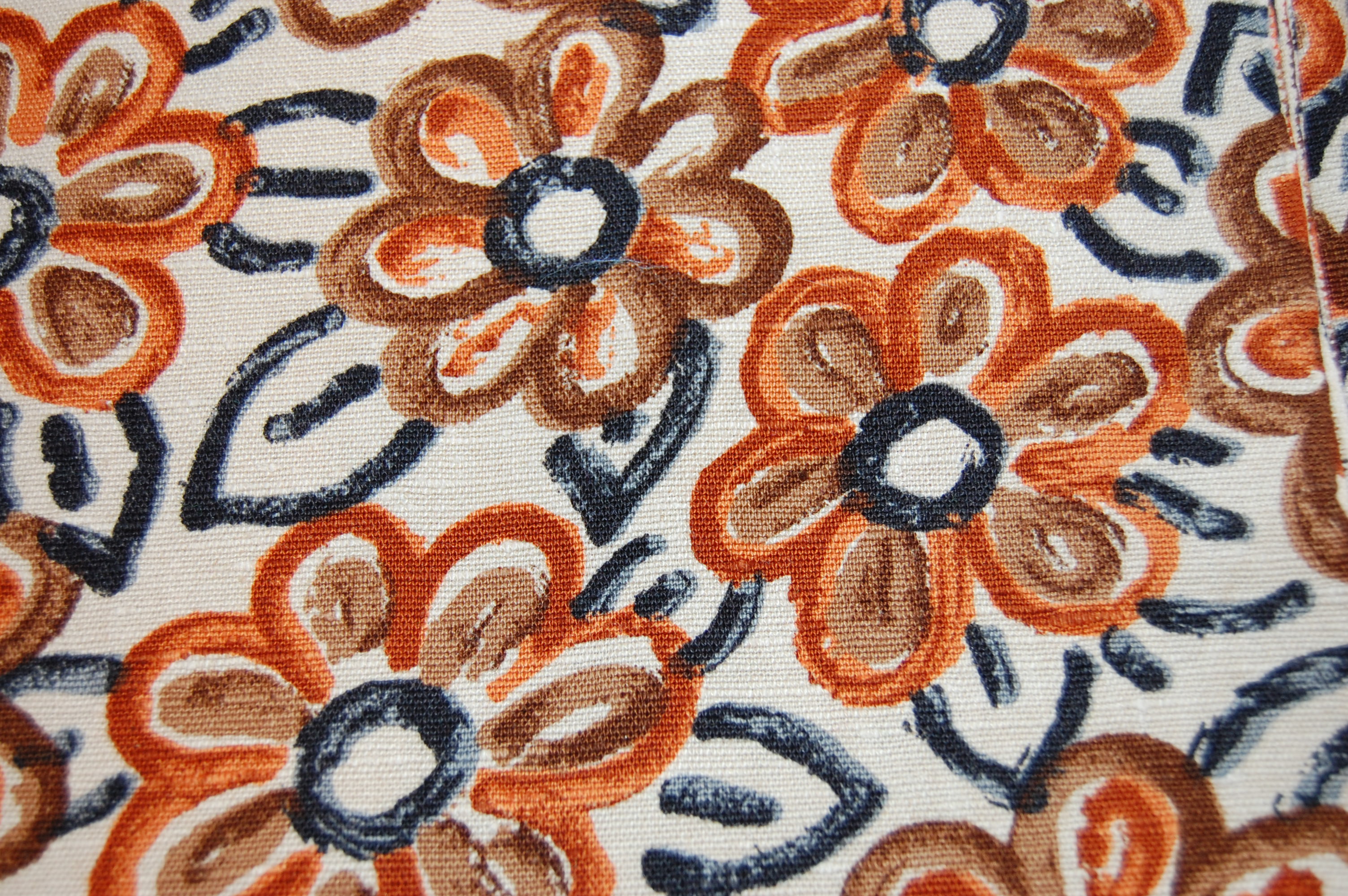
Navy, rust and brown - perfect for early Fall.

Navy, rust and brown – perfect for early Fall.

There is a lot of linen in my fabric collection! Last year I was able to complete three linen dresses (1; 2; 3)during the warmer months. This year I will not be so productive, for a number of reasons, although I haven’t given up hope of making a linen coat and a coordinating dress. The question then becomes, which piece (or pieces) of linen do I choose for such an undertaking?

While contemplating the answer to that question, I am starting another project out of necessity: a dress to wear to a “black tie” event in early July. It’s an exciting project for me as it is my focus while I spend another week in Baltimore, Maryland with Susan Khalje and other dedicated dressmakers. The start of our week also began with lots of “chatter”: Alice Wildes of Mendel Goldberg Fabrics arrived on Sunday (the day before the official start of our class) with bolts and bolts of gorgeous and glorious fabrics. Did I succumb to any of these delights? What do you think?

A Noisy Spring

A Noisy Spring

An amazing silk charmeuse . . .

An amazing silk charmeuse . . .

. . . with all the inspiration one would need!

. . . with all the inspiration one would need!

Among the projects being started in our class are: a wedding gown for a daughter; a fancy dress for a grown daughter; a dress reminiscent of something Myrna Loy would have worn mid-century; a suit; shift dresses and “day” dresses; cocktail dresses; a dress and jacket; and, of course, my own dress, to be made from silk taffeta and embroidered silk organza.

A Noisy Spring

Those aforementioned noisy linens will just have to wait a little longer – and share some of their space in my fabric closet with newly acquired silks and wools. There is always room for fabric!

21 Comments

Filed under Linen, Moygashel linen, Uncategorized, Vintage fabric

Sometimes It’s All About the Shoes

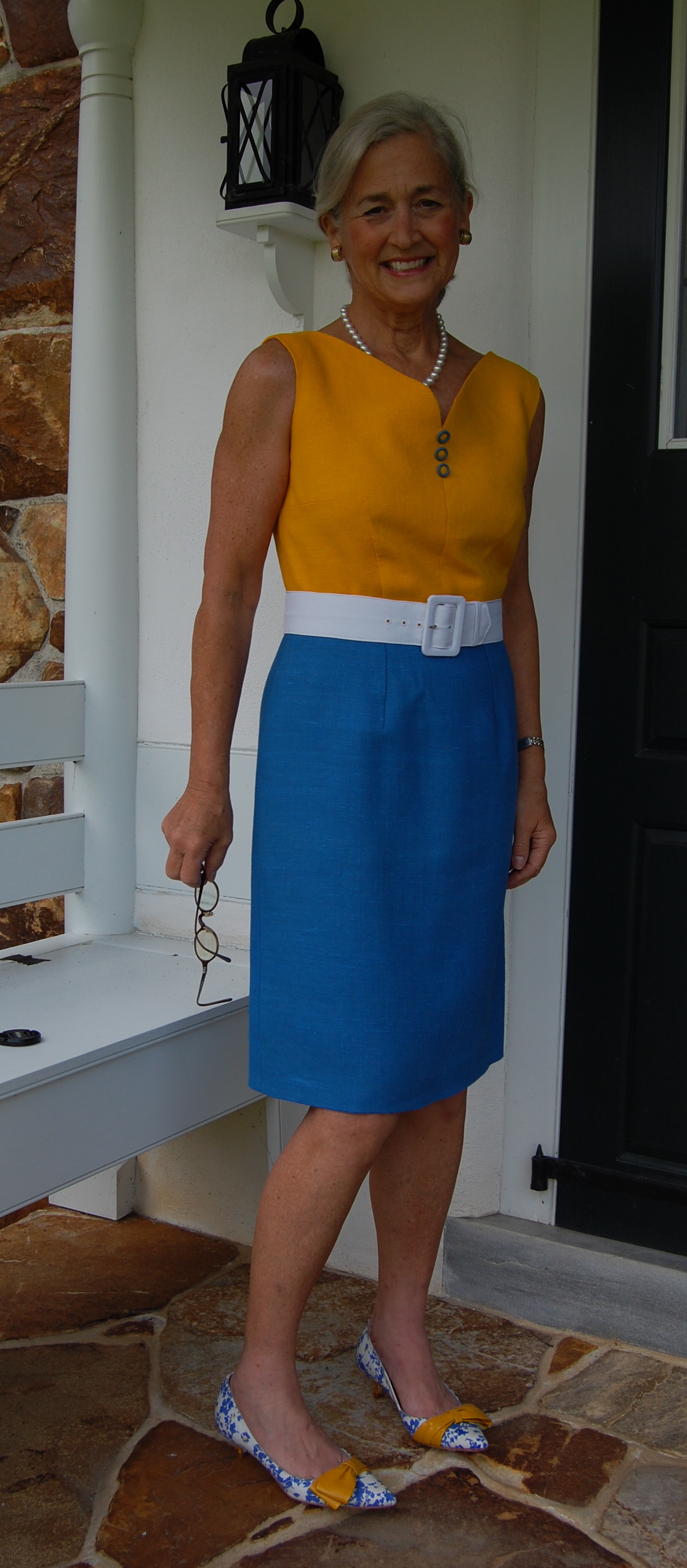
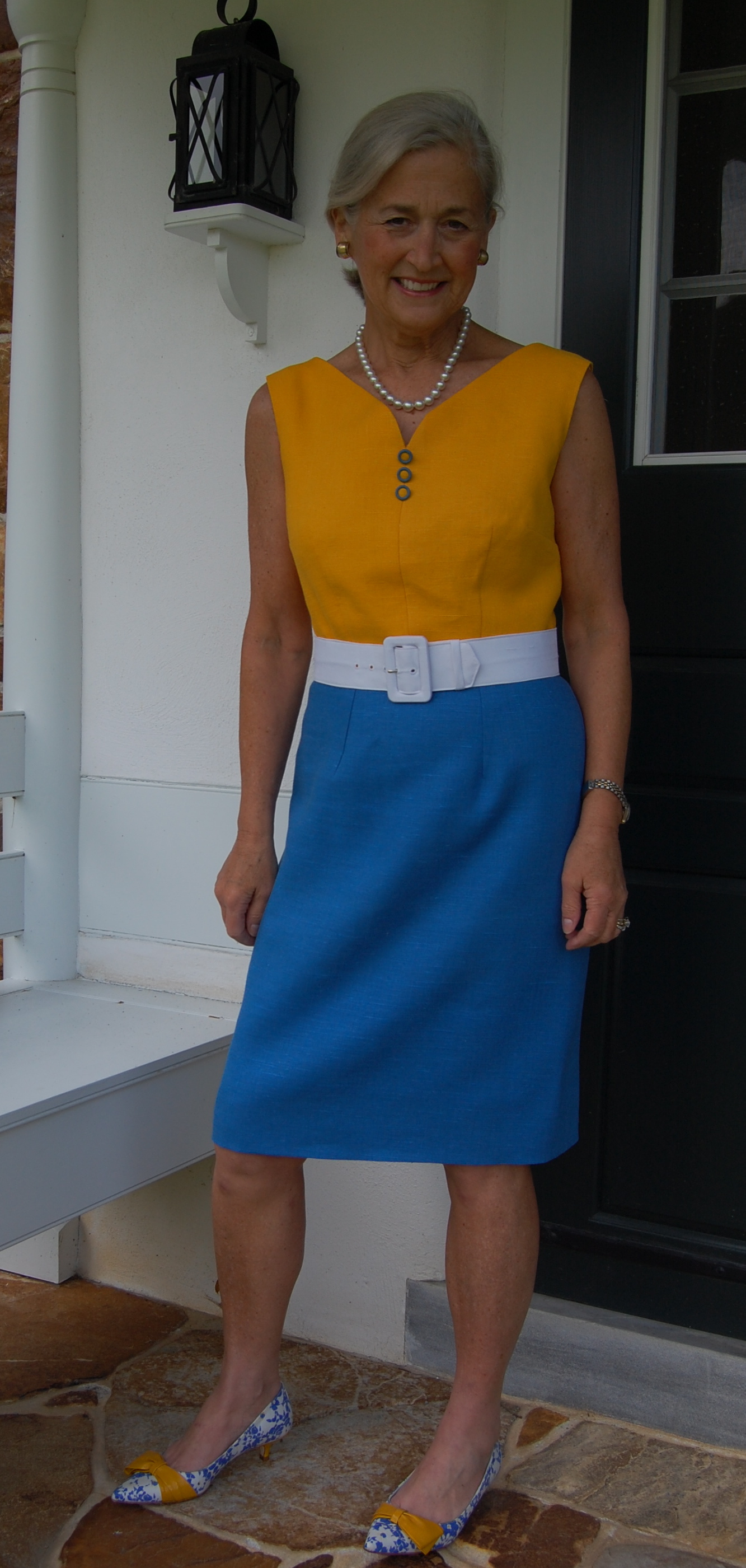
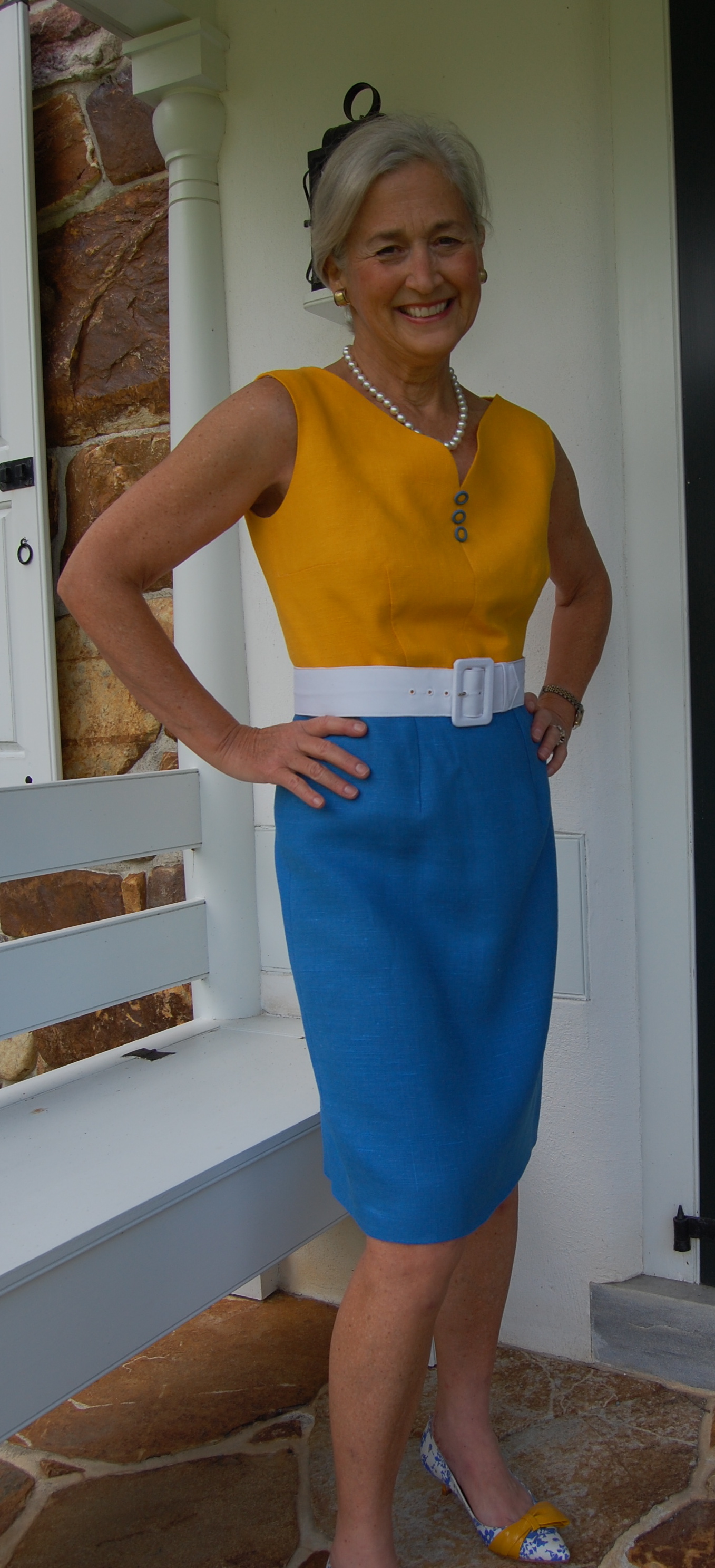
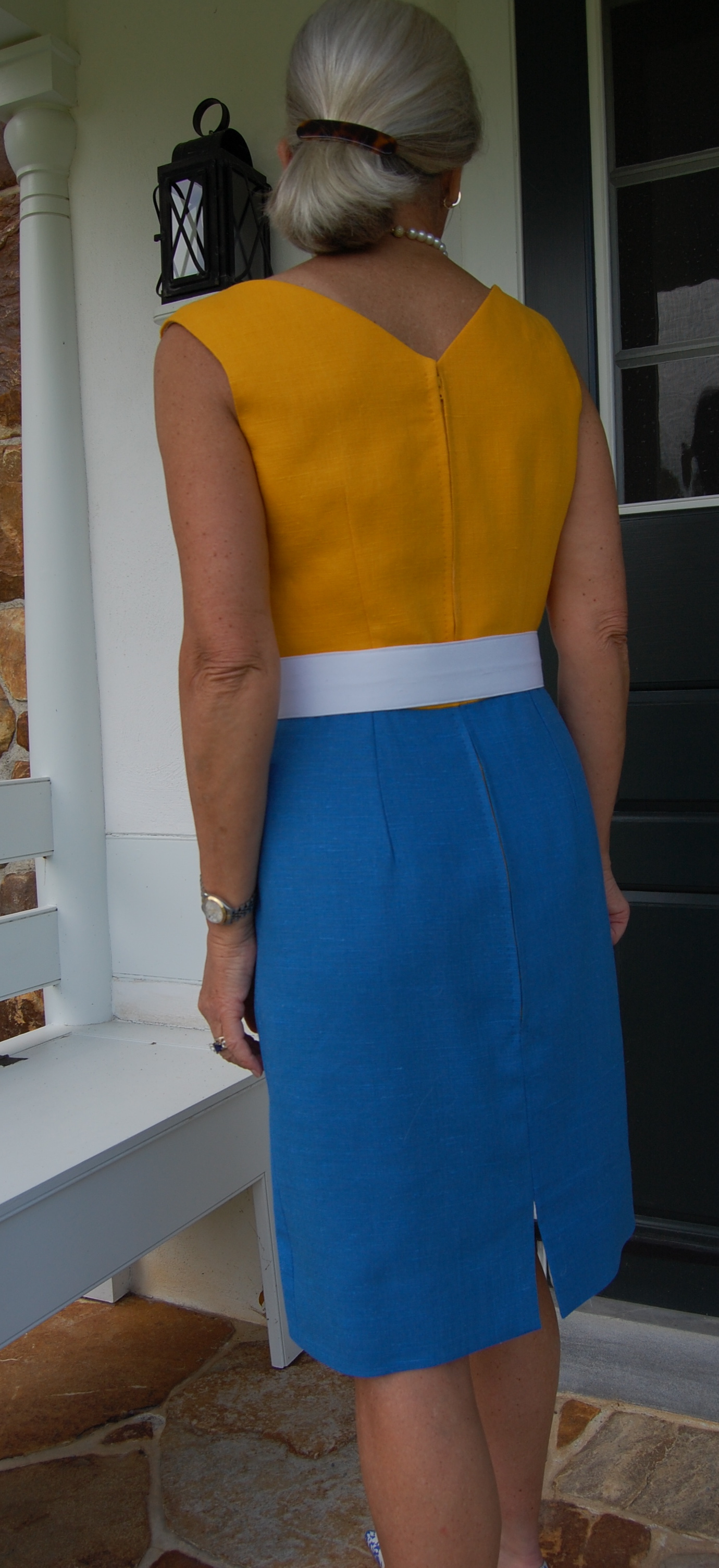
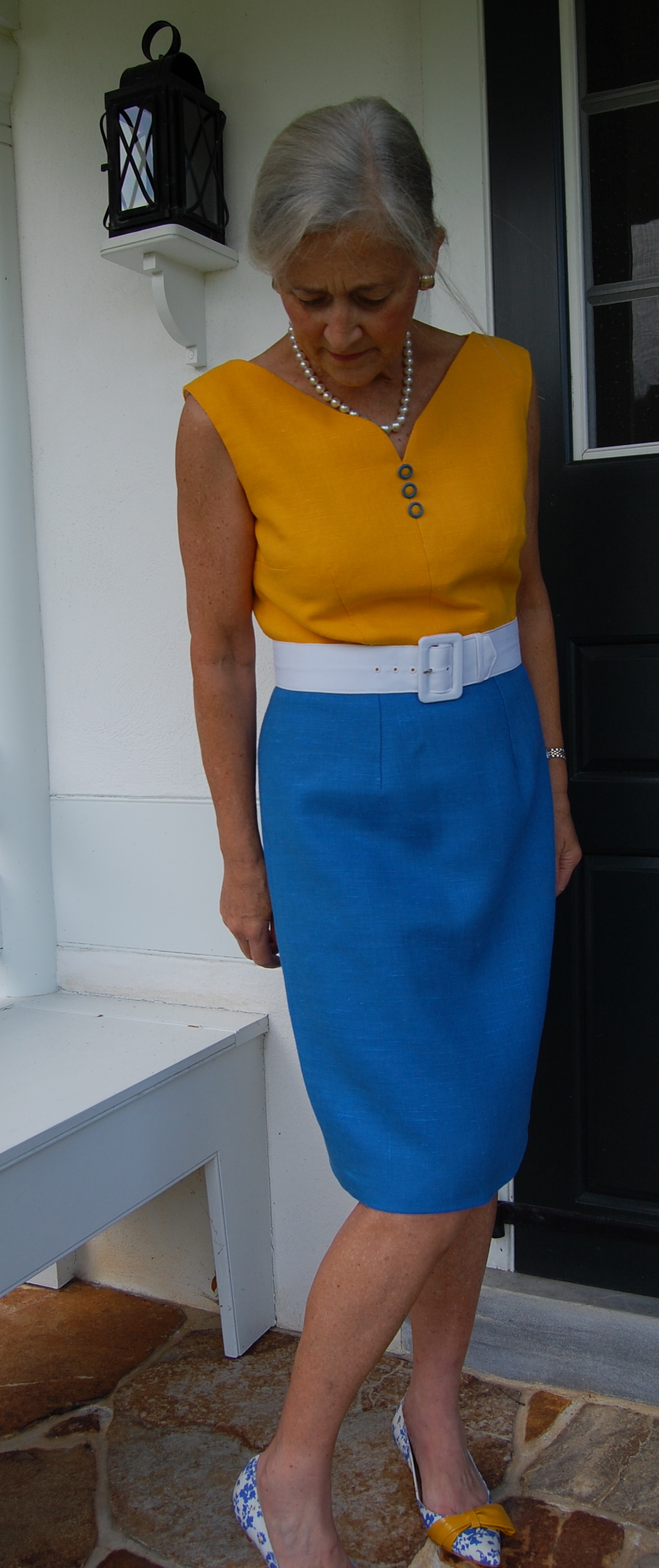
Well, maybe it’s not entirely about the shoes, although they do promise to share a starring role with my just-completed yellow and blue linen dress.

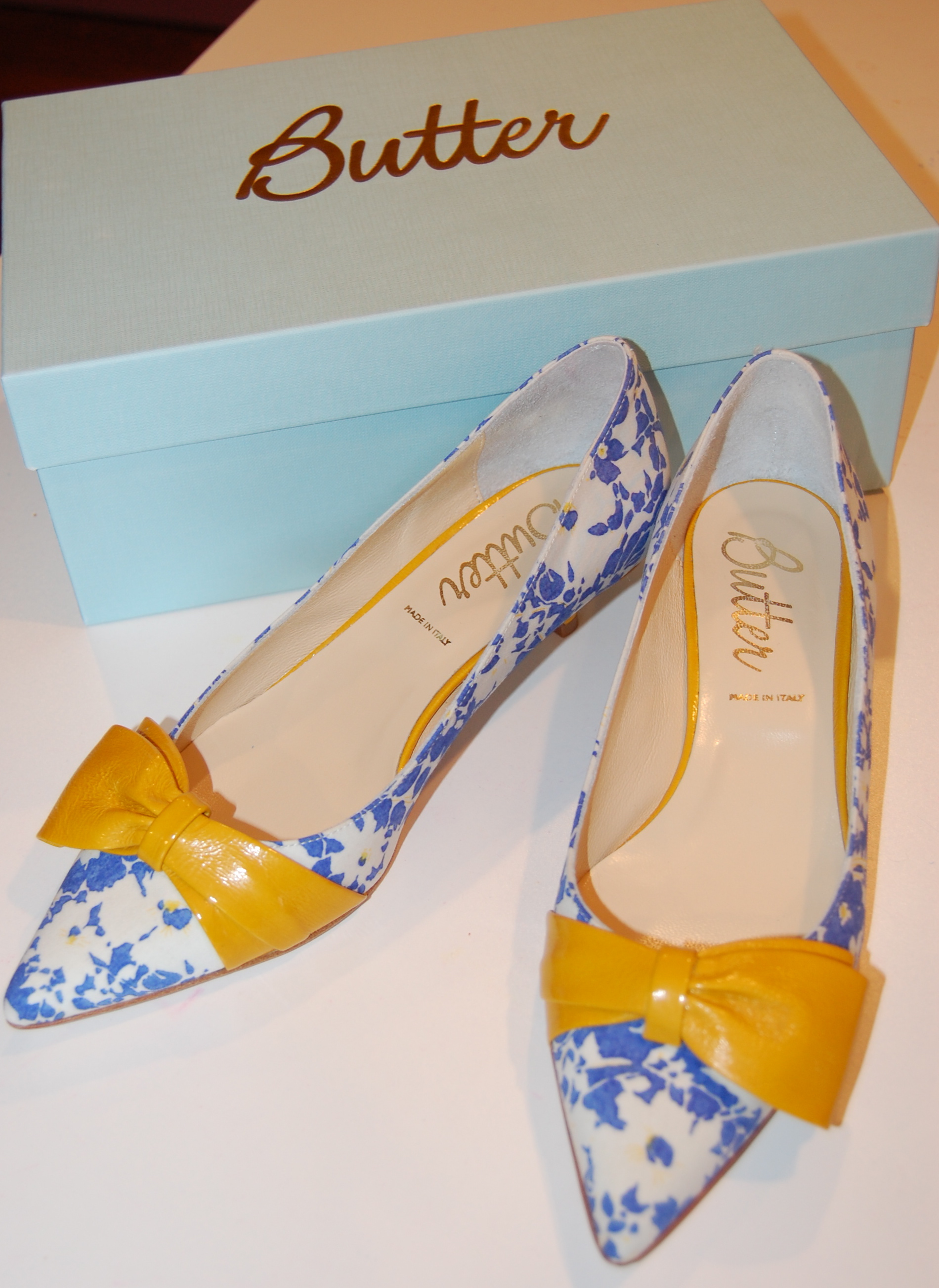
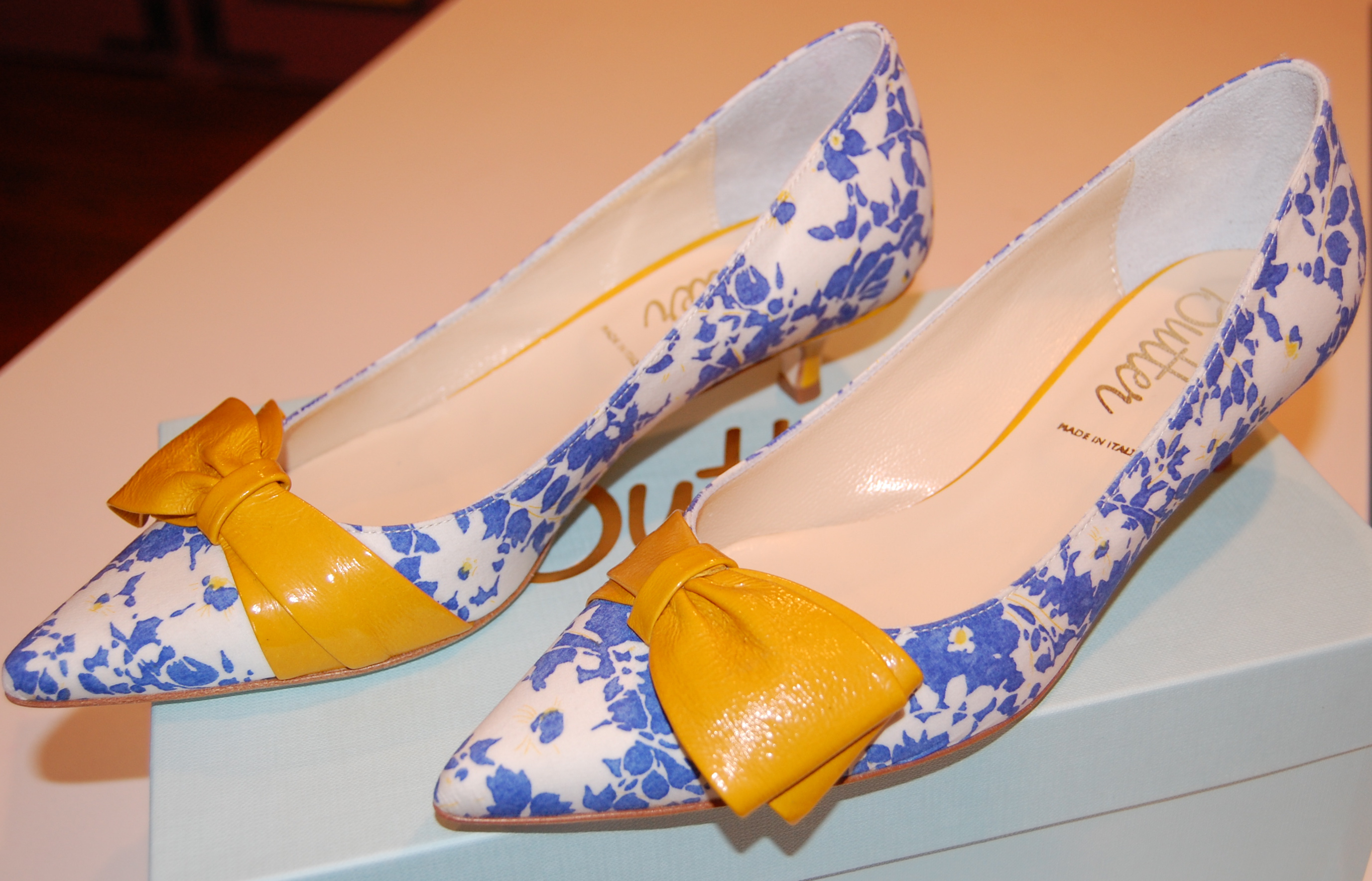
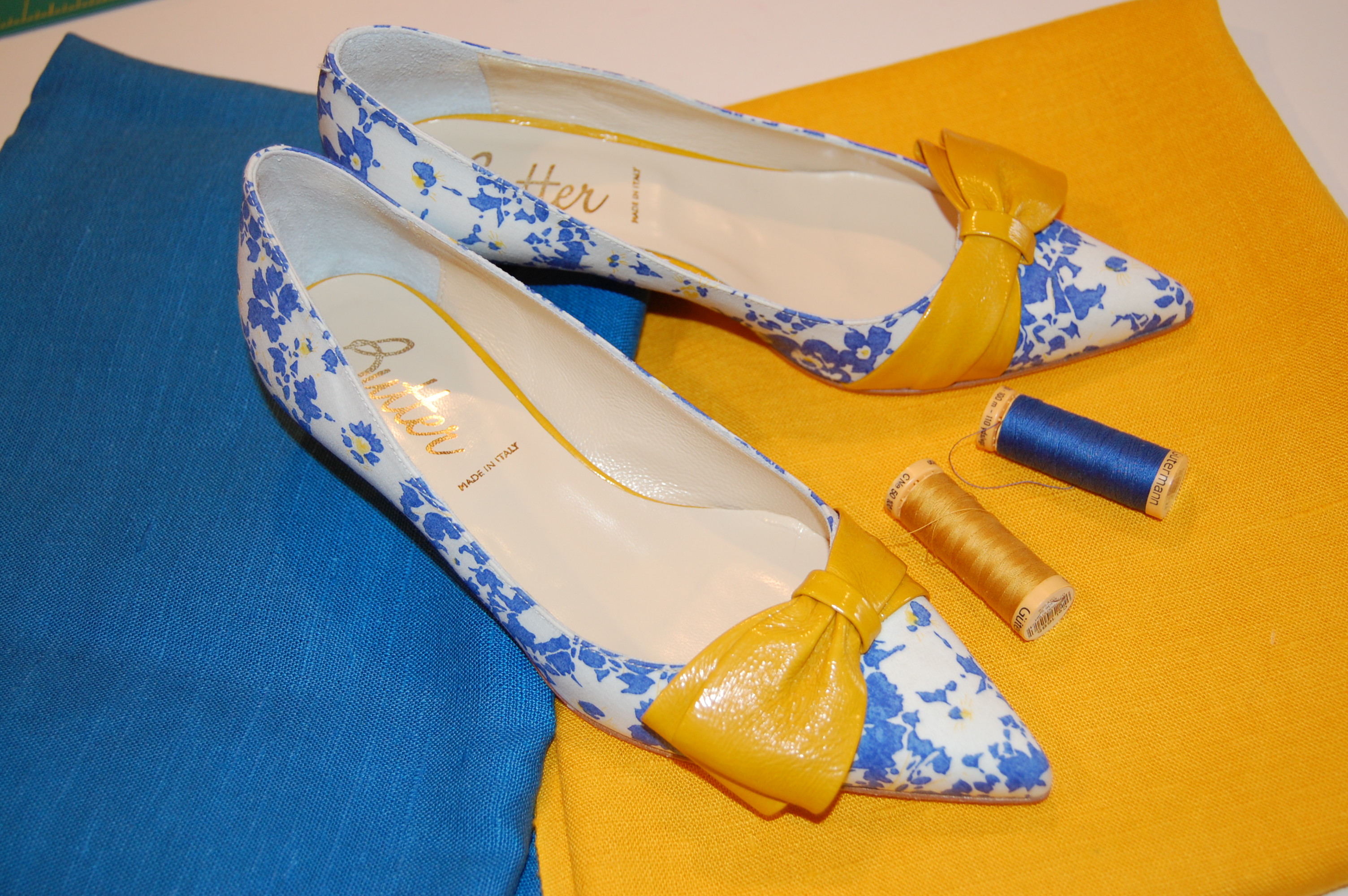
All about the shoes

I first spied these lovelies on the Simply Soles website last winter, as part of the offerings for Spring/Summer shoes. Although I loved everything about them (the combination of colors, the fabric, the asymmetrical bow, the kitten heel, the brand – knowing from experience that Butter shoes are extremely comfortable), I decided not to purchase them. At that point in time, I had not yet bought the bittersweet yellow linen, so I had no reason to buy shoes with such a limited color palette. By the time I had a good reason to buy them, they were no longer available in my size.

All about the shoes However, the Simply Soles website allows one to request an email advice should the correctly sized shoe become available. Weeks went by, Summer arrived, and by then I had paired the recently purchased deep yellow linen with the pottery blue linen. Goodness, I could not stop thinking about those shoes and how perfect they would be with my envisioned dress. And then – they were suddenly available – in my size – and on sale!

All about the shoes

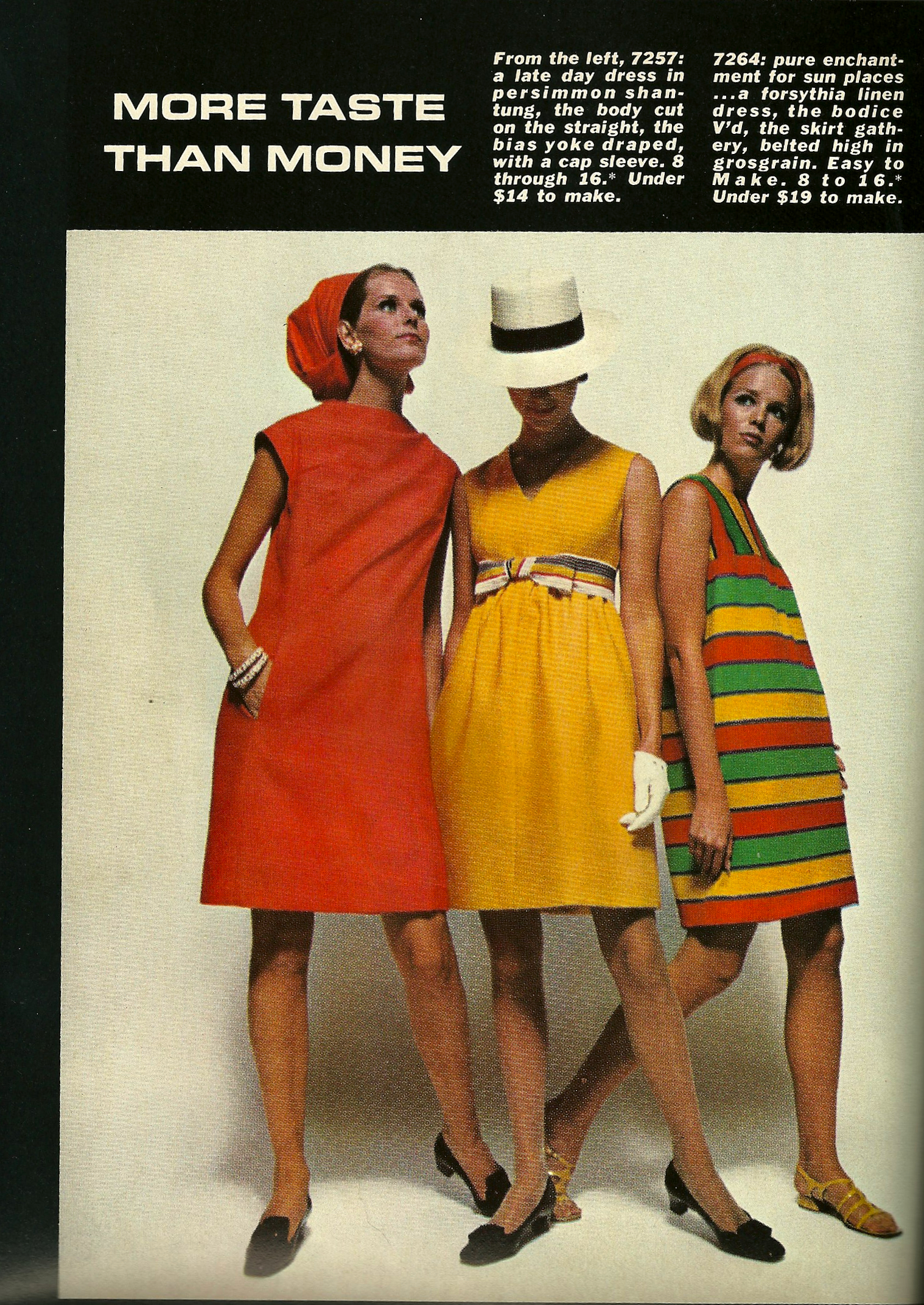
By this time I was already immersed in making my second linen dress of the Summer, so I planned for the blue and yellow linen to be number “3”. In the meantime, I happened upon more documentation of Moygashel linen, this one for the “yellow” piece. Those of you who follow this blog know how much I love to make these connections!

"... pure enchantment for sun places ... a forsythia linen dress ..."  and the source information in the back of this Vogue Pattern Book Magazine from February/March, 1968 credits Moygashel as the brand of linen.

“… pure enchantment for sun places … a forsythia linen dress …” and the source information in the back of this Vogue Pattern Book Magazine from February/March, 1968 credits Moygashel as the brand of linen.

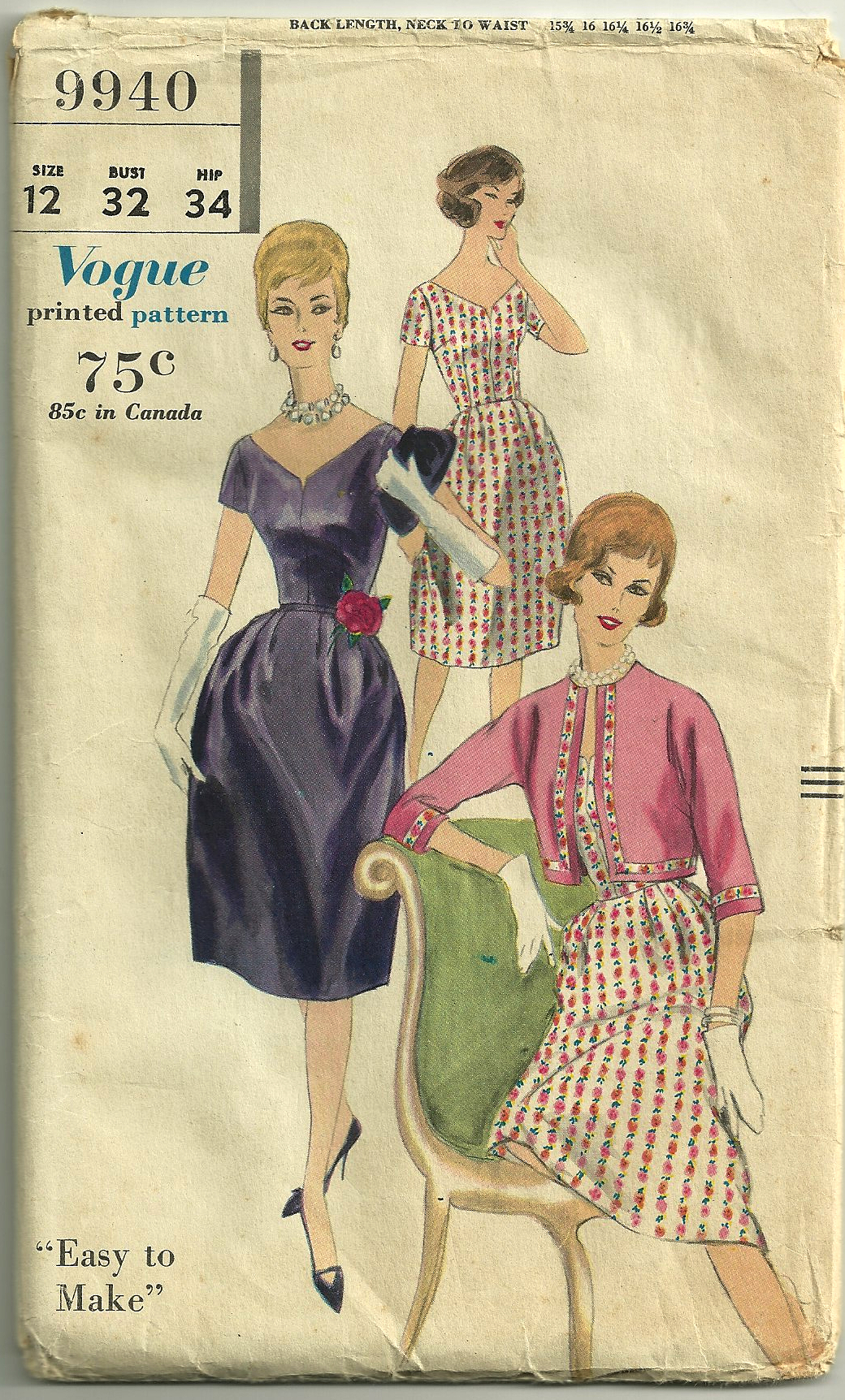
Seeing an entire dress made out of the forsythia linen helped me to feel confident about having such a bright color as the bodice part of my planned dress.  As I stated in my last post, I decided to use the bodice from this early ‘60s’ Vogue pattern, pairing it with a slim skirt and a belt.

The neckline dips down to a slightly curved V, with a center seam.

The neckline dips down to a slightly curved V, with a center seam.

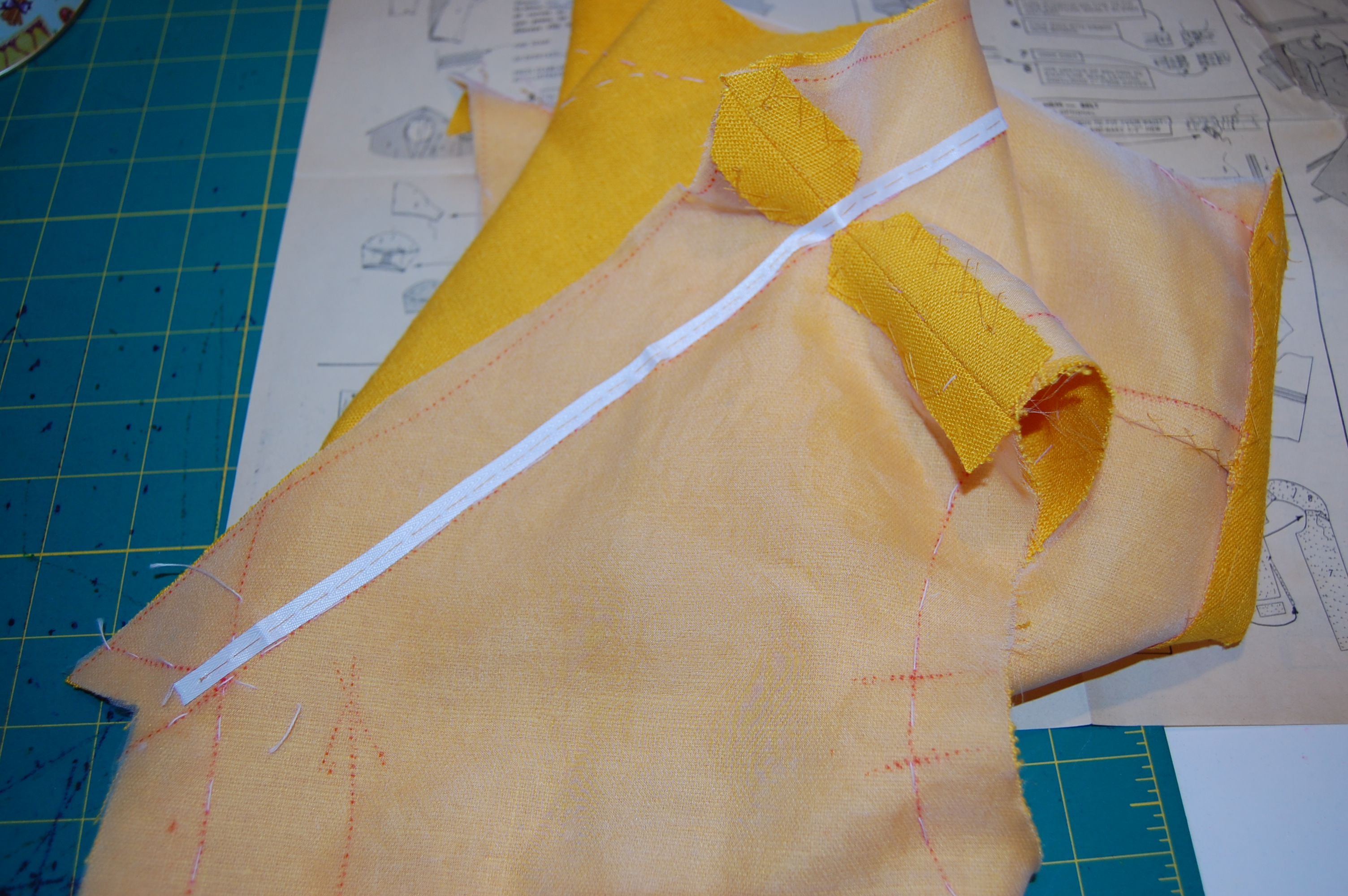
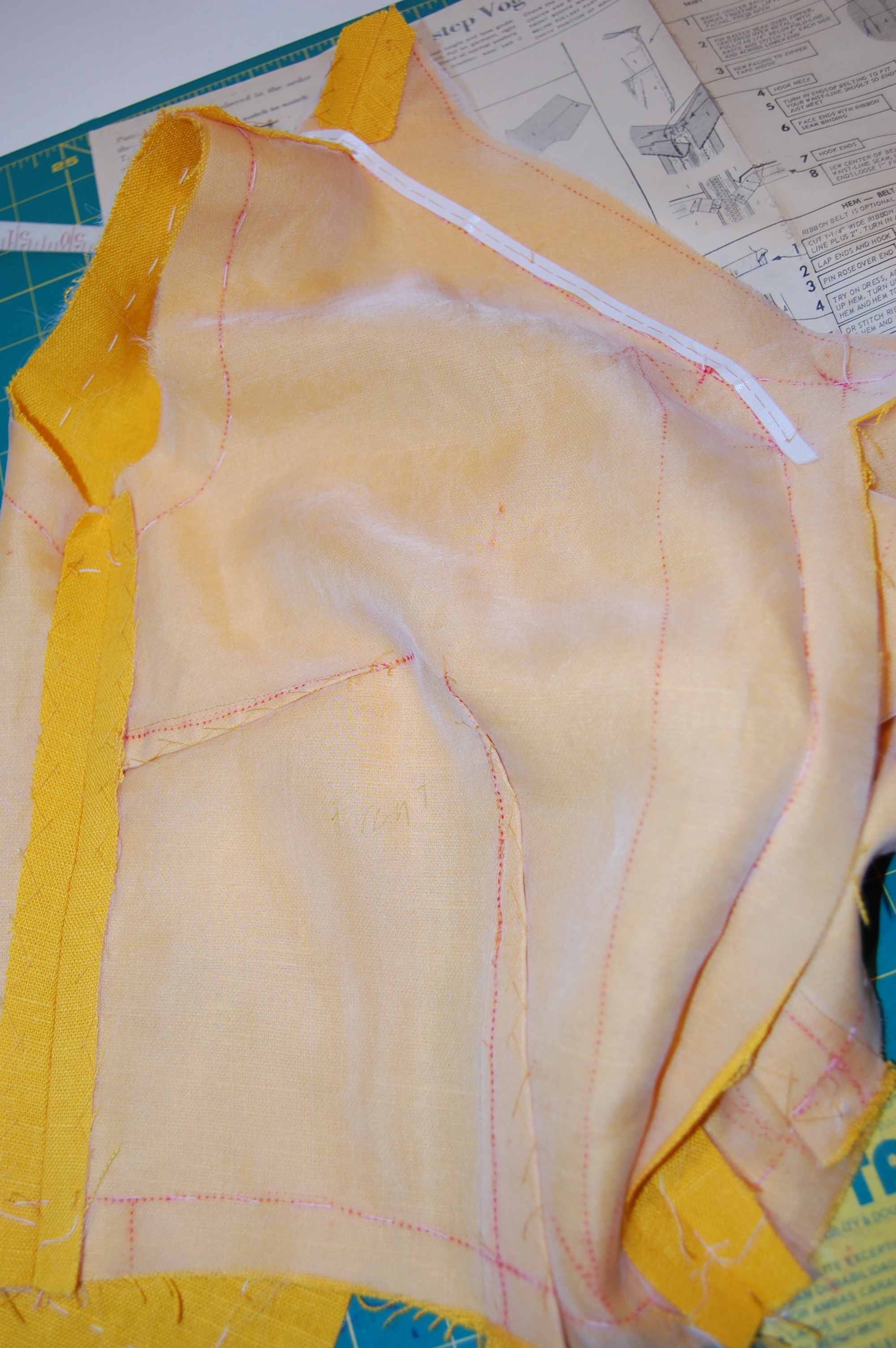
As this would be a dressier type of frock, and because I know how foolproof couture construction is (with silk organza underlining and crepe de chine lining), I proceeded using those techniques. The facings on the V-shape of the bodice front and back were cut as part of the pattern, instead of being separate pieces. I followed the instructions to reinforce the edges of the fold with ¼” twill tape.

I basted the twill tape just to the outside of the fold line on the "all-in-one" facing.

I basted the twill tape just to the outside of the fold line on the “all-in-one” facing.  This is the back bodice.

And this is the front bodice, showing the deep V and the center seam.

And this is the front bodice, showing the deep V and the center seam.

Normally, couture construction does not use facings, but in this application, they were indispensible. Then the rest of the dress proceeded without a hitch.

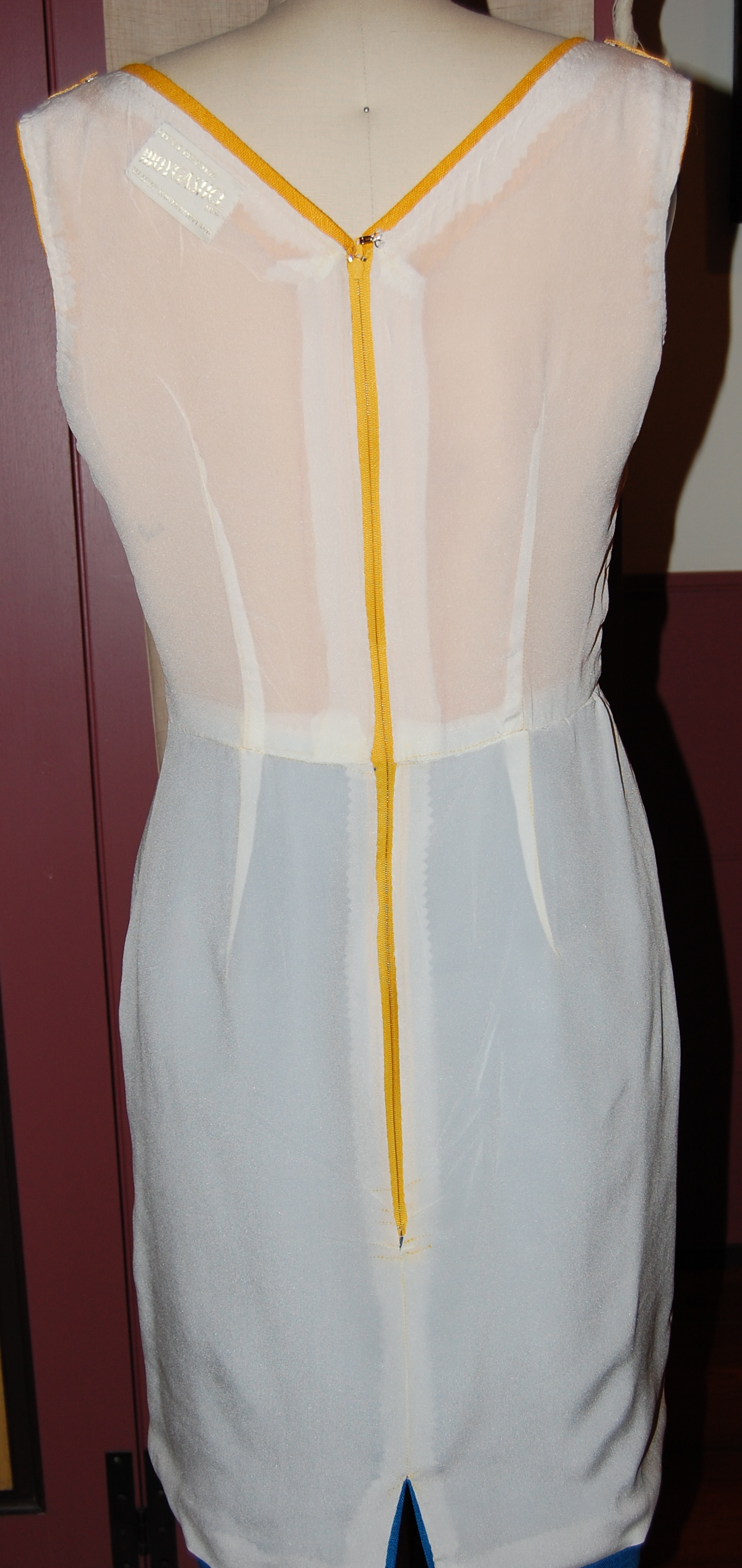
Here is the dress turned inside out.  I used a forsythia-yellow zipper as i thought it more important to match the bodice than the skirt of the dress.

Here is the dress turned inside out. I used a forsythia-yellow zipper as I thought it more important to match the bodice than the skirt of the dress.

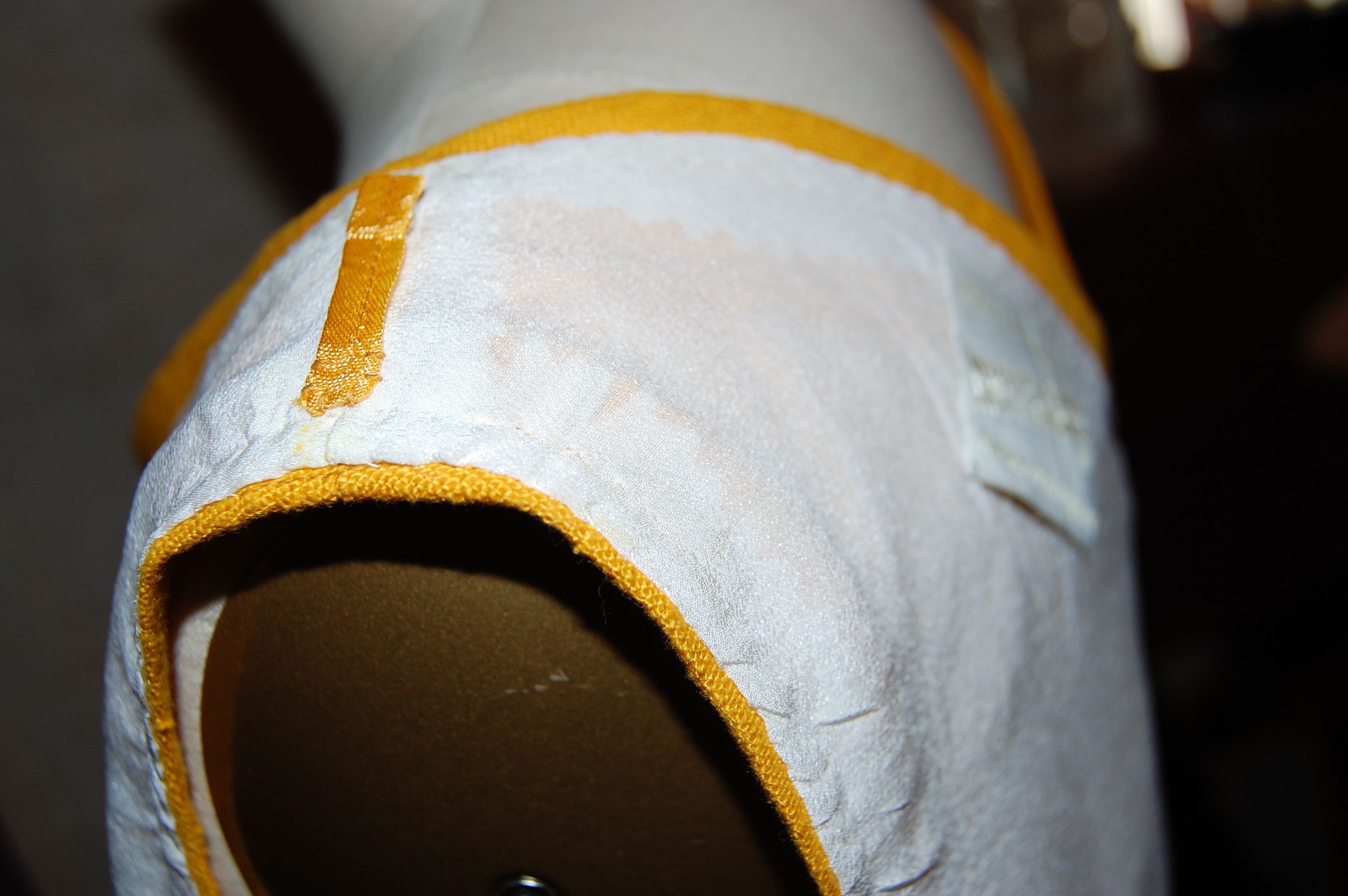
Here is the shoulder with the crepe de chine fell-stitched and understitched in place around the shouilder.  Note the lingerie stay made with a folded piece of Hug Snug Rayon woven tape.

Here is an inside look at the crepe de chine fell-stitched and understitched in place around the shouilder. Note the lingerie stay made with a folded piece of Hug Snug rayon woven tape.

About halfway through the construction of the dress, I got the idea to have decorative buttons made – to compliment the front V of the neckline.

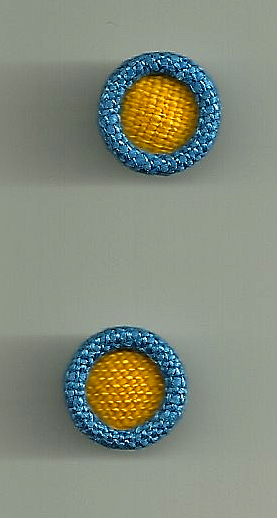
I sent scraps of my fabric off to Pat Mahoney in California to have these buttons made.  Sadly, Pat is retiring from her business at the end of August...

I sent scraps of my fabric off to Pat Mahoney in California to have these buttons made. Sadly, Pat is retiring from her business at the end of August…

I actually was not sure I was going to use them until I had finished the dress, but I think they add just the right amount of detail.

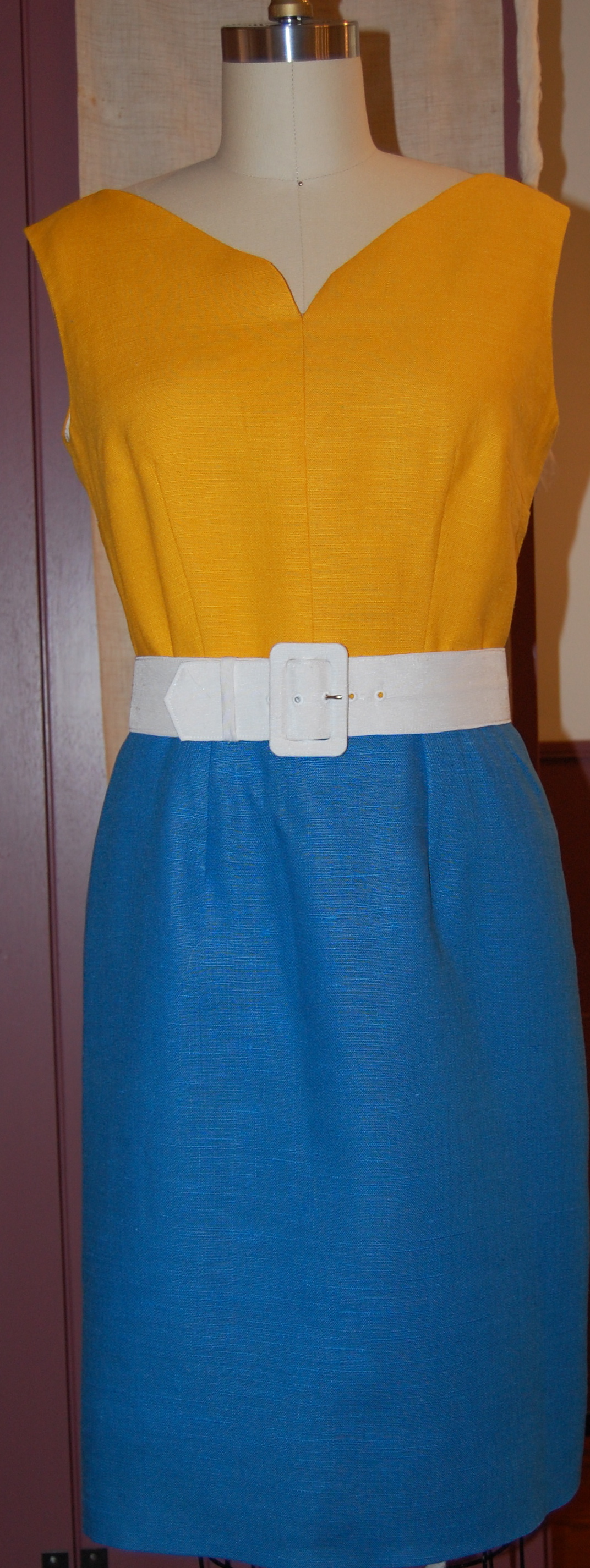
Here is the dress without the buttons . . .

Here is the dress without the buttons . . .

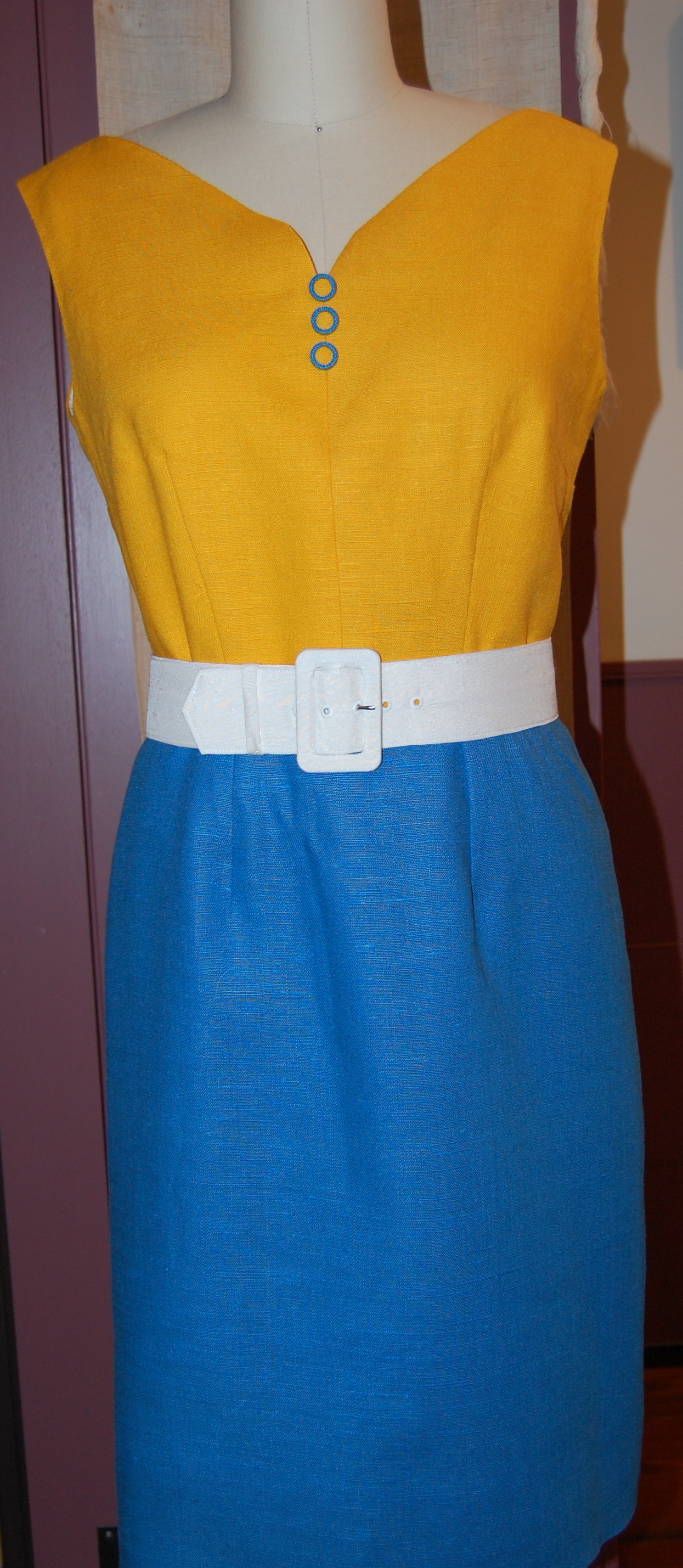
. . . and here is the dress with the buttons.  What do you think?  With or without?

. . . and here is the dress with the buttons. What do you think? With or without?

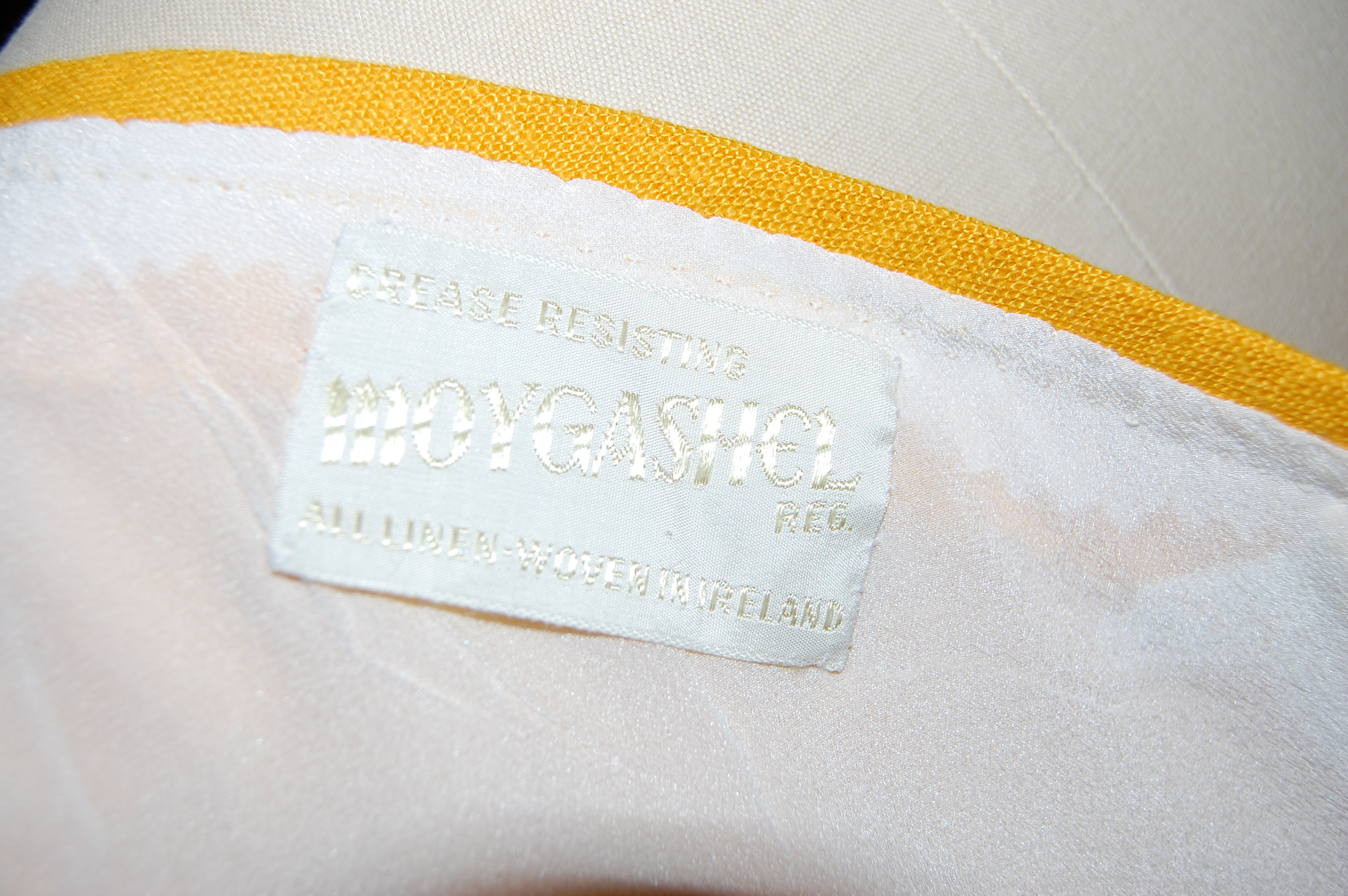
Another detail I was happy to add was the Moygashel linen label which had been attached to the forsythia yellow linen yardgoods.

I attached the label inside the back neckline.

I attached the label inside the back neckline.

The belt is also a Pat Mahoney product, made from a silk dupioni.

The belt is also a Pat Mahoney product, made from a silk dupioni.

All about the shoes

All about the shoes

I like the V-ed back!

I like the V-ed back!

Love those shoes!

Love those shoes!

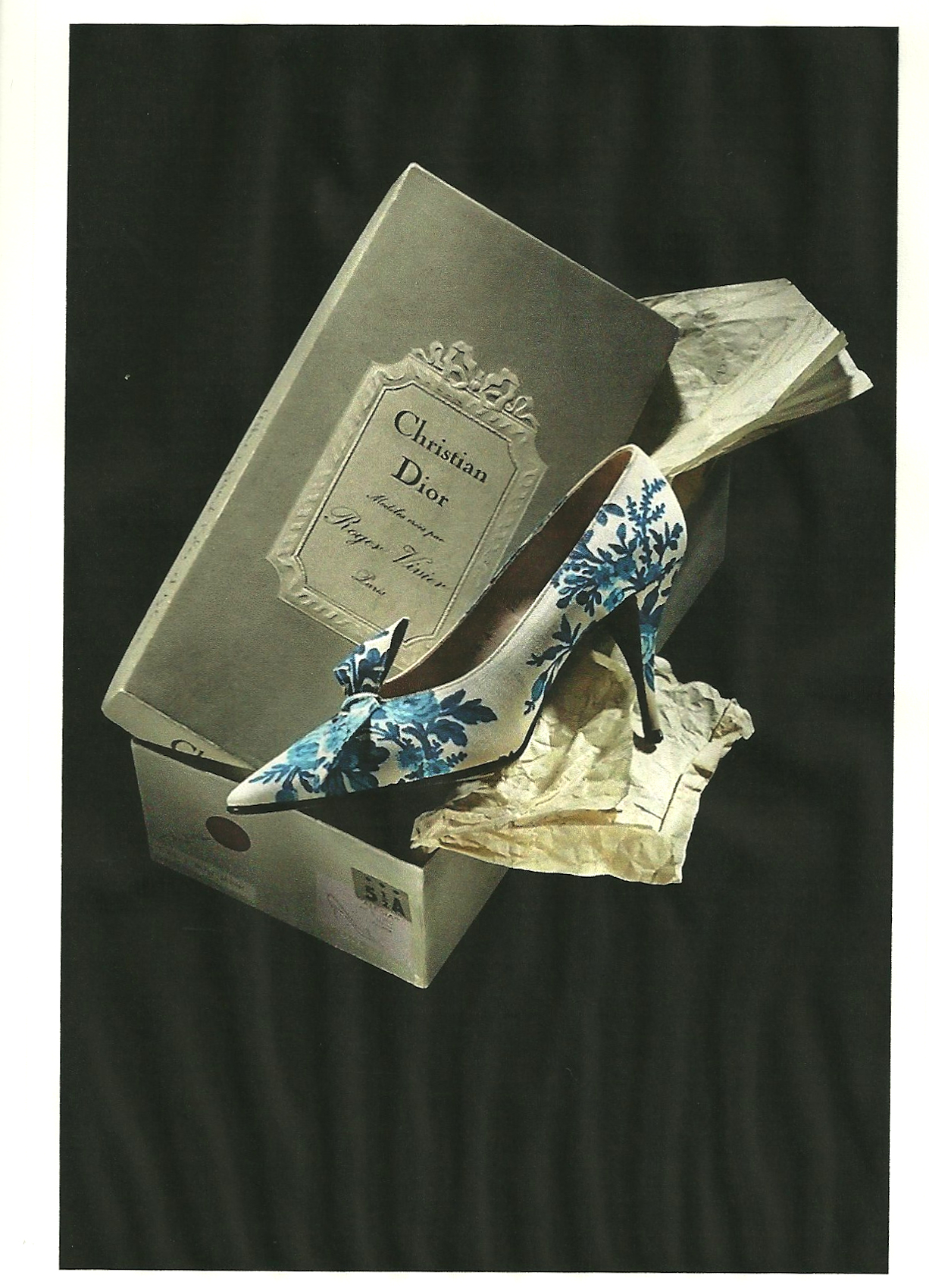
To me, this dress is reminiscent of a 1950s’ “wiggle dress” – although I added a back slit so that I can walk easily, which I guess would have been “cheating” in the 1950s! I was delighted to make another 1950s’ connection when I saw this pair of Roger Vivier shoes for Christian Dior on Pinterest:

All about the shoes - Pinterest pin

The similarities with my shoes are remarkable! Now that I have one dress perfectly suited for my Christian Dior-inspired shoes, I will be looking for other “perfect pairings”. Who knows what fabric treasures will present themselves next Spring or Summer for just such an undertaking?


44 Comments

Filed under Buttons - choosing the right ones, couture construction, hand-sewn zippers, Linen, Moygashel linen, Shoes to make an outfit complete, The Conde Nast Publications, Uncategorized, underlinings, Vintage fabric, vintage Vogue patterns from the 1960s

“Good Wearing-Relationships”

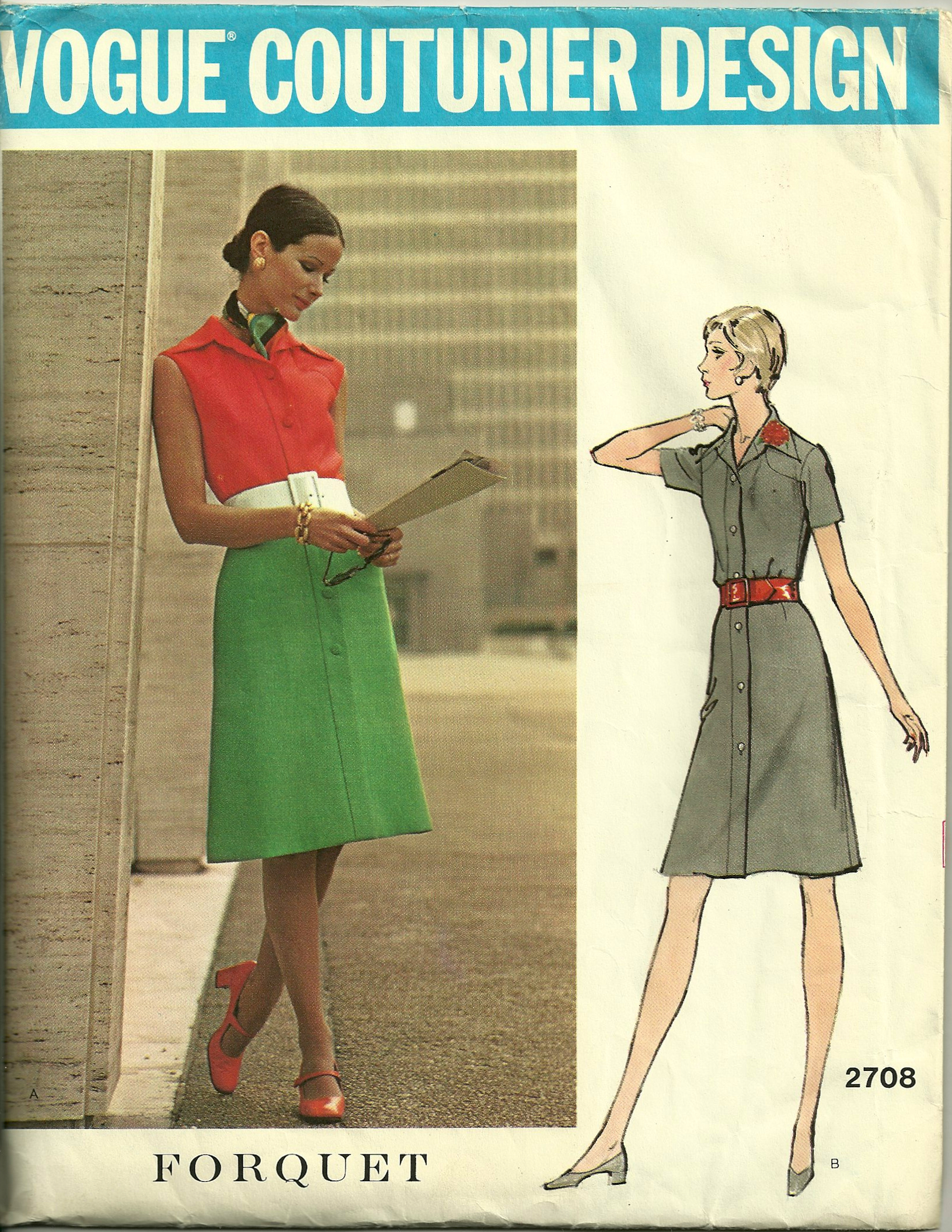
This is a pattern I have long admired:

Good wearing-relationships - Forquet pattern

It is one of those patterns which is always in my mind when I am looking at or for fabric. Twice I have opened it up to survey its pieces and construction, and twice I have decided against it. To be fair, both times of rejection have been because of “not enough fabric”, but other factors have weighed in as well: 1) the collar is too “’70s-looking” and would have to be recut; 2) the skirt is A-line, a look I am just not excited about right now; and 3) the top part of the dress is “bloused” instead of darted, which adds more bulk to the waist than I can handle at this stage of my life.  However, with that said, I still love the look.   I love the strong contrasts of color, divided and punctuated with the wide white belt. I love the styling with the shoes matching the red bodice, the tidy neck scarf, the big ball earrings, and the classy bracelet. It is a memorable look. And – it served as inspiration for me as I recently paired two vintage pieces of contrasting Moygashel linen.

GGood wearing-relationships

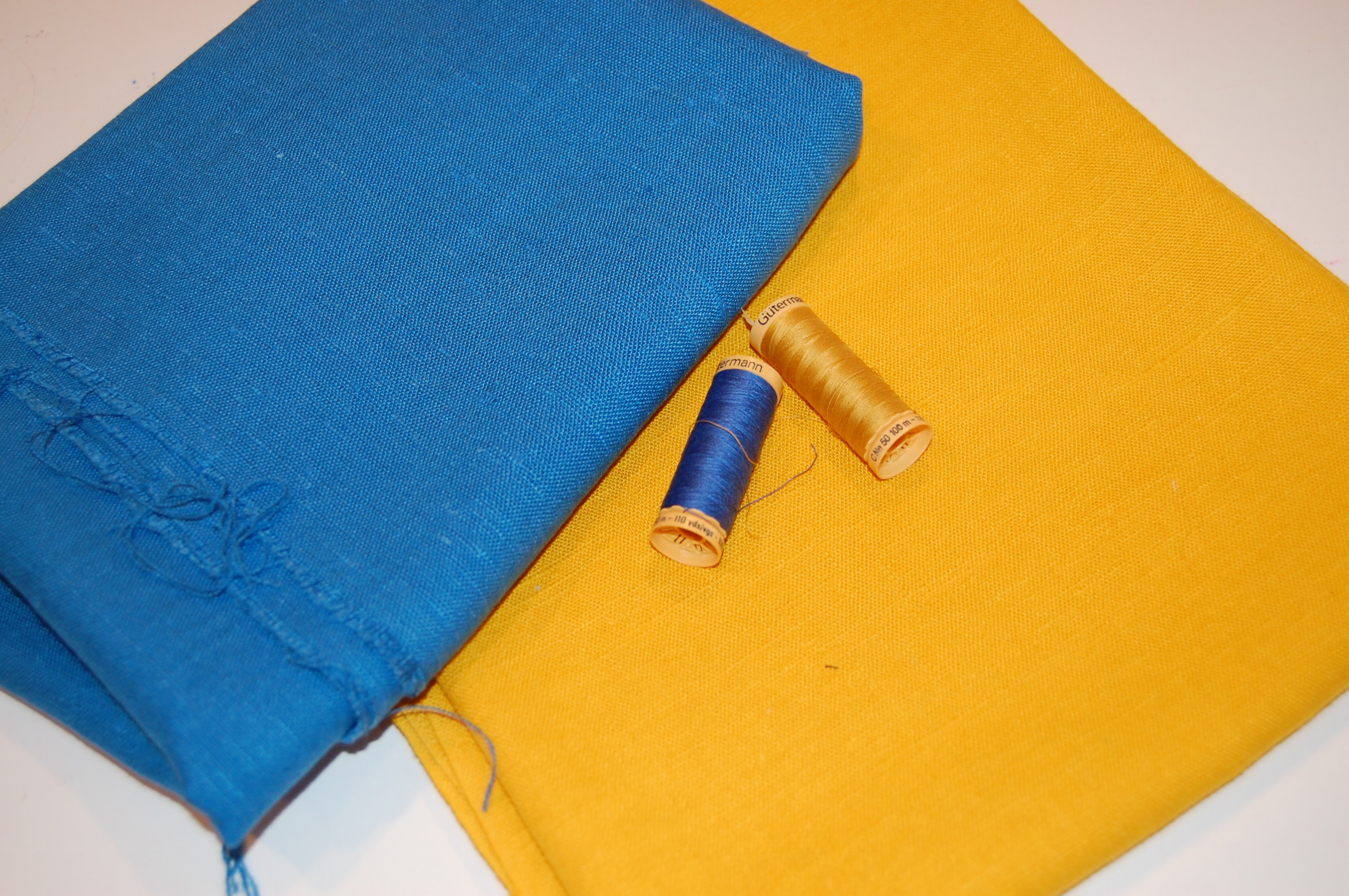
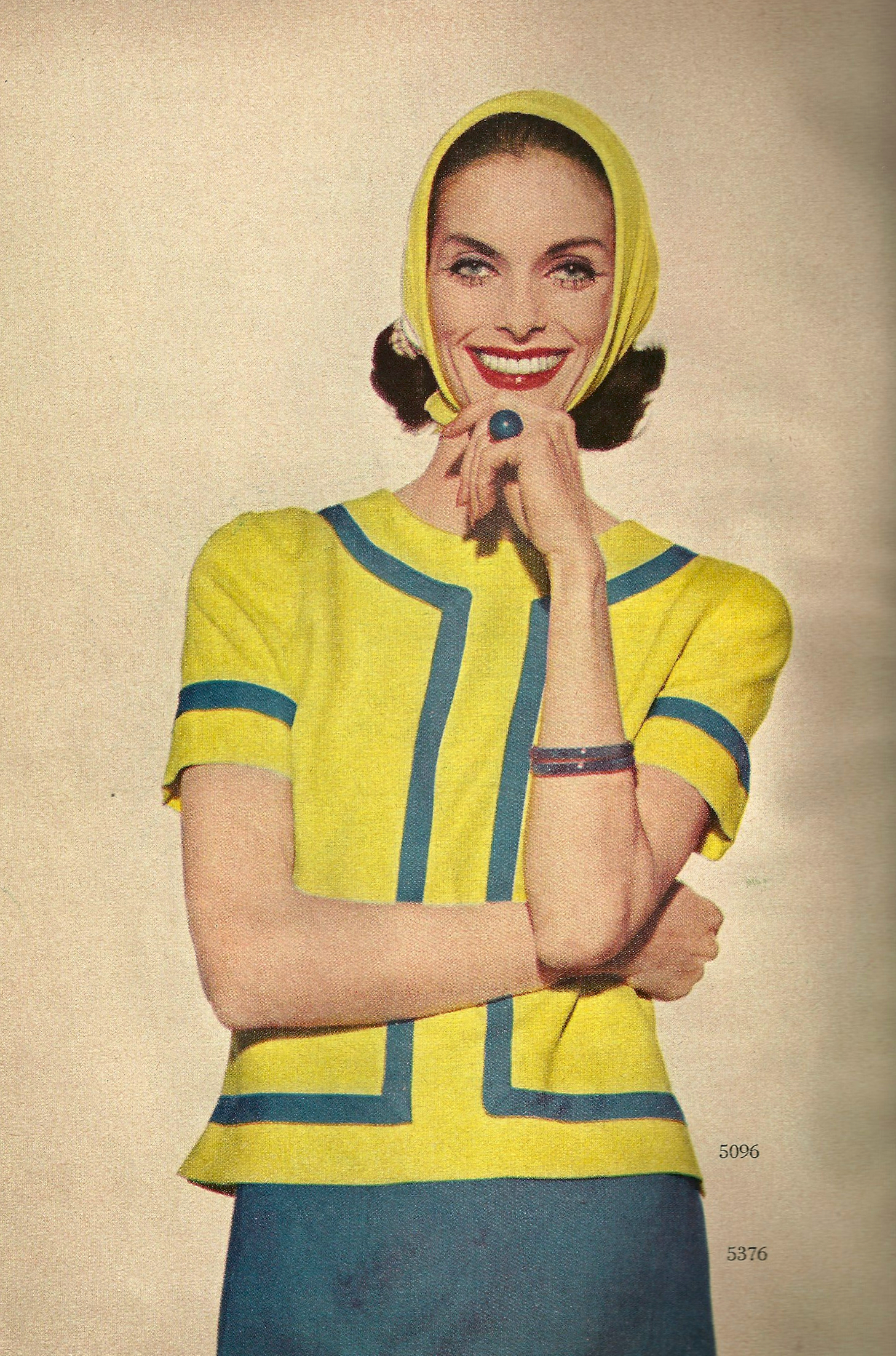
When I purchased these fabrics – at different times – I had no intention of using them together.   But then, one day I put them together and liked what I saw. I knew from Vogue 2708 (above), that a white belt would add the necessary foil to those two strong colors. Further encouragement came happily from a two-piece dress in the June/July 1962 issue of Vogue Pattern Book Magazine using similar Moygashel linens:

"They're naturals - and we're not just talking about the cotton and linen fibers in the clothes on these pages , but the good wearing-relationships we have with them.  We like them; they like us - our 1962 shapes, science-bred colors, the places we go, our washing machines..."  The two-piece dress featured here was made from Moygashel linen,

From the description:  “They’re naturals – and we’re not just talking about the cotton and [Moygashel] linen fibers in the clothes on these pages , but the good wearing-relationships we have with them. We like them; they like us – our 1962 shapes, science-bred colors, the places we go, our washing machines…”

Now all I had to do was decide upon a pattern which would work with the one yard I had of the “bittersweet” yellow linen for the bodice and the one-and-one-quarter yards I had of the “pottery” blue linen for the skirt. (Fortunately, these linens are 45”wide, meaning that they were manufactured after the early-1960s.)

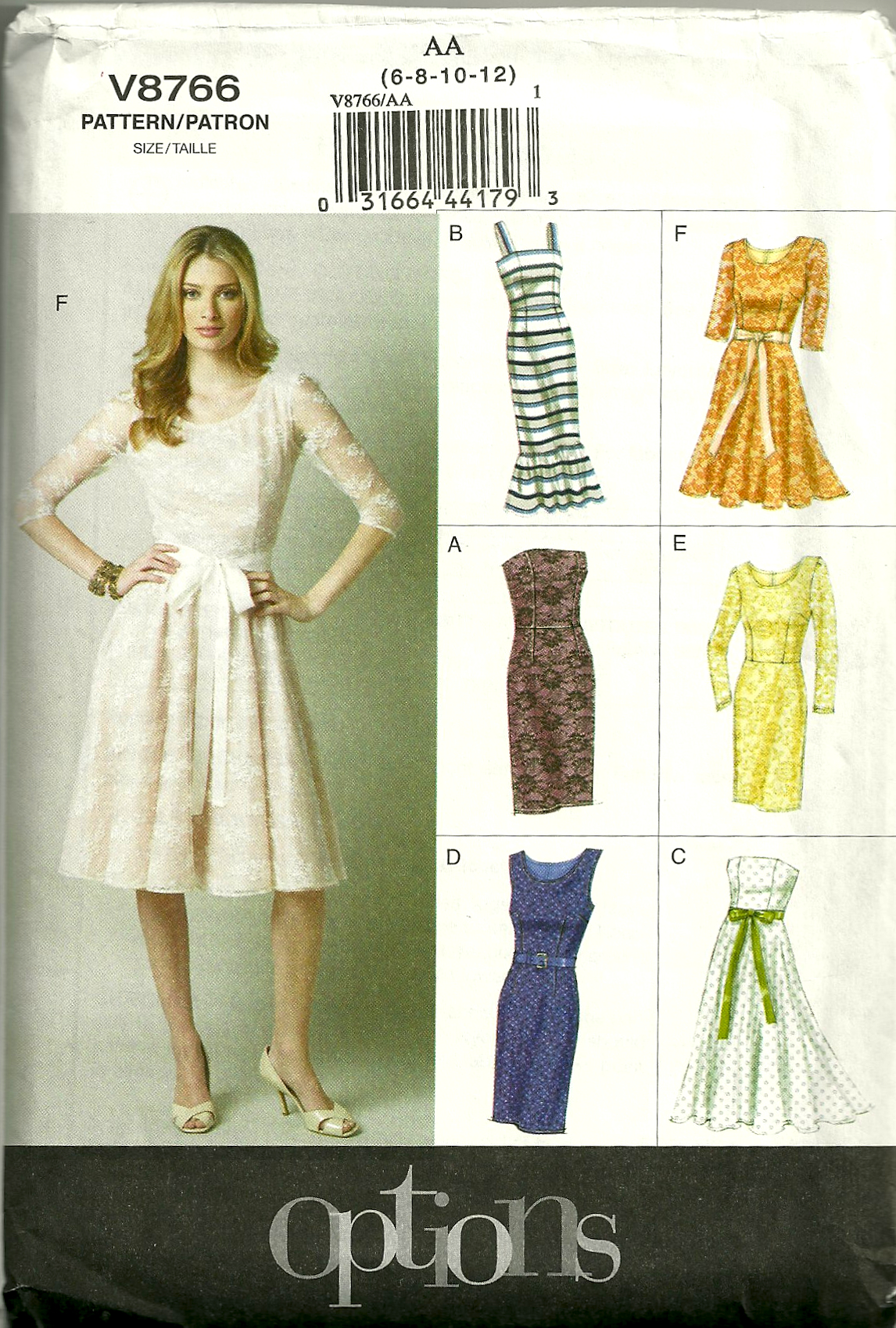
Initially I thought I would just go with View D of this current Vogue pattern:

Good wearing-relationships - new vogue pattern

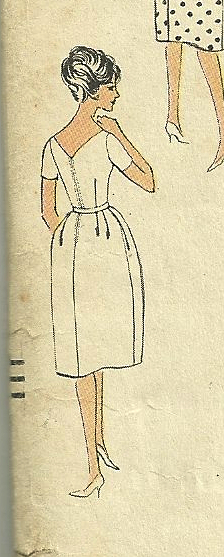
But after having recently read Linda Przybyszewski‘s The Lost Art of Dress and being influenced by the discussion therein of the importance of fashion emphasizing one’s face, I thought I wanted a more interesting neckline. Off to my collection of vintage patterns I went, emerging with this one:

The neckline dips down to a slightly curved V, with a center seam.

The neckline dips down to a slightly curved V, with a center seam.

And the back is equally as pretty!

And the back is equally as pretty!

Now I had a plan. I would use the narrow skirt from the current Vogue pattern and the bodice from the vintage Vogue pattern, except that I would make it sleeveless. I had to work to line up the darts on the bodice and the skirt, moving them hither and yon several times. And then I had to deal with the positioning of the bust darts, always an issue for me with vintage patterns. The apices of the darts are always too high for me. (I’m sure it has much to do with the foundation garments which women wore in the ‘50s, ‘60s, and early ‘70s.) Simply moving the apices lower does not always work, as then I seem to have too much fullness above the bust and across the shoulders.   Of course, this is where making a muslin (toile) comes to the rescue. In this case, my first muslin had so many changes to it, that I had to transfer all my final markings to a new muslin. I also decided to underline the linen with silk organza and use true couture techniques to complete this dress.

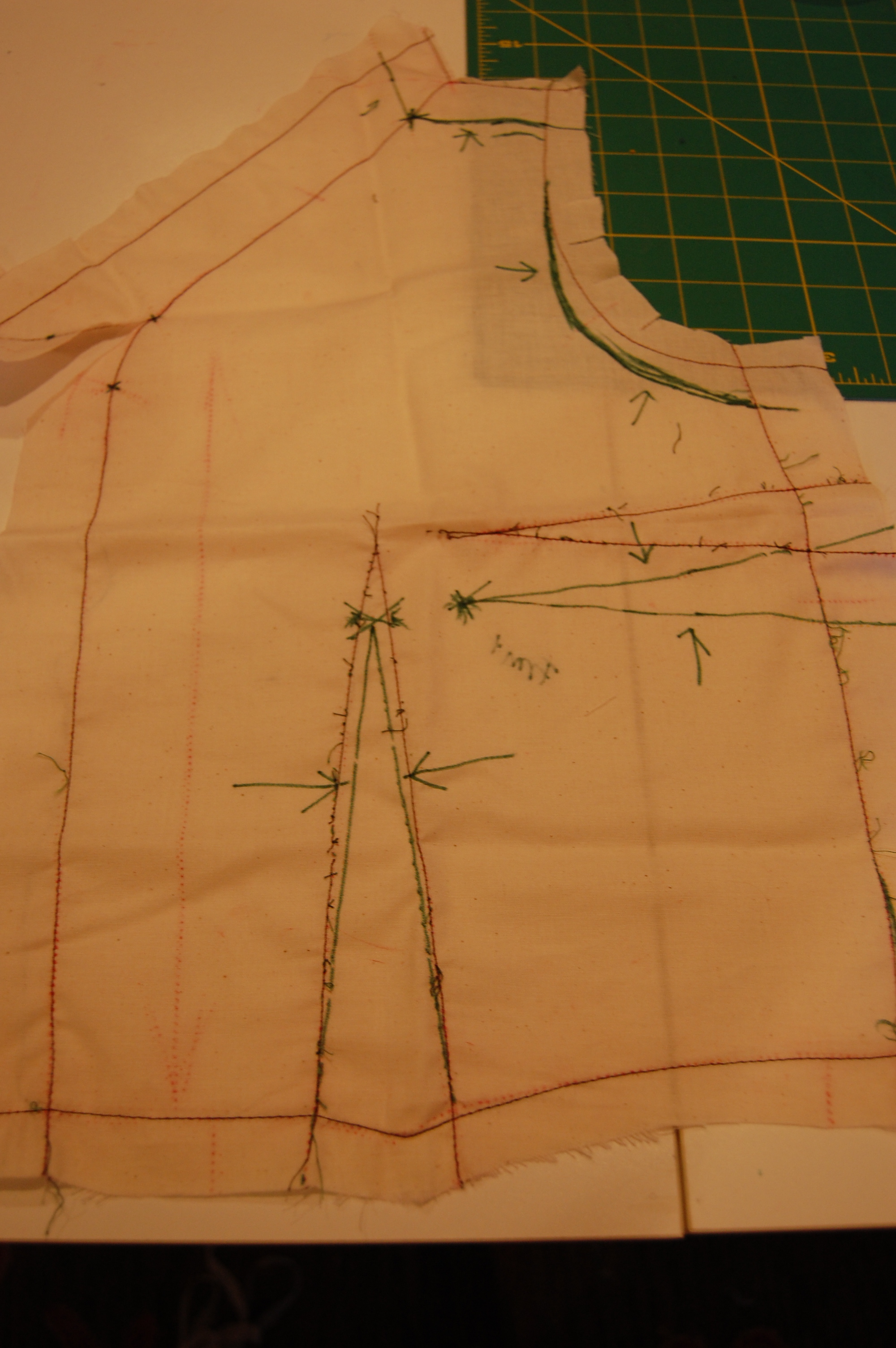
Here is one side of the front from my first muslin.  I still had to make changes on the second muslin, but better on muslin than on the fashion fabric!

Here is one side of the front from my first muslin. I still had to make changes on the second muslin, but better on muslin than on the fashion fabric!

As I work on this dress I am in concurrence with further commentary from the 1962 VPB: speaking of “Naturals for our Time” (linens and cottons), the editors say, “Most of all, we want the real-life way they look – effortless, inspired by structure rather than detail [my emphasis], and naturally appealing now.” Actually, there is one important detail which will add to the “good wearing-relationship” I will have with this dress – but I’ll save that for my next post…

15 Comments

Filed under couture construction, Linen, Moygashel linen, The Conde Nast Publications, Uncategorized, underlinings, Vintage fabric, vintage Vogue Designer patterns, vintage Vogue patterns from the 1960s, vintage Vogue patterns from the 1970s, Vogue patterns

Thinking Time

There is one more Summer Dress in my head, begging to be made. However, this one needed some thinking time before I could start it, to help me decipher the correct pattern (or patterns) to use. The fabric is pretty special, so I don’t want to make a mistake. What to do to fill up this time I was spending thinking? It seemed the perfect opportunity to do some really simple sewing, as in “Easy Tunic Top”.

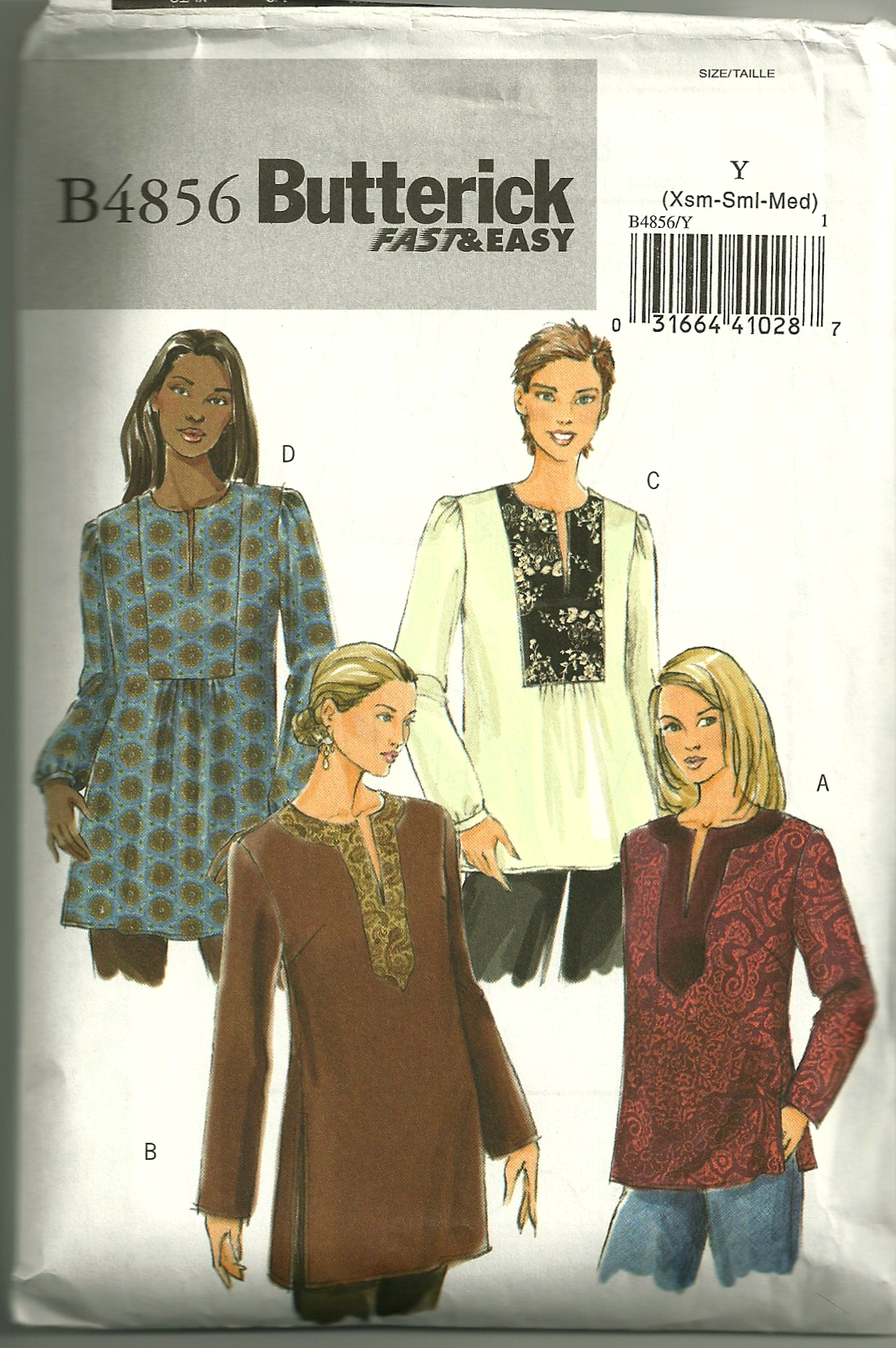
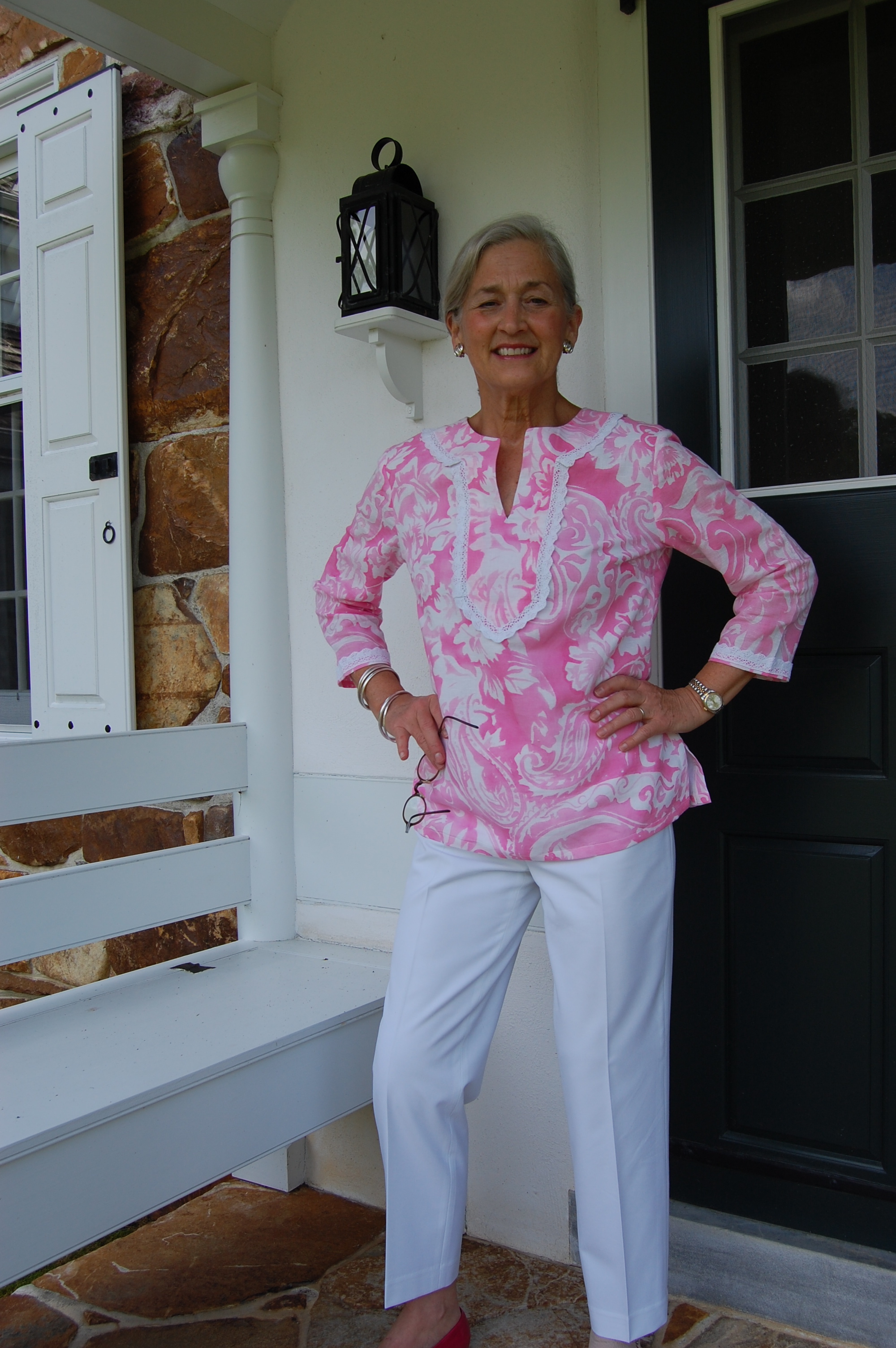
Last summer, while in JoAnn’s for one of my frequent thread or zipper trips, I stumbled onto some pretty linen/cotton blends – and on a whim, purchased two lengths.   One I made up immediately into a tunic dress; the other one has just sat around, keeping company with other lengths of fabric folded neatly on my “linen” storage shelf. After finding (in an Etsy shop) this classic tunic top pattern, now out-of-print, I decided this might be a good time to use that second piece of “whim” fabric.

View A is the top I like best...

View A is the top I like best…

No matching necessary on this "whim" fabric.

No matching necessary on this “whim” fabric.

I really did not want to go to the trouble to make a muslin, when I could look at the pattern and make a good guess as to its fit on me. It is loose, as tunics are – so all I did in preparation was to transfer the lines and markings from the tissue pattern onto a sturdier pattern paper.  I decided to line the body (not the sleeves) of the tunic, as the fabric is lightweight, and in the sunlight it could be “revealing”. I used a very lightweight rayon voile, which I get at Dharma Trading. I finished the seams with Hug Snug binding tape, which is just so easy to use and makes such a nice finish. The more I use it, the more I wonder how any dressmaker can live without it!

This shows both the seams finished with Snug Hug and the white voile lining.

This shows both the seams finished with Hug Snug and the white voile lining.

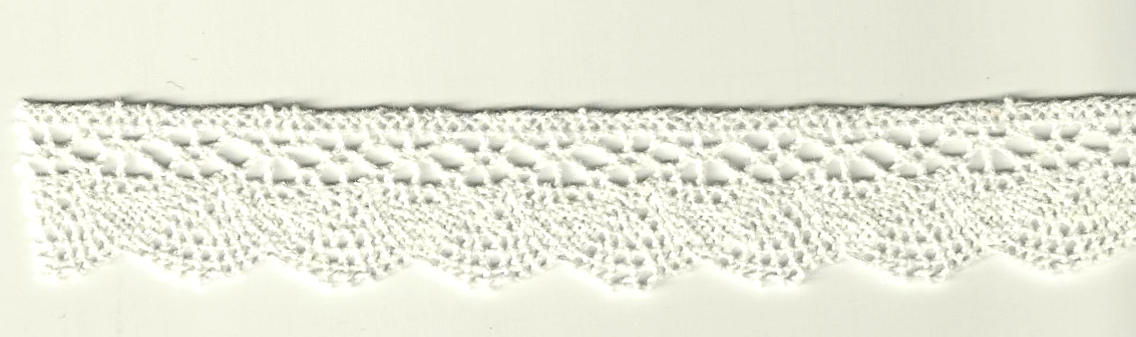
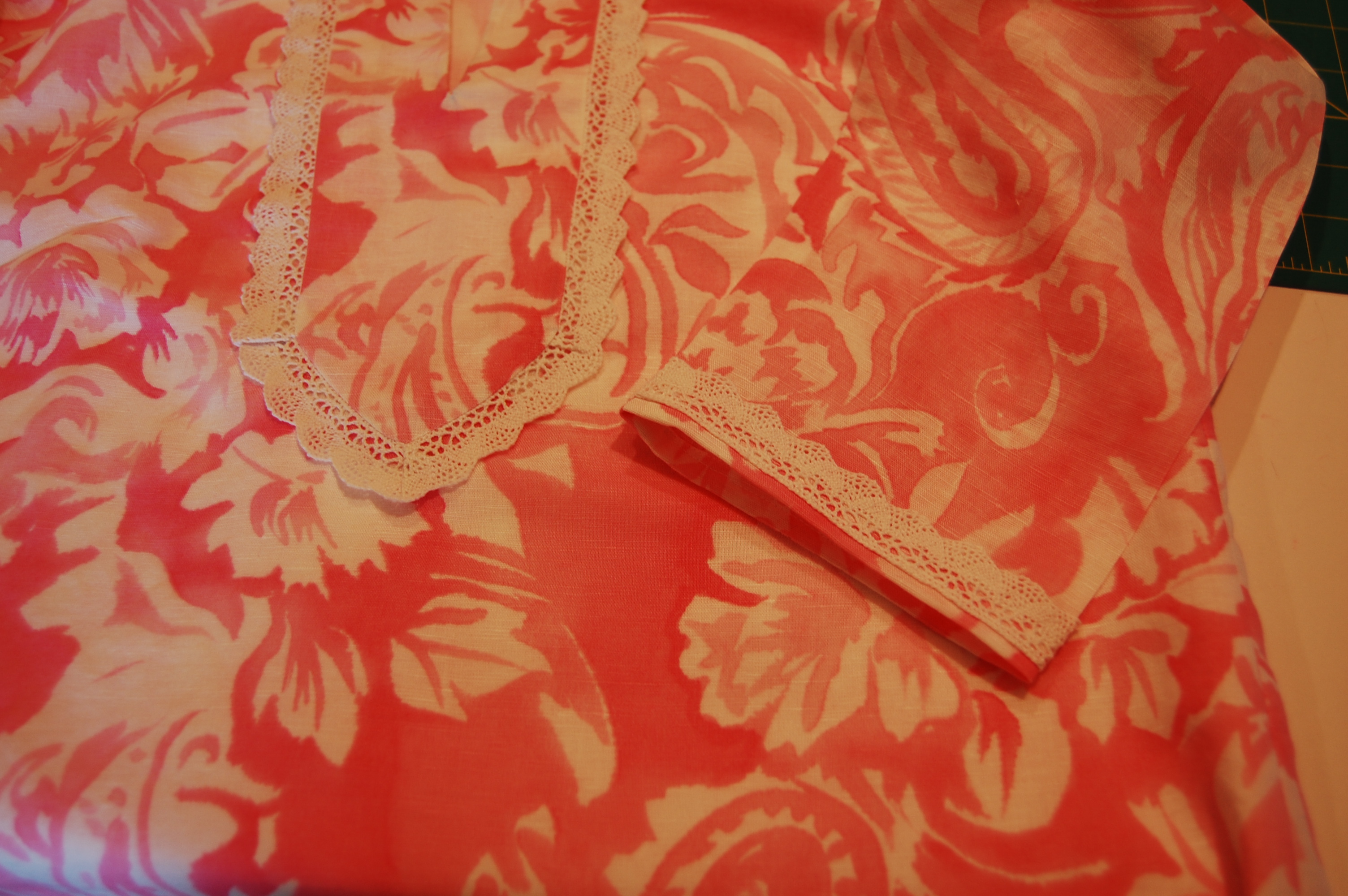
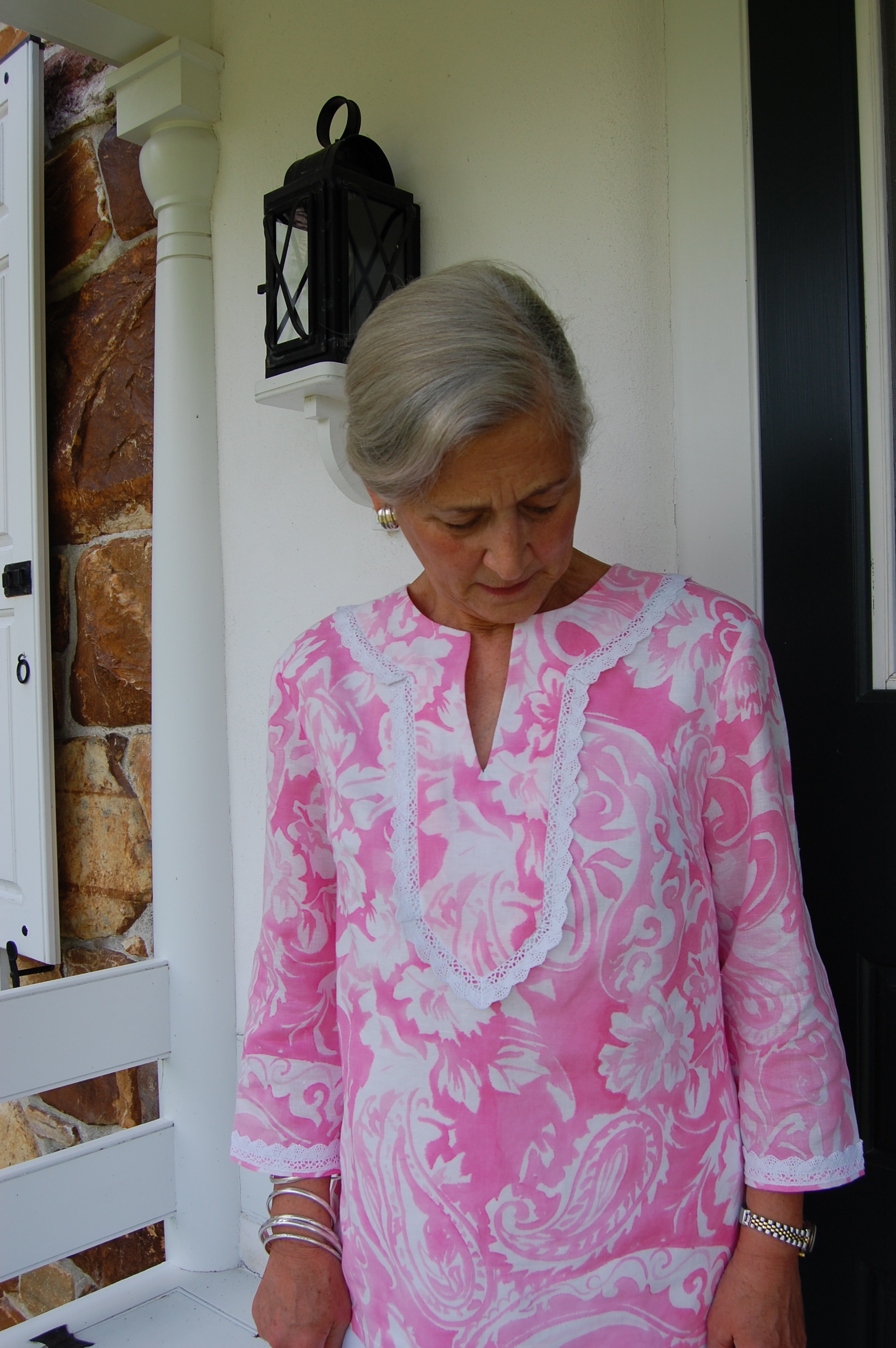
Because I was making the front placket out of the same material as the rest of the top, I knew I would need to do something to differentiate it, so I used a nice, low-profile cotton lace around the edge.

Thinking time - lace

I decided to make the sleeves three-quarter length, which is my favorite sleeve length. At first I wasn’t going to put any lace on the edges of the sleeves, but then it just didn’t look quite right without anything, so I added it.

I attached the lace with the straight edge at the bottom of the sleeve, with a narrow margin of fabric showing,

I attached the lace with the straight edge at the bottom of the sleeve, with a narrow margin of fabric showing.

Thinking time

DSC_1324Thinking time

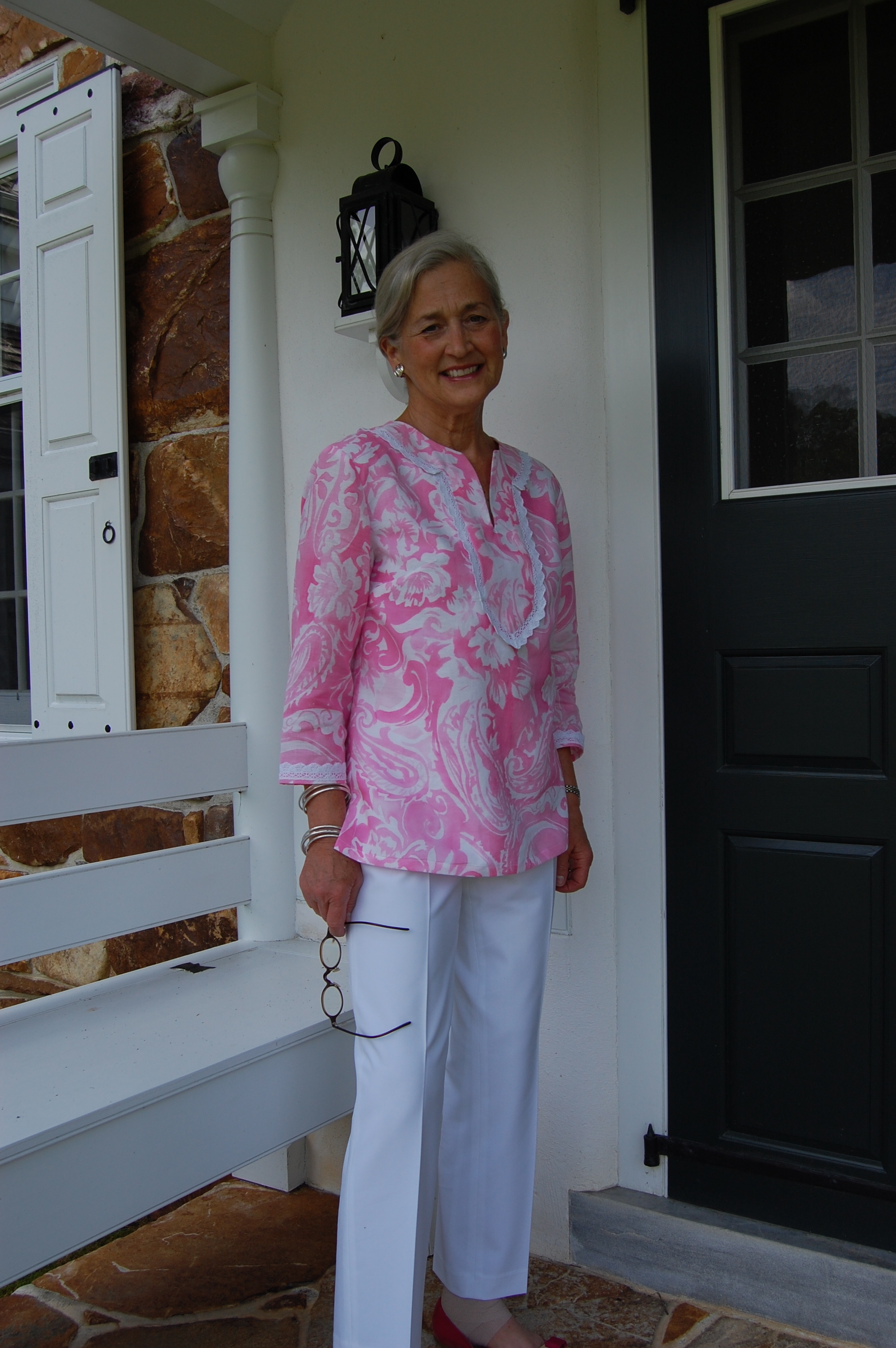
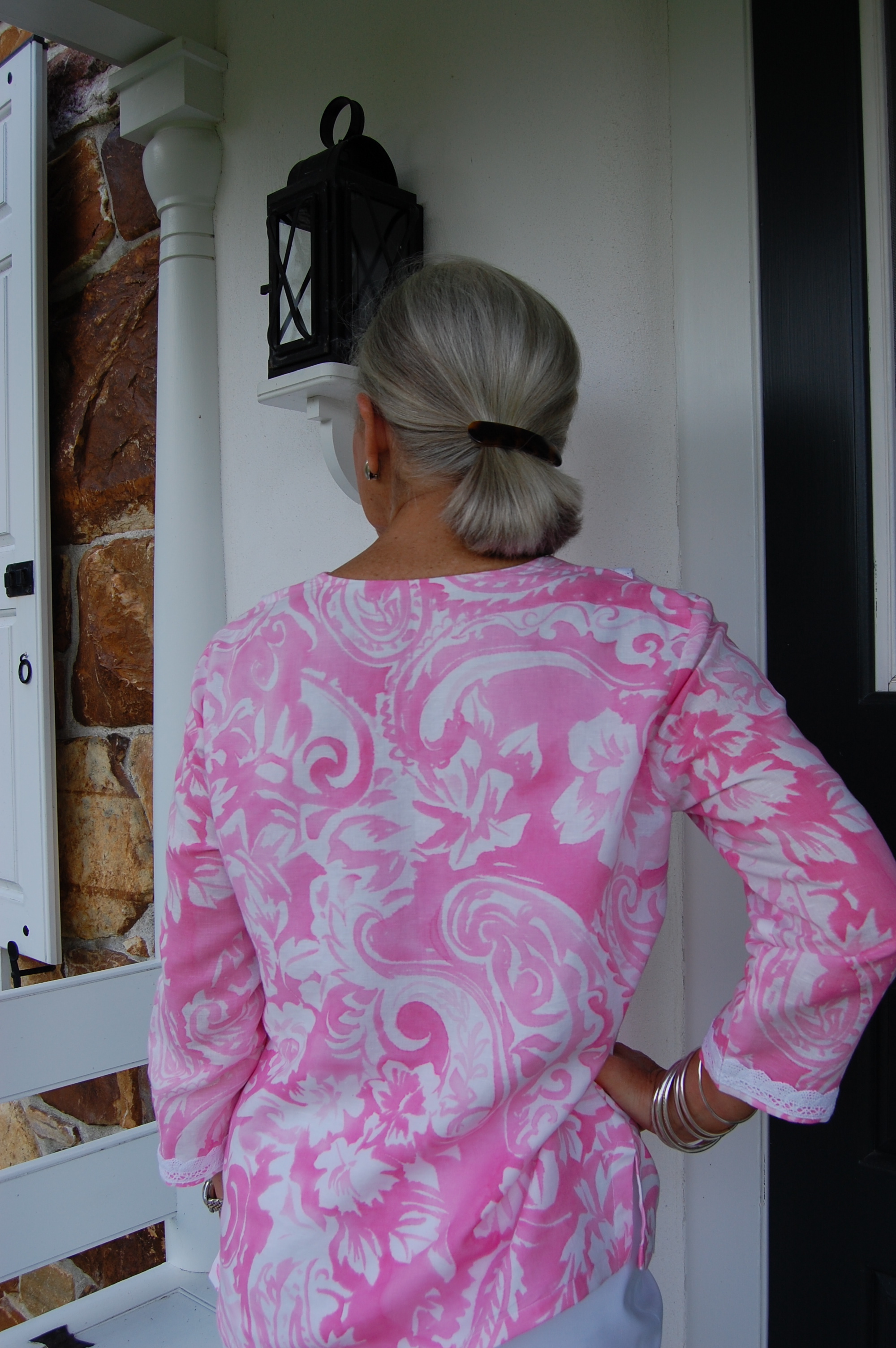
Now come the True Confessions . . . I’m not sure this top is quite “me”. I think I would like it better in a navy blue and white print. I would also take it in a little bit if I make this pattern again – as I think it looks a bit baggy. (However, since the only way into it is over the head, it can’t be too tight!) I have also decided that I am happiest sewing something that is more of a challenge. I’ll remind myself that I actually said this next time I am in a project that tests my sewing mettle!   That may be soon, as the “thinking time” for my final Summer Season dress is now turning into “doing time”. Here is a hint as to what I will be working on:

Thinking time - tagAny guesses, anyone?

13 Comments

Filed under Blouses, Linen, Uncategorized