Category Archives: Uncategorized

A Lovely Solution

What do you do with all those scraps of fabric which are often left over from a sewing project?  Sometimes I just throw them out, feeling guilty while I do so.  Sometimes I fold them up neatly and put them away in a very big box I have reserved for such things (to “think about another day.”)  And sometimes, if there is a sizable amount remaining, I’ll put my leftovers in a “giveaway” box, to be recycled in some charitable fashion.  But recently I have come up with another solution.  I have started making padded hangers with my fabric leftovers.  

Remember that small amount of fabric remaining from my recent pink striped dress?  I could have easily pitched that scrap (and not even felt particularly guilty about it), but I knew I had just enough fabric left to make a matching padded hanger for my dress.  
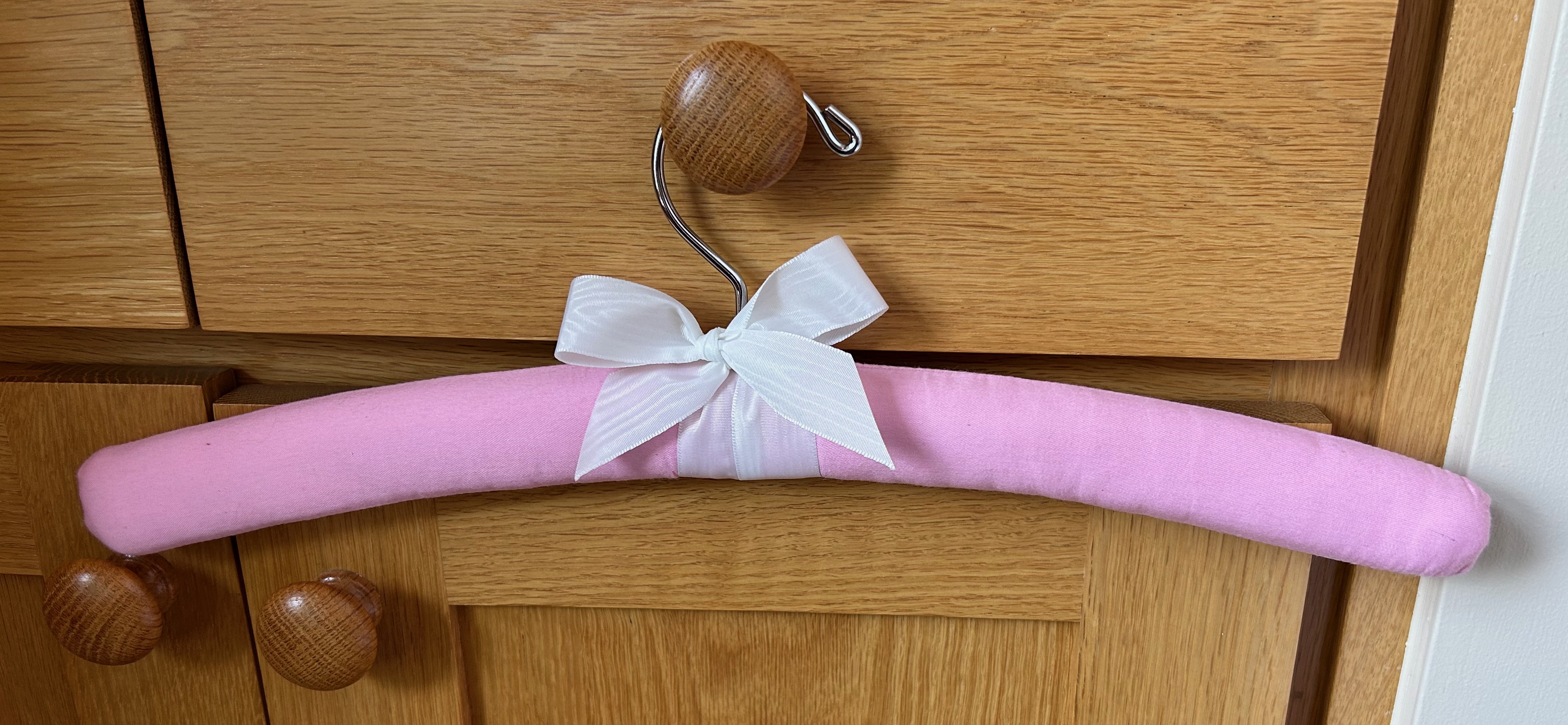
I had already made a few of these hangers in various scraps, using a You-Tube video for the basics, with several trial-and-error sessions to tweak the method and pattern to my satisfaction. Feeling confident with my new-found “expertise,” I plowed ahead and squeezed out just enough for a hanger to match my dress.  
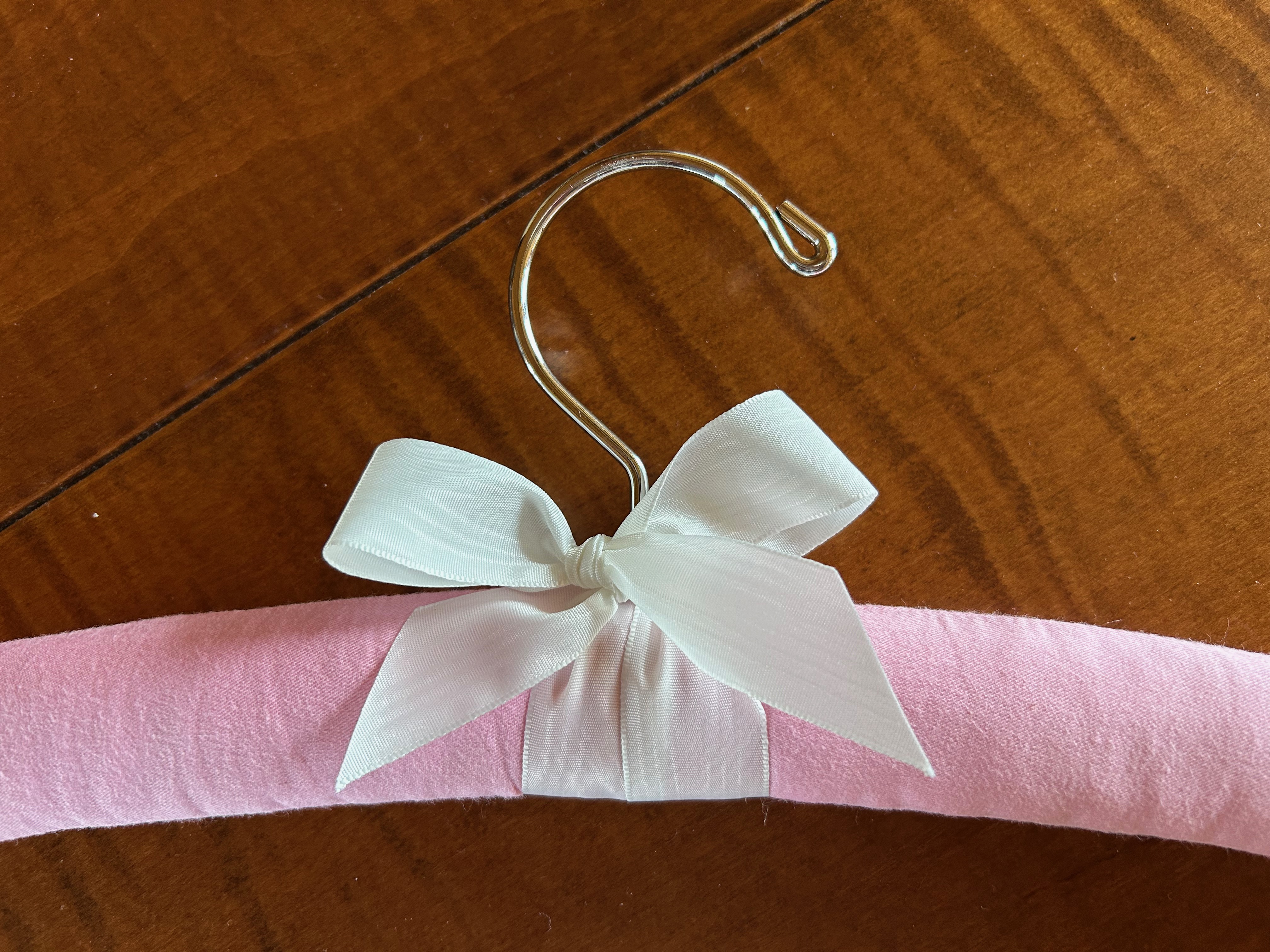
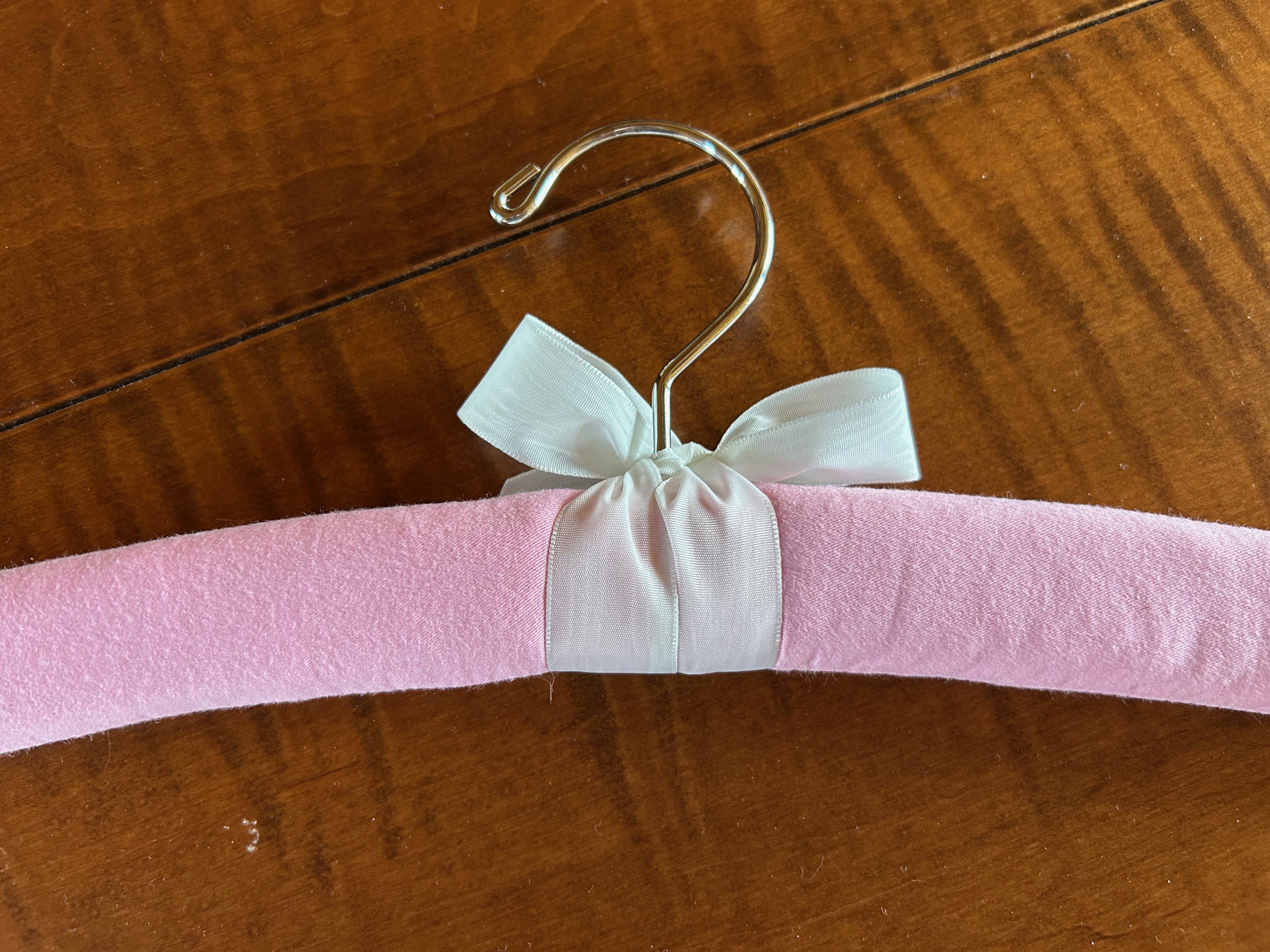
The ribbon bow serves two purposes: to cover up the seam where the two sides of the fabric sheaths meet in the middle, and to make your hanger more beautiful!

Now, I should add here that I have been a fan of padded hangers for a long time, purchasing quite a few from a couple of Etsy shops in recent years.  However, I have always thought it would be lovely to make matching hangers for some of my creations – or – just pretty hangers to mix and match. 

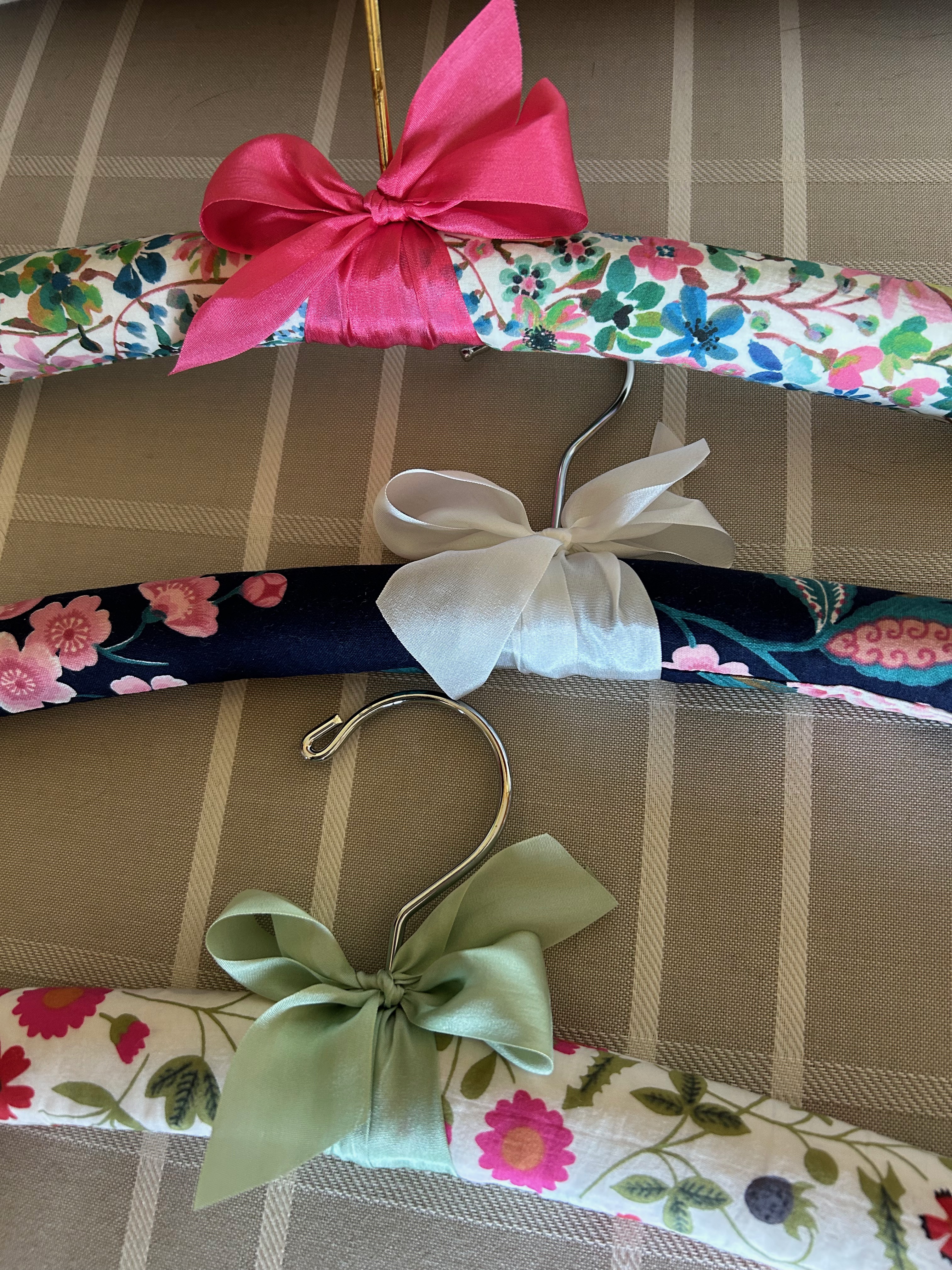
Here are three I have recently made.  
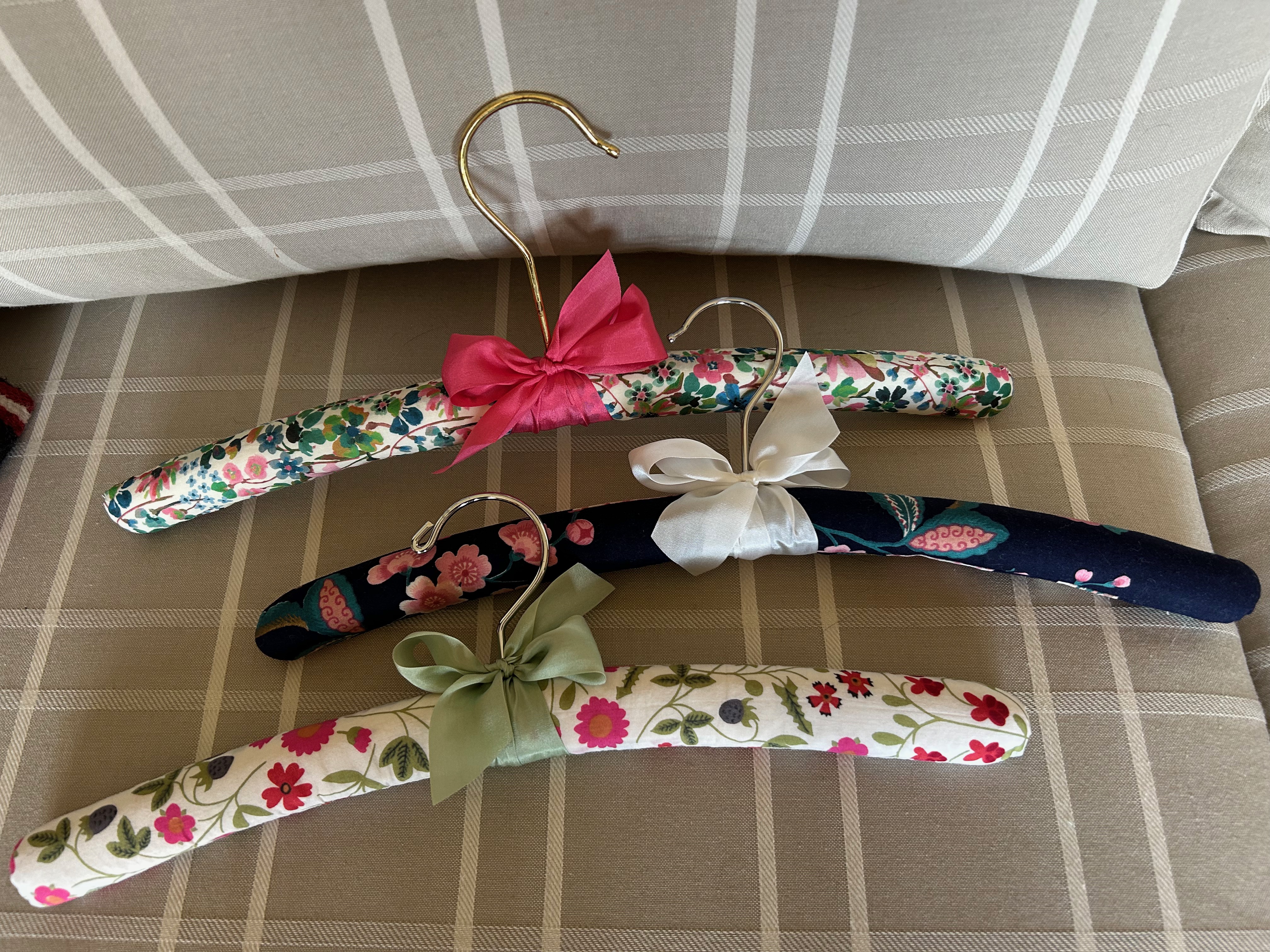
Two of them are made from Liberty fabrics, and the dark blue one is made from fabric left over from a skirt I made at least 25-30 years ago.  There is something particularly rewarding about using Liberty scraps, as the fabric is expensive and its tight weave lends itself beautifully to being stretched over the padded wooden hanger forms.

Speaking of the hanger forms – I have yet to find a source for these raw wood hangers.  To get what I need, I have purchased cheap, polyester satin covered hangers in bulk and taken off the fabric and yucky foam padding to reveal the raw wood hanger form inside it all.  This works, but I would really love to find a source for basic, uniform, raw-wood hangers with the swivel, silver-toned hardware that I prefer for these small projects.  

Here are a few pictures of my process, not intended to be a tutorial.  
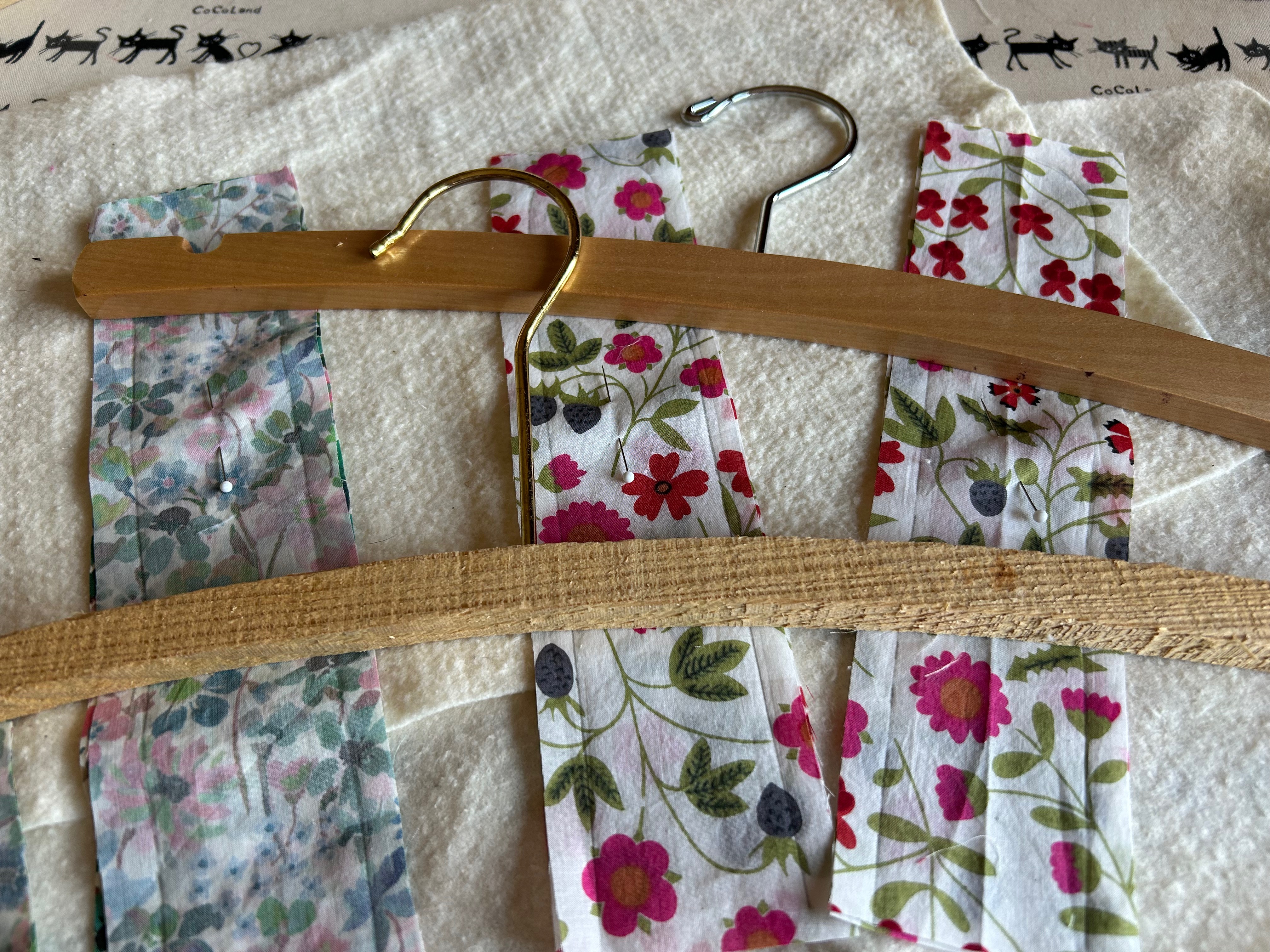
Here are the basic ingredients for making padded hangers: a wooden form, quilt batting used for the padding, and the cut-out fabric pieces to sew and cover each side of the wooden form.
Shown here are two varying wooden forms I happened to have on hand. The unfinished – or raw – wood one is specifically intended for being covered. The other one is a “finished” wood hanger which I turned into a padded hanger.
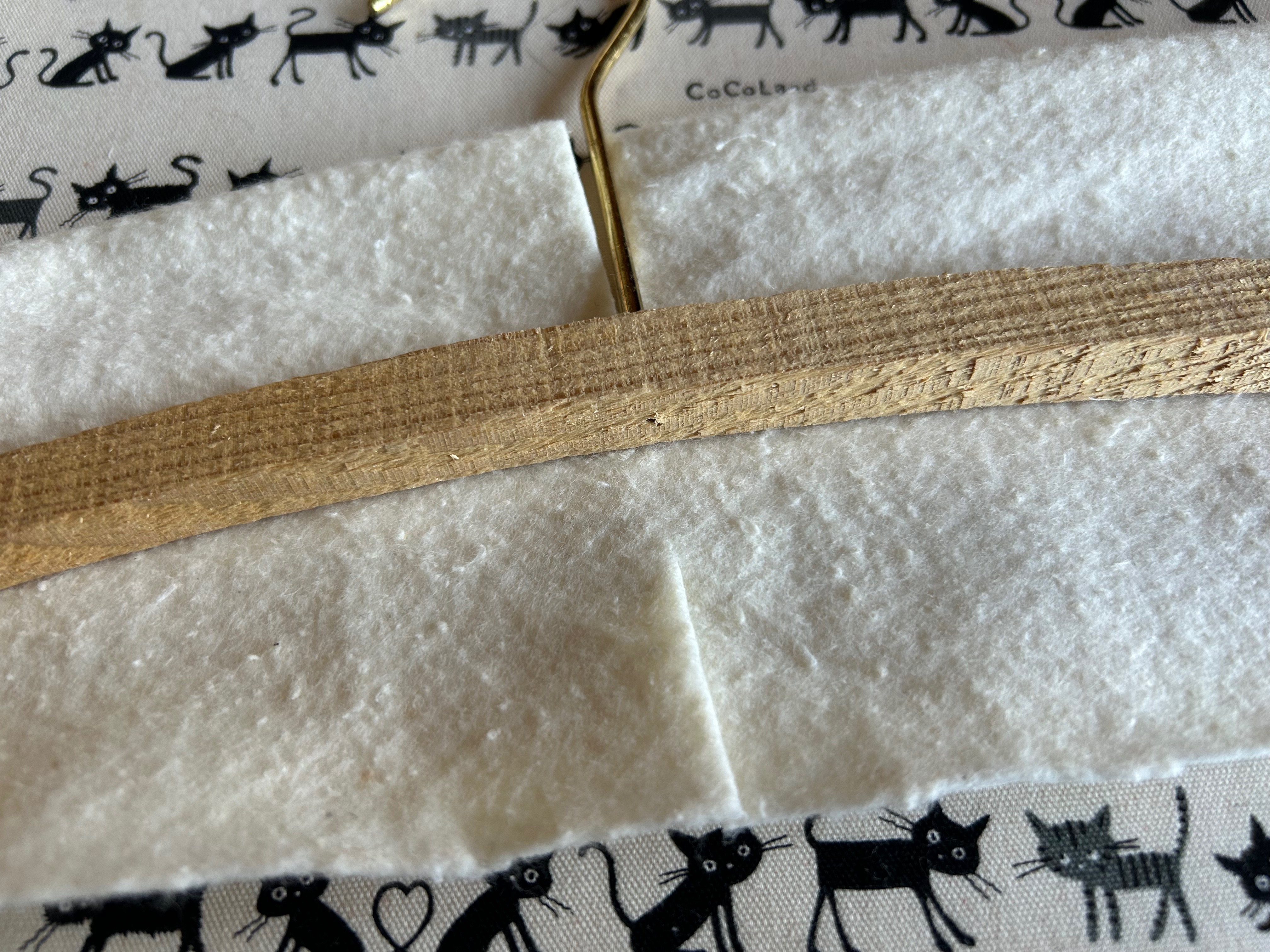
The quilt batting cut and ready to apply to the wooden form.
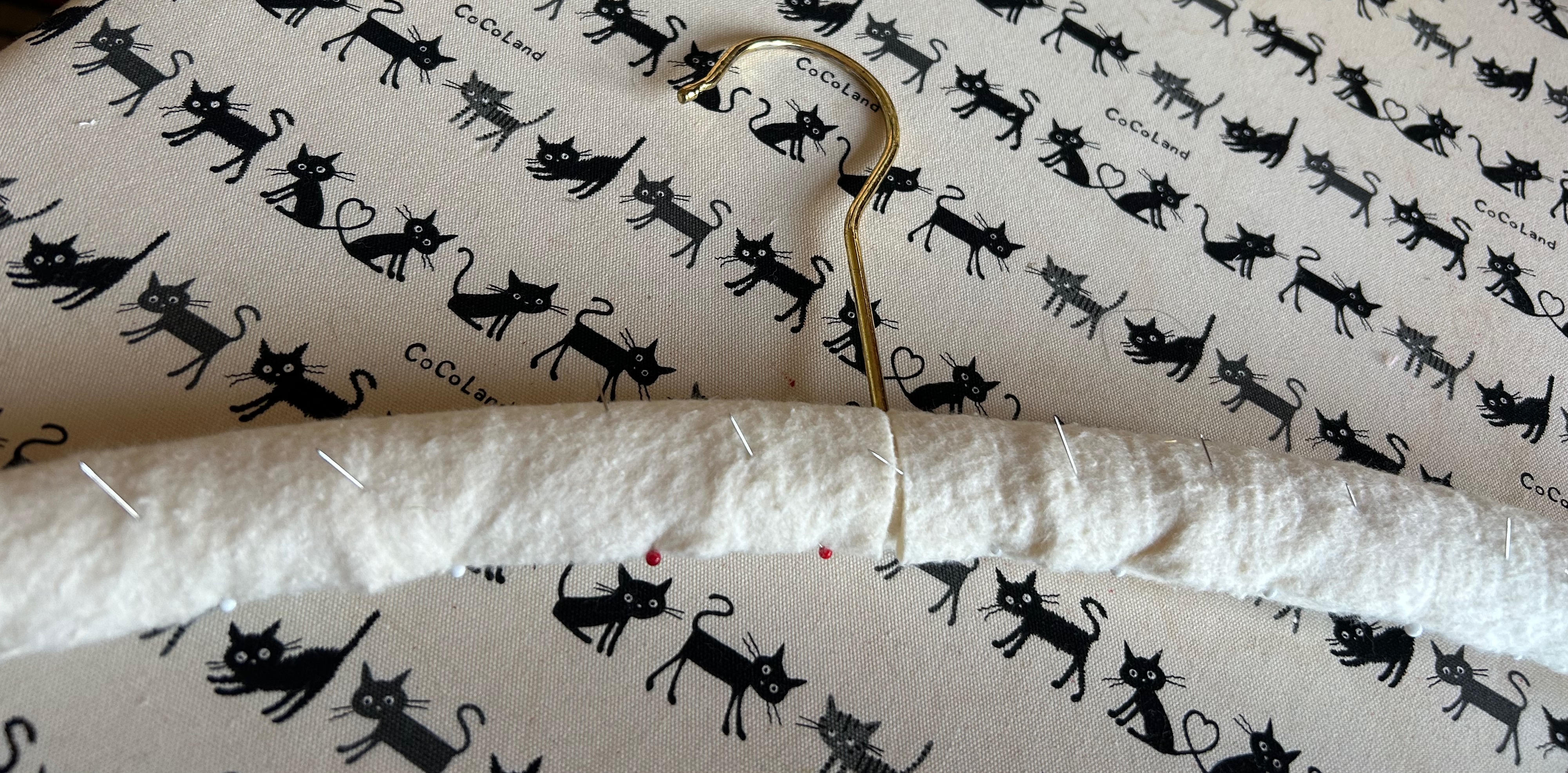
The batting pinned in place, ready to sew by hand.
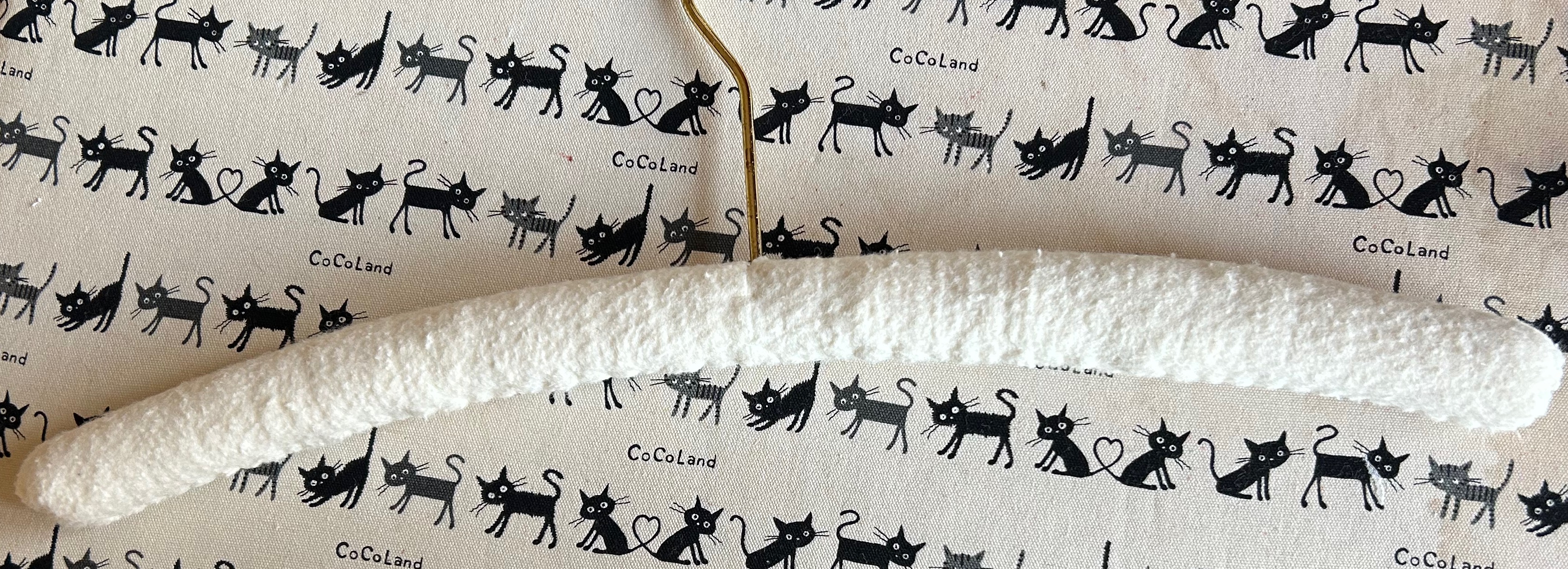
The padded raw hanger ready for the sewn fabric “sheaths” to be slipped over each end of the hanger.

Let me tell you why there is something very rewarding about making these hangers.

  1. First of all, they really don’t take much time, perhaps 35-40 minutes per hanger. 
  2.  Second, it is the perfect combination of hand and machine sewing. 
  3. Third, as stated, it is a wonderful way to use up scraps.  
  4. Fourth, I can use the fabric that is best suited for these closet accessories – tightly woven cottons, light-weight linens or damasks, and never anything slippery, such as satin, which causes your garment to slide off one side.  I am particularly looking forward to making hangers with some of my scraps of vintage cottons and linens, a unique way to preserve samples of these special fabrics. 
  5. Fifth, handmade padded hangers make very sweet small gifts for friends and family.
  6. And finally, making my own hangers allows me to use coordinating color ribbon. White is always nice, but using coordinating colored ribbon makes your hangers just that much more personal.
Often, between sewing projects, especially if they are major projects, I like to make something quick and easy and fun to “decompress” and get ready for the next big undertaking.  Making a padded hanger is the perfect solution. 
29 Comments

Filed under Bows as design feature, Liberty cotton, padded hangers, Uncategorized, Vintage fabric

Pink Stripes 

“You can never go wrong with a little pink… a lot works for me.” Dana Dalgetty

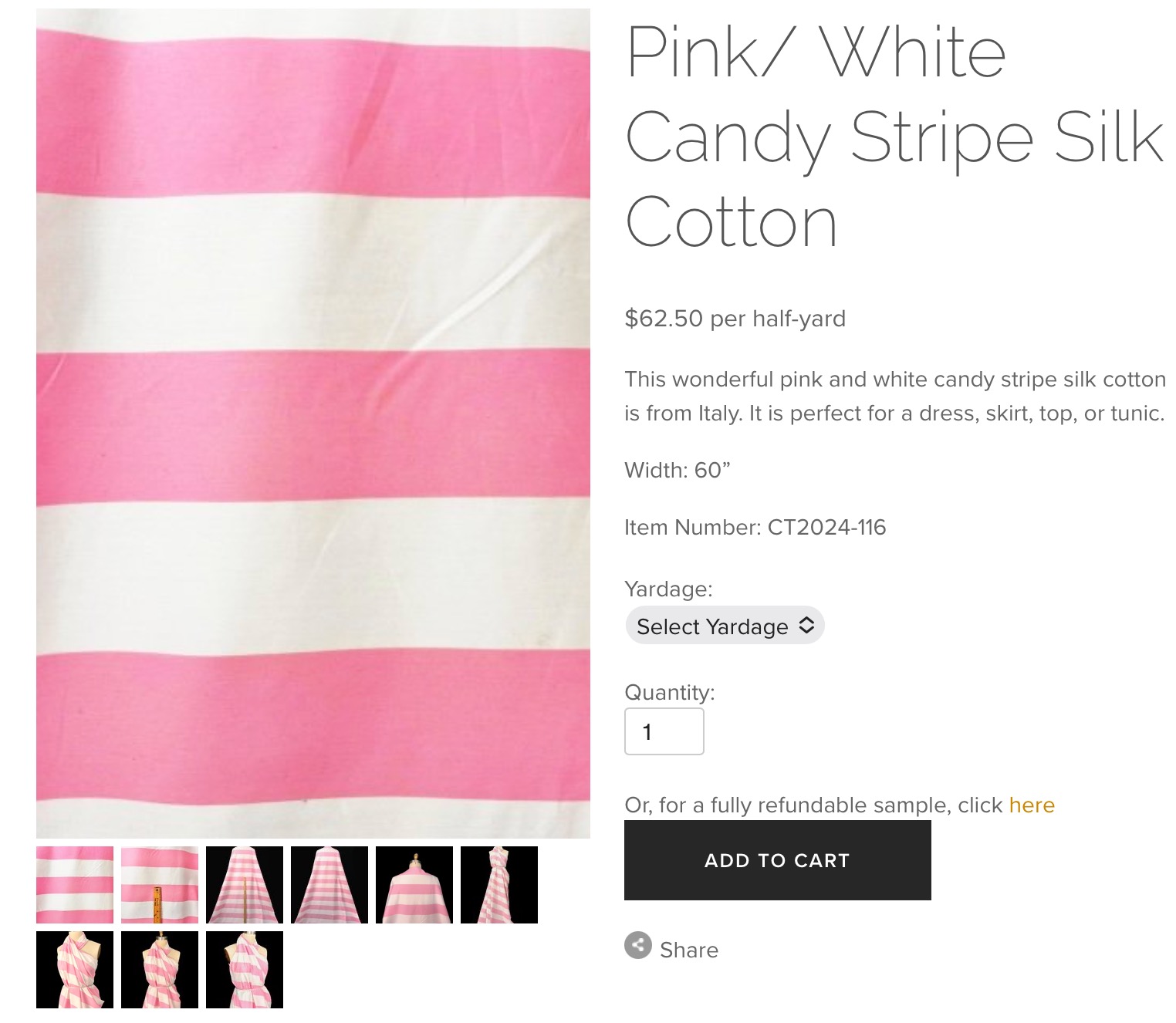
It is extremely difficult for me to resist a bubblegum pink fabric.  And if it is a stripe, too, the odds are very good that fabric will end up in my sewing room.  So it was with this silk and cotton blend found on the website of Mendel Goldberg Fabrics.

Screenshot

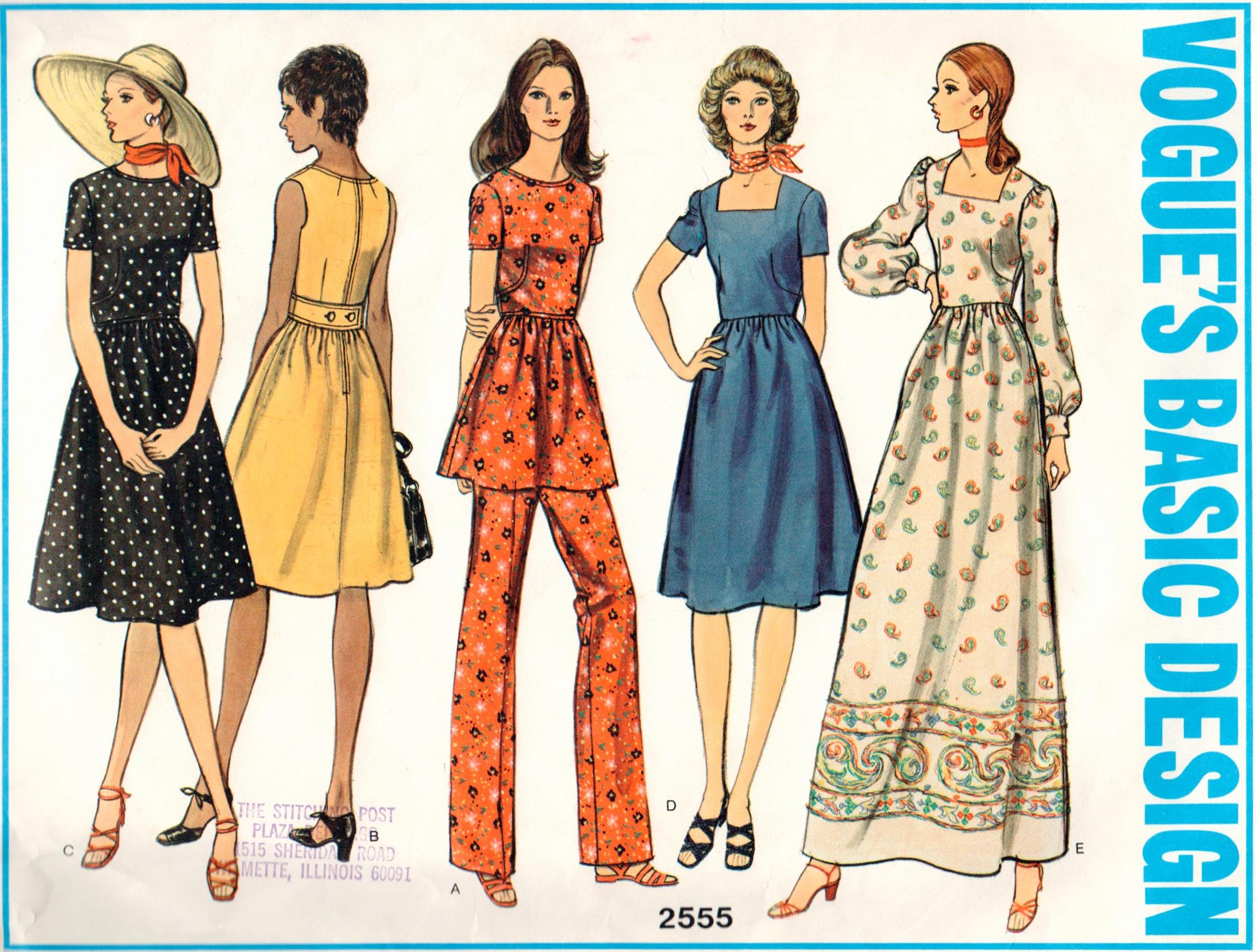
I purchased it last summer during a 20% off sale, and when it arrived, I knew I had made the right decision – although the stripes were a bit bolder in person than I anticipated.  As usual, I wasn’t sure what I was going to make – a coat? a dress? a skirt?  I needed more thinking time so I tucked it away until this Spring.  In the meantime, I purchased this vintage Vogue pattern which I saw as a good basic design which could be easily changed, adapted and altered.  

Take note of those curved darts on the bodice, as I will mention them again.

I like dress designs which have some “back“ interest, here the buttoned half belt.  Although I loved the sleeveless view, I have become less comfortable wearing sleeveless dresses as I have gotten older.  Thus, I was drawn to the short-sleeved view (C), knowing I could easily lengthen the sleeves to reach almost to the elbow, if that seemed the way to go.  Thus, it was a logical progression to imagine the pink striped fabric made up in this design, despite the note on the pattern “Not suitable for striped fabrics.” 

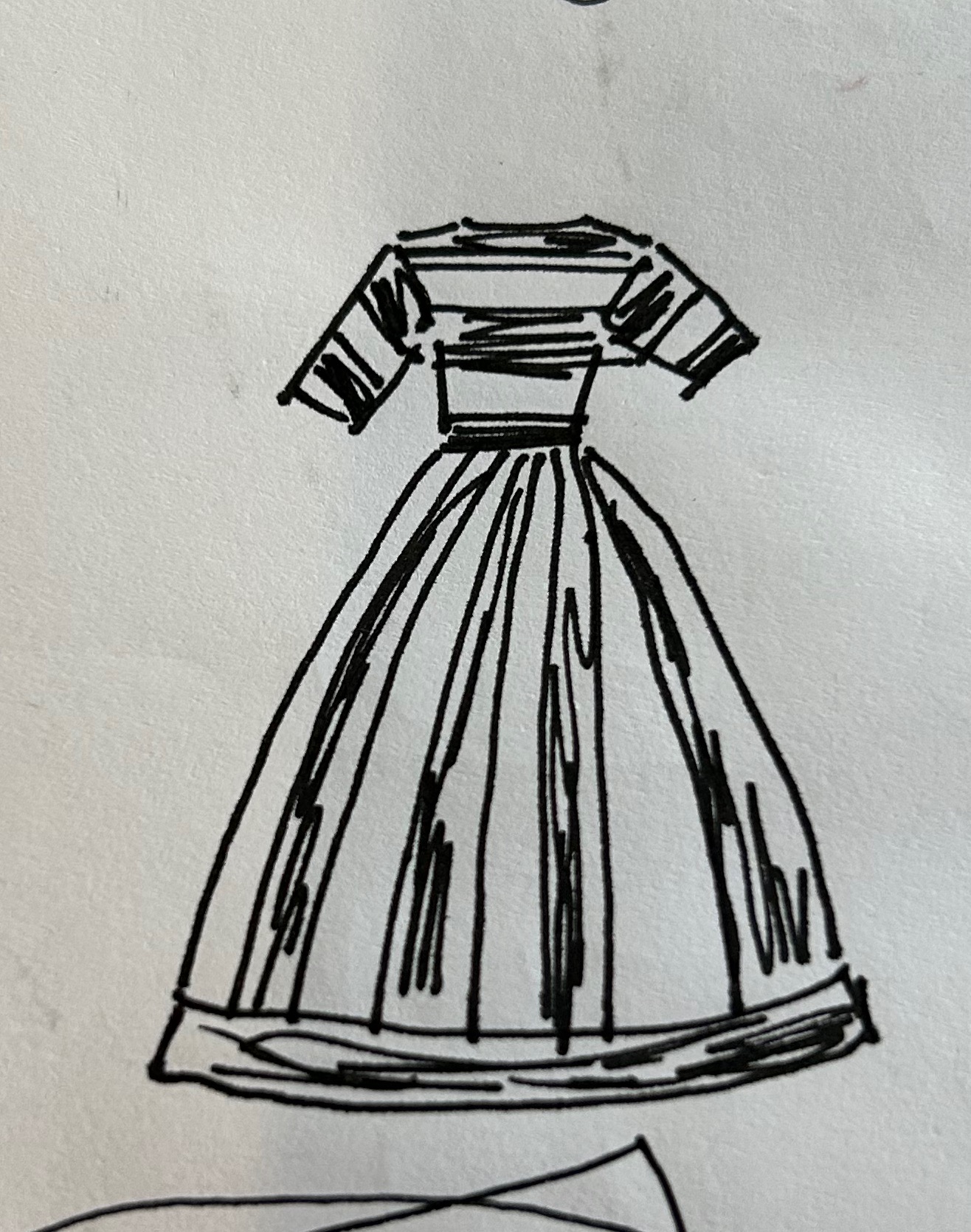
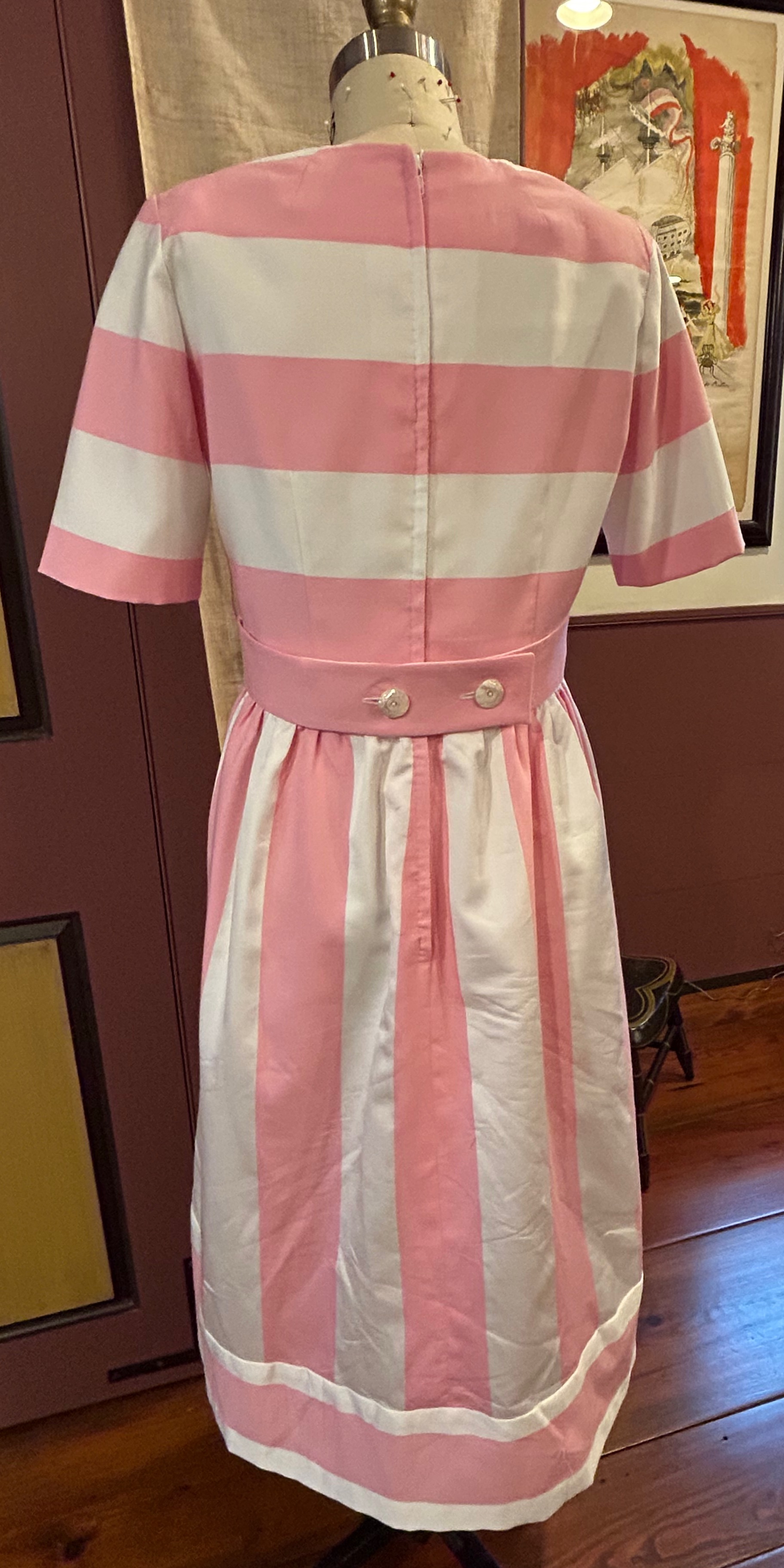
I wasn’t quite ready to forge ahead, however.  My fabric was such a bold stripe, I feared a horizontal orientation of the fabric would be too much, but a vertical orientation was equally problematic.  I went to my Pinterest feed to get some inspiration and in no time at all, the lightbulb went off in my head.  The dress needed a combination horizontal and vertical orientation.  I made this quick sketch, and I knew I had the solution I needed.  
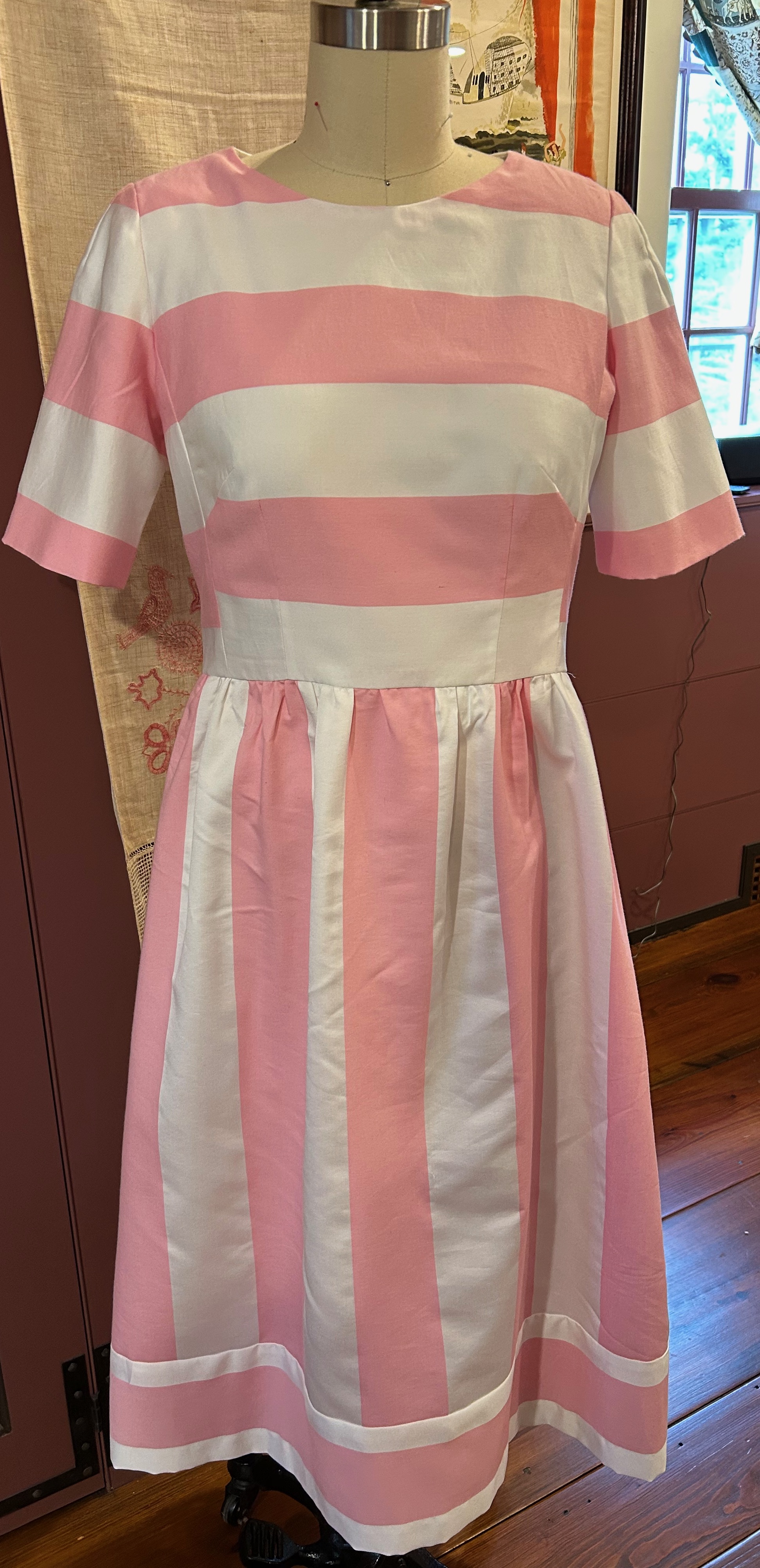
I took these quick photos after I had worn the dress to a party, wrinkles and all. My apologies for the unkempt appearance of the dress!

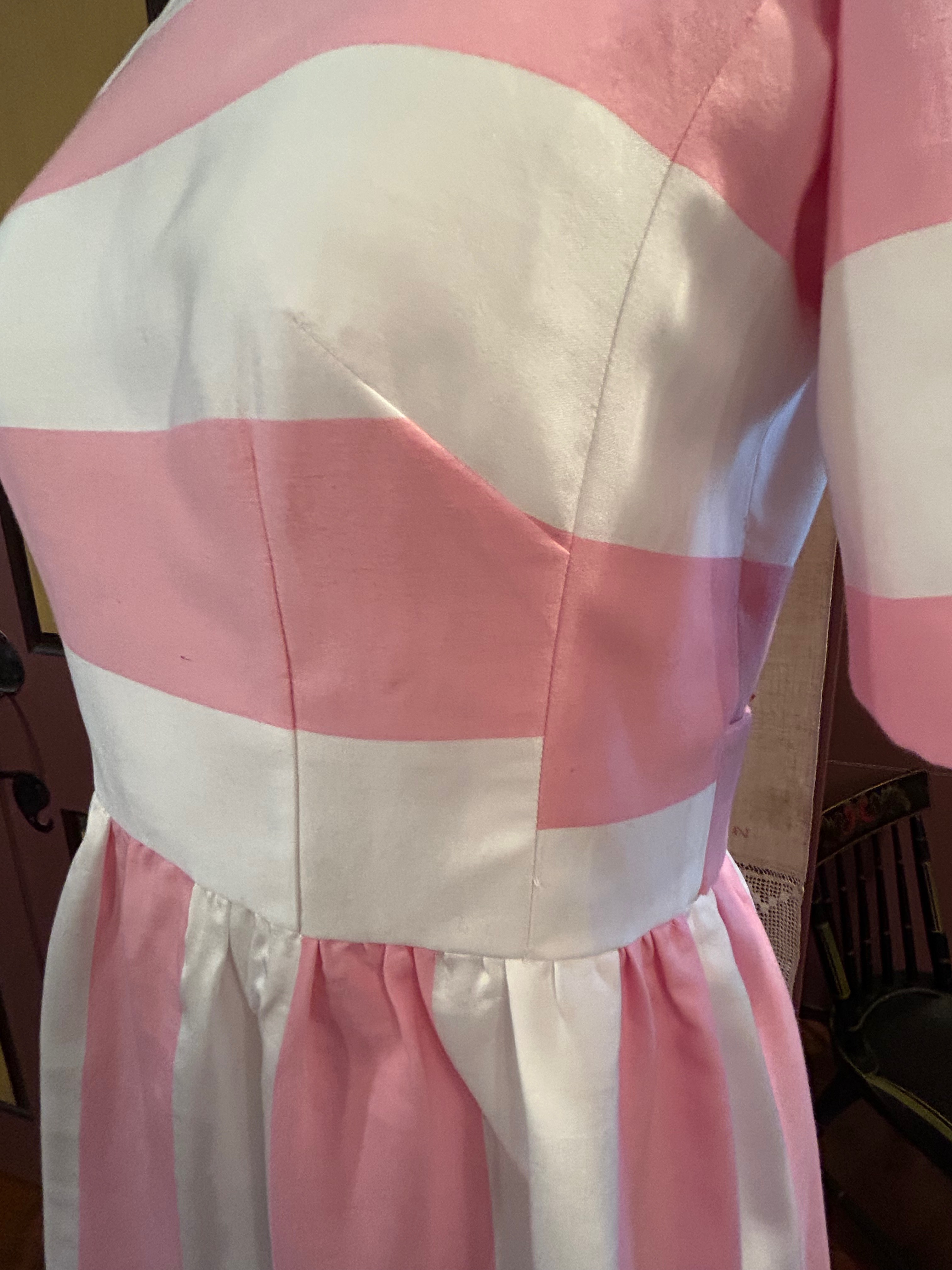
I set about making a muslin/toile for fitting, and then I hit a brick wall.  Those curved darts you see on the pattern bodice just were not flattering to me, despite my working and reworking them multiple times.  I finally gave up.  I would need to find a substitute pattern for the bodice front and make it work with the bodice back toile which I had fitted successfully.  This was all terribly time-consuming, as you can imagine, but I finally was able to find an existing bodice front in my stash of patterns/toiles which, fingers crossed, would work.  I didn’t know how well it would work until I had the happy surprise of seeing the darts feed into the bold stripes successfully. 

Darts, of course, distort side seams, but this distortion somehow adds to the appearance of the front bodice. I suspect the “unsuitability” of striped fabrics was because of that curved dart, which I unknowingly eliminated when I changed the bodice front.

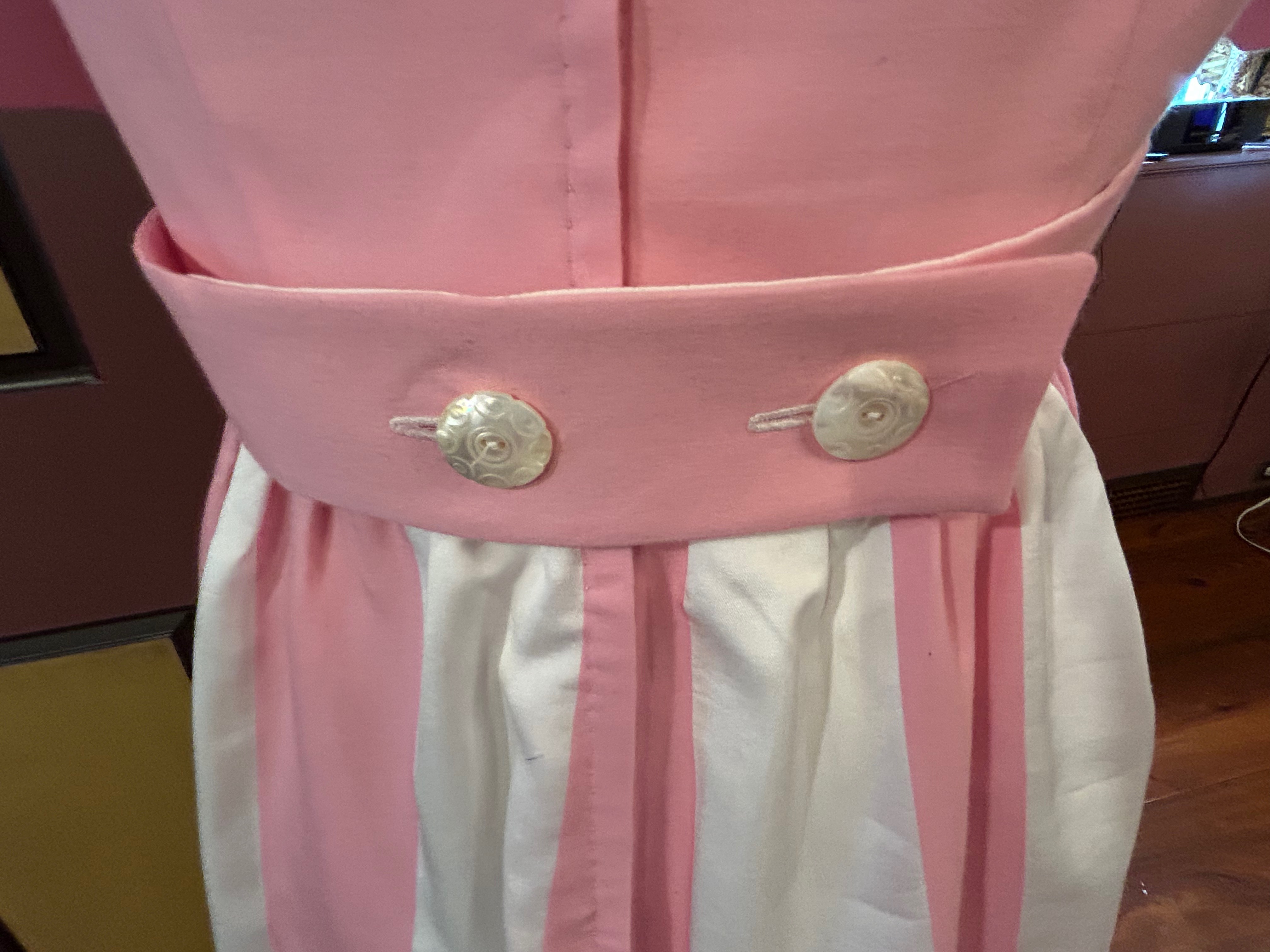
What was not as successful was the proper alignment of the buttons on the back belt to the center of the dress. That is one of the many downsides of fitting oneself – I could not see what I was doing, and although I measured and fiddled, I was still off by a couple of inches.  

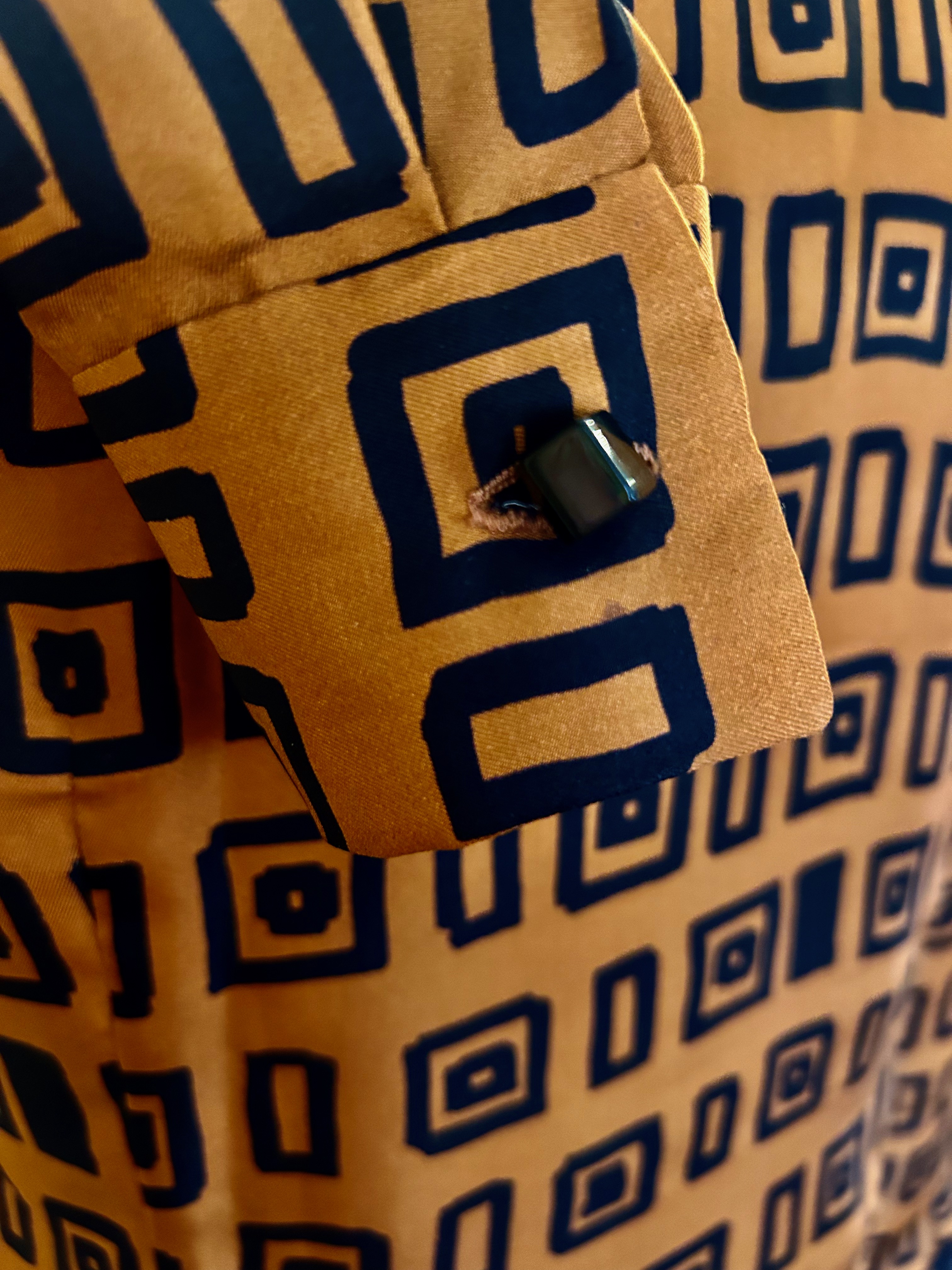
I did a hand-picked lapped zipper and the buttons are vintage mother of pearl from my collection.
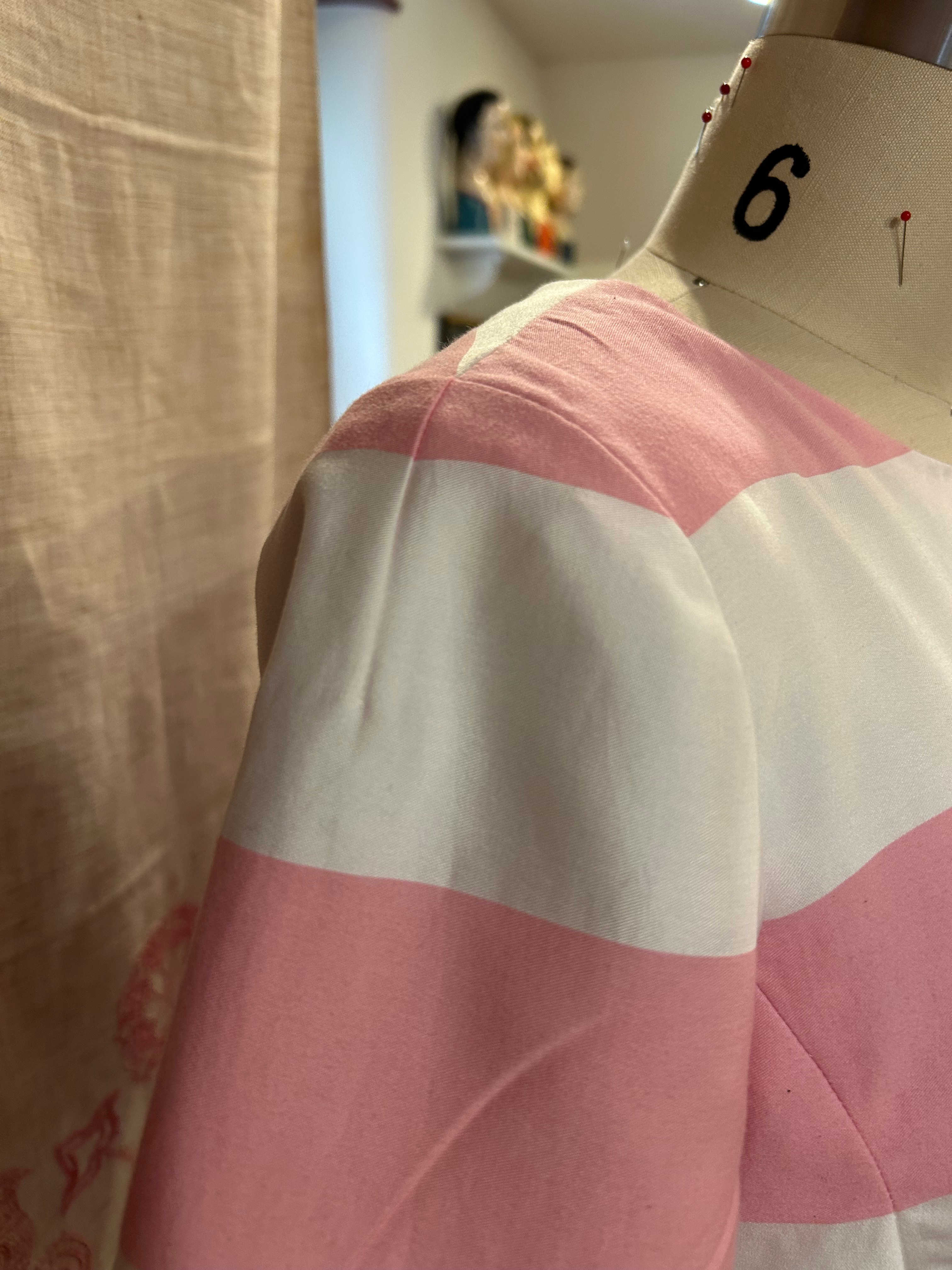
While we are talking details, here is the top of the sleeve. I used a top dart to take in the necessary fullness when setting in the sleeve. This is an alteration I make frequently to accommodate my prominent shoulders.

I lined the entire dress with a soft cotton batiste which complimented the softness of my fabric, adding a little more opaqueness to the finished dress.  I did not use an underlining, reasoning that more structure would not be conducive to the soft flow I wanted in this garment.

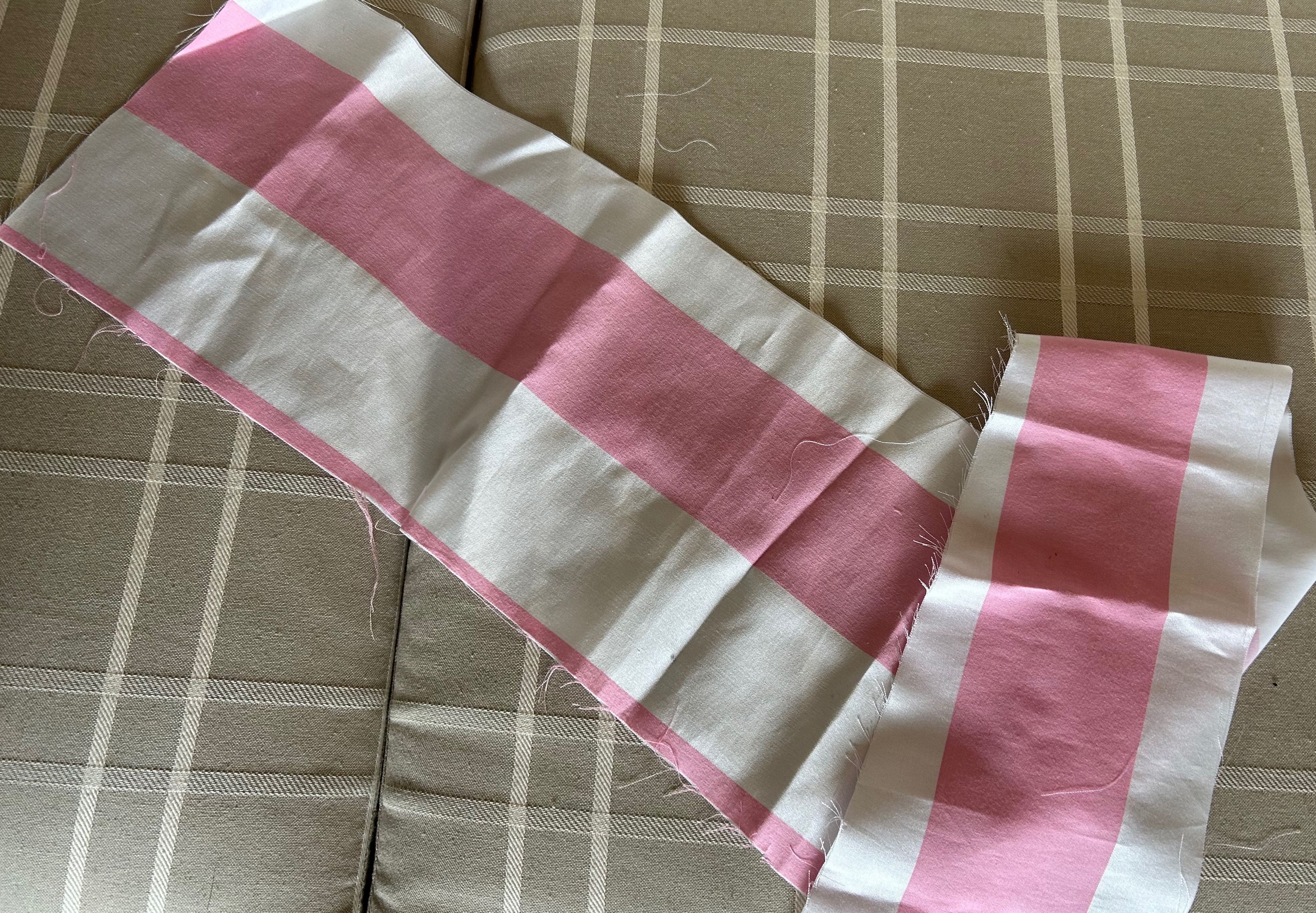
A word here about the panel for the hem.   Wow, was I tight on fabric!  I thought the panel should feature one bold pink stripe, bordered by “half” white stripes.  I barely had enough fabric to make this happen, and because the width of the skirt was just a bit bigger than the width of the fabric, I had to piece that panel.  Whew, I just made it.  Here is all the fabric I had left over:

The seaming of the two panel pieces close to the center back is barely visible! Can you see it?

 I was able to wear this dress for two events in May, feeling perfectly dressed for both of them.  

And that little bit of left-over fabric?  I had plans for that, too, which I will share in a future post.  

26 Comments

Filed under Buttons - choosing the right ones, couture construction, Uncategorized, vintage Vogue patterns from the 1970s

Thinking in Color

It is always in the early days of December when I start to speculate on what the Pantone Color of the Year will be for the year to come.  I’m not sure why I am so intrigued with this annual selection, but obviously it must have something to do with sewing and fabric and day-dreaming.  This year, on the 2nd of December, Pantone gave those of us, who have this particular obsession with color, the chance to vote for the family of color from which we thought 2025’s selection would come.  

Well, I was WAY off!  I voted for the Red Family, described by Pantone as “empowering and exciting.”  This was the way I happened to be feeling on that particular day in early December.  The other color families from which to choose were: Orange (radiant and hot), Yellow (energy and life), Green (deep forests and wide meadows), Blue (constancy and truth), Pink (soft and innocent), Purple (mystical and magical), Brown (rooted and earthy), Black (sleek and sophisticated), and White (pristine and peaceful). 

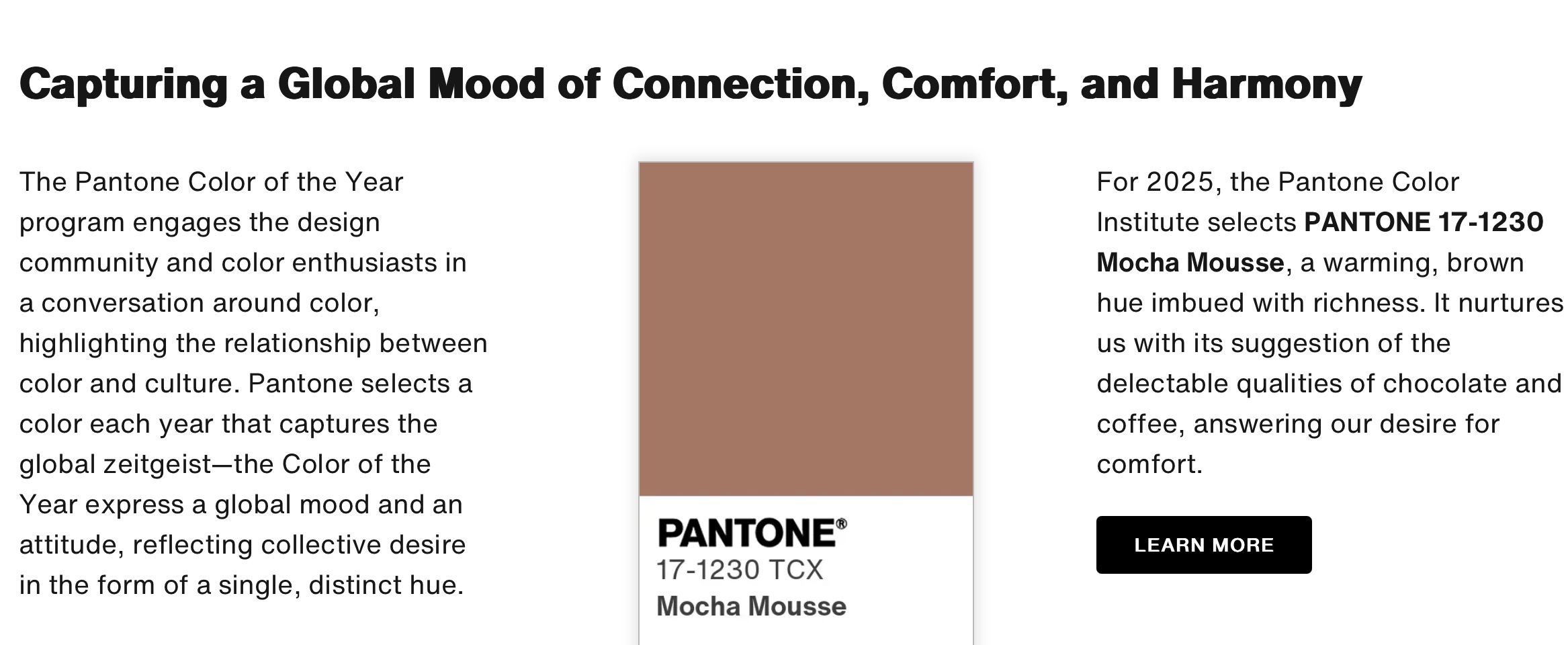
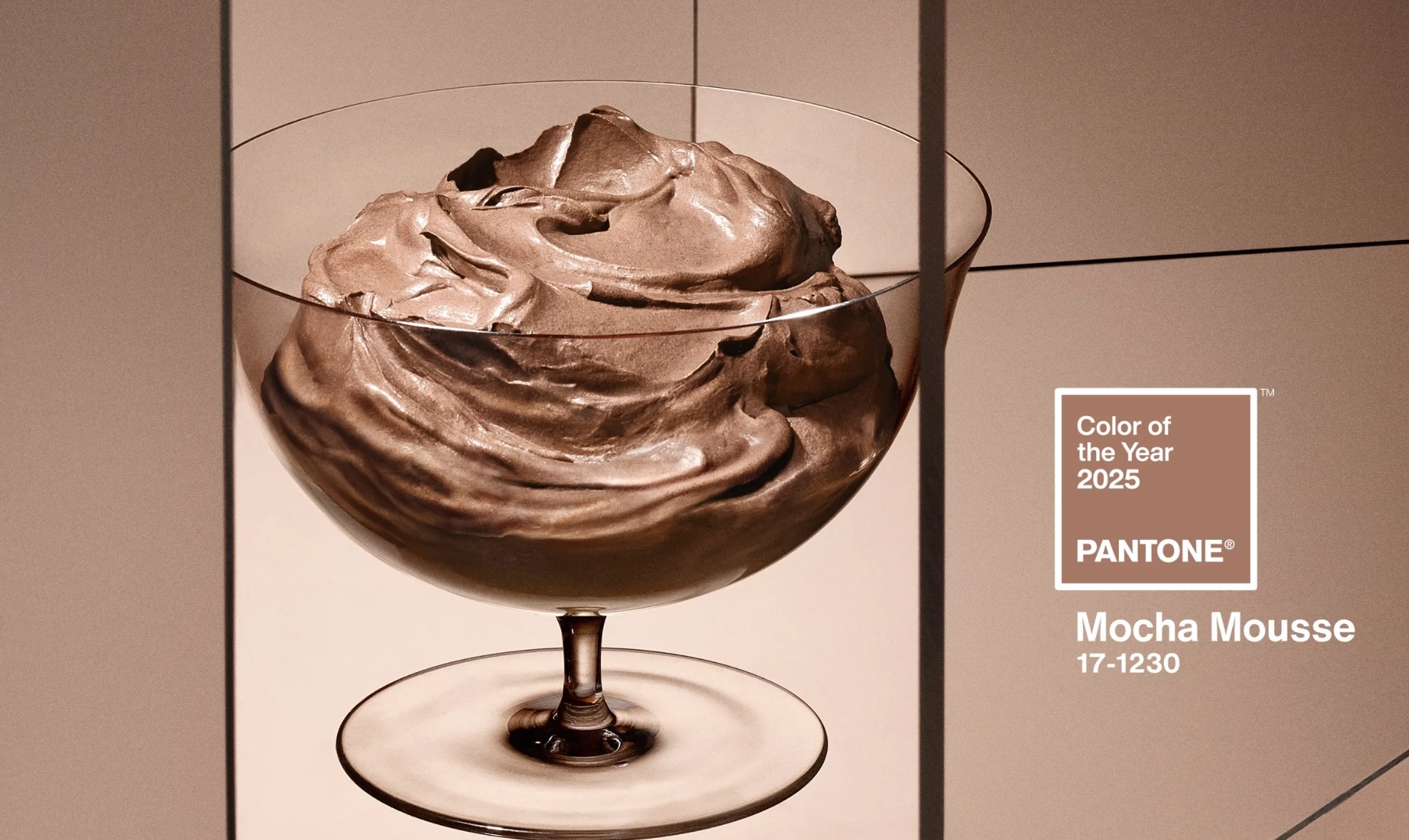
The Color Family most people taking the poll chose was Green.  Those of you who care about such things now know the Pantone Color of the Year is Mocha Mousse, “a warming, brown hue imbued with richness.”  (All quoted statements are directly from the Pantone website.)

I certainly did not see that coming.  Which made me really curious about this selection by people obviously much more in tune with the “global zeitgeist” than I!  The more I read about the decision, the more I understood it – and, although it is not exciting as a red family hue would be, I do find it to be empowering in its own subtle way, “capturing a global mood of connection, comfort, and harmony.”   


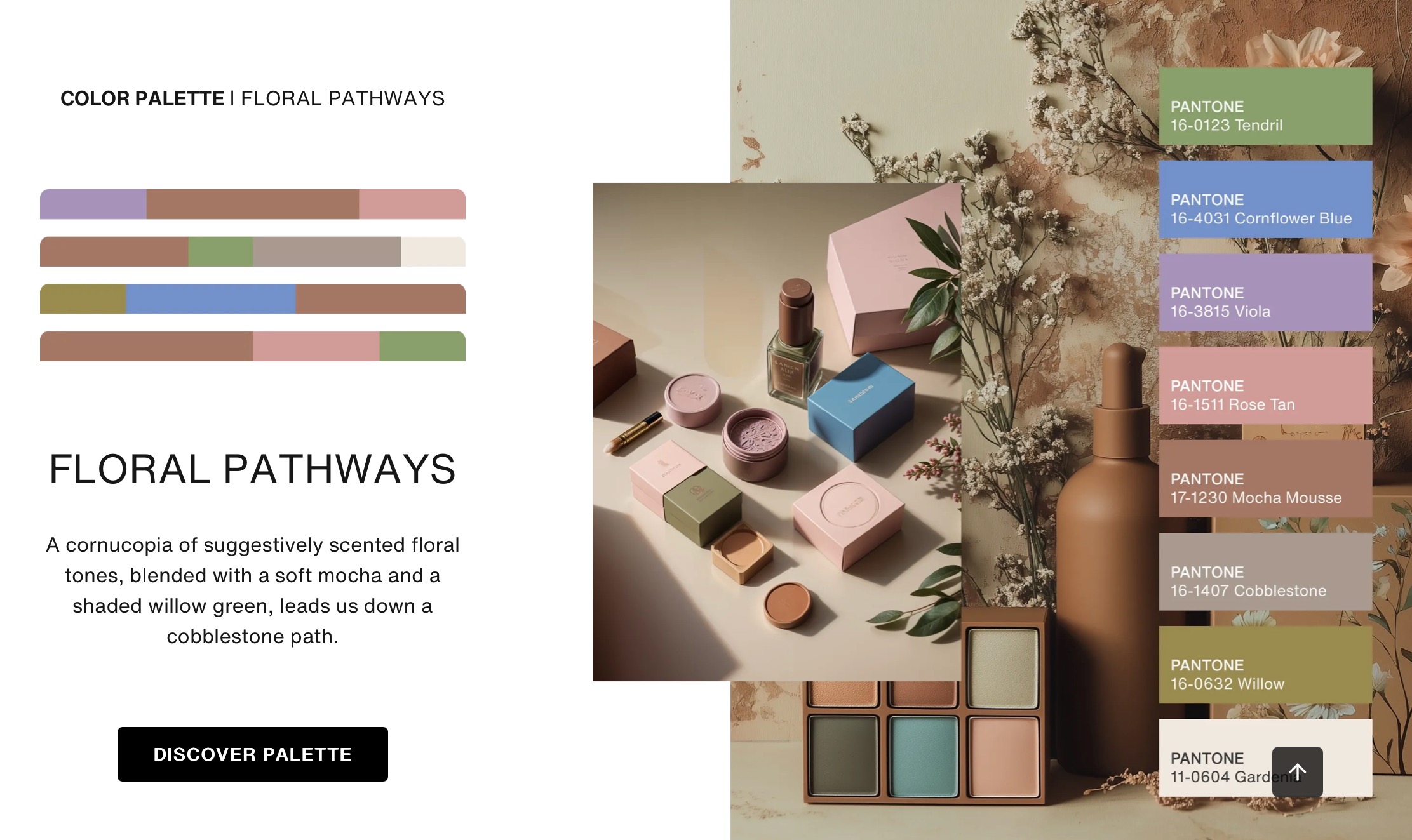
Pantone wisely suggests a “Color Palette” for their Color of the Year, a selection of hues to coordinate with the chosen color.  For Mocha Mousse, the color palette is charmingly called “Floral Pathways.”  Seven colors to lead us down a “cobblestone path:” a green called tendril, cornflower blue, a gentle lavender called viola, rose tan, a soft gray called cobblestone, another green called willow, and a soft white called gardenia.  These are all lovely coordinates, which make me appreciate Mocha Mousse more.  

Although I will not necessarily be purchasing fabric or planning sewing projects around Mocha Mousse this year, I will be thinking about it and focusing on the warm comfort and harmony it suggests.  

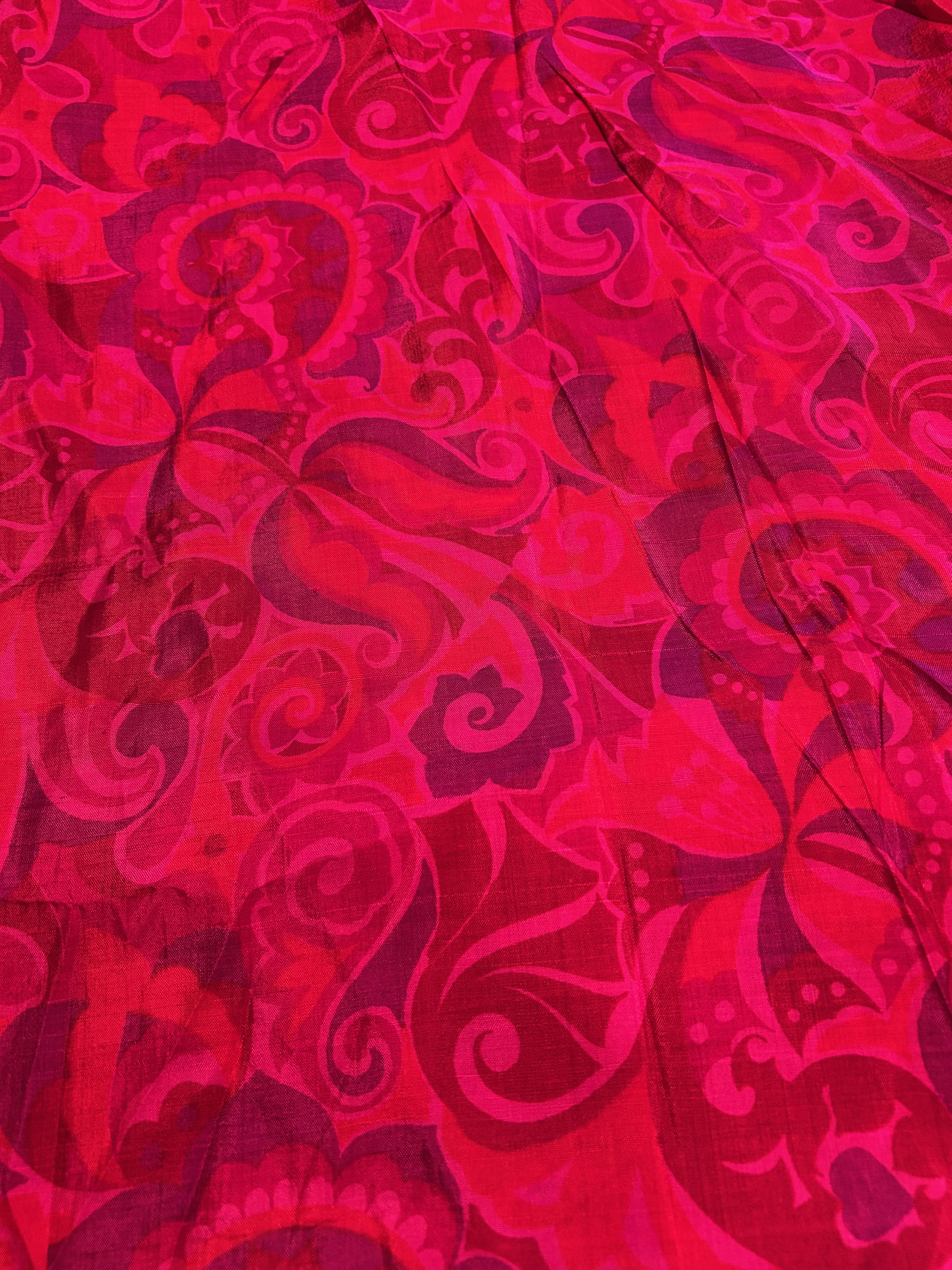
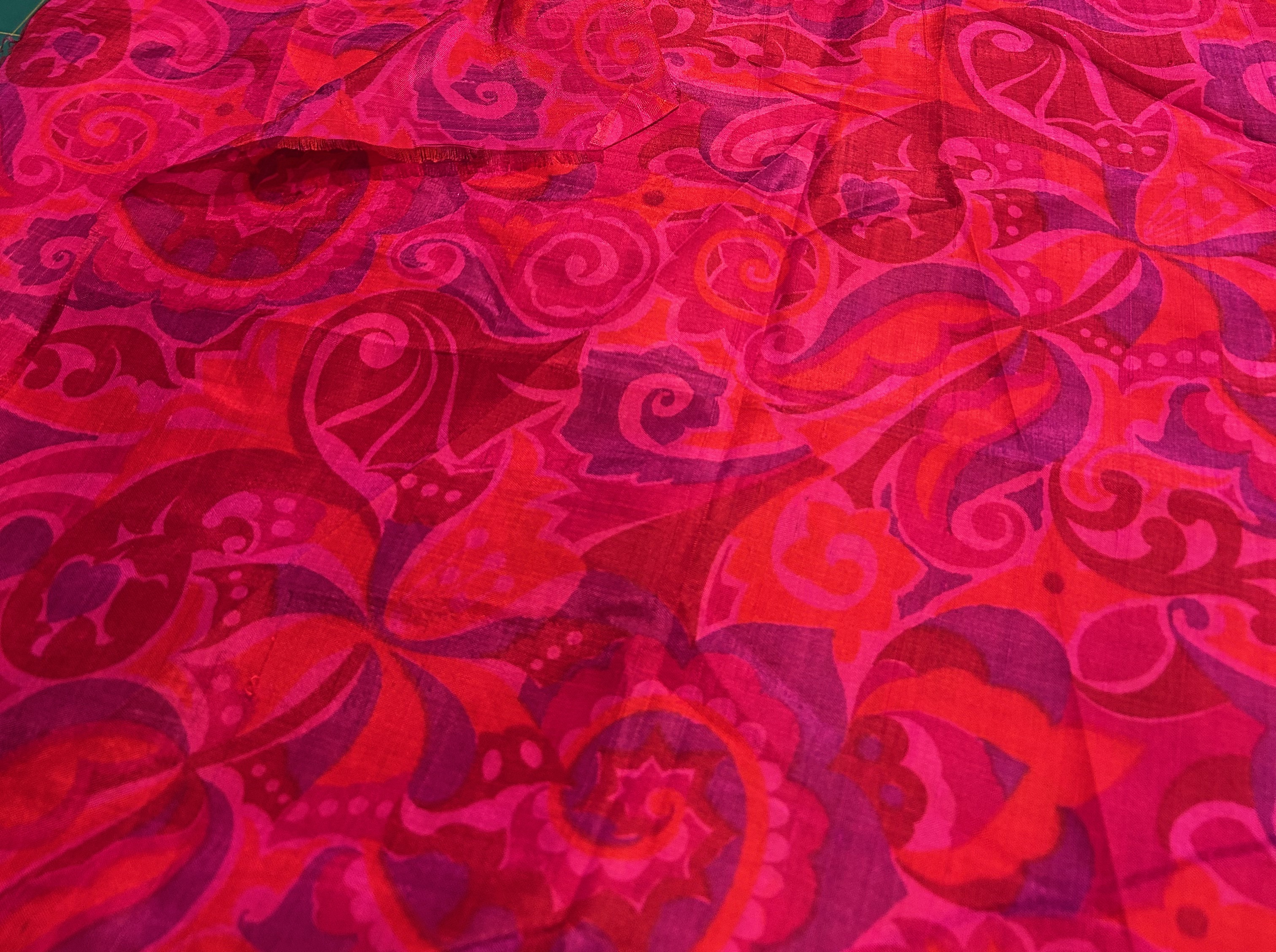
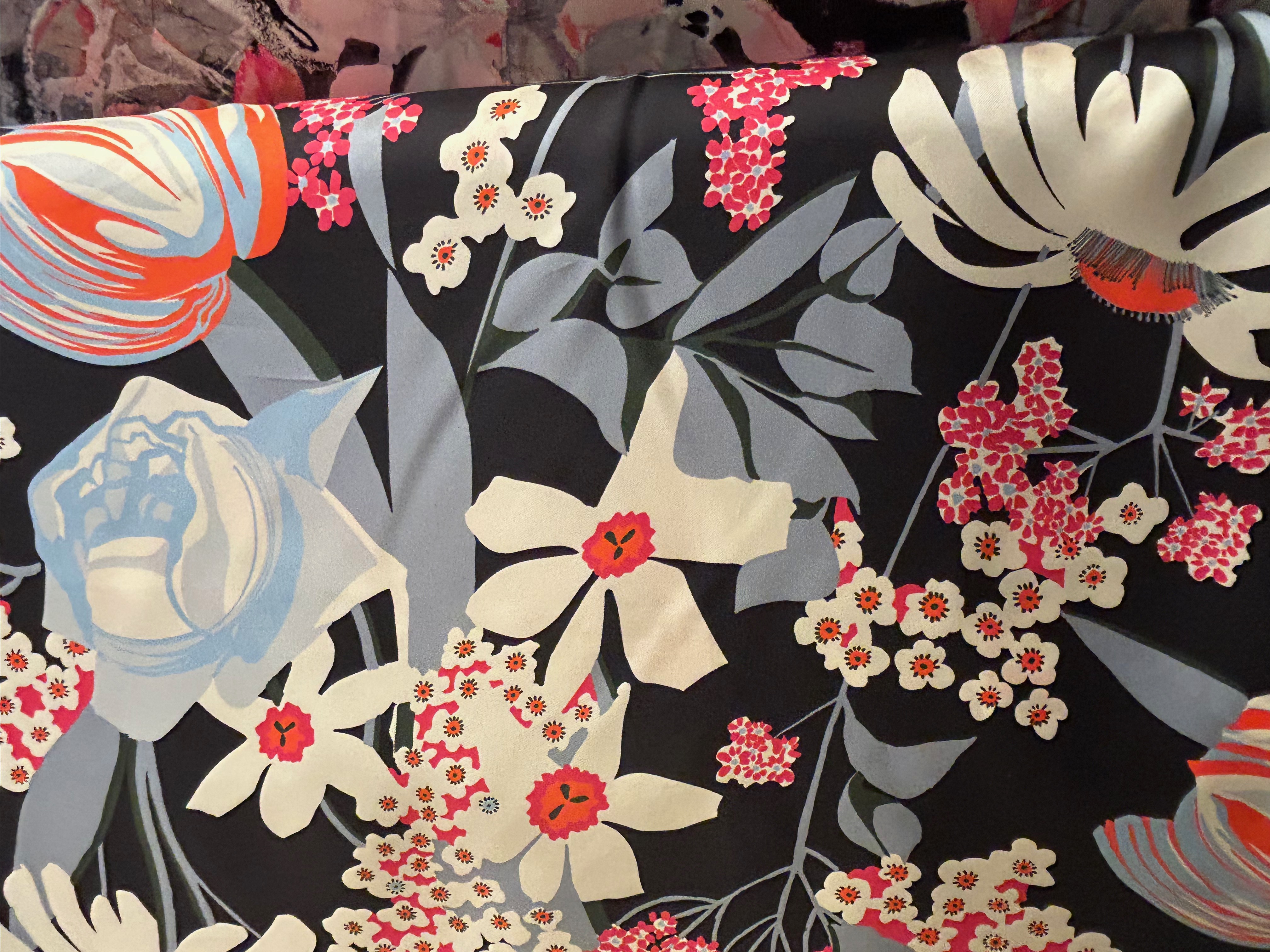
However, what really makes me not only think in color, but also dream in color, is a piece of Thai silk just given to me from a sweet and thoughtful friend.  She told me it had been given it to her over forty years ago by a friend of hers, purchased while in that part of the world.  My friend had finally decided she needed to part with it as she was certainly never going to use it.  Lucky me!  With over four yards and over 50” wide, I have plenty to work with.  What should I make?  

This a light weight silk with a crisp hand to it.

About my long absence from this blog…   I did not expect to be away for 6 months.  Thank you to those of you who did not abandon me over that time.  A confluence of circumstances thwarted my sewing production – and motivation – during the summer months.  Perhaps on that early December day when I instinctively voted for the Red Family in the Pantone quiz, I was feeling some small spark of vitality returning to my bones.  Perhaps…

Certainly, I cannot close this short post without acknowledging the joy in this season of holidays and Christmas and extending best wishes far and wide to each of you.  Merry Christmas!  

47 Comments

Filed under Pantone Color of the Year, silk, Uncategorized

Going Around in Circles

When I purchased this sateen, jacquard-woven fabric from Mendel Goldberg a couple of years ago, I wasn’t sure what it would eventually become.  It had a wide repeat to the design (which is something to consider when you know you are facing considerable matching of the design), but it was a lovely 60” wide.  I bought just 2 yards (it was expensive) and hoped I would have enough fabric to finagle something.  

First I thought I would make a midi-skirt to wear with a pretty silk blouse or something.  I even got so far as to make a muslin for a longish skirt, but it just wasn’t going to work.  I didn’t have enough fabric to match the design and create the skirt I wanted.   The next task would be to find a dress pattern which would work.  I kind of viewed this fabric as a good Fall and Spring transition weight, so I wanted sleeves.  And I wanted a pattern which would show off the circle design to its best effect.  One of the patterns in my collection which I have seemed to dwell on frequently is this one:

This pattern is quite interesting. It looks very simple, but in fact, it has a considerable amount of engineering to it and some very nice details.

I like the styling of both the dress and the coat.  I thought I’d take a stab at eyeballing the pattern on my fabric, to see if it might work.  Well, it was going to be a squeaker, but I thought I could manage to get the dress out of the yardage I had – and match all those circles and dots as much as possible. 

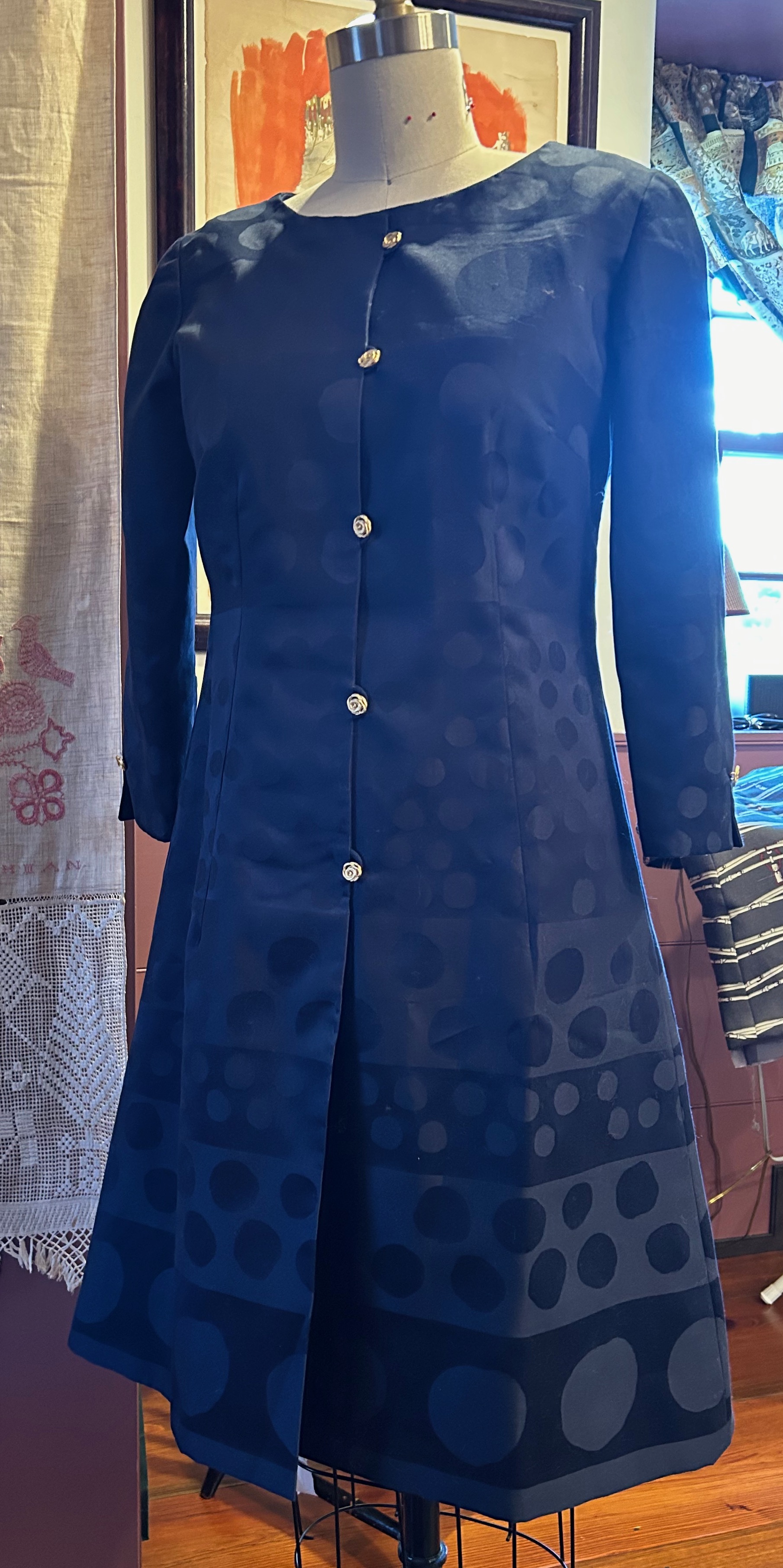
One thing I had to consider was the placement of the large dots and the smaller dots on my body.  Working with dots can be a little tricky – you certainly don’t want prominent dots on top of each bust apex, for example, and a row of large dots around the waist might not be all that flattering.  I thought the row of the largest dots would be best as an anchor at the hemline.  That would place the wide band of smaller dots just over the waistline and somewhat below.  This configuration would place one medium size dot over one bust, but I was okay with that since the dot on the other side was off to the side, and therefore not symmetrical.  I also liked the repeat row of largest dots across the upper chest where they were not too obvious.  And – the sleeves followed the line of varying size dots in a pleasing manner, I thought.  It turned out, I had just enough fabric to get things lined up properly – except for the front facing.  No way could I match that to the front of the dress.  

Now, obviously the facing does not show on the right side of the dress.  Still, I like to match across seams if possible.  Which it wasn’t.  I had to give myself permission to have a mismatched facing, and then I moved on.  (I forgot to take a picture of the facing, unfortunately.)  
A word or two about the fabric before I go on.  According to Fairchild’s Dictionary of Fashion, (Third edition, by Charlotte Mankey Calasibetta and Phyllis Tortora, Fairchild Publications, Inc., New York, New York, c2003, page 395) sateen is a “smooth glossy cotton fabric made in the sateen weave with floating crosswise yarns on the right side, giving a lustrous finish.”  This fabric is a combination of cotton sateen, with circles created by a damask weave on a jacquard loom.  It makes for a striking fabric.  And I think the fact it is done in navy blue makes the contrast more definitive.    Christian Dior was a fan of navy blue, calling it “the only one [color] which can ever compete with black, it has all the same qualities.”  (The Little Dictionary of Fashion, Abrams, N.Y., 2007, page 14).  It is a wonderfully versatile color.  
I made a few changes to the pattern.  I cut the neckline a little wider, I shortened the sleeves by a couple of inches, and the big change was I lined the dress in a lovely silk batiste I purchased at Farmhouse Fabrics. (The pattern did not have instructions or pattern pieces for a lining.)   The pleat in the front of the dress was a bit tricky to line, but I figured it out after quite a bit of thought.  By the way, I underlined the dress with silk organza. 

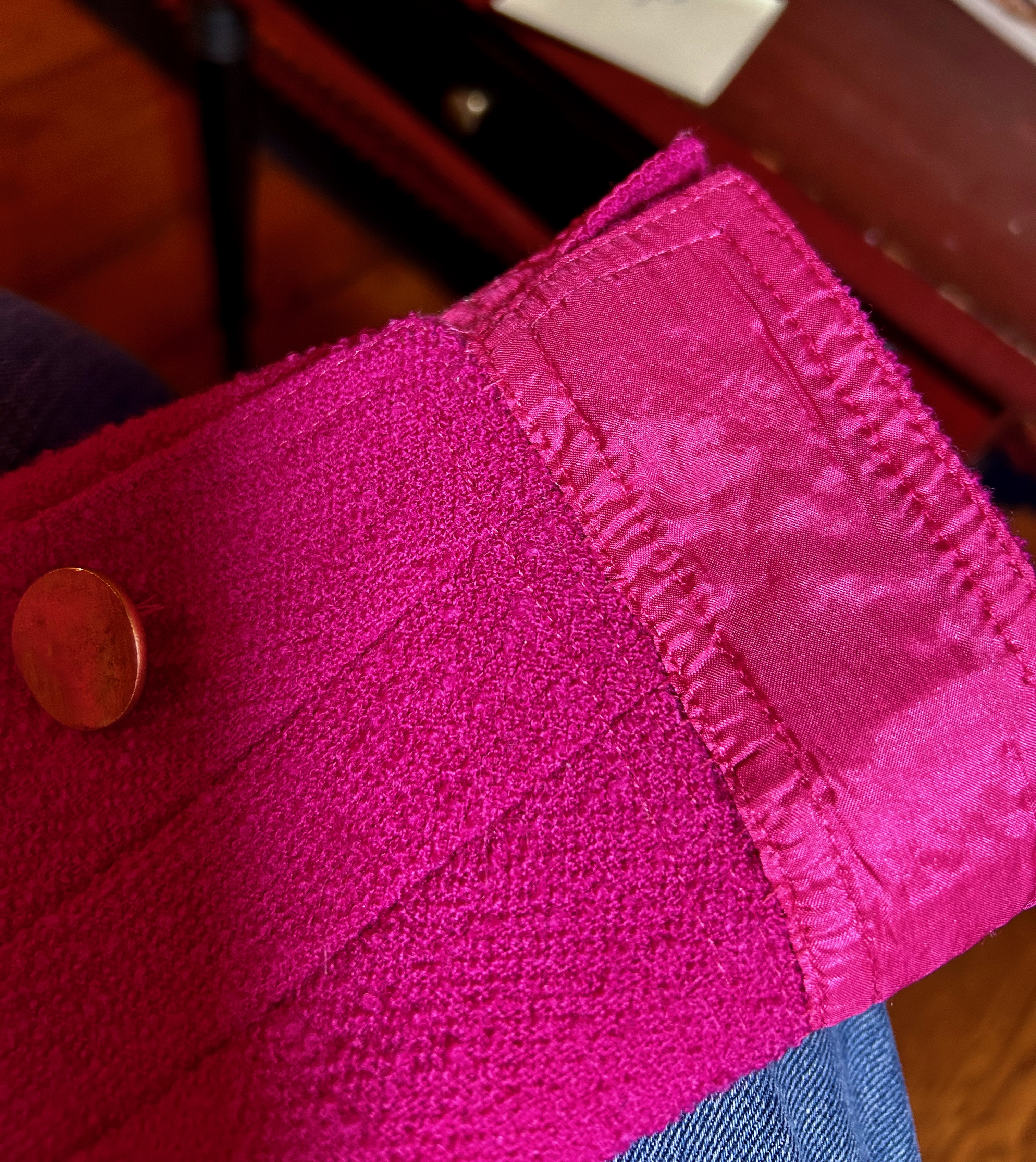
I could only envision gold buttons with this fabric. I’m not sure these are the right buttons, but they will do until I find something better.

The irregularity of the circles precluded exact matching within the “panels” but I rather like the whimsical effect this creates.

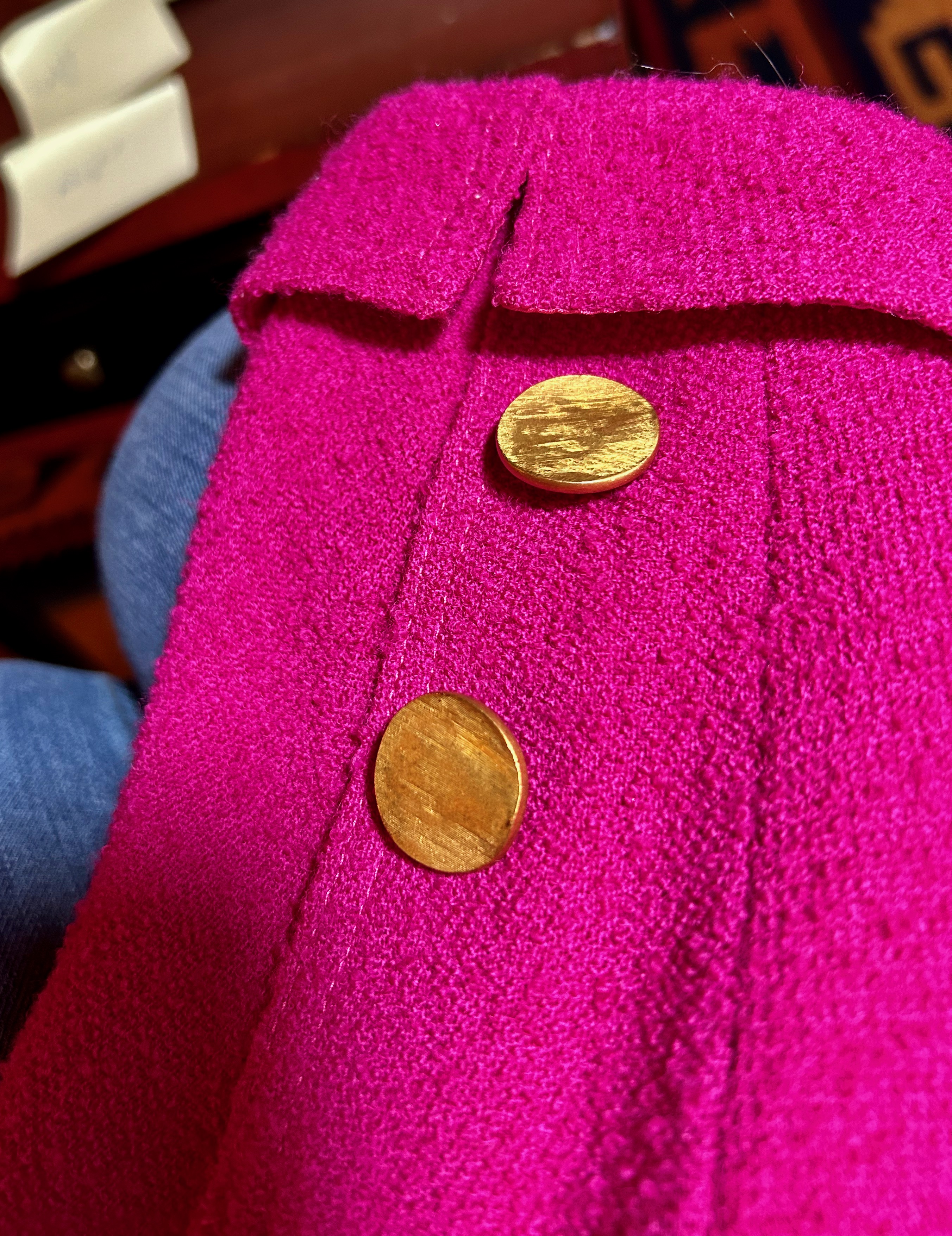
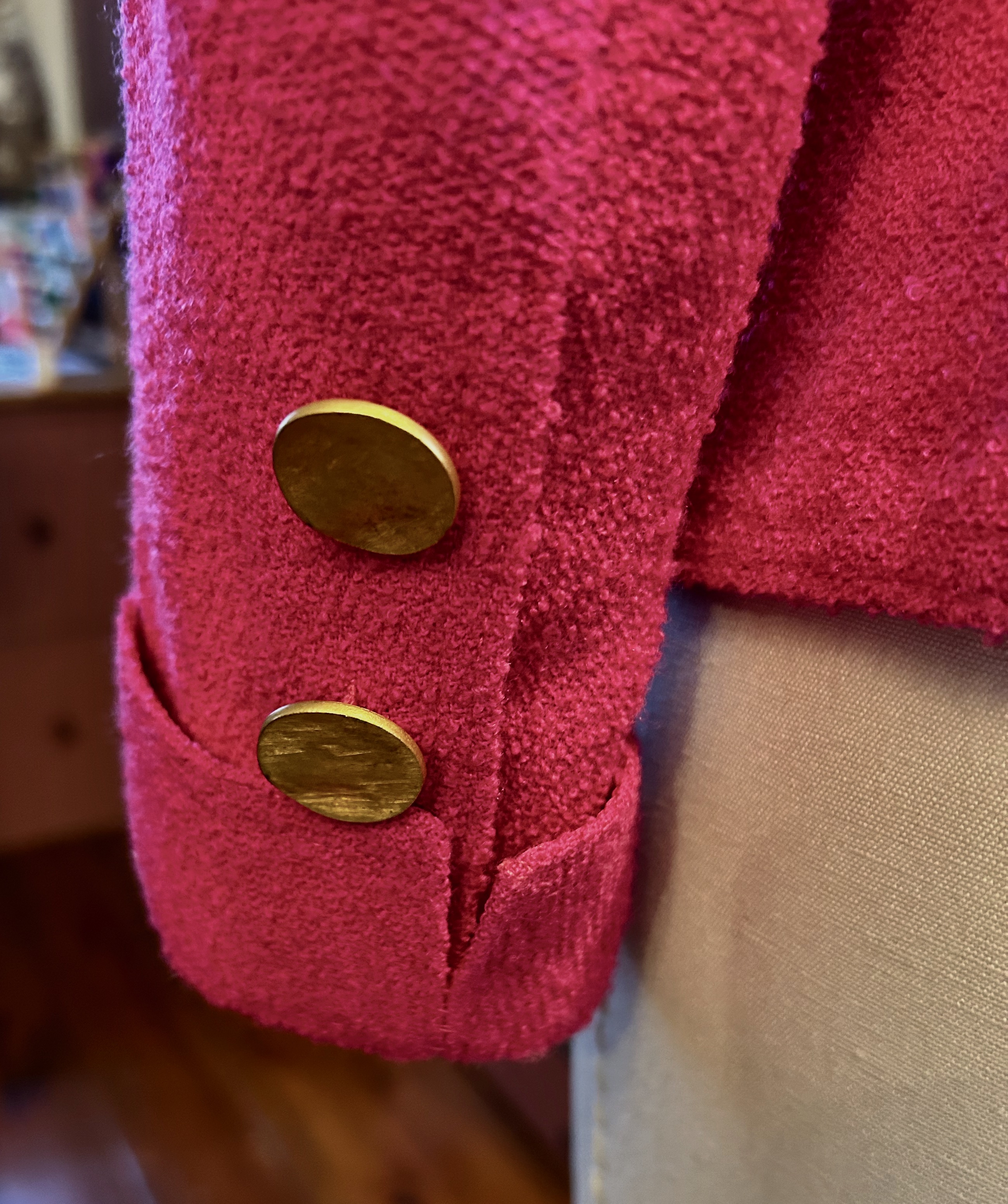
The split cuff with its button is one of the nice details of this pattern.

One more thing about the pattern and the dress.  With the pleat in the front of the dress which extends to the hem, it gives the appearance of a coat dress. However, it is not.  Again Fairchild’s gives us a precise definition of a coat dress: “Dress fastened down front from neck to hem, like a coat, in single- or double-breasted style, either belted or unbelted.  A classic since the 1930s.”  ibid., page 84.  Someday I’ll make a coatdress, but this was not it.

The pleat begins below the closure, extending to the hem, giving the dress a nice sway to it.

As I mentioned in an earlier post, I made this dress to wear on my Paris trip, but alas, I never had the opportunity to do so.  I feel certain it will eventually get its debut, but not in Paris!  

26 Comments

Filed under Buttons - choosing the right ones, Christian Dior, Fashion commentary, Loops for buttons, Mid-Century style, Polka dots, Sateen, Uncategorized, underlinings, vintage Vogue patterns from the 1960s, Vogue patterns

Fashion and Fabrics:  More from My Couture Trip to Paris

Among the highlights on The Paris Tour with Susan Khalje were several visits to fashion exhibitions, shopping excursions to three fabric stores, and one to a fabulous scarf store. 

The first exhibit we visited was at the Yves Saint Laurent Foundation. 

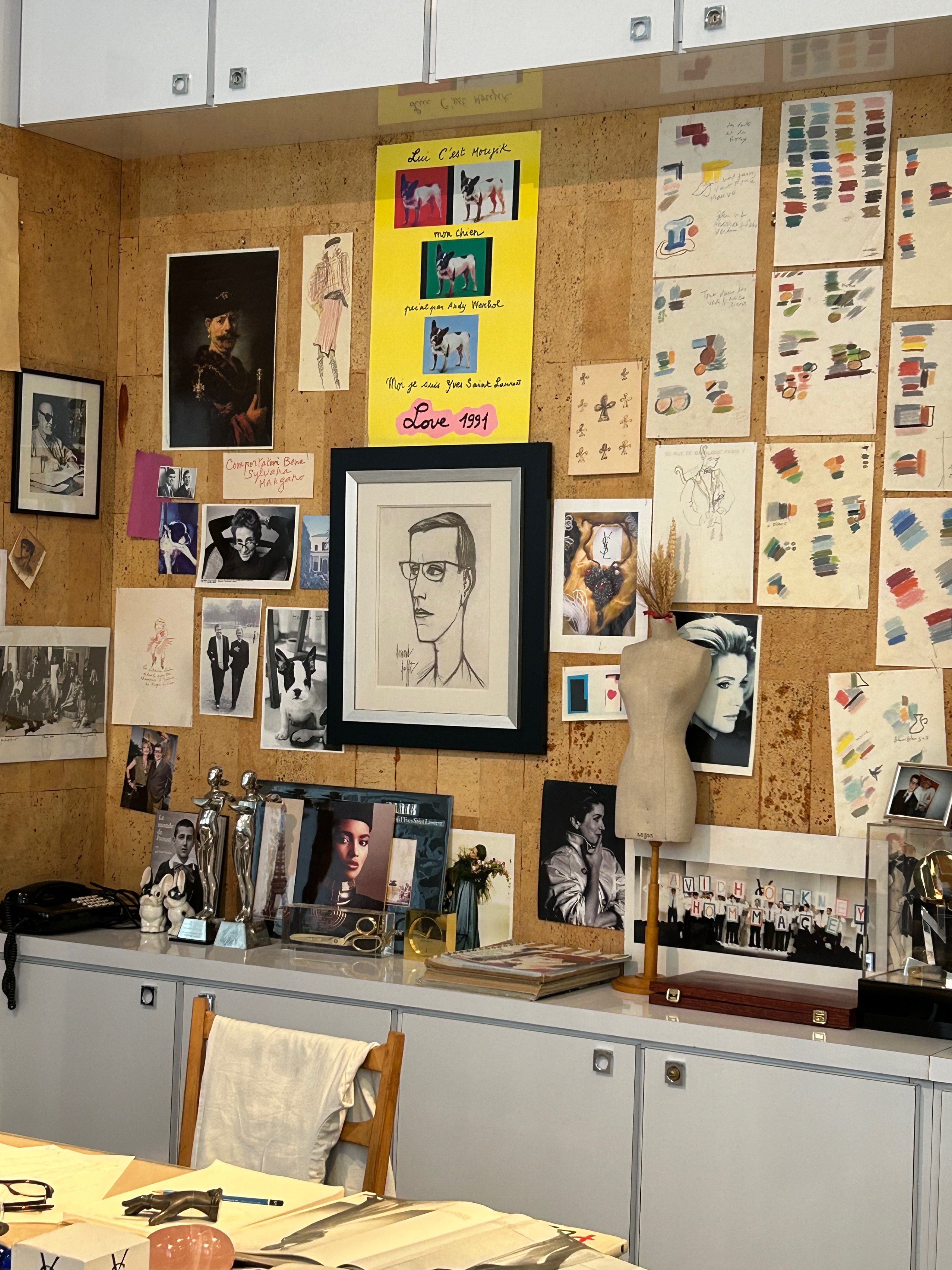
 In addition to the selections on display in the current “Sheer:  the diaphanous creations of Yves Saint Laurent,” we had the opportunity to see his studio where he worked.

Diaphanous, indeed!

This dress had an ethereal look to it.

This is only a partial view of his spacious workroom.

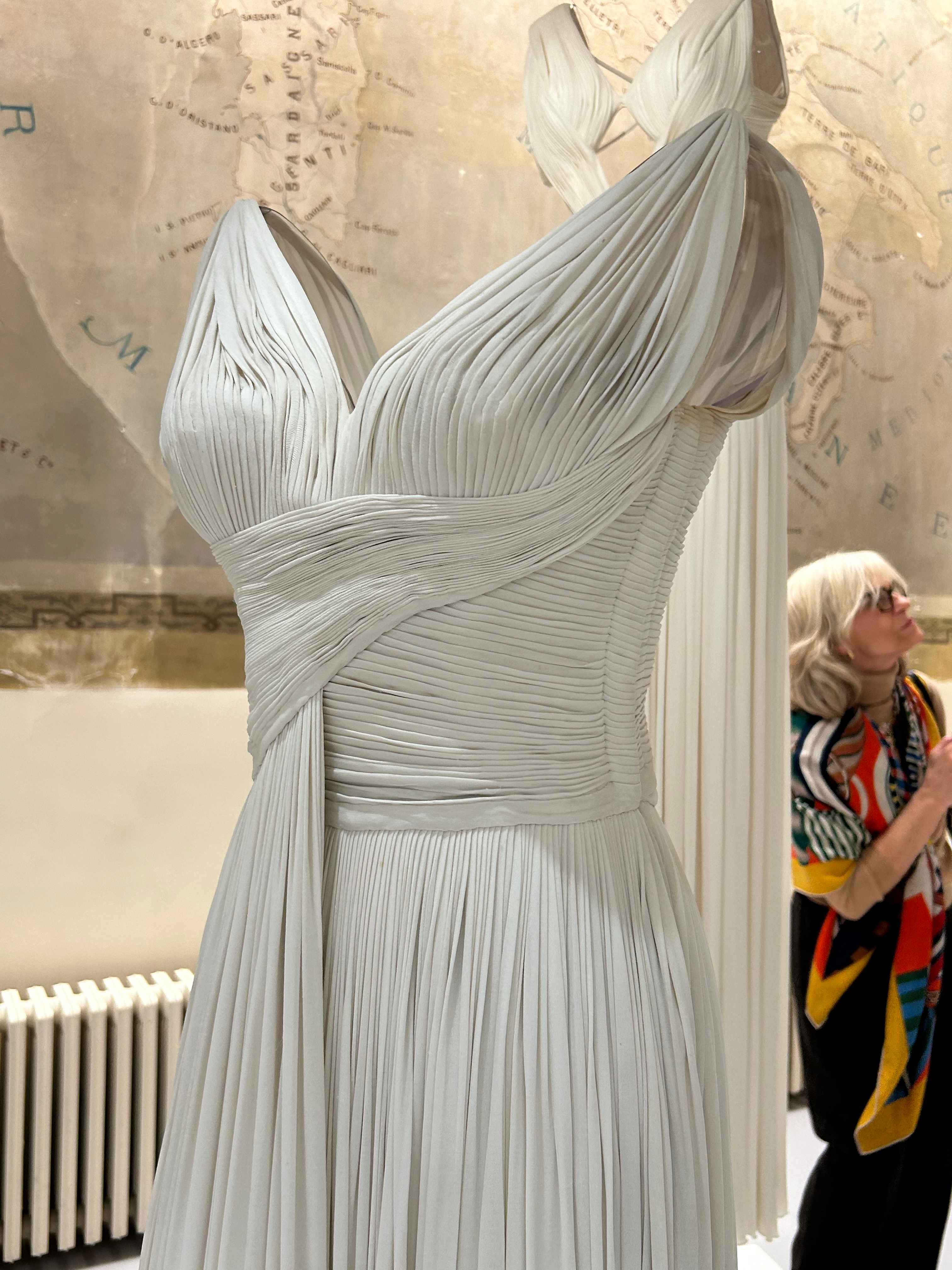
Later that same day, we went to the Musee des Arts Decoratifs where the current exhibit of the works of Iris Van Herpen were on display.  Some of the members of our group were quite taken with her designs.  I was not one of them.  I much preferred our visit to the Alaia Foundation to see the newly-opened exhibit featuring works by Azzedine Alaia and Madame Gres.  I have long been a fan of the design aesthetic of Madame Gres.  Her works served as a point of great inspiration for Alaia.  To see so many of her designs on display, many alongside the more contemporary works of Alaia, was captivating. 

The dress on the left is by Madame Gres, the one on the right by Alaia.
Another fabulous design by Madame Gres.
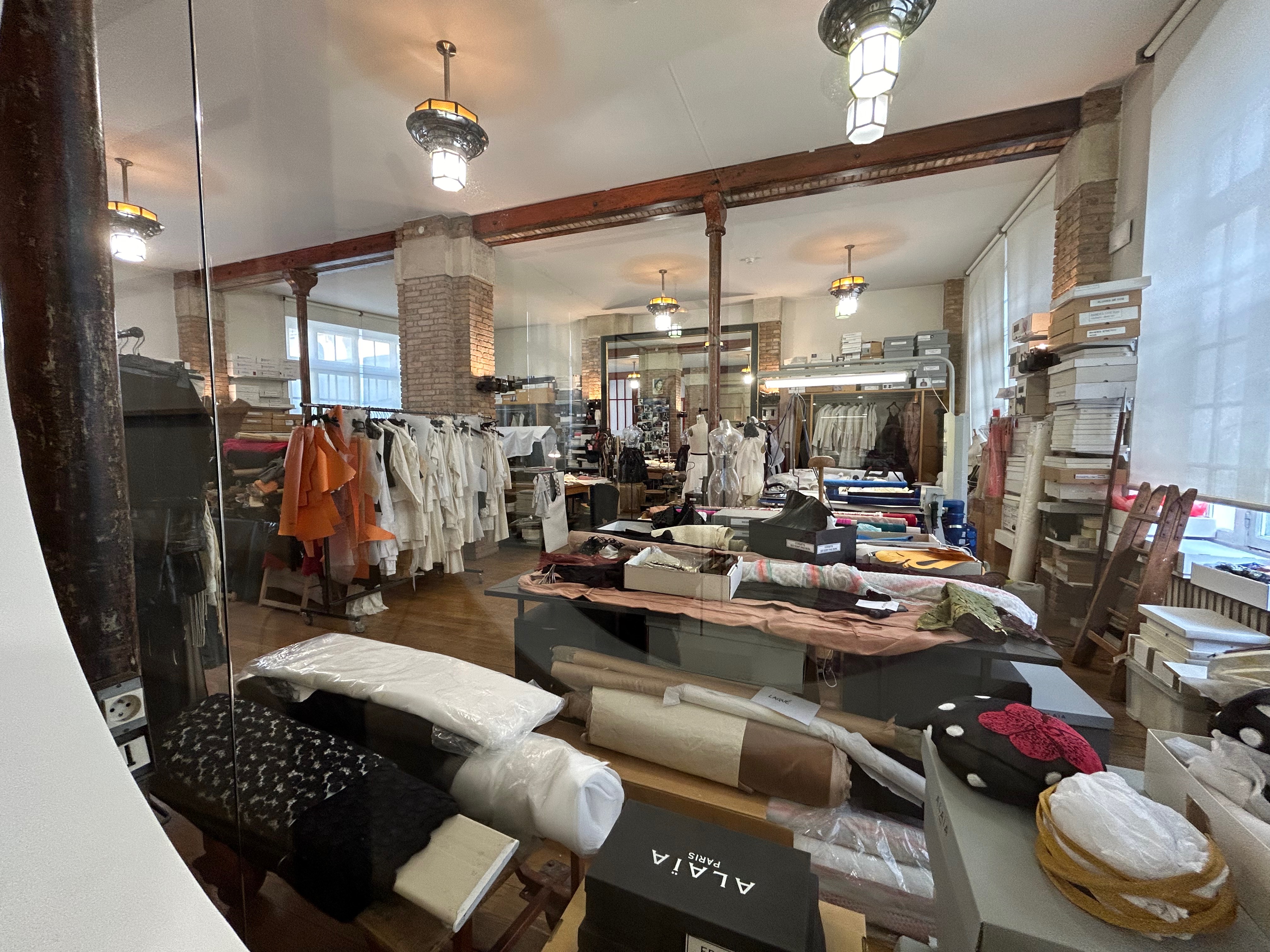
The Alaia Foundation has preserved his work room exactly as he left it.

The crème de la crème was our visit to La Galerie Dior, newly reopened and quite spectacular. Having seen the Dior Exhibit when it was at the Denver Museum of Art five years ago, I wondered how similar the two presentations might be.  There were obviously some repeats of the iconic dresses and ensembles of Christian Dior before his untimely death in 1957, but somehow everything seemed fresh and newly considered.  The building is beautiful, masterfully lit,  with a logical, but innovative floorplan.  Entrance to the Galerie is by timed tickets, and at no time did the galleries seem crowded or uncomfortable.

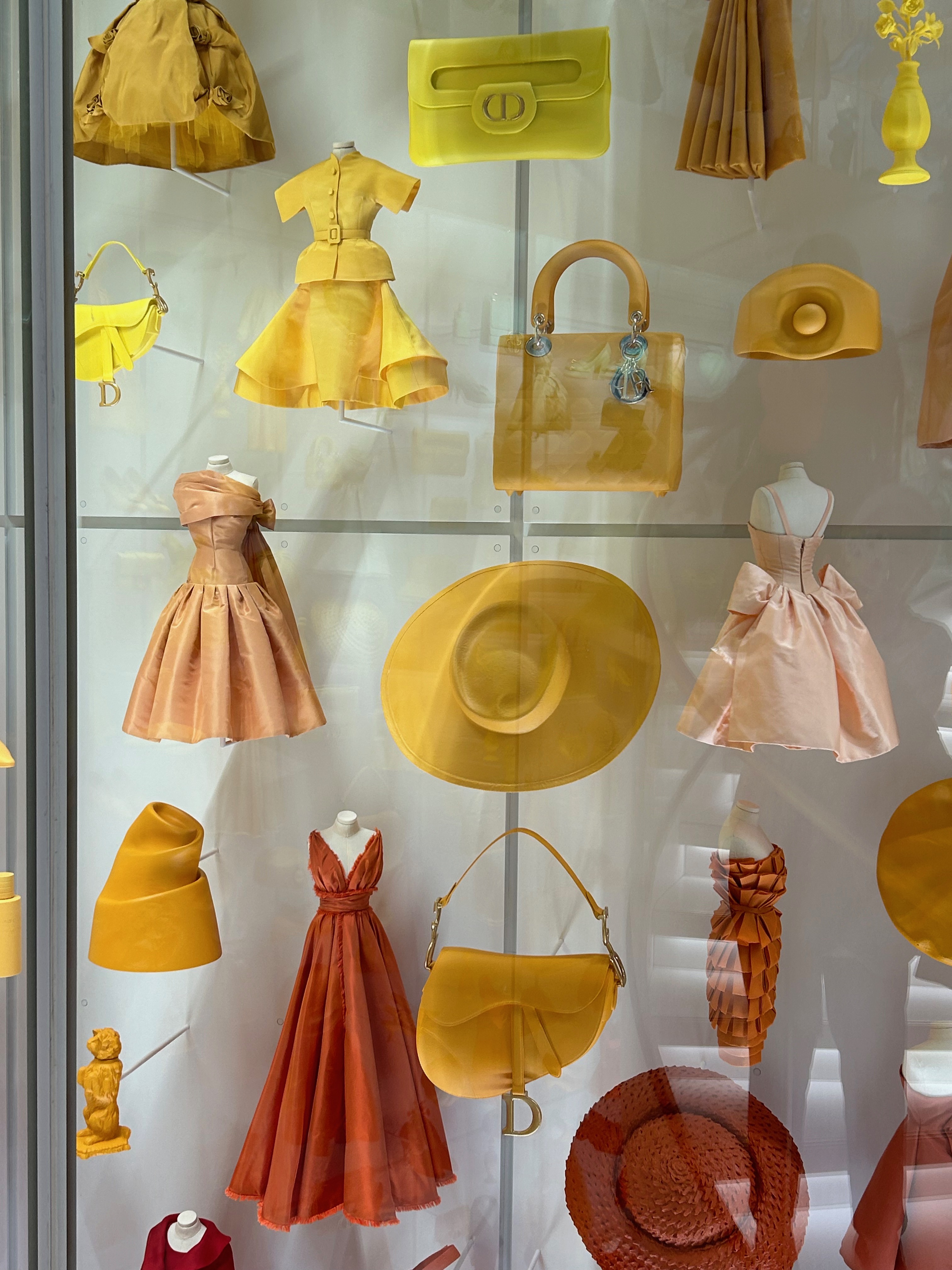
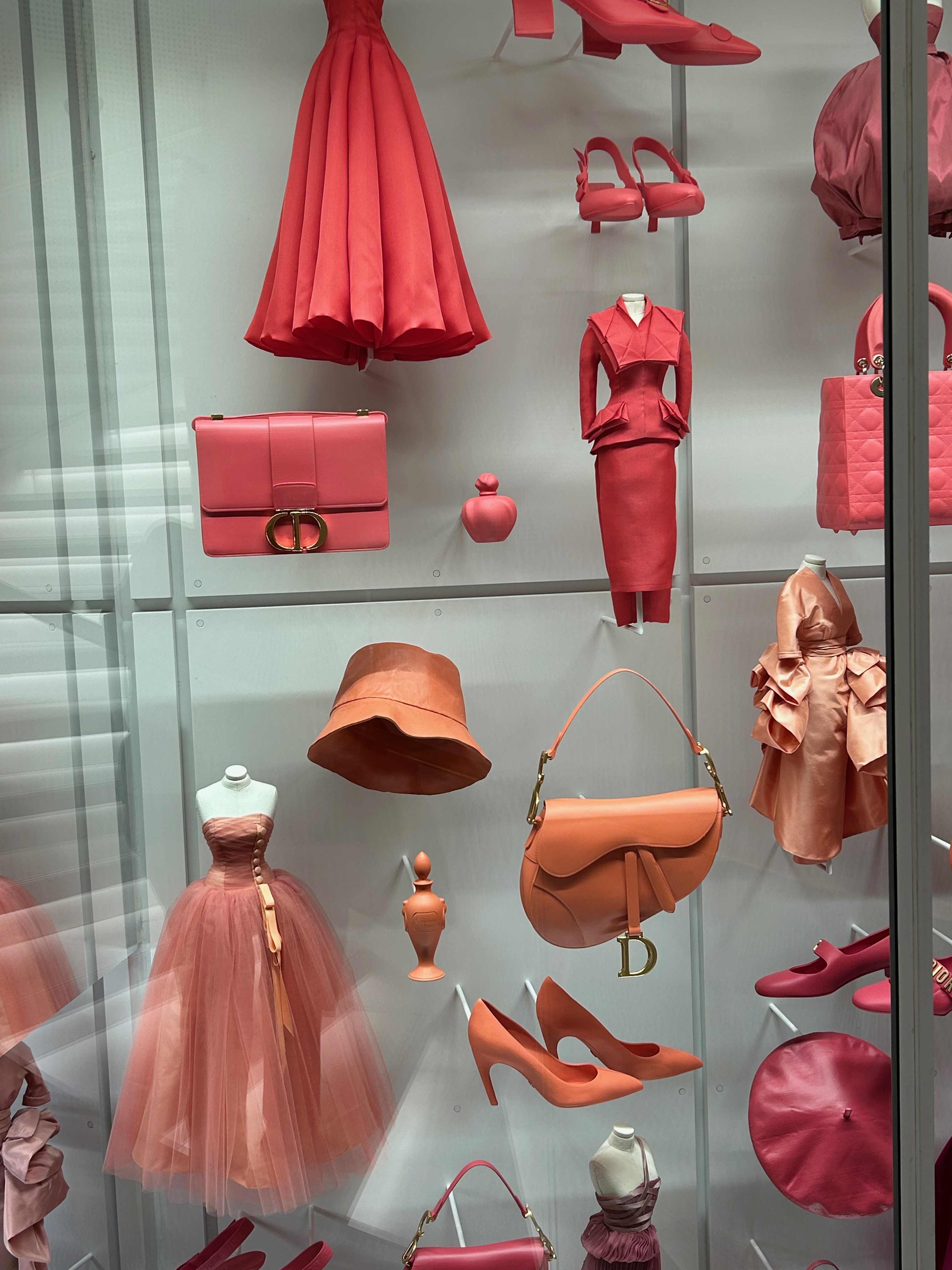
I could have spent hours studying the walls and walls of accessories and miniature clothing which lined the stairwell.

.

And yes – all the dresses shown above are miniature copies of originals from the House of Dior.

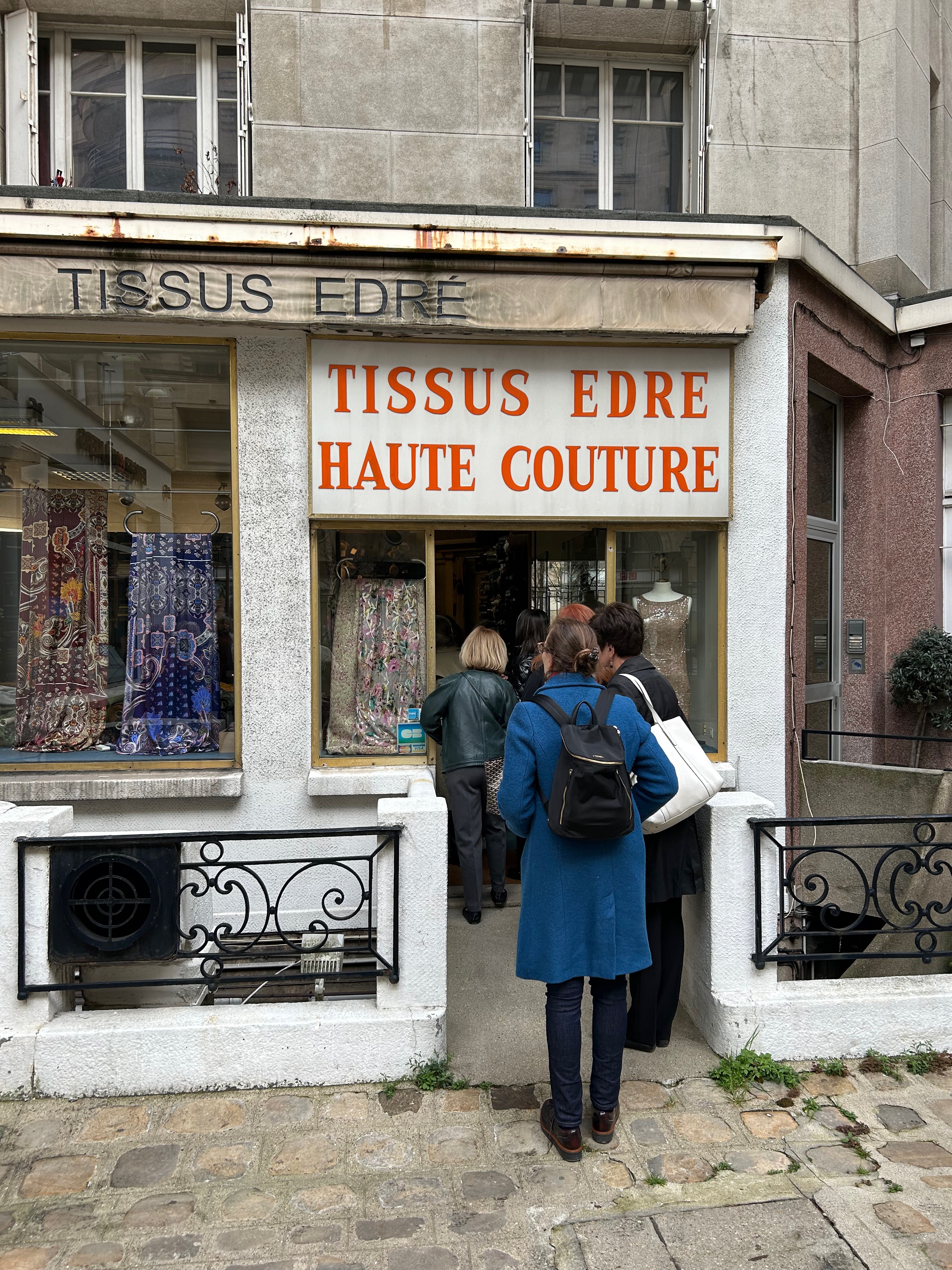
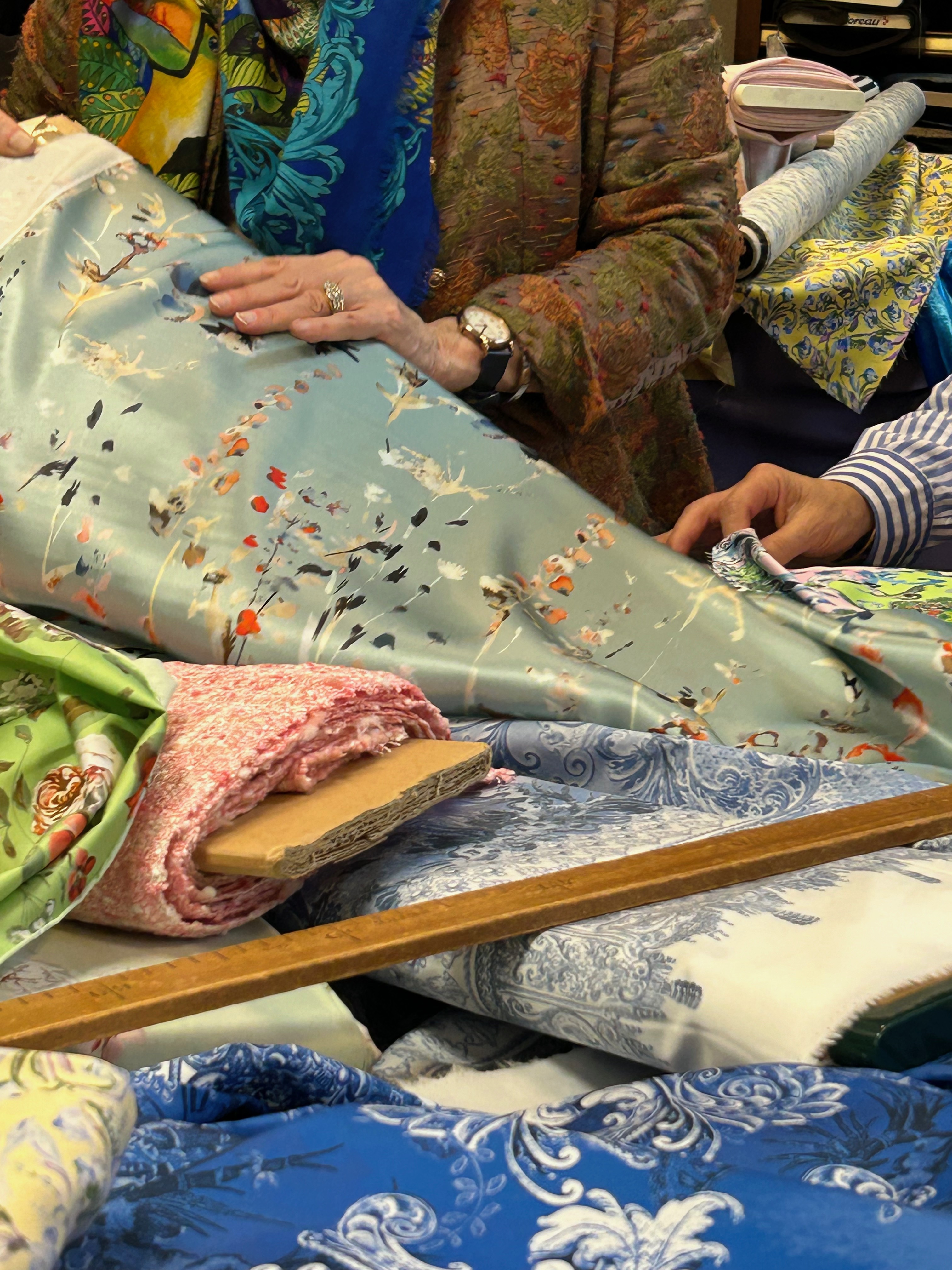
After all this inspiration, it was fun to go to three fabric stores.  The first one on the agenda was Tissus Edre.  

This store sells end cuts from the couture houses, and there is a lot to see.  There is not much order to the “presentation” which meant we had to dig our way through the piles of offerings.  I admit to having some problems with this type of fabric store. 

 It was only after a fellow member of our group found this silk charmeuse shown below, that I noticed it.  

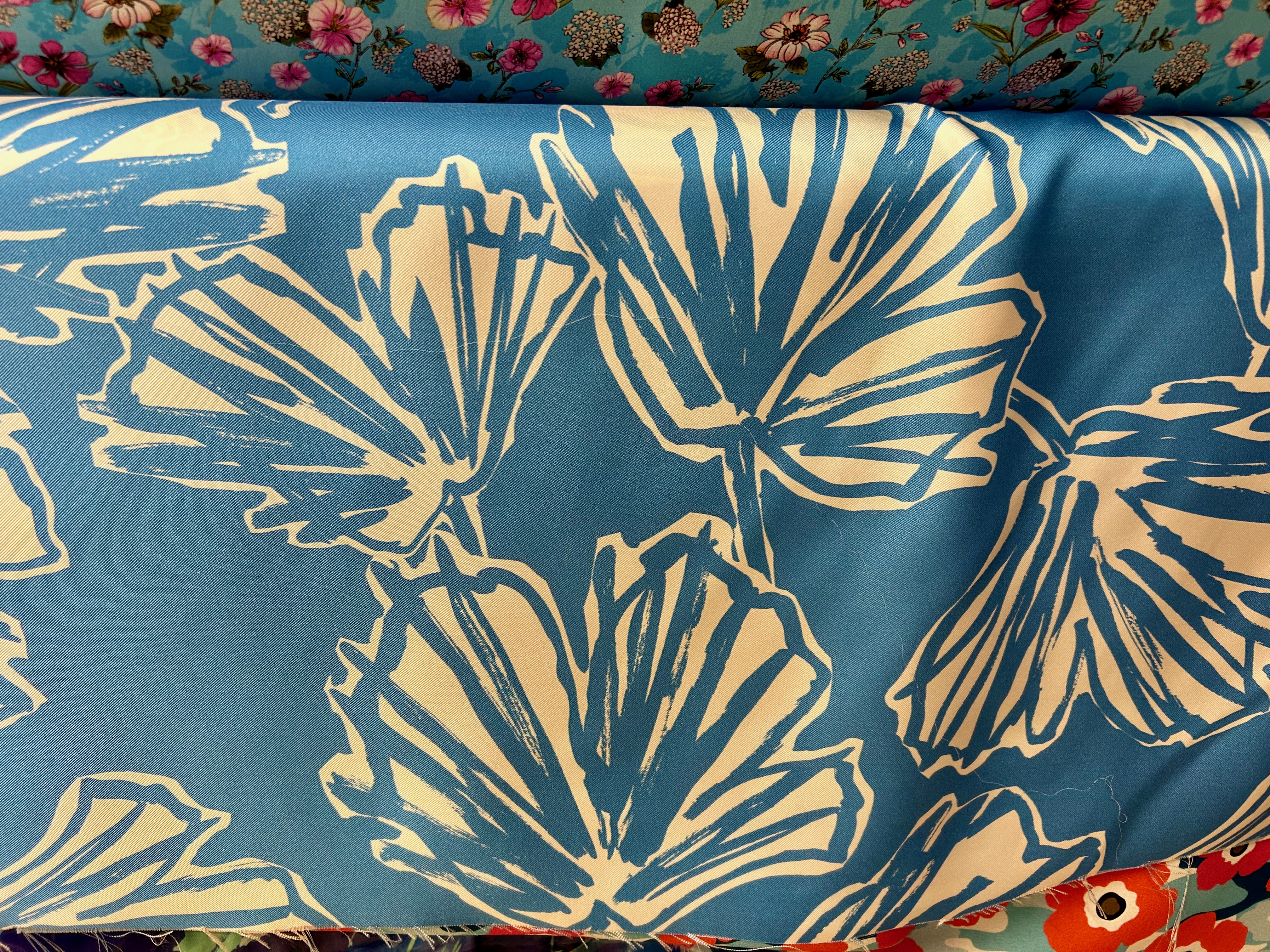
A piece of the pale blue floral silk on top of the pile came home with me.

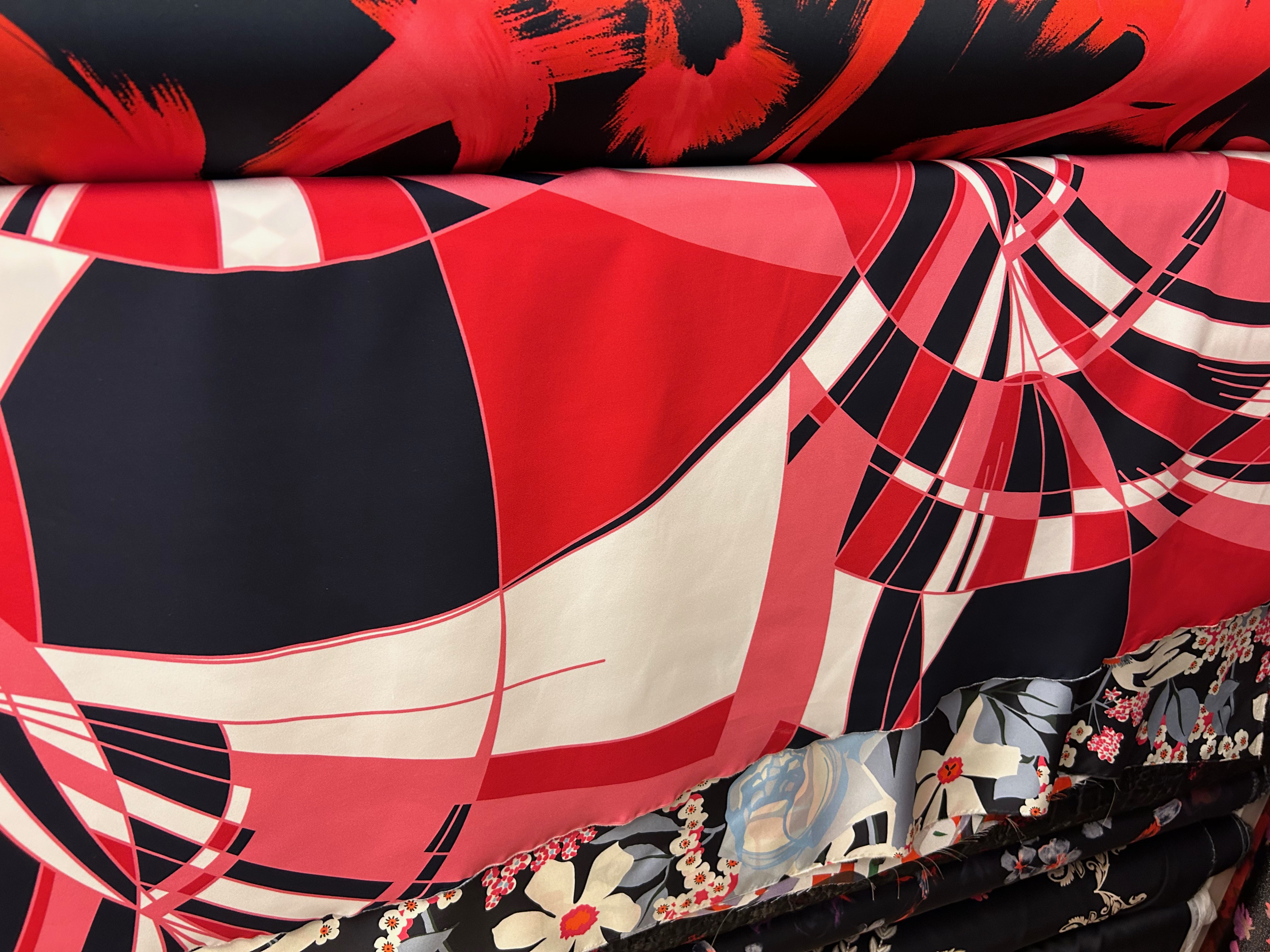
The second fabric store we visited was the world renowned Janssens + Janssens. 

 This store was the antithesis of the prior one in its ordered rows of bolts of fabrics both upstairs and downstairs.  I spent much of my time with the silk charmeuses and twills although this store is probably known best for its exquisite laces.  

Here is sampling of the laces available for purchase.
Silk Charmeuse

A silk twill which also came home with me.

Some day I am going to wish I had this fabric for a lining for a coat.

I could see this fabric made into a flowing caftan to wear in a tropical climate. Someone else will have to do that.

Finally, we went to a fabric store in the garment district by the name of General Diff.  It, too, features end cuts from the couture houses among other selections.  Again, it was a jumble, with fabric piled high on large tables.  They had some lovely lightweight wool, but I declined to be tempted, as my suitcases were reaching capacity at this point.

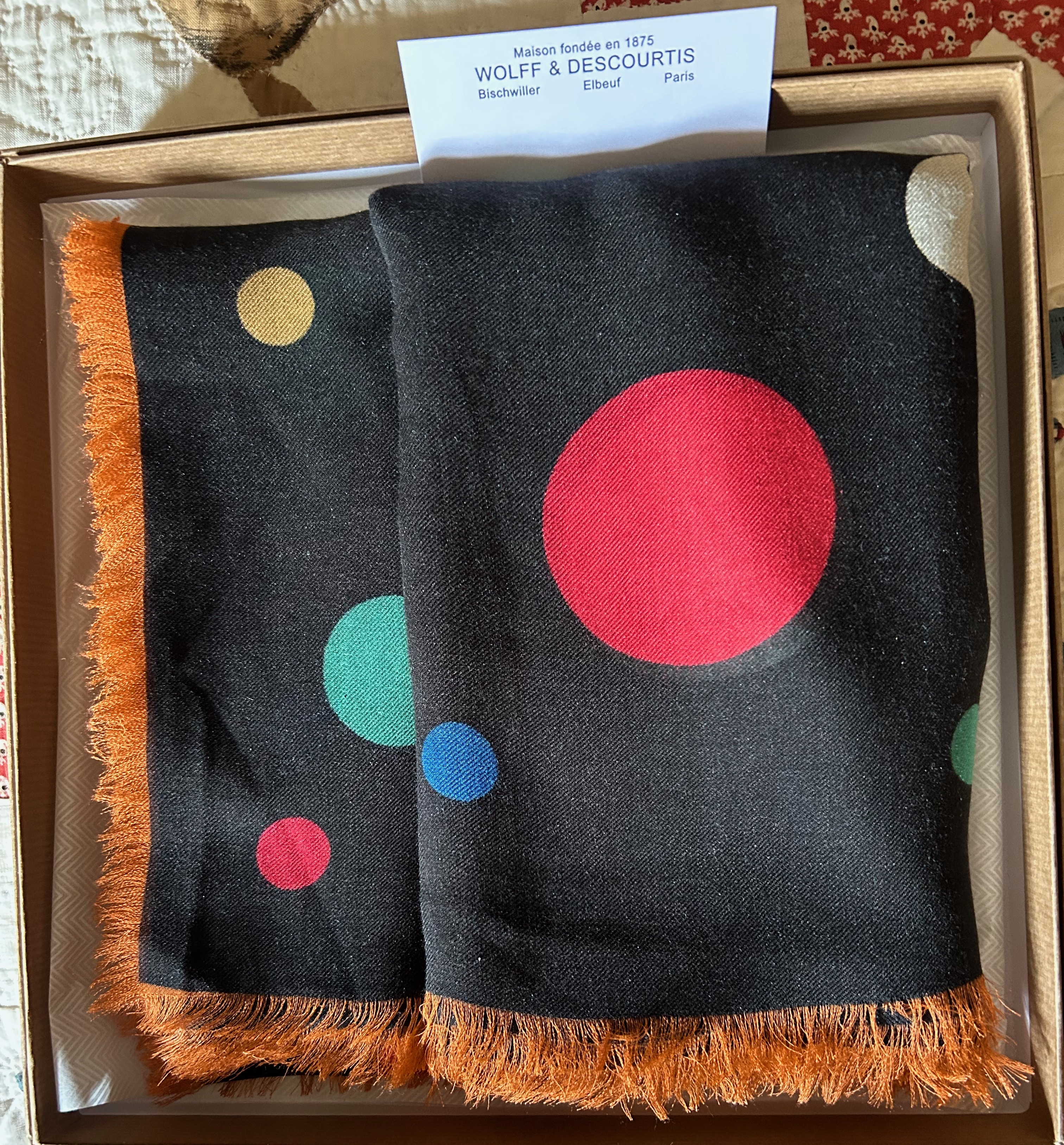
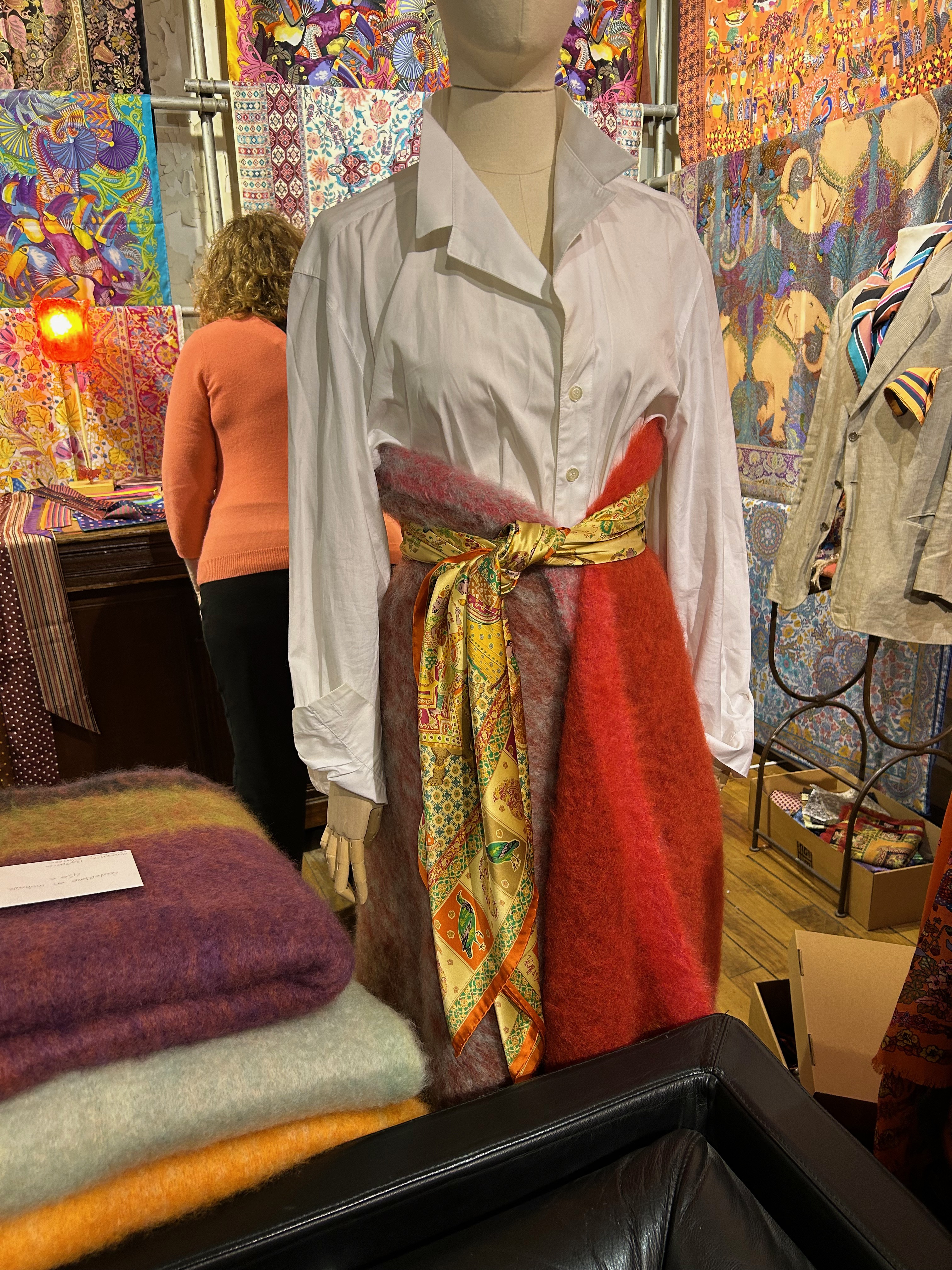
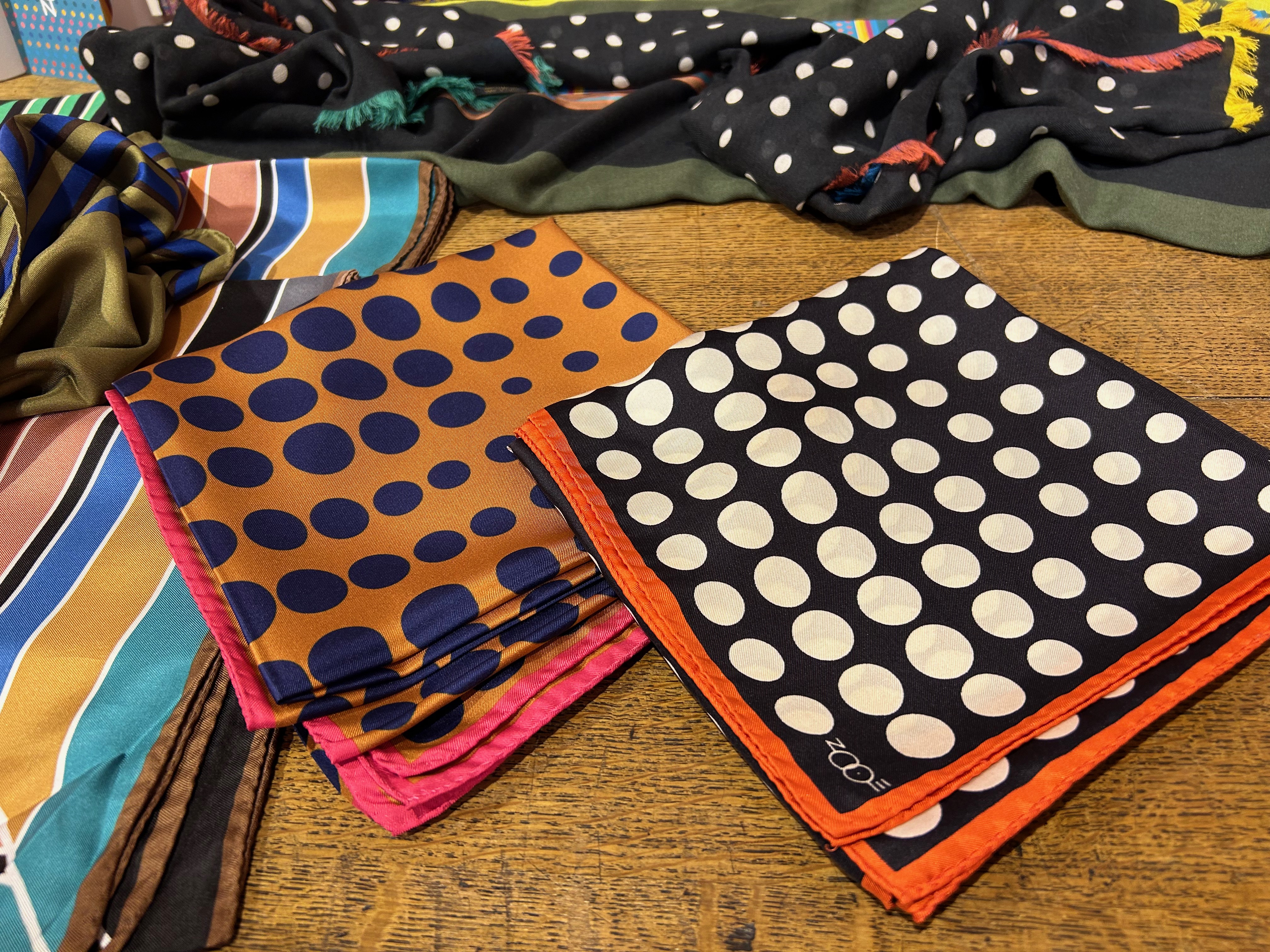
Finally, here are some photos from Wolffe et Descourtis, the wonderful scarf store which captivated us all. This business has remained in the same family for many decades , and indeed the proprietress is Victoria Wolffe, of the original founding family.

What fun to come home with my beautiful scarf!

This ends my monologue on the Paris Tour, despite there having been additional places we visited, people we met and things we did.  Summer sewing has already cranked up, with my attention back here in the States. Happy Sewing June to all of you!

20 Comments

Filed under Christian Dior, Fashion Exhibits, Scarves, silk, Uncategorized

 How Does One Pack for a Trip to Paris in mid-March? Part II

Blouses, sweaters, tops.  These three categories gave me plenty to pair with dressier slacks and more casual pants.  I took along one solid black, jewel neck embroidered cotton sweater and two cotton cardigan sweaters which I always wear fully buttoned to use as dressy tops.  They were perfect for three of the days in Paris.  I had two cashmere/cotton blend pullover collared sweaters which were equally perfect for more casual days and a few more versatile pullovers.  Then I had blouses.  I love blouses.  I decided I needed a new silk blouse to take to Paris with me.  

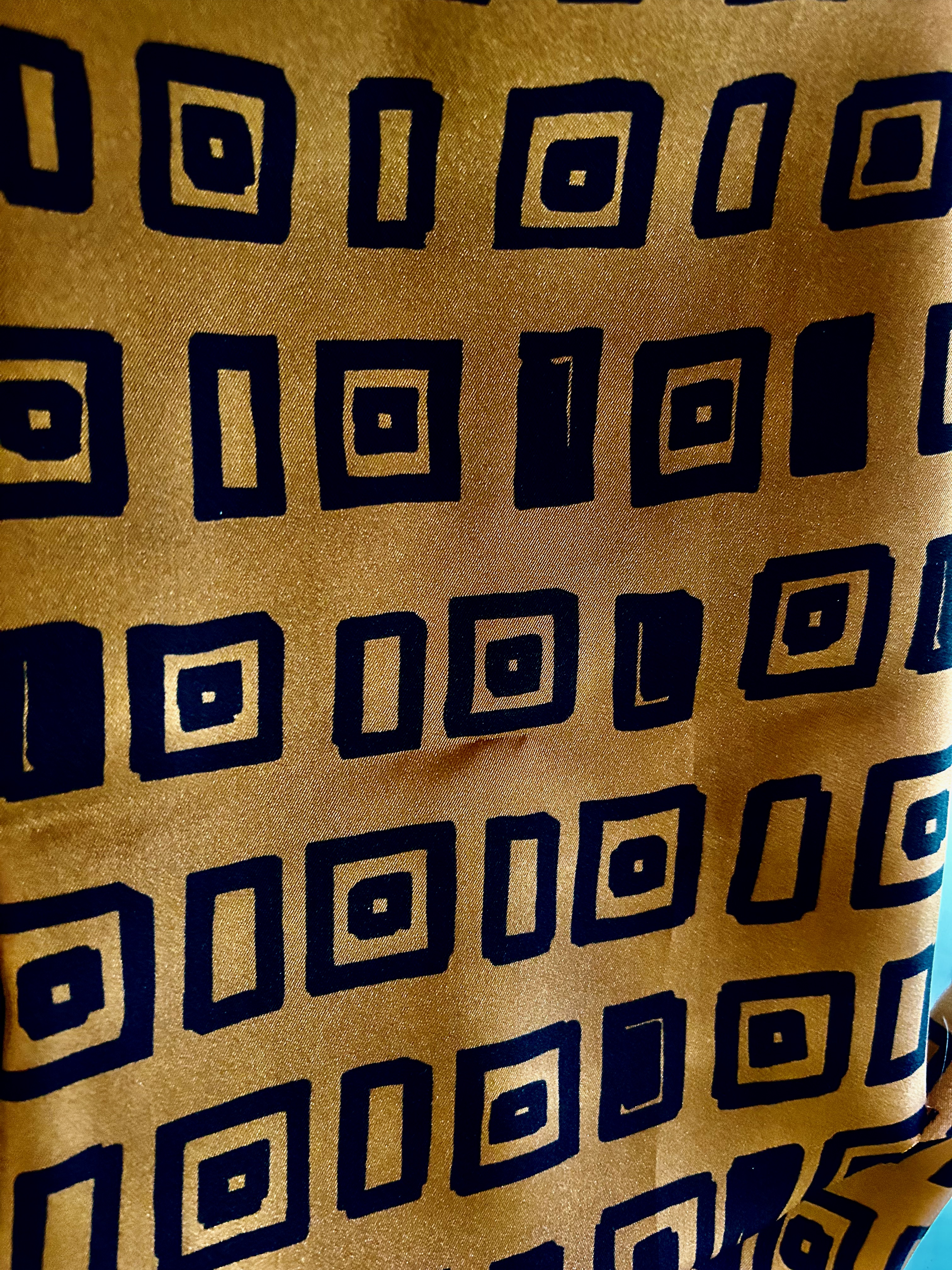
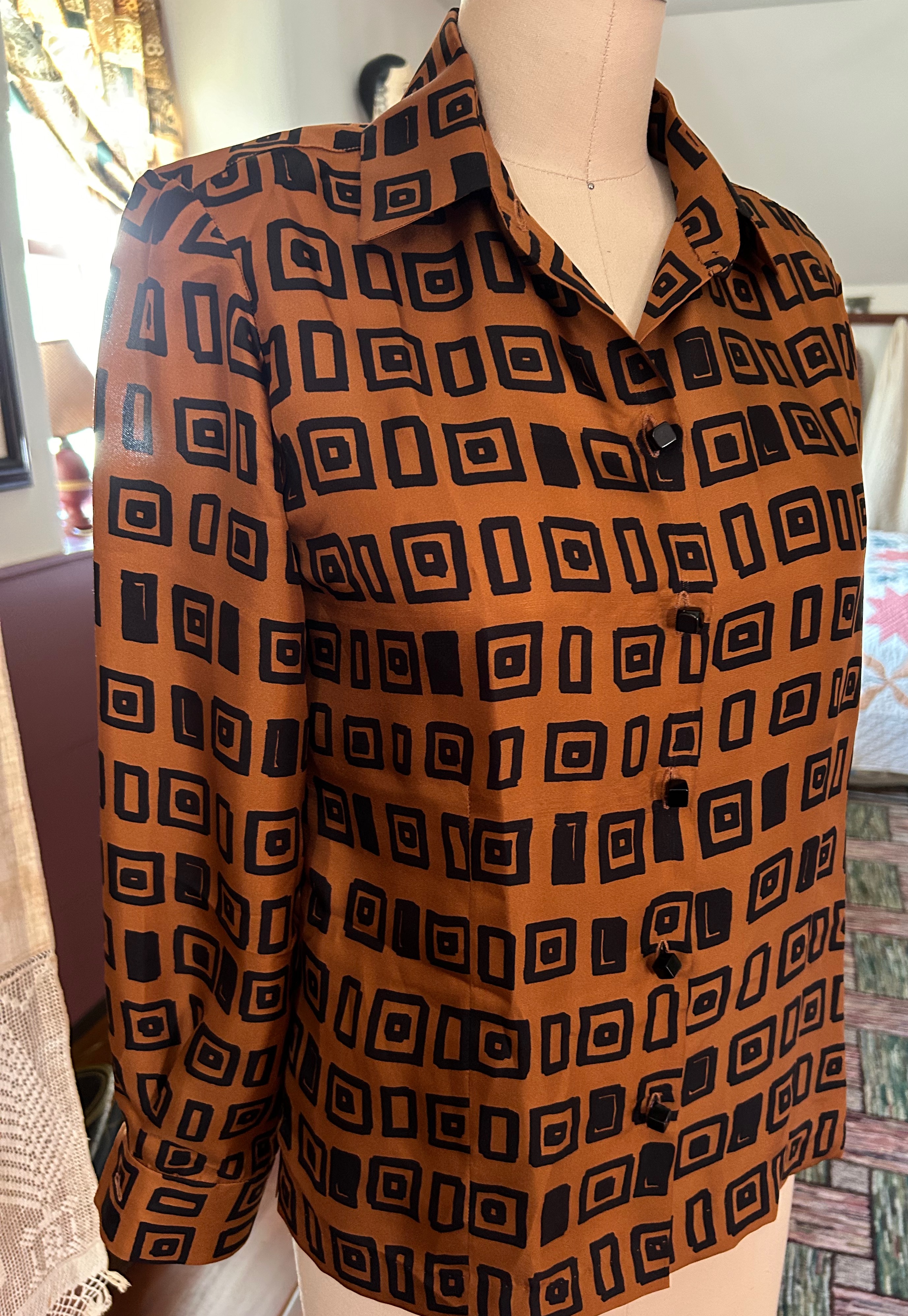
I saw this Italian silk twill on the website for Britex Fabrics:

It appealed to my love of geometrics, and additionally I thought it was just so classy looking.  So I bought it and proceeded to make a blouse.  

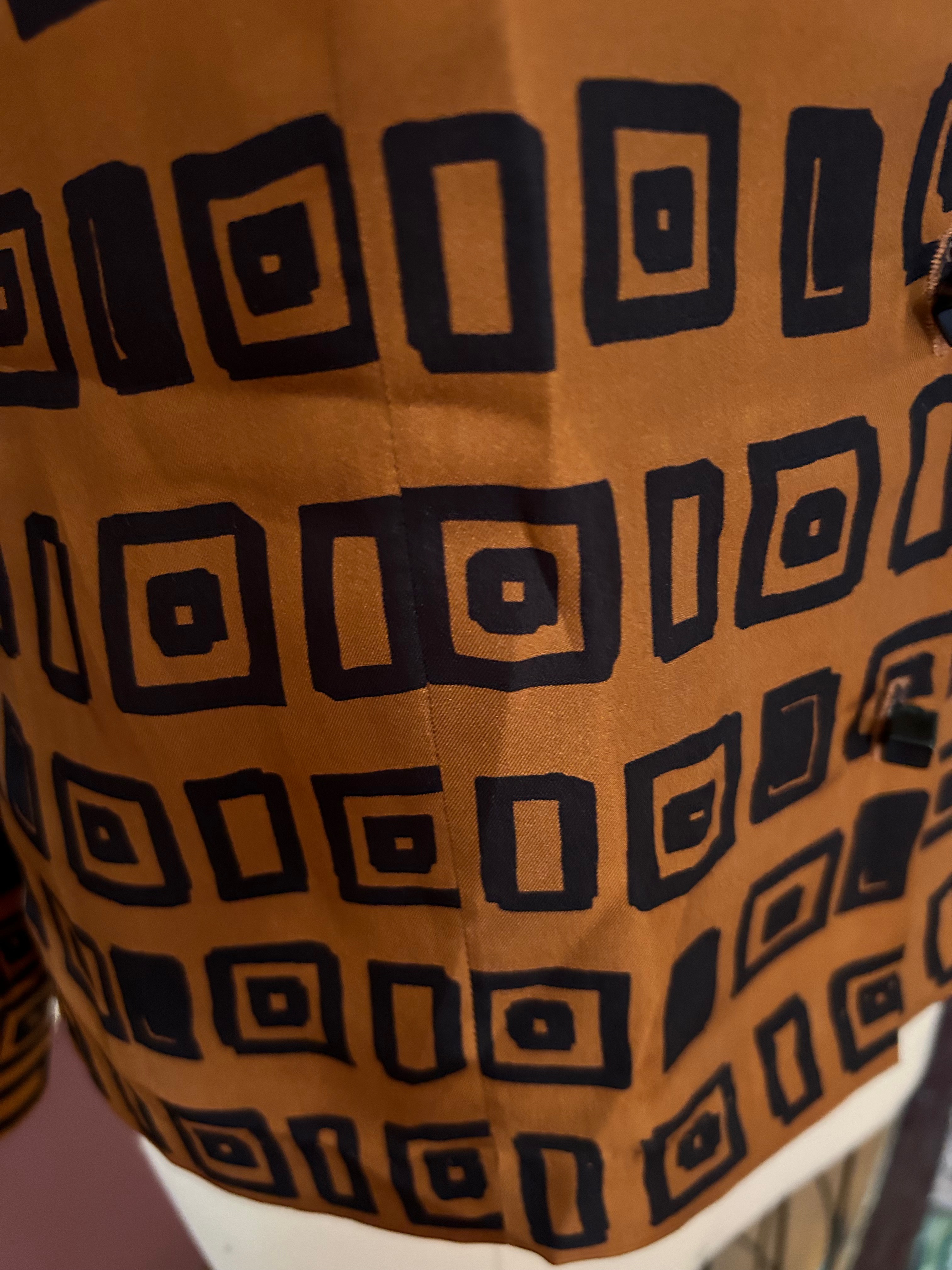
For a twill, it frayed a bit more than expected, but the weight was lovely.  I tweaked my go-to blouse pattern once again for this blouse.  I eliminated the back box pleat below the yoke which I have added in previous makes.  I wanted a more streamlined appearance and less bulk to tuck in.  To that end I also added very slim front vertical bust darts.  

I cut the back yoke on the bias which I decided would look better than on the straight of grain due to all those squares lining up attractively.
Here is one of those narrow vertical darts below the bust.

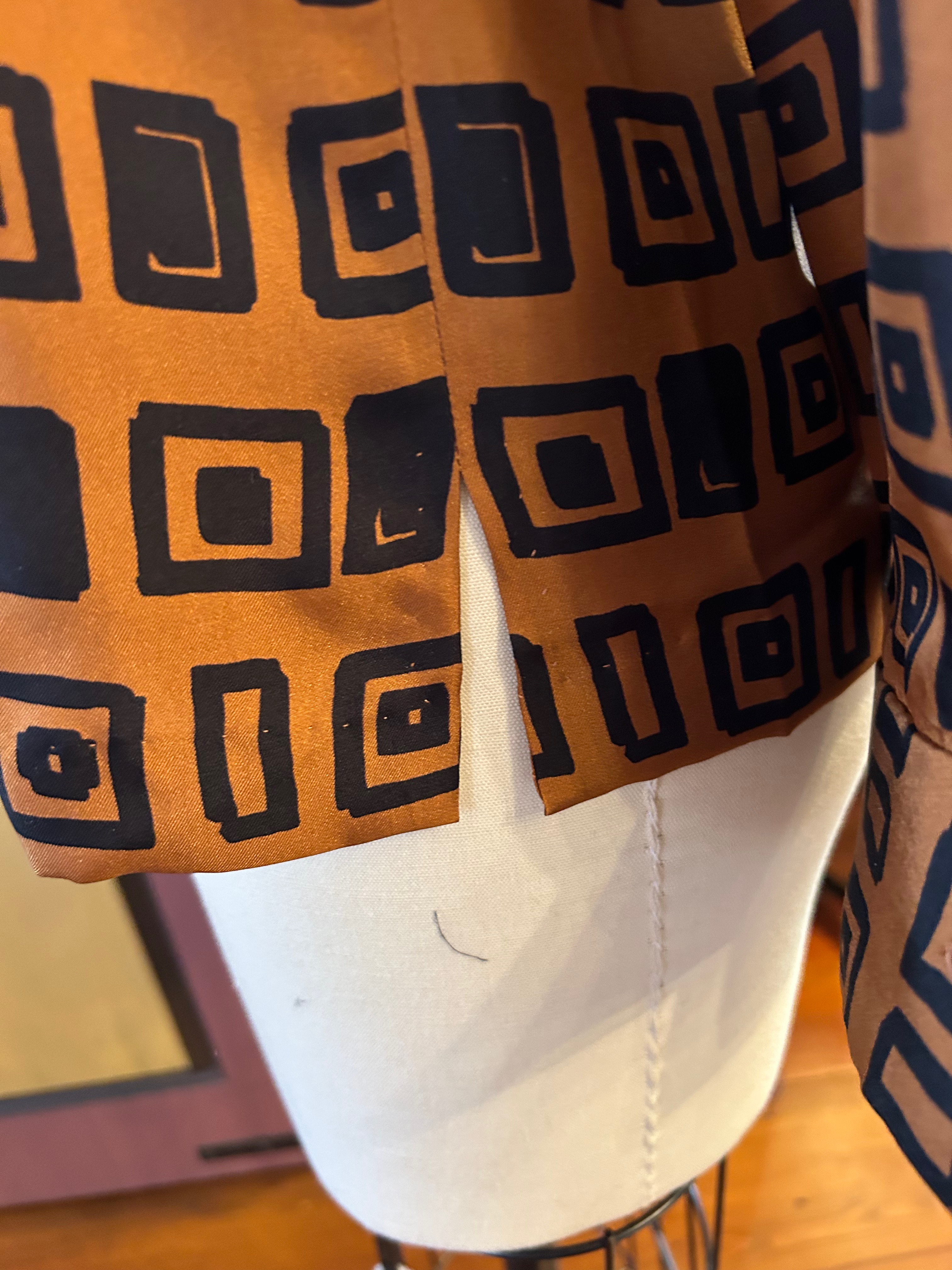
I also shortened the hem by one inch and squared it off with slits at the side seams.

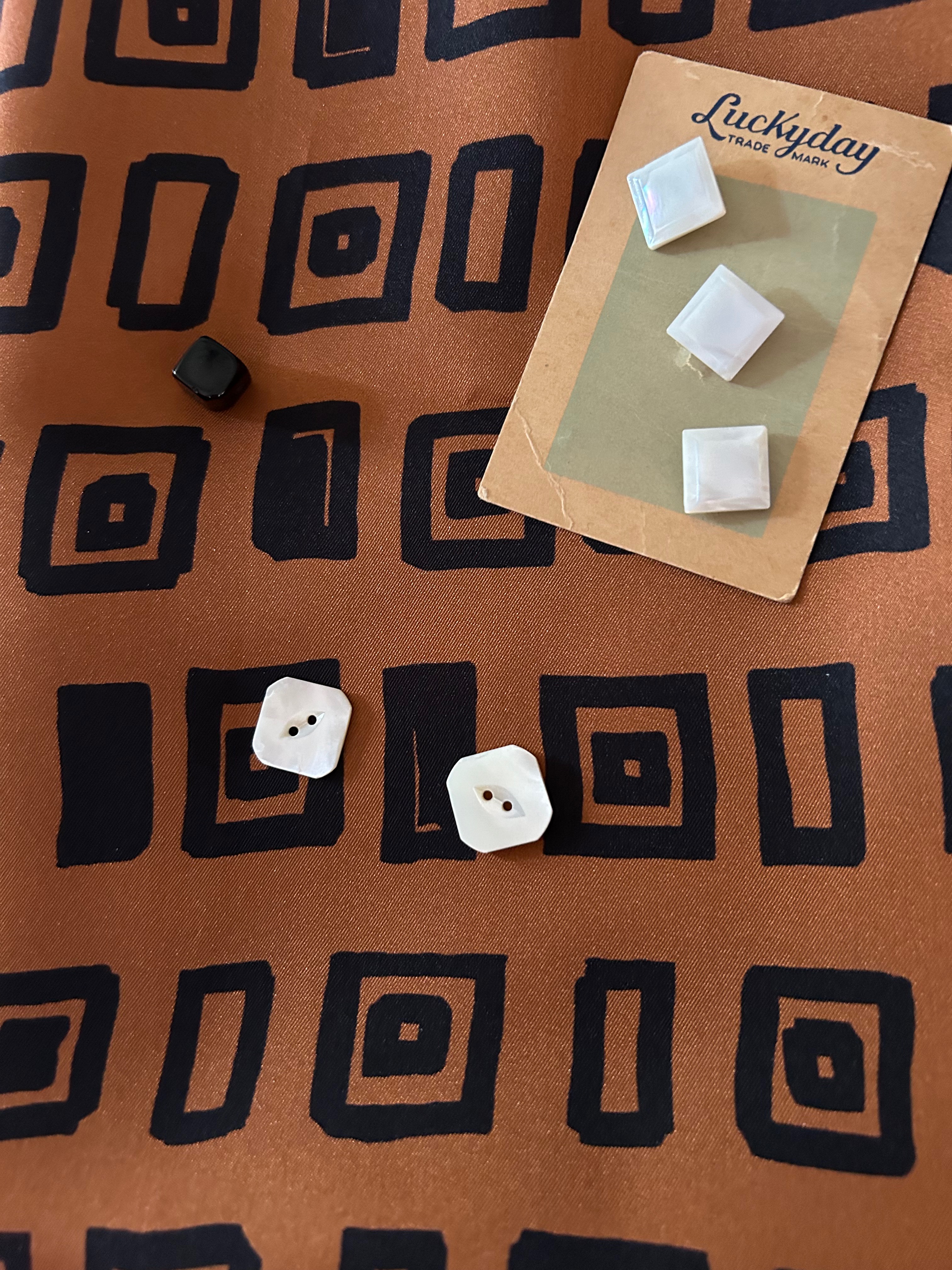
What to do for BUTTONS!?  I had selected 3 varieties from which to choose – all from my collection assembled over the past umpteen years.  

The one thing in common with these buttons is their squarish shape which I thought would compliment the print.

Usually, a winner is clear to me, but this time I needed some assistance.  So, I asked my sewing friend, Debra, for her input, which was a brilliant move on my part.  How wonderful to have confirmation from her trained eye that the buttons I was leaning toward were her choice as well.  Her decisiveness was quick and instinctive. 

The only problem was they were already on a blouse which I made years ago.  No problem, I just took them off that bouse, with a promise to find replacements at some point.  The other sweet thing about these black cube buttons – and I digress here – is that I was with my daughter, Susanna, when I purchased them.   We have wonderful memories of that day long ago, spent together at a vintage textile show in New England.  So from the fields of Massachusetts to the streets of Paris, these vintage Bakelite buttons continue to add layers to their history.

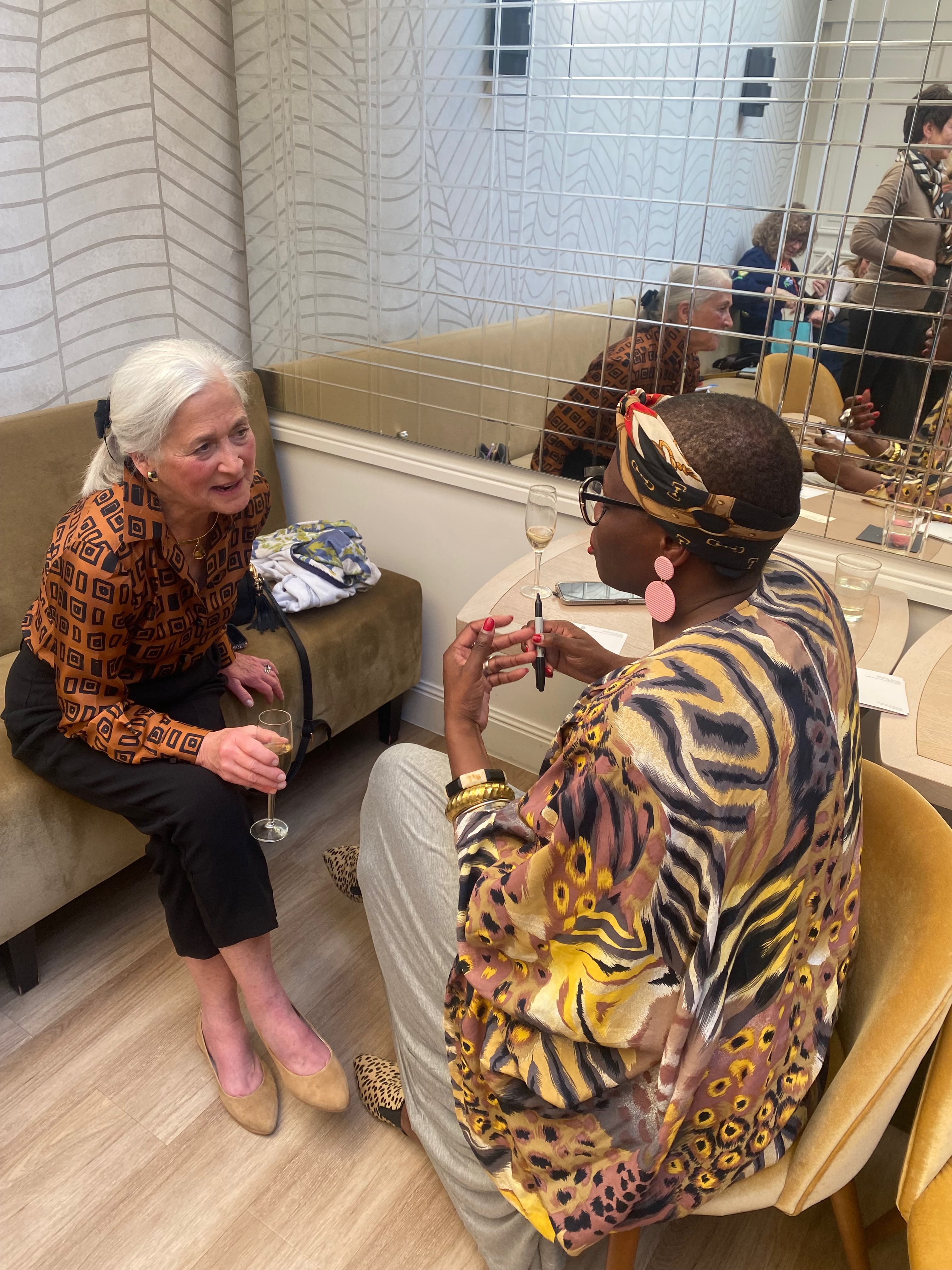
And here I am wearing my blouse, drinking champagne, and enjoying conversation with one of our guest speakers.

I thought it would be a good idea to have a “fancier” blouse along on the trip.  It was already in my closet, having been sewn a number of years ago.  It continues to be one of my favorite makes ever, although I do not get the opportunity to wear it very often.  

I wasn’t sure when I would wear it, but somehow I knew I would find the perfect day and time.  By Friday morning of the trip, I had decided to wear it that evening to our Gala Dinner, with dressy black slacks.  I had brought along specific jewelry to pair with it, and I was quite confident I would look well attired for that special night.  And then…  as luck would have it, one of our stops that day was to a scarf store in Paris.  Susan had expressed her great admiration for this store and their goods, so we were all looking forward to our time there.  

Truth be told, I could have easily purchased three or four scarves that afternoon.  The selection was wide-ranging, both in design and fabric.   But there was one scarf I knew would go home with me.

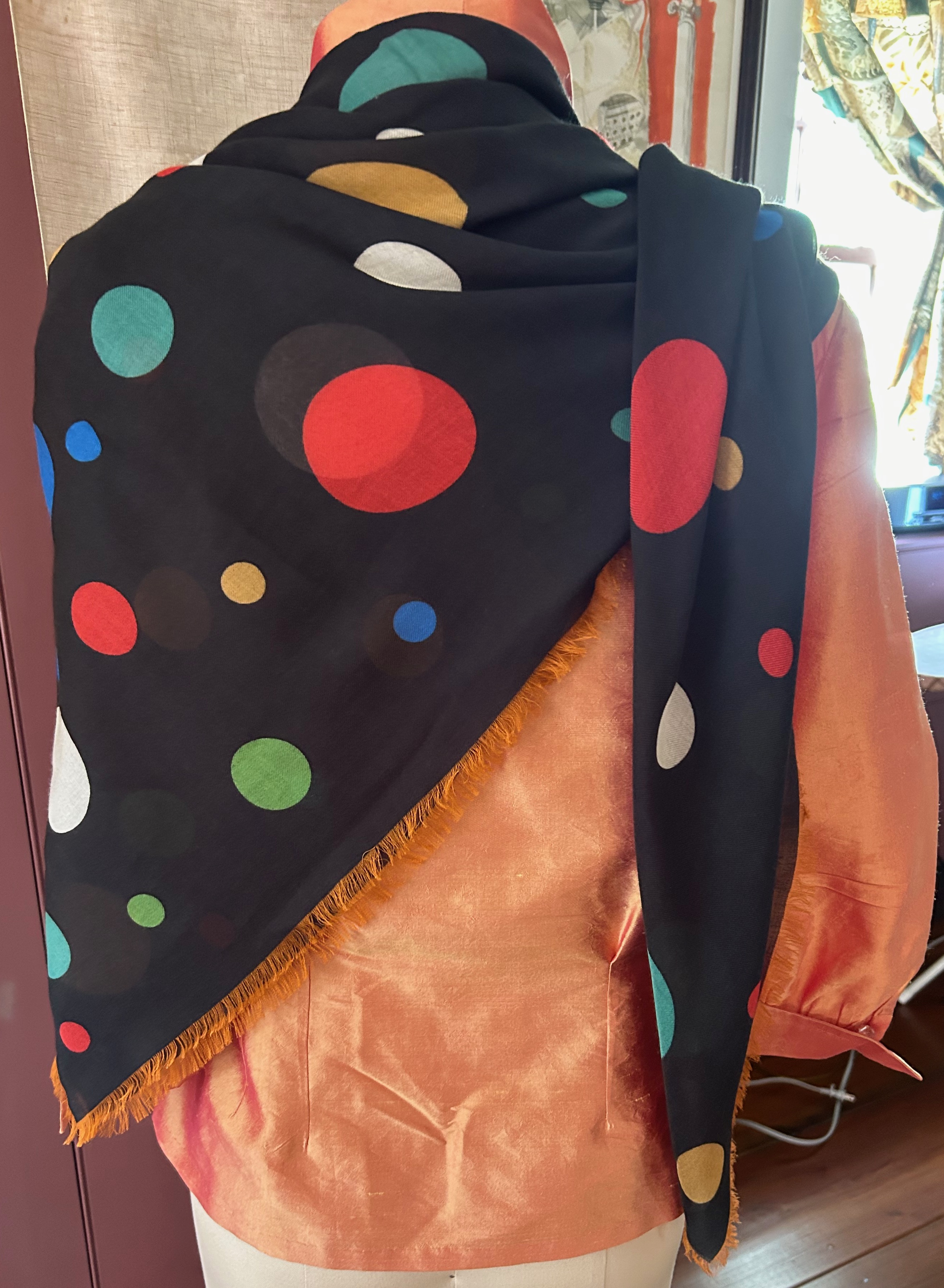
The funny thing is, when I purchased it, I was not thinking about the blouse I planned to wear that evening.  But when I got back to my hotel room, I realized what a great duo they would make.  As the evening was a bit chilly, and we had a short walk to the restaurant, having this cashmere blend scarf wrapped around my shoulders was the perfect addition.  

It was a fun evening, and I felt perfectly attired!  Of course, from now on, I shall refer to this scarf as my Paris wrap. 

At this point you may be wondering if I actually wore a dress while on my trip.  As a matter of fact, yes, I did.  Our instructions were to be dressily attired the evening we attended the Ballet at the Palais Garnier.  I decided to take along this dress which was ready for another outing. 

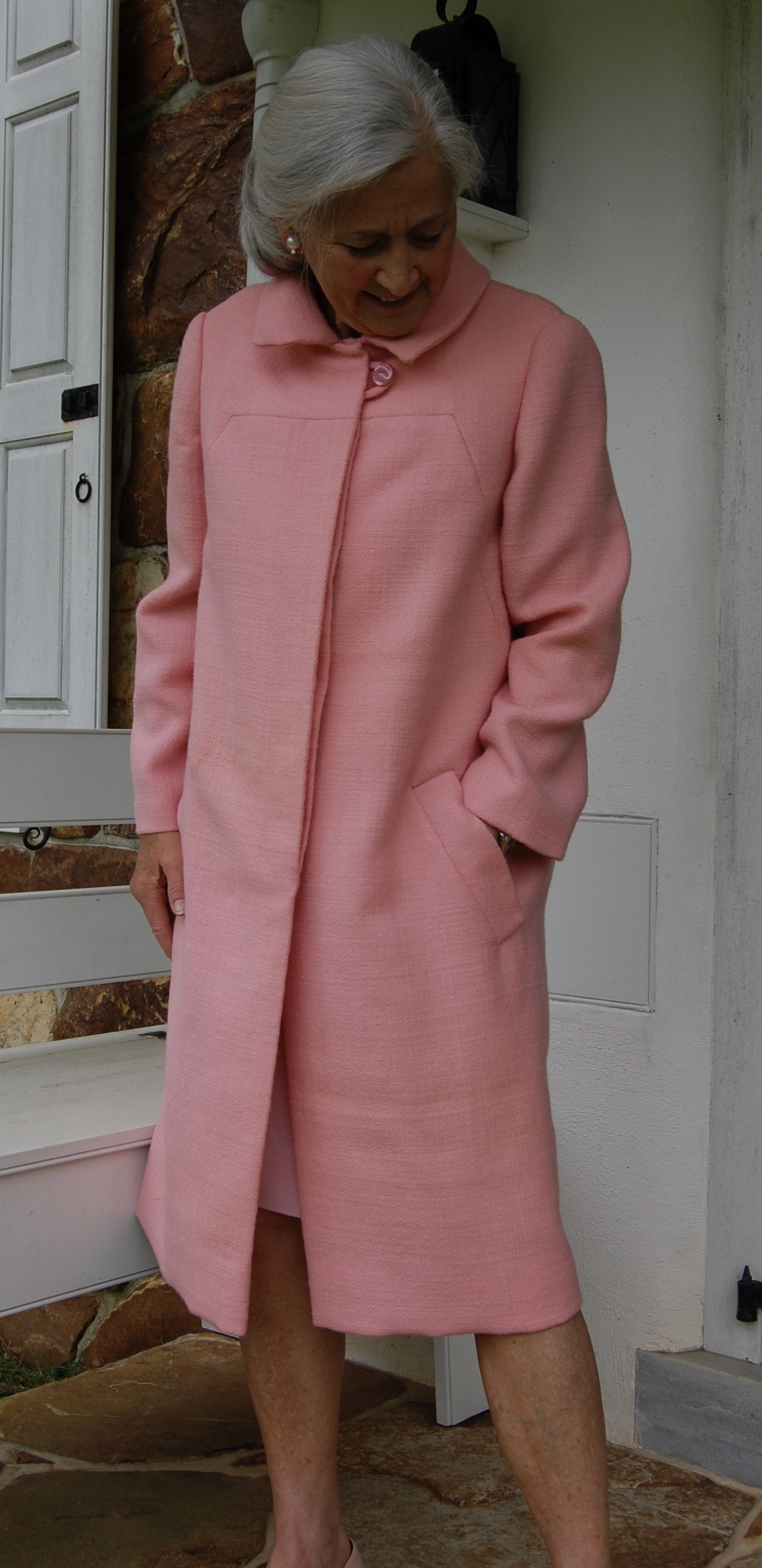
 It is dressy and comfortable, but the best thing about it is – it pairs well with my pink coat, forever a favorite.  

I was determined to take this lightweight Spring wool coat to Paris.  I made it from vintage Lesur wool made in France and for some reason, I just had my heart set on wearing it in Paris.  The weather wasn’t all that cooperative as it was a bit warm for a wool coat.  That did not deter me.  I donned it anyway, and that’s the end of the story!  

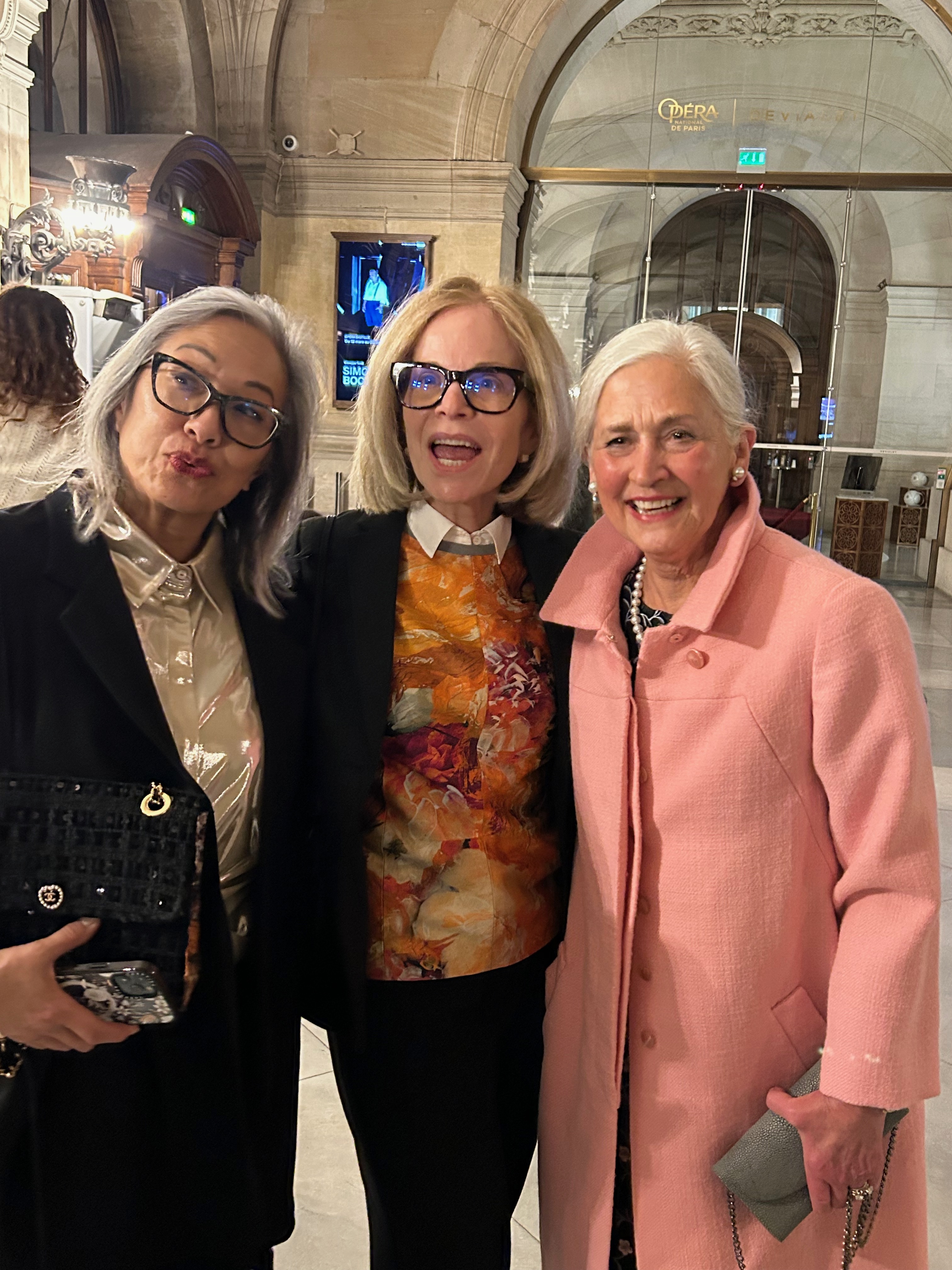
Together with two of my tour-mates before the ballet.

However, there is more to come, as I will share a bit about other parts of the trip next time. 

18 Comments

Filed under Bakelite buttons and/or jewelry, Blouses, Buttons - choosing the right ones, Coats, Scarves, silk, Uncategorized, vintage buttons, Vintage fabric

Part I:  How Does One Pack for A Trip to Paris in mid-March?  

With considerable thought!

I was a participant on Susan Khalje’s Paris Couture Tour in mid-March.  I dutifully checked the expected weather in central and northern France for that time of year (Mr. Fifty Dresses and I were spending a week in Normandy and Brittany prior to the Paris component, which meant even more thought). Chilly, rainy, breezy were the parameters most often appearing in my weather search.  Add to that the fact I did not want to look too Wintry nor too Springy, and, well, I was quite in a quandary!  

Fortunately, Susan provided us with some guidelines for the type of clothing we would need.  This included day wear for our scooting around Paris to see exhibits, fabric stores, specialty stores, museums, etc.  She indicated that dress in Paris is “noted” so I took that to mean we needed to look “sharp” and “put-together.”  We also would have two days with special visitors and demonstrations in the hotel.  Again we didn’t need to be all dolled up, but we needed to look presentable.  And then there were those special nights out.  For those we would need dressy clothes – for a night at the Ballet at the Palais Garnier, a Gala dinner at a fancy restaurant, and an evening at a fashion show in a private Paris apartment.  

Of course, I decided I needed a least a couple of new things to wear.  And of course, that meant sewing.  I started in mid-January, making a muslin for this dress (pictured in green):

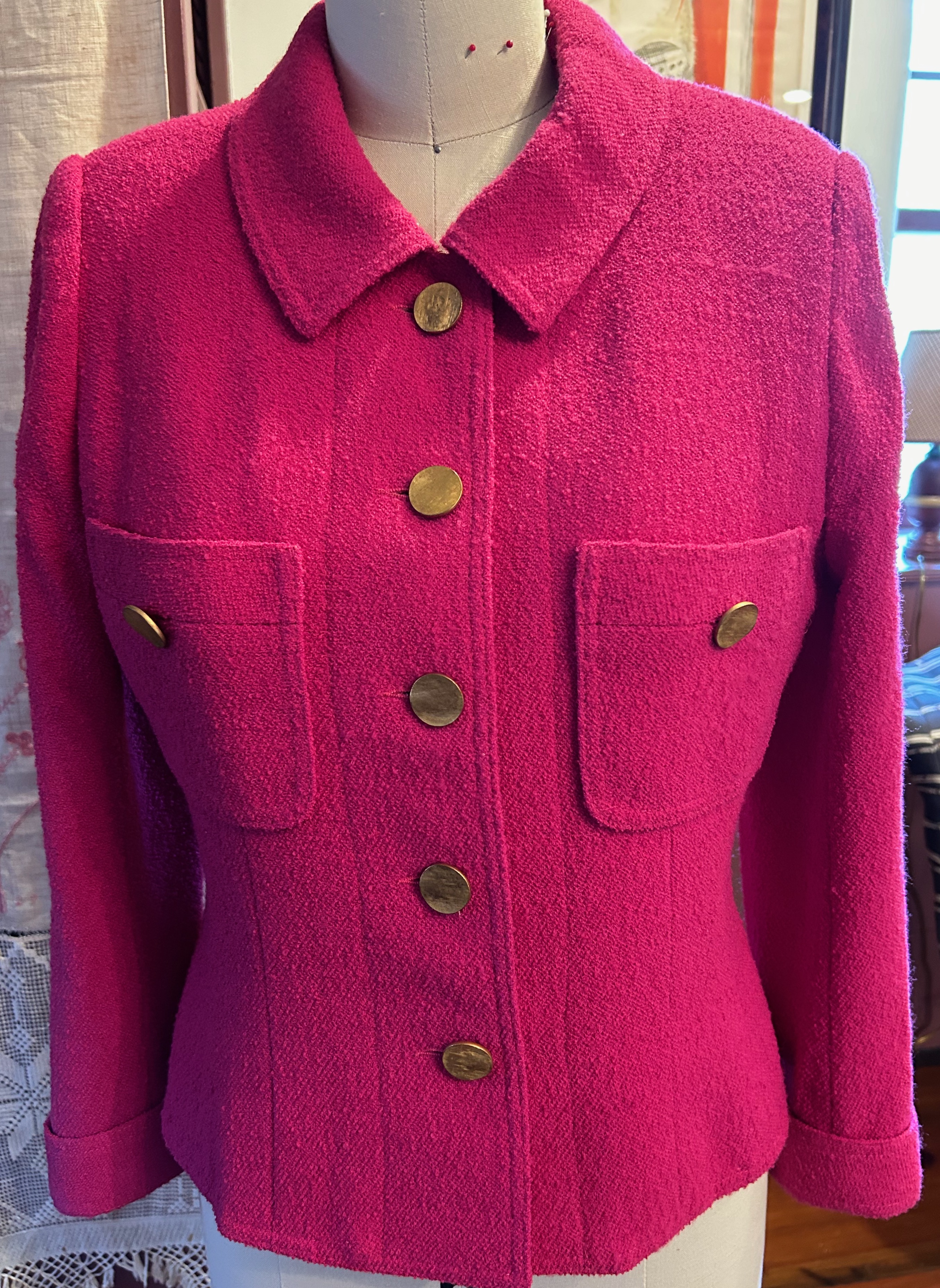
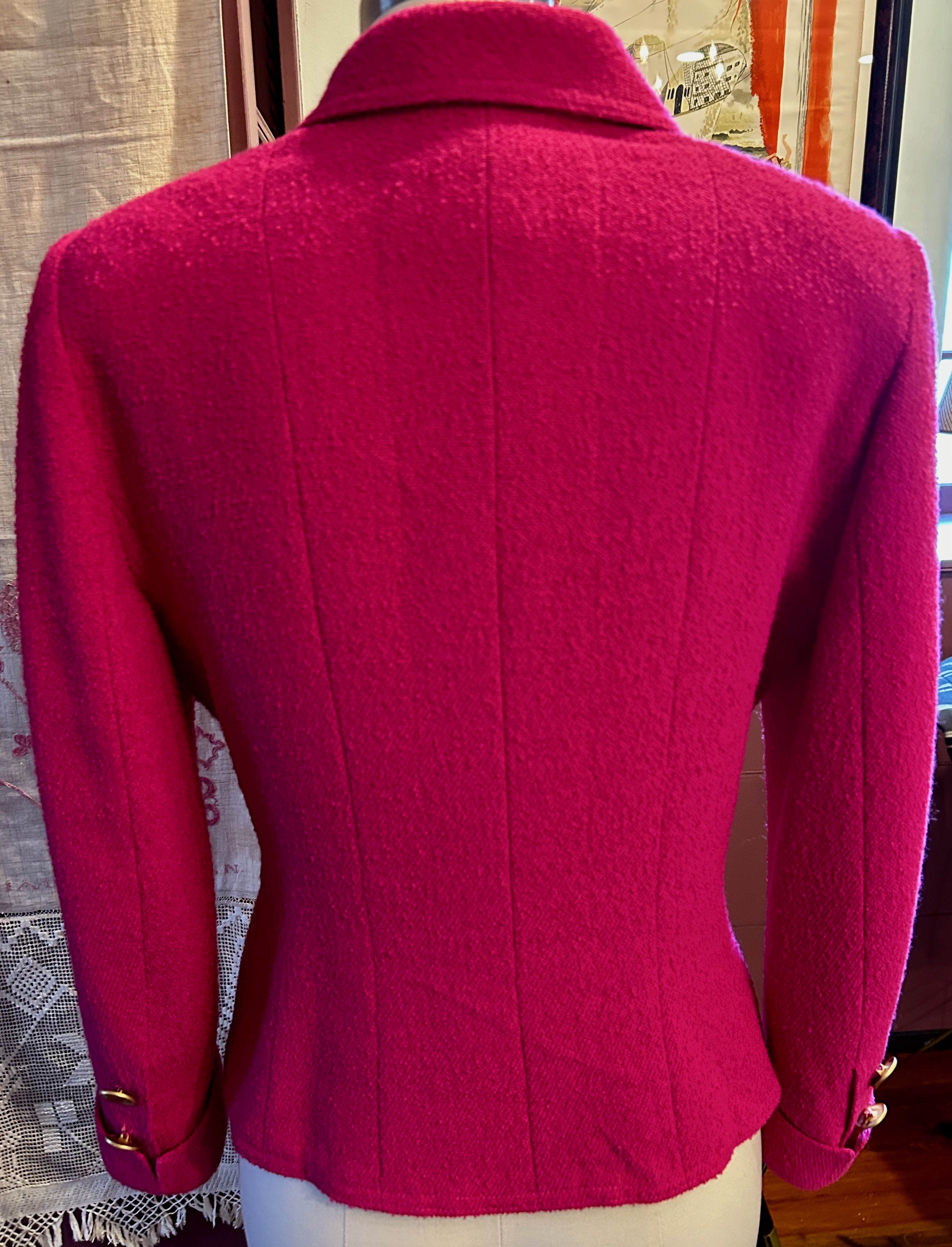
Before I started on the actual dress, however, I thought I would resurrect a pink wool jacket I had purchased 20 years ago.  Made in France, with some amazing details and handwork, the jacket had hung in my cedar closet for over 12 years, unworn.  Its color and weight, however, seemed to be perfect for Paris in March. 

When I tried it on, the shoulders were much too pronounced for today’s sensibilities.  Undaunted, I knew I could easily remove the hand stitched lining from around the top and sides of the shoulder armhole area.  I could see how the shoulder pads were configured and make adjustments.  I plowed forward, expecting this project to take no more than one day.  

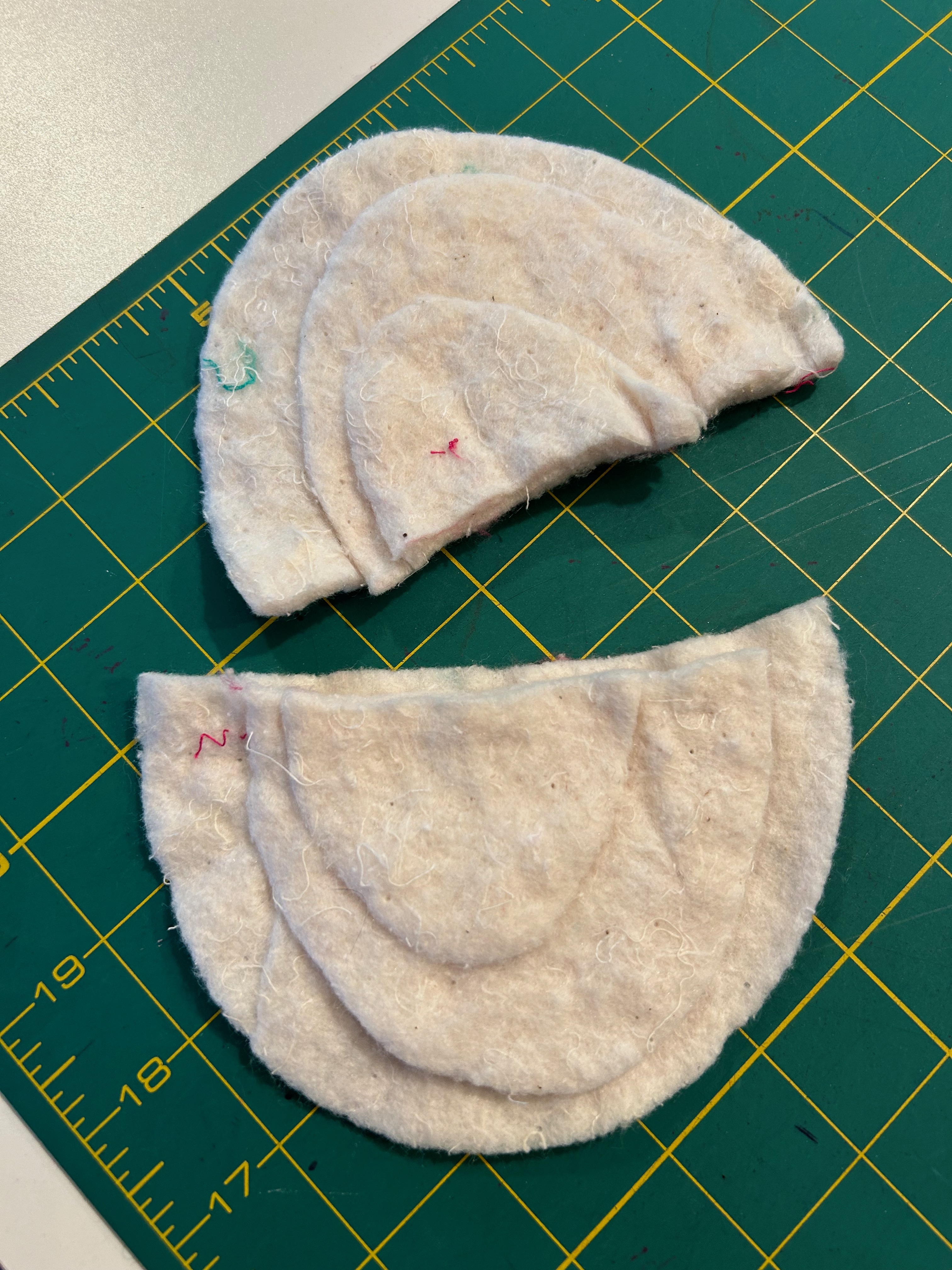
No wonder those shoulders were so pronounced!  There were four layers of padding, all custom cut and applied to each shoulder cap.  I took out three layers for starters.  I knew I needed some definition, and that seemed to do the trick.  If I had been starting from scratch, I probably would have used even less padding, but this was acceptable to me.  

Here are the three layers of padding I removed from each shoulder. They were originally hand-stitched together, with big loopy stitches; I removed that stitching to access the largest of the four layers which I then used by itself for each shoulder.

What I had not anticipated was the fact that removing such a depth of shoulder padding had implications for the sleeve length.  There was no way around the realization I was going to have to shorten the sleeves – or not wear this jacket in Paris – or anywhere, for that matter.  Suddenly what promised to be a quick fix had morphed itself something much more time-consuming.    

One of the beautiful details of this jacket was the applied tailored cuff on each sleeve.  Shortening the sleeve was going to have to be in two parts.  

If you look closely, you can see how the cuff has been applied to the sleeve.

I buckled down and removed the cuff on the first sleeve.  I had determined I needed to reduce the sleeve length by 7/8 of an inch.  I was worried the circumference of the sleeve end might “grow” enough to make the applied cuffs too skimpy.  By now I was asking myself how I got myself into this?  I was spending all sorts of time on this jacket when I had whole garments to sew.  But it was too late to back down at this point.  I  cut off the necessary length from the sleeve and its lining, stitching them back together by hand.  I then had to redo some top-stitching and found some thread which was a close match to the existing thread.   Then I re-applied the cuffs by hand.  Fortunately, they were split cuffs, so they had some “give” and molded nicely to the slightly larger circumference of the sleeve.  

One down and one to go before I could respace the buttons above the cuffs.  

With that jacket ready to go to Paris, I finally was able to turn my attention to that dress I wanted to make.   Some of you may remember seeing this cotton sateen/jacquard fabric mentioned in a prior post.  I had debated whether to make a dress or a long skirt with it, but ultimately decided on a dress as I thought I would get more wear out of it that way.  

I thought this would be the perfect weight and fabric for early spring in Paris – not too heavy and not wintry looking.  I envisioned wearing this to the fashion show which we would be attending one evening at a private apartment.  So much for those plans!  Our schedule that day did not allow us to return to the hotel to change clothes.  We would have to wear our out-and-about day clothes into the evening.  

I went to Plan B and wore this jacket I had made several years ago.  I paired it with navy slacks, a pale pink blouse, and a scarf which matched the lining of the jacket. I carried along a change of shoes to look a little dressier and that was that!  

So what about that navy blue polka-dotted dress?  Yes, I did finish it.

It’s still a little wrinkled from being packed!

I carried it all the way to France for 15 days and back home again and never wore it…  More about it in a future post.  

29 Comments

Filed under Chanel-type jackets, classic French jacket, Day dresses, Polka dots, Sleeves, Uncategorized, vintage Vogue patterns from the 1960s

A Long Silence

Silence may indeed be “golden” except when one is trying to maintain some regularity in writing a blog.  My silence this past Fall and into the end of the year was not intentional. I actually got as far as starting a new post in November on a “Blouse for Fall” only to have its completion thwarted by more pressing priorities.  Such is life, as all of us know.  So now, in this sparkling new year we have entered, I have the opportunity to play some long overdue catch-up.  

It is at this time of year when I like to reflect on my sewing from the year just past.  And glaringly, the truth is I was not very productive.  Here is what I made:

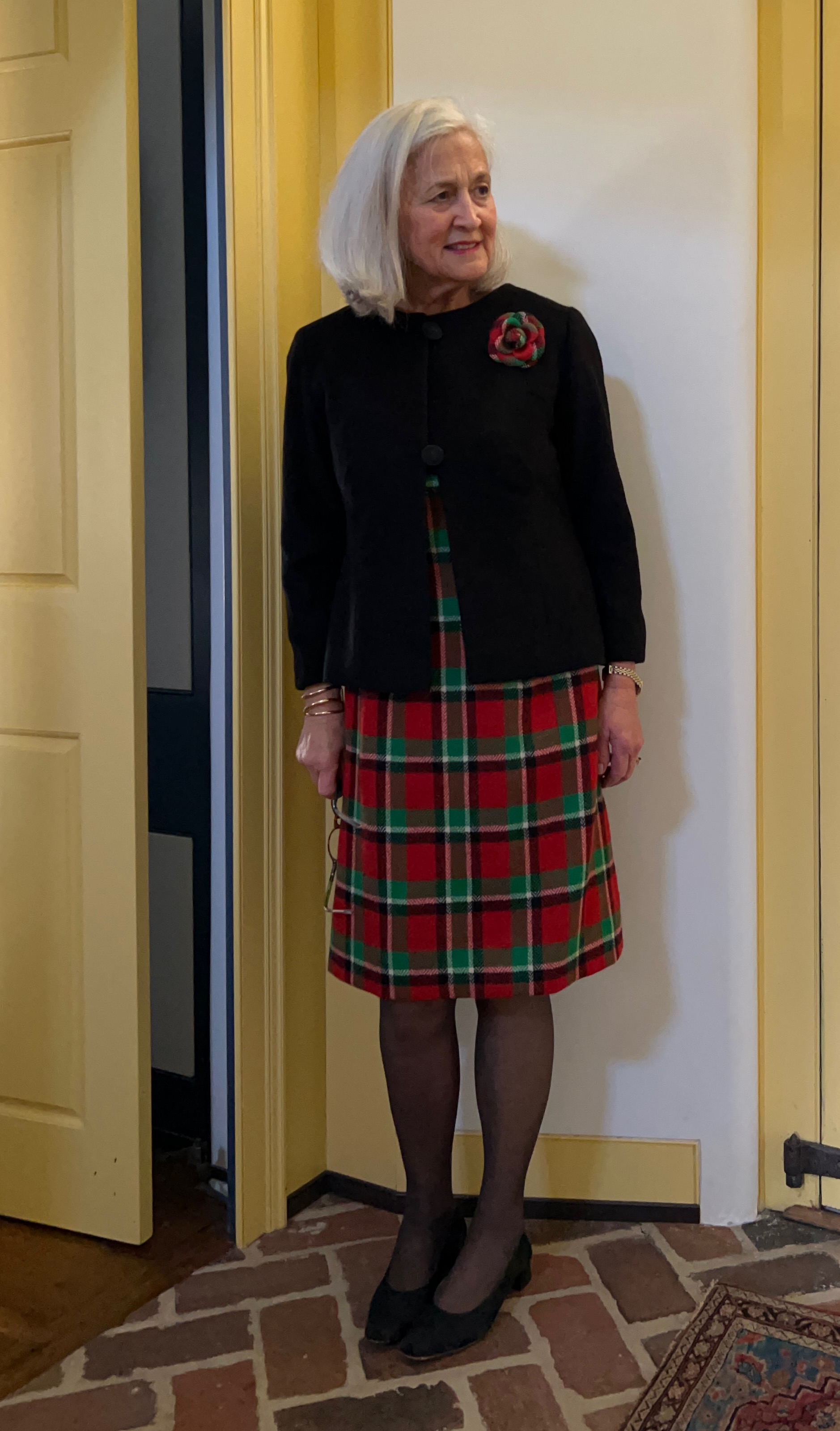
  1. Short black wool jacket, ostensibly to wear with a wool sheath dress made two years ago.    

I suspect this jacket will prove to be more versatile than I have expected.  Its jewel neckline will lend itself to scarves, and its solid black color will be a good canvas for brooches or other fabric flowers.  

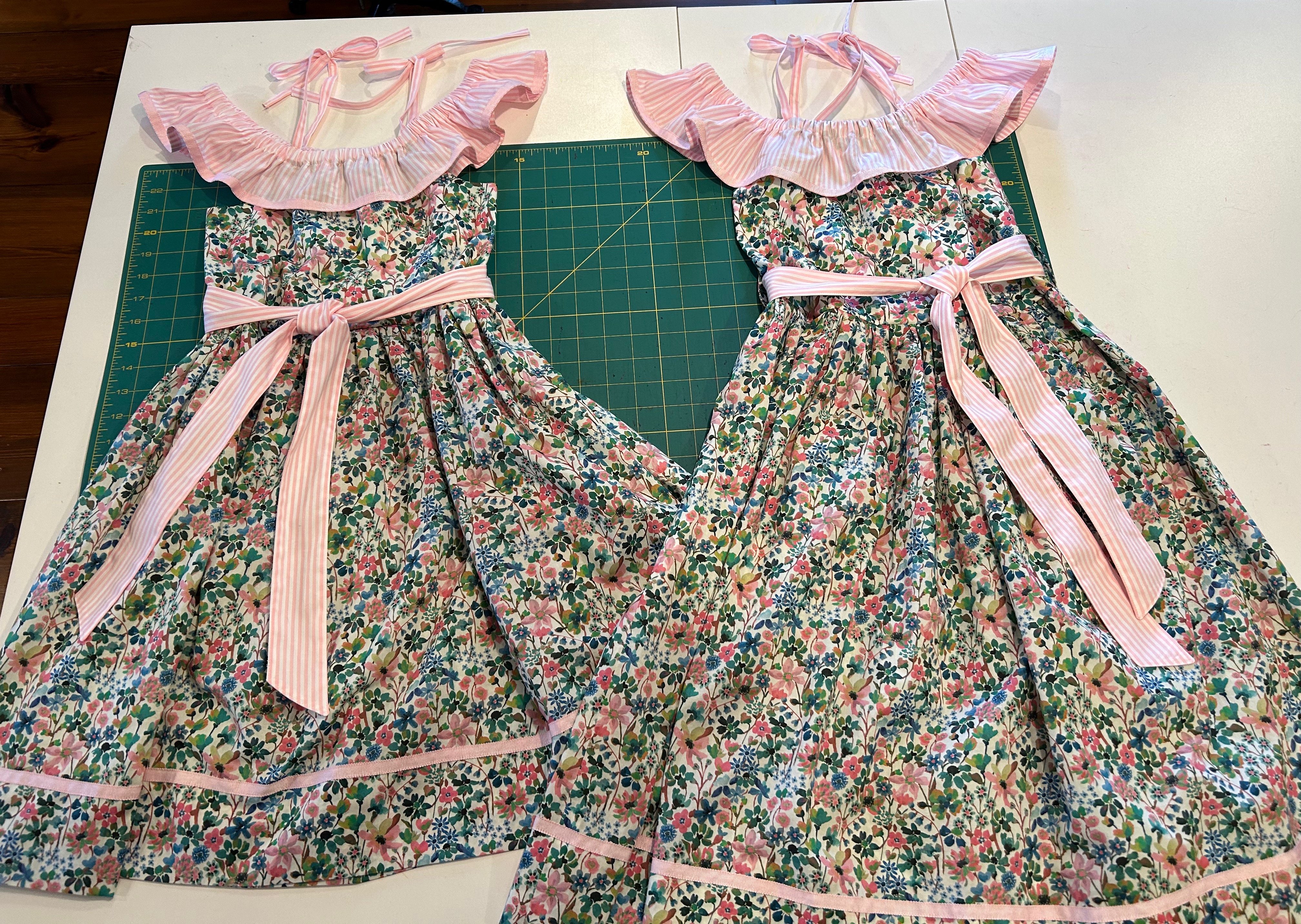
 2. A birthday/sundress for each of my two granddaughters.

I generally do not post on my blog about sewing for my granddaughters, due to the limited audience for the subject.  The girls requested dresses which they could wear “off the shoulder.” So of course, I obliged!

 3. A pink striped casual blouse.

Pale pink is always a good idea.

  4. A floral summer dress. 

I was happy to use this fabric which had been long in my sewing queue.

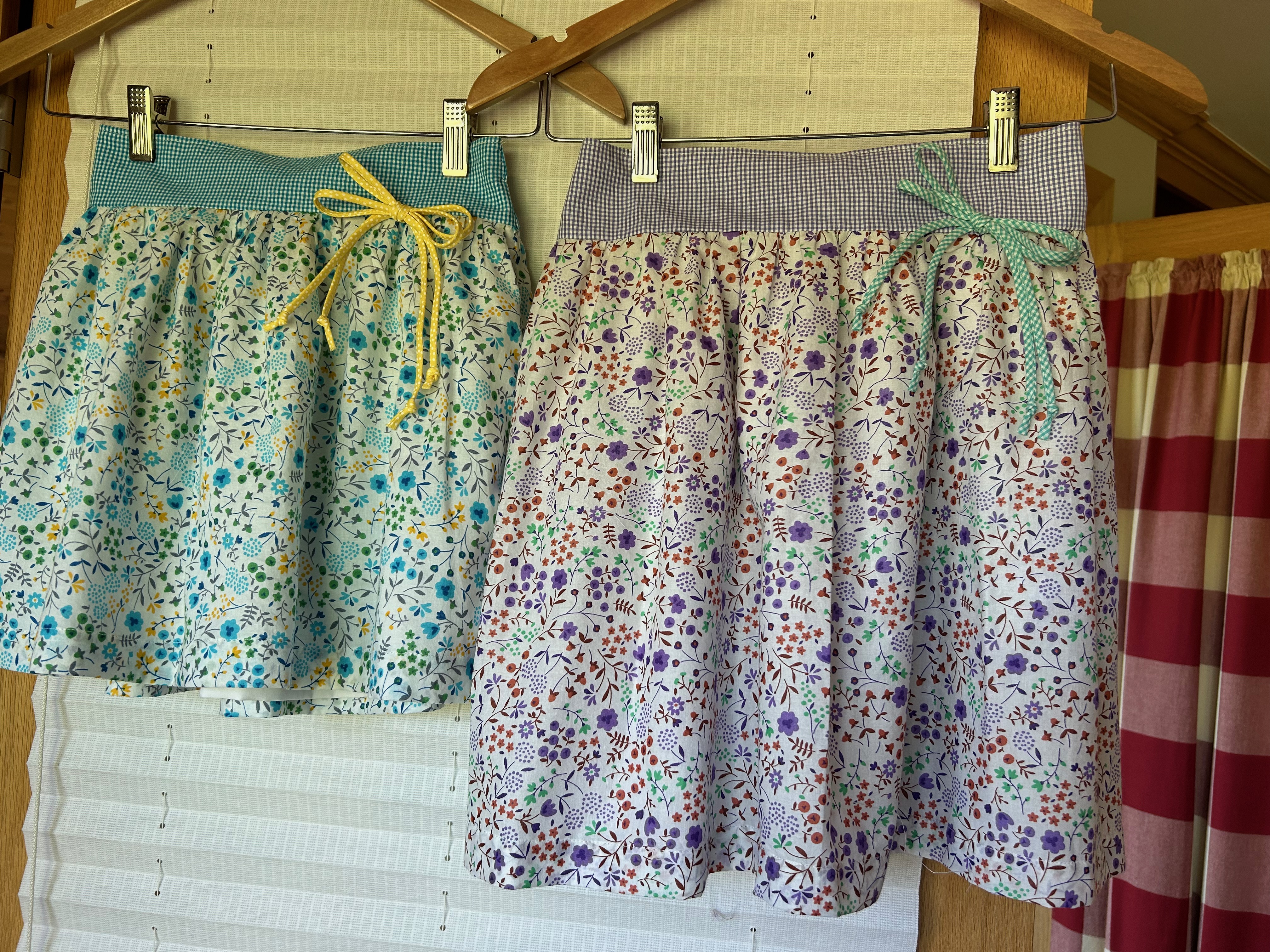
 5. Fun floral skirts for each of my granddaughters.

I used “kits” from Farmhouse Fabrics for each of these skirts.  They garnered blue ribbons and a “Best of Division” at our local county fair this past summer.  Full disclosure:  there wasn’t much competition!

  6. My 50th Anniversary linen dress made with vintage fabric.

I’m not sure I have ever made a dress which has given me more personal satisfaction than this one.  Making this dress was truly a dream come true.

  7. A fuchsia-pink silk shirtdress.

I persevered through the tricky construction of this dress made with a slinky silk jacquard charmeuse.  I had the opportunity to wear it twice this past Fall.  Perhaps the trending, pink “Barbie theme” contributed, but this dress proved to be a magnet for compliments at each wearing.  How rewarding after all the trouble it gave me! 

  8. A blouse for Fall, using some amazing vintage buttons.

I will finally admit I will never get tired of making or wearing cotton blouses. 

  9. And some miscellaneous (and minor) gift and holiday sewing.

That’s it!  

And I’m perfectly fine with it.  I did what I could, and three of my projects had high priority (my girls’ birthday dresses, my anniversary dress, and my pink shirtdress).  Completing them was very satisfying.  

So what about my last make of the year – that blouse for Fall?  

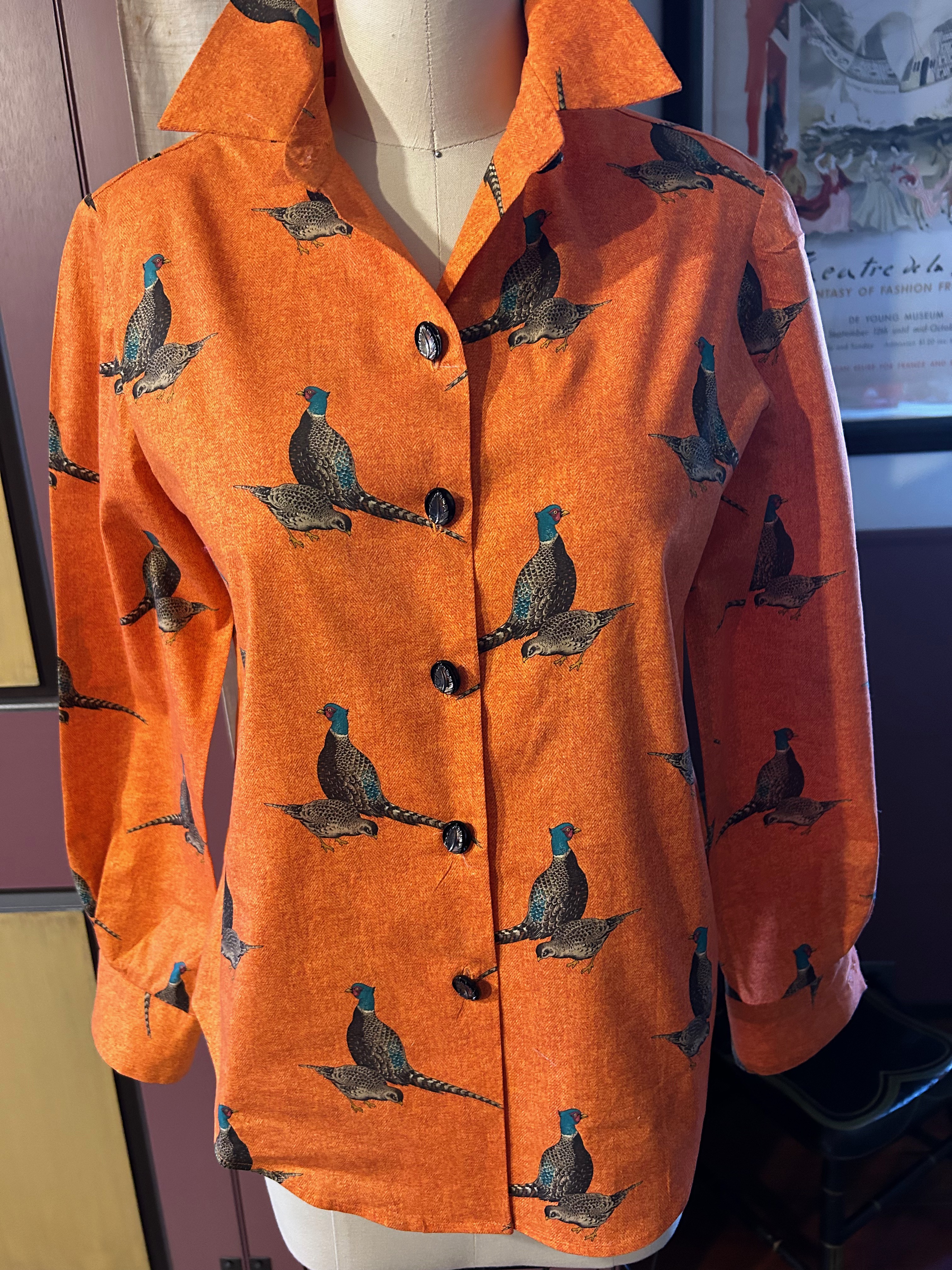
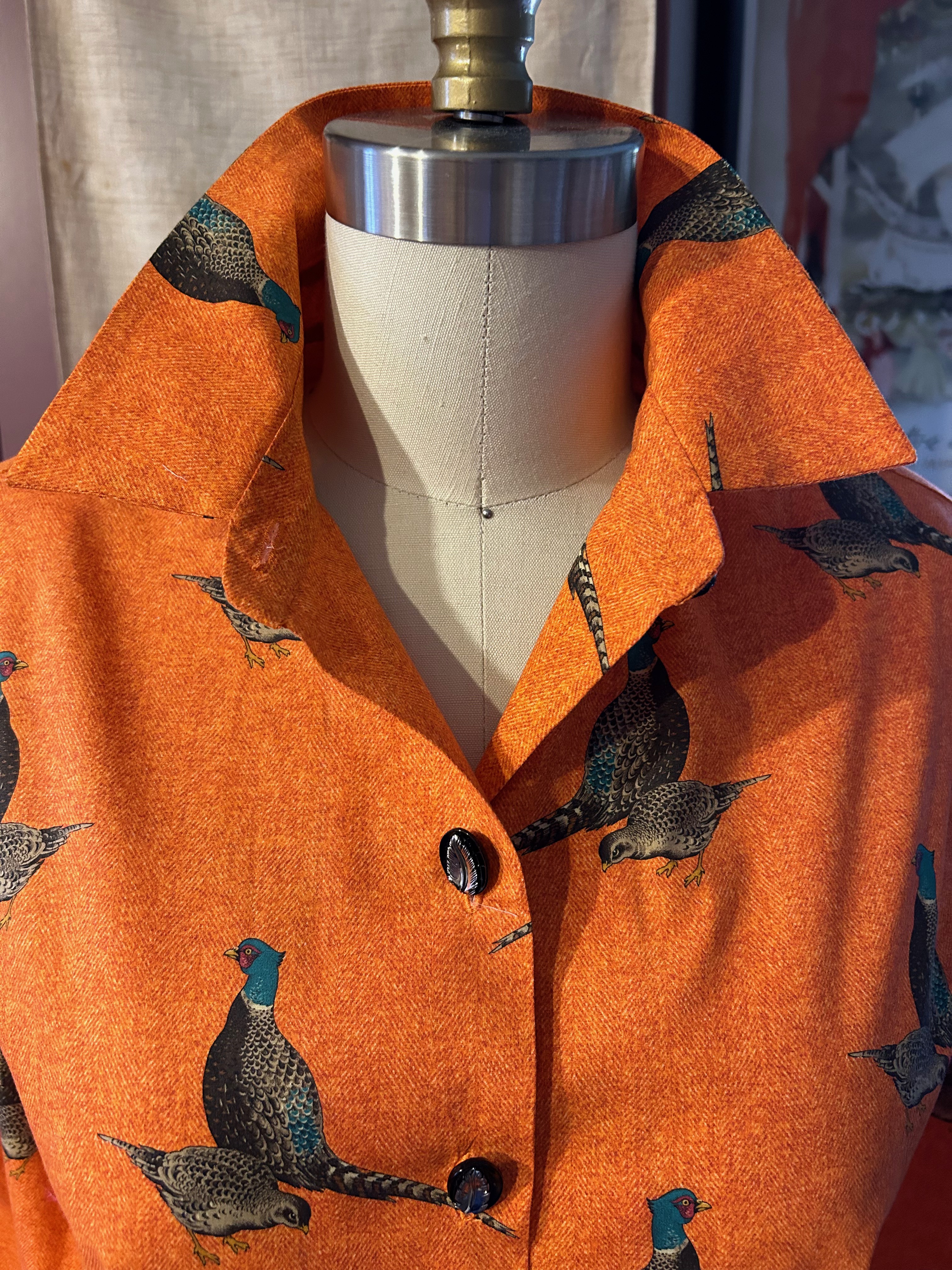
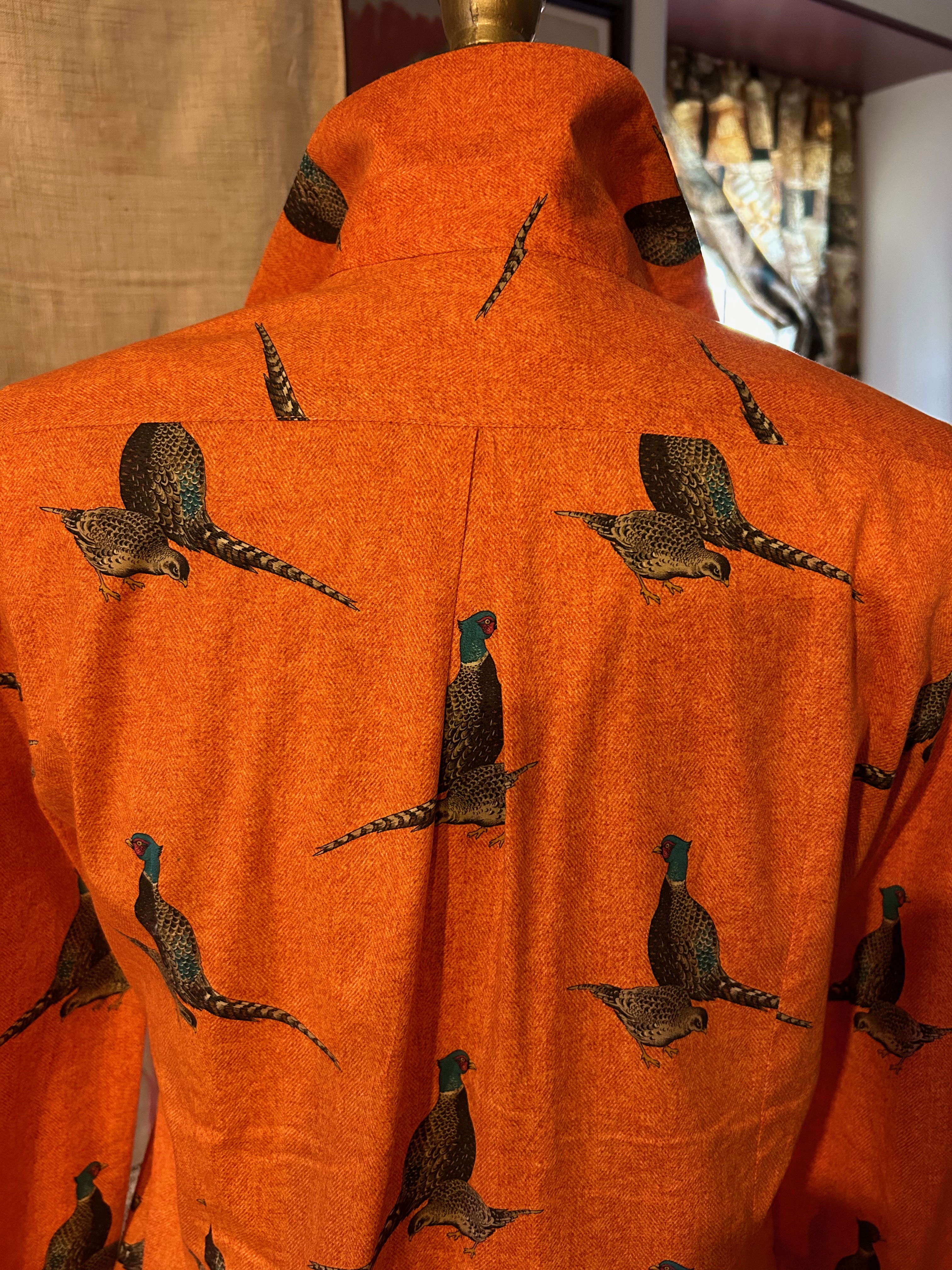
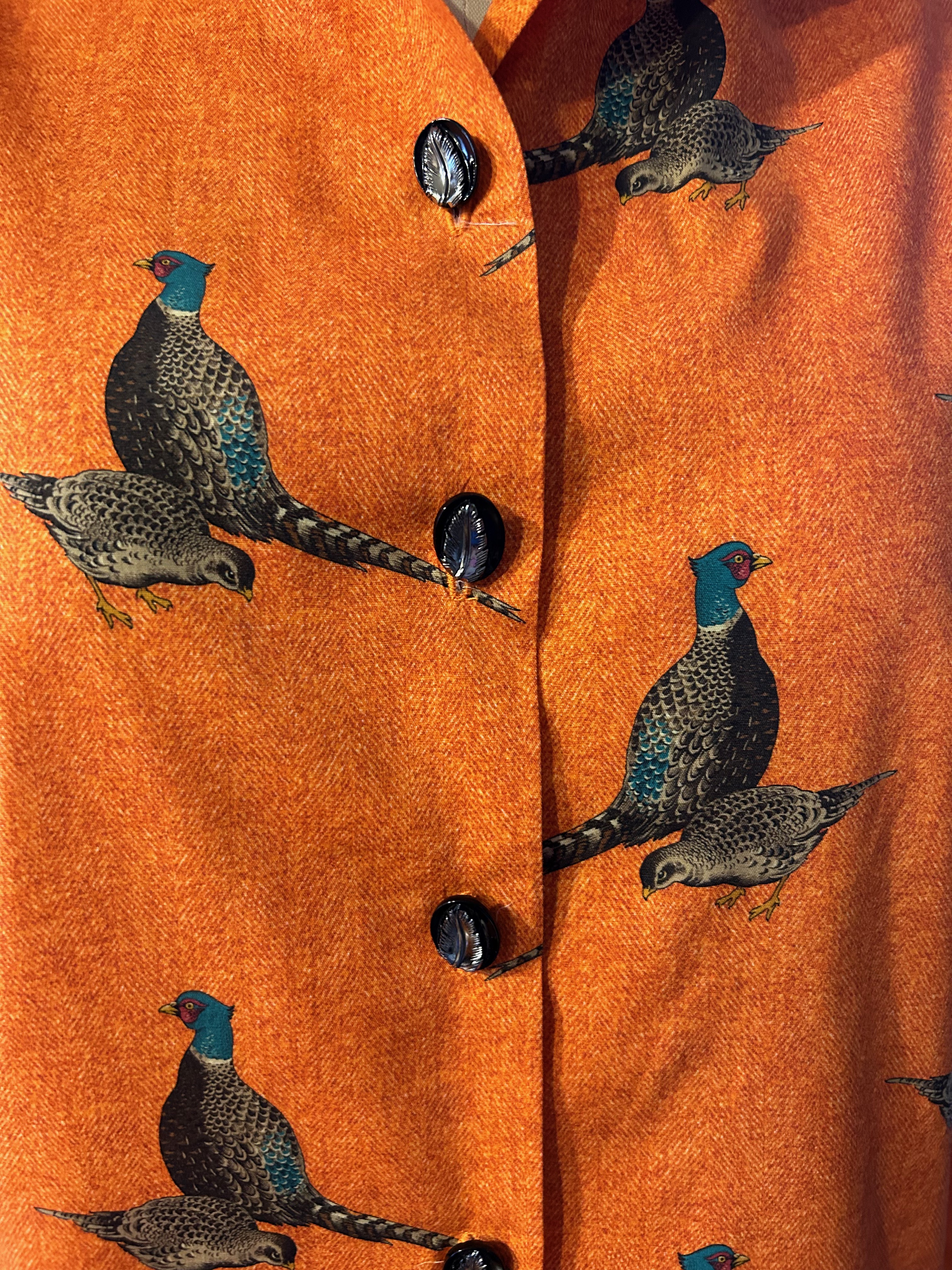
It’s very orange.  And with the pheasant motif, it is very autumnal.  However, with Fall undoubtably being my favorite season, it seemed fitting to have a piece in my blouse wardrobe devoted to that time of year.

I found the fabric on the website of Emma One Sock Fabrics a couple of years ago.   It is a beautiful cotton with a very slight stretch to it.  The quality is superb, being silky soft and very easy to sew.  The Herringbone printed background makes it look like a much heavier fabric than it really is.

I debated on the style bouse to make, thinking a bow blouse would be lovely.  However, in order to make this as versatile and wearable as possible, I defaulted to my regular shirt/blouse pattern, which I have altered and tweaked many times.

Here is that blouse pattern I have used over and over.

   I also thought this pattern would be the one most likely to show off the buttons I intended to use with the fabric.  

I can’t remember what came first – the fabric or the buttons.  Somehow I was lucky enough to find these vintage Ultra Kraft buttons with their feather motifs.  Just bordering on a bit too big for a blouse, these buttons seemed to balance the large pheasant groupings, making both fabric and buttons a good match.  I didn’t realize until I had finished the blouse how much the silver in the buttons picks up the lighter colors in the feathers of the pheasants.  There is a little “sparkle” in there!

I was able to wear this blouse a couple of times in season.  Now it seems a long time away until its next wearing…  

Which begs the question: what will transpire in the ensuing months – between now and then?  I will wait and see how and when inspiration hits.  What about you?  

44 Comments

Filed under Blouses, Buttons - choosing the right ones, Uncategorized, vintage buttons

A Fussy-to-Make, Fuchsia-Pink Silk Dress

Sometimes extra incentive is needed to push through a project which turns out to be more difficult than anticipated.  Such was the case with this pink silk jacquard dress.

I had purchased this fabric quite a few years ago online from Britex Fabrics.  I knew it was a dressy fabric, and unsure of what form this dress would take, I made the decision to purchase four yards of this 58” wide silk.  That gave me some latitude in my selection of pattern.  

Finally last Spring I made a decision about what I wanted this dress to be.  That was precipitated by the arrival of a beautiful invitation to a very special event this Fall, and of course (!) I needed a new dress to wear to it. The fabric is a dressy, shimmery silk jacquard, so by its very nature it would make up into a dress which had a certain glamour to it.  

I decided to use a go-to pattern I have used a few times already and make a classic shirtdress.  That may seem like a strange choice, but I envisioned it as very dressy and flowing, and quite appropriate for the fabric.  

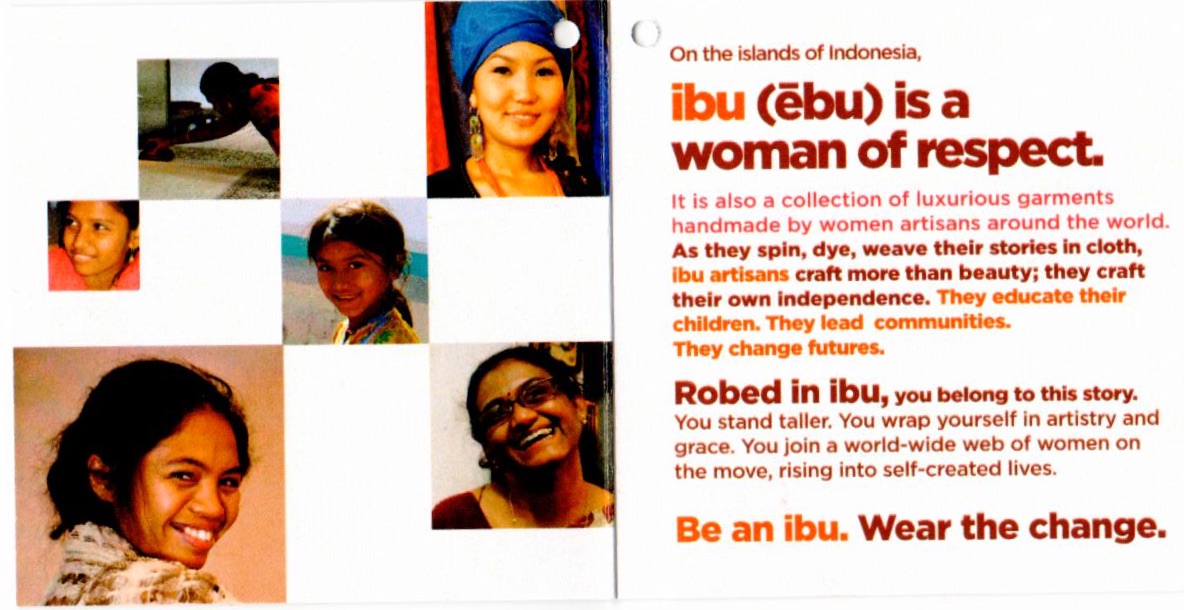
While this idea was percolating, I happened to attend a luncheon/presentation by a wonderful organization called the Ibu Movement.  (Pronounced ebu, with a long “e,” this is an Indonesian word meaning “a woman of respect.”)  

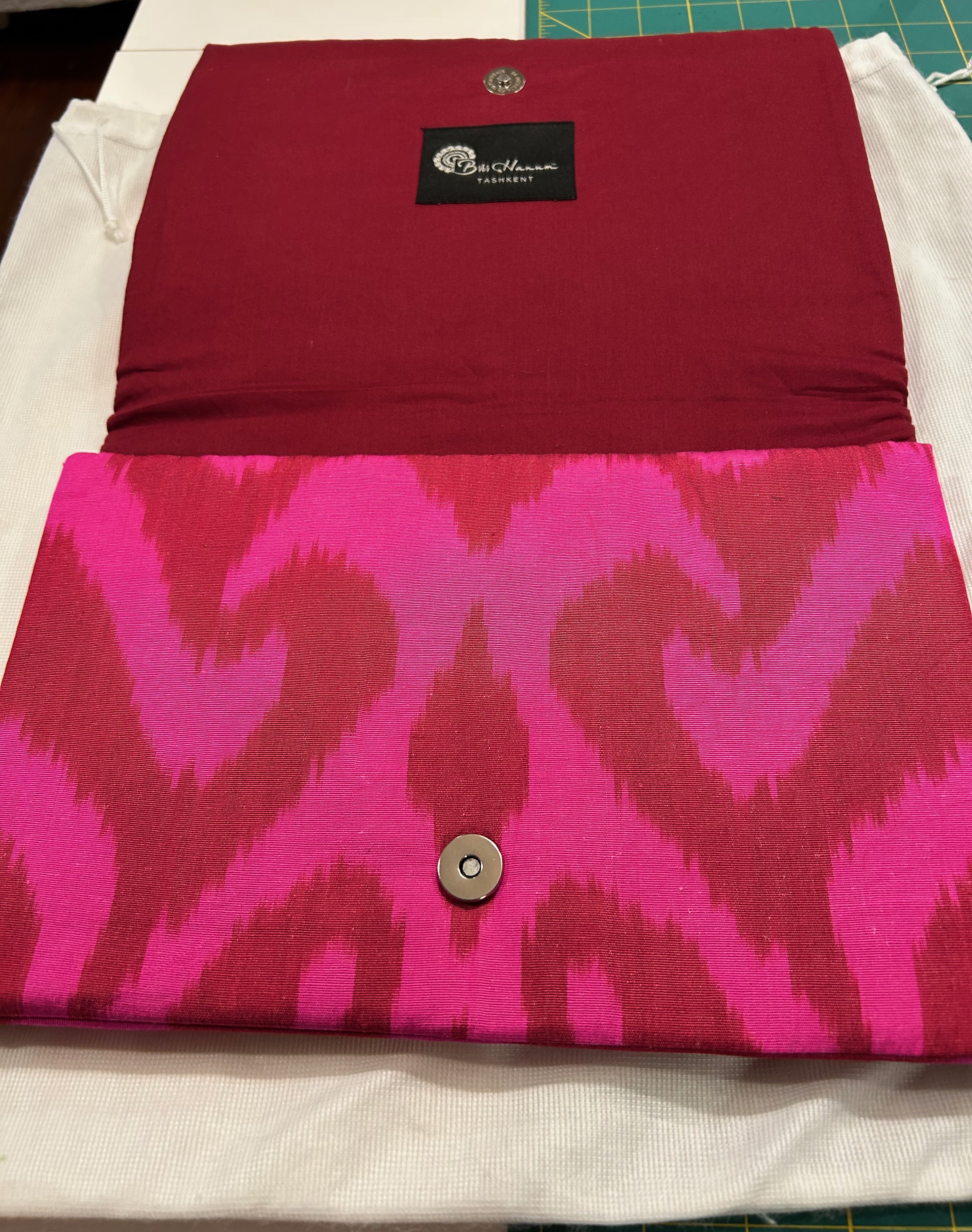
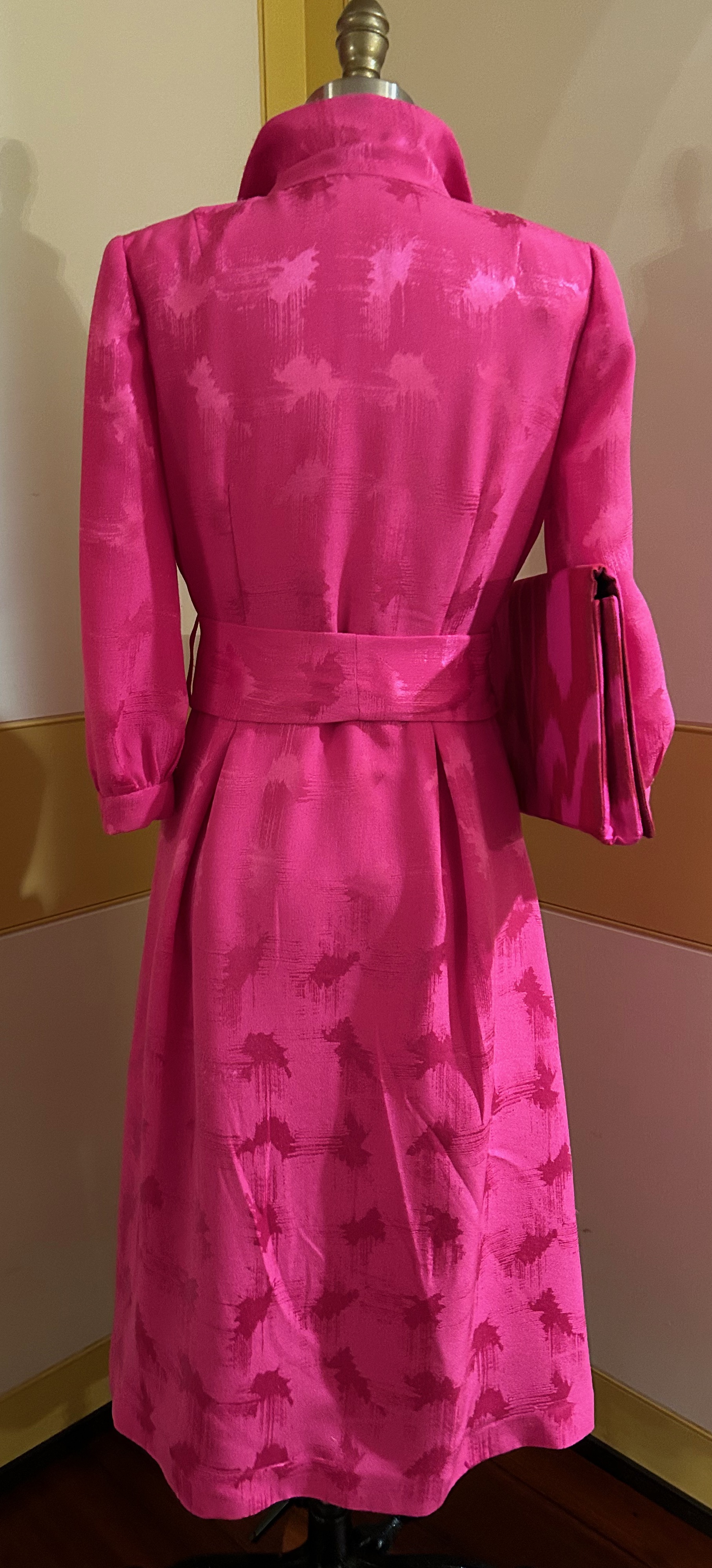
The pop-up shop accompanying this event was filled with gorgeous clothing, accessories, even shoes. When I saw this envelope clutch, I knew it would match my silk fabric perfectly and would be the perfect addition to my as-of-yet-to-be-sewn pink dress.  Little did I know at that time it would be the catalyst to make sure I finished the dress!

My first clue as to the fussiness of the fabric was as soon as I pressed it and laid it out for the placement of my muslin pattern. Here is what I noticed:

  1. The fabric had a slightly loose weave to it, making it almost stretchy, certainly very slinky.  Keeping it properly aligned on the straight of grain was going to be a challenge.  
  2. The fabric frayed easily.
  3. It also was prone to shedding silk fibers.  I decided I needed to handle it as little as possible to mitigate this situation.
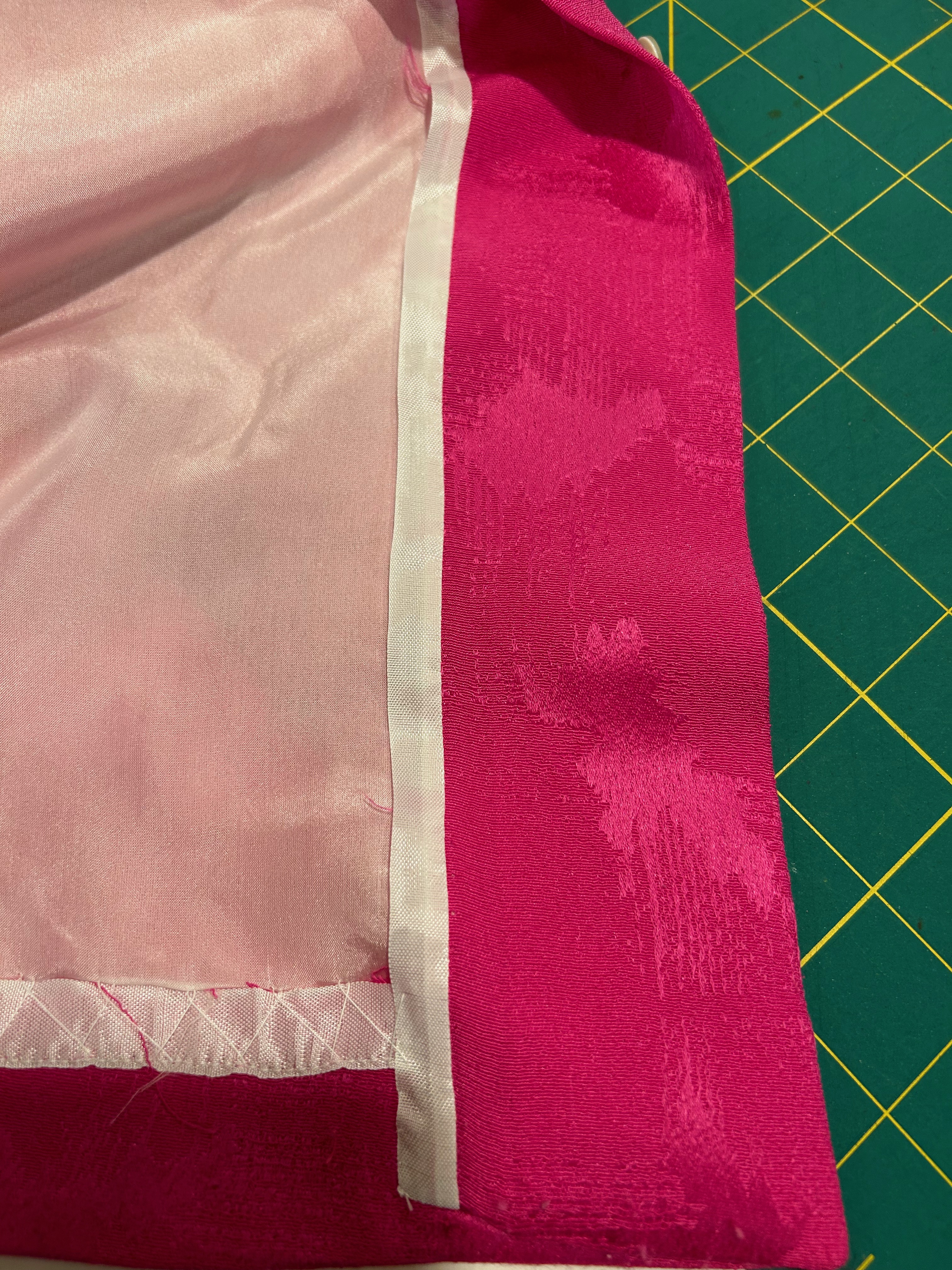
  4. The jacquard weave in it had a definite horizontal and vertical pattern to it, meaning I would have to match the design horizontally and vertically across seams.  Although I am used to matching plaids and prints, this was a little different as the woven design was of irregular form.
The irregular nature of the weave is apparent in this photo.

I decided to underline the dress (except for the sleeves) with a very lightweight silk batiste, which I hoped would give it some substance, but still preserve the flowing nature of the fabric.  I made the conscious decision not to add an additional lining to the dress.

Although I rarely use fusible interfacing, I realized very early on that sewn-in interfacing was going to shift around and cause all kinds of problems.  Luckily, I had been introduced to a very finely woven, fusible German interfacing available from Farmhouse Fabrics.  I had some on hand and found it to be the perfect stabilizing foundation for the cuffs, the front facing, the collar, the collar stand, and the hem.  

So, that solved one big problem for me.  I was still concerned about being able to get the hem even.  I had good reason to be concerned!  It took two tries to avoid having either a bubble appear or uneven dips around the perimeter. 

The final quandary I had was the buttonholes.  Because the fabric shed silk fibers so easily, I was really worried that my buttonhole attachment might grab onto those fibers and make a mess.  I did some sample buttonholes, which confirmed my suspicions.  So – I used wax paper between the foot of the attachment and the fabric, cutting little windows in the wax paper where the buttonholes would be sewn.  It worked like a dream.  

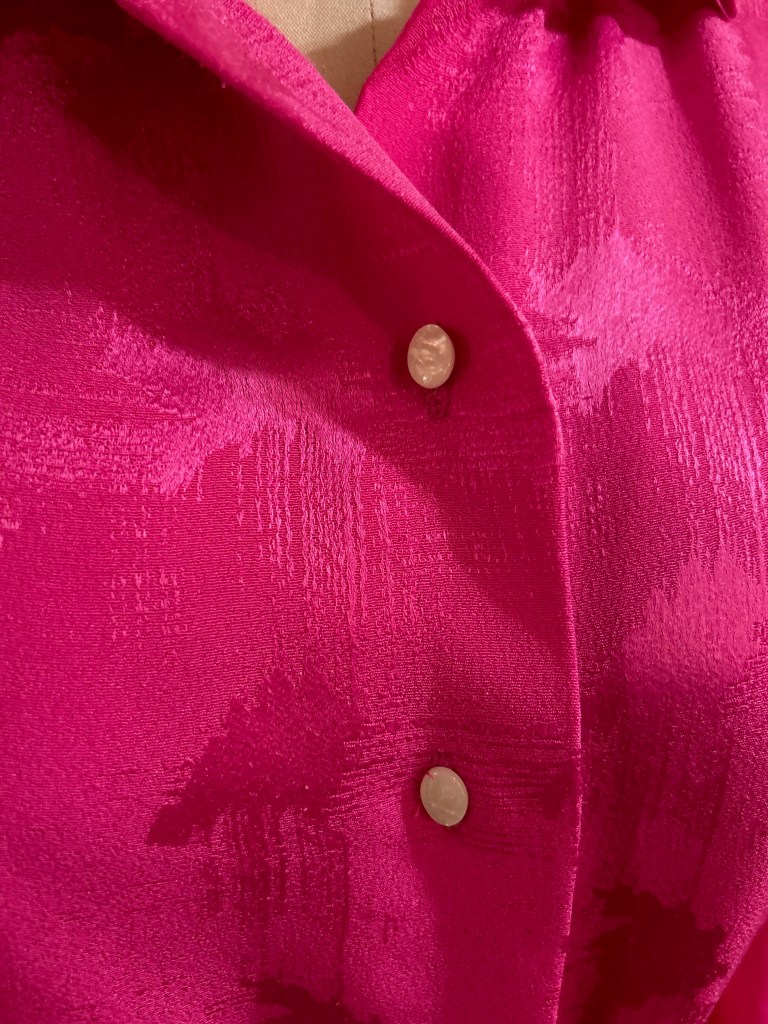
I found vintage pearl buttons with a slight iridescence to them which I thought worked well with the fabric.
And here is that handbag with the dress!

This was not a particularly fun dress to sew, but that “perfect” handbag kept me focused.  And I am glad it did, as the dress was a success in the end.  And it always feels like an accomplishment to use fabric which has been lying in wait for so long.  

29 Comments

Filed under Buttons - choosing the right ones, Cocktail dresses, Linings, sewing in silk, silk, Uncategorized, underlinings, vintage buttons, Vogue patterns

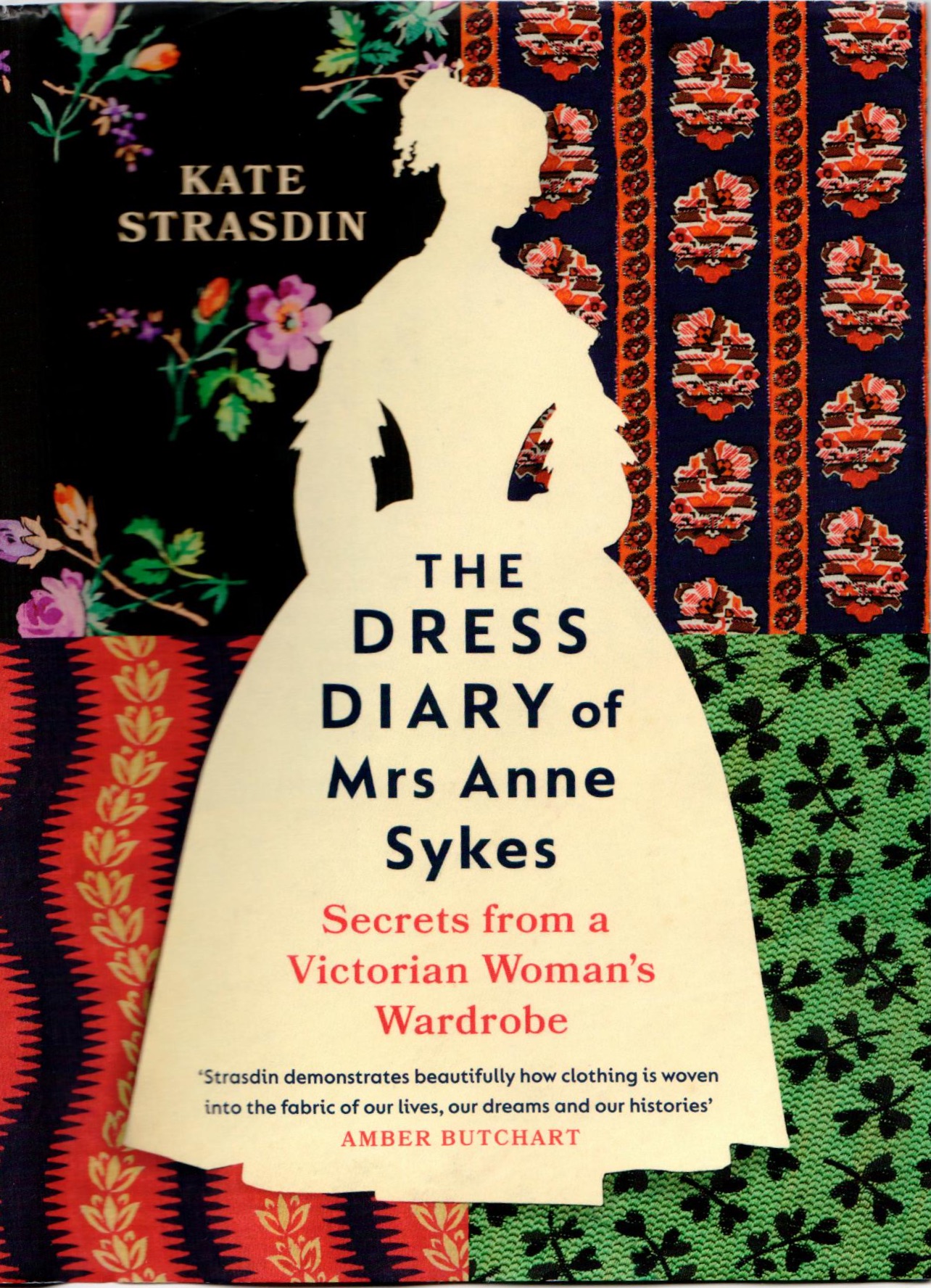
A Book Review:  The Dress Diary of Mrs. Anne Sykes – Secrets from a Victorian Woman’s Wardrobe, by Kate Strasdin.

Every once in a while, I find myself having fallen under the spell of a particularly noteworthy and engaging book.  Such was my fate with this remarkable story of an Englishwoman (1816 -1890) and her journal of fabric swatches, saved from her own life and collected from family, friends, and acquaintances over the course of decades, beginning in September of 1838.  

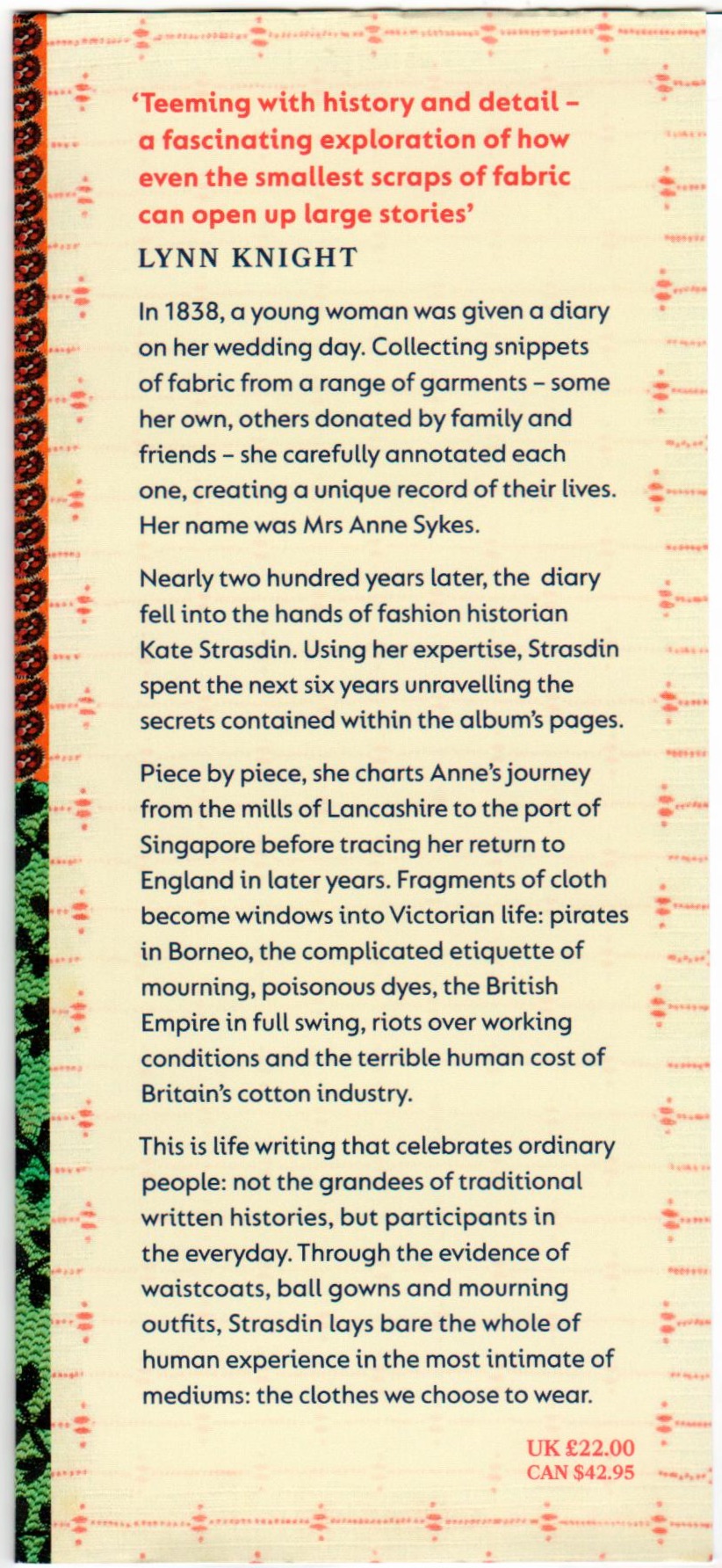
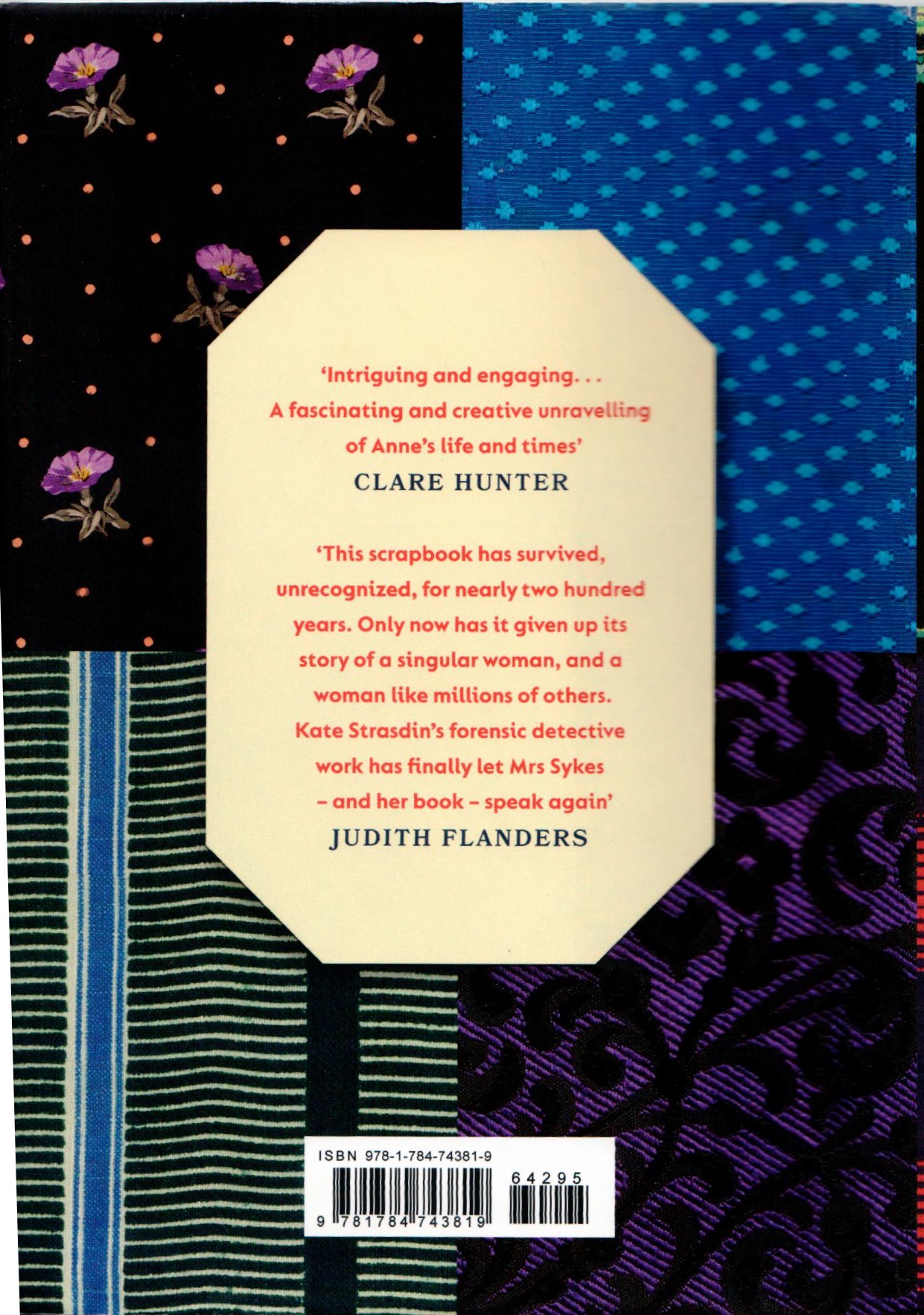
This book was first published in England and then a few months later in the USA. My copy is the version published in England, the book jacket of which varies from the version published in the USA.

With over 1200 fabric entries, the diary – or journal – gradually revealed its secrets to the author, a fashion historian, who painstakingly transcribed the often sparse notations  accompanying each fabric sample, piecing together the fascinating  life and times of Anne Burton Sykes.  The research is meticulous, and the author, Kate Strasdin, shares her eureka moments which allowed her to expand not only Anne’s life, but those of her friends and family as well.  Written in an engaging style, this non-fiction book often reads like a novel, a wonderful story of love, friendship, adventure, and vibrant personalities.  

There is so much to learn here about Anne’s life in the larger context of world history and events, but it is the personal experiences and expressions which spoke so loudly to me.  Yes, there are many details which, by the nature of the journal, must be extrapolated and surmised, which the author is careful to note.  But the picture of Anne – and her husband Adam – which evolves is one of two very likeable people, engaged in their community, industrious and thoughtful, friendly and adventurous, and undoubtably well-dressed.  

The first entries in the journal, of Anne’s wedding attire, were actually placed and annotated by Adam.  He was the one to give Anne the journal on their wedding day.  He refers to her as “my charming Anne.” Not beautiful, not sweet, not dear, but “charming.”  That single selection of adjective spoke volumes to me about each of them.

She also must have been brave, enduring a four-month sea voyage from northern England to Singapore, where Adam’s business took them two years after their marriage.  There they built a life among other English-speaking neighbors and acquaintances, in the stifling heat and humidity of the south China sea.   After seven years in Singapore, they went on to Shanghai for two years (where the diary goes silent for the duration), and then back to England.

 Anne’s friendships with other women throughout her life are apparent in the swatches she receives from so many in her circle.  The exchange of gifts and tokens of friendship take form in dress-goods (cotton, wool, silk), ribbons, pieces of lace, and snippets of sashes. There appeared to be a remarkable camaraderie among all ages and between the sexes.  

The author has done a masterful job in deciphering the life and persona of Mrs. Anne Sykes through so many diverse fabric swatches.  Anne’s kindness, her circumspection, her devotion to family and friends, and her small place in history make for a wonderful, enlightening story.   I am very grateful to have had the opportunity to read and savor this book. 

11 Comments

Filed under Book reviews, Fashion commentary, Fashion history, Uncategorized, Vintage fabric