Category Archives: Uncategorized

Can you zip me up, please?

This is a completely unscientific observation, but it seems to me that the zipper has made a fairly substantial migration over the years – from the side of the dress – to the back of the dress.  If that sounds confusing, let me explain a bit more, by showing you some of my dress patterns which date from the 1950s.  All of these dresses feature a side zipper, placed a few inches under the left arm and extending a few inches below the waist (or, in other words, these zippers open within a garment seam.).
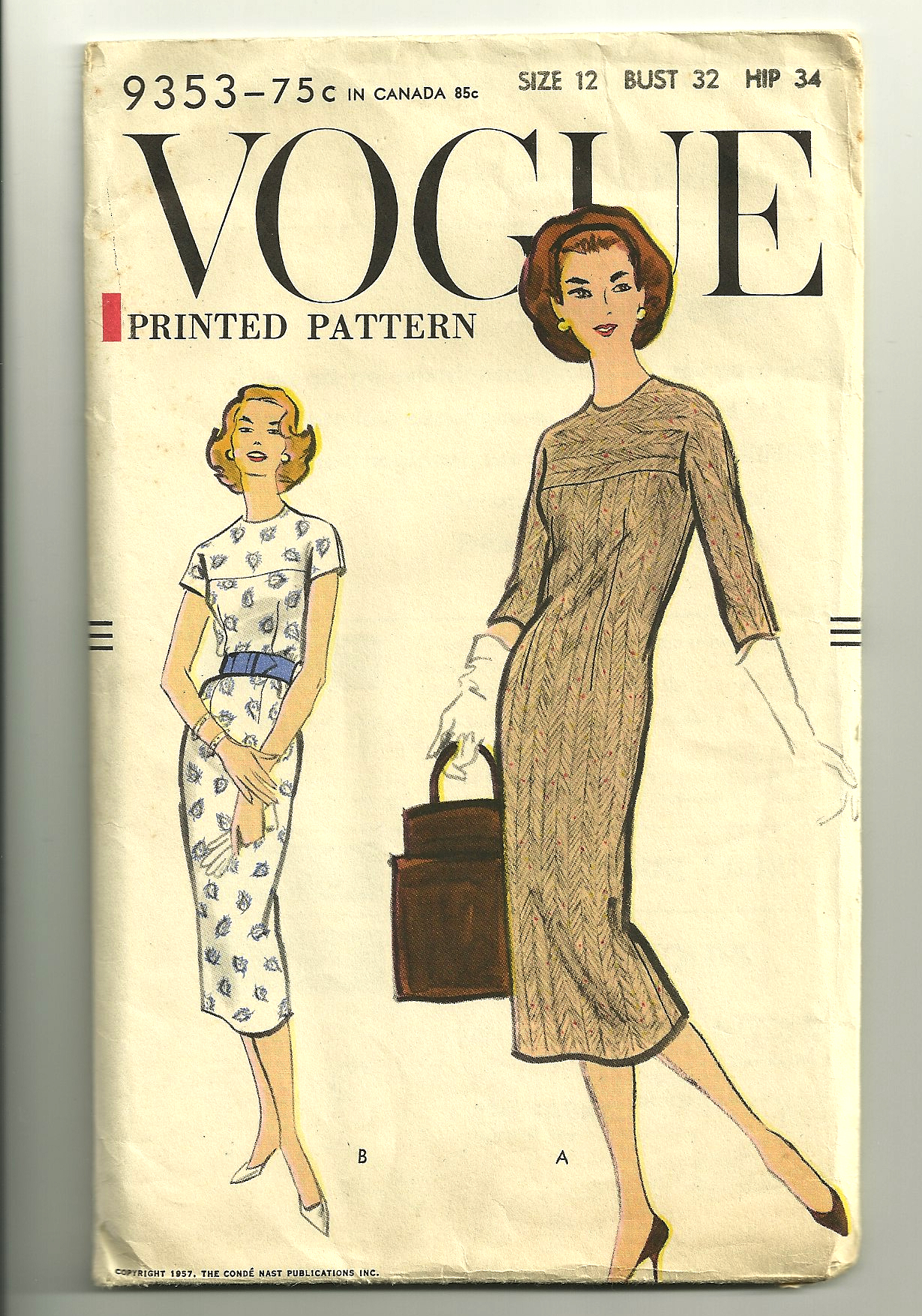
I love the clean lines of this dress from 1957, with the "yoke" effect which extends into the kimono sleeves. The back of the envelope shows more detail.
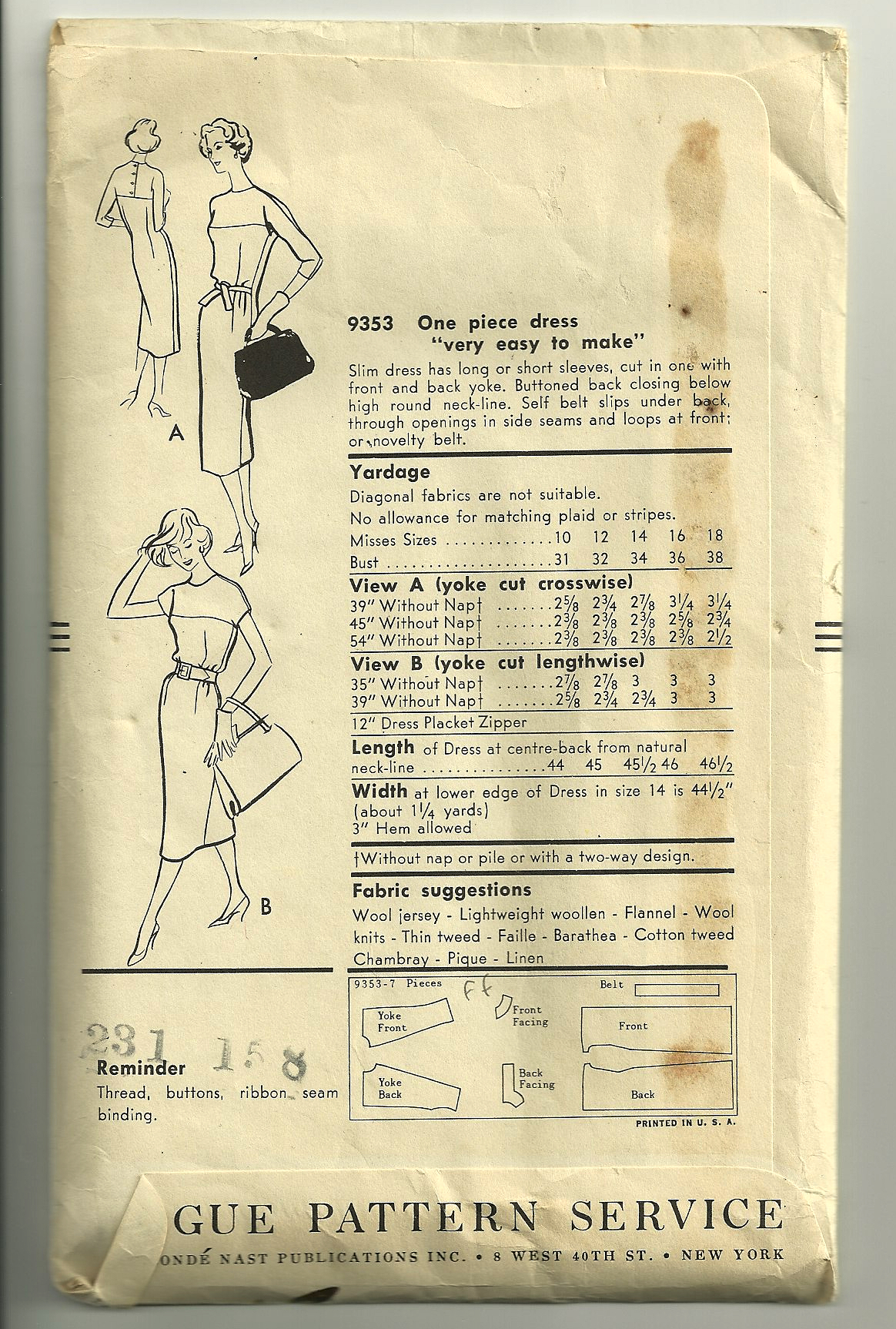
You can see from this back view that, although the top back yoke buttons, a side zipper is still necessary to get the dress on!
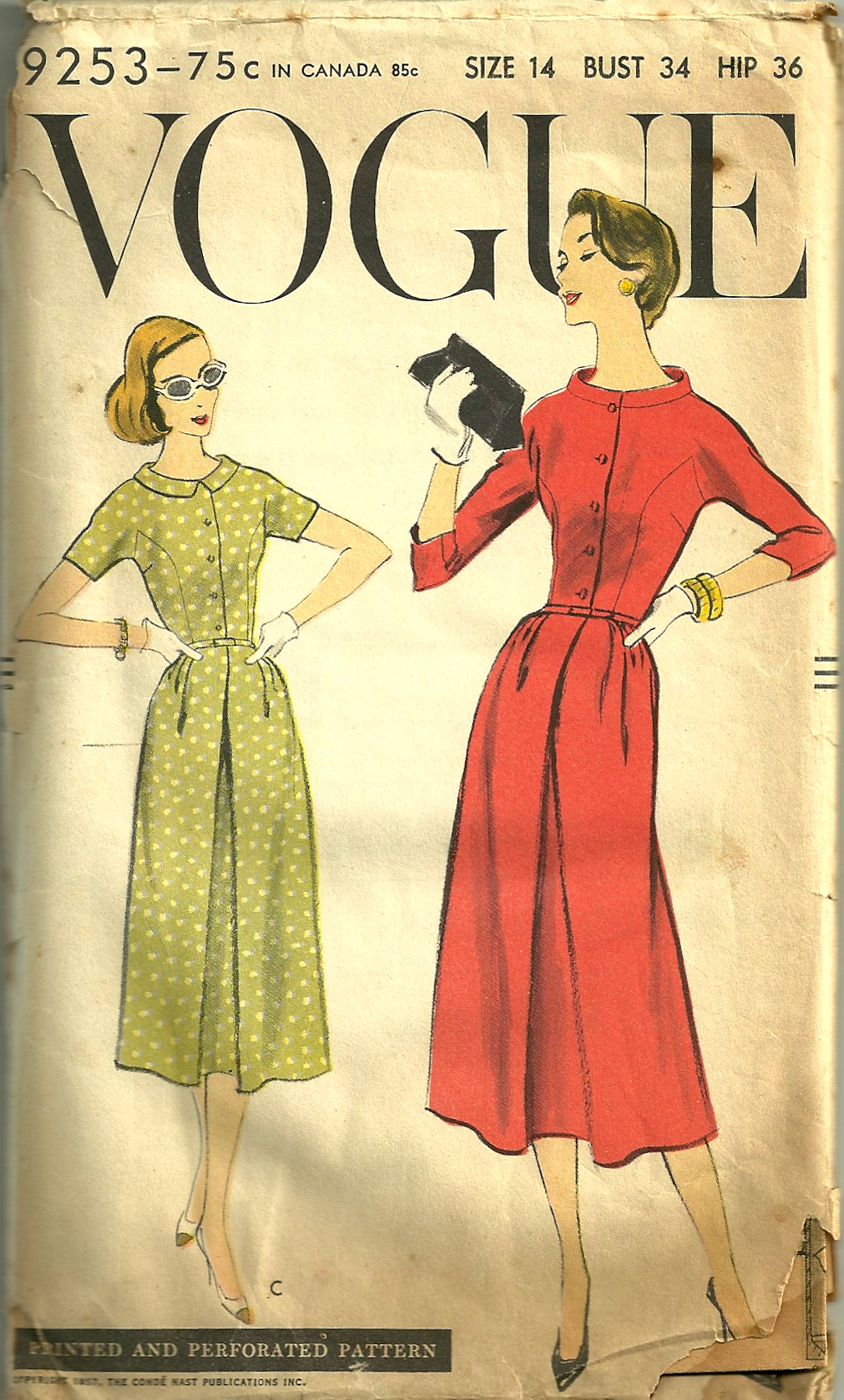
The front on this dress only opens to the waist, so a side zipper enables one to step into it. This pattern is dated 1957.
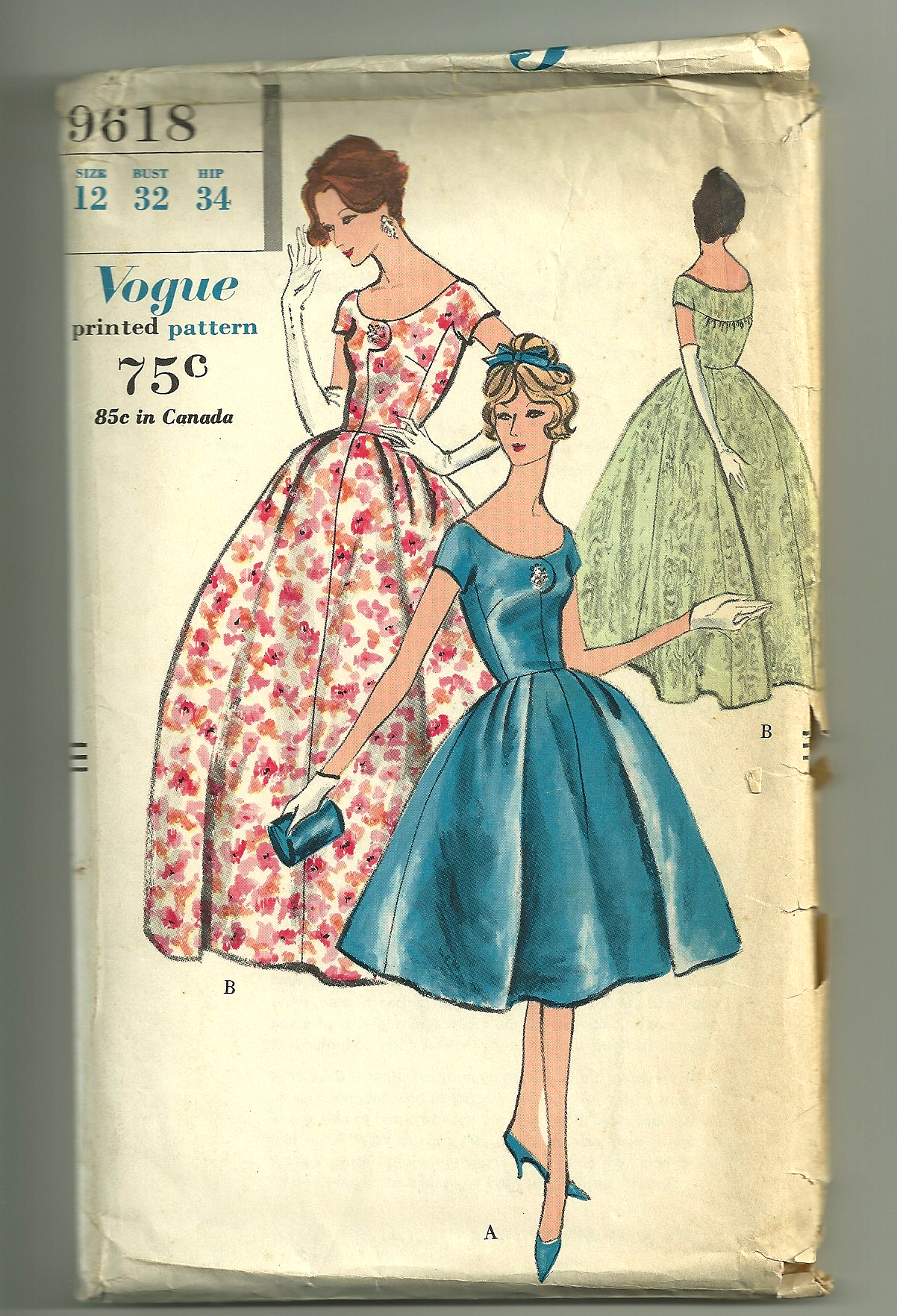
The back detail on this evening gown from 1958 would have been interrupted by a center back zipper, but a side zipper preserves the designer's intent.
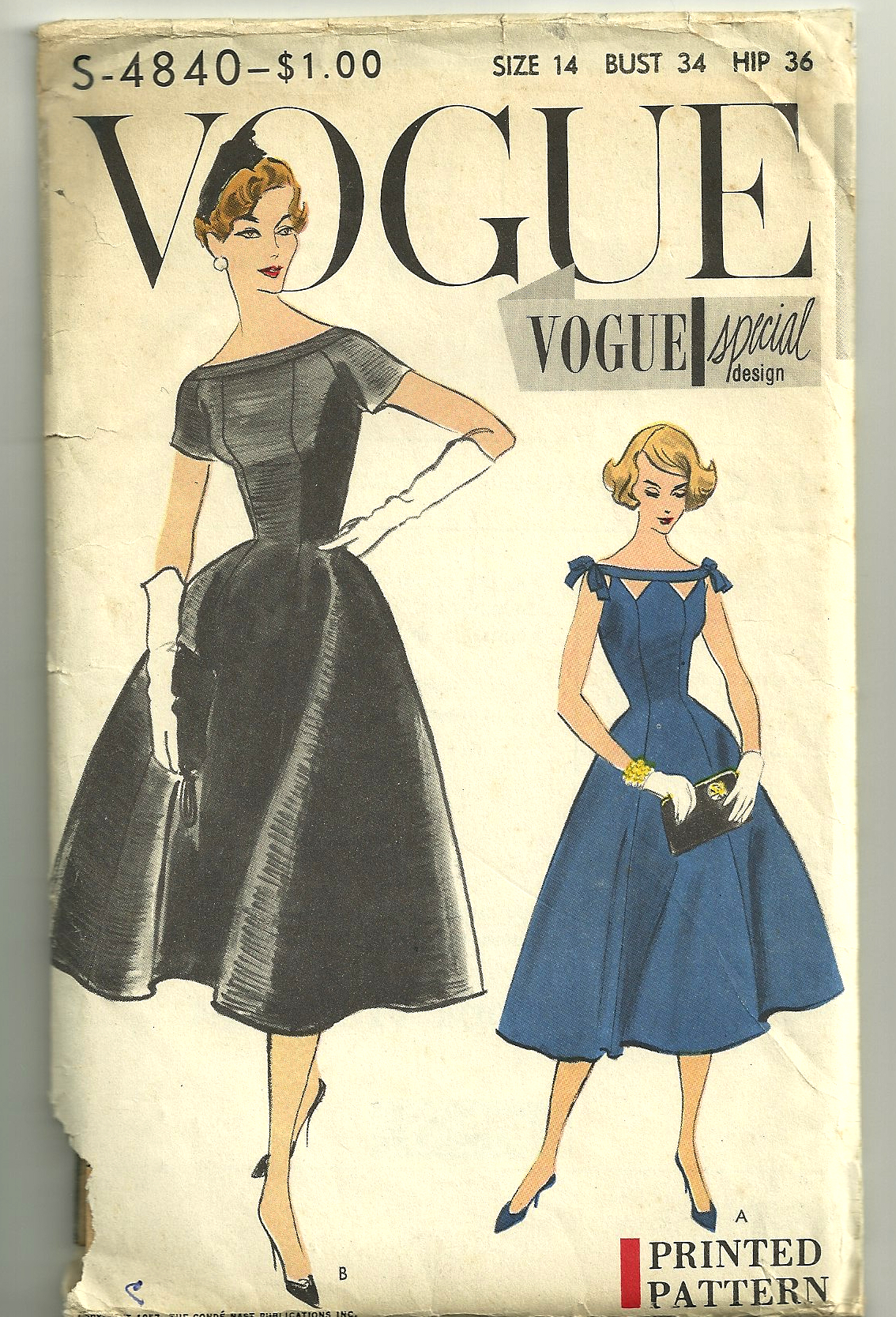
I love this dress design from 1957, which simply would not work using a center back zipper.

Patterns from the last half of the 1960s start to feature more and more zippers which are placed in the center back of the dress, and by the 1970s, it seems, almost all zippers were center back ones.
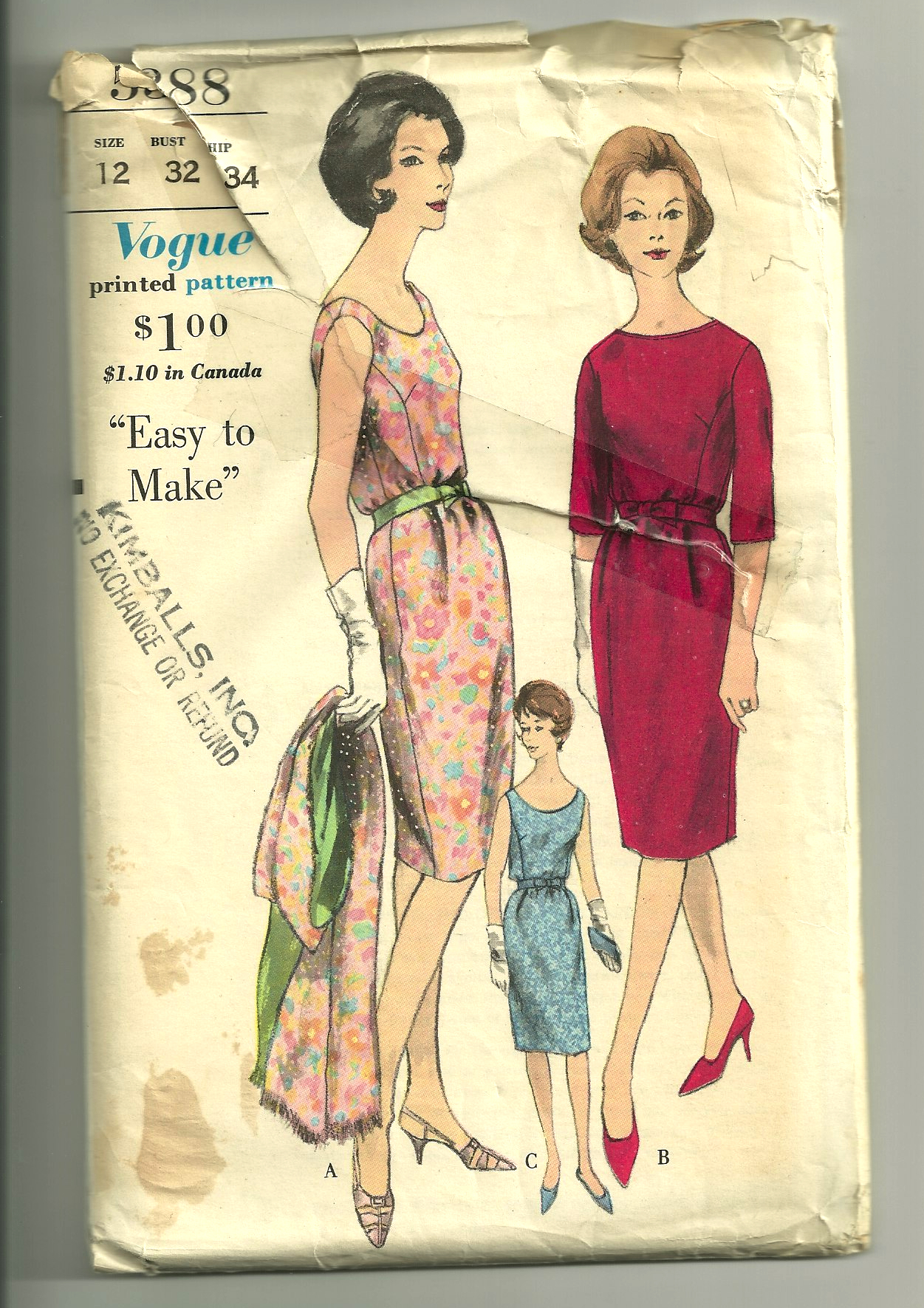
This design from the early '60s would work with either a side or center back zipper, but the pattern calls for a center back one, thus showing the start of the transition.
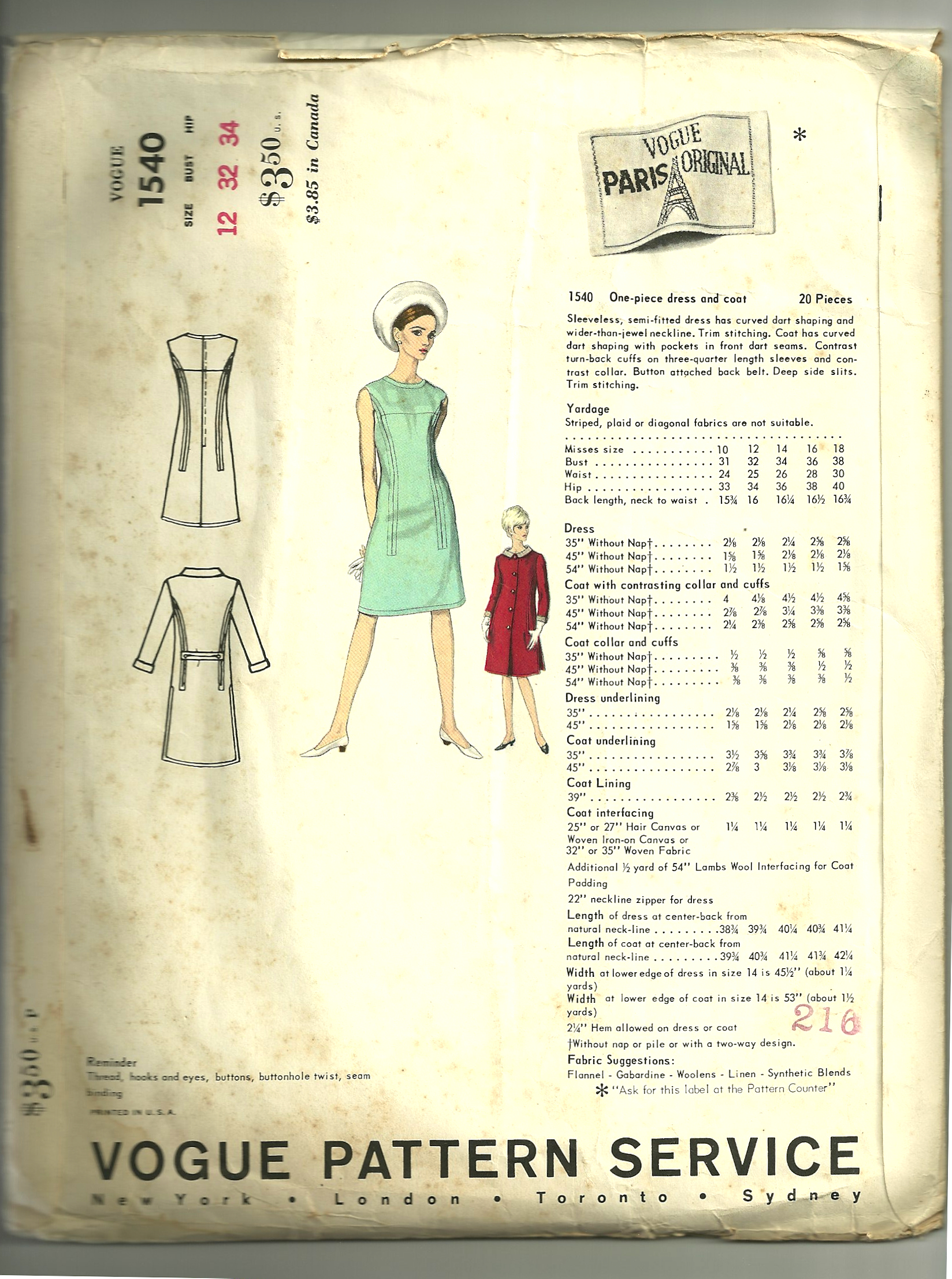
The dress on this pattern is actually my next project! It is a design by Jacques Heim from the 1970s. I'll be inserting a 22" neckline zipper in the back of this dress.

A casual look at vintage clothes from this time period also seems to support this observation (with the occasional exception to the rule, of course.  I actually saw a side-zippered dress at J.Crew one day this week, but it’s not the same, really, as the dress is sleeveless and the zipper parts at the top, under the arm.)

To try to understand some of the dynamics of this zipper conundrum, I went to my 101 Things I Learned in Fashion School book (by Alfredo Cabrera with Matthew Frederick) to see if I could find any entry on zippers.  Here is what I found on page 64:

“Center back zippers are like fine crystal:  best reserved for special occasions.  When a student designs an interesting garment and is asked how the wearer gets into it, the common answer is, ‘center back zipper.’  This solution is favored by inexperienced designers because it doesn’t require an invasive change to a garment.  But a back closure is rarely a satisfactory solution; it’s a fussy, frustrating concern when one has only fifteen minutes to dress for work.

“Back closures are a remnant from an era when women wore corsets and hoopskirts and had maids to truss them up in back.  Today they are more appropriate in association with major events.  On her wedding day or Oscar night, after a woman has spent a lot of time and money on her hair and makeup, she is more likely to want to step into her dress than pull it over her head.  A center back zipper implies a fitting sense of occasion.” [my emphasis]

Side-placed zippers are different from center-back zippers both in name and detail:  side zippers are called “dress” zippers and have bottom and top “stops”, while zippers for the center back (or skirts, pants, shorts) are called “neckline” or “skirt” zippers and, of course, open at the top with a stop just at the bottom.  (Skirt and neck zippers can easily be made into dress zippers by putting a few tacking stitches to anchor the two sides together right above the pull.)  Back in their hay-day, dress zippers were available in lengths from 10” to 14”. Skirt and neckline zippers are still available in lengths ranging from 6” to 24”, but they are now called “all-purpose” zippers.

So why, since the ‘70s, have most side dress zippers been replaced by neckline zippers placed center back?  I guess there are several potential answers to that question, including:

1) a lot of us would rather step into our dresses than pull them over our heads even if we are not dressing for a special occasion.

2) laziness or ignorance  (both kind of strong words, for which I apologize to anyone offended!) or practicality on the part of designers.

3) it’s just become the accepted way of closing a dress.

4) the invisible zipper made application of the zipper easier and the finished look more streamlined.

5) Huh? What’s a side zipper?

I’m sure there are lots of other explanations but my favorite one is a bit more romantic…   James H. Boren put it succinctly thus:  “A dress that zips up the back will bring a husband and wife together.”   I’d say that is a “fitting sense of occasion”!
3 Comments

Filed under kimono sleeves, side-placed zippers, Uncategorized, vintage Vogue patterns from the 1950s, vintage Vogue patterns from the 1960s, vintage Vogue patterns from the 1970s, Vogue patterns

Spring-Summer Fashion Show – A Day Remembered from 1976

I was working in center city Philadelphia in 1976.  The venerable John Wanamaker Department Store was just a few blocks away from my place of employment – and often I would grab a quick yogurt and crackers for lunch and then head over to the Fabric Department to spend the remainder of my lunch hour dreaming among the bolts of silks and linens, cottons and wools.  It was about this same time of year – mid-March – when I saw a notice about a fashion show, which was going to be held at the store.  It was to feature Vogue patterns, and the sole fabric of choice was to be American-made silk.  Well, this was quite enough to make a girl’s heart go pitter-patter; this was one show I was not going to miss!
When the appointed day arrived, somehow I carved out the time from work and scurried off to the top floor of the Wanamaker building which housed the “designer fashions” department.  I was feeling a little young and naïve among the well-dressed ladies in attendance, but that did not deter me!  I was in heaven as I saw one gorgeous outfit after another, all in glorious colors of the most beautiful silk fabrics.  I came away with the printed “program” from the show and have kept it all these years.  Here is the front of it:

The symbol for American Silk featured on the cover of the Program is still used today.

I came away with a couple of other things as well – a Vogue pattern which had been featured, and a piece of American silk in which to make my chosen design!  First, however, a few words on the company which sponsored the Show – and a few peeks into the rest of the printed program.

Here is the statement at the bottom of page two of the Program:

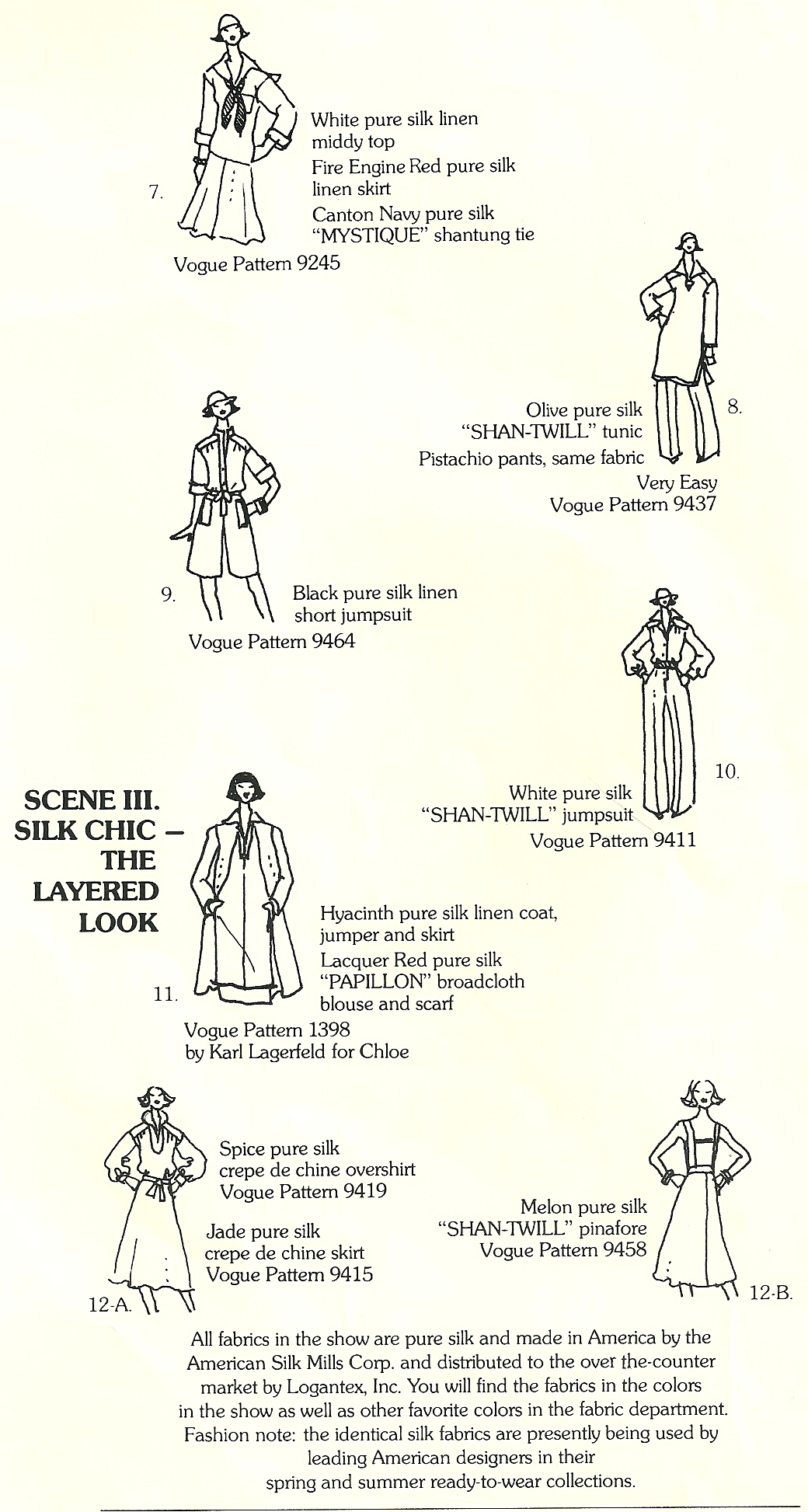
“All fabrics in the show are pure silk and made in America by the American Silk Mills Corp. and distributed to the over-the-counter market by Logantex, Inc.  You will find the fabrics in the colors in the show as well as other favorite colors in the fabric department.  Fashion note:  the identical silk fabrics are presently being used by leading American designers in their spring and summer ready-to-wear collections.”

American Silk Mills is still in operation, but it seems they are no longer producing dress goods, just drapery and upholstery fabrics.  Logantex is still a distributor of fabrics.

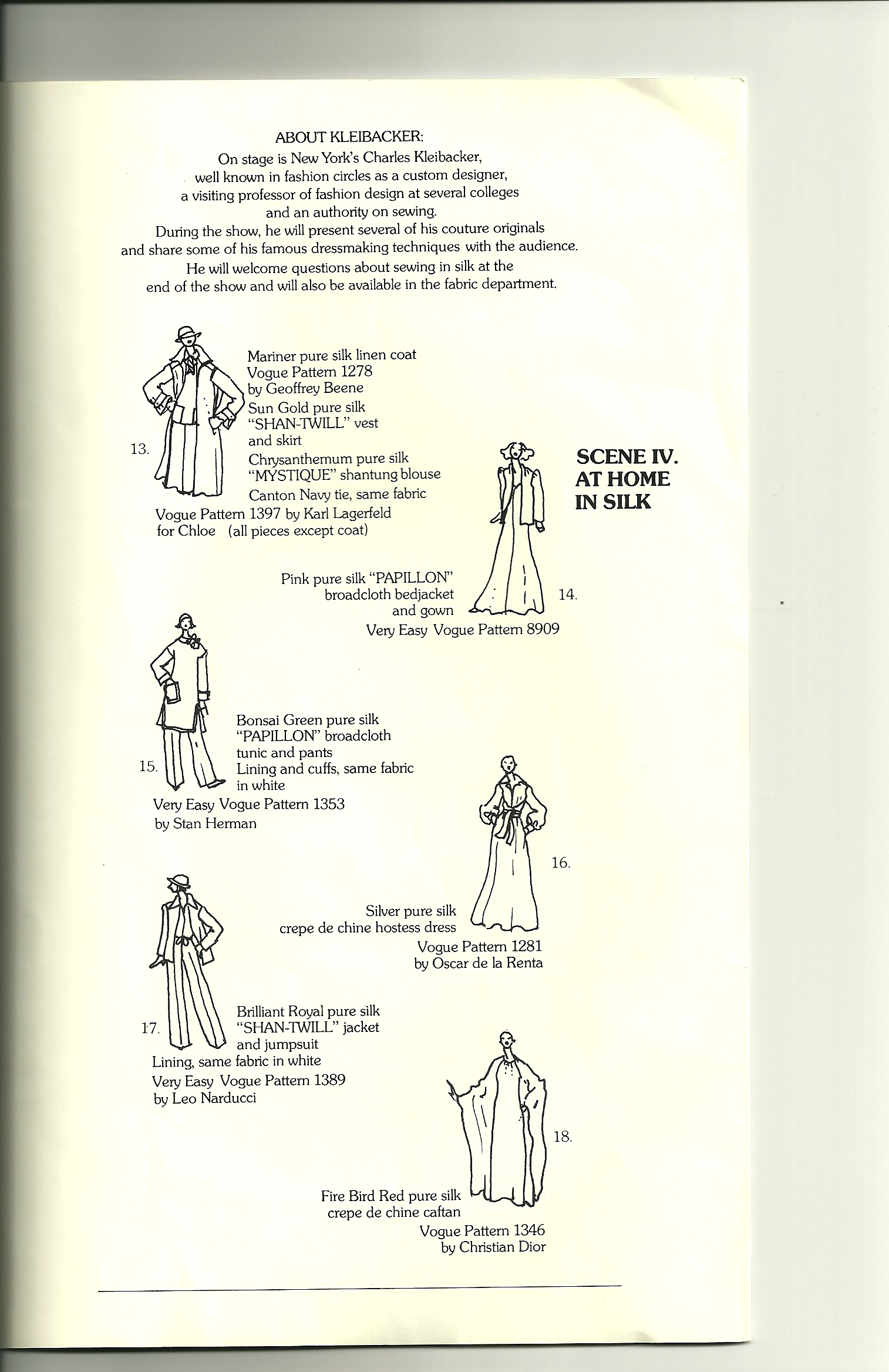
The Show was conducted by Charles Kleibacker, whom I remember as very charming and very sophisticated on stage.   He was known as “Master of the Bias” and gave some styling and sewing tips that day on using the bias in dressmaking.  He died in 2010 at the age of 88.

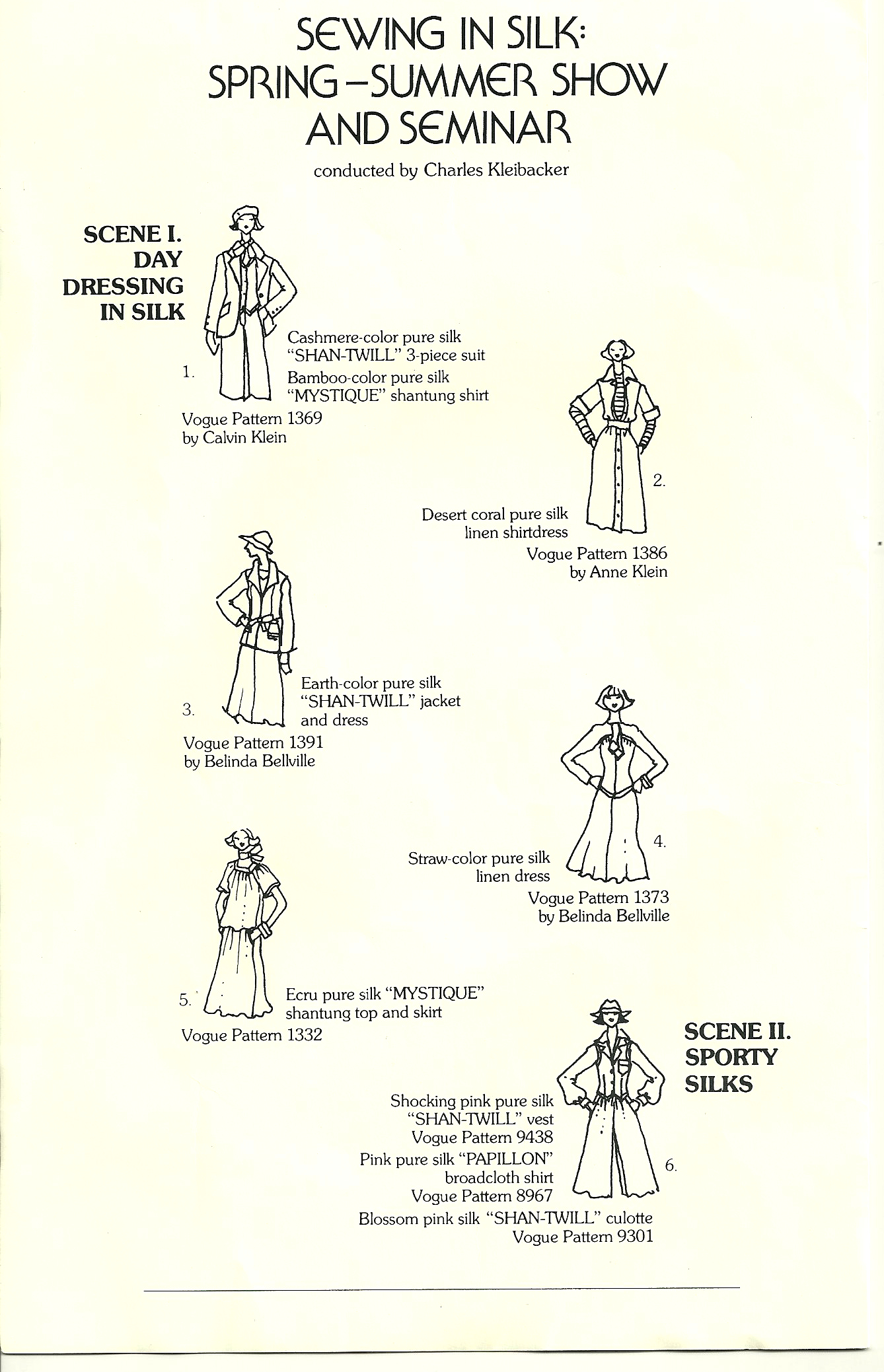
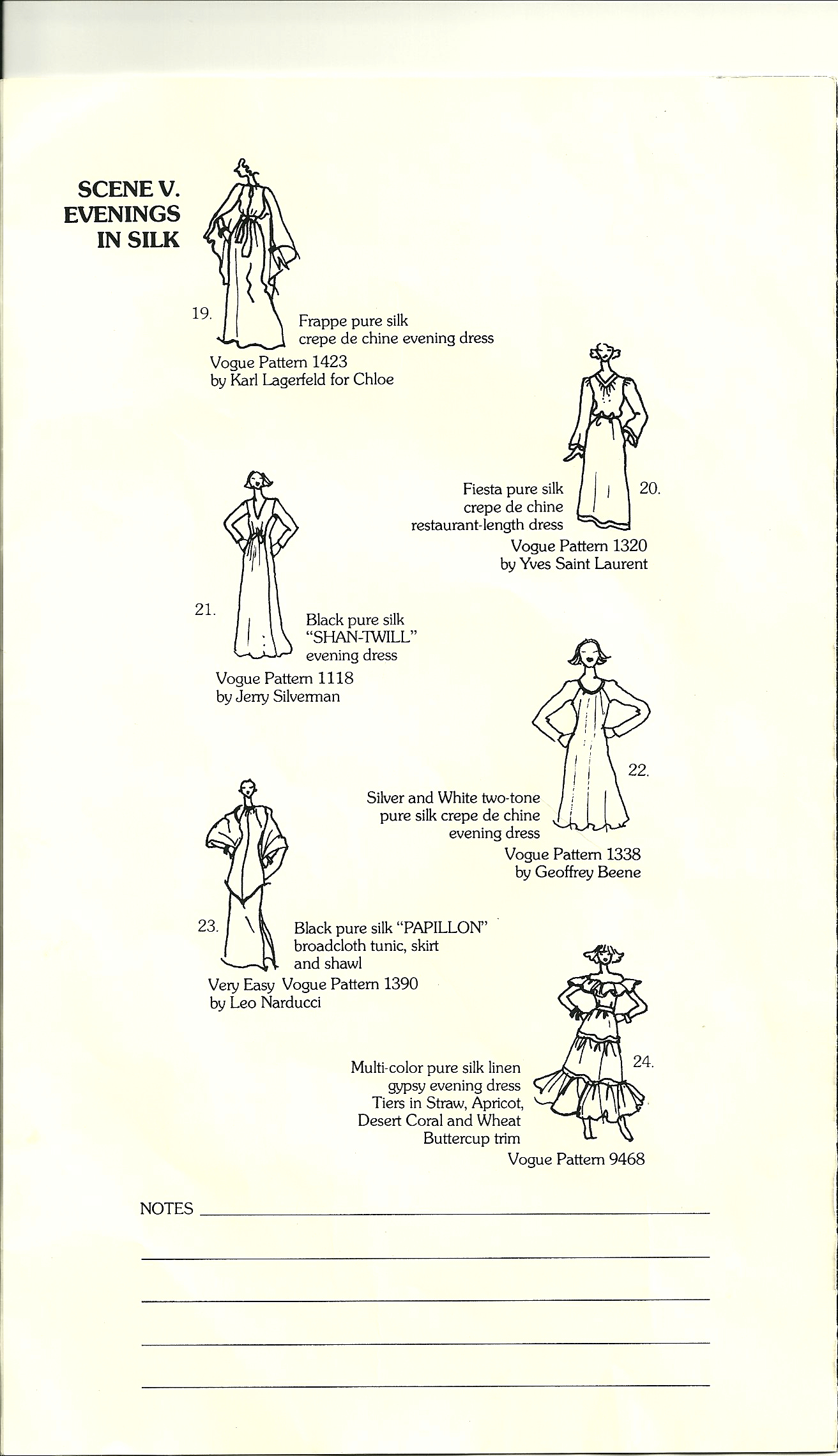
The show was divided into five “scenes”:  Day Dressing in Silk, Sporty Silks, Silk Chic – The Layered Look, At Home in Silk, and Evenings in Silk.  Twenty-eight patterns were featured in twenty-four “looks”.  The diagrams of these outfits are in black and white, but the colors and types of silk used for each are designated in the  descriptions.  Here are the four pages of designs (click on the images to see them enlarged):

Not all the Vogue patterns featured were from their Designer Series, but of those that were, they were all American designers - very appropriate for the Bicentennial Year!

The sailor middy and skirt outfit shown at the top of the page was memorable in its Fire Engine Red, Canton Navy Blue and White.

You can read some more about Charles Kleibacker at the top of this page from the Program.

The designs on this page give a good feel for the various weaves of silk which were featured in this show: crepe de chine, "Shan-Twill", broadcloth, and linen. Shantung was also one of the weaves.

Reading the color descriptions and combinations is totally inspiring.  For example, View 6 featured Shocking pink, Pure pink, and Blossom pink.  Olive and Pistachio were paired in view 8, while view 13 brought Mariner blue, Sun gold, Chrysanthemum, and Canton Navy together in one stunning outfit.  View 24 was a fabulous finale piece in Straw, Apricot, Desert Coral and Wheat.

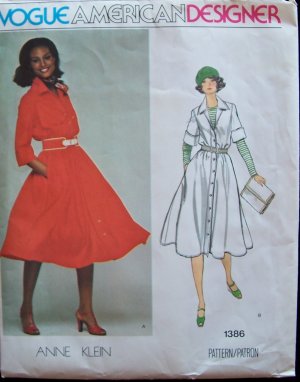
However, the colors which spoke to me the most that day were the Hyacinth silk linen, the Desert coral silk linen and the Melon twill.  I could only afford to buy one length of fabric – I opted for the pattern shown in View 2, an Anne Klein shirtdress –  and I purchased the hyacinth blue silk linen.

I made a wide self belt and wore this dress with the collar up in back as pictured.

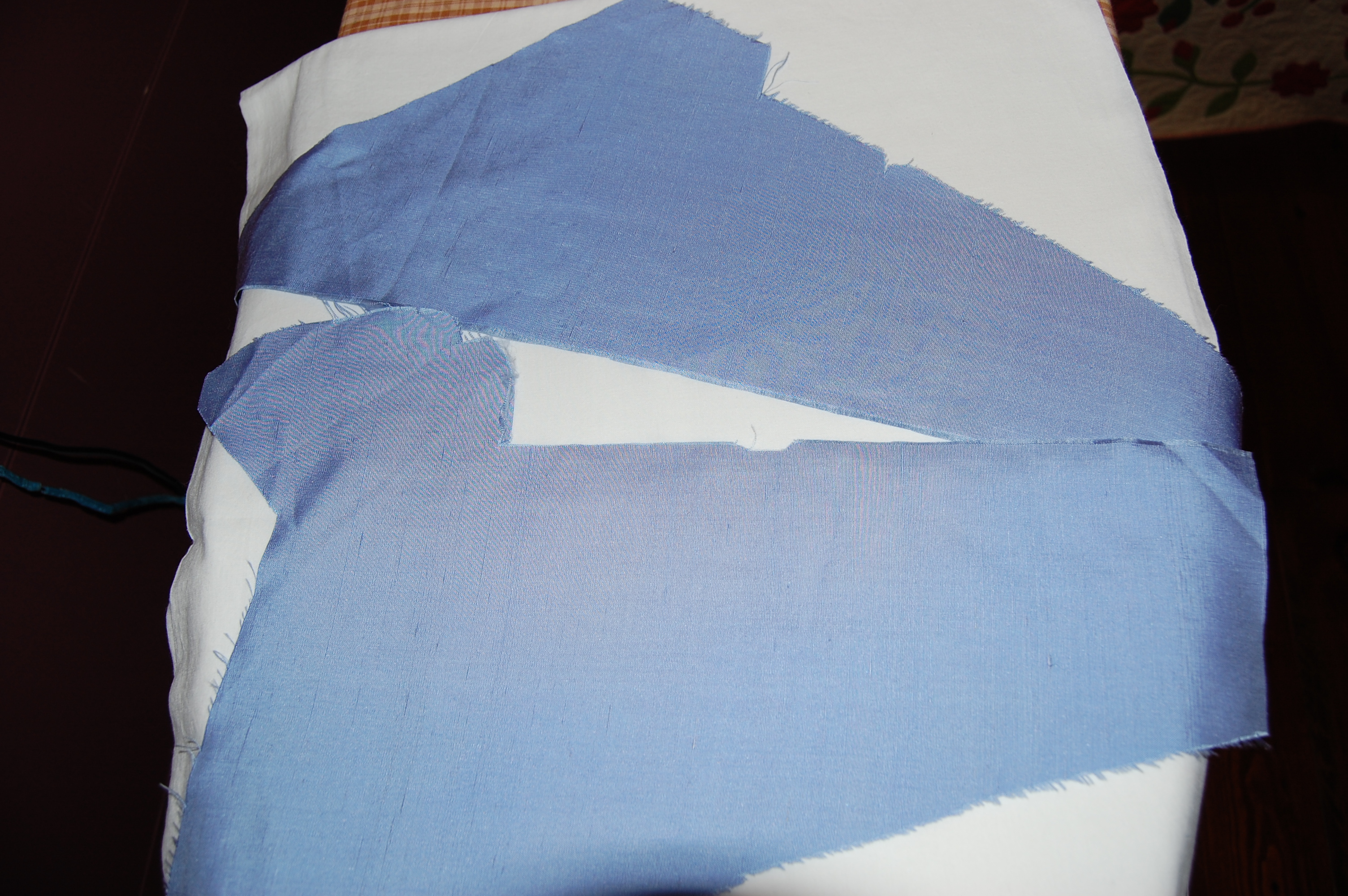
Here is all I have left of the fabric, two scraps!

This photo cannot show you the depth of color saturation, nor the perfect weight and weave of this silk linen.

I remember wearing the dress to parties and feeling very happy.  Isn’t that what beautiful clothes are supposed to do?

5 Comments

Filed under Dressmaker details, sewing in silk, Uncategorized, vintage Vogue patterns from the 1970s, Vogue patterns

Project complete! Well, kind of…

One day this week I sewed the final stitches on my wool suit.  Yes, doing the skirt hem finished it off, and now it is ready to wear.  For those of you who read my last post and ventured a guess on which pattern I used, you were correct if you chose number three.  As a reminder, here it is.

I made a few small alternations to this pattern, including shortening the skirt to just below the knee.

However, I did not choose it for the reasons you might think.  Here is how I made my decision:

1)   With such a bold plaid fabric, I thought a shorter jacket would be a better look.

2)   I thought the square tabs on the front of the jacket would compliment the windowpane check.

3)   The kimono sleeves are such a classic mid-century look that I couldn’t resist trying them.

4)   And, I love a challenge!  Even though the sleeves are “kimono” type sleeves, which means while there is no sleeve cap to match plaids, they do have seams down the middle of them cut on an angle.  Plus the jacket has side, front and underarm seams, a rounded collar which puts the plaid on a curve, and, finally, the skirt has six seams.  And, I needed to make sure that the check also matched, up and down and side to side, from jacket to skirt.  So, that’s a lot of matching.

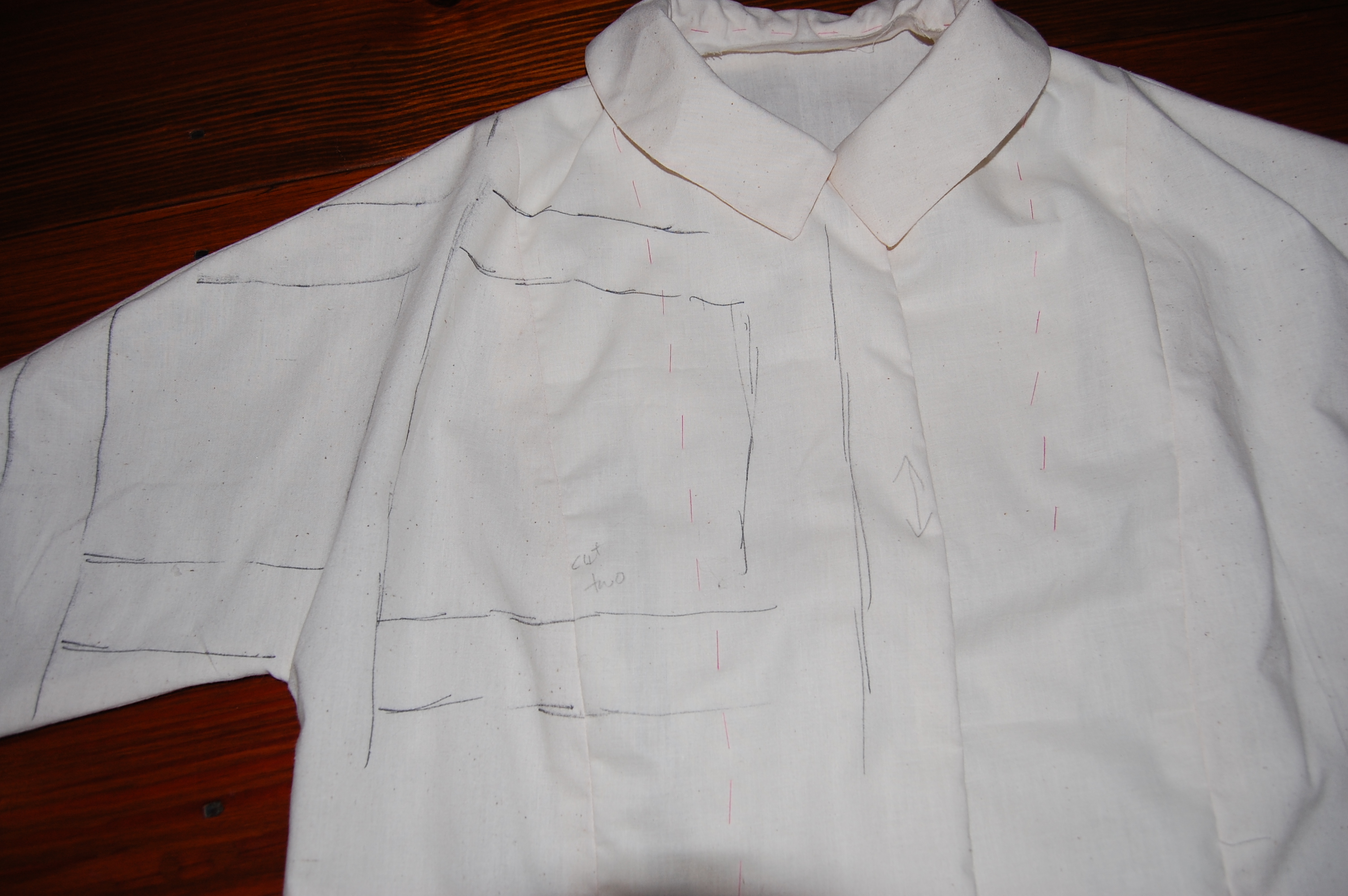
The first thing I did was make up the jacket in muslin.  From that I determined that I needed to add a couple inches to its length, and I decided to make the sleeves ¾ rather than below elbow length.  Then I got nervous about the windowpane check looking good in kimono sleeves, so I got out my magic marker and “drew” the check onto the muslin, so I could visualize it.  Okay, I liked it!

Here is my muslin - can you see the magic marker lines I drew on it? I sew my muslins using up bobbin thread that's left over from other projects - and I always baste in leftover contrasting thread.

Then I laid out the pattern pieces, and oh my gosh, what a puzzle of matching notches and checks.  I knew I couldn’t make a mistake, so after I laid it out, I let it sit overnight.  The next day, after cogitating on it overnight, I realized I had not properly matched up the check on the shoulder seams.  I made the adjustment, double and triple checked (pardon the pun), made sure I would have the same reveal at the hem of the jacket as on the skirt, and confidently (actually about 92% confidently) cut it – and the lining –  out.

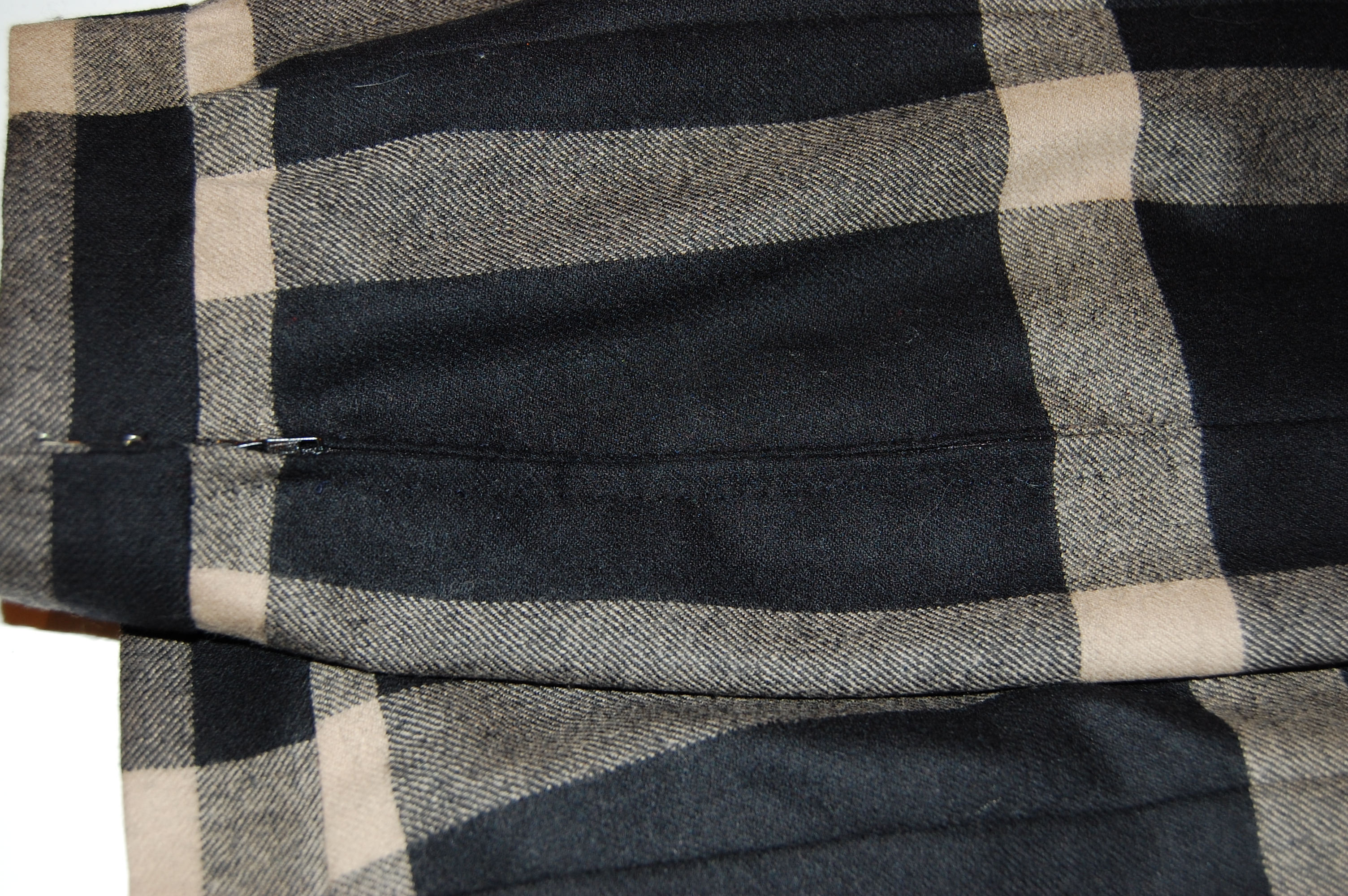
First, I made the skirt (except for the hem).  I like to put my zippers in by hand, as I just think it makes a nicer look.

Here is the zipper, set in using small back stitches.

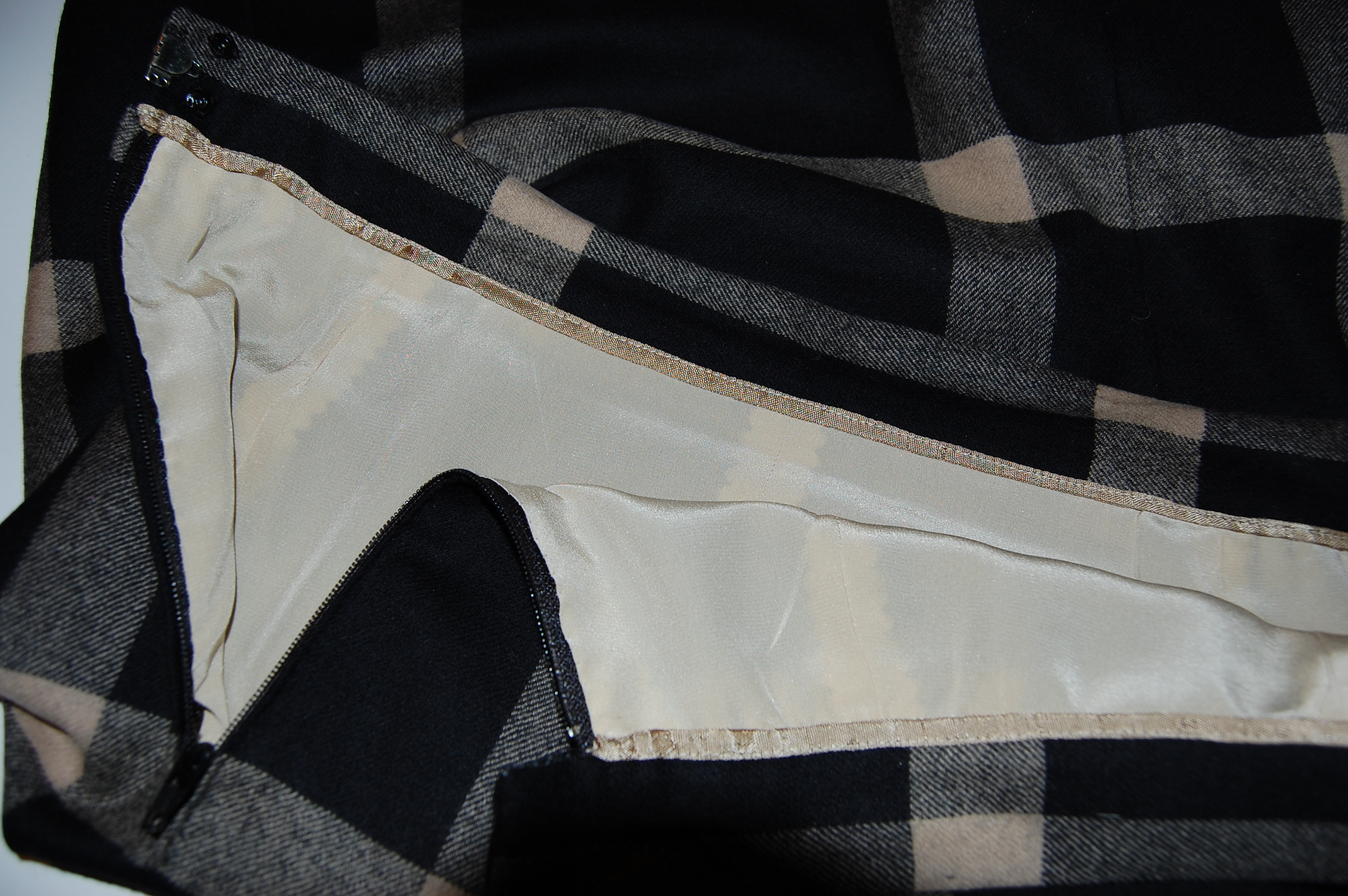
And here is how I finished the waistband inside:

I bind the raw edge with a soft seam tape and then catch-stitch underneath to the waistband seam. This makes a nice, unbulky finish.

By the way, have you noticed how it is now almost impossible to find a ready-made skirt or pants with a waistband?  Another reason to sew!

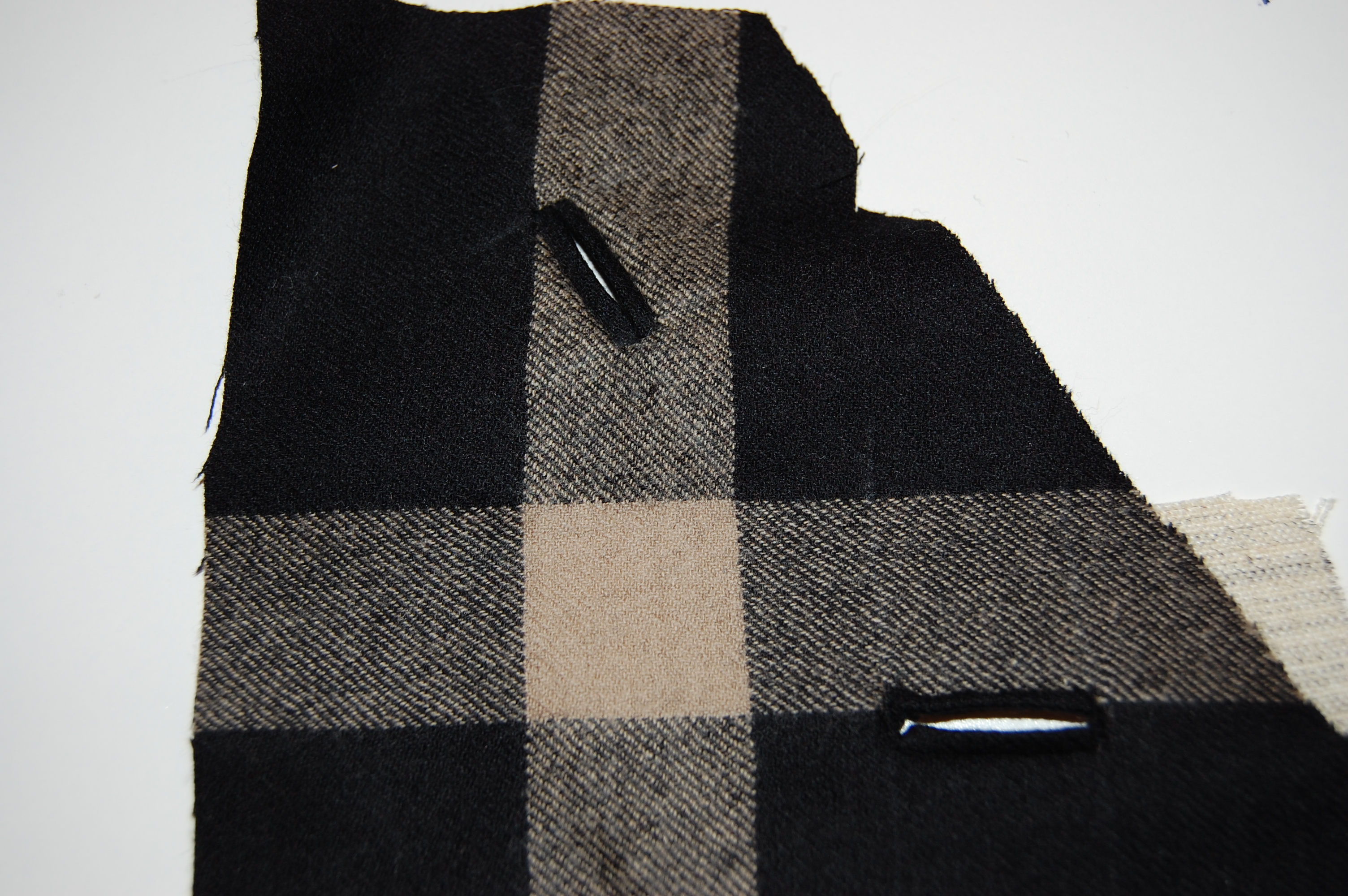
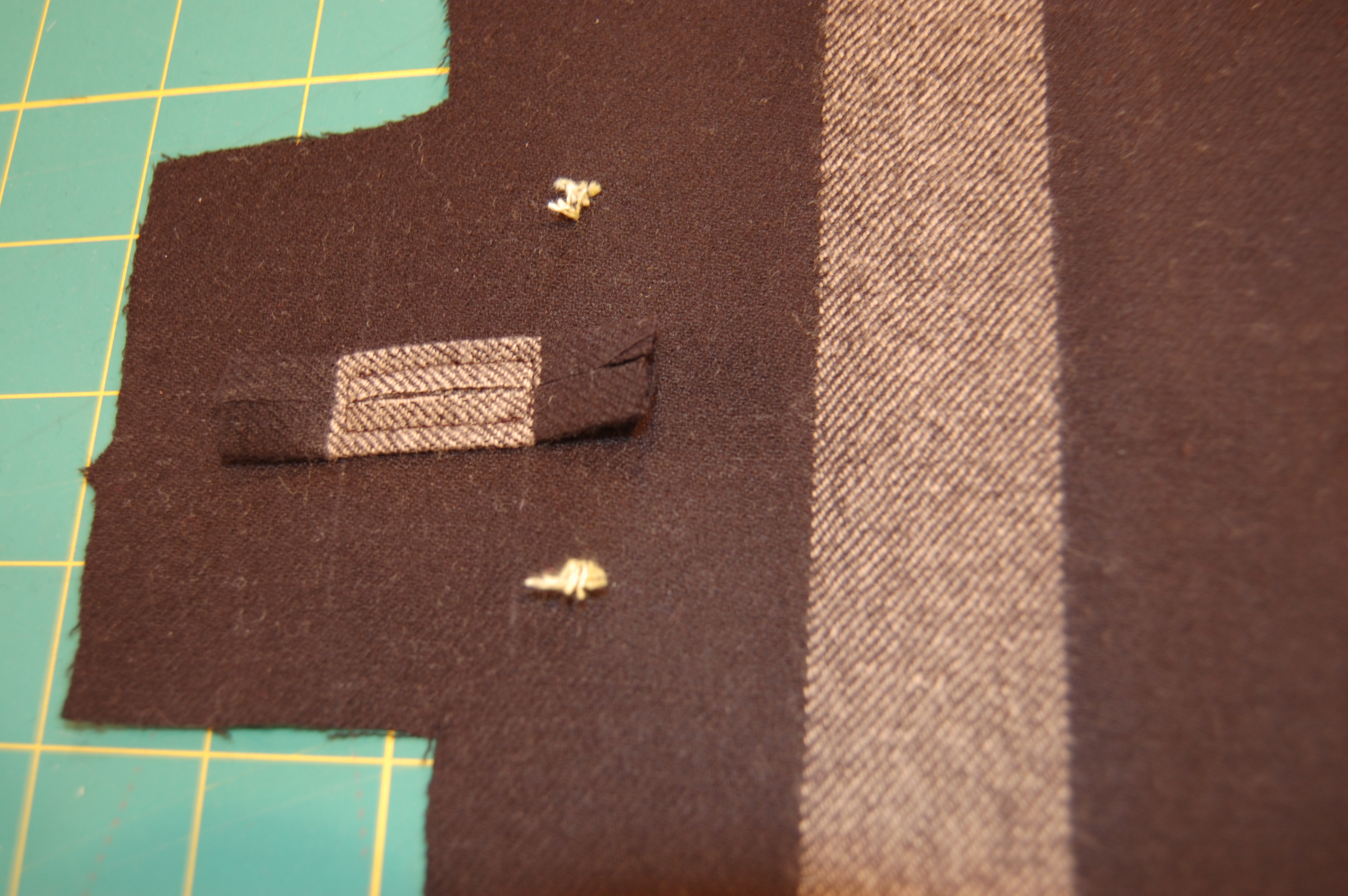
The jacket called for five bound buttonholes: one at the neck, on the two tabs on the front of the jacket, and in the sleeve plackets.  (This, of course, meant that I had to find buttons first.  A trip to the local fabric/craft store produced some, which I immediately recognized as “perfect.”  They are made by La Mode, an old button company still going strong after 125 years.)  Whenever I am making bound buttonholes, I like to make a couple of “practice” ones.  Every fabric handles differently, and with this fabric, I also needed to decide what part of the fabric I would use for the “bands”.  Here is my practice piece, which will help to explain what I mean.

Here were two of the three "trial" buttonholes I made. I decided to use all black bands where the buttonhole would be on a light part and light bands on all black. These trial runs helped me make my decision.

It always strikes me as being “out of sequence” when practically the first thing I have to do is make the buttonholes, but so it is with these bound beauties!

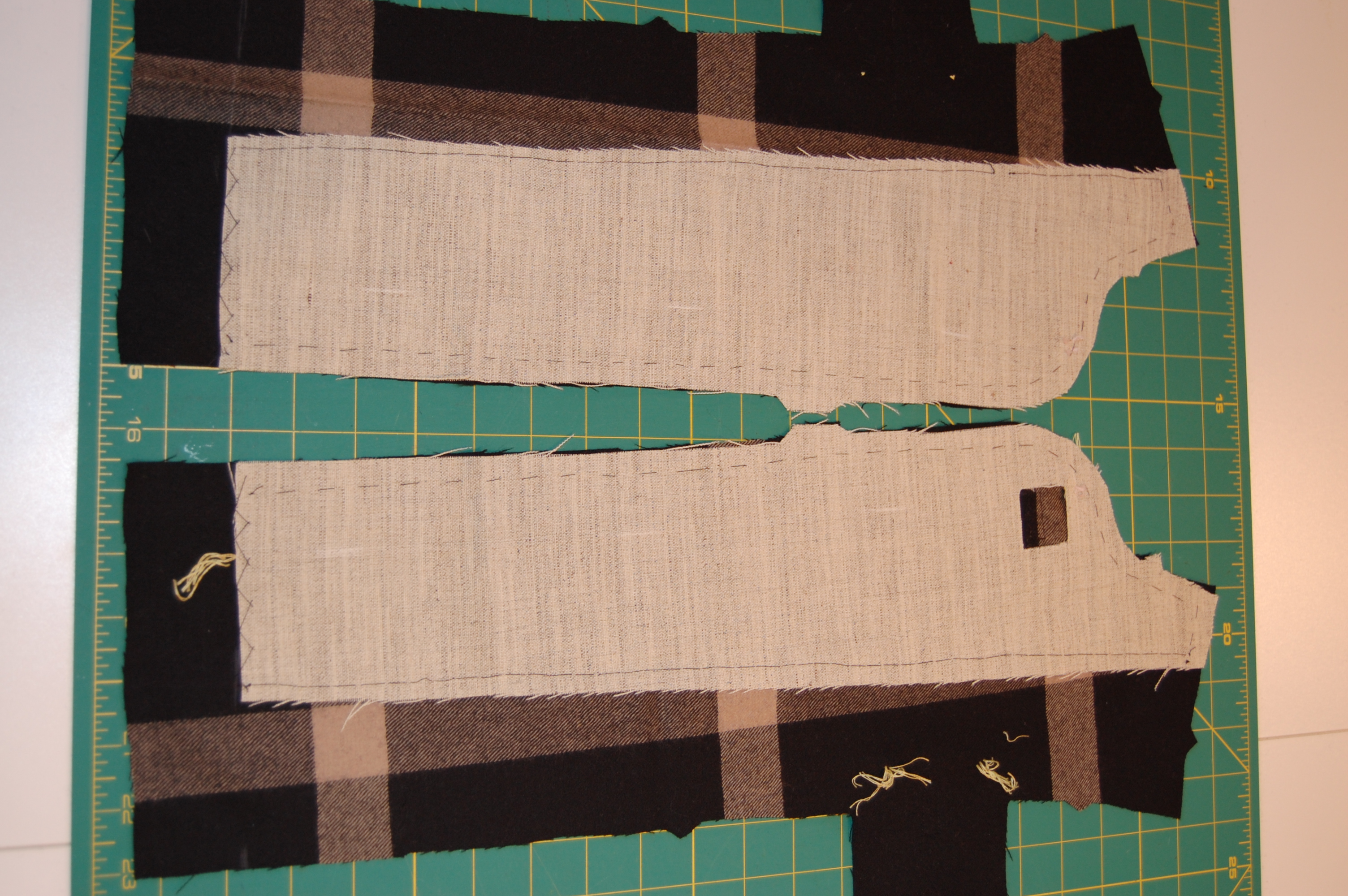
Of course, before the buttonholes comes the interfacing. I cut a small square out of the interfacing on the right side in order to accommodate the bound buttonhole.

Here is the start of the buttonhole on one of the "tabs". The yellow fuzzies are tailor tacks.

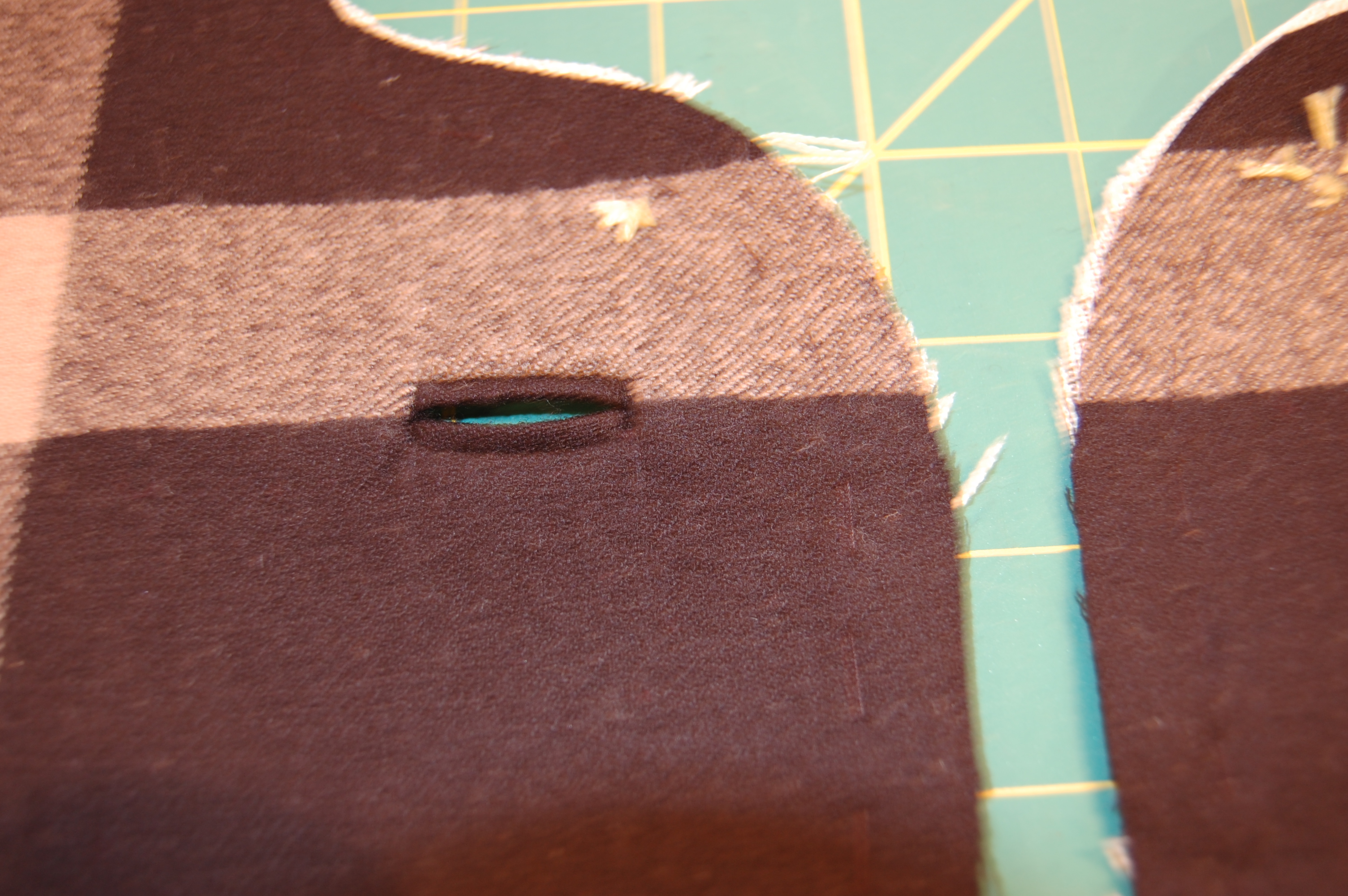
Here is the buttonhole at the neckline.

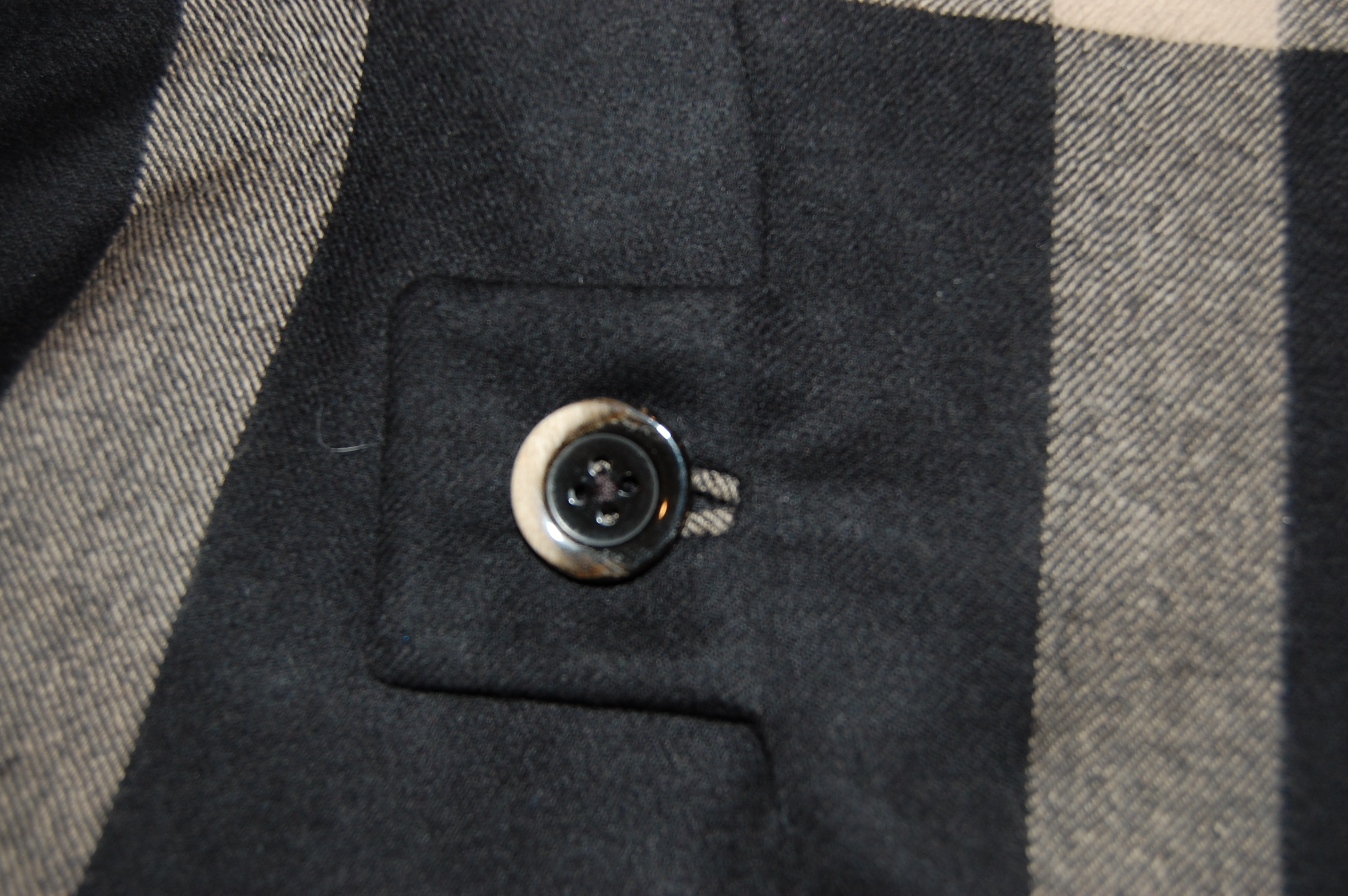
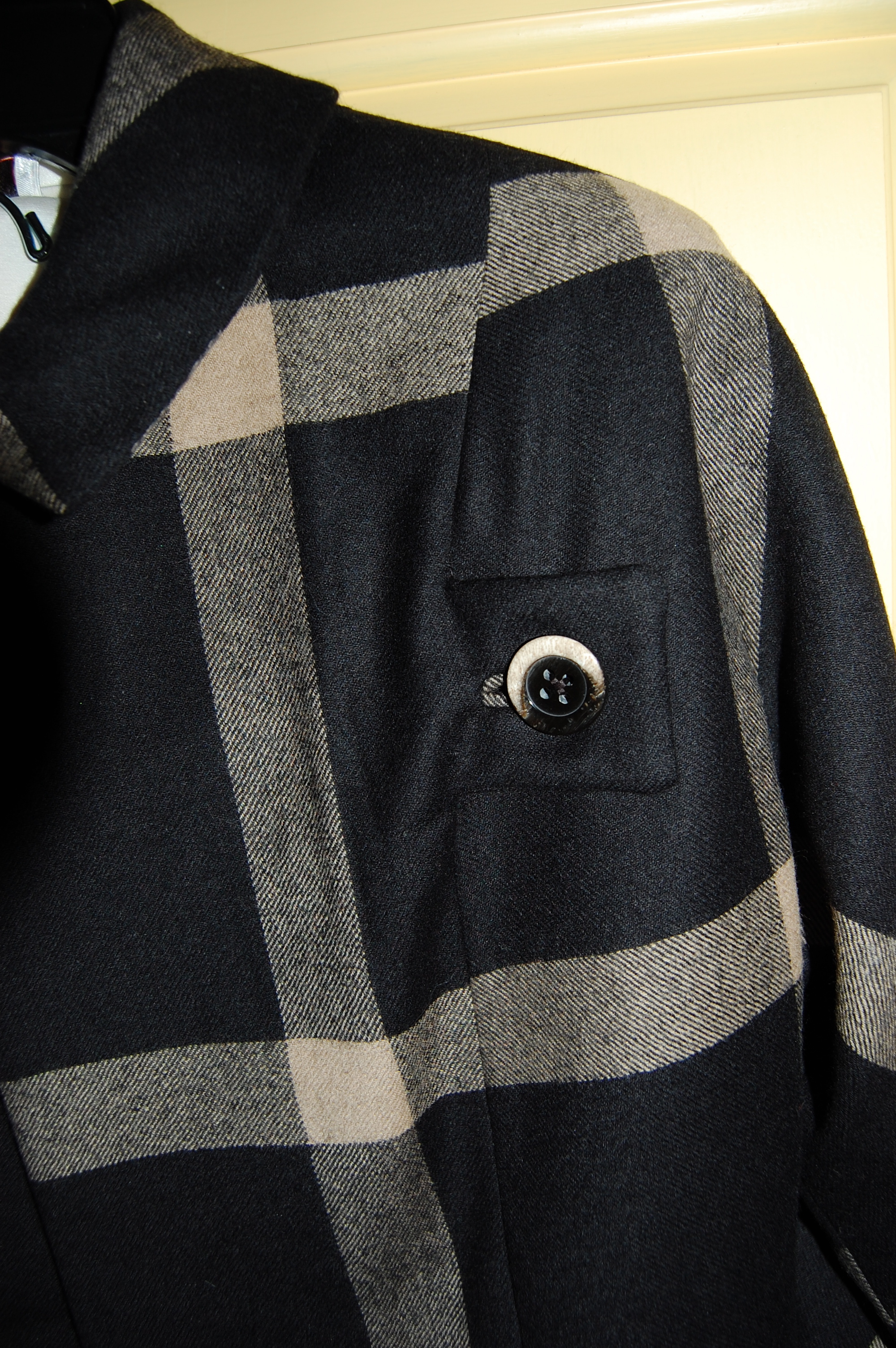
Here is the finished buttonhole on one of the tabs, sporting buttons which I think are perfect for this suit and fabric.

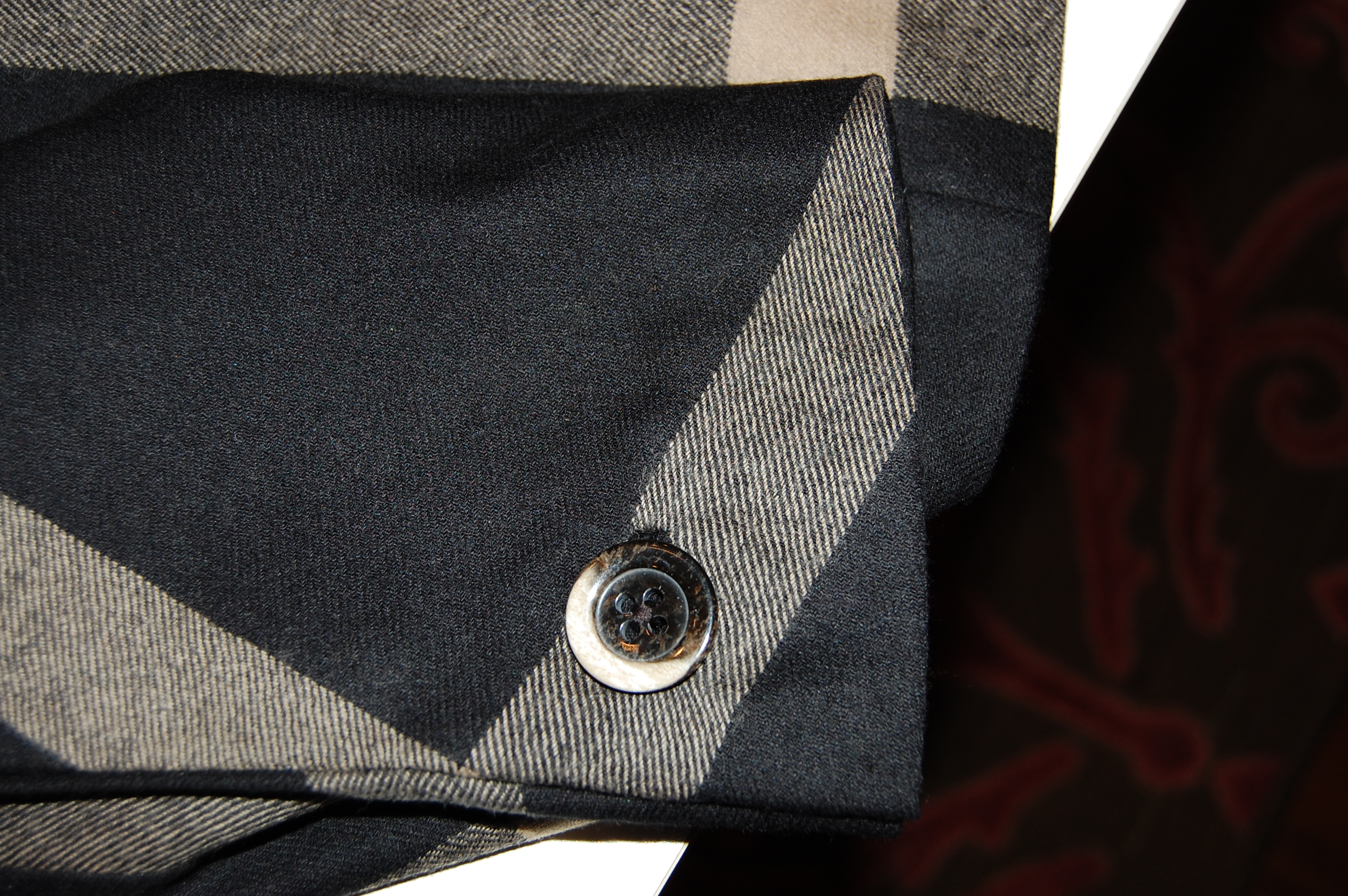
And here is one of the sleeve plackets, all finished!

The rest of sewing the jacket was fairly straightforward, just time-consuming!  The collar was a dream to do because there was a separate pattern piece for the two-piece, bias undercollar.  A bias undercollar makes the top part of the collar finish up with a smooth and neat turn.  Vogue Patterns – I love you!

I lined both the skirt and the jacket in a silk crepe de chine which I ordered online from fabrics.net/The Fabrics Network.  This company, in Spokane, Washington, carries beautiful solid silks and other fabrics.  I got swatch/color cards from them last year and have purchased several pieces of fabric from them, all of them lovely, excellent quality goods, quickly delivered.

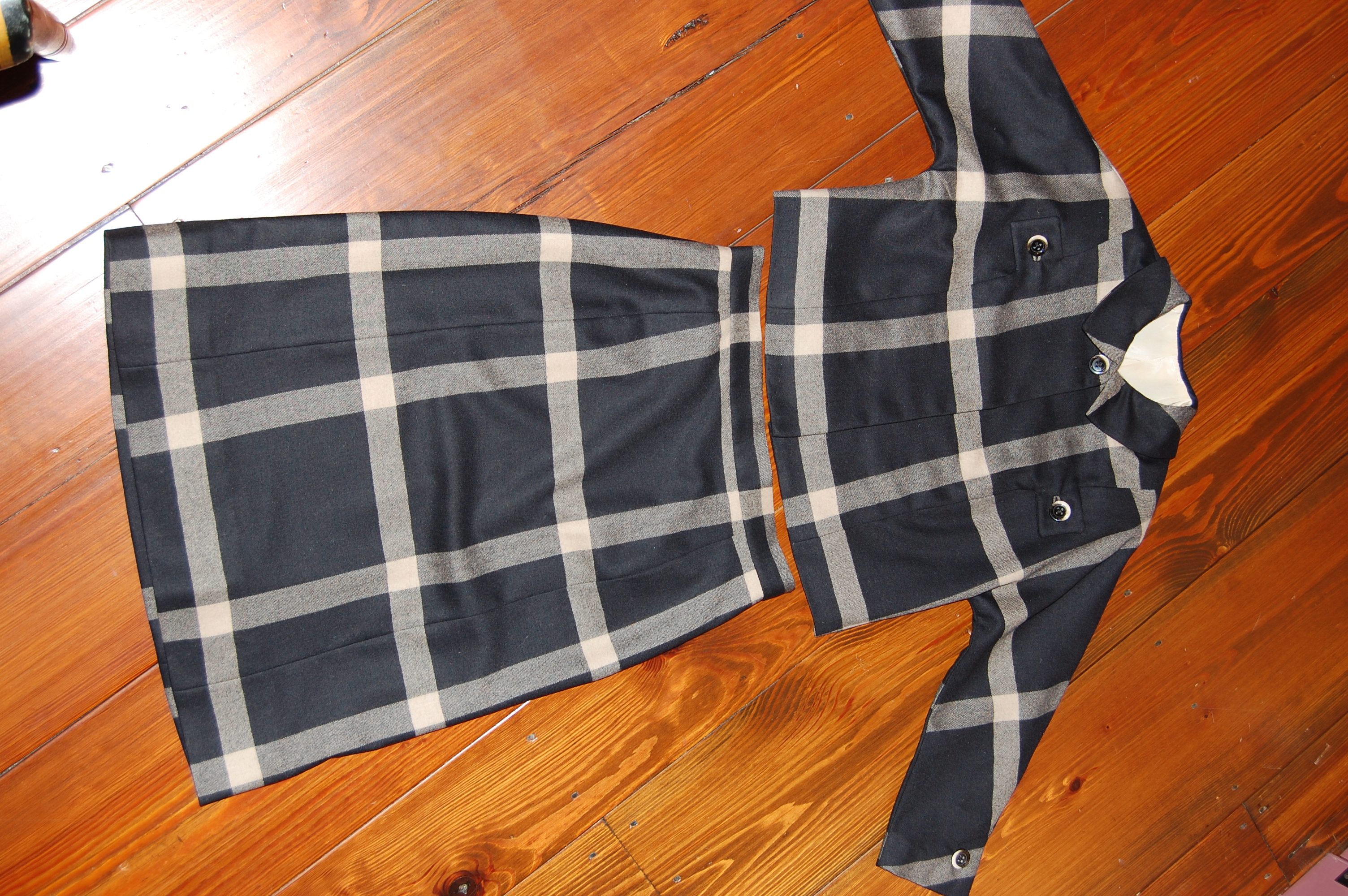
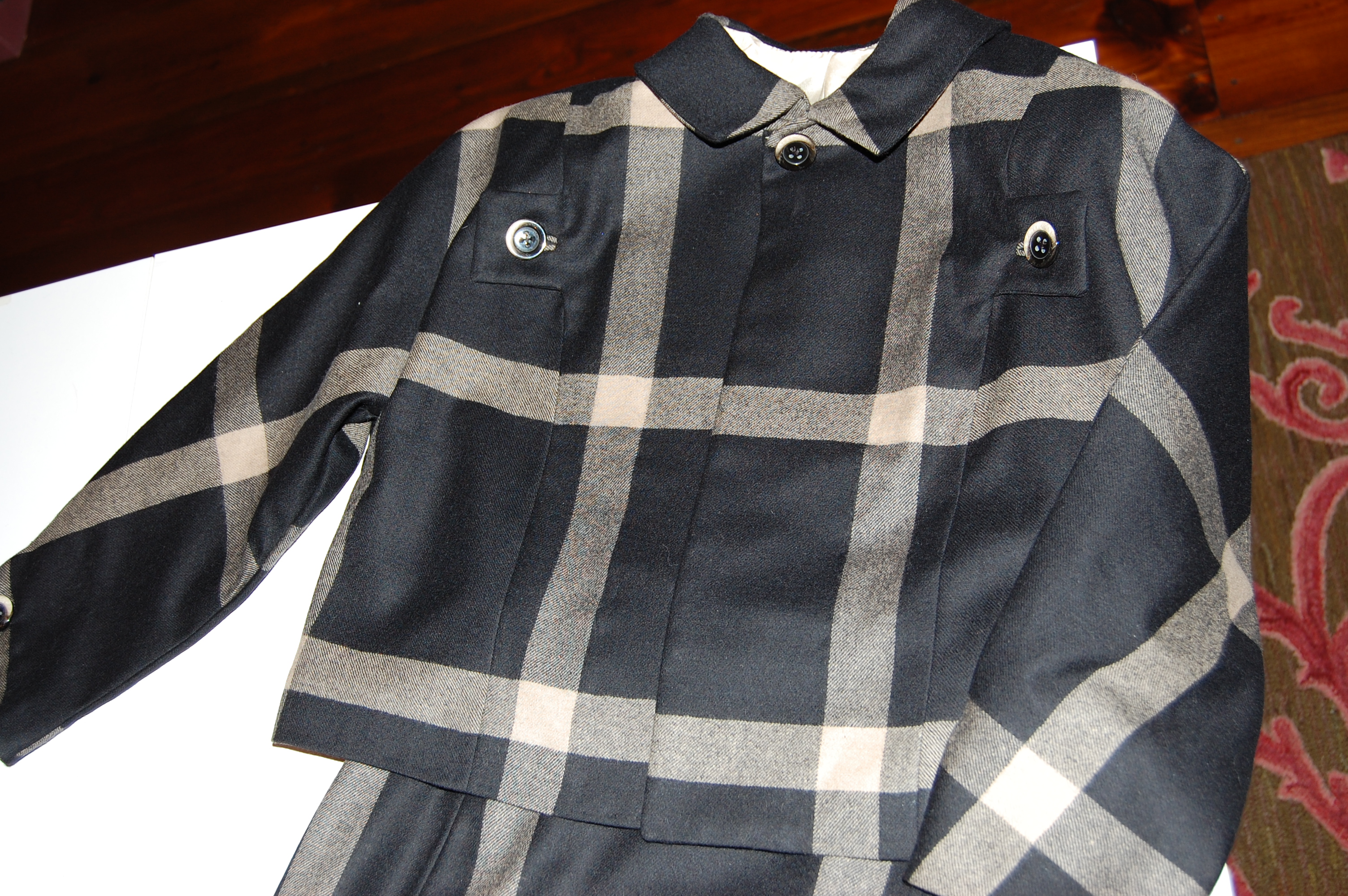
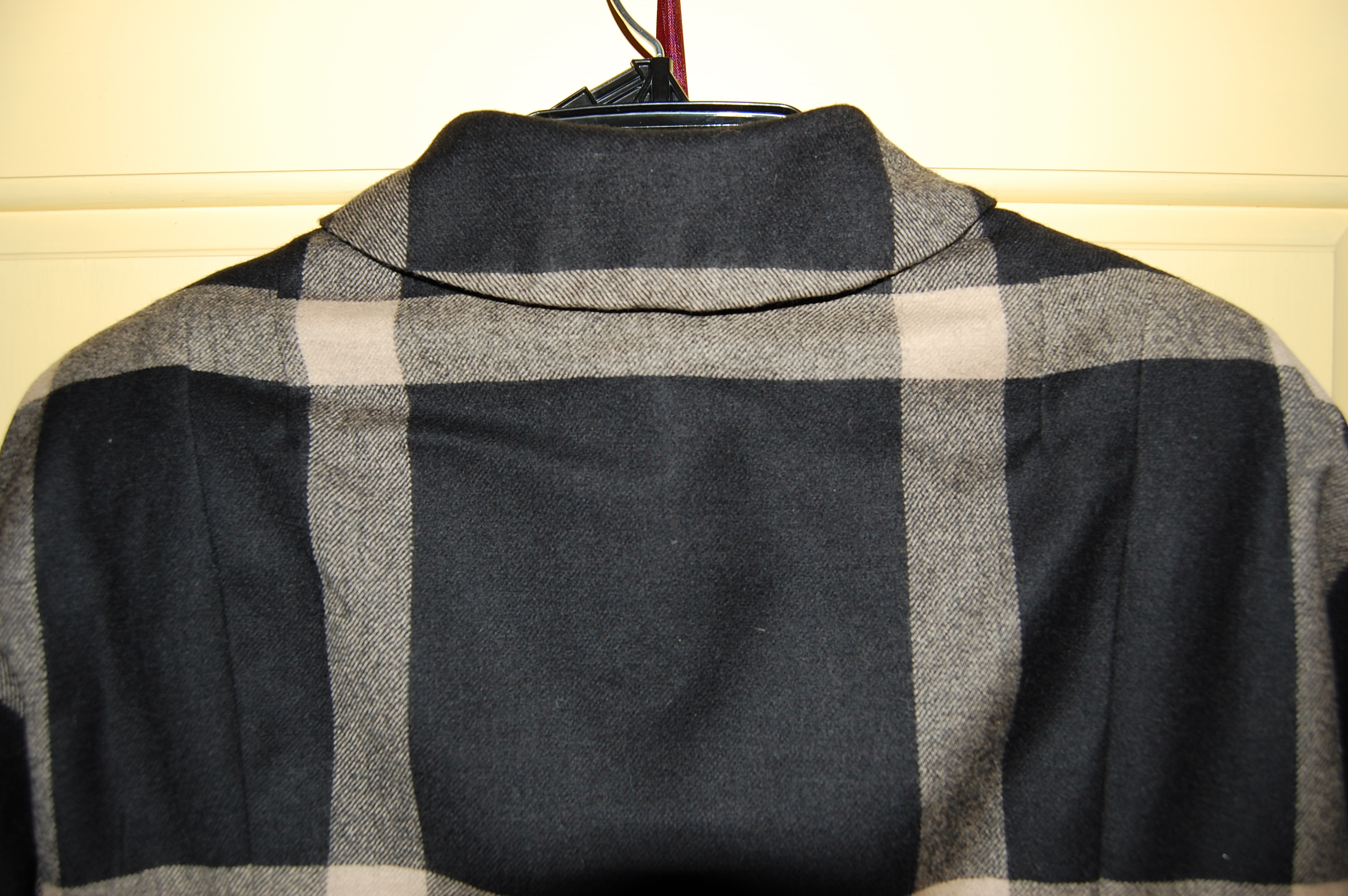
So here are some shots of my finished suit:

My suit, laid out on my sewing room floor - definitely prostrate from being worked on for so long!

Here is a close-up of the jacket.

Here is an example of the puzzle of matching the check up and down and side to side. When I am wearing the jacket, I want the collar to match up to the back of the jacket. I think I was fairly successful with my calculations!

And here is a view of the one area which could not be matched, as that seam serves as a dart for the bust. But somehow, it looks okay, I think...

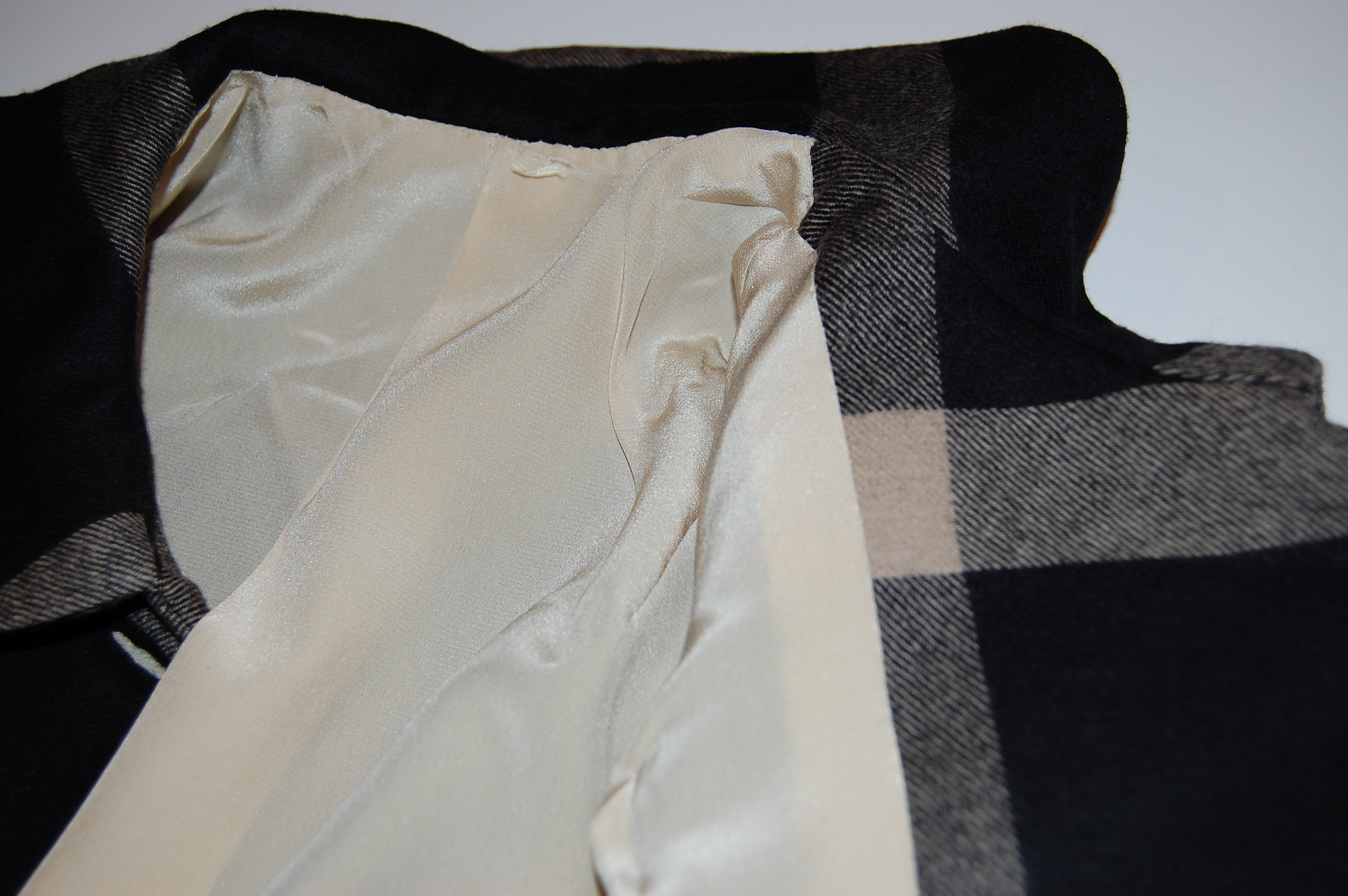
Finally here is a view of inside the neck, showing the lining and just a bit of the collar.

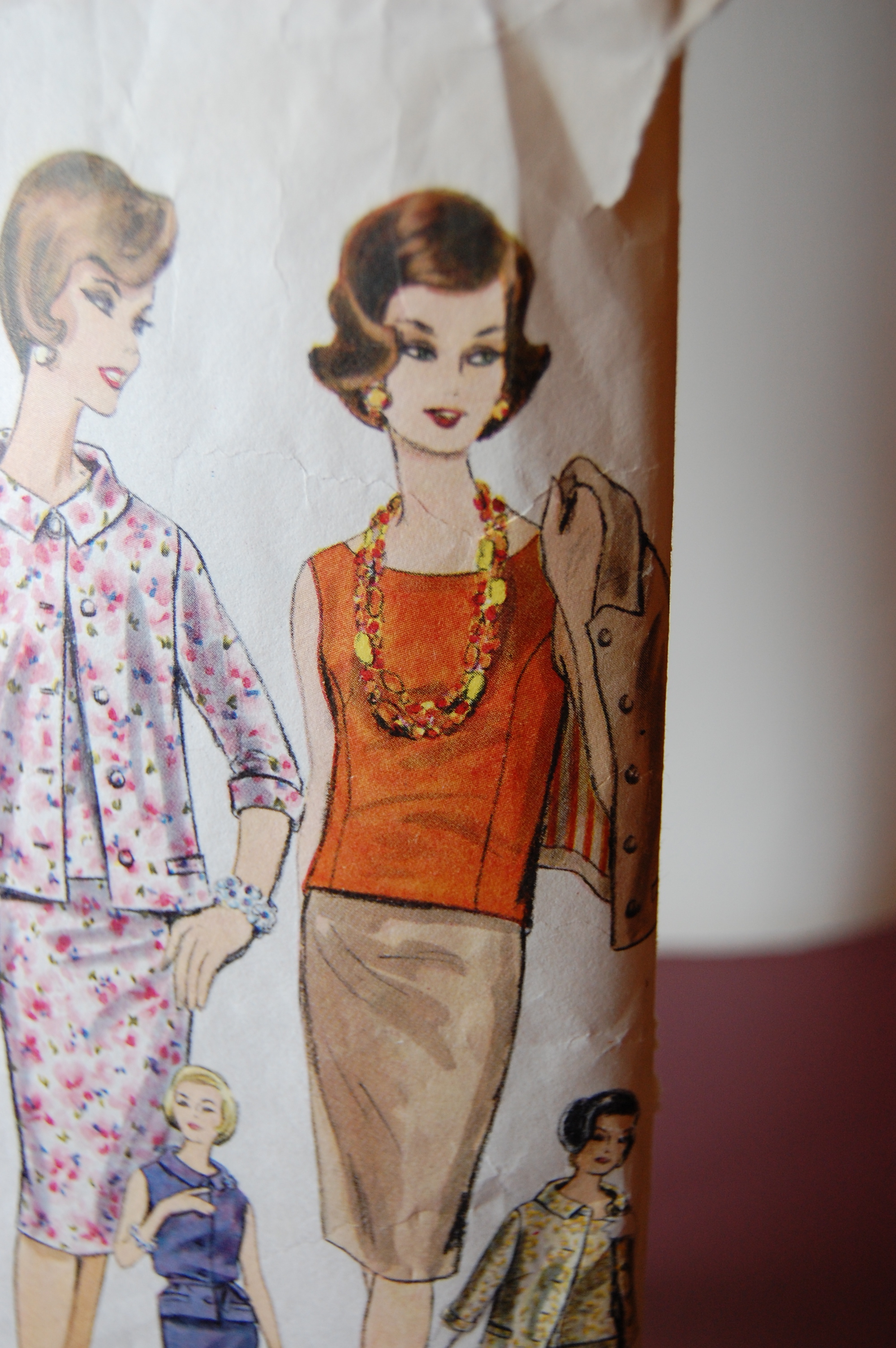
So – why did I say this project was “kind of” complete?   Well, wouldn’t a simple  blouse in that same lining silk be lovely?  I just happen to have enough fabric to make one (!) – and I’m thinking about using this pattern:

I think this simple shell would make up beautifully in that beige silk. What do you think? (I would wear it tucked in.)

Also, when I purchased the wool, I bought plenty to allow for matching those checks, and the wonderful salesperson at Britex cut the piece generously for me as well – many thanks, dear lady! So – I have enough left to make a simple lined  overblouse, which could be worn just with the skirt for a variation on a two-piece “little black dress.”  Memo to self:  move this idea to the top of my “sewing to do” list for next Fall!

3 Comments

Filed under bound buttonholes, kimono sleeves, Uncategorized, vintage Vogue patterns from the 1950s, Vogue patterns

Quiz: Match the fabric to the pattern

If you follow this blog, you’ll know that I have promised a “next” post on a suit which I’ve been working on.  Another project (non-sewing) has taken me away from it for a few days, so it’s not quite finished yet.  However, to keep my promise, I’m offering a teaser:  can you pick the pattern which I am using to make my suit?

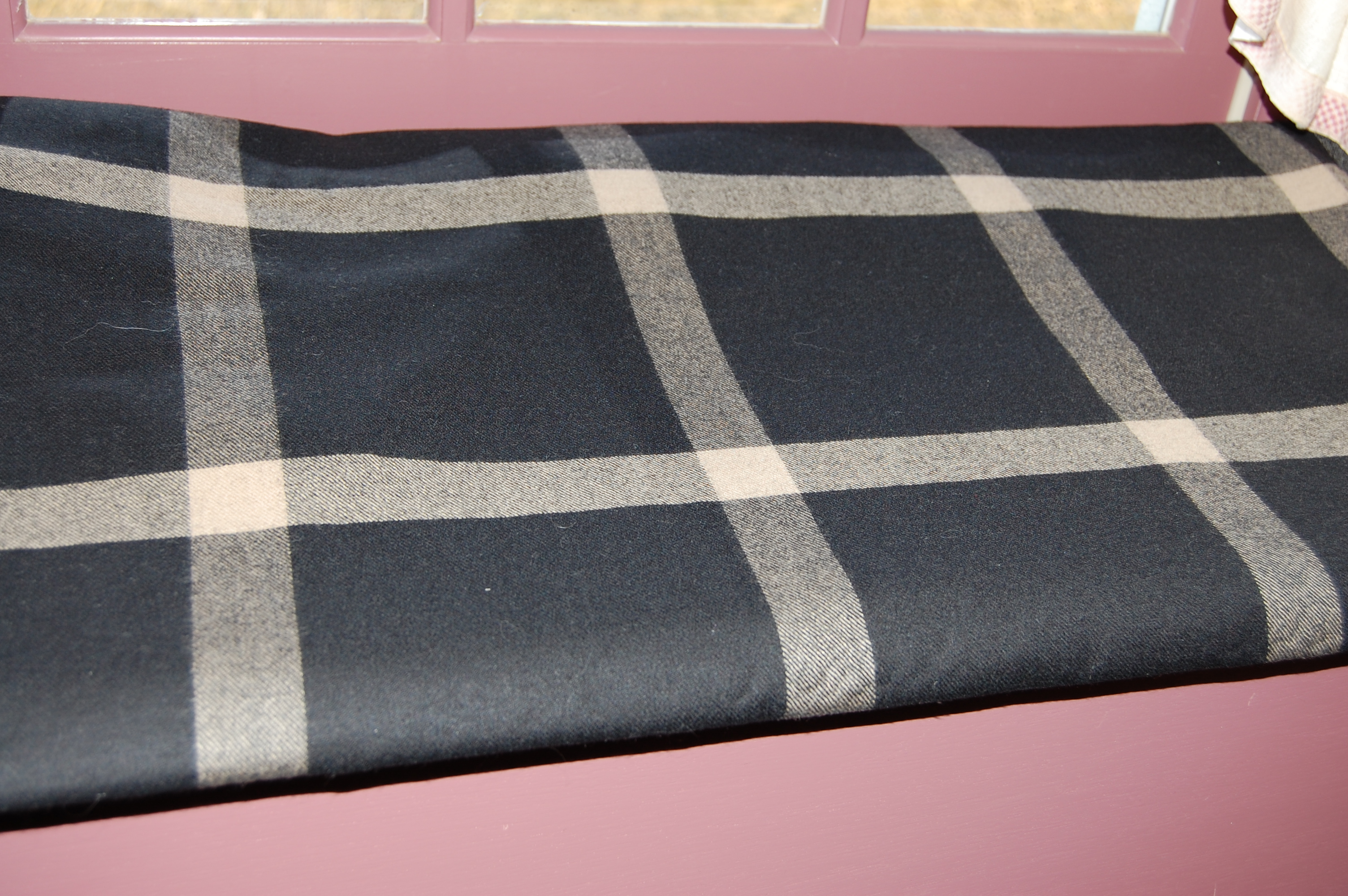
Here is the fabric, a lovely, finely woven and incredibly soft, windowpane check wool from France, which I purchased at Britex last summer in San Francisco:

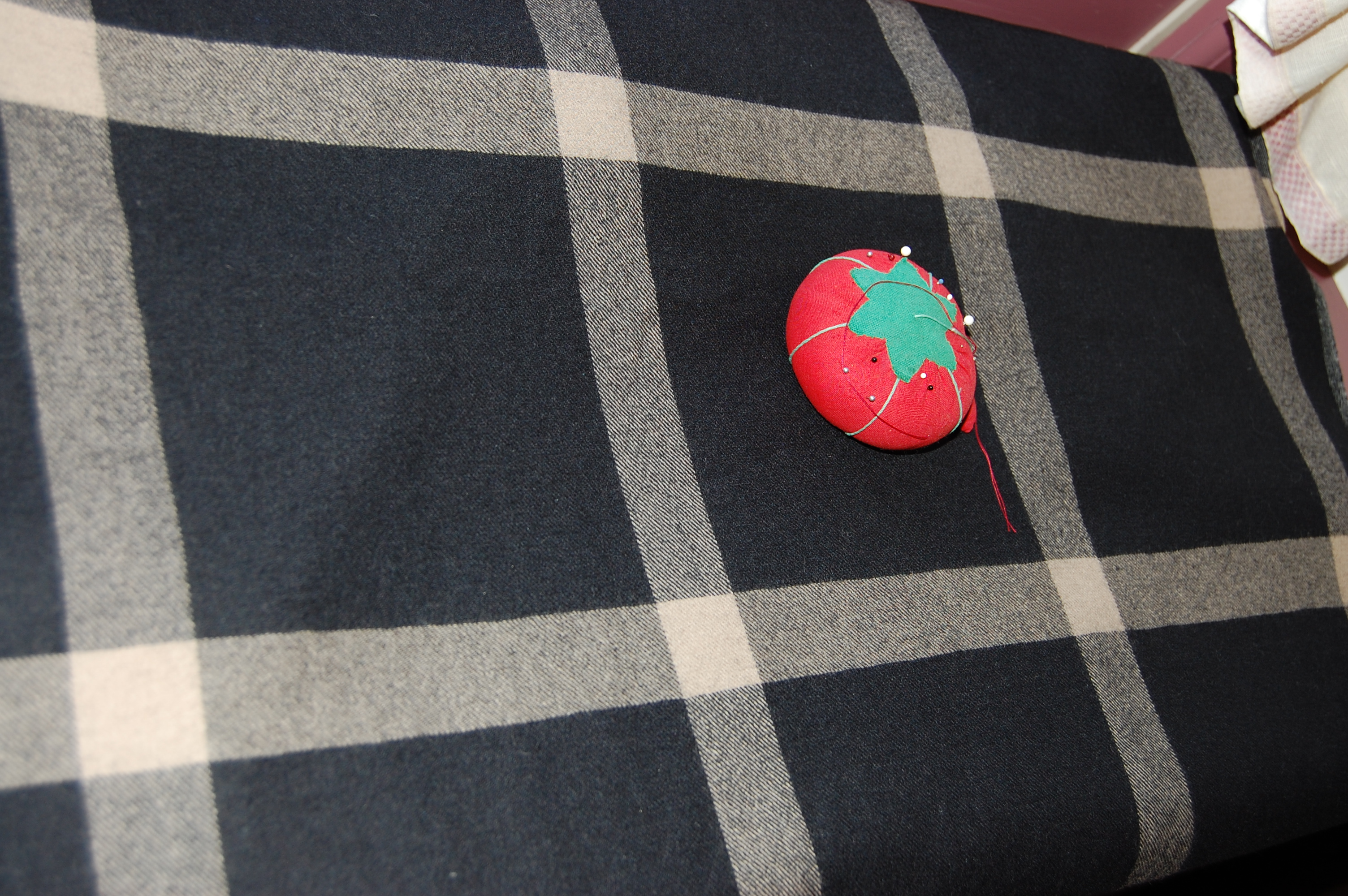
The repeat on this fabric is 7", so it's a fairly bold check in soft black and beige

Here is another shot of the fabric, with my tomato pin cushion on it to help you determine its scale.

And here are four patterns.  Which one do you think I selected to make in this fabric?  (Click on the photos to see the patterns in more detail.)

Choice # 1: This pattern is copyright 1958. I featured it in an earlier post.

Choice # 2: Here is another pattern which I have already featured in an earlier post. It is copyright 1959. This pattern includes the blouse pattern, too.

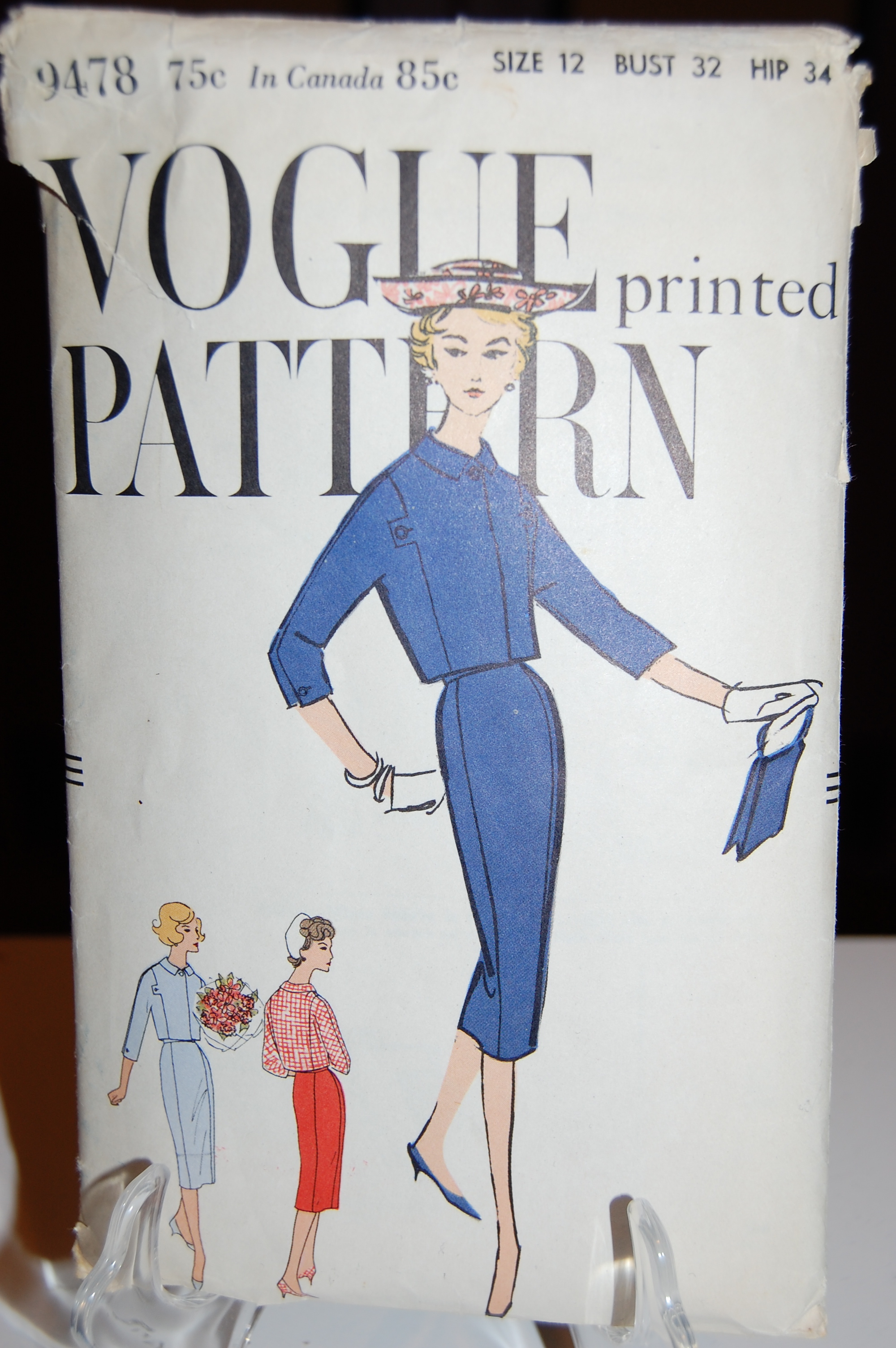
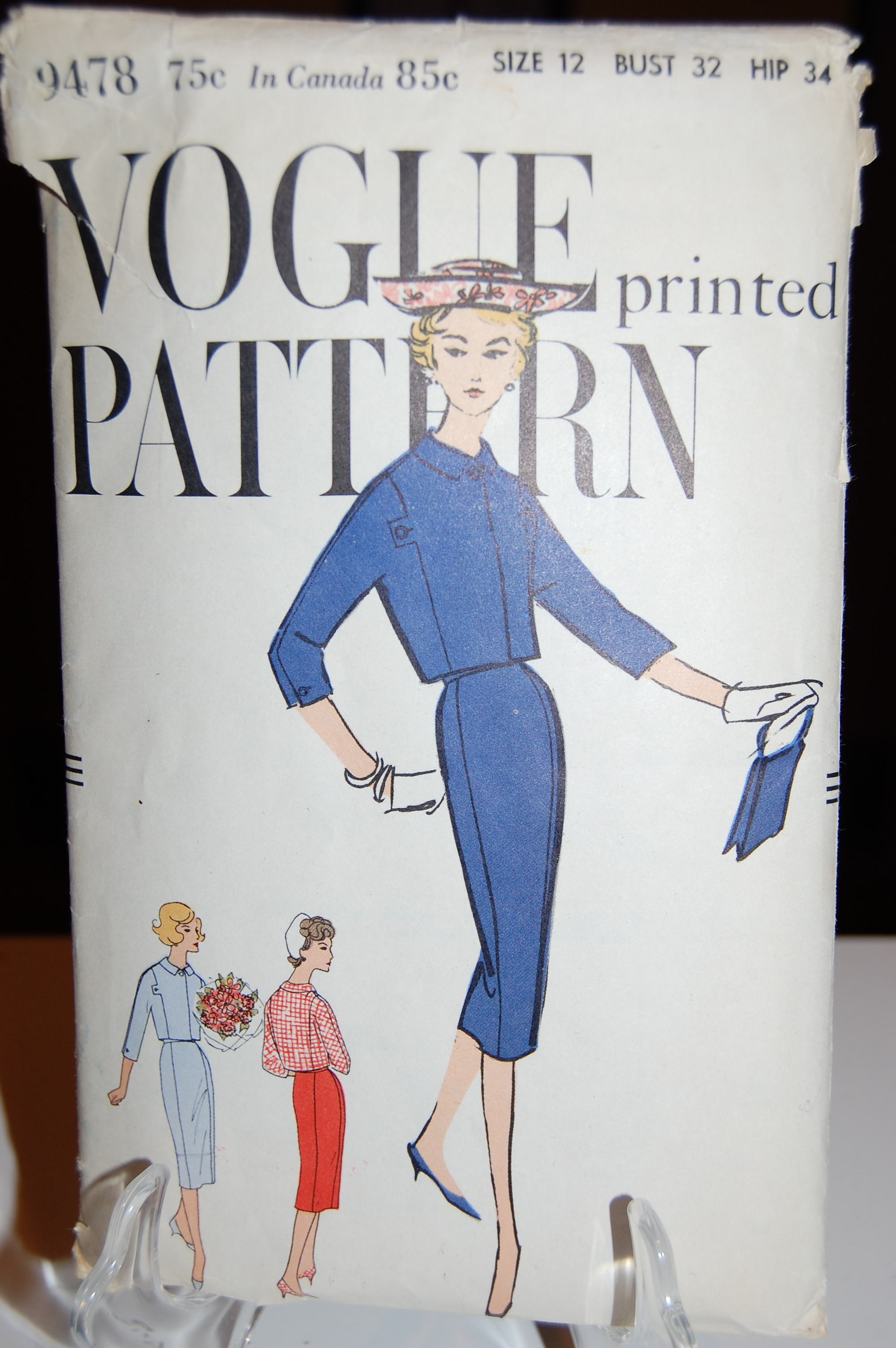
Choice # 3: This pattern is also copyright 1958. It has kimono sleeves rather than set-in sleeves, and the skirt has no darts; rather the seams are curved to fit the hips and waist.

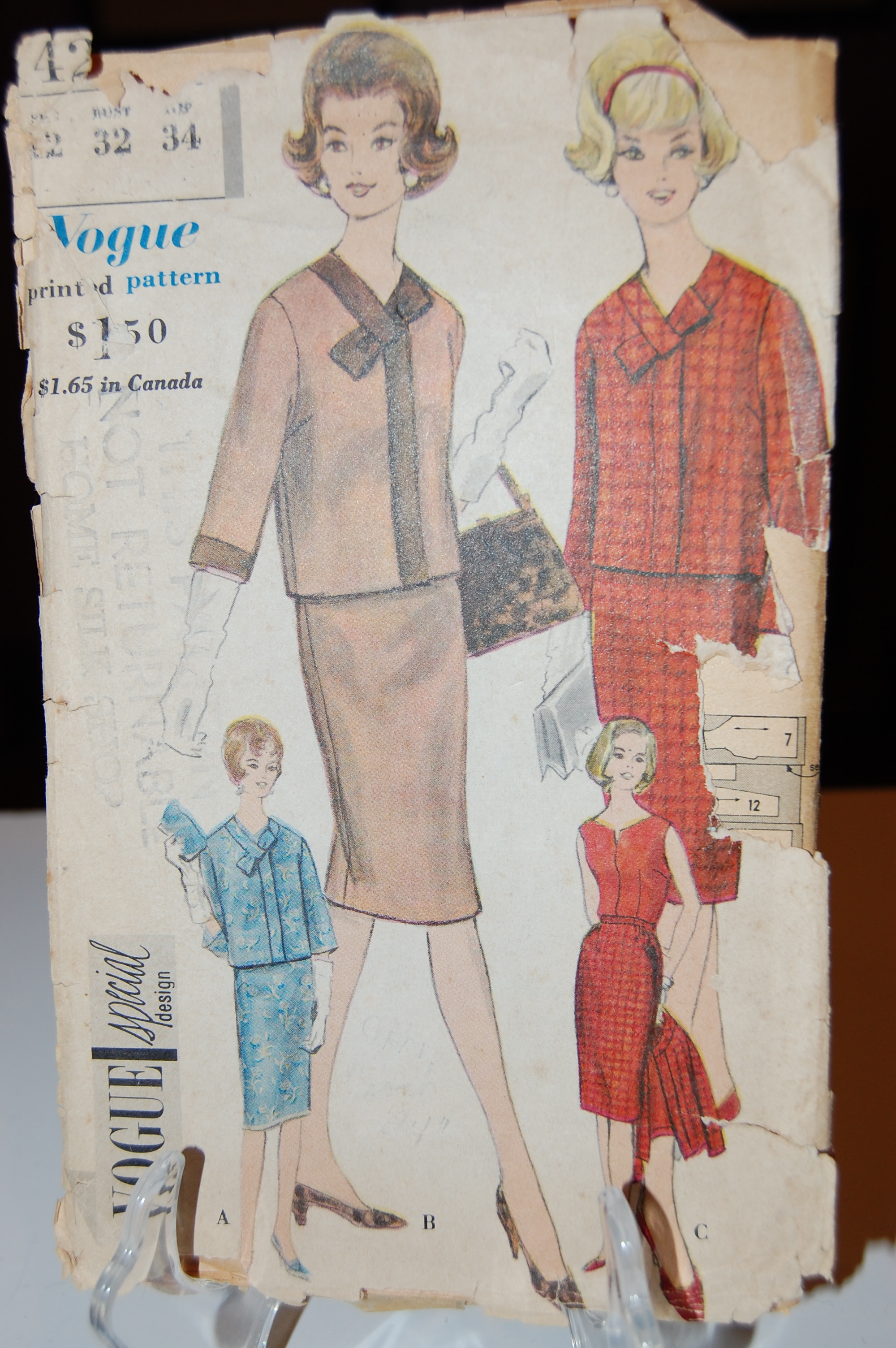
Choice #4: There is no copyright on this pattern, but I judge it to be from about 1962 (the hairdos and the increased pattern price are good clues!) This pattern also includes the blouse pattern.

Keep in mind that this fabric presents significant “plaid matching” challenges, which I had to consider when I decided on the pattern.  The more seams in a pattern, the higher the challenge (usually).  So – was I safe and cautious, or gutsy and daring?

5 Comments

Filed under The Conde Nast Publications, Uncategorized, vintage Vogue patterns from the 1950s, vintage Vogue patterns from the 1960s

Does sewing suit you?

Last week I saw a television spot, which gave a short biography of the wife of someone who is in the news quite a bit right now.  The reporter/commentator referred to the wife’s modest upbringing, with a statement that her mother even had to make her childhood clothes for her (to drive home the point about them not being wealthy, I suppose.)  The reporter then went on to say that now this wife only wears the finest (sniff, sniff) tailored suits, as if to imply that wearing all those homemade clothes is something she’d rather forget.

Well, pardon me, but what a disparaging thing to say about sewing!  Obviously, the reporter has never experienced the satisfaction of sewing for herself or for someone else, nor does she have any idea how ubiquitous home sewing was in the 1950s, ‘60s, and ‘70s.

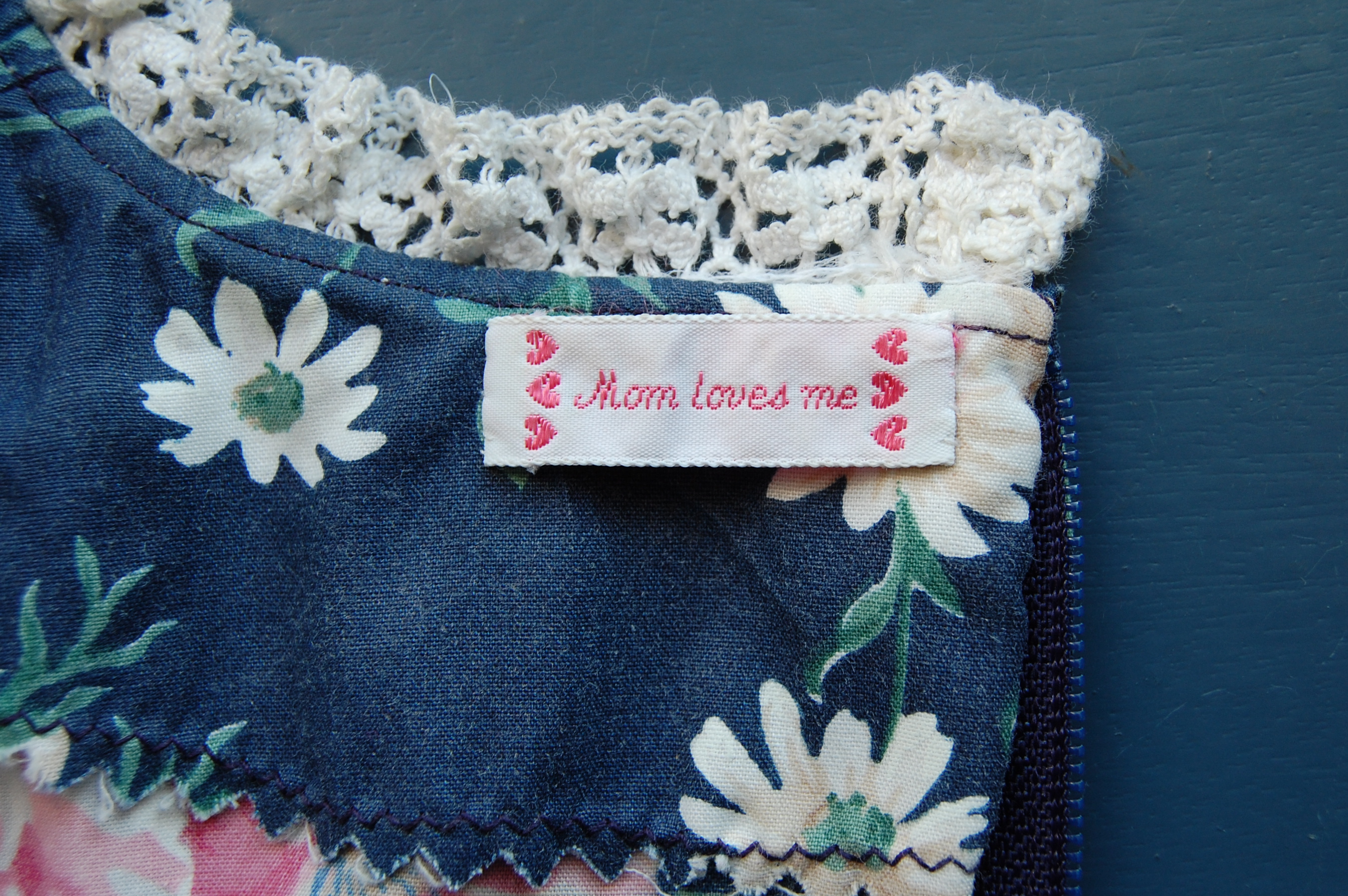
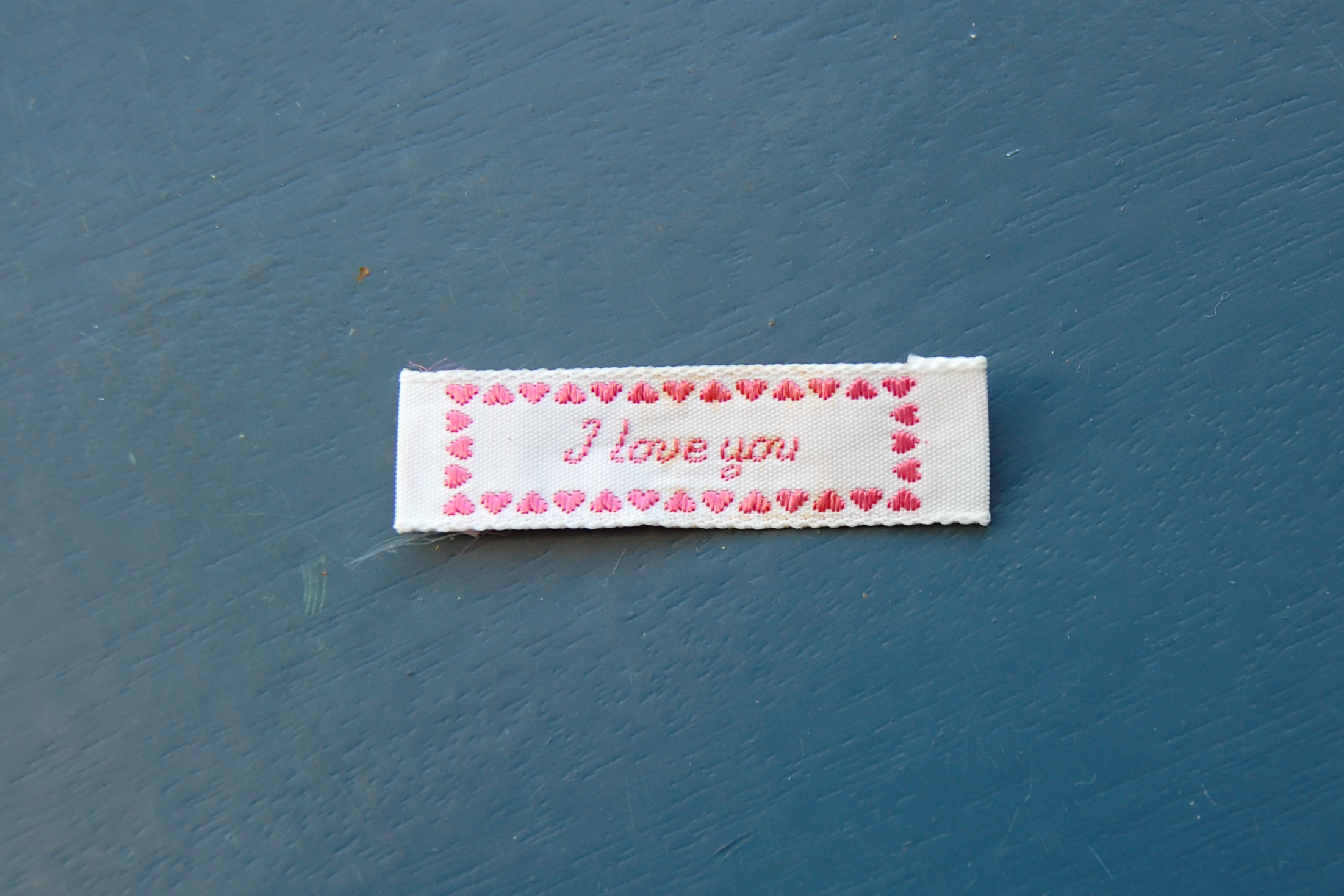
This little tag can tell you exactly why a mom sews for her child...

And this little tag can tell you why those of us who sew, do so for family and friends of all ages.

All of this got me thinking about the pleasure I get out of sewing, of being creatively  busy, and well, I just thought I’d share some of my thoughts about why I enjoy sewing, and especially fashion sewing, so much.  I know there are some of you who are not sewers, but I’ll bet most of you have a mom, or aunt, or sister, or know someone who is, so I hope my thoughts will have some relevance for you, too.  So here goes – my essential eight:

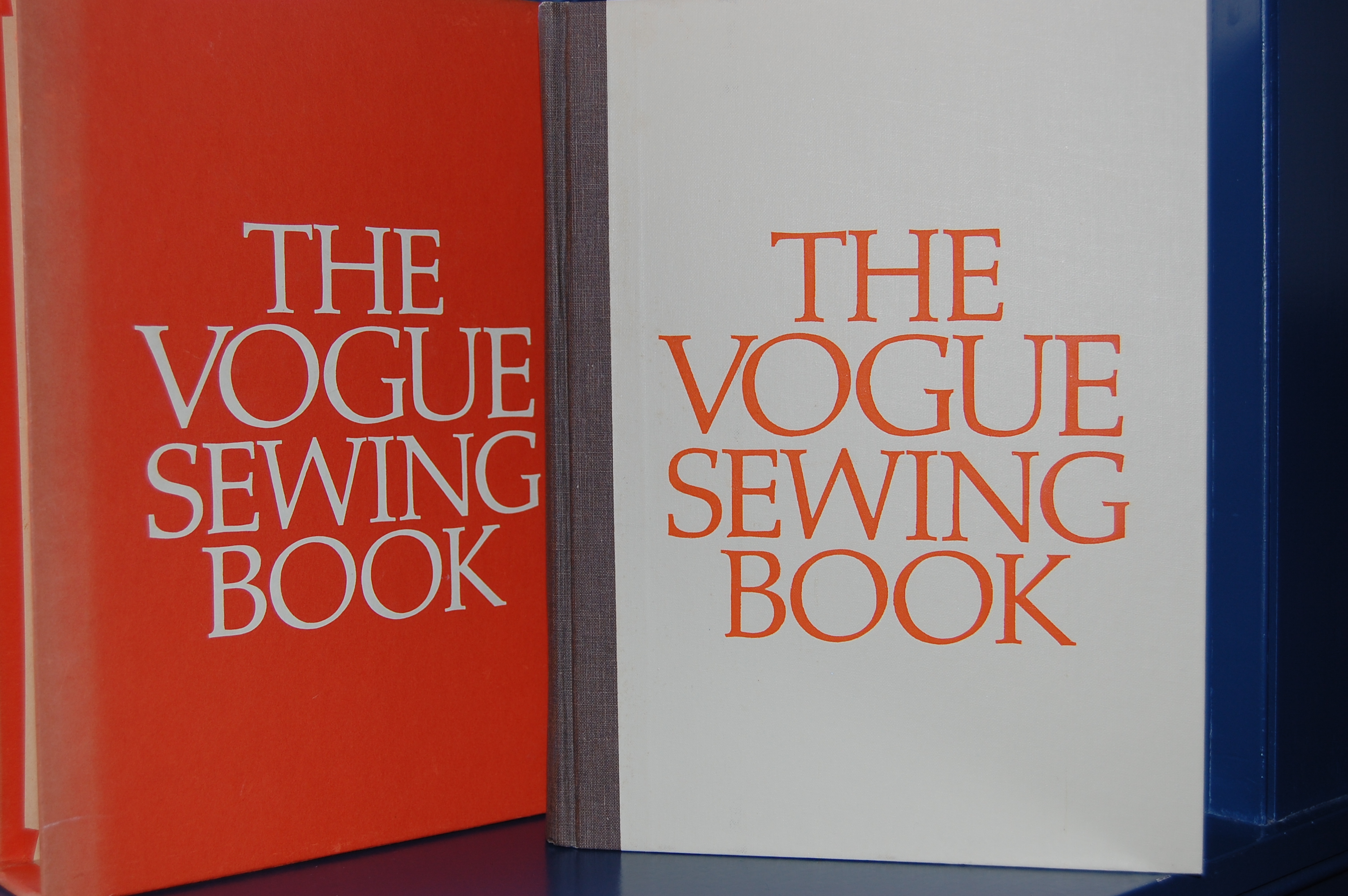
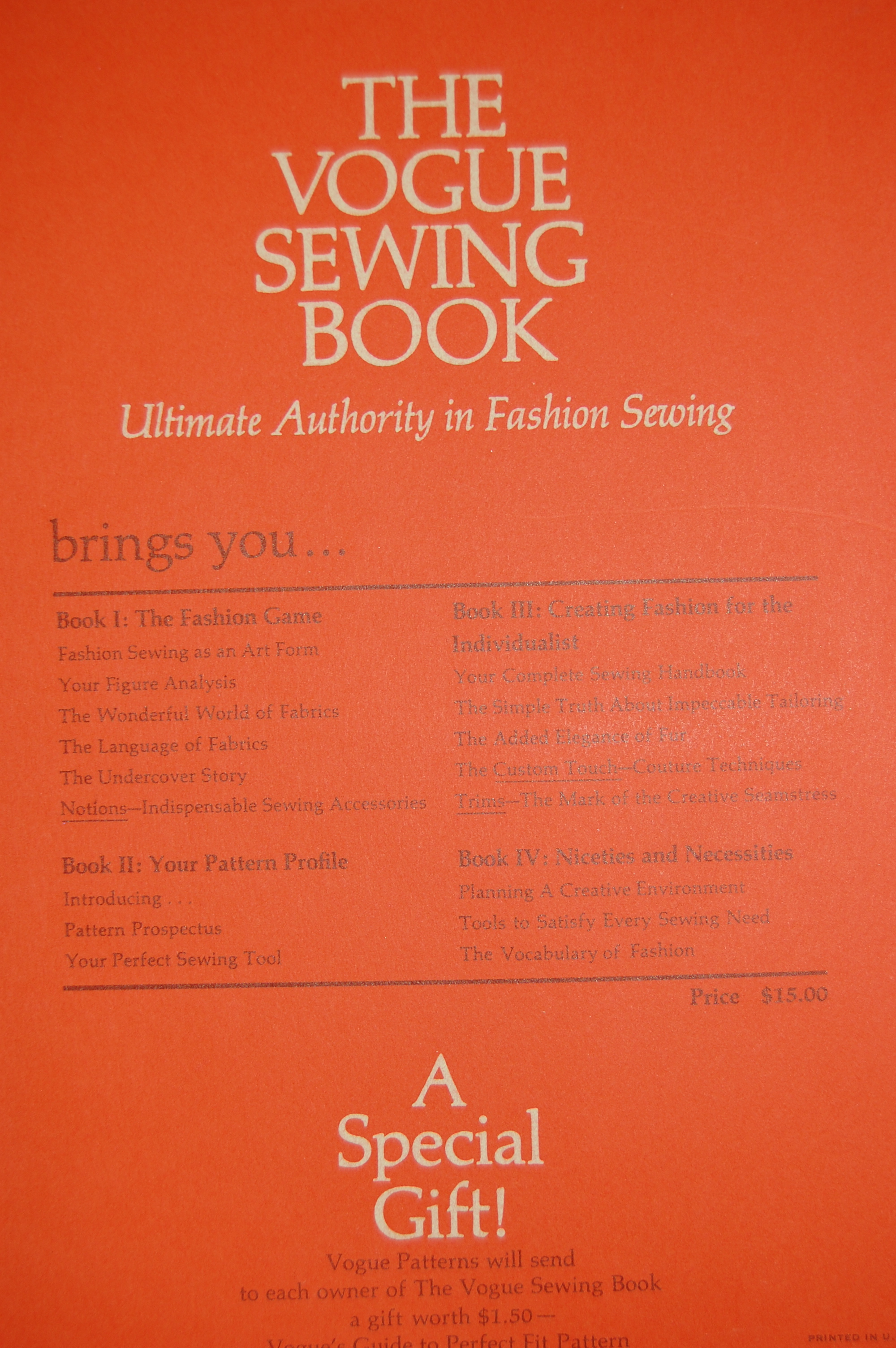
#1:  In 1970 when I was still in college I asked for and received The Vogue Sewing Book for Christmas. Its first chapter is entitled Fashion Sewing as an Art Form and this is a direct quote:  “A person who sews is a creative artist because she individualizes fashion to her own special preferences and requirements.” Plain and simple, I like being creative and an artist.

Here is my copy of The Vogue Sewing Book, with its slipcover. I can't say enough good things about this book! Copies of it appear for sale on eBay and Etsy occasionally.

Here is a fly sheet which came with the book. Listed right at the top is "Fashion Sewing as an Art Form."

#2:  The pleasure of choosing and handling beautiful fabrics is indescribable – go to a store like Britex in San Francisco and you’ll see how intoxicating fine fabrics can be. Yes, I’m a hopeless textilian.

#3:  The saturation, variety and combination of colors in silks and wools, in linens and cottons is visually so satisfying and inspiring.

#4:  I am a very goal-oriented person:  I love the practice of starting a project (garment) and seeing it through from start to finish, and then once it’s complete, moving on to another one.  In other words, sewing is composed of finite steps – there is a beginning, a middle, and an end – and then you have (hopefully, at least) something to show for it.

#5:  I love detail work (like hand-sewing) – and good sewing has lots of details to it!

#6:  Vogue patterns – and especially the ones from the ‘50s, ‘60s and ‘70s, and the designer ones – are such a pleasure to use.  Most are gems of design, construction, and style.

#7:  Speaking of construction, the challenge of putting the parts together, and figuring out the intricacies of construction is just so much fun.  When I get a new (old) pattern, the first thing I do is take out the instruction sheets to read them. Hm-m-m, do you think I might be a little nuts – or just an engineer at heart?

#8: I get the heebiejeebies if I sit too long – and sewing is definitely an active sport!  I’m constantly up and down from my machine, back and forth from the ironing  board, standing at my work table, picking up pins off the floor, etc. etc.  No fanny fatique from this activity!

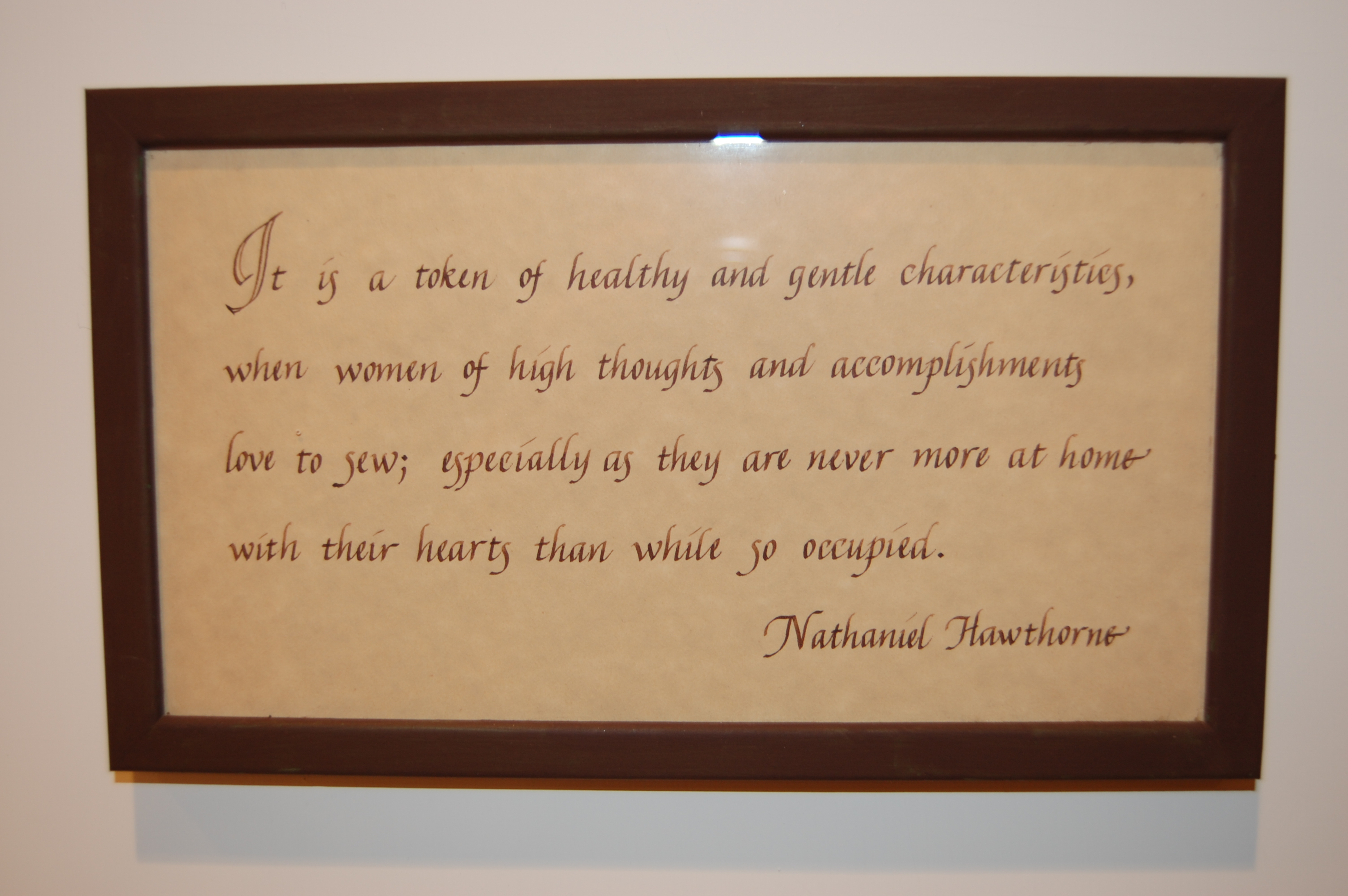
I’ll end by deferring to a great American writer for his poignant statement about women who sew:  “It is a token of healthy and gentle characteristics, when women of high thoughts and accomplishments love to sew; especially as they are never more at home with their hearts than while so occupied.”  While I can only hope to strive towards high thoughts and accomplishments, being at home with one’s heart is always a good place to be.

Years ago, a friend had this quote from Nathaniel Hawthorne done in calligraphy for me. I framed it and have it hanging in my sewing room.

Oh yes – about those finely tailored suits referred to by the clueless reporter?  I can show her more amazing patterns for beautiful suits than she could ever imagine – and in my next post, I’ll be writing about my newest creation.  Yes, it’s a suit!

4 Comments

Filed under Uncategorized, vintage Vogue patterns from the 1950s, vintage Vogue patterns from the 1960s, vintage Vogue patterns from the 1970s, Vogue patterns

“When in doubt, wear red.”

Bill Blass, noted American designer (1922 – 2002), knew of what he spoke when he expressed this savvy advice.   Red, in all its various hues, is a color which commands attention, and therefore, it is no wonder that fashion sketches and dress patterns often feature red.  Red also figures distinctly in three months whose “colors” always include red:  December’s red and green; July’s red, white and blue; and, of course, February’s red, red, and red.

To celebrate February’s red, I have scoured my Vogue Pattern Book Magazines and my collection of vintage patterns to showcase some beautiful fabric and dress/suit/loungewear designs.  No doubt (pardon the pun), Mr. Blass would approve.

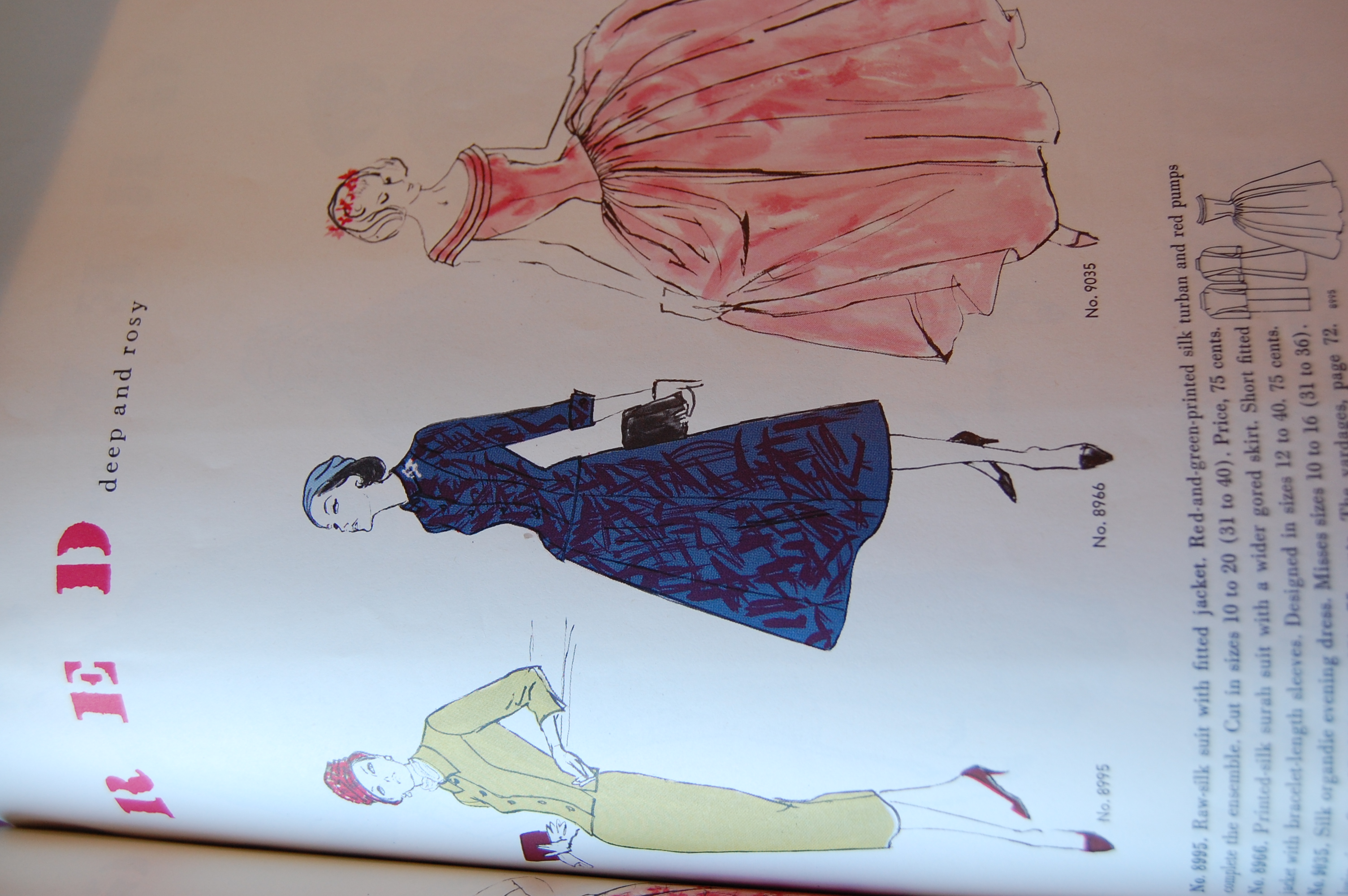
The February/March 1957 issue of  Vogue Pattern Book  magazine shows two pages of “Red – deep and rosy”.  While the red coat and two red dresses are obvious “fits” for the section, the mustard yellow suit (raw silk, according to the caption, which would be so elegant!) is completed with a red and green printed silk turban and red pumps.  (Hint for viewing:  click on the photos to see them larger and clearer.)

The middle suit looks to be a blue and red printed-silk surah, while the evening gown is to be made in a silk organdie.

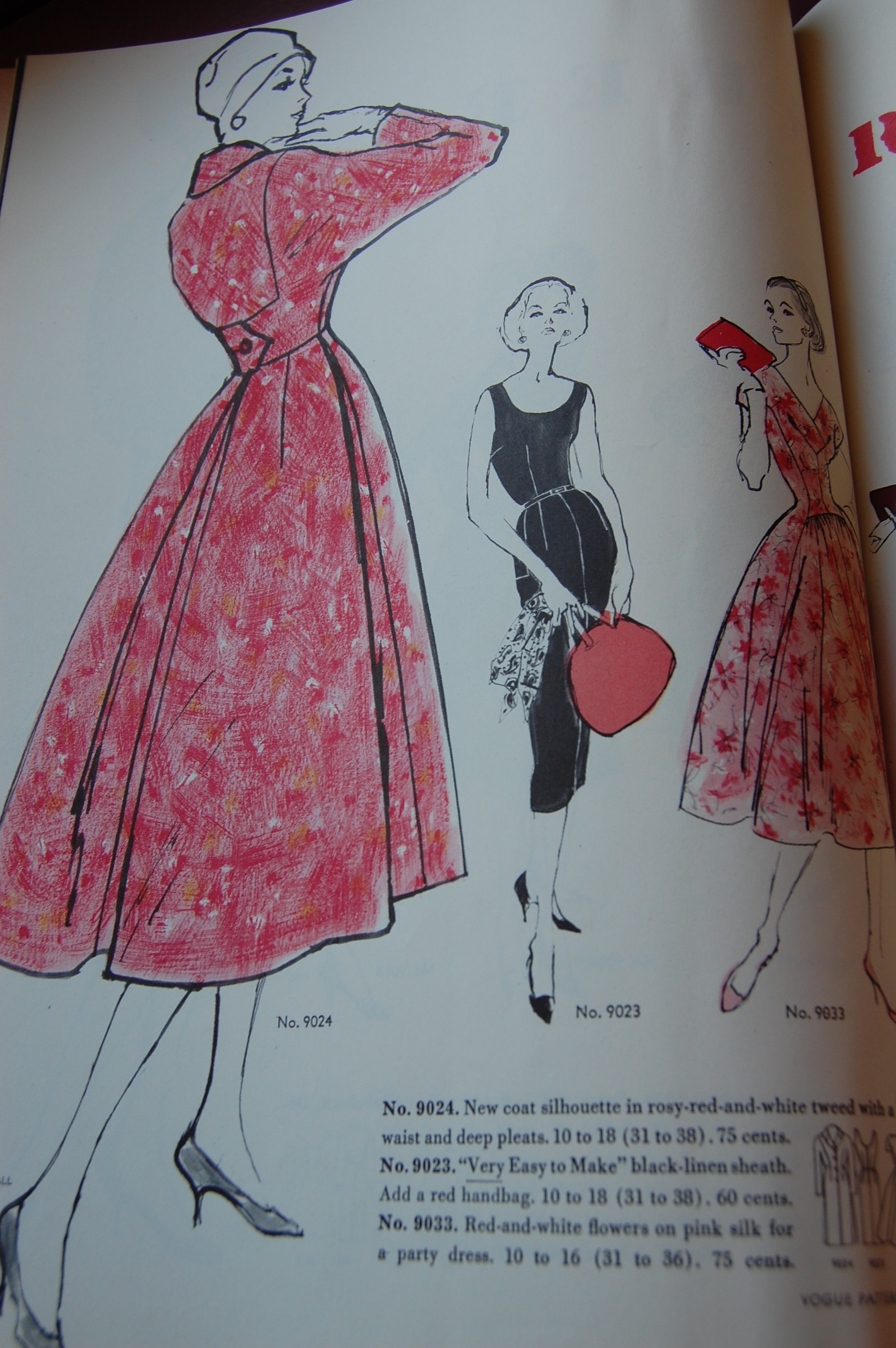
This coat has a high waist and deep pleats. Wear this over the black dress for a stunning look!

That same year, the June/July issue showed this lovely choice in cherry-red pique for “sight-seeing.”  No blue jeans and tee shirts for this excursion.

The wide brim hat with red flowers completes the look.

In 1958 (or in 2012), a chic home sewer could make this suit in a red tweed with self or braid binding.

Notice the stylish shoes!

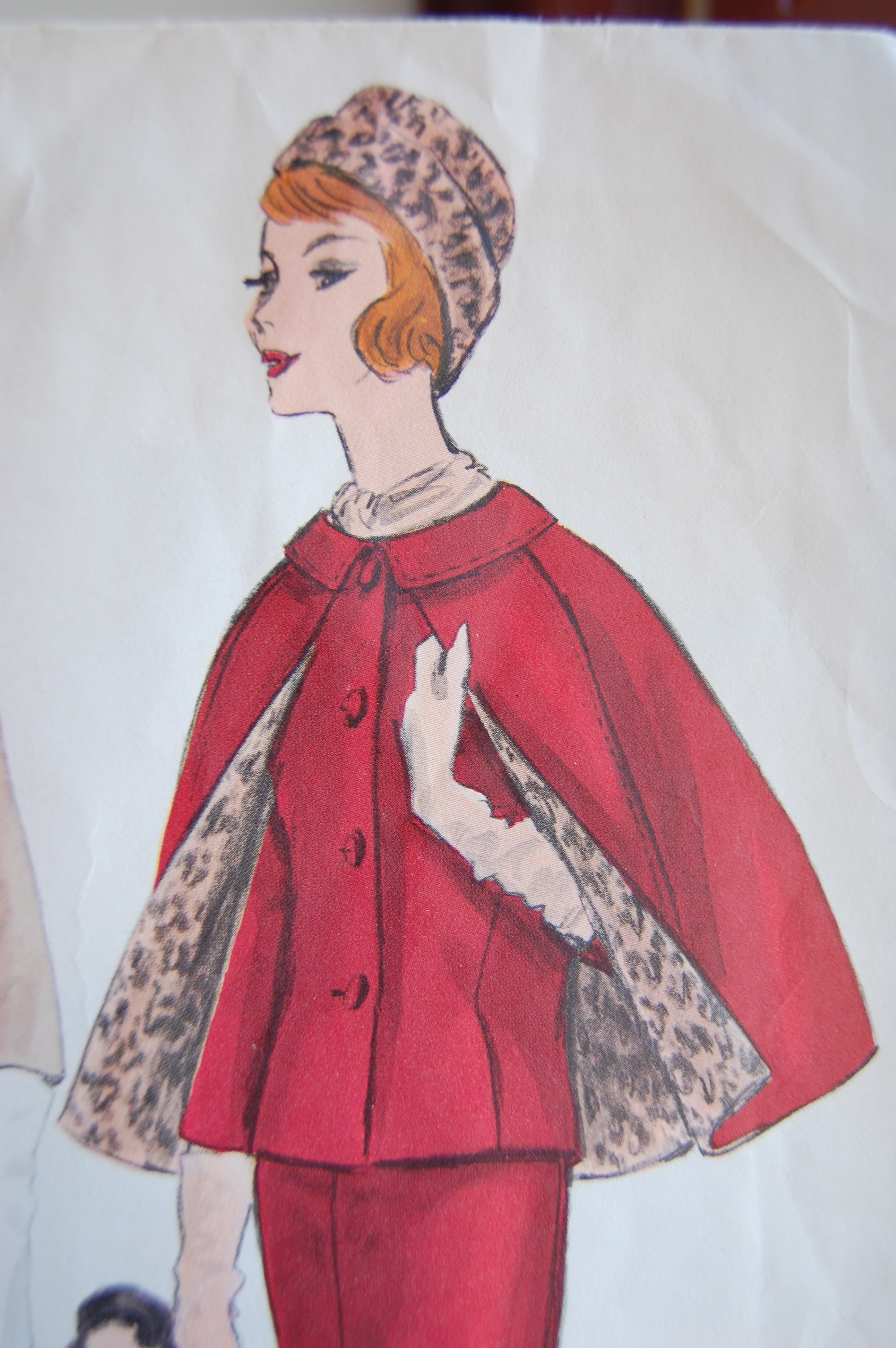
Here is a suit from 1960 with a matching, reversible cape. The cape has arm openings in the side seams and is collarless so that it fits perfectly under the collar on the suit jacket.

Who says "redheads" can't wear red?

Here is a close-up of the cape. The leopard-printed lining matches her hat.

Red print fabrics have spun their own charm over the years.  Here are four, which seem to epitomize another statement from Bill Blass: “…fabric is an inspiration and a tool.” (See International Vogue Pattern Book  October/November 1971, page 27.)  I could definitely be inspired by these prints:

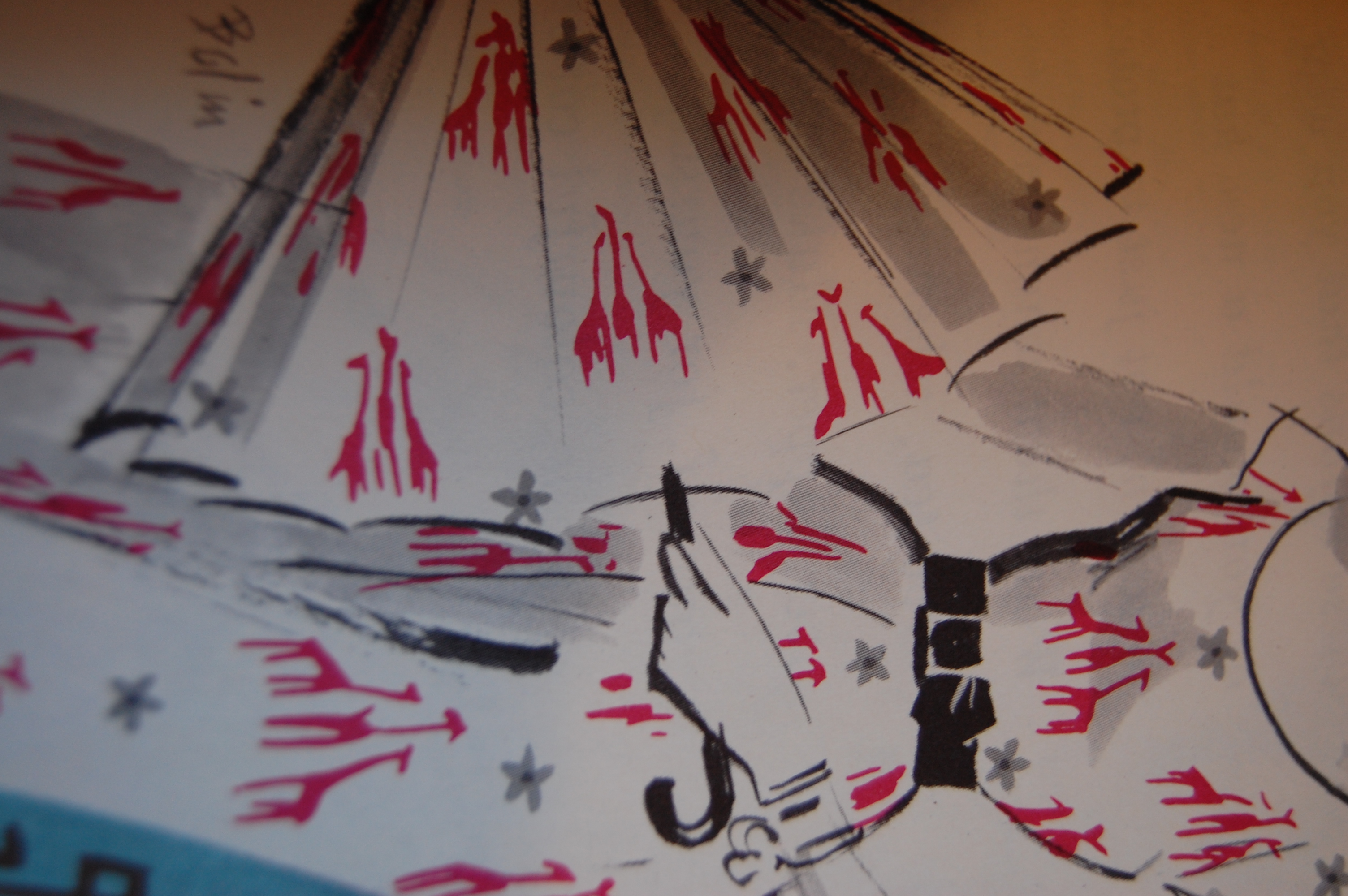
This wonderful giraffe print in red on white cotton, with stars, is shown in a skirt and blouse. There was no mention about the matching parasol. This design is in the April/May 1953 Vogue Pattern Book magazine.

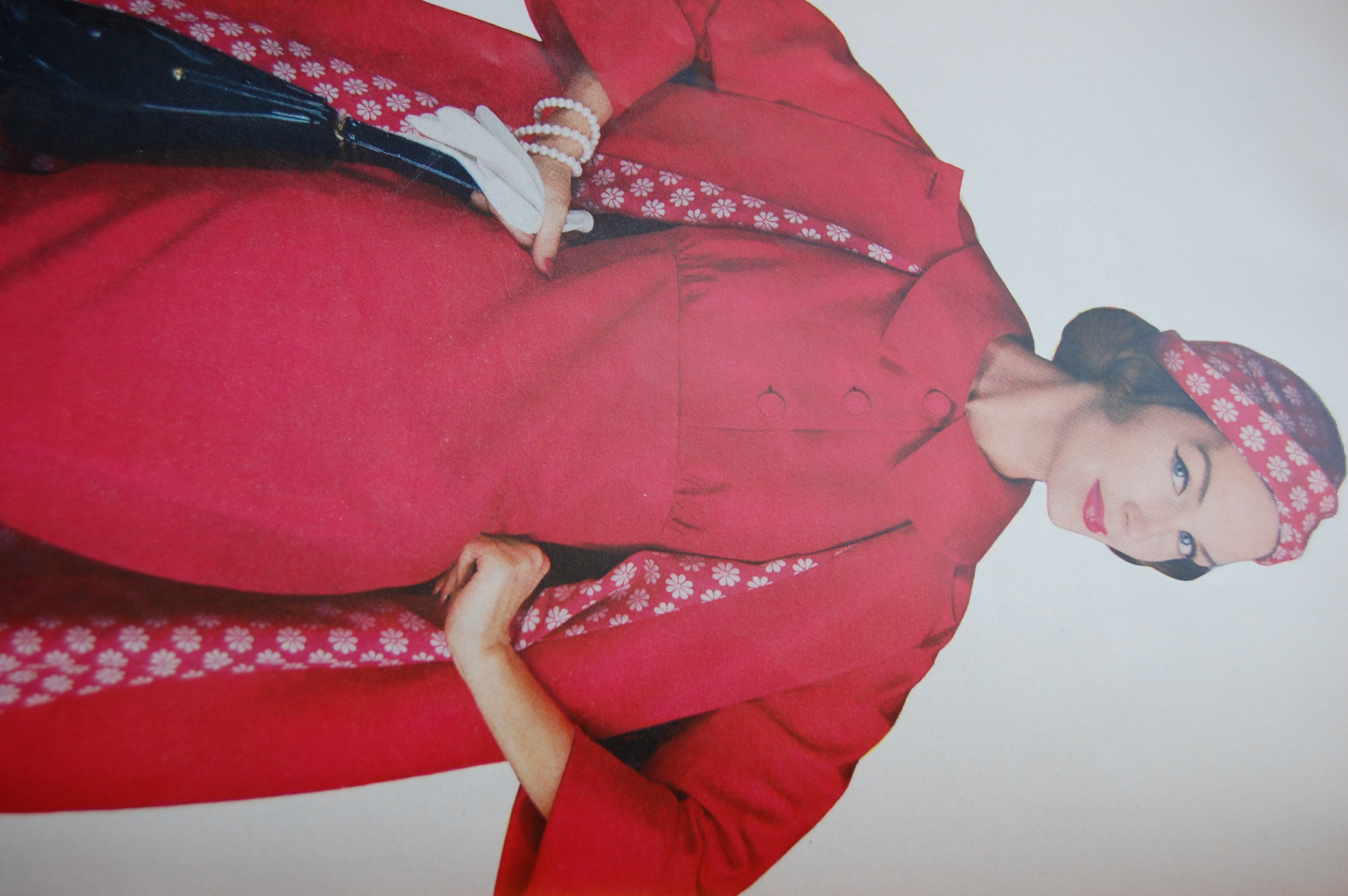
This 1958 design features a daisy print silk lining in the coat.

The dress and coat are made in a slubbed silk barathea while the lining and hat are of silk surah, both by Couture, according to the February/March Vogue Pattern Book of that year.

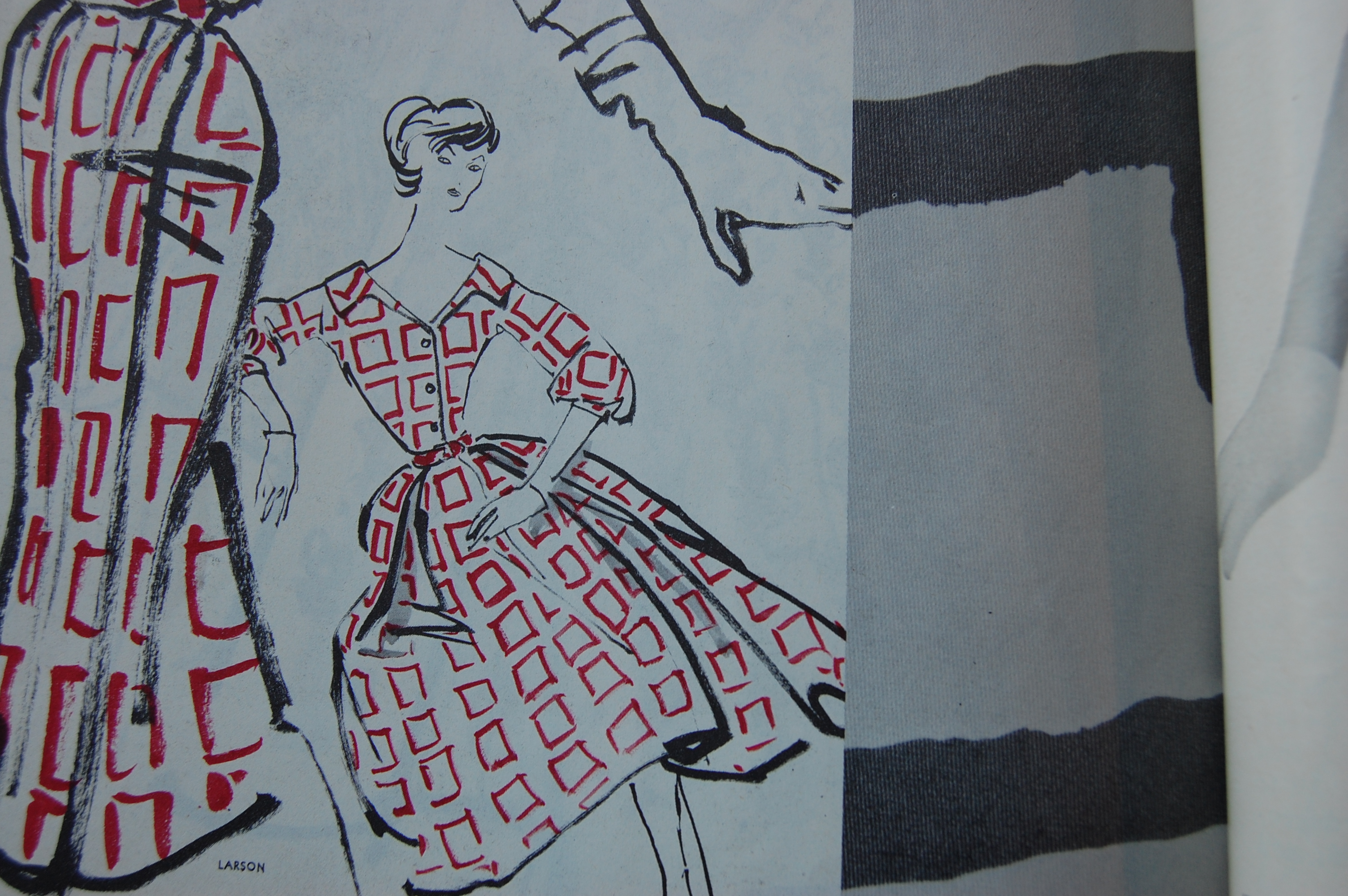
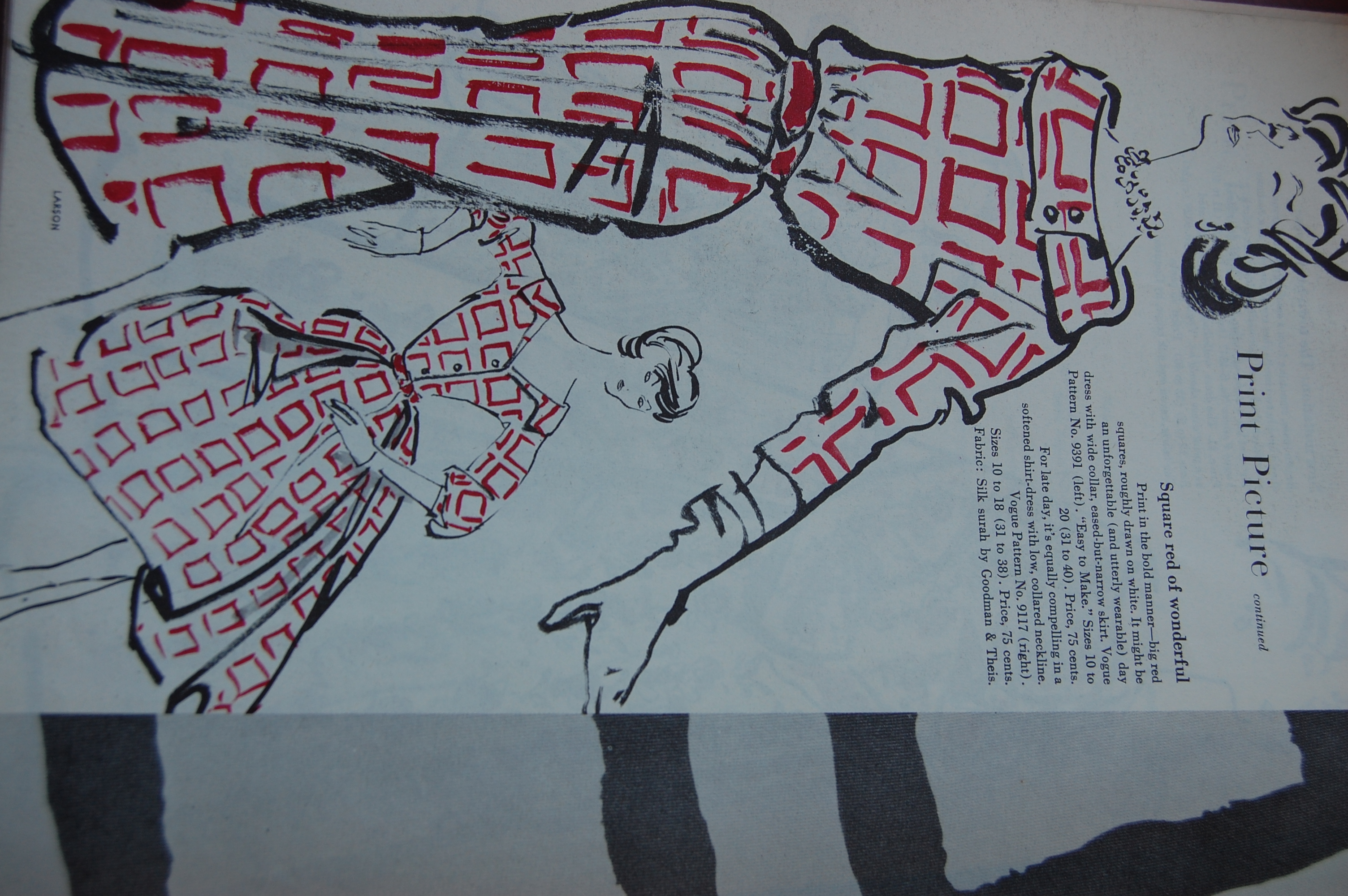
This fabric is rightly referred to as "Square red of wonderful"!

This silk surah looks equally eye-catching in a slim or full skirt. I'll have one of each, thank you!

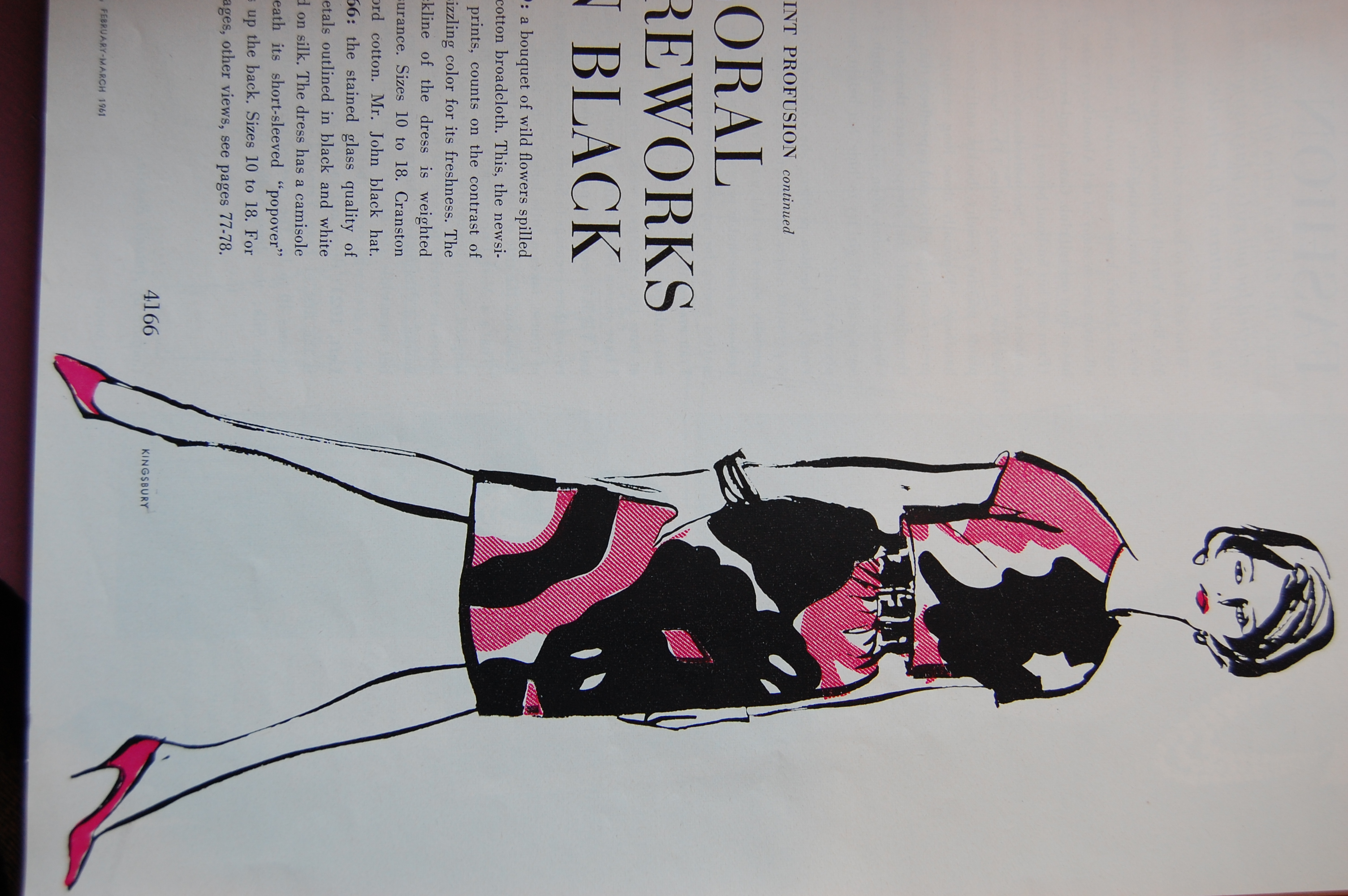
What I wouldn't do to be able to buy this printed silk! This pattern was featured in the February/March 1961 issue of Vogue Pattern Book magazine. According to the description, "this dress has a camisole top underneath its short-sleeved 'popover' top that buttons up the back." With lipstick and shoes to match, it makes a stunning ensemble.

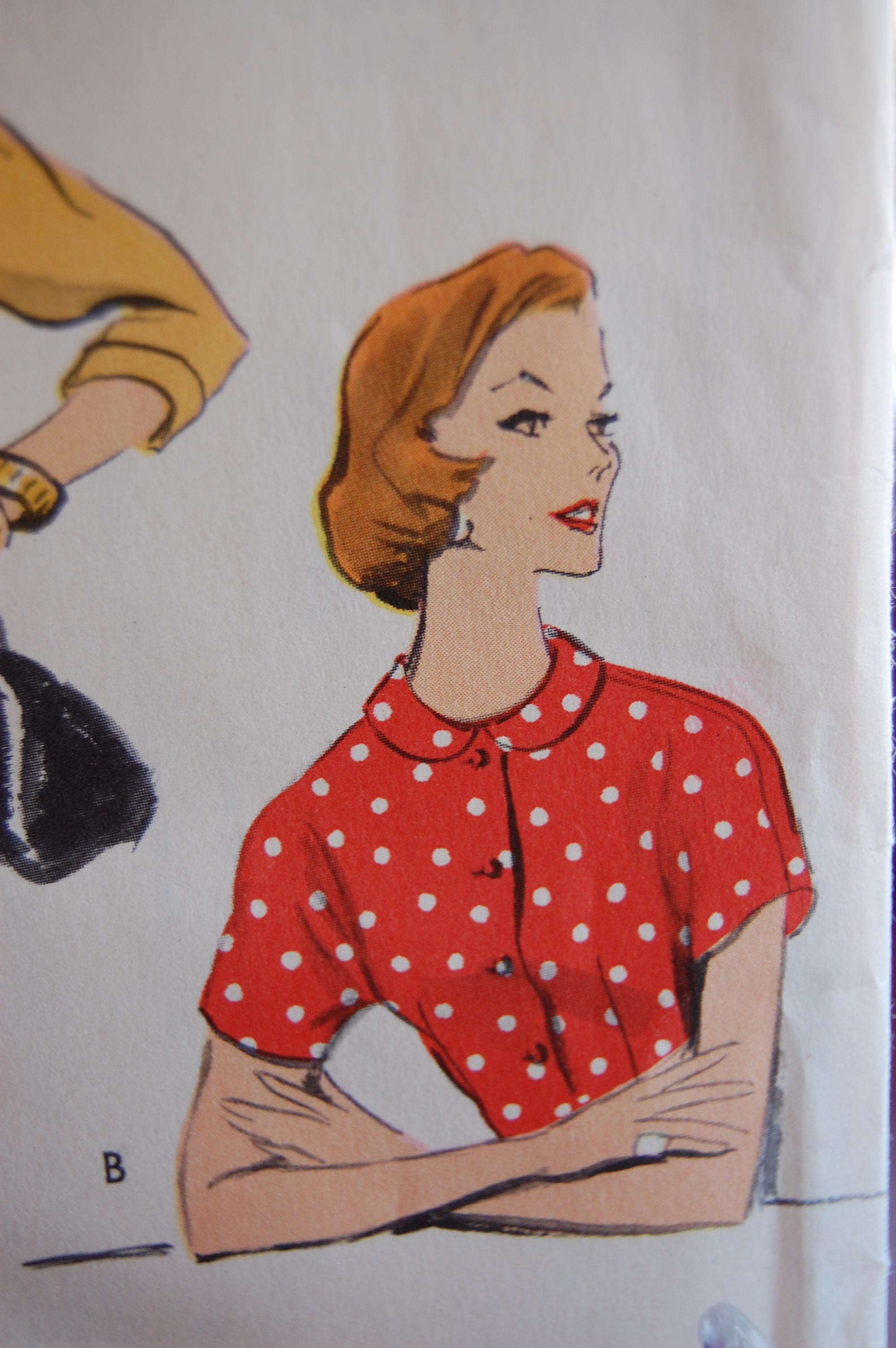
And here are classic polka dots, white on red, in a 1957 blouse design.

A Peter Pan collar and polka dots - a winning combination!

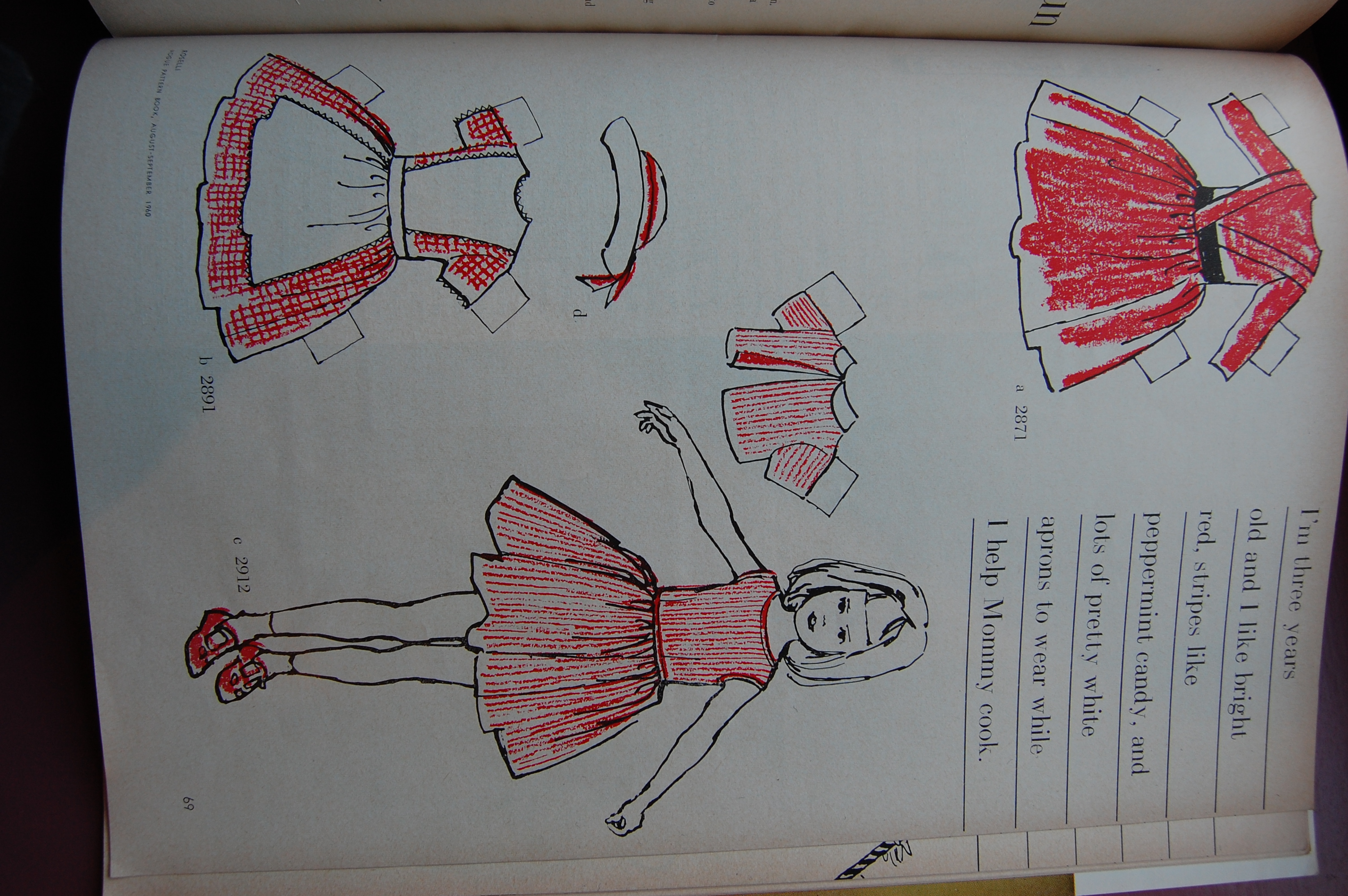
Vogue Pattern Book’s editors often featured styles for college girls and little girls.  Velvet, gingham and candy-striped denim (yes, that’s correct, denim!), all in red, were featured for little girls in the issue for August/September 1960:

This little girl is all set to help "help Mommy cook" in a white pinafore.

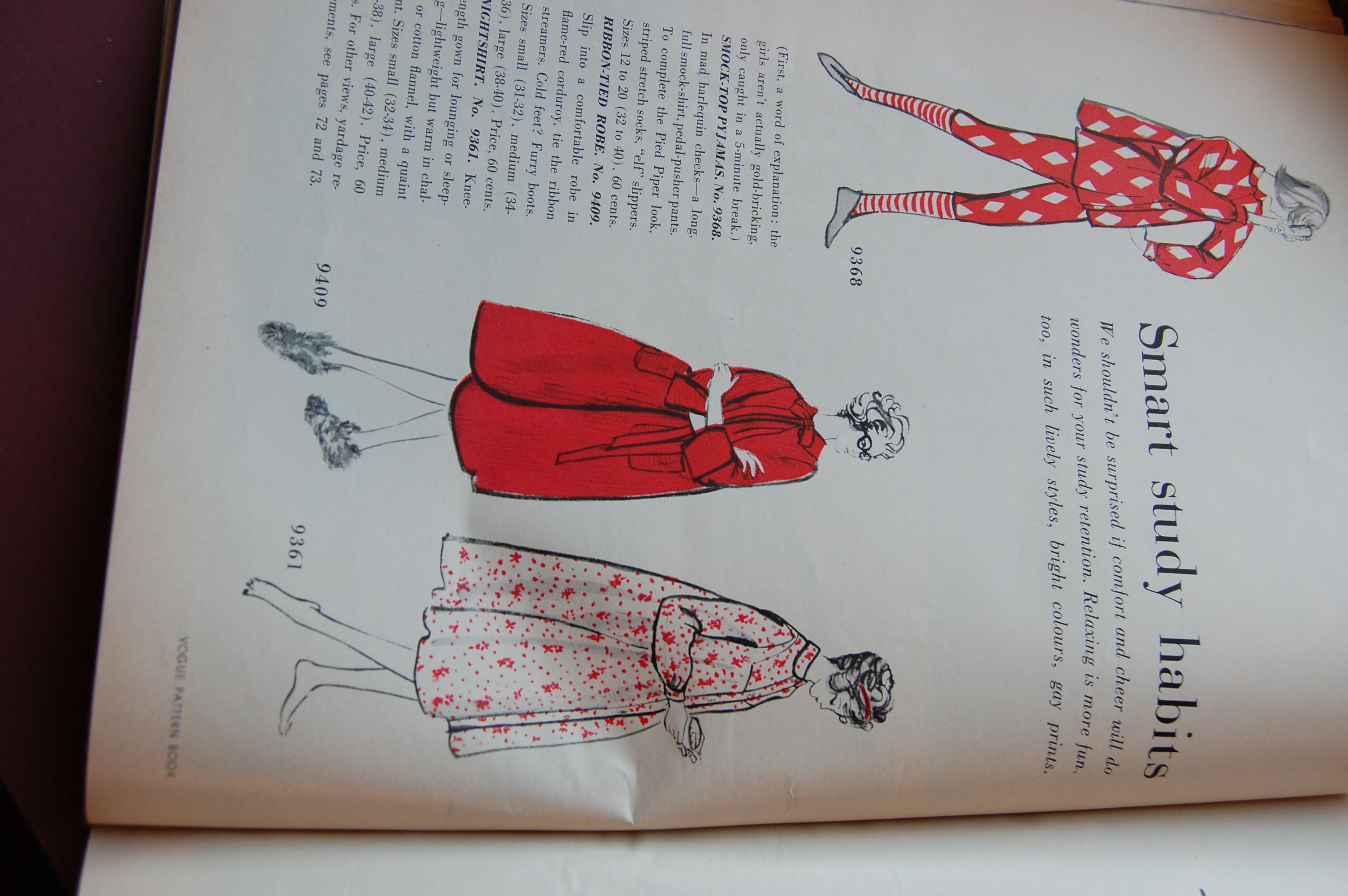
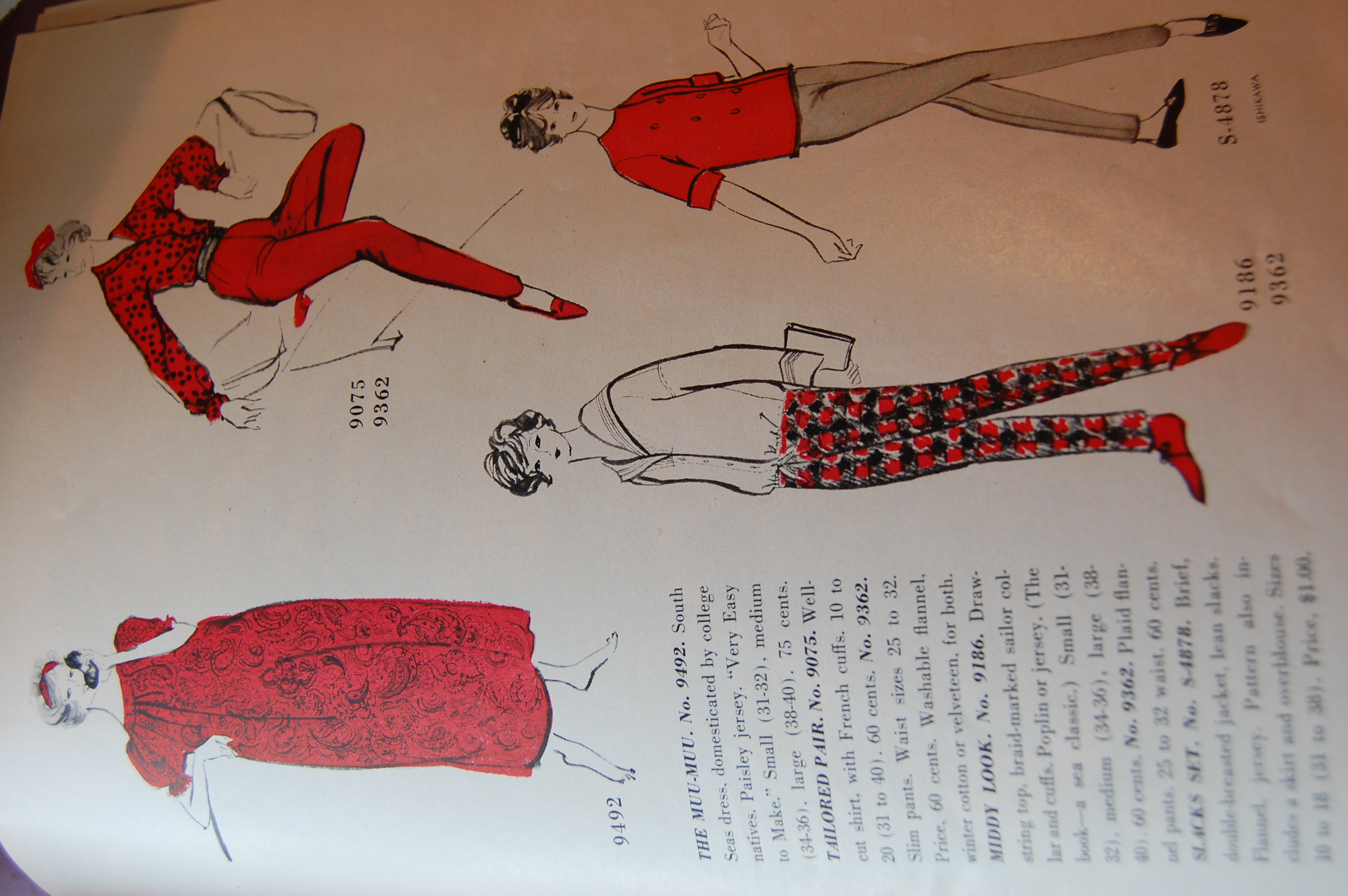
These “coeds”, according to the editors of the August/September issue of 1958, were taking a 5-minute study break to model these dorm fashions!

The girl in the harlequin pedal-pusher pants and smock-top looks to me like she’s actually taking a break from her part-time job with the circus, while Miss Muu-Muu is  — chatting on the phone!   Some things never change, just like the timeless appeal of RED.

5 Comments

Filed under Blouse patterns from the 1950's, Coats, Polka dots, The Conde Nast Publications, Uncategorized, vintage Vogue patterns from the 1950s, vintage Vogue patterns from the 1960s

Messages from the past: handwritten notes on vintage patterns

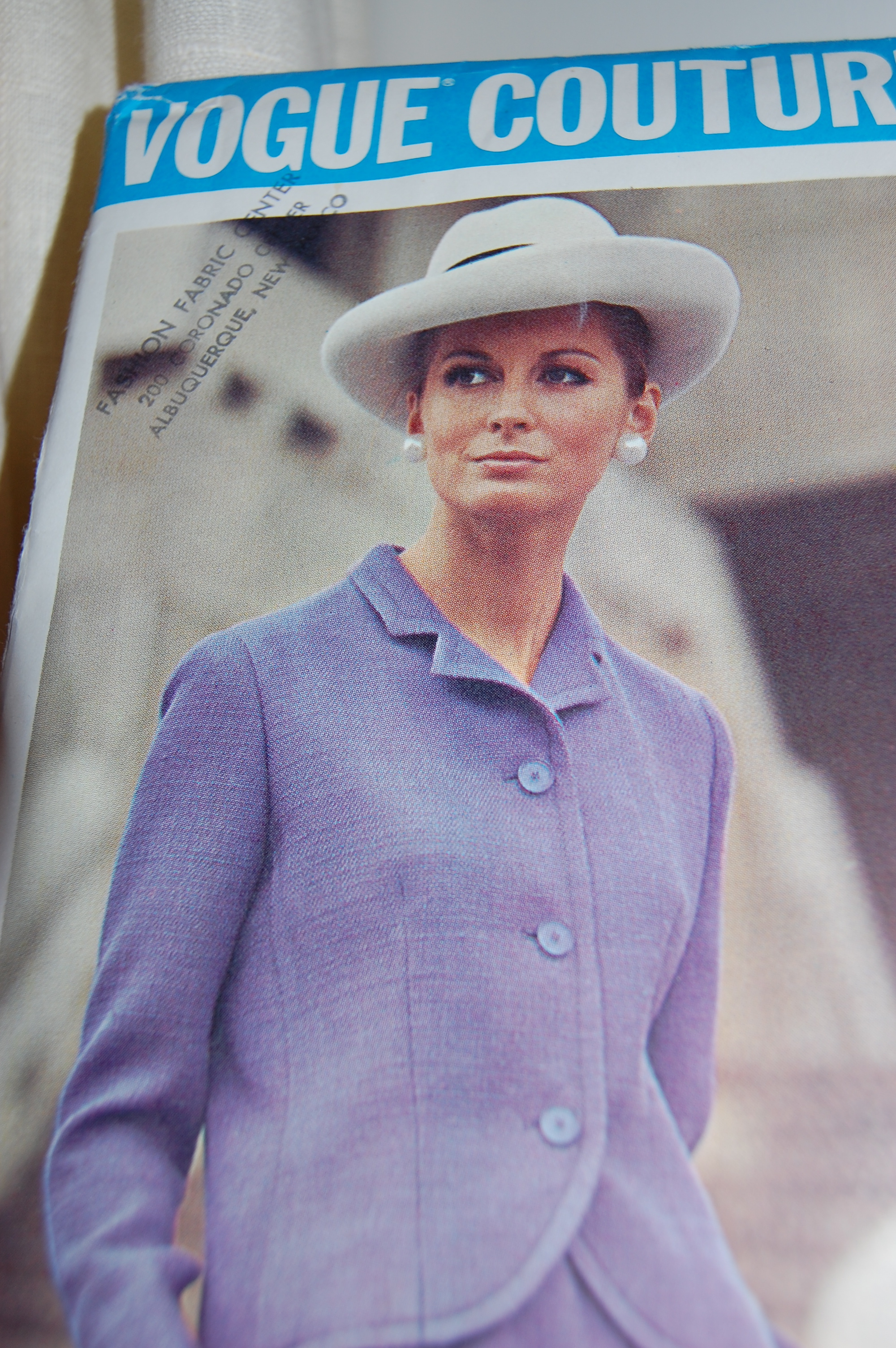
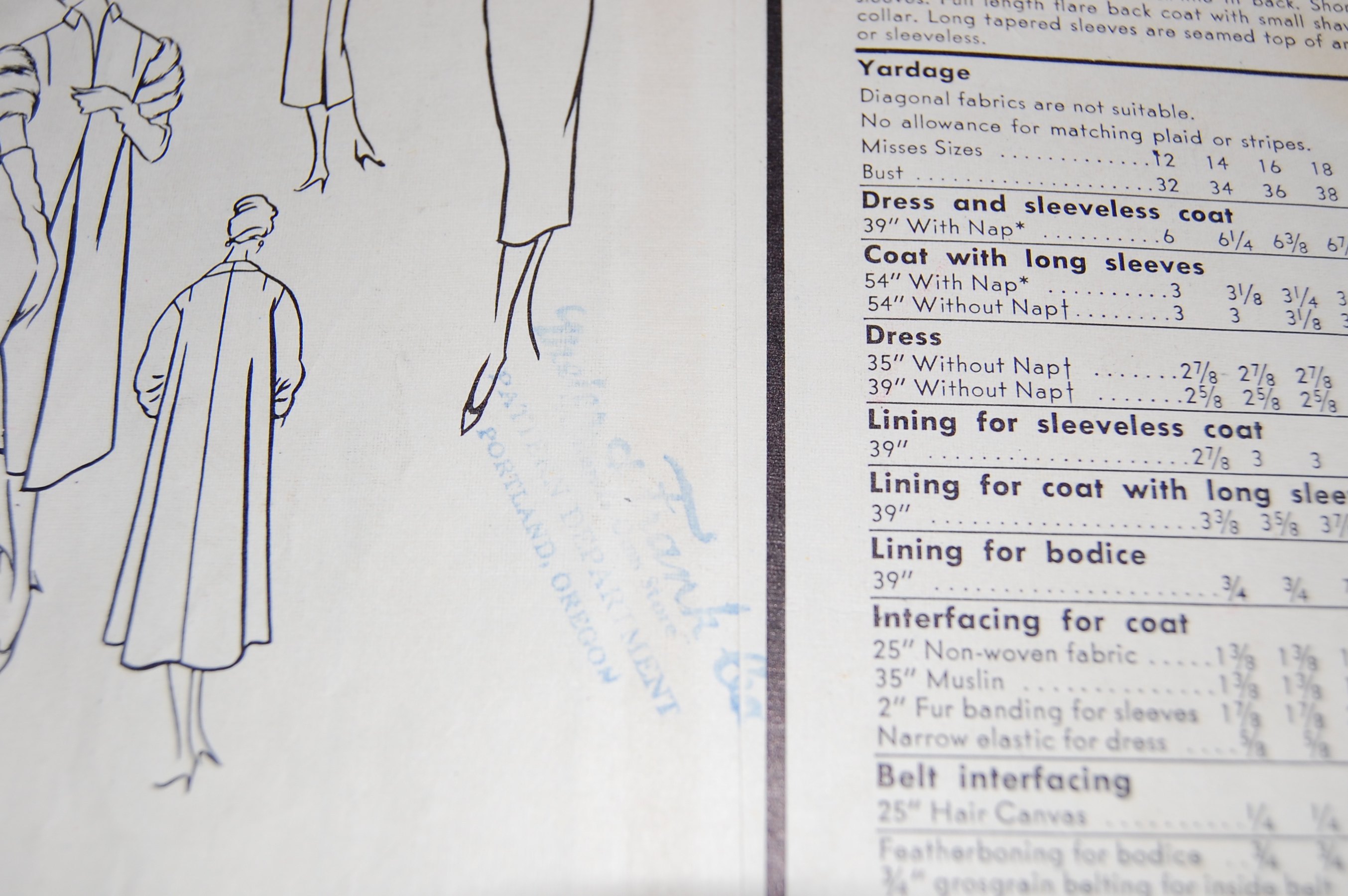
Many vintage patterns have a visible stamp on them which tells the name of the store where it was originally purchased.  (Those of us who sew know that patterns, once purchased, are non-returnable – and it seems it was ever so…)  Sometimes the stamp also lists the location of the store, but not always.  Either way, that stamp is a visible clue to the pattern’s past life.

In the upper left hand corner, you can see the stamp for "Fashion Fabric Center" in Albuquerque, New Mexico. This pattern is from the early '70s.

If you look closely, you can see the stamp on this envelope which tells you it was purchased from Meier & Frank Pattern Department, Portland, Oregon. This pattern is from the 1950s.

I can’t help but visualize a well-put-together woman perched on a stool at the pattern counter of the mentioned store,  thoughtfully flipping through the pages of the Vogue Pattern catalogue, and finally settling on this one pattern.  I wonder what occasion, if any, she was making it for?  Was she, like I was in the ‘60s and ‘70s, agonizing a bit over spending 75 cents or $1 or $3 or $5 for just a pattern, and then loving it once the decision was made?  Was she buying it to make it herself or in coordination with a dressmaker who would be the one to create it for her?  What fabric and color was she intending for the pattern?  Or did she buy the pattern and then, for one reason or another, never make the intended garment?

And then, every once in a while, there is a handwritten note or diagram on a pattern envelope.

These jottings, sometimes cryptic, other times precise, provide clues which begin to answer some of those questions.  In the months I have been buying vintage patterns, I have found myself privy to some of these “messages” from the past – and here are the small stories they tell:

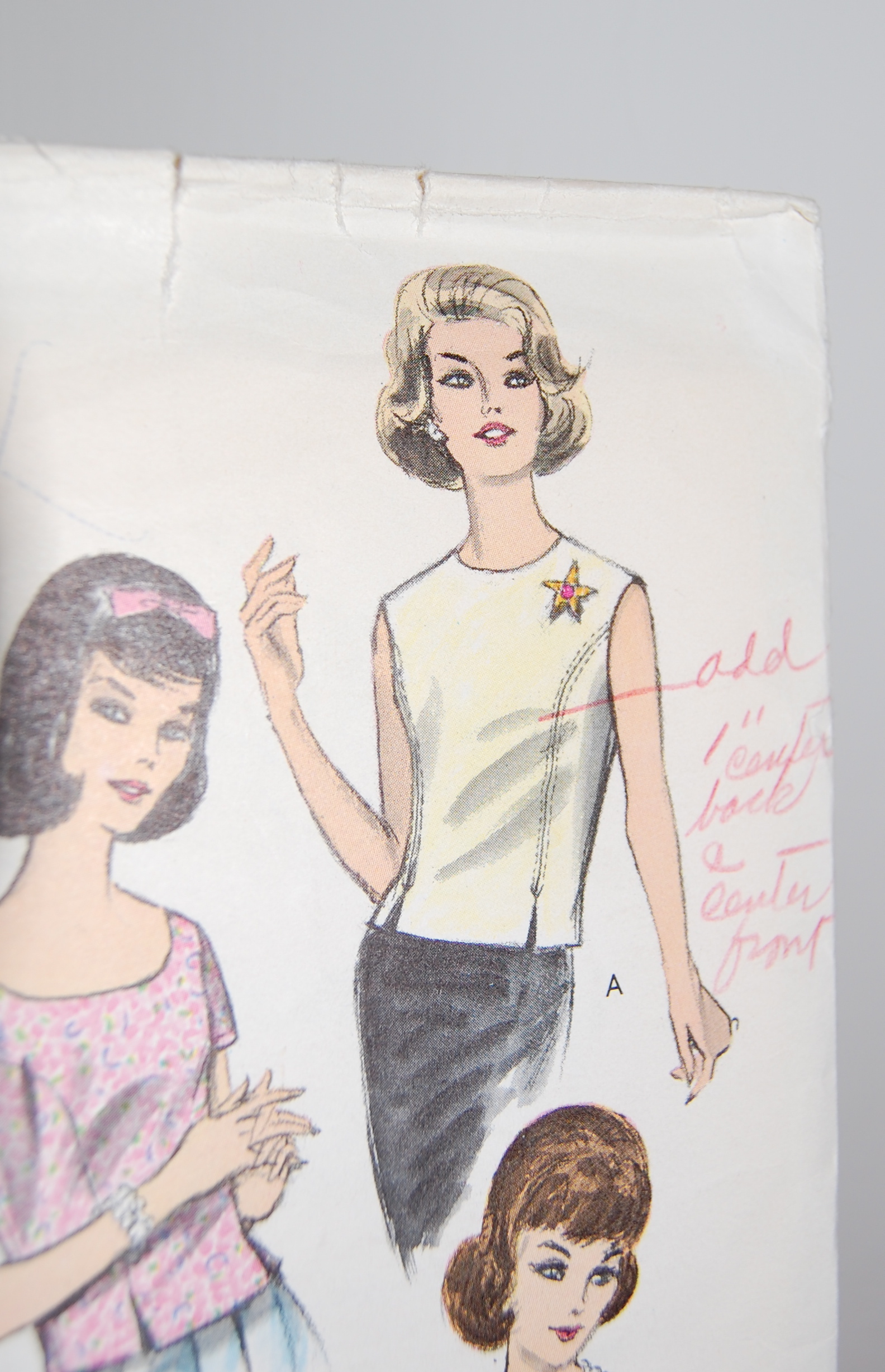
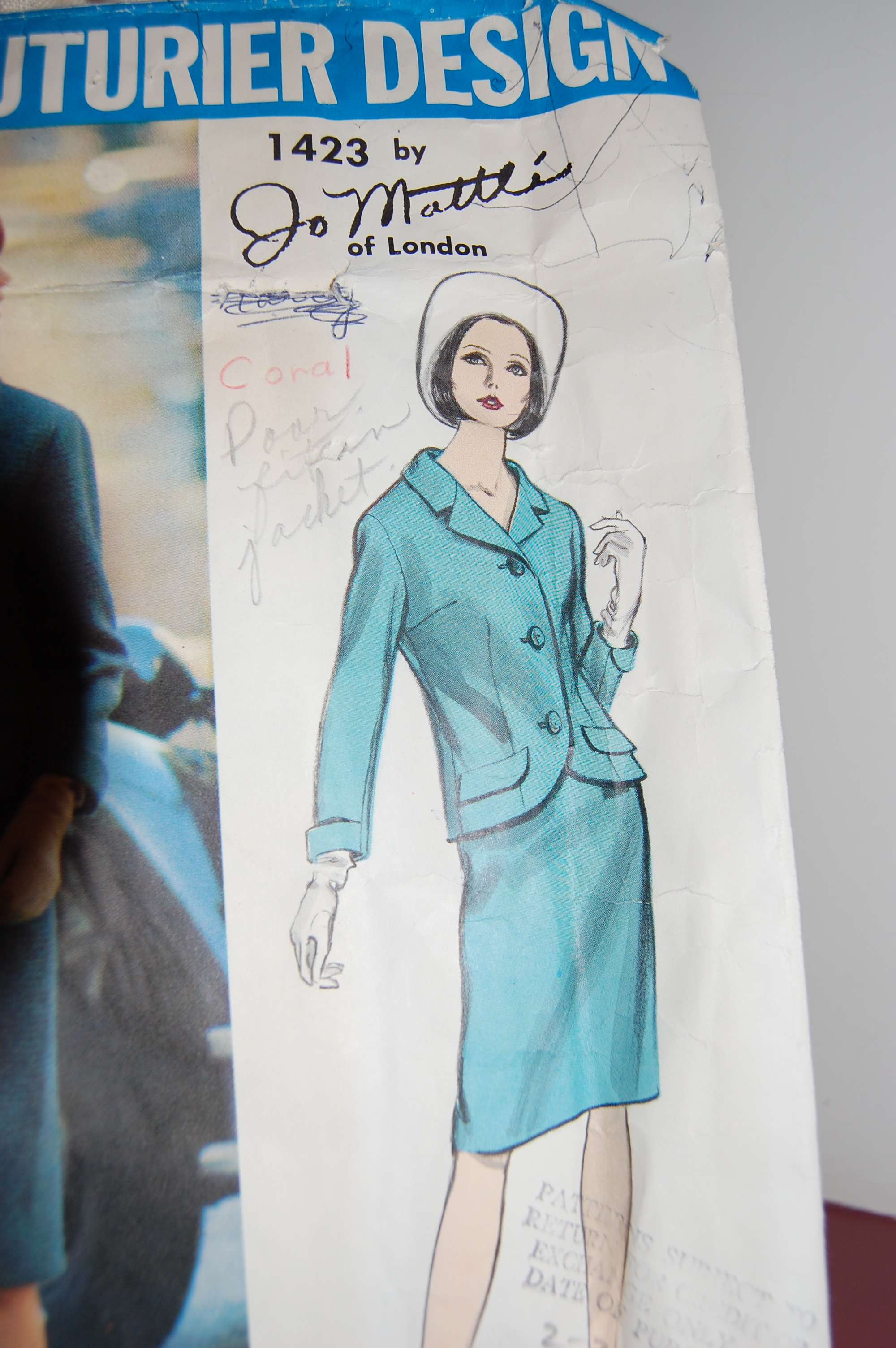
Fit seems to be an important focus.  Kudos to those dressmakers who recorded their difficulties on the pattern envelope!

I think this lady should have purchased a larger size! She needed to add 1" center front and center back!

Beware! Poor fit in jacket! But I bet it was lovely in coral nonetheless.

Check out this listing on Etsy to see a rather melancholy note about fit:  “would have been best to have gotten the med. size.”  I guess that pattern ran large!

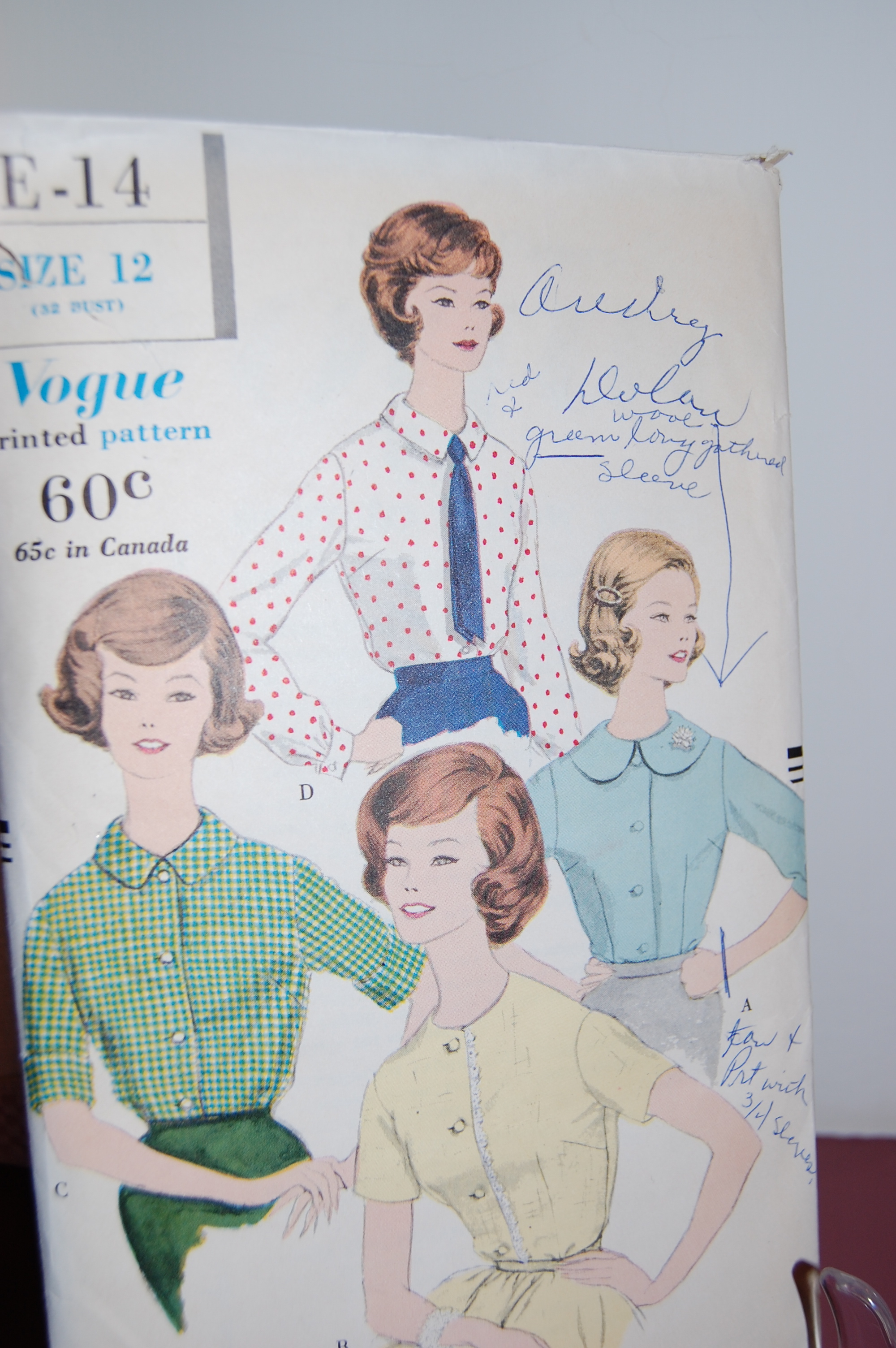
Choice of fabric and color (see above image) are also details which have been noted, sometimes multiple times on the same envelope.

I think this pattern must have belonged to a professional dressmaker. She made it up in red and green wool for Audrey Dolan, with long gathered sleeves. It looks like she also made it in tan and in a print (Prt) with 3/4 sleeves. The pattern tissue is still in great condition, despite all that pinning and cutting!

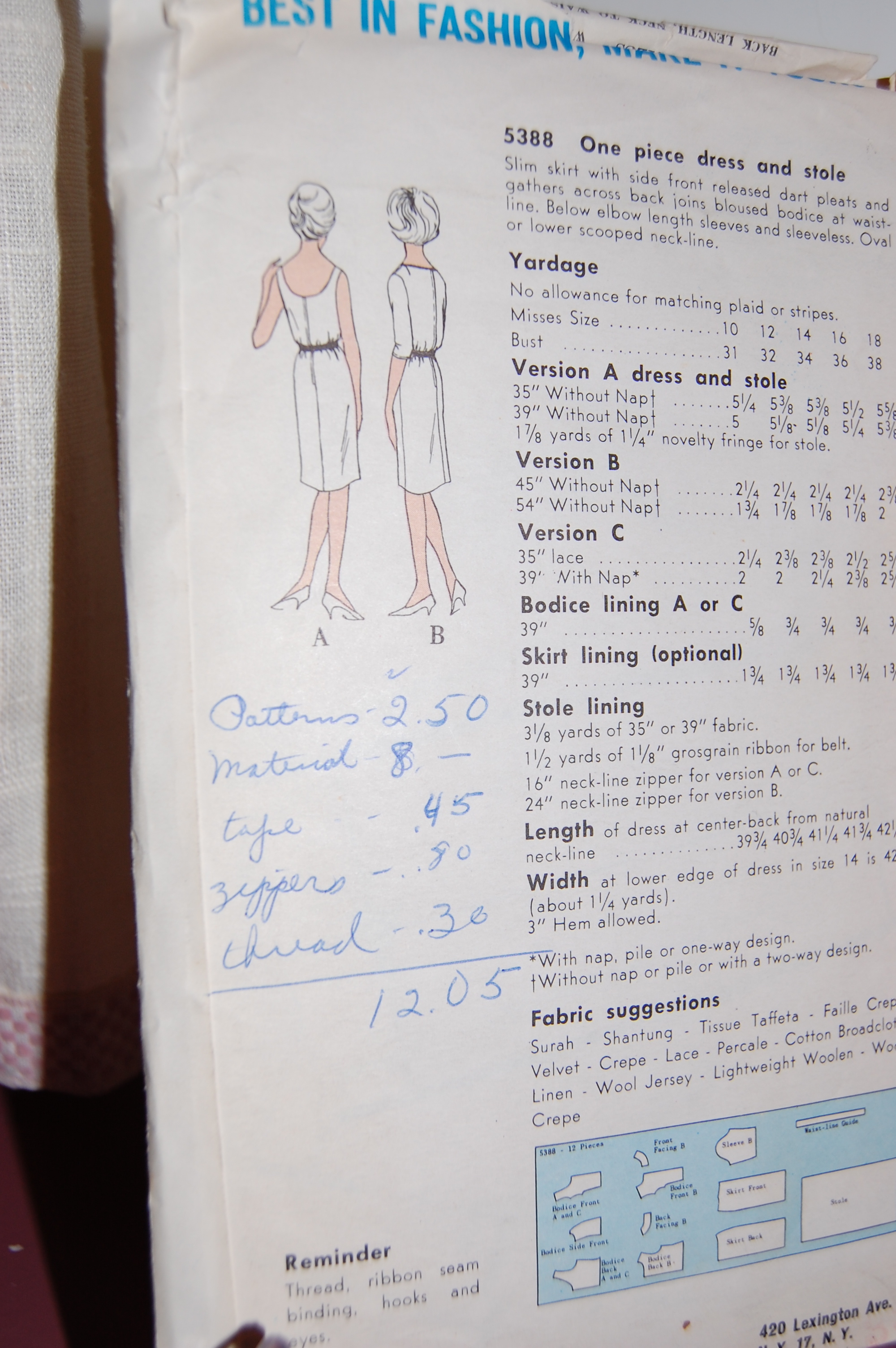
This pattern obviously belonged to a lady who was either a dressmaker, noting her expenses, or a home sewer who kept careful records for her household/clothing budget.

This lady must have made this dress in coordination with another pattern. Both patterns together cost her $2.50. She was also buying multiple zippers, to the tune of 80 cents! Her big expenditure was fabric (material), which she lists at $8.00.

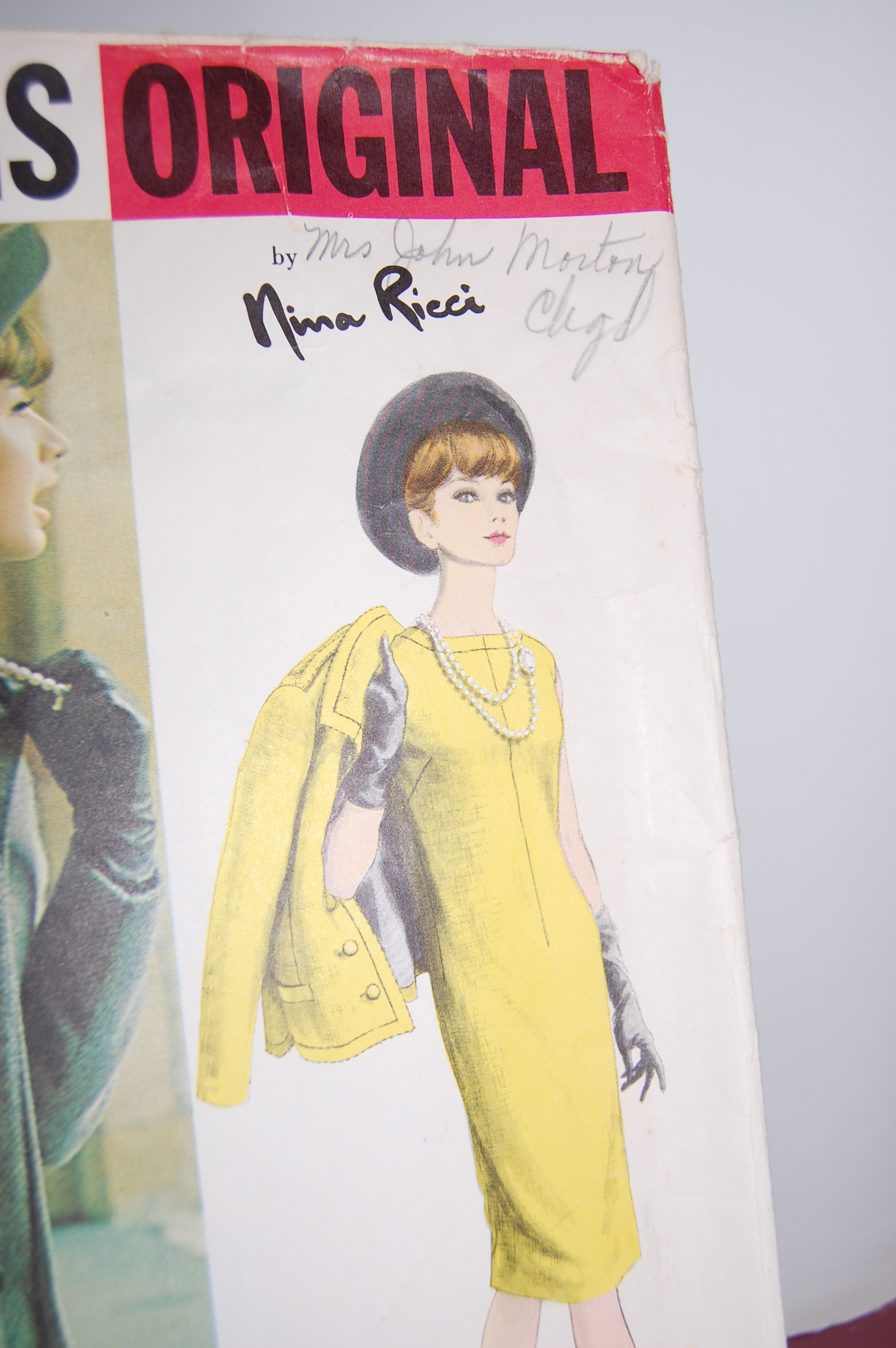
And here is a pattern which Mrs. John Morton “Chgd” [Charged]  Perhaps she did not have to be as careful with her expenditures!

I think Mrs. John Morton was one stylish lady!

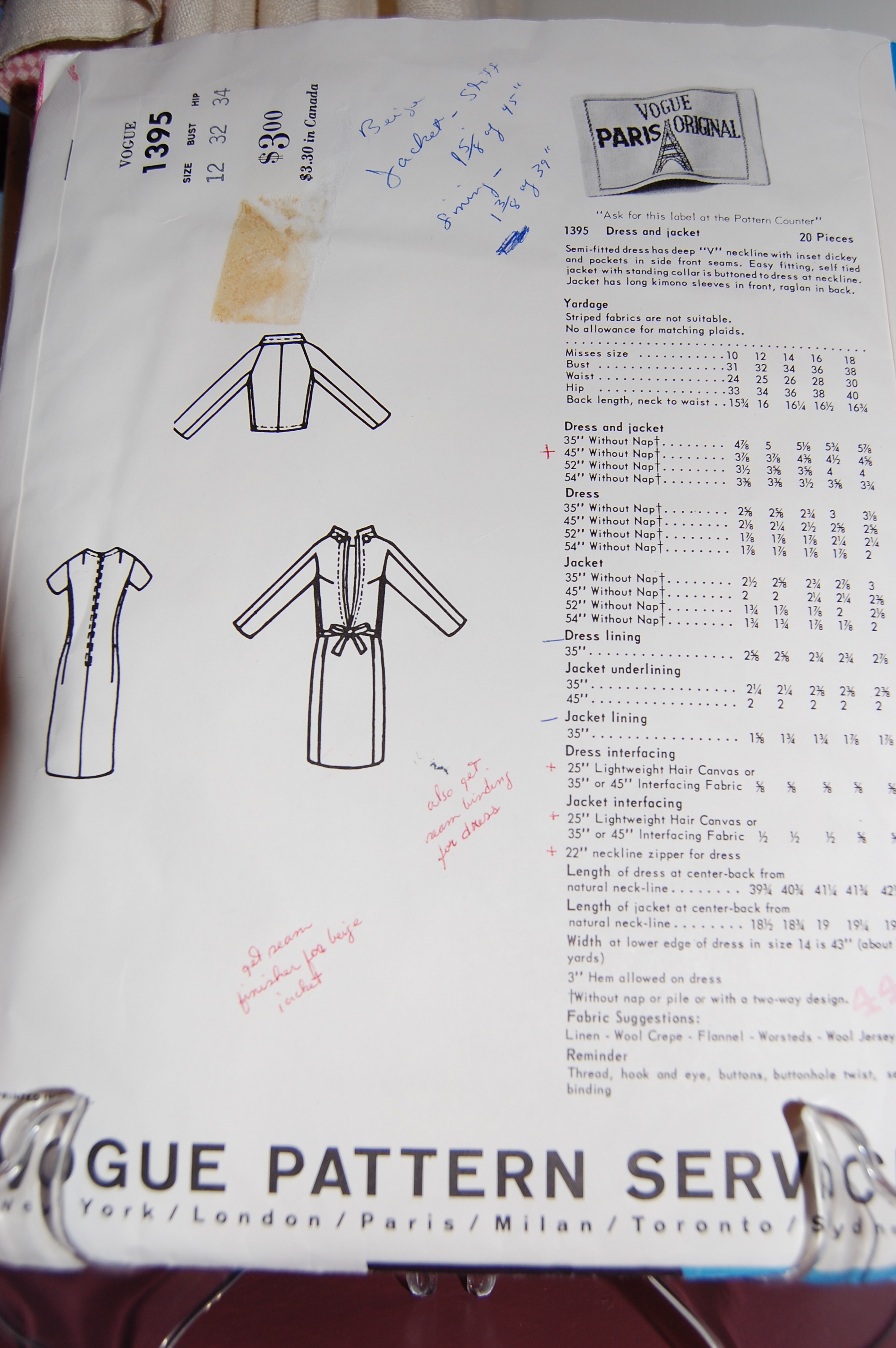
This next pattern is a study in contradictions:  The owner has carefully noted some yardage requirements, written notes to remind herself to “get seam finisher for beige jacket” and “also get seam binding for dress”.  But the pattern came to me uncut, factory-folded and therefore unused, with its original Vogue label included.  I wonder what prevented her from ever making this lovely jacket and dress?

We know she intended to make the jacket in beige, but she doesn't tell us about her color choice for the dress!

Next, it’s always fun to see someone’s intended changes to the line or details of the pattern.  Here are two examples:

View A on the far left just did not suit this sewer. She wants to extend the length of the coat, and add the collar. What she is really saying is that she wants to make view B, but with top-stitching!

It seems lengthening coats was a popular thing to do! This lady drew the longer version of the coat (on the left) and was still deciding on making the pockets "slash" pockets instead of flap pockets!

Finally, sometimes all that is on a pattern envelope is a name – a simple notation, which quietly transcends the years!

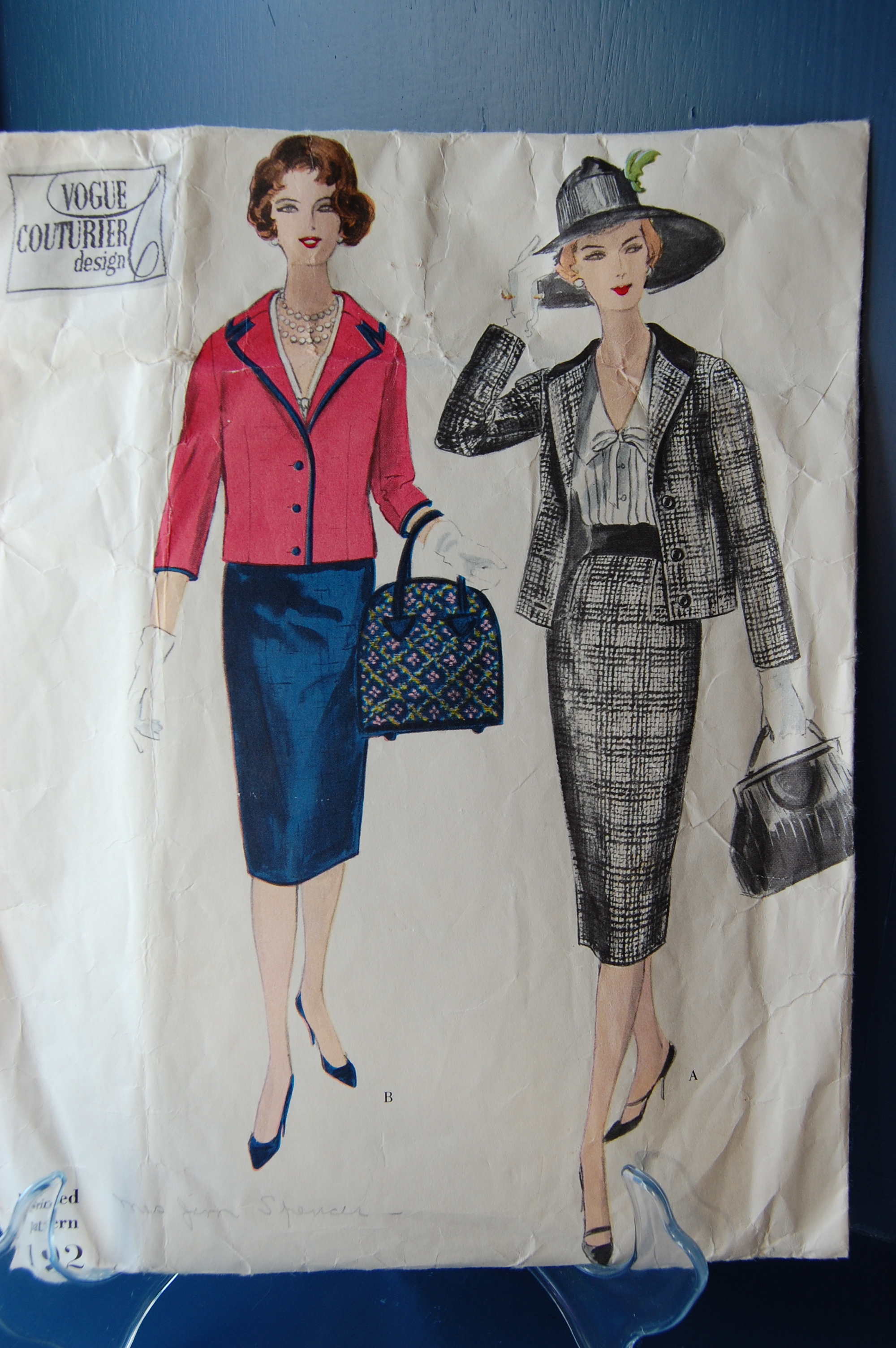
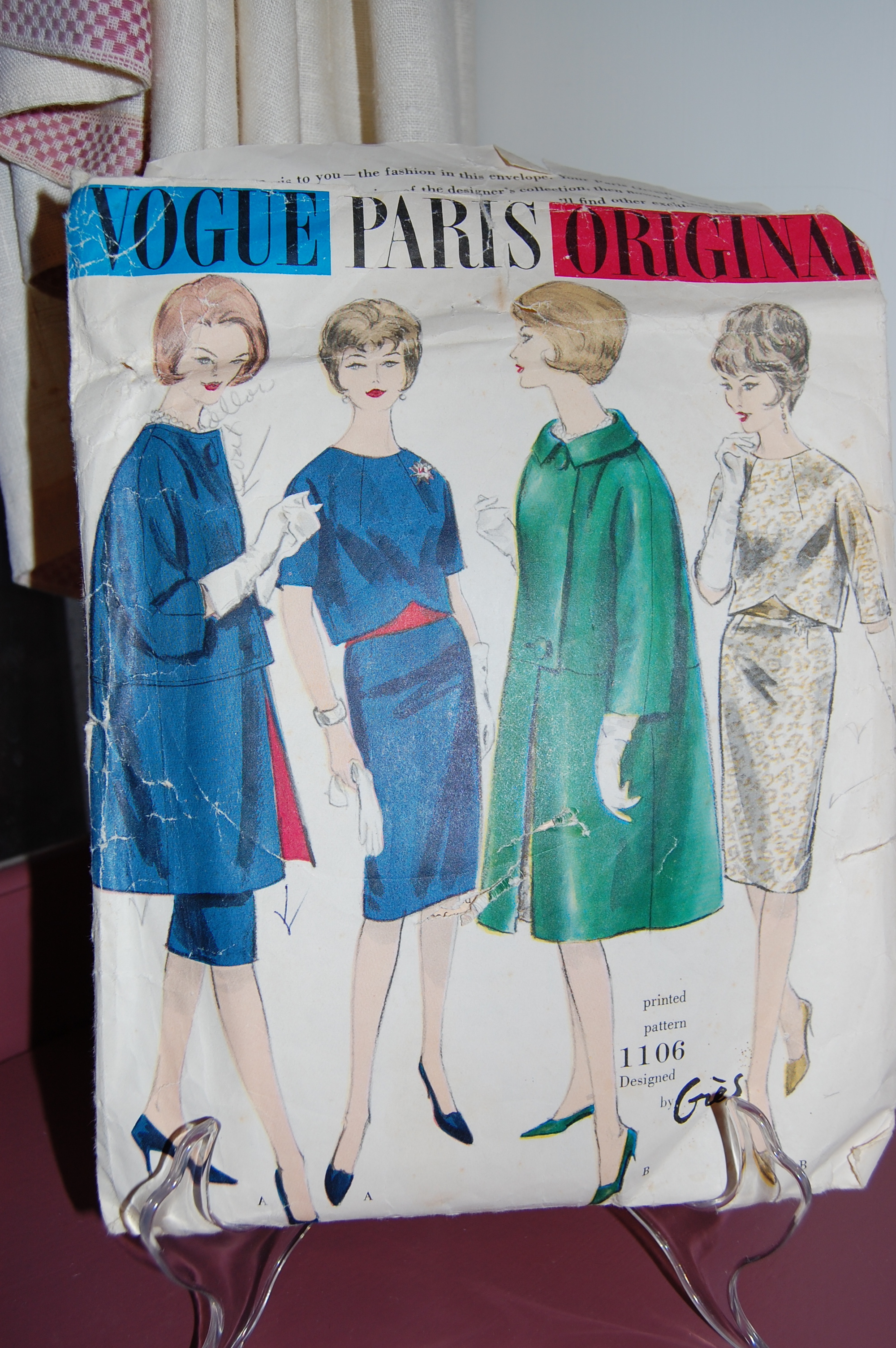
Look below the figure in red and blue for the name written in pencil.

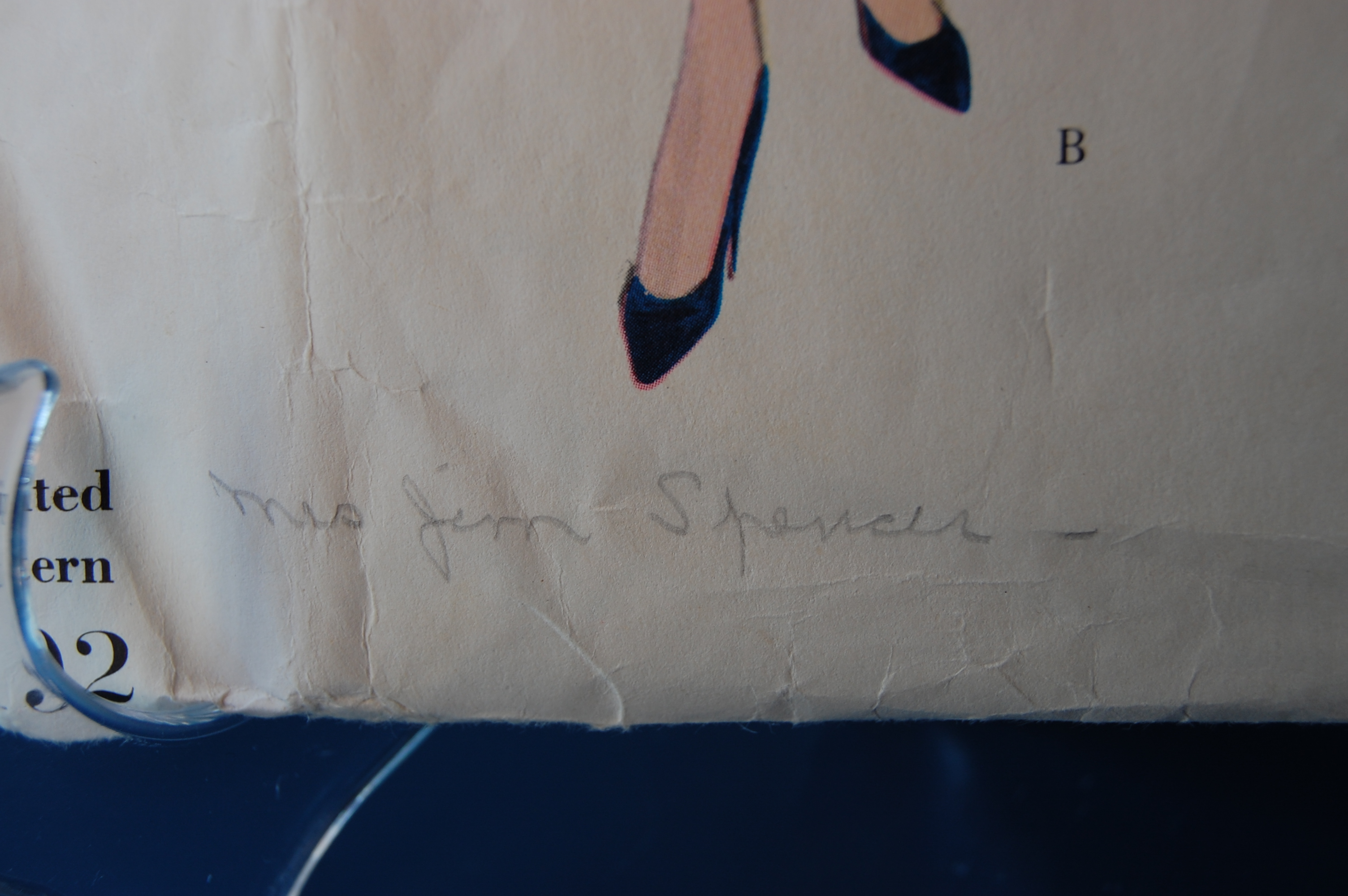
Here is a close-up of the signature. This pattern belonged to Mrs. Jim Spencer.

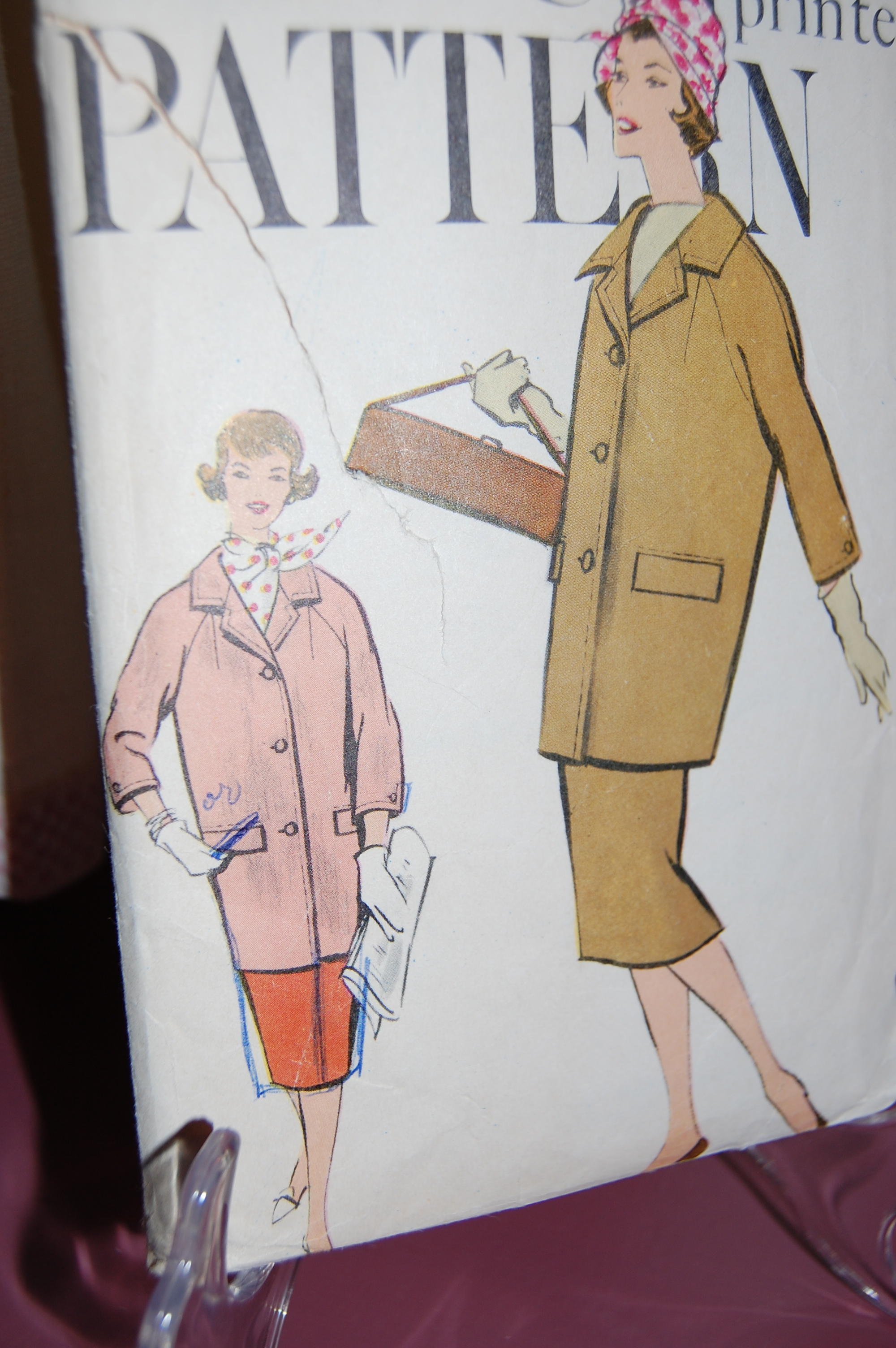
Mrs. Jim Spencer, I bet you looked fabulous in this suit!

7 Comments

Filed under Coats, Dressmaker details, Uncategorized, vintage Vogue patterns from the 1960s, vintage Vogue patterns from the 1970s, Vogue patterns

Who has time for Resolutions when there is so much to be sewn?

Since my last post (before Christmas), my sewing room has gone from being Santa’s Workshop, wrapping station extraordinaire, and gift hiding space … back to SEWING ROOM (the seriousness of the subject demands the capital letters!).  All those satiny ribbons, and empty boxes (where can be found the occasional prickly tree needle or left over tissue paper), and straggly ends of wrapping paper rolls are all properly stored away for Christmas 2012, and all my sewing projects just marched out from the closets, jumped up on my work tables and are demanding attention – which I am only so happy to give!

So – here’s what’s happening:

In a switch from dressmaking, I am in the middle of making bed hangings to go on a “flying tester” (what is this??? you may ask), which will go in the master bedroom.  It’s a complicated project, which I’ve been working on for a while, and which will take a good bit longer to complete.  Once it’s done (and hanging), I’ll do a complete post on it, but here is a teaser for right now:

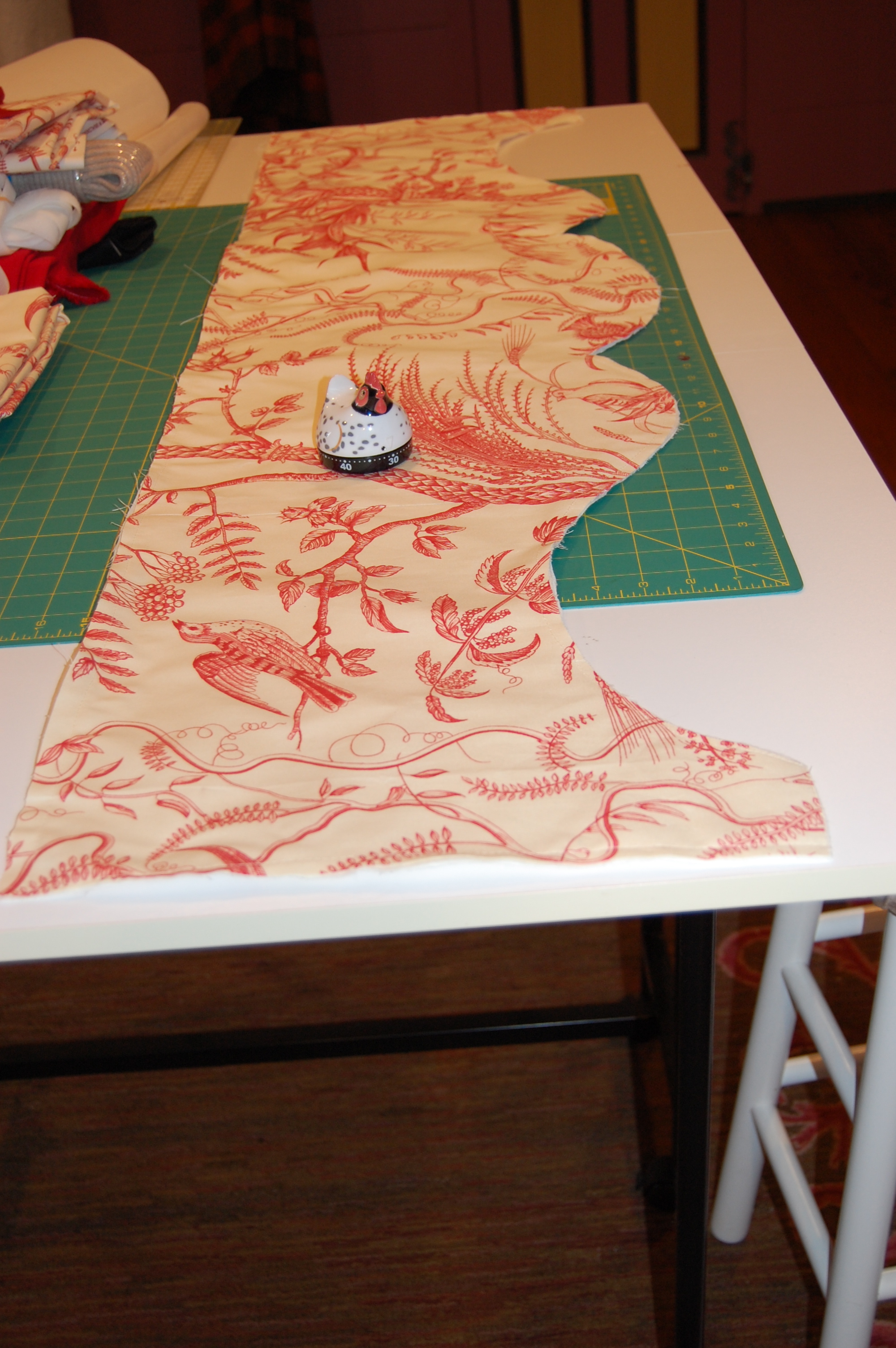
I have all the fabric panels and valances cut and ready to sew.  To make the pattern for the valances (these hangings will be structured ones rather than the more informal ones with gathered valances), I traced the scalloped headboard of our bed.  I copied the design exactly for the valance for the foot of the bed and added two more “scallops” to make the side valances fit the longer length properly.

This photo shows the scalloped design copied from the headboard of our bed.

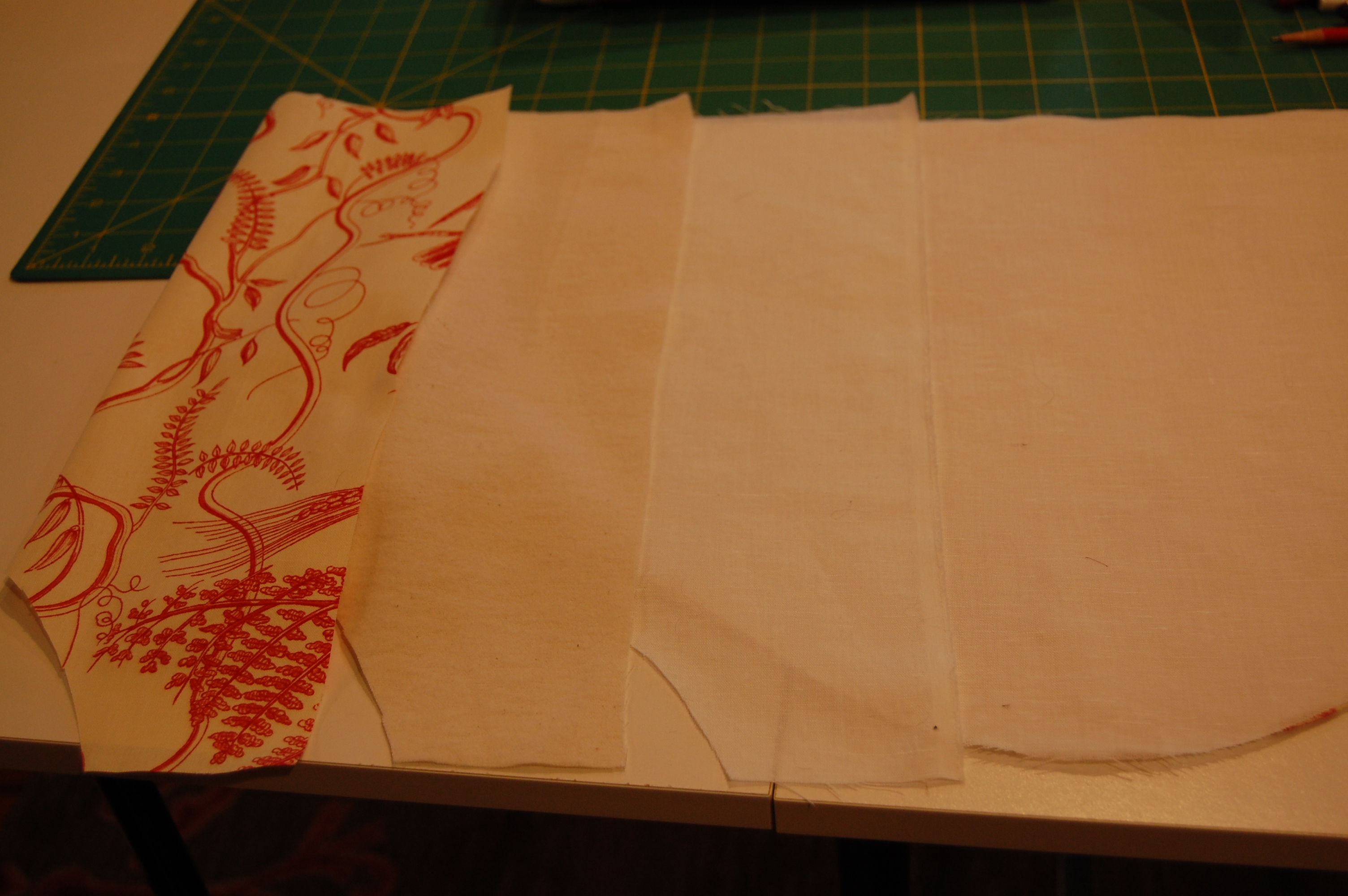
Each valance will be three layers thick – the decorative fabric (Brunschwig and Fils Bird and Thistle pattern), an interlining of drapery flannel, and the lining, which is a linen/cotton blend.  This should give them the correct “heft.”

Here are the three layers for each valance. From left to right, the decorative fabric, then the flannel interlining, and the linen/cotton lining

I have cut out yards and yards of bias tape in a lovely red linen blend and will be hand-applying this tape to the three finished sides of each valance.   I know it has to be hand-sewn to look right, so beware – I may be blogging from the funny farm before I get all this done.

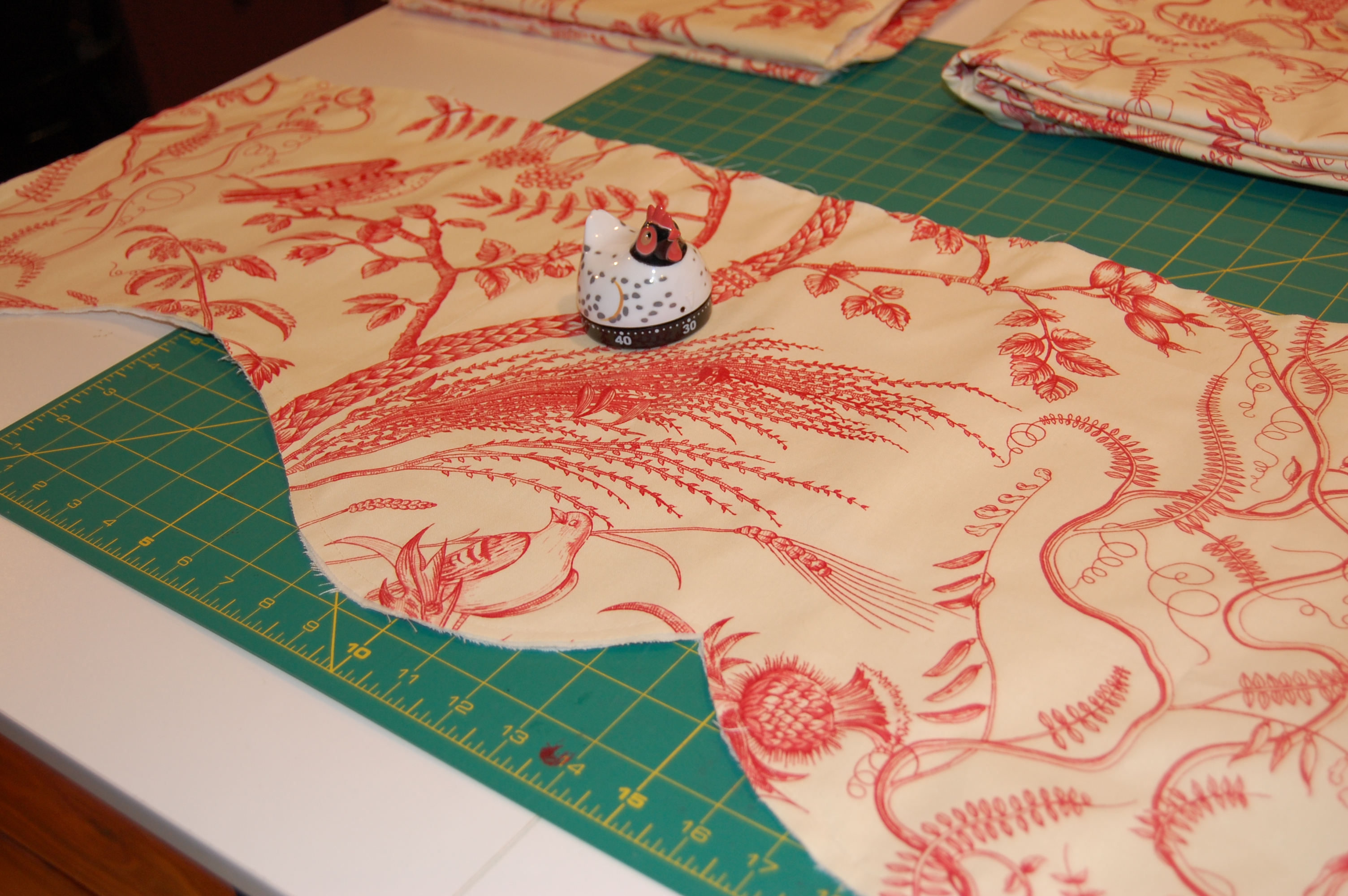
Because I don’t enjoy making curtains, bed hangings, pillows and such, as much as I enjoy dressmaking and personal sewing, I fit these projects in, in smaller segments of time.  My most successful trick is setting my “chicken” timer (thank you, Barby R. for giving it to me!) for 45-60 minutes once every day or two and devoting that time to these projects.  It’s amazing how much I can get done this way and it’s never overwhelming or too boring.

Here is my trusty chicken timer sitting on her big project!

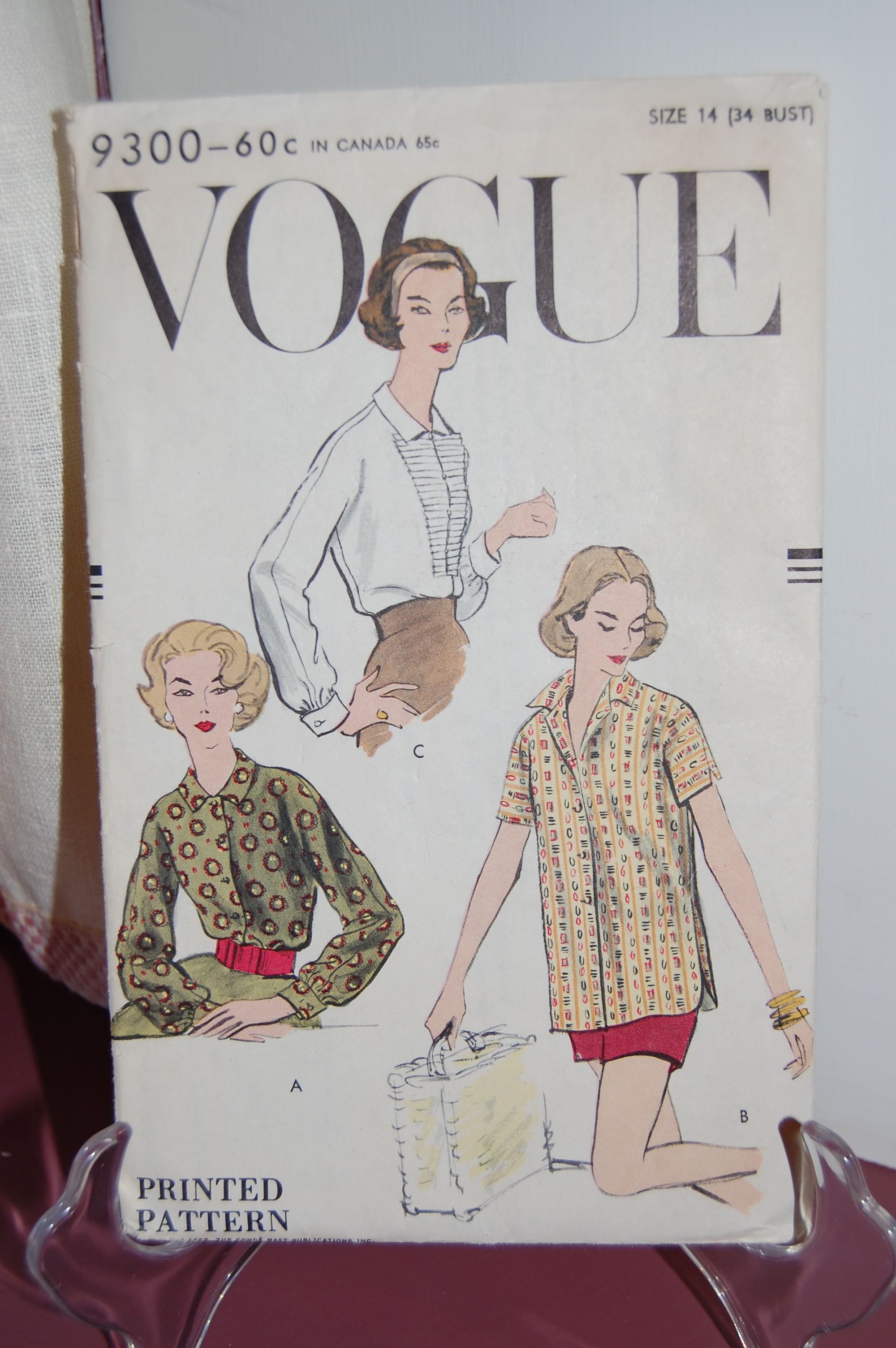
Now  – on to other things.  My first personal project for January is to make a long-sleeved blouse out of that yellow and black polka dotted silk I showed you back in November.  I found this pattern, which I bought with that fabric in mind:

I purchased this 1957 pattern, thinking that View A would make up well in the polka dotted silk fabric.

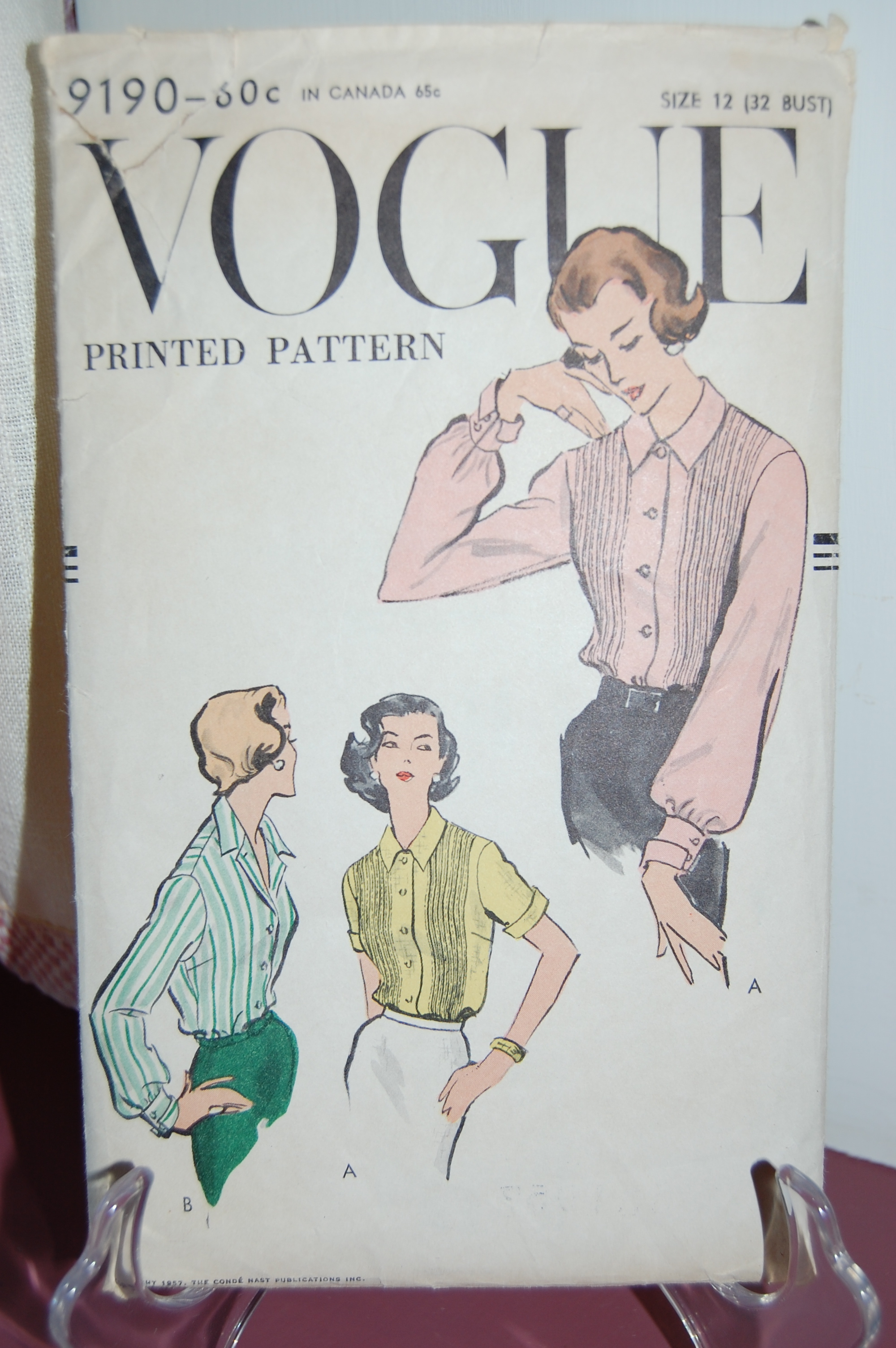
Unfortunately, as is sometimes the case with buying vintage patterns, I had to buy it in a size larger than I wear, and I was also a little concerned about the kimono – or dolman – sleeves, so I made it up in muslin first.  This was a good move, as I decided I wasn’t quite ready to make up such an expensive fabric in a pattern without as much “shape” to the body of the blouse as I had envisioned.  However, I love the shape of the convertible collar.  In the meantime, I came across this pattern on Etsy:

This pattern is also from 1957. I love the tucks in the pink version, but they would not be appropriate to use with a polka dotted design. View B is constructed without tucks - perfect!

It has set-in sleeves, which I like; very petite French cuffs, which I love; a few darts to make the fit a little tidier; and it was available in my size, which takes some of the guess-work out of it.  The only thing I don’t like as much is the collar, which has a longer point than I want.  To fix that, I overlaid the one collar pattern on the other one and drew a new collar.  Voila!  I am ready to cut it out.

And – Yes, I actually do have some Resolutions for 2012 (besides all the normal ones).  For one, I’m going to use my chicken timer to help me get my kitchen cupboards and pantry shelves all cleaned and reorganized.   Cluck, Cluck!

2 Comments

Filed under Blouse patterns from the 1950's, Polka dots, Uncategorized, Vogue patterns

Clothes for Christmas

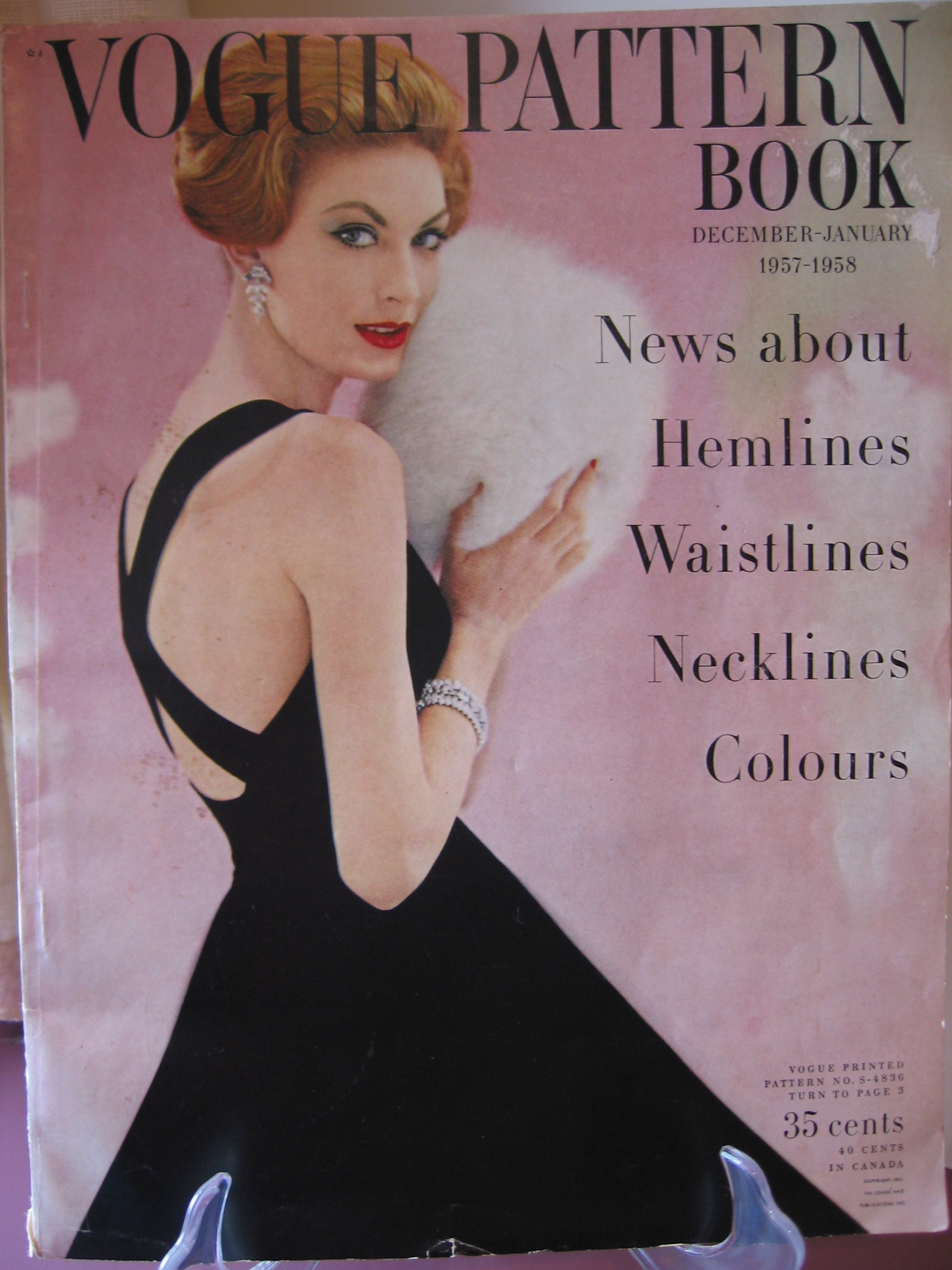
Another part of the world of vintage patterns, which is now available thanks to the Internet, are old copies of the Vogue Pattern Book magazine.   Published 6 times a year by The Conde Nast Publications, Inc., this magazine featured current and up and coming Vogue patterns, articles on construction and notions, a “question and answer” section,  news on just about anything having to do with personal sewing, and wonderful ads for fabric and sewing machines.  (By the way, it’s still published 6 times a year!)  I’ve been able to purchase a few issues from varying months and years, and sometimes I find a pattern featured which I have already bought on eBay or Etsy.   The December 1957/January1958 issue, which I recently obtained, devotes 8 pages to “The Ladies Love Clothes for Christmas.”

Here is the cover of the December 1957/January 1958 issue.

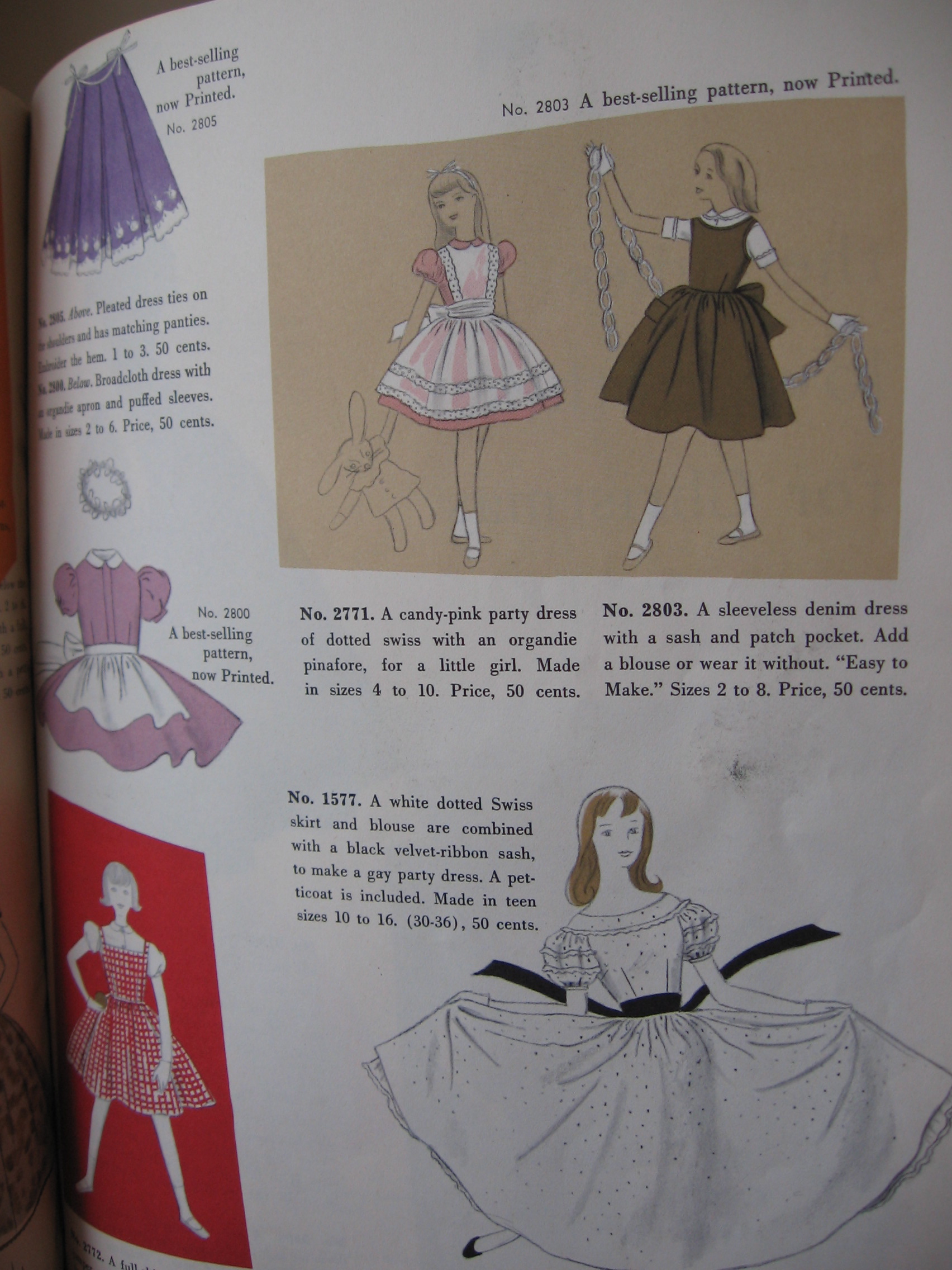
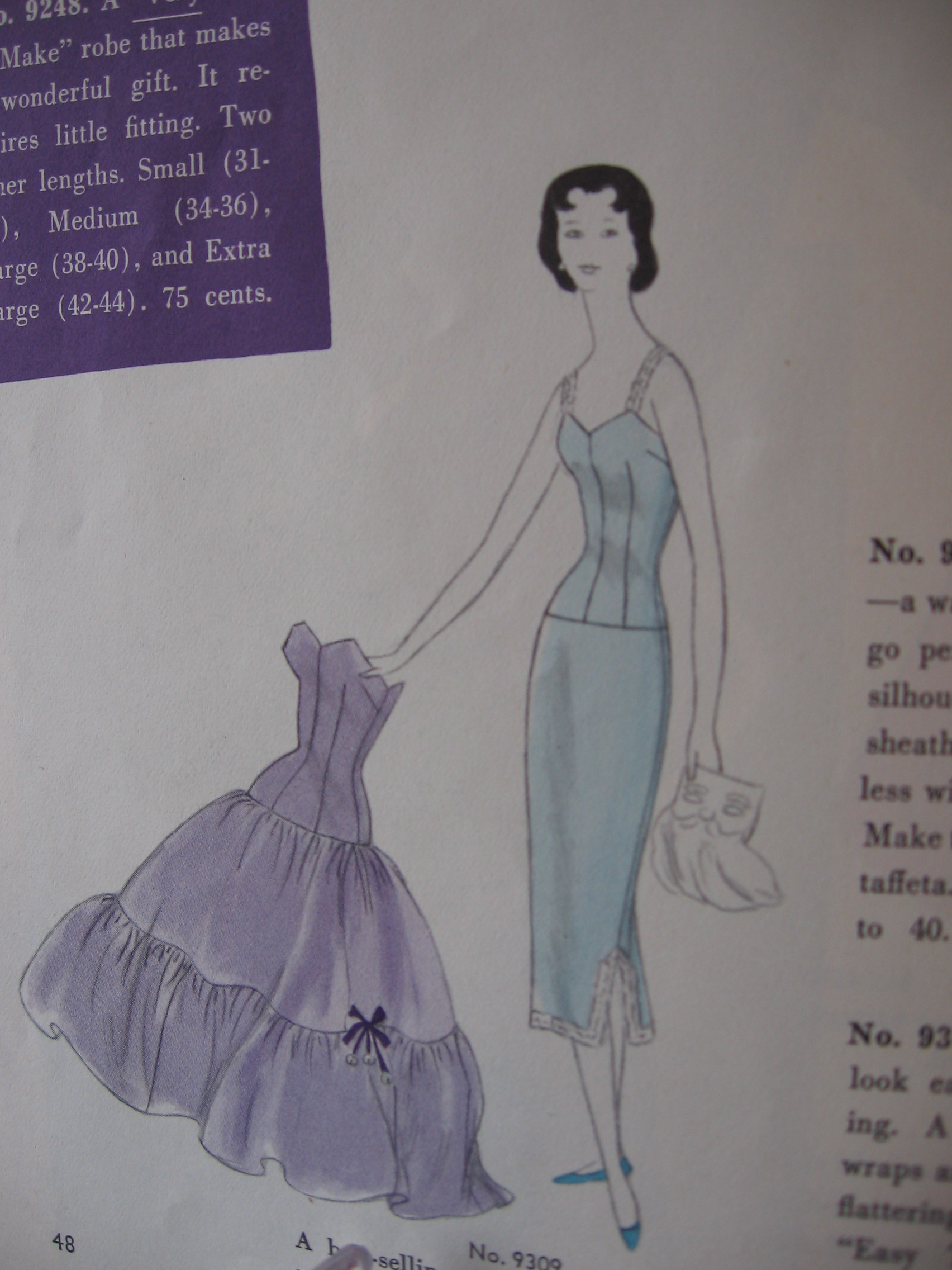
It features patterns for young girls and for teenagers; there is a section on lingerie and sleepwear; and finally some suggestions for the lady who presumably will be doing all this sewing!  Here is a sampling:

Suggested dresses to make for your little girl and one for your young teen.

There were patterns like this to make slips - for yourself or as a gift!

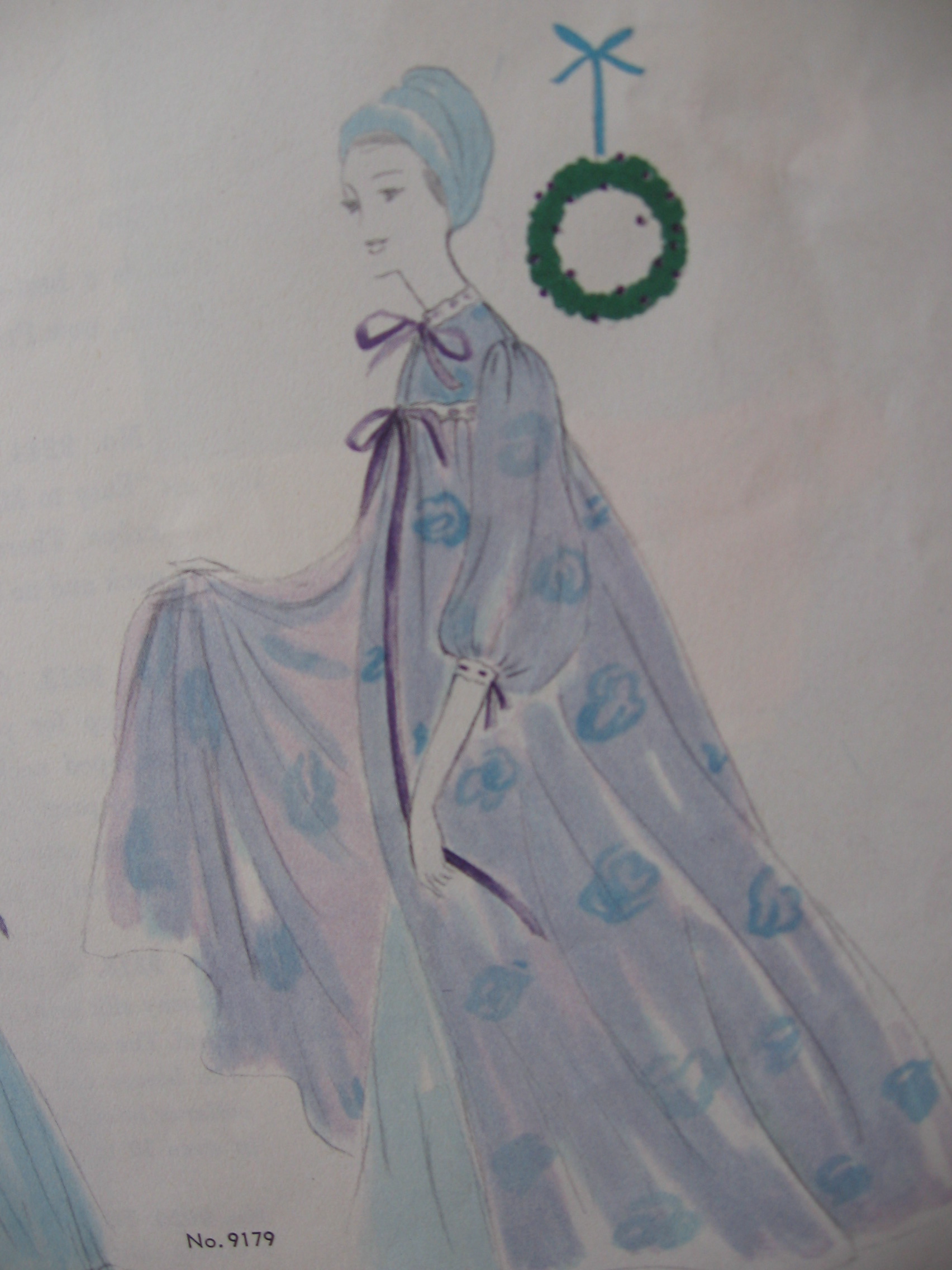
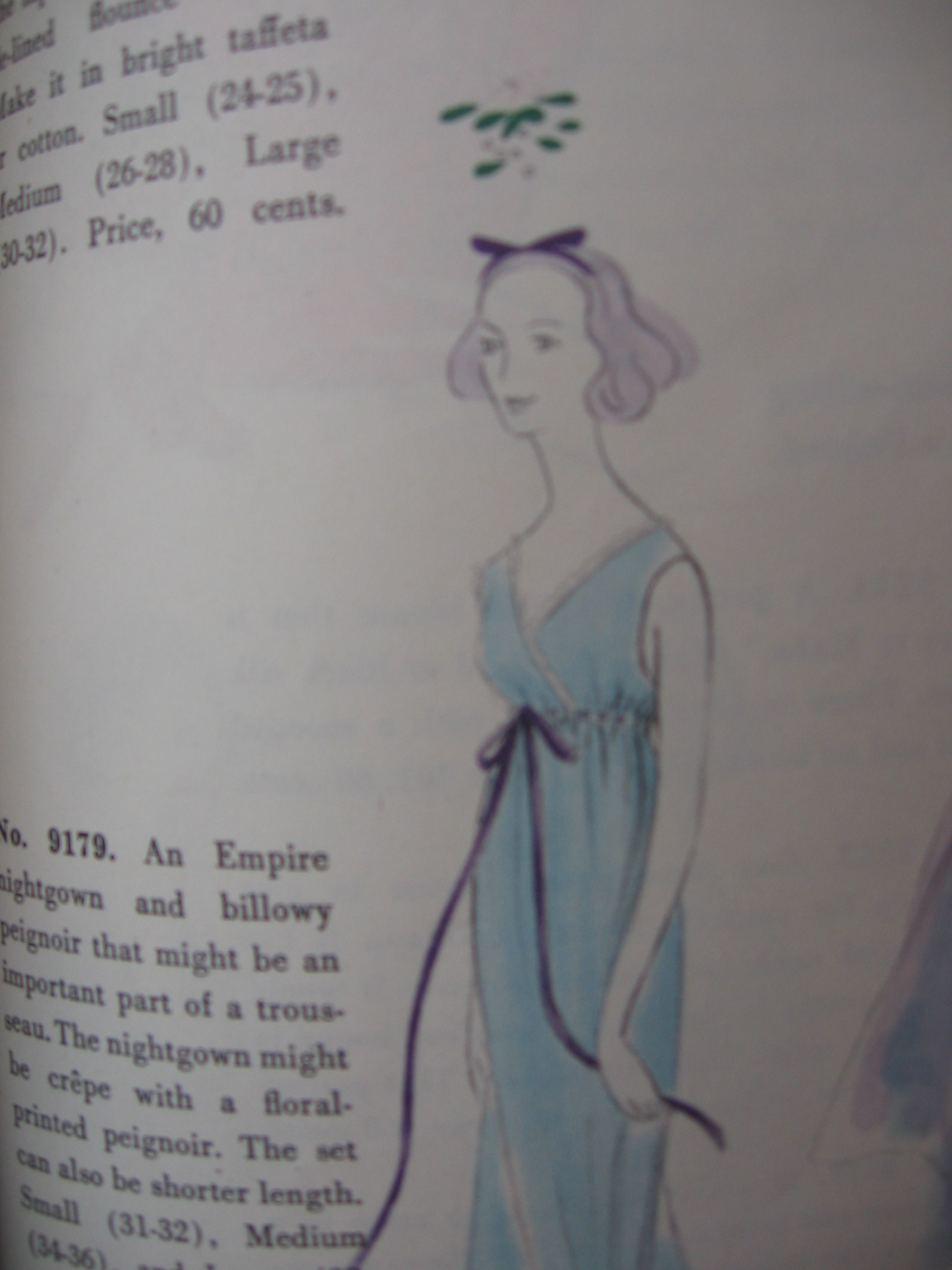
This billowy peignoir and matching nightgown would turn anyone into a vision on Christmas morning! The pattern cost 75 cents.

Here is the empire nightgown. I hope you can see that this lovely lady, now sans peignoir, is standing under the mistletoe!

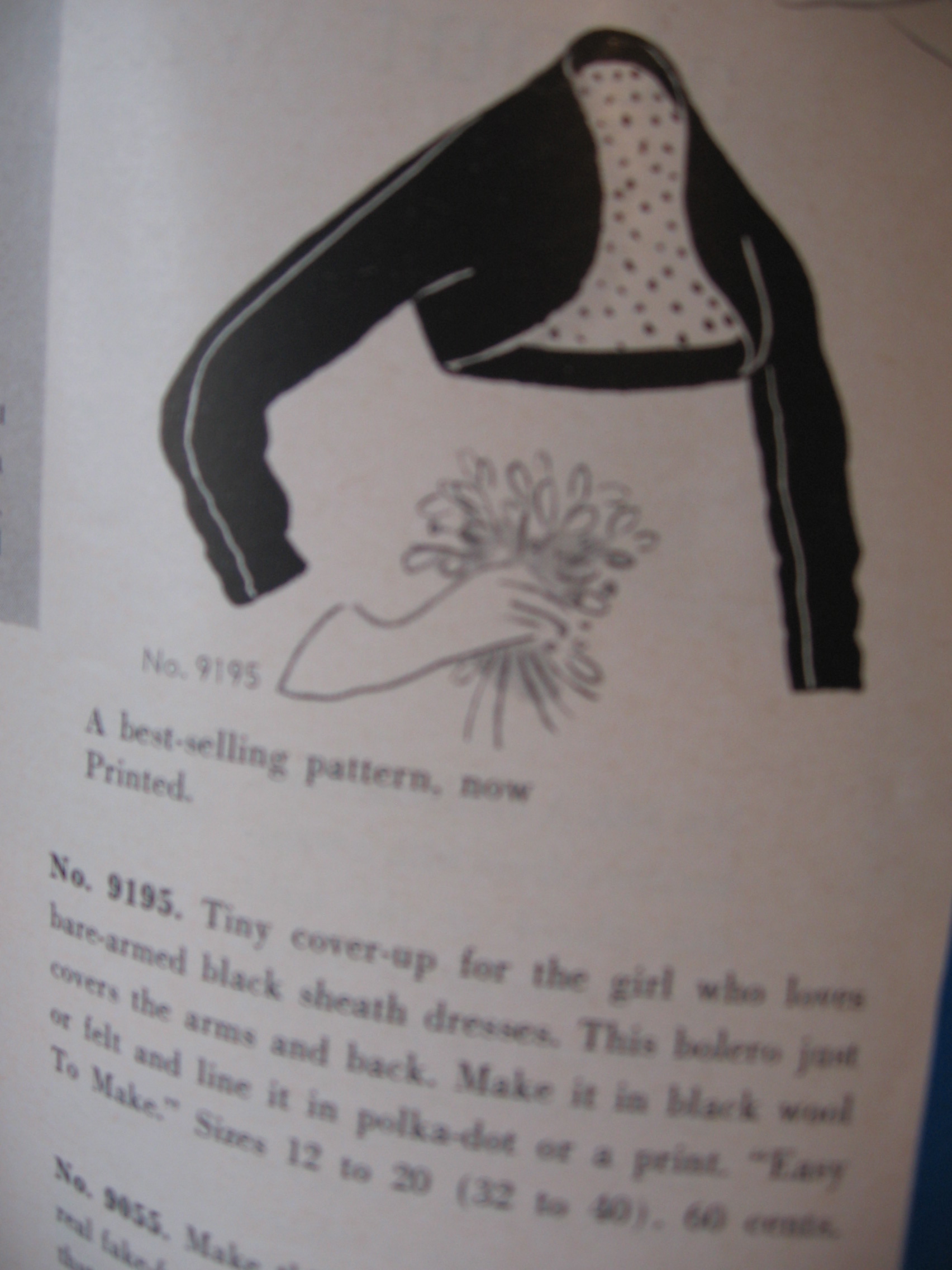
This bolero cover-up, lined in polka dots (no wonder I love this!), would be perfect on New Year's Eve.

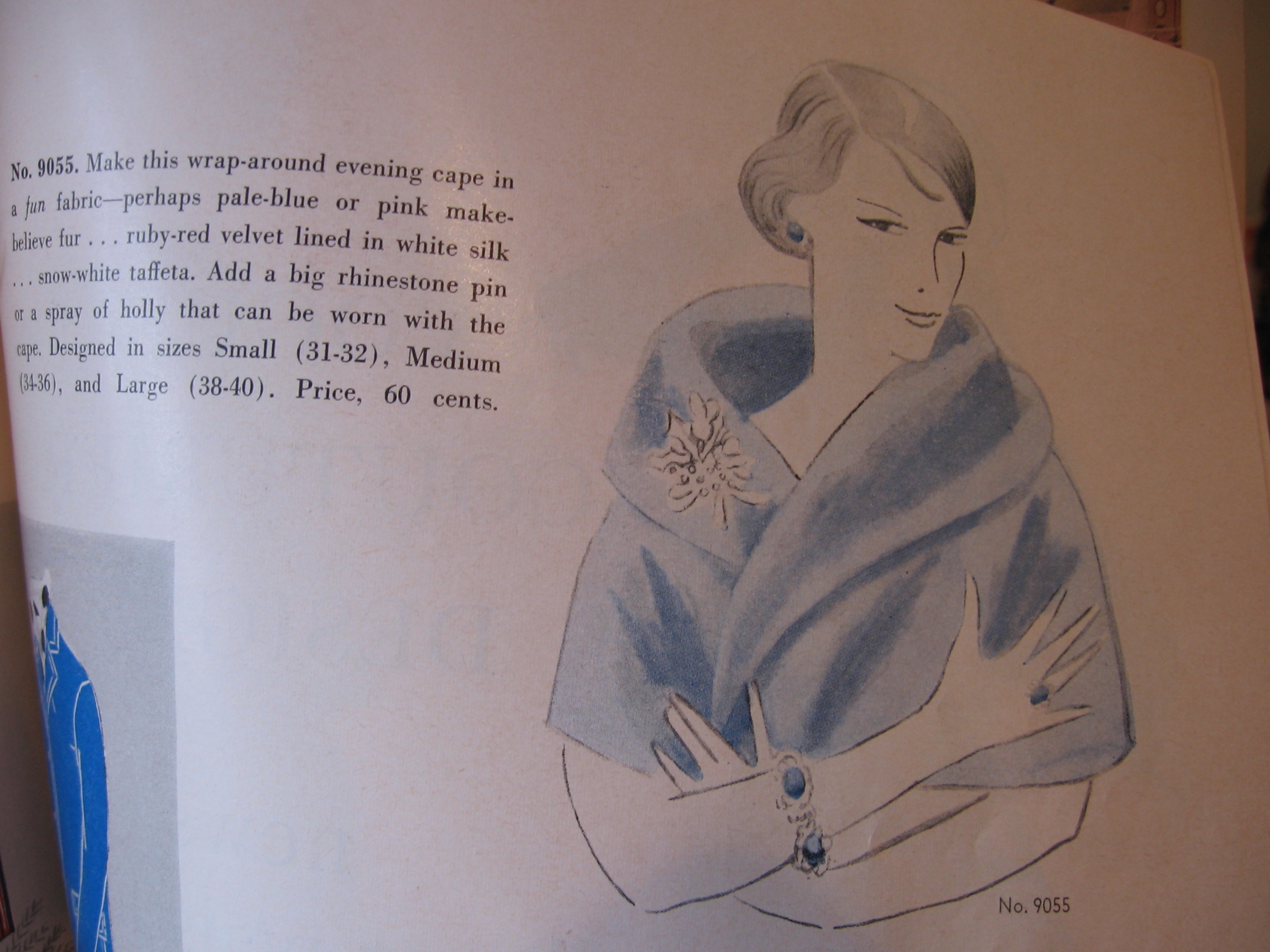
Or - if you are really in a festive mood, they suggest you make this cape in "ruby-red velvet lined in white silk."

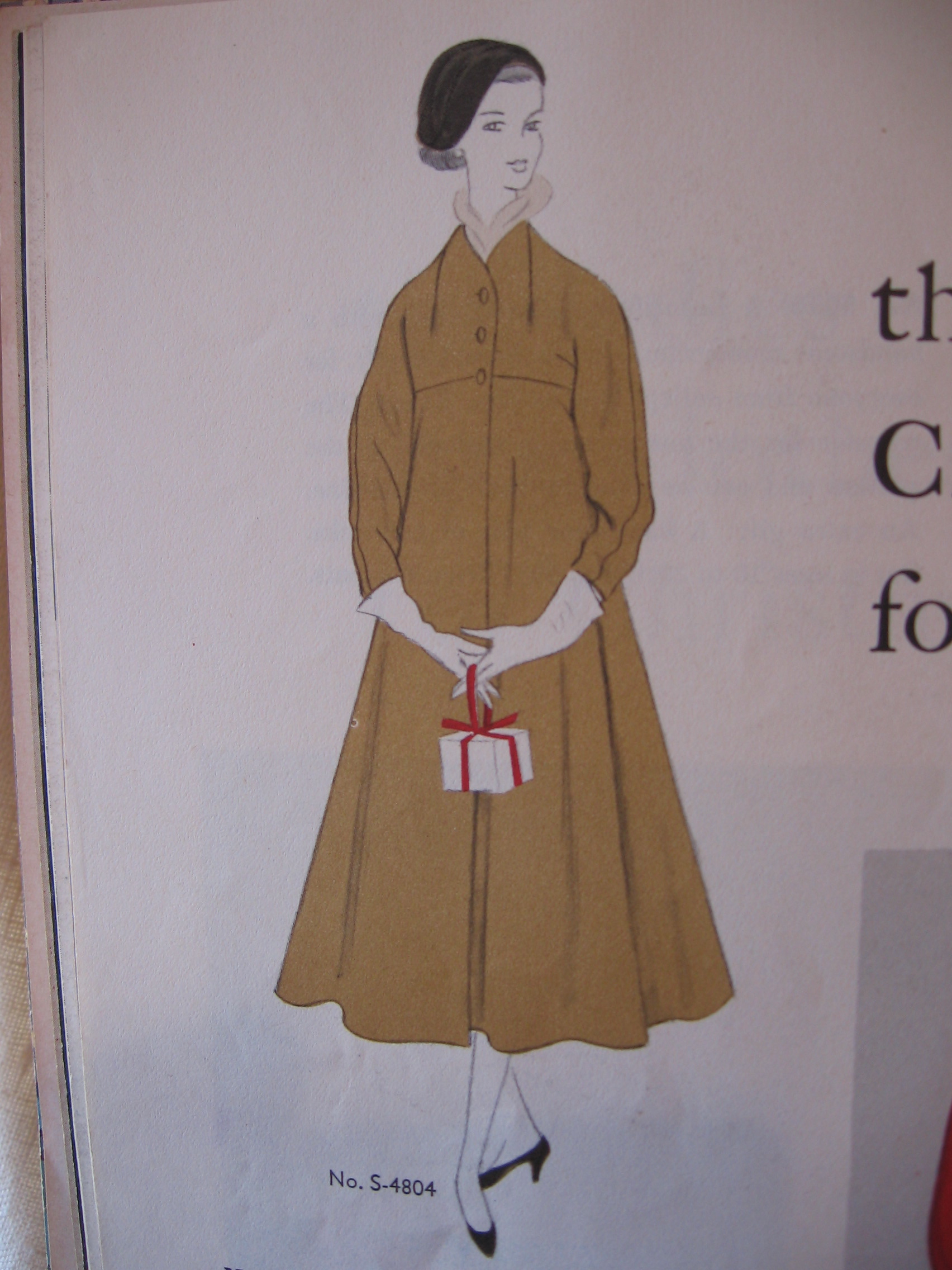
Here is my favorite suggestion, and I quote: "You might give this pattern and enough camel's hair wool to make this coat, to someone who loves to sew." The pattern was priced at $1.00

Here is another suggestion, next to a picture of its pattern envelope.

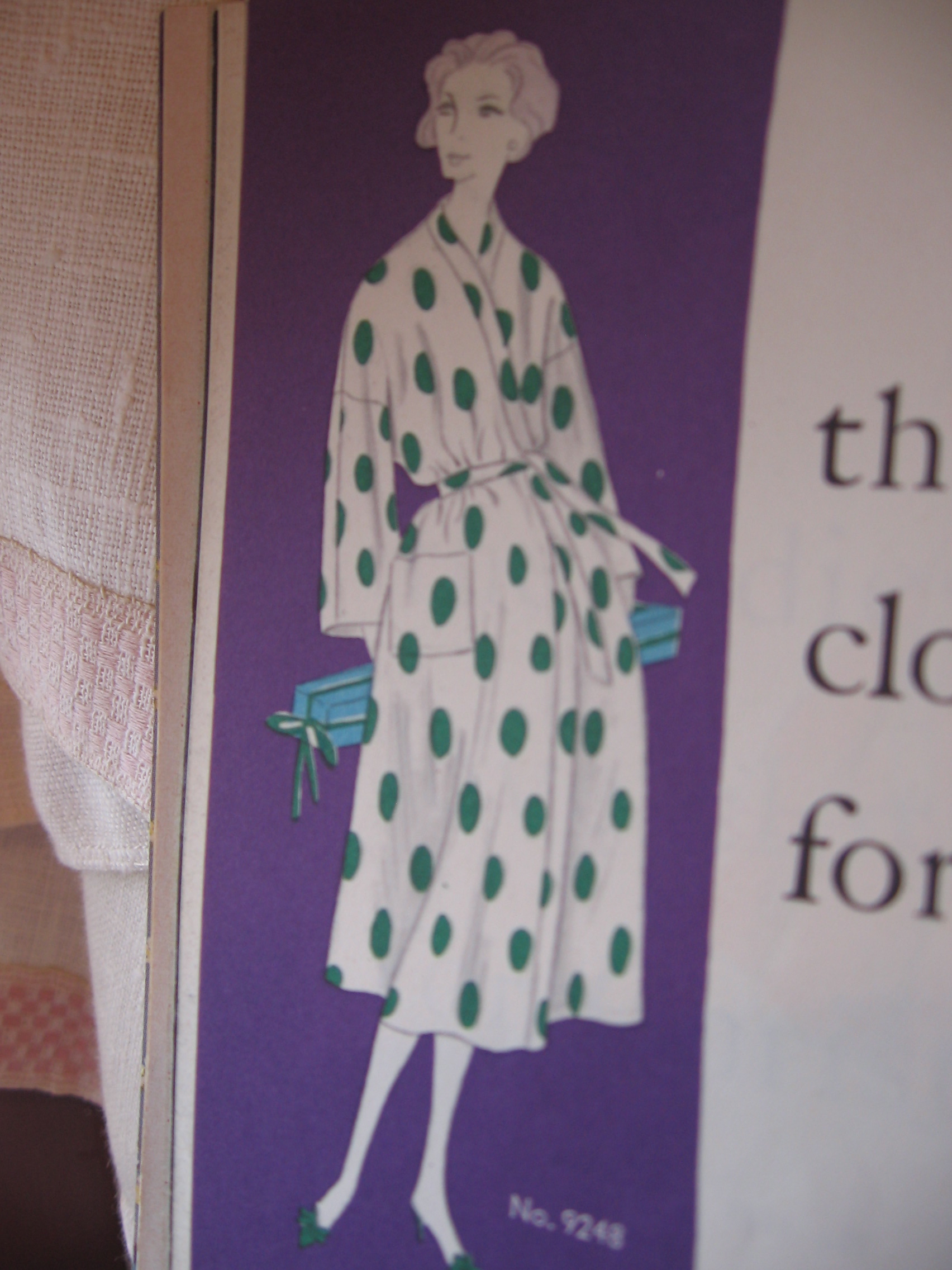
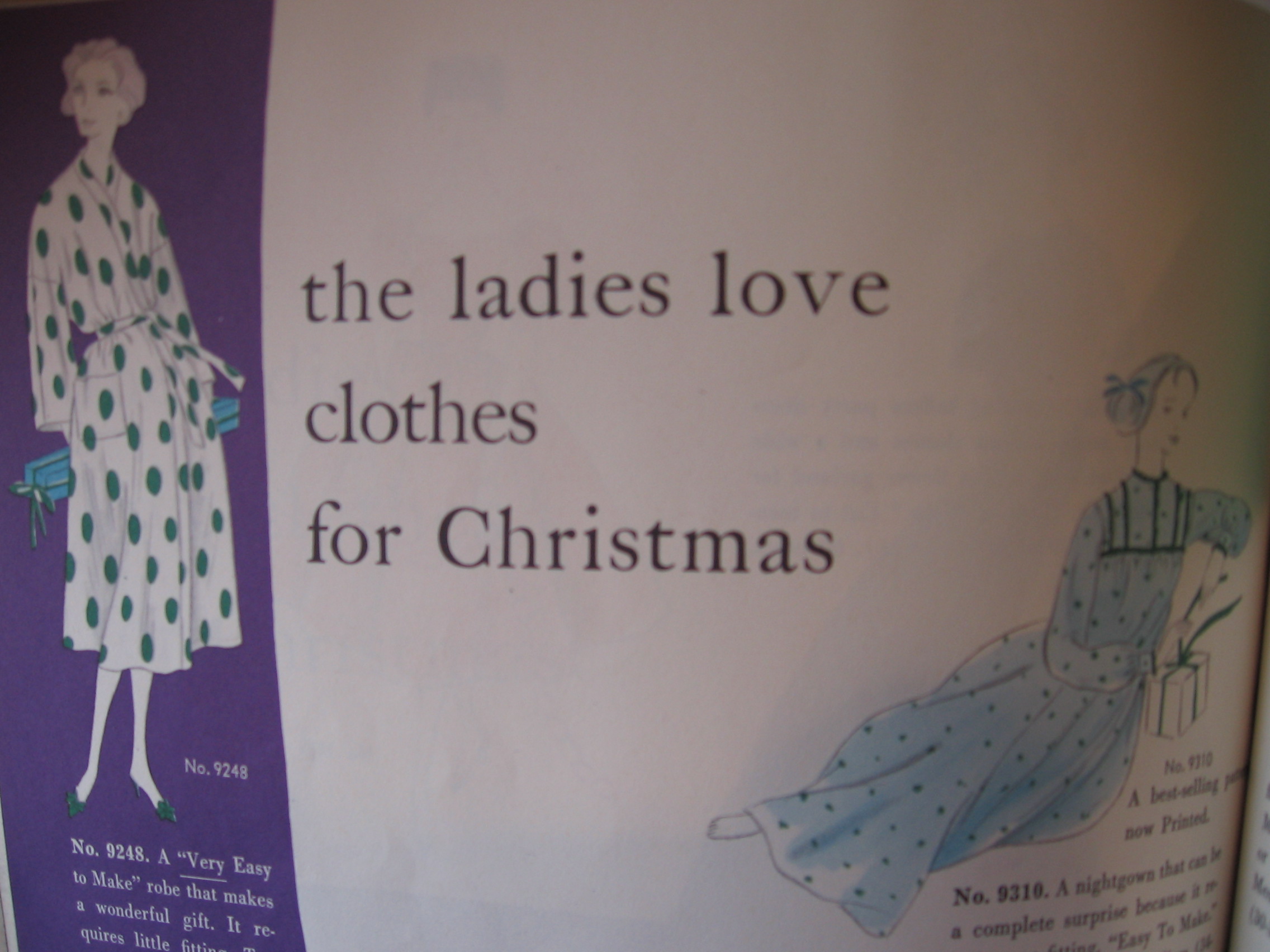
This robe is very easy to make! (I wonder what is in the long wrapped present she is holding behind her back? A rolling pin?)

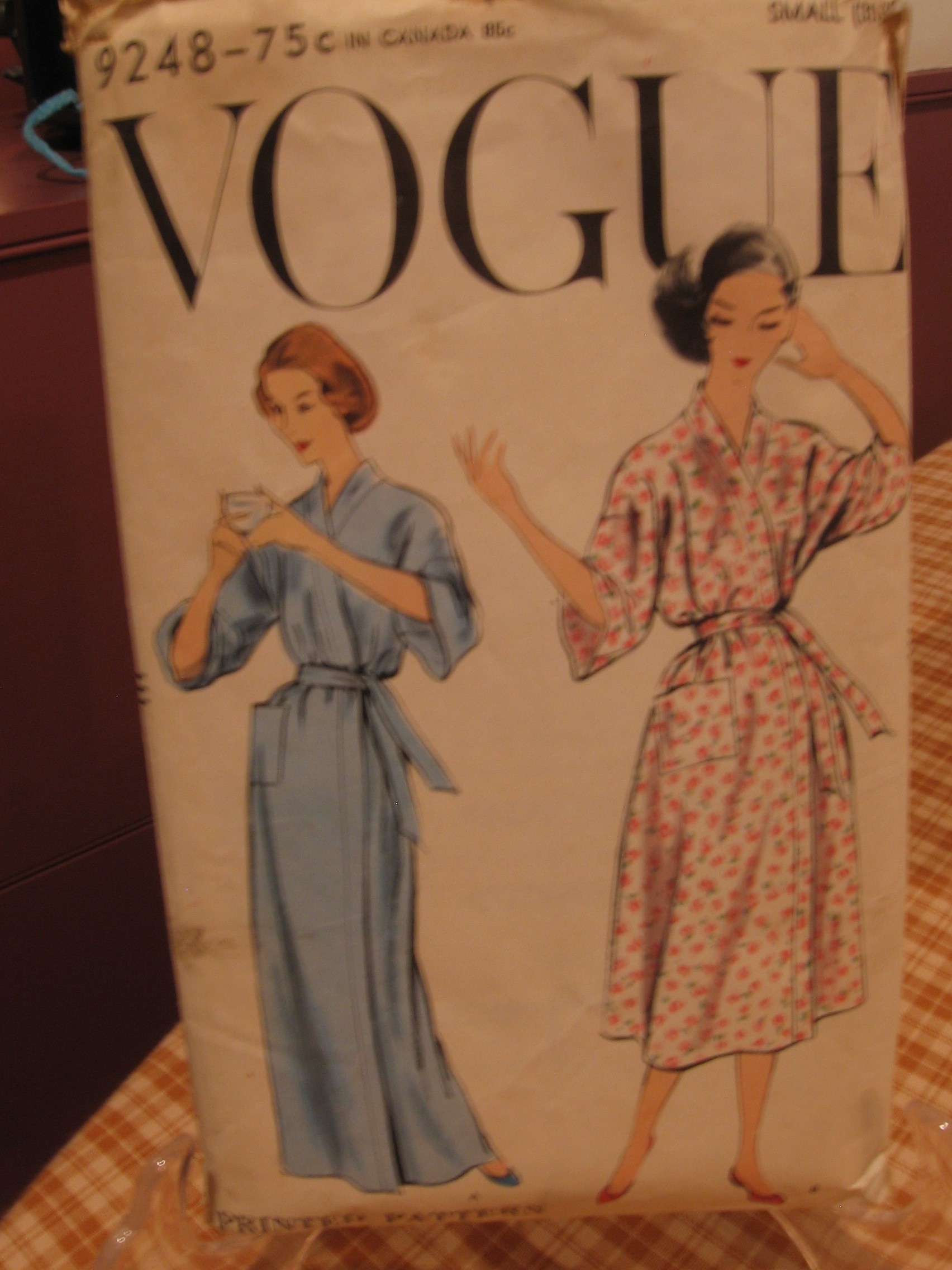
This pattern makes up beautifully into an elegant robe! It has additional pattern pieces and instructions for lining it, as well.


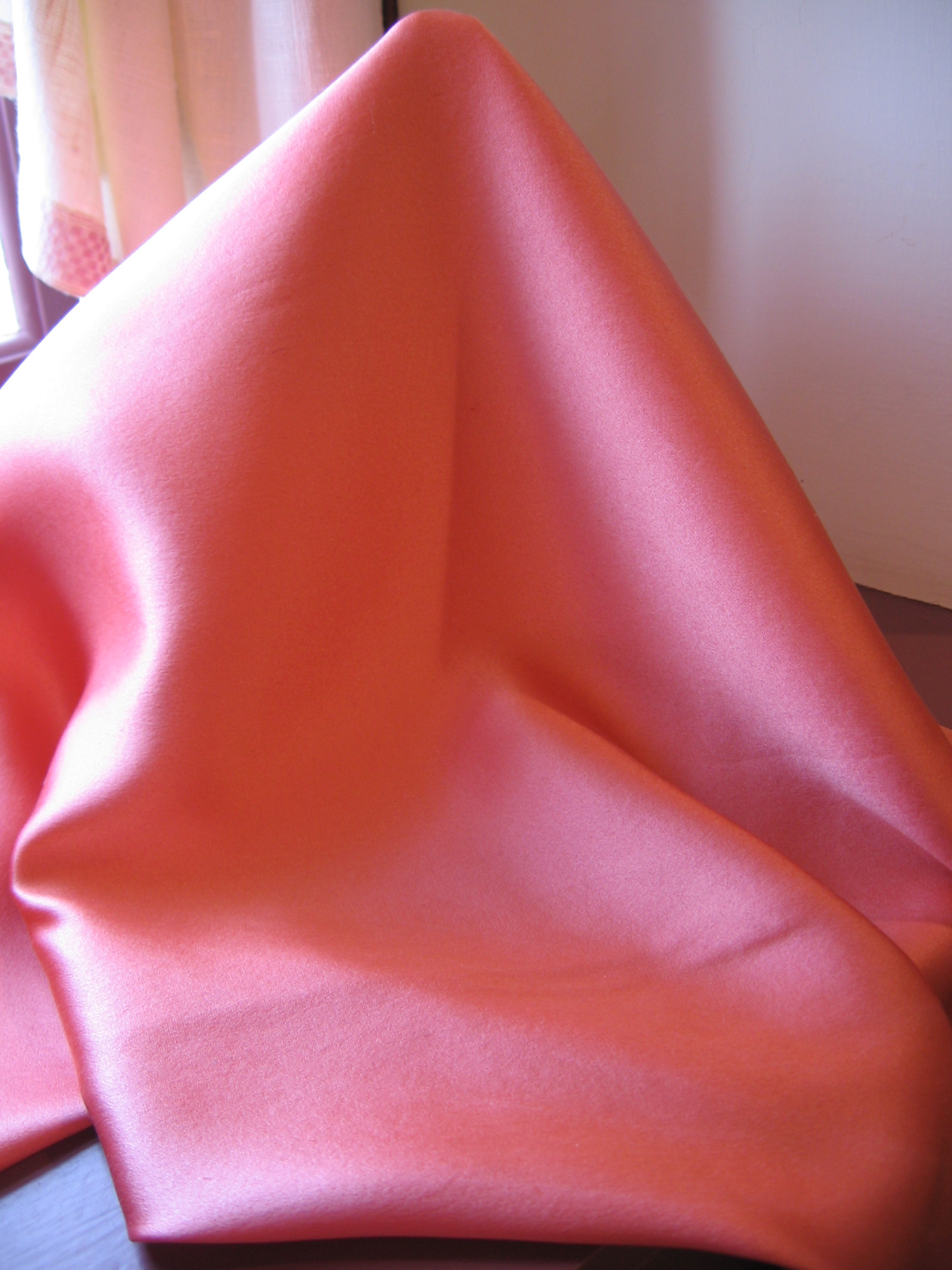
Yes, I purchased this pattern last Spring and have already made it up in the “lower calf” length.  Unfortunately, I did not take a photo of it before it went to its new owner, but here is a shot of a small bit of the silk charmeuse left over from this project.

This silk is really more orange-ish than it appears here. I washed and dried it before I cut it out, so that the finished garment would be washable - much more practical for a bathrobe!

The reason I am showing you this, is that last week, Pantone, the color guru of the fashion world, declared a color very close to this as its Color of the Year for 2012.    Specifically, that color is called Tangerine Tango and its number is 17-1463-TCX.

Personally, I have come to appreciate various shades of orange a lot more than I once did. I particularly like to see orange (or coral or tangerine or whatever name you want to give it) paired with hyacinth blue or leaf green or charcoal gray.  Although I am not one to feel like I need to be dressed in the current “fad” color, if I get the opportunity to use it in my sewing this coming year, I definitely will.

Well, I am digressing from my Christmas theme here, so back to the robe in bright green polka dots.

This statement says it all!

If I could ever find such a fabric in a lovely silk suitable for a bathrobe, I would buy it in a minute and make myself this robe in the long version!  For Christmas morning I’d pair it with a long and flowing red silk sash…

Here’s to a fashionable, fun Merry Christmas for each and all – and warm wishes for a colorful New Year!

3 Comments

Filed under Coats, Polka dots, The Conde Nast Publications, Uncategorized, Vogue patterns

Lessons from 1953

When I first discovered vintage Vogue patterns on eBay last Spring, I was delighted to find that most of the patterns from the 1950s were dated, usually with a line which stated, for example, Copyright 1956 The Conde Nast Publications, Inc..  It took me a couple of weeks to realize that I should also be looking for another important bit of information on the pattern cover: the words Printed Pattern.  I discovered this the hard way;  I purchased a pattern, dated 1953, that was not printed.

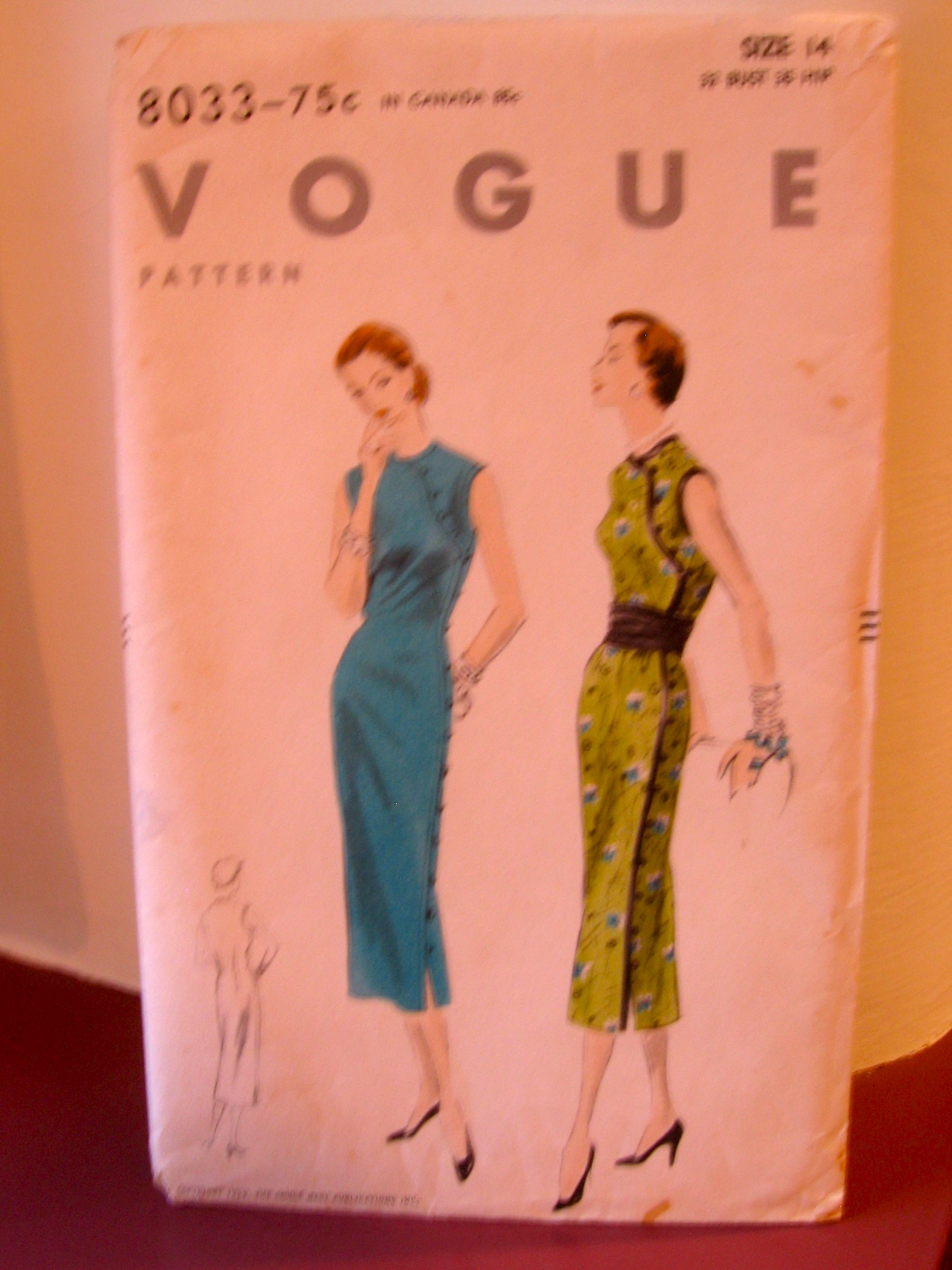
I've always liked Asian-inspired dress designs, and I thought this one from 1953 was so pretty. Do you see the size on this pattern? Yes - it's a 14! That's the size one wore in 1953 to fit a 32" bust and 35" hip.


I remember my mother mentioning how difficult unprinted patterns were to use – and I was about to find out why! The tissue pattern pieces were only marked with small holes of varying sizes;  to try to make sense of these markings, I had to look at the instruction layout sheets and translate if they were for a dart,  a stitching line, a pivot point, or some other detail.

These particular pattern pieces had never been used – and I must admit I felt a little guilty taking them from their envelope where they had quietly lived for so many years and pinning them onto my fabric, but pin I did.  I cut that baby out, marked that nebulous galaxy of pattern holes as best I could with chalk, and proceeded to sew, following the directions precisely.

The first thing I realized was that the bust darts were a little too high, but that was an easy fix (seam ripper and redrawing the dart lines).  These early patterns say that the dress should be fitted over the proper foundation garments.  (I don’t think they meant just comfy bra and cotton panties.) Anyone who has watched old movies or even Mad Men recognizes that mid-century look of the pointed and properly perched bosom! That’s one mid-century look I’ll forego.   So that was adjustment # 1.

I lowered the bust line by re-placing the darts.

Next, do you see that band that runs the length of the dress?  The pattern pieces for that were shaped to match the curve of the neck and across the chest.  I thought to myself – now why not just use a bias piece of fabric, which I felt would take the curves better and be easier to topstitch without puckers.  But I followed the pattern exactly – and wouldn’t you know, I had exactly those problems topstitching the curved areas.  As if that were not bad enough, when I tried on the partially completed dress, the neck fit too high and tight, rumpling up the shoulders and it looked awful.

I was going to have to re-cut the neckline, to make it larger. In doing that, I knew the neck area of the band, as it was cut out, would no longer match the new neckline.  I was going to have to piece in another section.  This was not fun, and I was beginning to think this lovely blue dupioni silk was going to end up as a skirt instead of a dress.  But I went back to my original thought – and cut a bias piece to fill in that recut section.  It worked!  That was BIG (ver-r-r-ry BIG) adjustment # 2.

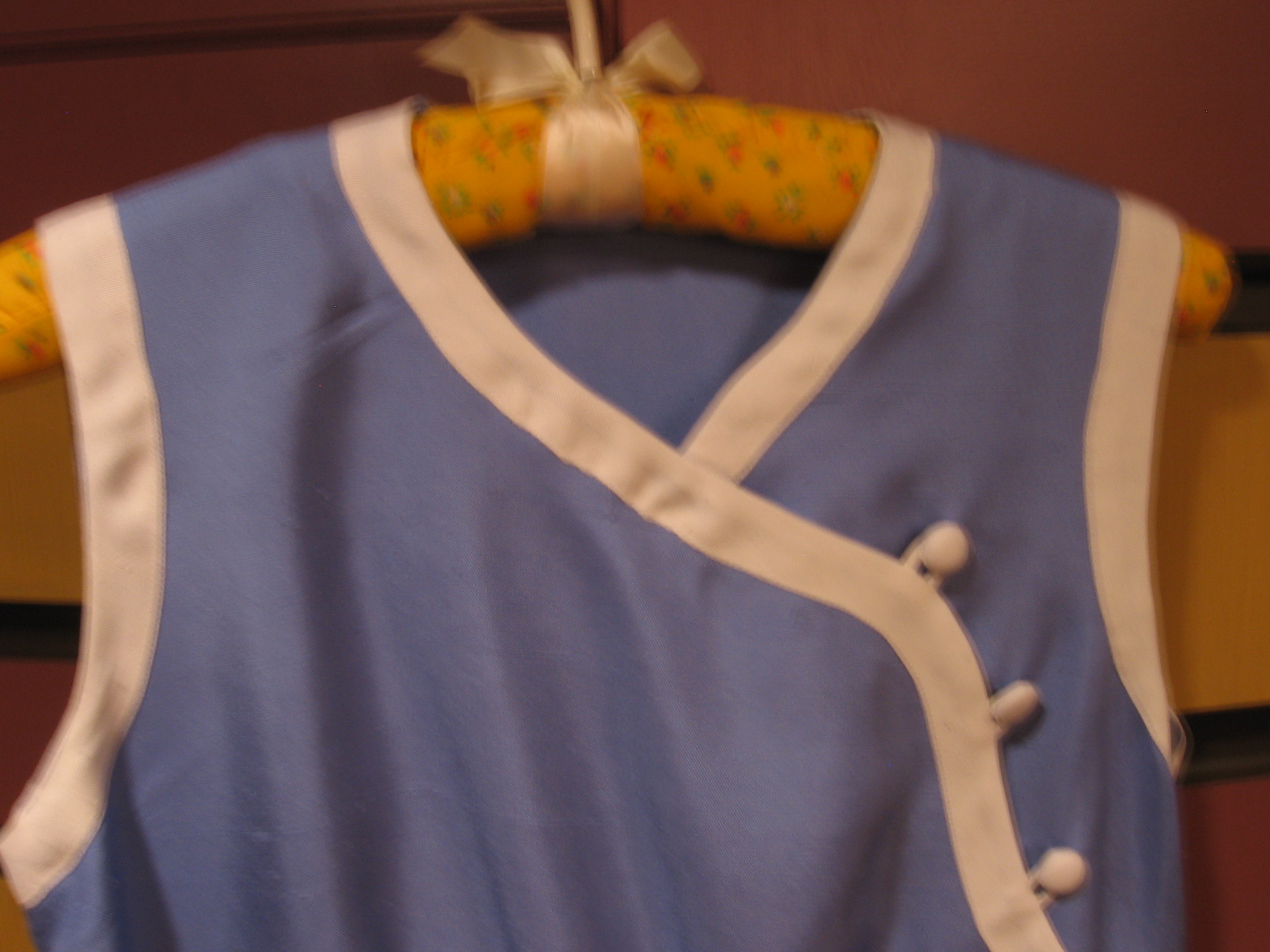
Here is the recut neckline. I was able to hide the pieced seam under the front flap.

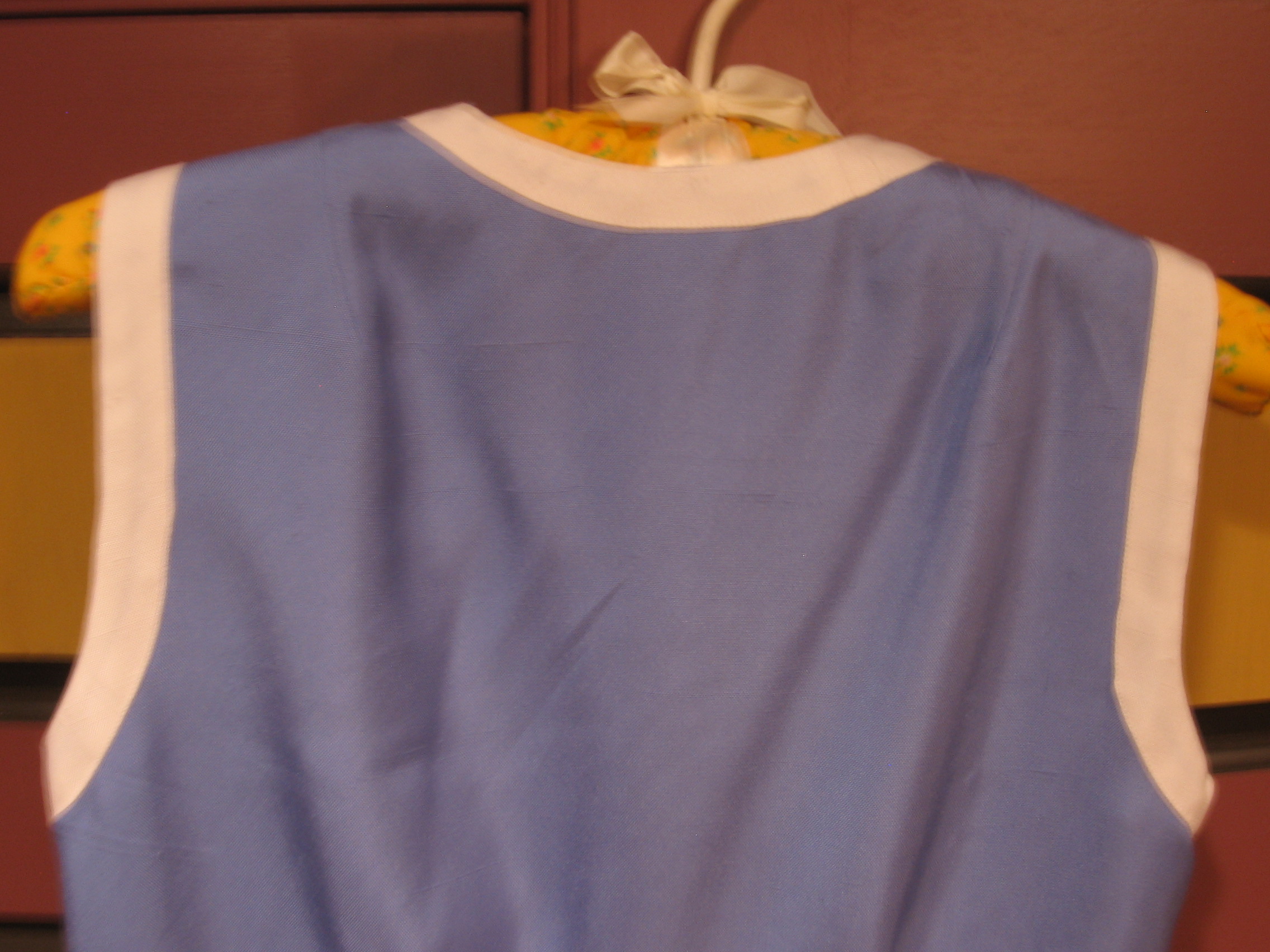
Here is the back of the neckline after I recut it.

Here is a close-up of the bodice and armhole band.

By now I was sick of this dress.  I still had buttons to cover and attach, armholes to do, interior snaps, the hem, and the cummerbund to complete.  Well, you can see from the photos that I did finish this dress, although it was late summer before I sewed the last stitch.

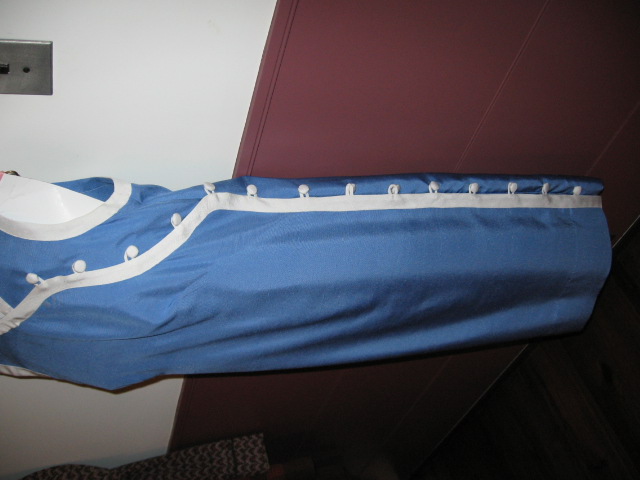
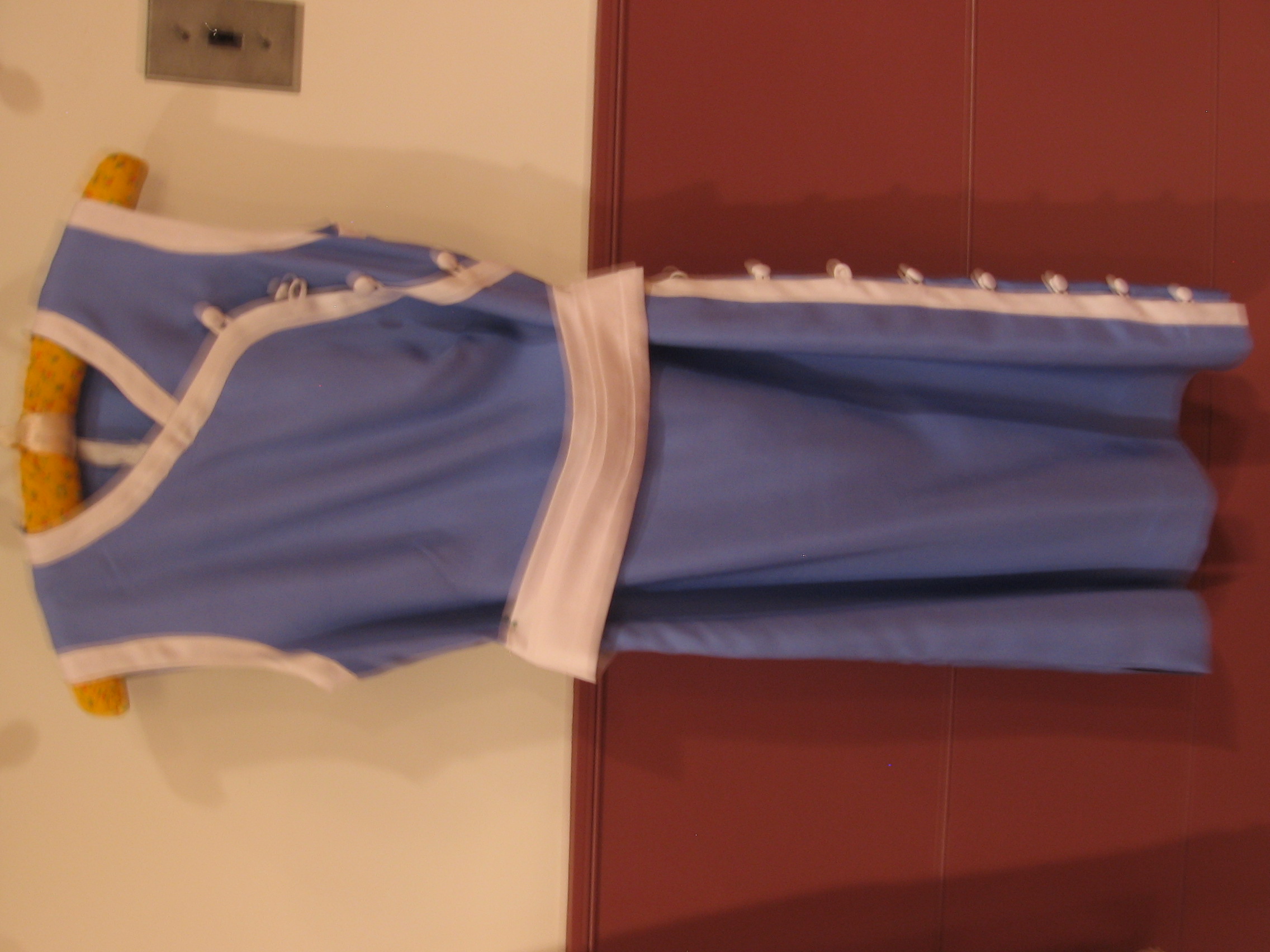
The completed dress. You can see I shortened the hem from mid-calf (as shown on the pattern envelope) to just below the knee.

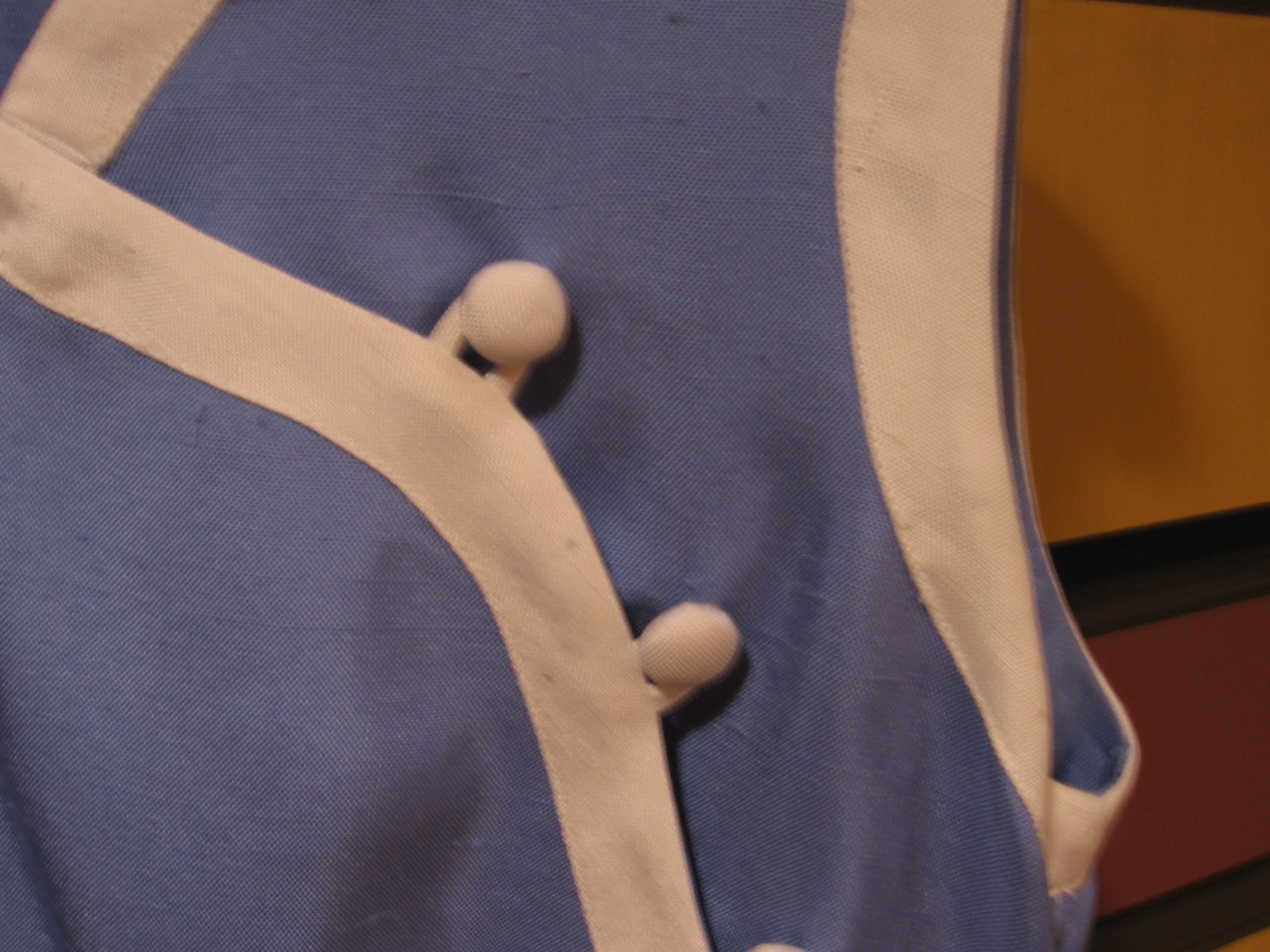
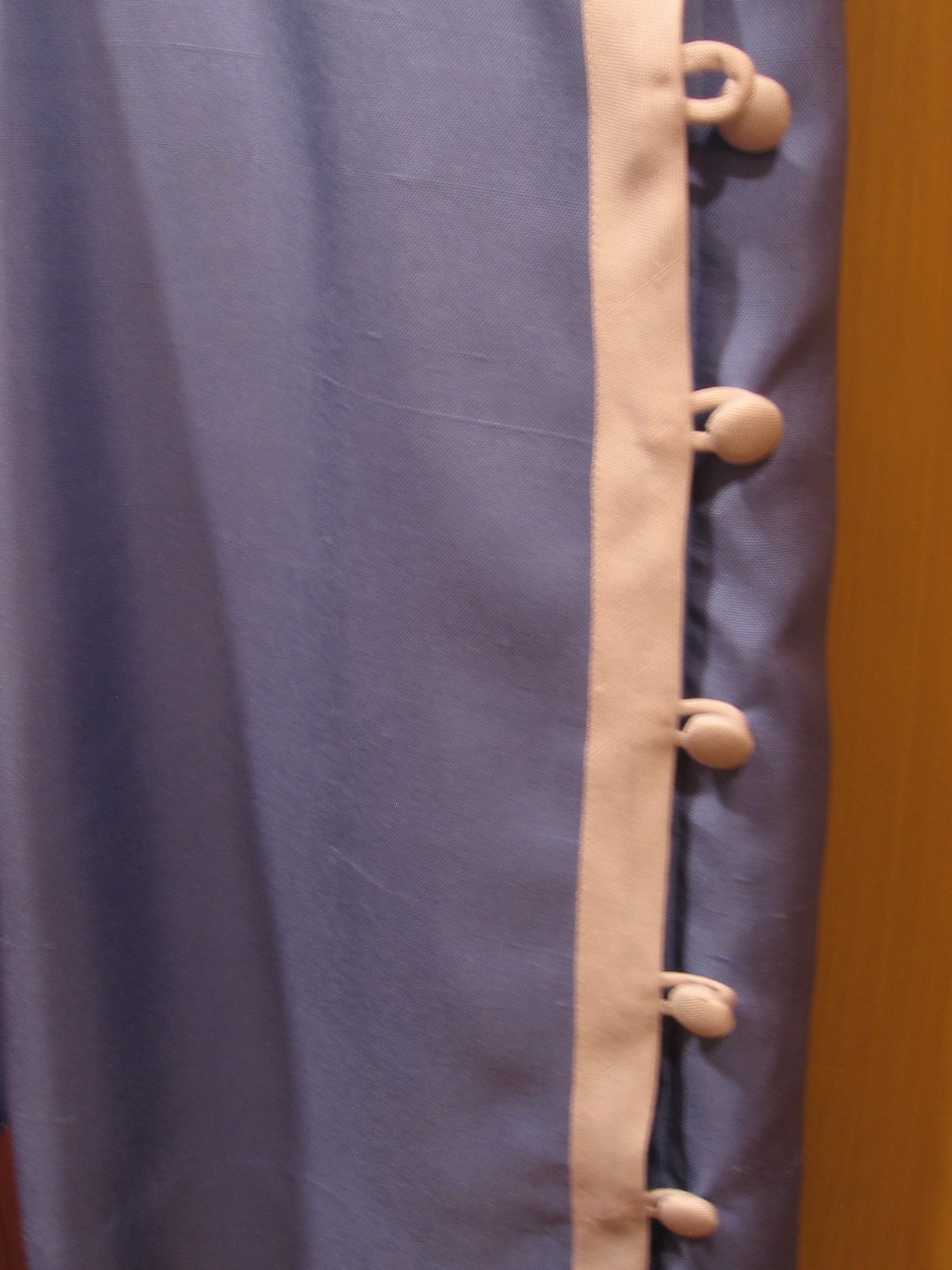
Here is a close-up of the covered buttons and button loops.

I’m still not completely happy with it, but it provided me with these valuable lessons:

1)   Stay away from unprinted patterns.

2)   Check the bustline placement before marking and sewing the darts.

3)   When in doubt, trust my instincts (I should have used all bias for that band and those armholes.)

4)   For best results, make the pattern up in muslin first.  If I had done this, I could have made the bust and neck adjustments before I cut the pattern out in the blue and white silk.

I had a chance to wear this dress during the warm September we had here in eastern Pennsylvania – and I am sure no one suspected I was wearing a dress designed in 1953!  Amazing!

3 Comments

Filed under Asian-inspired dress designs, The Conde Nast Publications, Uncategorized, Unprinted patterns from the 1950s, Vogue patterns