Category Archives: underlinings

Powerless in Pennsylvania, Sewing in San Francisco

“She had the loaded handbag of someone who camps out and seldom goes home, or who imagines life must be full of emergencies.”  – Mavis Gallant

Actually, the handbag I took to San Francisco was small, tucked inside a larger tote bag – so that I could use my allotted “carry-on” space for an extra suitcase for fabric purchases.  Off I went on February 1st for Susan Khalje’s Couture Sewing School held at The Sewing Workshop in San Francisco.  I had carefully packed myriad sewing supplies and my prepared muslins, hoping to be ready for any contingency.  Little could I have known that while I was to be sewing on the West Coast, the camping out (or really, camping in!) and the emergencies would be on the East Coast – with the county in Pennsylvania where we live especially hard-hit by a devastating ice storm.  Our house was without power for 5 days, and knowing that my husband was dealing with downed trees, downed power lines, blocked roads, confused pets, a house getting colder and colder with each day, and limited means of communication, weighed on me mightily as I worked away on my color-blocked jacket.

Coats of certain length - 7

Most of us in the class needed to purchase all our fabric or coordinating fabric or supplies for our intended projects, so off we went to Britex Fabrics on Monday after Susan had fitted most of our muslins.  I had thought long and hard about what color combination I would like to have for this coat.  Knowing that many, many hours of work would go into this project, and also realizing that this jacket could be a go-to piece of outerwear if I chose my fabrics carefully, I decided to look for more conservative colors.  So – no hot pink and apricot orange, at least this time.

Britex carries an extensive selection of coating wools, so much so that it is definitely advantageous to be helped by one of their incredibly knowledgeable sales assistants.  I was fortunate that Inna, who has such a trained and talented eye for color and texture, was able to assist me. We started with a lovely camel hair coating wool, which had a napped silky sheen on one side and was just the right heft for outerwear.  First I wanted to look at pairing it with gray, but nothing in the gray family seemed to strike my fancy.  Then we moved on to the navy blues – and there nestled in among the bolts was the perfect “medium” navy blue, also with a napped sheen on one side.  It was a little heavier than the camel hair, but Susan felt confident we could make the two fabrics work together, especially because their colors complimented each other so perfectly.

Silk lining fabric was next on the list, and I wanted something figured rather than plain.  Inna pulled out a bolt of Italian charmeuse, which picked up the geometric feel of the jacket, and introduced a little red into the mix.  I couldn’t be happier with it.
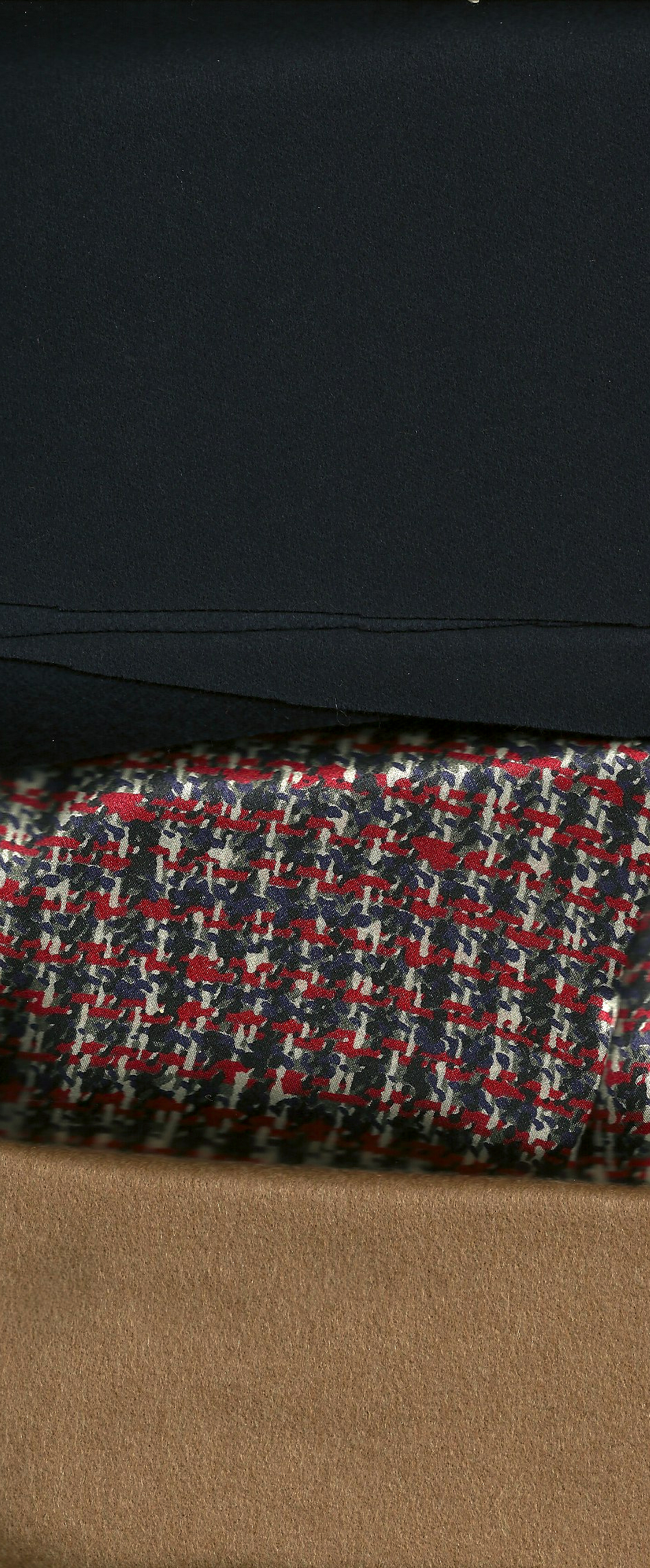
I am not so sure this gives the best sense of the colors of the fabrics, but you will see more in a future post.

I am not so sure this photo gives the best sense of the colors of the fabrics, but you will see more in other photos.

Back at The Sewing Workshop, armed with fabrics and enthusiasm, I spent the next two days cutting out the multi-, multi-pieced pattern (31 separate pieces, all of which would be cut in tandem, making 62 in all, not including the lining!), and basting the silk organza underlinings to each and every piece.
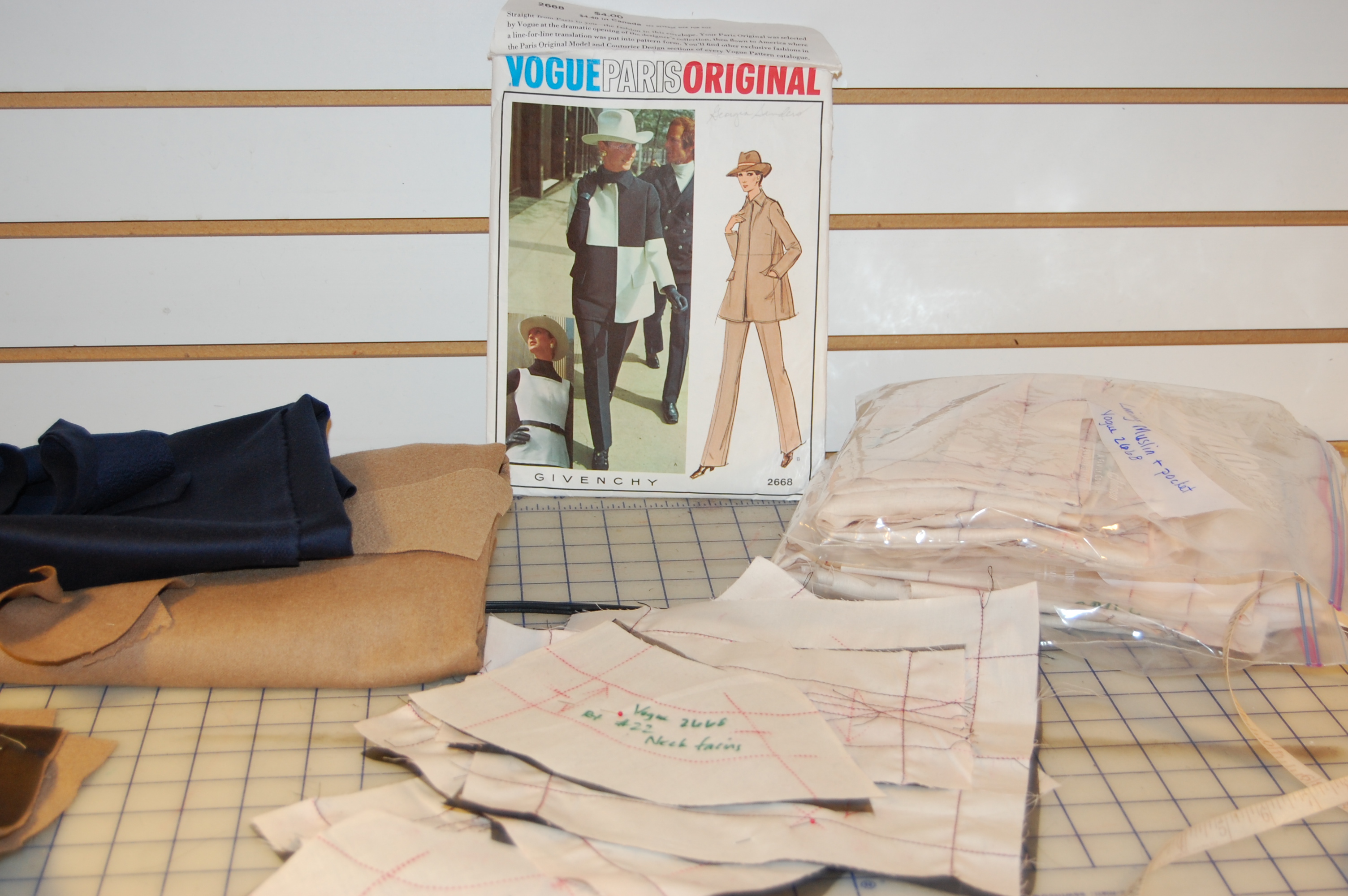
My well-lit and spacious work space at The Sewing Workshop.

My well-lit and spacious work space at The Sewing Workshop.

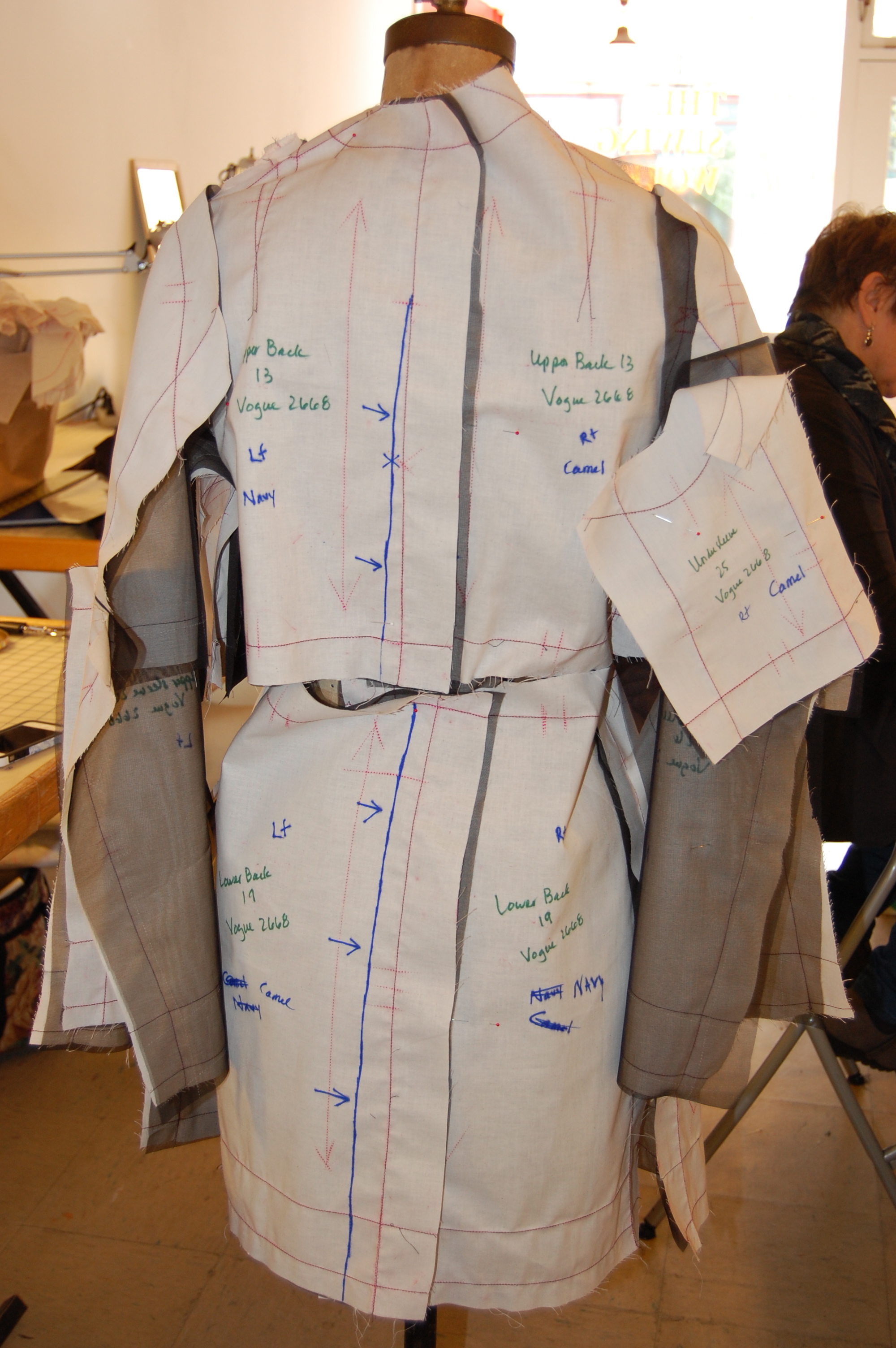
Because of the color blocking, I needed to pay great attention to which piece was to be cut in blue and which piece in camel.  Initially I went through and labeled each muslin piece “navy” or “camel”.  Susan double-checked me, but then suggested that, because I absolutely could not make a costly mistake, that I pin the muslin pieces onto the available dress form in our studio.  What a great idea, one of so many which I picked up from Susan and my classmates!
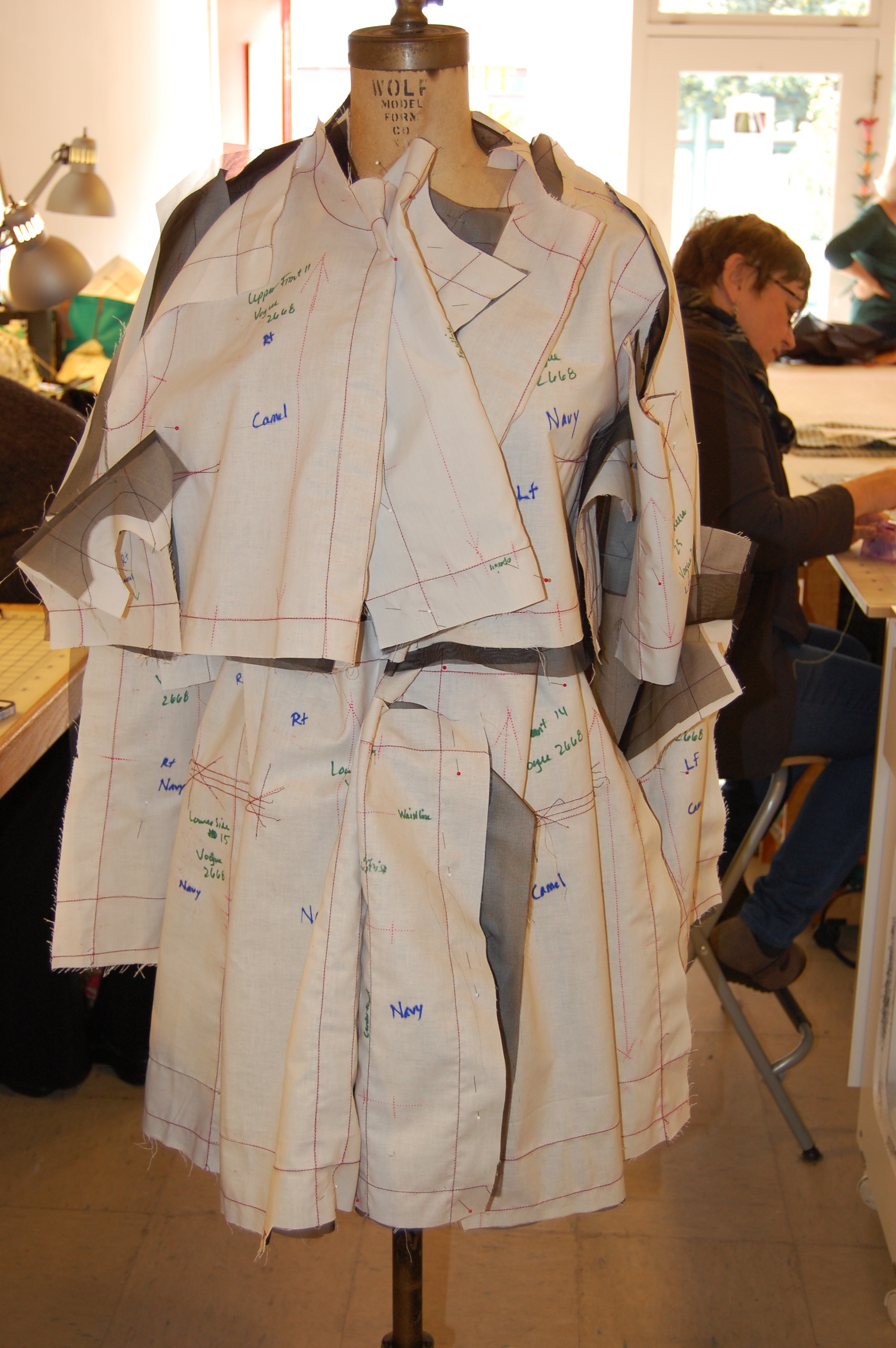
Here is the "front" of the jacket, pinned onto the dress form.
Here is the “front” of the jacket, pinned onto the dress form.

And here is the back.

And here is the back. 

Now, I felt confident and set about to cut my fashion fabric.
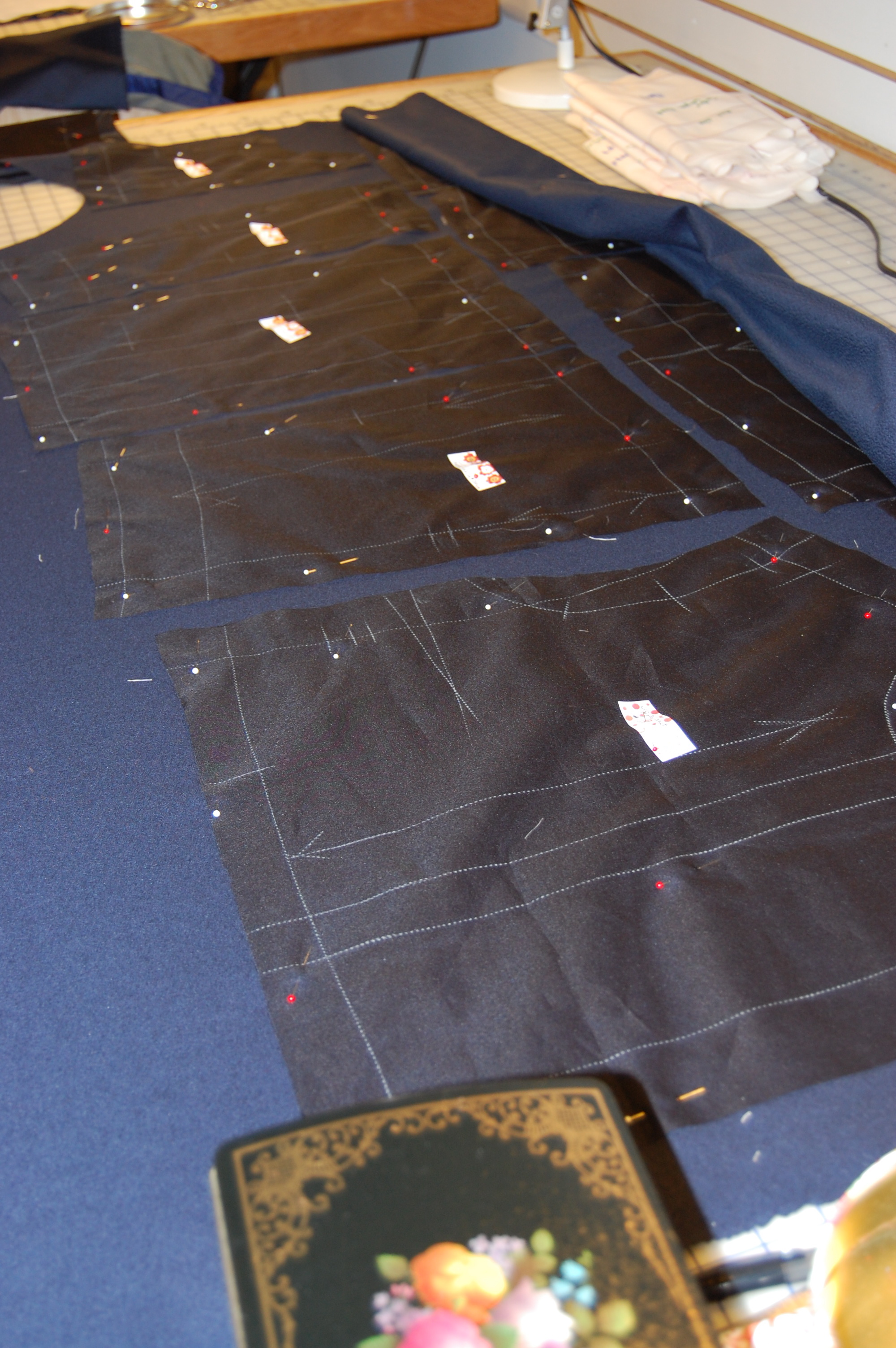
Here are the silk organza underlining pieces arranged on the blue fabric.  I pinned a small tag on each piece, telling me each piece's pattern # and description.  A lot of the pieces look alike!

Here are the silk organza underlining pieces arranged on the blue fabric. I pinned a small tag on each piece, telling me each piece’s pattern number and description. A lot of the pieces look alike!
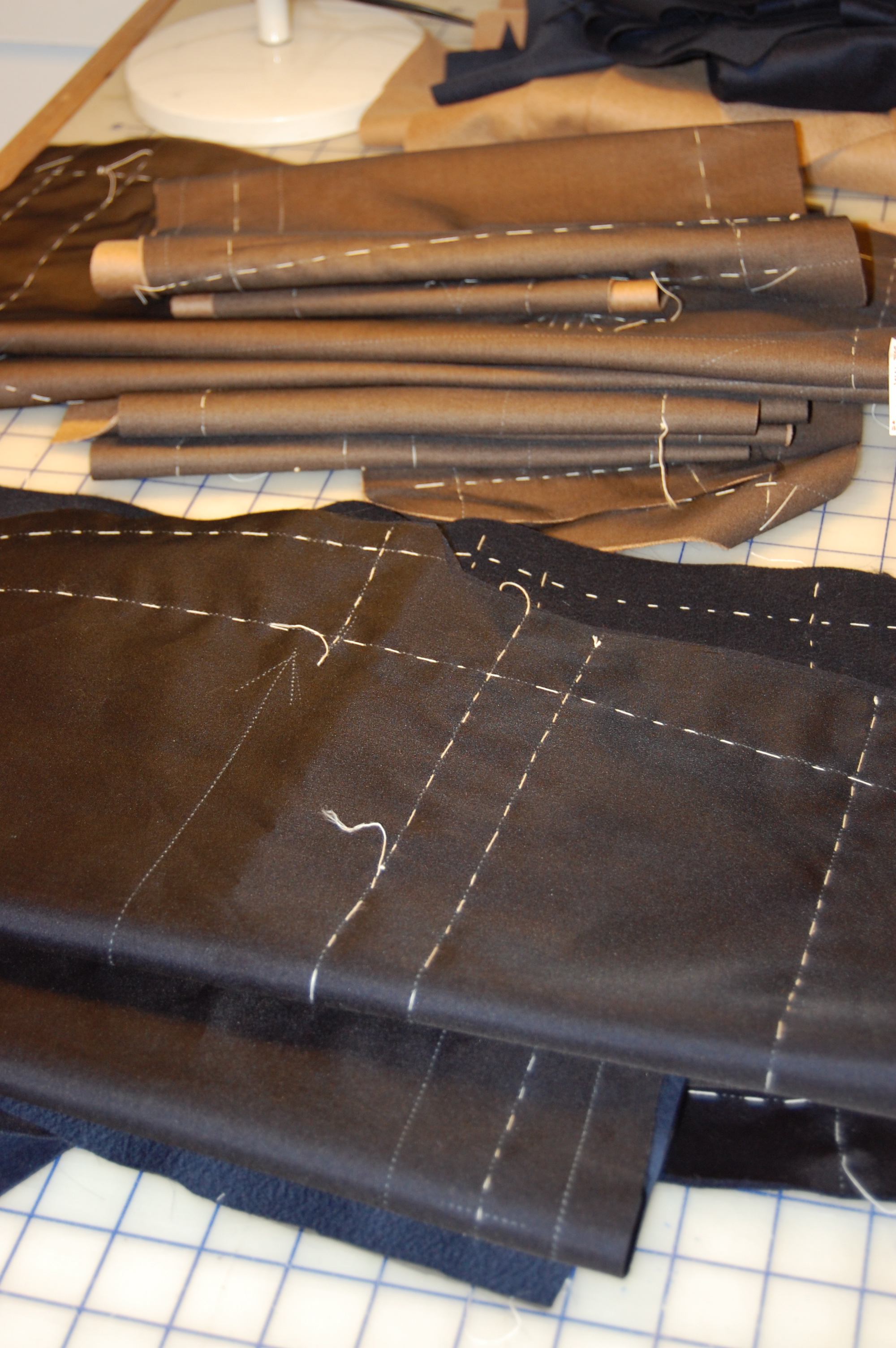
Two piles showing all underlinings basted onto the fashion fabric.

Two piles showing all underlinings basted onto the fashion fabric.

By this time, I was half-way through the 6-day class.  I assessed my situation and determined the parts of the jacket construction upon which I wanted to get expert advice  from Susan:  treatment of the concealed fly front, flap pockets, rolled collar (all of which will be detailed in a future post).  Now I had a plan, which seemed to be much more than anything that was happening back home in Pennsylvania.

My husband joked during one of our few cell-phone conversations, that he had a vision of the power in our house coming back on Sunday evening, February 9th, as he would be driving me home from the airport in Philadelphia.  He was right.  That is exactly what happened.  I came home to a 39F degree house, but the lights were on, and soon the heat was, too.  Almost a week later, it is still snowing and snowing – perfect sewing weather for this sojourner home from San Francisco.
12 Comments

Filed under car coats, Coats, Color blocking, couture construction, Uncategorized, underlinings, vintage Vogue Designer patterns, vintage Vogue patterns from the 1970s, Vogue patterns, woolens

A Simple Sheath?

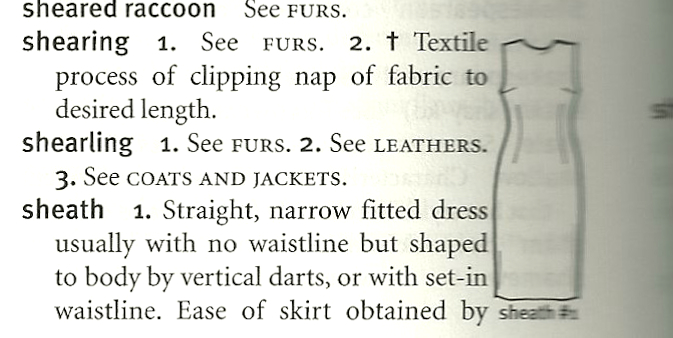
One of the most enduring dress styles in the last 60 years is undoubtably the classic sheath.  According to the definition in Fairchild’s Dictionary of Fashion, a sheath can be one of two constructions:  without a set-in waist or with a set-in waist.  In either case, the silhouette is straight, narrow, and fitted, “shaped to body with vertical darts”, with ease of movement facilitated by a slash at back or an inverted pleat.  “Both styles were popular in 1950s and early 1960s.  Revived periodically.”

Fairchild's illustration of a sheath dress.  copyright 2003, The Fairchild Dictionary of Fashion 3rd Edition, Fairchild Publications, Inc., New York.

Fairchild’s illustration of a sheath dress. copyright 2003, The Fairchild Dictionary of Fashion 3rd Edition, Fairchild Publications, Inc., New York.

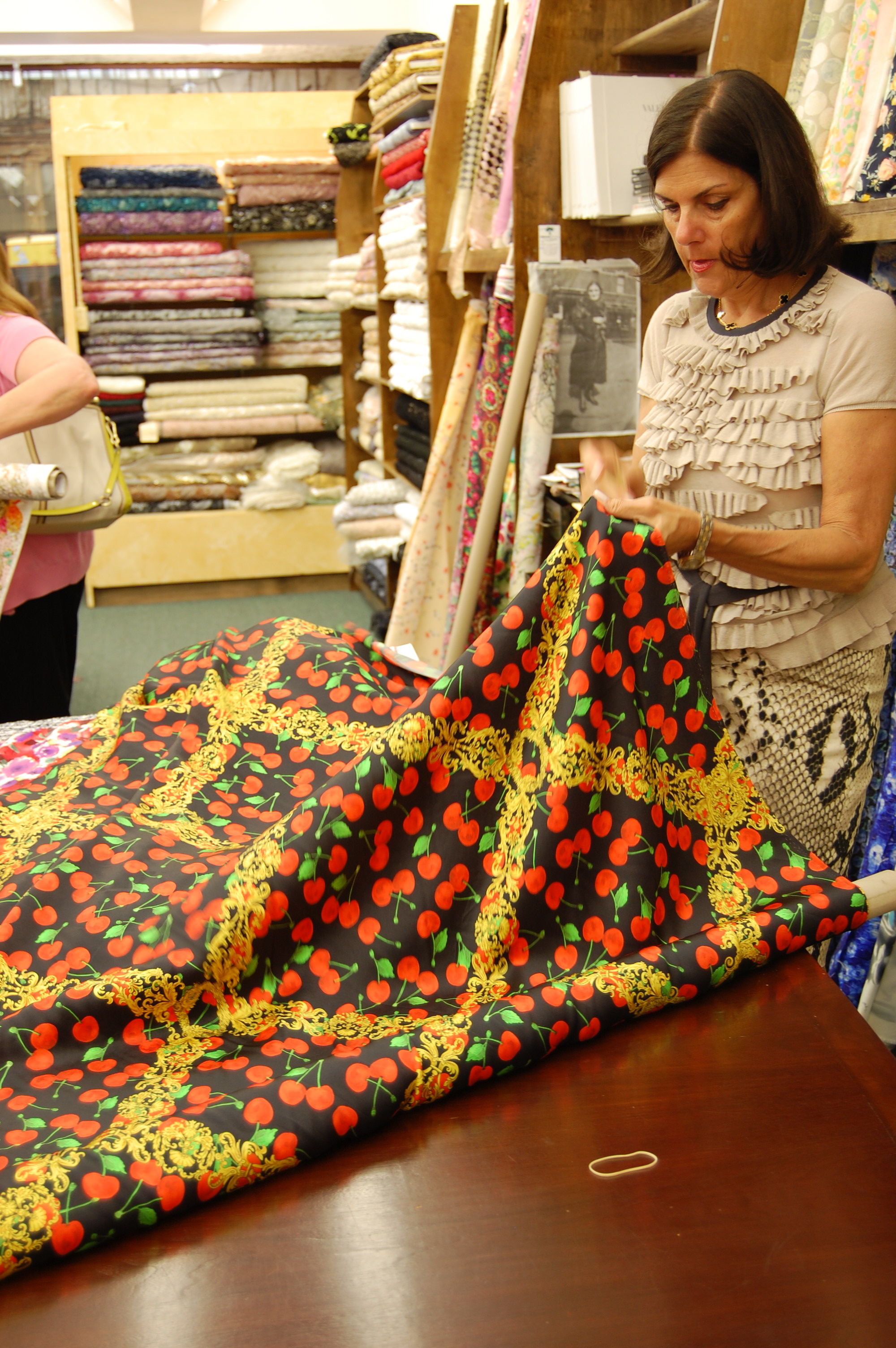
It doesn’t take very long looking at current fashion magazines and websites to see that the sheath dress is enjoying one of those revivals right now.  And why not?  It is an infinitely versatile style, going from casual to dressy just by choice of fabric.  Earlier in the Summer when I was shopping at Mendel Goldberg Fabrics in NYC with Susan Khalje’s  “Classic French Jacket” class, I succumbed to purchasing 1½ yards extra of my lining fabric, with the express intention of making a sheath dress out of it.  The fabric is definitely a demonstrative print, so I thought the simpler the style of dress, the better.

My lining and dress fabric, still on the bolt.

My lining and dress fabric, still on the bolt.

I have to admit I had a few moments when I wondered if that fabric, which I loved as the lining in my jacket, might not be a bit too much for a dress.  Well, too late for any misgivings – this dress was going to happen!  Then suddenly I started seeing photos of more and more sheath dresses, many of them made out of very bold and colorful fabrics.  Two fashion websites I often visit for inspiration and ogling each featured such dresses:

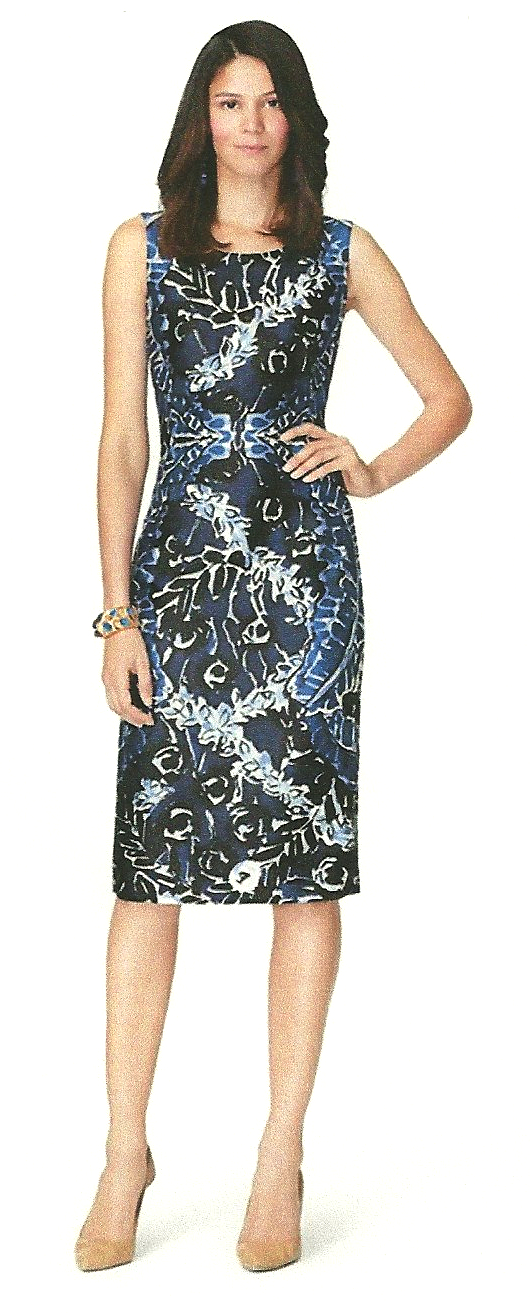
This dress can be found on the Lee Anderson Couture website.

This dress can be found on the Lee Anderson Couture website.

This dress is from Oscar De la Renta's Ready-to-wear line.

This dress is from Oscar De la Renta’s Ready-to-wear line.

Encouraged with this affirmation of my idea, I chose my pattern, ordered china silk for the lining (I already had black organza underlining), purchased the zipper and proceeded to plan my dress.

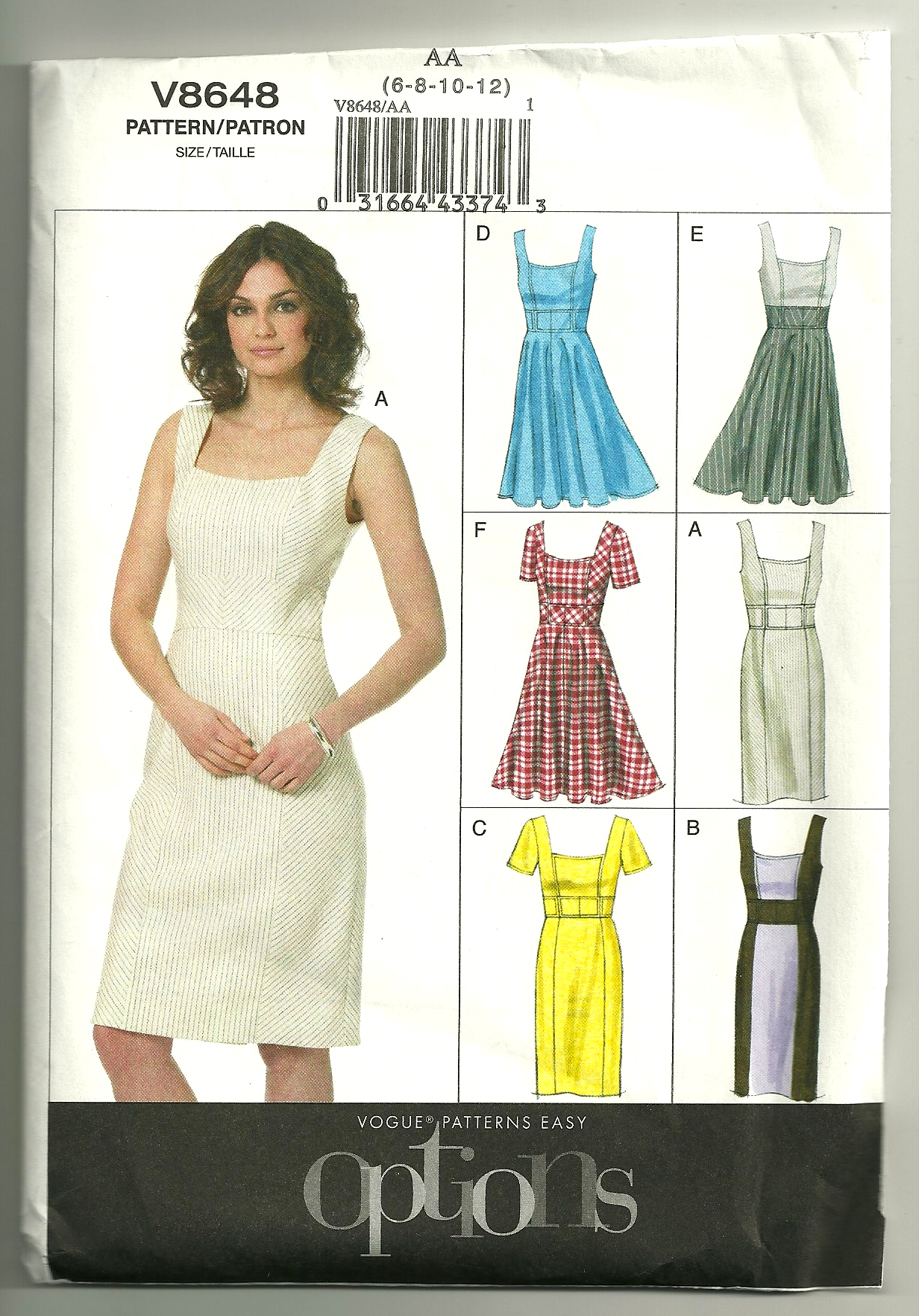
I decided to adapt this simple pattern, using the third view without the neck and hem bands.

I decided to adapt this simple pattern, using view A (on the right) without the neck and hem bands.

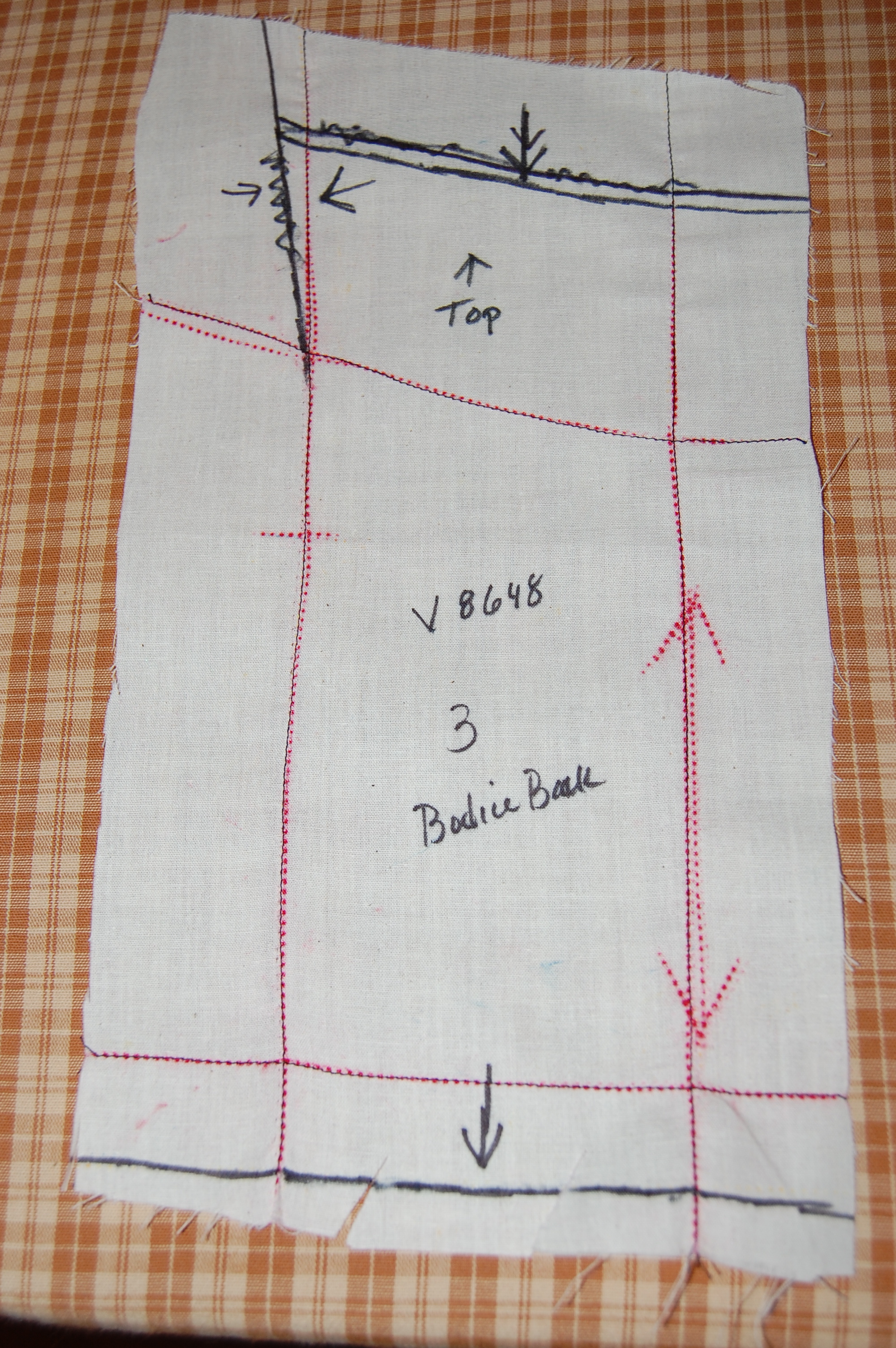
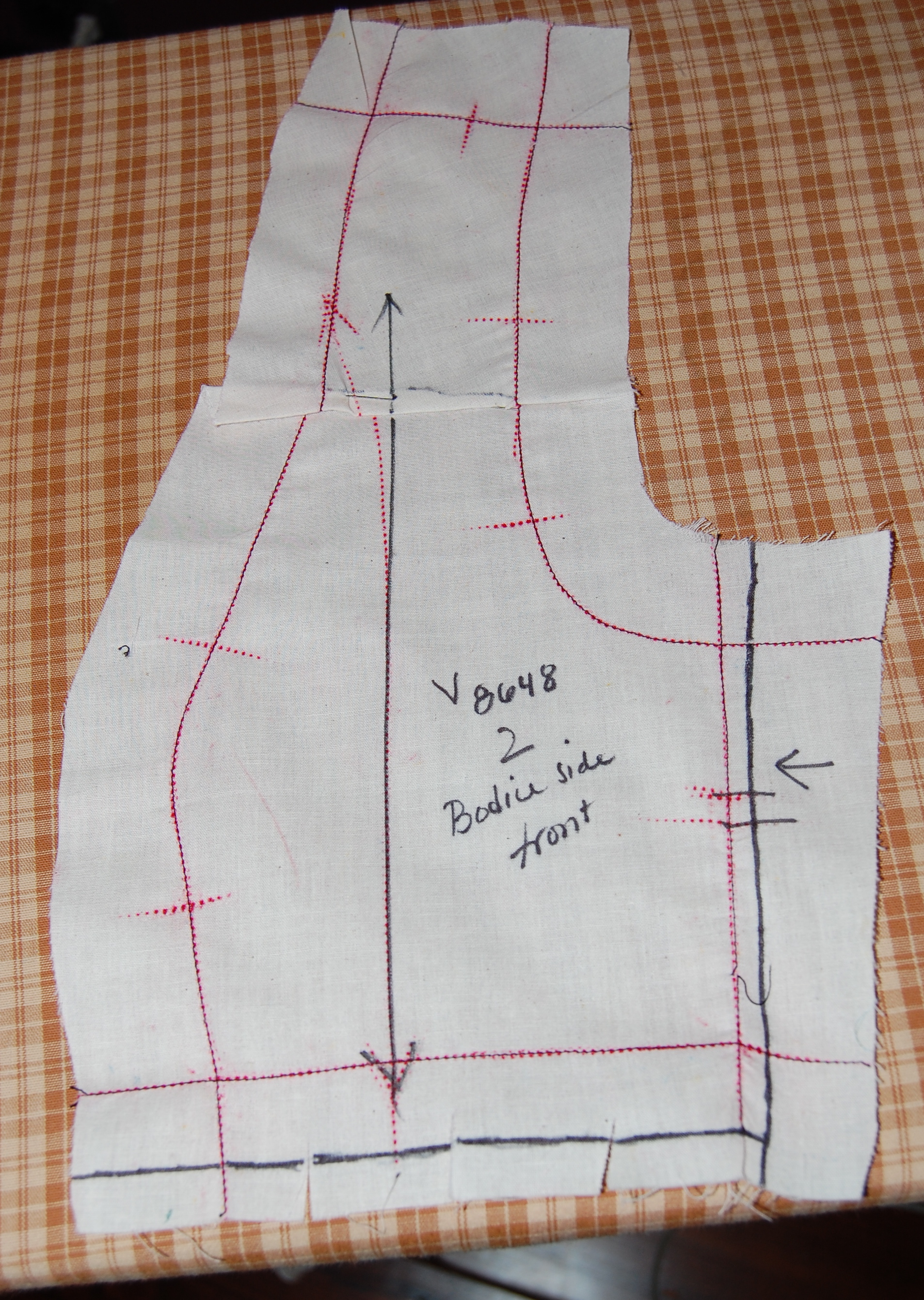
First, of course, I once again sewed up the muslin I had already made for this pattern earlier in the summer.  Here are the changes I made:

1) I sewed the neckband onto the body of the dress and treated it all as one.

2) I eliminated the facings, as I was making this dress with couture techniques.

3) I tweaked the fit a little more, to make it more fitted than my earlier dress (which was belted and needed a little more ease).

4) I adjusted the shoulder to be cut a little higher on the arm.

5) I dipped the neckline a little bit, to match the neckline on my jacket.

6) I added a slit in the back seam for ease of movement.

While I love the look, sheen and feel of silk charmeuse, I don’t think it is the easiest fabric to work with.  I thought I could make my job easier if, when laying out the fabric for pattern (muslin) placement and cutting, I was able to control the slipperiness of it somehow.  I decided to use  half of my dining room table, covered with heavy drapery flannel (which is what I use under tablecloths for cushioning).   The flannel “anchored” it beautifully.

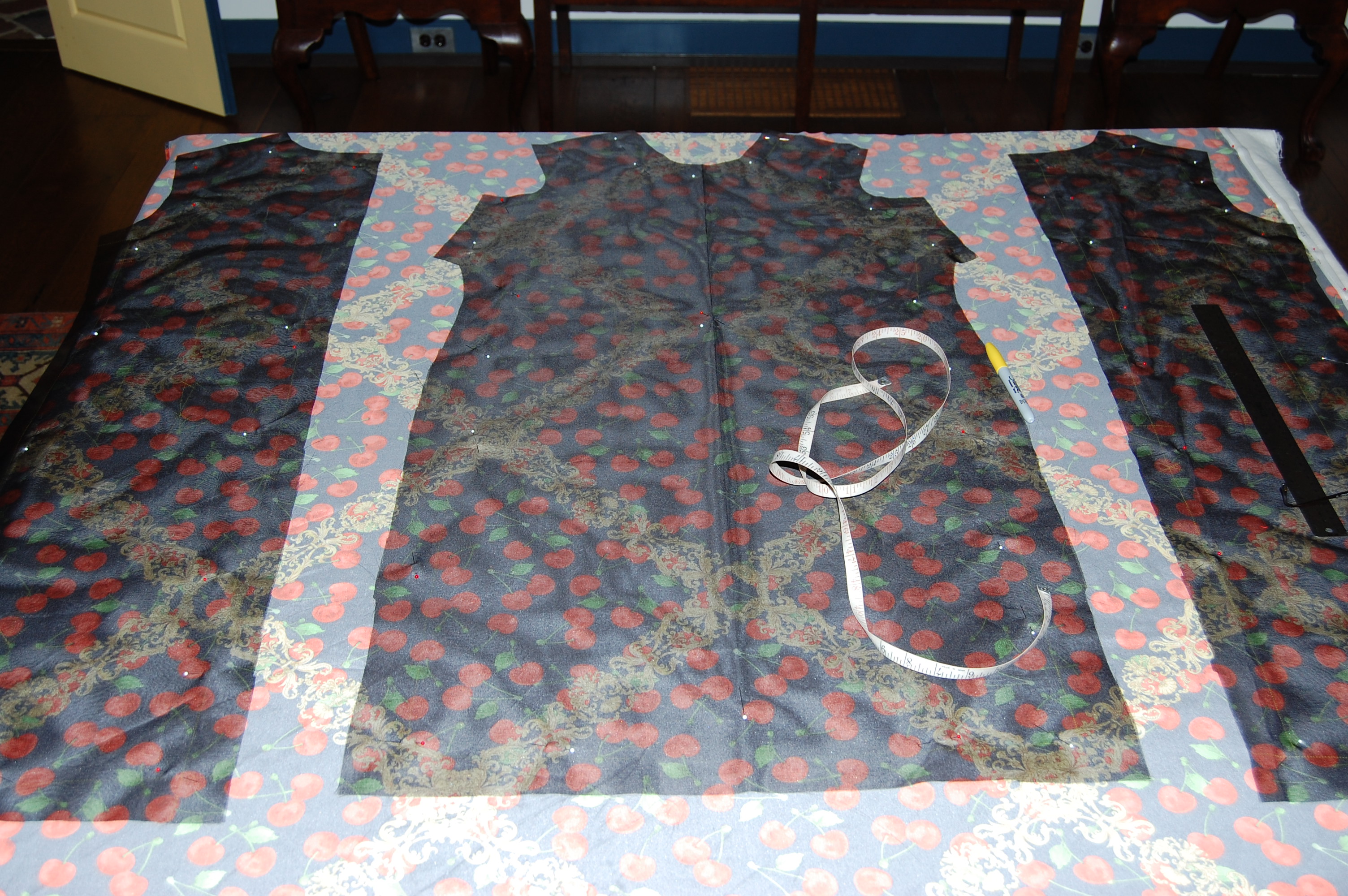
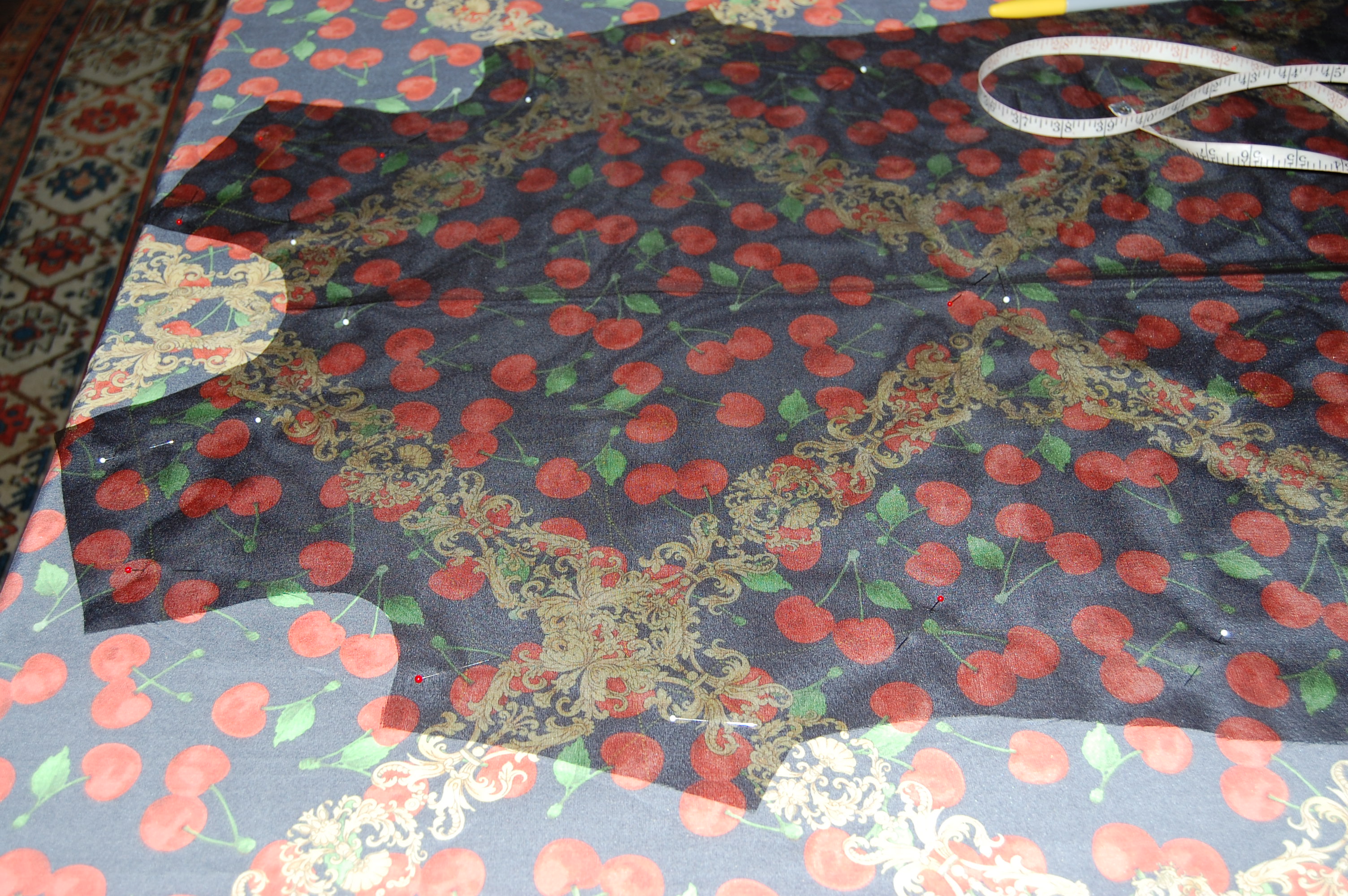
Then I was faced with a design element quandary.  Before I cut out my jacket lining in Susan Khalje’s class, she and I had looked at the fabric with my dress in mind –and had determined that one of the gold “cross” lines in the design should hit at about my breastbone.  However, once I had the fabric remaining from my jacket laid out, I realized that was not going to work.  I tried every which way, and, with the fabric I had available to me, I simply could not match up the pattern in the fabric across the front and two side backs of the pattern and still “cross” my breastbone.  It took a couple of hours, but I finally was able to come up with a new plan – this one to have one of the “cross” details at my waist.  This allowed me to have a shoulder detail I really liked, a black field  (with cherries) at my neckline, and the slimming effect of a “cinched” waist, effected entirely by the design in the fabric!

Here are the organza underlining pieces laid out on the fabric.

Here are the organza underlining pieces laid out on the fabric.

This photo shows exactly how I determined where to position the design in the fabric.

This photo shows exactly how I determined where to position the design in the fabric.

Then I was off and sewing!

Zipper and neck details.

Zipper and neck details.

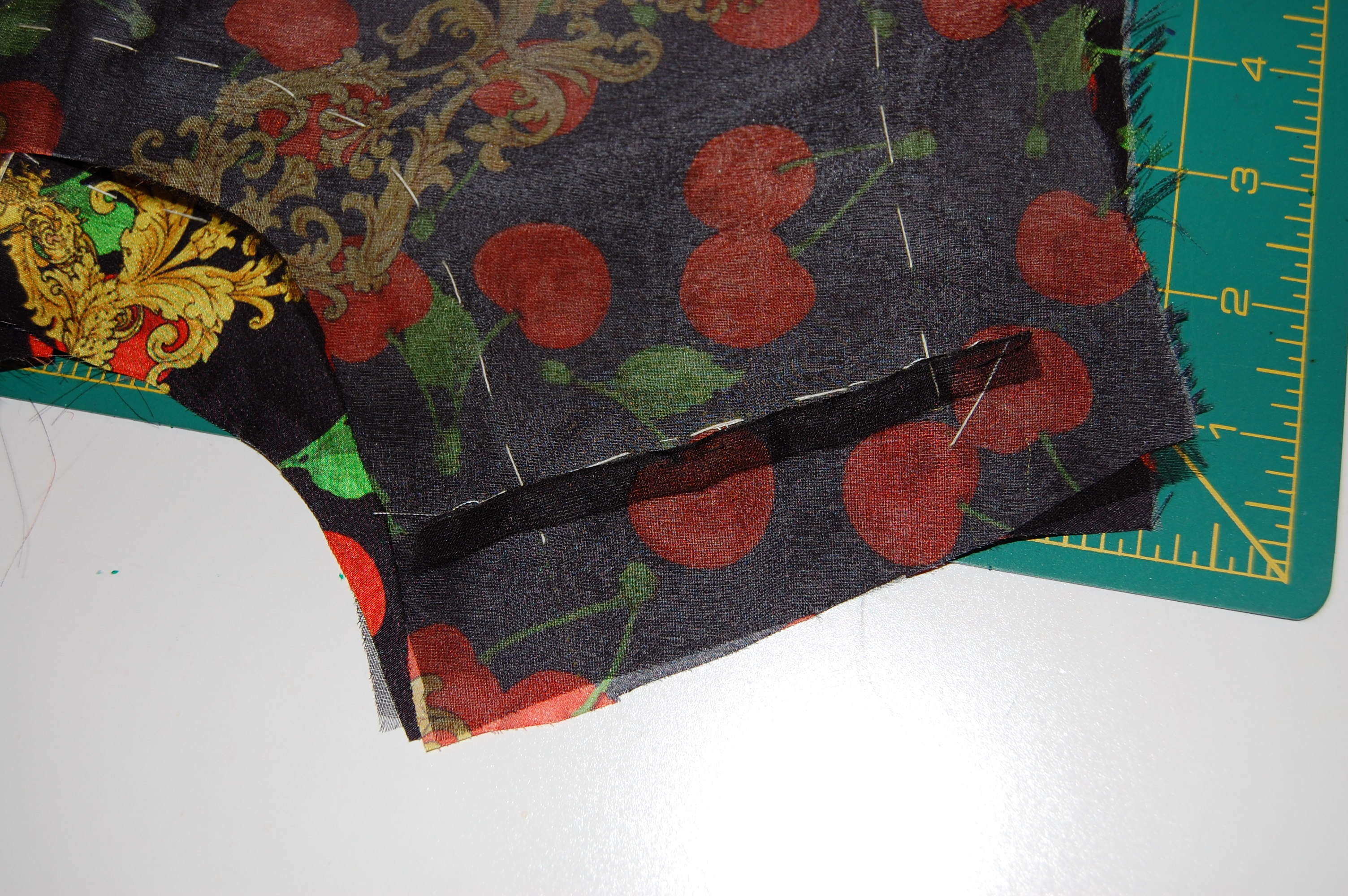
I stabilized the shoulders with a bit of selvedge from the organza underlining.

I stabilized the shoulders with a bit of selvedge from the organza underlining.

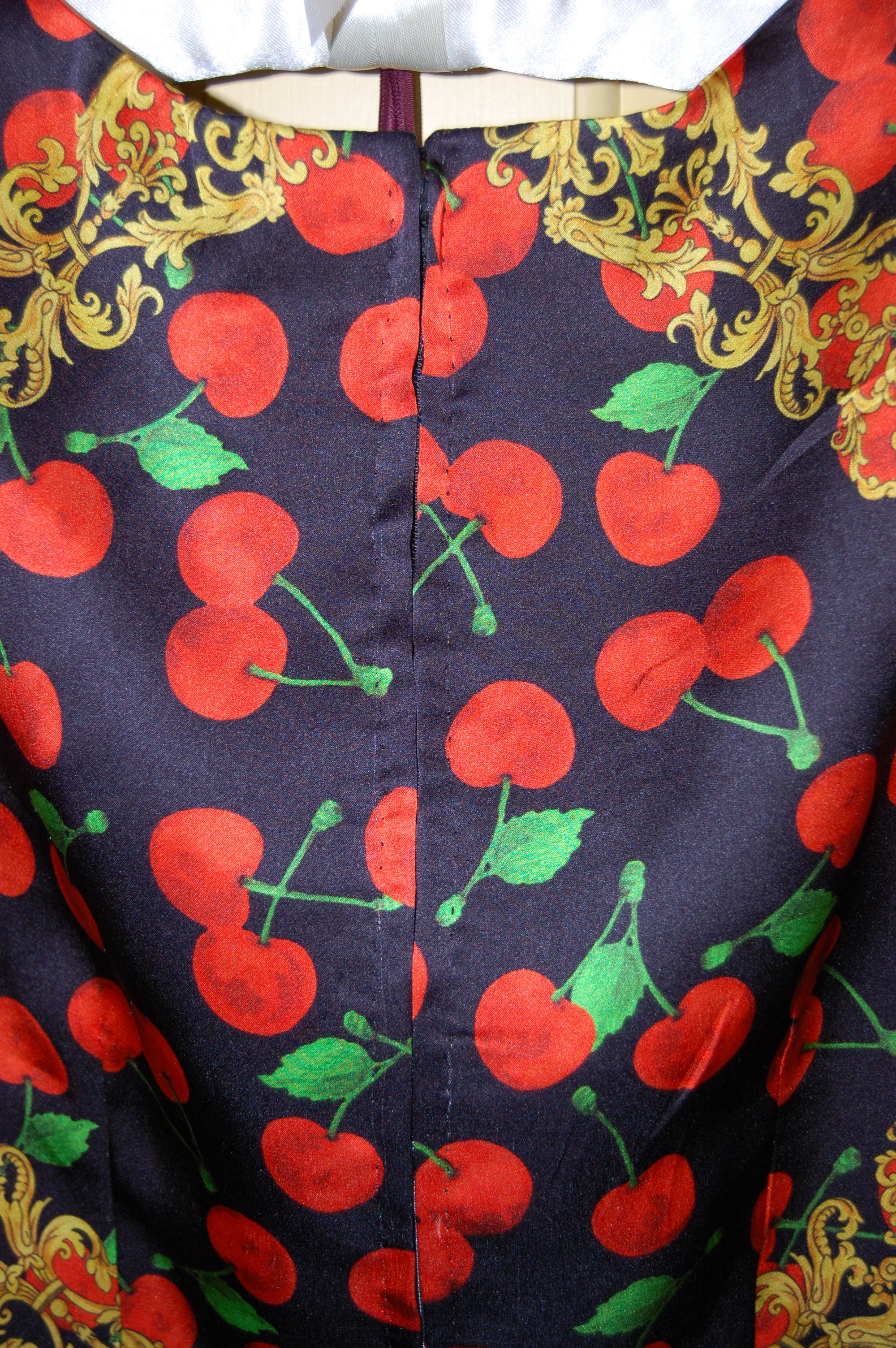
A close-up of the hand-picked zipper.

A close-up of the hand-picked zipper.

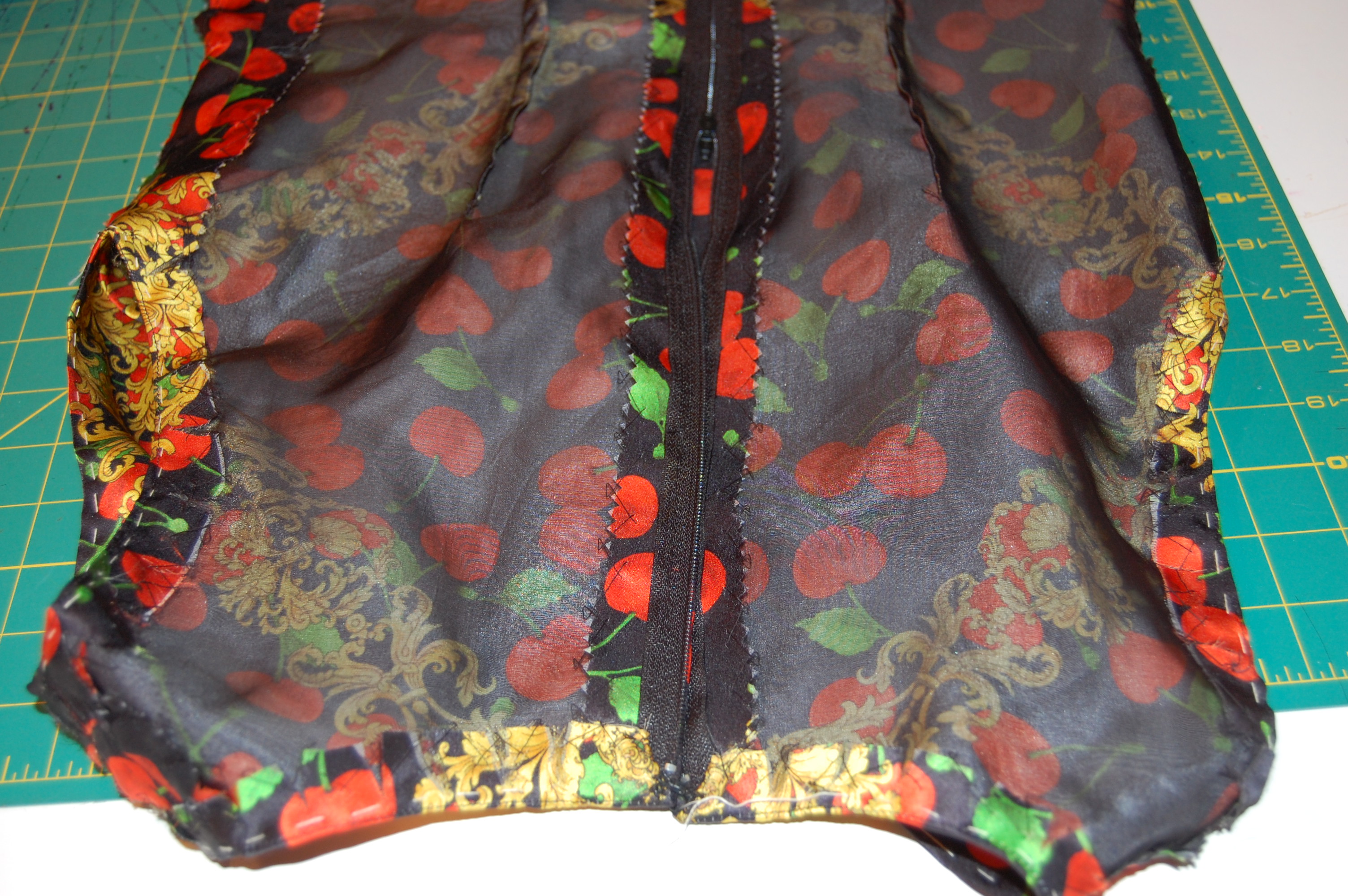
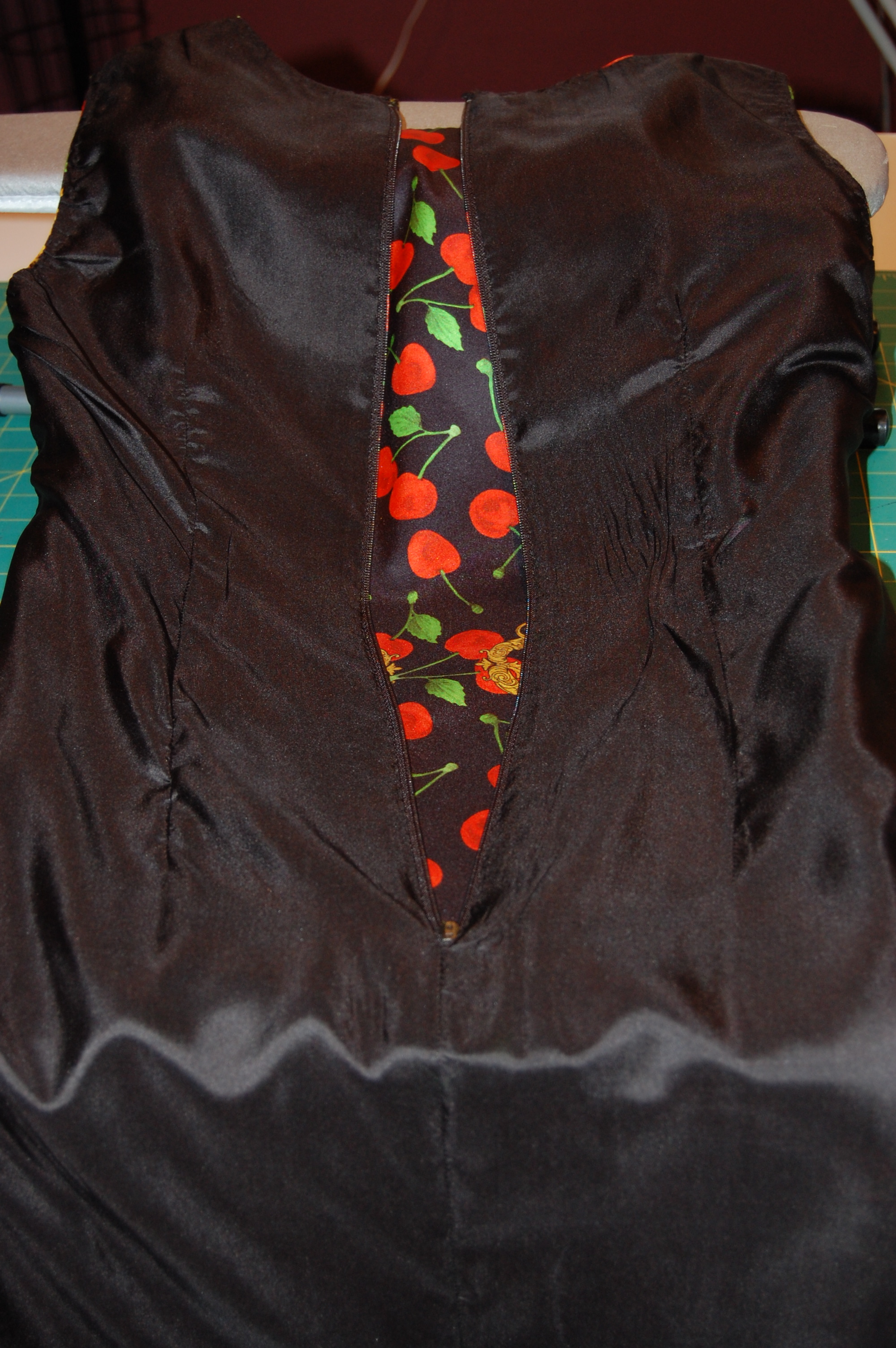
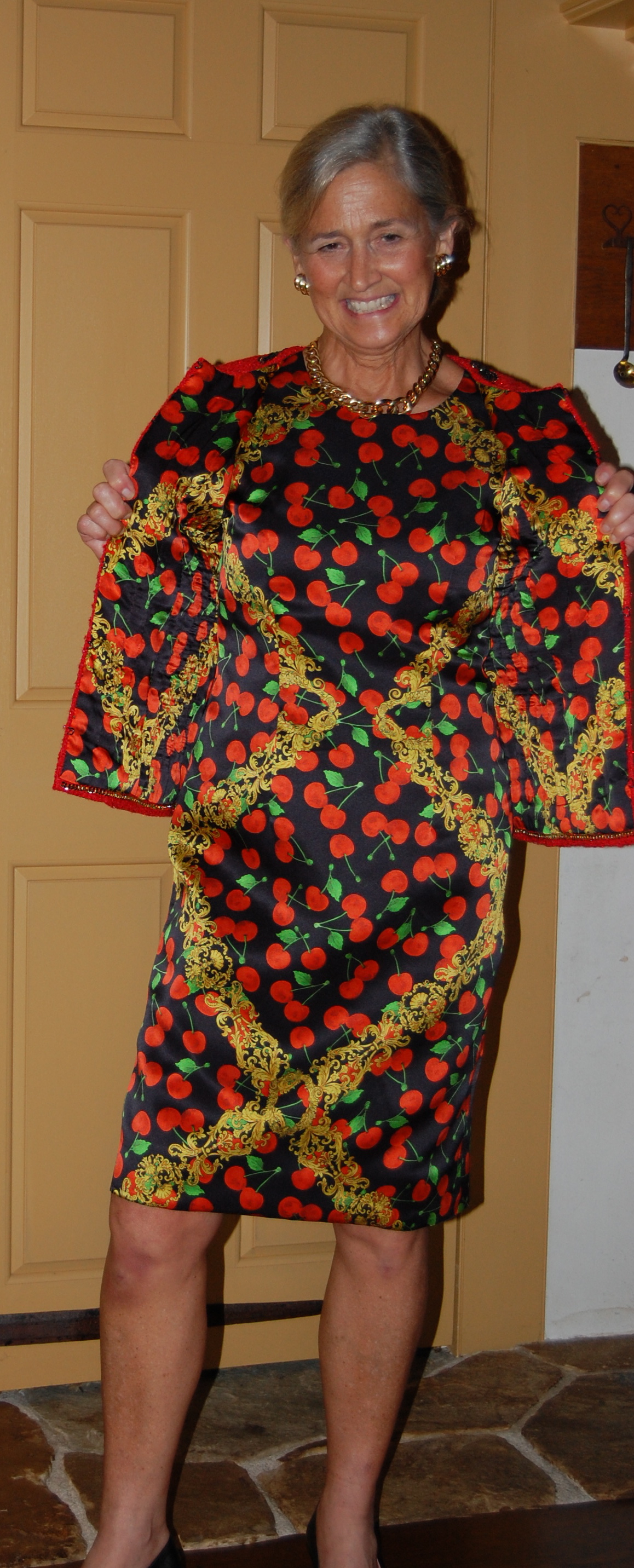
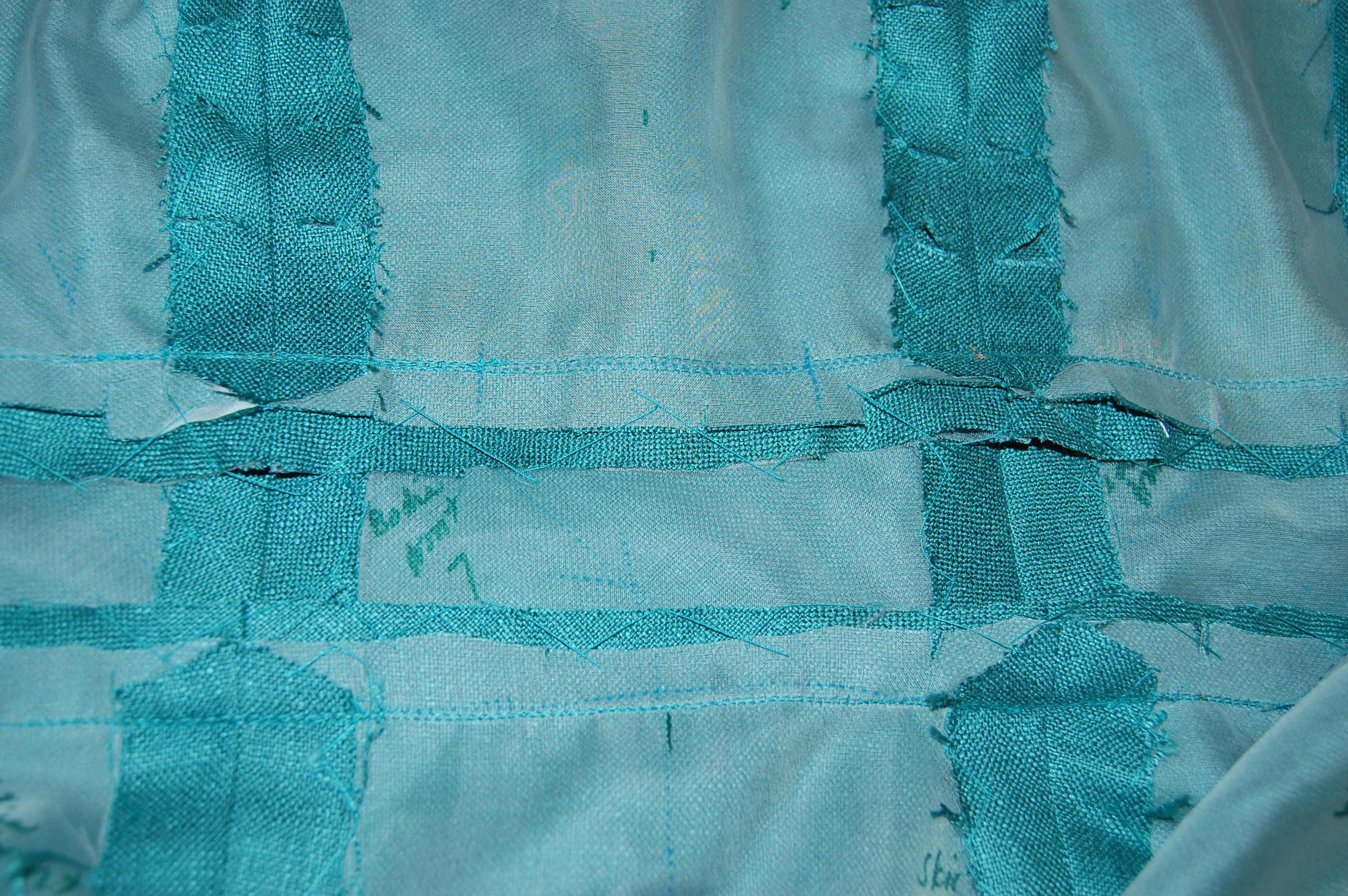
The dress turned inside out!

The dress turned inside out.

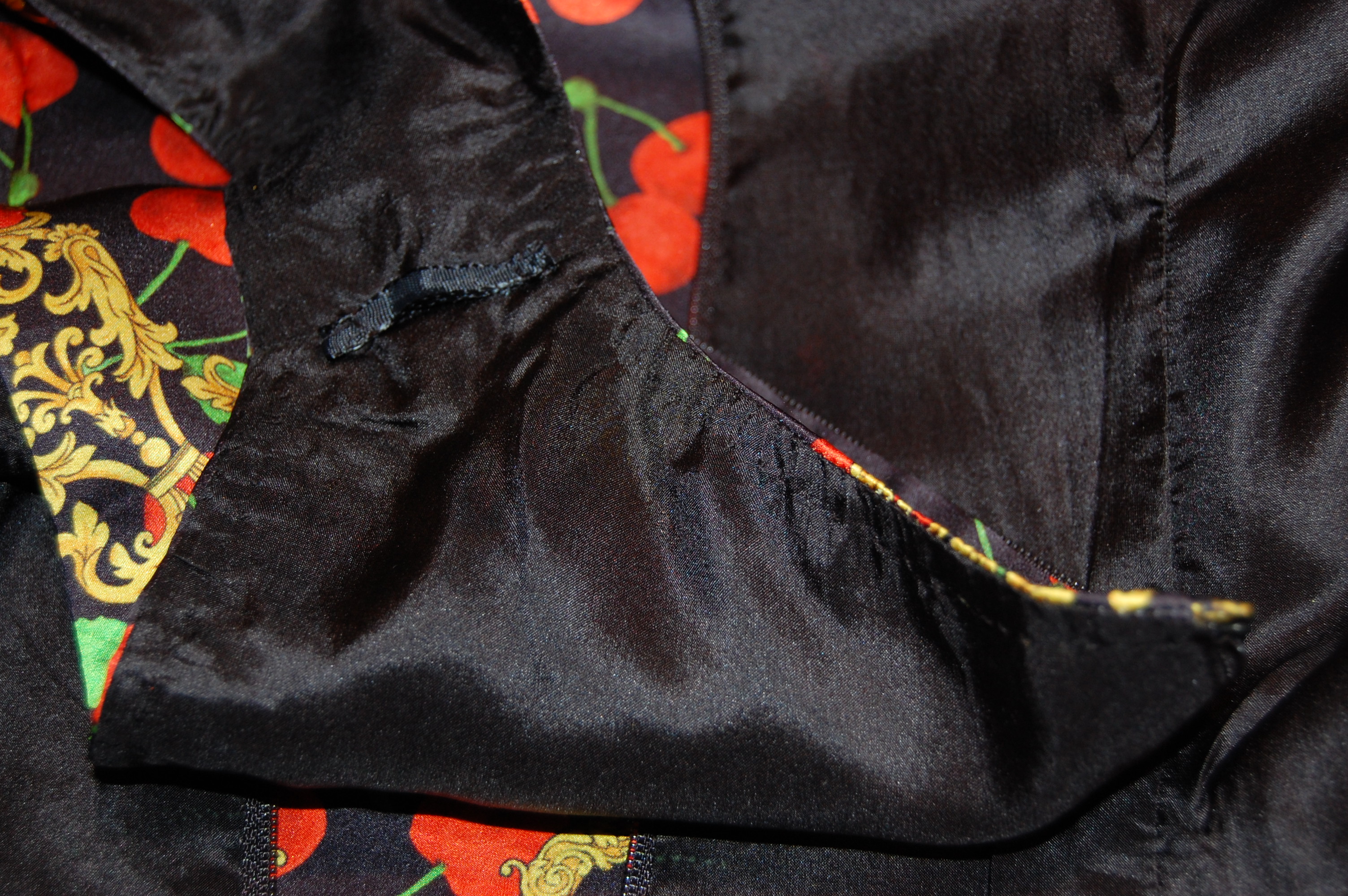
A detail of the shoulder and neck edge.

A detail of the shoulder and neck edge.

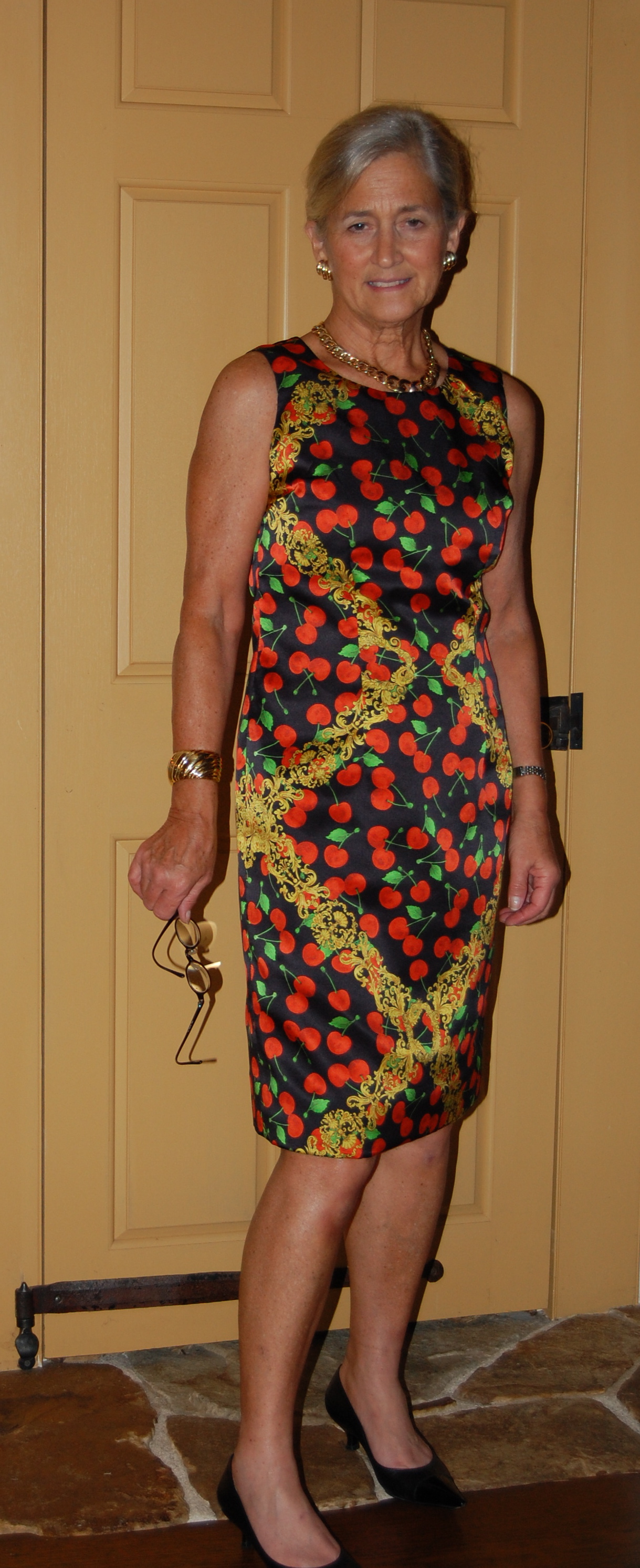
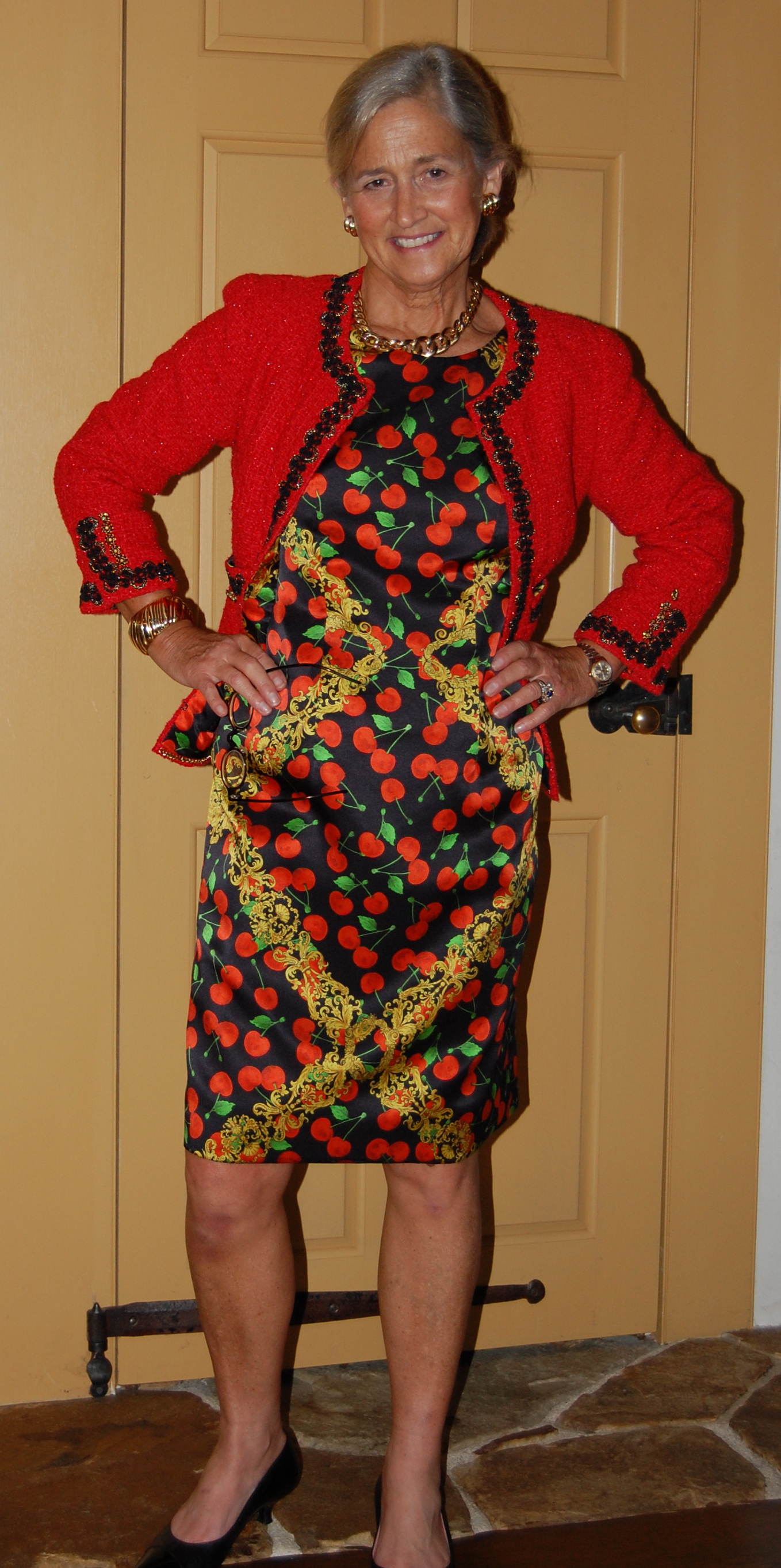
Finished!  What do you think?  Too demonstrative or just right?

Finished! What do you think? Too demonstrative or just right?

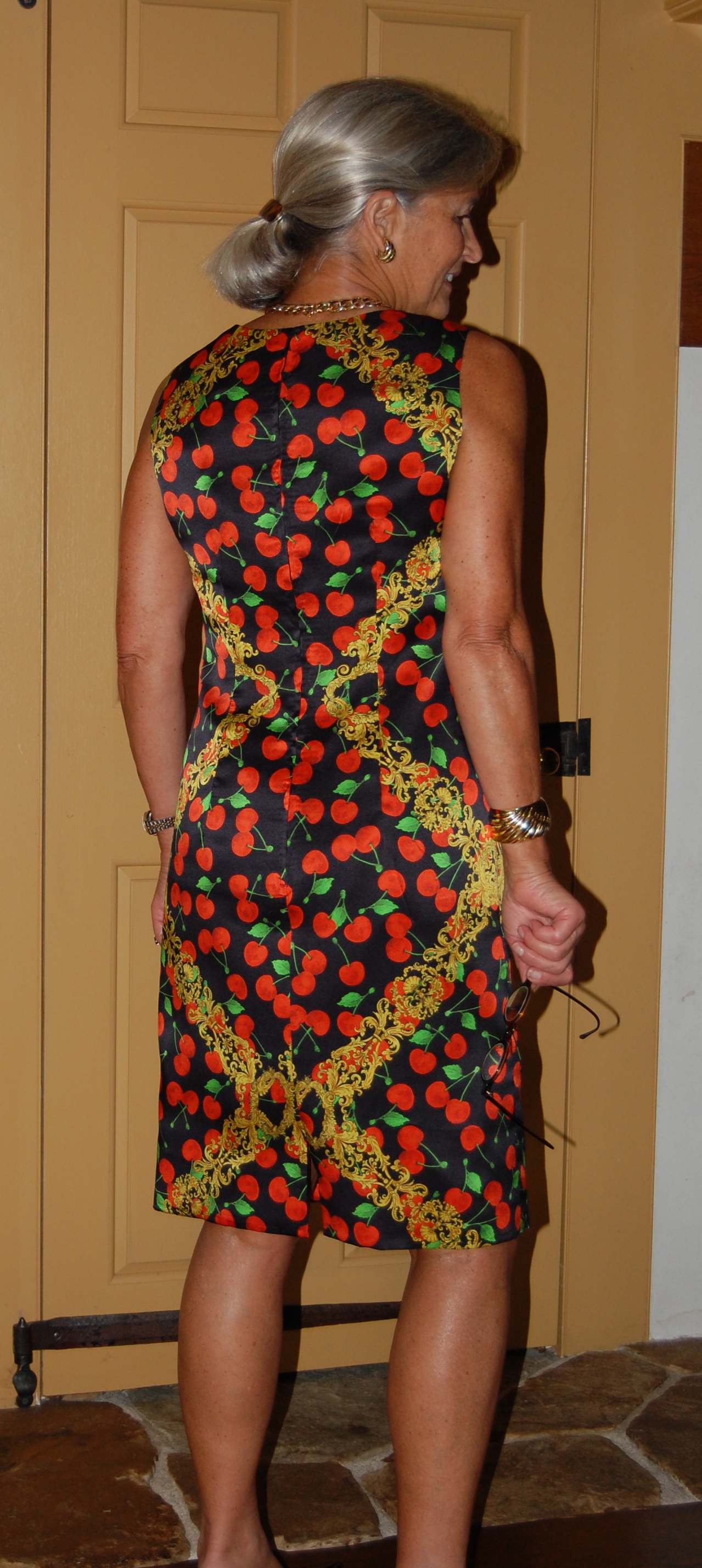
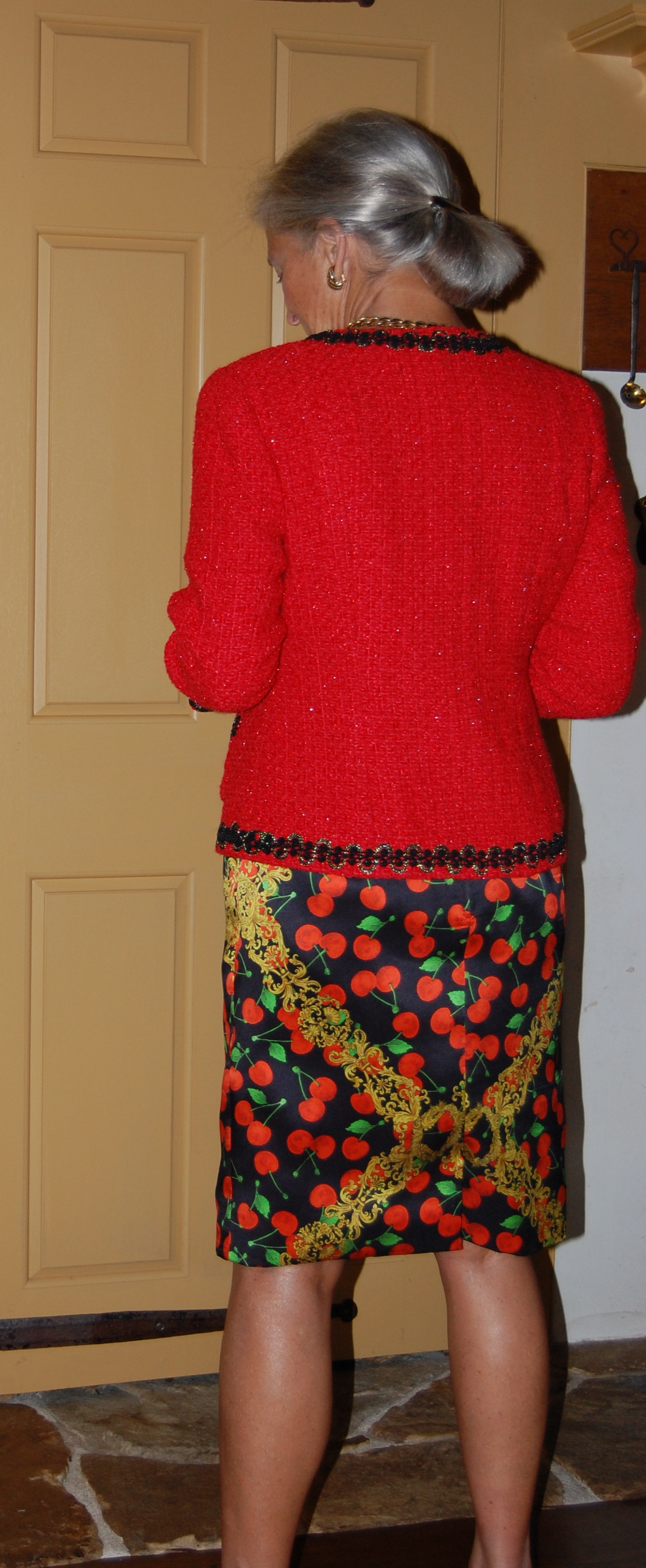
A back view.

A back view.

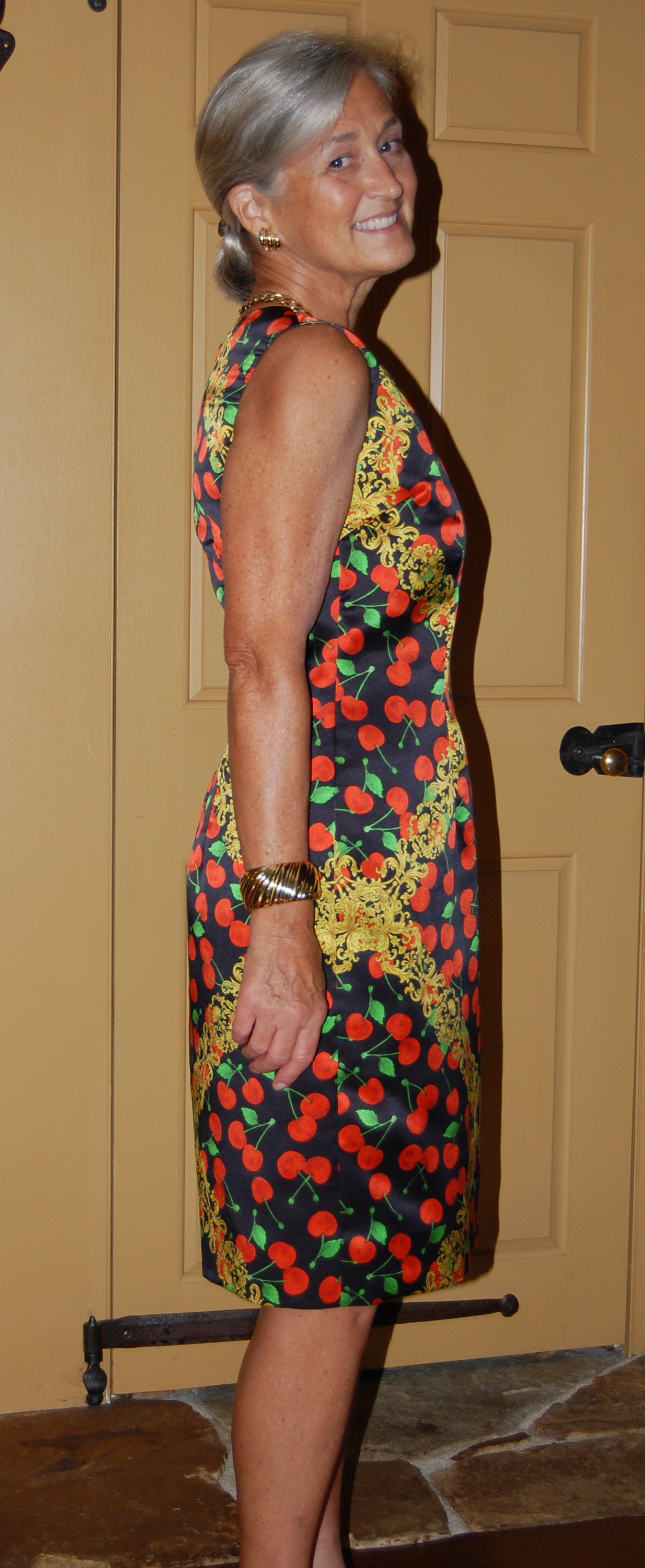
A side view

A side view

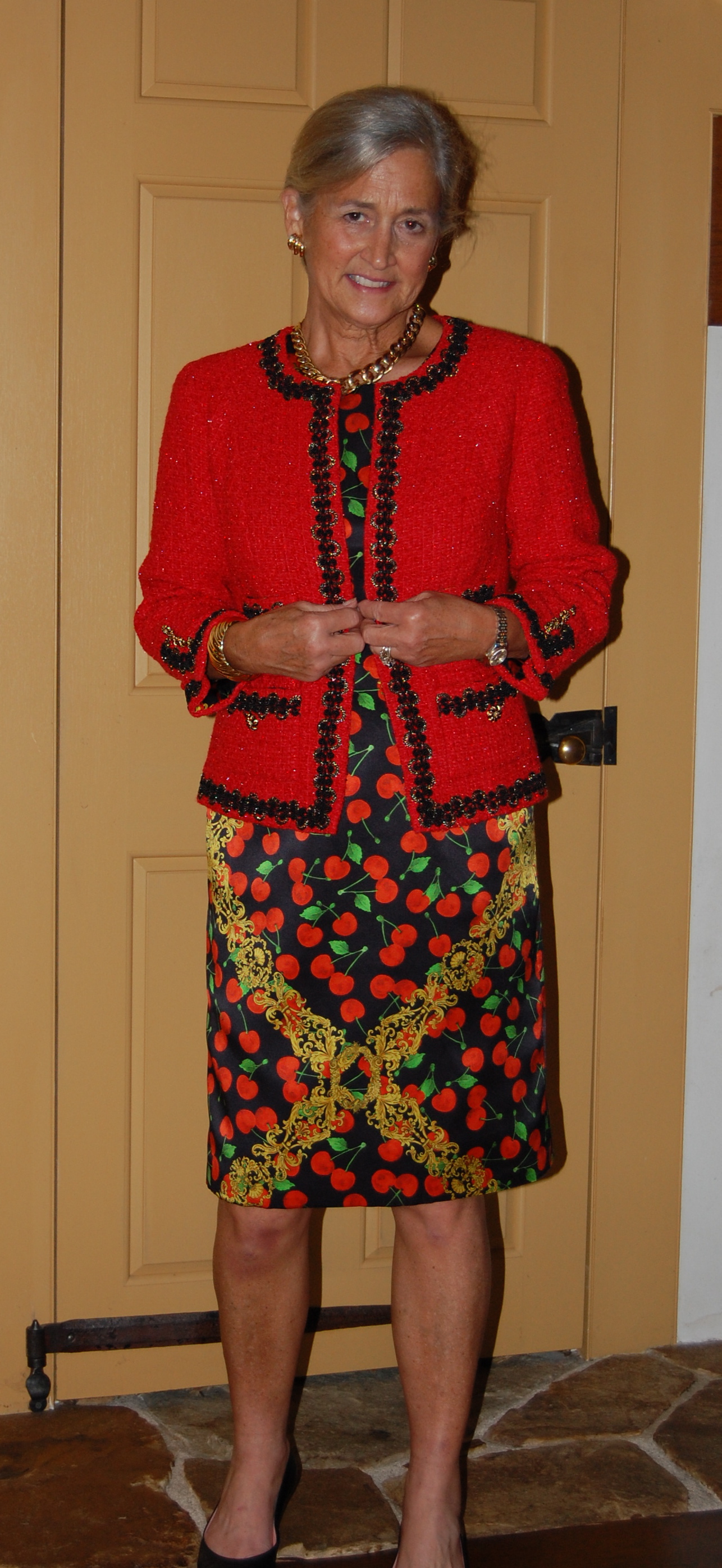
And, of course, I have to show the dress with its Chanel-inspired jacket:

A simple sheathA simple sheath

A simple sheath

This project is complete!

This project is complete!

Once again, I underestimated just how long it takes to make a dress using all couture techniques – even a simple (?) sheath dress.

Was it worth it?  Absolutely!

39 Comments

Filed under Chanel-type jackets, couture construction, hand-sewn zippers, sewing in silk, Uncategorized, underlinings

Saved from the ‘70s

After reading the re-issue of Claire McCardell’s book What Shall I Wear, I determined that I needed to make myself a version of a “pop-over” dress.  Her pop-over dress was originally designed to either go over other clothing or be worn just by itself, but the intent was a “utility” dress to make yourself look presentable and even fashionable when you are doing household duties.  Well, household duties will still find me in blue jeans, but a dress to pop on quickly to go run errands, meet a friend for coffee, or go out for a casual supper – that idea was appealing to me.

My plan began to take form when I read the June/July issue of Vogue Patterns.  Page 86 features a “caftan-style” dress – or my idea of a tunic dress.

Tunic sundress - magazine photo

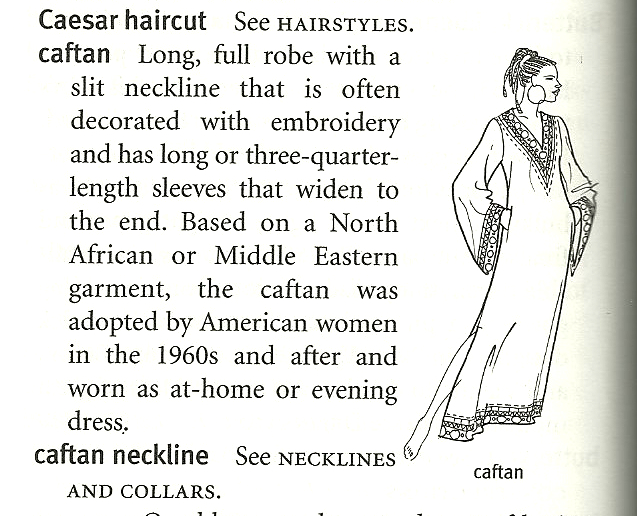
(I have always thought of caftans as full-length, and indeed, according to Fairchild’s Dictionary of Fashion, a caftan is a “long, full robe with a slit neckline that is often decorated with embroidery and has long or three-quarter-length sleeves that widen to the end…  adopted by American women in the 1960s and after…  ”)

Tunic sundress - 4

This is Fairchild’s diagram of a caftan; Fairchild Publications, Inc., New York, New York, copyright 2003

Although I know there is a 1970s-era Vogue pattern for a tunic dress, I have not found one to purchase, so I thought I’d go ahead and get this current one.

I like both versions of this dress.

I like both versions of this dress.

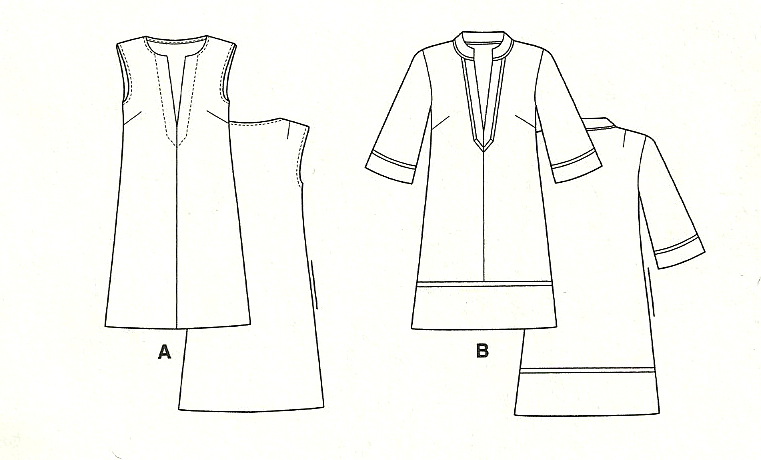
There is lots of room for individualization with this pattern, as a quick look at the line drawings illustrate.

There is lots of room for individualization with this pattern, as a quick look at the line drawings illustrate.

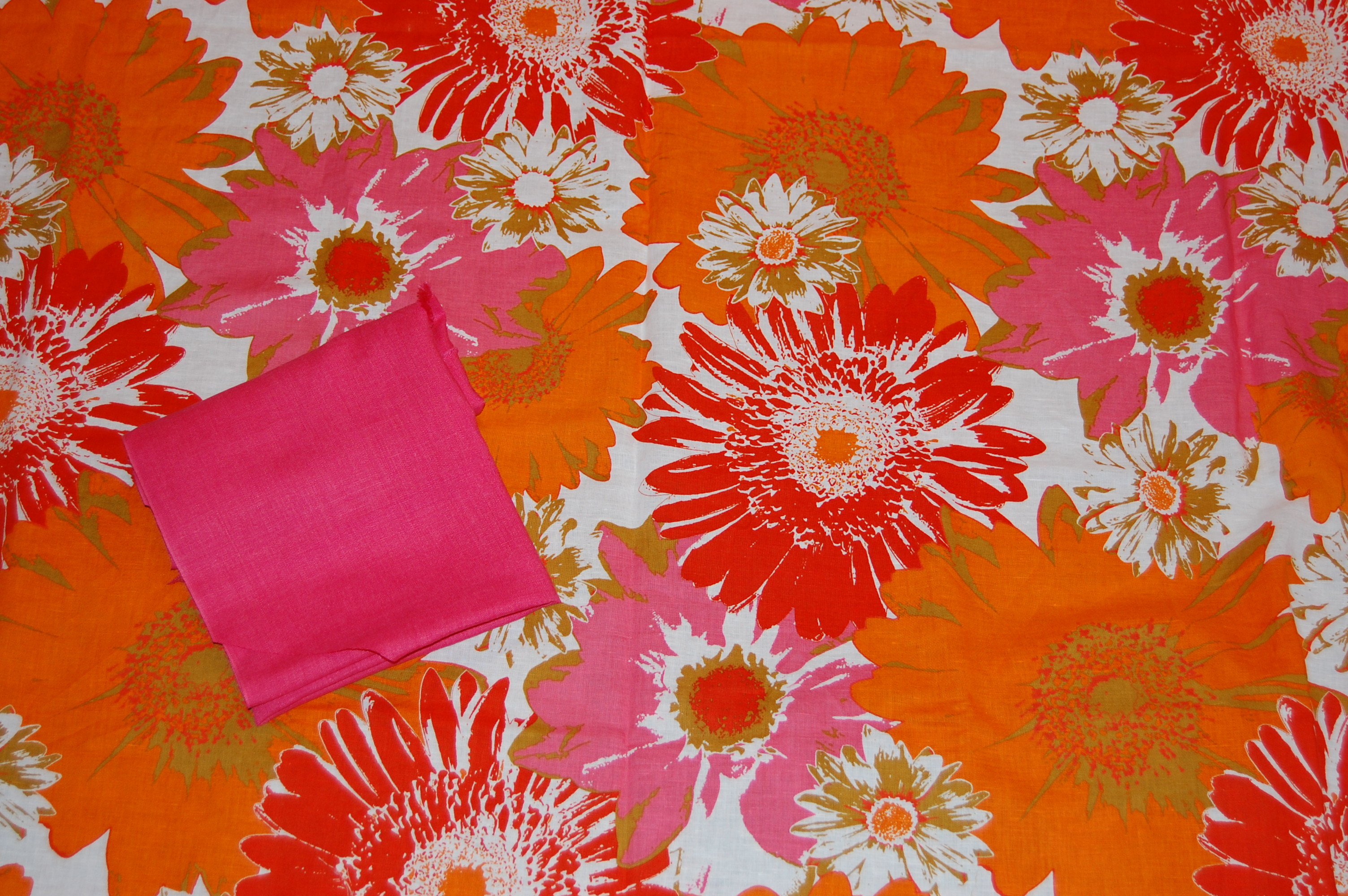
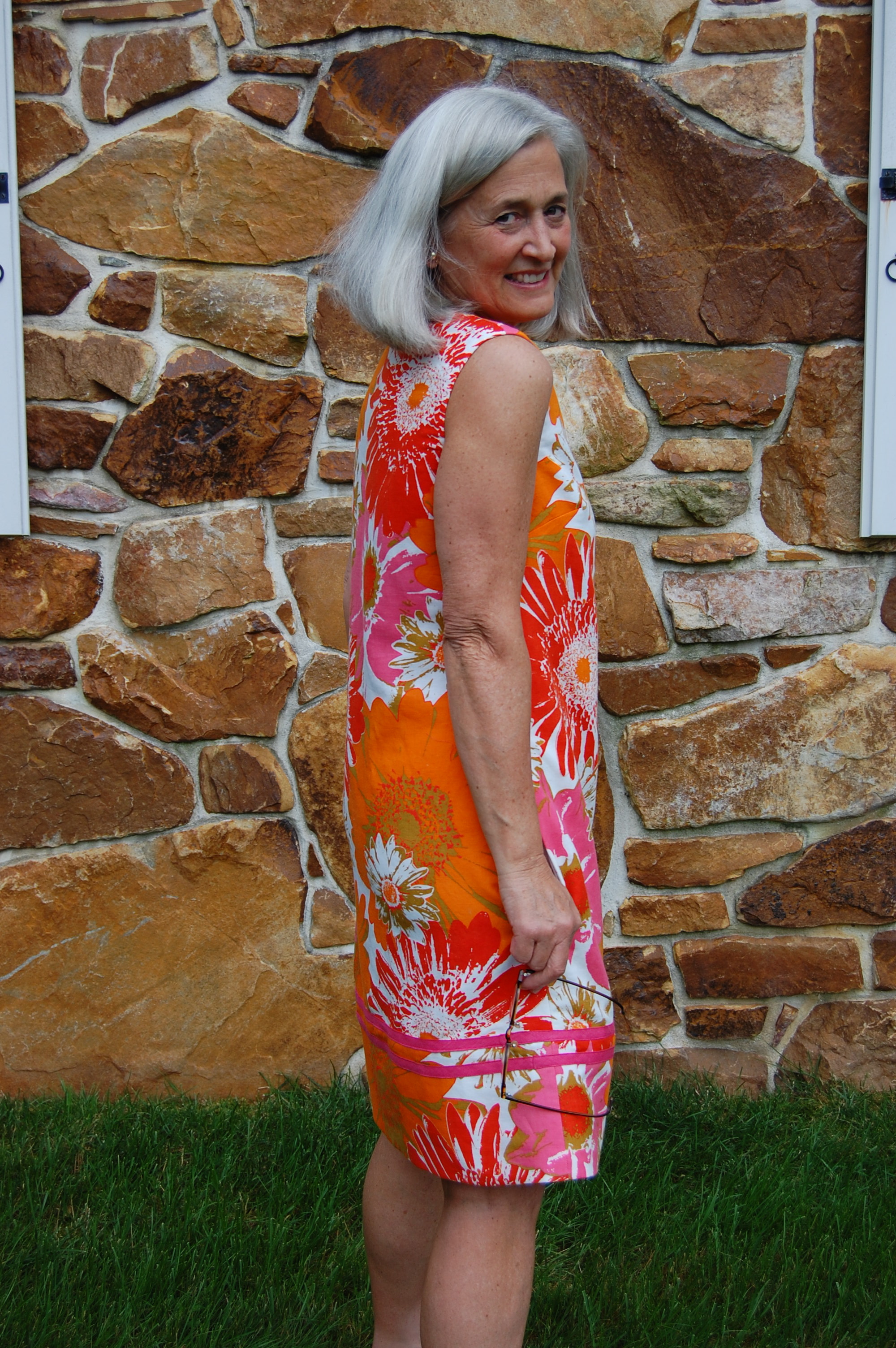
About the same time, I was in JoAnn’s Fabric Store to buy thread and looked at their “linen and linen-look-fabrics” (in order to get some light-weight cotton/linen blend for underlining for another planned project).  I was pleasantly surprised at the linen-cotton blends they had, including this bright orange/pink/red floral:

Tunic sundress fabric

I guess it is no surprise that fabric came home with me, and then I dug out that piece of deep pink linen pictured, which I had “saved from the ‘70s”, to use as the accent trim.  (It must have been 1974 when I purchased this pink linen in a fabric store on South Street in Philadelphia.  I made myself a suit out of it, now long gone.  But – I’m really glad I saved the left-over fabric!)

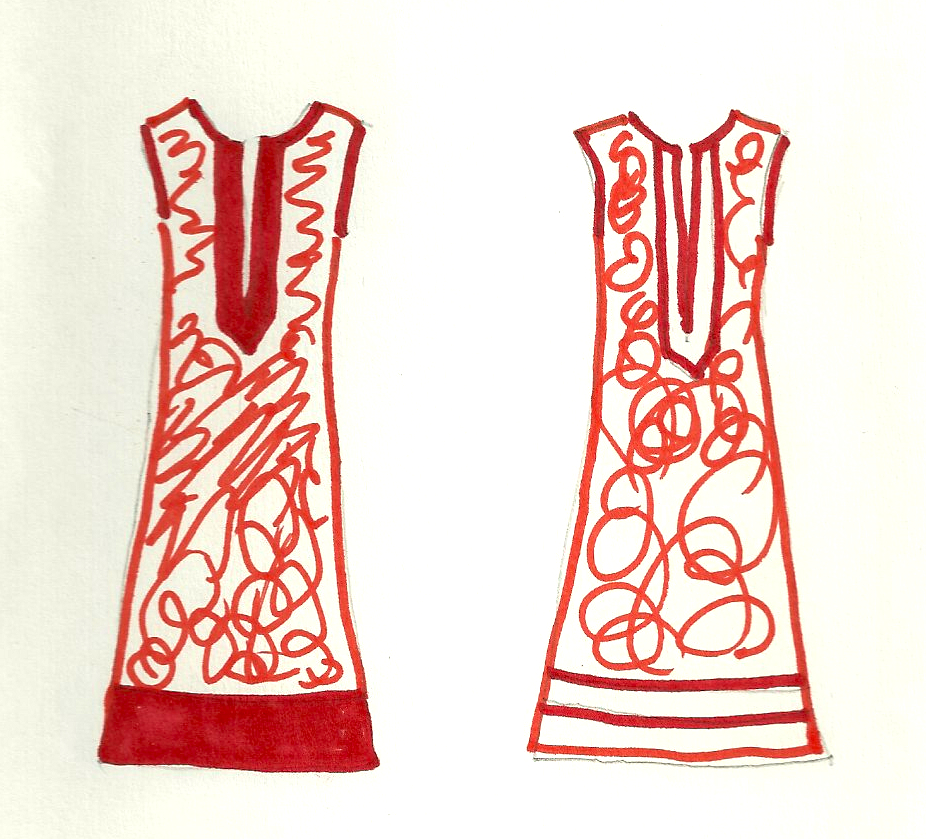
Then I doodled a bit to figure out how I wanted to treat the trimming on my tunic dress.

I quickly doodled these sketches to help me determine the look I wanted.

I quickly doodled these sketches to help me determine the look I wanted.

I decided to make it sleeveless so it’s cool and comfortable. I used my Clover bias-maker to make the bias tape I needed for the trim and the binding for the neck and armholes.  Because the linen blend was so lightweight, I underlined it with the same weight linen in off-white.

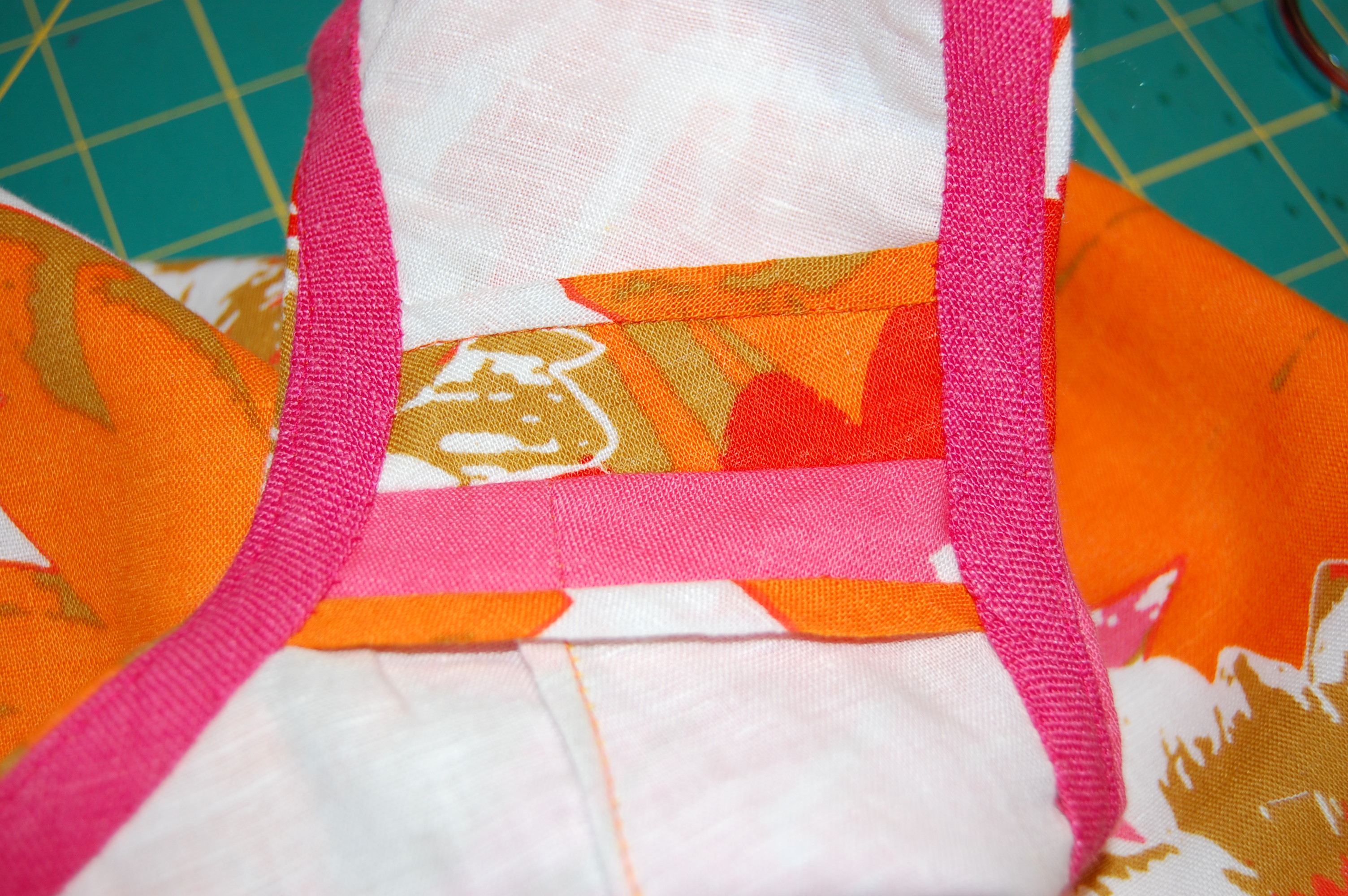
This shows a shoulder seam with a Hong kong finish to the raw edges and the pink bias binding around the armhole and neck.

This shows a shoulder seam with a Hong kong finish to the raw edges and the pink bias binding around the armhole and neck.

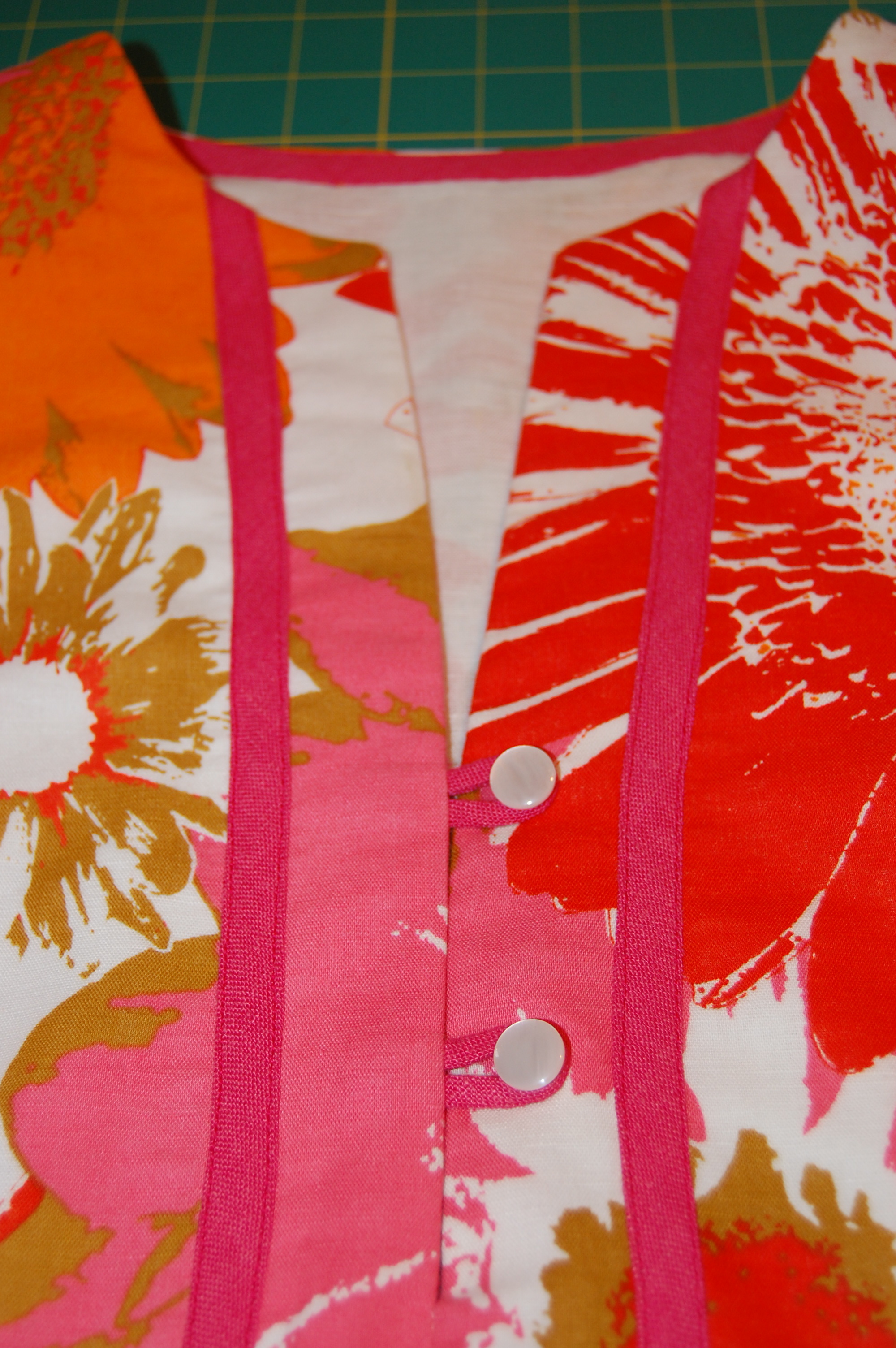
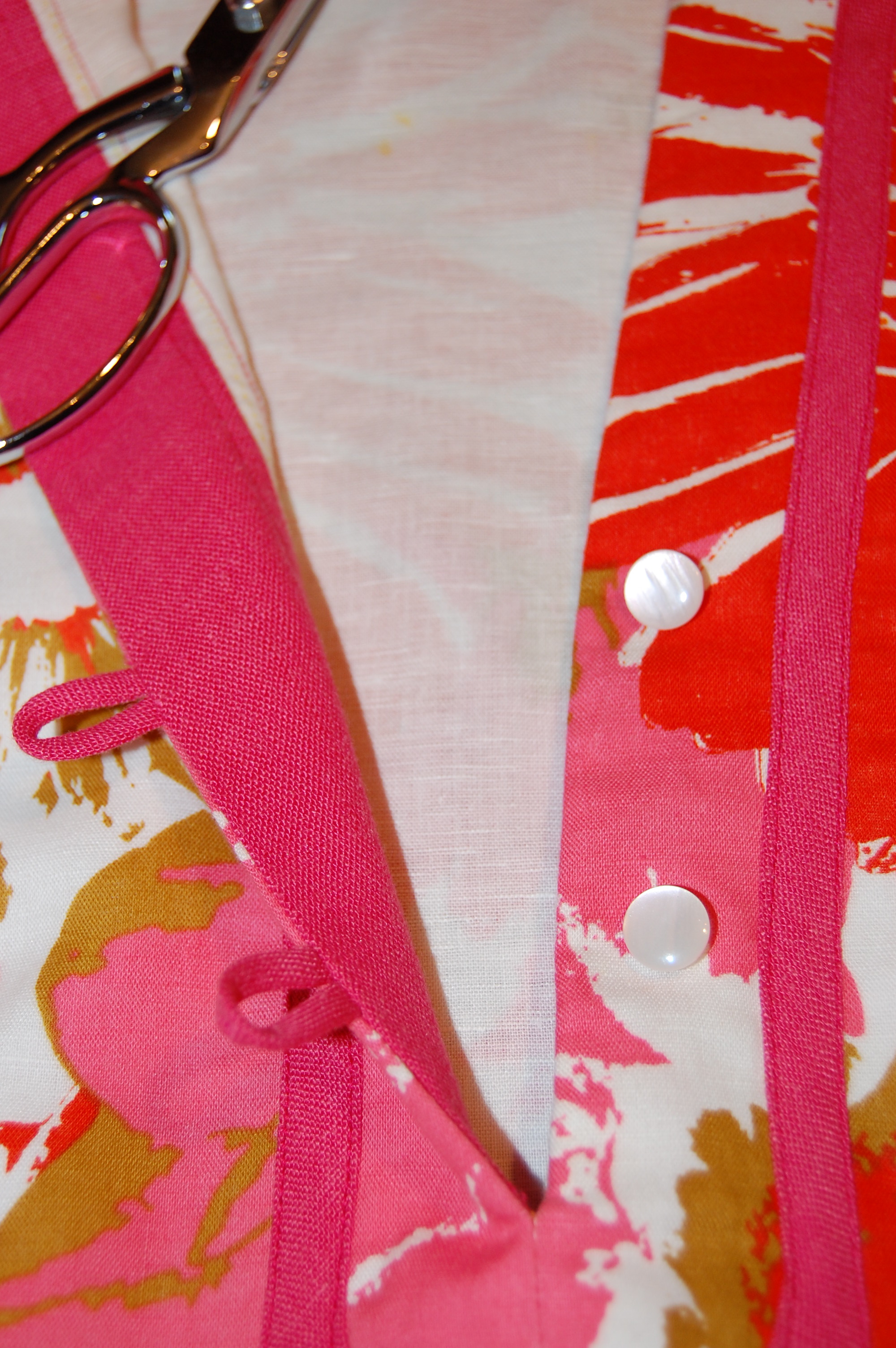
The front, very-low slit neckline as shown on the pattern meant one of two things:  either I would have to wear a camisole underneath it, or I would have to add two buttons and loops.  I decided to add the buttons and loops.

I forgot to add the loops before I sewed the frint neck facing in place.  Then I had to open up the seam to accomplish that little task! I turned the loops with a bodkin

I forgot to add the loops before I sewed the front neck facing in place. Then I had to re-open the seam to accomplish that little task! I turned the loops with a bodkin.

Another view of the front facing.

Another view of the front facing.

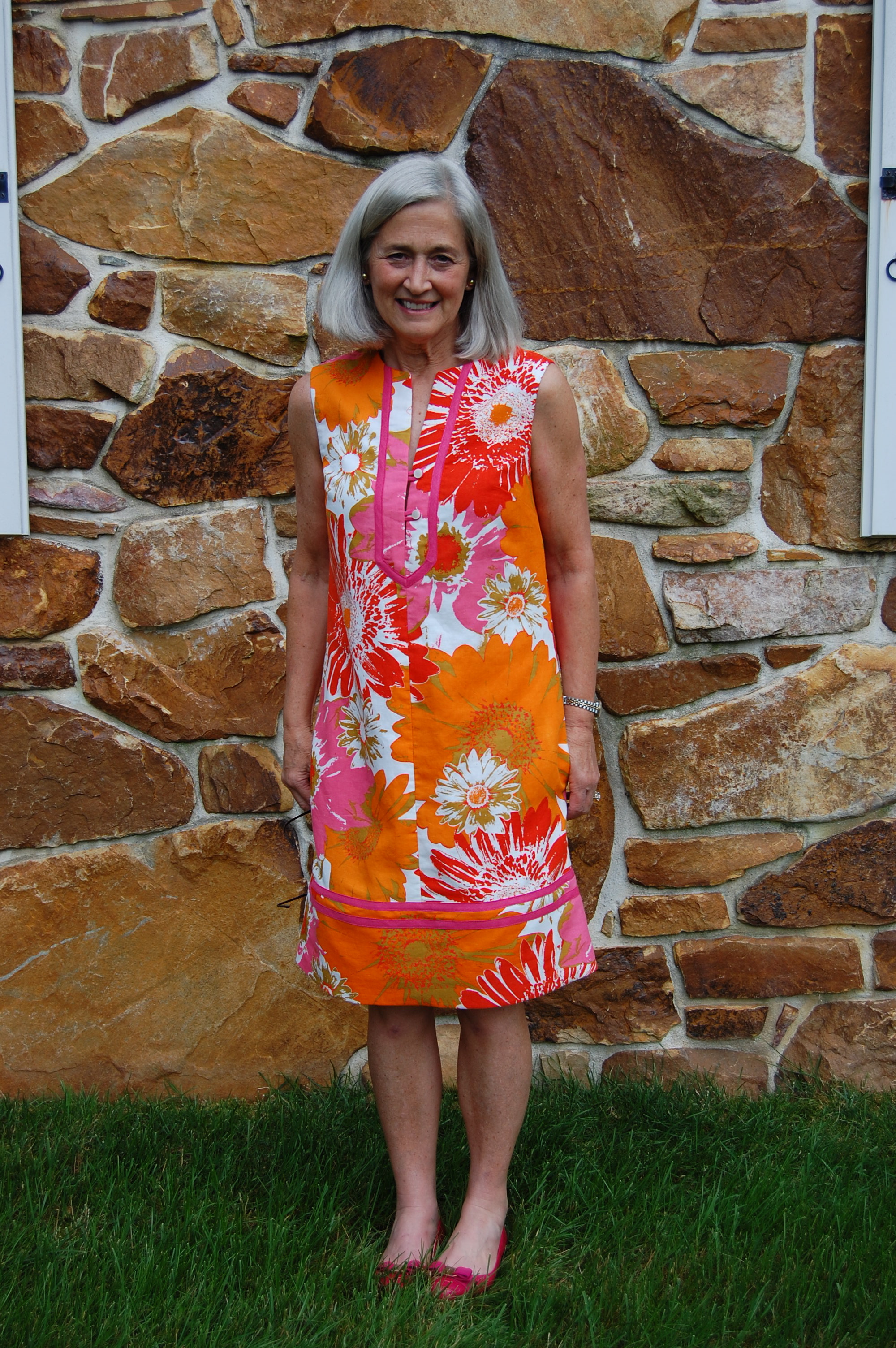
Ready to run errands!

Ready to run errands!

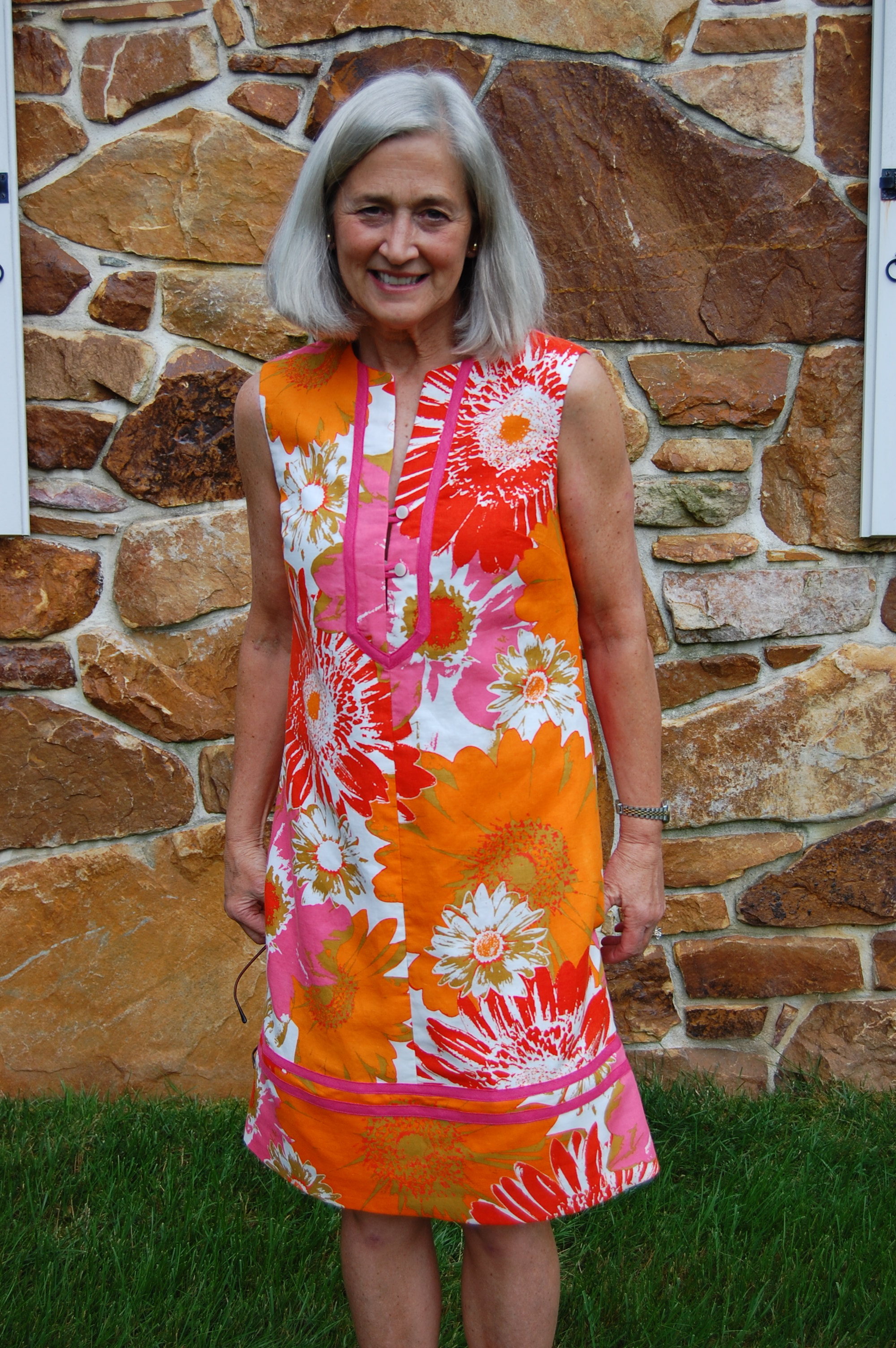
What a comfortable dress!

What a comfortable dress!

The back is unstructured and loose.

The back is unstructured and loose.

This is indeed a dress I can pop over my head and go!  I would definitely like to make it again, maybe with the collar and sleeves next time.  And maybe, just maybe, inspiration will come from some other fabric remnant I have tucked away, saved from the ’70s!

15 Comments

Filed under Linen, Uncategorized, underlinings, Vogue patterns

“The Sweetest of All the Colors…”

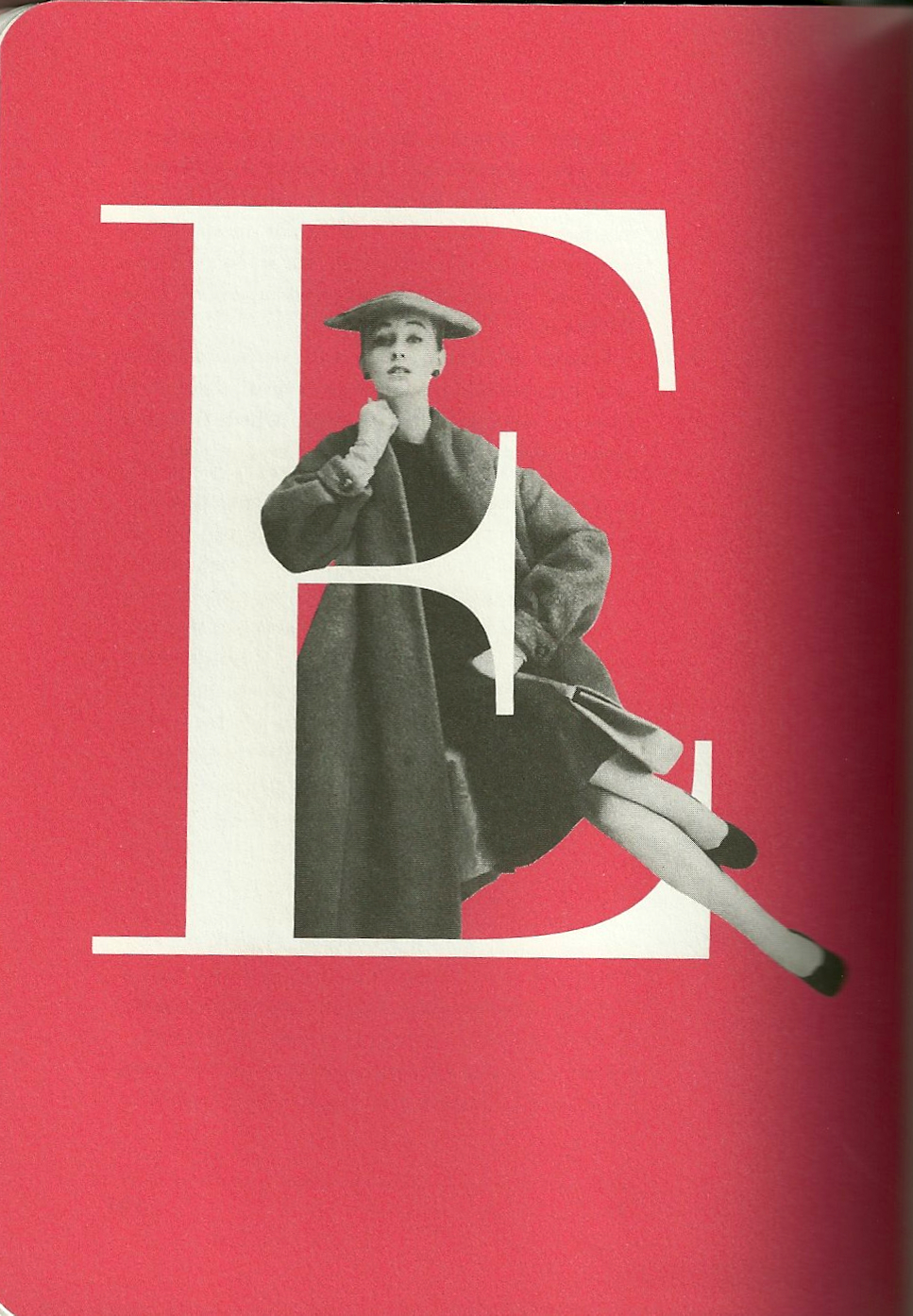
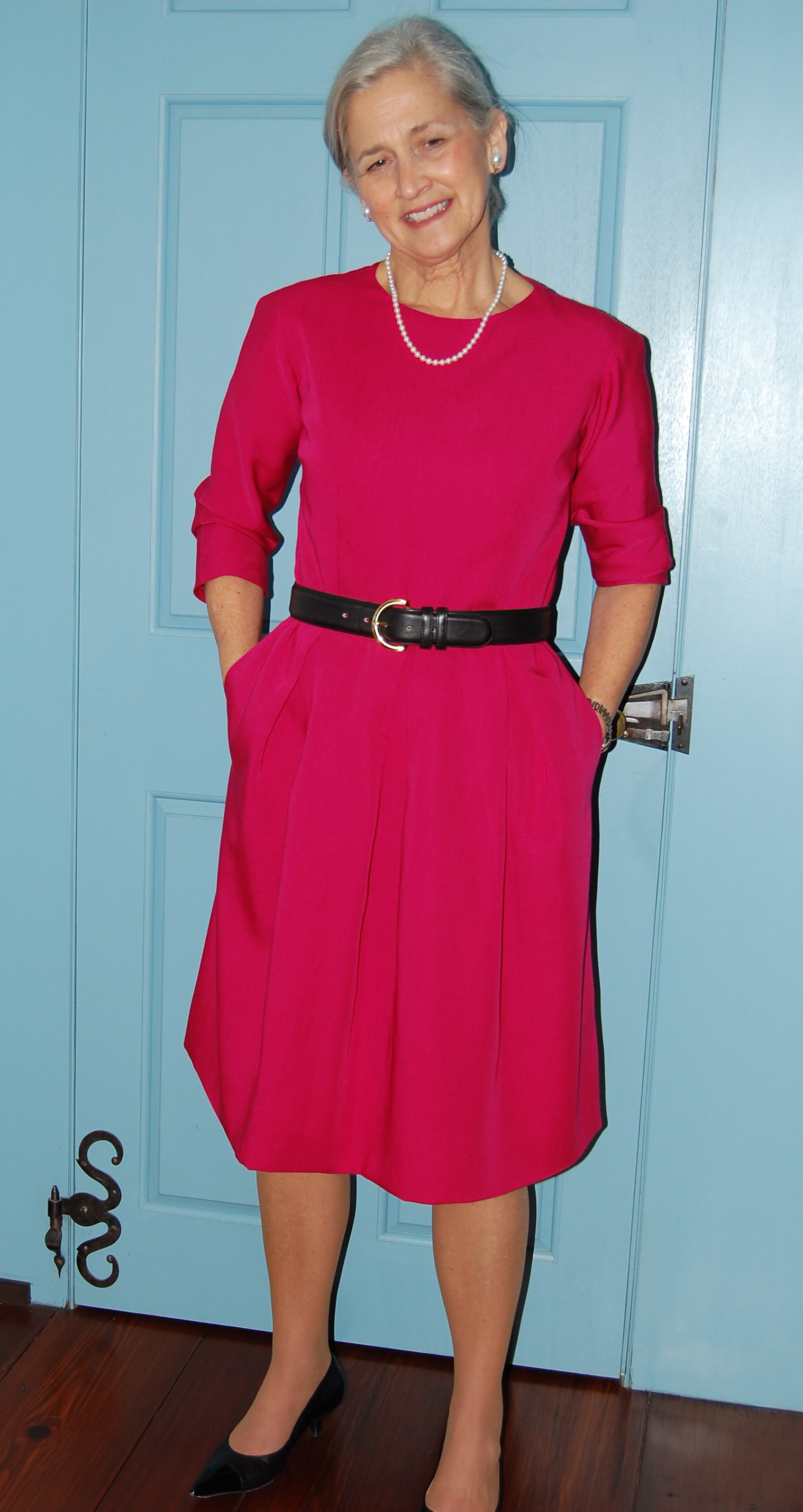
“… Every woman should have something pink in her wardrobe.”   Christian Dior certainly had distinct thoughts about fashion, and with this statement I concur.  Everyone looks good in pink, especially pale pink (men definitely included), and I suspect pale pink was what Monsieur Dior was thinking when he wrote this in his Little Dictionary of Fashion (First published by Cassell & Co., Ltd., 1954; 2007 edition by Abrams; Copyright Catherine Dior and Jean-Pierre Teto, 2007).   Interestingly, the lining pages of his little book are pale pink, but the divider pages feature a deep, deep raspberry pink as in – – – my newly finished “ladylike” dress!

Here is the "section"page for E from Dior's Fashion Dictionary

Here is the “section”page for E from Dior’s Fashion Dictionary

Dated 1958, this is the pattern I used for my pink dress.

Dated 1958, this is the pattern I used for my pink dress.

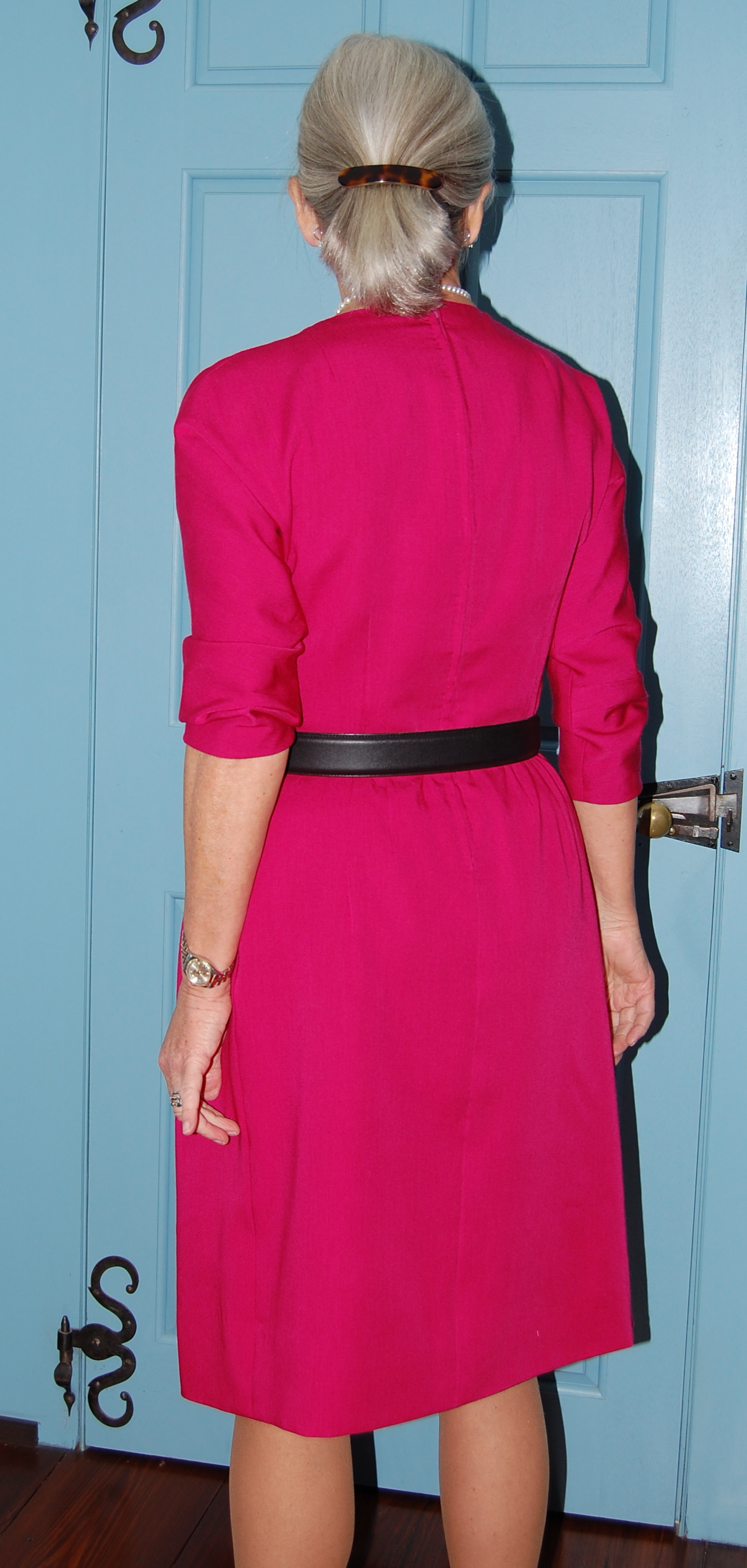
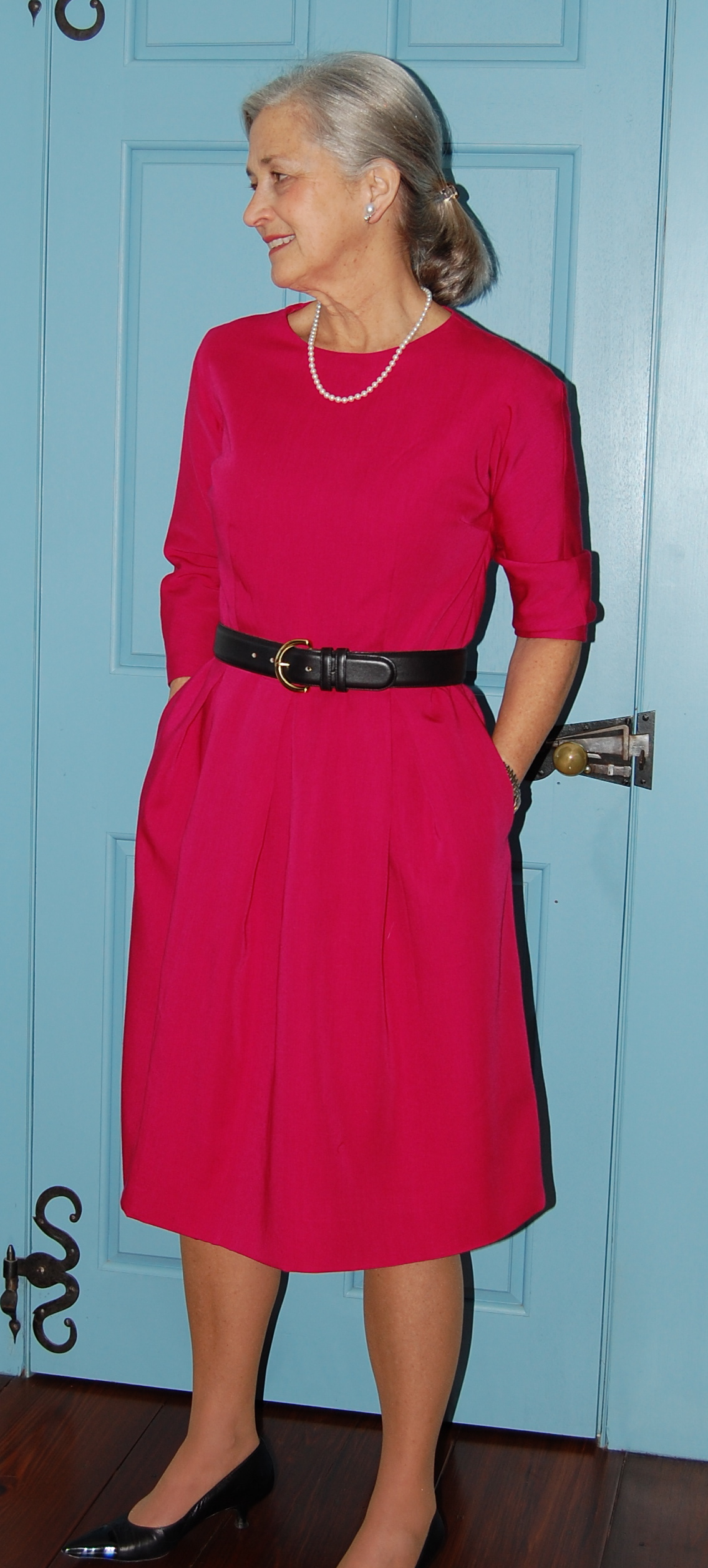
The finished dress!

The finished dress!

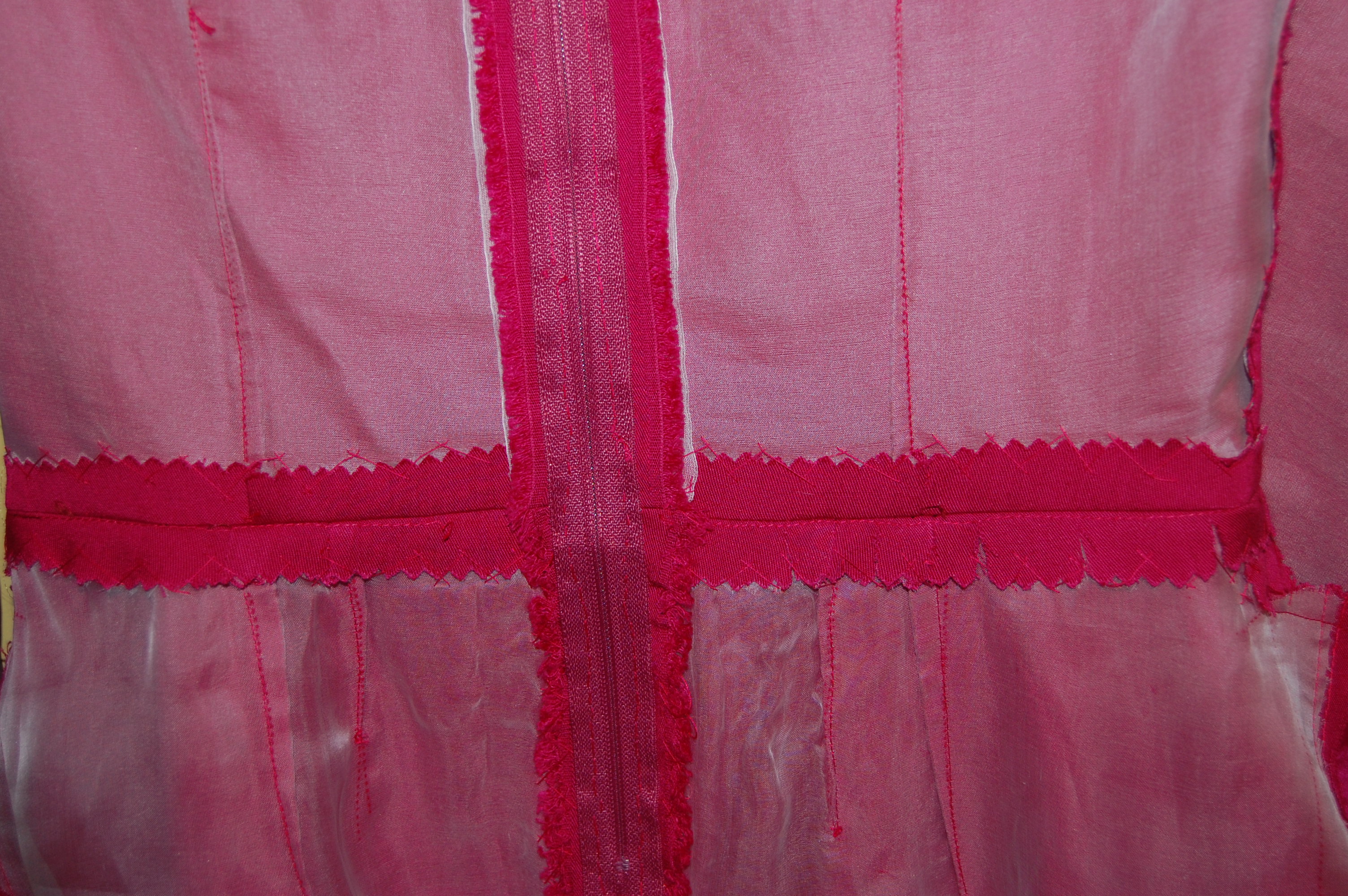
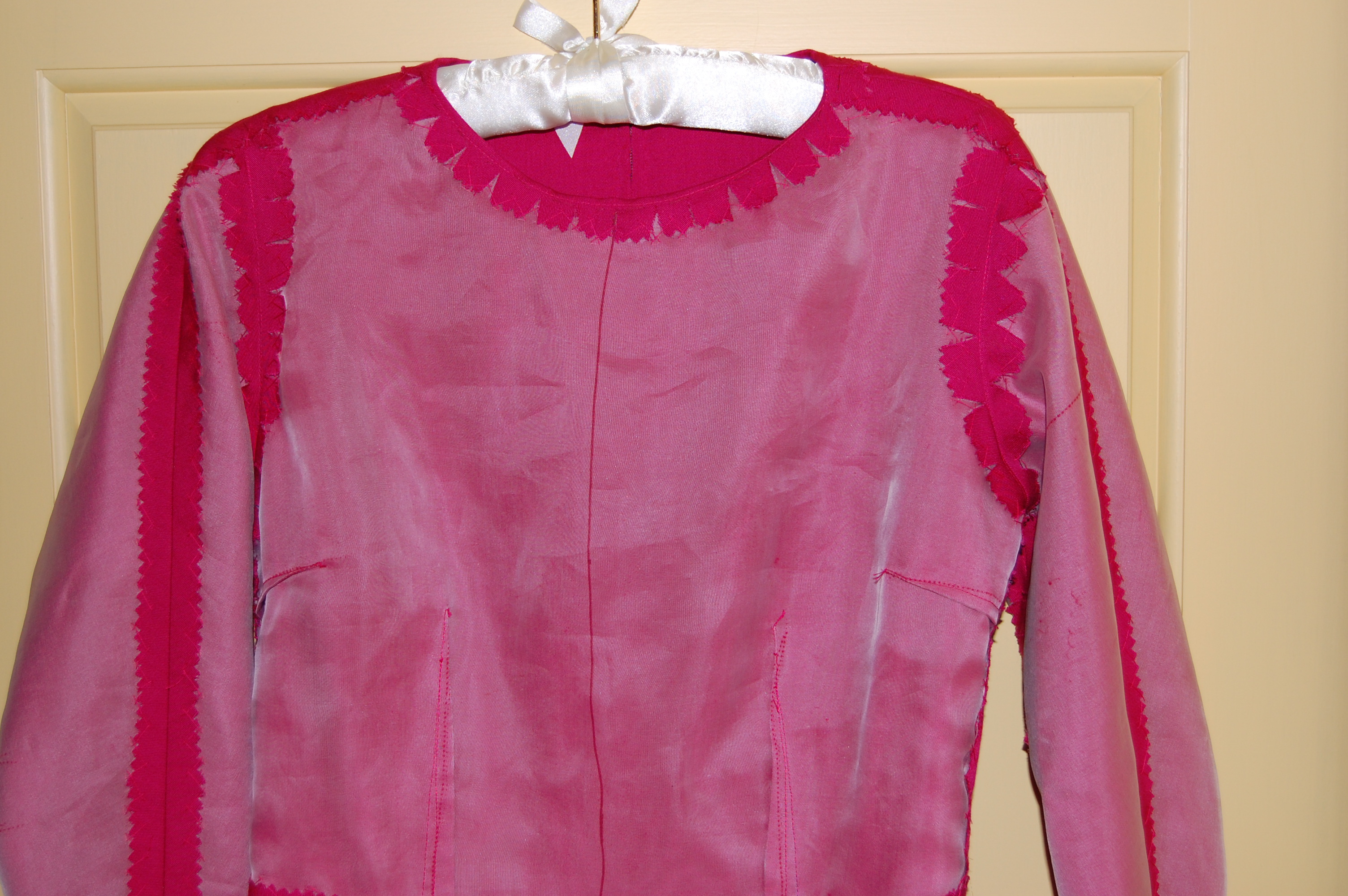
As I mentioned in my last post, I made this dress using couture construction, which means a lot of hand-sewing.  The more I use this type of construction, the more I like it, but it doesn’t get any faster.

An interior view of some "couture" construction - silk organza underlining, catch-stitched seams, hand-picked zipper.

An interior view of some “couture” construction – silk organza underlining, catch-stitched seams, hand-picked zipper.

However, couture construction gives me a lot of flexibility in changing necklines, which I really appreciate.  That is one of the changes I made to this pattern – widening the neckline to a more flattering appearance for me.

The widened neckline.

The widened neckline.

I also changed the back of the skirt by removing the box pleats and substituting a darted back.

I substituted darted back panels for the "original" box pleats

I substituted darted back panels for the “original” box pleats

The original dress had pockets hidden in side box pleats, but when I narrowed the width of the skirt, I did away with those side pleats.  I still wanted pockets, so I added pocket extensions in order to still hide them in the side seams.  It worked!

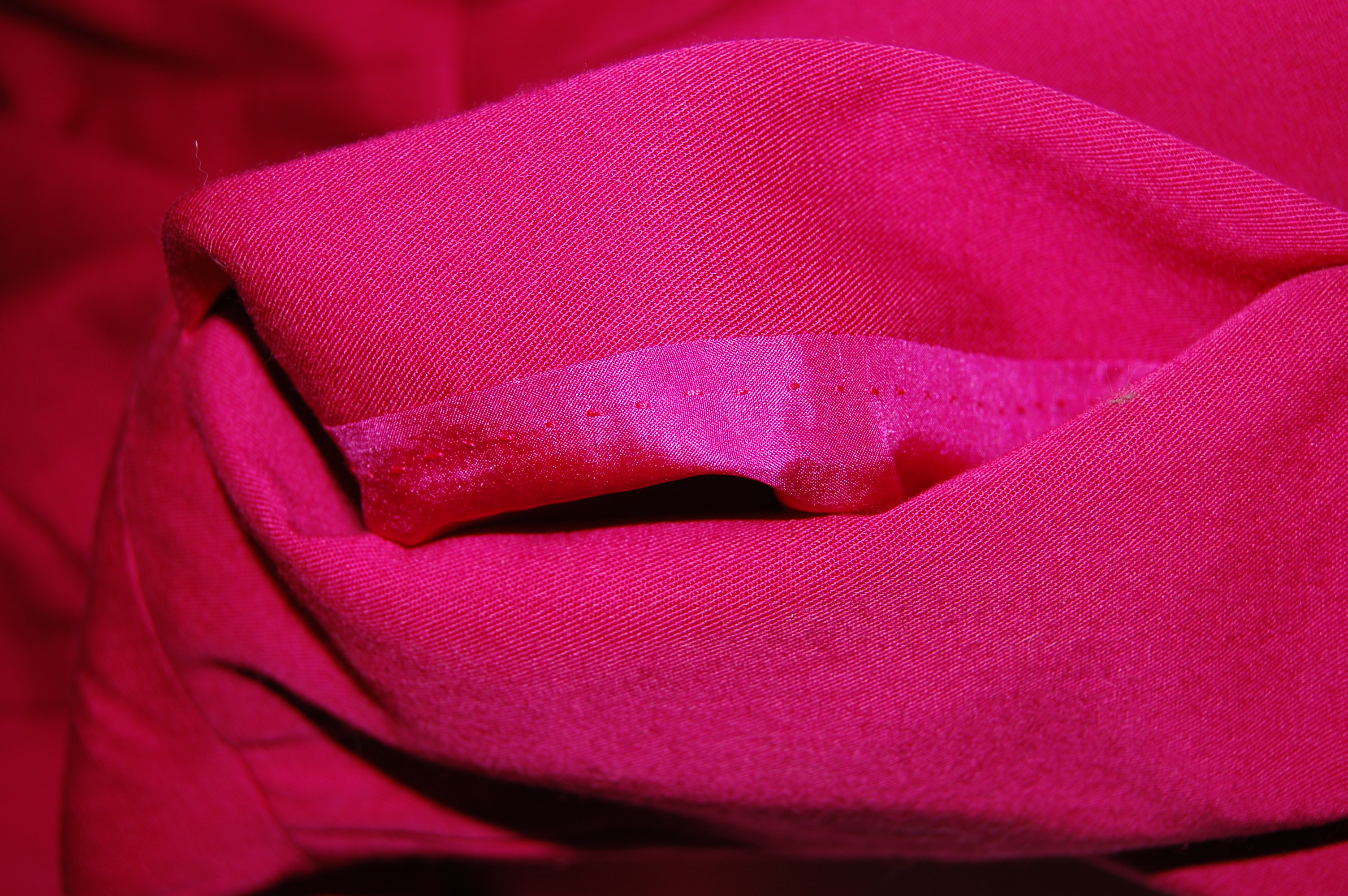
A peek at the pocket inside which shows the raspberry silk lining I used for the dress.  I understitiched the pocket edges by hand, which took no time at all and looks so much nicer than machine stitching!

A peek at the pocket inside which also shows the raspberry silk lining I used for the dress. I understitiched the pocket edges by hand, which took no time at all and looks so much nicer than machine stitching!

I added a quarter-inch to the underneath seam on each sleeve, so that each sleeve would have one-half inch extra width to it.  Those ladies in the 1950s must have had skinny arms, as I find sleeve widths on these vintage patterns are often just not quite spacious enough.

I added to the underarm seam - an adjustment which I determined from  my muslin.

I added to the underarm seam – an adjustment which I determined from my muslin.

This was the first time I had made sleeves which are half set-in and half kimono.  This is a look and fit which I love!  In fact, the shoulder fits so well, that my original thought to add an interior sleeve heading was one I decided I did not need.
The one thing I’m not sure I like is the “purchased or novelty belt” as indicated on the pattern.  I think a self-belt, a little wider than the one I show, would be more attractive.  Please comment if you have an opinion.  (I have plenty of fabric left over to make one…)

I am thinking a 2" wide self belt might be more attractive???

I am thinking a 2″ wide self belt might be more attractive???

Before I move on to my next project (to be announced soon), I want to thank Dresses and me for nominating me for the Very Inspiring Blogger award.

Very Inspiring Blogger Award

So, in accordance with the “rules” –  I am supposed to share a few facts about myself and nominate some others for the same award, so here goes:

1 – I am told I have a slight Southern accent, surely a remnant of being born and raised in North Carolina.

2 – I do most of my machine sewing on a 1940s’ Singer Featherweight and on my mother’s 1956 “306K” portable Singer.

3 – Autumn is my favorite season.

4 – I can make a very good Pumpkin pie.

5 – I enjoy reading historical fiction.

6 – I can’t sing (as in carry a tune) except for a few simple lullabies and Christmas carols.

Now – to pass on this award:  So many fellow bloggers inspire me every day that it is difficult to single out just a few (especially as many have already received this award!), but here are some worthy recipients:

For always giving me a laugh:  A Dress A Day and The Blue Gardenia.

For always teaching me something I would not have known otherwise:  The Vintage Traveler, Pattern Vault, Two Nerdy History Girls, and the FIDM Museum blog.

For sharing their sewing knowledge, design sense, and beautiful workmanship:  Custom Style, Lilacs and Lace, So Sew Lovely, and Frabjous Couture.

So now – you are IN THE KNOW and  – I am IN THE PINK!

21 Comments

Filed under couture construction, hand-sewn zippers, kimono sleeves, Uncategorized, underlinings, vintage Vogue patterns from the 1950s, woolens

Chance of Flurries

I am two weeks (maybe closer to three weeks) behind schedule, but I am undaunted.  The last two weeks of 2012 were chock-a-block full of Family, Fun, and Feasting – and then the plague hit our house.   Yes, another F-word – the FLU – which apparently was not the type we got the immunizations for…

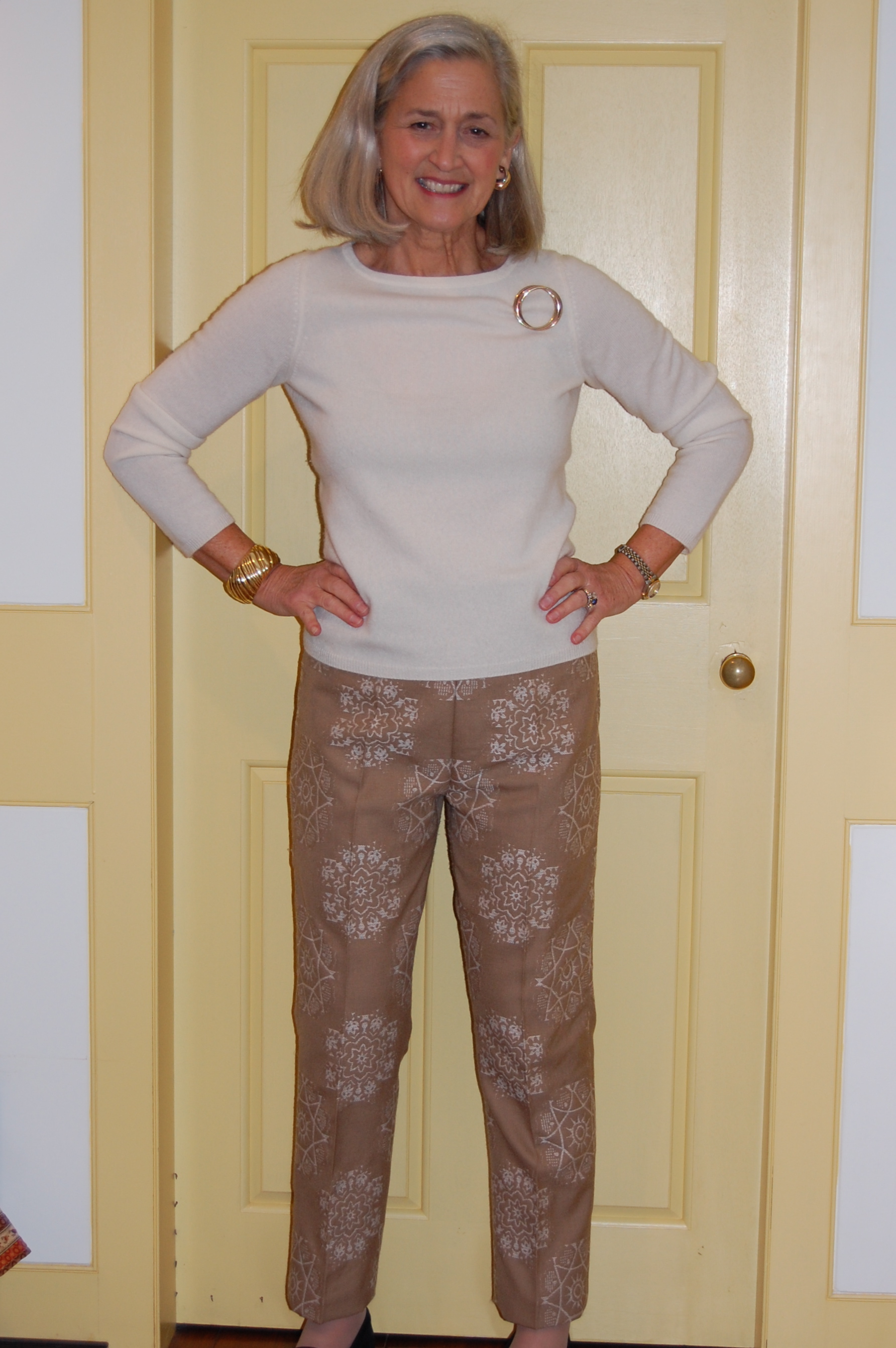
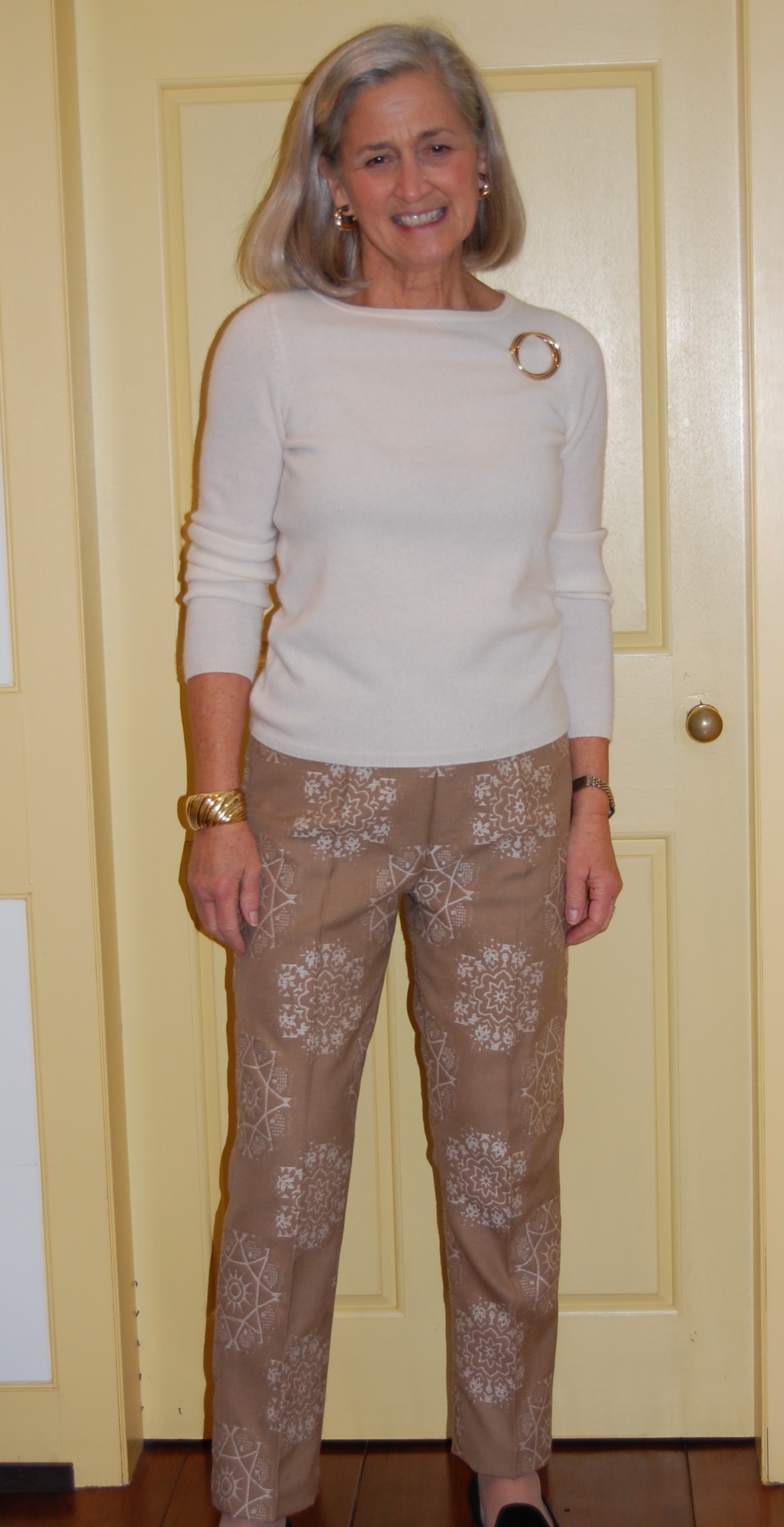
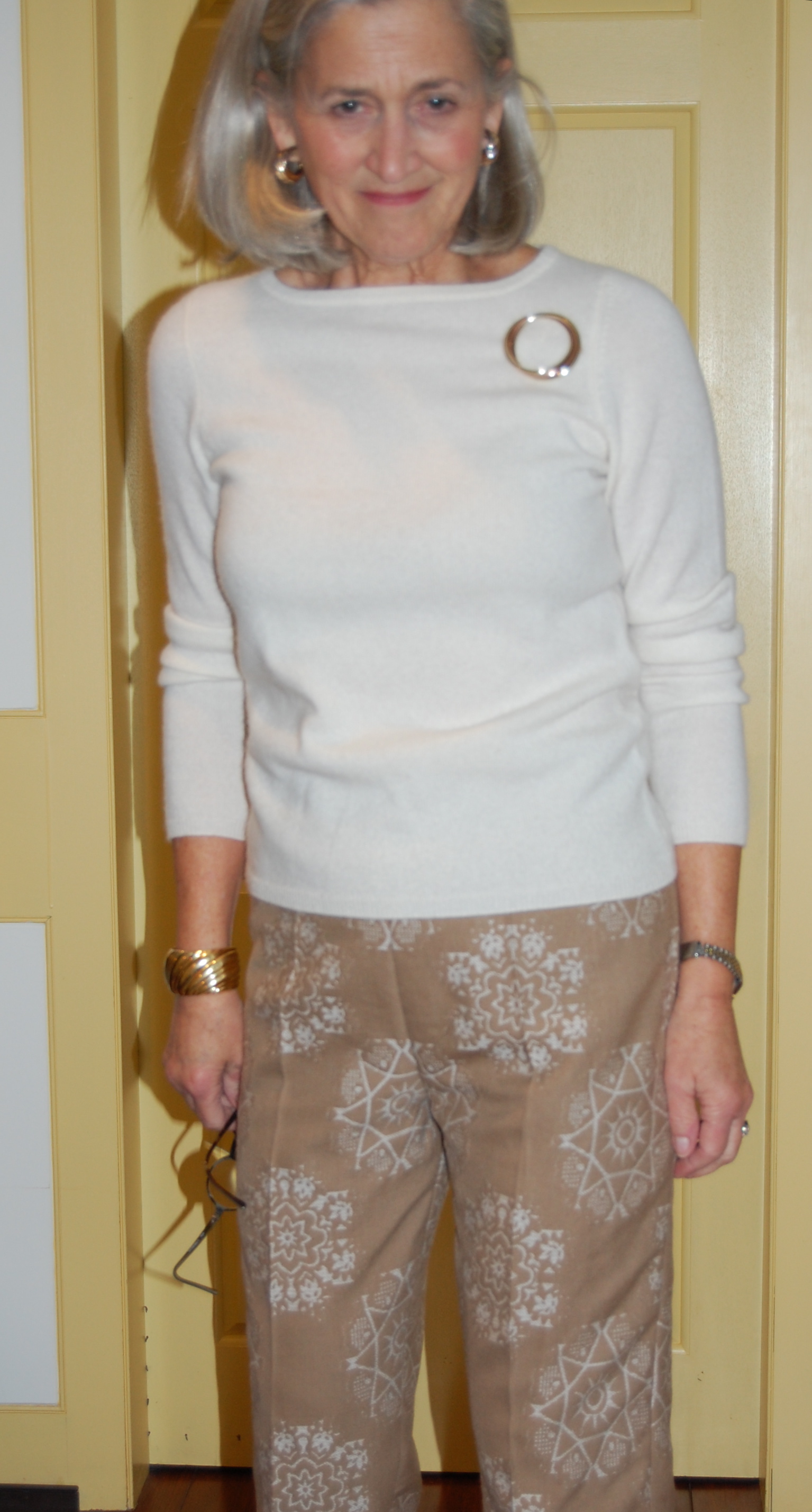
But this week has found me back in my sewing room, finishing up what was to be my final project for 2012.  Flexibility, I have learned, is a great asset to cultivate, so I am trying to be flexible in my plans and take it all in stride.  Indeed, I am hoping that I will be striding pretty in newly-sewn pants, which have now joined my wardrobe.

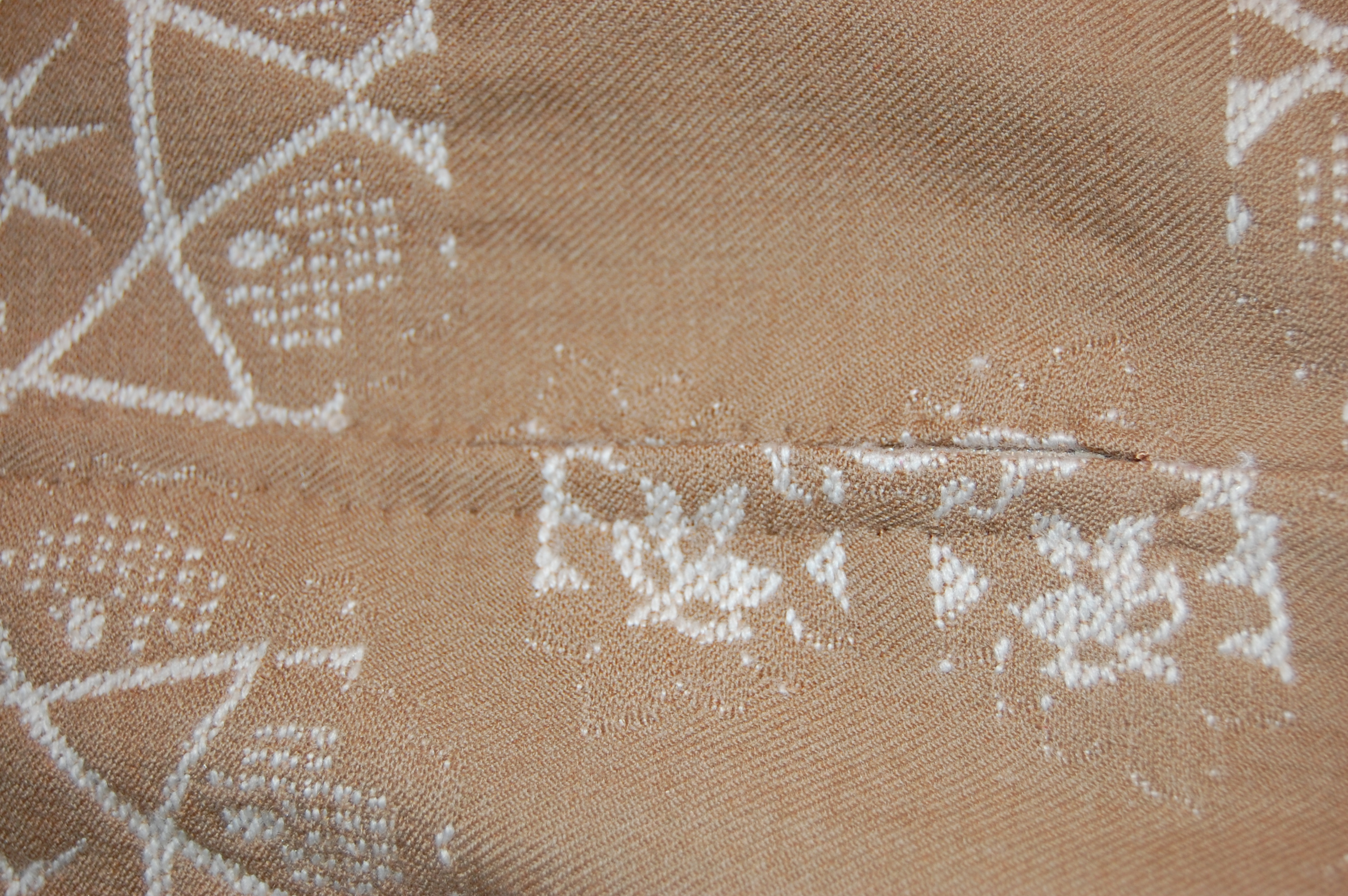
I think I must like pants made out of figured fabric.  As soon as I saw this snowflake wool on the website of Waechter’s Fabrics, I knew I wanted to make it up in winter slacks.

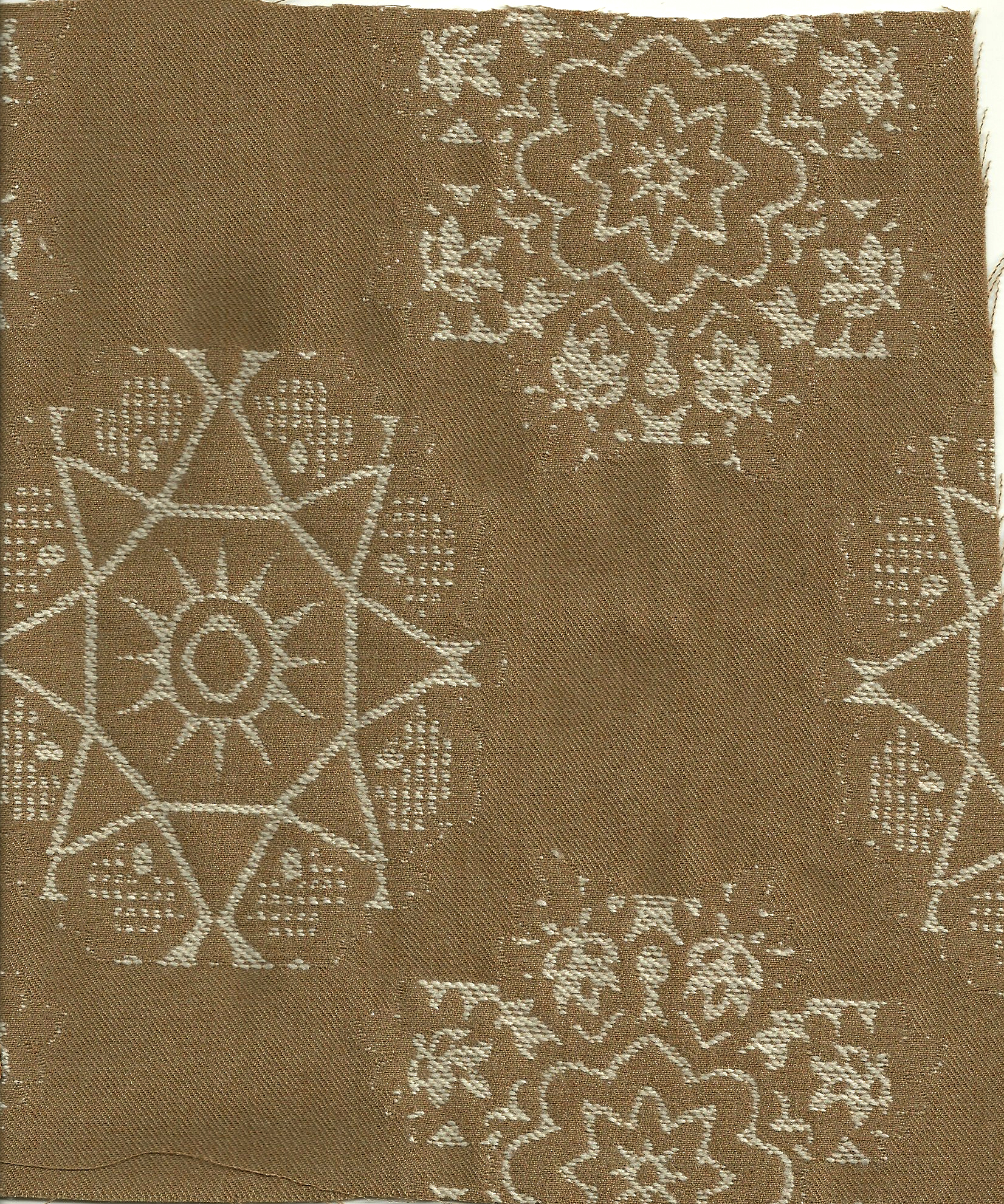
This is a jacquard woven wool, but very light-weight and soft.

This is a jacquard woven wool, but very light-weight and soft.

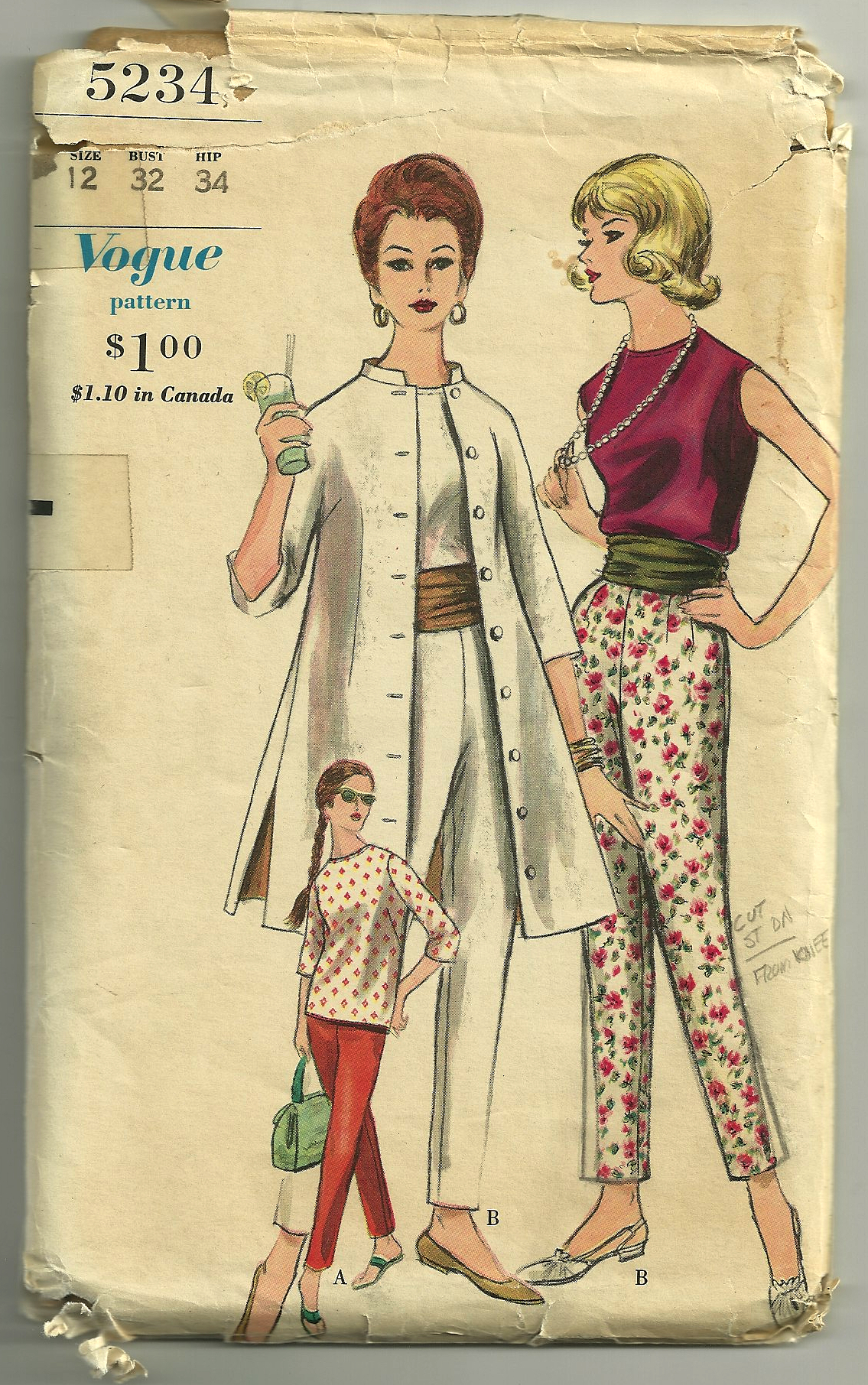
It was not even a decision to use the same 1960s’ pattern I used for my “very stylish” linen pants last Spring – pants’ patterns that fit are worth using again and again.

I made quite a few alterations to the pattern so that these slacks actually fit me!

I made quite a few alterations to the pattern so that these slacks actually fit me!

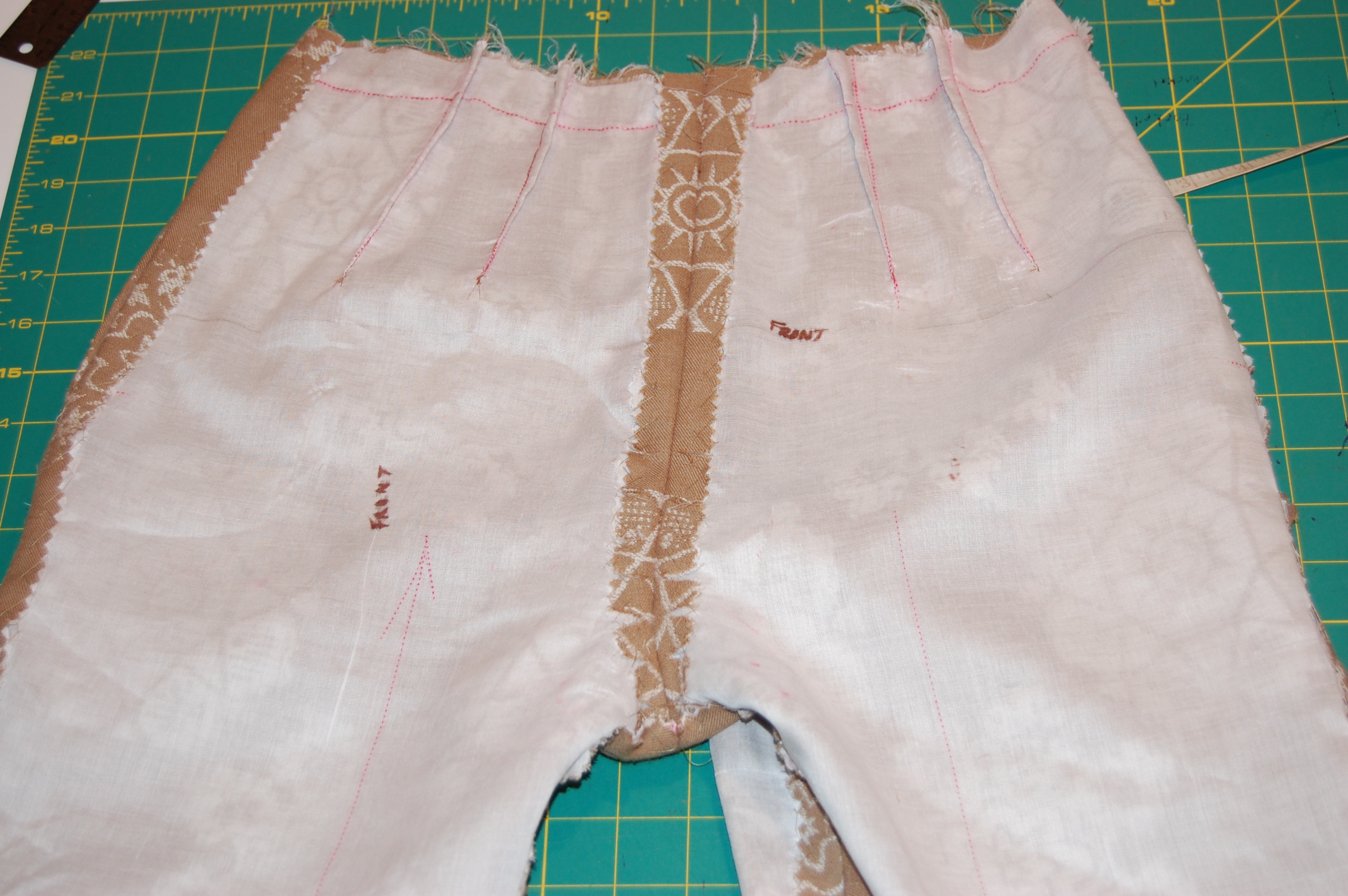
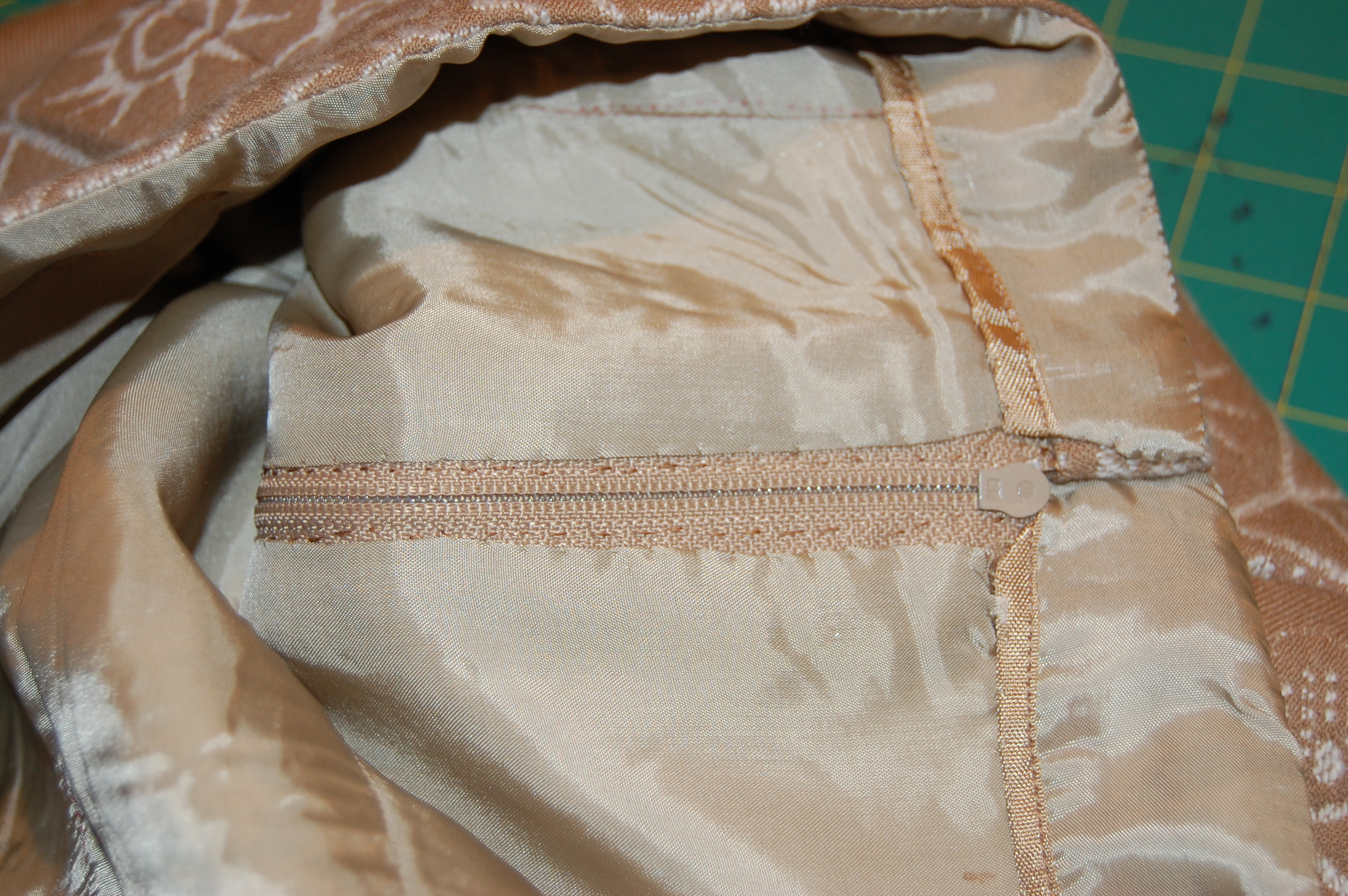
I did decide, however, to make these using couture techniques.  I underlined them with a very light-weight rayon voile which I have used successfully before.  I did not want to add much stiffness to this very soft and flexible wool, so the rayon seemed a better match than silk organza in this instance.  I catch-stitched all the seams, and inserted a hand-picked zipper.

The underlined pants, with catch-stitched seams.

The underlined pants, with catch-stitched seams.

Hand-picked zipper.

Hand-picked zipper.

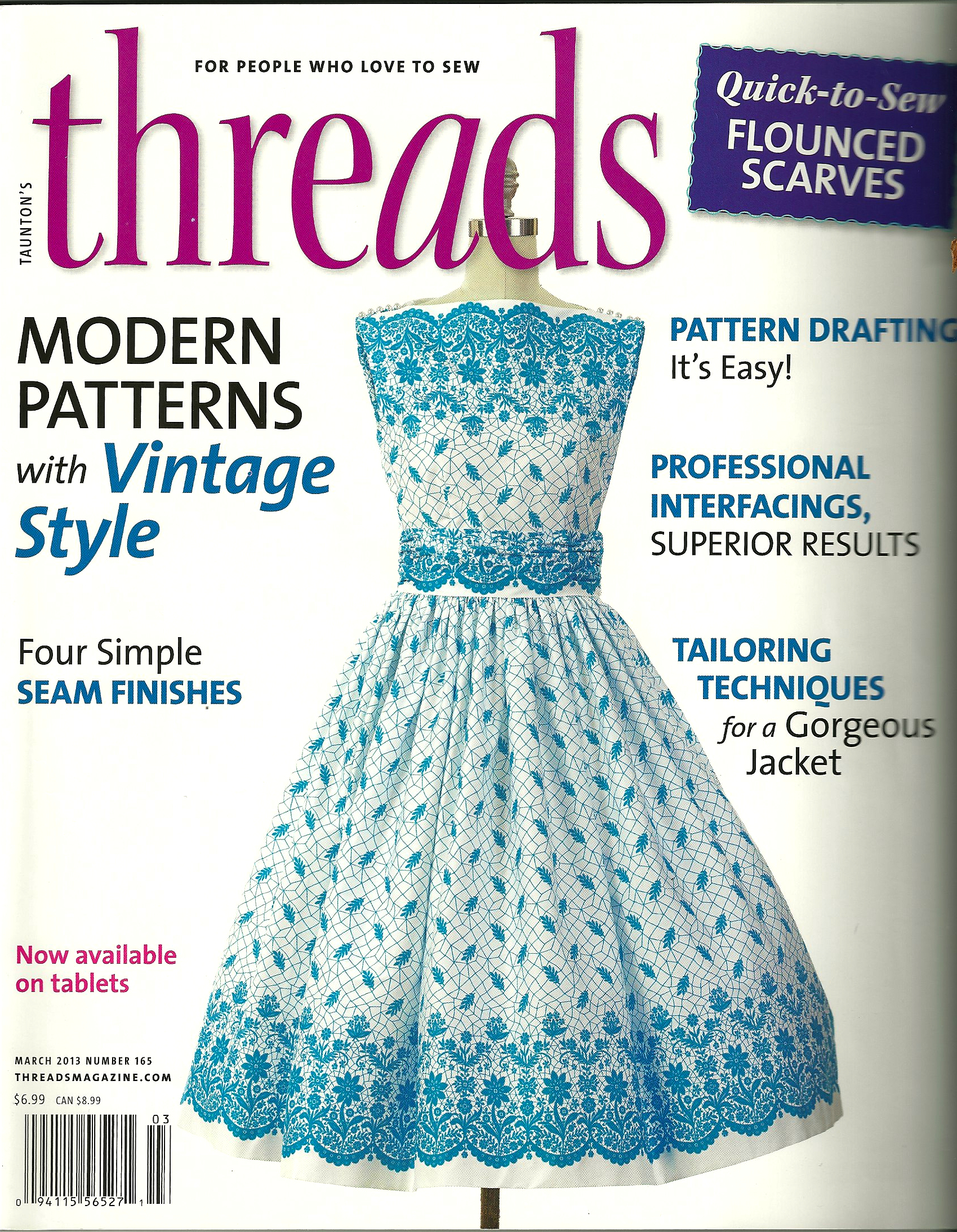
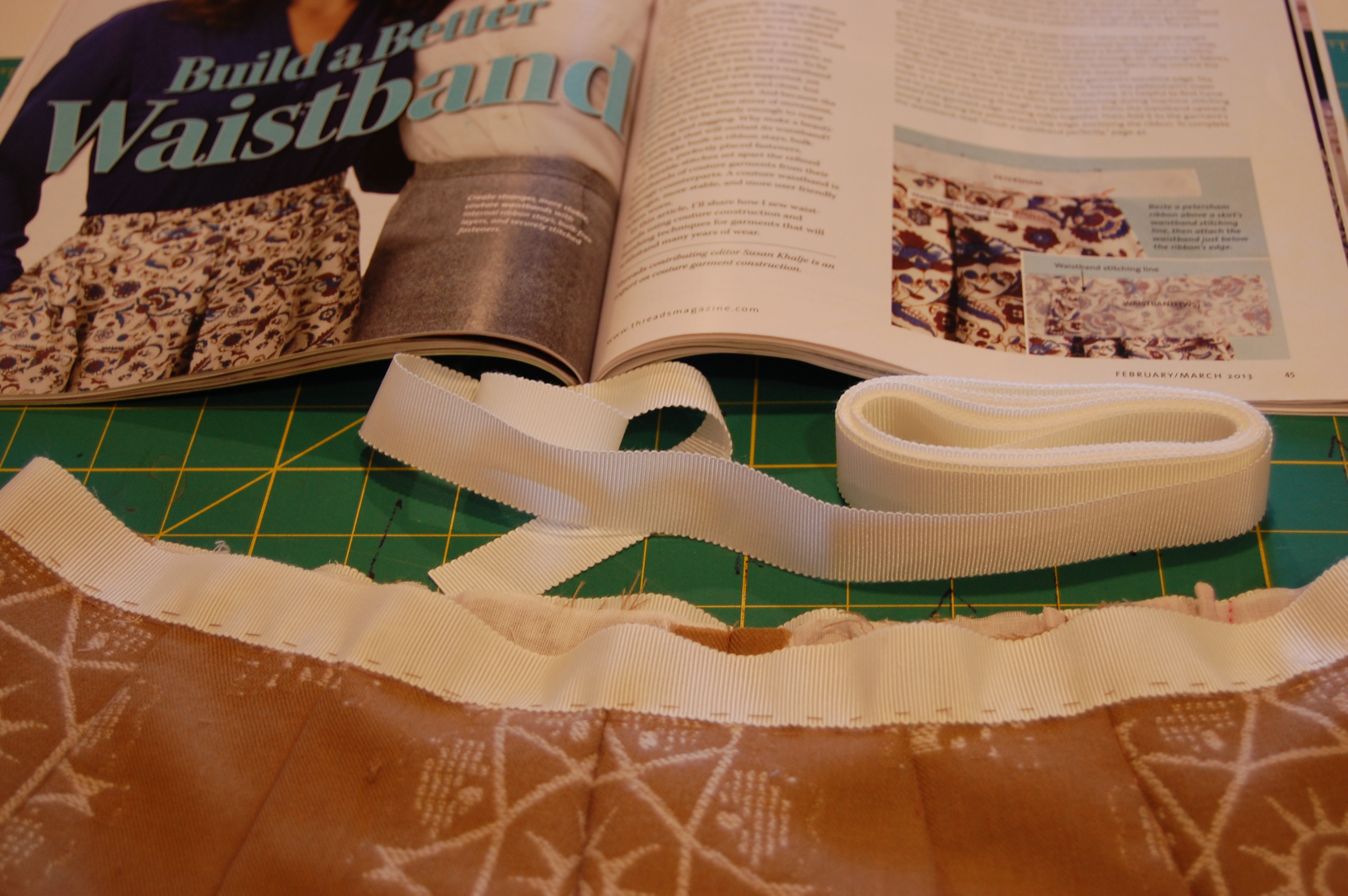
As luck would have it, the newest issue of Threads Magazine arrived right as I was getting started on this project – and Susan Khalje’s article “Build a Better Waistband” (page 44 – 49) immediately caught my attention.  I had already purchased several yards of Petersham ribbon in anticipation of waistbands yet to come, so I was all set.  I carefully followed all her detailed instructions and photos:

The newsest issue of Threads magazine

The newsest issue of Threads Magazine

The Petersham ribbon basted onto the waistline.

The Petersham ribbon basted onto the waistline.

I even decided to make a “faced” waistband.  I knew that this would help reduce bulk in the waistband, but also it would insure that any “itching” around the waist sometimes caused by wool fabric would be eliminated.

I made the facing out of the lining fabric.

I made the facing out of the lining fabric.

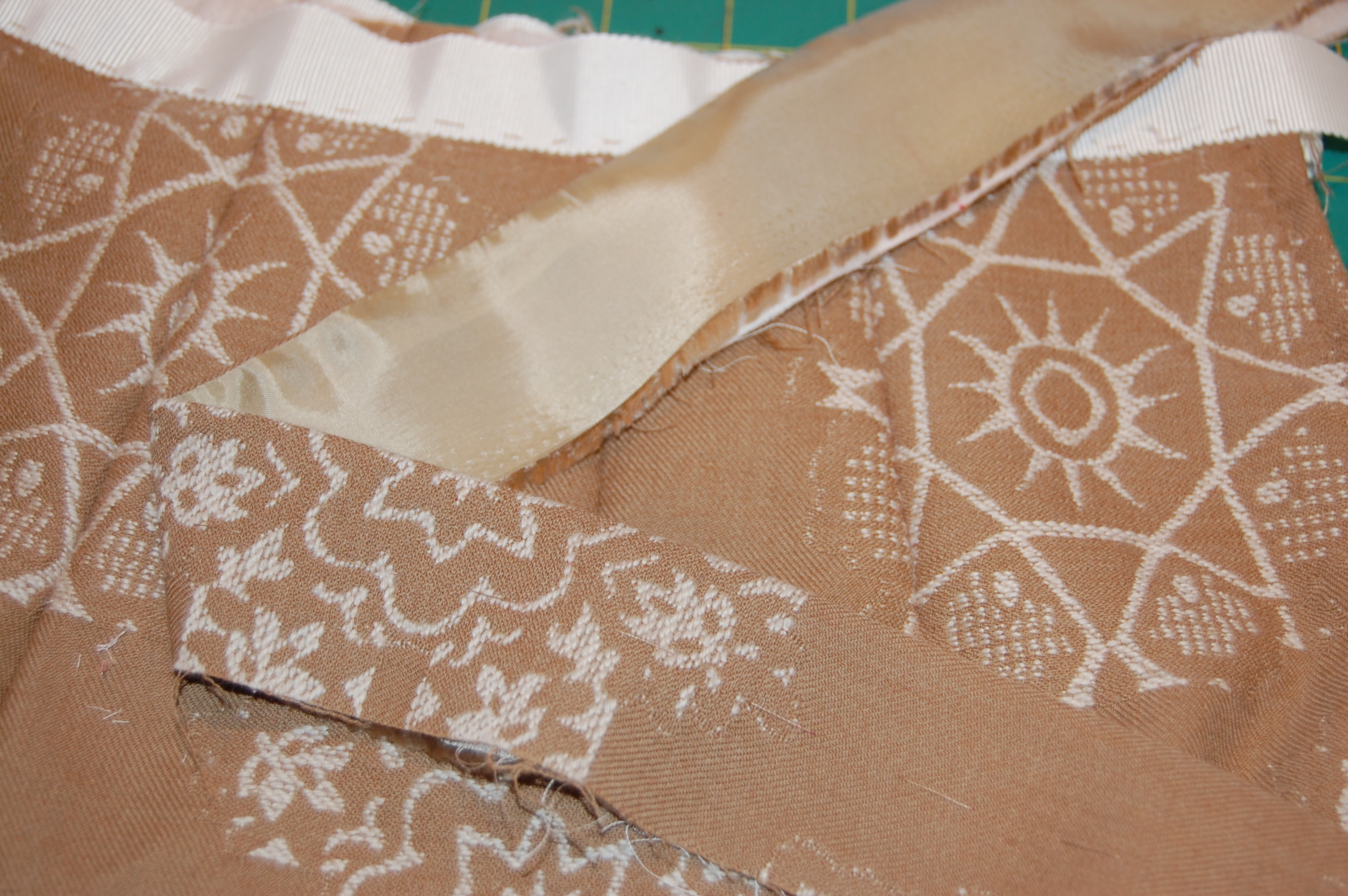
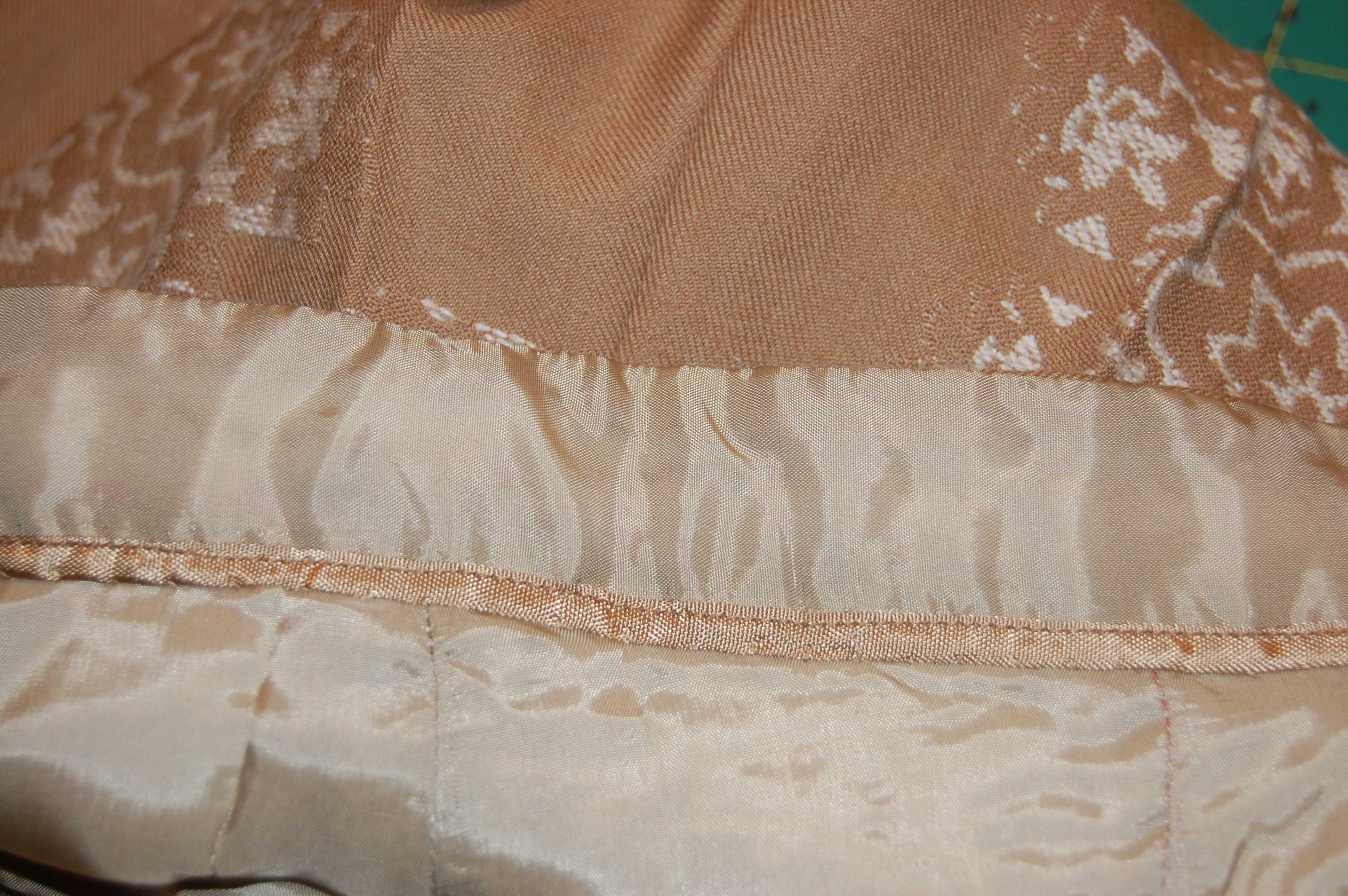
Everything was going along swimmingly until I went to set in the lining for the pants, which I made out of Bemberg rayon.  Somehow, the rise from the crotch to the waist was a little short.  I don’t know how this happened, but it did, and so I was faced with figuring out how to remedy this situation short of making an entire new lining.  Well, I decided to attach the waistband just to the underlined wool, not including the lining.  Then I used some careful and tightly-spaced catch-stitching to attach the top of the lining to that waistband seam.  (I forgot to take a photo of this, as I was totally absorbed in this “make-do” process.) This worked beautifully, much to my delight.  The only further fix I knew I needed to do was finish the inside of the waistband.  The waistband facing needed to be a little longer to hide my mistake, so I bound the raw edge with seam binding and used the fell stitch to finish it off.  I’m happy with the way it looks:

The seam binding helps to make a clean finish and hides my mistake!

The seam binding helps to make a clean finish and hides my mistake!

DSC_0761

I don’t think anyone would suspect my mistake – except for all of you, of course!

After final stitches to secure the lining to each of the legs, and then lots of steaming and pressing , my snowflake pants were finished!

Here they are, all finished!

Here they are, all finished!

Snowflake pants

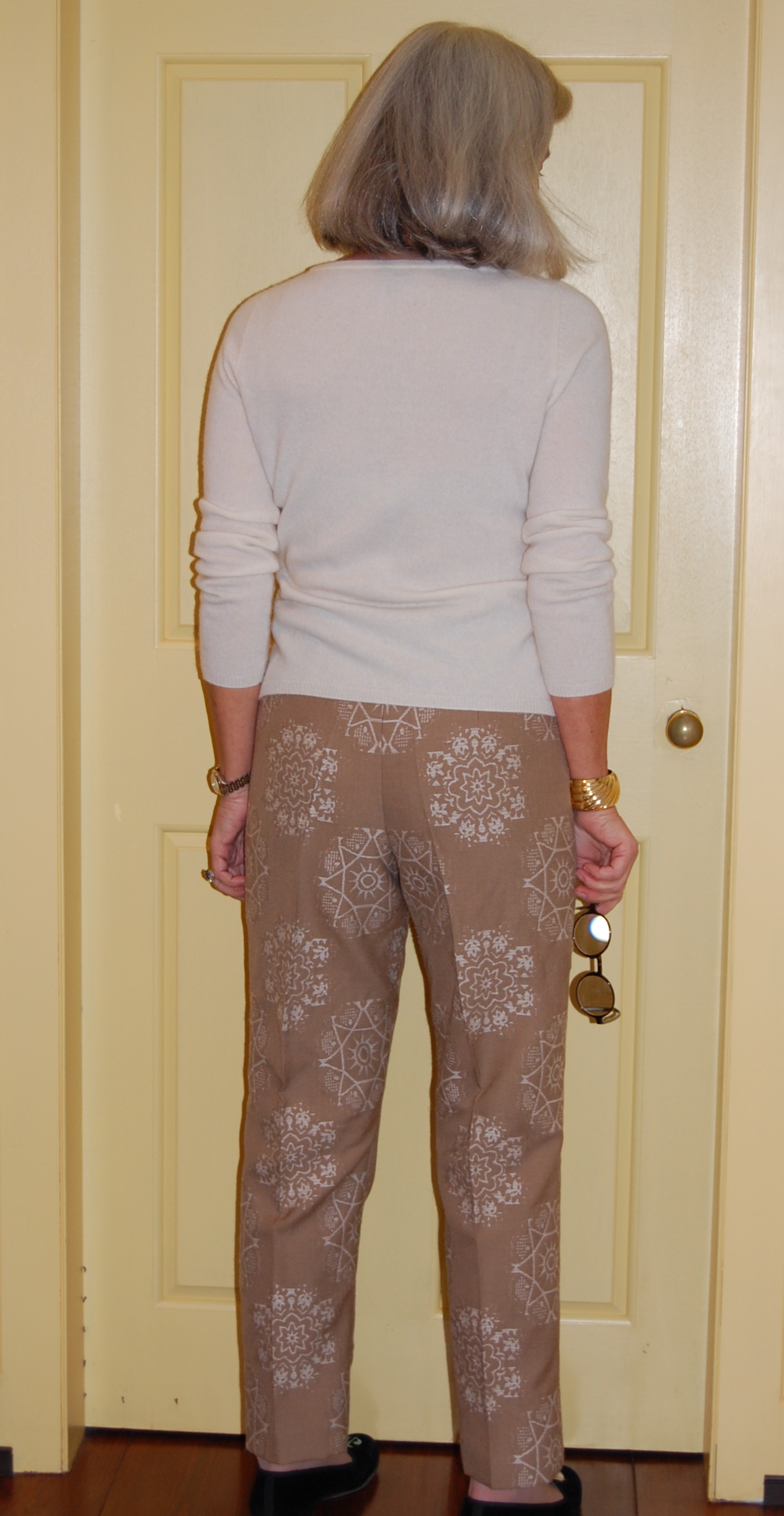
A back view.

A back view.

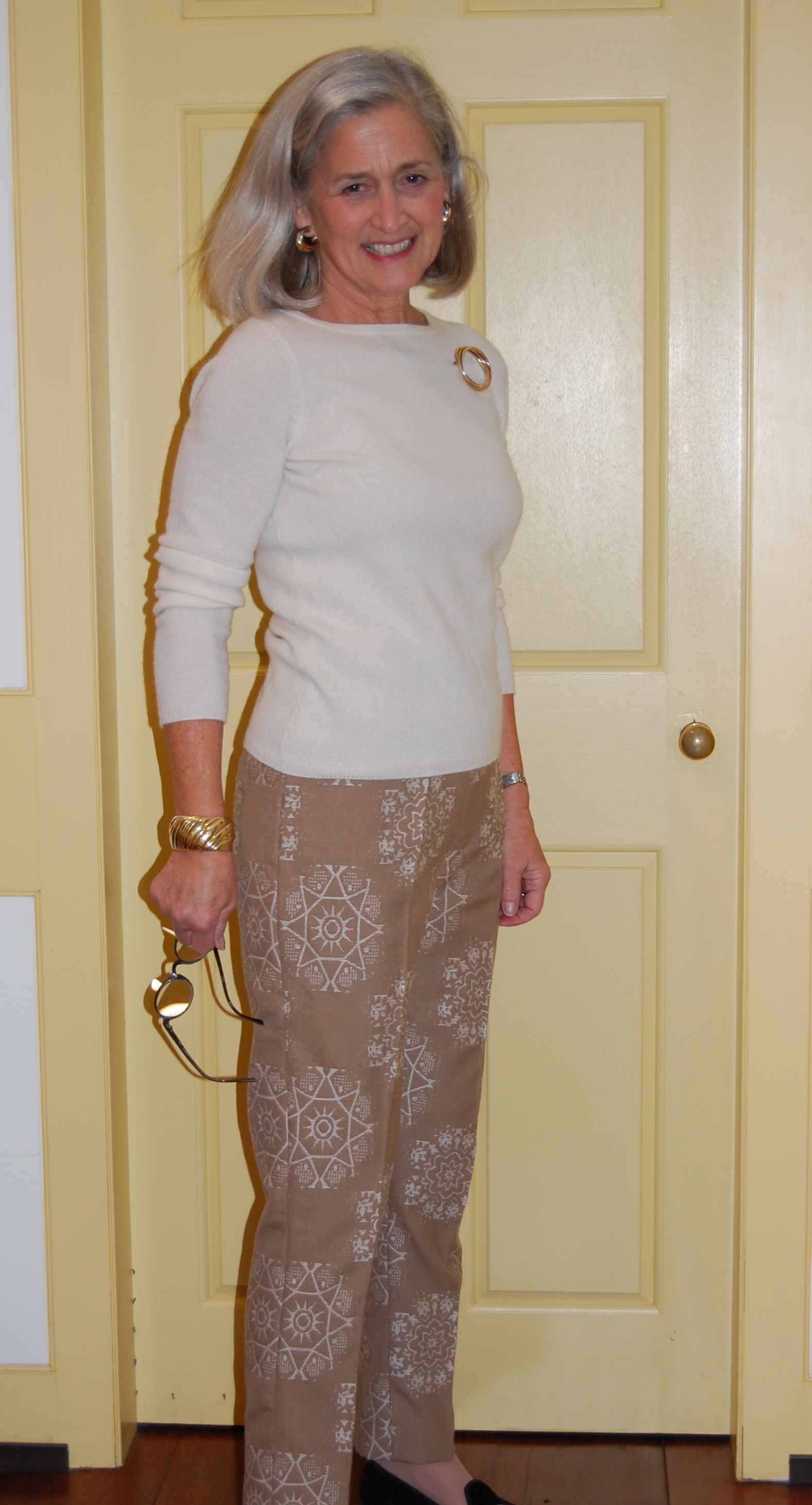
Kind of a side view.

Kind of a side view.

And a little closer up...  I'm happy with the way I was able to align the snowflake "medallions".

And a little closer up… I’m happy with the way I was able to align the snowflake “medallions”.

We seem to be in a January thaw right now, so the only forecast for flurries must be – in my control??  Well, I happily guarantee that sightings of snowflakes will definitely happen this Winter!

15 Comments

Filed under couture construction, hand-sewn zippers, Uncategorized, underlinings, vintage Vogue patterns from the 1960s, Vogue patterns, woolens

A Newly Defined ‘50s’ Frock

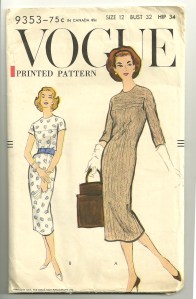
I have finished making a new dress from an old pattern, which isn’t anything too unusual for me.  What is unusual is the spell which this pattern cast over me from the time I first saw it last January, and then purchased it from an Etsy shop.

The length of this dress as shown on the envelope is very 1950's.  I'll be making it in knee-length.

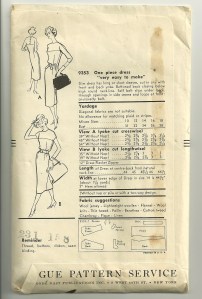
The back of the envelope, showing the back yoke detail.  Don't you love the handbags that the artist included?

The back of the envelope, showing the back yoke detail. Don’t you love the handbags that the artist included?

Copyright 1957, this pattern has intrigued me for both how modern it looks, and how quintessentially “1950s” its various details are – such as:

1) Kimono sleeves in three-quarter length.  Cut in one with the bodice, kimono sleeves were common in the ‘50s, and now seem to be making a comeback.  Three quarter length is extremely flattering for most women, and was popular then and now.

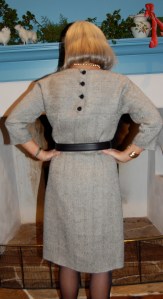
2) Side zipper.  This dress goes over the head and needs that side zipper to accommodate the wiggle room needed to accomplish this method of dressing.  A back zipper would completely ruin the effect of the four-buttoned back yoke.

3) No pockets.  While pockets are lovely inventions, this dress would lose some of its slim and flattering line should pockets bulge out from the side seams.

4) Mid-calf length.  This length looks great in the pattern illustration, but not so much on me.  One of the beauties of these vintage patterns is adapting them for current wear – so I opted for knee-length instead.

5) Bound buttonholes.  Although this pattern is called “easy to make” on the back of the envelope, it still calls for bound buttonholes.  And, oh, they add such a nice detail.

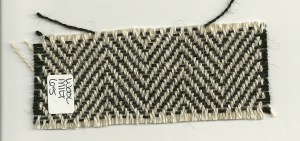
Now to the specifics.  I found this black and white herringbone alpaca wool (made in the USA) on Britex Fabrics’ website, and purchased it on sale a few months ago, specifically for use with this pattern.

This is the swatch I ordered from Britex sometime over the Summer.

This is the swatch I ordered from Britex sometime over the Summer.

I wanted to make the dress using couture techniques (learned in the online Craftsy course The Couture Dress taught by Susan Khalje.)  This meant that I would 1) make a muslin for fitting and pattern tracing; 2) underline the entire dress with silk organza; 3) eliminate the separate neck facing; 4) finish all the interior seams by catch-stitching them to the underlining; and 5) line the entire dress, which I did using Bemberg instead of china silk (more on that in a bit).

There were a number of decisions/problems/successes involved in making this dress. First, the nature of the fabric is that there are slight imperfections in the weave, and it is quite loosely woven, making it quite susceptible to raveling.  When I laid it out to cut it, I wanted to avoid any obvious imperfections front and center.  Patterns with kimono sleeves demand large expanses of fabric and thus do not allow a lot of jiggling of their placement.  I can honestly say that I had JUST enough fabric and not an inch more than I needed!

One of the first problems I realized I was going to have concerned the buttonholes.  I quickly discovered that the loose weave of the fabric meant that I was not going to be able to make bound buttonholes using self-fabric for the “strips”.  I considered using a plain black wool for these strips, but I thought that would be too much of a contrast.  Well, now I know why I save all kinds of scraps from previous projects – you never know when one of those random pieces of fabric will come in handy.  I spied a scrap in my fabric closet and quickly decided that one part of the weave would be perfect to delineate those buttonholes:

I used the "gray"portion of this windowpane check for the buttonhole "strips".

I used the “gray” portion of this windowpane check for the buttonhole “strips”. Click on the photo to see this up close.

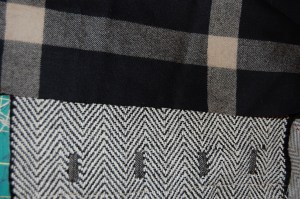
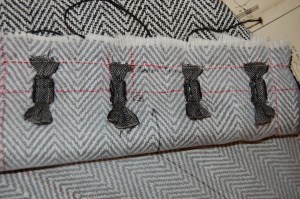
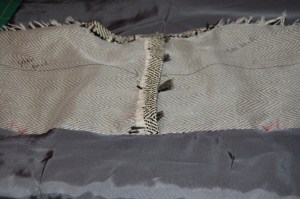
An inside look at the buttonholes in progress

An inside look at the buttonholes in progress

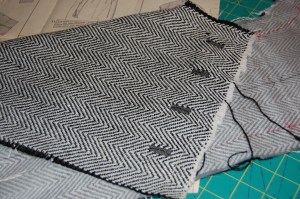
And an outside look...

And an outside look…

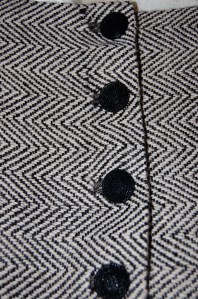
When it came to deciding on buttons, I could not find any I liked.  But I remembered some buttons I had sewn onto a RTW jacket several years ago (to replace the ones that came on it.)  They have a “herringbone” look to them – it’s very subtle, but effective.  The jacket is one I haven’t worn in a couple of years, so I just robbed the cuffs of their buttons and used them on my dress.  (Now I guess I know for sure I won’t be wearing that jacket again!)  But – the buttons are perfect for this dress.

My buttons of choice!

My buttons of choice!

Choosing to use couture techniques was a “dress-saver”.  The larger seam allowances took away the panic I might have felt, once I realized the fabric frayed so easily.  And finishing off each interior seam with catch-stitching controlled the fraying and helped the seams to lay perfectly flat.

Eliminating the separate neck facing was also a bonus to ease construction.  First of all, I wanted to widen the neckline, which I worked out in my muslin.  Using the seam allowance and hand-applied, under-stitched lining for the neck facing made it lay flat, and of course, it’s not itchy either!

The "couture-constructed" neckline, before the lining is attached.

The “couture-constructed” neckline, before the lining is attached.

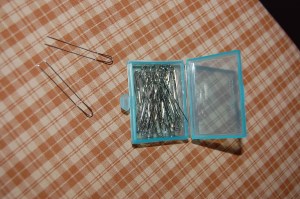
Even though I did not have “plaids” to match, I needed to pay close attention to the rows in the herringbone weave, so that none of them were crooked.  This is where Clover two-pronged pins (recommended by Susan Khalje in The Couture Dress class) came in handy and helped me keep those rows lined up evenly.

Clover "fork" pins

Clover “fork” pins

Finally, I decided to use Bemberg lining fabric instead of China silk because I thought it might be a bit more substantial for this somewhat heavy weight wool.  When I was deciding what color to make the lining, I considered ivory, black, and even a bright color, such as red.  But I settled on deep gray, and it seems just right.

In fact, everything about this dress seems just right.  It is delightfully rewarding when a pattern does not disappoint – and when it turns out to be a complete winner, well, that is reason to make it again (which I will)!

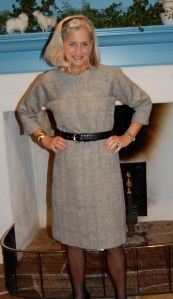
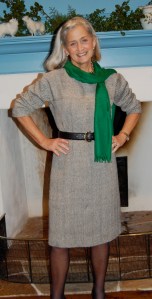
I can wear this dress as a sheath, unbelted, but I love it with this Coach black belt.

I can wear this dress as a sheath, unbelted, but I love it with this Coach black belt.

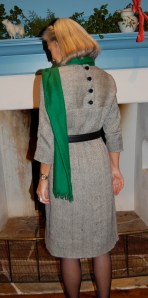
The back view

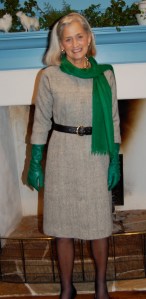
With a touch of emerald green for the holiday season

With a touch of emerald green for the holiday season.

With green gloves for a '50s' look!

With green gloves for a ’50s’ look!

And another back view.

And another back view. Alpaca is a very warm wool – so this dress is very cozy.

For now, however, my sewing room is “gift-wrap central”.  The colorful ribbons, paper and tags are cheerful tokens of a season of blessings and family and home.  To all of you celebrating the season, may it be a time of great peace and love for you and yours. And, as I  take a couple of weeks “off”, I send a heartfelt Merry Christmas from me to you…

24 Comments

Filed under bound buttonholes, Buttons - choosing the right ones, couture construction, kimono sleeves, side-placed zippers, Uncategorized, underlinings, vintage Vogue patterns from the 1950s, woolens

What Do a Chanel Jacket and a Chicken Have in Common?

Not much – unless you were in my sewing room last week.

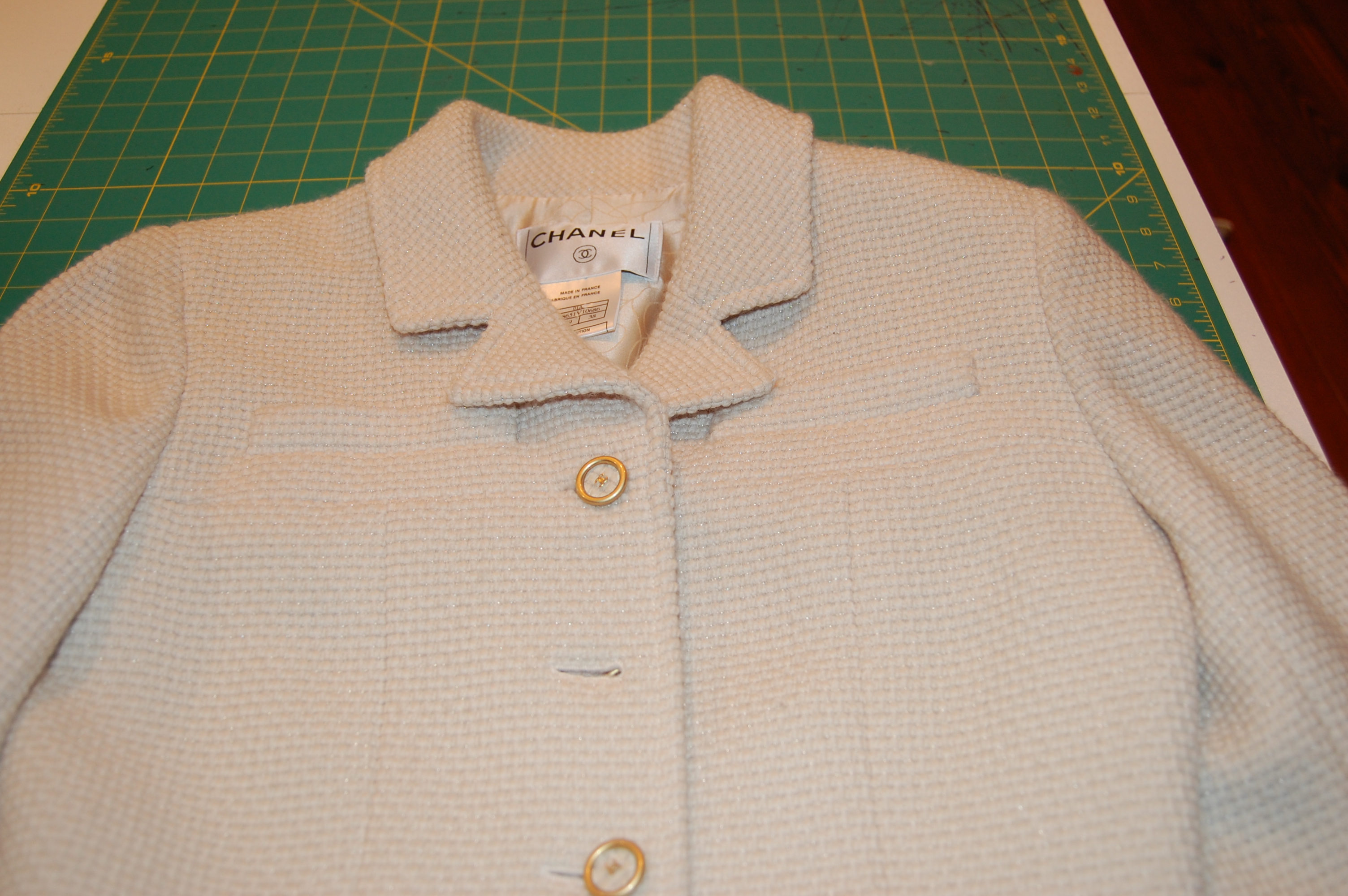
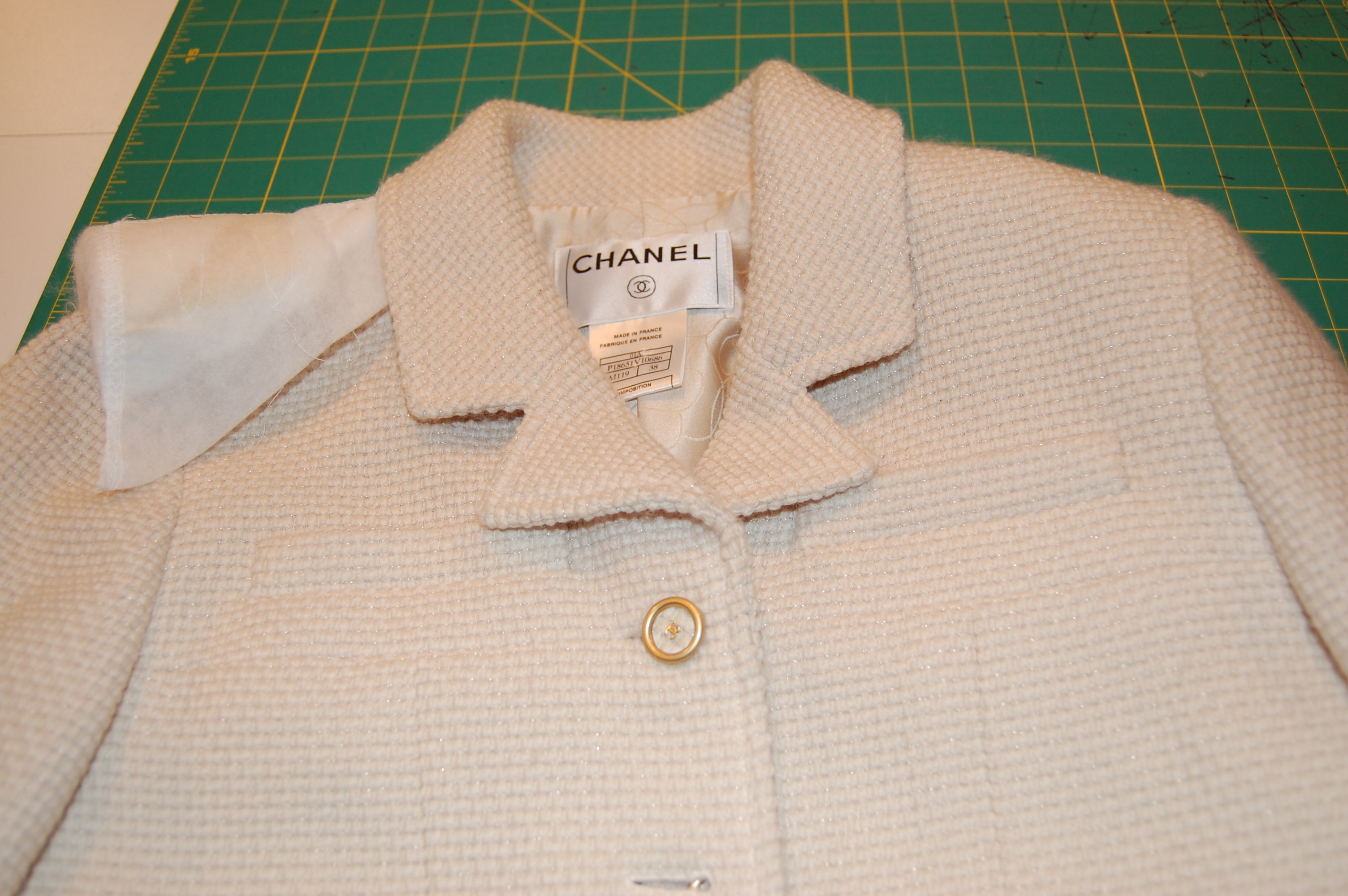
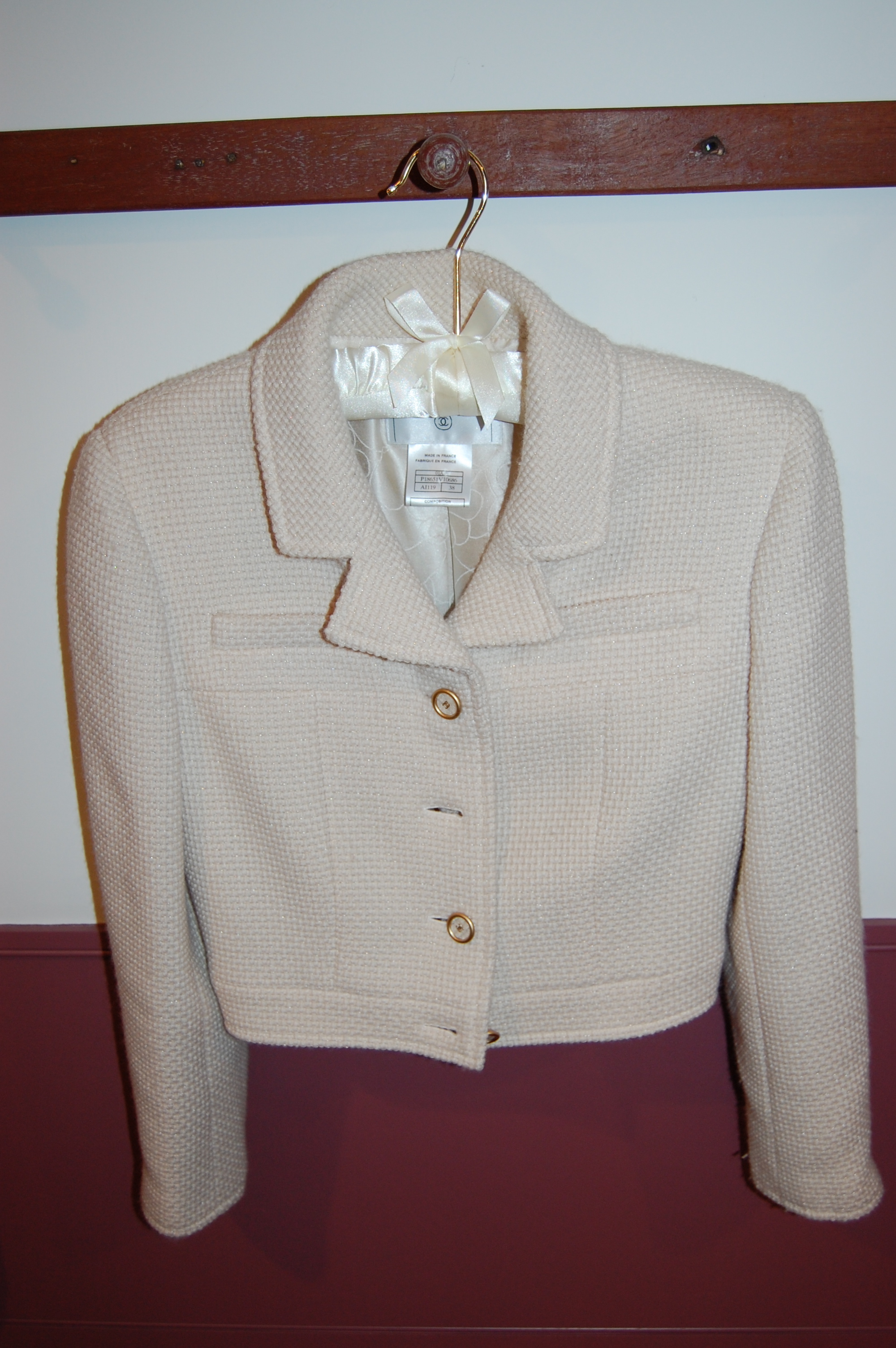
When we were out in California very recently, my son’s girlfriend, Rachel, showed me a Chanel jacket she had found at a store which sells vintage clothing.  Sadly, she had never been able to wear it because it had very prominent shoulder pads, which screamed 1980s.  Otherwise it was a very wearable cropped jacket with petite convertible collar, in a creamy white wool with just a hint of  a sparkly windowpane weave.  Rachel asked me what I thought could be done with it.

Hm-m-m-m, I looked inside it, felt around those shoulder pads hidden inside the lining, and guessed that I could easily remove them and replace them with a much more reasonable sleeve header.  Of course, I’d need to bring the jacket home with me, so in the suitcase it went, landing in my sewing room.

I carefully removed the stitching from the lining at the right shoulder and took a peek.  The shoulder pad had been attached with hand stitches, easily snipped.  Out it came.  I cut a piece of French sleeve heading tape, called Cigarette, which I had purchased from Susan Khalje’s website. (I had used this in my Craftsy course The Couture Dress.)

The shoulder pad is in plain view in this photo.
The jacket has top-center seams on the sleeves, so with that extra fabric bulk, I determined that the simple sleeve heading would be enough shaping.  Here is the jacket with just the side on the left fixed:
Can you see how bulky the shoulder on the right is?

Here I have placed the shoulder pad on top to show some perspective on its bulk.

And here is the jacket with both shoulders complete and all sewn up inside (with itty-bitty stitches):

The padded hanger helps to simulate the shoulder line.

Of course, I had to guess a little on the final fit as I did not have Rachel here to try it on.  But I am sure, once it completes its return trip to California, that it has a better chance of being worn now than before!

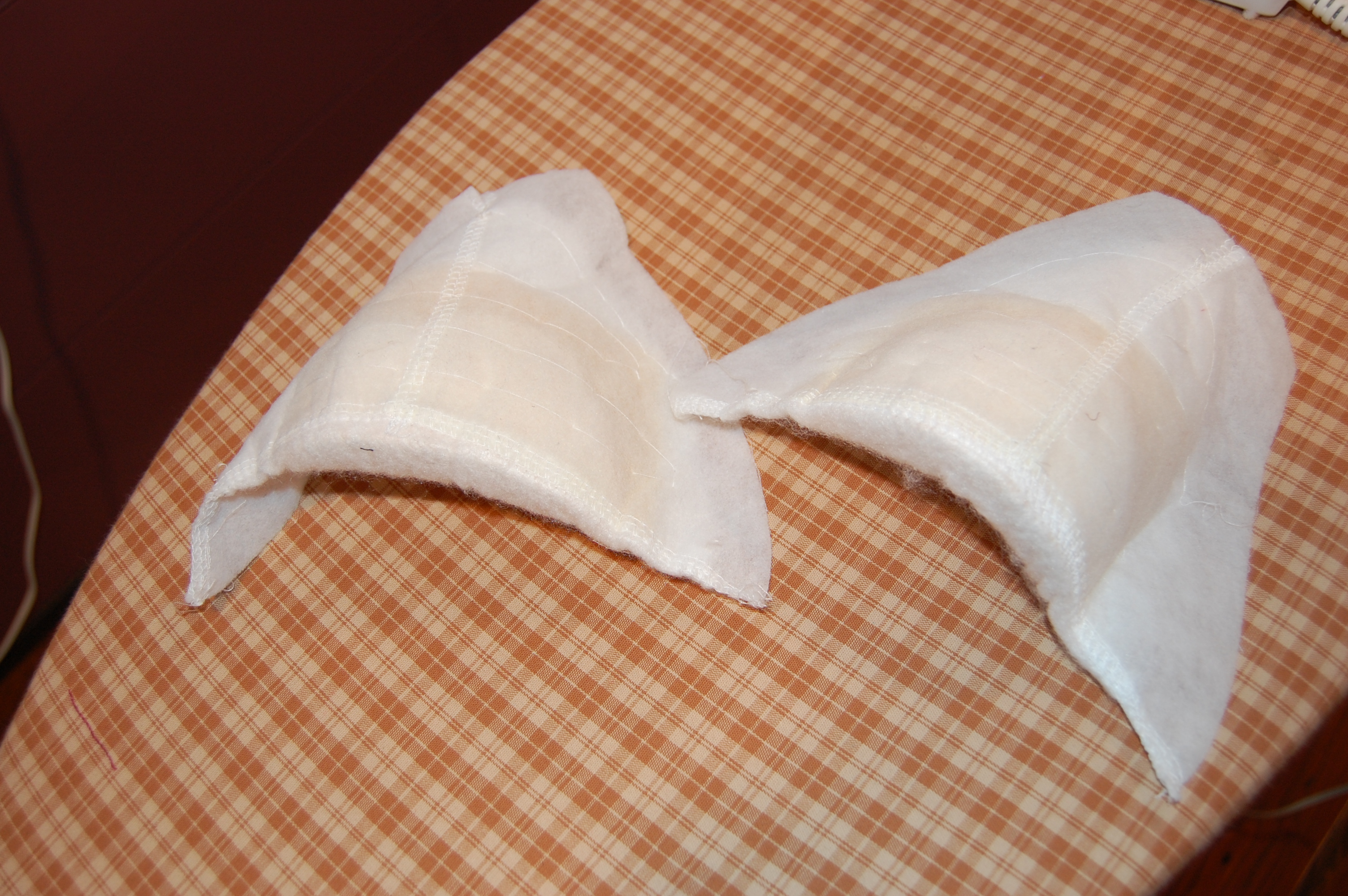
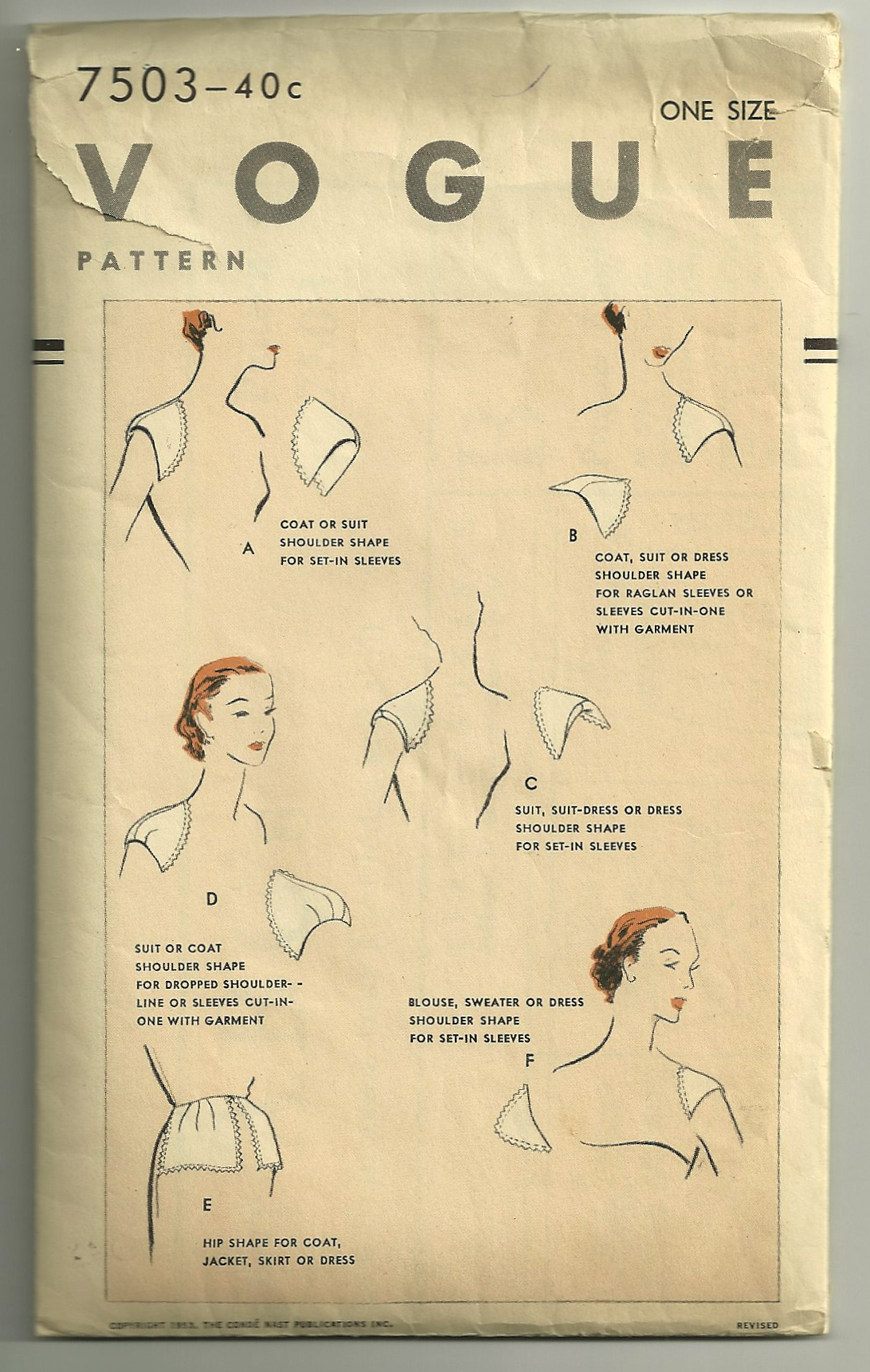
It was interesting for me to be able to see inside a Chanel jacket – I discovered some details I thought I might find – such as 1) the wool fabric was totally underlined in what looks like silk organza; and 2) hand-sewing was evident in quite a few areas.  However, the seams were not catch-stitched to the underlining, which I thought they might be.  The most amazing thing was actually seeing those shoulder pads – as their construction was almost exactly like view C of Vogue 7503, my vintage pattern from 1953. How cool is that?

Two authentic Chanel shoulder pads!

View C is right in the middle.

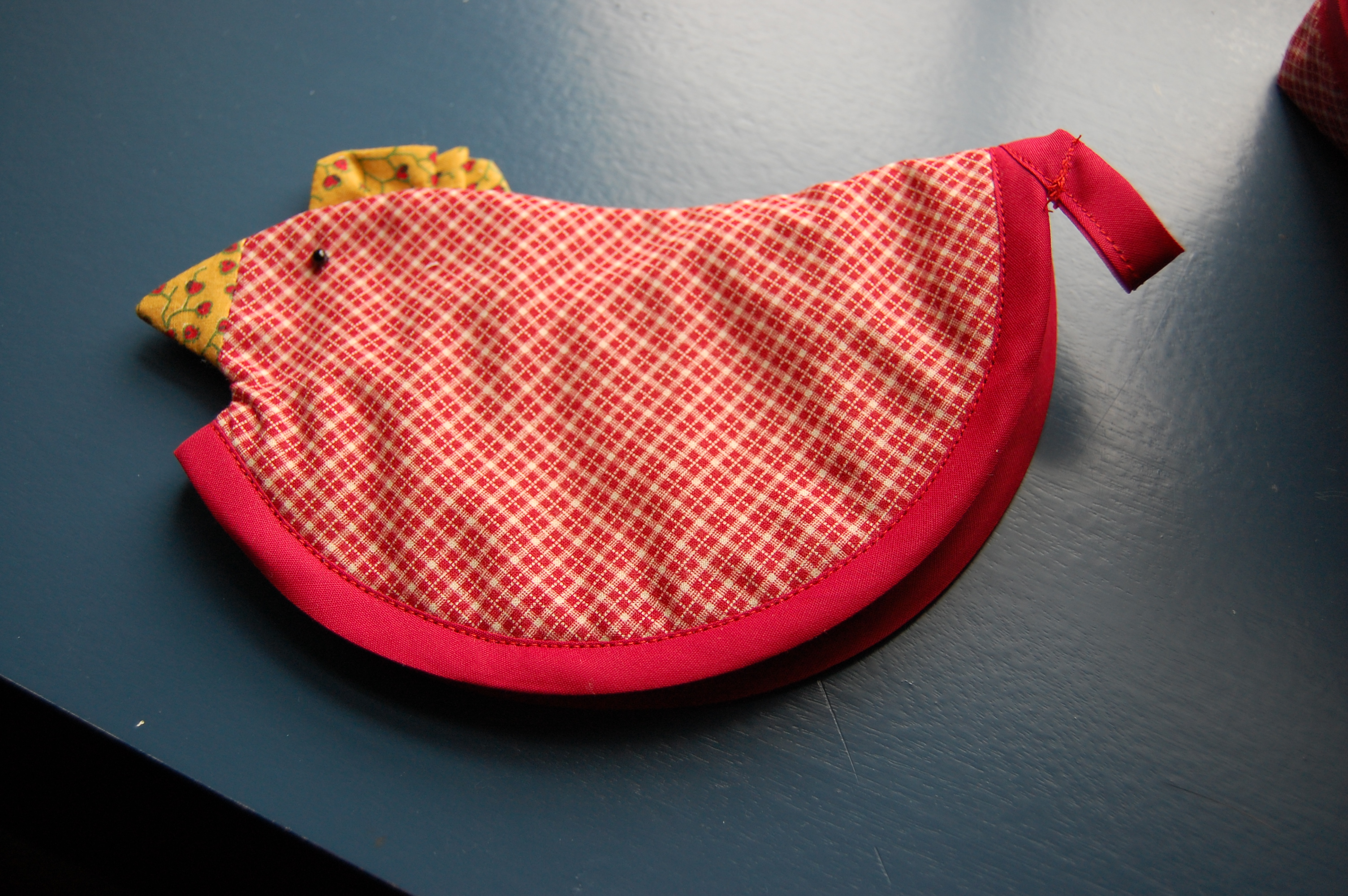
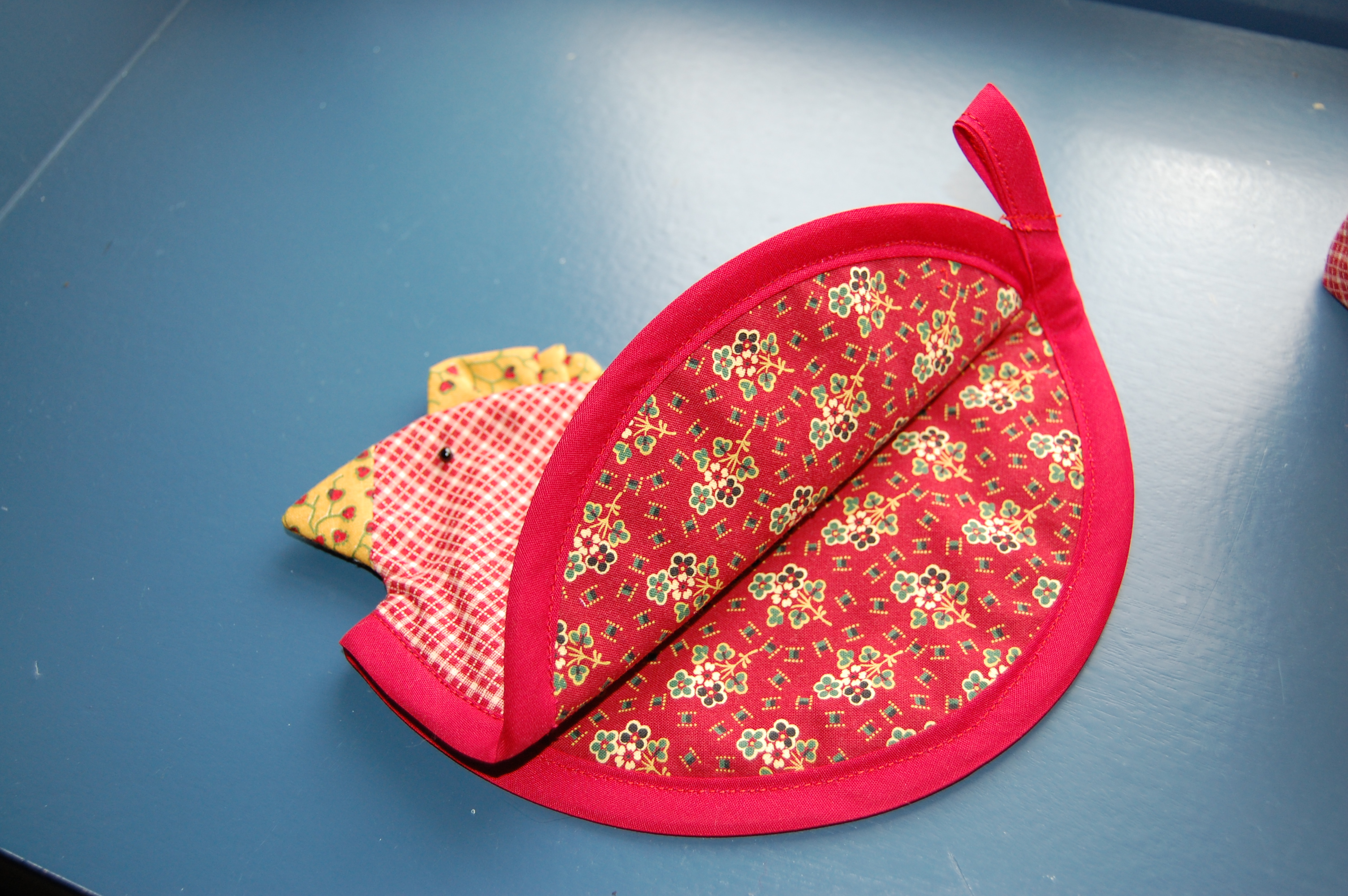
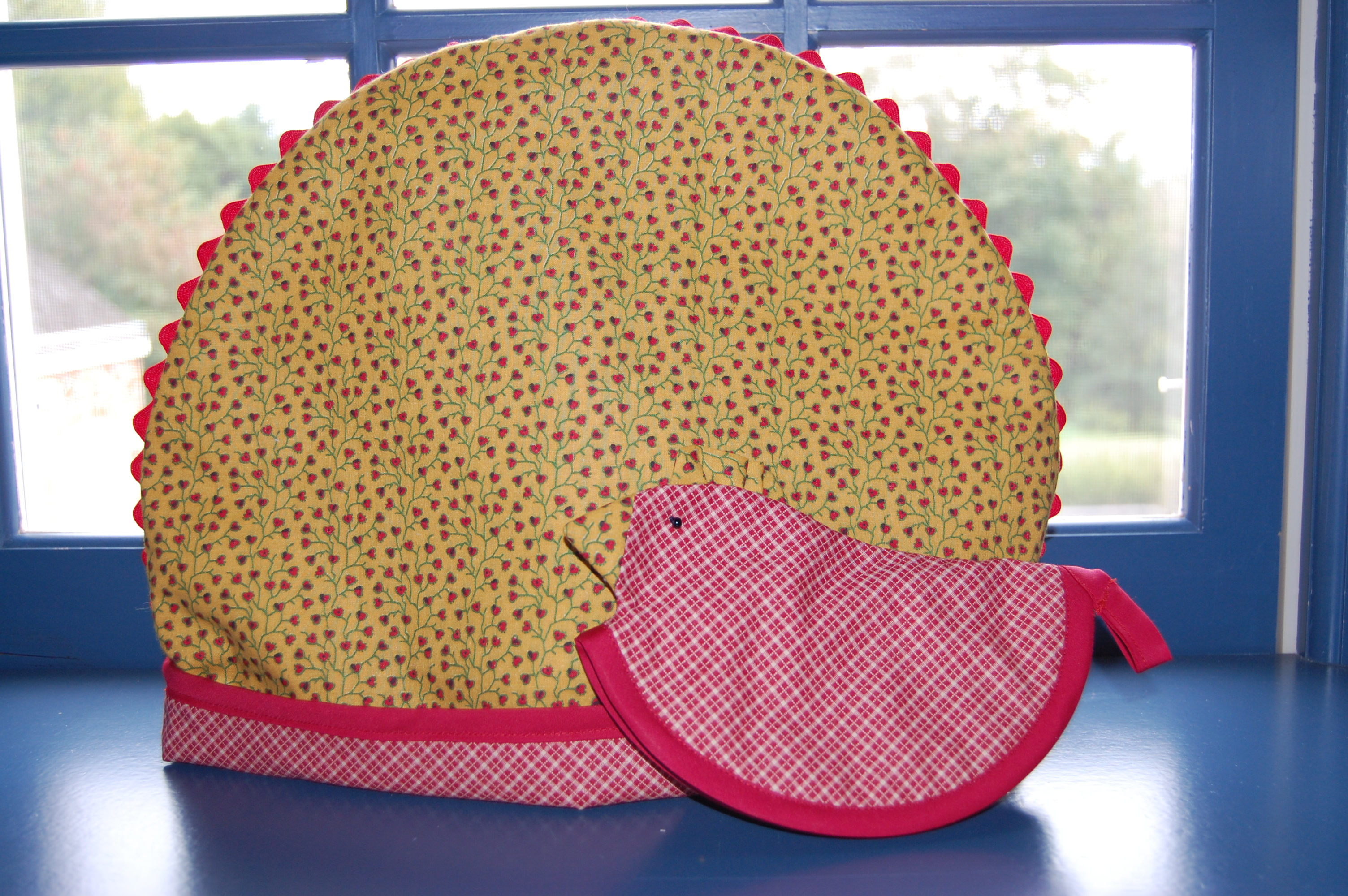
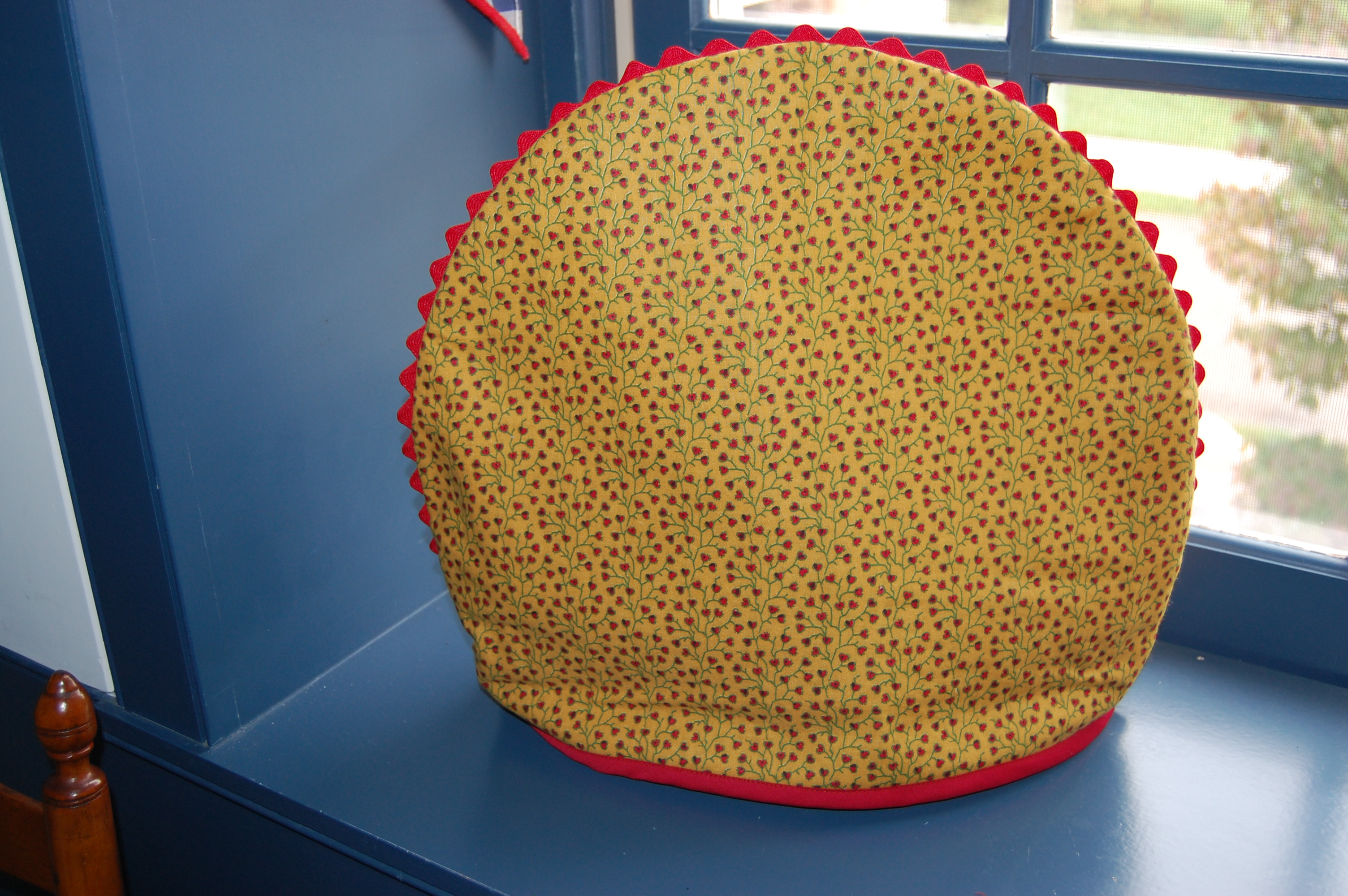
So that was Chanel.  But what about the chicken?  Another project I wanted to finish last week was an auction item for my garden club’s annual fundraiser.  As I am the only one in my club who has a backyard flock of chickens (yes – can you believe it?), I like to put together what I call a “Little Red Hen” basket to add to our auction selection every year or so.  Besides the main attraction of a couple dozen of our farm-fresh eggs, I add other items with a chicken theme.  Some examples are egg poachers, an egg timer, cocktail napkins with chickens on them – things like that.  Of course, as one who sews, it is impossible for me to do a project like this without adding something handmade. So this year, I made a tea cozy with a matching chicken potholder.  I had already completed the tea cozy a couple of weeks ago, but the potholder  – well, it had to take its place behind Chanel.    It did not take long for me to fashion this little hen (in red, of course) to match the cozy. Here she is, ready to perch on the handle of any hot pan:

She is interlined with several layers of heavy cotton flannel.

She’s pretty underneath it all, too!

Here is the little red hen in front of the tea cozy.

Tthe bottom of the tea cozy can be folded out to fit a higher pot.

So what was more fun – and what did really come first– Chanel or the chicken?  Now there are two questions for the ages!

10 Comments

Filed under Chanel-type jackets, couture construction, Shoulder shapes (shoulder pads), Uncategorized, underlinings, Unprinted patterns from the 1950s, vintage Vogue patterns from the 1950s, Vogue pattern 7503 for shoulder shapes, woolens

Completely Captivating Couture Construction

I just can’t seem to avoid alliteration in my blog-post titles as of late!  Truthfully, however, this title really seems to sum up just how badly I have been bitten by the “couture” bug.  Earlier in the summer I signed up for Susan Khalje’s class, The Couture Dress, on Craftsy.  I’ve mentioned it several times in my past posts, but now, my couture dress is finished.

The Craftsy course included this Vogue pattern:

I decided to make this dress in the slim skirt with short sleeves.

Although I could have substituted another pattern for my dress, I decided it would be beneficial to follow the exact steps which Susan takes one through in her course.  (It helped that the view I chose to make reminds me very much of a classic 1960s–style dress).

My idea of making a “muslin” or toile has been completely transformed by this course. I now know it as the most essential ingredient in the proper fit and alteration of a garment – and although the process of producing a useable muslin is time-consuming, every minute is worth it.  There is nothing quite so discouraging as spending a lot of time, energy, and money on a garment and then not being completely satisfied with the fit.  Making a couture muslin eliminates this possibility almost entirely.  Check out the online preview of the course if you want to know more about this concept.

Here is one of my muslin pieces. The lines in red were the original tracings from the pattern and the lines in black are my alterations.

This muslin piece shows the “blind dart” I added to the neck edge. Susan goes over all these details in her course.

There are several “hallmarks” of couture construction, I have learned: Control, Generosity, and that all-important duo of Form and Function.    So what (in a nutshell) do these terms mean?

A few examples of Control are:

1) Control of the fit, which, as stated above, is the purpose of the muslin.

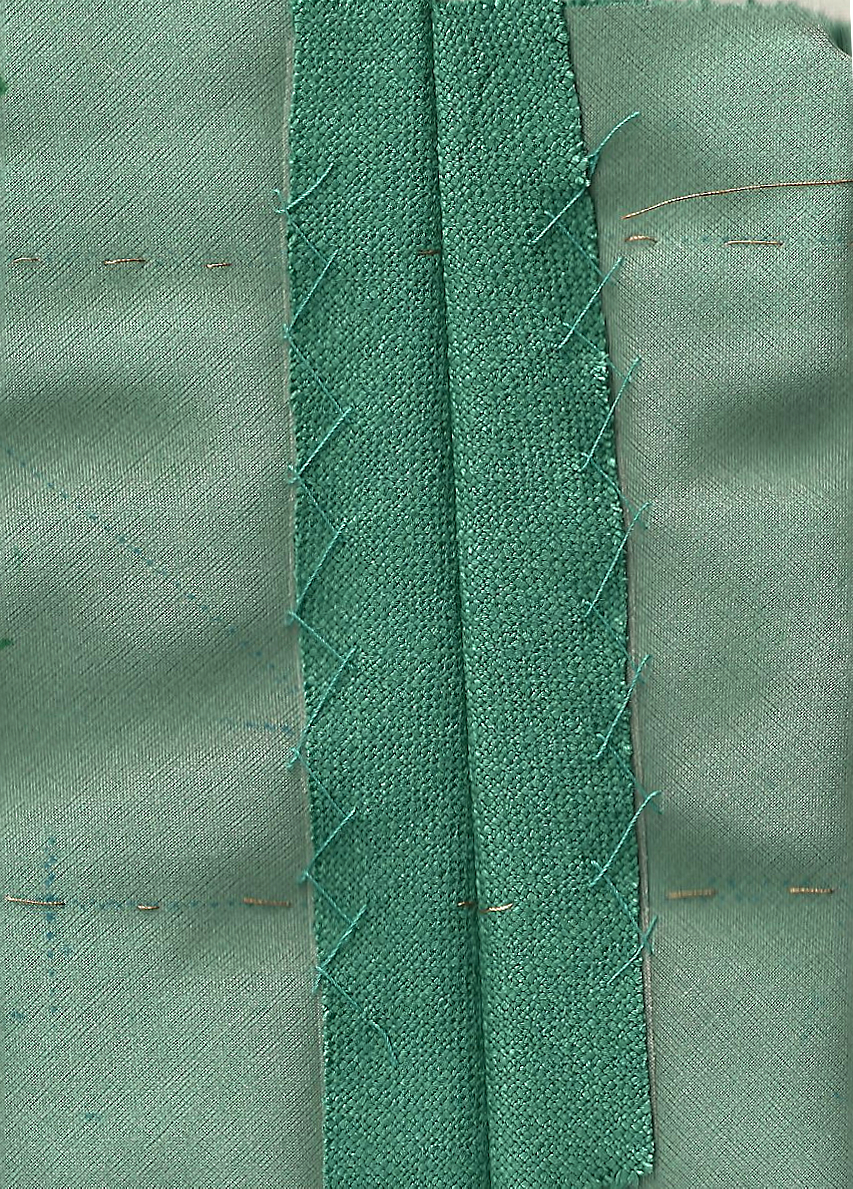
2) Control of the stitching line, which is your reference point for sewing – as opposed to the seam allowance, which is how most of us were taught to sew.  Lots and lots of basting is the key to controlling the stitching line.

3) Control of the inner seams, the raw edges of which are each catch-stitched to the underlining.

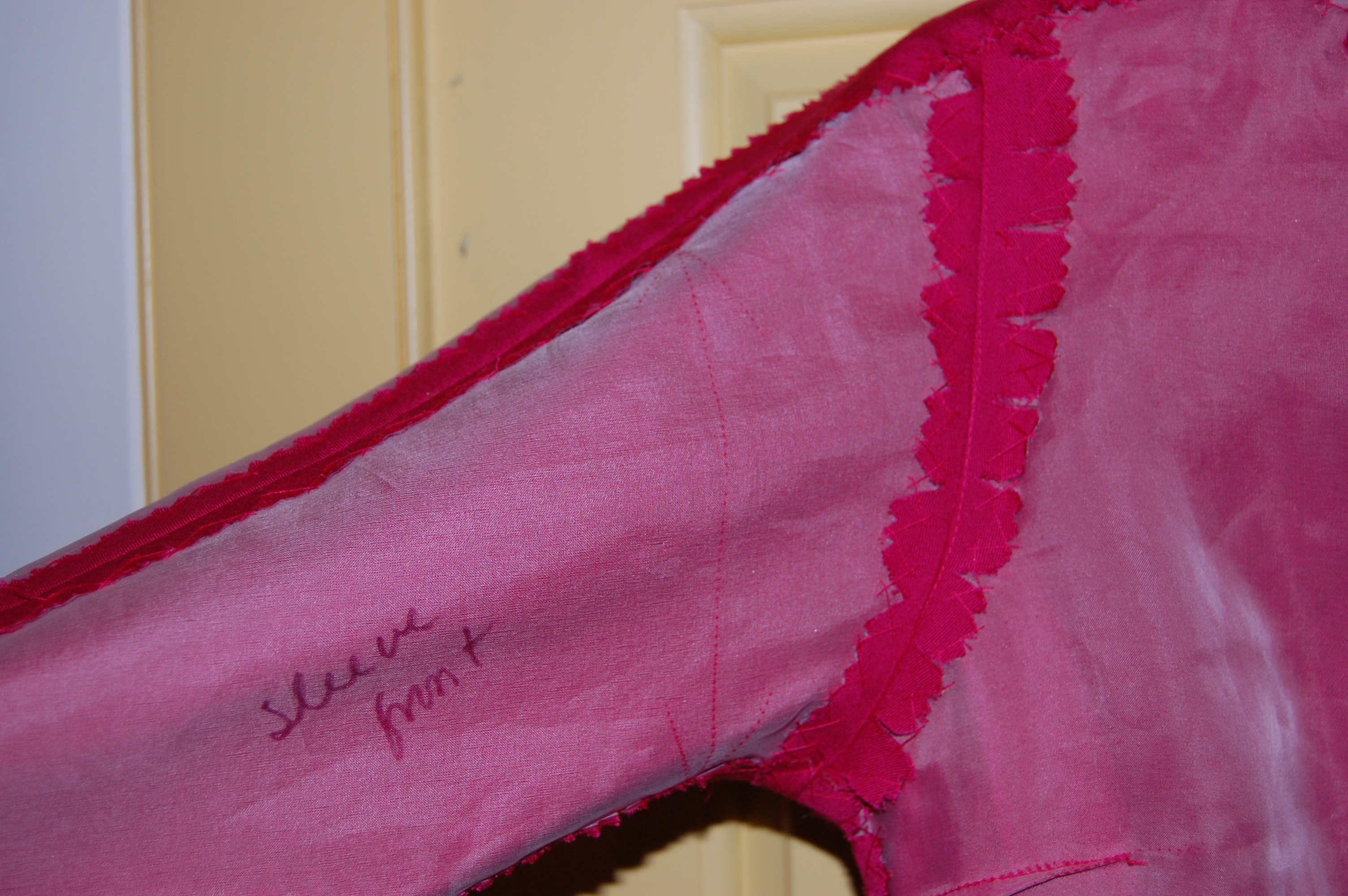
Here you can see the interior of the assembled dress, with every edge catch-stitched in place. The underlining serves as a “tablet” upon which you can make all kinds of notes!

The two big examples of Generosity are:

1) Cutting out the muslin, the underlining and the fashion fabric with very large seam allowances which give you the flexibility you might need to make changes in your final fitting.

2) Allowing – and taking – the time to do a lot of hand-sewing, fitting, and detail work.

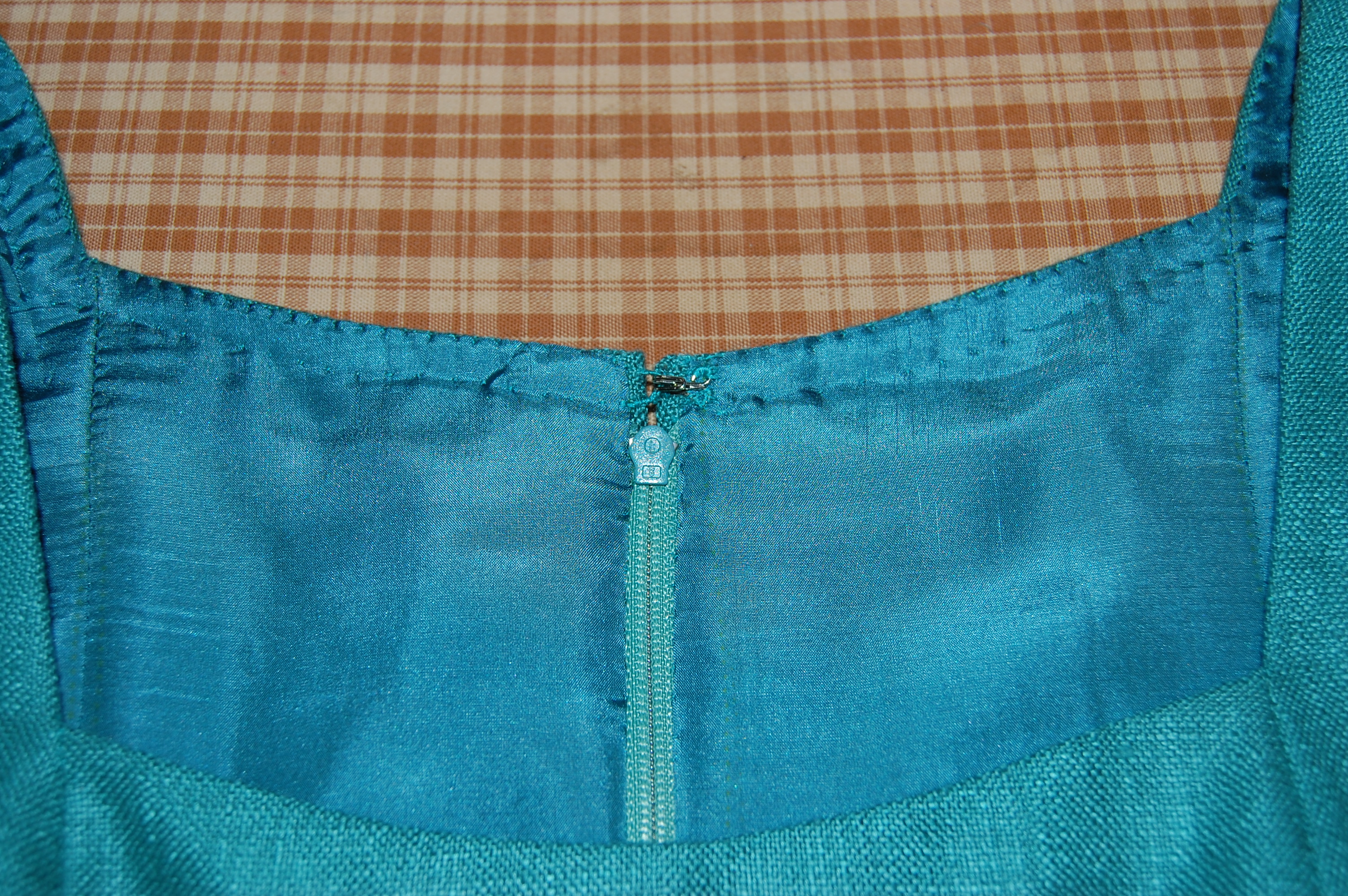
If you look closely you can see the hand made loop and the “couture” attachment of the hook at the neck edge.

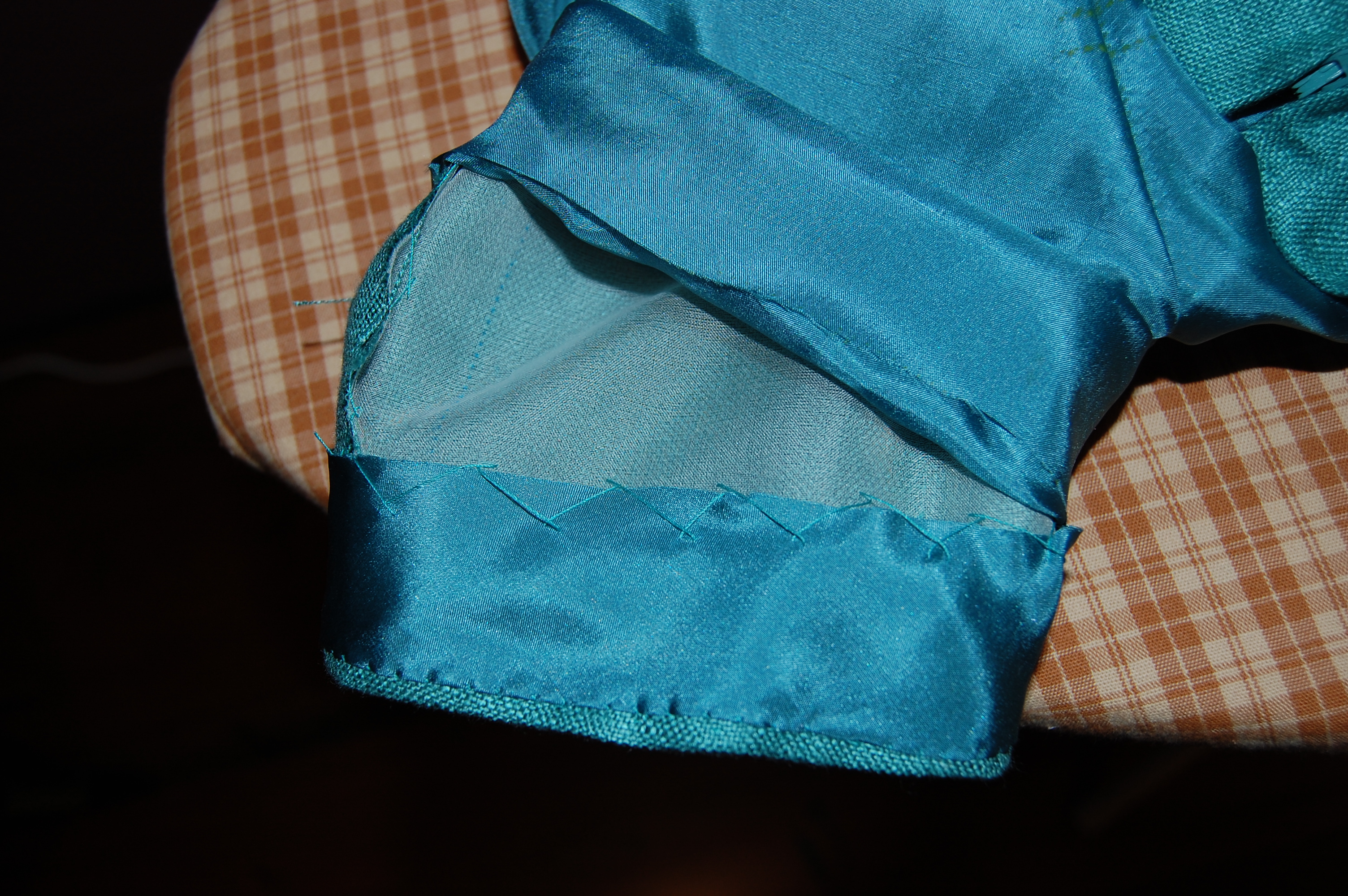
I ended up applying a bias facing to the sleeve edges. At my final fitting, I decided I wanted the sleeves a bit longer than I had originally anticipated, so the bias facing gave me another 3/4 inch in length. This is one more detail which Susan covers in her fabulous course!

Finally, Form and Function are well illustrated by these two examples:

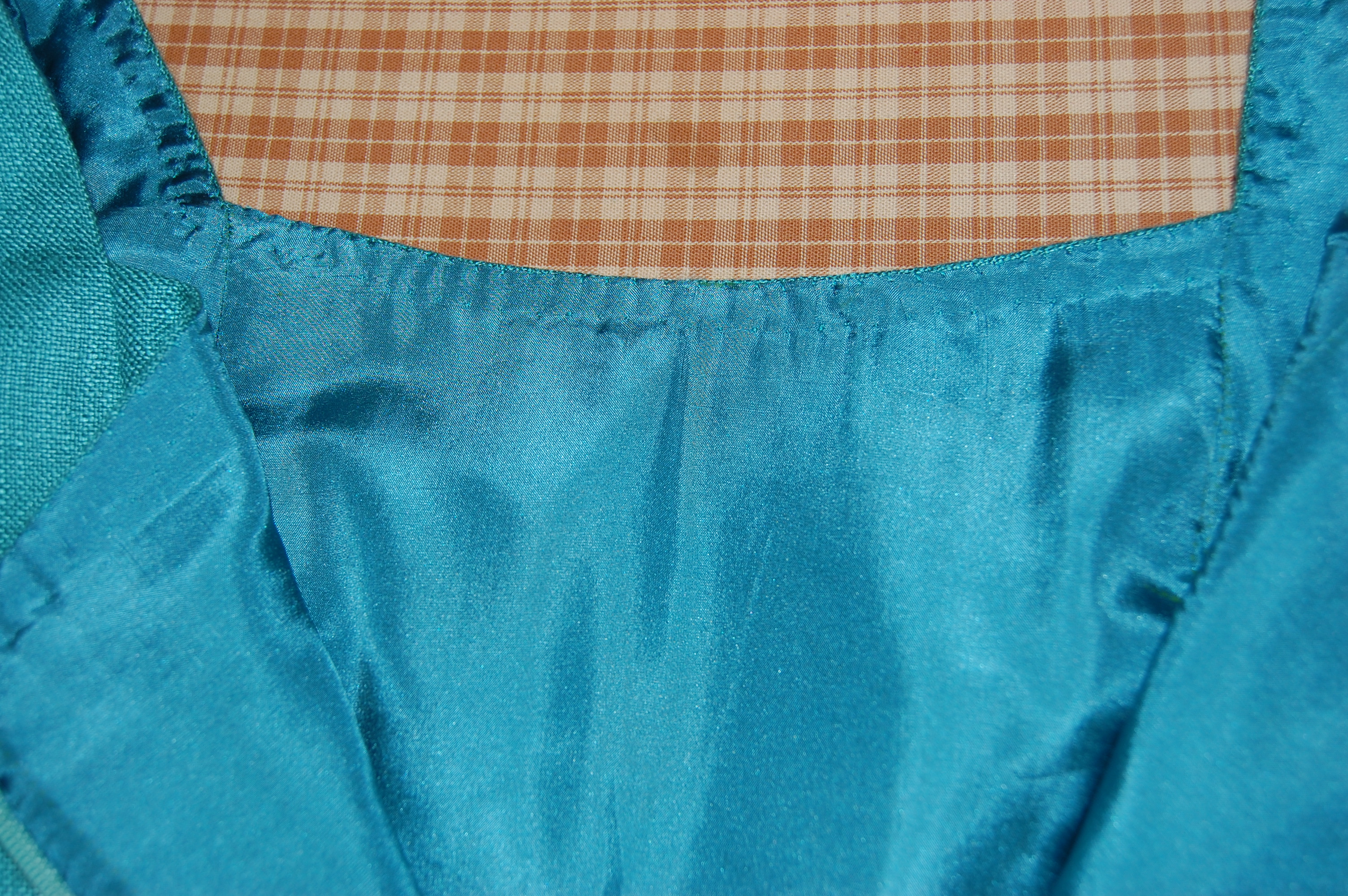
1) A couture lining is always applied by hand, using the fell stitch.  To insure that the lining will not “migrate” to the outside, it is secured by the very lovely pick stitch – doing the job (function) in a truly elegant way (form).

Here is the finished front neck edge, showing the “applied by hand” lining and the pick-stitches which keep the lining from migrating out of the dress!

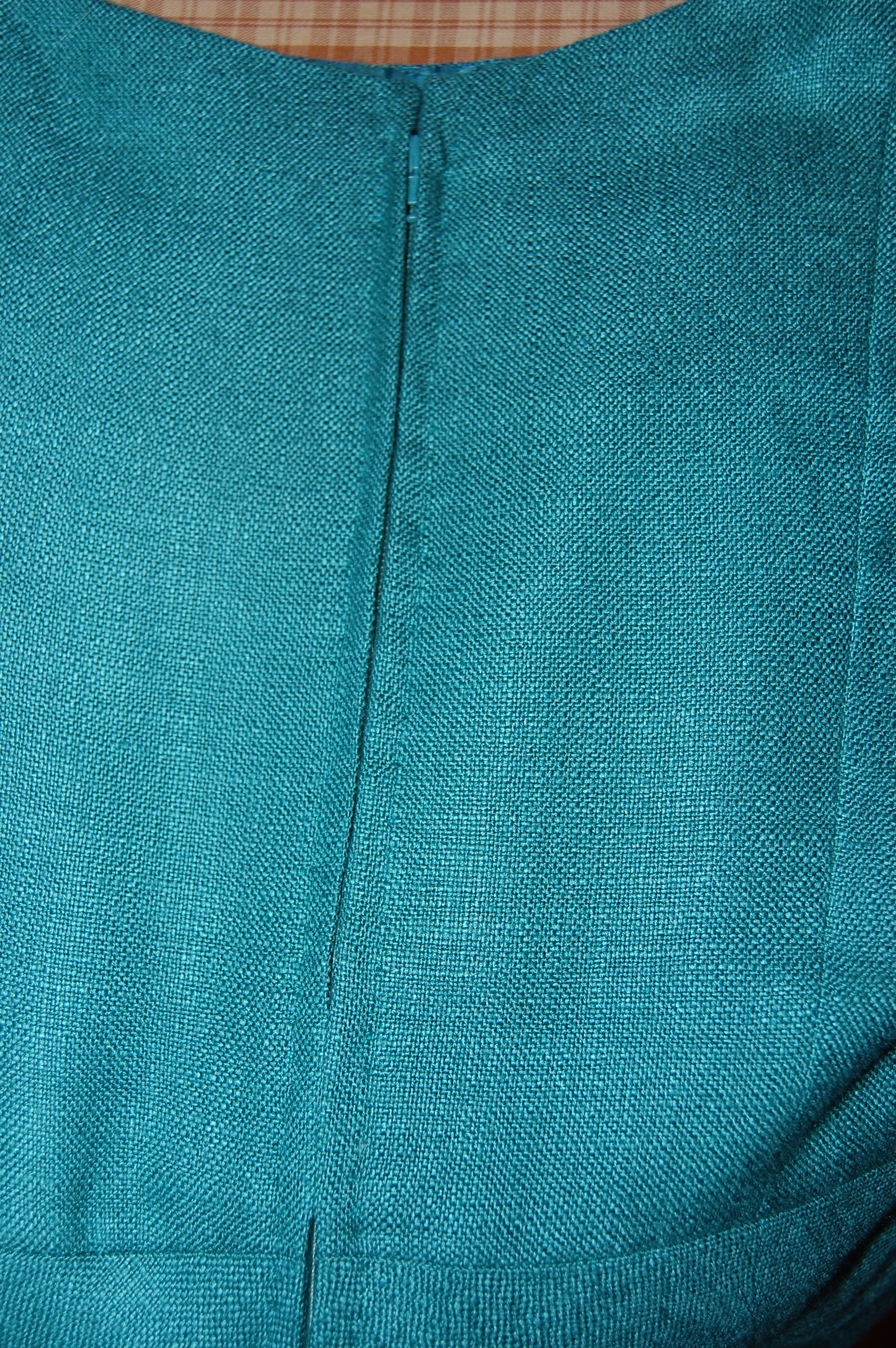
2) The zipper (if you are using one) is a regular zipper (not invisible) which is set in by hand, again using the pick stitch.

The top part of my hand-picked zipper.

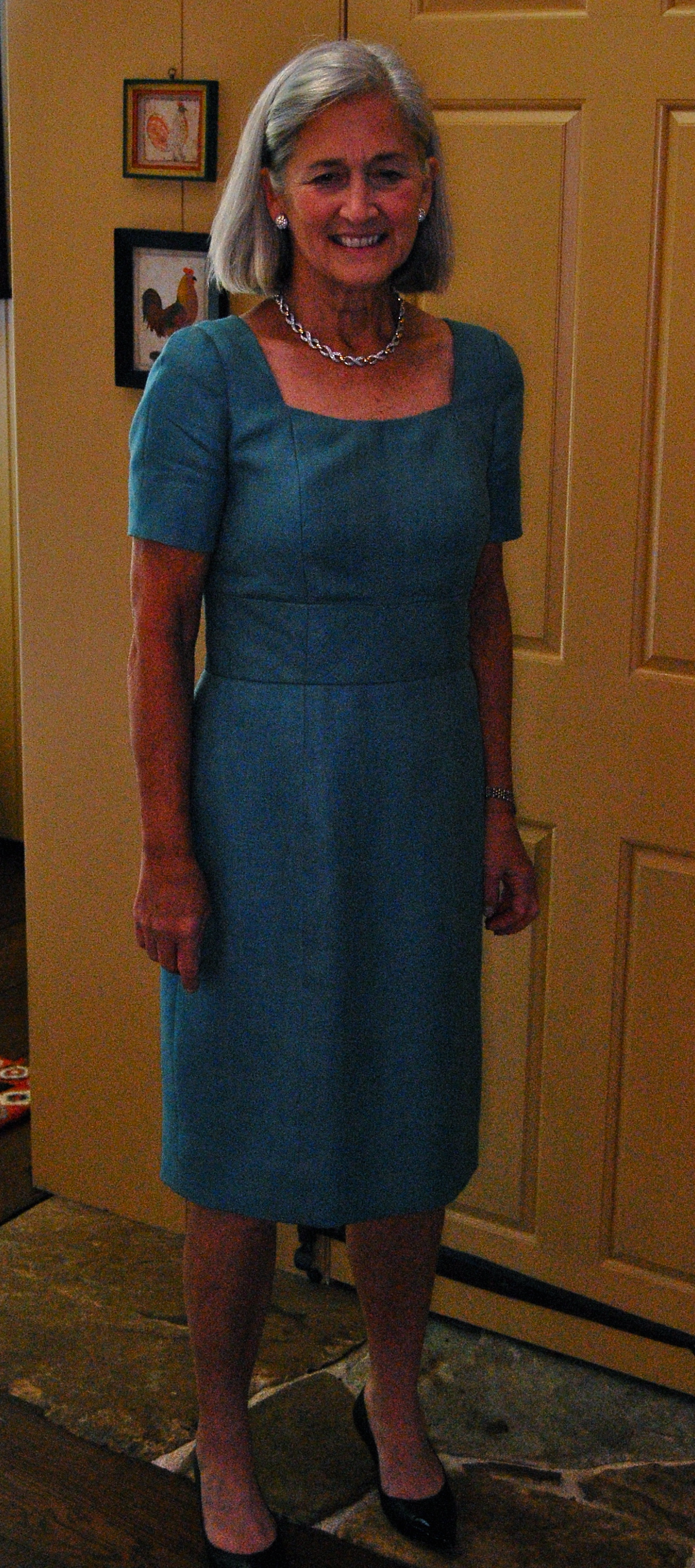
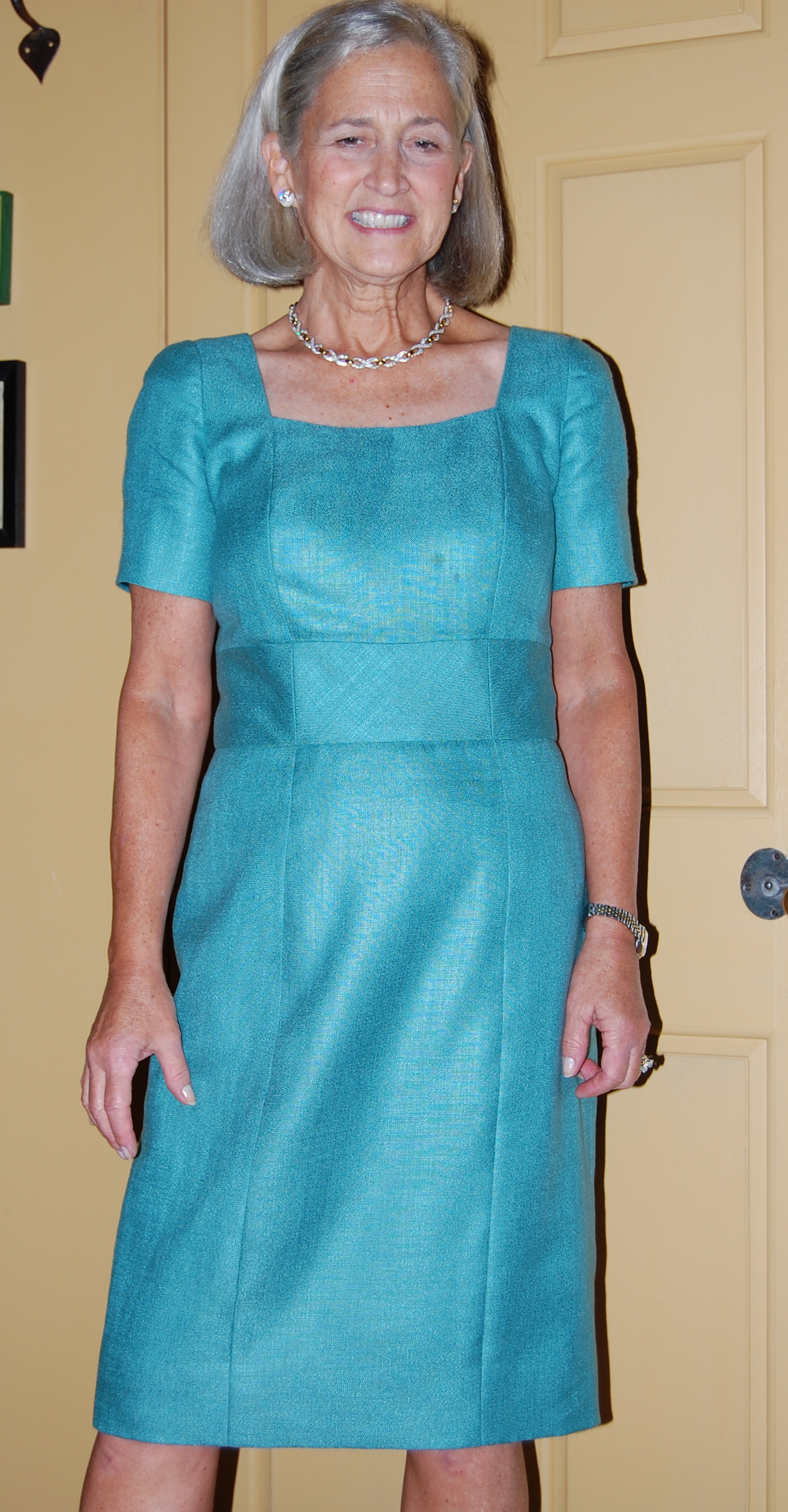
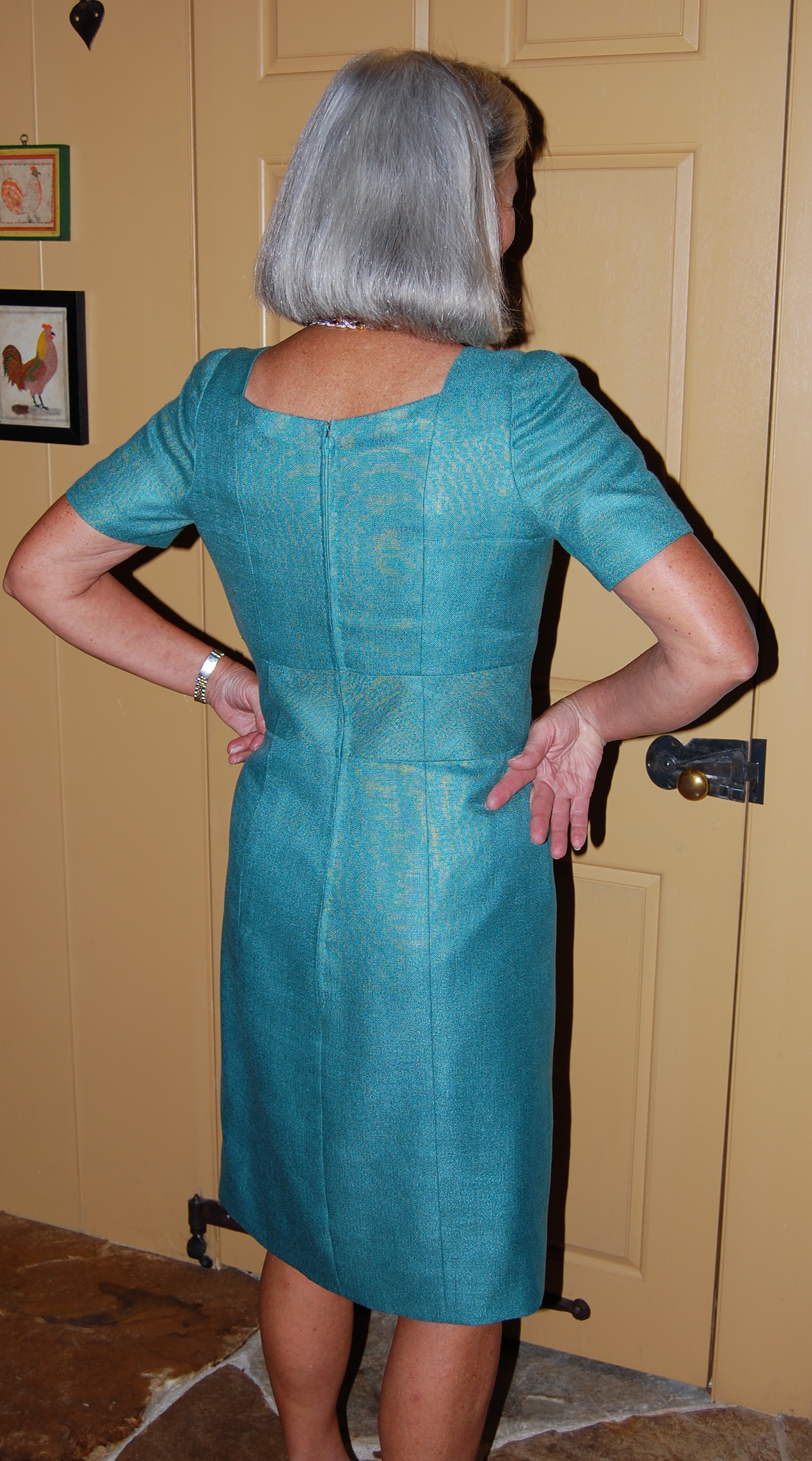
Now that you’ve gotten a few glimpses of my dress inside and out, here it is all finished:

The fabric is a teal green linen; the lining is matching crepe de chine, and the underlining is white silk organza.

Another view…

… and a back view.

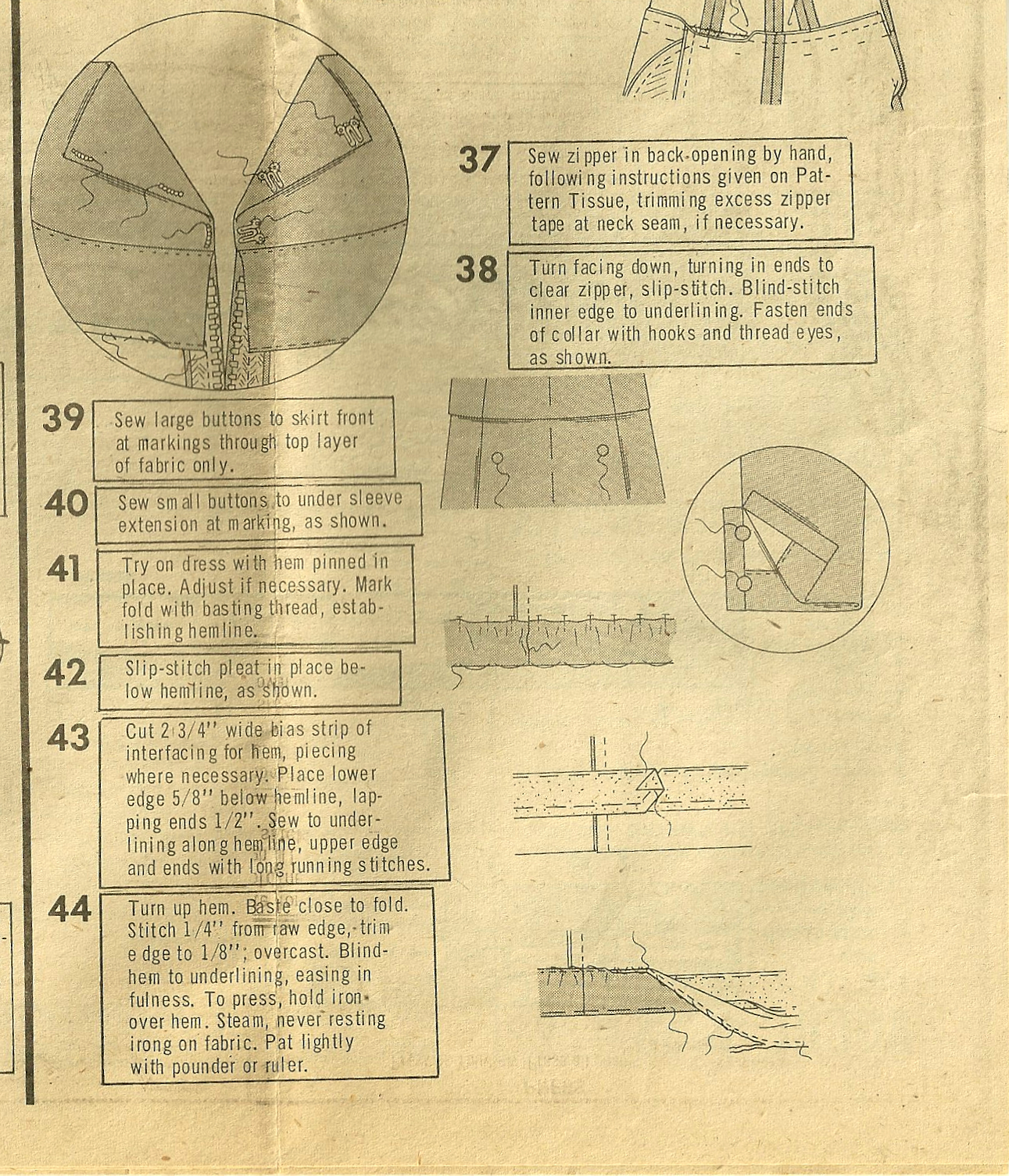
One of the things that appeals to me so much about couture construction is how transferable it is to vintage patterns. In fact, I would go so far as to say that parts of this type of construction are implied in many vintage patterns.  Here is an example from a construction sheet from the early’70s:

The instructions say to sew the zipper in by hand, the hooks and loops are shown in “couture” detail, and the hem treatment is very similar to one I learned in this course. One exception I should note here is that couture does not use facings as shown in the topmost drawing.

Consider for a moment this advantage of using vintage patterns over contemporary ones:  contemporary patterns, which are usually “multi-sized”, are drawn with the cutting line only.  To make one of these patterns usable for couture construction, you must add the stitching line onto the pattern tissue, adding another step in the whole process.  Vintage patterns (except for unprinted ones, of course) have the stitching line drawn on the tissue – ready to be traced onto your muslin fabric (which becomes your ultimate pattern).  All of which brings me to another alliterative phrase  . . .  as I find myself Valuing all the many Virtues of Very Versatile Vintage!

17 Comments

Filed under couture construction, hand-sewn zippers, Linen, sewing in silk, Uncategorized, underlinings, vintage Vogue patterns from the 1970s, Vogue patterns

A Stitch in Time

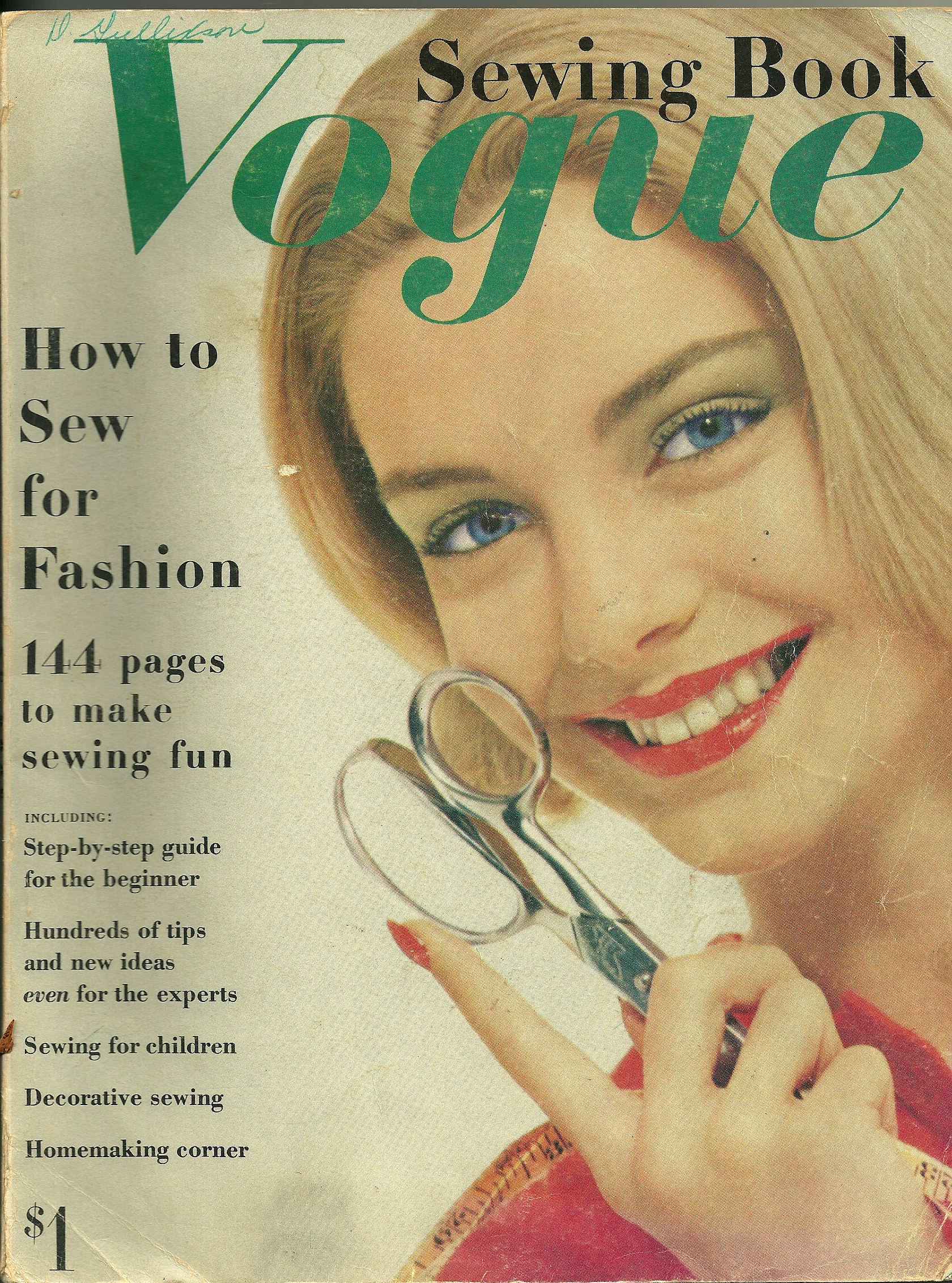
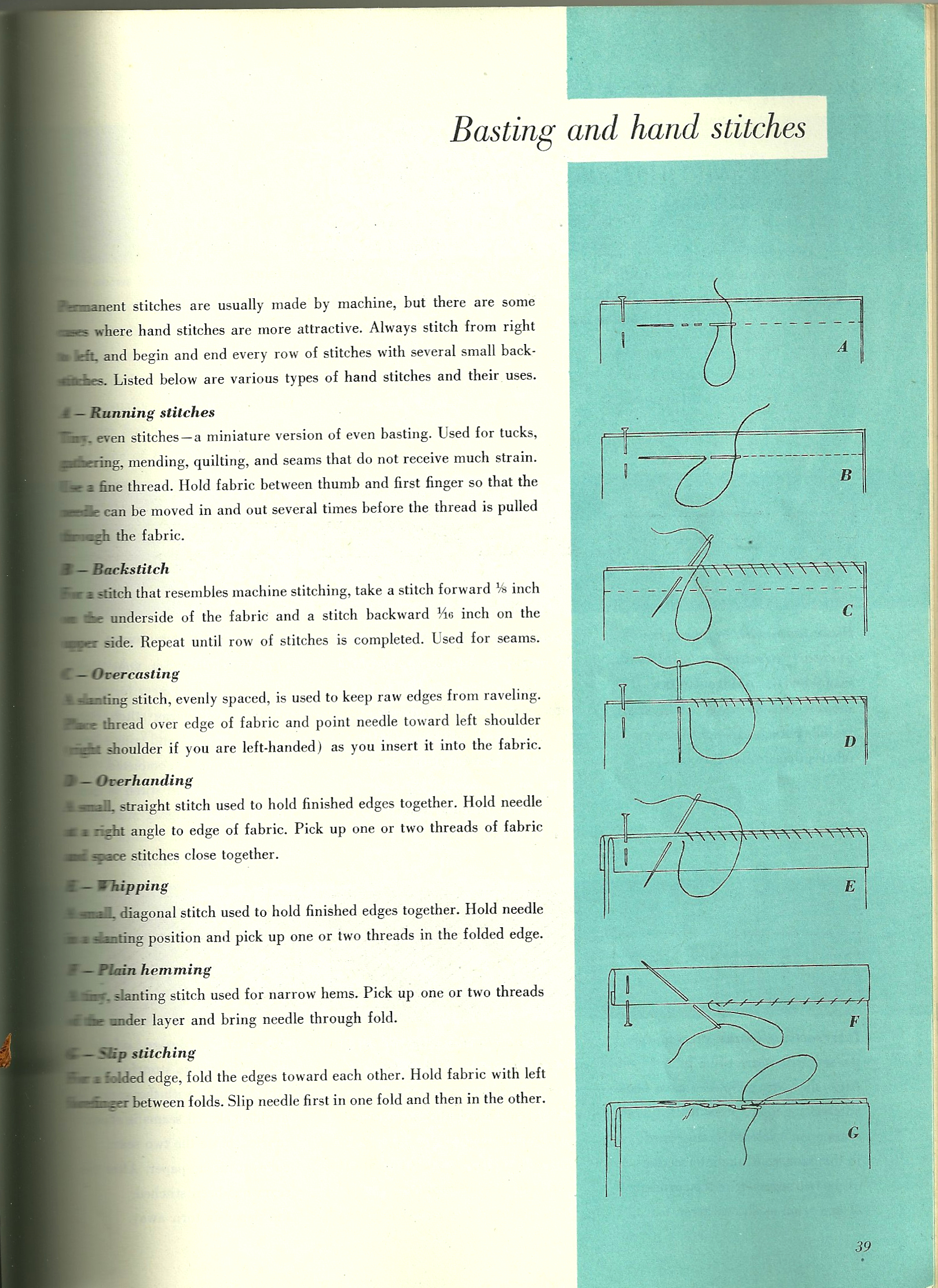
I’ve been doing a lot of hand stitching as I work my way through “The Couture Dress” online class on Craftsy.  It’s mostly been basting (and more basting and even more basting) so far, but I’m now in the “catch-stitch” phase (controlling the raw edges), and that’s always been one of my favorite stitches to do.  All this hand stitching got me thinking about how I learned to do certain stitches – and I think I just taught myself by following directions on pattern instructions and from diagrams in sewing books and magazines.  There were lots of articles on perfecting one’s hand stitches when I was growing up, such as this representative page from Vogue Sewing Book, c1958, The Conde Nast Publications, Inc.:

Sewing in 1958: including tips and new ideas even for the experts!

This is just one page of many detailing stitches and seam finishes.


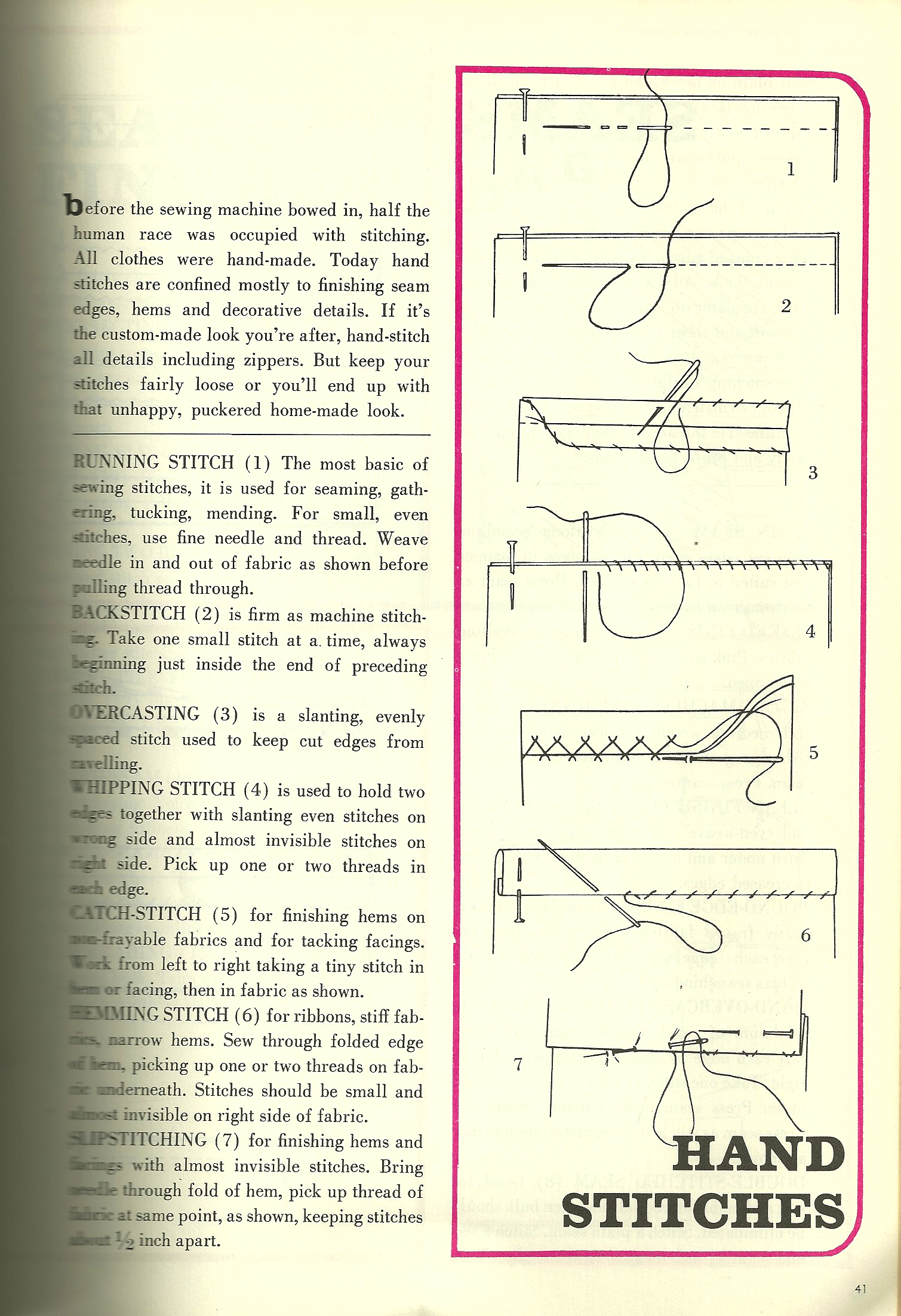
Five years later, another article in Vogue Sewing Book, c1963, The Butterick Company, Inc., featured the same basic stitches.

The introduction to this page gives this advice: “If it’s the custom-look you’re after, hand-stitch all details including zippers. But keep your stitches fairly loose or you’ll end up with that unhappy, puckered home-made look.”

It seems there can never be too much of a good thing, as evidenced by a February/March 2008 article in Threads magazine, by Kenneth D. King, entitled “Master the Hand Stitch: Learn the fine, invisible stitches that are the hallmarks of couture sewing.” This article is especially informative, with photographs and expert tips, all of which serve the modern amateur dressmaker so well.

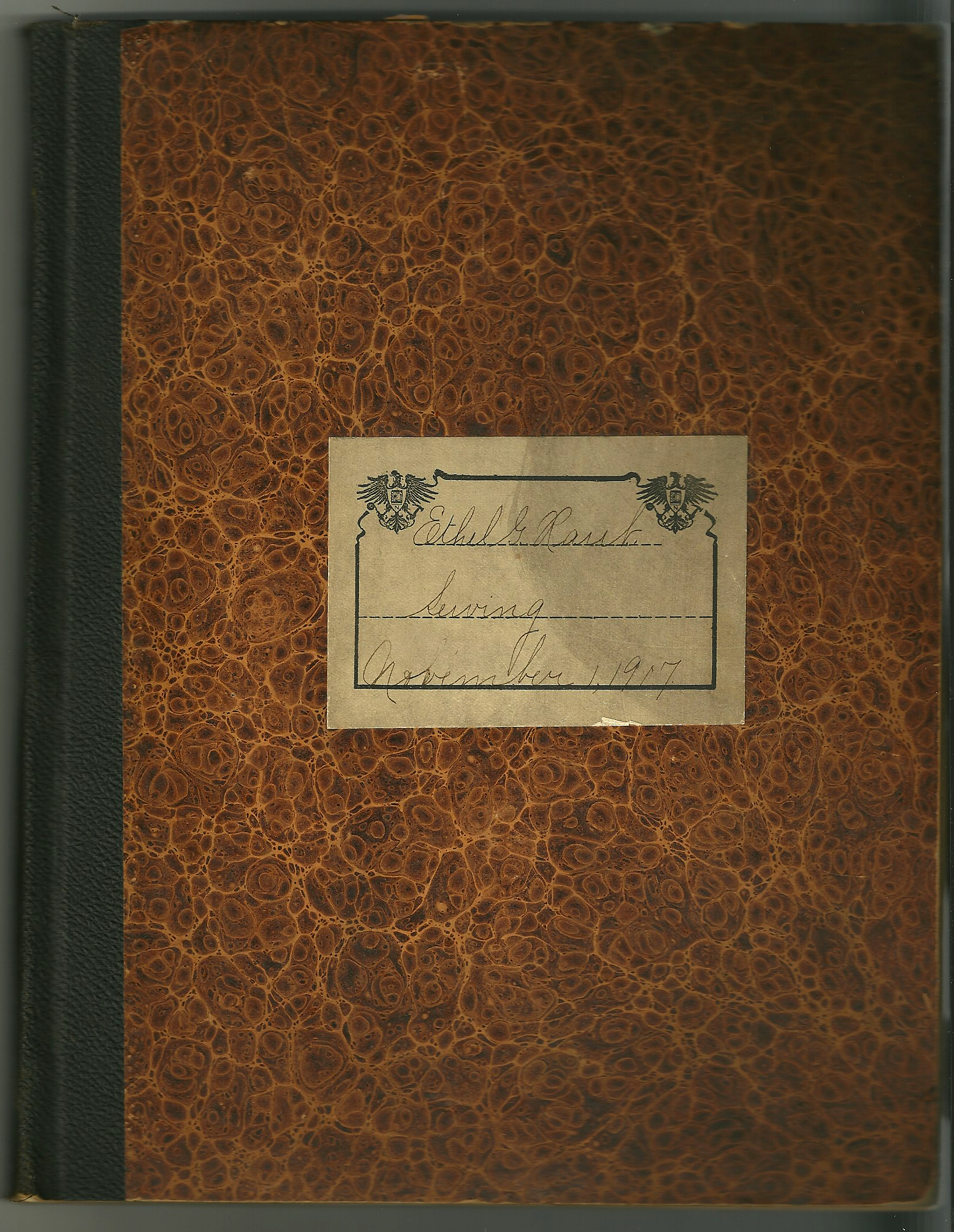
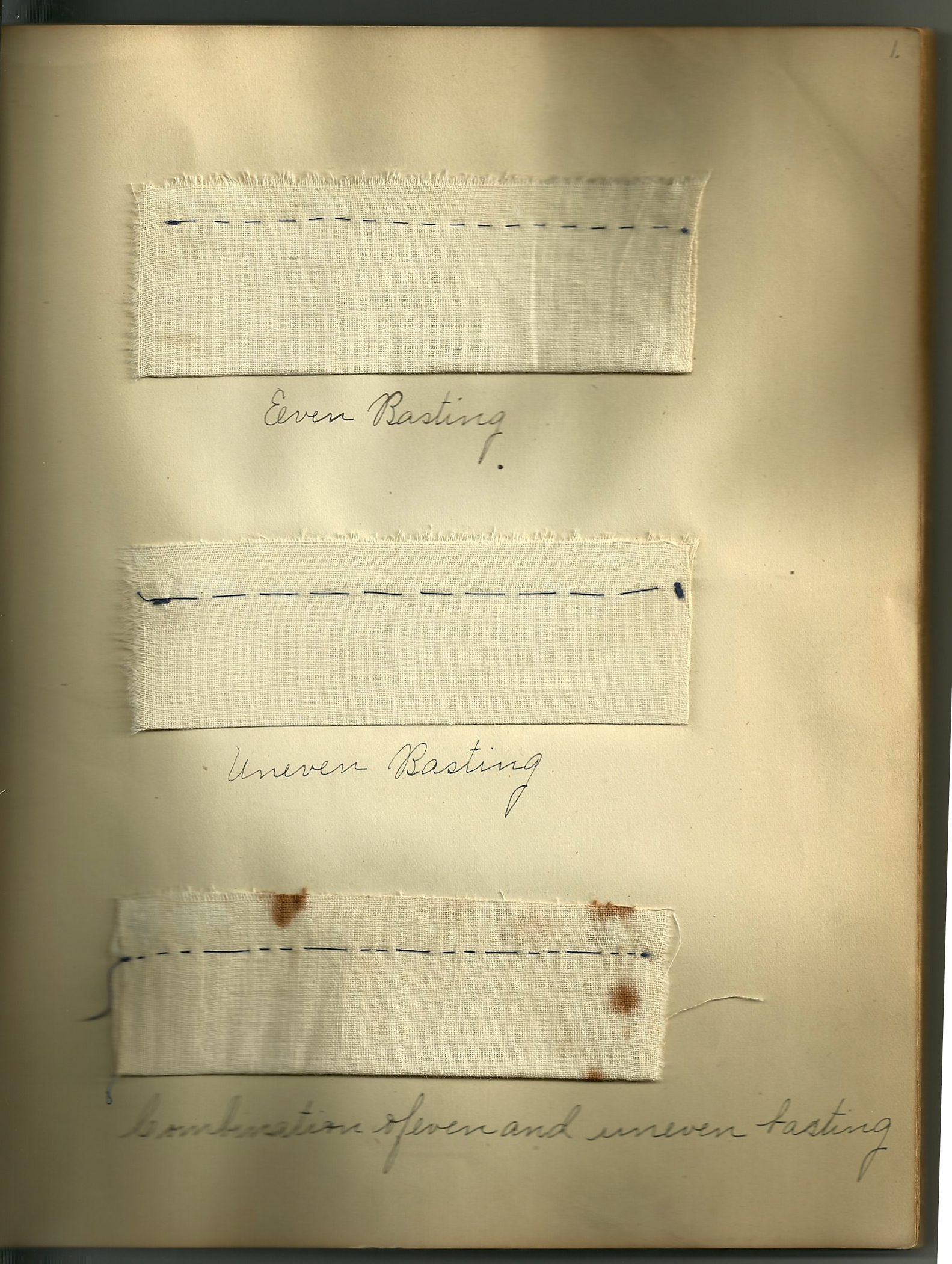
So – how did our grandmothers and great-grandmothers learn the stitches and sewing techniques that are so readily available to us?  Many of them made their own sewing/stitching “example” books in “finishing school”.  My husband’s grandmother was one such young woman.  I am so fortunate that her “Sewing” book, dated November 1, 1907, is in my possession now.  She would have been fourteen years old in late 1907.

There is a label inside the book which tells me that she purchased this book of blank pages at L. B. Herr, Bookseller, Lancaster, PA.

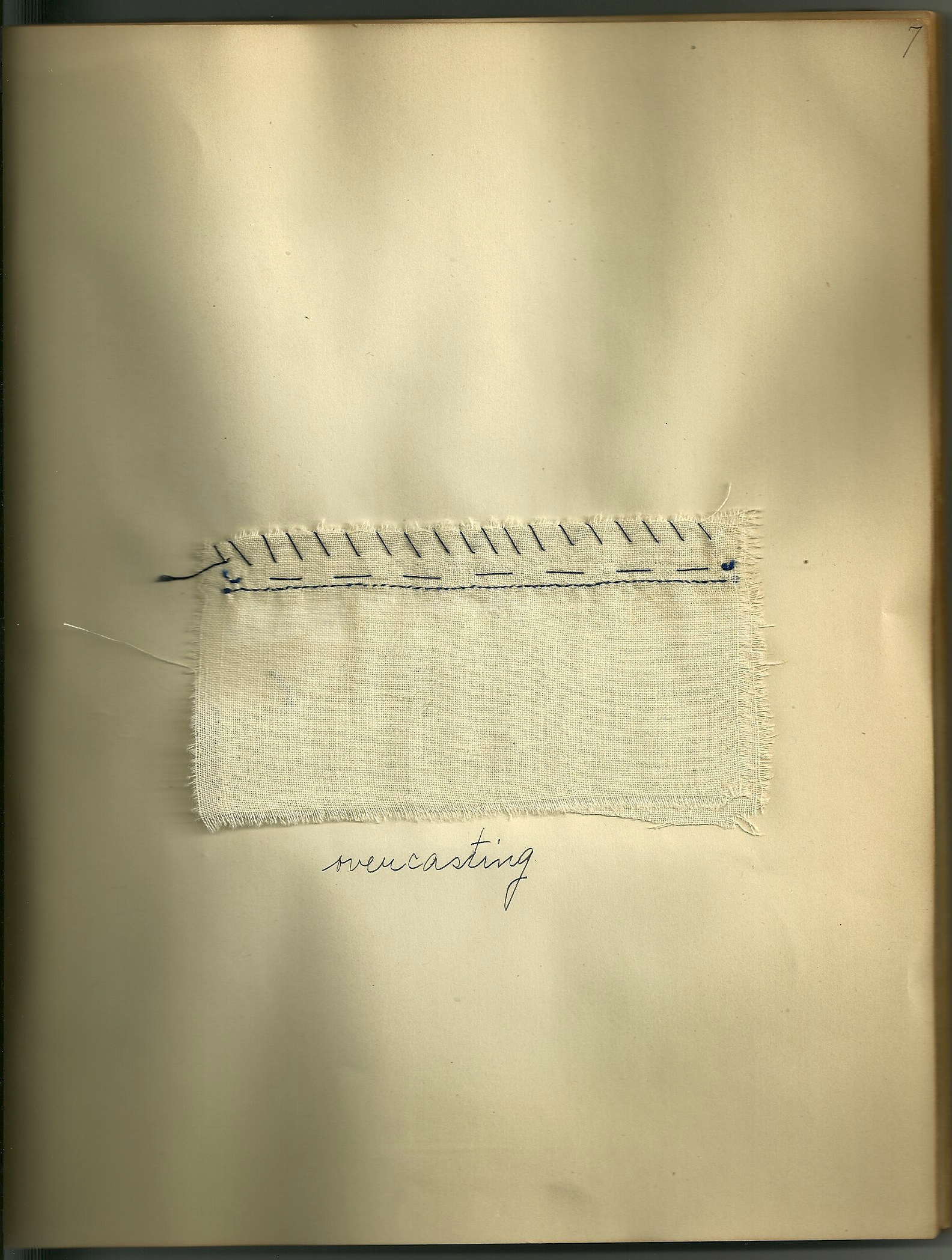
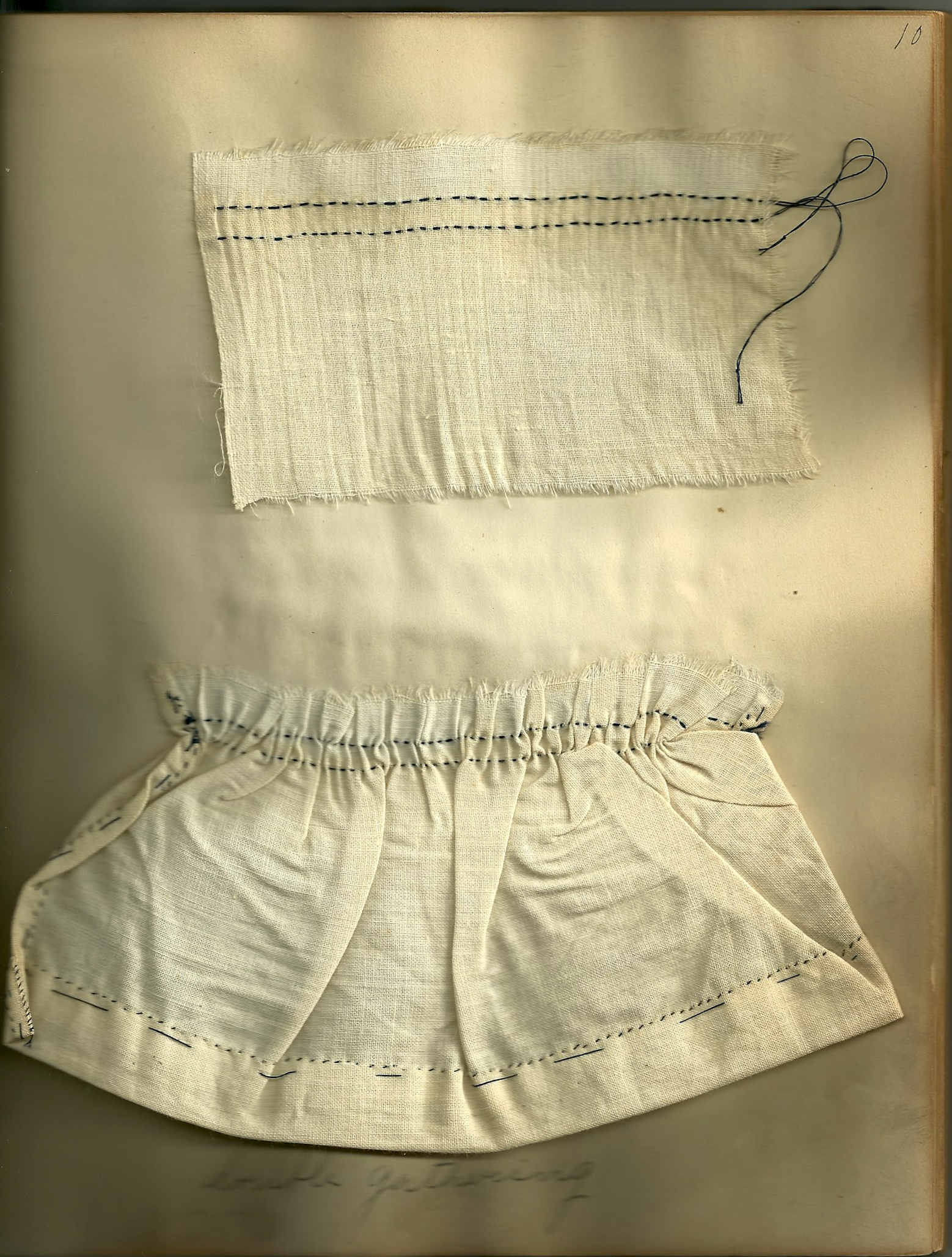
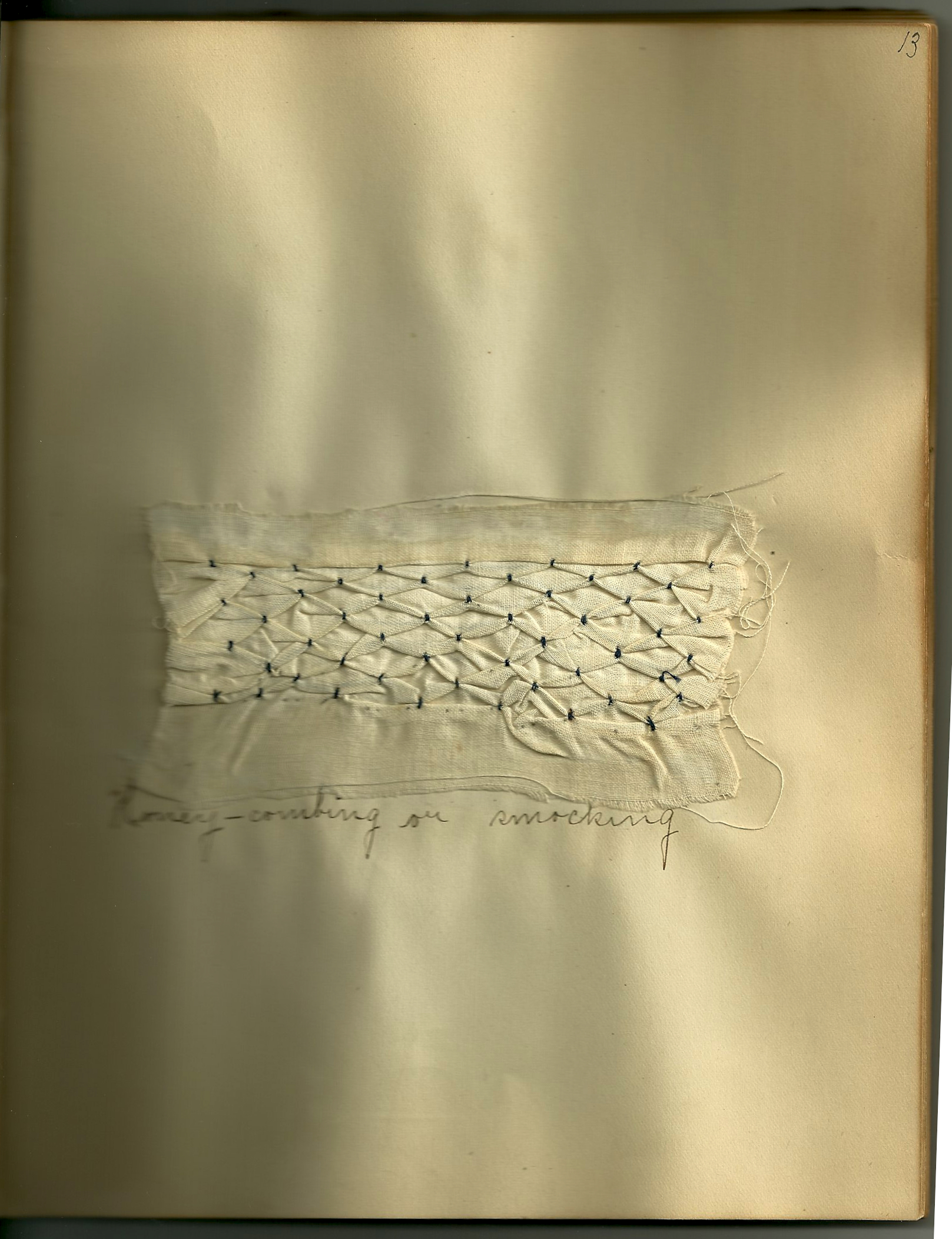
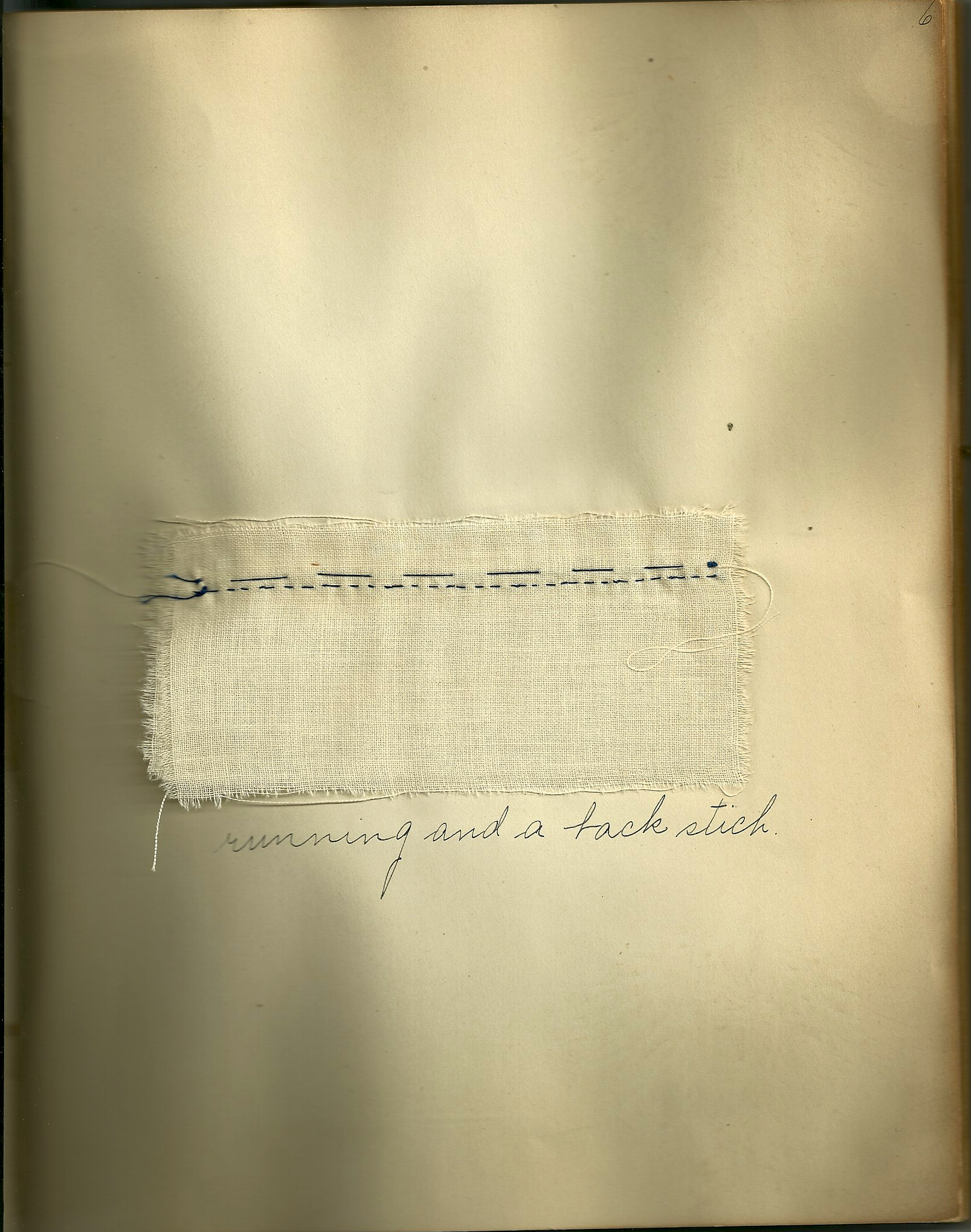
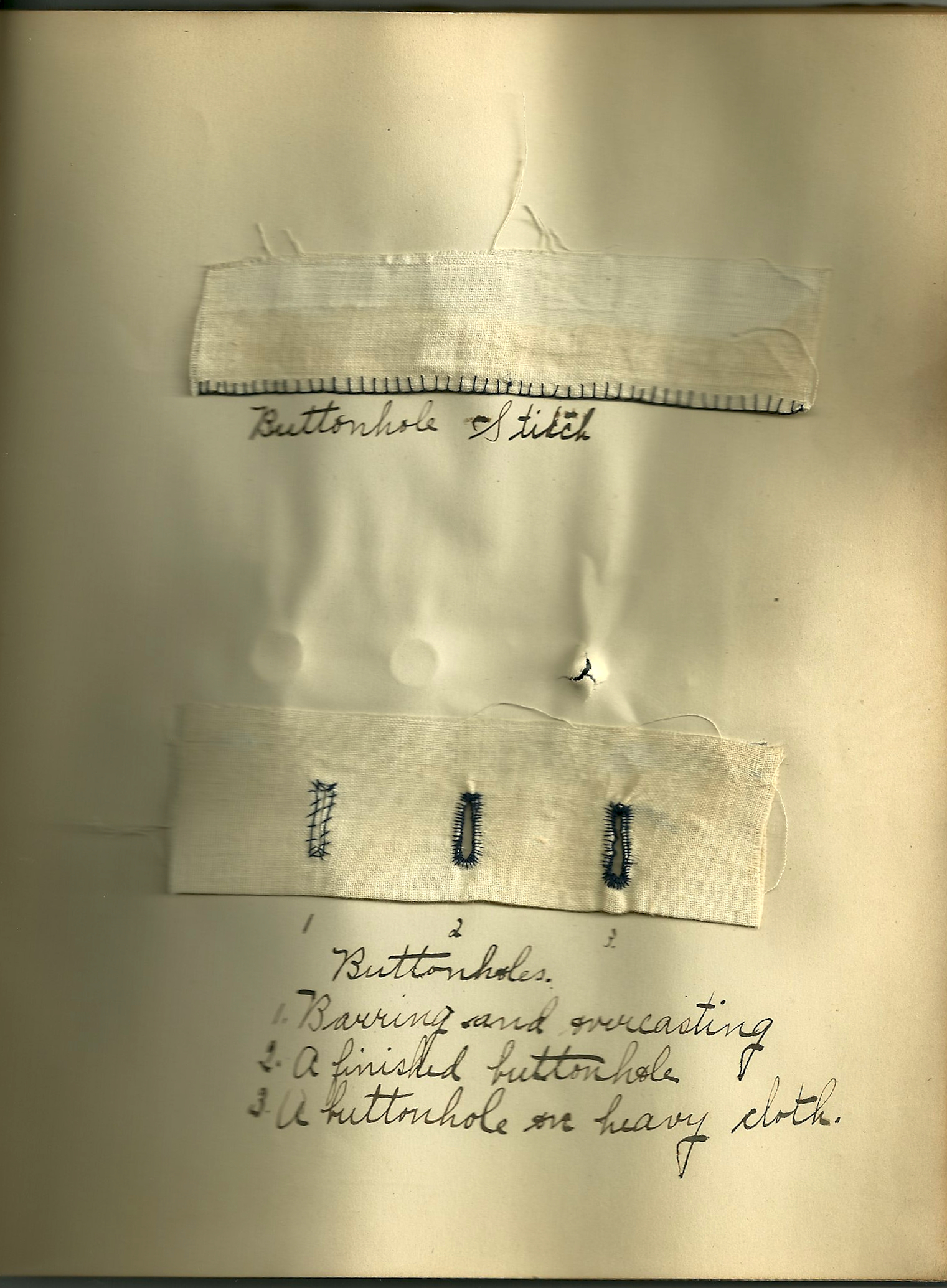
Ethel filled her book with 35 pages of examples of stitches, types of seams, and sewing techniques. Every example was made by her, with a brief description in her handwriting.   Here are a few pages from her remarkable book (click on the photos to see them up close).

Some of the stitches represented are:

Basting stitches – three kinds!

Overcasting.

Running and a back stitch – notice that she spells it “stich”.

All buttonholes were made by hand in 1907 – and Ethel had to learn how to make them as well.  She finally spelled “stitch” correctly – although it looks like it was struggle!

She has examples of many types of seams:

Here is a gathered seam.

And numerous sewing techniques:

Here is Ethel’s example of Honey-combing or smocking.

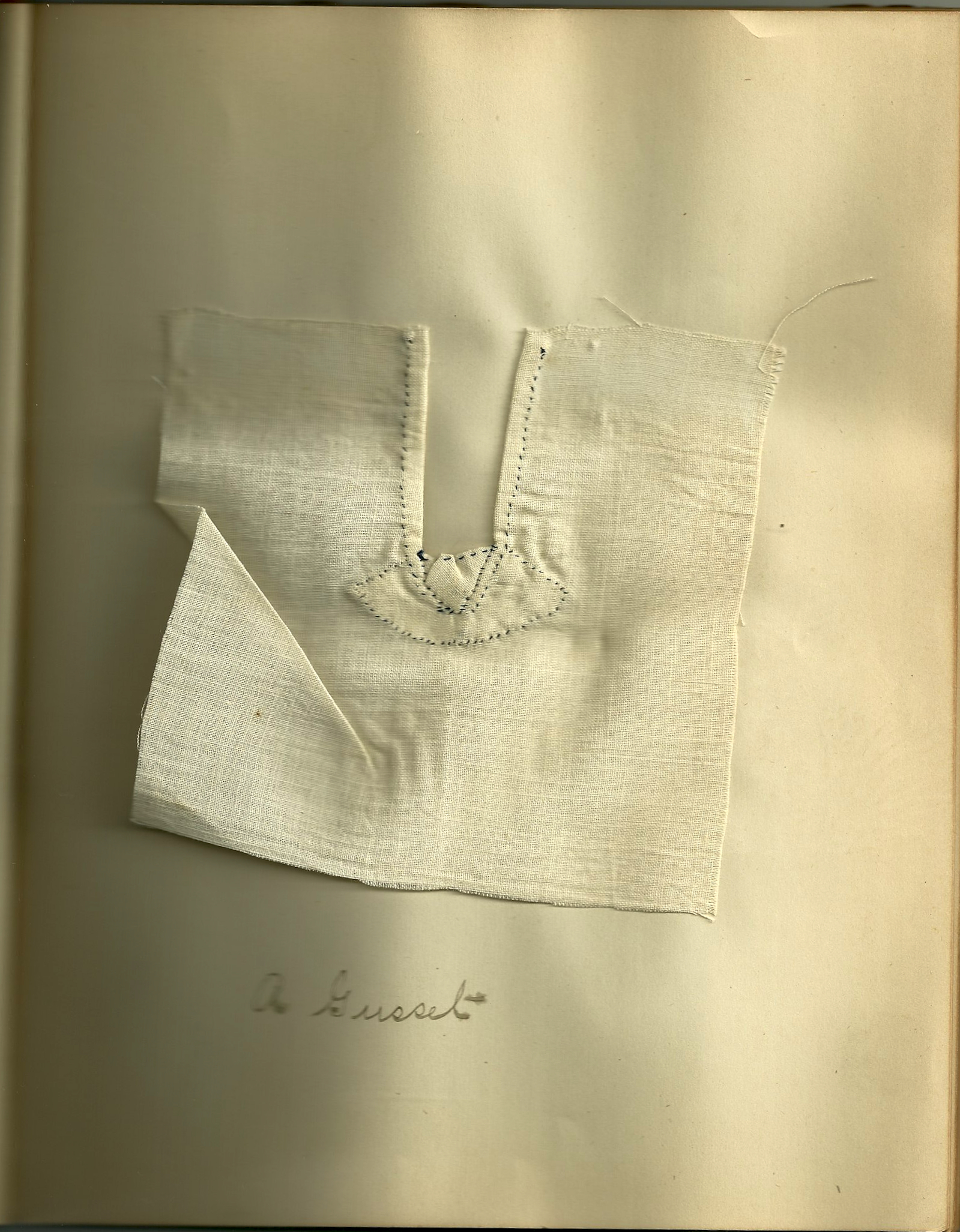
She even learned how to make a gusset!

Although Ethel died before I had the opportunity to meet her, I understand that she was not a particularly great fan of sewing, but nevertheless, she thought enough of her sewing book to save it.  In learning her “stiches”, she was quite clearly carrying on a tradition that generations before her had also done.   Consider this quote from Catherine  E. Beecher’s A Treatise on Domestic Economy, 1843:  “Every young girl should be taught to do the following kinds of stitch, with propriety [my emphasis]. Overstitch, hemming, running, felling, stitching, back-stitch and run, button-stitch, chain-stitch, whipping, darning, gathering and cross-stitch.”

Although I know not every young girl now would be interested in learning such things – I suspect there are lots who would proudly make their own “sewing” book if given the opportunity.  (Maybe without the darning stitch – does anybody darn anymore?)

One interesting omission in Ethel’s book:  that catch stitch I like to do so much.

Here is one of my seams in my “couture dress” with the seams properly catch-stitched!

No matter what stitch you are doing – may it  look happy, unpuckered and definitely not home-made!

16 Comments

Filed under The Conde Nast Publications, Uncategorized, underlinings

Chance of Sprinkles

Whatever possessed me to decide to make a coat during this hot, hot Summer?

Actually, I have a (somewhat logical) answer to that question!  For starters, it’s a raincoat.   And how I came to sew a raincoat is a good example of what keeps the wheels in my head turning!

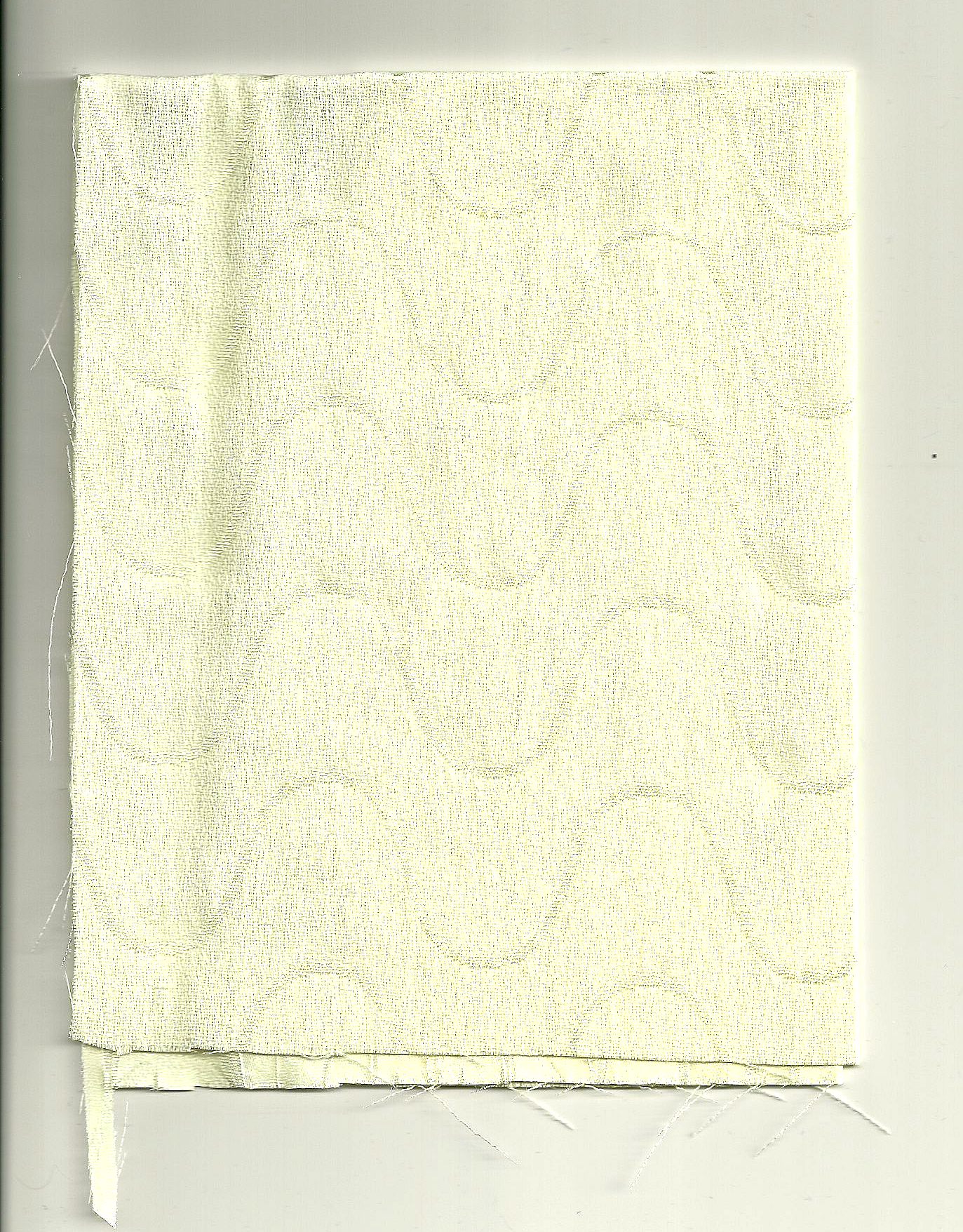
While perusing the website for Britex Fabrics last Summer, I came across its offerings of rainwear fabrics.  Just out of curiosity, I took a look at them, and I was immediately smitten with the “French Winter White Water-Resistant Rainwear Fabric”.

The woven “wave” design in this fabric really caught my attention.

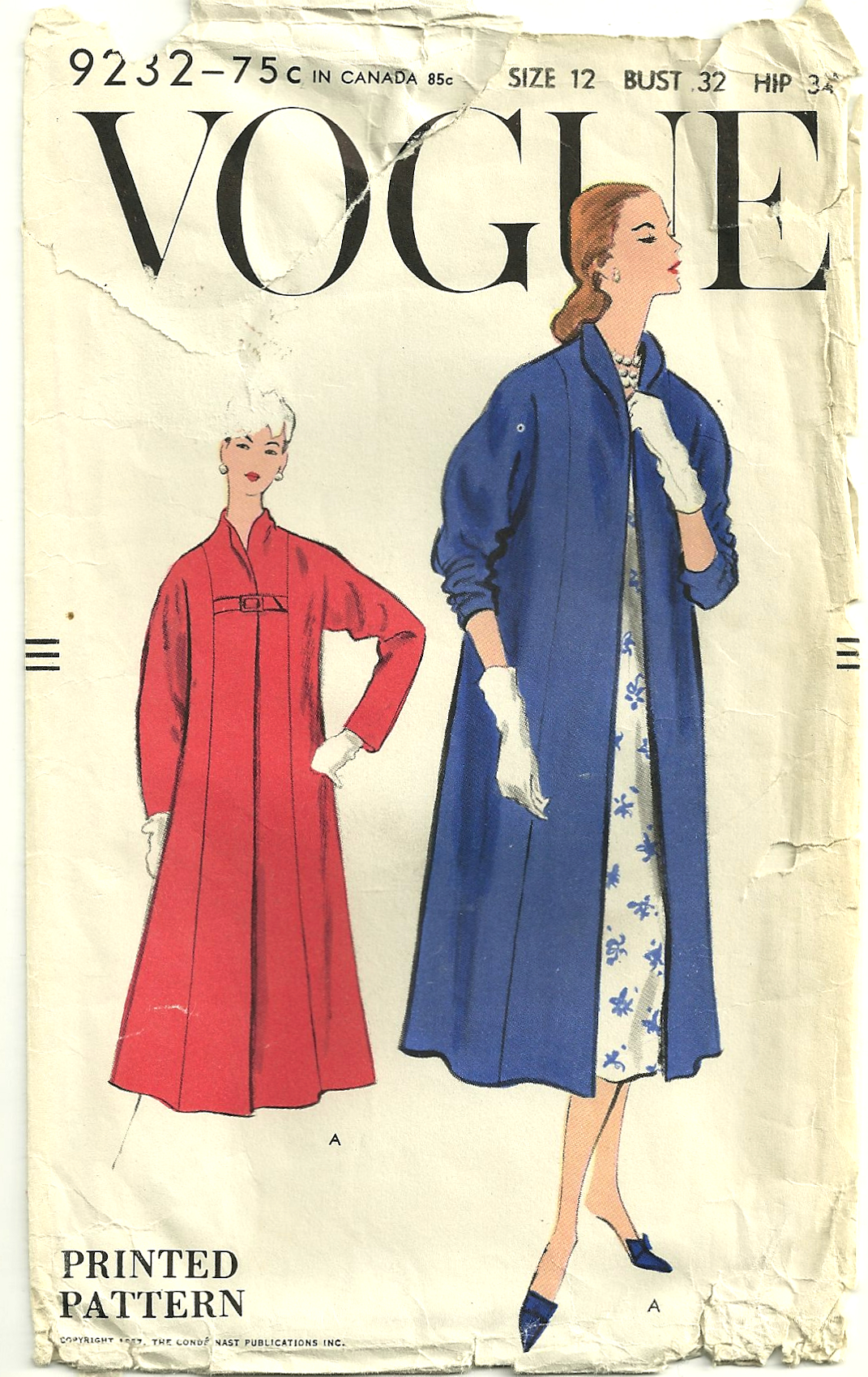
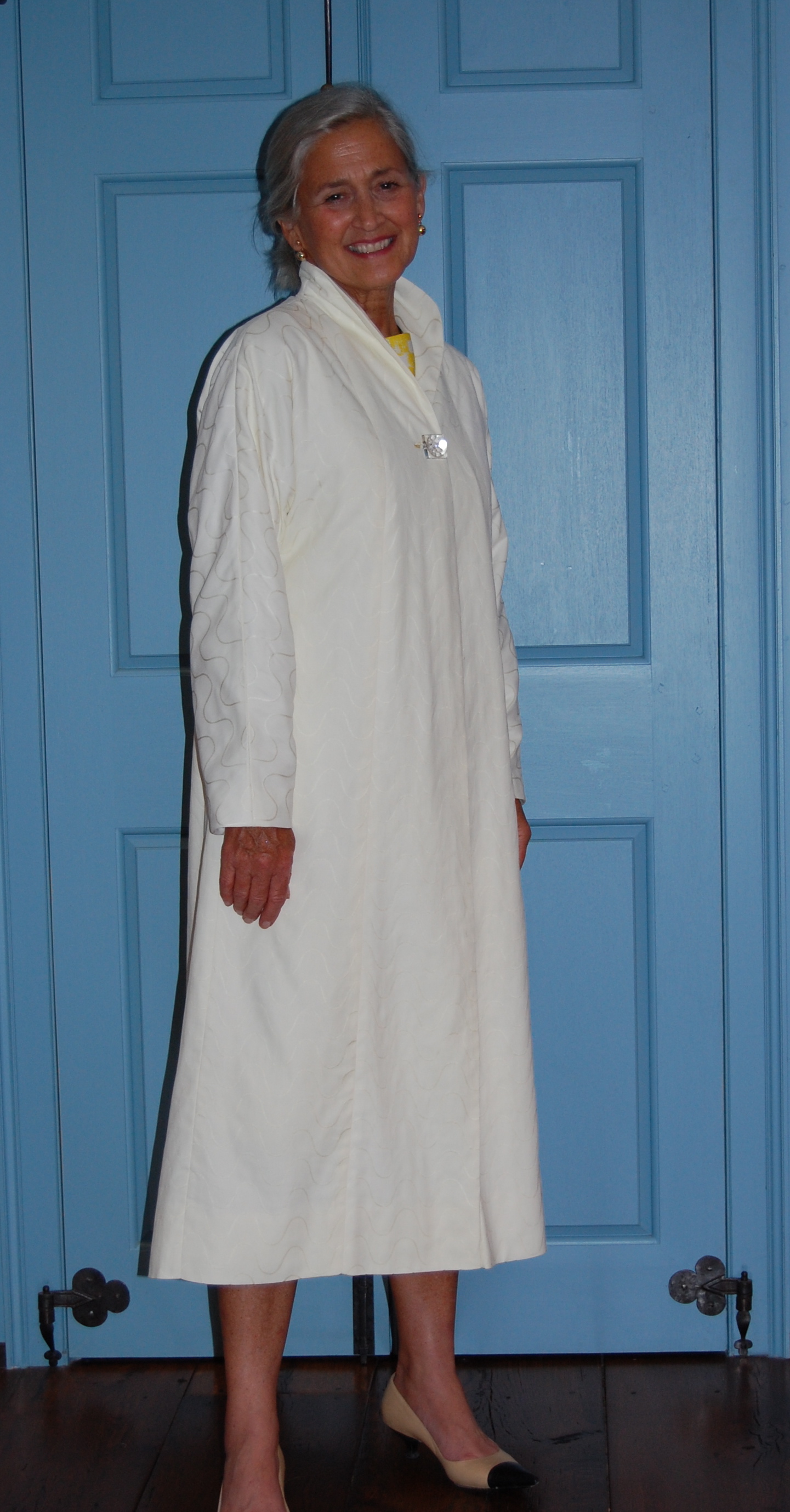
I sent off for a swatch, which confirmed for me the graceful woven design and lovely creamy color inherent in this fabric.  A subsequent trip to California gave me the opportunity to see the fabric in person, and I decided it was time to “commit”!  I had frequently felt the need for a “dressy” raincoat, so I thought, “Why not make one?”  I also knew I had the perfect pattern  – this “swing” coat design from 1957.

I remember swing coats from my childhood – and now I have one!

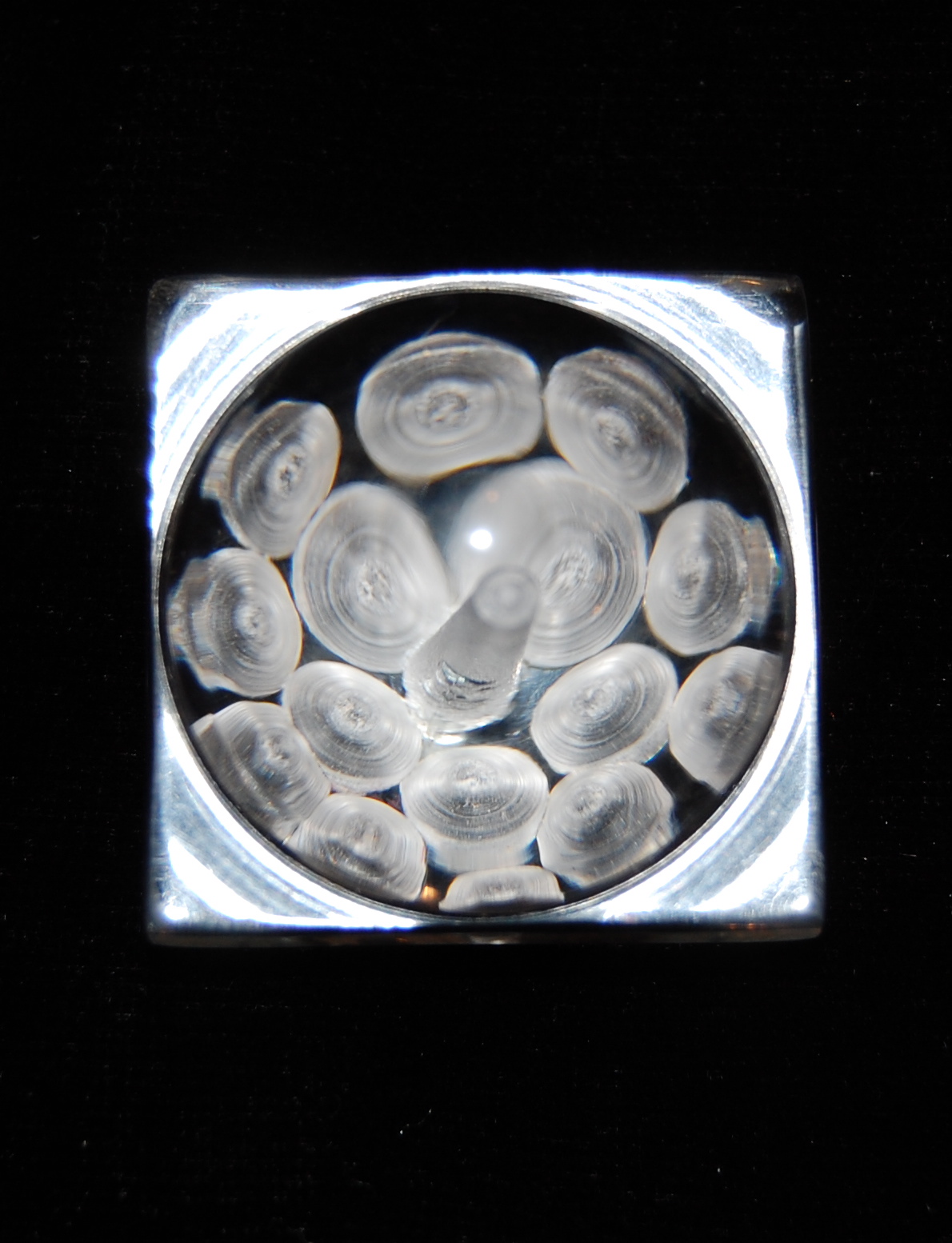
I figured the kimono sleeves and the loose fit would be great for wearing over  dresses or suits, and the collar can be worn turned up or folded down, depending on the inclement conditions!  Well, it only took a year to get to it, which I decided was long enough.  Oh yes –  I had one more incentive to “get to it”. When my friend, Nancy C. opened up her family’s button box for me to pick out some treasures, I spied this beautiful single glass button:

I placed this button on a piece of black velvet so that the design would show up. It is a little more than an inch square in size.

The design in it reminded me of raindrops – perfect for a dressy raincoat, and, I thought, a perfect complement to the fabric, already in my possession.

Of course, every pattern and project seems to demand certain changes or adaptations, and the count for this one stands at four:

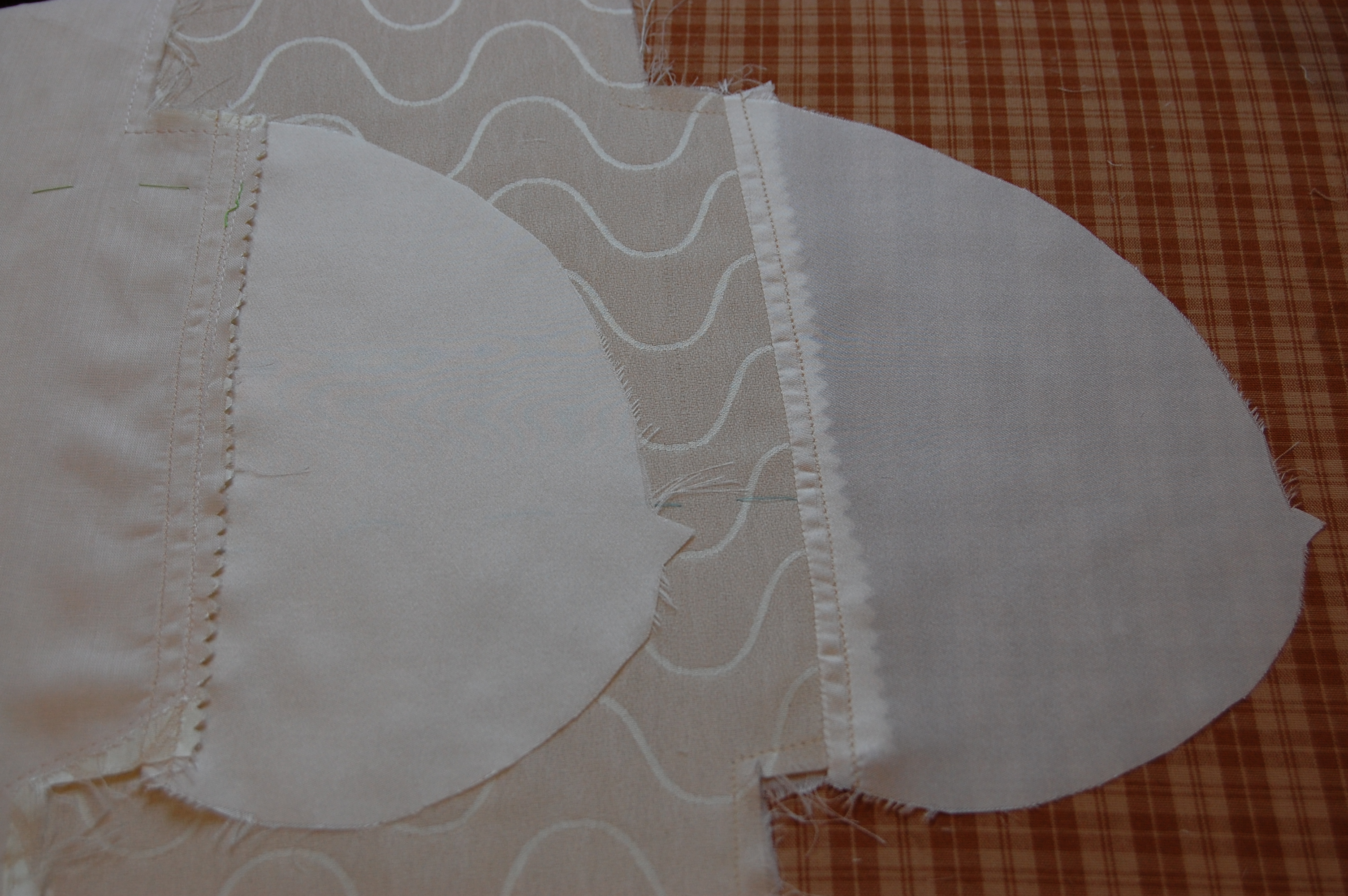
1)   I took a little fullness out of the front side panels.  When I made a muslin mock-up of the pattern, it just seemed a little too full for my frame.

2)   I added pockets to the side seams.  I can’t imagine any coat without pockets, but a lot of the vintage styles (dresses and coats) did not have them.

Here is one of the pockets under construction.

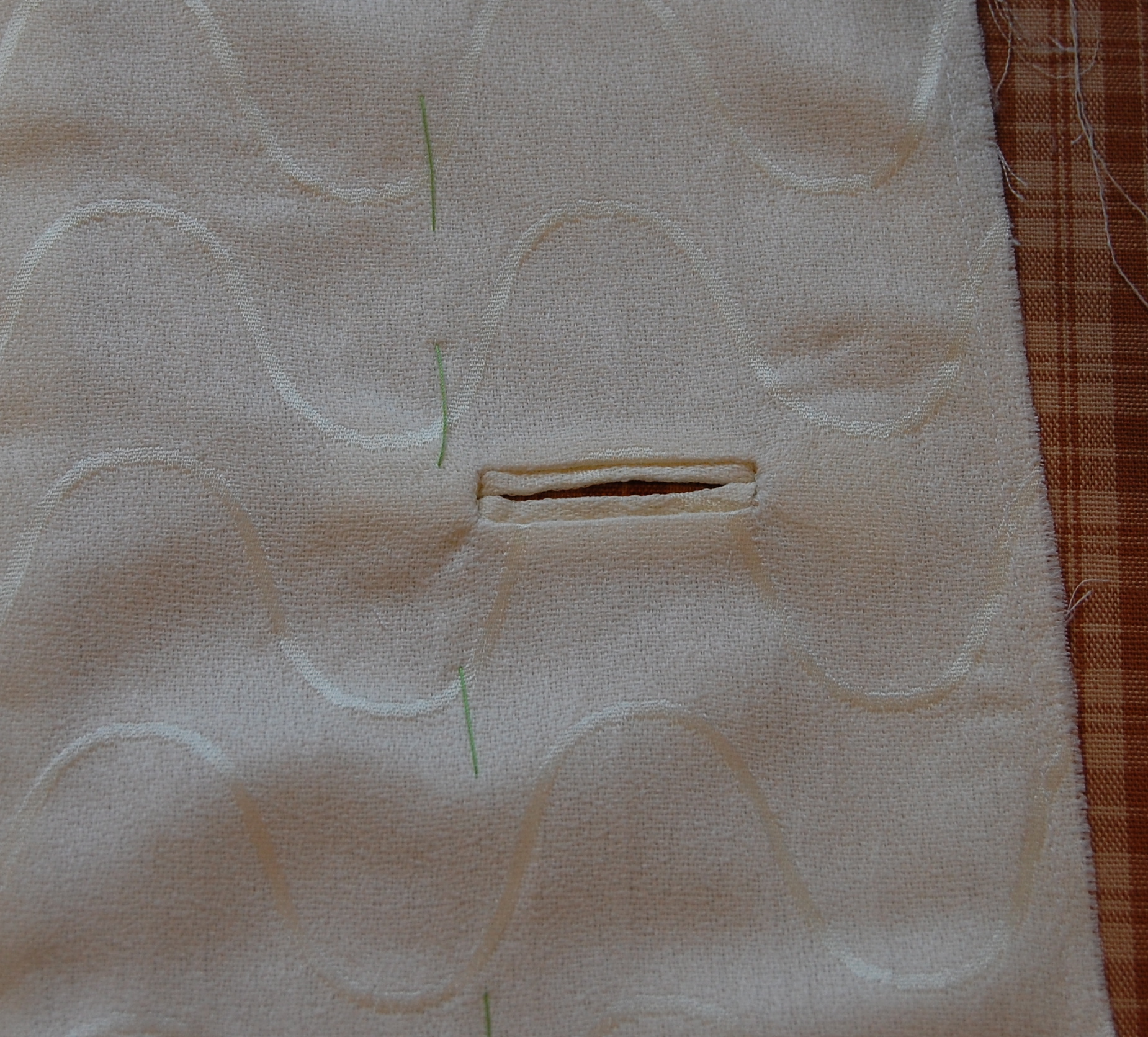
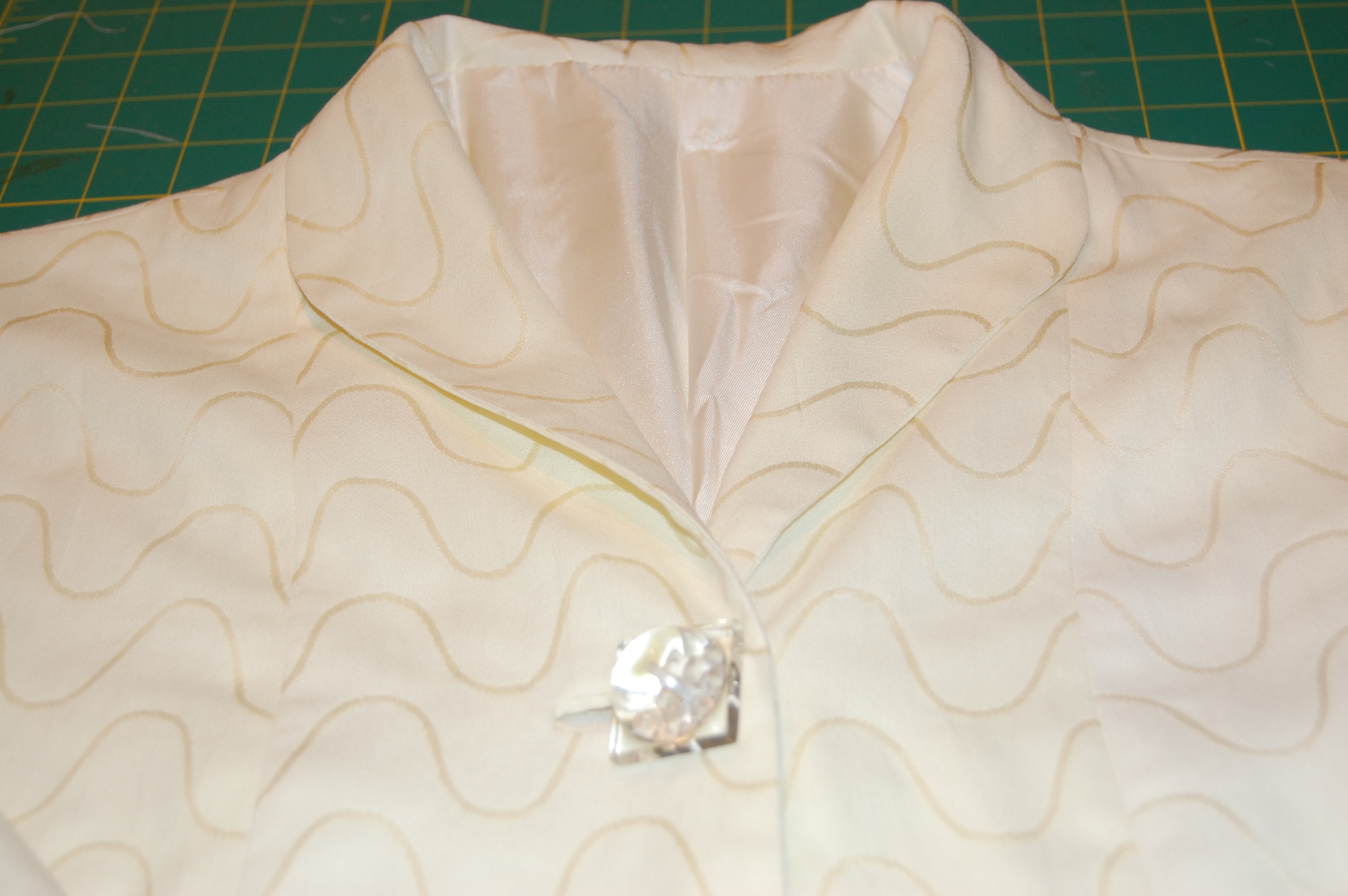
3)   Because I wanted to use the glass button, I decided to put in a bound buttonhole instead of using the buckle and band detail as shown on the pattern. (I did make and attach the back belt, however.)

Here is the bound buttonhole placed in the front right section – before the facing is attached.

Here you can see the button and finished buttonhole. Click on the photo to see it in detail.

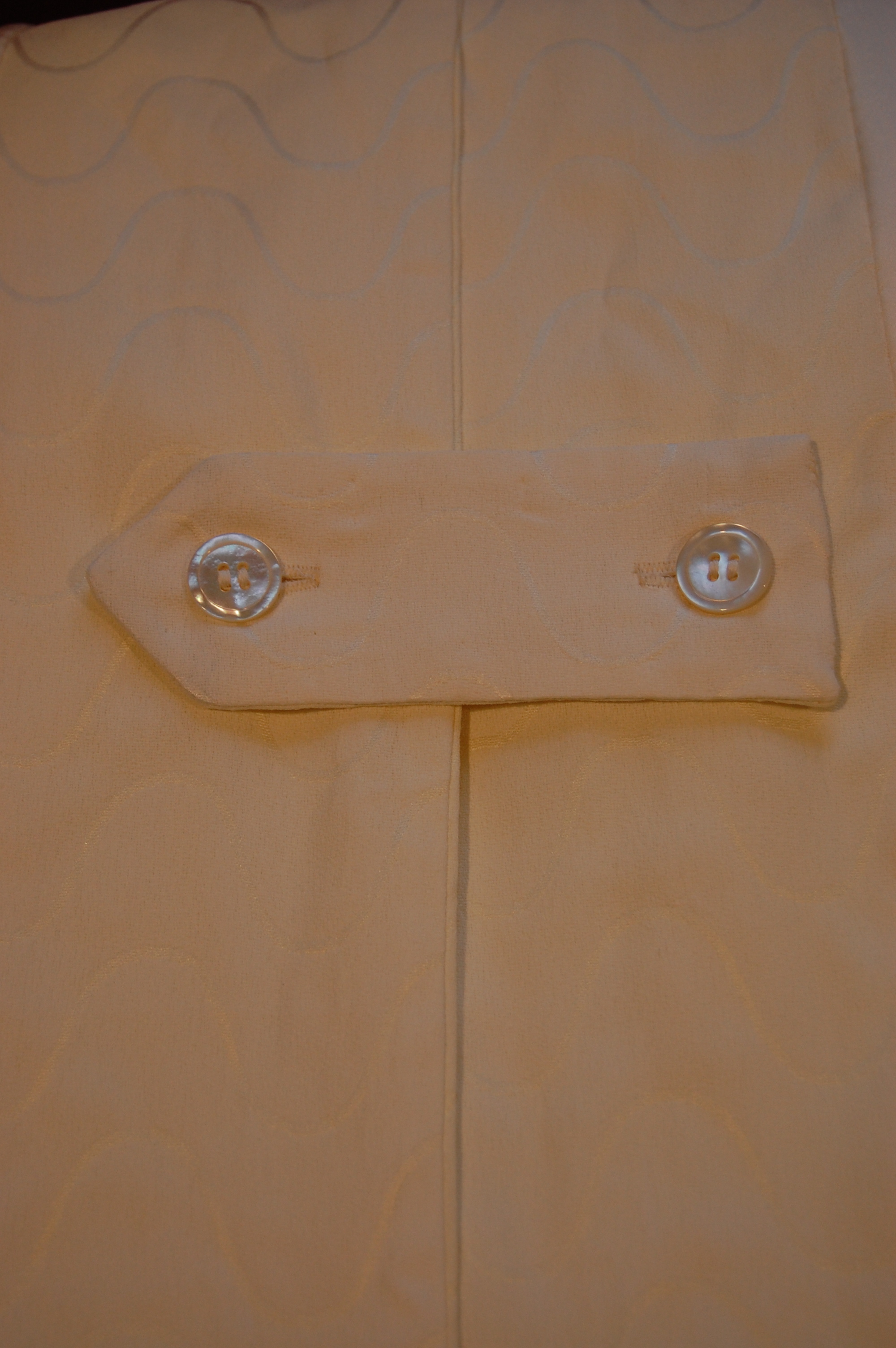
4)   With just a single closure at the top of the coat, I thought I needed something lower on the coat as well, to keep it closed in windy, rainy conditions. However, I didn’t want to interfere with the look of the coat when I might be wearing it open.  Here’s what I came up with:

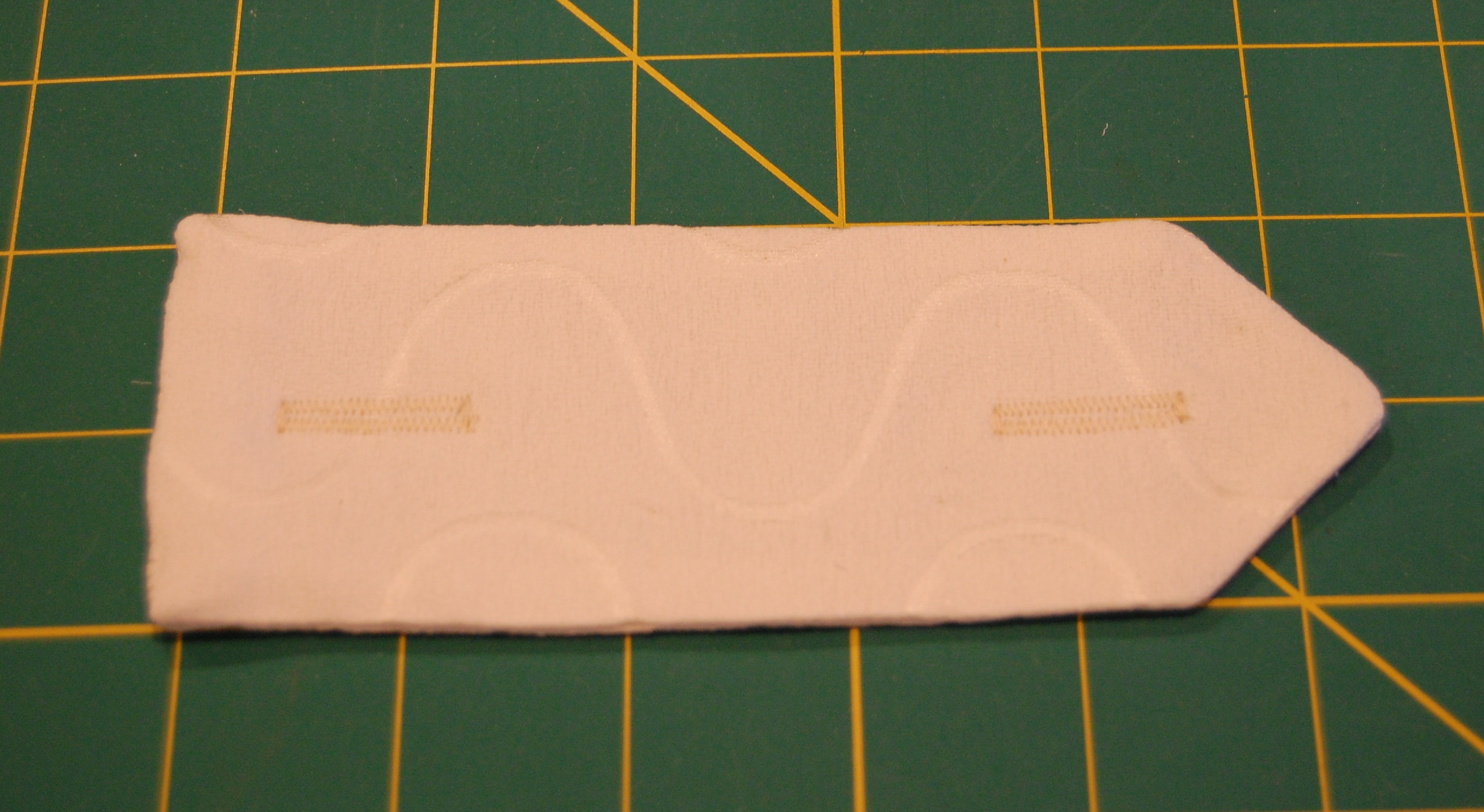
I made a “tab” with buttonholes on each end.

I made machine buttonholes in the tab.

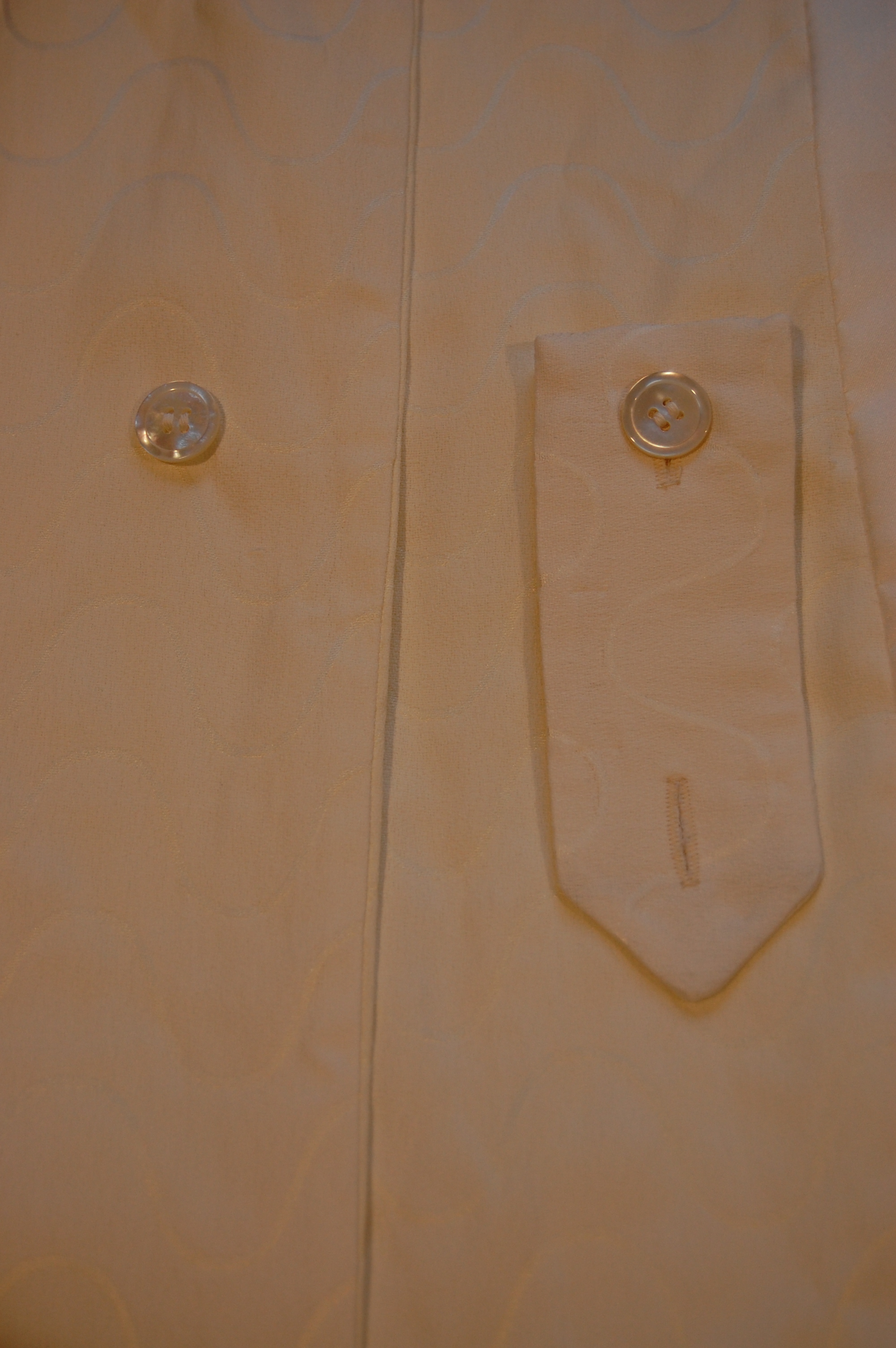
I placed the buttons for it on the inside facings on either side of the coat, about halfway between my waist and  my hips.  It can easily be buttoned to secure the coat, and when I unbutton the left side, the button on the right side allows it to fall down, hidden from view, but easily accessible.

This shows the inside of the coat, with the tab buttoned.

And this shows the tab unbuttoned on one side and hanging down, out of sight – inside the coat.

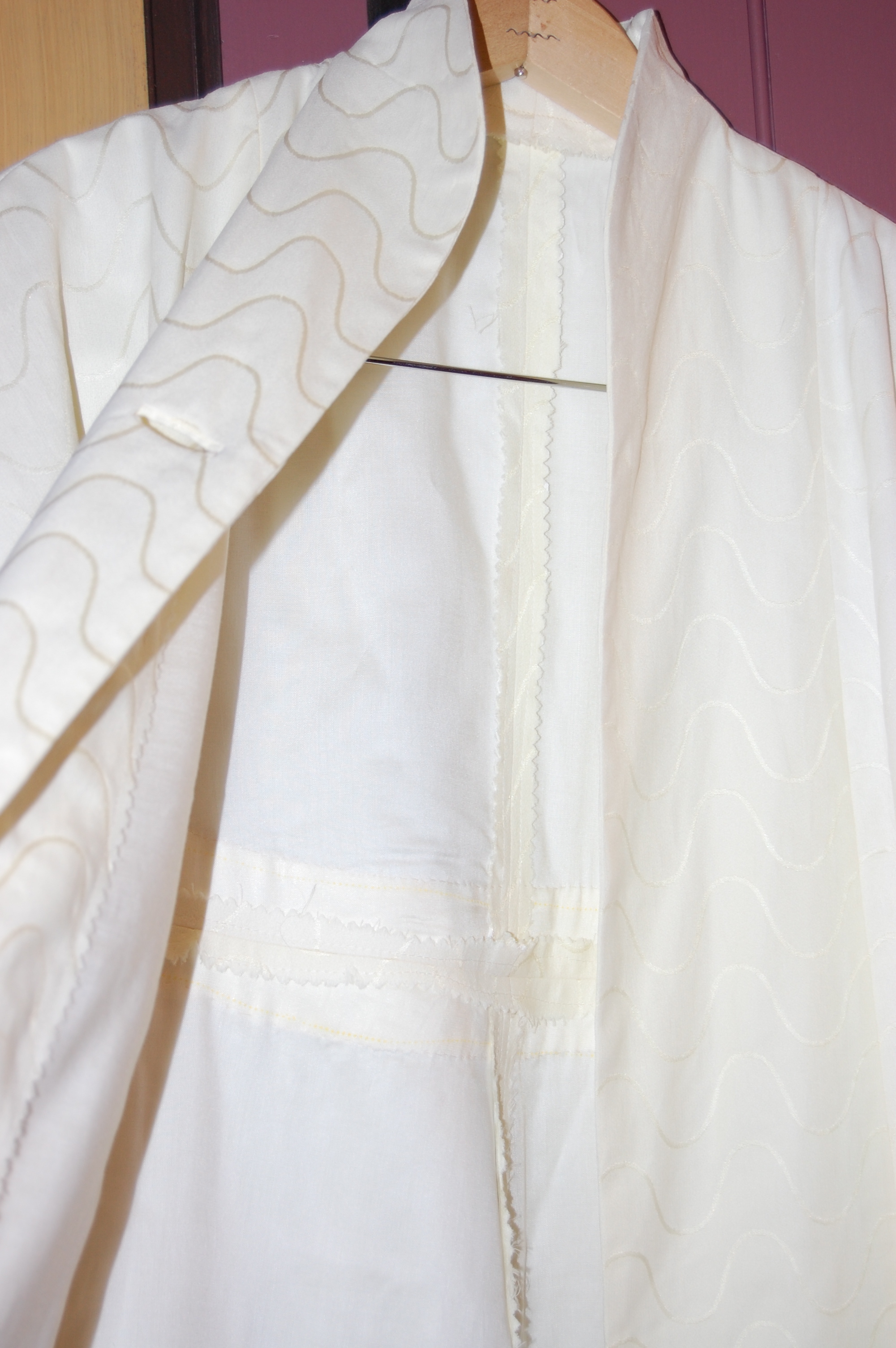
A few more details about construction:  The rainwear fabric is an acetate/rayon blend which I underlined with rayon voile.

Here is the coat, showing the underlining, before I attached the lining by hand.

I lined it with a pure silk lightweight twill in white.  I would have loved to have lined it with a neat polka dot silk, but I didn’t want any “shadows” of a printed lining to show through.  Guess I’ll just have to dress it up with polka dot scarves instead!  The rainwear fabric was very easy to work with – surprisingly easy, actually.  It drapes beautifully for a pattern like this.  Speaking of patterns, this one was so precise and cleverly engineered (especially the collar), turning it into a really fun project!

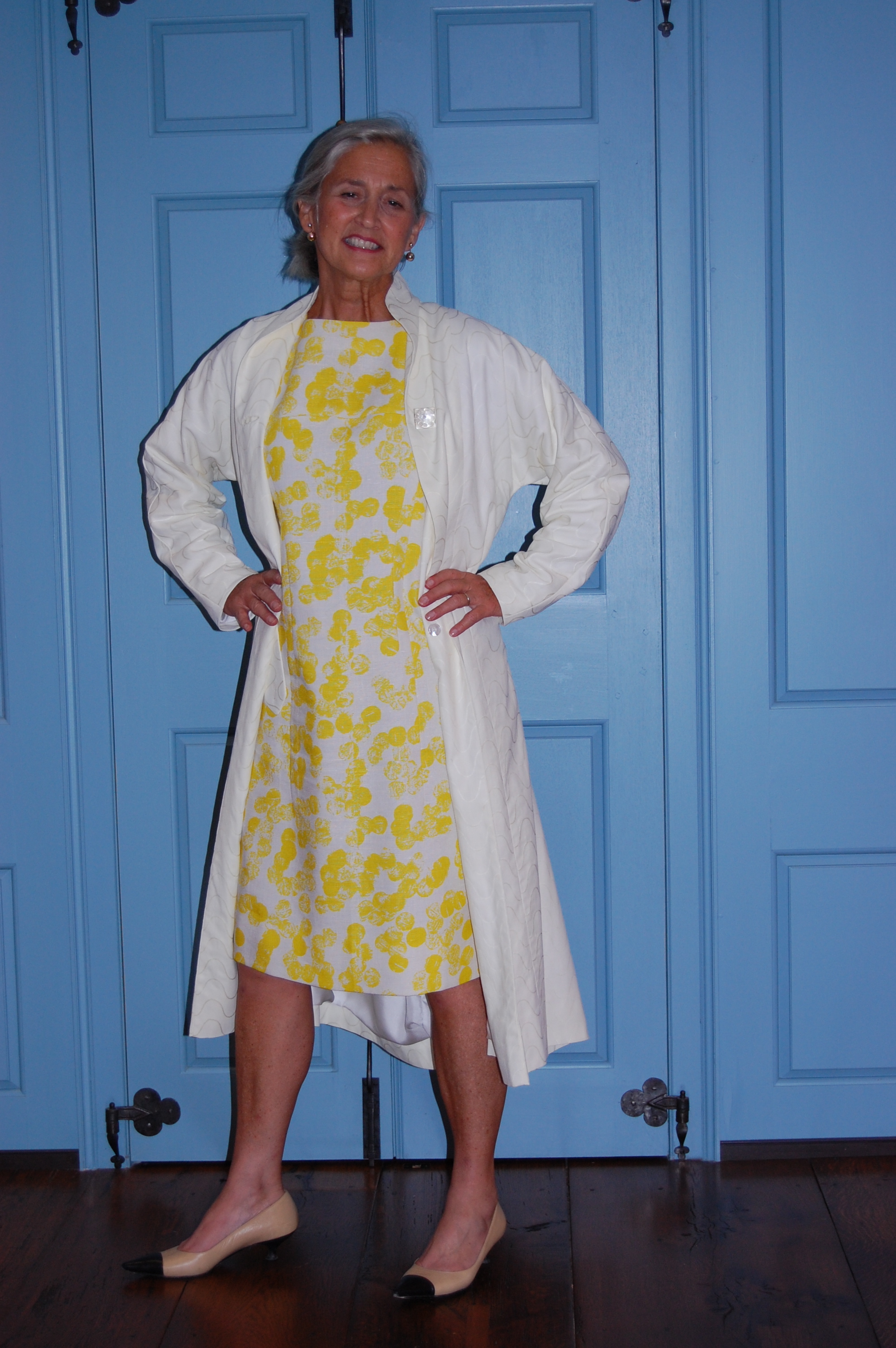
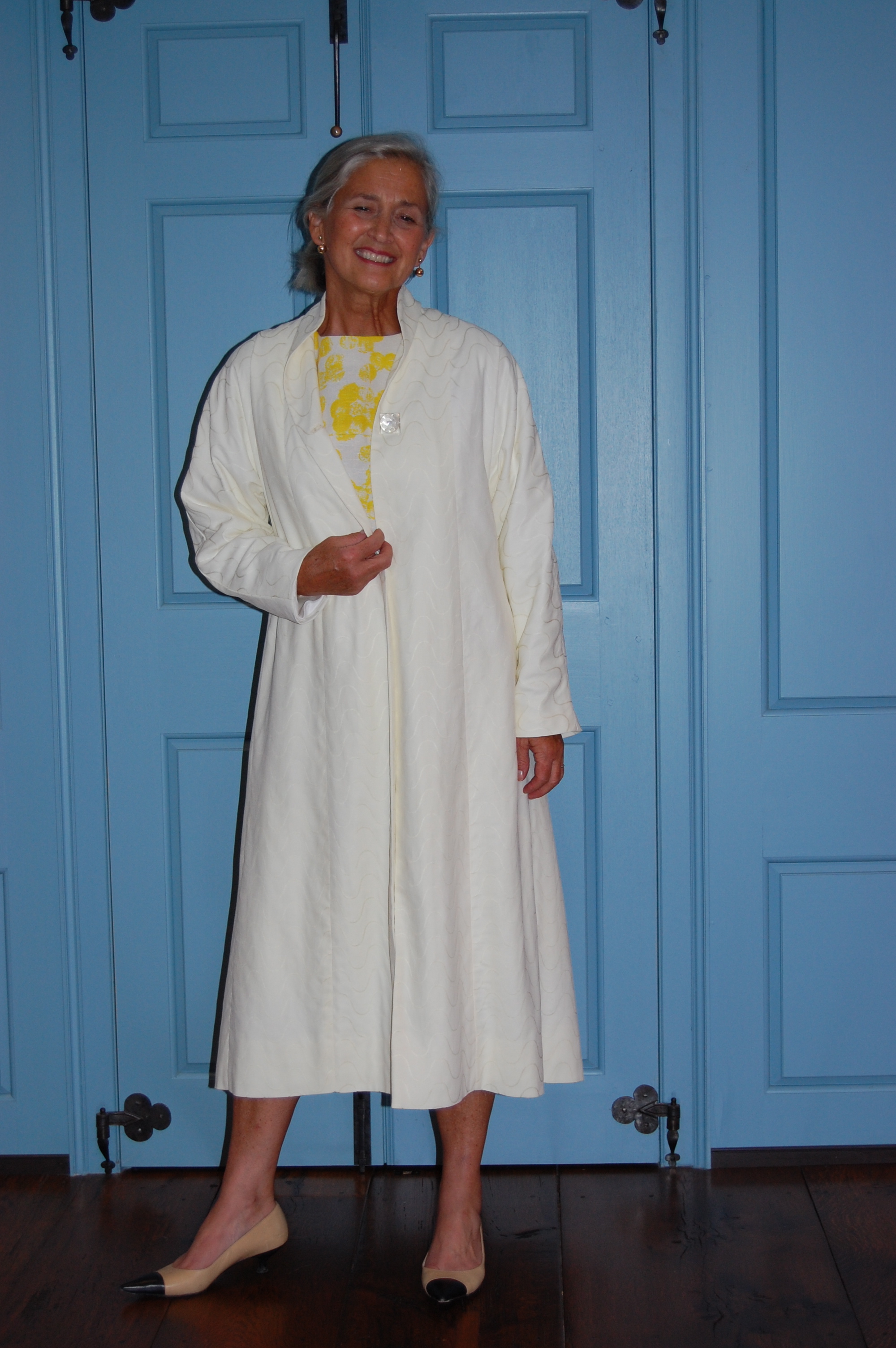
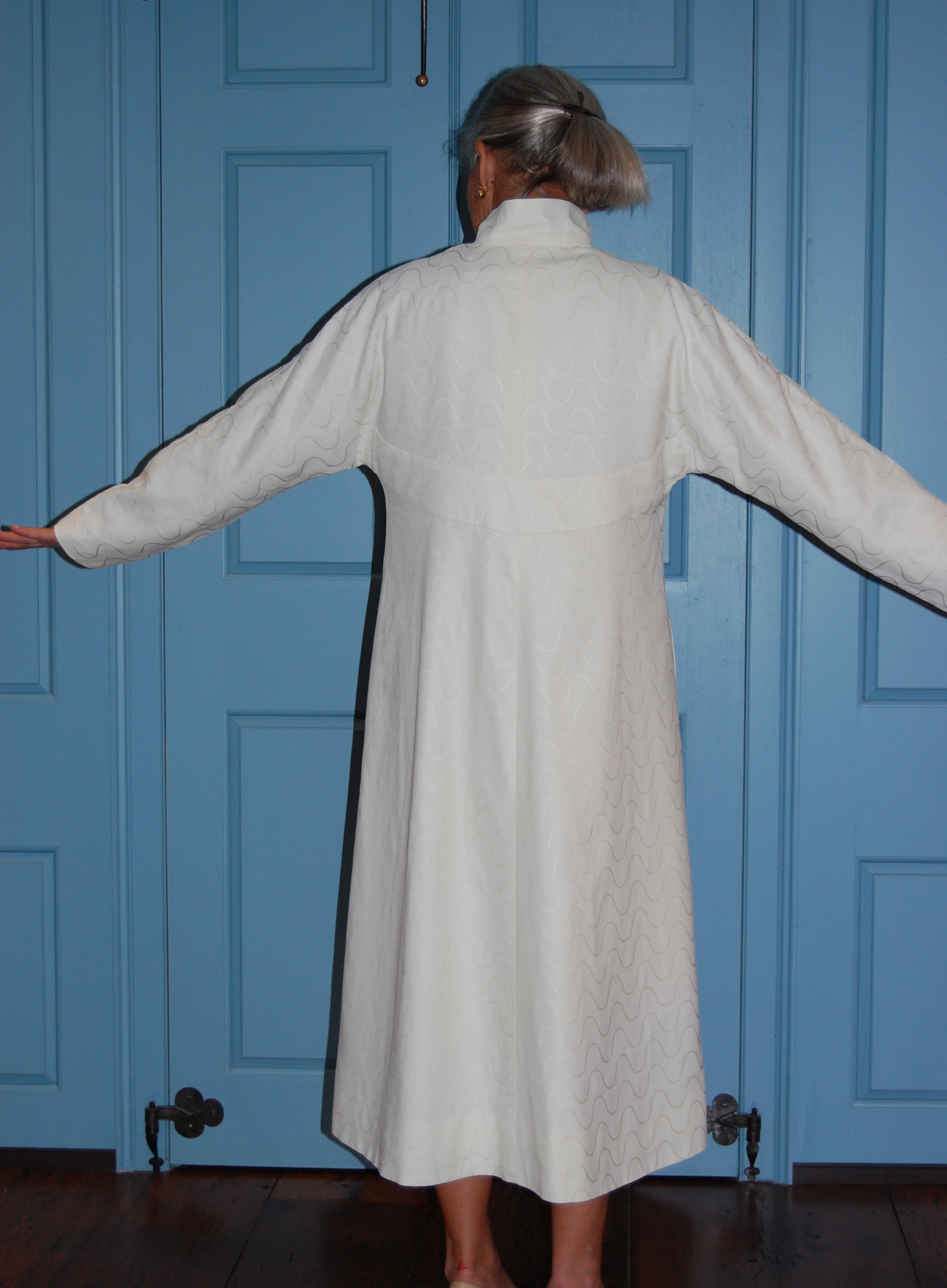
Here are some finished views of my new dressy raincoat:

More of the same…

Hopefully you can see the “belted” back in this view.

Making a garment like this during the Summer months means that I had to be prepared for “delayed gratification” as I probably won’t have a chance to wear my new raincoat for at least a couple of months.  However, when a future Fall or Winter forecast is for “Chance of Sprinkles” – or even full-force rain – I’ll be ready!

13 Comments

Filed under bound buttonholes, Buttons - choosing the right ones, Coats, Dressmaker details, kimono sleeves, sewing raincoats, swing coats, Uncategorized, underlinings, vintage buttons, vintage Vogue patterns from the 1950s, Vogue patterns