
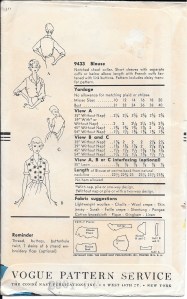
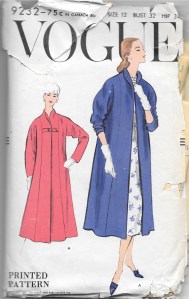
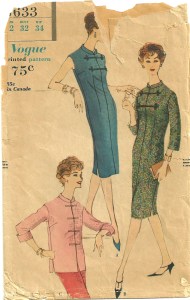
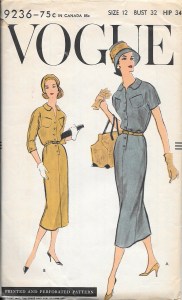
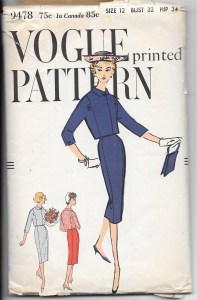
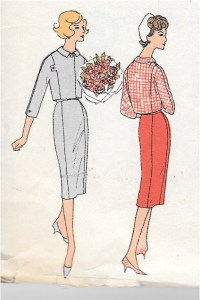
“Today blouses are not worn quite as much as they used to be and I think it is a pity.” So said Christian Dior in 1954. With that in mind, hopefully he would have approved of this Vogue blouse pattern from 1958:
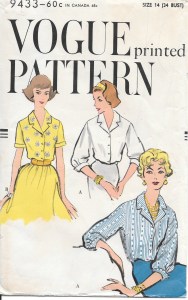
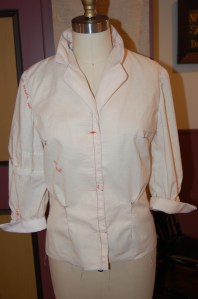
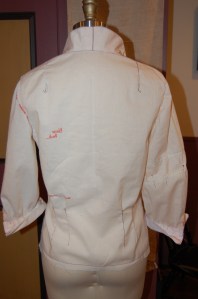
You have already seen my toile of this blouse, where I worked out all the “kinks.” I liked it made up in muslin and now I am quite thrilled with it made up in silk dupioni, purchased from Britex Fabrics.
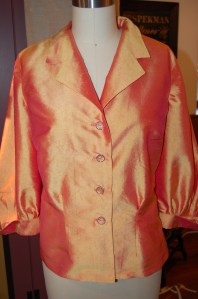
The iridescent quality of silk dupioni woven with two contrasting colors, such as this one, makes it an excellent fabric to use for “fancy” attire. The only reservation I had was whether it would be too stiff for use in a blouse. It is by nature rather “papery” in composition. I was a little concerned it might not have enough drapeability for this blouse, where a major focus is on the softly pleated sleeves. I did a little research, and of course, the first guideline I found was an admonishment not to wash dupioni! Doing so would diminish that papery nature. Well, that was exactly what I wanted to do – soften it a bit. Further research led me to an article in Threads Magazine from a few years back, where, indeed, a reader had successfully washed dupioni in her quest to make it suppler. Off to my washing machine I went with a large swatch for a (successful) trial run. Soon the entire two yards were gently swashing around in cold water on the delicate cycle. It took quite a bit of heavy steam to wrestle out the wrinkles, but I was left with a soft, drapeable fabric for my blouse.
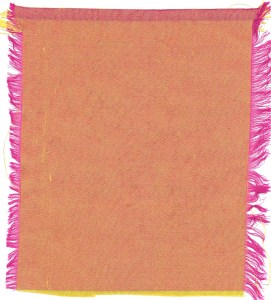
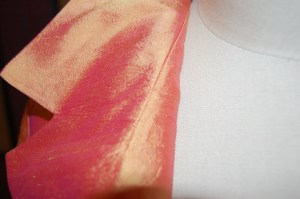
Quite apparent in this image are the two contrasting threads, one fuchsia and the other bright yellow, which, woven together made a shimmery apricot color.
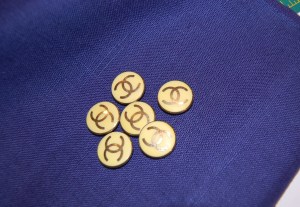
Buttons for a blouse such as this one are an important element. I knew they needed to be special, and what could be more special than vintage glass buttons from France? I found these listed in an Etsy store (YumYum Objects).
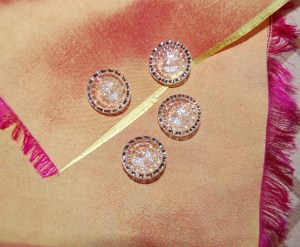
These glass buttons have silver accents, adding just a bit more depth to their appearance.
The listing was for a set of 6, and I needed 8 for this blouse. The French cuffs required two buttons each. These buttons were too perfect to pass up, however, so I decided I could use two buttons of another style for the rear-facing part of the cuff. I found a set of little, clear glass, ball buttons in my button box, which seemed appropriate and a good compromise!
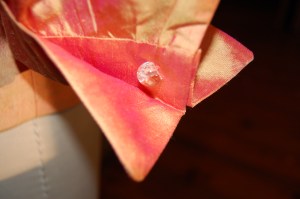
The ball button on the back.
For some reason I always like to make sleeves first, so that is what I did. The French cuffs, by their very nature, of course, call for two buttonholes with two buttons looped together to thread through those openings, one on each side. However, I placed a buttonhole on the front part of the cuff only. I then sewed the two buttons together, back to back through the back part of the cuff, with the fancy button meant to thread through that single buttonhole and the other button to be stationary. I liked the idea that this method would hold the two sides of the cuff more tightly together.
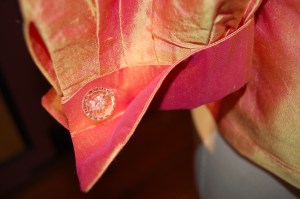
The fancy glass button on the front.
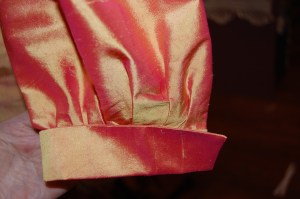
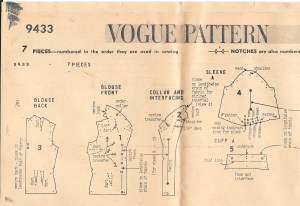
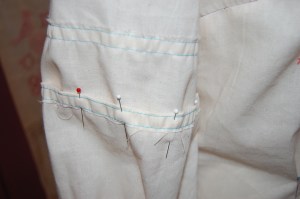
This view shows the three pleats in the sleeve. In addition, there is a small amount of gathering which adds to the blouson effect of the lower sleeve.
Being a pattern from 1958, the instructions called for bound buttonholes, of course. However, due to the nature of the fabric, I decided machine buttonholes would make a nicer finish, so that is what I did (with a little hand-finishing on each one…)
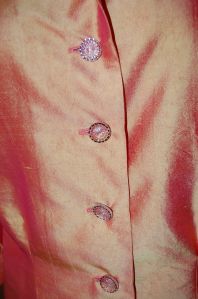
The rest of the blouse was quite straightforward.
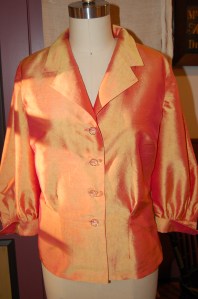
I took this picture with the sun streaming in one of my sewing room windows. It really shows the luminosity of the fabric.
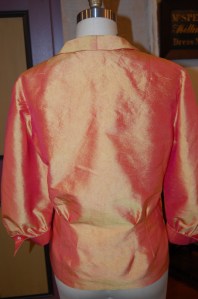
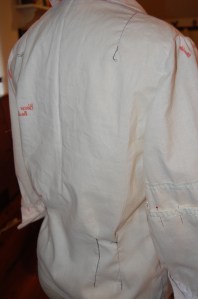
I am so happy I decided to keep the released darts at the waistline. I think they will work beautifully with the skirt I have planned.
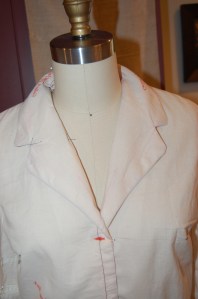
I gave my usual attention to hand-finishing the hem and facings (it just looks nicer!) and marveled again at the finesse added to this notched shawl collar by that small dart in the collar crease. Hopefully you can see this detail here:
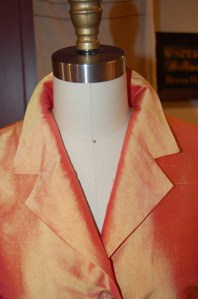
That dart makes the collar turn beautifully.
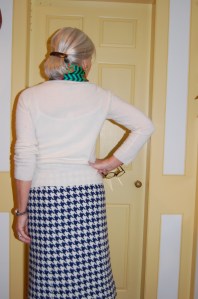
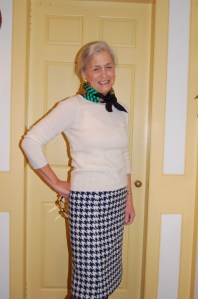
Next up is a guipure lace skirt! I wonder what Christian Dior would have to say about that?


 fiftydresses
“Blazing Fashions”
Every once in a while, something unexpected and totally charming arrives in the mail. Such was the case when a Christmas card we received had something extra inside, besides a lovely greeting. The envelope was rather lumpy so I could not imagine what might be enclosed. The dear friend who sent the card has a generosity of spirit which is an inspiration to me. She is so thoughtful and ever mindful of the passions and interests of her friends. So when I opened the card and a very large size matchbook fell out, I knew she had once again given me something very special and very apropos. (Thank you, Nancy C.!)
This was no ordinary matchbook!
This matchbook measures 4″ x 6″ so it definitely makes a statement!
“Blazing fashions” –“Larry’s world famous dresses! 10,000 dresses to tell your friends about…at cut prices.” If I had to assign a particular year to this little gem, I would say 1957, based on the styles, hem lengths, and hairdos on display in the drawing. Certainly it is from the final half of the decade of the 1950s.
The back of the matchbook gives a nostalgic glimpse into the constraints of shopping hours during that time in history. “Get here by 2:30 P. M. to be waited on” and “Closed Sunday.”
I can just imagine some of the dresses, coats and suits available for purchase. This is especially enticing when you look at the list of brands carried by Larry’s:
(Click on the image to see the partial list of designers and fashion houses.)
Many of these fashion houses/designers I recognize, others I do not. Some of the notable brands are: Nini Ricci, Adele Simpson, Donald Brooks, Nettie Rosenstein, McMullen, Davidow, Mr. Mort, Herbert Sondheim, Nantucket Naturals, Kasper, Norman Norell, Christian Dior (New York), Oleg Cassini’s, Teal Traina, H. B. Wragge, Ann Fogerty. Some of the names are hidden beneath the match sticks (which are a good 3“ in length). Also hidden is a coupon to cut out and mail in and request the following: “Please Notify Me When Your Private Sale Begins.” Also mentioned is the fact that Larry’s is “Air Conditioned for Comfort” and “All Sales Are Final.”
A number of the fashion houses/designers listed also designed for Vogue Patterns during that time period, such as Nini Ricci, Christian Dior, and Teal Traina. And I would suspect that many of Larry’s customers were also women who sewed for themselves, as so many fashionable ladies did. I also suspect that Larry’s did a booming business during the holiday season – Christmas and New Year’s – when dressing up was de rigueur. So many stories reside in this little vintage piece, to remind us all that, although much has changed, fashion and dressing well is timeless.
Also timeless is this beautiful and sacred Christmas season. It is a magical time, filled with wonder and awe, a time when the generosity of spirit is abundant and enhanced by kindness and love. May your holiday be filled with such beauties and with the love and companionship of dear friends and family. All the best to you from me!
12 Comments
Filed under Fashion commentary, Mid-Century style, Uncategorized
Tagged as 1950's Vogue patterns, Mid-Century style, vintage fashion