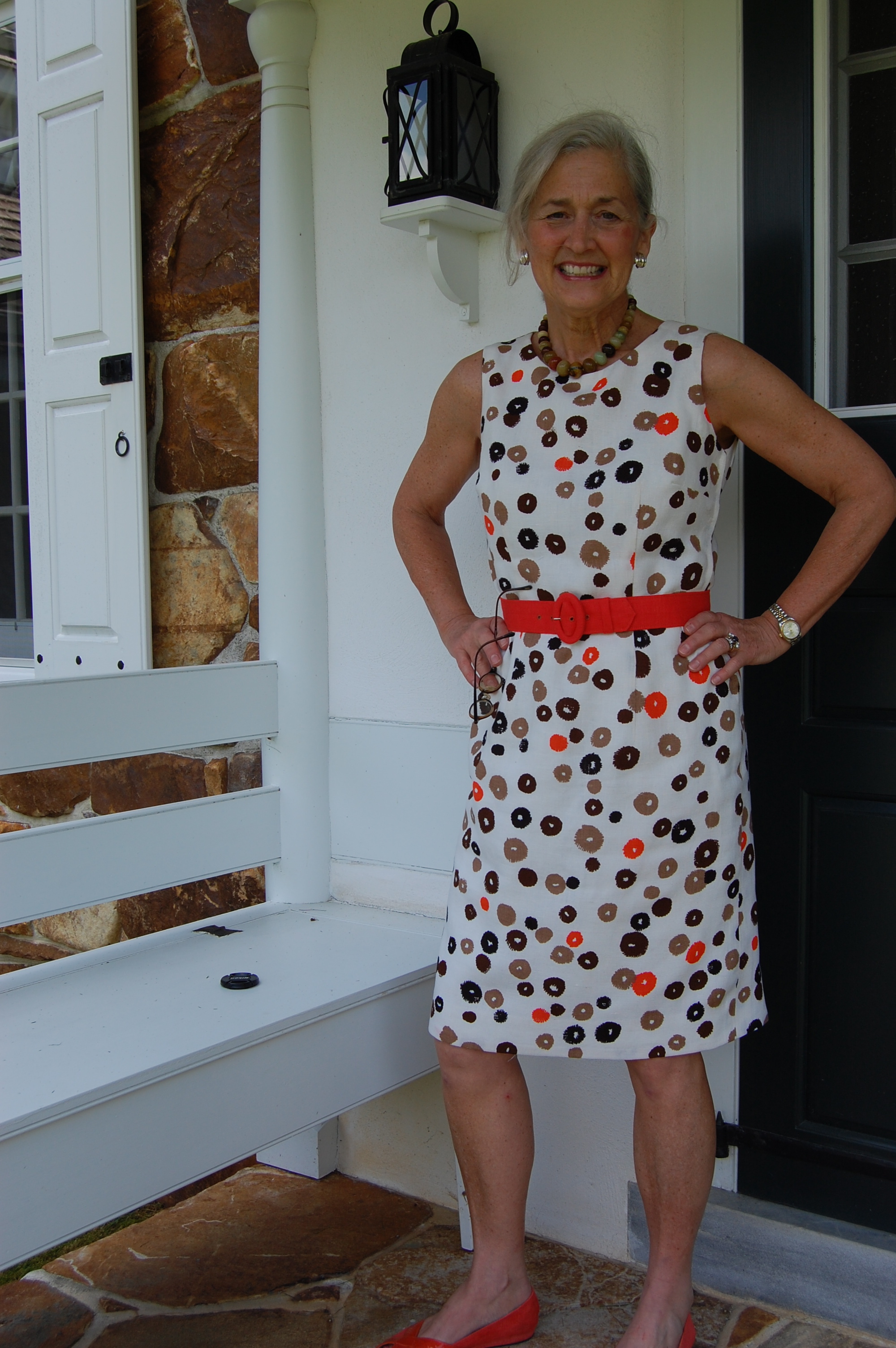
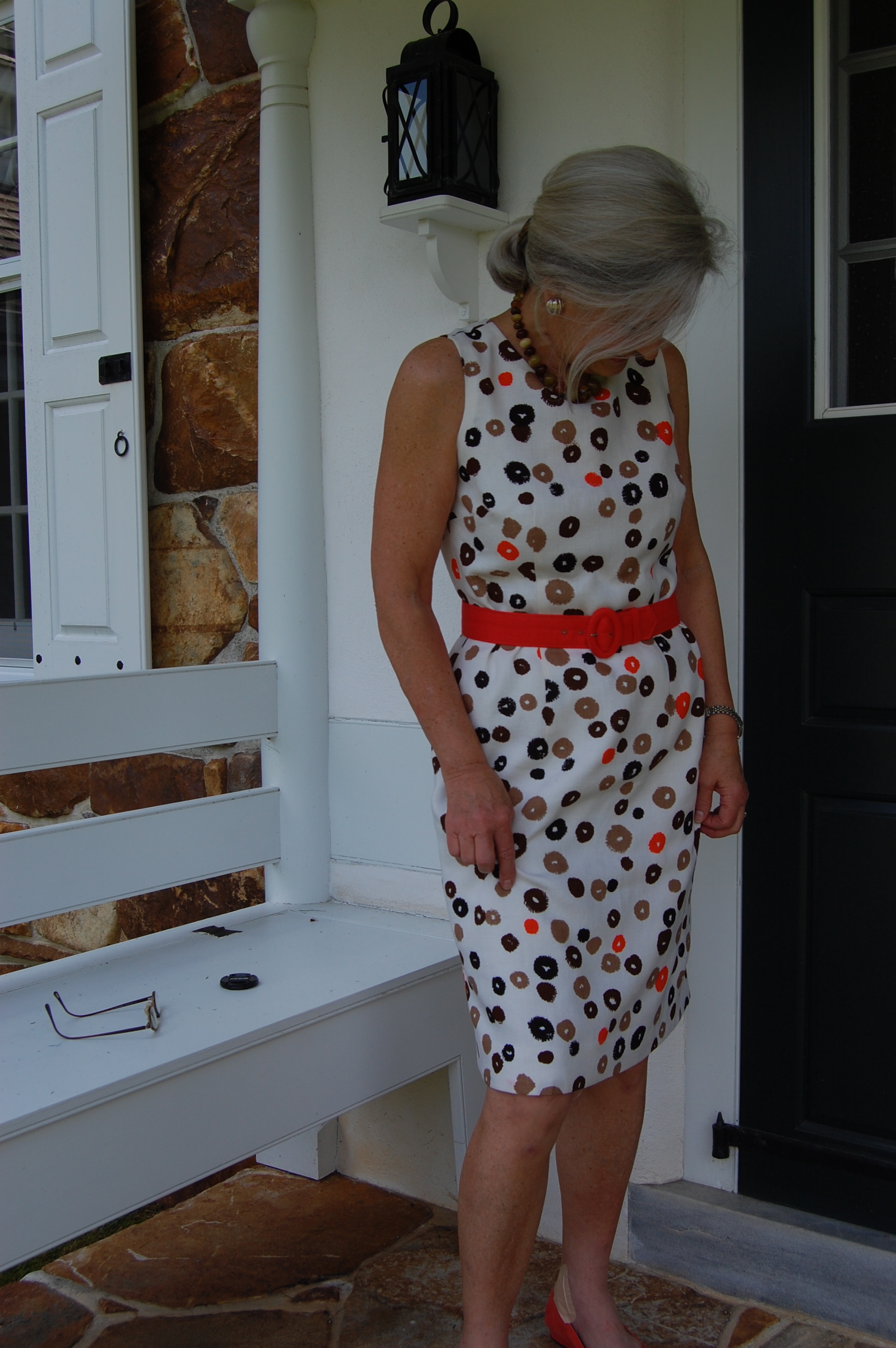
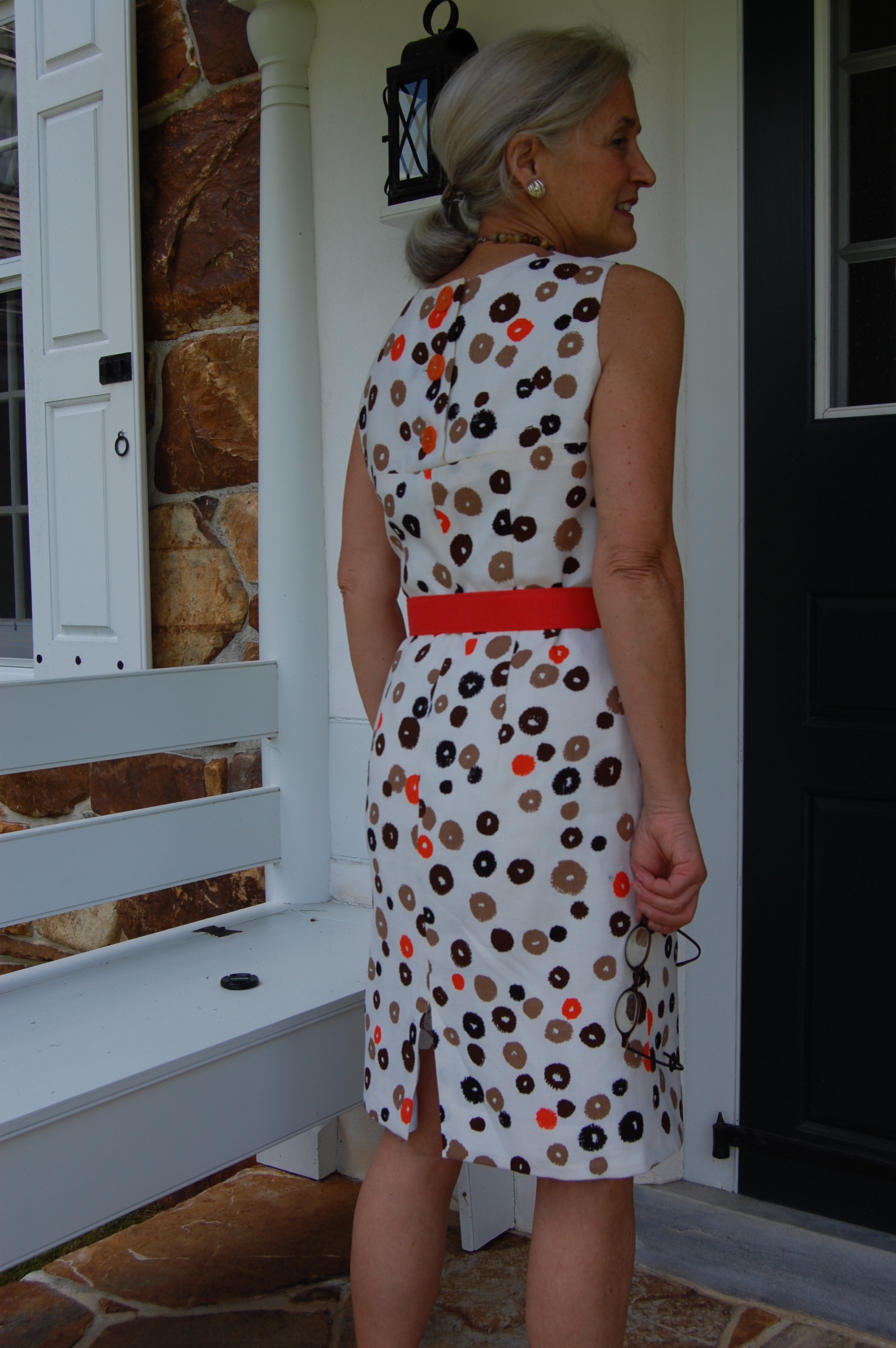
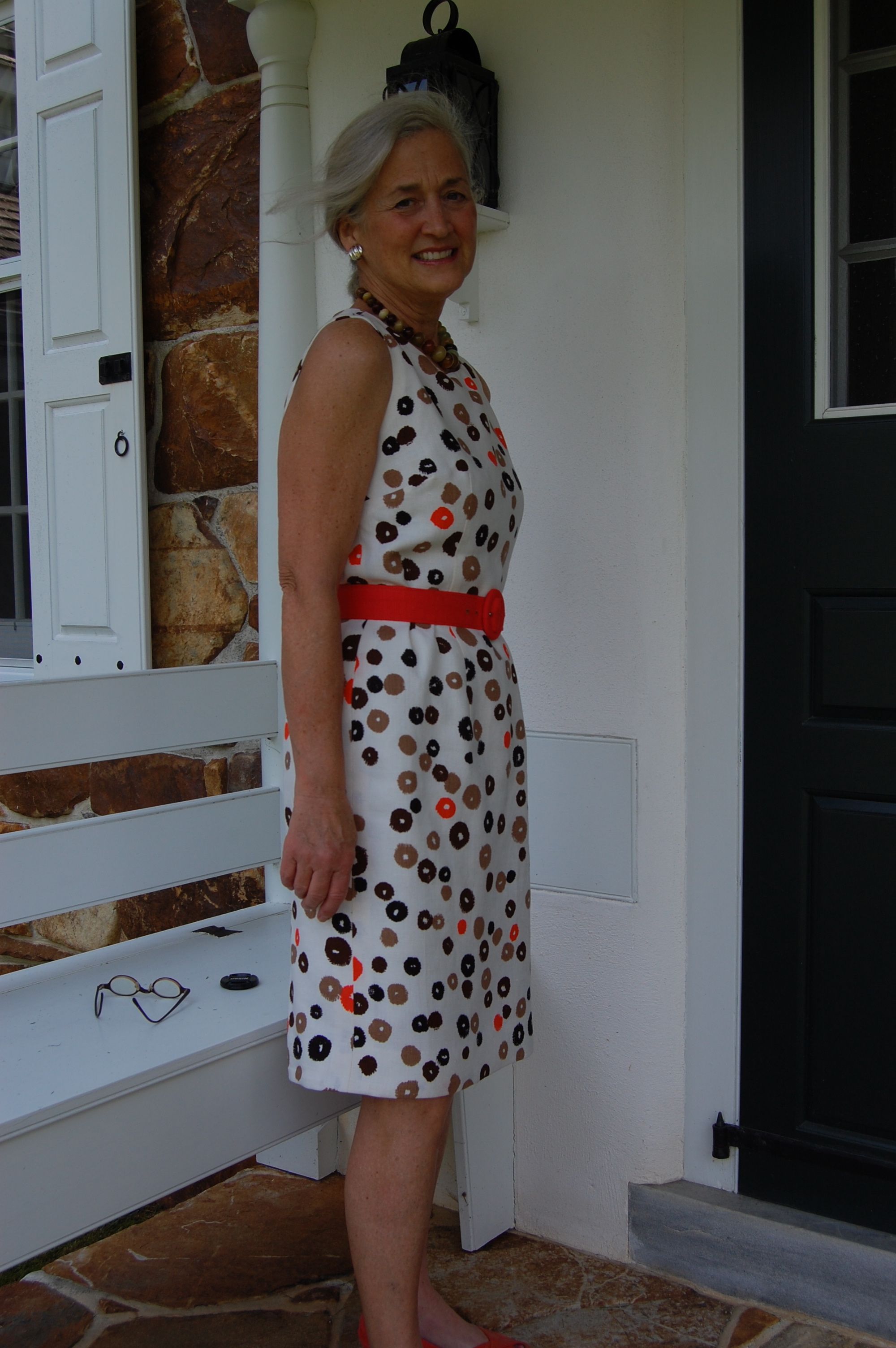
Tag Archives: vintage fashion

“This is your mission, should you choose to accept it.”

Those of you who are sewing bloggers and/or readers of sewing blogs are probably aware of a “survey” of sorts which is quietly and slowing making the rounds of those of us who share this interest. The survey is a simple list of questions which explores the relationship between sewing and one’s blog. I have been enjoying reading other bloggers’ thoughts on this relationship, most recently those of Mel of Poppykettle. Mel is surely world famous by now for her exquisite wedding gown which, of course, she made, as well as the gowns for her attendants. Now, I have never met Mel (although I hope to someday!), but I can tell she is just as charming and fun and genuine as the delightful blog which she writes. Knowing this made it even more flattering for me that she nominated me to expound on these same questions. So, I “accepted” the mission and here goes…

What am I working on?

As the sun-filled days steadily get shorter and shorter here in the northeastern part of the United States, and the morning and evening air begins to shiver a bit, I have mentally packed away my Summer sewing and am switching over to my favorite season of all – Autumn. As much as I love this time of year, I find that my wardrobe generally is sparse for Fall apparel. Last year, I made a Diane von Furstenberg knock-off wrap dress that was – and still is, of course – perfect for Fall.
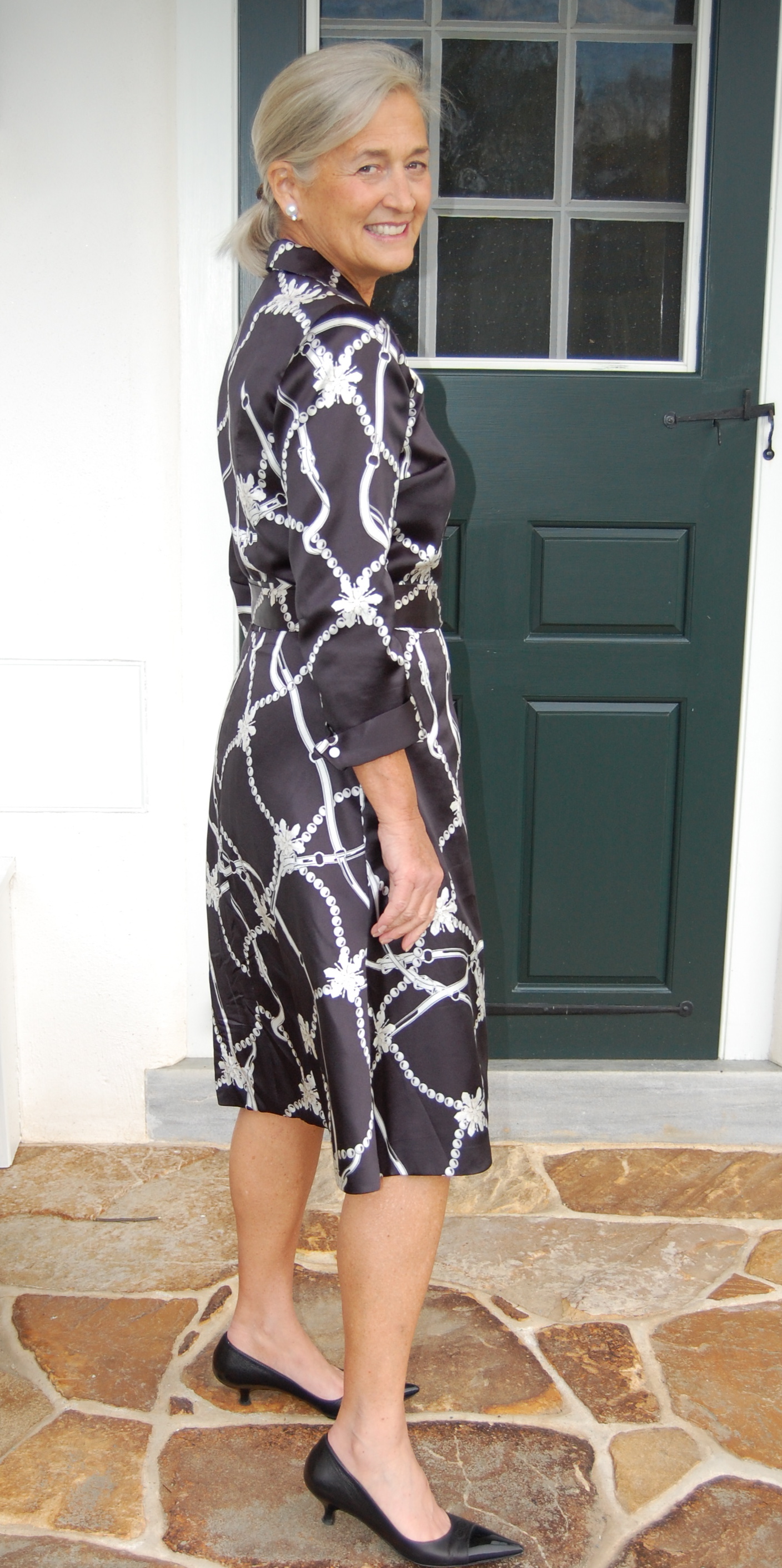
DSC_1022 So it should come to no one’s surprise that I want to add one or two more Fall-appropriate dresses this year. I have just begun work on the muslin for a silk dress, using a Vogue pattern from the 1980s (which is somewhat of a shock, since I consider that decade, for the most part, a vast fashion desert!) The silk is Italian, purchased from Mendel Goldberg in New York City. This dress should be ideal for Autumn, assuming I finish it before we’ve moved into Winter!
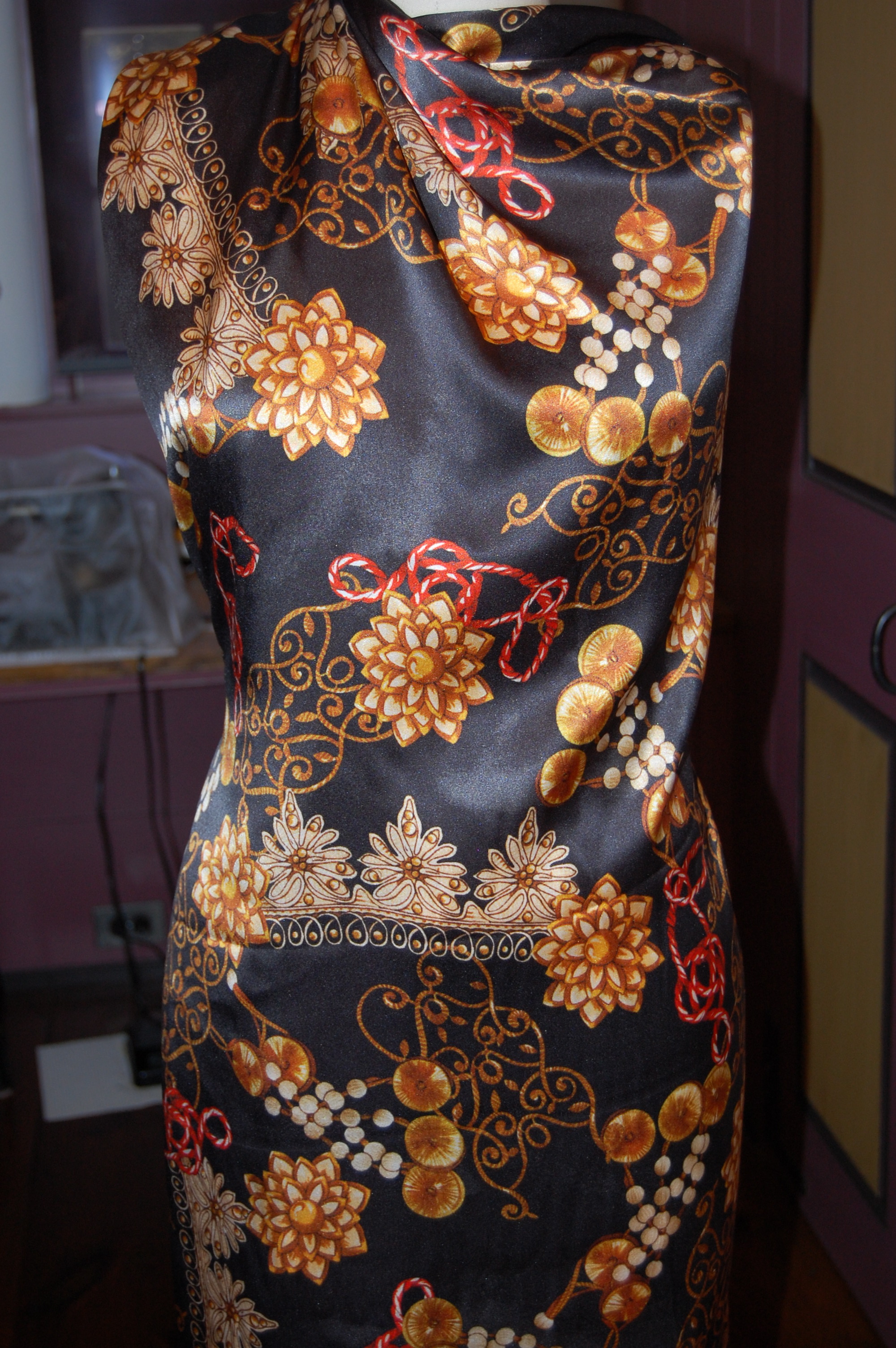
Fabric for my current project.

Fabric for my current project.

Why do I write?

Now that is a good question! Unfortunately for you, my readers, the answer to that has multiple parts, and I hope I won’t bore you! First and foremost, I really, really love to write. I like to put words together. I like to try to make sentences clear but colorful and evocative. (I am not nearly as good at “explaining” procedures or techniques, although I know I need to do so occasionally.)

Second, I love to tell a story. I’m not sure how it happens, but it often seems that my sewing projects have inherent stories to them. Sometimes it’s about the pattern, sometimes it’s about the fabric, sometimes it’s about a long-fulfilled sewing dream of mine (left over from the ‘50s, ‘60s or ‘70s!), sometimes it’s about the accessories, and sometimes it’s a combination of all of these things. Writing and telling stories about my sewing helps to give it another layer of meaning.

Third, writing and sewing are very, very similar. Both involve great expanses of solitary endeavor, engineering (of words or patterns and cloth), creativity, sense of style, striving for excellence of technique, and tenacity. However, both have a friendly and supportive communal aspect to them as well, when shared with others of the same interest. And – both sewing and writing are goal-oriented pursuits, perfect for my personality type!

Finally, I must give credit to my daughter, Susanna, who gave me the inspiration to start a sewing blog. An exceptional writer, Susanna had her own blog for a while, and her encouragement to me made all the difference.

How does my blog differ from others of its genre?

Answering this question reminds me of the beginning sentence of Tolstoy’s Anna Karenina: “All happy families are alike; each unhappy family is unhappy in its own way.” Except that there is nothing unhappy about sewing blogs! I think my interest in the fashions and vintage patterns of the ‘50s, ‘60s, and ‘70s helps to differentiate my blog from many others. I really enjoy making connections between mid-century fashions and the fashions of today. The fact that I can make a dress using a 50-year-old pattern (or 50-year-old fabric!) and have it look totally current continues to amaze me – and sharing this excitement hopefully makes my blog just a little bit unique.

How does my writing process work?

I wish I had a magic formula to share! Fortunately, sewing is a slow process, at least for me, so I have lots of time to think about writing while I stitch away. I sometimes make notes to myself (and take photos, of course) while sewing and sometimes I wish I had made notes and taken more photos! I usually try to do a little research on the pattern (or fabric) I am using, to help “tell the story”. I actually often start with a title for my post, which can sometimes take a lot of thought and time. That small detail usually sets the narrative for me, so that I am able to proceed with the story. One thing I try to do is keep my posts to a reasonable length (a guideline I am not following right now…). Because of this, I do a lot of editing during and after the writing process.

Nominate!

Now comes the fun part – and difficult part, too. Fun because I can nominate two fellow sewing bloggers to participate in this same survey, and difficult because there are so many interesting and talented bloggers about whom I would love to learn more. However, two talented dressmakers whose blog posts I never want to miss are my nominees: Janene of ooobop and Brooke of Custom Style. Of course, you, Janene and Brooke, are under no obligation to participate, but I do hope you will accept the “mission”!
 

18 Comments

Filed under Love of sewing, Uncategorized

“Cheers!”

Cocktails in our home – and in our family – are always preceded by a toast of some sort. Usually a simple “Cheers!” will suffice, but sometimes the occasion calls for something more meaningful. One of the most memorable cocktail toasts I have ever heard was standard fare for one of my late mother-in-law’s good friends. By the time I met her, she was a little shaky, which made the toast even more charming. She would raise her trembly glass with great ceremony and declare “To our noble selves!”

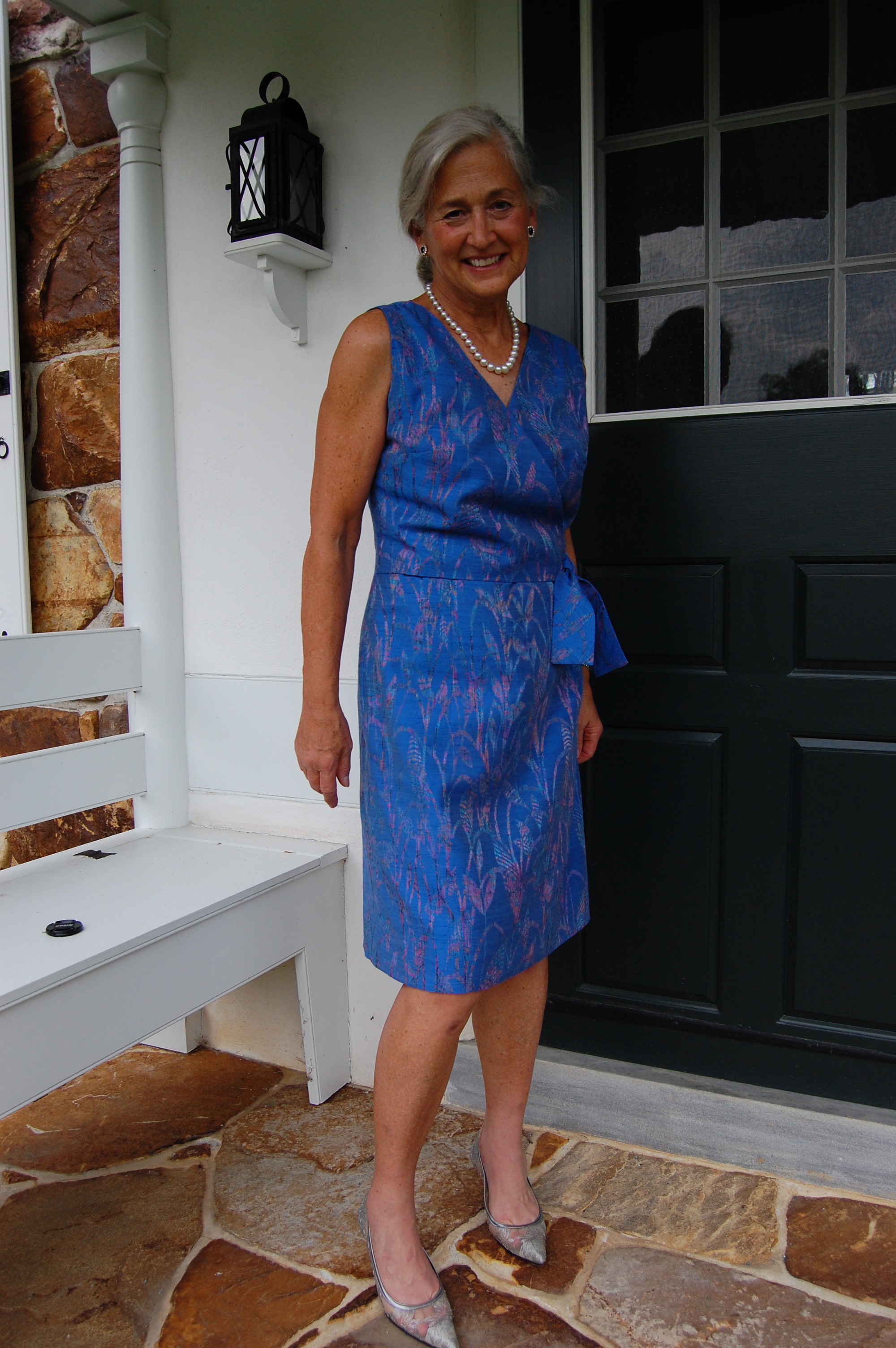
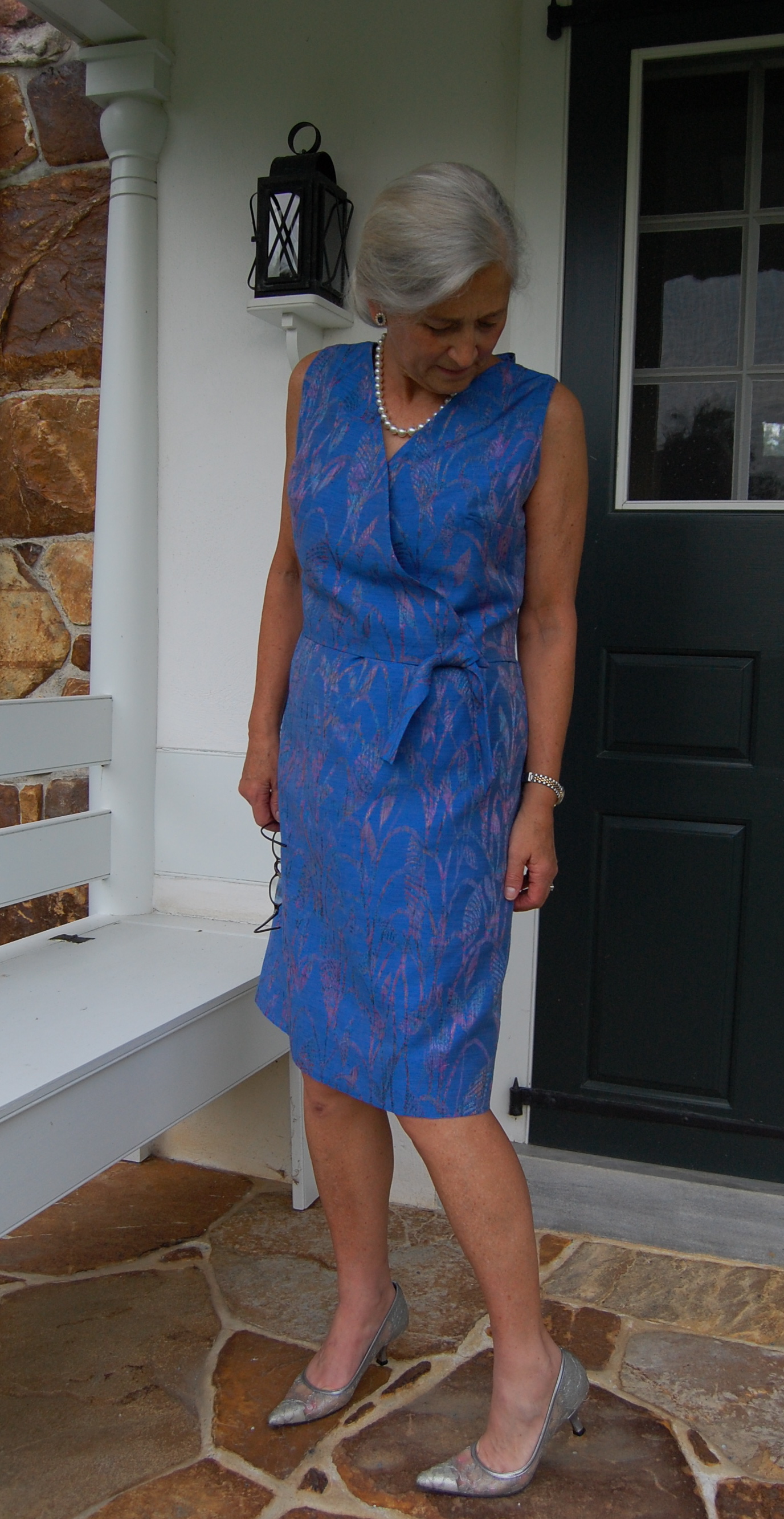
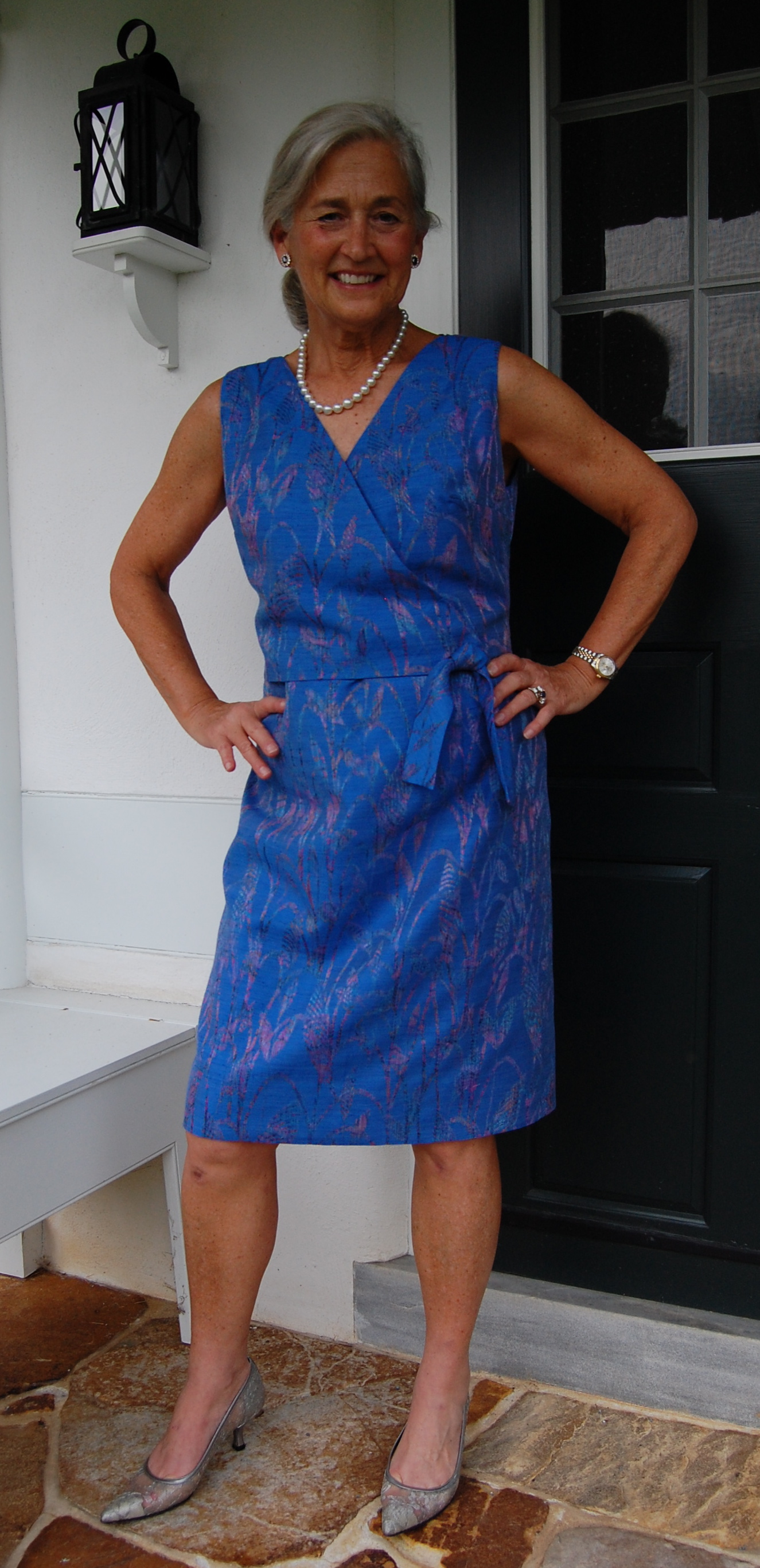
As I was working on my latest project – yes, a cocktail dress – I thought about all the possible declarations we, as sewers, could add to the vocabulary of toasts. More about those thoughts later… First up is something to wear to that cocktail/dressy party!

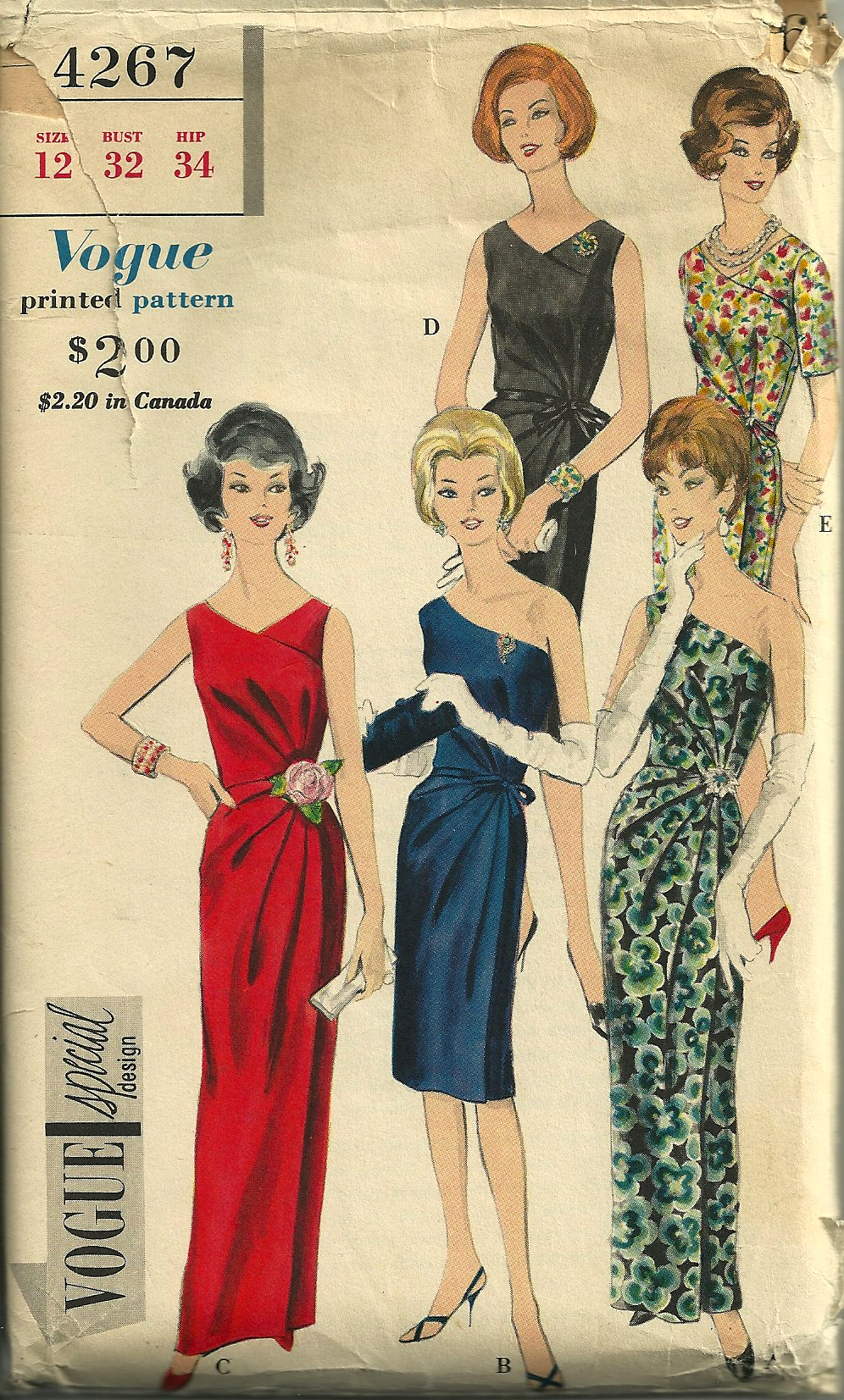
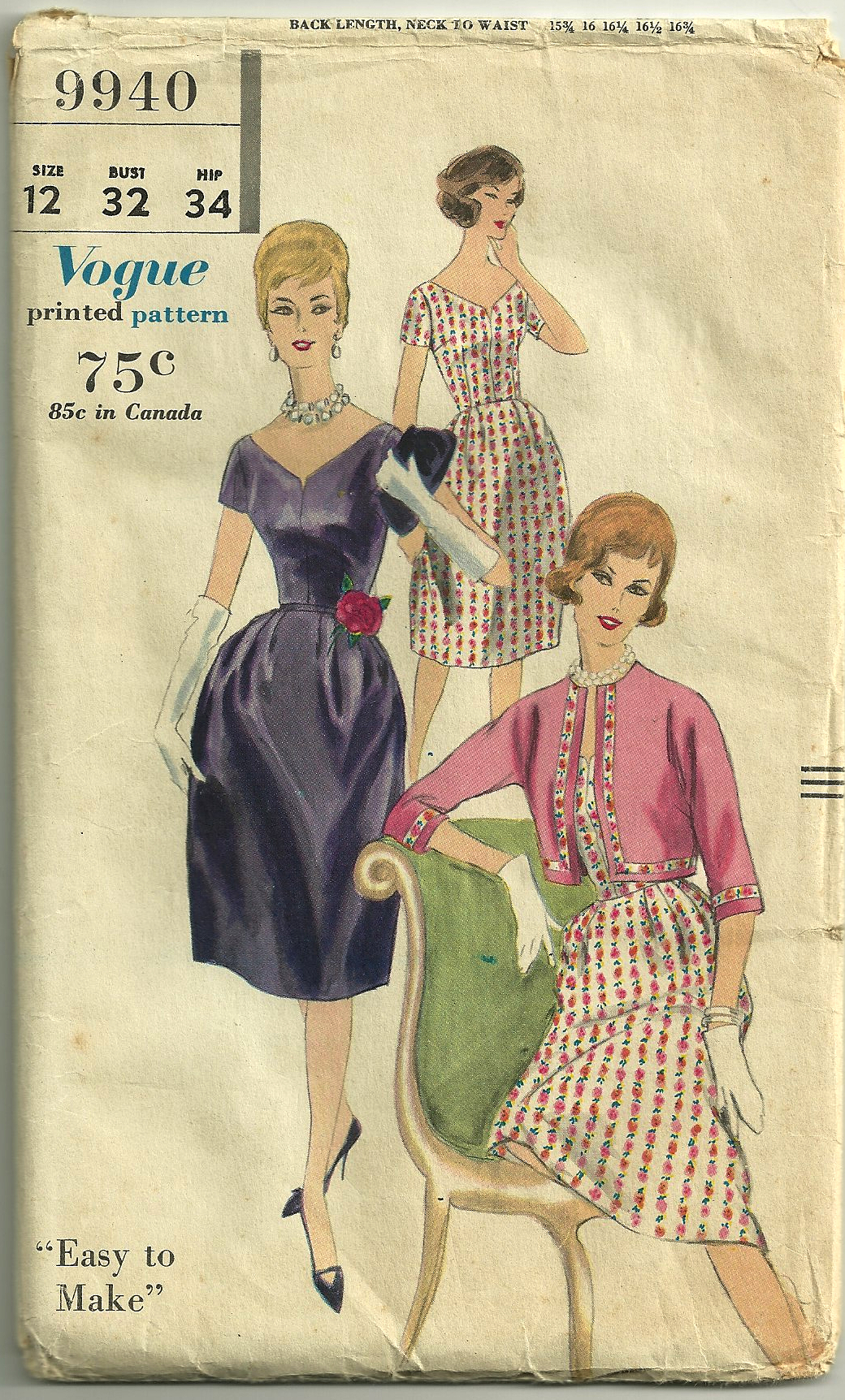
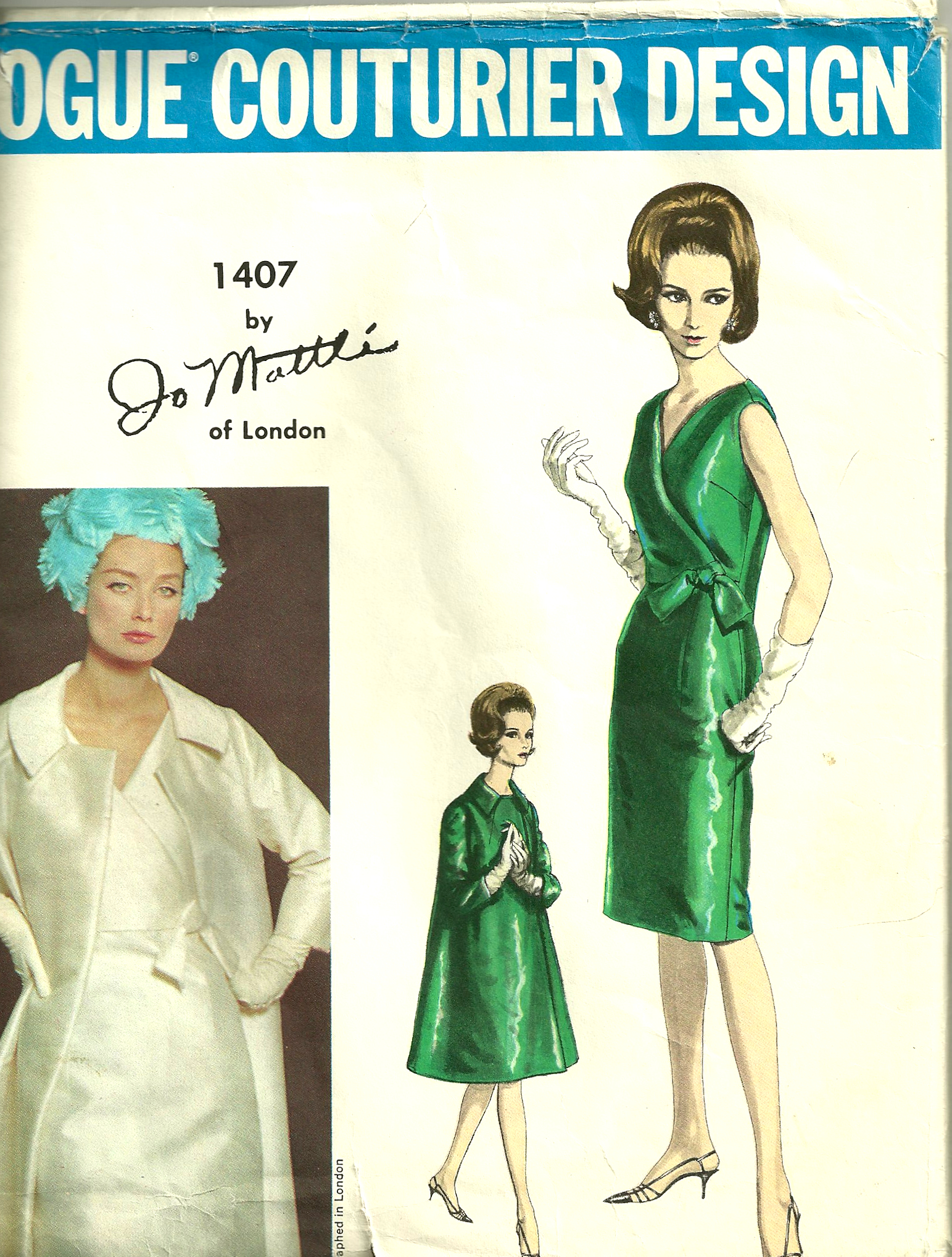
This Vogue Designer pattern is from the early 1960s.

This Vogue Designer pattern is from the early 1960s.

The lengthy process of perfecting the muslin (toile) for my blue cocktail dress revealed a few minor changes I needed to make – four of them, to be exact.   You might be able to see on the pattern envelope, that the “overblouse” in the front actually hits about an inch above the waistline. This just did not look good on me, so I extended the length of those two over-lapping fronts an inch so that they would lay directly at my waist. Second, the under-dress, the top of which is not seen when being worn is cut low so that it does not show beneath the “V” of the overblouse. However, it was cut much lower than I needed, so I raised it a bit.

I thought the shoulders of the overblouse extended a little bit too wide, so I cut the top of the armscye in about ¾ of an inch, graduating it down to join the lower part of the armscye. And fourth – I added a slit at the lower back center seam to make walking easier. I seem to do this frequently with vintage patterns.

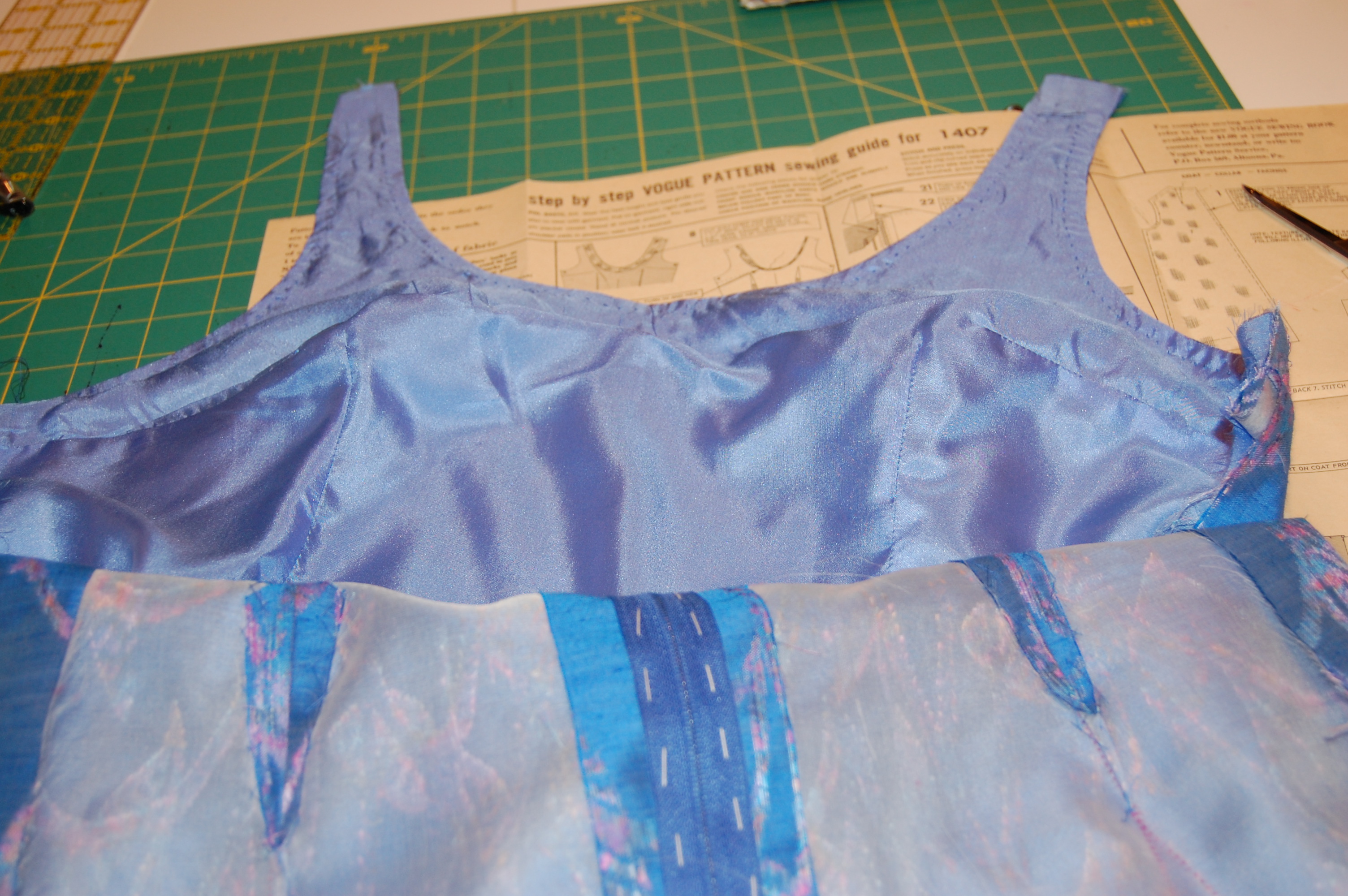
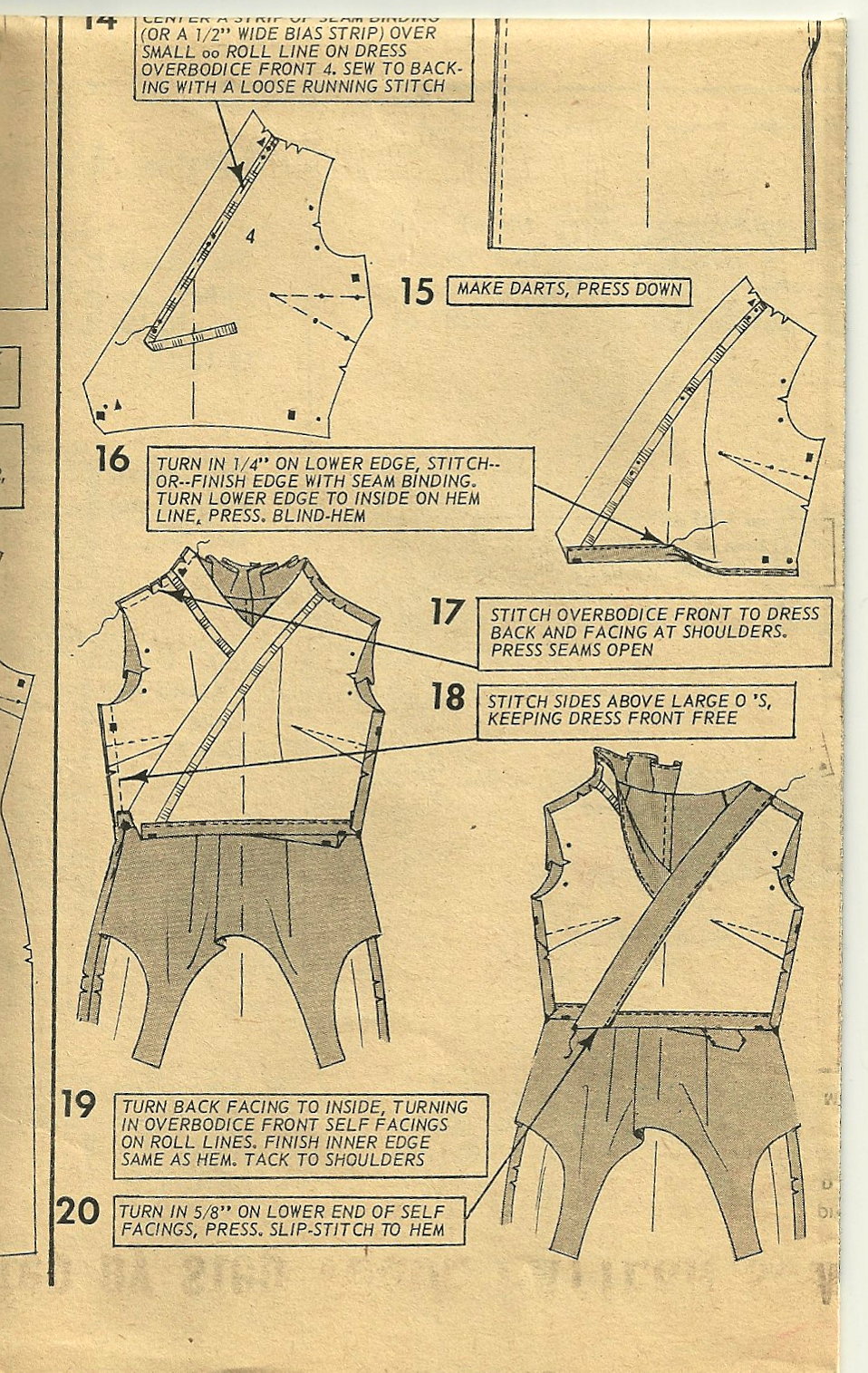
The pattern called for the fashion fabric to be underlined, but not lined.   I wanted to line the dress – and actually felt it was a necessity with the fabric I was using. Because of the unusual construction of the dress, I knew that this was going to be interesting – and that I was going to have to make it up as I went. To see what I mean about the unusual construction, take a look at the pattern instructions. The front of the “underdress” is sewn to the back of the dress at the side seams only to the waistline. The bodice part of the front “underdress” hangs loose while the two sections of the overblouse are first sewn to the dress back. Then that bodice is hand sewn in place.

To our sewing selves - pattern diagram

To line the dress, I first sewed the lining to the front underdress at the neck and the armscyes by machine. I under stitched these sections by hand, leaving about an inch free on either end.

Cheers

Next I lined the two front overblouse sections, stitching only the front armscyes by machine; I attached the rest of these linings by hand, using fell stitches.  Then I joined the overblouse sections to the (unlined at this point) dress back.

The front overblouse sections are attached to the side seams, but the front underdress is hanging loose, which does not show in this photo.

The front overblouse sections are attached to the side seams, but the front underdress is hanging loose, visible at the lower left.

I had pieces of dress and overblouse and lining hanging every which way! Any of you who have made a “Chanel” type jacket know how unruly the process is before the lining is seamed in place by hand. This reminded me of that. Somehow I would have to make order out of chaos!

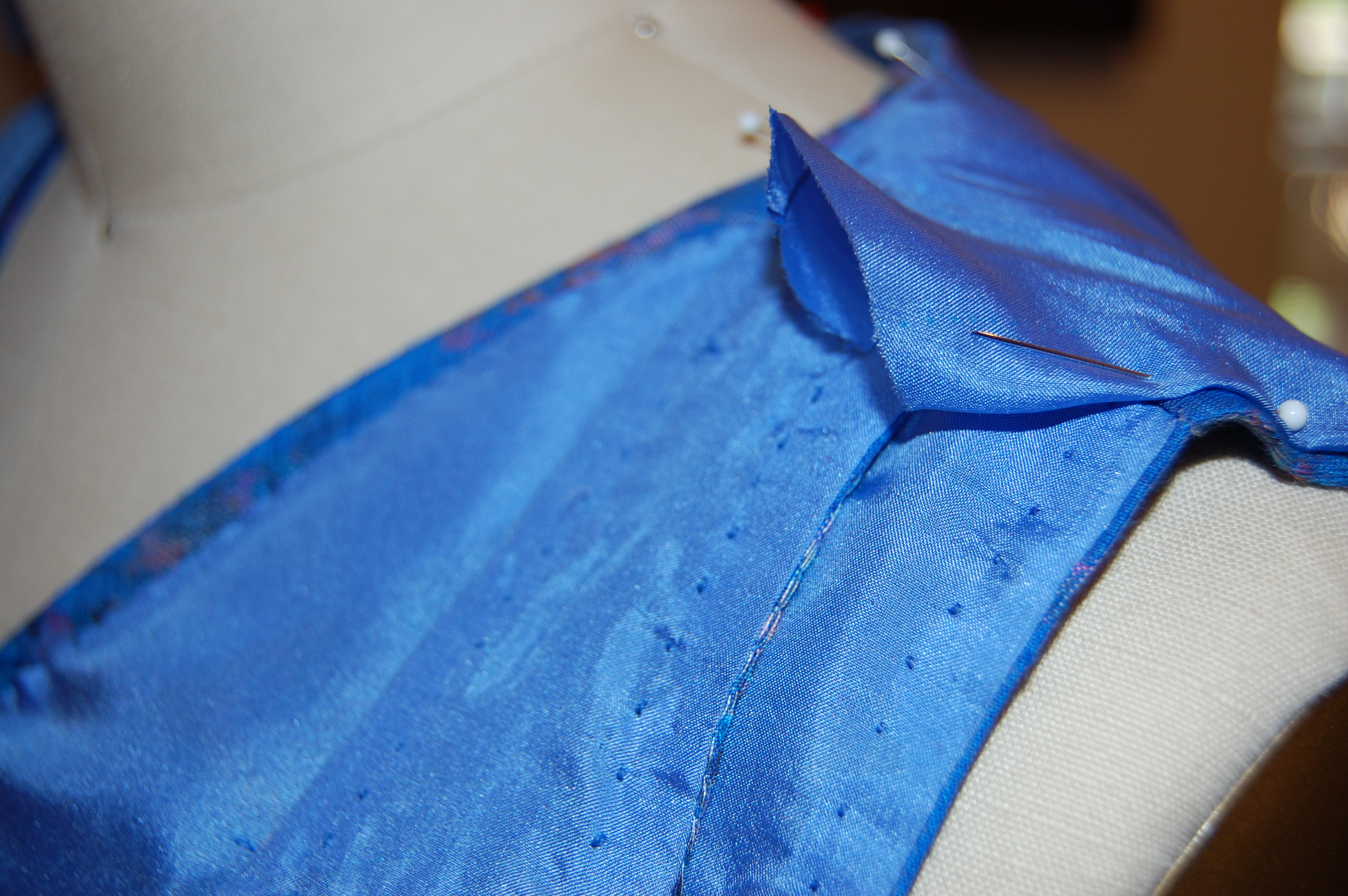
To line the back dress section, I pinned the lining to the armscyes and neck and fell stitched in place by hand. Then I was able to sew each side seam on the machine. The shoulder seams were the final ones to finish, which I did by hand. Then it was only a matter of fell stitching the lining to the hand-picked zipper and understitching the neck and arm sections.

The shoulder seam encloses two finished layers in front.

The shoulder seam encloses two finished layers in front.

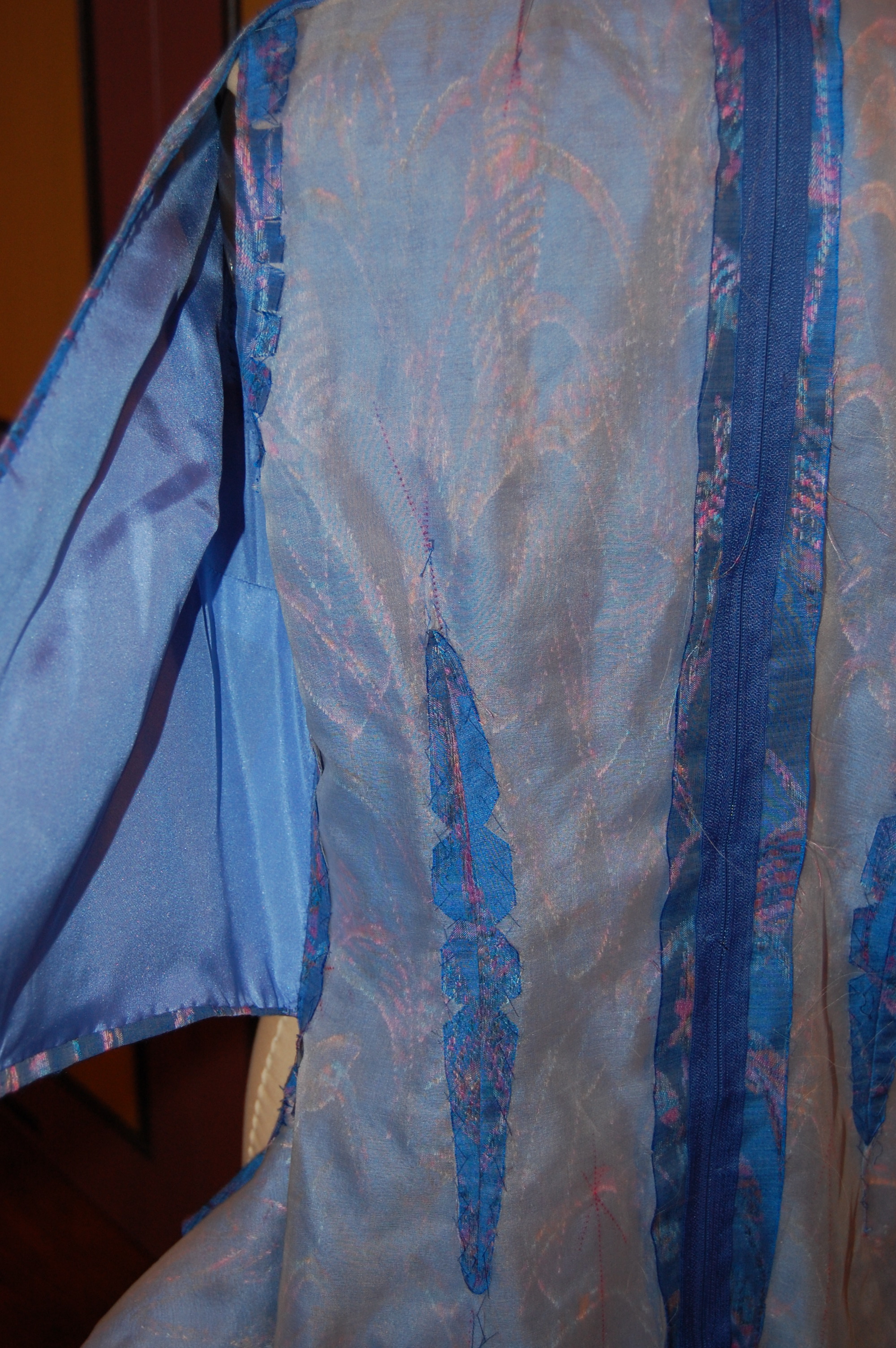
It worked! The lining fit perfectly and made for a pretty “insides”!

An inside look at the underdress and the overblouse.

An inside look at the underdress and the overblouse.

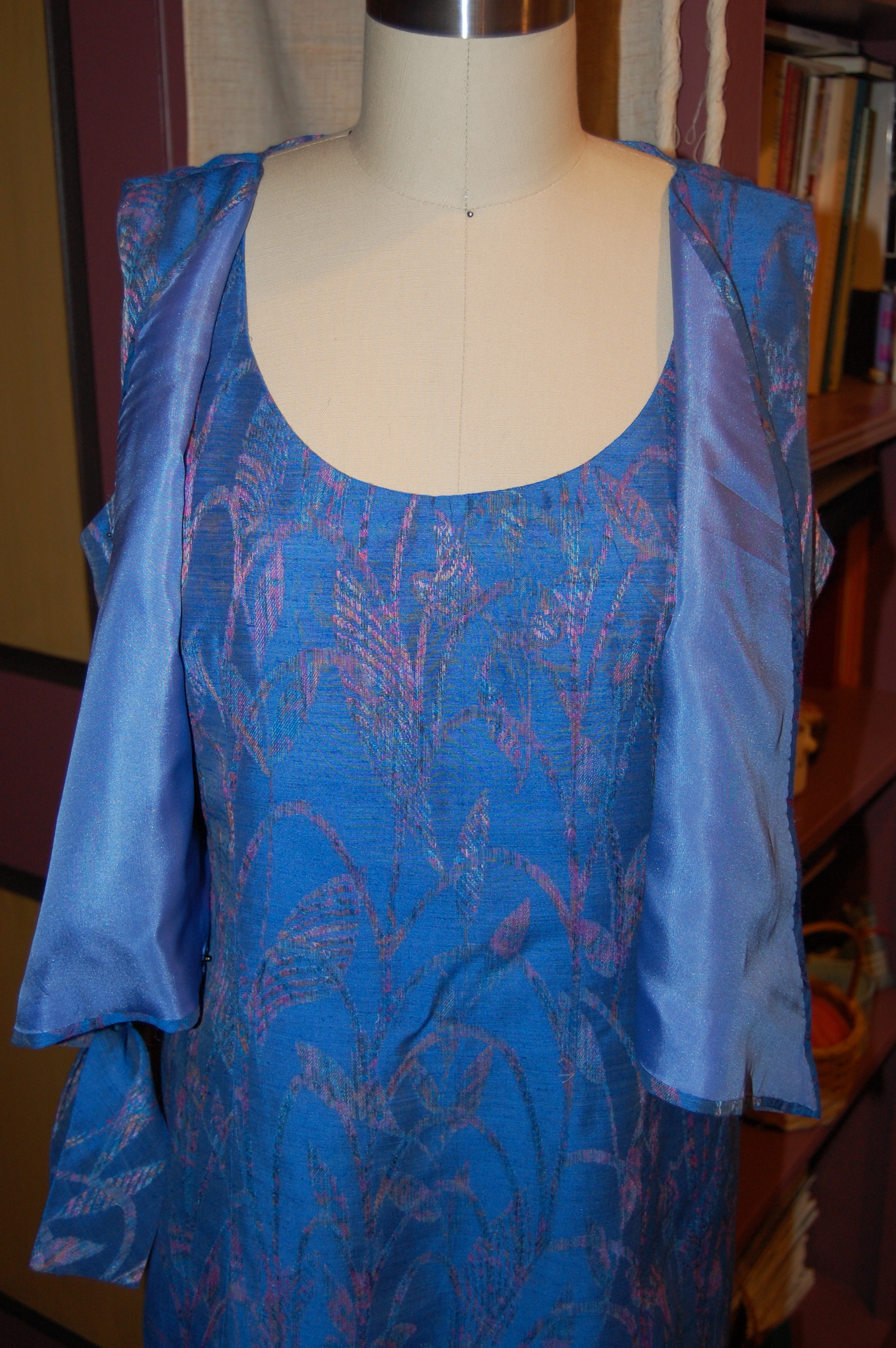
The pattern called for tacking the front overblouse sections to the underdress, but I decided to use snaps instead. Ironing this dress will be so much easier with the overblouse sections opened up. However, I did permanently tack the looped tie in place, as indicated in the pattern directions. There was much more hand sewing involved in this dress because of the added lining, but the process was so rewarding in the end.

DSC_1374

Cheers

I anticipate this dress being perfect for not only cocktails, but also weddings and other dressy occasions (particularly if I get the coat made, too!).

Cheers

DSC_1369


DSC_1362

Although I doubt I’ll be clinking my cocktail glass with many other dressmakers, I like the thought of a “virtual” toast with my fellow sewing enthusiasts. Some possibilities I have come up with are “To needle and thread” – or “To weft and to warp” – or “To scissors and seams” – or the one I think I prefer, with thanks to a lady from the past – “To our sew-able selves!”

40 Comments

Filed under Cocktail dresses, couture construction, hand-sewn zippers, sewing in silk, Uncategorized, underlinings, vintage Vogue Designer patterns, vintage Vogue patterns from the 1960s

The Search for the Perfect Blue

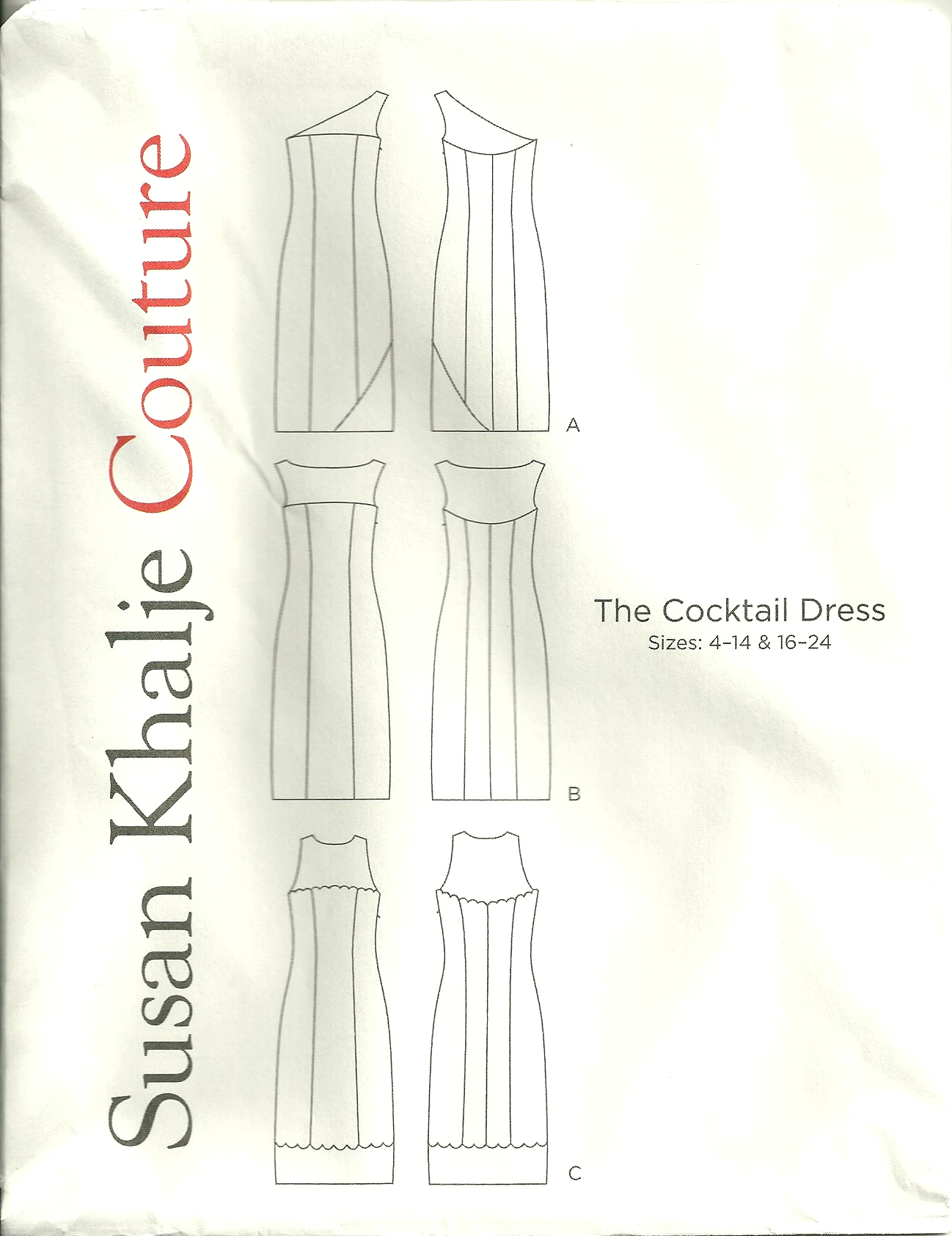
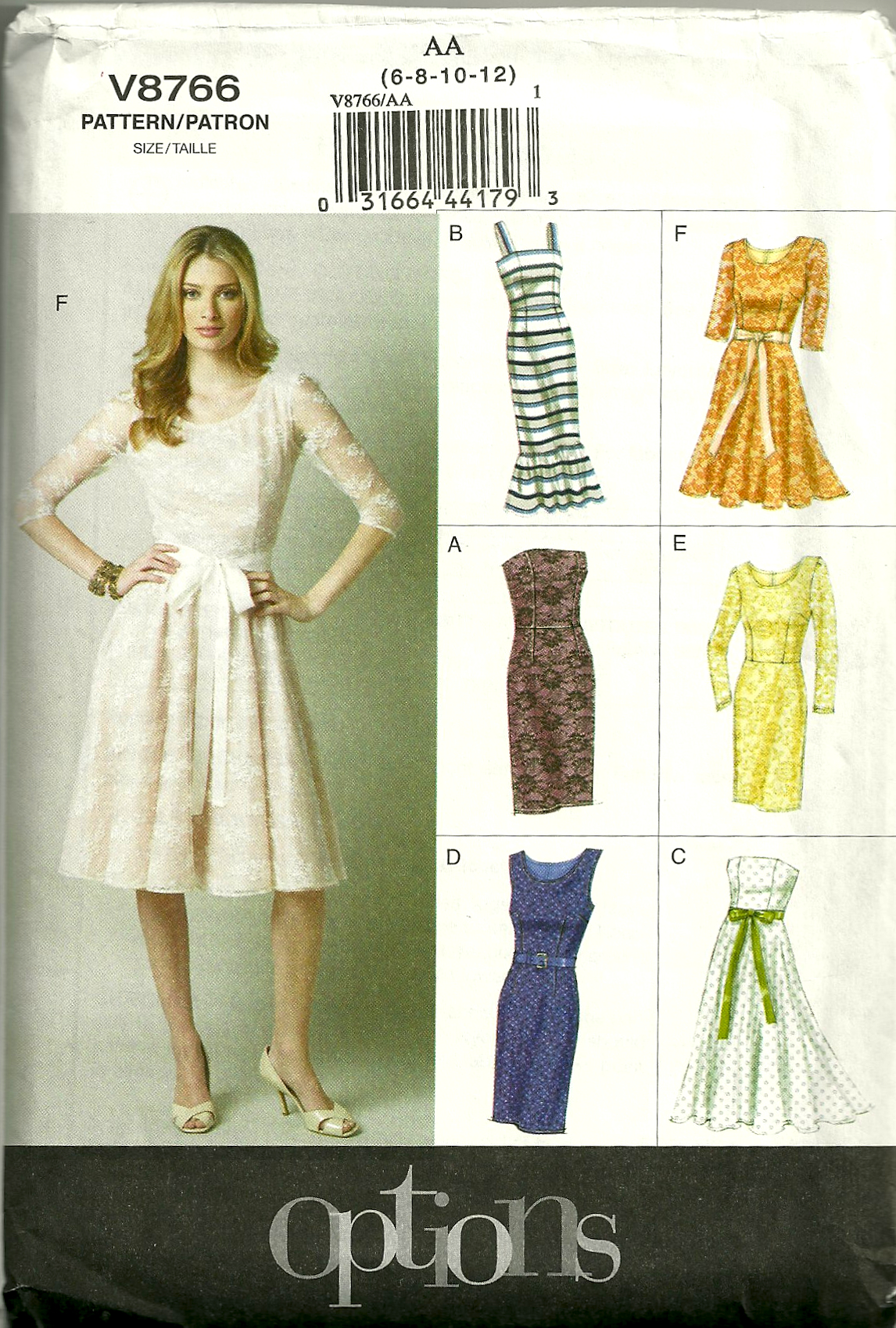
Do you ever have a specific color in mind when looking for fabric for a specific type of dress? I am usually open to changing my mind if something else wonderful appears, but this time I really, really wanted to find a blue fabric for a cocktail dress. I started out thinking I would like a pale or periwinkle blue silk to pair with white lace, having Susan Khalje’s new Cocktail Dress pattern in mind.

The version I was thinking I'd like to make is the third one, with lace for the top and bottom panels.

The version I was thinking I’d like to make is the third one, with lace for the top and bottom panels.

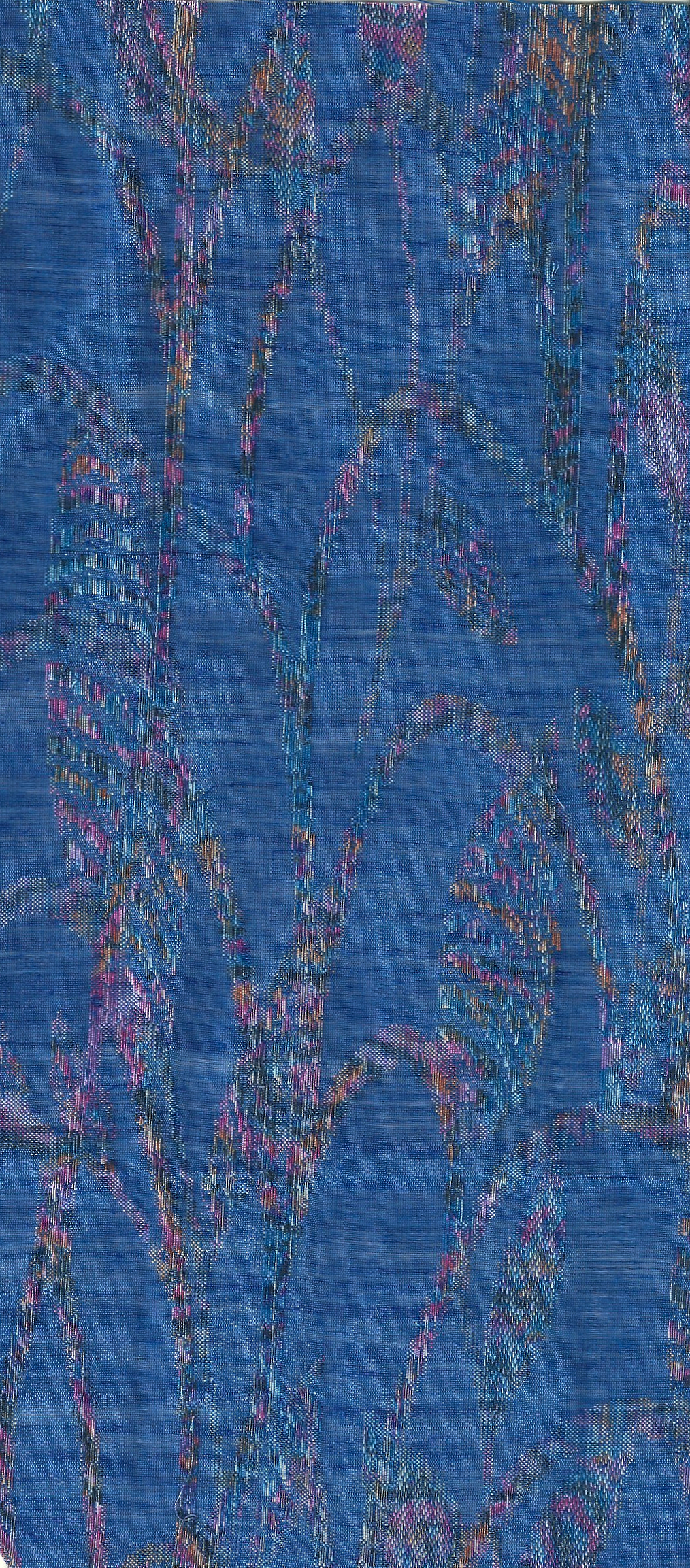
I sent off for swatches – and more swatches – and even more, but I couldn’t find what I was looking for. This is what happens when one lives in an area which is devoid of fine fabric stores. ARGH! Then I found this lovely lightweight silk/linen/viscose blend at Emma One Sock. The color was just what I had in mind and I loved the feel of the fabric. The delicate woven design within this fabric catches glimmers of light.

The subtle design is in shades of pink, green and peach.

The subtle design is in shades of pink, green and peach.

I really loved it. BUT – I knew it wouldn’t look good paired with lace. So-o-o-o, I thought to myself, maybe I’ll save the lace idea for another time. Maybe I should look at my pattern collection and see what other cocktail dress patterns might be more suitable.  I picked out two more designs and gave myself some thinking time.

Perfect Blue - Mattli pattern

View D would be my choice.

View D would be my choice.

Since the yardage needed was about the same for all the patterns, I felt confident ordering the fabric and making my decision after it arrived. Can you guess which design I finally chose – and why?

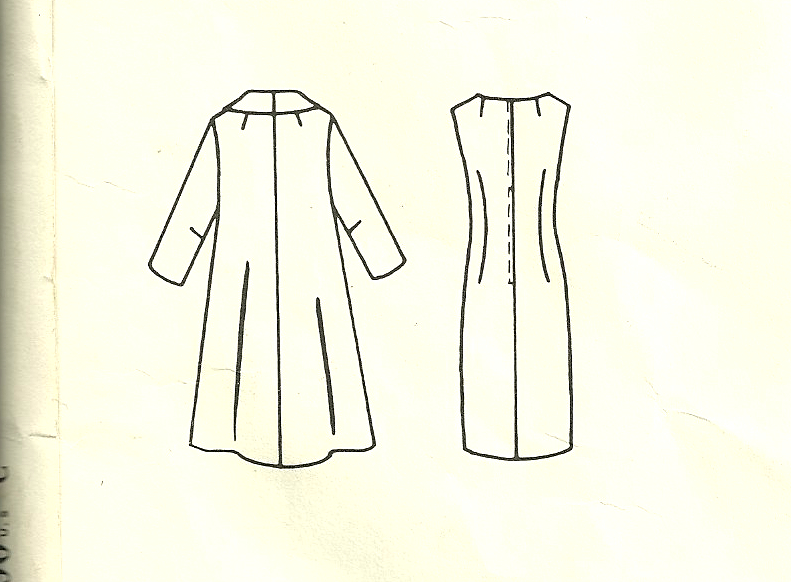
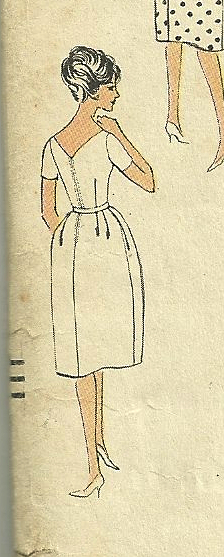
The Vogue Couturier Design by Jo Mattli was the winner. I felt like the vertical “stems” and “leaves” woven into the fabric would be shown to best advantage by a dress that did not have a whole lot going on in it in the way of seams and tucks and gathers. I also like the fact the Mattli design very cleverly gives the feel of a two-piece dress, but in reality, it is one-piece. In fact, only the front of the dress looks two-piece. Here is the back view:

Perfect Blue - thumbnail sketch of backs

The lightweight nature of this fabric also means that there will not be an excess amount of bulk in that double layered front. The fabric is ideal for underlining in silk organza, with a lining in luscious china silk which Emma One Sock helped to select for me.

I spent several days working on a muslin (toile) for the dress, making some subtle changes which I’ll cover in a future post. The dress itself is now “under construction”! Of course, the longer I work with this beautiful fabric, the more I wonder if I should order more of it….?   A coat with a lining to match the dress would be quite something, wouldn’t it? (Any coat would not be finished in time to wear to the early September event for which I am making this dress, but would I let a small detail like that keep me from a vision?) What do you think? Coat or no coat? And if I did make a coat, what color should it?


21 Comments

Filed under Uncategorized, underlinings, vintage Vogue Designer patterns, vintage Vogue patterns from the 1960s

Sometimes It’s All About the Shoes

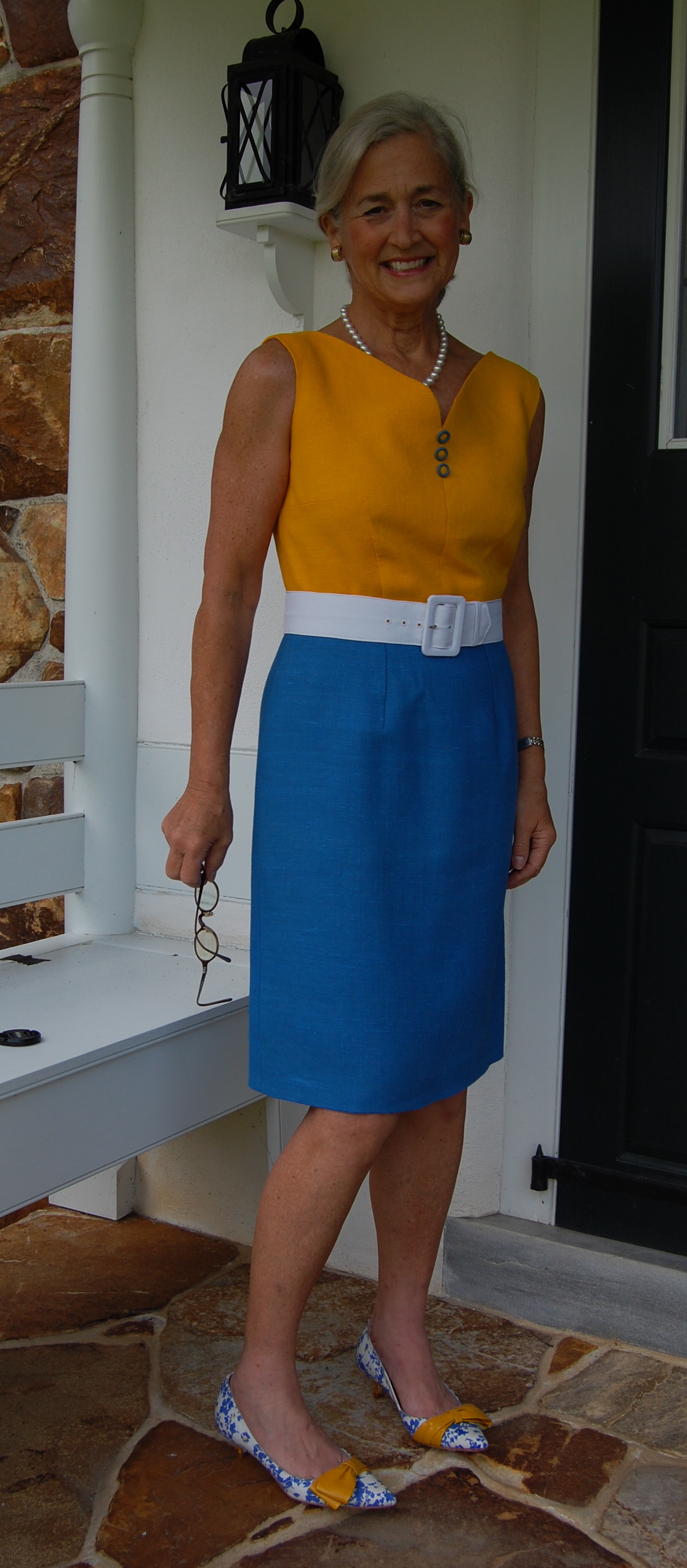
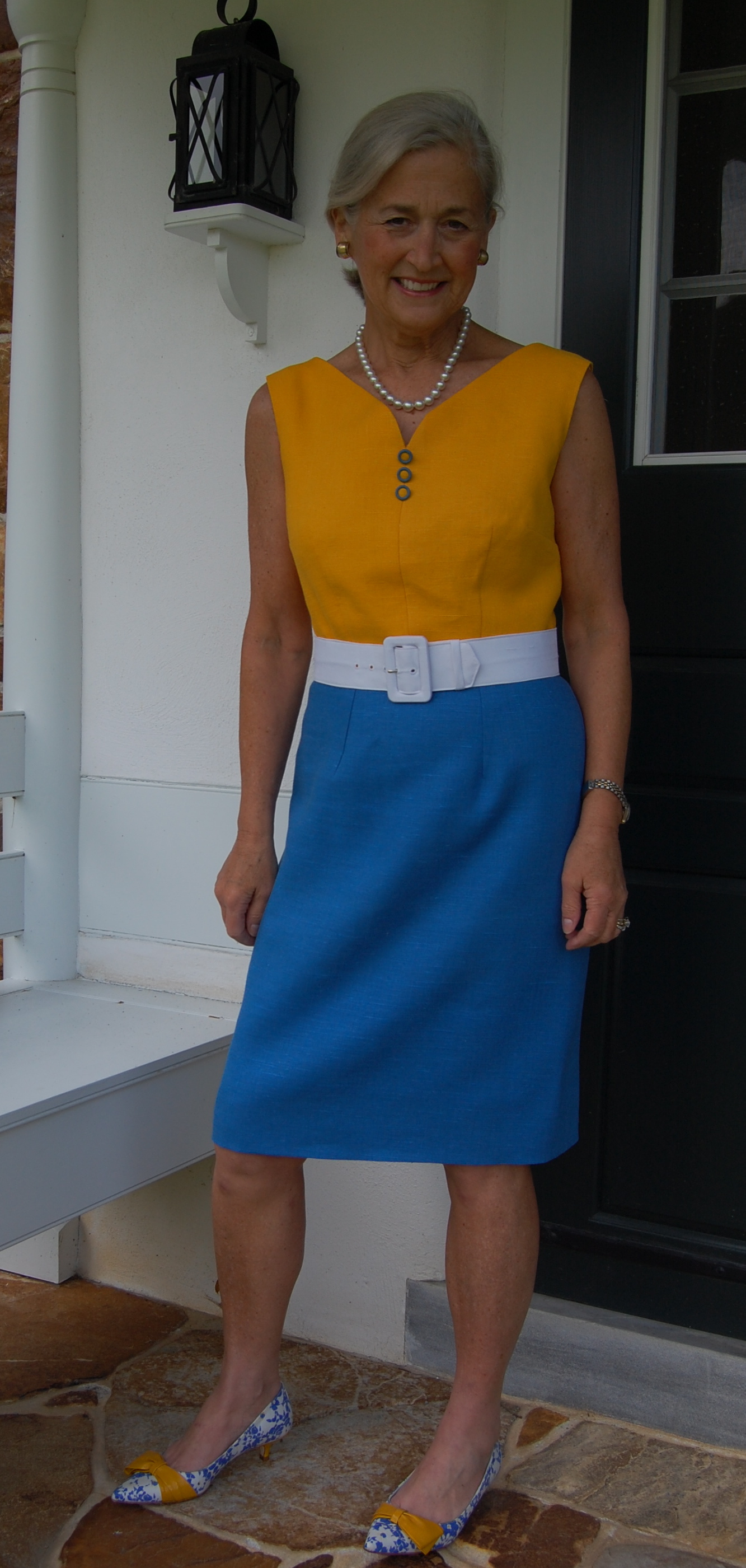
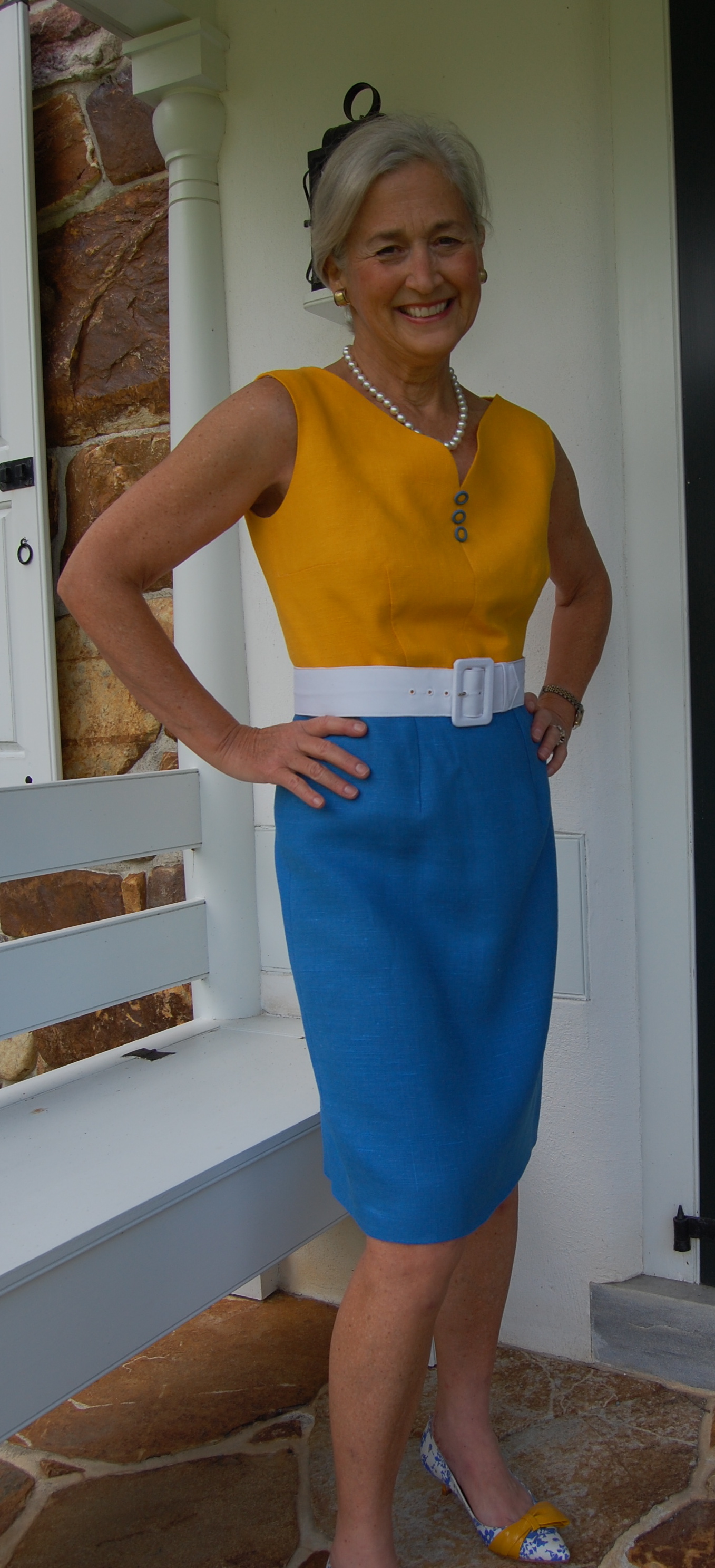
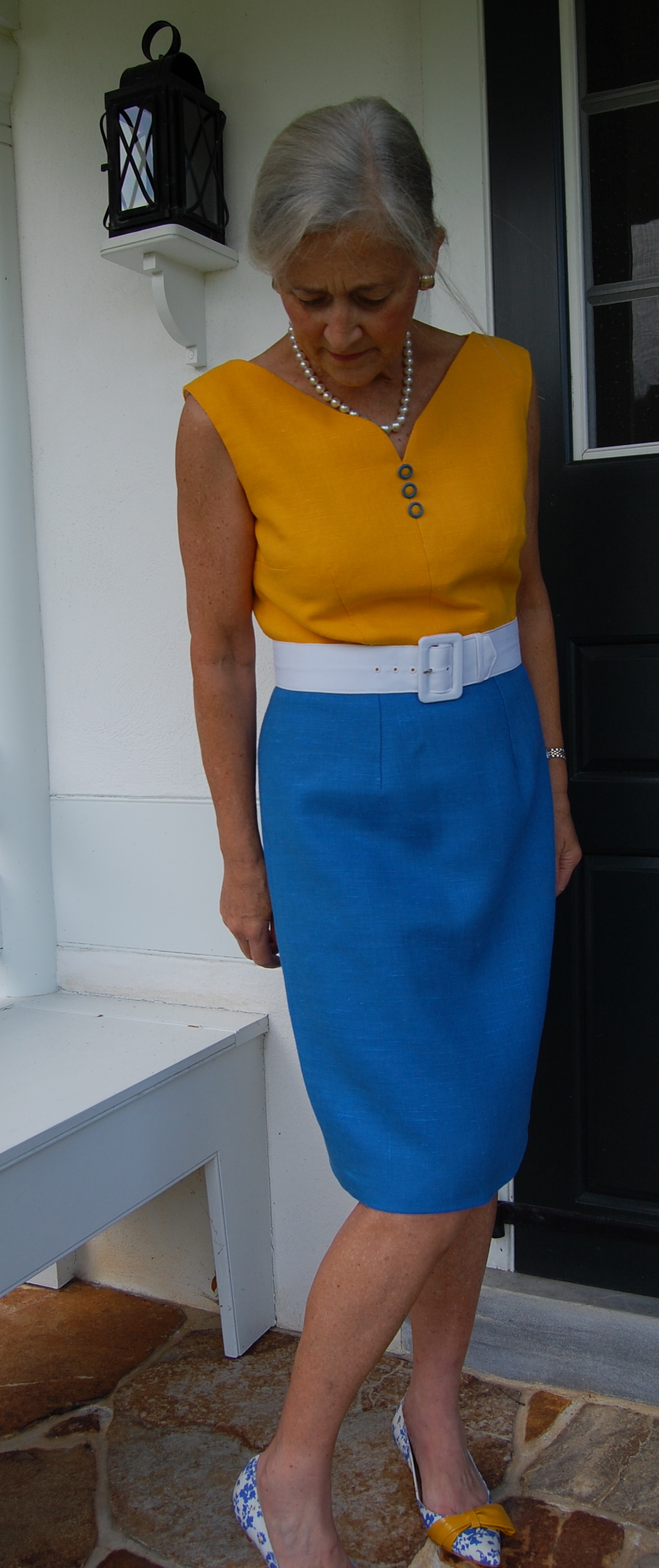
Well, maybe it’s not entirely about the shoes, although they do promise to share a starring role with my just-completed yellow and blue linen dress.

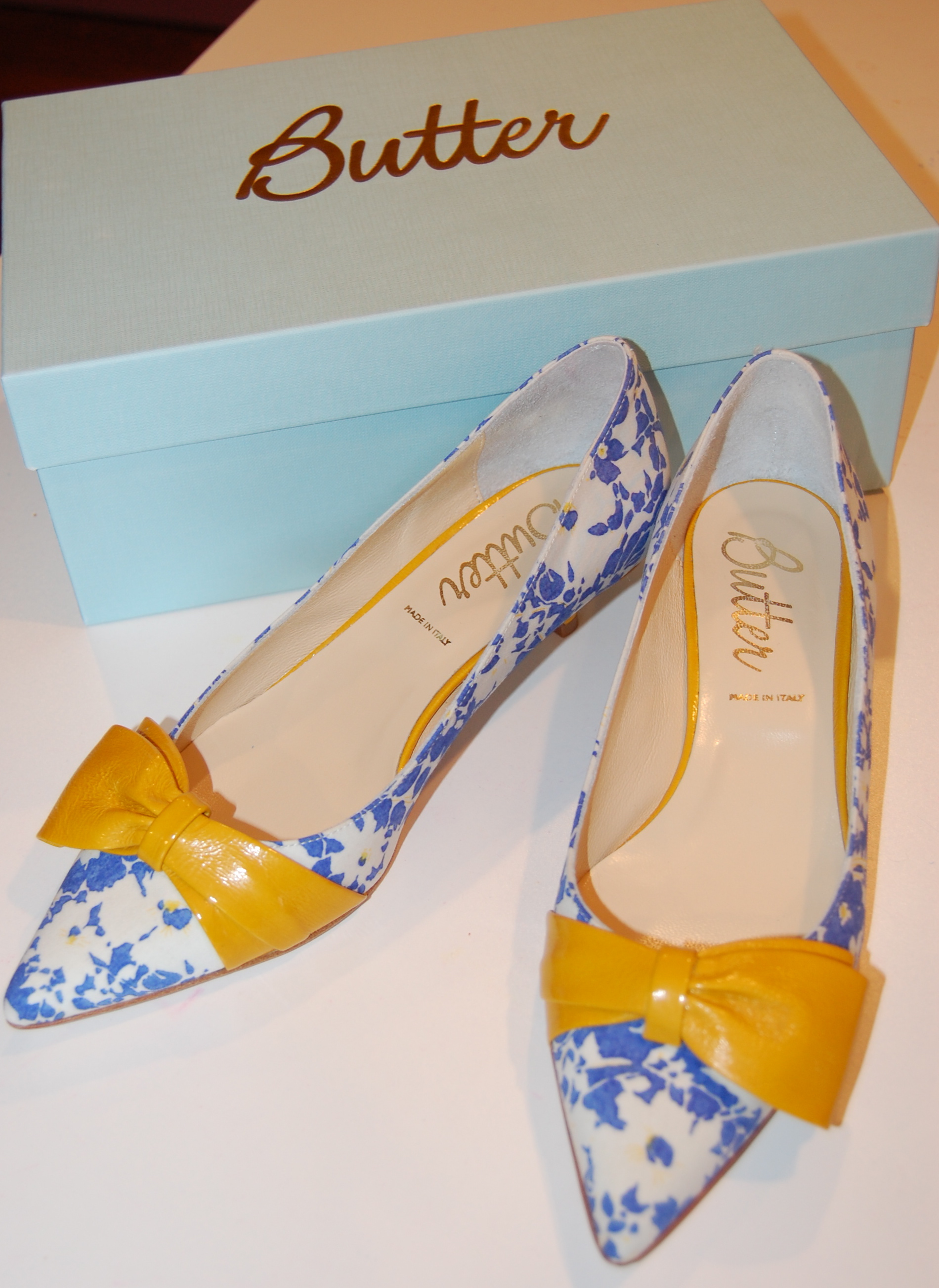
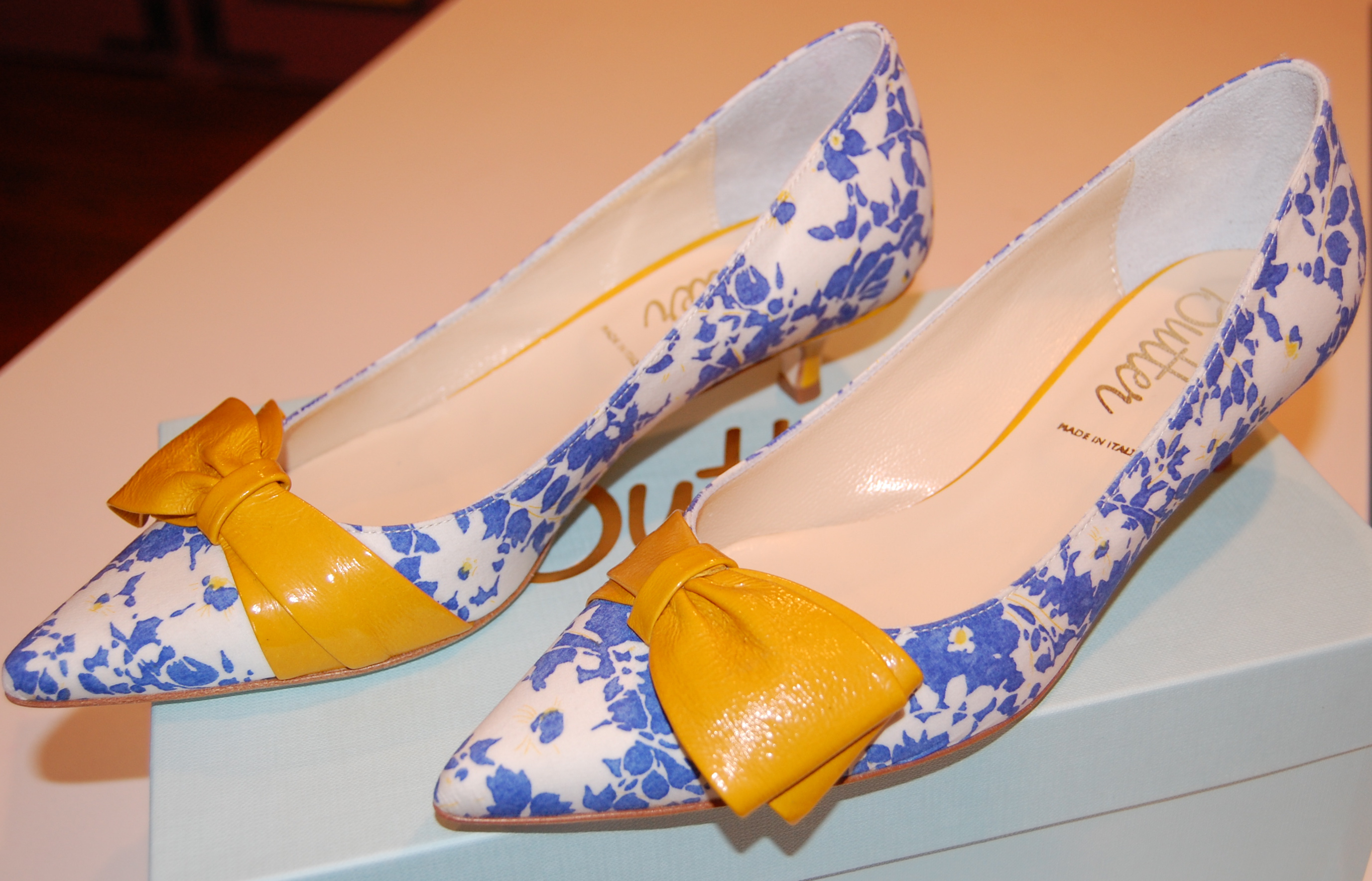
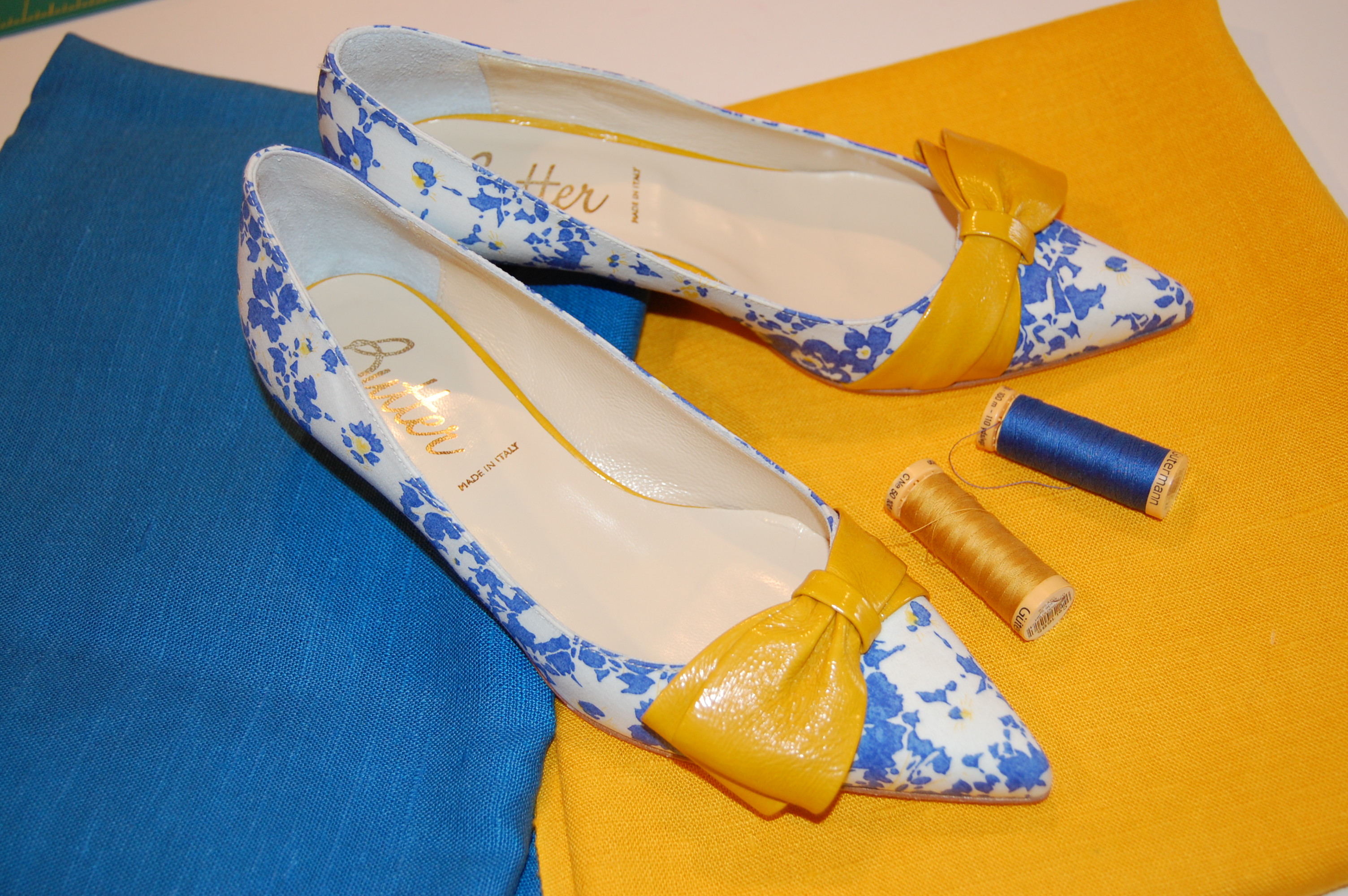
All about the shoes

I first spied these lovelies on the Simply Soles website last winter, as part of the offerings for Spring/Summer shoes. Although I loved everything about them (the combination of colors, the fabric, the asymmetrical bow, the kitten heel, the brand – knowing from experience that Butter shoes are extremely comfortable), I decided not to purchase them. At that point in time, I had not yet bought the bittersweet yellow linen, so I had no reason to buy shoes with such a limited color palette. By the time I had a good reason to buy them, they were no longer available in my size.

All about the shoes However, the Simply Soles website allows one to request an email advice should the correctly sized shoe become available. Weeks went by, Summer arrived, and by then I had paired the recently purchased deep yellow linen with the pottery blue linen. Goodness, I could not stop thinking about those shoes and how perfect they would be with my envisioned dress. And then – they were suddenly available – in my size – and on sale!
All about the shoes

By this time I was already immersed in making my second linen dress of the Summer, so I planned for the blue and yellow linen to be number “3”. In the meantime, I happened upon more documentation of Moygashel linen, this one for the “yellow” piece. Those of you who follow this blog know how much I love to make these connections!

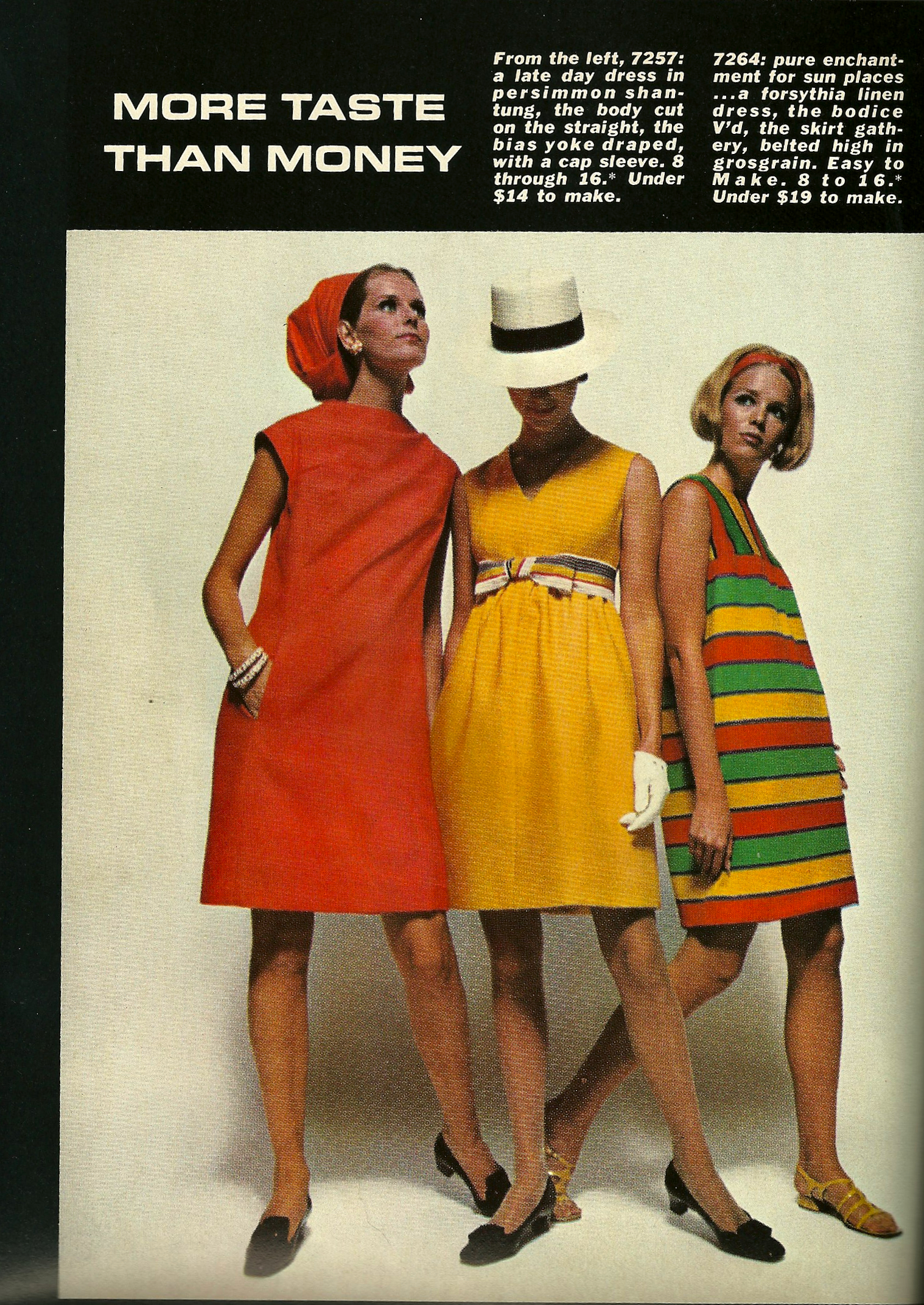
"... pure enchantment for sun places ... a forsythia linen dress ..."  and the source information in the back of this Vogue Pattern Book Magazine from February/March, 1968 credits Moygashel as the brand of linen.

“… pure enchantment for sun places … a forsythia linen dress …” and the source information in the back of this Vogue Pattern Book Magazine from February/March, 1968 credits Moygashel as the brand of linen.

Seeing an entire dress made out of the forsythia linen helped me to feel confident about having such a bright color as the bodice part of my planned dress.  As I stated in my last post, I decided to use the bodice from this early ‘60s’ Vogue pattern, pairing it with a slim skirt and a belt.

The neckline dips down to a slightly curved V, with a center seam.

The neckline dips down to a slightly curved V, with a center seam.

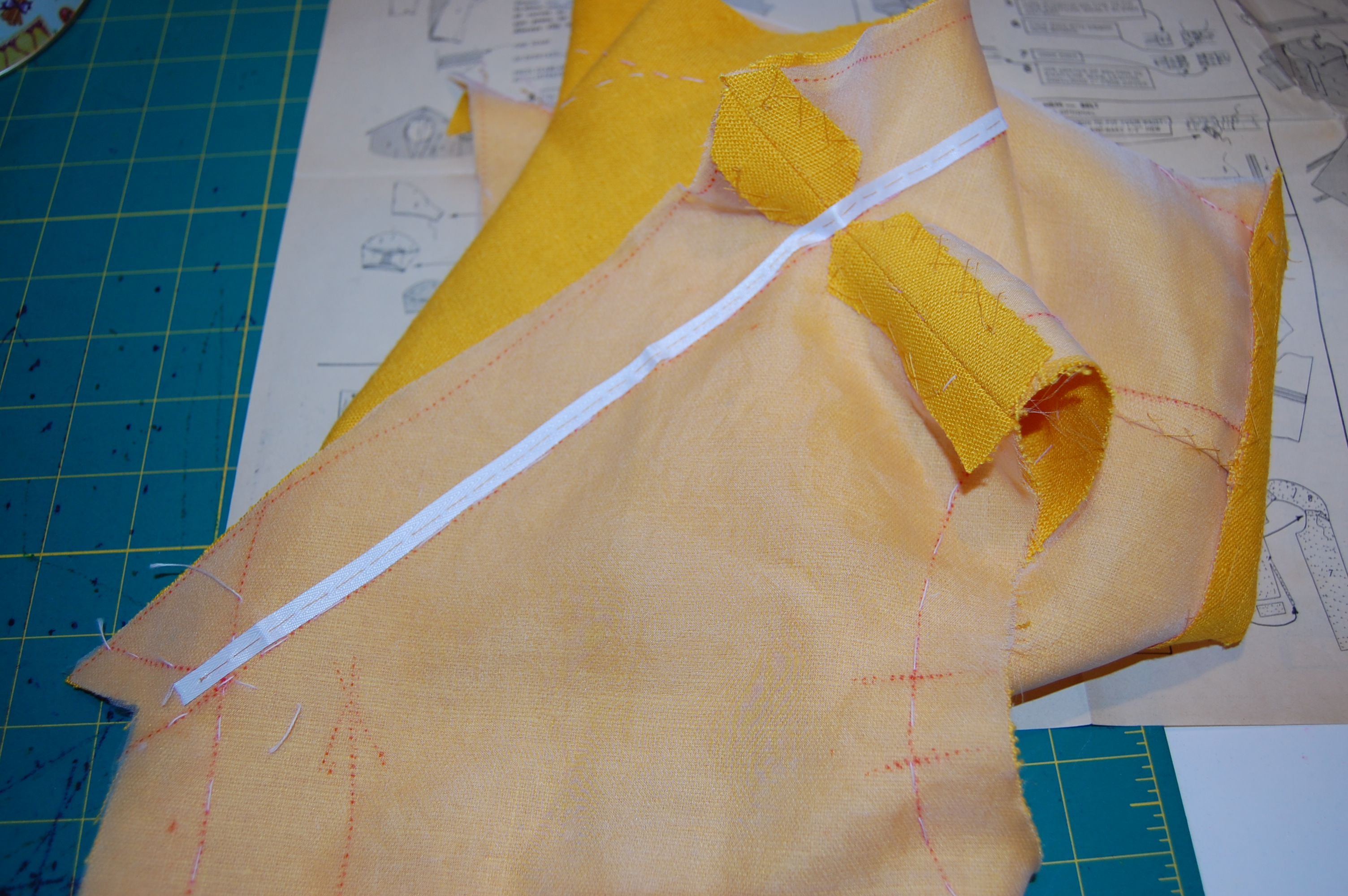
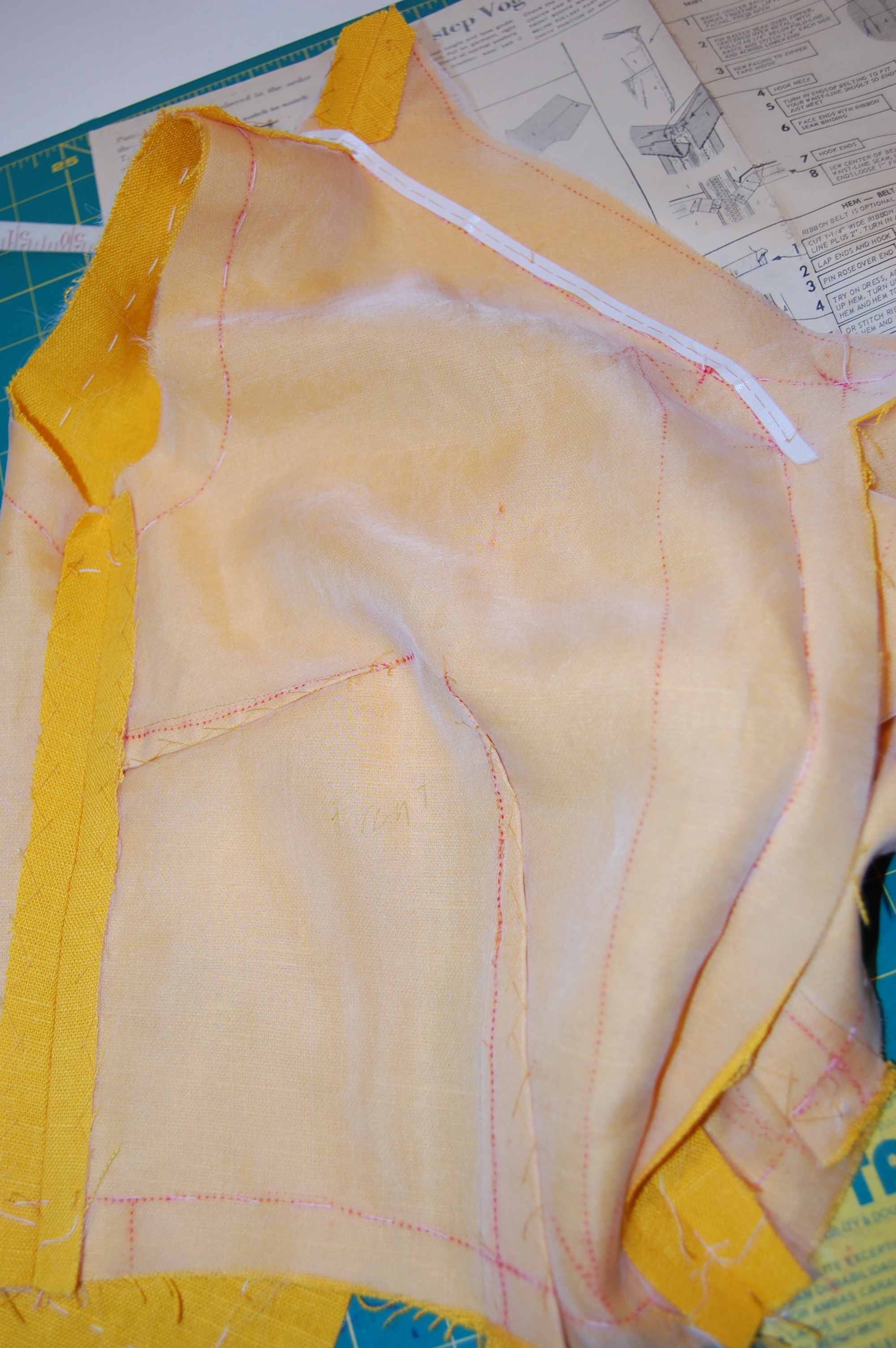
As this would be a dressier type of frock, and because I know how foolproof couture construction is (with silk organza underlining and crepe de chine lining), I proceeded using those techniques. The facings on the V-shape of the bodice front and back were cut as part of the pattern, instead of being separate pieces. I followed the instructions to reinforce the edges of the fold with ¼” twill tape.

I basted the twill tape just to the outside of the fold line on the "all-in-one" facing.

I basted the twill tape just to the outside of the fold line on the “all-in-one” facing.  This is the back bodice.

And this is the front bodice, showing the deep V and the center seam.

And this is the front bodice, showing the deep V and the center seam.

Normally, couture construction does not use facings, but in this application, they were indispensible. Then the rest of the dress proceeded without a hitch.

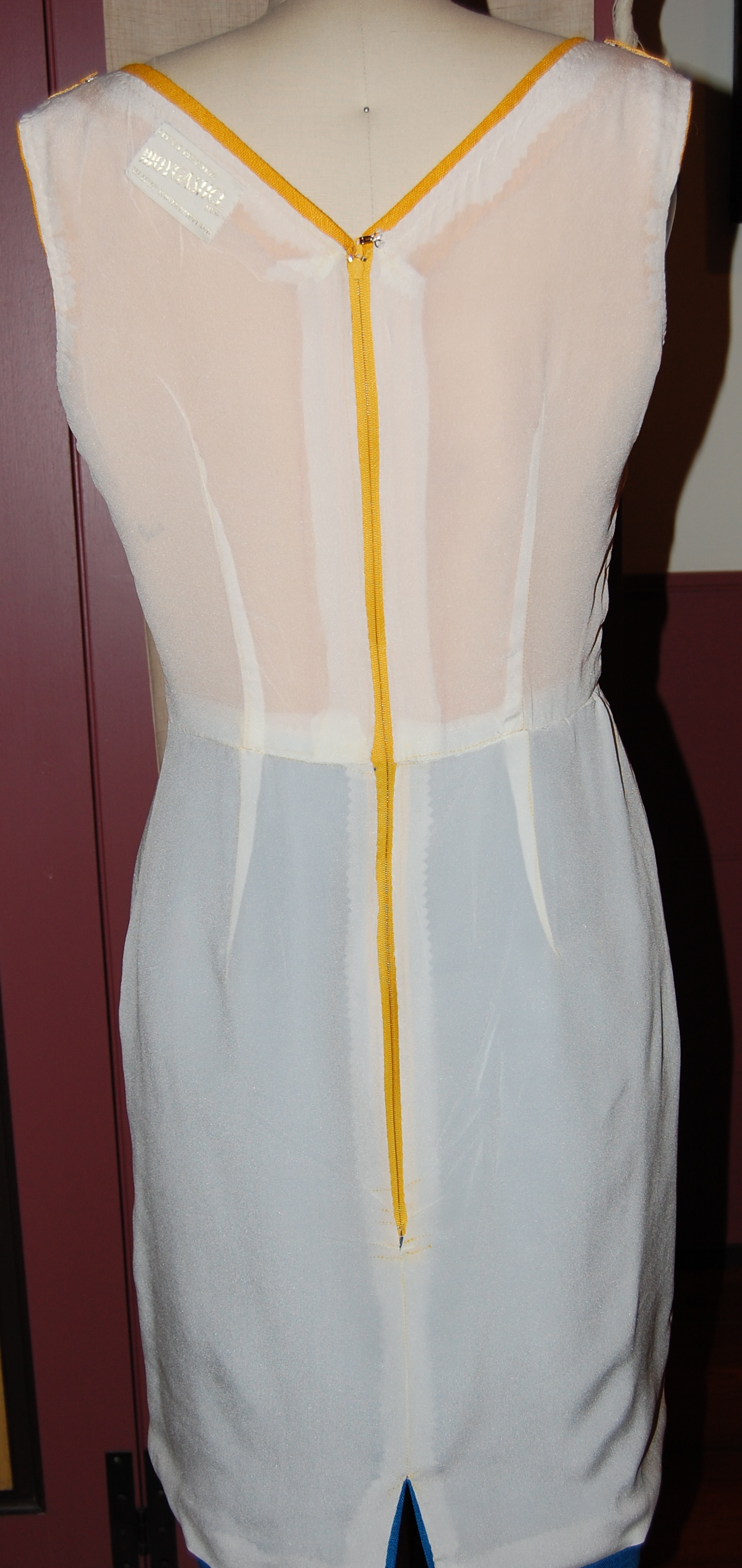
Here is the dress turned inside out.  I used a forsythia-yellow zipper as i thought it more important to match the bodice than the skirt of the dress.

Here is the dress turned inside out. I used a forsythia-yellow zipper as I thought it more important to match the bodice than the skirt of the dress.

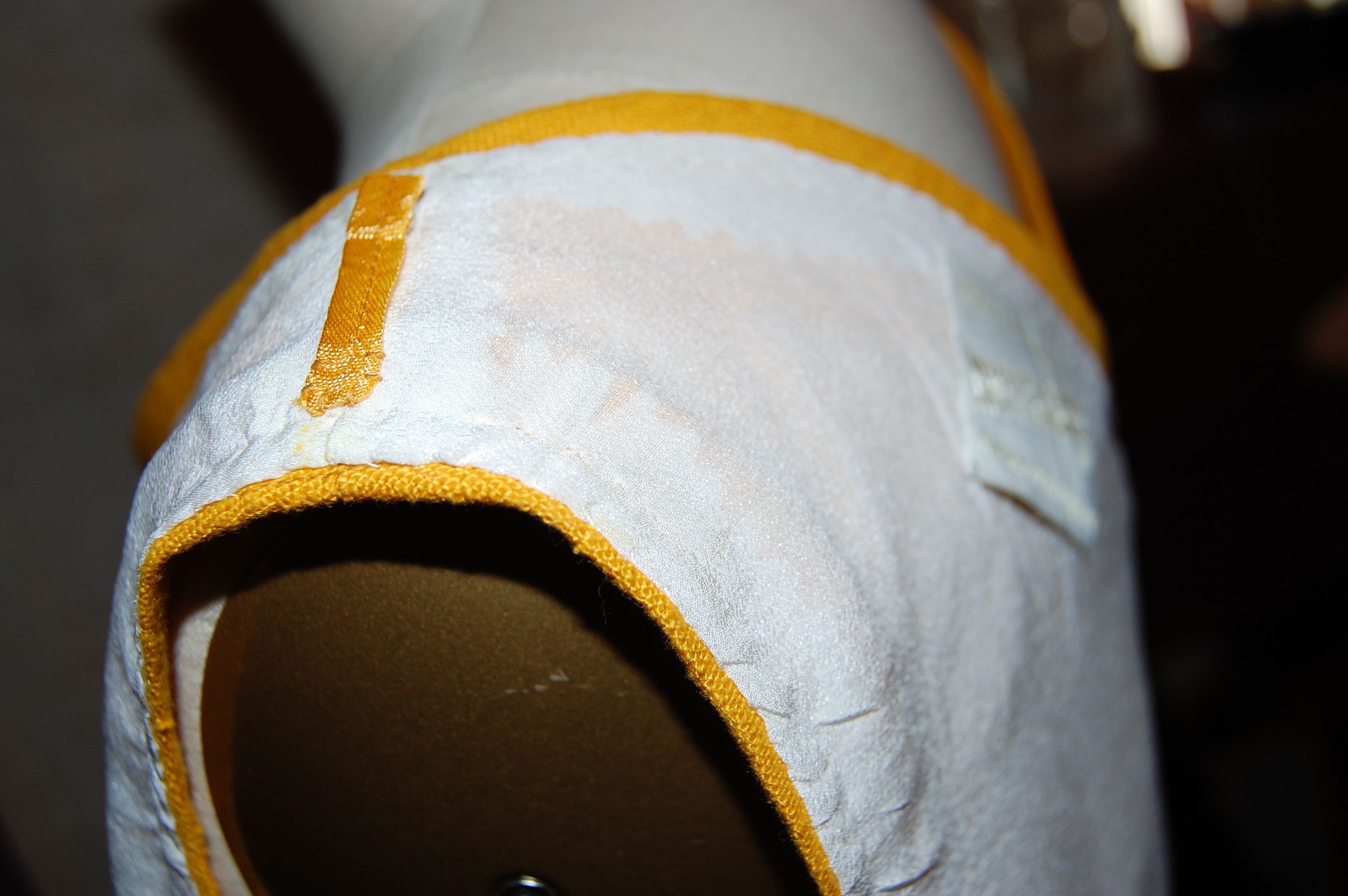
Here is the shoulder with the crepe de chine fell-stitched and understitched in place around the shouilder.  Note the lingerie stay made with a folded piece of Hug Snug Rayon woven tape.

Here is an inside look at the crepe de chine fell-stitched and understitched in place around the shouilder. Note the lingerie stay made with a folded piece of Hug Snug rayon woven tape.

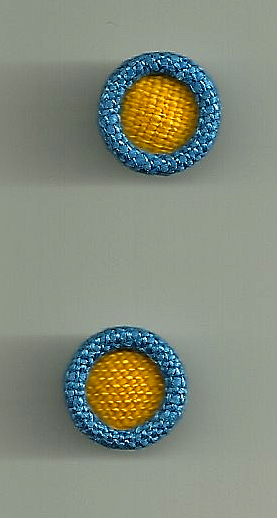
About halfway through the construction of the dress, I got the idea to have decorative buttons made – to compliment the front V of the neckline.

I sent scraps of my fabric off to Pat Mahoney in California to have these buttons made.  Sadly, Pat is retiring from her business at the end of August...

I sent scraps of my fabric off to Pat Mahoney in California to have these buttons made. Sadly, Pat is retiring from her business at the end of August…

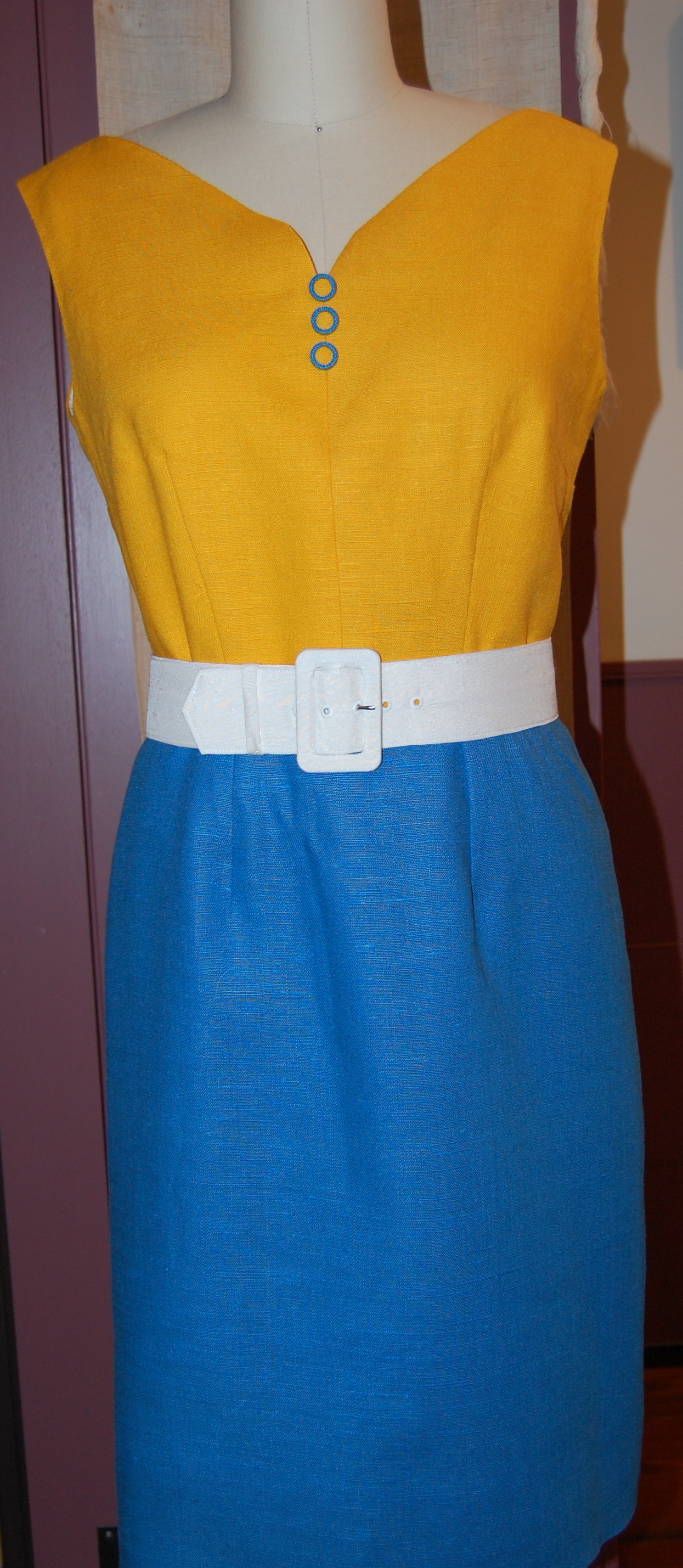
I actually was not sure I was going to use them until I had finished the dress, but I think they add just the right amount of detail.

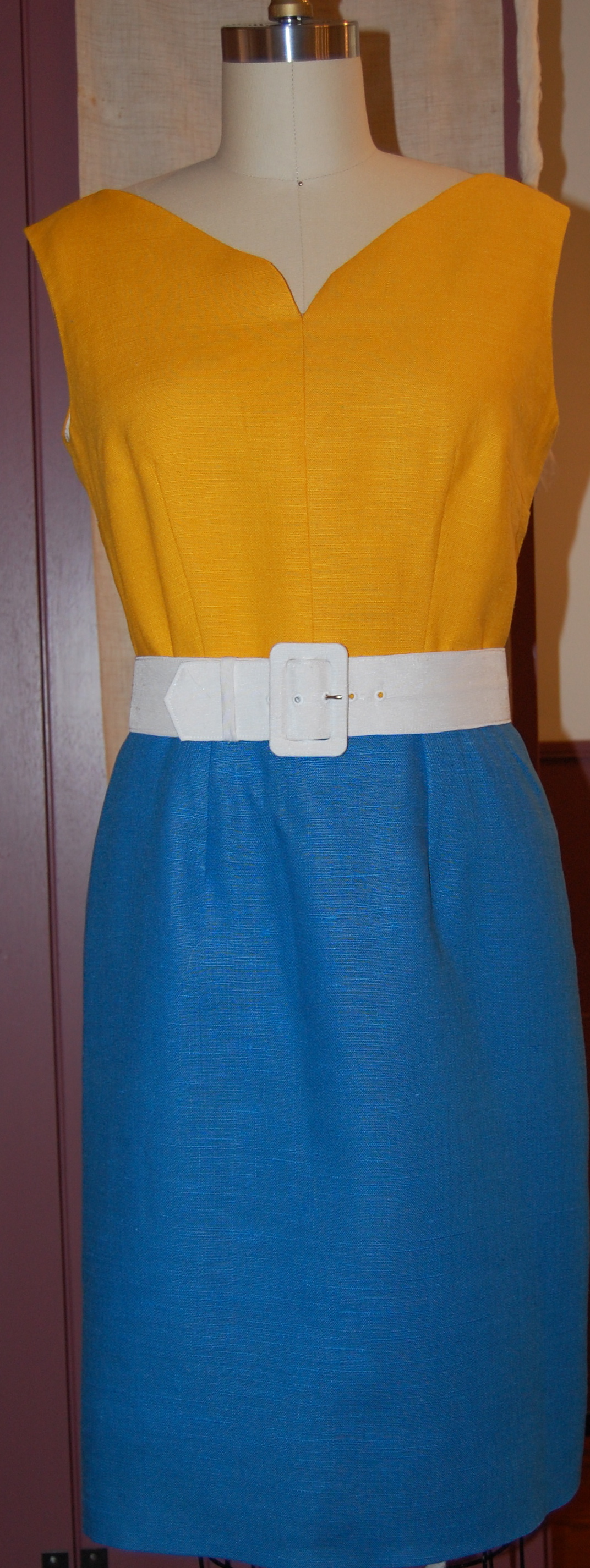
Here is the dress without the buttons . . .

Here is the dress without the buttons . . .

. . . and here is the dress with the buttons.  What do you think?  With or without?

. . . and here is the dress with the buttons. What do you think? With or without?

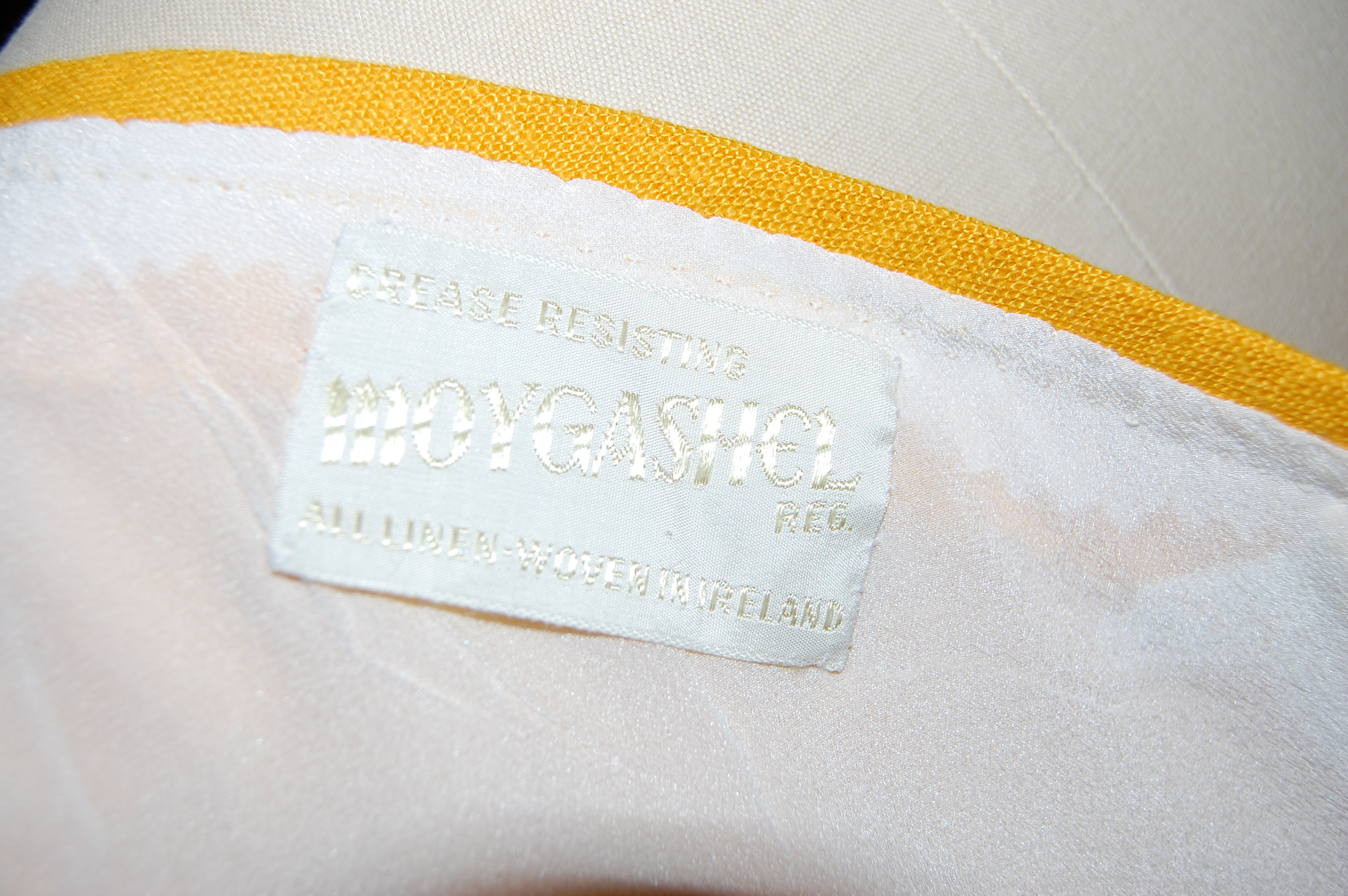
Another detail I was happy to add was the Moygashel linen label which had been attached to the forsythia yellow linen yardgoods.

I attached the label inside the back neckline.

I attached the label inside the back neckline.

The belt is also a Pat Mahoney product, made from a silk dupioni.

The belt is also a Pat Mahoney product, made from a silk dupioni.

All about the shoes

All about the shoes

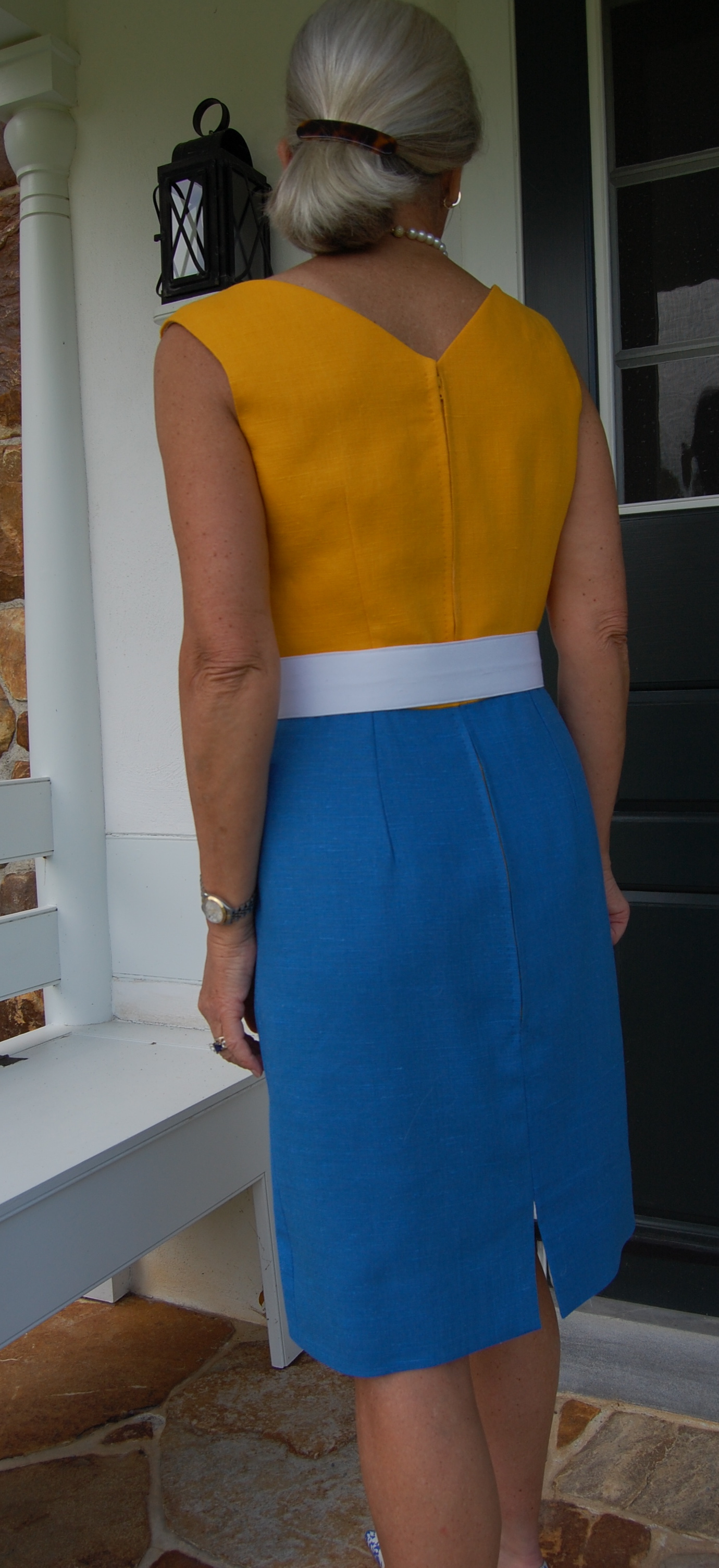
I like the V-ed back!

I like the V-ed back!

Love those shoes!

Love those shoes!

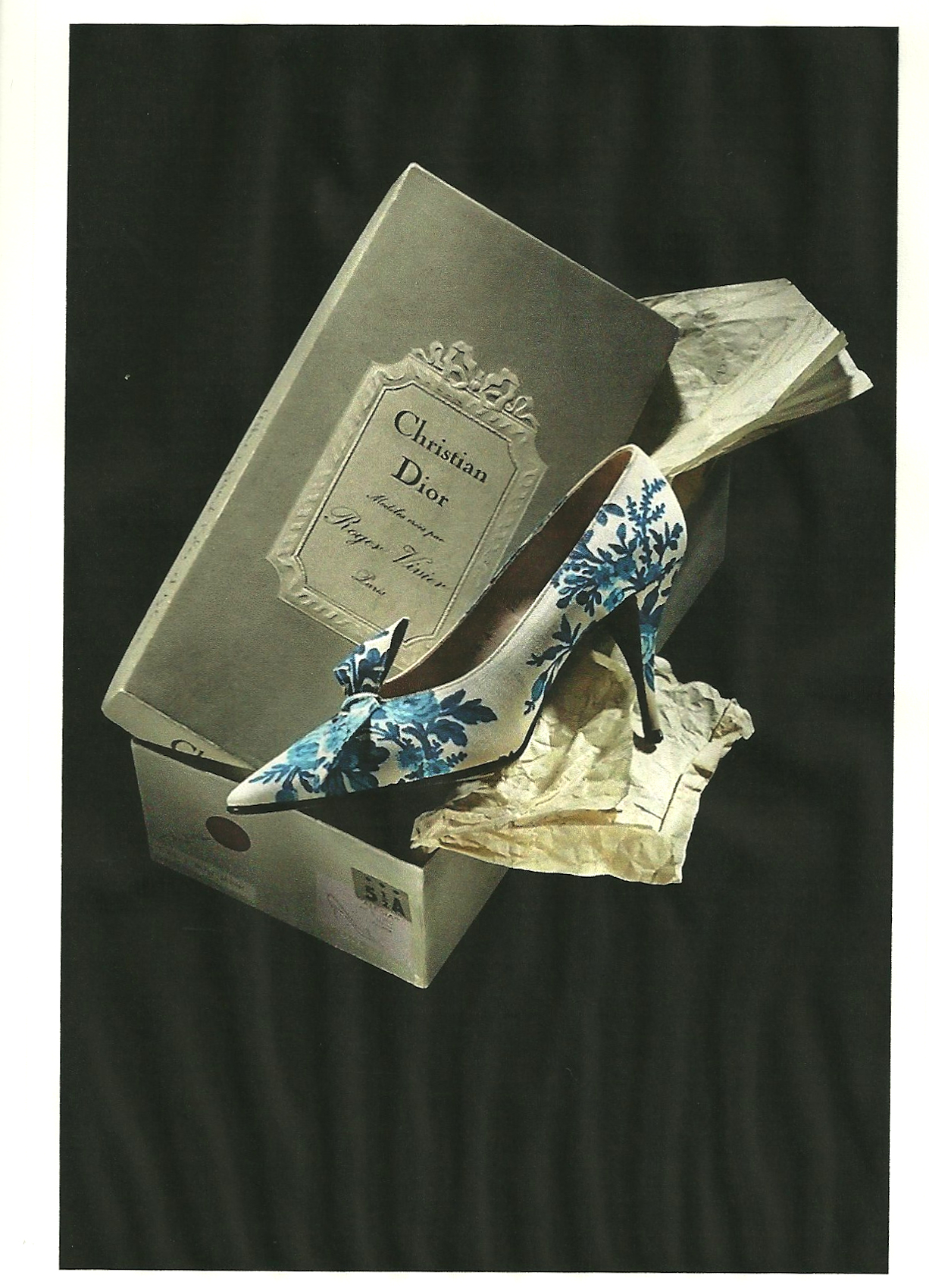
To me, this dress is reminiscent of a 1950s’ “wiggle dress” – although I added a back slit so that I can walk easily, which I guess would have been “cheating” in the 1950s! I was delighted to make another 1950s’ connection when I saw this pair of Roger Vivier shoes for Christian Dior on Pinterest:

All about the shoes - Pinterest pin

The similarities with my shoes are remarkable! Now that I have one dress perfectly suited for my Christian Dior-inspired shoes, I will be looking for other “perfect pairings”. Who knows what fabric treasures will present themselves next Spring or Summer for just such an undertaking?


44 Comments

Filed under Buttons - choosing the right ones, couture construction, hand-sewn zippers, Linen, Moygashel linen, Shoes to make an outfit complete, The Conde Nast Publications, Uncategorized, underlinings, Vintage fabric, vintage Vogue patterns from the 1960s

“Good Wearing-Relationships”

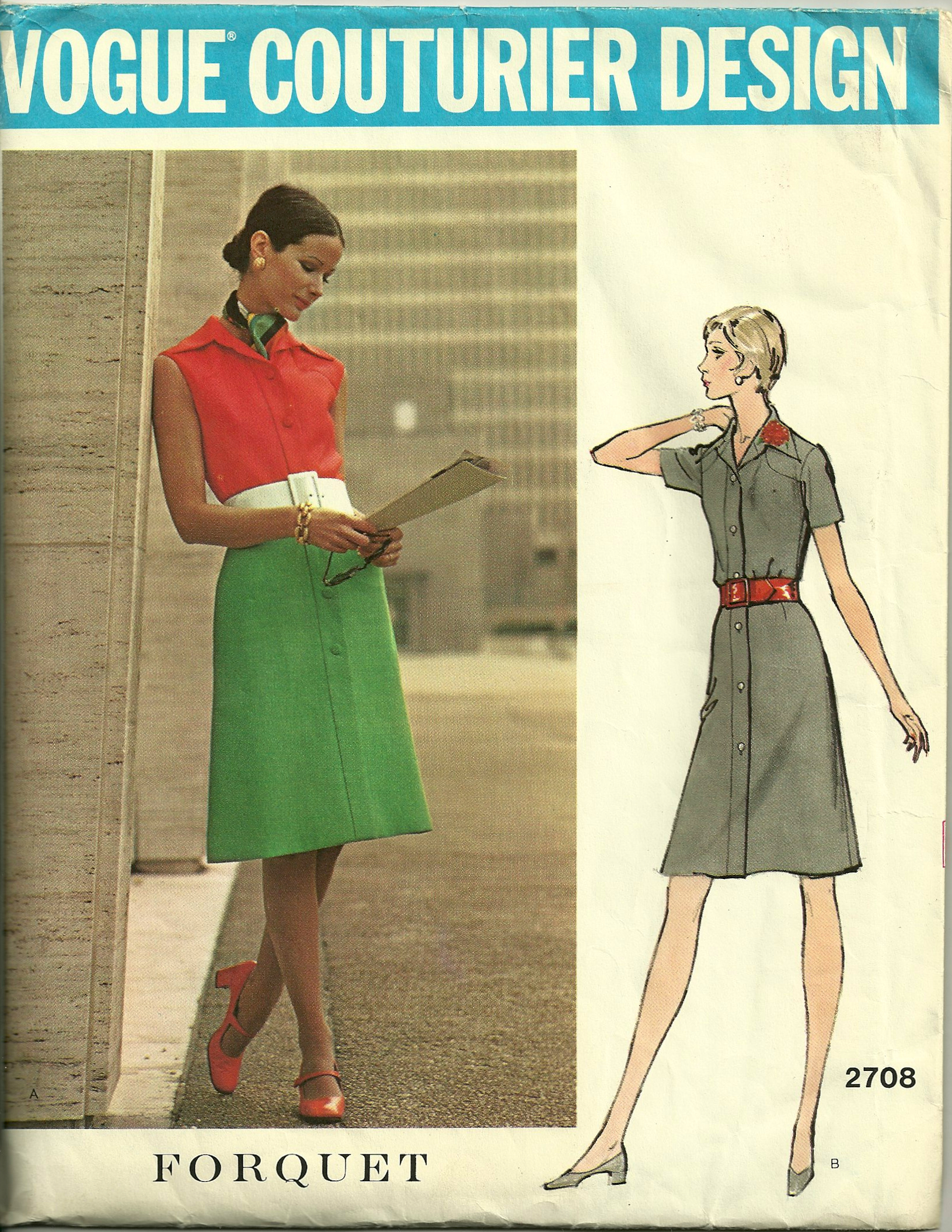
This is a pattern I have long admired:

Good wearing-relationships - Forquet pattern

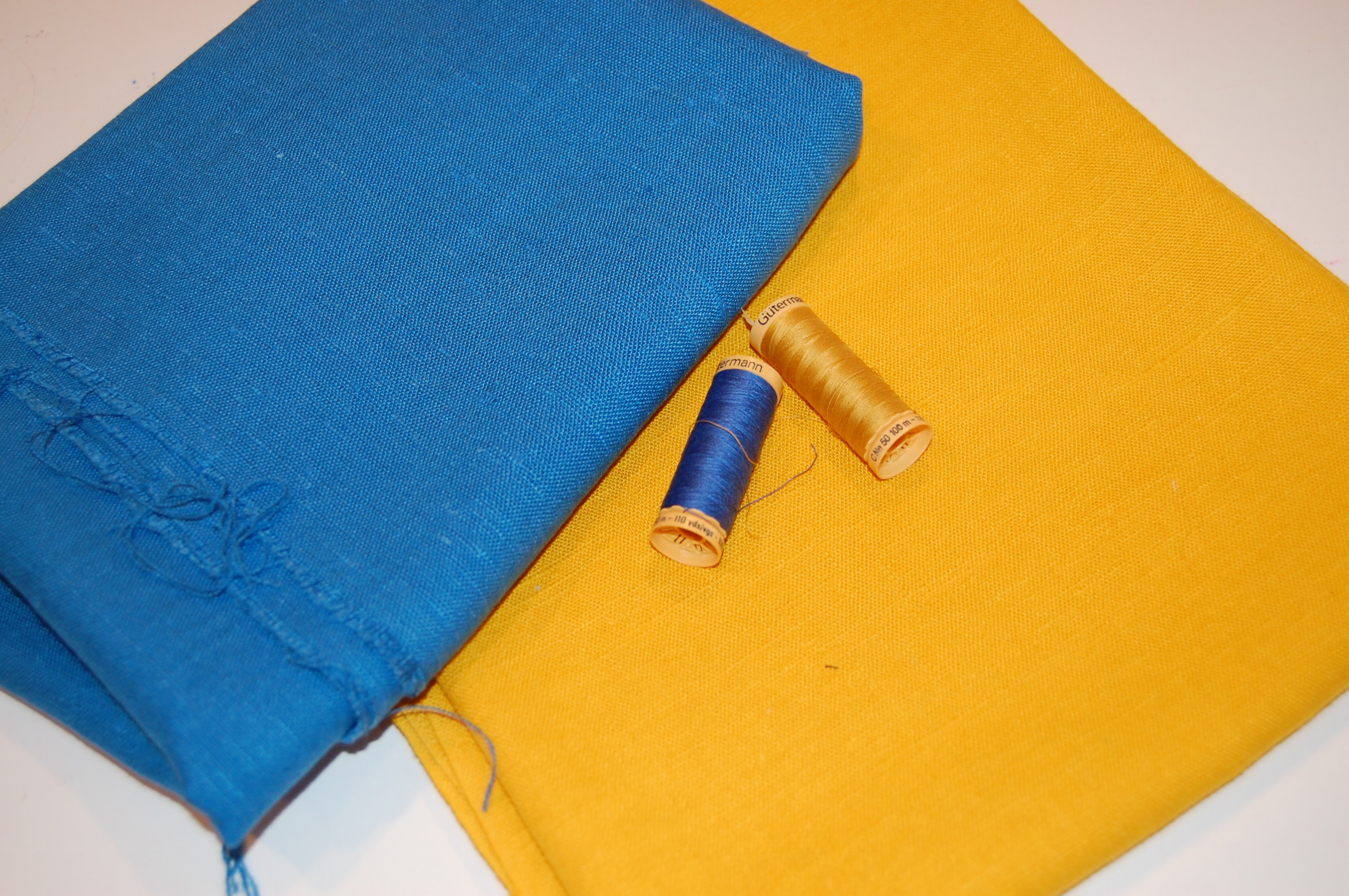
It is one of those patterns which is always in my mind when I am looking at or for fabric. Twice I have opened it up to survey its pieces and construction, and twice I have decided against it. To be fair, both times of rejection have been because of “not enough fabric”, but other factors have weighed in as well: 1) the collar is too “’70s-looking” and would have to be recut; 2) the skirt is A-line, a look I am just not excited about right now; and 3) the top part of the dress is “bloused” instead of darted, which adds more bulk to the waist than I can handle at this stage of my life.  However, with that said, I still love the look.   I love the strong contrasts of color, divided and punctuated with the wide white belt. I love the styling with the shoes matching the red bodice, the tidy neck scarf, the big ball earrings, and the classy bracelet. It is a memorable look. And – it served as inspiration for me as I recently paired two vintage pieces of contrasting Moygashel linen.

GGood wearing-relationships

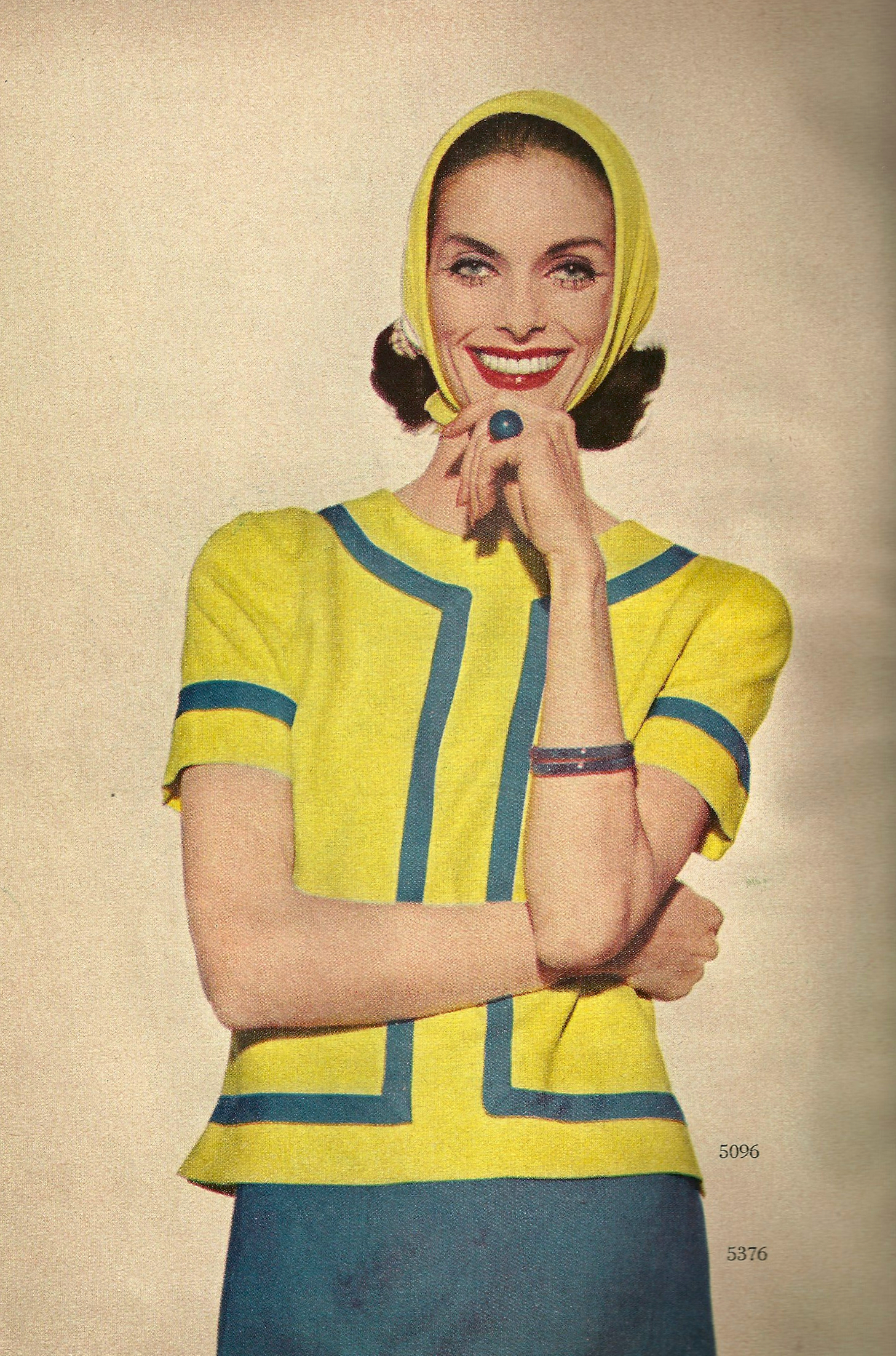
When I purchased these fabrics – at different times – I had no intention of using them together.   But then, one day I put them together and liked what I saw. I knew from Vogue 2708 (above), that a white belt would add the necessary foil to those two strong colors. Further encouragement came happily from a two-piece dress in the June/July 1962 issue of Vogue Pattern Book Magazine using similar Moygashel linens:

"They're naturals - and we're not just talking about the cotton and linen fibers in the clothes on these pages , but the good wearing-relationships we have with them.  We like them; they like us - our 1962 shapes, science-bred colors, the places we go, our washing machines..."  The two-piece dress featured here was made from Moygashel linen,

From the description:  “They’re naturals – and we’re not just talking about the cotton and [Moygashel] linen fibers in the clothes on these pages , but the good wearing-relationships we have with them. We like them; they like us – our 1962 shapes, science-bred colors, the places we go, our washing machines…”

Now all I had to do was decide upon a pattern which would work with the one yard I had of the “bittersweet” yellow linen for the bodice and the one-and-one-quarter yards I had of the “pottery” blue linen for the skirt. (Fortunately, these linens are 45”wide, meaning that they were manufactured after the early-1960s.)

Initially I thought I would just go with View D of this current Vogue pattern:

Good wearing-relationships - new vogue pattern

But after having recently read Linda Przybyszewski‘s The Lost Art of Dress and being influenced by the discussion therein of the importance of fashion emphasizing one’s face, I thought I wanted a more interesting neckline. Off to my collection of vintage patterns I went, emerging with this one:

The neckline dips down to a slightly curved V, with a center seam.

The neckline dips down to a slightly curved V, with a center seam.

And the back is equally as pretty!

And the back is equally as pretty!

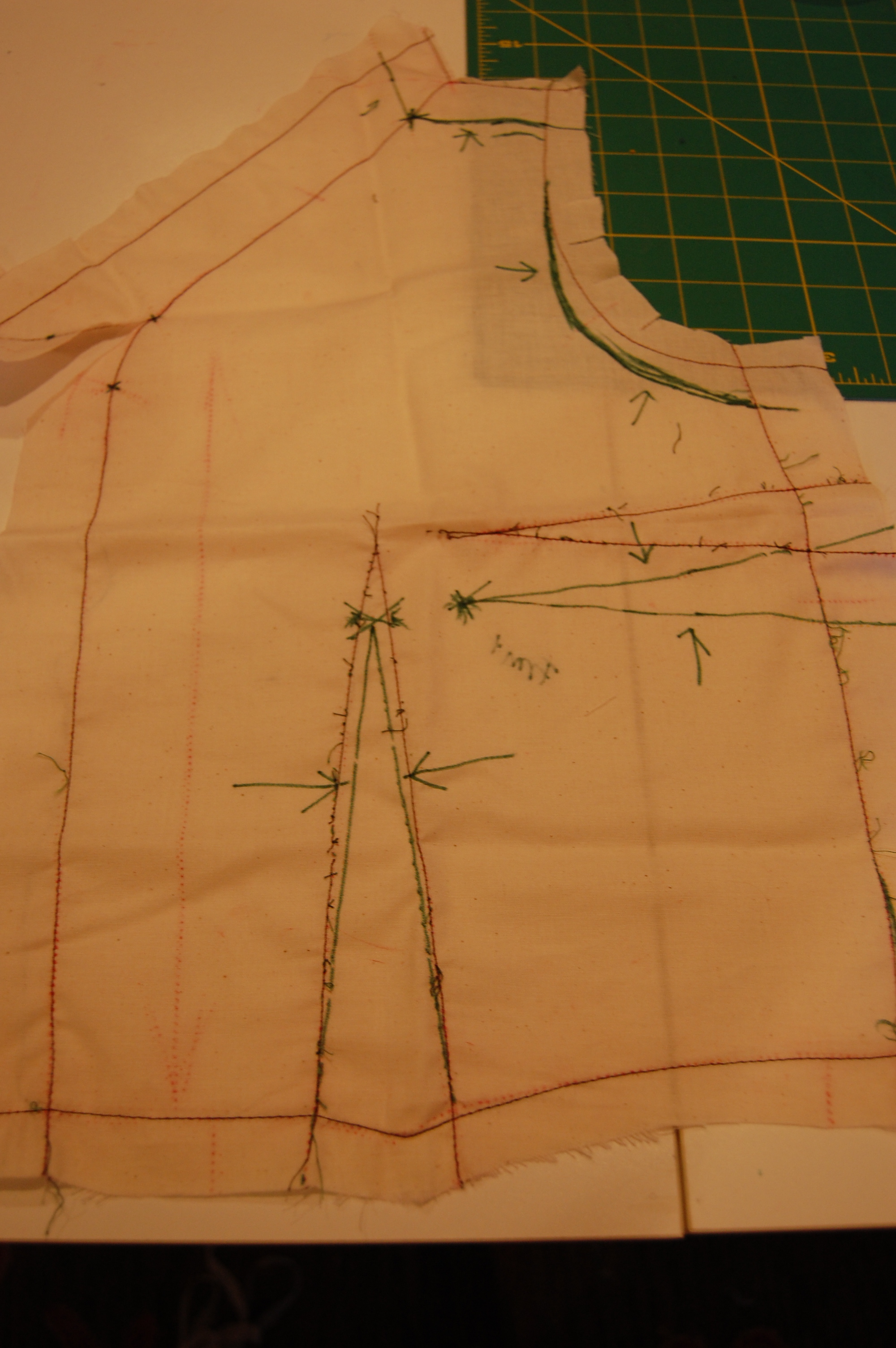
Now I had a plan. I would use the narrow skirt from the current Vogue pattern and the bodice from the vintage Vogue pattern, except that I would make it sleeveless. I had to work to line up the darts on the bodice and the skirt, moving them hither and yon several times. And then I had to deal with the positioning of the bust darts, always an issue for me with vintage patterns. The apices of the darts are always too high for me. (I’m sure it has much to do with the foundation garments which women wore in the ‘50s, ‘60s, and early ‘70s.) Simply moving the apices lower does not always work, as then I seem to have too much fullness above the bust and across the shoulders.   Of course, this is where making a muslin (toile) comes to the rescue. In this case, my first muslin had so many changes to it, that I had to transfer all my final markings to a new muslin. I also decided to underline the linen with silk organza and use true couture techniques to complete this dress.

Here is one side of the front from my first muslin.  I still had to make changes on the second muslin, but better on muslin than on the fashion fabric!

Here is one side of the front from my first muslin. I still had to make changes on the second muslin, but better on muslin than on the fashion fabric!

As I work on this dress I am in concurrence with further commentary from the 1962 VPB: speaking of “Naturals for our Time” (linens and cottons), the editors say, “Most of all, we want the real-life way they look – effortless, inspired by structure rather than detail [my emphasis], and naturally appealing now.” Actually, there is one important detail which will add to the “good wearing-relationship” I will have with this dress – but I’ll save that for my next post…

15 Comments

Filed under couture construction, Linen, Moygashel linen, The Conde Nast Publications, Uncategorized, underlinings, Vintage fabric, vintage Vogue Designer patterns, vintage Vogue patterns from the 1960s, vintage Vogue patterns from the 1970s, Vogue patterns

Fashion Past, Fashion Present

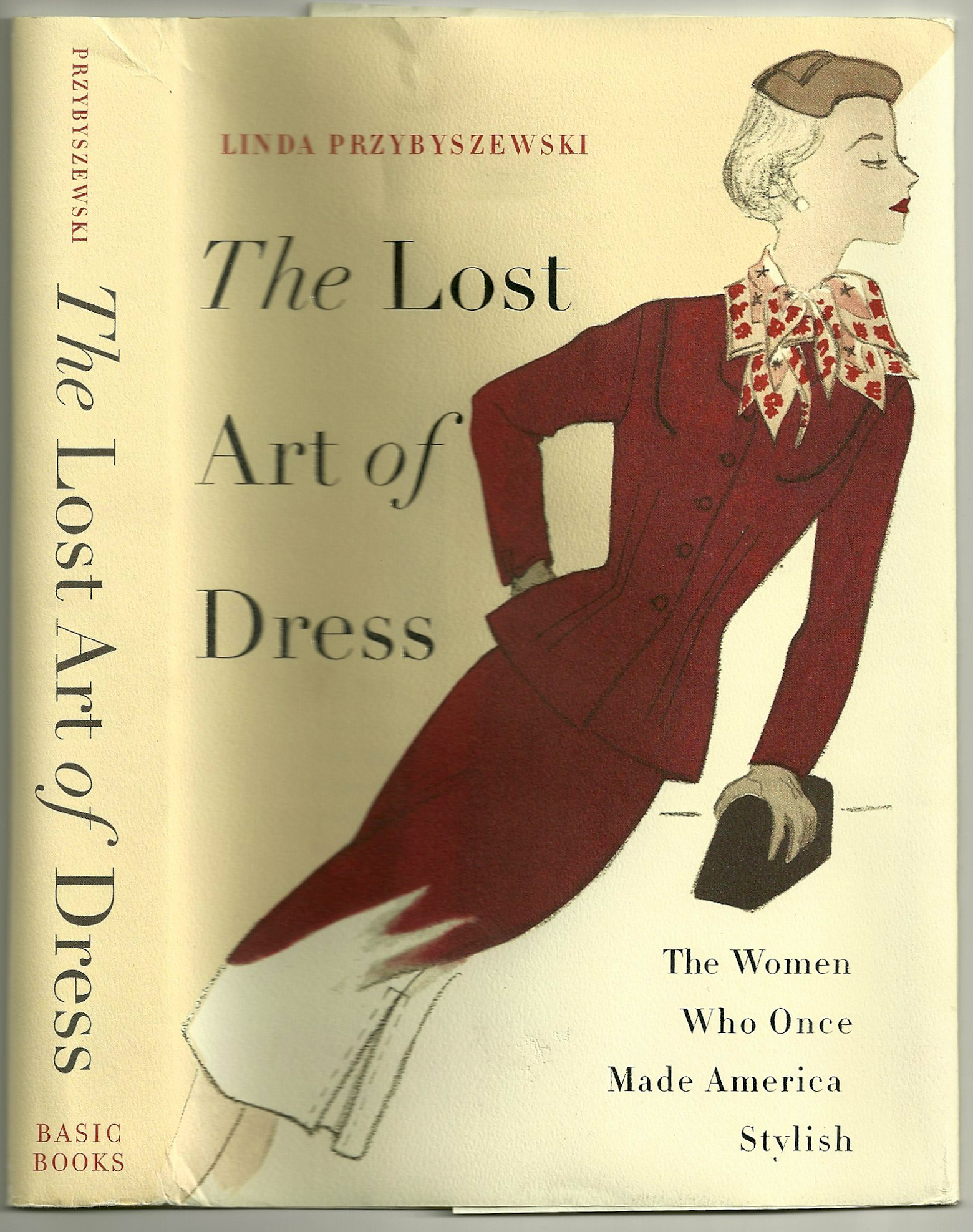
Many reviews of Linda Przbyszewski’s book The Lost Art of Dress: The Women Who Once Made America Stylish have been written. Two of the most recent ones are by Stephani Miller of Threads Magazine, and by Joy Landeira in the quarterly newsletter (Summer 2014) of the American Sewing Guild, Notions (available to members only). Both of these, plus many others give an excellent overview of the subject of the book. For those of you abroad and others who may not have been exposed to this book, here in a nutshell is the narrative: From 1900 – 1960, American women’s interest in fashion was shaped to a great degree by many professionals in the fields of Home Economics, Retailing, and Art. Following certain concepts espoused by these “Dress Doctors”, as the author calls them, average American women embraced style, grace, appropriateness, and practicality in their dress, making them paragons of American fashion.

Lost Art of Dress - cover

I found the book completely fascinating to read, learning much about the cultural and social history of this country during those six decades. Although the book is scholarly in its research, documentation, and overview, Linda is an engaging writer, infusing humor frequently, adding pointed commentary throughout, and, finally, extrapolating meaning from the “lessons” taught by the Dress Doctors for present seekers of style. As a dressmaker and frequent user of vintage patterns, I read the book looking for specific references, which would apply to my sewing and fashion sense, and to help me answer the question “Just exactly why do I find the fashions from the ‘50s, ‘60s, and ‘70s so captivating?” To say that I found much to savor is, indeed, an understatement.  However, certain “Aha” moments stood out for me, so that is what I will try to cover in my remarks here.

1) To be successful and enduring, fashion should emphasize one’s face. When I look at vintage patterns, so many of them have details at the neckline, or unusual and flattering collars, or necklines cut gracefully to frame the face. This seems like common sense, doesn’t it? Fashion should bring attention to one’s face – and therefore, one’s person – so that YOU are remembered rather than your attire (although the proper fashions can help you be remembered at your best). Jewelry is one way to help emphasize a face, but, of course, it should not overpower your countenance. Prior to 1965, wearing hats was commonplace, adding another point of emphasis to the face. Now we are not so lucky, save for some very special occasions.

2) Black is fine to wear for evening, but think again for day-time wear. While I am not naïve enough to think that black is going to leave the wardrobes of American women (after all, what is more classic than the Little Black Dress for after-five?), most of us would do well to consider adding more color to our fashion sewing and wearing. Color is a powerful enhancer to complexions (of all hues) and moods.

3) Older women were once considered at the apex of elegance and style. Women and girls younger than 30 were expected to dress in a more youthful manner that mimicked their elders, rather than the other way around! (Isn’t it interesting that 30 was considered the age at which women were expected to assume a more polished appearance?)   Vogue Pattern Book Magazine contained the occasional feature on young girls and college girls, and Vogue even had a pattern series called Young Fashionables. But the majority of their patterns were for the 30 – and – older crowd, showcasing models and fashions which were demure but elegant, feminine but refined.

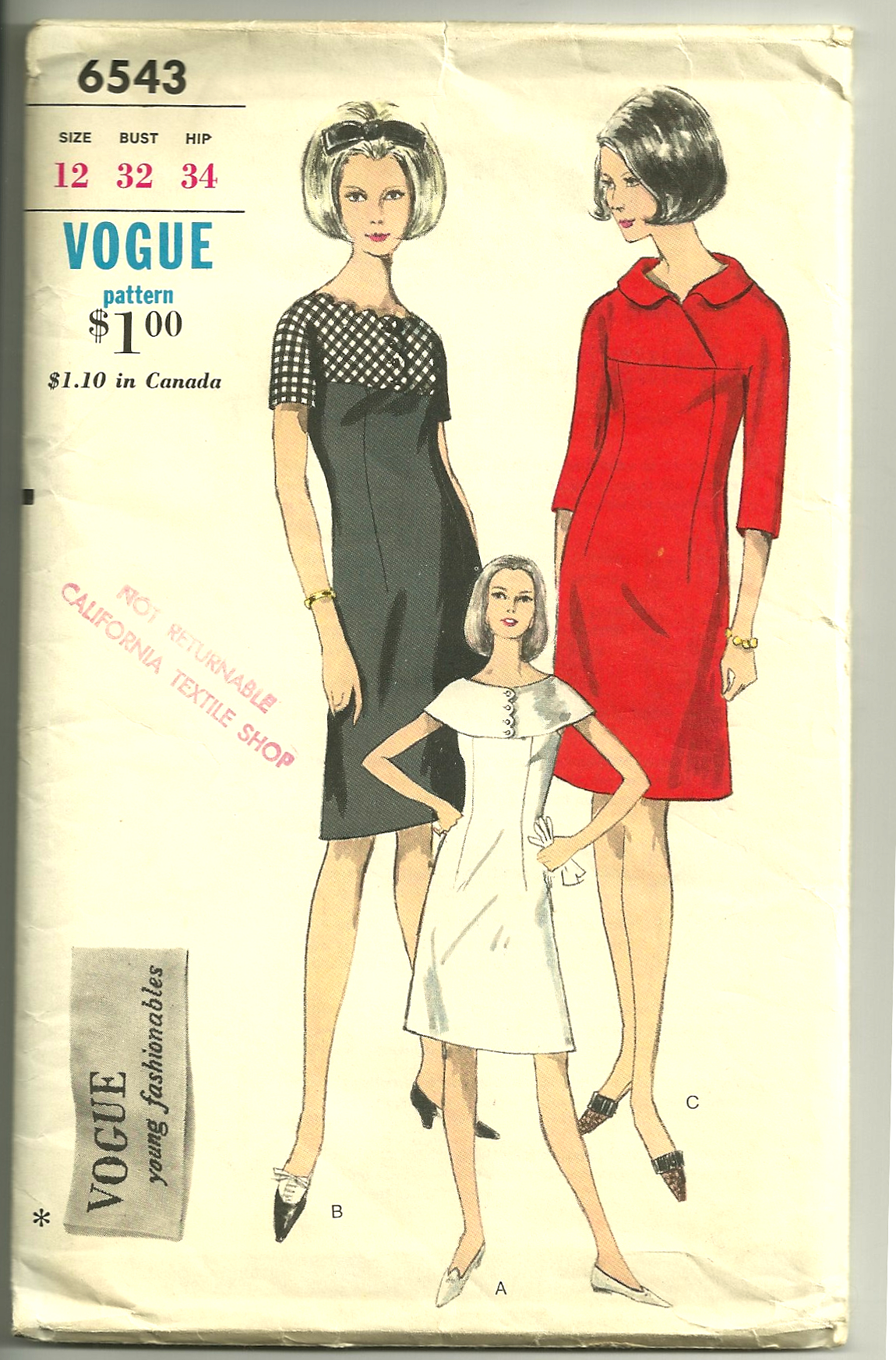
Here is one "Young Fashionable" pattern, to illustrate the type of style designed for the younger than thirty age group.

Here is one “Young Fashionable” pattern, to illustrate the type of style designed for the younger-than-30 age group.

This page from the October/November 1955 Vogue Pattern Book Magazine shows many of the ingredients of a polished look, the norm among American women at that time.

This page from the October/November 1955 Vogue Pattern Book Magazine shows many of the ingredients of a polished look, the norm among American women at that time.

Even fashion illustration included all the elements of a polished look.  (From the same VPB magazine as above.)

Even fashion illustration included all the elements of a polished look. (From the same VPB magazine as above.)

4) The Dress Doctors were not only concerned with fashion, but also with how fashion could influence the rest of one’s life. First and foremost, one should buy, or sew one’s own attire, which is appropriate for the life one leads. Buying on impulse is rarely a good idea if the item you are buying has no use in your weekly or monthly calendar. Further, if you find a style or look which works for you, repeat it – easily accomplished by those of us who sew. And those of us who sew know that tweaking a pattern, adding or subtracting a detail, and choosing diverse fabrics can make any pattern look new. Hooray for us!

5) A final point – and it is about many women’s favorite fashion accessory — shoes. According to Linda Przbyszewski, shoes have taken on much more significance than they once did – and should. Shoes should never be the focal point of one’s outfit. They should be chosen to enhance the overall look and to be functional for the occasion for which you are dressing. Shoes used to be just one of the accessories adding to the complete outfit, along with gloves, hats, scarves, handbags, jewelry, and coats. As gloves and hats and coat “wardrobes” have receded from the recipe for a “fashionable look”, shoes have filled that gap for many of us.

The last chapter of the book is devoted to the “demise” of the Dress Doctors in the 1960s and ‘70s. The emphasis on “youth”, starting in the ‘60s, and the women’s liberation movement in the 1970s changed mainstream fashion dramatically. Not addressed in the book is the continuance of some of the standards, established by the Dress Doctors, by the pattern companies in these two decades. Although my experience is mostly with Vogue patterns, I continue to be inspired by many of the fashions, Designer and otherwise, featured in patterns during these two decades. Once again home dressmakers were at an advantage – and continue to be.

The author leaves the reader on a positive note, stressing lessons for all of us to be learned from the wisdom of the Dress Doctors, and crediting the home sewing movement NOW for the beginning of a return to standards and style in the art of dress. I look at this  as a responsibility.  How about you?

2 Comments

Filed under Book reviews, Little Black Dress, The Conde Nast Publications, Uncategorized, vintage Vogue patterns from the 1960s, Vogue patterns

The Long and Mysterious Journey of Sandhurst 121

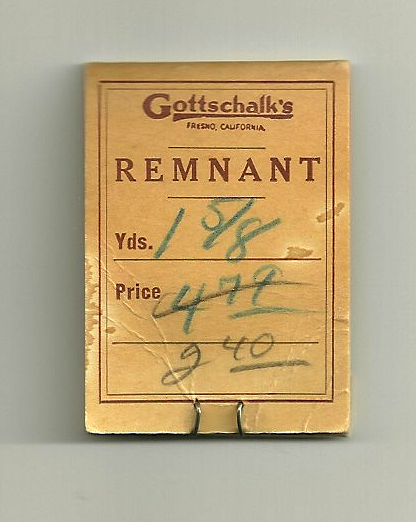
When the piece of linen I had purchased arrived in the mail, I was not sure what to expect. I had bought it with the hope that it was, indeed, a piece of Moygashel linen, but I had nothing to go on except an educated hunch. I knew it was an early piece of fabric, as its width was 35”, a common width for pre-1960’s dress-goods. I liked the design in the photo from which I made my decision, although it was not a colorway to which I normally gravitate. Upon opening the package, I found the only identifying mark on the fabric to be this tag:

Gottshalk's in Fresno, California obviously sold fine fabrics.

Gottschalk’s in Fresno, California obviously sold fine fabrics.

This short length of fabric had been on the remnant table, and, being too good of a bargain to pass by, some home dressmaker in California (USA) scooped it up with all good intentions of making something out of it someday. It must have lived in a dark drawer somewhere, carefully buffered from stains and yellowing. It didn’t even have much of a crease in it. And so, after many years in dormancy, it arrived at my home in Pennsylvania. I knew immediately that it was a Moygashel linen. I could tell by the hand of the fabric, the unique, slightly funky design, and by its amazing survival virtually wrinkle-free.

Sandhurst 121

As I mentioned in a former post, my only dilemma was the scant yardage, combined with the narrow width. So, I stuck it in my fabric closet, to think about another day. One thing nagged at me, however. I really, really wanted to know what year it was from.

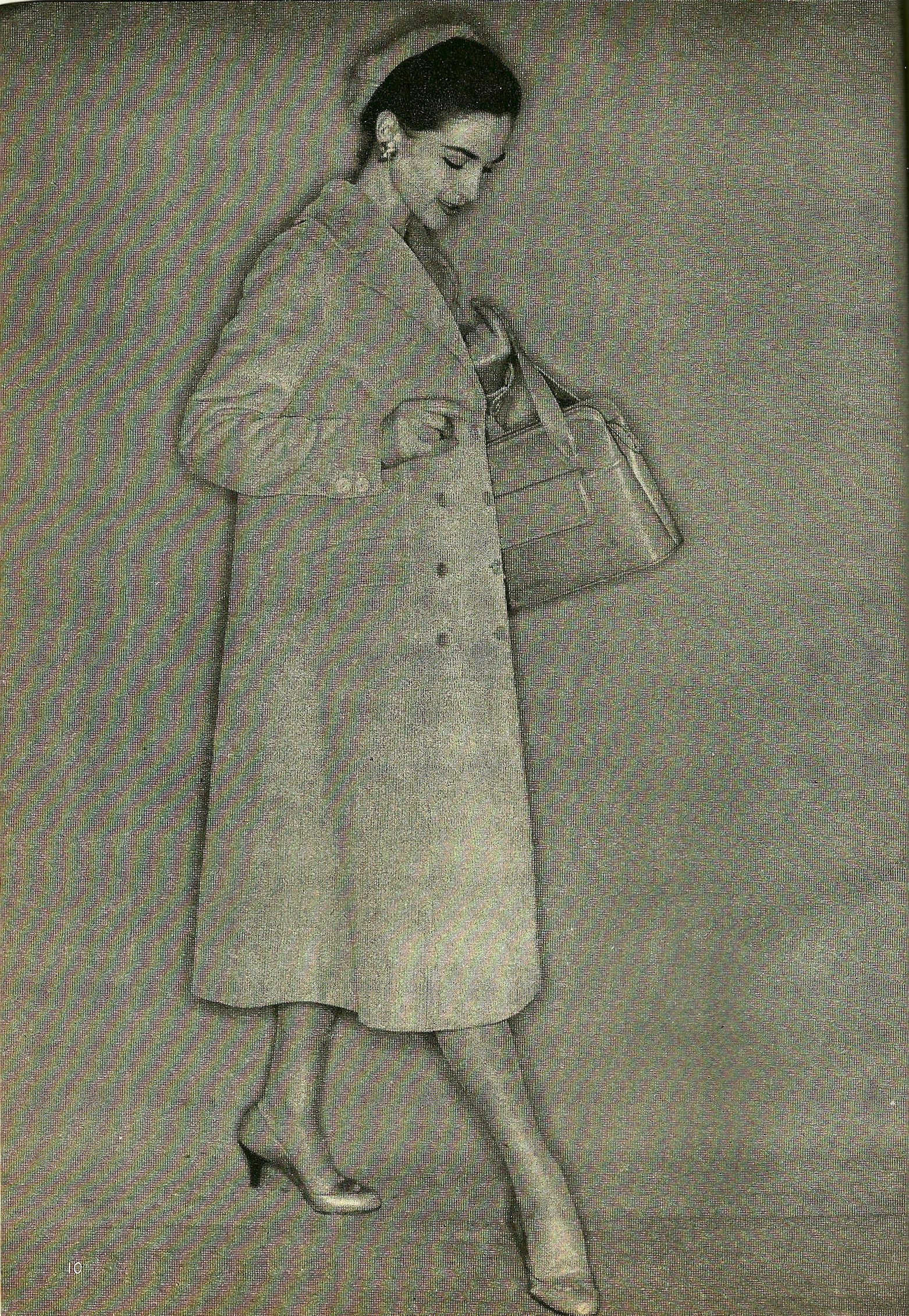
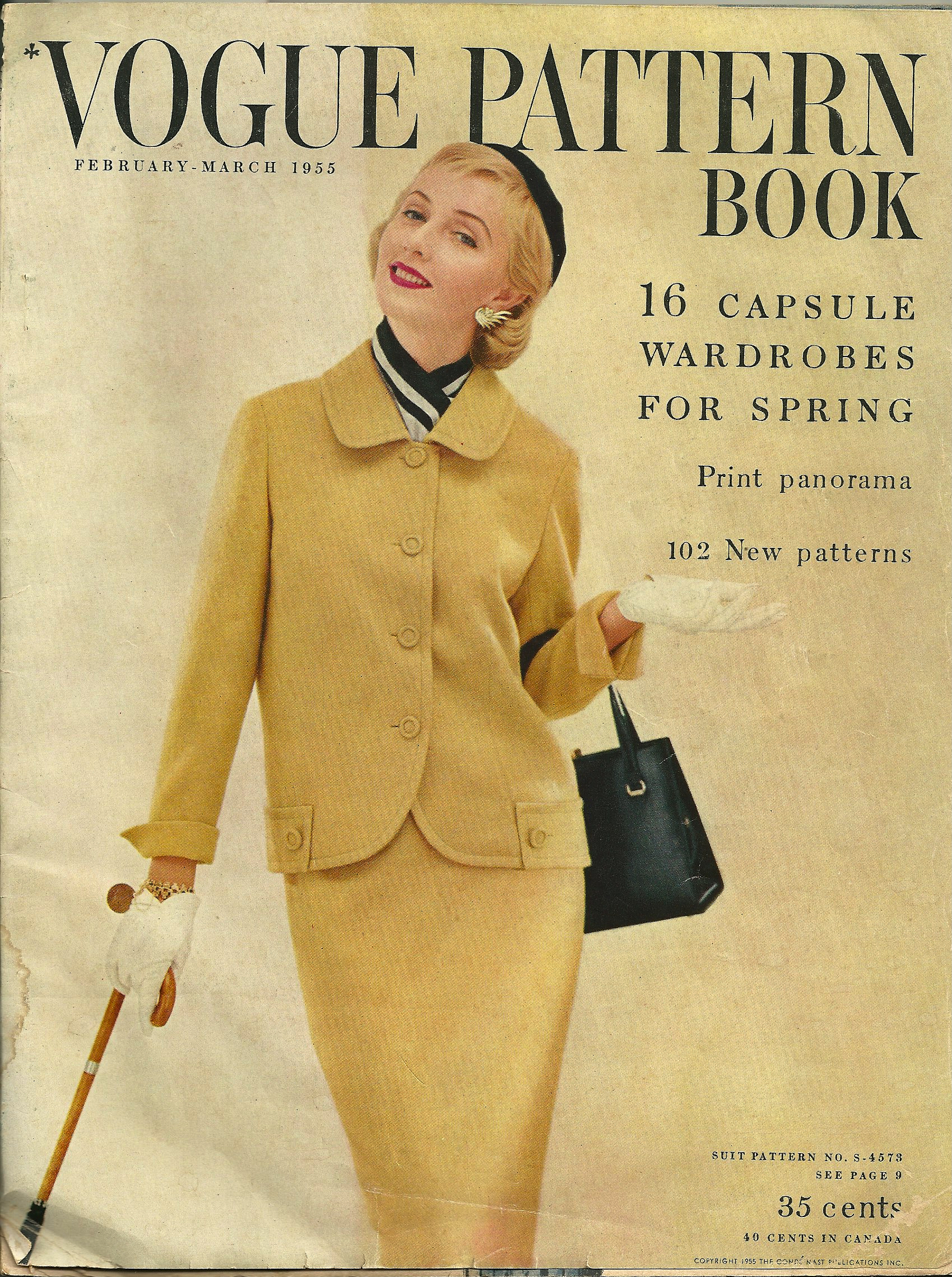
Over the past three years or so, I have had some luck in finding copies of old and older (1950-1980) Vogue Pattern Book Magazines. They are fascinating, and treasure troves of mid-century fashion as it relates to home sewing. I have tried to get a good cross-section of magazines from those three decades. One issue, which I tried a couple of times to get – and did not (on eBay) – finally became available to me. I loved the suit on the cover, and those mid-fifties styles are just so chic, even though most Vogue patterns from that time period were unprinted, and therefore, very difficult to use. (By 1957, Vogue was starting to produce many of their patterns in printed and perforated format.)

This is the February/March 1955 issue.

This is the February/March 1955 issue.

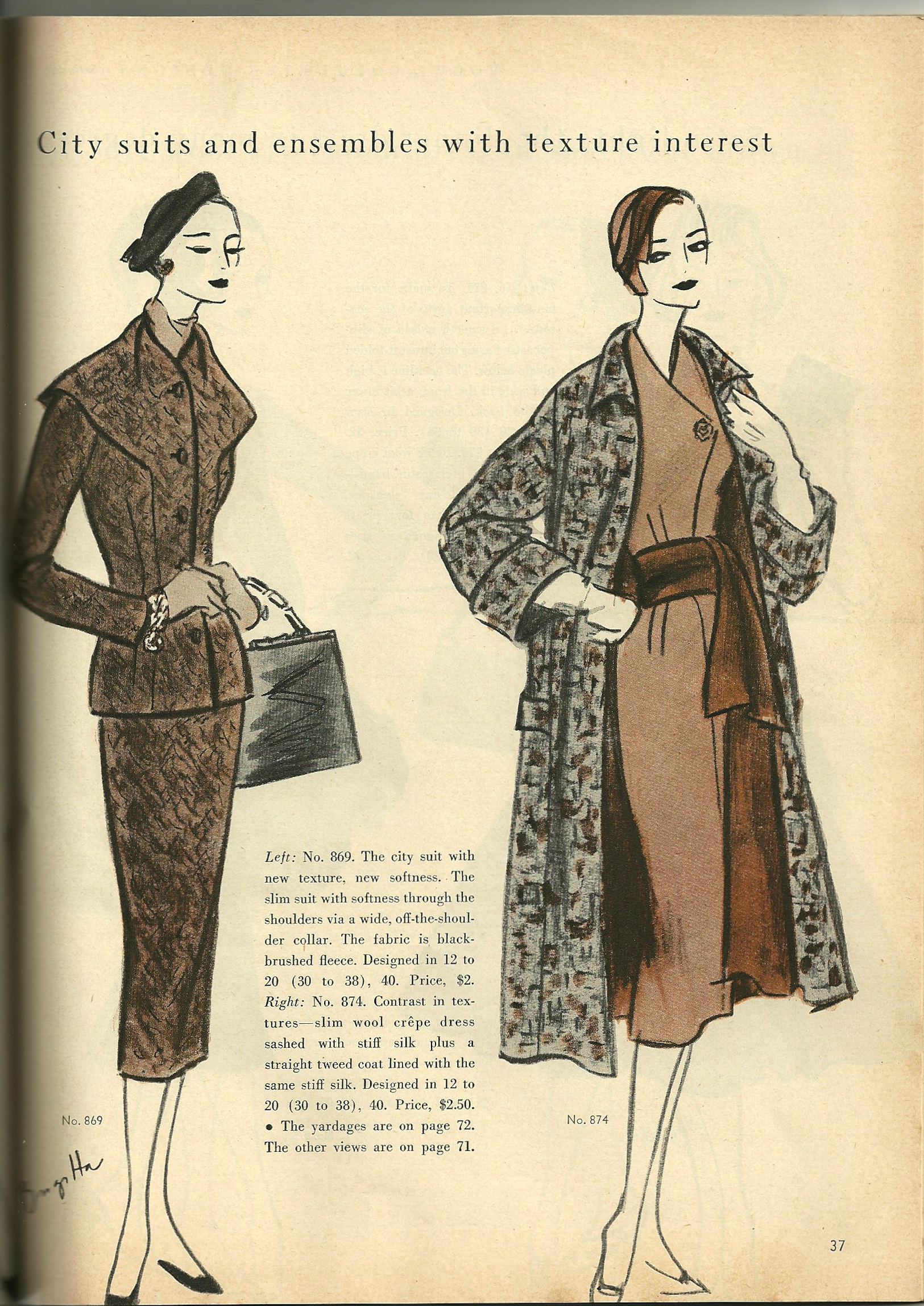
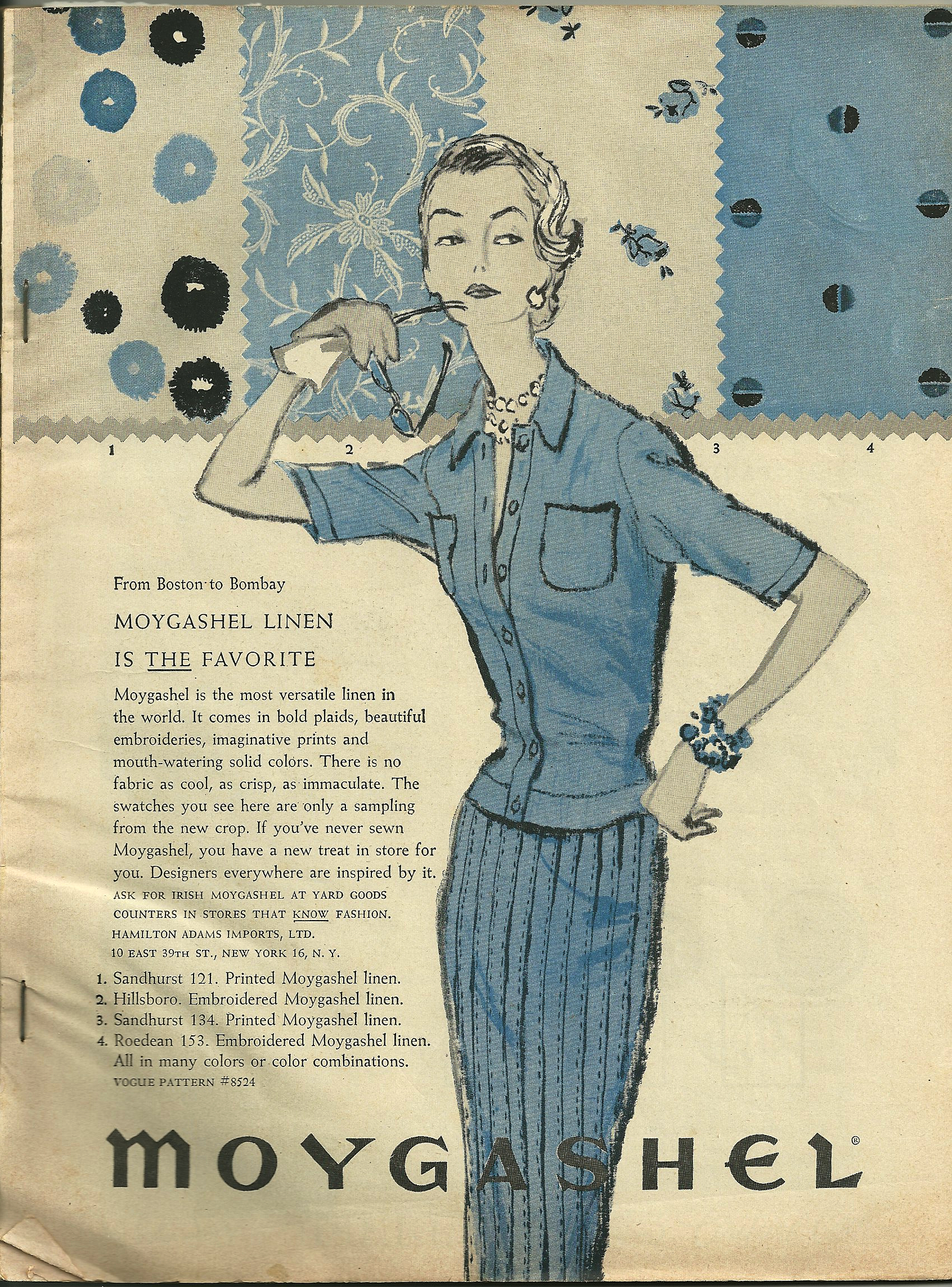
Perhaps you can see where I am going with this? I was looking through this particular issue once again in May of this year, and low and behold, a full-page ad for Moygashel linen clearly pictured “my” linen as one of their “new crop”. The colorway was different, but Moygashel was known for producing their fabrics “all in many colors or color combinations.” Maybe a lot of people wouldn’t get so excited about such a discovery, but I was ecstatic! Now I knew, for certain, that the linen I had purchased made its debut in early 1955. (I would be turning 5 years old a little later that year!) I even had a name for it now – Sandhurst 121. I suddenly very much wanted to sew this linen, this Summer!

There is my linen in the upper left hand corner of the full-page advertisement.

There is my linen in the upper left hand corner of the full-page advertisement.

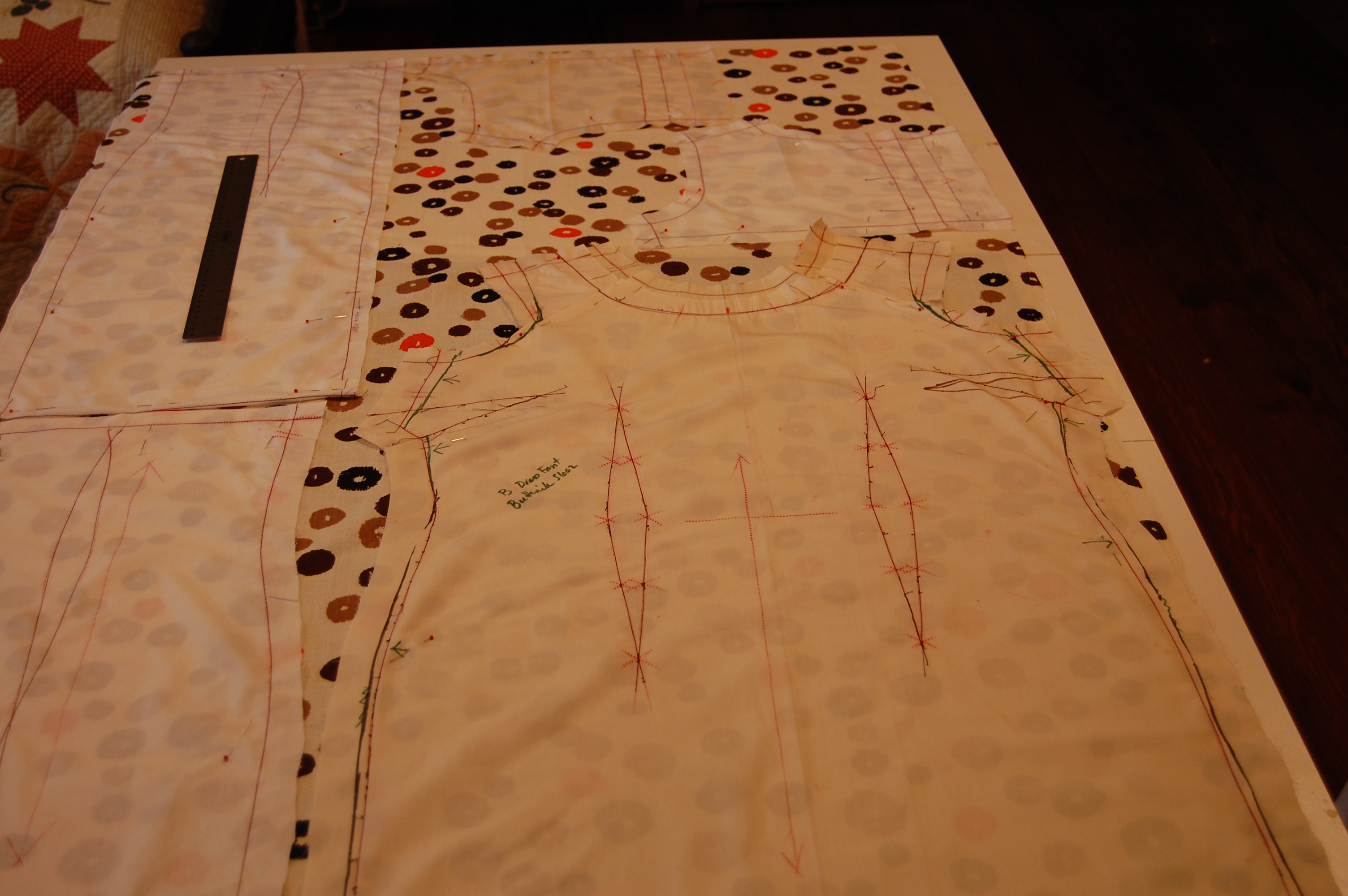
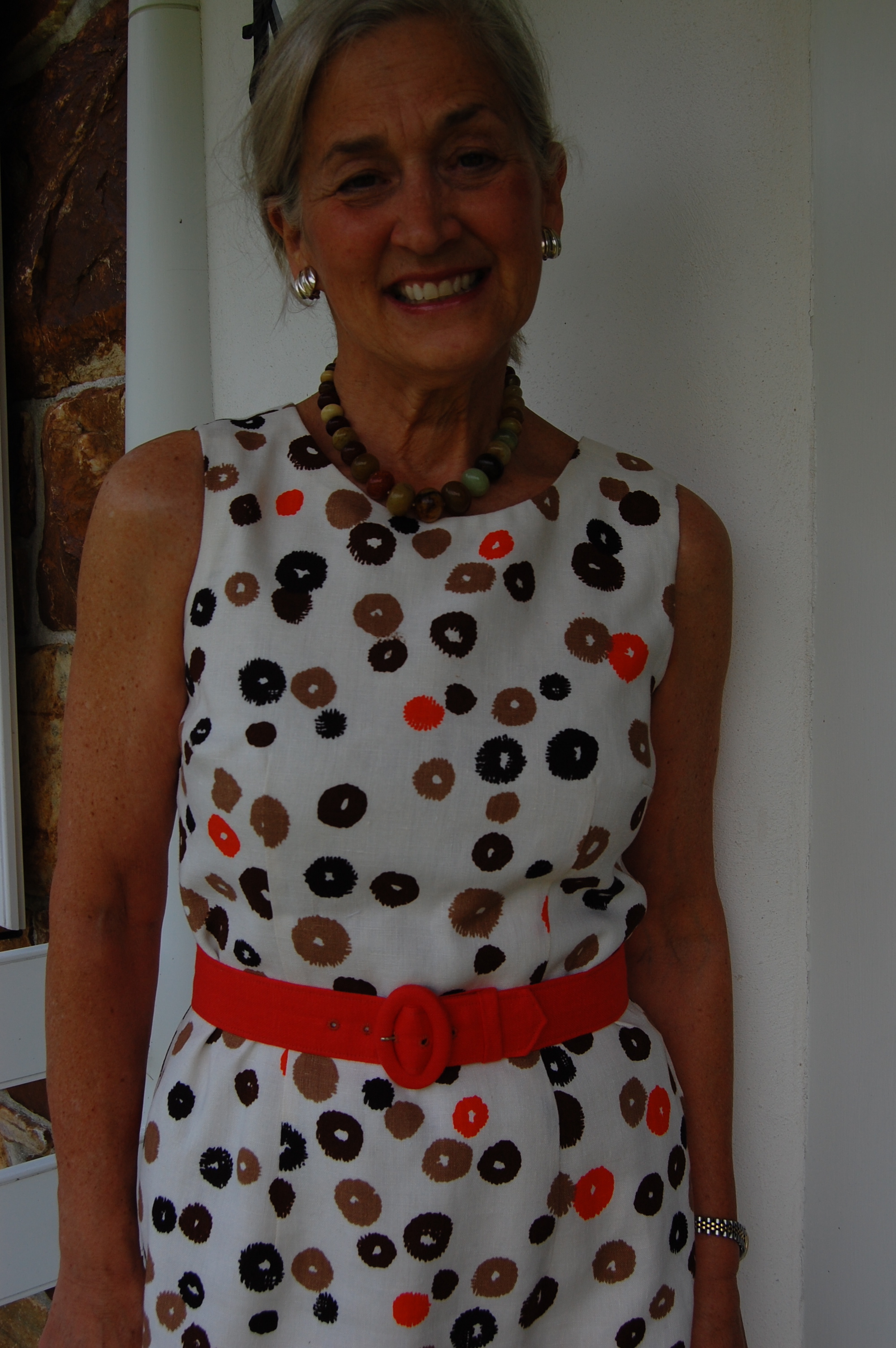
By now, many of you know that I determined to make a sheath dress out of this scant yardage of fabric, and in order to do so, I had to reconfigure my sheath dress pattern to include a back yoke. Here’s the fabric layout, which hopefully will show how sectioning the back enabled me to fit the pattern on the available fabric:

The fabric is shown 35" flat on my cutting table.  The muslin pattern piece for the front of the dress is on the right, and the two shortened back pieces are lined up smack against each other on the left.  The yoke pieces then fit above the dress front.  I did not need facings, as I lined the entire dress in a light weight linen/cotton blend, and finished the neck and armholes all by hand.

The fabric is shown 35″ flat on my cutting table. The muslin pattern piece for the front of the dress is on the right, and the two shortened back pieces are lined up smack against each other on the left. The yoke pieces then fit on the fabric  above the dress front. I did not need facings, as I lined the entire dress in a light weight linen/cotton blend, and finished the neck and armholes all by hand.  I had to face the hem as I did not have enough fabric to do a self hem!

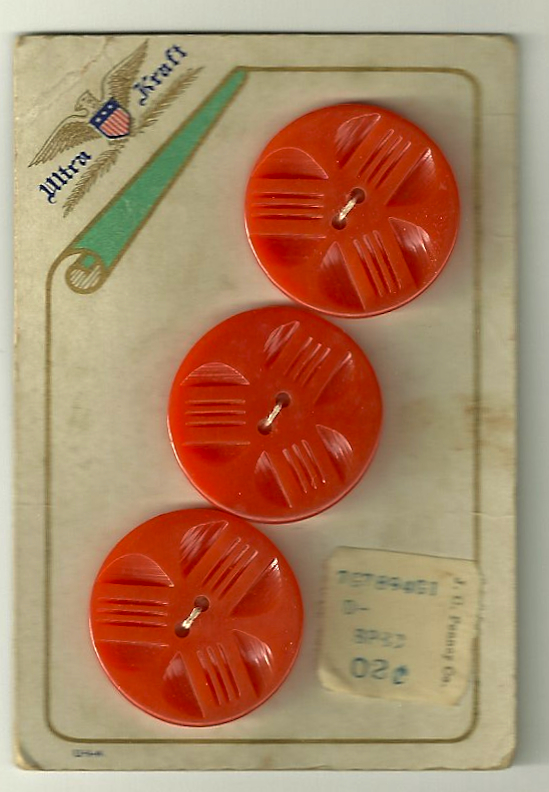
Many of you also know that fortune shone her happy face again on this project when I found three orange vintage buttons, which I knew would help make a back yoke far more interesting. I relied on a Vogue pattern from 1957, which has a back yoke to help me with this reconfigure.

This card of buttons cost 2 cents originally!  They seem to mimic the small orange explosions on the dress fabric.

This card of buttons cost 2 cents originally! They seem to mimic the small orange explosions on the dress fabric.  They may actually be even earlier than the fabric.

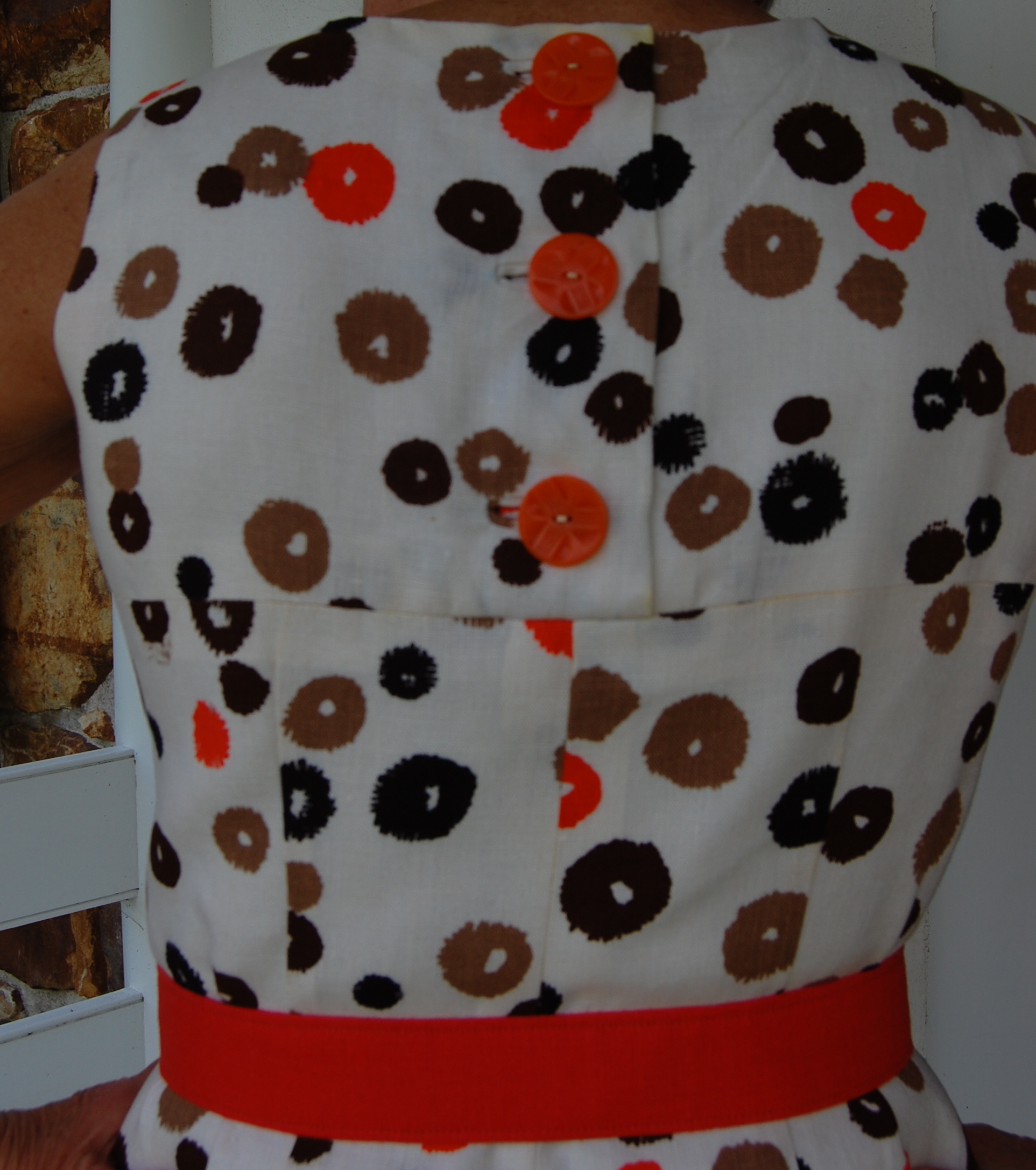
The yoke on this dress uses 4 buttons.  I only had three, but their large size still makes the proportions work well.

The yoke on this dress uses 4 buttons. I only had three, but their large size still makes the proportions work well.

A close-up of the back of the dress.

A close-up of the back of the dress.  I made bound buttonholes – very 1950-ish!

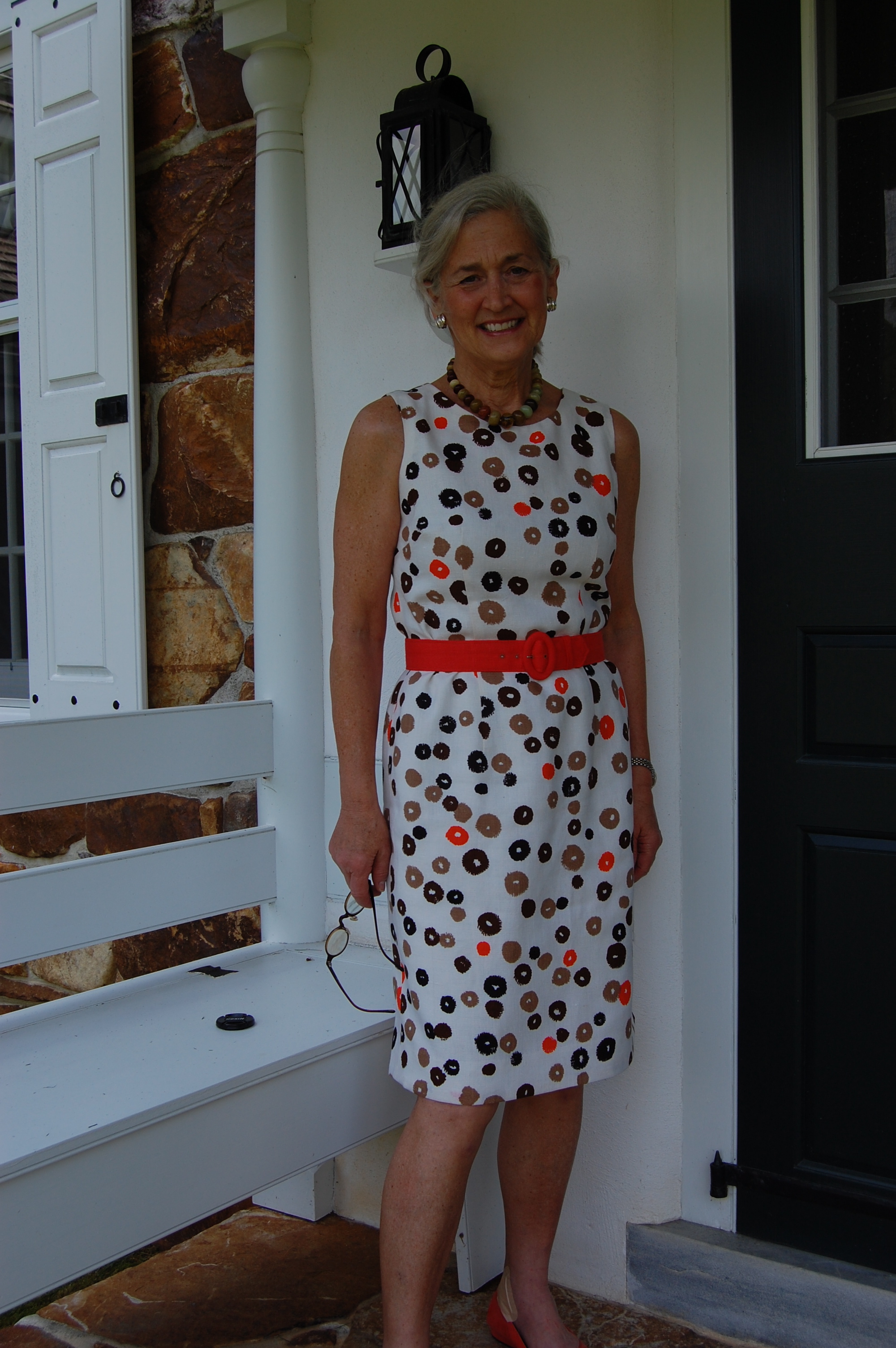
And then, another classic 1950s’ design detail worked right into this dress: I would need to move the zipper to the side in order for the back yoke to look correct. Now I will be the first to tell you that a side zipper is not as convenient as a back zipper, but it is a small sacrifice when everything else is enhanced by this placement.   After these obeisances to ‘50s’ style, I slipped right into 2014 with a bright orange, newly made belt, a widened jewel neckline, slightly cut-in shoulders, and a back slit to enhance comfort. I like to choose the best from the ‘50s, but I really don’t want to look like the 1950s.

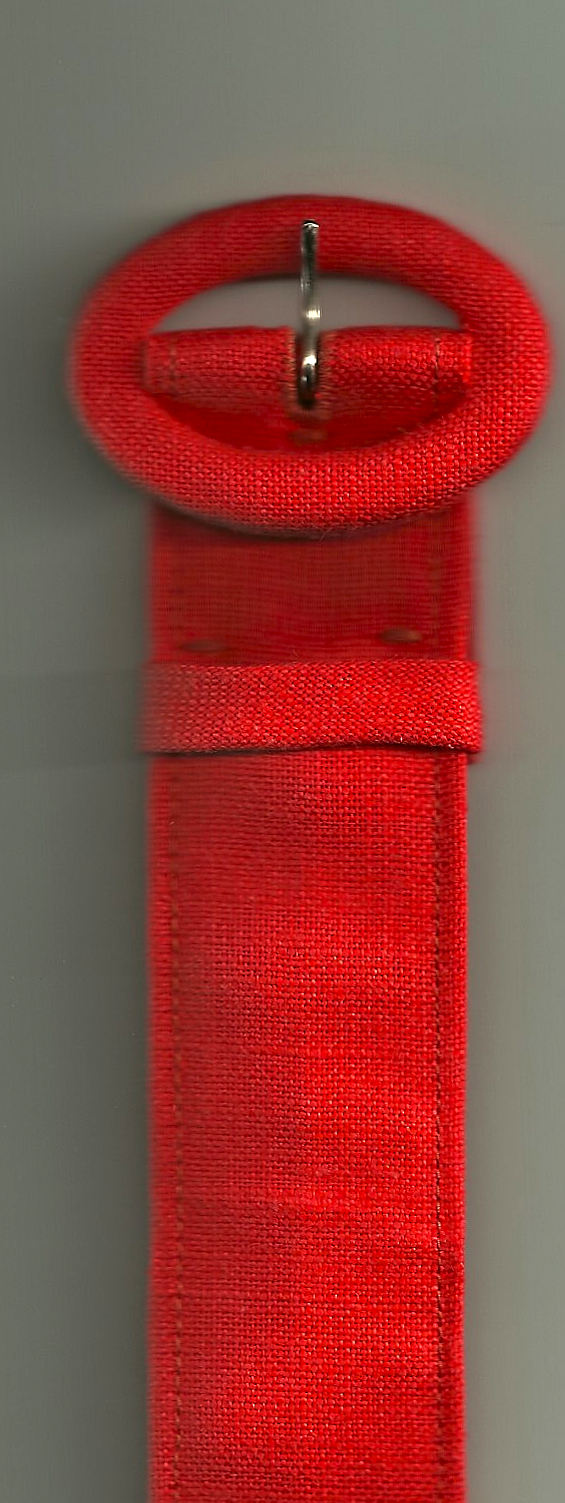
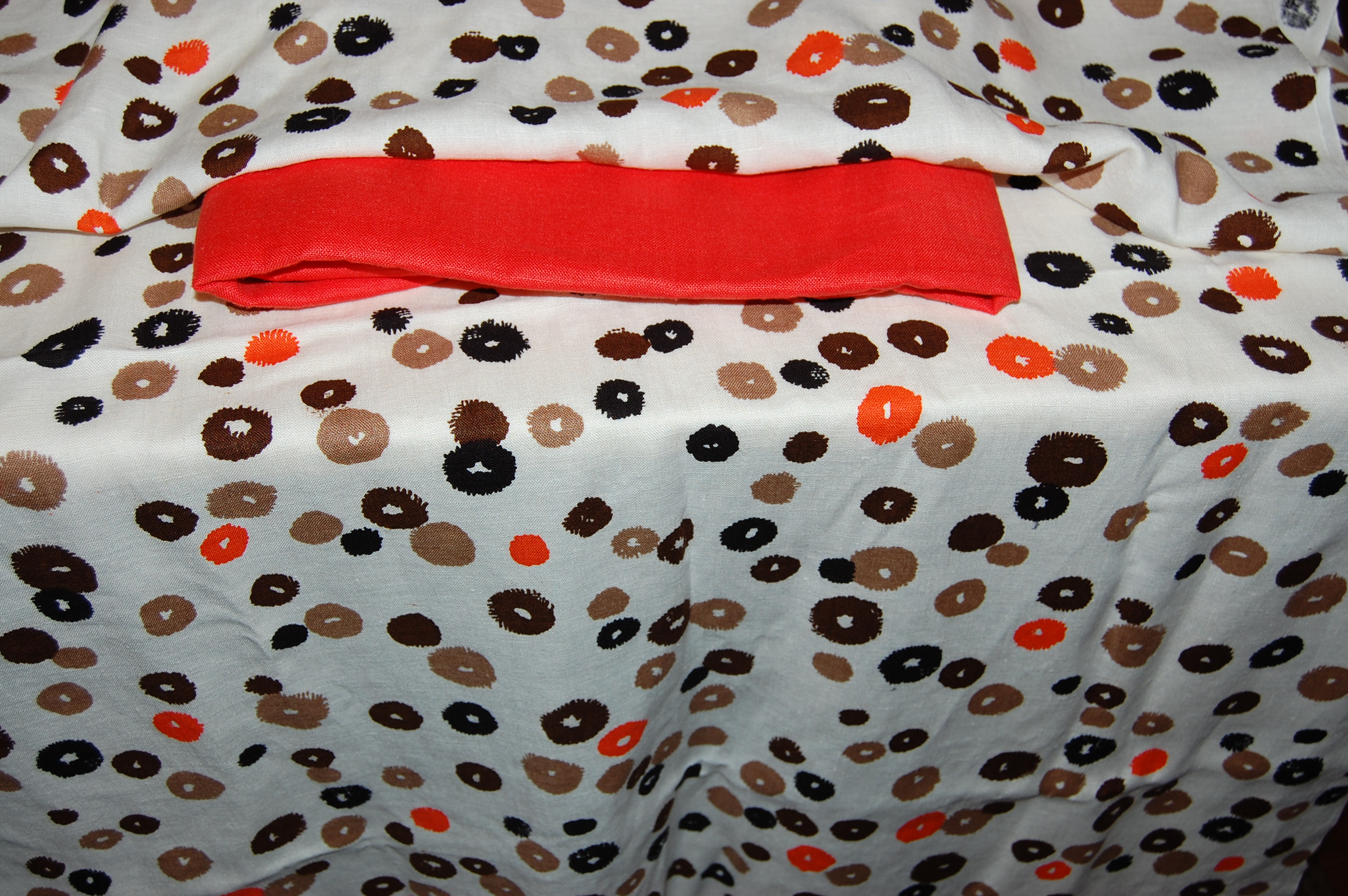
I sent new orange linen to Pat Mahoney of Pat's Custom Belts and Buttons  and this lovely belt came back to me in the mail.

I sent new orange linen to Pat Mahoney of Pat’s Custom Belts and Buttons and this lovely belt came back to me in the mail.

Cool and summery-looking, don't you think?

Cool and summery-looking, don’t you think?

Sandhurst 121

Sandhurst 121

Sandhurst 121

Sandhurst 121

Sandhurst 121

Not every dress can have a story, nor should it. But this fabric, which began its life in Ireland, no doubt entered this country through New York City, ordered by a store in Fresno, California, purchased and squirreled away for decades by persons unknown – has now found a starring role in my wardrobe almost 60 years later. Sewing is just so much fun!


37 Comments

Filed under bound buttonholes, Buttons - choosing the right ones, hand-sewn zippers, Linen, Love of sewing, Moygashel linen, Polka dots, side-placed zippers, The Conde Nast Publications, Uncategorized, Unprinted patterns from the 1950s, vintage buttons, Vintage fabric, vintage Vogue patterns from the 1950s

When Enthusiasm Meets Reality

Fashion sewing has it all. Even the making of a simple dress has some or all of these aspects inherent in its construction: color theory, proper fabric selection, proportion and fitting, pattern manipulation and engineering, technical know-how, style sense, intrigue. Intrigue? Yes – Intrigue. I have done it again. I have my heart set on a making a certain style in a certain fabric, and I don’t have very much of that fabric with which to work.

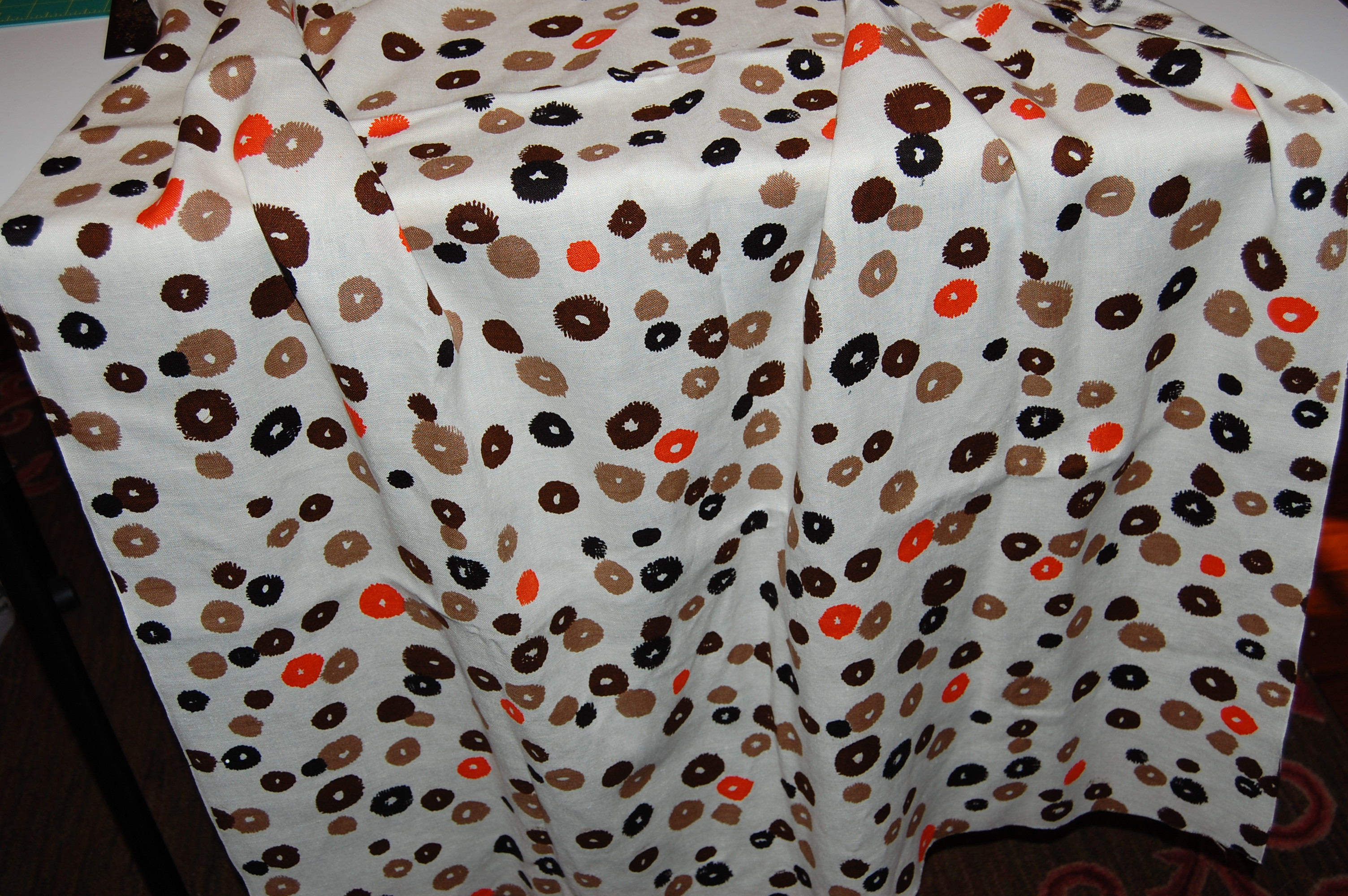
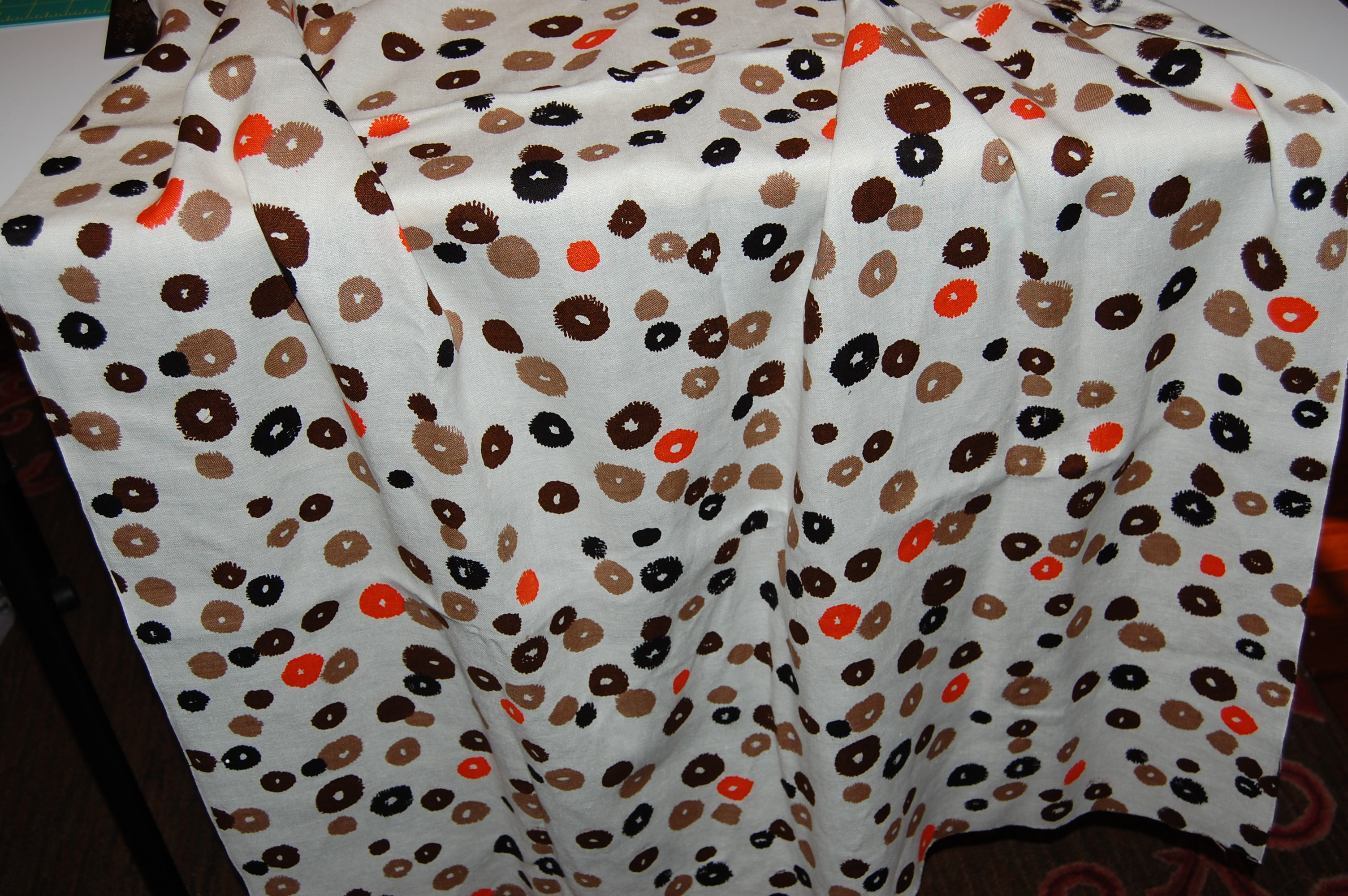
I found this piece of Moygashel linen earlier in the year. (It was sold to me as “probably Moygashel”, and how I determined for certain that is indeed that famous brand of Irish linen required some detective work, which I’ll cover in a future post.)

Enthusiasm meets reality

Freshly laundered, this linen looks and feels like new!

When I first saw it, I immediately thought it would make a cute pair of pants, even though I don’t wear a lot of brown. But I was really drawn to the little explosions of orange scattered throughout the yardage. Actually I should qualify that by saying “scant” yardage. This was only a piece of fabric 1 and 5/8 yards long, which sounds reasonable until the width of the fabric is figured into the equation. At 35” wide, this was not a lot of fabric.   Nevertheless, I certainly figured I could get a slim pair of simple pants out of it. That was my intent until I finished my polka-dotted sheath dress just recently. Cool linen dresses and Summer just seem to go together, and suddenly I decided I did not want a pair of pants – I wanted another sleeveless dress.

This was partly determined by the fact that I have a piece of new orange linen I picked up a couple of years ago from Britex Fabrics, and the thought of pairing this funky, stylized-dot fabric with an orange belt made out of that linen sealed the deal for me in my enthusiastic wardrobe dreams.

Enthusiasm meets reality

Then reality hit. How was I going to manage to squeak a sheath dress out of the amount of fabric in hand? After eyeballing the stretched out fabric, with my sheath dress pattern pieces arranged casually on top, it did not take long for me to know that, NO, this would not work. I would have to figure something else out, but I wasn’t giving up on the dress idea.

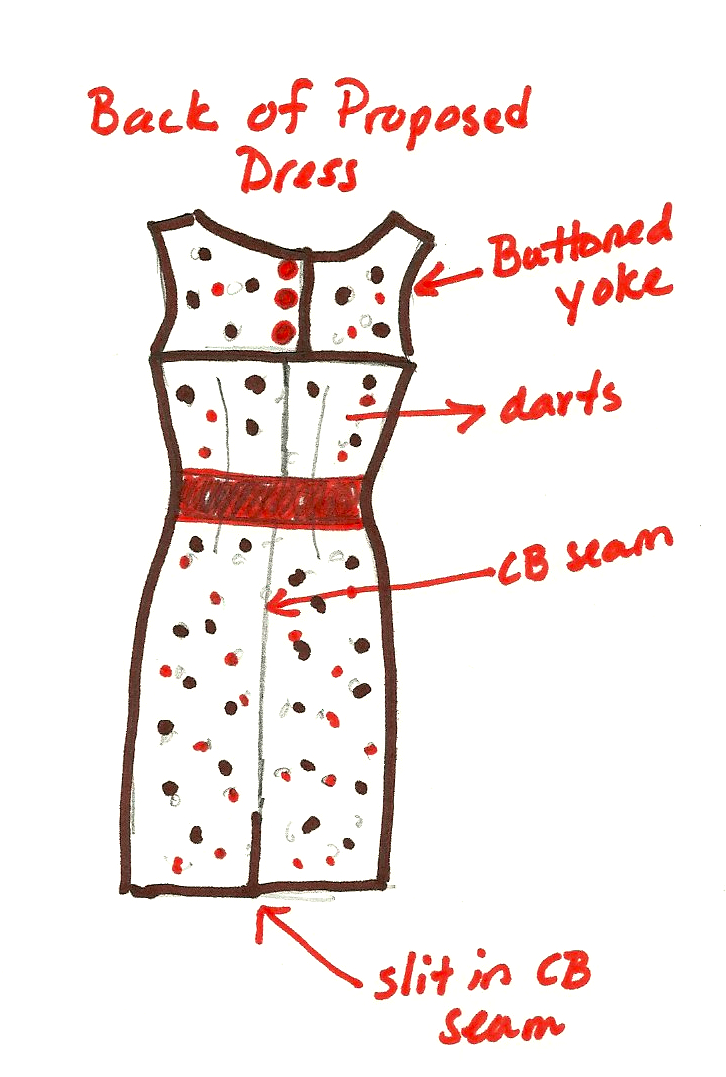
The only solution was to get more creative. I have always loved subtle “back” details on dresses, such as unusual closures, V-necklines above a back zippered opening, an embellishment of some sort, that type of thing. And I suddenly realized that if I could section the back pieces (only) of my sheath pattern so that I would have an upper back yoke, then I could probably fit everything on the fabric (knowing it would still be a squeeze, however).

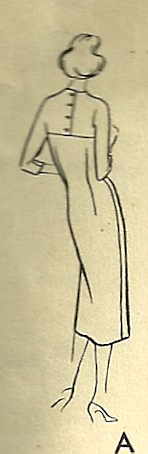
Now I got really excited. One of my favorite patterns (from 1957) features a back- buttoned yoke, which is seamed right above the shaping darts in the back body of the dress. I figured this is exactly the spot where I would need to section the back of the dress to make it fit on my fabric.

The yoke on this dress is obviously part of the kimono sleeve section, but I like the idea of a three-buttoned yoke.

The yoke on this dress is obviously part of the kimono sleeve section, but I like the idea of a three-buttoned yoke.

And then – wheels turning in my head – I seemed to remember I had some orange buttons (vintage, no less!) in my button box.   These seem to me to be a perfect pairing with the linen fabric:

This card of buttons cost 2 cents originally!  They seem to mimic the small orange explosions on the dress fabric.

This card of buttons cost 2 cents originally! They seem to mimic the small orange explosions on the dress fabric.

I have spread out my current working sheath dress muslin a couple of times to determine the viability of my plan. I really think it will work. I am prepared to use narrower seam allowances than I usually like, and I may have to face the hem.

This is how I envision the back of my proposed dress.

This is how I envision the back of my proposed dress.

But – first things first. Initially I will be making a new muslin, with the altered and sectioned back pieces. I am sure my enthusiasm for this idea will keep me focused, and in this case, reality may have sewn the seeds for a much more creative outcome than I originally envisioned!


22 Comments

Filed under Buttons - choosing the right ones, Linen, Moygashel linen, Polka dots, Uncategorized, vintage buttons

Sometimes It’s All About the Fabric

Great fabric – just like great art – can (and probably should) elicit an emotional response from an engaged viewer and/or potential purchaser. It’s a very individual preference, of course, influenced by sewing knowledge, intended purpose, wear-ability, one’s fashion style, and nostalgia.

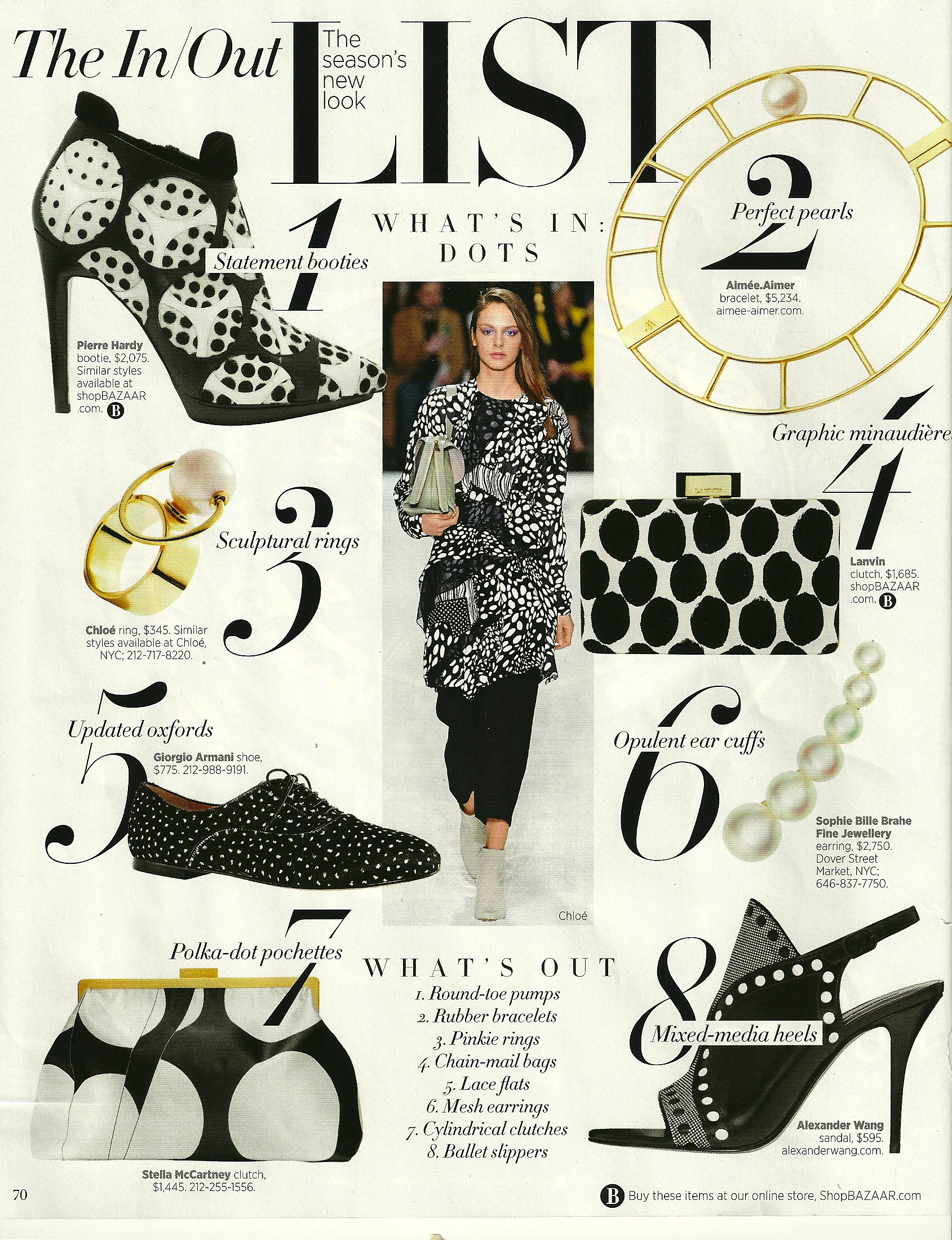
I freely admit to being nostalgic about polka dots. I have always loved them. And I have always been drawn to fabrics and fashions featuring dots, whether they be large, jumbo, small, tiny, or medium. In my fashion lexicon, they are never out of style, but it is always particularly rewarding to see dots featured as “fashion forward” – as in the July 2014 Harpers Bazaar.

Linen dotted dress - HB magazine

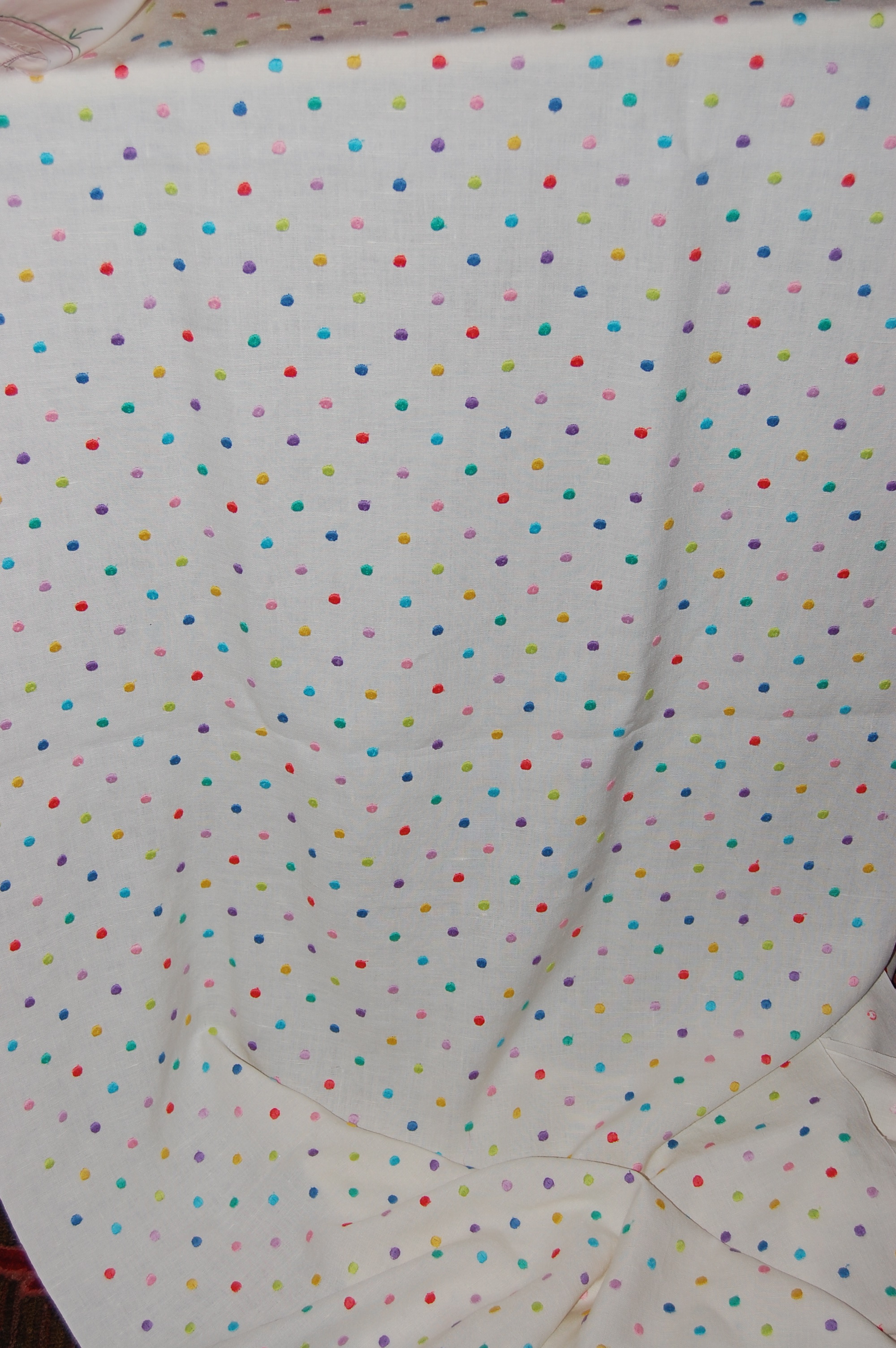
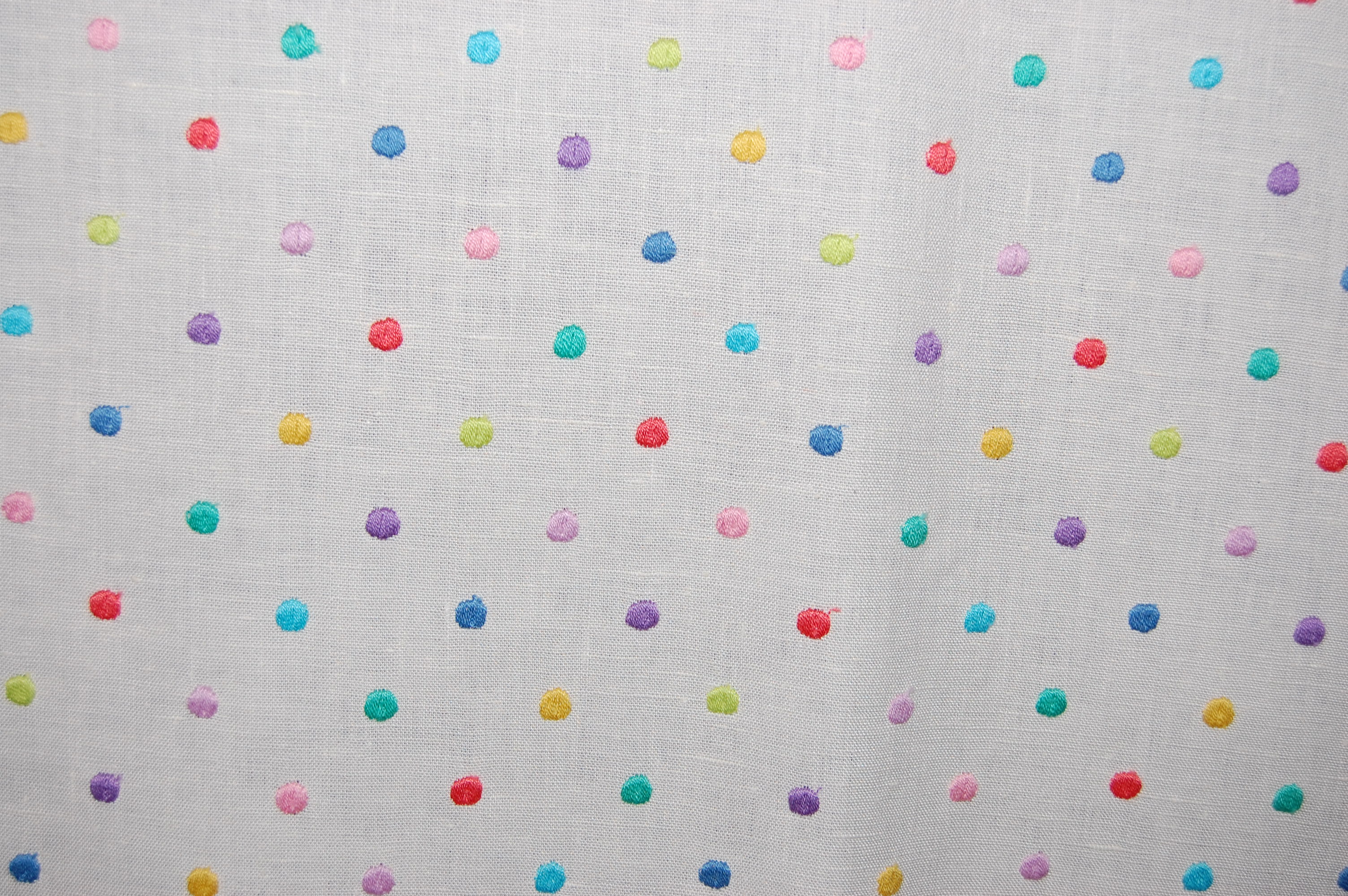
The dots I have been focusing on the last week or so, however, could tell those new dots a thing or two about fashion trends and durability. My beloved dots are probably celebrating their half-century mark, without a wrinkle to show for it!

Linen dotted fabric

Linen dotted fabric

Each dot is individually embroidered onto the base linen fabric.

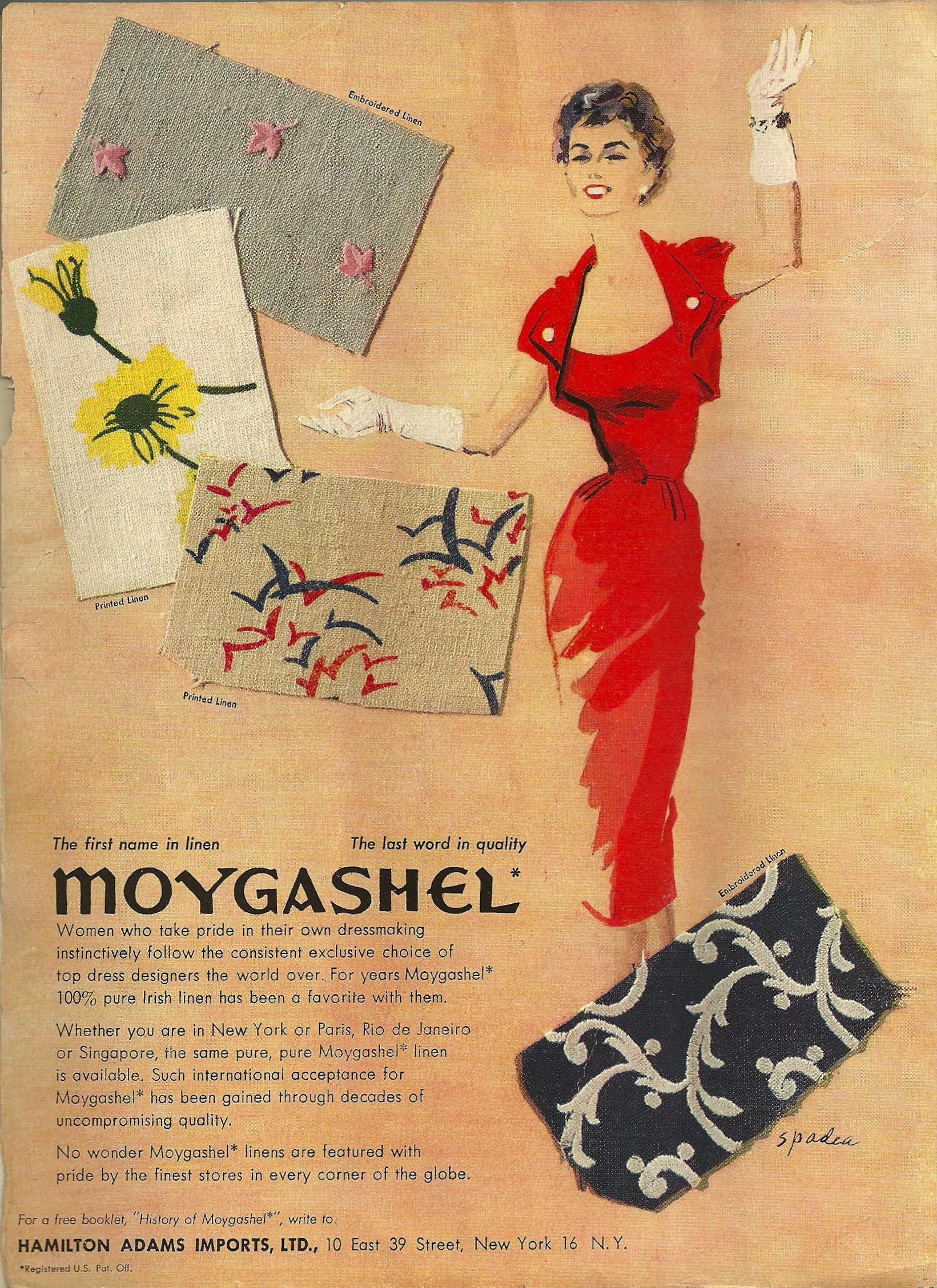
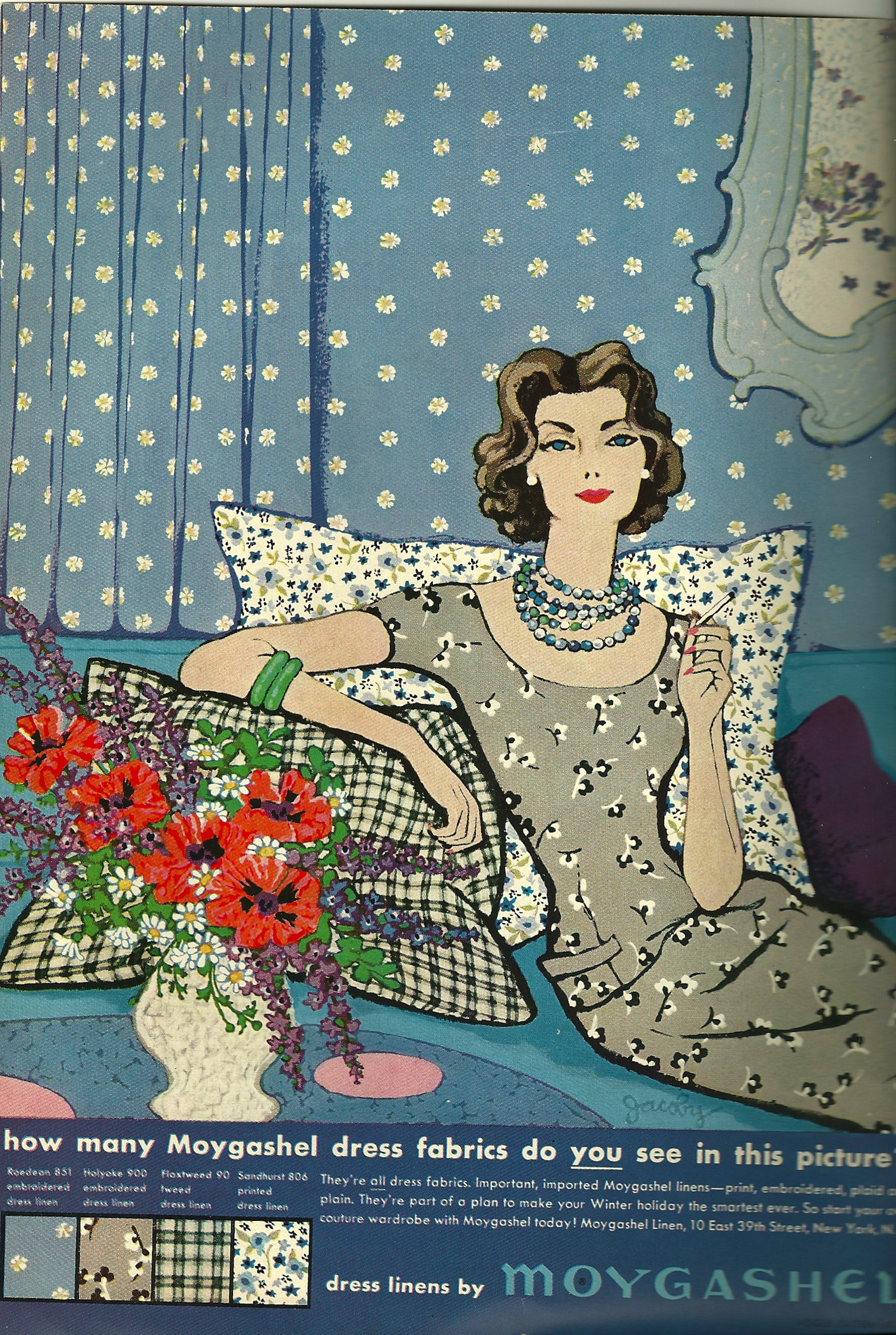
When I purchased this vintage linen fabric online, all I had was a photo or two. There was no selvedge marking, no attached label, no sales receipt to give any clue to its origin. However, the photos were clear, the weave of the fabric was visible enough, that I felt fairly confident that I was looking at a mid-century Moygashel linen. At 36” wide, I knew from experience it was prior to 1960. I also knew that Moygashel produced many embroidered dress linens in the 1950s. Here are two Moygashel linen ads which show both printed and embroidered linens:

This ad was on the inside front cover of Vogue Pattern Book magazine from December/January 1953-54.

This ad was on the inside front cover of Vogue Pattern Book magazine from December/January 1953-54.

And this ad was on the inside front cover of Vogue pattern Book Magazine from December/January 1957-58.

And this ad was on the inside front cover of Vogue Pattern Book magazine from December/January 1957-58.

I knew the real “proof of the pudding” – to authenticate the linen as Moygashel – would be in how it laundered.  Moygashel linen was known for its resistance to wrinkling! Months went by after the fabric arrived in the mail, but a couple of weeks ago, I retrieved it from my fabric closet, put it in a gentle wash cycle (with Woolite detergent), tumble dried it on medium heat, and out it came, as I had hoped, crisp, clean, and looking like new. All it needed was just a quick ironing on high heat to make sure the fabric would lay flat for marking and cutting.

Yes, I knew I had an authentic Moygashel linen in hand, and I wanted to make a dress that would be all about the fabric. I envisioned a simple sheath, whose look could be changed so easily with different color accessories. Knowing I already had a sheath dress pattern that fit me well, I made my sewing life simple (for a change!) and went with it.

One can't get much simpler than this classic sheath design!

One can’t get much simpler than this classic sheath design!

First, a few details and precautions about sewing with embroidered linen:

1) All ironing must be done on the wrong side of the fabric, in order not to squash the embroidered details.

2) All ironing must be done on top of a towel, also for the same reason.

3) It’s best to sandwich paper under seam allowances before pressing to prevent “impressions” from going through to the right side of your fabric.

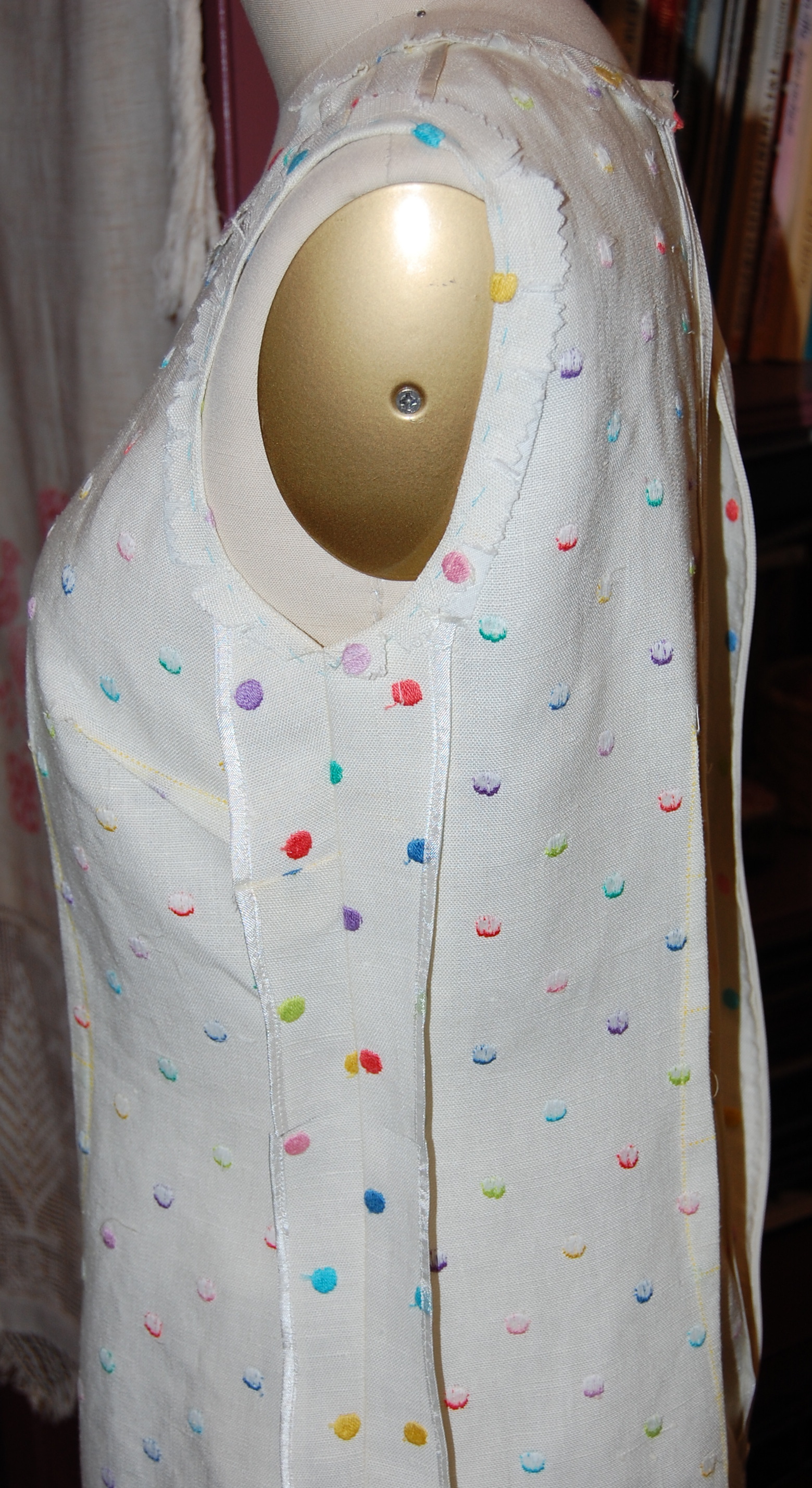
4) Because cut embroidery details have a tendency to fray along the edges of seam allowances, it is best to finish them with either a Hong Kong finish or with rayon (Snug Hug) hem tape. I used Snug Hug as it did not add any extra bulk to the inside of my garment.

Side seams finished with Snug Hug.

Side seams finished with Snug Hug.

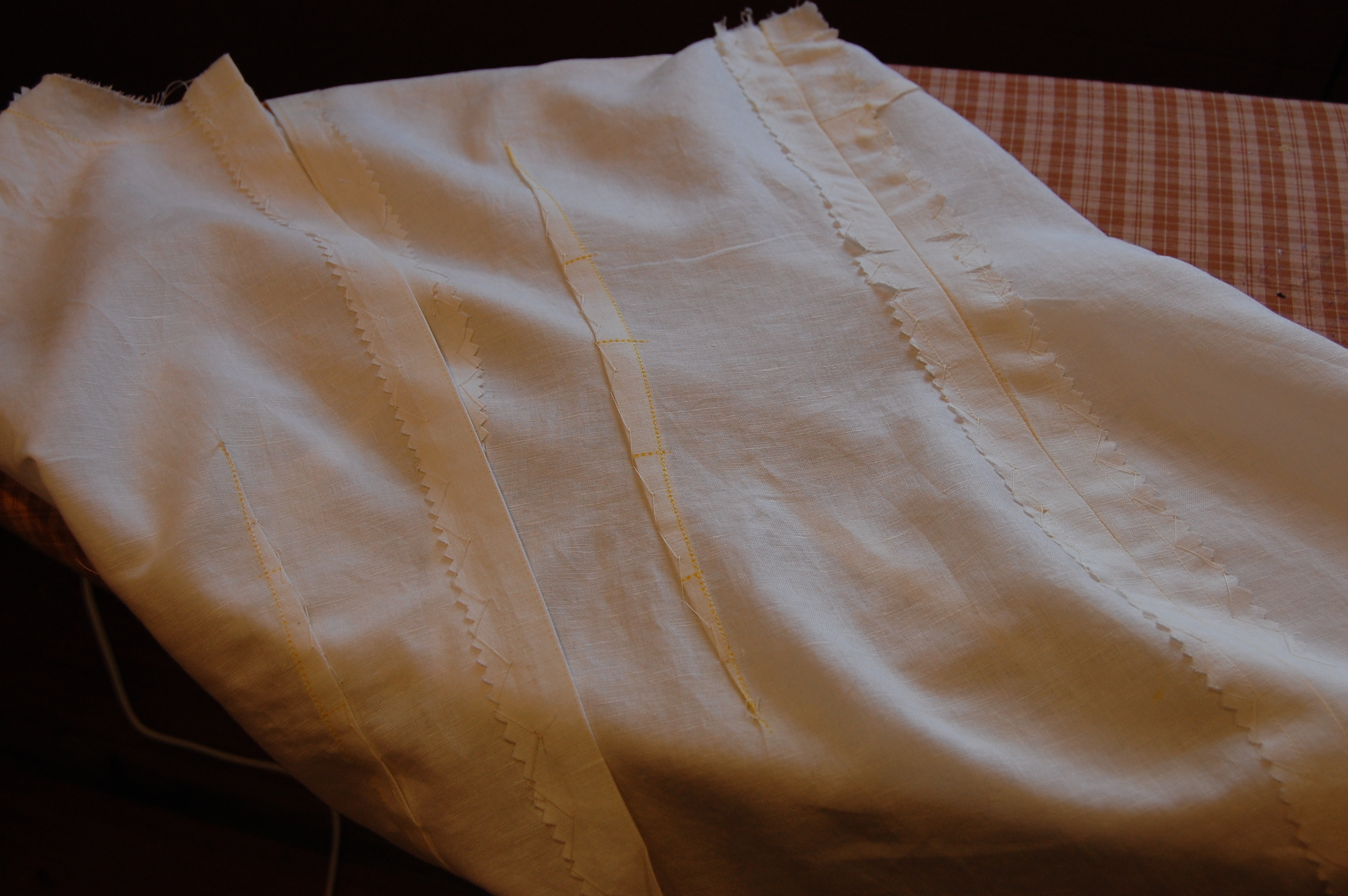
I did not want to underline my dress (as in silk organza), as I wanted to preserve the lovely breathability of the linen fabric. However, I did want to line it, so I used a very light, almost gauzy, cotton/linen blend.

I actually catch-stitched all the seams and dart edges on the lining, to help it mold as nicely as possible with the interior of the dress.

I actually catch-stitched all the seams and dart edges on the lining, to help it mold as nicely as possible with the interior of the dress.

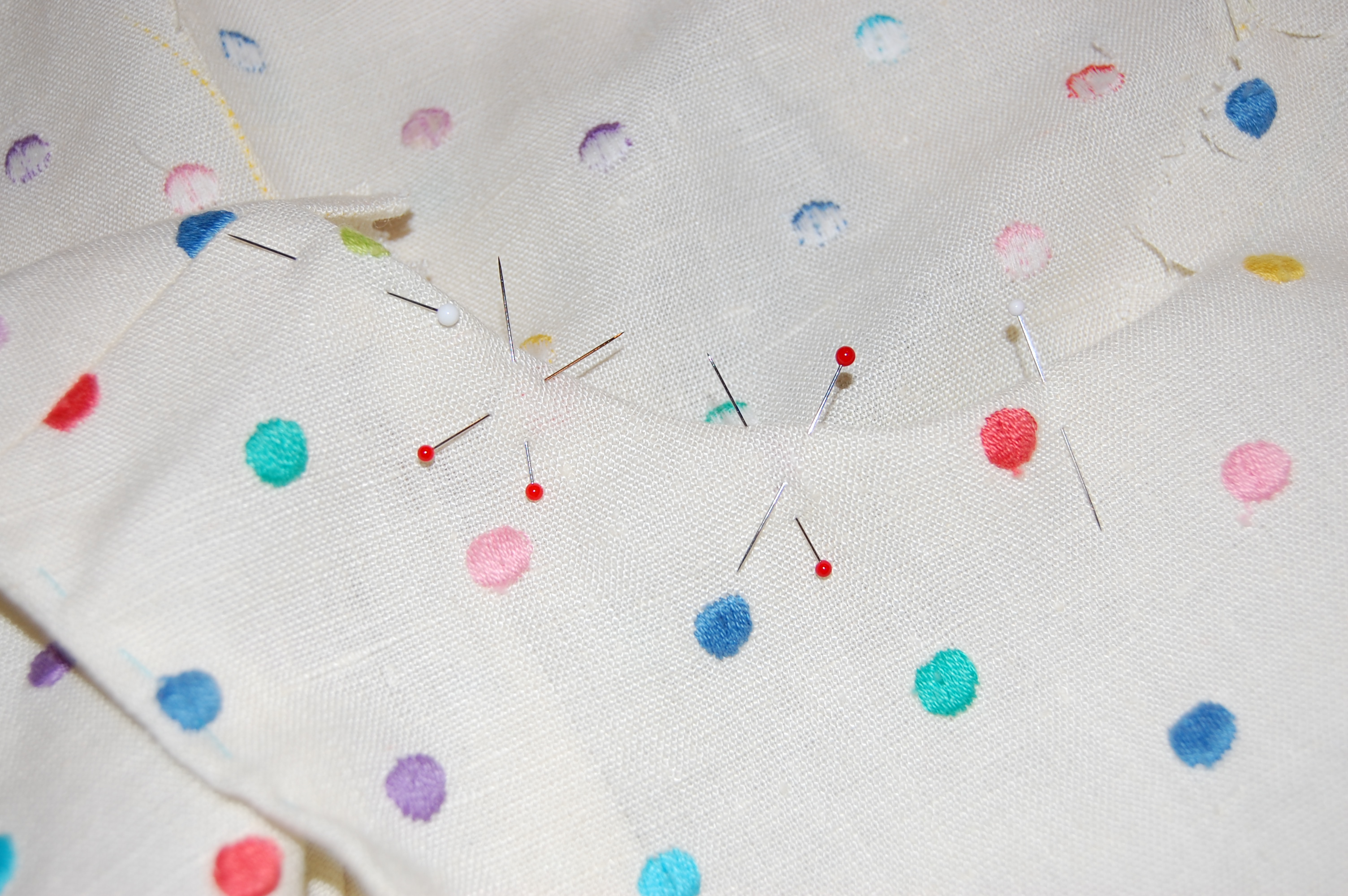
I decided to make the lining entirely separate and then attach it to the dress at the neck, armholes, zipper and back hem slit using a fell stitch. However, once I had my seam allowance folded back at the neck and armholes, I noticed a little bit of “shadowing through” of some of the colored dots along those edges.

Perhaps you can see the shadowing of the dots underneath the crossed pins?

Perhaps you can see the shadowing of the dots underneath the crossed pins?

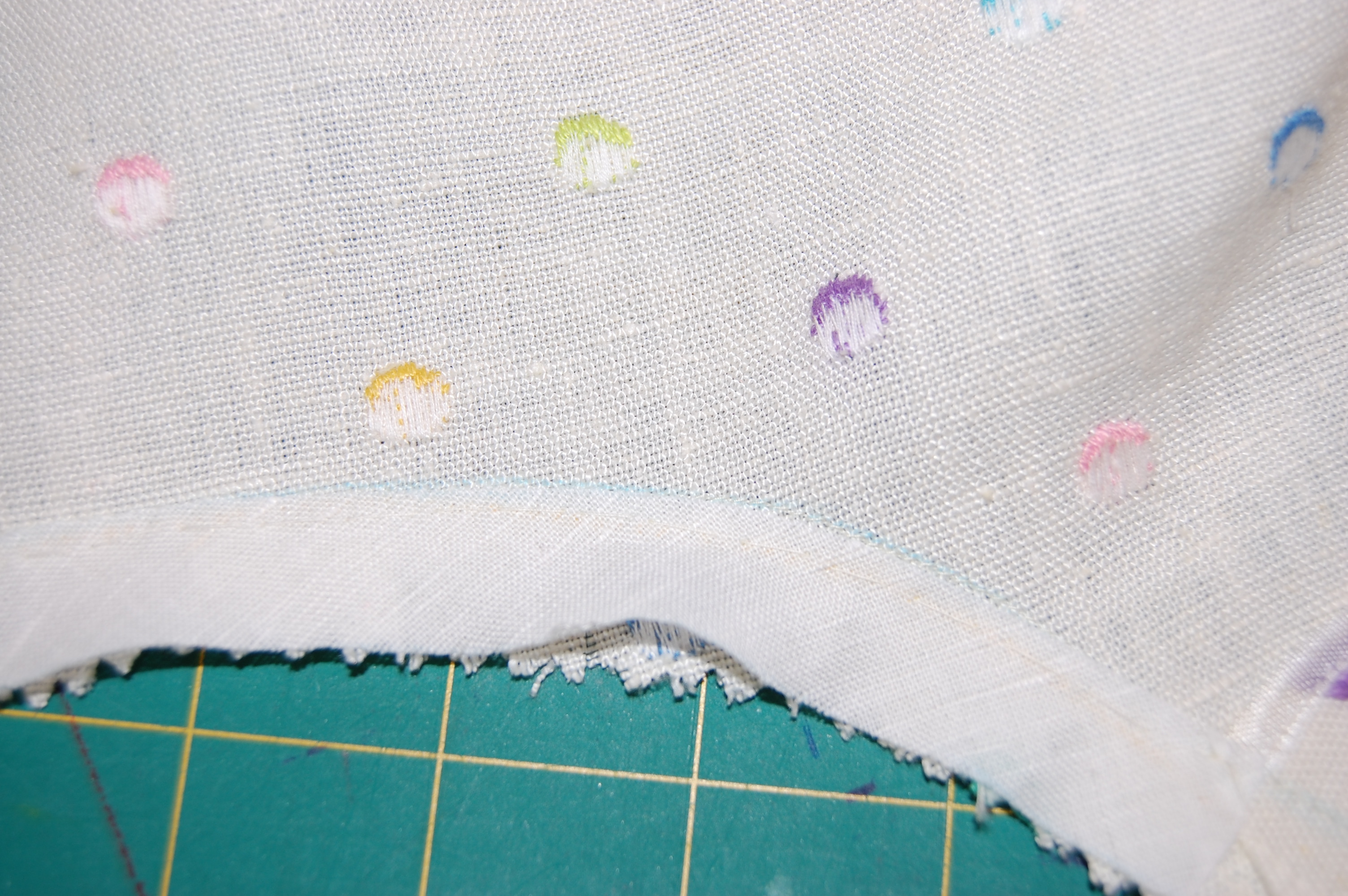
To remedy this, I cut 5/8” wide strips of bias lining fabric and basted them onto the seam allowances in those areas. That was just enough to take care of that problem.

This narrow strip of lining fabric prevents the color of those dots from showing through.

This narrow strip of lining fabric prevents the color of those dots from showing through.  This is the wrong side of the fabric.

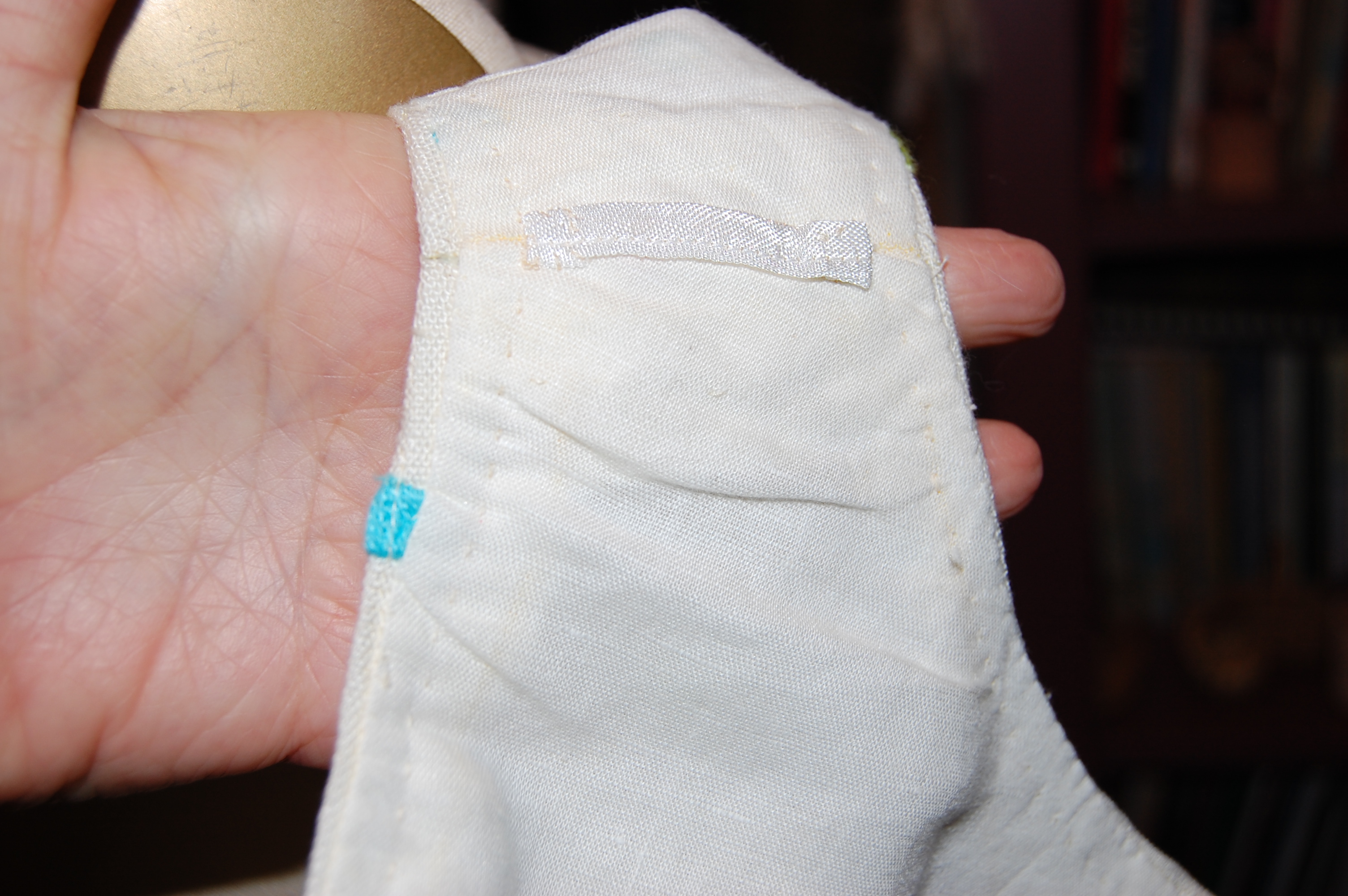
Once the dress and lining were attached, I under-stitched the neck and armhole edges by hand. It really makes a lovely interior!

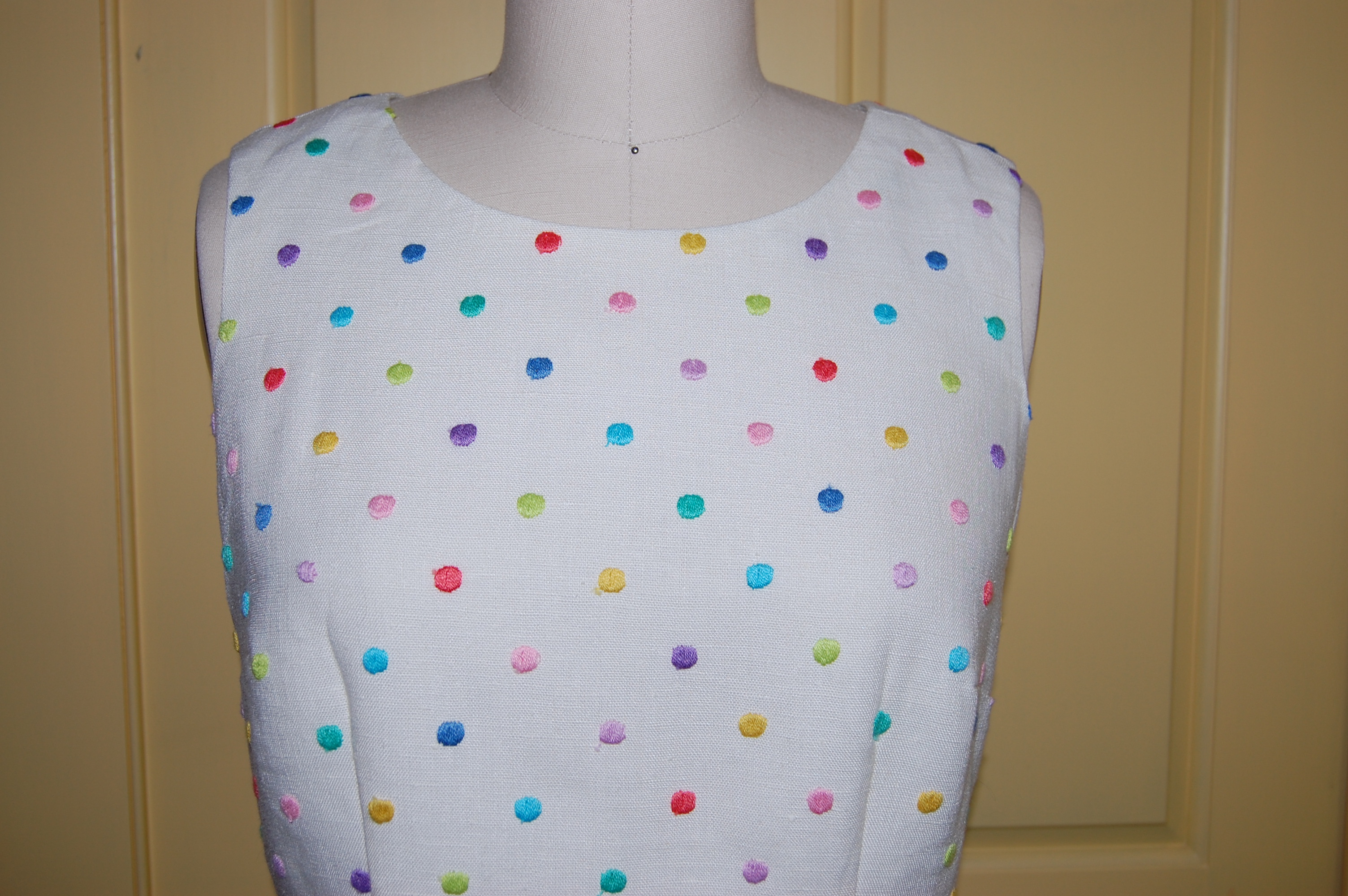
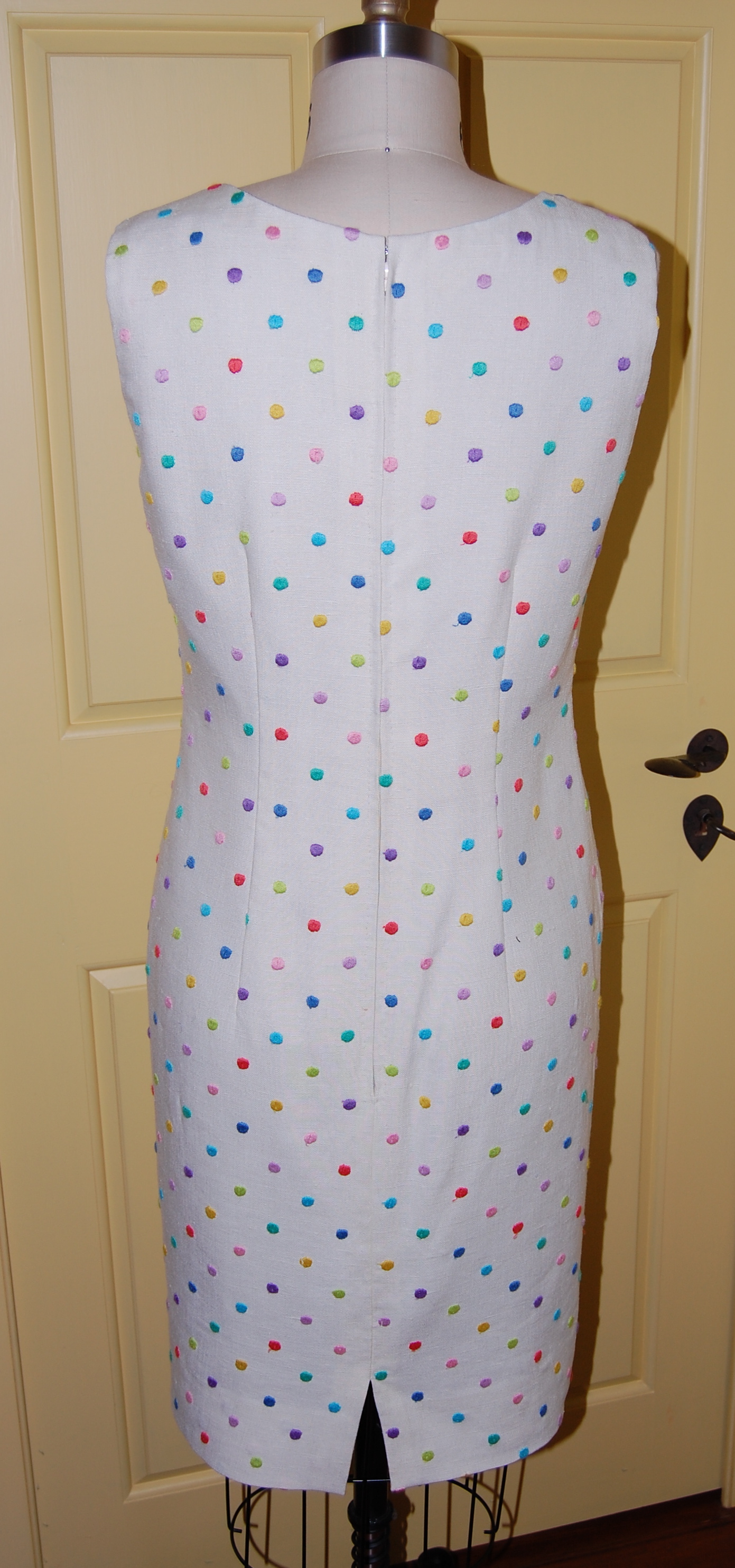
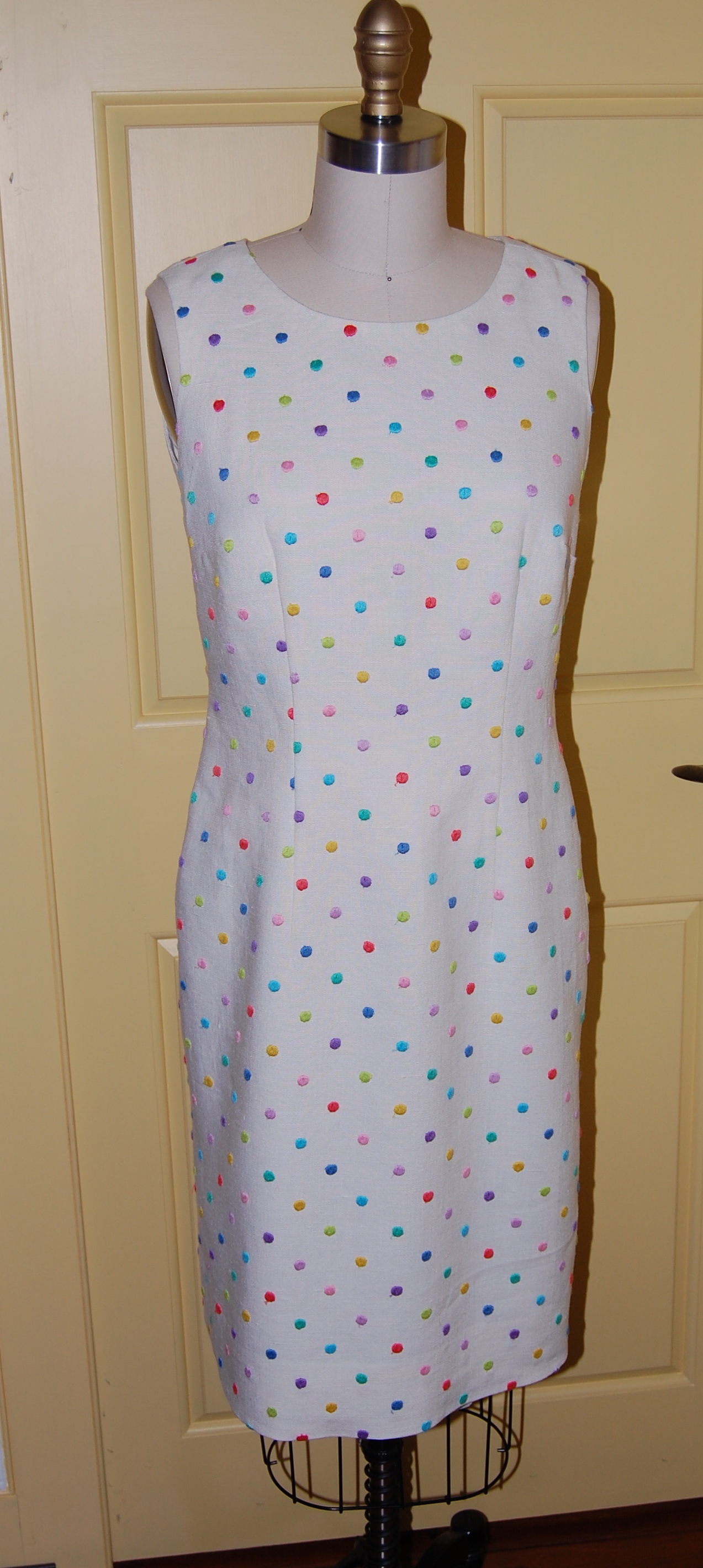
Linen dot dress

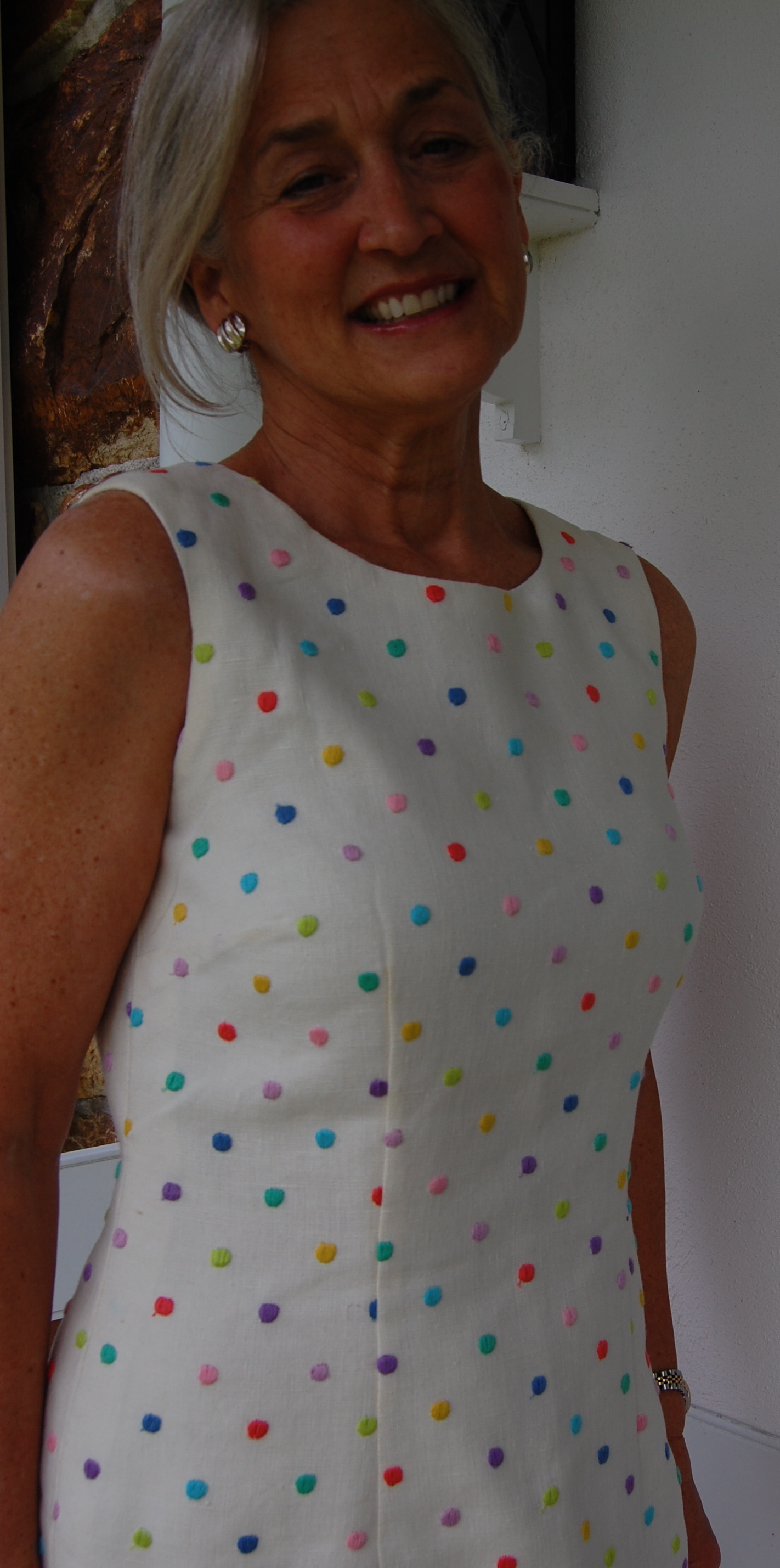
A close-up of the bodice.

A close-up of the bodice.

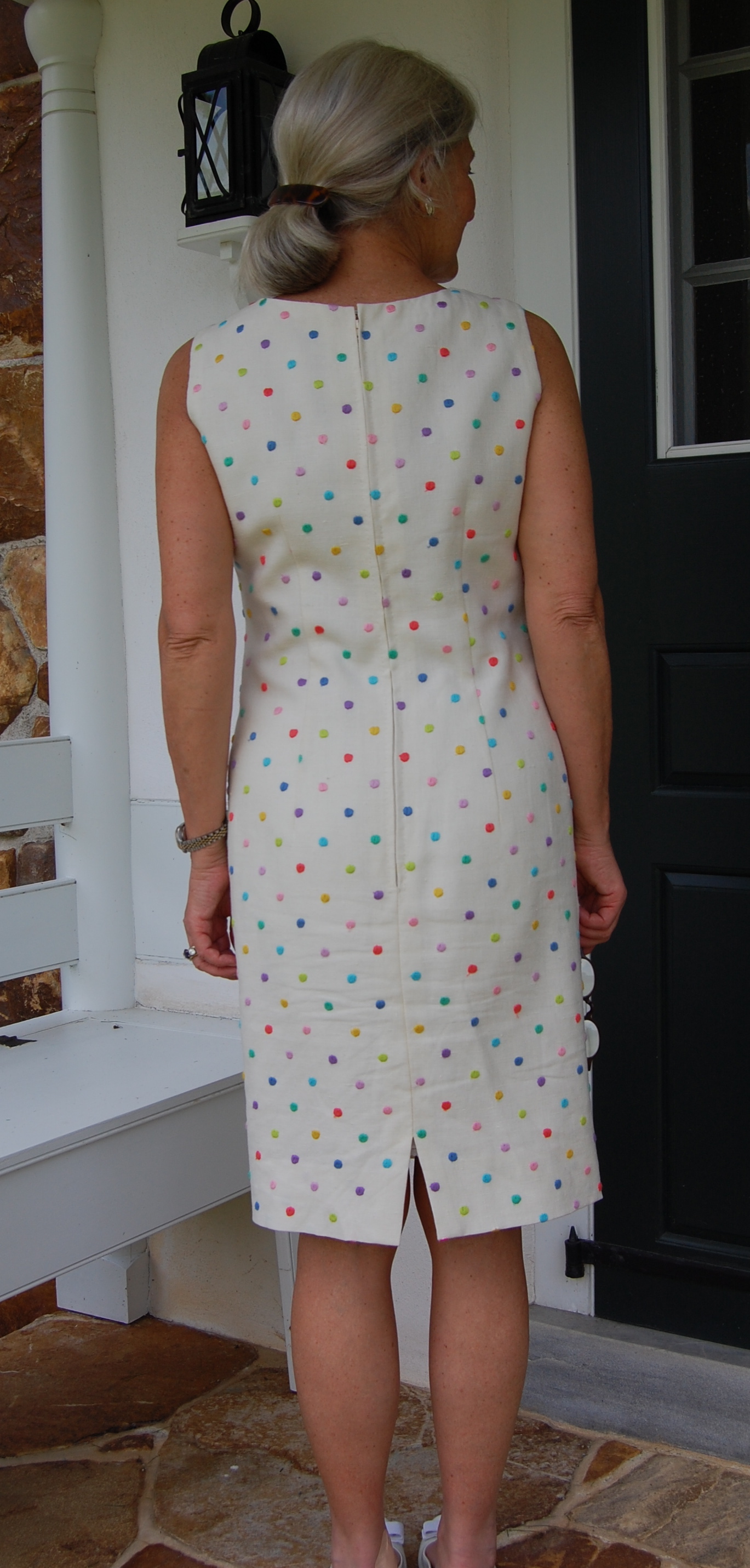
The back of the dress, with its hand-picked zipper.

The back of the dress, with its hand-picked zipper.

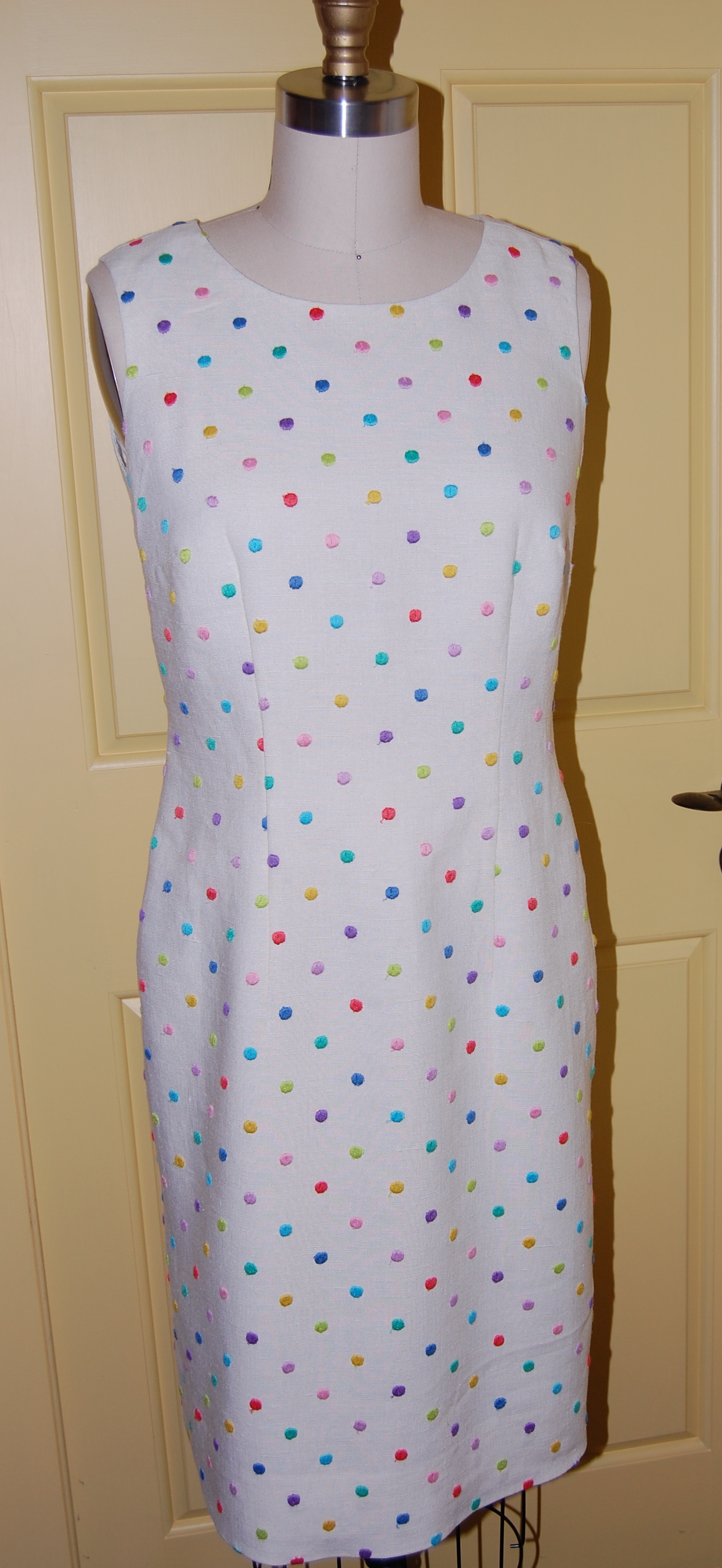
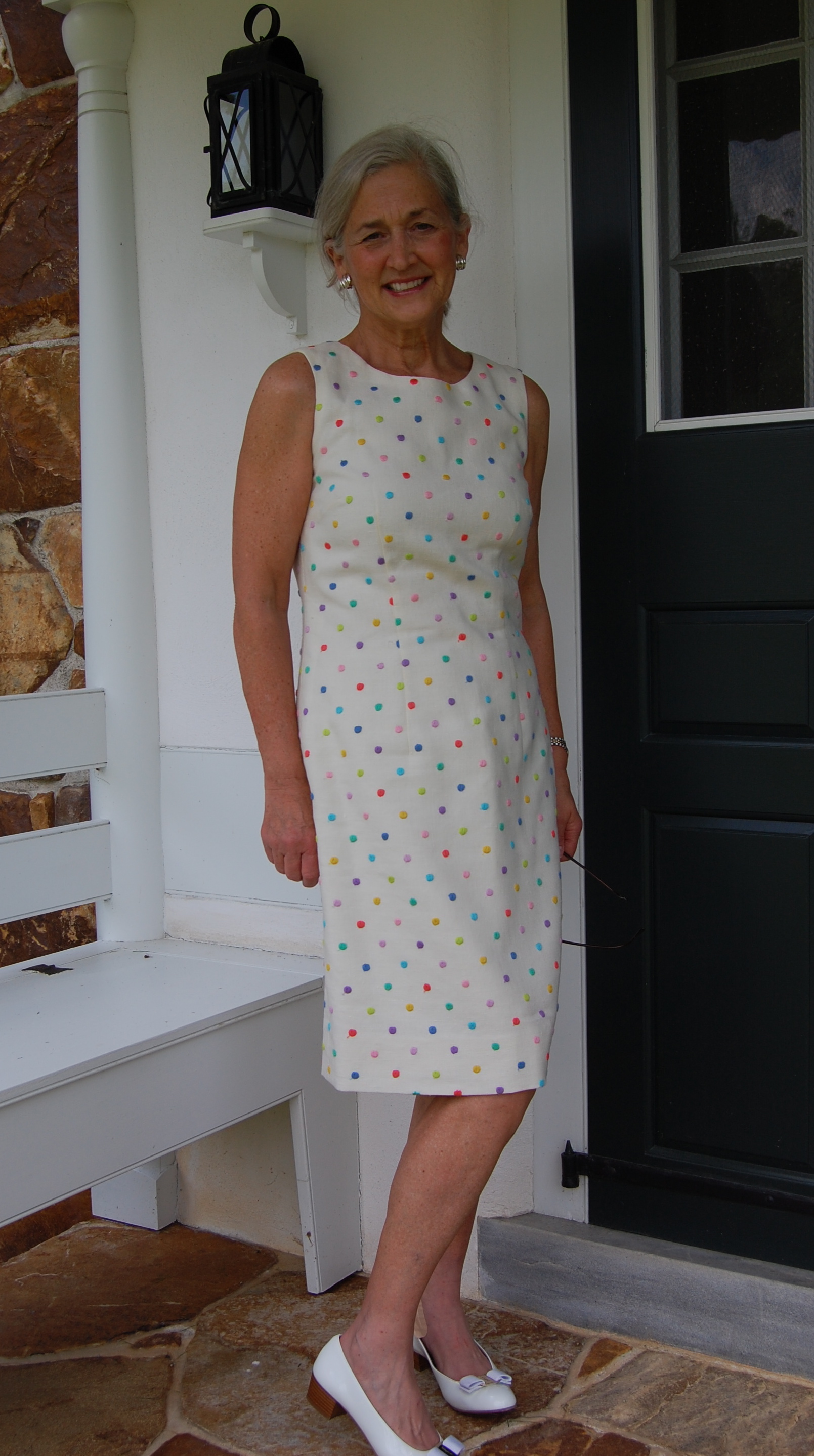
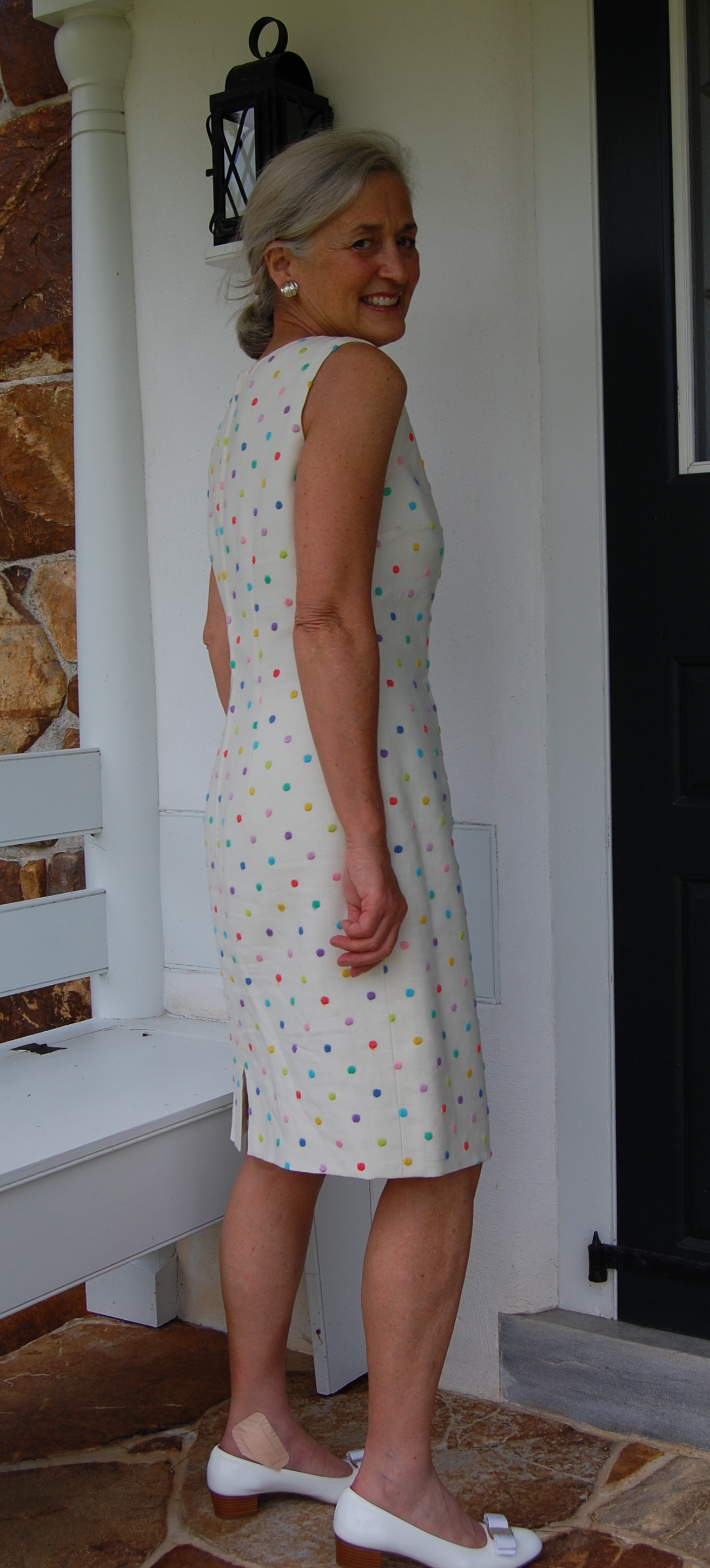
And one more view of the full dress.

And one more view of the full dress.

I finally (as of July 1, 2014) got some pictures taken!

I finally (as of July 1, 2014) got some pictures taken!

Polka dotted linen sheath

Polka dotted linen sheath

I love this dress!

I love this dress!

Moygashel linen is, sadly, no longer manufactured, about which I have written previously. One of its tag lines was “The first name in linen – The last word in quality”. I might change that to read “… The lasting word in quality.” Of course, there are some beautiful linens being manufactured today, but none will ever command a dressmaker’s imagination in quite the same way that Moygashel linen did for decade after fashionable decade.


22 Comments

Filed under hand-sewn zippers, Linen, Moygashel linen, Polka dots, Uncategorized

Defying the passage of years?

Throughout the 1950s, copyright dates appeared on all Vogue patterns (or, at least that has been my observation). Copyright dates appear on some of the patterns from 1960-‘62, but after that, they are non-existent. It is always a thrill when I find a reference to, or picture of, a pattern, which I own or am working on, in one of The Conde Nast Publications, Inc. magazines or other printed materials. It is one sure way to date an otherwise undated vintage Vogue pattern.

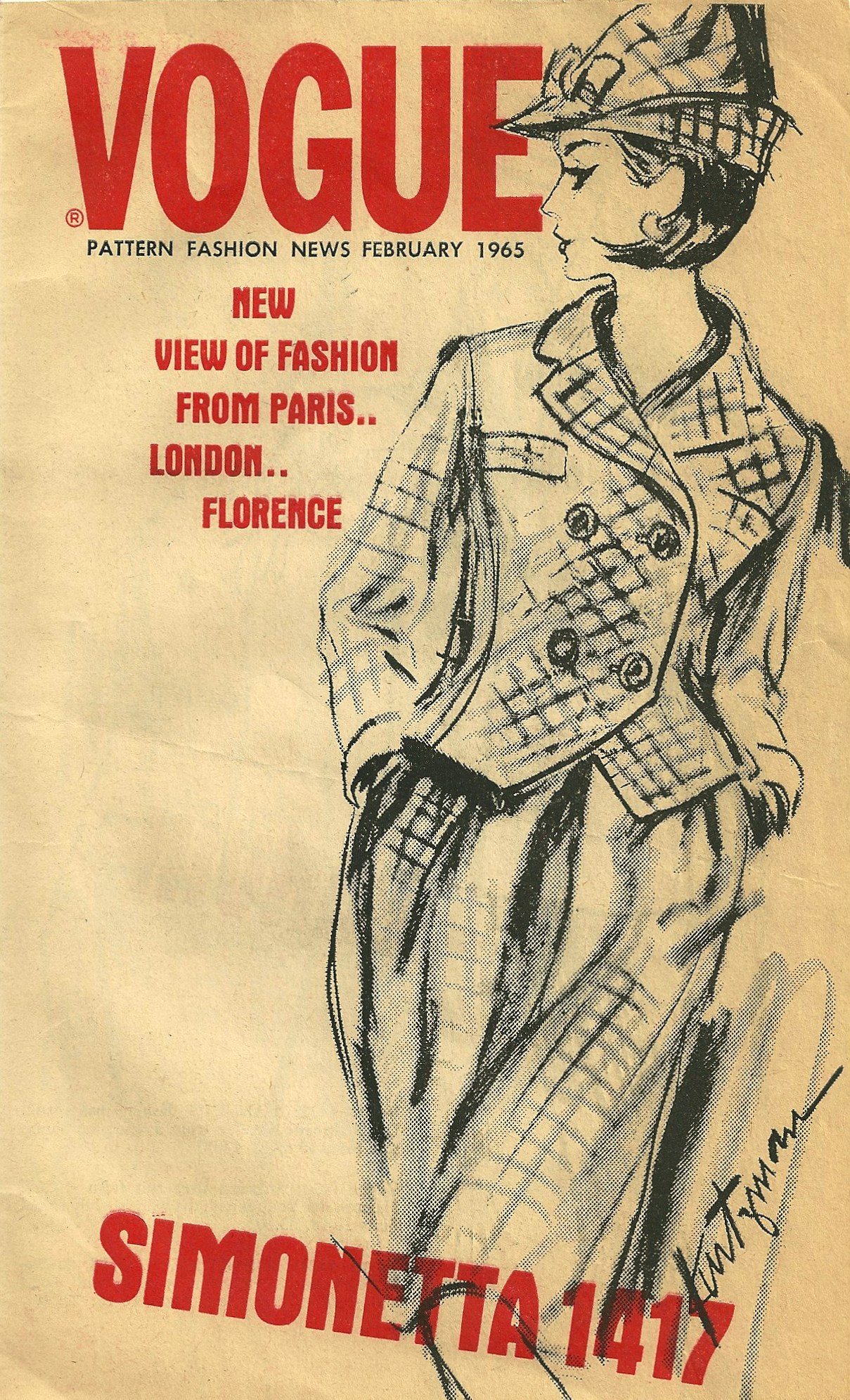
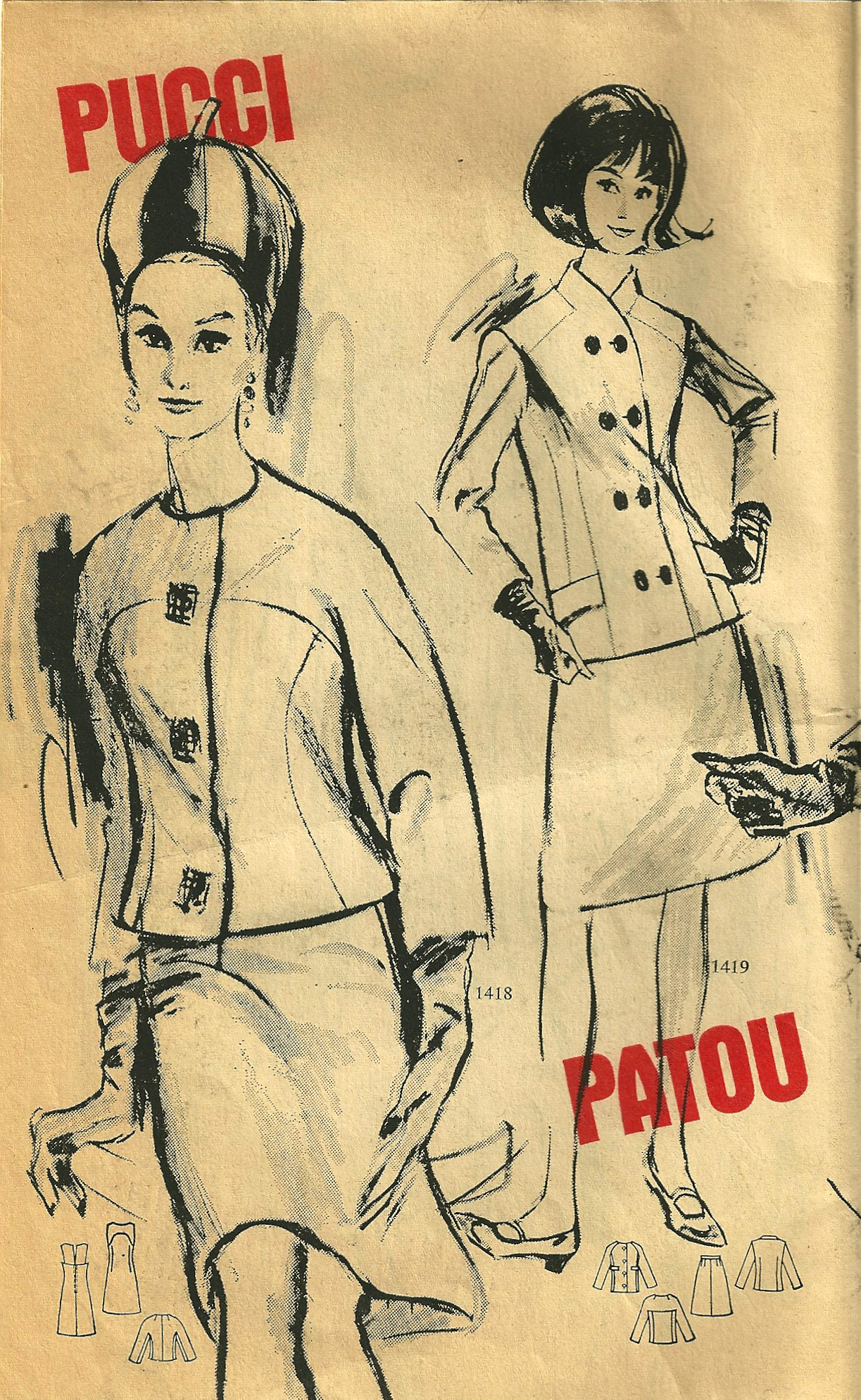
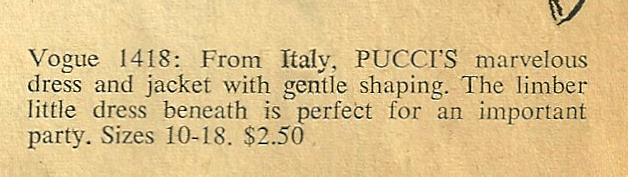
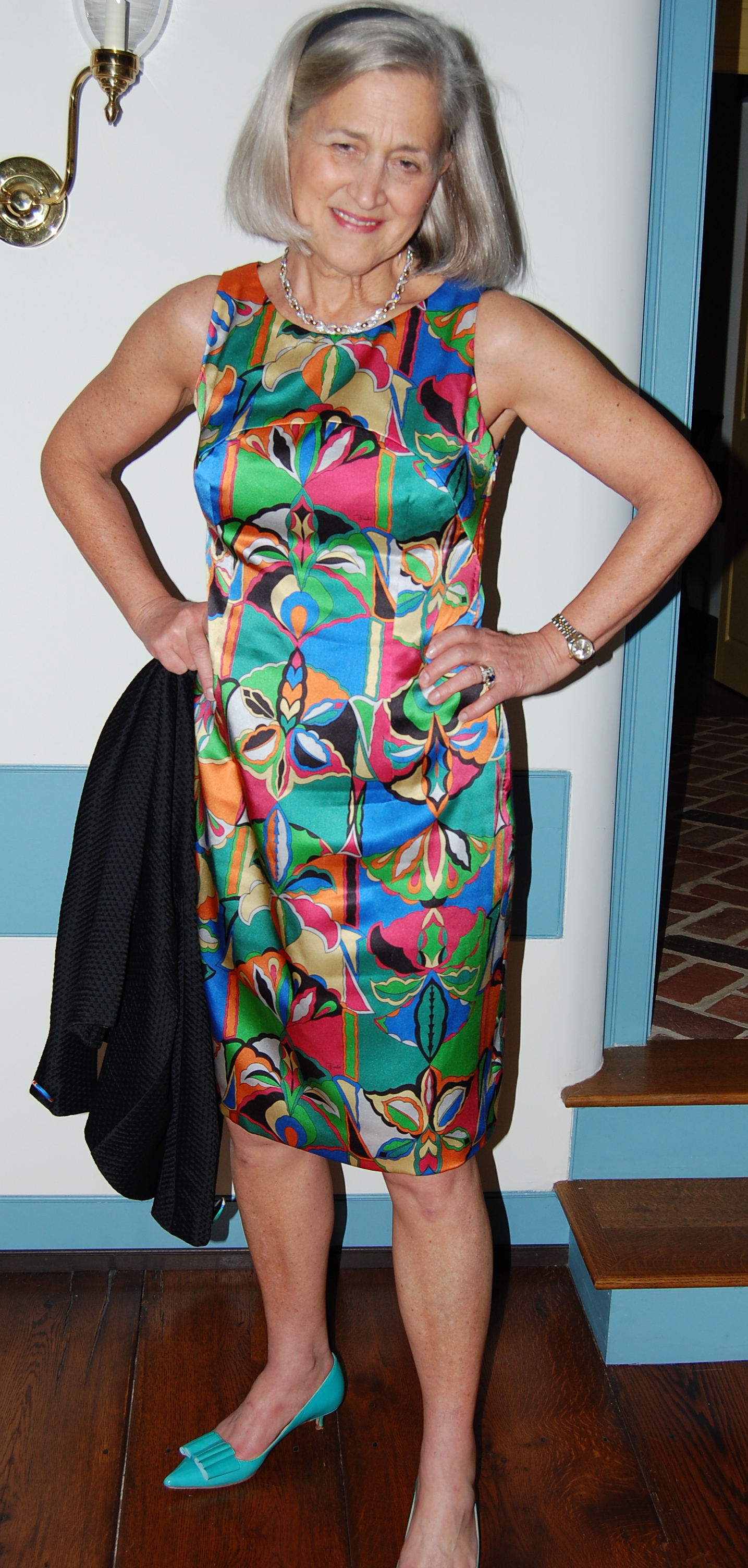
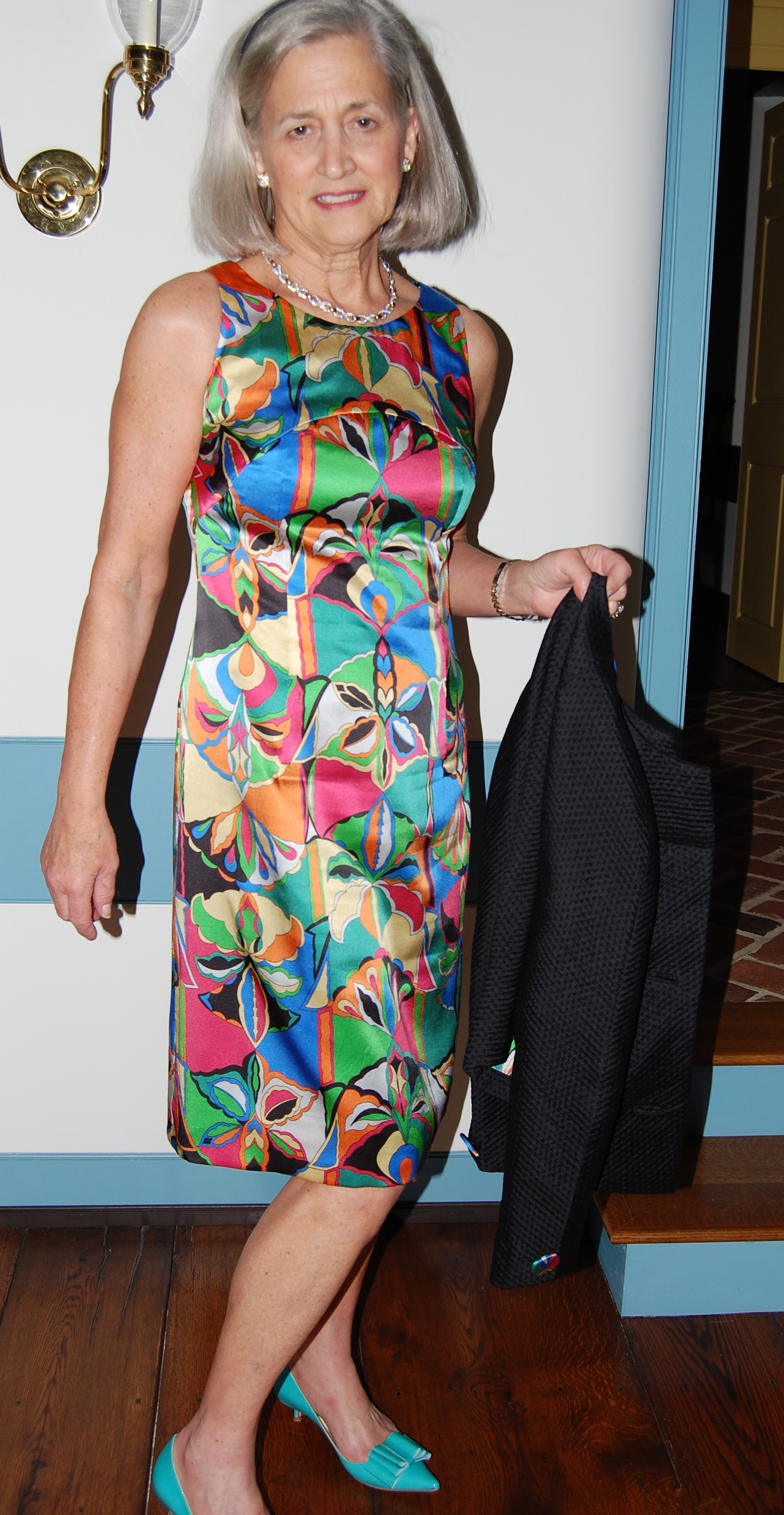
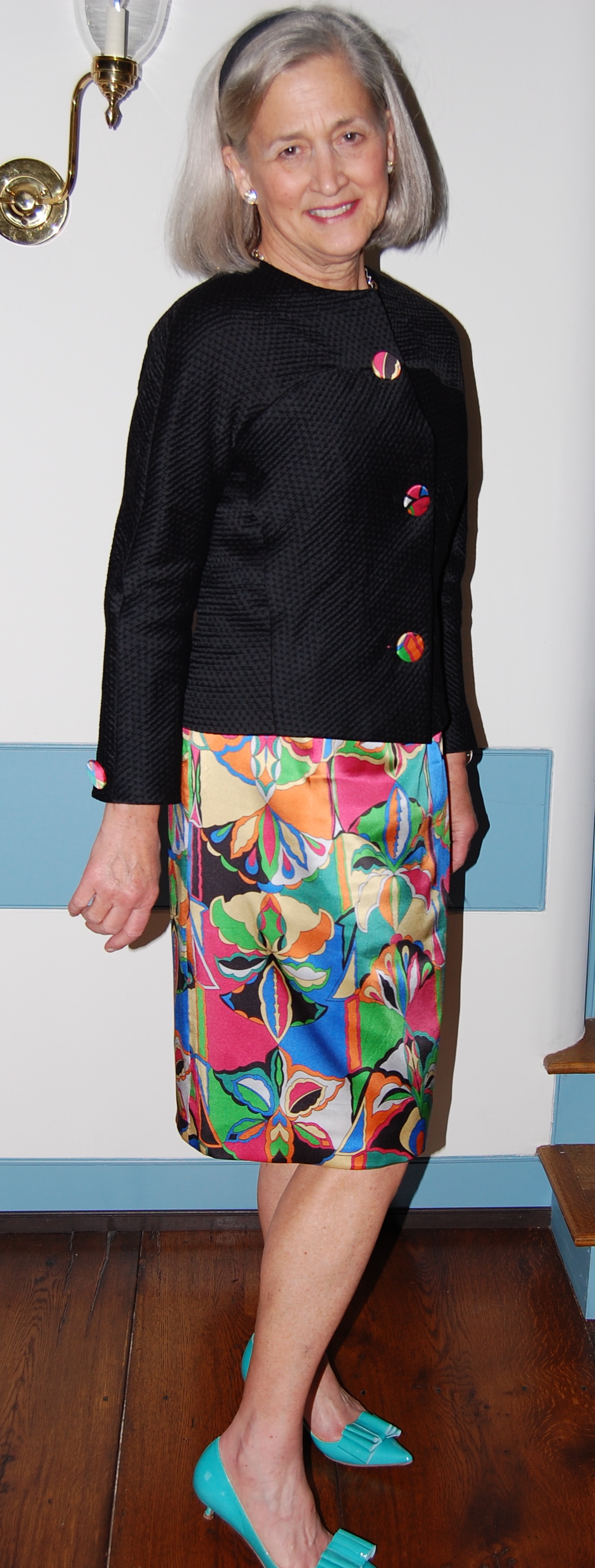
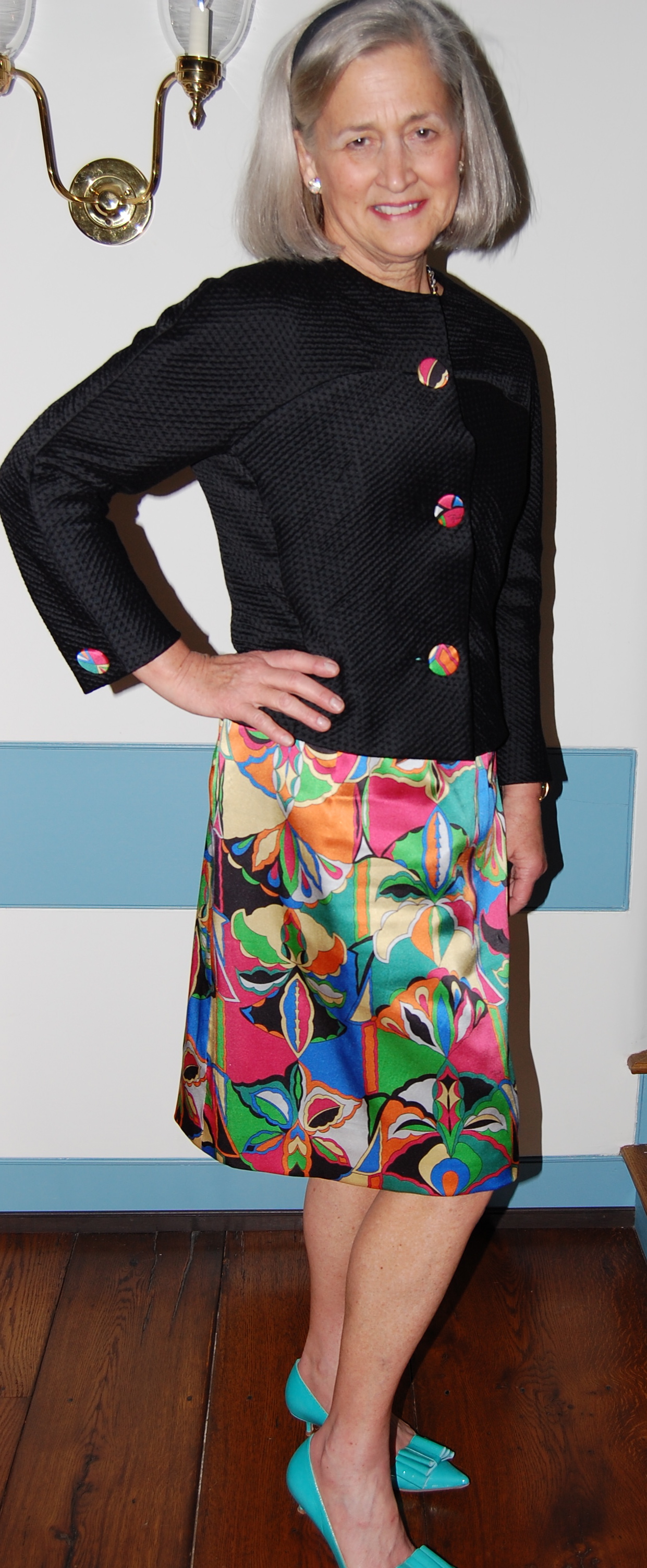
So – you can imagine my delight when a small, 8-page Vogue Pattern Fashion News from February 1965 – which I recently purchased – featured the Emilio Pucci dress and jacket which has been my sewing focus for the past several weeks.

On the cover of this small "flyer", which was available for pick-up wherever Vogue patterns were sold, is the reference to fashion from Florence - as in Pucci's Florence!

On the cover of this small “flyer”, which was available for pick-up wherever Vogue patterns were sold, is the reference to fashion from Florence – as in Pucci’s Florence!

And here is the sketch of "my" Pucci pattern.

And here is the sketch of “my” Pucci pattern.

The brief caption gives an apt description of the Pucci pattern:

Pucci pattern - fashion news caption

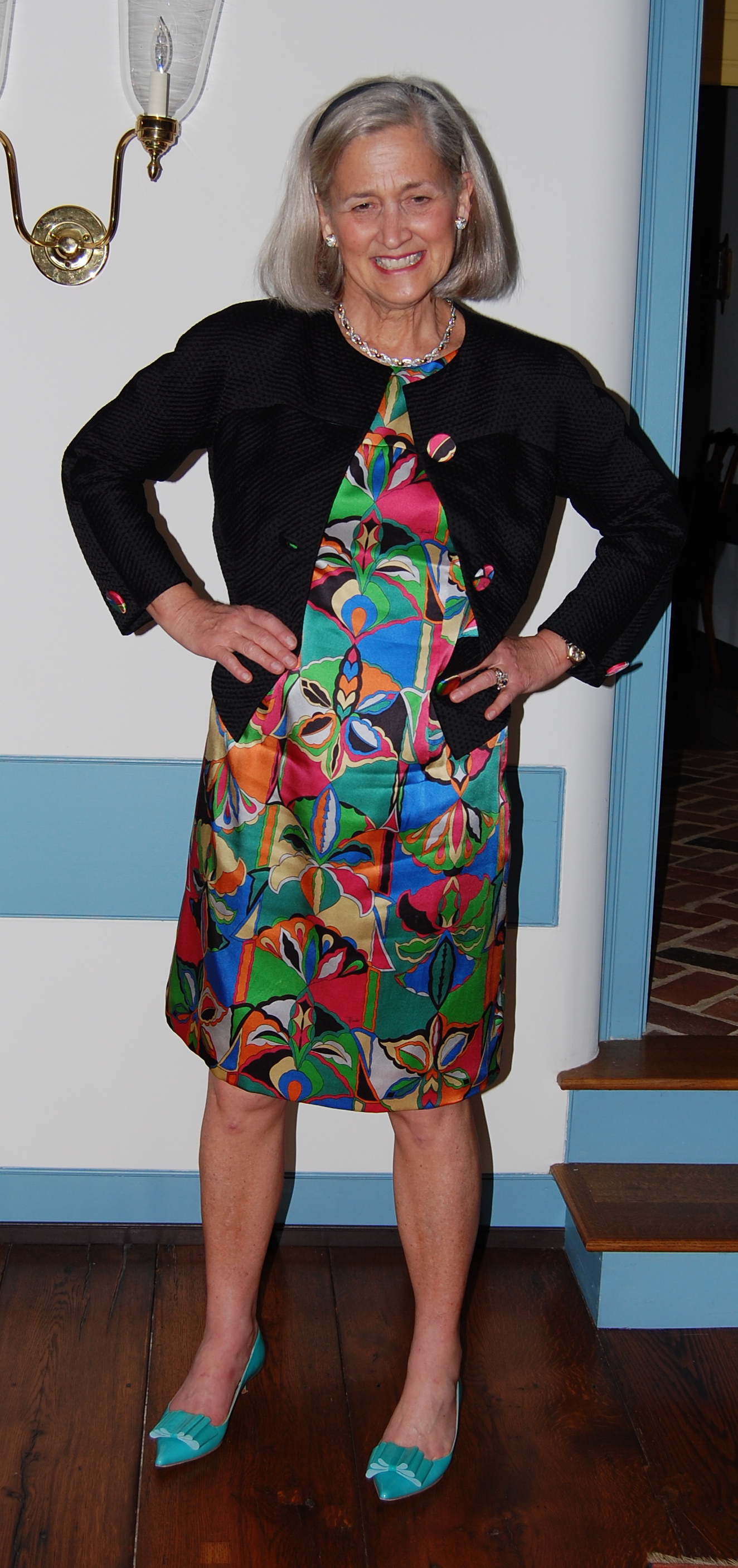
And – I did indeed wear this dress (and jacket) to an “important party” just last weekend – to a beautiful wedding in Center City Philadelphia.


(This photo was not taken at the wedding...)

(This photo was not taken at the wedding…)

I was working diligently all last week to finish the jacket. Here are the details on what was transpiring in my sewing room:

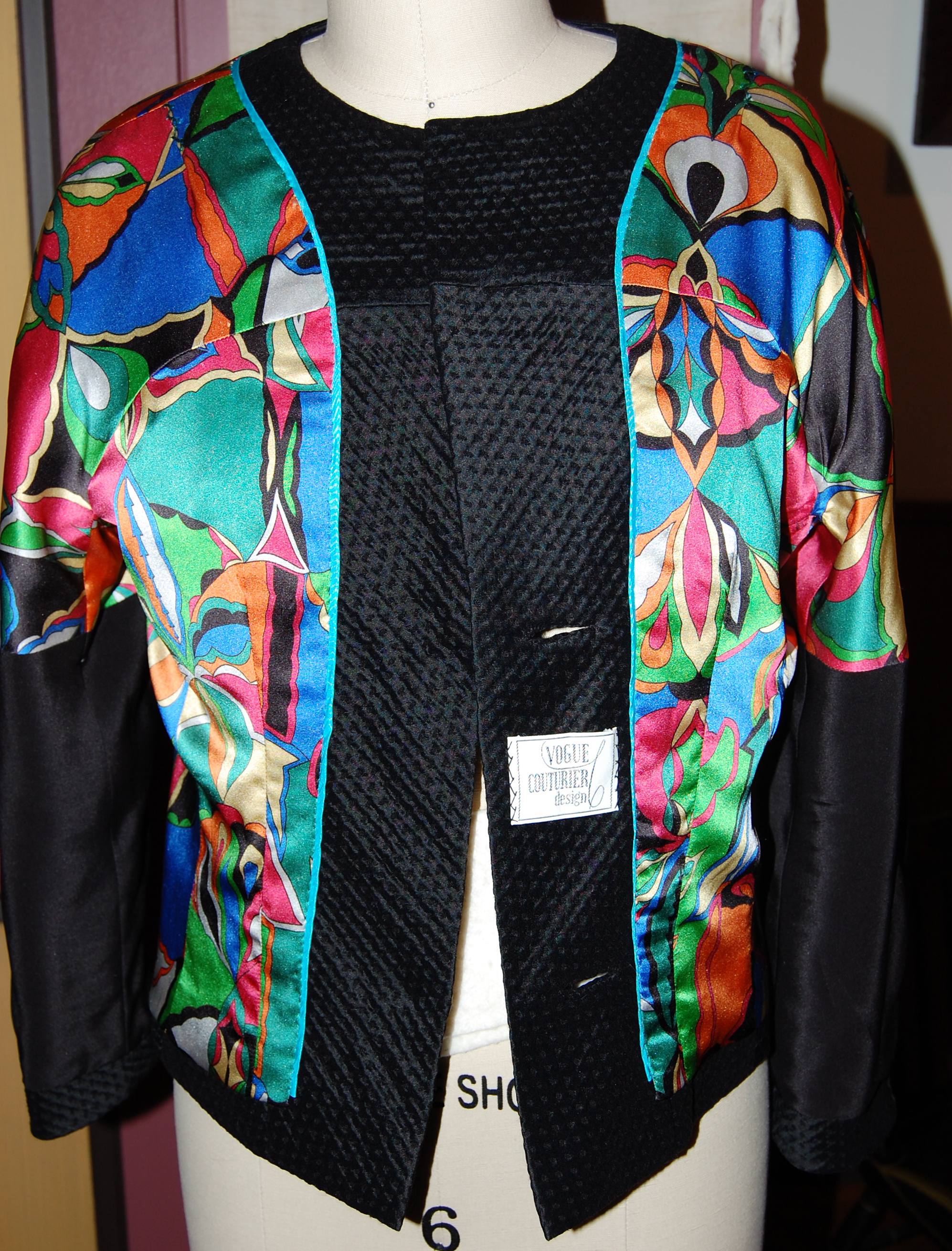
First, I can tell you I was delighted that the pieced sleeve linings worked just as I had hoped they would. Here is the jacket turned inside out, showing the piecing on the lower sleeves.

Defyng the passage of years

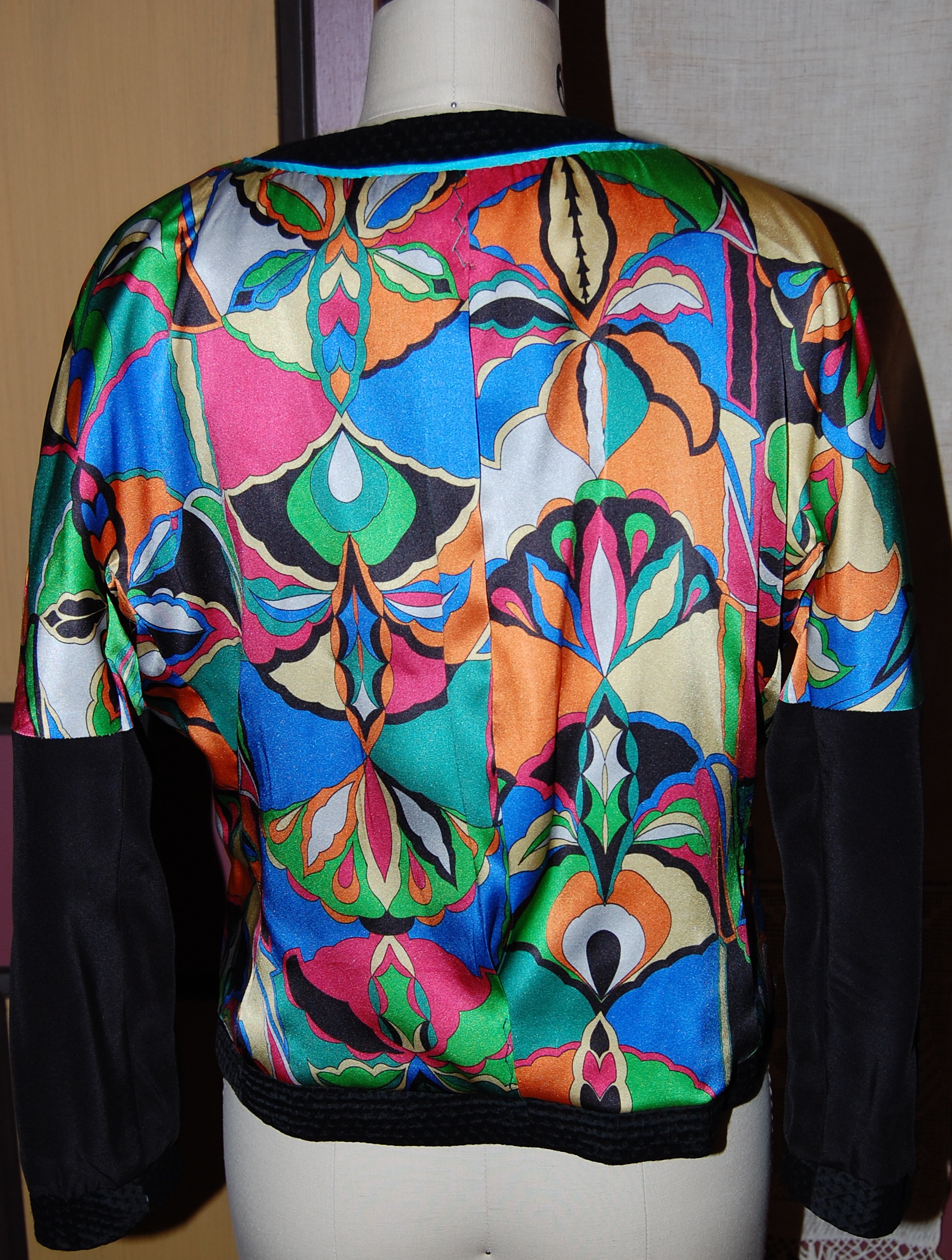
Inside out, a back view.

Inside out, a back view.

And here is a photo inside the jacket, looking towards one sleeve, which shows that the piecing does not show! Hurray. I honestly don’t think anyone seeing the jacket slung over a chair is ever going to suspect that the Pucci lining fabric does not extend all the way down the sleeves.

Defying the passage of years

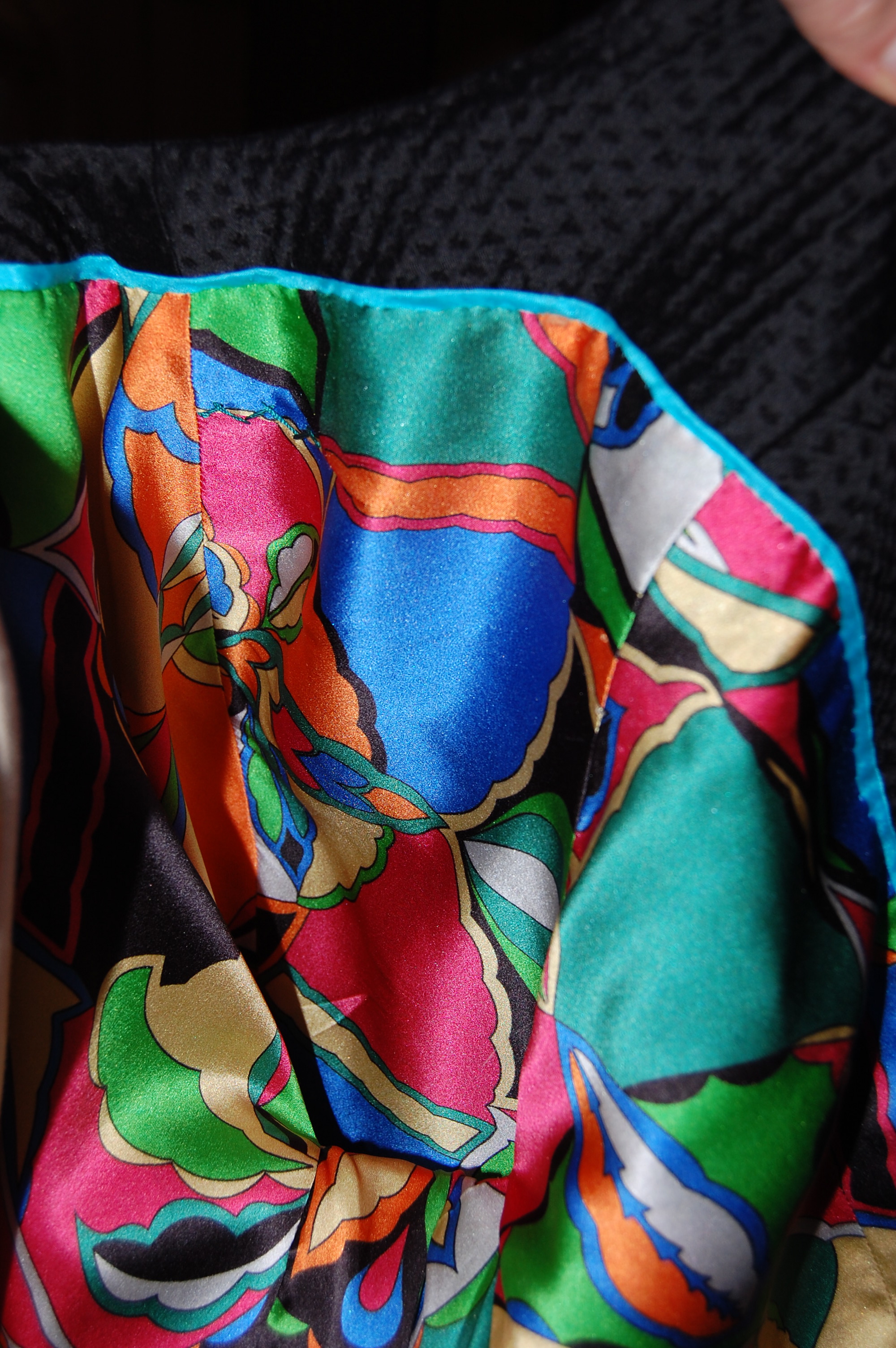
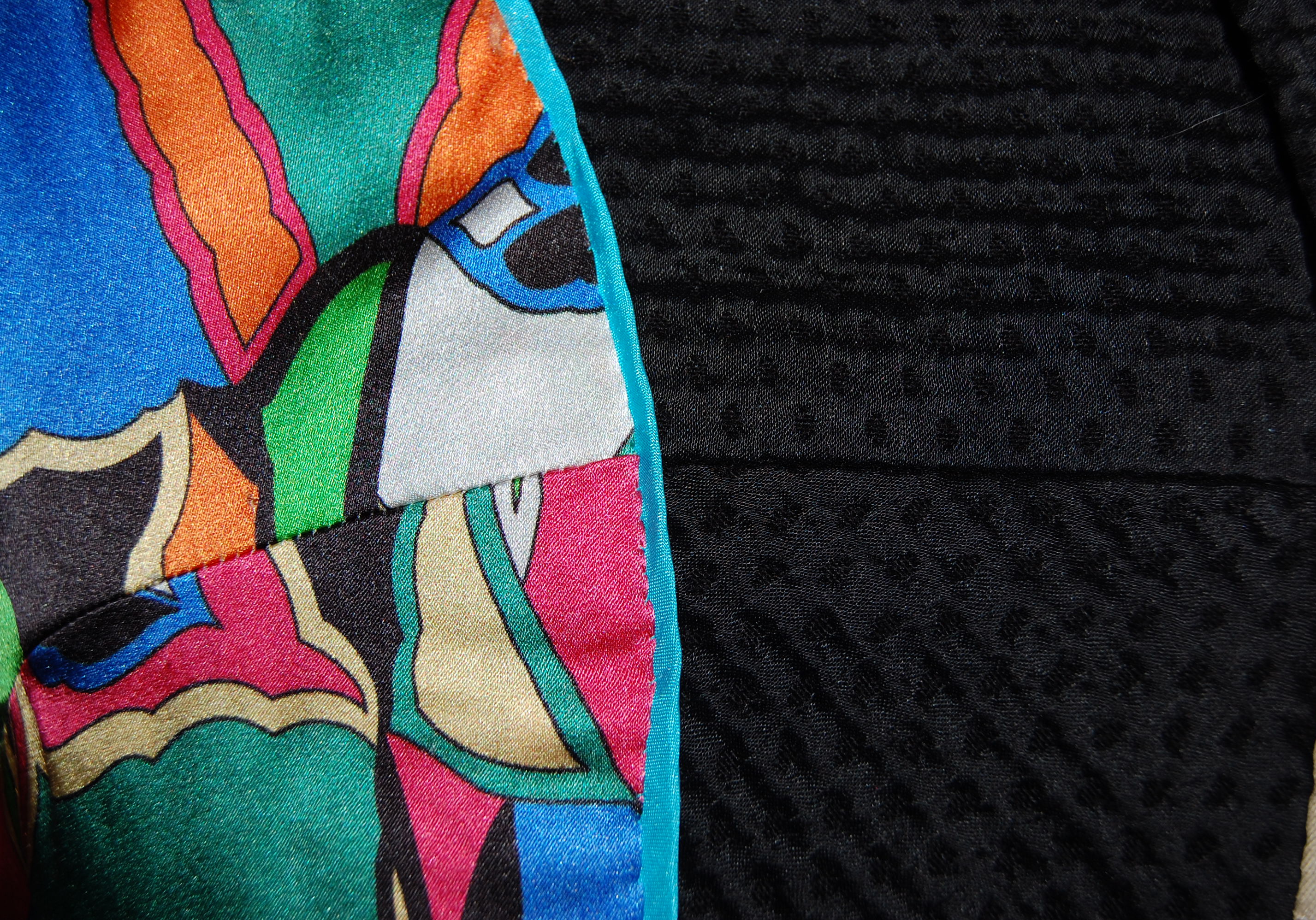
I also had the idea to add a narrow, bias, flat piping to the edge of the lining down the fronts and around the neckline. I found a turquoise silk in my fabric closet which seemed to keep with my “theme” of the turquoise under-stitching on the interior of the dress. This is one of those “dressmaker details” which just makes me happy.

Defying the passage of years

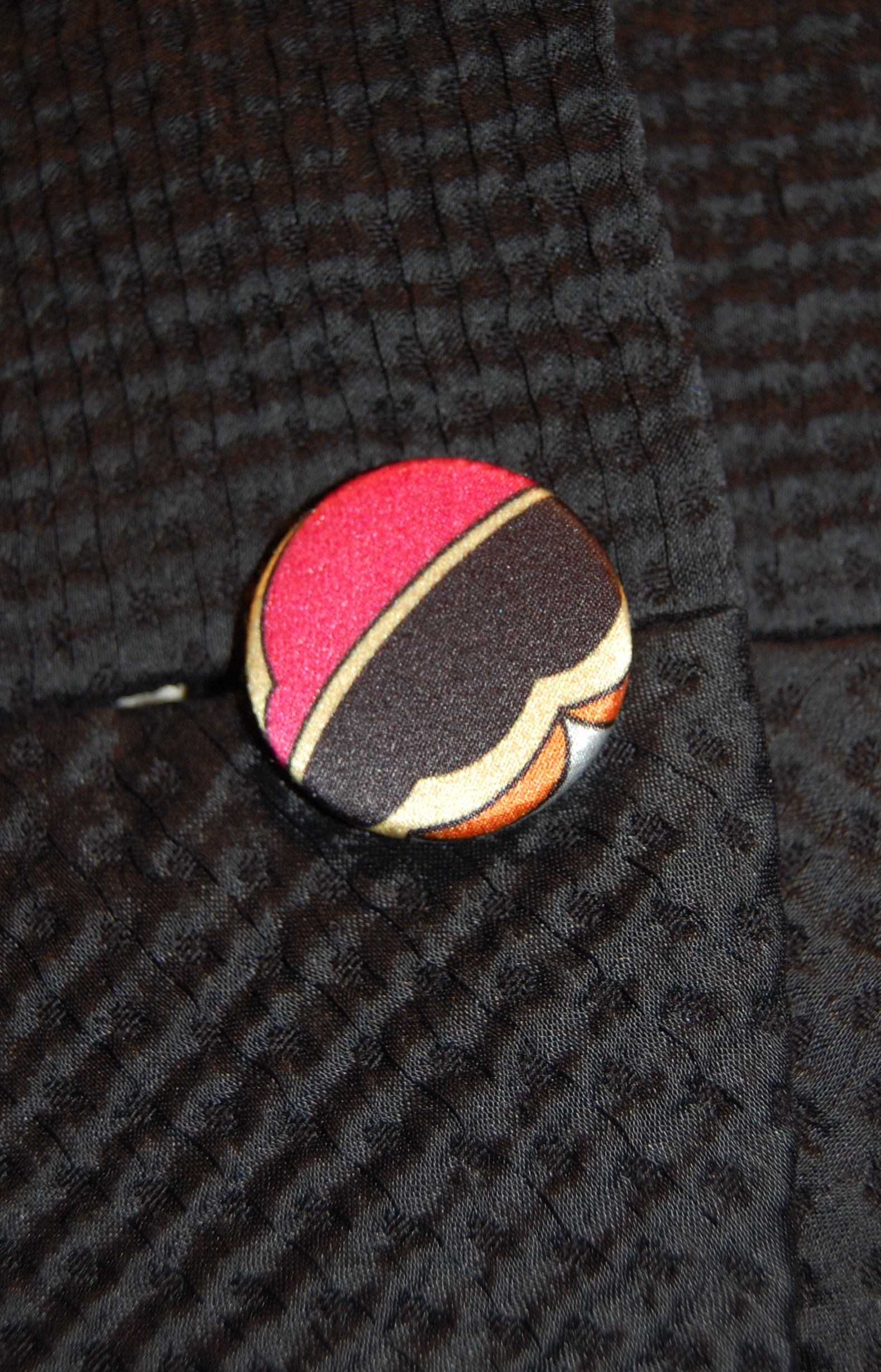
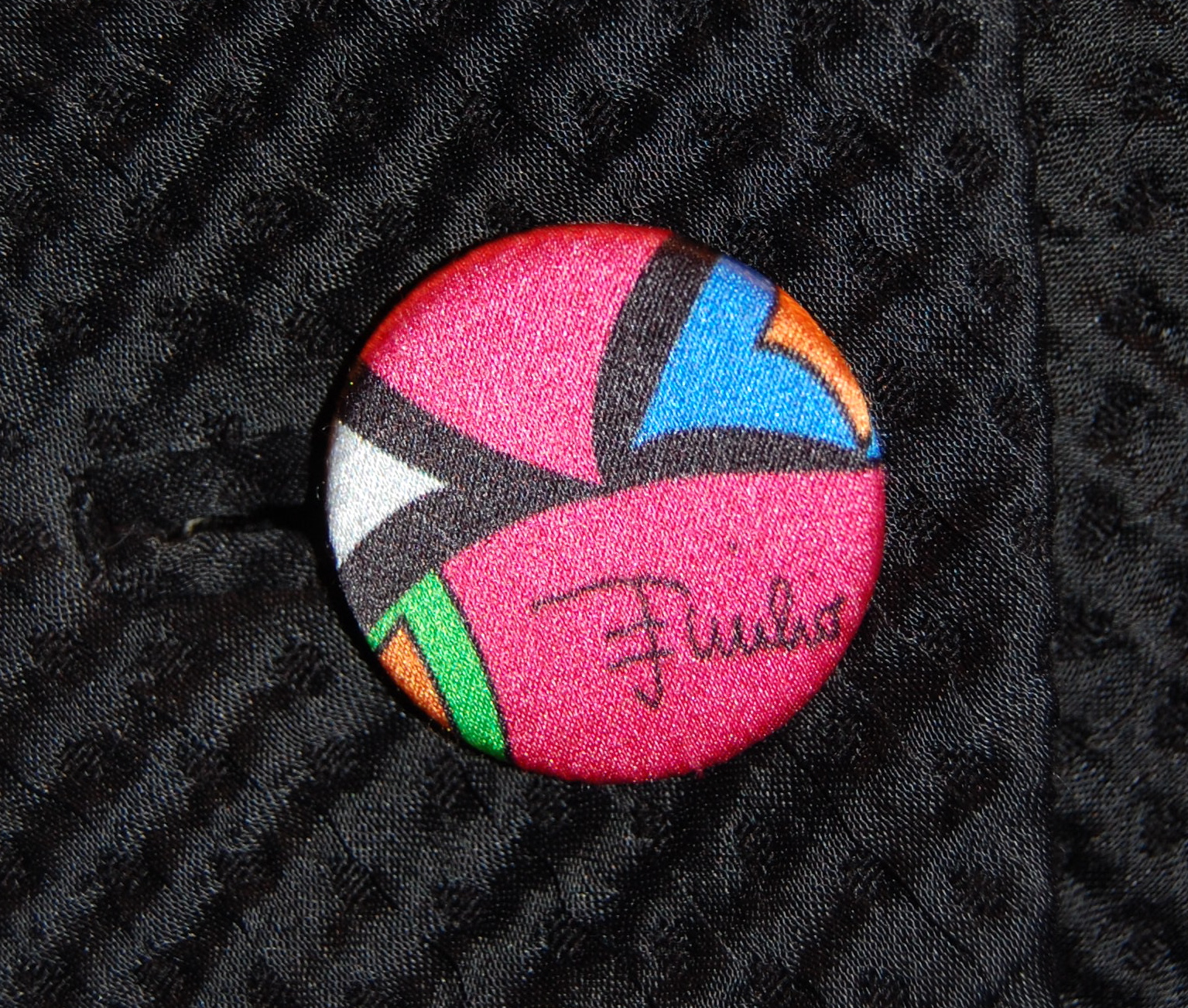
Another thing that makes me happy are the buttons! I picked out specific scraps of the silk, which featured designs I wanted to emphasize on the buttons. I sent them off to Pat Mahoney in Lodi, California, who returned them made into 1¼ inch buttons – flat and beautiful!

This is the button I chose for the top of the jacket.

This is the button I chose for the top of the jacket.  Notice the slot-seam-buttonhole.

The middle button - I couldn't resist featuring the Emilio signature on this one.

The middle button – I couldn’t resist featuring the Emilio signature on this one.

And the lower button.

And the lower button.

I decided to have two extra buttons made in case I wanted to add them to the sleeves.   And – add them, I did. I like the extra subtle  attention they bring to the jacket. (Another dressmaker detail – specifically, an added embellishment.)

Defying the passage of years

Defying the passage of years

I had the jacket finished when I suddenly remembered that a Vogue label had come with the pattern. Of course, I was delighted to sew it in place.

Defying the passage of years

Defying the passage of years

Defying the passage of years
 Defyng the passage of years

Defying the passage of years

There is something about using a pattern from 1965 that seems quite amazing to me. Yes, it is simple math, but think about this: 1965 was 49 years ago!   Is anyone who sees me in this dress and jacket going to think that it is sewn from a 49-year-old pattern? Somehow I doubt it. I think my secret is safe.


28 Comments

Filed under Buttons - choosing the right ones, couture construction, Dressmaker details, sewing in silk, Slot-seam buttonholes, The Conde Nast Publications, Uncategorized, vintage Vogue Designer patterns, vintage Vogue patterns from the 1960s