Category Archives: couture construction

Just for the Chill of It

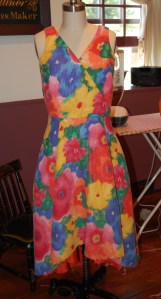
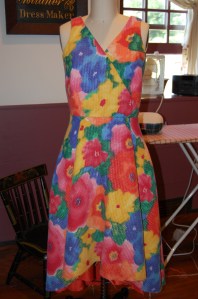
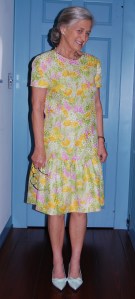
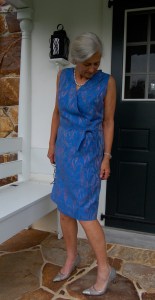
Autumn is a delightful season here in the northeastern part of the United States. One can tell it is on its way when the warm days quickly take on an evening chill once the sun slips below the horizon. It is the time of year when a light coat or sweater is a necessity, especially with a sleeveless dress.

With this scenario, and a September wedding to attend, what better excuse did I need, to make a coat to go with this dress?
The Year of Magical Sewing

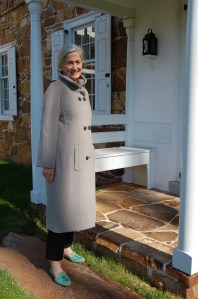
If you follow my blog then you probably already know this was my intention all along, when I made the dress two years ago. But it took a while to find the right coordinating fabric for a coat. I was looking for something between a coral and a pink. While the silk taffeta I found at Britex Fabrics looks more like a deep persimmon color when photographed, the fuchsia pink warp is very apparent when being worn.
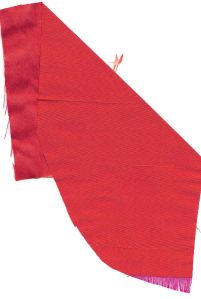
Taffeta coat - swatch

Once I decided the Jo Mattli-designed coat, part of the original dress pattern, was too voluminous, I went to another pattern. I wanted to keep the “intention” of the original coat, but have it more streamlined.
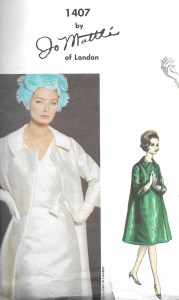
The "original" coat designed by Jo Mattli.

The “original” coat designed by Jo Mattli.
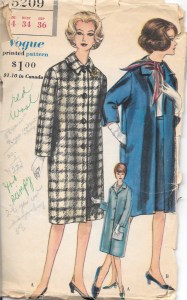
Taffeta coat - %22too scimpy%22

The coat pattern I settled on.

Somehow along the way, in making my muslin, I got the idea to add a curved belt to the back of the coat. I knew I had used a coat pattern several years ago with a curved belt back detail, so I went through my pattern collection to retrieve this:
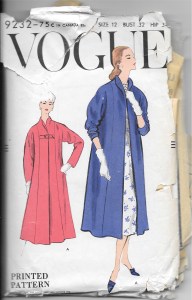
This is a 1957 pattern, but look at the belt shown on the back of the envelope, below.
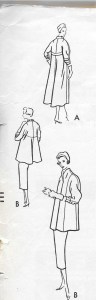
This is a 1957 pattern, but look at the belt shown on the back of the envelope, below.

taffeta-coat-belt-pattern-thumbnail

The belt is only shown in view A.

It took a couple of tries with the muslin to get the placement and angling of the belt correct, but once I did, I knew it was a winner. Dressmaker details like this always give me a thrill!
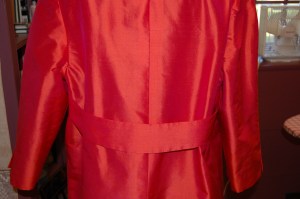
I anchored the belt in the side seams right under the bust darts.
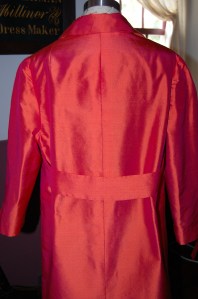
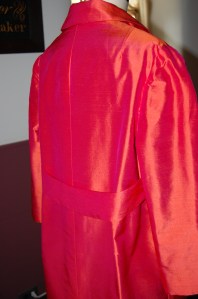
I anchored the belt in the side seams right under the bust darts.

Just for the Chill of it

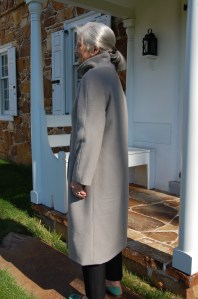
The curve of the belt needed to fall at my waistline.

The curve of the belt needed to fall at my waistline.

One of the things I like about this pattern is the two-part sleeve with a center seam. I think this design is always flattering to the shoulder. Here are the constructed sleeves:
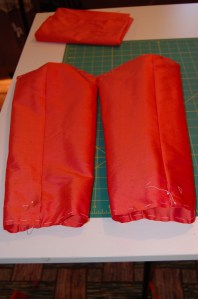
Just for the Chill of it

That center seam also provides the opportunity for a faux vent, and since I just happened to have three buttons, which I thought would be perfect for the coat, I happily included vents, as the pattern dictated:
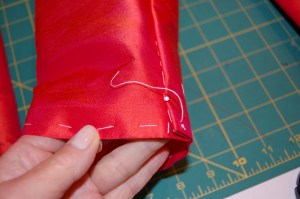
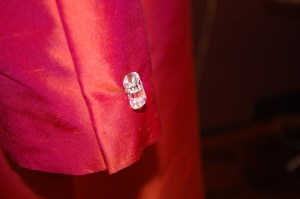
Just for the Chill of It

A small, cylindrical, crystal button!

A small, cylindrical, crystal button!

Although I originally thought I would leave the coat “closure-less,” that third button kept calling to me. While I did not want to have a single bound buttonhole in the center of the chest, I thought a button loop might do the trick. If I didn’t like it, I could remove it fairly easily from the front facing seam.
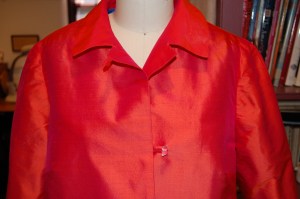
Just for the Chill of it

I also decided to add a loop at the neck, with a plain flat button under the collar. This way, I could close the collar if I chose to do so.
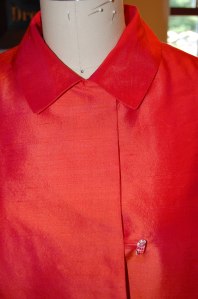
I pad-stitched the collar, but forgot to take a picture. Pad-stitching is like magic in how it makes the collar roll properly!

I pad-stitched the collar, but forgot to take a picture. Pad-stitching is like magic in how it makes the collar roll properly!

I have to say, I think the coat looks equally good any way it is worn: with the single button at the bust line closed, with both buttons secured and with neither of the buttons secured.

I chose not to add the optional pockets to this coat, but if I make it again in a less formal fabric, I would absolutely include them.

Once I got to the lining, I had to decide if I wanted to add the flat piping detail which I like so much. Of all the bias silk ribbon I have on hand, the only one which looked good was deep pink. Because of that, it doesn’t show contrast all that well, but I still like the subtle finishing look it gives to the lining.
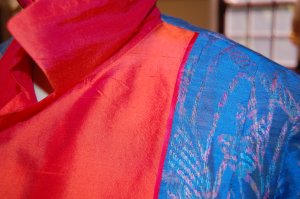
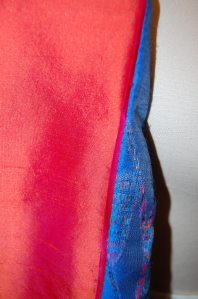
Just for the Chill of it

Just for the Chill of it

Here, by the way, is the coat before I inserted the lining:
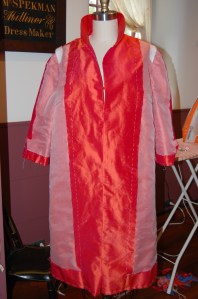
I underlined the entire coat with silk organza and added "cigarette" sleeve headings.

I underlined the entire coat with silk organza and added “cigarette” sleeve headings.
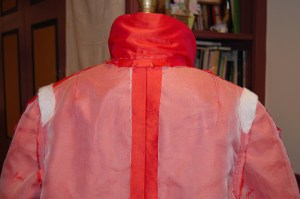
I love a center back seam!

I love a center back seam!

I used some vintage silk buttonhole twist to tack the center back fold in the lining at the neck and at the waistline.
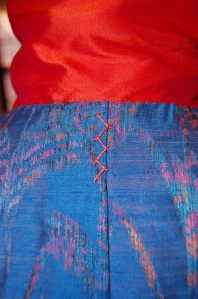
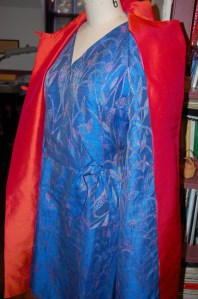
Just for the Chill of it

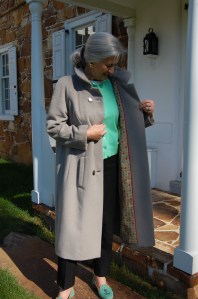
There is no question that the dress and the coat go together once the lining shows!
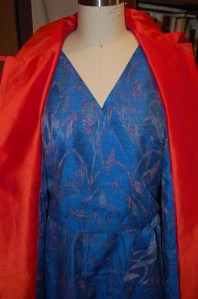
There is no question that the dress and the coat go together once the lining shows!
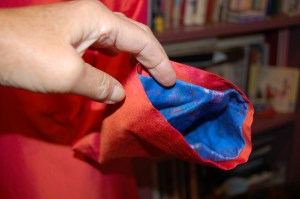
Just for the Chill of it

I love that the lining peeks out from the sleeves when I am wearing the coat.
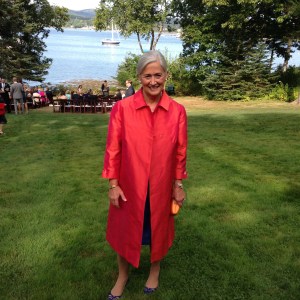
I love that the lining peeks out from the sleeves when I am wearing the coat.

taffeta-coat-full-copy

I was delighted when the photographer at the wedding wanted to take my picture because he "liked my outfit so much." (This is not that photo...)

I was delighted when the photographer at the wedding wanted to take my picture because he “liked my outfit so much.” (This is not that photo…)

Here with my husband - with a coordinating tie, no less (not planned, but makes for a great photo!)

Here with my husband – with a coordinating tie, no less (not planned, but makes for a great photo!)

It may seem a bit frivolous to make a coat like this, knowing that it will not be worn all that often – although I do have two other dress-weight silks in my collection which would look fairly stunning paired with this coat!  However,  it really is the perfect weight and look for an elegant, but chilly, evening out – and it was so much fun to make.
38 Comments

Filed under Buttons - choosing the right ones, Coats, Cocktail dresses, couture construction, Dressmaker coats, Dressmaker details, Linings, Mid-Century style, piping, sewing in silk, Silk taffeta, Uncategorized, vintage buttons, vintage Vogue patterns from the 1960s

From Flora to Flop


In sewing there are various degrees of success. At one end of the spectrum is something which not only fits well, but is flattering, a perfect combination of pattern and fabric, a piece destined to become a staple in one’s wardrobe. At the other end is – a complete flop. Flops are painful, aren’t they? I didn’t realize this project was going to be a flop until I was almost finished with it, although I was beginning to have my doubts about halfway through it.

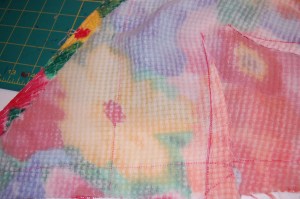
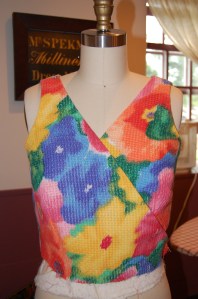
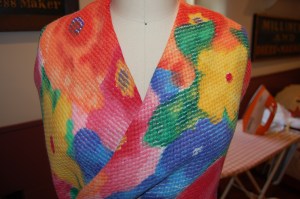
I started out with this really lovely linen blend from Mood Fabrics, which I’ve had for a few years. Here it is draped on my dress form:

Flowered Flora

The fabric looks like - and is - a somewhat loosely woven linen, but it is surprisingly stable.

The fabric looks like – and is – a somewhat loosely woven linen, but it is surprisingly stable.

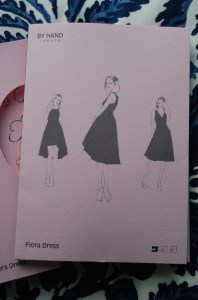
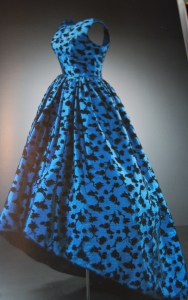
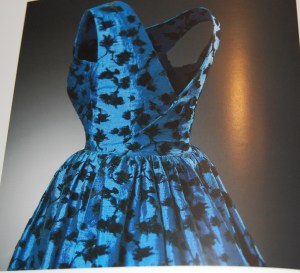
I had purchased the By Hand London “Flora” pattern (a departure for me to buy a “new” pattern!), as it reminded me of a Cristobal Balenciaga dress which I have long admired.

Flowered Flora

Flowered Flora

Evening dress in flocked shantung in blue and black, 1957

Both images are from: Balenciaga: Cristobal Balenciaga Museoa; Fundazion Cristobal Balenciaga Fundazioa, Editorial NEREA; English Edition 2011; distributed in the USA by Thames & Hudson Inc., NY, NY, page 260.

Both images are from: Balenciaga: Cristobal Balenciaga Museoa; Fundazion Cristobal Balenciaga Fundazioa, Editorial NEREA; English Edition 2011; distributed in the USA by Thames & Hudson Inc., NY, NY, page 260.

I had not intended to use the Flora pattern for this fabric, but somehow I got the notion that it would be really pretty. In addition the fabric was 60” wide, a requirement for the Flora dress, and for once, I had enough yardage. I made a muslin, and liked the way it looked – and I did a fairly good job of perfecting the fit of the bodice. The pattern lends itself to using couture construction techniques, as there are no facings, so that fit right in with how I like to sew. I underlined it all with silk organza. I catch-stitched all the seams. I used a silk crepe de chine lining, and hand sewed it into the bodice. I backstitched all the edges to secure the lining.

The silk organza added additional stability.

The silk organza added additional stability.

Flowered flora

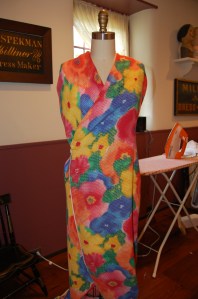
I chose a pretty orange crepe de chine for the lining.

I chose a pretty orange crepe de chine for the lining.

The skirt is voluminous and that is where my problems began. It seemed okay made up in muslin, but once I had it constructed in the fashion fabric, I looked like I was a dumpling wearing a flowered parachute. The funny thing was that when I had it on my dress form, I thought it was rather attractive. I was fooled into thinking that if I just got it all put together, I’d be happy with it.

Looks pretty, doesn't it?

Looks pretty, doesn’t it?

I thought the orange lining would be lovely peeking out from the dipped back hem...

I thought the orange lining would be lovely peeking out from the dipped back hem…

I have been trying to figure out what went wrong. I think perhaps the pattern is just too “youthful” looking for me. I think it is such a pretty dress, but perhaps my days of wearing voluminous skirts are over (… although the skirt on my silk dress from last summer looks fine. It is, however, simply a gored skirt with no additional pleats or fullness.)

Allure of silk final

The skirt is full, but hangs with no bulk.

Now I am left with trying to salvage something from this project. I like the fabric too much to just abandon it, and I have too much time and effort and money invested in it all, as well.   Right now, however, I am very sick of the whole thing, so it might be a while until I come back to it. But when I do, I am going to separate the bodice from the skirt first.

Now I wish i had left the bodice just as you see it here!

Now I wish I had left the bodice just as you see it here!

Then I think I may cut a new slim skirt (no pleats, no gathers, just a nice, slim, matronly skirt!) to attach to the bodice, and perhaps make a self-belt with a tailored bow for the closure.

How does that sound?


30 Comments

Filed under couture construction, Linen, Uncategorized

An Evening Jacket for the Ages

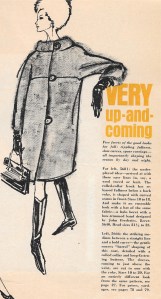
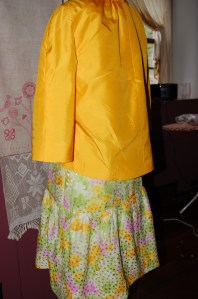
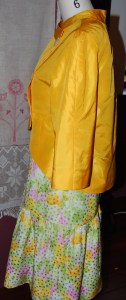
“Very up and coming” for the Fall of 1962, according to Vogue Pattern Magazine, was “the striking medium between a straight line and a bold curve – the gentle convex ‘barrel’ shaping of this coat:”

An Evening Jacket for the Ages - picture

It is from this time period – perhaps a year or two later – that this Designer Pattern comes:

Oh the things we can learn, no 10

I don’t know many of us who want to look like they are in a barrel, so it was my intention to take the best parts of the design of the evening jacket and then adapt it to a more current look, or at least to one that did not scream 1963/64

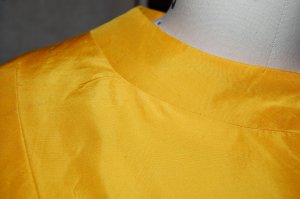
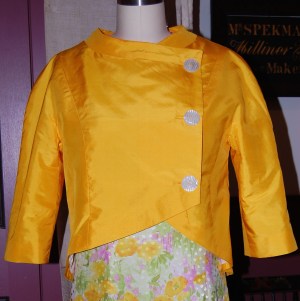
The details I loved about it were: 1) the shaped, two-part collar, which doesn’t really look like a collar, rather as an extension of the body of the jacket, but with more definition to it:

Evening jacket for the Ages

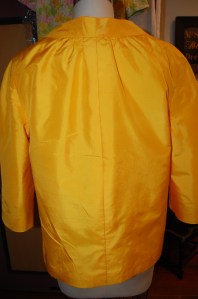
2) the dipped back hem of the jacket:

Evening Jacket for the Ages

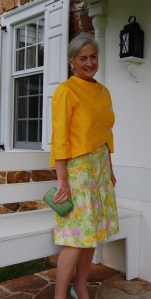
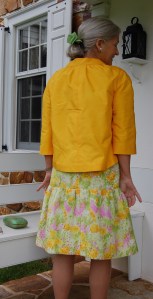
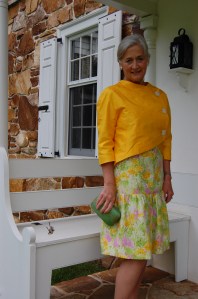
I purchased the yellow silk taffeta from Britex Fabrics, while the dress fabric, also silk, is from Mendel Goldberg.

Evening Jacket for the Ages

3) the below-elbow length, kimono sleeves with their clever built-in gusset, and 4) the prominent, offset buttons:

Evening Jacket for the Ages

The top buttonhole is a slot-seam one, while the other two are bound buttonholes.

Less attractive to me was the fullness of the body of the jacket.

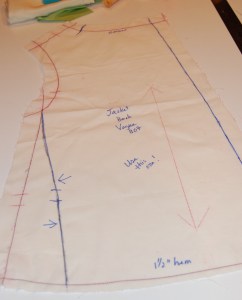
My muslin (toile) showed me that I needed to eliminate quite a bit of that fullness from the pattern pieces. I took 2 inches right out of the back of the jacket, making for much less to be gathered into the collar:

Even with two inches removed from the center back seam, there is still enough to gather nicely into the collar.

Even with two inches removed from the center back seam, there is still enough to gather nicely into the collar.

I also took a large wedge out of the each side of the back:

The dark blue line on the left is my re-drawn seam line. the original seam line is marked in red.

The dark blue line on the left is my re-drawn seam line. The original seam line is marked in red.

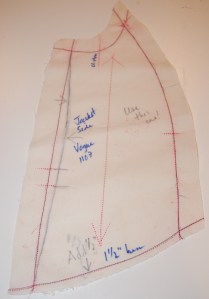
Then to add a little more shaping, I re-drew the side seams in the side underarm sections:

Again, the blue line on the left is my re-drawn seam line.

Again, the blue line on the left is my re-drawn seam line.

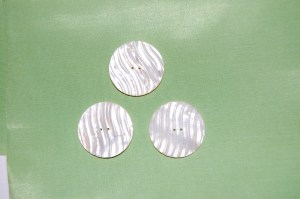
Because the buttons are such a prominent feature of the jacket, I knew I had to find the right ones. The pattern called for them to be 1¼” in diameter. That is a big button! I also knew they had to be a bit fancy or elegant, and I envisioned mother-of-pearl as the ideal composition. It took a while, but I found these buttons on eBay, and they looked just about perfect to me: right size, beautifully carved mother-of- pearl with a swirl design which I thought would add just the right contrast to the silk taffeta of the jacket. As it turned out, they were also the right price (always a welcome surprise!), and more beautiful when they arrived than I had anticipated:

Evening Jacket for the Ages

These buttons have a substantial heft to them, making them well suited for their application on this jacket.

After getting the body of the jacket together, I tried it on to look at the length of it. Fortunately I had cut my pattern with about an extra half-inch in the length, and I used it, plus another ¼ of an inch, as it just looked better a little longer.

Another plus to lengthening the jacket is that the sleeve length lined up more attractively, something I didn't realize until I saw these photos!

Another plus to lengthening the jacket is that the sleeve length lined up more attractively, something I didn’t realize until I saw these photos.

I did my usual flat applied piping along the edge of the lining:

Here is the piping sewn in place.

Here is the piping sewn in place.

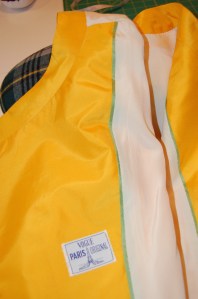
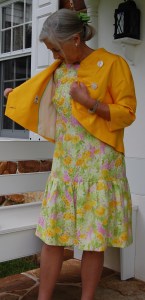
The green piping picks up the green in the dress. I opted for an off-white lining, which is a little boring but that's okay!

The green piping picks up the green in the dress. I opted for an off-white lining, which is a little boring but that’s okay.

And I added the label I had:

Evening Jacket for the Ages

Evening Jacket for the Ages

Evening Jacket for the Ages

A few wrinkles left over from the jacket’s first wearing!

Evening Jacket for the Ages

Evening Jacket for the Agea

Evening Jacket for the Ages

I have to say, I really love this evening jacket. I have decided it is going to have another life – with another dress, this one constructed with the double, slanted flounce on it (see pattern above).  It would look fairly fabulous with a black and goldenrod printed silk – or navy, white and goldenrod printed silk…   I’ll be on the search.

17 Comments

Filed under bound buttonholes, Buttons - choosing the right ones, couture construction, kimono sleeves, Mid-Century style, piping, sewing in silk, Silk taffeta, Slot-seam buttonholes, Uncategorized, vintage buttons, vintage Vogue Designer patterns, vintage Vogue patterns from the 1960s

Those Sneaky Pattern Instructions!

Is anyone else out there in Sewing Land regularly deceived by the conciseness and orderliness of pattern instructions? They look so innocent all neatly delineated on those folded sheets that fit into pattern envelopes. But lying beneath the surface are hours and hours of precise pinning, basting, stitching, and, at times, head-scratching and seam ripping!

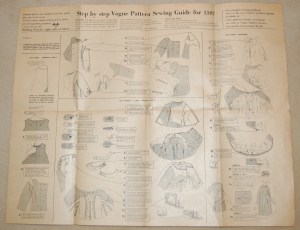
The construction of an entire coat or jacket can fit on one side of one sheet of instructions! That which is illustrated and described on this sheet of paper, measuring approximately 19” x 15,” can take hours, days, and even weeks to plow through!

Those sneaky pattern instrucitions

As one who likes step-by-step, clearly delineated and enumerated guidelines, I relish looking at pattern instructions and innocently thinking about how straightforward and “simple” this is all going to be. And I am regularly fooled. A good example of this is my current project, a silk jacket to pair with my recently completed dress.

These small sketches included on the instruction sheets of many vintage Vogue patterns are so helpful in the visual information they provide.

These small sketches included on the instruction sheets of many vintage Vogue patterns are so helpful in the visual information they provide.

I got a good preview of the construction idiosyncrasies when I made my muslin (toile). The pattern piece for the kimono “sleeve back” struck me as unusual.

Here is that sleeve piece in the fashion fabric, with silk organza underlining basted to it.

Here is that sleeve piece in the fashion fabric, with silk organza underlining basted to it.

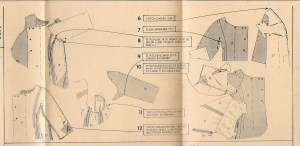
After reading the instructions, it still did not make sense, until I actually put the sleeve together. That little pointed end works as an underarm gusset, which is quite clever, and as it turns out, I believe it will be very flattering. Putting this part of the jacket together is delineated in steps 6 – 12:

Step 9 deals with this particular pattern piece.

Step 9 deals with this particular pattern piece.

Here is one-half of the jacket as I have it completed at this writing:

Those sneaky pattern instrucitions

It took at least 4 – 5 hours to complete just this part of the jacket, and I still have the other half to do! Granted, I regularly add effort and time onto this type of construction as I catch-stitch all the seams to the silk organza underlining. For this jacket, with all its curved seams, slashed darts, and tight corners, I am not sure it would turn out successfully without the control that catch-stitching those raw seams provides. So – it is time well spent.

But still – how can those “easy to follow guides” be so sneaky?

19 Comments

Filed under couture construction, Dressmaker coats, kimono sleeves, Mid-Century style, Silk taffeta

Wedding Ready

Why is it that we so often think every wedding to which we are invited means we need a new dress? Sometimes it is warranted; maybe we really do need a new dress! Maybe what we already have in our closet isn’t right for the season or the “ambience” of the wedding site. Maybe the couple getting married is very dear to us, and it just seems right to celebrate this event with something new and special. Maybe the wedding season is busy enough that we really cannot wear the same dress to multiple events where we will probably see many of the same friends and people. But maybe, just maybe, a wedding invitation is exactly the perfect excuse we need to indulge our love of fancy, dressy clothes.

Fortunately, I have not only a wedding to attend, but also, the following weekend, another elegant evening of “cocktails, dinner and dancing,” so it just seemed appropriate – necessary even! – to make a dress/ensemble that could suffice for both. Well, the dress is done, but not the jacket.

Front . . .

Front . . .

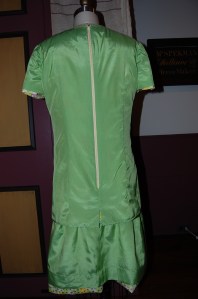
. . . and back

. . . and back

Wedding Ready

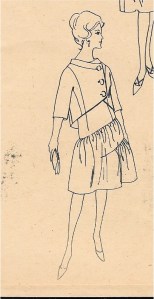
This is, of course, the pattern I had to alter in order to fit it onto my available fabric.

Oh the things we can learn, no 10

I made a couple more small changes to the dress. I broadened and lowered the neckline by a small amount, to make it more pleasing on me. I eliminated the neck facing and used the couture method of finishing that edge, with the dress lining brought up to the edge, fell-stitched in place, and secured with small back stitches. I also decided to make the center back zipper a focus when I found a vintage spool of green silk buttonhole twist in my collection. Using an idea I had seen one of my readers do (thank you, Cissie!), I pick-stitched the zipper with the twist, leaving a little trail of bright green dots along the center back.

In the Department of “Nothing is Easy,” I ran into a problem with the fullness of the “half-skirt” on the front of the dress. You may recall from my last post, that I doubled one of the back skirt sections to use for the front skirt (replacing the diagonally shaped flounces as shown on the pattern which required more fabric than I had.) When I made my muslin (toile), I did not realize that the front skirt was fuller than the two back skirt sections. I had all three sections of the fashion fabric sewn together, with the seams all catch-stitched, and the lining attached too (in order to treat both pieces as one in the ruffling process.)  I was half way through basting the skirt onto the body of the dress when I realized there was too much fullness in the front. I had to take it all apart, and figure out where I had made the mistake. It turned out that the front section of the dress was narrower than the two back sections sewn together. So I had to do some calculations, coming up with the fact that I had to take 4.5” off the width of the front skirt. That took a whole afternoon of sewing to take care of that adjustment!

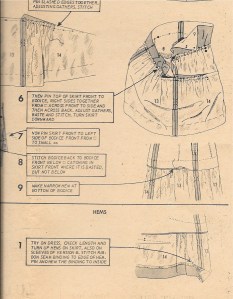
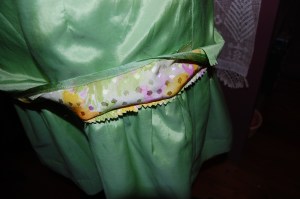
The skirt was attached to the bodice in an rather unusual way as you can see in this photo and the instruction sheet below.

The skirt was attached to the bodice in an rather unusual way as you can see in this photo and the instruction sheet below.

Wedding ready - instruction sheet

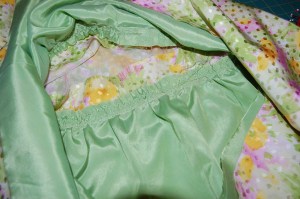
I also had to figure out how to line the top part of the dress. I finally decided to leave the top part of the lining hanging loose inside the dress – and it actually works beautifully!

Wedding ready

The skirt lining is not attached to the bodice lining at all.

The skirt lining is not attached to the bodice lining at all.

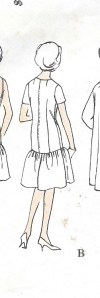
Two small interesting design notes on this pattern are worth noting. First, if you look at the pattern envelope, you see small neckline darts on the back of the dress.

Wedding ready - pattern thumbnailWhen I studied the pattern, those darts were not there! Either the artist made a mistake, or the darts were eliminated when the pattern was drafted.

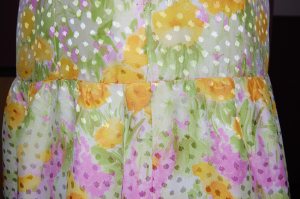
Another interesting design aspect is the center back seam in the skirt. Usually center back seams are there because there is an opening that the seam needs to accommodate. That is not the case in this dress, as the zipper does not extend into the skirt. However, even though it is very subtle, it just looks better to have a seam in the skirt that matches up with the center back seam of the bodice section.

That center back seam which is picked up in the skirt.

That center back seam which is picked up in the skirt.

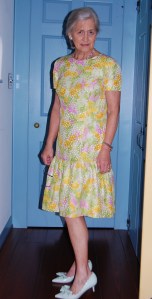
It has been rainy and cold all week so no photos outside. I need a dress like this to remind me that it is actually May.

It has been rainy and cold all week so no photos outside. I need a dress like this to remind me that it is actually May.

Wedding Ready

Wedding Ready

Wedding Ready

Another back view

Another back view

Wedding Ready

I have decided I am “wedding ready” even without the jacket. However, if I get the jacket finished, I’ll be very happy!

27 Comments

Filed under Cocktail dresses, couture construction, Formal or fancy dresses, Mid-Century style, sewing in silk, Uncategorized, vintage Vogue Designer patterns, vintage Vogue patterns from the 1960s

A Practical Decision

A practical decision, made out of desperation, that is! It is a rare occurrence that I stop working on a project before it is completed, but that’s what I decided to do with my cashmere coat, skirt and blouse ensemble. Quite simply, life got in the way, without asking me first! Robbed of sewing time for one reason or another, I had to make a decision: should I quietly and gently fold my unfinished skirt and blouse away for a summer sleep, and get busy on my Spring sewing? Or should I plow through and continue work on this wool ensemble as the allure and charms of Spring sewing beckoned me on? Well, Spring’s charms won, especially as I am now facing middle-to-late May deadlines for a silk dress to wear to a wedding and another fancy event.

But I had promised photos of my coat, so before everything goes in the cedar closet until next September, I thought I should share the progress I did make. Even on a cool Spring day, this Cashmere coat felt glorious to wear, even briefly.
A Practical Decision

A Practical Decision

I am very happy with the lining!

I am very happy with the lining!

A Practical Decision

A Practical Decision

This coat is very warm and buttery soft.

This coat is very warm and buttery soft. These photos confirm for me that I need to reset the working buttons, making longer thread shanks, to accommodate the bound buttonholes.

The skirt is a six-panel slight A-line style.  Because the fabric is heavier than I would normally use for a skirt, I wanted to eliminate darts and a waistband, to help control the bulk. I decided to make a waist facing made out of wool challis (used for the coat lining and the blouse), and attach it to a skirt lining made of Bemberg rayon. The skirt is completed except for the hem.

This shows the waist facing, with the Bemberg lining attached to it.

This shows the waist facing, with the Bemberg lining attached to it.

Making a blouse out of wool challis demanded some special considerations. The fabric is finely woven and lightweight, making me hesitant to use waxed tracing paper to make any markings on it. So, I decided to thread trace all the seam lines and markings. This is, of course, the process one uses for the construction of a classic French jacket, so I am comfortable with it. It sounds time-consuming, but it goes fairly fast, and is fool-proof.

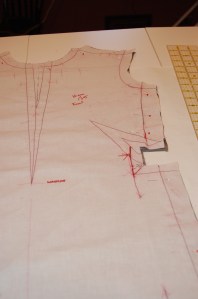
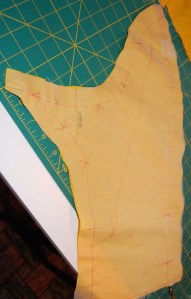
This shows my muslin pattern, cut on the seam lines, and with the darts cut out, so that I could tread trace along all sewing lines.

This shows my muslin pattern (with the changes I made to it), cut on the seam lines, and with the darts cut out, so that I could tread trace along all sewing lines.

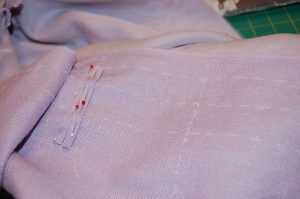
Click on this for a close-up look at the thread tracing of seam lines and darts.

Click on this for a close-up look at the thread tracing of seam lines and darts.

I got as far as having both sleeves completed, the body of the blouse put together, and the collar pinned in place. I am feeling good about my progress, and I know I can pick this up again, knowing that I really am in the home stretch on this particular project.

The pinned collar, placed along the neckline.

The pinned collar, placed along the neckline.

One of the sleeves pinned in place.

One of the sleeves pinned in place.  The sleeves are three-quarter length.

Good-bye to Winter and Hello to Spring!  Right now it feels wonderful to be focusing on silks and linens, bright colors and feminine fancy things. I am “desperately” happy with my decision!

21 Comments

Filed under Blouse patterns from the 1950's, Blouses, Coats, couture construction, Dressmaker coats, Mid-Century style, Uncategorized, Vintage fabric, vintage Vogue Designer patterns, vintage Vogue patterns from the 1960s, woolens

The ABCs of D-R-E-S-S-M-A-K-I-N-G, Part II

One of the most intriguing aspects of couture dressmaking is that the techniques and the sewing procedures have really not changed much in over 60 years, perhaps even longer. There seem to be very few short cuts when it comes to MAKING a quality garment. (And, although sergers are handy and have their place, they are unnecessary – nay, unwelcome, even! – in the world of couture dressmaking.)          Thus we come to our second half of  The ABCs of D-R-E-S-S-M-A-K-I-N-G

M, of course, is for MUSLIN. Although many of my fellow dressmakers around the world refer to this as a toile, in the States we call our test garment a muslin, after the basic cotton fabric, purchased cheaply, which is used for its construction. Once I started taking classes with Susan Khalje, I learned the true value and versatility of this basic part of dressmaking. Subsequently, my muslins are written upon with abandon, torn apart, discarded when too many fitting issues are revealed, and regarded with a certain restraint, for what they can and cannot do. They CAN help you fit your pattern to your particular shape and needs. They CAN be a test run for the construction of your garment. They CAN suggest to you if the design you have chosen is right for you (although not always). They CAN’T mimic the flow and drape and weight of your fabric. So – as always – one needs to use her sewing brain to compensate for the lack of this important detail – and make a best guess as to how the finished garment will actually fit and look.

How many muslins does one dress need? Sometimes, several!

How many muslins does one dress need? Sometimes, several!

A is for ACCURACY. Accuracy in marking straight-of-grain, seams, notches, darts, buttonholes, buttons, center front and center back, fold lines, pleats, tucks, pockets, etc. etc., is absolutely paramount for a successful garment. This is often time-consuming and tedious work, isn’t it? But have you ever had to go back to your tissue pattern to see exactly where a notch or seam junction are? That’s also time-consuming.   I try to do it right the first time, but sometimes I miss. So – I am always striving to increase my accuracy when it comes to marking my fashion fabric.

Just for example, the most important ingredient in making successful bound buttonholes is precise marking.

Just for example, the most important ingredient in making successful bound buttonholes is precise marking.

K is for KEEP. When you have a workable muslin pattern which has been successfully made into a finished garment, and you have notes and diagrams, and suggestions written on it, KEEP it. You never know when you might want to use it again. I think I have kept all my muslins – in large plastic zip-lock bags for the most part – except for one. I could not wait to get the muslin for what I call my Ghost Dress out of my house! I will never make this pattern again! The moral of the story is, Keep the good, discard the bad…

I also like to keep extra buttons, and at least a little bit of extra fabric and trim (if appropriate) for each of the pieces I complete. One of these days, I’m going to put together a notebook of fabric swatches, so that I can keep a record of all these yard goods which have stolen my heart.

I is for INNER WORKINGS. The inside story of any couture dressmaking is a story of attention to details. Interfacings, inter-or-under-linings, linings, seam finishes, bar tacks, waist stays, boning, pad-stitching, even labels (and the list goes on and on) – give your garment a professional look. Skimp on this part of dressmaking and results will be compromised.

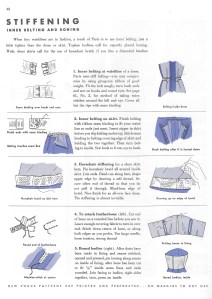
Here is just one page from the 1957 Vogue Dressmaking Book which shows some "inner workings."

Here is just one page from the 1957 Vogue Dressmaking Book which shows some “inner workings.”

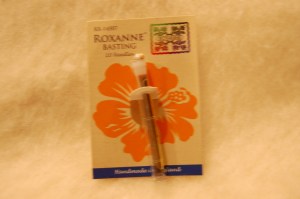
N is for NEEDLES. Using the correct needles will go a long way in making your sewing experience a pleasant one. I have only recently started using real basting needles for attaching silk organza underlining to the fashion fabric – and what a difference it makes.

These are excellent basting needles!

These are excellent basting needles!

Of course, everyone knows the importance of changing your machine needles frequently. I even find that my hand sewing needles sometimes need to be “retired” if they start to show signs of losing their sharpness – or get a bend in their spines.

All in all, sewing needles are amazing things! The magic within them has been recognized by artists, poets, and, of course, by dressmakers, for centuries. Samuel Woodworth summed up their charms and inextricable human connection in this charming quote:

The bright little needle – the swift-flying needle, the needle directed by beauty and art.”

G is for GET ON WITH IT. Sometimes the most difficult part of dressmaking is getting started. Starting a new project – especially a complicated one, can be daunting, but the only way to get started is to . . . get on with it.

So, there we have it – the ABCs of D-R-E-S-S-M-A-K-I-N-G, a simplified synopsis of a very complicated and diverse undertaking. Dressmaking has it all for those of us who love to sew fine fashions – and find joy in the process.


7 Comments

Filed under couture construction, Love of sewing, Quotes about sewing, The Conde Nast Publications, Uncategorized

The ABCs of D-R-E-S-S-M-A-K-I-N-G, Part I

Those of us who do fashion sewing sometimes have difficulty identifying what we do in a single descriptive word. A “sewer” (not those stinky things that go underground that happen to be spelled the same way) can be one who sews many different things, right? The term “sewist” is a somewhat new word, made up of sew + artist, which really doesn’t describe anything specific to my way of thinking. Most of us are not “designers” (and not all designers can sew), although most of us use some design techniques in our fashion sewing.   Some of us may be “sewing professionals,” a term which covers a broad range of endeavors, such as being a custom clothier, a sewing teacher, a writer about sewing, or even a retailer involved in the sewing industry. The term “seamstress” implies one who sews on a machine, as in a factory; although this person may be very talented in certain techniques, her job does not leave room for innovation or creativity. And that is why I like the term “dressmaker” so much. In one word it expresses many things explicit and implied. And although it is a term much used until the 1960s and not much since then, I consider myself a Dressmaker; maybe you do, too?

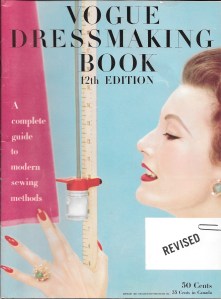
This wonderful Vogue book, copyright 1957, still used the term "Dressmaking" in its title.

This wonderful Vogue book, copyright 1957, still used the term “Dressmaking” in its title.

A dressmaker is one who makes custom clothing for women (oneself included.) She usually works from a commercial pattern, and then uses all her creative, design, and technical skills to create a one-of-a-kind dress, blouse, skirt, coat, etc. I have devised this ABCs of DRESSMAKING to define some of the important aspects and practices of dressmaking, especially in the couture sense.

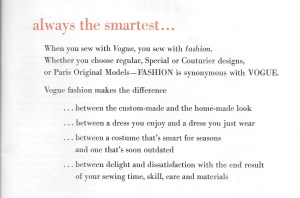
D is for Design. This seems like it should be common sense, but it cannot be said too often that you should choose a design that is going to work for you. Unlike ready-to-wear that we get to try on, when we sew, we are working from patterns that we think will be flattering, but we really will not know until it is finished (a muslin takes some of the guesswork out of this, but not entirely.) Most of us have our own personal style that we know is flattering to us. Even if you want to diverge a bit from it (which is fine), it’s probably best not to go too far afield. Also, beware of trends that may not be flattering. (An example of this from a couple of years back is the revival of the peplum, a look that not too many of us can wear very successfully.)  When it comes to Design, choose one that is “smart for [many] seasons” rather than “one that’s soon outdated.”

The first page of the book pictured above tells the reader why she should be using Vogue patterns, but it also suggests some of what it means to be a "Dressmaker."

The first page of the book pictured above tells the reader why she should be using Vogue patterns, but it also suggests some of what it means to be a “Dressmaker.”

R is for Risk. Let’s face it, fashion sewing can be risky. We can be sewing with really expensive or “difficult” fabric or vintage fabric, which is now no longer available – or sewing with a complicated design/pattern – or making something for a very special occasion – and the outcome is entirely in our hands! It takes bravery, confidence in one’s skills, patience, and a willingness to take a risk to grow in our dressmaking, but the rewards are manifold.

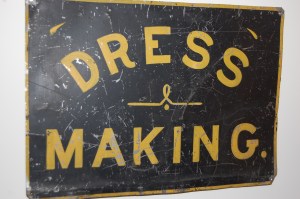
One of the Dressmaking signs I have hanging in my sewing room.

One of the Dressmaking signs I have hanging in my sewing room.

E is for two things: Engineering and Embellishment. I have said this before, but it bears repeating – sewing is engineering. I love to read pattern instruction sheets, especially for something that is complicated, and I bet many of you do, as well. It’s fascinating to see how patterns go together, how different fabrics demand specific approaches to that process, how the pattern pieces need to be manipulated to fit one’s particular form. A well-engineered pattern is a beautiful thing, and it takes a sewing-engineer’s mind to know how to best bring that pattern to life in a stylish and successful fashion. It takes a dressmaker.

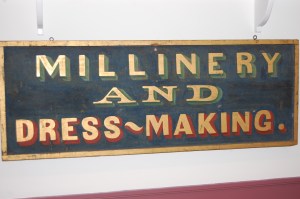
Another one of my signs, the first one I purchased and still my favorite!

Another one of my signs, the first one I purchased and still my favorite!

Embellishment is almost synonymous with the term dressmaker. “Dressmaker Details” include such things as ruffles and frills, ribbon, or braid, but also those little touches that add so much to a successful garment, such as well-chosen buttons, interior trims, non-boring linings, covered snaps, bound buttonholes (when appropriate), and the creative manipulation of, or addition to, a pattern to get the effect you want. A creative dressmaker can start with something basic and make it unique – and couture – by adding just the right embellishments or details.

S is for Seams. This is about as basic as it gets, but those seams must be sewn well and finished well for a successful finished garment. One of the techniques I learned in the couture sewing classes I have taken with Susan Khalje is, for me, the method to achieve successful seams. That is – thread basting along seam lines to use as your sewing guide, rather than relying on the seam allowance markings on one’s sewing machine.   This is the building block for successful dressmaking.  And then, finish those seams on the inside to control bulk and add to the wearability and durability of your garment.

S is also for Steam. As in ironing. A good steam iron is worth its weight in gold! Steam is useful in so many ways – here are just a few:   1) When sewing with wool or most dry-cleanable fabrics, a good place to start is steaming your fabric before you begin to lay out your pattern pieces. Even if you have pre-washed cotton or linen fabrics, a good initial steaming of your yardgoods will insure a better outcome. 2) Steam newly sewn seams flat to set your stitches before spreading the seam open for its second pressing. 3) Contours can be set beautifully with steam, especially when using a pressing ham and/or a seam roll, or draping your work-in-progress on a dress form.

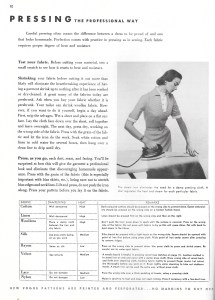
Te Vogue Dressmaking Book has an entire section on pressing, with guidelines still appropriate almost 60 years later. Click on the image to read the page.

The Vogue Dressmaking Book has an entire section on pressing, with guidelines still appropriate almost 60 years later. Click on the image to read the page.

And then, S + S  is for Sewing Sense, which is what every successful Dressmaker must develop. This subject is so vast it warrants its own blog post sometime in the future!

So now I am halfway through the ABCs of D-R-E-S-S-M-A-K-I-N-G. Part II is yet to come…

17 Comments

Filed under couture construction, Dressmaker forms, The Conde Nast Publications, Uncategorized, Vogue patterns

A Fine February Finish

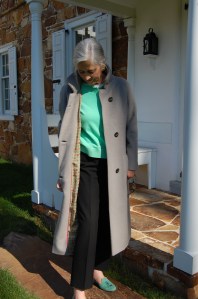
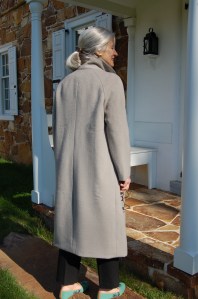
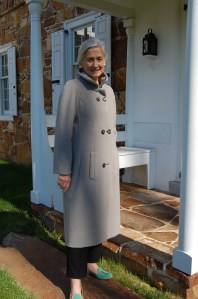
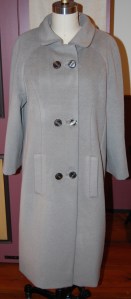
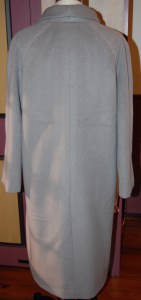
Leap Year, with its extra February day, seemed to be custom made for my sewing schedule. I had hoped to have my gray cashmere coat finished by the end of the month, and thanks to those extra 24 hours, I managed to do just that – barely! I will confess to taking out basting stitches, steaming, and adding two bar tacks to the lining on March 1st (gasp), but now my coat is finished.

A Fine Feb Finish

A Fine February Finish

Photos of me in this coat will be in a future post…

Like Claire McCardell, who said “I believe in a collection of coats,” and coats are “revealing, a clue to your taste, and your knowledge of Fashion,” I also believe that one should not “make a coat too basic.” The unique aspect of fashion sewing is that one can start with a basic (or not-so-basic) coat pattern and then make it her own.

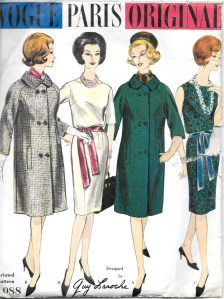
The first owner of this Vogue Designer Original pattern, designed by Guy Laroche, which I used for my coat, had obviously used it. (This isn’t always the case – many vintage patterns are still “factory-folded” and in their unused condition.)

When I purchased the pattern, I had already decided to lengthen the sleeves, which are shown on the pattern envelope as “below-elbow” or bracelet-length. I wanted full-length sleeves as a practical matter. Much to my delight, the original owner had decided the same and had added tissue paper inserts into the sleeve pattern pieces. As it turned out, the length she had decided upon was also exactly right for me.

What a nice surprise to find the sleeves already lengthened!

What a nice surprise to find the sleeves already lengthened!

There are really only a few details I chose for this coat which serve to make it “not basic.” Besides the bound buttonholes (which used to be basic but are not so much anymore!), I put emphasis on the buttons, the lining and a couple of the finishing details.

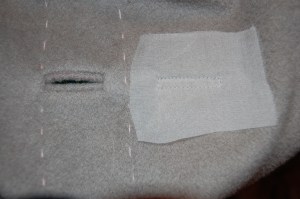
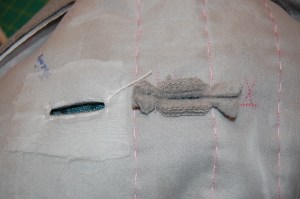
First the buttonholes and buttons: because the cashmere fabric is coat-weight, I needed to make the “lips” of the buttonholes a bit wider than normal. Once again, I used an organza patch on the underside of the buttonholes, which makes a very nice interior finish:

The line of basting stitches is the fold line - the organza patch is on the facing part of the front edge.

The line of basting stitches is the fold line – the organza patch is on the facing part of the front edge.

Here is the patch ready to be sewn onto the back of the buttonhole.

Here is the patch ready to be sewn onto the back of the buttonhole.

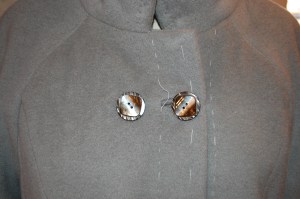
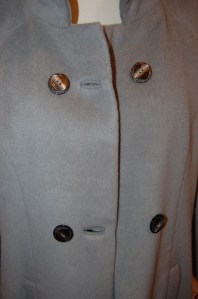
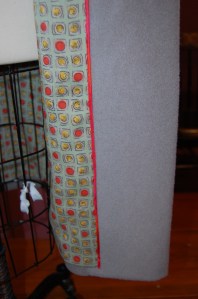
I found these vintage buttons in an Etsy shop. Although they appear to be gray mother-of-pearl, they are actually plastic. The iridescent strip through the middle of each one, along with the square detail on the tops, gave me the idea to arrange them on an angle. I think they add just the right amount of interest to the front of the coat.

The "square" detail on the buttons picks up the design in the lining fabric.

The “square” detail on the buttons picks up the design in the lining fabric.

A Fine February Finish

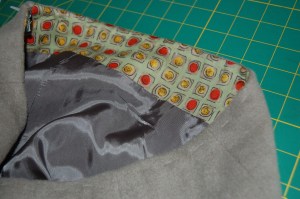
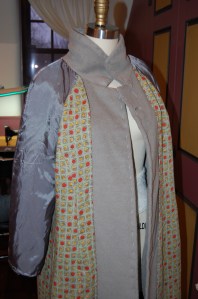
Using the printed wool challis for the lining certainly elevates this coat to a notch above ordinary. The sleeves are lined with gray rayon Bemberg for practicality’s sake.
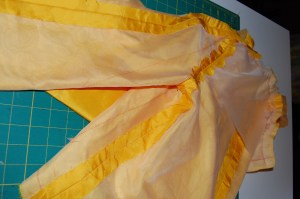
An inside out view, trying out the lining.

An inside out view, trying out the lining.

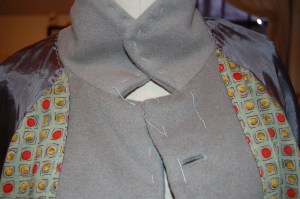
This photo shows a good look at the finished buttonholes, too.

This photo shows a good look at the underside of the finished buttonholes, too.

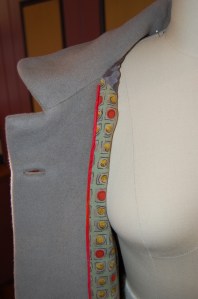
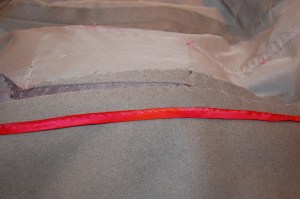
Of course the detail I love the most is the flat piping I added to the front interior edges of the lining.  As I have said before, doing this is so easy and adds so much.

A Fine Feb Finish

A Fine February Finish

Here is the flat piping stitched in place - so easy!

Here is the flat piping stitched in place – so easy!

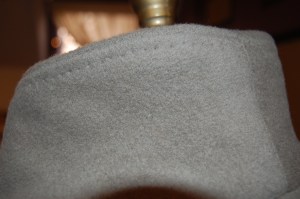
The final small detail, which helps the collar to keep its shape, is under-stitching (by hand) on its underside.
A Fine February Finish

So what else did Claire McCardell say about coats? To quote from her book, What Shall I Wear, page 69, “… you can take another step and get a coat and dress that go together—never to be separated, never to be worn with any other dress or any other coat, and always with a special feeling of satisfaction. If you take a little trouble, you may be able to manage a heavy fabric skirt to go with the coat.”  I plan to take that little bit of trouble – a skirt out of the gray cashmere, and a blouse from the printed challis – to complete the outfit, and I will hope for that “special feeling of satisfaction.”
30 Comments

Filed under bound buttonholes, Buttons - choosing the right ones, Coats, couture construction, Dressmaker coats, Mid-Century style, Quotes about sewing, Uncategorized, vintage buttons, Vintage fabric, vintage Vogue Designer patterns, vintage Vogue patterns from the 1960s, woolens

Can a Coat be Glamorous?

And what exactly is glamour? A recent quote by Carolina Herrera – “It’s important for women to feel glamorous and feminine but always themselves” – prompted me to look up the definition of the word “glamour” – and I was surprised by what I found. Here is how Webster’s defines it in its noun form: 1) the quality of fascinating, alluring, or attracting, esp. by a combination of charm and good looks 2) excitement, adventure, and unusual activity, like the glamour of being an explorer 3) magic or enchantment; spell; witchery. And then there is the definition of “glamorous”: 1) full of glamour; fascinatingly attractive; alluring 2) full of excitement, adventure , and unusual activity: to have a glamorous job.

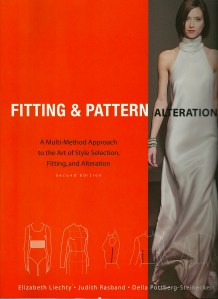
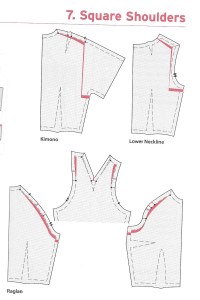
Glamour was the last thing on my mind when I started out on my current coat project. Making a muslin (toile) can be time-consuming and tedious, especially when it shows you that some serious alterations need to be made. Fortunately, my coat muslin revealed only some small changes to the shoulder of my raglan sleeve coat, compensating for my square shoulders. My go-to book to guide me through these complexities is Fitting and Pattern Alteration, by Liechty, Rasband, and Pottberg-Steineckert (recommended to me by Susan Khalje.)

I highly recommend this book.

I highly recommend this book.

One of the things I love about this book is that it covers all sorts of situations. Square shoulders for Raglan sleeves? Not a problem.

The diagrams take the guess work out of alterations to patterns.

The diagrams take the guess work out of alterations to patterns.

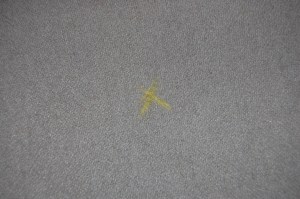
Once I had my muslin adjusted, my silk organza interlining marked and cut (to be used as the pattern for the wool), I felt like I was off to the races. Not so fast. A careful steaming of my wool fabric revealed three small “thin” areas (not holes, but thin enough that I would need to work around them). This is not unusual for vintage fabric, and is one of the reasons why a careful pre-steaming or pre-pressing of any fabric is important, but especially so for vintage goods.

I marked these small imperfections with yellow chalk.

I marked these small imperfections with yellow chalk.

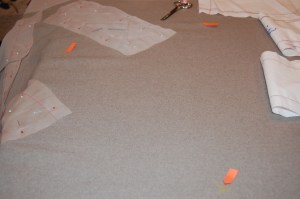
And then double-marked the areas with orange post-its when I was arranging the pattern pieces.

And then double-marked the areas with orange post-its when I was arranging the pattern pieces.

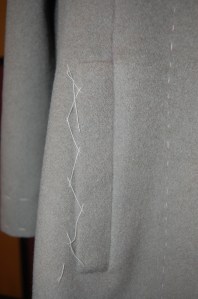
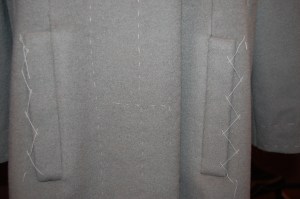
After untold hours of basting the layers of silk organza and fashion fabric together, I was finally ready to sew.   And this is when I think it began to get glamorous. The first major details to be completed were the pocket plackets. I thought I might faint when I had to make that first cut into one of the side panels of the coat front. But bravery saw me through!

I have the placket catch-stitched temporarily so it does not get caught on something while I finish the remainder of the coat.

I have the placket catch-stitched temporarily so it does not get caught on something while I finish the remainder of the coat.

Here is the inside of the pocket and placket.

Here is the inside of the pocket and placket.

With the first pocket and pocket placket successfully completed, the second pocket placket was simply fascinating and alluring, my progress encouraged by the charm and good looks of the first one. Definitely glamorous!

Progress - both pockets/plackets finished!

Progress – both pockets/plackets finished!

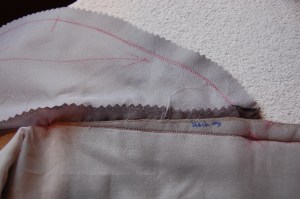
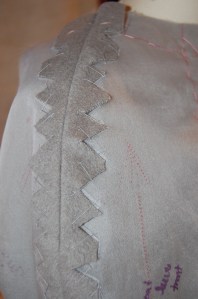
More seams ensued, each one carefully pinned, sewn, pressed and catch-stitched. Particularly rewarding were the shoulder seams of the raglan sleeves. Properly clipped, pressed and catch-stitched, the seams lie beautifully and look good, too.

The benefits of a silk organza interlining (or underlining) are manifold, but not least of which is a foundation upon which to secure the seams.

The benefits of a silk organza interlining (or underlining) are manifold, not least of which is a foundation upon which to secure the seams.

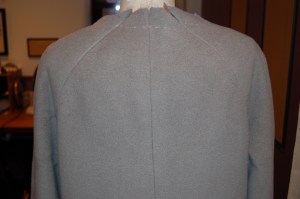
A view of the back of the coat (in progress.)

A view of the back of the coat (in progress.)

Although I have many more hours to go with the construction of this coat, I can’t help but feel that not only is this coat going to be glamorous, with its elegant gray cashmere, its vintage sensibility and all its hidden, inside secrets used to tame those seams, it is also going to be feminine and definitely me.

Perhaps the next question to ask is “Can sewing be glamorous?” It is “fascinatingly attractive, full of excitement, adventure and unusual activity.” It is magical and enchanting, too. The answer would have to be, “Yes, sewing most definitely can be very glamorous!” Even when we are in our bedroom slippers and blue jeans, covered in threads and pins, if we are sewing, I say we are glamorous.

20 Comments

Filed under Coats, couture construction, Dressmaker coats, Love of sewing, Mid-Century style, Uncategorized, underlinings, Vintage fabric, vintage Vogue Designer patterns, vintage Vogue patterns from the 1960s, woolens