Tag Archives: silk

Thinking in Color

It is always in the early days of December when I start to speculate on what the Pantone Color of the Year will be for the year to come.  I’m not sure why I am so intrigued with this annual selection, but obviously it must have something to do with sewing and fabric and day-dreaming.  This year, on the 2nd of December, Pantone gave those of us, who have this particular obsession with color, the chance to vote for the family of color from which we thought 2025’s selection would come.  

Well, I was WAY off!  I voted for the Red Family, described by Pantone as “empowering and exciting.”  This was the way I happened to be feeling on that particular day in early December.  The other color families from which to choose were: Orange (radiant and hot), Yellow (energy and life), Green (deep forests and wide meadows), Blue (constancy and truth), Pink (soft and innocent), Purple (mystical and magical), Brown (rooted and earthy), Black (sleek and sophisticated), and White (pristine and peaceful). 

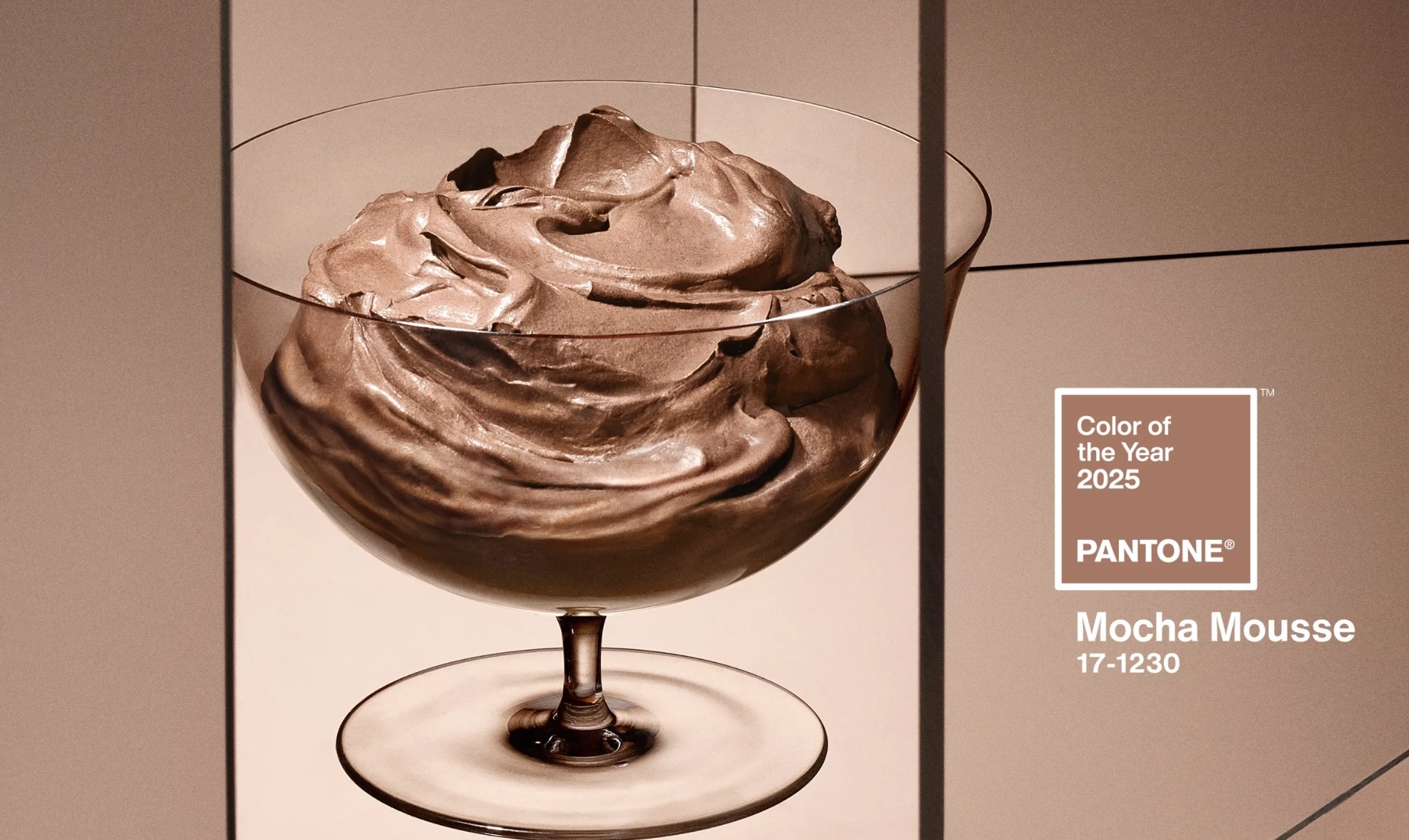
The Color Family most people taking the poll chose was Green.  Those of you who care about such things now know the Pantone Color of the Year is Mocha Mousse, “a warming, brown hue imbued with richness.”  (All quoted statements are directly from the Pantone website.)

I certainly did not see that coming.  Which made me really curious about this selection by people obviously much more in tune with the “global zeitgeist” than I!  The more I read about the decision, the more I understood it – and, although it is not exciting as a red family hue would be, I do find it to be empowering in its own subtle way, “capturing a global mood of connection, comfort, and harmony.”   
 

Pantone wisely suggests a “Color Palette” for their Color of the Year, a selection of hues to coordinate with the chosen color.  For Mocha Mousse, the color palette is charmingly called “Floral Pathways.”  Seven colors to lead us down a “cobblestone path:” a green called tendril, cornflower blue, a gentle lavender called viola, rose tan, a soft gray called cobblestone, another green called willow, and a soft white called gardenia.  These are all lovely coordinates, which make me appreciate Mocha Mousse more.  
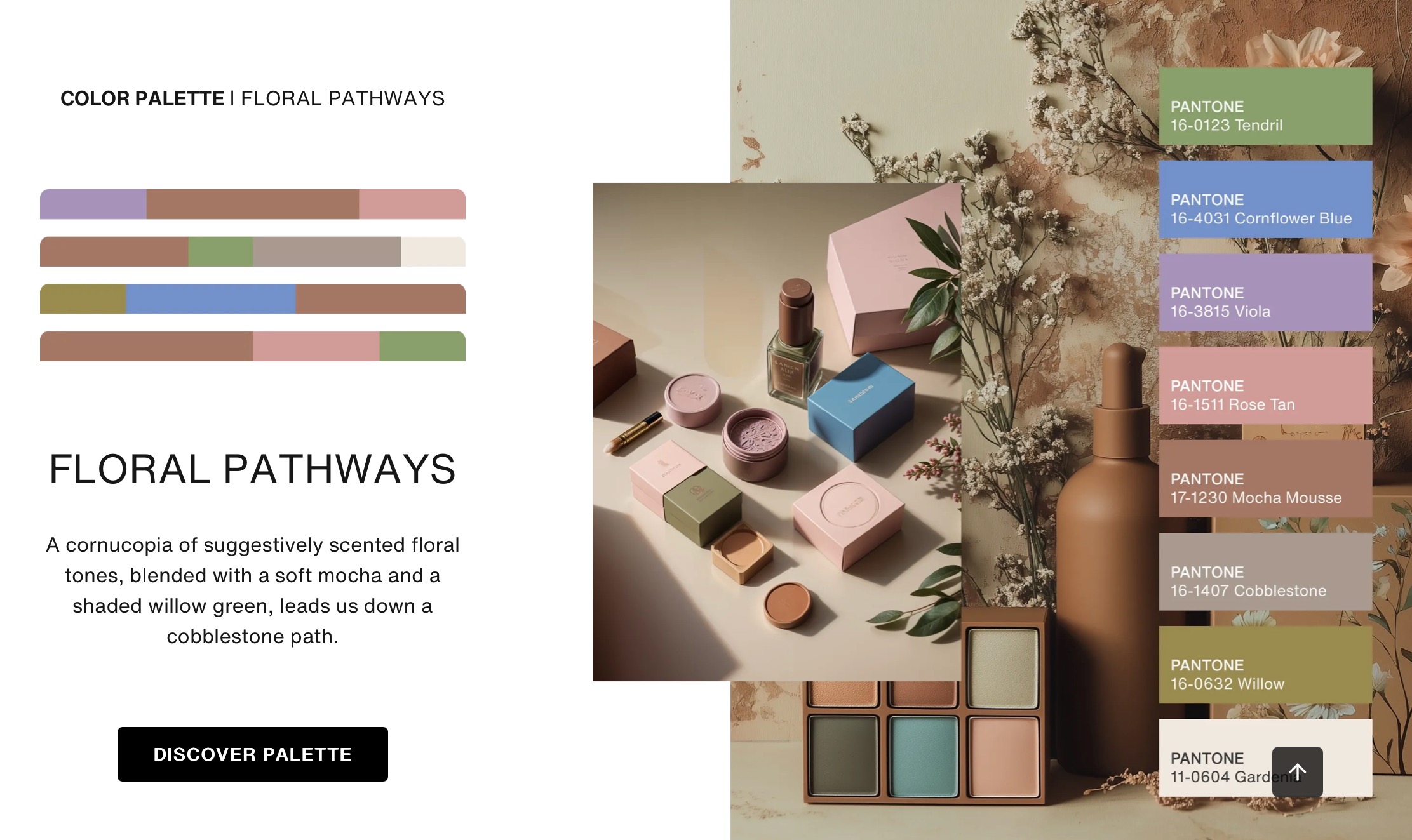
Although I will not necessarily be purchasing fabric or planning sewing projects around Mocha Mousse this year, I will be thinking about it and focusing on the warm comfort and harmony it suggests.  

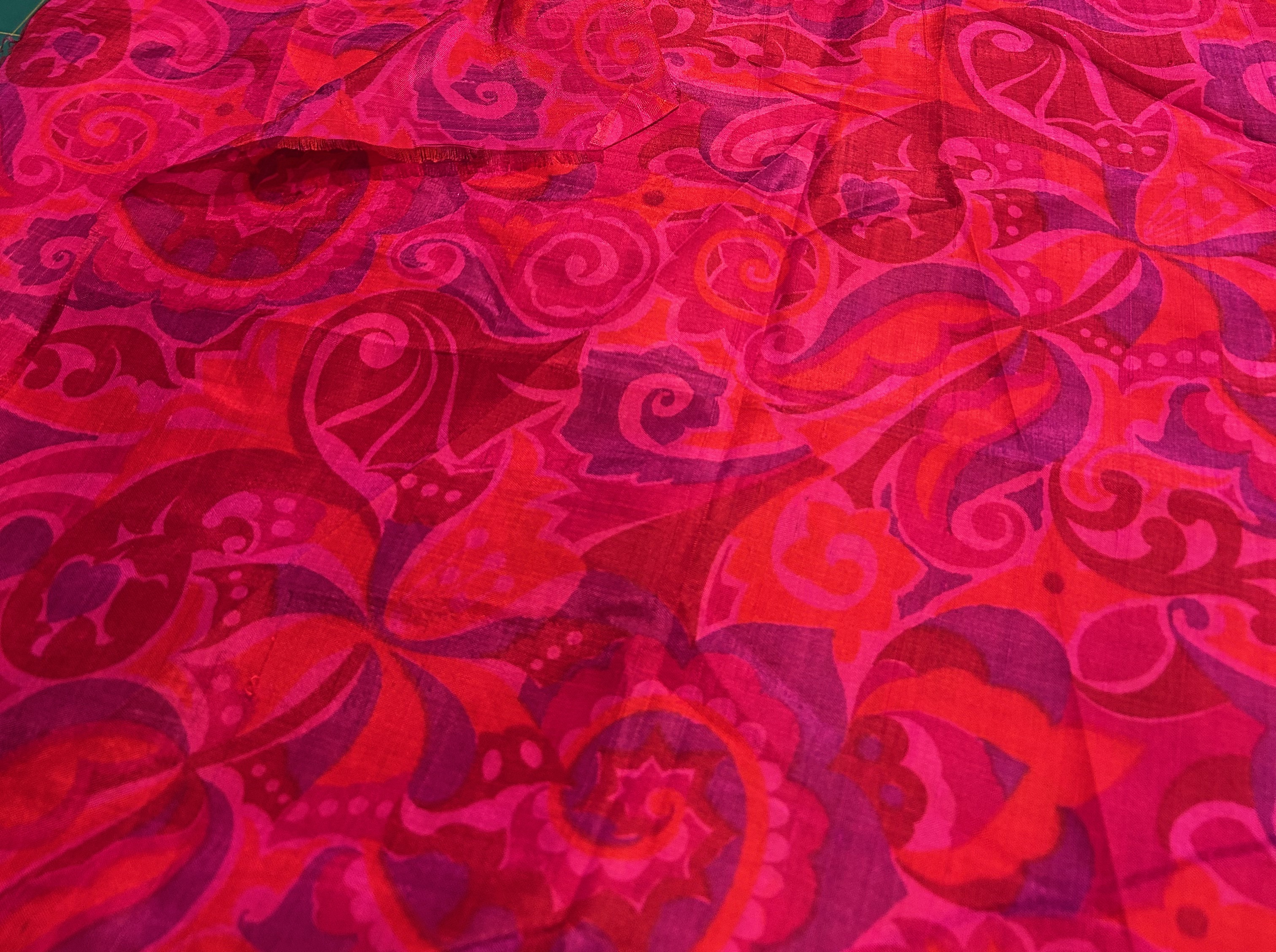
However, what really makes me not only think in color, but also dream in color, is a piece of Thai silk just given to me from a sweet and thoughtful friend.  She told me it had been given it to her over forty years ago by a friend of hers, purchased while in that part of the world.  My friend had finally decided she needed to part with it as she was certainly never going to use it.  Lucky me!  With over four yards and over 50” wide, I have plenty to work with.  What should I make?  
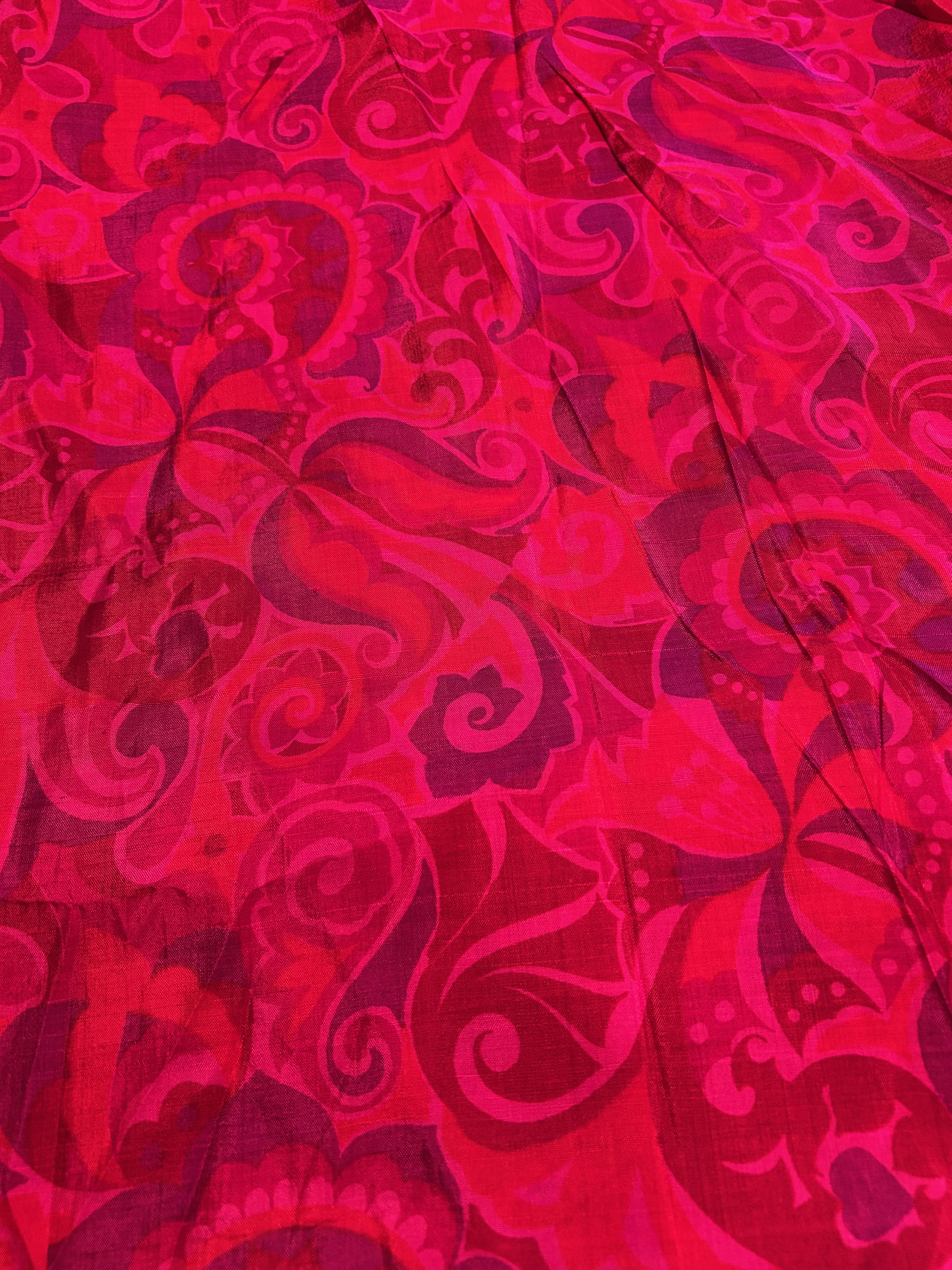
This a light weight silk with a crisp hand to it.

About my long absence from this blog…   I did not expect to be away for 6 months.  Thank you to those of you who did not abandon me over that time.  A confluence of circumstances thwarted my sewing production – and motivation – during the summer months.  Perhaps on that early December day when I instinctively voted for the Red Family in the Pantone quiz, I was feeling some small spark of vitality returning to my bones.  Perhaps…

Certainly, I cannot close this short post without acknowledging the joy in this season of holidays and Christmas and extending best wishes far and wide to each of you.  Merry Christmas!  

47 Comments

Filed under Pantone Color of the Year, silk, Uncategorized

Fashion and Fabrics:  More from My Couture Trip to Paris

Among the highlights on The Paris Tour with Susan Khalje were several visits to fashion exhibitions, shopping excursions to three fabric stores, and one to a fabulous scarf store. 

The first exhibit we visited was at the Yves Saint Laurent Foundation. 

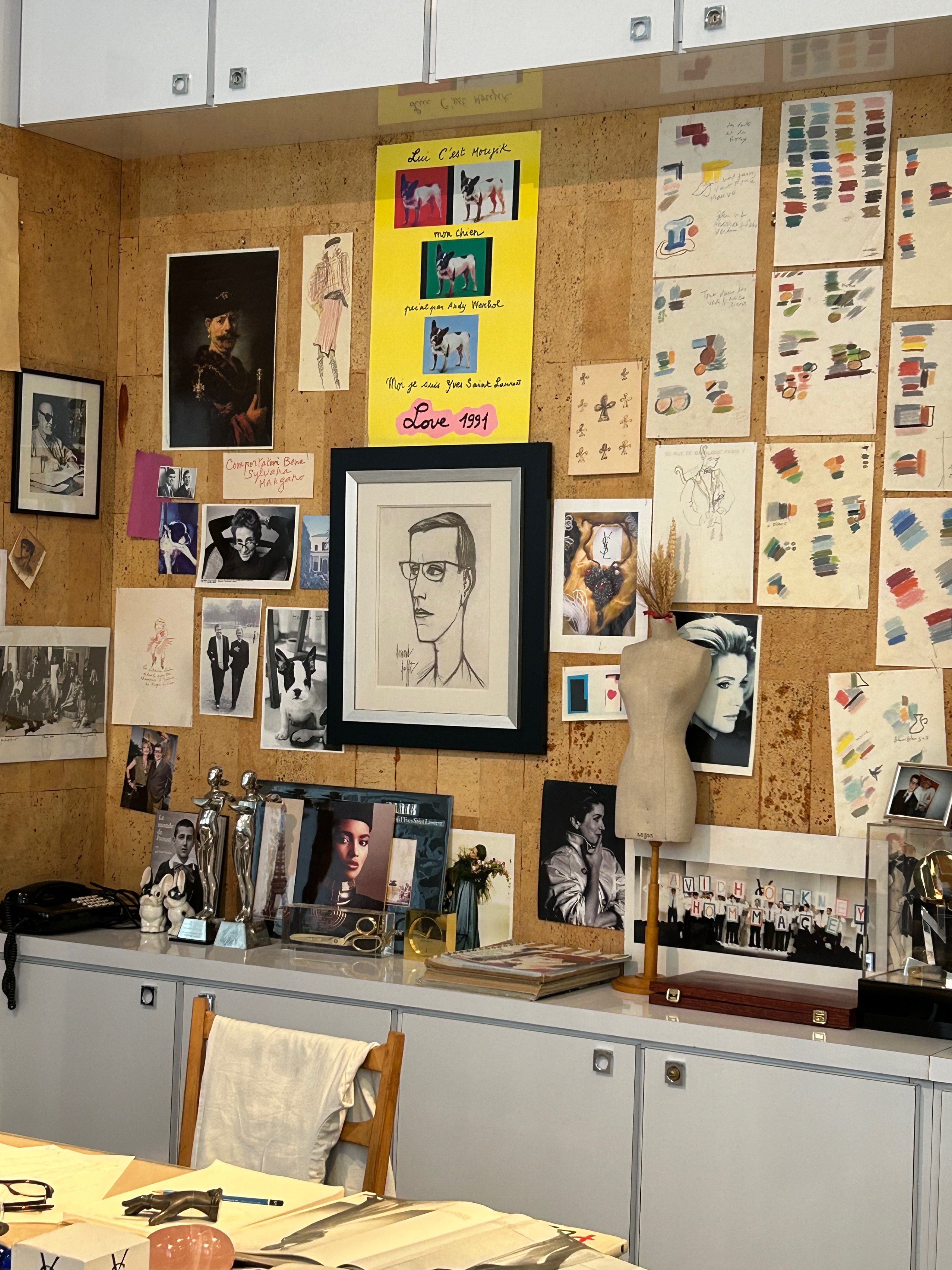
 In addition to the selections on display in the current “Sheer:  the diaphanous creations of Yves Saint Laurent,” we had the opportunity to see his studio where he worked.

Diaphanous, indeed!

This dress had an ethereal look to it.

This is only a partial view of his spacious workroom.

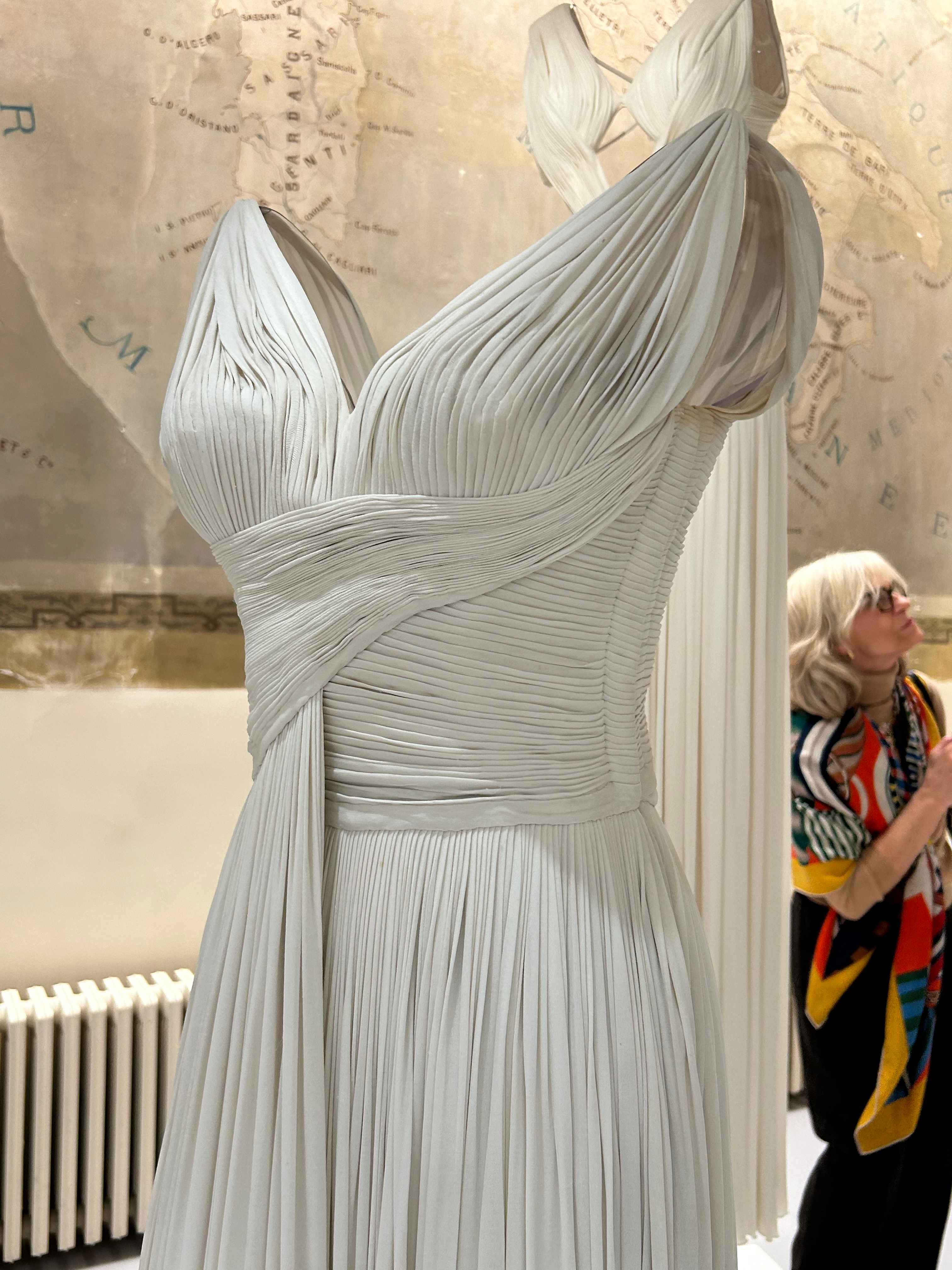
Later that same day, we went to the Musee des Arts Decoratifs where the current exhibit of the works of Iris Van Herpen were on display.  Some of the members of our group were quite taken with her designs.  I was not one of them.  I much preferred our visit to the Alaia Foundation to see the newly-opened exhibit featuring works by Azzedine Alaia and Madame Gres.  I have long been a fan of the design aesthetic of Madame Gres.  Her works served as a point of great inspiration for Alaia.  To see so many of her designs on display, many alongside the more contemporary works of Alaia, was captivating. 

The dress on the left is by Madame Gres, the one on the right by Alaia.
Another fabulous design by Madame Gres.
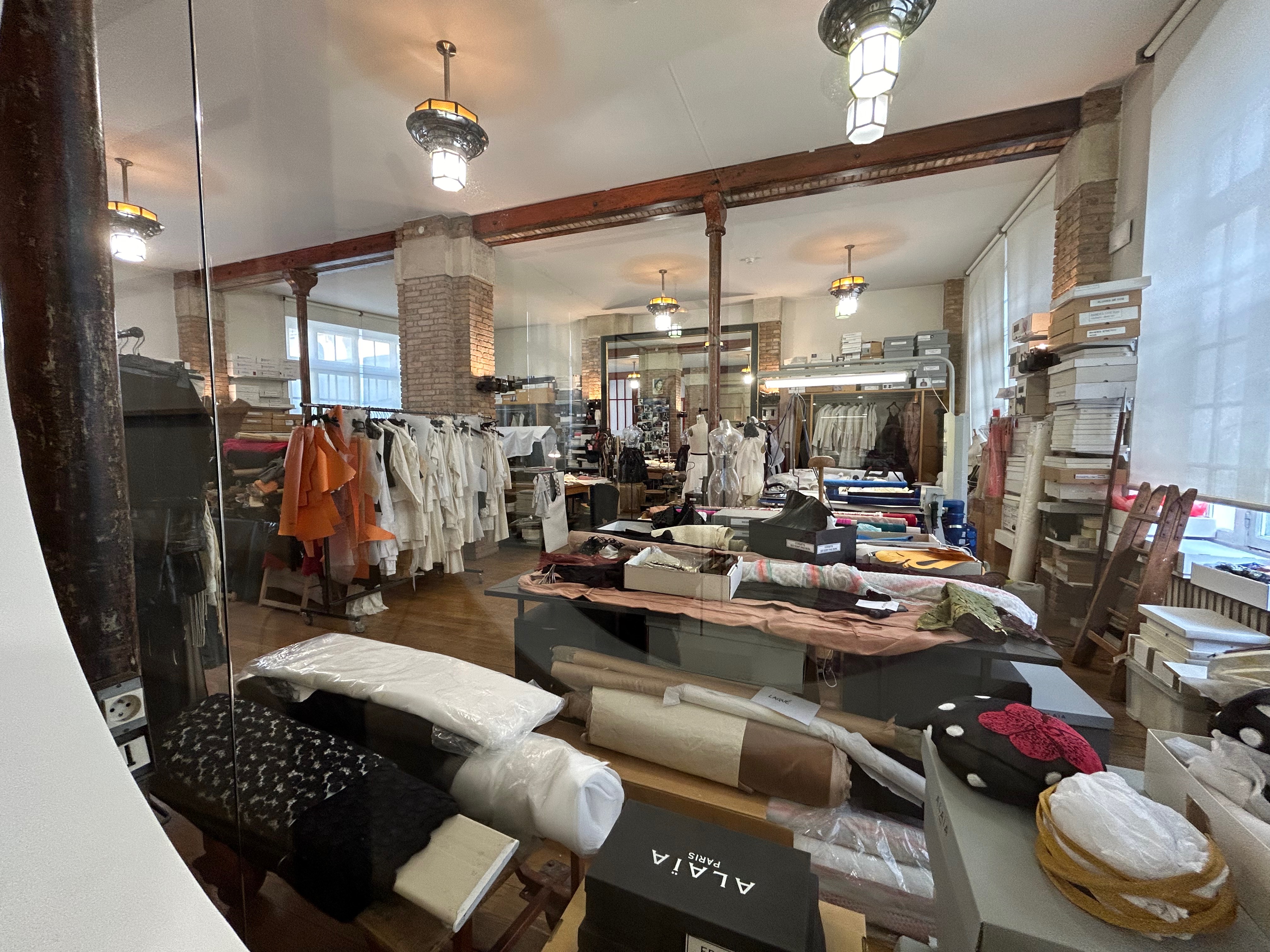
The Alaia Foundation has preserved his work room exactly as he left it.

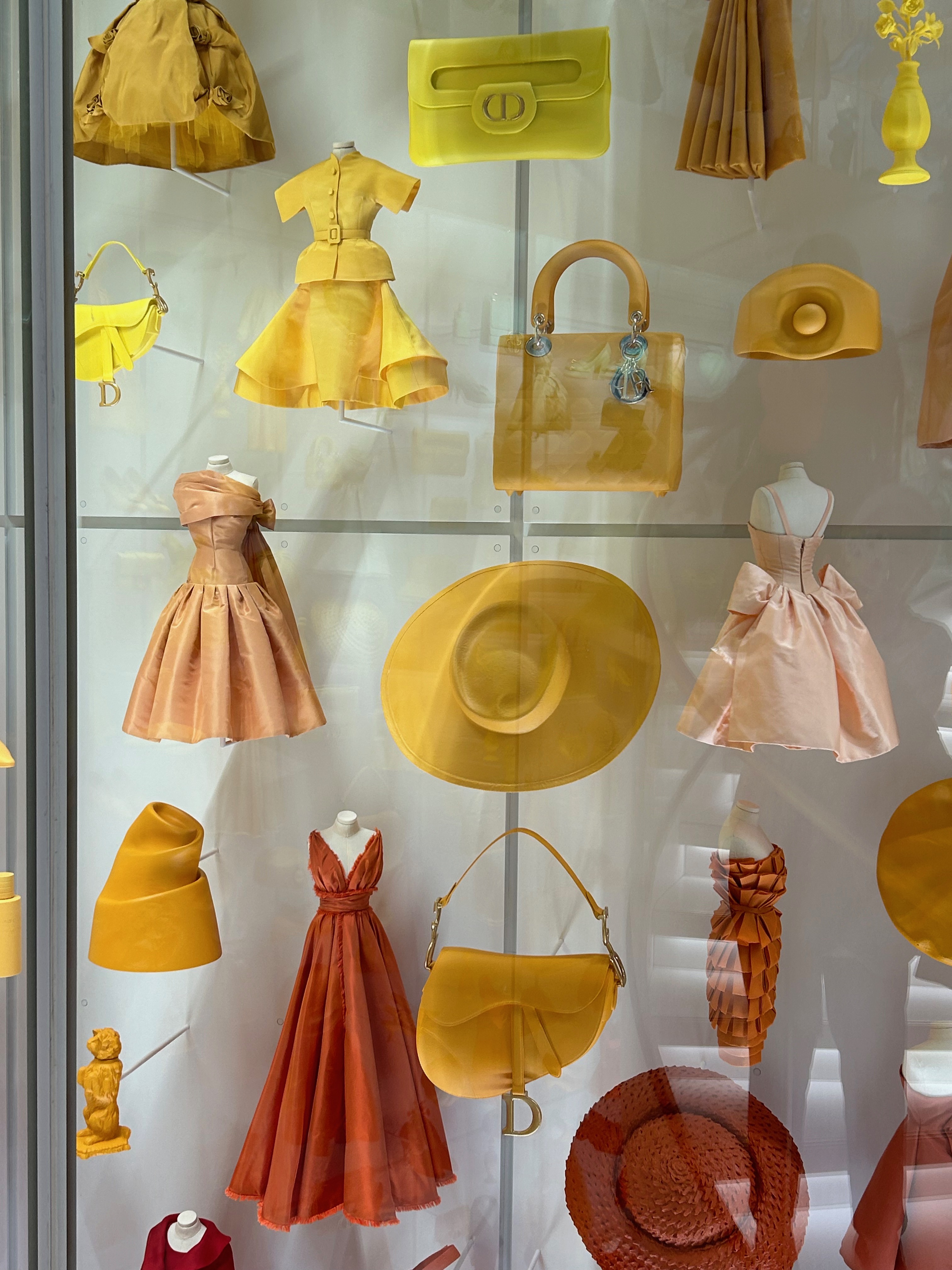
The crème de la crème was our visit to La Galerie Dior, newly reopened and quite spectacular. Having seen the Dior Exhibit when it was at the Denver Museum of Art five years ago, I wondered how similar the two presentations might be.  There were obviously some repeats of the iconic dresses and ensembles of Christian Dior before his untimely death in 1957, but somehow everything seemed fresh and newly considered.  The building is beautiful, masterfully lit,  with a logical, but innovative floorplan.  Entrance to the Galerie is by timed tickets, and at no time did the galleries seem crowded or uncomfortable.

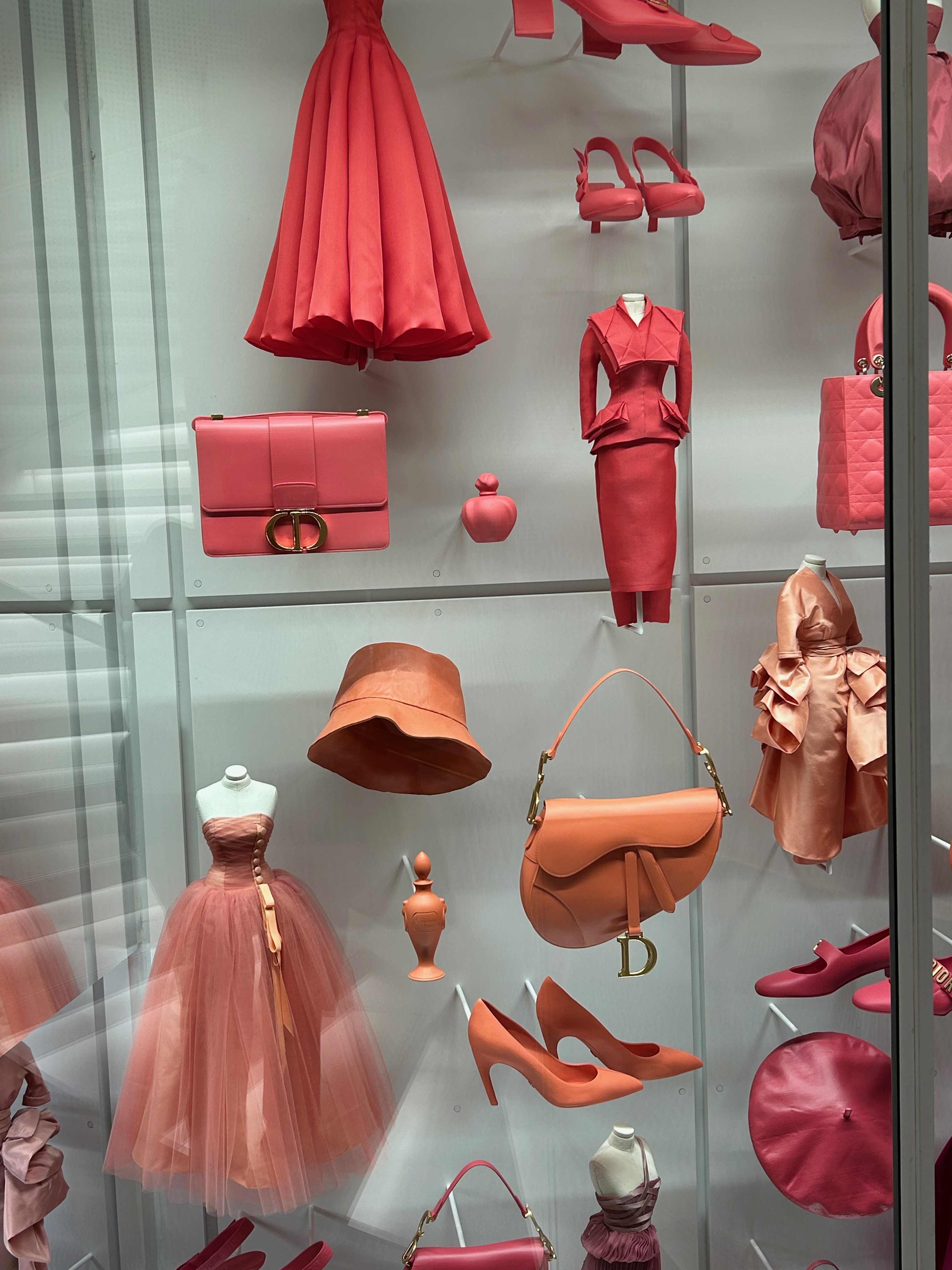
I could have spent hours studying the walls and walls of accessories and miniature clothing which lined the stairwell.

.

And yes – all the dresses shown above are miniature copies of originals from the House of Dior.

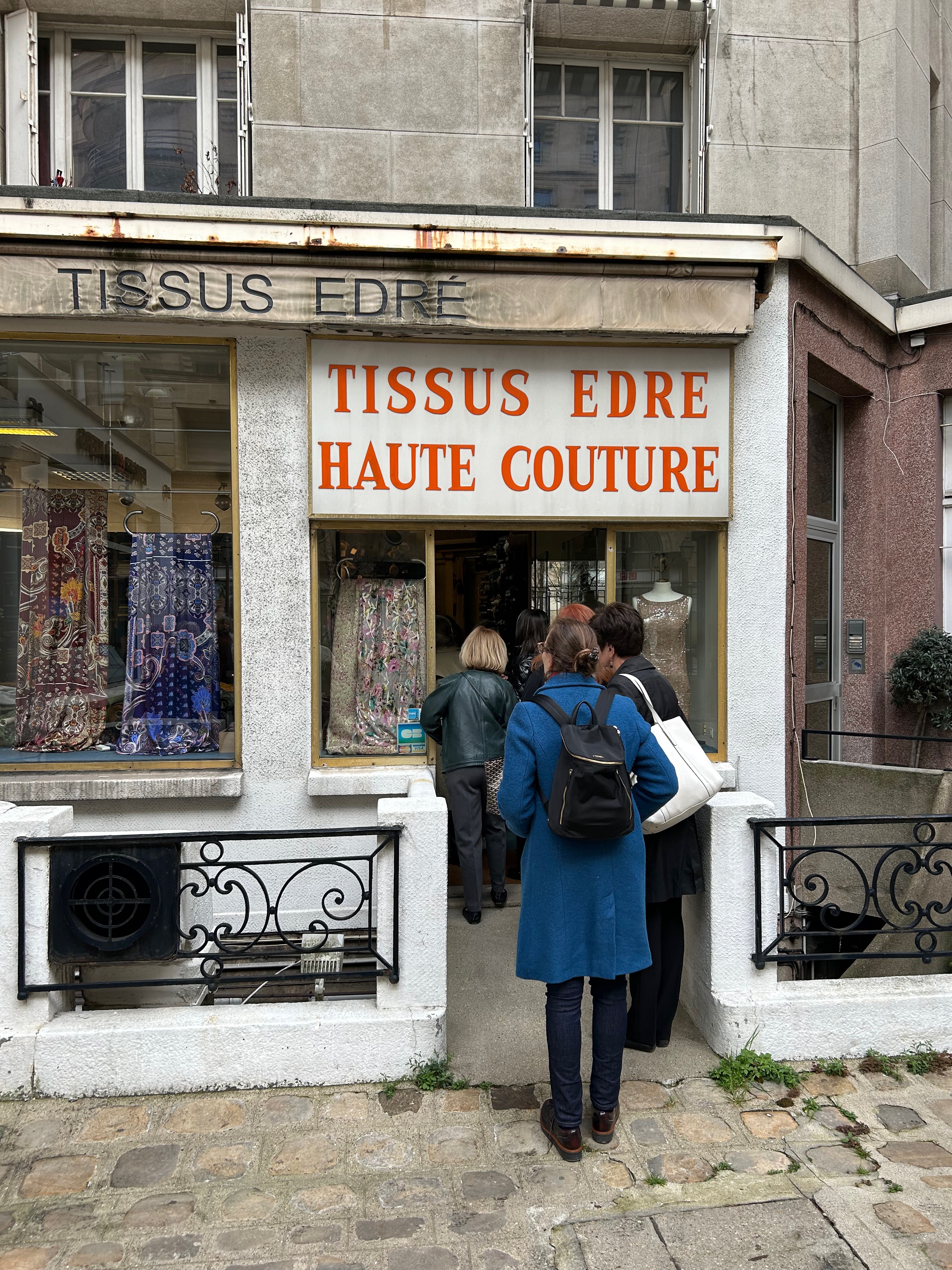
After all this inspiration, it was fun to go to three fabric stores.  The first one on the agenda was Tissus Edre.  

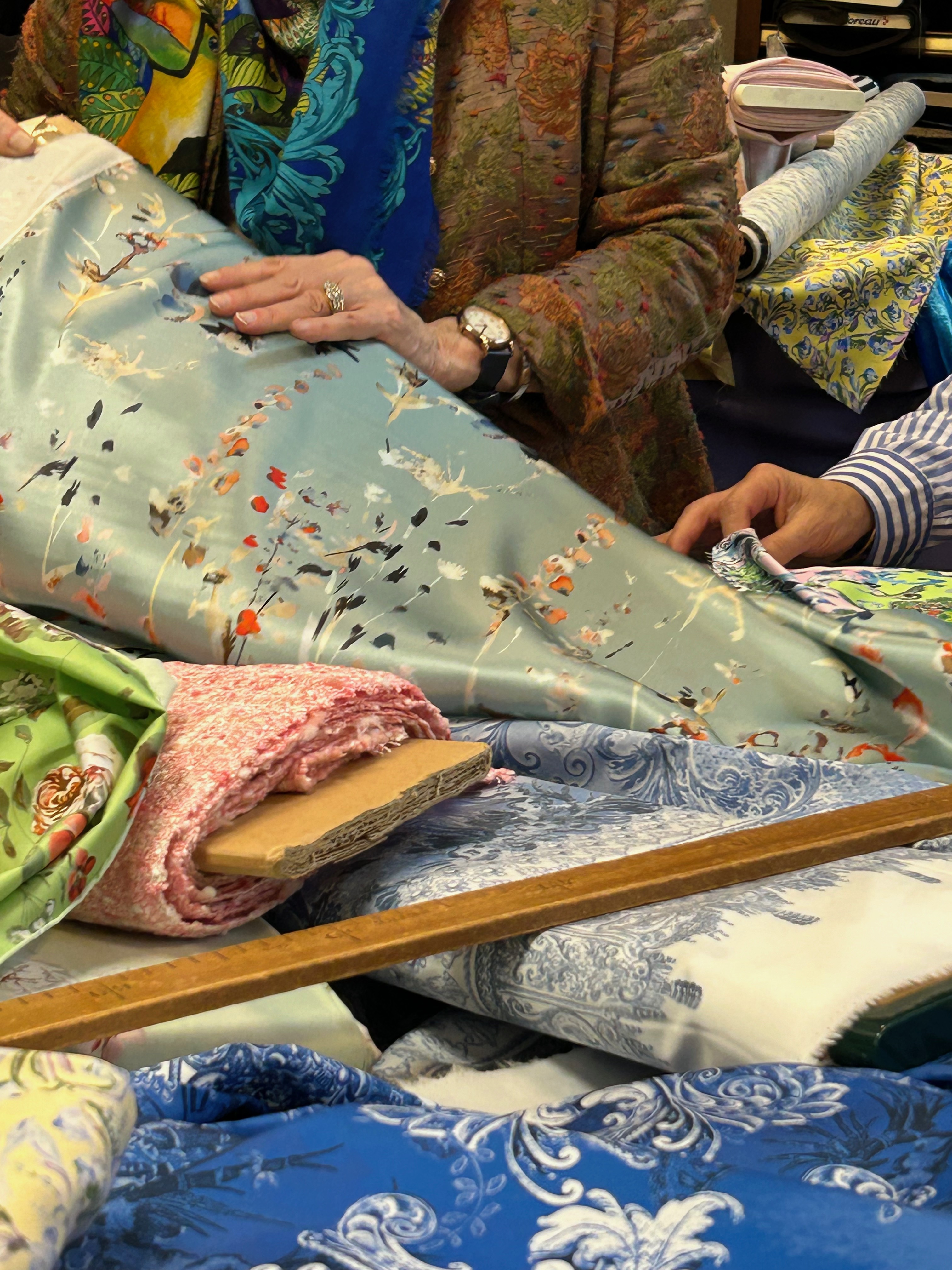
This store sells end cuts from the couture houses, and there is a lot to see.  There is not much order to the “presentation” which meant we had to dig our way through the piles of offerings.  I admit to having some problems with this type of fabric store. 

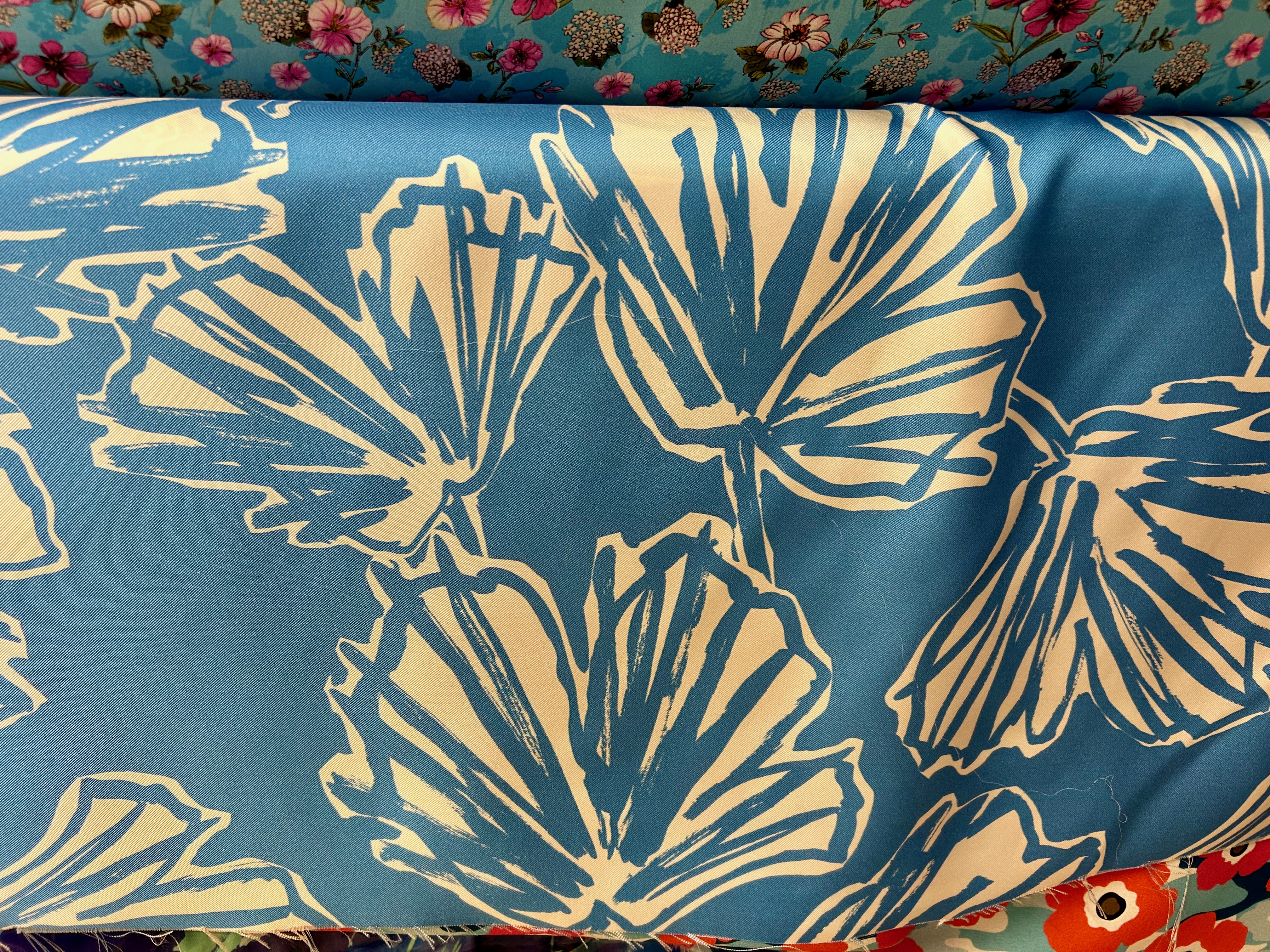
 It was only after a fellow member of our group found this silk charmeuse shown below, that I noticed it.  

A piece of the pale blue floral silk on top of the pile came home with me.

The second fabric store we visited was the world renowned Janssens + Janssens. 

 This store was the antithesis of the prior one in its ordered rows of bolts of fabrics both upstairs and downstairs.  I spent much of my time with the silk charmeuses and twills although this store is probably known best for its exquisite laces.  

Here is sampling of the laces available for purchase.
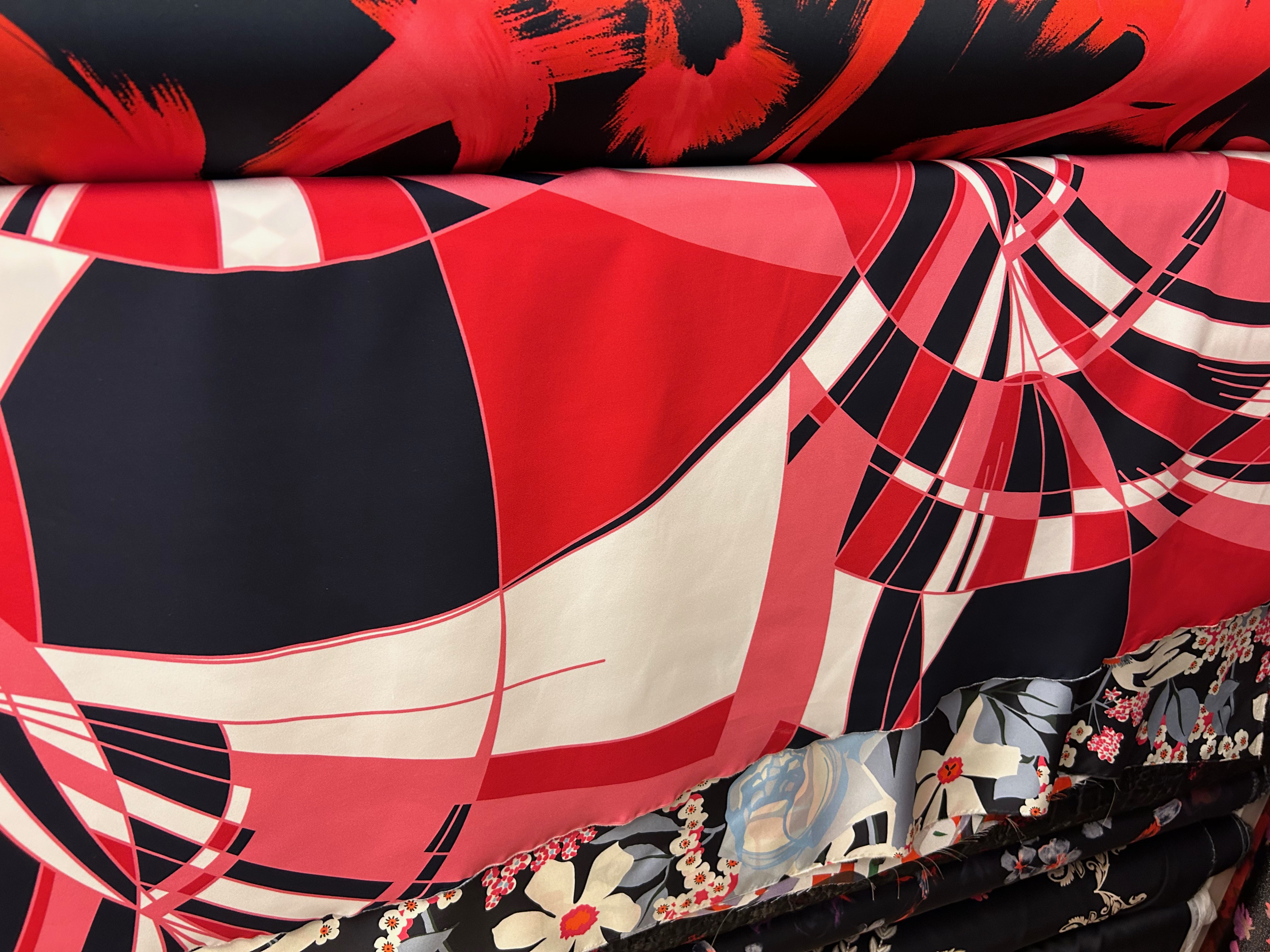
Silk Charmeuse

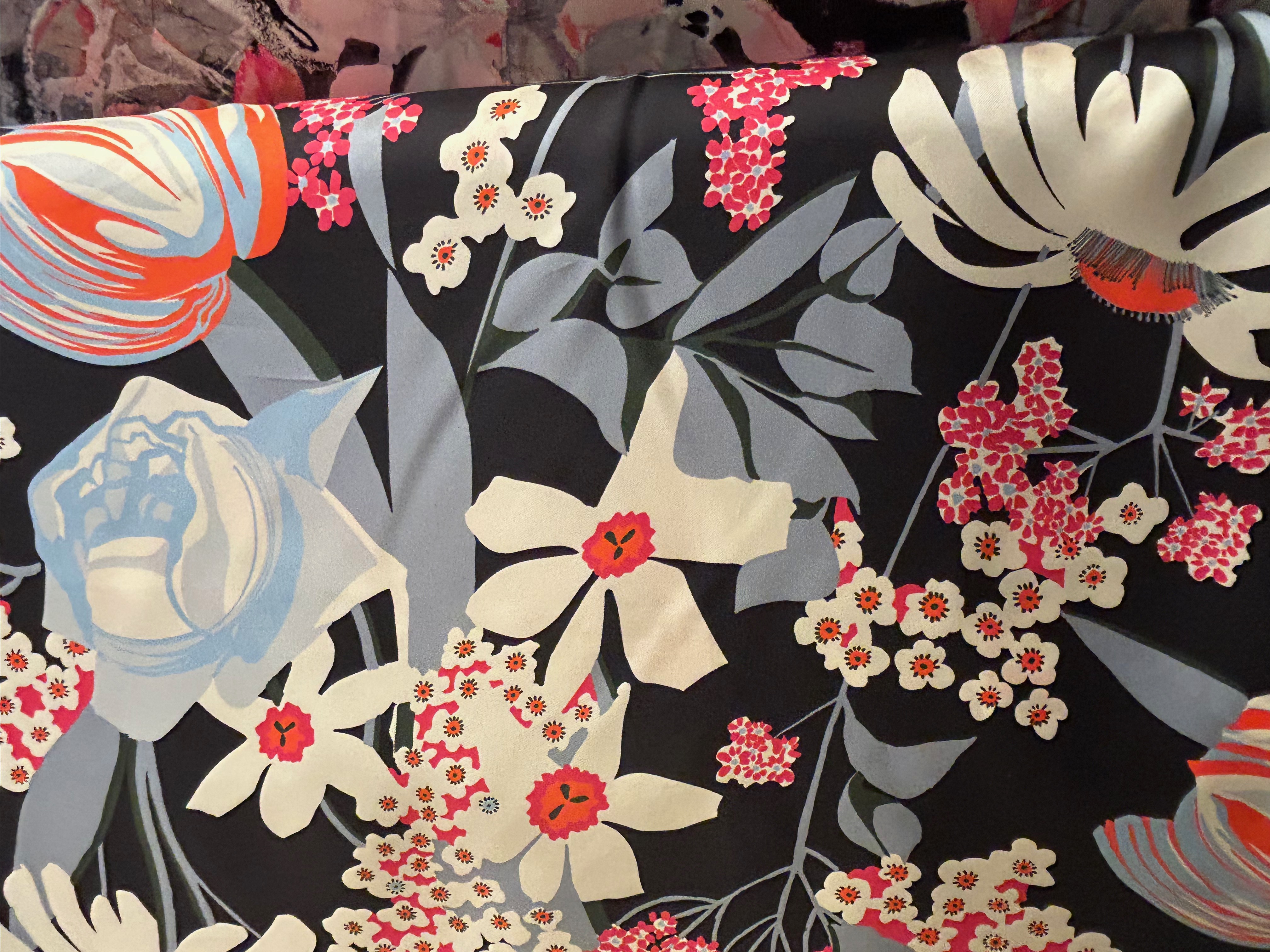
A silk twill which also came home with me.

Some day I am going to wish I had this fabric for a lining for a coat.

I could see this fabric made into a flowing caftan to wear in a tropical climate. Someone else will have to do that.

Finally, we went to a fabric store in the garment district by the name of General Diff.  It, too, features end cuts from the couture houses among other selections.  Again, it was a jumble, with fabric piled high on large tables.  They had some lovely lightweight wool, but I declined to be tempted, as my suitcases were reaching capacity at this point.

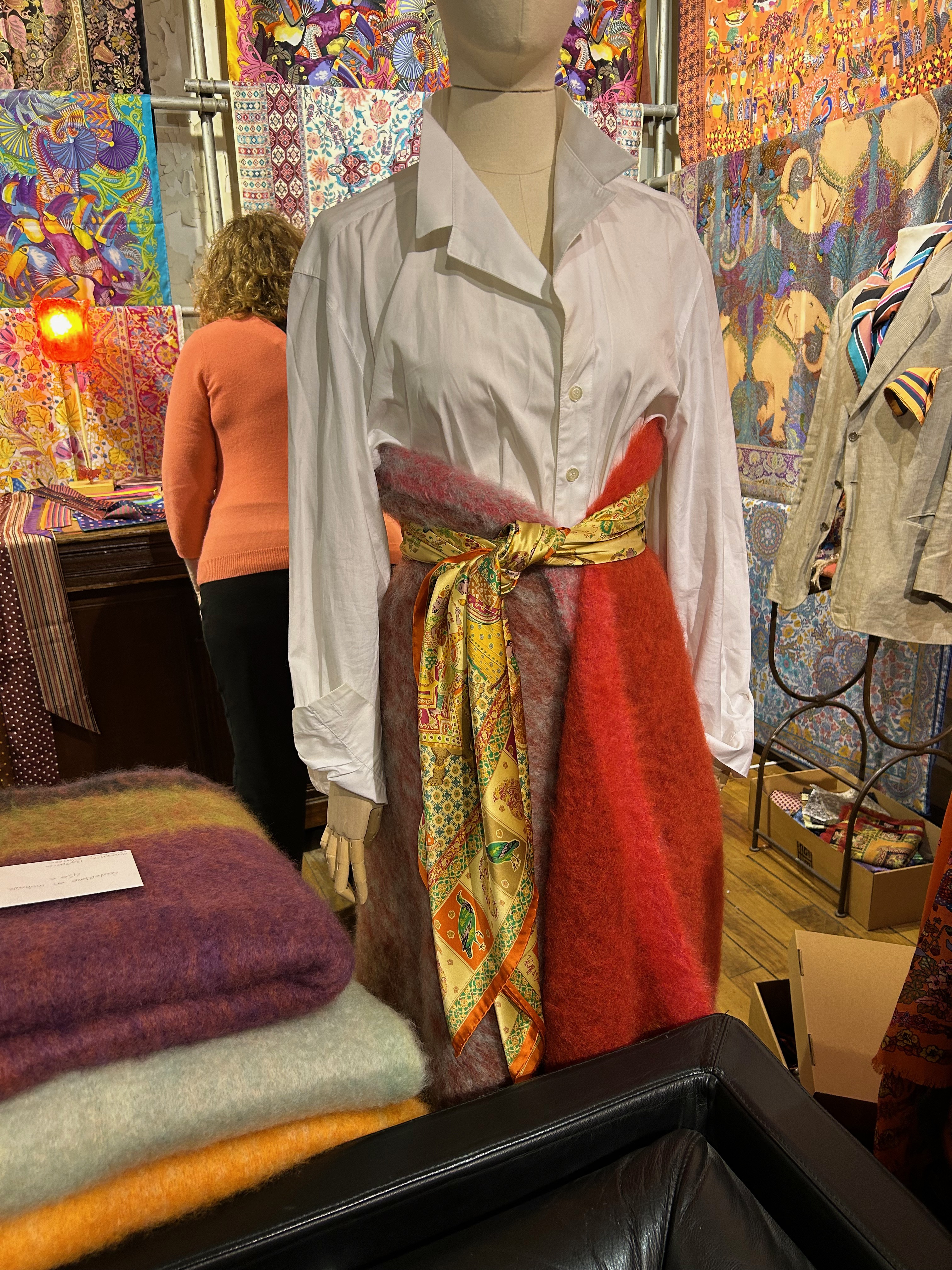
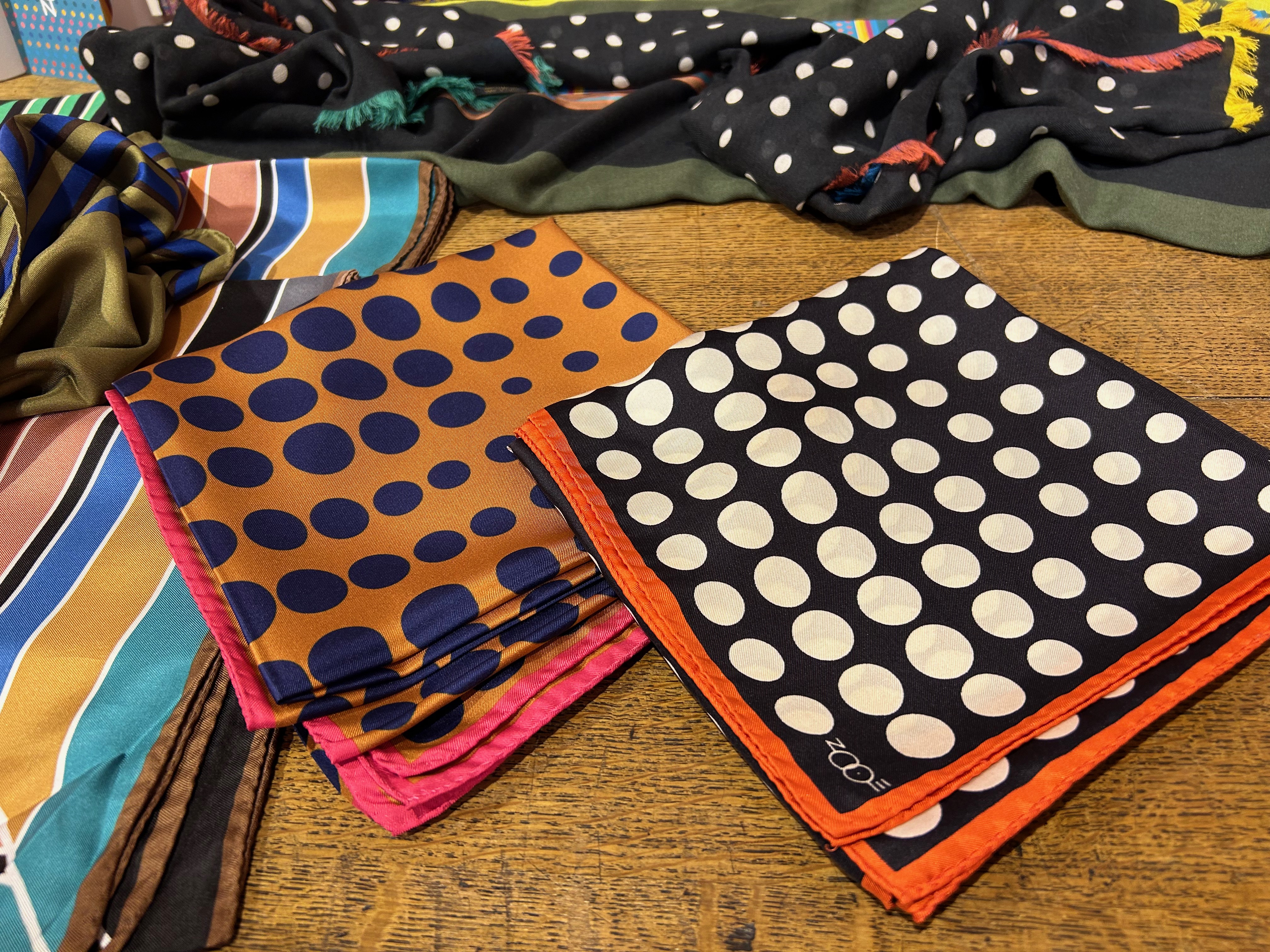
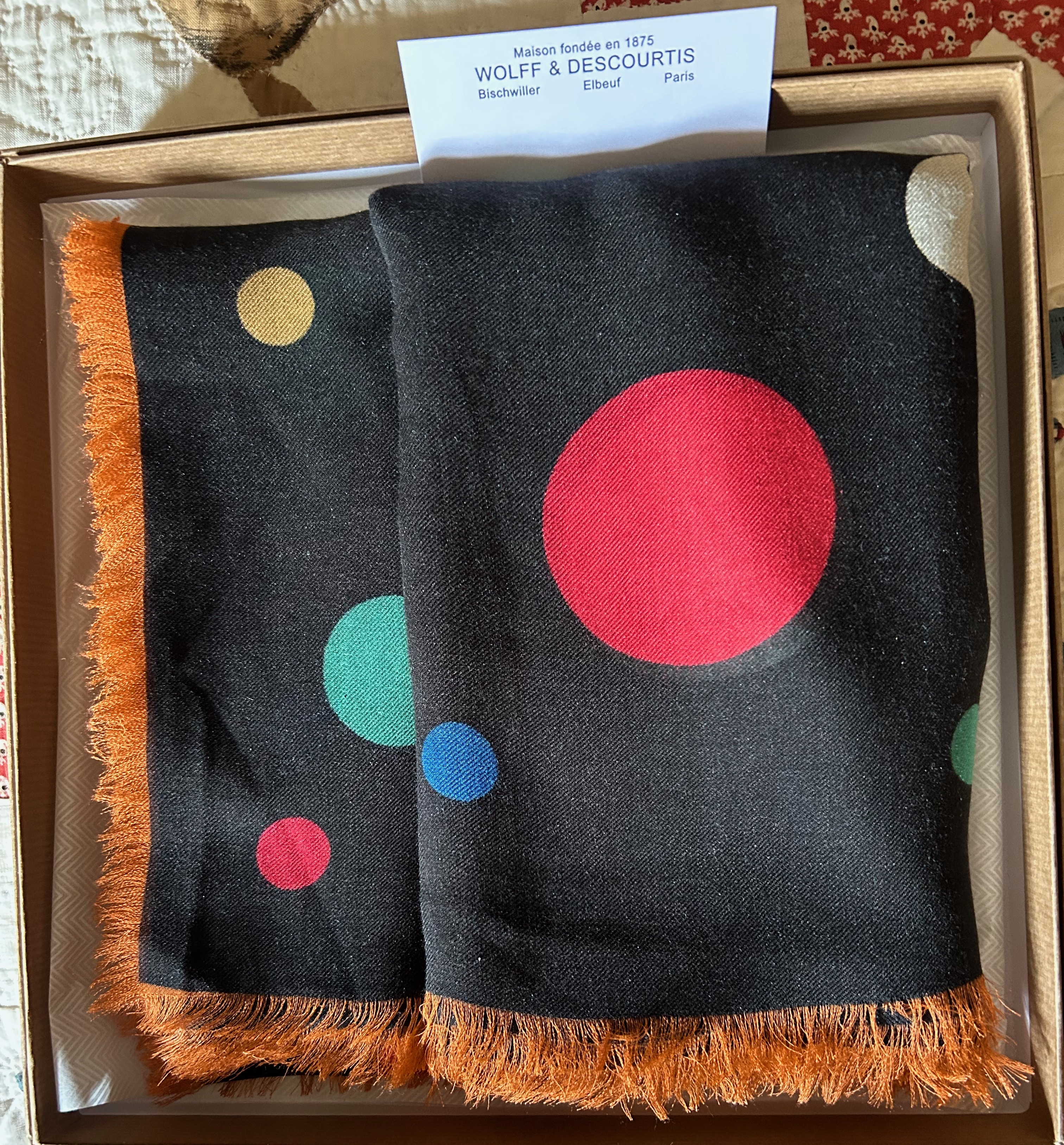
Finally, here are some photos from Wolffe et Descourtis, the wonderful scarf store which captivated us all. This business has remained in the same family for many decades , and indeed the proprietress is Victoria Wolffe, of the original founding family.

What fun to come home with my beautiful scarf!

This ends my monologue on the Paris Tour, despite there having been additional places we visited, people we met and things we did.  Summer sewing has already cranked up, with my attention back here in the States. Happy Sewing June to all of you!

20 Comments

Filed under Christian Dior, Fashion Exhibits, Scarves, silk, Uncategorized

A Fussy-to-Make, Fuchsia-Pink Silk Dress

Sometimes extra incentive is needed to push through a project which turns out to be more difficult than anticipated.  Such was the case with this pink silk jacquard dress.

I had purchased this fabric quite a few years ago online from Britex Fabrics.  I knew it was a dressy fabric, and unsure of what form this dress would take, I made the decision to purchase four yards of this 58” wide silk.  That gave me some latitude in my selection of pattern.  

Finally last Spring I made a decision about what I wanted this dress to be.  That was precipitated by the arrival of a beautiful invitation to a very special event this Fall, and of course (!) I needed a new dress to wear to it. The fabric is a dressy, shimmery silk jacquard, so by its very nature it would make up into a dress which had a certain glamour to it.  

I decided to use a go-to pattern I have used a few times already and make a classic shirtdress.  That may seem like a strange choice, but I envisioned it as very dressy and flowing, and quite appropriate for the fabric.  

While this idea was percolating, I happened to attend a luncheon/presentation by a wonderful organization called the Ibu Movement.  (Pronounced ebu, with a long “e,” this is an Indonesian word meaning “a woman of respect.”)  

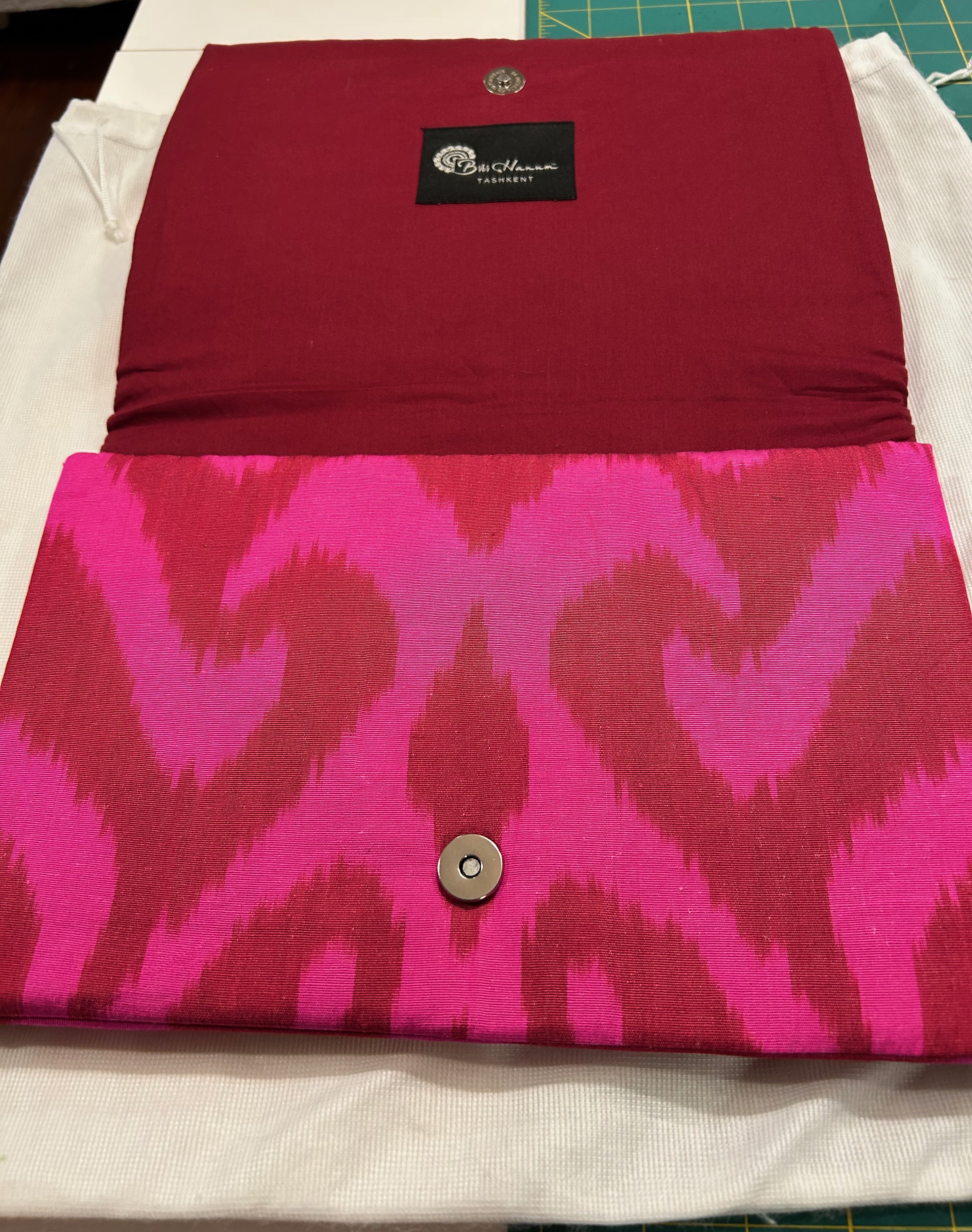
The pop-up shop accompanying this event was filled with gorgeous clothing, accessories, even shoes. When I saw this envelope clutch, I knew it would match my silk fabric perfectly and would be the perfect addition to my as-of-yet-to-be-sewn pink dress.  Little did I know at that time it would be the catalyst to make sure I finished the dress!
My first clue as to the fussiness of the fabric was as soon as I pressed it and laid it out for the placement of my muslin pattern. Here is what I noticed:

  1. The fabric had a slightly loose weave to it, making it almost stretchy, certainly very slinky.  Keeping it properly aligned on the straight of grain was going to be a challenge.  
  2. The fabric frayed easily.
  3. It also was prone to shedding silk fibers.  I decided I needed to handle it as little as possible to mitigate this situation.
  4. The jacquard weave in it had a definite horizontal and vertical pattern to it, meaning I would have to match the design horizontally and vertically across seams.  Although I am used to matching plaids and prints, this was a little different as the woven design was of irregular form.
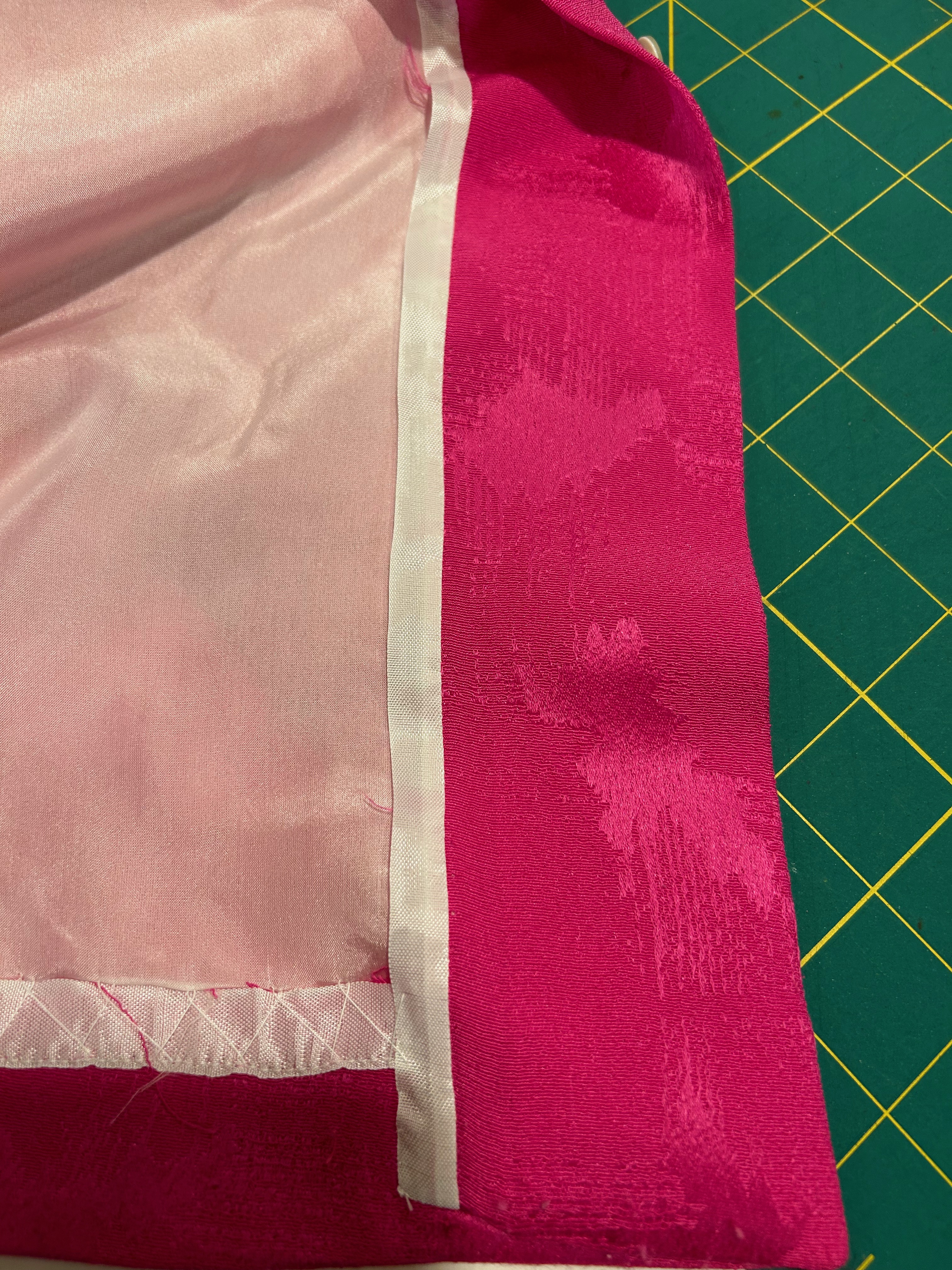
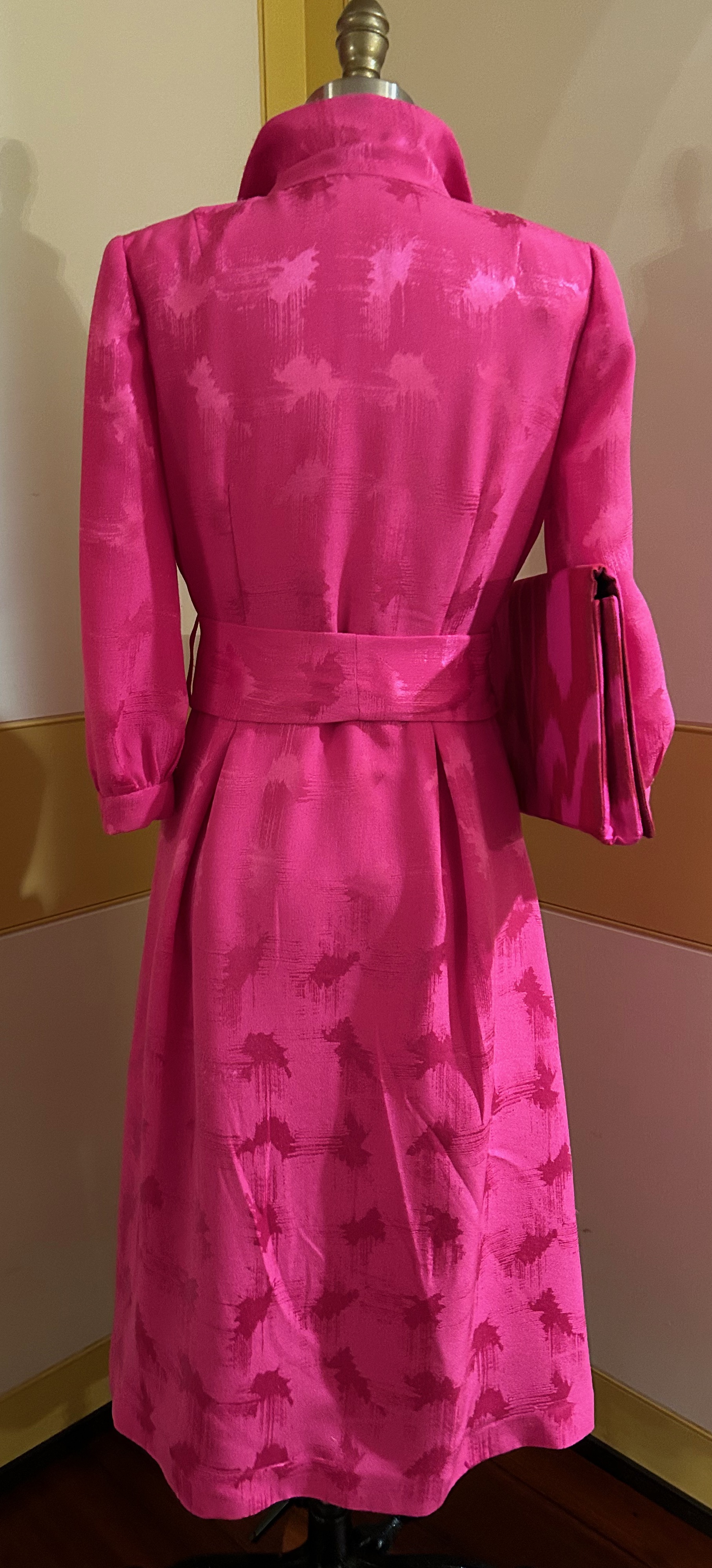
The irregular nature of the weave is apparent in this photo.

I decided to underline the dress (except for the sleeves) with a very lightweight silk batiste, which I hoped would give it some substance, but still preserve the flowing nature of the fabric.  I made the conscious decision not to add an additional lining to the dress.

Although I rarely use fusible interfacing, I realized very early on that sewn-in interfacing was going to shift around and cause all kinds of problems.  Luckily, I had been introduced to a very finely woven, fusible German interfacing available from Farmhouse Fabrics.  I had some on hand and found it to be the perfect stabilizing foundation for the cuffs, the front facing, the collar, the collar stand, and the hem.  

So, that solved one big problem for me.  I was still concerned about being able to get the hem even.  I had good reason to be concerned!  It took two tries to avoid having either a bubble appear or uneven dips around the perimeter. 

The final quandary I had was the buttonholes.  Because the fabric shed silk fibers so easily, I was really worried that my buttonhole attachment might grab onto those fibers and make a mess.  I did some sample buttonholes, which confirmed my suspicions.  So – I used wax paper between the foot of the attachment and the fabric, cutting little windows in the wax paper where the buttonholes would be sewn.  It worked like a dream.  

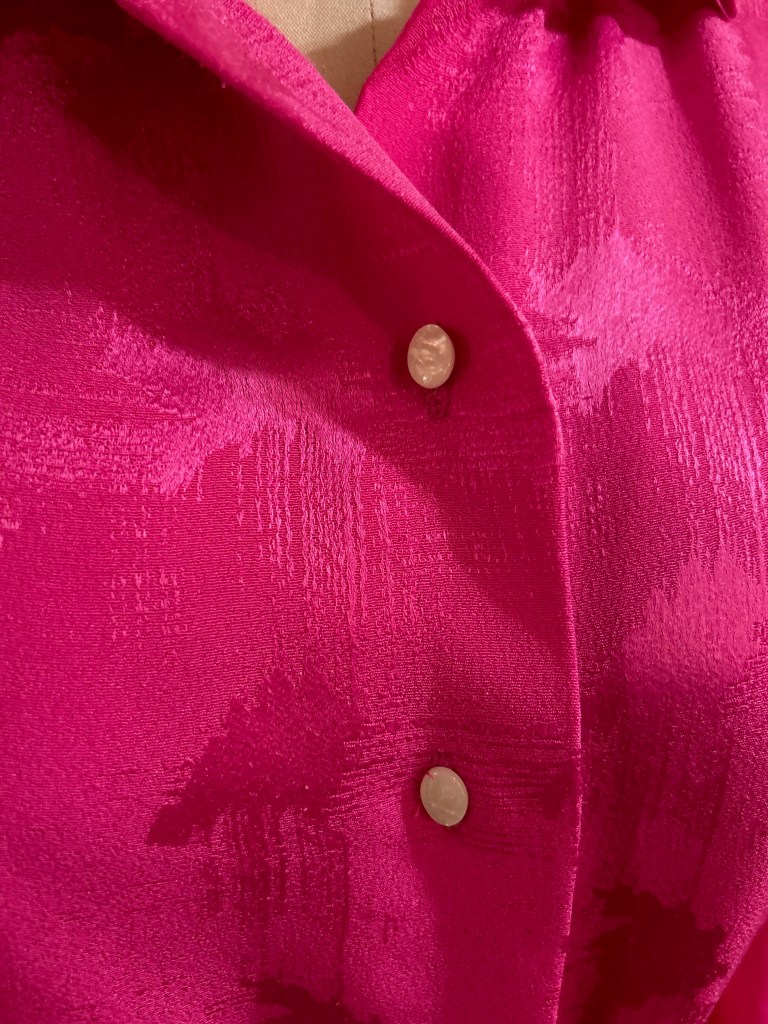
I found vintage pearl buttons with a slight iridescence to them which I thought worked well with the fabric.
And here is that handbag with the dress!

This was not a particularly fun dress to sew, but that “perfect” handbag kept me focused.  And I am glad it did, as the dress was a success in the end.  And it always feels like an accomplishment to use fabric which has been lying in wait for so long.  

29 Comments

Filed under Buttons - choosing the right ones, Cocktail dresses, Linings, sewing in silk, silk, Uncategorized, underlinings, vintage buttons, Vogue patterns

Life Isn’t Perfect…

…but Your Outfit Can Be.  I took a picture last summer of this sign at a Western wear store in Pinedale, Wyoming (Cowboy Shop).   I loved the saying, but little did I know how often I would reflect on it this summer, which has had its difficulties.  

And even when my outfit, like Life, is far from perfect, which has been often, I know there is always Hope, and yes, that is hope with a capital H.  

*******

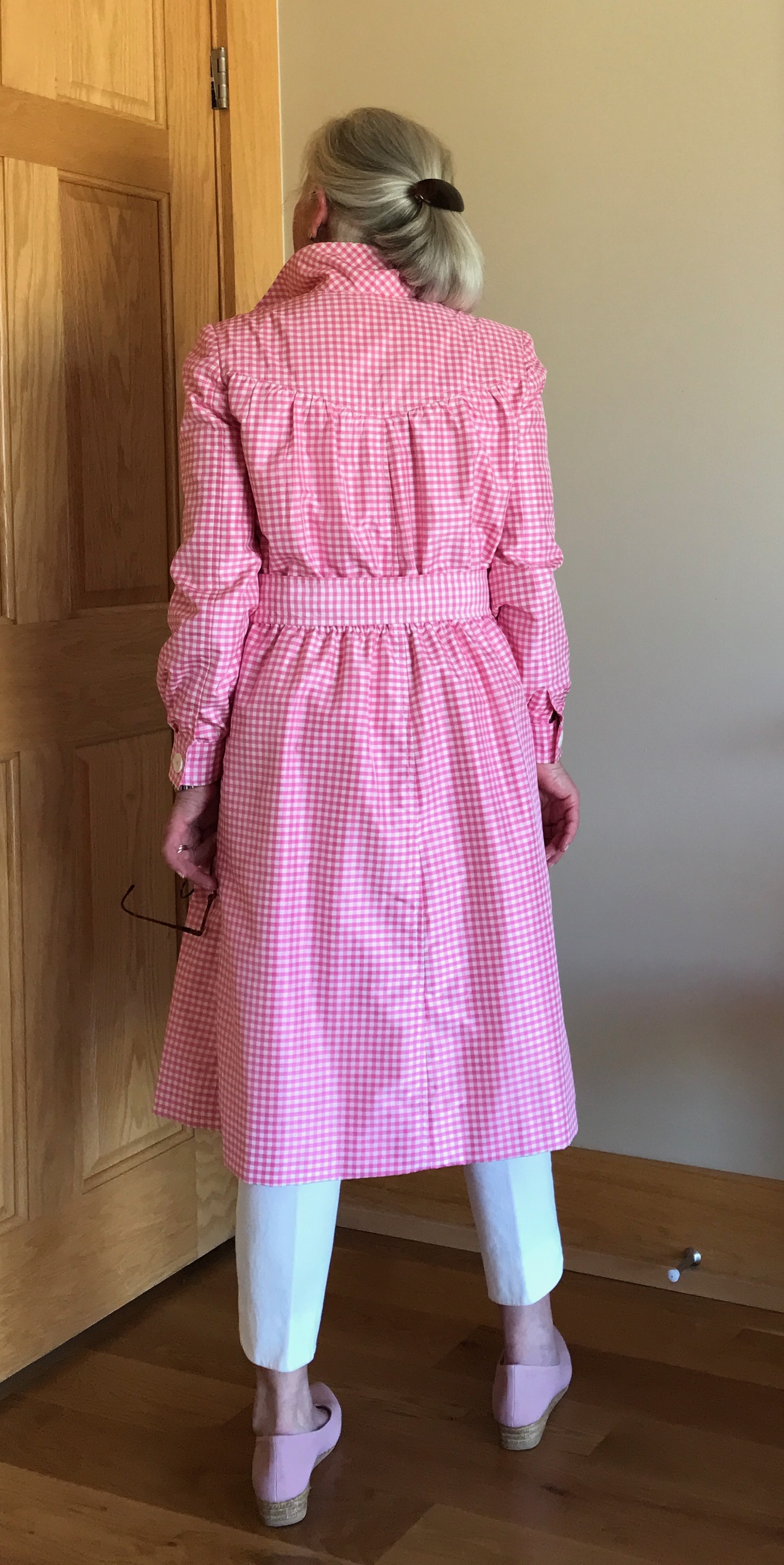
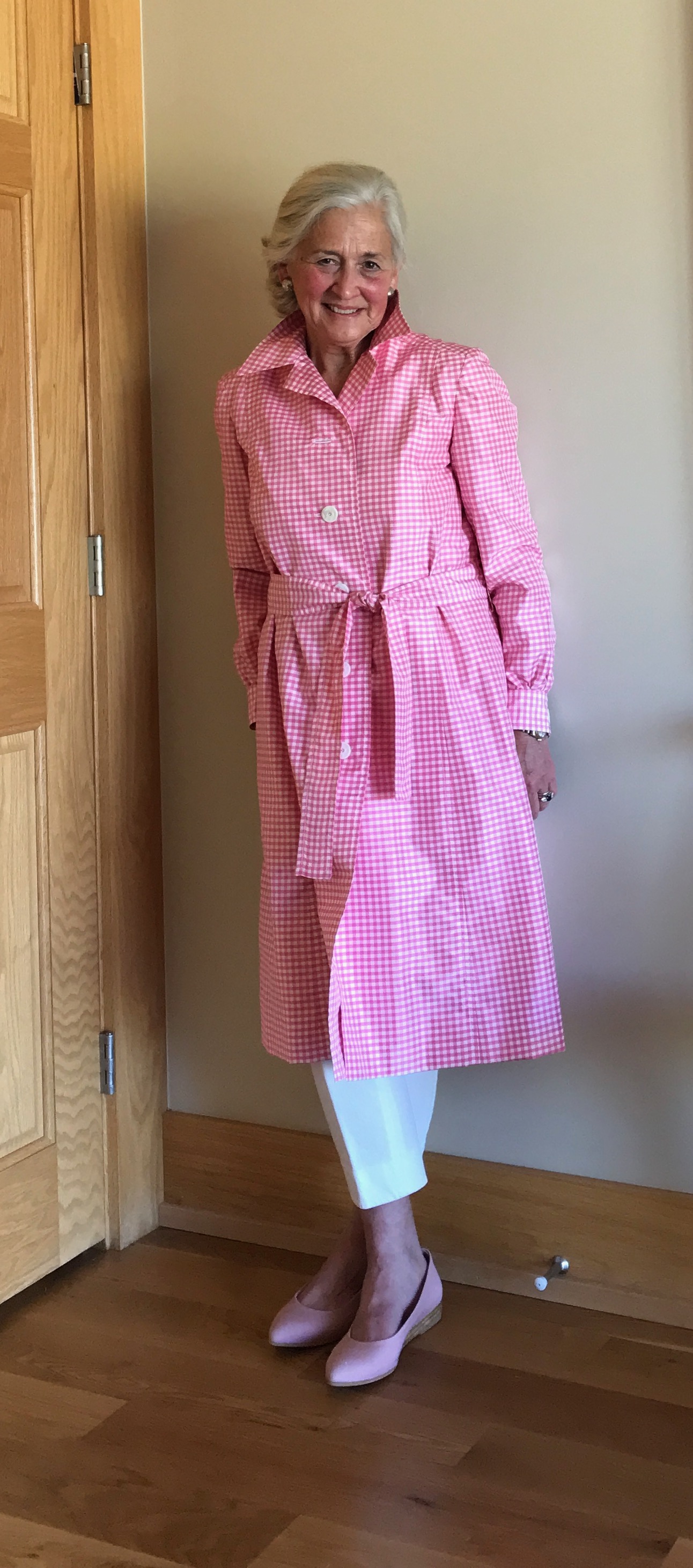
What a long hiatus it has been between my last musings about Trench coats and Dressmaker coats and pink gingham.  The final, finishing  stitch in my pink checked coat was in mid-June, and at this point I can hardly remember what I wanted to say about it.  

I purchased the pink silk gingham from Farmhouse Fabrics several years ago.

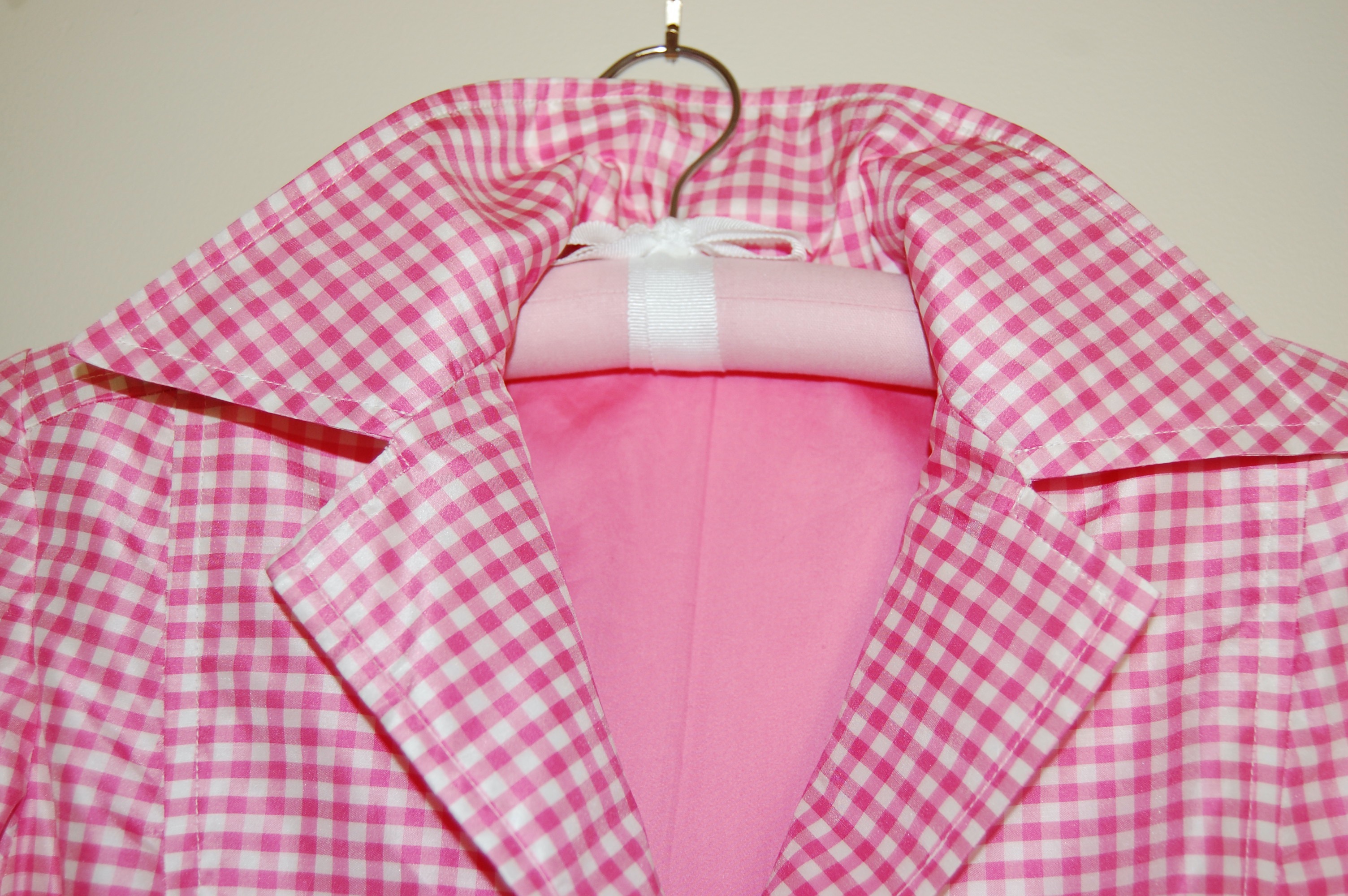
It does seem appropriate to start with the changes I made to the pattern, of which there were two major ones.  The first change was to the size of the collar.  In the 1970s long pointed collars were a trend.  Although I like a pointed collar, one with a more petite profile seemed to be a little more flattering and classic.  To achieve this desired look, I shortened the collar’s points by about an inch on either side.  

For comparison purposes, here is a good look at the original collar.

When I made this coat in 1974, I remember being a bit disappointed with the volume of the back of the coat.  I was using a cotton twill, so it was a heavier fabric than the silk taffeta in my new version, making the volume seem even more pronounced.  But even so, I thought I would be happier with a less full back.  I experimented around with my muslin/toile until I got the desired girth.  It turned out I eliminated a total of three inches from the back pattern pieces, 1 ½” from each side back panel.

Again, the image of the 1974 pattern illustrates the volume of the gathering in the original design.

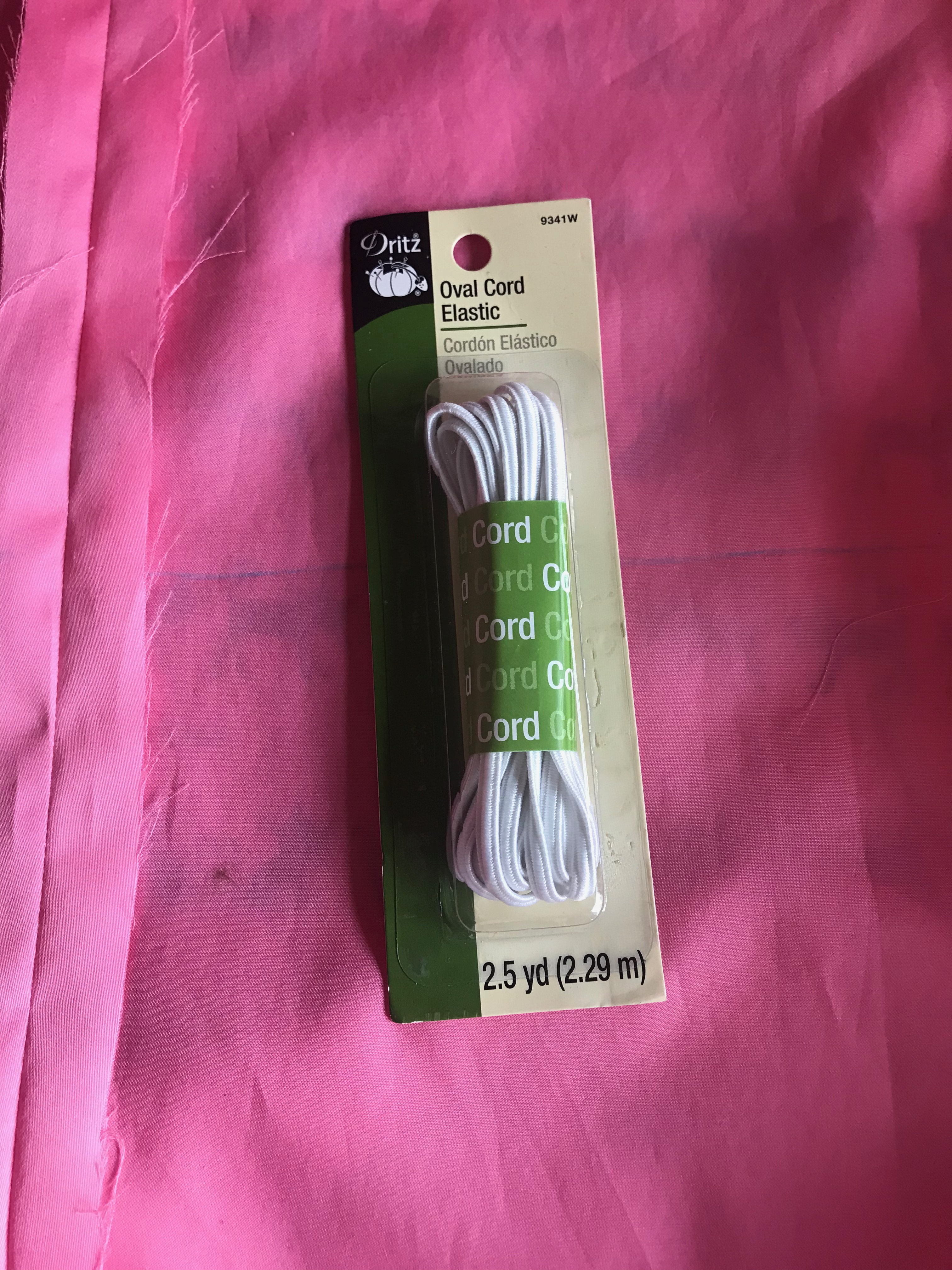
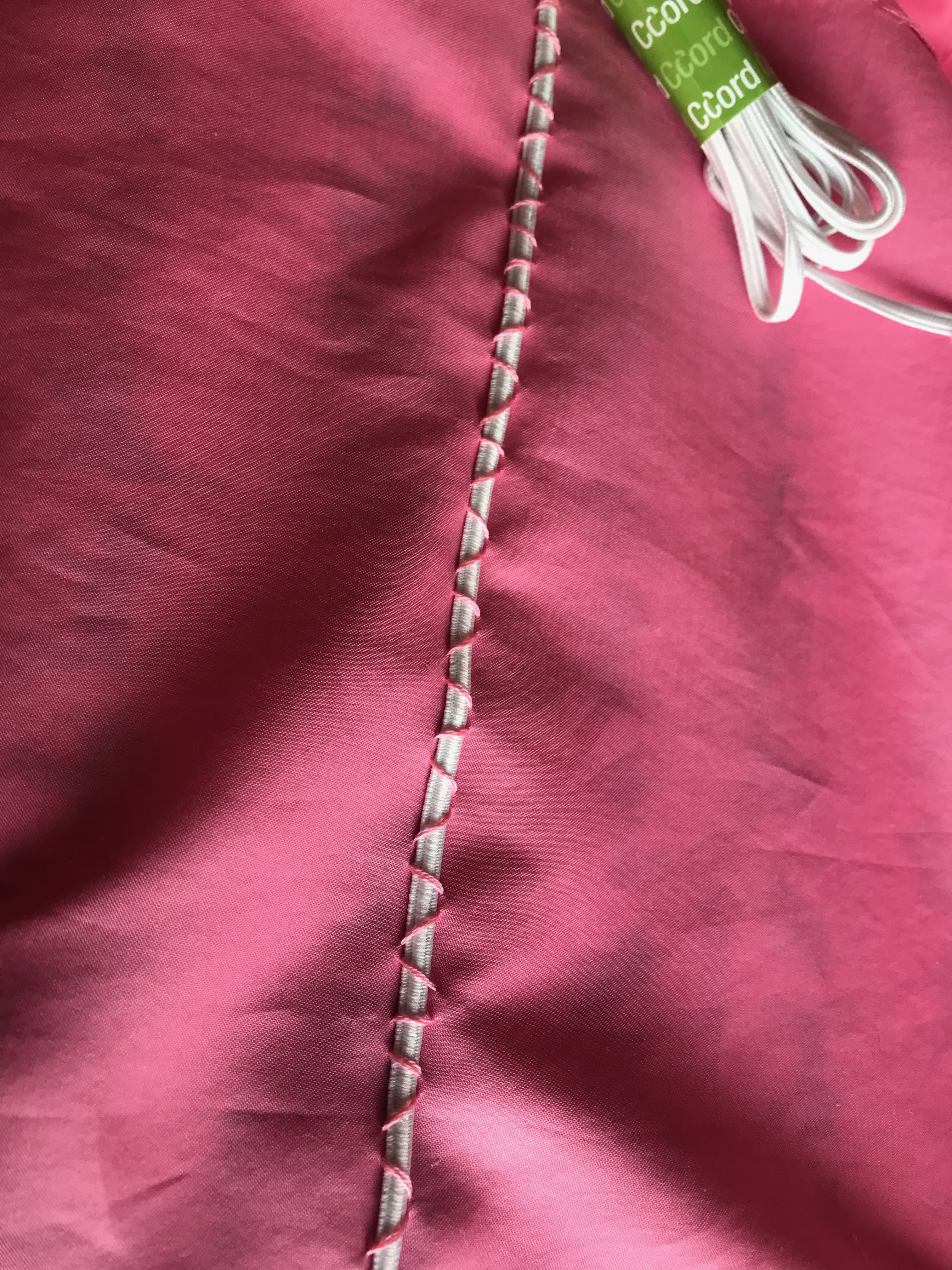
In addition to these alterations, I had a slight construction change.  The instructions for the  gathering of the lining at the back waistline called for using elastic thread.  First of all, I didn’t have any elastic thread, nor did I think it would give the look I wanted even though it would not be very apparent on a lining.  Instead, I had some elastic cord, and I attached it by hand, using embroidery floss in a criss-cross stitch enclosing it the width of the back.  Worked like a charm, and I like the effect it made.

This is the wrong side of the lining, showing the criss cross I achieved with embroidery floss.
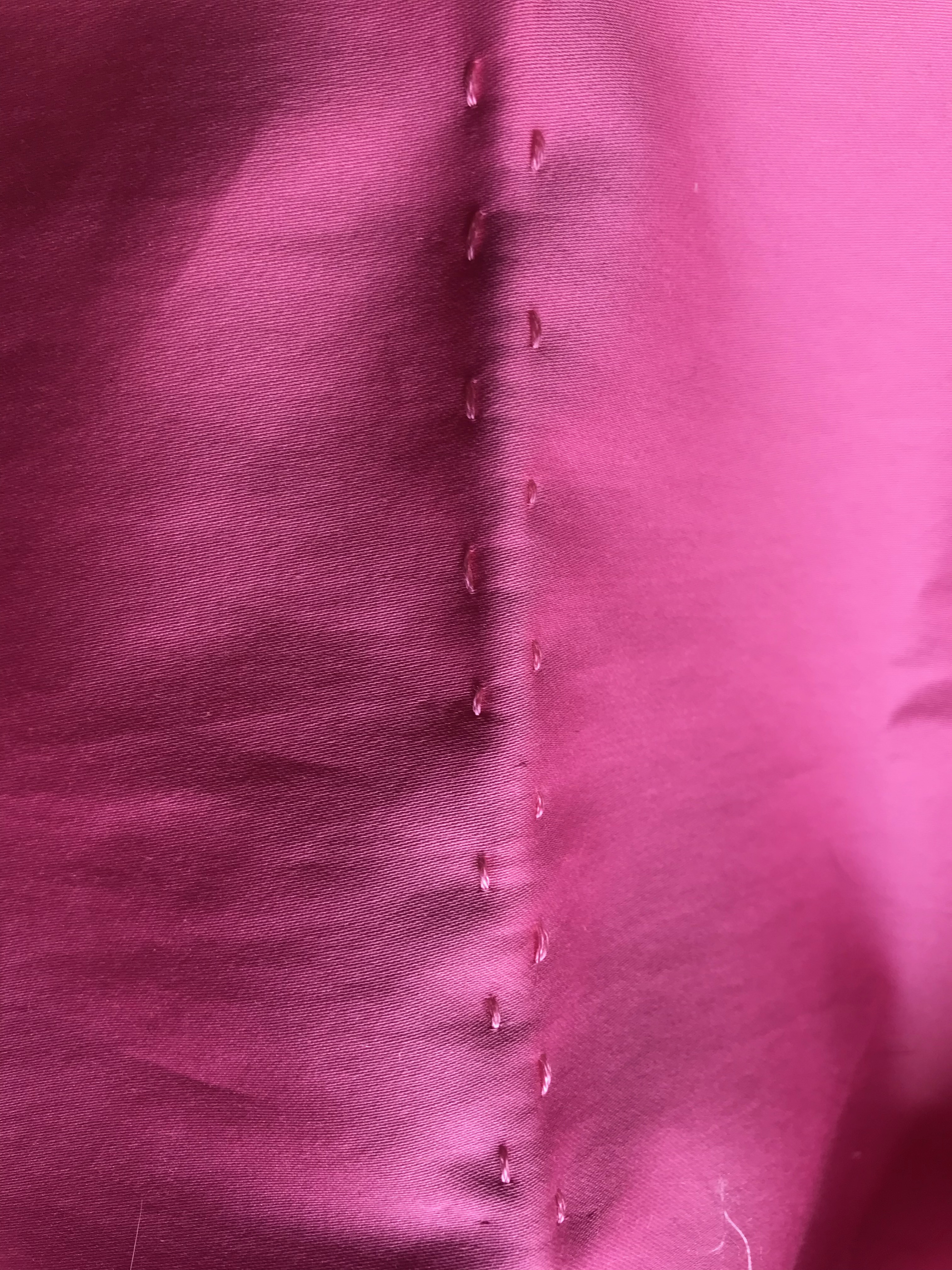
And here is what it looks like on the right side of the lining. The lining gathers beautifully with this thread channel for the elastic cord, as is apparent in the image below.

Once I had the coat partially assembled, I decided I would have liked it to be a bit longer than I planned with the muslin.  I was very tight with fabric, so I really could not have cut it longer and still been able to get the coat out of the fabric I had.  So, to gain another inch and a half, I decided to face the hem right to the point where the lining would be attached.    It certainly took extra effort, but I’m glad I did it as I much prefer the slightly longer length.  

The one thing I would change should I ever make this coat again (which I doubt) would be to add about an inch or so to the diameter of the cuffs.  I would like to keep them buttoned and be able to slip my hands through them.  As they are, they are too tight to do that.  This was something I could have determined had I made a muslin/toile with completed sleeves, which I did not.  All I did was check the length.  A good reminder to me to be more thorough in situations like this.  

When I was planning this coat, I intended to use this vintage silk fabric for the lining.

However, even though I underlined the fashion fabric with white cotton batiste, I felt there was a slight “see-through” of the black details in the print of the intended fabric.  In the meantime, I had ordered a piece of polished cotton in “Paris Pink” from Emma One Sock Fabrics.  Although not an exact match, the two fabrics – the pink checked taffeta and the polished cotton – made a pretty pair so I changed course, and the rest is history.

I am quite happy with this pink lining!

No report on this coat would be complete without mention of the buttons. Again, I went with vintage mother-of-pearl buttons. These have a carved detail in them, which I thought would pair nicely with the gingham.

I chose to do machine buttonholes on this silk coat.

This was an involved, lengthy project.  I was rather in awe of my 24-year-old self for attempting it “back in the day.”  But making it again brought back hidden memories (good ones) and new appreciation for all that I have learned over the ensuing years.  Wearing my new version of this Trench-inspired coat will, I believe, fall into the “nearly perfect“ category.  

44 Comments

Filed under Buttons - choosing the right ones, Christian Dior, Coats, couture construction, Dressmaker coats, Linings, Mid-Century style, Silk taffeta, Uncategorized, vintage buttons, vintage Vogue Designer patterns, vintage Vogue patterns from the 1970s

Is It a Trench Coat – or Is it Not?

It is not.  However, I am quite sure this classic look from 1974 was inspired by the classic Trench Coat as we know it.  

I am certain this Vogue pattern is from 1974, as it is featured in that year’s July/August issue of Vogue Pattern Book Magazine.  It is part of a section entitled NEW ARRIVALS.  

The caption tells me it is made in silk shantung, a little bit of information unknown to me when I decided to make my (new) version of it in silk taffeta.  

Interestingly, in the same NEW ARRIVALS section, a dress by Patou also is reminiscent of Trench coat style, with its epaulets, slotted pockets with shaped flaps and a belted waist.  It also has a center back inverted pleat.

Fast forward two years and here is a very classic Trench in the 1976 September/October issue of Vogue Pattern Book Magazine.  

The caption reads: “Come rain, come shine, what more liveable coat than the trench!  All that star reporter elan in epaulets, front & back shields, center back inverted pleat.”  This particular pattern also includes a detachable lining for the coat and additional detachable collar. I believe that is the collar you see in red in the above picture from the magazine.  The thumbnail drawings of the pattern are helpful in seeing these details:

Now, hang onto your hats and fast forward 46 years to 2022.  The Trench Coat, despite being in fashion since the 1940s, is apparently enjoying new attention and reimagination according to an article in the Style & Fashion section of The Wall Street Journal, April 23-24, 2022.  Although I am a little doubtful as to the long-lasting appeal of some of the Trench Coat variations shown and suggested in the article by Katharine K. Zarrella – which include a skirt, pants and a corset (really?) – some of the reflections and thoughts on Trench Coat style by various fashion insiders are worth sharing.  

Michael Kors is quoted as saying:  “A trench coat inherently feels like an old friend that makes you feel very secure…  But you want an old friend to surprise you.”  (Pink checks, anyone?)

Jane Tynan, author of a soon-to-be-released book entitled Trench Coat, says the appeal of the Trench to contemporary women is the “danger and sensuality it conveys.” (Think spies and clandestine meetings.)  However, a certain Loa Patman of Boston, Massachusetts, says, “Anything trench-inspired tends to look somewhat pulled together and professional.”  

Well, I don’t expect to be doing any sleuthing in my Trench-inspired Christian Dior design from 1974, but I do aspire to feel “pulled together” while wearing it.  Right now it is anything but pulled together, as you can see from the photos of my “work in progress”.  

Thinking further about the origins – and definitional category – of this particular design from the House of Dior, it seems to me to be a cross between a dressmaker coat and a Trench. Perhaps “Dressmaker Trench” might be the best description. As you will recall, if you follow this blog, I have referred to “dressmaker coats” before. Fairchild’s Dictionary of Fashion describes it as: “A woman’s coat designed with softer lines and more details than the average coat. May have a waistline and unusual details, e.g., tucks or pleats.” (p. 92, ibid.)

I’m not sure Dressmaker Coat is a descriptor many use anymore, but it certainly is useful. One thing I am quite certain of, once this Trench-inspired Dressmaker Coat is finished – it promises to stand the test of further time. I anticipate it as a staple in my Spring and early Summer wardrobe.

5 Comments

Filed under Christian Dior, Coats, Dressmaker coats, Fashion commentary, Mid-Century style, Silk taffeta, Uncategorized, vintage Vogue patterns from the 1970s

A Frivolous(?) Decision

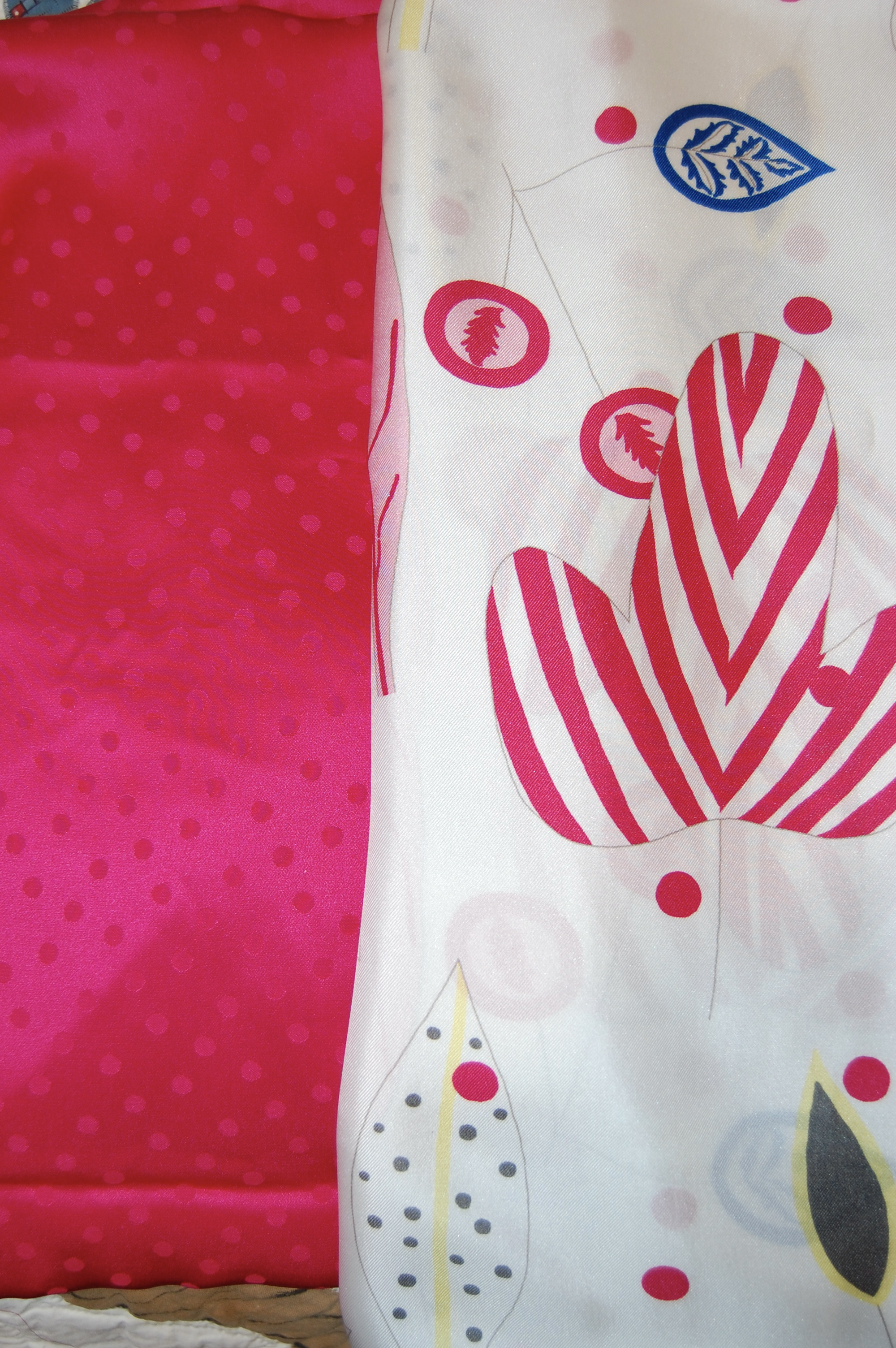
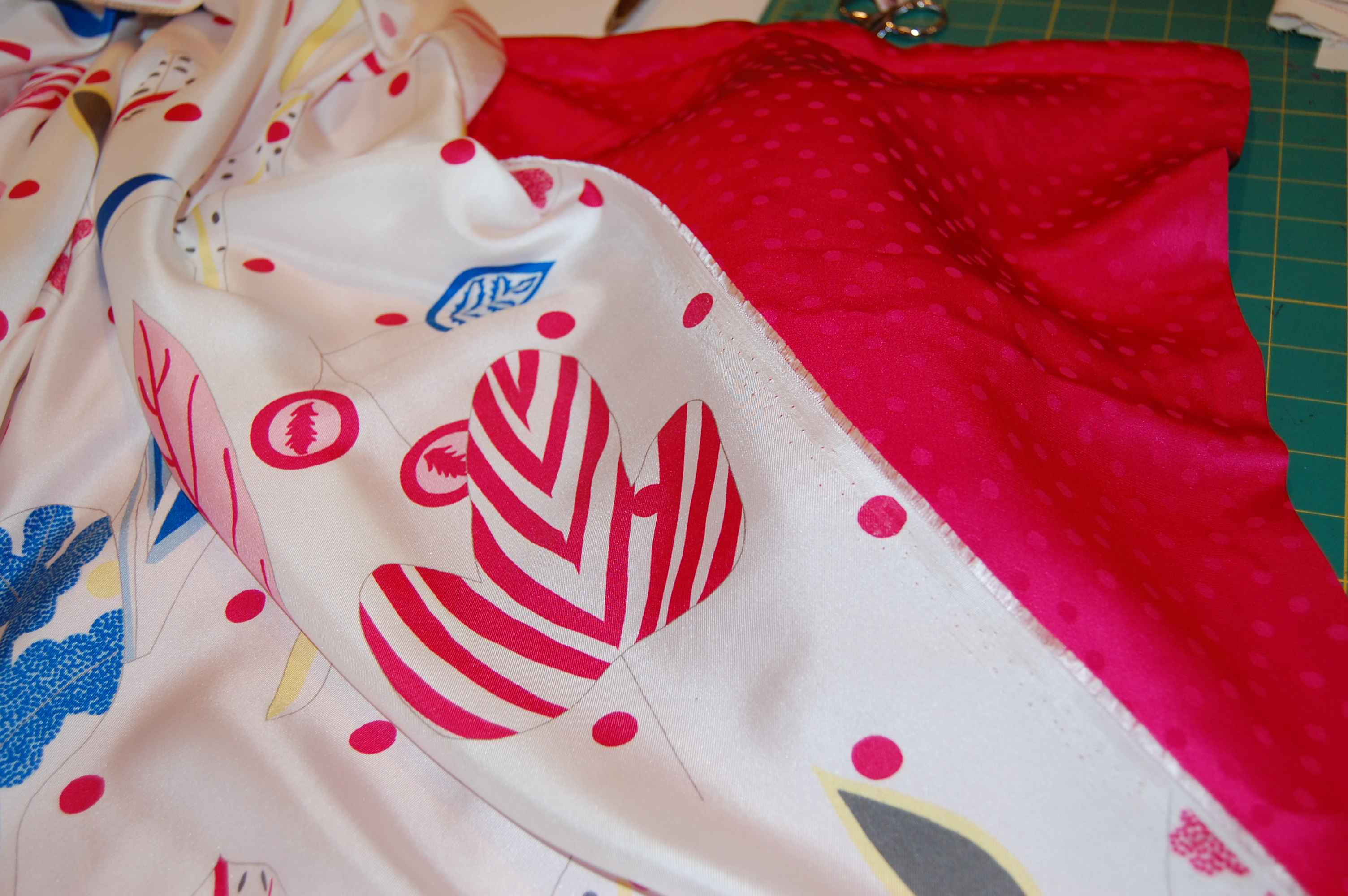
When inspiration strikes, one must seize it, even if it doesn’t really make sense.  You may remember this fabric from a couple of months ago, purchased online from Britex Fabrics:

This is one of those fabrics which has just gotten better and better the more I have looked at it.  I have had it sitting out in my sewing room since it arrived, just pondering its potential.  Then one day I went “shopping” in my fabric closet.  I have my stored fabrics divided according to fiber or usage, with a large “basket” container for each class.  For example, all the silks are together, as are the linens, the cottons, the lining and underlining and interfacing fabrics, with the wools (which take up more space due to their generally bulkier nature) stacked on shelves next to the baskets.   Well, this particular day – the day I went “shopping” – I pulled out the silk fabrics just to reacquaint myself with what exactly I had in that container.    Buried down at the very bottom I found a deep pink, polka dotted silk charmeuse jacquard and INSPIRATION struck!  I had found the perfect complement to my newly acquired floral printed silk twill.  

At that point all I could imagine was a pink silk blouse and a flowing hostess skirt.  My prudent, practical side told me I have no occasion for such an outfit.  But my creative, dreamy side said “If you make it, you will wear it.”  I am stealing the following quote from some unknown sage, but it is speaking to me now:  “The chief enemy of creativity is good sense.”  

These two fabrics are meant for each other with their perky polka dots and shared sheen.  And the somewhat amazing thing is I purchased the pink charmeuse probably 10 years ago from – you guessed it – Britex Fabrics!  

Once I had the two fabrics side by side, I really began to “see” the floral twill, all its intricacies, the brilliance of design in having a spacious polka-dotted field for those whimsical flowers, and the color combination where the blues and pinks play off of each other in a color tug-of-war.  In the words of Oscar Wilde, “To look at a thing is very different from seeing a thing.”  [My italics]

My mental wheels were really turning by this time.  I knew what blouse pattern would be perfect for this two-piece project.  I had made this 1950’s pattern a few years ago in a silk dupioni – and it has continued to rank among my most favorite makes.  

(Well, this could use a good pressing!) I love the sleeves with their French cuffs and the lovely neckline of this pattern.

I will have to search for a skirt pattern, but suffice it to say, it should have uncluttered lines to show off the fabric, and it definitely needs to have a gentle fullness to it.  Decisions still need to be made as to how I underline this fabric.  I believe white cotton batiste will be best, as I will need to block the show-through of the pink blouse fabric.  That, combined with a white crepe  de chine lining, should do the trick.  We will see, as they say.  

Time is, God-willing, on my side.  I envision the start of this project in late Winter or early Spring of 2022.  And buried deep in my head – like that pink fabric buried deep in its lair – is the thought I may just have to HOST some tony party to provide the perfect setting for my elegant hostess skirt and swanky blouse.  Who wants an invitation?  

24 Comments

Filed under Polka dots, sewing in silk, silk, Uncategorized, vintage Vogue patterns from the 1950s

A Fabric Story

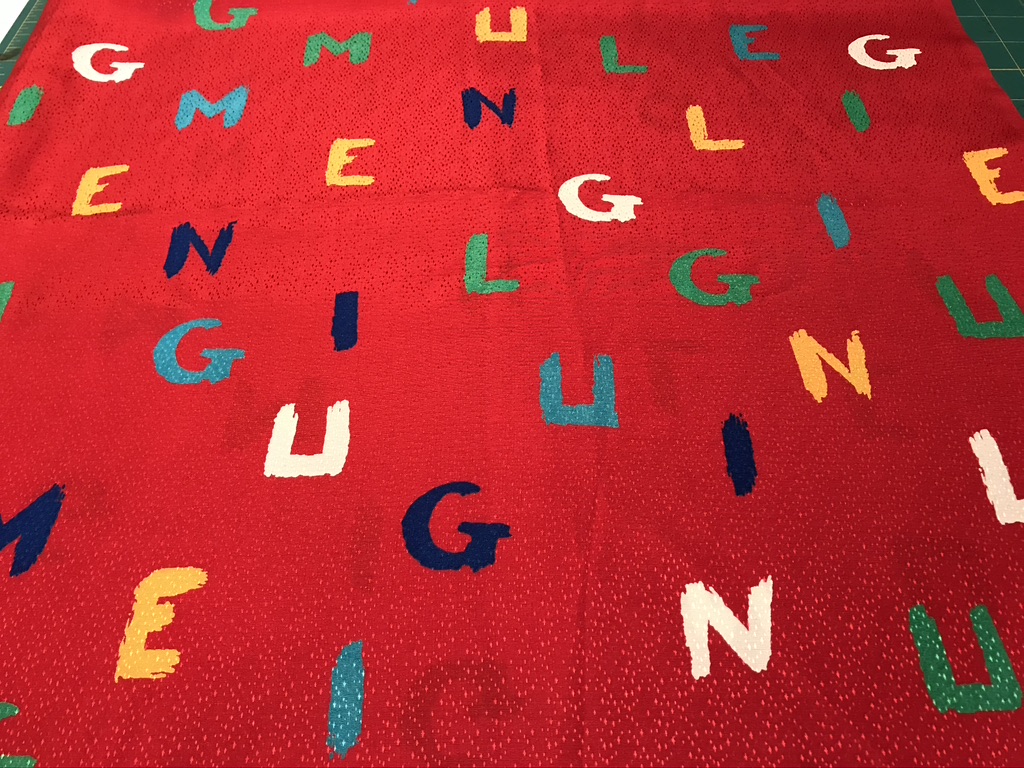
Several years ago I found this fabric on the website of Britex Fabrics in San Francisco.  As I have always been intrigued with “alphabet” prints, and I love red, making this purchase was an easy decision.  

At first glance, it appears to be just that – an alphabet print.  But if you look closely, you start to realize that the letters represented are not all the alphabet.  In fact, only 7 letters of the alphabet are represented.  They are indeed only the letters in the surname of the manufacturer, Marcel Guillemin et Cie.  The manufacturer’s name is in the selvedge.  

I decided to buy two yards, thinking I would one day make a blouse.  A couple of years went by and I had occasion to visit Britex while on one of my trips to California.  By this time I had started making Classic French Jackets, and I was always on the lookout for potential lining fabrics for a future jacket.  To my great surprise, the bolt of this exact fabric was on the silk table, which gave me the opportunity to purchase another yard “just in case.”  (I’m not sure why I didn’t buy another two yards.)  This one-yard length joined its sibling in my fabric closet.  I thought about it a lot, and often got it out to admire it, still not committing to its actual use, however.  

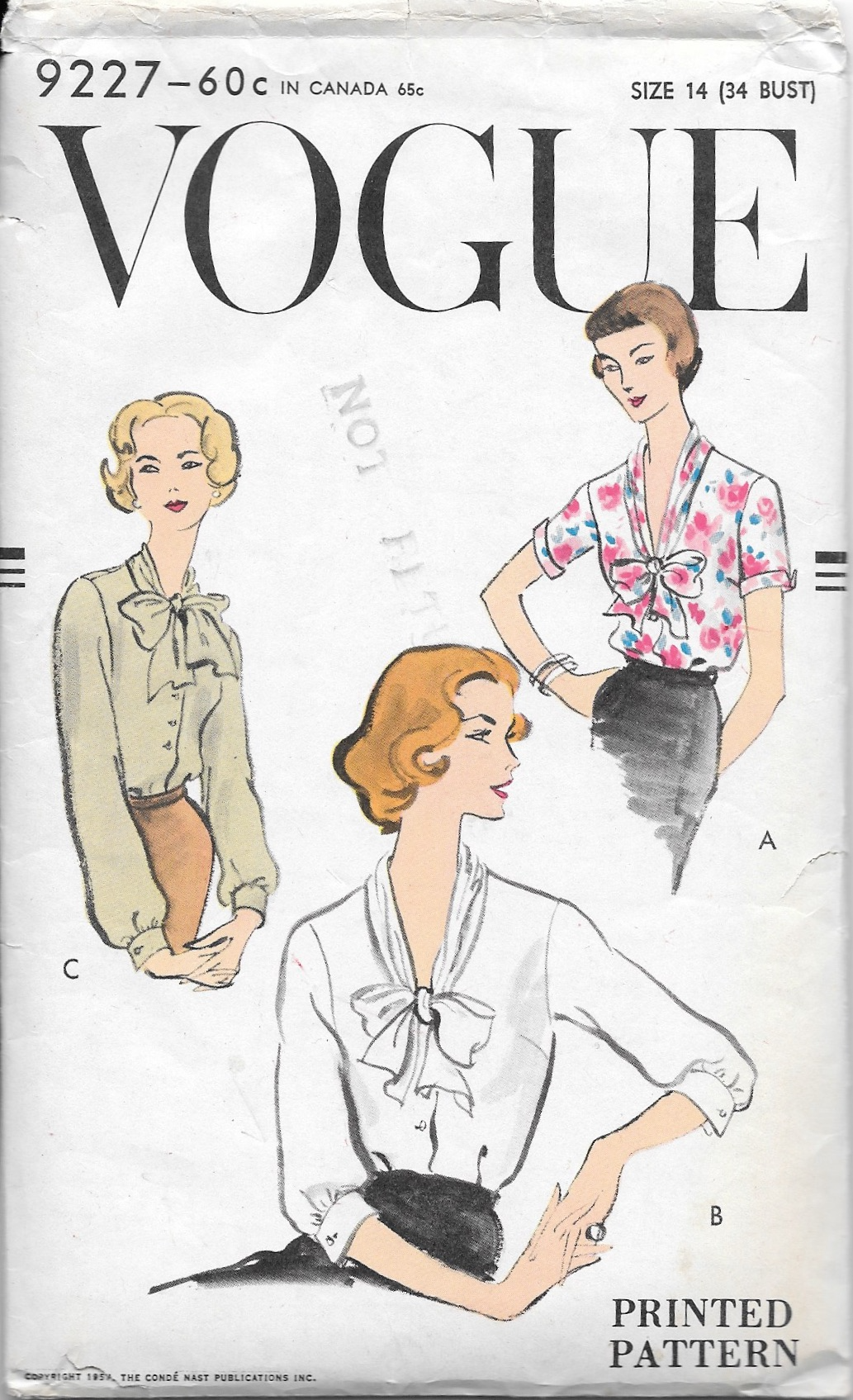
Fast forward several years – to 2020, to be exact.  A plan started to form in my mind for this fabric.  And it all had to do with this blouse pattern from 1957.  I envisioned this blouse made into a dress, and that was that.  Decision made!

I used View B for a blouse several years ago, and have always loved it. Why not a dress?

Sitting in my sewing queue over the summer, this fabric kept talking to me.  Although at one time, most fabric manufacturers proudly included their name on the selvedge (and even sometimes provided labels), it is somewhat rare to find this selvedge notation now.  So, I wanted to know “Who is Marcel Guillemin?”  

I was able to find a little bit of information online, but only enough to raise more questions.  The most valuable information came from my personal “library” of fashion/fashion history books, which not only provide me with inspiration but also background information.  Although I still have many blanks to fill in, this is what I discovered – and what a surprise it has been!  

  1. Marcel Guillemin et Cie was a “wholesaler established in Paris in 1930; manufactured silk and synthetic fabrics; still active today.”  I found this entry in Balenciaga: Shaping Fashion, by Lesley Ellis Miller, V&A Publishing, London, 2007. 
  2.  The company provided “ribbons, silk and velvet” for Balenciaga (ibid) and silks for Christian Dior.  Each couturier had a list of textile purveyors whom they used for their creations, and it was exciting for me to find Marcel Guillemin among the listed.  Anyone who knows of the post-World War II efforts to revitalize the devastated fashion industry can appreciate what Guillemin and other textile concerns faced at that time. “The French luxury textile industry was a fragile one throughout the postwar period.  To assist manufacturers, the French government gave a subsidy to couture houses if they used 90 percent French textiles in a collection.”  Christian Dior: History and Modernity 1947-1957, by Alexandra Palmer, Royal Ontario Museum, Toronto, 2018., p. 69.
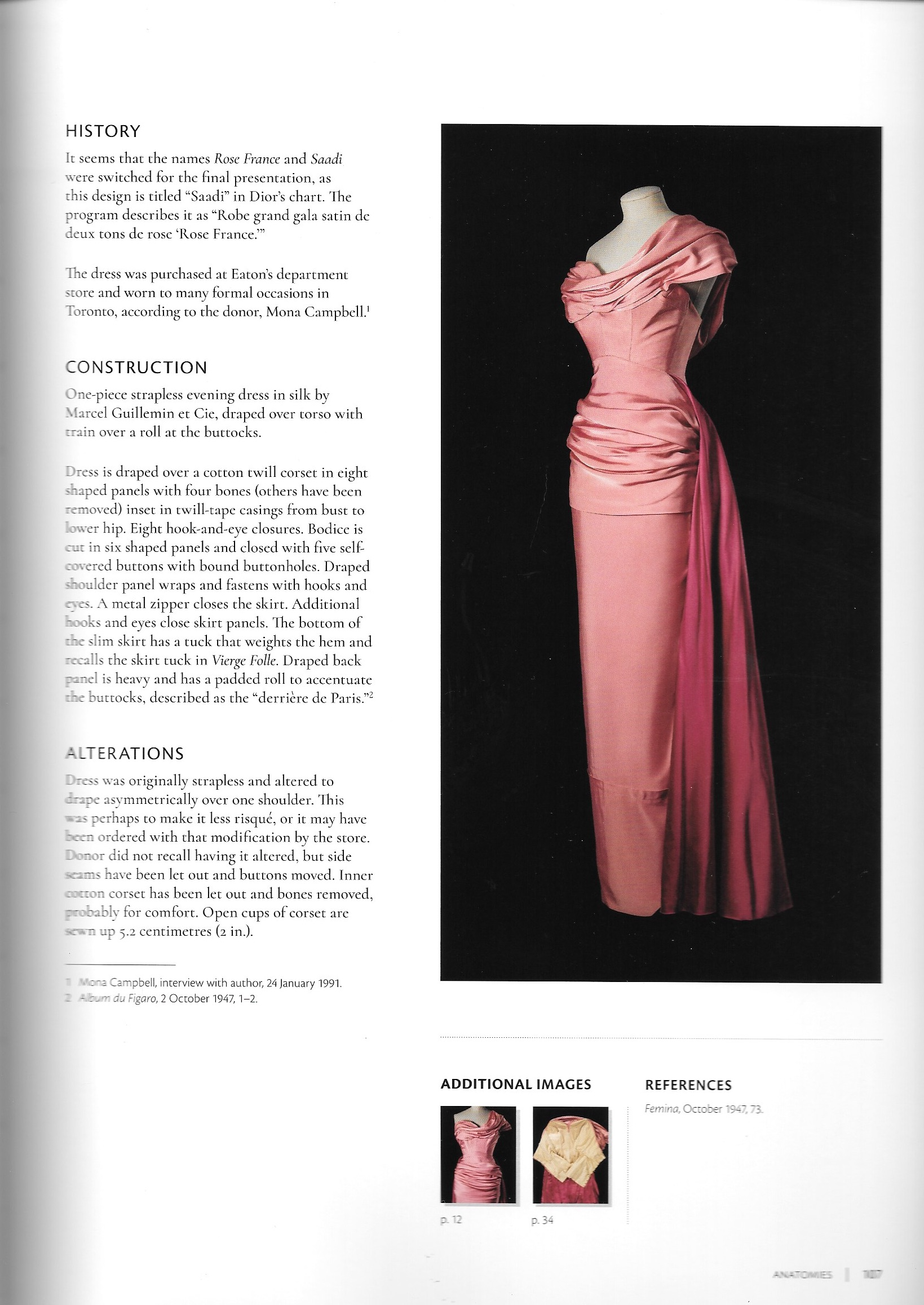
This well-known dress from the House of Christian Dior, 1947, was made in silk from Marcel Guillemin et Cie. (Ibid., p. 107)

3. The company also produced silk scarves. A number of silk scarves which I have found pictured online appear to be from the early years of the company.  But it also appears that Guillemin became known for its scarves at least through the 1960s.  

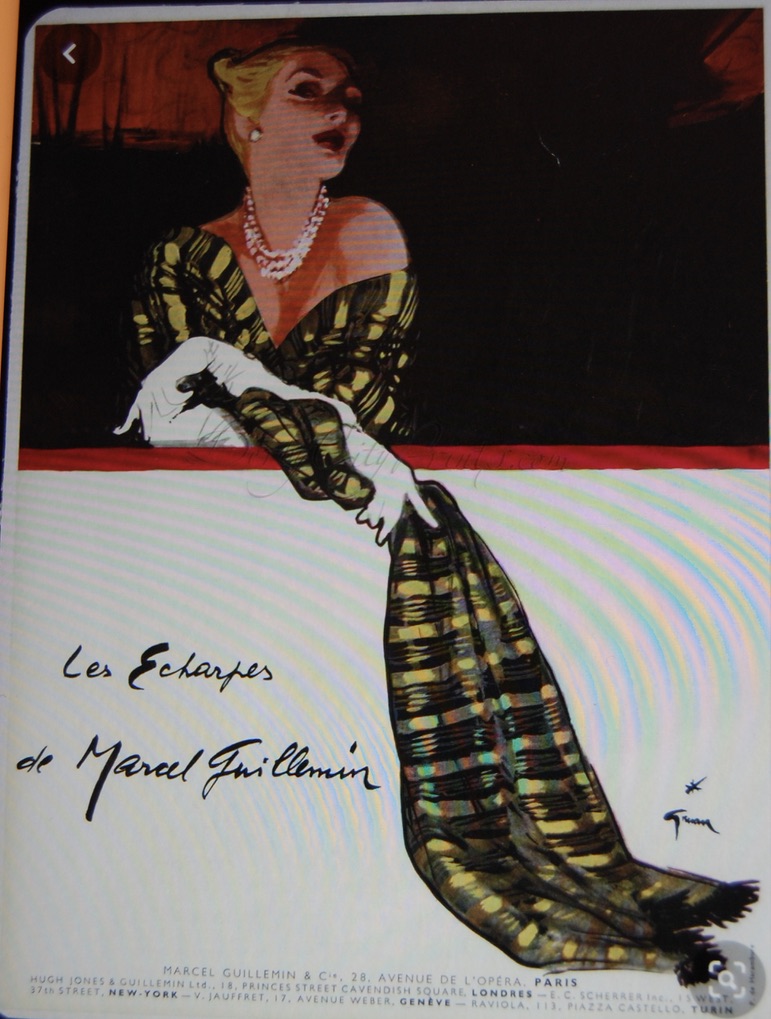
This advertisement from the 1950s with an illustration by Rene Gruau features “Les Echarpes de Marcel Guillemin”

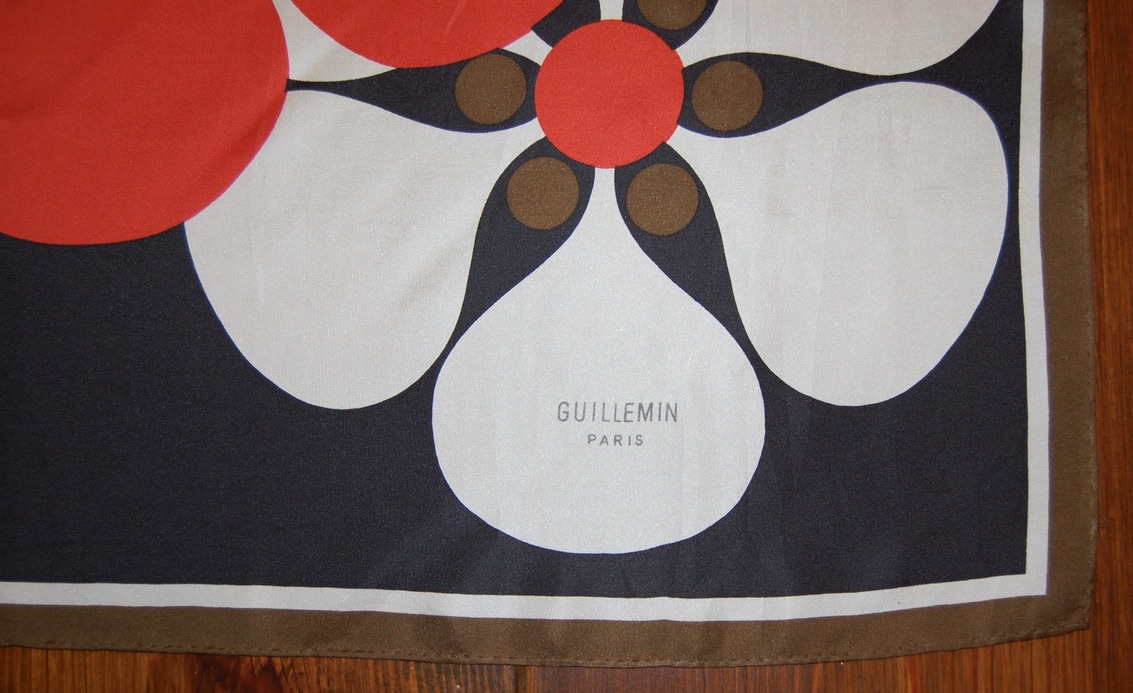
A few vintage scarves with the Guillemin name printed on them are currently available for sale in various online shops and sites.  This one appeared in an Etsy shop a few weeks ago, and I was quick to purchase it. 

 The seller listed it as “probably 1980s,” but I believe it to be from the 1960s when Marcel Guillemin et Cie produced a number of scarves in bold geometric designs.  This one is quintessentially 1960s’ “flower power.”  And the silk is lustrous, of the best quality.  

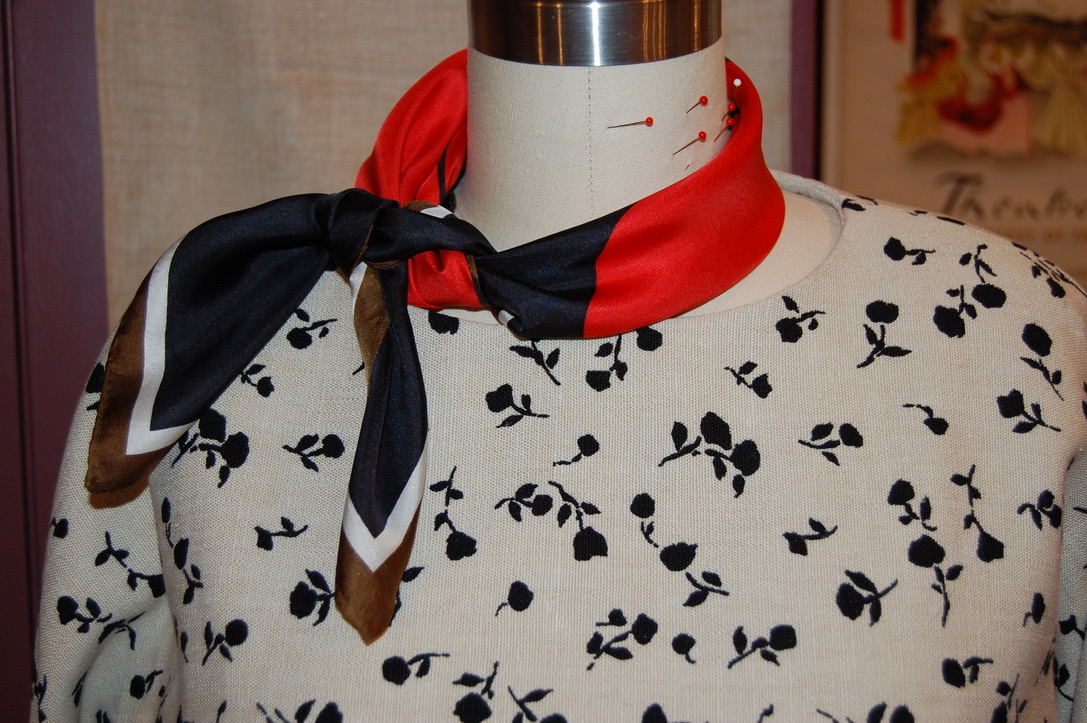
When I found this scarf, I knew it would be perfect to pair with my recently completed linen dress.

The fabrics we use in our sewing is of such importance to a successful outcome.  I have treasured this opportunity to learn more about this fabric and the storied history of Marcel Guillemin et Cie. 

Of course, every story benefits from a happy ending.  I have still to finish writing – or should I say, sewing – the ending, but with any luck, it will be the successful completion of my red silk dress.  Stay tuned for the next chapter.

20 Comments

Filed under Christian Dior, Fashion history, silk, Uncategorized, vintage Vogue patterns from the 1950s

Almost September

What?  It is almost September and time to assess just exactly what I accomplished the last three months.  I have a friend whose late mother always said, “A flurry of activity at the end of the day does not make up for earlier unfocused, unproductive hours.”  I guess the same could be said for the waning days of a month or a season.  However, despite my nagging feeling that I have not accomplished much this summer, I have actually made some progress on my never-ending list.

For one thing, I tackled the alterations on my silk floral dress about which I wrote earlier in the summer.  I took out the hand-picked, lapped zipper to see if resetting it would give me enough ease over the tight bust and uncomfortable back.  There was much to take out and then put back in:  the lining, part of the neck ruffle, the understitching of the neck facing, and of course the entire zipper, in addition to reattaching the silk organza underlining back to the fashion fabric.  Thank goodness for the ample seam allowances which, in true couture fashion, enabled me to add just enough extra across the back.  Yes, it worked, and I am so much happier with the fit and the look of the dress.  Now I can wear it or hope to wear it! (Someday?)  I still think I will tweak the neckline a bit if I make this pattern again, but I do feel I salvaged this dress.

Well,  these are not the shoes I intend to wear with this dress. They happen to be the only heels I have with me this summer.

This dress fits so much better… I’m so happy I did not put off “fixing” this dress until … who knows when!

Several weeks of the summer were devoted to home decorative sewing, including pillows, cushions, and a tailored bed skirt.  I won’t bore you with that! But it was all very time-consuming, as those things tend to be.  More weeks were spent, happily, with welcoming  family for visits and extended stays and even some sewing for my granddaughters. I have never known two little girls who enjoy “playing dress-up” more than my two.  In a weak moment a couple of years ago I purchased this amazing vintage pattern of the Chiquita Banana Señorita’s dress in girls’ size 6-8.

The Chiquita Banana copyright for this costume is from 1947. The pattern is undated, but it is undoubtably from the 1950s.

I knew this was the summer to make these dresses, so I was off to the races on them.  I opted for rick rack rather than bias tape as the decorative trim. I ordered the fabric from Farmhouse Fabrics – a cotton/poly blend which was lovely, and in equally lovely colors.  As the dresses got heavier and heavier as I worked on them, I decided to eliminate the third row of ruffles.  As it turned out, the dresses were amply sized.  My 5-year-old granddaughter reassured me that it was so good to have dresses with room to grow.  And so, these fiesta dresses will serve them for at least a couple of years.

I wanted the girls to have different colored dresses, and I got creative with the colors, as I really think of these as “fiesta” dresses rather than Chiquita Banana. Lots of twirling ensued!

And then last week – yes the last full week of the month – I was finally able to focus on what will be my last make of Summer. Here is the pattern:

This pattern is dated 1957.

And here is the fabric:

I was fortunate to find this vintage piece of Moygashel linen several years ago. It is also from the 1950s.

And so my last minute flurry of sewing activity is well underway.  Happy September!

23 Comments

Filed under hand-sewn zippers, Moygashel linen, Ruffles, Sewing for children, sewing in silk, Sheath dresses, Uncategorized, Vintage fabric, vintage Vogue patterns from the 1950s

Unfinished Business

What happens when an unavoidable interruption takes you away from the depths of a sewing project for more than a couple weeks of time?  Well, if you are me, you forget exactly where you were in the process.  And, when you finally get back to work on it, you assume, incorrectly, certain fitting steps have already happened.  Recipe for disaster?  Well, not quite that bad, because this dress can be saved.  It is just going to take some time.

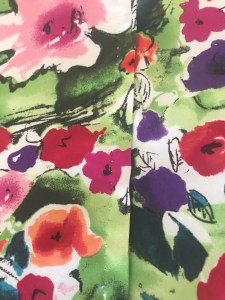
The dress in question is the one for which I used this colorful floral silk.

Although I was so certain in May I would finish this dress before we departed our home on the East Coast (USA) for our Summer home in Wyoming, it did not happen.  So I brought it with me to finish.  When I finally picked it up again, I needed to reacquaint myself with all the steps yet to be completed.  I had the hand-picked lapped zipper sewn and the sleeves inserted.

I love a hand-picked lapped zipper…

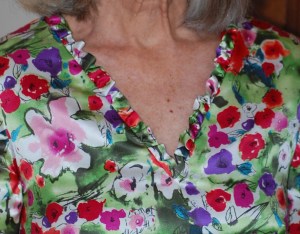
I was working on the narrow ruffle I had decided to add to the V-neck edge.  I consider this to be the focal point of the dress (in addition to the fabric).

I used the same vintage pattern for this dress as I did for a blue silk dress late in 2019. This fabric, to me, was begging for a narrow neck ruffle.

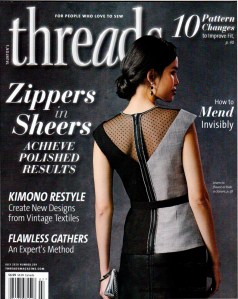
As luck would have it, the most recent issue of Threads Magazine included an article by Susan Khalje on Couture Gathering.  Now, I have done a lot of gathering of fabric in my life, but this article is illuminating in all the tips it offers for an excellent result.  It could not have been more timely.  As it turns out, there is lot more to gathering than I ever considered.

Among the concepts covered in the article are:  gathering ratio, fabric grain, underlining, stitch length, preparation of the piece to be ruffled, forming the gathers and attaching the gathered fabric to the body of the item.  As with so much of couture sewing, each step builds on the one before it.

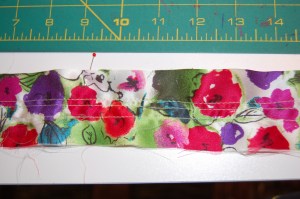
Three of the tips in the article, so helpful to me in completing this detail, were:  1) cutting the piece to be gathered much wider than I would have thought was necessary.  This gives one much more control than with a narrower strip.  2) using three lines of gathering rather than the customary two, and 3) once the gathers are formed, using an iron to set them in place, stopping just short of pressing the ruffle.

I decided on a 5/8″ wide ruffle. I cut my piece to be gathered 5″ wide, folded to 2.5″. I used three rows of gathering stitches.

For those of you with subscriptions to Threads Magazine, I highly recommend this Essential Techniques article.  It has forever changed the way I will do gathering/ruffles.  And although not all features in Threads are as useful, it is offerings like this which make me a fan of this sewing magazine.  (These are my opinions;  I have no relationship with Threads.)

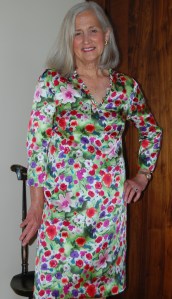
Well, back to where I left off.  After picking up work on this dress again, I proceeded to go through all the steps necessary to complete it.  When I thought this dress was finally finished, I put it on to take pictures, and to my surprise, it did not fit correctly.  It pulls across the bust and forms drag lines on the V-neck.  Ugh.

The pulling across the bust and at the V-neck is clearly noticeable in this photo.

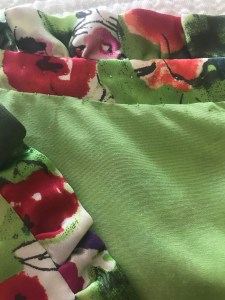
I can only guess I thought I had tried it on for fit after the zipper was basted, but I must not have done that.  Unknowingly, I proceeded with the finishing of the interior – the facing of the V-neck, the hem, and the insertion of a green crepe de chine lining.

Normally with couture sewing, neck facings are eliminated and the lining is brought right up to the neck edge and then understitched to secure it. However, with a V-neck, a facing is necessary. I then cut the lining about 3/4″ below the neck edge and fell-stitched it into place.

I believe removing the zipper and taking some of the center back seam allowance to add to the width of the back will correct this glaring mis-fit. This is not a dress which I will have occasion to wear  this summer – so do I dig in and make the corrections now, or do I wait?  I have quite a bit in my summer sewing queue, and perhaps a tried and true project like a blouse will put me in a better frame of mind.  Regardless, this “unfinished business” will one day be finished, hopefully successfully.


16 Comments

Filed under couture construction, hand-sewn zippers, Linings, Ruffles, Sheath dresses, silk, vintage Vogue patterns from the 1960s

Dreaming in Color

Way back in January of this year – which seems like a lifetime ago now – making plans for my 2020 sewing was an exciting exercise.  I was eagerly looking forward to some upcoming events, including one in early May which was going to require at least two new dresses.  One of these dresses would be worn to a “fancy” evening.  In this casual world, what dressmaker does not relish the idea of making a dressy frock?  It was definitely going to be a fun trip and a varied multi-day event.

C         A        N        C        E        L        L        E       D

Needless to say, that trip and all its events were cancelled.  Other special occasions were also cancelled, along with many that were not so special.  I looked anew at my sewing plans.  I shifted some things around, eliminated others.  But I kept going back to the thought of that dressy dress.  The fabric was so cheerful, the colors so bright I could not abandon the idea of making it, even without an occasion for its wearing. So in early May I decided to go ahead with my original plans, albeit without a deadline.

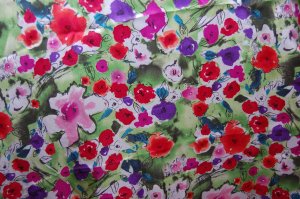
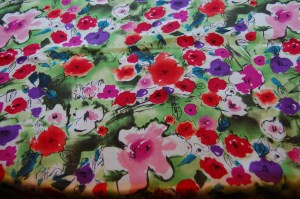
I had purchased this silk charmeuse from Mendel Goldberg Fabrics in New York City several years ago.  It reminded me of fabric which one might see in a design by Christian Dior, due to its “Impressionistic” appearance.

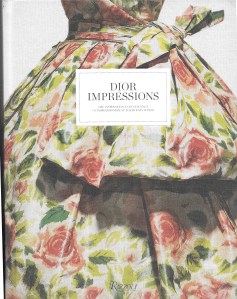
The subtitle for this informative book is The Inspiration and Influence of Impressionism at the House of Dior.

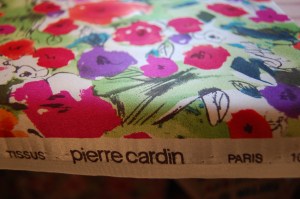
When I unfolded the fabric to give it a press, I saw it was actually a Pierre Cardin design.  It struck me as somewhat unusual for Cardin, so of course I wanted to know if there had ever been any connection between the two couturiers or their fashion houses.  I went to my St. James Fashion Encyclopedia.  Well, yes, as a matter of fact there was:  “From his earliest work for the House of Dior up to the 1950s [my italics],Cardin displays an interest in the sculptural qualities of cut and construction that are still his trademarks in the 1990s.” (p. 87, The St. James Fashion Encyclopedia, Visible Ink Press, Detroit, Michigan, c1997.)

It may be a bit of a stretch to suppose this fabric does indeed have a Dior connection, but still, I wonder.  Could Cardin – now at his advanced age of 97 – and his fashion house still be influenced by those early days with Dior?  Of Dior’s style direction in the early 1950s, Christian Dior himself wrote ”…Colors were inspired by the pictures of the Impressionists and evoked the fields of flowers dear to Renoir and Van Gogh.”  (p. 5, Dior Impressions, Rizzoli International Publications, Inc., New York, New York, c2013.)  It is fascinating to ponder.

Now back to topic:  I started my dress.  I got the silk organza underlining marked and cut, I cut out the fashion fabric, I basted the two layers together, ready to start the actual construction.  Then I had a bad day.  It had nothing to do with my progress or the process, which was going along fine.  I just had this dismal feeling this was all for naught.  Why would I need such a lovely silk dress?  Where would I wear it?  Were all these hours I was spending in my sewing room just a waste of time? What purpose do all these pretty clothes serve without any social gatherings and occasions to which to wear them?  I think it is fair to say I was having a serious existential sewing crisis.  It was dispiriting and discouraging to say the least.  It made me question my otherwise passionate commitment to couture sewing.

That night I had a dream – in vivid color.  I saw myself in a fancy restaurant which was bustling with people – and I was wearing the very dress I had started – now completed and quite notable in its floral print of bright greens, and pinks and reds and purple.   I was seated at a table with three friends and we were lunching. (Not sure this dress is quite the thing I would wear to a midday lunch, but that’s dreams for you.)   The four of us were having the best time. We were laughing and totally engaged in our conversation and in our friendship. It was lovely and it was memorable.

And there was not a facemask in sight.

23 Comments

Filed under Christian Dior, Fashion history, Formal or fancy dresses, Love of sewing, sewing in silk, silk, Uncategorized