
Sewing on more than one project at a time is, I guess, a form of multi-tasking. Although I believe I am like most women in that I am good at multi-tasking, I prefer not to do so with sewing. I like to work on one thing at a time, but sometimes, life just doesn’t lend itself to such discipline. Such has been the case with the hours I have spent sewing, not on my Classic French Jacket, but on two little dresses – birthday dresses! – for my two little granddaughters. I know they won’t always want to wear sister dresses, so I am anxious to sew such things for them while they might still think it is fun. And if that means I need to steal some hours away from my personal sewing, then that’s what happens.
Spring birthdays are lovely as it means I get to sew with cheery cottons and make little puffed sleeve dresses with big sashes in back. I was especially inspired this year with a 5+ yard length of vintage fabric I purchased from an Etsy shop a couple of years ago.
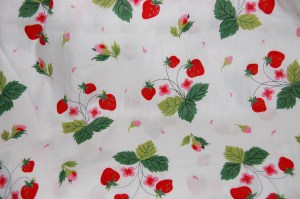
A strawberry print cotton for two little Spring sisters
I knew this fabric was most certainly from the 1950s, as this type of print was prevalent then, as well as the fact that the fabric was only 35” wide. The more traditional width of 45” most of us are used to, did not become commonplace until about 1960. To corroborate my suspicions, I saw this dress on Pinterest:
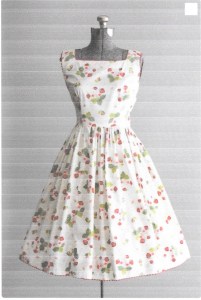
Sold as a vintage 1950s’ dress, it is edged with rickrack.
Although this fabric would probably have been used for adult fashions in the 1950s, I found it to be perfect for little girls’ dresses in 2017. Not only that, I found these vintage strawberry buttons which just seemed to be made to go with the fabric!
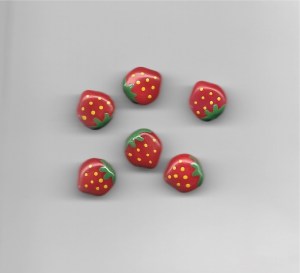
The Etsy store from which I purchased these buttons indicated they are from the 1960s. They are hand-painted and quite small.
I started with a (new) pattern I have used before, and made new copies of the sizes I needed for my two little ones.
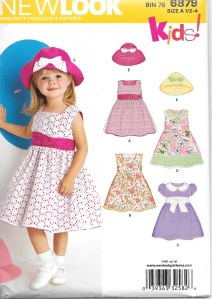
I used View C of this pattern last year for another birthday dress, but obviously made some apparent changes to it for these dresses.
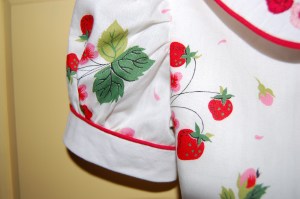
I knew I wanted to make the collars and sleeve bands out of white cotton, and pipe them in red. I made my own piping out of cotton kitchen string and some vintage all-cotton bias tape I had in my sewing supplies.
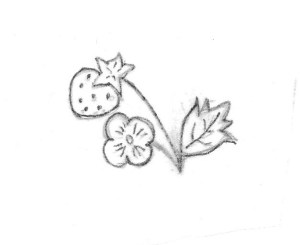
I decided to add a bit of embroidery to the collars just to make these dresses a step above ordinary. I selected a strawberry motif from the fabric and made a drawing, which I then transferred onto the collars.
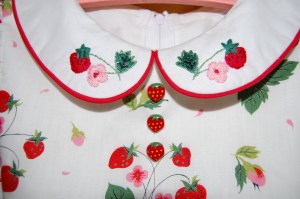
This is the dress for the 4-year-old.
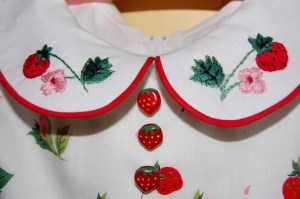
This is the dress for the two-year-old.
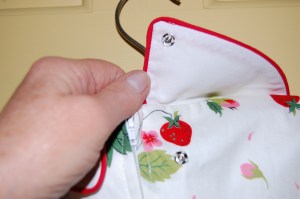
On the back of the dresses, I added snaps to the edges of the collars to make them lay flat. They can be unsnapped for ironing or to wear a sweater, but it certainly makes for a nicer appearance,
When it came to the hems, I found that I had cut the skirt length for my older granddaughter just a little too short. I was pretty irritated with myself until I realized that facing the hem in white bias cotton actually looked better than if I had just turned up the hem. The strawberry print fabric is lightweight and the design would have shown through a hem which was just turned up. You can see this happened in the dress featured on Pinterest.
When it was time to hem the dress for my younger granddaughter, I had enough length, but I decided to underline the hem with white cotton to avoid that “see-through” of the design. So my mistake on the larger dress made for a better outcome with both of the dresses. (It doesn’t always work that way, does it?)
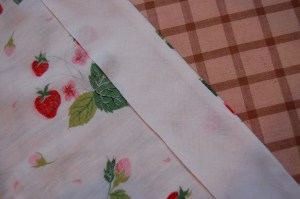
I sewed the bias strip on as if I were facing the hem, then turned it up again. This way, the dress can be easily lengthened if need be.
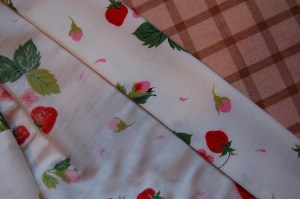
After doing a light running stitch by hand to secure the bias band inside the hem, I then turned up the hem and sewed it as usual.
Three little buttons at the front were the finishing touches for both dresses.
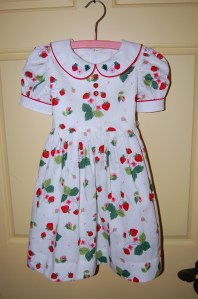
The larger dress…
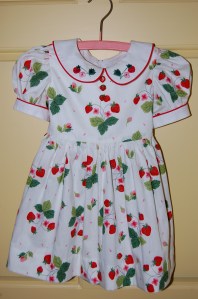
…and the smaller one.
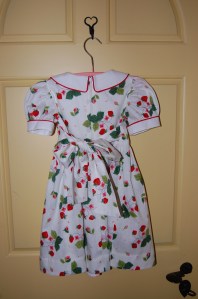
The back of the larger dress
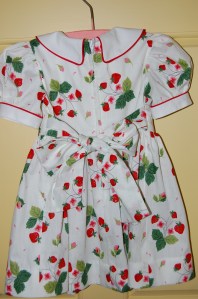
And a back view of the smaller dress.
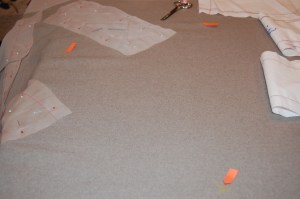
Interestingly, I had to do some strategic planning when laying out the pattern pieces on the fabric. While the design does not have an up-and-down orientation, there are spacing issues that I had to account for. For example, I wanted each bodice front to have a spray of strawberries in the center, with enough space to add the buttons above. In addition, the spacing of the strawberry sprays determined how the patterns for the skirts were arranged on the cloth, as I wanted a balanced appearance of the strawberry sprays, without any cut in half at the waistline.
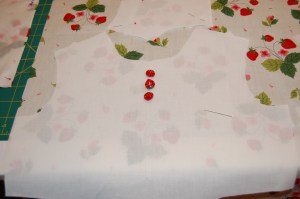
Here I am trying to find the “sweet spot” for the design on the bodices when arranging the pattern pieces. It was easier to do on the larger dress. The bottom button on the smaller dress is a little closer to the strawberry design than I would have liked, but in order for the design to be centered as much as possible, I opted to go this route.
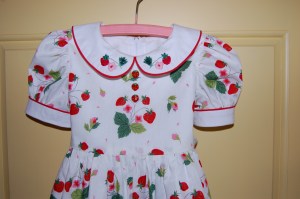
This is the front bodice of the larger dress, with a carefully placed central motif.
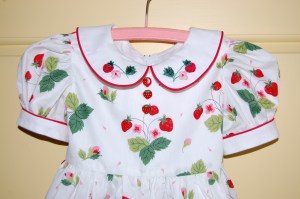
And this is the smaller dress, with a tighter fit for the placement of the buttons.
Sometimes it can get a bit boring making the same dress twice, but the quality of this silky soft fabric is such that it was an absolute joy to sew. And, of course, I was inspired by the thought of my two little girls dressed up and looking so cute! They seem to like their strawberry dresses.

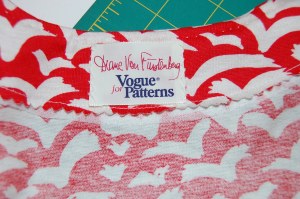
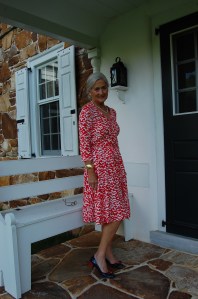
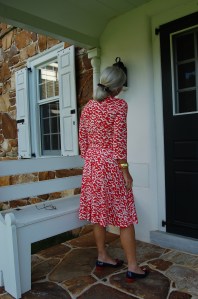
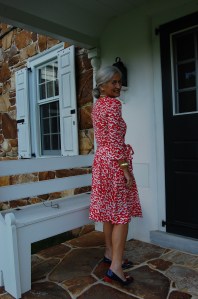
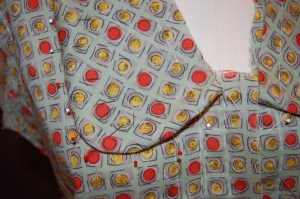
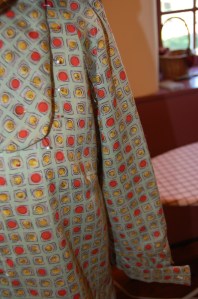
 fiftydresses
Do You Do Pink?
Apparently, pink is a controversial color. Or maybe “was a controversial color” is a better statement. A recent article by Nancy MacDonnell in the Off Duty section of The Wall Street Journal (“Making Peace with Pink” February 11-12, 2017) makes a case for the appropriateness – and timeliness – of pink even for those who think they don’t like it. While I am one who thinks pink is always in fashion, it turns out that this Spring, it really is in fashion! According to Ms. MacDonnell, “On this season’s runways, pink predominated.” The different fashion houses showed varying interpretations of pink: Michael Kors was “brisk, All-American, [and] cheery.” J. Crew was “equally upbeat,” while Valentino showed pink that was “lush and romantic, with intricate appliqués and historical references…” The list goes on and on. The unifying thread (pardon the pun), as claimed by the designers, was the lack of traditional “sweetness” associated with pink, with emphasis on the feminine power inherent in the color.
Looming large on page 58 from the November 2016 WSJ Magazine is a Valentino coat, quite traditional in design, but made very special by its stunning appliquéd pink wool.
According to Dr. Valerie Steele, the Museum Director at the Fashion Institute of Technology in New York, who was quoted frequently in Ms. MacDonnell’s article, the idea of pink as a feminine color did not take hold until the 1950s. Back in 1954 when Christian Dior wrote The Little Dictionary of Fashion, his entry on “pink” stated: “The sweetest of all the colors. Every woman should have something pink in her wardrobe. It is the color of happiness and of femininity.” He even used pink throughout his book for illustrations, chapter headings and the title page. He recommended pink “for blouses and scarves; … for a young girl’s frock; it can be charming for suits and coats; and it is wonderful for evening frocks.” Who can argue with that, be it 1954 or 2017?
The title page of Dior’s smart little dictionary. (Harry N. Abrams, Inc., NY, NY, copyright 2007)
This page from the June/July 2013 issue of Town and Country Magazine gives an interesting timeline of the color pink, “how the color of little girls and baby dolls came of age”:
Click on the image to read it.
I particularly like this statement from Laura Vinroot Poole, the founder of boutique Capitol in Charlotte, N. C., quoted in The Wall Street Journal article: “To wear pink, you have to be an interesting and smart person… You have to have things to say. In pink, you can’t hide.” Nor would you want to.
Personally, pink is my favorite color. I am always drawn to it, regardless of its hue. And its hue covers a huge range from palest pink to deepest fuchsia, from bubblegum pink to raspberry red. In thinking about pink for this post, I gathered this stack of pink fabrics from my collection. Just looking at it makes me happy!
From top to bottom:
1) vintage Moygashel linen, purchased on eBay
2) silk charmeuse, purchased from Britex Fabrics
3) vintage Moygashel linen, purchased by me in the 1970s
4) linen, possibly Moygashel, purchased on etsy
5) silk jacquard purchased from Britex Fabrics
6) silk charmeuse, purchased from Mendel Goldberg Fabrics
7 & 8) coordinating silks, purchased from Mendel Goldberg Fabrics
The only controversy I have with pink is deciding which hue of it I like best.
19 Comments
Filed under Fashion commentary, Moygashel linen, silk, Uncategorized, Vintage fabric
Tagged as Britex Fabrics, Mendel Goldberg Fabrics, Moygashel linen, silk, vintage fashion, Wall Street Journal Fashion coverage