Tag Archives: sewing

My very stylish pants.

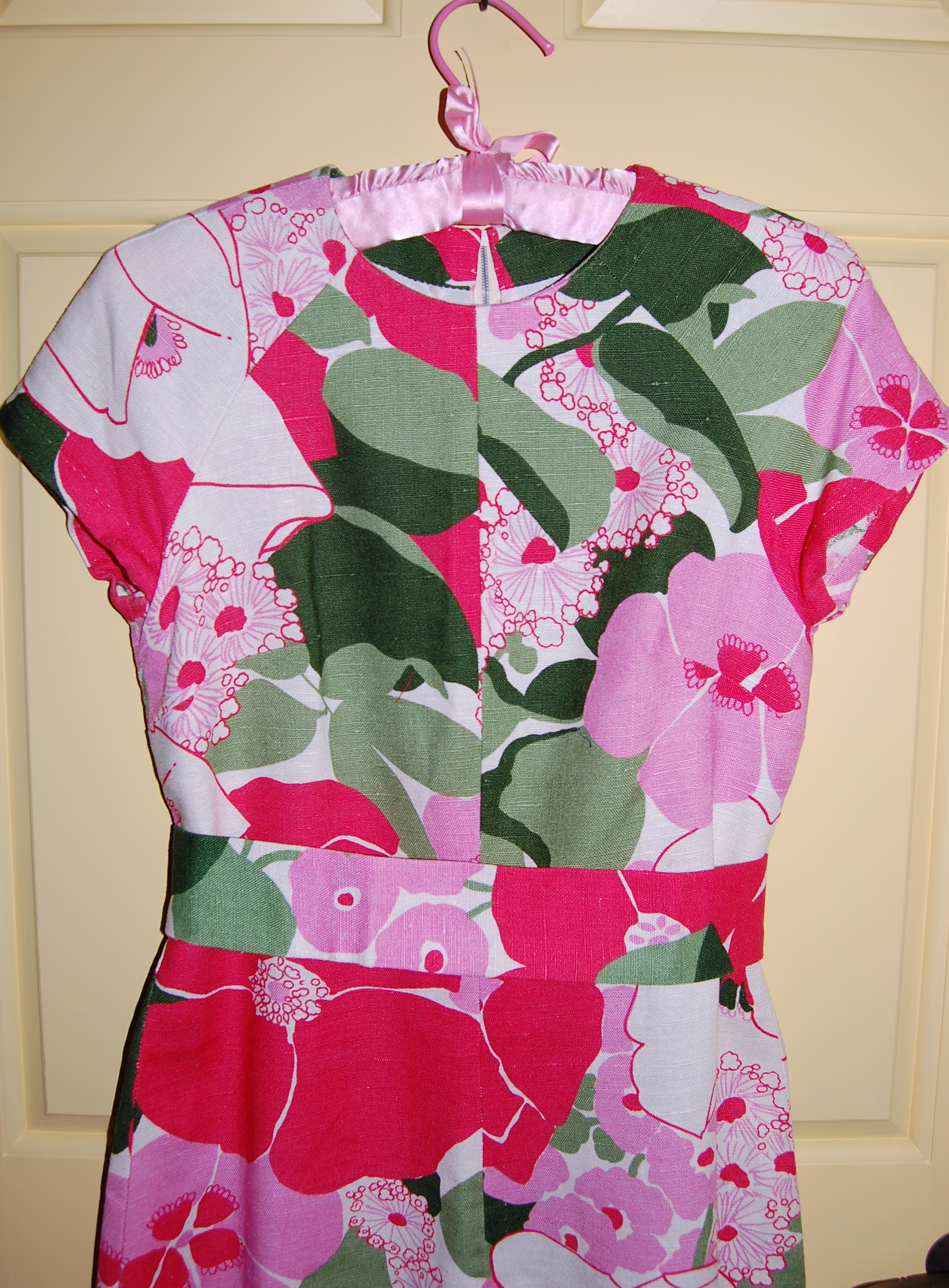
For several months I was watching a piece of Moygashel linen for sale by Revival Fabrics.  When I first saw this offering, I had the eerie feeling of déjà vu – I was sure I remembered seeing this patterned fabric in the late ‘60s or early ‘70s when I was a steady admirer and occasional purchaser of this brand of linen I love so much.  The piece that was being offered was three yards long, 44″ wide and included a Moygashel label.  The description accompanying it suggested making patio furniture pillows or tote bags with it, neither of which much appealed to me.  And actually, this suggestion threw me off a bit ; I wondered if it was drapery-weight linen, not dress-weight.  But the more I looked at it online (clicking close-ups of the images), the more convinced I became that it was dress-weight.  I finally decided to buy it, not really knowing what I was going to make out of it (maybe a sheath dress…?)

When the package arrived and I finally saw this linen in person, I was – so excited! It was gorgeous – and my suspicions were correct – it was definitely dress-weight.
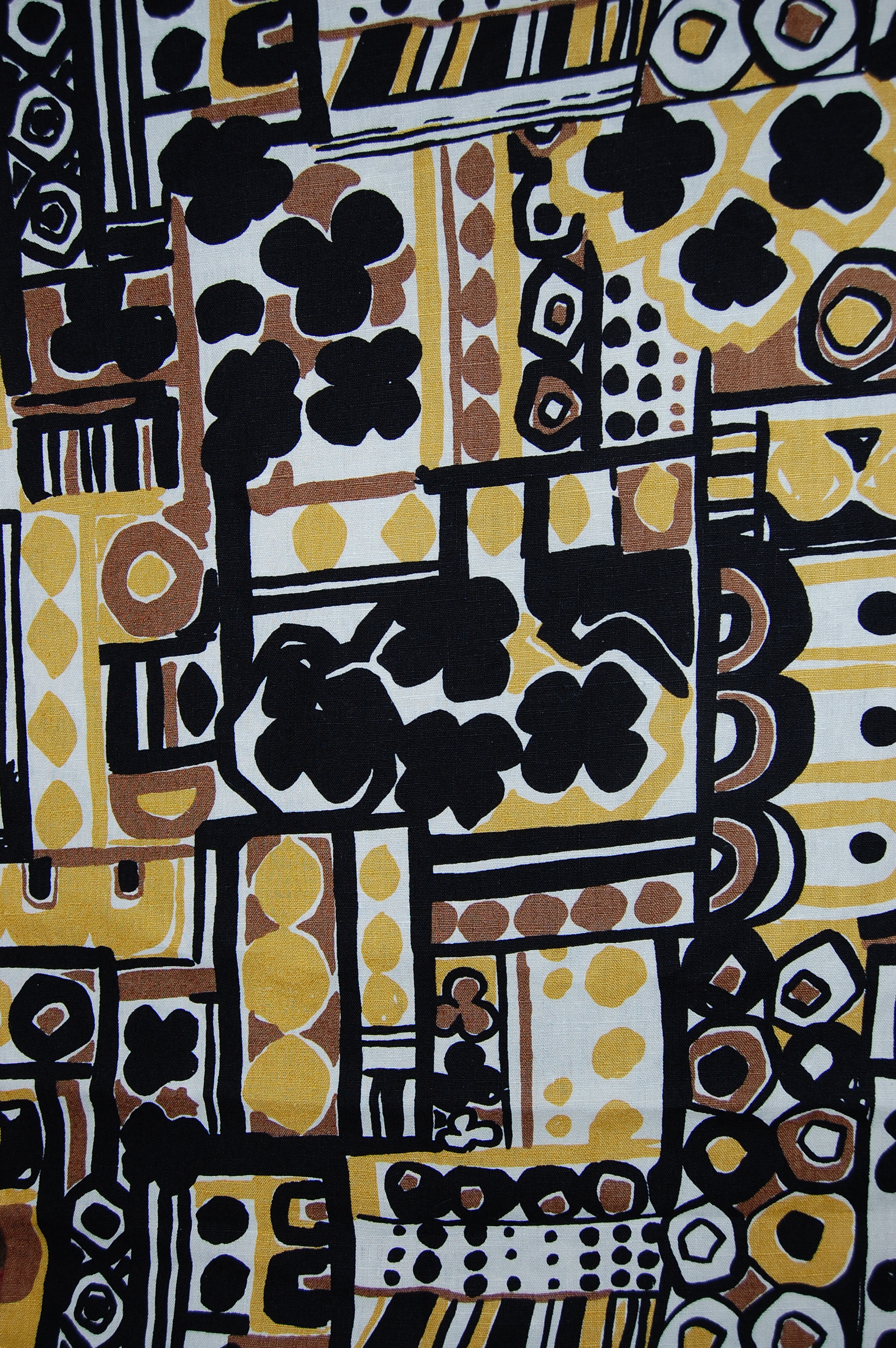
Here is a lengthwise view of the linen.
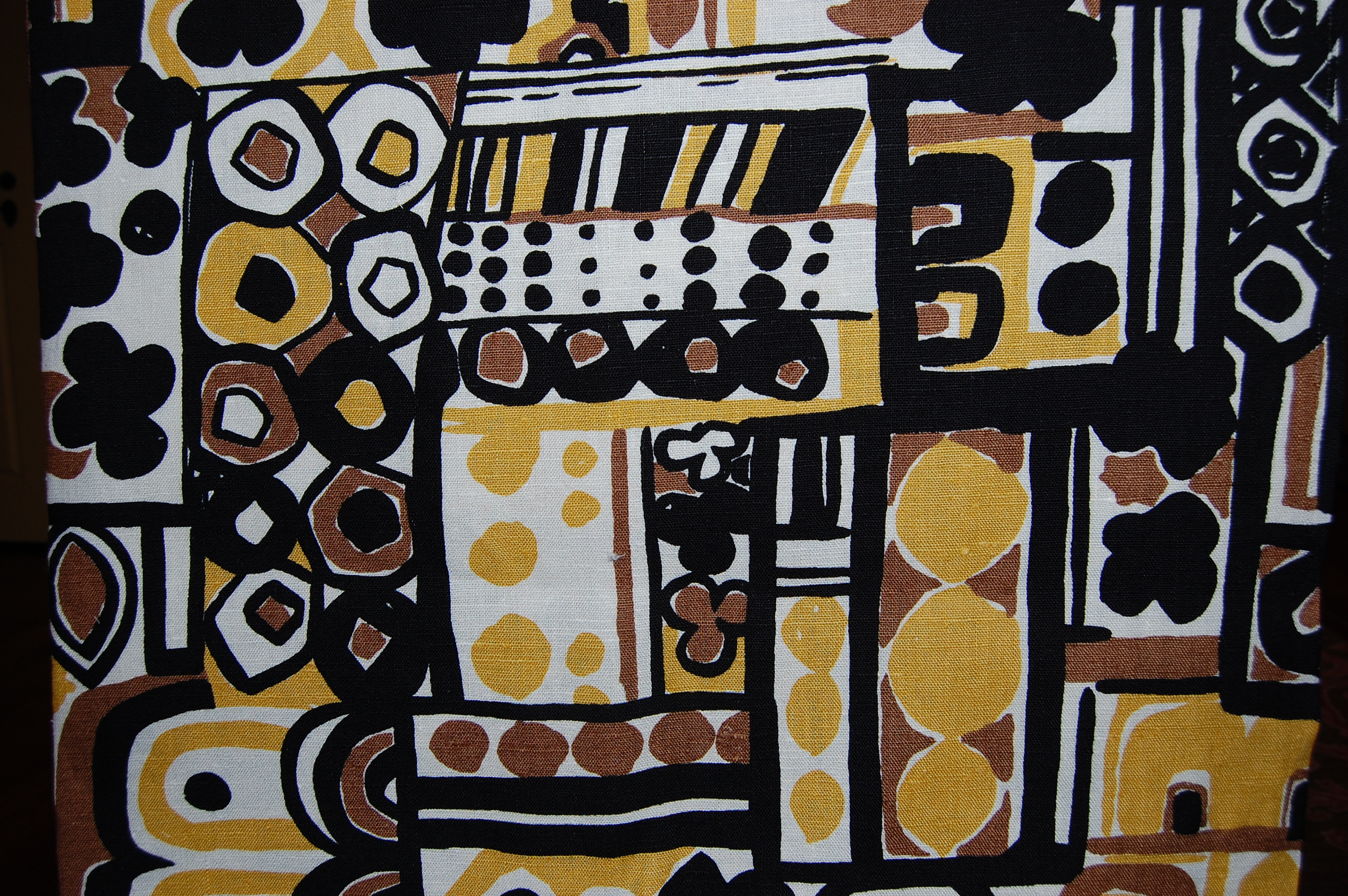
Here is closer view of this amazing pattern.

My first thought after my initial euphoria was:  This would make up into fabulous ankle-length pants (worn with a black, yellow or khaki top – and of course my black and yellow Bakelite bracelet).  And yes, I was sure I would have the nerve to wear them!
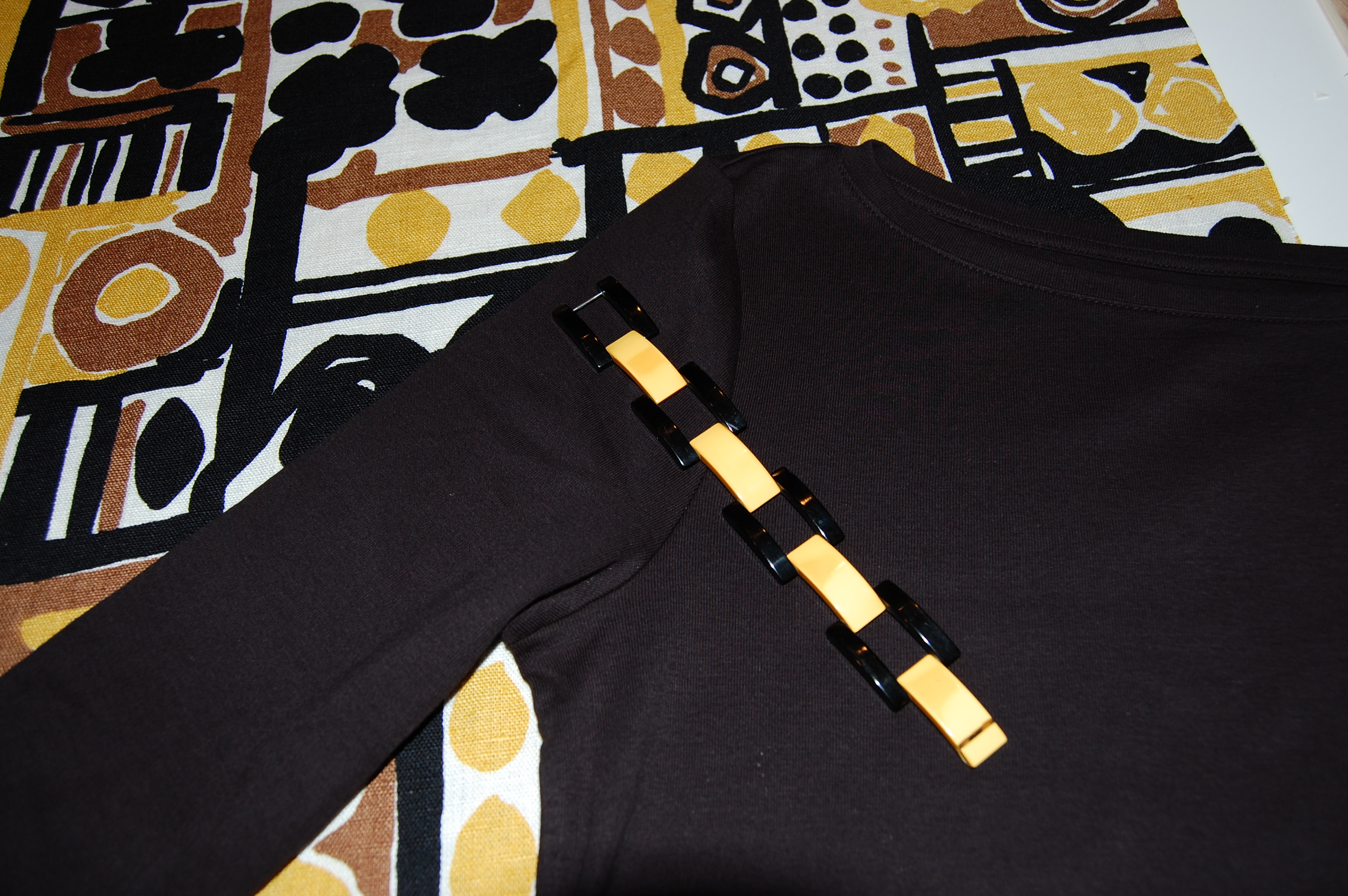
I laid out the fabric with a black cotton knit top and my Bakelite bracelet just to see how it would look.
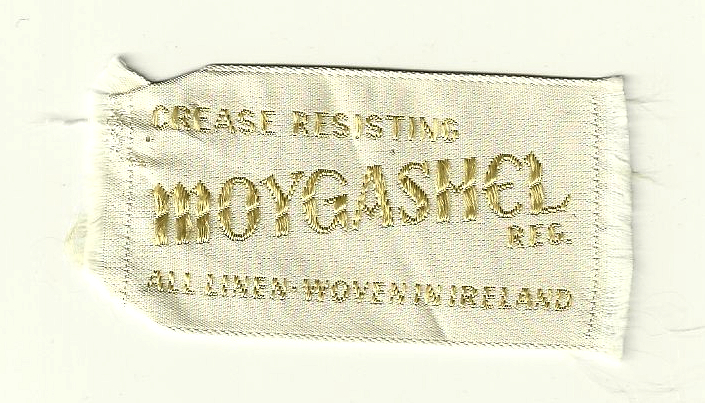
And here is the label which came with the fabric.

With my plan in place, I decided this would be my next project after I finished the one I was on.  Then something really amazing happened.  A fashion article in the May 3, 2012 edition of The Wall Street Journal caught my eye.   Christina Binkley, one of the newspaper’s fashion reporters, headlined her weekly column “On Style”  with The Pantsuit Takes a Walk on the Wild Side.
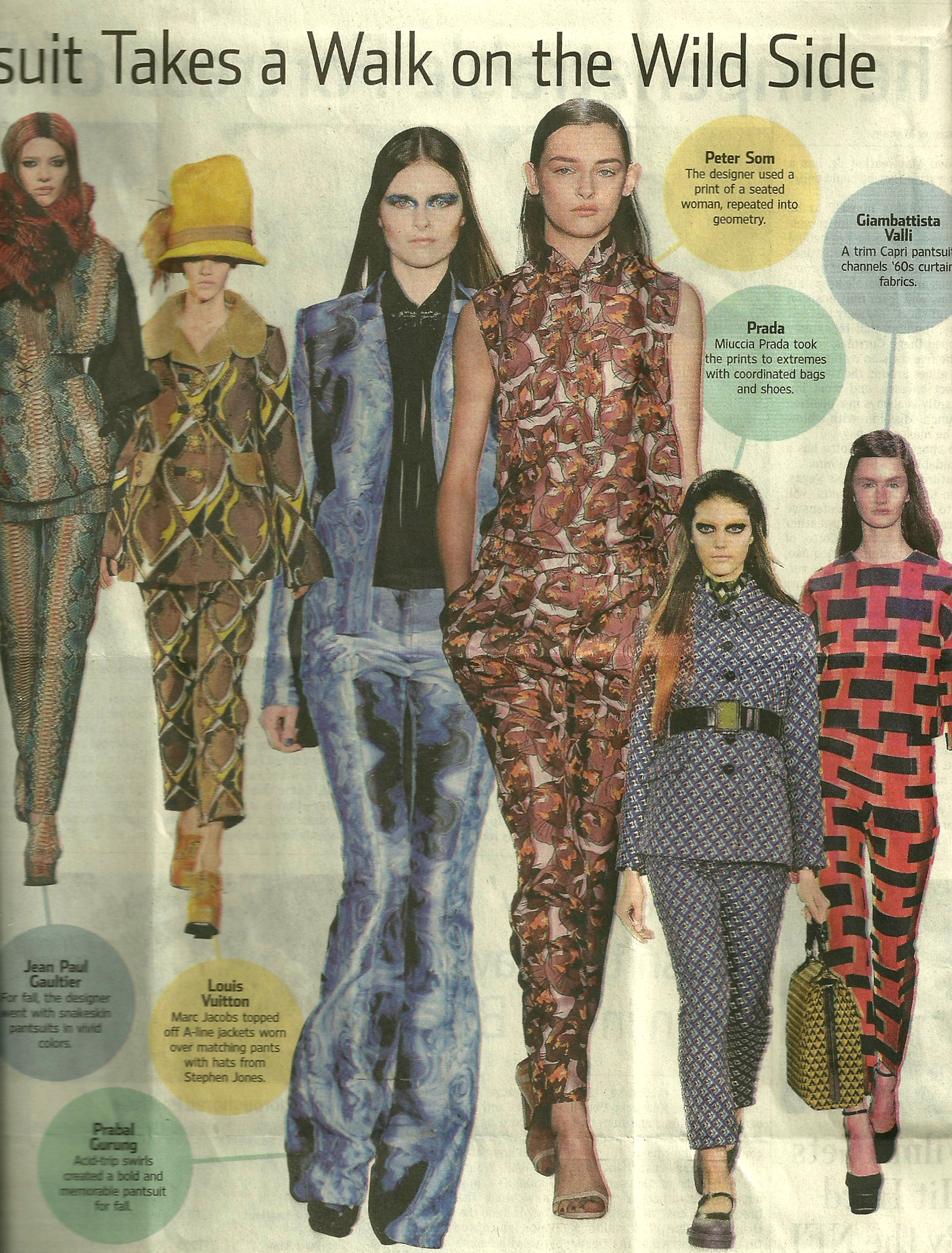
I don’t like any of these fabric designs as much as I like my Moygashel linen!

I’ve never been a fan of pantsuits, but some of the fabrics featured had that same ‘60s’ feel as my new vintage linen.  The reporter rightly questioned how well these head to toe outfits would “play on the streets”, but then she added:

“…at least one mainstream retailer will highlight the idea that the pantsuit can be worn as separates…  There will be more busy pants than busy jackets.  ‘There may be women who wear it head-to-toe – very daring,’ says Sak’s Ms. Sherin.  ‘But for us, it’s probably about the patterned pant’.”

Then, Ms. Binkley suggested:  “The key to wearing this trend is not straying too far from your safety zone.  Stick to colors and patterns you will still love in five years.  And let the bold pattern do the talking – go with a conservative fit if you’d rather not be the center of attention.”

Further:  “It’s probably not a coincidence that wild pantsuits are appearing just as ‘Mad Men,’ the style-influencing television show, is entering the psychedelic phase of the ‘60s.”

Well, my linen fabric is far from psychedelic, but it is bold – and reading this article certainly did validate my plans for making pants.   I also already knew the pattern I wanted to use, one quite appropriately from the early to mid ‘60s!
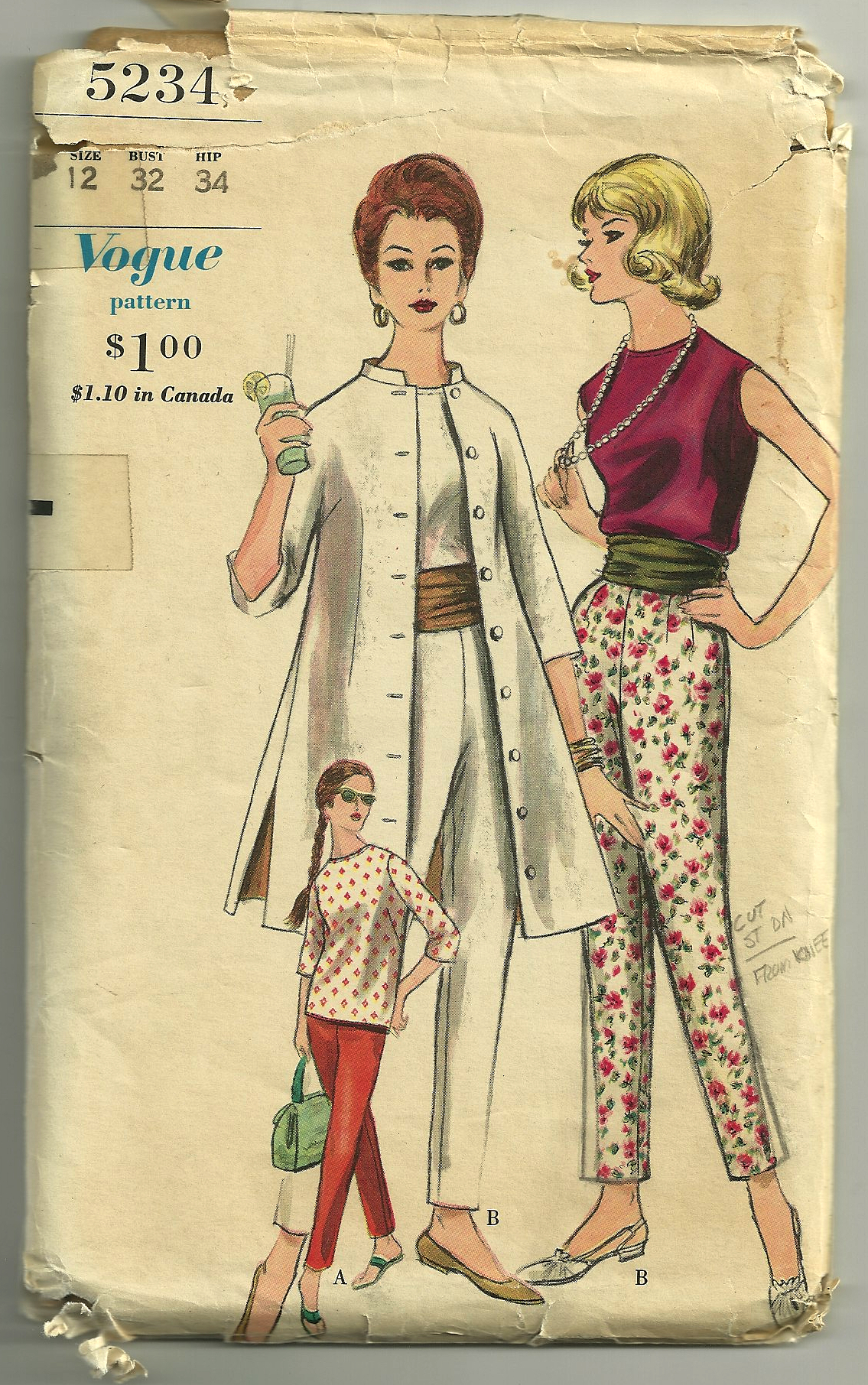
I really like all the styles featured on this pattern – the coat, the two blouse variations, the cummerbund –and the “conservative” pants.Classic looks – all of them!

Okay – I was ready to start this project.  First I washed the linen in cool water, delicate cycle, and dried it on medium heat.  This way I know my pants are totally machine washabIe.  Next I made a muslin of the pants pattern to check for fit.  I should have done a little more measuring first, as the crotch was too deep and had to be redrawn.  Also, although I like slim-ankled pants, these were just a bit too slim, so that was another adjustment.  I ended up making muslin #2, which was much closer to the final version from which I cut my pants.  However, I had made so many adjustments, that I decided to copy the final pattern onto freezer paper. (Freezer paper is my secret sewing friend – the dull side provides a wonderful surface upon which to draw in pencil and the shiny side can be ironed to fabric to cut out appliqués or anything, really, and then easily removed.  And the long continuous roll of paper is perfect for long pattern pieces like pants, coats, etc.)  The good news is that now I have a pants pattern that fits really well with the slim, but not too slim, legs that I like.

During construction, I tried on these pants about a ga-zillion times.  This fabric was just too dear to make any mistakes, and the more I tried them on, the more I liked them.  Here they are, all finished.
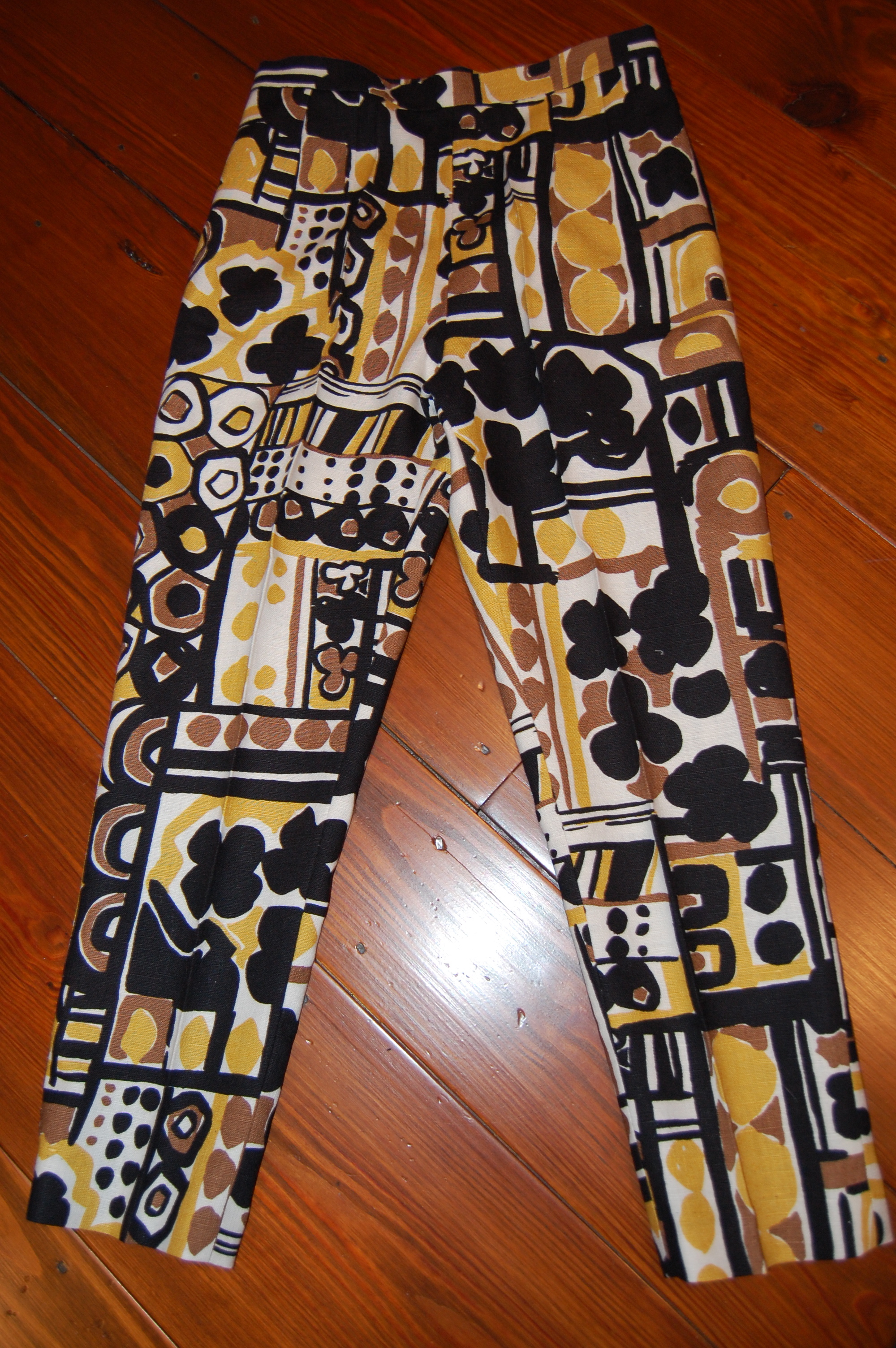
I’d say these are definitely bold!
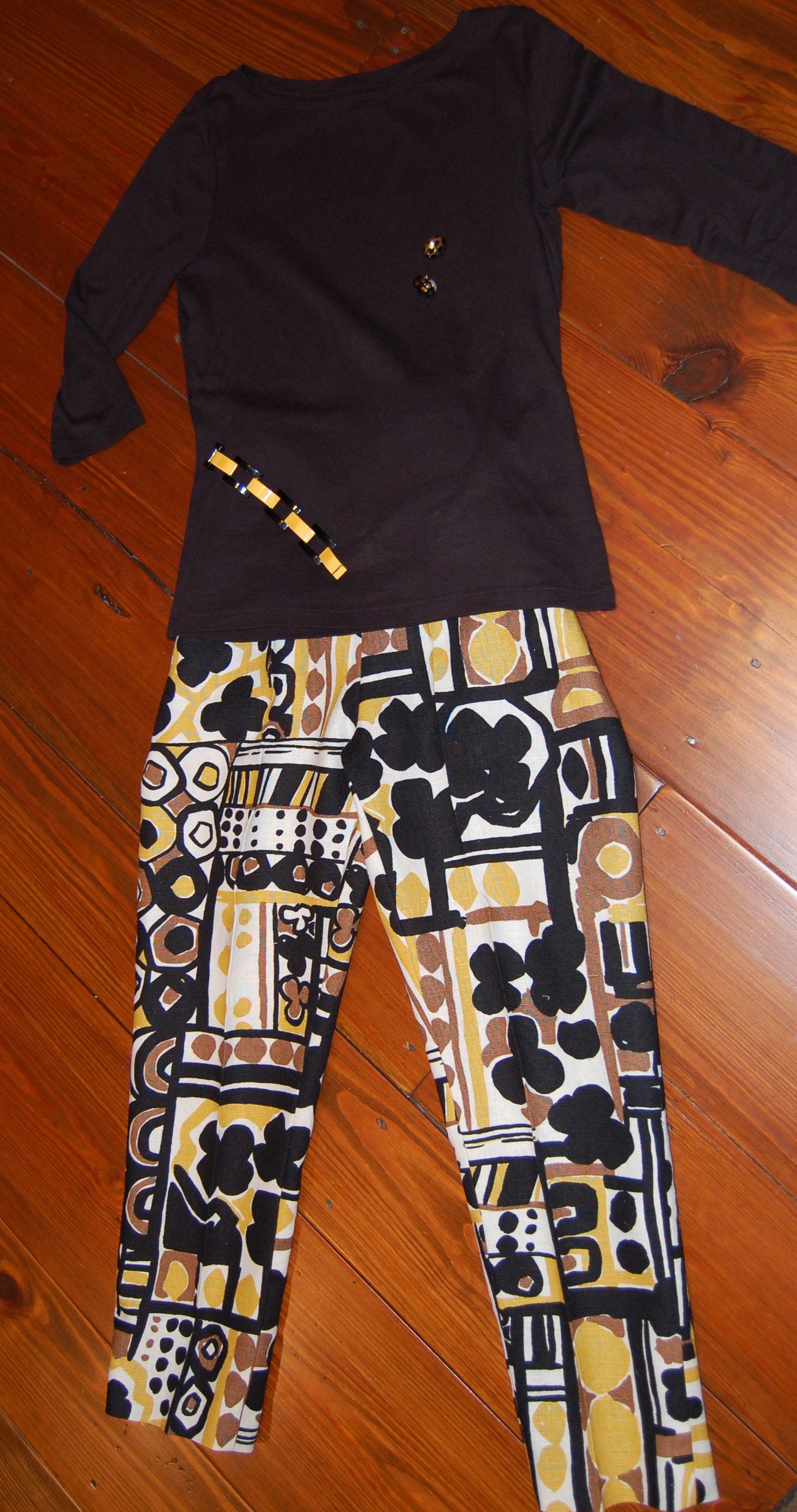
Here is my outfit, complete with Bakelite bracelet.  (I think the camera angle makes the legs look different lengths??)
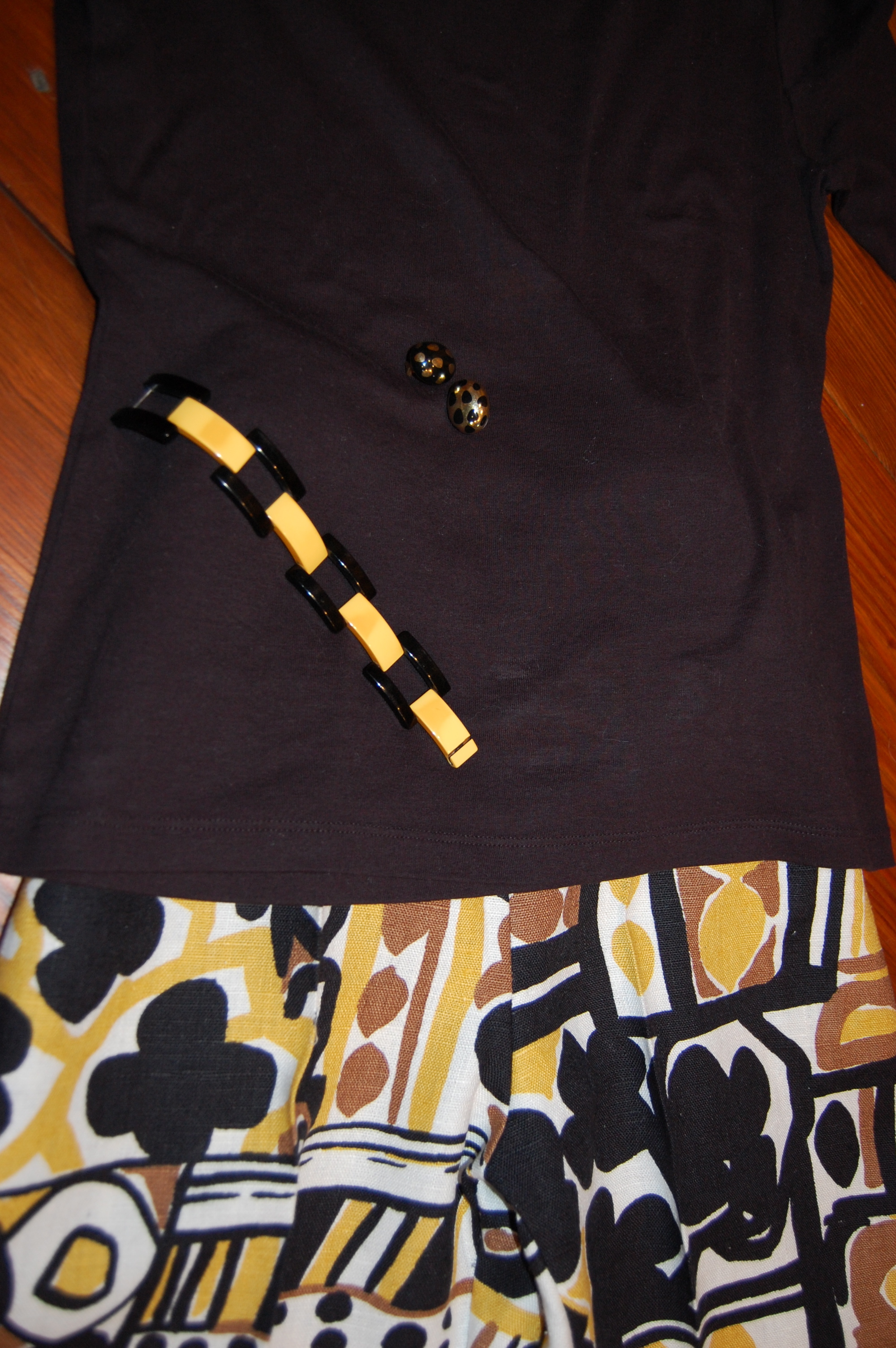
A close-up of same, with the earrings I’ll also wear with this outfit. (Click on the image).
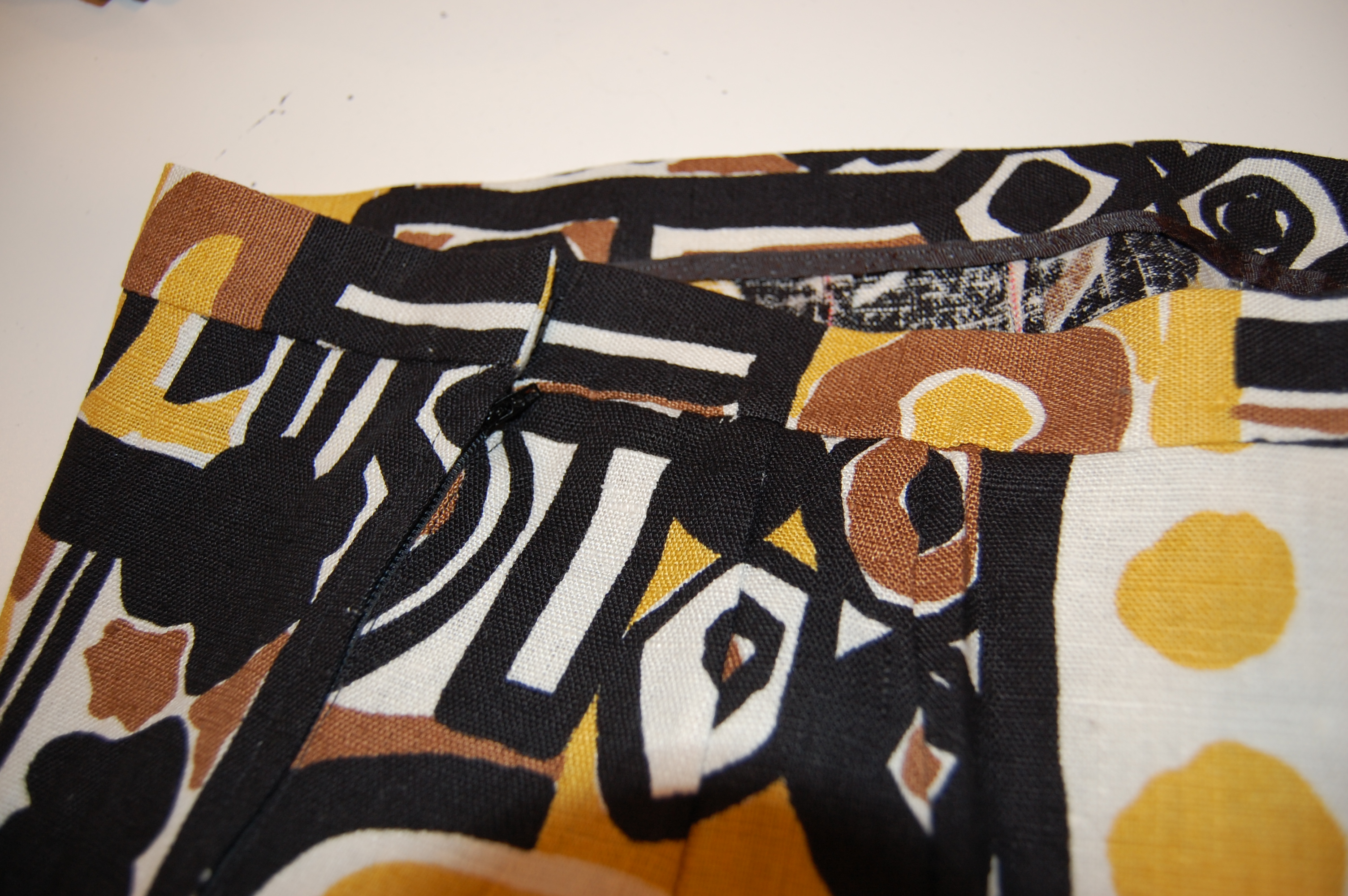
Here is a view of the waistband and zipper.
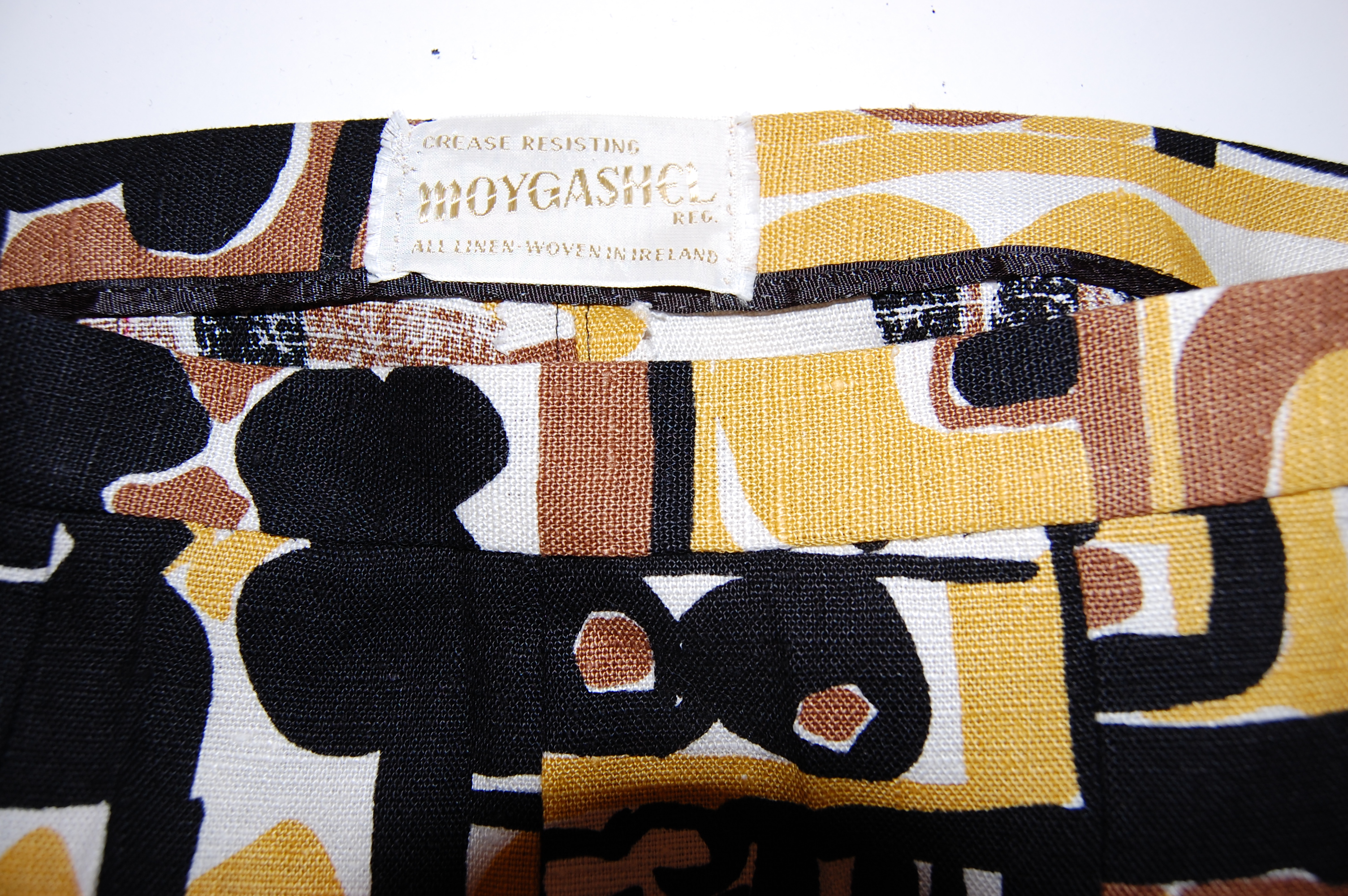
And here is the final touch – the label attached to the inside back of the waistband!

How neat is it to sew something up in vintage fabric, using a vintage pattern – and be totally stylish in 2012? And – I still have enough of this fabric left over to make a skirt.  Hopefully that will be very stylish, too, whenever I get around to making it!
12 Comments

Filed under Bakelite buttons and/or jewelry, Coats, Linen, Uncategorized, vintage Vogue patterns from the 1960s, Vogue patterns

A Dress for the Duchess

Do you ever read a book and feel enchanted by its storyline, or its life lessons, or because it speaks to you on many different levels of meaning?  How often is that book a children’s book?

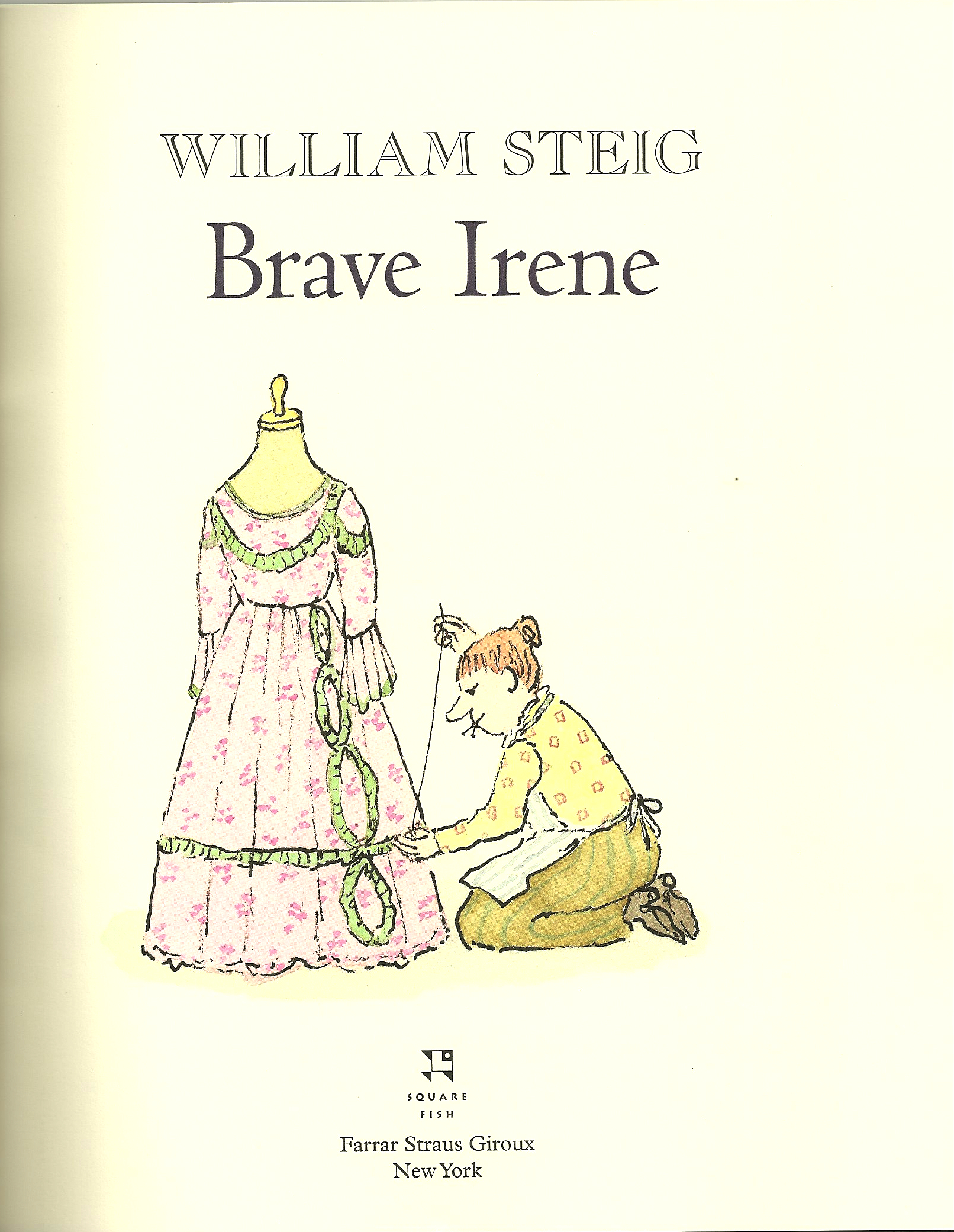
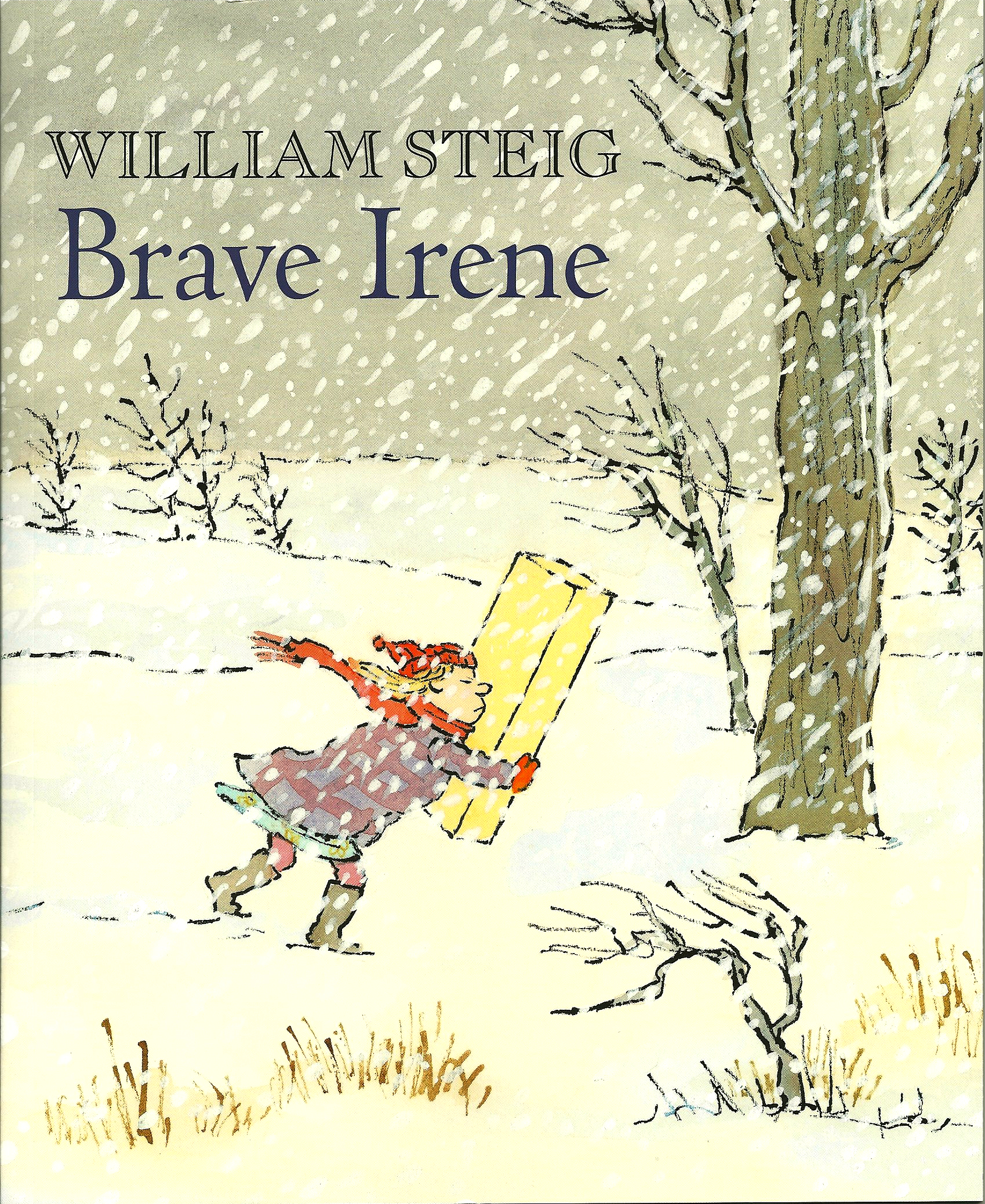
Since I started writing this blog, I’ve been thinking a lot about the influences that the written word can have on the process of sewing – and vice-versa – and I have found my thoughts  going back time and again to a skinny little paperbound book first published in 1986.  My daughter was five years old at the time, the perfect age to have this small story by William Steig read to her.  Its title is Brave Irene.  If you sew and you haven’t read it, you should; even if you don’t sew, you should read it.

This book is still in print and available on Amazon, of course!  The publisher is Farrar Straus Giroux.

Quite simply, it is the story of Mrs. Bobbin (how perfect is that name?), a dressmaker who has just finished a fancy pink and lacey gown for the Duchess to wear at the evening’s Ball.

Mrs. Bobbin, the dressmaker, puts the final stitches in the ball gown.

However, Mrs. Bobbin is too ill to get the dress to the palace.  Her young daughter, Irene, takes charge – putting her mother to bed with blankets and tea – and then, with the dress carefully boxed and tight in her arms, setting off to deliver the beautiful dress to the Duchess.   Everything that can go wrong, does.  It is snowing mightily, and the wind is so strong that Irene can barely walk with her large precious parcel.  Suddenly the wind grabs the box and whips the dress out of it.  Away it flies.

“How could anything so terribly wrong be allowed to happen?  Tears froze on her lashes.  Her dear mother’s hard work, all those days of measuring, cutting, pinning, stitching … for this?  And the poor duchess!  Irene decided she would have to trudge on with just the box and explain everything in person.”

As if this humiliation were not enough, Irene steps in a hole buried beneath the snow and hurts her ankle.  At this point she just wants to go home, but forward she persists, ignoring her pain and searching for the palace in the swirling snow.  Finally she sees its glittering lights, and as she approaches it, she sees the most wonderful sight: the beautiful gown is spread out on a huge tree trunk, held in place by the hateful wind which had torn it from her.

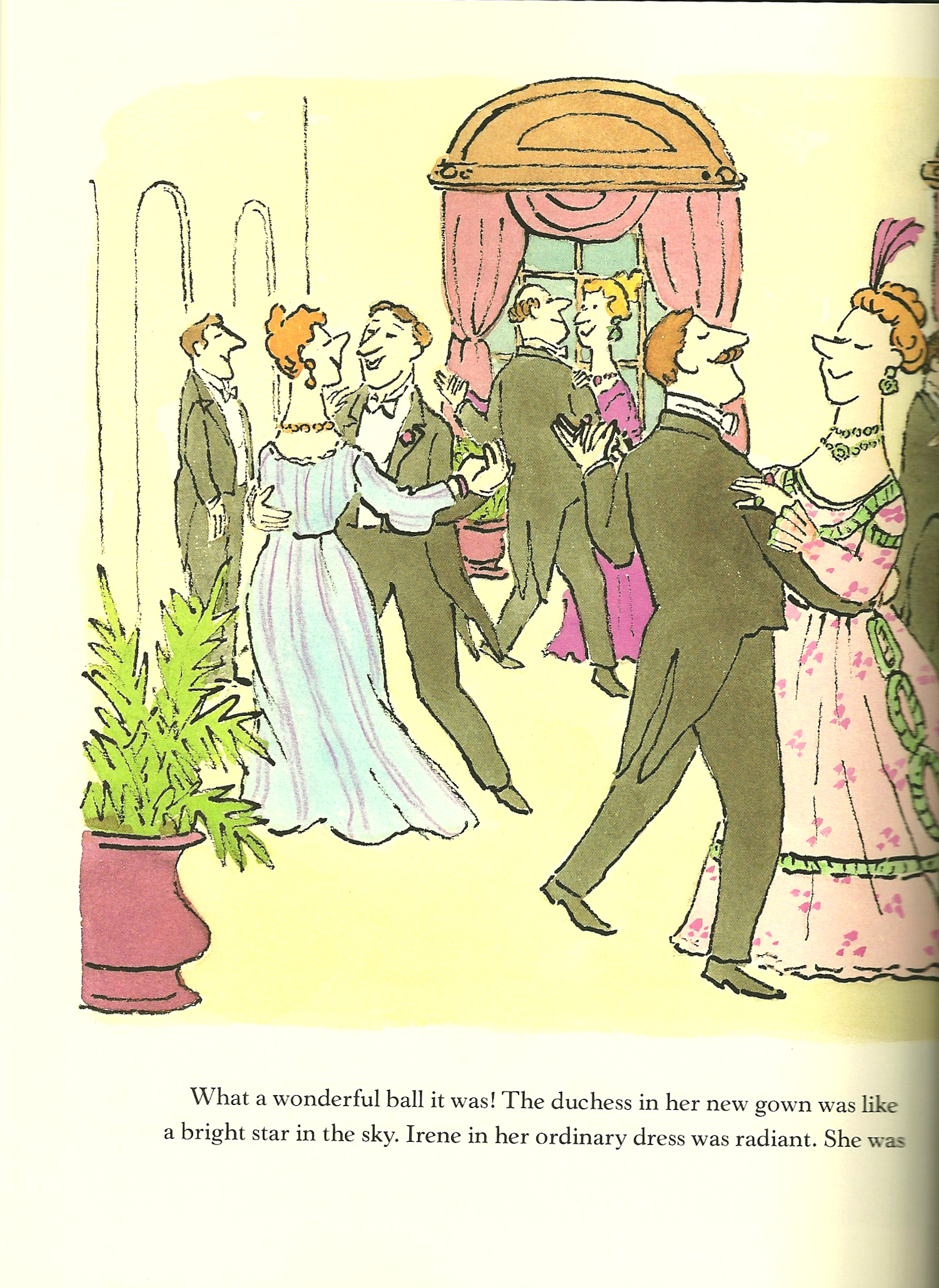
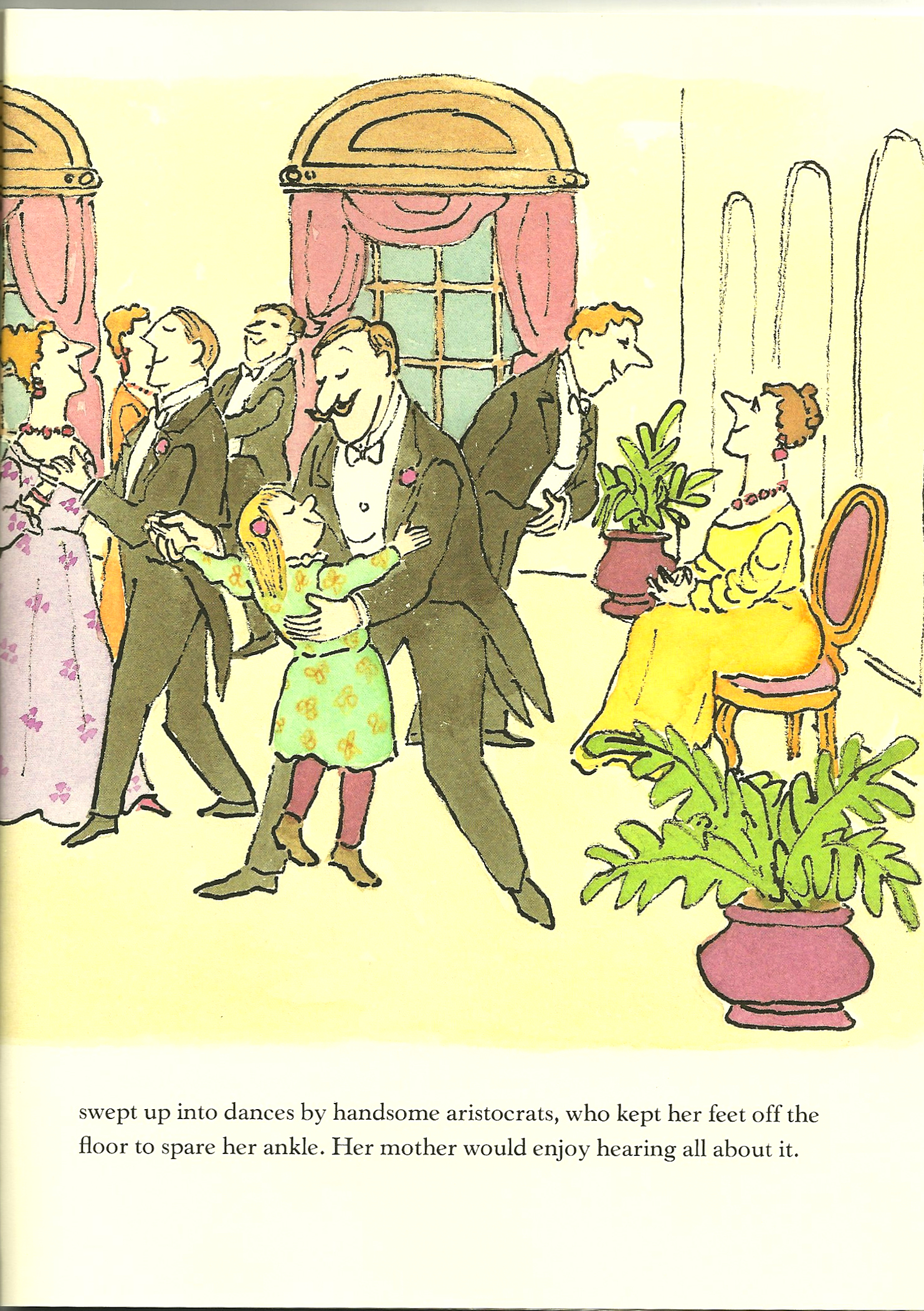
So – Irene and the dress arrive at the palace with much fanfare.  Needless to say, the ball is a wonderful success with the Duchess in her glorious new gown and Irene, in her simple dress, is just as glorious.

The Duchess in her new gown . . .

. . . and Irene, brave and honorable, enjoying the Ball!

The next morning Irene is accompanied home by two footmen, a doctor for Mrs. Bobbin sent by the Duchess, presents from the Duchess to Mrs. Bobbin, “along with a note saying how much she cherished her gown, and what a brave and loving person Irene was.”

Here are the things I love about this story:

1)   The art of dressmaking is in full display, with pride in accomplishment and recognition of the intricate, time-consuming, and complicated work that goes into the construction of such a gown.

2)   Irene’s love for her mother and understanding of the immediacy of delivering this important dress to the Duchess instill in her a take-charge attitude.  We all know those times in our lives when we must take charge – they choose us, we don’t choose them.

3)   Irene was not going to give up, even when she thought all was lost!   She was determined to do the honorable thing.

4)   Irene attended the Ball (as an unexpected guest of honor) in the only clothes she had with her – her simple dress.  However plain her attire, her attitude made her radiant.

5)   Sometimes a piece of clothing will take on special significance because of the circumstances under which it is worn.  I daresay Mrs. Bobbin’s beautiful creation was thus for the Duchess!

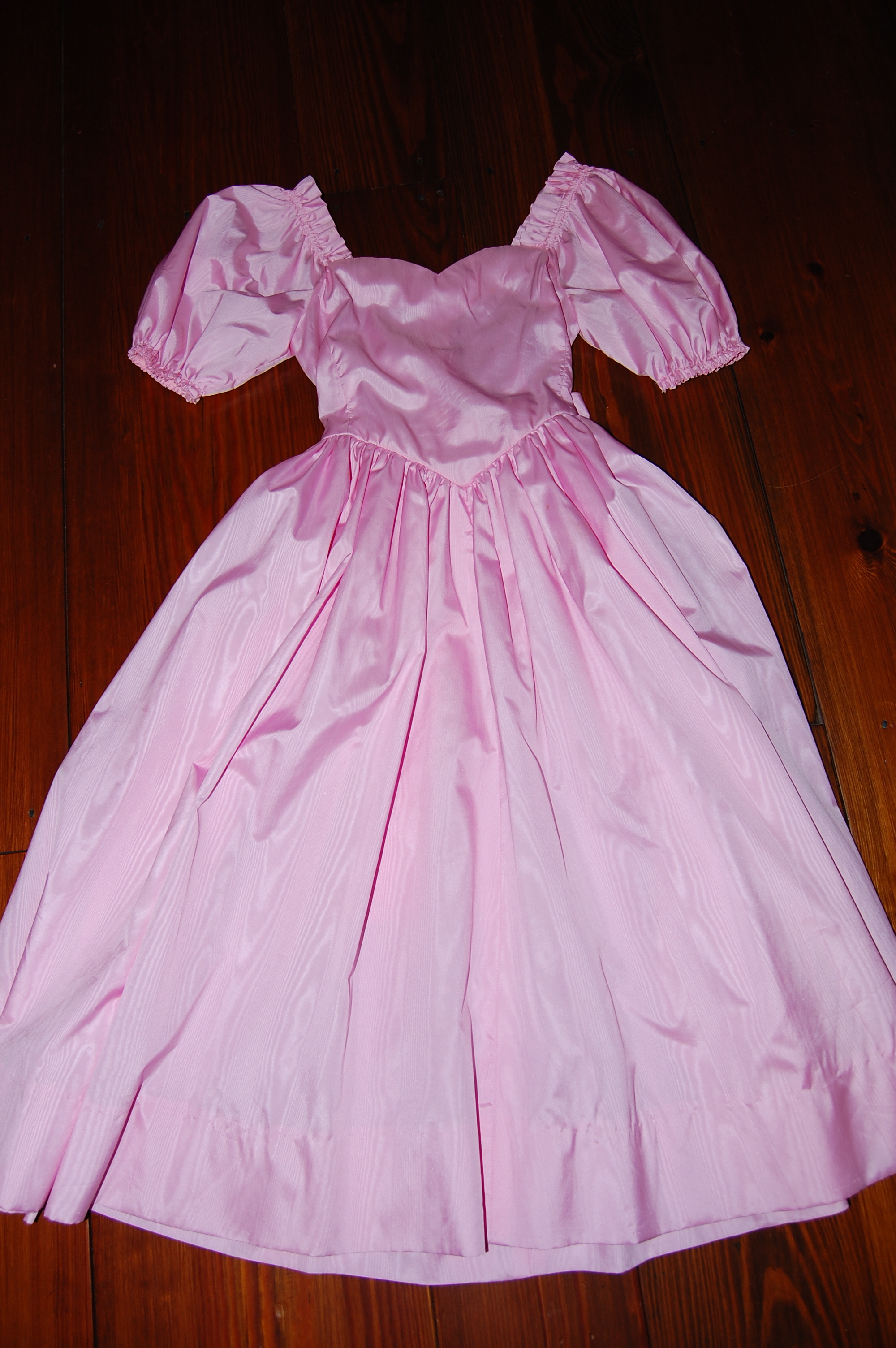
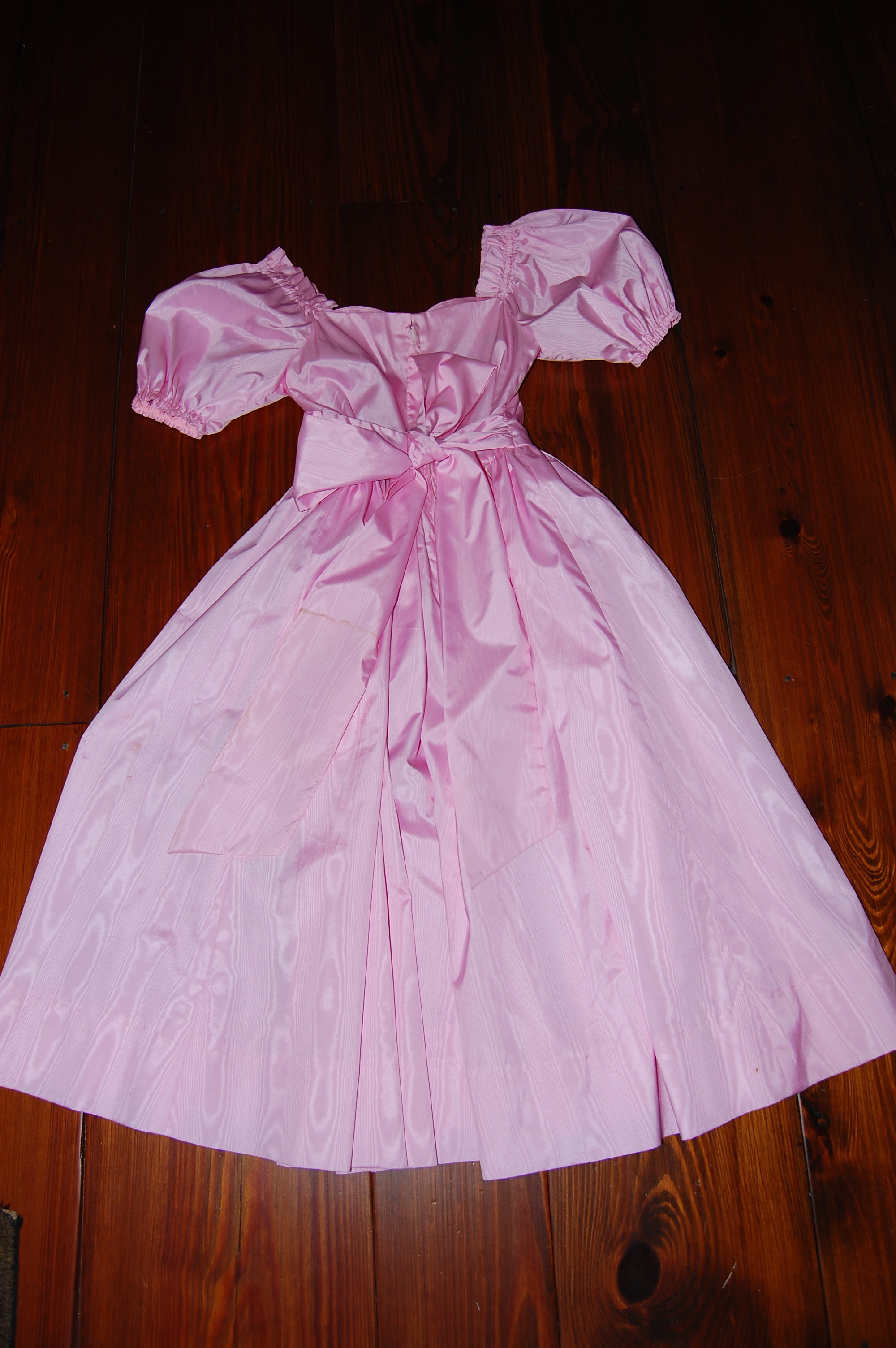
A couple of years after this book was published, I made a “Duchess” dress for my daughter to play in.  Here it is:

A dress for playing out the storyline of  “Brave Irene”.

Here is the back of the dress, with its beautiful bow.

And then a couple of years after that, I needed to make a contribution to a fund-raiser at my son’s school.  So – I put together a “Brave Irene” auction item, which consisted of another “duchess” dress, this one a little fancier, with lace flourishes and silky ribbons.  I lined a sturdy, new cardboard box with shiny white paper, addressed it to the “Duchess c/o the Palace” (with Mrs. Bobbin’s return address, of course!); placed the dress in the box, with a new copy of the book, and a wool scarf for “Irene” to wear on her journey.   In retrospect, I should have included a tomato pincushion, too, and maybe a tape measure ….

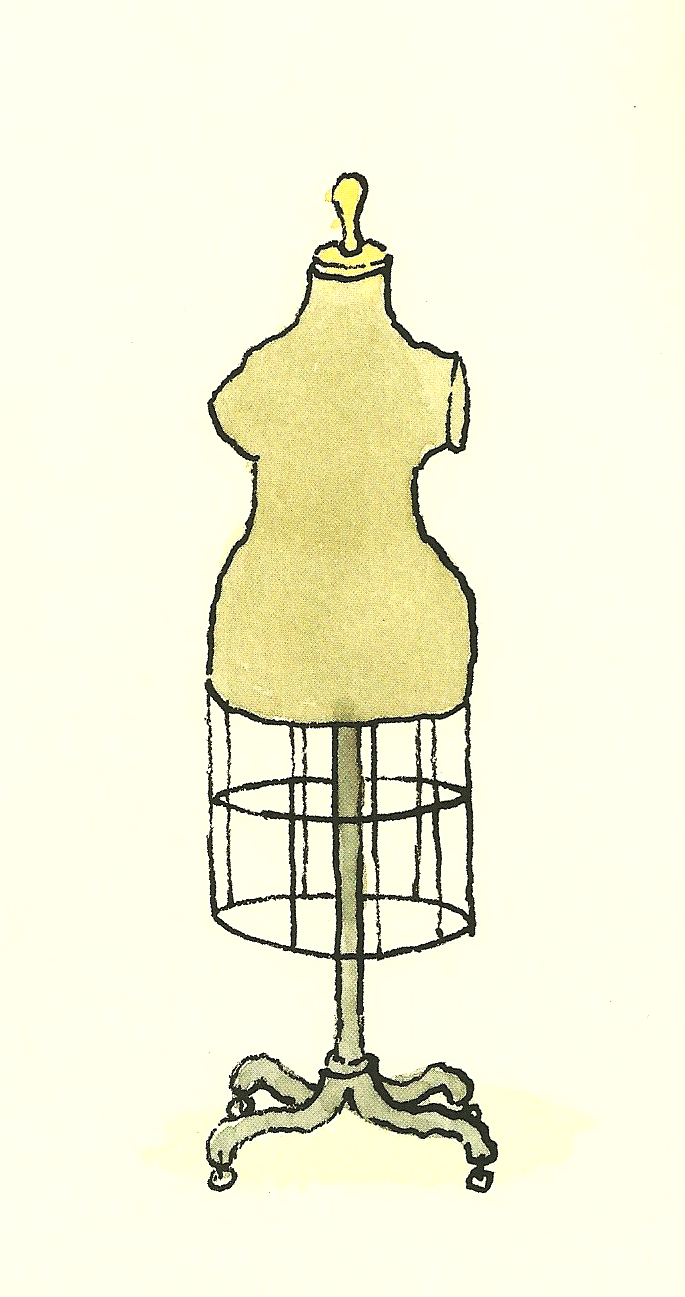
Mrs. Bobbin’s dress form (called a “dummy” in the book).

Whenever I read this simple story, I wonder if William Steig might have been inspired by this quote by Isaac Bashevis Singer:  “What a strange power there is in clothing.”   Indeed!

6 Comments

Filed under Dressmaker details, sewing in silk, Uncategorized

Birds and Thistles flying high

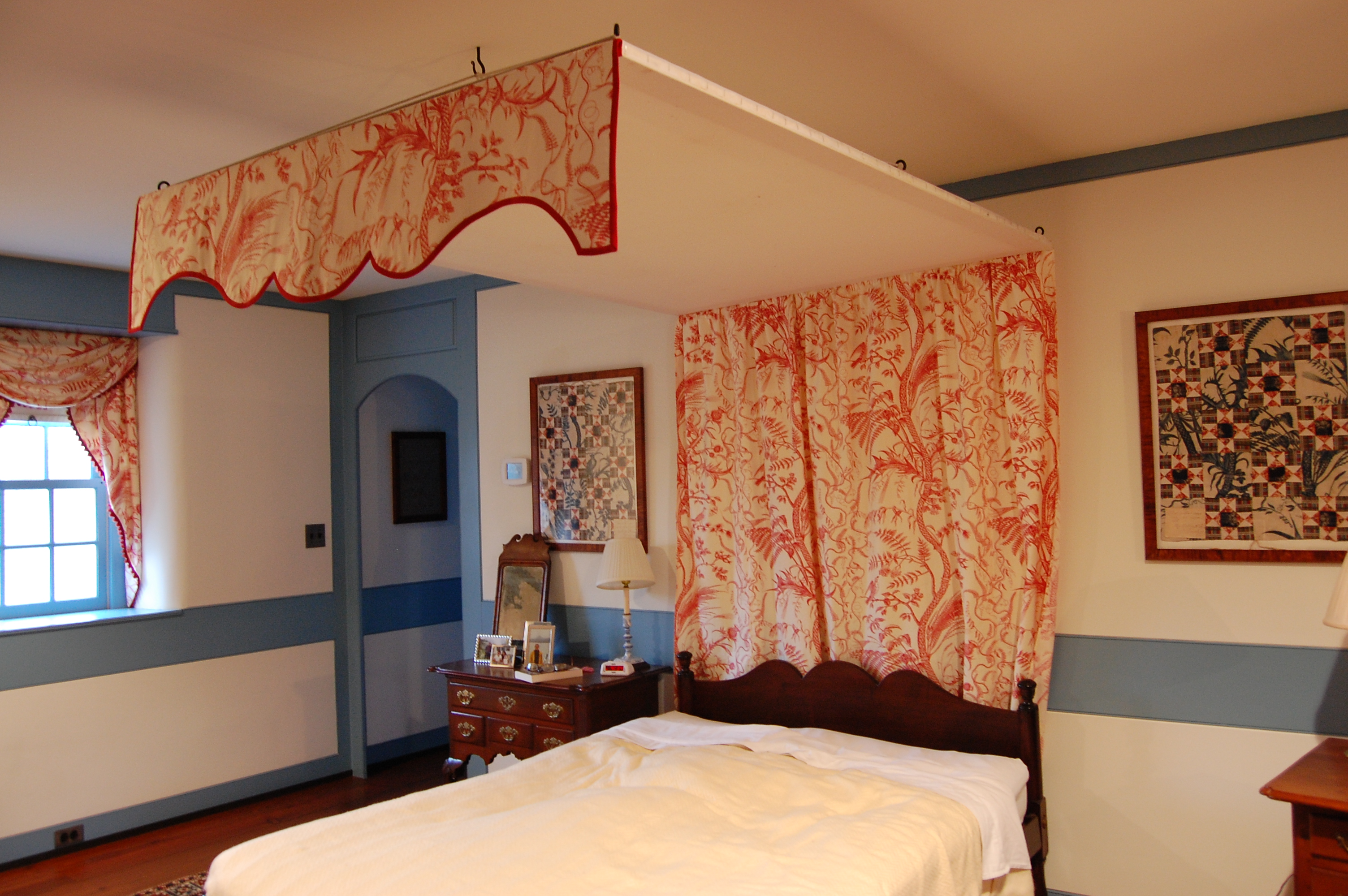
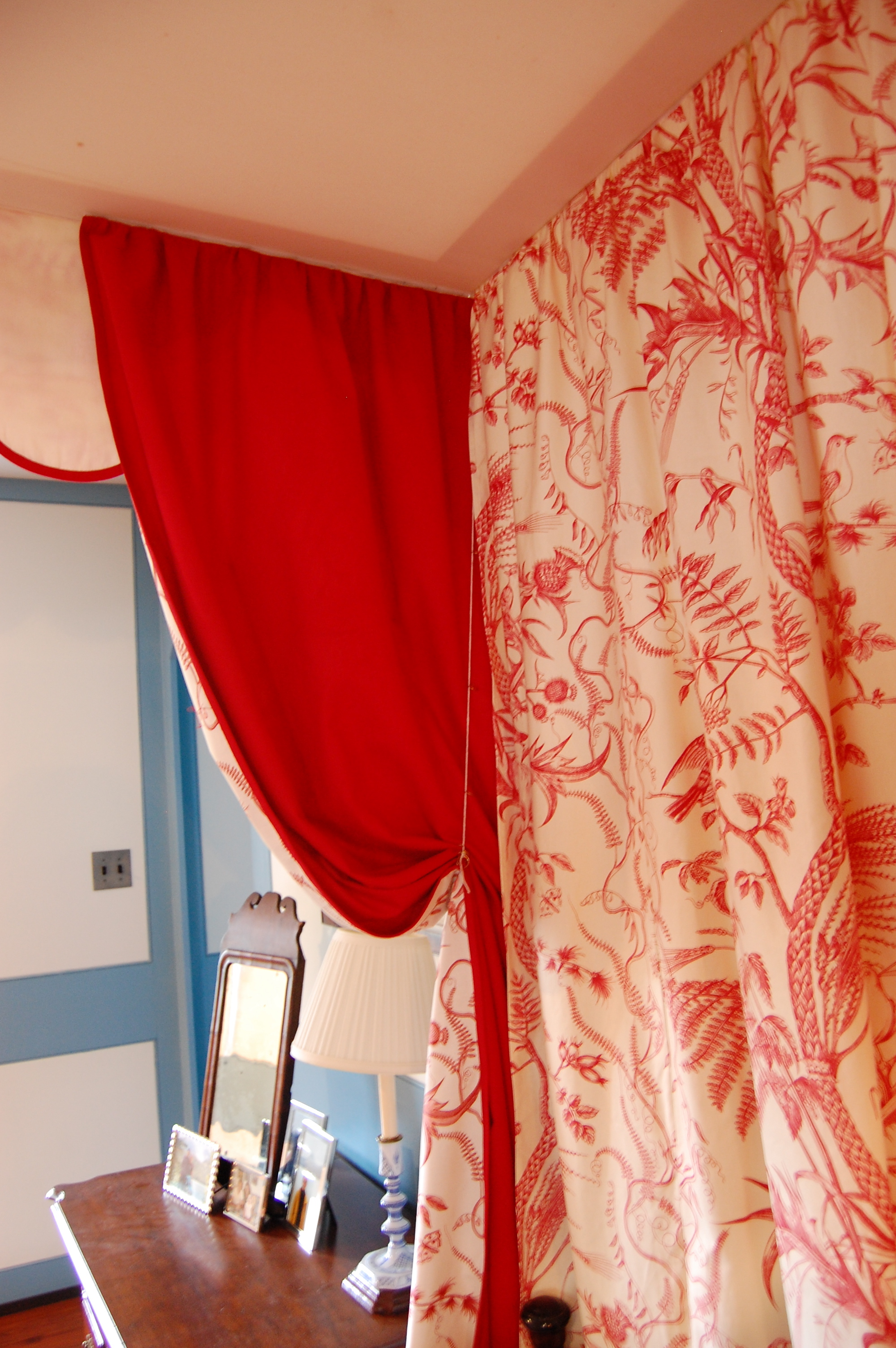
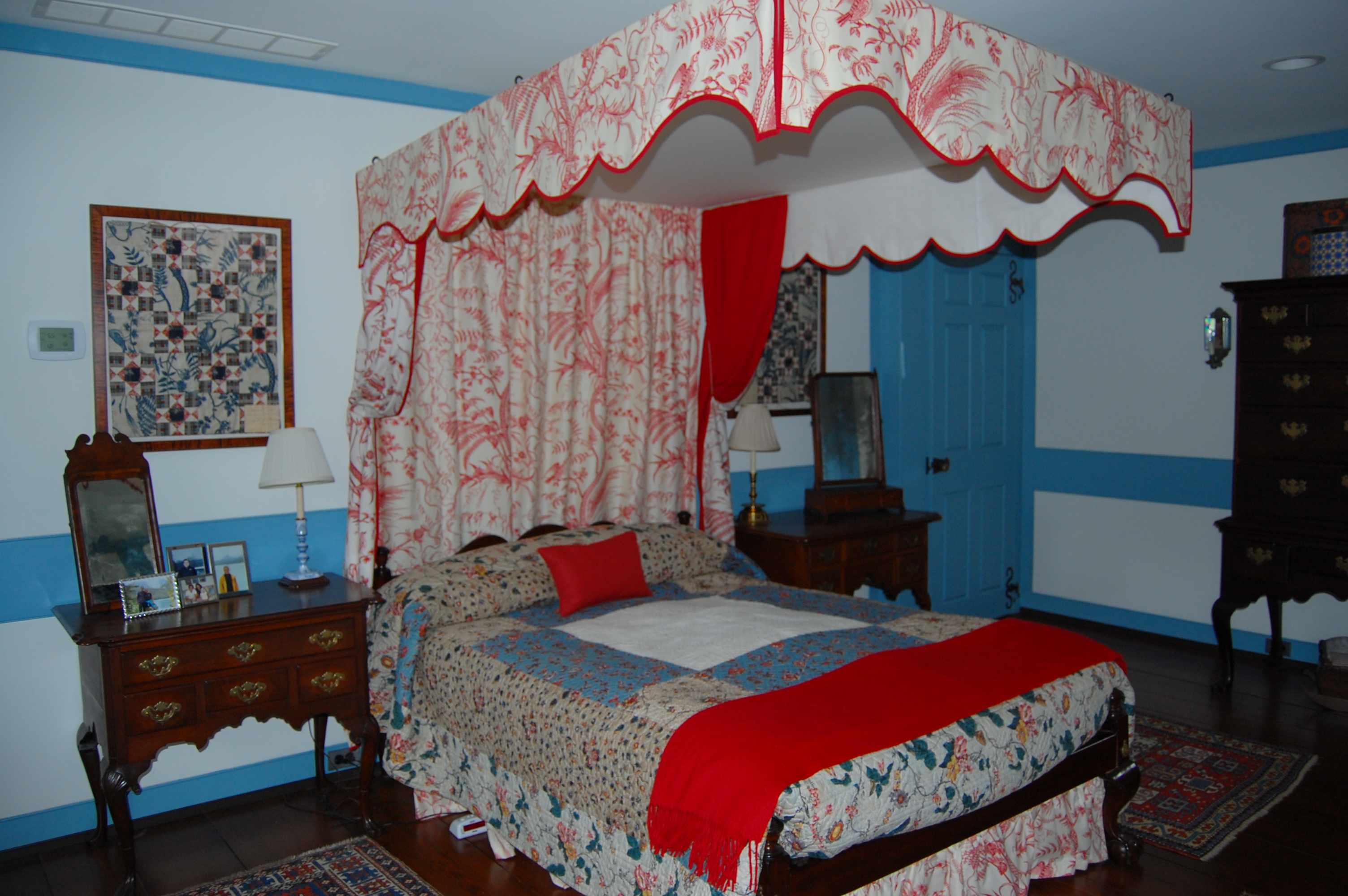
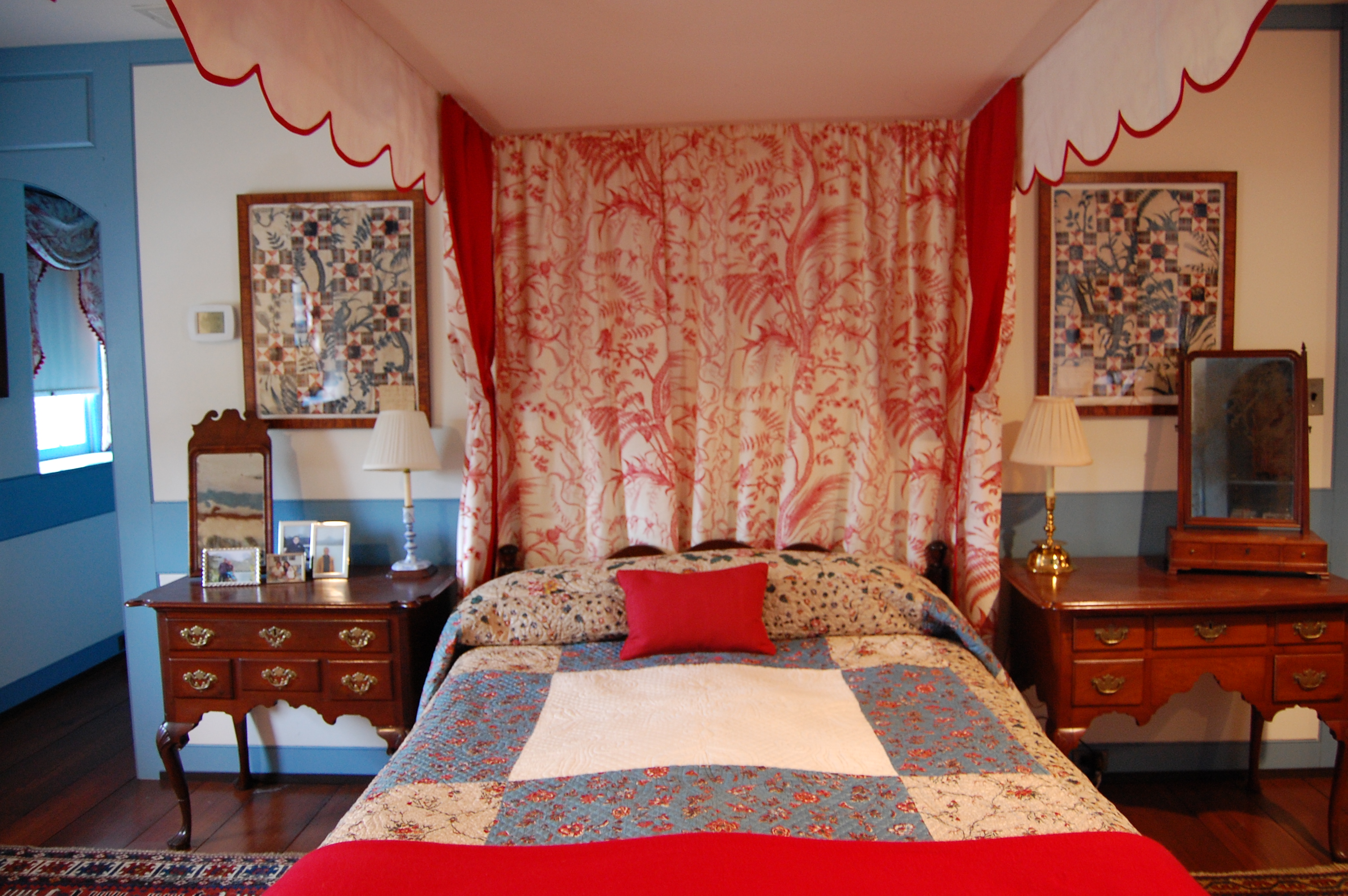
Being away for multiple days over the past week and a half has seriously cut into my sewing and writing time, but snatching a few final hours here and there has finally resulted in the completion of one of my resolutions for 2012.  The bed hangings about which I wrote in January are finally complete.  I can’t begin to calculate the hours of planning and hand sewing which went into them, but I also can’t begin to explain the pure sense of coziness and security which they provide to anyone sleeping beneath them (that would be my husband and me!  Not sure what the cats think about them…)

So – how did I come to make hangings for a bed which is a “low-post” bed, not a tester (or four-poster) bed?  The story begins 15 years ago when I made the swag and jabot curtains for our bedroom out of Brunschwig & Fils Bird and Thistle patterned fabric.  I ordered lots of fabric to compensate for matching the pattern and for all the funny angles that swag and jabot curtains produce.  I ended up with quite a lot of fabric left over, some of which I used to make a dust ruffle.  The rest went into my fabric closet.

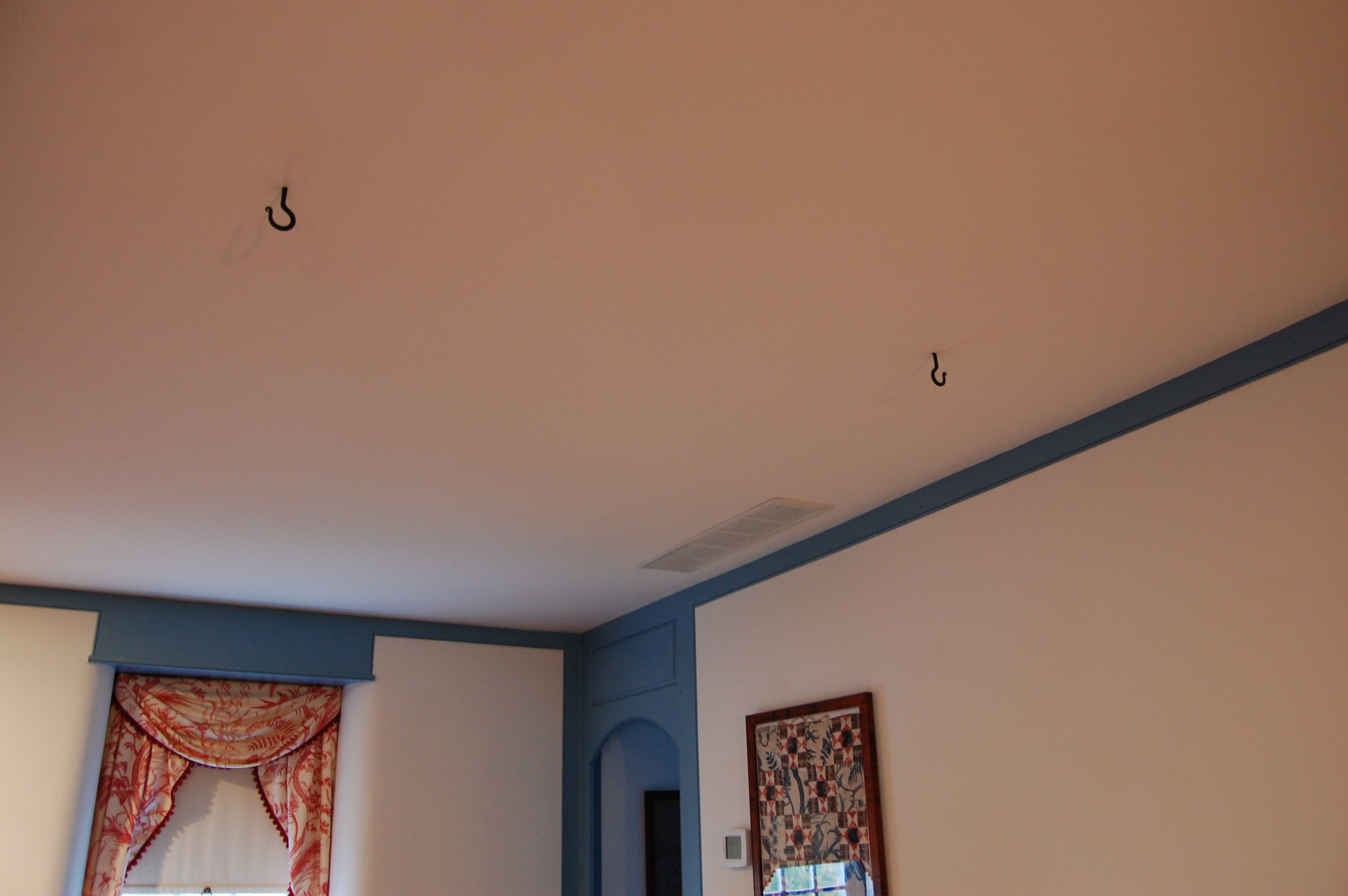
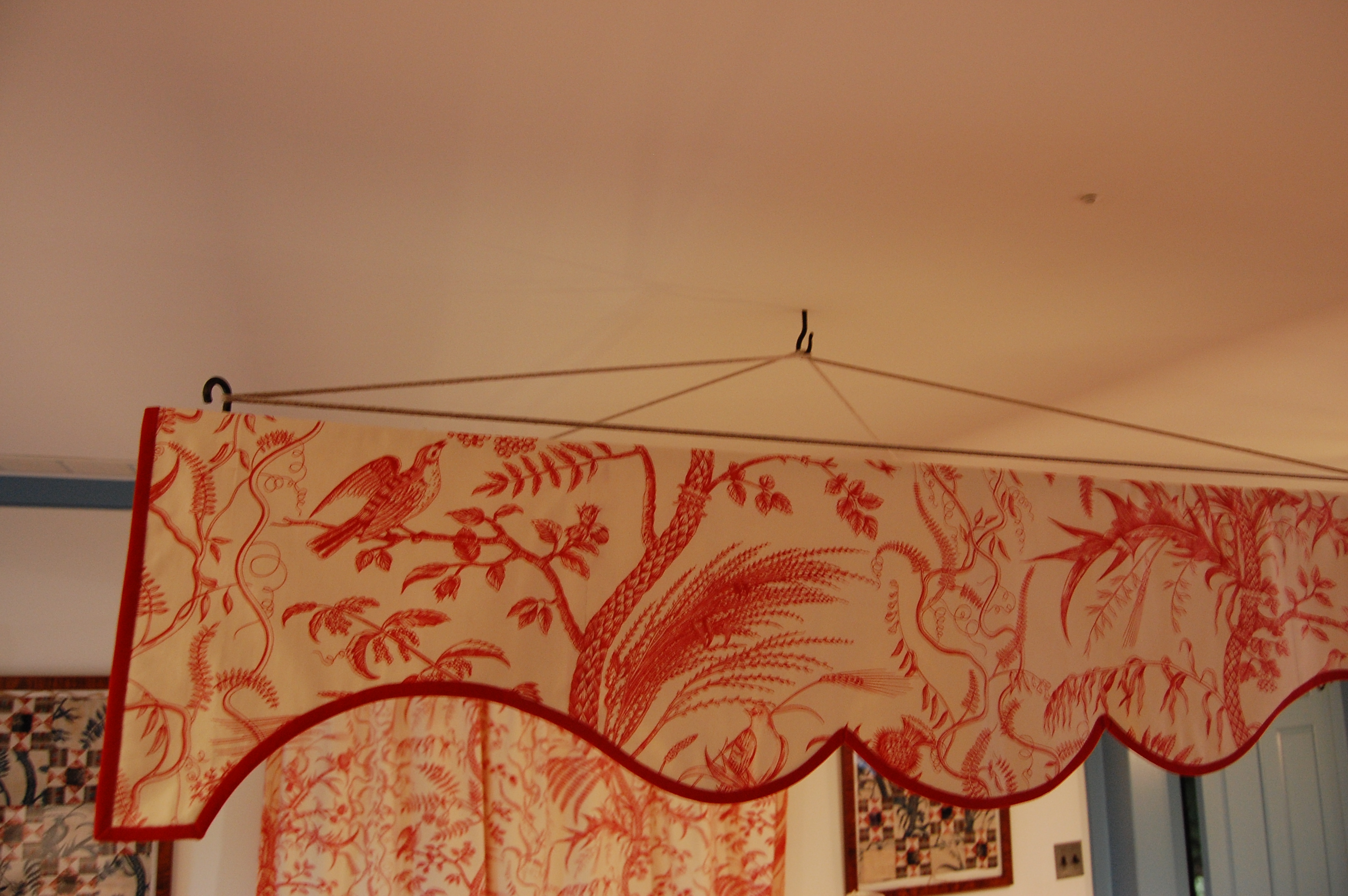
About three years later, our bed was borrowed by a local museum for an exhibit (we slept on a mattress on the floor during that time!), and it was displayed with a “flying tester” which they had made just for the bed.  A flying tester is a wooden frame on which hangings can be affixed; the wooden frame is suspended by ropes from iron hooks in the ceiling.

Here are the two wrought-iron hooks which we affixed into our ceiling. You can also see just a bit of one of the windows with the swag and jabot curtains.

This photo shows the roping which suspends the frame from the ceiling.

Although not common, in the 18th century flying testers were an ingenious way to dress a low-post bed for the winter – with heavy wool or linen  hangings – or in the hot summers – with airy curtains to keep the flying bugs out.  There is an example of a ceiling hook for a flying tester at Stenton in Philadelphia. (Stenton is the historic home of James Logan, 1674-1751, who was Secretary to William Penn, founder of Pennsylvania.)  And imagine my surprise when just recently I saw an ad in House Beautiful Magazine which showed a modern bed with a flying tester!

This ad for the Apple version of House Beautiful features a modern "flying tester".

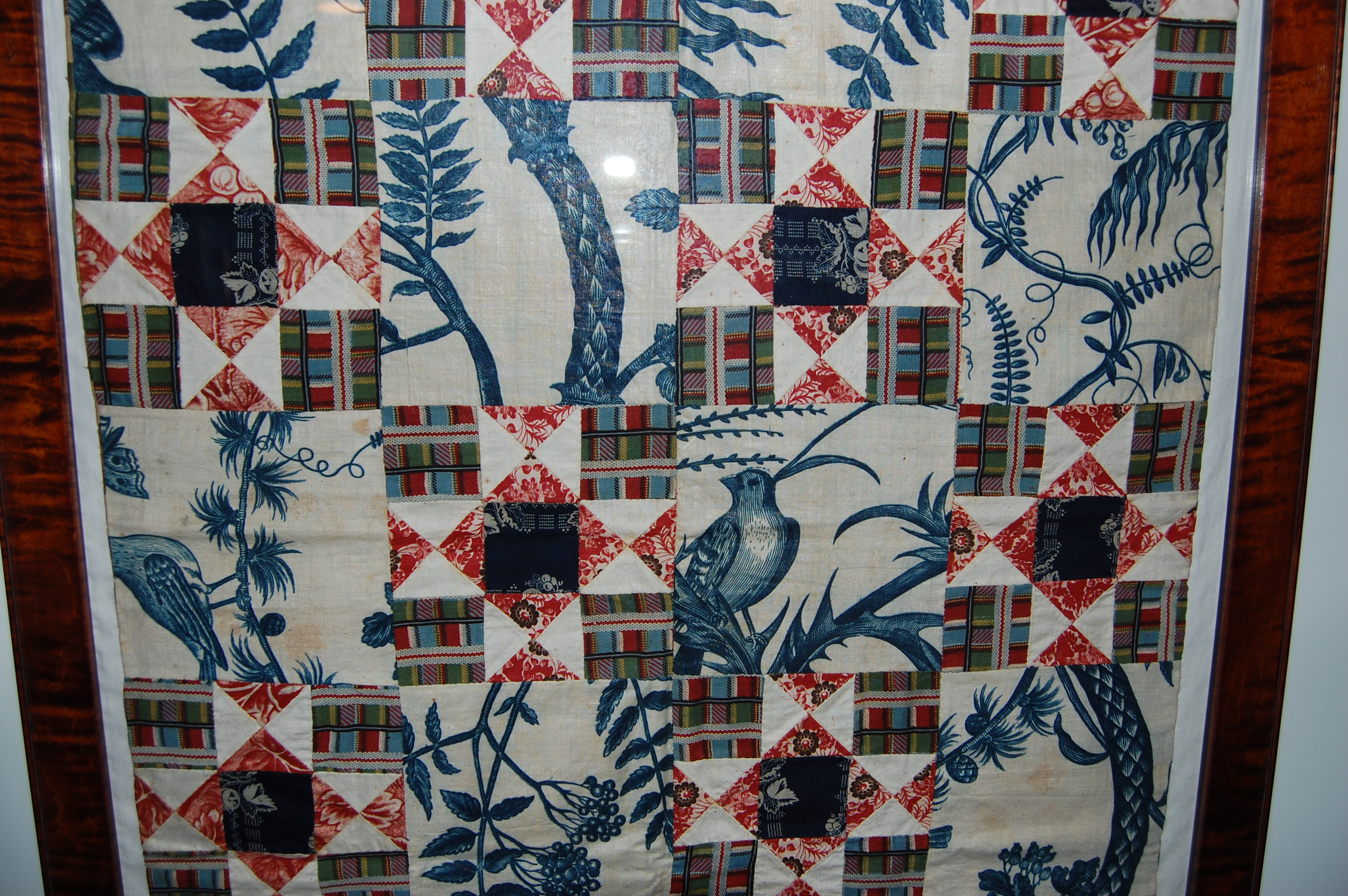
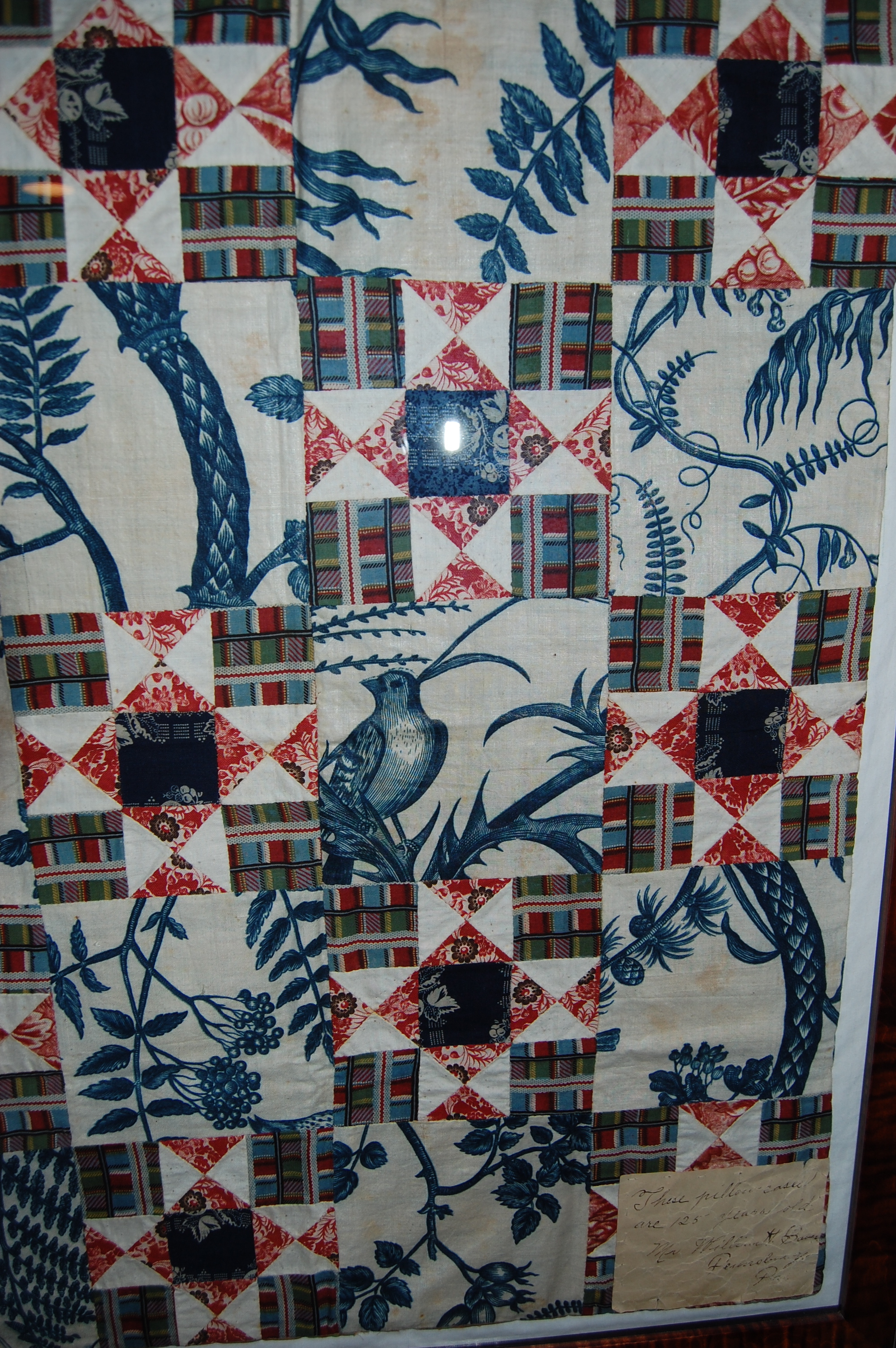
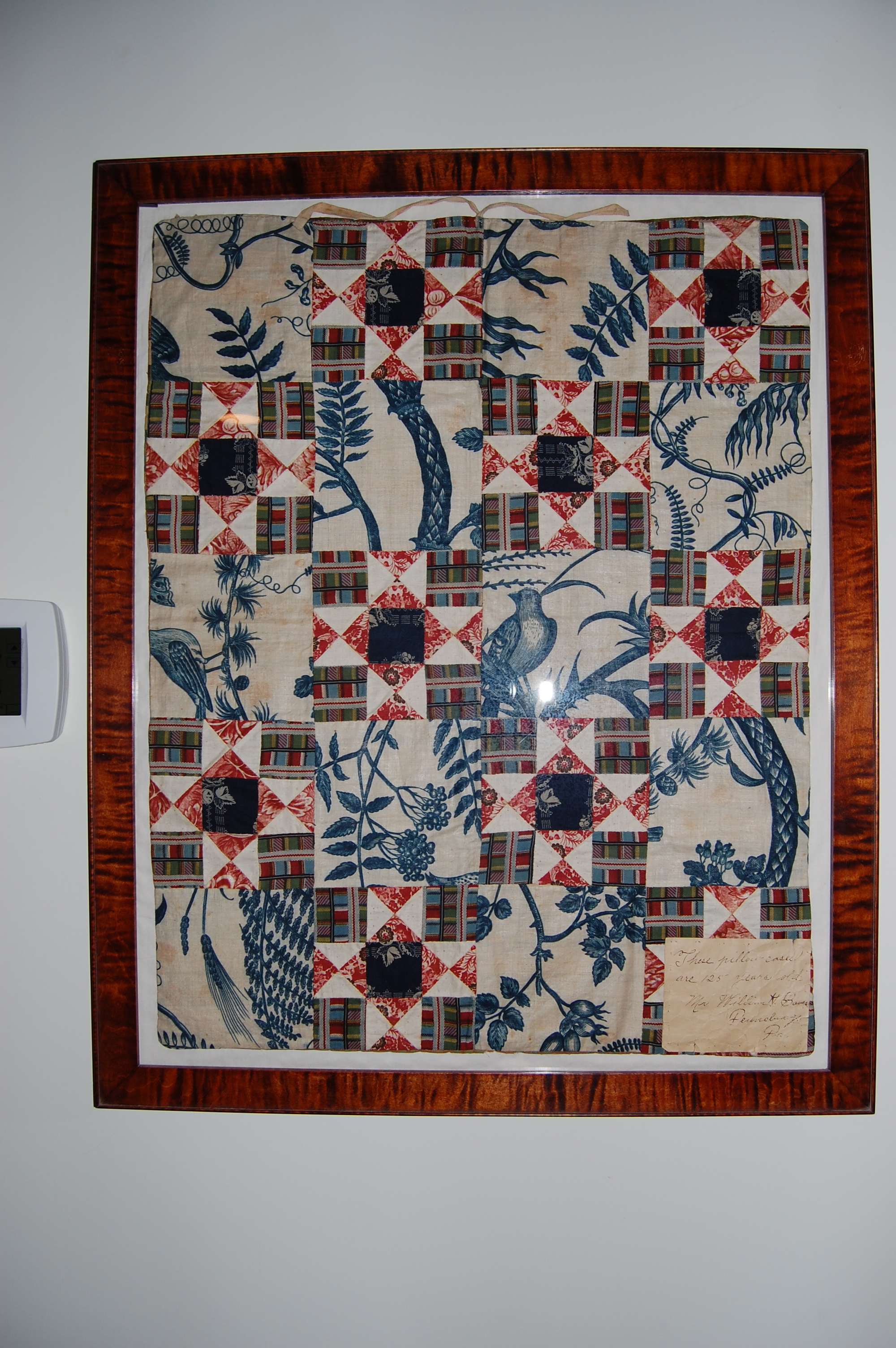
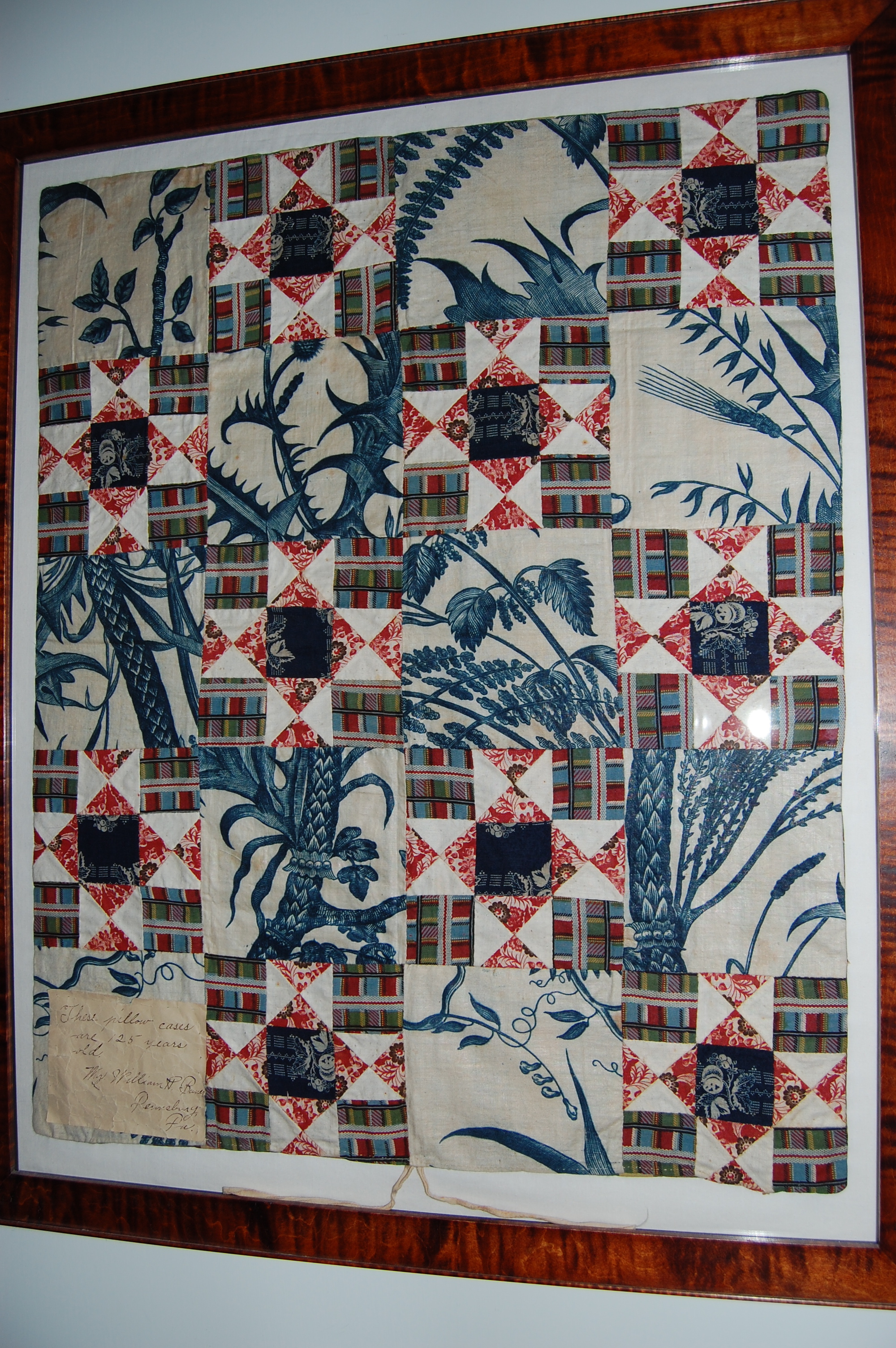
After the exhibit was dismantled, we were generously offered the tester frame, which we wrapped in plastic and put in storage.  I started thinking how neat it would be to make hangings some day, but somehow the years passed by.  Perhaps I needed some inspiration to tackle what I knew was going to be a big, somewhat intimidating project.  Well – the inspiration came in two parts.  First I came across a pair of pieced pillowcases, which date to about 1800-1820.  One of the fabrics in them is – you guessed it – some 18th-century Bird and Thistle fabric (which was imported to America from England).  These pieces were in blue, not red like my curtains, which is one of several colorways in which the fabric is available now.

Can you see the blue bird and the vines and thistles nestled among the variable star pieced blocks?

Here is another view of the same pillow case. A hand-written note was attached to each one, which I left intact.

Because of the age of the pillowcases, and the visual quality of them, I had them framed so I could hang them as artwork in our bedroom.

Here is one framed case...

... and here is the other one.

Hmmmm – now wouldn’t Bird and Thistle-patterned bed hangings look so good with those framed cases flanking the bed?  The wheels in my brain were turning.

Inspiration number 2 came when the air-conditioning in our bedroom had to be replaced during a very hot summer.  Until the work could be completed, we moved into our grown son’s old room, where the AC was still going strong.  I had already made simple hangings for his tester bed  – and the pleasure of sleeping under that canopy convinced me that it was time to turn my thoughts into reality!

Here are some of the challenges I faced and how I made the hangings:

1)   After measuring and thinking and measuring some more, I knew I didn’t have enough fabric left over from the curtains to complete the hangings, although I was close!  I knew I could do some careful piecing and re-sectioning to match and cut out everything (three valences and the back curtain) except for the side curtains.  I went on eBay and found a length of the same fabric which would suffice for the side curtains, if I lined them in another fabric.  (The piece I found on eBay was of another dye lot, of course, but the difference was slight so I decided it would work.) I found a linen blend in solid red which I determined would be perfect for the taping (which would finish every exposed edge) and for lining the side curtains.

2)   I based my valence pattern on the shape of the headboard in reverse.  To compensate for the longer side valences, I added two more “scallops”, which fit perfectly mathematically!  That was the easiest part of the entire project.

Here is the end valence hung on the frame. Hopefully you can see the design of the headboard mirrored in reverse in the valence.

3)   I proceeded to apply the red taping (which I cut on the bias) to all the edges.  This was all handwork and every edge had to be sewn twice, once on the front and once on the back.

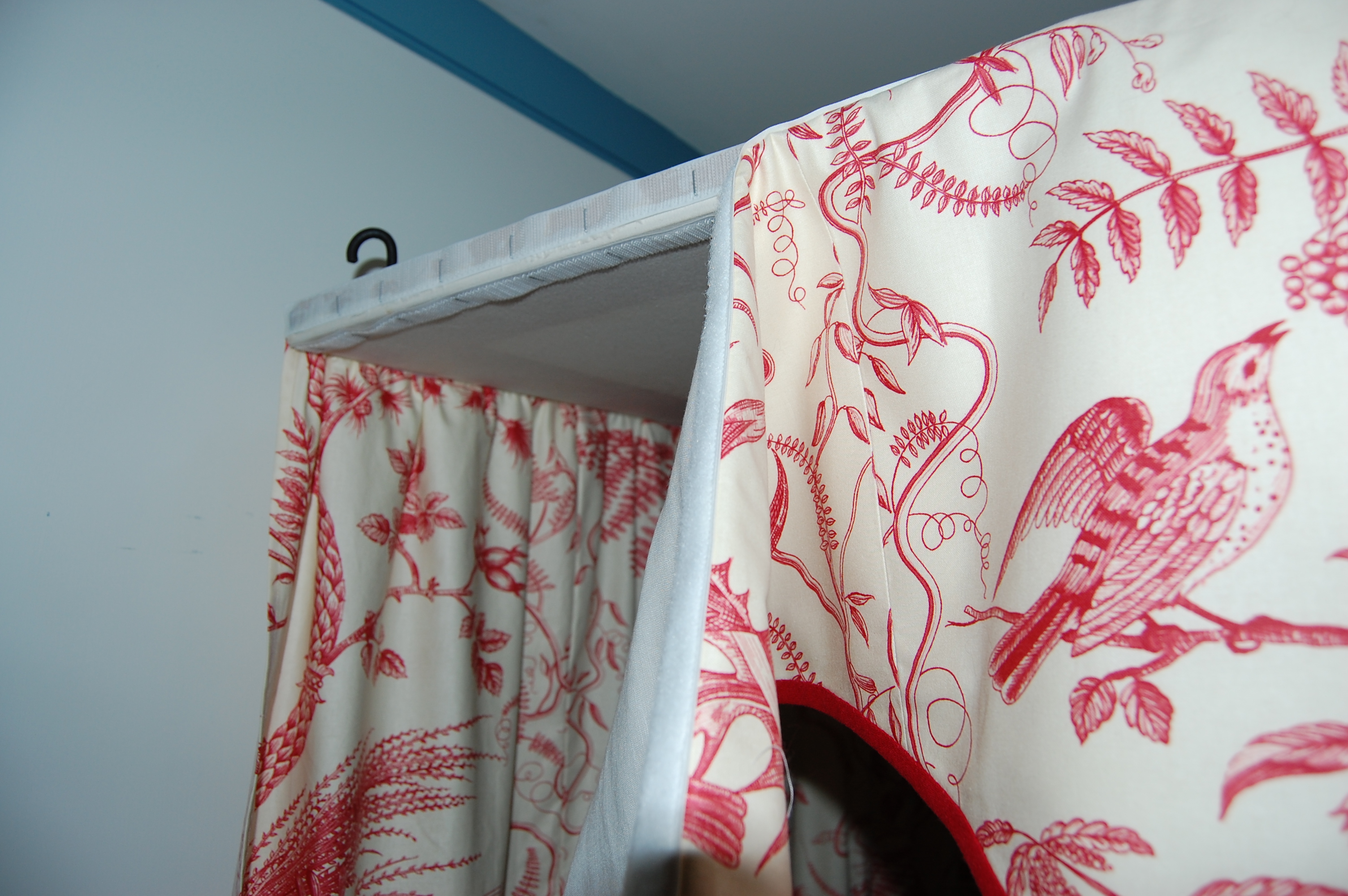
4)   I applied Velcro tape on the hanging edge of each piece. It doesn’t show if you apply it on the front side and flip it over from the top. I had already applied the rough Velcro side to the wooden frame by first gluing it and then stapling it.

Here is one of the side valences pulled away so that you can see how I applied the velcro.

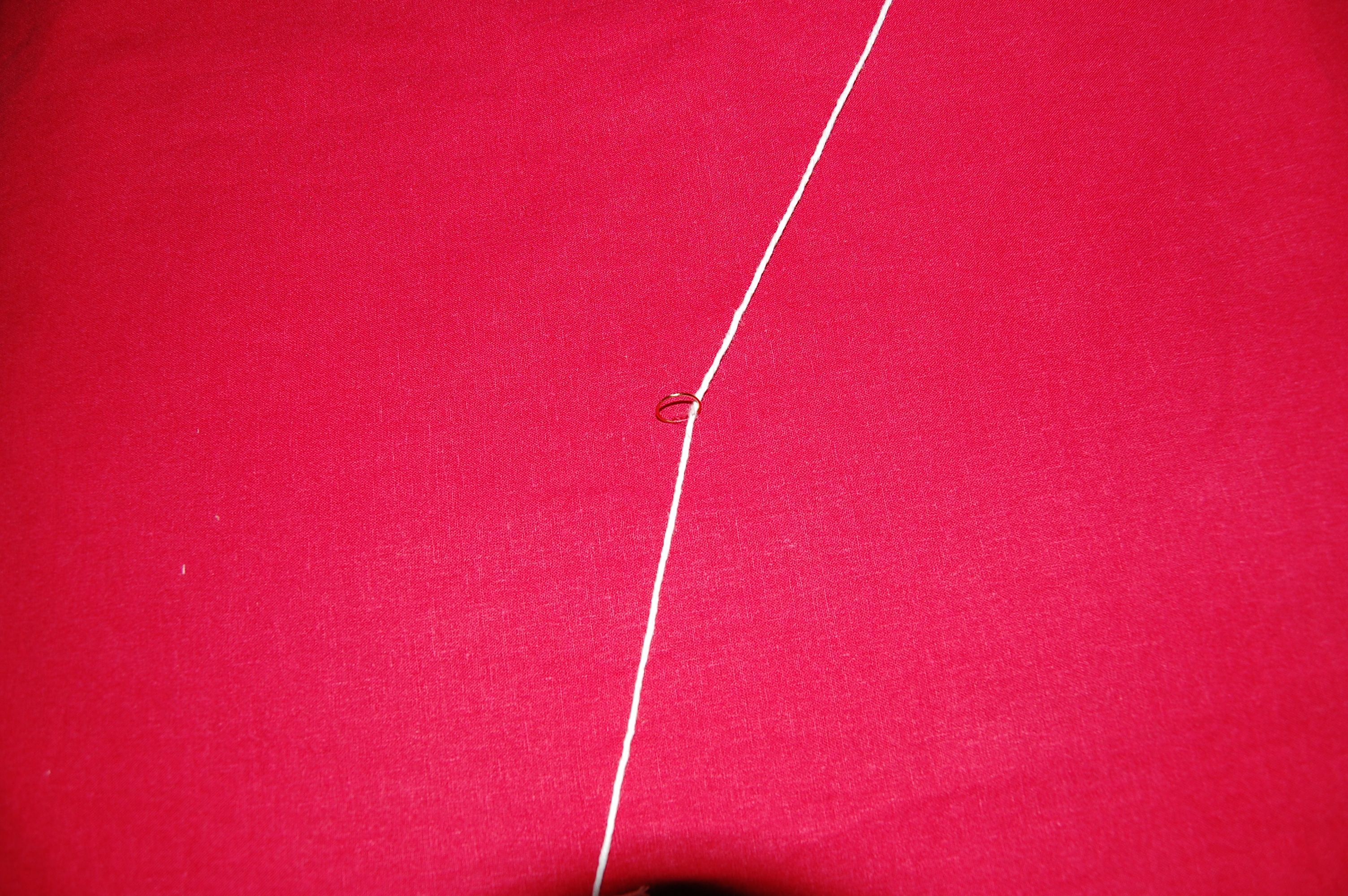
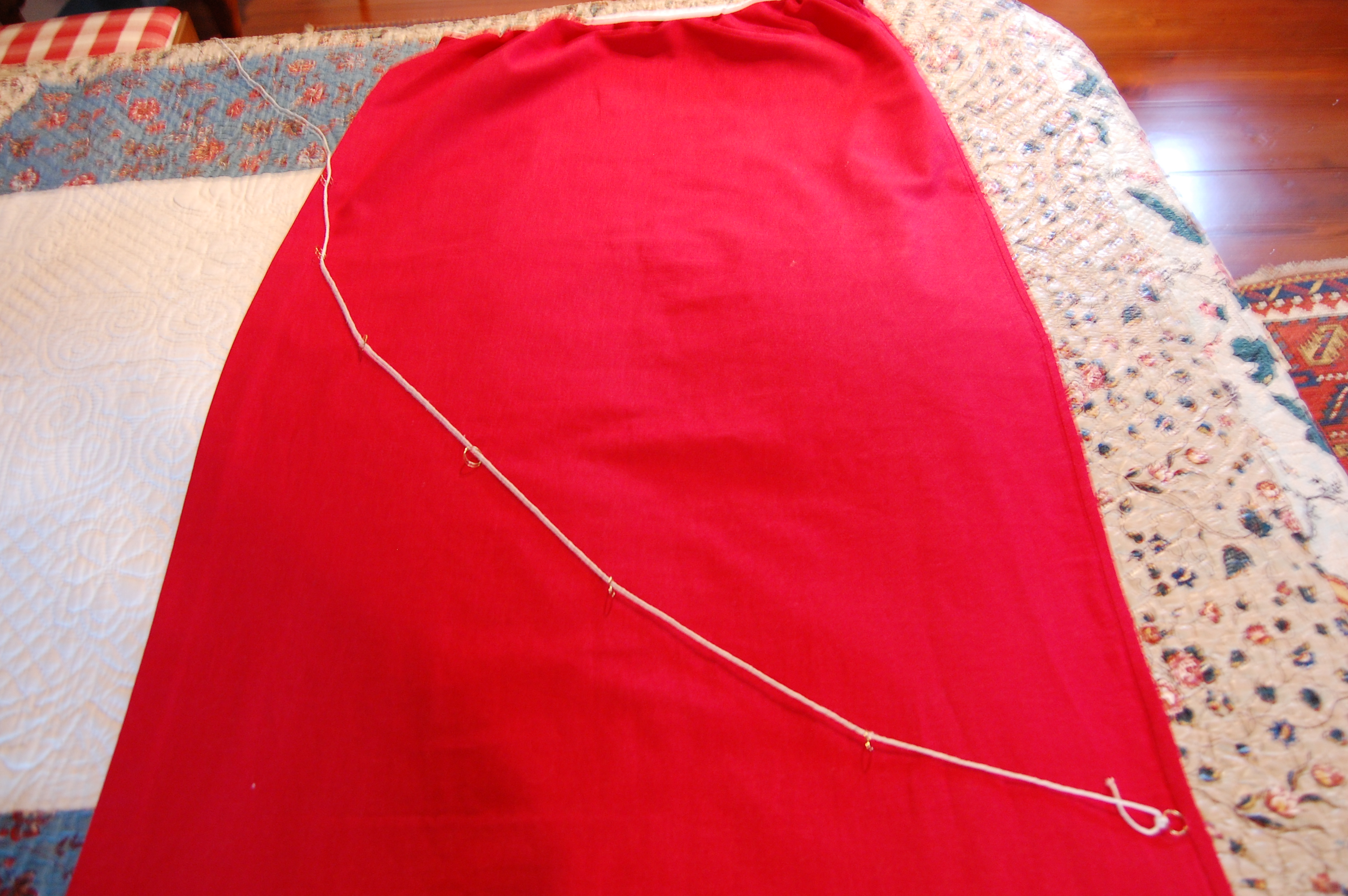
5)   After I lined the side curtains and applied the bias tape to them, I attached brass rings, as one would do with an 18th-century-style “drapery” curtain.  Simple cotton kitchen string is attached to the ring at the front edge and threaded through the rest of the rings. That way the curtains can be drawn up and attached to the hooks on the top of the frame.

The brass rings, attached to the lining side of the side curtains are strung with cotton string.

Here you can see the placement of the brass rings, which determines the drape of the curtain when it is pulled up.

And here is one of the side curtains, shown pulled up and attached to hold the desired drape of the fabric.

6)   Voila – Project complete.  It only took about 12 years…!

All dressed up and nowhere to go!

One more photo to show the framed pillowcases on either side of the bed.

I’m very glad our 18th-century bed is finally dressed – and I’m pleased with the way it looks.  NOW I can get back to sewing mid-century styles instead of 18th-century ones!

4 Comments

Filed under Uncategorized

Quiz #2: Match the fabric to the pattern

Of all my sewing projects, which are either in the works or in the planning stages, two of them will be completed shortly. (At least I hope they will be.  Everything always seems to take longer than I anticipate…  Does anyone else find that to be true?)   However, I’m just not ready to report on either of these “almost-finished” endeavors yet.  . . . So I thought I would take this opportunity to expand a bit on my infatuation with Moygashel linen – and give you, my readers, some more beautiful vintage fabrics to see – and to allow you to imagine them all dressed up and ready to wear.

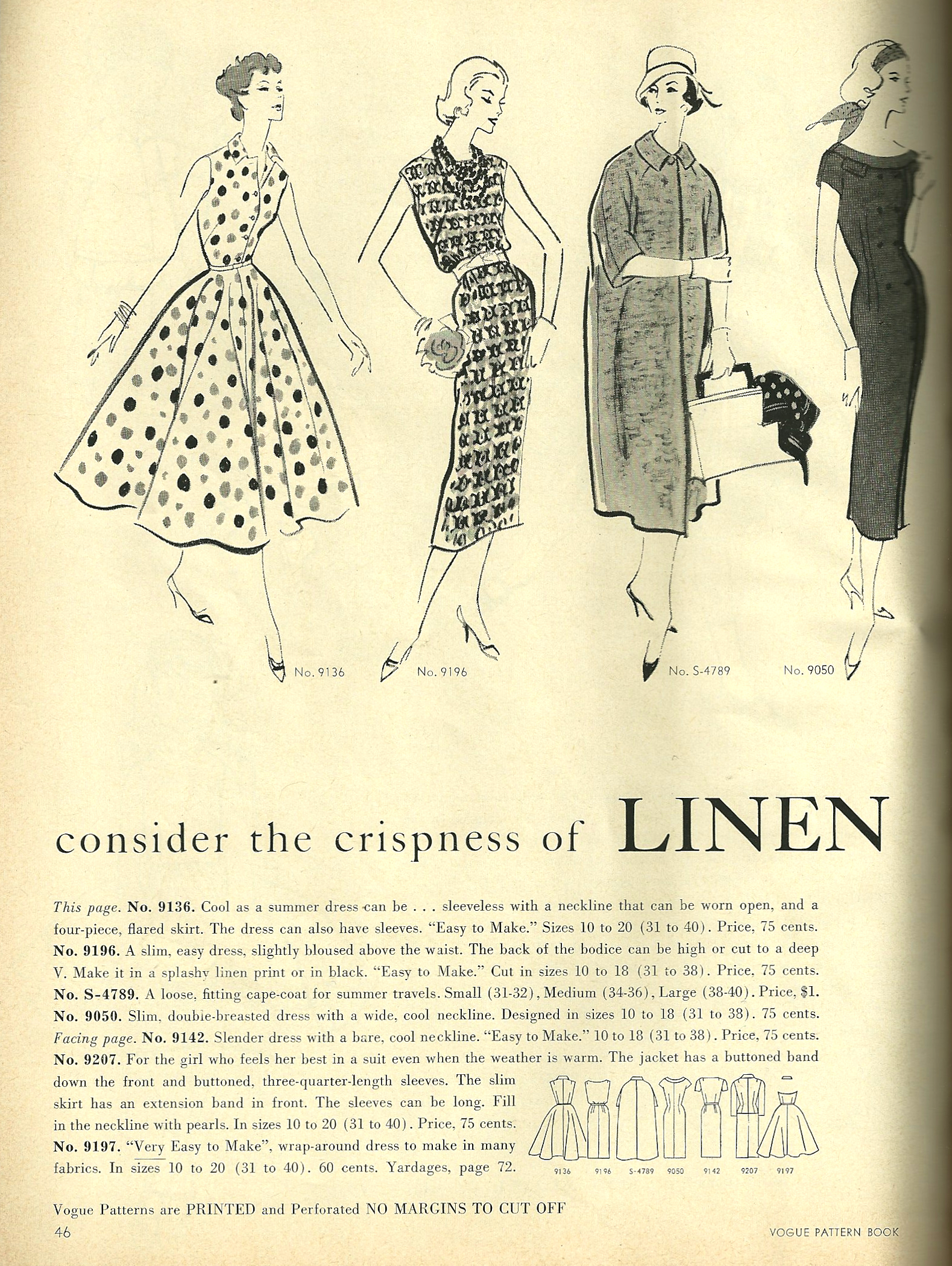
In the Vogue Pattern Book from Summer of 1957, one of the articles implores the reader to “consider the crispness of LINEN”.

This June/July issue is perfect to feature linen - it is a great fabric for Summer - cool, crisp, washable, and the perfect weight for dresses and suits.

Articles like this, and ads for linen fabrics, showcase the popularity of sewing with linen in the 1950s, ‘60s, and ‘70s.  I shared a few Moygashel linen ads with you recently, and here are three more, which illustrate the range of designs and colors available to the mid-century home sewer.

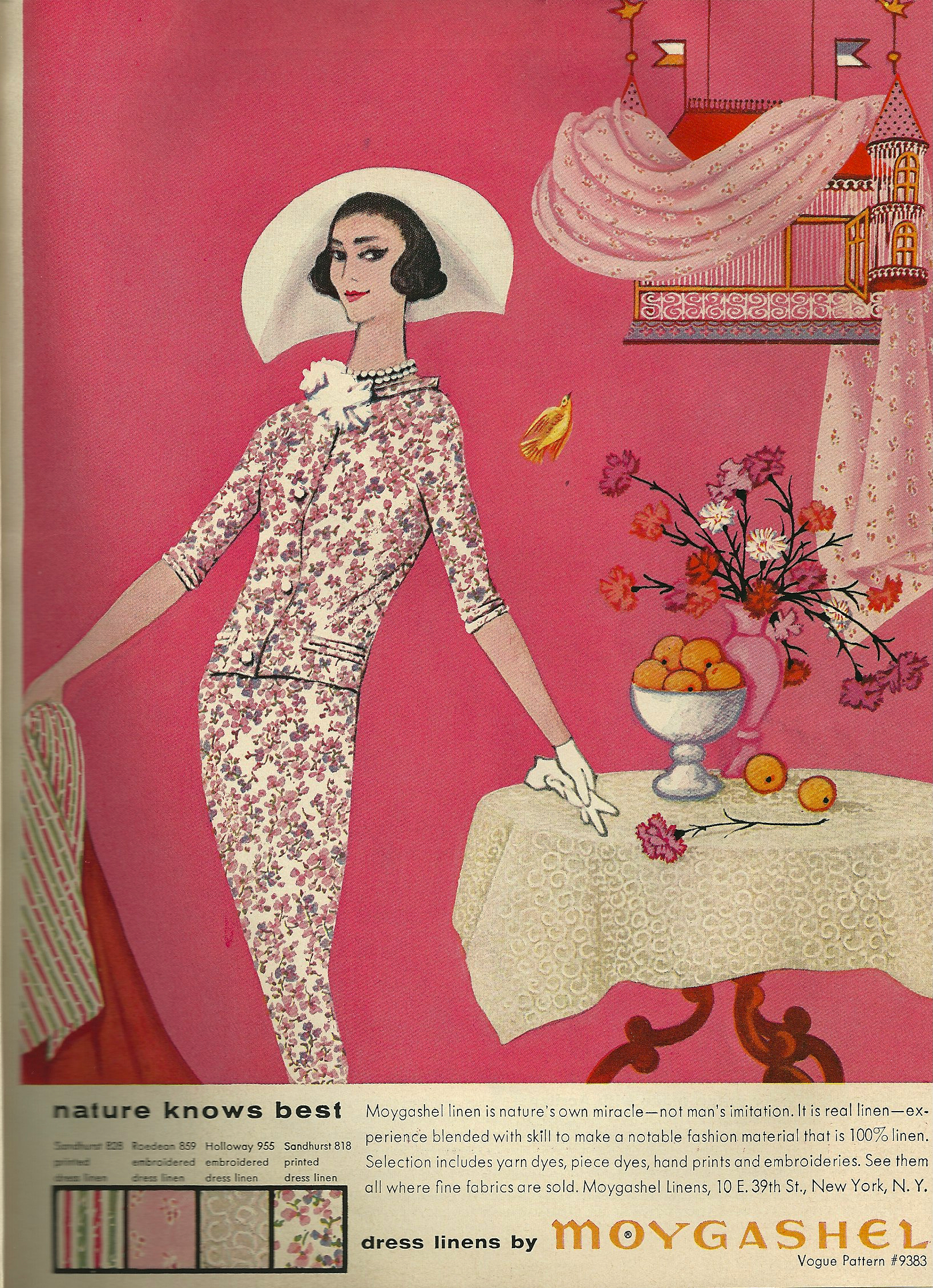
This almost whimsical illustration depicts four designs of Moygashel linen. It appeared in the February/March 1958 issue of Vogue Pattern Book magazine.

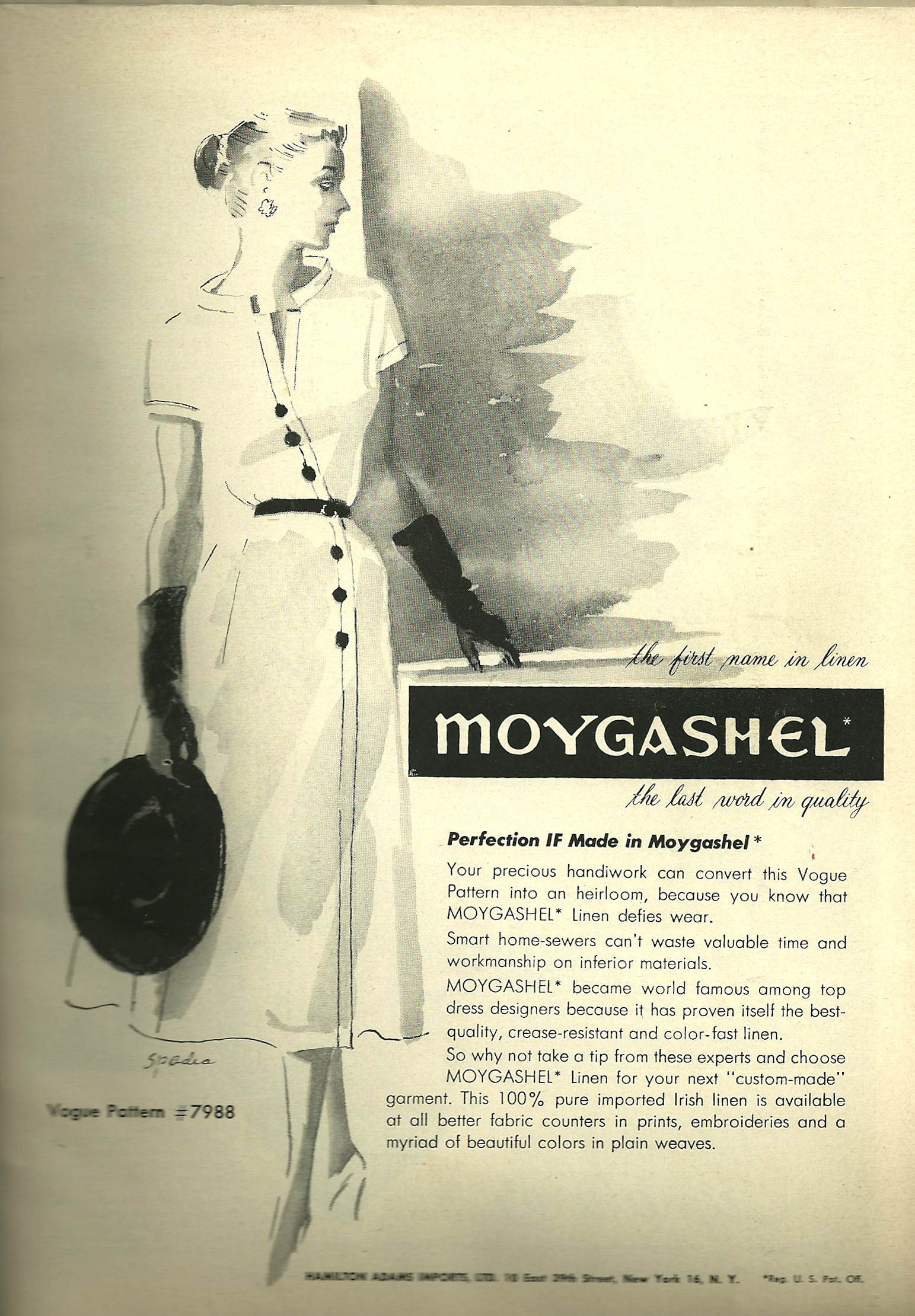
This ad states: "Your precious handiwork can convert this Vogue Pattern into an heirloom, because you know that Moygashel Linen defies wear." Those words were certainly presentient! It appeared in the April/May 1953 Vogue Pattern Book magazine.

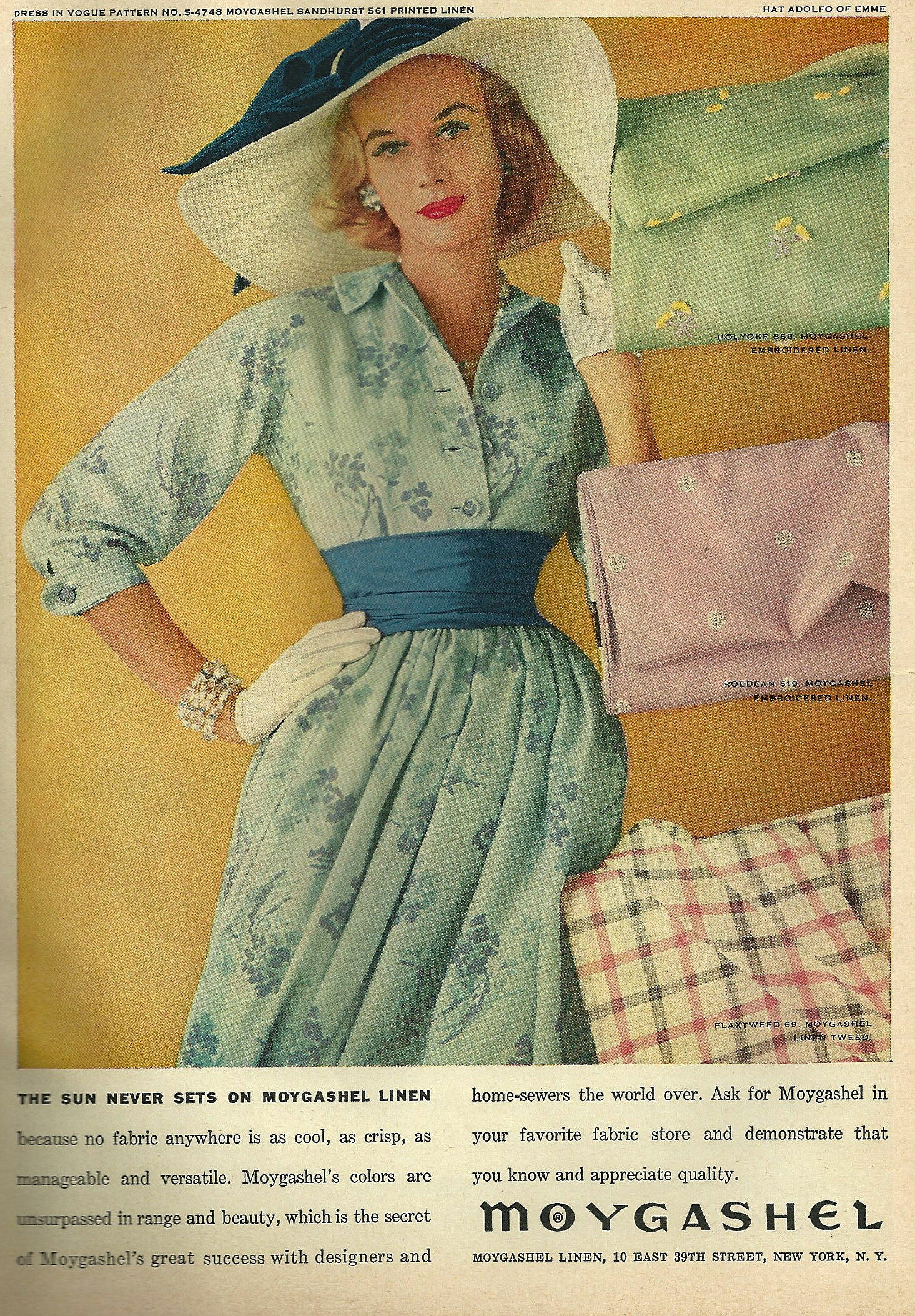
Here are four more Moygashel linens, featured in the February/March 1957 Vogue Pattern Book magazine.

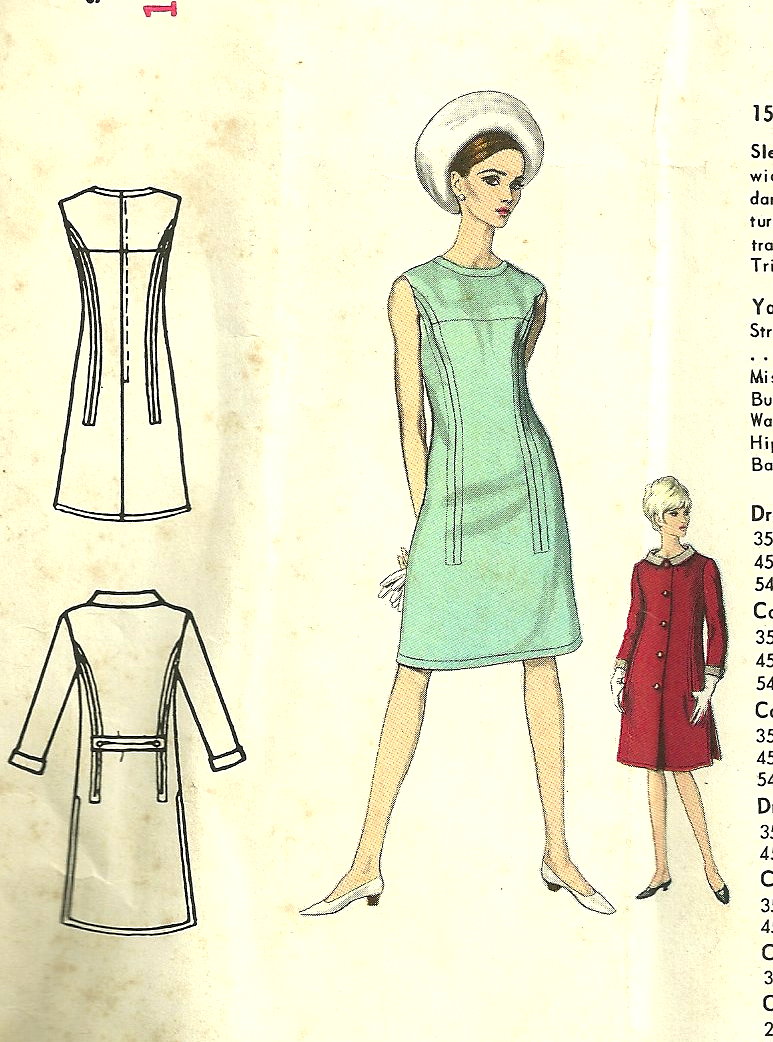
I certainly decided to “consider” linen when I purchased this 1965 Vogue pattern a few months ago:

This pattern is for a paring of coat and dress, but the dress stands alone beautifully.

My intention was to make the dress only – a lovely sheath with some distinctive seaming and top-stitching.  So I went to my fabric closet to see what linens I could “consider” for a crisp Spring/Summer dress.  Here are the four that I decided to choose from:

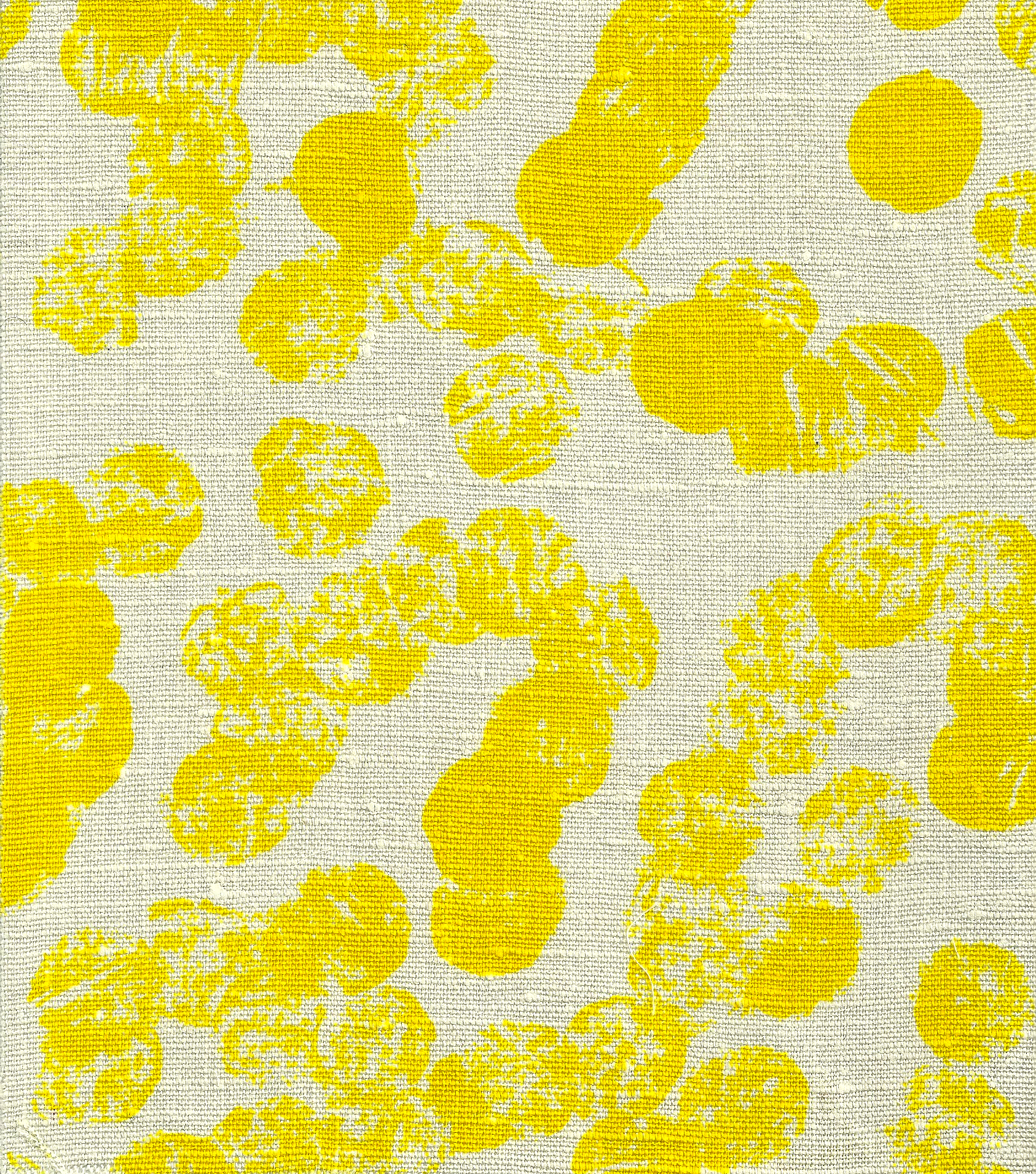
#1 - Bright and sunny, this design is a subtle play on the polka dot theme.

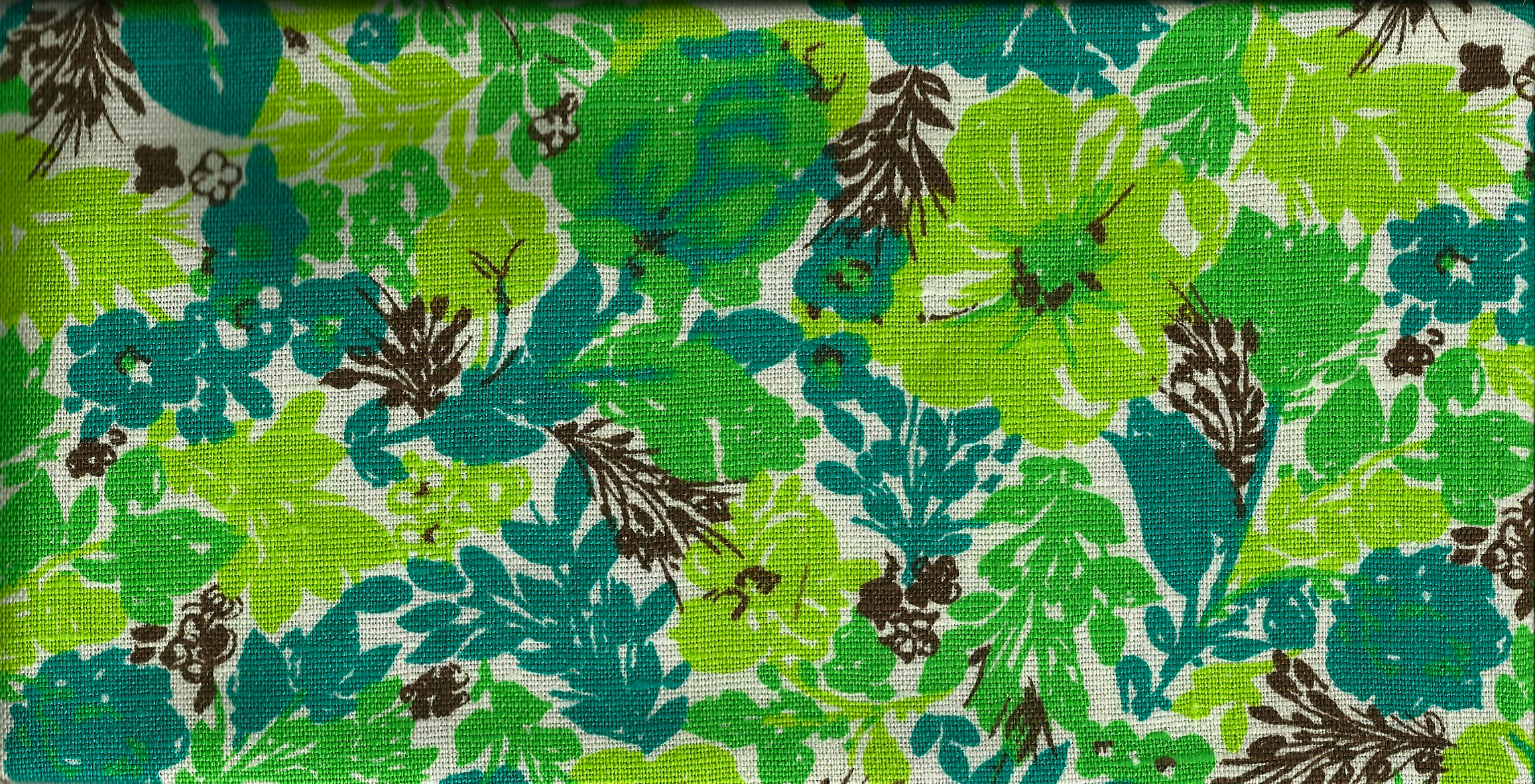
#2 - The colors in this design are very 2012-current-and- fashionable!

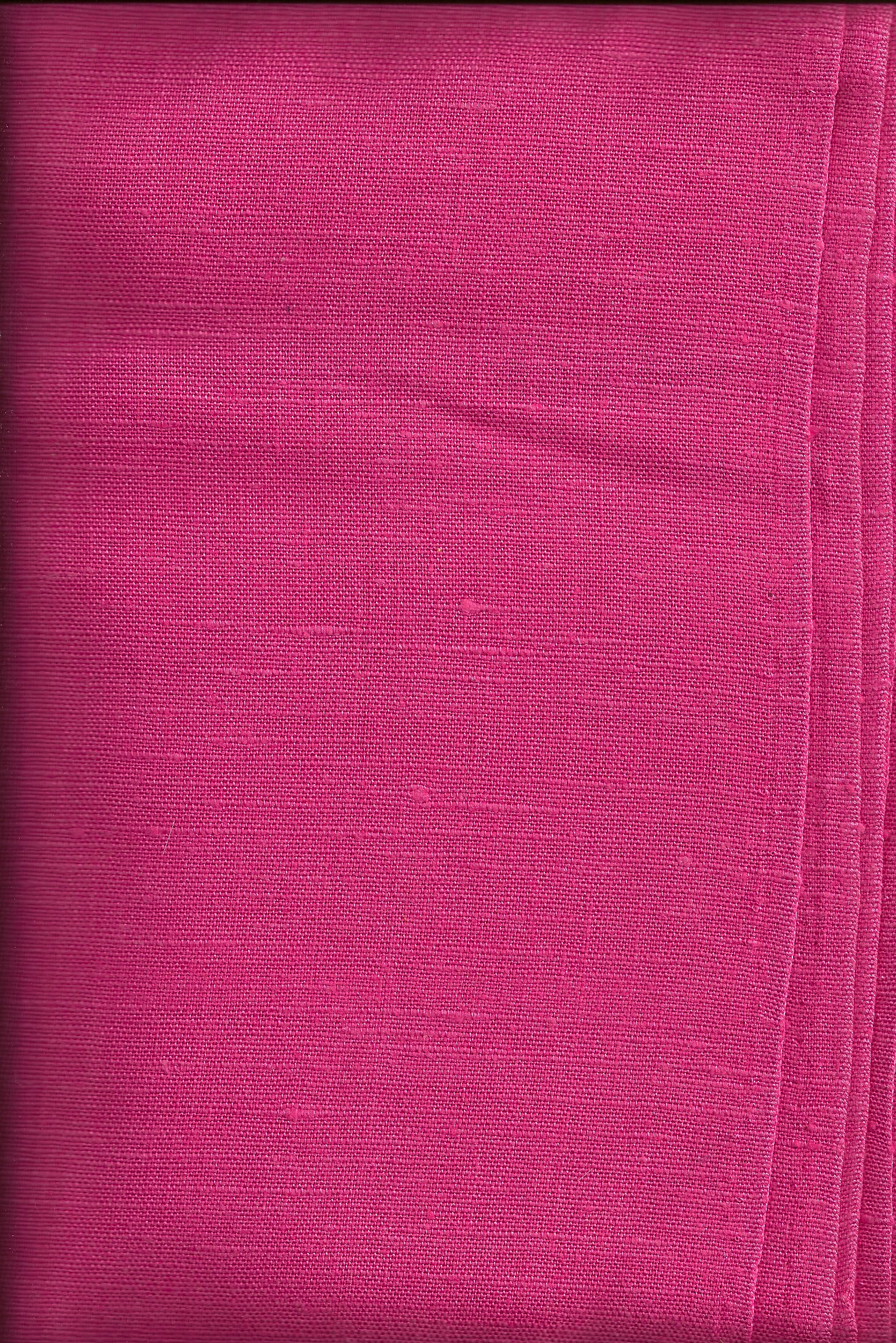
#3 - Decorative topstitching on this solid pink linen would be quite attractive.

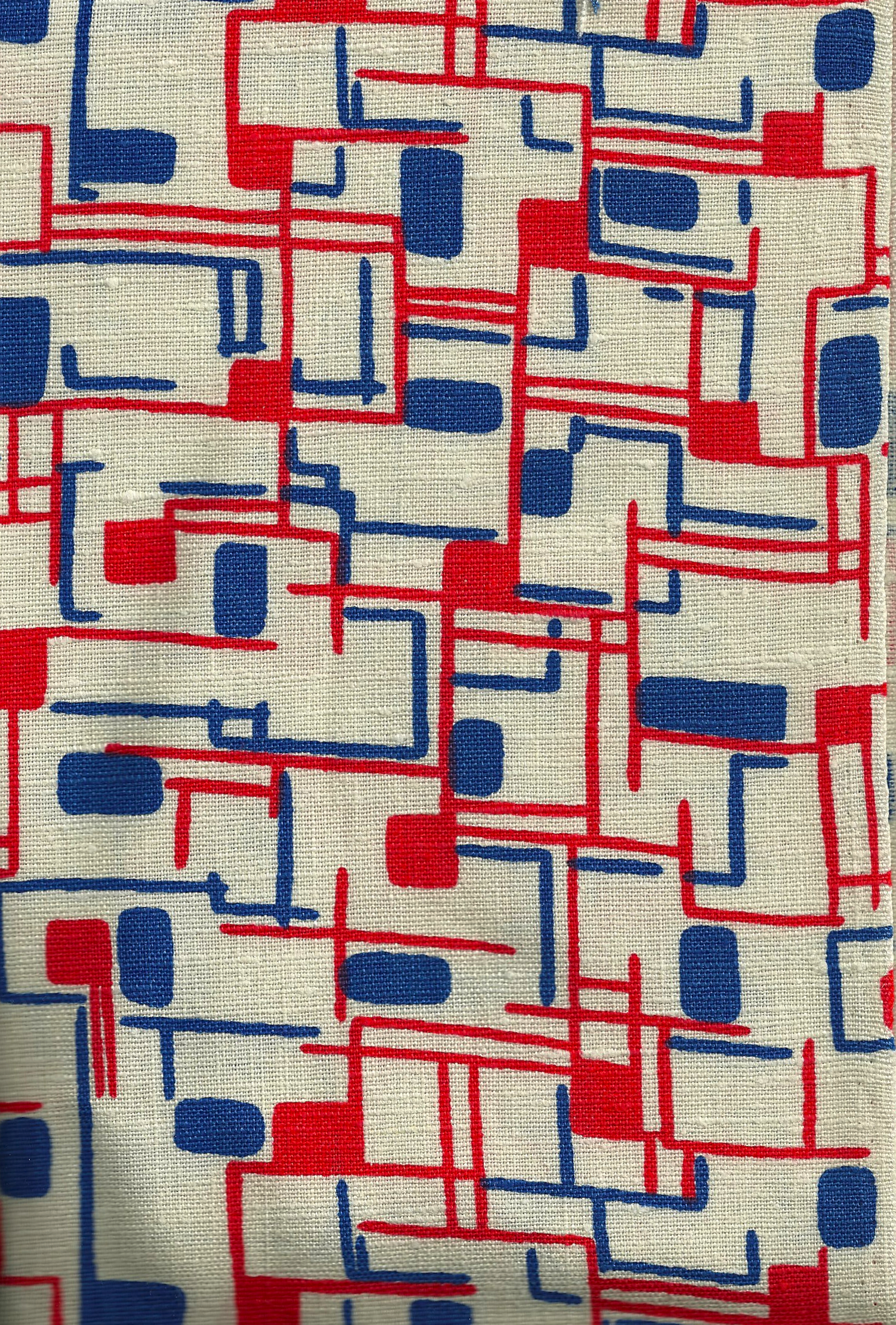
#4 - This geometric print is probably from the late '60s, so it would make up beautifully in a pattern from the '60s!

Which fabric would you choose for this dress pattern?  Which one do you think I chose to make into this dress?

6 Comments

Filed under Linen, Polka dots, Uncategorized, vintage Vogue patterns from the 1950s, vintage Vogue patterns from the 1960s, Vogue patterns

Give me Liberty . . .

. . .  and I’ll make a dress!  Of course, I’m referring to Liberty cottons, one of the great fabrics of the world.  There is, as most of you already know, more to Liberty than just cottons – they make silks, too, and one look at their website will introduce you to the full range of Liberty products, appeal, and mystique.  It is so exciting to me to realize that this company, which was founded in 1875, is still producing some of the finest quality fabrics in the world. Their most famous fabric is that cotton, more properly referred to as Tana Lawn.  Here I quote from The Liberty Book of Home Sewing (about which I’ll tell you more shortly):

Tana Lawn   Synonymous with Liberty, this 100% cotton fabric has a very fine thread count and soft, silky feel.  New print designs are created each season, heritage classics are continuously reworked, and there is also an array of coordinating plain colors.”

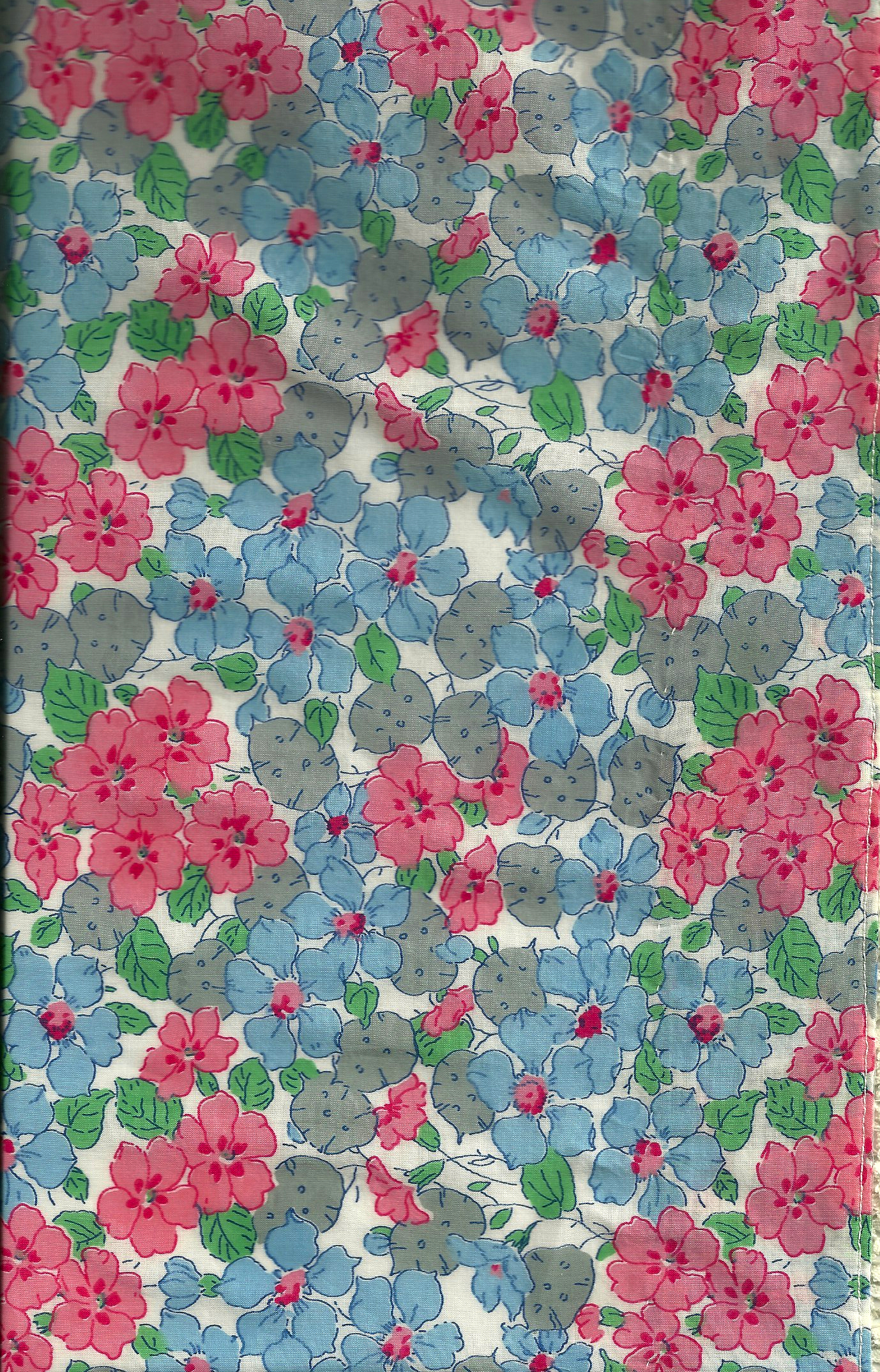
It just so happens that I lucked into two pieces of Tana Lawn, originally purchased by a relative in the ‘60s, and tucked away, unused, into a bureau drawer.  When the contents of that drawer were being emptied about a decade later, I was the happy recipient.  At that point in time, Tana Lawn was only 35” wide, so in order to make a dress or blouse, it was necessary to have a good bit of yardage at one’s disposal, to compensate for the narrow width.  Of course, the piece I liked the best had the least yardage:

I find the colors and design of this cotton so appealing.

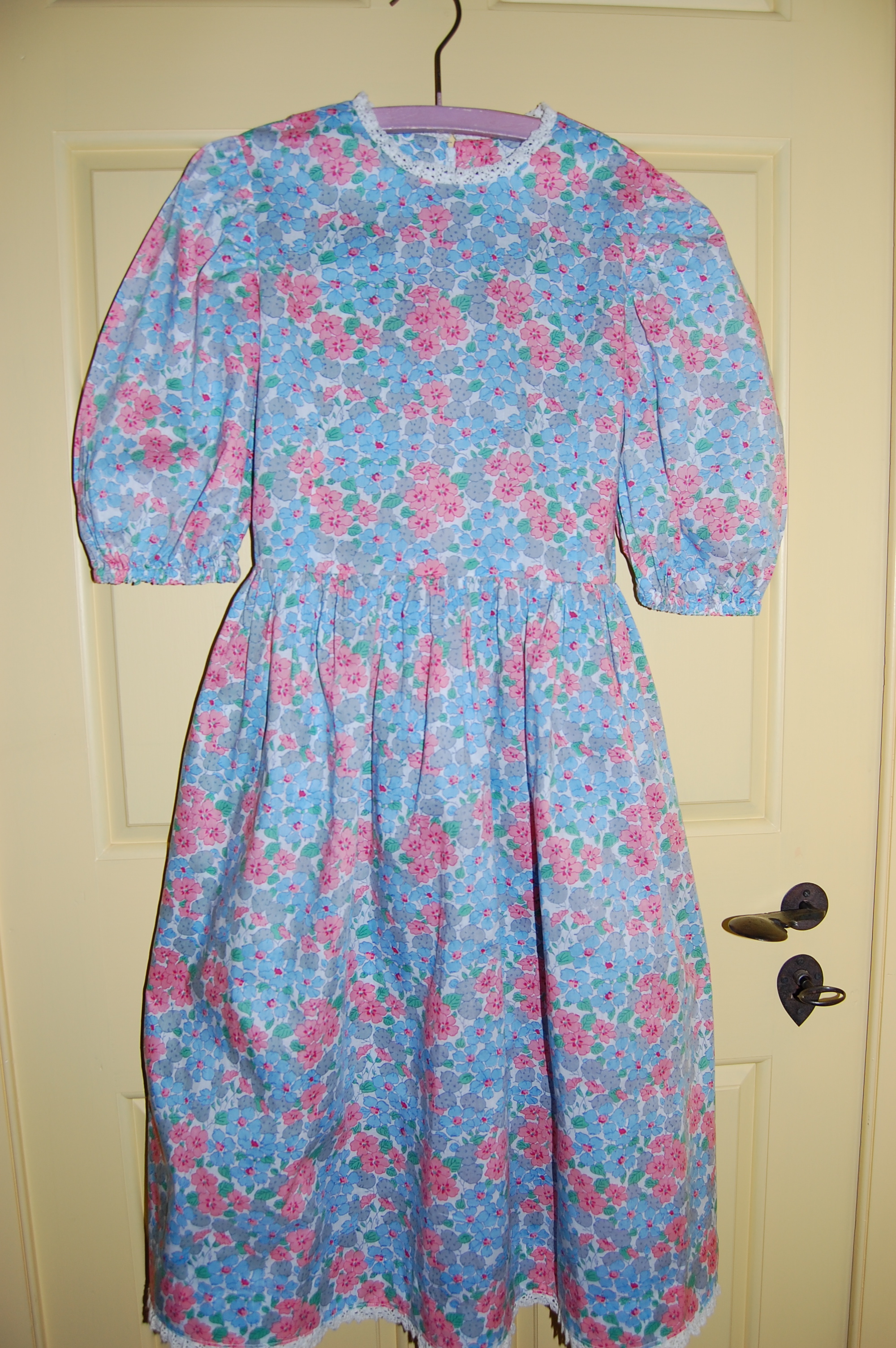
It sat in my fabric drawer for about another 12 or 15 years, until I finally made it into a dress for my daughter when she was about 8 years old.

The only reason I saved this dress is because of its vintage Liberty fabric.

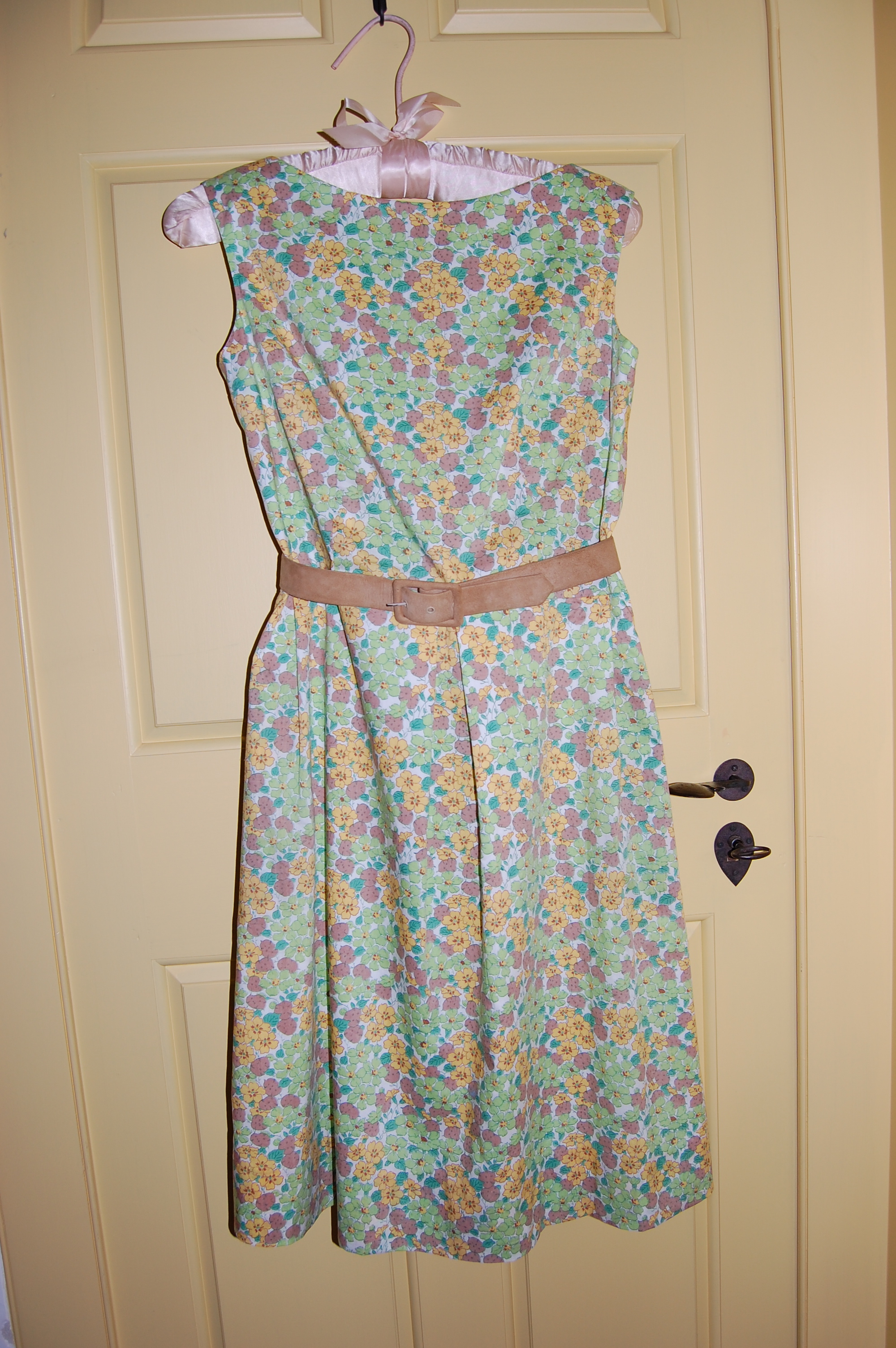
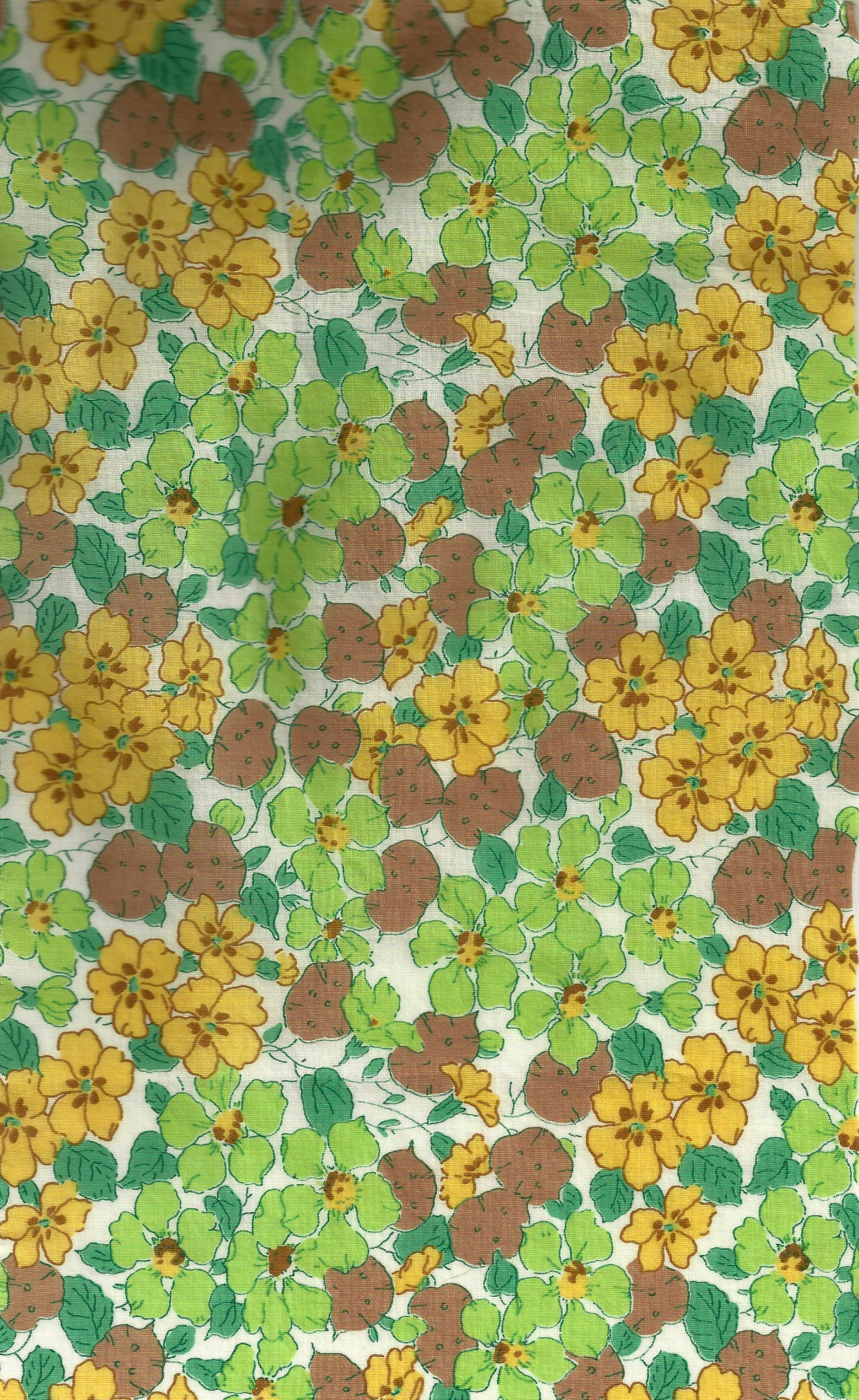
The second piece had a bit more yardage to it, but it, too, sat in my fabric closet, until last Summer, when I finally decided I would make myself a dress.

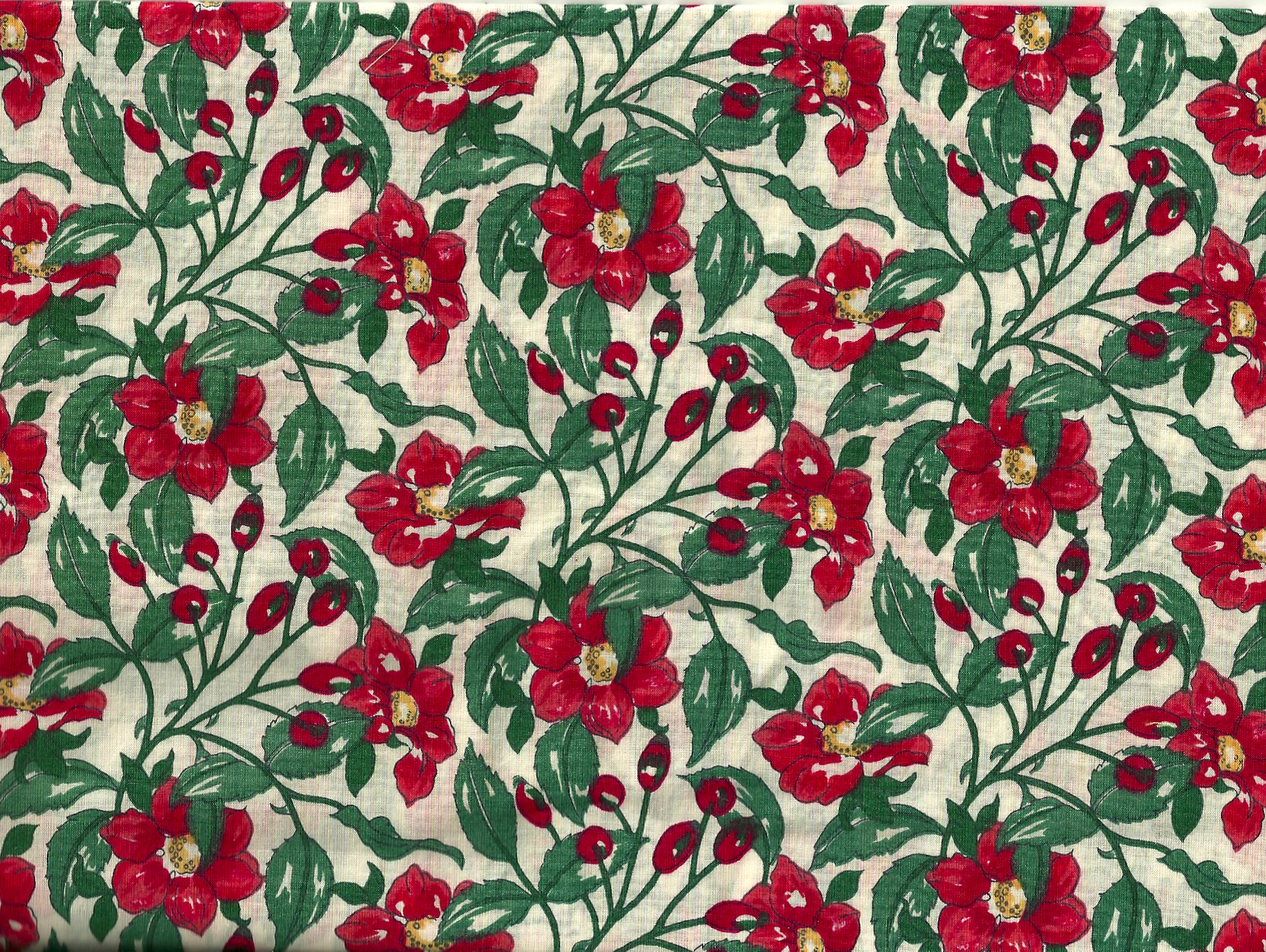
This is the same fabric design in different colors.

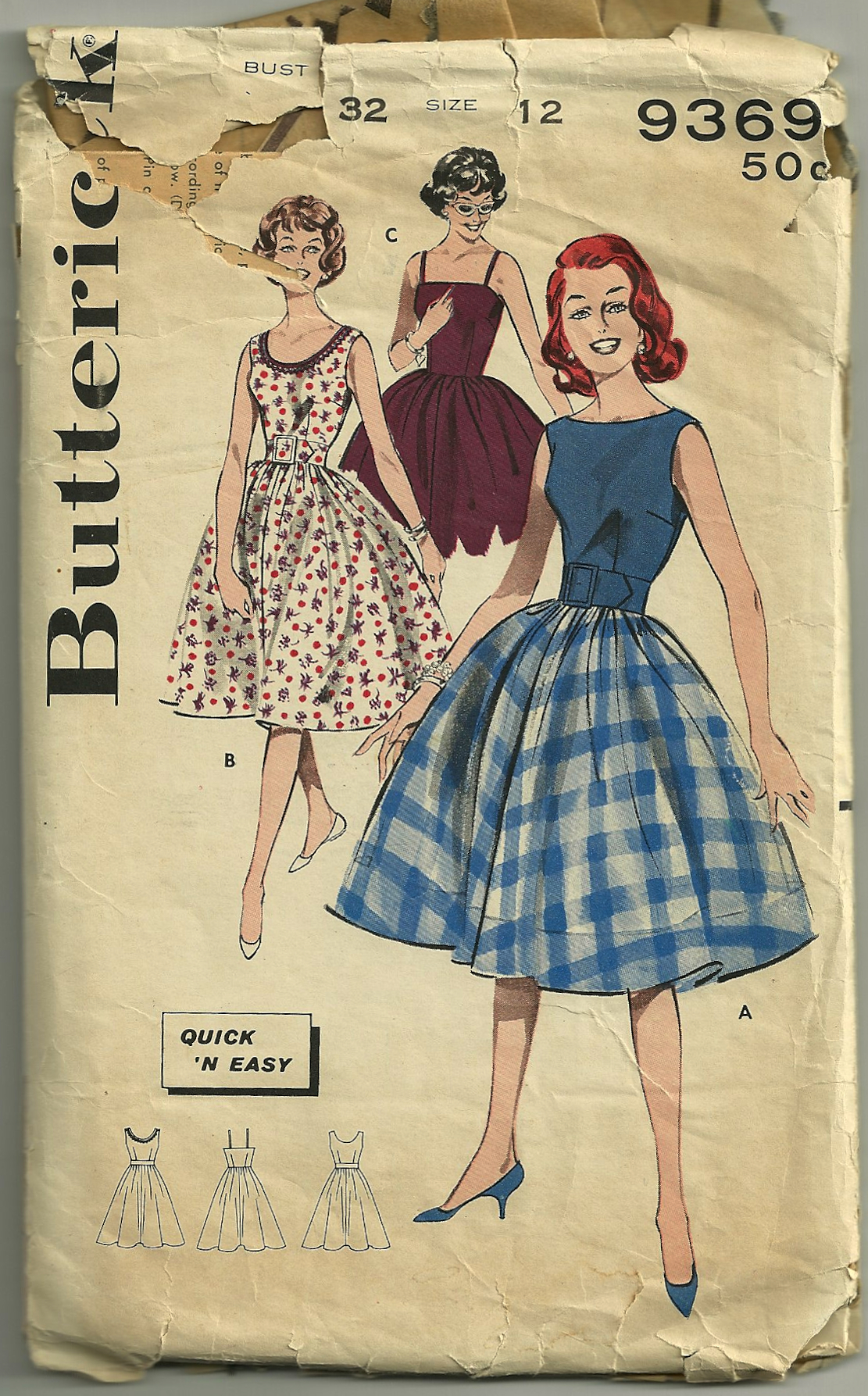
I knew it would have to be sleeveless, and I envisioned a simple belted bodice with some fullness in the skirt.  The only pattern I could find which came close was this Butterick one:

I chose this pattern primarily for the bodice in View A (the blue one).

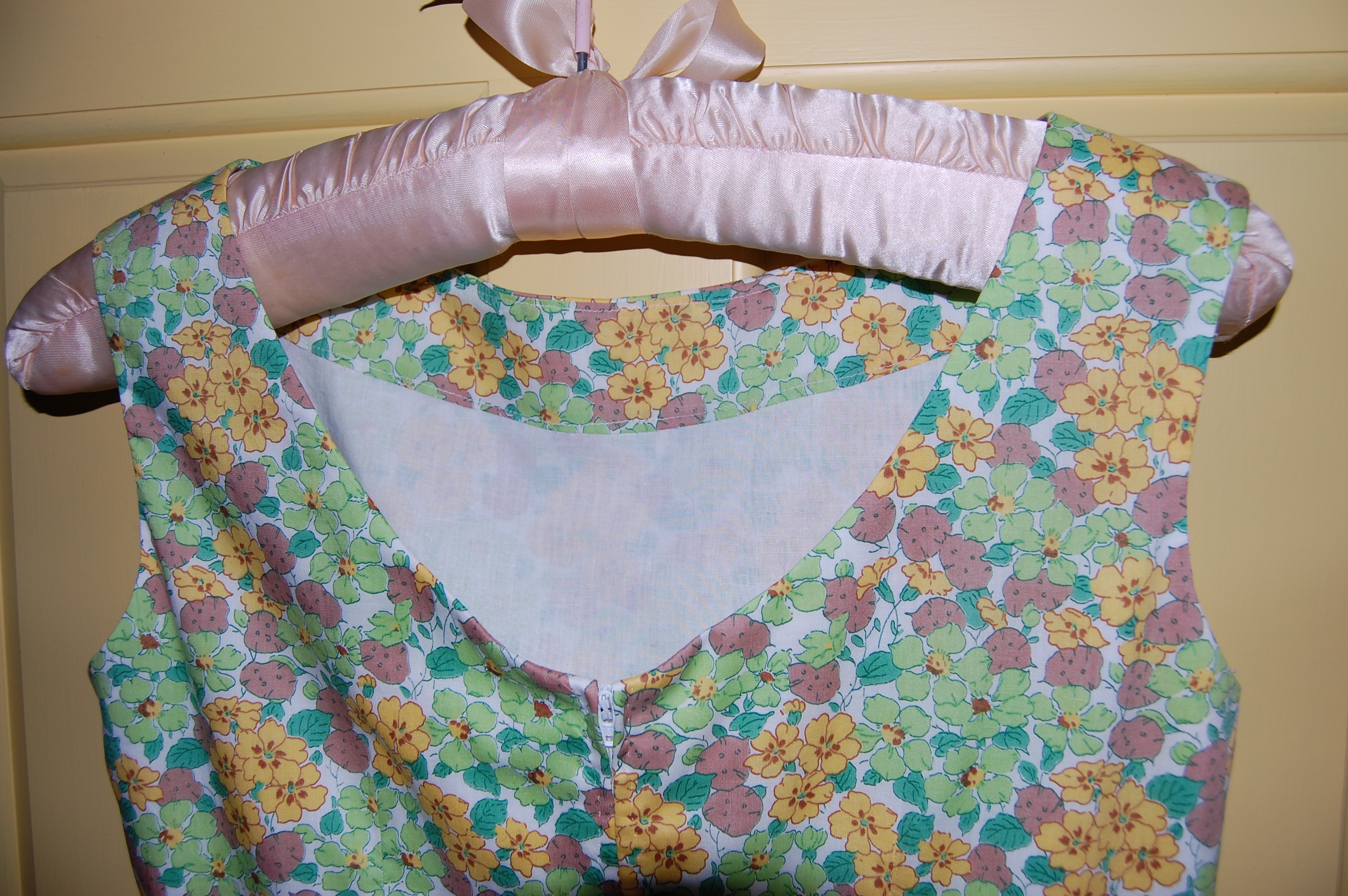
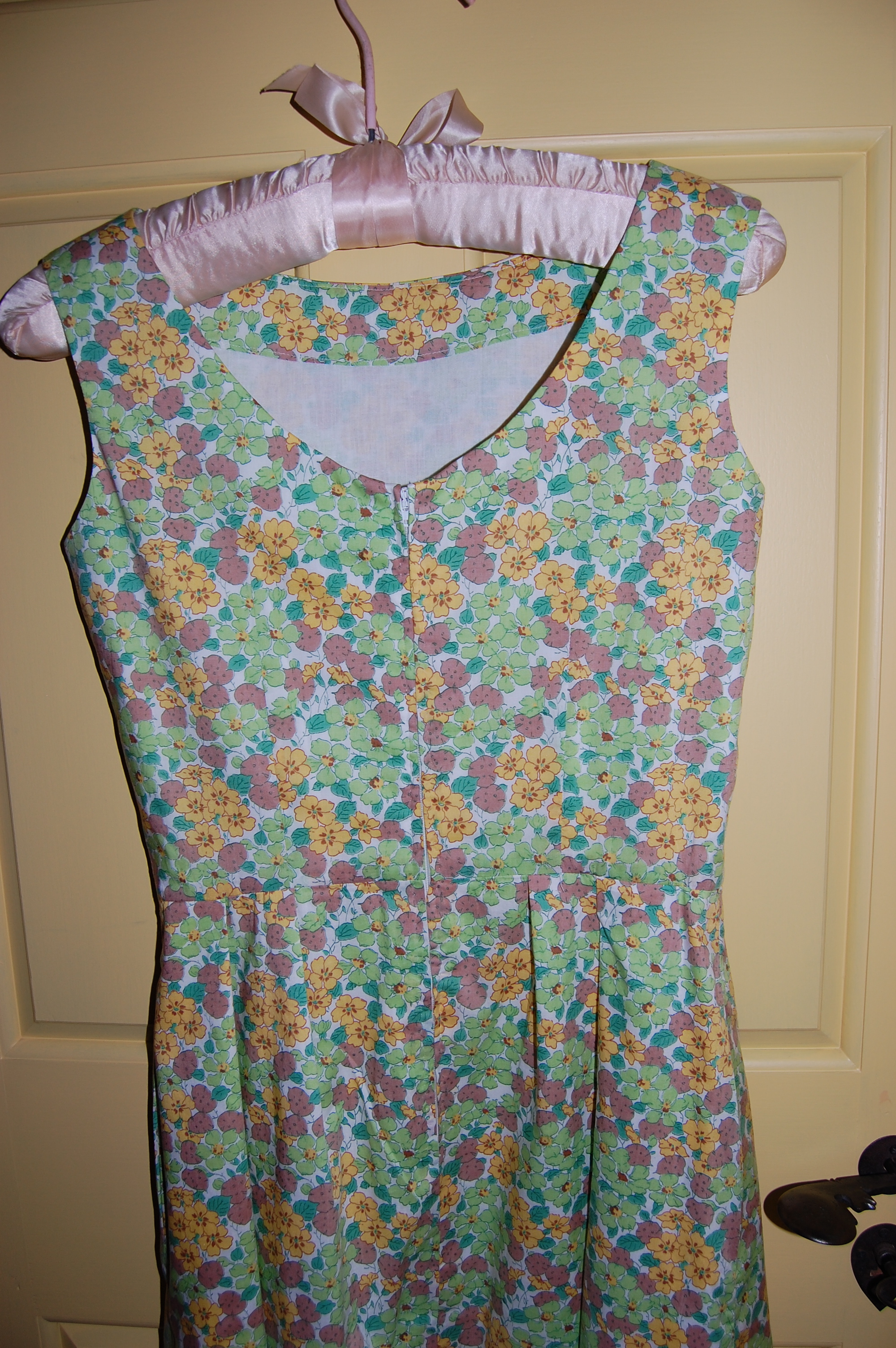
Then I began making alterations to it:  a few soft pleats for the skirt instead of all that fullness; I wanted to add pockets in the side seams; to add pockets, I had to move the zipper from the side to the back, which also made it easier for me to fit the pattern pieces onto the narrow fabric. Finally, I wanted it lined, which I did with a very lightweight white cotton lawn.  Here’s how it turned out:

I did not have enough fabric left to make a self belt, so I have worn it with one I already have, until I can find one I like better!

I really like the back of this dress.

Here is a close-up of the back neckline.

Well, it seems I am always rediscovering pieces of fabric in my extensive collection, and although I have known this fabric was there, it always seems like a new discovery when something so pretty surfaces again.  I purchased this piece of Tana Lawn in Bermuda (probably at Trimingham’s, now unfortunately out of business) sometime in the 1980s.

I still love this fabric over twenty-five years after purchasing it!
I could never decide on a pattern to use for it – those ’80 styles were just too awful.  So this fabric is another one of those “Thank goodness I never made this!”  Although it is also just 35” wide, I have a plentiful 4½ yards so I should be able to pair it with a vintage pattern from the ‘50s or ‘60s – I’m still looking and deciding…  Ideas, anyone?  (Interestingly, Liberty apparently changed their production in the early 1990s, and now their Tana Lawn is 44” wide.)

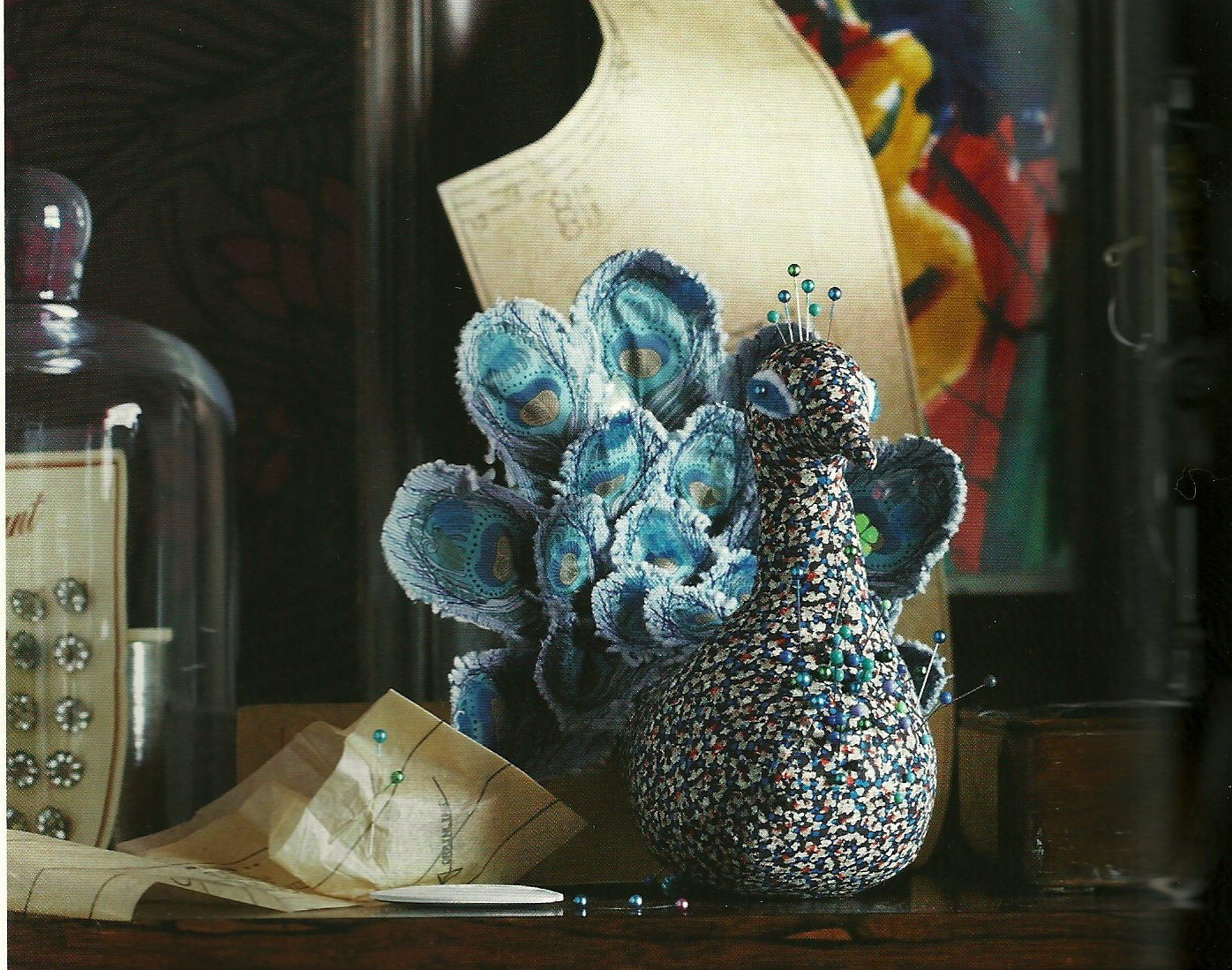
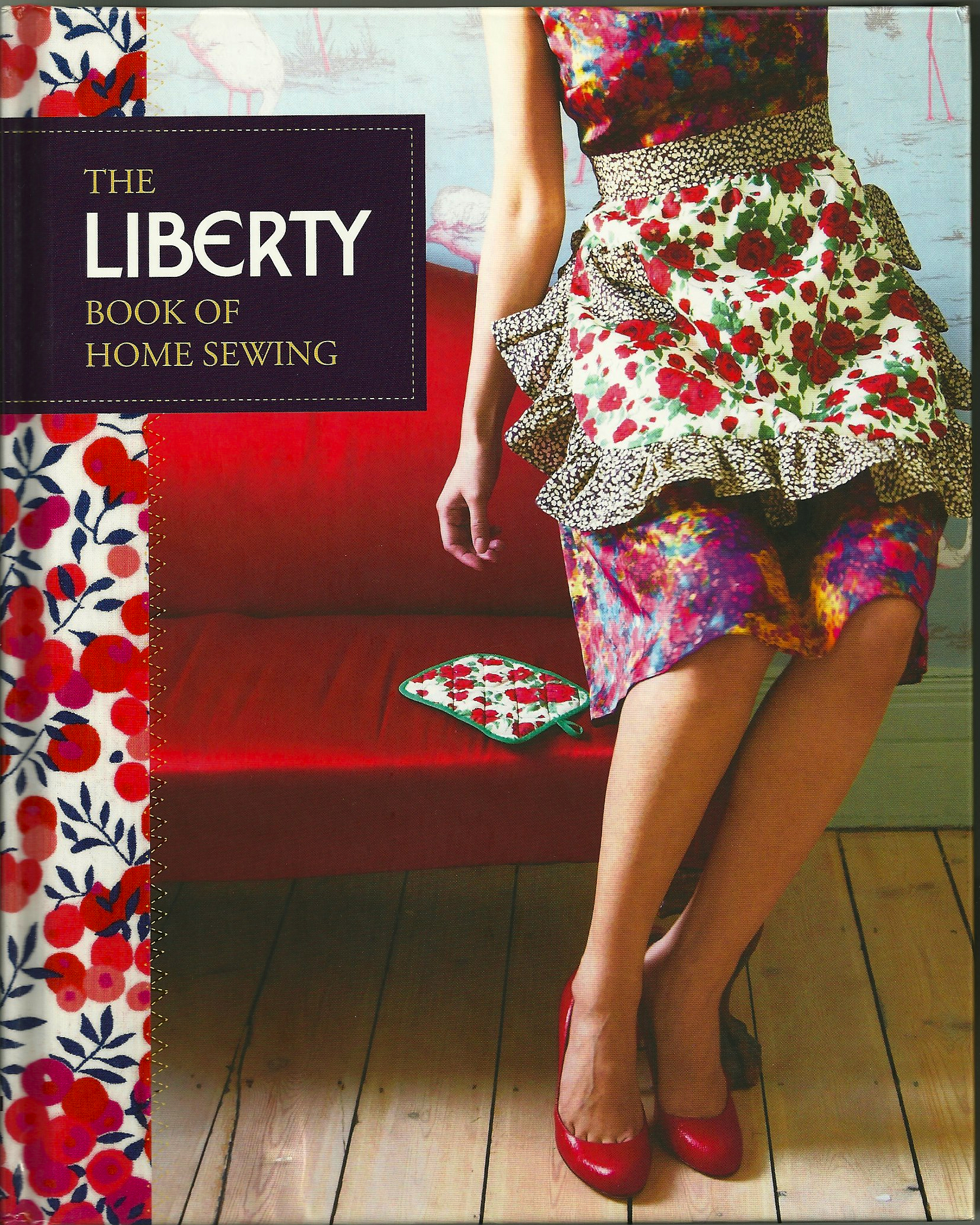
Now, about that afore-mentioned book:  last Summer I was browsing books on sewing and fashion on Amazon, and The Liberty Book of Home Sewing popped up for pre-order.  Being a complete push-over for any books which showcase beautiful fabrics, I signed up for it and it arrived in October.  Of the 25 projects featured, my favorites are the vintage ‘50s look apron on the cover and the peacock pincushion.

This is the cover of the hardback book, showing the frilly '50s' style apron.

And here is the whimsical peacock pincushion project.

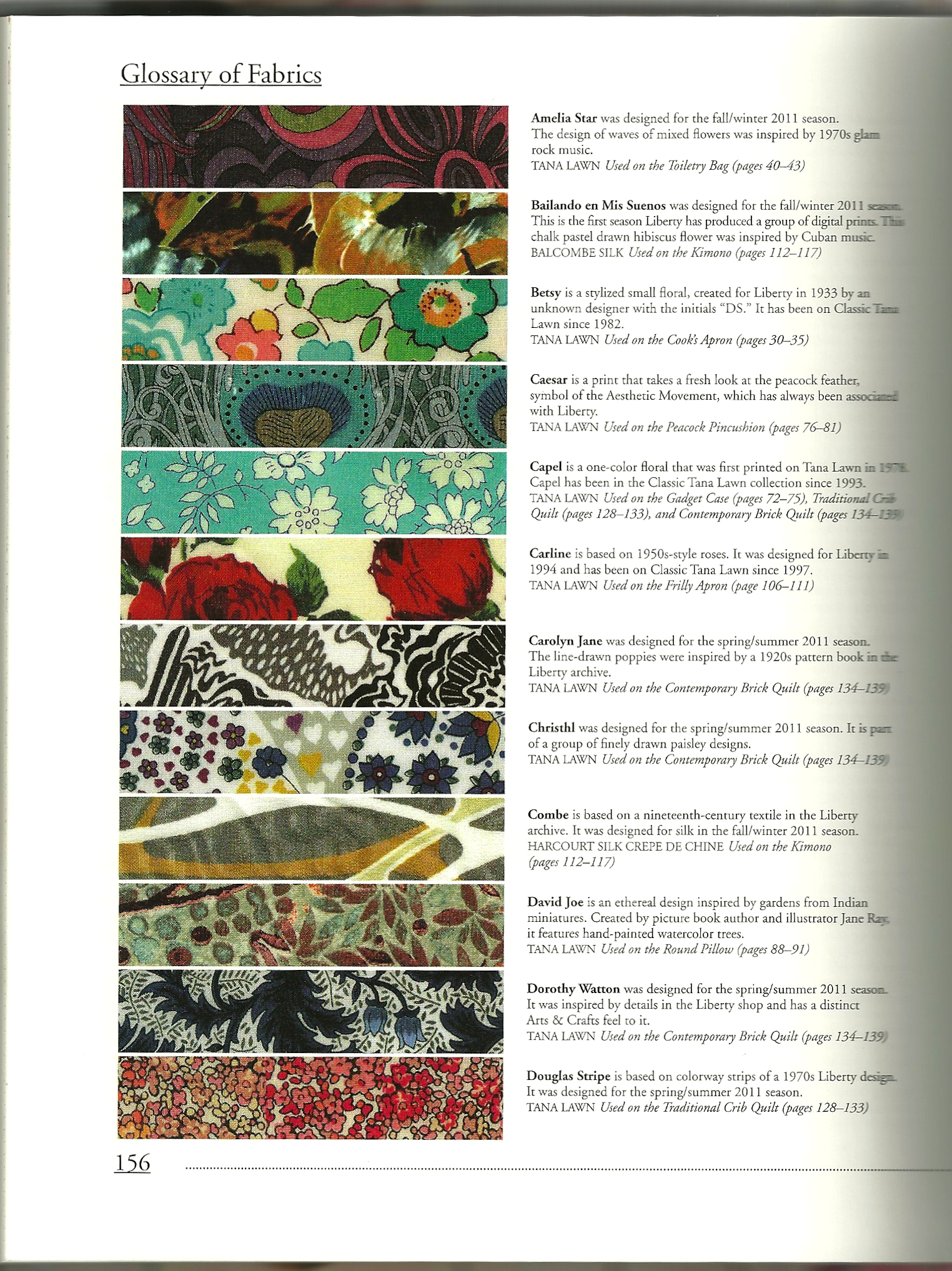
What I really like about this book, however, are the full-page representations of Liberty cottons; the Glossary of Fabrics, which includes a little history about each featured design; and the Foreword, which includes a history of the production of Tana Lawn.

Here is one page of the Glossary of Fabrics.

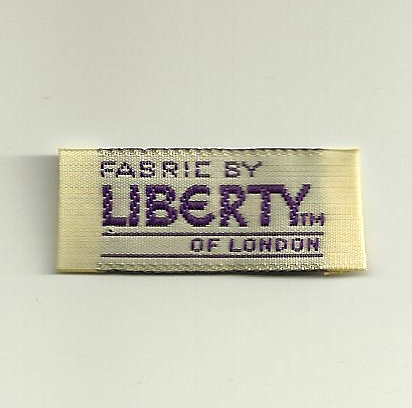
Finally – one last thing:  when I purchased my Liberty fabric in Bermuda, this label came with it:

This tag is small, but packs a powerful message! I'll definitely be sewing it into whatever dress I eventually make.

What is it about a label that can give a fabric or pattern purchase – and ultimately the finished garment – its own persona?  How can something so small add so much validation and completeness to the dressmaker’s labor of love?

4 Comments

Filed under 1980's dress patterns, Liberty cotton, side-placed zippers, Uncategorized

Shopping in my (cedar) closet.

In the 1940s, ‘50s, ‘60s and ‘70s, most well appointed ladies’ closets contained at least one dress or suit made from Moygashel linen.  The cachet around this product of Ireland was legendary:  it was touted as crease resistant, made so by  a special process in its manufacture which used soft rainwater from the streams in the Mourne Mountains of northern Ireland.    It has many virtues, including:

1)   it was available in many beautiful solid colors…

2)   and in amazing prints, which by themselves are like mini works of art….

3)   and in embroidered designs, which are still today instantly recognizable as Moygashel.

4)   It is machine washable.

5)   It does not wrinkle, truly!!

6)   It lasts and lasts.

It’s no wonder that designers and high-end ready-to-wear garment manufacturers used Moygashel linen and proudly displayed the name of Moygashel along with, and in addition to, their own labels.

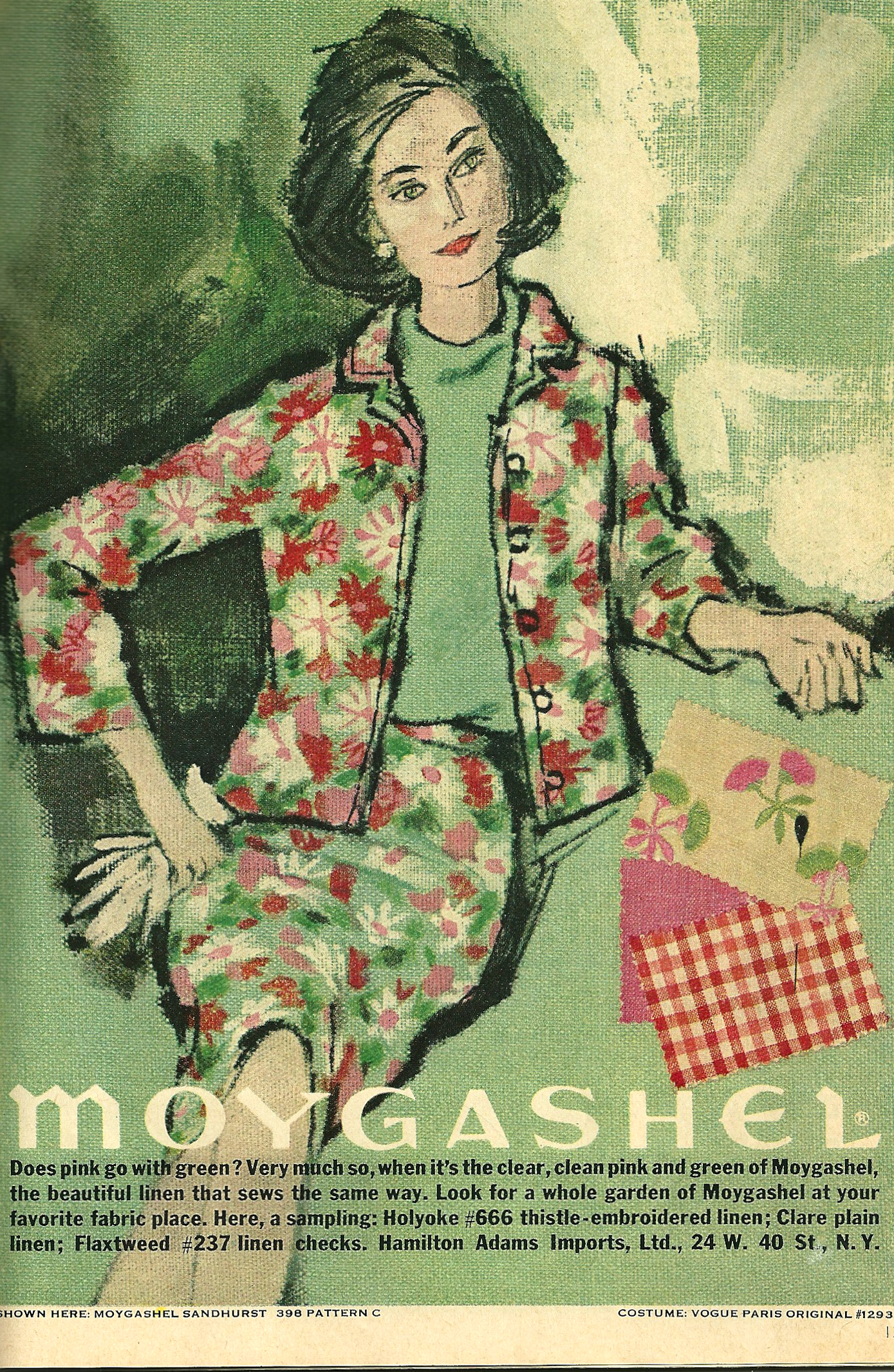
Luckily for the home sewer and dressmaker, Moygashel linen was also available in yardage at the finest fabric stores and departments.  Obviously home sewers took to it readily.  Artful, full-page ads for Moygashel linen in sewing and pattern magazines were commonplace.  Here are a few that were given up-front placement in issues of the Vogue Pattern Book magazine from various dates in the ‘60s:

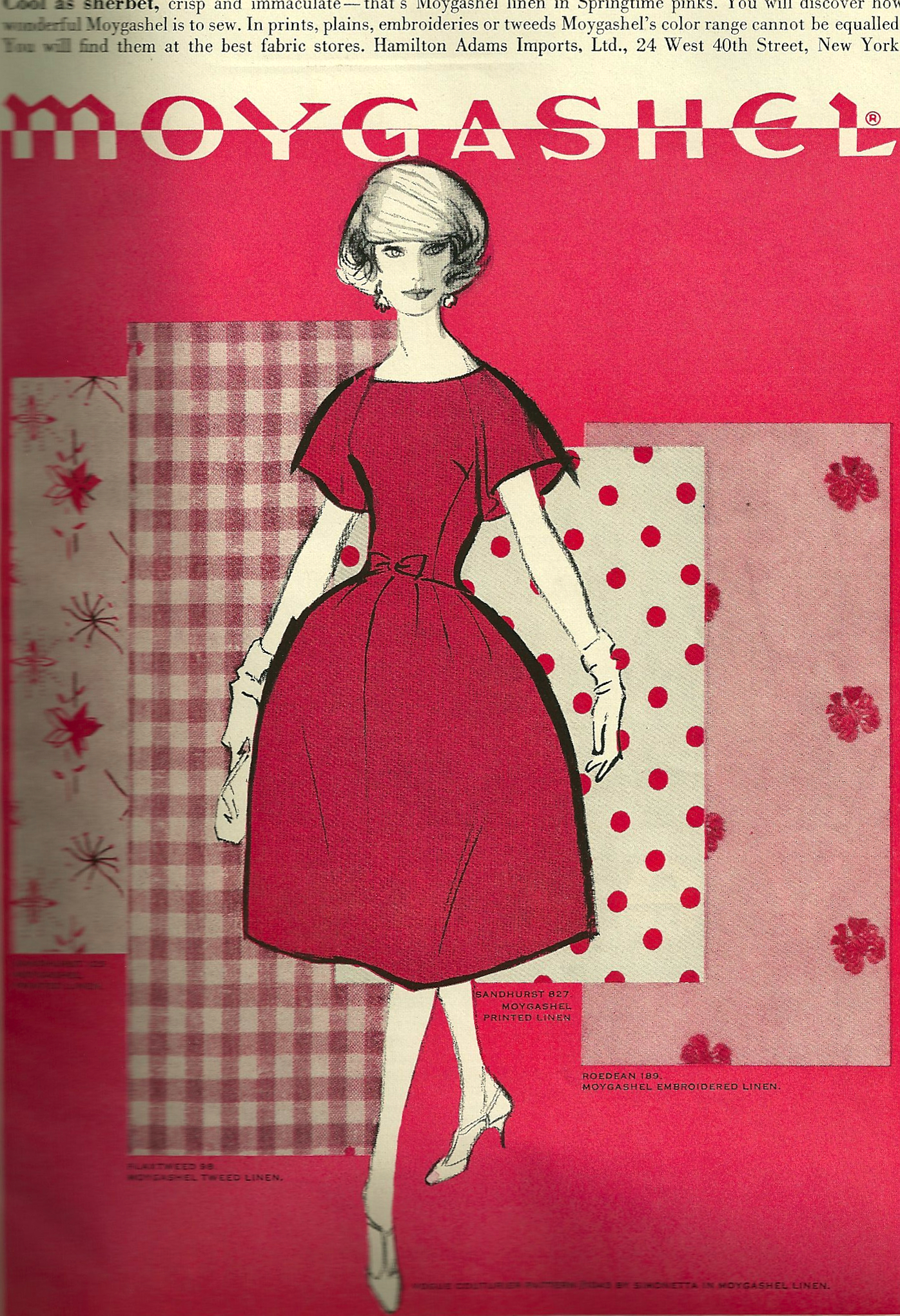
This ad was featured in the February/March 1961 issue of Vogue Pattern Book magazine. The dress illustrated is a Vogue pattern from the designer series. I love that this ad shows 5 different linens available for purchase.

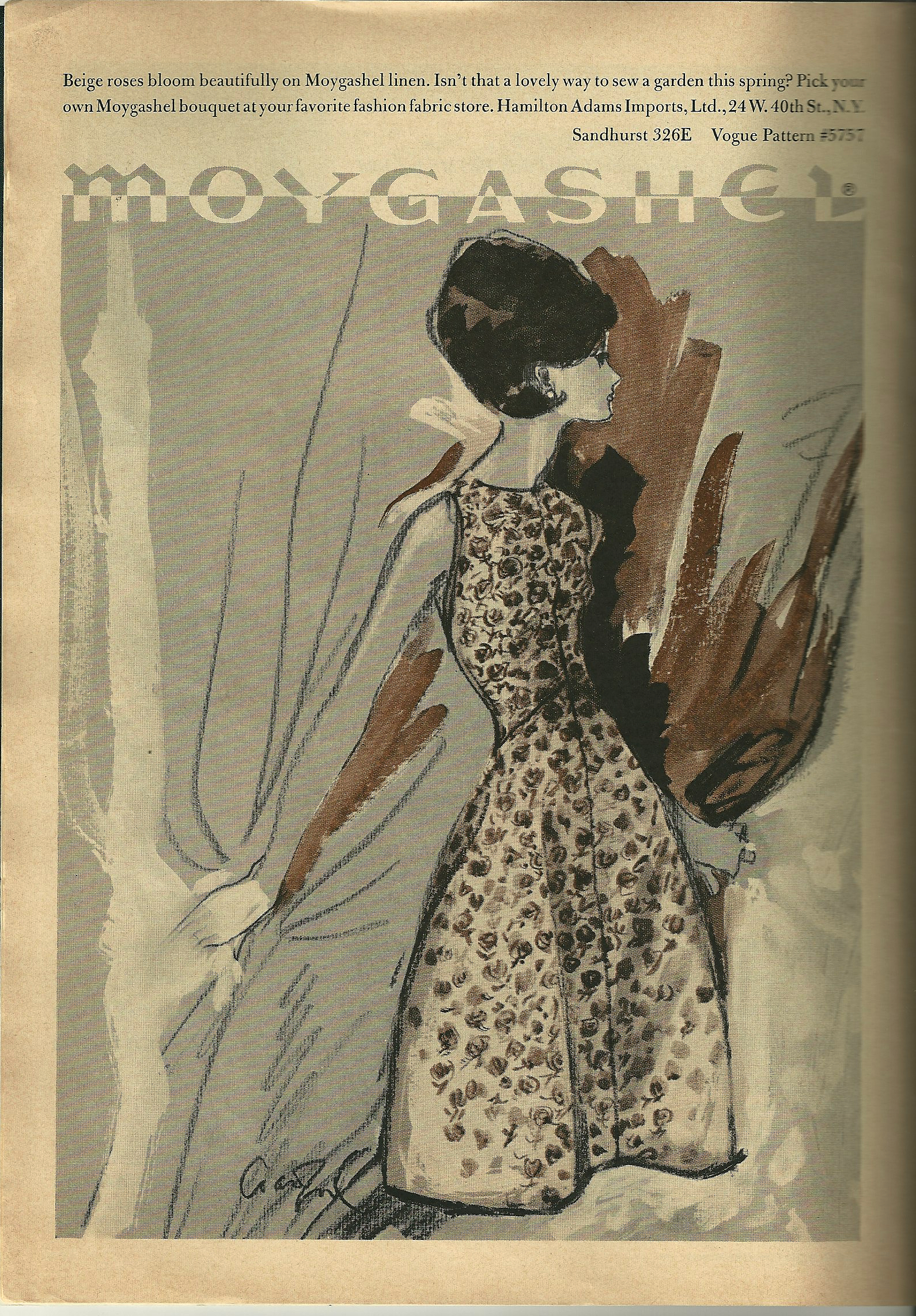
This ad appeared in the February/March 1963 issue of Vogue pattern Book. It has such a sophisticated look to it, which was a hallmark of Moygashel ads.

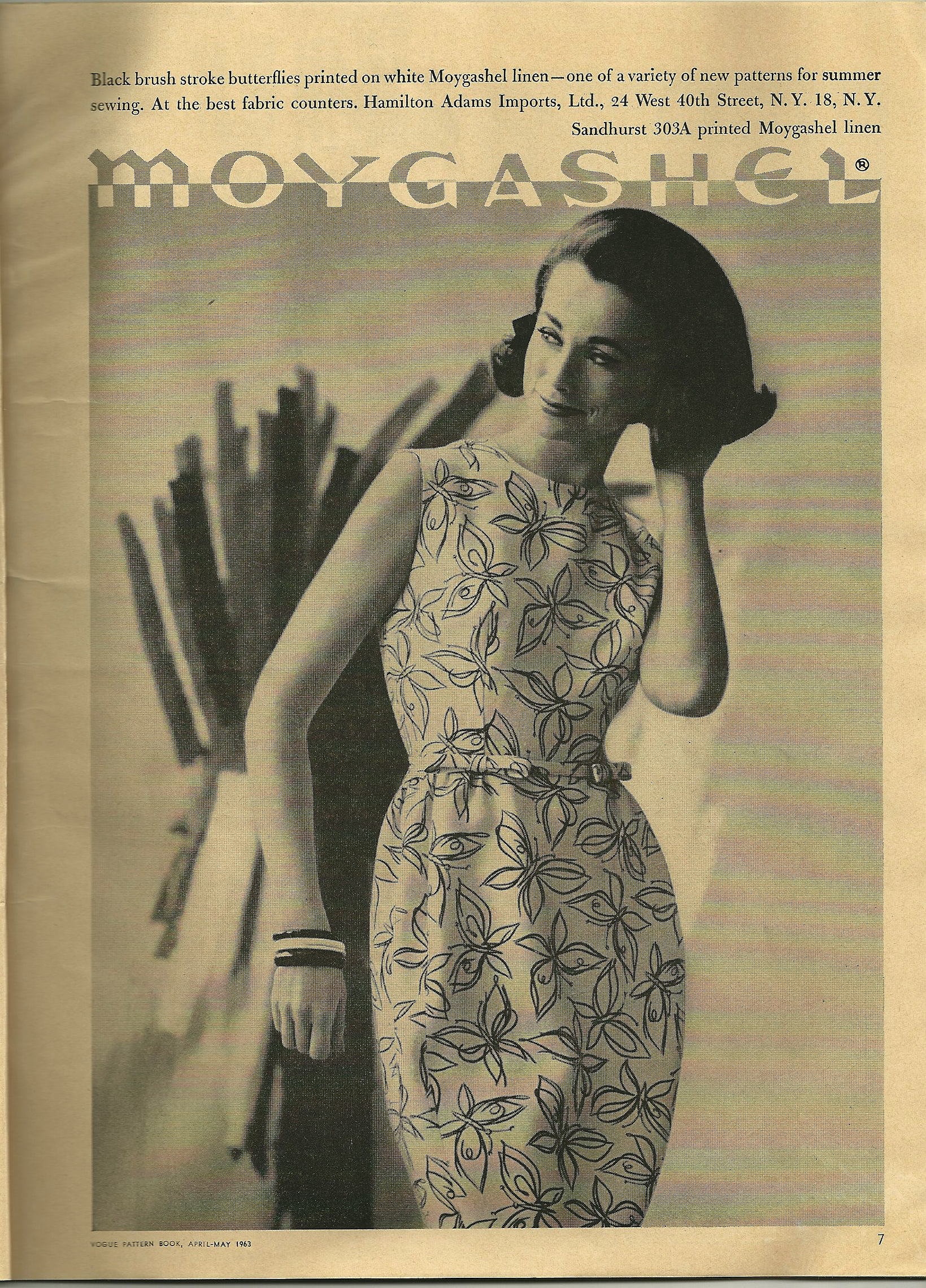
Occasionally Moygashel ads would feature a real model, such as this one from the April/May 1963 issue of Vogue pattern Book.

As I am a big fan of the color pink, I'm particularly fond of the linens featured in this ad from the February/March 1964 Vogue Pattern Book.

As I began to do more and more serious sewing for myself in the late ‘60s, I, too, took notice of Moygashel linen, which started my long love-affair with it.  I was even fortunate enough to purchase a few select pieces in the 70’s: I made dresses and suits and skirts, most of which I no longer have.  However, my current renewed interest in sewing and mid-century fashion and patterns led me to my cedar closet with a fresh eye.  So what did I find in that fragrant repository of out-of-season, out-of-date, and too-sentimental-to-give-away clothing ?  In reverse chronological order, here are three Moygashel treasures:

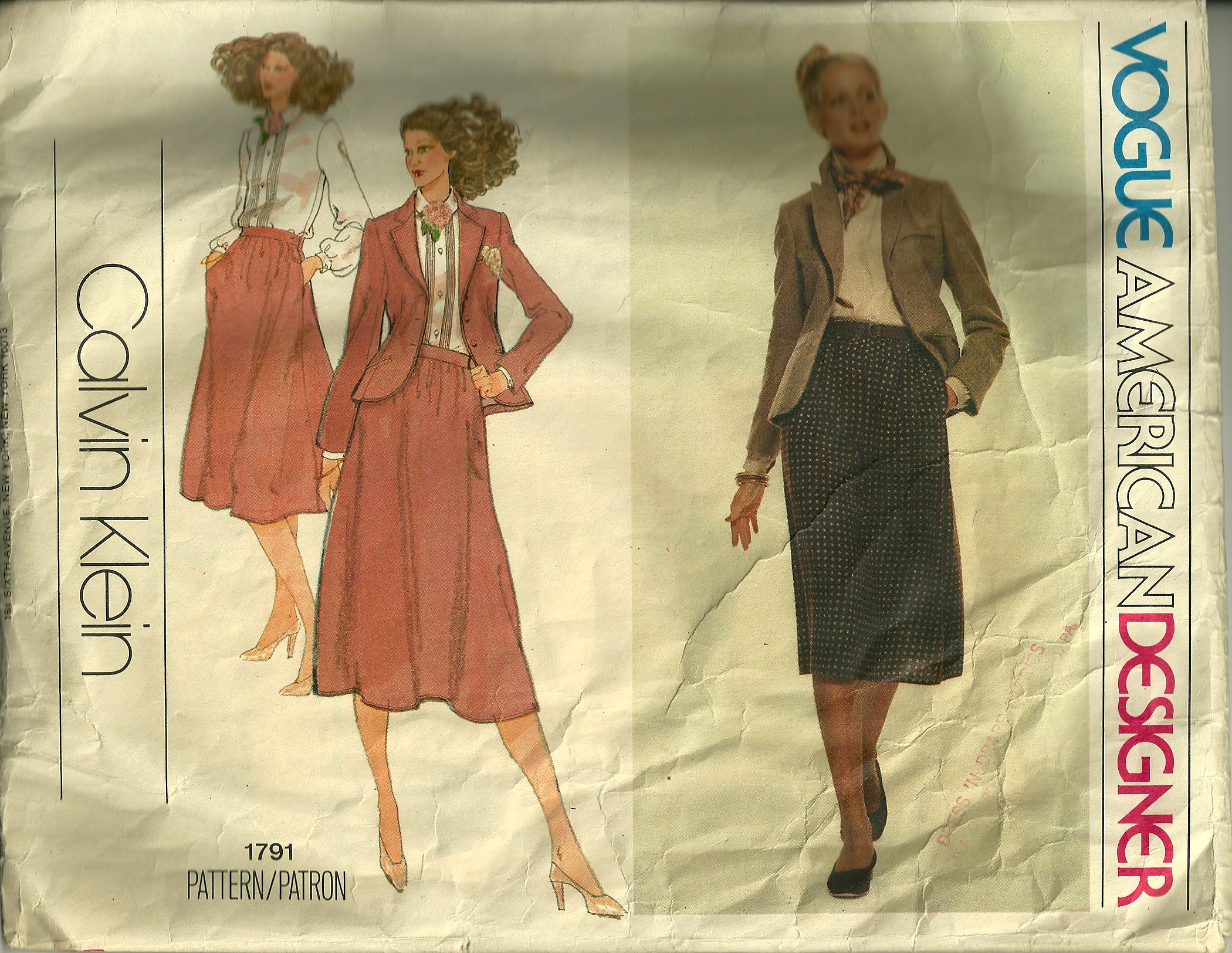
1)   Carefully packed away in a box I found an almost-completed jacket and unfinished skirt, complete with pattern and pins and thread.  Here is the pattern, which is from 1981:

The jacket of this pattern looks just as stylish today as it did in 1981. I'm not sure why I never finished it three decades ago.

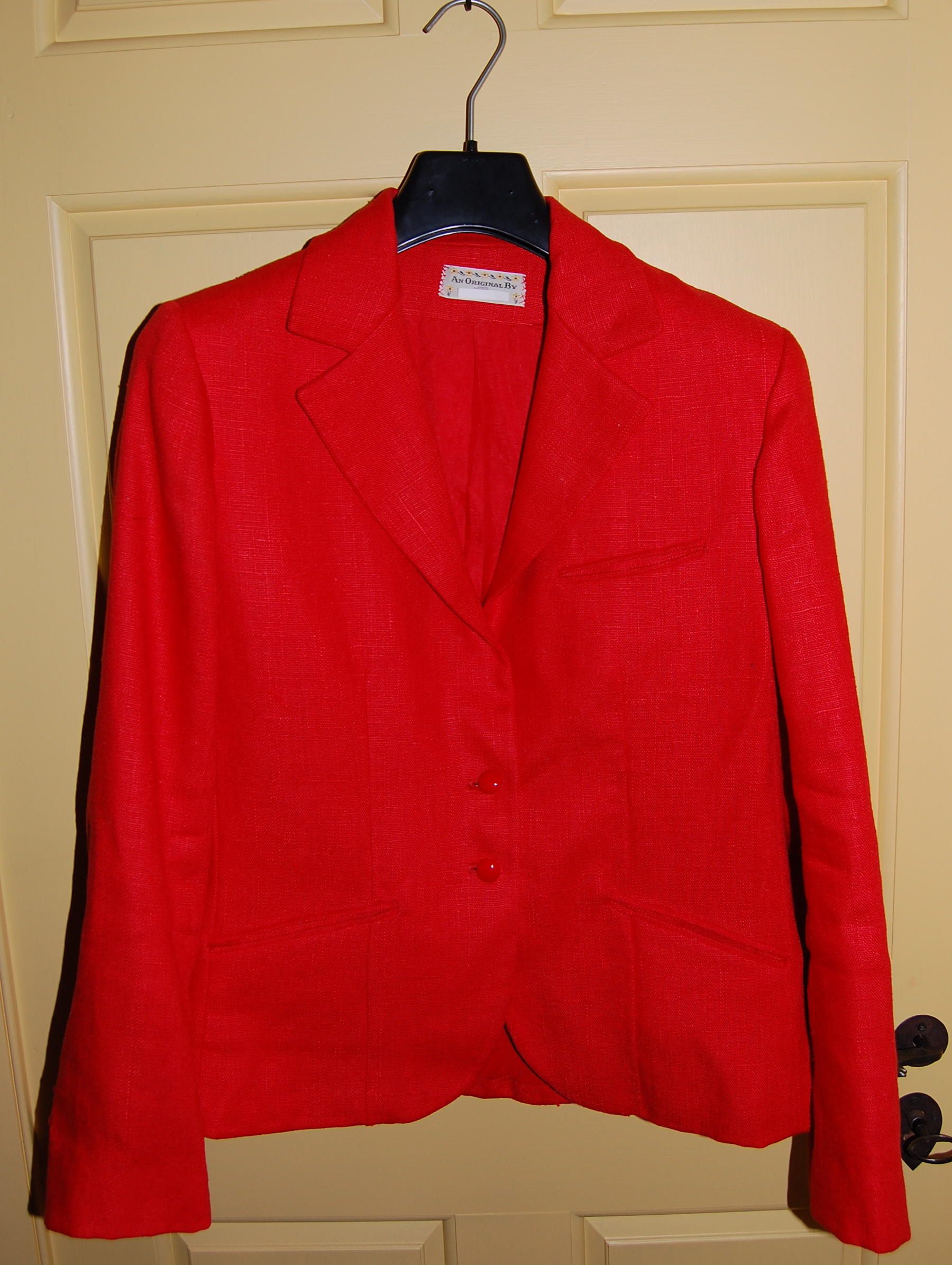
Last Spring I (finally) completed the jacket, with buttons and a few stitches here and there,  and it is now a valued member of my Spring and Summer wardrobe.  I’ll probably recycle the skirt fabric into something else, still to be determined.

I am also a big fan of the color red, so I couldn't be more pleased that I chose this red for this jacket so many years ago.

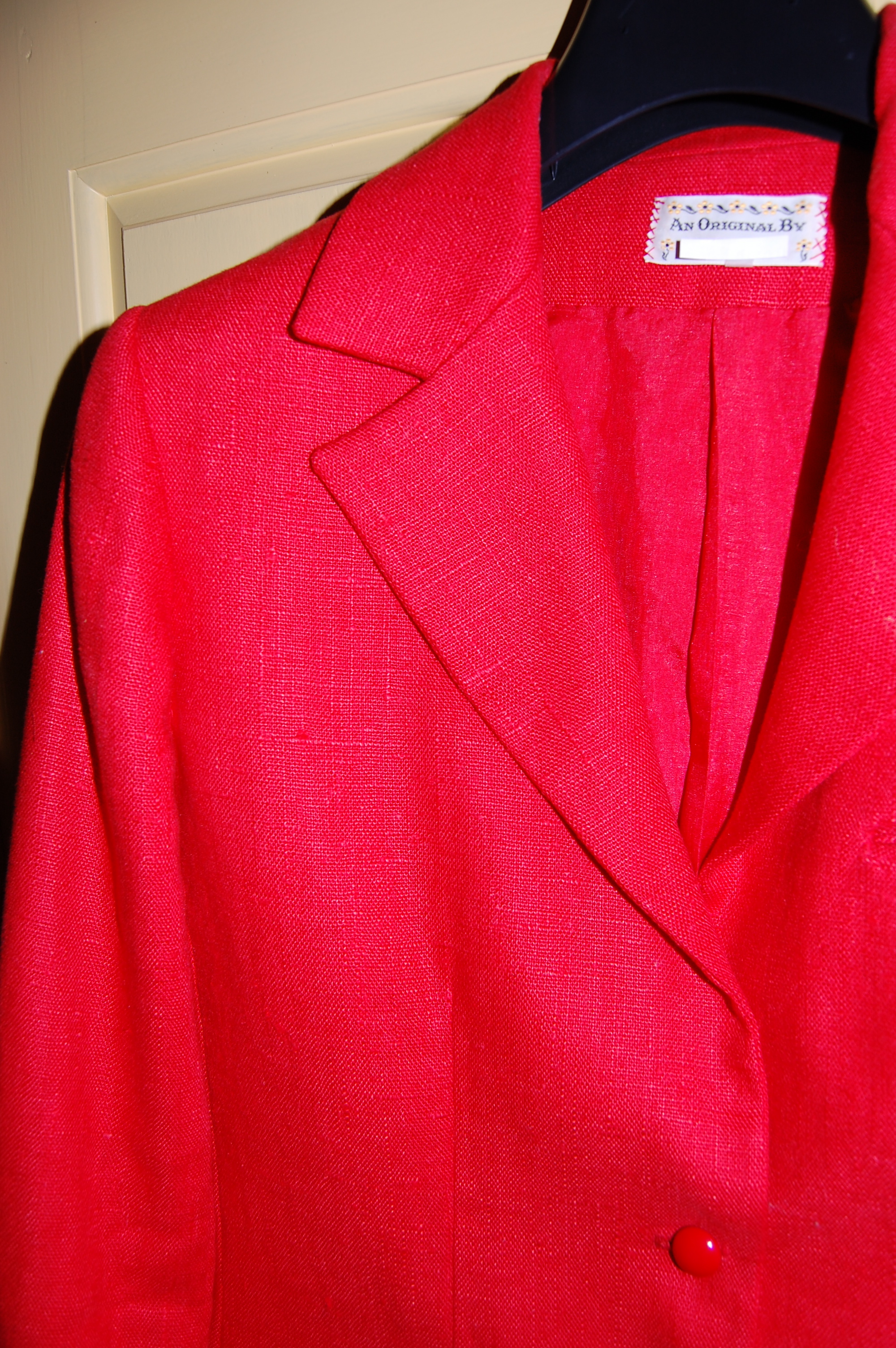
Here is a close-up of my 1981 jacket. I hope you can see the beautiful quality of the linen.

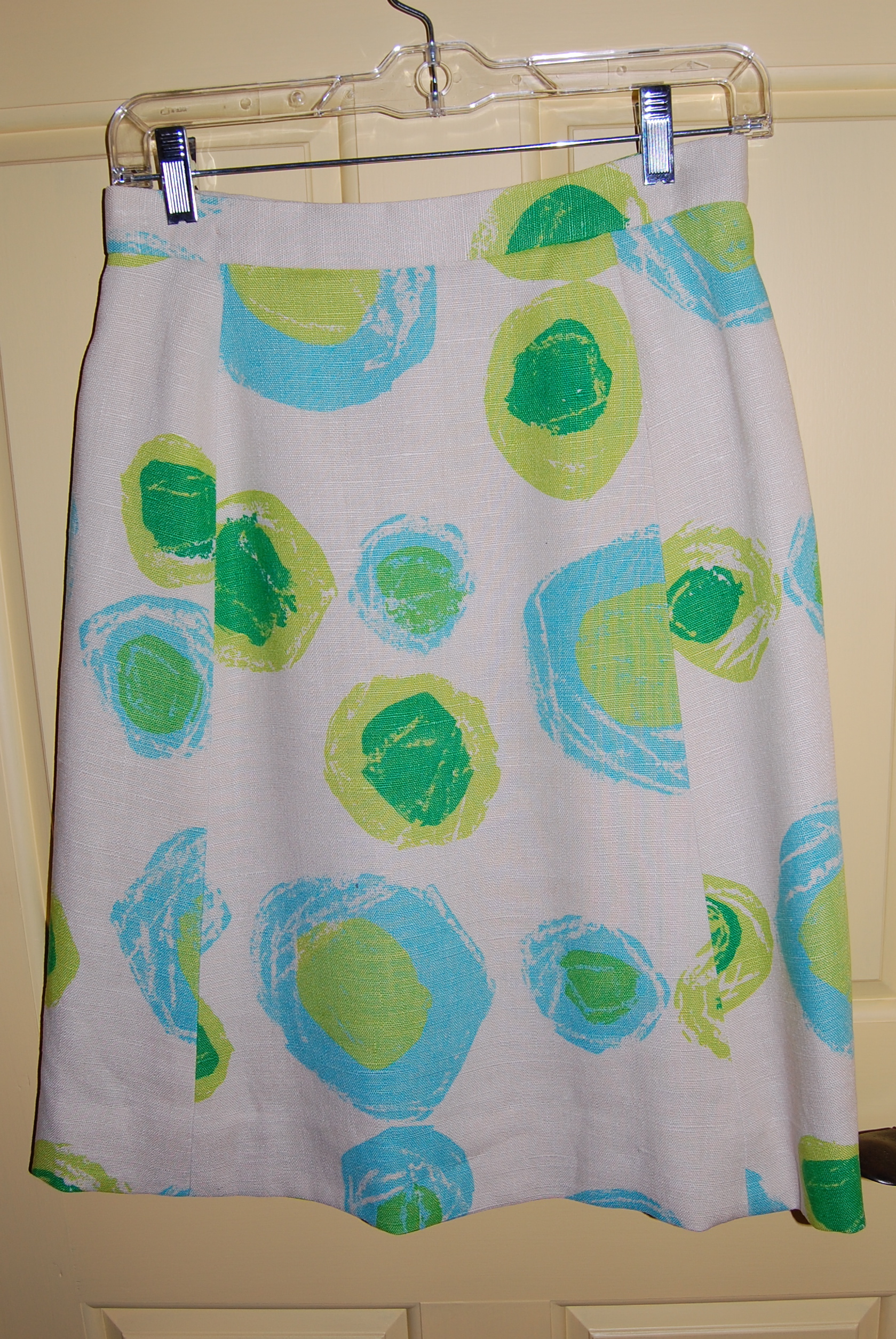
2)  My mother-in-law was a lady of great taste in clothes, and although she did not sew, she would occasionally have her “dear little German dressmaker” make something special for her.  I told her about the wonderful fabrics available at Stapler’s on Walnut Street in Philadelphia, and I believe she made some fabric purchases in combination with one of her many day trips with friends to the city and to the Forrest Theatre.   One of her purchases (circa 1975) was a colorful piece of Moygashel linen, from which she had a long “hostess” skirt made.  I eventually ended up with this skirt, which I took apart and remade two years ago into this shorter version:

The colors and design in this fabric are so eye-catching.

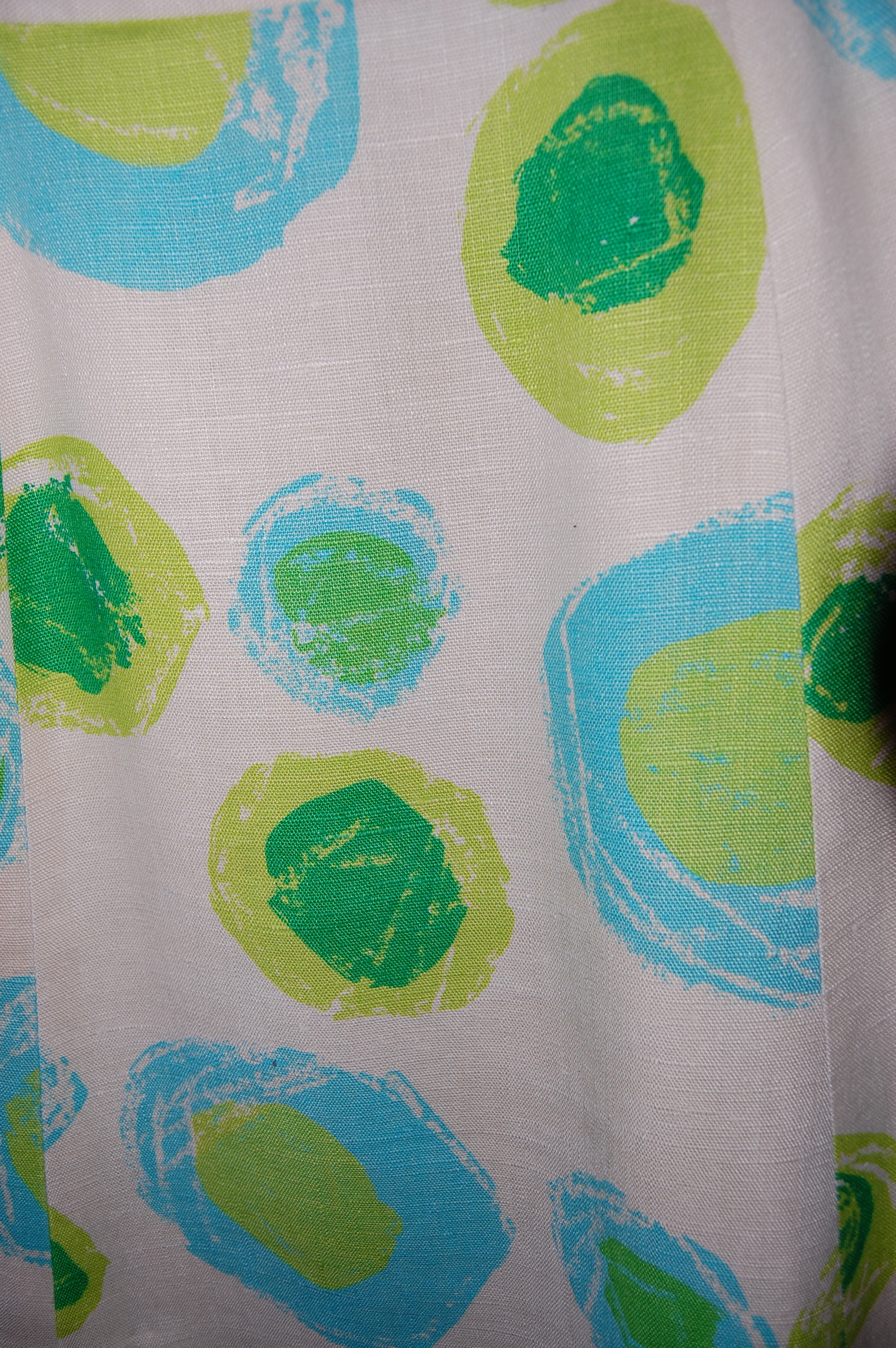
Here is a close-up of the skirt fabric, which is quintessential '70s!

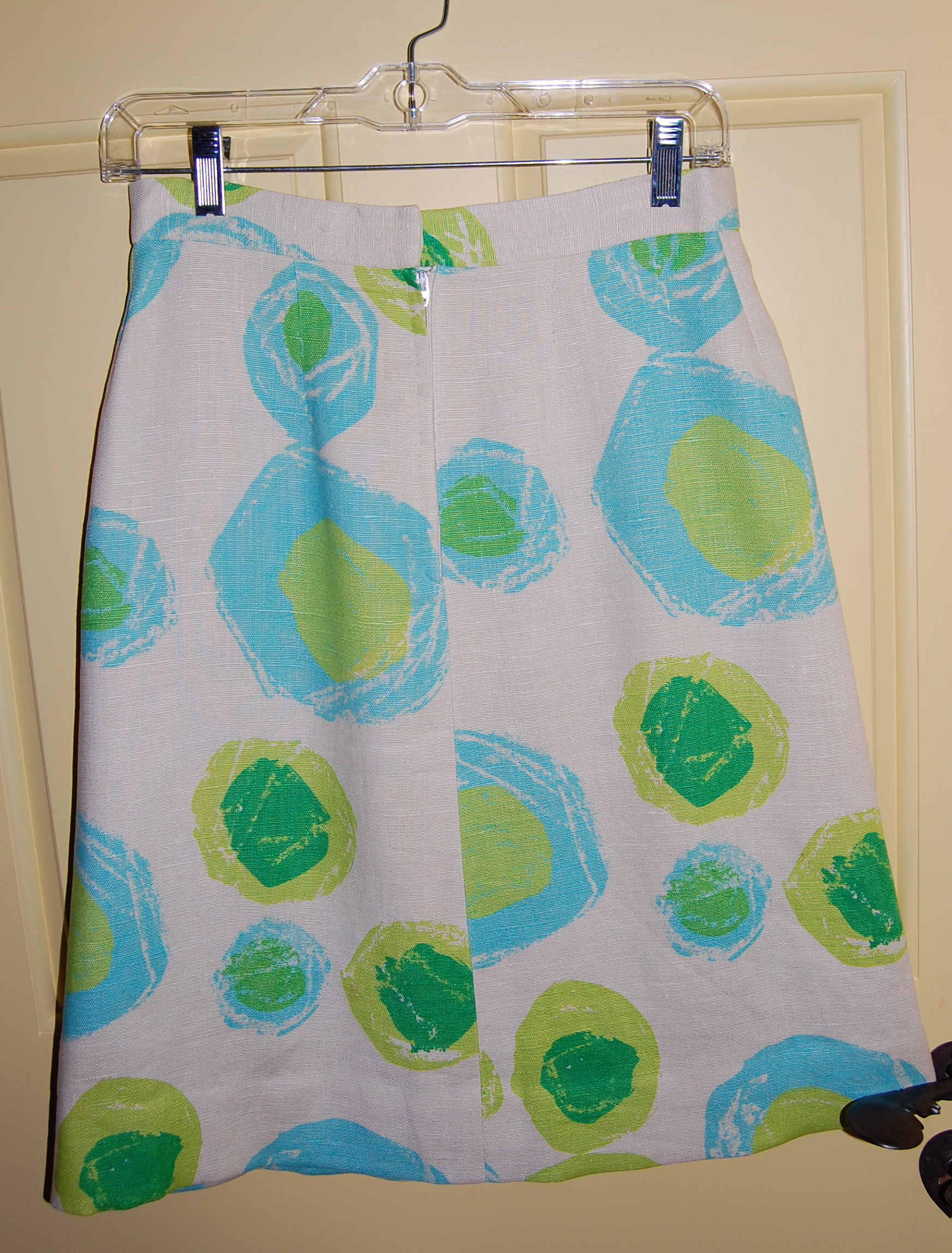
Here is the back of my re-made skirt.

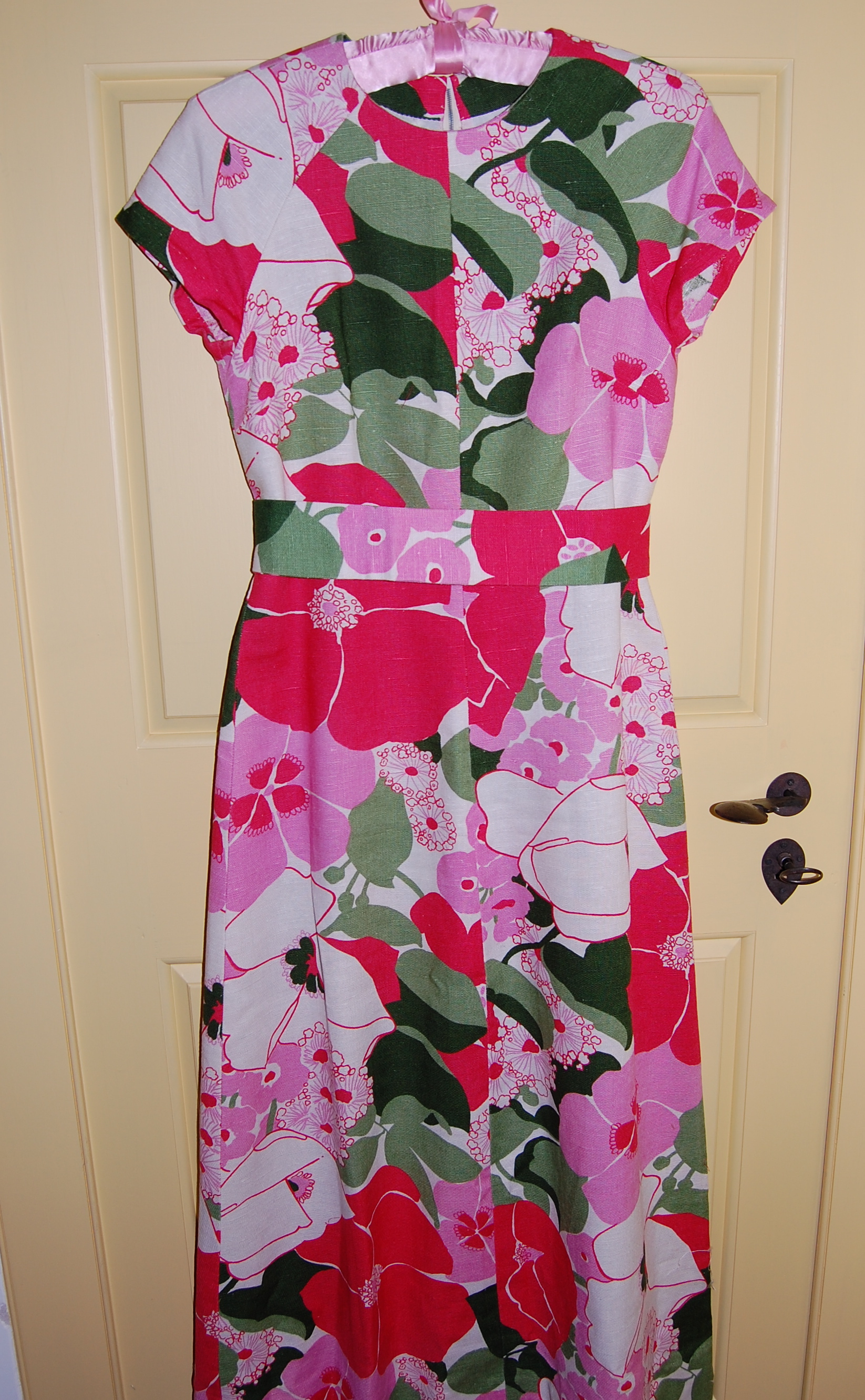
3)   In 1973, I made my own purchase of Moygashel linen at Stapler’s, this one for a dress to accompany me on my honeymoon:

This simple A-line dress, with raglan sleeves, was made from a Vogue pattern, long gone. Ankle-length dresses like this were very fashionable in 1973.

Here is a back view of the dress. The zipper is metal (that really dates me!) which I inserted by hand.

A few years later I made a belt to wear with it, to “update” it a bit, but since then it has hung in my cedar closet, a sweet reminder of years past.

This photo shows the dress belted. The bright, bold print of this linen makes a statement.

Somehow what fit me in my twenties just doesn’t look the same in my early sixties.  Imagine that!   So this dress, made from one of Moygashel’s classically timeless linens, is in that category of “too-sentimental-to-give-away”.  But now I wonder.  Should I remake it into something I can wear and use?  Would I have the nerve to cut it apart?  Should I be practical or nostalgic?  Whoever knew that the contents of a cedar closet could pose such existential questions to ponder? What should I do?

5 Comments

Filed under Linen, Uncategorized, vintage Vogue patterns from the 1960s, vintage Vogue patterns from the 1970s, Vogue patterns

Can you zip me up, please?

This is a completely unscientific observation, but it seems to me that the zipper has made a fairly substantial migration over the years – from the side of the dress – to the back of the dress.  If that sounds confusing, let me explain a bit more, by showing you some of my dress patterns which date from the 1950s.  All of these dresses feature a side zipper, placed a few inches under the left arm and extending a few inches below the waist (or, in other words, these zippers open within a garment seam.).

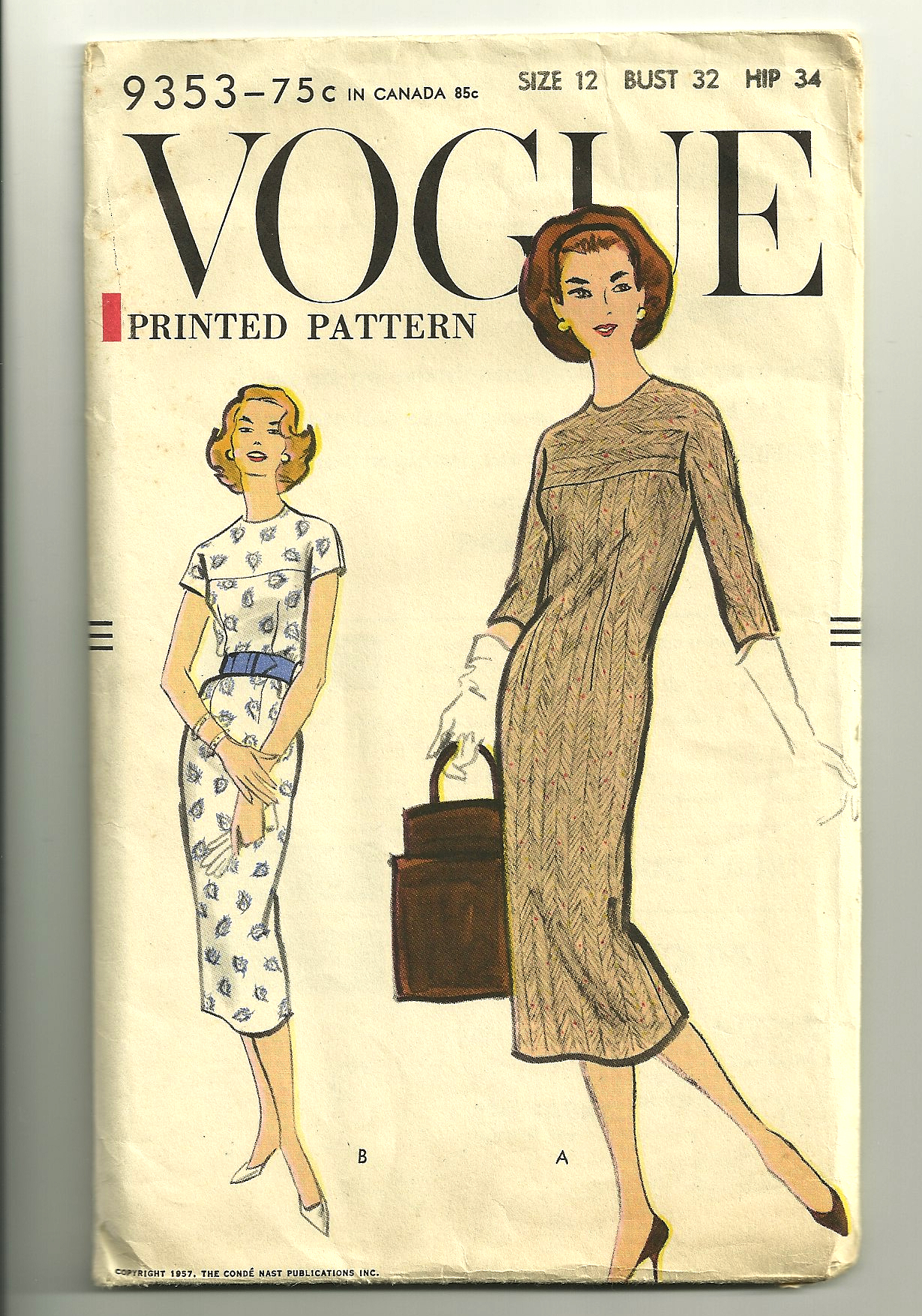
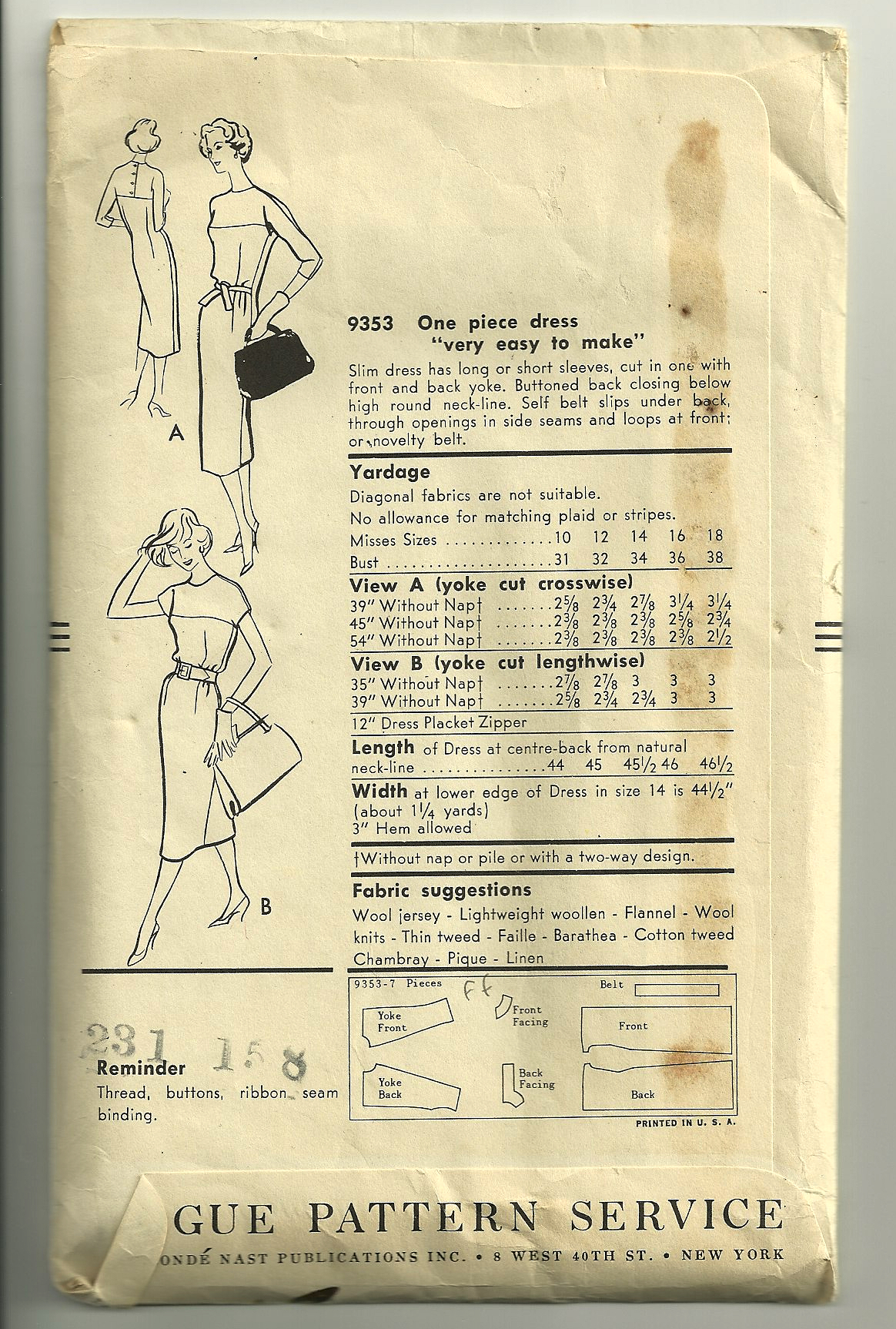
I love the clean lines of this dress from 1957, with the "yoke" effect which extends into the kimono sleeves. The back of the envelope shows more detail.

You can see from this back view that, although the top back yoke buttons, a side zipper is still necessary to get the dress on!

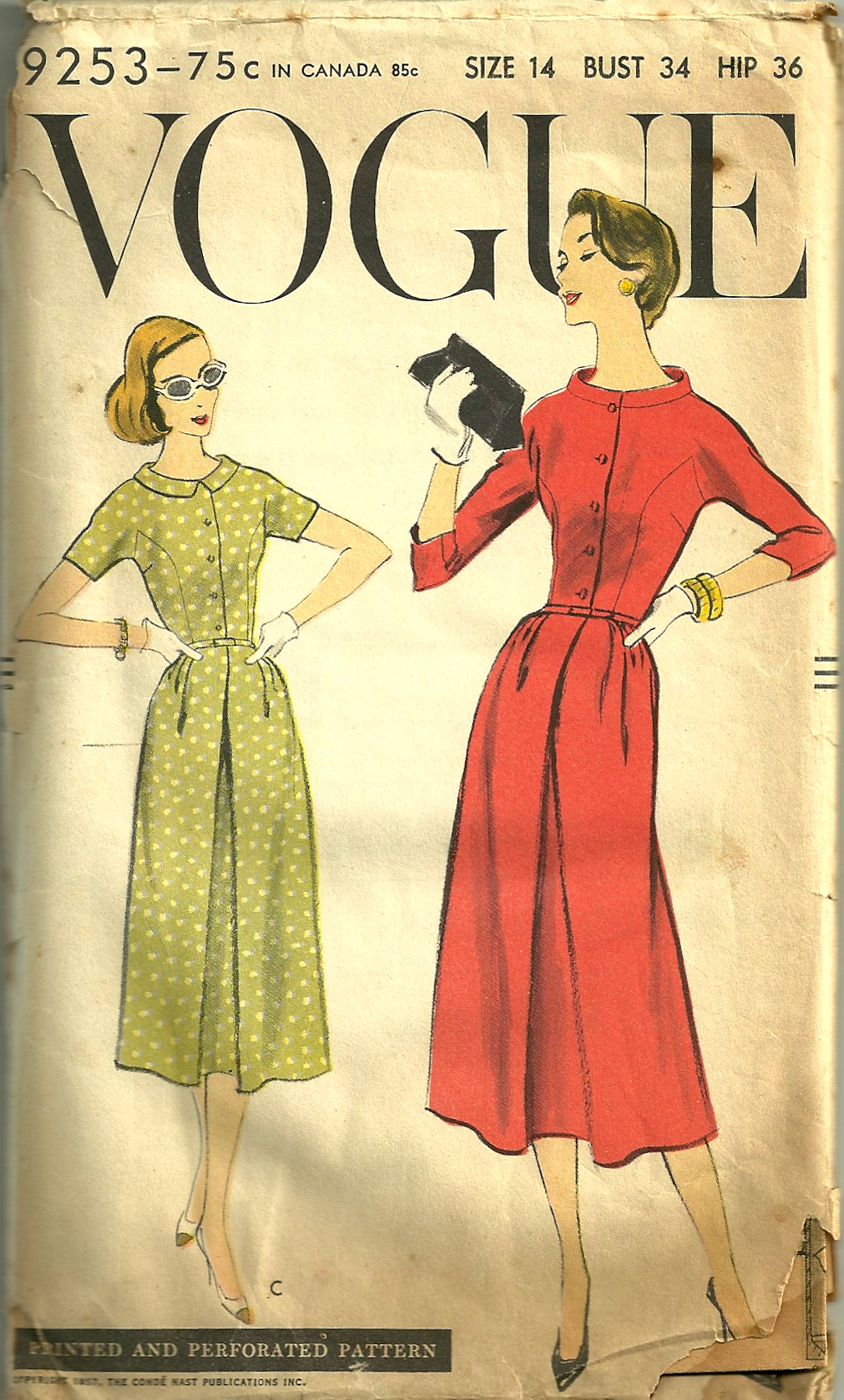
The front on this dress only opens to the waist, so a side zipper enables one to step into it. This pattern is dated 1957.

The back detail on this evening gown from 1958 would have been interrupted by a center back zipper, but a side zipper preserves the designer's intent.

I love this dress design from 1957, which simply would not work using a center back zipper.

Patterns from the last half of the 1960s start to feature more and more zippers which are placed in the center back of the dress, and by the 1970s, it seems, almost all zippers were center back ones.

This design from the early '60s would work with either a side or center back zipper, but the pattern calls for a center back one, thus showing the start of the transition.

The dress on this pattern is actually my next project! It is a design by Jacques Heim from the 1970s. I'll be inserting a 22" neckline zipper in the back of this dress.

A casual look at vintage clothes from this time period also seems to support this observation (with the occasional exception to the rule, of course.  I actually saw a side-zippered dress at J.Crew one day this week, but it’s not the same, really, as the dress is sleeveless and the zipper parts at the top, under the arm.)

To try to understand some of the dynamics of this zipper conundrum, I went to my 101 Things I Learned in Fashion School book (by Alfredo Cabrera with Matthew Frederick) to see if I could find any entry on zippers.  Here is what I found on page 64:

“Center back zippers are like fine crystal:  best reserved for special occasions.  When a student designs an interesting garment and is asked how the wearer gets into it, the common answer is, ‘center back zipper.’  This solution is favored by inexperienced designers because it doesn’t require an invasive change to a garment.  But a back closure is rarely a satisfactory solution; it’s a fussy, frustrating concern when one has only fifteen minutes to dress for work.

“Back closures are a remnant from an era when women wore corsets and hoopskirts and had maids to truss them up in back.  Today they are more appropriate in association with major events.  On her wedding day or Oscar night, after a woman has spent a lot of time and money on her hair and makeup, she is more likely to want to step into her dress than pull it over her head.  A center back zipper implies a fitting sense of occasion.” [my emphasis]

Side-placed zippers are different from center-back zippers both in name and detail:  side zippers are called “dress” zippers and have bottom and top “stops”, while zippers for the center back (or skirts, pants, shorts) are called “neckline” or “skirt” zippers and, of course, open at the top with a stop just at the bottom.  (Skirt and neck zippers can easily be made into dress zippers by putting a few tacking stitches to anchor the two sides together right above the pull.)  Back in their hay-day, dress zippers were available in lengths from 10” to 14”. Skirt and neckline zippers are still available in lengths ranging from 6” to 24”, but they are now called “all-purpose” zippers.

So why, since the ‘70s, have most side dress zippers been replaced by neckline zippers placed center back?  I guess there are several potential answers to that question, including:

1) a lot of us would rather step into our dresses than pull them over our heads even if we are not dressing for a special occasion.

2) laziness or ignorance  (both kind of strong words, for which I apologize to anyone offended!) or practicality on the part of designers.

3) it’s just become the accepted way of closing a dress.

4) the invisible zipper made application of the zipper easier and the finished look more streamlined.

5) Huh? What’s a side zipper?

I’m sure there are lots of other explanations but my favorite one is a bit more romantic…   James H. Boren put it succinctly thus:  “A dress that zips up the back will bring a husband and wife together.”   I’d say that is a “fitting sense of occasion”!

3 Comments

Filed under kimono sleeves, side-placed zippers, Uncategorized, vintage Vogue patterns from the 1950s, vintage Vogue patterns from the 1960s, vintage Vogue patterns from the 1970s, Vogue patterns

Messages from the past: handwritten notes on vintage patterns

Many vintage patterns have a visible stamp on them which tells the name of the store where it was originally purchased.  (Those of us who sew know that patterns, once purchased, are non-returnable – and it seems it was ever so…)  Sometimes the stamp also lists the location of the store, but not always.  Either way, that stamp is a visible clue to the pattern’s past life.

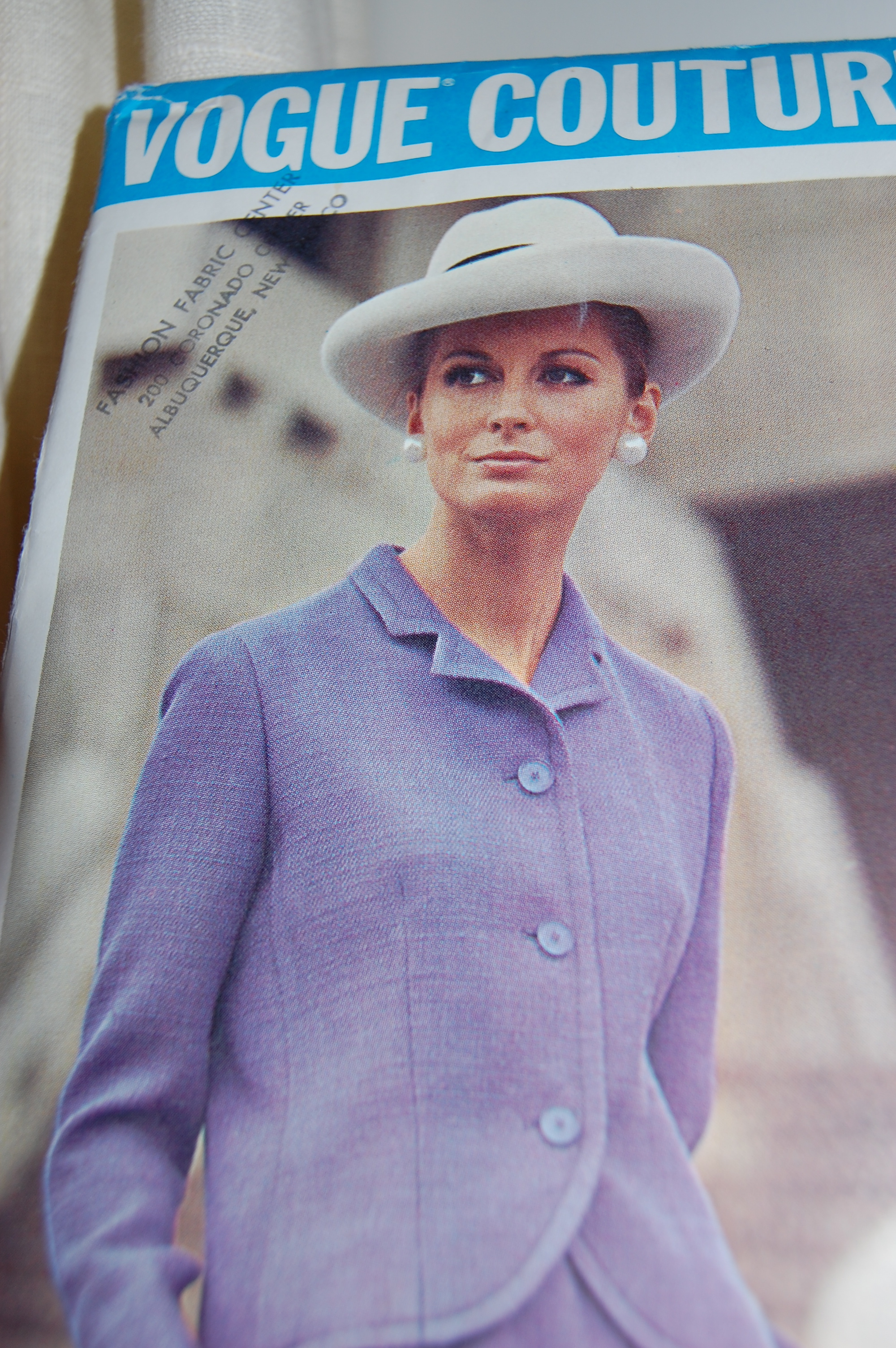
In the upper left hand corner, you can see the stamp for "Fashion Fabric Center" in Albuquerque, New Mexico. This pattern is from the early '70s.

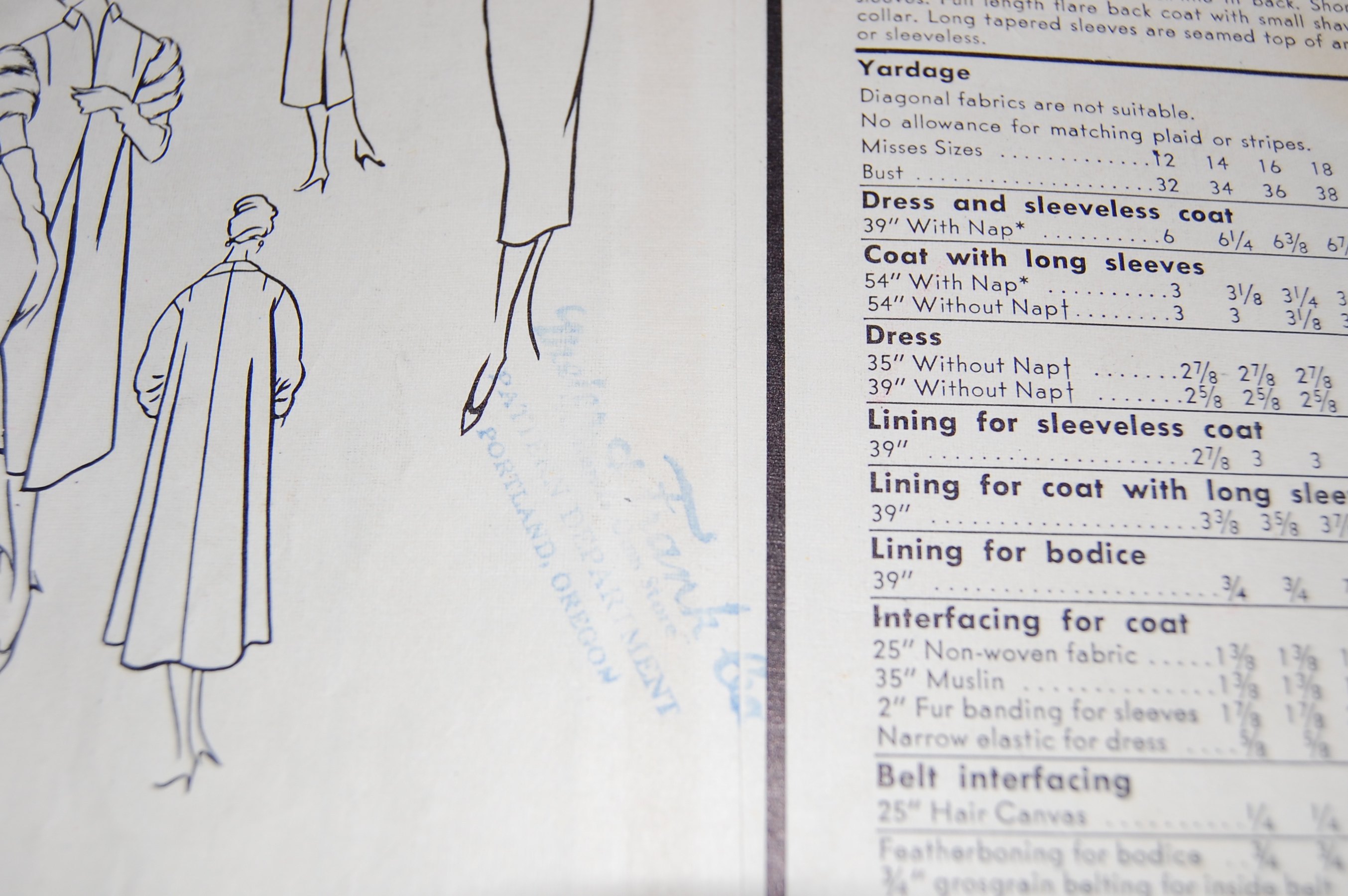
If you look closely, you can see the stamp on this envelope which tells you it was purchased from Meier & Frank Pattern Department, Portland, Oregon. This pattern is from the 1950s.

I can’t help but visualize a well-put-together woman perched on a stool at the pattern counter of the mentioned store,  thoughtfully flipping through the pages of the Vogue Pattern catalogue, and finally settling on this one pattern.  I wonder what occasion, if any, she was making it for?  Was she, like I was in the ‘60s and ‘70s, agonizing a bit over spending 75 cents or $1 or $3 or $5 for just a pattern, and then loving it once the decision was made?  Was she buying it to make it herself or in coordination with a dressmaker who would be the one to create it for her?  What fabric and color was she intending for the pattern?  Or did she buy the pattern and then, for one reason or another, never make the intended garment?

And then, every once in a while, there is a handwritten note or diagram on a pattern envelope.

These jottings, sometimes cryptic, other times precise, provide clues which begin to answer some of those questions.  In the months I have been buying vintage patterns, I have found myself privy to some of these “messages” from the past – and here are the small stories they tell:

Fit seems to be an important focus.  Kudos to those dressmakers who recorded their difficulties on the pattern envelope!

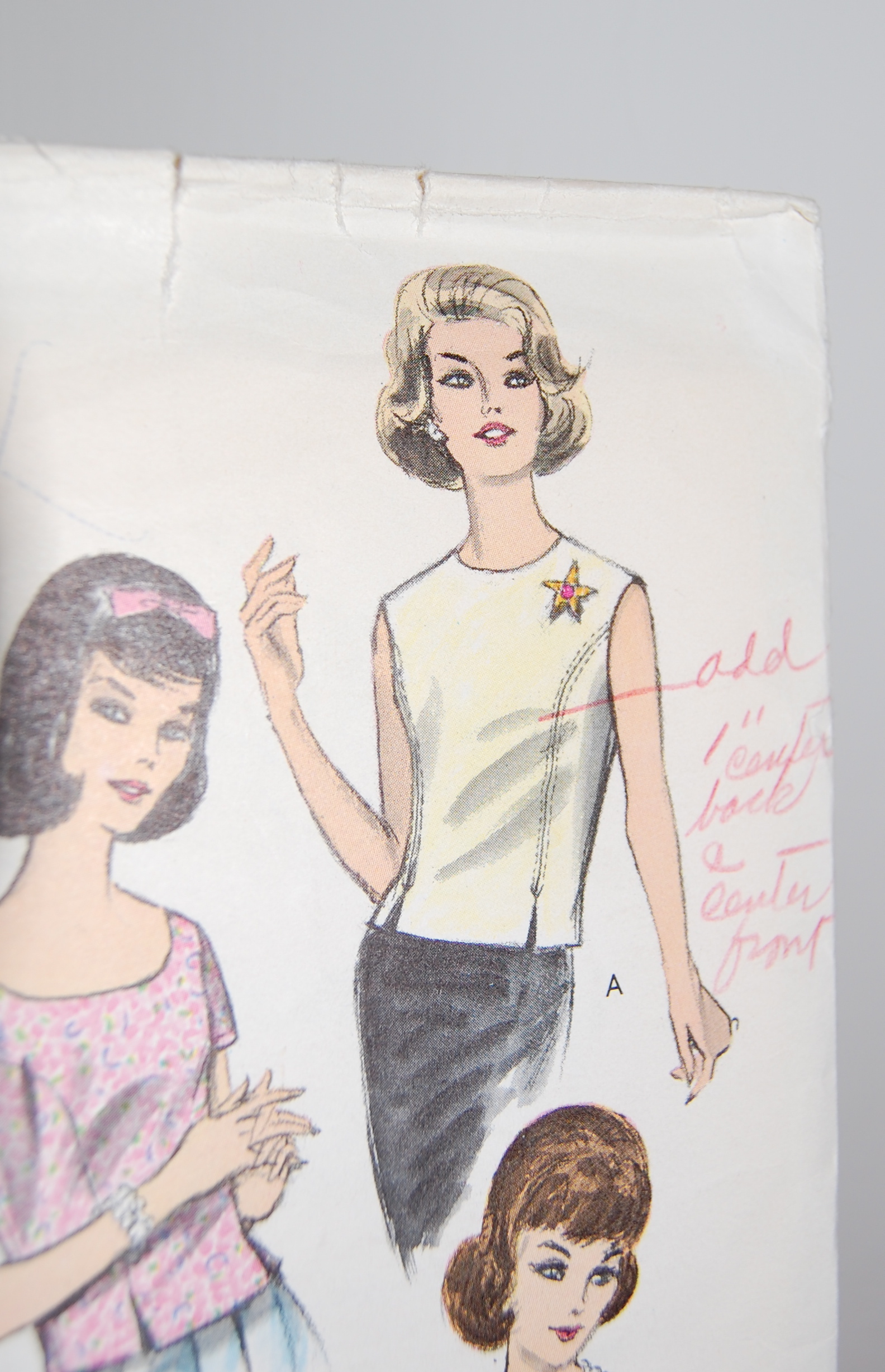
I think this lady should have purchased a larger size! She needed to add 1" center front and center back!

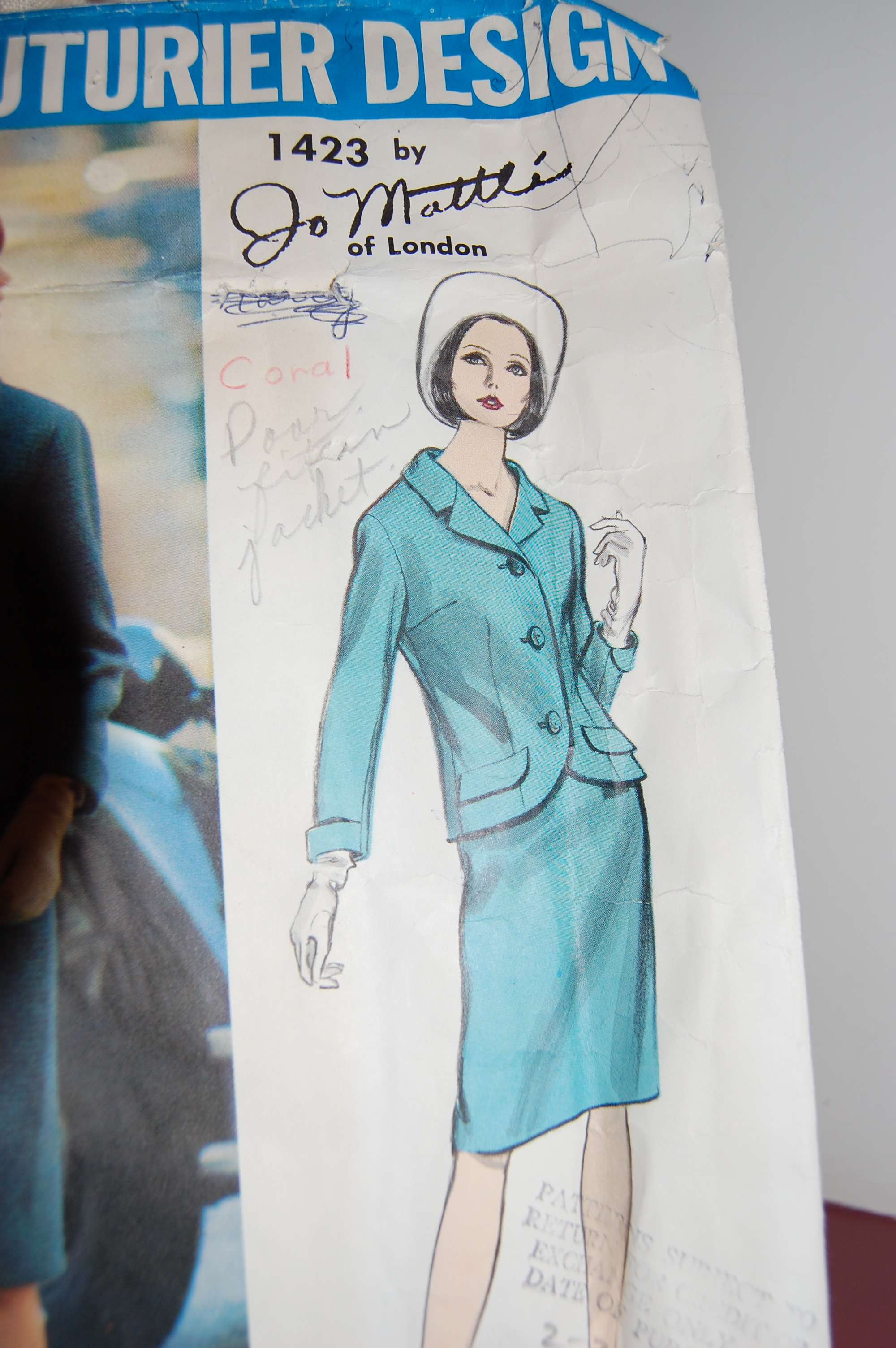
Beware! Poor fit in jacket! But I bet it was lovely in coral nonetheless.

Check out this listing on Etsy to see a rather melancholy note about fit:  “would have been best to have gotten the med. size.”  I guess that pattern ran large!

Choice of fabric and color (see above image) are also details which have been noted, sometimes multiple times on the same envelope.

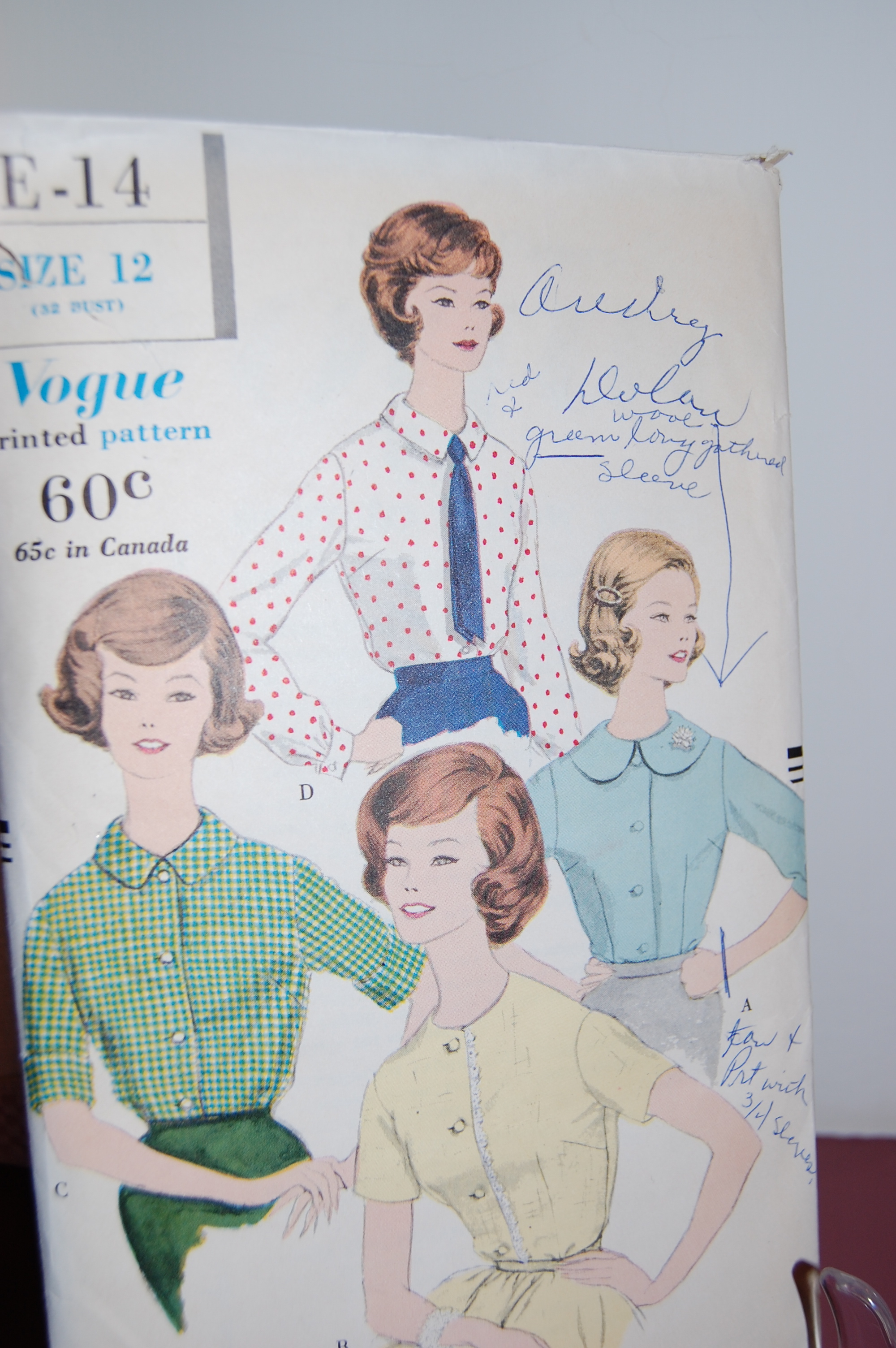
I think this pattern must have belonged to a professional dressmaker. She made it up in red and green wool for Audrey Dolan, with long gathered sleeves. It looks like she also made it in tan and in a print (Prt) with 3/4 sleeves. The pattern tissue is still in great condition, despite all that pinning and cutting!

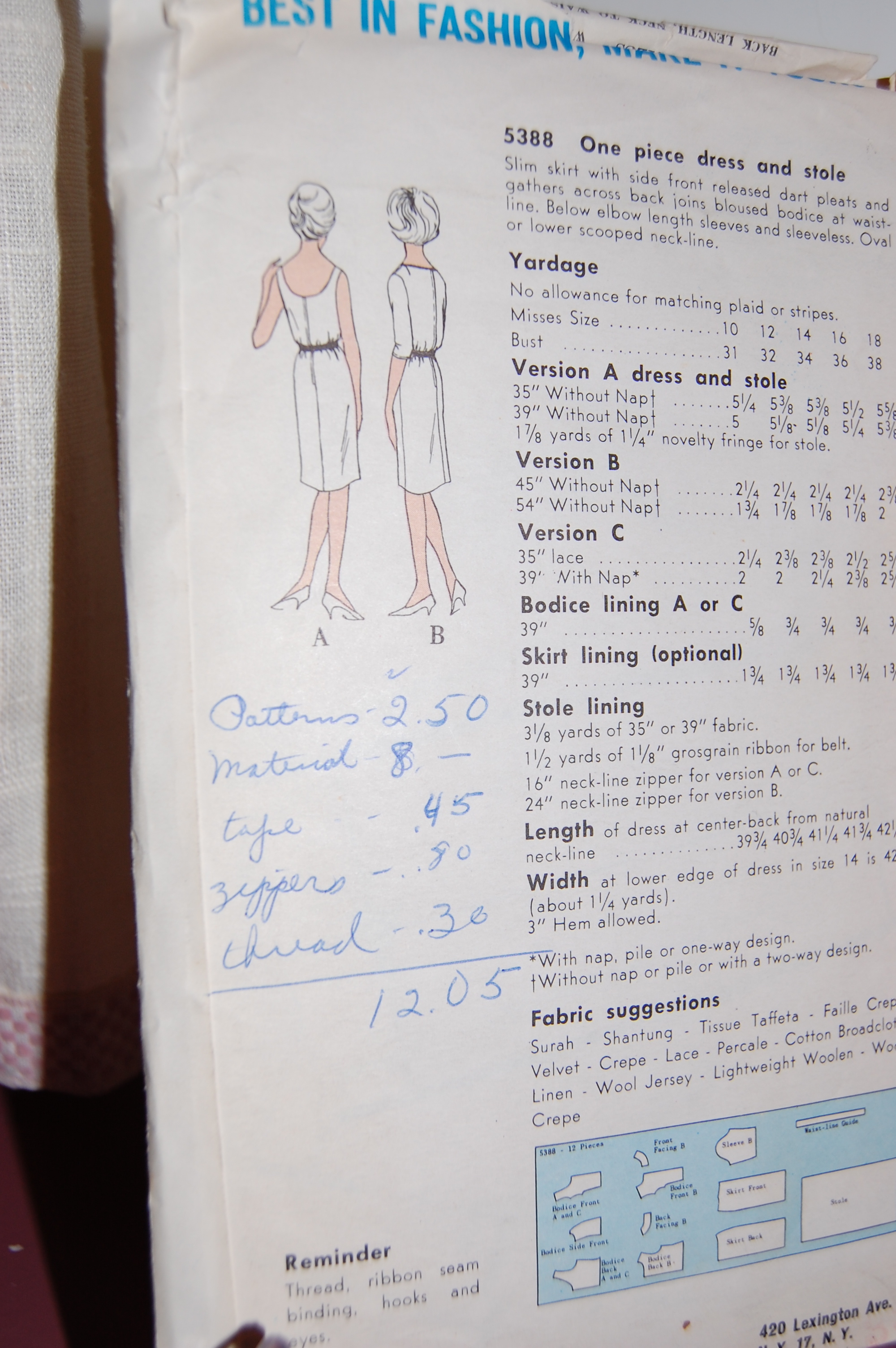
This pattern obviously belonged to a lady who was either a dressmaker, noting her expenses, or a home sewer who kept careful records for her household/clothing budget.

This lady must have made this dress in coordination with another pattern. Both patterns together cost her $2.50. She was also buying multiple zippers, to the tune of 80 cents! Her big expenditure was fabric (material), which she lists at $8.00.

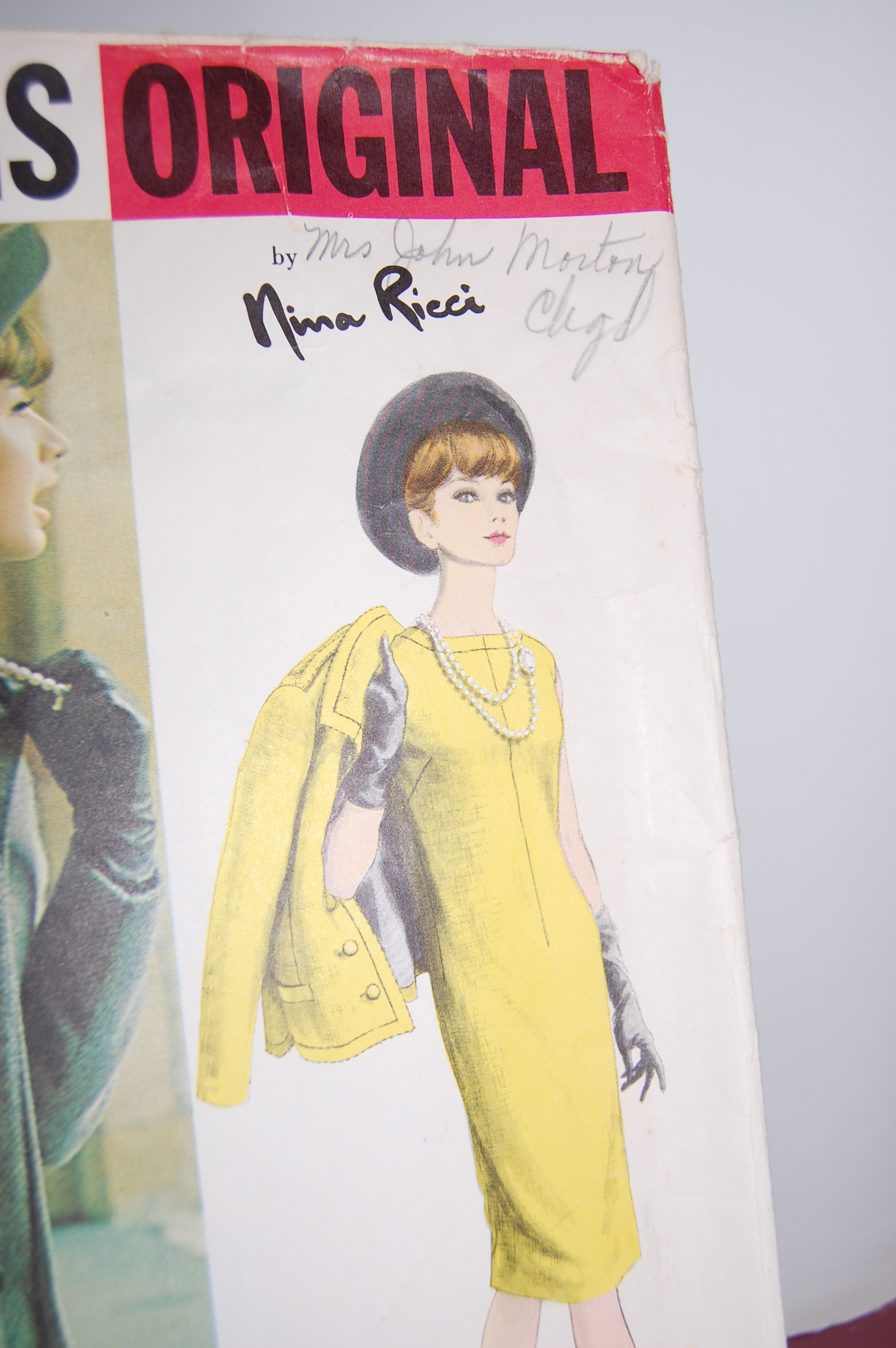
And here is a pattern which Mrs. John Morton “Chgd” [Charged]  Perhaps she did not have to be as careful with her expenditures!

I think Mrs. John Morton was one stylish lady!

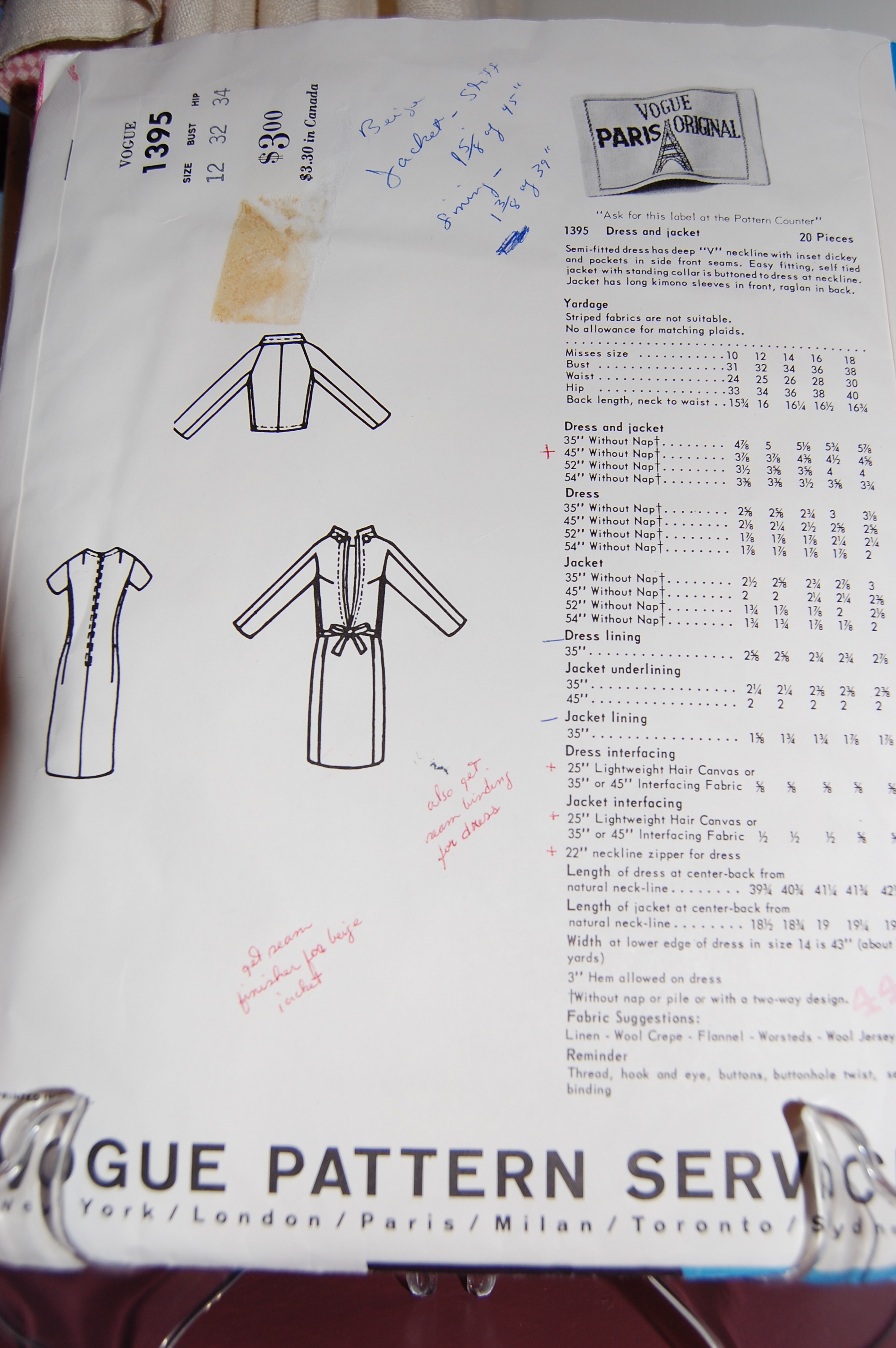
This next pattern is a study in contradictions:  The owner has carefully noted some yardage requirements, written notes to remind herself to “get seam finisher for beige jacket” and “also get seam binding for dress”.  But the pattern came to me uncut, factory-folded and therefore unused, with its original Vogue label included.  I wonder what prevented her from ever making this lovely jacket and dress?

We know she intended to make the jacket in beige, but she doesn't tell us about her color choice for the dress!

Next, it’s always fun to see someone’s intended changes to the line or details of the pattern.  Here are two examples:

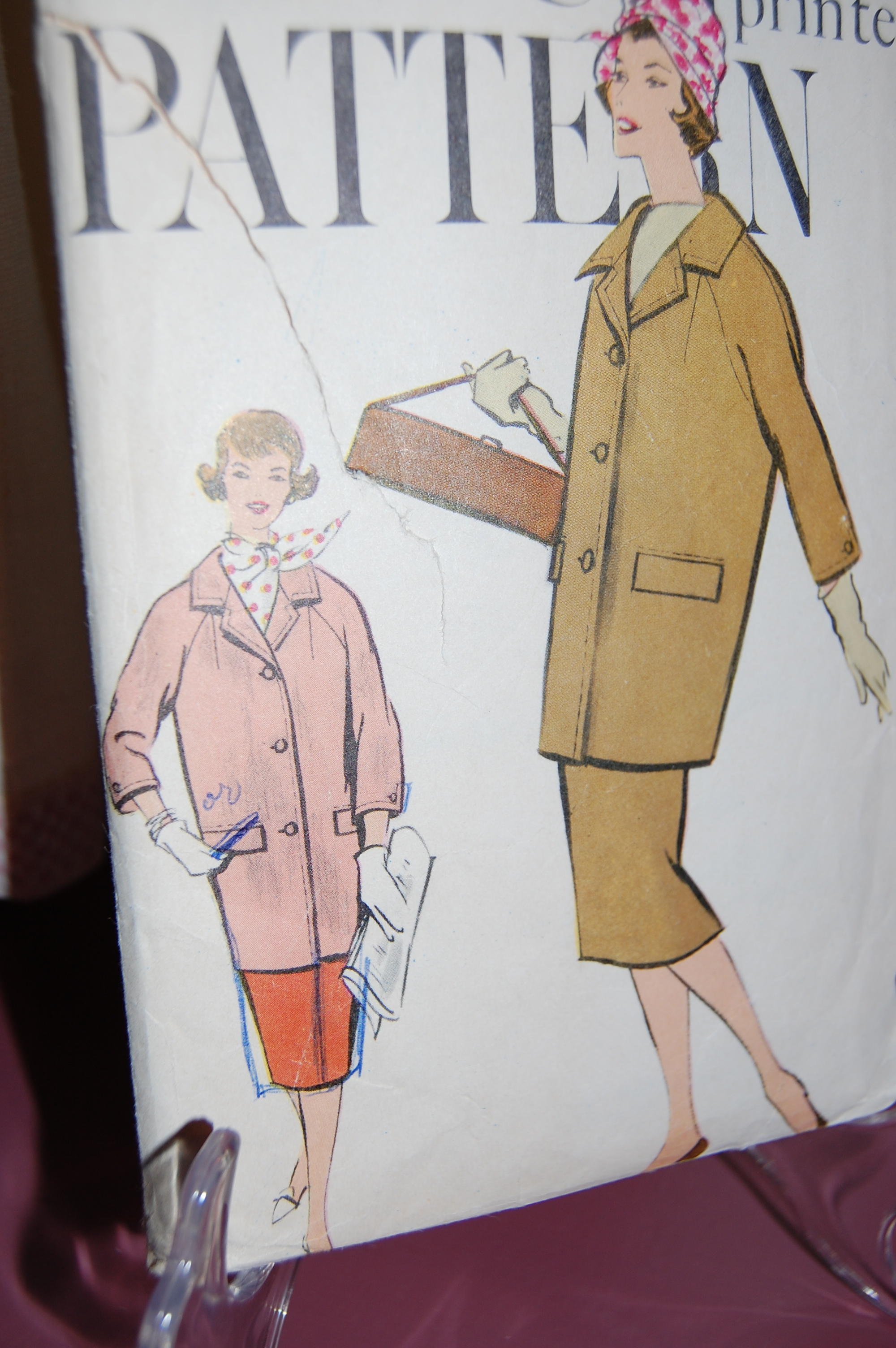
View A on the far left just did not suit this sewer. She wants to extend the length of the coat, and add the collar. What she is really saying is that she wants to make view B, but with top-stitching!

It seems lengthening coats was a popular thing to do! This lady drew the longer version of the coat (on the left) and was still deciding on making the pockets "slash" pockets instead of flap pockets!

Finally, sometimes all that is on a pattern envelope is a name – a simple notation, which quietly transcends the years!

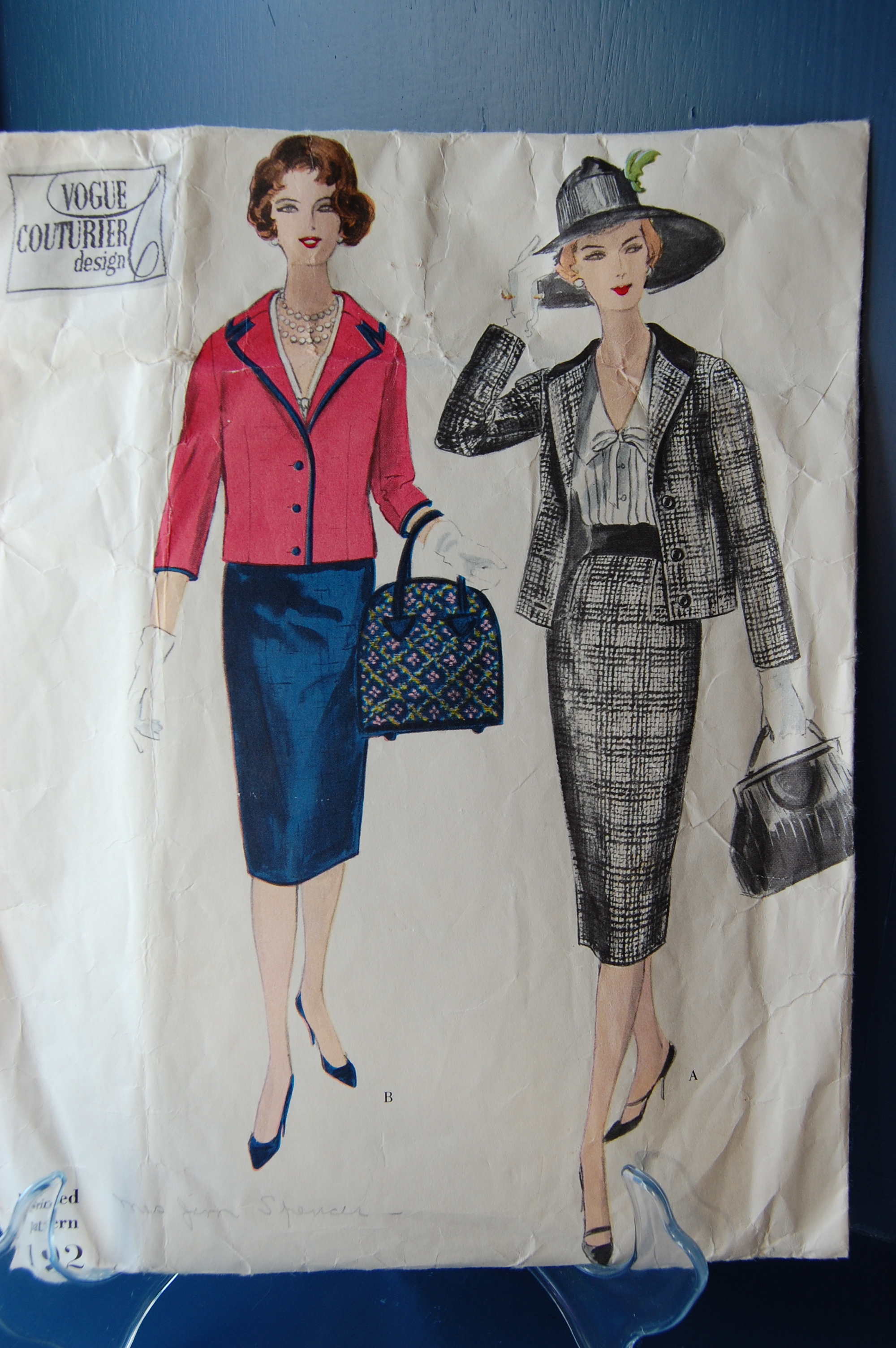
Look below the figure in red and blue for the name written in pencil.

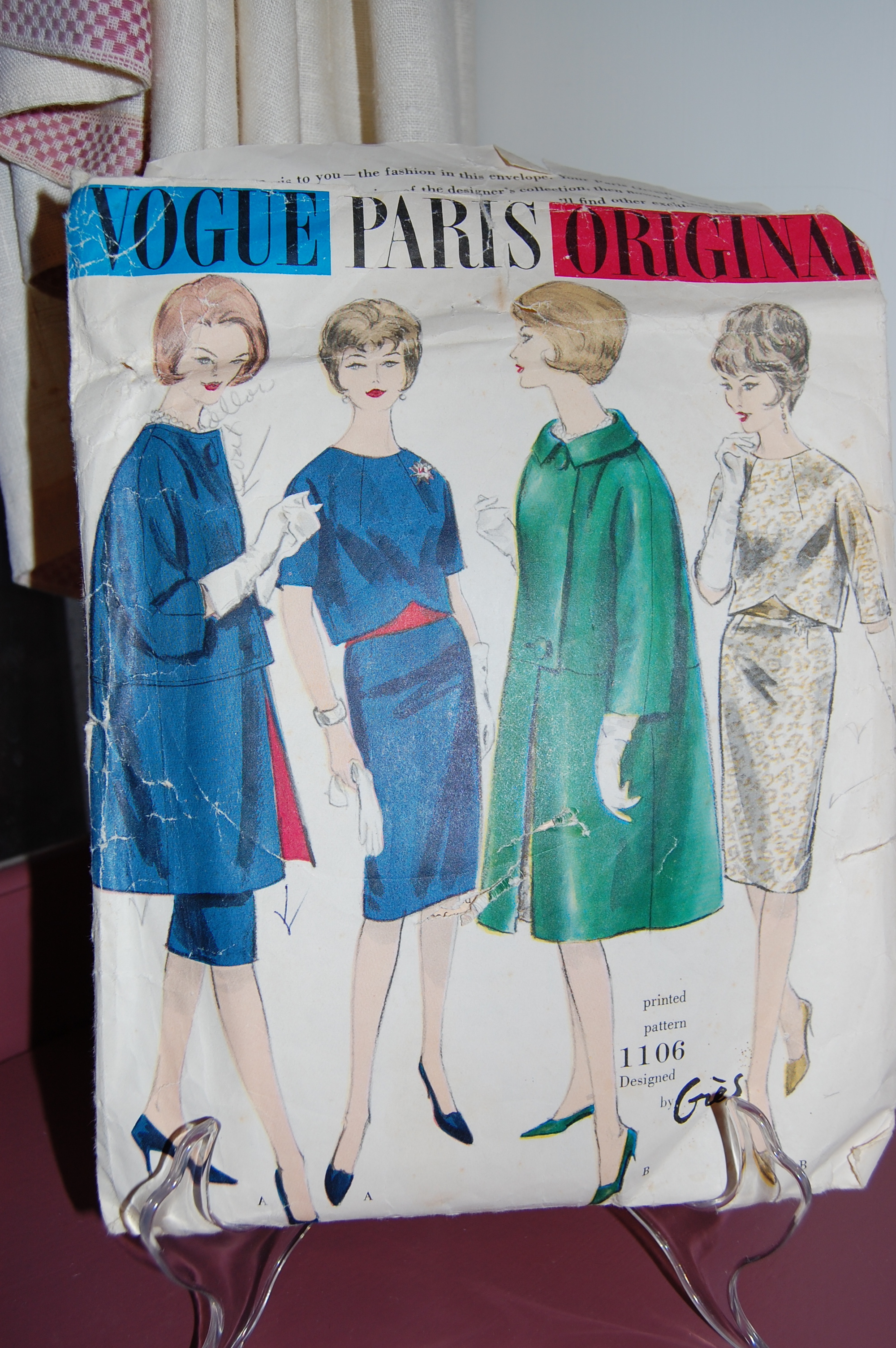
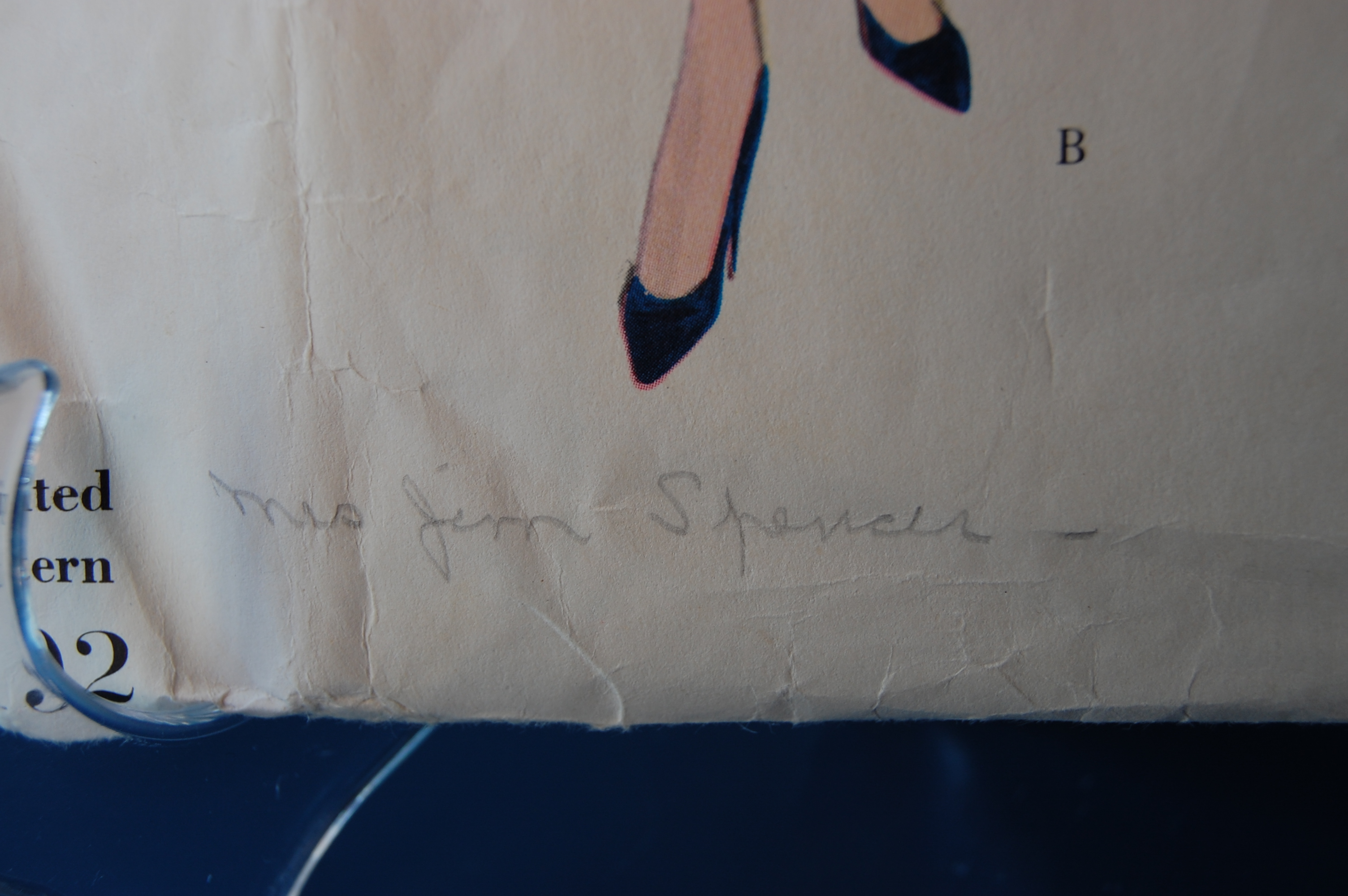
Here is a close-up of the signature. This pattern belonged to Mrs. Jim Spencer.

Mrs. Jim Spencer, I bet you looked fabulous in this suit!

7 Comments

Filed under Coats, Dressmaker details, Uncategorized, vintage Vogue patterns from the 1960s, vintage Vogue patterns from the 1970s, Vogue patterns

Seeing stars? No…dots!!

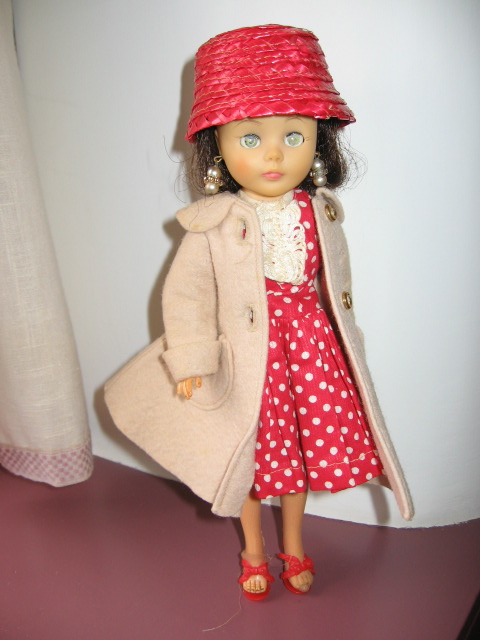
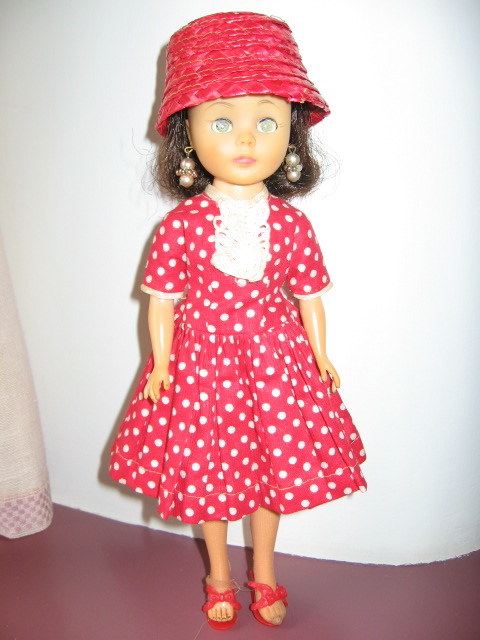
Polka dots, to be precise!  My love of polka dots must have started when I was about 6 or 7, when I received my Toni Fashion doll for Christmas.  She was dressed in a red and white polka dotted dress, with a lovely tan coat, red hat, and high heels.  Here she is, over five decades later: 

This dress could easily have been featured in Vogue Pattern Book for February/March of 1957!

Christian Dior, who died in 1957, was a big fan of polka dots.  Here’s what he said about them in his Little Dictionary of Fashion (first published in 1954 and now available on Amazon, published by Harry N. Abrams, Inc., 2007):

“…They are lovely, elegant, easy, and always in fashion.   …According to their color, they can be versatile…  Black and white for elegance; soft pinks and blues for prettiness; emerald, scarlet, and yellow for gaiety; beige and gray for dignity.”

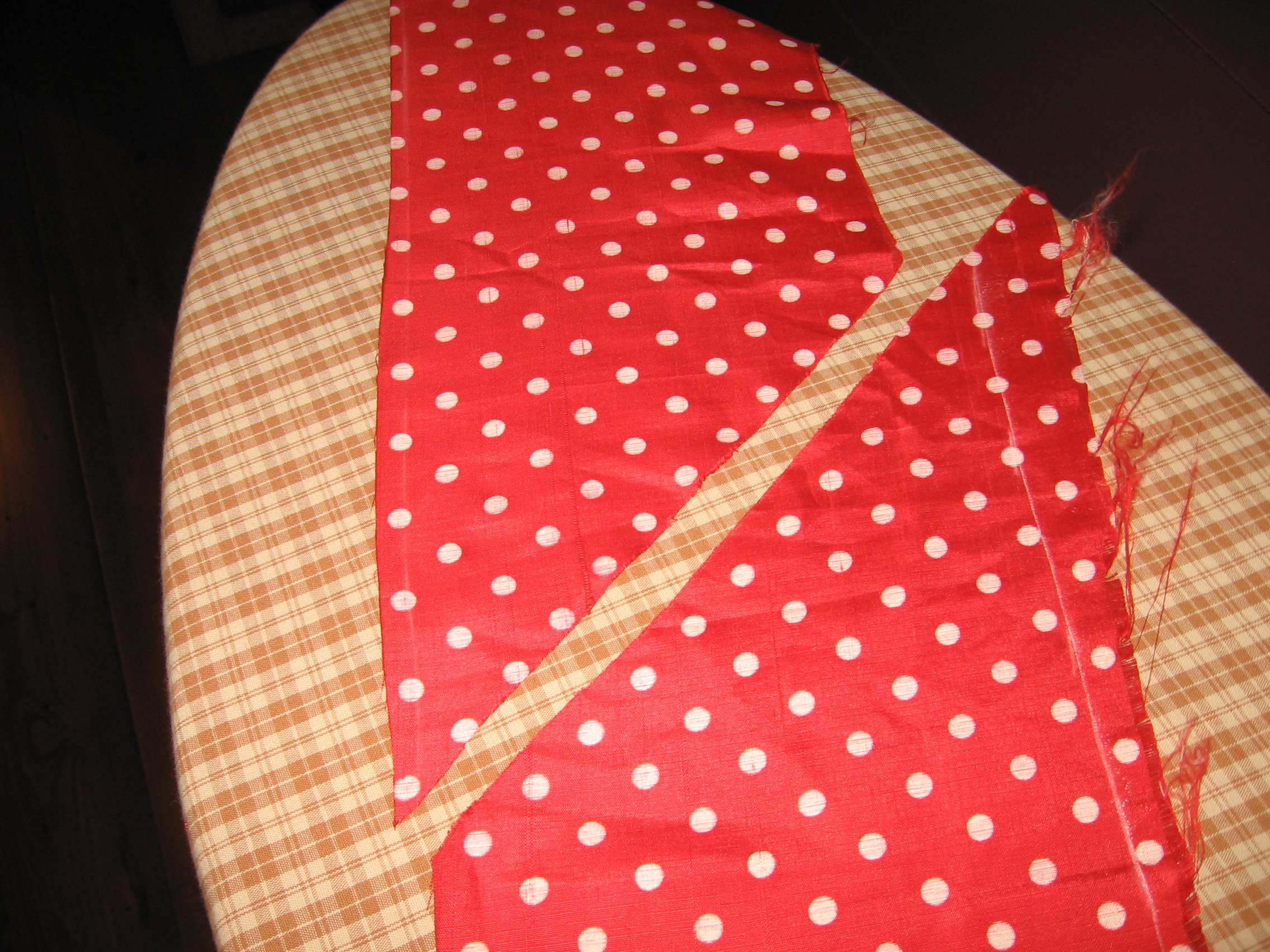
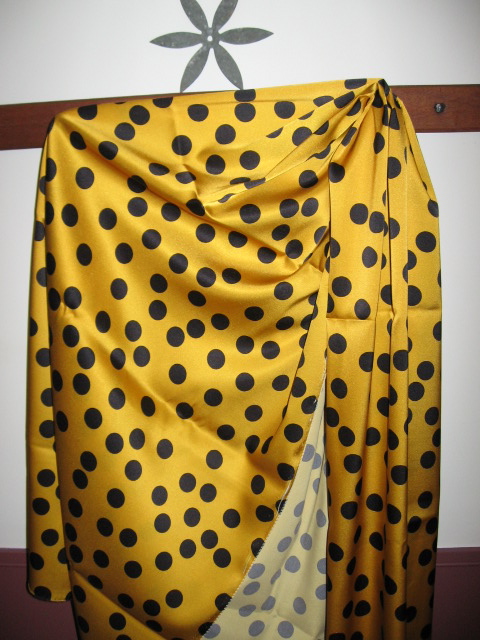
For my “going away” outfit when I was married in 1973, I made a beige silk suit with a red and beige polka dotted blouse.  Sadly I no longer have either the suit or the blouse, but… never one to throw away any scrap of fabric that can be used for something, I found a piece of the silk blouse fabric in one of my “fabric” drawers.  It was an odd shape, but the more I looked at it, the more it became apparent that I could actually make a scarf out of it.  Here’s what I did:

I cut the silk into two pieces, each with a true-bias end. I marked it with chalk to get a precise cutting line.

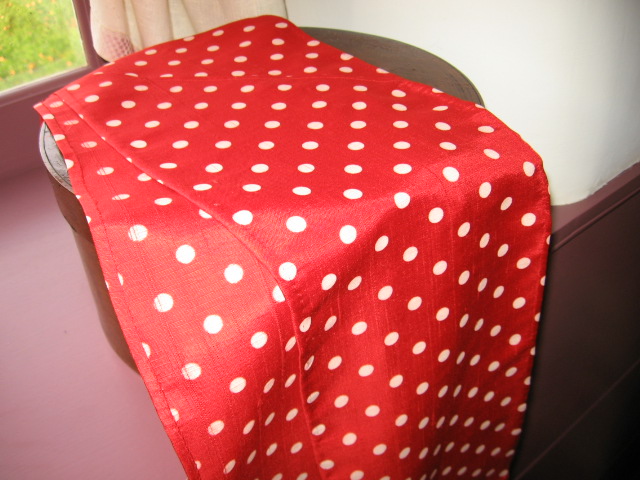
I joined the two pieces together with a flat felled seam and hand-hemmed around all four sides.

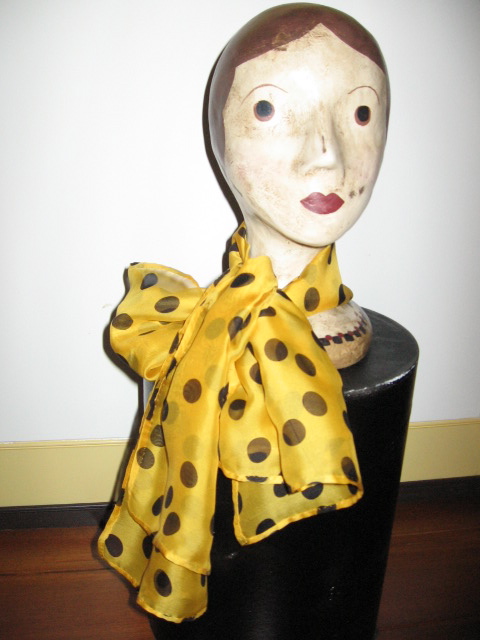
Here it is finished and ready to wear.


Last summer when my husband, Tom, and I were in California to see our son, Nate, I made a memorable trip to Britex Fabrics on Geary Street in San Francisco.  I knew when I saw this fabric, I wouldn’t be able to leave the store without it:  pure silk charmeuse  – by Dolce and Gabbana, no less!

Here it is propped over two pegs.

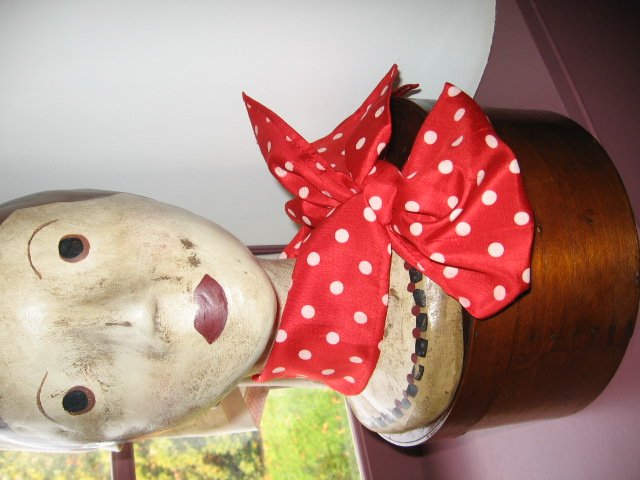
They also carried the matching silk chiffon.  I have been looking for the right pattern to make a blouse out of the charmeuse, and the chiffon is now this scarf, which gets comments whenever I wear it!
In my opinion, dots are stars!
Leave a comment

Filed under Polka dots, Scarves

I love coats!

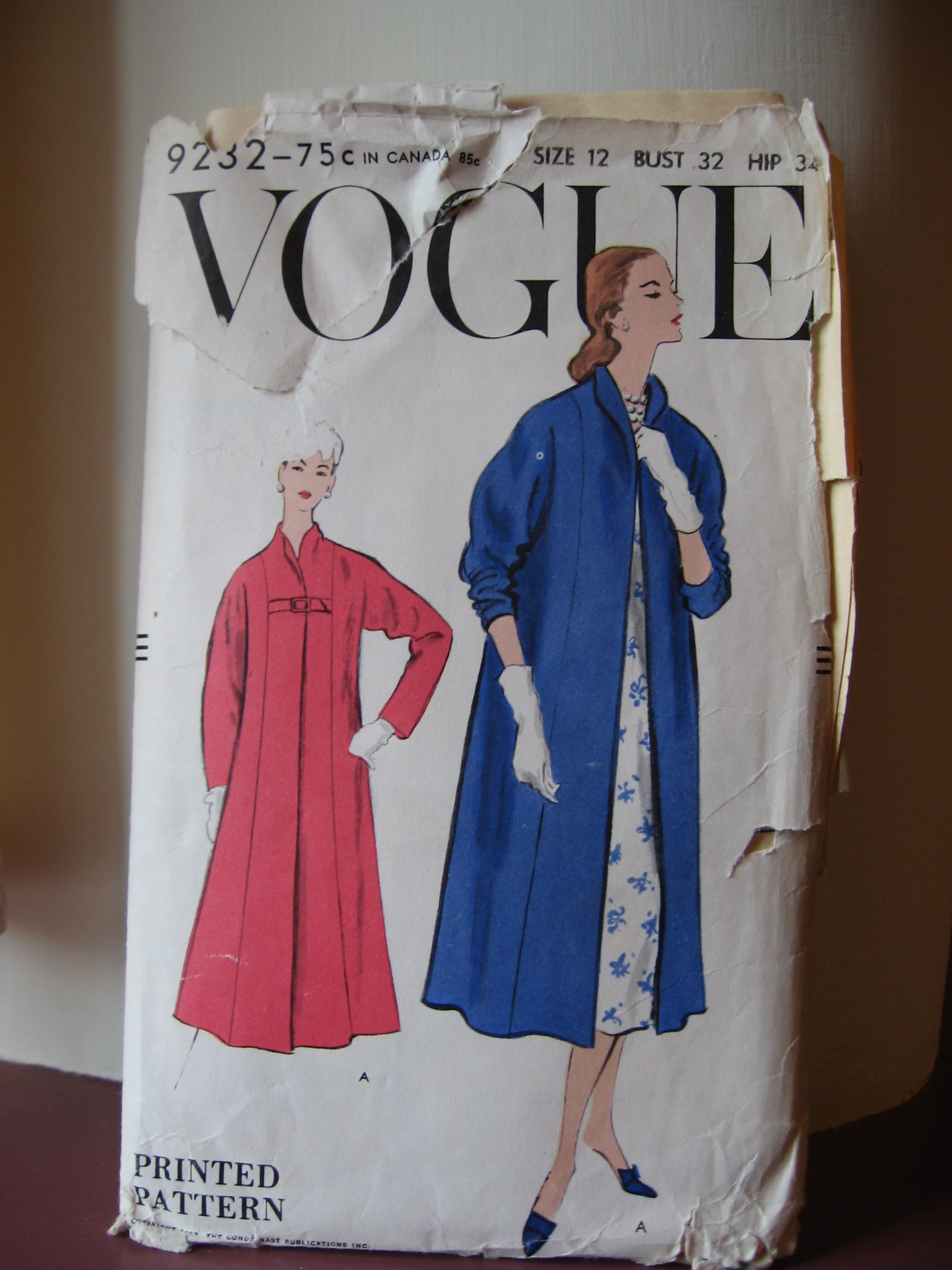
I never realized I love coats so much until I started looking at Vogue patterns on eBay.  It seems like every other pattern that appeals to me is either just a coat or a coat and dress or a coat and skirt or a jacket/coat that can be made in various lengths. One of the first ones I found was this one:

1957 Swing Coat from vintage Vogue pattern

One of my first eBay purchases - a vintage Vogue pattern from 1957

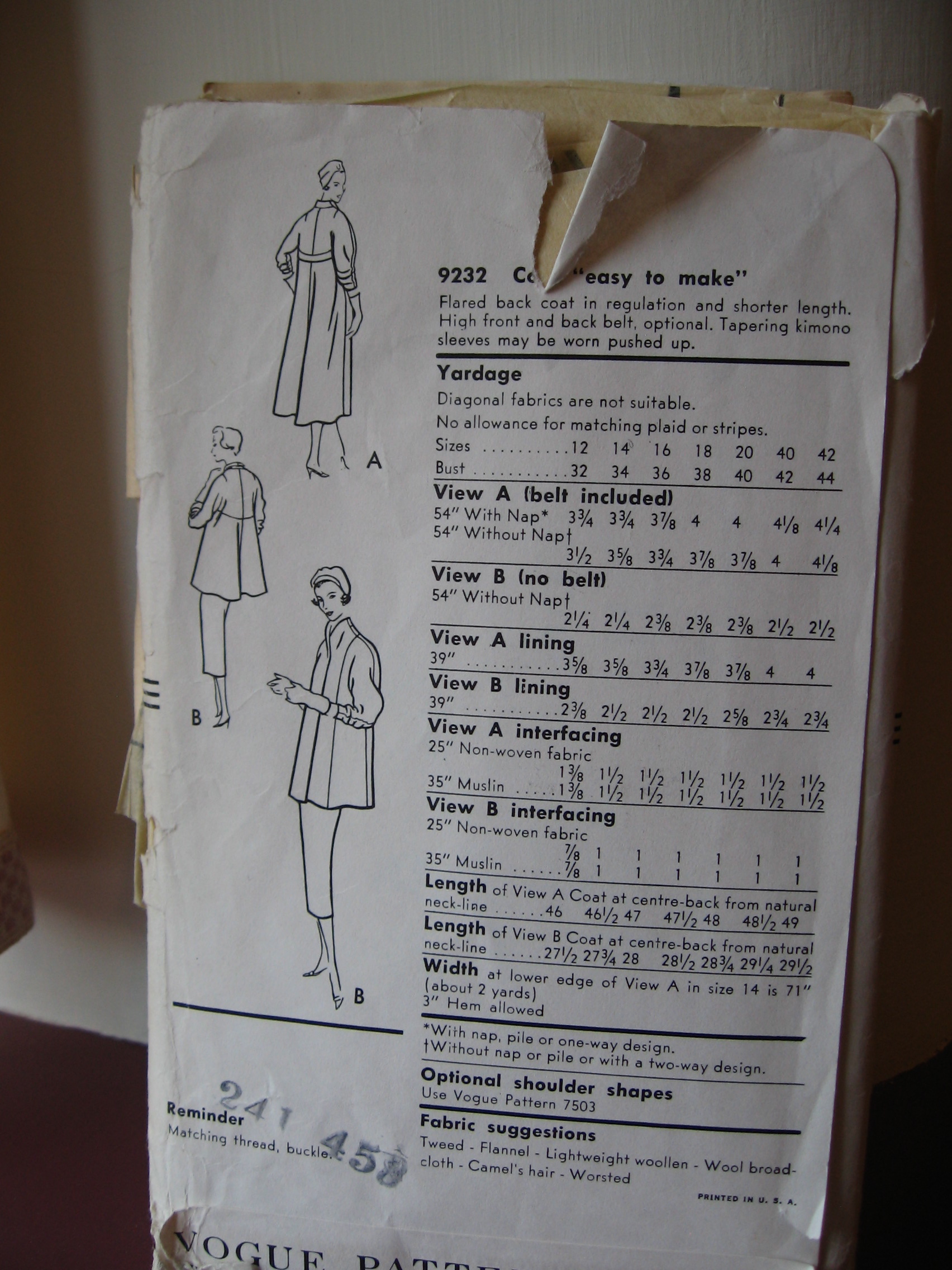
It was a “buy it now” offer rather than an auction – and I thought long and hard before I decided to go for it.  For one thing, there was only a front view of the pattern envelope, so I couldn’t tell what the back of the coat looked like.  When the pattern arrived, I was so excited – the back view of the long version has a high belt, which I think is such a great detail.  The swing of the coat looks lovely, too!  In fact, coats like these were called “swing” coats back in the 50’s.  They were also called “clutch coats” as the front fastenings were minimal or nonexistent, so you had to “clutch” them closed with your hand.

This pattern is copyrighted 1957.  The description on the back of the envelope says “Flared back coat in regulation and shorter length.  High front and back belt, optional.  Tapering kimono sleeves may be worn pushed up.”  (OH, YES!!!  Don’t you love this?  All the better to show off classy bangles and gold cuffs!)  I love the term “regulation length” although I have yet to find a reference to exactly what that means.

I immediately knew I would make this coat in its long version, but not sure what type of fabric I wanted to use.   That would take a few more weeks of deliberation. More on this and other coat patterns that I love in a future post.

5 Comments

Filed under Coats, Vogue patterns