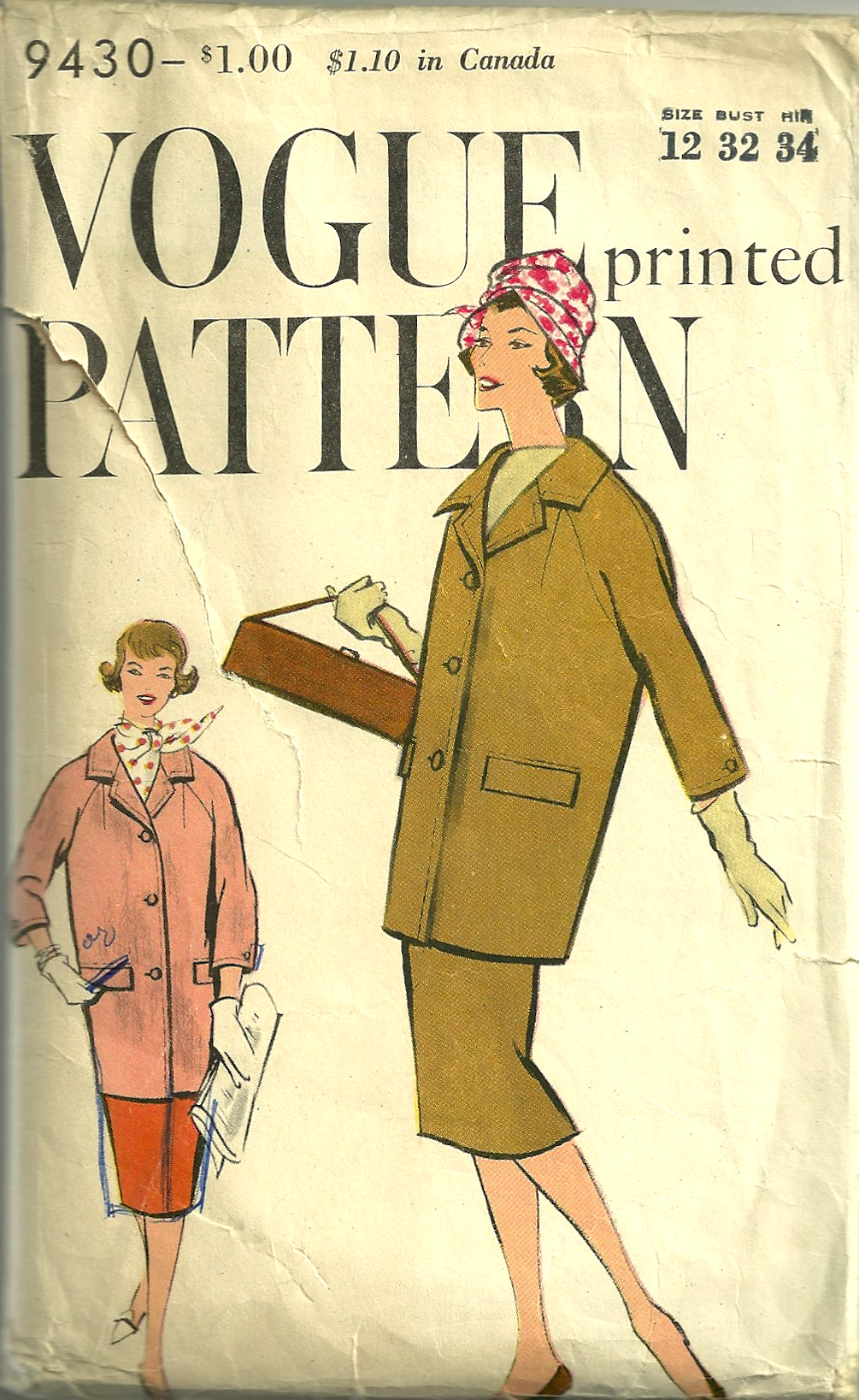
Category Archives: Coats

Happy New Sewing Year

“Dresses for breakfasts, and dinners, and balls;

Dresses to sit in, and stand in, and walk in;

Dresses to dance in, and flirt in, and talk in;

Dresses in which to do nothing at all;

Dresses for Winter, Spring, Summer and Fall”

William Allen Butler (1825-1902) may have thought “Nothing to Wear”, from which these lines are taken, was a satirical poem, but he obviously did not know 21st century fashion sewers.  Isn’t January just the perfect time to plan for the creation of “dresses for Winter, Spring, Summer, and Fall”?  Yes, thank you for agreeing with me.

Last year I took a rather theoretical approach to the new sewing year, but this year I am focusing on more specific plans.  Let me start with Winter.

I have three things that I want to complete while the snow is still flying (which gives me until the end of March, more or less):

1)  My Chanel-inspired classic French jacket is my current project, and I am happy to report that I am making slow but steady progress on it.

2) I won’t consider the jacket really complete until I have made the bow blouse that will match its lining.

3) I am excited to say that I am going to be joining one of Susan Khalje’s Couture Sewing Classes in February, and my intended project is — ta-daa — this jacket which I have wanted to make ever since Vogue Patterns first issued it in the 1970s!

I will definitely be doing the color blocked version when I make this coat.

I will definitely be doing the color blocked version when I make this coat.

With any luck (or maybe lots of it will be needed), it may still be Winter when I start this project intended for an event in late April event:
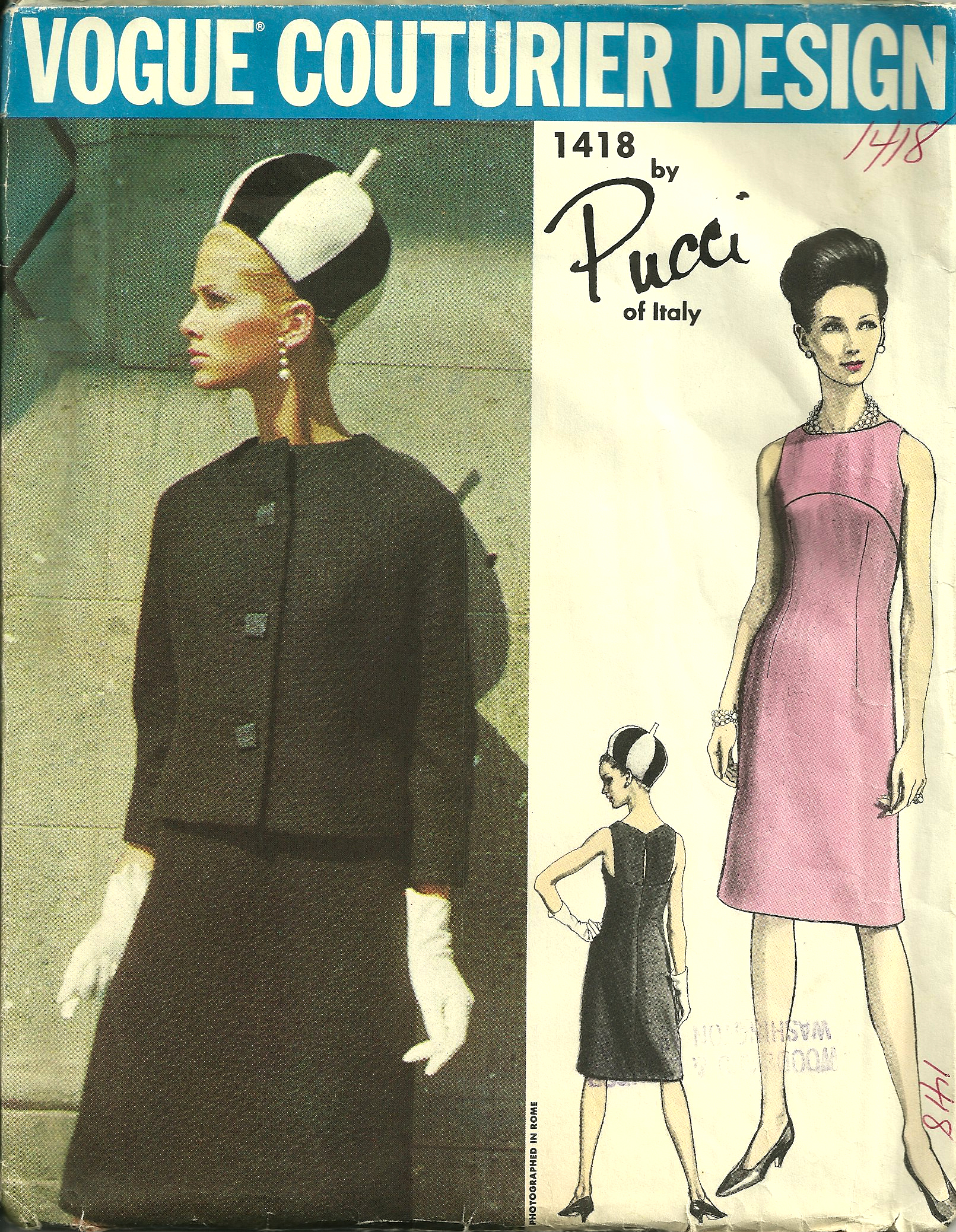
I have an authentic Pucci silk from which to make the dress and line the jacket.

I have an authentic Pucci silk from which to make the dress and line the jacket.

In addition, Spring will not be complete for me until I make a dress for my granddaughter who will be 1-year-old in March.  I purchased this fabric last Fall when I was at the Eric Carle Museum in Amherst, Massachusetts.  You can imagine my excitement when I saw that the gift shop included yardage of soft, quality cotton featuring designs from his books.  I envision these little ducks embellished with yellow rick-rack.
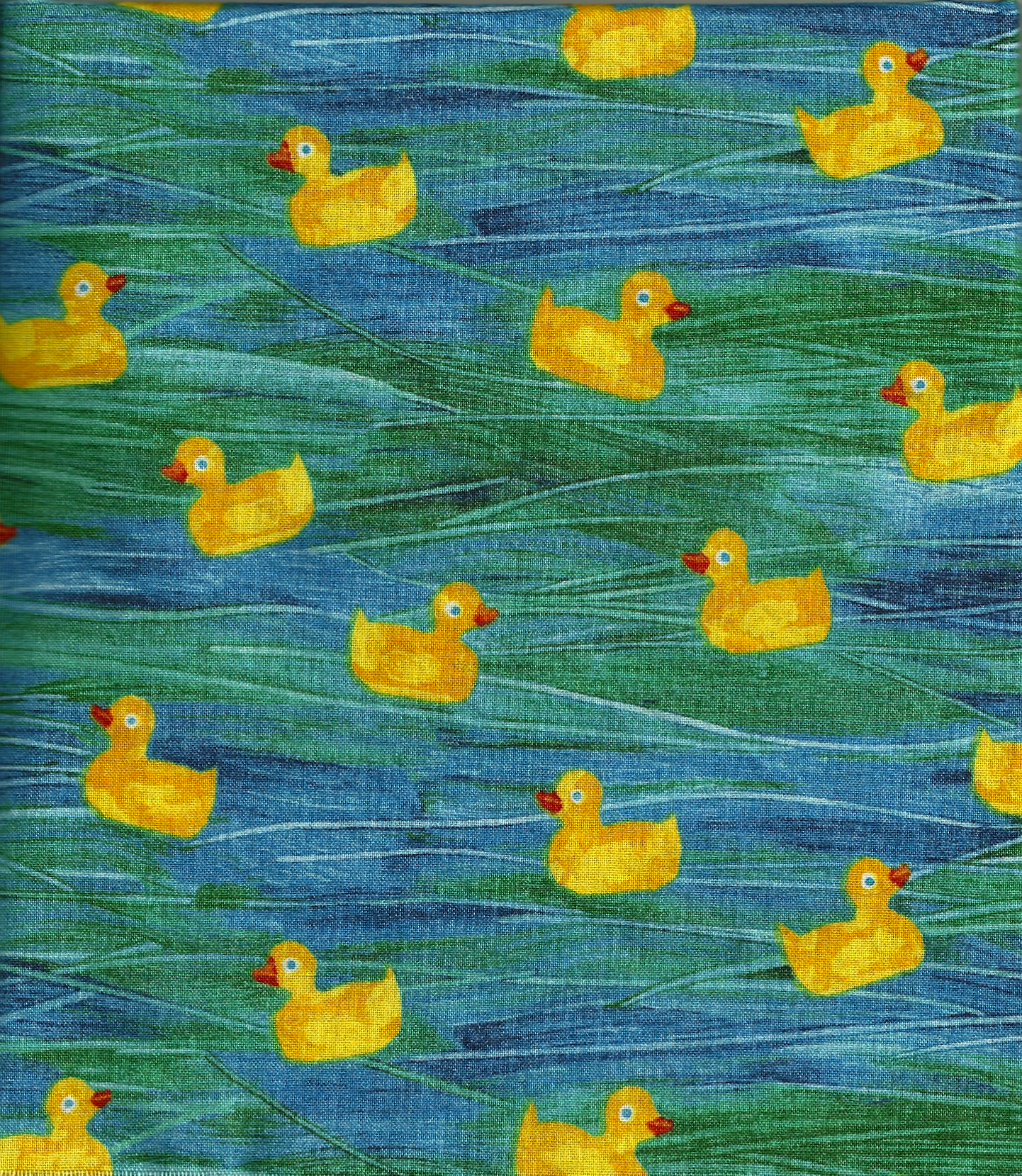
Happy New Sewing Year - carle fabric Before Spring bids us adieu, I may divert from dresses to make another pair of slim pants in this vintage 1950s’ linen:
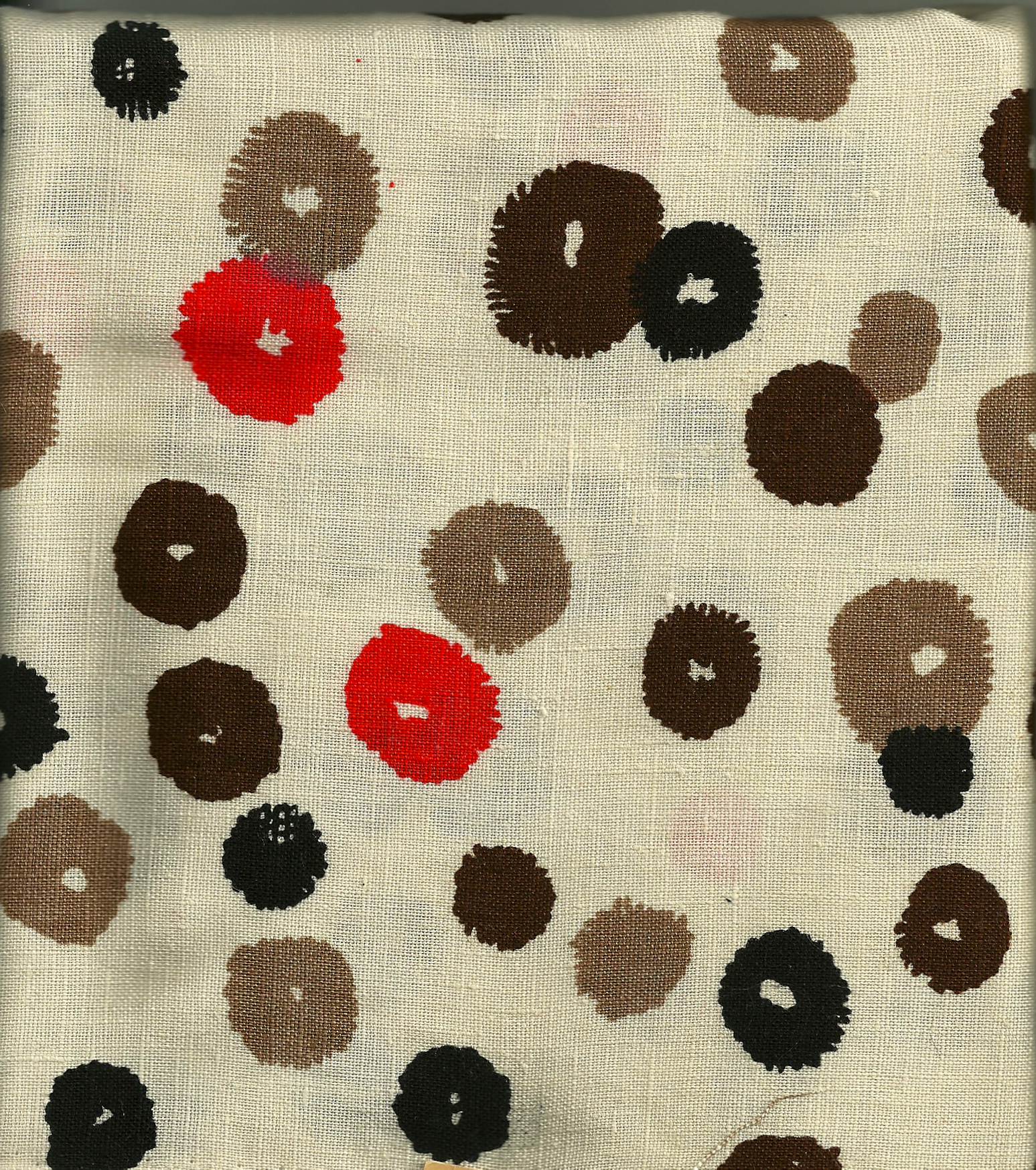
I only have 1 5/8 yards of this 35" wide fabric, so it remains to be seen if i can squeeze pants out of it.

I only have one and 5/8 yards of this 35″ wide fabric, so it remains to be seen if I can squeeze pants out of it.

If Summer of 2014 is as hot as last Summer (or even if it is not), I’ll be making at least two more cool, linen dresses, one sheath-style and one belted.  More on these linen fabric finds in a future post…

And a bathrobe!!  I am dying to make a swishy bathrobe!

Ah, and then comes Fall (already??), probably my favorite season of all.  I have two projects envisioned:

1) I found this stretch silk charmeuse at Mendel Goldberg Fabrics on a quick day trip to NYC in early Fall.
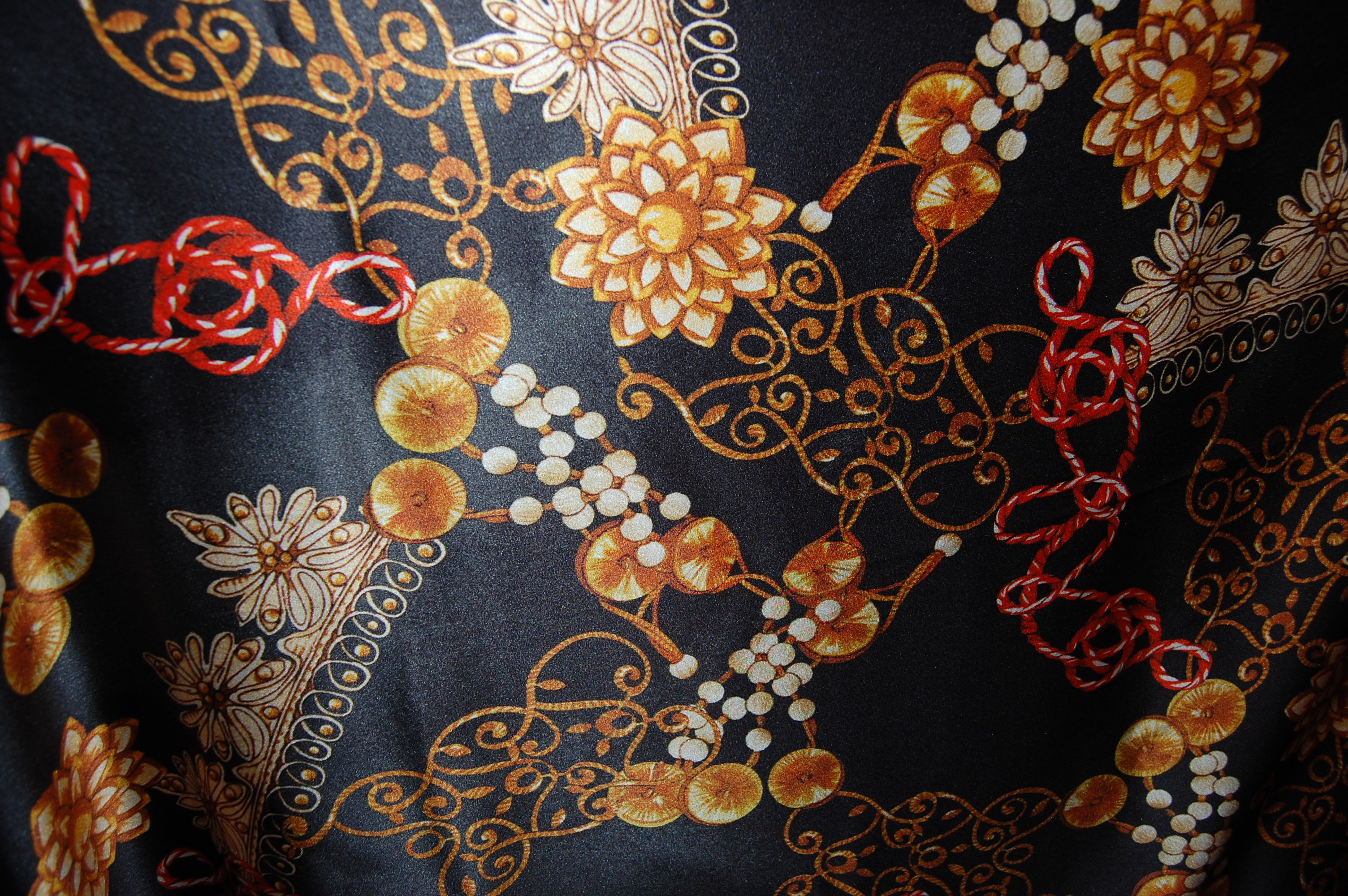
Another gorgeous Italian silk!

Another gorgeous Italian silk!

I bought it thinking I may use it for the lining for my No. 2 French jacket, but shortly after that I found this pattern on eBay and promptly decided it would be perfect made up in this dress (which requires a stretch fabric.  Well, it says “ knit fabrics only” but I say stretch fabric will do just fine).
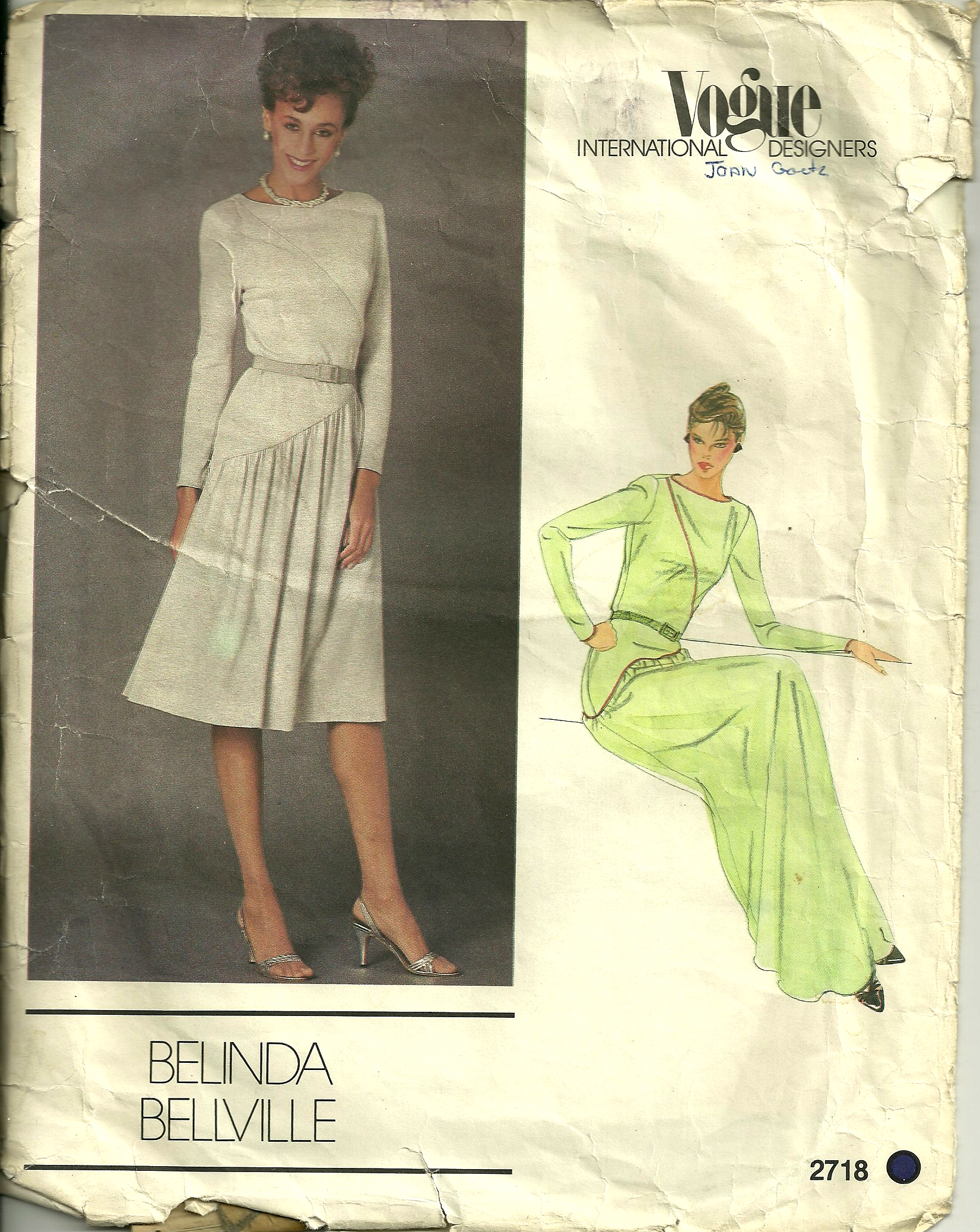
This os one of the few patterns from the 1980s which I really like.  However, i will not be duplicating the hairstyle.

This is one of the few patterns from the 1980s which I really like. However, I will not be duplicating the hairstyle.

2) I’ve had this buttery soft cashmere wool for a couple of years now.  I originally thought I’d make a suit, but now I’m thinking long-sleeved dress instead.  I’m still sorting this one out in my head so I’m very glad I have until next Fall.
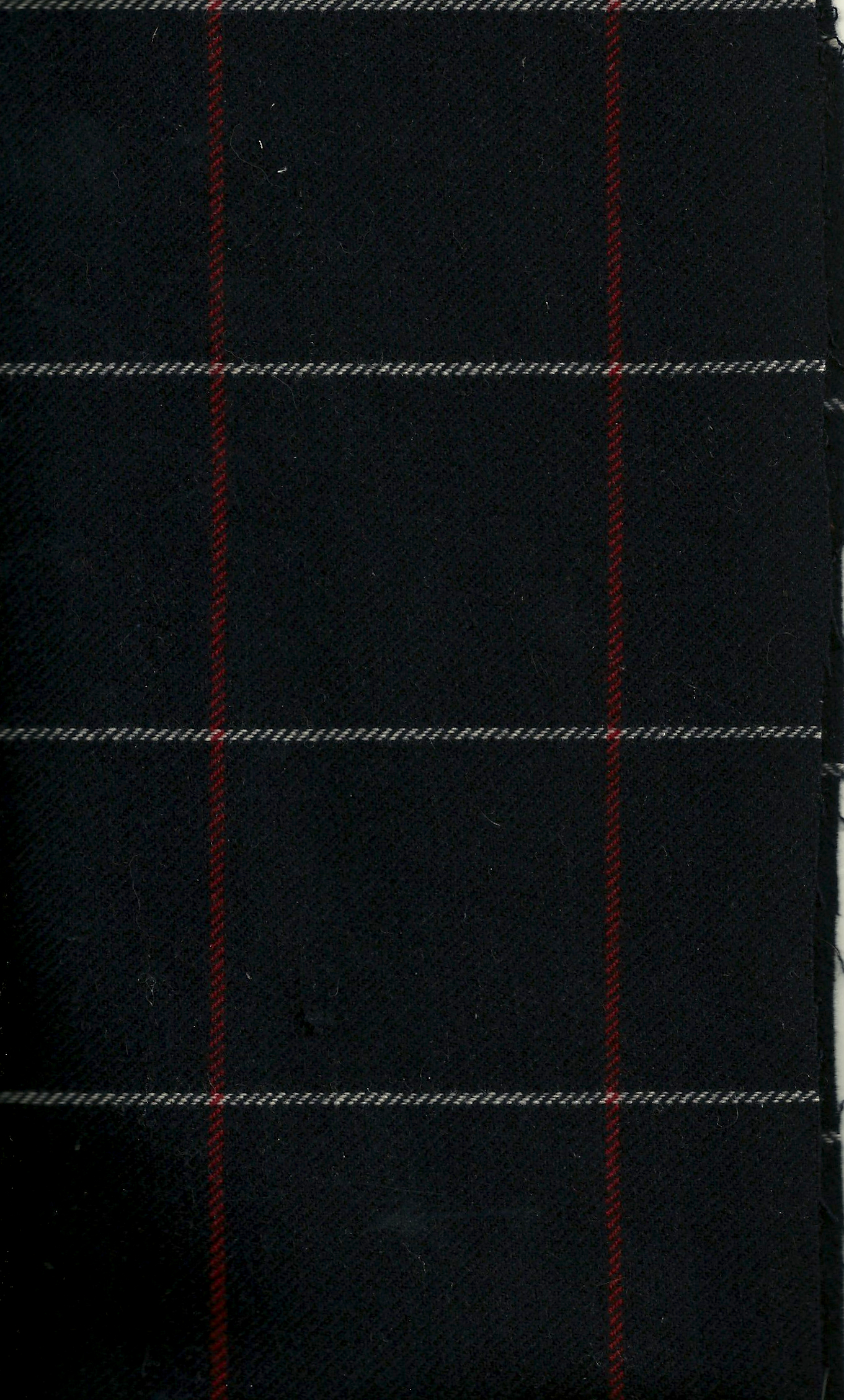
A subtle windowpane check in navy with deep red and ivory intersecting lines.

A subtle windowpane check in navy with deep red and ivory intersecting lines.

Sprinkled among these plans for Winter, Spring, Summer and Fall will surely be more little dresses for granddaughter Aida.  I fully intend for her to have some of the cutest frocks in all of New England.

Finally, if 2013 taught me anything, it is that the unexpected is waiting around every corner.
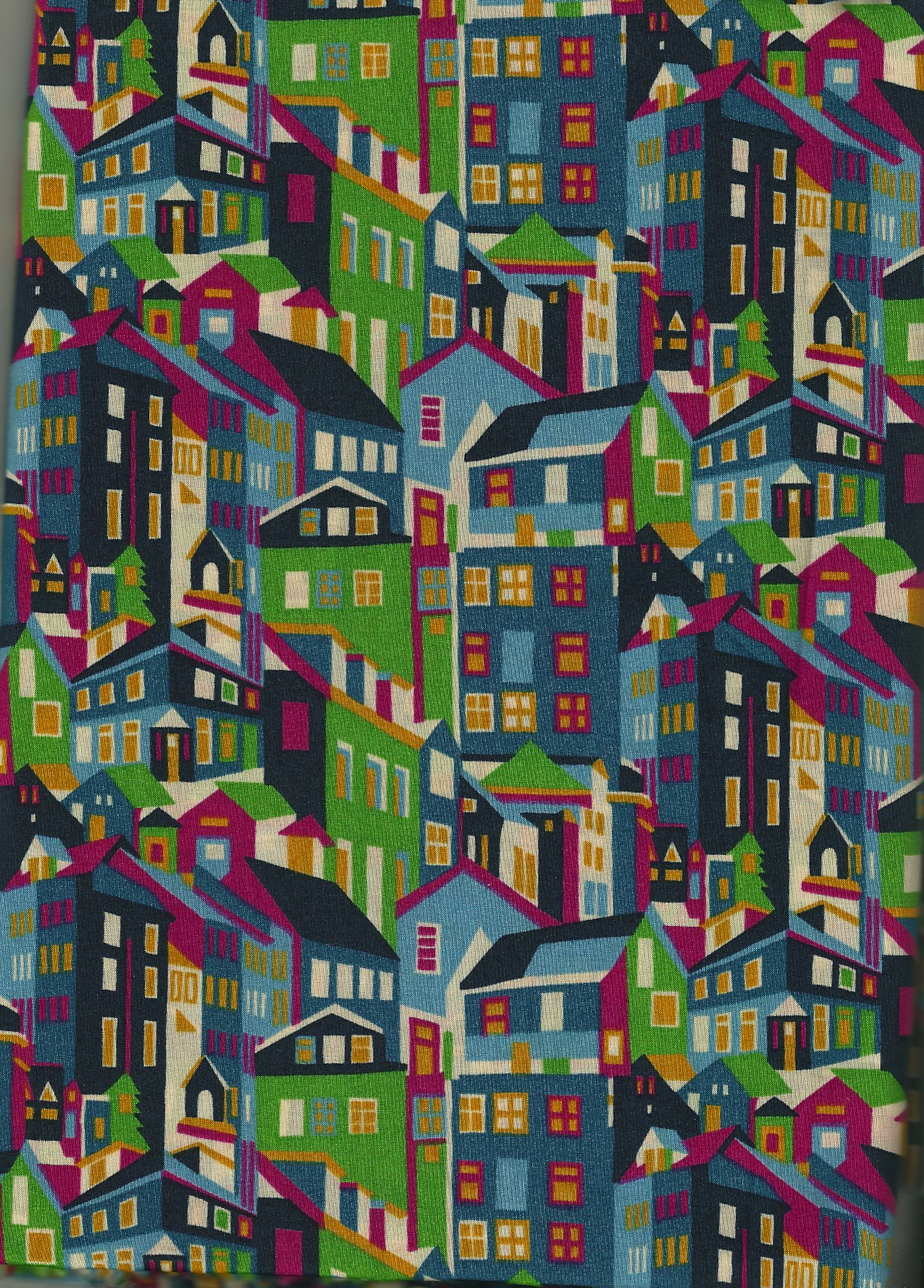
Lots of corners lurking in this Liberty cotton!

Lots of corners lurking in this Liberty cotton!

Life can take sudden turns and twists that are not always sewing-friendly, so I plan to be kind to myself if that happens.  But wouldn’t it be nice for all of us to have the kind of year when we have the extra time to make a dress in which to do “nothing at all”?
14 Comments

Filed under 1980's dress patterns, Boucle for French style jackets, Chanel-type jackets, Coats, Liberty cotton, Linen, Polka dots, Uncategorized, vintage Vogue Designer patterns, vintage Vogue patterns from the 1970s, Vogue patterns, woolens

Feathers for Fancy, Feathers Forever

I really had no intention of writing a new post today.  I have been away from home quite a bit, and the few days I have had at home, I have been working on “perfecting” (hopefully) a muslin for my wrap dress.  But – I was inspired yesterday when I read the fashion section of the Weekend Wall Street Journal.  Meenal Mistry devoted her front-page article to Fall’s “feathered looks” which range from casual to office to evening attire.  This was the only excuse I needed to join the feather frenzy.

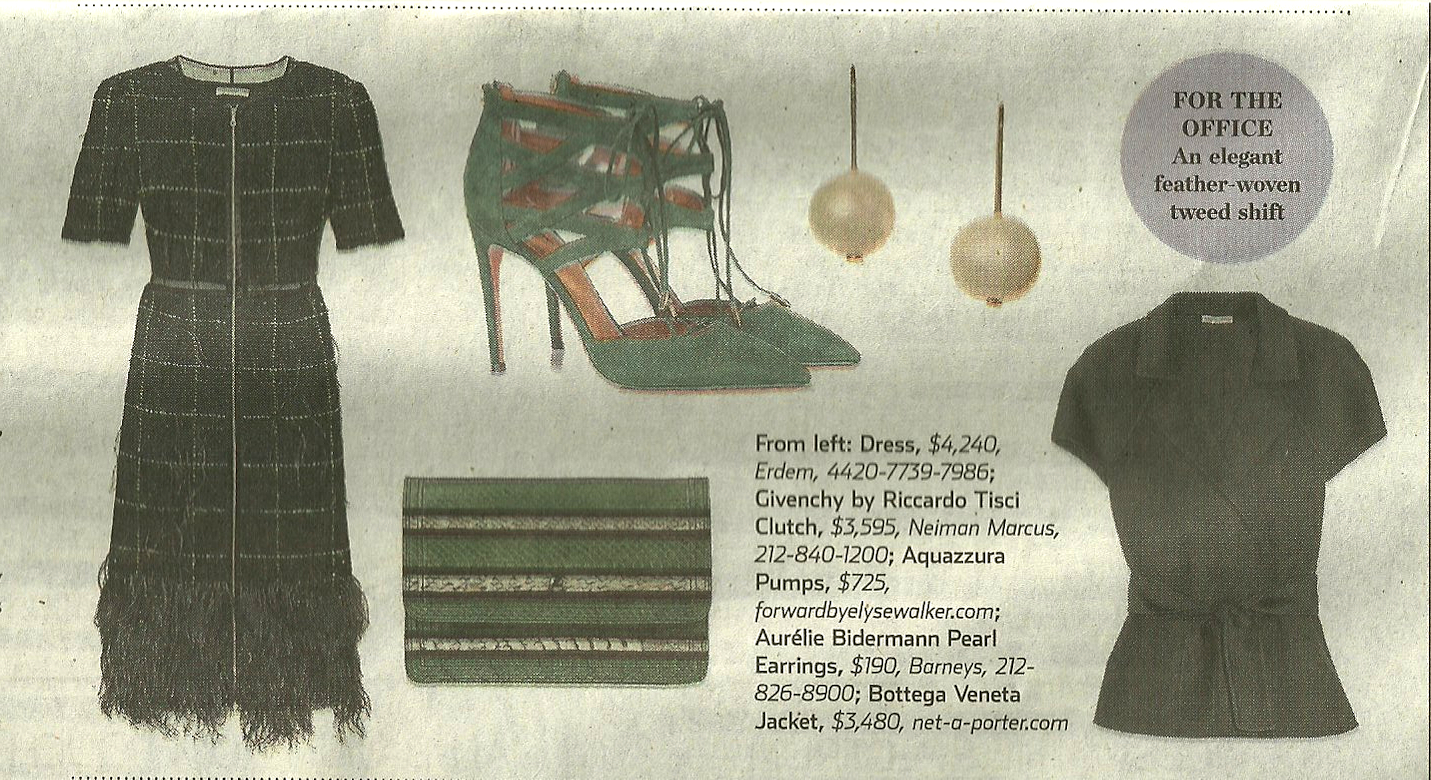
But, first, here is an example of what is being offered this Fall “for the office:

The dress on the left features feathers at the hem. I'm not sure I'd wear feathers to an office (if i went to an office!), but I love the dress.

The dress on the left features feathers at the hem. I’m not sure I’d wear feathers to an office (if I went to an office!), but I love the dress.

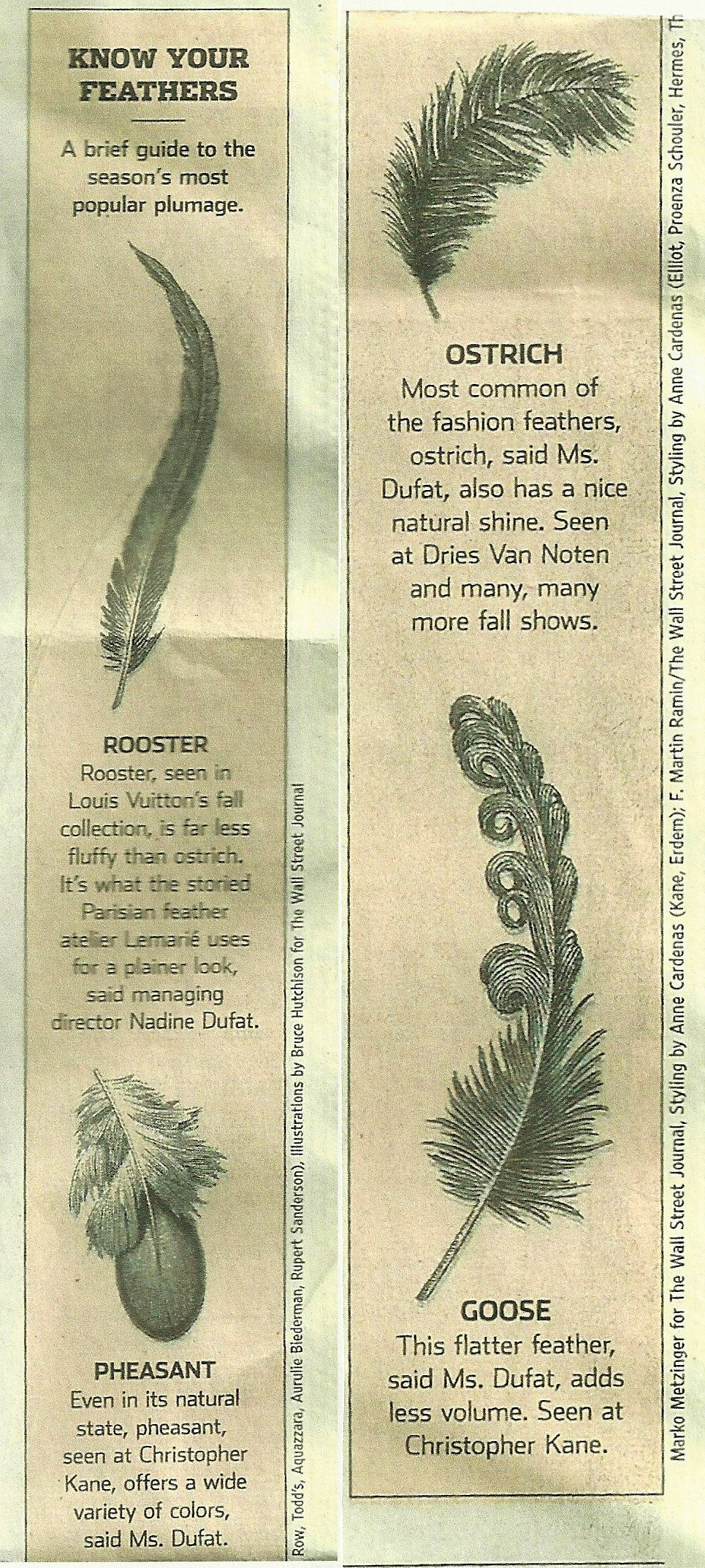
Included with the article is “A brief guide to the season’s most popular plumage”:

This is a handy little chart to the season's most popular fashion feathers.

This is a handy little chart to the season’s most popular fashion feathers.

Quoted and featured in the article is Nadine Dufat, who is the managing director of Lemarie, the Parisian feather atelier which does haute couture work for the houses of Louis Vuitton, Chanel and Dior:  “I think designers like feathers because there are so many different possibilities with them.”   Commenting on Lemarie, the author muses, “Certainly the 133-year-old plumassier can make magic happen when it comes to all things avian, but no matter who’s doing your feather work, there’s something about plumes that’s fascinating and otherworldly and therein lies the allure – eternal for some, fleeting for others.”

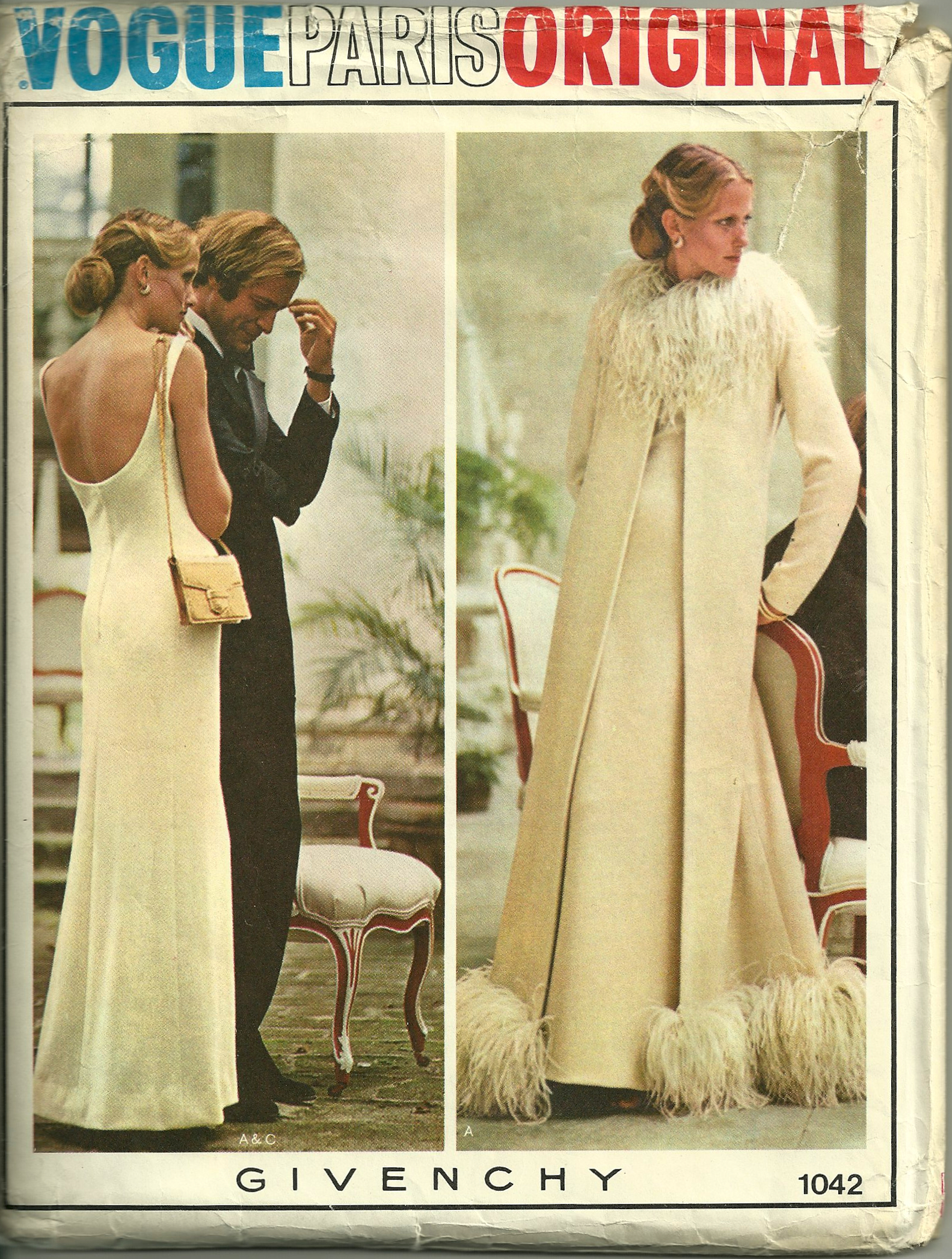
“Eternal” is certainly more than 40 years, but a Vogue pattern from about 1973 proves the point about the elegance and staying power of feathered fashions.  I immediately thought of this pattern while reading the article, and went directly to my pattern file to retrieve it.  This pattern, a Paris Original by none other than Hubert de Givenchy, is one of my all-time favorite Vogue Designer patterns:

This evening coat makes my heart skip a beat!

This evening coat makes my heart skip a beat!

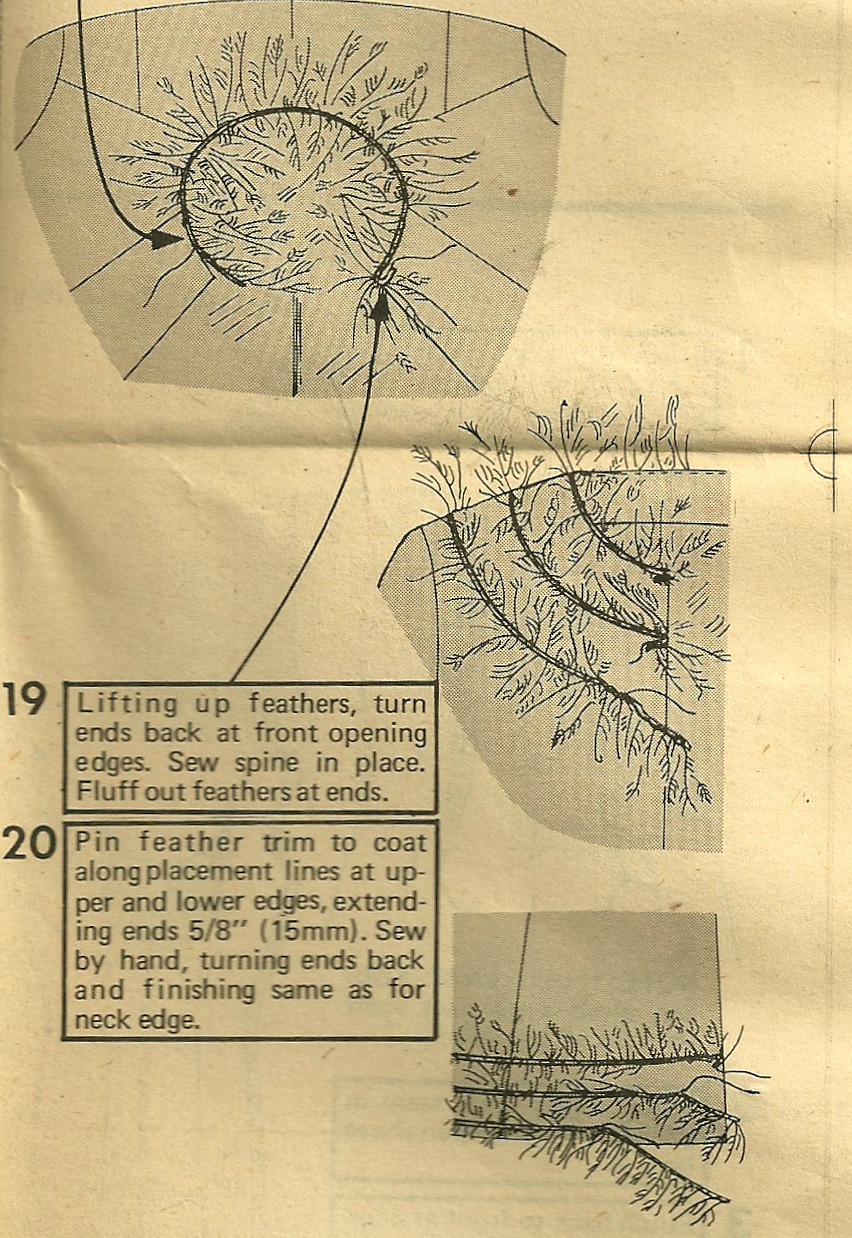
Princess seaming and the use of few darts insure that the long fluid lines of the low-backed dress and the evening coat are unencumbered with excess fabric.  The ostrich feather trim is attached to the coat in three evenly spaced rows at both the neck and hem.

Feathered coat - pattern instructions

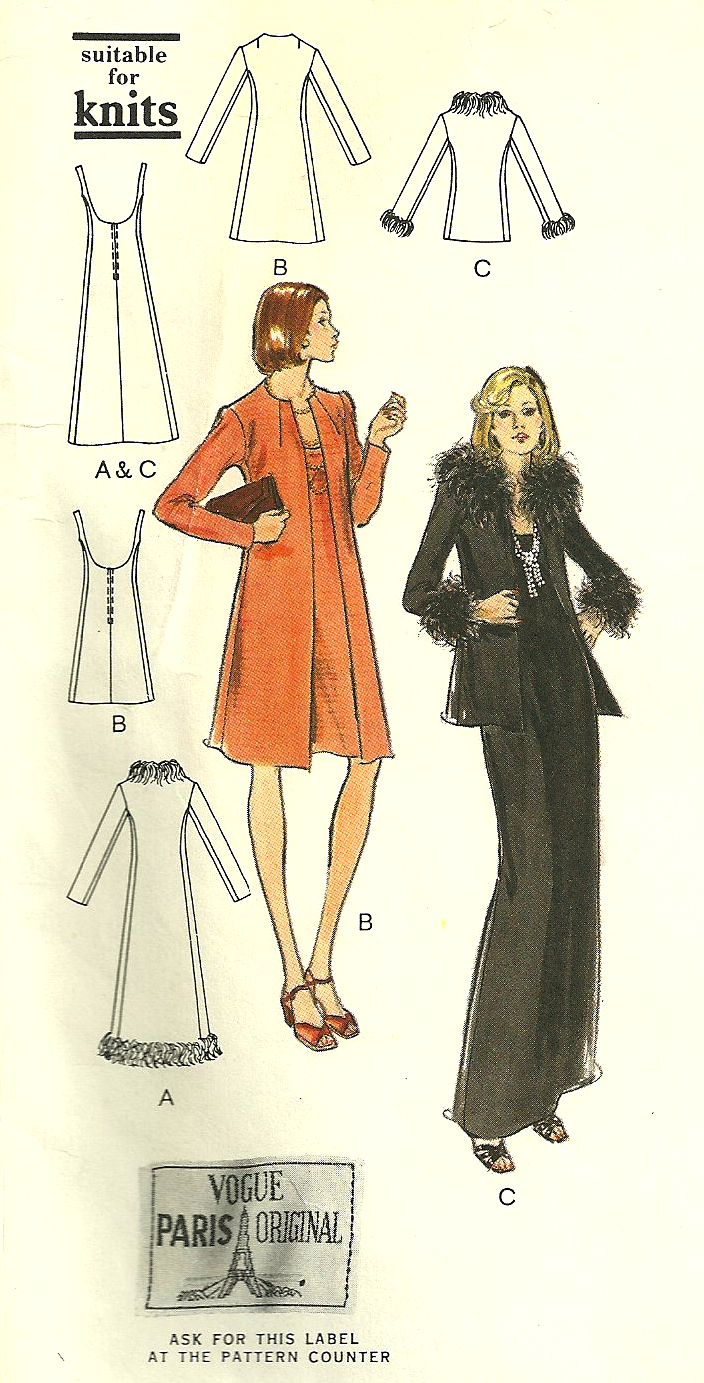
For those wanting more of a “cocktail” version of dress and coat, shorter views offer variety and versatility:

The knee-length coat could certainly sport feathers at least at the hem line, don't you think?
The knee-length coat could certainly sport feathers at least at the hem line, don’t you think?

I did a lot of “pattern dreaming” during the decade of the 1970s.  I apparently never had an occasion to make this dress and coat, as I never purchased it when it was available in the pattern catalogs.  But I did, indeed, dream about it – many times.  When I found it again – in my size, in factory folds, with label intact – in an Etsy store a while ago, I indulged that dream – and I bought it.  Will I ever make it?  The dress, probably “no” unless I alter it to show a little less skin!  But the coat – if the occasion is special and worthy of this level of simple elegance  – then “yes”.  And – I’ll definitely be using feathers.

6 Comments

Filed under Coats, Uncategorized, vintage Vogue Designer patterns, vintage Vogue patterns from the 1970s

Back to the Past

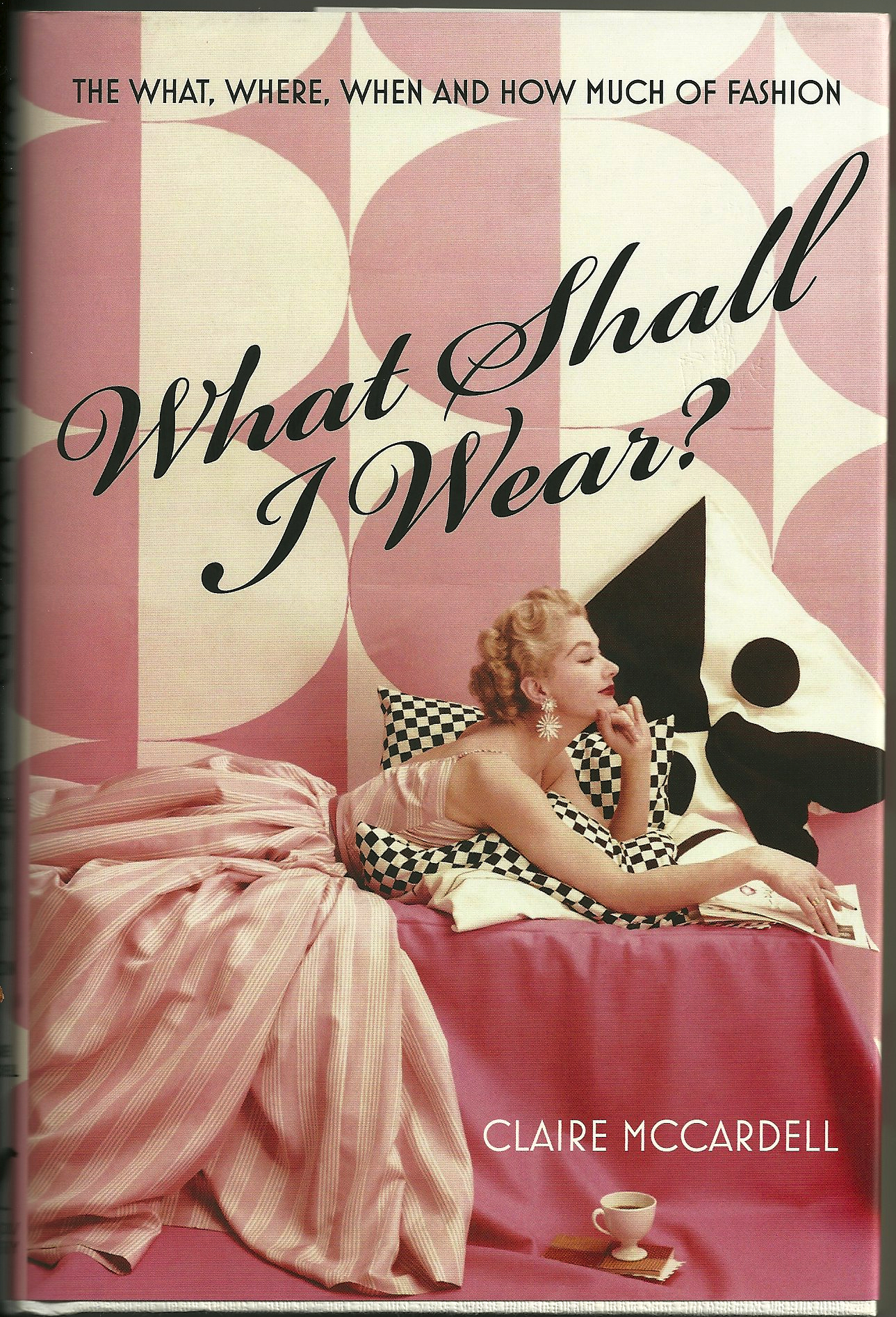
I am finally back in my sewing room, working on my emerald green silk suit.  The event to which I had hoped to wear this suit has come and gone (I wore something else that evening and the world somehow kept on spinning – amazing!), but this sewing project was and is on my Spring agenda and I am bound and determined to finish it.  Until I have made a bit more progress, with something to show for it, I thought I would indulge you with a book review of the 1956 Claire McCardell (1905-1958) book, What Shall I Wear, re-published in 2012 by The Rookery Press, in association with The Overlook Press, New York, New York.

Back to the Past

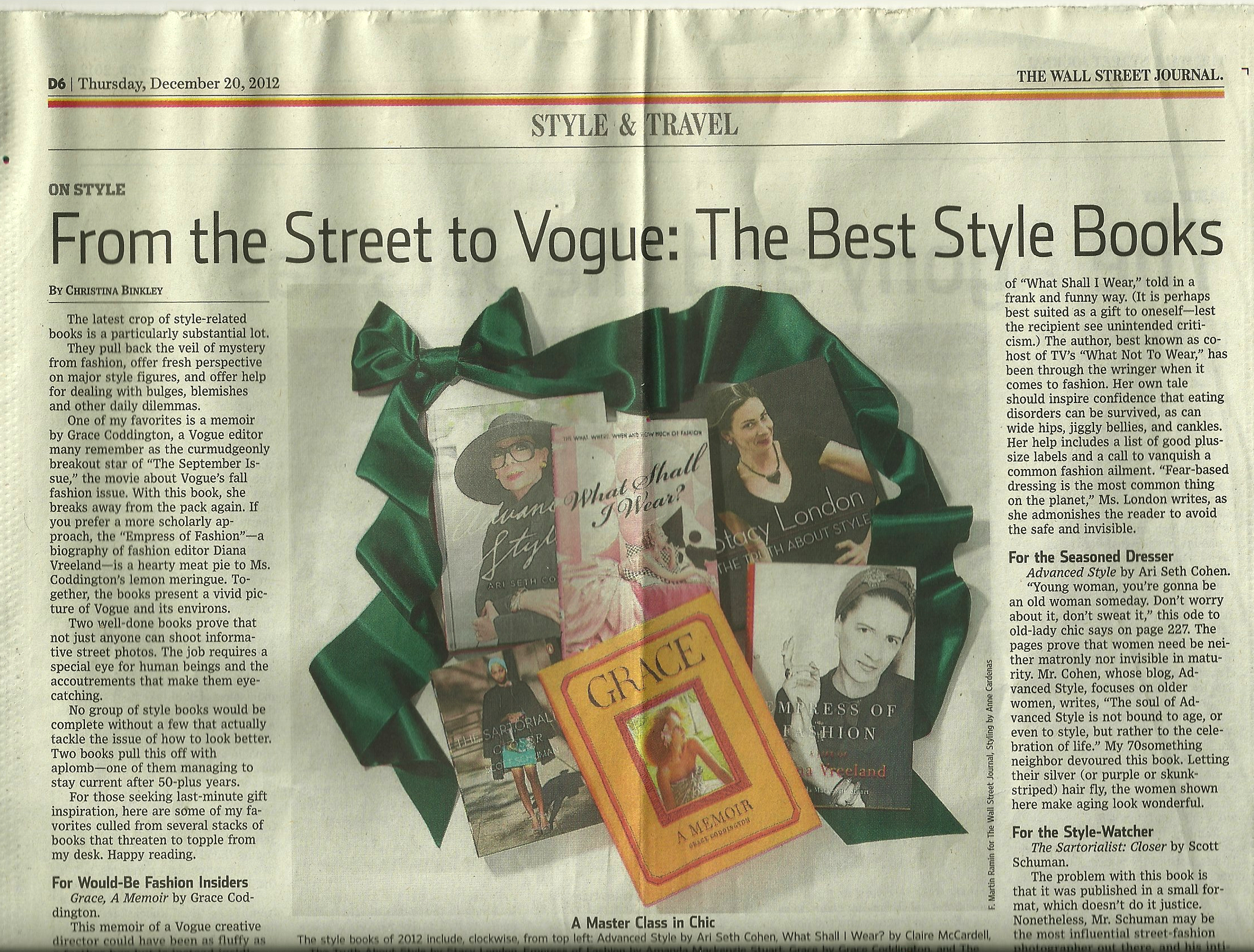
This book came to my attention by way of The Vintage Traveler blog (thanks, Lizzie!).  I purchased it on Amazon last Fall, and then, to my surprise, it was one of five books chosen by Christina Binkley of  The Wall Street Journal for her annual list of “Best Style Books”.

This annual feature on "style books" is always one of my favorites.

This annual feature on “style books” in The Wall Street Journal is always one of my favorites.  It appeared on December 20, 2012.

Here from Binkley’s review of the book: “This book is a gem.  …It manages to be modern more than 60 years later…  The designer created chic casual items that we take for granted today, such as trim ankle pants and full skirts that permit comfort and movement.  … She demonstrates an understanding of women’s lives. ‘Everyone should have a “pop-over” dress – a sheath that they can just pop over their head and go.’”

Here are some of Claire McCardell’s fashion tips and thoughts which struck a chord with me, especially in relation to sewing and dressmaking:

1)  The simple act of changing buttons (or in sewing, choosing the right ones) can make a dress fit your style.

2) When putting together your clothing (or pattern and fabric) budget, consider carefully where you want to put your money.  Make one major purchase a year, something classic and timeless is always a smart move.

3) Use color extensively and don’t be afraid to stretch from your normal palette.

4) Coats should be a large part of your wardrobe.  Indeed, she recommends compiling a “Coat Collection”.  That’s advice sweet to my ears!

5) Learn how to tie a scarf!  In her words:  “You miss all the fun if you can’t tie things.”  “If you really care about Fashion, sit down right now and learn to tie.  An ascot, a bandanna, a neckband, a bowknot.  This means knowing how to fold first, knowing how to loop next, knowing how to get the knot straight, knowing how to make the ends even – or uneven – on purpose.”

6)  Like all the great fashion designers and couturiers, she emphasizes the overwhelming importance of fit.  All those muslins/toiles we make are worth the time they take!

7) Accessorize your outfits with the appropriate jewelry, shoes, and bags.  Restraint is better than opulence.

8) She was a big fan (and proponent) of the “American Look”: meaning comfortable clothing with clean lines, displaying elegant simplicity.

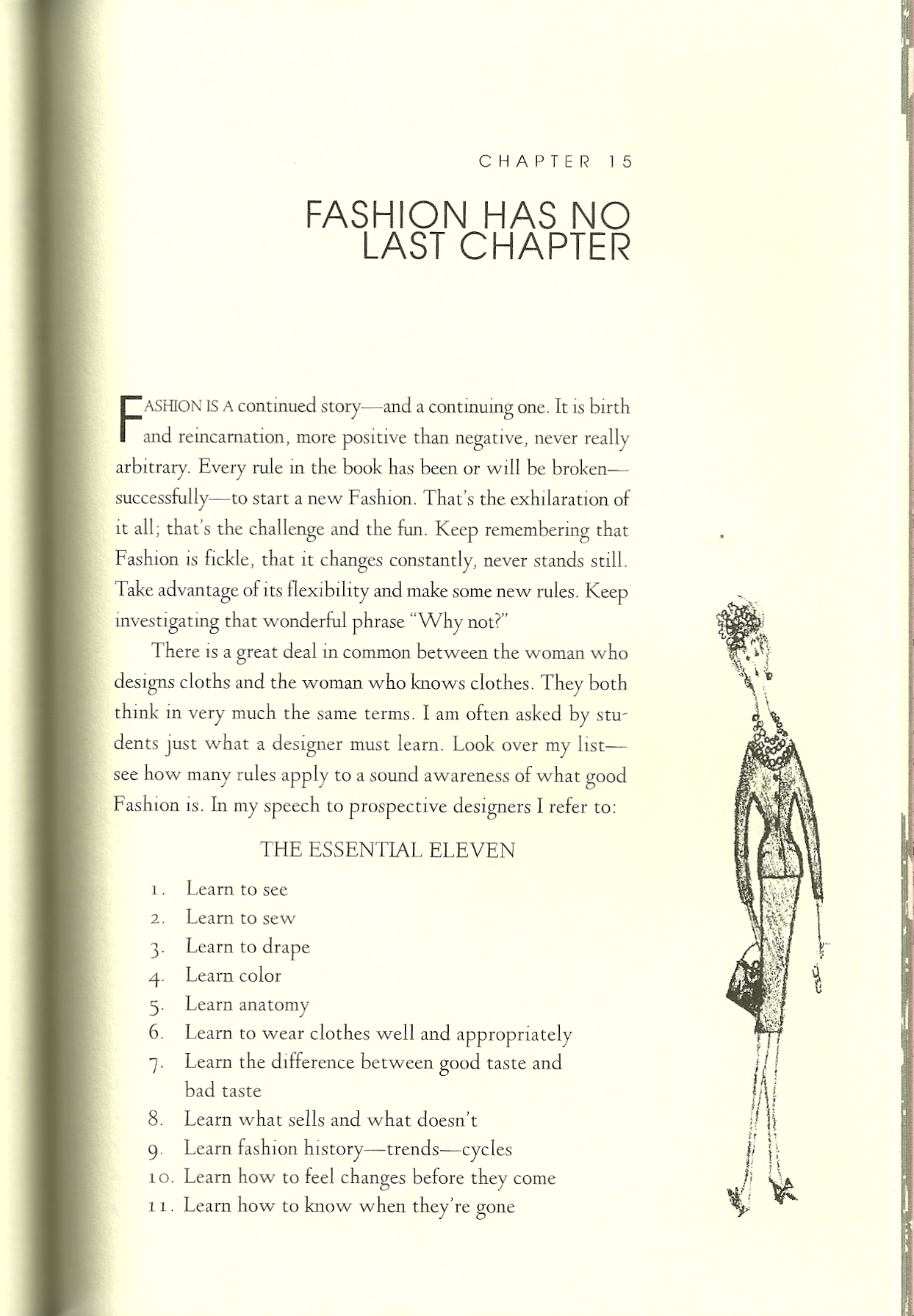
The final chapter of the book is appropriately entitled:  Fashion has no last chapter.

You can read here for yourself her Essential Eleven.  Pay particular attention to #2!

As a preface to this list, McCardell states:  "There is a great deal in common between the woman who designs clothes and the woman who knows clothes."

As a preface to this list, McCardell states: “There is a great deal in common between the woman who designs clothes and the woman who knows clothes.”  (Click on the photo for a close-up).

Earlier in the book on page 103, she relates her first experience with dressmaking: “Miss Annie … came to the house to make clothes for mother and me.  The process fascinated me from the start – selecting the pictures of dresses in the Vogue Pattern Book, the fabrics to be bought at the dry-goods store, the cutting and basting and fitting, the pockets and buttons and buttonholes…”

Surely sewing and dressmaking have no last chapter either:  What will you wear?  What will you sew?

12 Comments

Filed under Buttons - choosing the right ones, Coats, Scarves, Uncategorized

Coats of a Certain Length

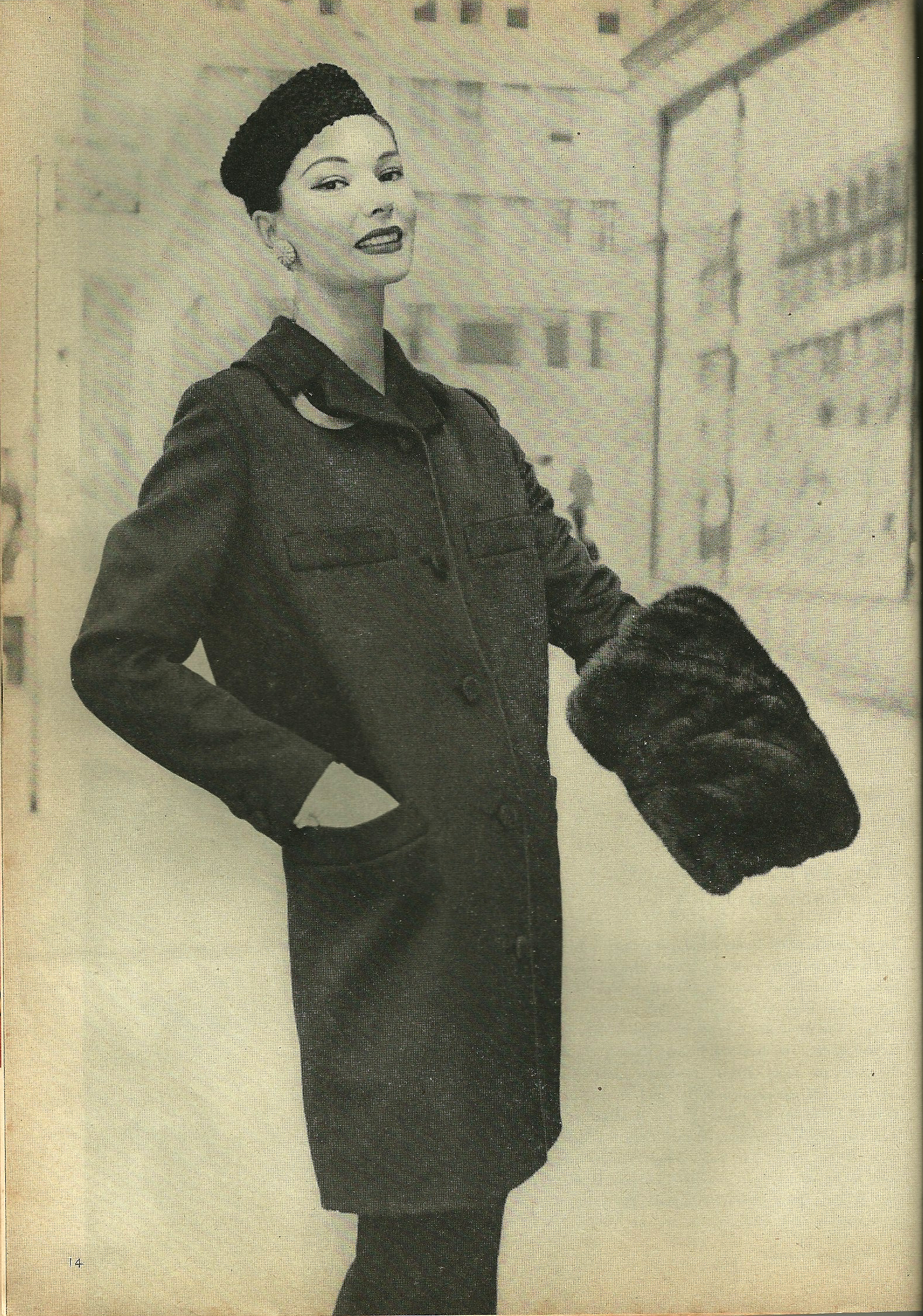
“. . .  above everything they must be practical.  Practical in color and practical in style.”  This was Christian Dior’s dictum for coats which he wrote in 1954 in The Little Dictionary of Fashion (first published by Cassell & Co., Ltd., republished by Abrahms, 2007, copyright Catherine Dior and Jean-Pierre Teto).    Beginning around this same time, Vogue Patterns began to feature more coats in shorter lengths, with slimmer profiles.  The “tunic coat” and matching skirt debuted in the October/November 1955 issue of Vogue Pattern Book Magazine, with this description:  “The tunic . . . the newest and most sophisticated of the coats. Its straight lines are highlighted by an even narrower skirt.”

This was the only three-quarter length coat in this feature entitled "The most-wanted new coats."

This was the only three-quarter length coat in this feature entitled “The most-wanted new coats.”

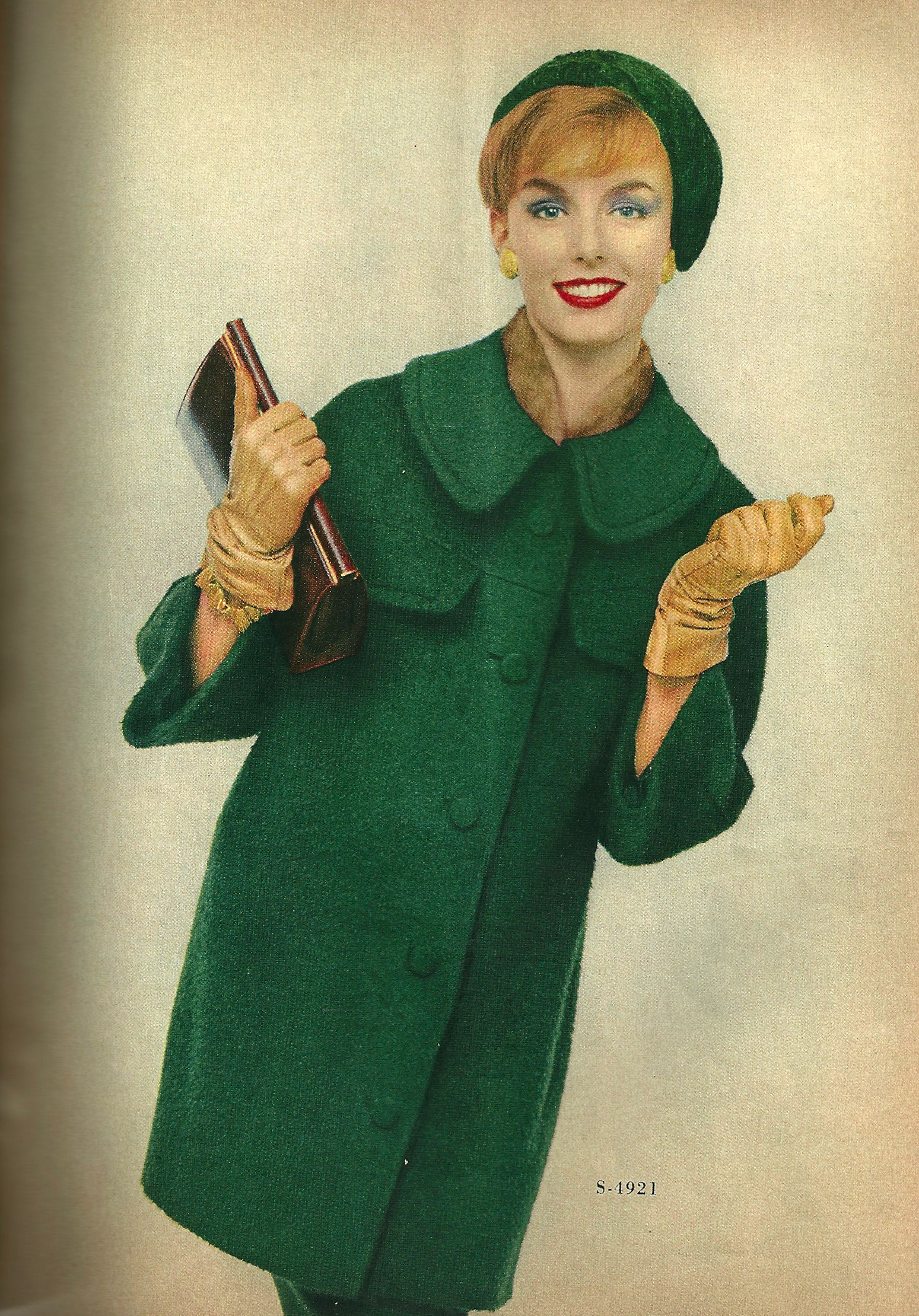
In 1958, a tapered coat-suit was featured in the October/November VPB Magazine, touting its “three-quarter” coat:

Shown in "boxwood green mohair," this coat would be quite stylish in 2013.

Shown in “boxwood green mohair,” this coat would be quite stylish in 2013.

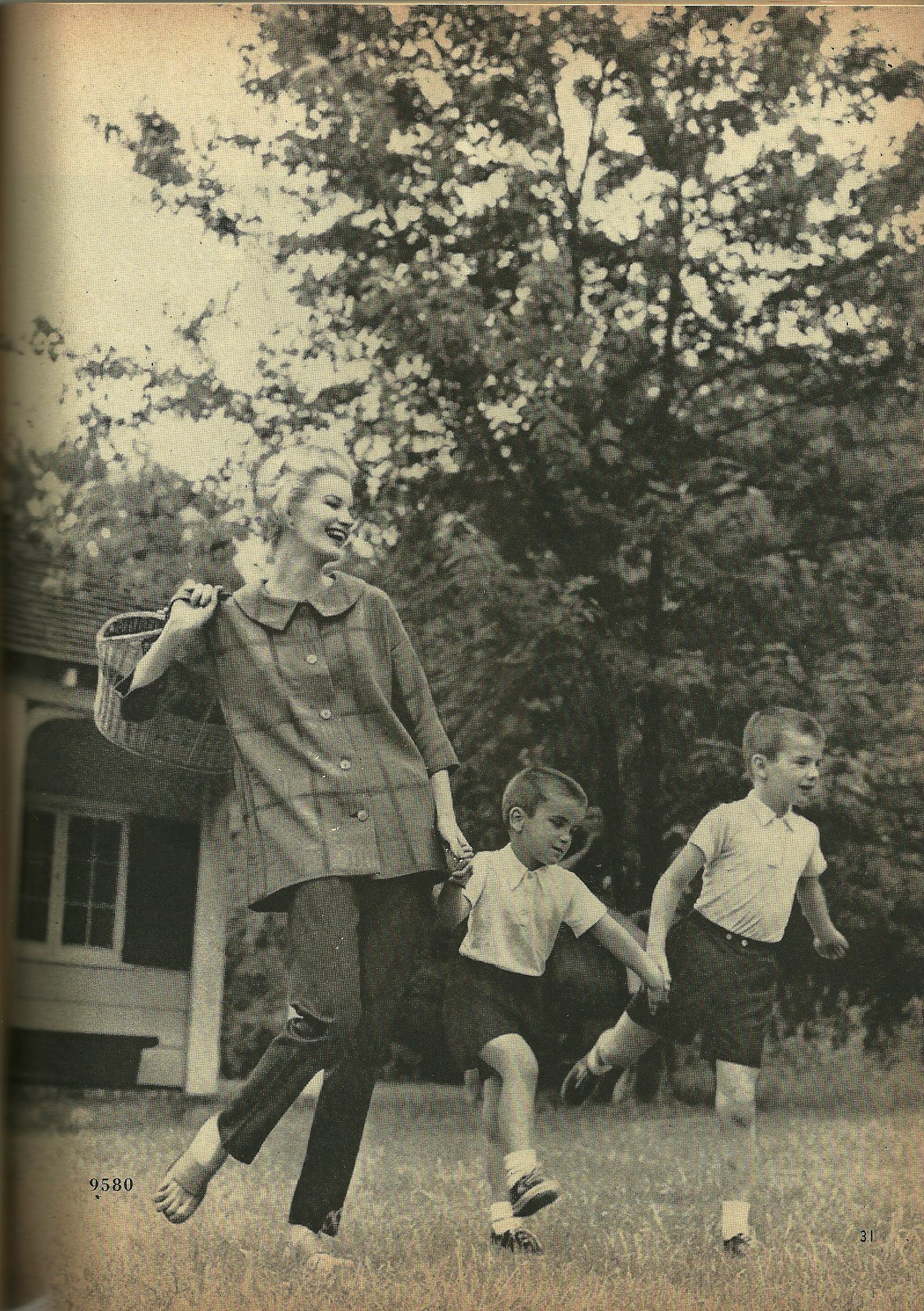
And in the same issue the smock-jacket certainly caught the eye of many a busy mom, with its alluring description:   “”Enjoying suburbia’s natural tranquallizers – grass, trees, sky . . .  Triangular smock-jacket in bright blue-orange-green-red plaid.  Grey flannel slacks – who could live without them?”

This "smock" coat has a pleat in the back for ease of movement for the busy mom.

This “smock” coat has a pleat in the back for ease of movement for the busy mom.

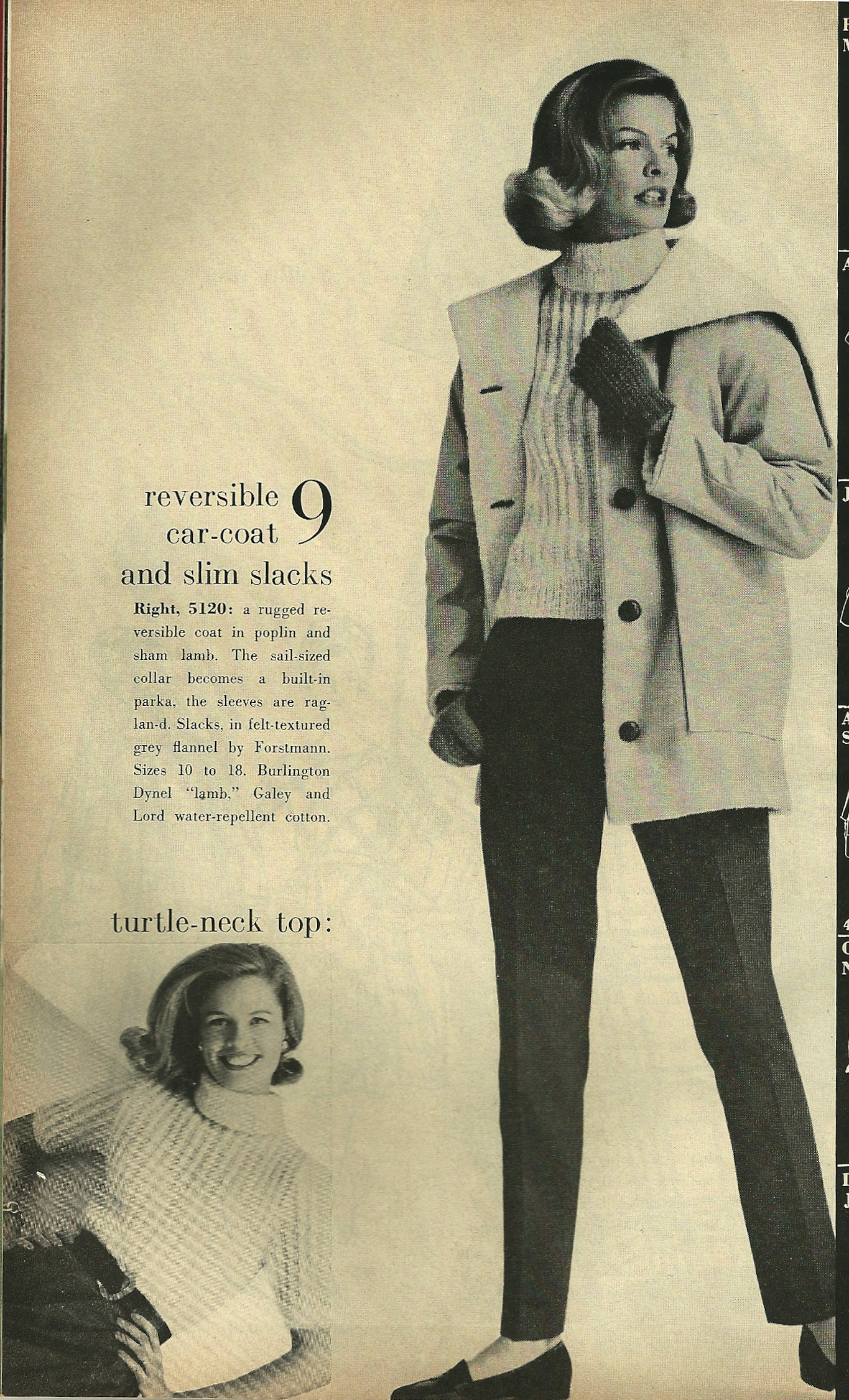
Indeed, who could live without such a comfortable, easy-to-wear, fingertip coat?  As this style morphed into the “Car Coat”, it quickly became ubiquitous, and for good reason.  Here was (and is) a coat, which is a barometer of culture (a term I have borrowed from the little book, 101 Things I Learned in Fashion School, p.32).  An excellent definition is given in The Fairchild Dictionary of Fashion, 3rd Edition, 2010, page 89:  “Sport or utility coat made hip- to three-quarter length, which is comfortable for driving a car.  First became popular with the station-wagon set in suburbia in 1950s and 1960s [my emphasis] and has become a classic style since then.  Some of the styles in which car coats have been made include BENCHWARMER, DUFFEL COAT, RANCH COAT, MACKINAW JACKET, STADIUM COAT, TOGGLE COAT.”

Coats of certain length -4

This pattern was for a reversible coat, shown here in poplin and sham lamb. The collar can be turned into a hood.  Click on the image to see the details.

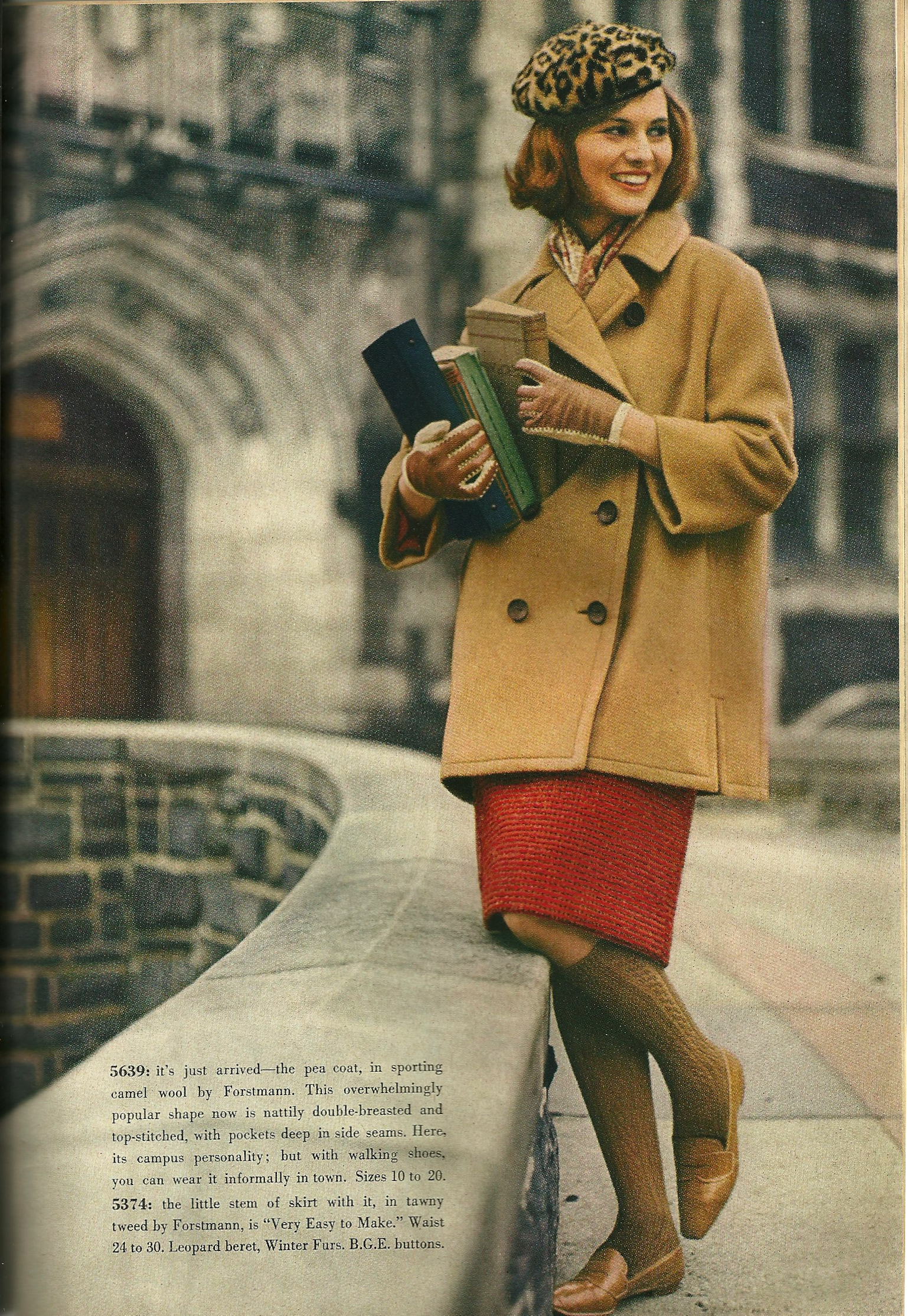
By August/September of 1962, VPB Magazine featured a pattern for a Pea Coat, which although not officially a car coat, displayed the same practical length and wearability:

According to Fairchild's Dictionary, Yves Saint Laurent used the classic U.S. Navy peacoat as inspiration for his variation of it in the 1960s.

According to Fairchild’s Dictionary, Yves Saint Laurent used the classic U.S. Navy peacoat as inspiration for his variation of it in the 1960s.

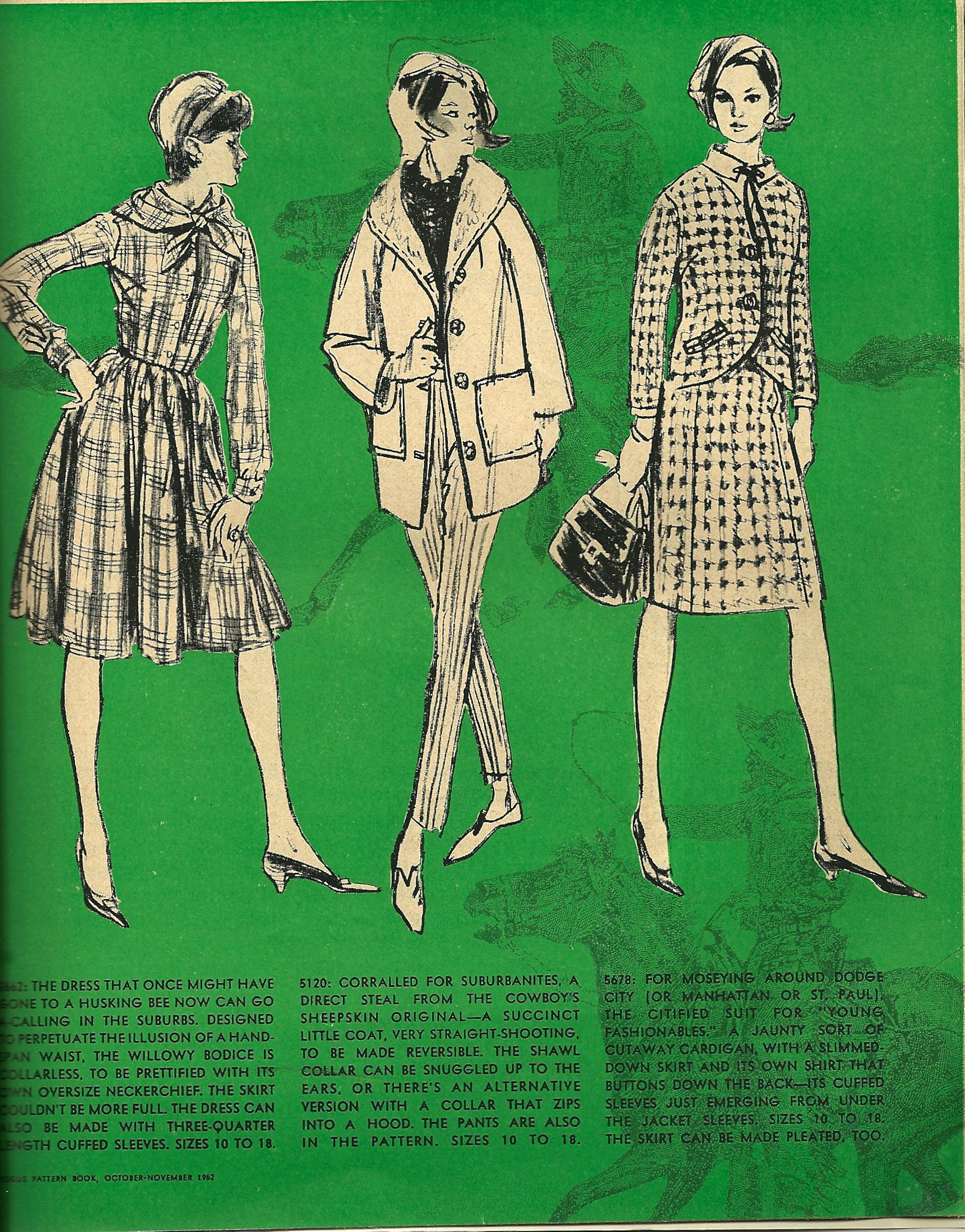
And in the next issue of the 1962 VPB Magazine, in a feature called “The Rangy Western Look for Urban and Suburban Dudes,” front and center was this coat “corralled for suburbanites”:

VPB called this coat a "direct steal from the cowboys's sheepskin original."

VPB called this coat a “direct steal from the cowboys’s sheepskin original.”  (Another wonderful example of a “sheepskin” coat – this one by an English designer – can be seen here, with thanks to my reader, Carol, who led me to the sketch of this fingertip coat.)

Far be it for me to resist such a coat!  Last year I succumbed to this pattern on Etsy, which although not dated, is most certainly from the early ‘60s:

I just may need this pattern someday!

This is a good pattern to have in my collection – I just may need it someday!

Back in the 1970s, I purchased this Christian Dior Designer pattern, with intentions of making the “below the knee” version, although a nice variation of a stadium coat is also featured.  I still love this coat, in both lengths – and someday I hope to finally make good on my intentions!

The buckles around the sleeves add a great look to this coat.

The buckles around the sleeves add a great look to this coat.

However, this coat must be my all-time favorite hip-length style:

I will definitely be doing the color blocking version when I make this coat.

I will definitely be doing the color blocking version when I make this coat.

Purchased last August,  this pattern sometimes keeps me awake at night. With Dior’s words imploring me to be practical, I wonder – – – should I make it in navy and white (as pictured), in black and white, in red and black, in gray and camel, in orange and gray, in ??? and ???

Still to be decided . . .  but you haven’t seen the last of this pattern.

12 Comments

Filed under car coats, Coats, Uncategorized, vintage Vogue Designer patterns, vintage Vogue patterns from the 1950s, vintage Vogue patterns from the 1960s, vintage Vogue patterns from the 1970s, Vogue patterns

Chance of Sprinkles

Whatever possessed me to decide to make a coat during this hot, hot Summer?

Actually, I have a (somewhat logical) answer to that question!  For starters, it’s a raincoat.   And how I came to sew a raincoat is a good example of what keeps the wheels in my head turning!

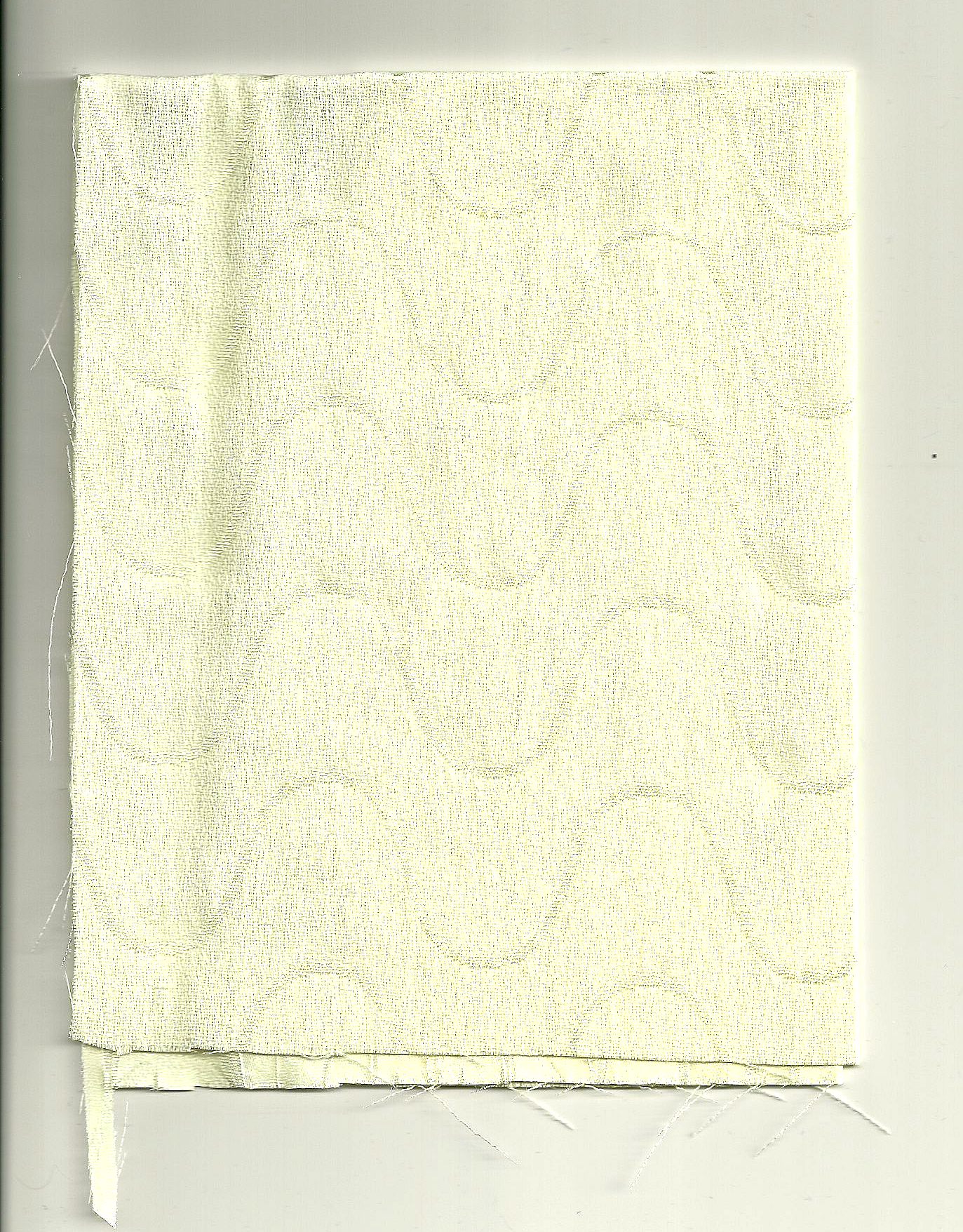
While perusing the website for Britex Fabrics last Summer, I came across its offerings of rainwear fabrics.  Just out of curiosity, I took a look at them, and I was immediately smitten with the “French Winter White Water-Resistant Rainwear Fabric”.

The woven “wave” design in this fabric really caught my attention.

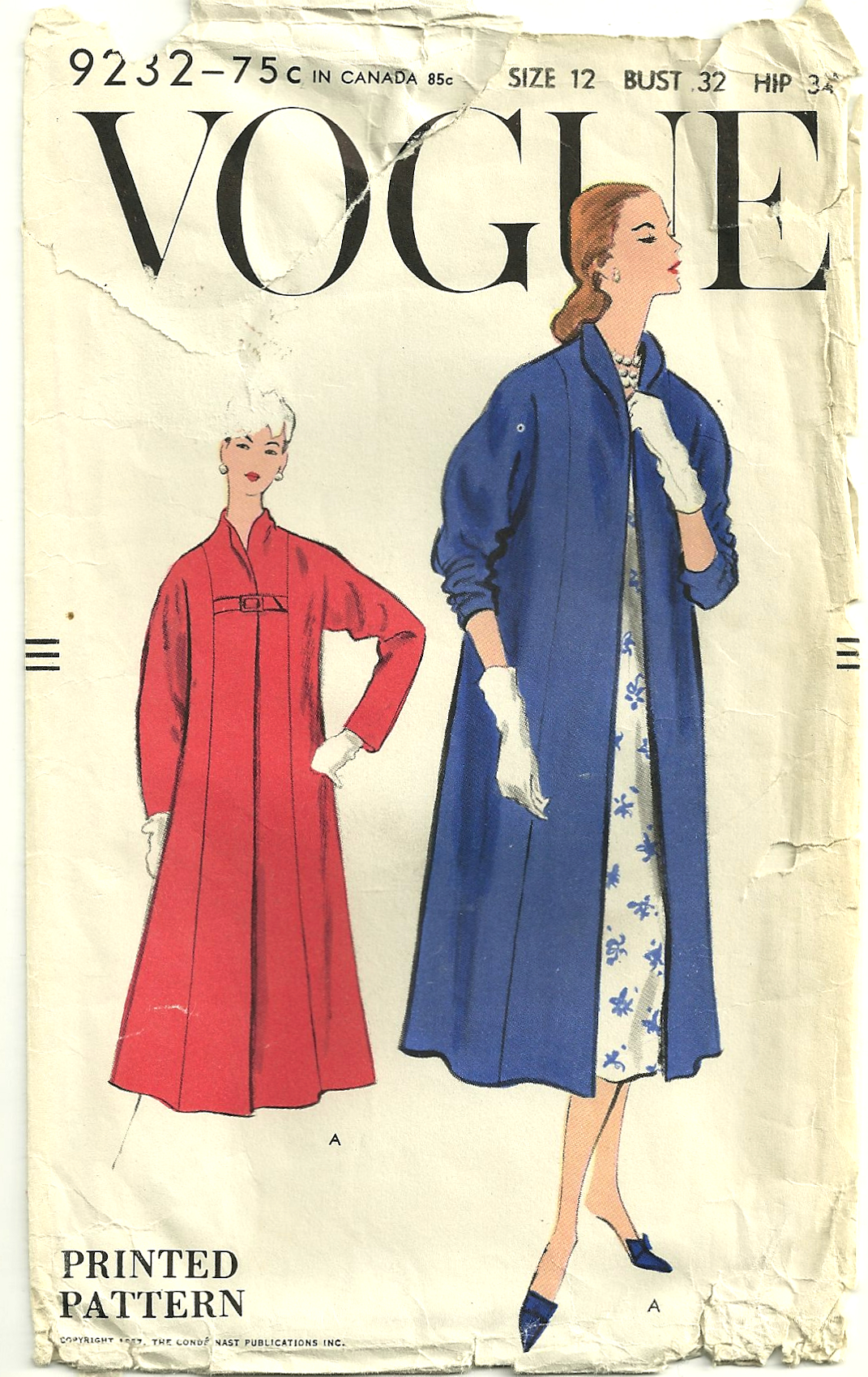
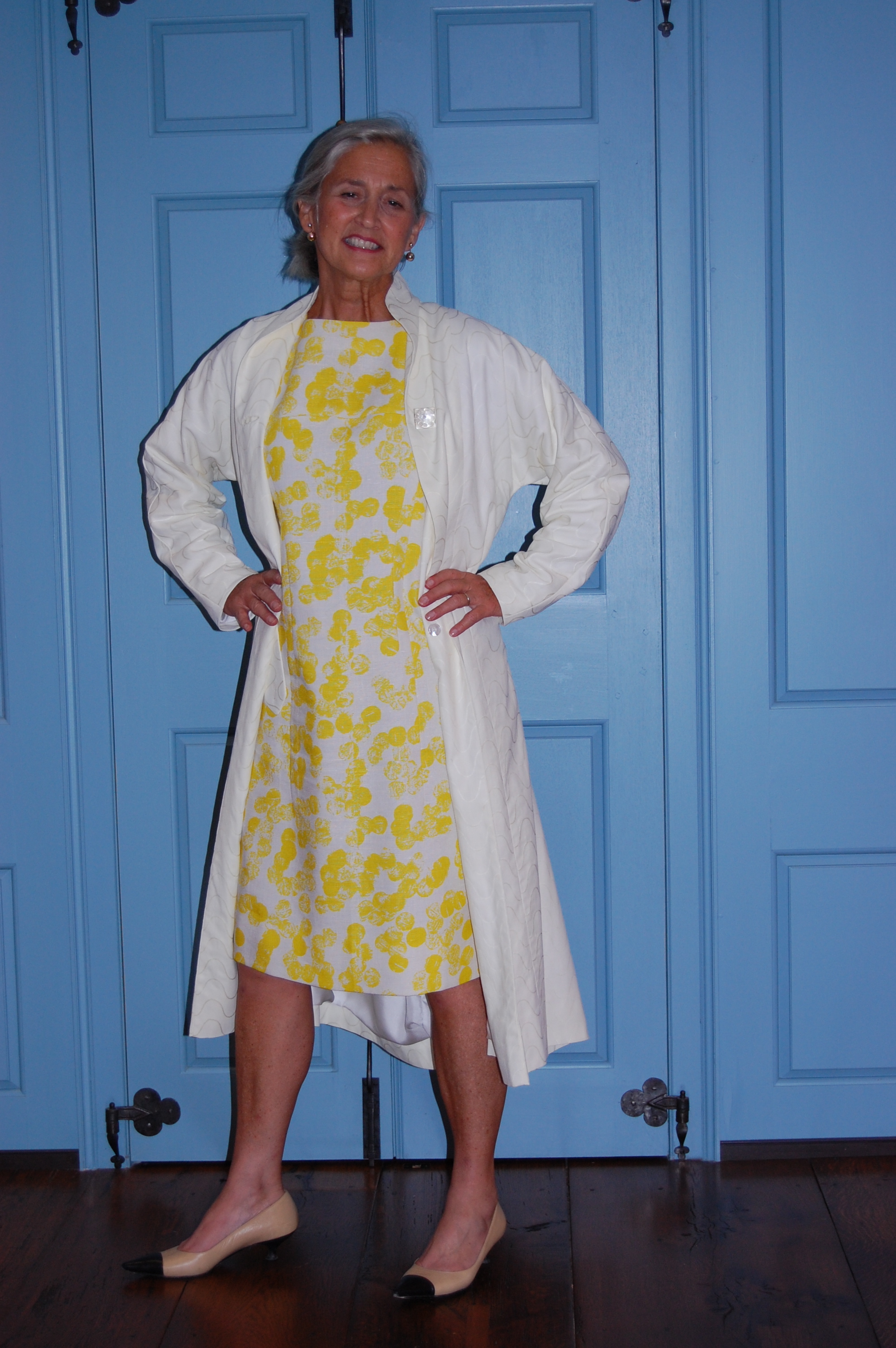
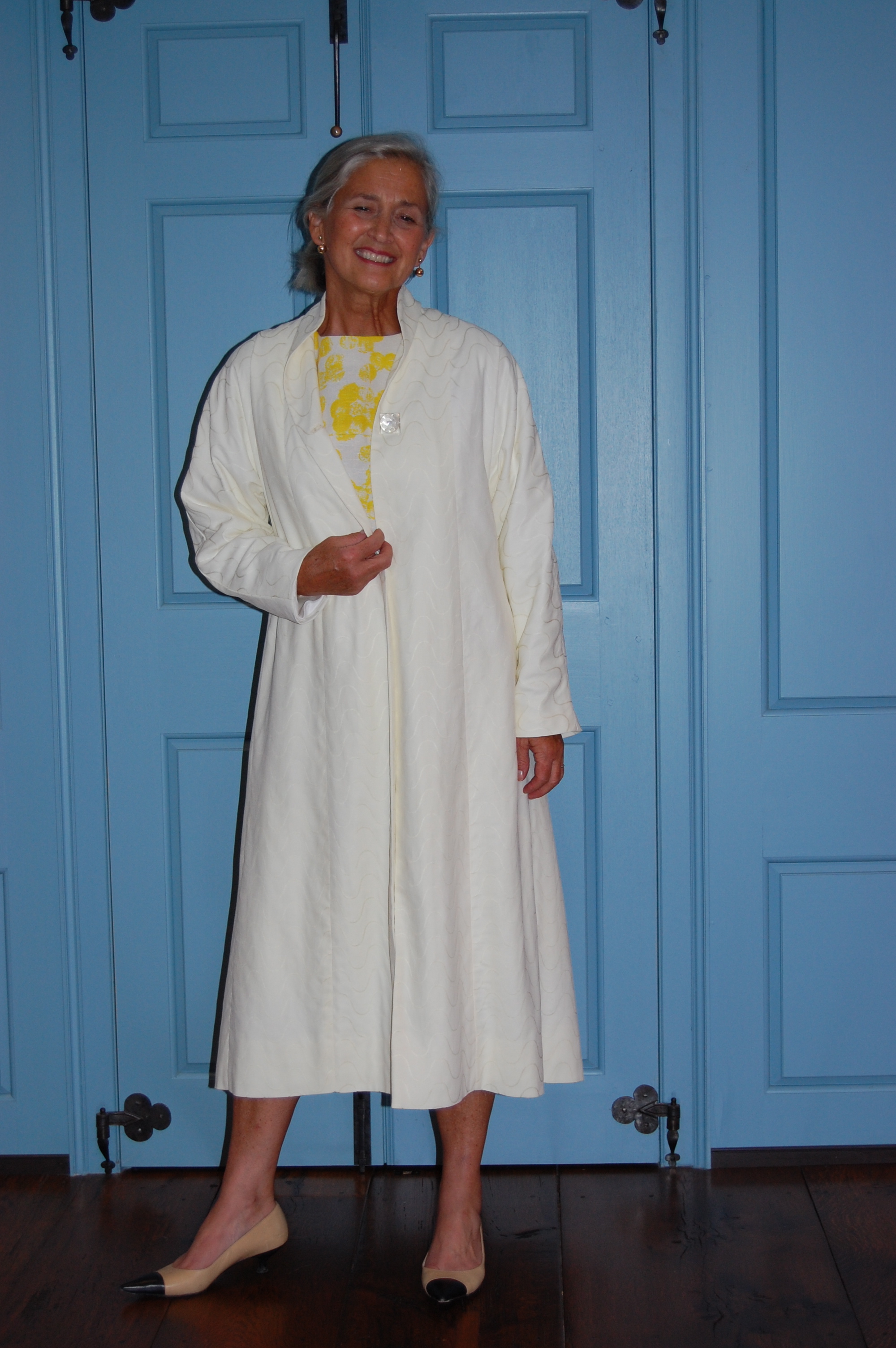
I sent off for a swatch, which confirmed for me the graceful woven design and lovely creamy color inherent in this fabric.  A subsequent trip to California gave me the opportunity to see the fabric in person, and I decided it was time to “commit”!  I had frequently felt the need for a “dressy” raincoat, so I thought, “Why not make one?”  I also knew I had the perfect pattern  – this “swing” coat design from 1957.

I remember swing coats from my childhood – and now I have one!

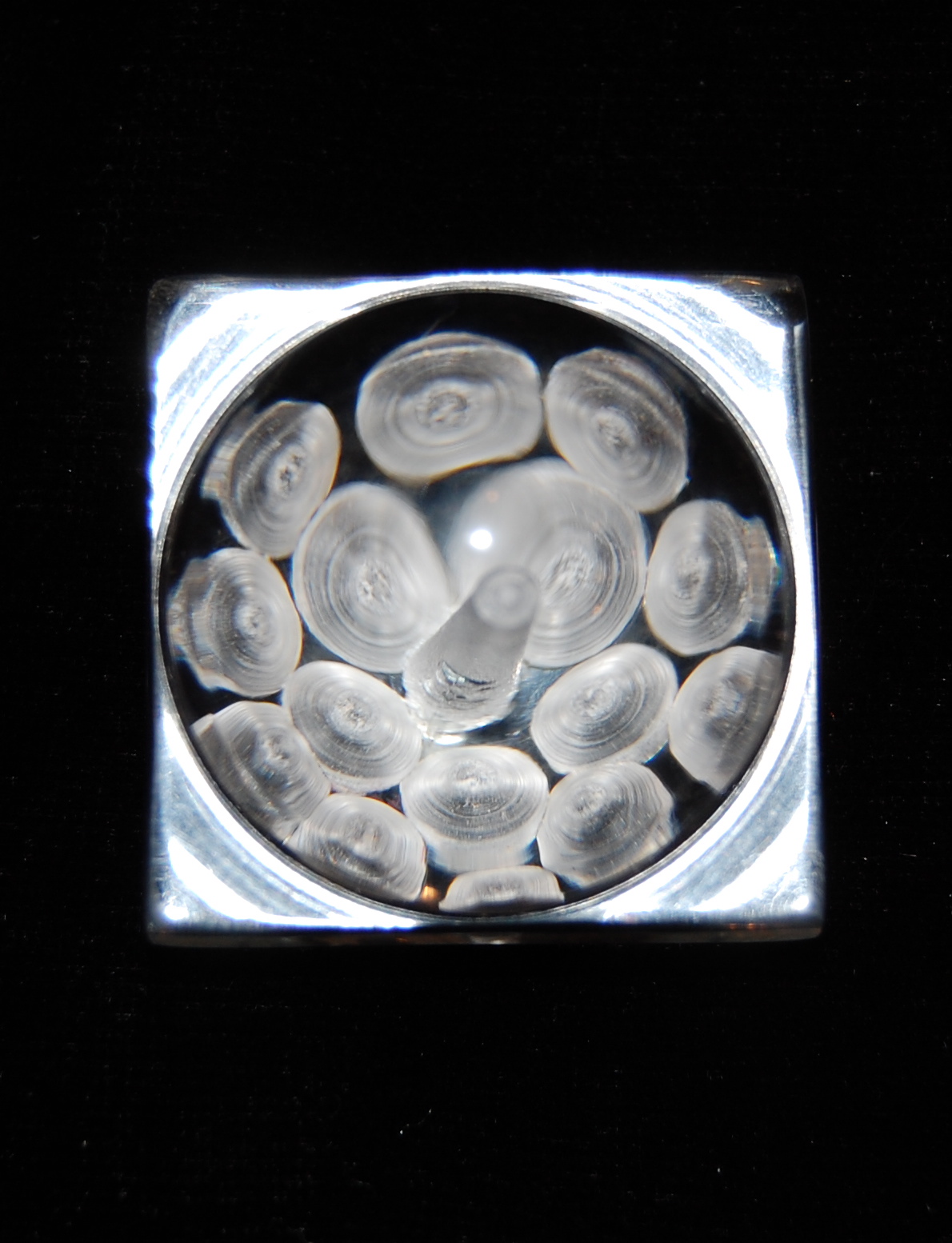
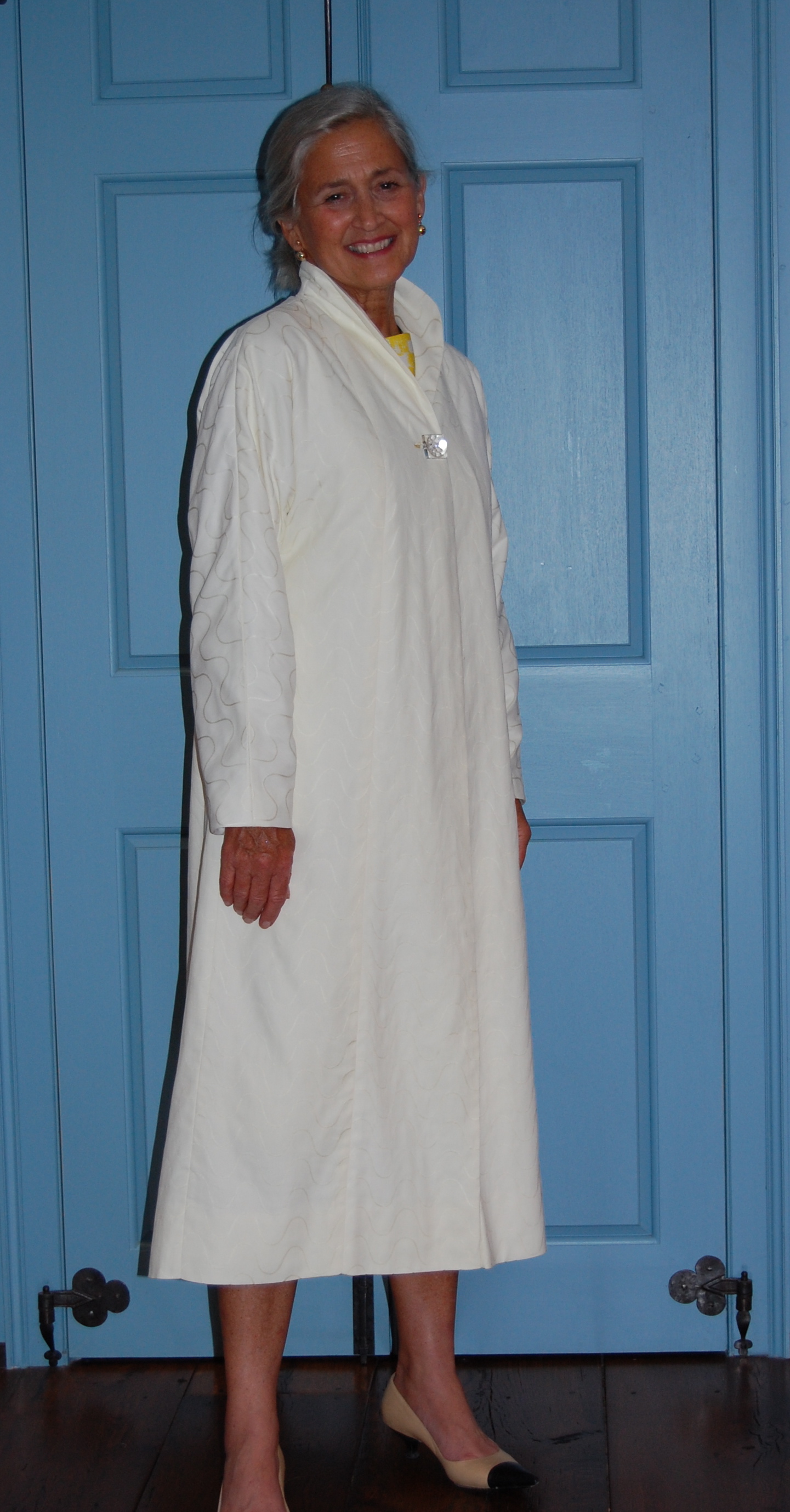
I figured the kimono sleeves and the loose fit would be great for wearing over  dresses or suits, and the collar can be worn turned up or folded down, depending on the inclement conditions!  Well, it only took a year to get to it, which I decided was long enough.  Oh yes –  I had one more incentive to “get to it”. When my friend, Nancy C. opened up her family’s button box for me to pick out some treasures, I spied this beautiful single glass button:

I placed this button on a piece of black velvet so that the design would show up. It is a little more than an inch square in size.

The design in it reminded me of raindrops – perfect for a dressy raincoat, and, I thought, a perfect complement to the fabric, already in my possession.

Of course, every pattern and project seems to demand certain changes or adaptations, and the count for this one stands at four:

1)   I took a little fullness out of the front side panels.  When I made a muslin mock-up of the pattern, it just seemed a little too full for my frame.

2)   I added pockets to the side seams.  I can’t imagine any coat without pockets, but a lot of the vintage styles (dresses and coats) did not have them.

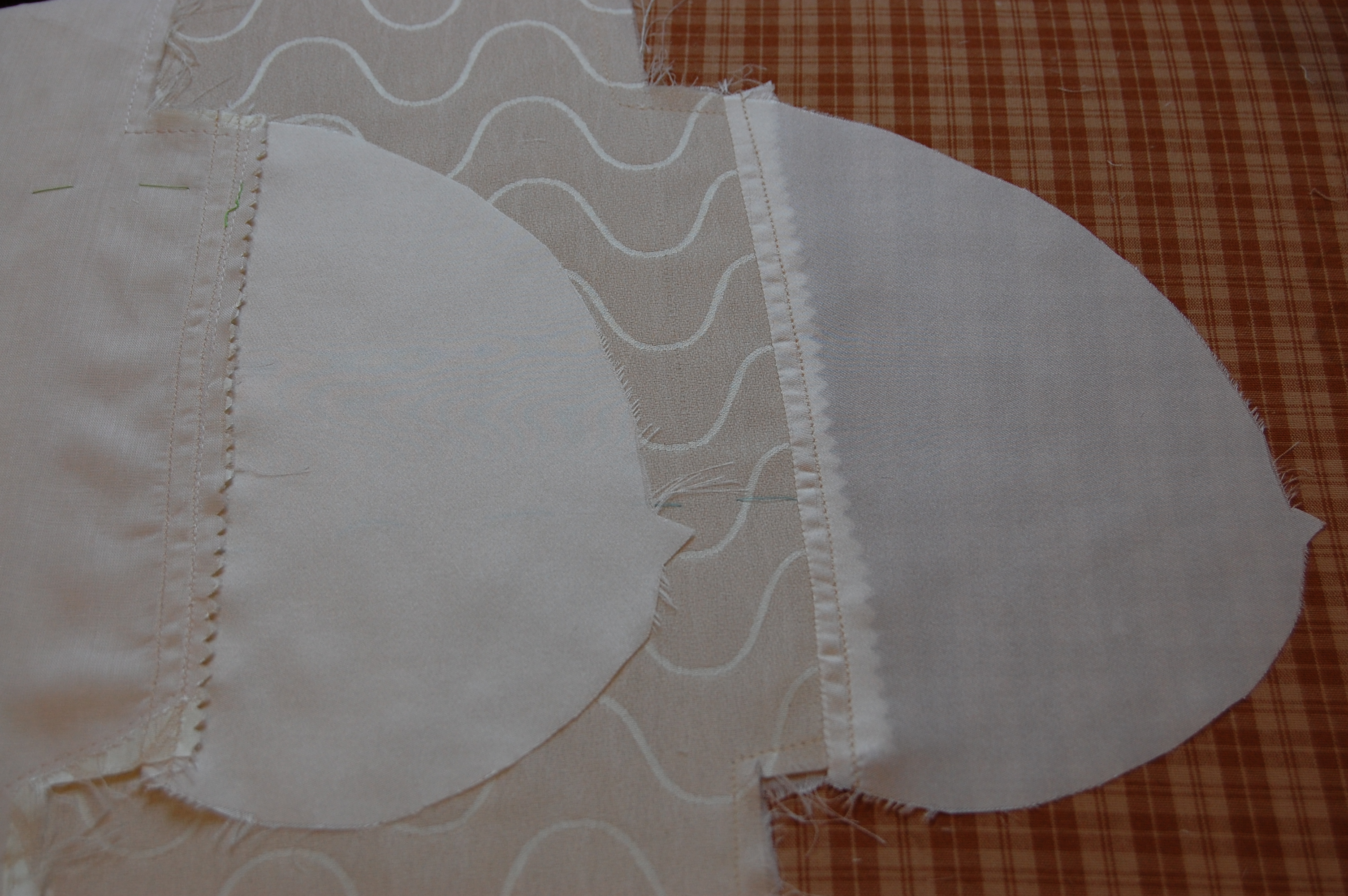
Here is one of the pockets under construction.

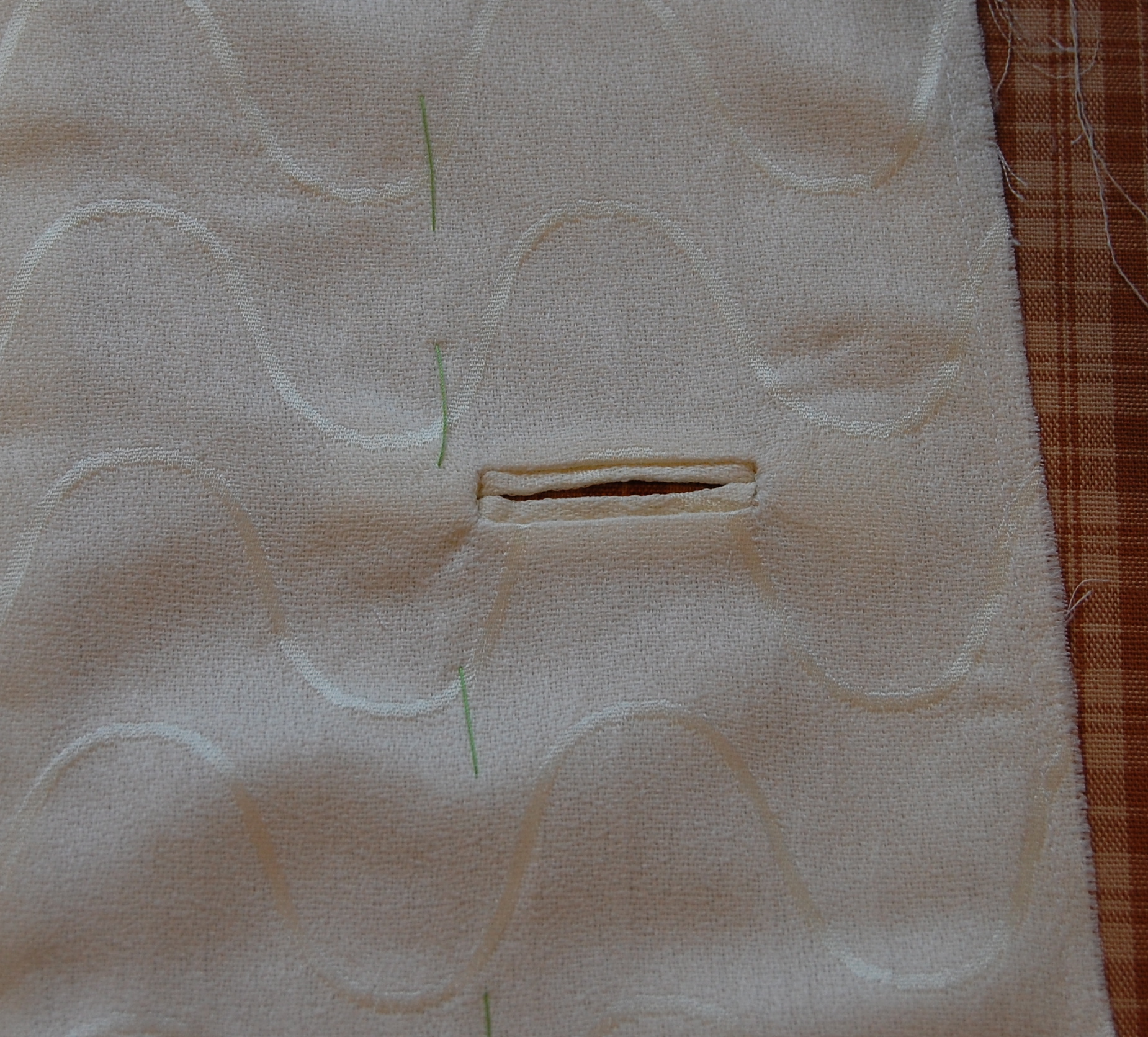
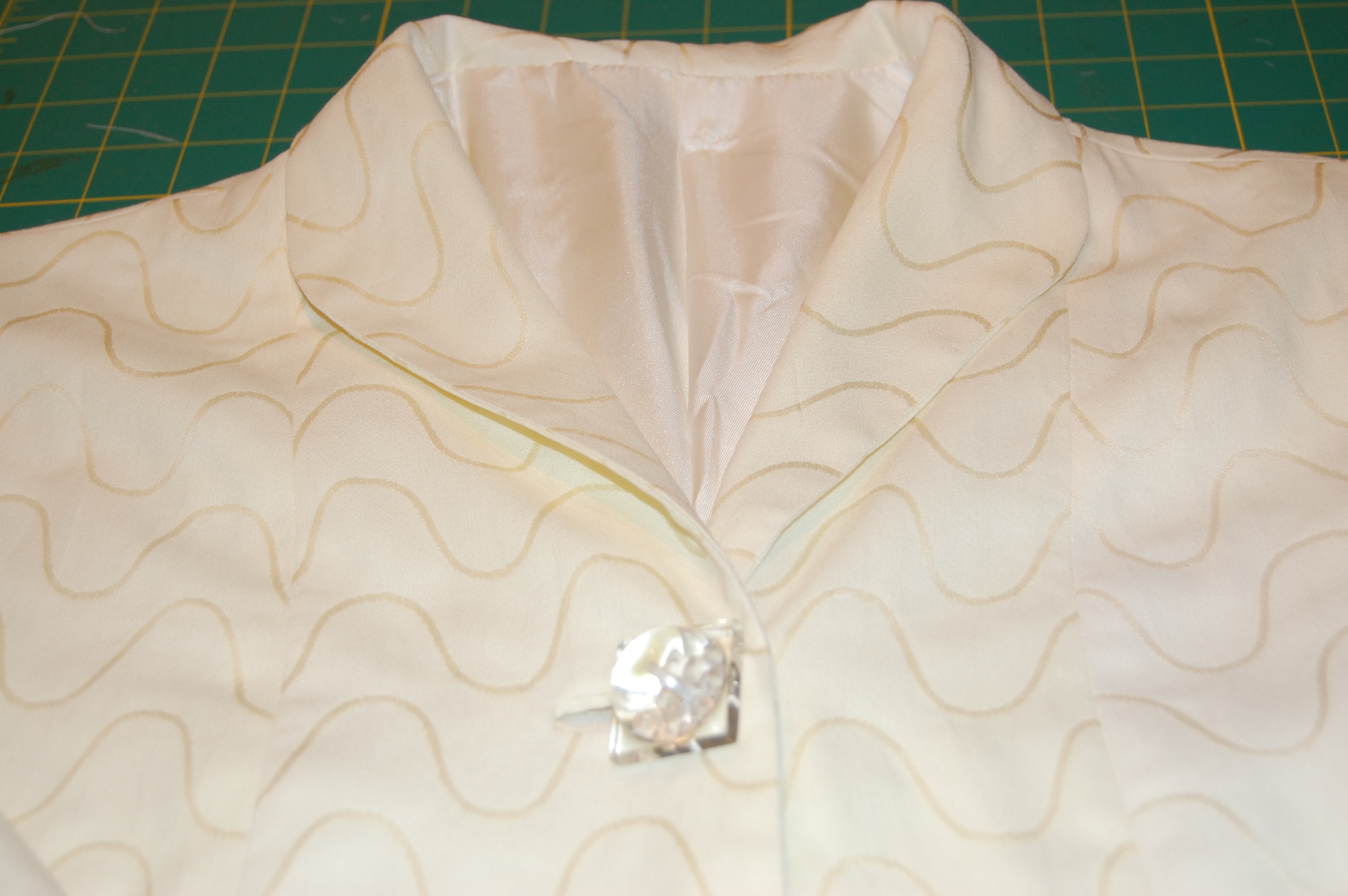
3)   Because I wanted to use the glass button, I decided to put in a bound buttonhole instead of using the buckle and band detail as shown on the pattern. (I did make and attach the back belt, however.)

Here is the bound buttonhole placed in the front right section – before the facing is attached.

Here you can see the button and finished buttonhole. Click on the photo to see it in detail.

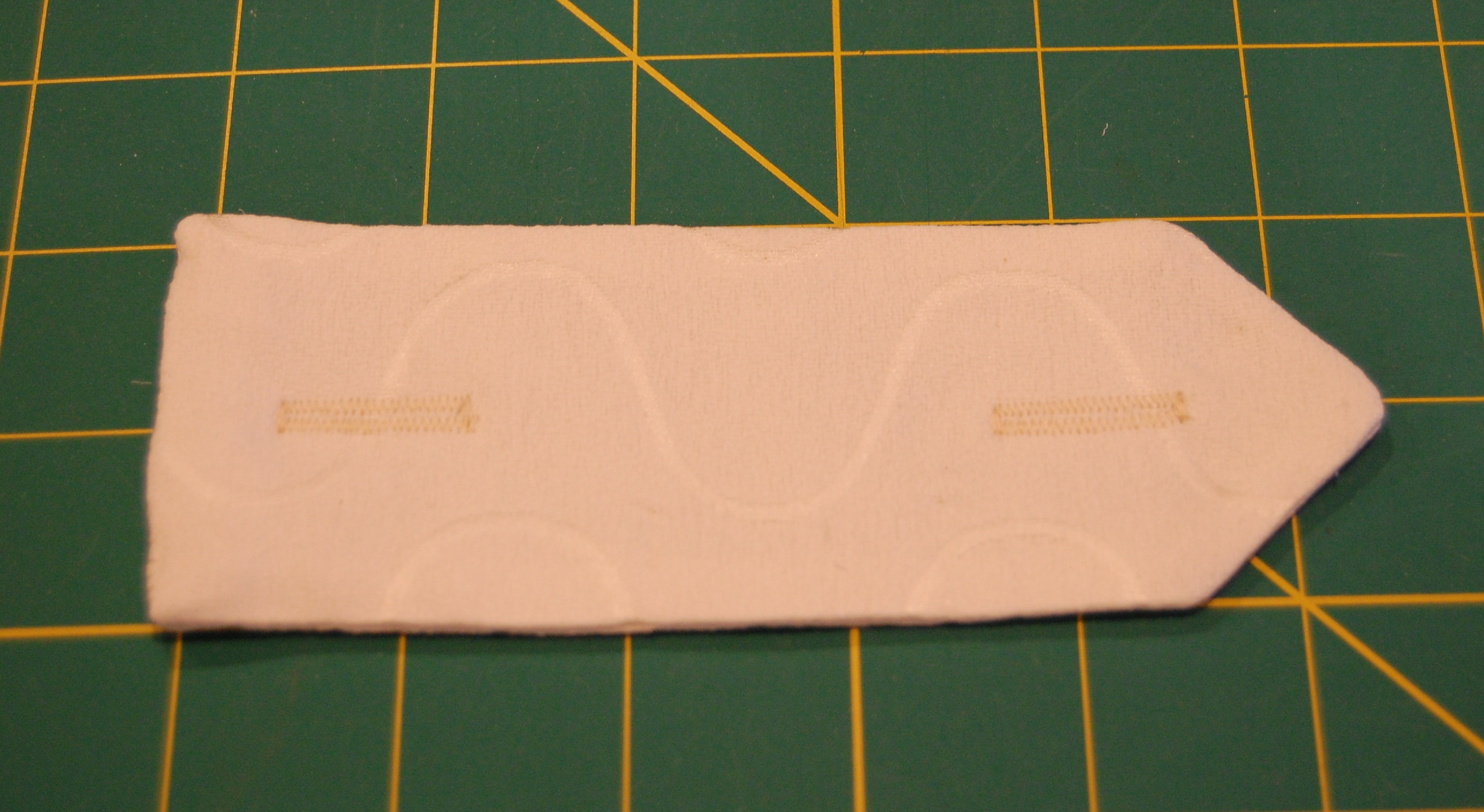
4)   With just a single closure at the top of the coat, I thought I needed something lower on the coat as well, to keep it closed in windy, rainy conditions. However, I didn’t want to interfere with the look of the coat when I might be wearing it open.  Here’s what I came up with:

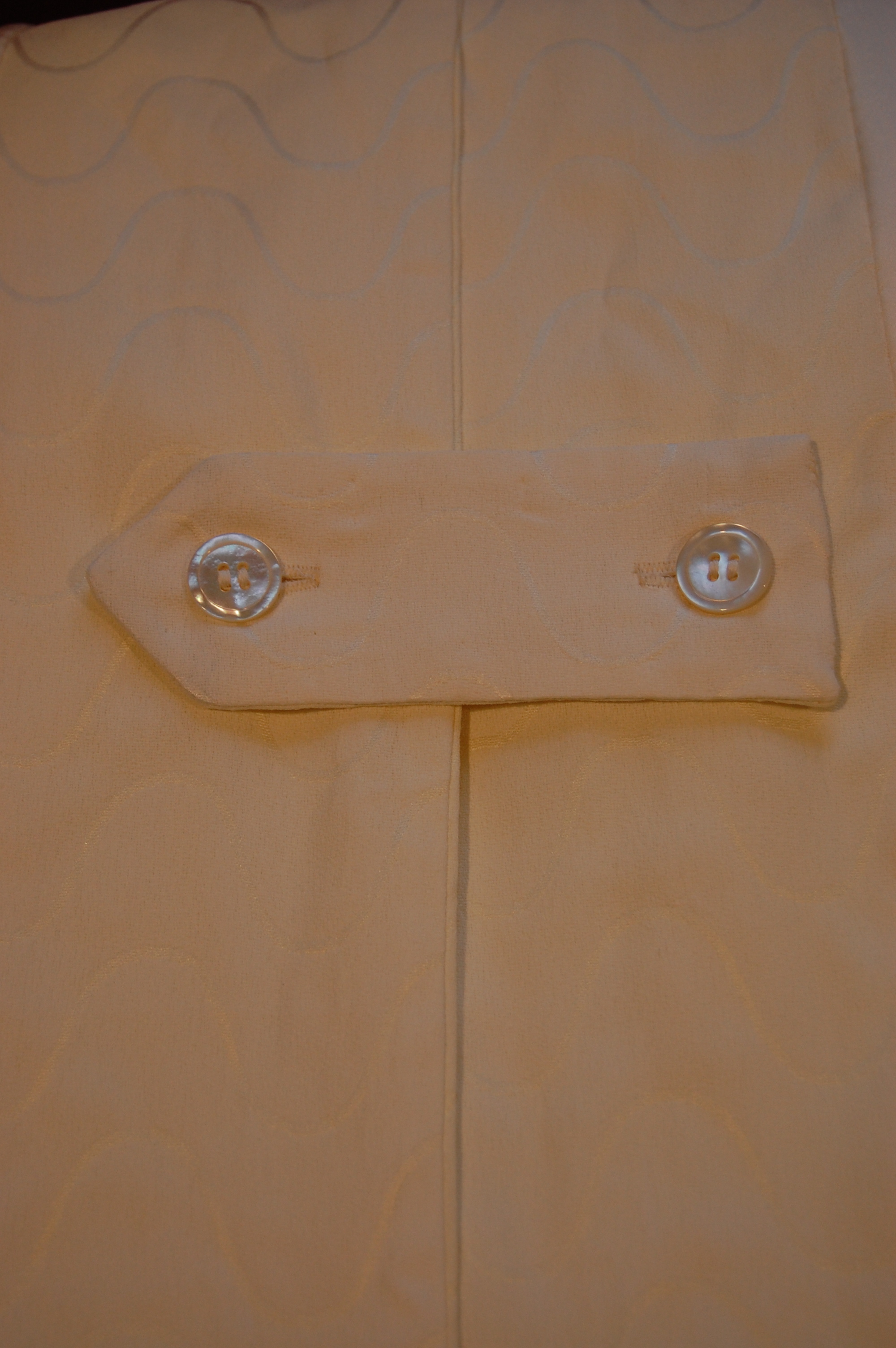
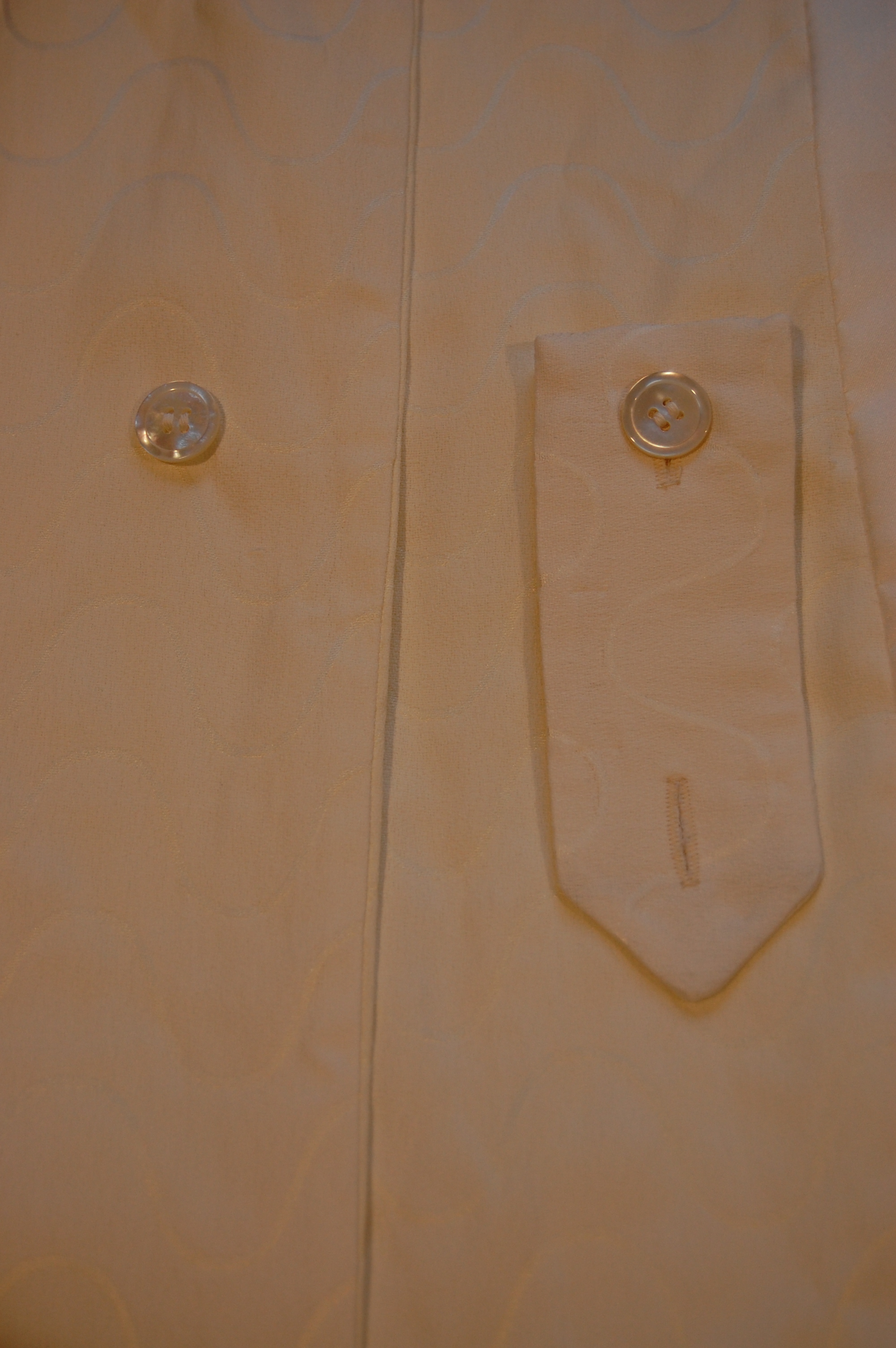
I made a “tab” with buttonholes on each end.

I made machine buttonholes in the tab.

I placed the buttons for it on the inside facings on either side of the coat, about halfway between my waist and  my hips.  It can easily be buttoned to secure the coat, and when I unbutton the left side, the button on the right side allows it to fall down, hidden from view, but easily accessible.

This shows the inside of the coat, with the tab buttoned.

And this shows the tab unbuttoned on one side and hanging down, out of sight – inside the coat.

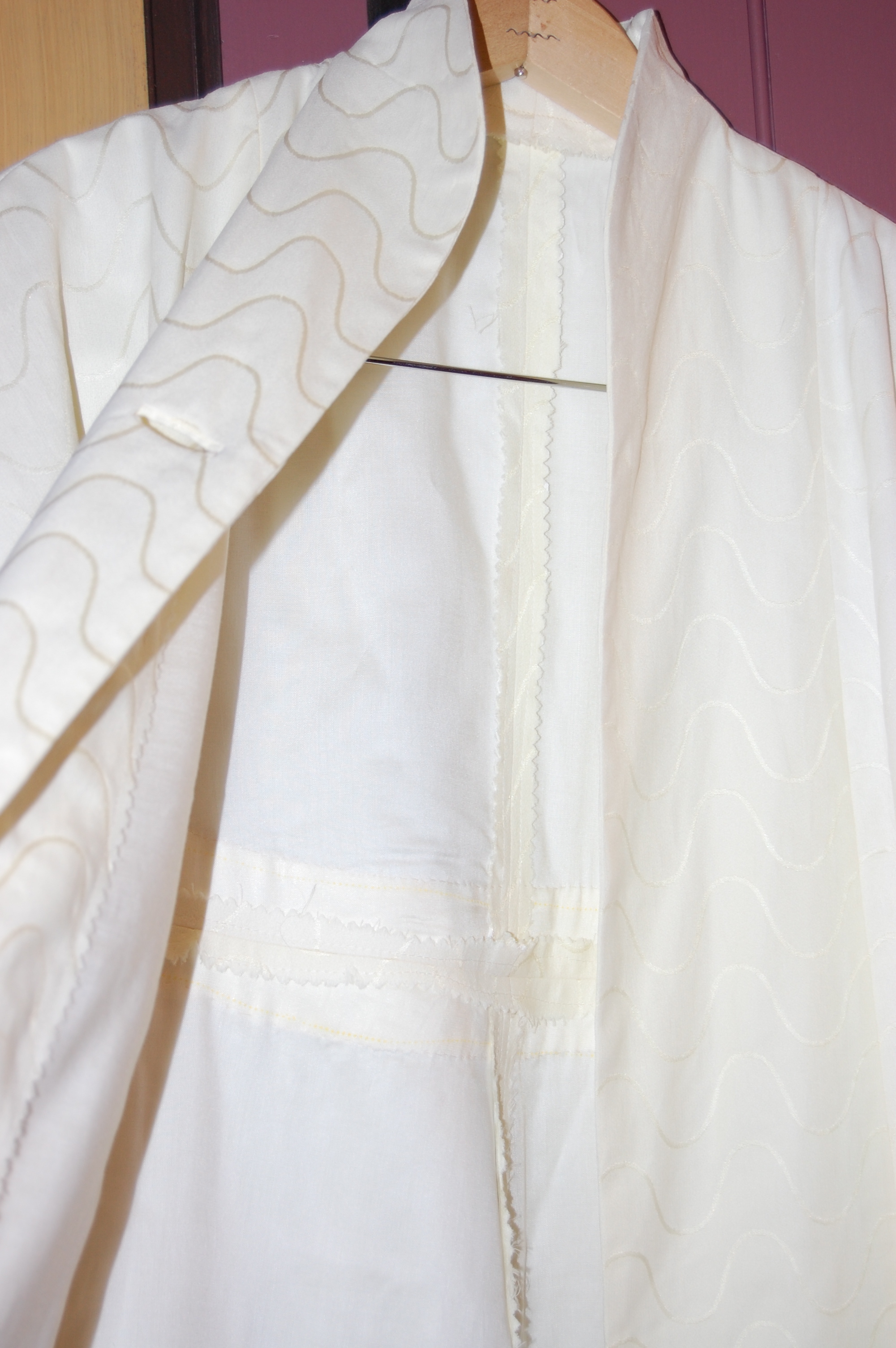
A few more details about construction:  The rainwear fabric is an acetate/rayon blend which I underlined with rayon voile.

Here is the coat, showing the underlining, before I attached the lining by hand.

I lined it with a pure silk lightweight twill in white.  I would have loved to have lined it with a neat polka dot silk, but I didn’t want any “shadows” of a printed lining to show through.  Guess I’ll just have to dress it up with polka dot scarves instead!  The rainwear fabric was very easy to work with – surprisingly easy, actually.  It drapes beautifully for a pattern like this.  Speaking of patterns, this one was so precise and cleverly engineered (especially the collar), turning it into a really fun project!

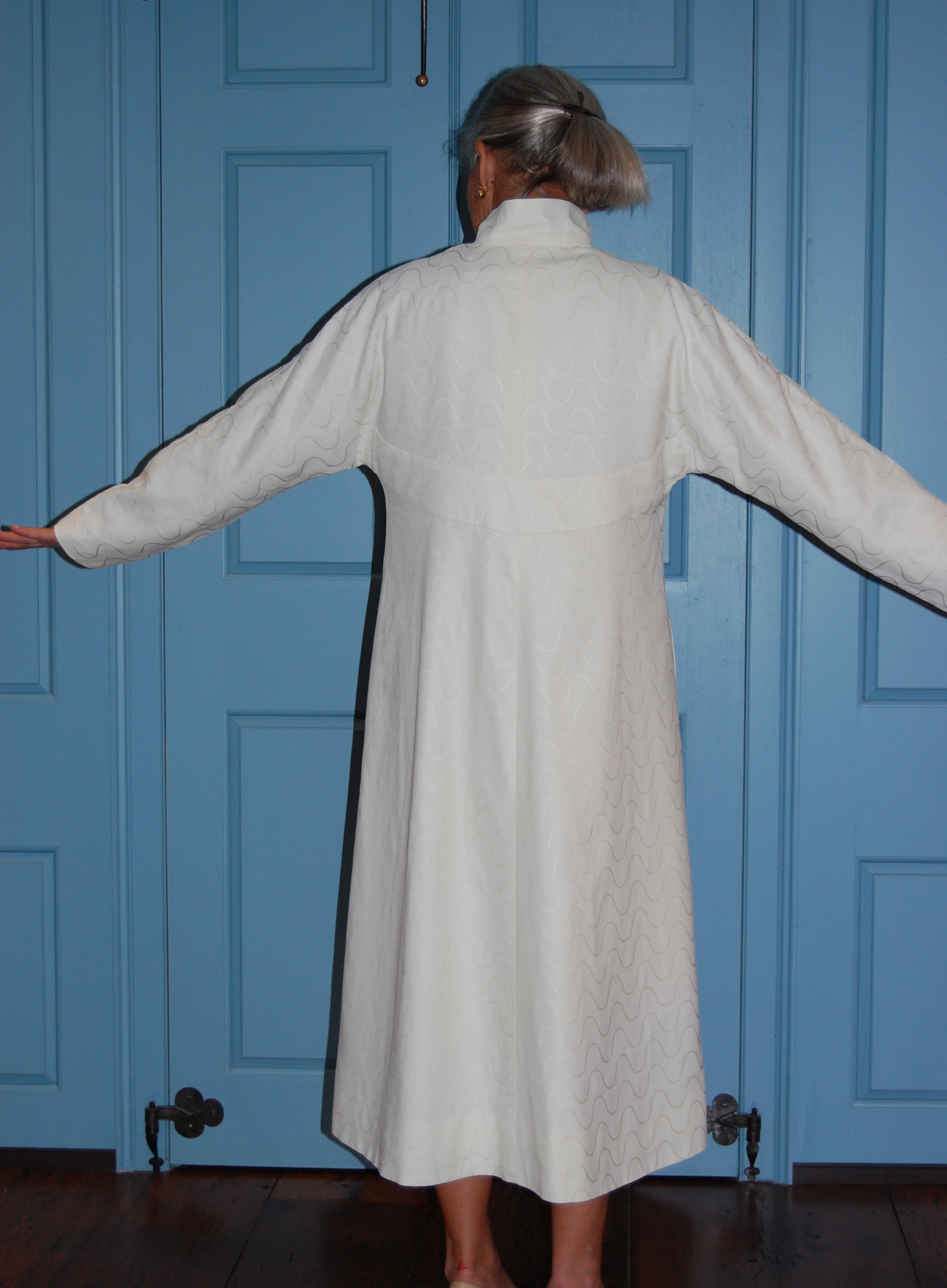
Here are some finished views of my new dressy raincoat:

More of the same…

Hopefully you can see the “belted” back in this view.

Making a garment like this during the Summer months means that I had to be prepared for “delayed gratification” as I probably won’t have a chance to wear my new raincoat for at least a couple of months.  However, when a future Fall or Winter forecast is for “Chance of Sprinkles” – or even full-force rain – I’ll be ready!

13 Comments

Filed under bound buttonholes, Buttons - choosing the right ones, Coats, Dressmaker details, kimono sleeves, sewing raincoats, swing coats, Uncategorized, underlinings, vintage buttons, vintage Vogue patterns from the 1950s, Vogue patterns

Decisions, Decisions.

For several years my mother-in-law had a sign on her refrigerator stating “So many men… So little time”.  As a wife and a mother of three sons, I guess she was either telling the truth – or maybe doing a little daydreaming.  I don’t post things on my fridge, but if I did, it might read, “So many patterns… So many decisions”.  And that, too, would be a combination – of the truth – and quite a bit of daydreaming!

Usually as I am working on an item, I am already thinking about the next one – and I often know what pattern I’ll be using next.  However, I finished my silk tunic not quite decided yet.  I figured I was ready to tackle something a little more complicated, after the easy construction of the tunic (and a few days off doing other things!)  So what was it going to be?  I had it narrowed down to these five patterns/projects:

1) View B of this dress (for summer), made up in a Moygashel linen, with a contrasting belt.  This pattern has persistently been popping in my pattern box ever since I purchased it on Etsy  in early January.

The length of this dress as shown on the envelope is very 195os. I’ll be making it in knee-length.

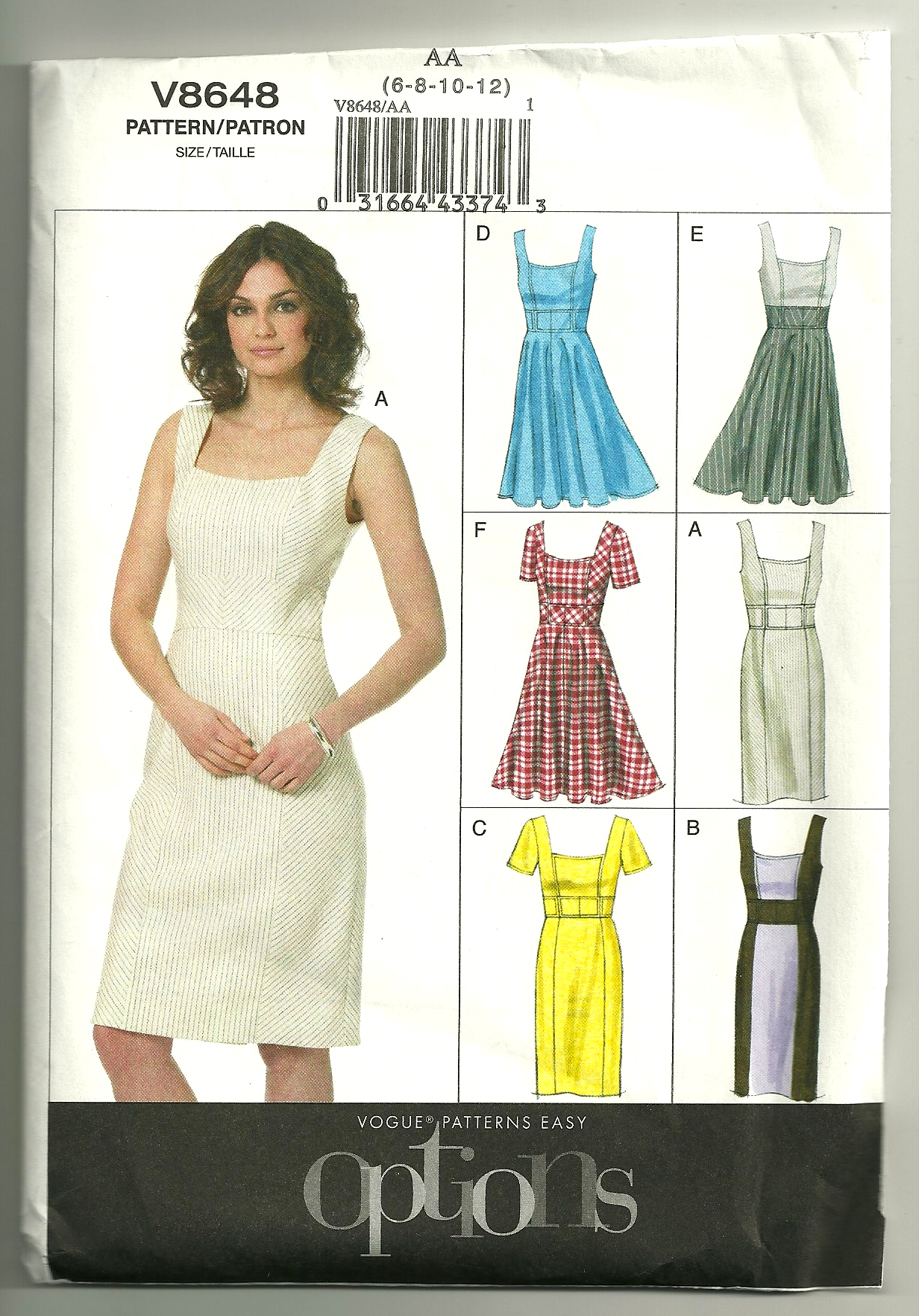
2) No, this pattern is NOT vintage.  I signed up for The Couture Dress class taught by Susan Khalje on Craftsy, and this is the dress pattern which is sent with class enrollment.  Actually, views A and C both have a 1960’s feel to them – classic and chic!

So – what will it be? Sleeveless or short sleeves? It will definitely be the straight-skirt version. And I love the square neckline.

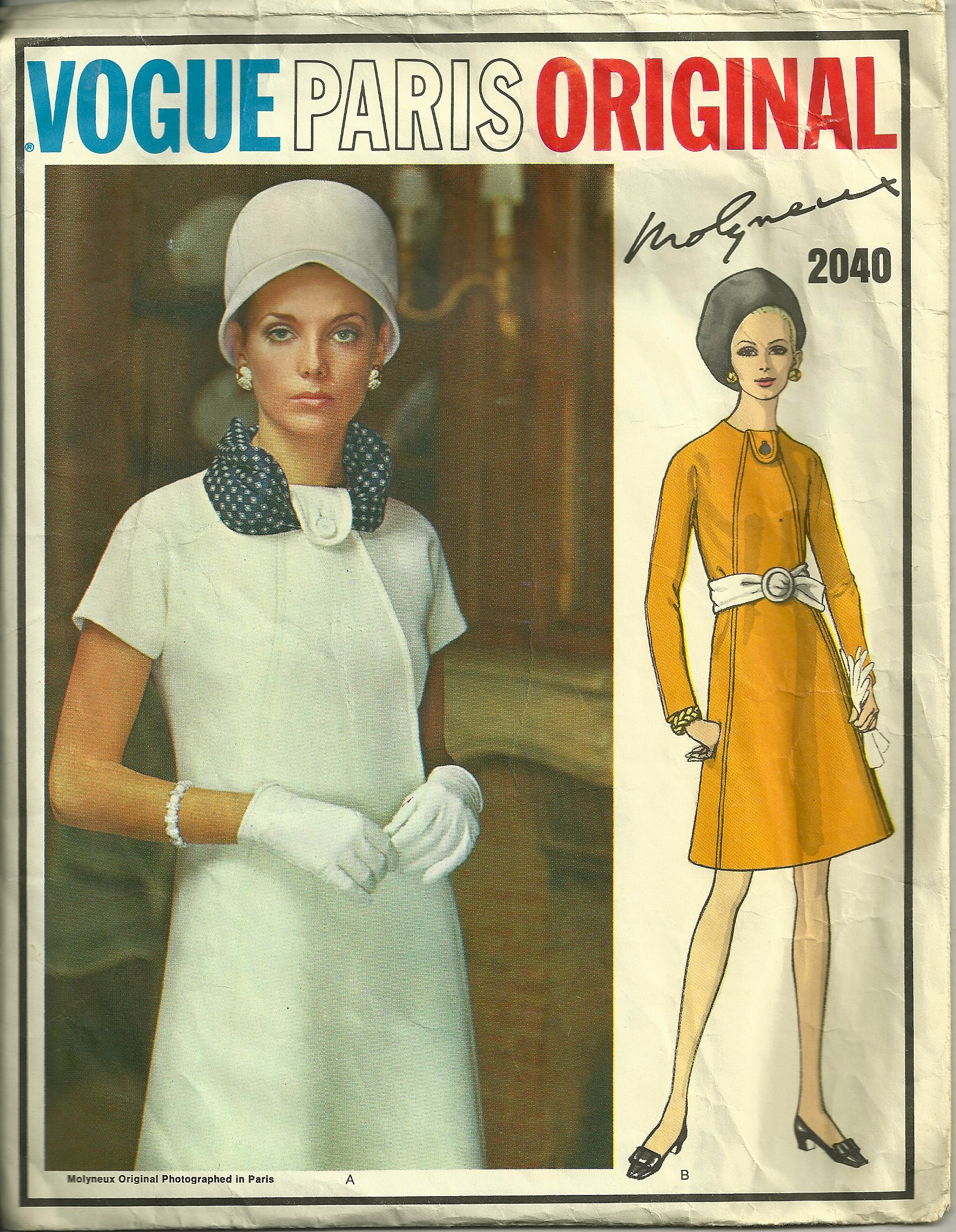
3) Ah, Molyneux!  Another short-sleeved dress to be made in linen.  The seaming detail is so lovely on this design.  I will have to practice my “pouty” look, however, if I hope to look an inch as good as the model on the envelope.

The kimono sleeves have gussets, which will make this dress comfortable to wear.

4) After missing out on several Diane von Furstenberg-designed patterns on eBay, I was very excited to find this one in my size on Etsy in mid-May.  What is it about D von F’s dresses that makes them so timeless?

I owned this pattern in the ’70s, when I bought it for $1.50 at my local fabric store. Sadly I didn’t save it or the dress I made from it, so I had to buy it again! I originally made it up with short sleeves, but now I prefer the sleeveless version.

5) I featured this pattern in a post shortly after I started my blog.  Whether you call this a “swing” coat or a “clutch” coat –  it’s 1950’s style has been in my mind for months!

I love this coat with the sleeves pushed up, as shown in blue.

The truth of the matter is that I will eventually be making dresses or a coat from all these patterns, but as I usually work on only one project at a time, I had to choose just one.  Which one?  It is underway as the thread- and scrap-covered floor of my sewing room will attest!  I made my decision . . . but I have many stitches to go – and many stitches to go – before I can post it.

9 Comments

Filed under Coats, kimono sleeves, Linen, Uncategorized, vintage Vogue Designer patterns, vintage Vogue patterns from the 1950s, vintage Vogue patterns from the 1960s, vintage Vogue patterns from the 1970s, Vogue patterns

My very stylish pants.

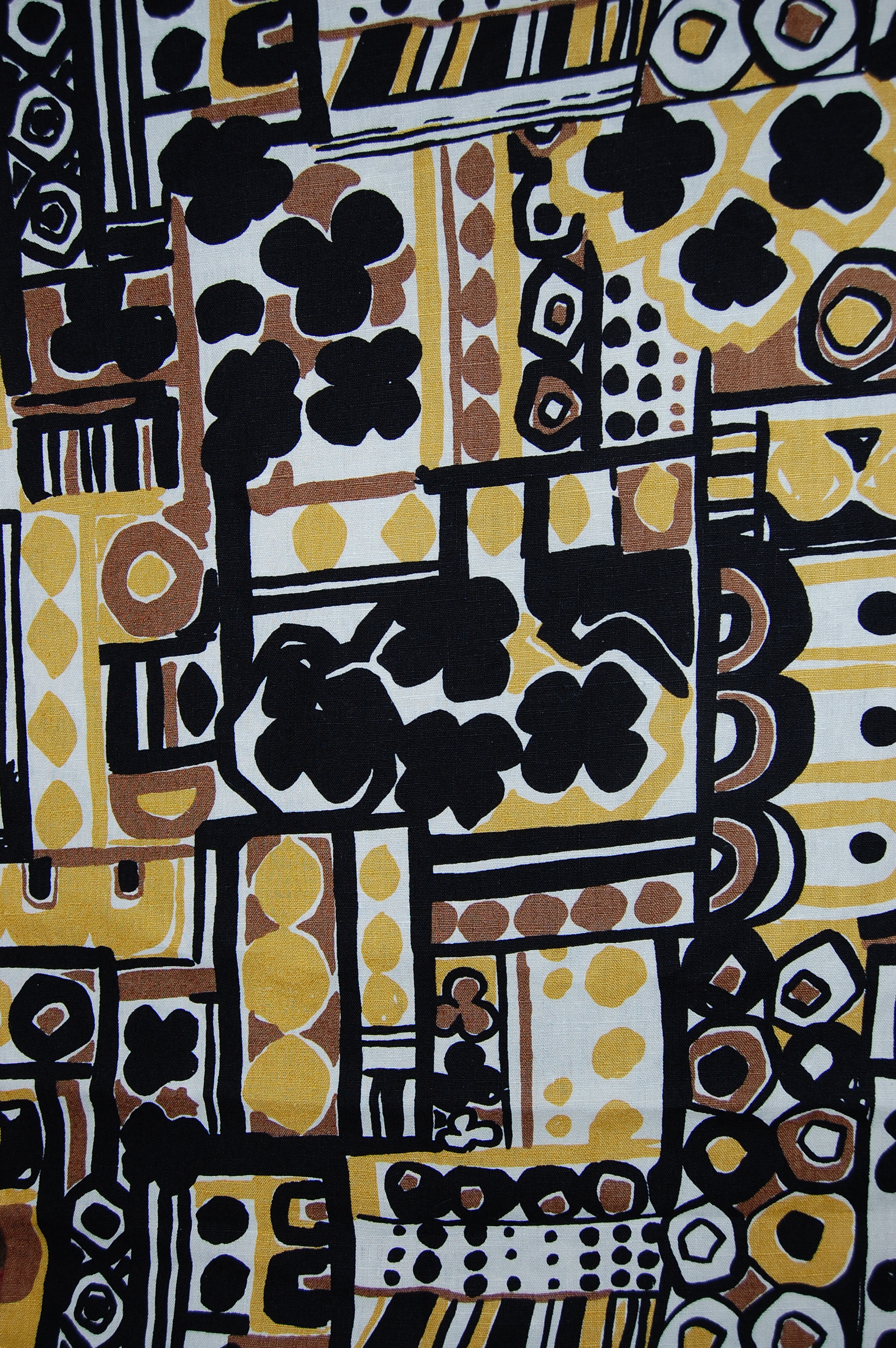
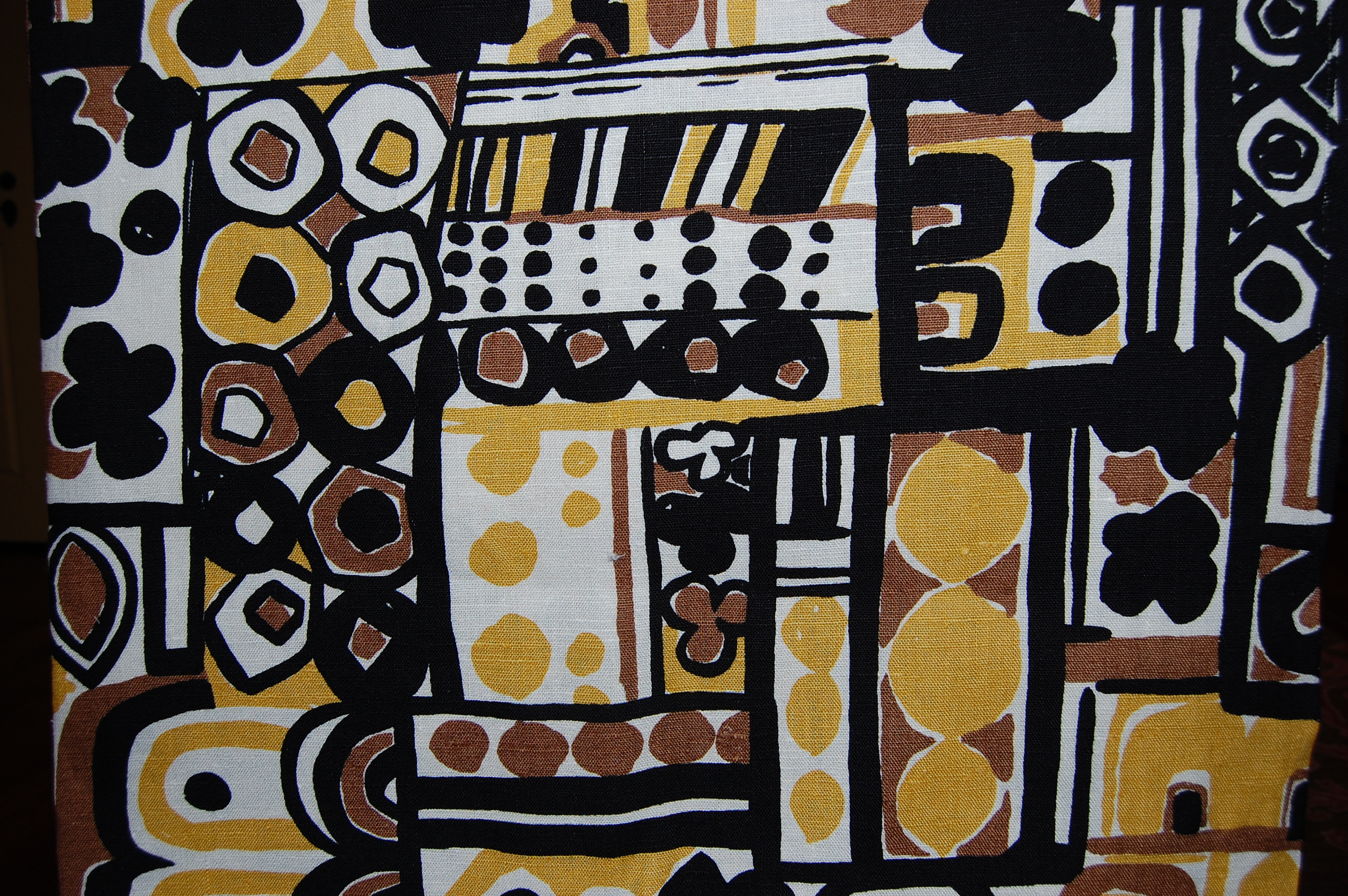
For several months I was watching a piece of Moygashel linen for sale by Revival Fabrics.  When I first saw this offering, I had the eerie feeling of déjà vu – I was sure I remembered seeing this patterned fabric in the late ‘60s or early ‘70s when I was a steady admirer and occasional purchaser of this brand of linen I love so much.  The piece that was being offered was three yards long, 44″ wide and included a Moygashel label.  The description accompanying it suggested making patio furniture pillows or tote bags with it, neither of which much appealed to me.  And actually, this suggestion threw me off a bit ; I wondered if it was drapery-weight linen, not dress-weight.  But the more I looked at it online (clicking close-ups of the images), the more convinced I became that it was dress-weight.  I finally decided to buy it, not really knowing what I was going to make out of it (maybe a sheath dress…?)

When the package arrived and I finally saw this linen in person, I was – so excited! It was gorgeous – and my suspicions were correct – it was definitely dress-weight.

Here is a lengthwise view of the linen.

Here is closer view of this amazing pattern.

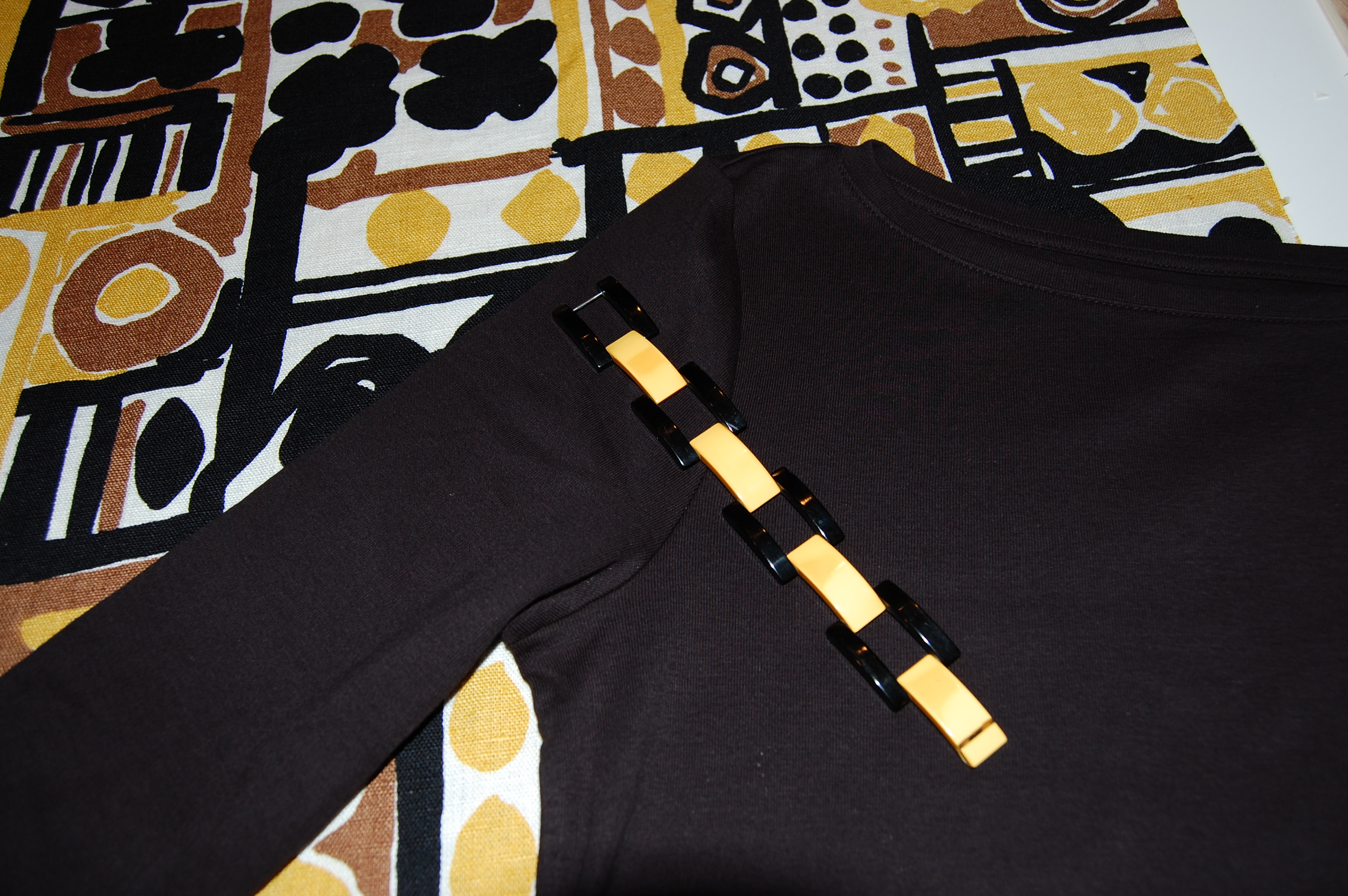
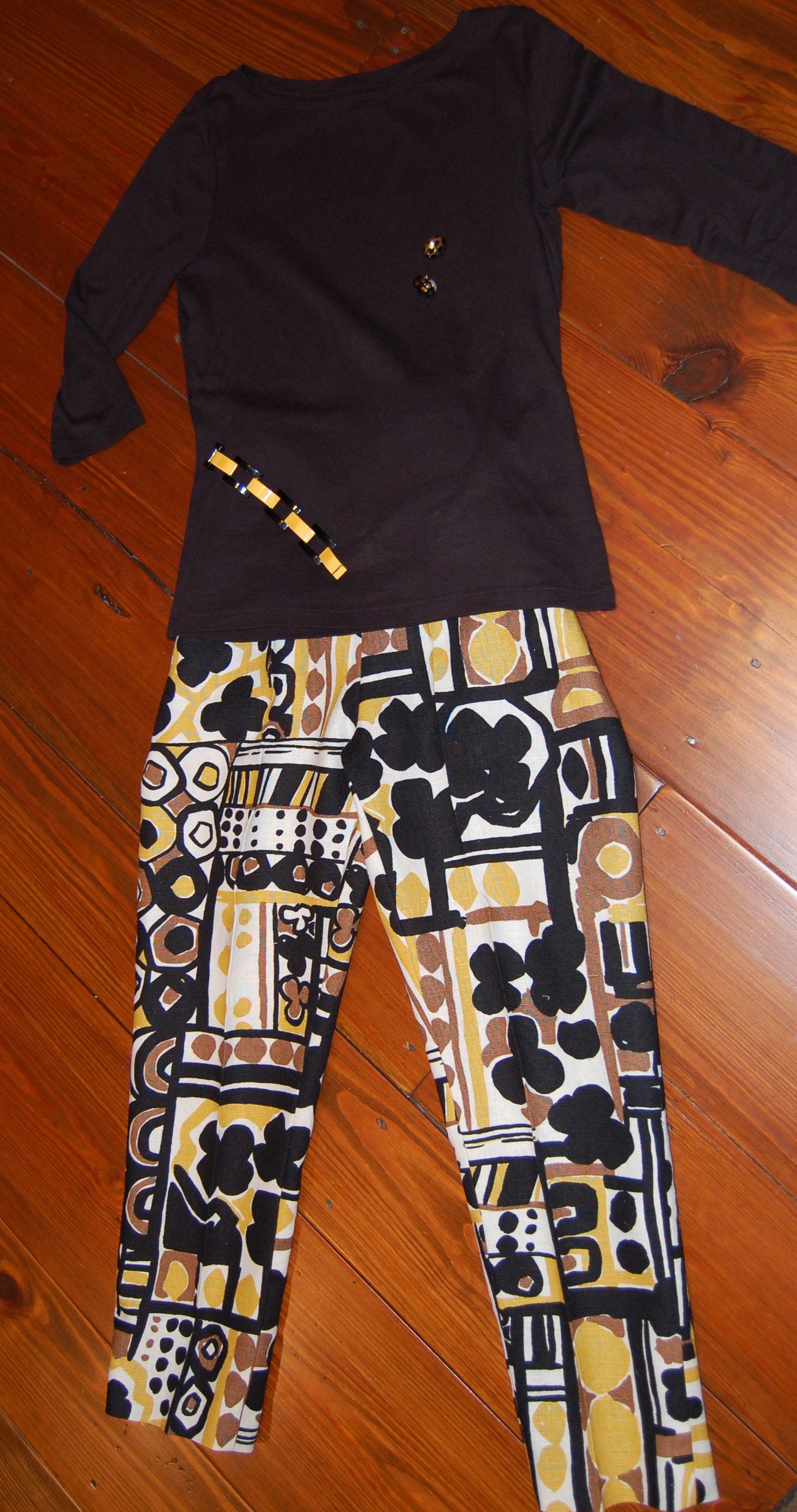
My first thought after my initial euphoria was:  This would make up into fabulous ankle-length pants (worn with a black, yellow or khaki top – and of course my black and yellow Bakelite bracelet).  And yes, I was sure I would have the nerve to wear them!

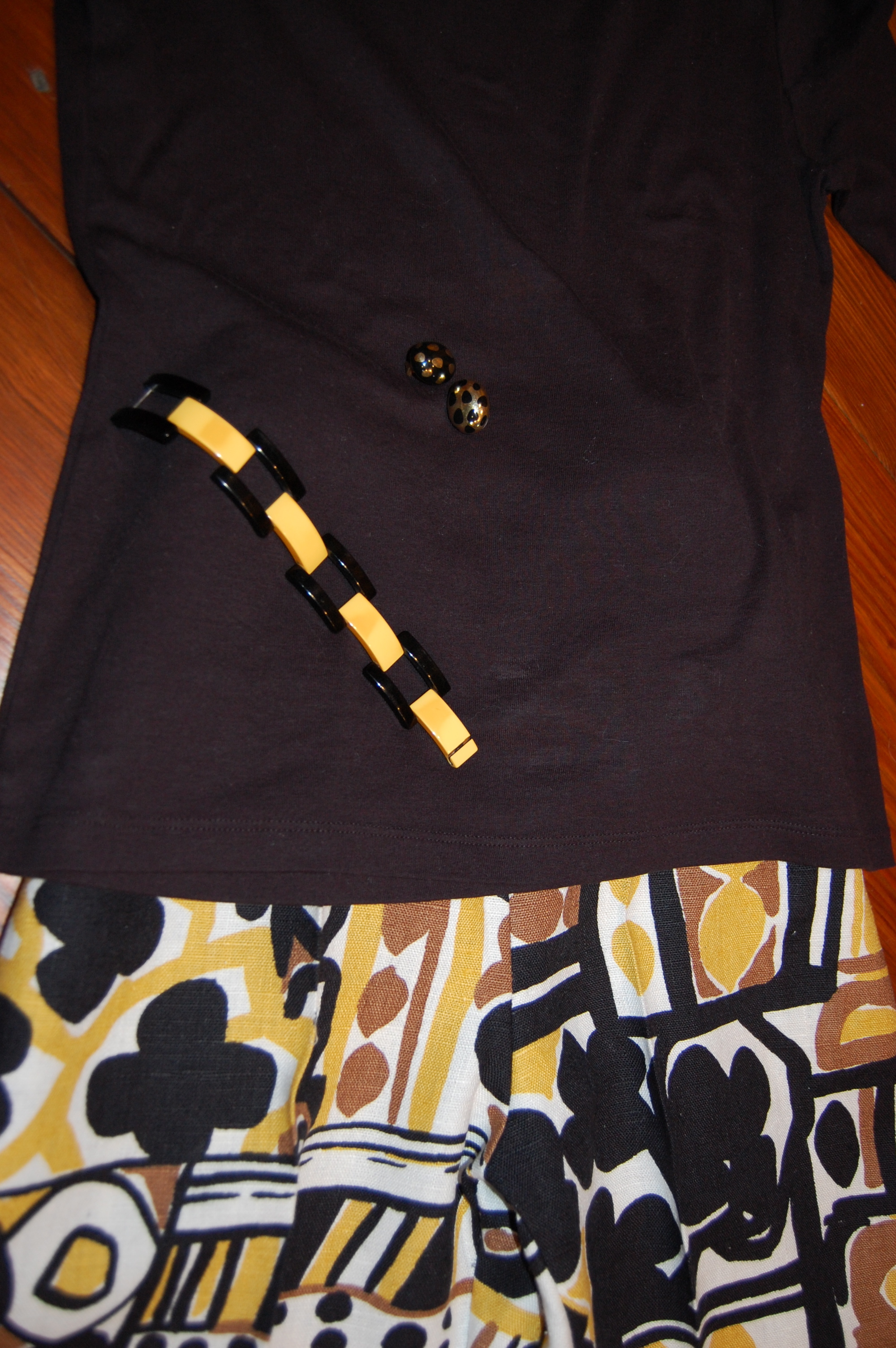
I laid out the fabric with a black cotton knit top and my Bakelite bracelet just to see how it would look.

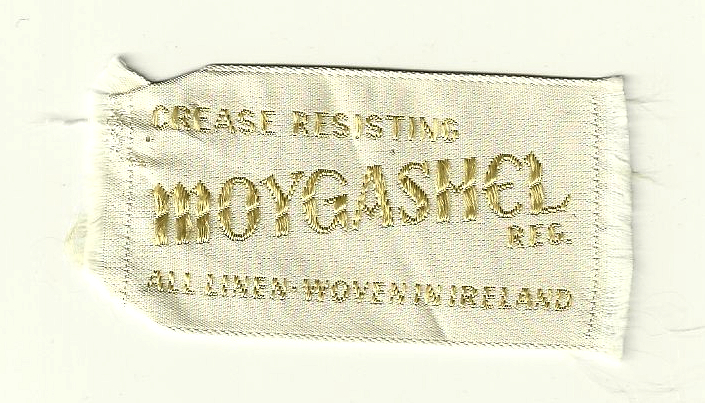
And here is the label which came with the fabric.

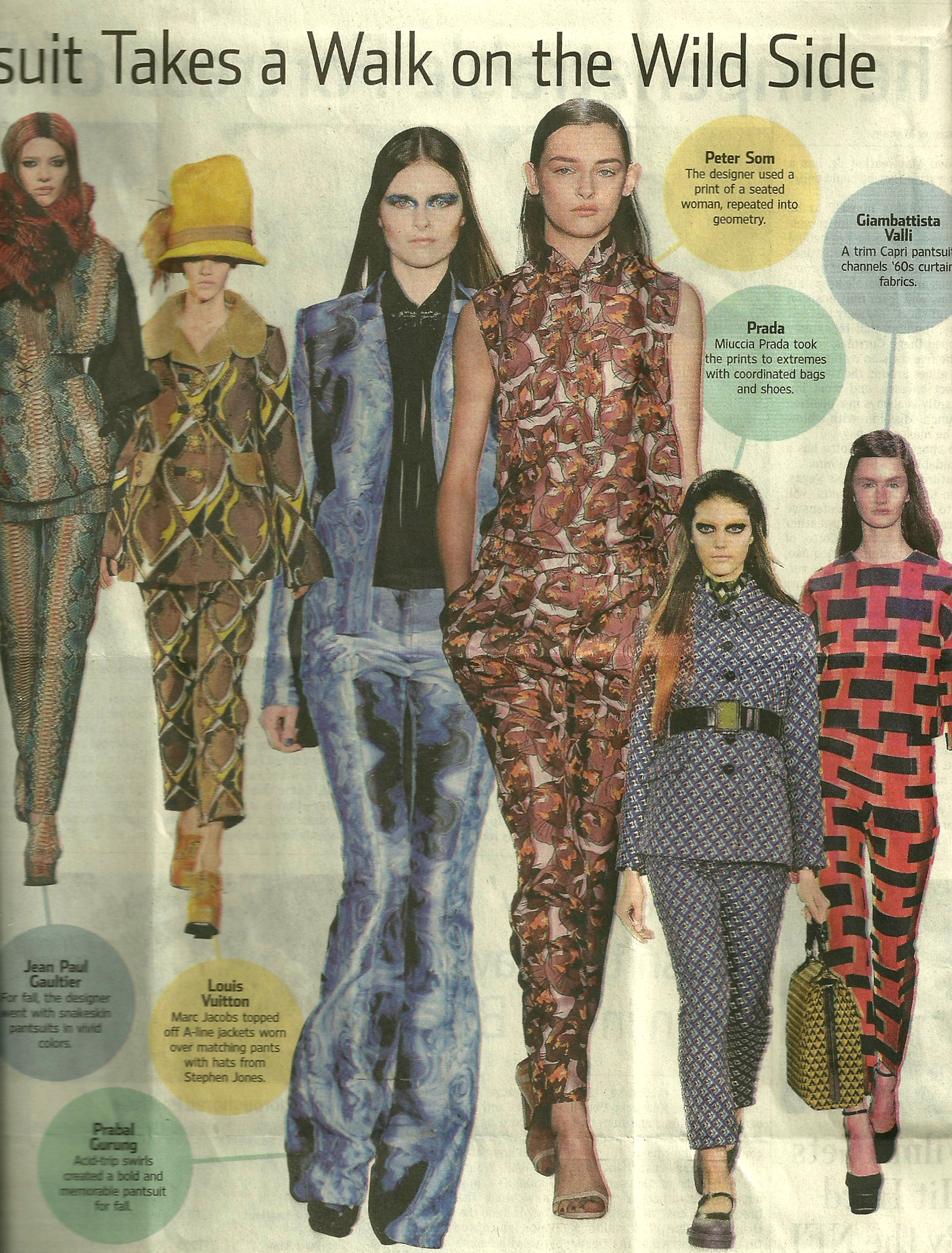
With my plan in place, I decided this would be my next project after I finished the one I was on.  Then something really amazing happened.  A fashion article in the May 3, 2012 edition of The Wall Street Journal caught my eye.   Christina Binkley, one of the newspaper’s fashion reporters, headlined her weekly column “On Style”  with The Pantsuit Takes a Walk on the Wild Side.

I don’t like any of these fabric designs as much as I like my Moygashel linen!

I’ve never been a fan of pantsuits, but some of the fabrics featured had that same ‘60s’ feel as my new vintage linen.  The reporter rightly questioned how well these head to toe outfits would “play on the streets”, but then she added:

“…at least one mainstream retailer will highlight the idea that the pantsuit can be worn as separates…  There will be more busy pants than busy jackets.  ‘There may be women who wear it head-to-toe – very daring,’ says Sak’s Ms. Sherin.  ‘But for us, it’s probably about the patterned pant’.”

Then, Ms. Binkley suggested:  “The key to wearing this trend is not straying too far from your safety zone.  Stick to colors and patterns you will still love in five years.  And let the bold pattern do the talking – go with a conservative fit if you’d rather not be the center of attention.”

Further:  “It’s probably not a coincidence that wild pantsuits are appearing just as ‘Mad Men,’ the style-influencing television show, is entering the psychedelic phase of the ‘60s.”

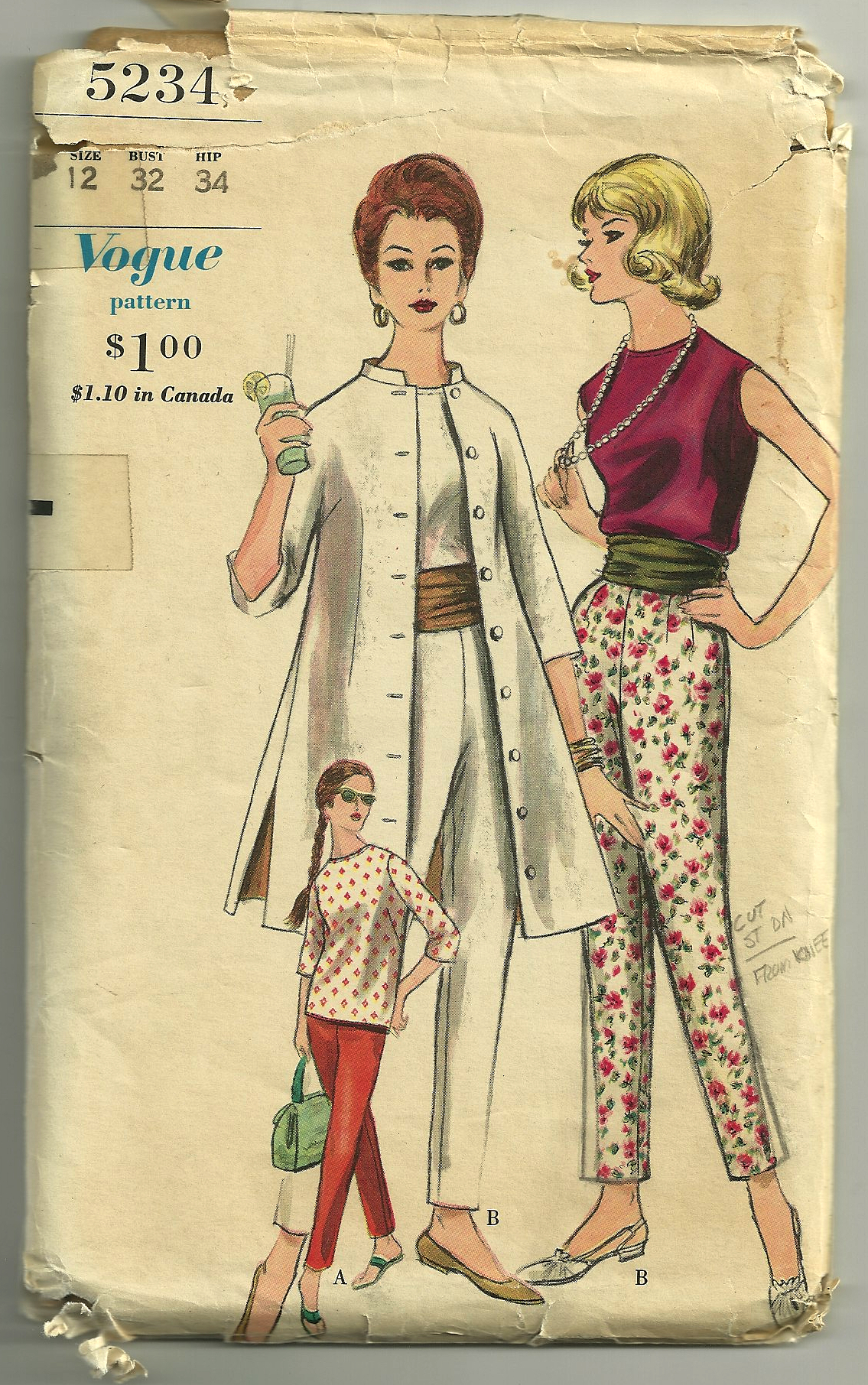
Well, my linen fabric is far from psychedelic, but it is bold – and reading this article certainly did validate my plans for making pants.   I also already knew the pattern I wanted to use, one quite appropriately from the early to mid ‘60s!

I really like all the styles featured on this pattern – the coat, the two blouse variations, the cummerbund –and the “conservative” pants.Classic looks – all of them!

Okay – I was ready to start this project.  First I washed the linen in cool water, delicate cycle, and dried it on medium heat.  This way I know my pants are totally machine washabIe.  Next I made a muslin of the pants pattern to check for fit.  I should have done a little more measuring first, as the crotch was too deep and had to be redrawn.  Also, although I like slim-ankled pants, these were just a bit too slim, so that was another adjustment.  I ended up making muslin #2, which was much closer to the final version from which I cut my pants.  However, I had made so many adjustments, that I decided to copy the final pattern onto freezer paper. (Freezer paper is my secret sewing friend – the dull side provides a wonderful surface upon which to draw in pencil and the shiny side can be ironed to fabric to cut out appliqués or anything, really, and then easily removed.  And the long continuous roll of paper is perfect for long pattern pieces like pants, coats, etc.)  The good news is that now I have a pants pattern that fits really well with the slim, but not too slim, legs that I like.

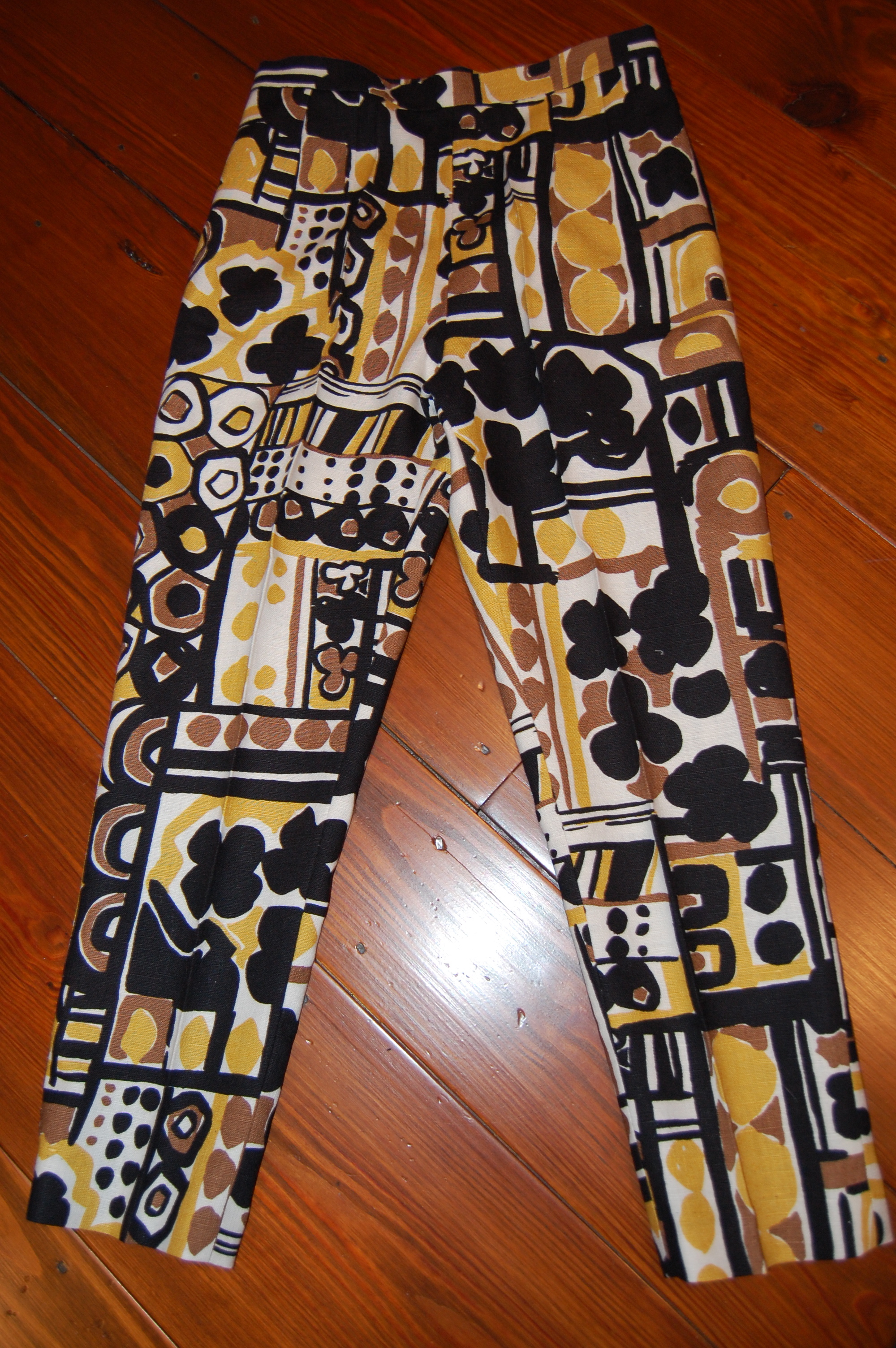
During construction, I tried on these pants about a ga-zillion times.  This fabric was just too dear to make any mistakes, and the more I tried them on, the more I liked them.  Here they are, all finished.

I’d say these are definitely bold!

Here is my outfit, complete with Bakelite bracelet.  (I think the camera angle makes the legs look different lengths??)

A close-up of same, with the earrings I’ll also wear with this outfit. (Click on the image).

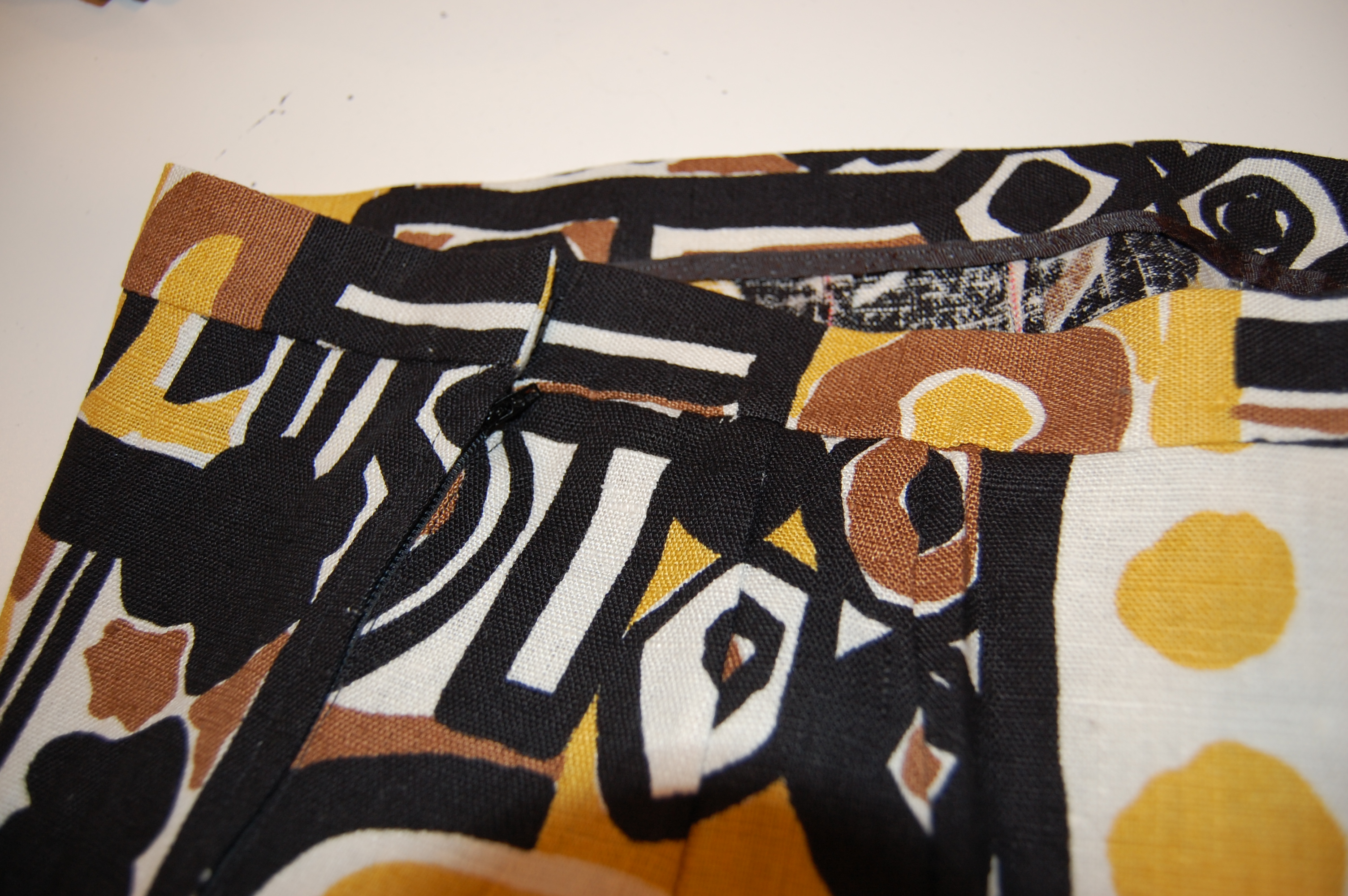
Here is a view of the waistband and zipper.

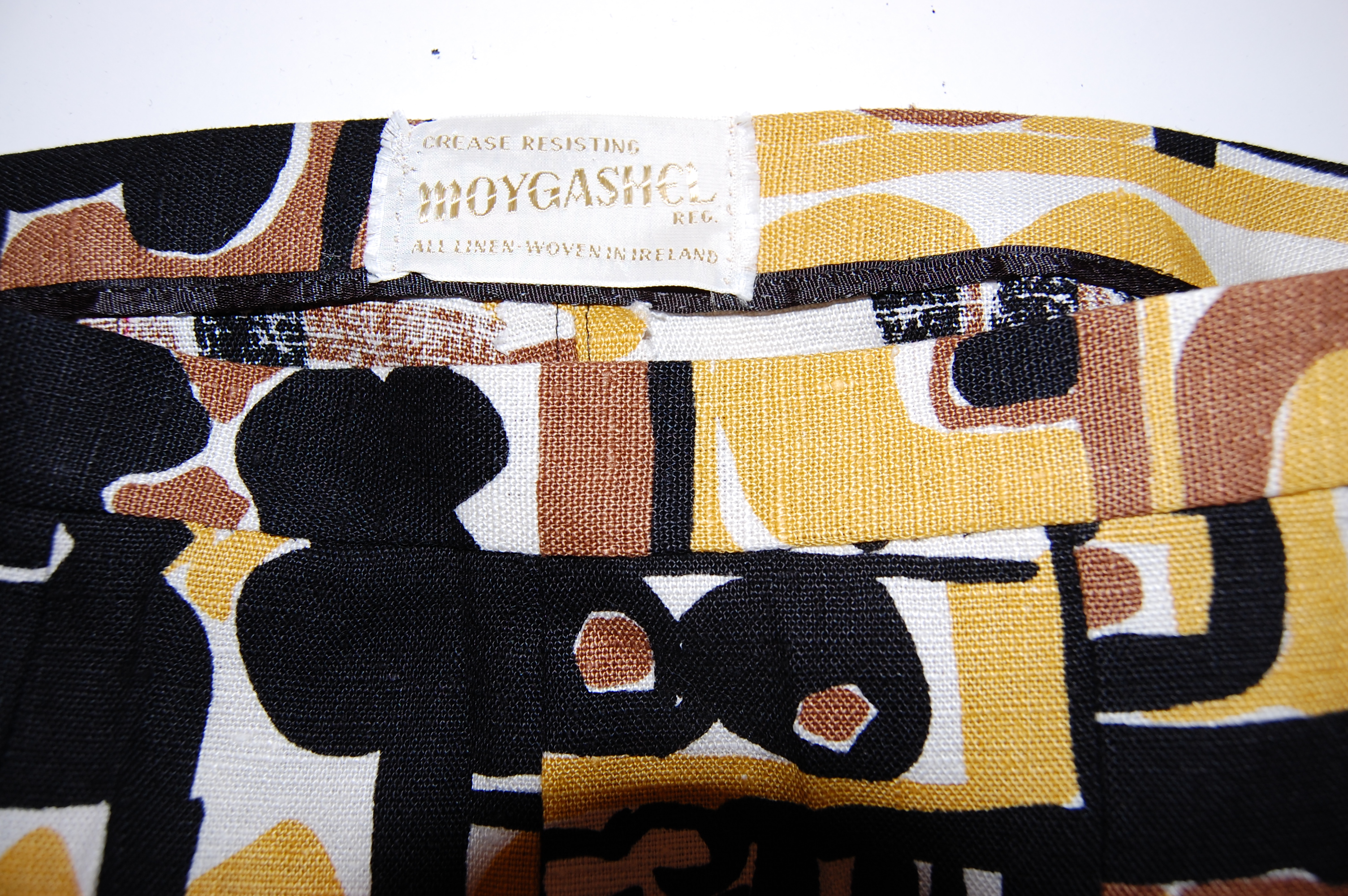
And here is the final touch – the label attached to the inside back of the waistband!

How neat is it to sew something up in vintage fabric, using a vintage pattern – and be totally stylish in 2012? And – I still have enough of this fabric left over to make a skirt.  Hopefully that will be very stylish, too, whenever I get around to making it!

12 Comments

Filed under Bakelite buttons and/or jewelry, Coats, Linen, Uncategorized, vintage Vogue patterns from the 1960s, Vogue patterns

“When in doubt, wear red.”

Bill Blass, noted American designer (1922 – 2002), knew of what he spoke when he expressed this savvy advice.   Red, in all its various hues, is a color which commands attention, and therefore, it is no wonder that fashion sketches and dress patterns often feature red.  Red also figures distinctly in three months whose “colors” always include red:  December’s red and green; July’s red, white and blue; and, of course, February’s red, red, and red.

To celebrate February’s red, I have scoured my Vogue Pattern Book Magazines and my collection of vintage patterns to showcase some beautiful fabric and dress/suit/loungewear designs.  No doubt (pardon the pun), Mr. Blass would approve.

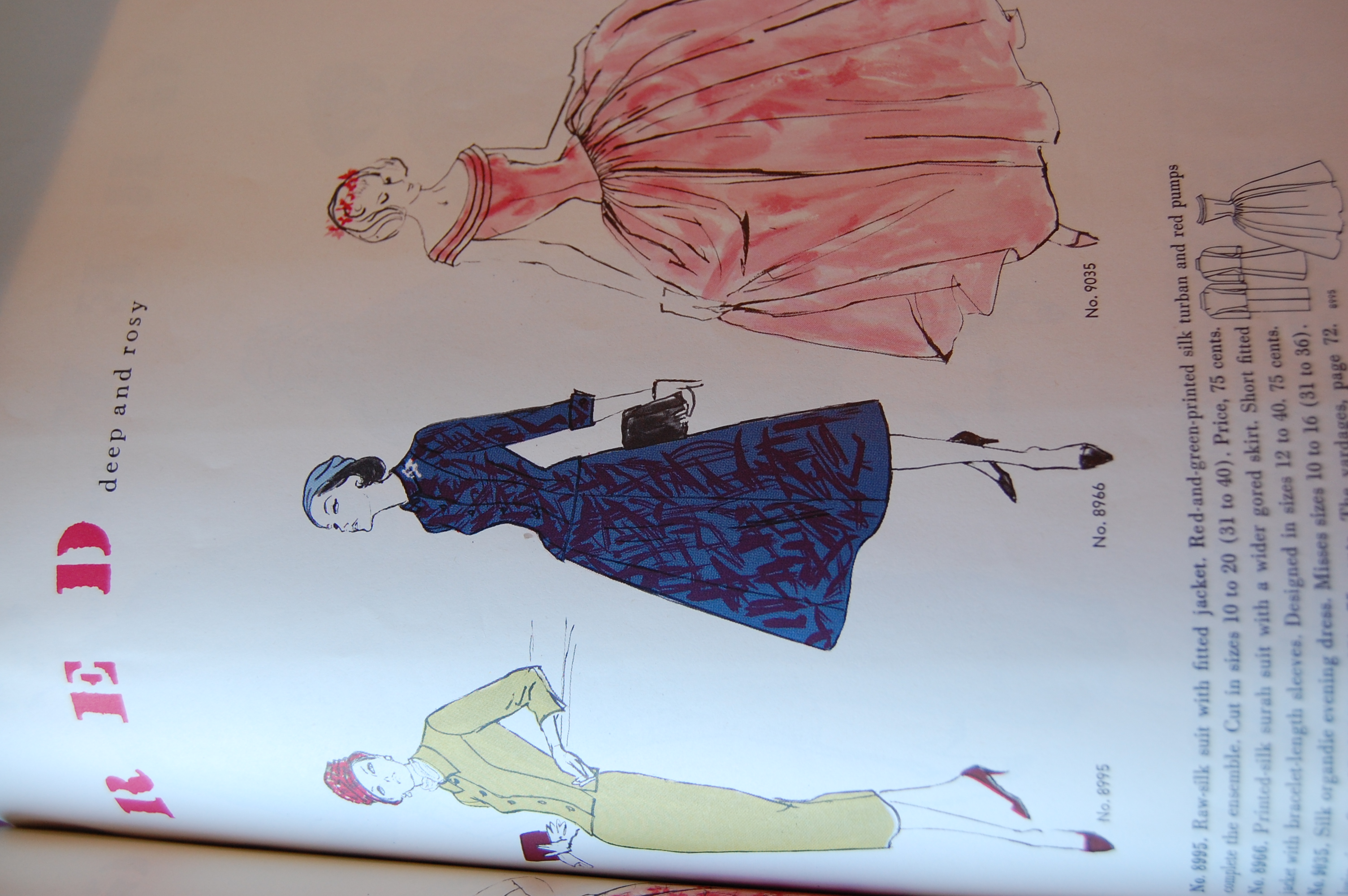
The February/March 1957 issue of  Vogue Pattern Book  magazine shows two pages of “Red – deep and rosy”.  While the red coat and two red dresses are obvious “fits” for the section, the mustard yellow suit (raw silk, according to the caption, which would be so elegant!) is completed with a red and green printed silk turban and red pumps.  (Hint for viewing:  click on the photos to see them larger and clearer.)

The middle suit looks to be a blue and red printed-silk surah, while the evening gown is to be made in a silk organdie.

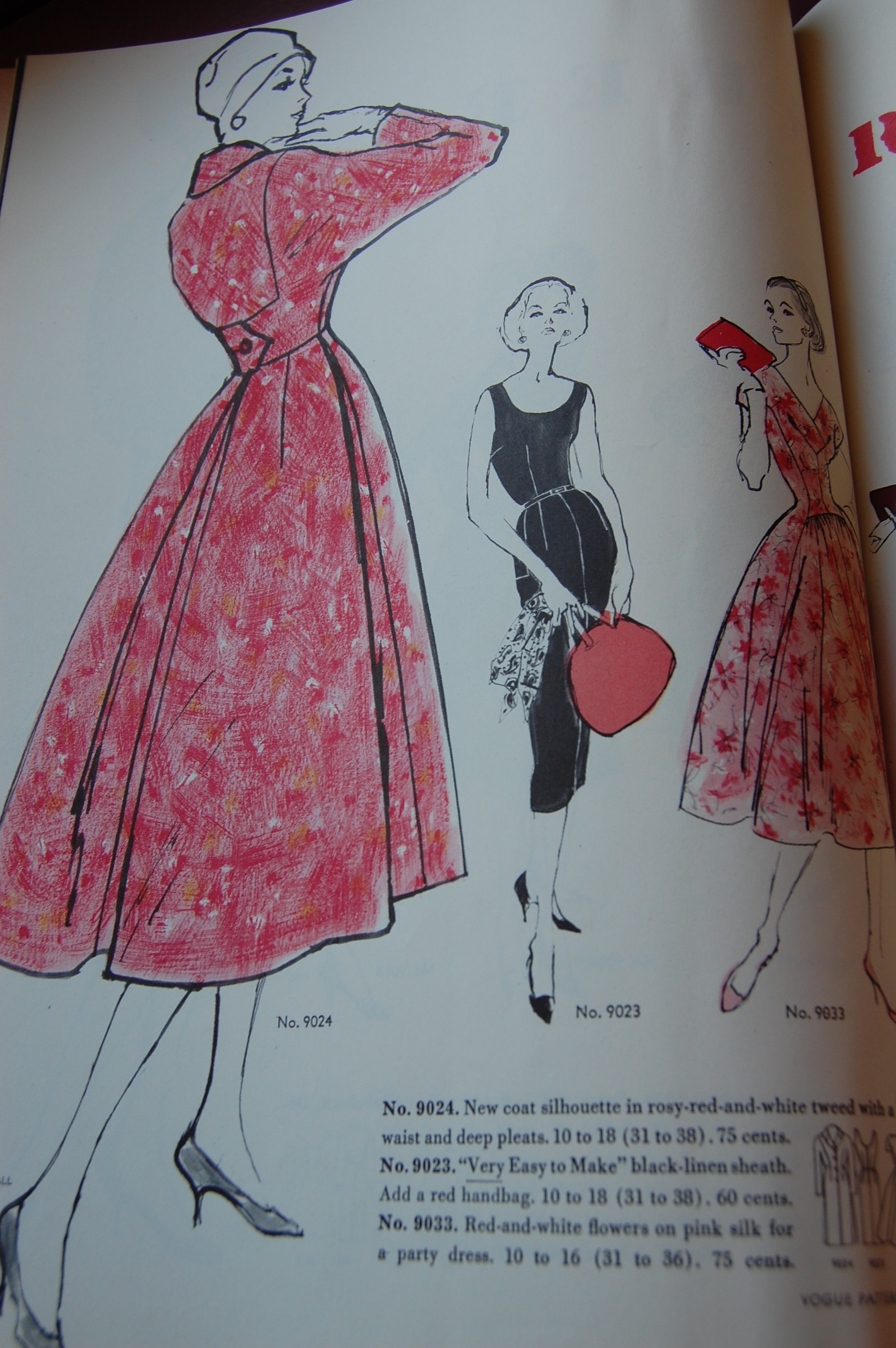
This coat has a high waist and deep pleats. Wear this over the black dress for a stunning look!

That same year, the June/July issue showed this lovely choice in cherry-red pique for “sight-seeing.”  No blue jeans and tee shirts for this excursion.

The wide brim hat with red flowers completes the look.

In 1958 (or in 2012), a chic home sewer could make this suit in a red tweed with self or braid binding.

Notice the stylish shoes!

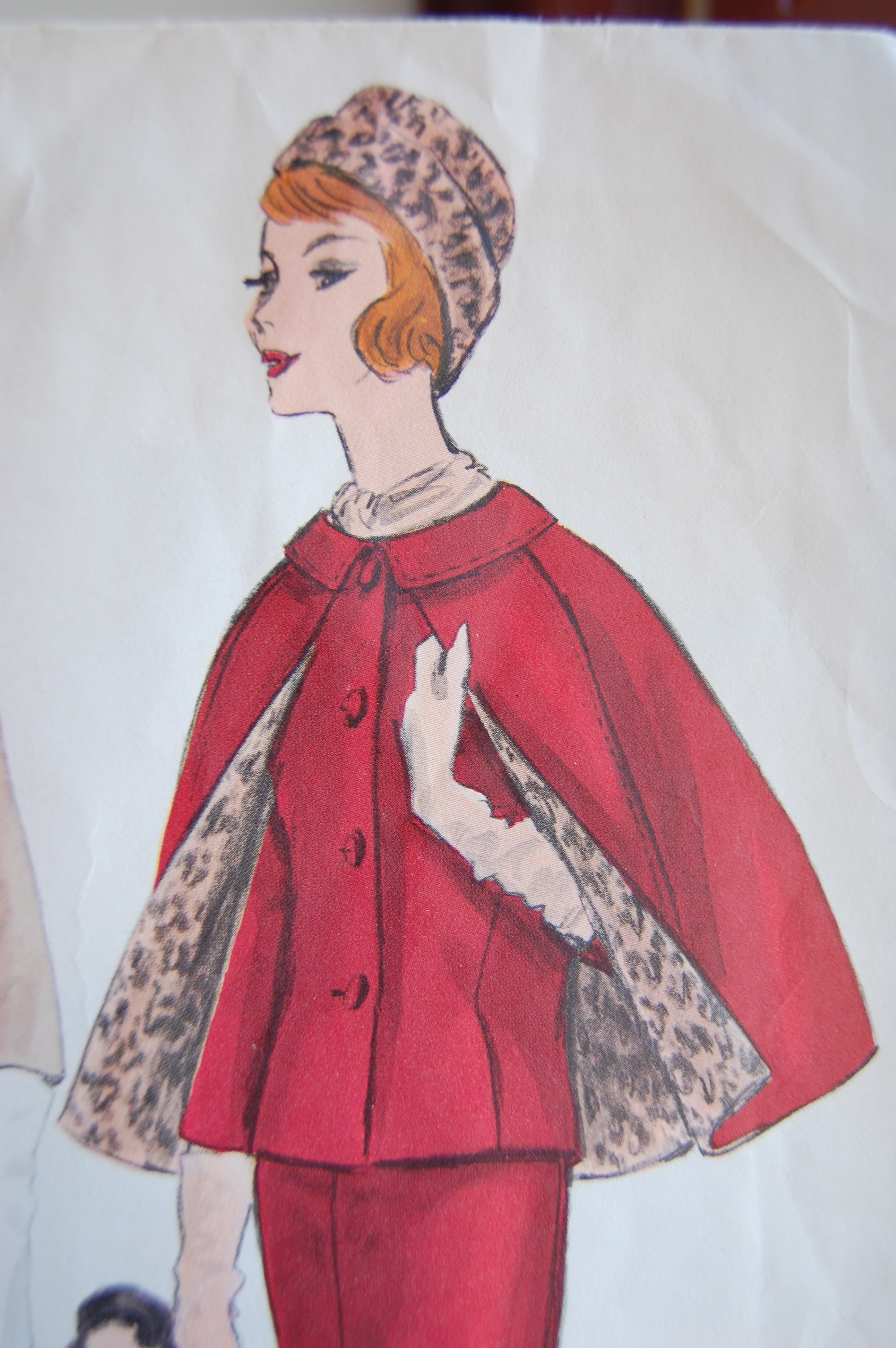
Here is a suit from 1960 with a matching, reversible cape. The cape has arm openings in the side seams and is collarless so that it fits perfectly under the collar on the suit jacket.

Who says "redheads" can't wear red?

Here is a close-up of the cape. The leopard-printed lining matches her hat.

Red print fabrics have spun their own charm over the years.  Here are four, which seem to epitomize another statement from Bill Blass: “…fabric is an inspiration and a tool.” (See International Vogue Pattern Book  October/November 1971, page 27.)  I could definitely be inspired by these prints:

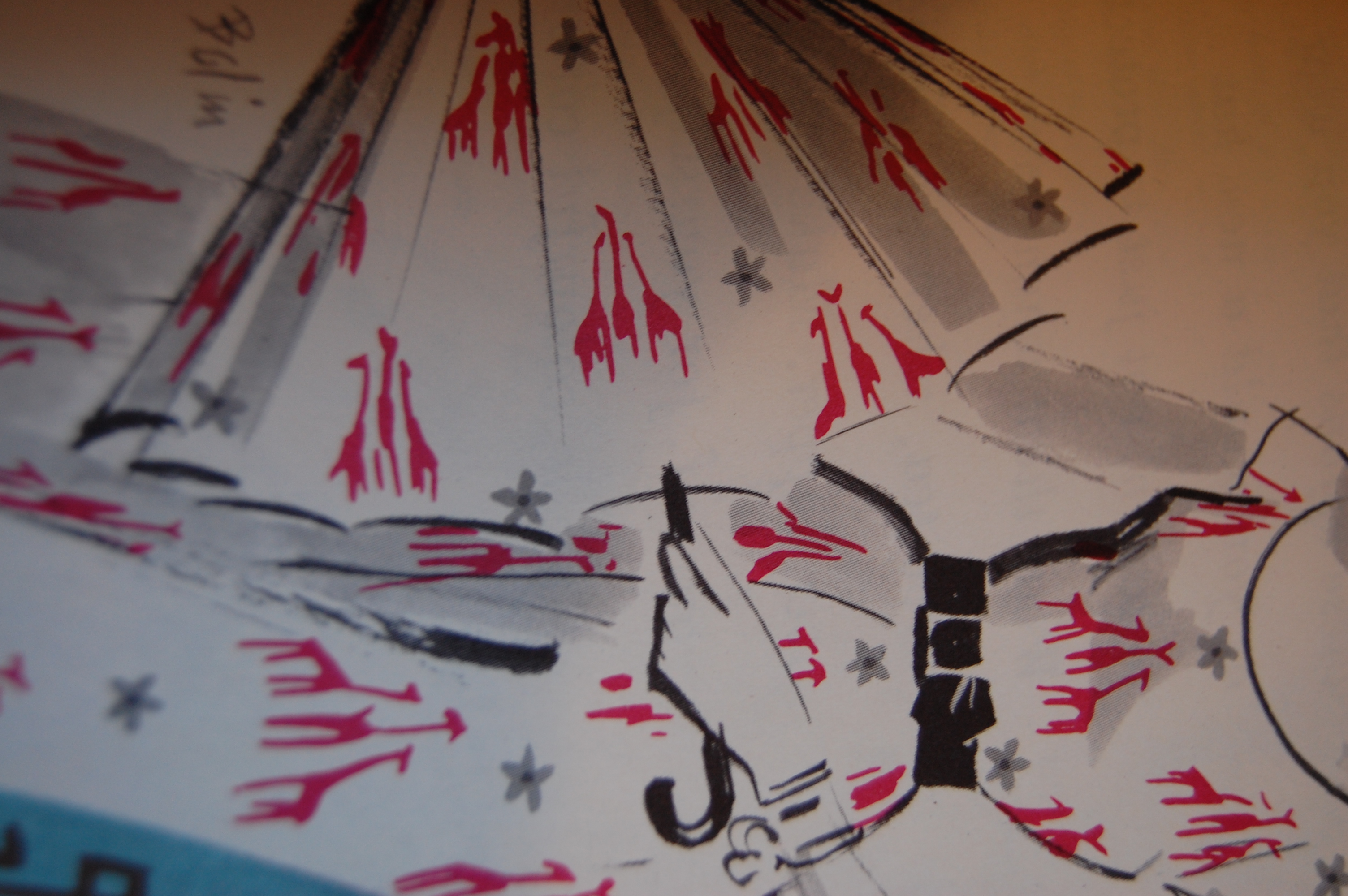
This wonderful giraffe print in red on white cotton, with stars, is shown in a skirt and blouse. There was no mention about the matching parasol. This design is in the April/May 1953 Vogue Pattern Book magazine.

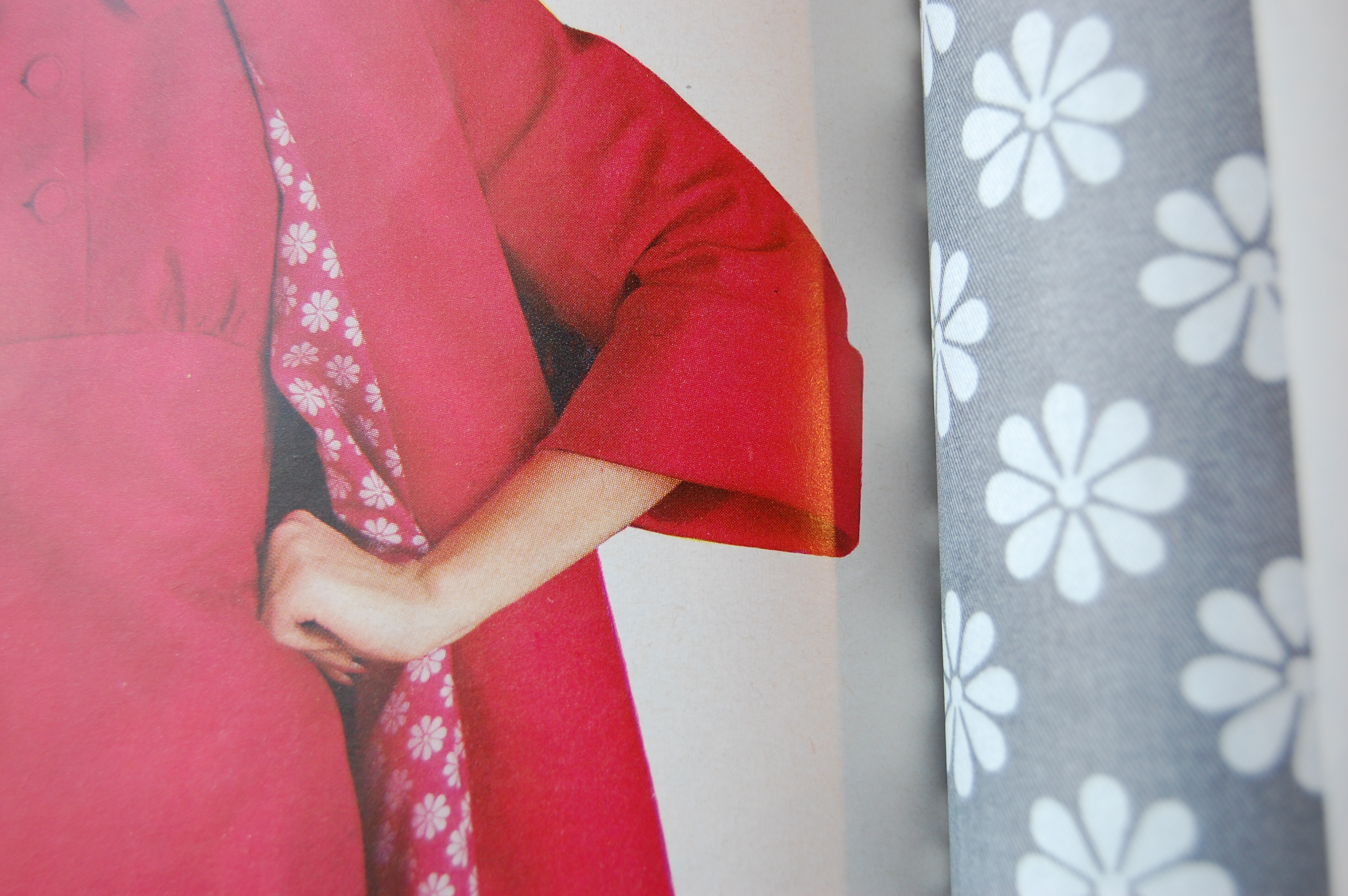
This 1958 design features a daisy print silk lining in the coat.

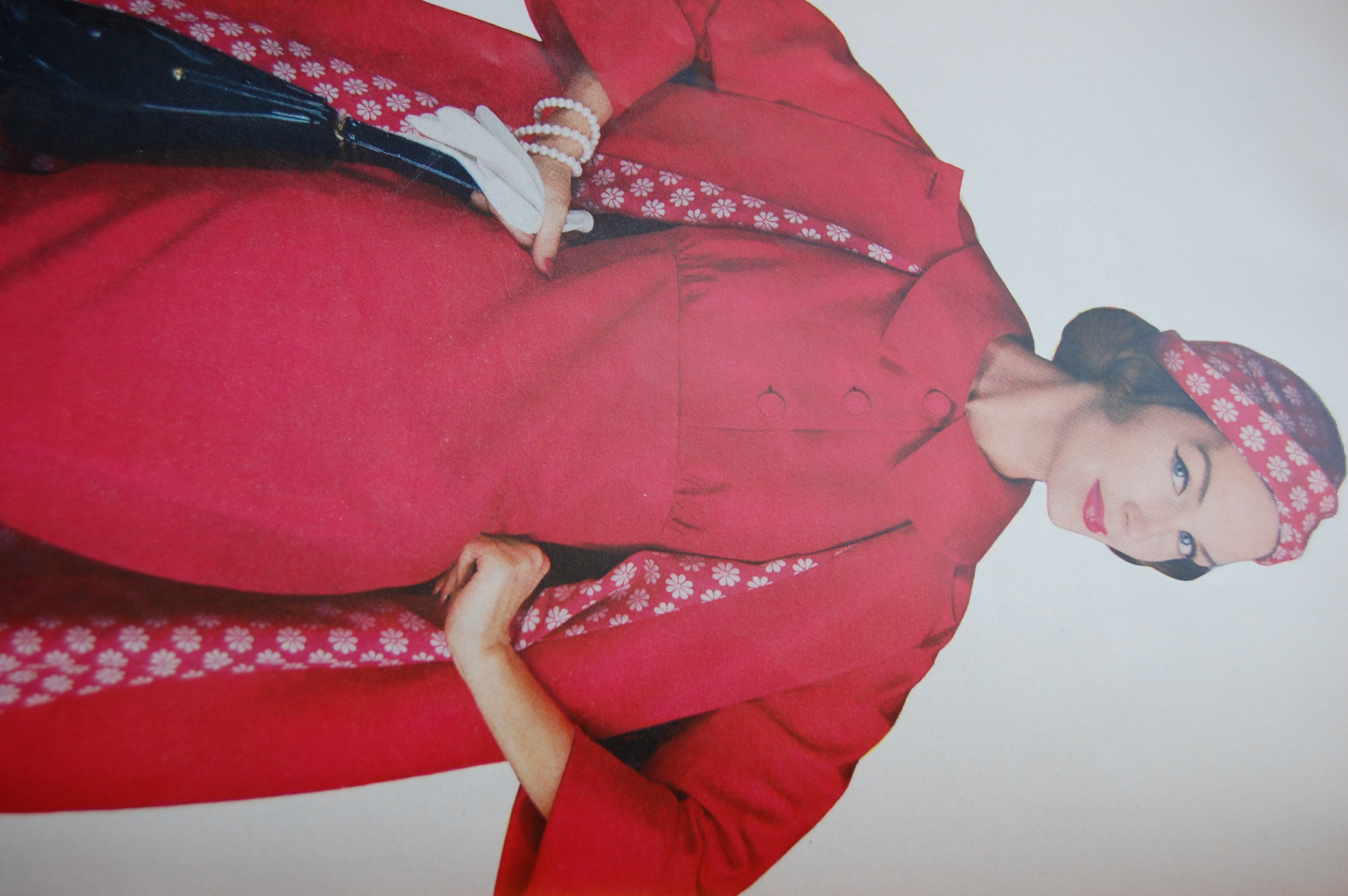
The dress and coat are made in a slubbed silk barathea while the lining and hat are of silk surah, both by Couture, according to the February/March Vogue Pattern Book of that year.

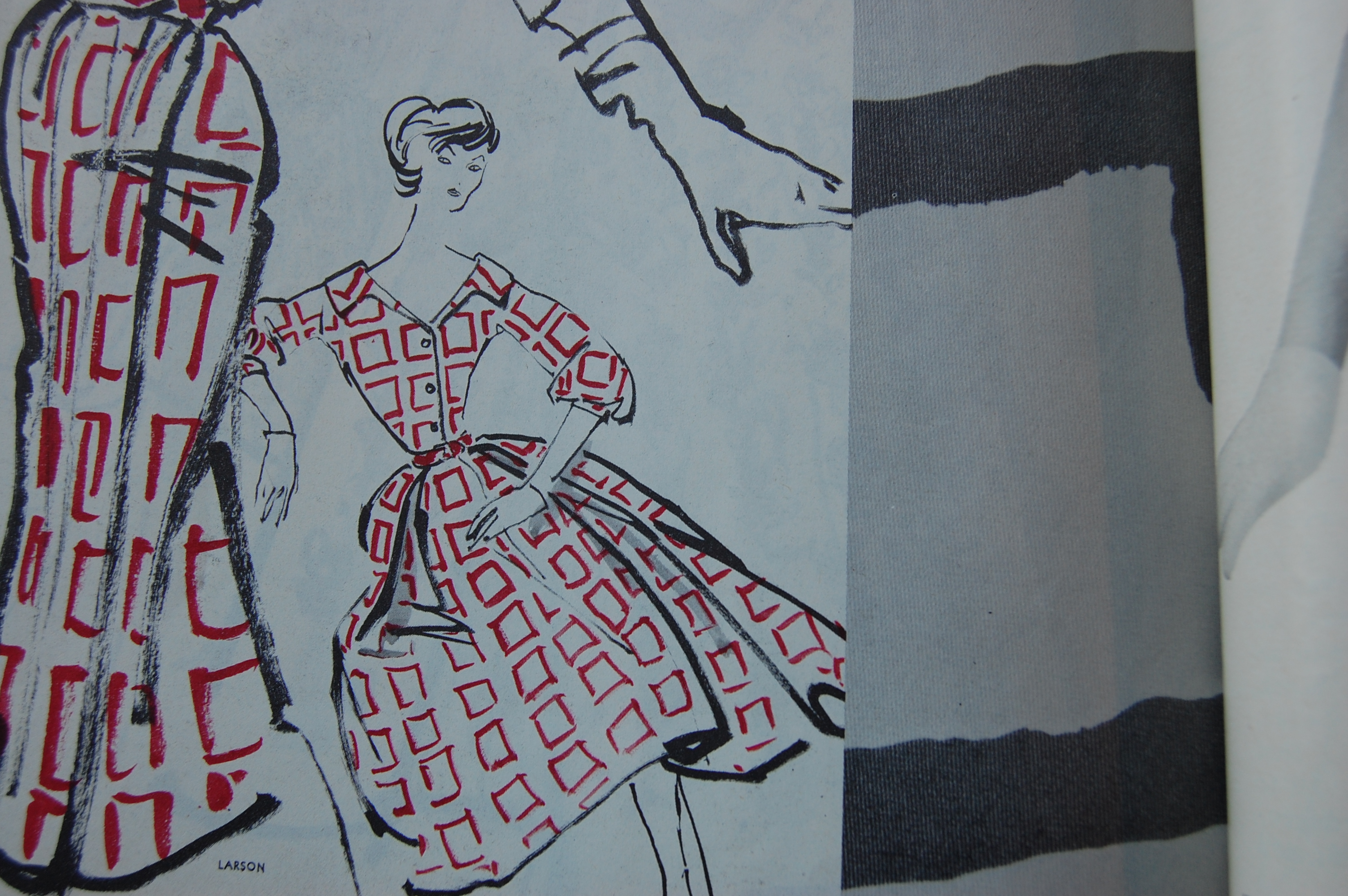
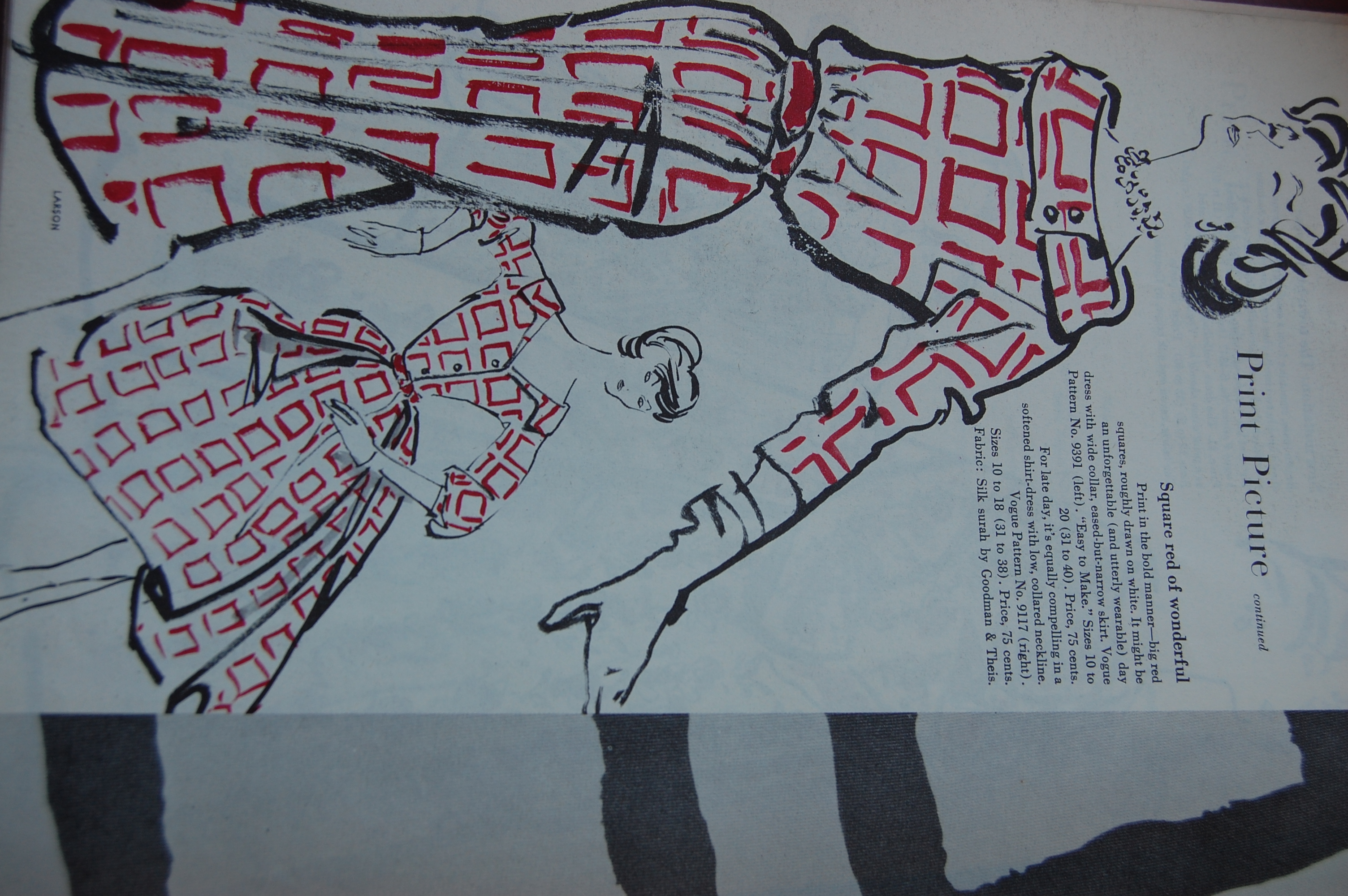
This fabric is rightly referred to as "Square red of wonderful"!

This silk surah looks equally eye-catching in a slim or full skirt. I'll have one of each, thank you!

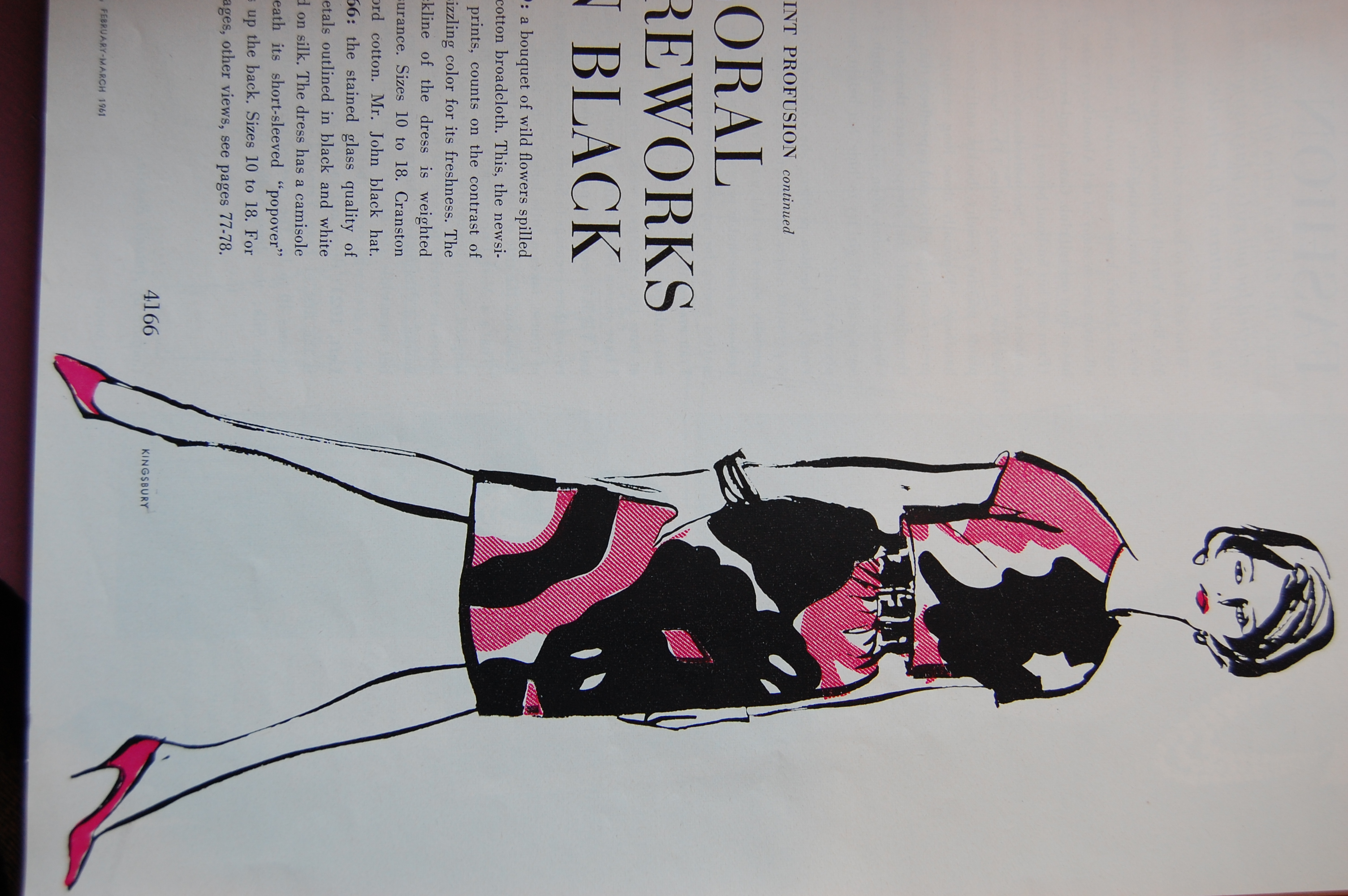
What I wouldn't do to be able to buy this printed silk! This pattern was featured in the February/March 1961 issue of Vogue Pattern Book magazine. According to the description, "this dress has a camisole top underneath its short-sleeved 'popover' top that buttons up the back." With lipstick and shoes to match, it makes a stunning ensemble.

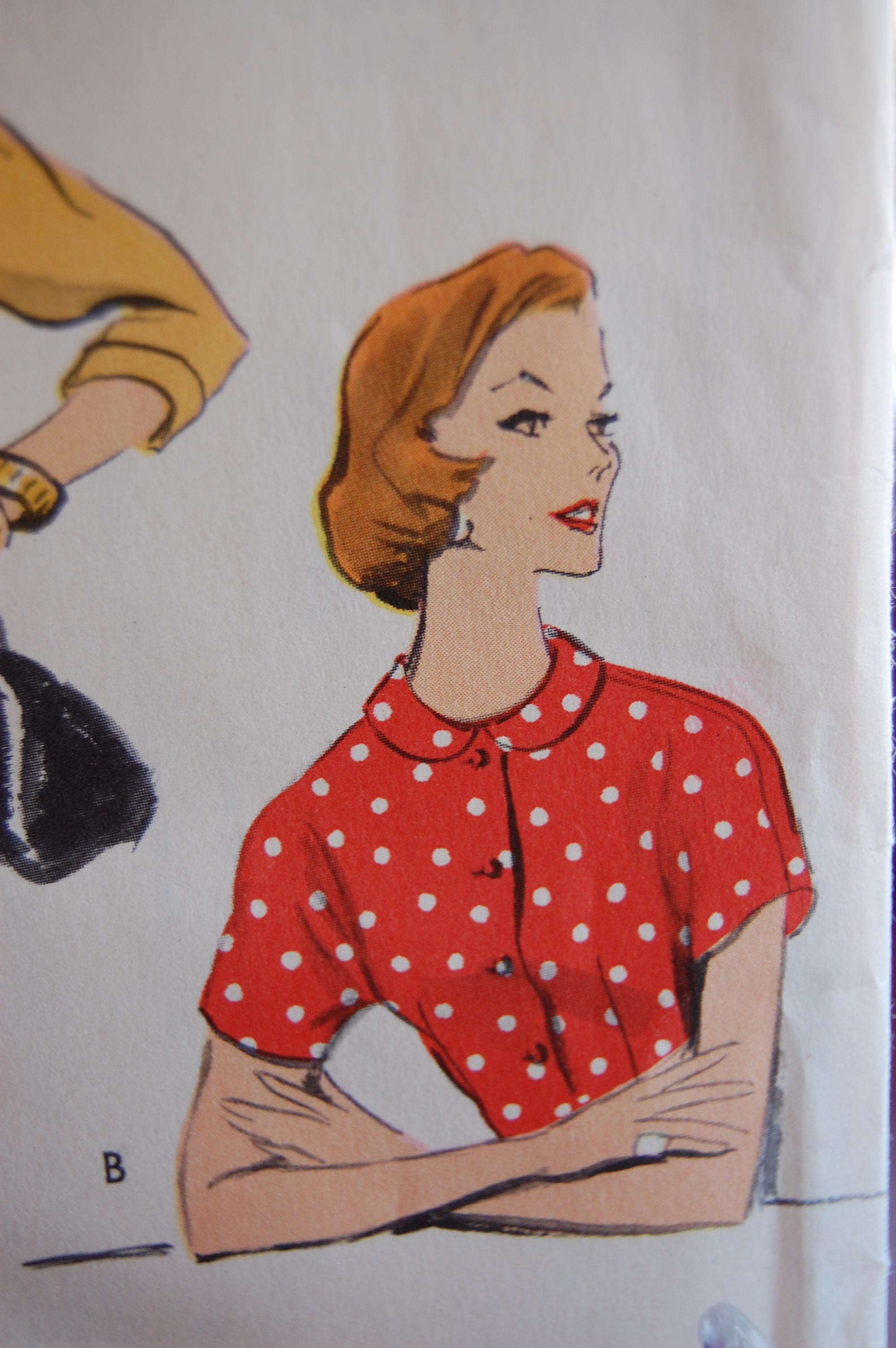
And here are classic polka dots, white on red, in a 1957 blouse design.

A Peter Pan collar and polka dots - a winning combination!

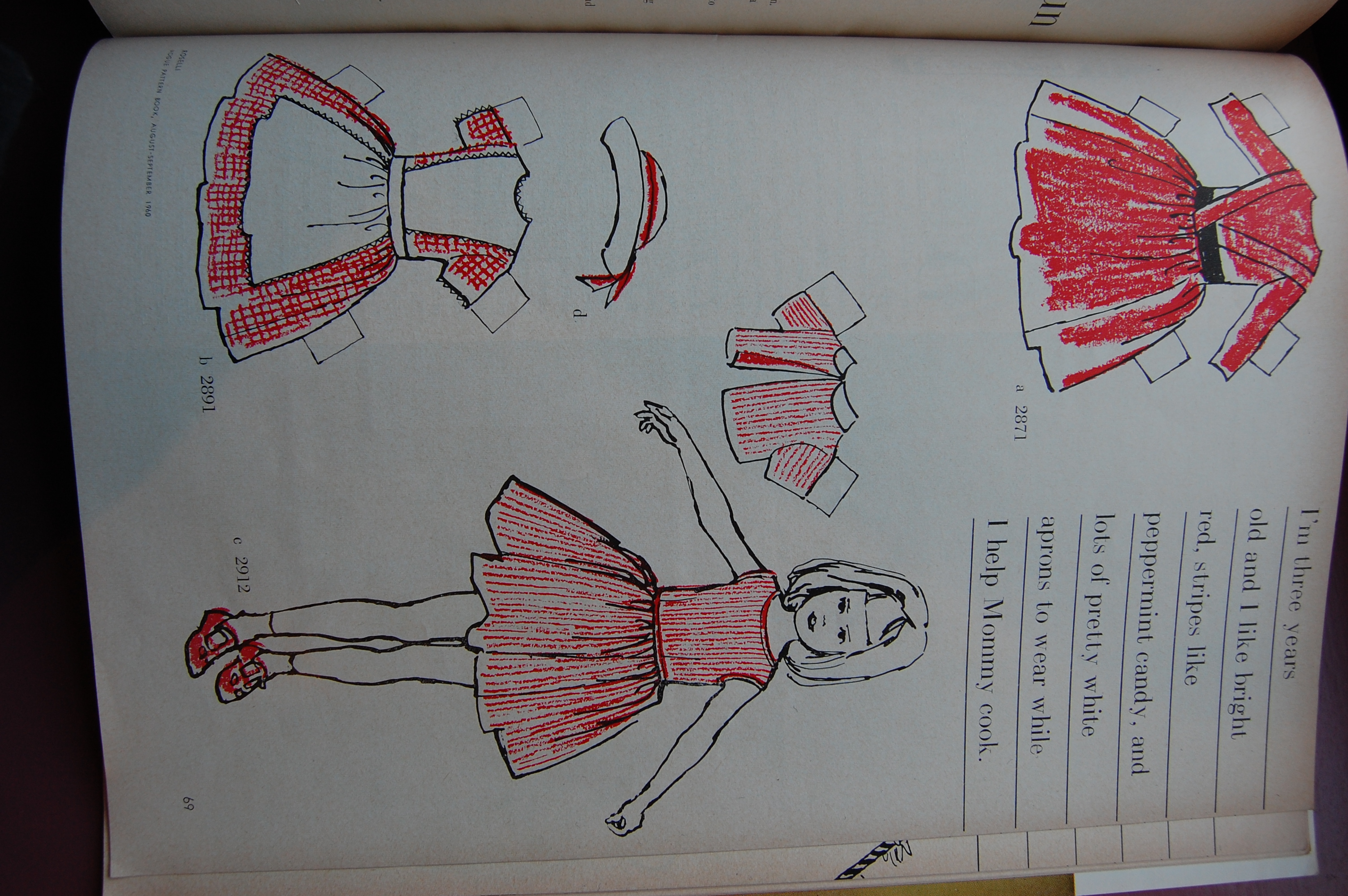
Vogue Pattern Book’s editors often featured styles for college girls and little girls.  Velvet, gingham and candy-striped denim (yes, that’s correct, denim!), all in red, were featured for little girls in the issue for August/September 1960:

This little girl is all set to help "help Mommy cook" in a white pinafore.

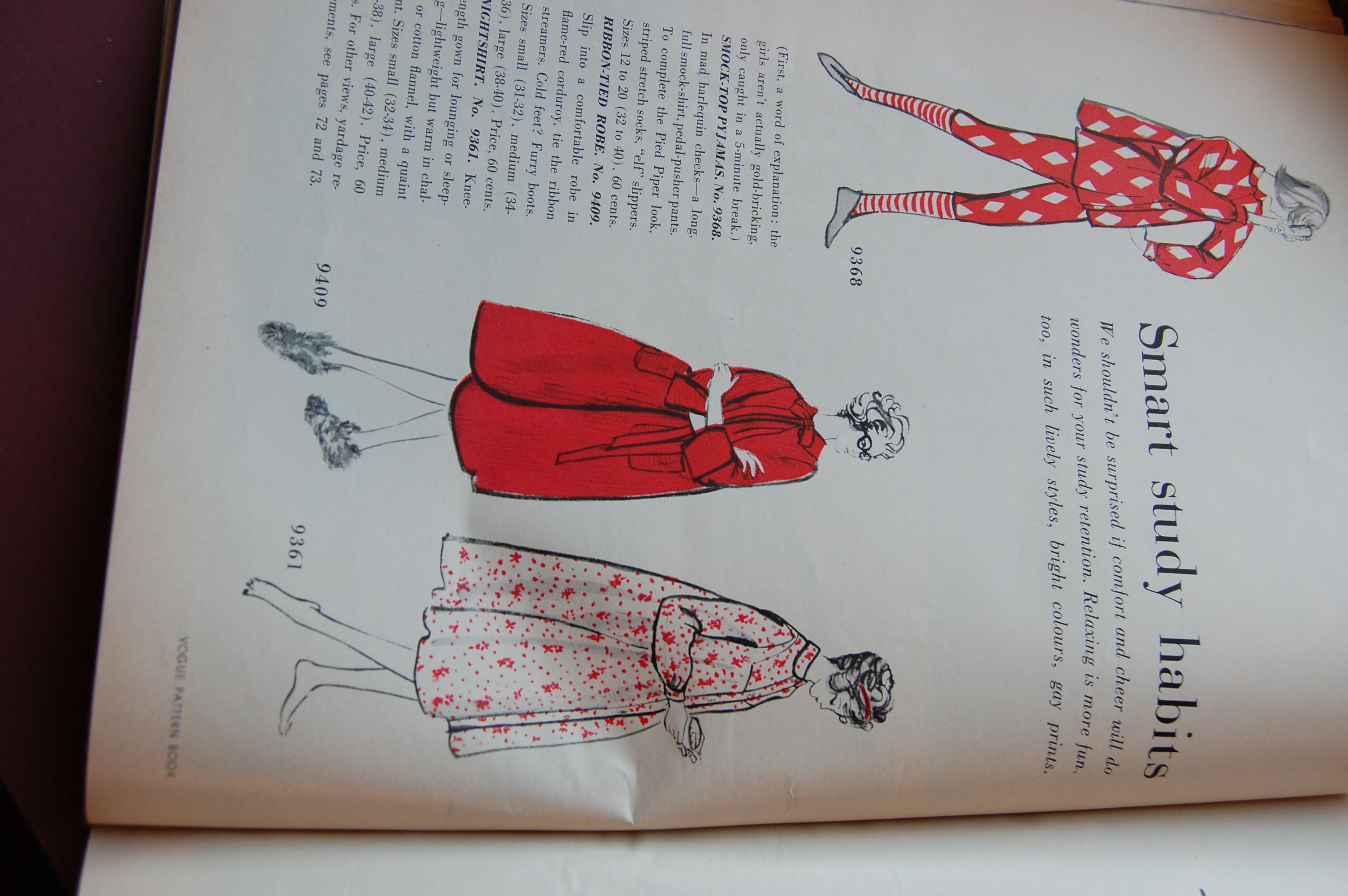
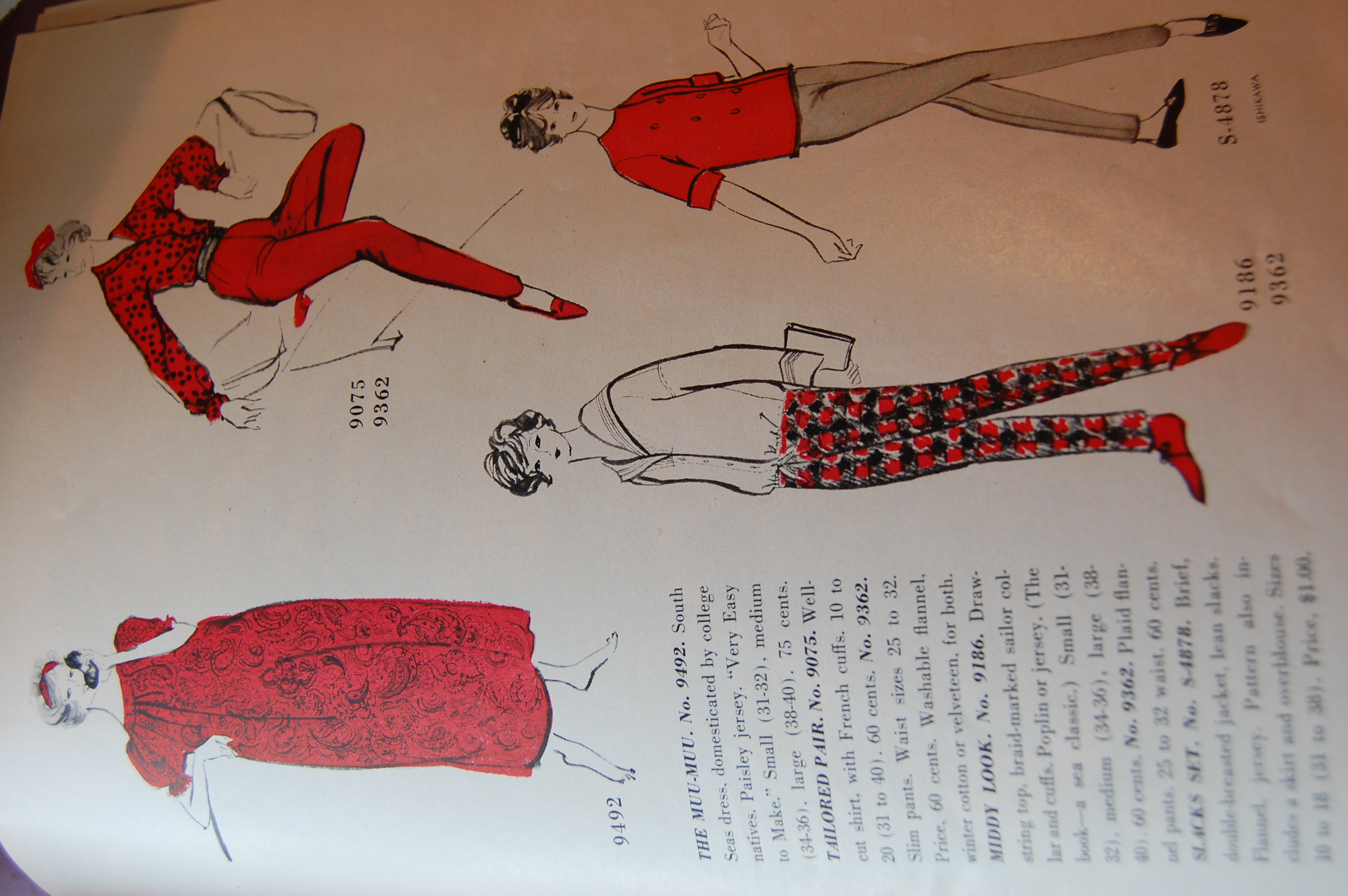
These “coeds”, according to the editors of the August/September issue of 1958, were taking a 5-minute study break to model these dorm fashions!

The girl in the harlequin pedal-pusher pants and smock-top looks to me like she’s actually taking a break from her part-time job with the circus, while Miss Muu-Muu is  — chatting on the phone!   Some things never change, just like the timeless appeal of RED.

5 Comments

Filed under Blouse patterns from the 1950's, Coats, Polka dots, The Conde Nast Publications, Uncategorized, vintage Vogue patterns from the 1950s, vintage Vogue patterns from the 1960s

Messages from the past: handwritten notes on vintage patterns

Many vintage patterns have a visible stamp on them which tells the name of the store where it was originally purchased.  (Those of us who sew know that patterns, once purchased, are non-returnable – and it seems it was ever so…)  Sometimes the stamp also lists the location of the store, but not always.  Either way, that stamp is a visible clue to the pattern’s past life.

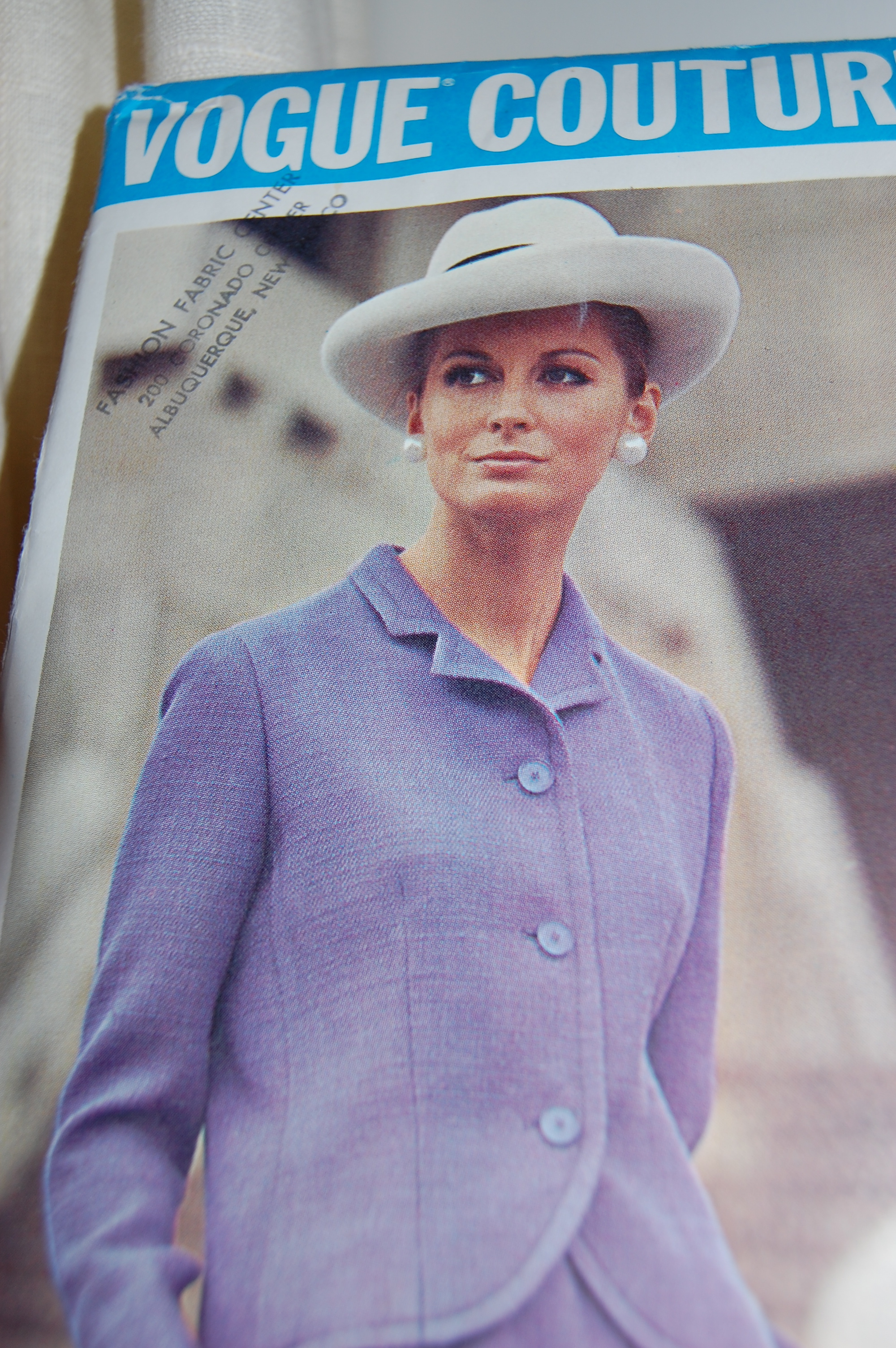
In the upper left hand corner, you can see the stamp for "Fashion Fabric Center" in Albuquerque, New Mexico. This pattern is from the early '70s.

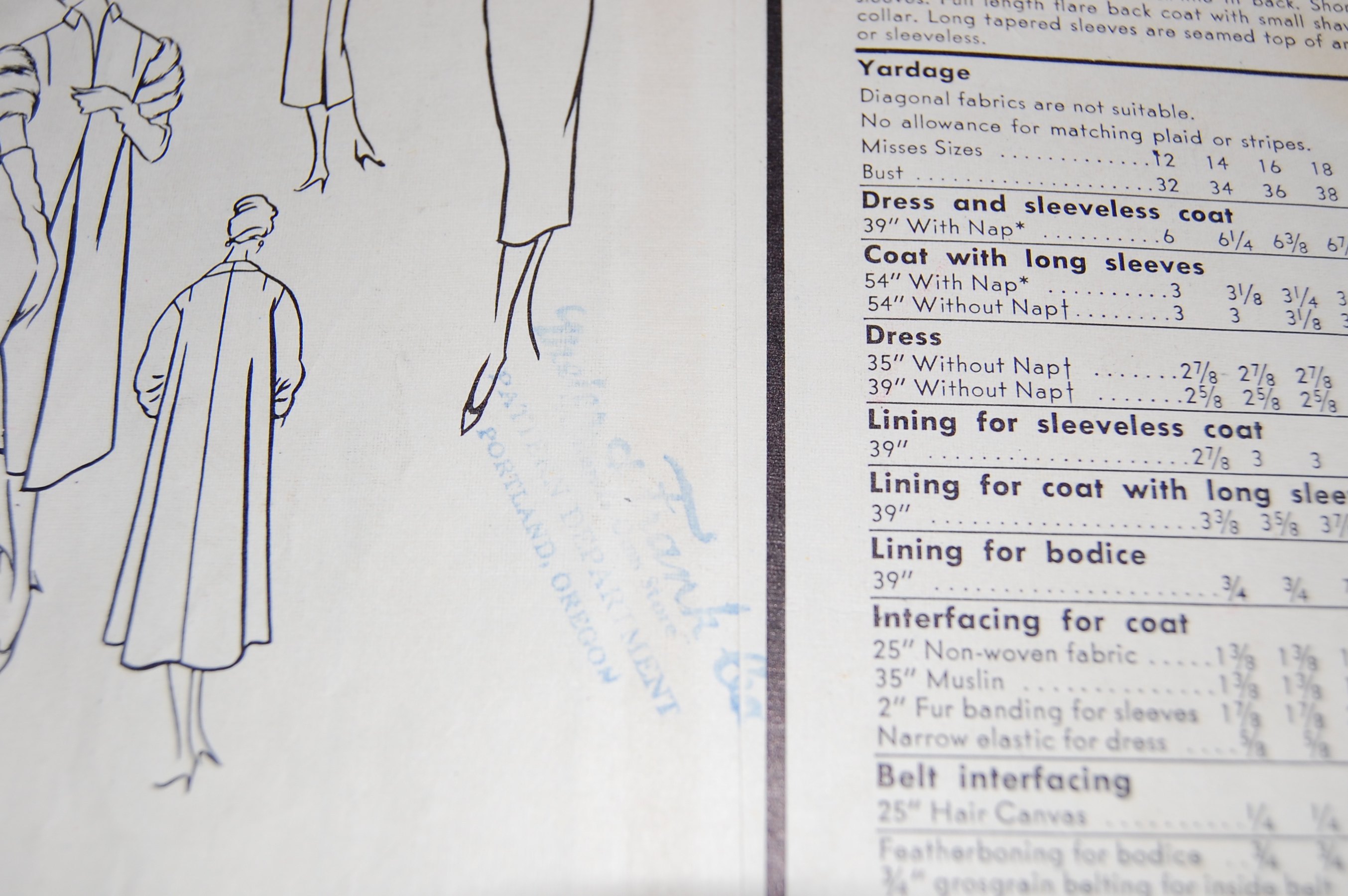
If you look closely, you can see the stamp on this envelope which tells you it was purchased from Meier & Frank Pattern Department, Portland, Oregon. This pattern is from the 1950s.

I can’t help but visualize a well-put-together woman perched on a stool at the pattern counter of the mentioned store,  thoughtfully flipping through the pages of the Vogue Pattern catalogue, and finally settling on this one pattern.  I wonder what occasion, if any, she was making it for?  Was she, like I was in the ‘60s and ‘70s, agonizing a bit over spending 75 cents or $1 or $3 or $5 for just a pattern, and then loving it once the decision was made?  Was she buying it to make it herself or in coordination with a dressmaker who would be the one to create it for her?  What fabric and color was she intending for the pattern?  Or did she buy the pattern and then, for one reason or another, never make the intended garment?

And then, every once in a while, there is a handwritten note or diagram on a pattern envelope.

These jottings, sometimes cryptic, other times precise, provide clues which begin to answer some of those questions.  In the months I have been buying vintage patterns, I have found myself privy to some of these “messages” from the past – and here are the small stories they tell:

Fit seems to be an important focus.  Kudos to those dressmakers who recorded their difficulties on the pattern envelope!

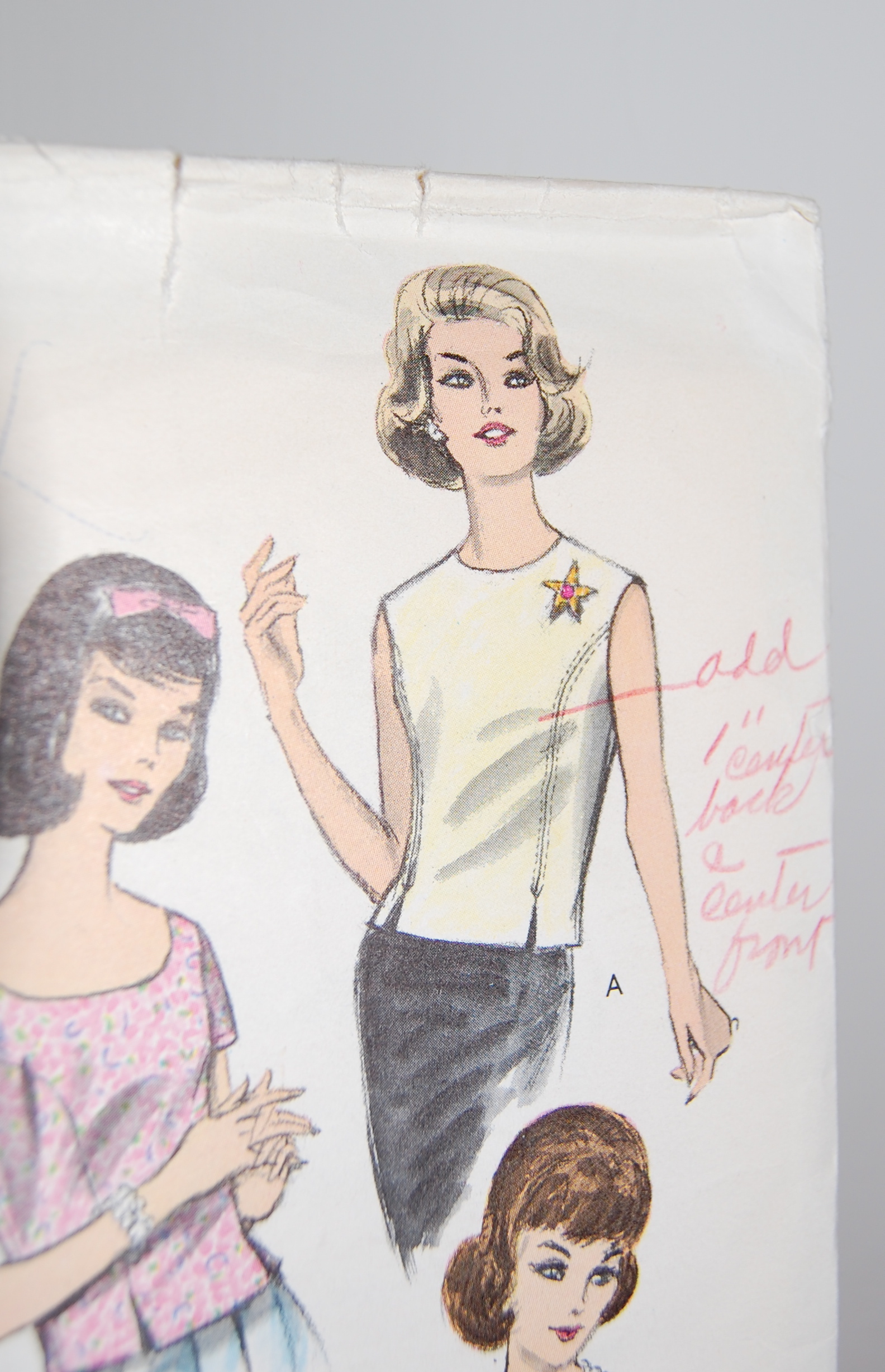
I think this lady should have purchased a larger size! She needed to add 1" center front and center back!

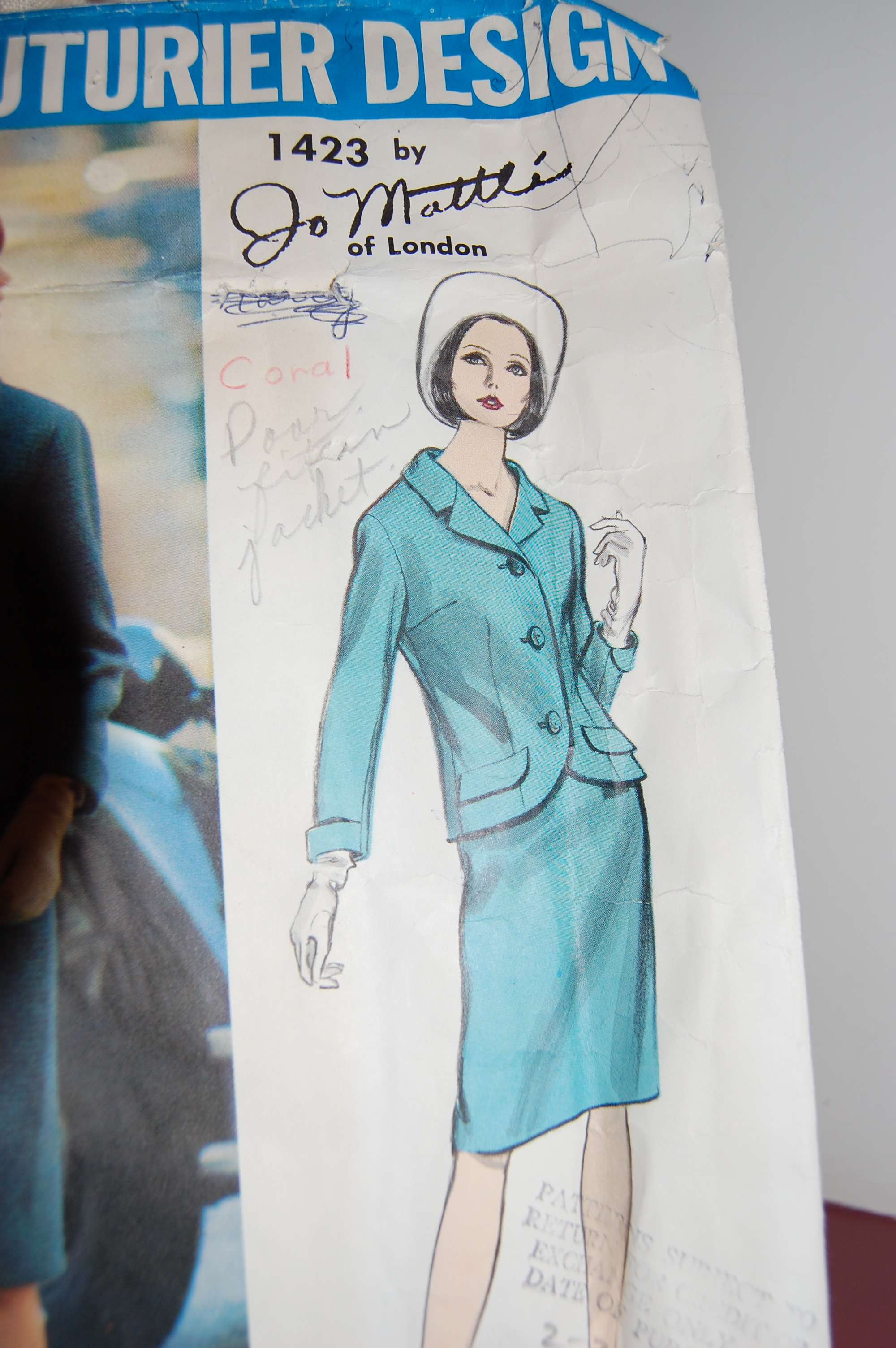
Beware! Poor fit in jacket! But I bet it was lovely in coral nonetheless.

Check out this listing on Etsy to see a rather melancholy note about fit:  “would have been best to have gotten the med. size.”  I guess that pattern ran large!

Choice of fabric and color (see above image) are also details which have been noted, sometimes multiple times on the same envelope.

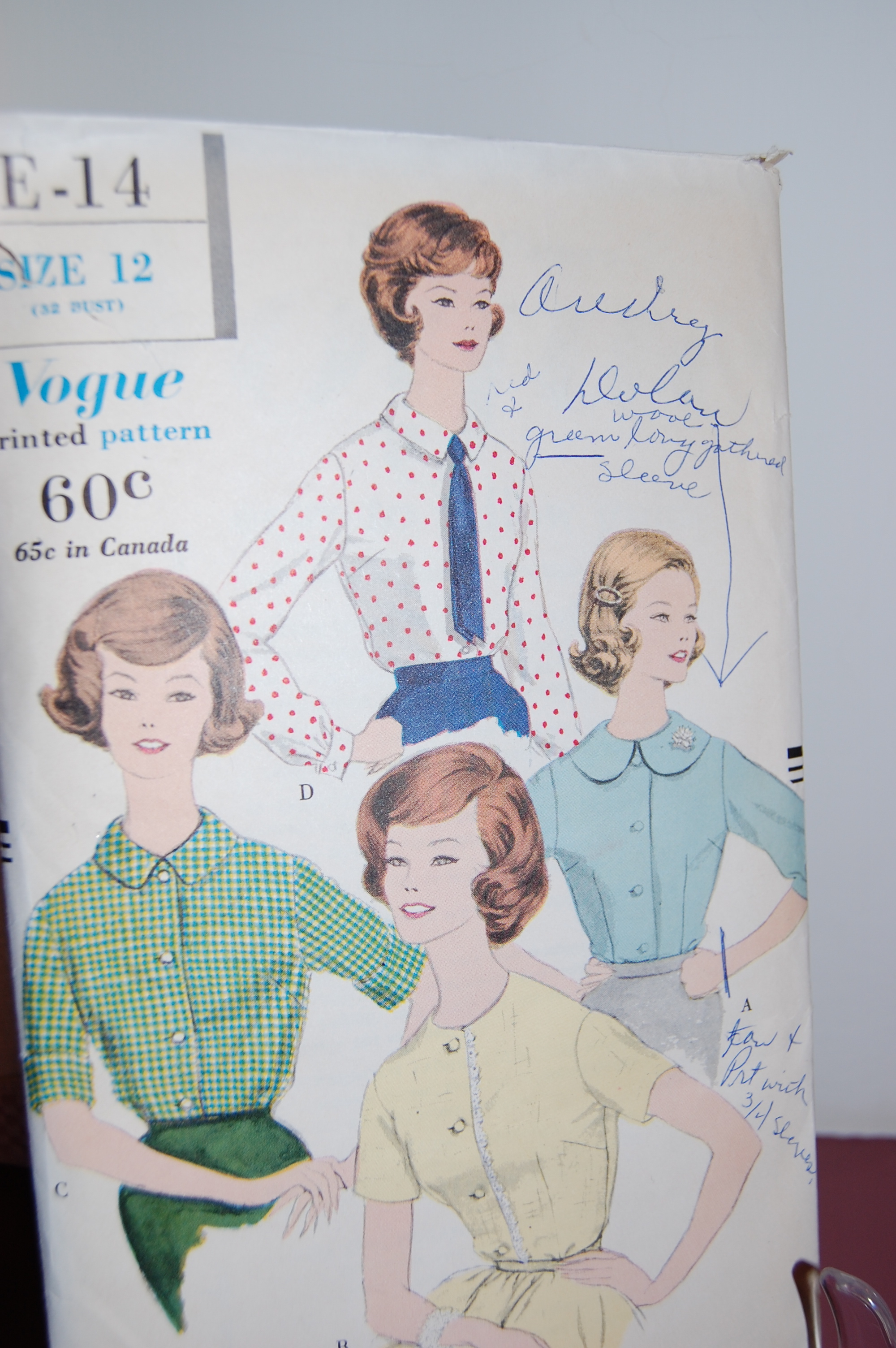
I think this pattern must have belonged to a professional dressmaker. She made it up in red and green wool for Audrey Dolan, with long gathered sleeves. It looks like she also made it in tan and in a print (Prt) with 3/4 sleeves. The pattern tissue is still in great condition, despite all that pinning and cutting!

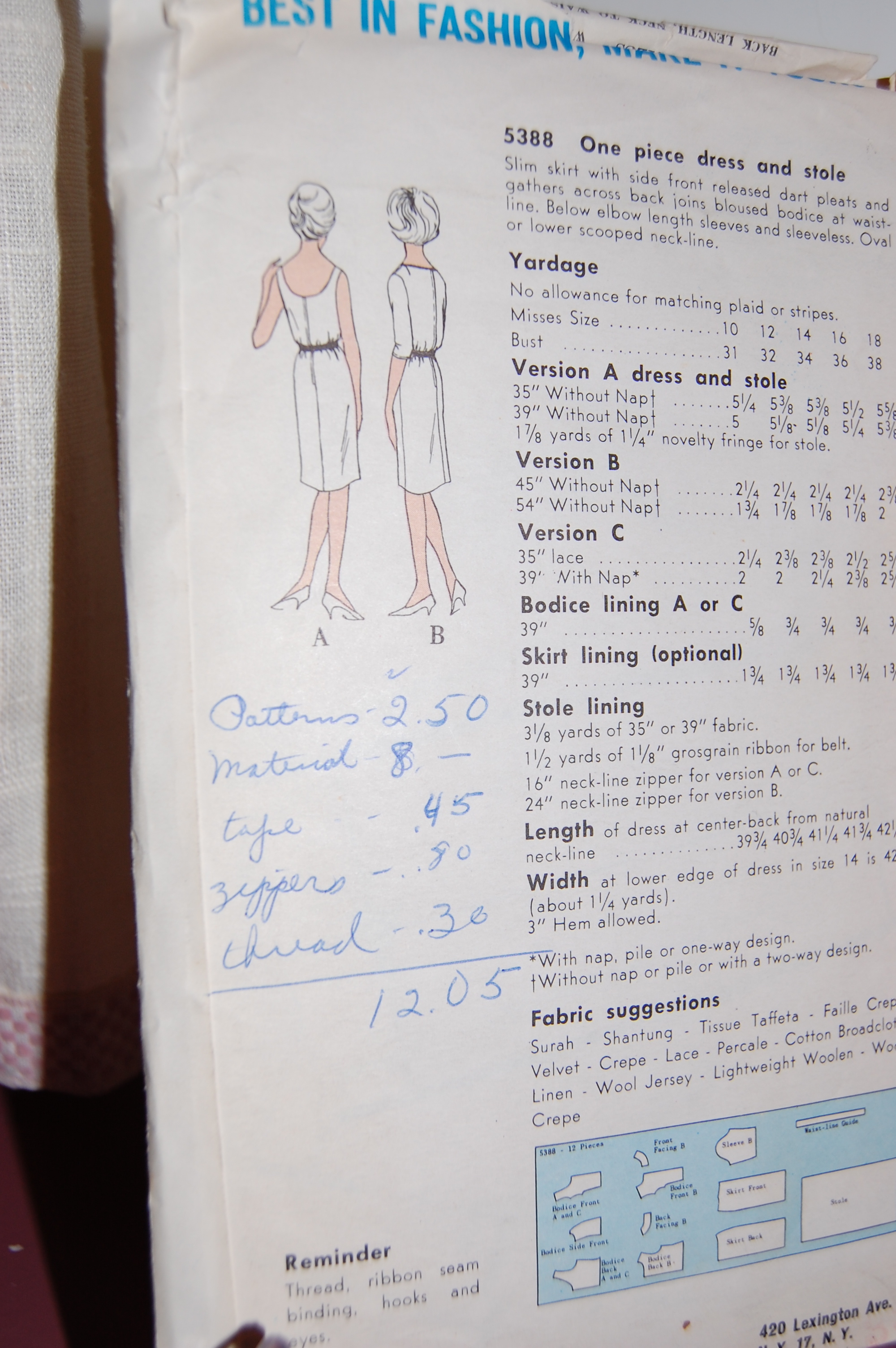
This pattern obviously belonged to a lady who was either a dressmaker, noting her expenses, or a home sewer who kept careful records for her household/clothing budget.

This lady must have made this dress in coordination with another pattern. Both patterns together cost her $2.50. She was also buying multiple zippers, to the tune of 80 cents! Her big expenditure was fabric (material), which she lists at $8.00.

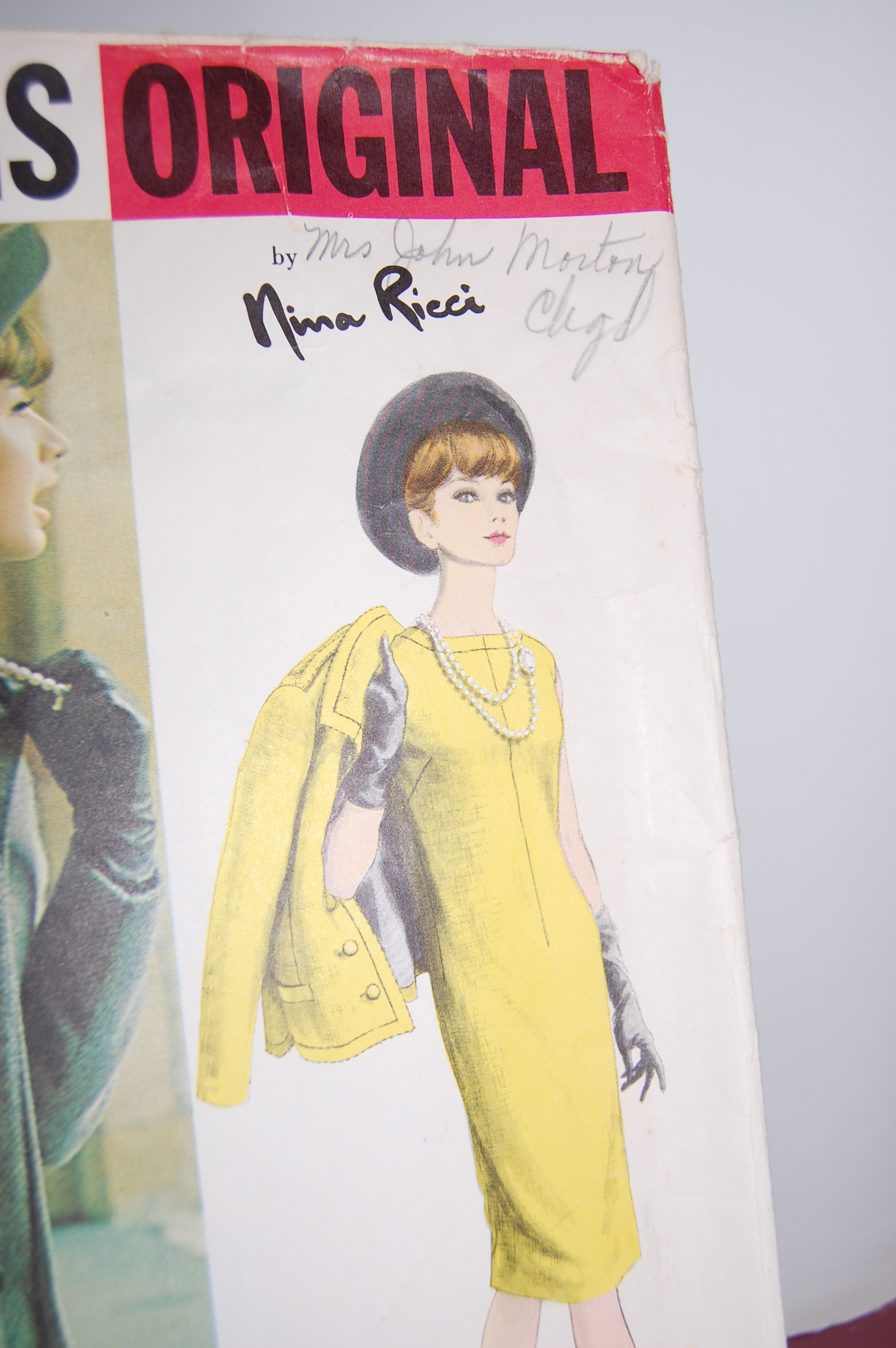
And here is a pattern which Mrs. John Morton “Chgd” [Charged]  Perhaps she did not have to be as careful with her expenditures!

I think Mrs. John Morton was one stylish lady!

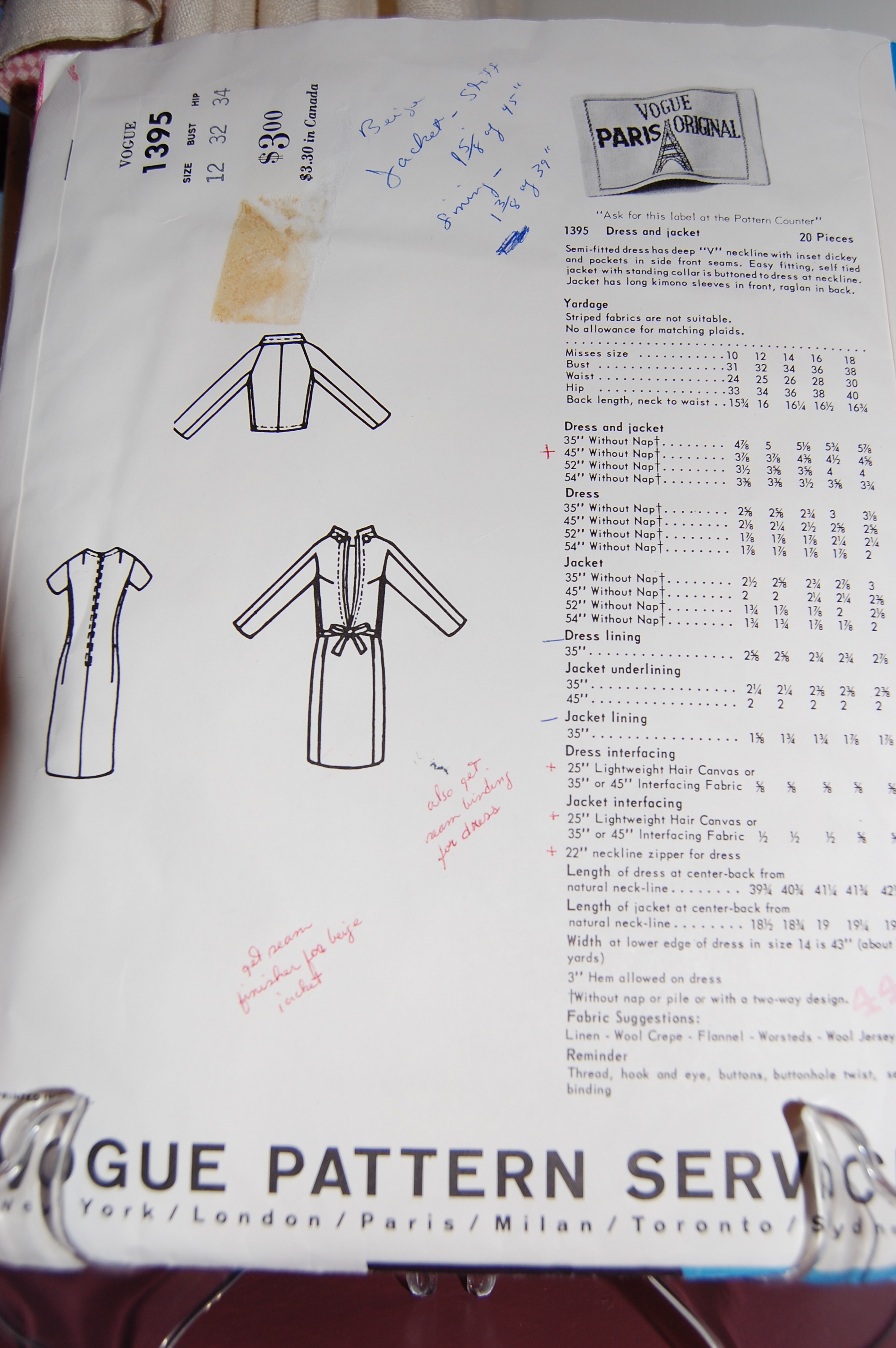
This next pattern is a study in contradictions:  The owner has carefully noted some yardage requirements, written notes to remind herself to “get seam finisher for beige jacket” and “also get seam binding for dress”.  But the pattern came to me uncut, factory-folded and therefore unused, with its original Vogue label included.  I wonder what prevented her from ever making this lovely jacket and dress?

We know she intended to make the jacket in beige, but she doesn't tell us about her color choice for the dress!

Next, it’s always fun to see someone’s intended changes to the line or details of the pattern.  Here are two examples:

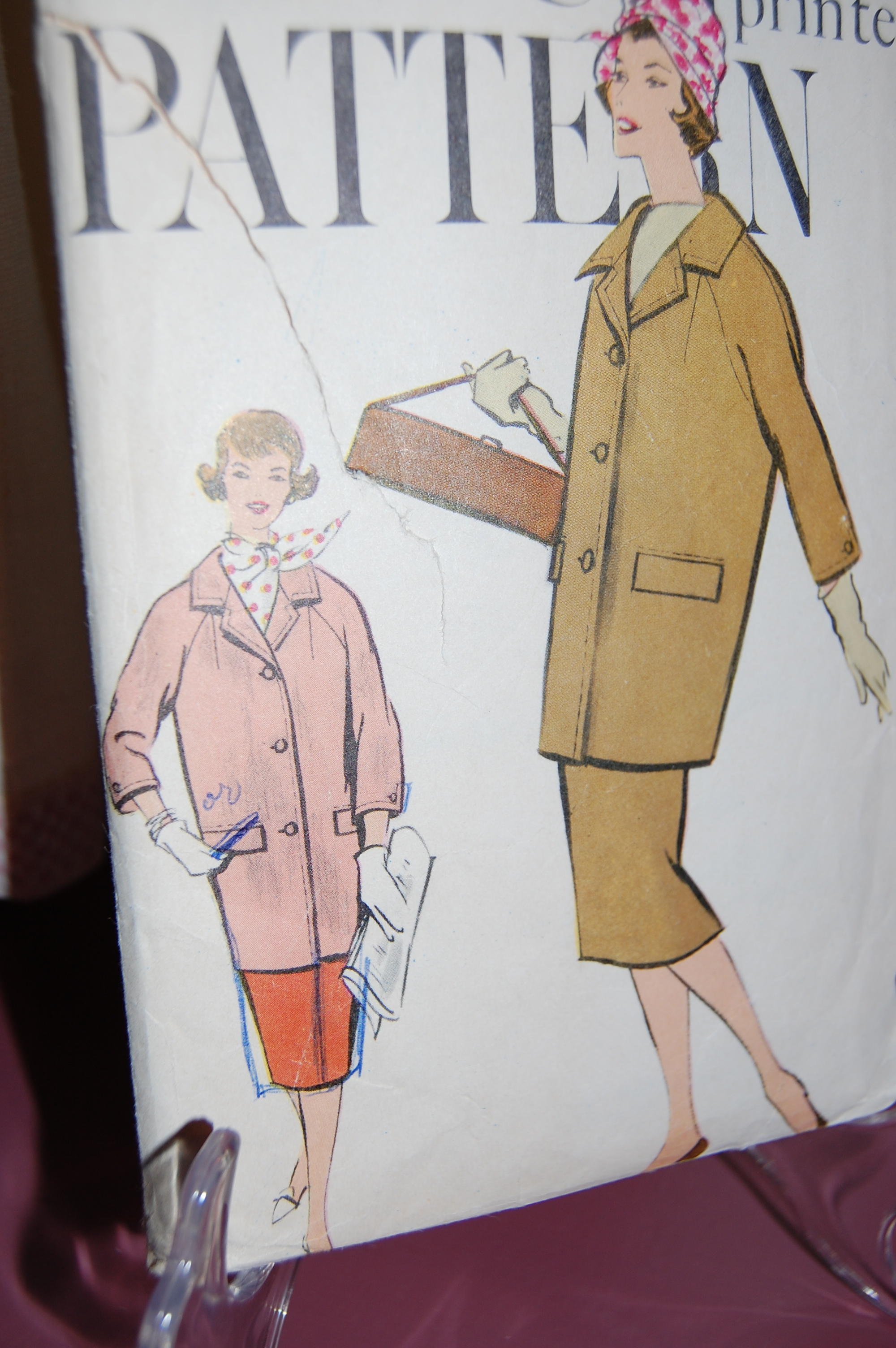
View A on the far left just did not suit this sewer. She wants to extend the length of the coat, and add the collar. What she is really saying is that she wants to make view B, but with top-stitching!

It seems lengthening coats was a popular thing to do! This lady drew the longer version of the coat (on the left) and was still deciding on making the pockets "slash" pockets instead of flap pockets!

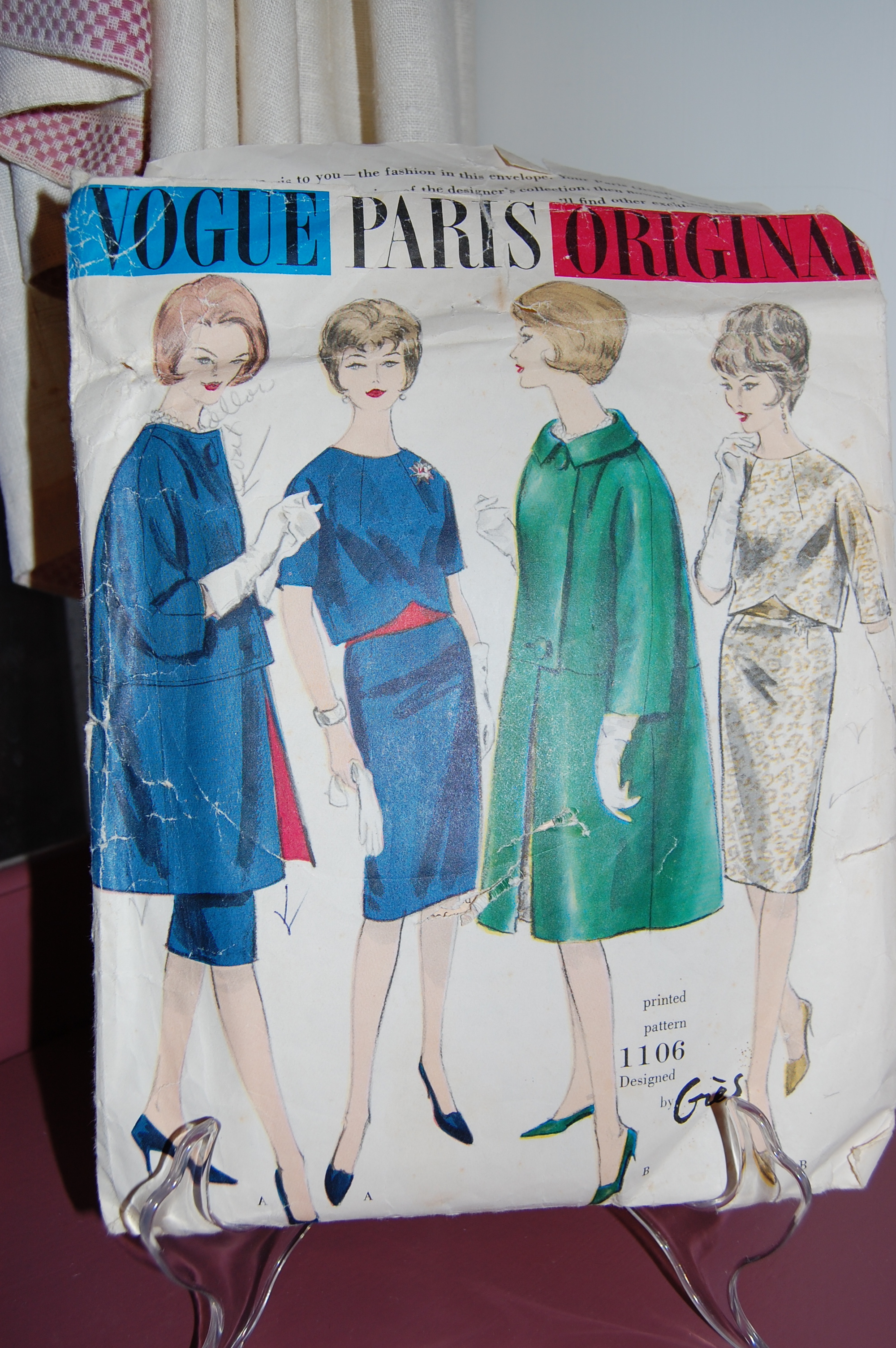
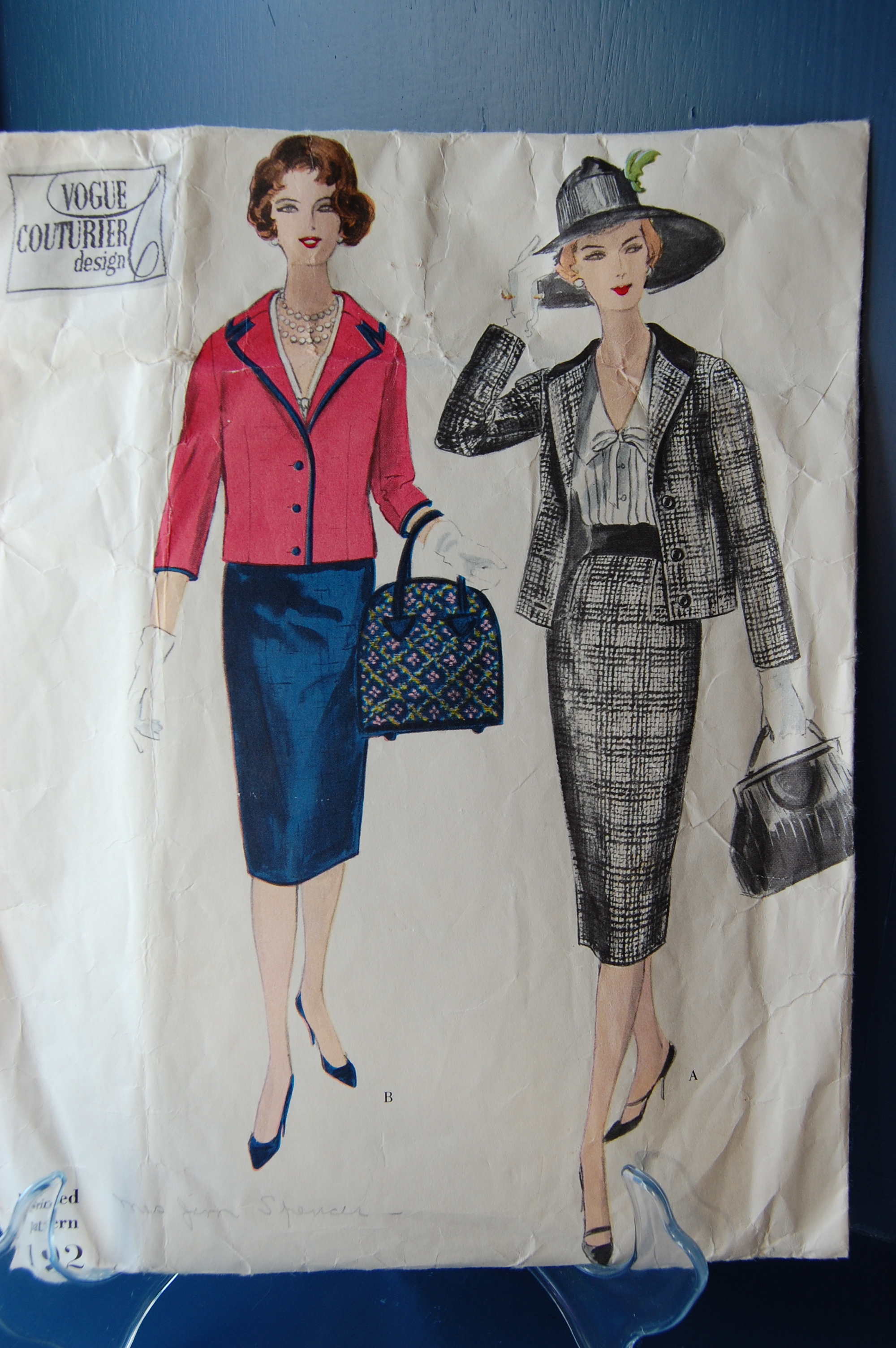
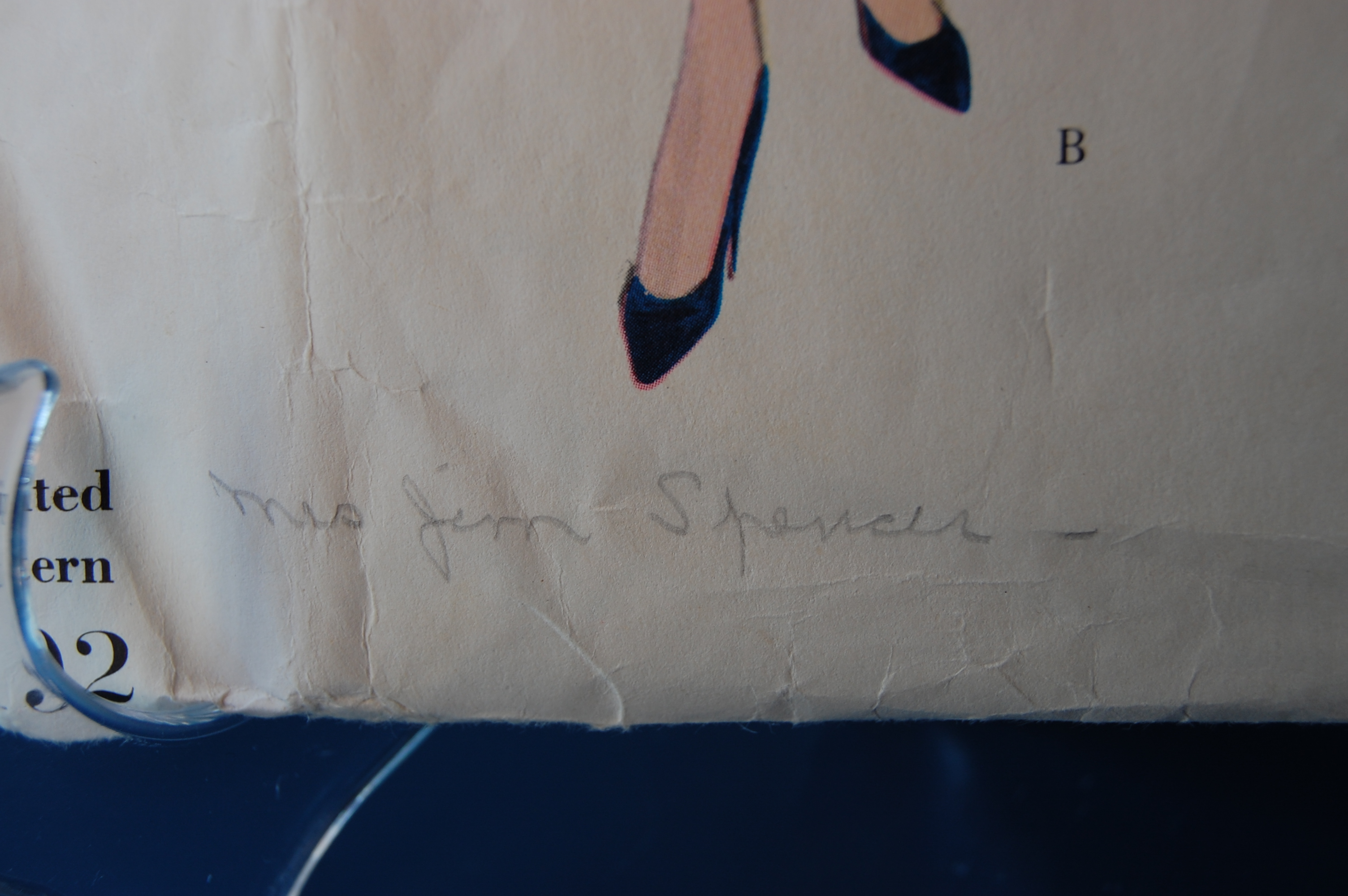
Finally, sometimes all that is on a pattern envelope is a name – a simple notation, which quietly transcends the years!

Look below the figure in red and blue for the name written in pencil.

Here is a close-up of the signature. This pattern belonged to Mrs. Jim Spencer.

Mrs. Jim Spencer, I bet you looked fabulous in this suit!

7 Comments

Filed under Coats, Dressmaker details, Uncategorized, vintage Vogue patterns from the 1960s, vintage Vogue patterns from the 1970s, Vogue patterns

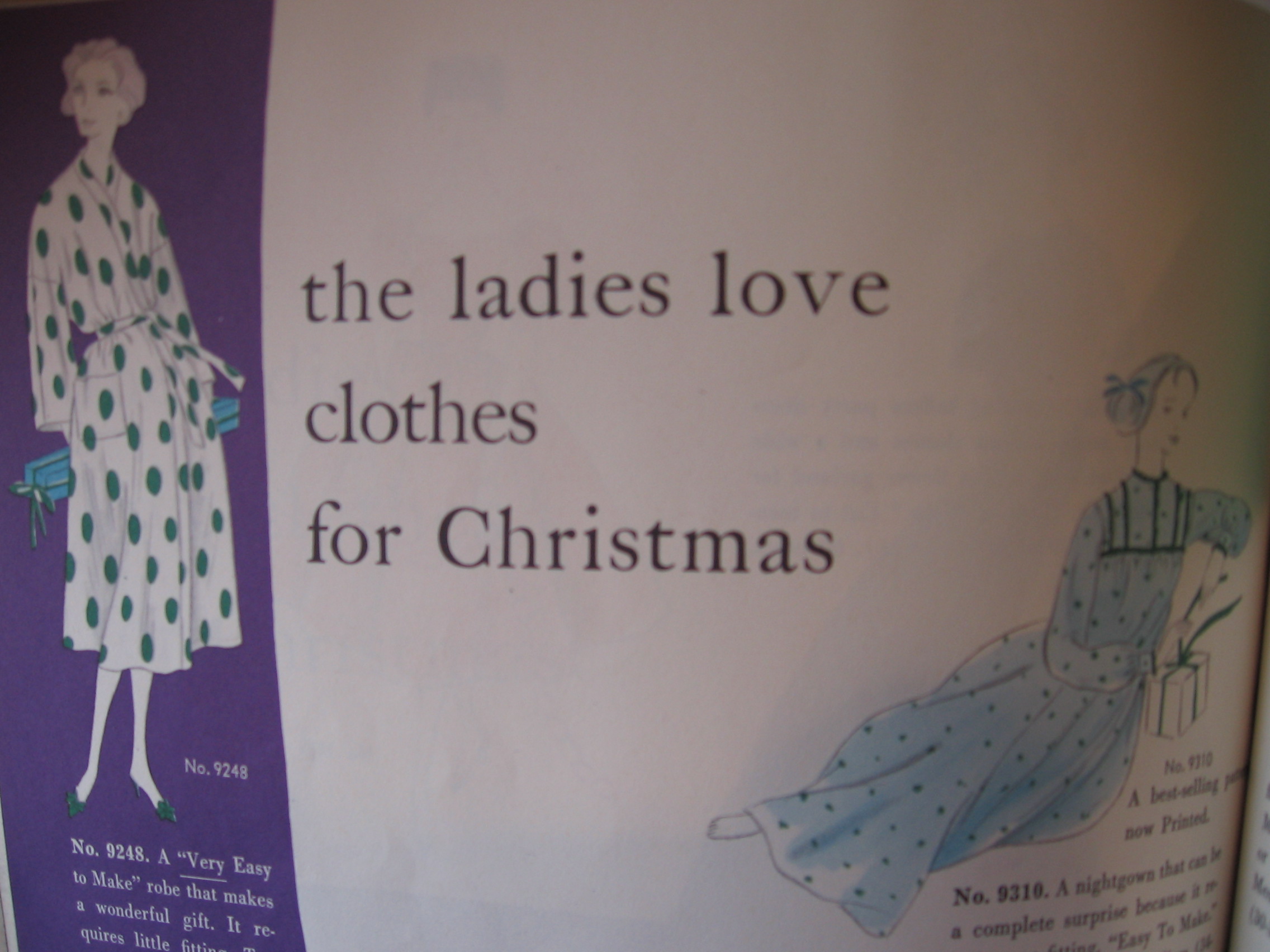
Clothes for Christmas

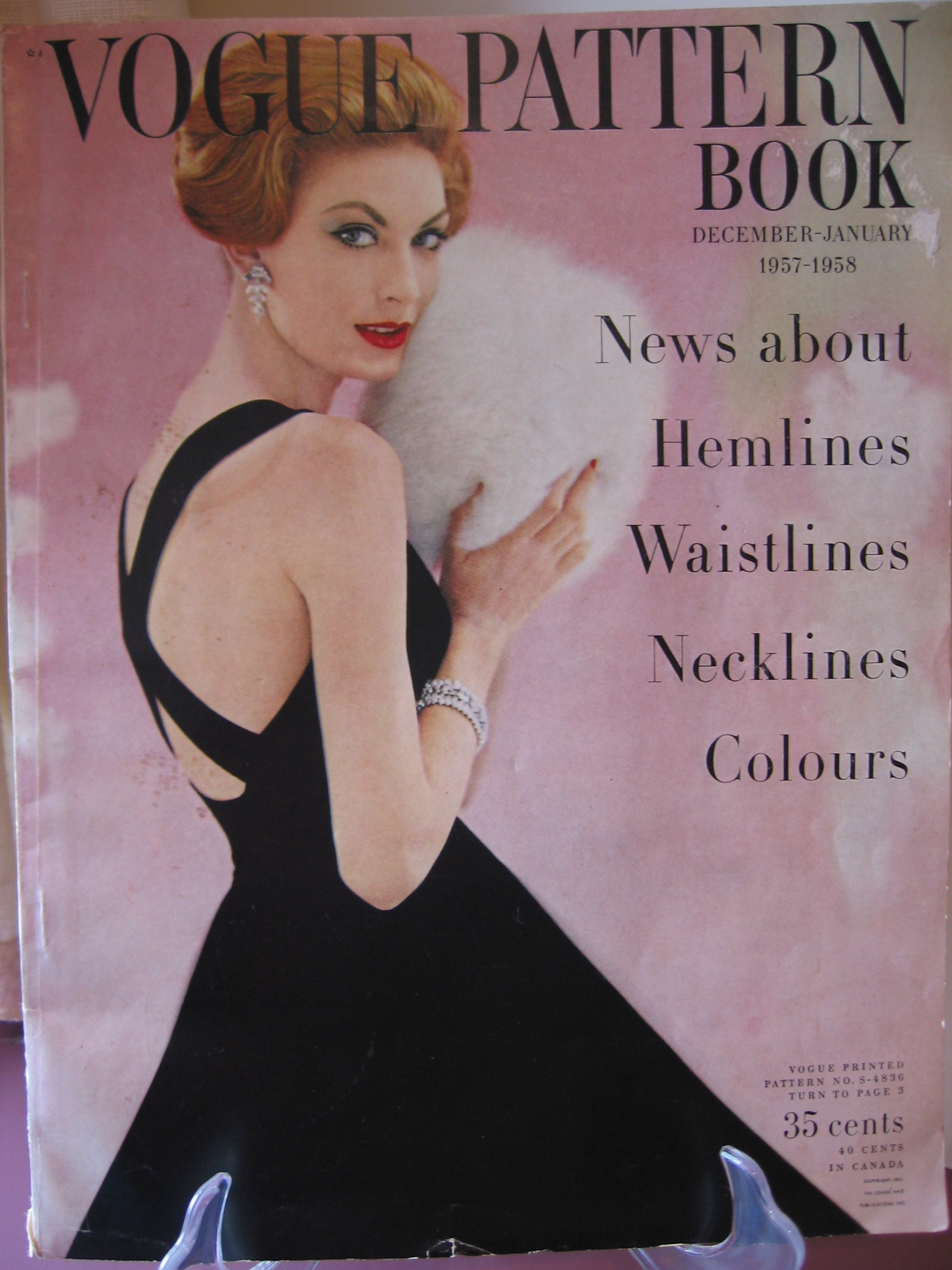
Another part of the world of vintage patterns, which is now available thanks to the Internet, are old copies of the Vogue Pattern Book magazine.   Published 6 times a year by The Conde Nast Publications, Inc., this magazine featured current and up and coming Vogue patterns, articles on construction and notions, a “question and answer” section,  news on just about anything having to do with personal sewing, and wonderful ads for fabric and sewing machines.  (By the way, it’s still published 6 times a year!)  I’ve been able to purchase a few issues from varying months and years, and sometimes I find a pattern featured which I have already bought on eBay or Etsy.   The December 1957/January1958 issue, which I recently obtained, devotes 8 pages to “The Ladies Love Clothes for Christmas.”

Here is the cover of the December 1957/January 1958 issue.

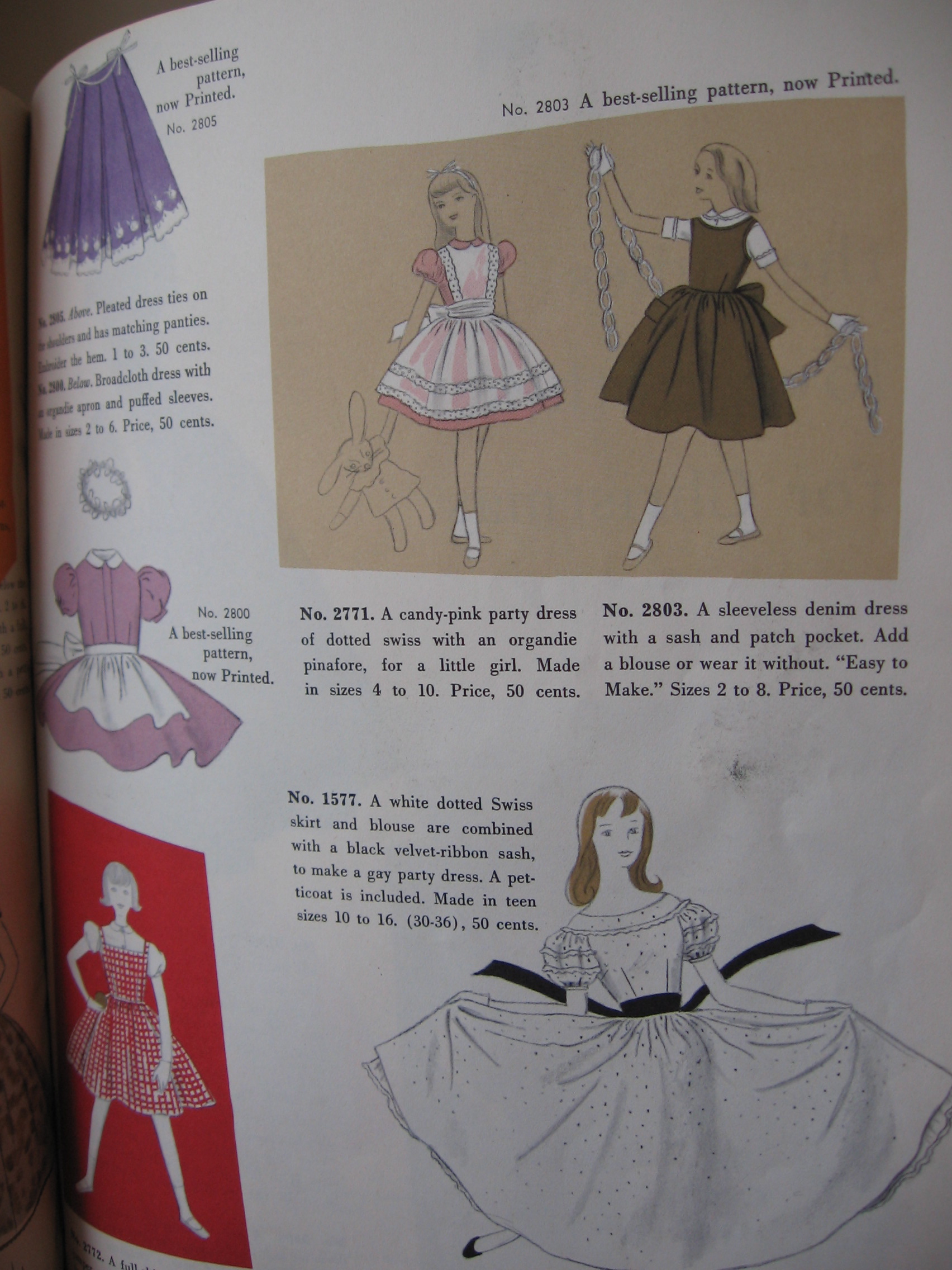
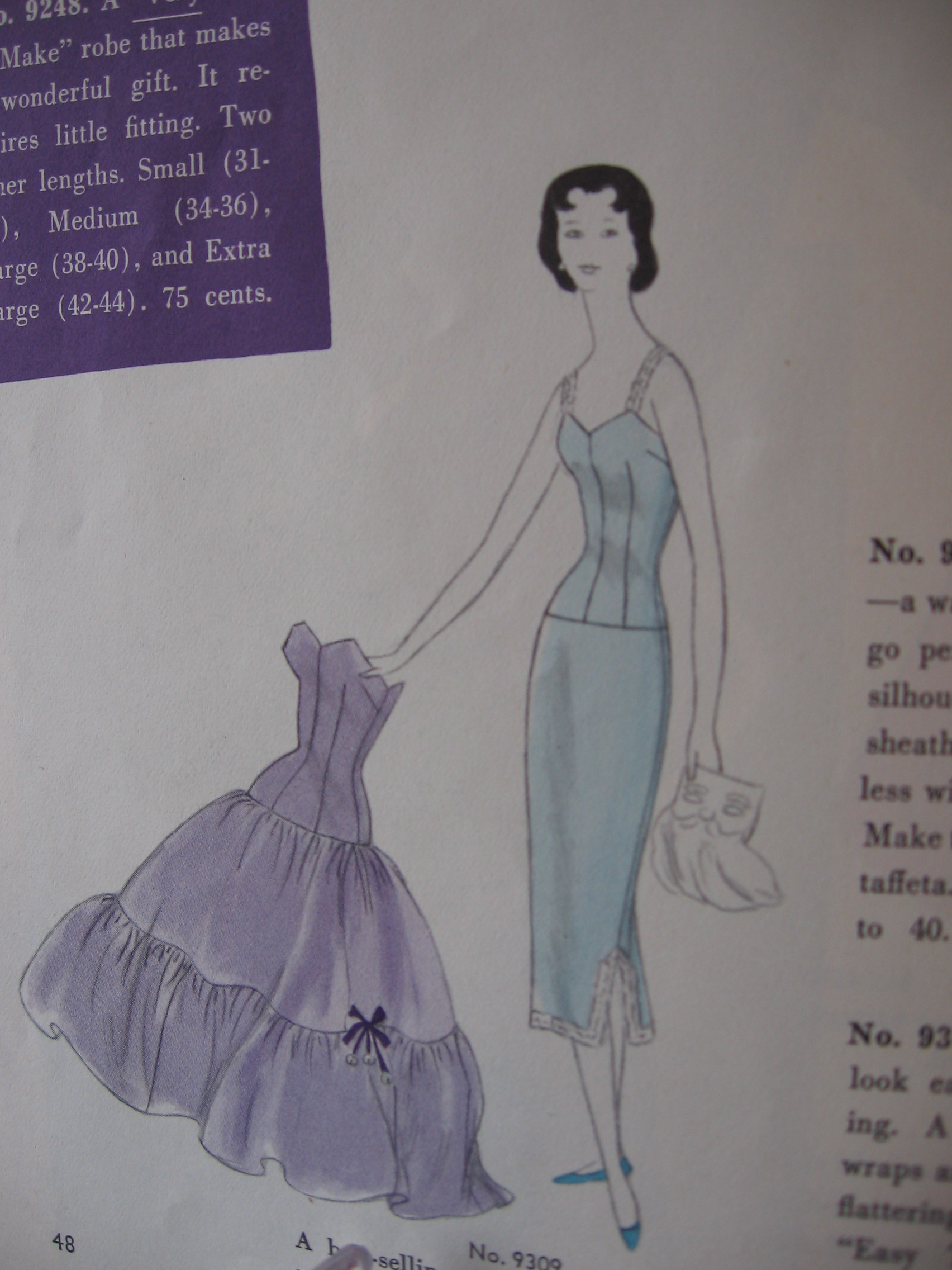
It features patterns for young girls and for teenagers; there is a section on lingerie and sleepwear; and finally some suggestions for the lady who presumably will be doing all this sewing!  Here is a sampling:

Suggested dresses to make for your little girl and one for your young teen.

There were patterns like this to make slips - for yourself or as a gift!

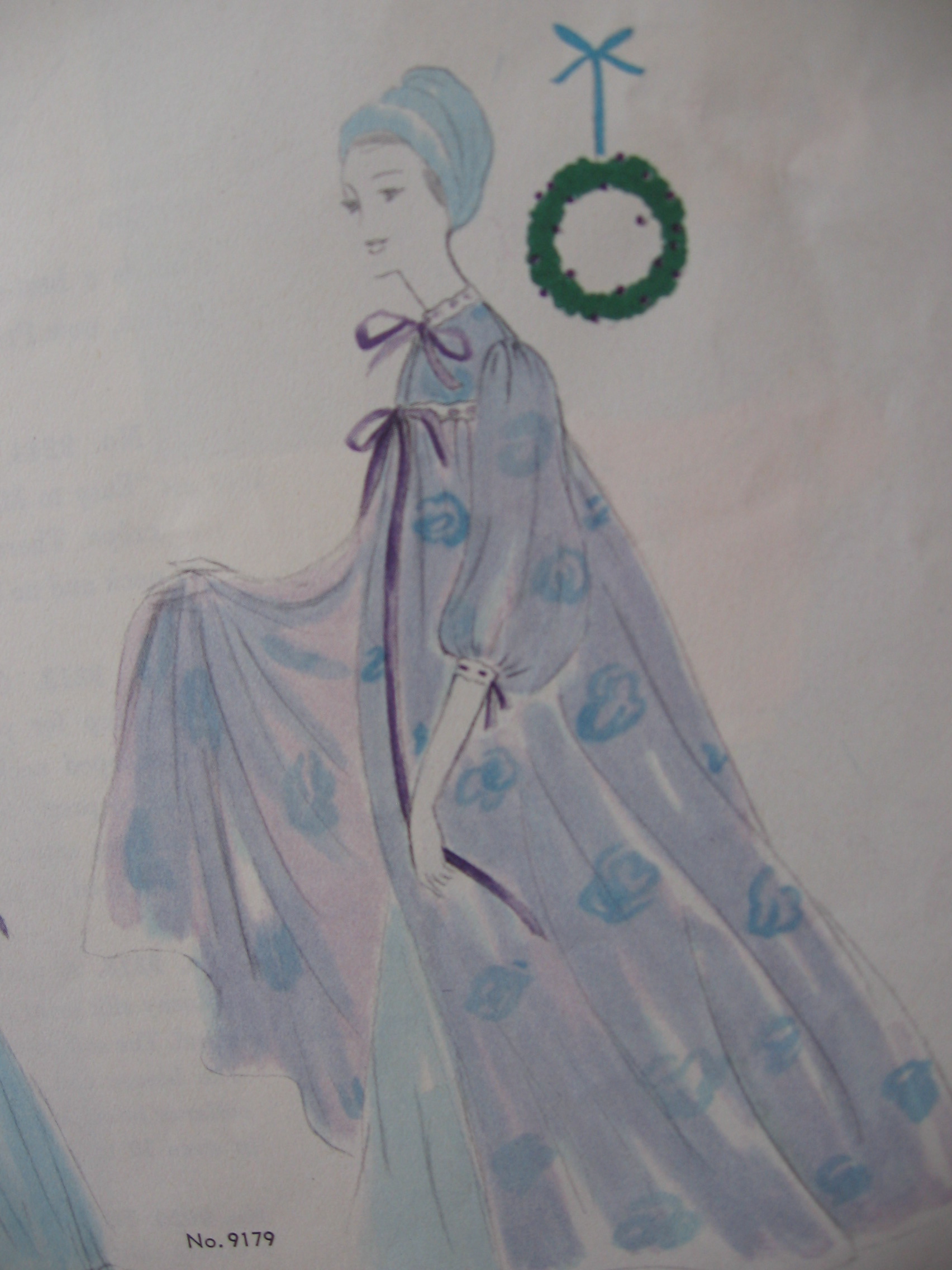
This billowy peignoir and matching nightgown would turn anyone into a vision on Christmas morning! The pattern cost 75 cents.

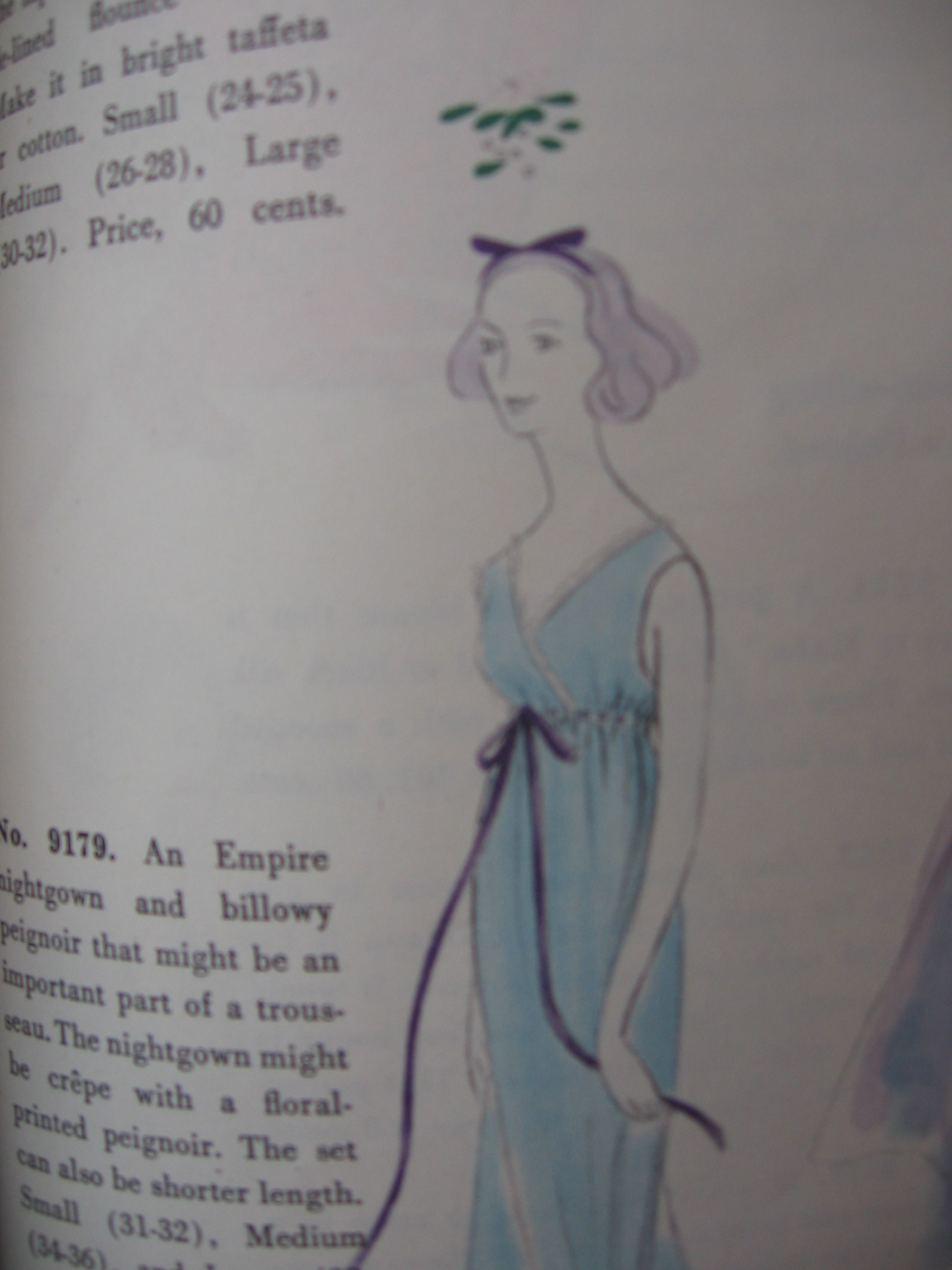
Here is the empire nightgown. I hope you can see that this lovely lady, now sans peignoir, is standing under the mistletoe!

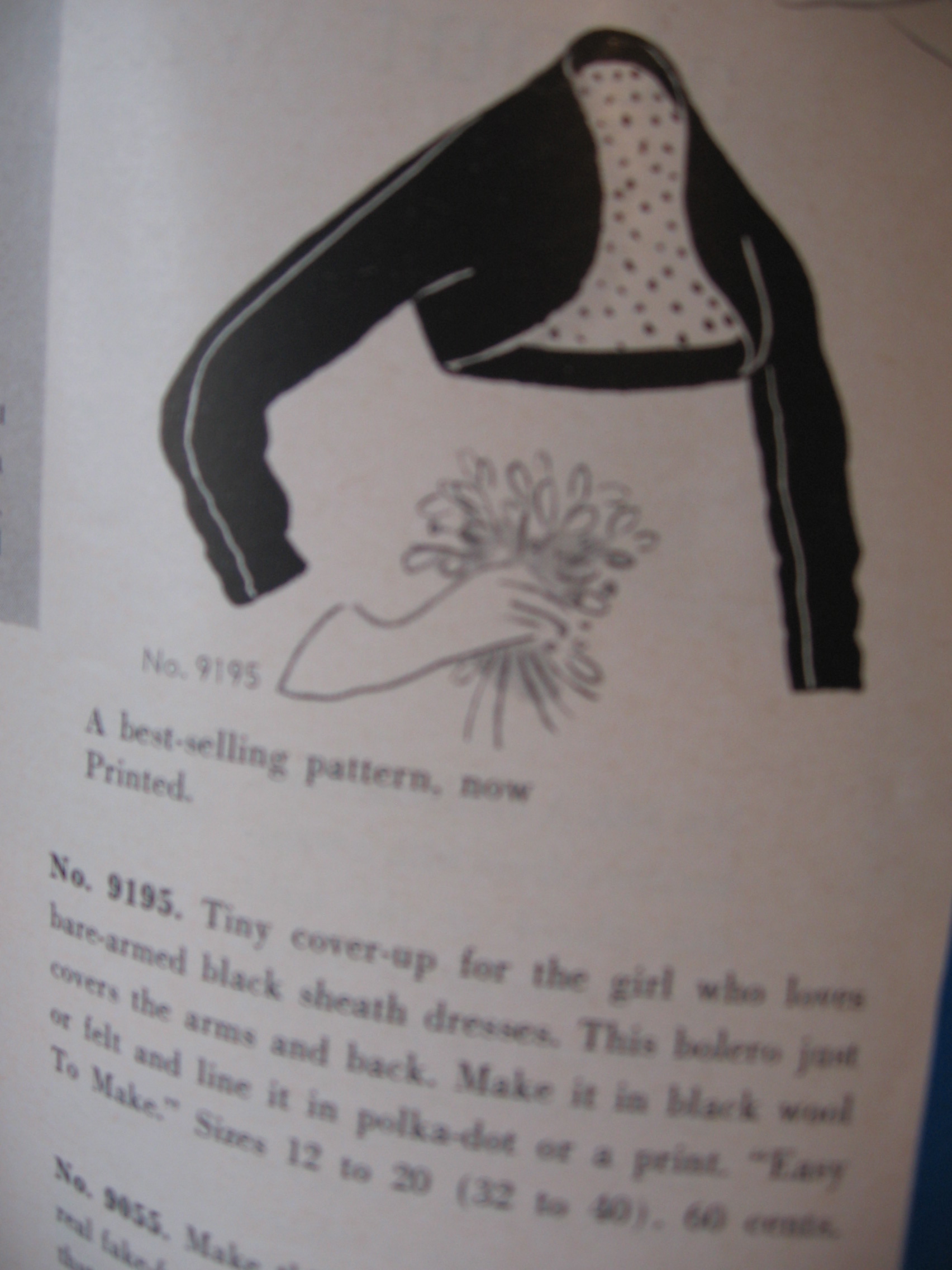
This bolero cover-up, lined in polka dots (no wonder I love this!), would be perfect on New Year's Eve.

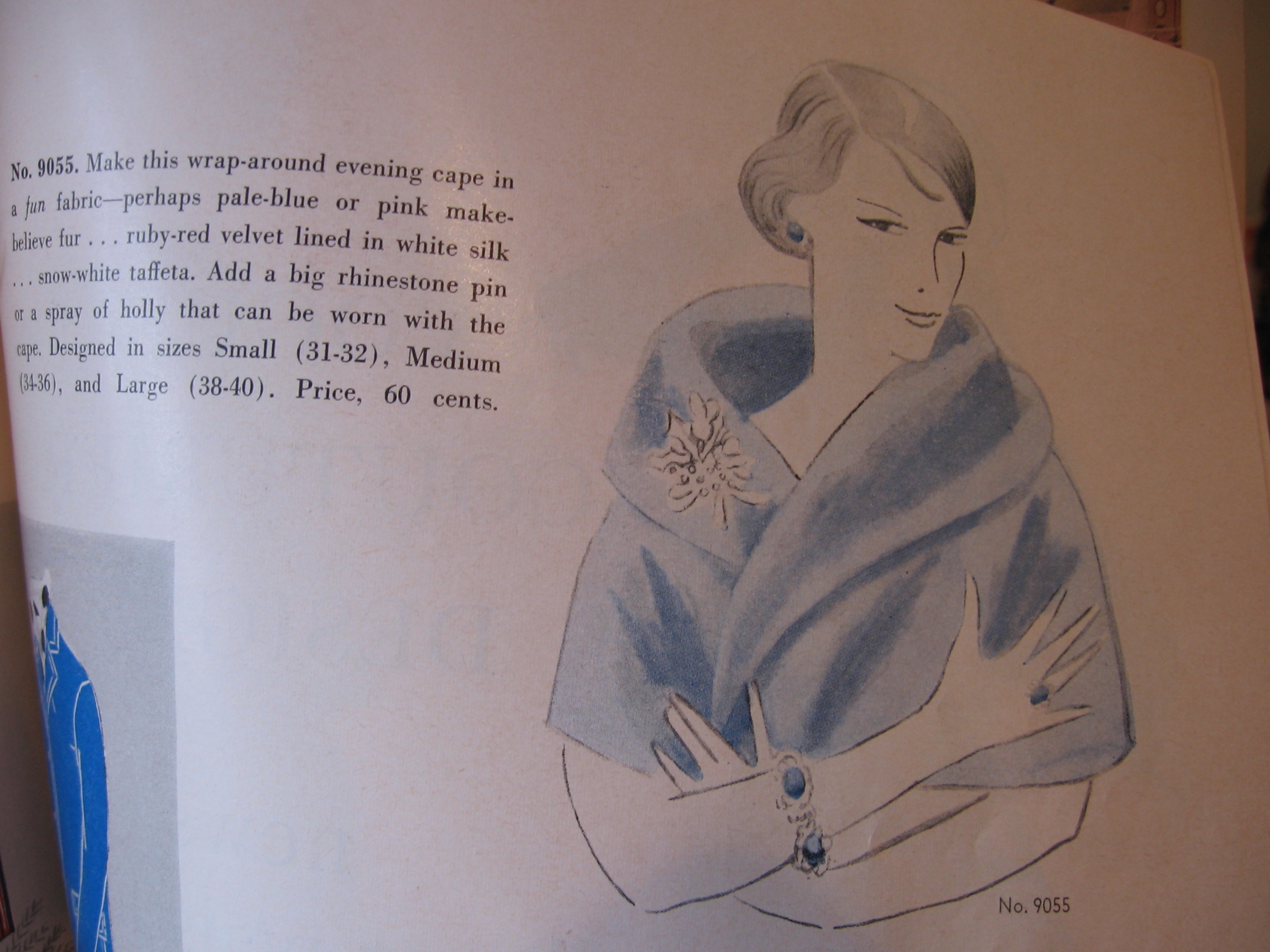
Or - if you are really in a festive mood, they suggest you make this cape in "ruby-red velvet lined in white silk."

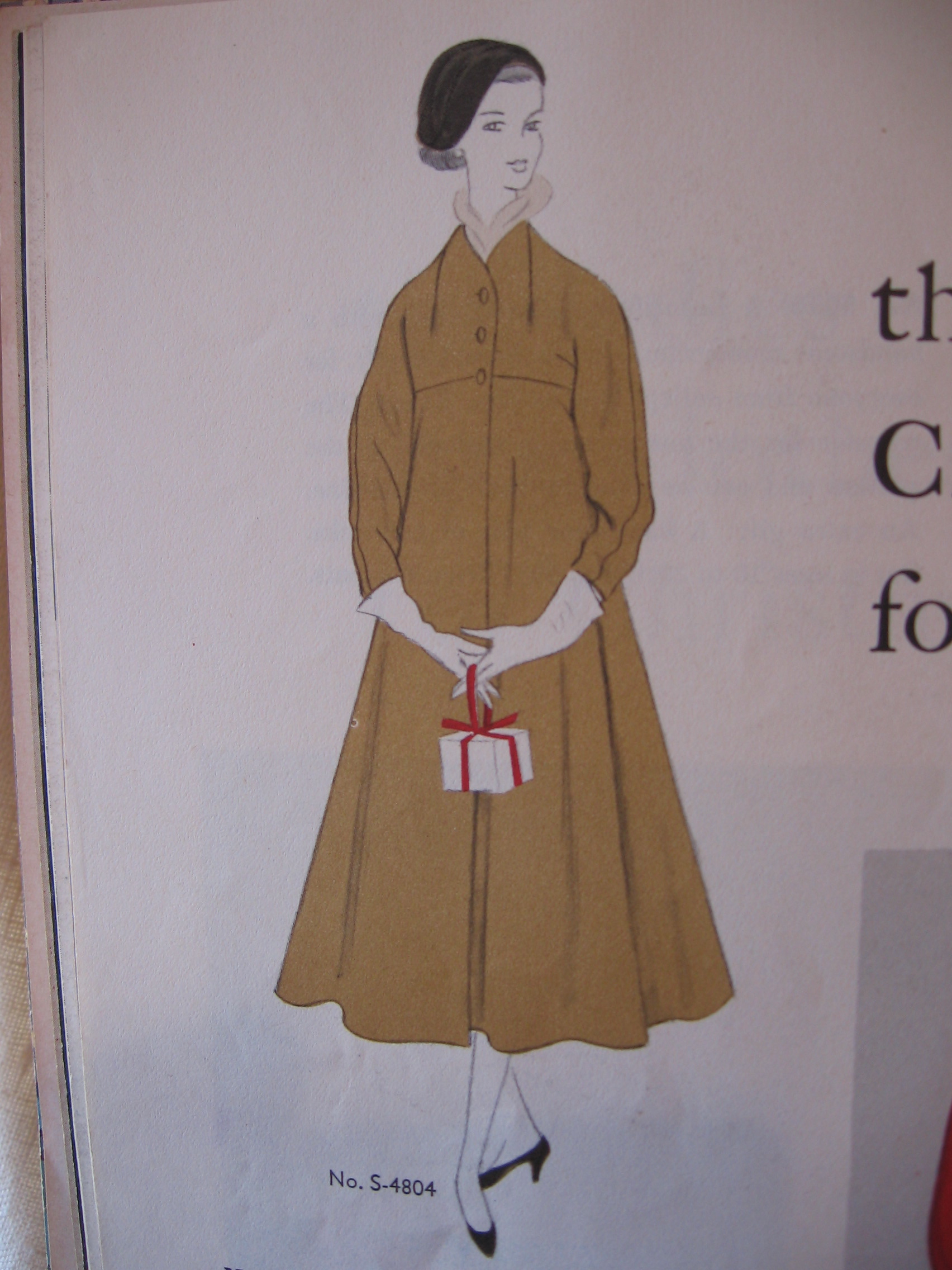
Here is my favorite suggestion, and I quote: "You might give this pattern and enough camel's hair wool to make this coat, to someone who loves to sew." The pattern was priced at $1.00

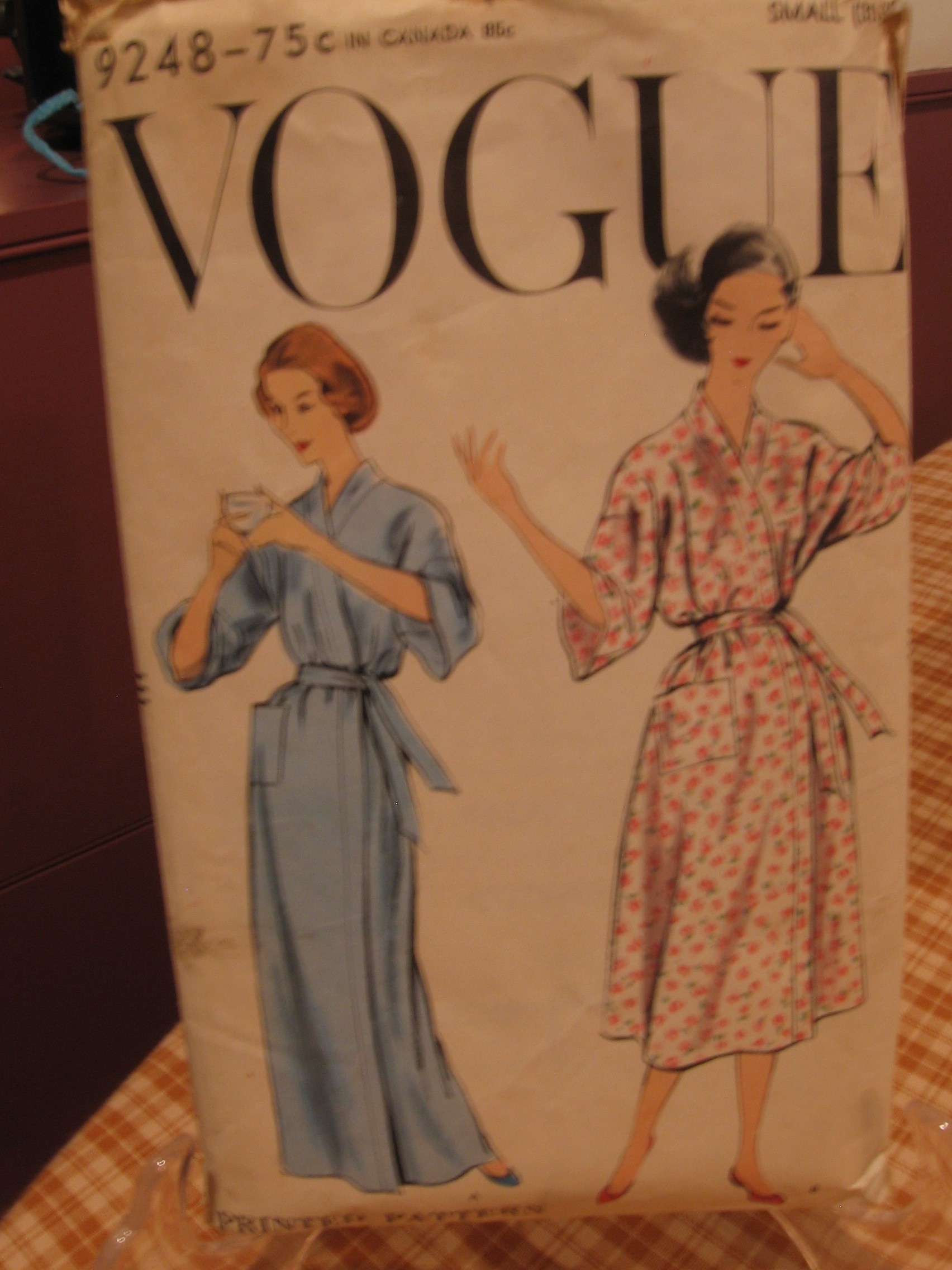
Here is another suggestion, next to a picture of its pattern envelope.

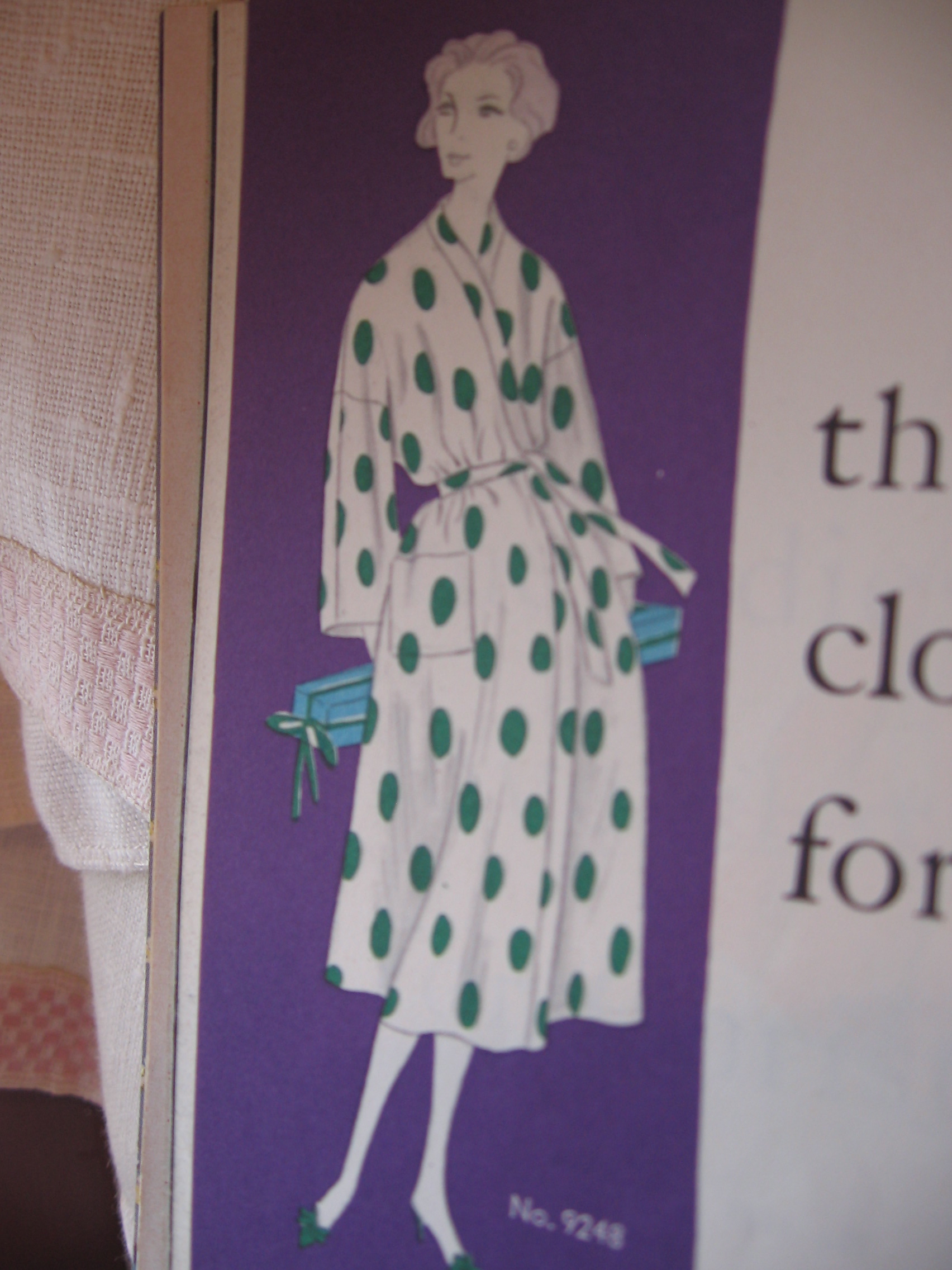
This robe is very easy to make! (I wonder what is in the long wrapped present she is holding behind her back? A rolling pin?)

This pattern makes up beautifully into an elegant robe! It has additional pattern pieces and instructions for lining it, as well.


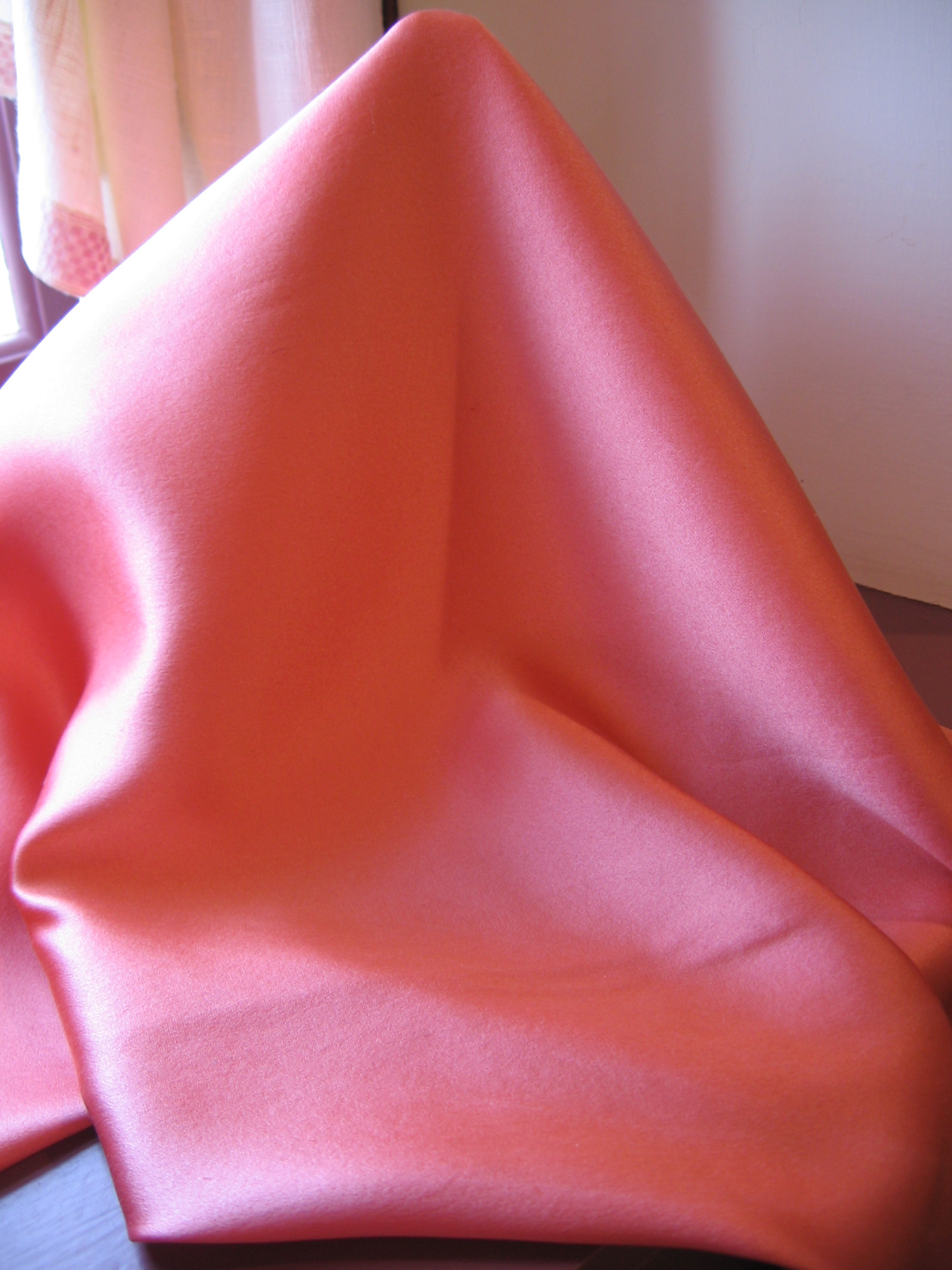
Yes, I purchased this pattern last Spring and have already made it up in the “lower calf” length.  Unfortunately, I did not take a photo of it before it went to its new owner, but here is a shot of a small bit of the silk charmeuse left over from this project.

This silk is really more orange-ish than it appears here. I washed and dried it before I cut it out, so that the finished garment would be washable - much more practical for a bathrobe!

The reason I am showing you this, is that last week, Pantone, the color guru of the fashion world, declared a color very close to this as its Color of the Year for 2012.    Specifically, that color is called Tangerine Tango and its number is 17-1463-TCX.

Personally, I have come to appreciate various shades of orange a lot more than I once did. I particularly like to see orange (or coral or tangerine or whatever name you want to give it) paired with hyacinth blue or leaf green or charcoal gray.  Although I am not one to feel like I need to be dressed in the current “fad” color, if I get the opportunity to use it in my sewing this coming year, I definitely will.

Well, I am digressing from my Christmas theme here, so back to the robe in bright green polka dots.

This statement says it all!

If I could ever find such a fabric in a lovely silk suitable for a bathrobe, I would buy it in a minute and make myself this robe in the long version!  For Christmas morning I’d pair it with a long and flowing red silk sash…

Here’s to a fashionable, fun Merry Christmas for each and all – and warm wishes for a colorful New Year!

3 Comments

Filed under Coats, Polka dots, The Conde Nast Publications, Uncategorized, Vogue patterns