Tag Archives: Choosing buttons

The Necessary Blouse

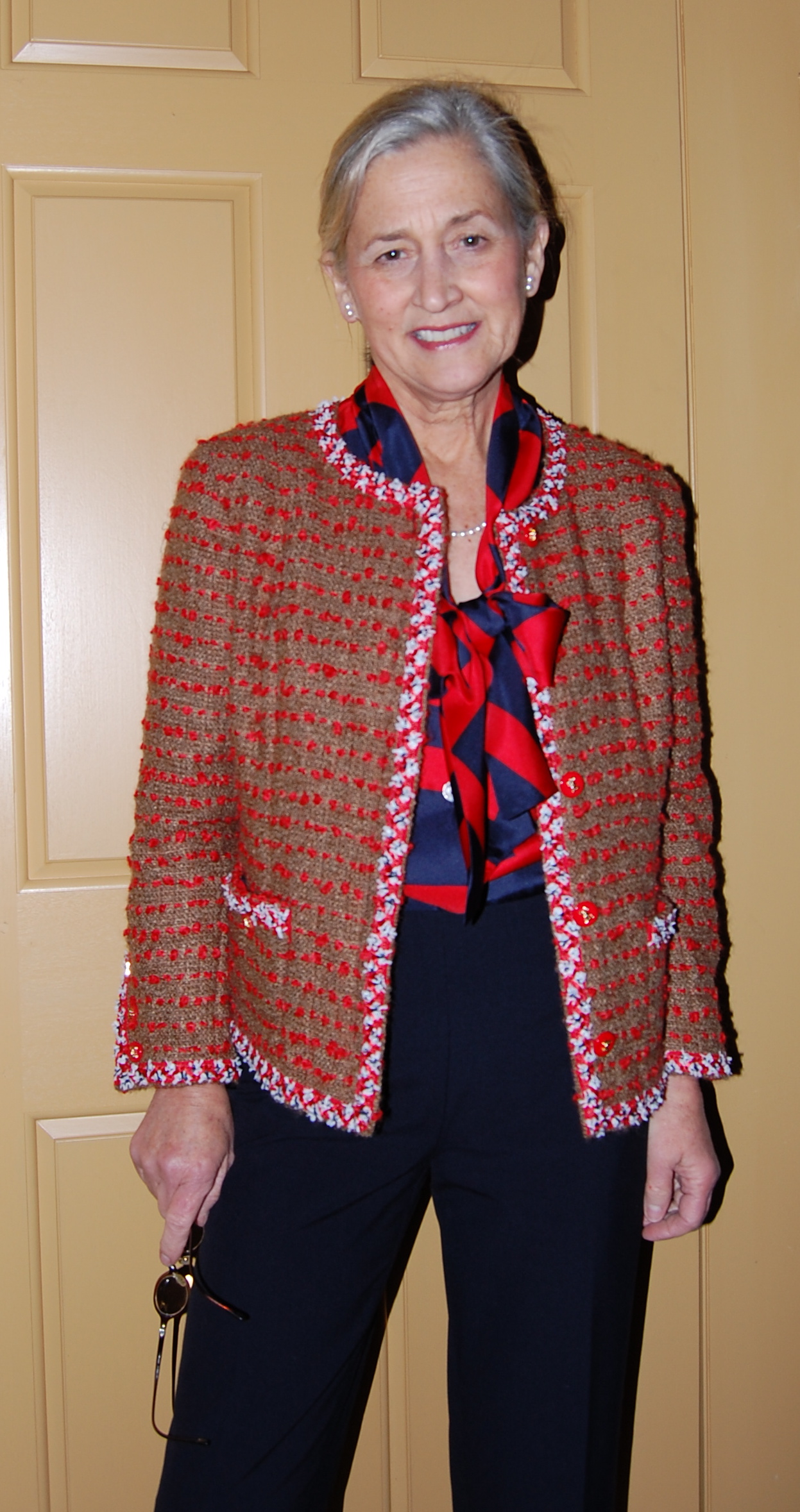
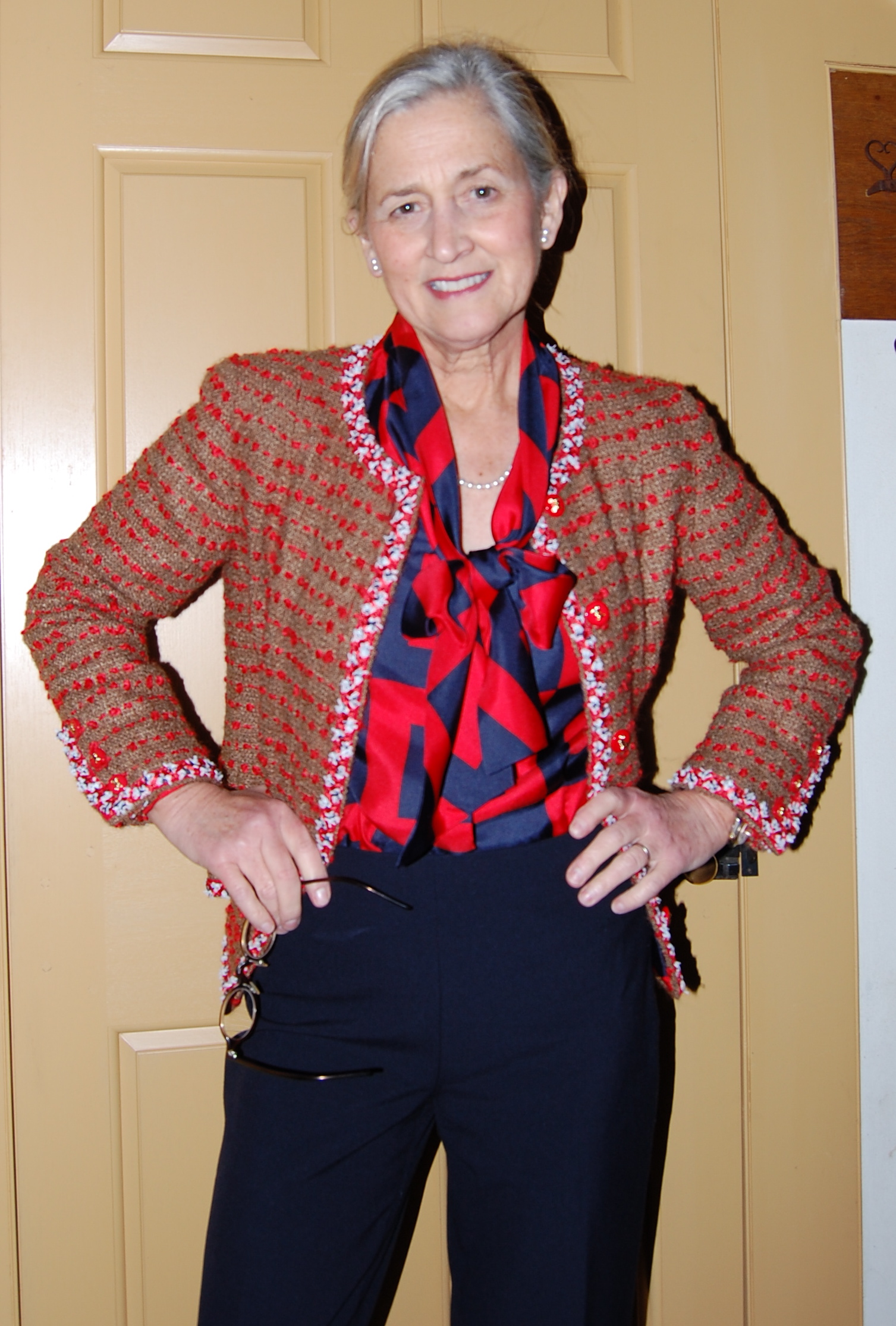
Fashion sewing is an interesting combination of inspiration, aspiration, indulgence and necessity, manifested singly or collectively.  My newly completed bow blouse is an example of a bit of all of these motivations rolled into one.  This is the blouse I made to go with my No. 2 Chanel-inspired jacket, made from the same red and navy blue geometric print silk with which I lined the jacket.
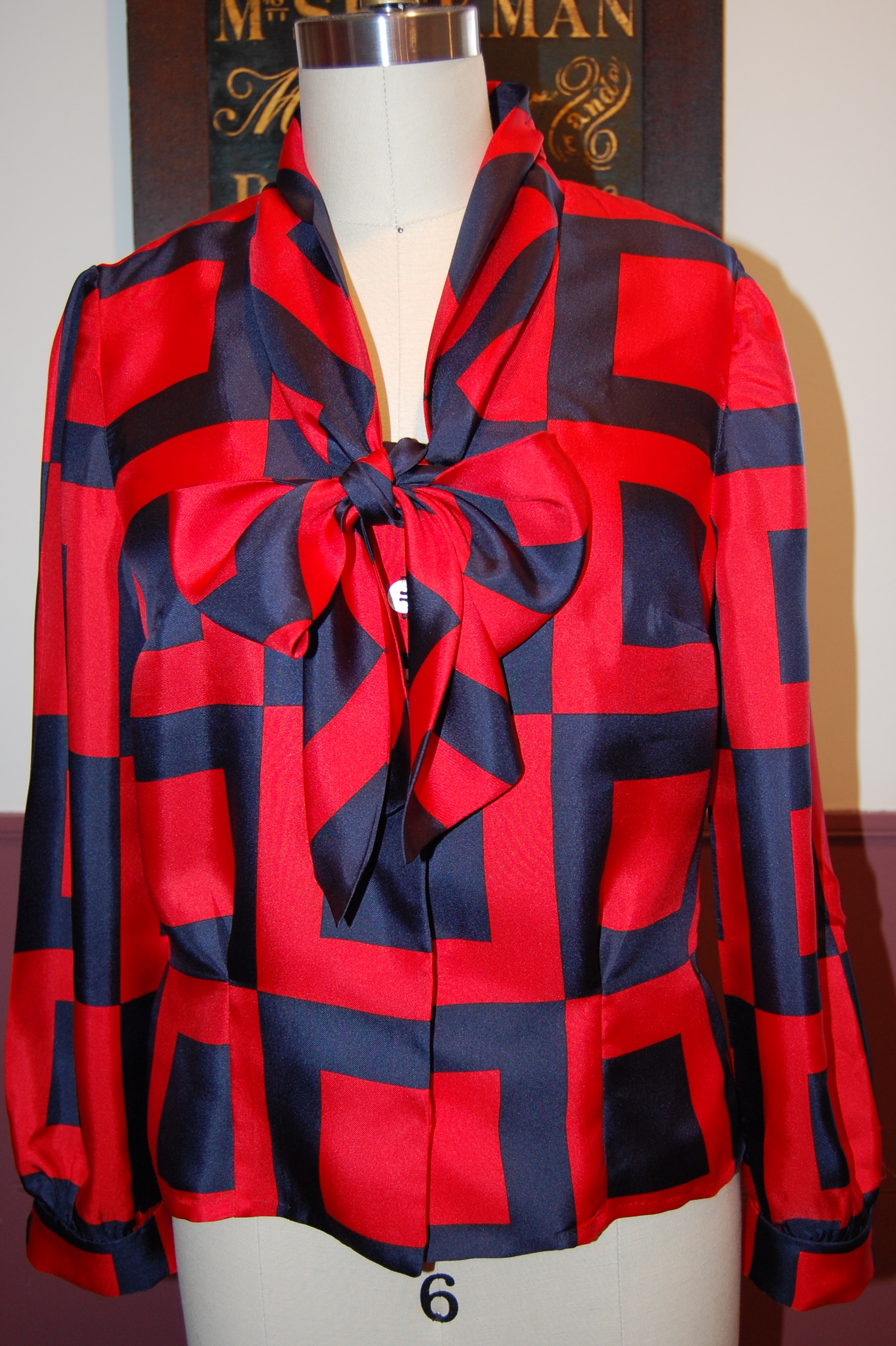
The Necessary Blouse Inspiration came from several sources.  I was mostly inspired by the pattern, which is copyright 1957 by The Conde Nast Publications, Inc. (Vogue Patterns) – so much so, that I purchased it in a size larger than I usually wear, as that was what was available – and with vintage patterns, one is never sure to find a favorite one again soon – or ever.
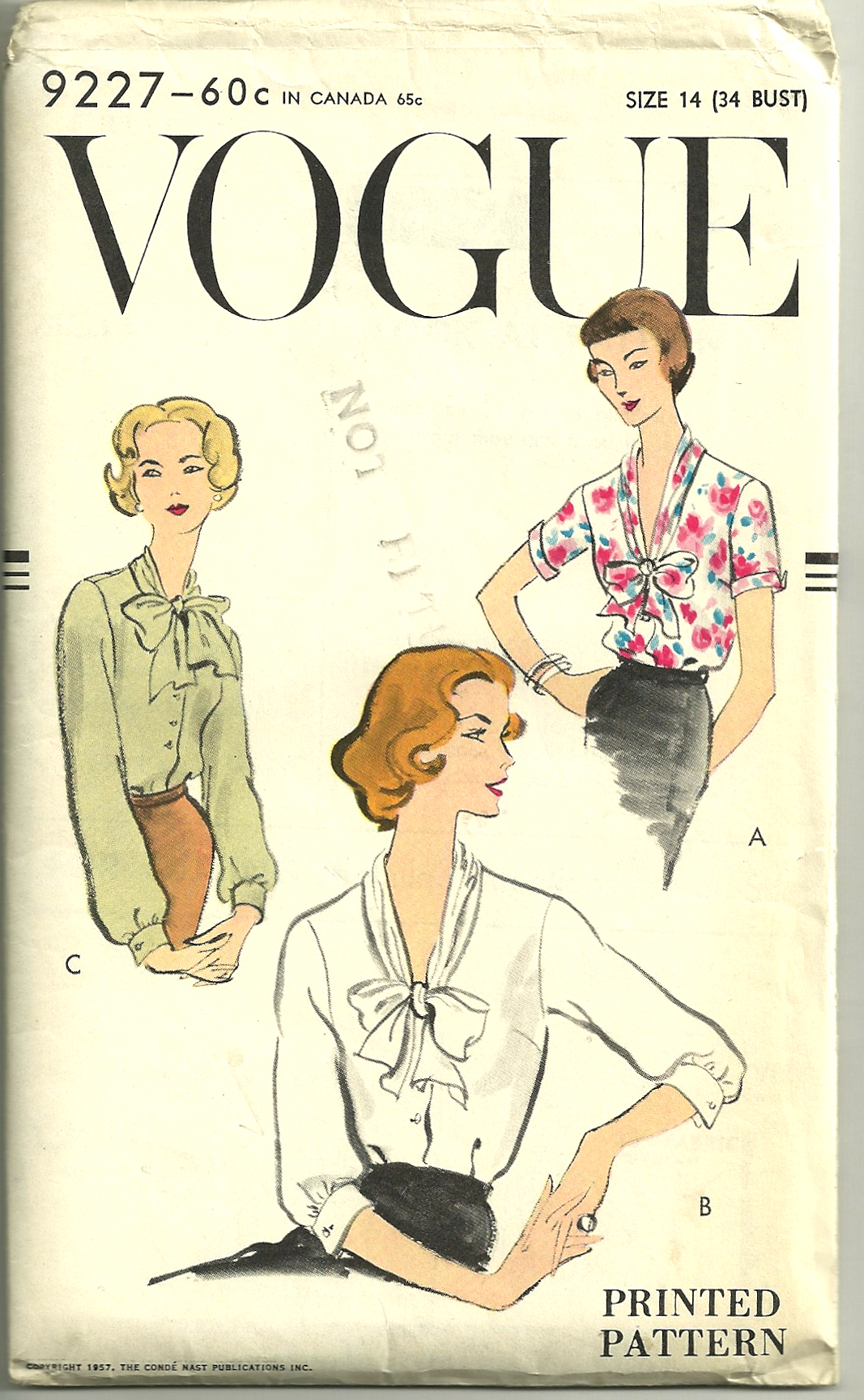
Looking at blouses 1957

Some of the aspects of the pattern which appealed to me are: 1) the “dropped” bow shown in views A and B; 2) the various sleeve lengths; 3) the shaping in the body of the blouse – soft and understated, but very feminine.  Just for fun, I looked through a few of my Vogue Pattern Book Magazines from 1957 and 1958, to see if I could find examples of this blouse pattern.  That was easy!  Here is one sketch and one photograph of Vogue 9227:
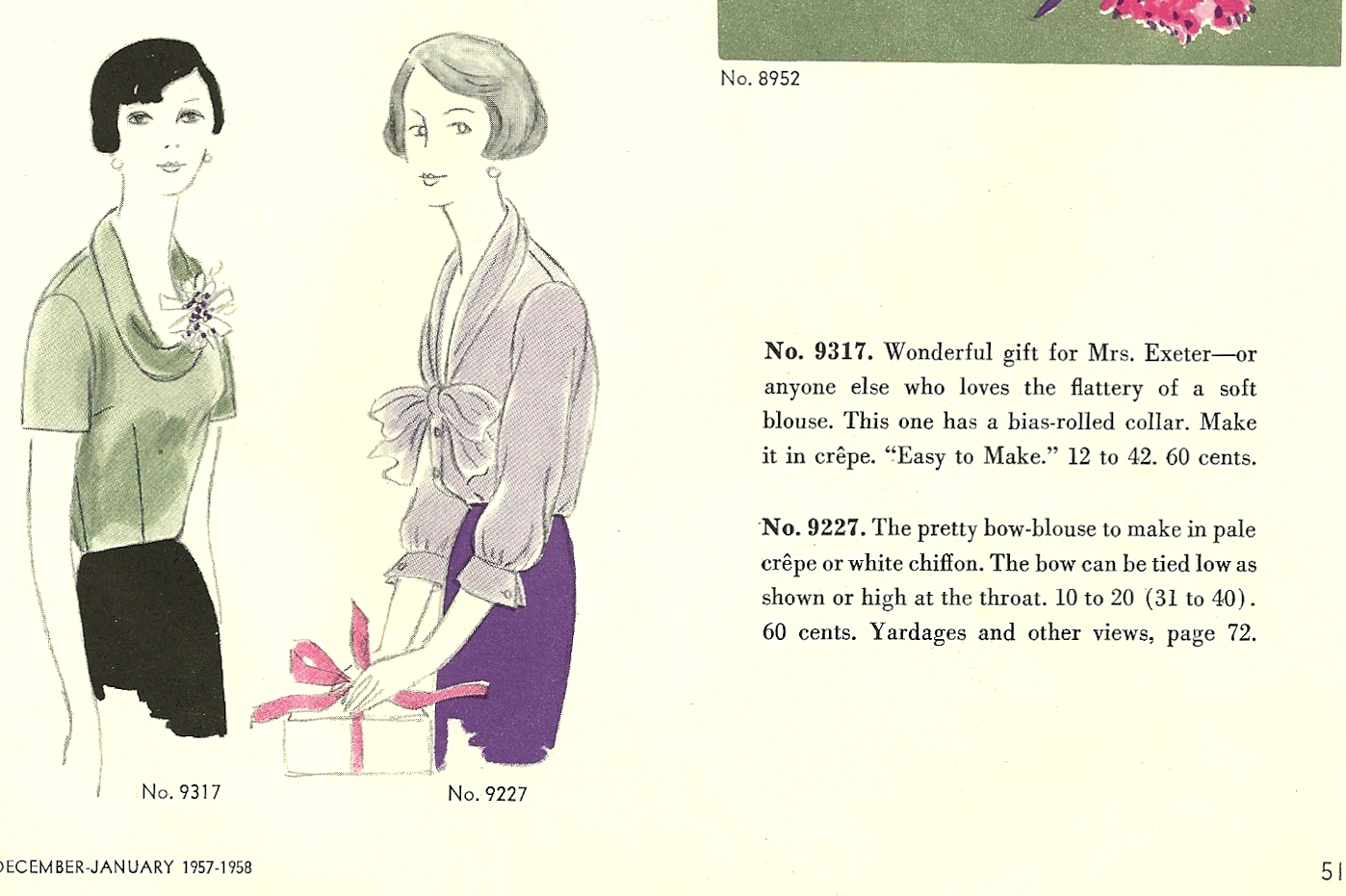
The blouse was featured in the December/January 1957-58 issue.
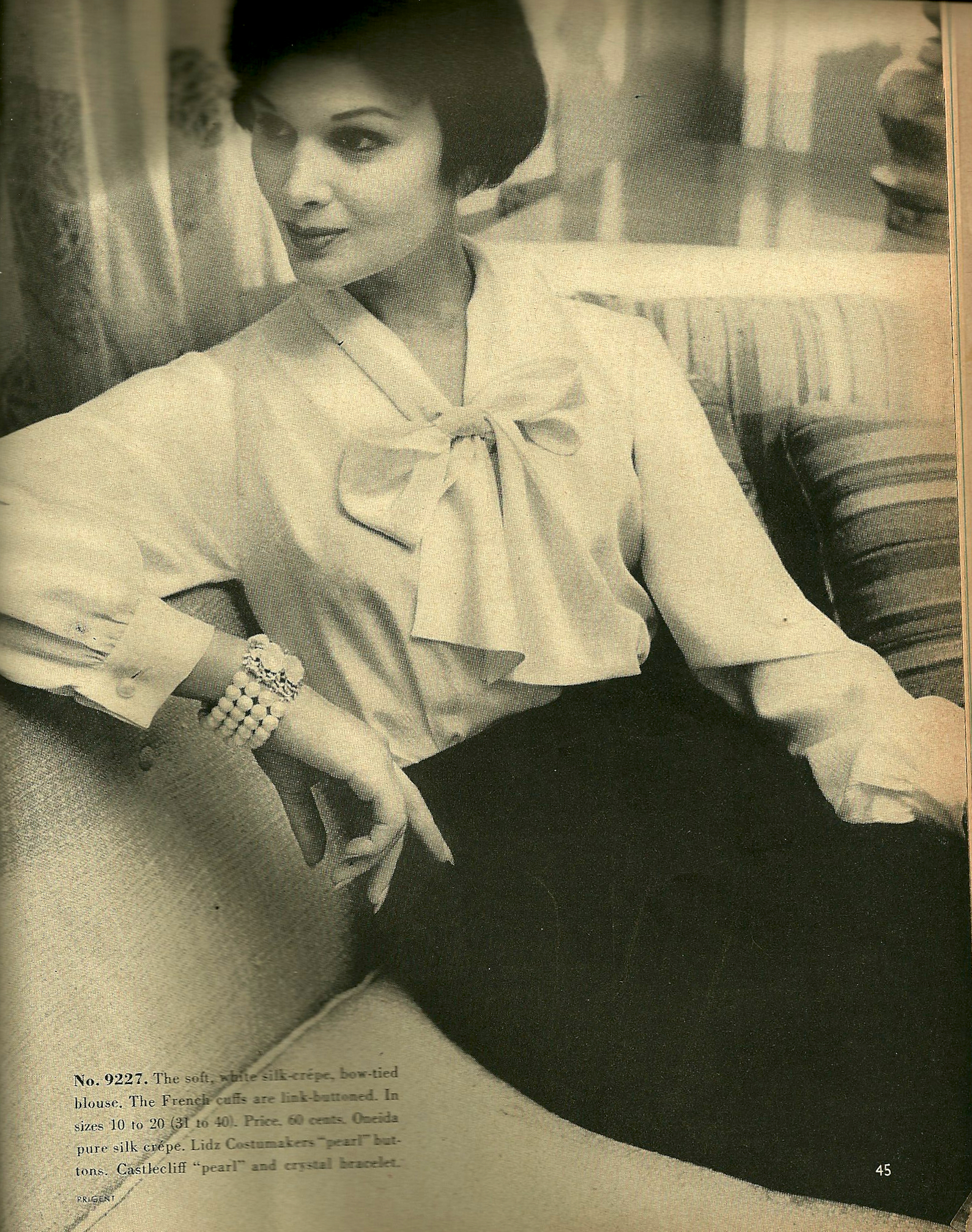
The blouse was featured in the December/January 1957-58 issue.

Part of a feature entitled "A new era for the soft BLOUSE."  In the August/September, 1957 issue of VPB.

Part of a feature entitled “A new era for the soft BLOUSE.” In the August/September, 1957 issue of VPB. 

After making a sheath dress to coordinate with my Chanel-inspired jacket No. 1, I aspired to pair my Jacket No. 2 with a suitable companion, too.  A bow blouse seemed to be a versatile and useful solution.  And then it became a necessity!   I decided my Jacket No. 2 would not be complete until I finished this blouse.
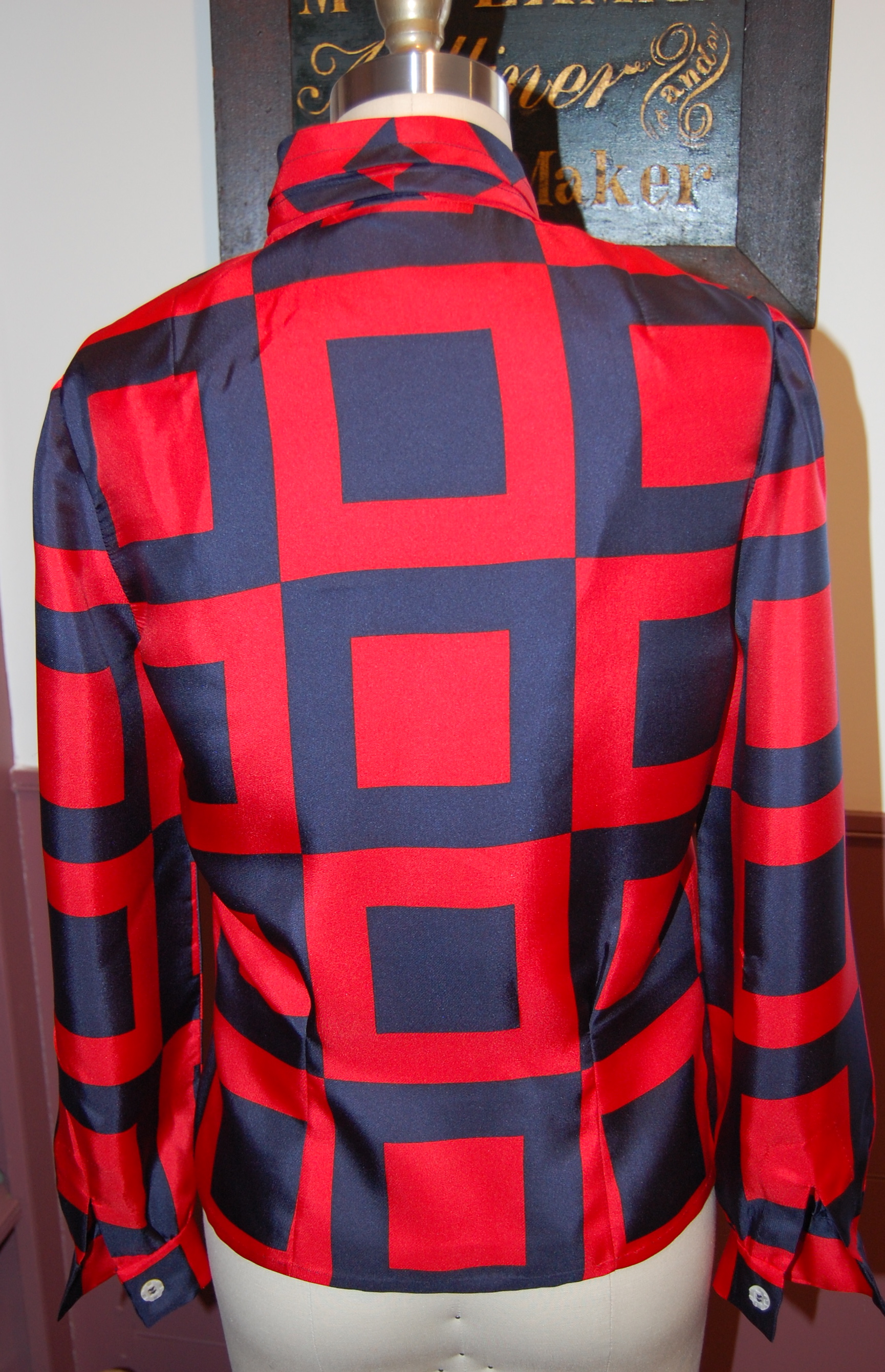
Back view

Back view

Step number one was to make a muslin (of course), knowing that I would need to alter the pattern to fit me correctly.  Sure enough, I needed to take out the bagginess in the bust and body of the blouse, and I needed to shorten the sleeves.  I went to my favorite book on making alterations which guided me through the correct changes:

I highly recommend this book.

I highly recommend this book.

My muslin showed me that the sleeves were also a little too full for me and for current 2014 styles, so I removed some girth from them as well.  I was skeptical of the bow (cut on the diagonal) when I looked at the pattern and then the muslin.  Would it be too full?  Made up in muslin it seemed a little overwhelming.  But, my silk was so lightweight and fine, that I decided it might just be okay, using the original dimensions.
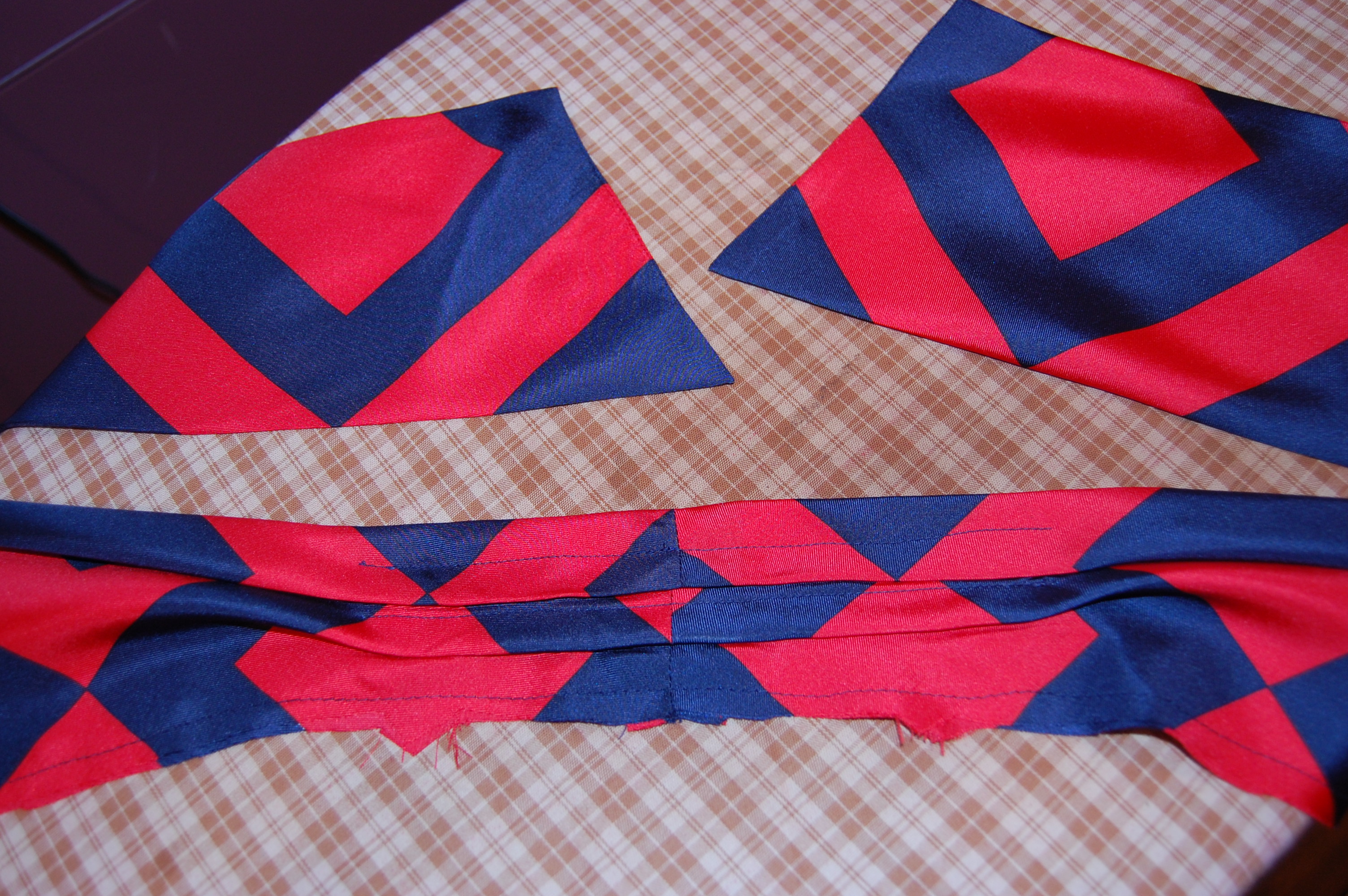
Here is the bow/collar ready to be attached to the body of the blouse.

Here is the bow/collar ready to be attached to the body of the blouse.

This blouse went together quite as planned, although I worked on one side where the bow/collar joins the corner at the front facing for hours, until I had it inserted correctly.  I kept making the same mistake over and over, which was a little irritating.  I also added some extra hand-sewing, understitching the facing by hand and hand-stitching the hem.
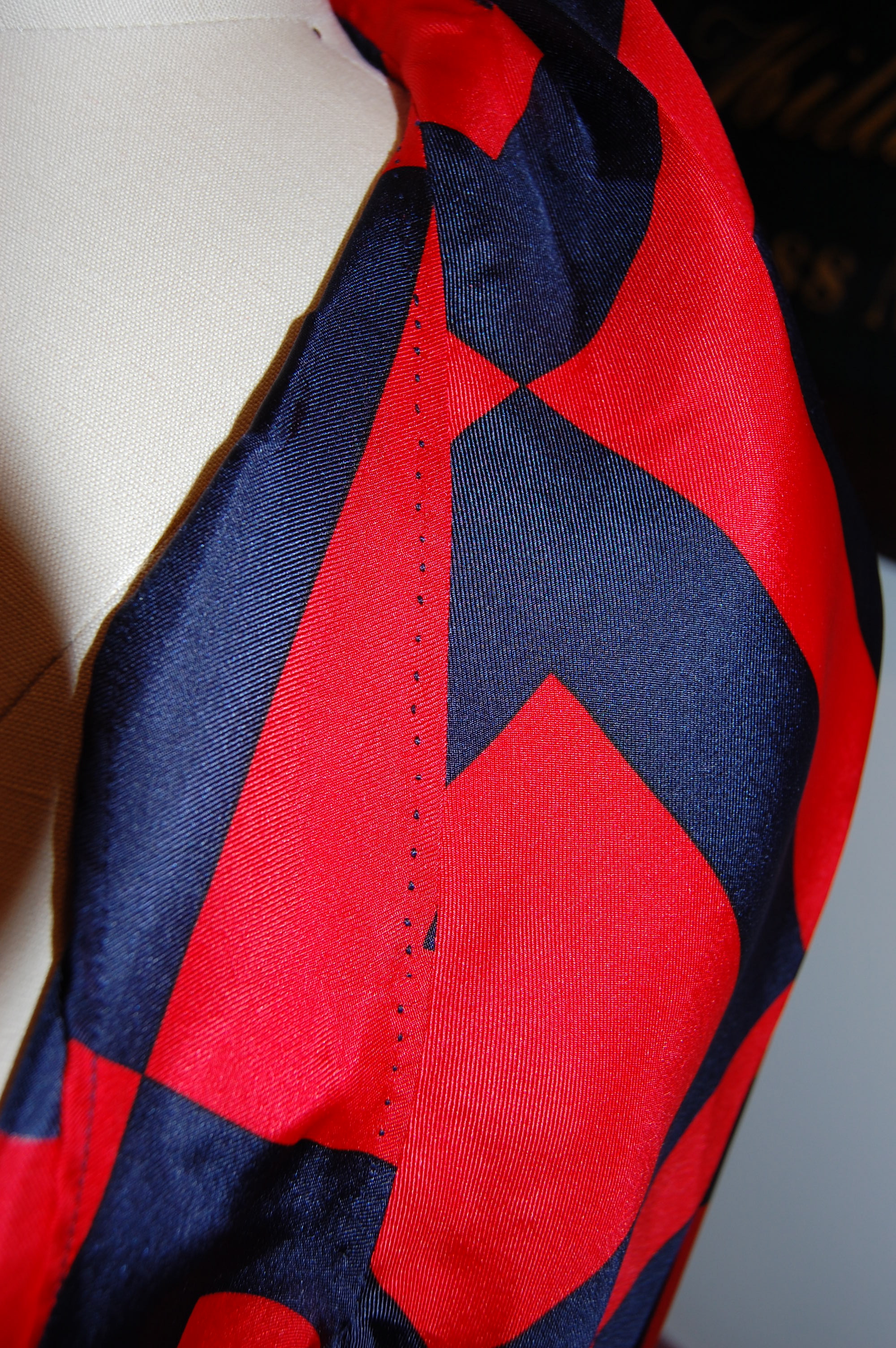
Hand understitching looks just so much nicer than machine stitching!

Hand understitching looks just so much nicer than machine stitching!

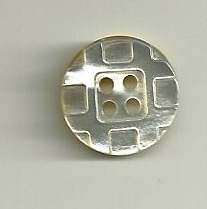
When I started the blouse, I had not yet picked out buttons, thinking I would use some that I have in my vintage collection.  But then I was on Waechter’s website and found these buttons, which seemed just about perfect:
The Necessary Blouse - button

These buttons measure 5/8″. 

(Sadly, Waechter’s is closing their business in Asheville, N. C., to my great dismay.  This makes me even more grateful for Britex Fabrics in San Francisco, from which I purchased all the fabric for this blouse and my Jacket No. 2.)

Sewing with vintage patterns is such a pleasure in so many ways.  For example, the sleeve vents had their own separate pattern piece:
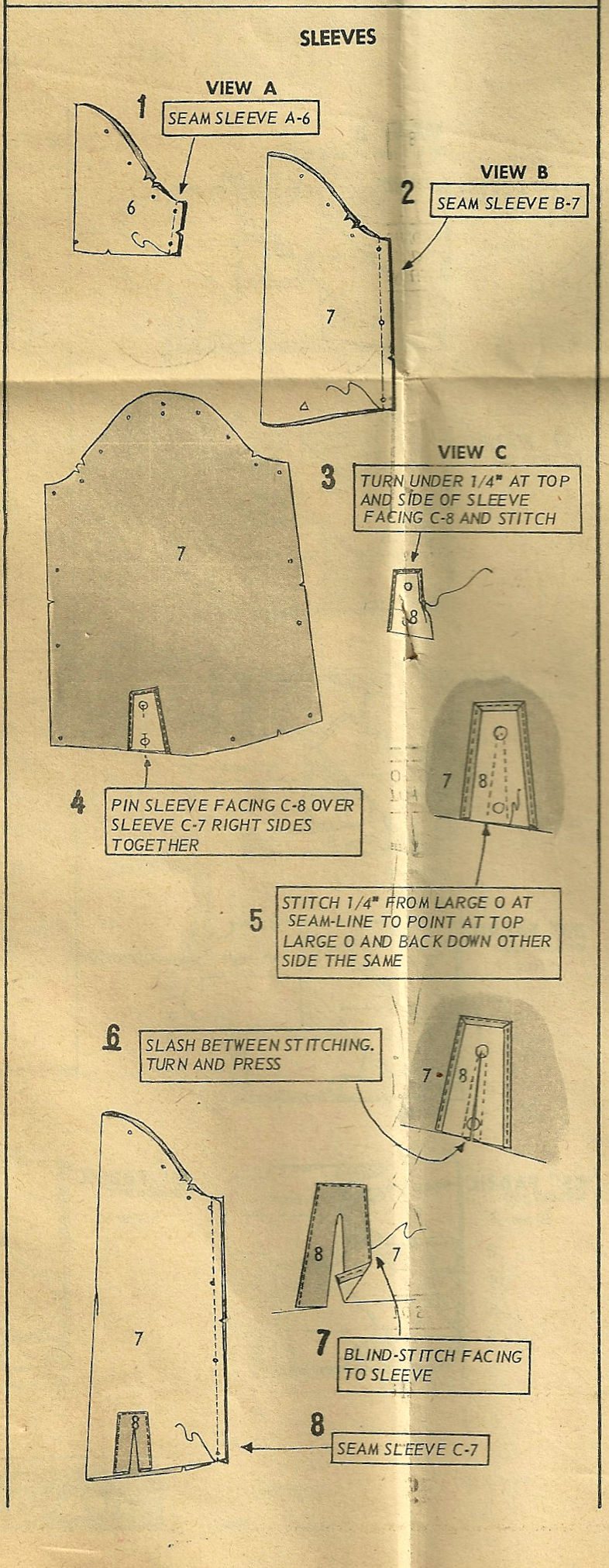
The instruction sheet from the pattern . . . .
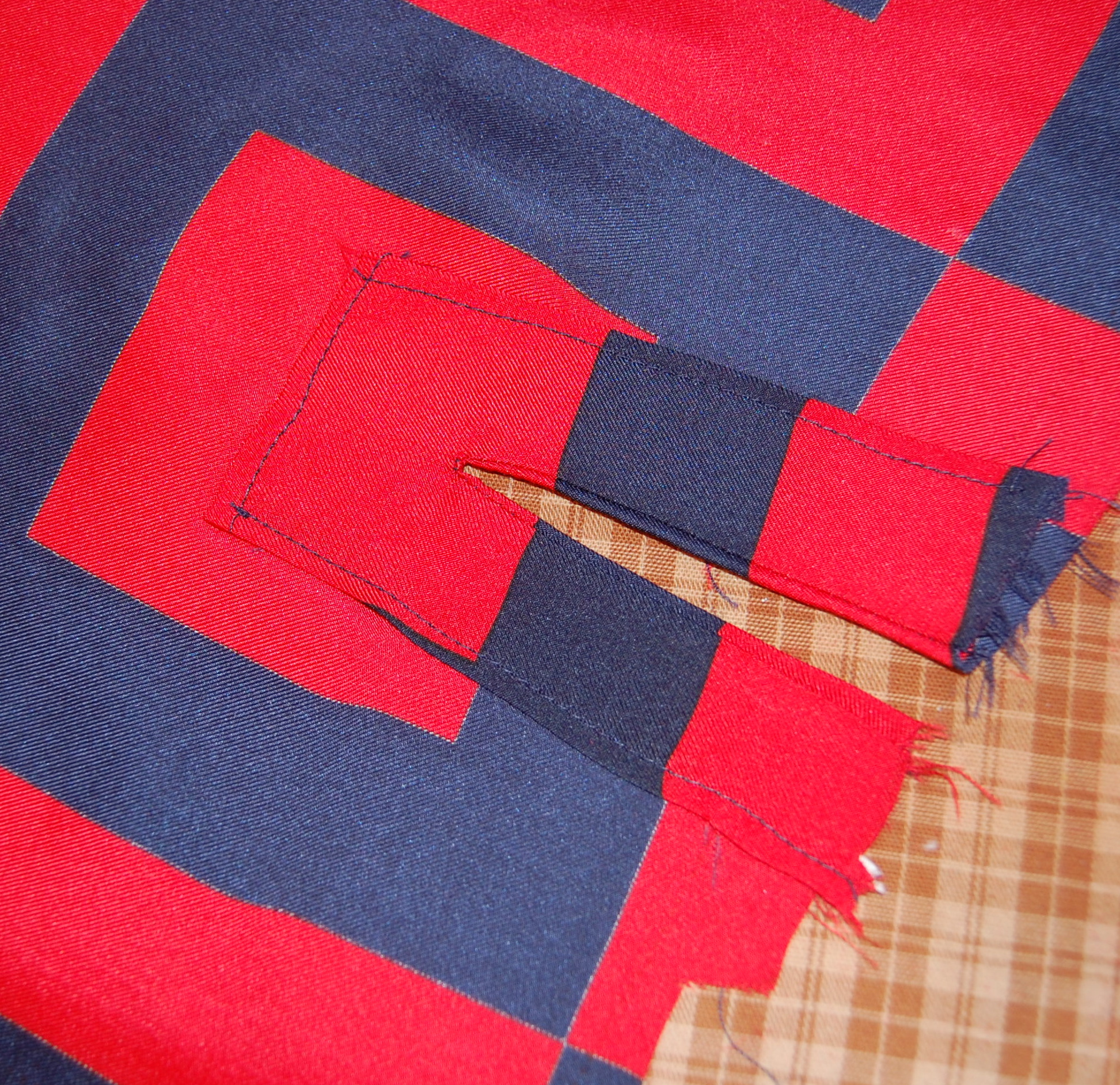
The instruction sheet from the pattern . . . .

The vent sewn on . . . .
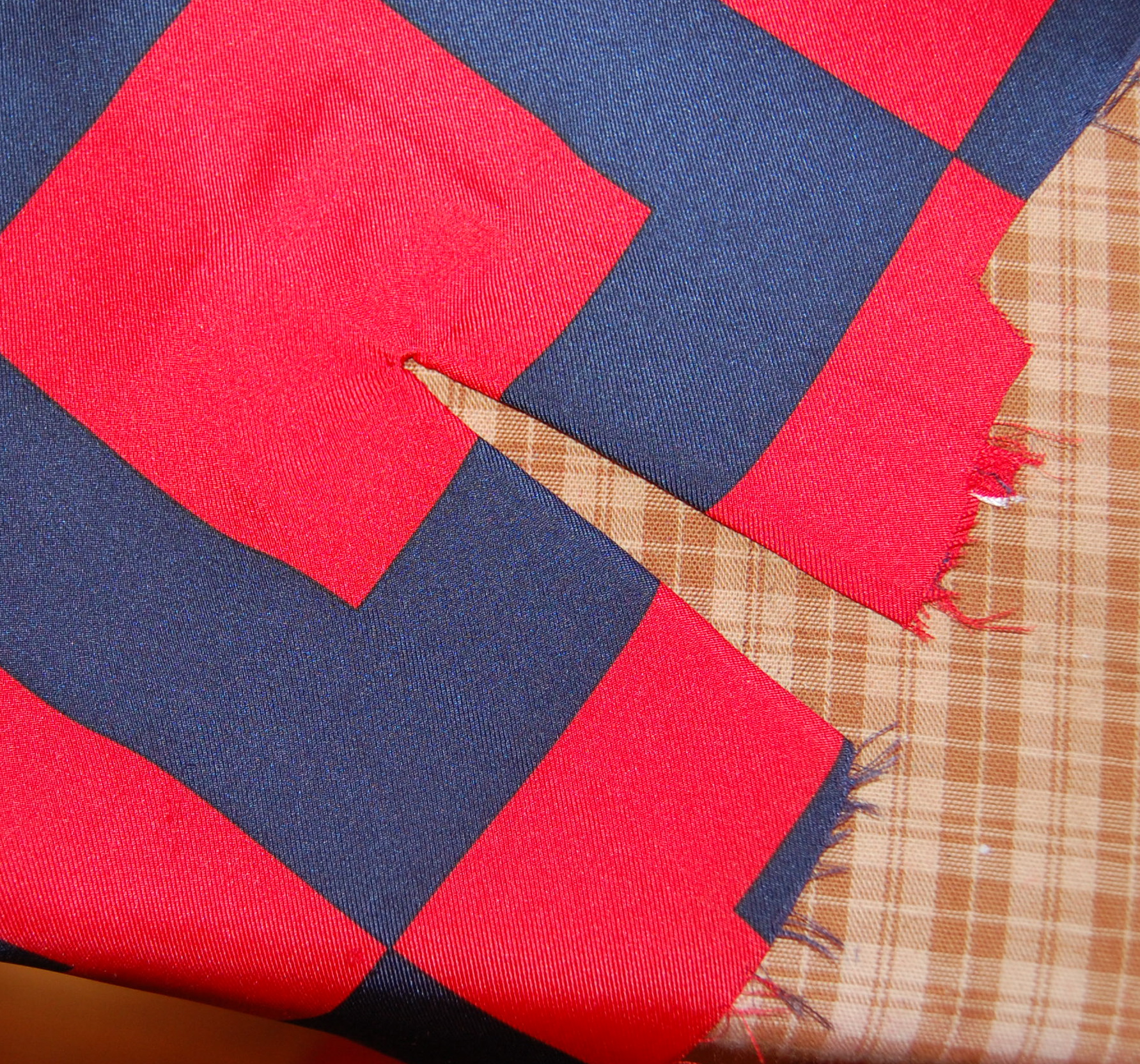
The vent sewn on . . . .

. . . . and the finished vent.

. . . . and the finished vent.

Another classic vintage aspect is the proscribed use of snaps  – in this pattern, at the waist and below, which takes bulk away from the “tuck-in” part of the blouse.

And that bow?  Once I had it made up, was it too much?
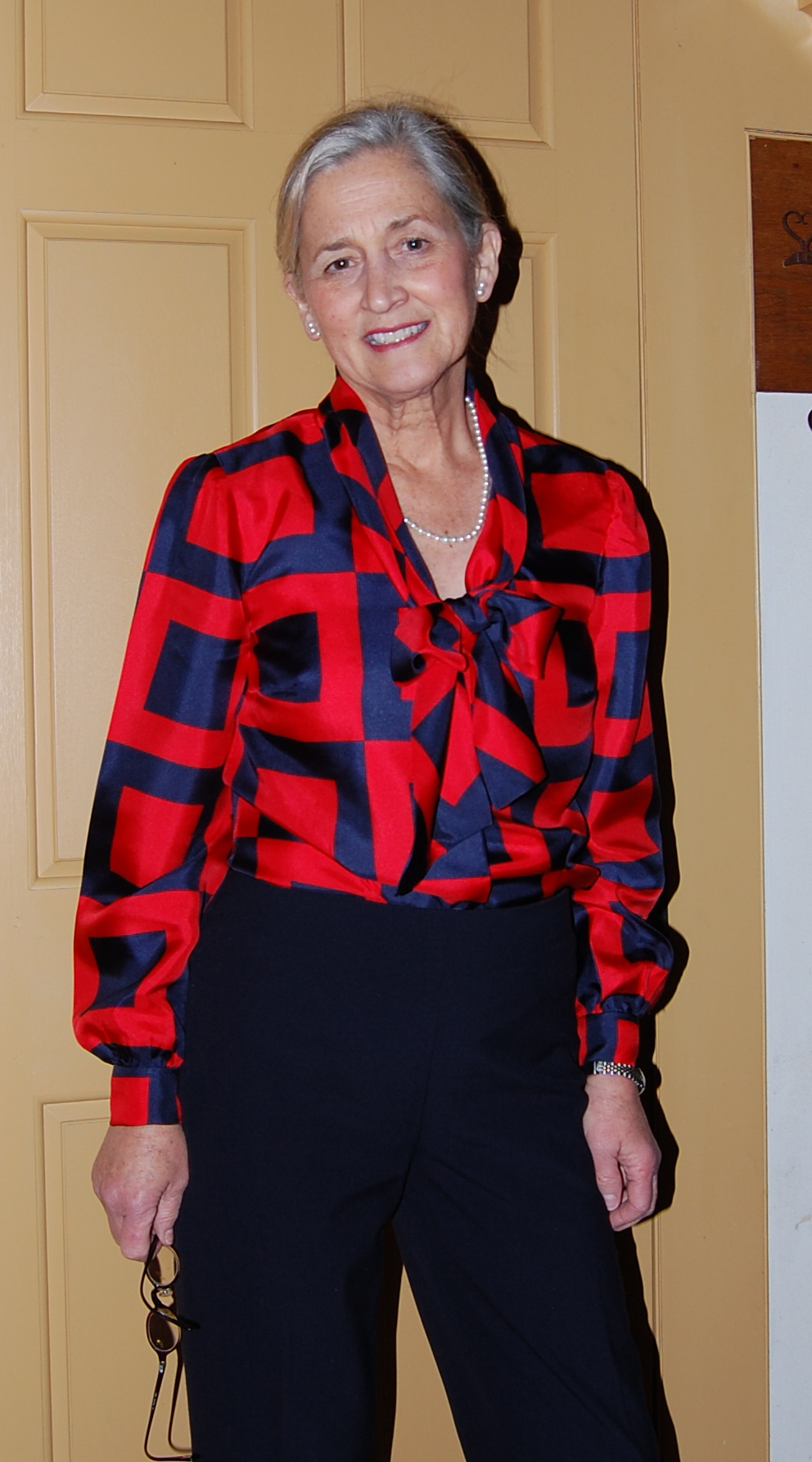
I think the bow is just about perfect.
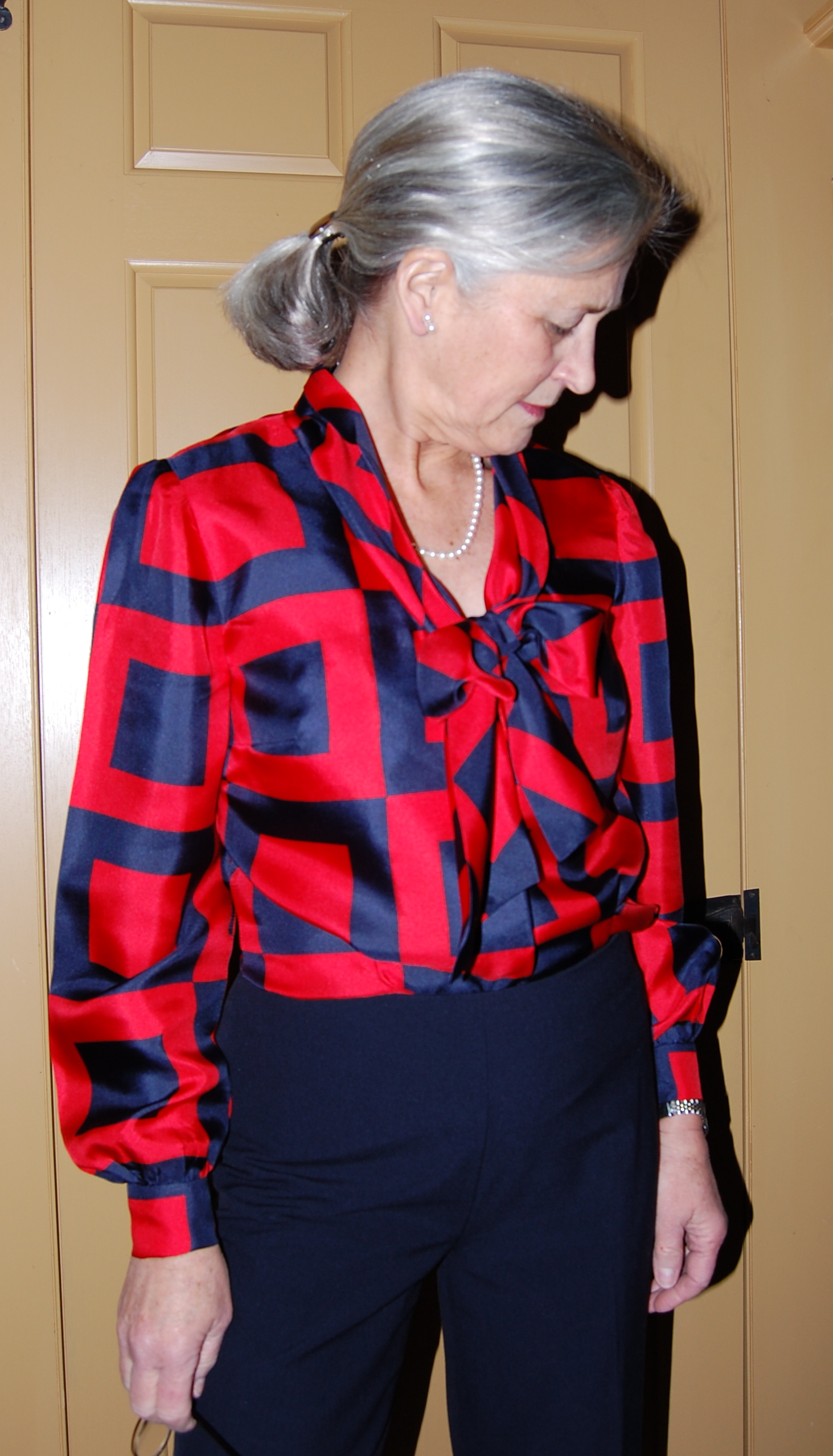
I think the bow is just about perfect.

I am very glad I didn't tinker with the size of the bow!

I am very glad I didn’t tinker with the size of the bow!
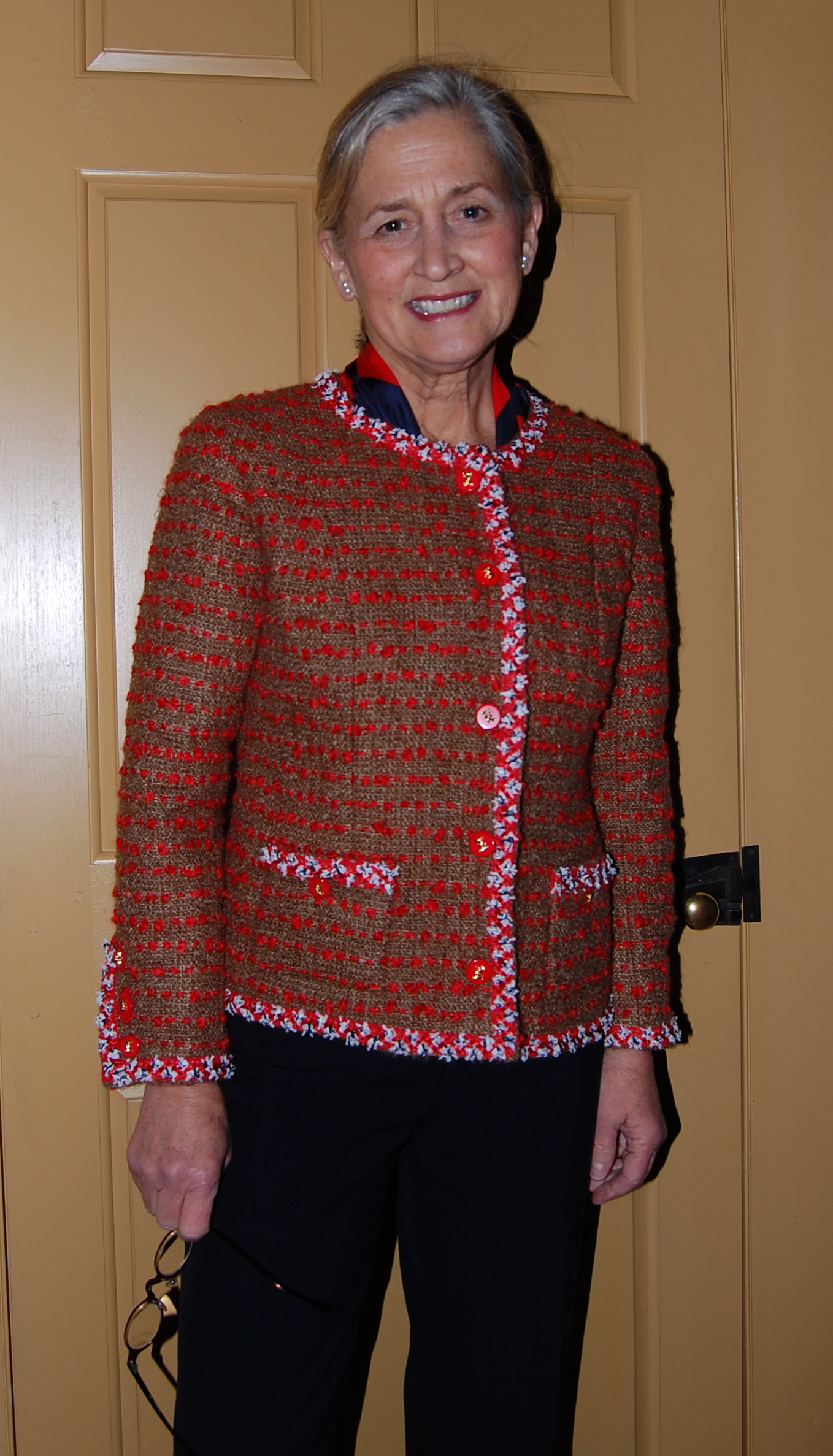
Shown with the jacket.  I really like how the collar on the blouse shows a bit when i have the jacket on.

Shown with the jacket. I really like how the collar on the blouse shows a bit when I have the jacket on.
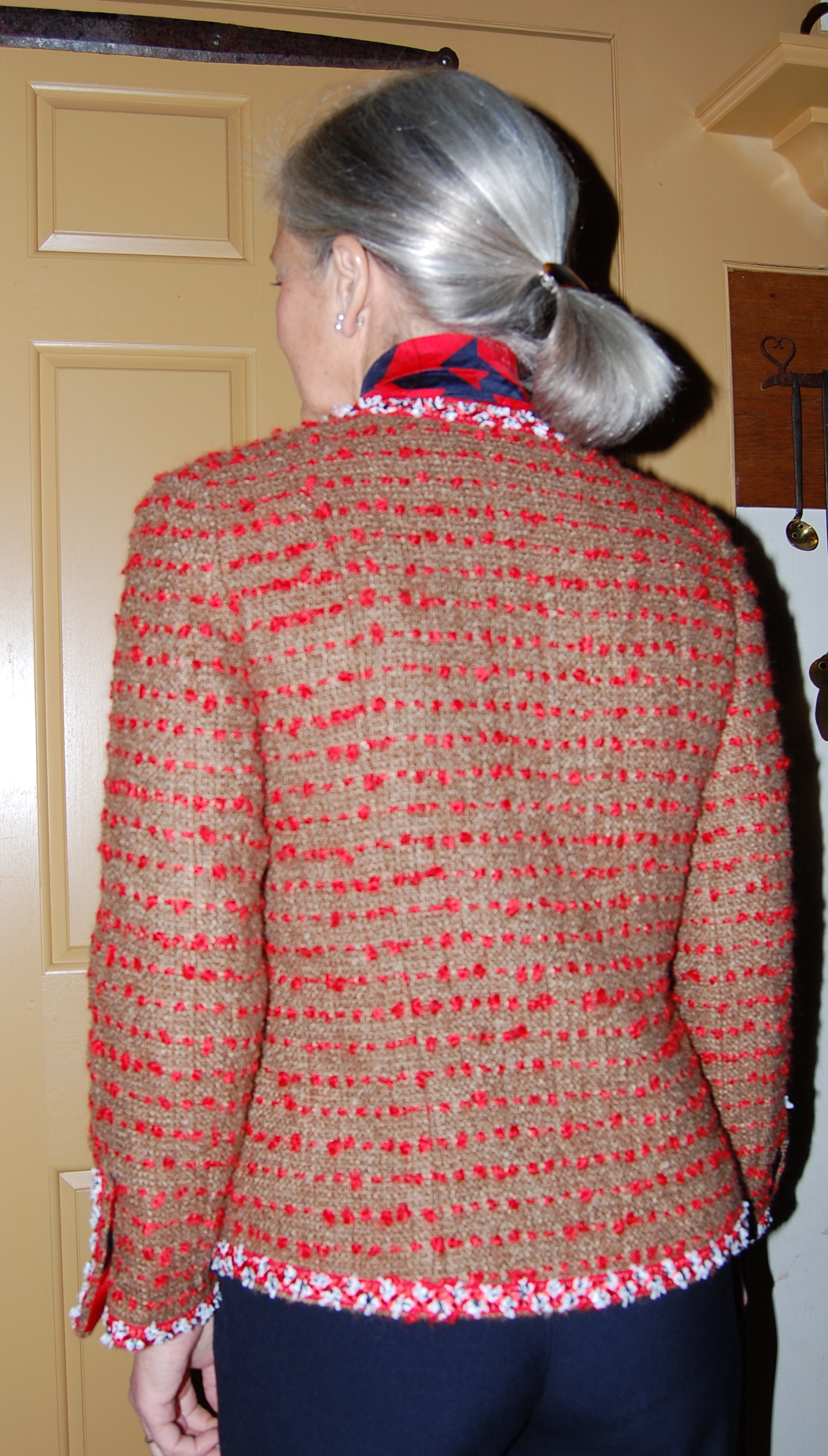
The Necessary Blouse

A comfortable fit.

The Necessary Blouse

Would be nice with a navy skirt as well …
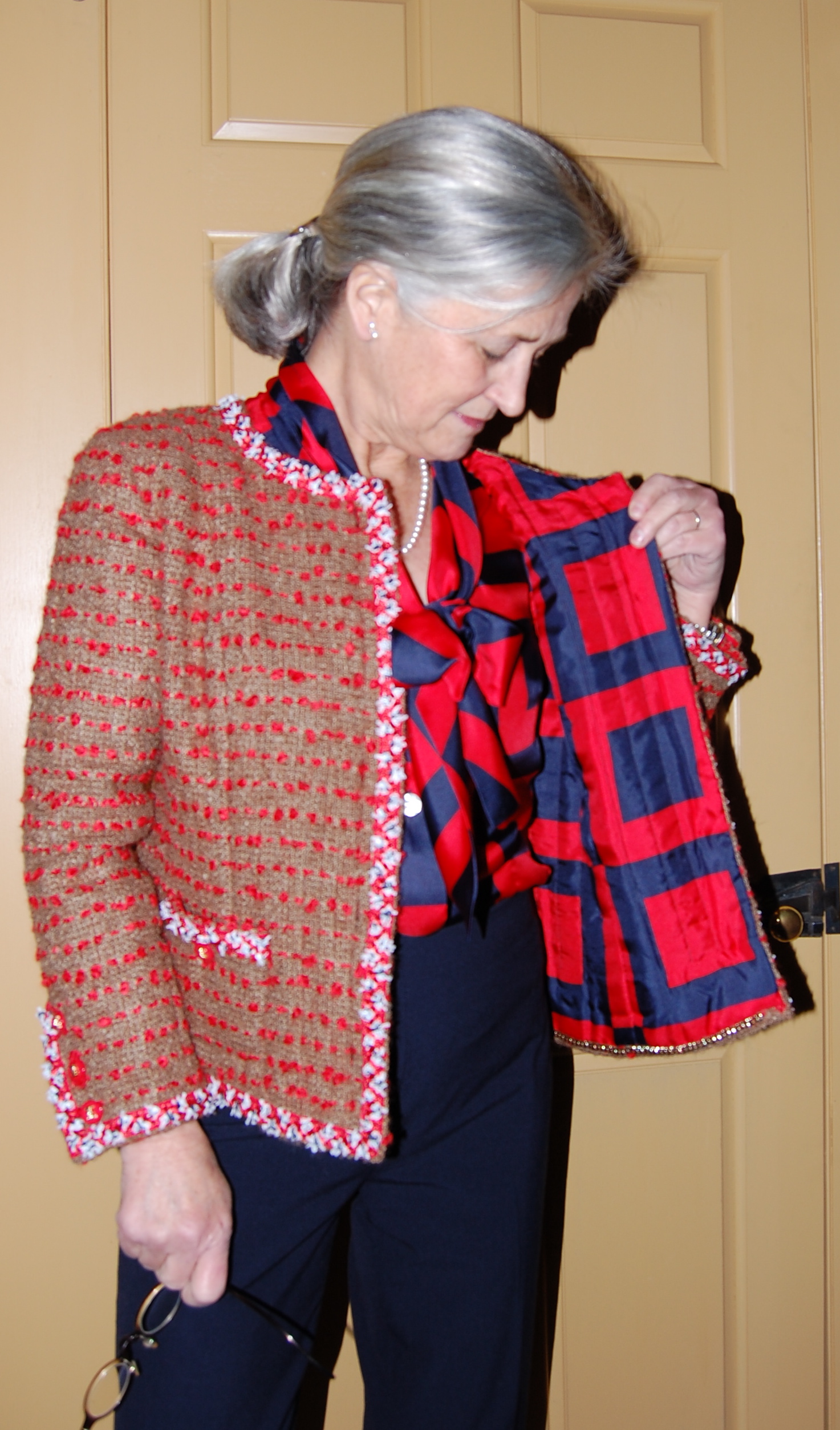
The Necessary Blouse

Whew!  Blouse and jacket turned out as I had hoped!

Whew! Blouse and jacket turned out as I had hoped!

I am feeling quite good about indulging in the extra fabric and extra time needed to make this blouse.  Now that my No. 2 Jacket is complete, I can indulge in my other current project – my color-blocked coat –  which might add a new word to the vocabulary of fashion sewing – obsession!
16 Comments

Filed under Blouse patterns from the 1950's, Blouses, Buttons - choosing the right ones, Chanel-type jackets, sewing in silk, The Conde Nast Publications, Uncategorized, vintage Vogue patterns from the 1950s, Vogue patterns

No. 2 ~ The Beginning

I may – or may not – find Chanel No. 5 Paris Parfum in my Christmas stocking, but Chanel-inspired, Classic French Jacket No. 2 can currently, definitely, be found in my sewing room.  Well, actually, it’s not a jacket yet.  It is just lengths of fabric and loose trims and buttons, but that is how these things begin, as every home dressmaker knows.

I actually started planning this jacket long before I took the Classic French Jacket Class with Susan Khalje this past summer.  In September of 2012 when I was at Britex Fabrics in San Francisco, I found this boucle and purchased it – even then – as my intended Jacket No. 2.

This fabric is very soft, perhaps due to a certain percentage of mohair wool in its composition.

This fabric is very soft, perhaps due to a certain percentage of mohair wool in its composition.

My first jacket is definitely very dressy, so I wanted this one to be less so, which meant I had to find just the right lining, trim, and buttons.  It took another, recent, trip to San Francisco to produce those ingredients – and I couldn’t be more pleased with what I found again at Britex.

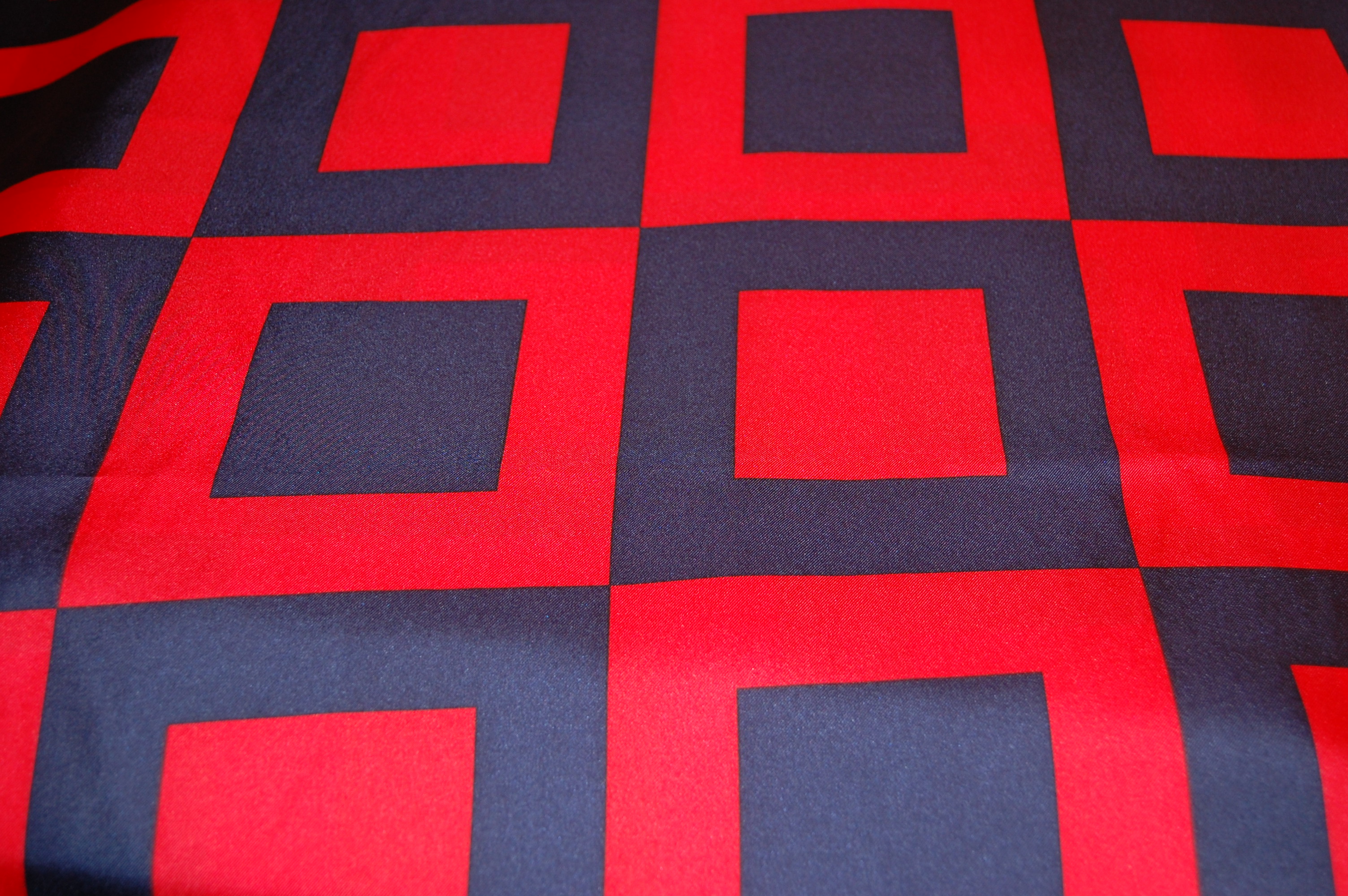
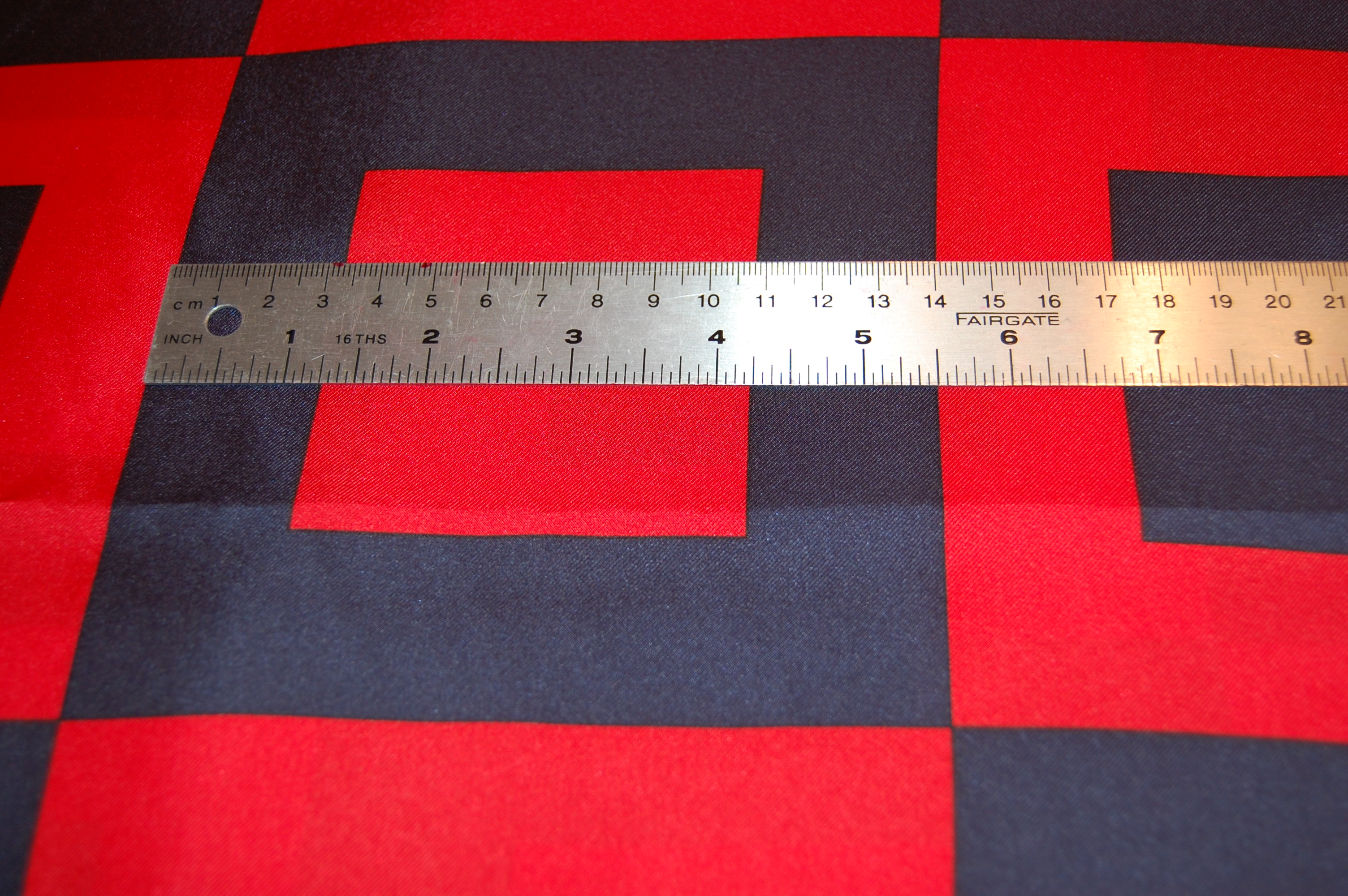
A bolt of this light-weight silk twill was tucked under one of the front tables, and it was love at first sight.  I was hoping to find something with navy blue in it, and the geometric pattern in this fabric makes it bold and less dressy than a floral silk charmeuse would be.

No. 2 jacket

The ruler will help you get a feel for the size of the squares.  Click on the photo for a close-up view.

The ruler will help you get a feel for the size of the squares. Click on the photo for a close-up view.

Immediately, however, I knew that I had to purchase enough for a blouse as well, which I did.  I suspect I’ll be using this pattern from 1957 for a blouse with a bow, which should evoke the correct Coco Chanel look. (A muslin should tell me if I need to tame the bow.  I don’t want it to be overwhelming…)

View B with long sleeves has my vote.

View B with long sleeves has my vote. 

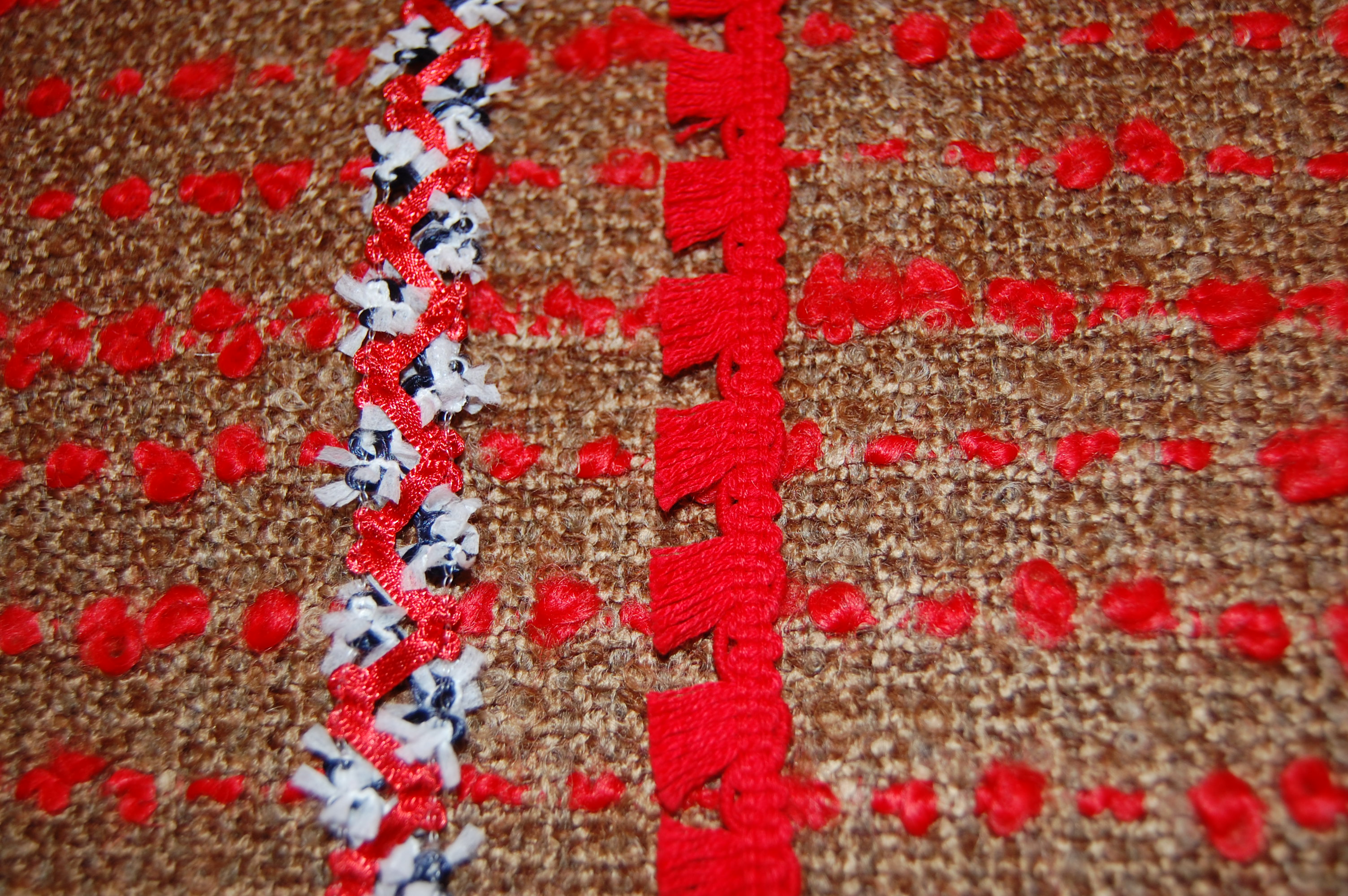
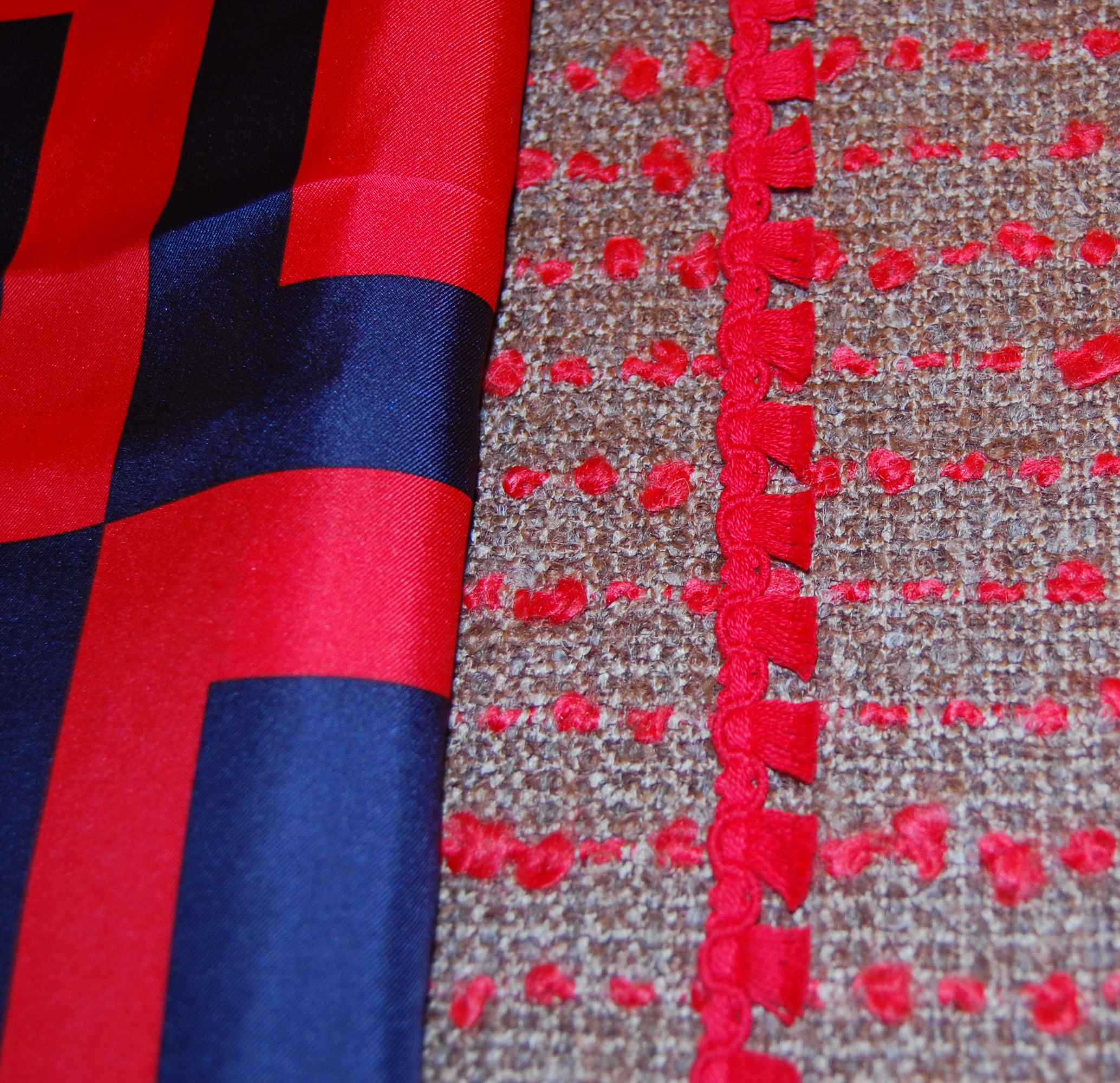
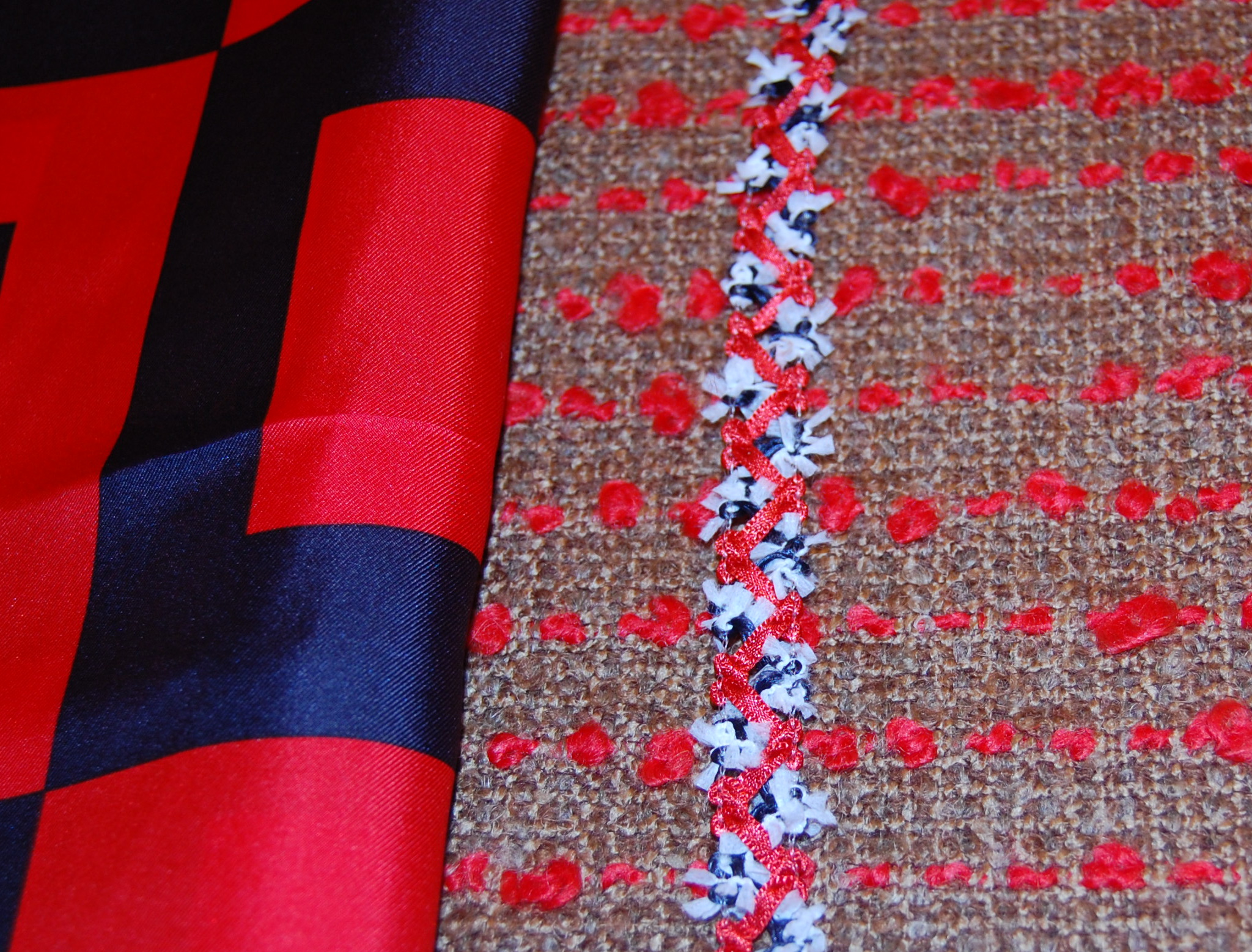
With fabrics in tow, I then headed up to the Buttons and Trims Department on the 3rd floor.  An initial look at the red trims flummoxed me, as none of them seemed right.  Then one of the wonderful assistants in the Department came to my rescue and found these two trims.

No. 2 Jacket

Shown with the lining/blouse fabric...

Shown with the lining/blouse fabric . . .

... and again.

. . . and again. 

Back and forth I went between them, unable to make a decision.  It was then that I went to my fail-safe method of choosing between two equally wonderful trims:  I bought both of them! ( It certainly helped that neither was terribly expensive – and both very versatile.)

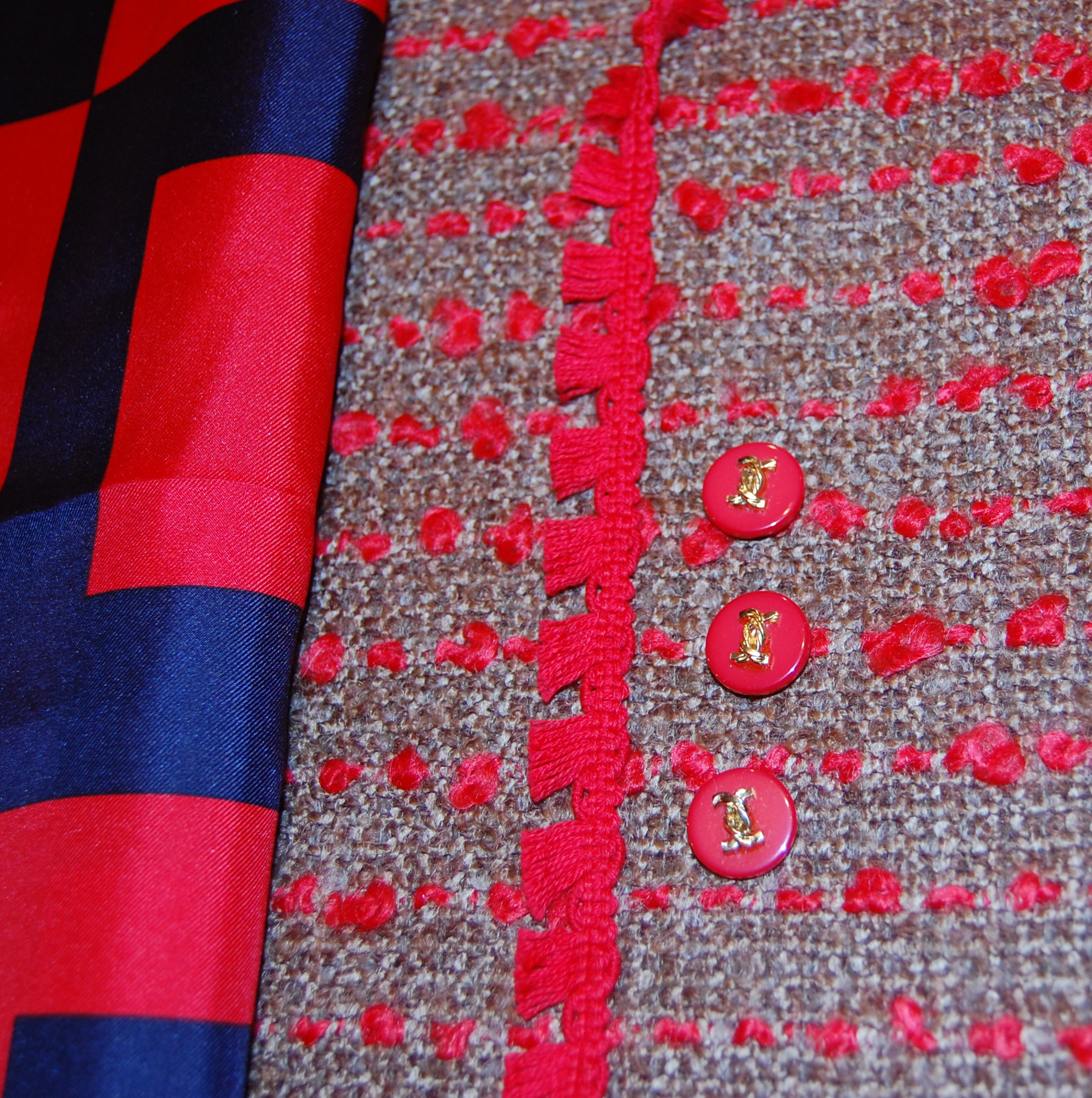
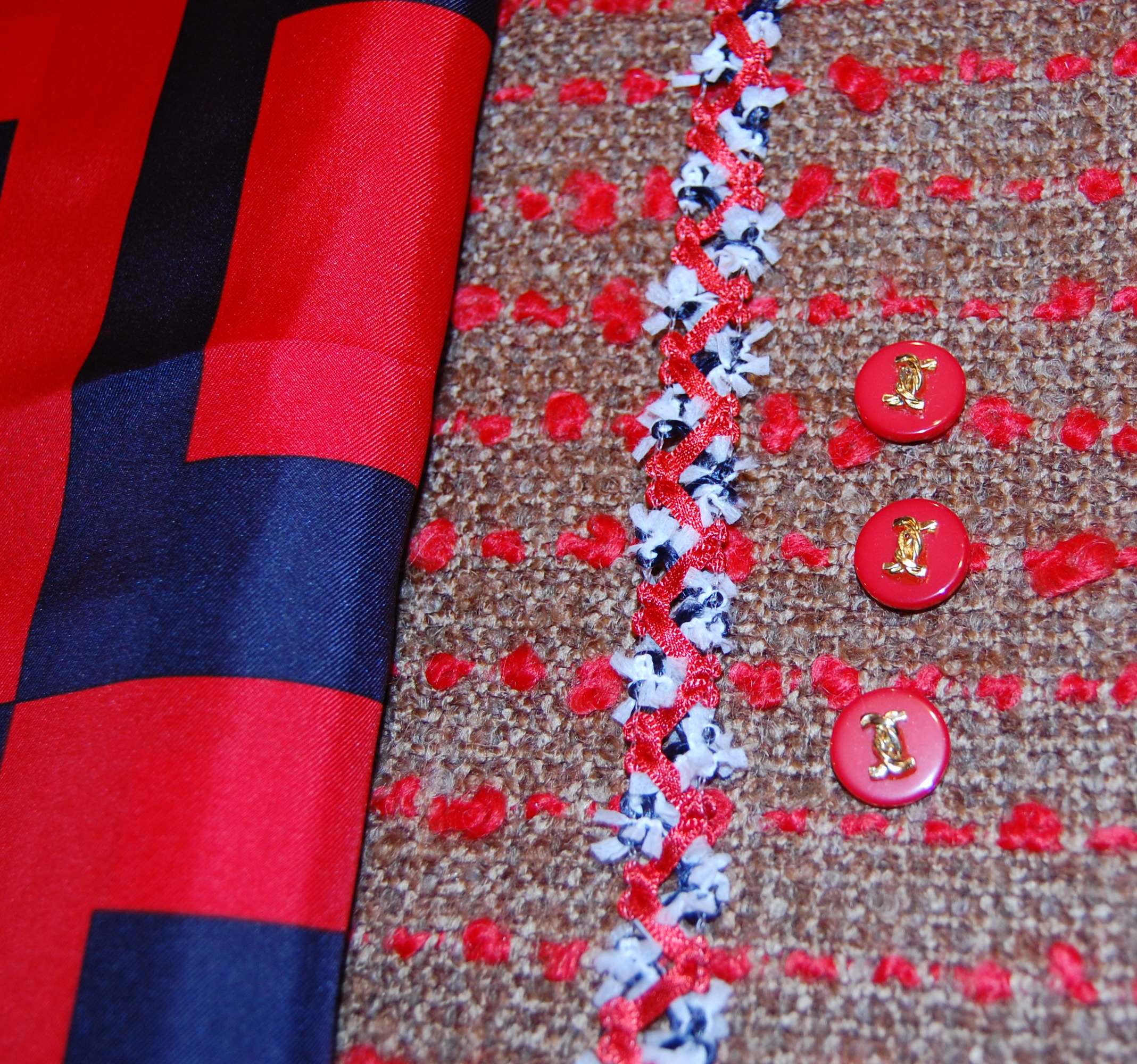
Now that I have them home, I am leaning toward one of them – can you guess which one?  Does it help to see the buttons, too?  Once again, the experienced button assistant quickly found these – and there was no question in my mind that they were just what I wanted for this jacket.

These are shank buttons, with gold decoration reminiscent of Chanel "C"s.

These are shank buttons, with gold decoration slightly reminiscent of intertwined Chanel “C”s.

And here with the other trim.

And here with the other trim. 

Well, as in so much in life, timing is everything – or it sometimes seems that way.  My timing could be better to be starting such a lengthy project.  It is, after all, one month until Christmas.  I have those proverbial stockings to fill and much to do, but I’ll just bet I can squeeze in some sewing time before my sewing room transforms into Santa’s workshop.

15 Comments

Filed under Blouse patterns from the 1950's, Boucle for French style jackets, Buttons - choosing the right ones, Chanel-type jackets, Coco Chanel, Uncategorized, vintage Vogue patterns from the 1950s

Date Night

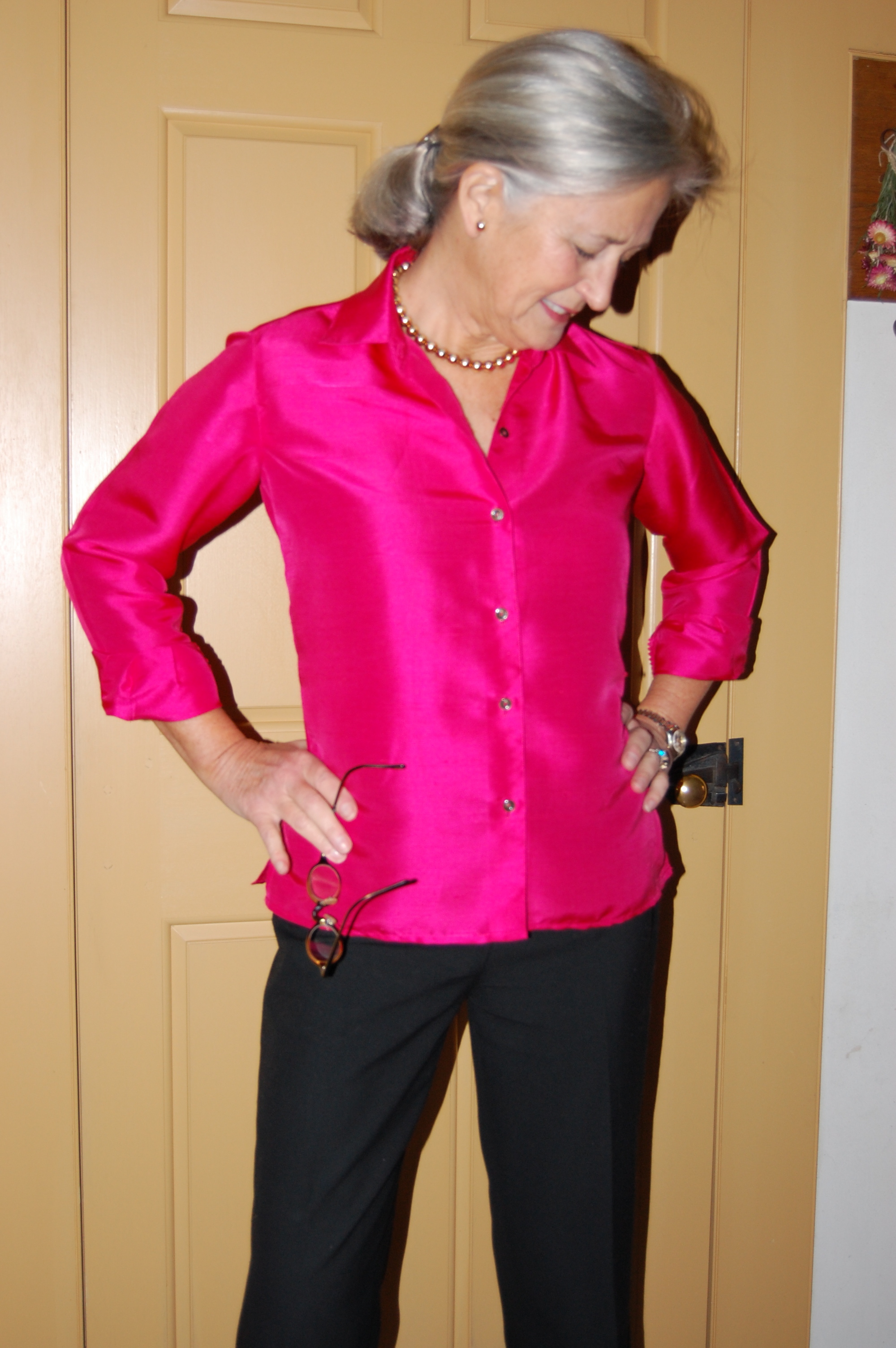
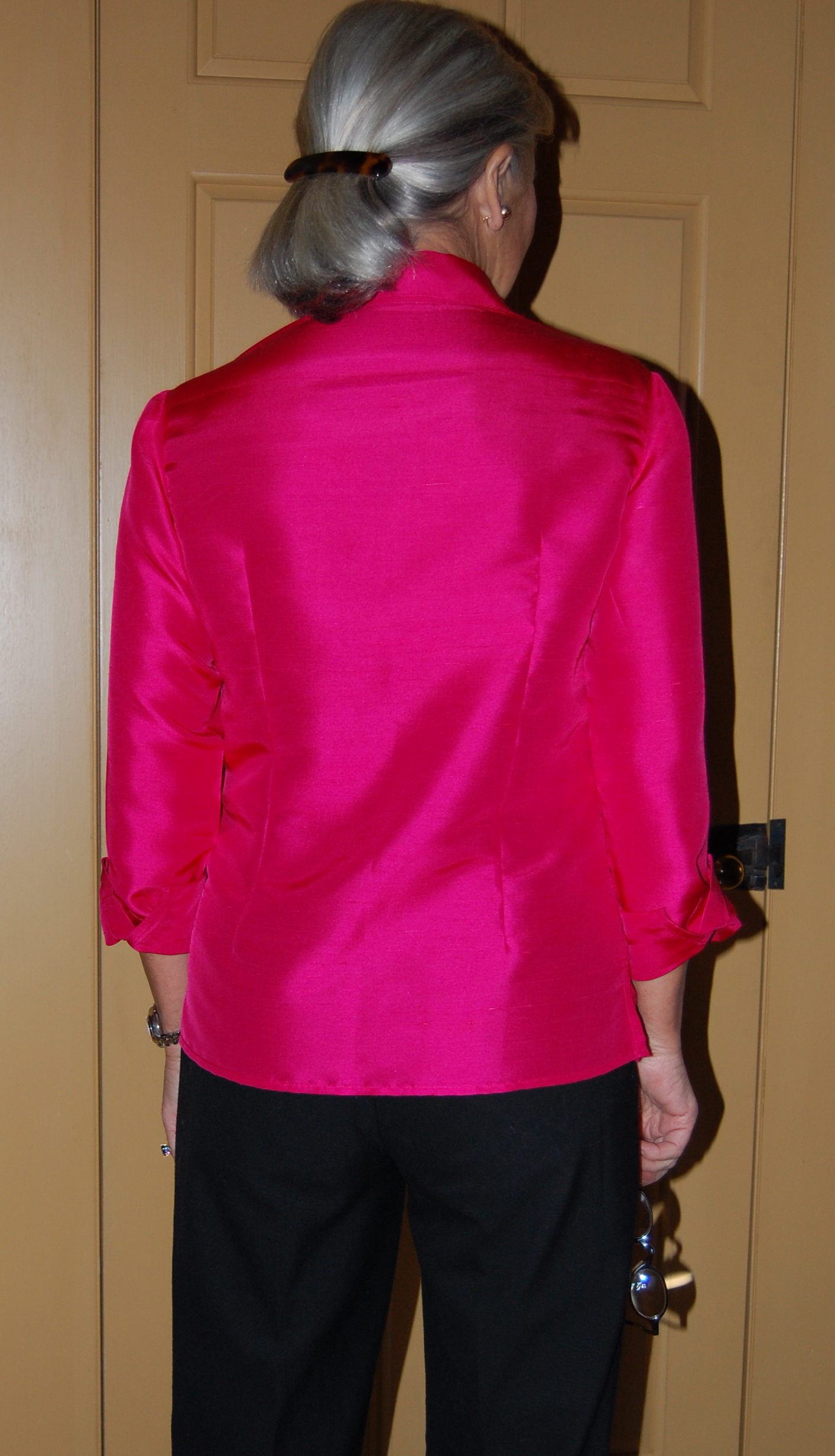
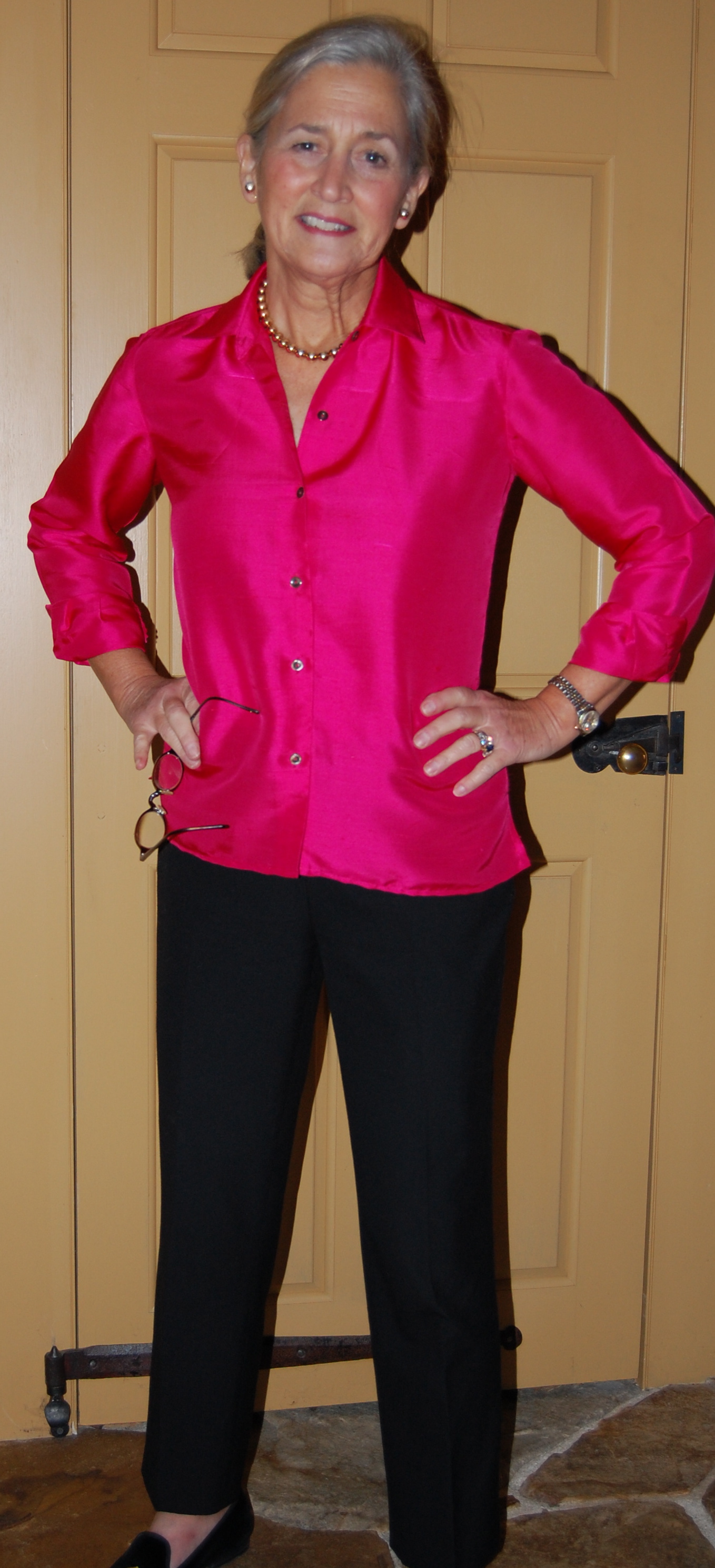
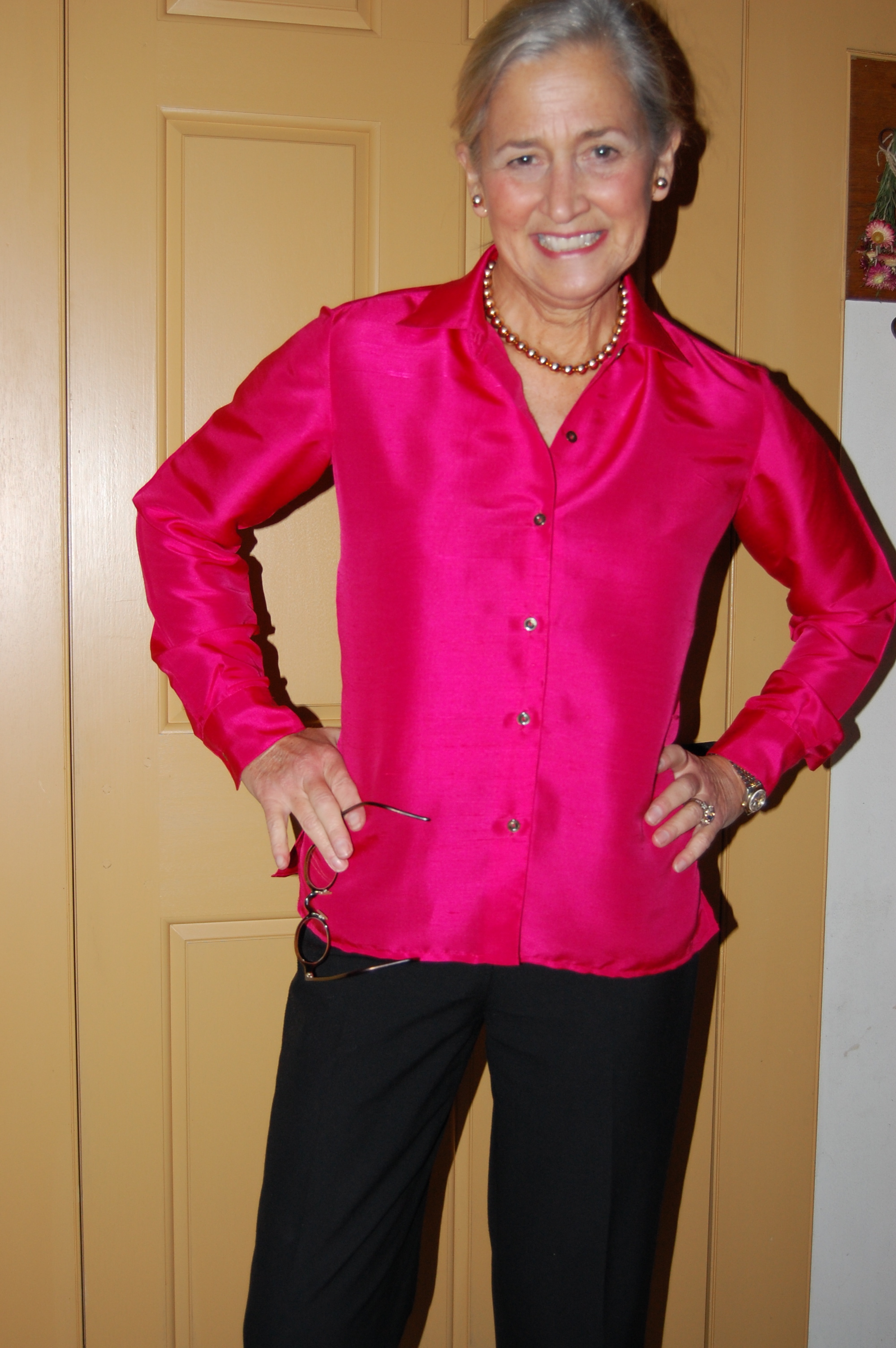
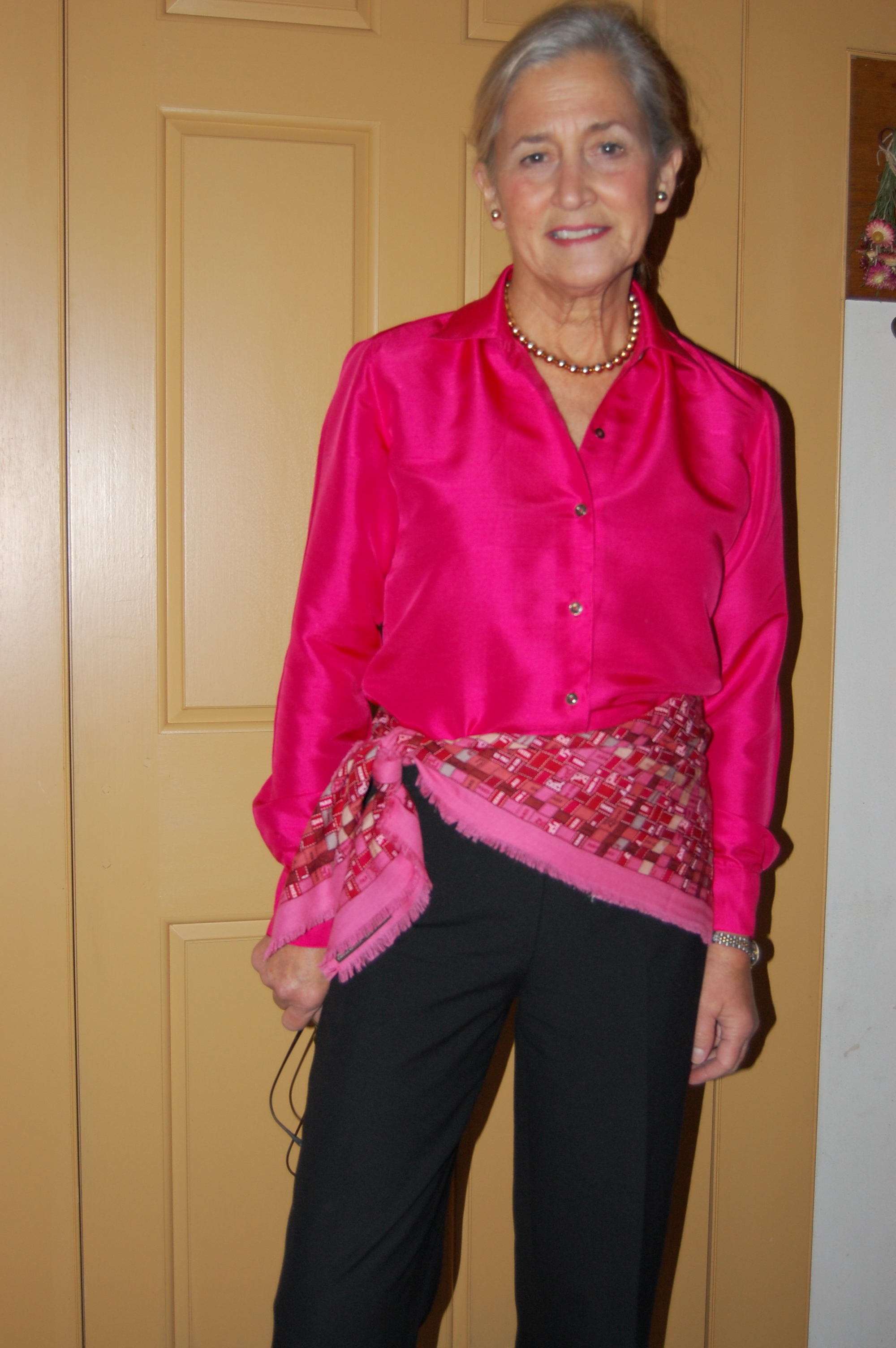
For a number of years now, Thursday evening has been “date night” for my husband and me.  That’s what we call it, but it really just means that we always go out for drinks and dinner.  It is always one of my favorite nights of the week.  Part of the fun of it is the “standing reservation” we have at a favorite local “drinkery/eatery”, where we are always met by friendly staff and a “kitchen” that knows our favorite choices.  Because we so often go to this same place, I like to mix up what I wear.  I doubt anybody actually notices, but it is just one of those things which is important to me!  Anyway, my new blouse is going to be a colorful, welcome addition to my Thursday night wardrobe.

Made from pink silk which i purchased in the 1980s.

Made from pink silk which I purchased in the 1980s.

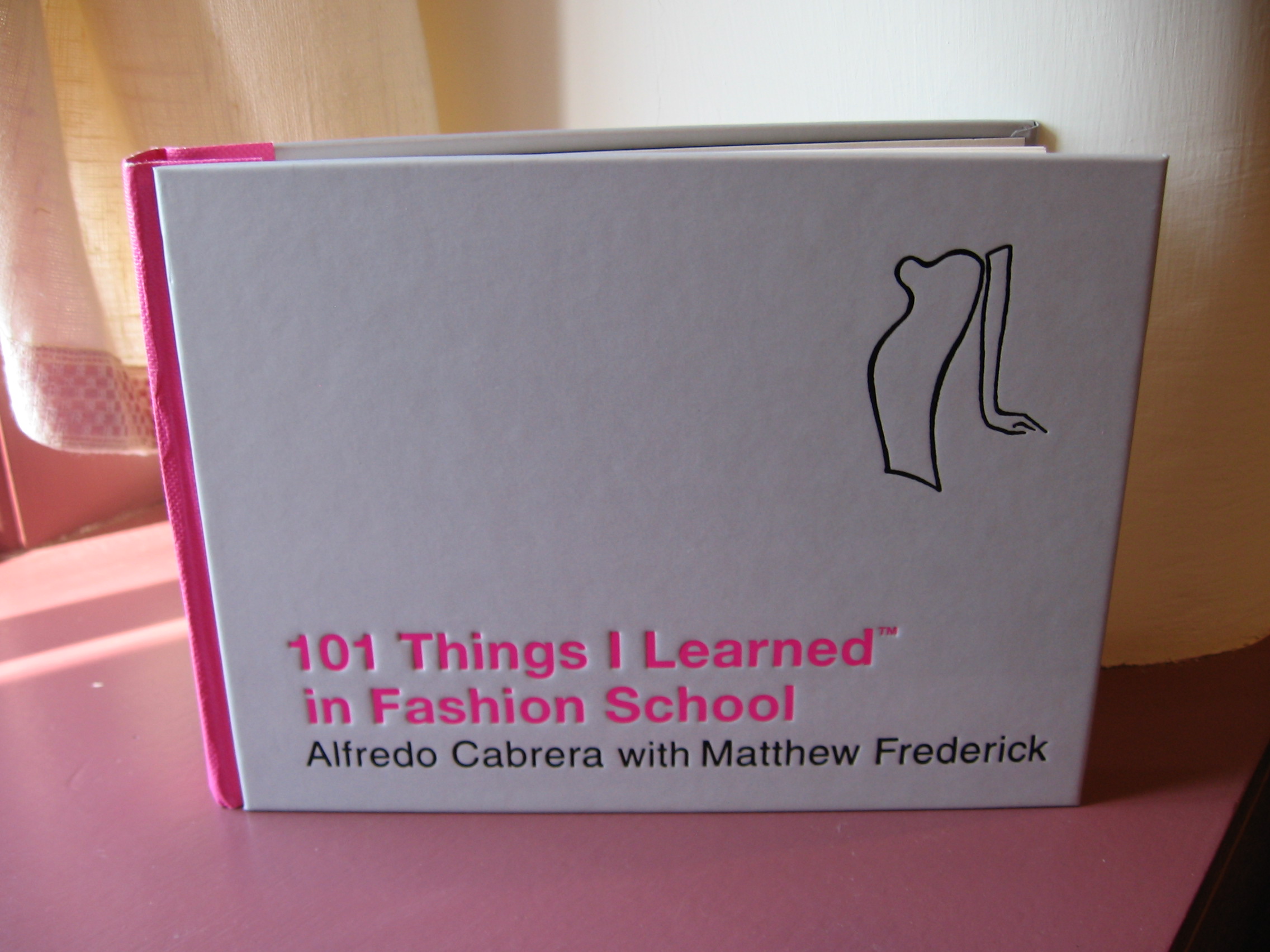
As I stated in my last post (distanced from this one by a sojourn to California, from which I did not return empty-fabric-handed…!), I based this blouse on a RTW one I have worn for years.  I always remember the good advice given on page 86 in 101 Things I learned in Fashion School (by Alfedo Cabrera with Matthew Frederick.  Copyright 2010, Grand Central Publishing, New York, New York):  “When in doubt, look in your closet.  When unsure about how a garment you’ve designed should be constructed, look at your own wardrobe:  We all have at least one pair of fly-front pants and a garment that buttons down the front.  It doesn’t take much time or effort to pull it out and replicate or adapt what one sees.”

A little book filled with great information

A little book filled with great information

Of course, I wanted to start with a basic blouse pattern, which I could tweak to recreate my old favorite one.  At this point, you might ask, “How difficult can it be to find a basic, long-sleeved, banded collar blouse pattern?”  A lengthy search through my patterns produced exactly one with some of the lines I wanted.  Just looking at it kind of made me cringe.  But then I realized that, with certain changes, it would probably be just about perfect.  Copyright 1972, this Simplicity pattern looks about as dated as it is, but its “bones” are still good!

Date night Simplicity pattern Among the details I needed to change:

1) The collar band was much too wide, so I narrowed it by about 50%.

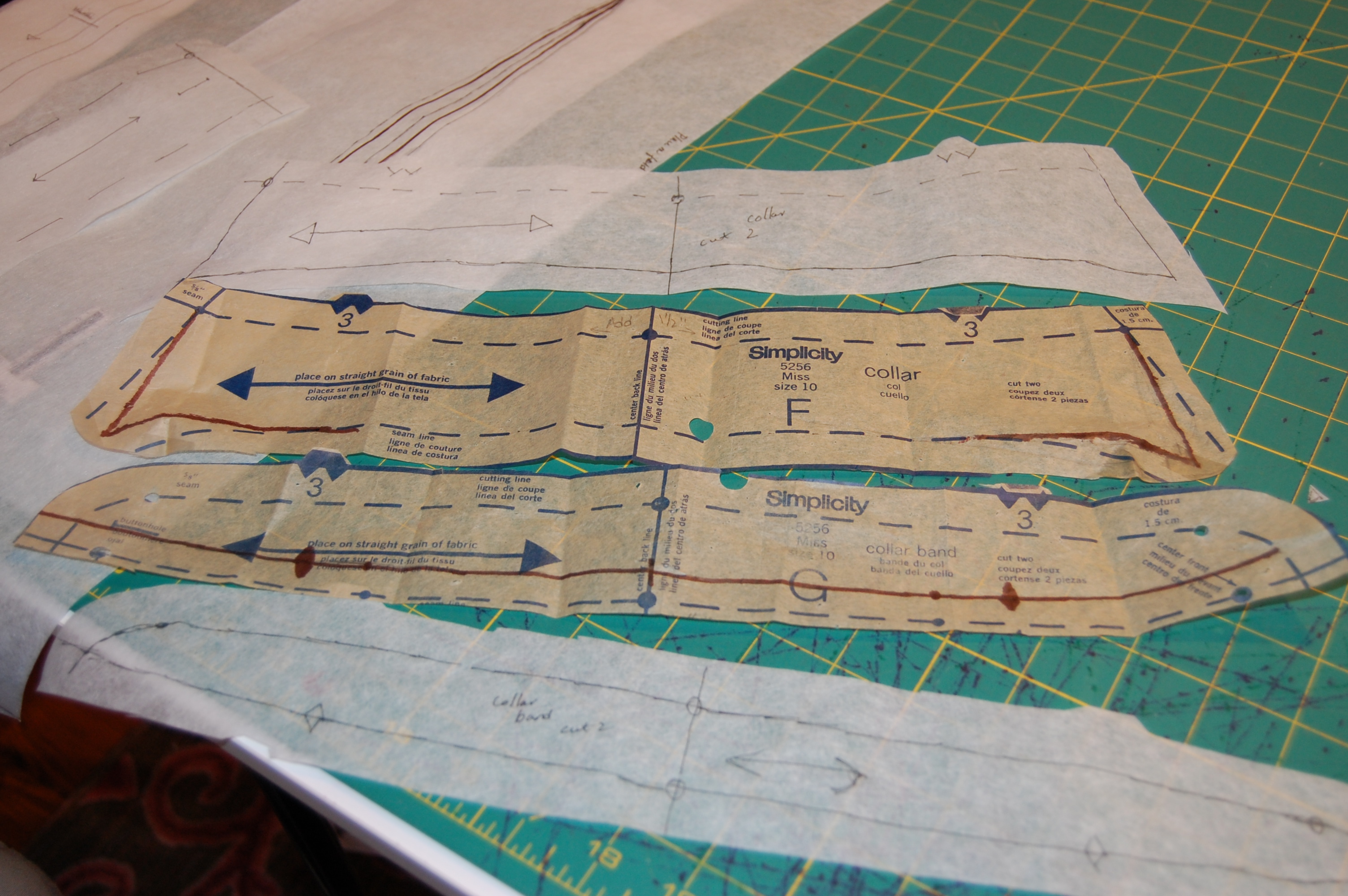
2) The collar was too big and too pointed, so I redrafted it to match the collar on my green blouse.

Changes to the collar band and the collar.

Changes to the collar band and the collar.

3) I eliminated the back yoke.

4) I made the front and back pieces a little straighter at the side seams, and then added two darts to the back to take in some of the fullness and make the blouse curve over the hips  a little more flatteringly.

Date Night

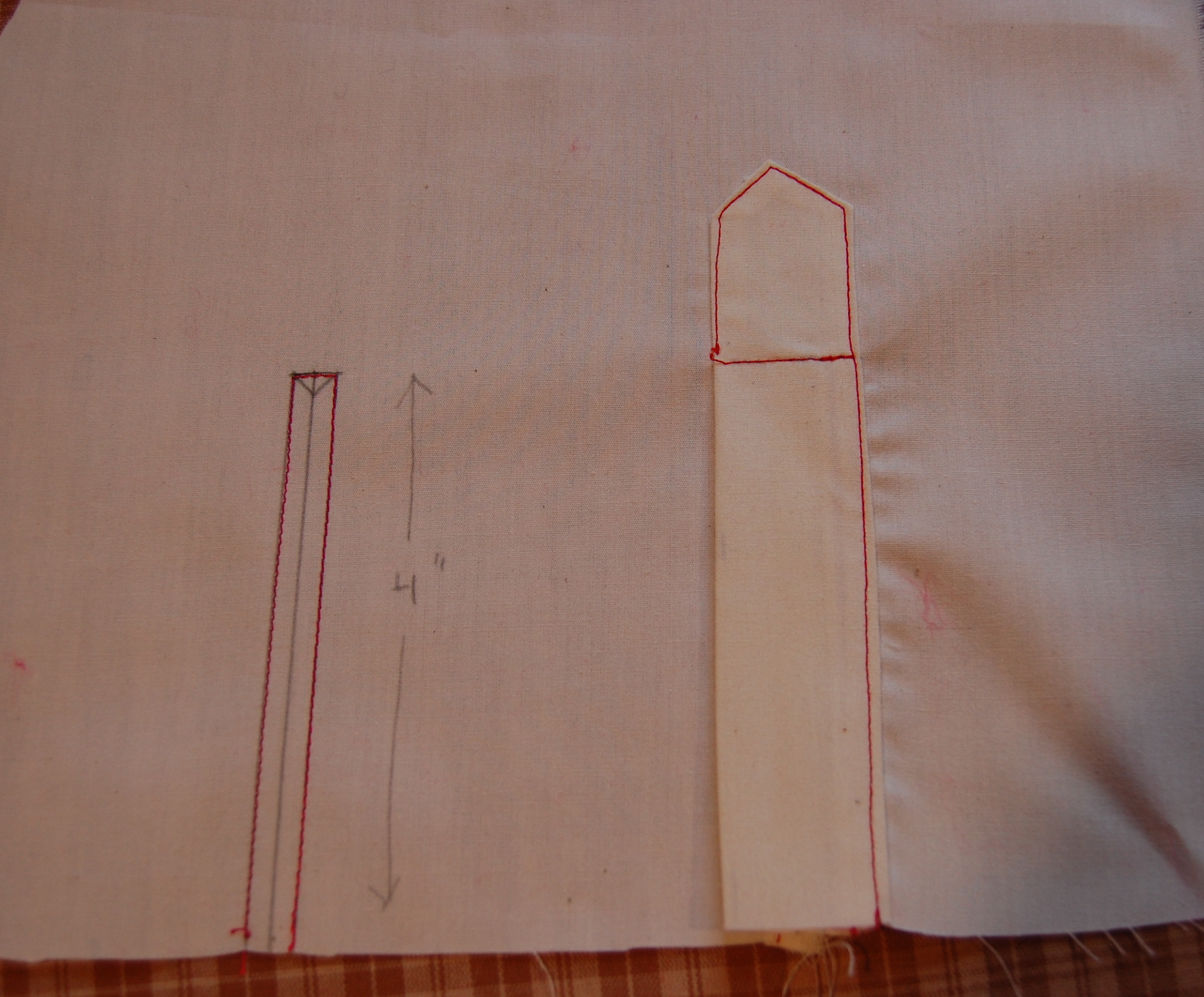
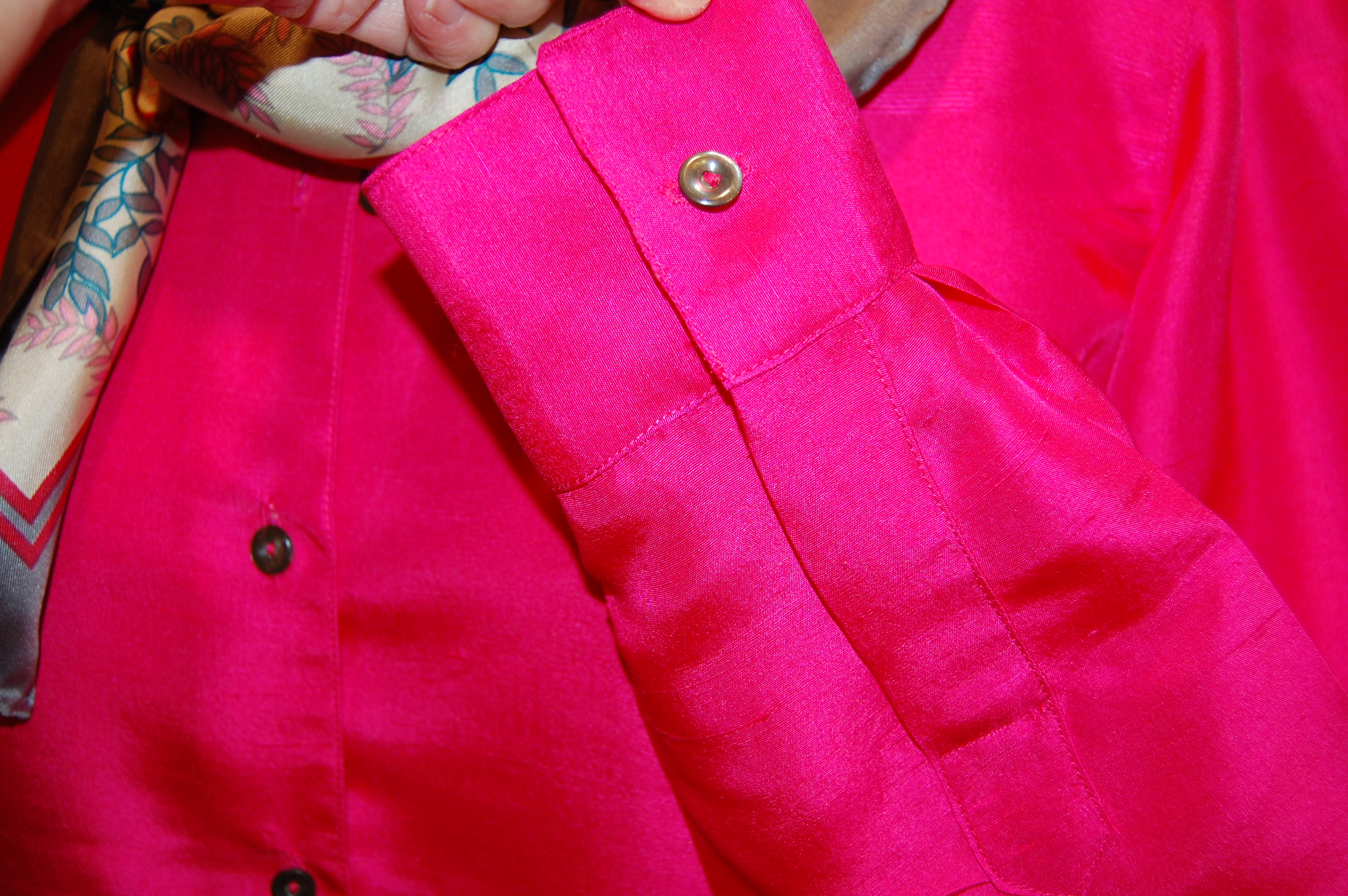
5) I loved the “sportshirt” sleeve plackets on my green blouse, so I went to my 1972 Vogue Sewing Book to find out how to add them to this blouse.  I narrowed the cuffs, too.

I practiced on muslin first!

I practiced on muslin first!

I am fairly happy with how these plackets turned out.  I can't ever remember making this type of placket before, so I guess it was a first for me!

I am fairly happy with how these plackets turned out. I can’t ever remember making this type of placket before, so I guess it was a first for me! 

6) I eliminated the front button band.

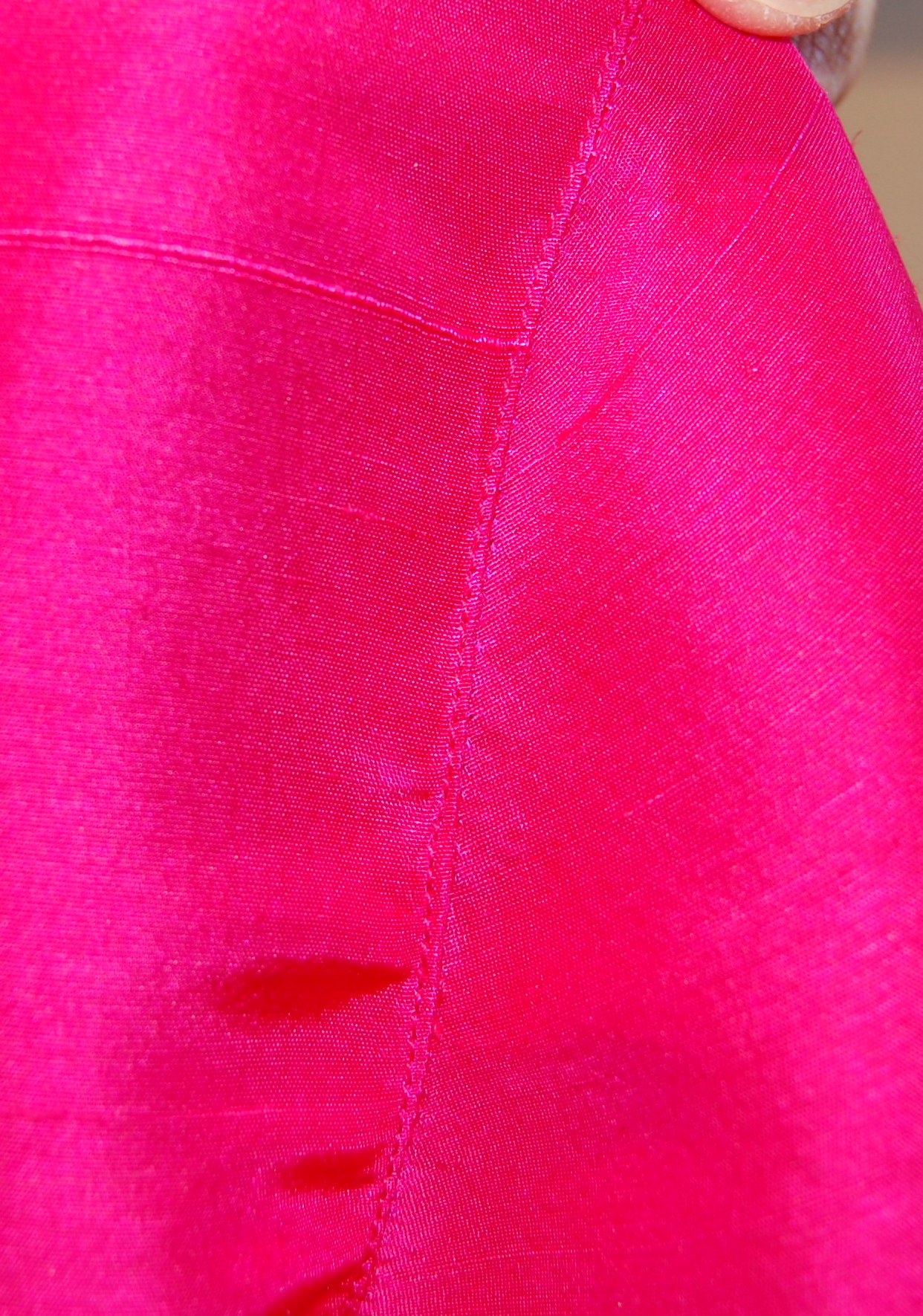
7) I added side slits and narrow topstitching to all the edges, just like on my green blouse.

This shows the sleeve heading, which I narrowly topstitched.  Click on the photo for a better look.

This shows the sleeve heading, which I narrowly topstitched. Click on the photo for a better look.

Here is the topstitching on the front edge.

Here is the topstitching on the front edge.

Oh, there is more, but you get the idea.  I made a permanent record of all these changes with a whole new set of pattern pieces.

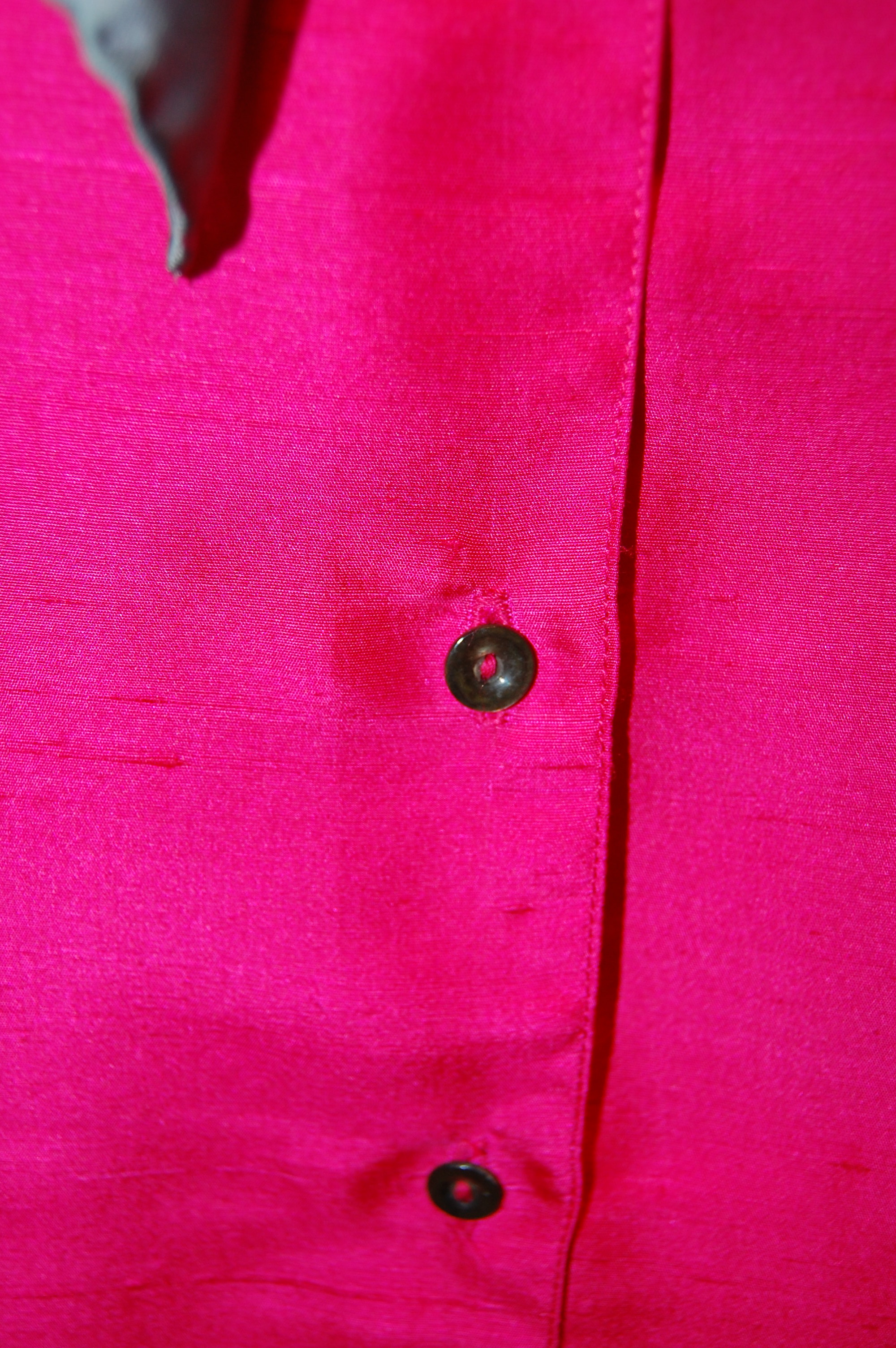
When it came to choosing buttons, I hoped to find some vintage ones to compliment the bright pink.  I found this gray pearl set (picked up somewhere for 50 cents), and the iridescence in them shimmered a bit of pink.

The holes on two of the buttons were a little off center, but fortunately, I only needed 8 of them!

The holes on two of the buttons were a little off center, but fortunately, I only needed 8 of them!

The process of making this blouse was fun and low-stress: I interfaced the collar and cuffs with silk organza, of course, but other than that, there were no underlinings, no linings, no bound buttonholes to worry about!

Date night

Date night

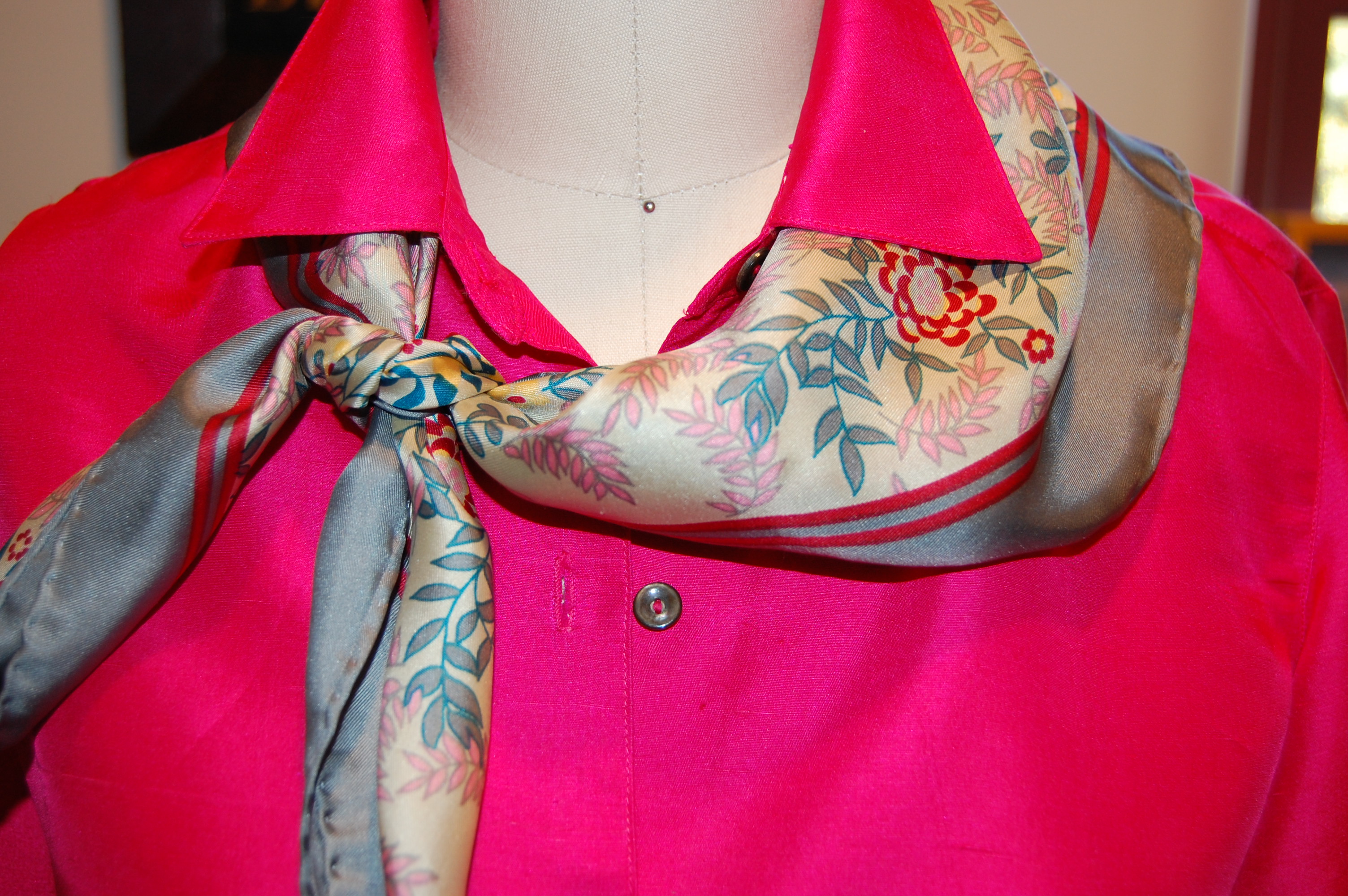
With a cashmere blend scarf, for a dressier look.

With a cashmere blend scarf, for a dressier look.

A vintage scarf to go with this vintage fabric!

A vintage scarf to go with this vintage fabric!

I’m looking forward to wearing this blouse often, but especially for date night, which just so happens to make “date day” also fun and low stress: no dinner to plan and cook  –  which means more time in the sewing room!

15 Comments

Filed under Blouses, Buttons - choosing the right ones, Scarves, sewing in silk, Uncategorized, vintage buttons, vintage Vogue patterns from the 1970s

“P” is for Pearl — and — Perseverance

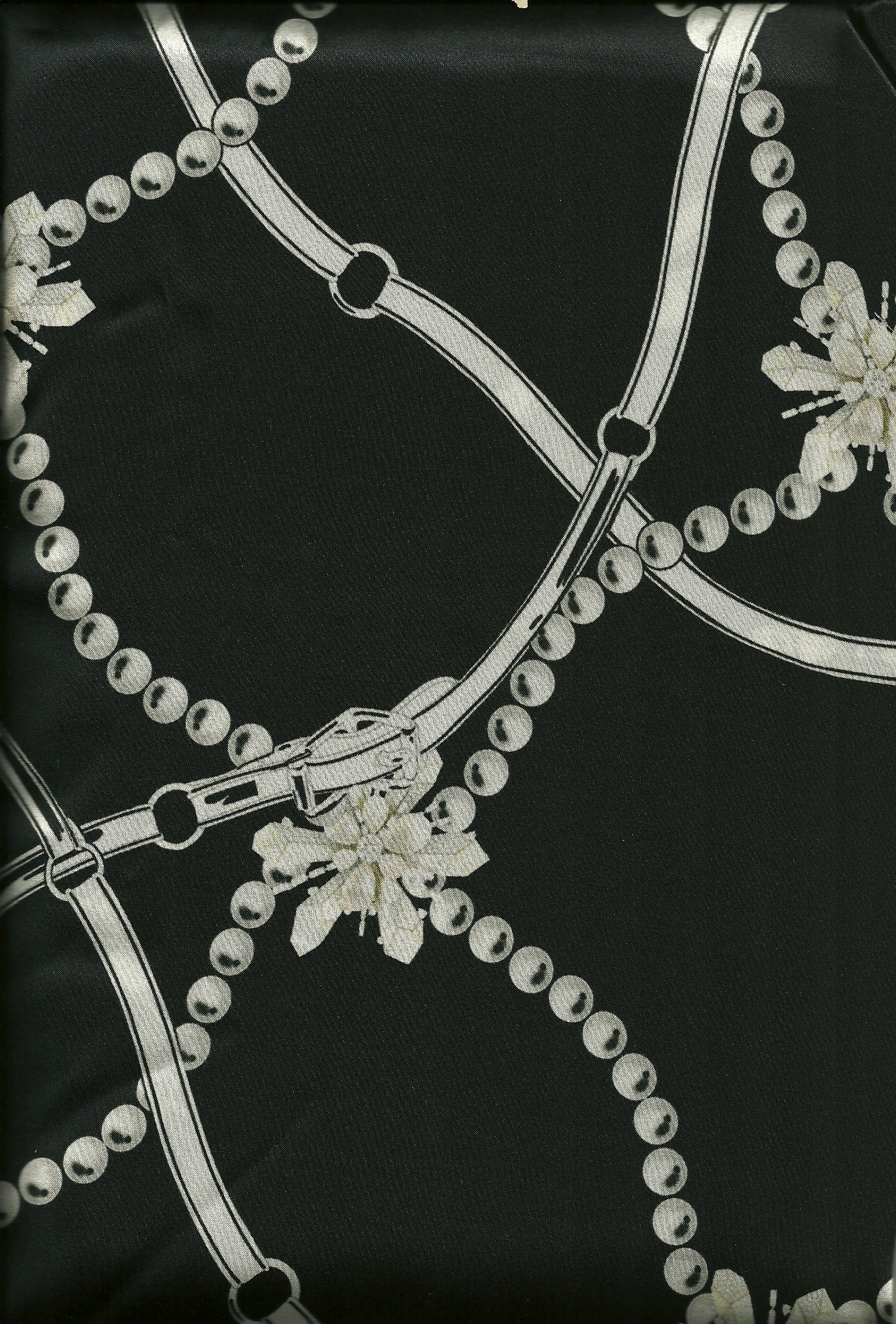
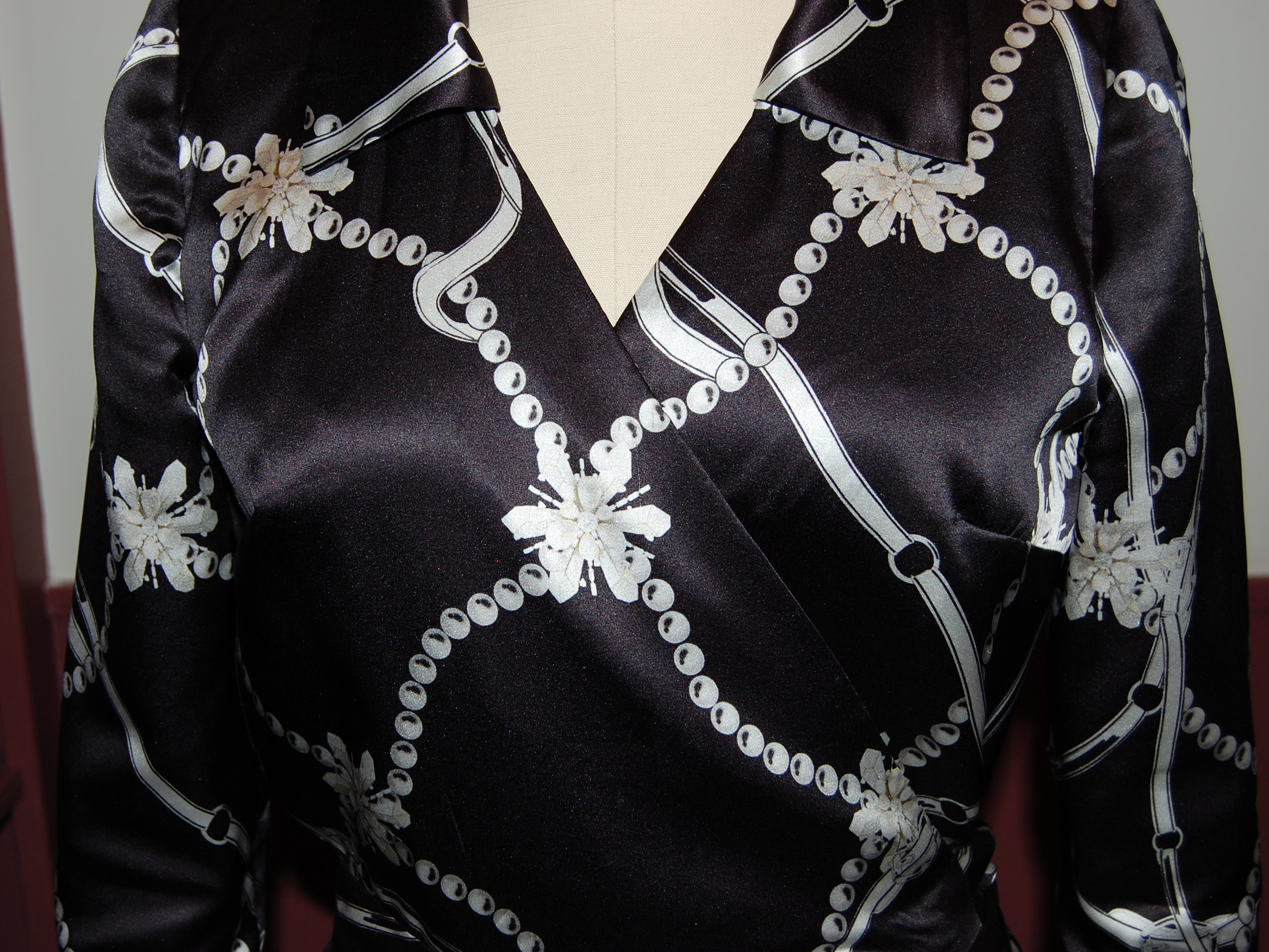
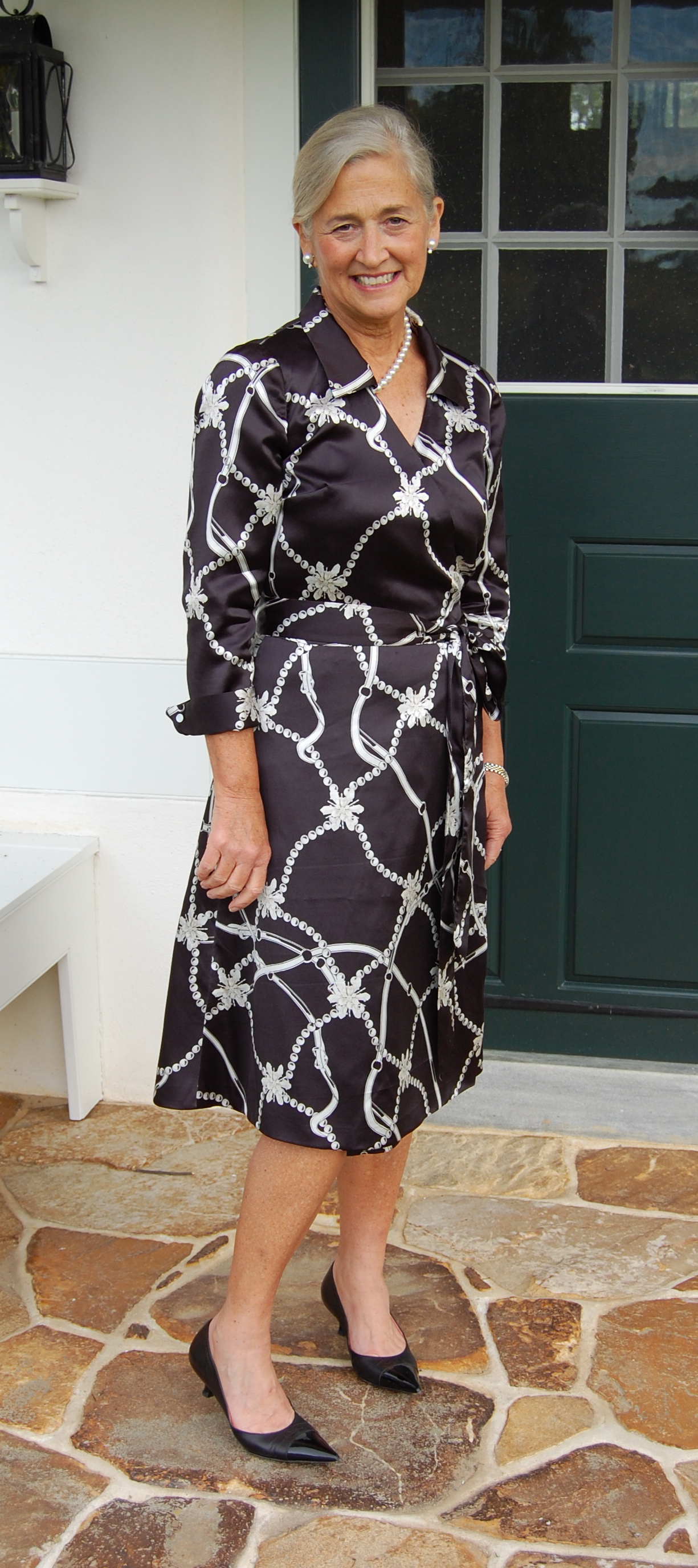
Among timeless fashion statements, pearls and wrap dresses both make my top-ten list.  The opportunity to combine the two was just too good to pass by, especially after being inspired by a silk charmeuse perfectly suited for just such a pairing.

Pearls and ribbons and clusters!

Pearls and ribbons and clusters, fabric purchased from Mendel Goldberg Fabrics in NYC.

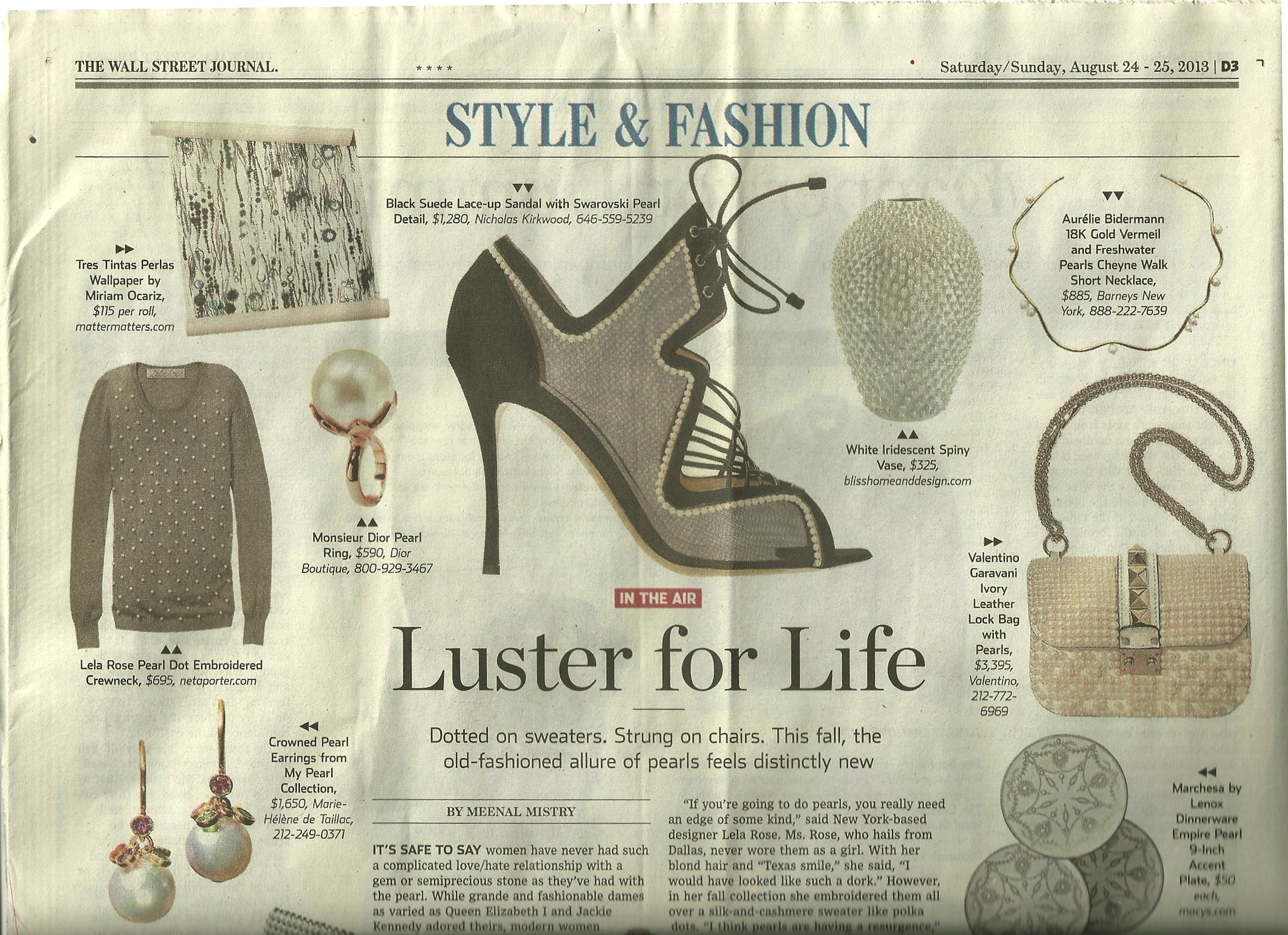
As luck would have it, shortly after I purchased the silk for this dress, an entire article in the Style & Fashion section of The Weekend Wall Street Journal of August 24 – 25 (2013) was devoted to “the old-fashioned allure of pearls…”  It seems that pearls are “showing up on everything from shoes to wallpaper to chairs”  – and to fabric, as evidenced by my Italian silk charmeuse.  I am just “old-fashioned” enough to think that pearls are never not in style, but I must admit that even I was smitten with the unusual and modern approach of this fabric design.

Pearls required - WSJ article

Pearls are showing up everywhere, it seems.

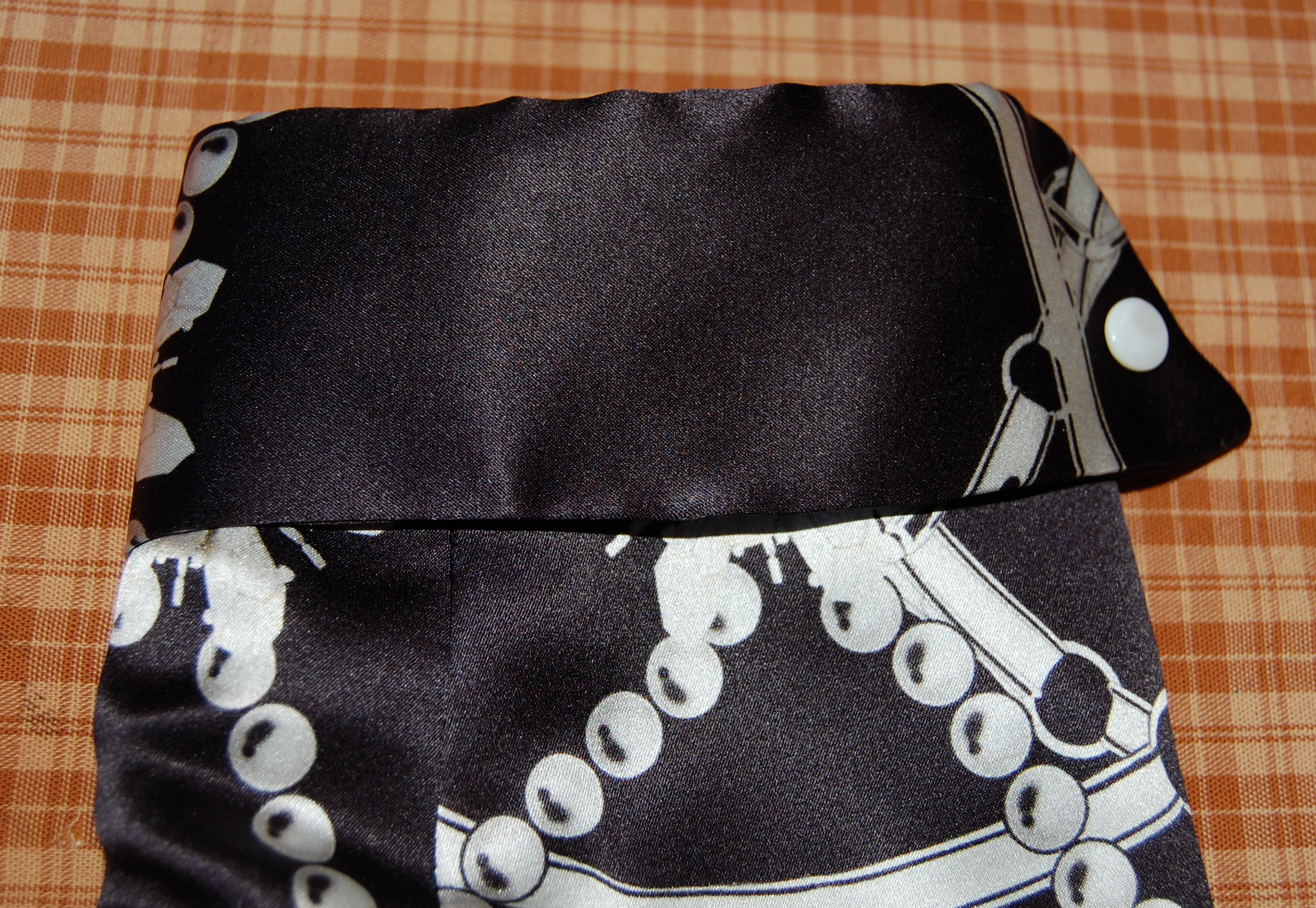
So – how would this modern fabric look, made up in a mid-1970s’ wrap dress pattern?   I thought it would work quite well. But getting there turned out to be challenge.  Although I was lacking the classic Diane von Furstenberg wrap dress pattern that I envisioned for this dress (blogged about here), I thought I could piece together a 1976 Simplicity version and a new Vogue wrap dress pattern to achieve my goal.

This is the dress I wanted to recreate...

This is the dress I wanted to recreate…

The Simplicity "version" of the Diane von Furstenberg wrap dress.

The Simplicity “version” of the Diane von Furstenberg wrap dress.

Vogue 8784 diagrams

Vogue 8784 diagrams

Here’s what I did:

1) I decided to use the princess-seamed bodice back from the new Vogue pattern.

2) I re-cut the collar and the cuffs from the Simplicity pattern so that the points on them would not so extreme.

3) Because the ties on the Simplicity pattern were not attached to the dress (the tie was just like a very long separate sash) I used the ties from this DvF pattern, and attached them to the side seams.

Pearls required - DvF pattern

4) The missing sleeve pattern piece in the Simplicity pattern meant that I had to use the sleeve from the new Vogue pattern and basically redraft it, with an elbow dart, and with cuffs.  I also used Simon Henry’s book The Little Black Dress: How to make the perfect one for you as a reference.

Pearls required - LBD book

This is the wrap LBD dress featured in the book.

5) I ended up making two complete muslins and re-stitching one of those muslins, before I had a workable pattern.  All of this seemed to take forever!

When I finally cut out the black silk organza underlining, I was ready for a celebration, but of course, that would have been premature.  Although the design in the fashion fabric really could not be “matched”, I still had to respect the placement of the “clusters” as they would relate to the bodice.  (I did not want “clusters” at the apex of the bust darts, for example.)   And I felt like the “clusters” should be placed at equal distances from each other over the expanse of the dress, if possible.  After determining all this and  cutting out the fashion fabric, I finally got to sewing, which included lots of basting, catch-stitching all the seams to the underlining, understitching the collar by hand (which worked beautifully, for which I was very grateful!), setting in the sleeves, making the lining, etc., etc.

Here is the final placement of the fabric design on the front of the bodice . . .

Here is the final placement of the fabric design on the front of the bodice . . .

P is for pearl

. . . and here is the bodice back.

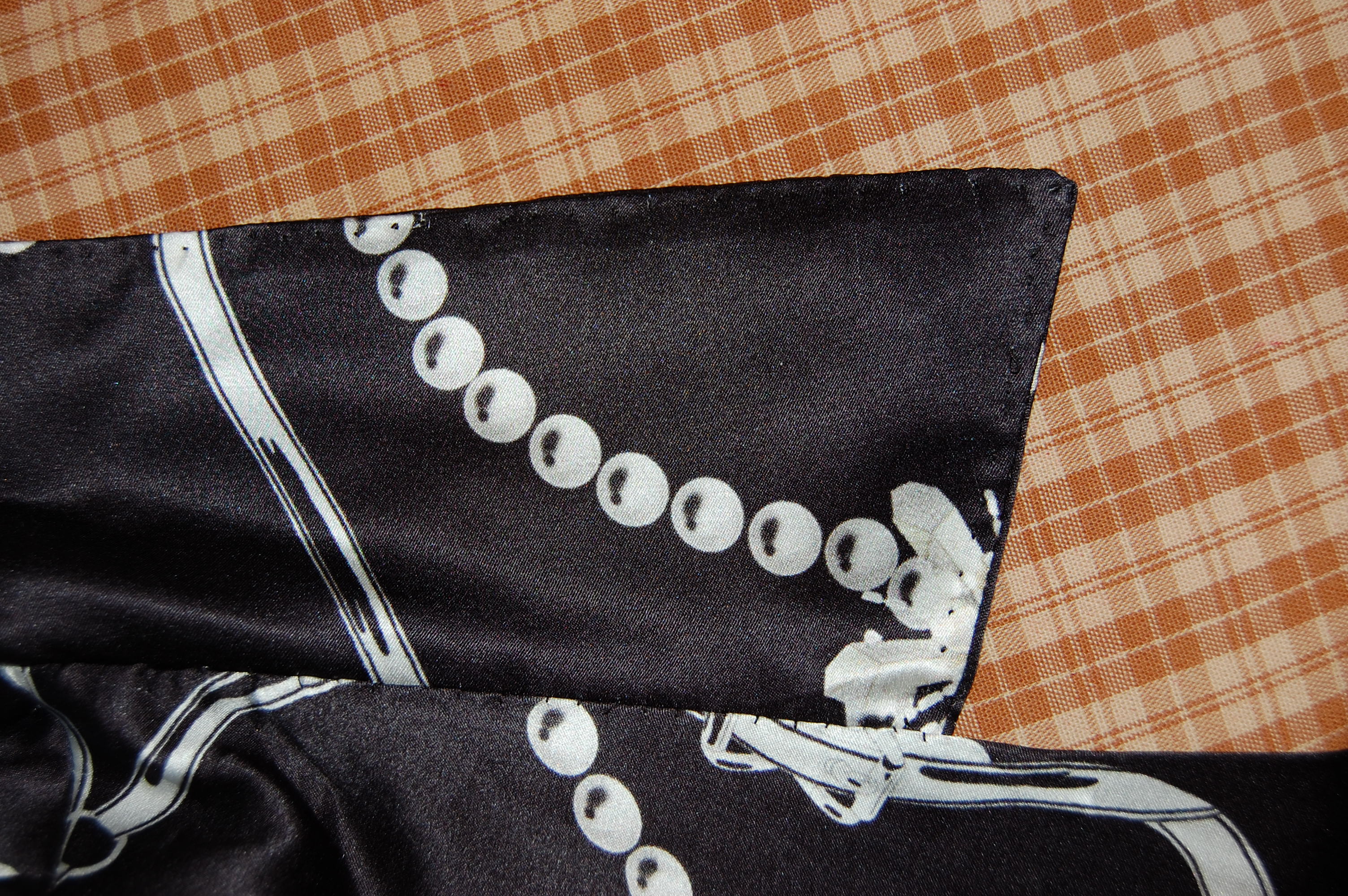
Understitching the collar created a slight under-curve which helps the collar lay flat.

Understitching the collar created a slight under-curve which helps the collar lay flat.

This boring view just shows the lining that was so tedious to attach!

This boring view just shows the lining that was so tedious to attach!

I made the mistake of making the cuffs before a final fitting of the sleeves. (I thought I was being smart and getting “prep” work done, but I just made more work for myself).  I ended up shortening the sleeves and enlargening the openings so that I would be able to push them up on my arms if I wanted to.  The cuffs I had made were not long enough to accommodate these adjustments, so back I went to cut and make new cuffs.  Fortunately I had just enough fabric to squeeze these out!

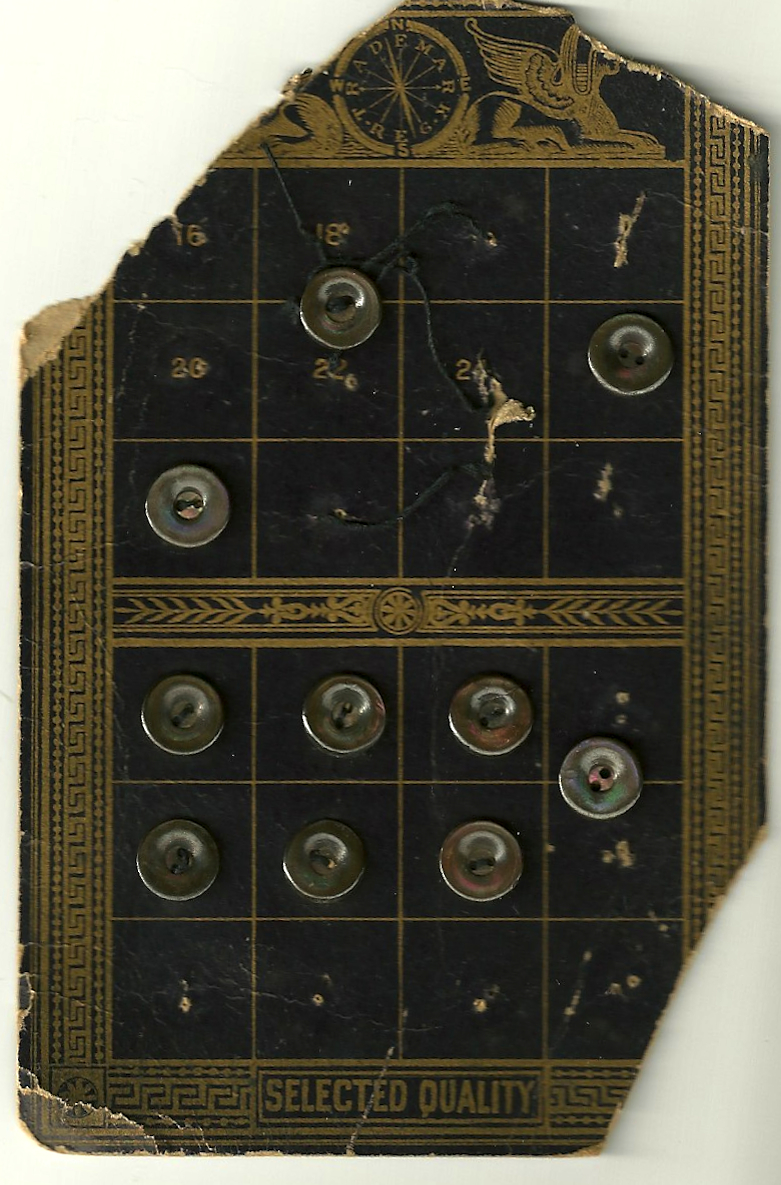
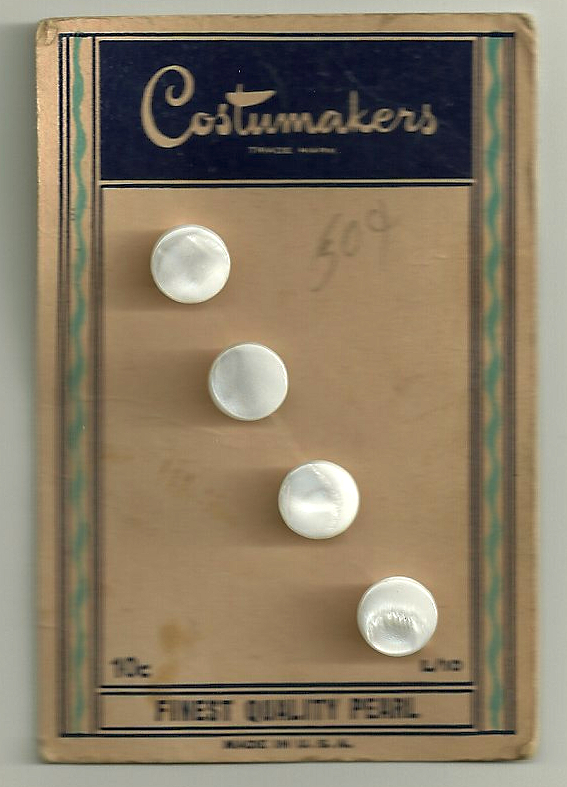
For buttons for the cuffs, I went to my button box and came up with this card:

The original price of these buttons was 10 cents.  I picked them up for 50 cents at some point.  It almost seemed a shame to cut them off of the card!

The original price of these buttons was 10 cents. I picked them up for 50 cents at some point. It almost seemed a shame to cut them off of the card!

Because I had reduced the points on the cuffs, I needed “not-too-big” buttons and these proved to be perfect, I thought, and in keeping with the “pearl” theme.

Here is one of the cuffs with buttons attached.

Here is one of the cuffs with buttons attached.

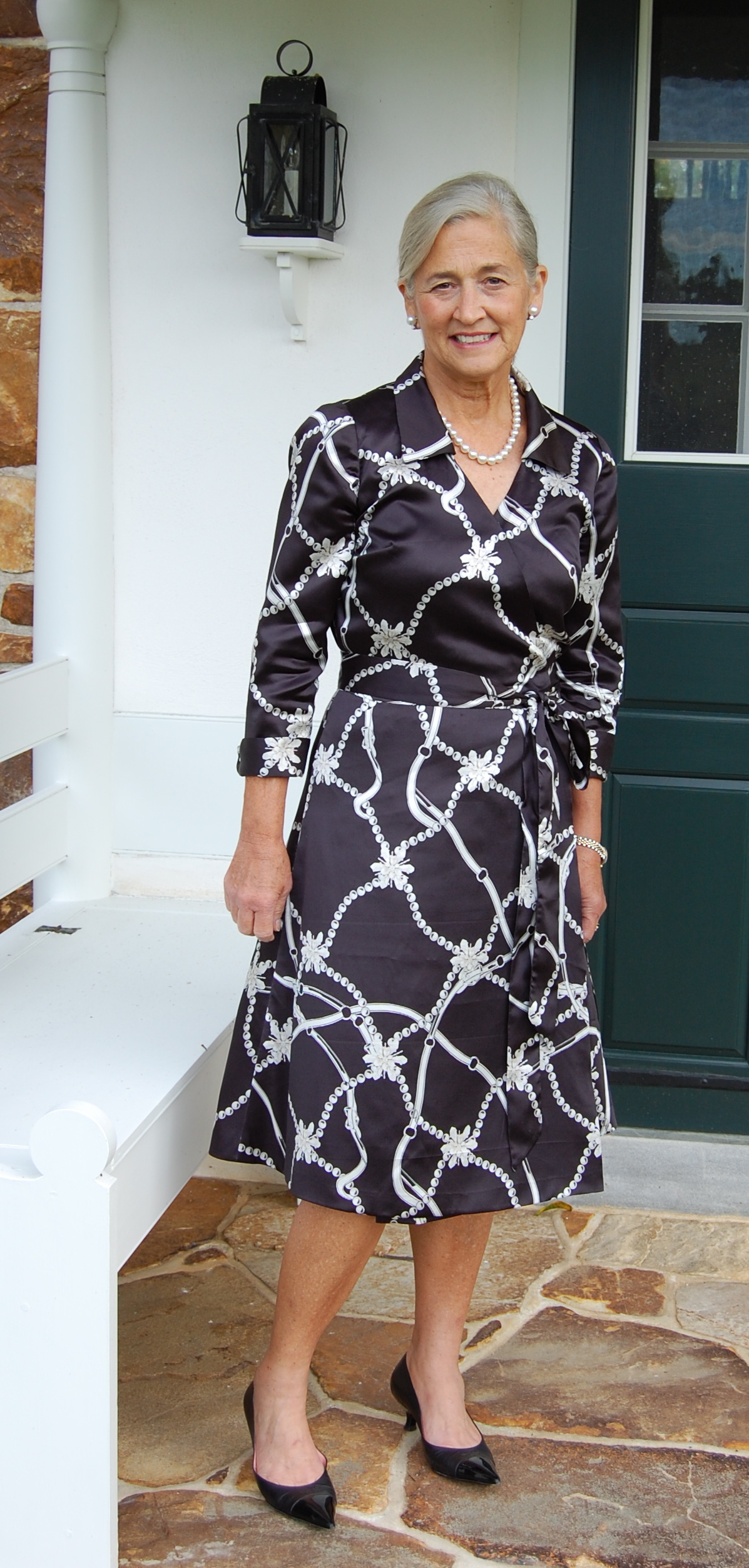
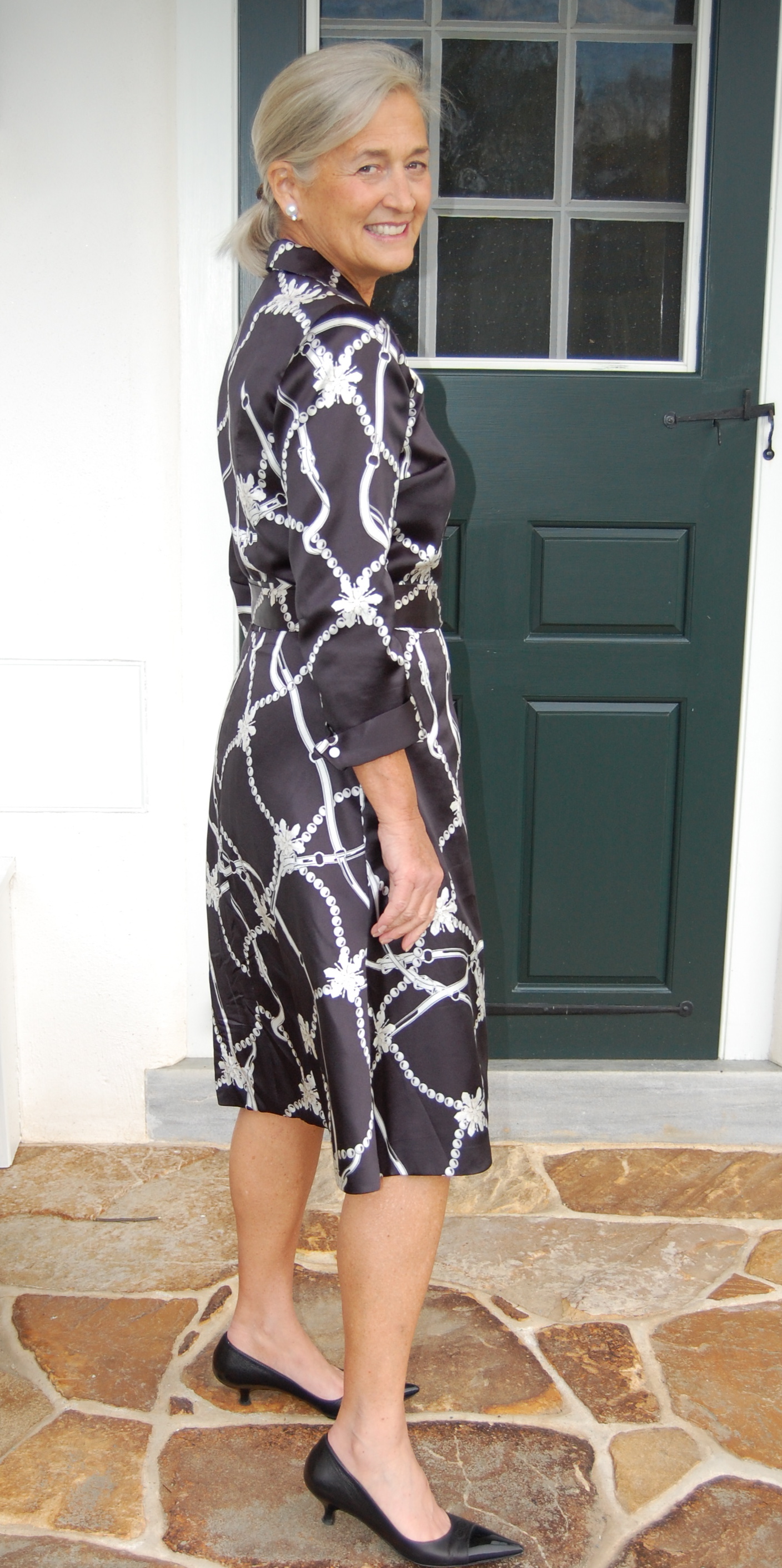
Working on the black fashion and lining fabrics was tedious.  And it seemed the more I worked on this dress, the more there was to do on it!  Kind of like eating a big bowl of pasta – the work seemed to multiply before my eyes.  Fast, easy, and jiffy this was not!  It’s times like this that being of a stubborn nature serves me well.  I persevered and got it done!  And even better, I am really happy with the results.

I will replace this photo with one of me in the dress as soon as I can!

Here is the dress on my new dress form . . .

. . . and here it is on ME!

. . . and here it is on ME!

DSC_1022

DSC_1028

P is for pearl

Now – two more “P” words.  I have “P”romised myself that my next “P”roject will be simple.  Maybe a blouse – or even a blanket?

15 Comments

Filed under Buttons - choosing the right ones, couture construction, Little Black Dress, sewing in silk, Uncategorized, vintage buttons, vintage Vogue Designer patterns, vintage Vogue patterns from the 1970s, Wrap dresses

Shopping for Fabric

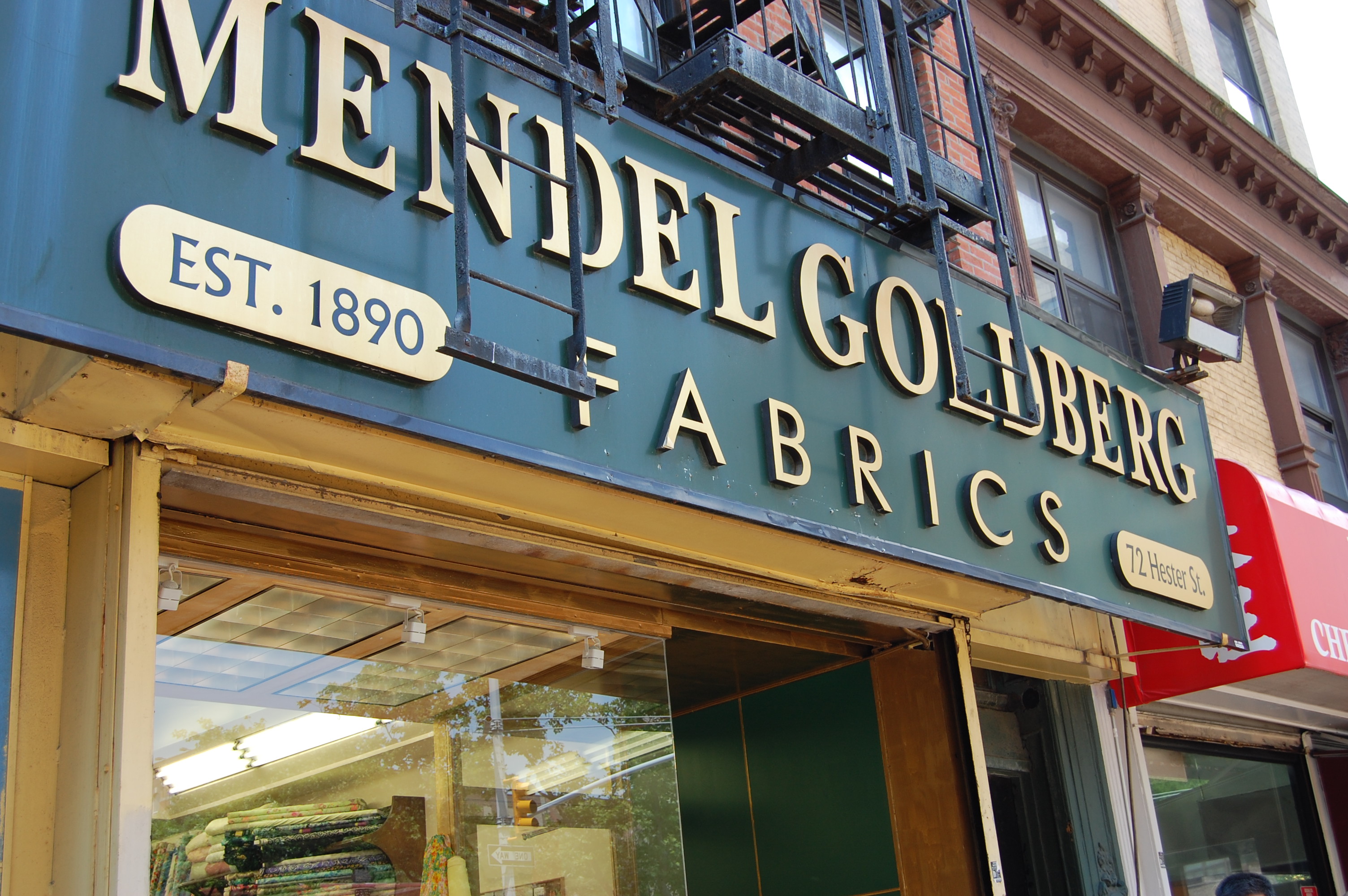
Are there any more magical words for those of us who sew?  And what if that shopping trip is to New York City to visit Mendel Goldberg Fabrics?  For those of you unfamiliar with this exceptional purveyor of the finest fabrics, this short statement in their recent (and first) ad in Threads Magazine will help to acquaint you:  “This family-owned business carries European designer fabrics, from French lace to brocades, boucles, Italian silk prints and novelties.  You’ll be amazed by their selection of imported couture fabrics.”

The distinctive sign for Mendel Goldberg Fabrics on Hector Street in NYC.

The distinctive sign for Mendel Goldberg Fabrics on Hester Street in NYC.

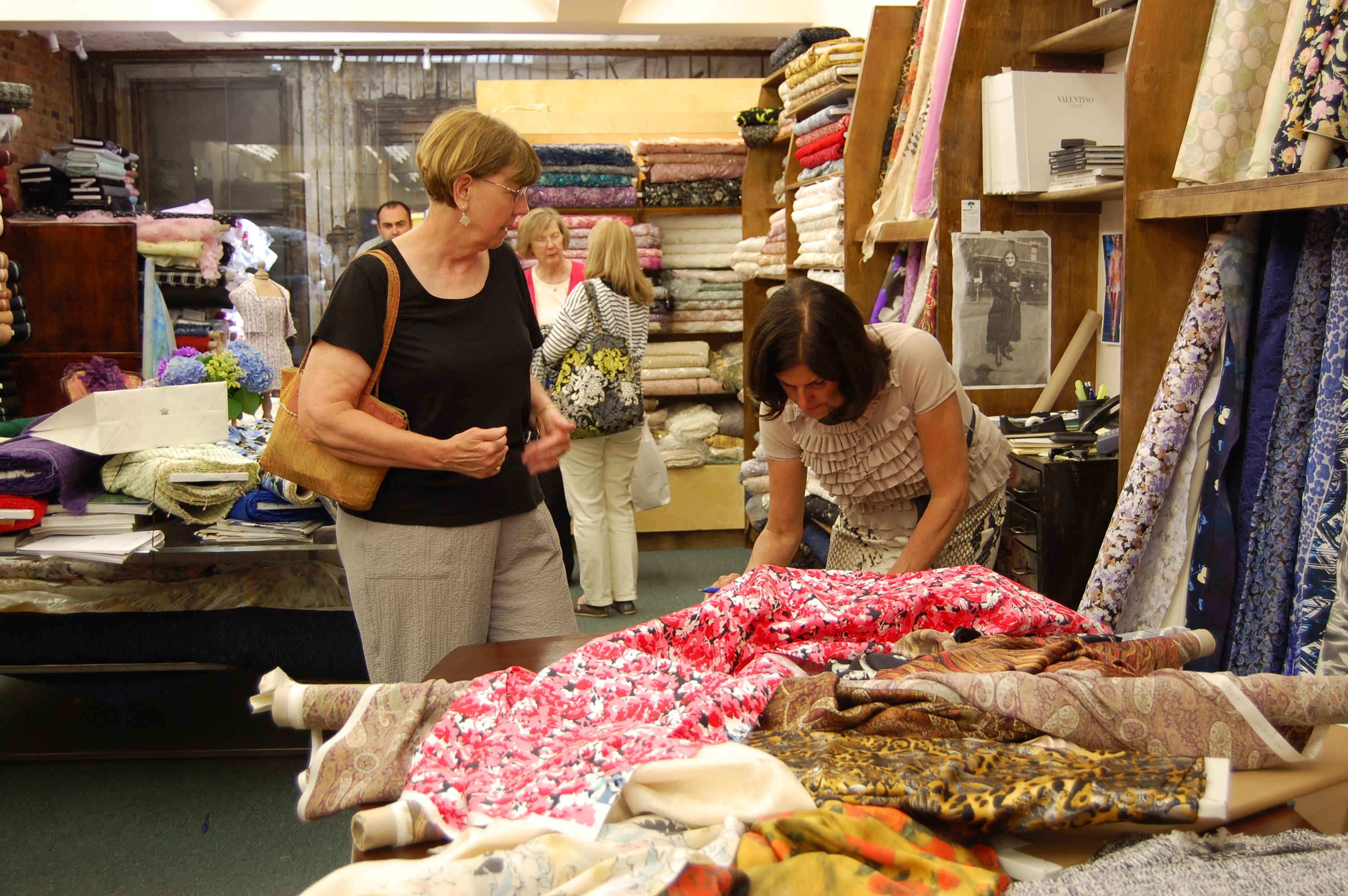
Well, amazed we were – all 11 of us who visited Mendel Goldberg Monday a week ago (June 24) on the first day of our class with Susan Khalje – The Classic French Jacket.  We were also just a little bit giddy (no, we were actually unabashedly giddy) as we viewed the treasures before us.  However, I am getting ahead of myself . . .

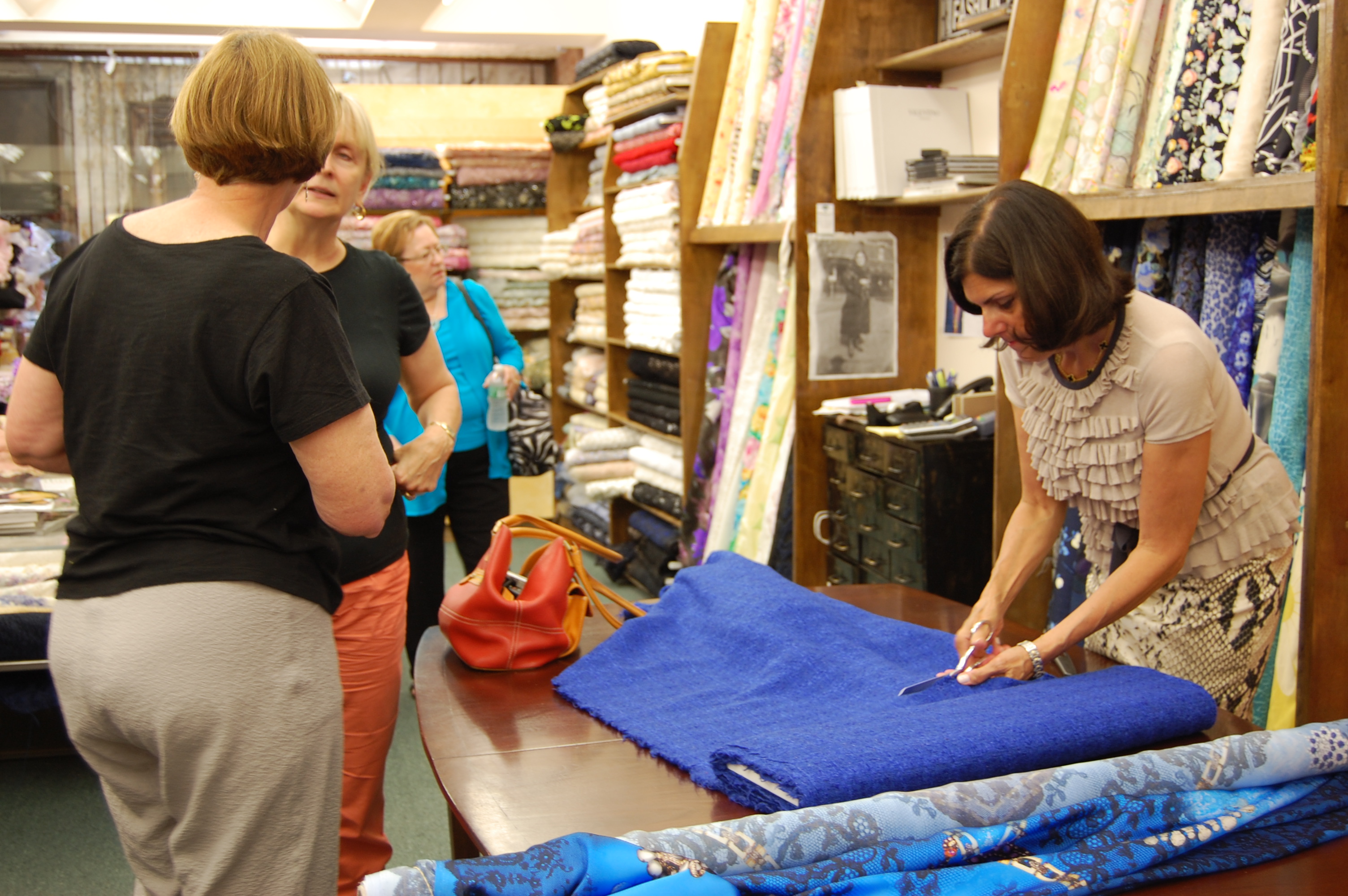
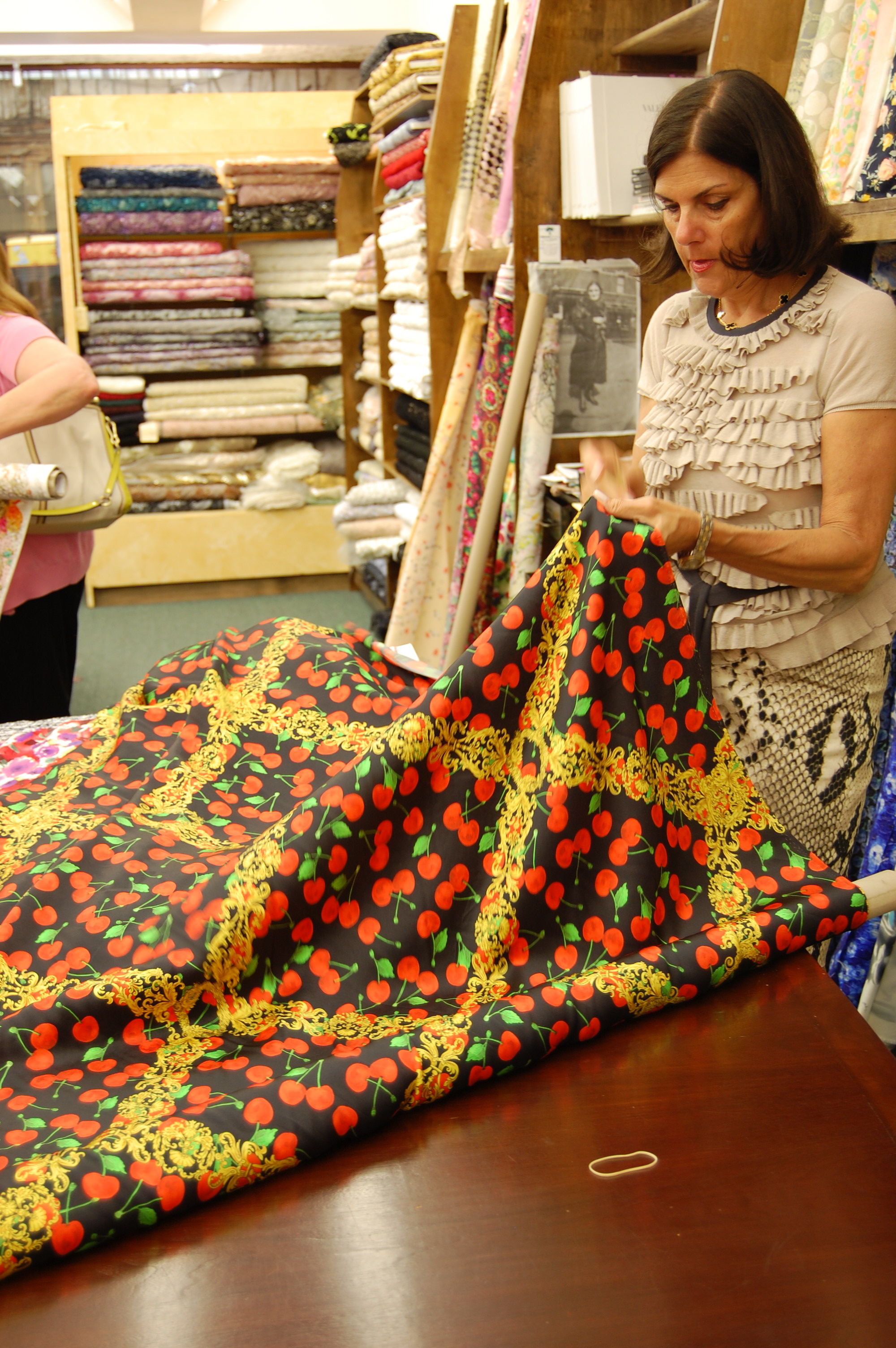
Arriving at the store after our 4-hour drive from Baltimore, we were enthusiastically and graciously met by Alice, the proprietress whose great-grandfather started the business in 1890.  Her daughter Josie works with her, and they are assisted by long-time employee Louis.  Also there to help us was Pierre, a young Frenchman who was interning with the business for two months.

Alice is on the right, in a pose seen often - cutting fabric.

Alice is on the right, in a pose often seen – cutting fabric.

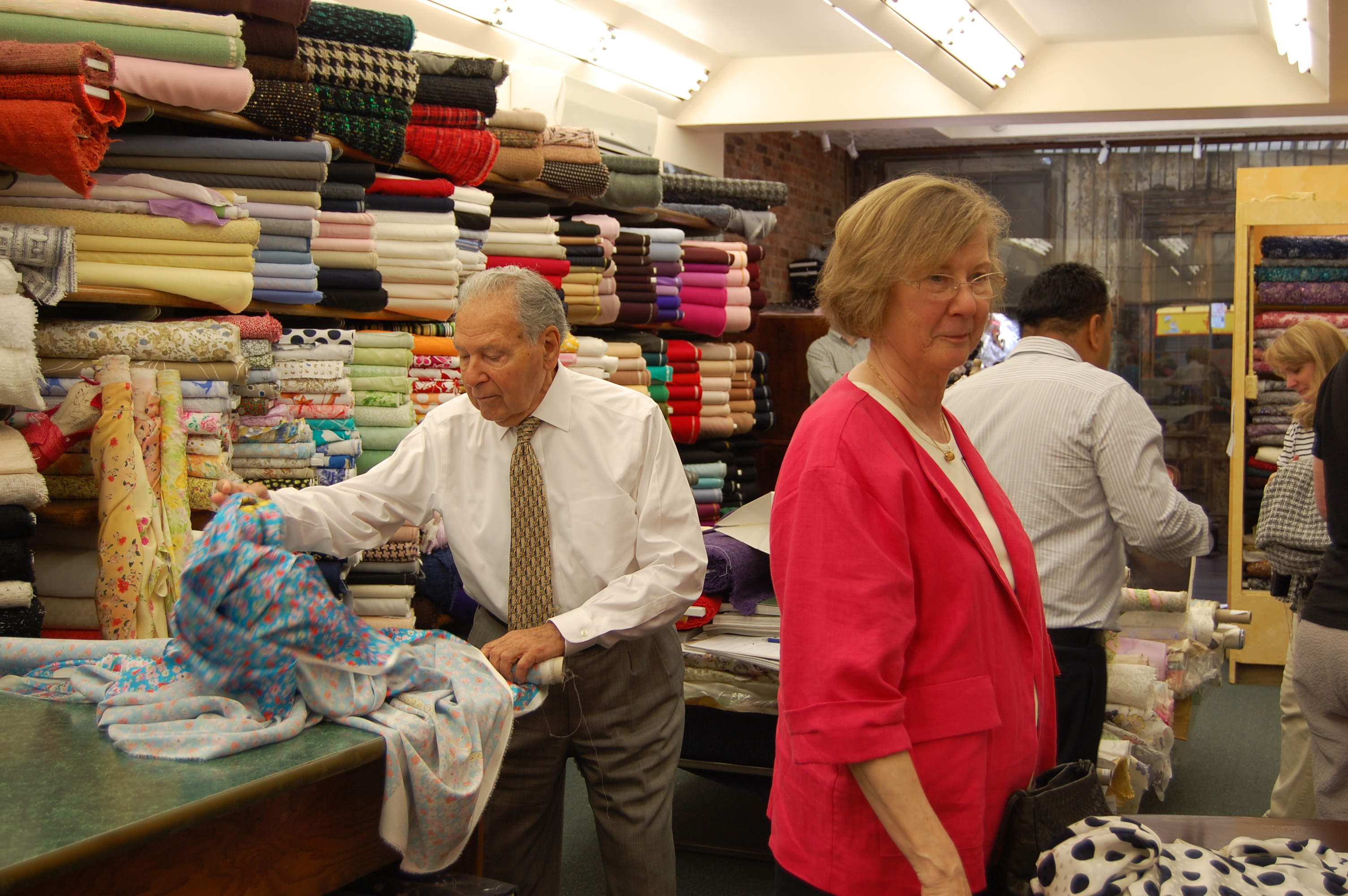
Josie and Louis

Josie and Louis

Pierre shown here in front of all those luscious fabrics.

Pierre shown here in front of all those luscious fabrics.

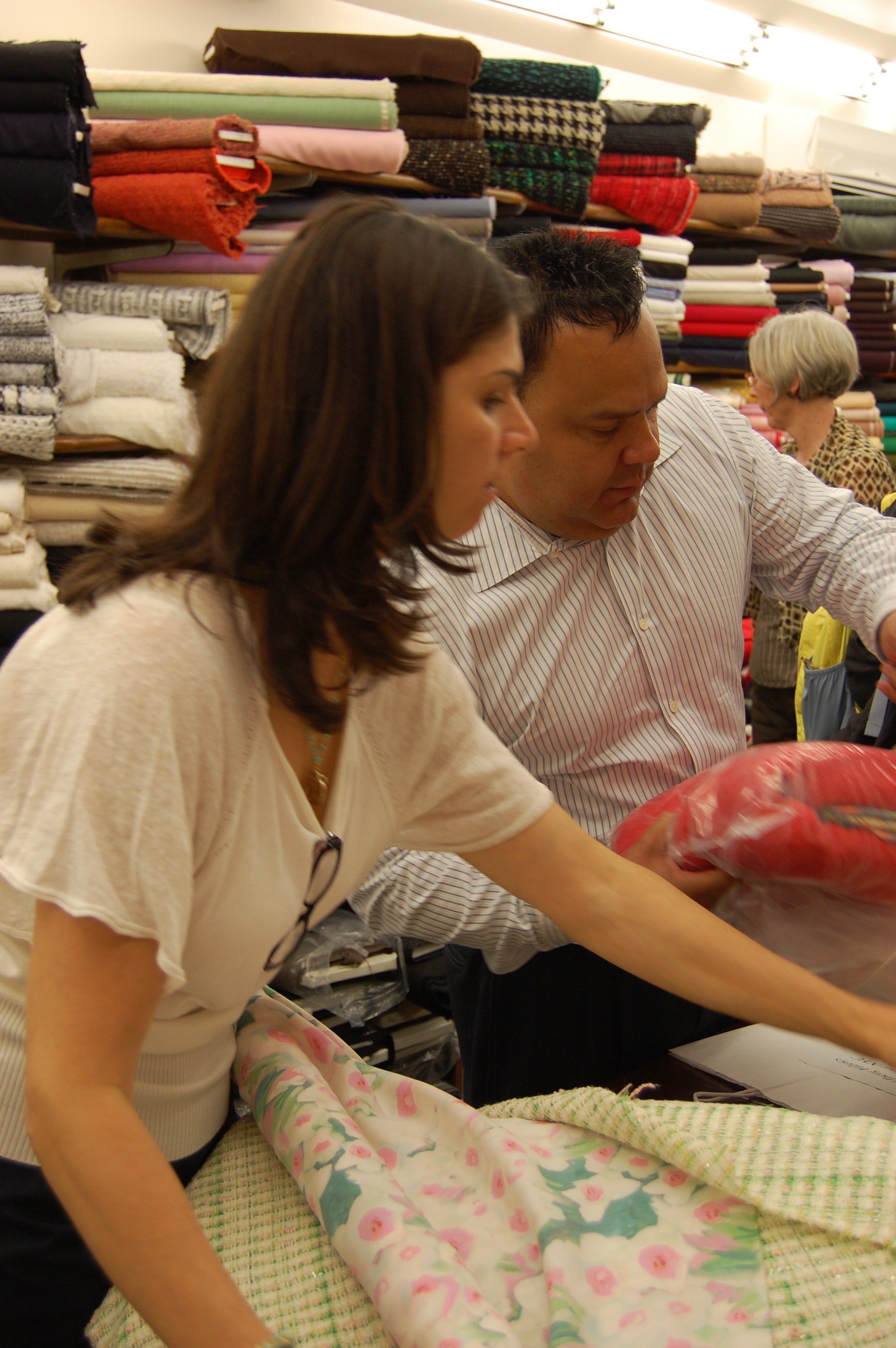
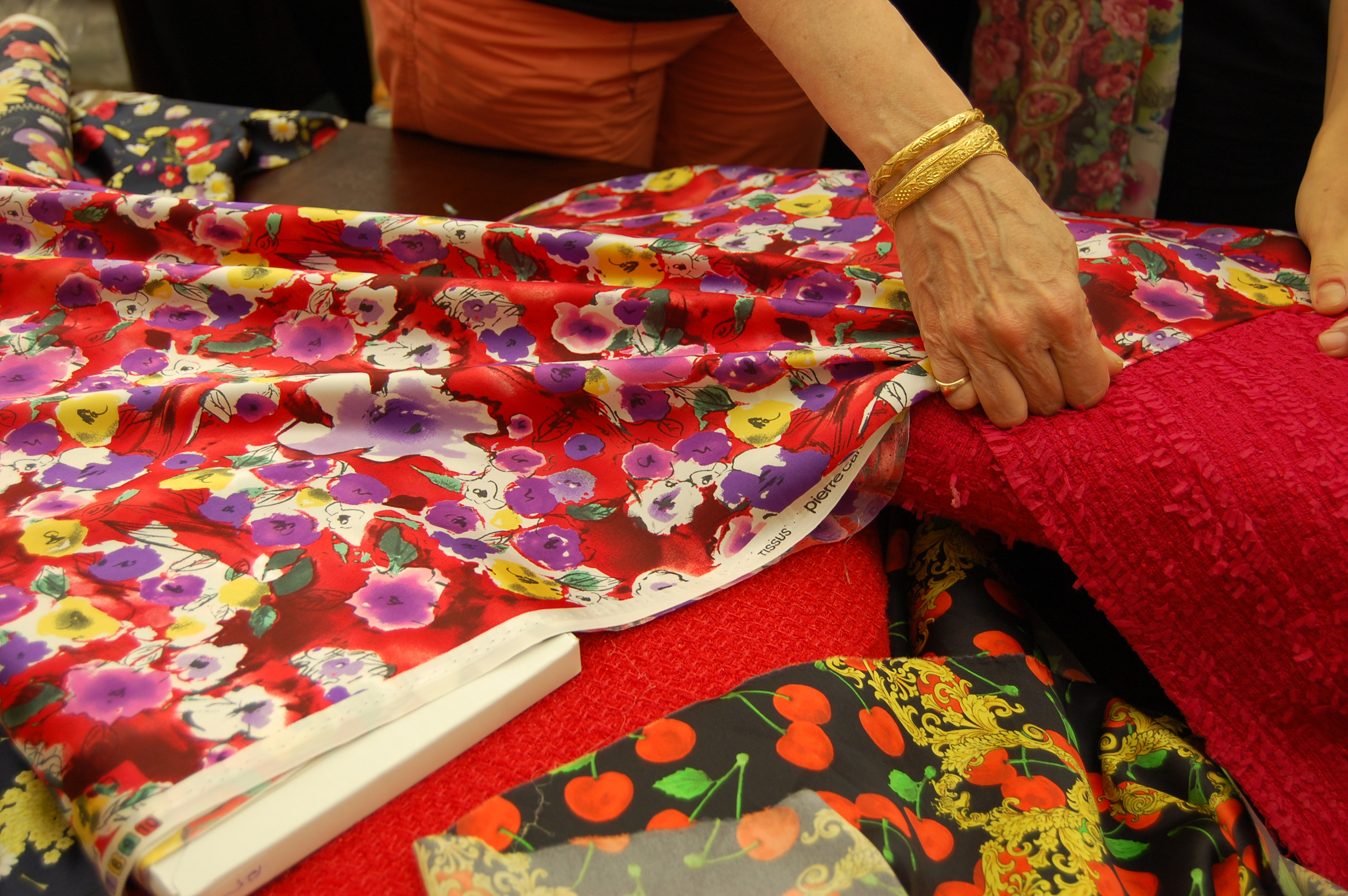
Our mission was to find and purchase our fabrics for the week-long class.  Thus – each of us needed to decide on a boucle for the jacket, and a silk charmeuse (the preferred fabric) for our lining.  The quantity of boucle fabric which Mendel Goldberg carries makes one’s decision fraught with “how can I ever narrow this down to just one?”  Well, of course, being the intrepid shoppers that we were, many of us actually could not narrow down our choice to just one.  Is it any surprise that many more than just 11 lengths each of boucle and charmeuse yardage were cut that day?

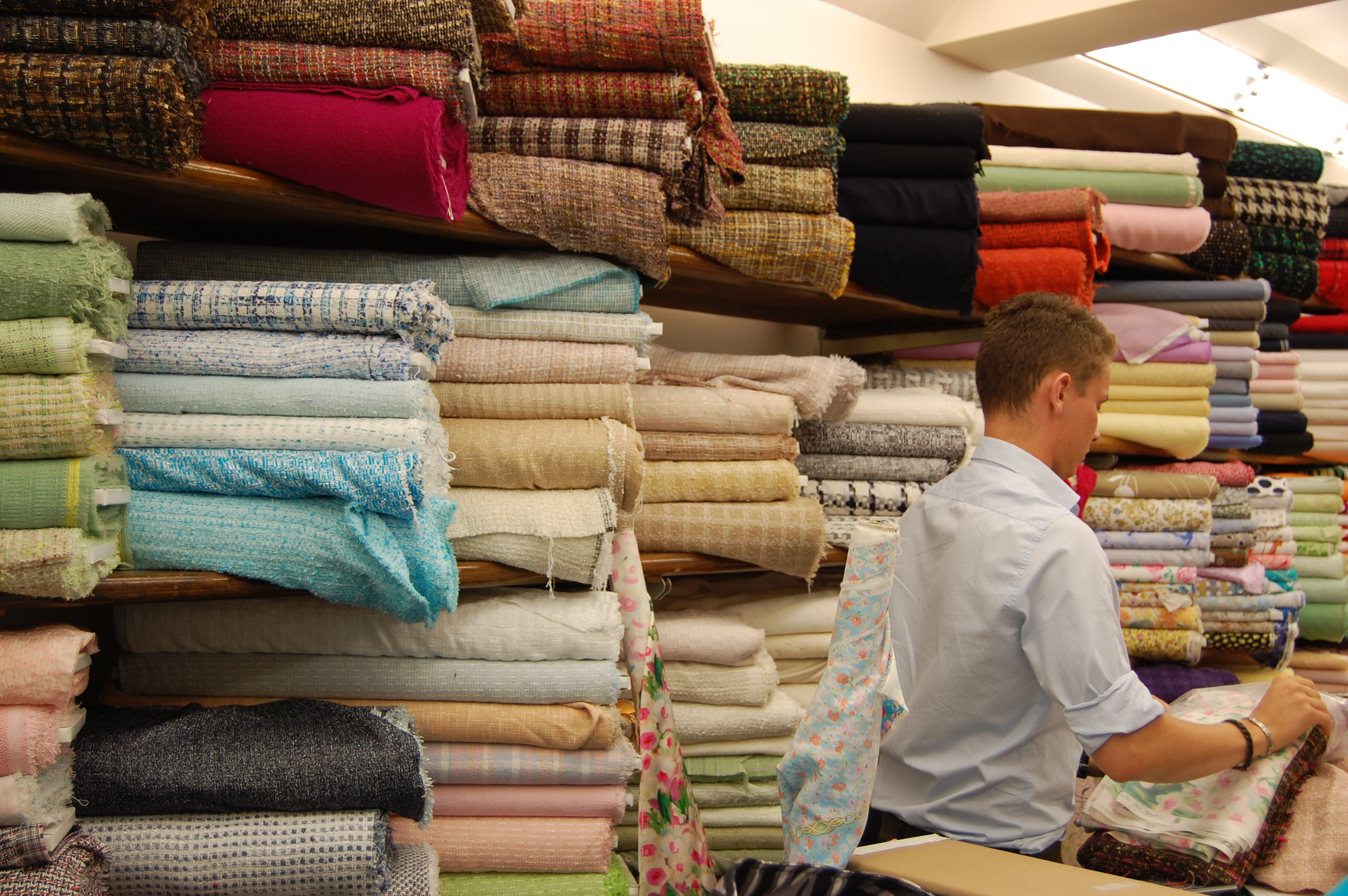
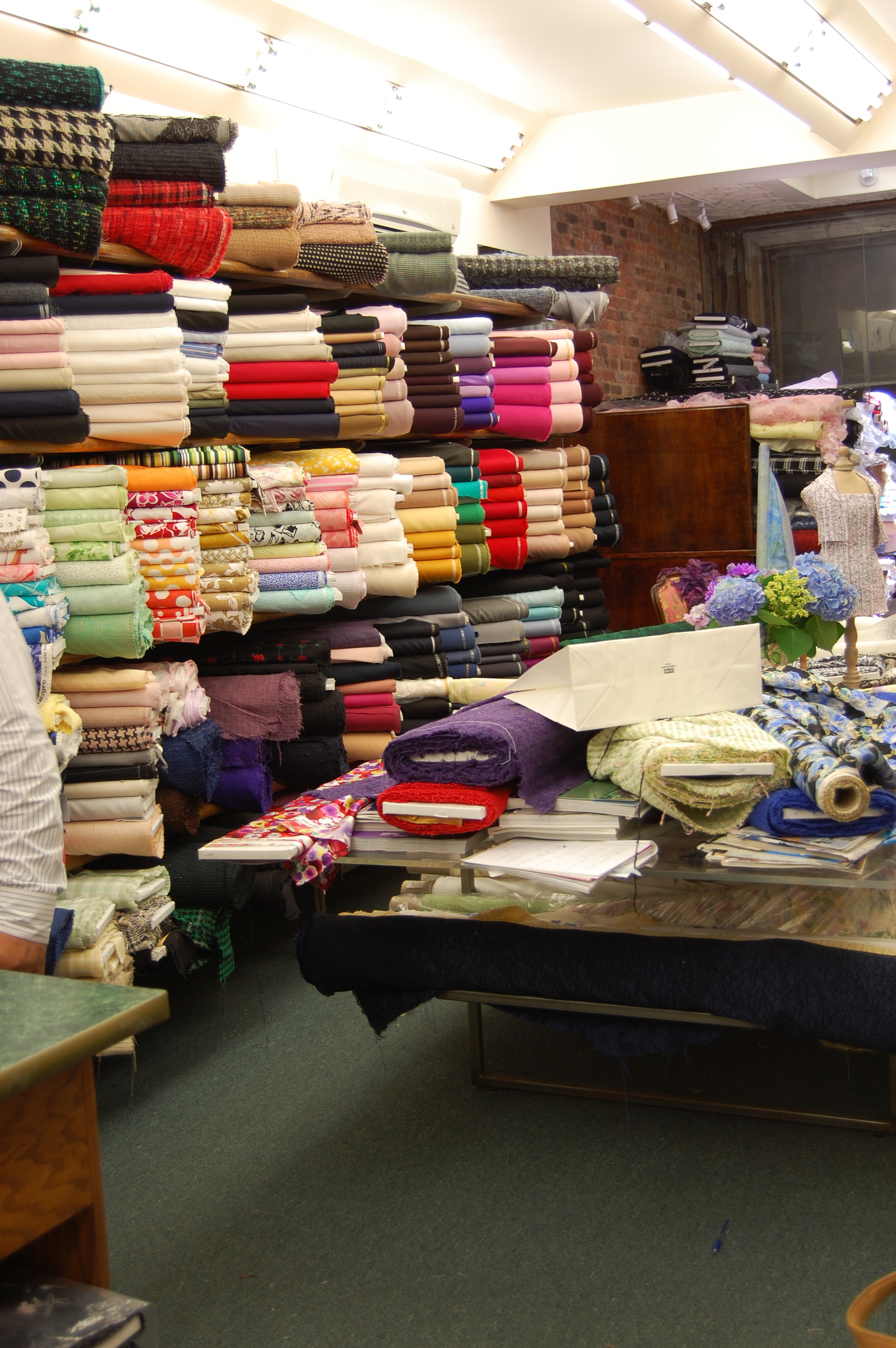
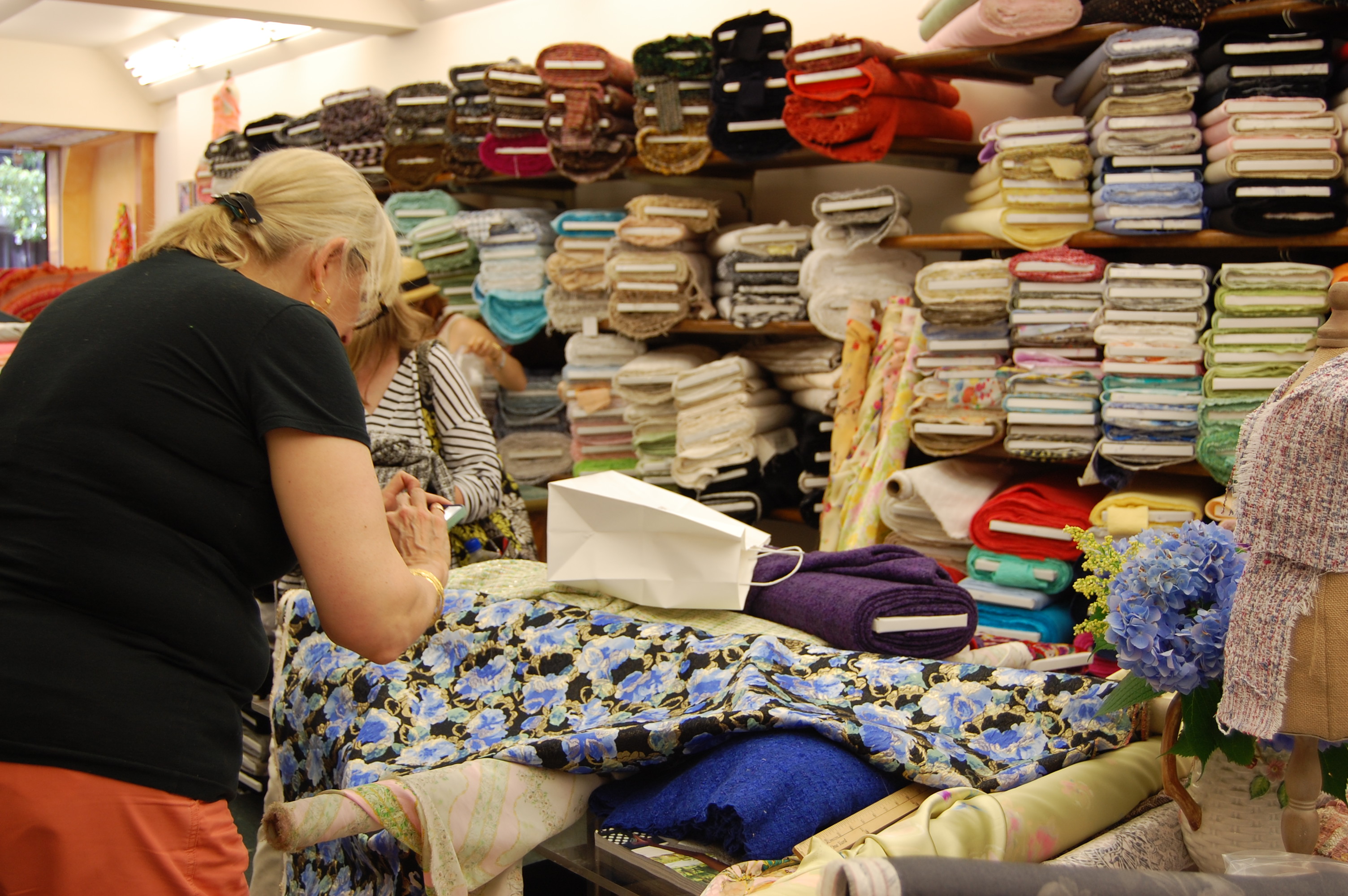
Bolts and bolts of boucles and other fabrics.

Bolts and bolts of boucles and other fabrics.

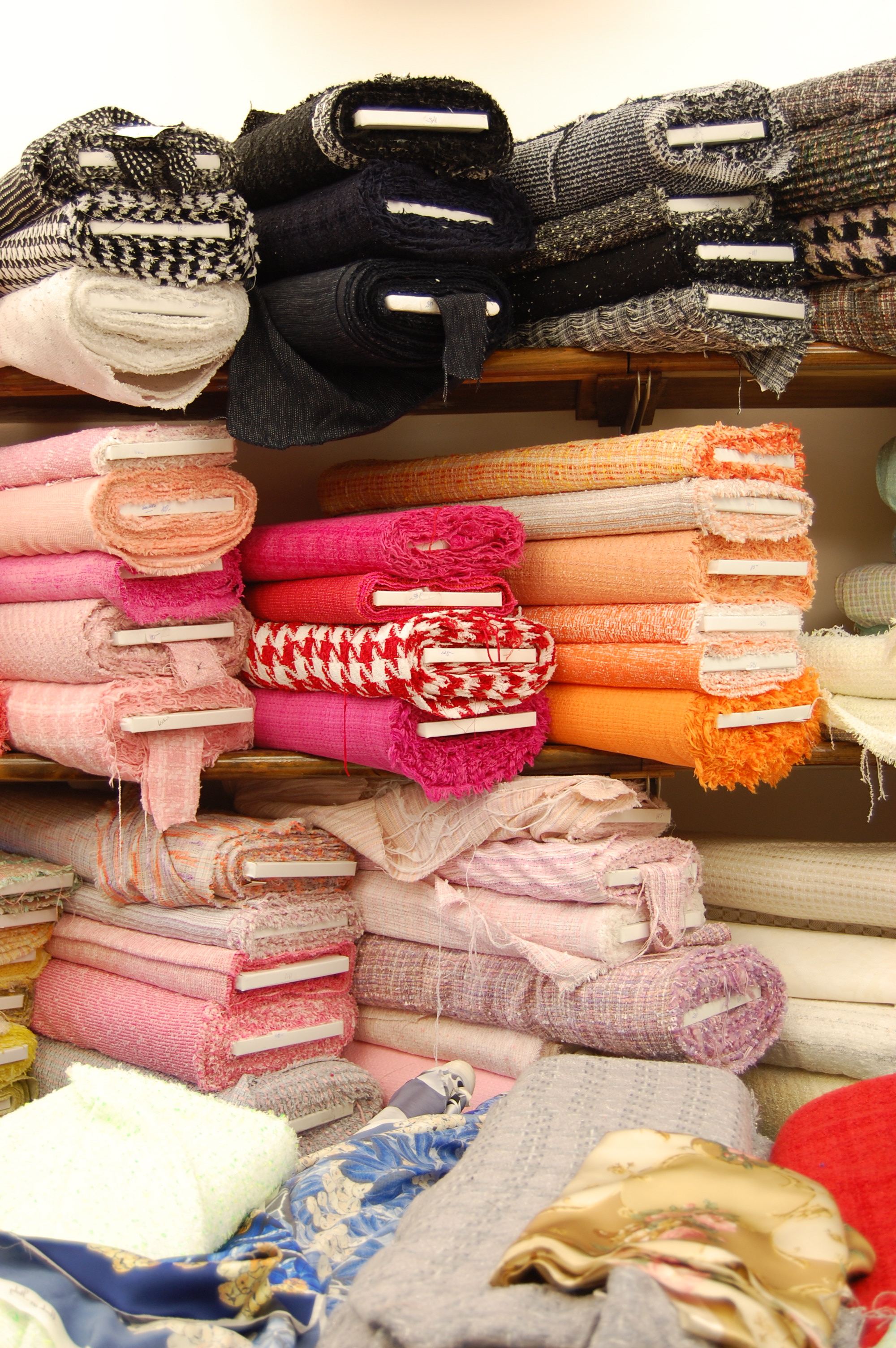
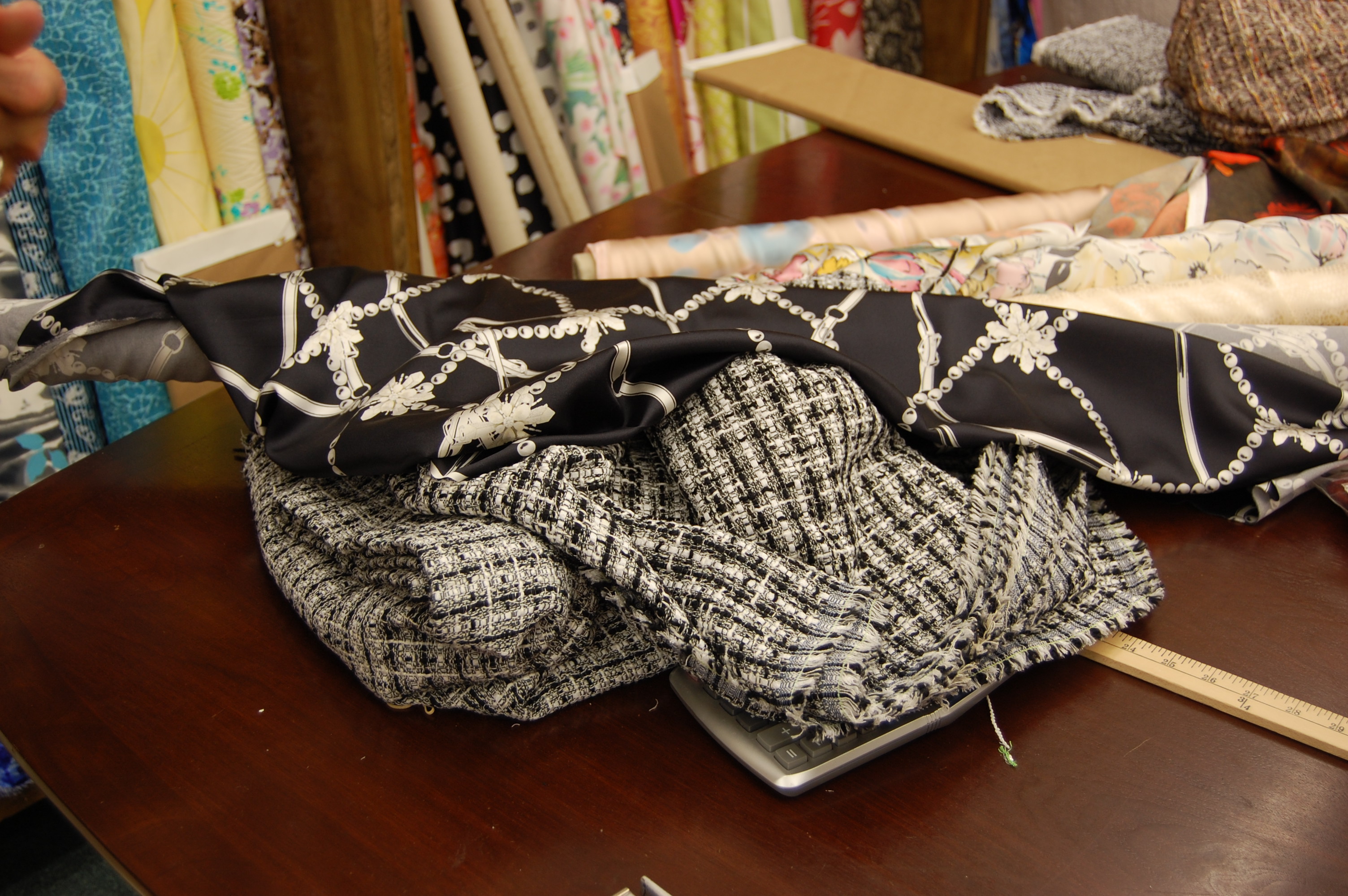
Just a small sampling of the boucles from which to choose.

Just a small sampling of the boucles from which to choose.

More fabric under the cutting tables.

More fabric under the cutting tables.

And more bolts in the basement, which we were privileged to visit.

And more bolts in the basement, which we were privileged to visit.

A lovely houndstooth, tucked away in the basement.

A lovely houndstooth, tucked away in the basement.

Deciding on the lining fabric was as much fun as the boucle, and the exquisite designs, unique prints, and lustrous quality of Alice’s charmeuses are something to behold.  Truly, the selection is a testament to Alice’s good taste and her diligence in finding the best that is available in France, Italy and Switzerland, and shipping them home to her store in the States.

So many charmeuses from which to choose.

So many charmeuses from which to choose.

Susan helping with the "match-up".

Susan helping with the “match-up”.

Alice bent over more fabric.

Alice bent over more fabric.

Susan  with a beautiful charmeuse.

Susan with a beautiful charmeuse.

Classmate Diane's final selection of boucle and charmeuse.

Classmate Diane’s final selection of boucle and charmeuse.

Alice cutting the charmeuse I selected for my lining to be paired with a bright red boucle.

Alice cutting the charmeuse I selected for my lining.

Alice's father who still comes in to help.

Alice’s father who still comes in to help.

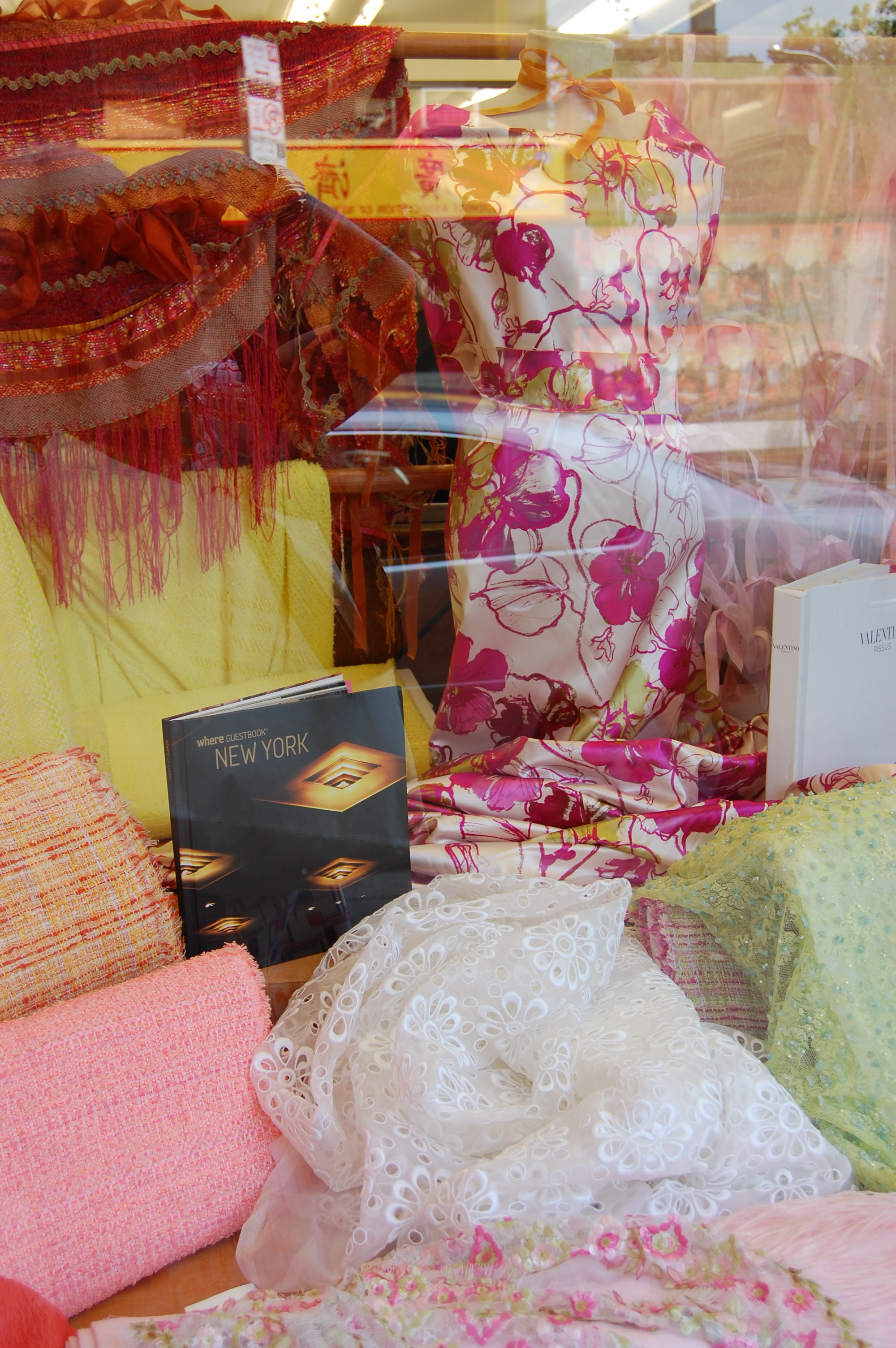
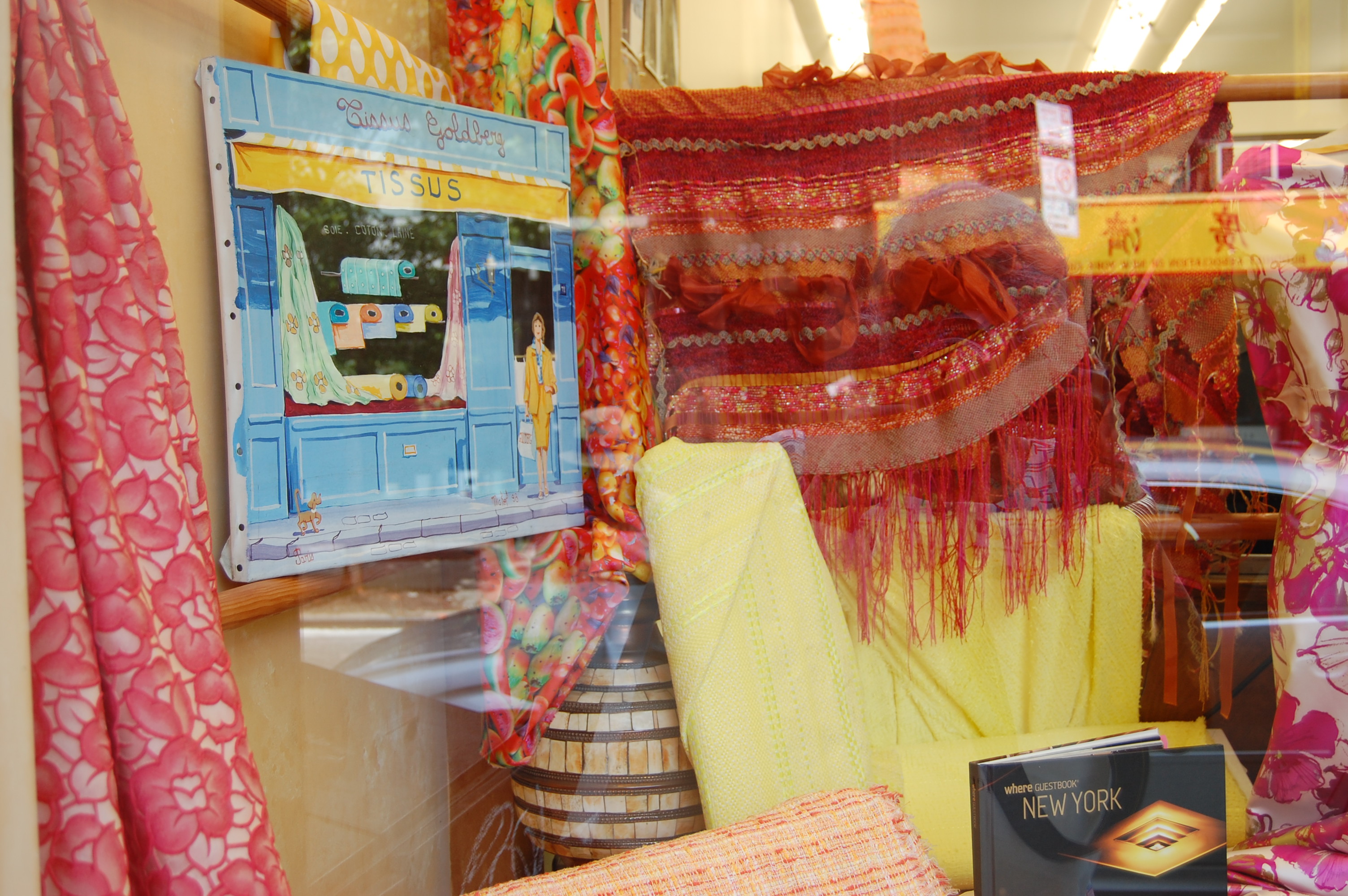
As we left Mendel Goldberg after two quick hours of shopping, I took a moment to view the beautiful display of fabrics in their front window.

Despite the glare, the fabrics still captivate!

Despite the glare, the fabrics still captivate!

More fabric on display in the window.

More fabric on display in the window.

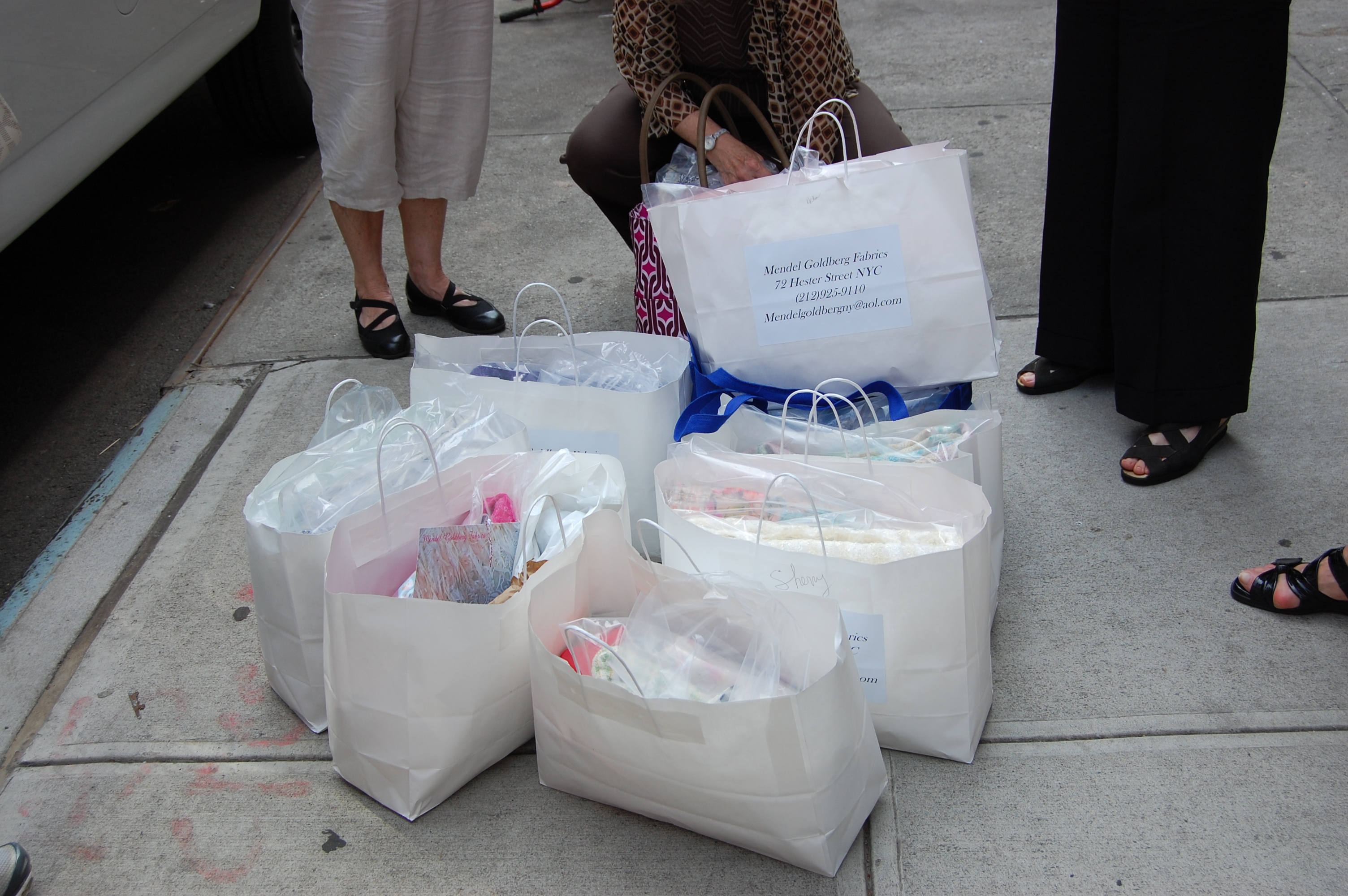
Then we gathered on the street next to our van.  Our bounty of bags spoke to the remarkable, memorable experience of Mendel Goldberg Fabrics.

Just a few of the bags that went home with us!

Just a few of the bags that went home with us!

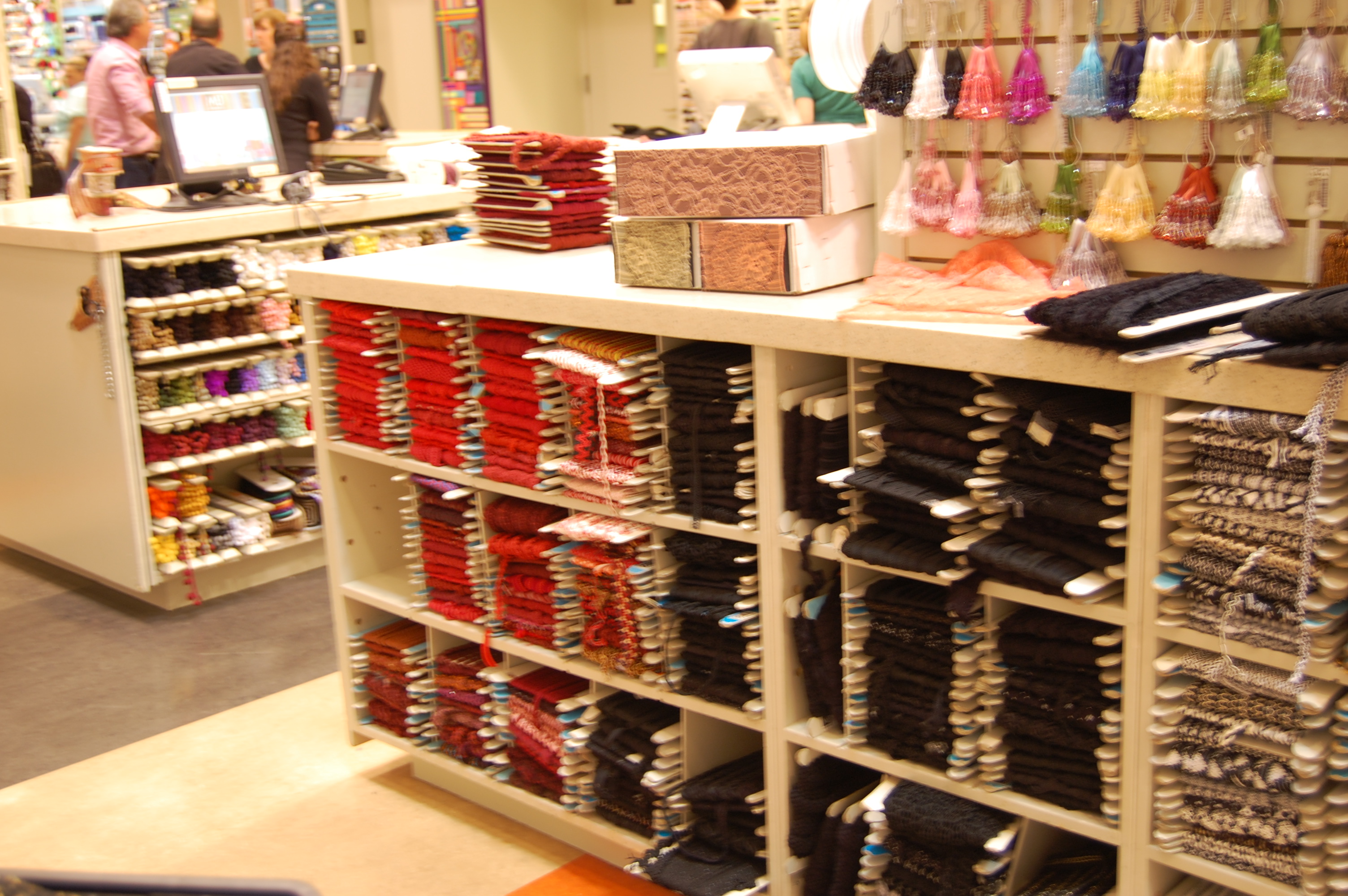
Now that we all had in our possession the two building blocks for our jackets (the fashion fabric and the lining), it was time to look for the embellishments, namely the trim and the buttons.  So off we went to M & J Trimming uptown in the Garment District.   Walking into M & J was a little bit like walking into a penny candy store, only better (no calories and more selection)!  There were trims and people and sales staff everywhere, and it seemed like everyone was on their own important mission.  We certainly were!  With our boucle and our complementary silk charmeuse in hand, we each first needed to find the perfect trim to set off our jackets.  Although numbering in the thousands, the trims were arranged by color and quite logically, so that once we understood the system, we were each able to pick and choose several “possibilities”.  Susan was there to help us make final decisions – and miraculously, we could start to see a glimpse of the final look of each of our own unique jackets.

Red and black trims, waiting for my perusal.

Red and black trims, waiting for my perusal.

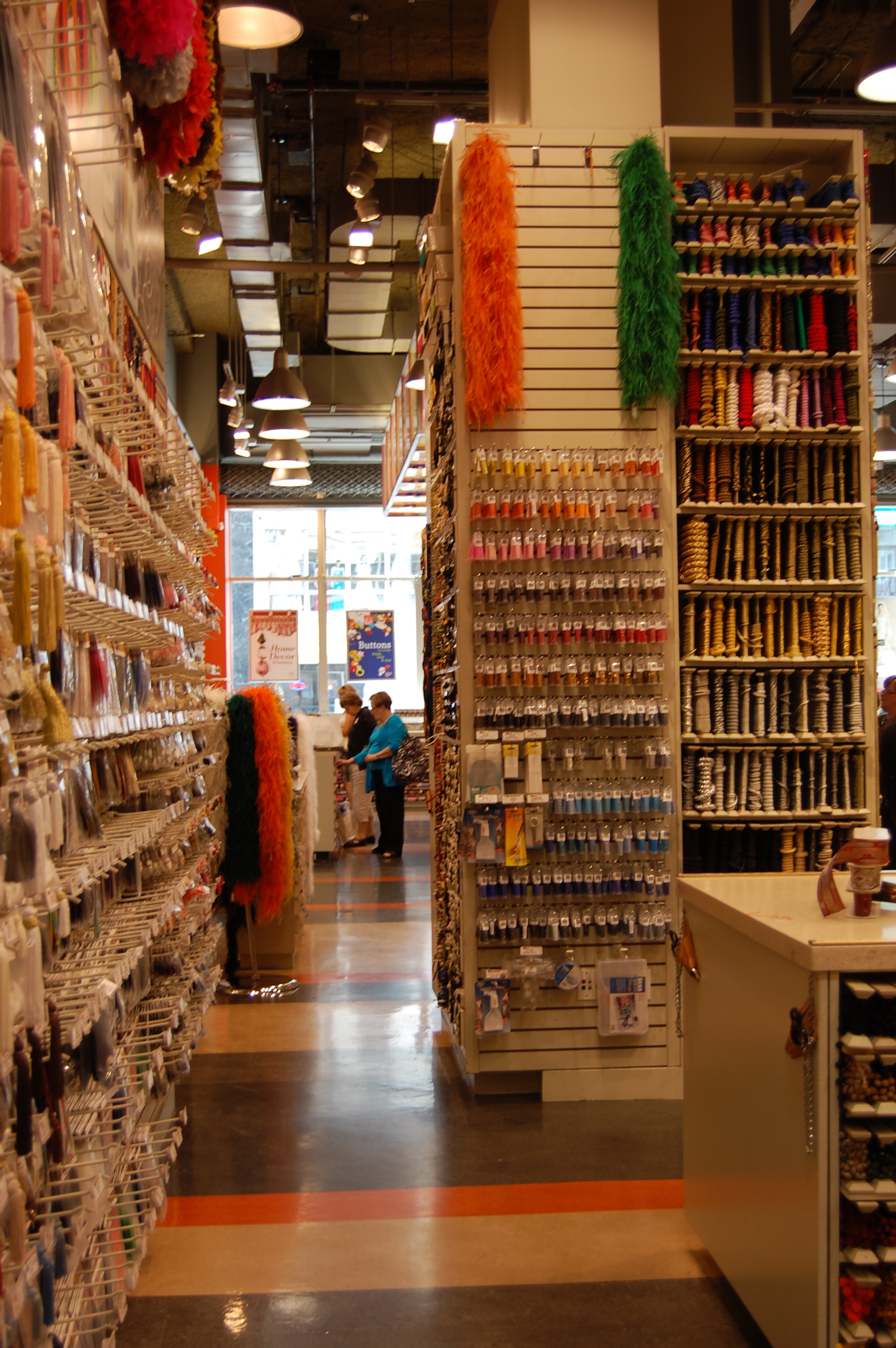
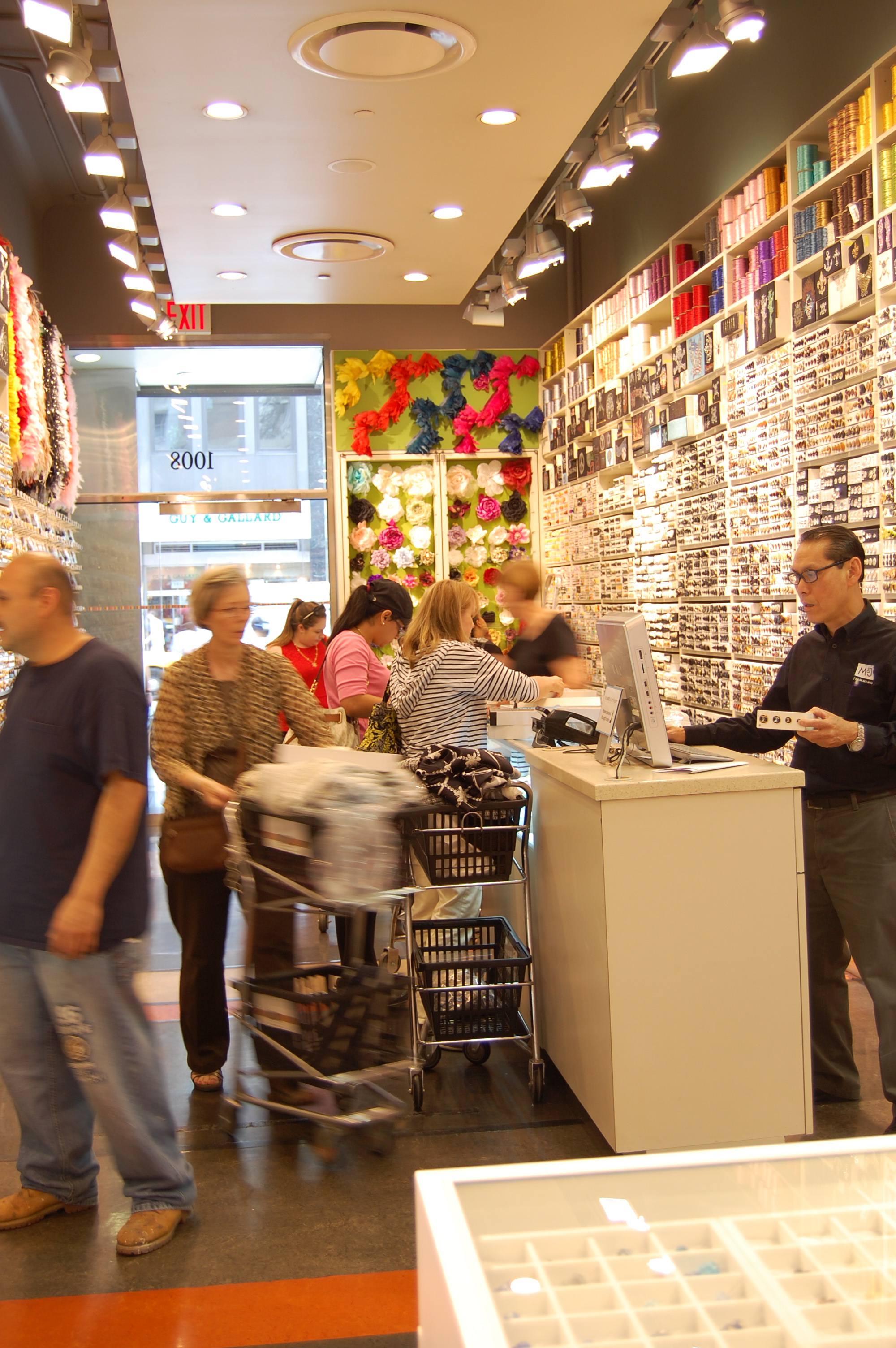
A view inside the store.

A view inside the store.

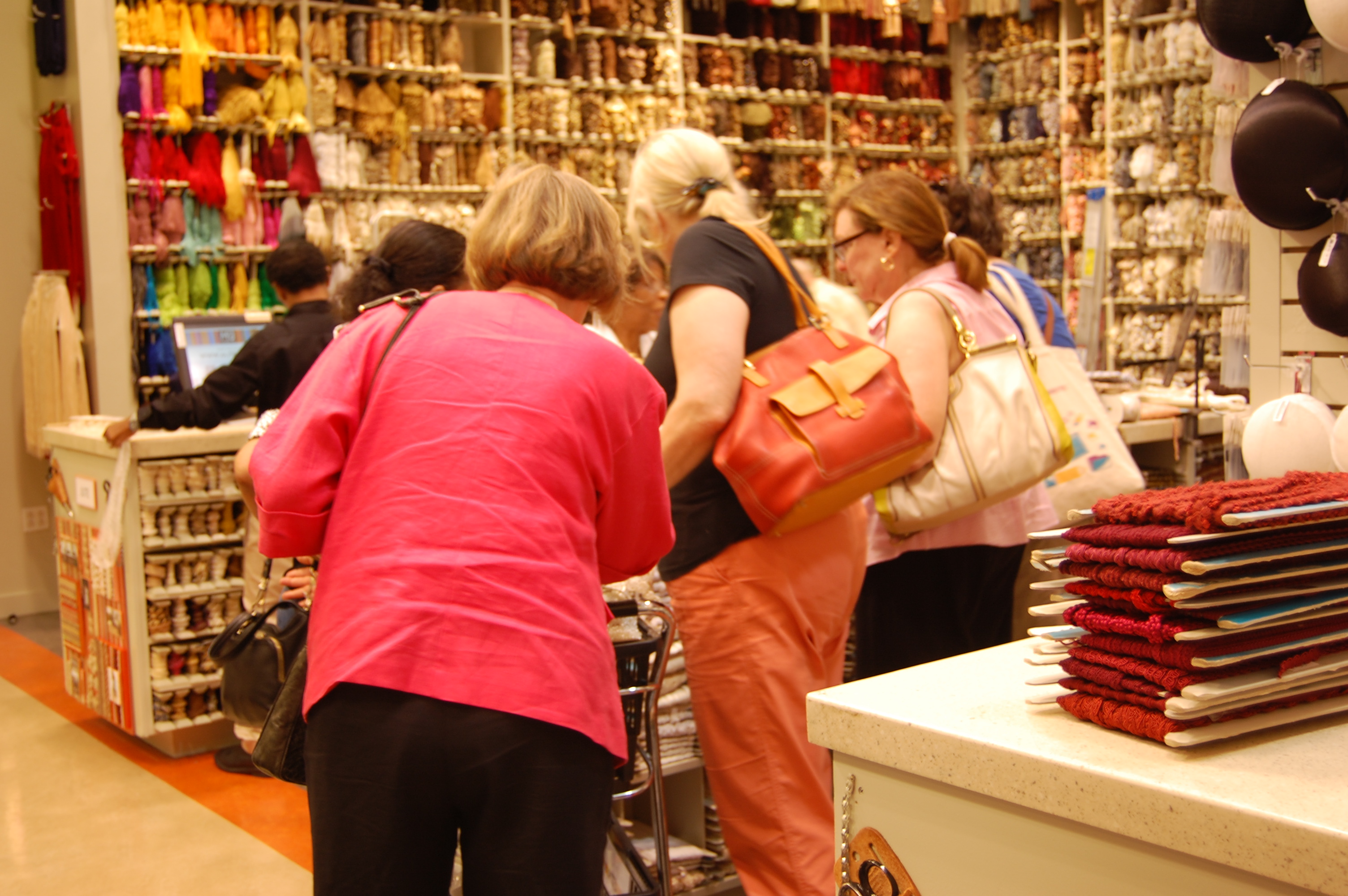
Classmates Sherry  and Carol being assisted by Susan.

Classmates Sherry and Carol being assisted by Susan.

The only thing left to do was pick out buttons.

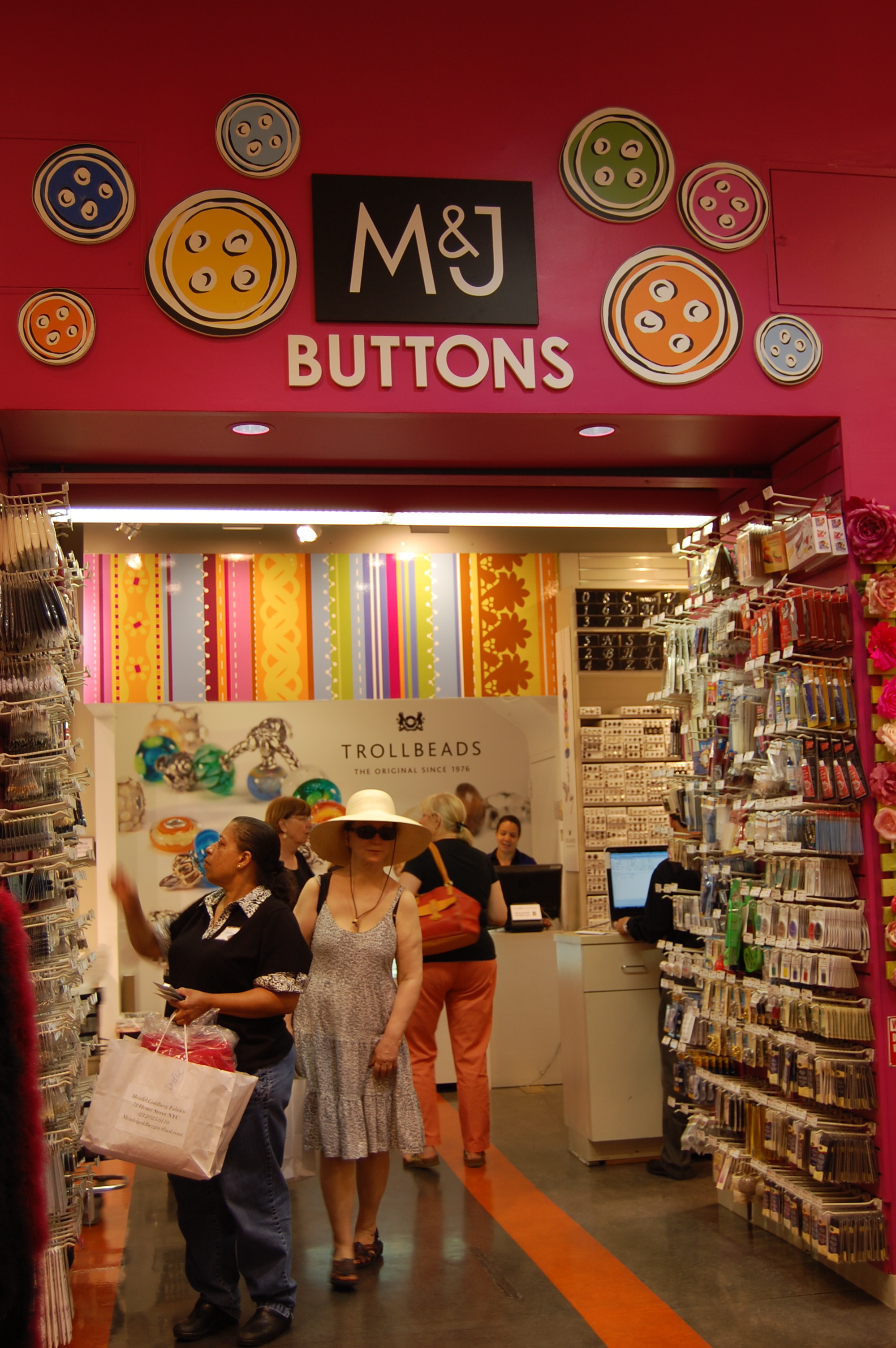
The entrance to the Button section of  M & J Trims.

The entrance to the Button section of
M & J Trimming.

As an enthusiastic fan of unique and beautiful buttons, I was smitten.  The button displays went from floor to ceiling, arranged by color and type, again very logically.

Buttons and more buttons.

Buttons and more buttons.

As sewers, each of us is accustomed to choosing buttons appropriate to our garment. So – what fun it was to place different ones next to our fabrics and trims so they could audition for the final starring part.  With Susan’s guidance, wonderful suggestions, and knowledgeable nod of approval, we all left the store with little bags filled with  great and varied treasures.

Shopping for Fabric - M & J bag

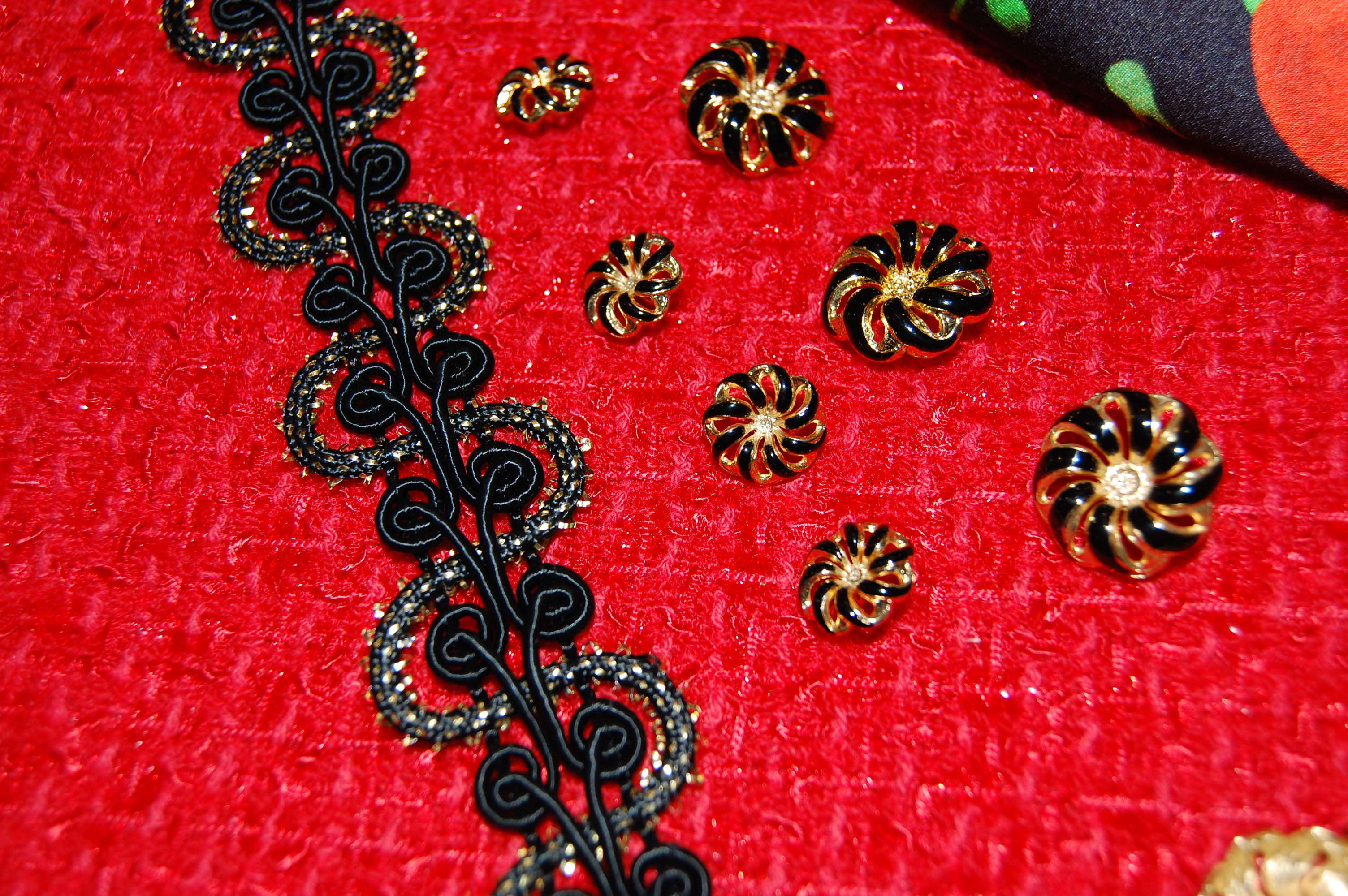
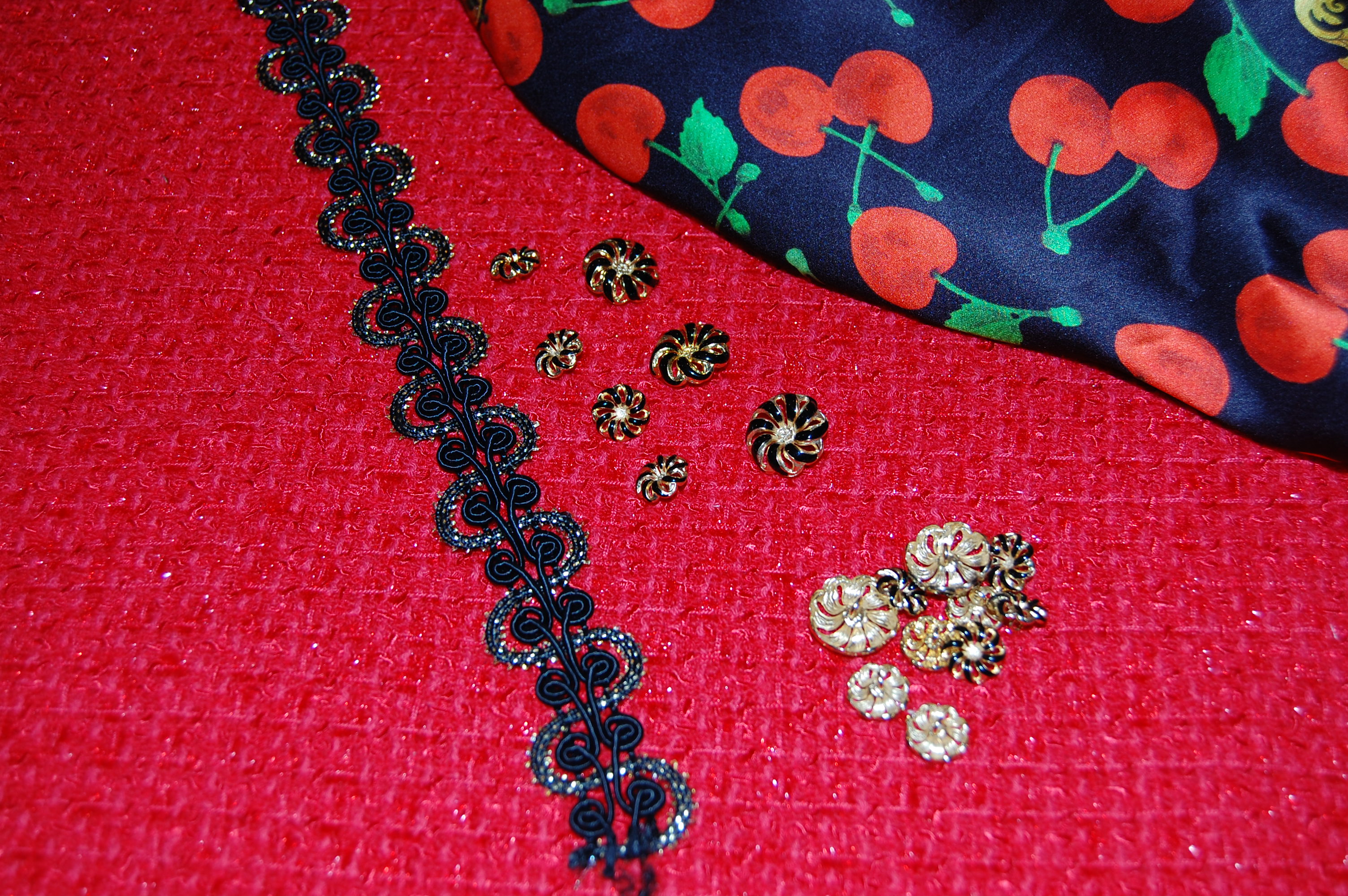
So which of those treasures did I find for my classic French jacket?  I went with the hope of finding a lovely red boucle, which I did.  Paired with that remarkably designed charmeuse shown above, the red seemed to me to be set off most beautifully with black trim and black and gold buttons.

My trim and buttons - click on the photo to see them close-up.

My trim and buttons – click on the photo to see them close-up.

Boucle - charmeuse - trim - buttons.

Boucle – charmeuse – trim – buttons.  All set to begin my jacket . . .

20 Comments

Filed under Buttons - choosing the right ones, Chanel-type jackets, Uncategorized

Inspiration and Adaptation

Sometimes in life – and in sewing – you have to alter your plans to accommodate the situation at hand.

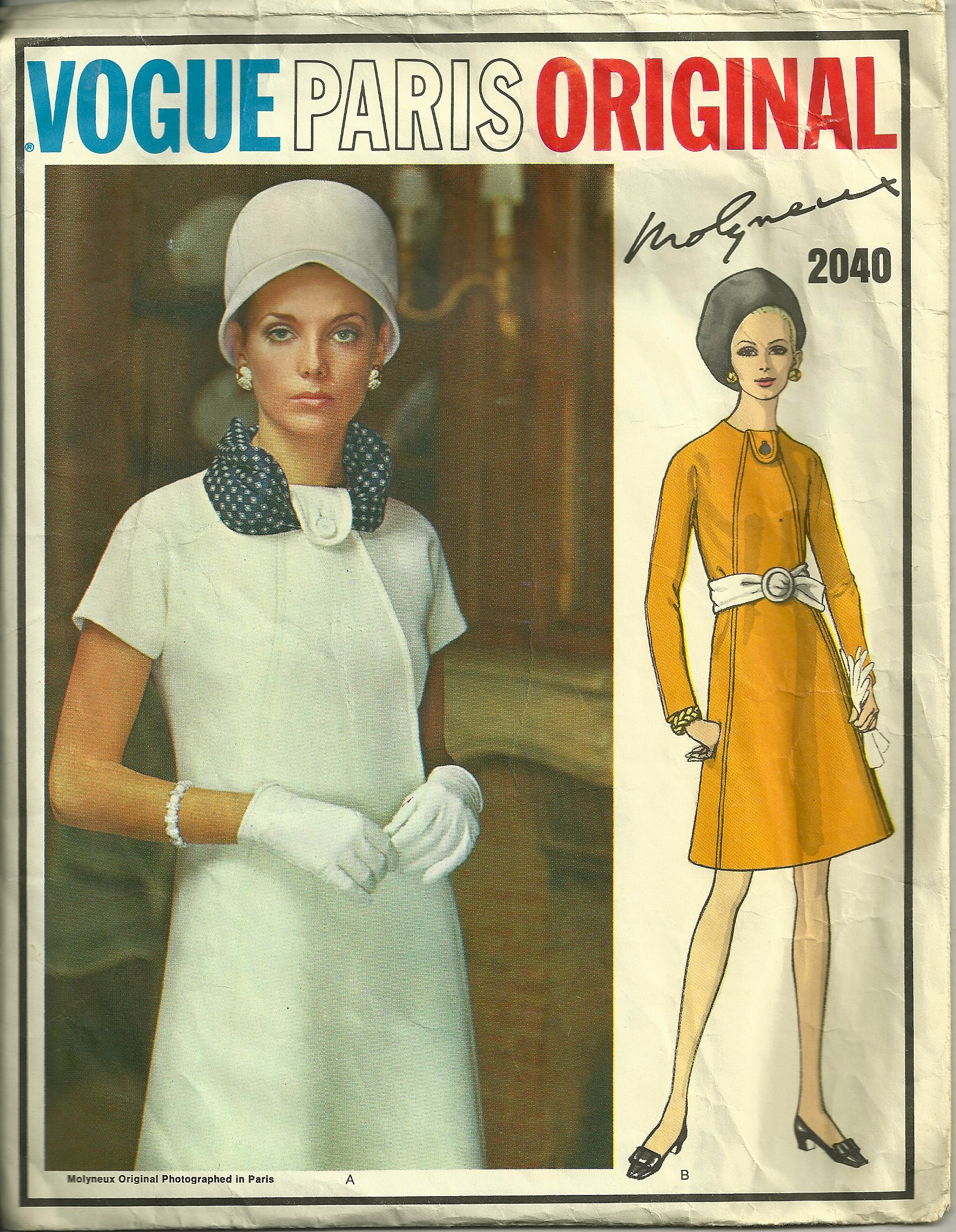
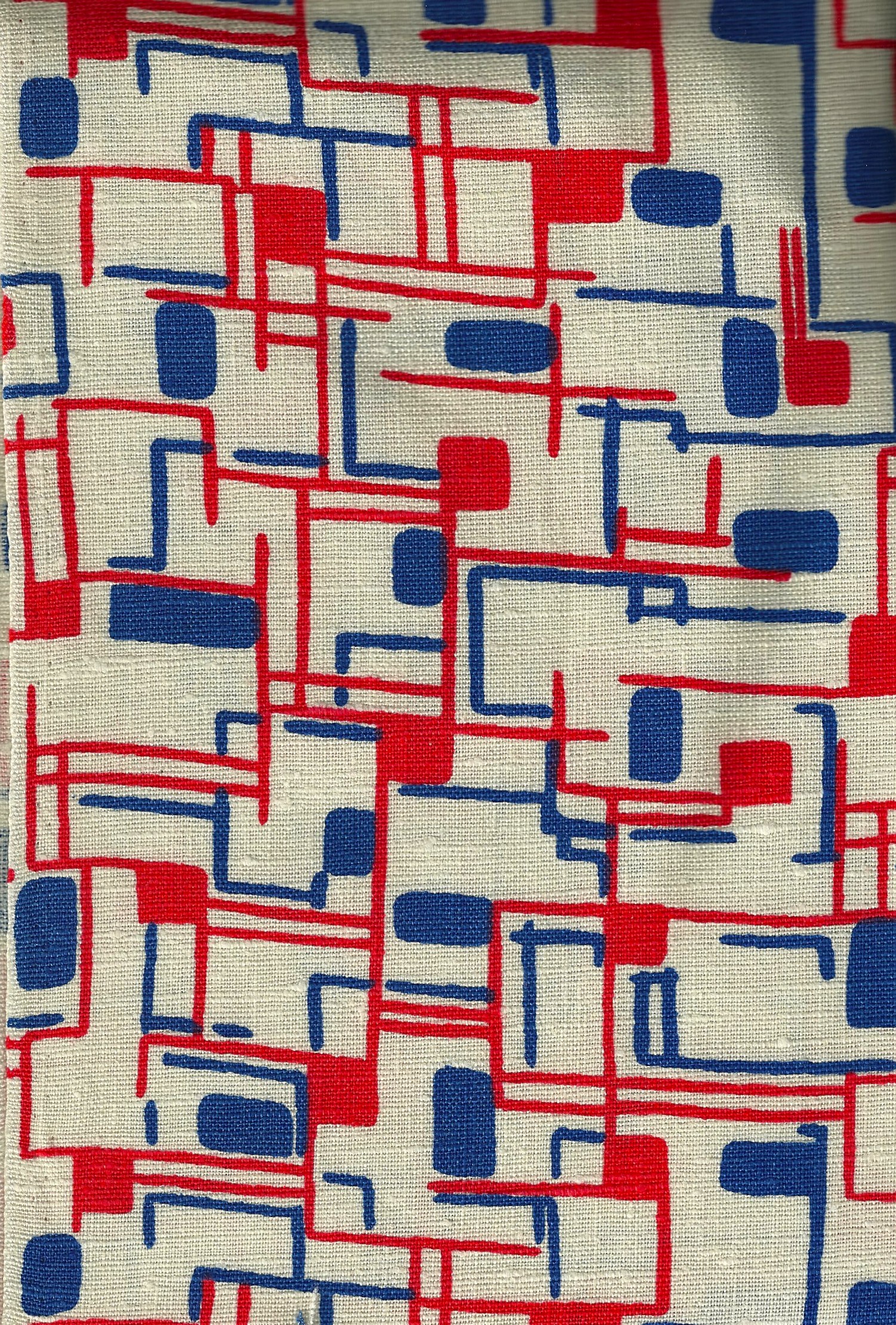
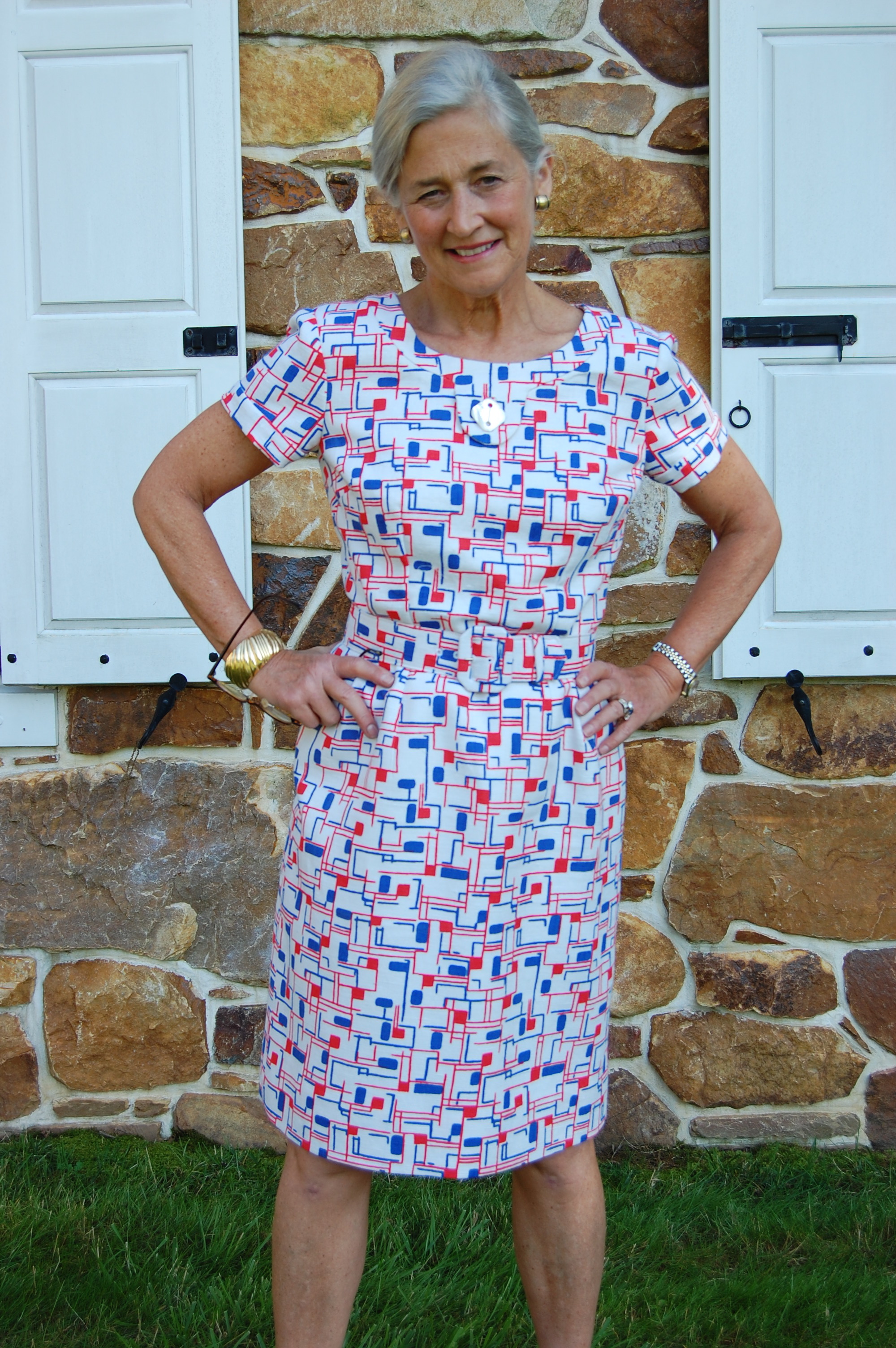
This is the situation I found myself in:  I had my heart set on pairing a favorite vintage Vogue Designer pattern with a piece of vintage Moygashel linen I had found in an Etsy shop.  They are both likely from the early 1970s and seemed destined to be together.

Molyneux has always been a favorite designer of mine.  My thought was to make the dress with short sleeves, but belt it as shown in View B.

Molyneux has always been one of my favorite designers. My thought was to make the dress with short sleeves, but with a belt as shown in View B.

My best guess is that this Moygashel linen is from the very early '70s.

My best guess is that this Moygashel linen is from the very early ’70s.

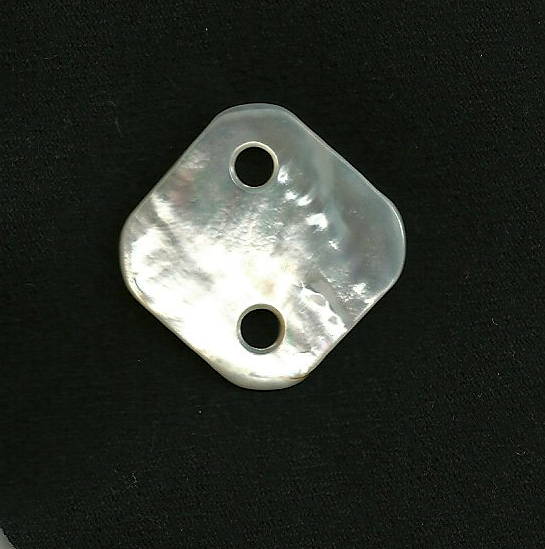
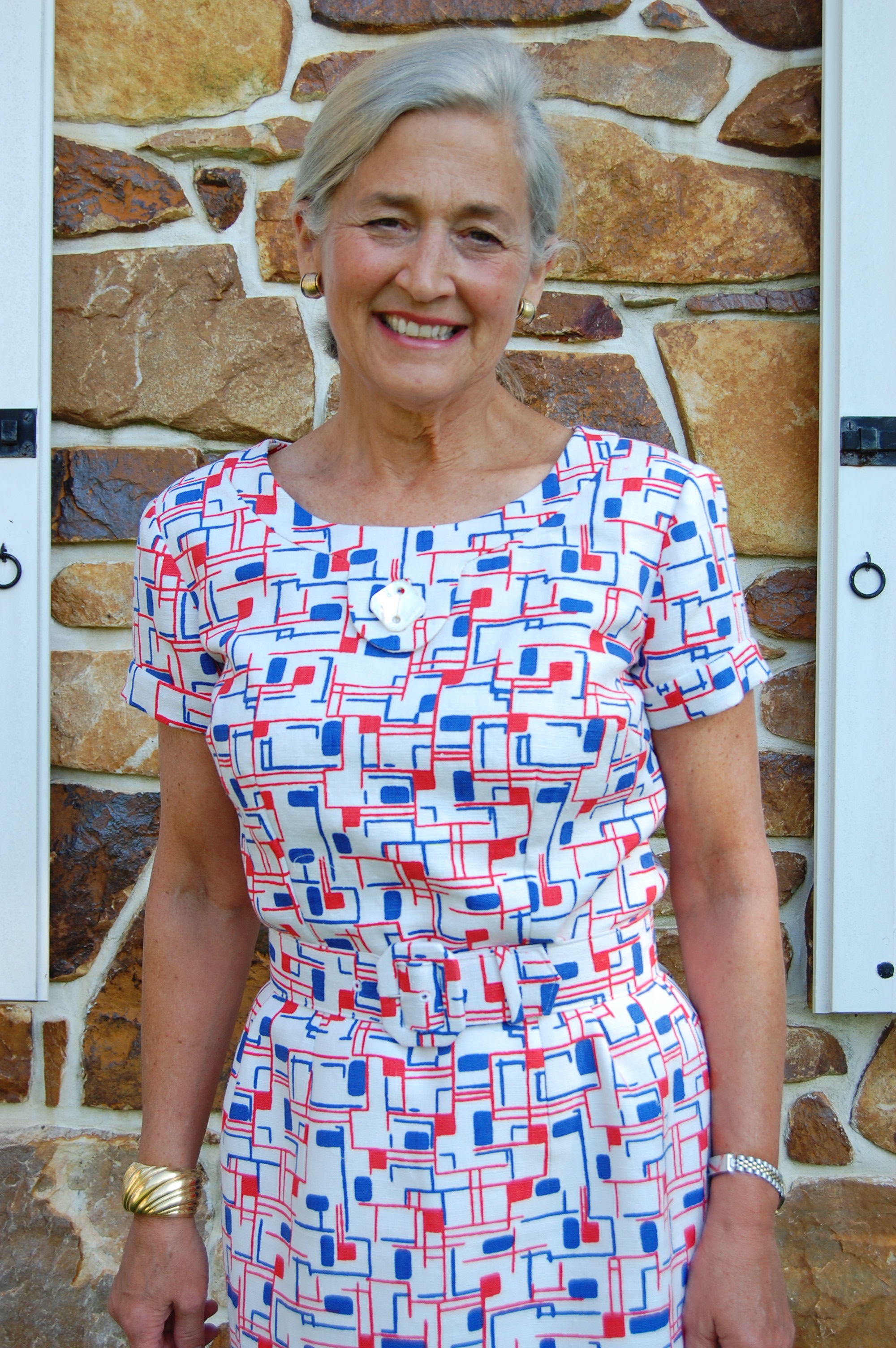
To make this pairing of fabric and pattern even more enticing, I was given this amazing pearl button by my dear friend Nancy C.  (Thanks, Nancy!)

I love this unique button!

I love this unique button!

The square shape of the button – and its largeness (1 3/16” square) – and the fact that I had exactly one of these beauties – made it seem custom made for the design of the fabric and the tab featured on the pattern.

I couldn’t wait to get started!  I pulled out all the pattern pieces, ironed them flat, ready to make a muslin – and then the “uh-oh” moment struck.  The “straight of grains” on the pattern pieces could not have signaled more trouble if they had been flashing in bright red.   I grabbed the pattern envelope – and right there in plain English was stated:  “Not suitable for obvious plaids.”  (Why won’t I learn to read those envelopes more closely???)  While this fabric is not a plaid, it reads like a plaid.  My heart sank – as I realized very quickly that I absolutely could not use this pattern for this fabric.  It just would not work.  End of discussion.

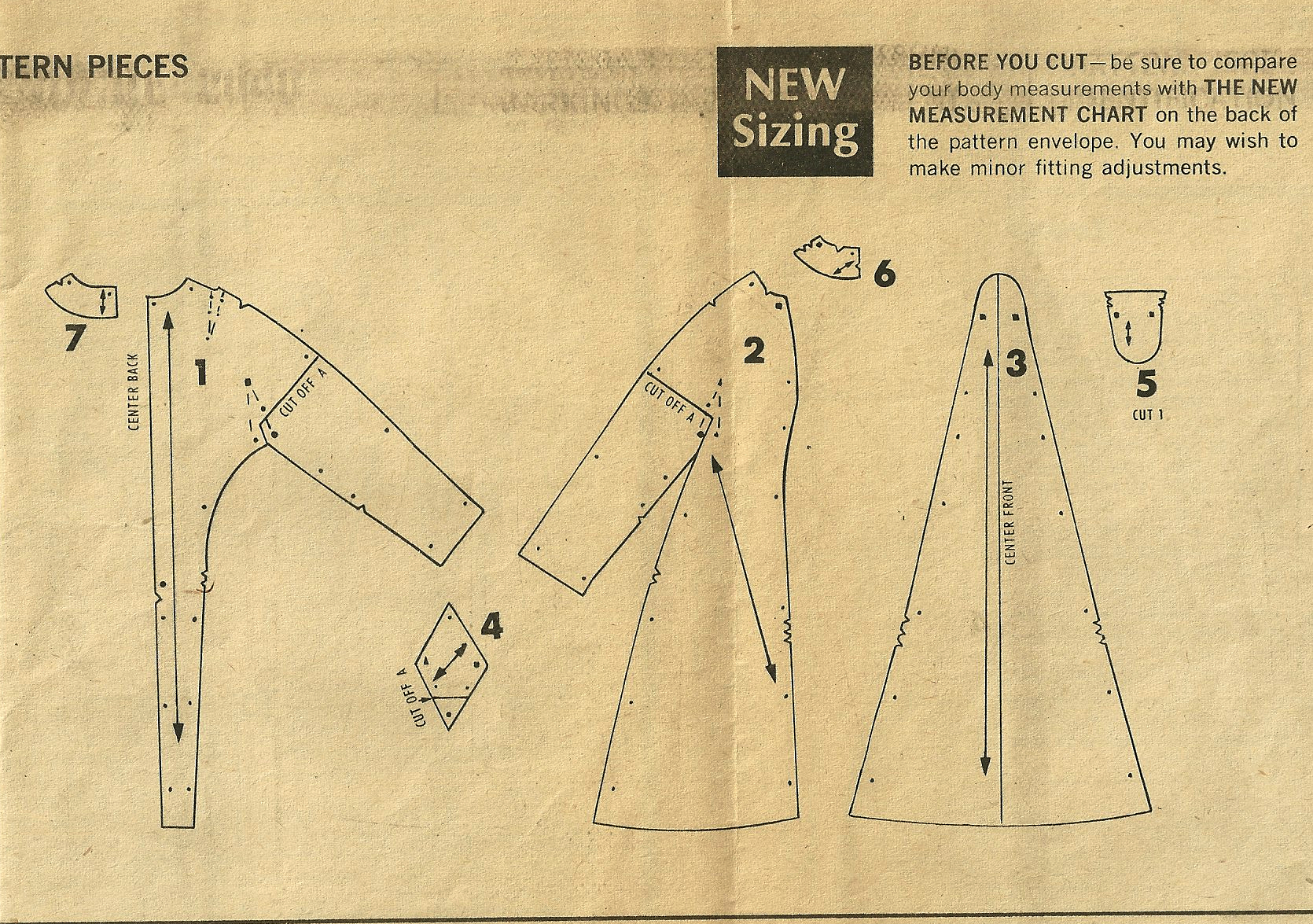
If you look carefully at these line drawings, it's obvious that "plaids" would not work.

If you look carefully at these line drawings, it’s obvious that “plaids” will not work.

I took a few deep breaths – and went back to my vintage pattern file.  None of my other vintage patterns would do.  I had my vision for this fabric and no pattern came even remotely close.   It was then I decided I would have to adapt a new pattern to achieve the look I wanted.  Once I made this decision (Plan B, as in “it BETTER work!”), I began to see the advantages, and the possibilities for an even better look than I originally thought.

The first thing that went right was having this pattern in my “new pattern” file:

I picked up this pattern a few months ago as i thought it looked very versatile!

I picked up this pattern a few months ago as I thought it looked very versatile.

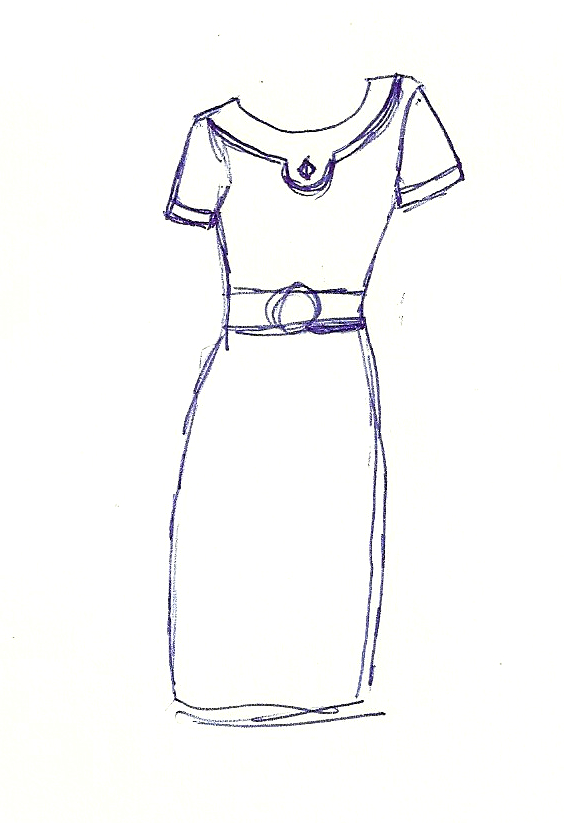
I figured if I used View B, I could alter the neck band to incorporate a center tab.  I wanted to belt it, but I happily thought the tapered darts at the mid-section, front and back, would help create less bulk at the waist (and that’s always welcome).  I liked the shape of the neck (and had actually planned to widen and lower the neckline on the vintage Vogue….).  I would have to lengthen it, but I had plenty of fabric.  I also like the banded sleeves.  To envision the look, I did a quick sketch:

More about the belt later - it was ready before the dress was even cut out.

More about the belt later – it was ready before the dress was even cut out.

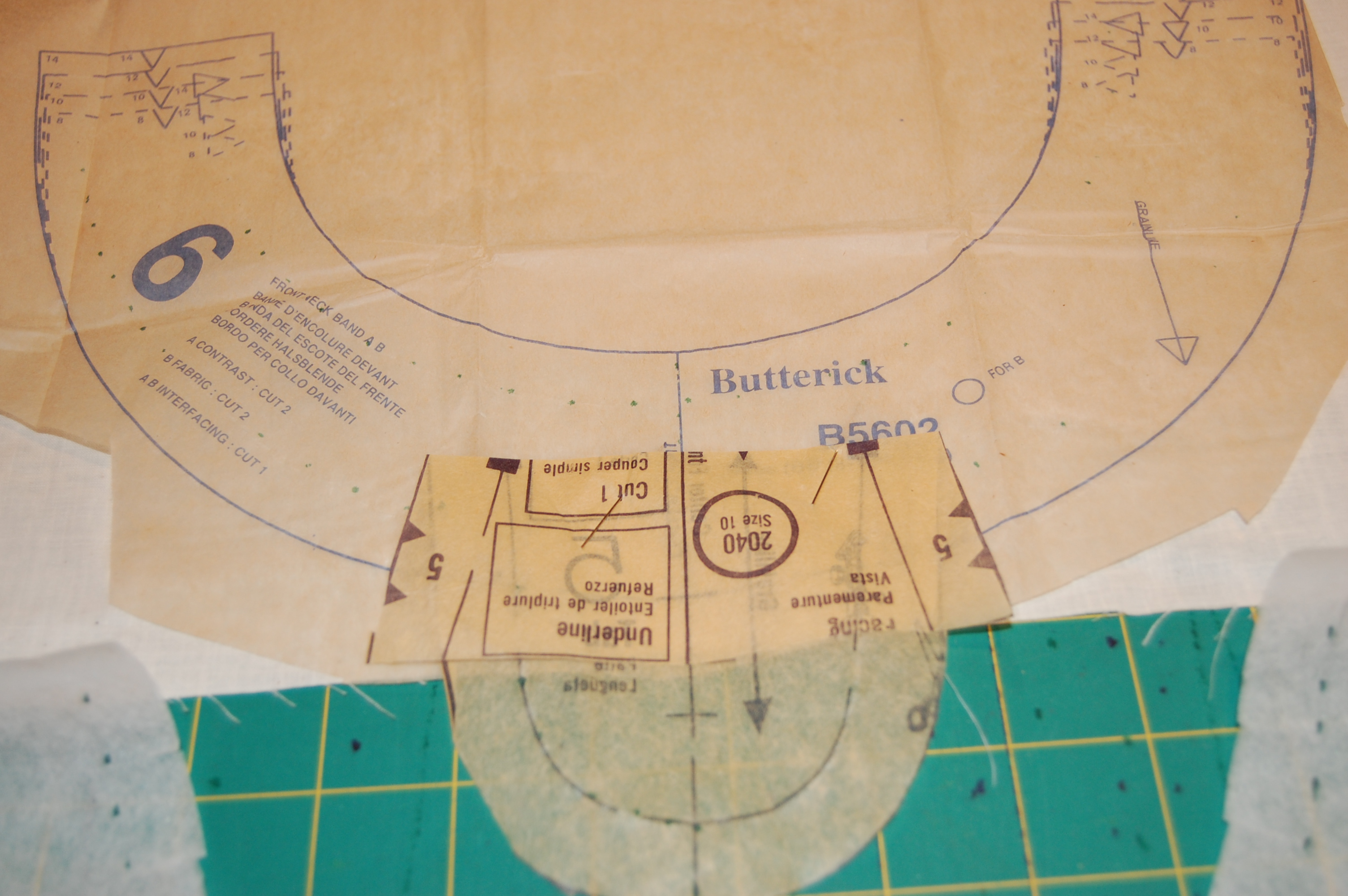
Then I set about adding the 1970’s tab to the neckband.  I actually used the pattern piece for the original tab facing so that I could get the correct size and look.

I placed the old pattern piece onto the new neckband.

I placed the old pattern piece onto the new neckband.

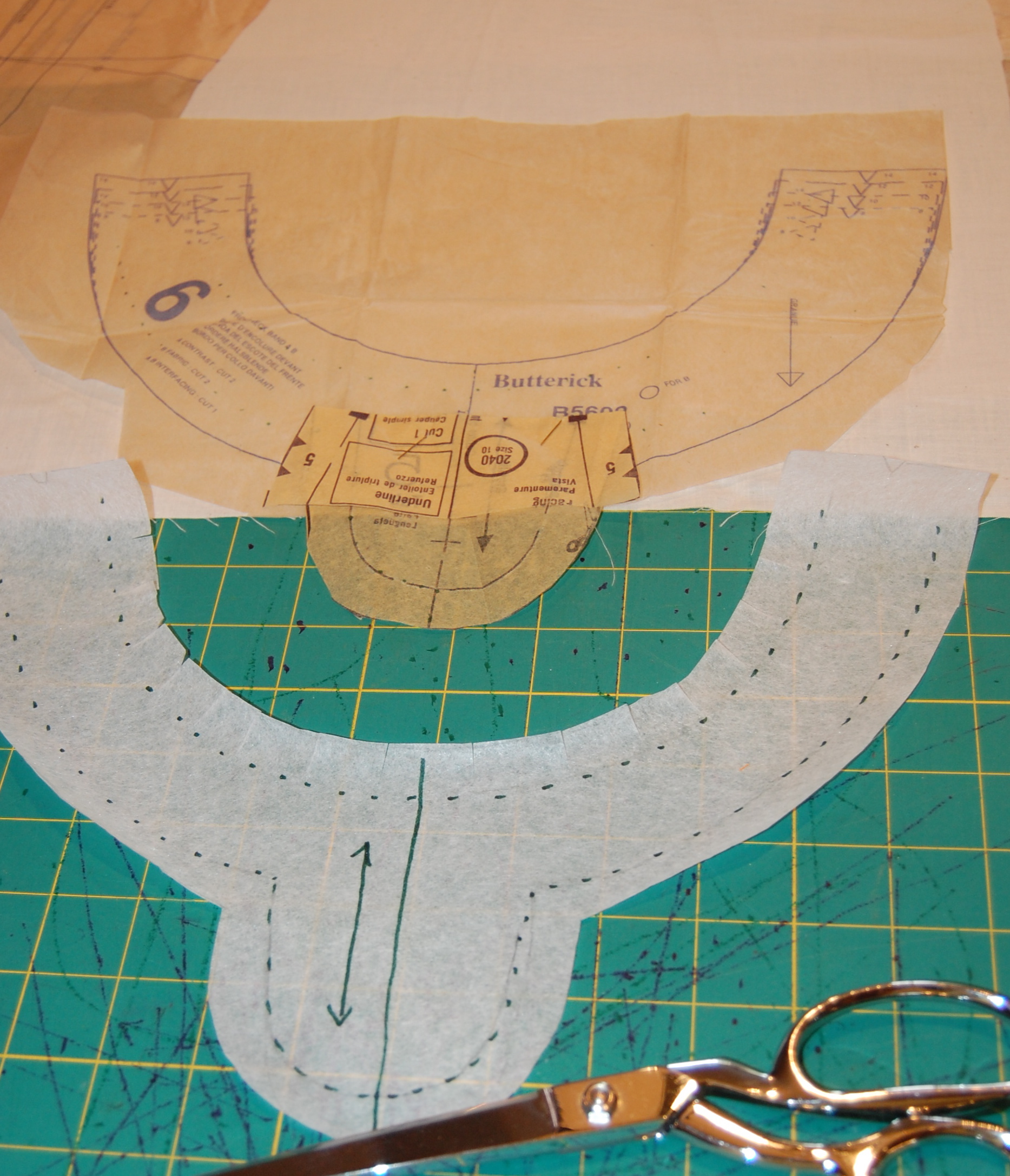
Then I made a new pattern piece.

Then I made a new pattern piece.

I made my muslin and then proceeded to use some couture techniques, but not all I normally would.  For one thing, I did not want to underline this linen fabric with silk organza (to preserve the breathability of the linen and keep it as light as possible).  The pattern called for the dress (but not the sleeves) to be lined.  I used a very lightweight cotton/linen blend for this which worked beautifully.  I also decided to use the facings included in the pattern (usually eliminated with couture sewing), and I’m really happy with that decision.

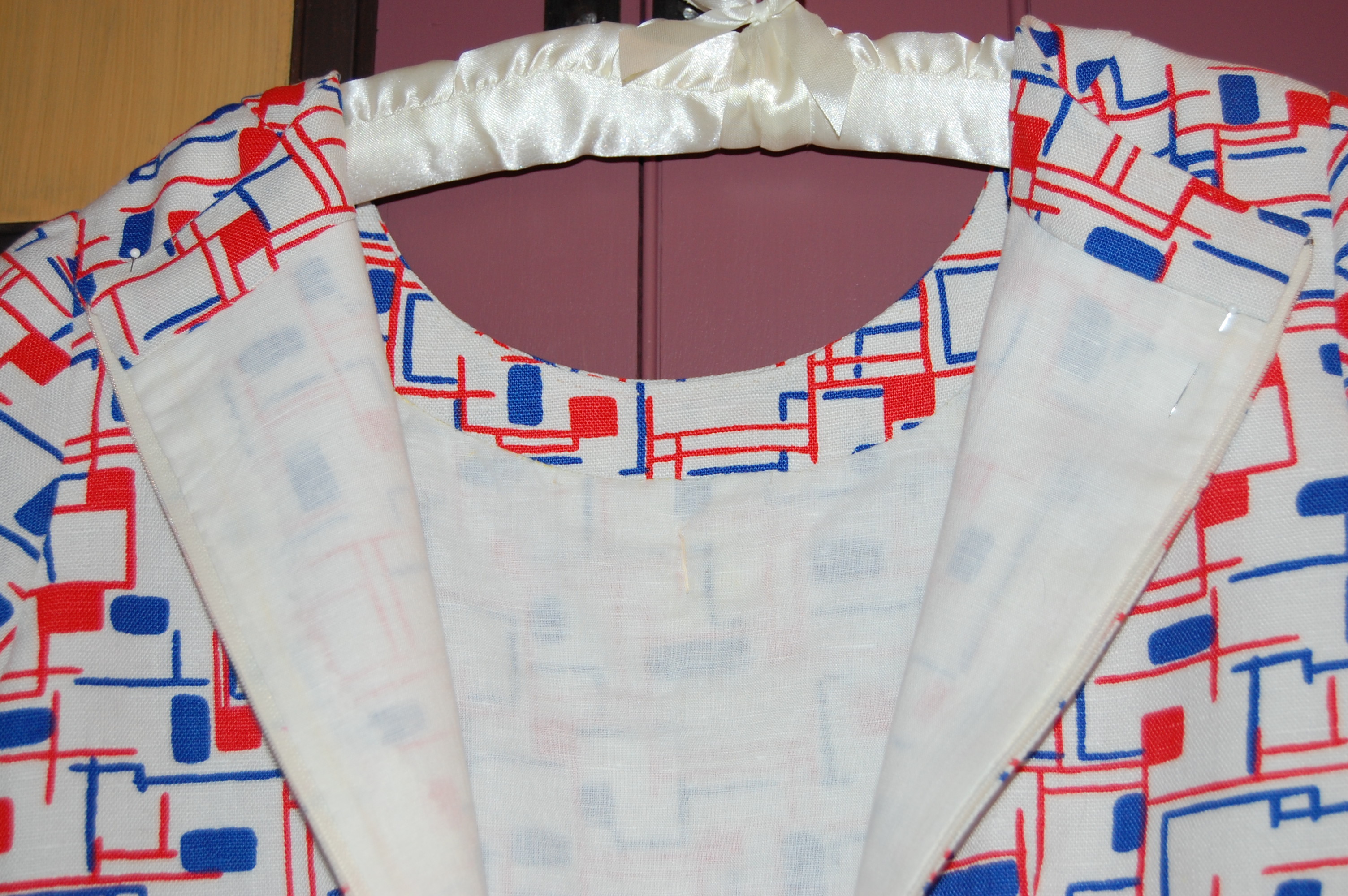
This photo shows the neck facing and the off-white lining I used for the body of the dress.

This photo shows the neck facing and the off-white lining I used for the body of the dress.

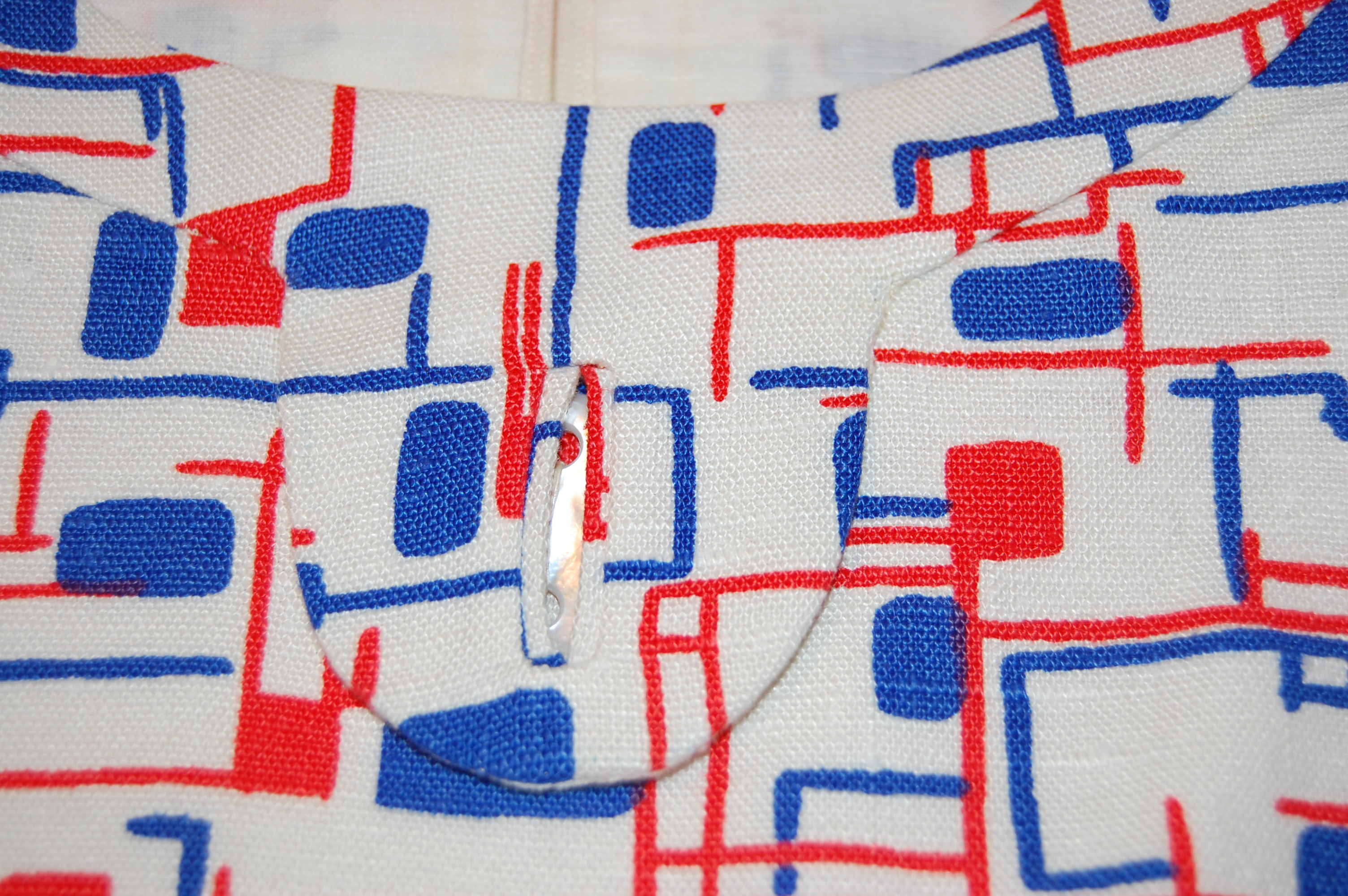
I hand-picked the zipper, understitched the facings by hand, and sewed the hem oh-so-carefully so that my stitches would not show (one of the disadvantages of not using an underlining is that there is no layer to sew the hem to, except for the actual fashion fabric). I made a bound buttonhole for that big lovely button (the original Vogue pattern calls for a bound buttonhole).

Here's the buttonhole, with the button peeking through!

Here’s the buttonhole, with the button peeking through!

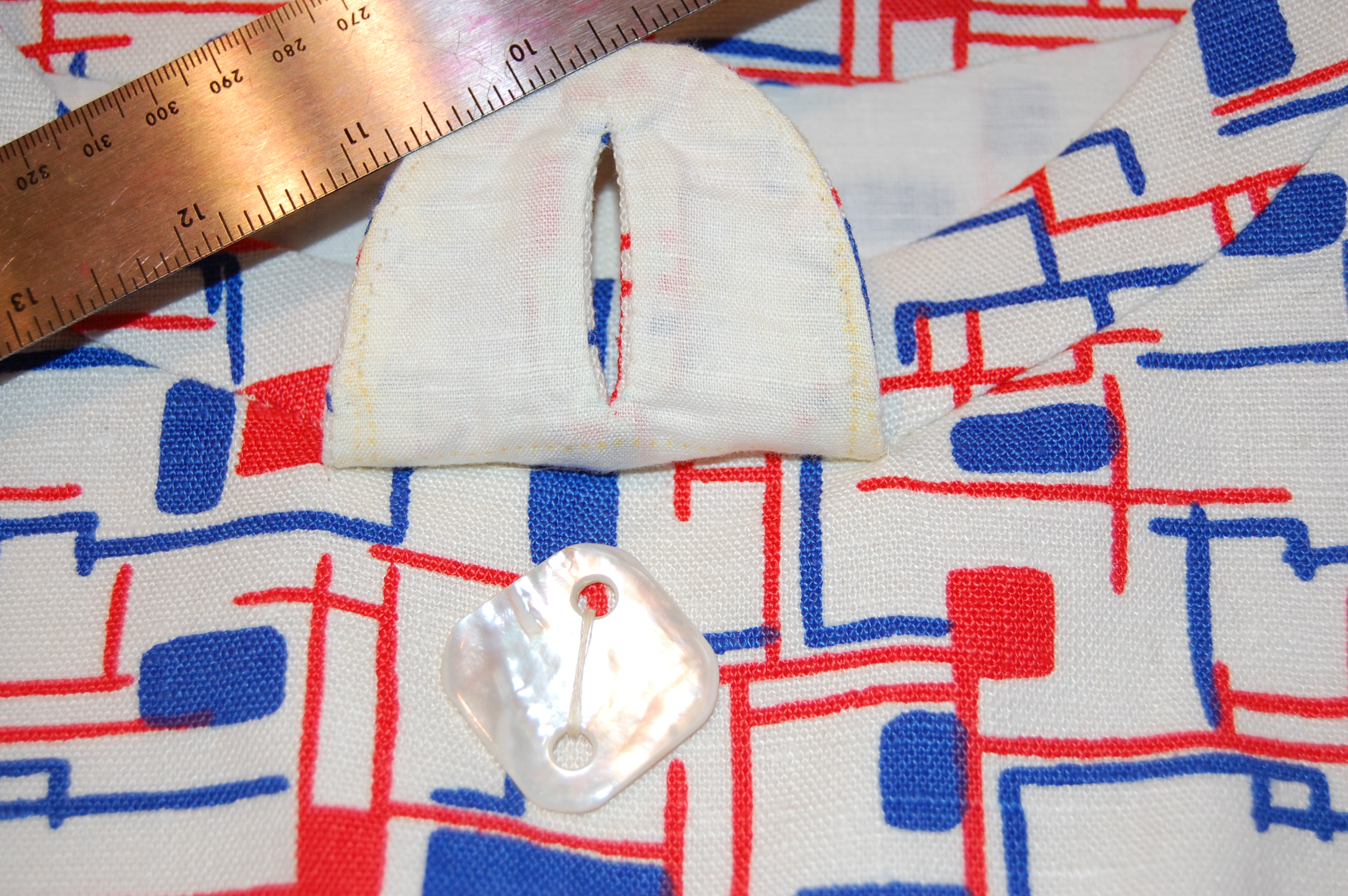
The underside of the tab.

The underside of the tab.

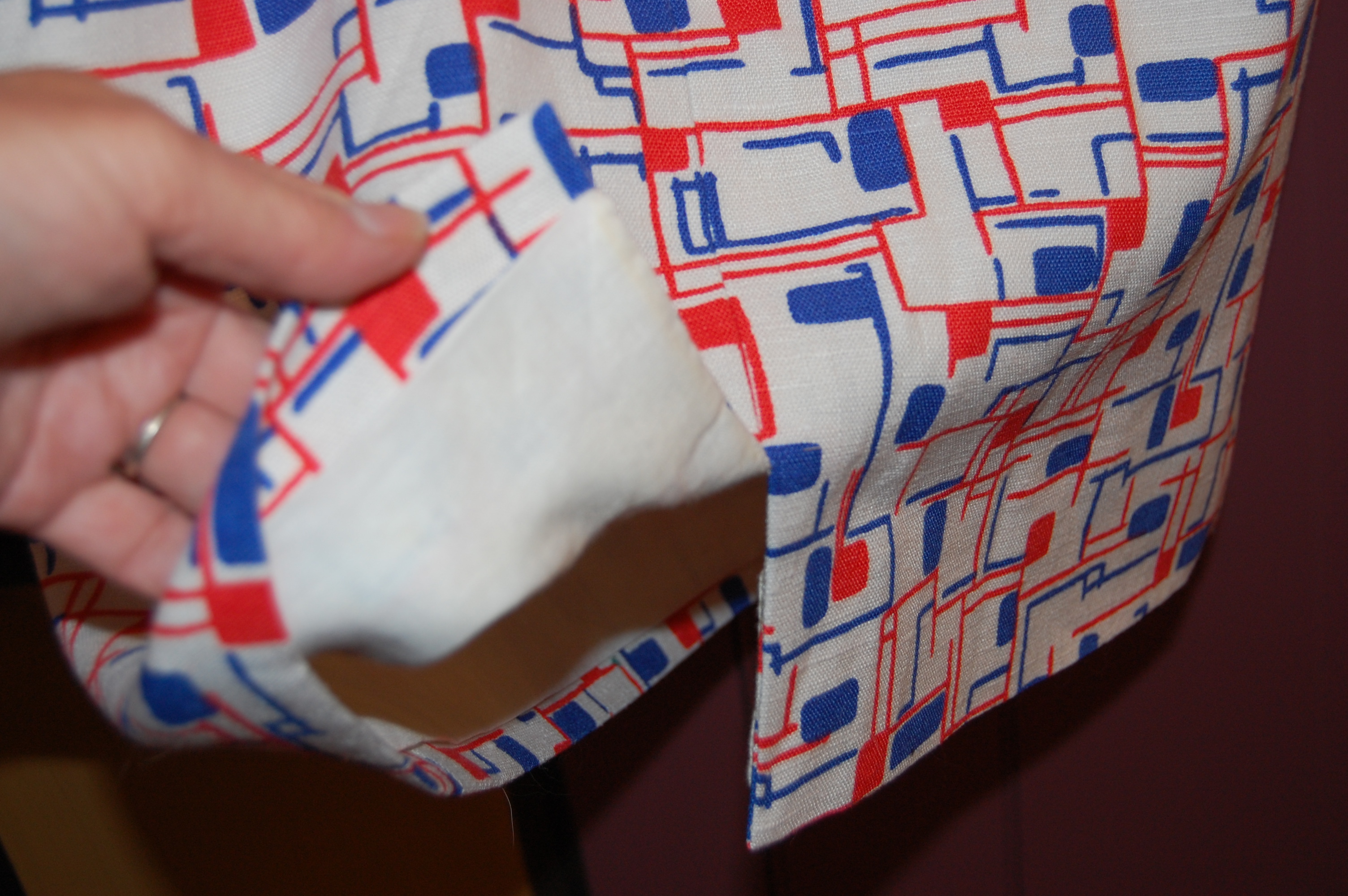
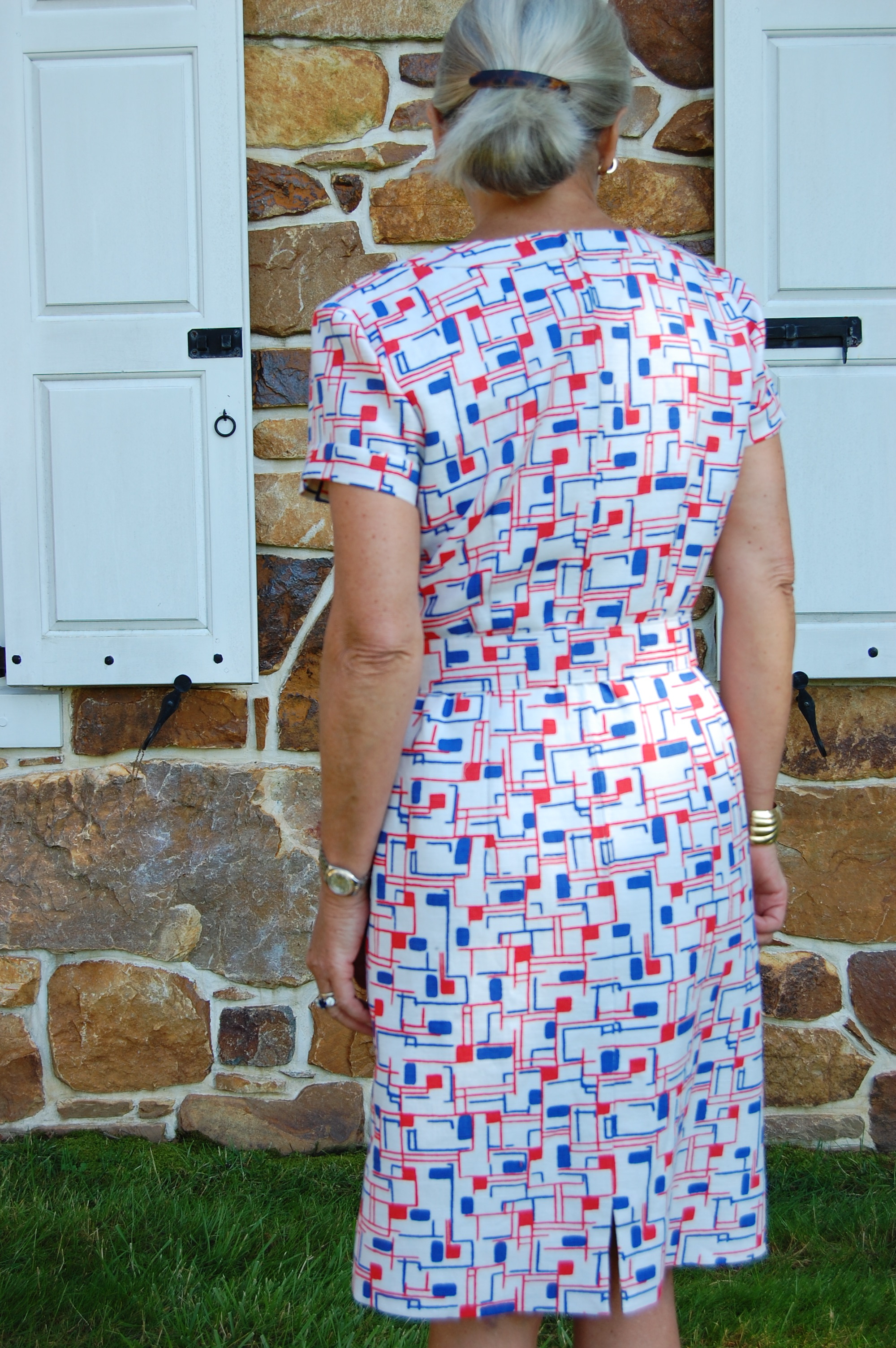
I also added a slit to the back seam as once I lengthened the dress, I thought I might need the extra wiggle room.

a quick look at the slit I added to the back center seam.

A quick look at the slit I added to the back center seam.

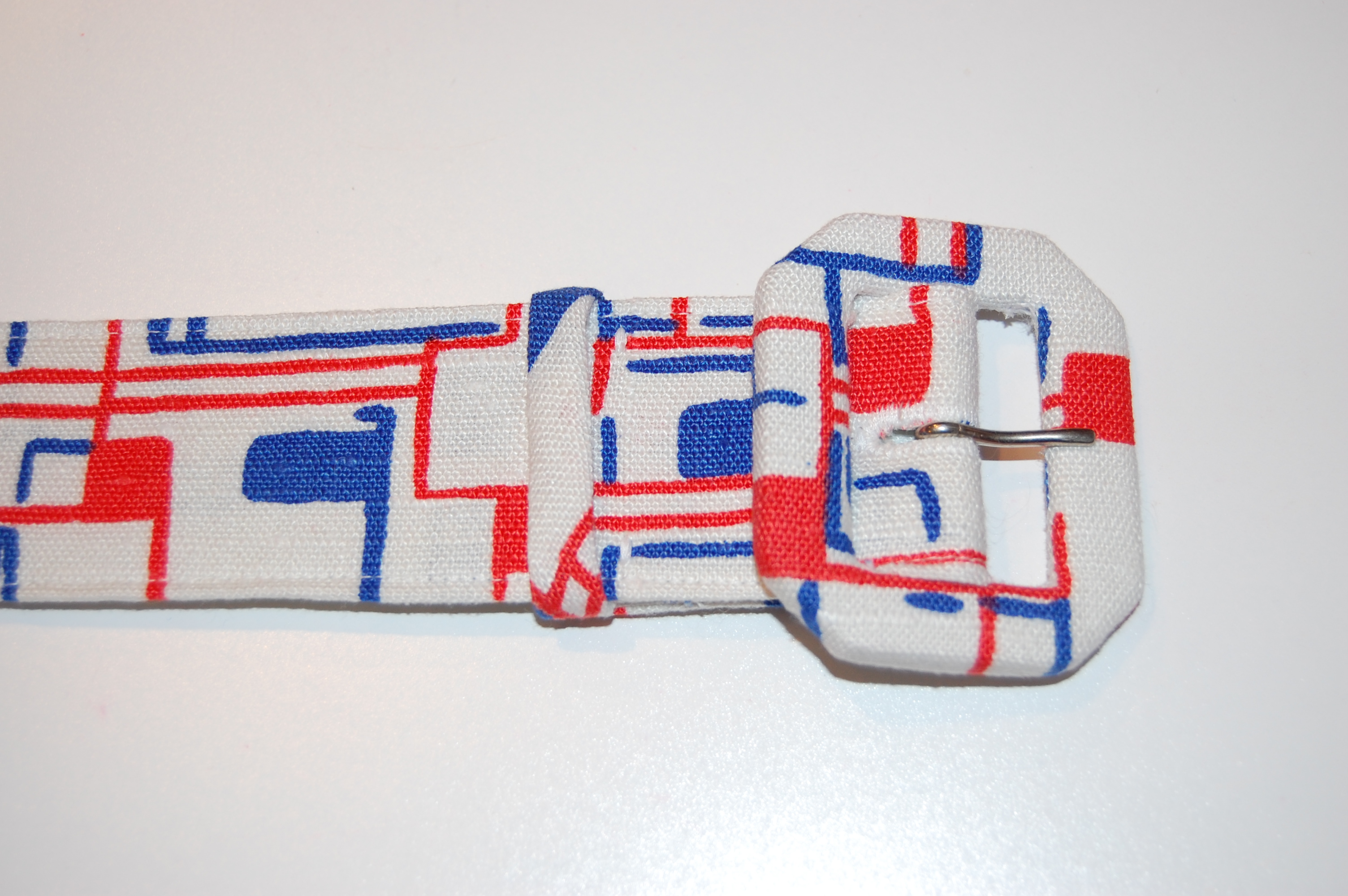
I had the belt made by Pat Mahoney of Pat’s Custom Belts and Buckles.  What a great decision!  I could never make as neat a belt and buckle as she does.
Pat Mahoney does nt have a website, but she can be contacted at: 209-369-5410; 537 York Street, P.O. Box 335, Lodi, California 95241, USA.

Pat Mahoney does not have a website, but she can be contacted at: 209-369-5410; 537 York Street, P.O. Box 335, Lodi, California 95241, USA.

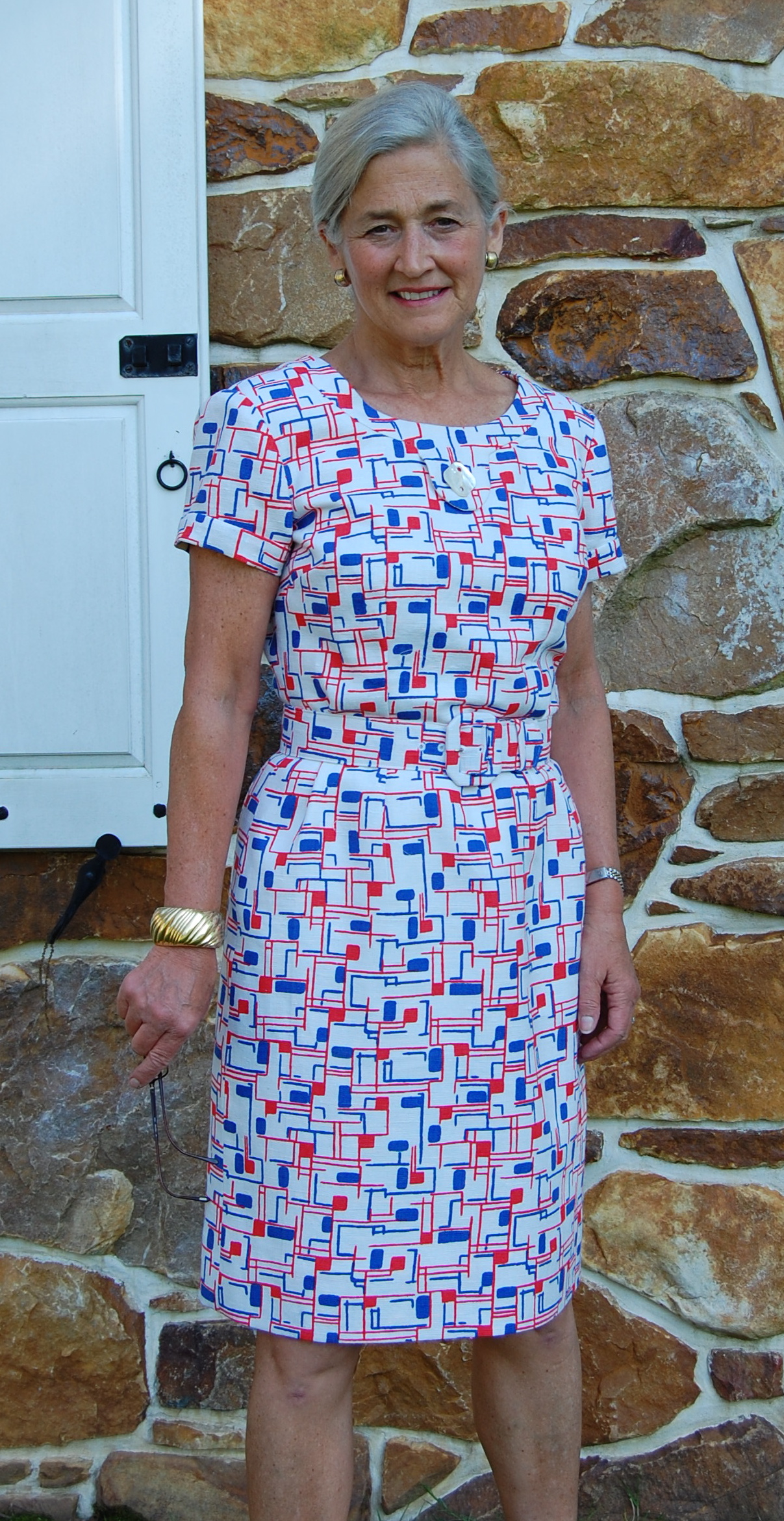
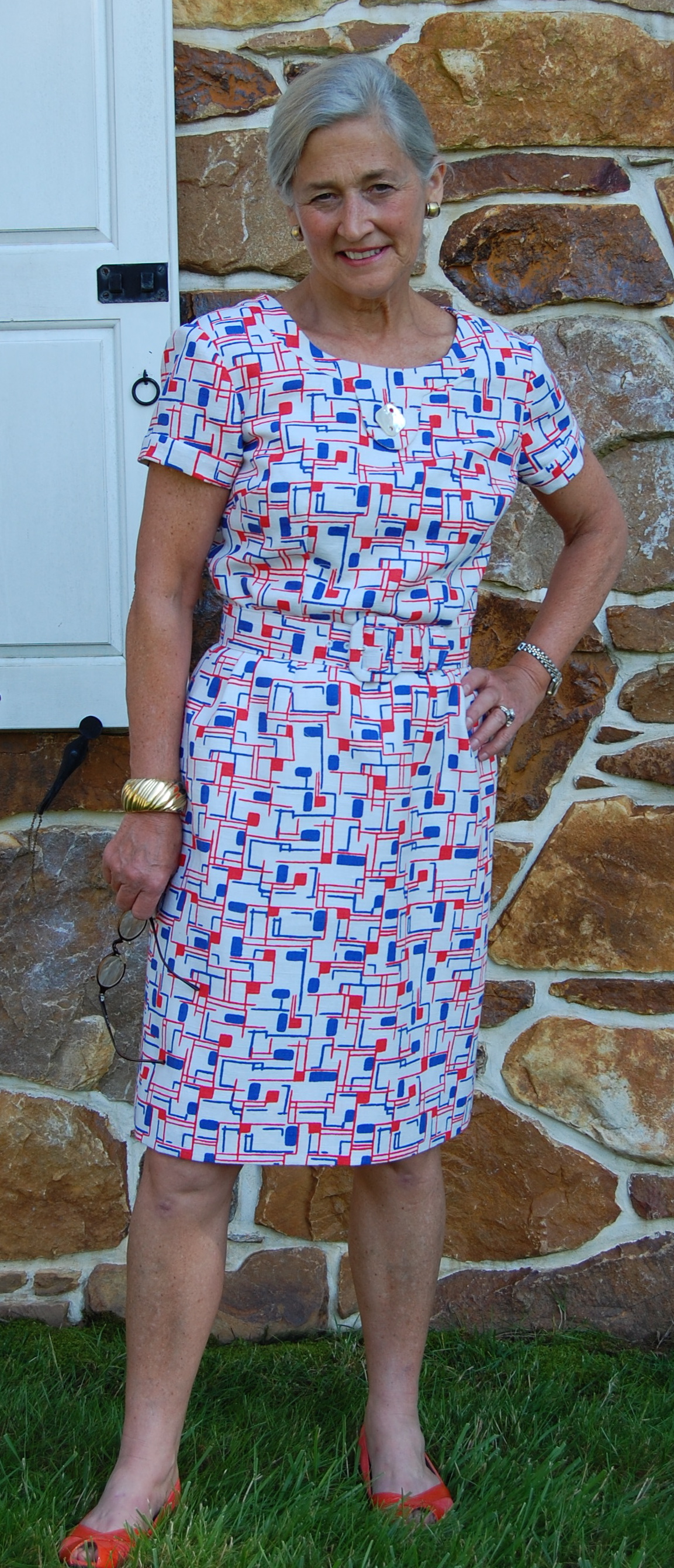
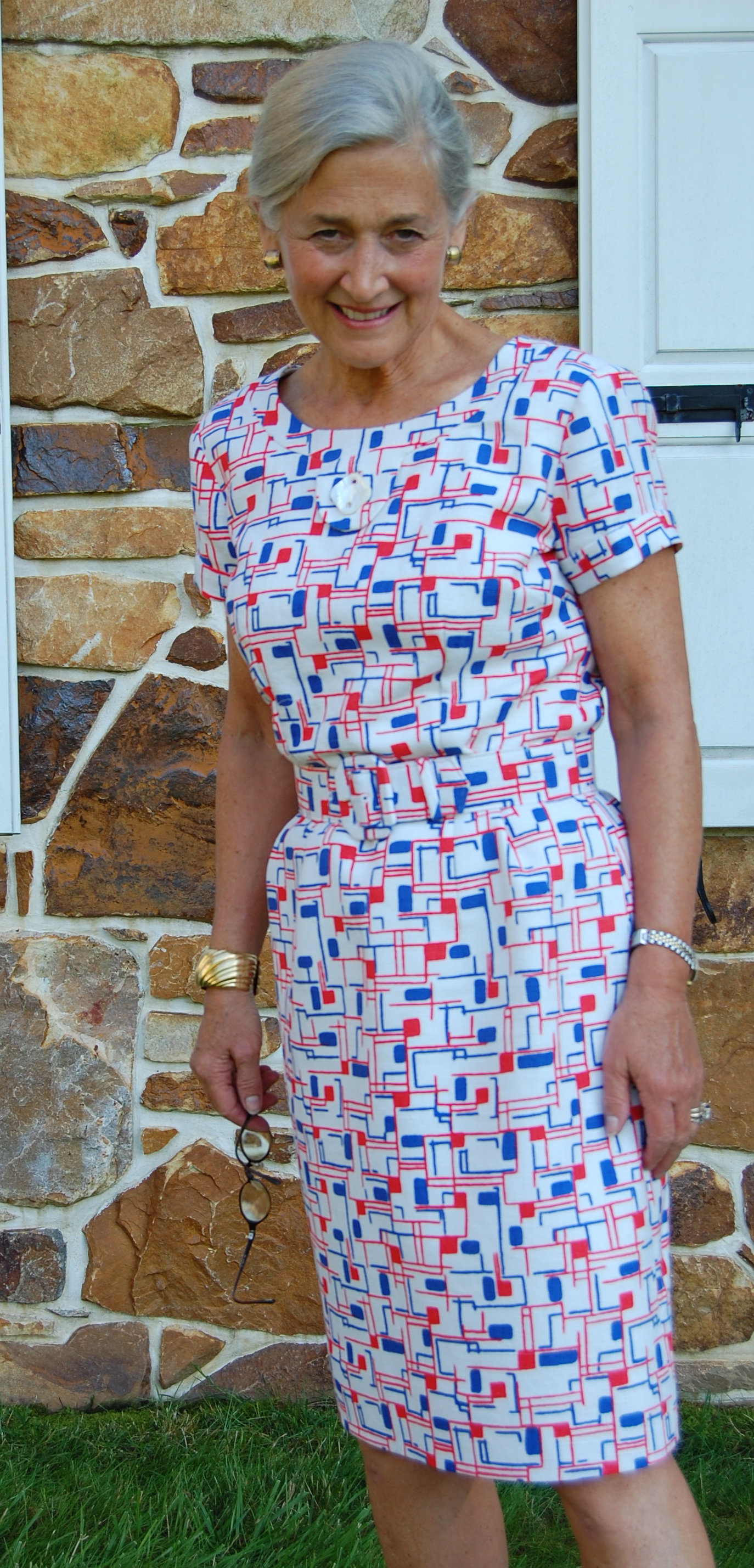
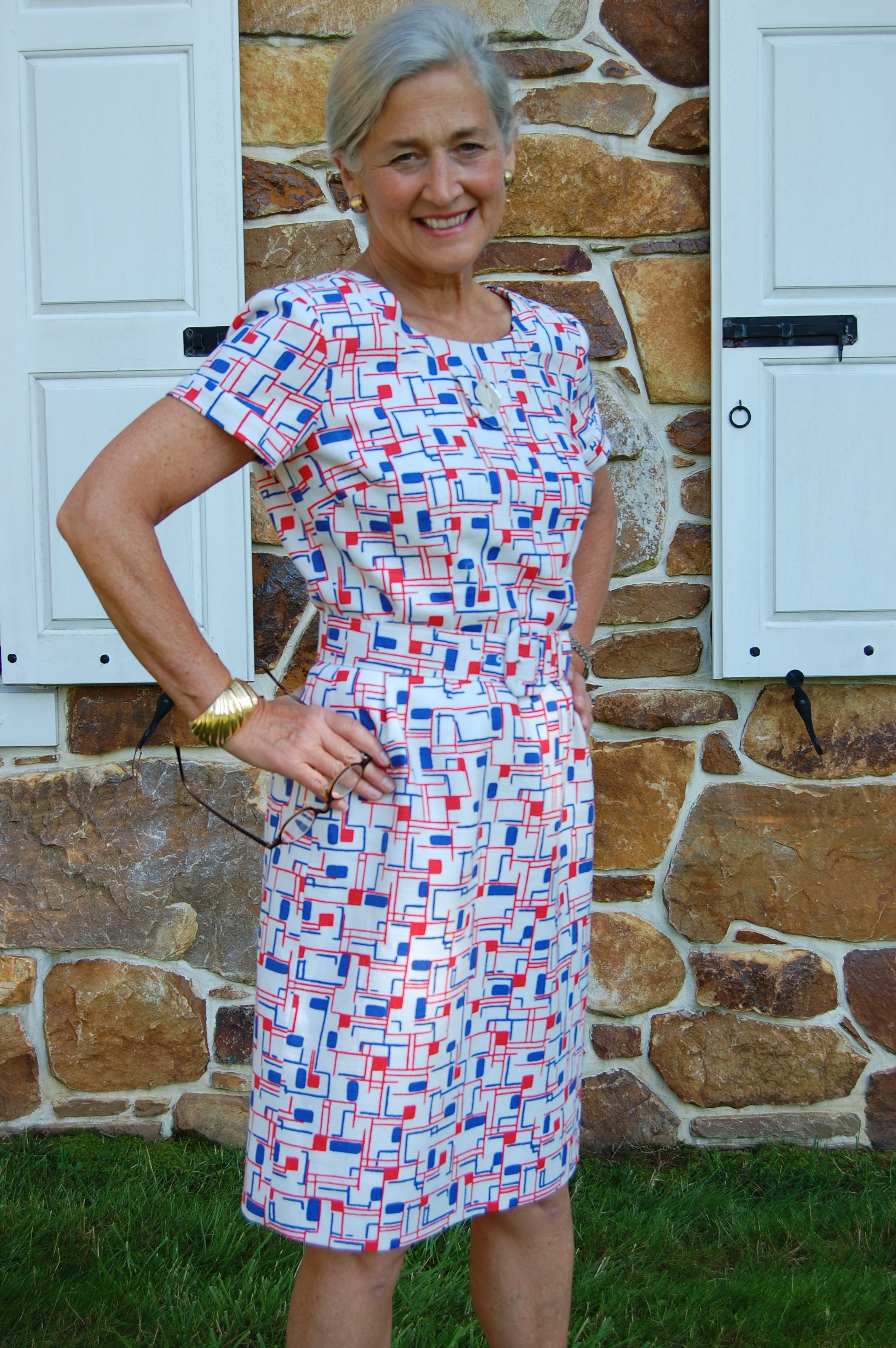
Here is the finished dress.

linen tab dress

DSC_0882

DSC_0886

DSC_0887

DSC_0892

DSC_0893

DSC_0894

I am bound and determined to make a summer dress using that vintage Vogue pattern.  But – now I know I’ll have to use a plain fabric for best results (maybe a solid linen…).  It will, however,  have to wait for another Summer, as  I have other projects in mind!

Making this dress has reminded me that sometimes Plan B turns out to be the BEST plan of all.

21 Comments

Filed under bound buttonholes, Buttons - choosing the right ones, couture construction, Linen, Moygashel linen, Uncategorized, vintage buttons, vintage Vogue Designer patterns, vintage Vogue patterns from the 1970s, Vogue patterns

The Return of the Ladylike Suit

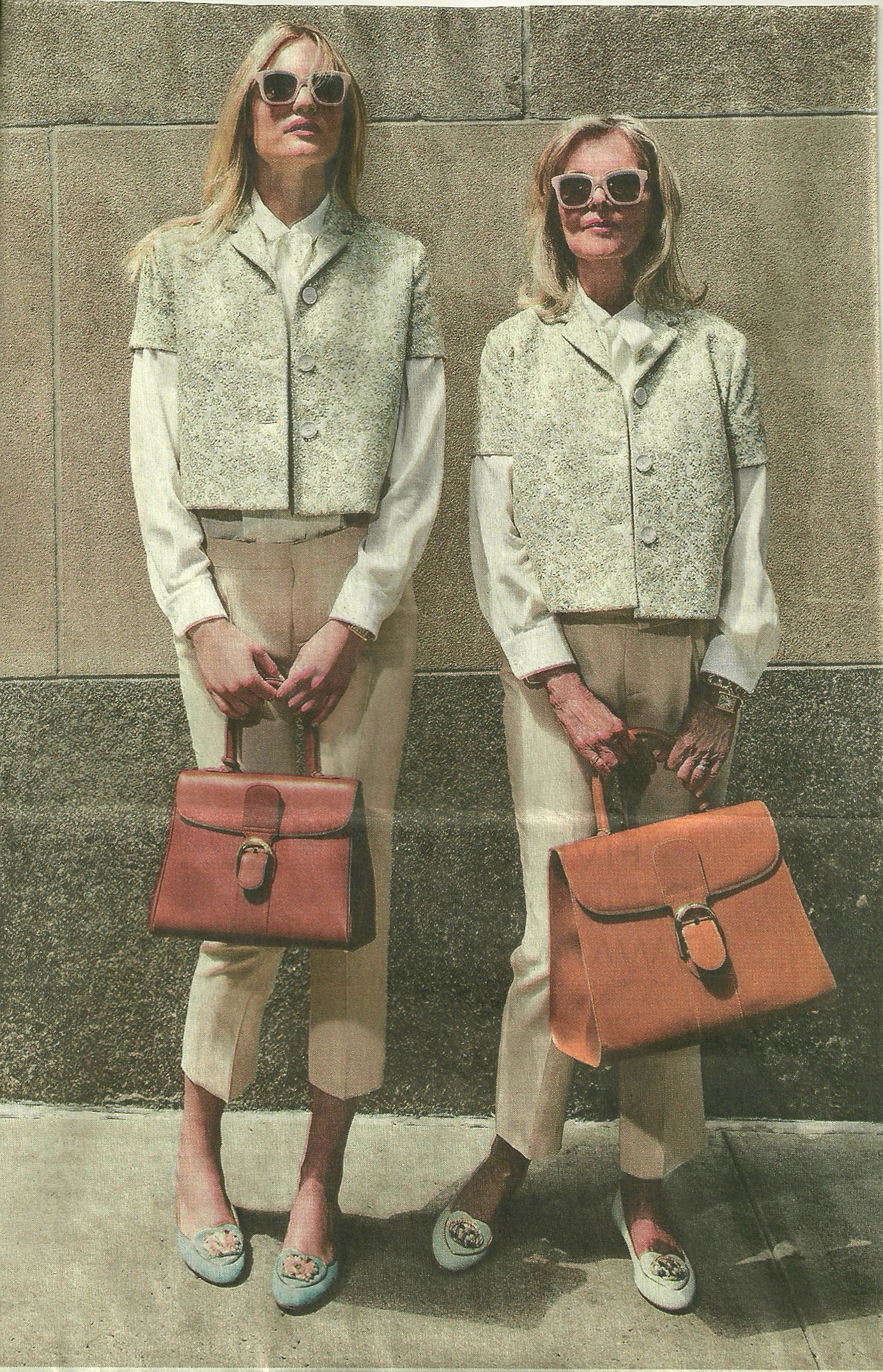
It seems I just can’t get way from that word – ladylike.  Just as I was finishing the jacket to my emerald green silk suit, the weekend Wall Street Journal arrived with this article in the Off Duty – Style & Fashion section:  “Gran Larceny – Fashion’s latest rebellion is co-opting looks from grandma’s closet.”

This photo, copyright The Wall Street Journal, is the lead photo for the article.

This photo, copyright The Wall Street Journal, is the lead photo for the article.

To quote from this article by Alexa Brazilian:

“Is conservative the new radical?    The fashion world certainly seems to think  so  . . .    Designers are reimaging soignée staples for spring and summer – skirt suits, twin sets, below-the-knee dresses, kitten heels and frame bags – that appear anything but moth-eaten.

“ ‘A young girl now doesn’t want to dress like her mother; she finds her grandmother much cooler,’ said Nina Ricci creative director Peter Copping, who designed skirt suits inspired by his own nana.  ‘She wore little smart tweedy suits.  I always had a romantic notion of that.’ “

And then later in the article is this statement by Christopher Kane (which I might frame and put on the wall in my sewing room!):  “Ladylike is the ultimate sexiness,” said the designer.  “It’s clean, elegant and in control.  The famous saying, ‘It’s the quiet ones you need to watch,’ definitely applies to this style.”

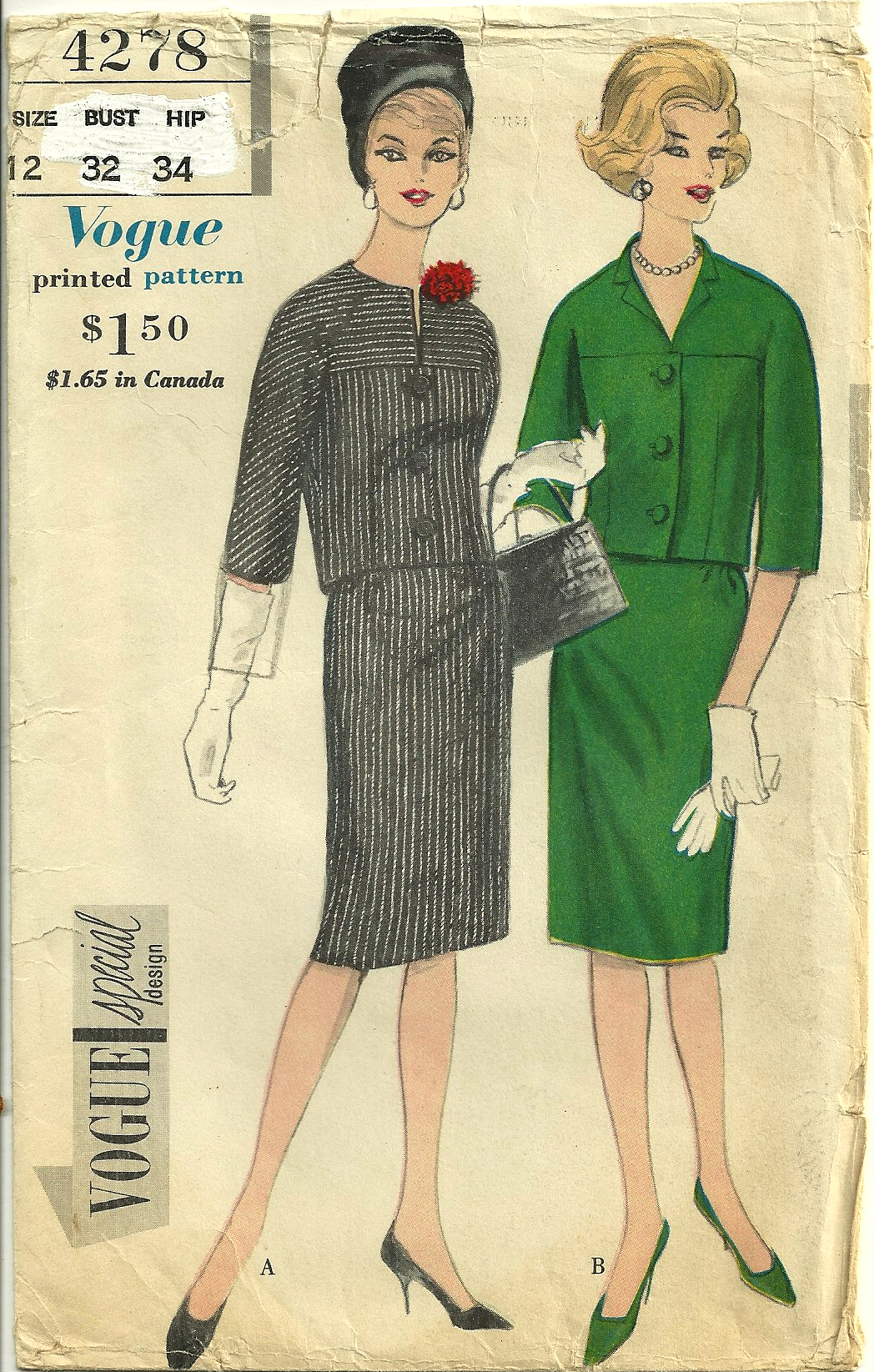
Well, I won’t necessarily feel radical or even sexy when I wear my new green skirt suit, but I do believe it is an example of that ladylike style of the early 1960s — which actually makes sense since the pattern is indigenous to that decade.

This is the pattern from the 1960s I used for my suit.

This is the pattern from the 1960s I used for my suit.

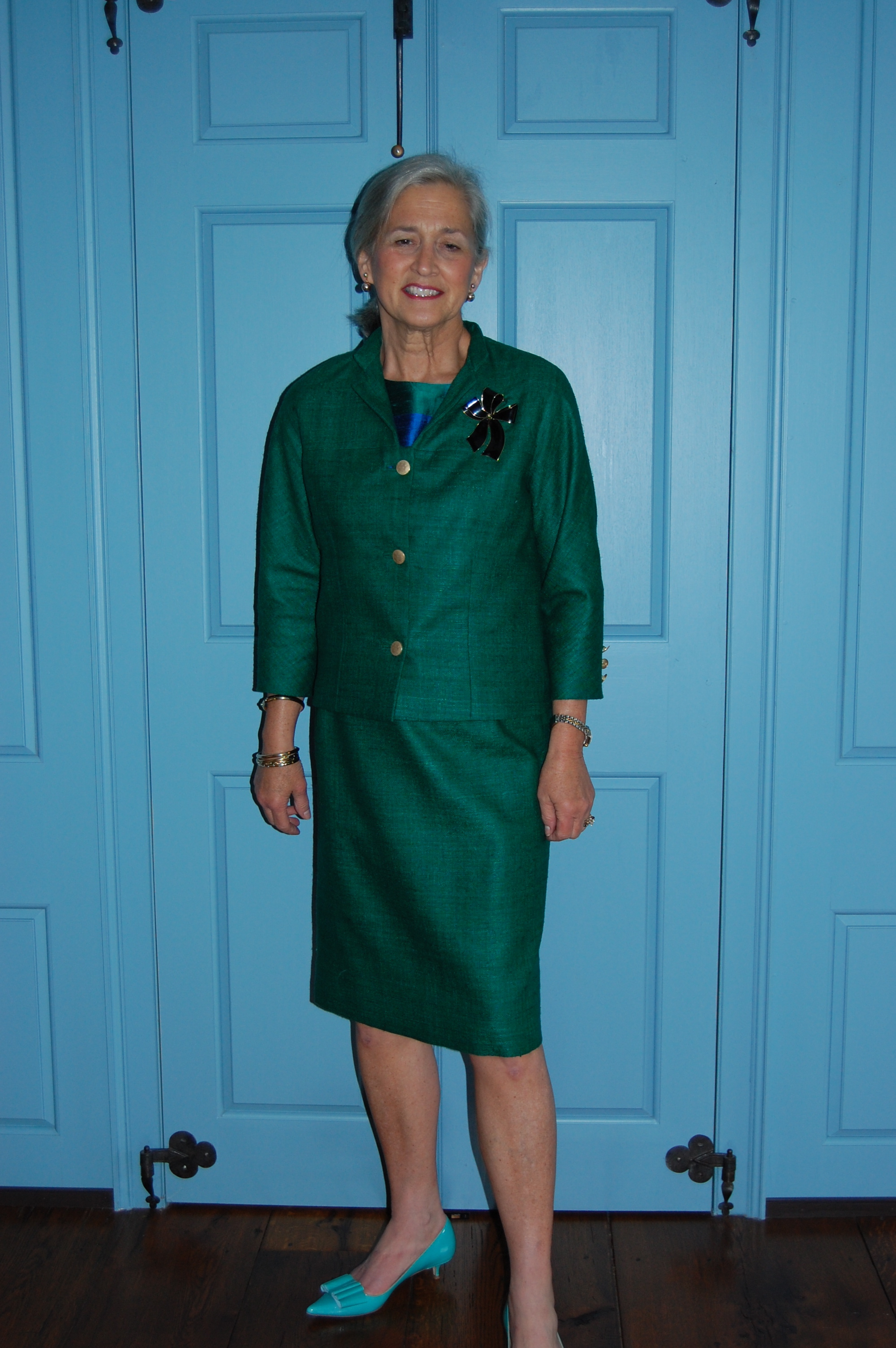
Finally finished!
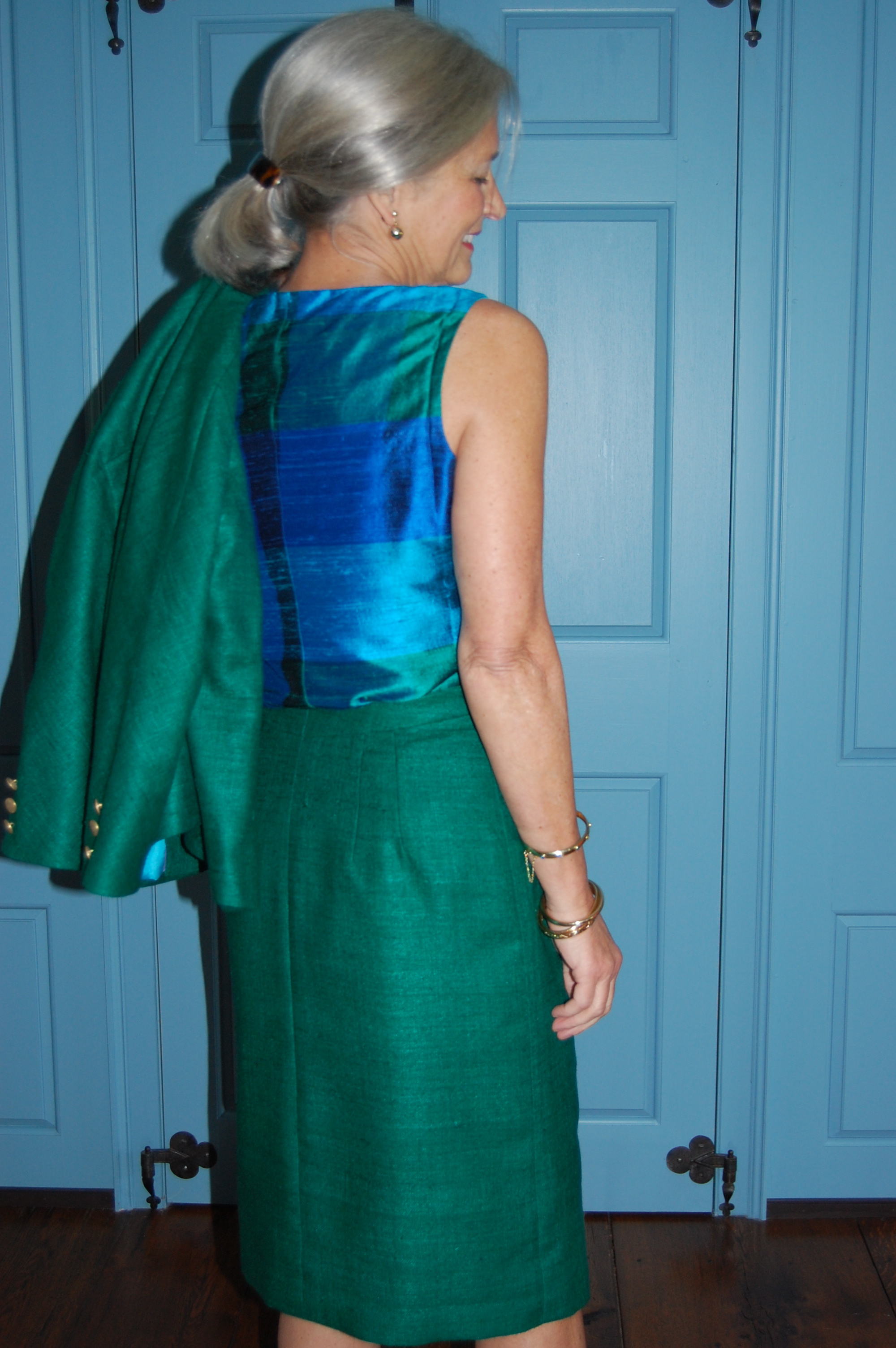
And here is the suit finally finished.

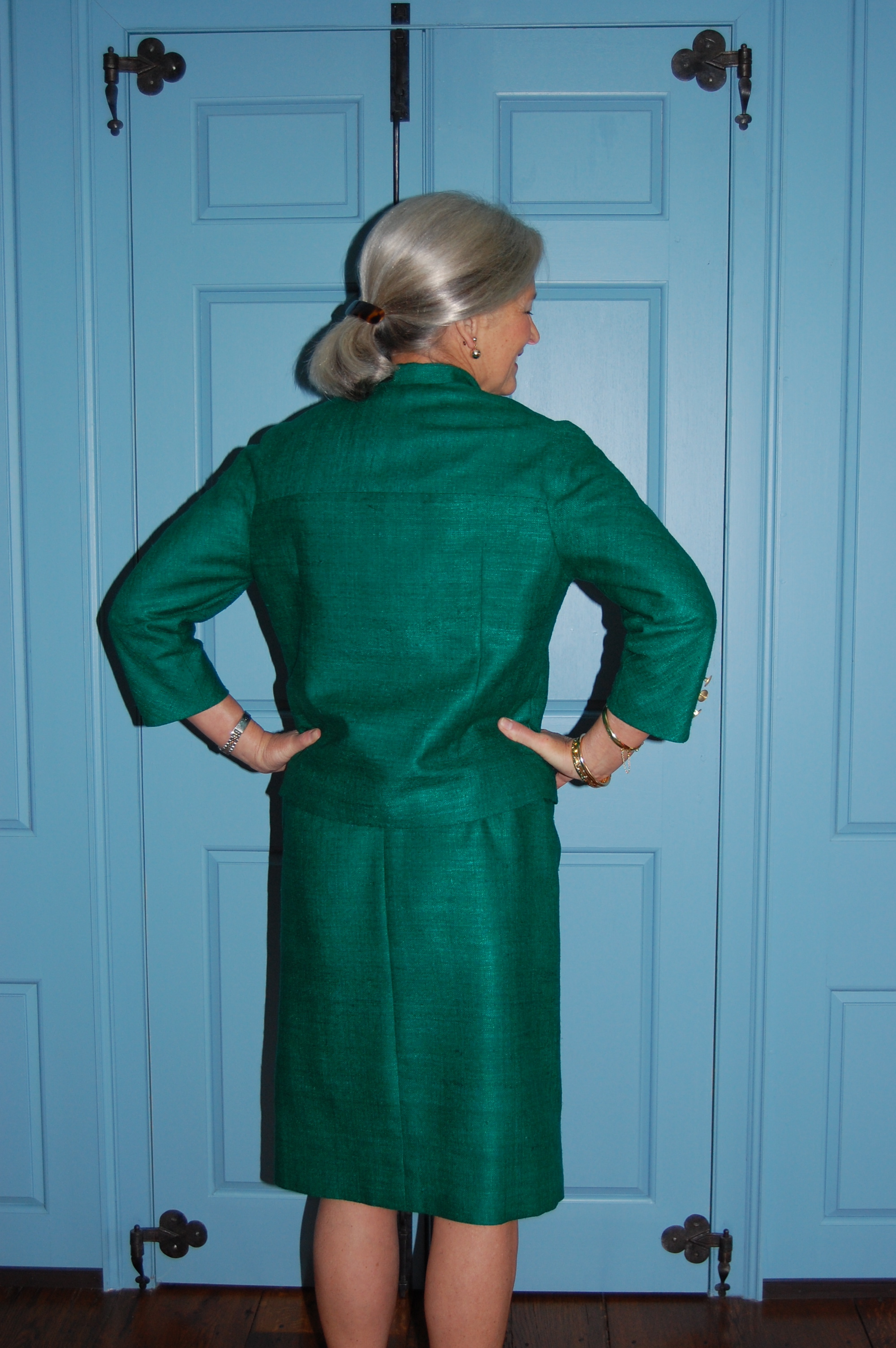
I make a few changes to the design once I made the muslin for it.  First, I added two tapering darts to the back.  It was supposed to have a boxy feel to it, but I felt a little narrower silhouette would be more flattering to me.  I also lengthened the jacket by about 1 and ½ inches.

The jacket is still "boxy" but less so with the added darts.

The jacket is still “boxy” but less so with the added darts.

I decided to make the sleeves below elbow length, so I added another inch and ½ to them.  Then I had to narrow them a bit as well to make them look proportional.

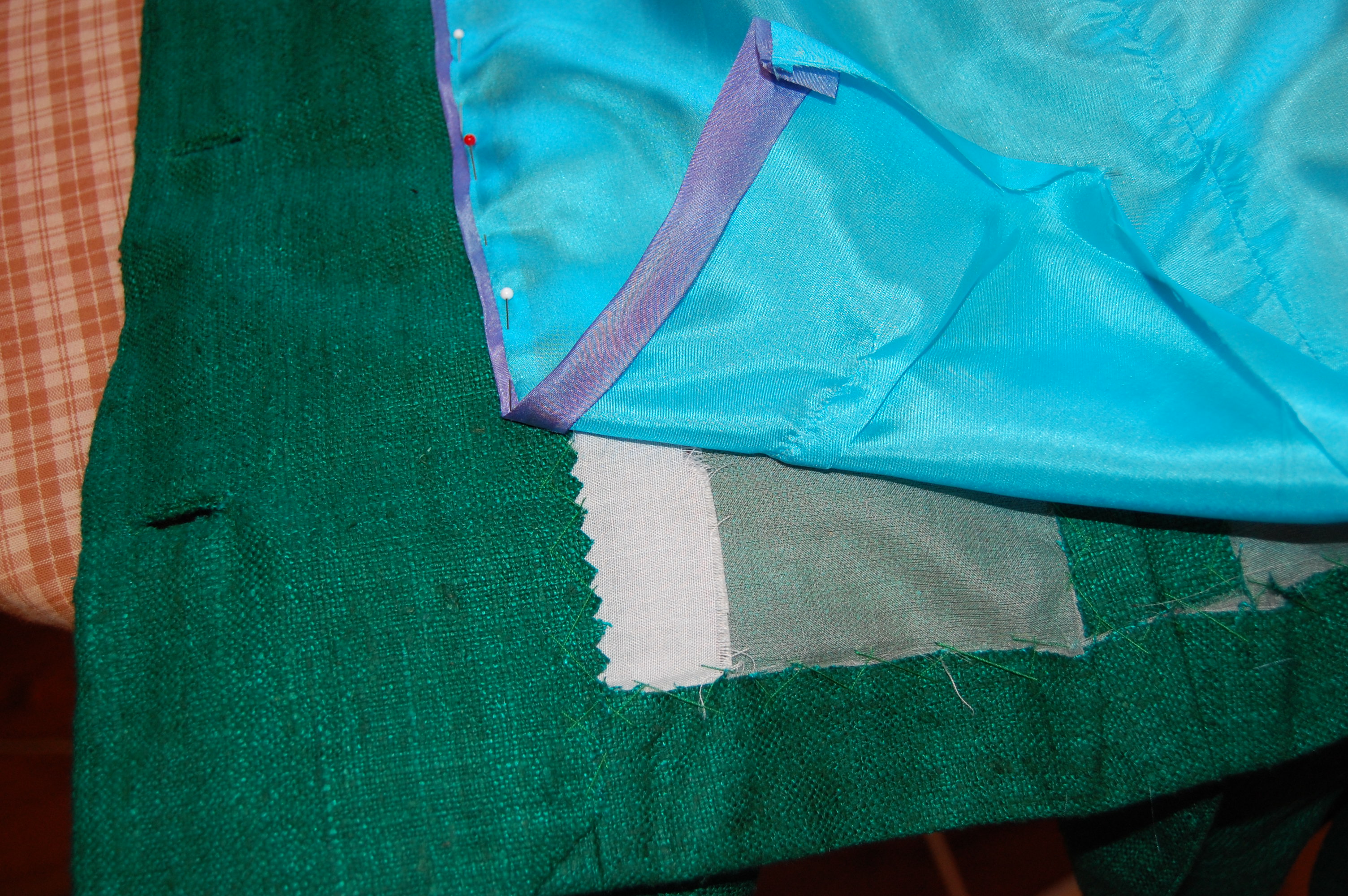
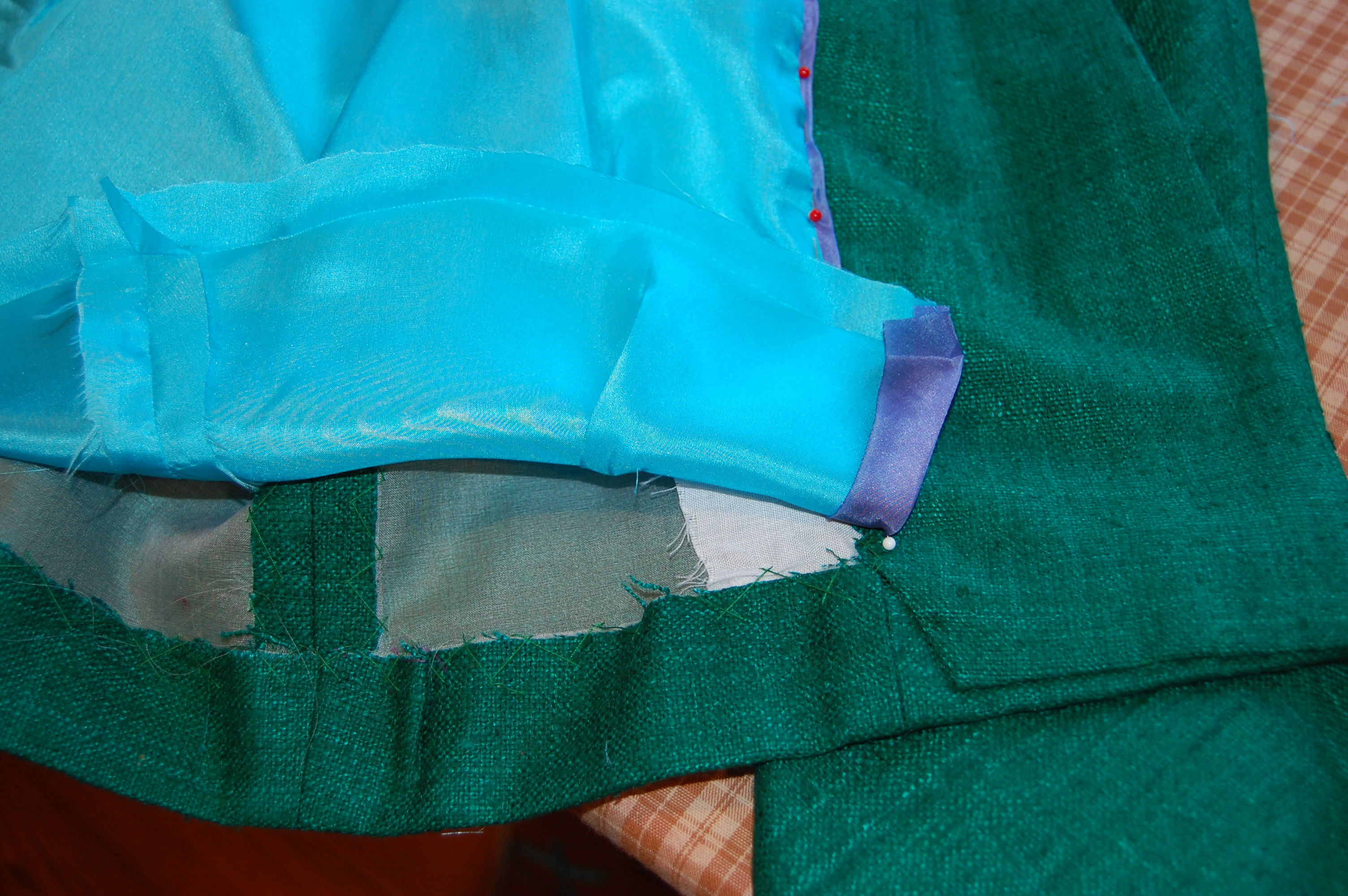
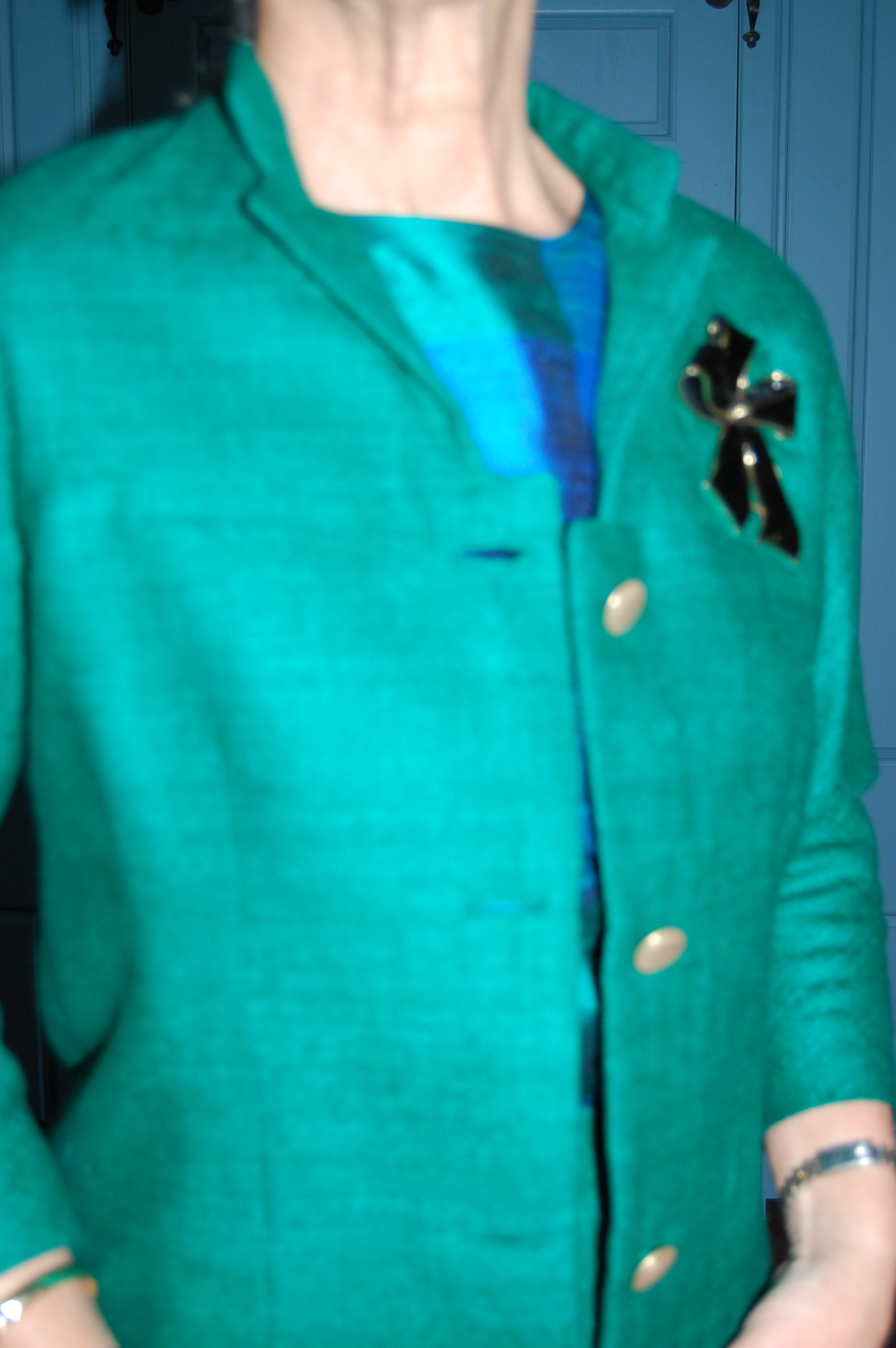
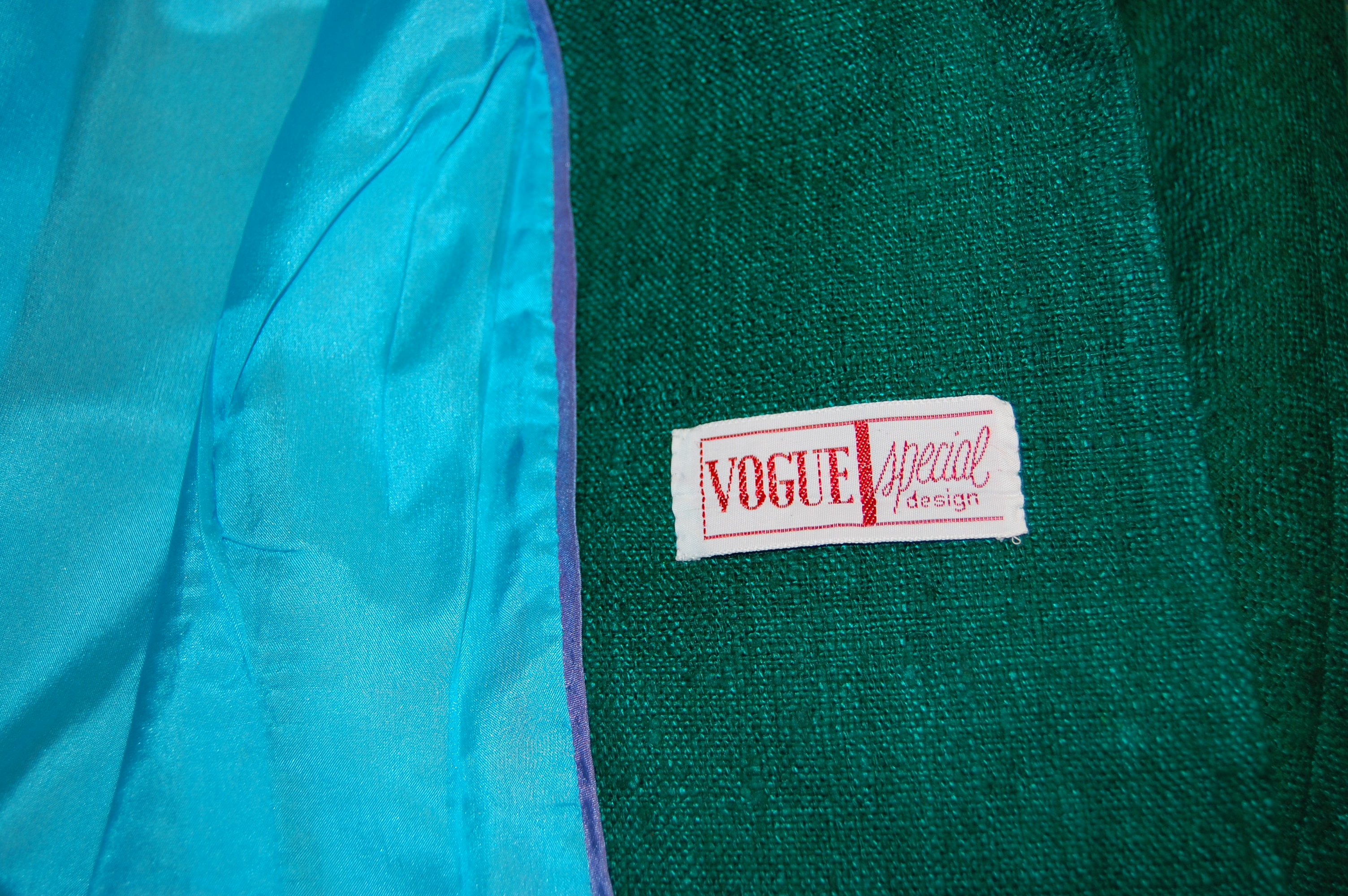
Now to the fun part:  the two dressmaker details I added.  In an earlier post, I already showed the turquoise silk lining fabric I chose.  Once I had such a dramatic contrast in the works, I thought I’d push the envelope a bit farther.  I found silk bias ribbon in a lovely periwinkle color and used it to add an edge detail to the lining in the body of the jacket.

Here is the bias silk ribbon attached to the edge of the lining.

Here is the bias silk ribbon attached to the edge of the lining…  Click on the photos to see them up close.

DSC_0804

… and one more picture of it.

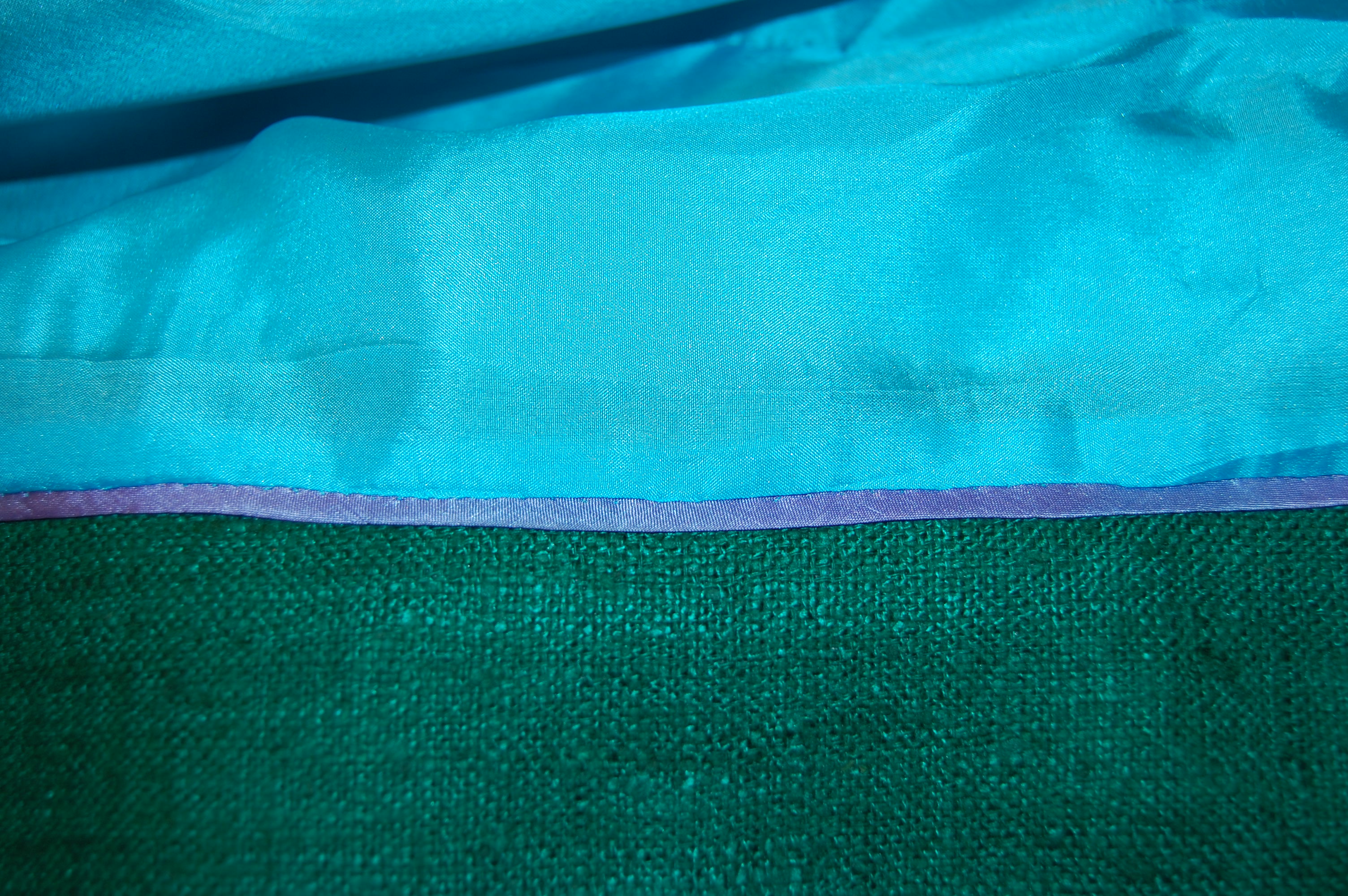
This was so much fun to do and made attaching the lining to the jacket very easy, as all I had to do was “hand-stitch in the ditch” where the silk ribbon and the lining fabric were sewn together.

Here is what the finished edge looks like.

Here is what the finished edge looks like.

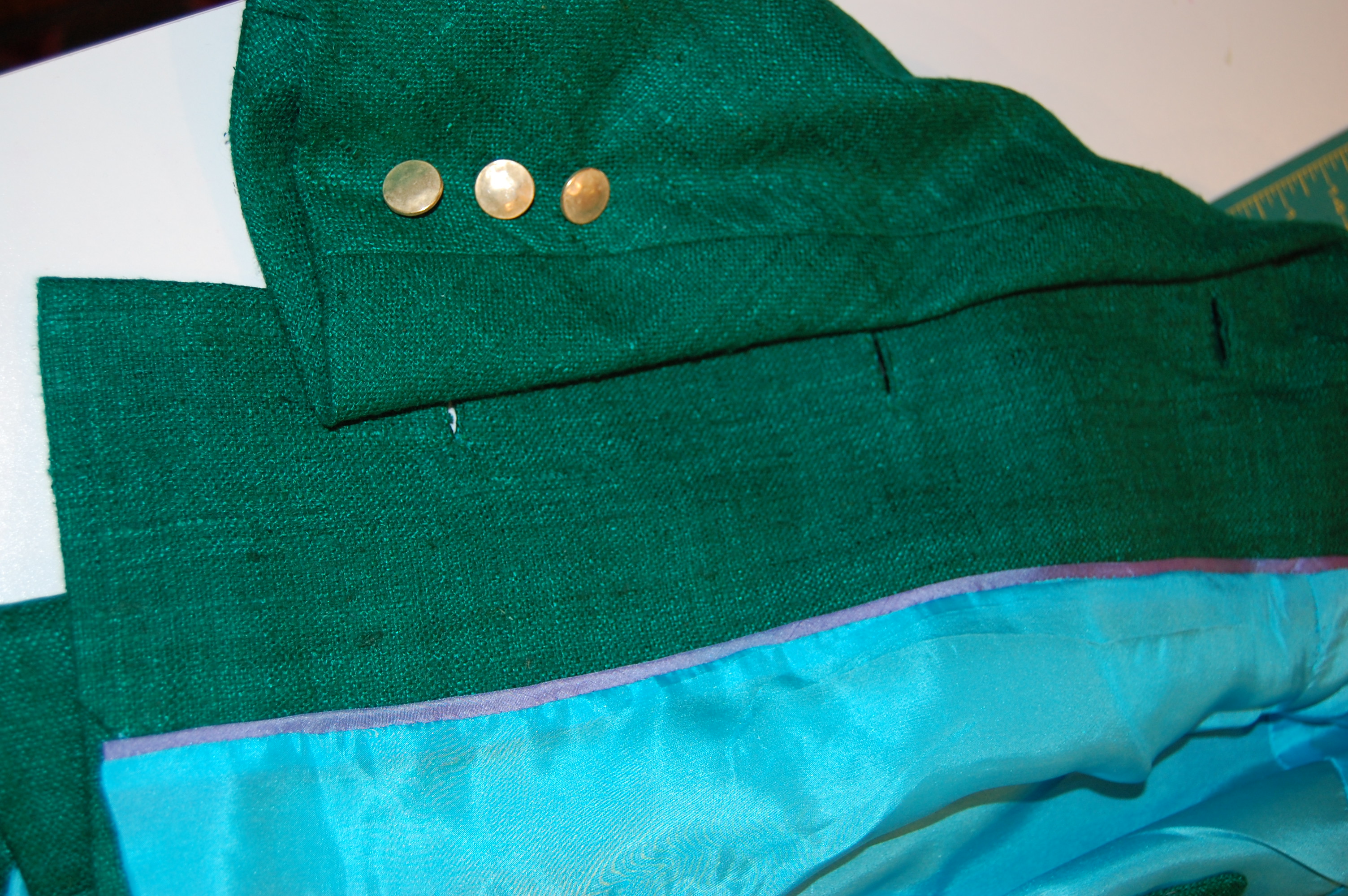
When I found the gold buttons for the jacket, I immediately knew that adding buttons to the sleeves would make it all look more complete.

The gold buttons added to the sleeves and another view of the lining (and the back of the bound buttonholes).

The gold buttons added to the sleeves and another view of the lining (and the back of the bound buttonholes).

And here is a close-up of the larger buttons for the front of the jacket, with their bound buttonholes.

And here is a close-up of the larger buttons for the front of the jacket, with their bound buttonholes.

The last thing I did was attach the label to the inside front of the jacket.

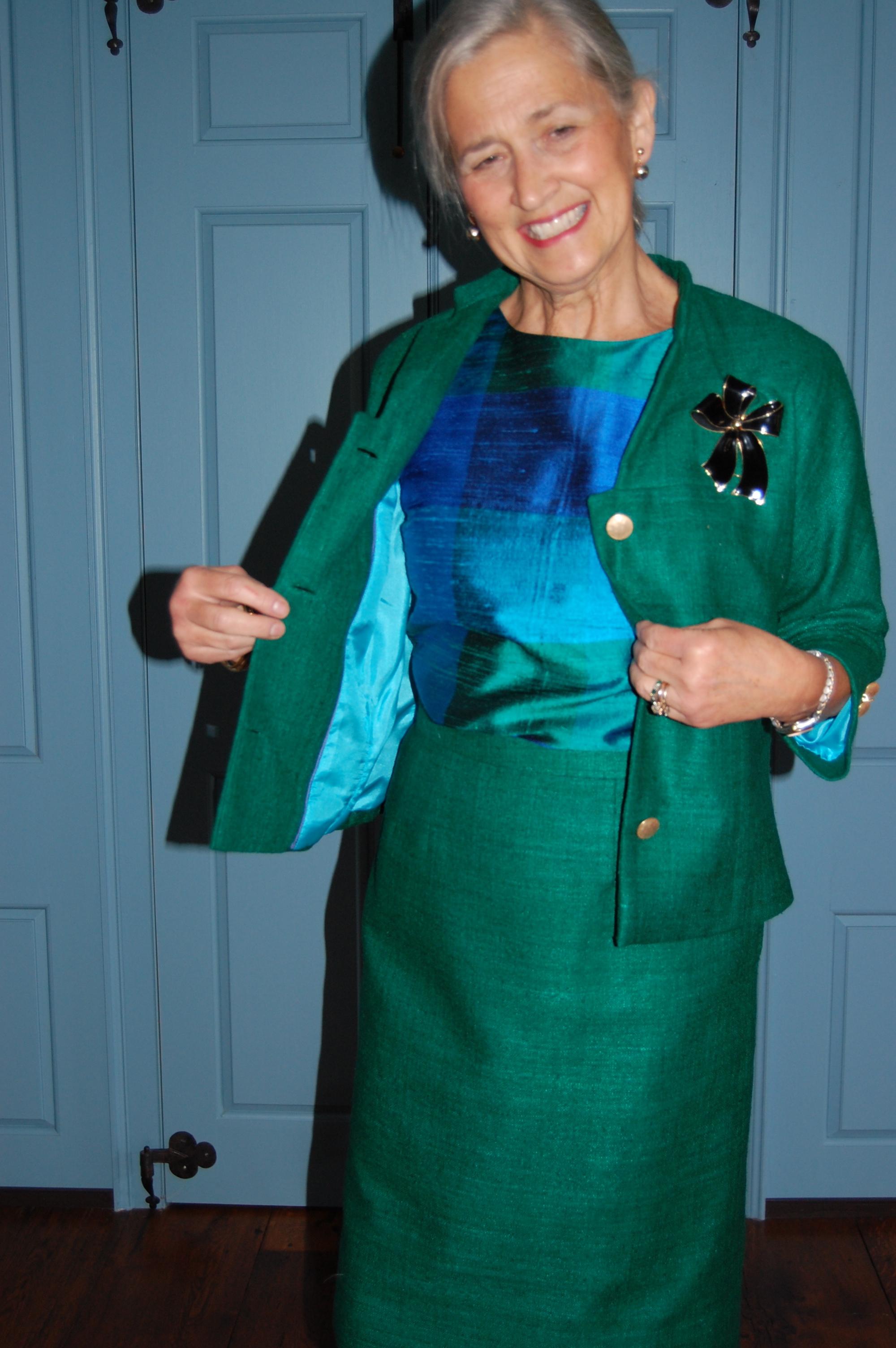
Emerald green suit

The silk shell I am wearing is a RTW one!  I purchased it last Spring and now have something with which to wear it!

The silk shell I am wearing is a RTW one. I purchased it last Spring and now have something with which to wear it!

Another view, without jacket.

Another view, with jacket over my shoulder.

When I found this emerald green silk matka online last Fall at Waechter’s Fine Fabrics, I envisioned a skirt suit – or dressmaker suit, as this type of dressy suit is also called – but I had not progressed beyond that in my planning.  Well, now this new grandmother is feeling pretty fortunate that, not only did I grow up with the styles from the 1960s, but they are making me feel quite fashionable now that I am in my 60s!

17 Comments

Filed under Buttons - choosing the right ones, Dressmaker details, Dressmaker suits, sewing in silk, Uncategorized, vintage Vogue patterns from the 1960s, Vogue patterns

Back to the Past

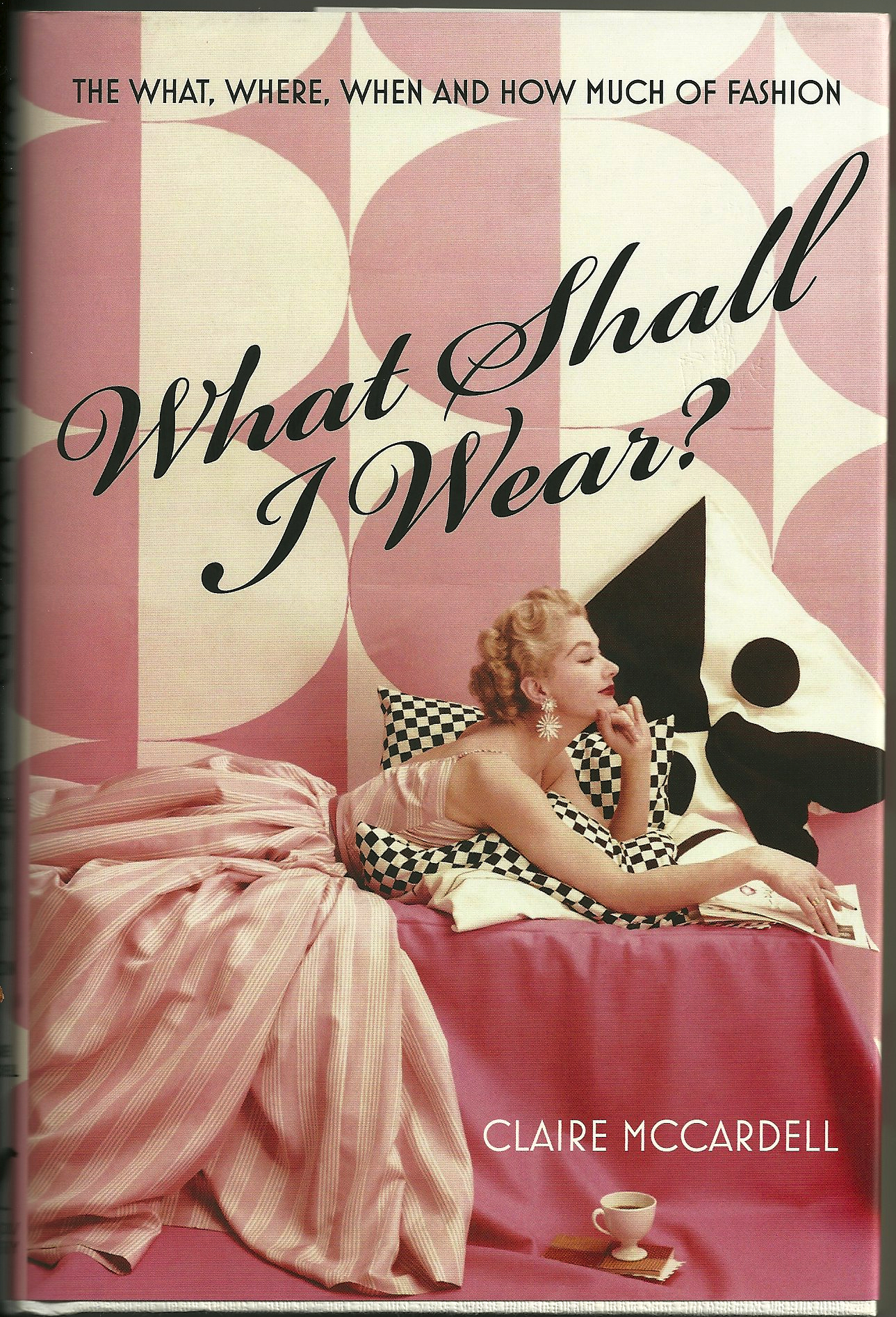
I am finally back in my sewing room, working on my emerald green silk suit.  The event to which I had hoped to wear this suit has come and gone (I wore something else that evening and the world somehow kept on spinning – amazing!), but this sewing project was and is on my Spring agenda and I am bound and determined to finish it.  Until I have made a bit more progress, with something to show for it, I thought I would indulge you with a book review of the 1956 Claire McCardell (1905-1958) book, What Shall I Wear, re-published in 2012 by The Rookery Press, in association with The Overlook Press, New York, New York.

Back to the Past

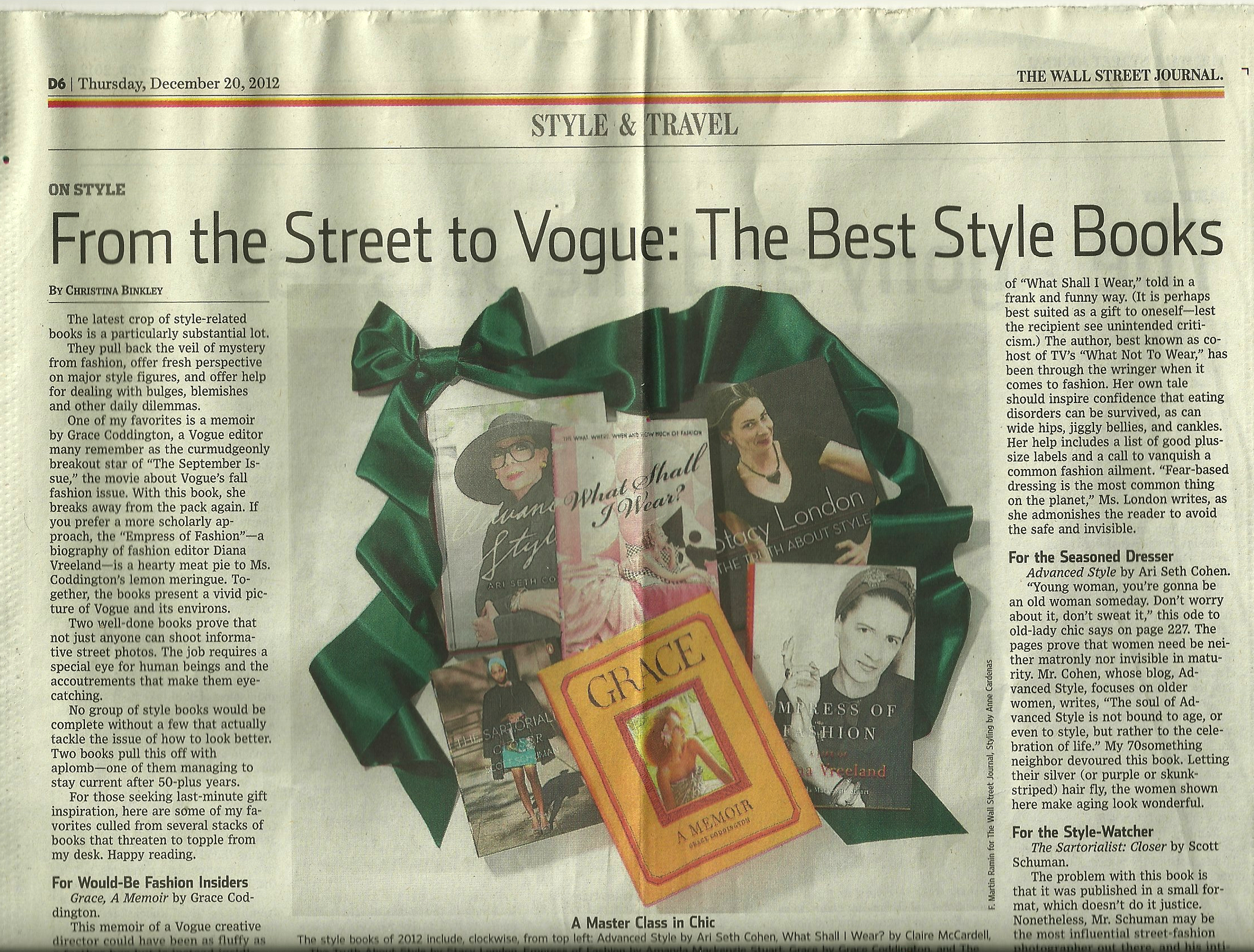
This book came to my attention by way of The Vintage Traveler blog (thanks, Lizzie!).  I purchased it on Amazon last Fall, and then, to my surprise, it was one of five books chosen by Christina Binkley of  The Wall Street Journal for her annual list of “Best Style Books”.

This annual feature on "style books" is always one of my favorites.

This annual feature on “style books” in The Wall Street Journal is always one of my favorites.  It appeared on December 20, 2012.

Here from Binkley’s review of the book: “This book is a gem.  …It manages to be modern more than 60 years later…  The designer created chic casual items that we take for granted today, such as trim ankle pants and full skirts that permit comfort and movement.  … She demonstrates an understanding of women’s lives. ‘Everyone should have a “pop-over” dress – a sheath that they can just pop over their head and go.’”

Here are some of Claire McCardell’s fashion tips and thoughts which struck a chord with me, especially in relation to sewing and dressmaking:

1)  The simple act of changing buttons (or in sewing, choosing the right ones) can make a dress fit your style.

2) When putting together your clothing (or pattern and fabric) budget, consider carefully where you want to put your money.  Make one major purchase a year, something classic and timeless is always a smart move.

3) Use color extensively and don’t be afraid to stretch from your normal palette.

4) Coats should be a large part of your wardrobe.  Indeed, she recommends compiling a “Coat Collection”.  That’s advice sweet to my ears!

5) Learn how to tie a scarf!  In her words:  “You miss all the fun if you can’t tie things.”  “If you really care about Fashion, sit down right now and learn to tie.  An ascot, a bandanna, a neckband, a bowknot.  This means knowing how to fold first, knowing how to loop next, knowing how to get the knot straight, knowing how to make the ends even – or uneven – on purpose.”

6)  Like all the great fashion designers and couturiers, she emphasizes the overwhelming importance of fit.  All those muslins/toiles we make are worth the time they take!

7) Accessorize your outfits with the appropriate jewelry, shoes, and bags.  Restraint is better than opulence.

8) She was a big fan (and proponent) of the “American Look”: meaning comfortable clothing with clean lines, displaying elegant simplicity.

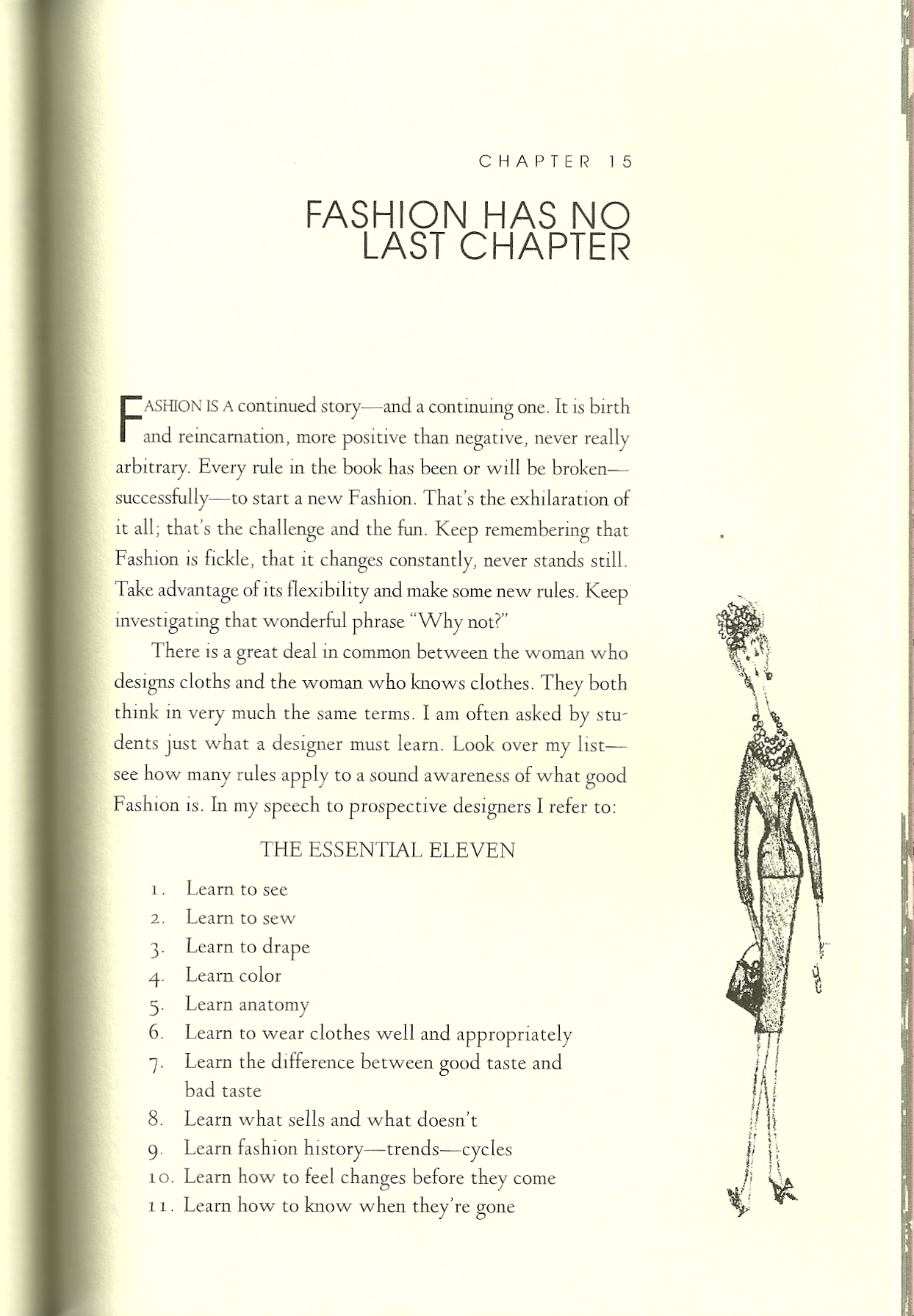
The final chapter of the book is appropriately entitled:  Fashion has no last chapter.

You can read here for yourself her Essential Eleven.  Pay particular attention to #2!

As a preface to this list, McCardell states:  "There is a great deal in common between the woman who designs clothes and the woman who knows clothes."

As a preface to this list, McCardell states: “There is a great deal in common between the woman who designs clothes and the woman who knows clothes.”  (Click on the photo for a close-up).

Earlier in the book on page 103, she relates her first experience with dressmaking: “Miss Annie … came to the house to make clothes for mother and me.  The process fascinated me from the start – selecting the pictures of dresses in the Vogue Pattern Book, the fabrics to be bought at the dry-goods store, the cutting and basting and fitting, the pockets and buttons and buttonholes…”

Surely sewing and dressmaking have no last chapter either:  What will you wear?  What will you sew?

12 Comments

Filed under Buttons - choosing the right ones, Coats, Scarves, Uncategorized

New Life from an Old Dress

I’m sure I never would have entertained the thought of remaking/repurposing this dress  –

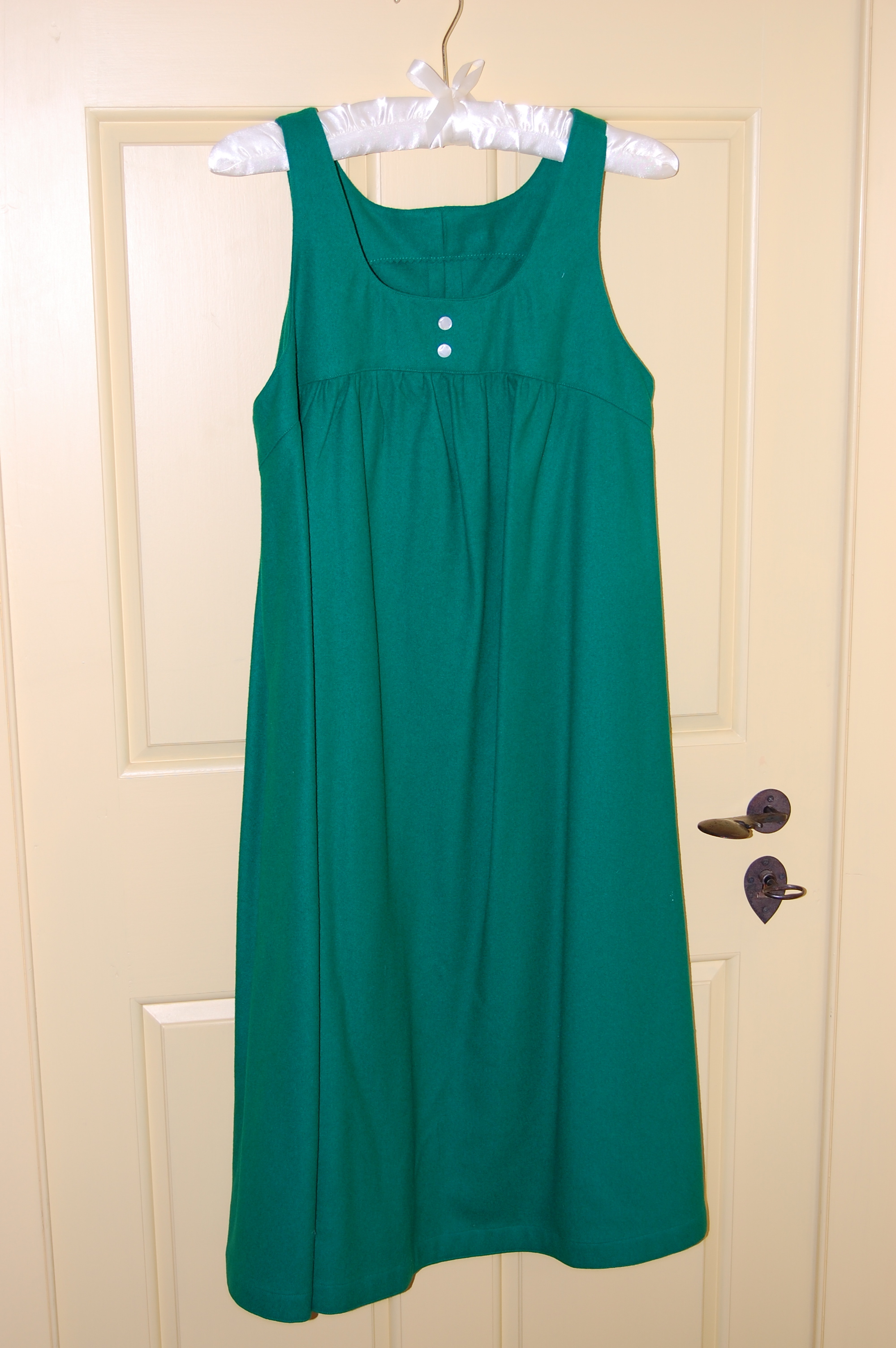
I made this maternity dress in the Fall of 1980 while pregnant with our first child.

I made this maternity dress in the Fall of 1980 while pregnant with our first child. The fabric is US-made Pendleton wool.

– had Emerald Green not emerged as THE color of 2013.  As it was, it seemed silly not to take advantage of this opportunity to make a skirt in a color I love, from a dress that would not be worn again, and which already carried sentimental memories.  So I told myself repeatedly, “Do this.”  And so I did it, but not without much mental anguish.

Before I did any ripping of seams or cutting of fabric, I needed to decide what kind of a skirt I could make, knowing that, even with a maternity tent-style dress, the usable expanse of fabric was limited.  It seemed fairly obvious that a pencil or A-line skirt was about the extent of the possibilities.  But I wanted some kind of a focal point on it, too.  I kept thinking about the fringed Pendleton wool skirt that I had remade, thinking that fringe on this green one would be quite nice as well.  I did a little testing on an inside seam of the dress and determined the wool was so tightly woven, that any “fringing” would have to be somewhat minimal.  It also seemed to be easier to unravel the threads working up and down rather than across.  I figured if I could wiggle out enough fabric to add one overlap (or pleat) at the side front, I could fringe that edge and get the focal point I wanted.

With this plan in mind, I now had to face cutting apart – and into – this dress, which I so clearly remembered making and wearing over 31 years ago.  Honestly, for a couple of days I really couldn’t face this.  My practical side finally triumphed when I decided I would first separate just the side seams on the dress.  If I chickened out at that point, I could always sew it back together, right?  Right!  And so I snipped and snipped and pretty soon I had two usable sections of wool.

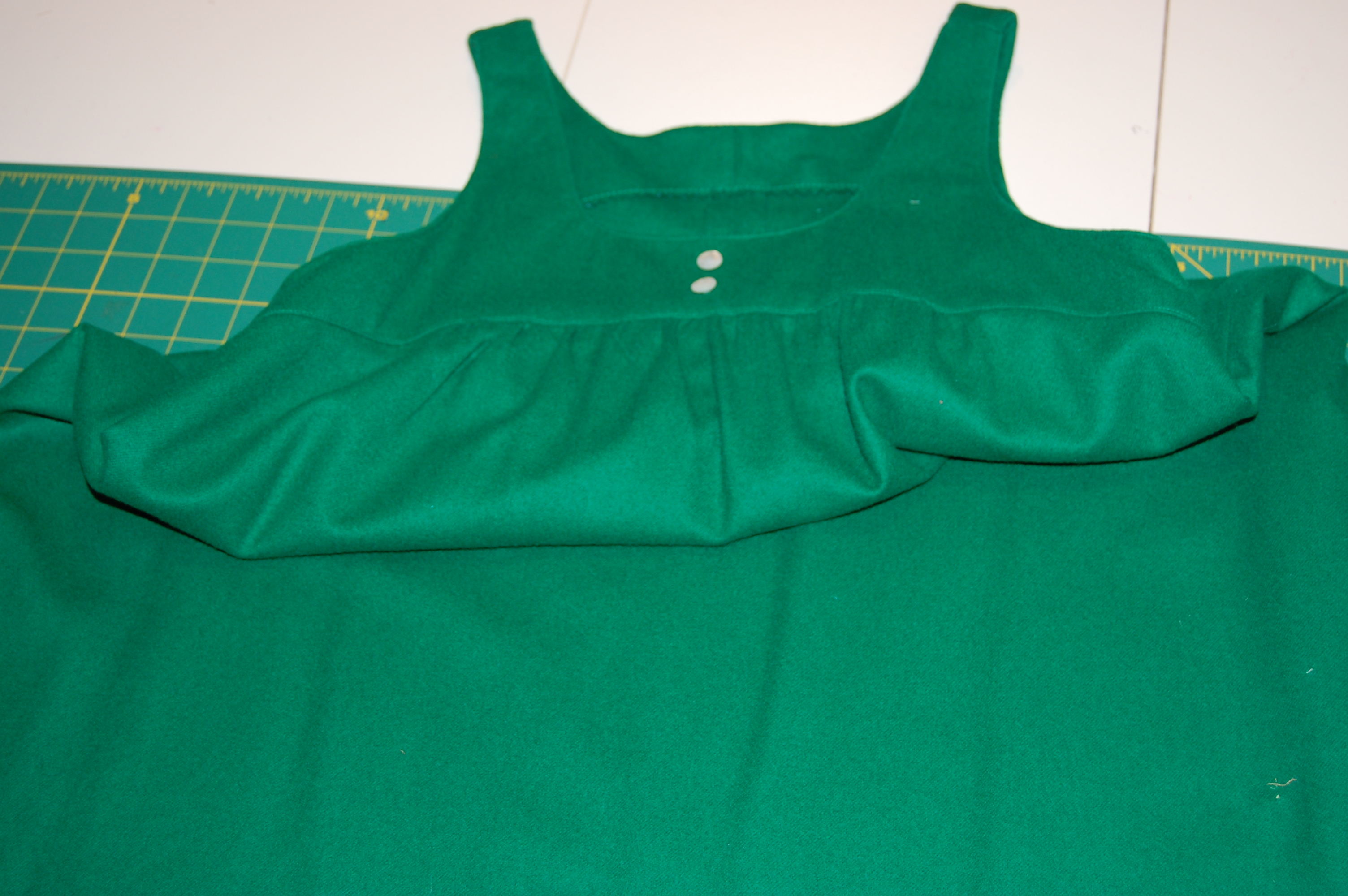
The dress with the side seams separated.

The dress with the side seams separated.

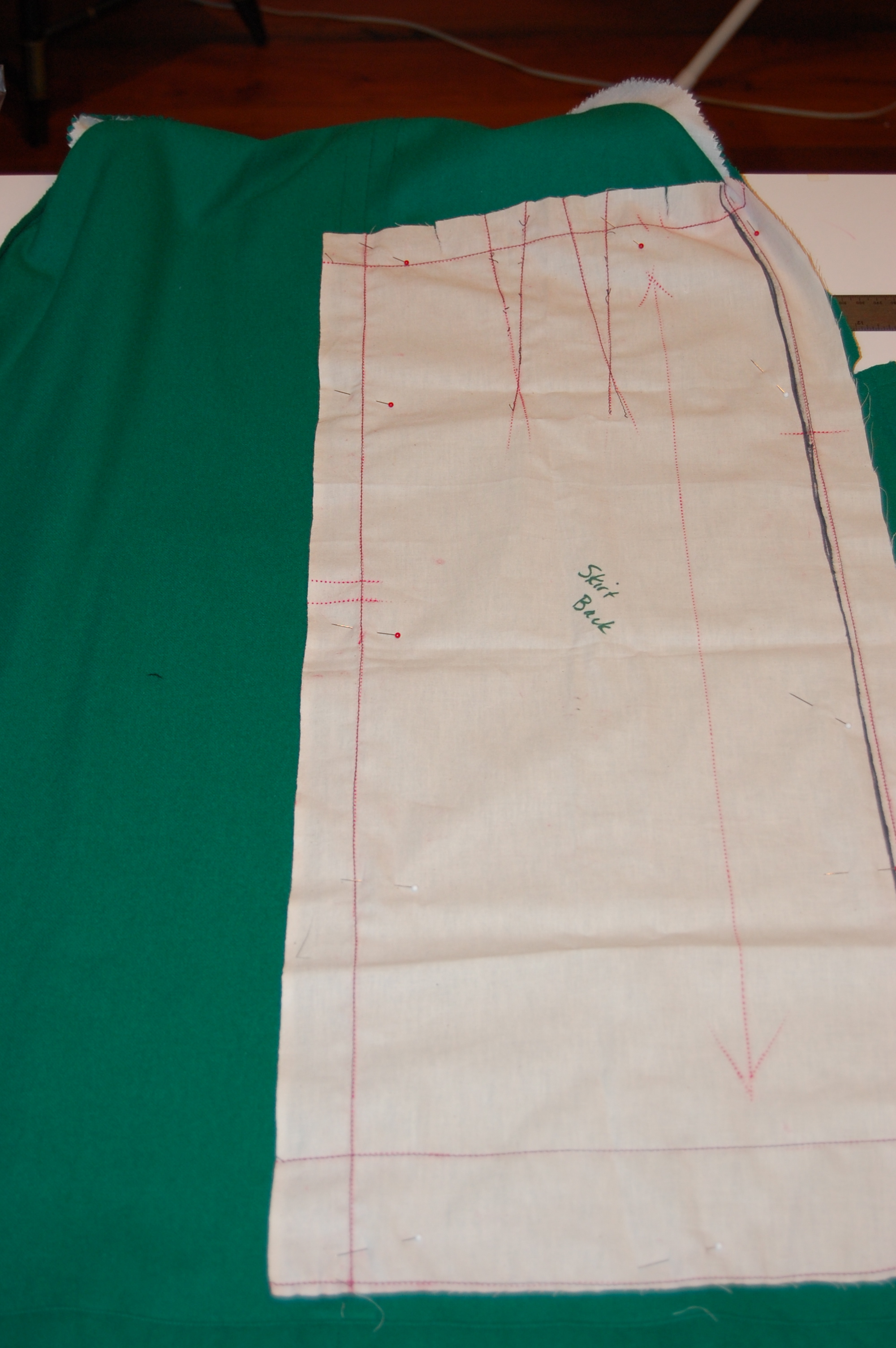
Then –  somehow, miraculously, I was suddenly okay with the thought of cutting into this dress.  The back part of the skirt pattern fit perfectly on the back section of the dress – it was even already seamed for me.

My muslin pattern positioned on the back of the dress.

My muslin pattern positioned on the back of the dress.

The front part of the dress gave me enough room to make a new two-piece front, with a pleat on the left side.  I cut out the pieces and set about to fringing.  Re-runs of Downton Abbey helped tremendously with this – I pulled and picked and created fluffy little towers of green threads while totally absorbed in another time and place.

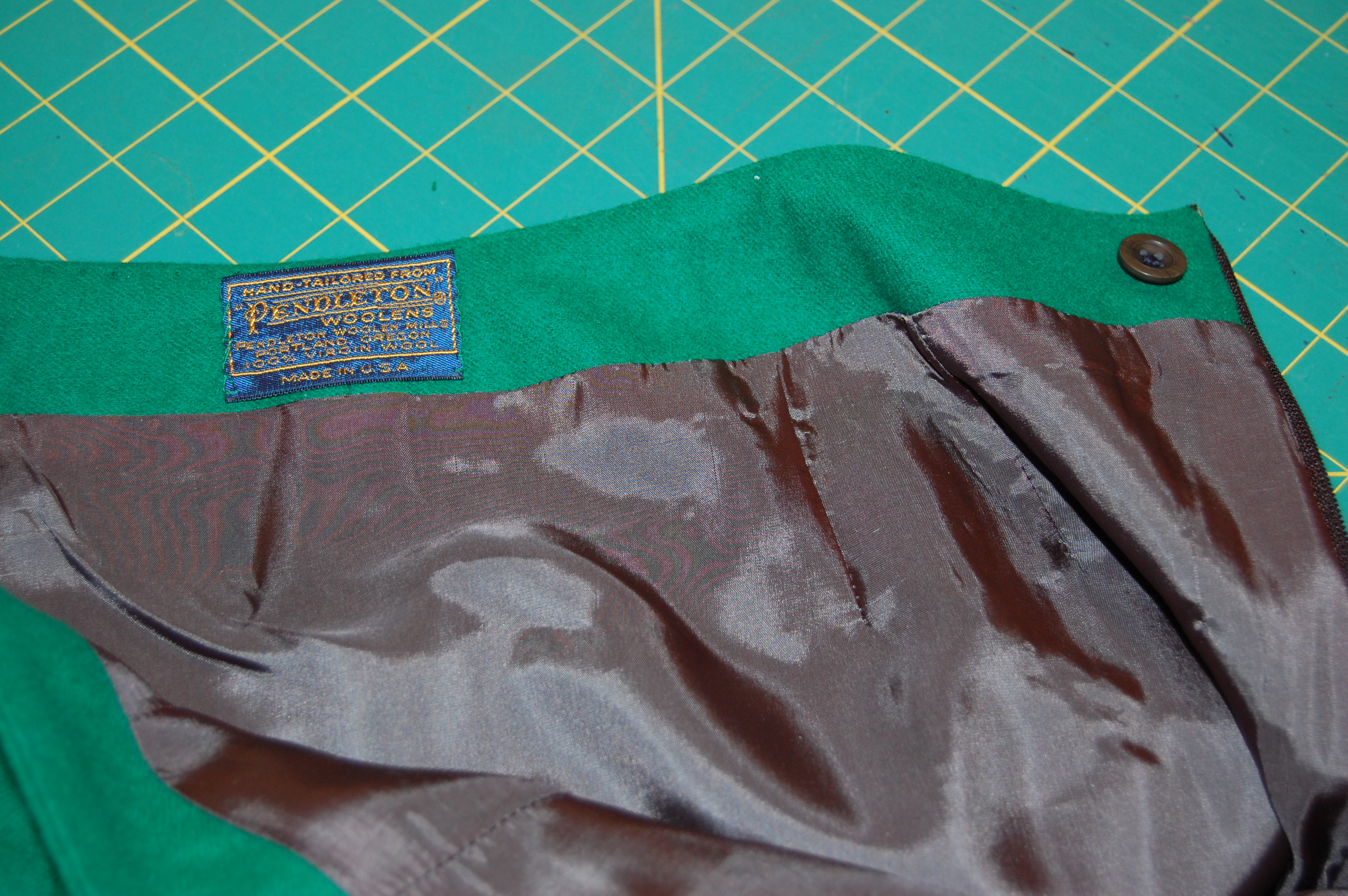
Then it was back to the sewing room to sew this baby (pardon the bad pun) together.  There was not enough fabric  to fashion a waistband on the straight of grain, so I opted to make an inside pieced-together facing instead.

The facing at the waistline.  I attached the 31-year-old Pendleton label in place after all these years!

The facing at the waistline. I attached the 31-year-old Pendleton label in place after all these years!

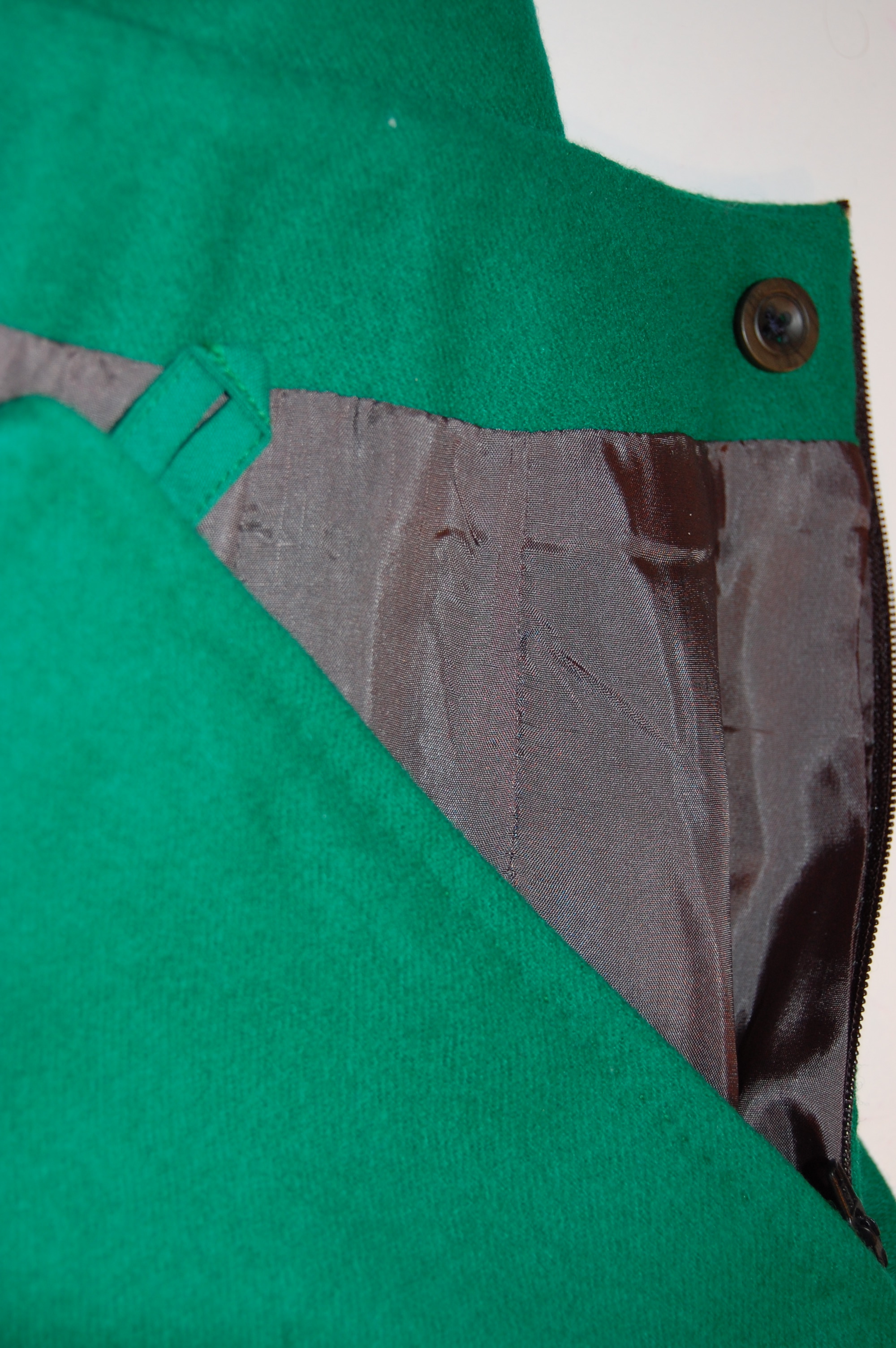
Then I made a button tab out of bias tape which I just happened to have on hand in emerald green.  What I could not find was a 7” zipper in emerald, nor lining fabric in emerald.  Guess the manufacturers of such items did not get the memo from Pantone about the color of the year!  So I ended up with a black zipper and dark gray Bemberg lining fabric.

The black zipper and gray lining are okay, I think...

The black zipper and gray lining are okay, I think…

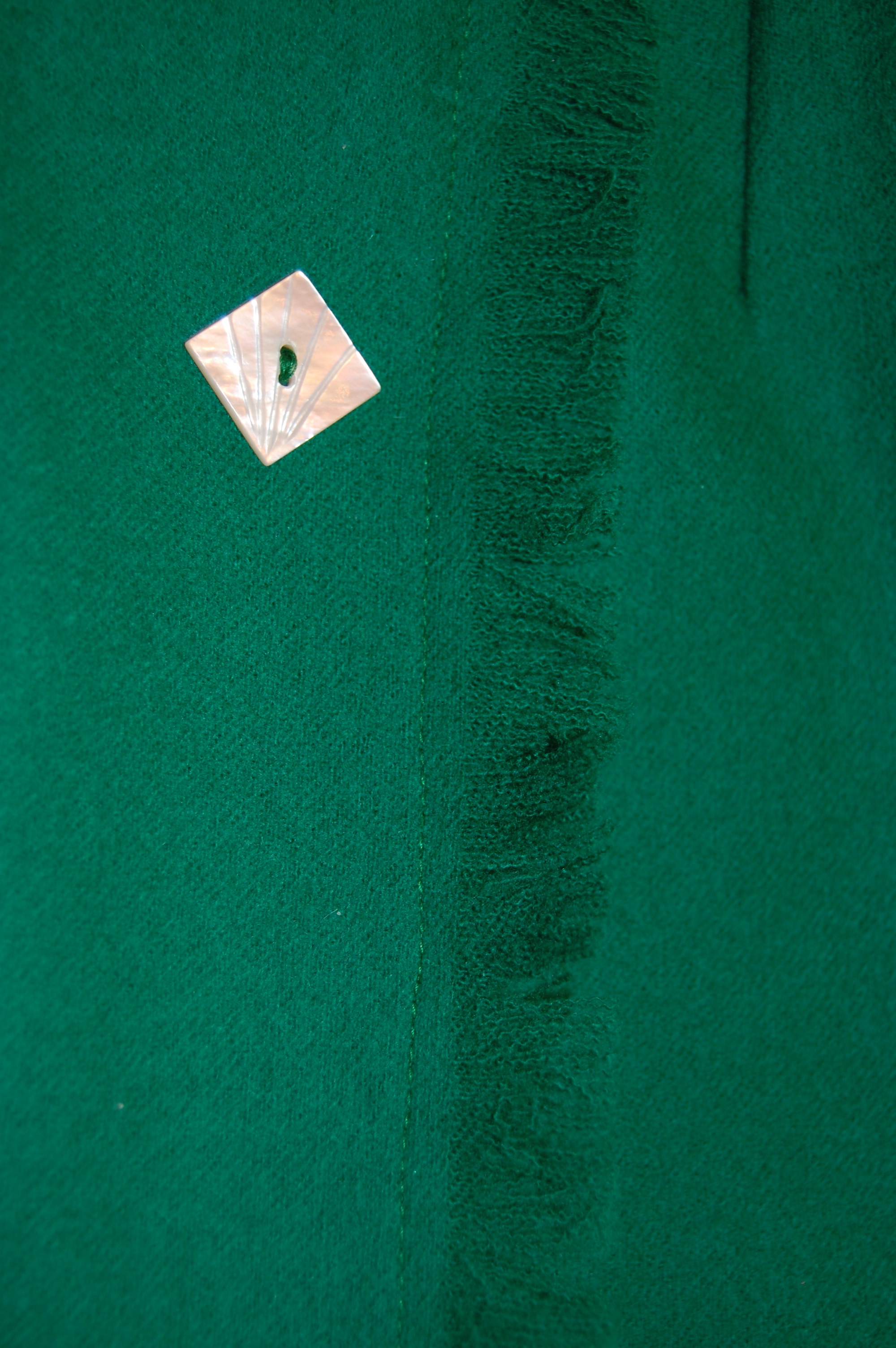
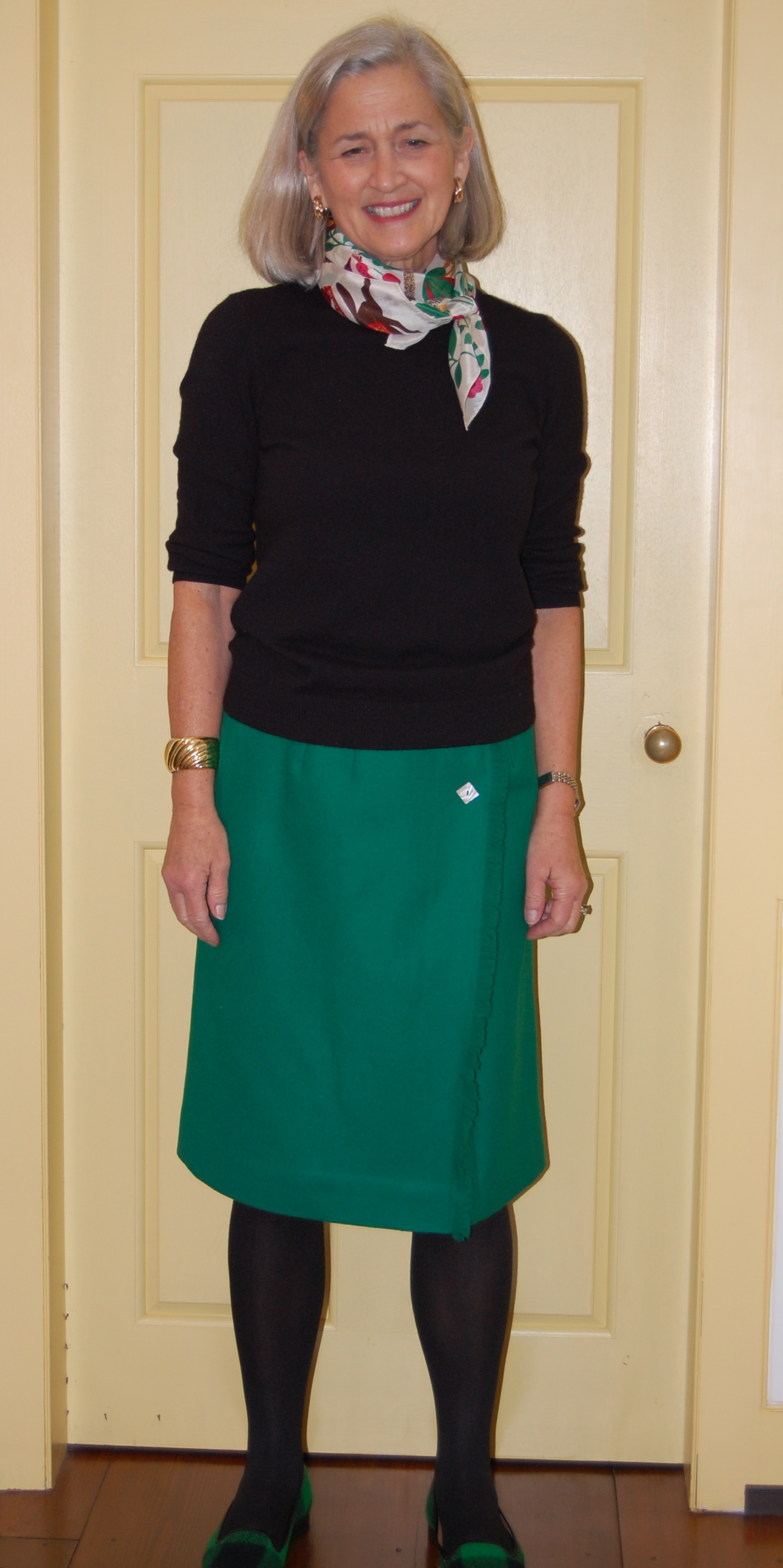
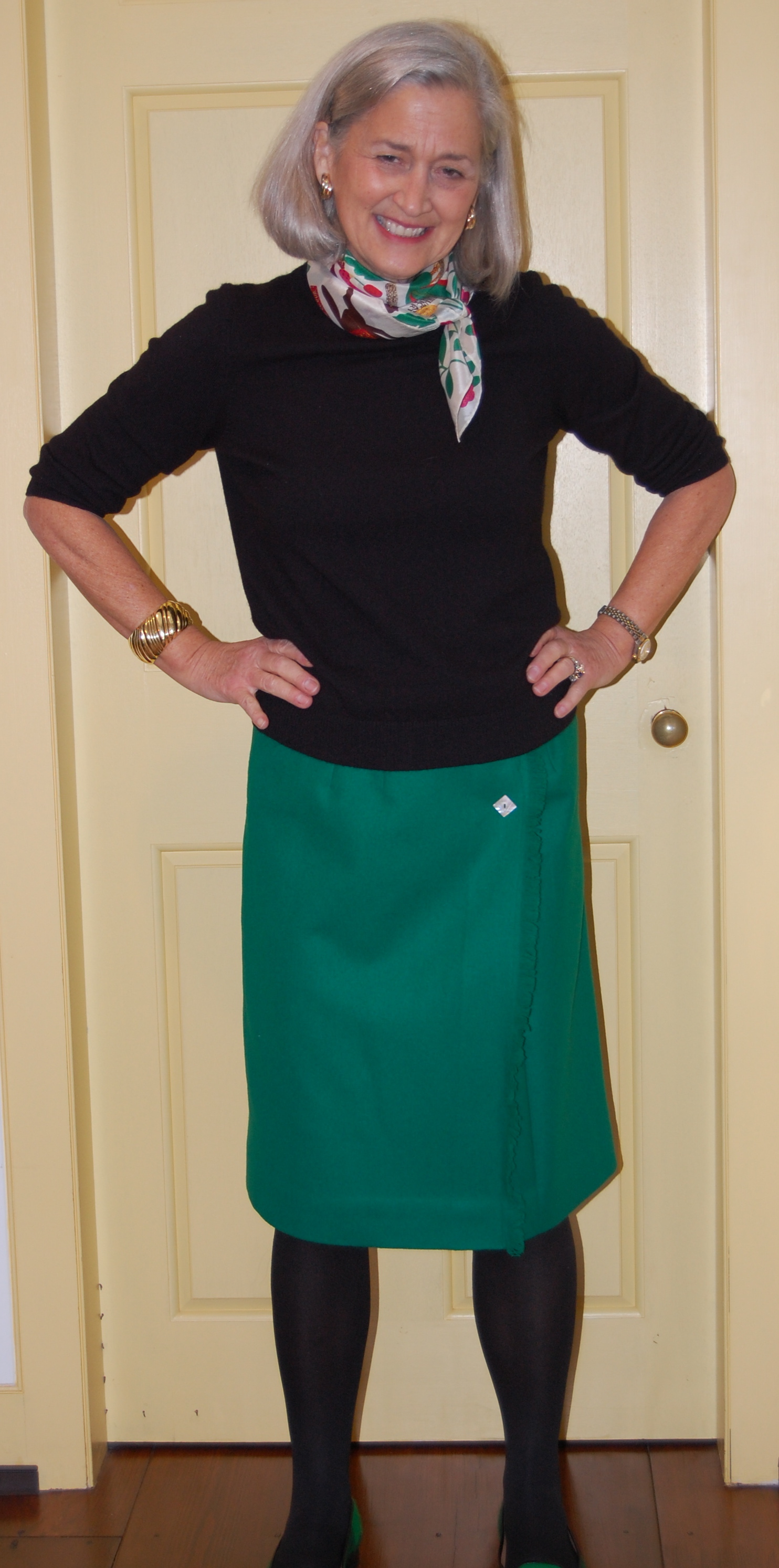
I went round and round with a decision about buttons to hold the top part of the pleat in place.  I found several single buttons in my button box, which I really liked, but I really needed two or three.   A trip to Joann’s yielded some pale gray pearl buttons which would have been lovely, except that one broke after I got home when I was taking it off the card!  So I still have to resolve the button issue – as right now I  have exactly one button on the skirt, although I do like its diamond shape quite well…

The fringe detail on the pleat - and the single button.  Sure wish I had another one of these!

The fringe detail on the pleat – and the single button. Sure wish I had another one of these!

It's finished (except for the button issue, of course!).

It’s finished (except for the button issue, of course!).

green skirt

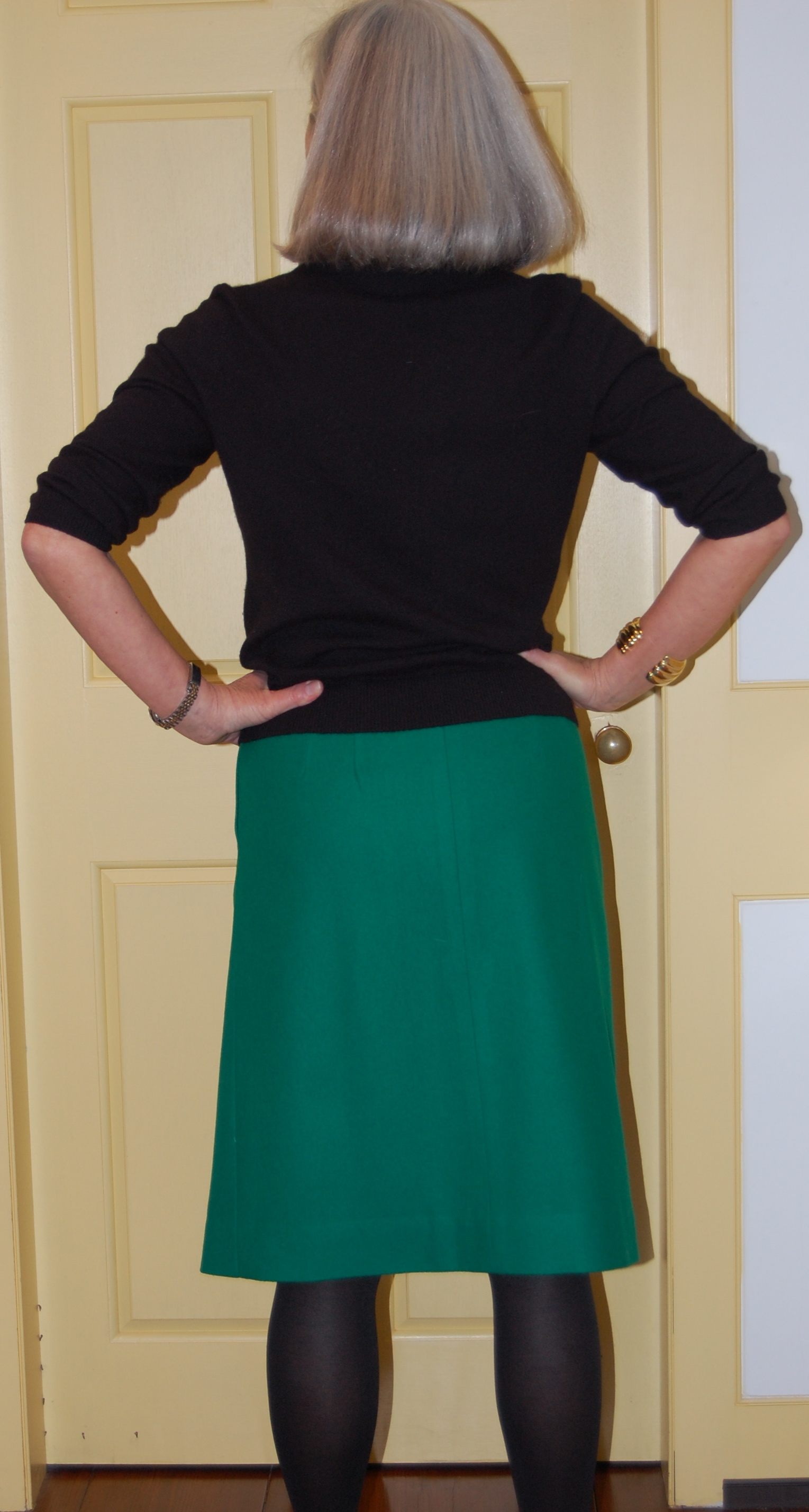
The back view.

The back view.

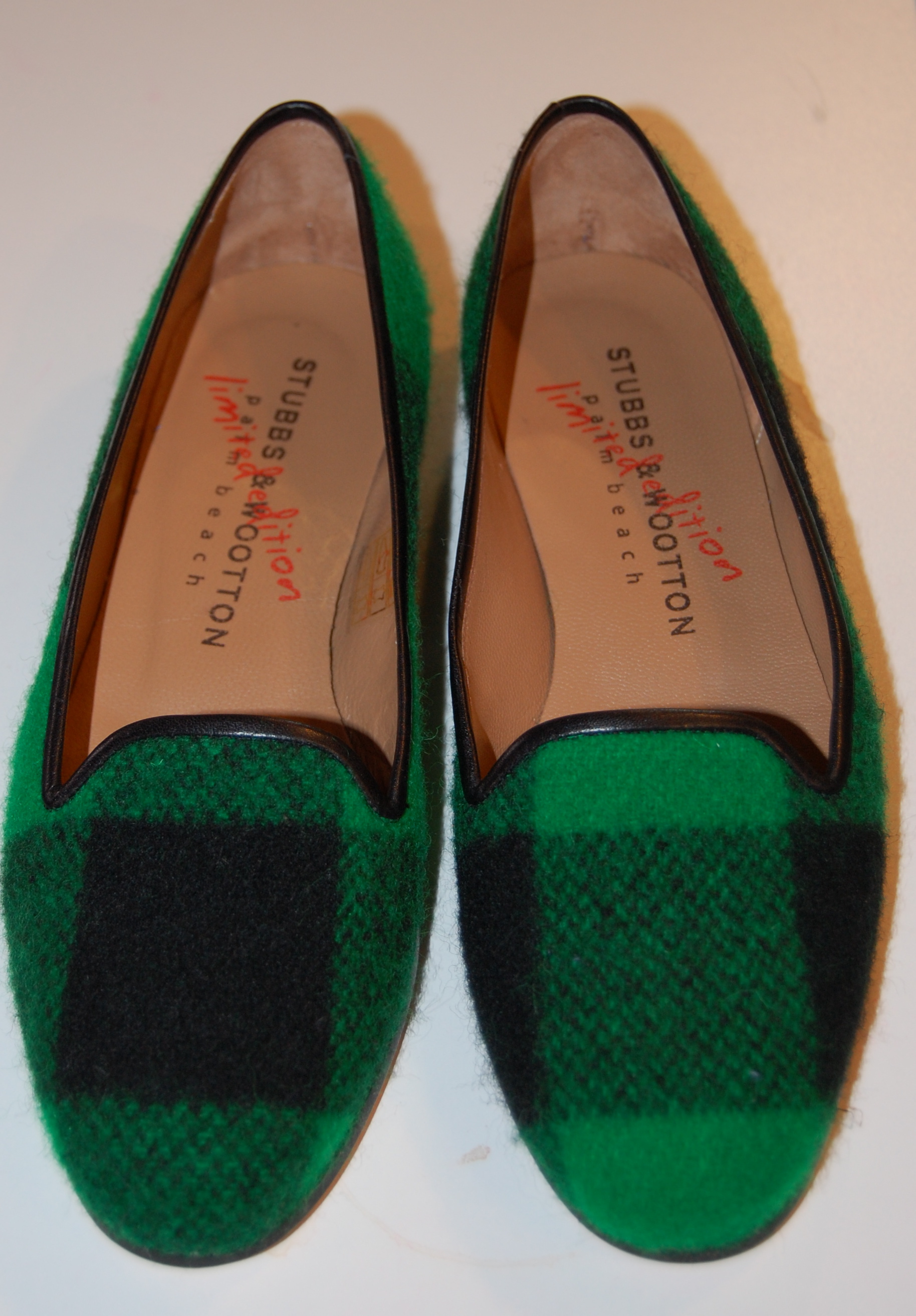
Thinking back on this project, I believe the signs were there, telling me to make this skirt.  Consider that I found these Stubbs and Wootton shoes – green and black Buffalo Check to go with my Pendleton wool:

How I love these comfy flats!

How I love these comfy flats!

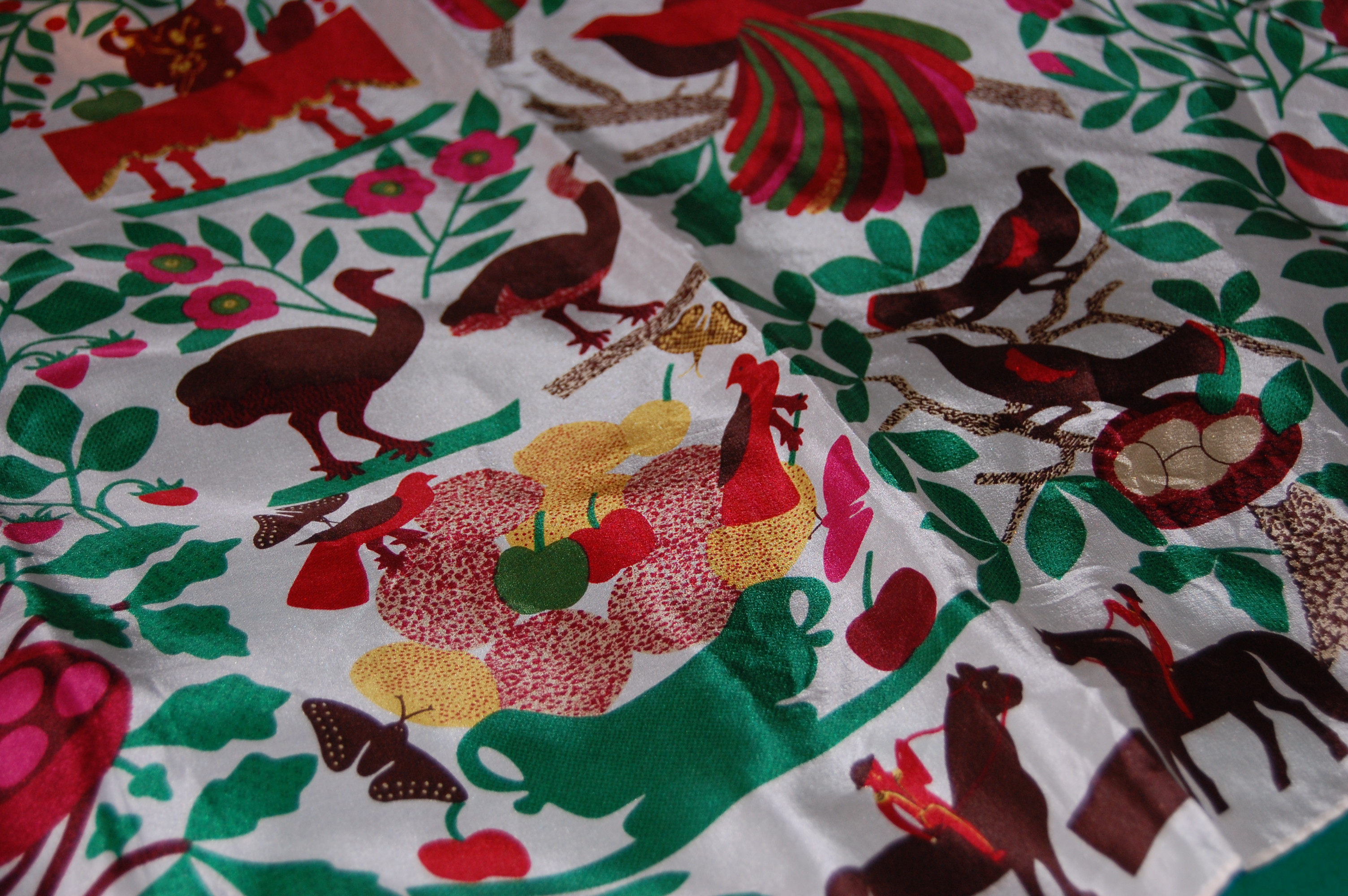
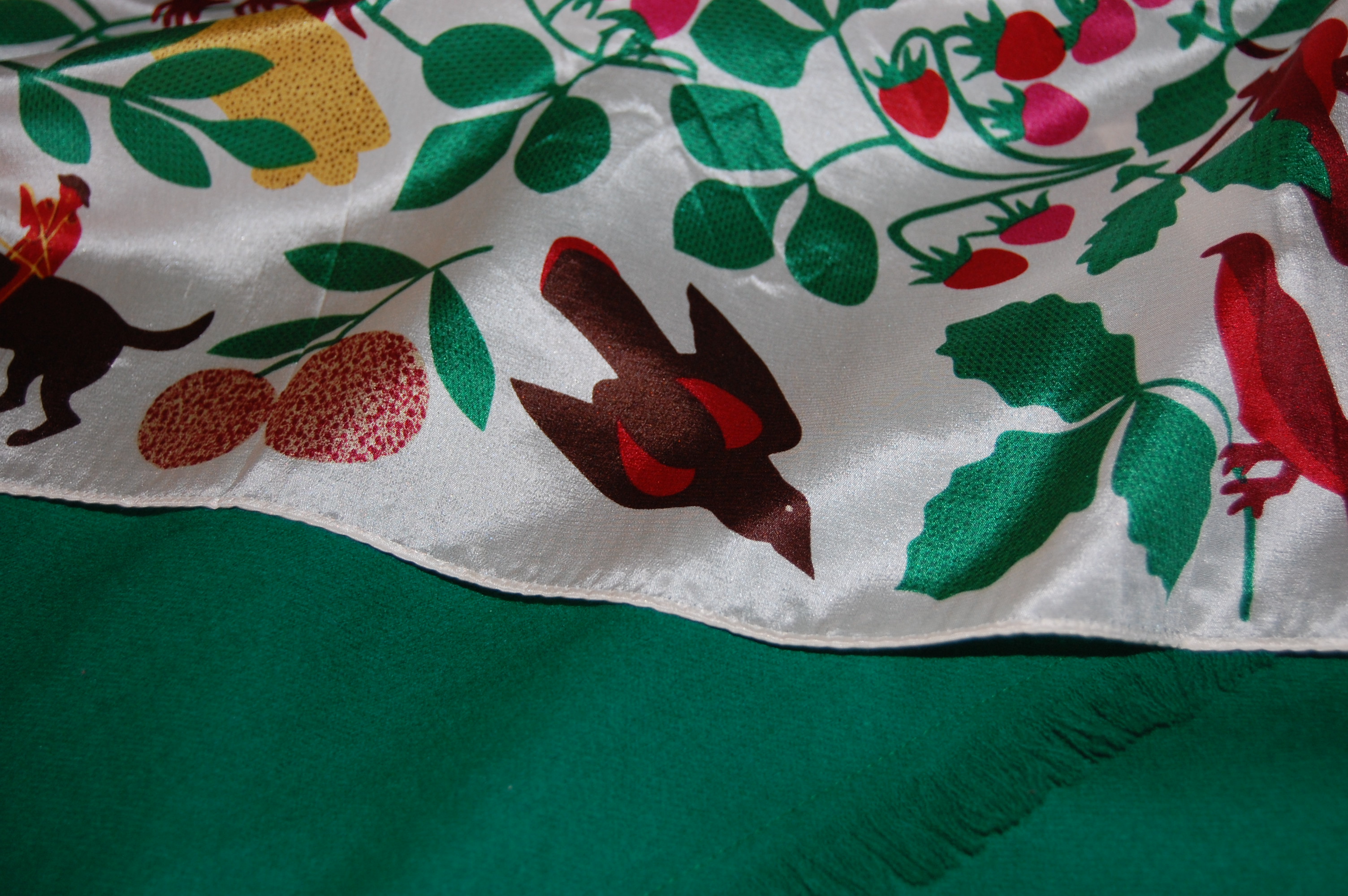
And among my collection of silk scarves was this scarf, purchased in the 1980’s from the Museum of American Folk Art, featuring one of their quilts in predominant colors of pink and – yes, Emerald Green.

The green in this scarf could not be more perfect.

The green in this scarf could not be more perfect.

A detail of the scarf on top of the skirt.

A detail of the scarf on top of the skirt.

So – where do I envision wearing this skirt?  How about to a baby shower for my daughter, now expecting her own little one?  After all, she herself  was once sheltered by these warm woolen threads of green – and love.

14 Comments

Filed under 1980's dress patterns, Buttons - choosing the right ones, hand-sewn zippers, Scarves, Uncategorized, woolens

A Newly Defined ‘50s’ Frock

I have finished making a new dress from an old pattern, which isn’t anything too unusual for me.  What is unusual is the spell which this pattern cast over me from the time I first saw it last January, and then purchased it from an Etsy shop.

The length of this dress as shown on the envelope is very 1950's.  I'll be making it in knee-length.

The back of the envelope, showing the back yoke detail.  Don't you love the handbags that the artist included?

The back of the envelope, showing the back yoke detail. Don’t you love the handbags that the artist included?

Copyright 1957, this pattern has intrigued me for both how modern it looks, and how quintessentially “1950s” its various details are – such as:

1) Kimono sleeves in three-quarter length.  Cut in one with the bodice, kimono sleeves were common in the ‘50s, and now seem to be making a comeback.  Three quarter length is extremely flattering for most women, and was popular then and now.

2) Side zipper.  This dress goes over the head and needs that side zipper to accommodate the wiggle room needed to accomplish this method of dressing.  A back zipper would completely ruin the effect of the four-buttoned back yoke.

3) No pockets.  While pockets are lovely inventions, this dress would lose some of its slim and flattering line should pockets bulge out from the side seams.

4) Mid-calf length.  This length looks great in the pattern illustration, but not so much on me.  One of the beauties of these vintage patterns is adapting them for current wear – so I opted for knee-length instead.

5) Bound buttonholes.  Although this pattern is called “easy to make” on the back of the envelope, it still calls for bound buttonholes.  And, oh, they add such a nice detail.

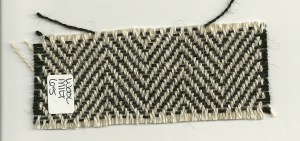
Now to the specifics.  I found this black and white herringbone alpaca wool (made in the USA) on Britex Fabrics’ website, and purchased it on sale a few months ago, specifically for use with this pattern.

This is the swatch I ordered from Britex sometime over the Summer.

This is the swatch I ordered from Britex sometime over the Summer.

I wanted to make the dress using couture techniques (learned in the online Craftsy course The Couture Dress taught by Susan Khalje.)  This meant that I would 1) make a muslin for fitting and pattern tracing; 2) underline the entire dress with silk organza; 3) eliminate the separate neck facing; 4) finish all the interior seams by catch-stitching them to the underlining; and 5) line the entire dress, which I did using Bemberg instead of china silk (more on that in a bit).

There were a number of decisions/problems/successes involved in making this dress. First, the nature of the fabric is that there are slight imperfections in the weave, and it is quite loosely woven, making it quite susceptible to raveling.  When I laid it out to cut it, I wanted to avoid any obvious imperfections front and center.  Patterns with kimono sleeves demand large expanses of fabric and thus do not allow a lot of jiggling of their placement.  I can honestly say that I had JUST enough fabric and not an inch more than I needed!

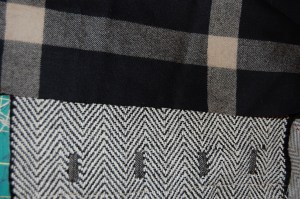
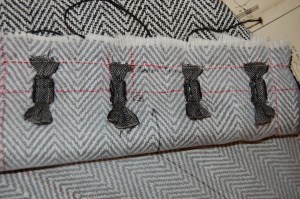
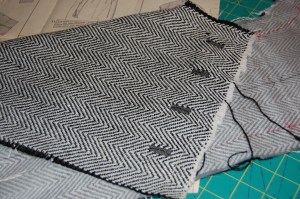
One of the first problems I realized I was going to have concerned the buttonholes.  I quickly discovered that the loose weave of the fabric meant that I was not going to be able to make bound buttonholes using self-fabric for the “strips”.  I considered using a plain black wool for these strips, but I thought that would be too much of a contrast.  Well, now I know why I save all kinds of scraps from previous projects – you never know when one of those random pieces of fabric will come in handy.  I spied a scrap in my fabric closet and quickly decided that one part of the weave would be perfect to delineate those buttonholes:

I used the "gray"portion of this windowpane check for the buttonhole "strips".

I used the “gray” portion of this windowpane check for the buttonhole “strips”. Click on the photo to see this up close.

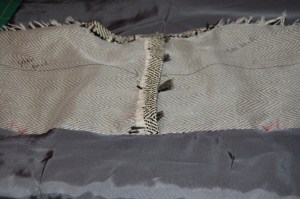
An inside look at the buttonholes in progress

An inside look at the buttonholes in progress

And an outside look...

And an outside look…

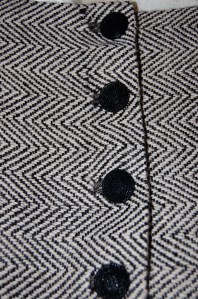
When it came to deciding on buttons, I could not find any I liked.  But I remembered some buttons I had sewn onto a RTW jacket several years ago (to replace the ones that came on it.)  They have a “herringbone” look to them – it’s very subtle, but effective.  The jacket is one I haven’t worn in a couple of years, so I just robbed the cuffs of their buttons and used them on my dress.  (Now I guess I know for sure I won’t be wearing that jacket again!)  But – the buttons are perfect for this dress.

My buttons of choice!

My buttons of choice!

Choosing to use couture techniques was a “dress-saver”.  The larger seam allowances took away the panic I might have felt, once I realized the fabric frayed so easily.  And finishing off each interior seam with catch-stitching controlled the fraying and helped the seams to lay perfectly flat.

Eliminating the separate neck facing was also a bonus to ease construction.  First of all, I wanted to widen the neckline, which I worked out in my muslin.  Using the seam allowance and hand-applied, under-stitched lining for the neck facing made it lay flat, and of course, it’s not itchy either!

The "couture-constructed" neckline, before the lining is attached.

The “couture-constructed” neckline, before the lining is attached.

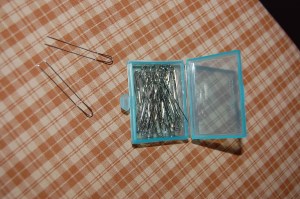
Even though I did not have “plaids” to match, I needed to pay close attention to the rows in the herringbone weave, so that none of them were crooked.  This is where Clover two-pronged pins (recommended by Susan Khalje in The Couture Dress class) came in handy and helped me keep those rows lined up evenly.

Clover "fork" pins

Clover “fork” pins

Finally, I decided to use Bemberg lining fabric instead of China silk because I thought it might be a bit more substantial for this somewhat heavy weight wool.  When I was deciding what color to make the lining, I considered ivory, black, and even a bright color, such as red.  But I settled on deep gray, and it seems just right.

In fact, everything about this dress seems just right.  It is delightfully rewarding when a pattern does not disappoint – and when it turns out to be a complete winner, well, that is reason to make it again (which I will)!

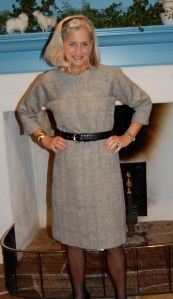
I can wear this dress as a sheath, unbelted, but I love it with this Coach black belt.

I can wear this dress as a sheath, unbelted, but I love it with this Coach black belt.

The back view

With a touch of emerald green for the holiday season

With a touch of emerald green for the holiday season.

With green gloves for a '50s' look!

With green gloves for a ’50s’ look!

And another back view.

And another back view. Alpaca is a very warm wool – so this dress is very cozy.

For now, however, my sewing room is “gift-wrap central”.  The colorful ribbons, paper and tags are cheerful tokens of a season of blessings and family and home.  To all of you celebrating the season, may it be a time of great peace and love for you and yours. And, as I  take a couple of weeks “off”, I send a heartfelt Merry Christmas from me to you…

24 Comments

Filed under bound buttonholes, Buttons - choosing the right ones, couture construction, kimono sleeves, side-placed zippers, Uncategorized, underlinings, vintage Vogue patterns from the 1950s, woolens