Tag Archives: vintage fashion

What should a button do?

The last several things I have sewn have been button-free, using zippers or hooks to accomplish that all-important task of “closure”.  I’ve discovered I can go button-free just so long, and then I have to indulge my passion for those small wonders, with their miraculous power to be both eye-catching and practical.

I will leave a serious discussion of vintage buttons to the experts, but looking anew at some of my still-carded vintage buttons has revealed some interesting tidbits, too good not to share.  For example, it seems a lot of attention was given to “presentation” of the buttons on their cards.  These Luckyday buttons not only have a sweet lady on the front of the card, there is also a “Handy Rule for Mending” on the back.
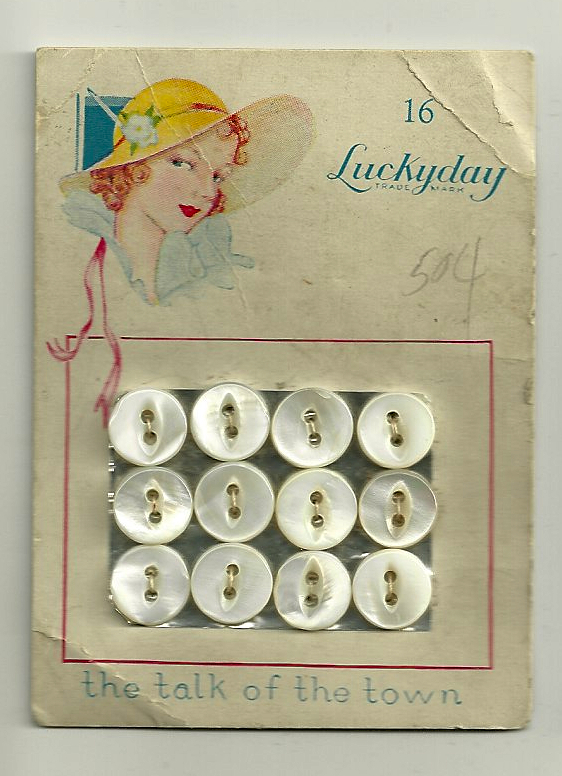
I am guessing these buttons are from the late 1930s or early ’40s.
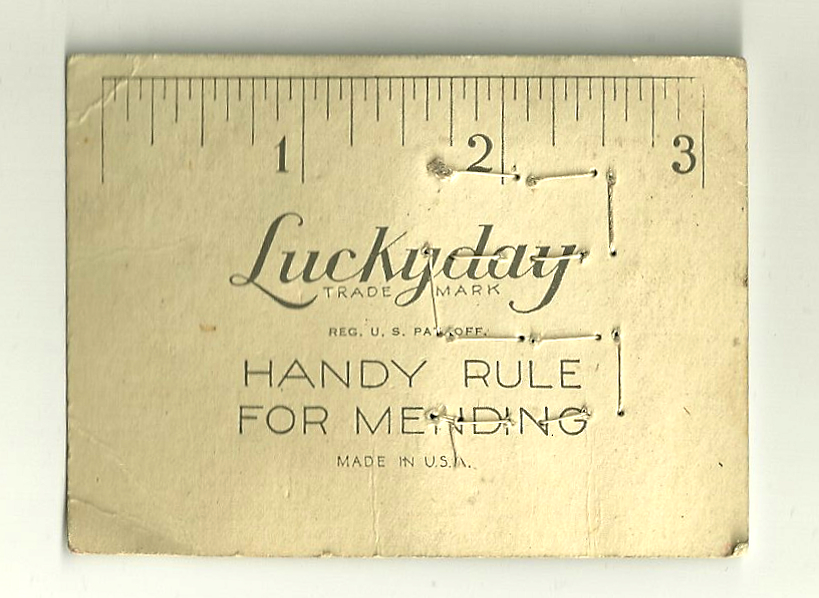
I love this feature!

It also seems that patriotic themes were commonplace.  There is no company named on these buttons, just the American eagle on a shield with the words TRADE MARK.
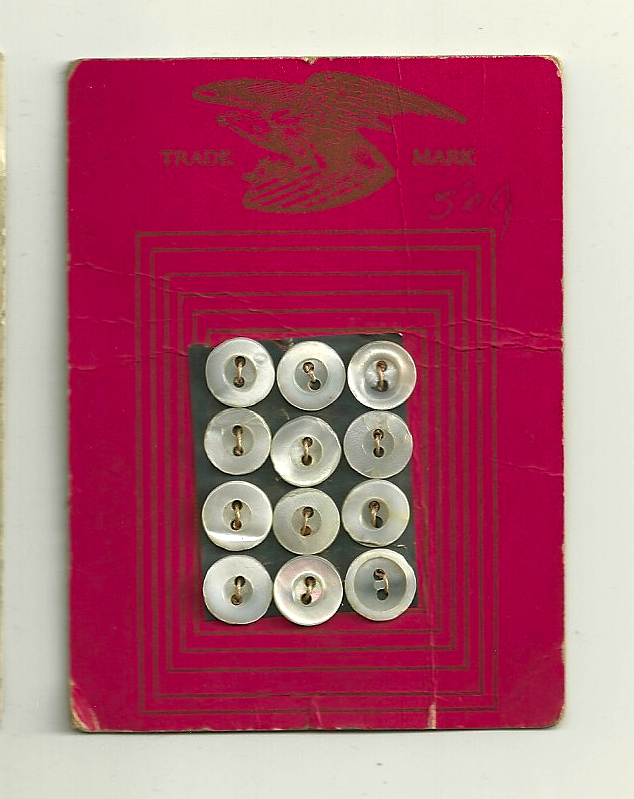
These simple buttons are quite eye-catching on this deep red card.

This is one of my favorite button cards of all time, the Maid in America. I doubt I’ll ever use these buttons, as it would seem a shame to take them off this amazing card.
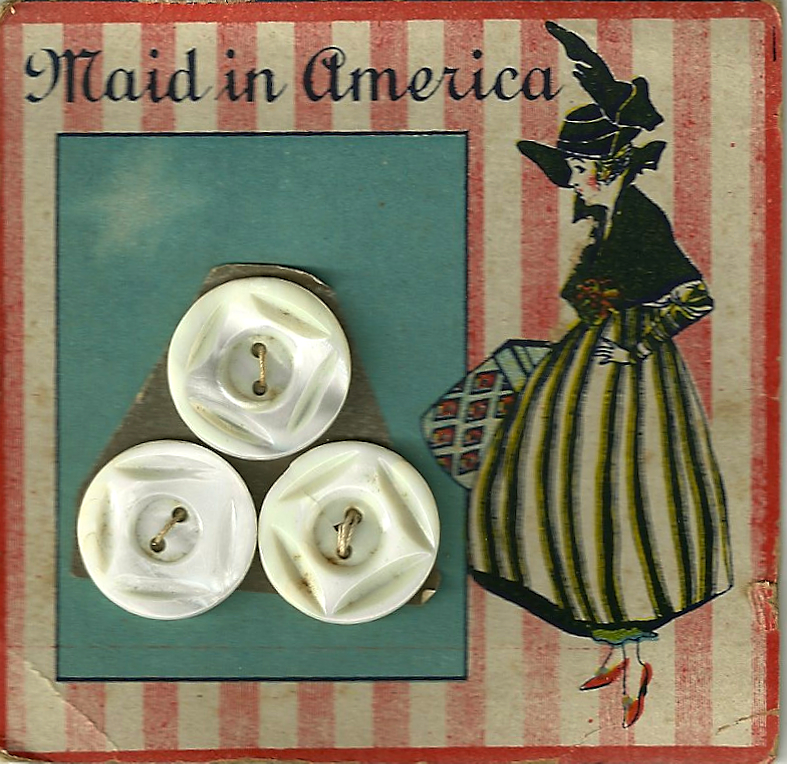
This button card is like a small piece of folk art!

La Mode buttons are still manufactured – and still “Superior Quality”, and Costumaker buttons were “made in the U. S. A.”.
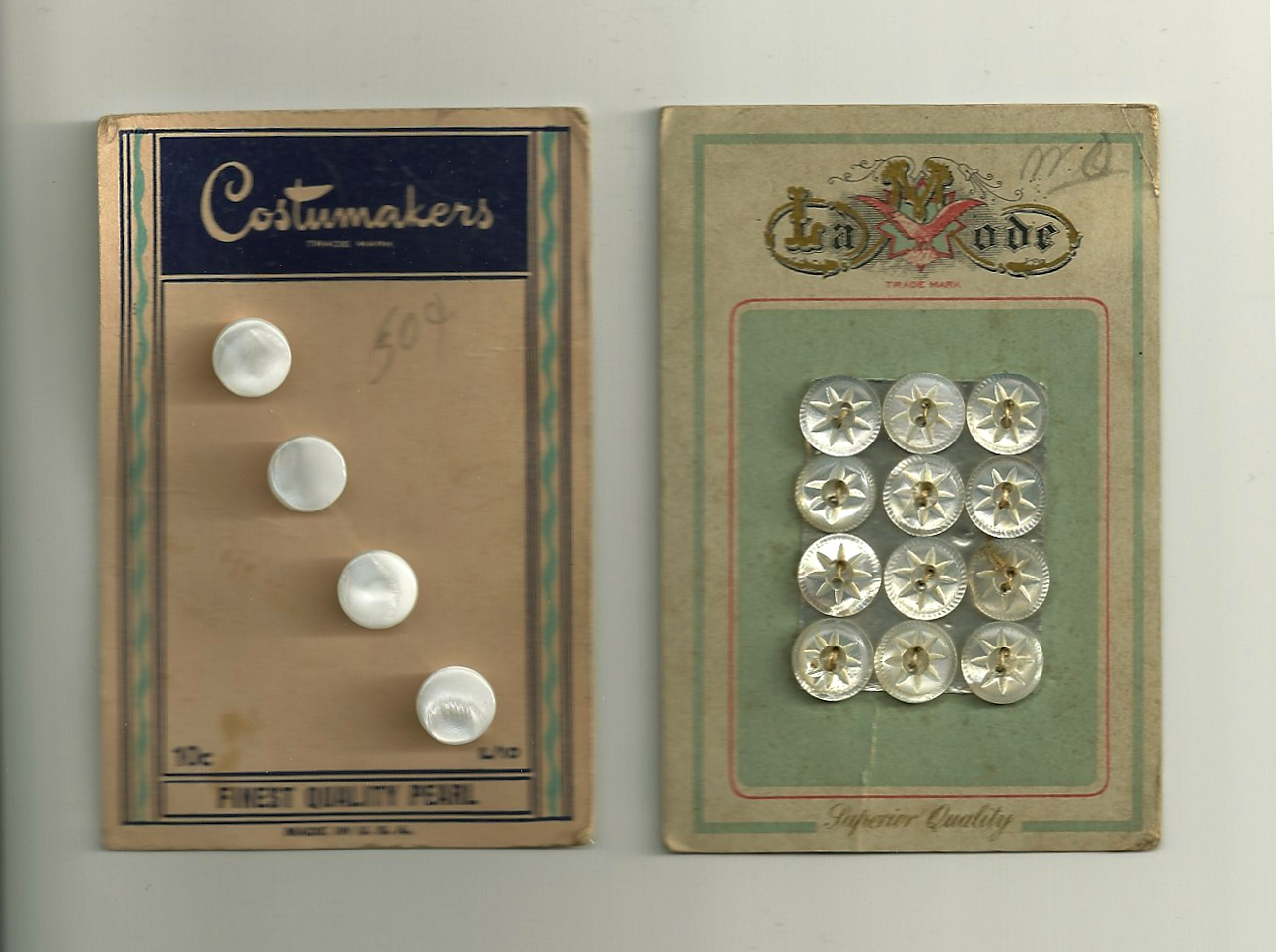
Two well-known button companies!

La Mode advertised frequently in Vogue Pattern Book magazine.  This ad from the October/November 1956 issue has the byline:  “You can tell just from the buttons it’s an important outfit!”
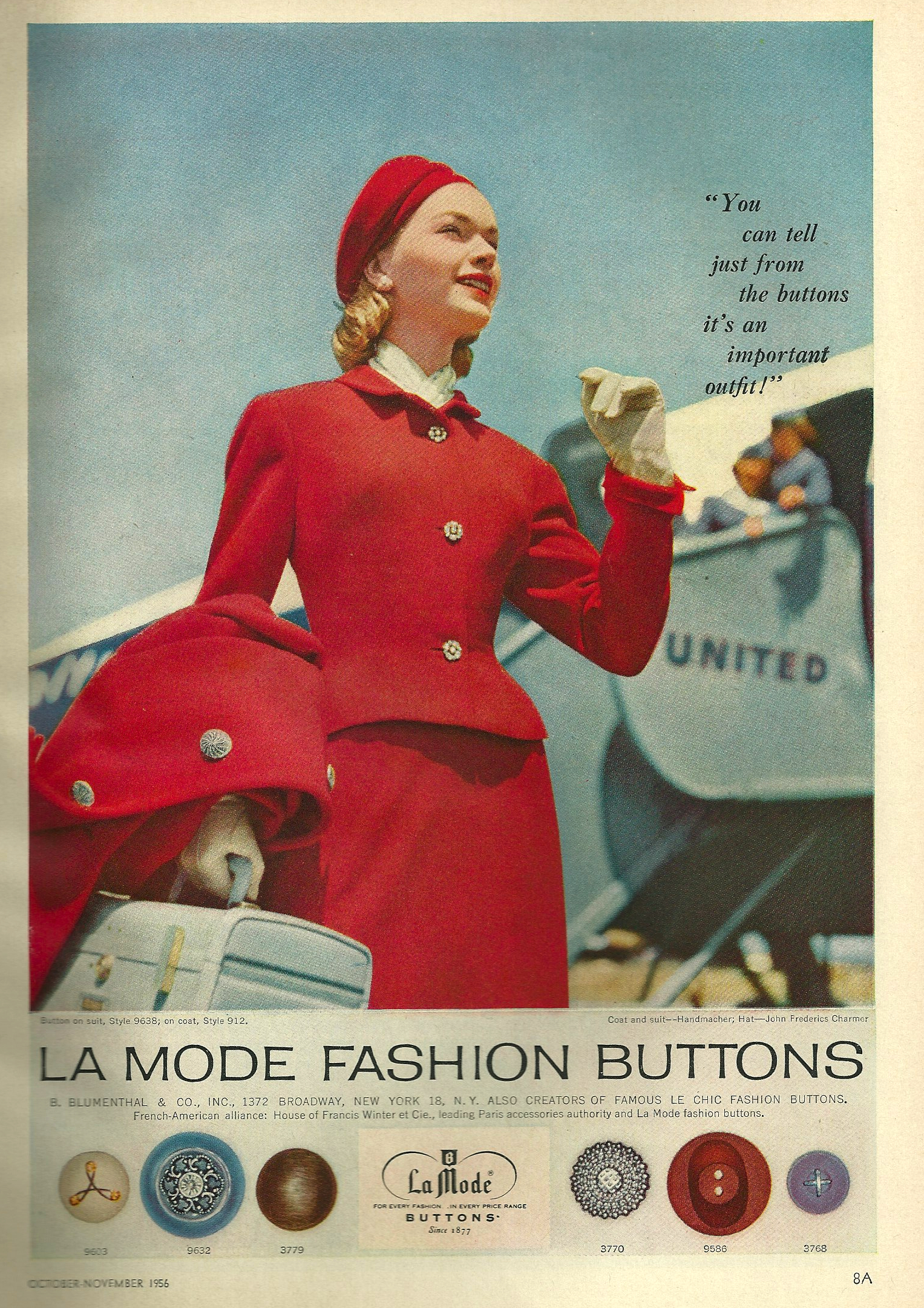
An ad from February/March 1958 features a fashion picture which looks incredibly timely today!

The featured fashion colors are certainly right for 2012!

And by 1960, their ads were beginning to take on a more modern look.

This ad appeared in the October/November 1960 issue of Vogue Pattern Book magazine.

Costumaker buttons also advertised in Vogue Pattern Book magazine.  In August/September 1958, this ad had the byline “Buttons that are more than buttons.”

This ad from April/May 1963 asks the question:  “What should a button do?”  Read the ad to get the answer!
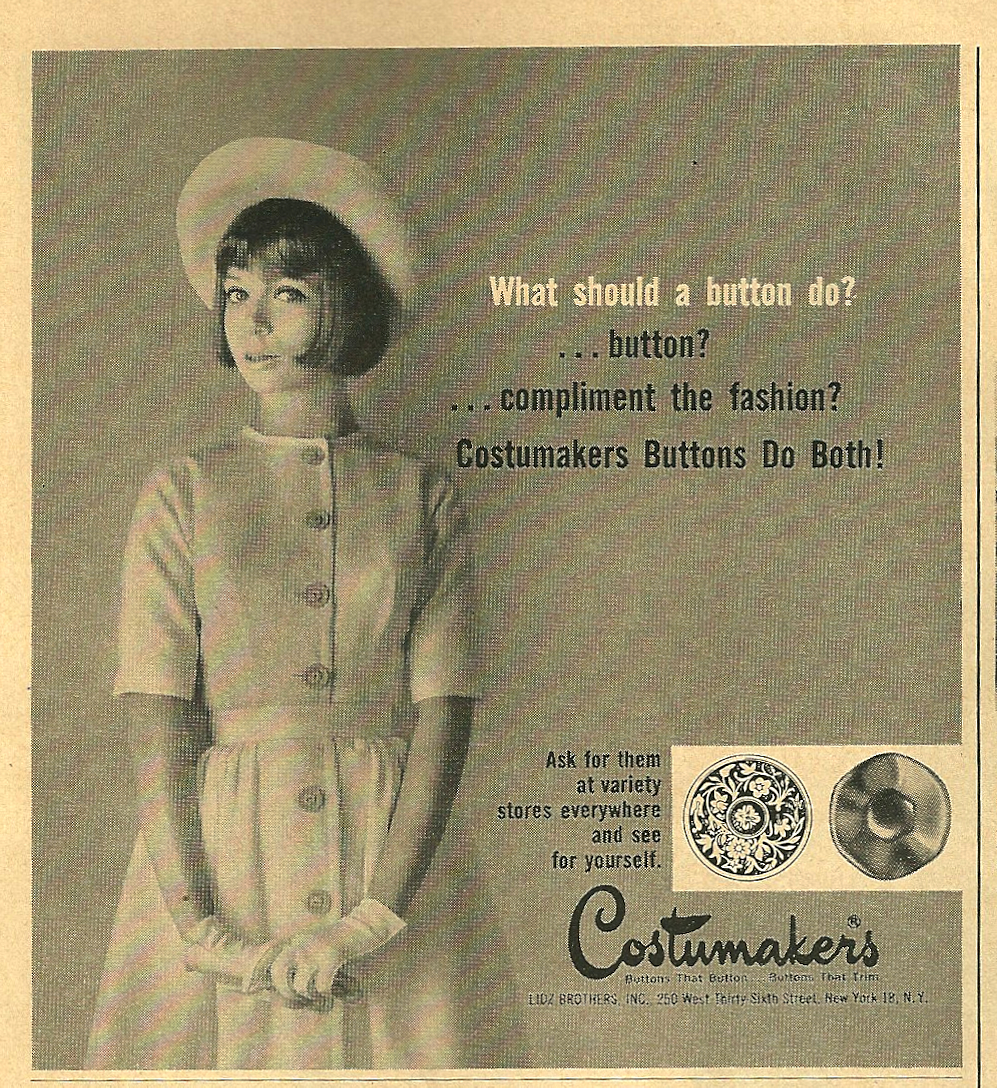
One thing I know a button CAN do is be small but powerful!  The real truth of the matter mentioned in my first paragraph is that I have a set of buttons which I must use, as they have occupied my mind for the past weeks since I received them – it’s really quite that simple.  But they are not simple – they are actually quite demonstrative, and therein lies the rub, to paraphrase from Shakespeare.
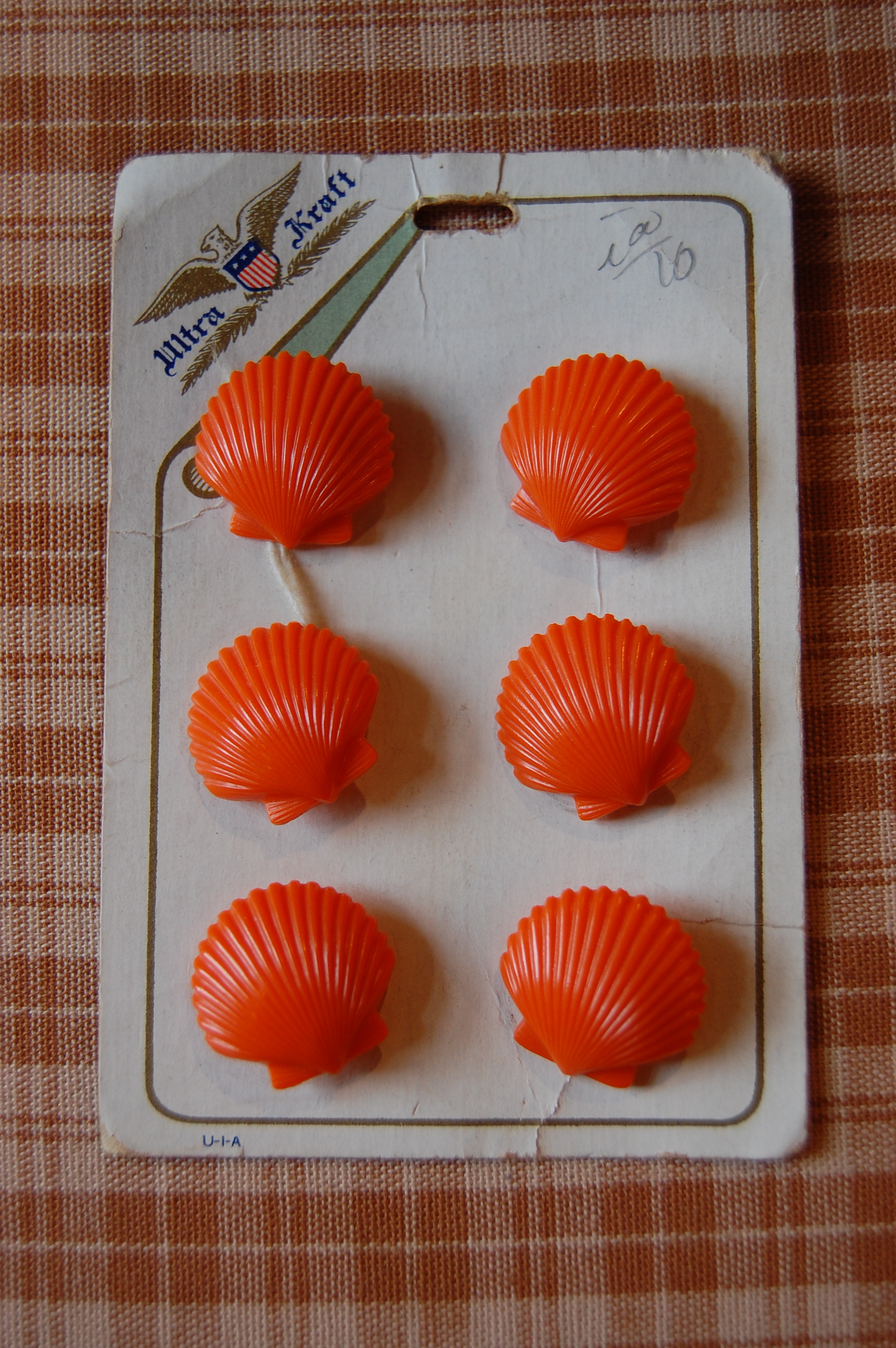
The buttons which won’t let me sleep! Notice the American eagle motif on the card!

I have been pondering how to use them and with what color and type of fabric to pair them.  They deserve the perfect venue for more reasons than one.  They were gifted to me by my dear friend, Nancy C., who, when we met for coffee a couple of months ago, met me with her family button box in tow.  She invited me to pick out any buttons which I thought I could use for future sewing projects!  When I got past my incredulity at her offer, I picked out a few amazing single buttons (which you will see eventually) and about three beautiful sets of loose buttons.  These orange shells, however, sewn neatly to their original card, kept catching my eye (how could they not??)  At first, they struck me as just too orange.  I wasn’t sure I would ever be able to use them. Nancy and I kept talking about them over our coffee, pondering their color and shape, and then, before I knew it – I was hooked.

So you know by now that they came home with me.  And something with so much personality moves up in priority on the sewing list!  You’ll soon see them sewn onto a “Fifty Dresses” creation.   Thank you, Nancy, for this amazing gift, which is only eclipsed by your generosity and friendship!!
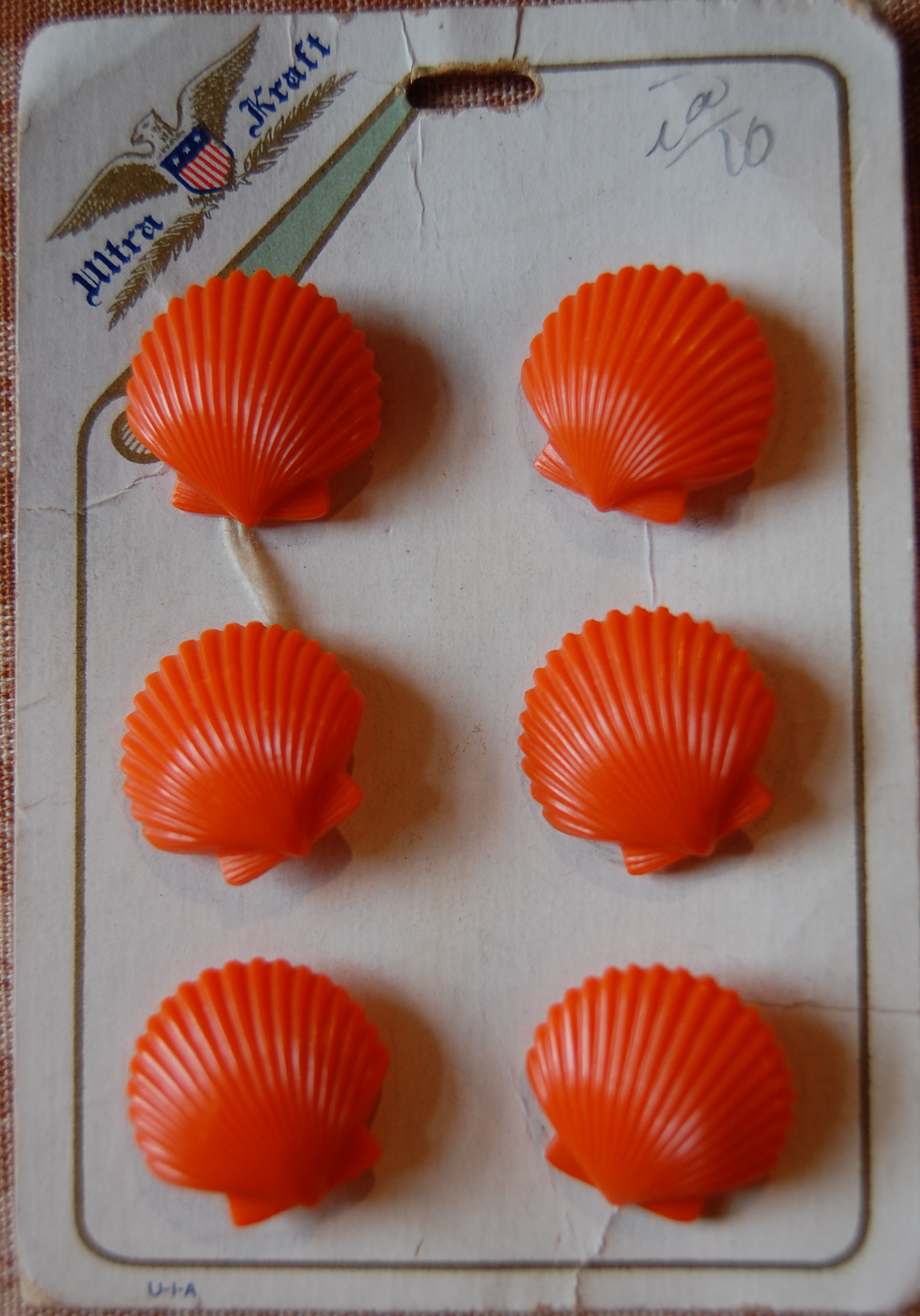
A little closer look at these bright beauties!

Stay tuned to see them doing what good buttons should do…  Gulp!  I’m hoping to do them justice!
6 Comments

Filed under Buttons - choosing the right ones, The Conde Nast Publications, Uncategorized, vintage buttons

Destiny met – Pierre and me.

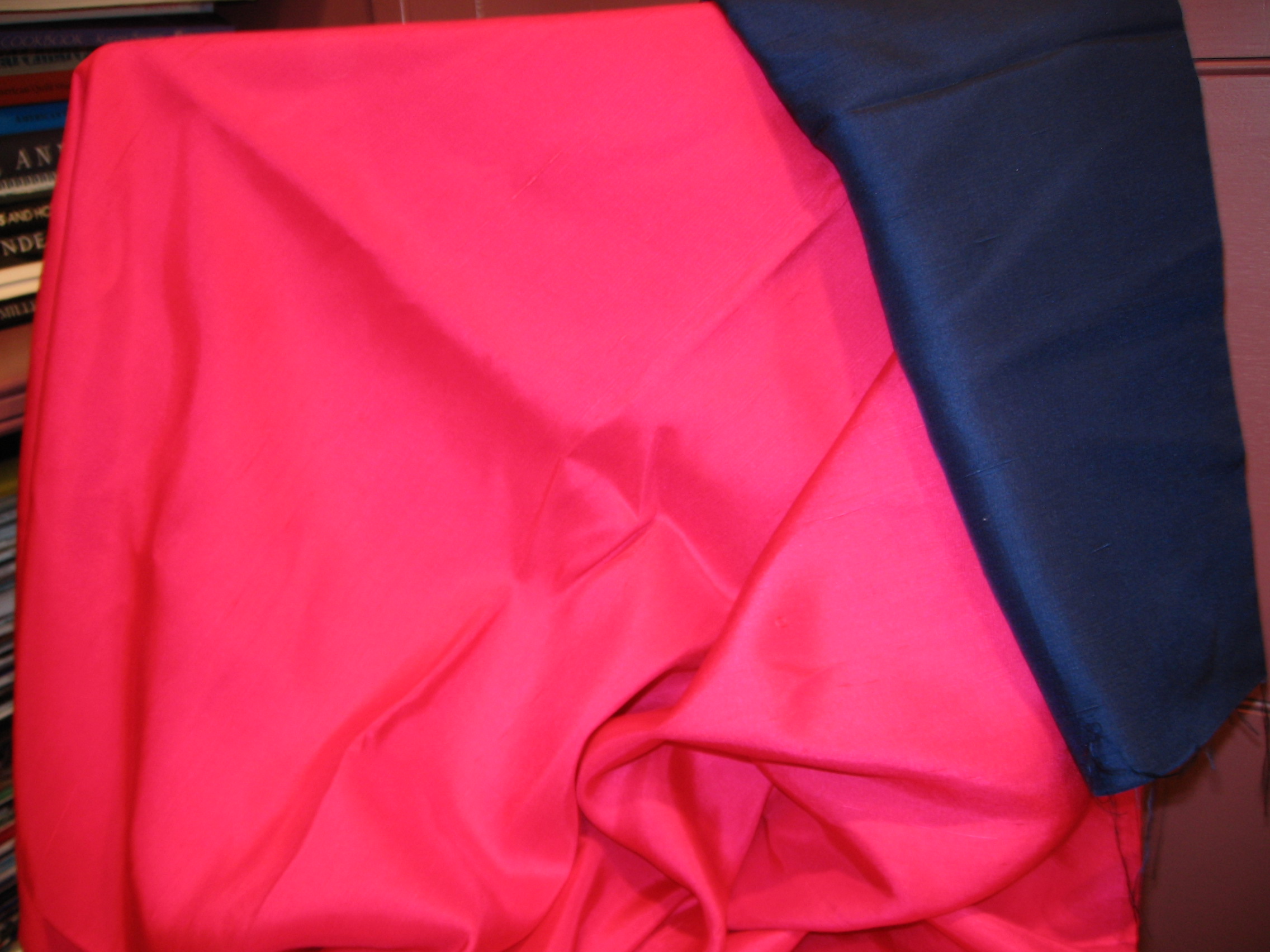
Back in November I wrote about finally locating some lovely pink and navy blue silk, which I had squirreled away after never making it up in the pattern I had purchased for it.  Both the fabric and that pattern date from the late 1980s, and I must have known even then that this beautiful silk deserved a better dress design than was available during that era of big shoulders and more big shoulders.

Pink and blue silk which I had never used.

So when I found this pattern in my size on eBay several months ago, it seemed destined to be interpreted in my pink and navy silk.

A Pierre Cardin design, circa 1970, in the Vogue Designer pattern series.

Specifically, I envisioned it made in the sleeveless version in pink, with a contrasting navy blue yoke (and without the side slits).  I had just the right yardage of navy silk to accomplish this feat, and plenty of pink.  Not only that, I knew an event was approaching when I would want to wear a dress of some elegance.  What could be more perfect than that?  The right fabric and pattern matched with incentive gets the project underway in a jiffy.  My affair with Pierre (as in Cardin) was about to begin.

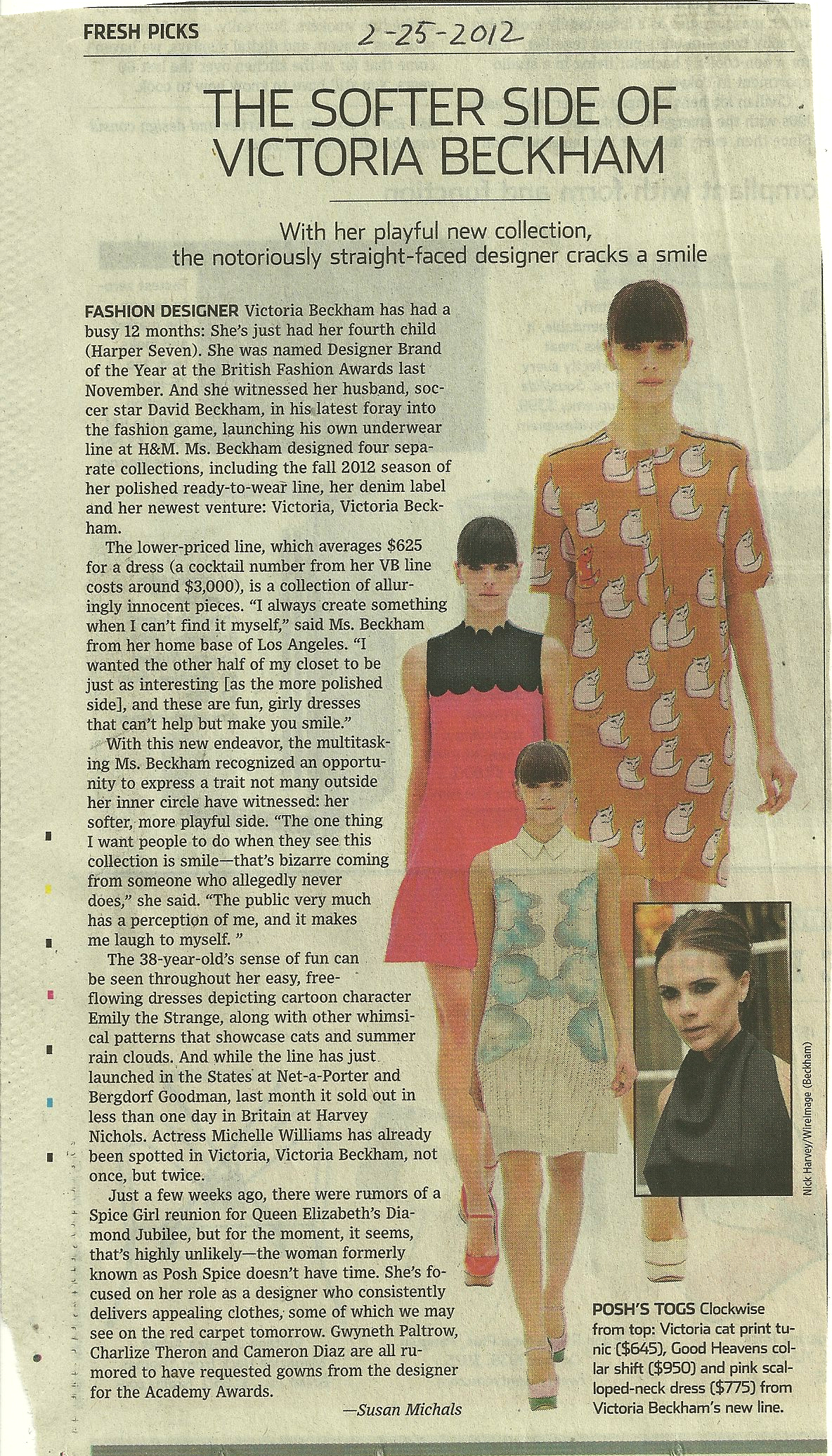
(Interestingly enough, back on February 25, this article ran in The Wall Street Journal, featuring some Spring dress designs from Victoria Beckham.  Does the look of the pink and black dress seem familiar?):

A variation of the Pierre Cardin dress? No – a “new” design!

Well, as is often the case with sewing, nothing is quite as easy as it first appears.  The pattern called for an underlining and a lining.  (Hm-m-m-m, I thought, this could get time-intensive!)  Because I did not want to interfere with the fluidity of the silk fabric, I knew I needed an underlining fabric with minimal weight, but good stability.  I found just the perfect thing from Dharma Trading Co.:  rayon voile.   I ordered what I needed (and then some extra yardage for future projects), and it seemed like about two hours later it arrived.  Actually it was two days later, but considering it was being shipped across the continent from California to Pennsylvania, that’s what I call excellent service!
During those two days, I headed off to Joann Fabrics to find lining fabric, thread, zipper and hem tape.  I was delighted to find Gutermann silk thread in a pink which perfectly matched my fabric. While a pink lining fabric to match was sadly elusive, I went with a navy blue lining fabric instead.

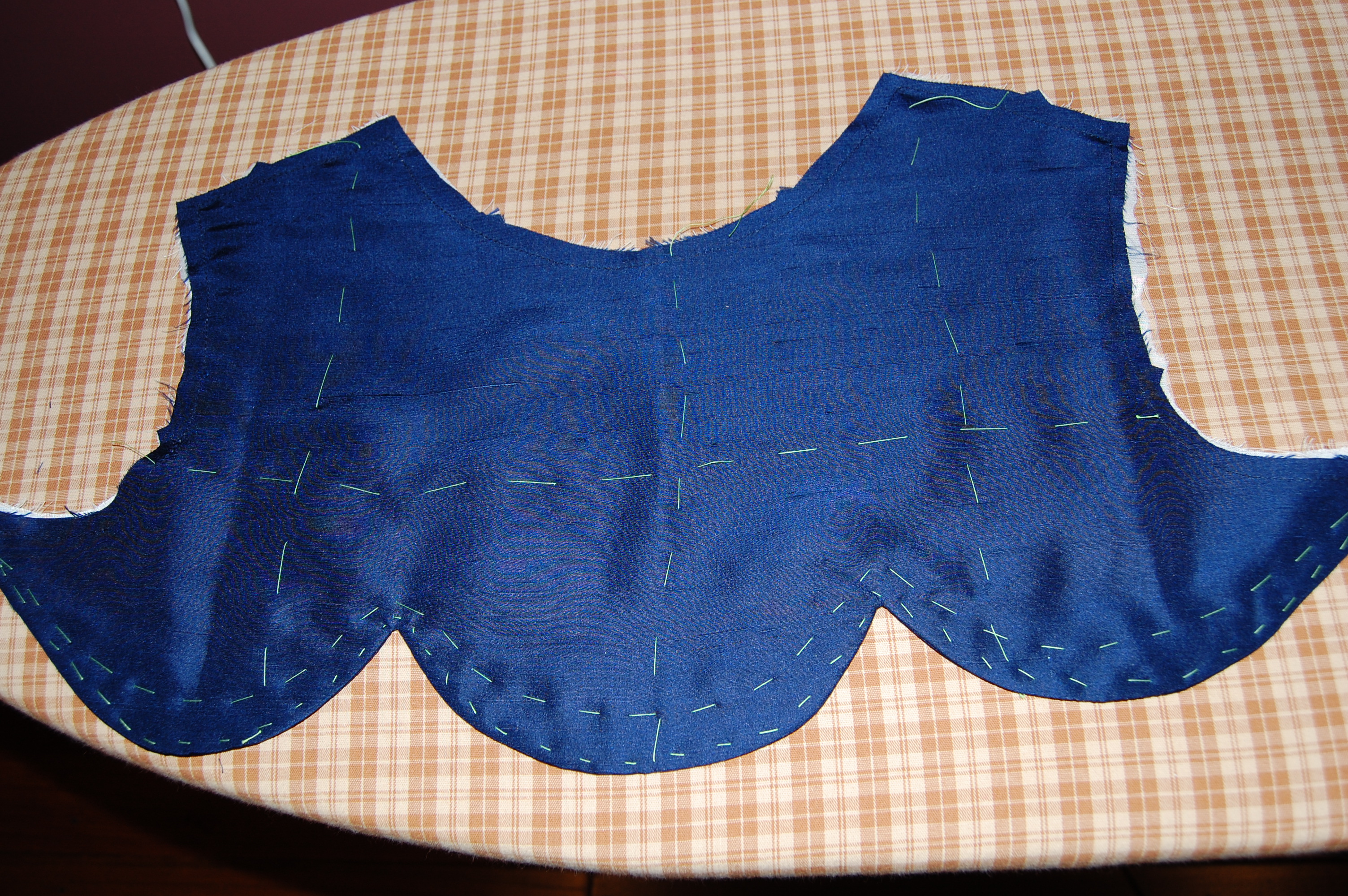
I made the dress lining first, and it was kind of nice to have this part of the dress sewn and set aside until needed.  I did my normal basting of the underlining to the silk as shown here.

Basting on the bodice yoke.

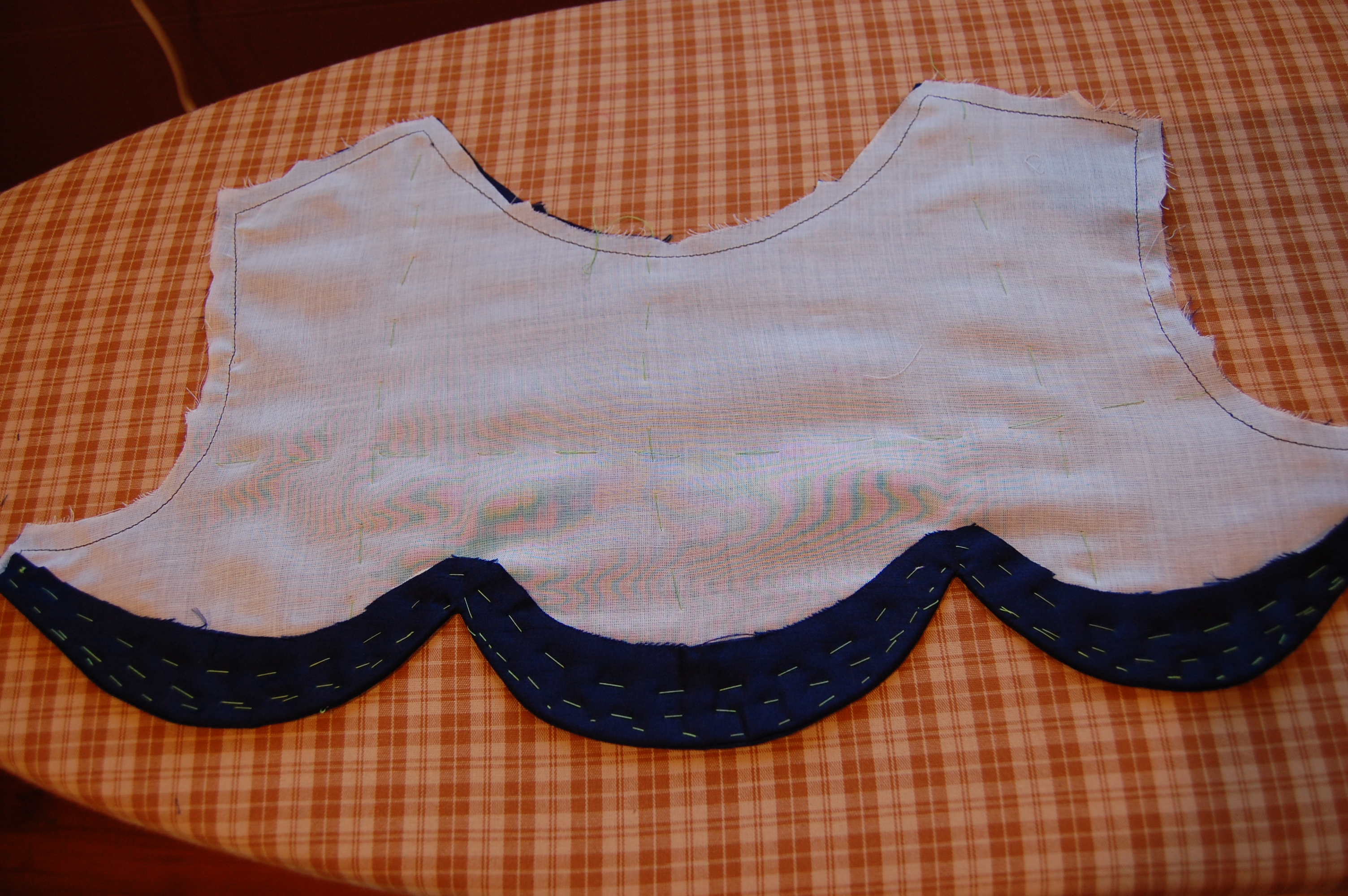
The scallop detail called for stuffing with lambs wool, but I used two layers of drapery weight flannel instead.  This small section of the dress took a long time to complete.

This shows the underlining and the facing for the scallop detail.

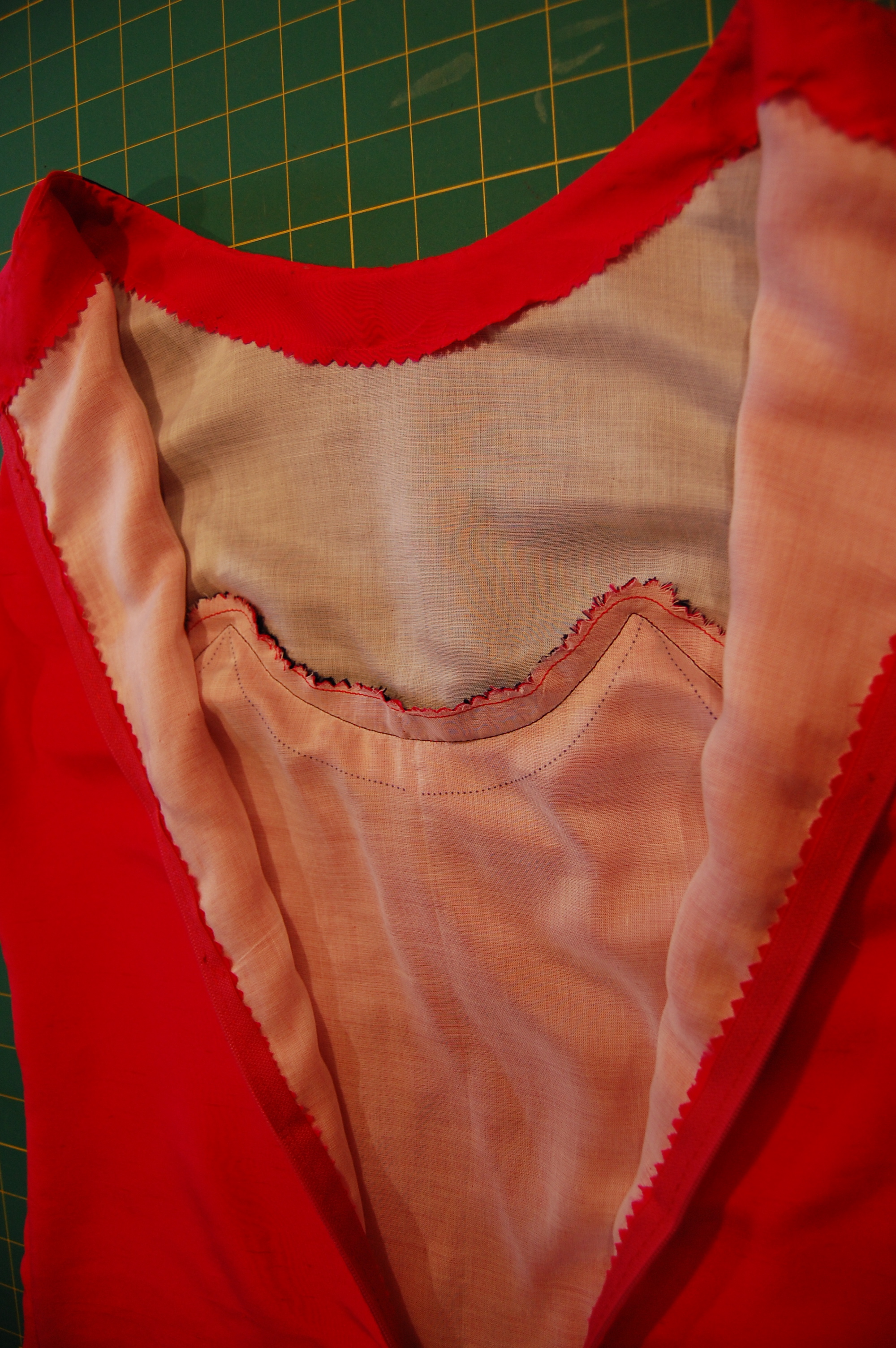
Here is what the inside of the scallop part of the dress looked like before I attached the lining.

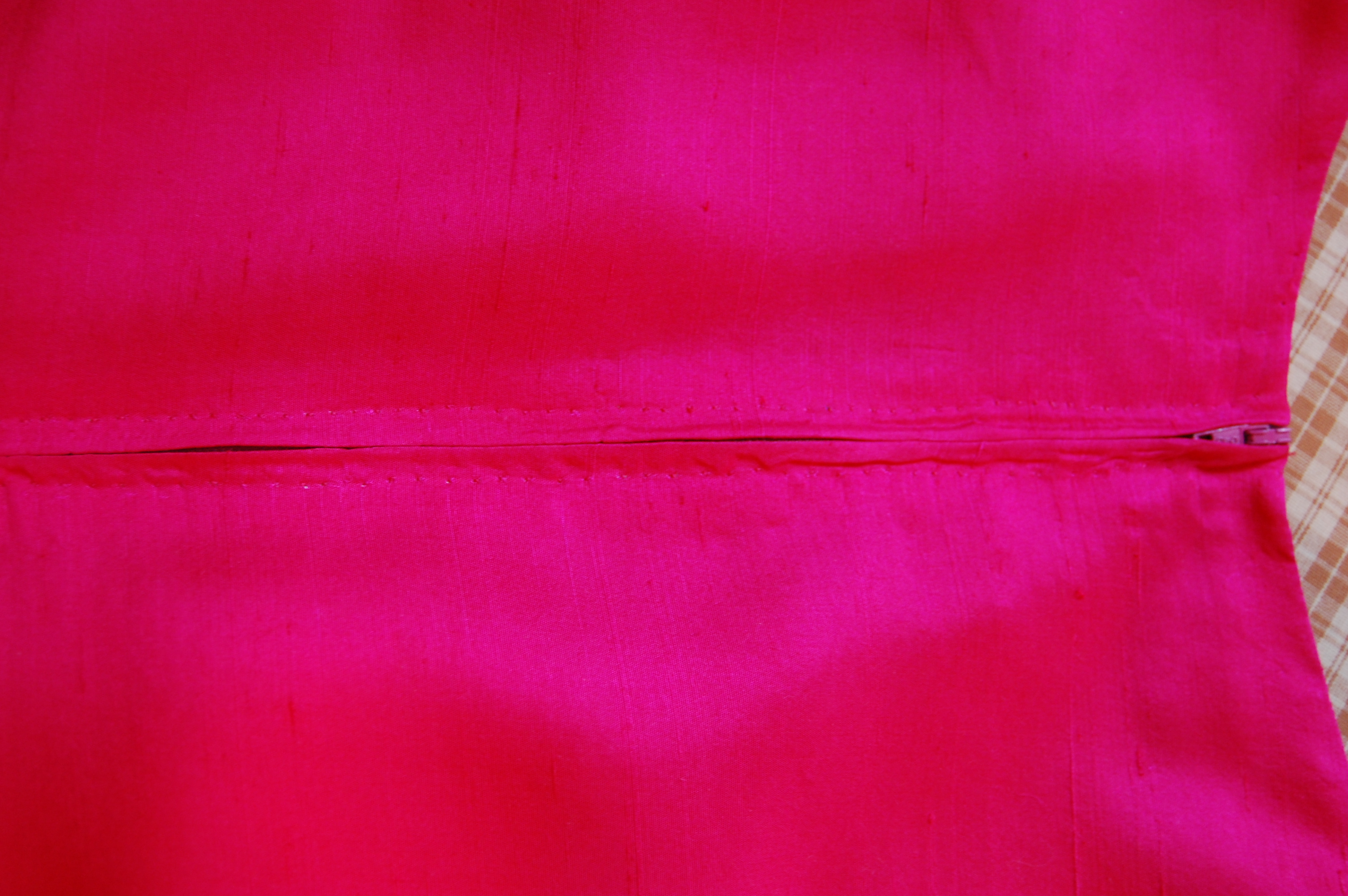
I put the zipper in by hand, and understitched the neck and arm facings by hand as well, to make a nice, neat finish.  The pattern called for the lining to be sewn in place by hand, so my fingers were certainly doing a lot of stitching!  About this time I was beginning to wonder why I always make things so complicated.  Here is the hand sewn zipper application.

I love the look of hand-sewn zippers!

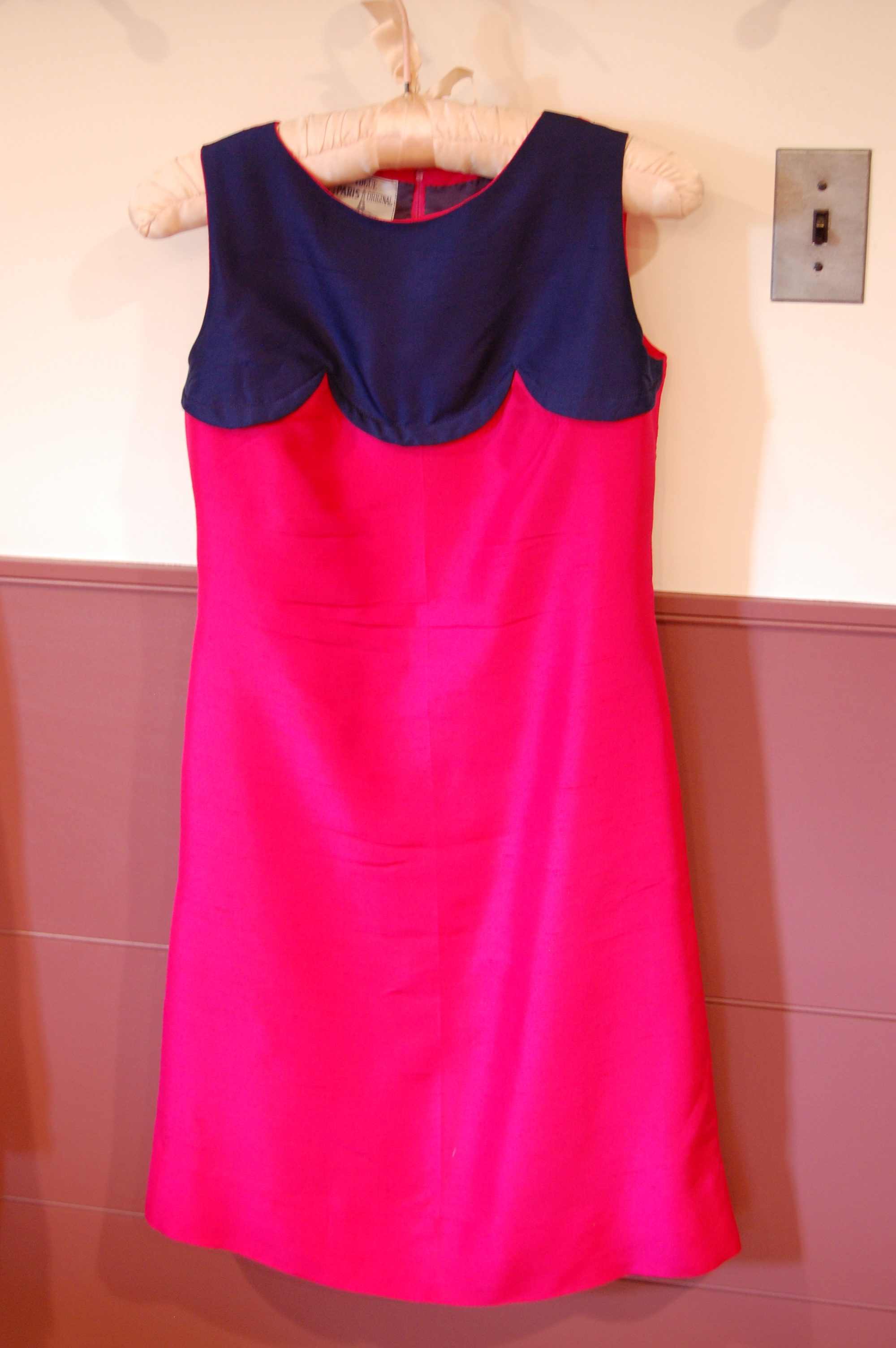
Here is the front of the dress

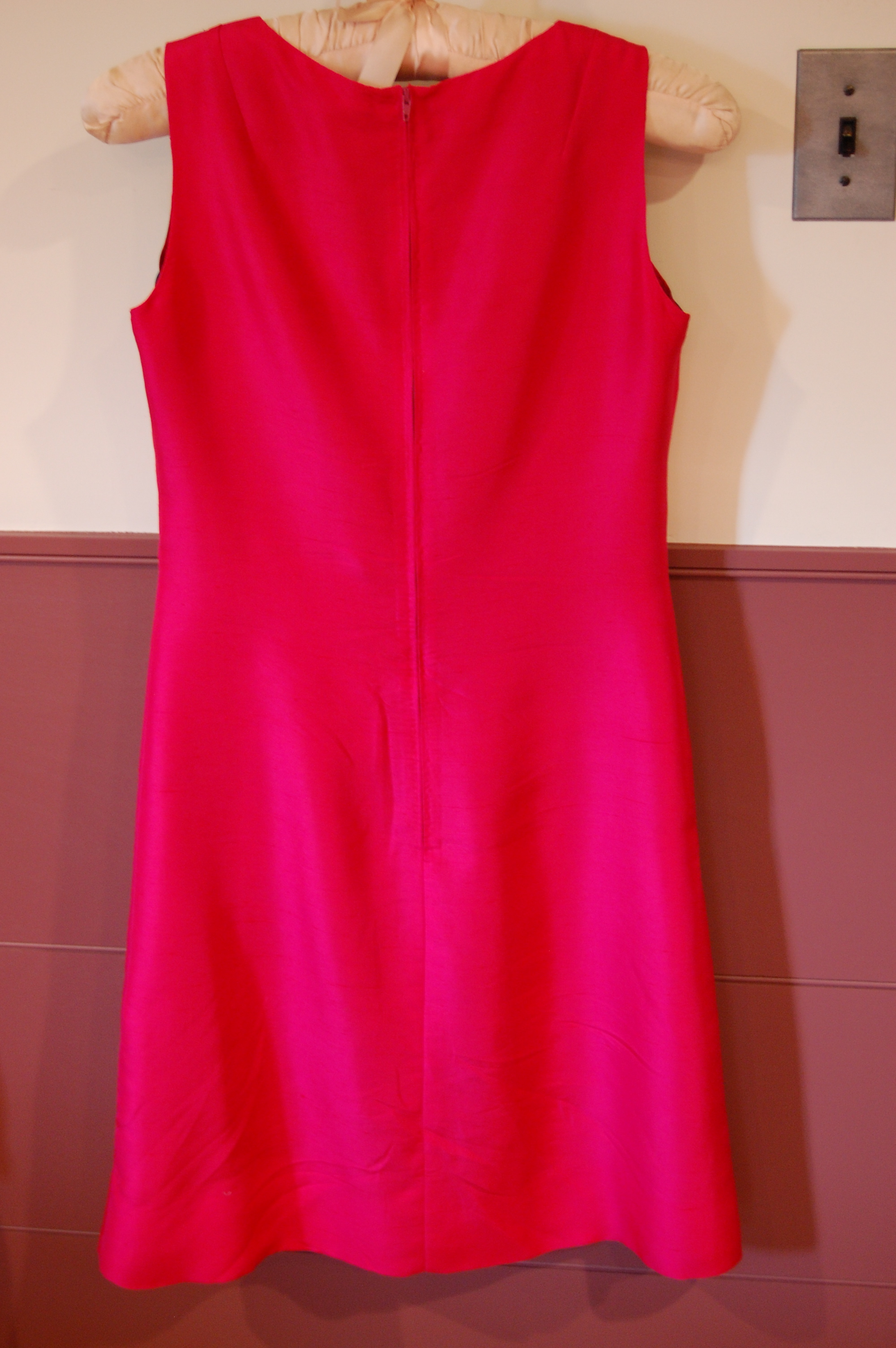
. . . and here is the back.

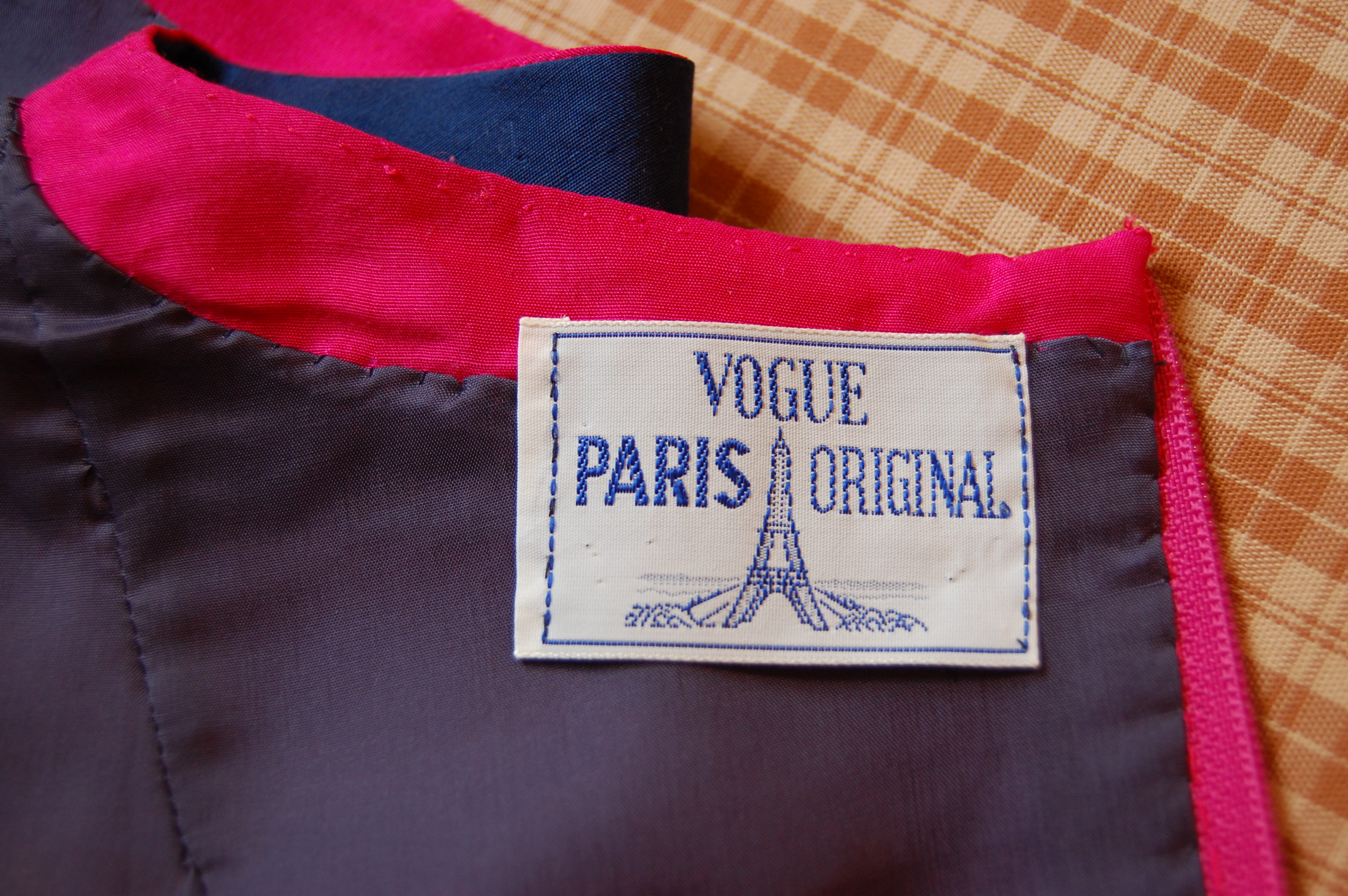
When I purchased the pattern it came complete with a Vogue label, which I was only too happy to apply to the inside neck edge as the finishing touch!

You can also see the hand-sewn-in lining in this photo.

Yes – I completed the dress in time to wear for the intended event!

The good news, other than the fact that this dress is finished?  Two things – one being that I still have enough pink silk to make a skirt or a blouse, not sure which yet.  The other is that I can start another project now that my fling with Pierre is happily over!

10 Comments

Filed under sewing in silk, Uncategorized, underlinings, vintage Vogue Designer patterns, vintage Vogue patterns from the 1970s, Vogue patterns

My very stylish pants.

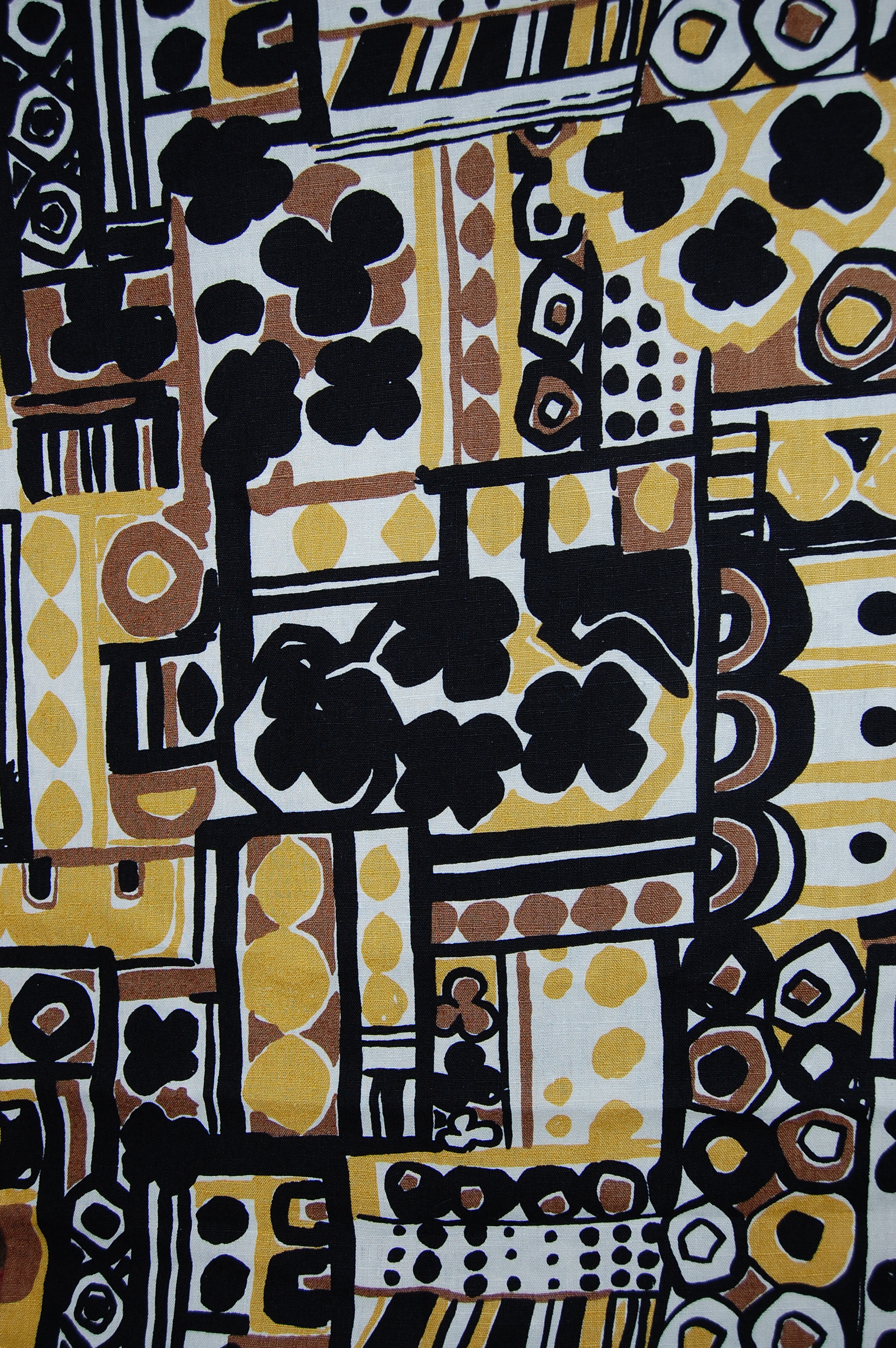
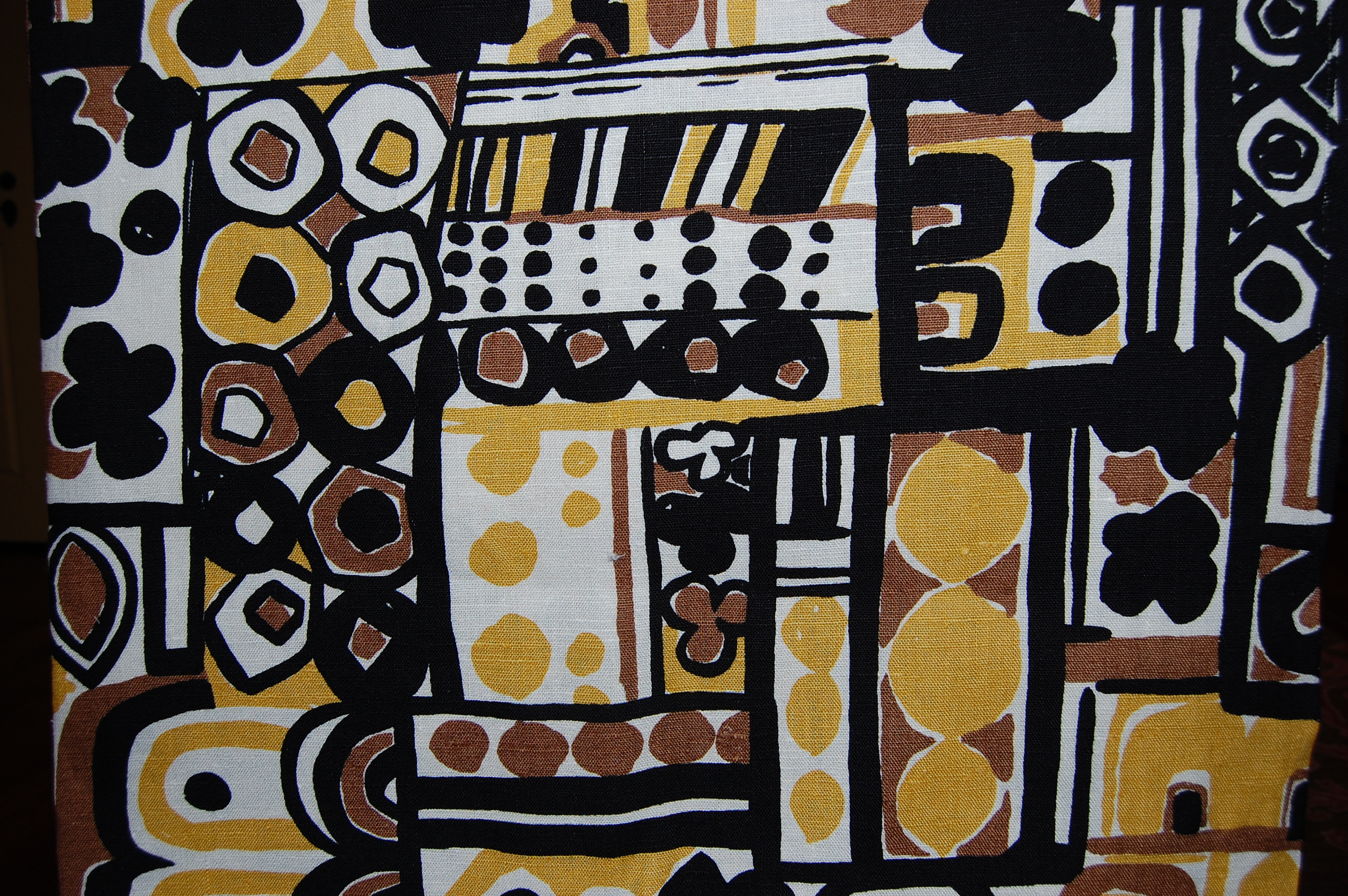
For several months I was watching a piece of Moygashel linen for sale by Revival Fabrics.  When I first saw this offering, I had the eerie feeling of déjà vu – I was sure I remembered seeing this patterned fabric in the late ‘60s or early ‘70s when I was a steady admirer and occasional purchaser of this brand of linen I love so much.  The piece that was being offered was three yards long, 44″ wide and included a Moygashel label.  The description accompanying it suggested making patio furniture pillows or tote bags with it, neither of which much appealed to me.  And actually, this suggestion threw me off a bit ; I wondered if it was drapery-weight linen, not dress-weight.  But the more I looked at it online (clicking close-ups of the images), the more convinced I became that it was dress-weight.  I finally decided to buy it, not really knowing what I was going to make out of it (maybe a sheath dress…?)

When the package arrived and I finally saw this linen in person, I was – so excited! It was gorgeous – and my suspicions were correct – it was definitely dress-weight.

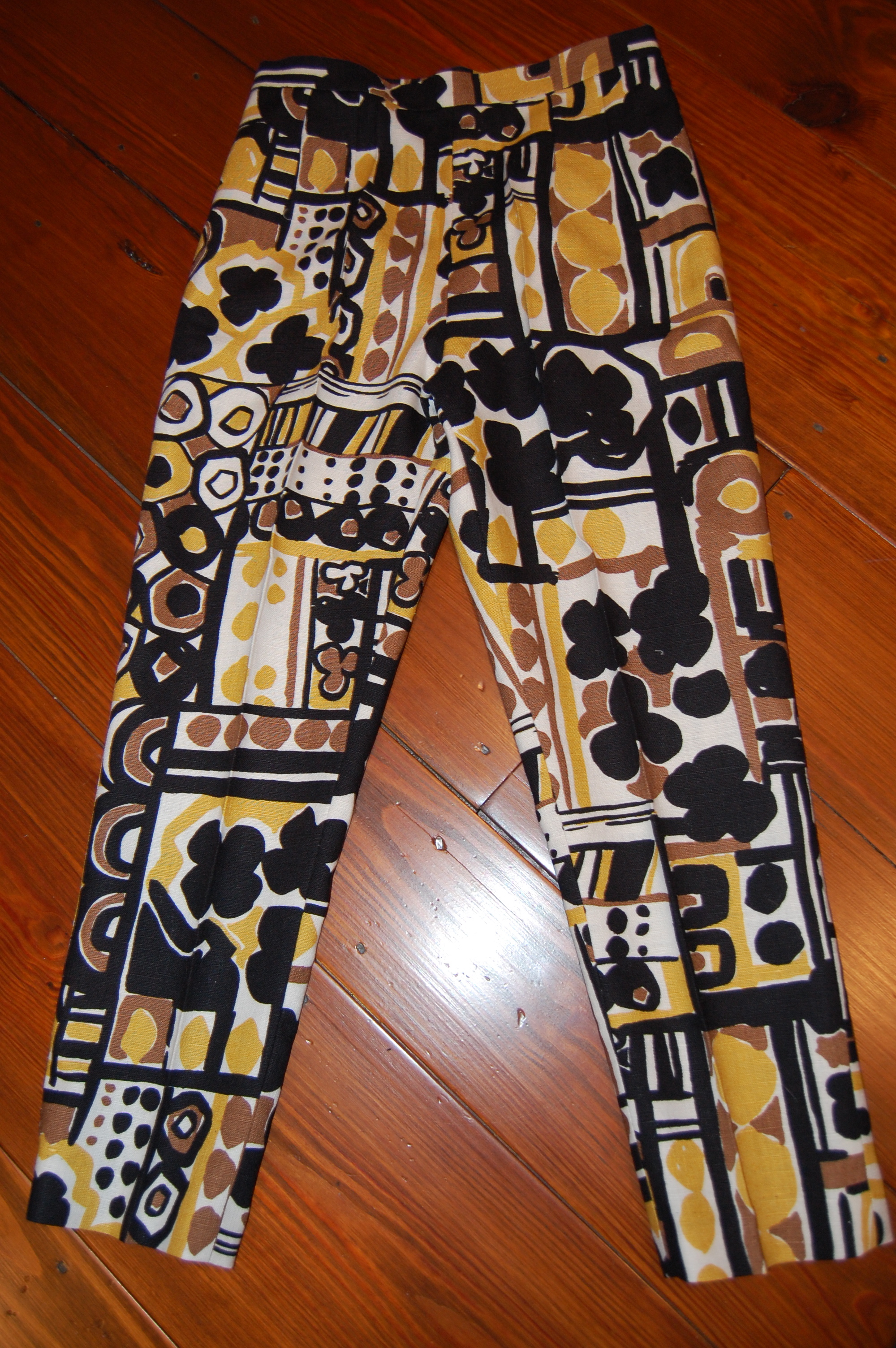
Here is a lengthwise view of the linen.

Here is closer view of this amazing pattern.

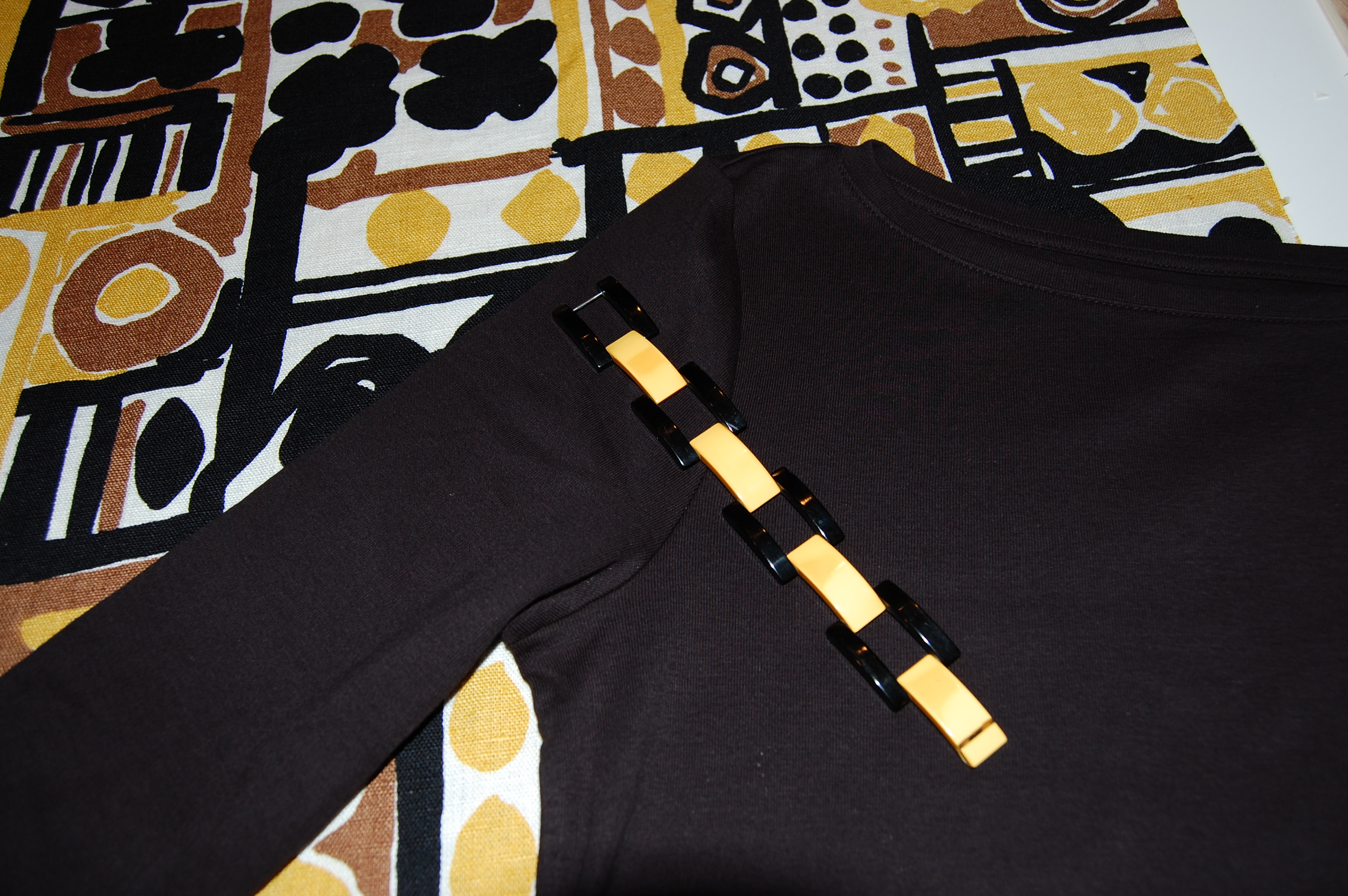
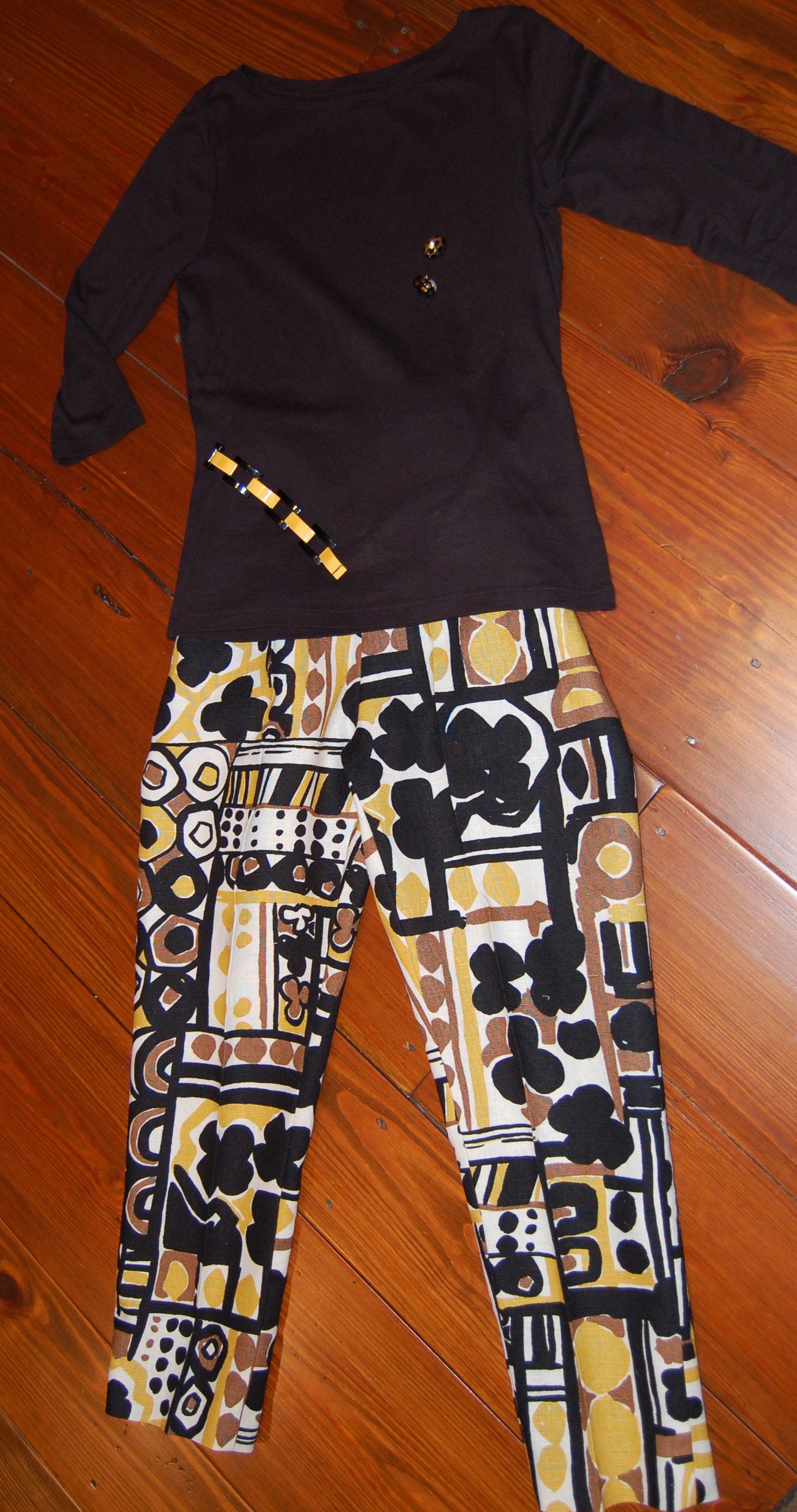
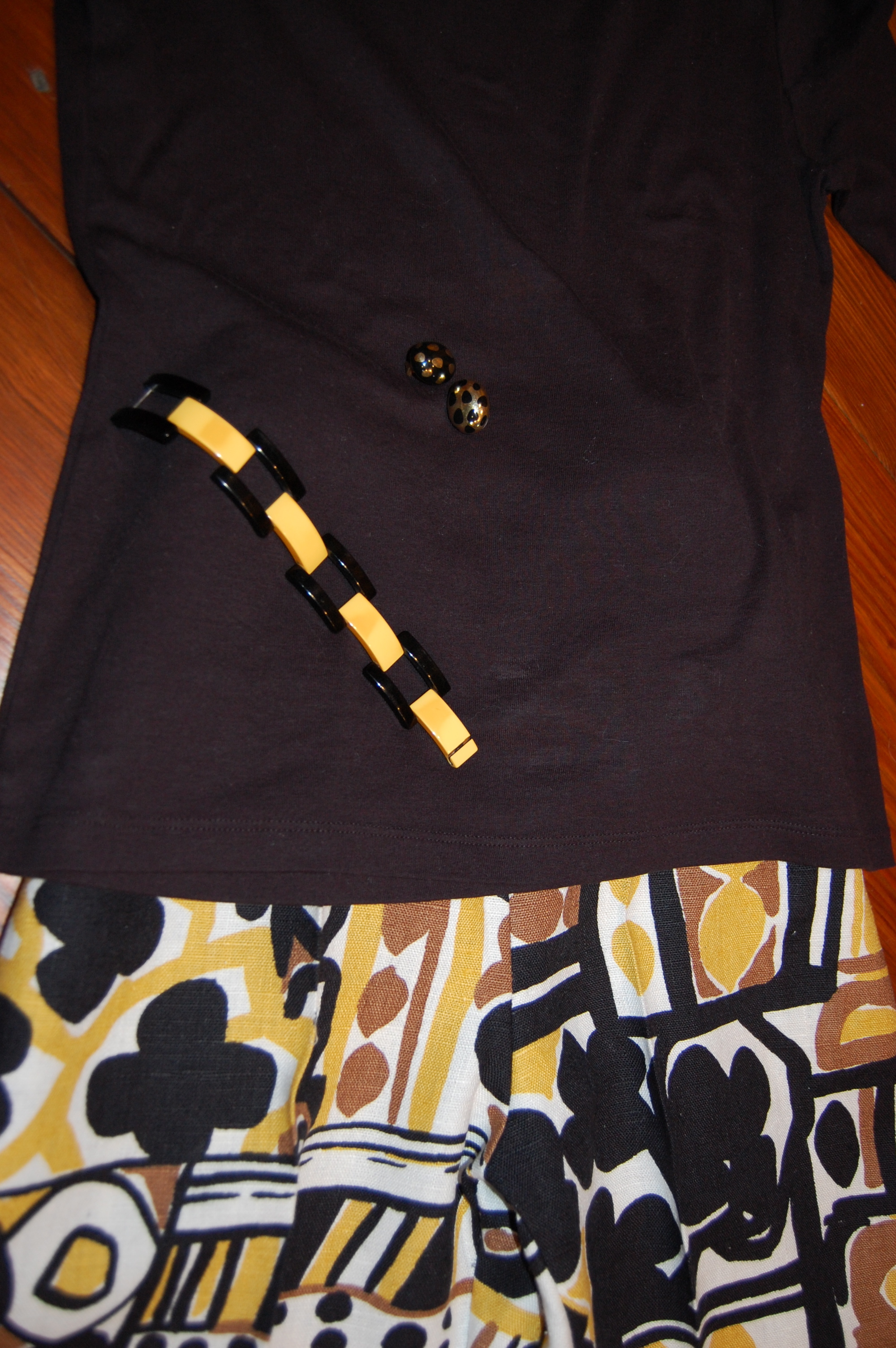
My first thought after my initial euphoria was:  This would make up into fabulous ankle-length pants (worn with a black, yellow or khaki top – and of course my black and yellow Bakelite bracelet).  And yes, I was sure I would have the nerve to wear them!

I laid out the fabric with a black cotton knit top and my Bakelite bracelet just to see how it would look.

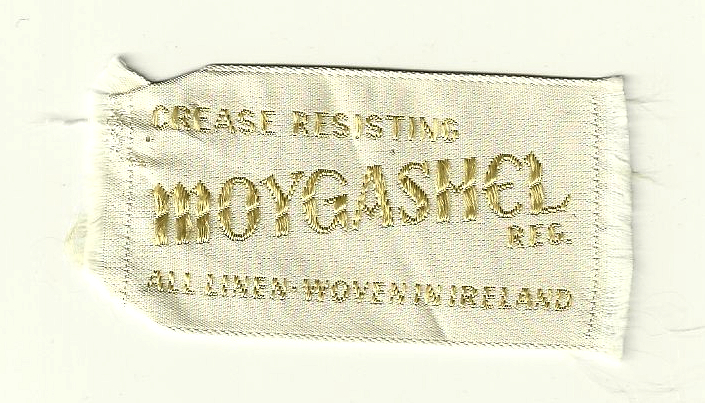
And here is the label which came with the fabric.

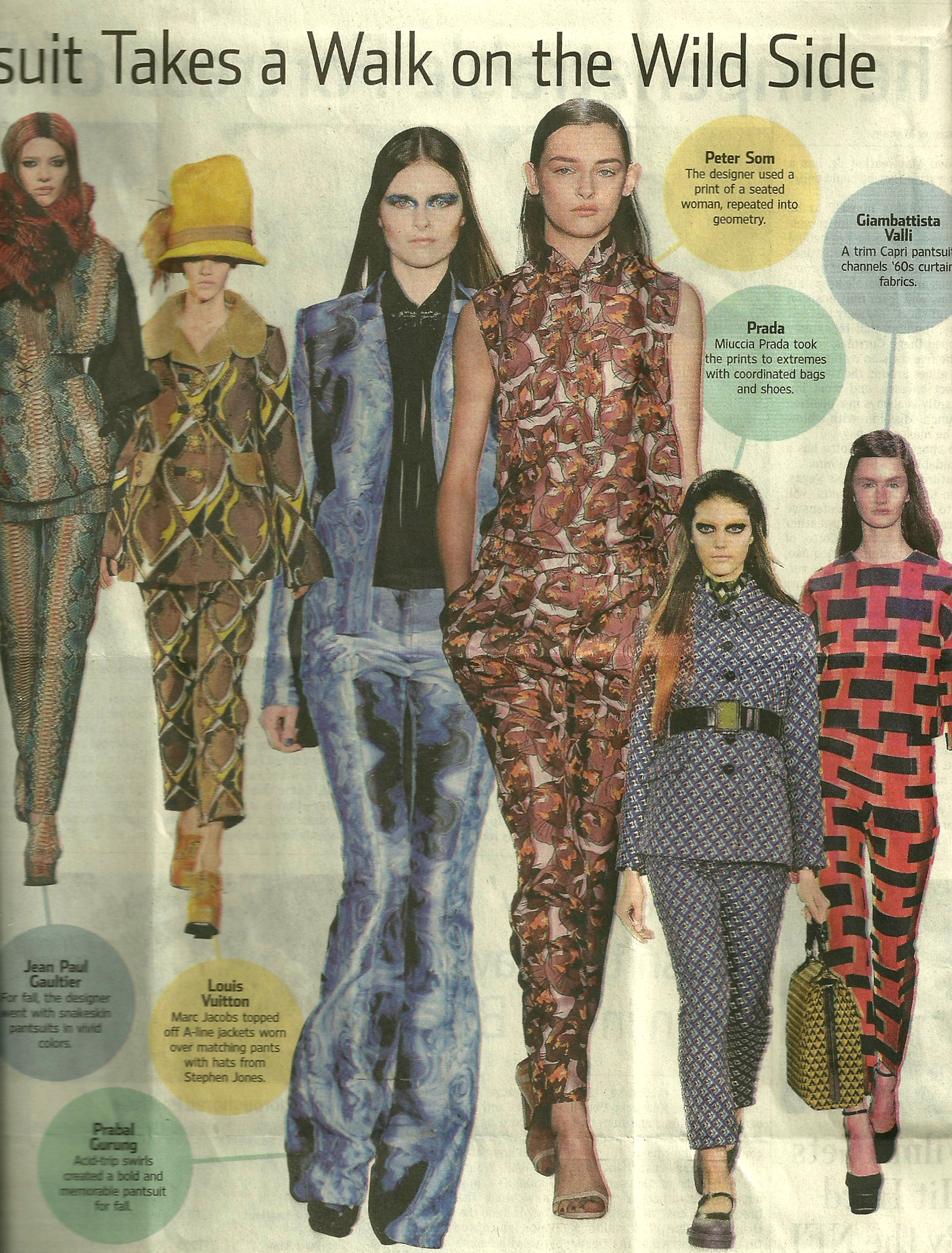
With my plan in place, I decided this would be my next project after I finished the one I was on.  Then something really amazing happened.  A fashion article in the May 3, 2012 edition of The Wall Street Journal caught my eye.   Christina Binkley, one of the newspaper’s fashion reporters, headlined her weekly column “On Style”  with The Pantsuit Takes a Walk on the Wild Side.

I don’t like any of these fabric designs as much as I like my Moygashel linen!

I’ve never been a fan of pantsuits, but some of the fabrics featured had that same ‘60s’ feel as my new vintage linen.  The reporter rightly questioned how well these head to toe outfits would “play on the streets”, but then she added:

“…at least one mainstream retailer will highlight the idea that the pantsuit can be worn as separates…  There will be more busy pants than busy jackets.  ‘There may be women who wear it head-to-toe – very daring,’ says Sak’s Ms. Sherin.  ‘But for us, it’s probably about the patterned pant’.”

Then, Ms. Binkley suggested:  “The key to wearing this trend is not straying too far from your safety zone.  Stick to colors and patterns you will still love in five years.  And let the bold pattern do the talking – go with a conservative fit if you’d rather not be the center of attention.”

Further:  “It’s probably not a coincidence that wild pantsuits are appearing just as ‘Mad Men,’ the style-influencing television show, is entering the psychedelic phase of the ‘60s.”

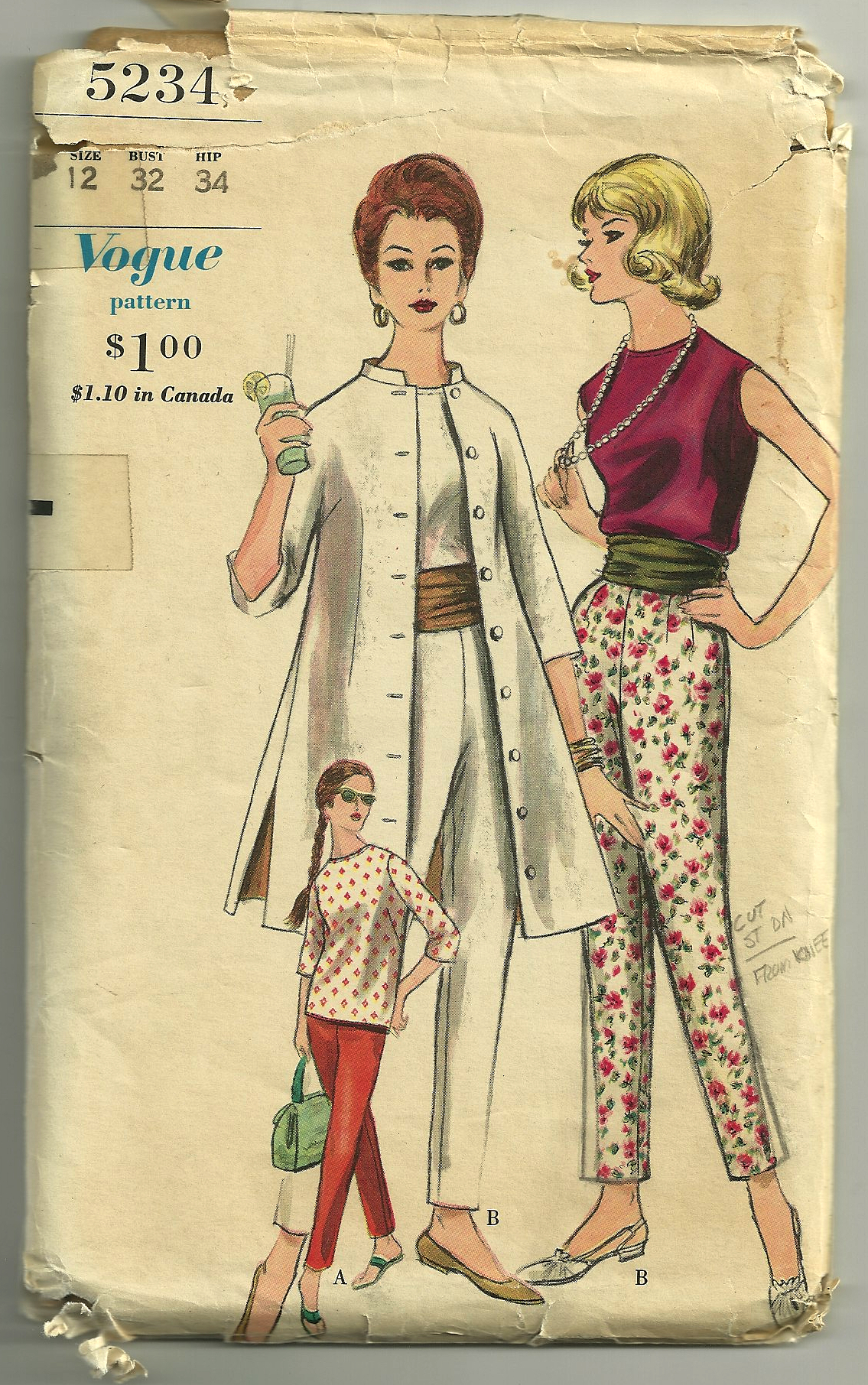
Well, my linen fabric is far from psychedelic, but it is bold – and reading this article certainly did validate my plans for making pants.   I also already knew the pattern I wanted to use, one quite appropriately from the early to mid ‘60s!

I really like all the styles featured on this pattern – the coat, the two blouse variations, the cummerbund –and the “conservative” pants.Classic looks – all of them!

Okay – I was ready to start this project.  First I washed the linen in cool water, delicate cycle, and dried it on medium heat.  This way I know my pants are totally machine washabIe.  Next I made a muslin of the pants pattern to check for fit.  I should have done a little more measuring first, as the crotch was too deep and had to be redrawn.  Also, although I like slim-ankled pants, these were just a bit too slim, so that was another adjustment.  I ended up making muslin #2, which was much closer to the final version from which I cut my pants.  However, I had made so many adjustments, that I decided to copy the final pattern onto freezer paper. (Freezer paper is my secret sewing friend – the dull side provides a wonderful surface upon which to draw in pencil and the shiny side can be ironed to fabric to cut out appliqués or anything, really, and then easily removed.  And the long continuous roll of paper is perfect for long pattern pieces like pants, coats, etc.)  The good news is that now I have a pants pattern that fits really well with the slim, but not too slim, legs that I like.

During construction, I tried on these pants about a ga-zillion times.  This fabric was just too dear to make any mistakes, and the more I tried them on, the more I liked them.  Here they are, all finished.

I’d say these are definitely bold!

Here is my outfit, complete with Bakelite bracelet.  (I think the camera angle makes the legs look different lengths??)

A close-up of same, with the earrings I’ll also wear with this outfit. (Click on the image).

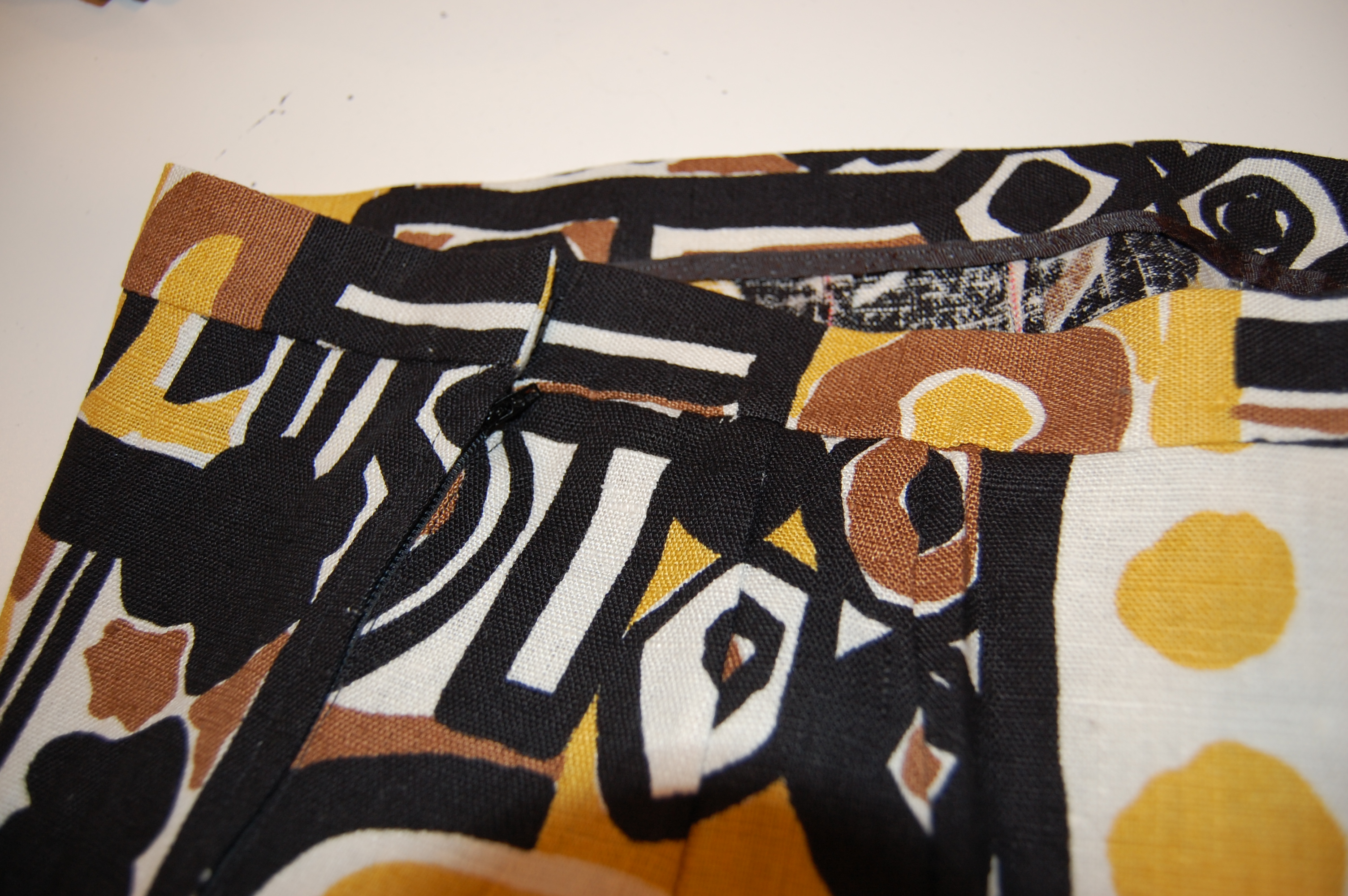
Here is a view of the waistband and zipper.

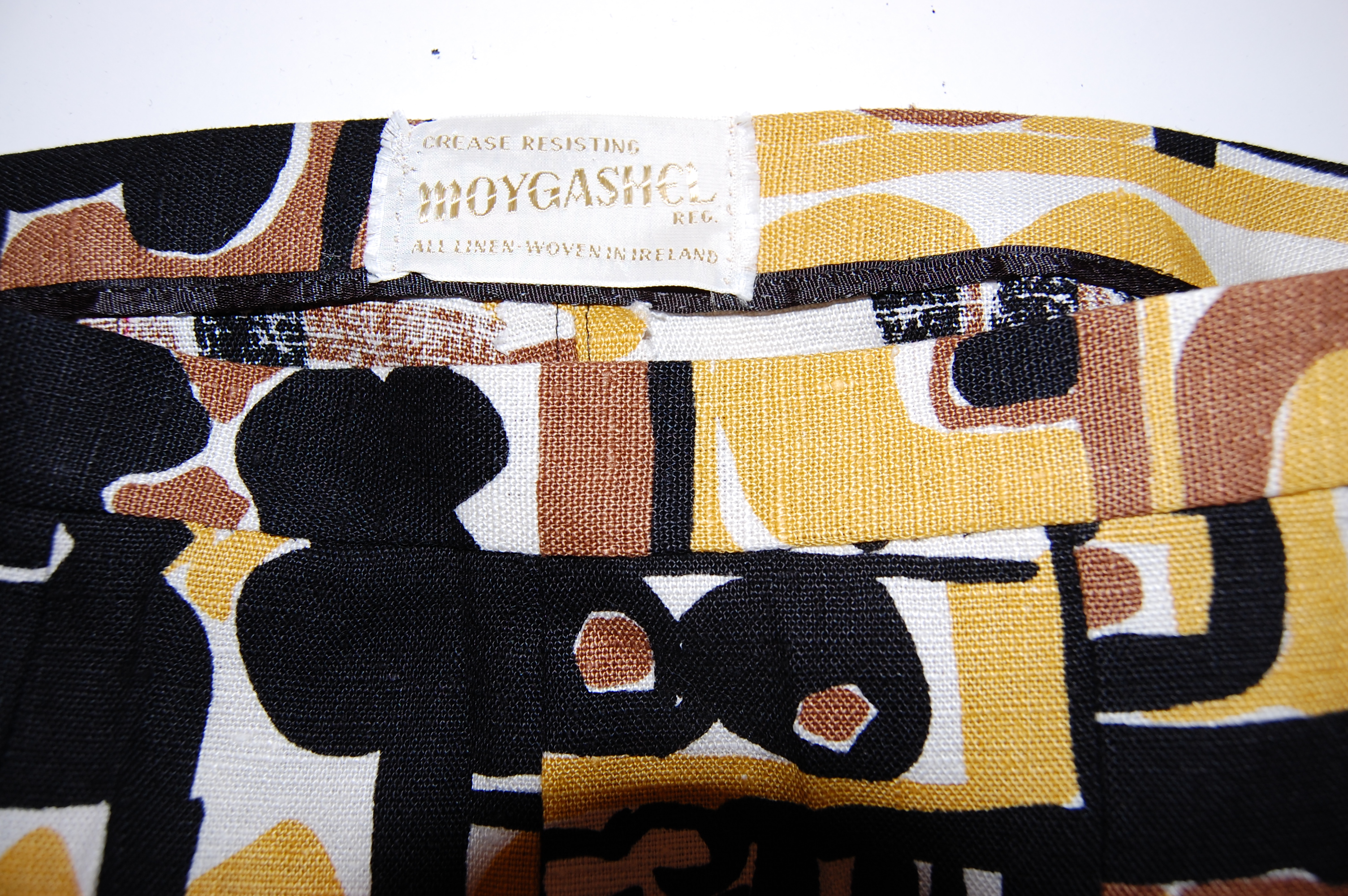
And here is the final touch – the label attached to the inside back of the waistband!

How neat is it to sew something up in vintage fabric, using a vintage pattern – and be totally stylish in 2012? And – I still have enough of this fabric left over to make a skirt.  Hopefully that will be very stylish, too, whenever I get around to making it!

12 Comments

Filed under Bakelite buttons and/or jewelry, Coats, Linen, Uncategorized, vintage Vogue patterns from the 1960s, Vogue patterns

A modern American translation: vintage Irish linen and 1966 French design

I’m never completely sure where pattern/fabric-pairing inspiration and decision- making comes from.  I kind of imagine all kinds of synapses going on in my brain, pulling information both stored and recently learned, which enable me to visualize a particular pattern made up in a particular fabric.  Somehow, most of us who sew  know what works – or doesn’t work – and then we can proceed, or not!  Well, my brain was telling me that this ca. 1965 Moygashel linen would look great made up in this 1966 Jacques Heim-designed dress:

Congratulations to those of you who picked this fabric in my Quiz #2!

I promise this will be the last time I show this pattern evelope!
Before I actually began work on the dress, I looked up Jacques Heim in one of my favorite reference books, The St. James Fashion Encyclopedia: A Survey of Style from 1945 to the Present. “Mr. Heim’s fashion house designed and made clothes of a modest style…” (p. 186) It appears he was not a great innovator, although he was interested in many styles, and his loyalty to a ladylike interpretation of those styles gave him staying power over his 45-year career.

Vogue Patterns started featuring his designs in the early ‘50s as part of their designer series.  It was interesting to go through some of my Vogue Pattern Book magazines and see the progression of his fashions.

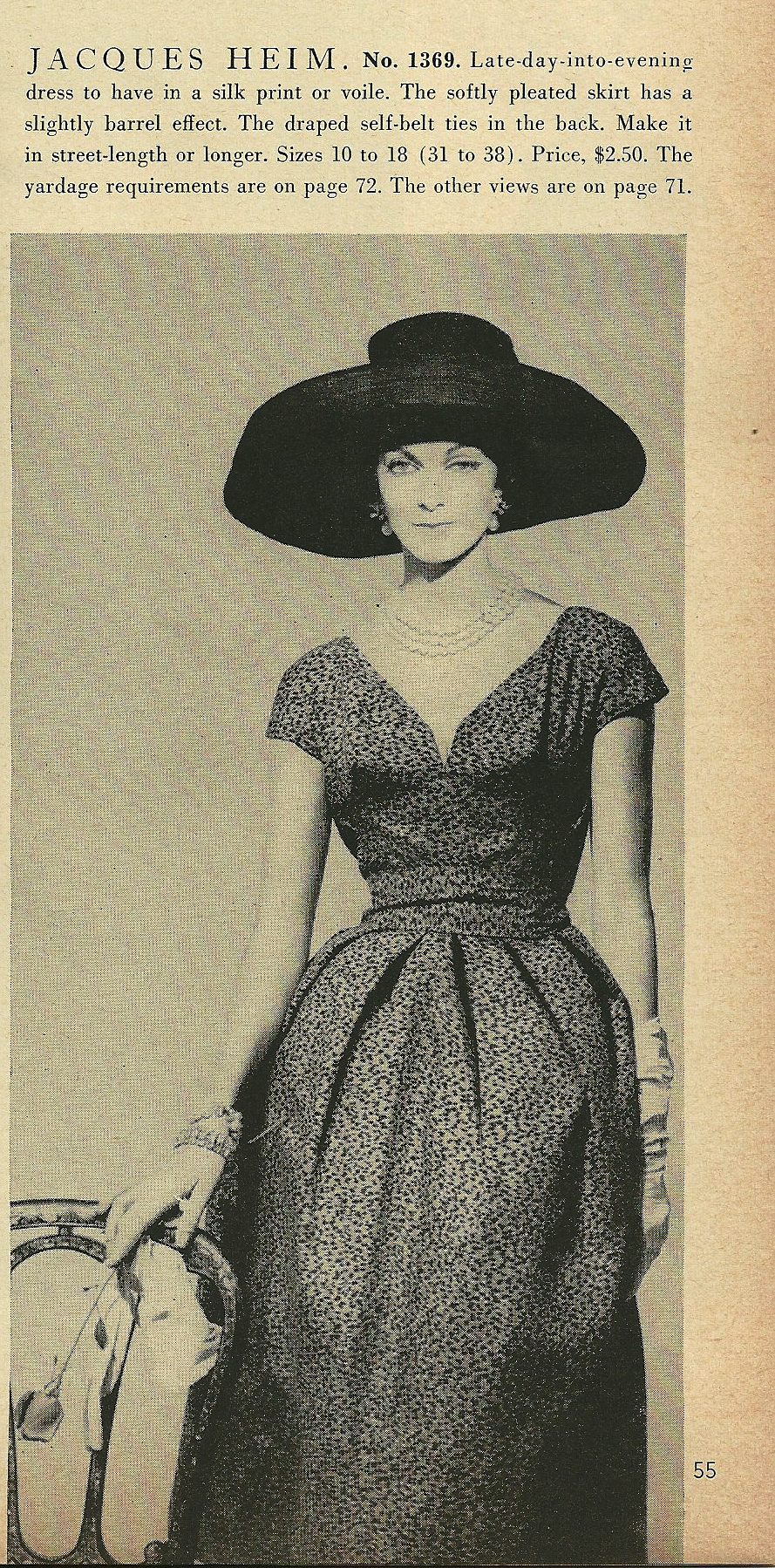
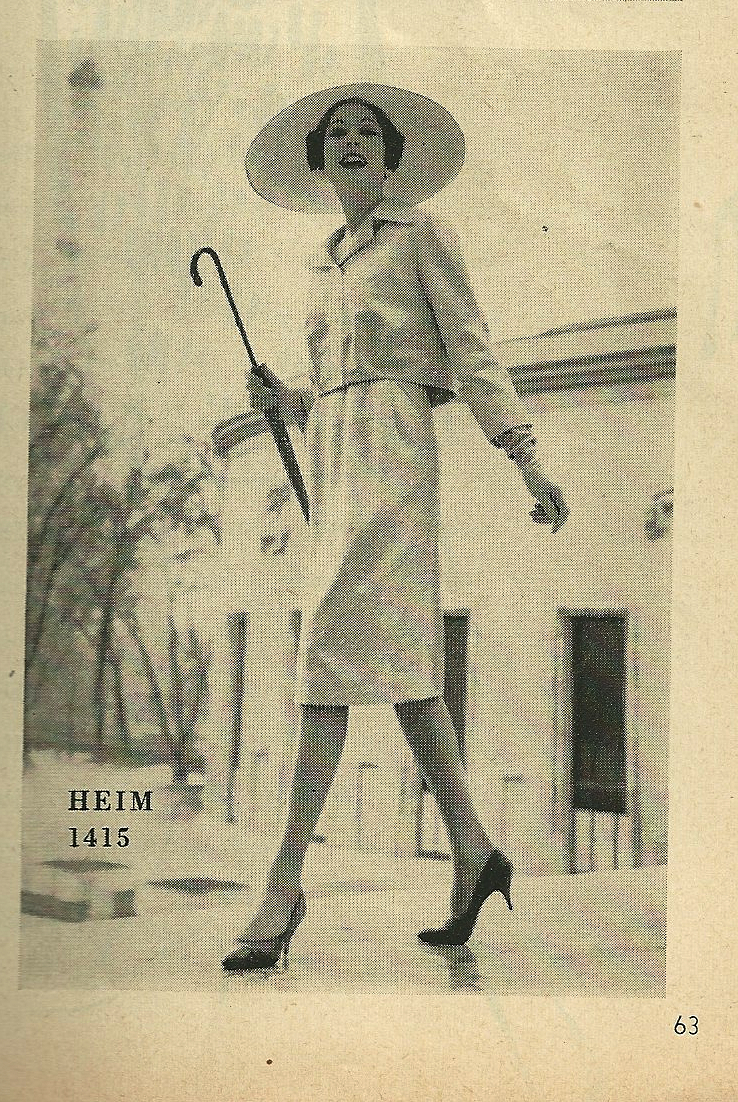
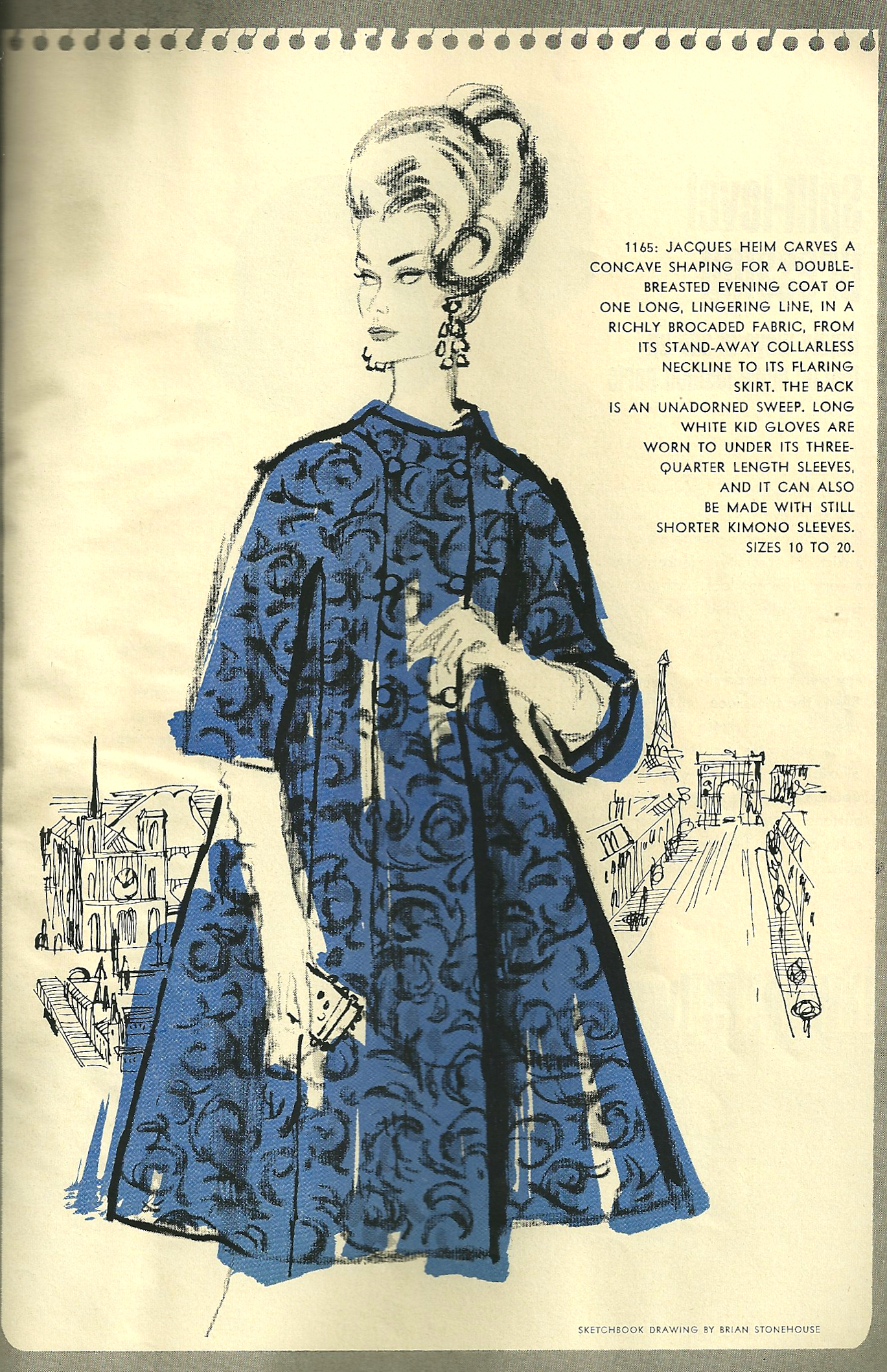
In chronological order, here are four examples of his work:

This dress was featured in the June/July 1957 Vogue Pattern Book magazine.

This ladylike suit was pictured in the August/September 1958 issue of the Vogue Pattern Book magazine.

Here is a Jacques Heim evening coat from the August/September 1962 Vogue pattern Book magazine.

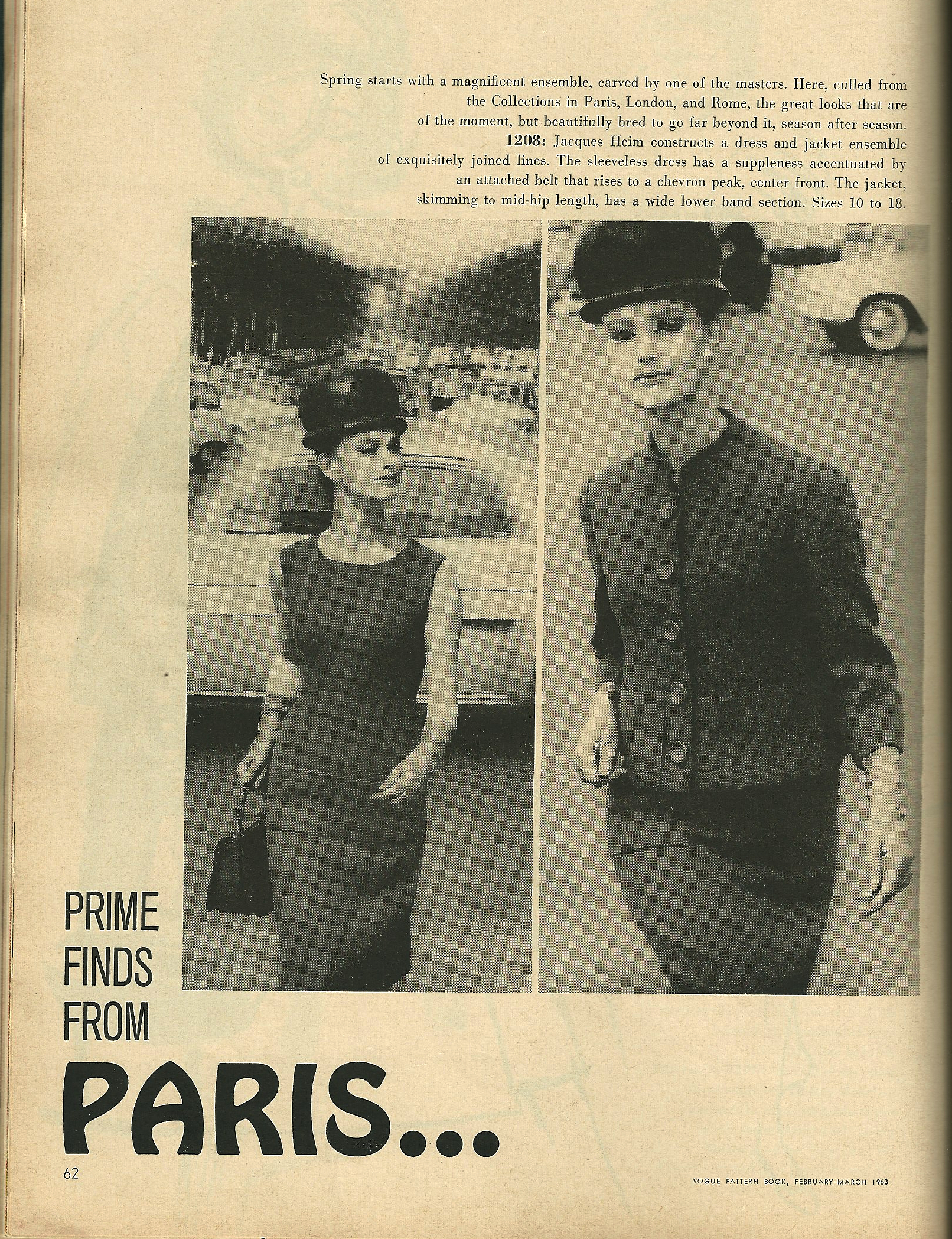
This ensemble was one of Mr. Heim’s February/March 1963 designs. The waist on the dress has a set-in chevron-peaked belt detail. Very lovely!
The pattern I chose was actually featured in one of the free “flyers” which were available in fine fabric stores in the ‘60s.  It is dated Fall 1966.  I just happened to find this copy on eBay – no one bid against me, so I guess I was meant to have it!

I felt very lucky to find this item on eBay!  Note the hair-do.

Mr. Heim died in early January 1967, so this particular pattern must have been one of the last ones which he designed or which was designed under his name before his death.  His fashion house then only lasted for 2 more years, closing operation in 1969 .

So – now on to construction of my dress.  I made a muslin of the bodice yoke  so I could check on the neckline and shoulder line, both of which seem to be an ongoing challenge for me with these vintage patterns.  Although the neck seemed to be okay, the shoulder line appeared to me to extend a little too far out over the shoulders.   So I re-cut the pattern piece, which meant that the facing had to be re-cut as well.

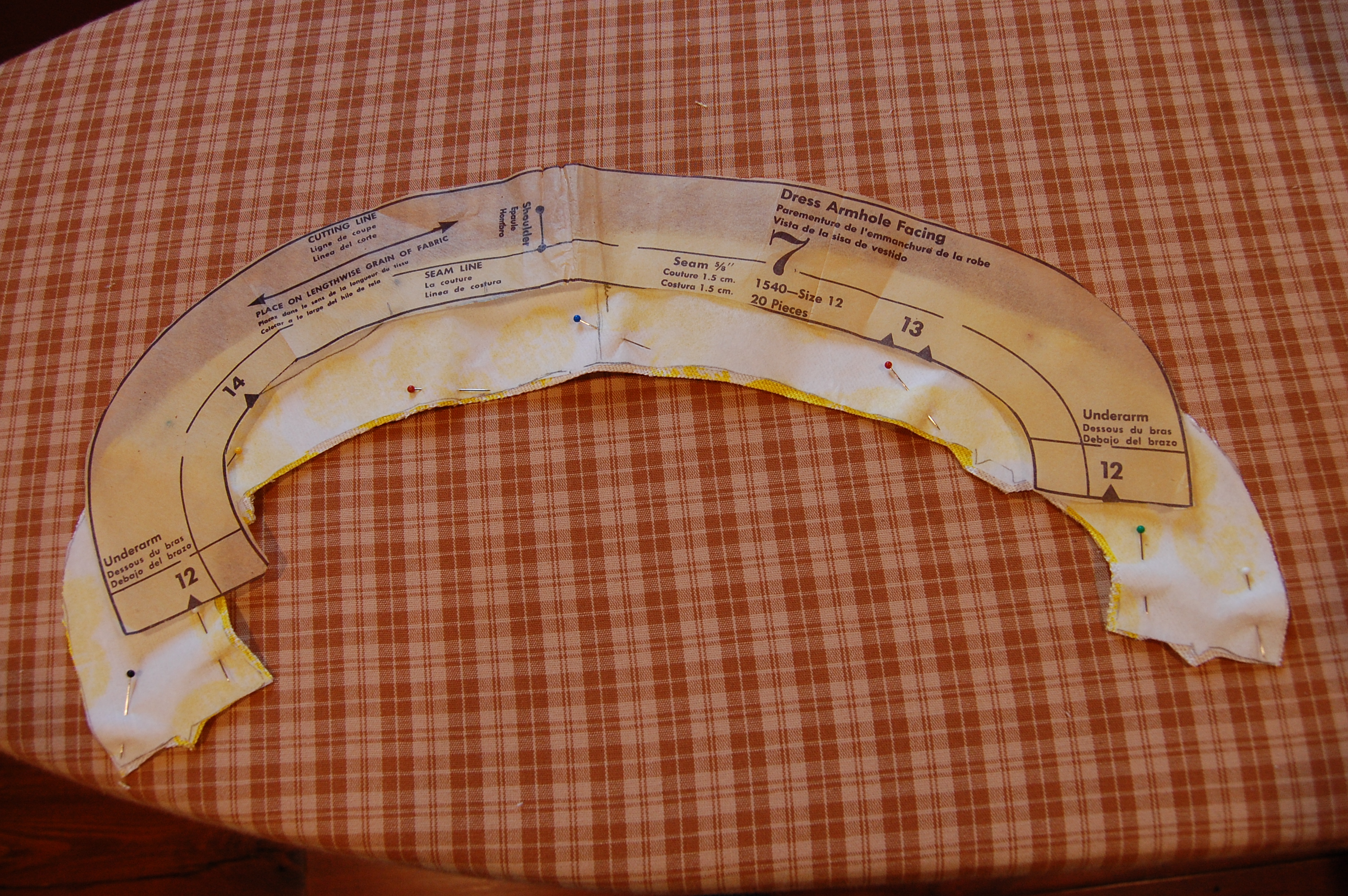
I had to extend the length of the armhole facing to accommodate my changes to the shoulder line.

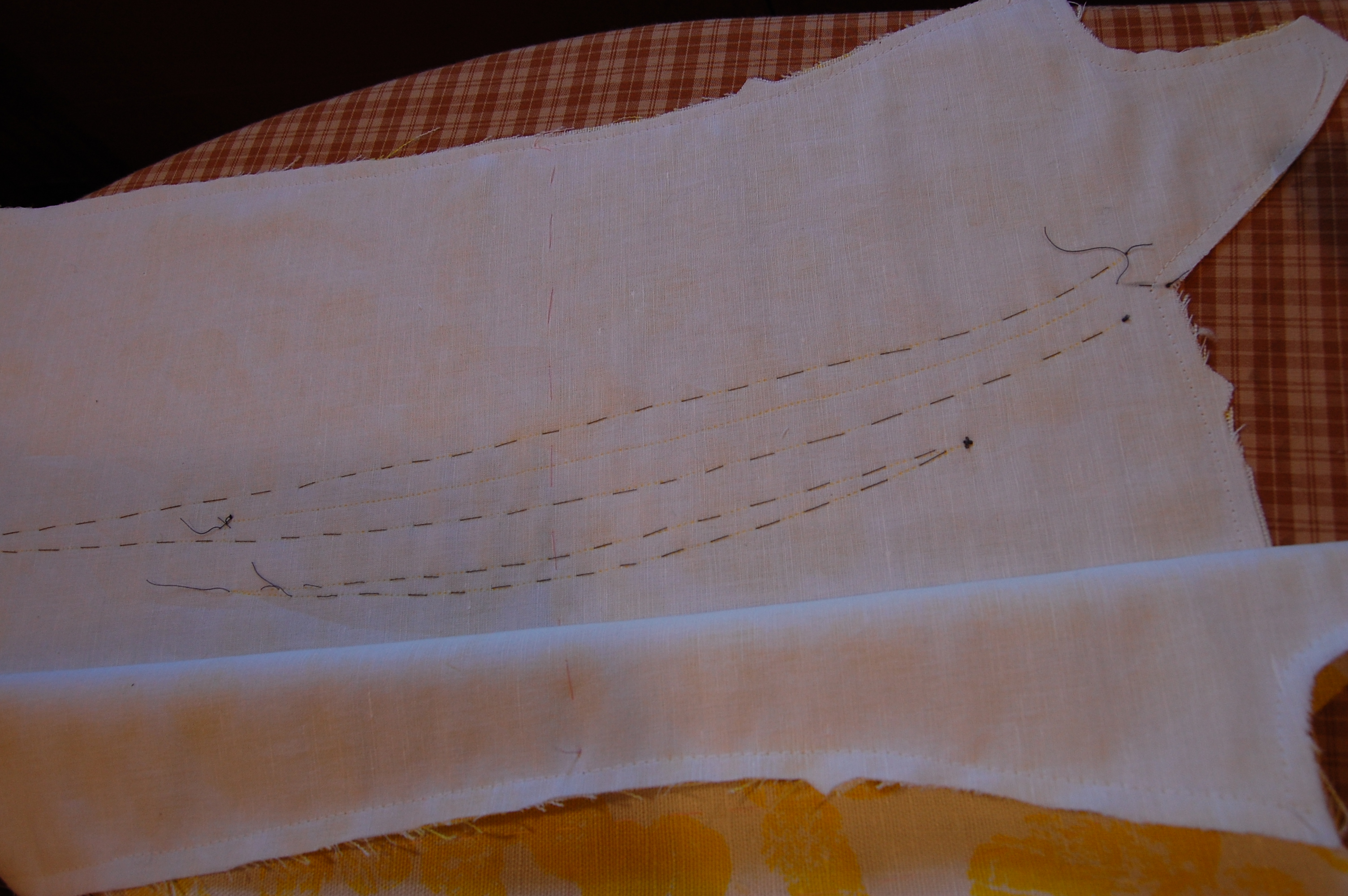
The pattern called for the dress to be interlined, for which I chose a lightweight linen/cotton blend.  I basted all the pieces together by hand, kind of in a grid before machine basting them together just inside the seam lines.  I also basted all the dart lines, as indicated on the pattern instructions.

Here are the “bodice/yoke” pieces shown with their underlinings.

This shows my basting stitches on the dart lines.

As I got near to the end of the construction, I was very happy that I had re-cut the shoulders, but I began to sense that the neck was going to be a problem.  After I had the facings in the armholes, I tried the dress on, and yes, the neck was tighter than I wanted it to be.  I cut off the 5/8” seam allowance on the neckline and the matching part of the facing, which made it perfect!

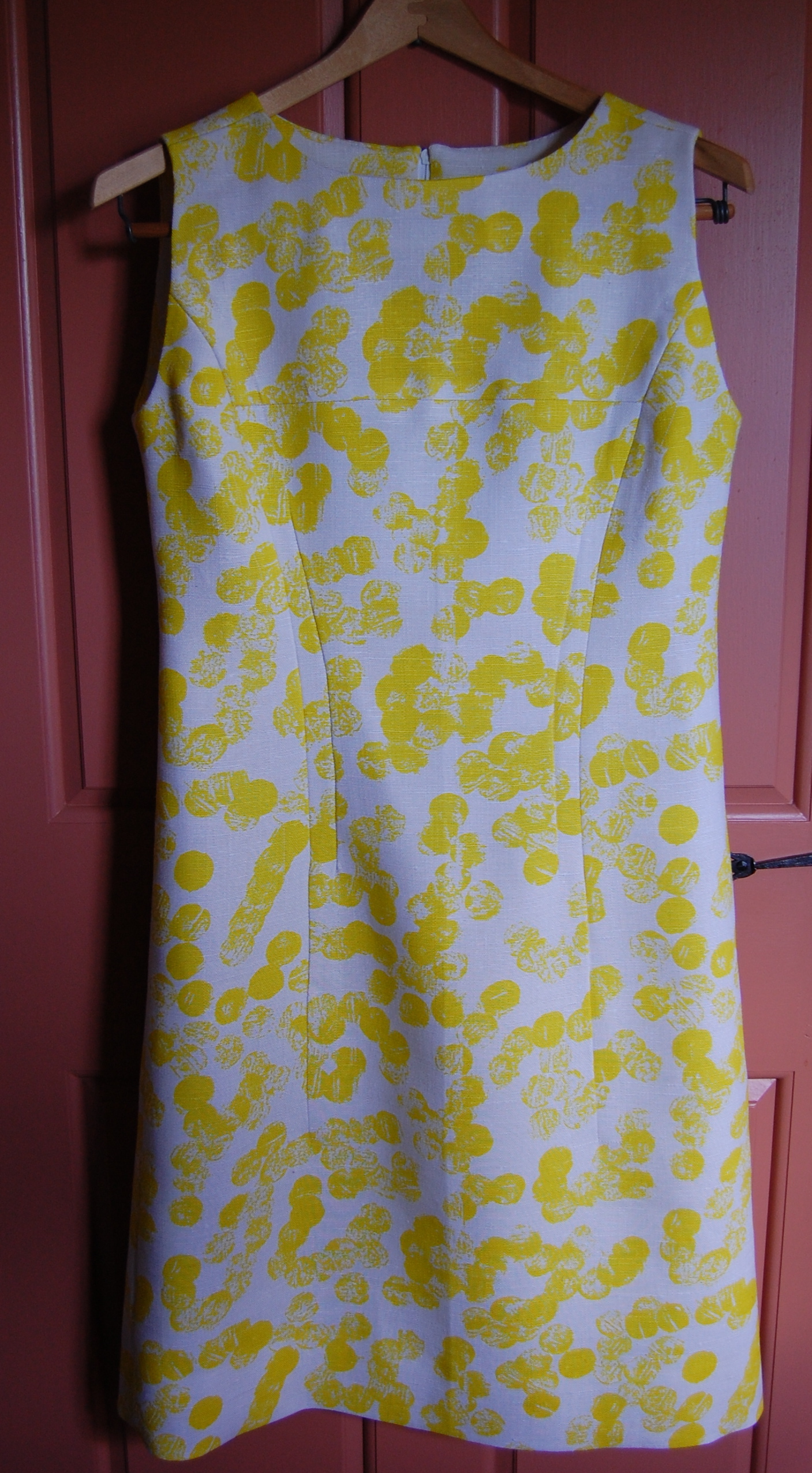
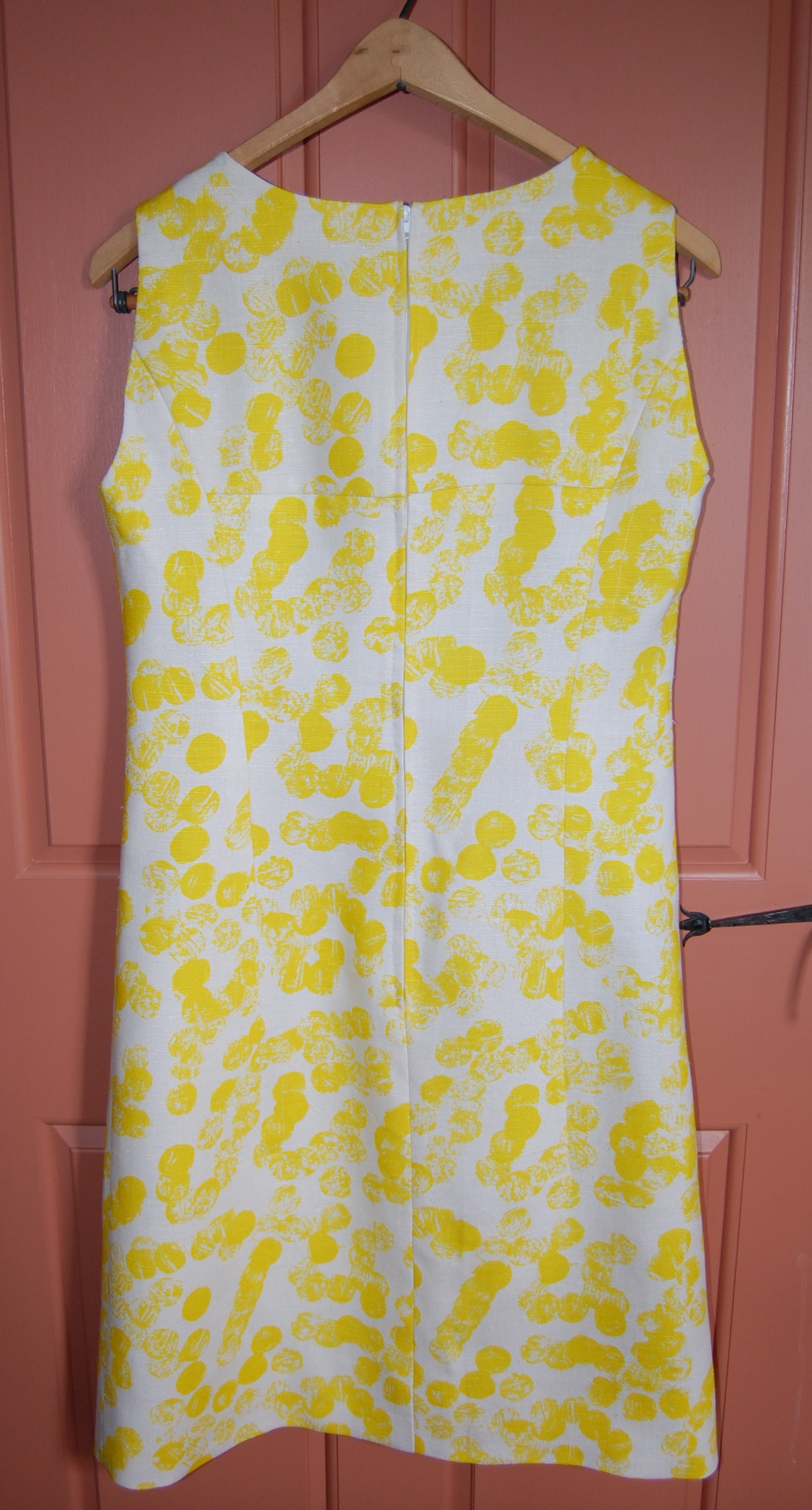
Here is the finished dress.

Here is the back view.

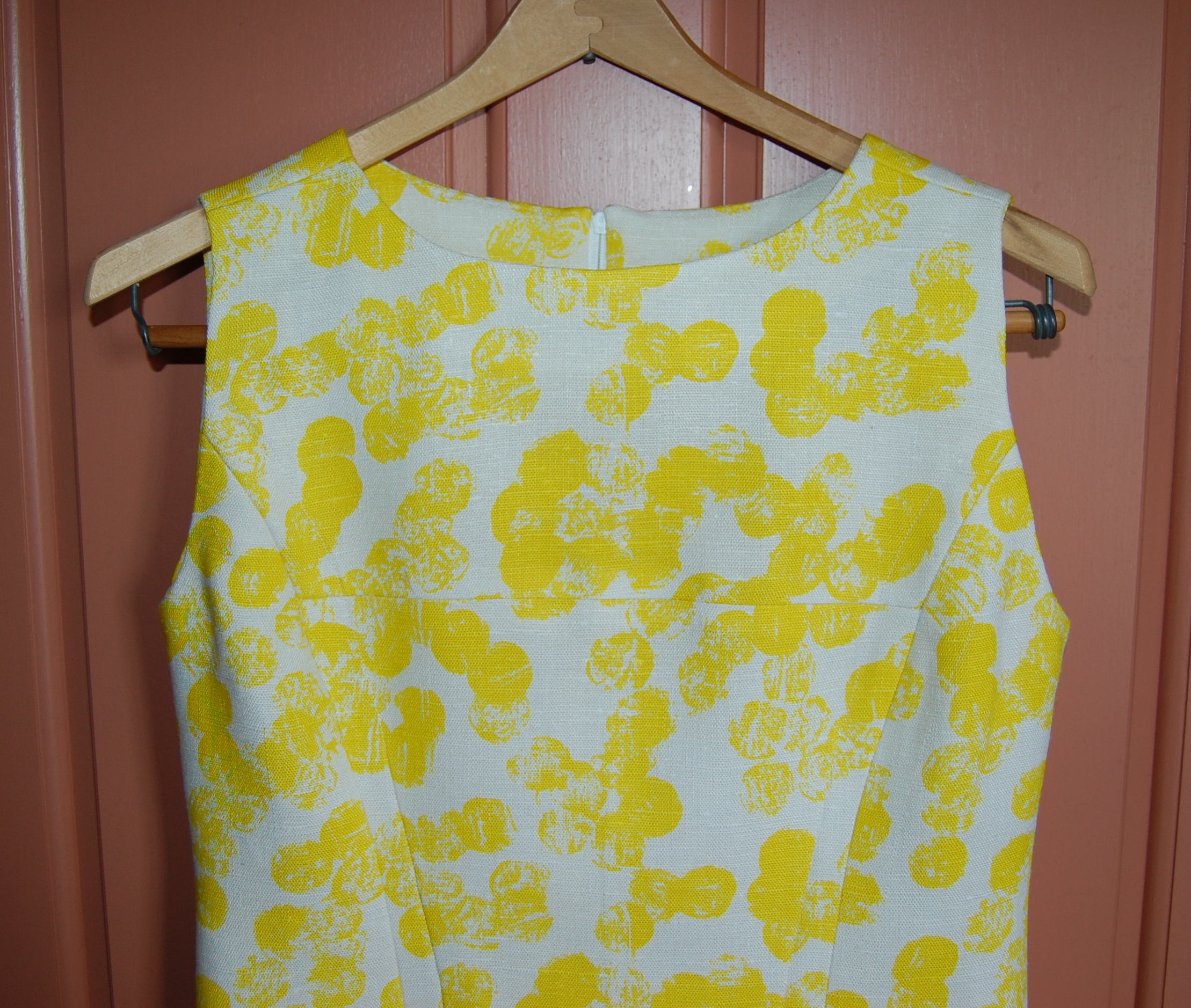
A close-up of the top of the dress. I used vintage silk thread to do the topstitching. It’s very subtle, but effective, I think, particularly in person…

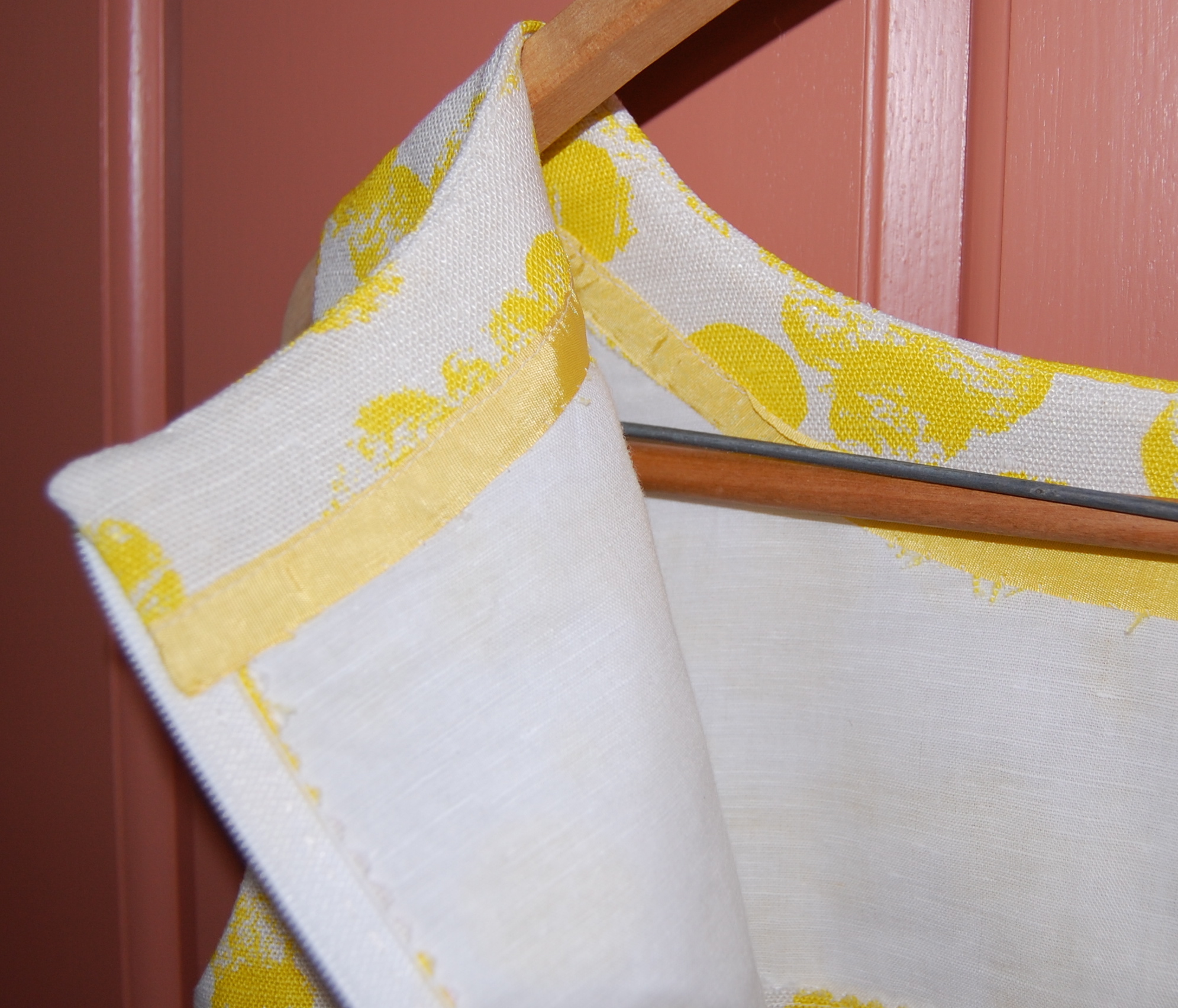
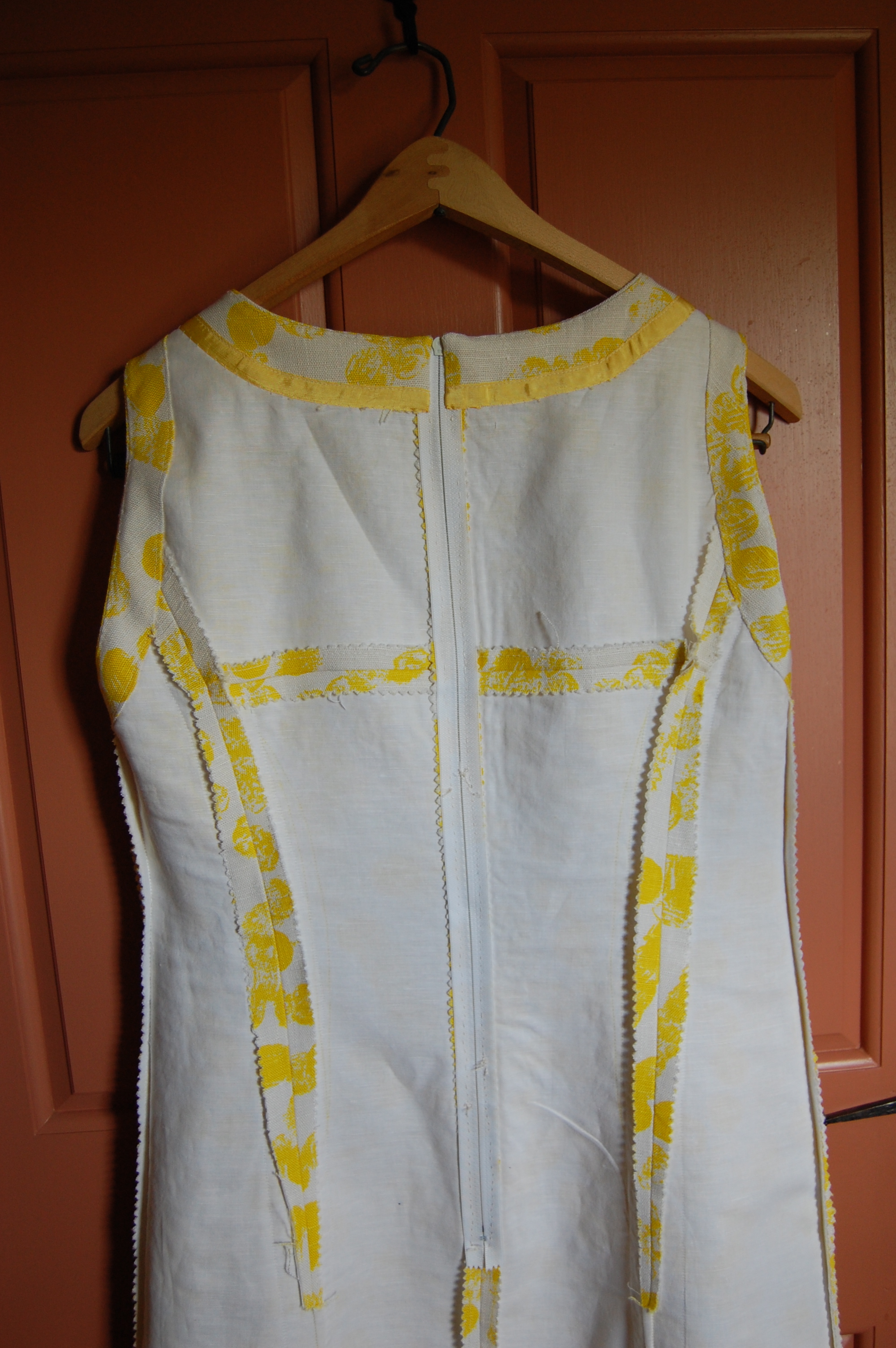
I had just enough of this yellow vintage seam tape to do the neck. It makes a nice flat finish. I sometimes do the understitching on the facings by hand. If you click on the photo, you can probably see this detail. It’s time-consuming, but makes a nice finish!

Finally, for anyone who’s interested, here’s the inside story!

I really like this dress – it’s cheery, comfortable and casually dressy – what more could one ask for?

8 Comments

Filed under Linen, Polka dots, Uncategorized, vintage Vogue patterns from the 1960s, Vogue patterns

Quiz #2: Match the fabric to the pattern

Of all my sewing projects, which are either in the works or in the planning stages, two of them will be completed shortly. (At least I hope they will be.  Everything always seems to take longer than I anticipate…  Does anyone else find that to be true?)   However, I’m just not ready to report on either of these “almost-finished” endeavors yet.  . . . So I thought I would take this opportunity to expand a bit on my infatuation with Moygashel linen – and give you, my readers, some more beautiful vintage fabrics to see – and to allow you to imagine them all dressed up and ready to wear.

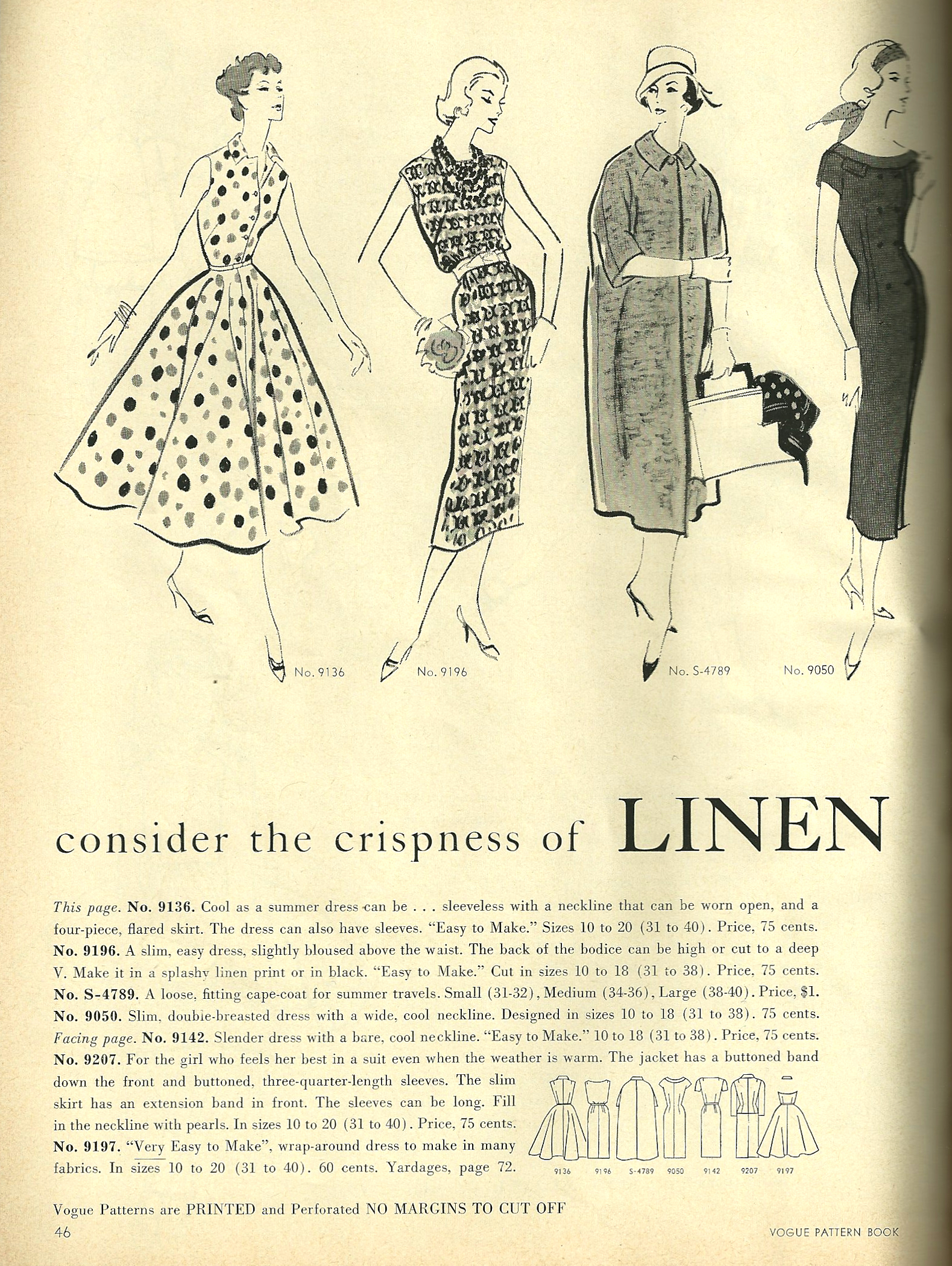
In the Vogue Pattern Book from Summer of 1957, one of the articles implores the reader to “consider the crispness of LINEN”.

This June/July issue is perfect to feature linen - it is a great fabric for Summer - cool, crisp, washable, and the perfect weight for dresses and suits.

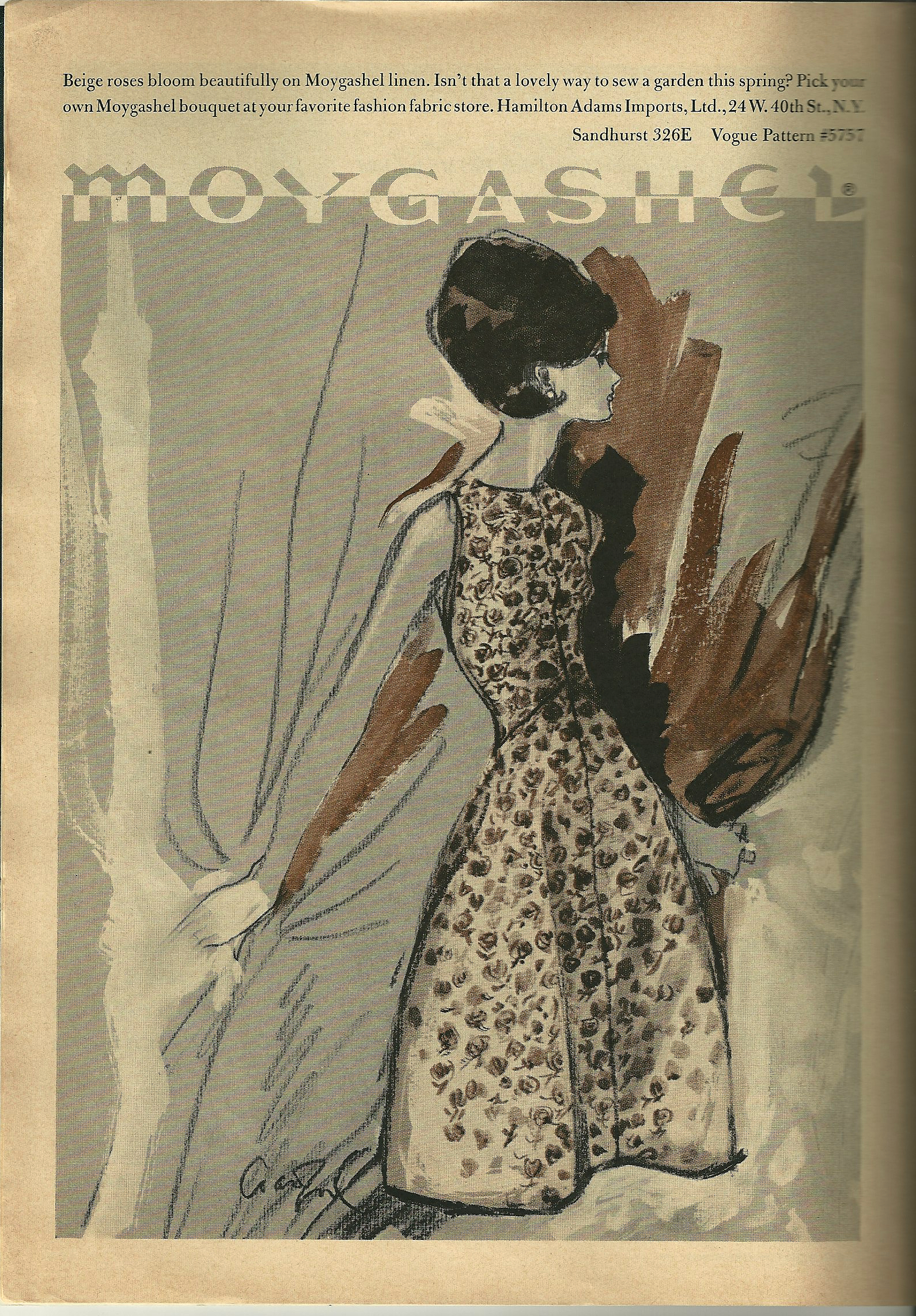
Articles like this, and ads for linen fabrics, showcase the popularity of sewing with linen in the 1950s, ‘60s, and ‘70s.  I shared a few Moygashel linen ads with you recently, and here are three more, which illustrate the range of designs and colors available to the mid-century home sewer.

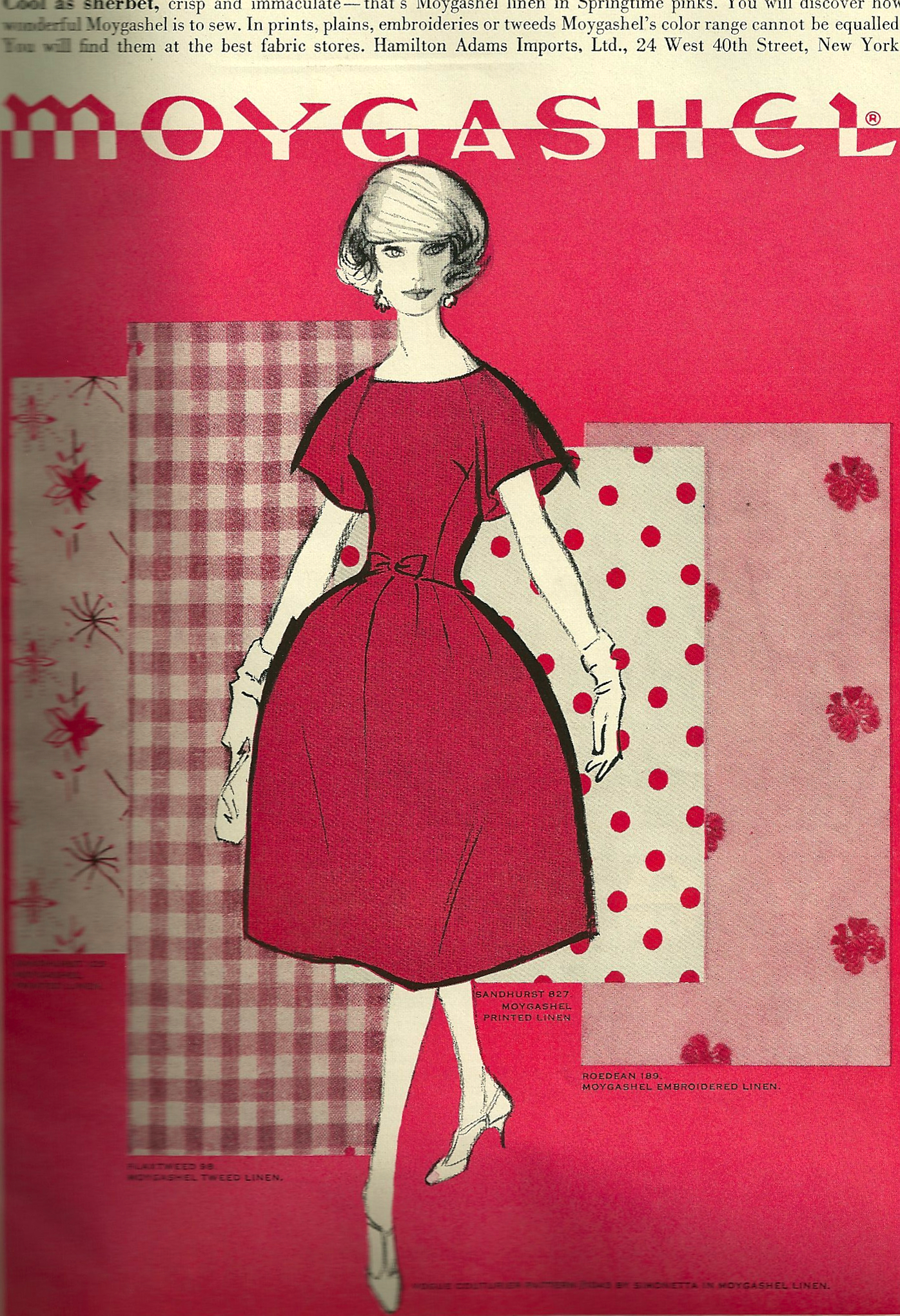
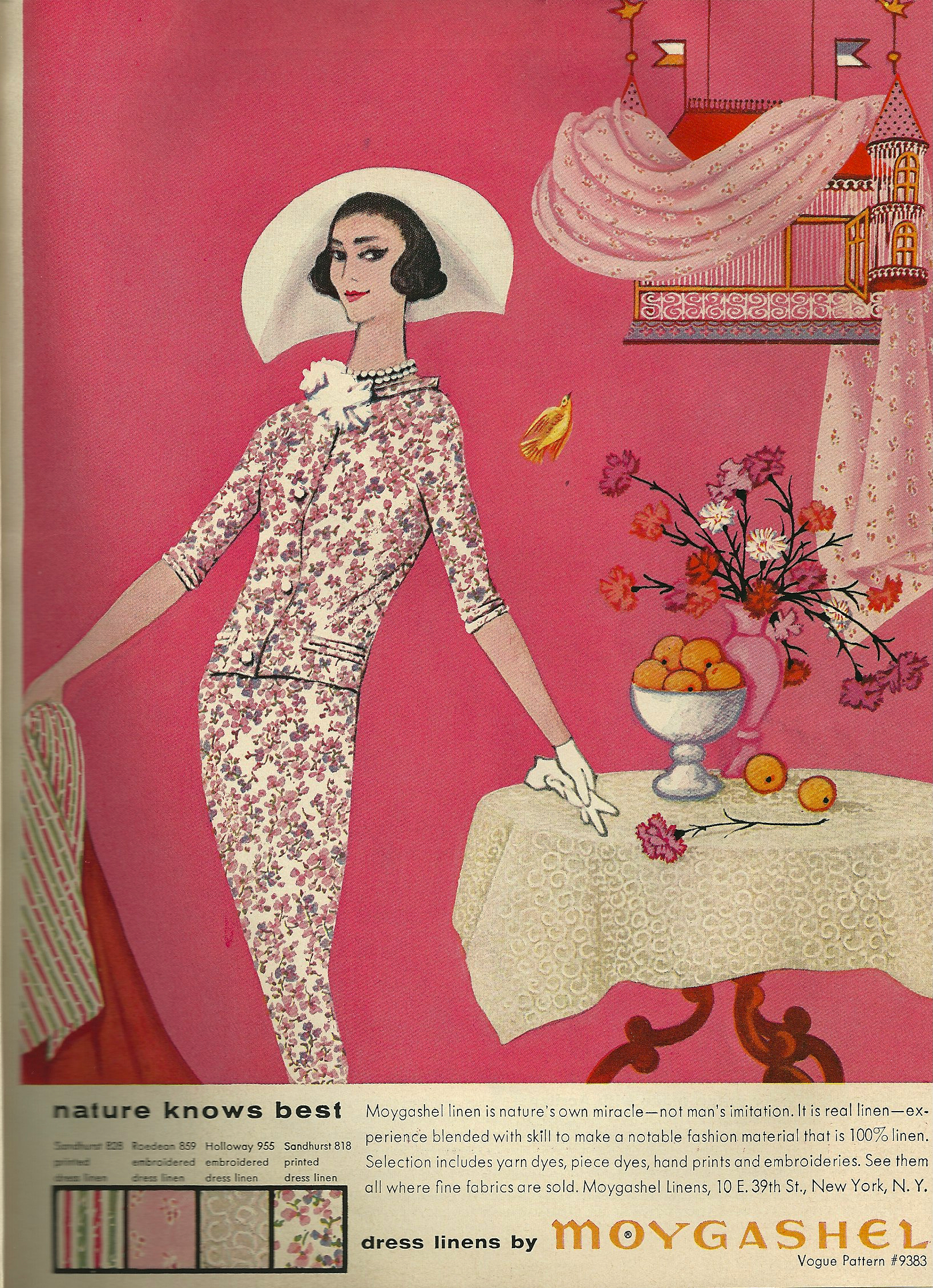
This almost whimsical illustration depicts four designs of Moygashel linen. It appeared in the February/March 1958 issue of Vogue Pattern Book magazine.

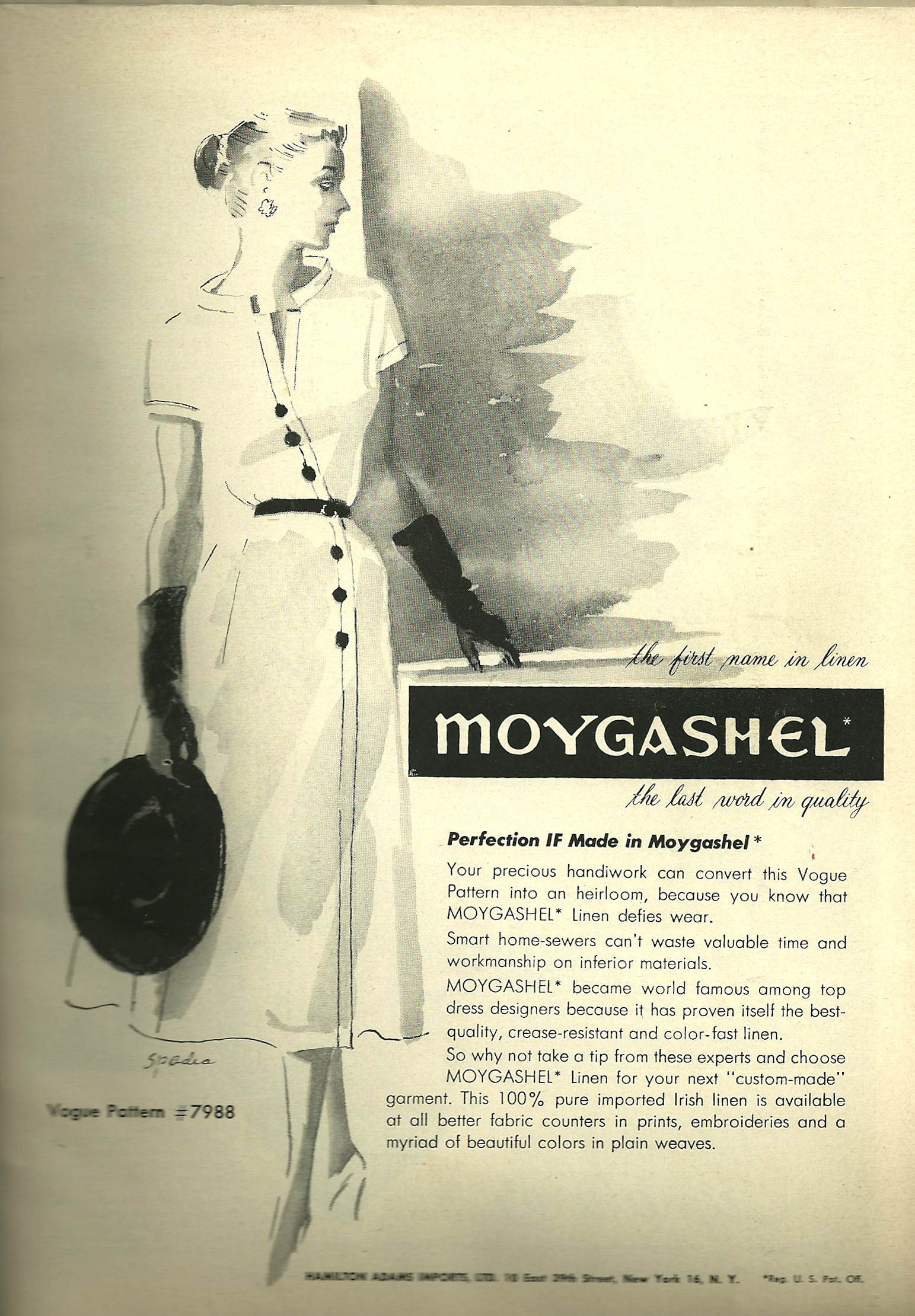
This ad states: "Your precious handiwork can convert this Vogue Pattern into an heirloom, because you know that Moygashel Linen defies wear." Those words were certainly presentient! It appeared in the April/May 1953 Vogue Pattern Book magazine.

Here are four more Moygashel linens, featured in the February/March 1957 Vogue Pattern Book magazine.

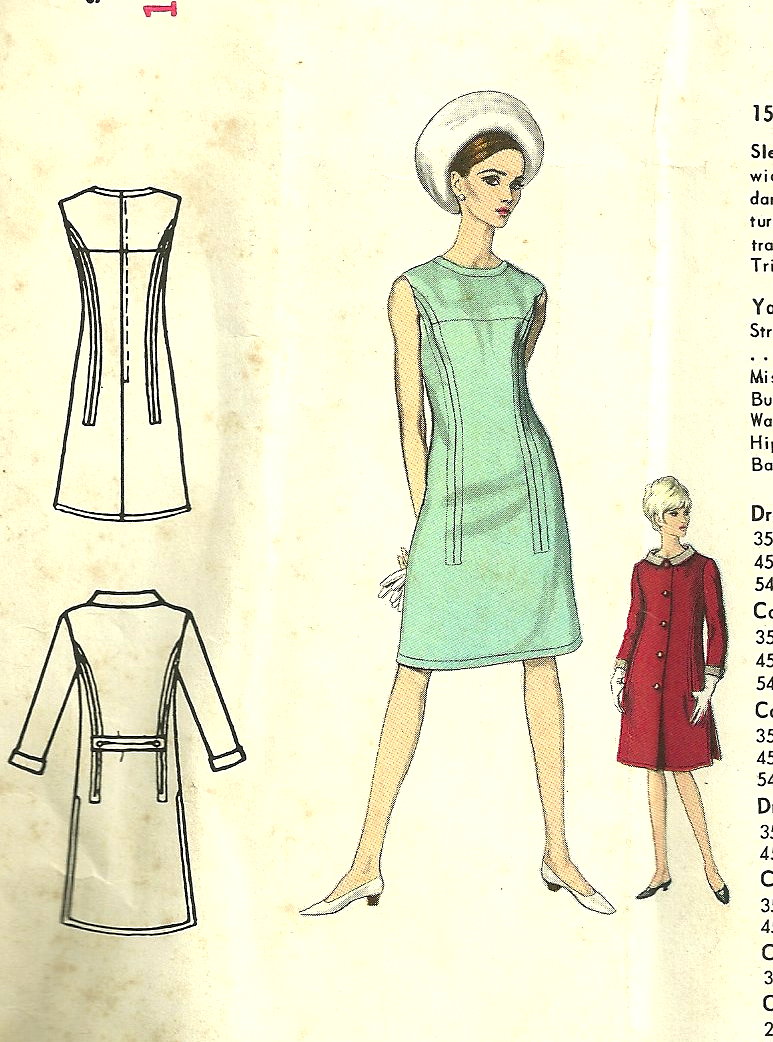
I certainly decided to “consider” linen when I purchased this 1965 Vogue pattern a few months ago:

This pattern is for a paring of coat and dress, but the dress stands alone beautifully.

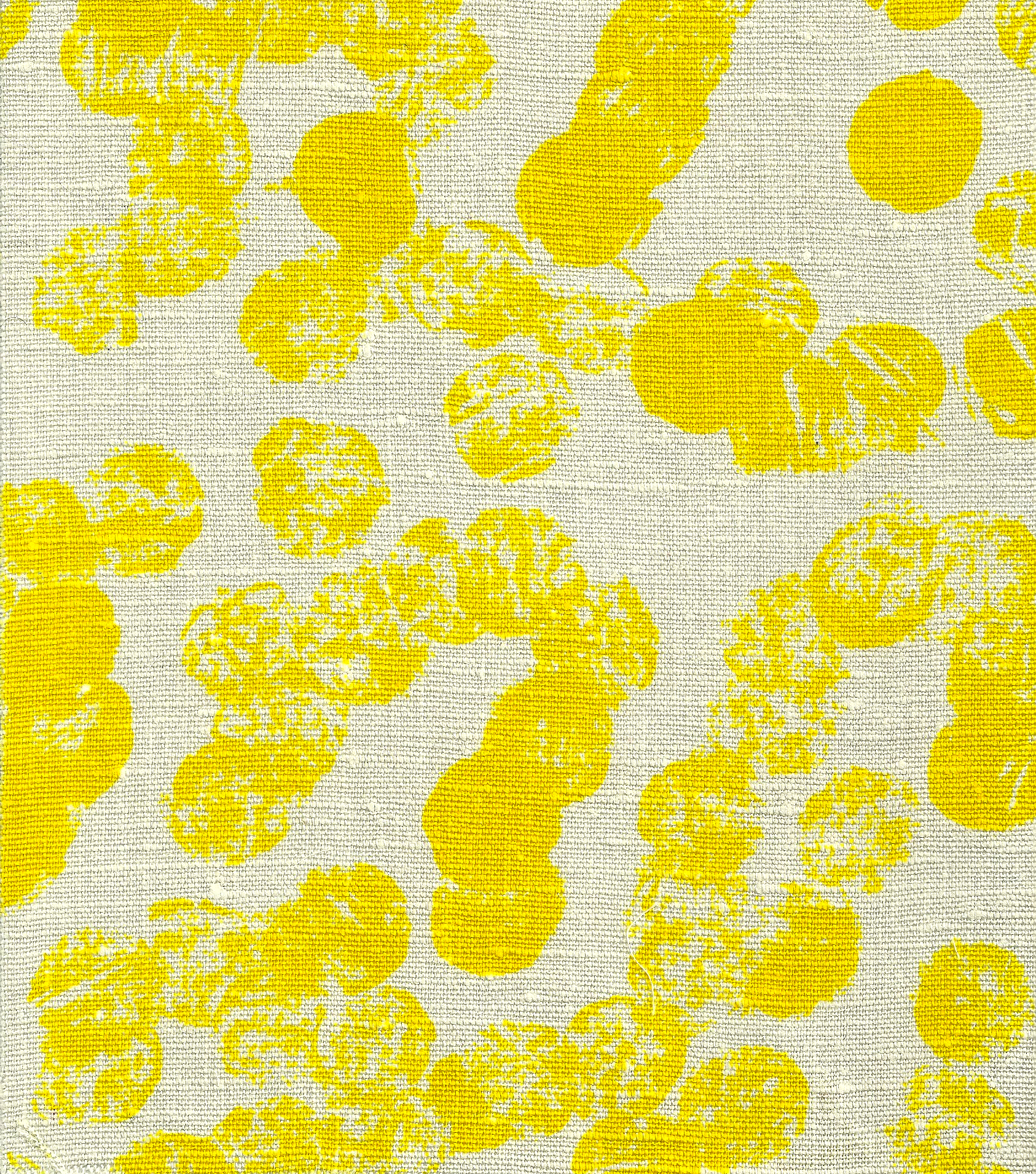
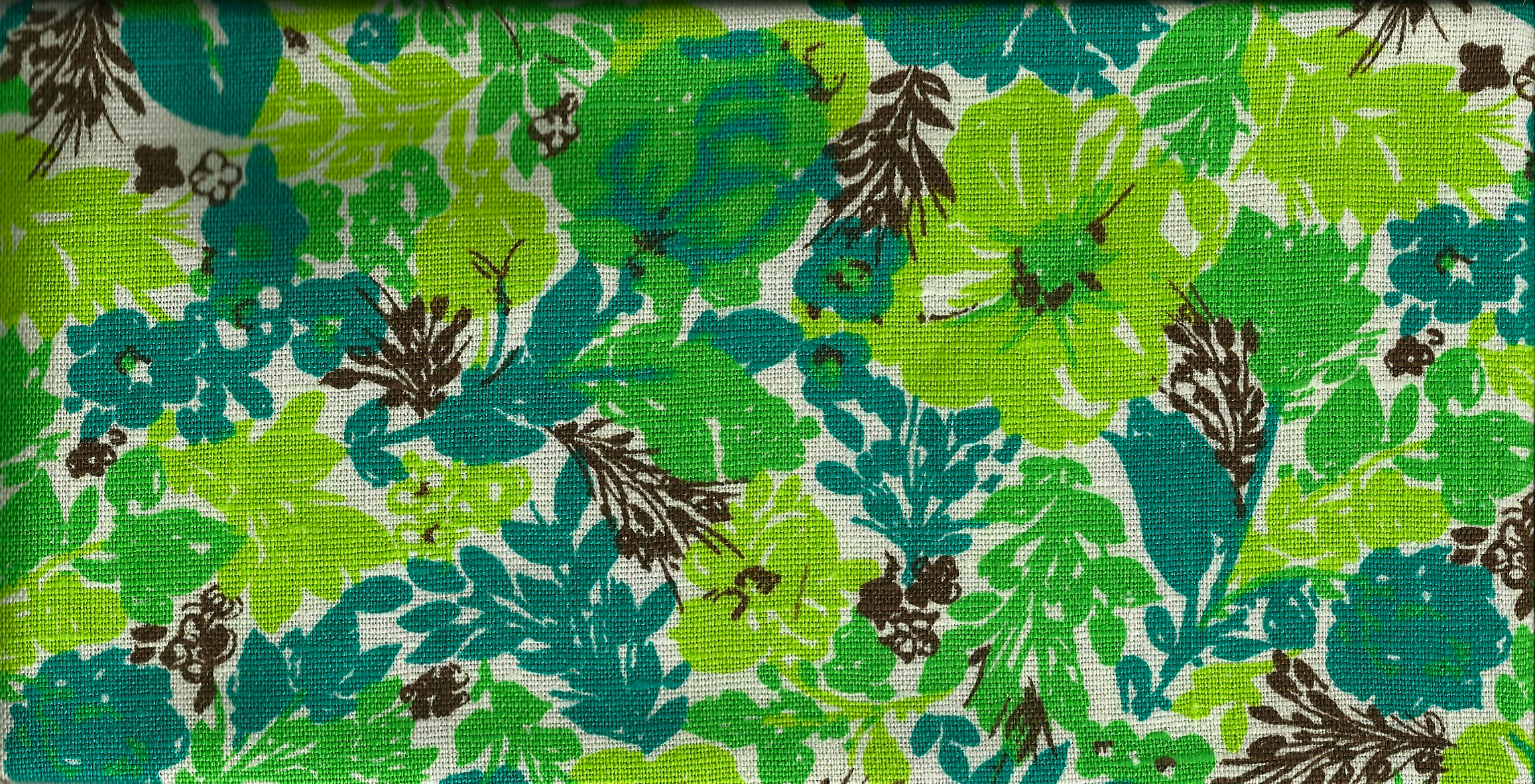
My intention was to make the dress only – a lovely sheath with some distinctive seaming and top-stitching.  So I went to my fabric closet to see what linens I could “consider” for a crisp Spring/Summer dress.  Here are the four that I decided to choose from:

#1 - Bright and sunny, this design is a subtle play on the polka dot theme.

#2 - The colors in this design are very 2012-current-and- fashionable!
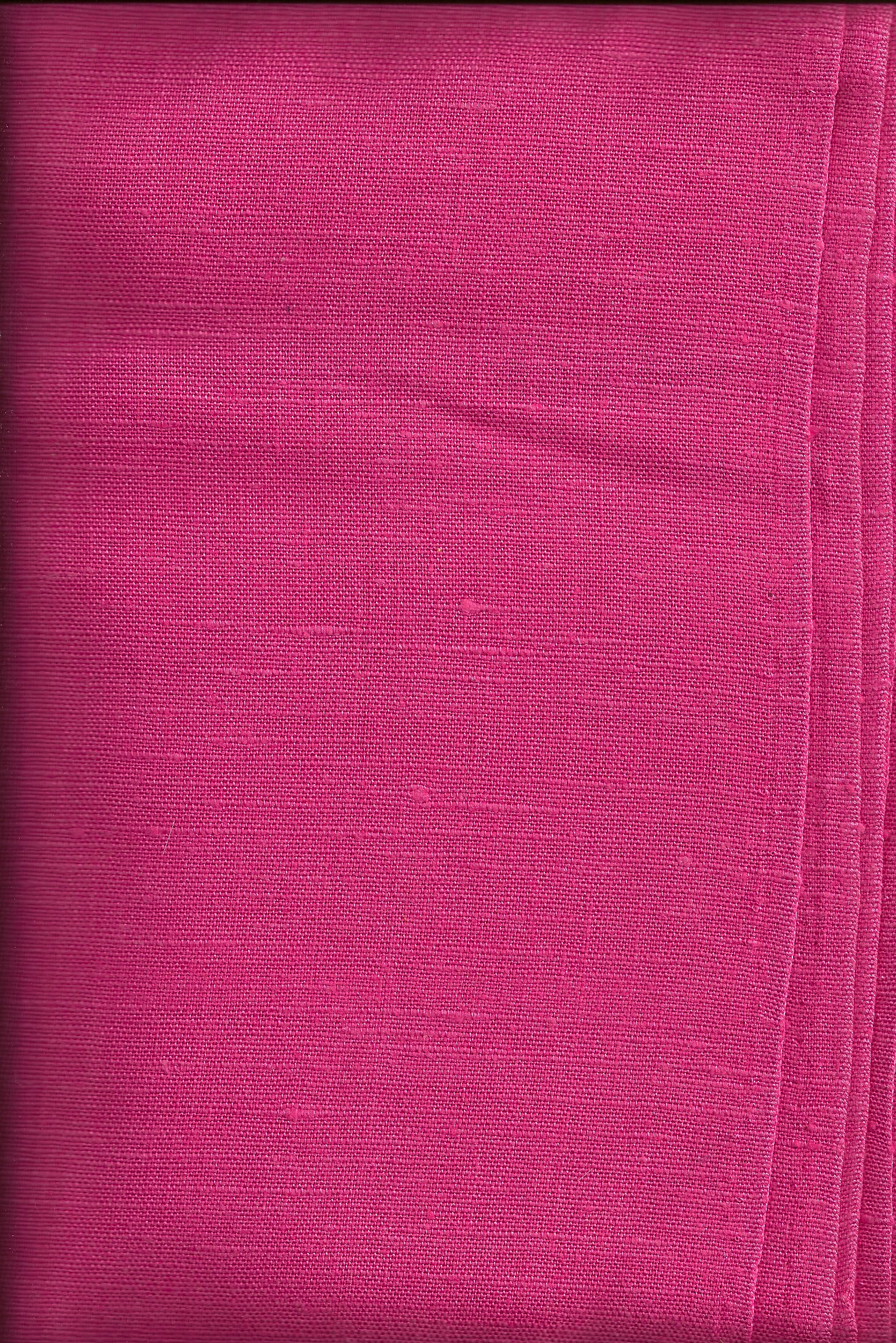
#3 - Decorative topstitching on this solid pink linen would be quite attractive.

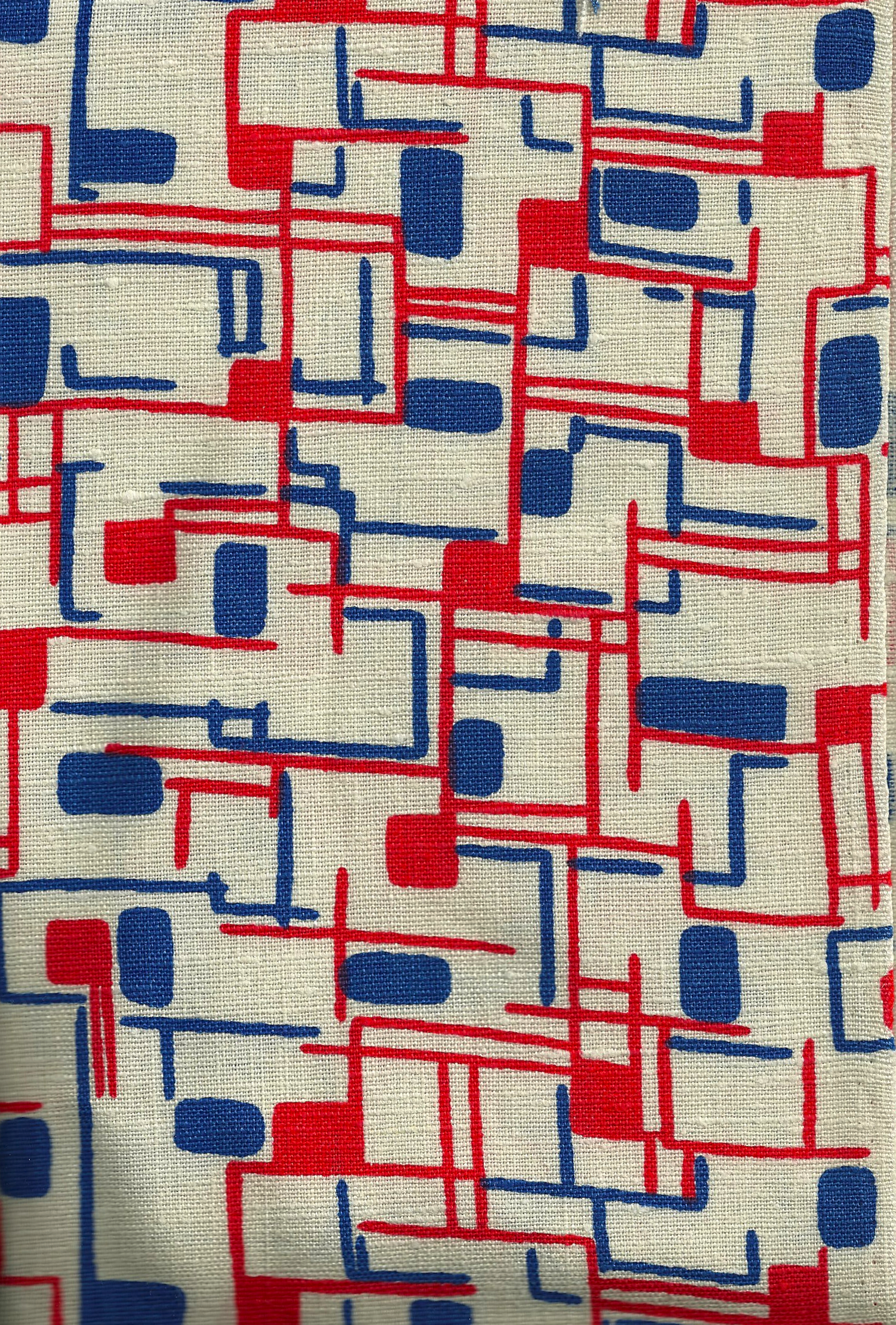
#4 - This geometric print is probably from the late '60s, so it would make up beautifully in a pattern from the '60s!
Which fabric would you choose for this dress pattern?  Which one do you think I chose to make into this dress?

6 Comments

Filed under Linen, Polka dots, Uncategorized, vintage Vogue patterns from the 1950s, vintage Vogue patterns from the 1960s, Vogue patterns

Shopping in my (cedar) closet.

In the 1940s, ‘50s, ‘60s and ‘70s, most well appointed ladies’ closets contained at least one dress or suit made from Moygashel linen.  The cachet around this product of Ireland was legendary:  it was touted as crease resistant, made so by  a special process in its manufacture which used soft rainwater from the streams in the Mourne Mountains of northern Ireland.    It has many virtues, including:

1)   it was available in many beautiful solid colors…

2)   and in amazing prints, which by themselves are like mini works of art….

3)   and in embroidered designs, which are still today instantly recognizable as Moygashel.

4)   It is machine washable.

5)   It does not wrinkle, truly!!

6)   It lasts and lasts.

It’s no wonder that designers and high-end ready-to-wear garment manufacturers used Moygashel linen and proudly displayed the name of Moygashel along with, and in addition to, their own labels.

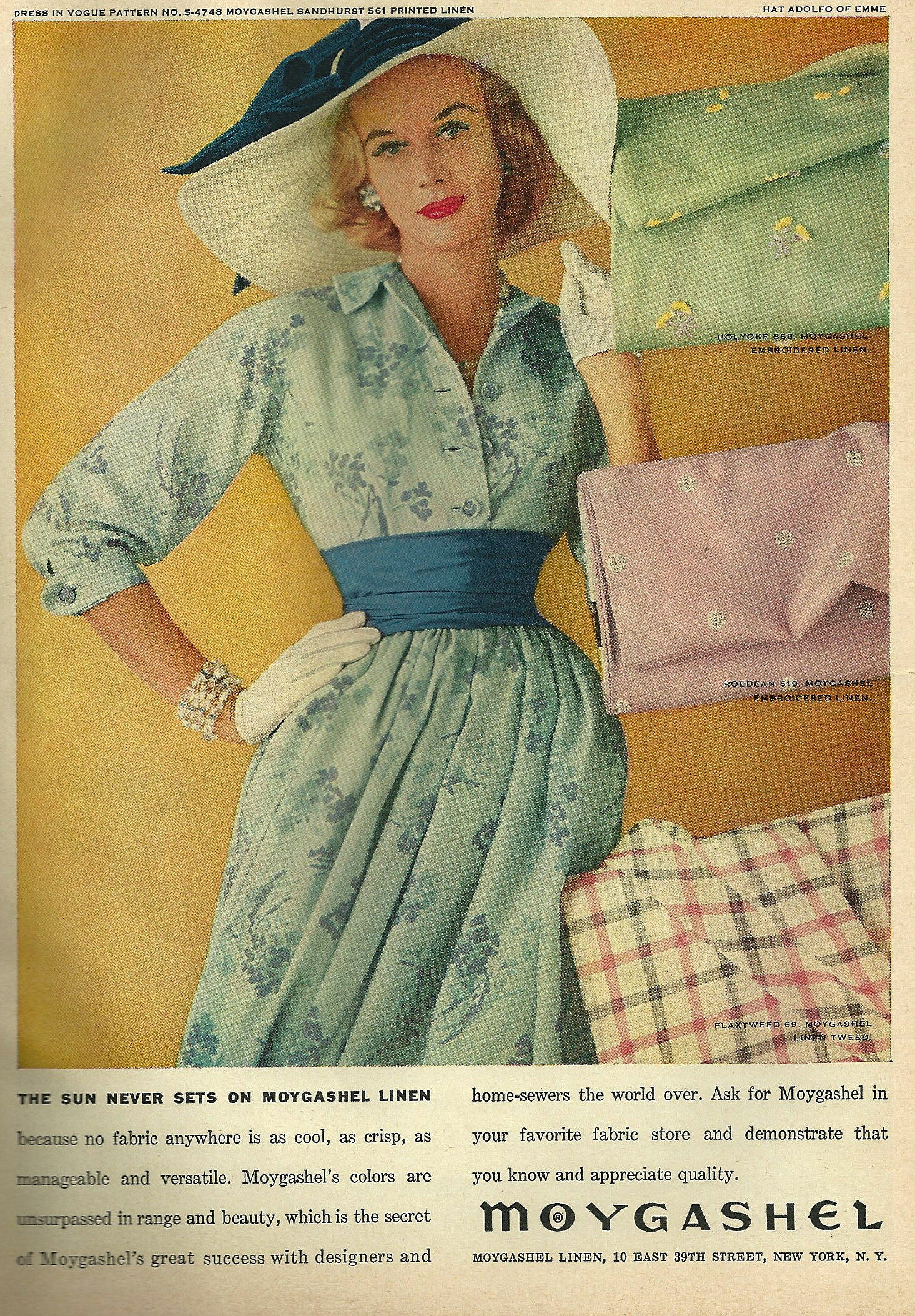
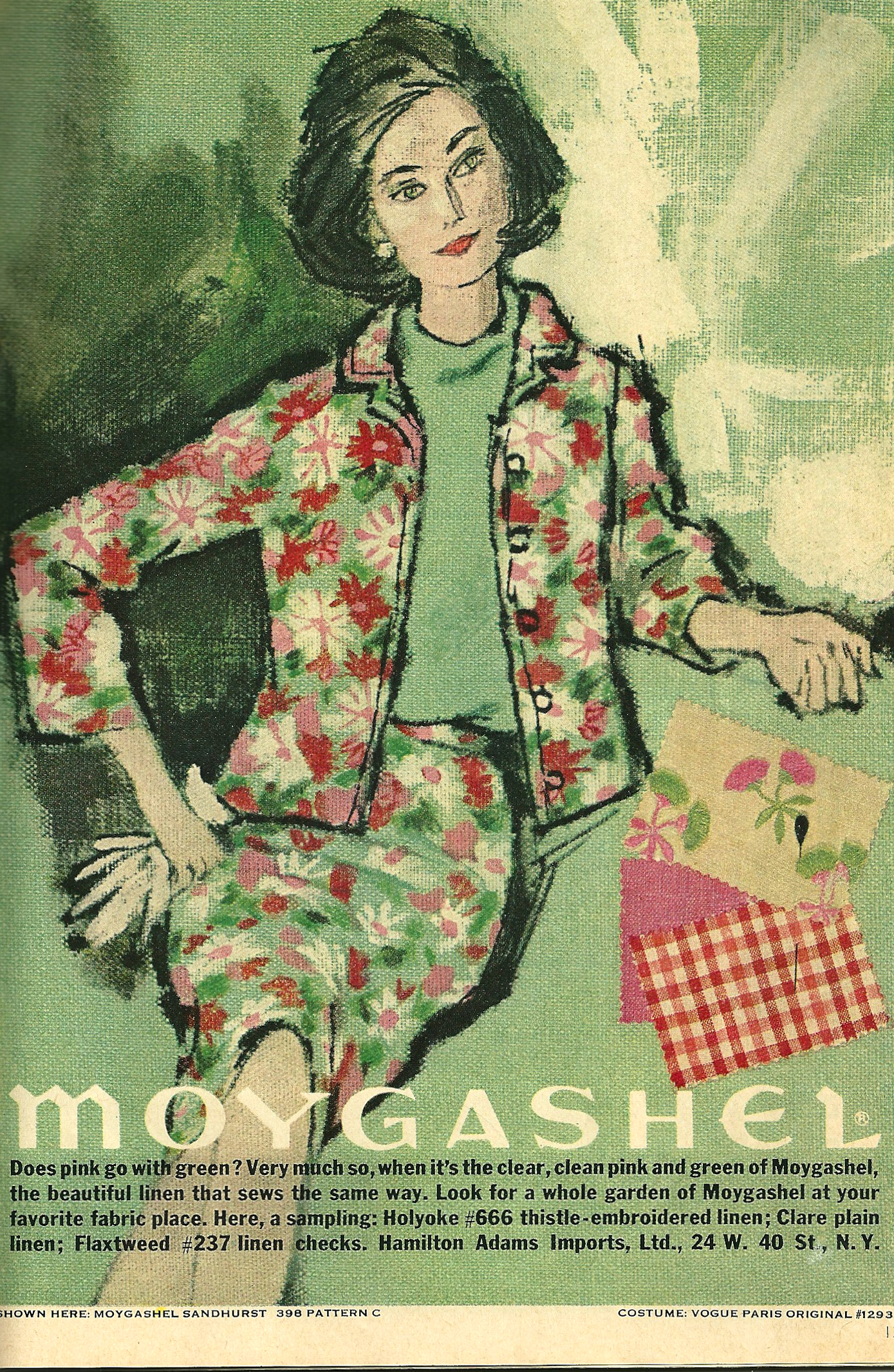
Luckily for the home sewer and dressmaker, Moygashel linen was also available in yardage at the finest fabric stores and departments.  Obviously home sewers took to it readily.  Artful, full-page ads for Moygashel linen in sewing and pattern magazines were commonplace.  Here are a few that were given up-front placement in issues of the Vogue Pattern Book magazine from various dates in the ‘60s:

This ad was featured in the February/March 1961 issue of Vogue Pattern Book magazine. The dress illustrated is a Vogue pattern from the designer series. I love that this ad shows 5 different linens available for purchase.

This ad appeared in the February/March 1963 issue of Vogue pattern Book. It has such a sophisticated look to it, which was a hallmark of Moygashel ads.

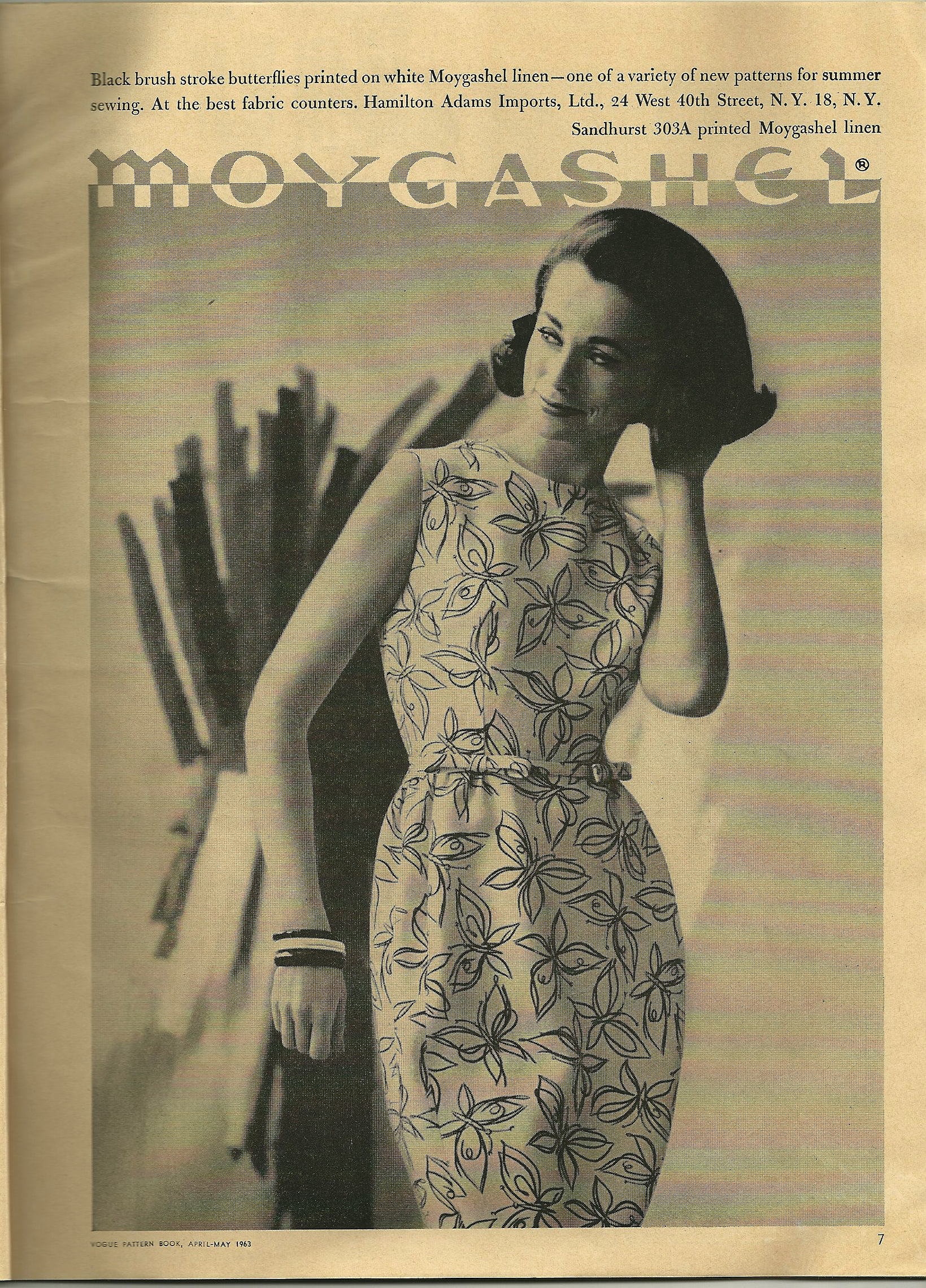
Occasionally Moygashel ads would feature a real model, such as this one from the April/May 1963 issue of Vogue pattern Book.

As I am a big fan of the color pink, I'm particularly fond of the linens featured in this ad from the February/March 1964 Vogue Pattern Book.

As I began to do more and more serious sewing for myself in the late ‘60s, I, too, took notice of Moygashel linen, which started my long love-affair with it.  I was even fortunate enough to purchase a few select pieces in the 70’s: I made dresses and suits and skirts, most of which I no longer have.  However, my current renewed interest in sewing and mid-century fashion and patterns led me to my cedar closet with a fresh eye.  So what did I find in that fragrant repository of out-of-season, out-of-date, and too-sentimental-to-give-away clothing ?  In reverse chronological order, here are three Moygashel treasures:

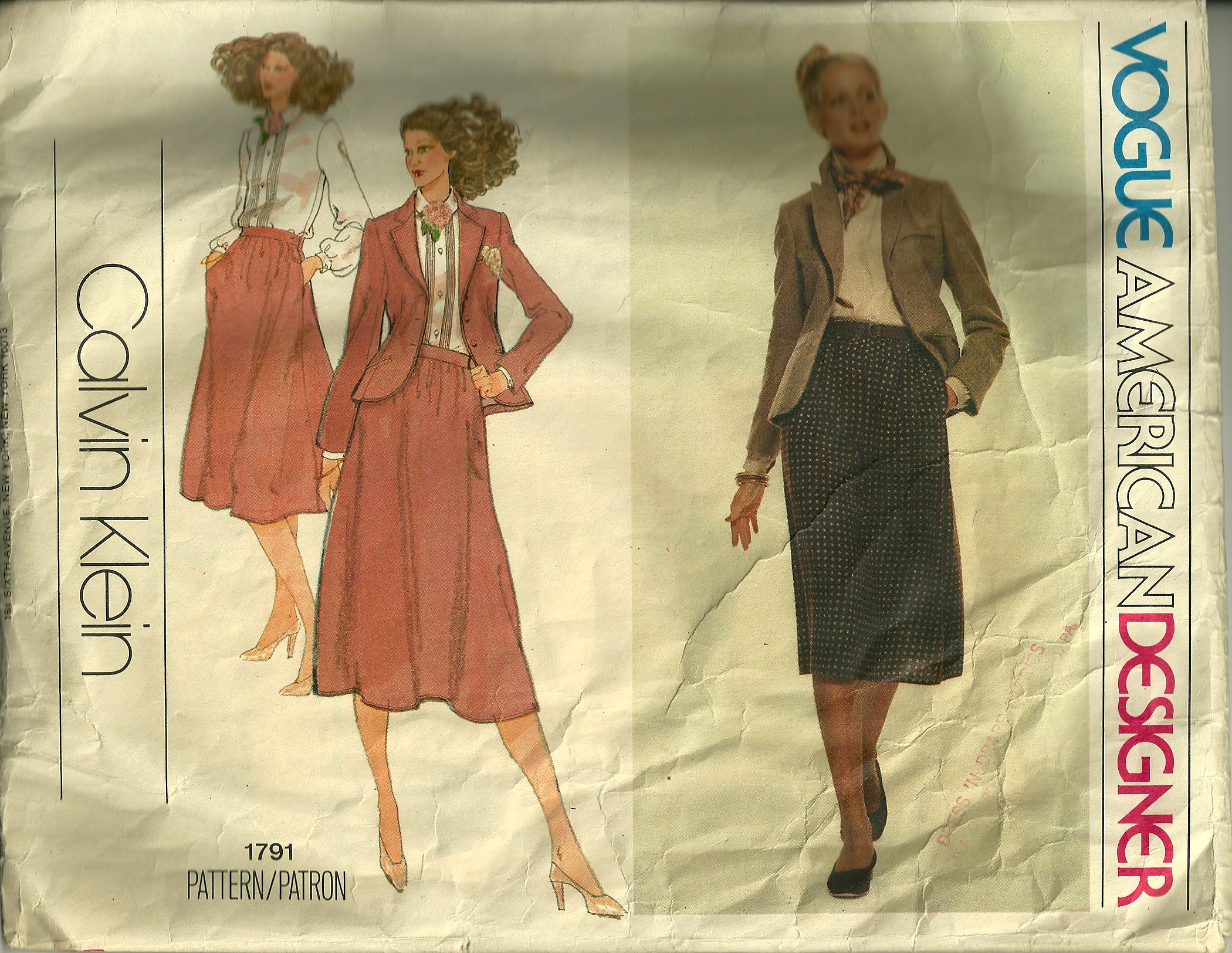
1)   Carefully packed away in a box I found an almost-completed jacket and unfinished skirt, complete with pattern and pins and thread.  Here is the pattern, which is from 1981:

The jacket of this pattern looks just as stylish today as it did in 1981. I'm not sure why I never finished it three decades ago.

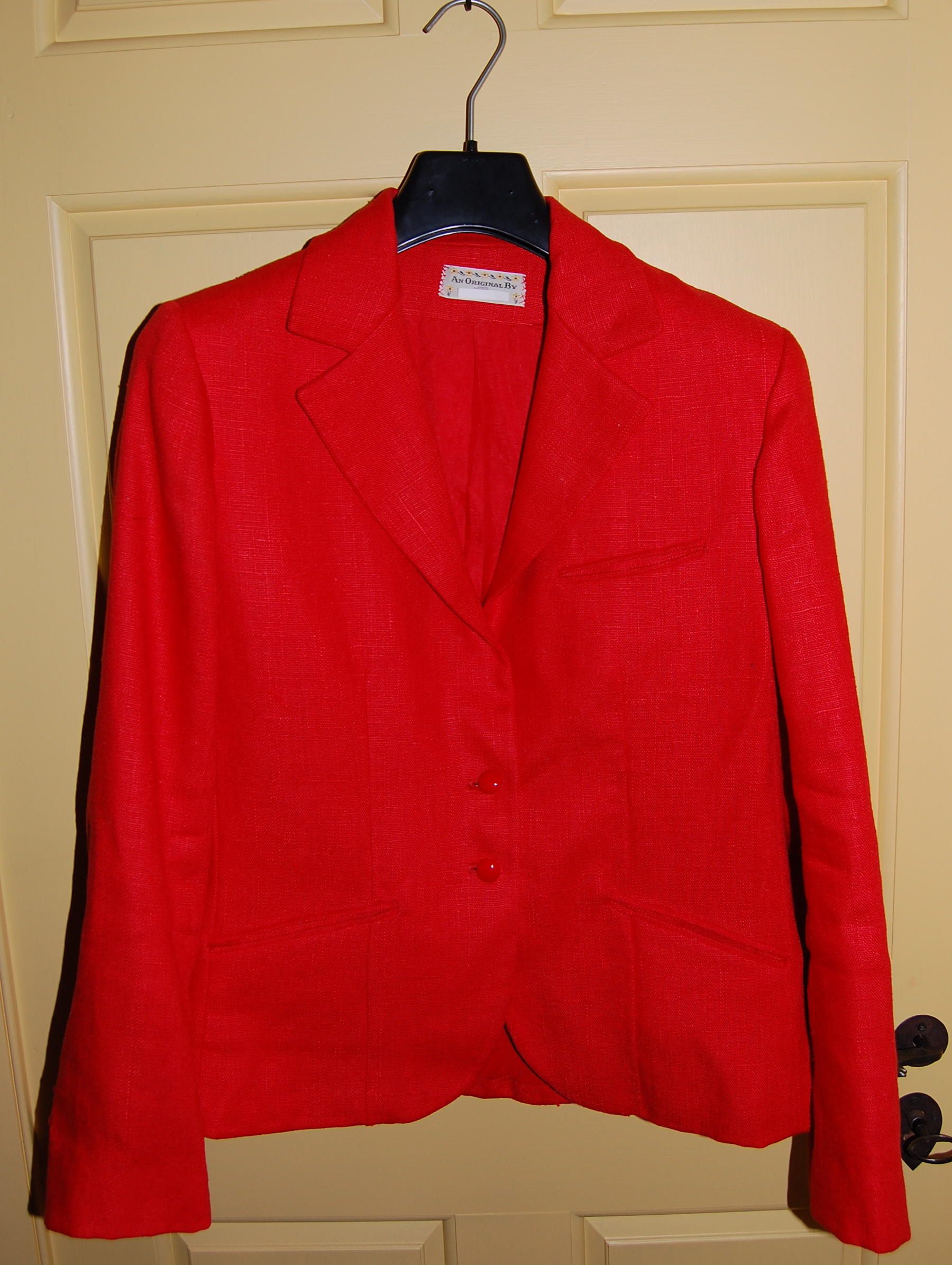
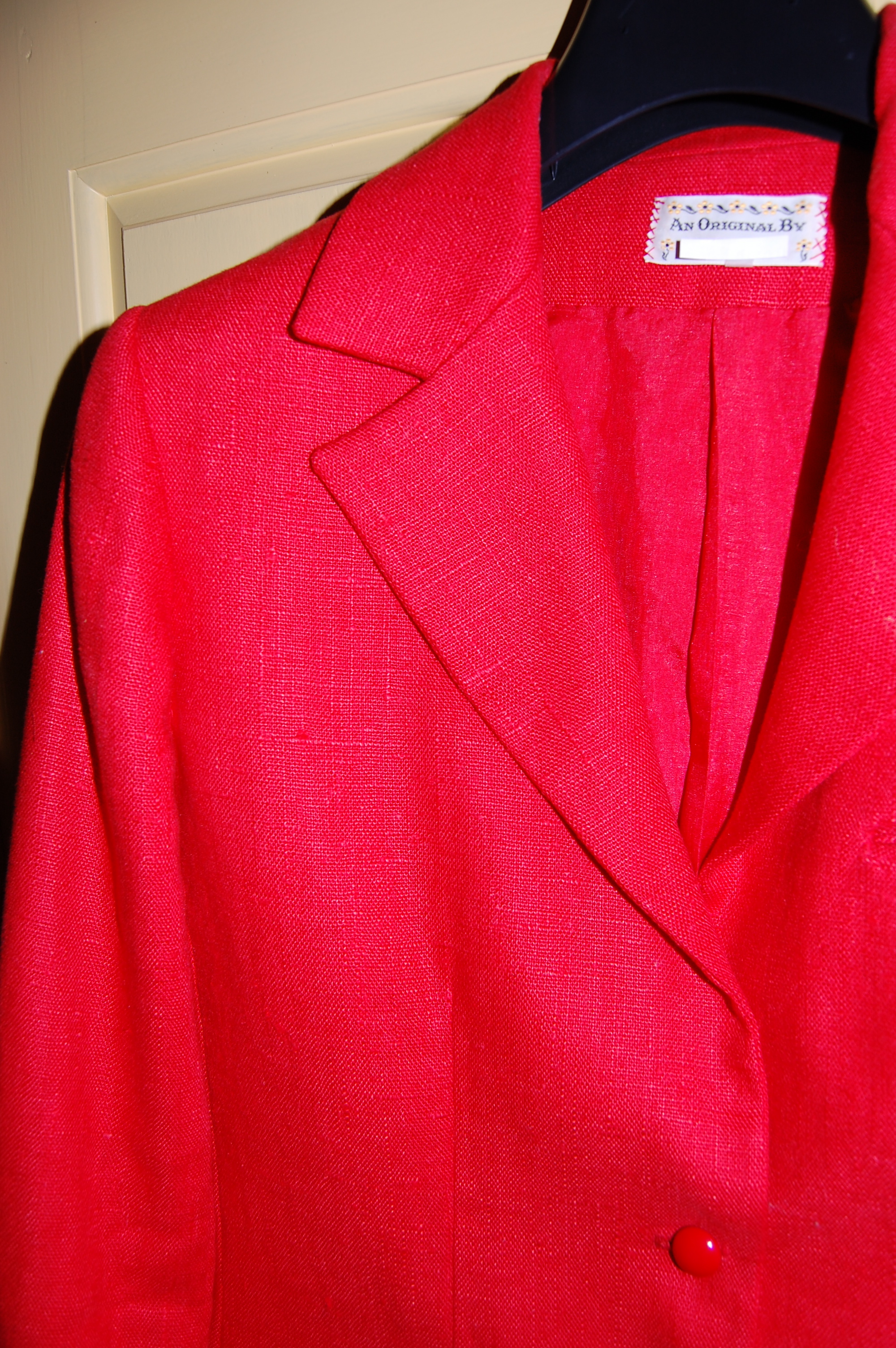
Last Spring I (finally) completed the jacket, with buttons and a few stitches here and there,  and it is now a valued member of my Spring and Summer wardrobe.  I’ll probably recycle the skirt fabric into something else, still to be determined.

I am also a big fan of the color red, so I couldn't be more pleased that I chose this red for this jacket so many years ago.

Here is a close-up of my 1981 jacket. I hope you can see the beautiful quality of the linen.

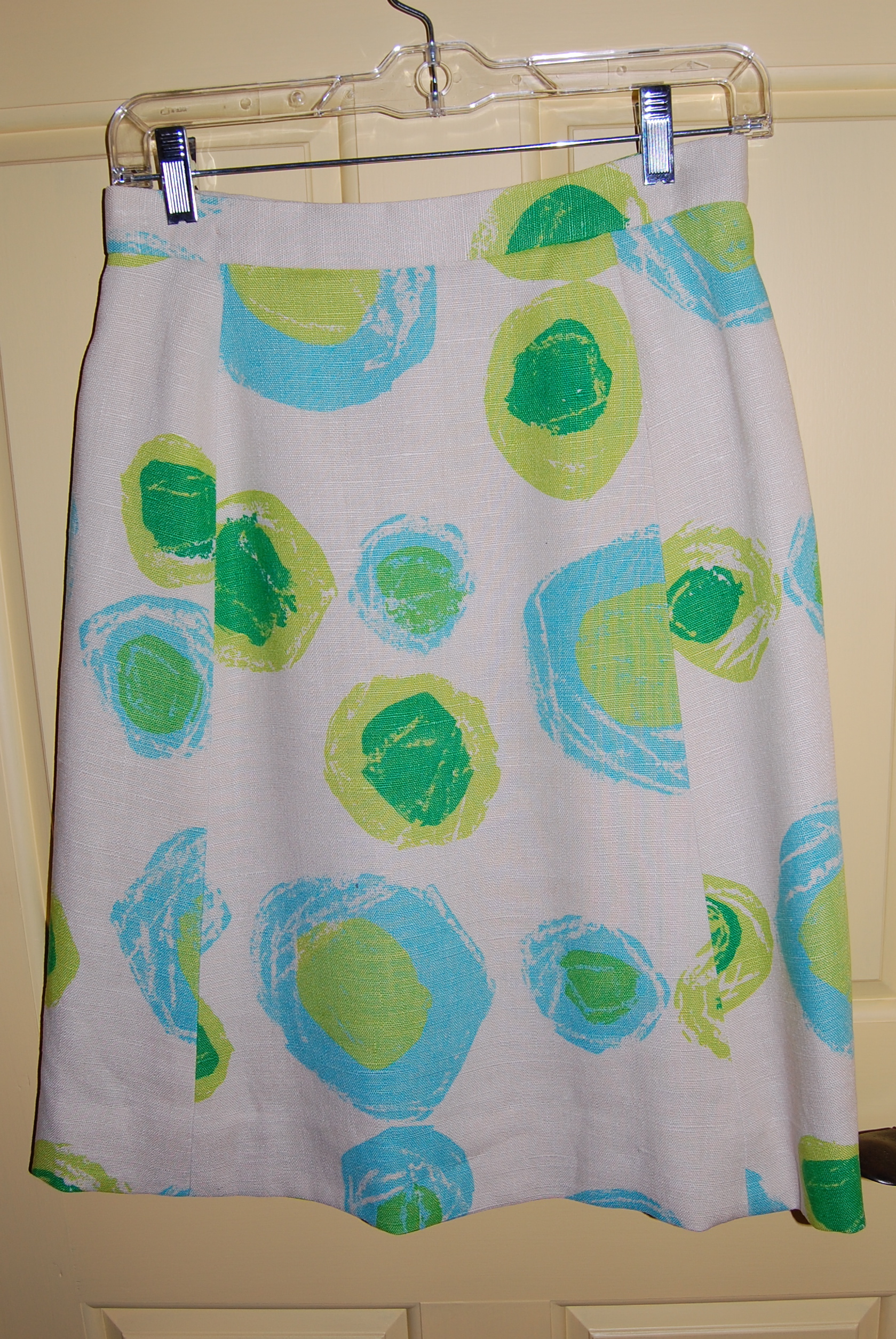
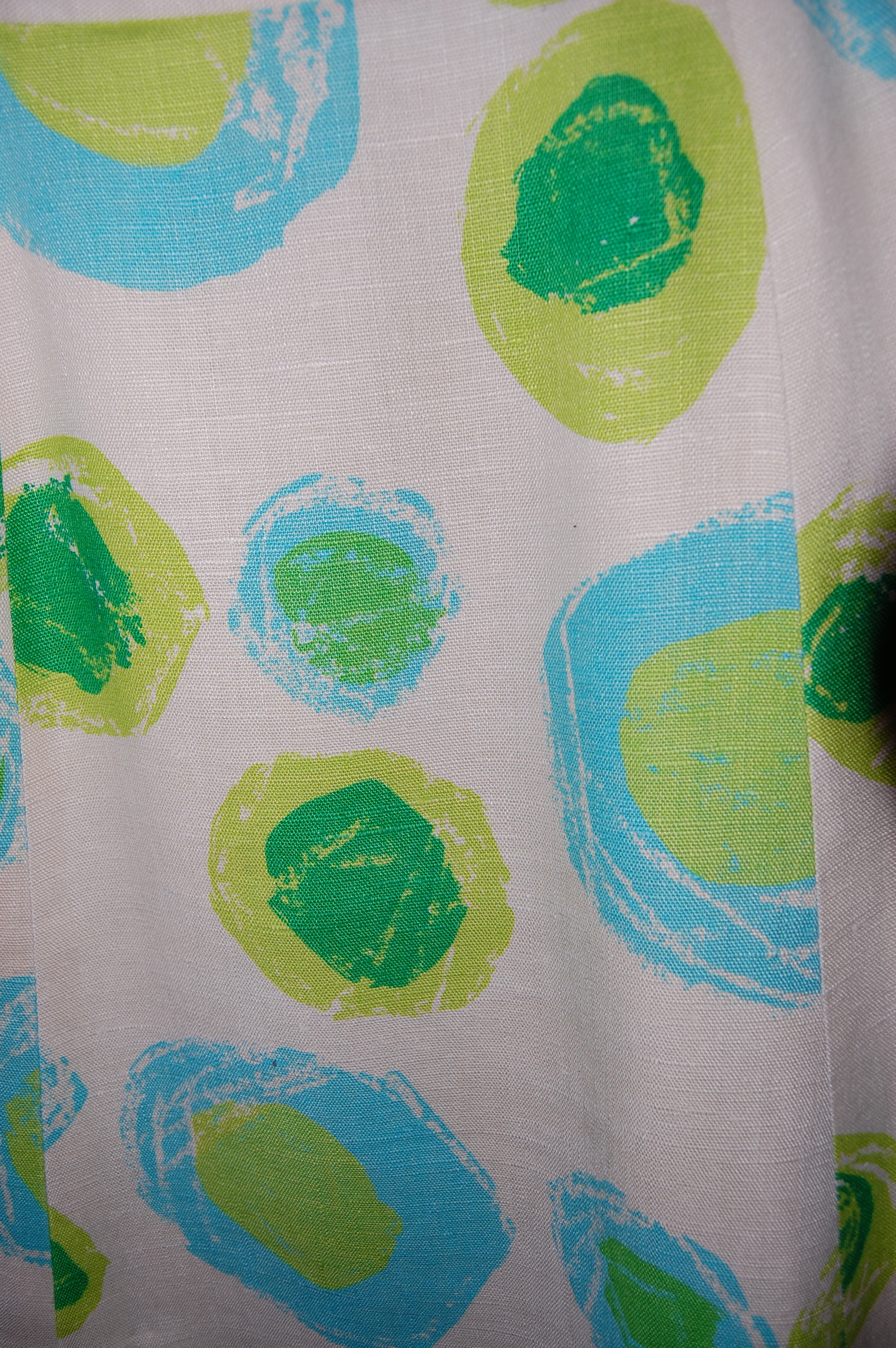
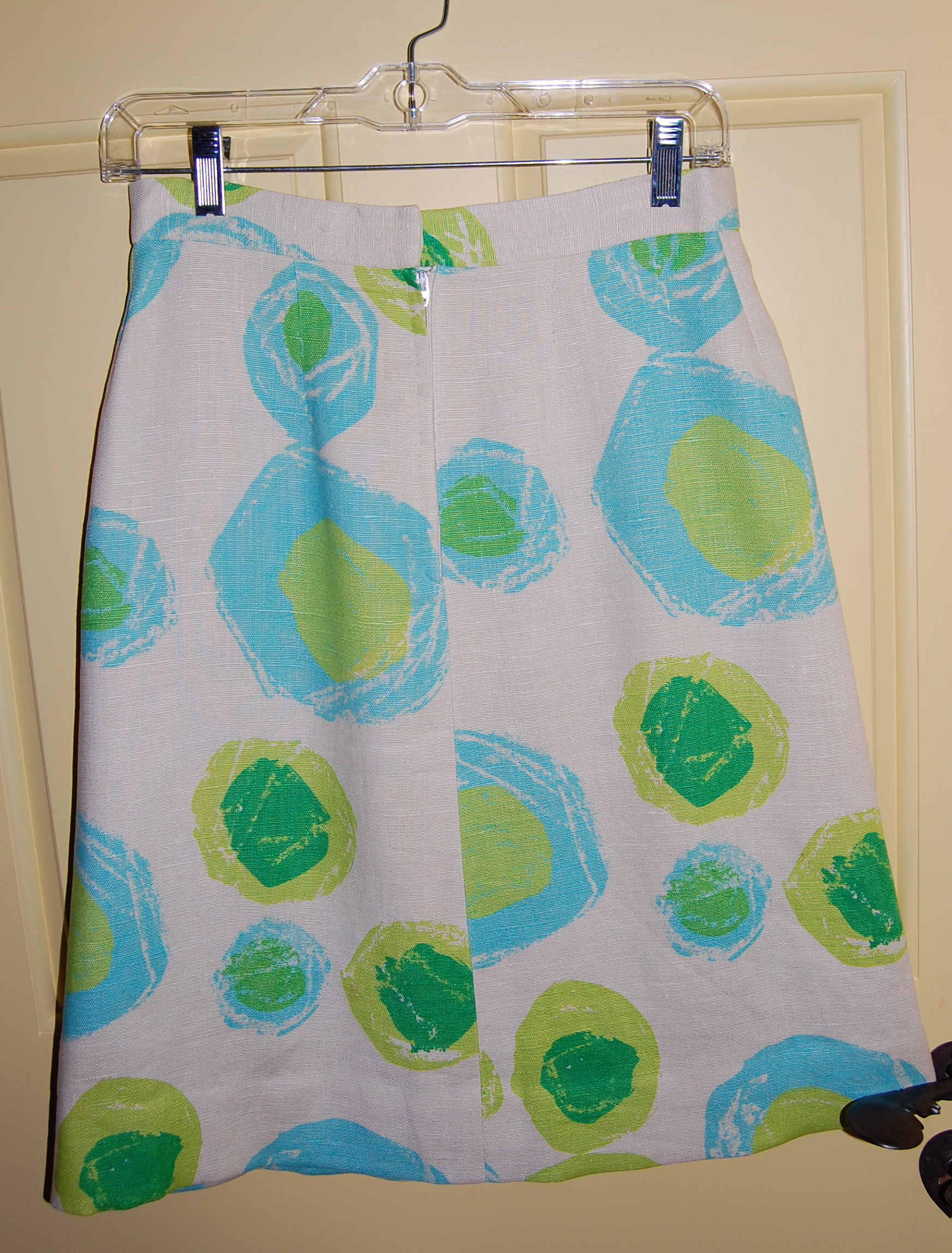
2)  My mother-in-law was a lady of great taste in clothes, and although she did not sew, she would occasionally have her “dear little German dressmaker” make something special for her.  I told her about the wonderful fabrics available at Stapler’s on Walnut Street in Philadelphia, and I believe she made some fabric purchases in combination with one of her many day trips with friends to the city and to the Forrest Theatre.   One of her purchases (circa 1975) was a colorful piece of Moygashel linen, from which she had a long “hostess” skirt made.  I eventually ended up with this skirt, which I took apart and remade two years ago into this shorter version:

The colors and design in this fabric are so eye-catching.

Here is a close-up of the skirt fabric, which is quintessential '70s!

Here is the back of my re-made skirt.

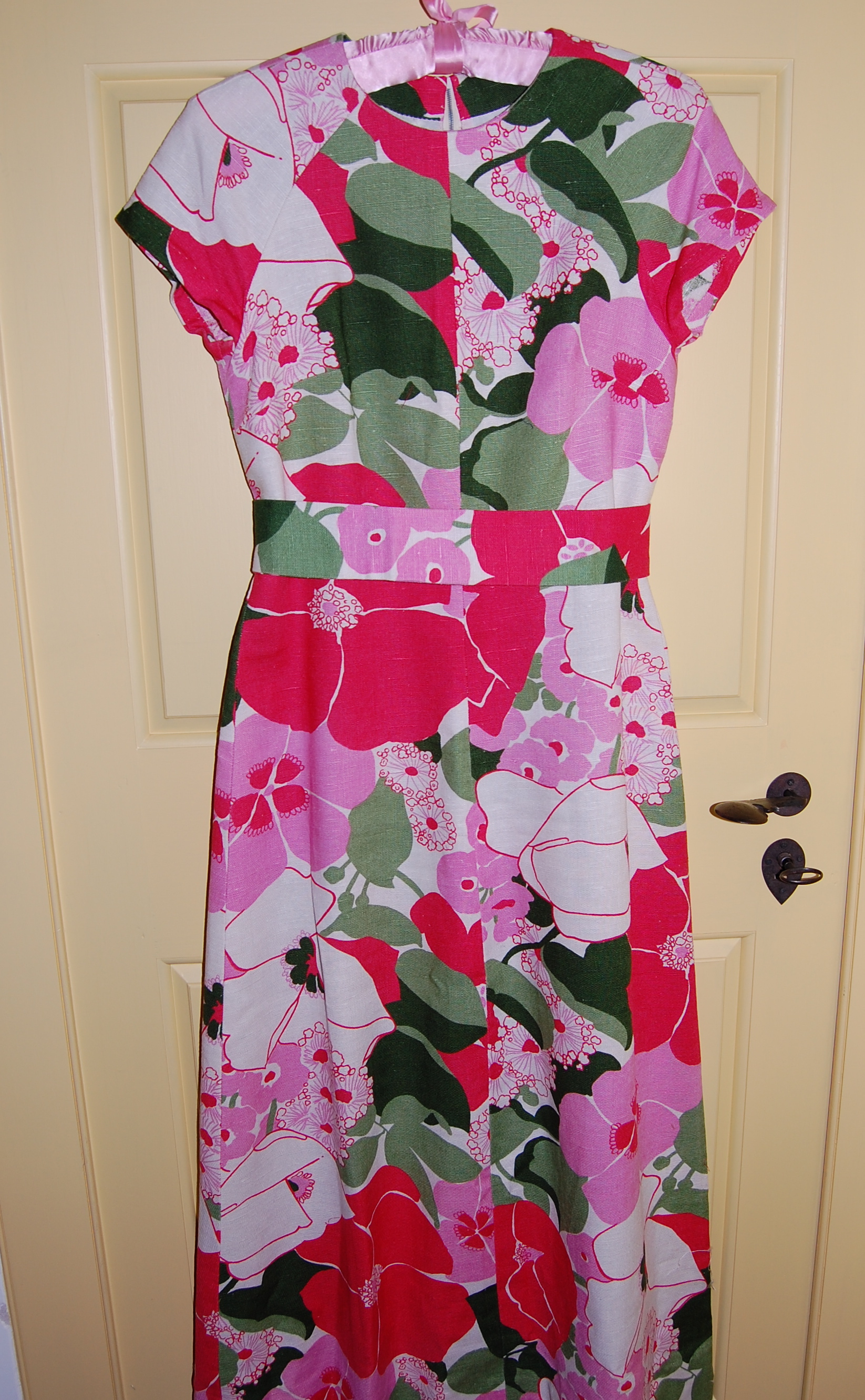
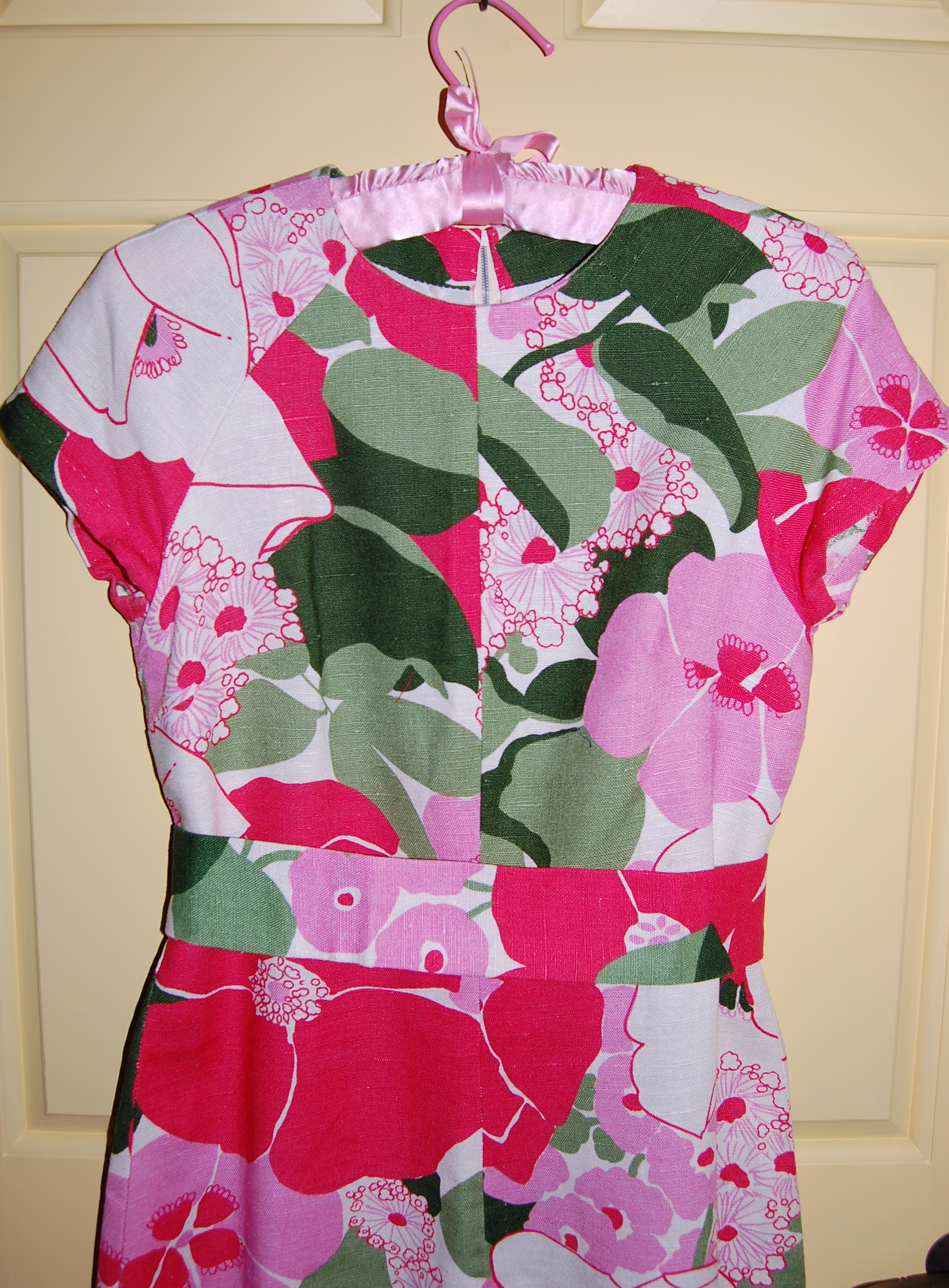
3)   In 1973, I made my own purchase of Moygashel linen at Stapler’s, this one for a dress to accompany me on my honeymoon:

This simple A-line dress, with raglan sleeves, was made from a Vogue pattern, long gone. Ankle-length dresses like this were very fashionable in 1973.

Here is a back view of the dress. The zipper is metal (that really dates me!) which I inserted by hand.

A few years later I made a belt to wear with it, to “update” it a bit, but since then it has hung in my cedar closet, a sweet reminder of years past.

This photo shows the dress belted. The bright, bold print of this linen makes a statement.

Somehow what fit me in my twenties just doesn’t look the same in my early sixties.  Imagine that!   So this dress, made from one of Moygashel’s classically timeless linens, is in that category of “too-sentimental-to-give-away”.  But now I wonder.  Should I remake it into something I can wear and use?  Would I have the nerve to cut it apart?  Should I be practical or nostalgic?  Whoever knew that the contents of a cedar closet could pose such existential questions to ponder? What should I do?

5 Comments

Filed under Linen, Uncategorized, vintage Vogue patterns from the 1960s, vintage Vogue patterns from the 1970s, Vogue patterns

Can you zip me up, please?

This is a completely unscientific observation, but it seems to me that the zipper has made a fairly substantial migration over the years – from the side of the dress – to the back of the dress.  If that sounds confusing, let me explain a bit more, by showing you some of my dress patterns which date from the 1950s.  All of these dresses feature a side zipper, placed a few inches under the left arm and extending a few inches below the waist (or, in other words, these zippers open within a garment seam.).

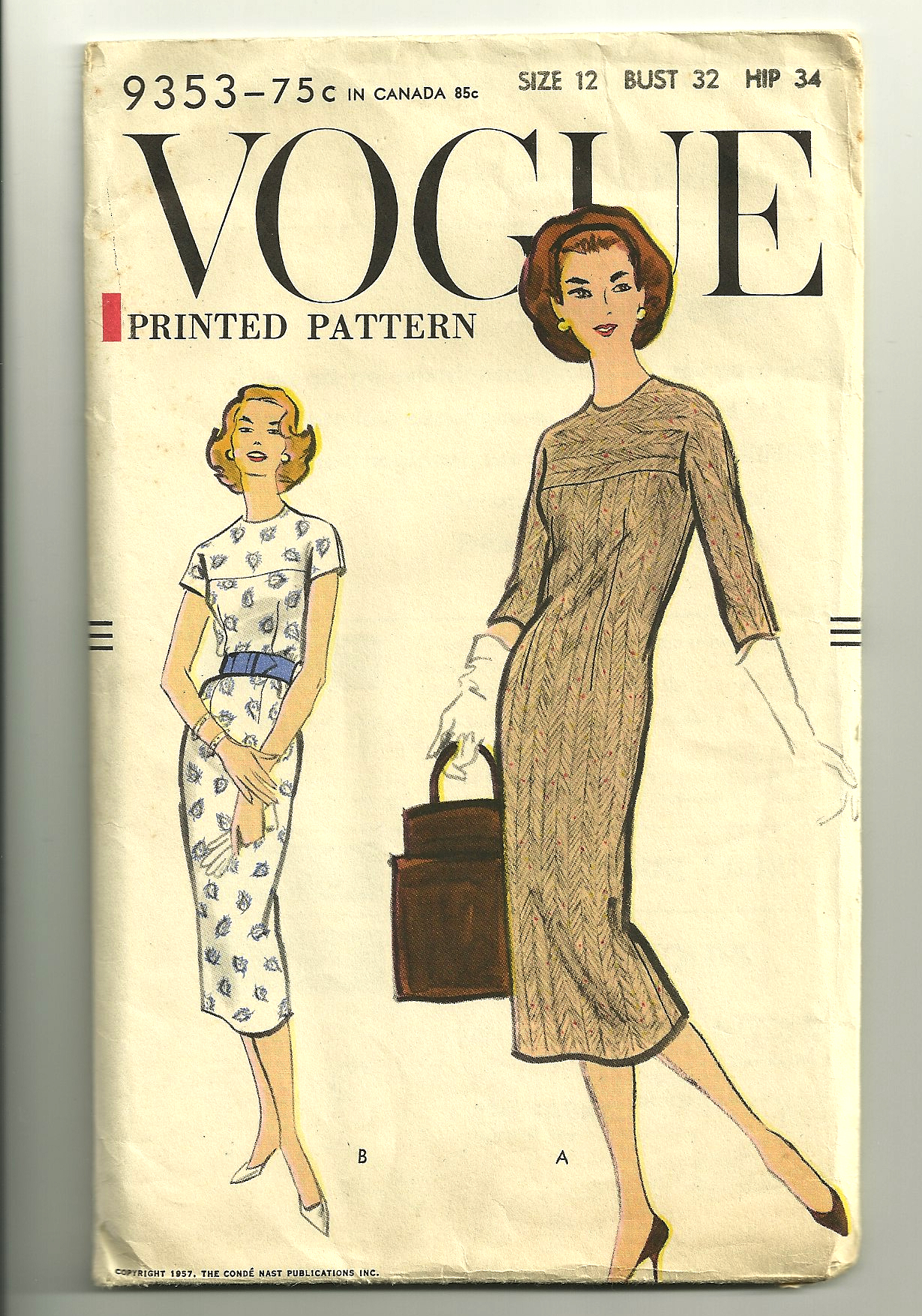
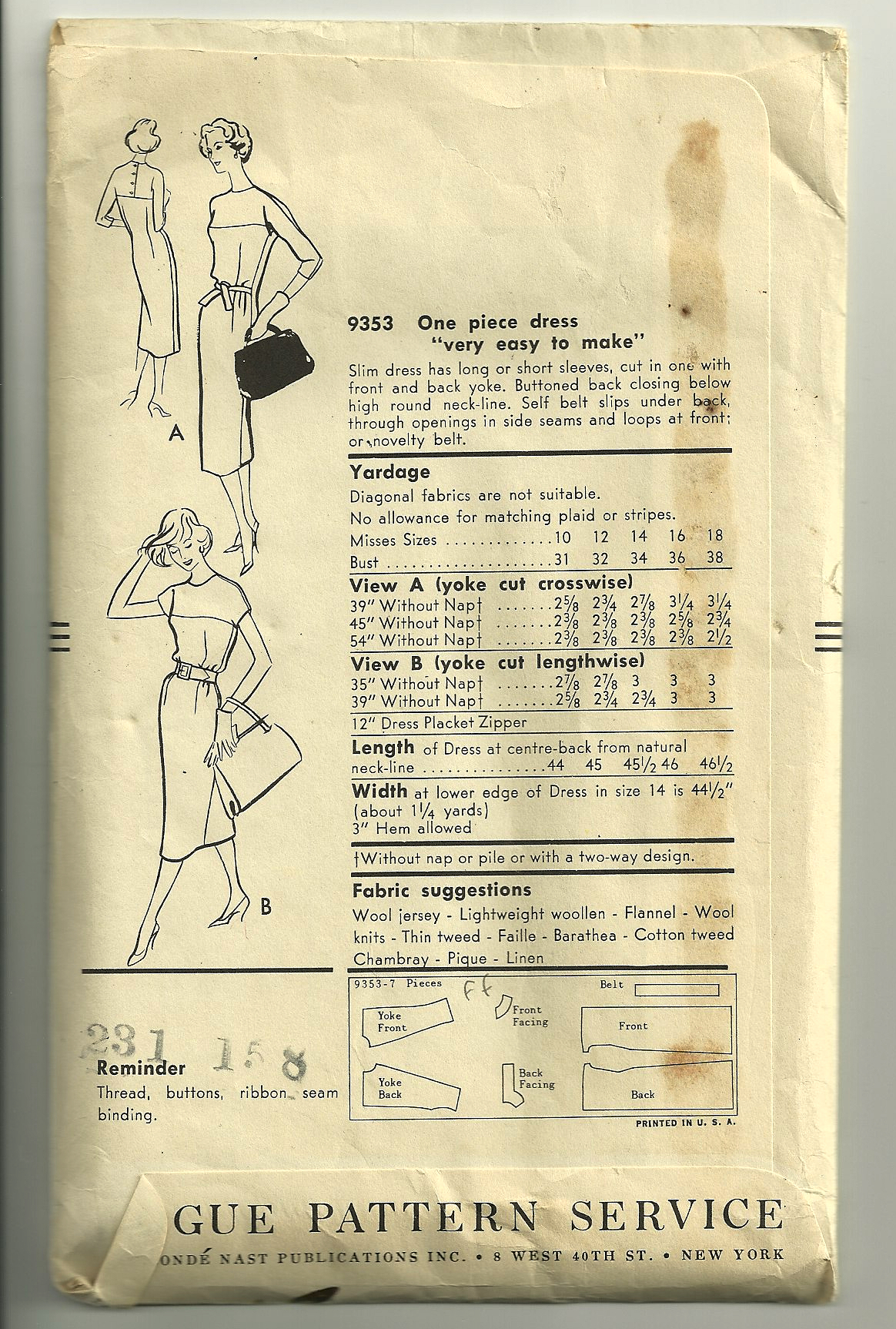
I love the clean lines of this dress from 1957, with the "yoke" effect which extends into the kimono sleeves. The back of the envelope shows more detail.

You can see from this back view that, although the top back yoke buttons, a side zipper is still necessary to get the dress on!

The front on this dress only opens to the waist, so a side zipper enables one to step into it. This pattern is dated 1957.

The back detail on this evening gown from 1958 would have been interrupted by a center back zipper, but a side zipper preserves the designer's intent.

I love this dress design from 1957, which simply would not work using a center back zipper.

Patterns from the last half of the 1960s start to feature more and more zippers which are placed in the center back of the dress, and by the 1970s, it seems, almost all zippers were center back ones.

This design from the early '60s would work with either a side or center back zipper, but the pattern calls for a center back one, thus showing the start of the transition.

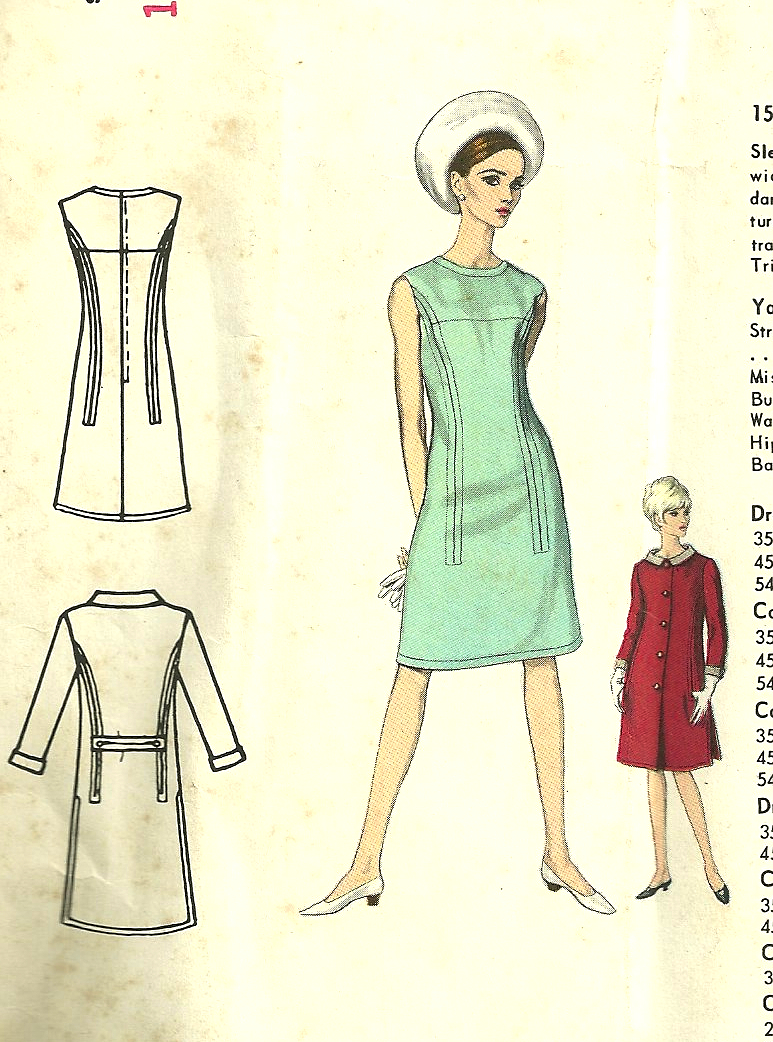
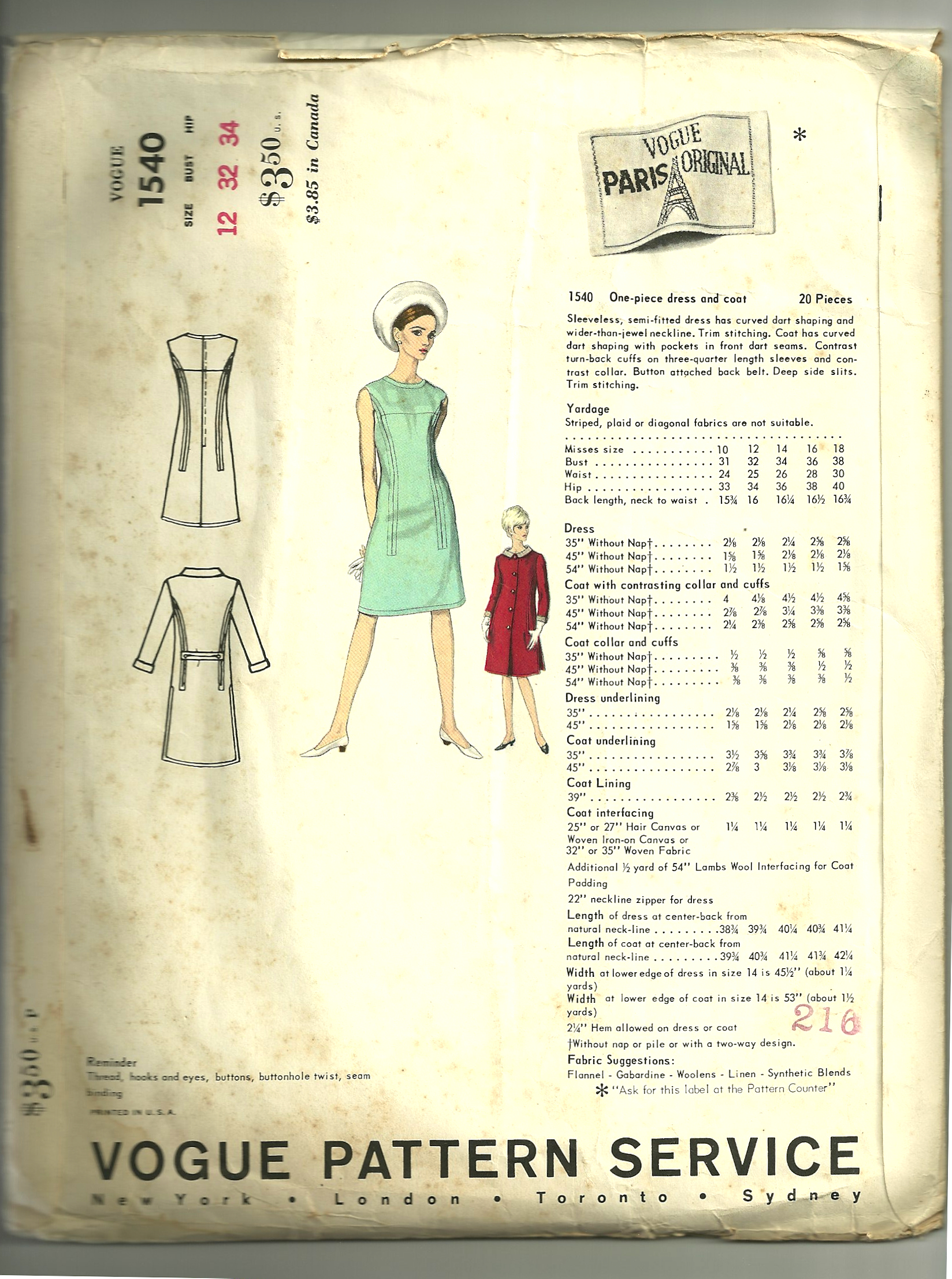
The dress on this pattern is actually my next project! It is a design by Jacques Heim from the 1970s. I'll be inserting a 22" neckline zipper in the back of this dress.

A casual look at vintage clothes from this time period also seems to support this observation (with the occasional exception to the rule, of course.  I actually saw a side-zippered dress at J.Crew one day this week, but it’s not the same, really, as the dress is sleeveless and the zipper parts at the top, under the arm.)

To try to understand some of the dynamics of this zipper conundrum, I went to my 101 Things I Learned in Fashion School book (by Alfredo Cabrera with Matthew Frederick) to see if I could find any entry on zippers.  Here is what I found on page 64:

“Center back zippers are like fine crystal:  best reserved for special occasions.  When a student designs an interesting garment and is asked how the wearer gets into it, the common answer is, ‘center back zipper.’  This solution is favored by inexperienced designers because it doesn’t require an invasive change to a garment.  But a back closure is rarely a satisfactory solution; it’s a fussy, frustrating concern when one has only fifteen minutes to dress for work.

“Back closures are a remnant from an era when women wore corsets and hoopskirts and had maids to truss them up in back.  Today they are more appropriate in association with major events.  On her wedding day or Oscar night, after a woman has spent a lot of time and money on her hair and makeup, she is more likely to want to step into her dress than pull it over her head.  A center back zipper implies a fitting sense of occasion.” [my emphasis]

Side-placed zippers are different from center-back zippers both in name and detail:  side zippers are called “dress” zippers and have bottom and top “stops”, while zippers for the center back (or skirts, pants, shorts) are called “neckline” or “skirt” zippers and, of course, open at the top with a stop just at the bottom.  (Skirt and neck zippers can easily be made into dress zippers by putting a few tacking stitches to anchor the two sides together right above the pull.)  Back in their hay-day, dress zippers were available in lengths from 10” to 14”. Skirt and neckline zippers are still available in lengths ranging from 6” to 24”, but they are now called “all-purpose” zippers.

So why, since the ‘70s, have most side dress zippers been replaced by neckline zippers placed center back?  I guess there are several potential answers to that question, including:

1) a lot of us would rather step into our dresses than pull them over our heads even if we are not dressing for a special occasion.

2) laziness or ignorance  (both kind of strong words, for which I apologize to anyone offended!) or practicality on the part of designers.

3) it’s just become the accepted way of closing a dress.

4) the invisible zipper made application of the zipper easier and the finished look more streamlined.

5) Huh? What’s a side zipper?

I’m sure there are lots of other explanations but my favorite one is a bit more romantic…   James H. Boren put it succinctly thus:  “A dress that zips up the back will bring a husband and wife together.”   I’d say that is a “fitting sense of occasion”!

3 Comments

Filed under kimono sleeves, side-placed zippers, Uncategorized, vintage Vogue patterns from the 1950s, vintage Vogue patterns from the 1960s, vintage Vogue patterns from the 1970s, Vogue patterns

Project complete! Well, kind of…

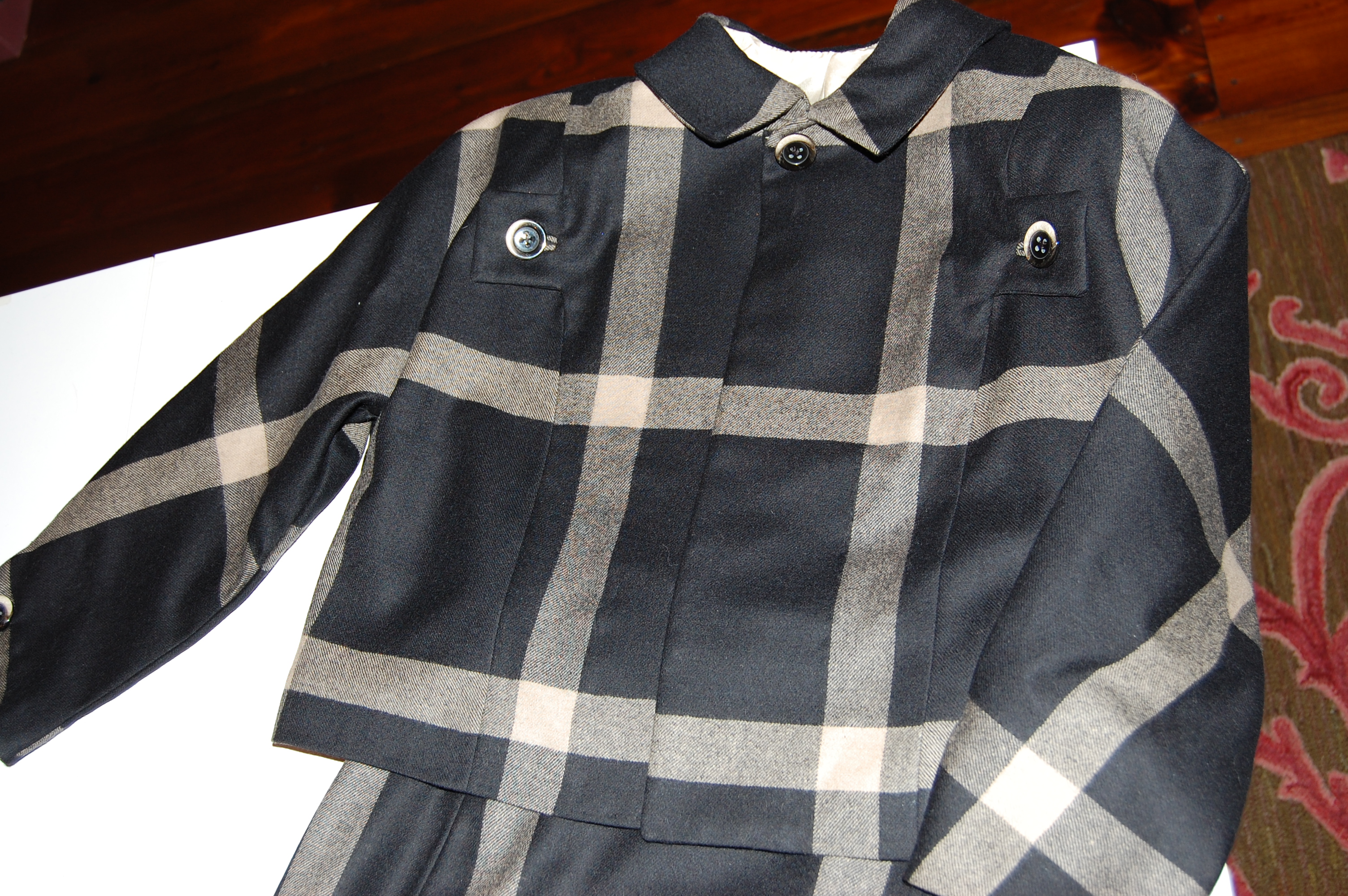
One day this week I sewed the final stitches on my wool suit.  Yes, doing the skirt hem finished it off, and now it is ready to wear.  For those of you who read my last post and ventured a guess on which pattern I used, you were correct if you chose number three.  As a reminder, here it is.

I made a few small alternations to this pattern, including shortening the skirt to just below the knee.

However, I did not choose it for the reasons you might think.  Here is how I made my decision:

1)   With such a bold plaid fabric, I thought a shorter jacket would be a better look.

2)   I thought the square tabs on the front of the jacket would compliment the windowpane check.

3)   The kimono sleeves are such a classic mid-century look that I couldn’t resist trying them.

4)   And, I love a challenge!  Even though the sleeves are “kimono” type sleeves, which means while there is no sleeve cap to match plaids, they do have seams down the middle of them cut on an angle.  Plus the jacket has side, front and underarm seams, a rounded collar which puts the plaid on a curve, and, finally, the skirt has six seams.  And, I needed to make sure that the check also matched, up and down and side to side, from jacket to skirt.  So, that’s a lot of matching.

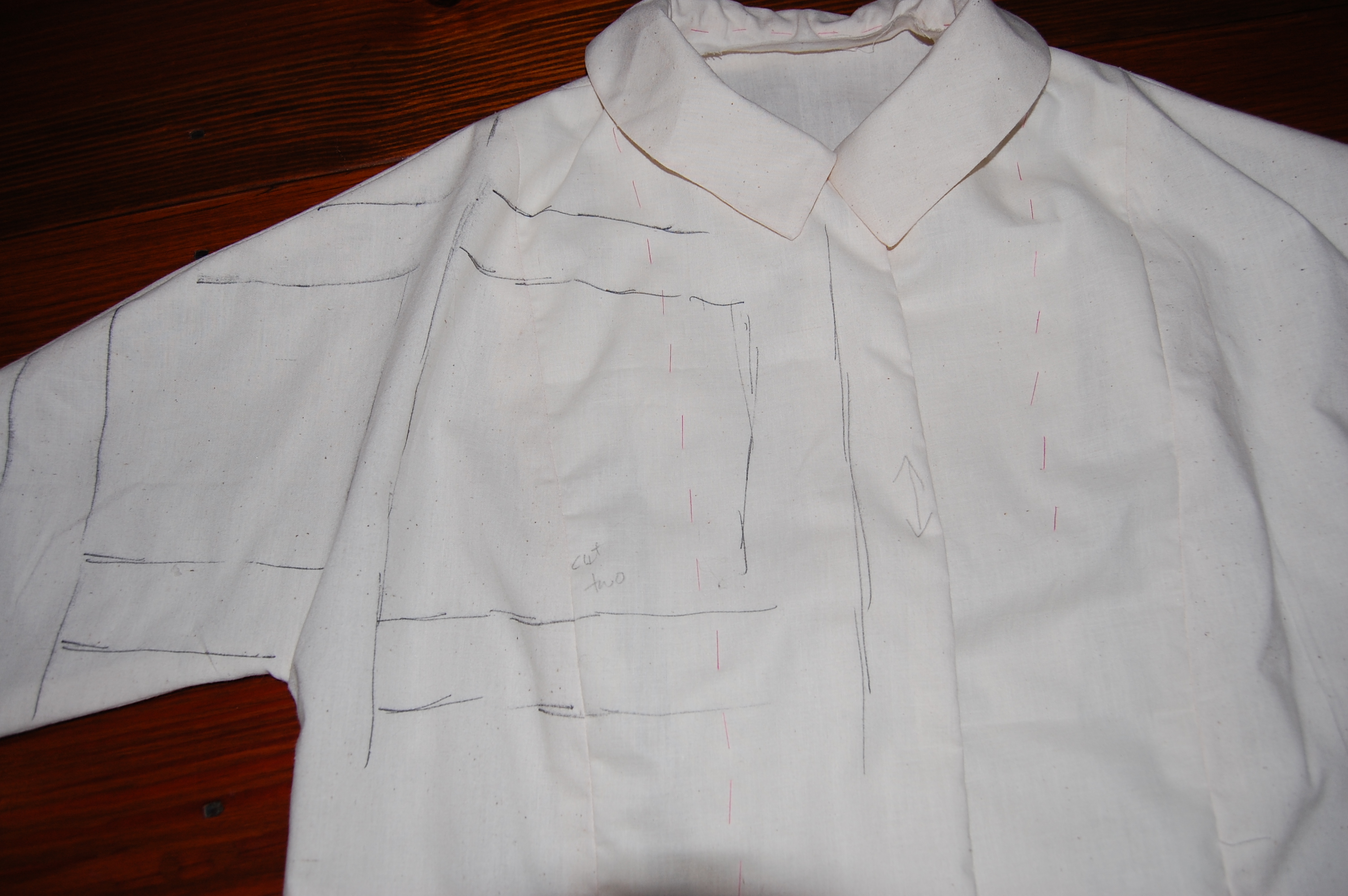
The first thing I did was make up the jacket in muslin.  From that I determined that I needed to add a couple inches to its length, and I decided to make the sleeves ¾ rather than below elbow length.  Then I got nervous about the windowpane check looking good in kimono sleeves, so I got out my magic marker and “drew” the check onto the muslin, so I could visualize it.  Okay, I liked it!

Here is my muslin - can you see the magic marker lines I drew on it? I sew my muslins using up bobbin thread that's left over from other projects - and I always baste in leftover contrasting thread.

Then I laid out the pattern pieces, and oh my gosh, what a puzzle of matching notches and checks.  I knew I couldn’t make a mistake, so after I laid it out, I let it sit overnight.  The next day, after cogitating on it overnight, I realized I had not properly matched up the check on the shoulder seams.  I made the adjustment, double and triple checked (pardon the pun), made sure I would have the same reveal at the hem of the jacket as on the skirt, and confidently (actually about 92% confidently) cut it – and the lining –  out.

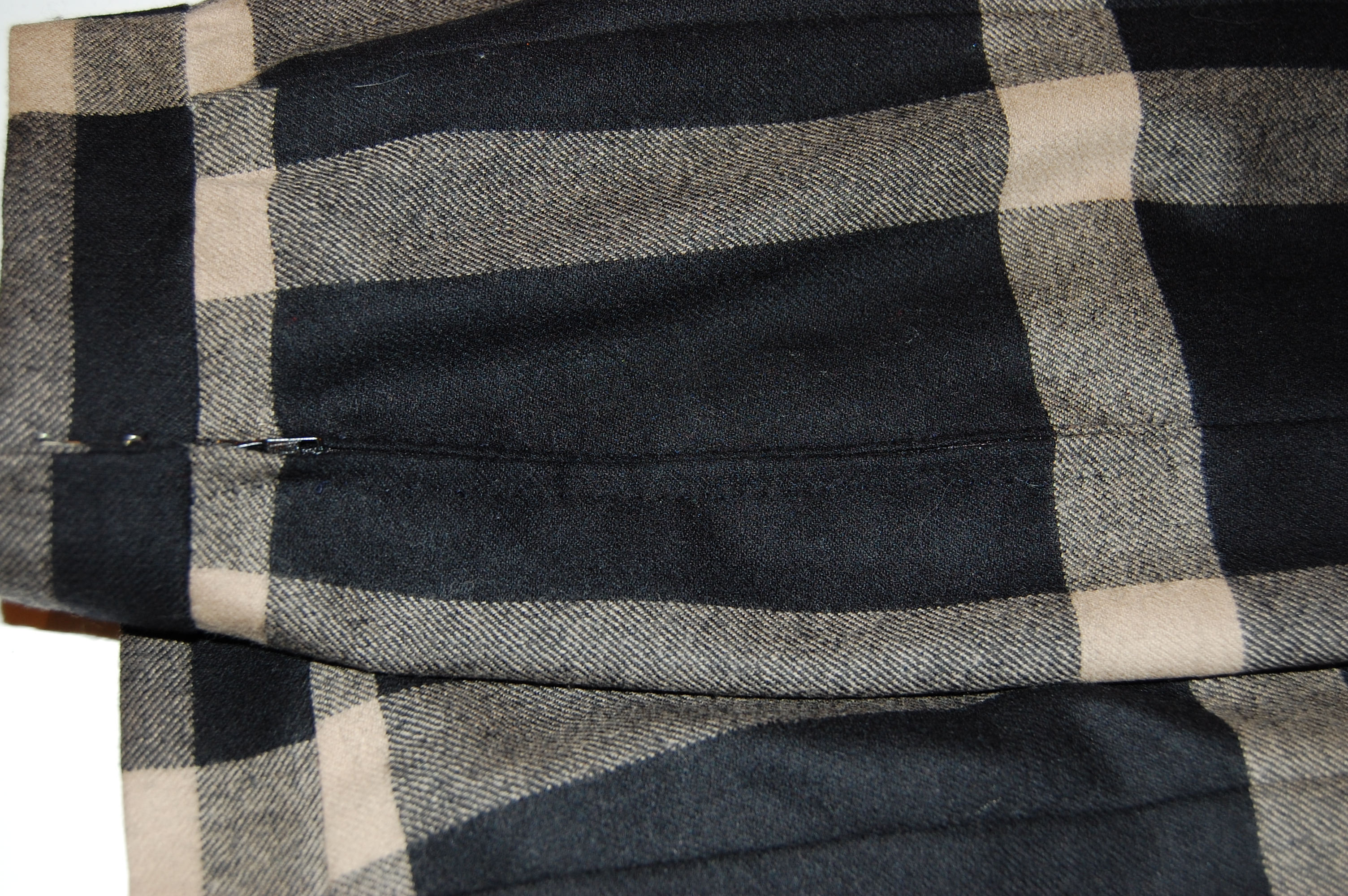
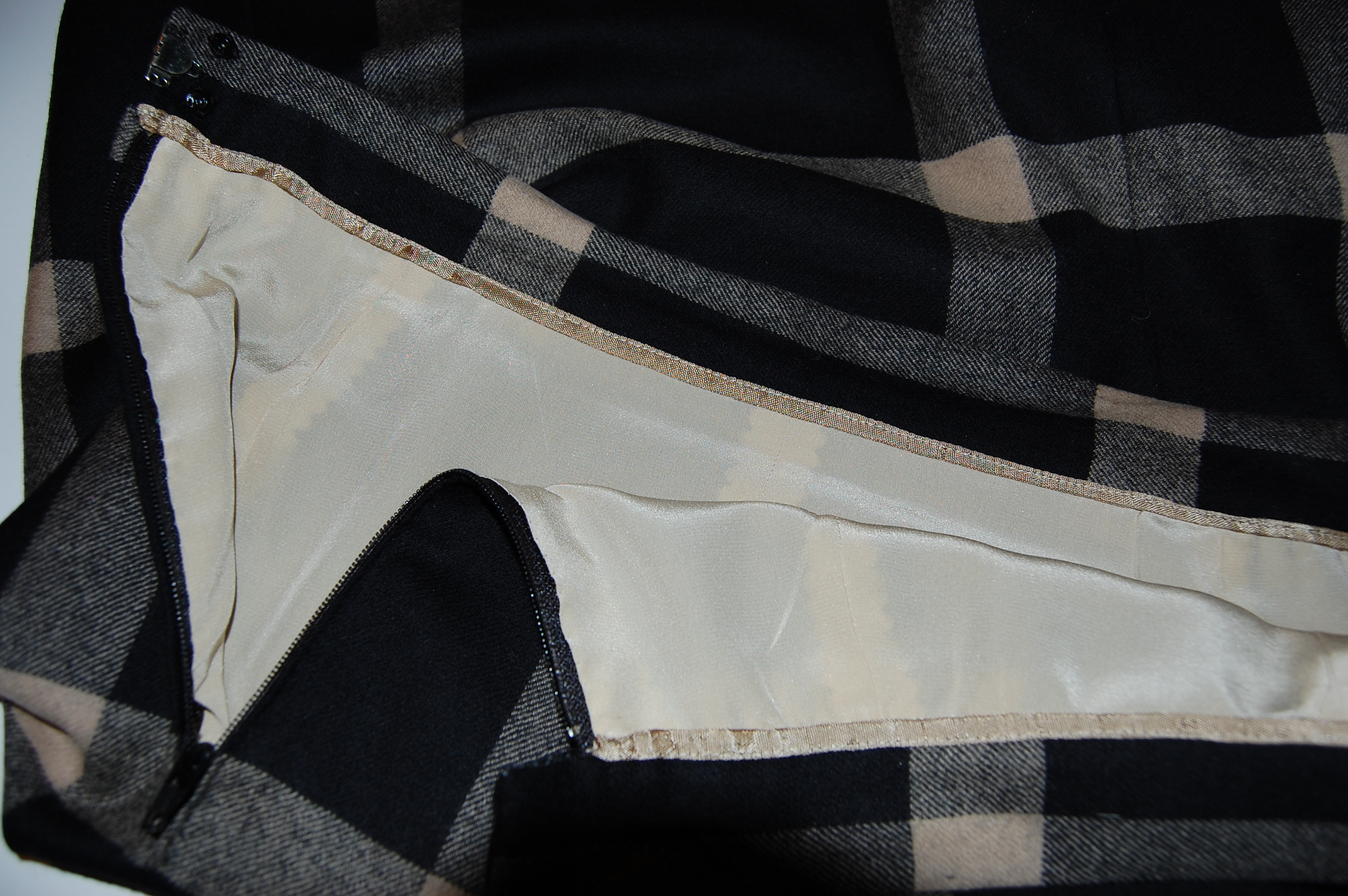
First, I made the skirt (except for the hem).  I like to put my zippers in by hand, as I just think it makes a nicer look.

Here is the zipper, set in using small back stitches.

And here is how I finished the waistband inside:

I bind the raw edge with a soft seam tape and then catch-stitch underneath to the waistband seam. This makes a nice, unbulky finish.

By the way, have you noticed how it is now almost impossible to find a ready-made skirt or pants with a waistband?  Another reason to sew!

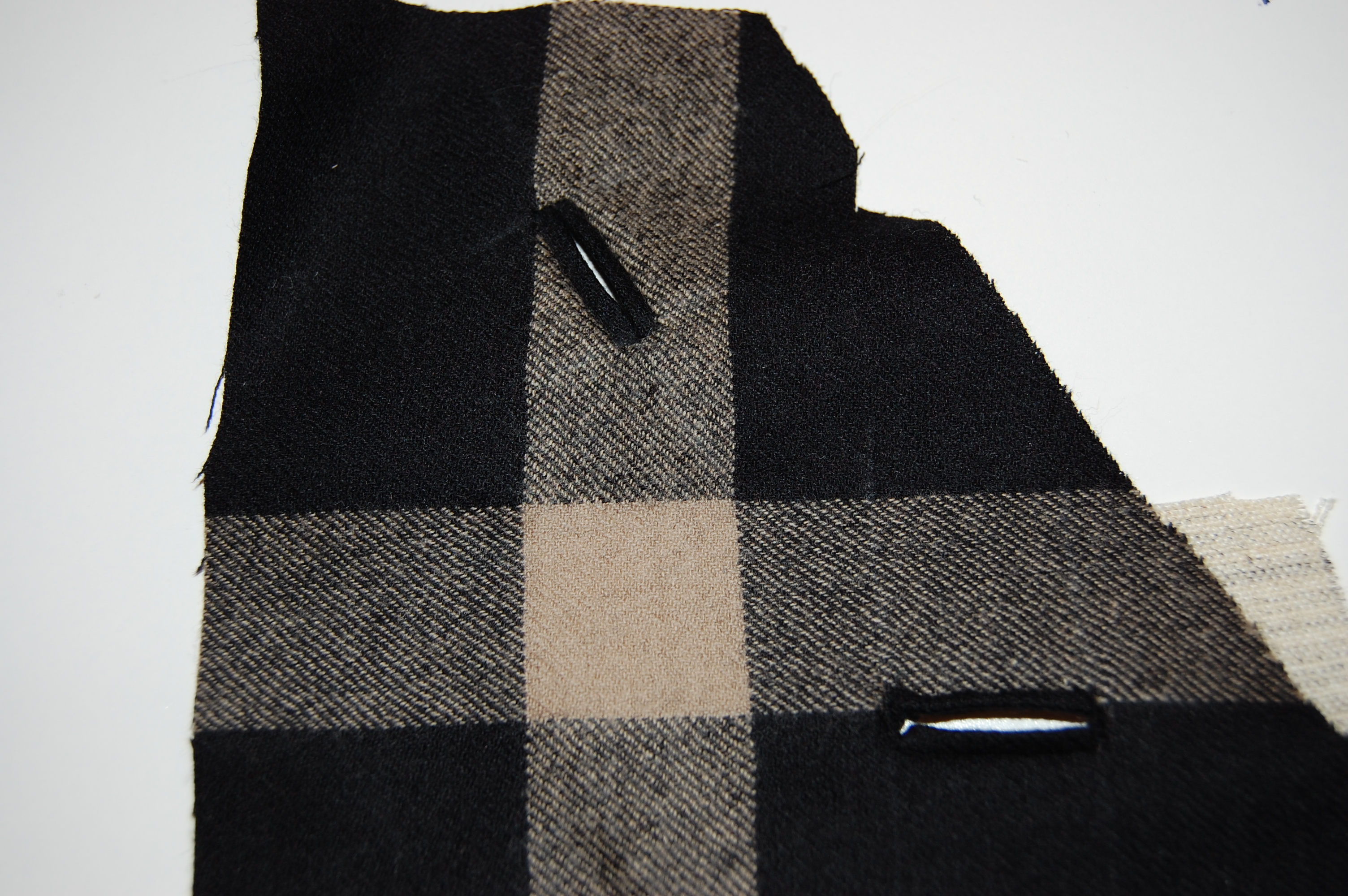
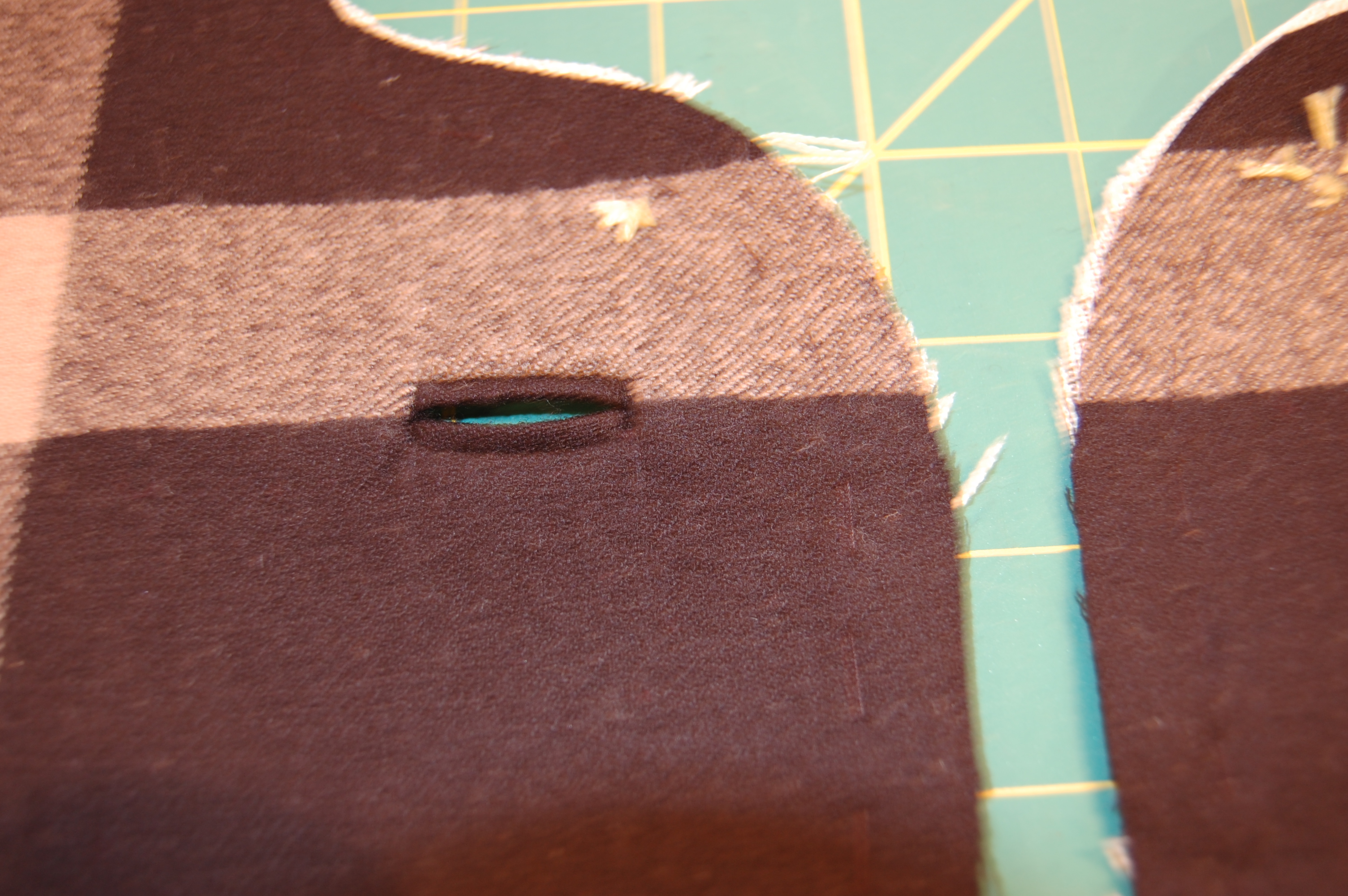
The jacket called for five bound buttonholes: one at the neck, on the two tabs on the front of the jacket, and in the sleeve plackets.  (This, of course, meant that I had to find buttons first.  A trip to the local fabric/craft store produced some, which I immediately recognized as “perfect.”  They are made by La Mode, an old button company still going strong after 125 years.)  Whenever I am making bound buttonholes, I like to make a couple of “practice” ones.  Every fabric handles differently, and with this fabric, I also needed to decide what part of the fabric I would use for the “bands”.  Here is my practice piece, which will help to explain what I mean.

Here were two of the three "trial" buttonholes I made. I decided to use all black bands where the buttonhole would be on a light part and light bands on all black. These trial runs helped me make my decision.

It always strikes me as being “out of sequence” when practically the first thing I have to do is make the buttonholes, but so it is with these bound beauties!

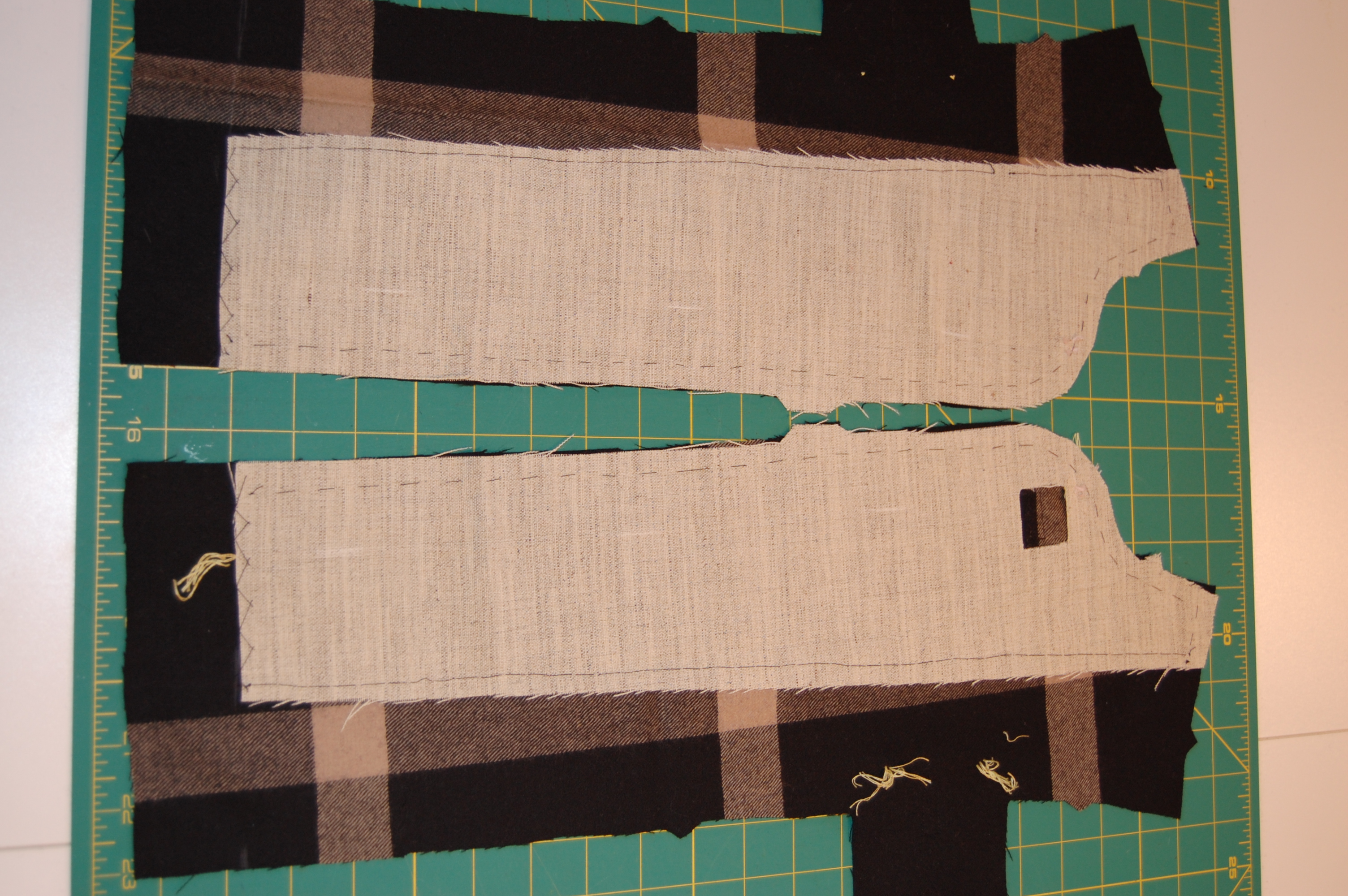
Of course, before the buttonholes comes the interfacing. I cut a small square out of the interfacing on the right side in order to accommodate the bound buttonhole.

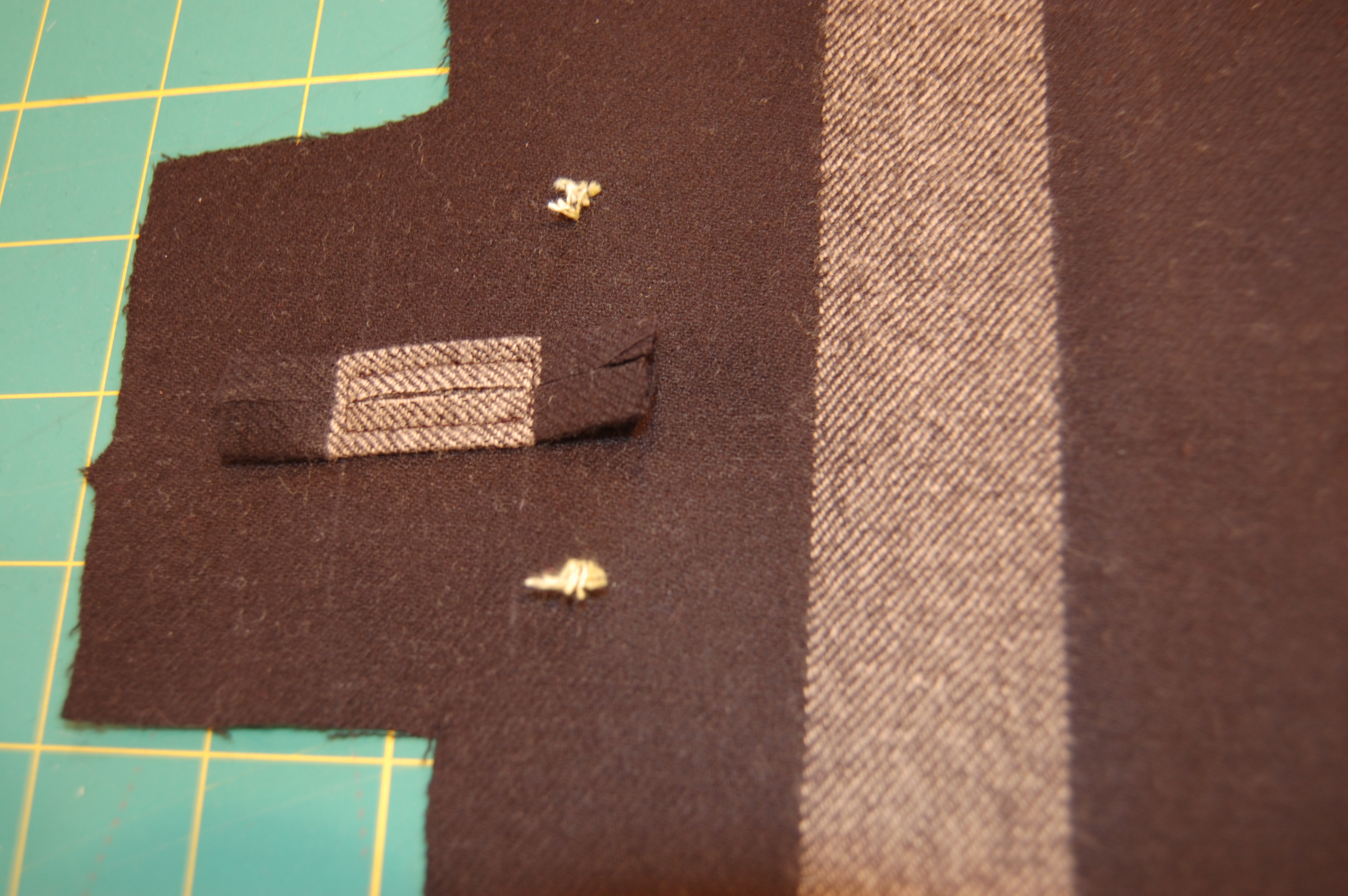
Here is the start of the buttonhole on one of the "tabs". The yellow fuzzies are tailor tacks.

Here is the buttonhole at the neckline.

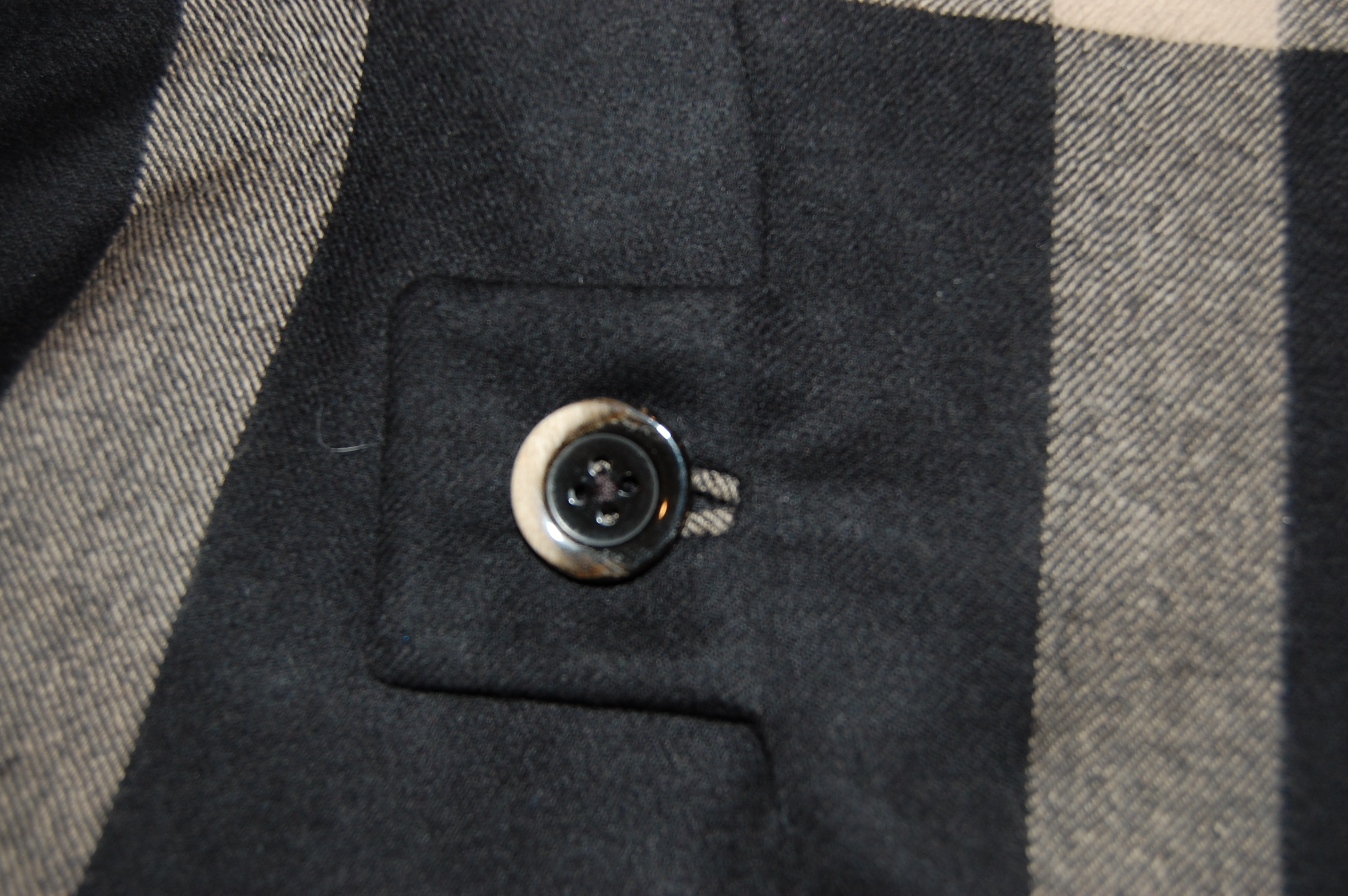
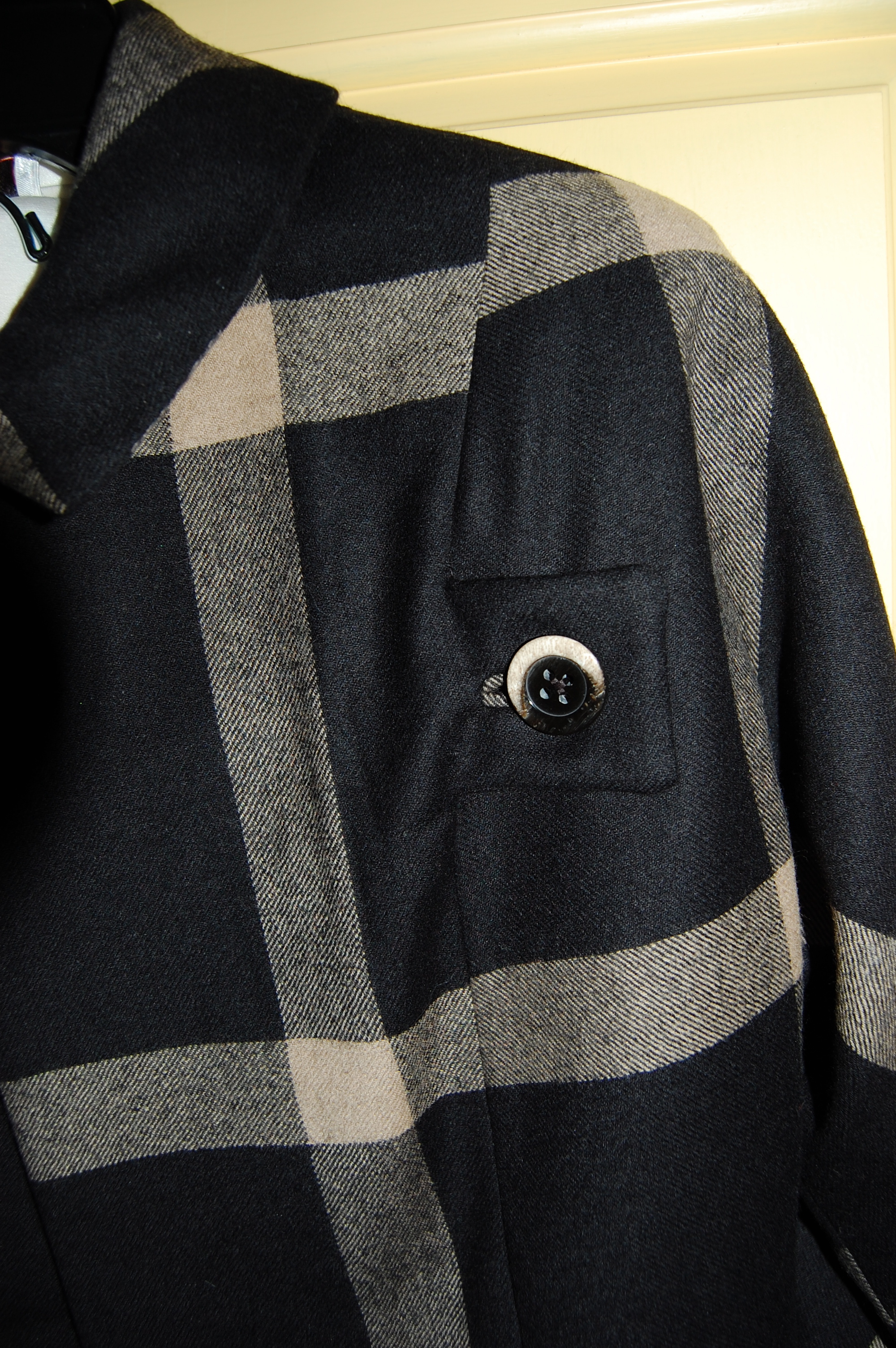
Here is the finished buttonhole on one of the tabs, sporting buttons which I think are perfect for this suit and fabric.

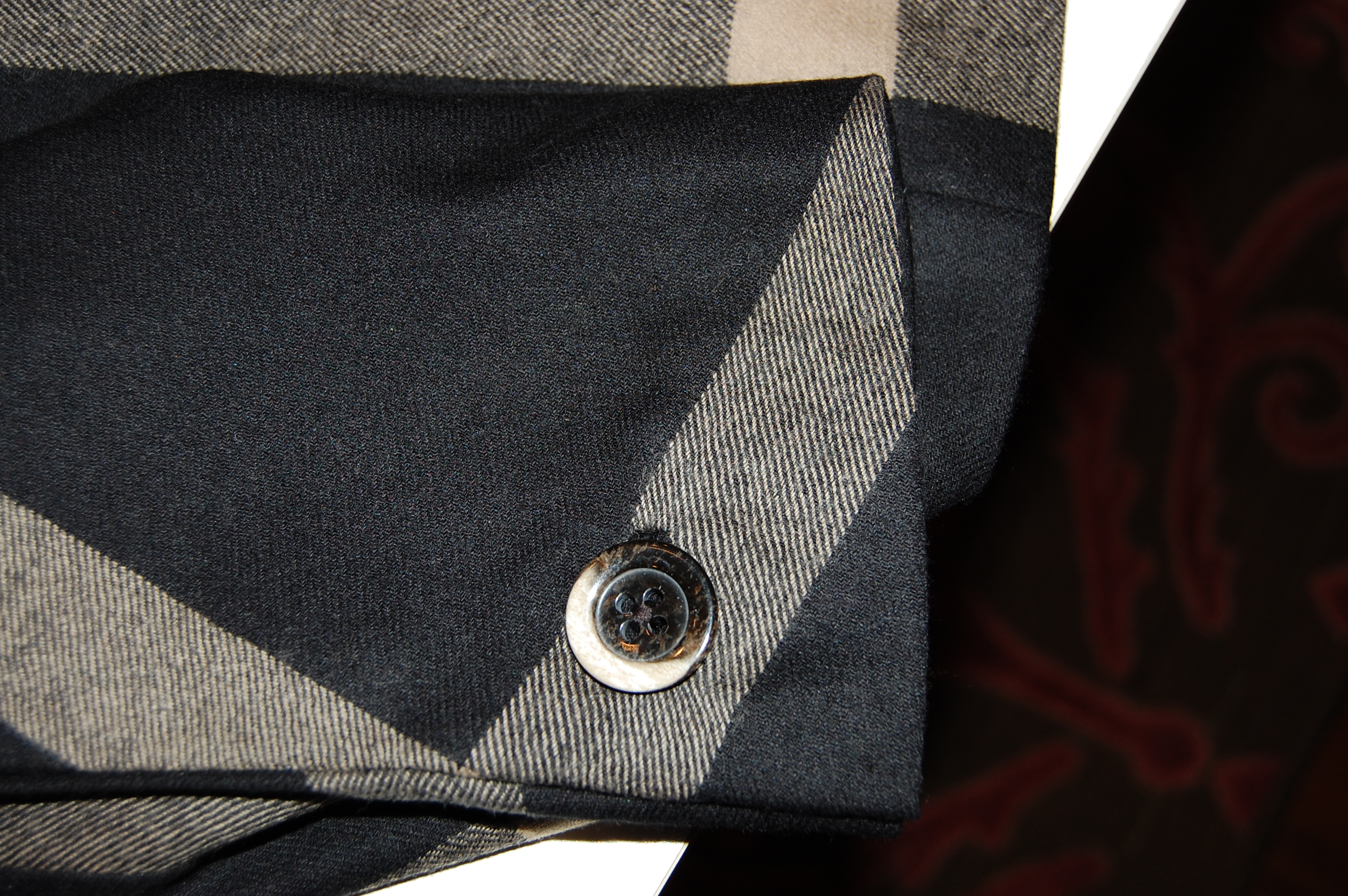
And here is one of the sleeve plackets, all finished!

The rest of sewing the jacket was fairly straightforward, just time-consuming!  The collar was a dream to do because there was a separate pattern piece for the two-piece, bias undercollar.  A bias undercollar makes the top part of the collar finish up with a smooth and neat turn.  Vogue Patterns – I love you!

I lined both the skirt and the jacket in a silk crepe de chine which I ordered online from fabrics.net/The Fabrics Network.  This company, in Spokane, Washington, carries beautiful solid silks and other fabrics.  I got swatch/color cards from them last year and have purchased several pieces of fabric from them, all of them lovely, excellent quality goods, quickly delivered.

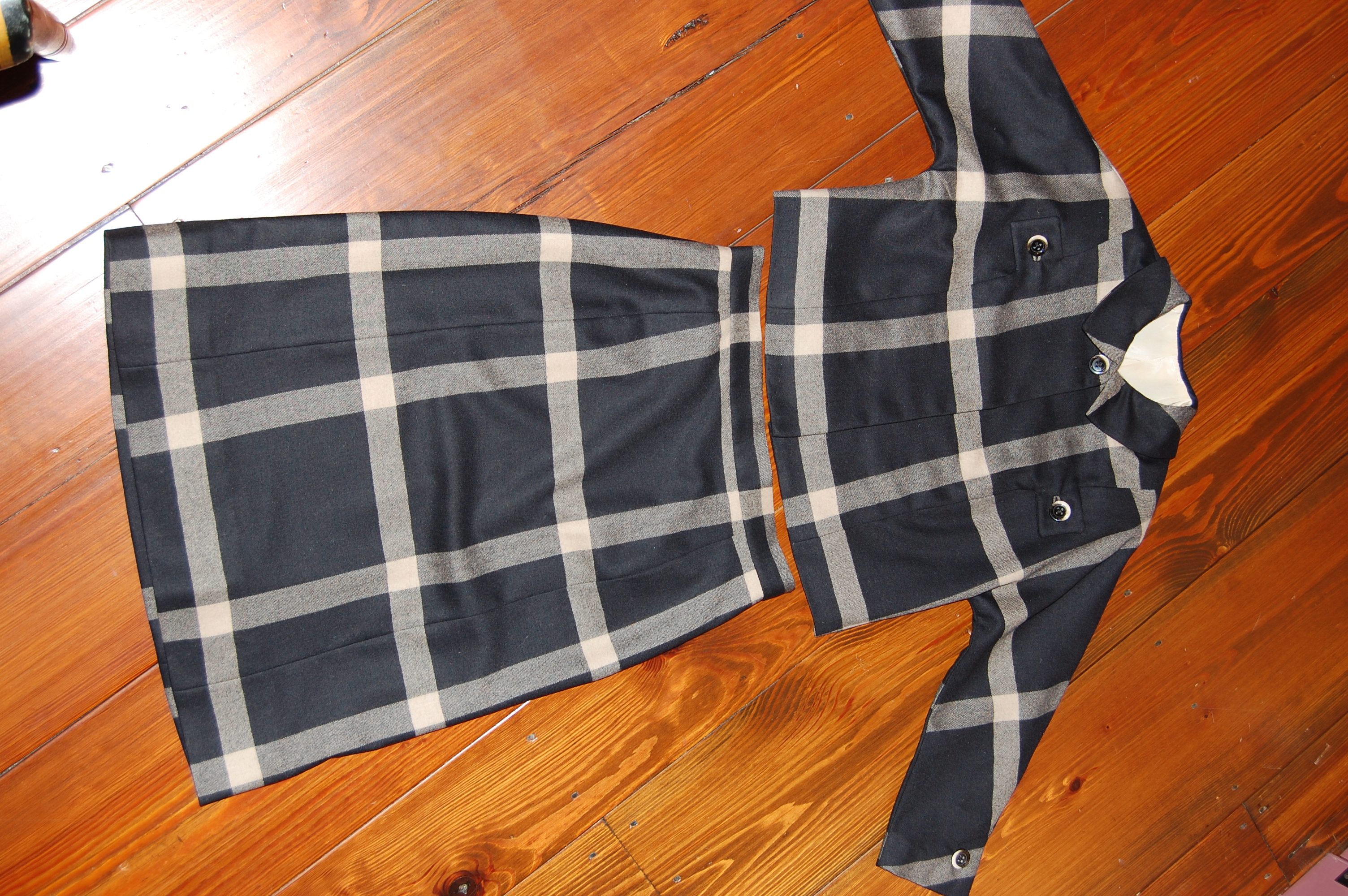
So here are some shots of my finished suit:

My suit, laid out on my sewing room floor - definitely prostrate from being worked on for so long!

Here is a close-up of the jacket.

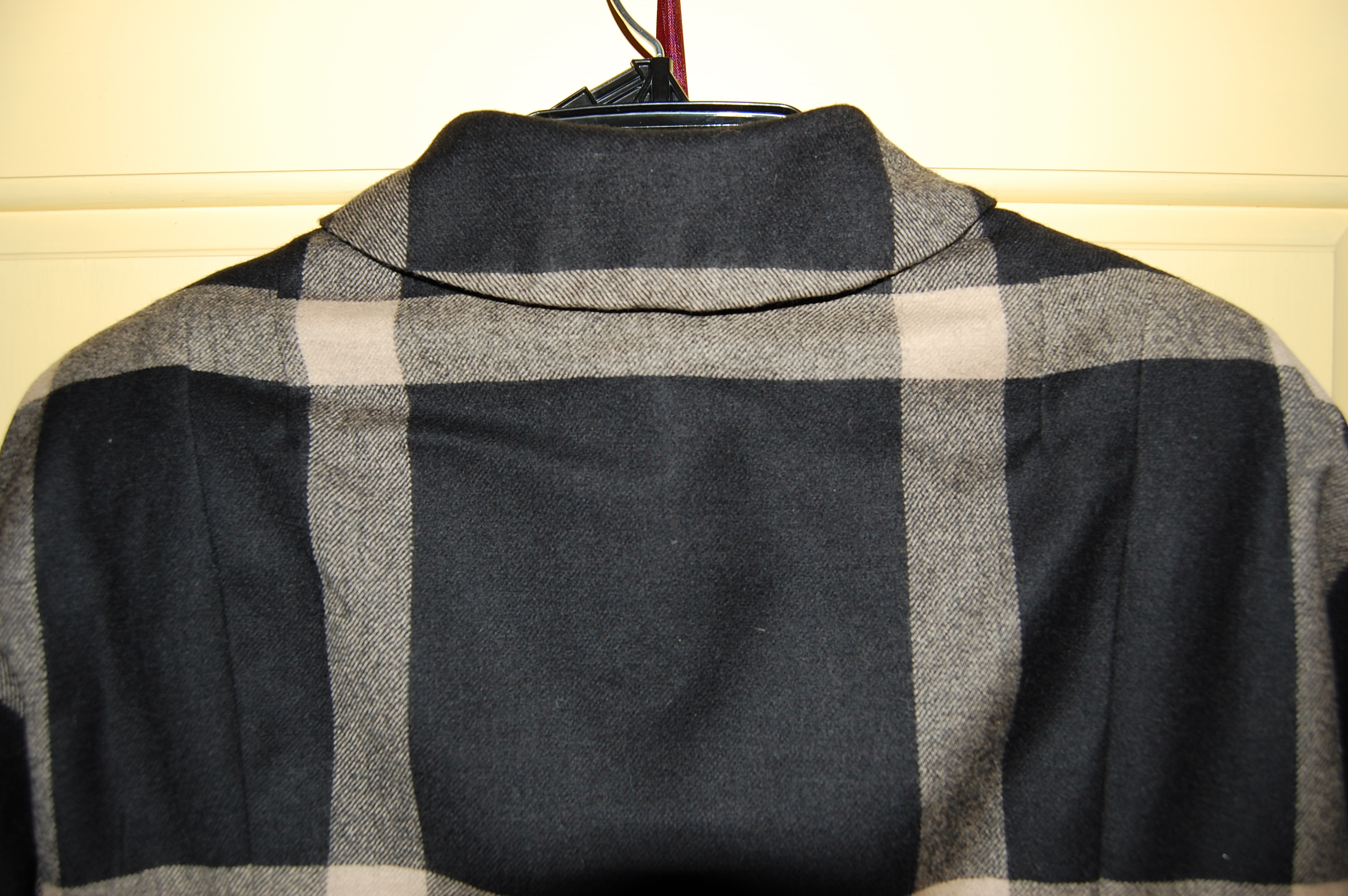
Here is an example of the puzzle of matching the check up and down and side to side. When I am wearing the jacket, I want the collar to match up to the back of the jacket. I think I was fairly successful with my calculations!

And here is a view of the one area which could not be matched, as that seam serves as a dart for the bust. But somehow, it looks okay, I think...

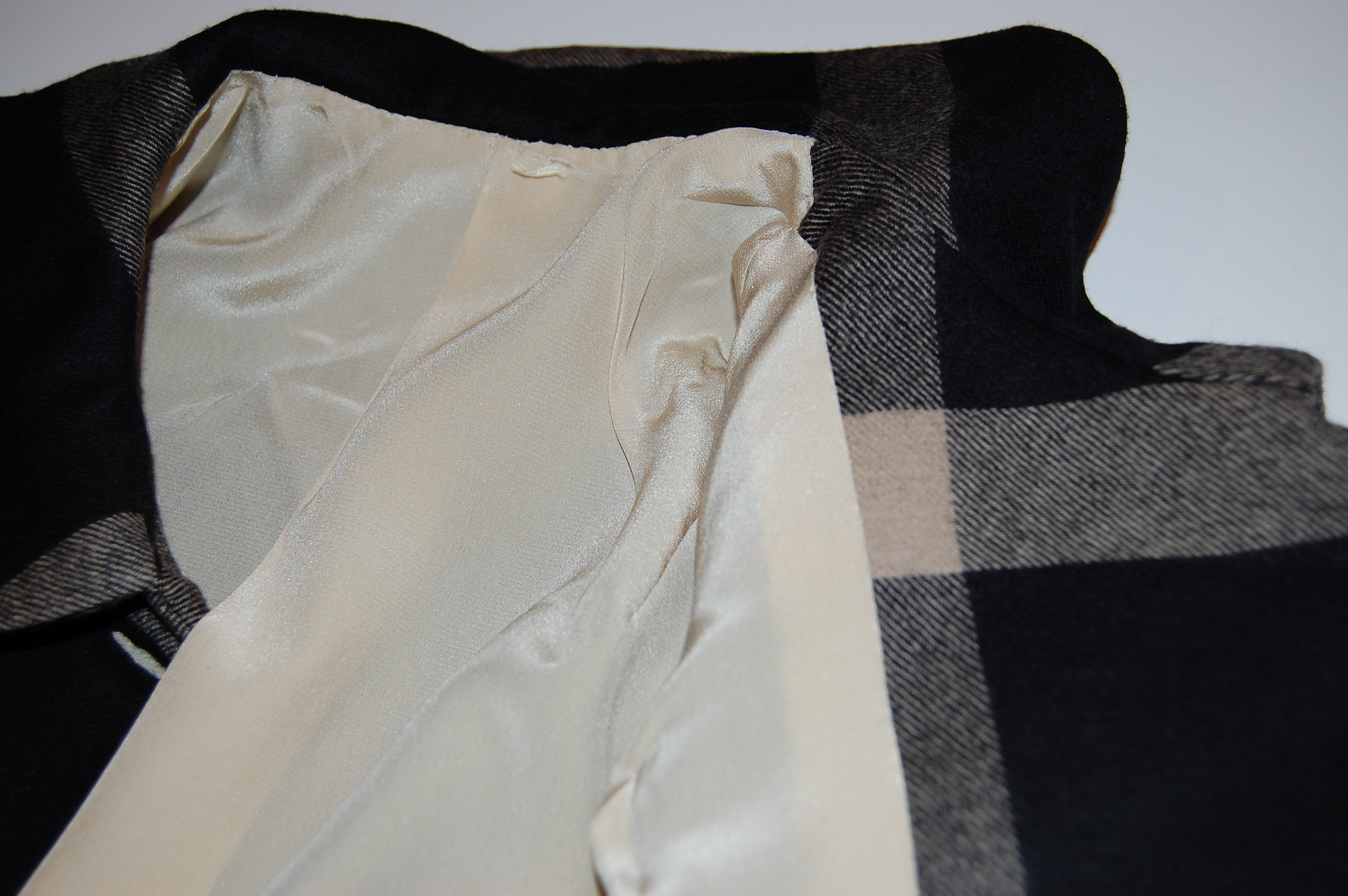
Finally here is a view of inside the neck, showing the lining and just a bit of the collar.

So – why did I say this project was “kind of” complete?   Well, wouldn’t a simple  blouse in that same lining silk be lovely?  I just happen to have enough fabric to make one (!) – and I’m thinking about using this pattern:

I think this simple shell would make up beautifully in that beige silk. What do you think? (I would wear it tucked in.)

Also, when I purchased the wool, I bought plenty to allow for matching those checks, and the wonderful salesperson at Britex cut the piece generously for me as well – many thanks, dear lady! So – I have enough left to make a simple lined  overblouse, which could be worn just with the skirt for a variation on a two-piece “little black dress.”  Memo to self:  move this idea to the top of my “sewing to do” list for next Fall!

3 Comments

Filed under bound buttonholes, kimono sleeves, Uncategorized, vintage Vogue patterns from the 1950s, Vogue patterns

Quiz: Match the fabric to the pattern

If you follow this blog, you’ll know that I have promised a “next” post on a suit which I’ve been working on.  Another project (non-sewing) has taken me away from it for a few days, so it’s not quite finished yet.  However, to keep my promise, I’m offering a teaser:  can you pick the pattern which I am using to make my suit?

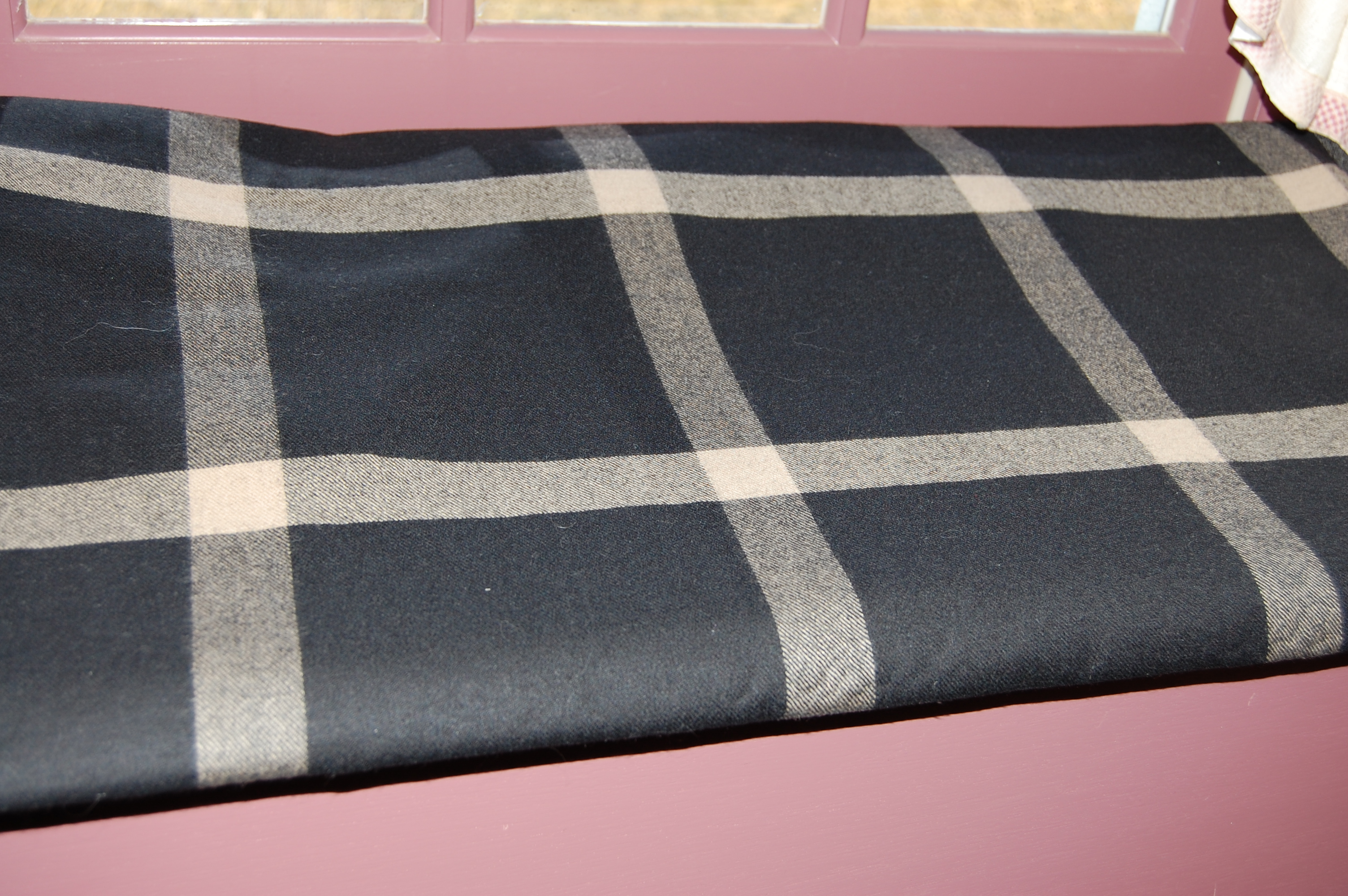
Here is the fabric, a lovely, finely woven and incredibly soft, windowpane check wool from France, which I purchased at Britex last summer in San Francisco:

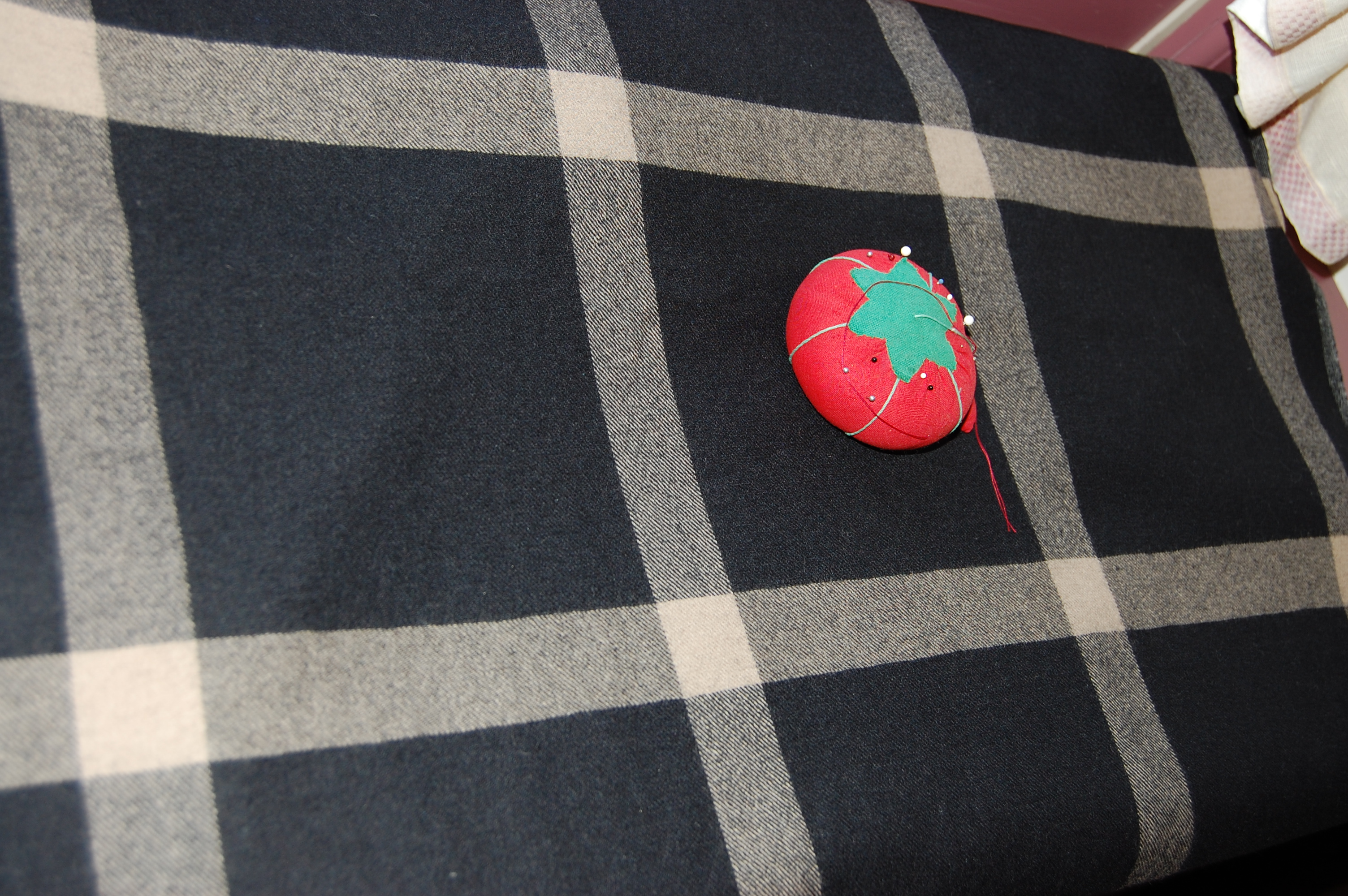
The repeat on this fabric is 7", so it's a fairly bold check in soft black and beige

Here is another shot of the fabric, with my tomato pin cushion on it to help you determine its scale.

And here are four patterns.  Which one do you think I selected to make in this fabric?  (Click on the photos to see the patterns in more detail.)

Choice # 1: This pattern is copyright 1958. I featured it in an earlier post.

Choice # 2: Here is another pattern which I have already featured in an earlier post. It is copyright 1959. This pattern includes the blouse pattern, too.

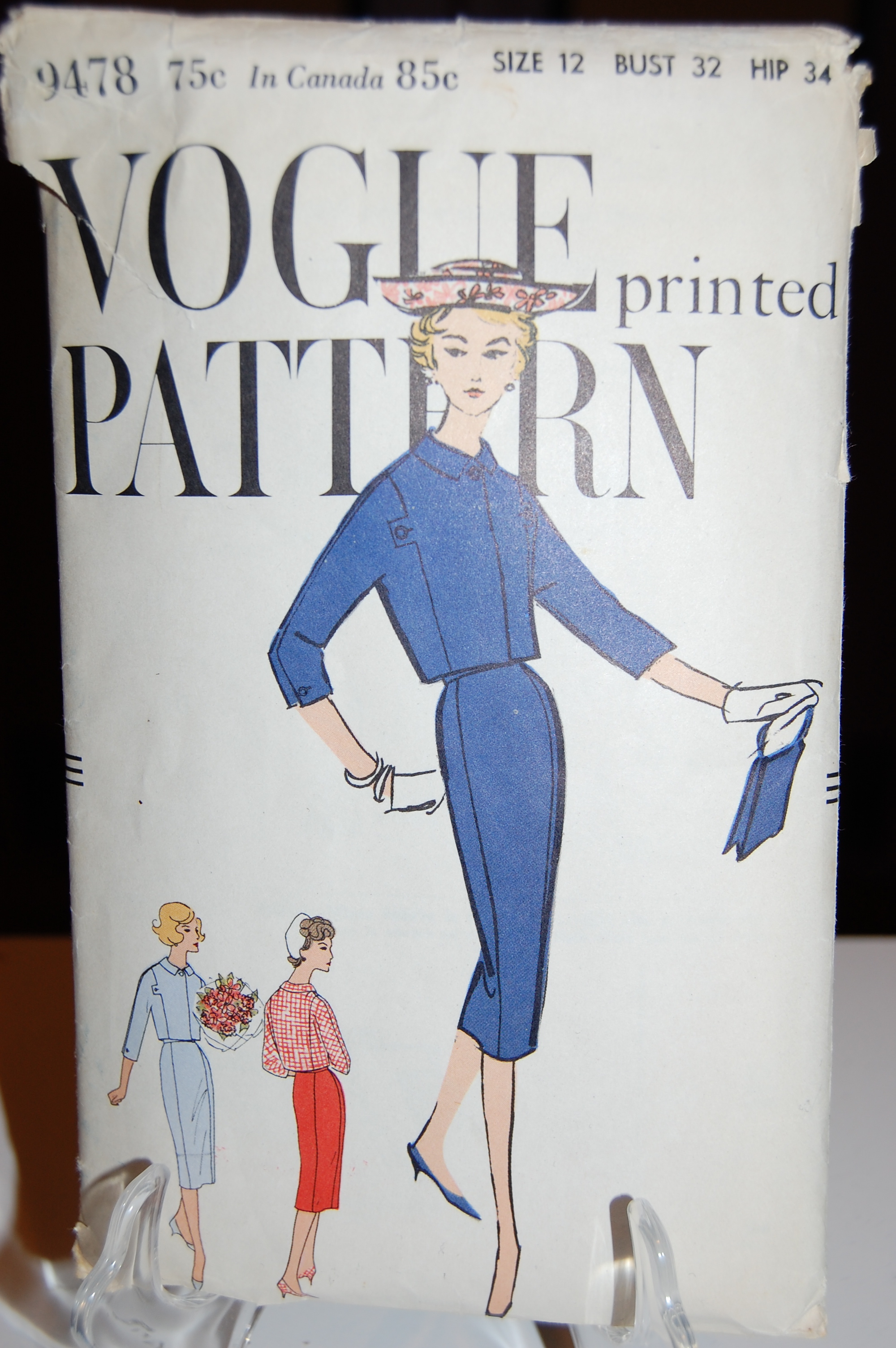
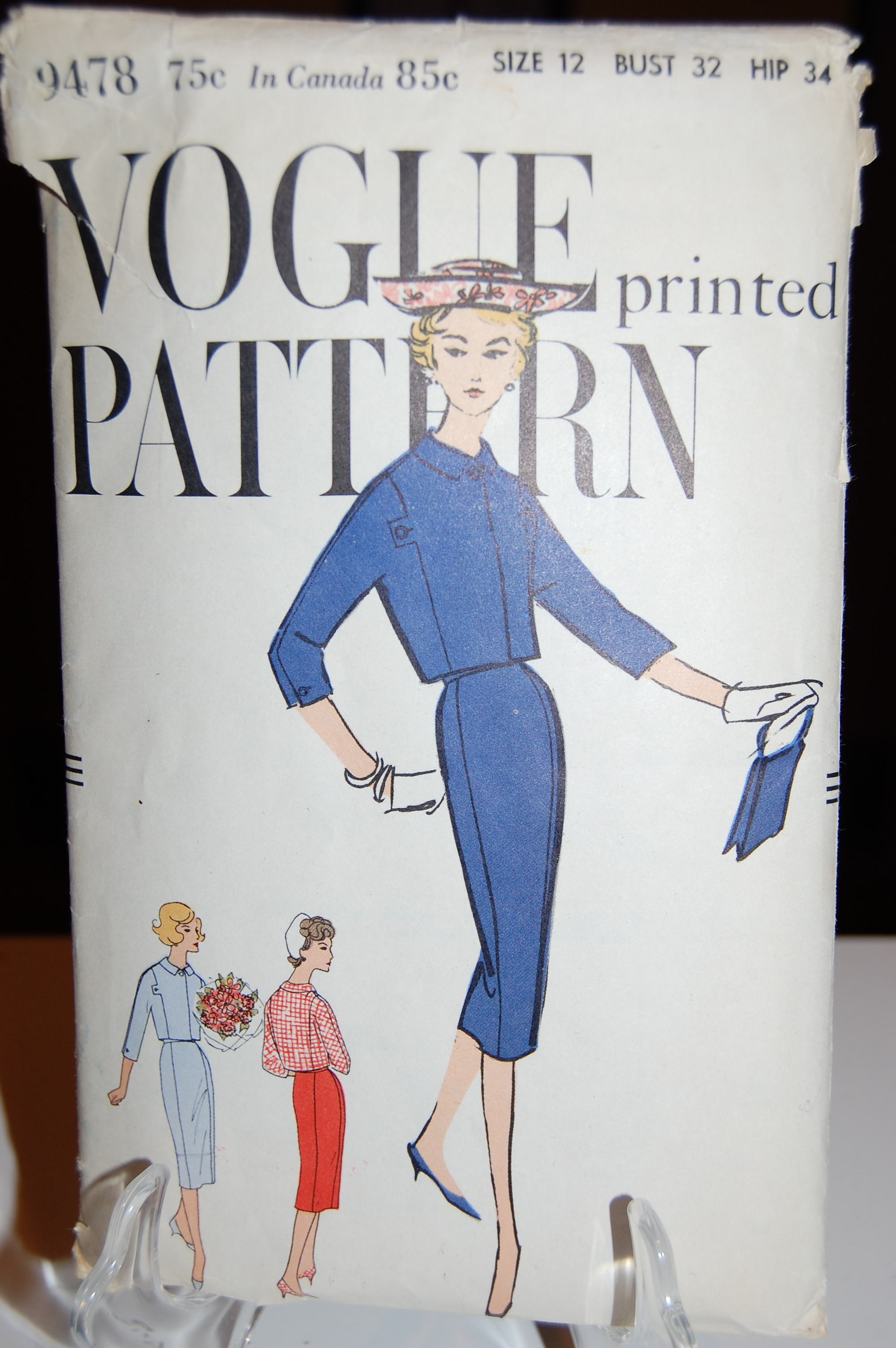
Choice # 3: This pattern is also copyright 1958. It has kimono sleeves rather than set-in sleeves, and the skirt has no darts; rather the seams are curved to fit the hips and waist.

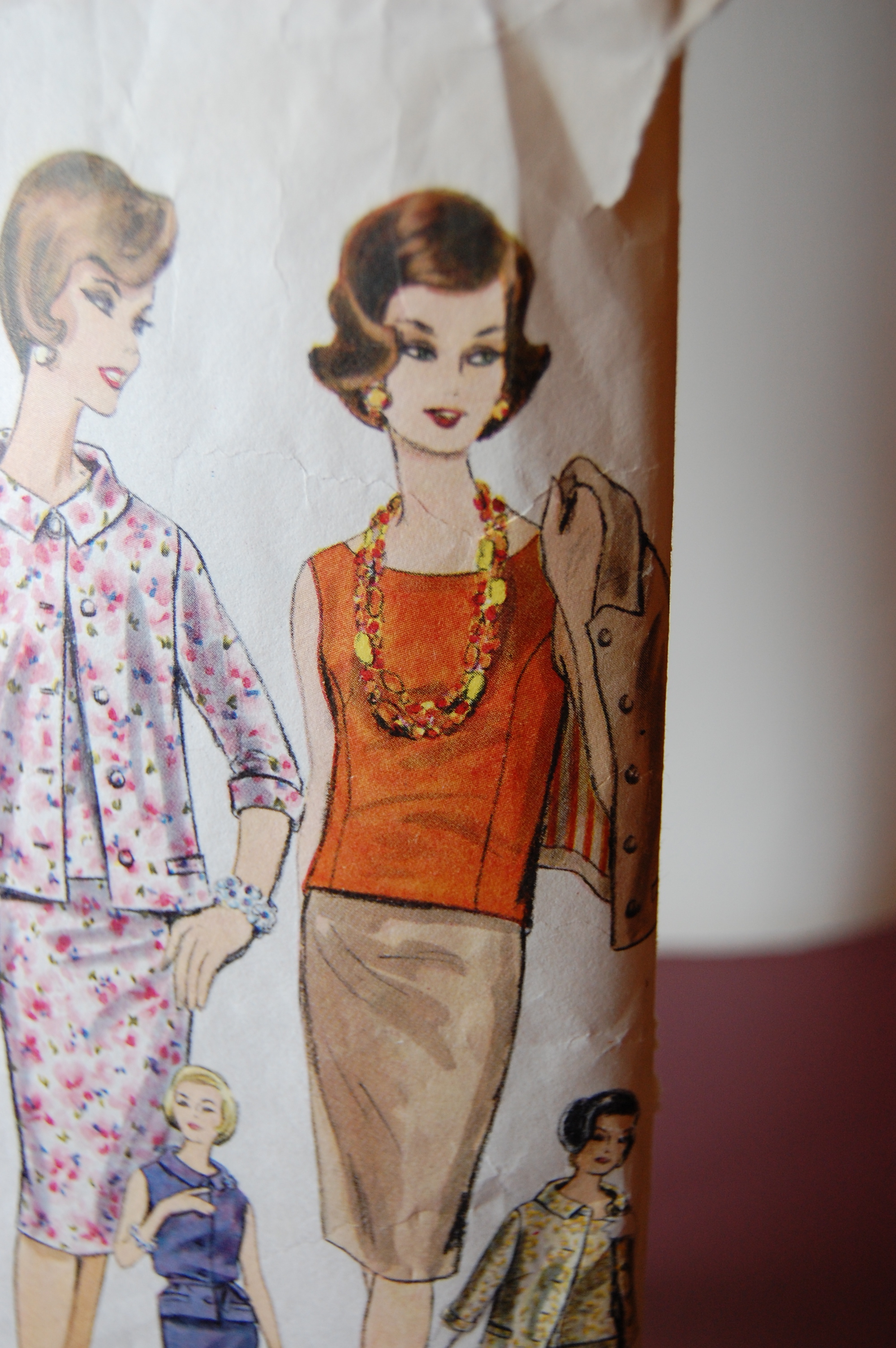
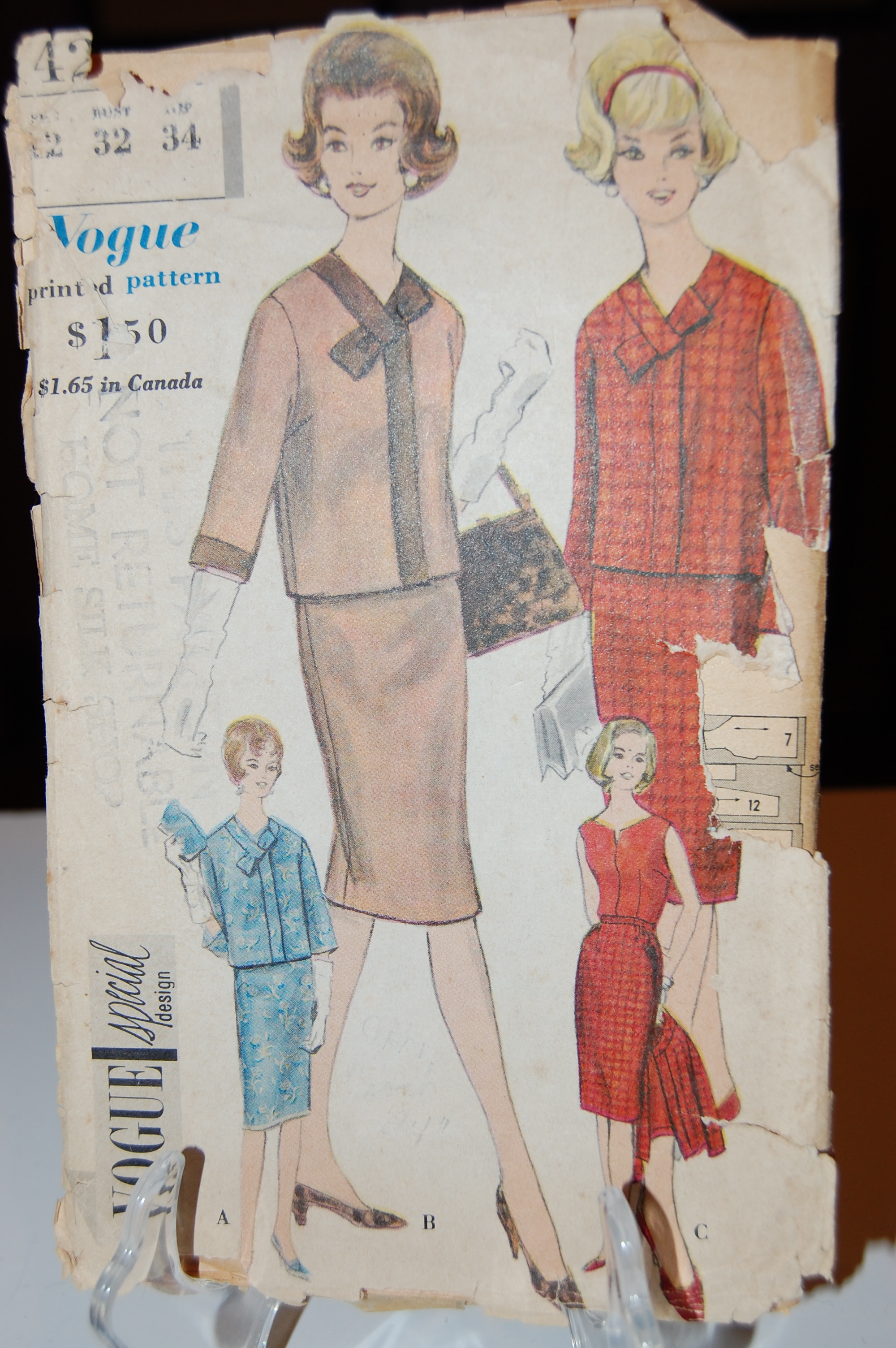
Choice #4: There is no copyright on this pattern, but I judge it to be from about 1962 (the hairdos and the increased pattern price are good clues!) This pattern also includes the blouse pattern.

Keep in mind that this fabric presents significant “plaid matching” challenges, which I had to consider when I decided on the pattern.  The more seams in a pattern, the higher the challenge (usually).  So – was I safe and cautious, or gutsy and daring?

5 Comments

Filed under The Conde Nast Publications, Uncategorized, vintage Vogue patterns from the 1950s, vintage Vogue patterns from the 1960s

Messages from the past: handwritten notes on vintage patterns

Many vintage patterns have a visible stamp on them which tells the name of the store where it was originally purchased.  (Those of us who sew know that patterns, once purchased, are non-returnable – and it seems it was ever so…)  Sometimes the stamp also lists the location of the store, but not always.  Either way, that stamp is a visible clue to the pattern’s past life.

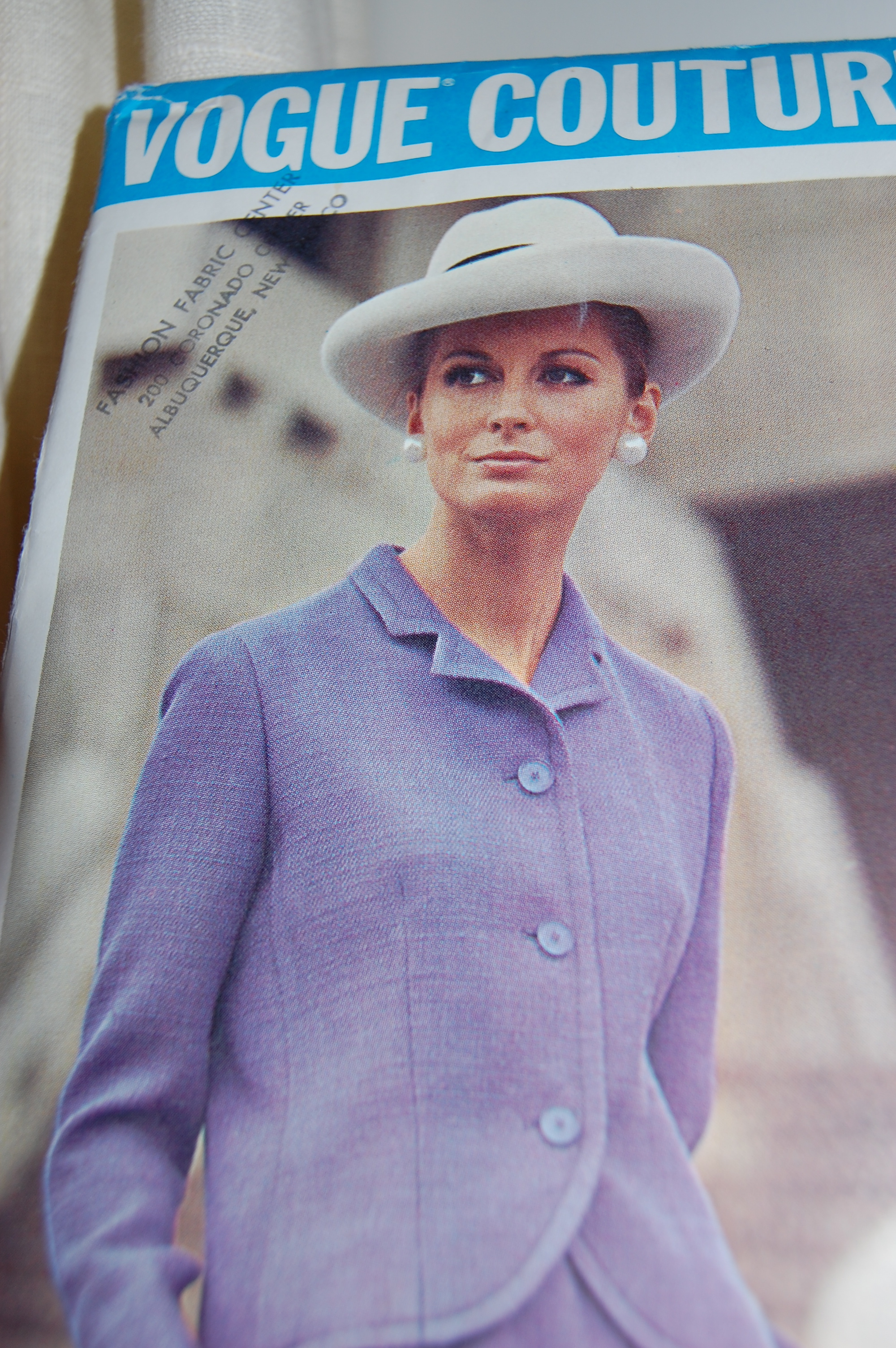
In the upper left hand corner, you can see the stamp for "Fashion Fabric Center" in Albuquerque, New Mexico. This pattern is from the early '70s.

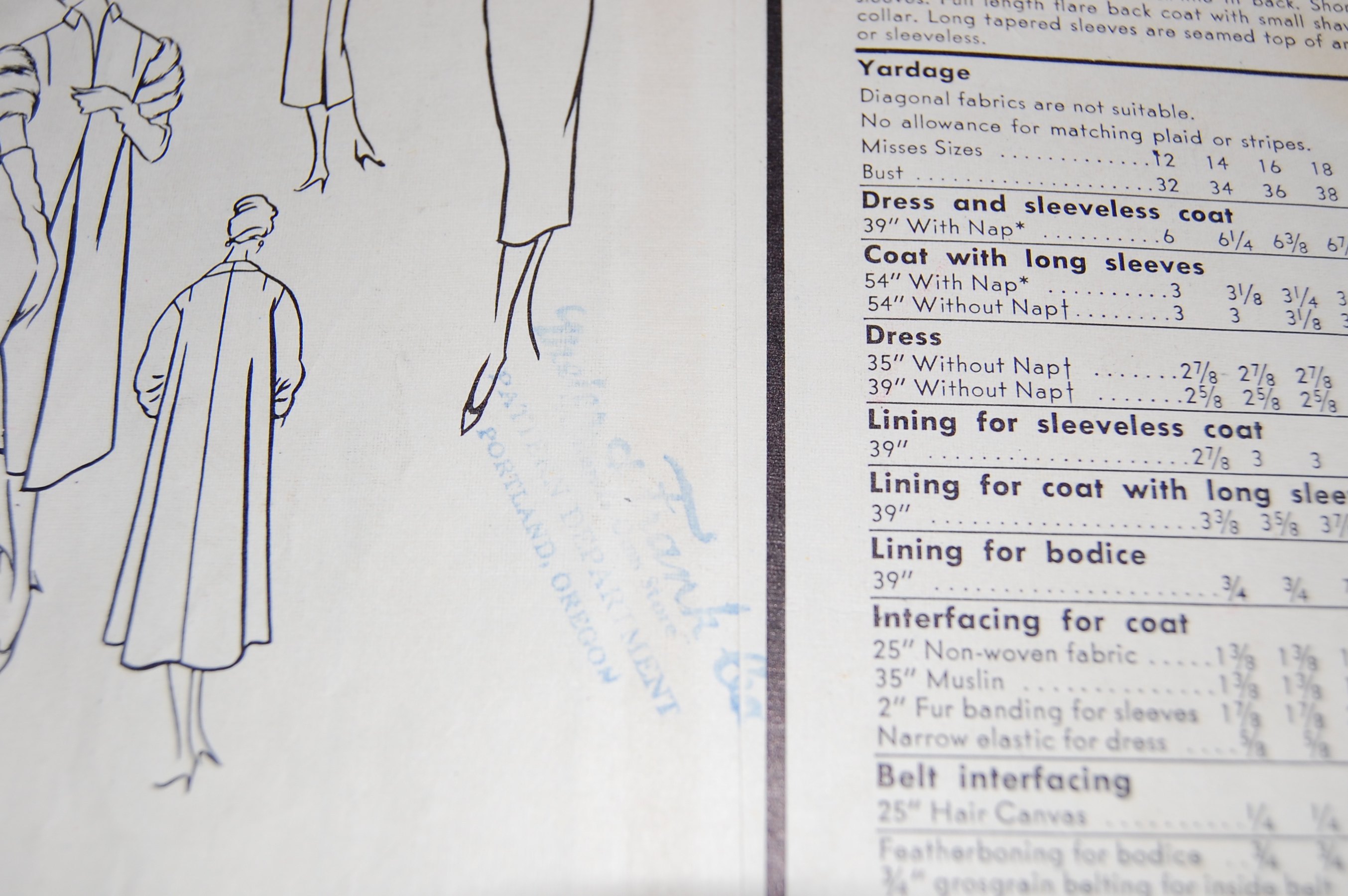
If you look closely, you can see the stamp on this envelope which tells you it was purchased from Meier & Frank Pattern Department, Portland, Oregon. This pattern is from the 1950s.

I can’t help but visualize a well-put-together woman perched on a stool at the pattern counter of the mentioned store,  thoughtfully flipping through the pages of the Vogue Pattern catalogue, and finally settling on this one pattern.  I wonder what occasion, if any, she was making it for?  Was she, like I was in the ‘60s and ‘70s, agonizing a bit over spending 75 cents or $1 or $3 or $5 for just a pattern, and then loving it once the decision was made?  Was she buying it to make it herself or in coordination with a dressmaker who would be the one to create it for her?  What fabric and color was she intending for the pattern?  Or did she buy the pattern and then, for one reason or another, never make the intended garment?

And then, every once in a while, there is a handwritten note or diagram on a pattern envelope.

These jottings, sometimes cryptic, other times precise, provide clues which begin to answer some of those questions.  In the months I have been buying vintage patterns, I have found myself privy to some of these “messages” from the past – and here are the small stories they tell:

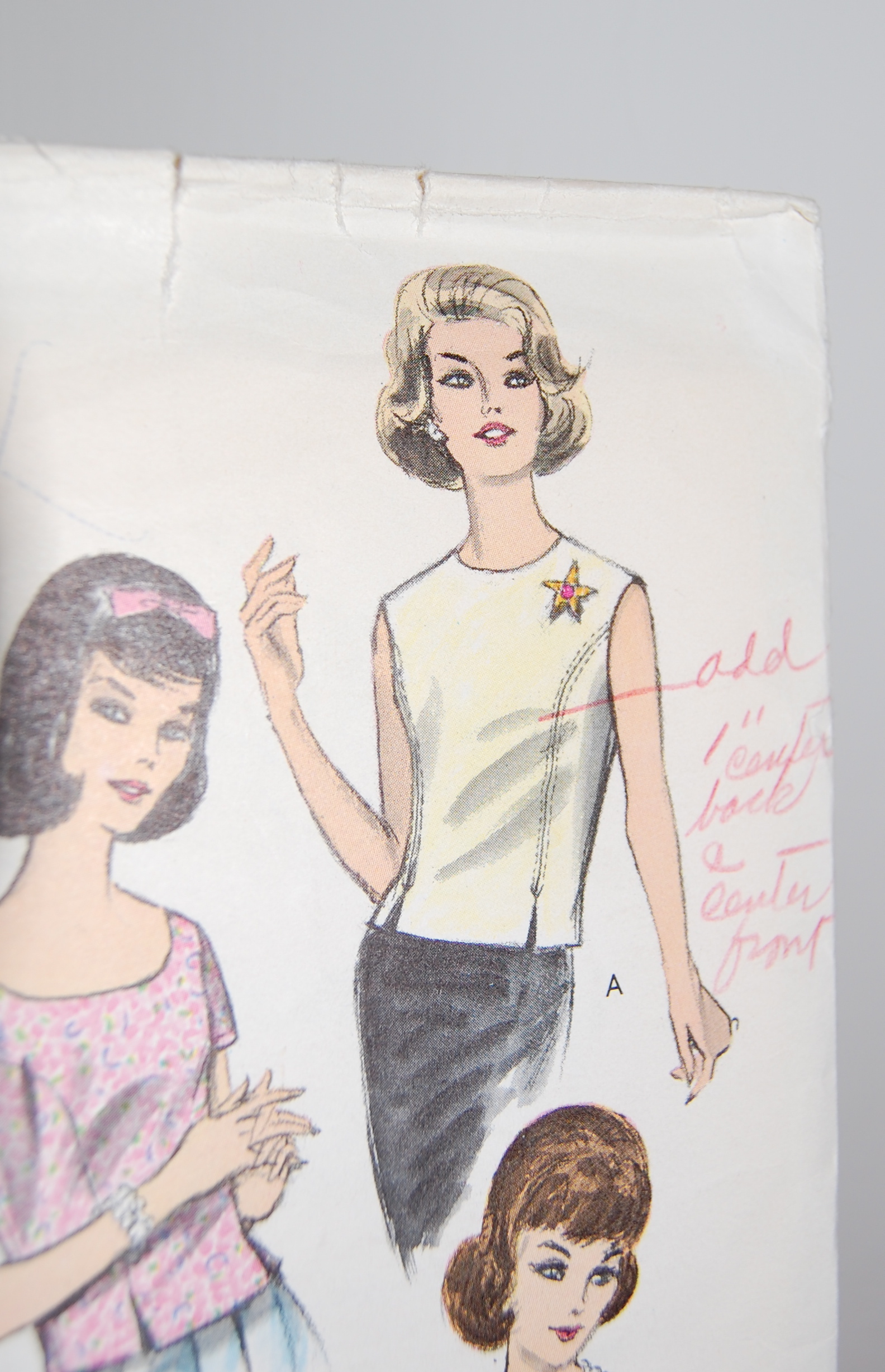
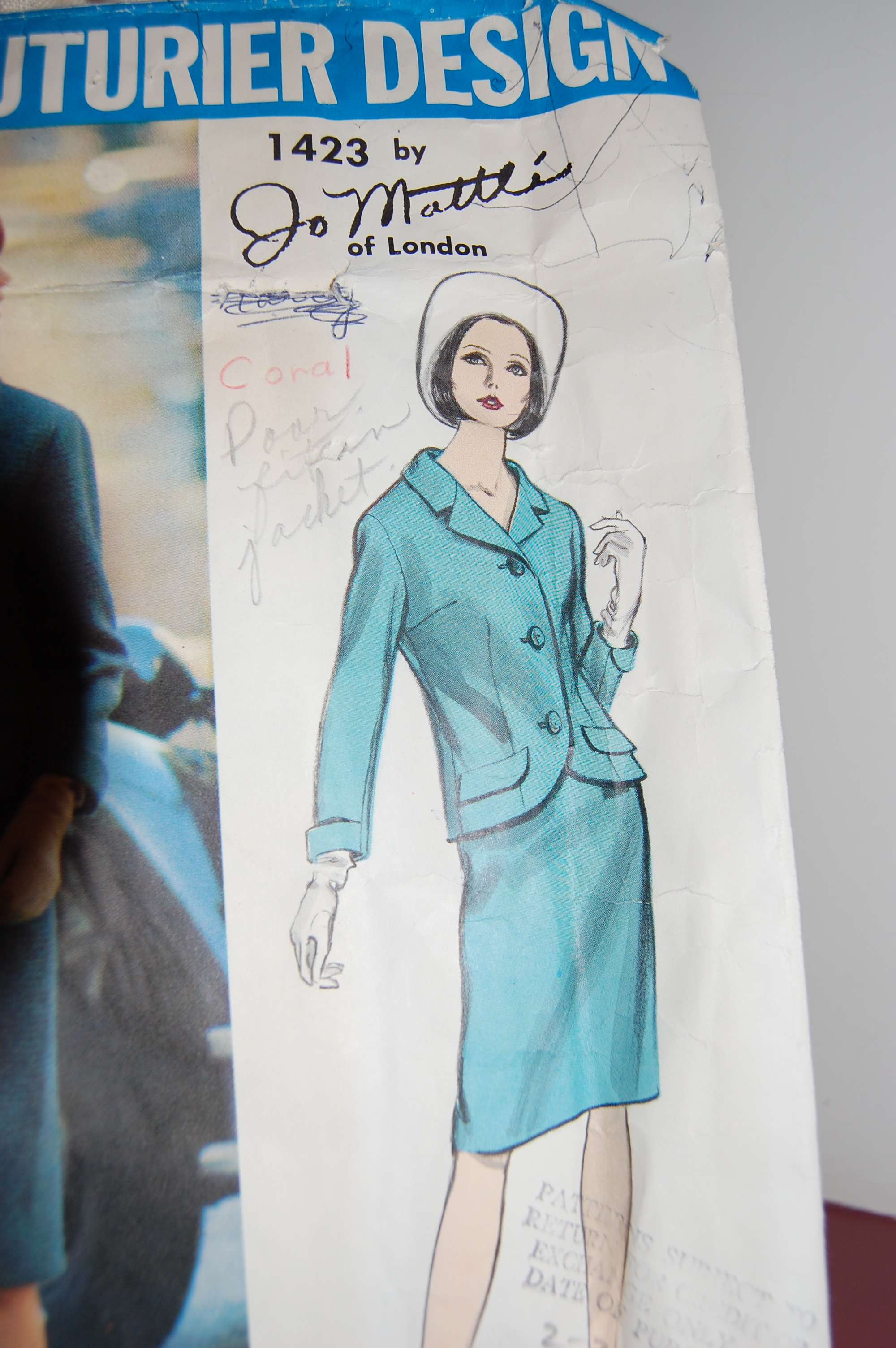
Fit seems to be an important focus.  Kudos to those dressmakers who recorded their difficulties on the pattern envelope!

I think this lady should have purchased a larger size! She needed to add 1" center front and center back!

Beware! Poor fit in jacket! But I bet it was lovely in coral nonetheless.

Check out this listing on Etsy to see a rather melancholy note about fit:  “would have been best to have gotten the med. size.”  I guess that pattern ran large!

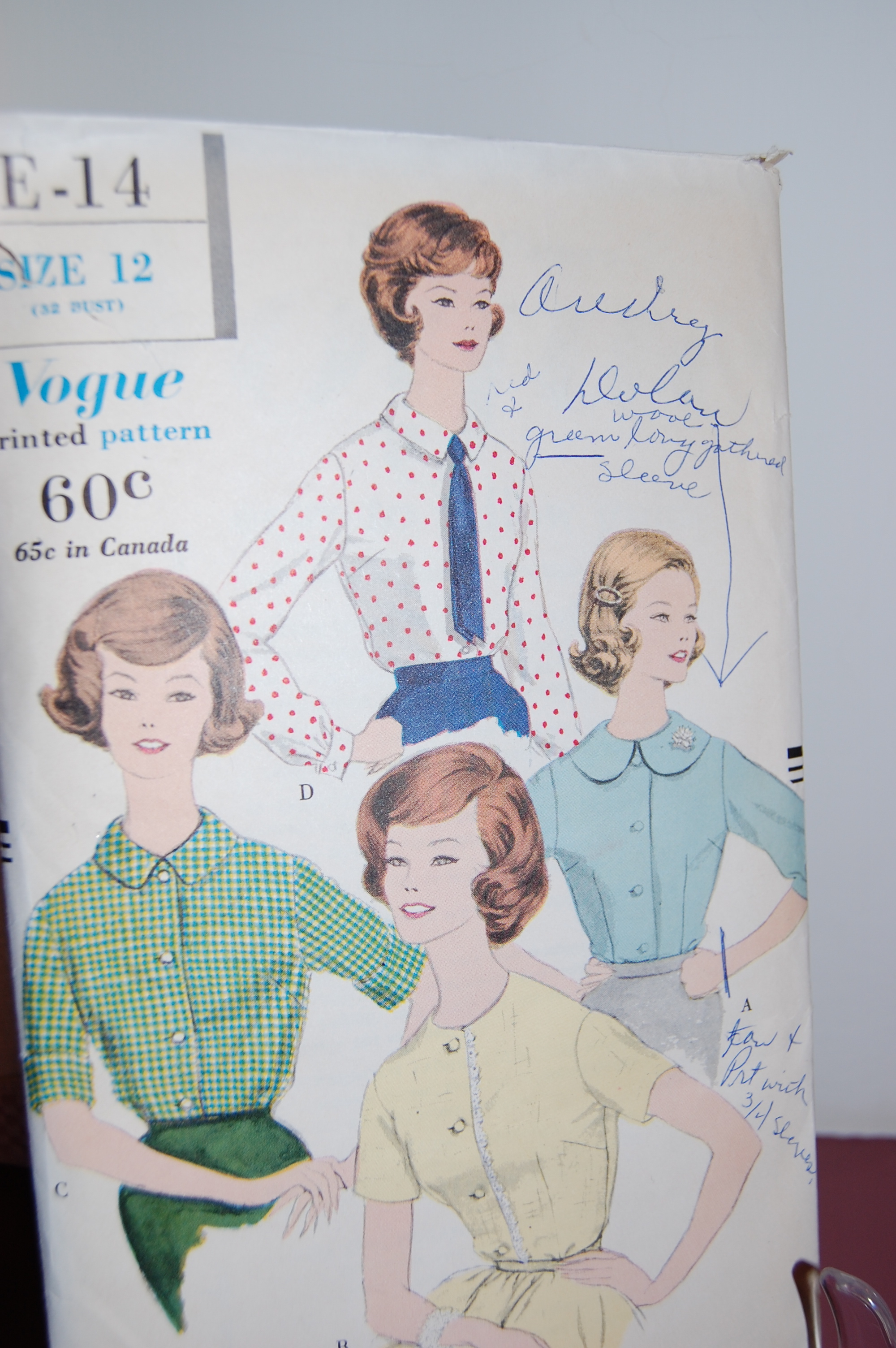
Choice of fabric and color (see above image) are also details which have been noted, sometimes multiple times on the same envelope.

I think this pattern must have belonged to a professional dressmaker. She made it up in red and green wool for Audrey Dolan, with long gathered sleeves. It looks like she also made it in tan and in a print (Prt) with 3/4 sleeves. The pattern tissue is still in great condition, despite all that pinning and cutting!

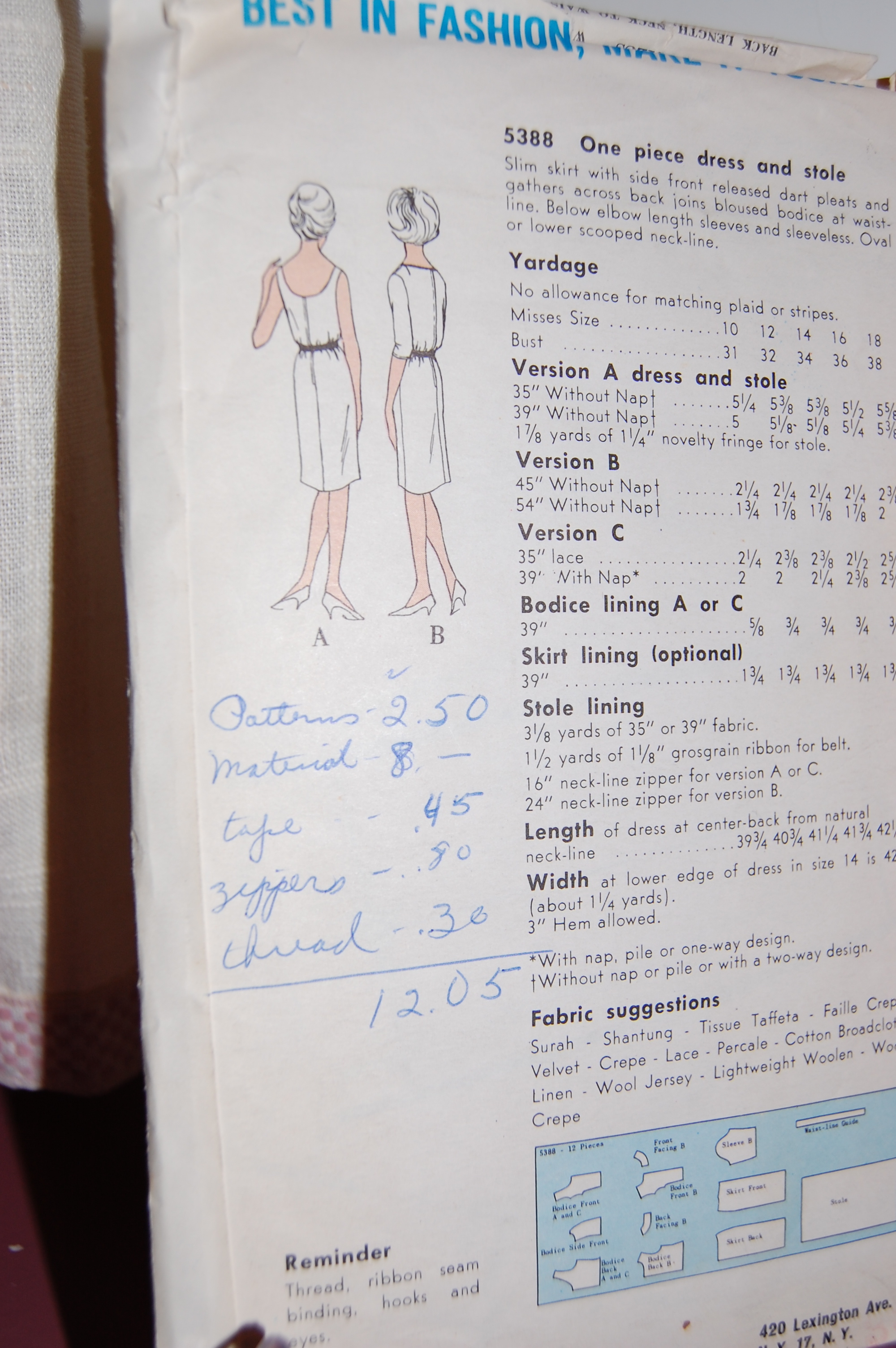
This pattern obviously belonged to a lady who was either a dressmaker, noting her expenses, or a home sewer who kept careful records for her household/clothing budget.

This lady must have made this dress in coordination with another pattern. Both patterns together cost her $2.50. She was also buying multiple zippers, to the tune of 80 cents! Her big expenditure was fabric (material), which she lists at $8.00.

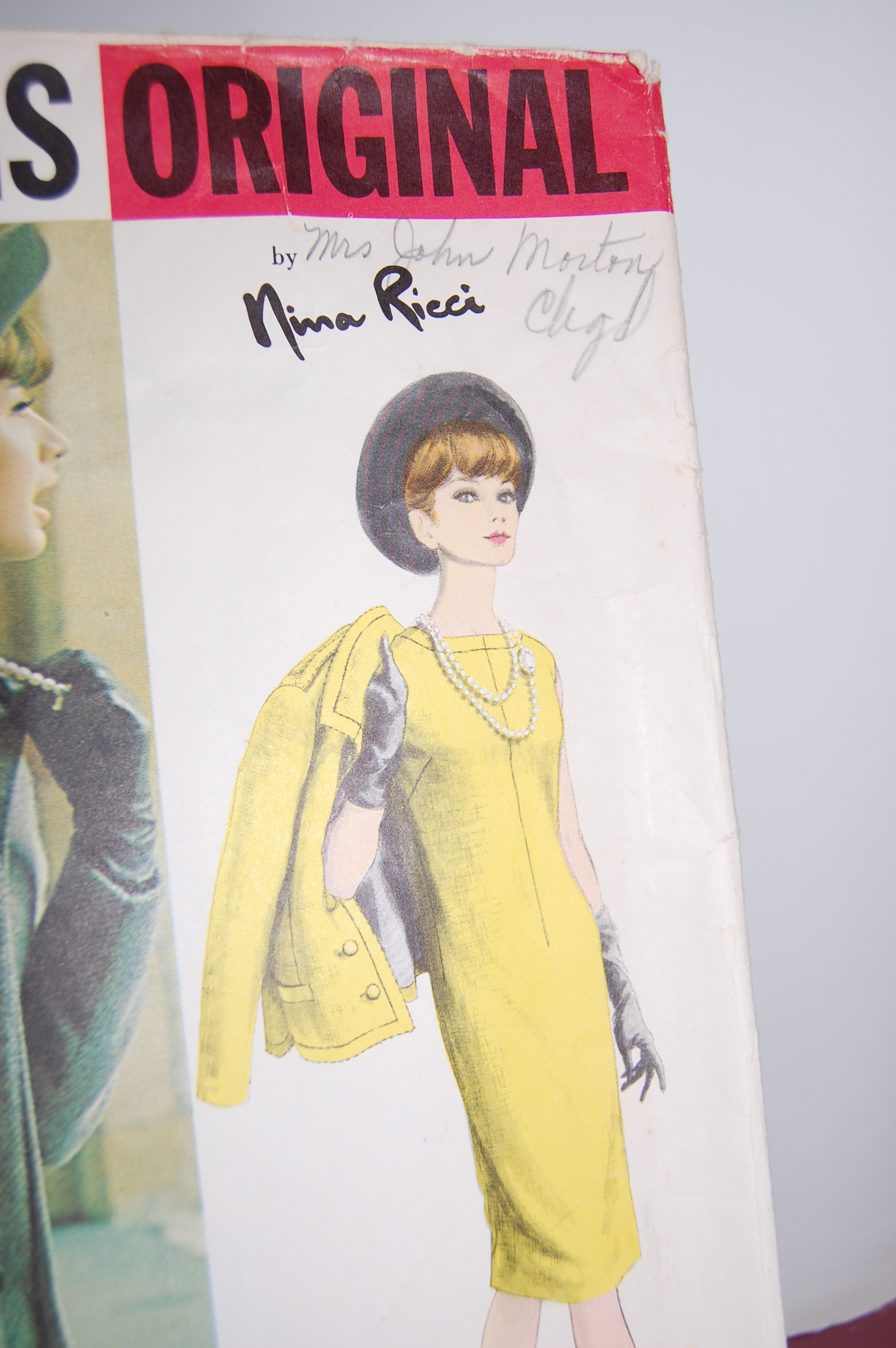
And here is a pattern which Mrs. John Morton “Chgd” [Charged]  Perhaps she did not have to be as careful with her expenditures!

I think Mrs. John Morton was one stylish lady!

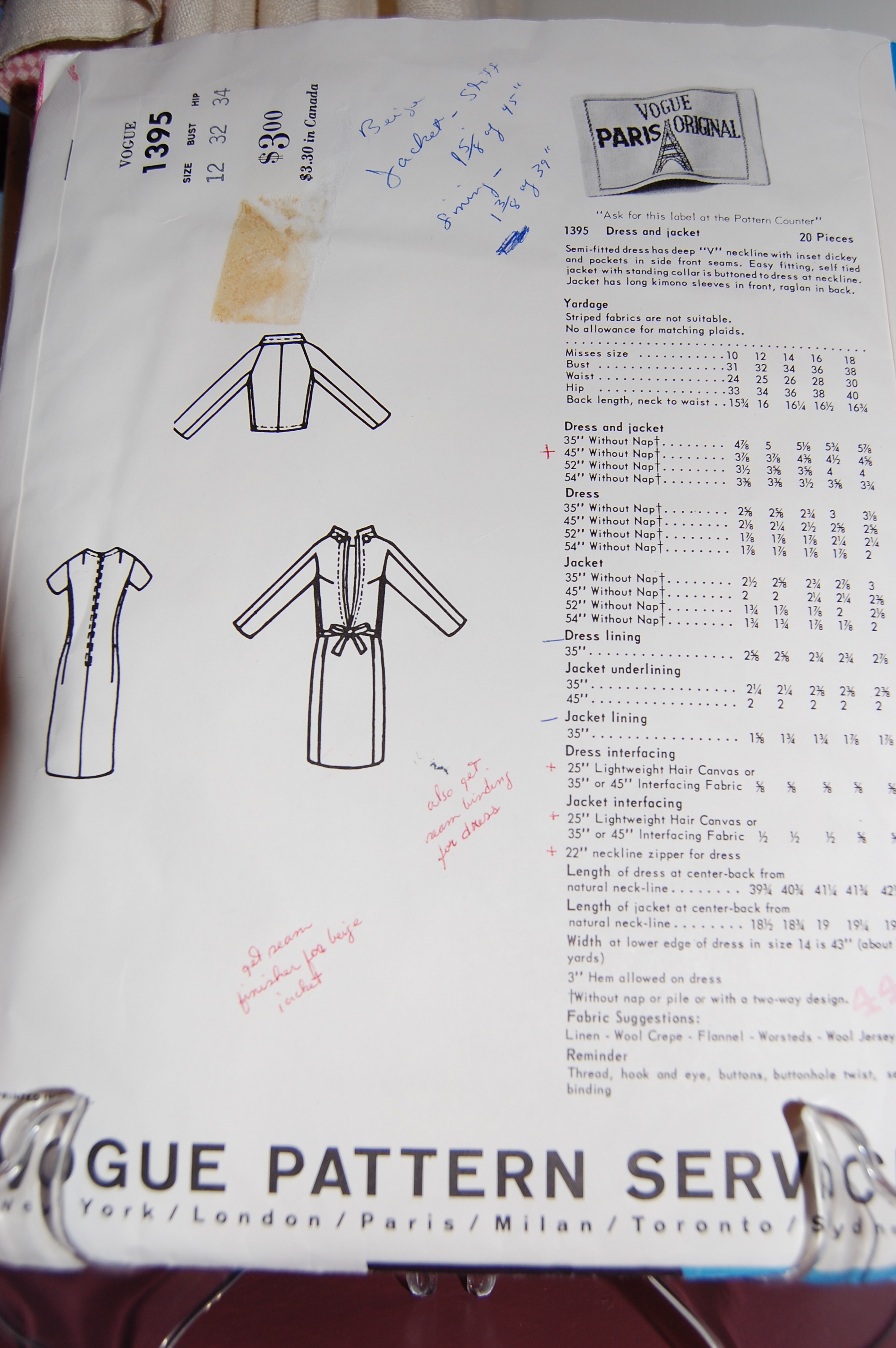
This next pattern is a study in contradictions:  The owner has carefully noted some yardage requirements, written notes to remind herself to “get seam finisher for beige jacket” and “also get seam binding for dress”.  But the pattern came to me uncut, factory-folded and therefore unused, with its original Vogue label included.  I wonder what prevented her from ever making this lovely jacket and dress?

We know she intended to make the jacket in beige, but she doesn't tell us about her color choice for the dress!

Next, it’s always fun to see someone’s intended changes to the line or details of the pattern.  Here are two examples:

View A on the far left just did not suit this sewer. She wants to extend the length of the coat, and add the collar. What she is really saying is that she wants to make view B, but with top-stitching!

It seems lengthening coats was a popular thing to do! This lady drew the longer version of the coat (on the left) and was still deciding on making the pockets "slash" pockets instead of flap pockets!

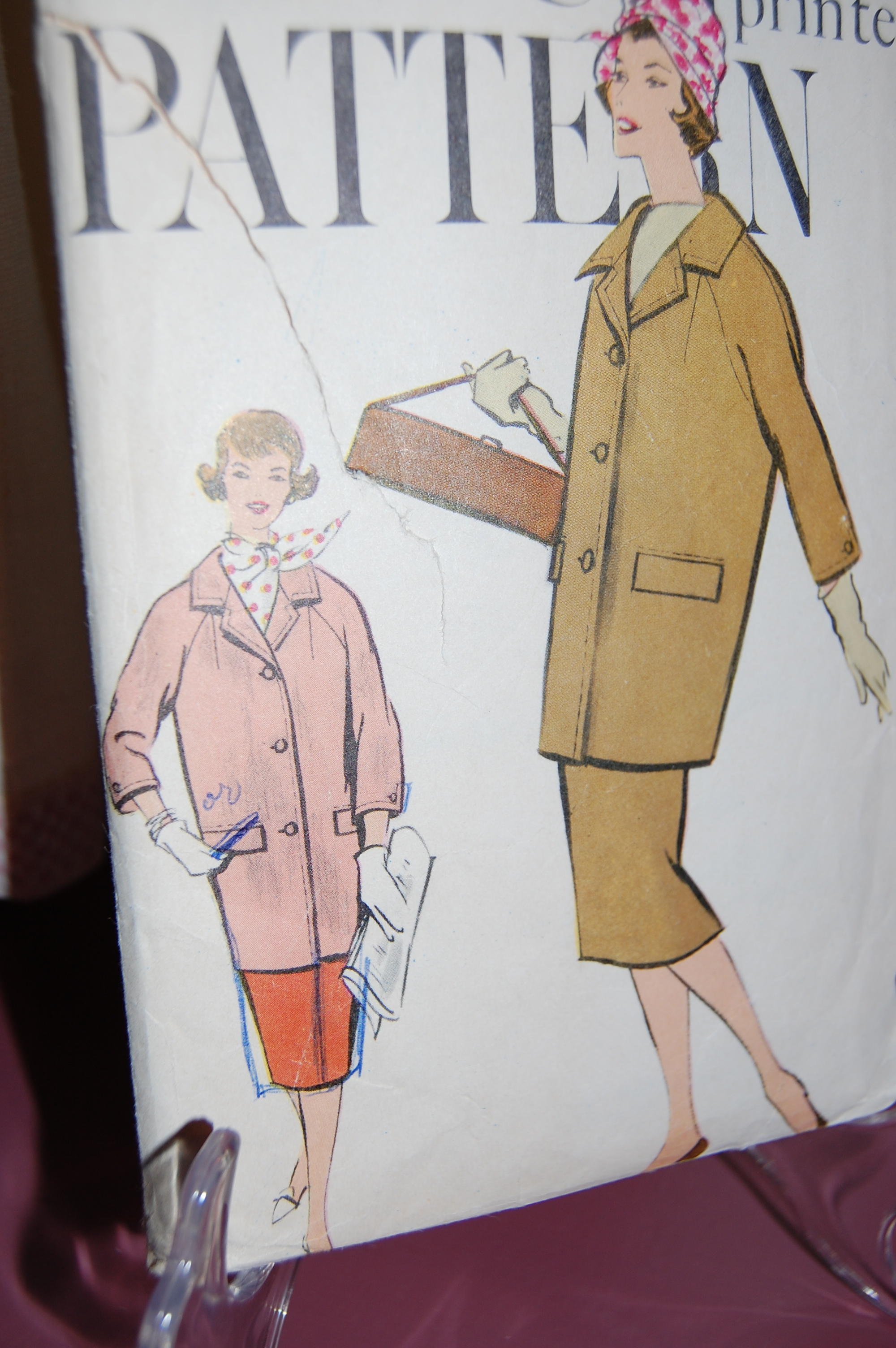
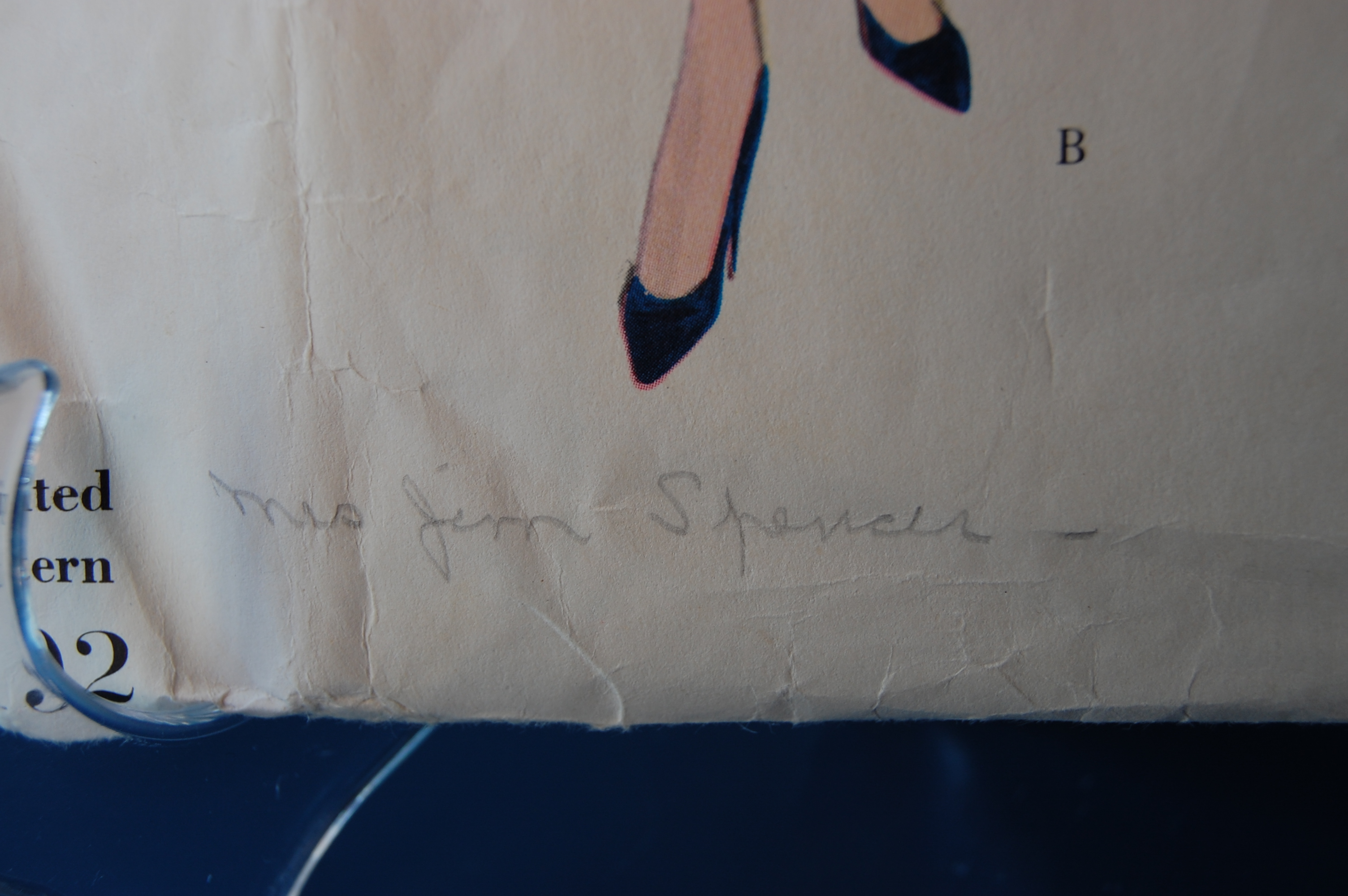
Finally, sometimes all that is on a pattern envelope is a name – a simple notation, which quietly transcends the years!

Look below the figure in red and blue for the name written in pencil.

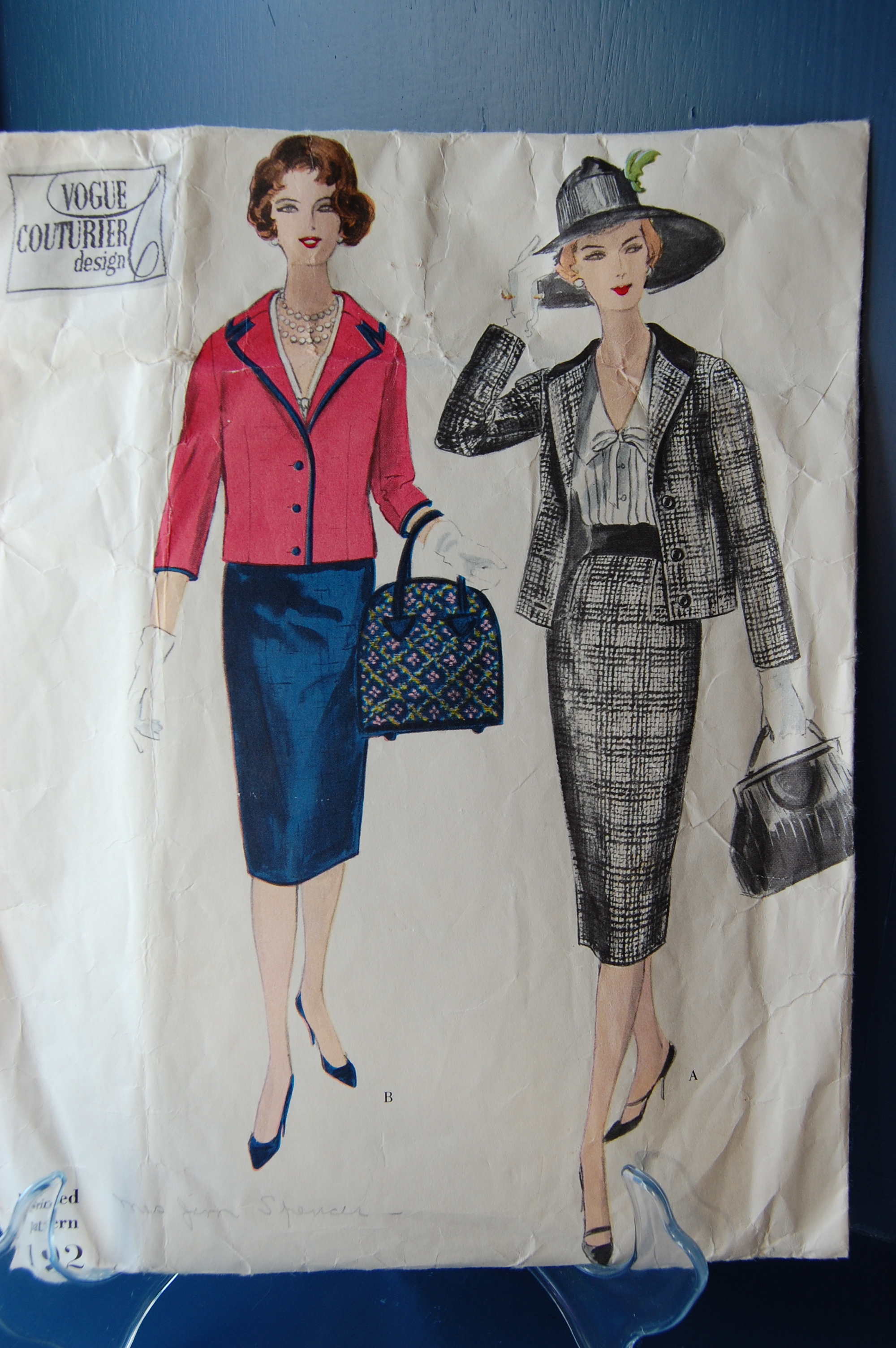
Here is a close-up of the signature. This pattern belonged to Mrs. Jim Spencer.

Mrs. Jim Spencer, I bet you looked fabulous in this suit!

7 Comments

Filed under Coats, Dressmaker details, Uncategorized, vintage Vogue patterns from the 1960s, vintage Vogue patterns from the 1970s, Vogue patterns