It was my distinct pleasure and good fortune to visit the current Exhibition on Norman Norell at the Museum at the Fashion Institute of Technology (MFIT) in New York City last week. For those of you not familiar with this mid-century American designer, you may be surprised to learn of his enduring influence on, and remarkable contributions to American fashion and glamour. He also, in his extensive and versatile body of work, employed the finest couture techniques, making his clothes still the envy of designers and those of us who strive for excellence in our fashion sewing.
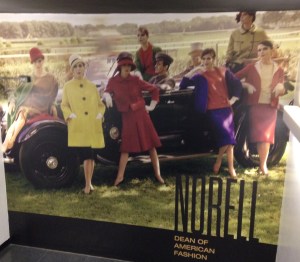
Norell: Dean of American Fashion opened on February 9, 2018 and will close on April 14th. Guest Curator and designer Jeffrey Banks and Deputy Director of MFIT, Patricia Mears, collaborated on this Exhibition. Included are examples from his entire career; however, the Exhibition focuses for the most part on his final, spectacular 12 years, from 1960 – 1972. Norell (1900-1972) left his native Indiana to pursue his interest in illustration and fashion design in New York. He worked under Hattie Carnegie, and then at the beginning of World War II he began a partnership with Anthony Traina, the label for which is the well-known Traina-Norell designation. It was in 1960 that Norell started his own eponymous line of clothing, and it was during this period, up to his untimely death in 1972, that he set his real mark on American fashion.
To all of you I commend the MFIT Exhibition website for learning more about Norell’s life and the evolution of his body of work, including a fascinating video presentation by Exhibition Curator Jeffrey Banks. (Be sure to click on “explore the Exhibition website” which will lead you to some excellent content.) It was with this background knowledge that I entered the Exhibition, knowing I wanted to view it on two levels – 1) as a dazzling display of some of the most beautiful fashions ever assembled, and 2) as an opportunity to see up close some of the construction details, style lines, and elegant touches in his fashions, serving as inspiration for my own fashion sewing.
The Exhibit is physically divided into two areas, the first of which serves as a guide to his trademark themes, each with a small grouping of fashions. I was immediately smitten with this selection of LBDs:
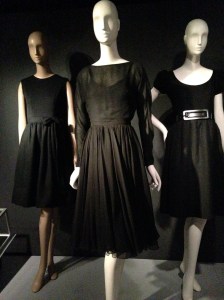
All of these dresses have a timeless appearance, making them as stylish today as when they were designed. From left to right, #1 Label: Norman Norell New York. Black sleeveless bodice with skirt and satin sash, 1963. wool jersey, wool twill. Lent by Kenneth Pool [a major lender to the Exhibit.];
#2 Label: Traina-Norell New York. Black cocktail ensemble, 1950. silk chiffon, silk satin. MFIT, Gift in memory of Miriam Abrams; #3 Label: Norman Norell New York. Black dress with belt, 1962-1963. Wool, leather. MFIT, Gift of Mortimer Soloman.
As a way of illustrating the impeccable couture construction for which Norell fashions are known, this “inside-out” dress was displayed.
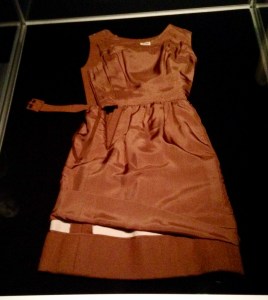
Click on the photo for a closer look.
It was all I could do to keep from reaching over to see more of it. Noted on the caption were ”the hand-picked zipper and extra wide seam allowance, the deep hem … edged with bias-cut silk so that it is softly defined yet sturdy. Furthermore, the neckline and armholes are minimally interfaced to give shape without impeding movement, and they are under-pressed in order to hide the seams.”
The larger gallery of the Exhibit practically took my breath away when I entered. The large center stage is resplendent with examples of his famous eveningwear, including his sequined “mermaid” dresses.
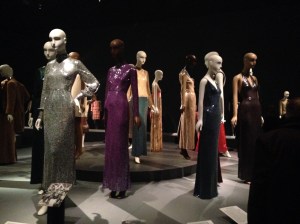
The low light in the Exhibition gallery only added to the ambience and allure of these creations.
Around the perimeter of the gallery were featured many, many of his glorious coats, capes and dress suits, as well as dresses. I snapped this photo of one of his trademark sailor dresses to show the hand-picked zipper and the large patch pockets applied by hand (note the provenance on this dress in the caption):
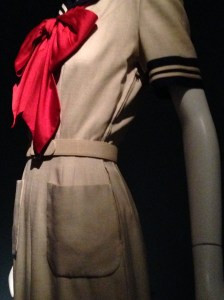
Label: Traina-Norell New York. Off-white sailor dress with navy collar and red tie, circa 1957. Linen. MFIT, Gift of Lauren Bacall.
There were so many terrific examples of Norell’s vibrant use of color, including this coral cape from 1962.
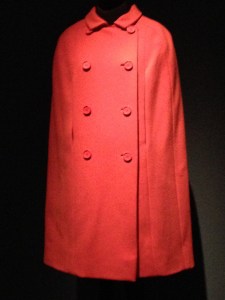
Label: Norell. Coral double breasted cape, 1962. Wool melton. Lent by Kenneth Pool.
And I could not take my eyes away from this combination of off-white evening gown with a red bolero jacket and peacock blue sash from 1968.
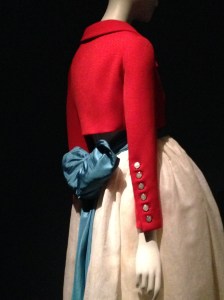
The beautiful shape of the jacket, with those amazing buttons and bound buttonholes, sets off the sash to perfection. Label: Norman Norell New York. Off-white evening gown with red bolero jacket and peacock blue sash, 1968. Cotton organdy, wool, silk taffeta. Lent by Kenneth Pool.
Another brilliantly hued ensemble is this pink evening coat with matching skirt and blouse from 1964. Note the rhinestone buttons, the beautiful bound buttonholes, the angled pockets, and the lovely seaming detail of the high yoke on the coat which descends into the sleeves.
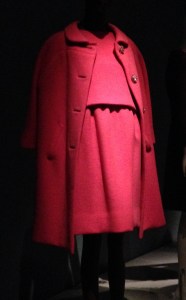
Label: Norell, Norman Norell New York. Pink evening coat with matching skirt and blouse, 1964. Wool, rhinestone buttons. MFIT, Gift of Lauren Bacall.
Norell was known for his cone and wedge-shaped coats, of which this purple one is an excellent example. Note the spread of the descending buttons on this coat:
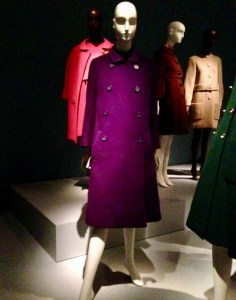
Photography was permitted, although flash photography was not, so my pictures do not do justice to many of these fashions. Label: Norell. Purple cone shaped double breasted coat with Peter Pan collar, 1966. Wool melton. Lent by Kenneth Pool.
This coat and pants ensemble from 1970 is set off beautifully by its wide belt:
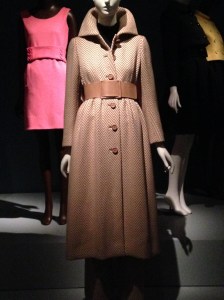
Label: Norell. Coat and pants ensemble, 1970. Wool herringbone, leather. Lent by Kenneth Pool.
The collar is absolutely stunning. And those bound buttonholes are a work of art in that heavy wool herringbone weave.
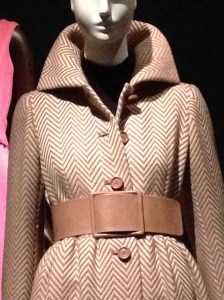
Norell used the talented stitchers of the garment worker’s union to make his clothing.
While I am writing about coats (one of my favorite subjects!), I want to show you details from two which help to illustrate the quality and finesse for which Norell’s fashions are known. First is this pocket detail from an off-white coat with black collar, 1962-1965.
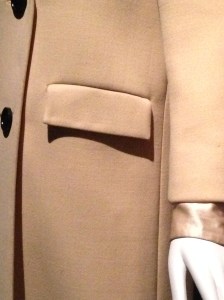
Label: Norell. Off-white coat with black collar, 1962-1965. Wool and velvet. MFIT, Gift of Mrs. Jane Albert
The right edge of the flap is angled slightly to follow the side seam line, a subtle touch which gives it a graceful appearance.
Second is another pocket detail on a beige coat with pilgrim collar from 1968:
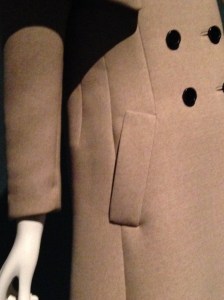
Label: Norell. Beige coat with pilgrim collar, 1968. Wool. MFIT, Gift from the collection of Margery J. Davidson, lovingly donated by her son Harold S. Graham.
The pocket is an extension of a princess seam, beautifully angled. And more shaping is apparent to the left of the full-length seam, giving this coat such elegant and refined lines.
Seeing this following grouping of dresses and jackets gave me a new appreciation of the concept of “less is more.” According to the caption, Norell “chose to trim his day and evening wear with mink, fox, and sable. The judicious use of this expensive and sensuous material elevated the glamour quotient of his restrained daywear.”
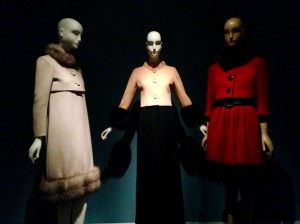
From left to right: #1 Label: Norell. Pale oatmeal midi dress and bolero jacket, 1967. Wool, crystal fox. Lent by Kenneth Pool. #2 Label: Norell. Pale peach jacket and black gown, 1966. Brushed wool, fox, sheer jersey. Lent by Kenneth Pool. #3 Label: Norell. Red and black check suit, 1962. Wool, black fox, leather. Lent by Kenneth Pool.
One more Little Black Dress has the most beautifully placed buttons:
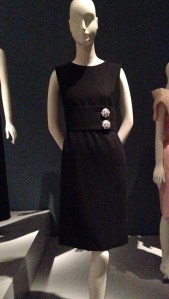
Label: Norman Norell New York. Black dress with jeweled buttons, 1965. Wool crepe. Lent by Kenneth Pool.
I loved the caption which (partially) stated: “Deceptively simple, Norell’s dresses were visually quiet but strategically constructed… to enhance a woman’s body.”
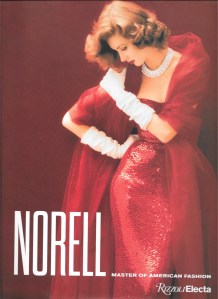
I could go on and on as there is so much more to celebrate about this remarkably talented “Dean of American Fashion.” Fortunately, the Exhibition is accompanied by a book, titled: Norell: Master of American Fashion, by Jeffrey Banks and Doria de la Chapelle. Published by Rizzoli, the book is lavishly illustrated and beautifully presented, both in content and inspiration. I commend it to you.
In closing, on a personal note, I cannot help but think back to 1972, the year I graduated from college and the year Norman Norell died. So much has changed in the world of fashion and fashion sewing since those heady years. Seeing an exhibition like this one is a lovely reminder of the true timelessness of quality and restrained elegance, providing endless inspiration to those of us who dream and sew.







 fiftydresses
Odds and Ends and One Thing You Mustn’t Miss
Sewing has been, well, challenging this summer. In reality, I think I have been able to accomplish just about all I could have hoped for – so far, at least – but it certainly doesn’t seem like very much.
When I packed fabric to bring along to our new vacation home in Wyoming, I tried to think ahead and determine exactly what I would need. For instance, I brought two decorator fabrics which I had picked out for two of our “new” bedrooms, with plans for making decorative pillows and at least one bed skirt. I also brought two fabrics with which to make dresses for our two little granddaughters who were arriving, along with the rest of our immediate family, in late July. I also brought some vintage Moygashel linen, many pieces of shirting and dress cottons, skirt fabric, and a piece of Viyella cotton/wool blend. What was I thinking?!! Certainly no one could accuse me of being under-ambitious!
I totally misjudged how much of my time would be taken up with organizing and setting up a new household. So – what have I been able to sew? A number of decorative pillows, for one thing. I find them – and all that self-bias tape I had to construct – utterly boring to make, but satisfying once they are completed. The bed skirts have been moved to the “still to do” list.
I was able to make dresses for my granddaughters. My original intent was to make each dress out of a different fabric, but when I stretched out my ladybug embroidered, striped fabric from Emma One Sock, I realized I had more than I needed for one dress. With one minor compromise, I knew I could get two dresses from my existing yardage. So I changed plans and made matching dresses.
I made white piping for the pockets and collars out of kitchen string and white batiste. The ladybug embroidered fabric is really so cute!
The compromise I had to make involved the sashes, as I did not have enough fabric to cut sashes for two dresses. Fortunately I had enough of the coordinating red fabric to make the sashes. Now I’m glad it worked out that way, as I think it makes the dresses cuter.
I had pre-purchased red decorative buttons, thinking I would need them for just one dress. Normally I would put three in a row centered beneath the collar, but with four buttons, and two dresses … Well, you do the math! Two on each dress it is!
Having spent many summer days and nights in Wyoming before this year, I knew from experience how chilly the mornings – and nights – can be throughout the summer. (The days are warm and glorious, however.) Warm cozy slippers and a winter-weight bathrobe are necessities. And that is why I brought along the afore-mentioned Viyella fabric. Although I packed a winter-weight robe which I made a few years ago, I wanted to make a new robe which I can leave here, therefore eliminating one bulky item from future suitcases.
How lovely to have the opportunity to use this vintage Vogue pattern once again.
This robe takes a lot of fabric, and it was a tight squeeze fitting all the pattern pieces on it and matching the plaid as well. I had to make the sash out of two pieces of fabric, seaming it in the back. Additionally, I had enough fabric for only one pocket (I prefer two.) But, I am happy with the outcome, and very pleased to have used one more piece of fabric from my sizeable collection!
Viyella is the perfect fabric for a lightweight, but warm bathrobe. It is machine washable, and gets softer with age.
While the bathrobe, and the little dresses, were enjoyable to make, neither were challenging in the “couture” sense. So I did my “couture” dreaming vicariously through the Susan Khalje Couture Sewing Club, where inspiration abounds in many forms. Earlier in the month, Susan was interviewed for the “Love to Sew” podcast. Treat yourself and spend a lovely hour-plus listening to it, if you haven’t already done so. The interview, Episode 106, dated August 12th, can be found here:
www.lovetosewpodcast.com.
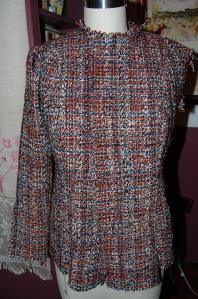
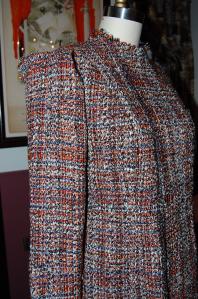
Among Susan’s new pattern offerings is this jacket:
When I arrive back home in Pennsylvania, I will be searching through my fabric closet for the perfect pairing for this pattern. I am just itching to challenge myself with such a project. No more pillows, at least for now!
15 Comments
Filed under Bathrobes, Buttons - choosing the right ones, Fashion commentary, Sewing for children, Uncategorized, Vintage fabric, vintage Vogue patterns from the 1950s
Tagged as 1950's Vogue patterns, Bathrobes, fashion sewing, sewing for children, Susan Khalje Couture, vintage Vogue patterns