
Sewing with vintage patterns is such an interesting activity. Beyond the finesse of the designs, the intricacies of construction, the attention to small details, and the fabulous pattern art lay some sophisticated and mysterious references to the history of fashion sewing.
For example, I am in wishful awe at some of the fabric suggestions on the pattern envelopes: one pattern for a coat and dress with a copyright of 1957 suggests, among other more common fabrics: Barathea, Shantung, Surah, Matelasse. Another coat pattern suggests Camel’s hair and Worsted, while Madras is suggested on two dress patterns. This is just a small sampling, but you can surmise from this that the sewing audience for these patterns knew their fabrics – and the pattern companies expected them to.
But it is in the short descriptive entries on the back of the envelopes where I have come across a mystery of terminology. One of the first vintage patterns I purchased was this coat pattern:
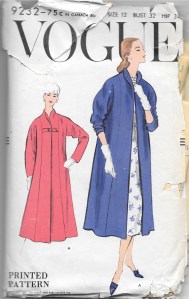
This pattern is dated 1957.
On the back of the envelope, to quote:
9232 Coat “easy to make” Flared back coat in regulation [my emphasis] and shorter length. High front and back belt, optional. Tapering kimono sleeves may be worn pushed up. [Don’t you love that styling advice?]
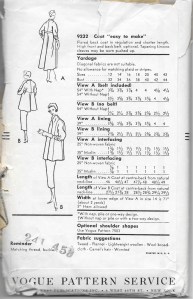
So, I thought, “What is regulation length?” I could not find a reference to this term anywhere – not in Fairchild’s Dictionary of Fashion, not in any of the vintage sewing books I own, nor in any of the vintage Vogue Pattern Book Magazines which I have in my collection. I figured I would just keep an eye out for other references to this term, and it did not take long for me to come across another one.
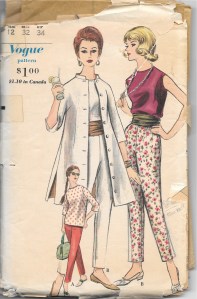
Isn’t this just so chic? No date on this pattern, but it clearly is about 1961.
This one was in reference to pants:
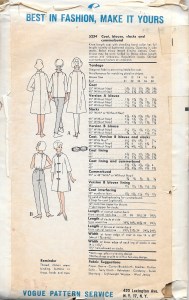
Again, to quote:
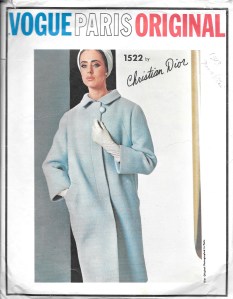
5234 Coat, blouse, slacks and cummerbund Knee length coat with standing band collar has full length novelty or buttoned closing. Opening in side seams. Below elbow length kimono sleeves. Over-blouse may be worn tucked in. [More of that styling advice!] Below elbow length sleeves and sleeveless. Regulation slacks. [Again, my emphasis] Shirred cummerbund fastens at underarm.
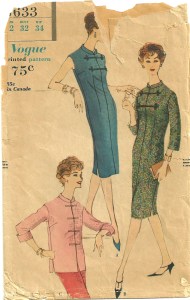
Then my search for other examples went dry – until a couple of months ago when I found this pattern on eBay:
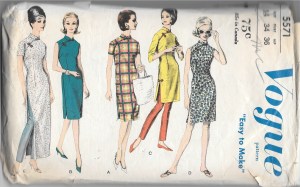
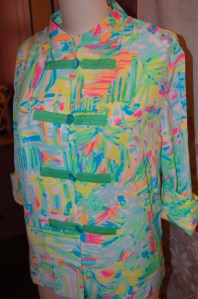
(I have a difficult time resisting Asian-inspired dresses.) When the pattern arrived, I was delighted to read its description:
5571 One piece dress and pants Sheath dress [here’s another mystery – why did they call this a sheath dress and not a cheongsam?] in three lengths, has opening in side seams. Optional waist-line darts. Diagonal right side frog closing below standing band collar. Below elbow length sleeves rolled up for cuffs, short sleeves and sleeveless. Regulation pants. [My emphasis]
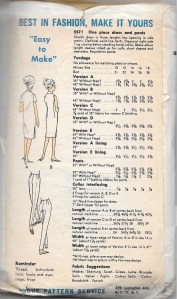
With two examples of pants/slacks (notice that one is called pants and one is called slacks, just to compound the confusion), I thought I might be onto something. So back to Fairchild’s I went to look at the entry for pants. I found this excellent diagram about pant lengths, but no reference to “Regulation” length.
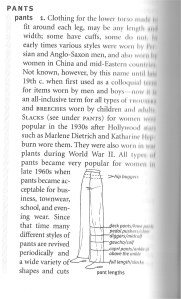
The Fairchild Dictionary of Fashion, Third Edition, by Charlotte Mankey Calasibetta and Phyllis Tortora, Fairchild Publications, Inc., New York, New York, 2003, p. 354. Click on the picture for a better view. It was difficult to avoid the distortion on the spine side of the book.
Some further sleuthing led me to some of the descriptive terms used for military attire, and yes, there are references to regulation requirements, but nothing that could be transferred to fashion sewing in the early 1960s. I suspect there could be a carry-over from those pants/slacks that women wore in war plants during World War II. But that doesn’t help explain the coat length. And here, look at this pattern from approximately the same time period as the coat at the beginning of this post: it is virtually identical, but there is no reference to “regulation” anywhere.
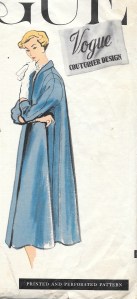
This pattern is dated 1957.
I am stumped! I am certainly not losing sleep over this (that I save for my sewing projects), but I do find it intriguing. Do any of you, my readers, know why the term “regulation” is used regarding the length of some coats and pants? Has anyone else come across this term? Can you solve this sewing mystery?







 fiftydresses
My Sewing Fairy Godmother
Time away from home – as in a vacation and/or a trip with a specific purpose – can hold many possibilities and promises, including treasured time with family and friends, new adventures, a change in routine, and, of course, exposure to new and different places, people, and history. For me, and for many of you, it also means a forced hiatus from sewing, which is a change in routine that is not always welcome.
Thus, after returning earlier this week from 30 days away, I felt a great sense of calm and happiness when I went into my sewing room after such a long absence. It took a few days to start a new project, but now I am cranking away at Fall fashion sewing, littering the floor with scraps and threads and pins. My room, which I had left neat and tidy and clean is now scattered with patterns and muslin and fabrics – in other words, it is back to normal.
I have come to know, however, that references to, and examples of, sewing and fashion seem to show up in the most unusual places – even on vacation (or “work” trips) when you least expect it. It is like my “Sewing Fairy Godmother” is looking after me with these charming and fascinating bits of whimsy to keep my focus sharp and my sewing homesickness at bay.
Consider that these two charming dress forms, both size 4, adorned one of the rooms in the spacious and lovely house located high (very high) in the massive and stunning peaks of Colorado (USA) where we just spent the past month.
One form was set in each corner of the room.
To make this even more meaningful for me, the forms were the perfect size for our 4-year-old granddaughter who was with us for part of our stay. Wouldn’t one of these be a nice addition to my sewing room!
Other fashion vignettes were found throughout the house, such as these glove forms tucked into a corner cupboard.
Do you see the needle and thread hanging on the hand at the right?
And among the art books on display was this volume which I read cover-to-cover, only wishing there had been more photos of my favorite best-dressed women throughout the ages (such as Babe Paley, Grace Kelly, Jackie Kennedy Onassis, Coco Chanel, Mona von Bismarck) – and where was Bunny Mellon? Despite its shortcomings, I found it a fascinating synopsis of fashion and its leading ladies from 1940- 2002.
“The Best of the Best Dressed List” is the focus of this book, with a foreword by Eleanor Lambert who started the International Best Dressed List in 1940.
So when else has my Sewing Fairy Godmother been looking out for me? She must be tenacious, as it took almost two years for her to prove her existence to me. It all started over two years ago, when in a weak moment I agreed, after much consideration, to be President of my Garden Club from June of 2015 – June of 2017. My biggest concern was that my duties in this role would greatly impact, negatively, the hours I could devote to my sewing. And, this turned out to be correct. I had many frustrating hours when I was in meetings, planning for meetings, hosting meetings, running meetings, doing all sorts of unimaginable things for the Club, all of which meant I was not sewing for big chunks of time. However, I persevered, tried to keep a positive attitude about it all, and do a good job.
Then – I had a Eureka moment when I was on a “business” trip for the club early this past May, attending the Annual Meeting of the Garden Club of America. Among the perks of this Annual Meeting is a wonderful multi-vendor boutique, which is set up in the host hotel. One of the vendors specialized in French fashion jewelry. Although her jewelry was lovely, it was one of her props that caught my eye – a wooden sign, with the phrase “COUTURE MODE” spelled out in stylized block letters.
When I approached her about it, she told me she had purchased it in Paris several years ago and it was “not really for sale” – but she would think about it. She gave me her card and told me to stay in touch. Well, did I ever! By the beginning of June, she had agreed to sell me the sign. It now hangs in my sewing room, where I enjoy it daily.
A focal point of my sewing room – I love this sign!
If not for being Garden Club President, I never would have been at that meeting, and I never would have found this sign. So, thank you Sewing Fairy Godmother, for knowing better than I, that opportunities and inspiration are sometimes long in the making or found in unexpected places.
5 Comments
Filed under Dressmaker forms, Fashion commentary, Love of sewing, Uncategorized
Tagged as fashion sewing, love of sewing