
What more can be said about the process of making a classic French jacket? Well, actually, quite a lot! These jackets look deceptively simple (and elegant) when finished, but their looks belie the hours involved in their construction.
One of their sneaky little secrets is the sewing of the sleeves onto the body of the jacket. The shoulder seam is one of the few areas of the jacket which requires interior reinforcement. The selvedge edge of the lining fabric can be used for this, but I prefer to use a selvedge edge of silk organza.
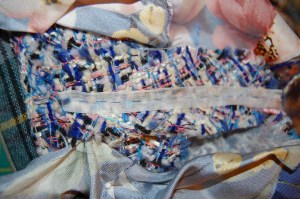
The strip of organza is sewn on the seam line by hand.
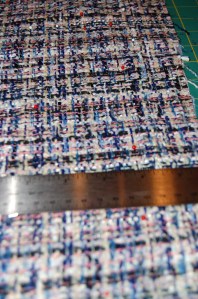
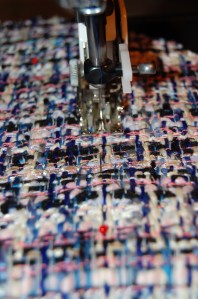
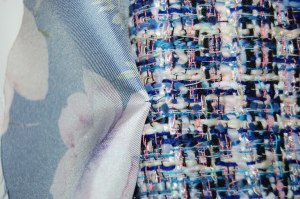
Once that is in place, the sleeve is ready to be inserted – all by hand! Pinning the sleeve in place accurately is so important, as the grainline of the boucle needs to hang perfectly both vertically and horizontally (and match, too, of course.) The top half of the sleeve is sewn from the outside with small, tight fell stitches. Then the lower half of the sleeve is sewn on the inside with small backstitches, both segments using waxed, double thread. If done correctly, the cap of the sleeve will curve nicely.
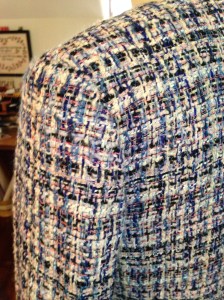
Looking at the sleeve head from the back of the jacket
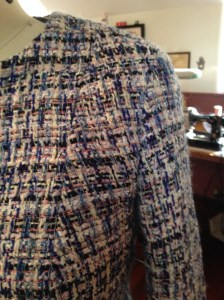
And from the front.
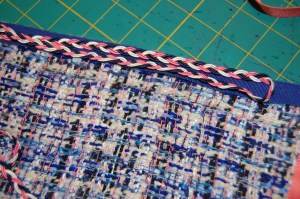
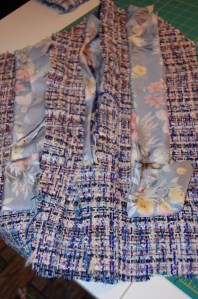
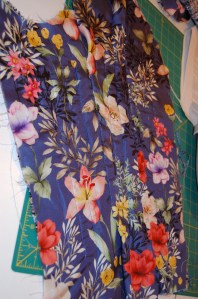
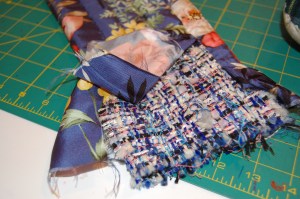
Finishing the sleeve insertion is, for me, the last big hurdle to get over before the really fun part starts. That, of course, is the trim. I deliberated quite a bit over the trim for this jacket. I originally thought I would emphasize the blue in the boucle, using pink as a small accent. When I could not find a “demonstrative, stand-alone” trim I liked, I determined to use an underlay of Petersham ribbon, with a coordinating, narrower trim on top.
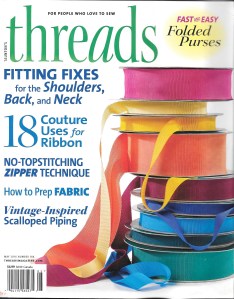
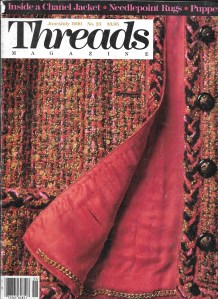
For those of you who are not familiar with Petersham ribbon, take a look at this cover from Threads Magazine, May 2016.
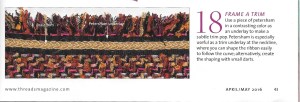
In the accompanying article by Susan Khalje, one of her suggestions is to use Petersham ribbon to frame a trim.
I used Petersham ribbon on my last French Jacket, and was really delighted with the effect.
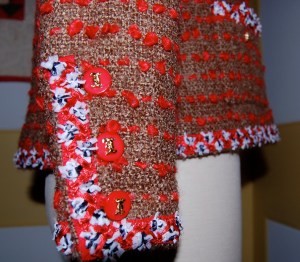
Red Petersham ribbon under the frilly trim gives it more dimension.
The more I looked at the blue, the more I thought it did not give the effect I wanted. I then decided to try Petersham ribbon in a pink hue.
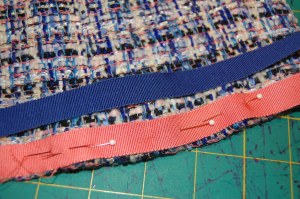
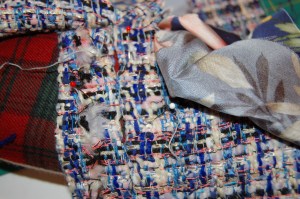
There are actually two pinks in the weave of the boucle, one peachy and one clear pink. Doing the trim this way brings out both hues, which I really like.
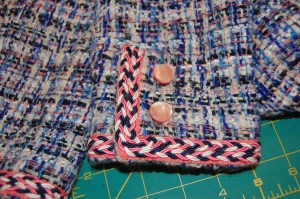
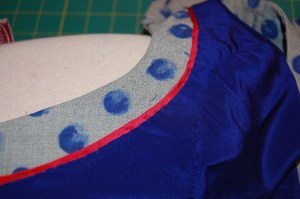
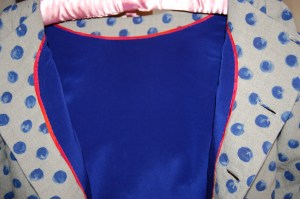
The Petersham ribbon is peachy, while the soutache trim has a clear pink intertwined with white and navy blue. The buttons take either hue!
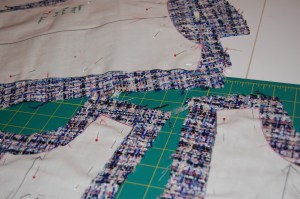
Of course, this application of trims means four times around the perimeter of the jacket by hand to apply first the Petersham and then the double row of soutache trim. I never make things easy. Is it any wonder this jacket isn’t finished yet?




 fiftydresses
Do You Do Pink?
Apparently, pink is a controversial color. Or maybe “was a controversial color” is a better statement. A recent article by Nancy MacDonnell in the Off Duty section of The Wall Street Journal (“Making Peace with Pink” February 11-12, 2017) makes a case for the appropriateness – and timeliness – of pink even for those who think they don’t like it. While I am one who thinks pink is always in fashion, it turns out that this Spring, it really is in fashion! According to Ms. MacDonnell, “On this season’s runways, pink predominated.” The different fashion houses showed varying interpretations of pink: Michael Kors was “brisk, All-American, [and] cheery.” J. Crew was “equally upbeat,” while Valentino showed pink that was “lush and romantic, with intricate appliqués and historical references…” The list goes on and on. The unifying thread (pardon the pun), as claimed by the designers, was the lack of traditional “sweetness” associated with pink, with emphasis on the feminine power inherent in the color.
Looming large on page 58 from the November 2016 WSJ Magazine is a Valentino coat, quite traditional in design, but made very special by its stunning appliquéd pink wool.
According to Dr. Valerie Steele, the Museum Director at the Fashion Institute of Technology in New York, who was quoted frequently in Ms. MacDonnell’s article, the idea of pink as a feminine color did not take hold until the 1950s. Back in 1954 when Christian Dior wrote The Little Dictionary of Fashion, his entry on “pink” stated: “The sweetest of all the colors. Every woman should have something pink in her wardrobe. It is the color of happiness and of femininity.” He even used pink throughout his book for illustrations, chapter headings and the title page. He recommended pink “for blouses and scarves; … for a young girl’s frock; it can be charming for suits and coats; and it is wonderful for evening frocks.” Who can argue with that, be it 1954 or 2017?
The title page of Dior’s smart little dictionary. (Harry N. Abrams, Inc., NY, NY, copyright 2007)
This page from the June/July 2013 issue of Town and Country Magazine gives an interesting timeline of the color pink, “how the color of little girls and baby dolls came of age”:
Click on the image to read it.
I particularly like this statement from Laura Vinroot Poole, the founder of boutique Capitol in Charlotte, N. C., quoted in The Wall Street Journal article: “To wear pink, you have to be an interesting and smart person… You have to have things to say. In pink, you can’t hide.” Nor would you want to.
Personally, pink is my favorite color. I am always drawn to it, regardless of its hue. And its hue covers a huge range from palest pink to deepest fuchsia, from bubblegum pink to raspberry red. In thinking about pink for this post, I gathered this stack of pink fabrics from my collection. Just looking at it makes me happy!
From top to bottom:
1) vintage Moygashel linen, purchased on eBay
2) silk charmeuse, purchased from Britex Fabrics
3) vintage Moygashel linen, purchased by me in the 1970s
4) linen, possibly Moygashel, purchased on etsy
5) silk jacquard purchased from Britex Fabrics
6) silk charmeuse, purchased from Mendel Goldberg Fabrics
7 & 8) coordinating silks, purchased from Mendel Goldberg Fabrics
The only controversy I have with pink is deciding which hue of it I like best.
19 Comments
Filed under Fashion commentary, Moygashel linen, silk, Uncategorized, Vintage fabric
Tagged as Britex Fabrics, Mendel Goldberg Fabrics, Moygashel linen, silk, vintage fashion, Wall Street Journal Fashion coverage