
The A-Line silhouette is certainly a very recognizable and common style. Although there is nothing spectacular about it, it does have a rather interesting origin in modern fashion history. I had lots of time to think about this style as I worked through my most recent project, and I was surprised with what I discovered.
This entry in Fairchild’s Dictionary of Fashion gives a succinct history:
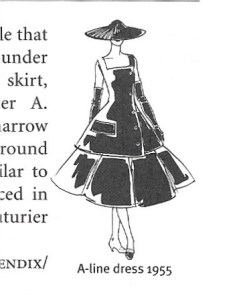
“Apparel styled close and narrow at the shoulders or waist and flaring gently away from the body to the hem in a line resembling the letter A. Introduced in 1955 by Paris couturier Christian Dior, the term is used as an adjective in describing a wide variety of apparel with this shape, including coats, dresses, jumpers, and skirts.” (The Fairchild Dictionary of Fashion, by Charlotte Mankey Calasibetta and Phyllis Tortora, Third edition, Fairchild Publications, Inc., New York, New York, c2003, page 11)
A further entry adds “…Usually made with narrow shoulders, [and] a high neckline…” (Ibid, page 11)
Dior’s “A-Line” collection in the Spring of 1955 featured a “fingertip-length flared jacket worn over a dress with a very full, pleated skirt.” (“A-Line dress,” by Susan Ward; Encyclopedia of Clothing and Fashion, by Valerie Steele; Thomson Gale, Detroit, Michigan, pages 35-36) Fairchild’s Dictionary has a depiction of this very dress which was called “the most wanted silhouette in Paris.”
Obviously the A-Line shape then evolved into a less dramatic, and more ubiquitous style during the 1960s and ‘70s, much closer to what we recognize today as A-Line.
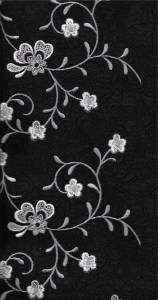
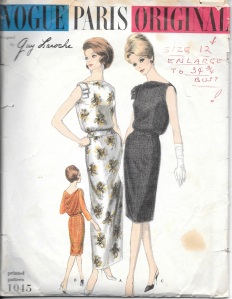
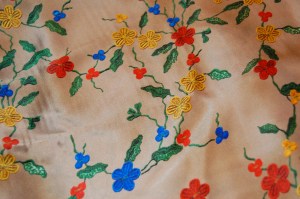
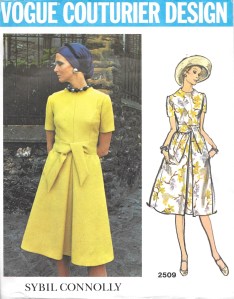
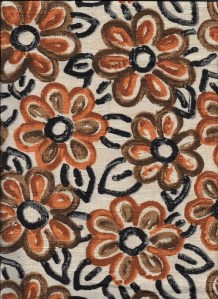
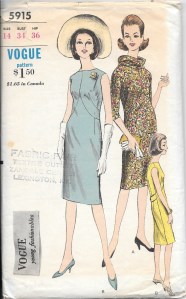
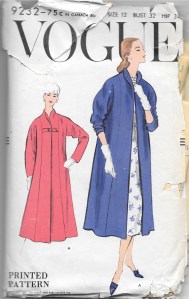
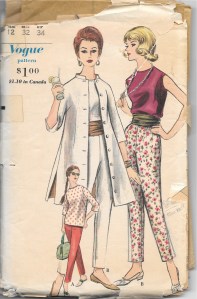
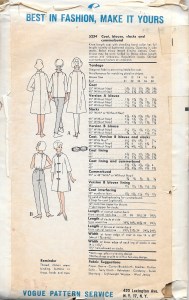
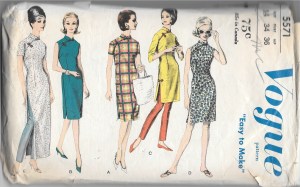
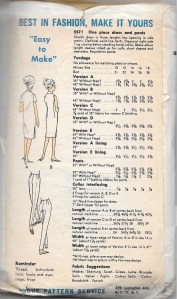
When I was contemplating which pattern to use for my dress (I had purchased the fabric, 1½ yards, 54” wide, from Mendel Goldberg Fabrics in April of this year), I wanted a style which would showcase the fabric. Although I originally thought I would go with a sheath dress silhouette for this fabric, when I found this pattern, it struck a chord.
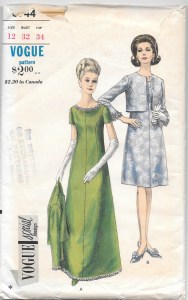
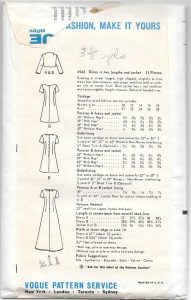
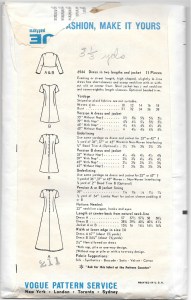
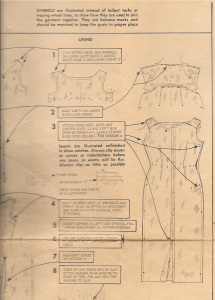
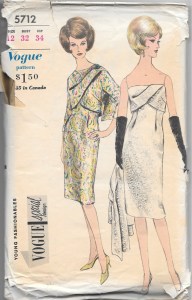
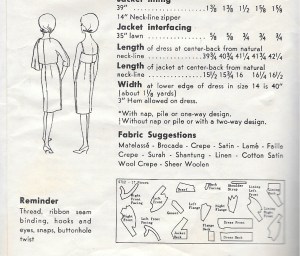
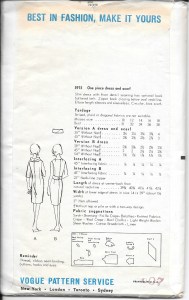
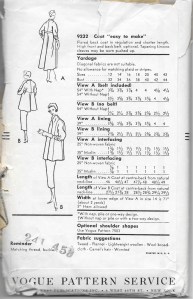
The line drawing for the shorter length shows more detail of its seaming and darts. The description on the pattern envelope reads: “Evening or street length, high shaped, slightly A-line dress has short sleeves and scoop neckline with or without slit at center front…”
I liked that center front seam with its notched neckline, even though I knew it might be a little tricky to match the embroidered vines and flowers. However, I thought the semi-attached appliqués would be lovely overlapping the seams.
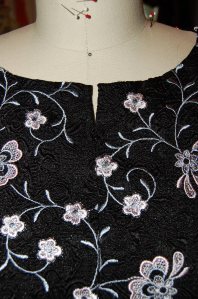
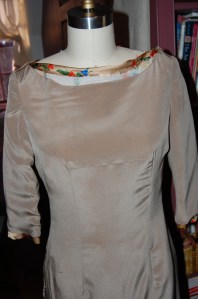
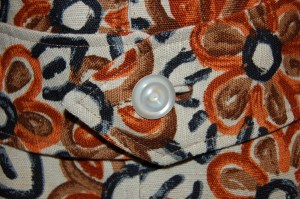
The small slit in the center front neckline.
It took me a full week to finish my muslin. The bust needed to be dropped so those princess-seamed darts needed a lot of adjustment. In the shoulder area I had some gaping in the front, and I also needed to reshape the top of the shoulders. Instead of easing the sleevecaps to fit the armscye, I decided to replace that ease with a shaping dart to the top of the sleeves. I really liked the fluid look that gave to the shoulder line. I drafted three-quarter sleeves as I was contemplating that change to the original pattern.
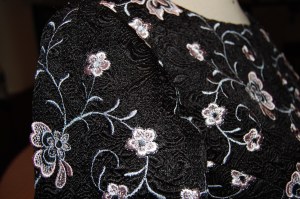
It is difficult to see in this black fabric, but this is the top of the sleeve with its shaping dart. If you look closely, you can see some loose edges of the larger appliqués.
Can you guess what is coming next? As is often the case when I purchase fabric first and then choose a pattern, I created a challenge for myself. It was almost immediately obvious to me that I would not be able to work on the lengthwise grain of fabric, as I could not begin to fit the pattern pieces onto the fabric and do any matching whatsoever. As luck would have it, I preferred the appearance of the meandering of the vines and flowers on the crossgrain, and I figured out how to stagger the pattern pieces to both fit the fabric, and match the seams. But those three-quarter length sleeves? No way were they going to happen! I could just fit in the original short sleeves, so short they were going to be!
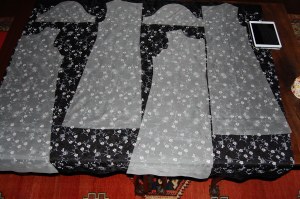
Here are the silk organza underlining (pattern) pieces laid out on my fabric. I had to stagger the four main pieces to fit it on the fabric. Fortunately I was still able to match the pattern of the vines and flowers. Whew! (I took pictures on my iPad to help with the matching. You can see it in the upper right corner.)
I ended up basting by hand every single seam on this dress. Even with great care, it was incredibly easy to catch corners of those loose appliqués by mistake, so it was much easier to make adjustments in basting rather than in the finished machine-sewn seams. The basting also showed me I needed to take out a small bit of the width of the skirt from the waist down, about an inch total. When is an inch more than an inch? In this dress! That one inch made a huge difference in its final appearance.
Because I was sewing this dress using couture techniques, the neck facing was eliminated, with the black crepe de chine lining fell-stitched to the edge of the neckline. When I under-stitched the lining to secure it in place, I used an off-white silk buttonhole twist. It was so much easier to see light thread on the black lining, and also, I think it looks pretty.
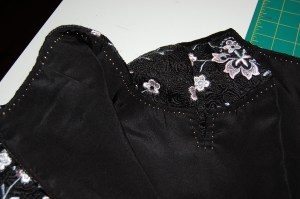
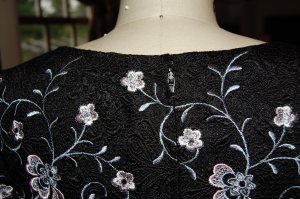
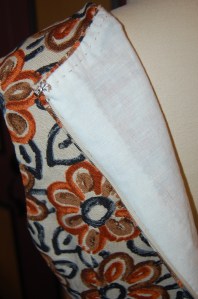
I hand picked the zipper, which virtually disappears in this dark jacquard embroidered fabric.
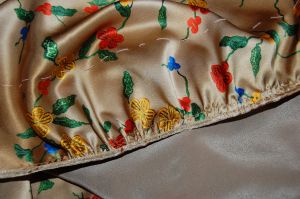
I was able to arrange the hem of the skirt so the larger of the semi-attached appliqués would hang just beneath the fold-line.
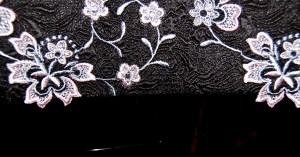
This shows two of the appliqués at the hemline.
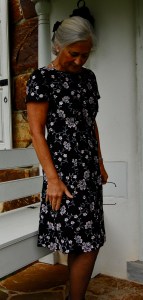
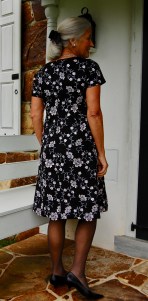
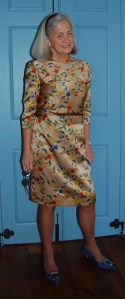
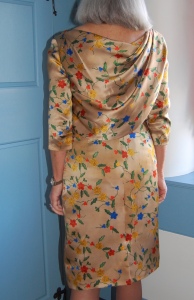
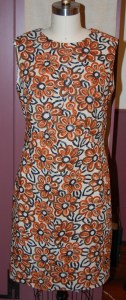
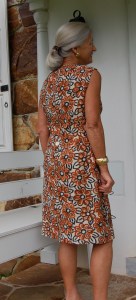
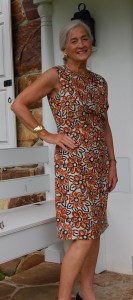
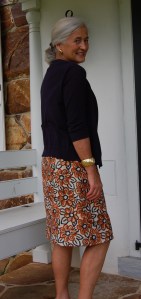
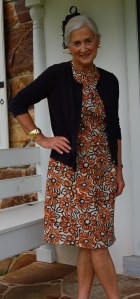
I love the graceful flow of this dress.
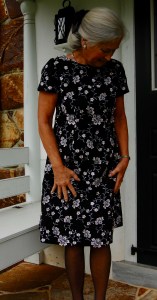
The simple look of this dress belies the hours and hours I spent on it!

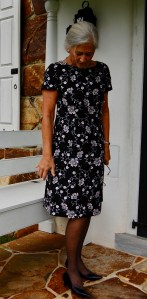
And I am so pleased that I was unable to make three-quarter length sleeves. These short sleeves are just perfect!
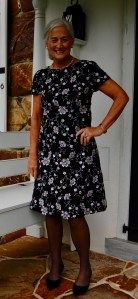
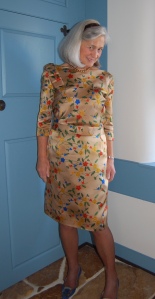
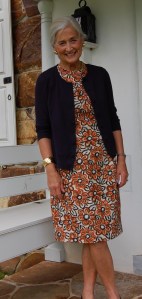
I am quite happy with the way this dress turned out. I do think its simple lines show off the fabric well – no need for anything too fussy when the fabric is so incredibly lovely! I love that I can wear this 1960’s A-Line style and somehow feel – and hopefully look – very current.












 fiftydresses
More on Dior
In re-reading my last two reviews of the Dior in Denver Exhibit, I realize how very little I was able to include, when there was so much to see and learn. Well, these reviews cannot go on forever, but there are a few other aspects and components of the Exhibit that I still want to share.
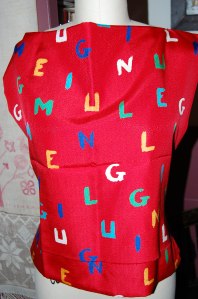
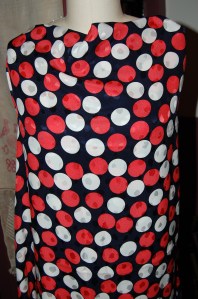
In one of the narrower passageways between Exhibit “rooms,” there was a display of Dior scarves lining each side. From the Dior Heritage Collection in Paris, these printed silk twill scarves were designed by Alexandre Sache between about 1958-1976.
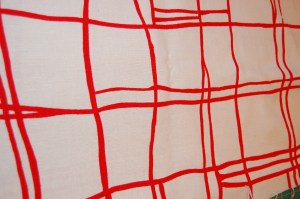
The very bright graphic ones were so eye-catching:
And this engaging one with its impressionistic rose in the center was my favorite, I think:
You may have noticed in my first two reviews how many of the fashions, especially the early ones, were made in black. Dior considered black “the most elegant of all colors.” While they often do not photograph as well as other colors, these fashions made in luscious black fabrics commanded attention throughout the Exhibit.
I apologize for not having the attribution on this cocktail dress.
Also spread throughout the Exhibit were quotes from the various Creative Directors. Two especially caught my eye. The first, from Christian Dior himself, was one I had never read before. “The Americans are, by essence, impeccable.” Wow! What a lovely tribute to his stylish American clients.
And then there is this one from the current Creative Director, Maria Grazia Chiuri: “A dress can have some impact but a woman makes the difference with her attitude.” This quote needs no further commentary…
The Exhibit included so many supporting documents and written and printed materials, it was impossible to identify the most important. But I want to share this copy of Time Magazine from March 4, 1957, with Christian Dior on its cover.
Dior died the same year, 1957, on October 24th.
As Exhibit goers departed the exhibition space, there were paper punch-out Dior “handbags” for the taking:
Here is the reverse of this small bag, with punch-out puzzle pieces of the coat included! So clever.
After four hours nonstop in the Exhibit, I reluctantly departed from the Denver Art Museum to get a very late lunch, with intentions to return to the museum shop for a little browsing. Here I am upon my return, standing in front of one of the displays of books:
And here is the bag (I love bags!) which housed all those lovely purchases made at the Museum Shop:
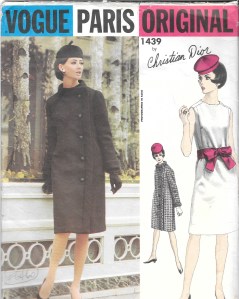
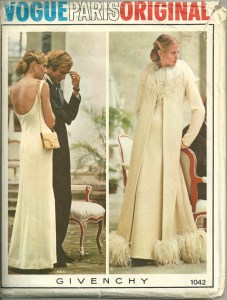
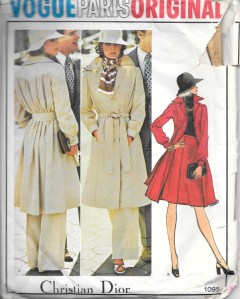
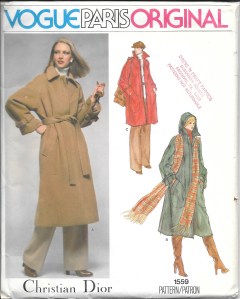
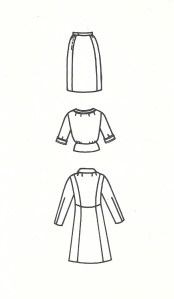
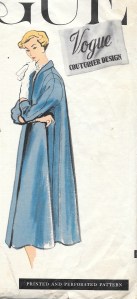
Upon my return home to Pennsylvania, I was anxious to see what Christian Dior Vogue Designer Patterns I have in my collection of vintage patterns. Two are actually ones I purchased in the early 1970s, another time in my life when I was actively sewing for myself :
I made this coat when I was in my early twenties. I only wish I still had it!
I never made this pattern, but I may still do so.
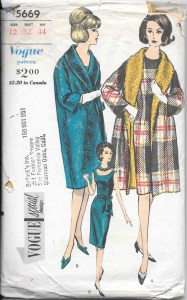
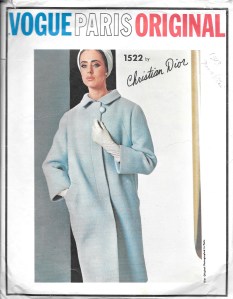
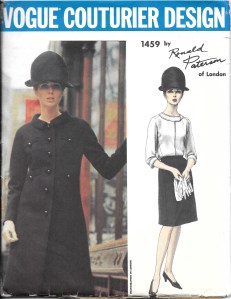
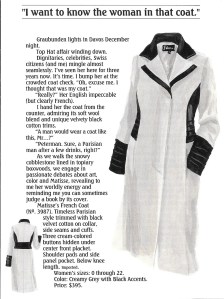
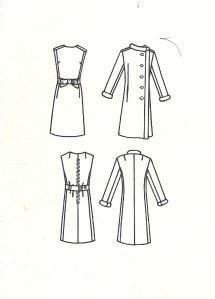
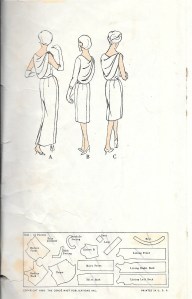
And then there are these two, somewhat recent purchases:
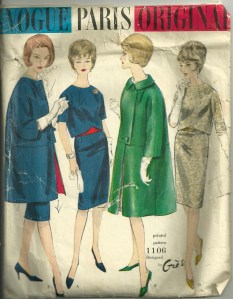
These two patterns are earlier than the two above.
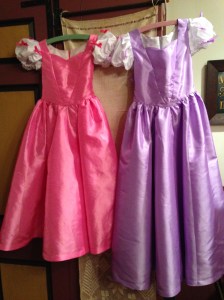
And yes, you do see a theme emerging if you consider these four patterns. They are all coats! (I am obsessed with coats…) Any guess what my current project is (after I make birthday dresses for my granddaughters)?
10 Comments
Filed under Christian Dior, Coats, Fashion commentary, Fashion Exhibits, Fashion history, Uncategorized, vintage Vogue Designer patterns, vintage Vogue patterns from the 1960s, vintage Vogue patterns from the 1970s
Tagged as Christian Dior, Fashion Exhibits, quotes about fashion, vintage fashion, vintage Vogue patterns