When Enthusiasm Meets Reality

Fashion sewing has it all. Even the making of a simple dress has some or all of these aspects inherent in its construction: color theory, proper fabric selection, proportion and fitting, pattern manipulation and engineering, technical know-how, style sense, intrigue. Intrigue? Yes – Intrigue. I have done it again. I have my heart set on a making a certain style in a certain fabric, and I don’t have very much of that fabric with which to work.

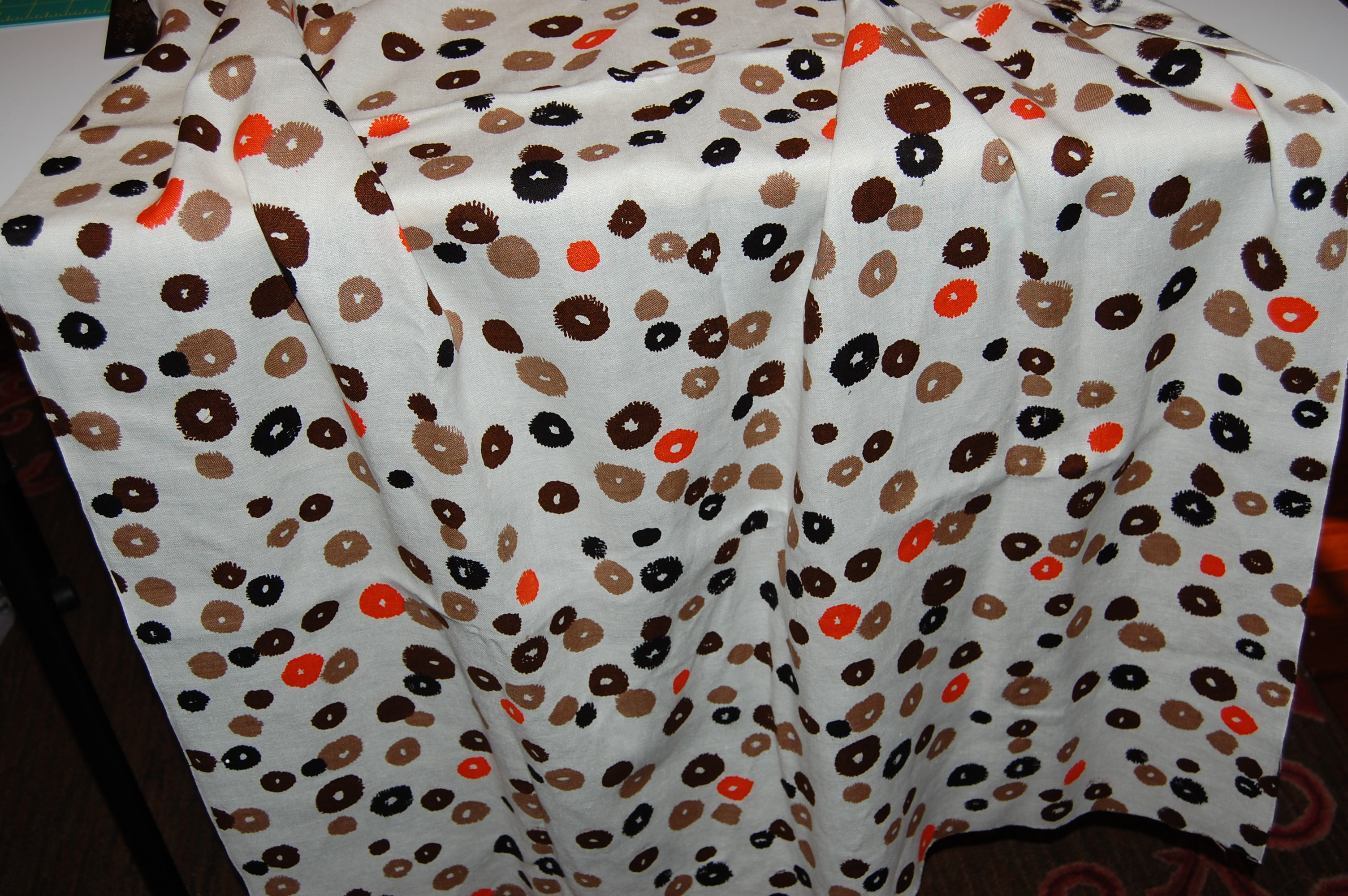
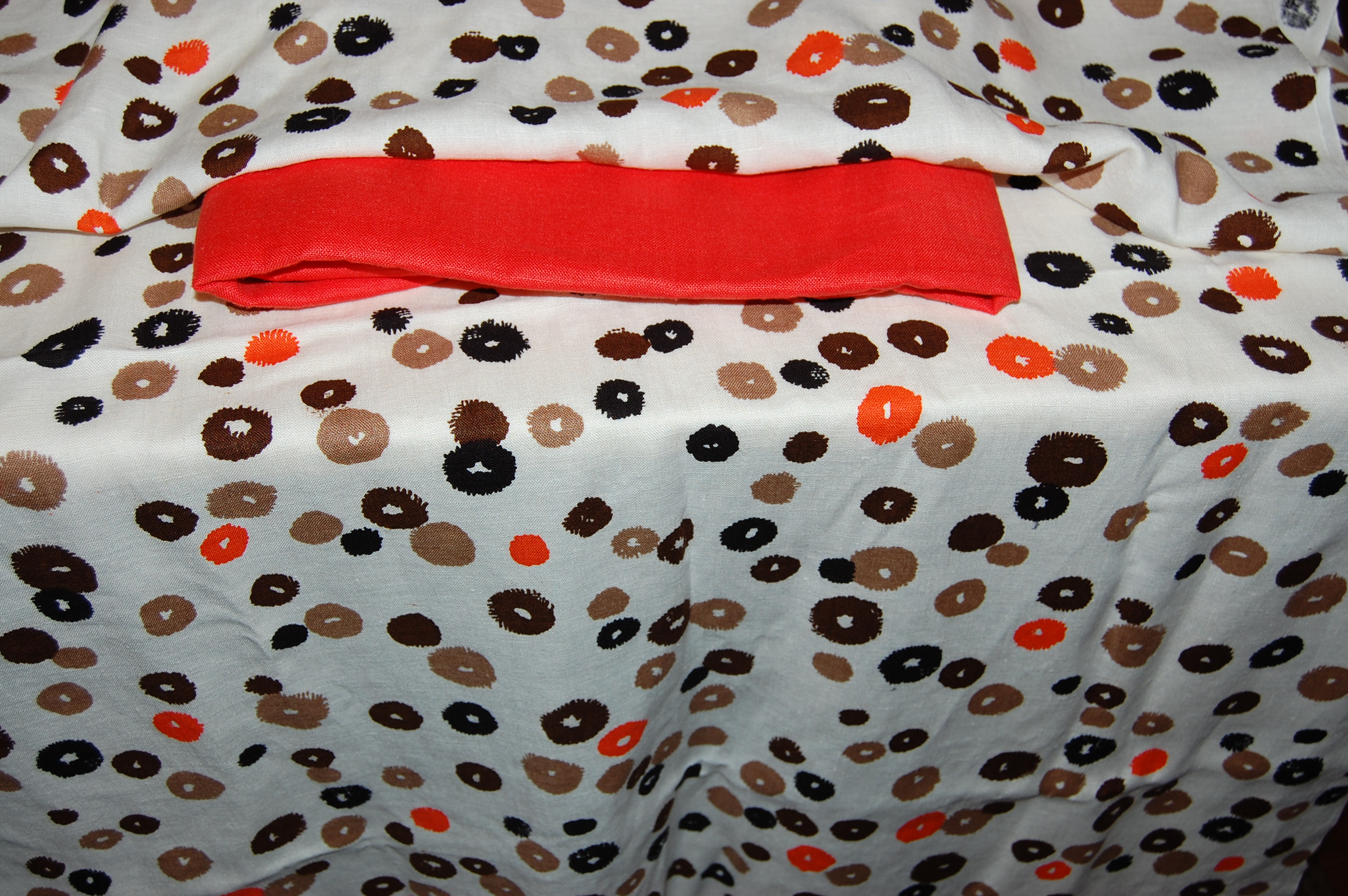
I found this piece of Moygashel linen earlier in the year. (It was sold to me as “probably Moygashel”, and how I determined for certain that is indeed that famous brand of Irish linen required some detective work, which I’ll cover in a future post.)
Enthusiasm meets reality

Freshly laundered, this linen looks and feels like new!

When I first saw it, I immediately thought it would make a cute pair of pants, even though I don’t wear a lot of brown. But I was really drawn to the little explosions of orange scattered throughout the yardage. Actually I should qualify that by saying “scant” yardage. This was only a piece of fabric 1 and 5/8 yards long, which sounds reasonable until the width of the fabric is figured into the equation. At 35” wide, this was not a lot of fabric.   Nevertheless, I certainly figured I could get a slim pair of simple pants out of it. That was my intent until I finished my polka-dotted sheath dress just recently. Cool linen dresses and Summer just seem to go together, and suddenly I decided I did not want a pair of pants – I wanted another sleeveless dress.

This was partly determined by the fact that I have a piece of new orange linen I picked up a couple of years ago from Britex Fabrics, and the thought of pairing this funky, stylized-dot fabric with an orange belt made out of that linen sealed the deal for me in my enthusiastic wardrobe dreams.
Enthusiasm meets reality

Then reality hit. How was I going to manage to squeak a sheath dress out of the amount of fabric in hand? After eyeballing the stretched out fabric, with my sheath dress pattern pieces arranged casually on top, it did not take long for me to know that, NO, this would not work. I would have to figure something else out, but I wasn’t giving up on the dress idea.

The only solution was to get more creative. I have always loved subtle “back” details on dresses, such as unusual closures, V-necklines above a back zippered opening, an embellishment of some sort, that type of thing. And I suddenly realized that if I could section the back pieces (only) of my sheath pattern so that I would have an upper back yoke, then I could probably fit everything on the fabric (knowing it would still be a squeeze, however).

Now I got really excited. One of my favorite patterns (from 1957) features a back- buttoned yoke, which is seamed right above the shaping darts in the back body of the dress. I figured this is exactly the spot where I would need to section the back of the dress to make it fit on my fabric.
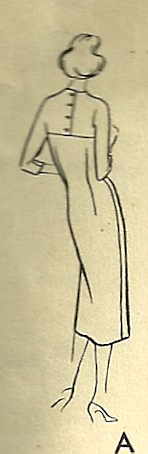
The yoke on this dress is obviously part of the kimono sleeve section, but I like the idea of a three-buttoned yoke.

The yoke on this dress is obviously part of the kimono sleeve section, but I like the idea of a three-buttoned yoke.

And then – wheels turning in my head – I seemed to remember I had some orange buttons (vintage, no less!) in my button box.   These seem to me to be a perfect pairing with the linen fabric:
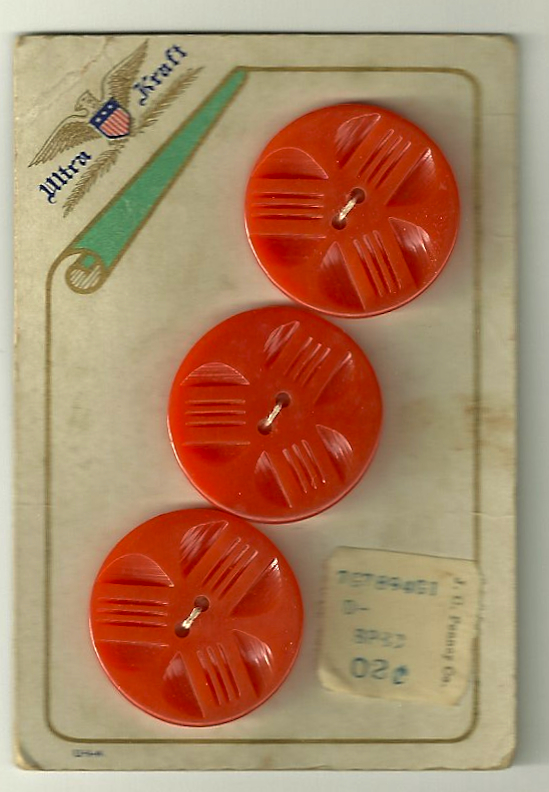
This card of buttons cost 2 cents originally!  They seem to mimic the small orange explosions on the dress fabric.

This card of buttons cost 2 cents originally! They seem to mimic the small orange explosions on the dress fabric.

I have spread out my current working sheath dress muslin a couple of times to determine the viability of my plan. I really think it will work. I am prepared to use narrower seam allowances than I usually like, and I may have to face the hem.
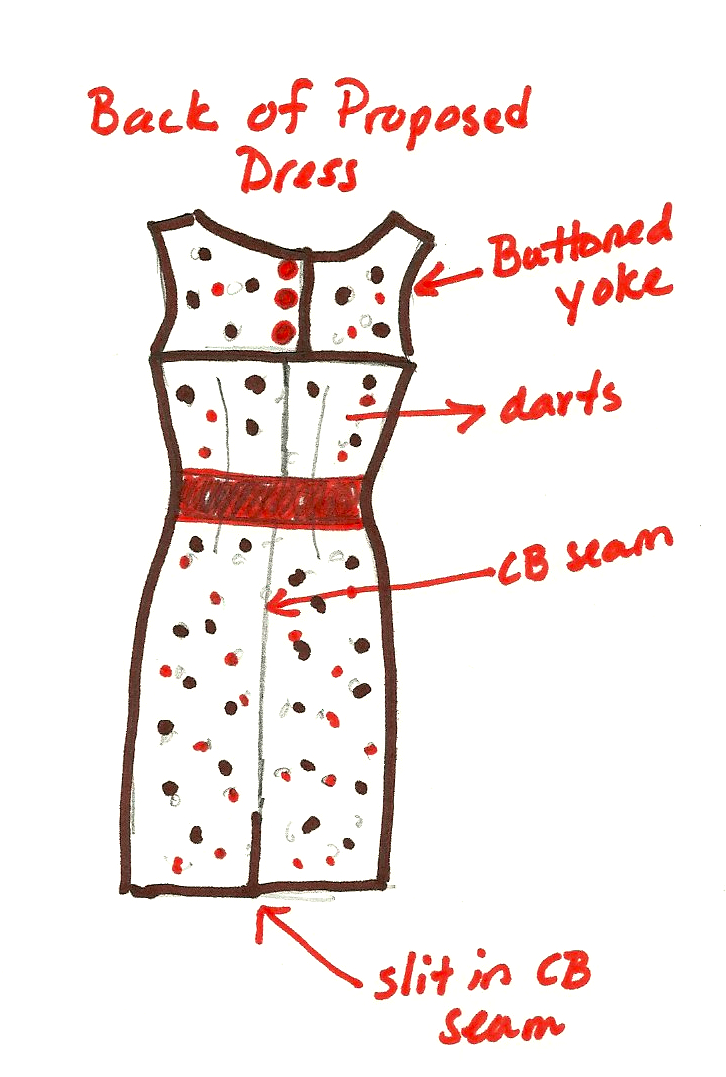
This is how I envision the back of my proposed dress.

This is how I envision the back of my proposed dress.

But – first things first. Initially I will be making a new muslin, with the altered and sectioned back pieces. I am sure my enthusiasm for this idea will keep me focused, and in this case, reality may have sewn the seeds for a much more creative outcome than I originally envisioned!


22 Comments

Filed under Buttons - choosing the right ones, Linen, Moygashel linen, Polka dots, Uncategorized, vintage buttons

Sometimes It’s All About the Fabric

Great fabric – just like great art – can (and probably should) elicit an emotional response from an engaged viewer and/or potential purchaser. It’s a very individual preference, of course, influenced by sewing knowledge, intended purpose, wear-ability, one’s fashion style, and nostalgia.

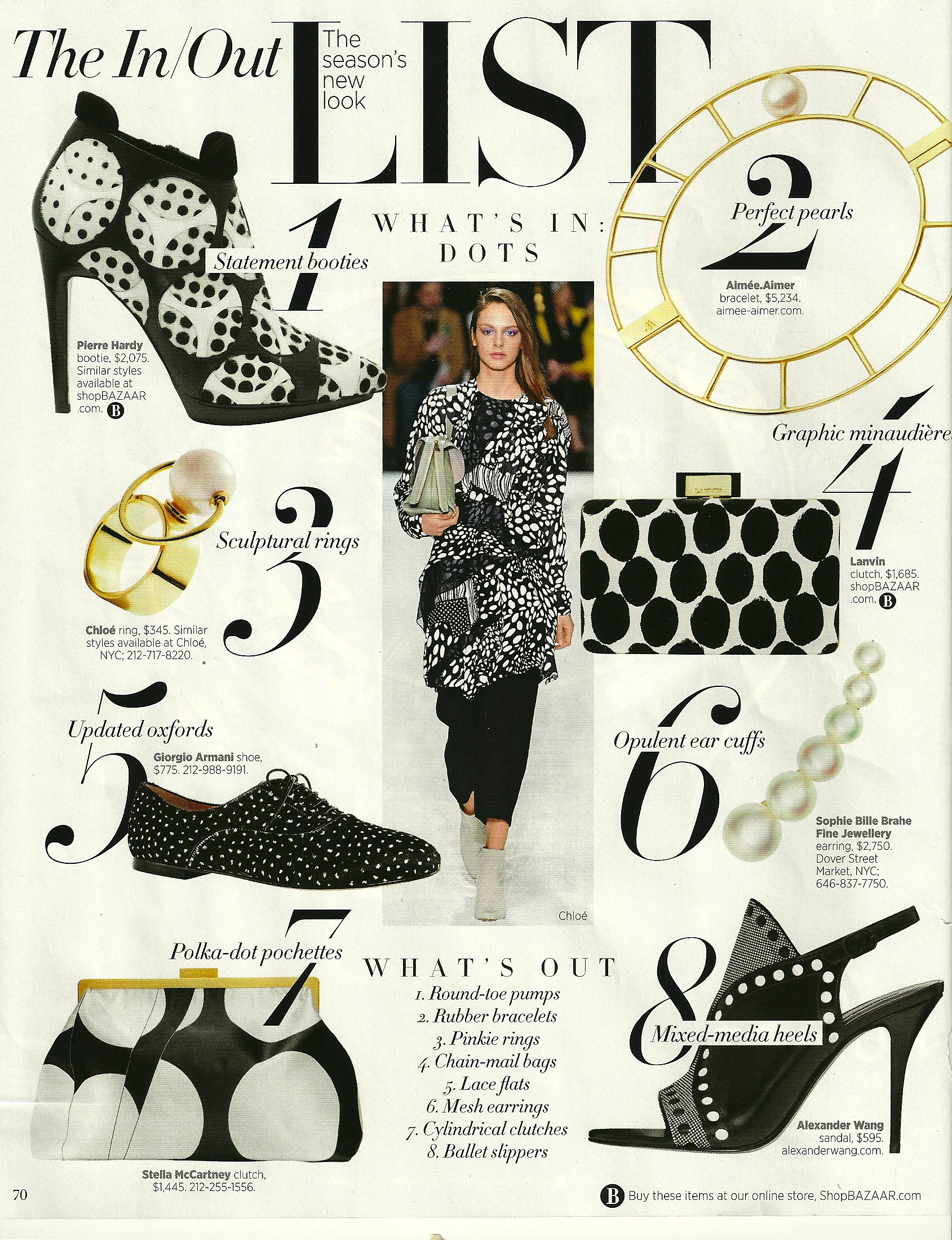
I freely admit to being nostalgic about polka dots. I have always loved them. And I have always been drawn to fabrics and fashions featuring dots, whether they be large, jumbo, small, tiny, or medium. In my fashion lexicon, they are never out of style, but it is always particularly rewarding to see dots featured as “fashion forward” – as in the July 2014 Harpers Bazaar.

Linen dotted dress - HB magazine

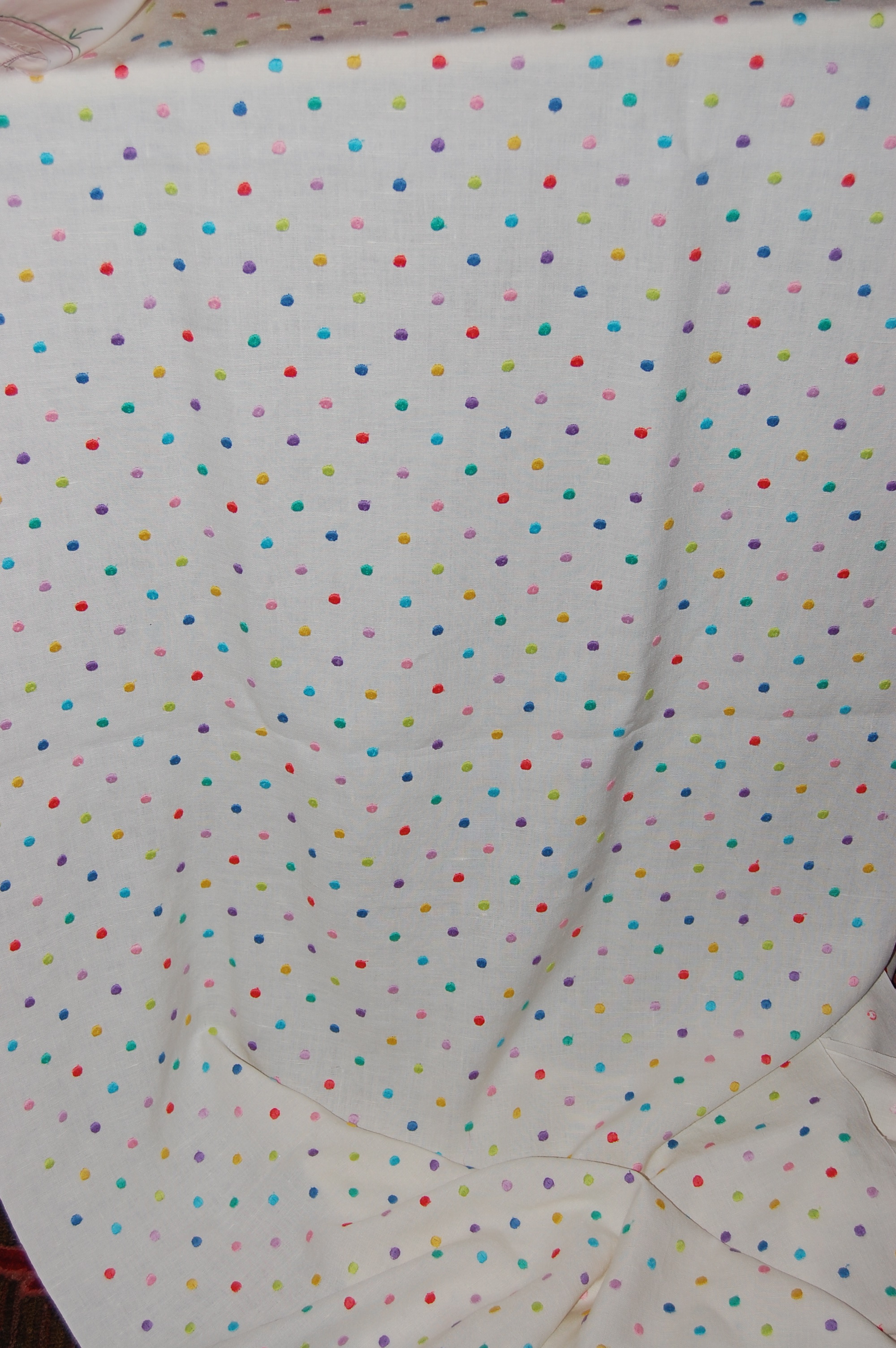
The dots I have been focusing on the last week or so, however, could tell those new dots a thing or two about fashion trends and durability. My beloved dots are probably celebrating their half-century mark, without a wrinkle to show for it!

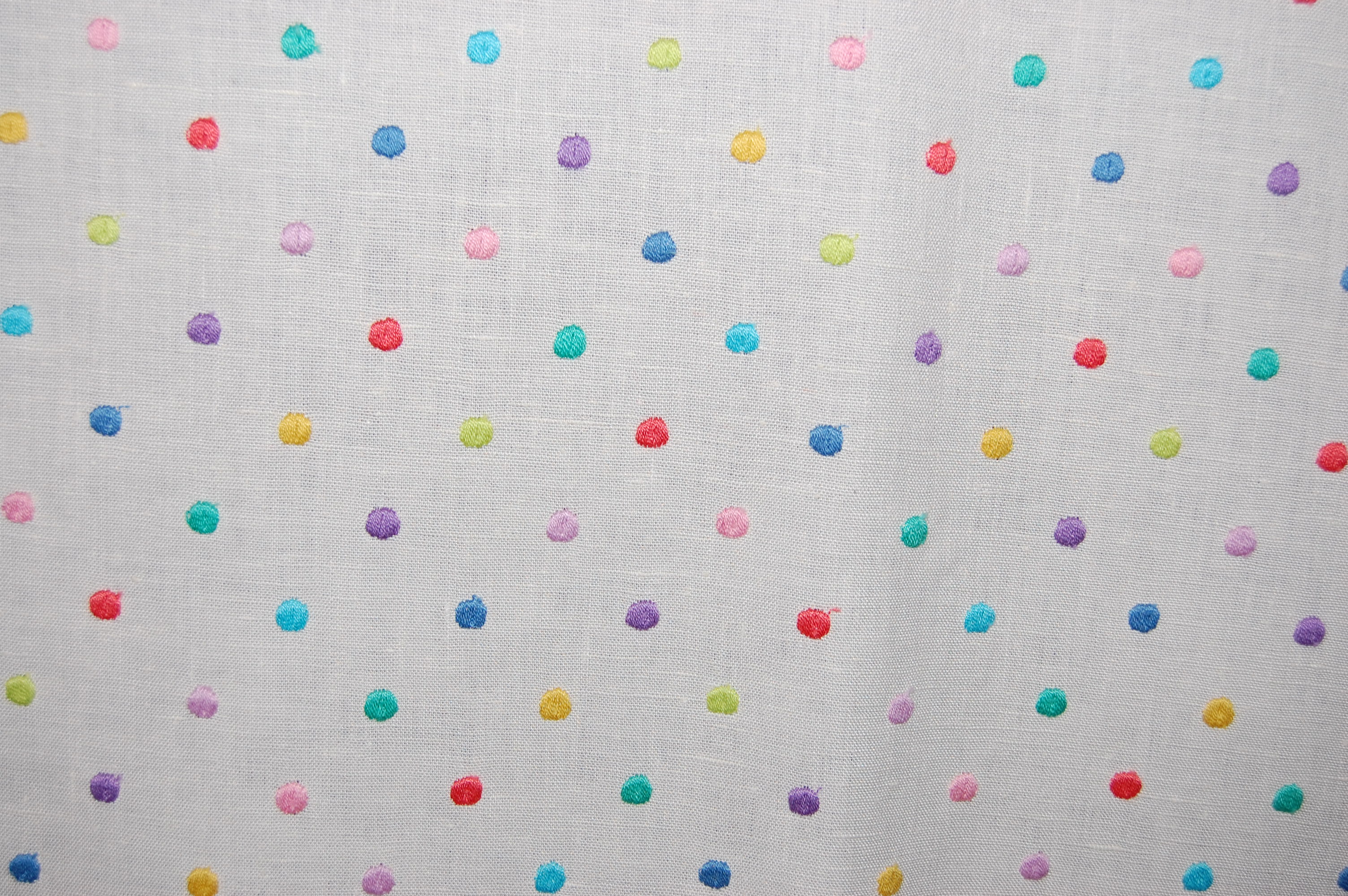
Linen dotted fabric

Linen dotted fabric

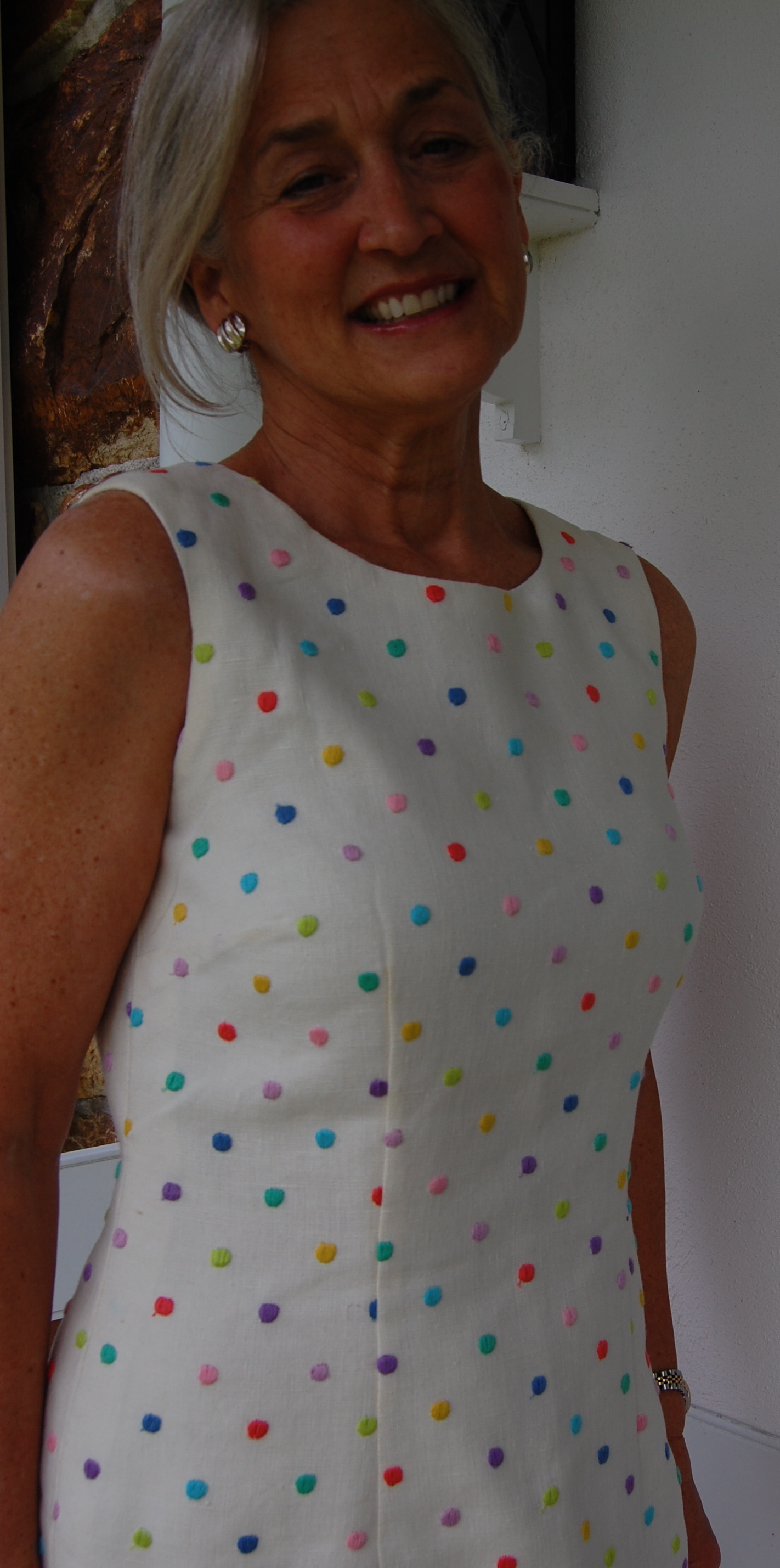
Each dot is individually embroidered onto the base linen fabric.

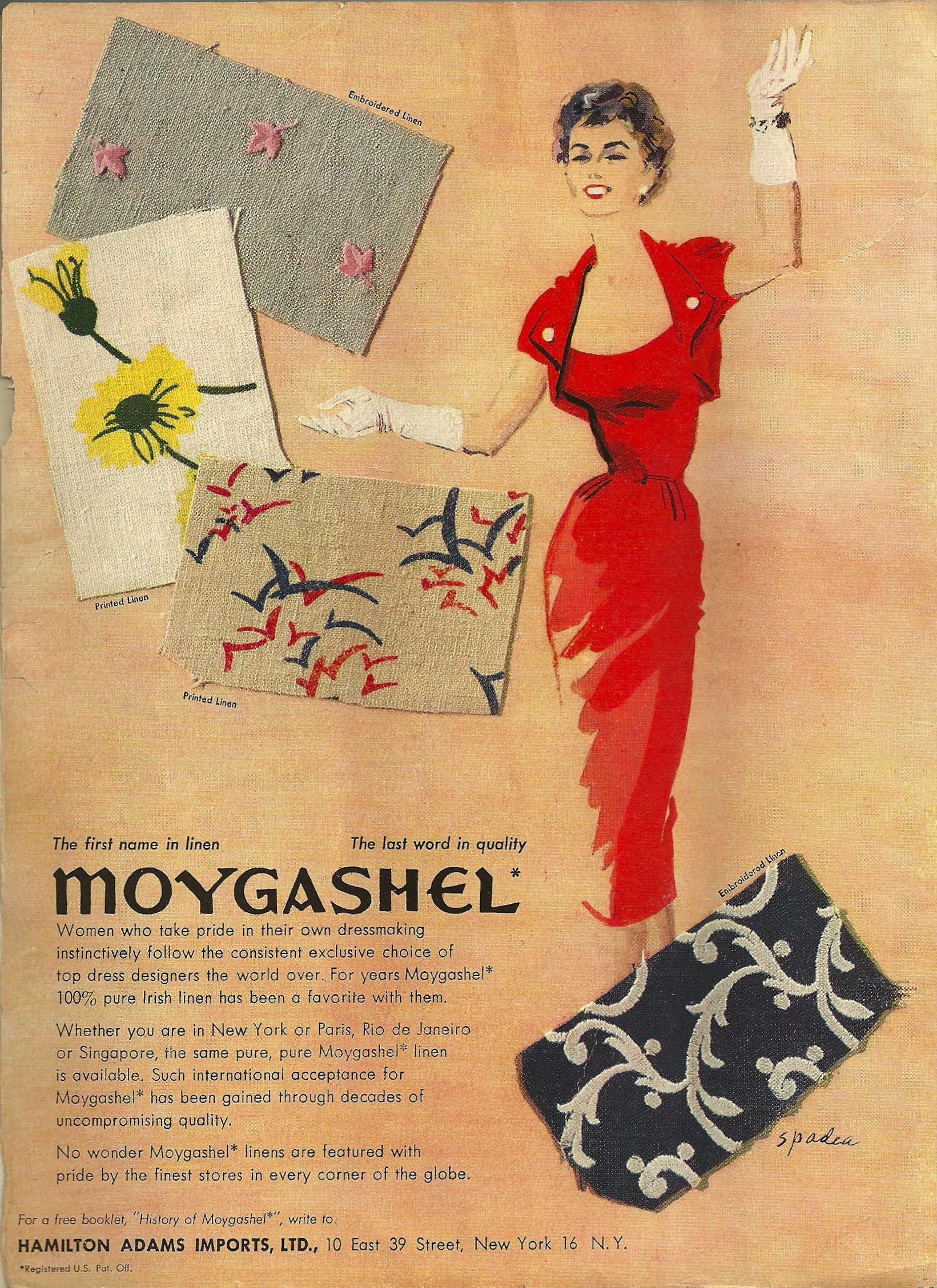
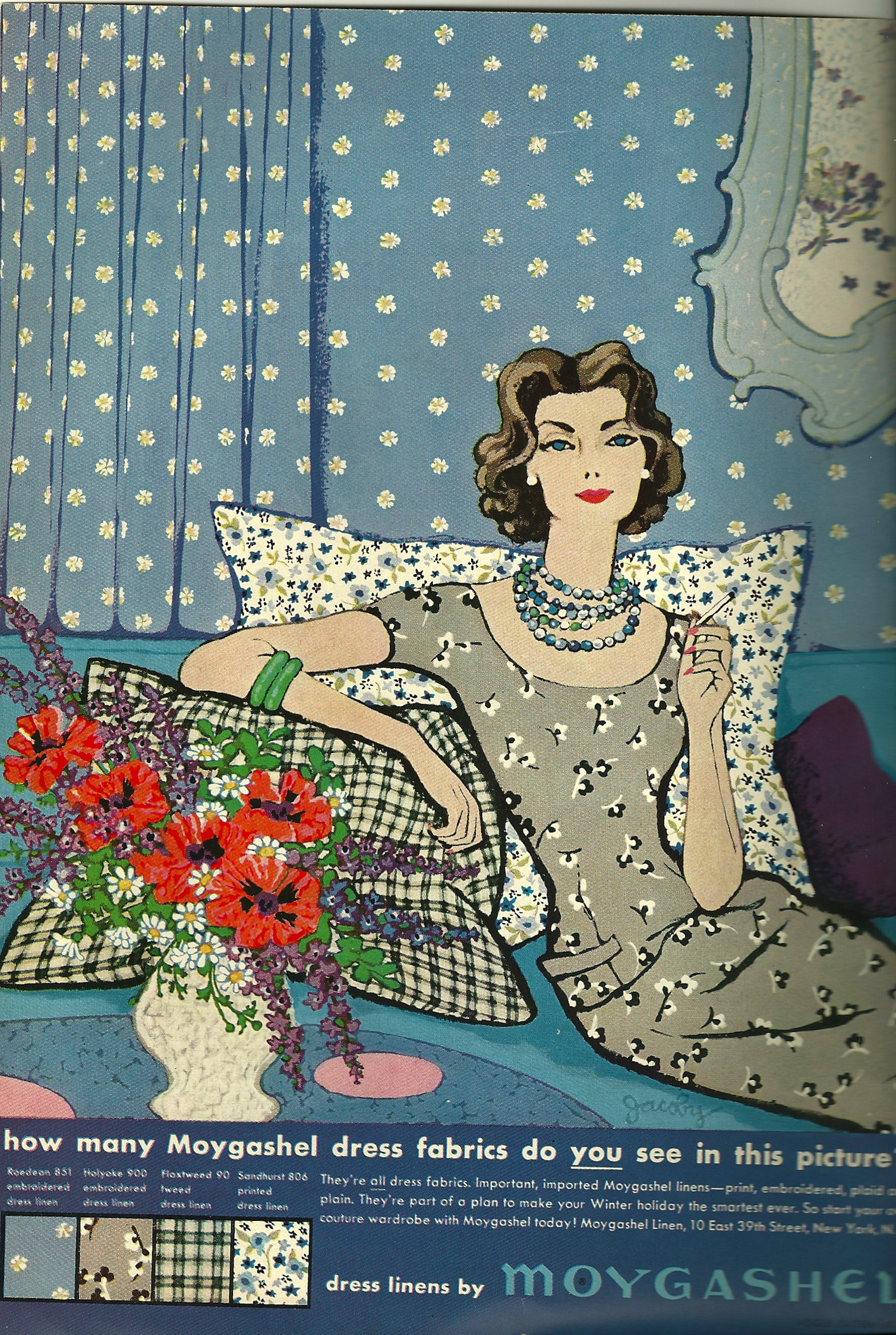
When I purchased this vintage linen fabric online, all I had was a photo or two. There was no selvedge marking, no attached label, no sales receipt to give any clue to its origin. However, the photos were clear, the weave of the fabric was visible enough, that I felt fairly confident that I was looking at a mid-century Moygashel linen. At 36” wide, I knew from experience it was prior to 1960. I also knew that Moygashel produced many embroidered dress linens in the 1950s. Here are two Moygashel linen ads which show both printed and embroidered linens:

This ad was on the inside front cover of Vogue Pattern Book magazine from December/January 1953-54.

This ad was on the inside front cover of Vogue Pattern Book magazine from December/January 1953-54.

And this ad was on the inside front cover of Vogue pattern Book Magazine from December/January 1957-58.

And this ad was on the inside front cover of Vogue Pattern Book magazine from December/January 1957-58.

I knew the real “proof of the pudding” – to authenticate the linen as Moygashel – would be in how it laundered.  Moygashel linen was known for its resistance to wrinkling! Months went by after the fabric arrived in the mail, but a couple of weeks ago, I retrieved it from my fabric closet, put it in a gentle wash cycle (with Woolite detergent), tumble dried it on medium heat, and out it came, as I had hoped, crisp, clean, and looking like new. All it needed was just a quick ironing on high heat to make sure the fabric would lay flat for marking and cutting.

Yes, I knew I had an authentic Moygashel linen in hand, and I wanted to make a dress that would be all about the fabric. I envisioned a simple sheath, whose look could be changed so easily with different color accessories. Knowing I already had a sheath dress pattern that fit me well, I made my sewing life simple (for a change!) and went with it.

One can't get much simpler than this classic sheath design!

One can’t get much simpler than this classic sheath design!

First, a few details and precautions about sewing with embroidered linen:

1) All ironing must be done on the wrong side of the fabric, in order not to squash the embroidered details.

2) All ironing must be done on top of a towel, also for the same reason.

3) It’s best to sandwich paper under seam allowances before pressing to prevent “impressions” from going through to the right side of your fabric.

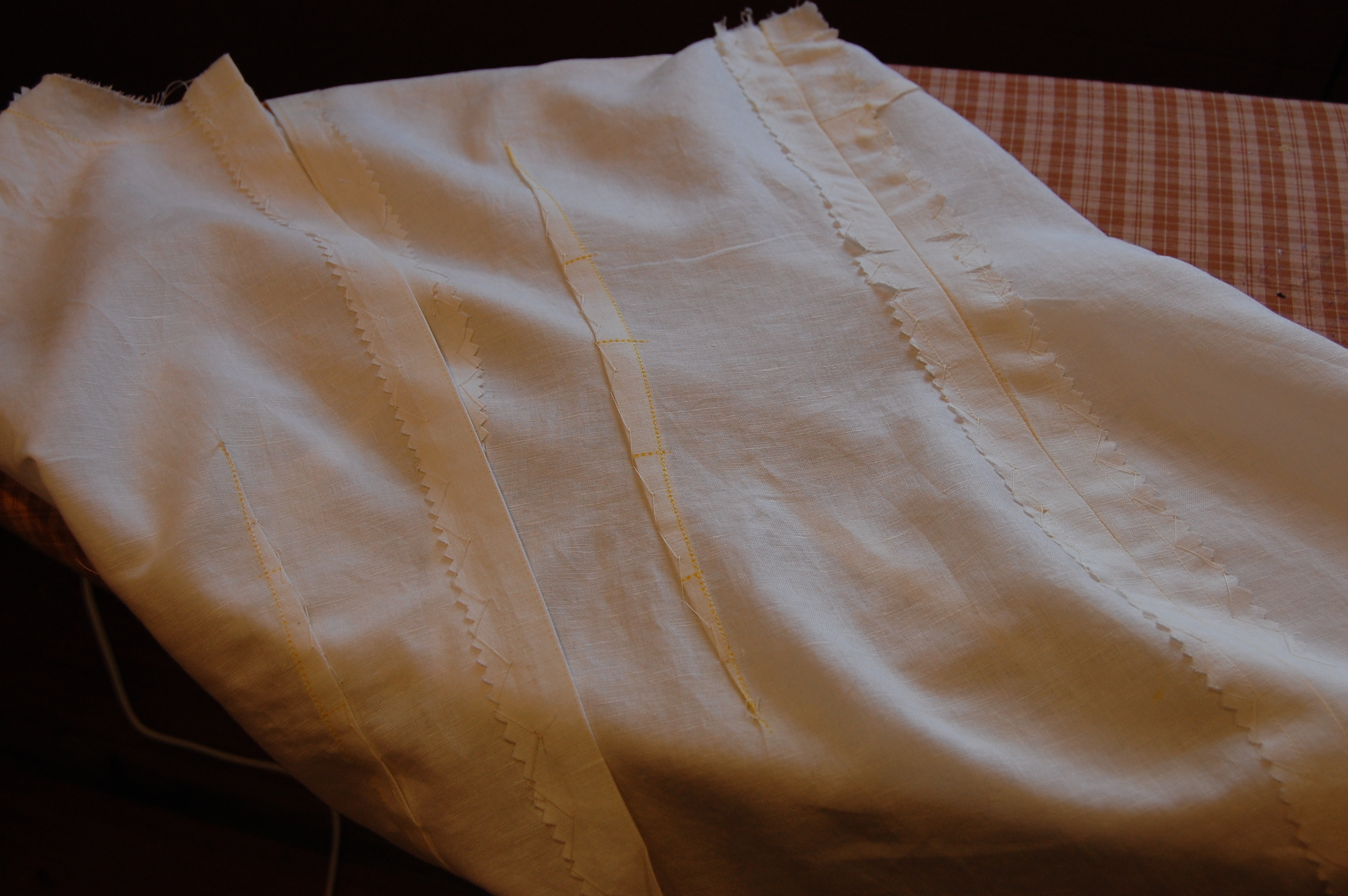
4) Because cut embroidery details have a tendency to fray along the edges of seam allowances, it is best to finish them with either a Hong Kong finish or with rayon (Snug Hug) hem tape. I used Snug Hug as it did not add any extra bulk to the inside of my garment.

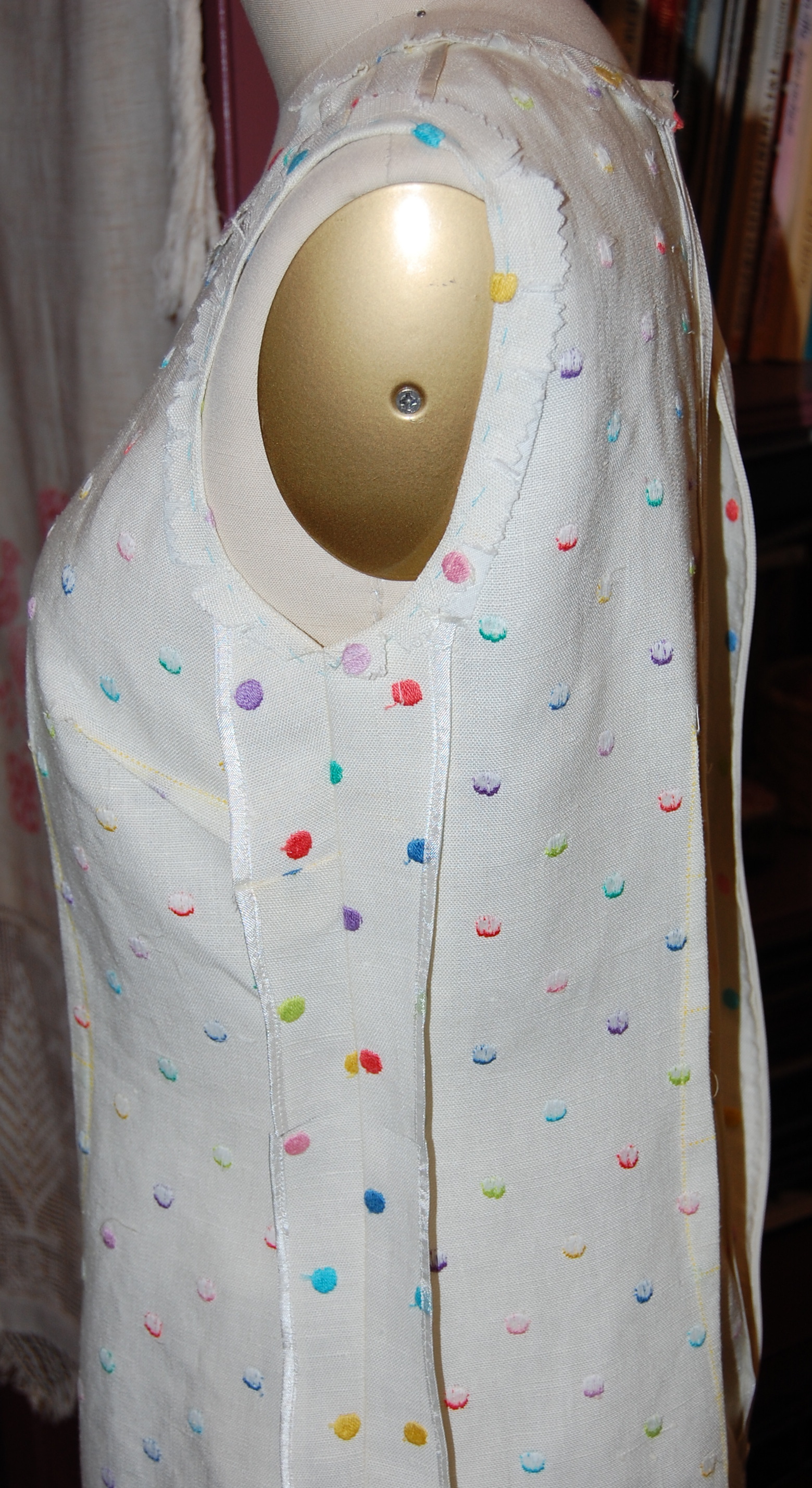
Side seams finished with Snug Hug.

Side seams finished with Snug Hug.

I did not want to underline my dress (as in silk organza), as I wanted to preserve the lovely breathability of the linen fabric. However, I did want to line it, so I used a very light, almost gauzy, cotton/linen blend.

I actually catch-stitched all the seams and dart edges on the lining, to help it mold as nicely as possible with the interior of the dress.

I actually catch-stitched all the seams and dart edges on the lining, to help it mold as nicely as possible with the interior of the dress.

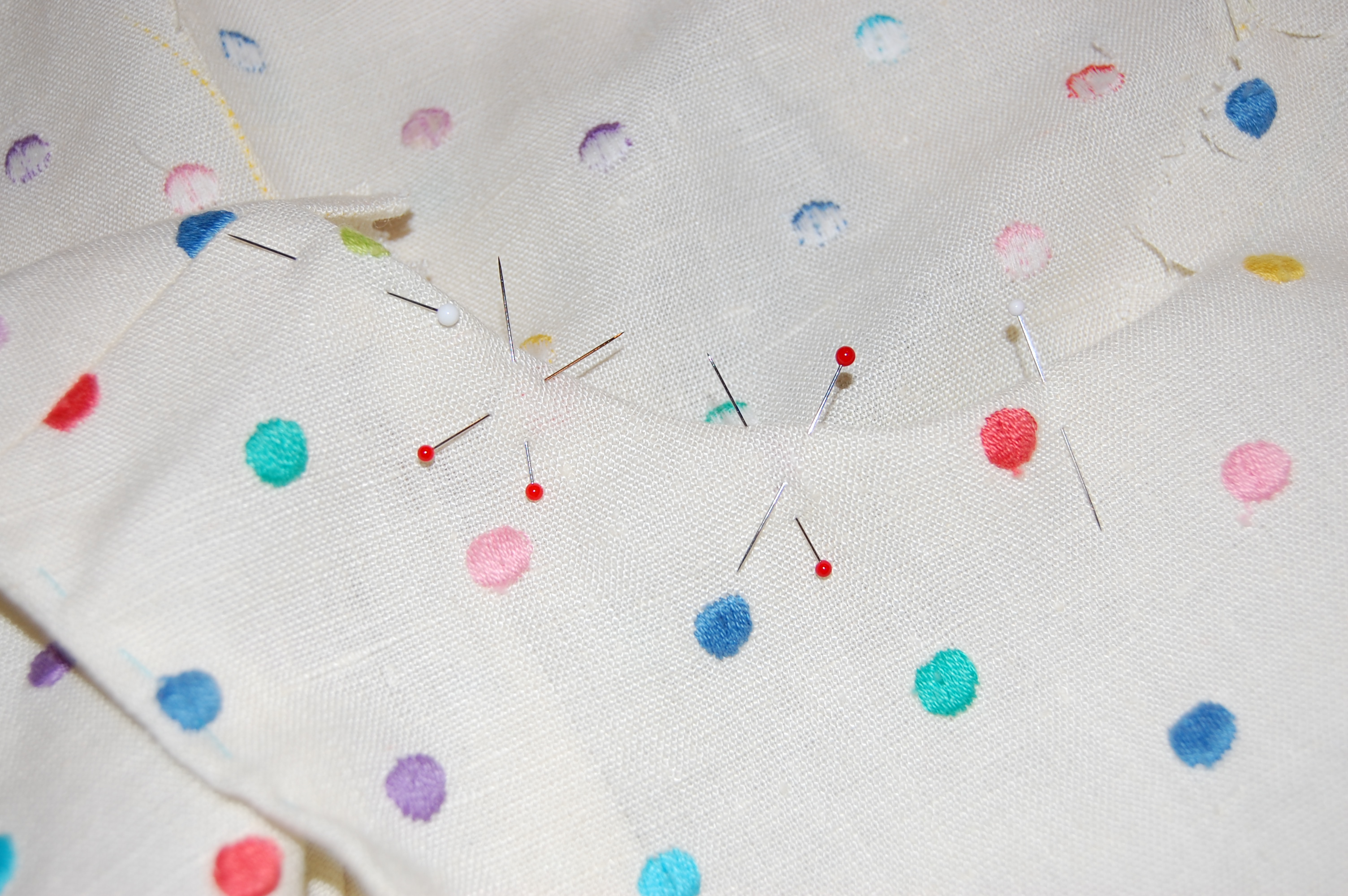
I decided to make the lining entirely separate and then attach it to the dress at the neck, armholes, zipper and back hem slit using a fell stitch. However, once I had my seam allowance folded back at the neck and armholes, I noticed a little bit of “shadowing through” of some of the colored dots along those edges.

Perhaps you can see the shadowing of the dots underneath the crossed pins?

Perhaps you can see the shadowing of the dots underneath the crossed pins?

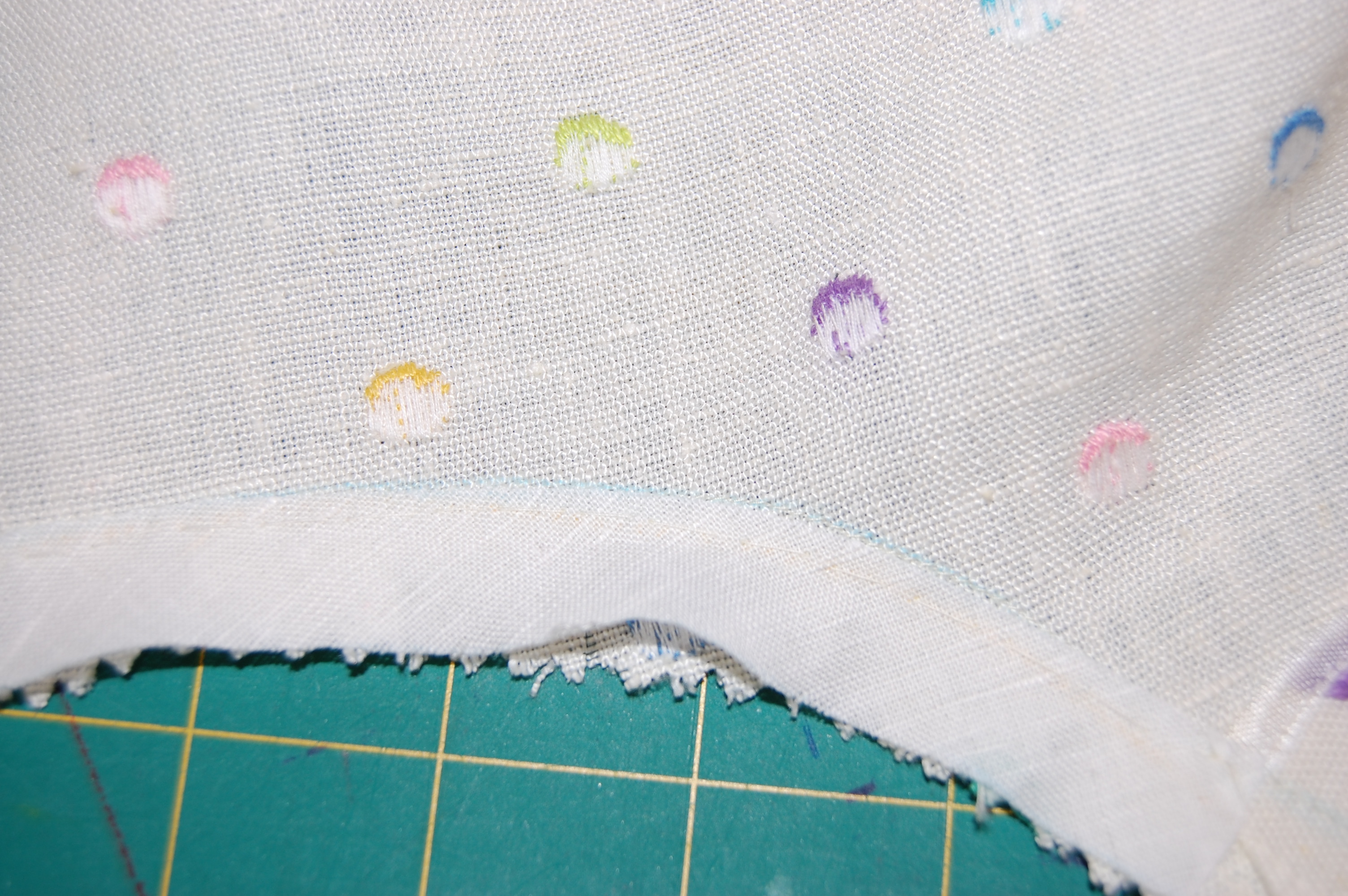
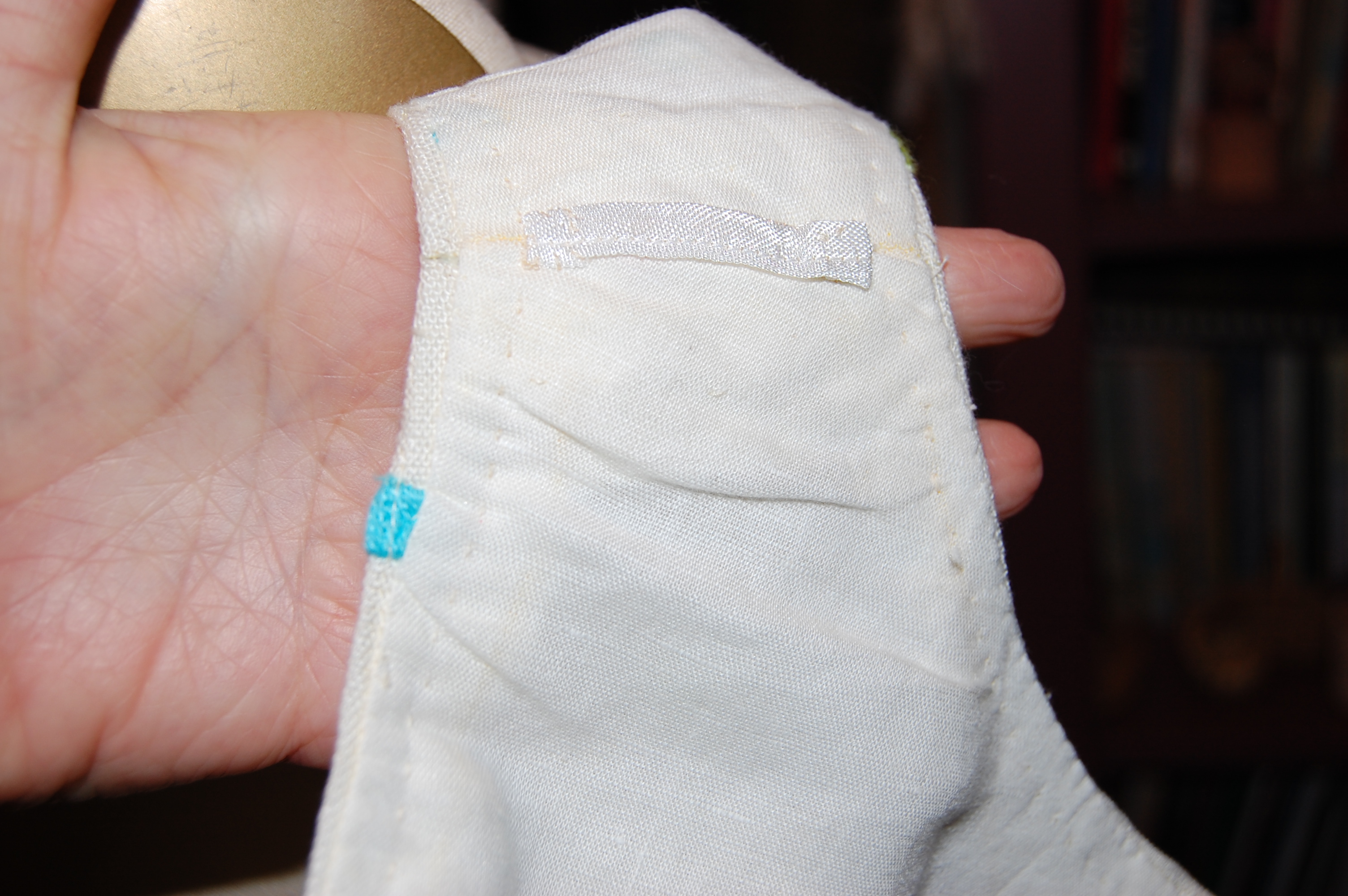
To remedy this, I cut 5/8” wide strips of bias lining fabric and basted them onto the seam allowances in those areas. That was just enough to take care of that problem.

This narrow strip of lining fabric prevents the color of those dots from showing through.

This narrow strip of lining fabric prevents the color of those dots from showing through.  This is the wrong side of the fabric.

Once the dress and lining were attached, I under-stitched the neck and armhole edges by hand. It really makes a lovely interior!

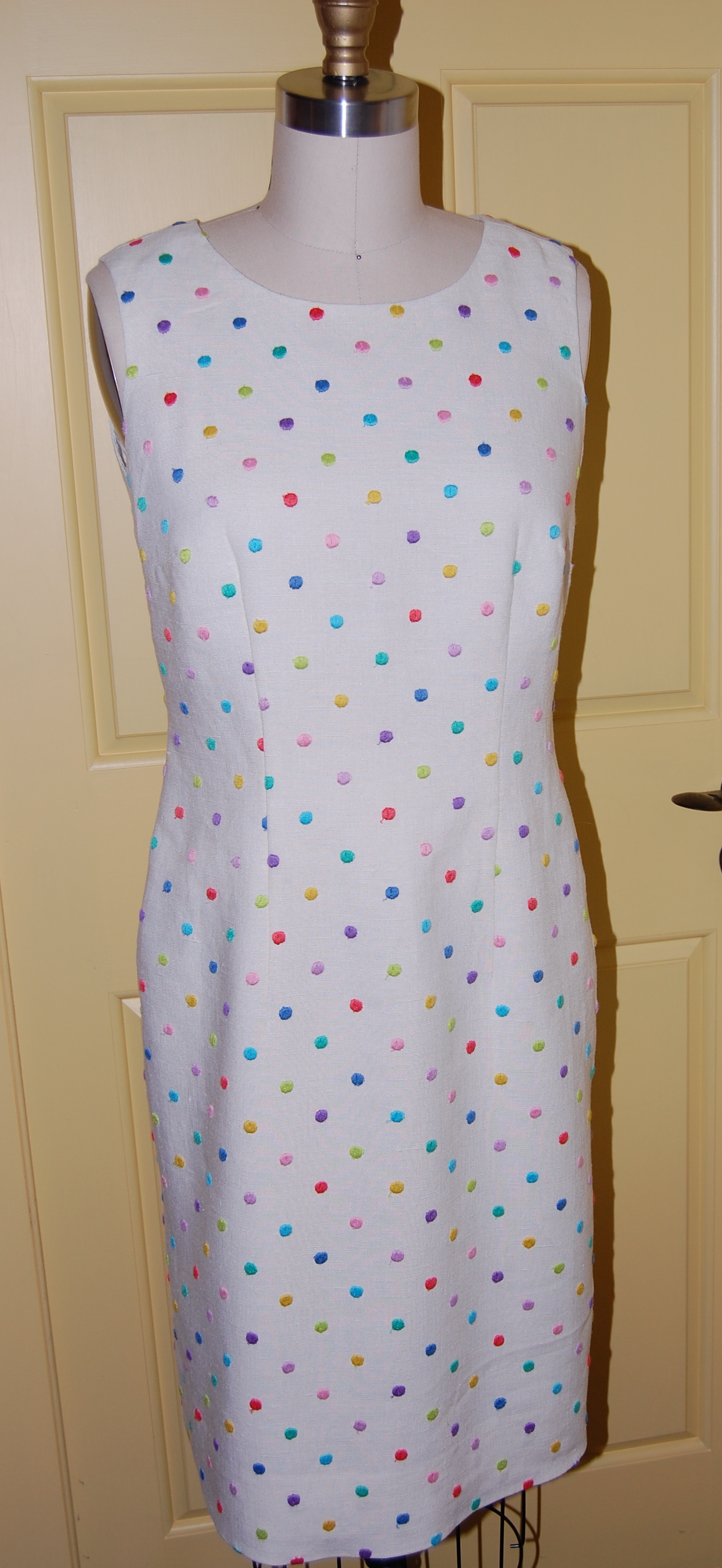
Linen dot dress

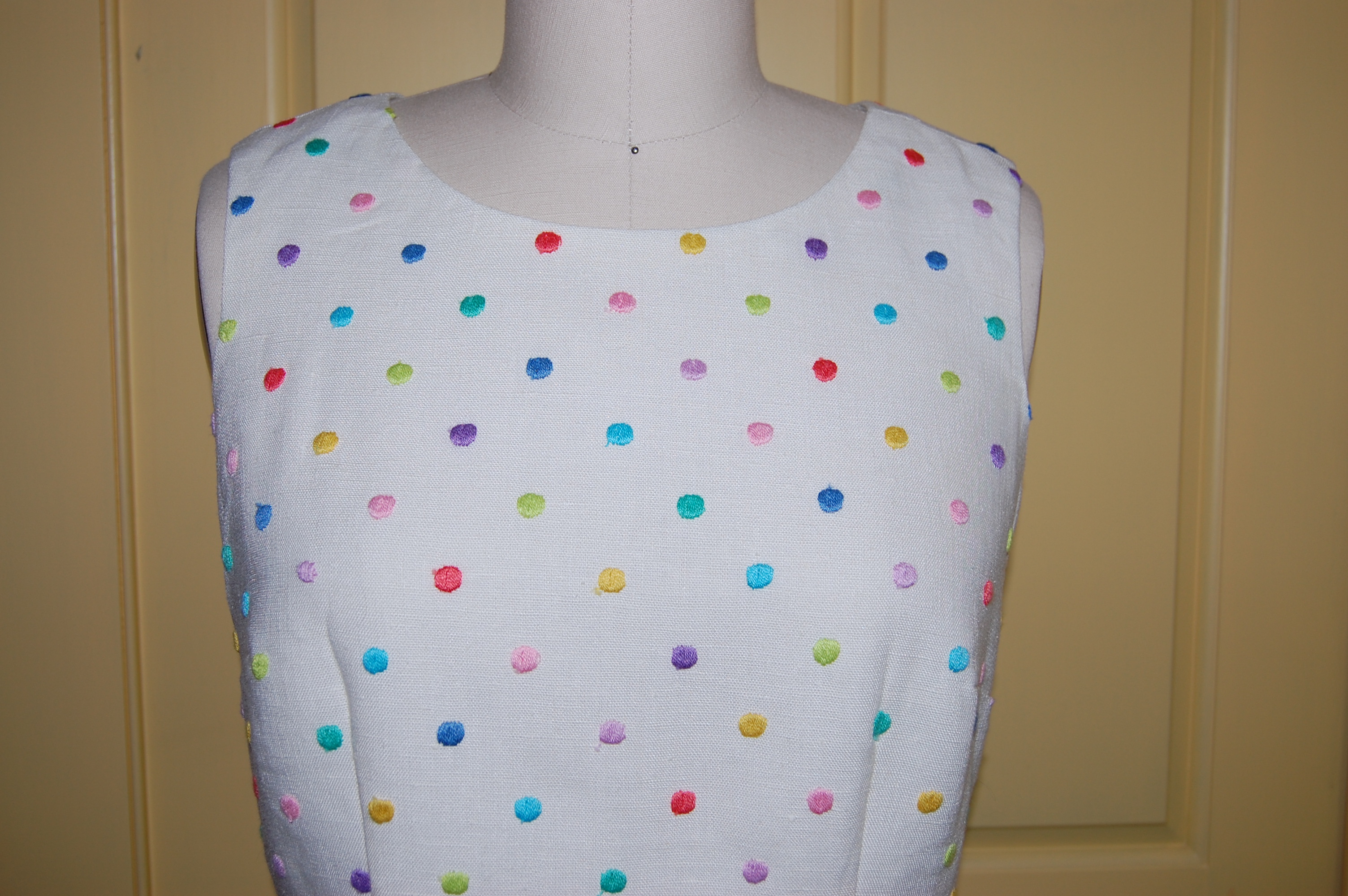
A close-up of the bodice.

A close-up of the bodice.

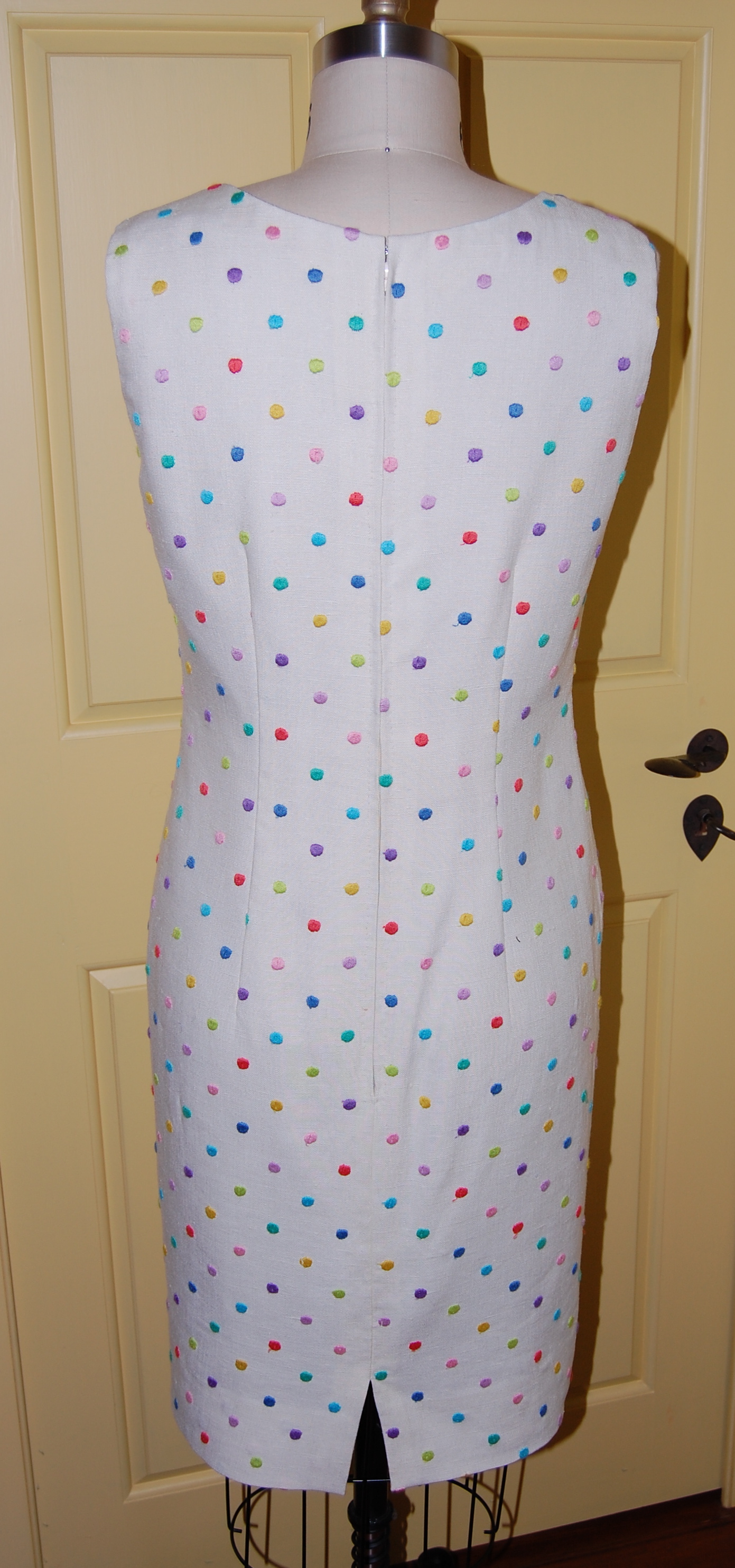
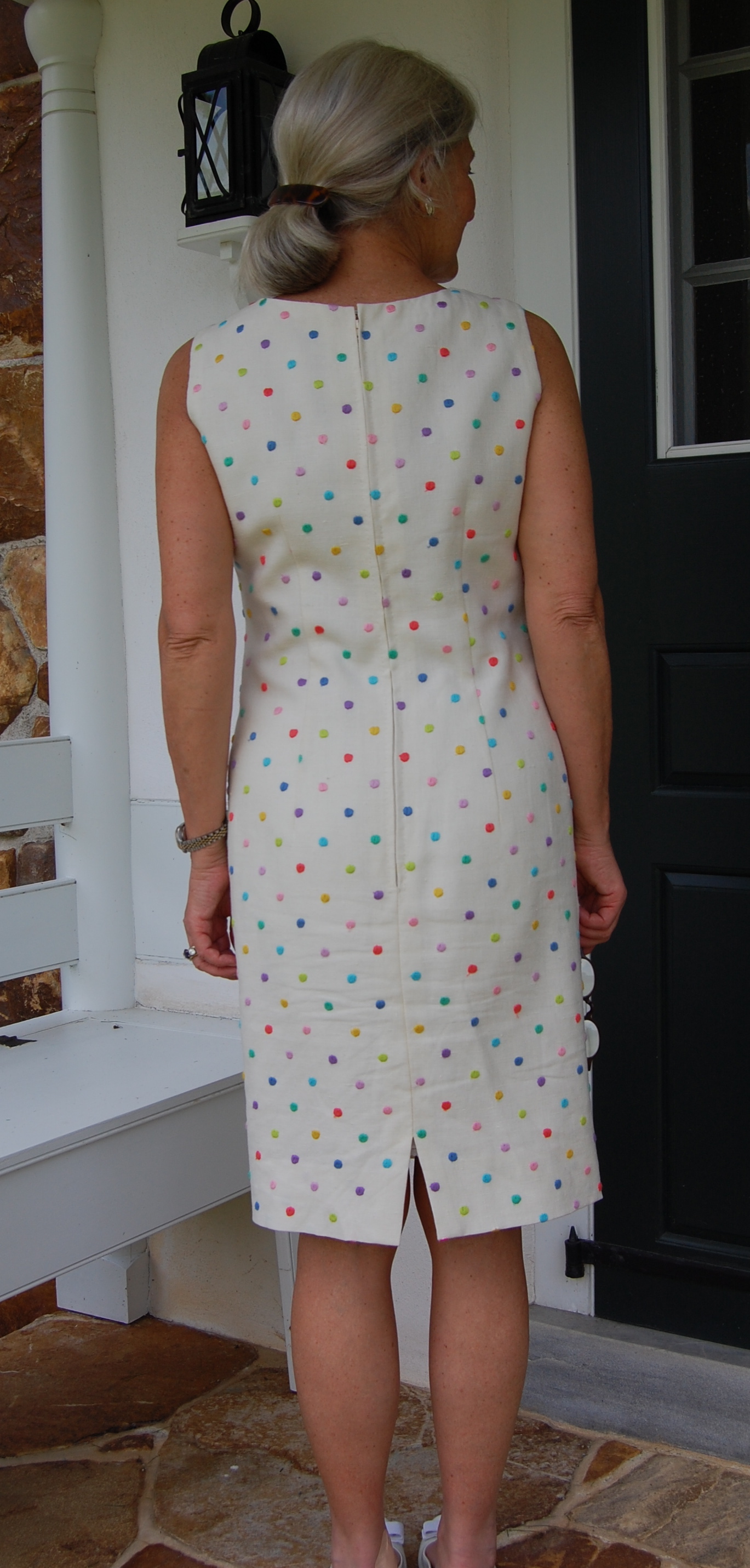
The back of the dress, with its hand-picked zipper.

The back of the dress, with its hand-picked zipper.

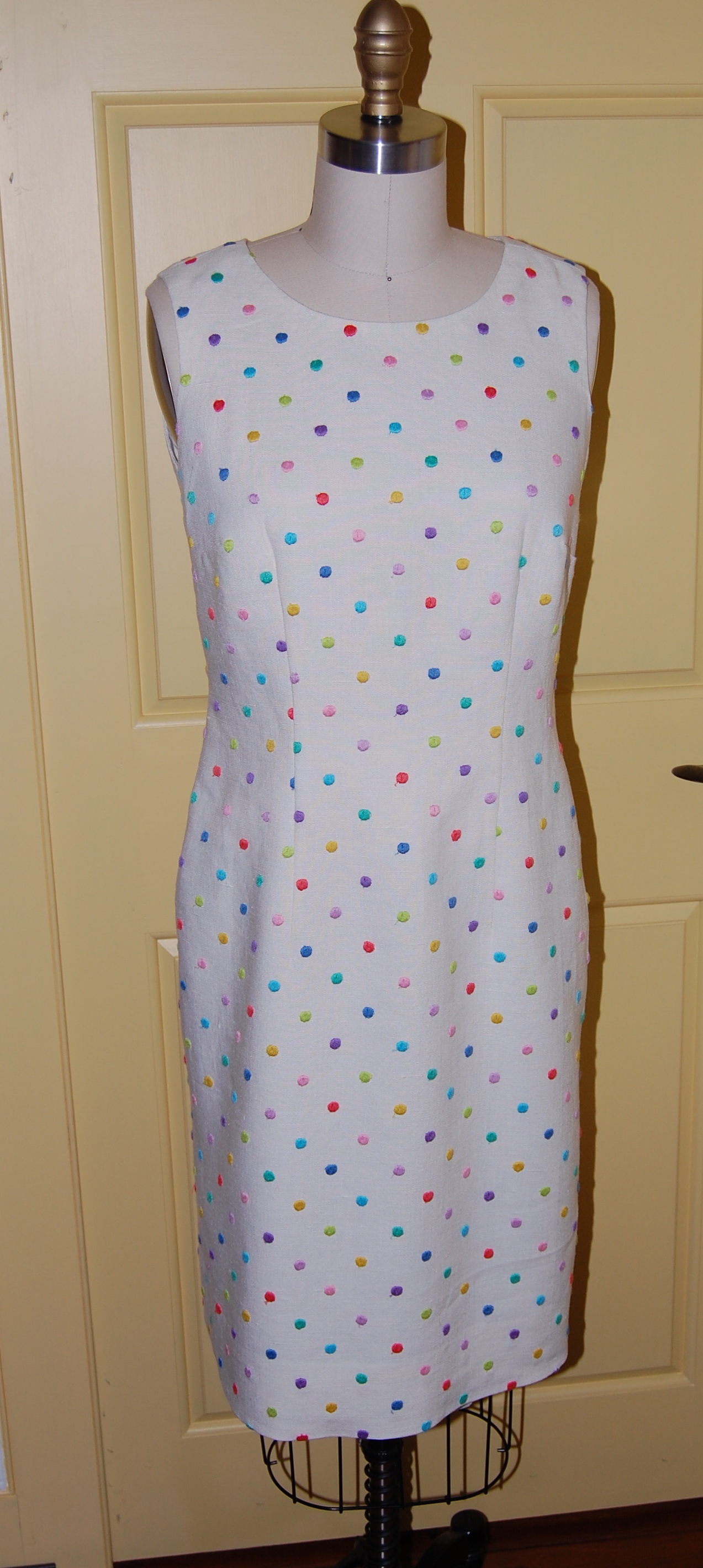
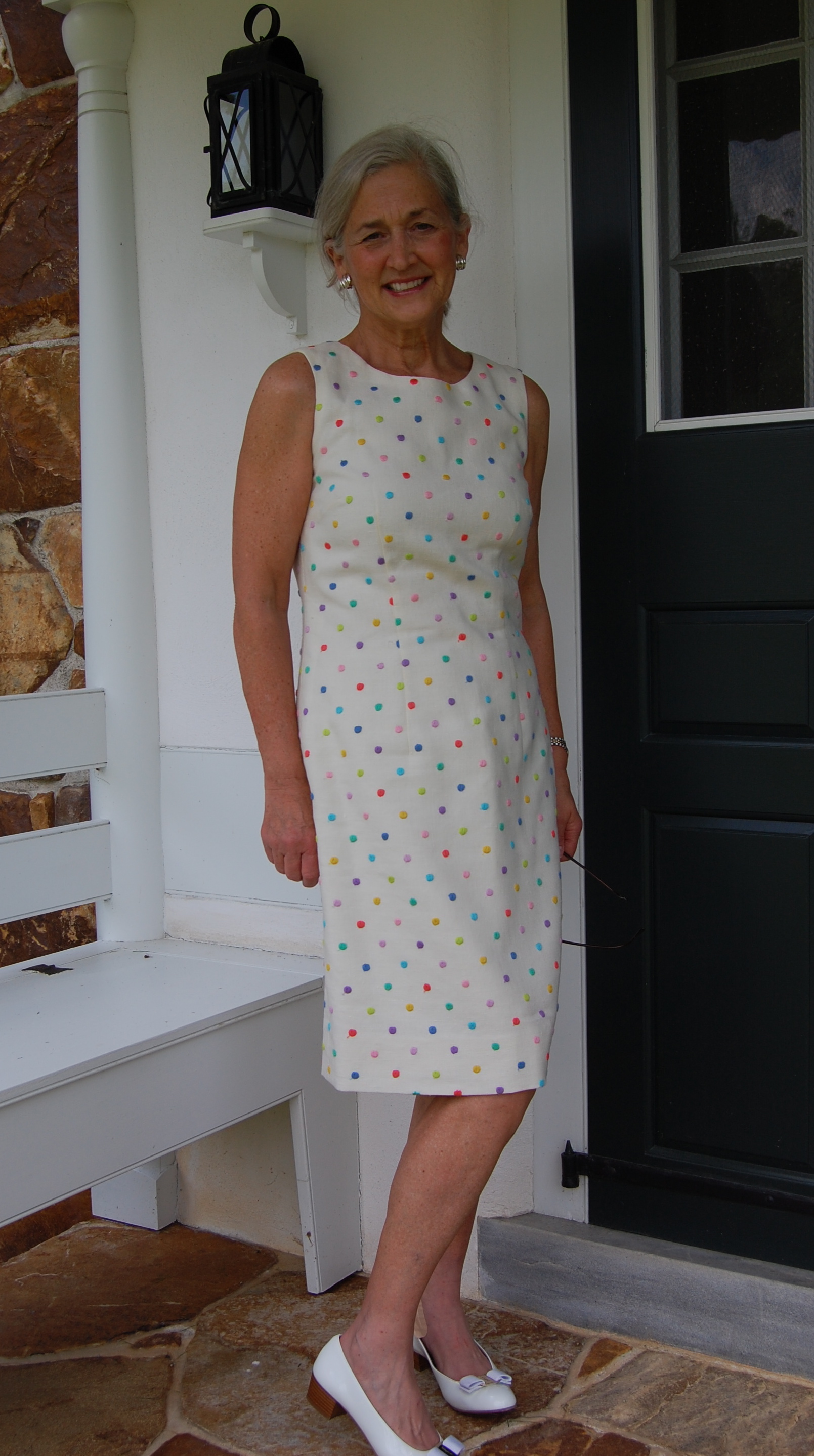
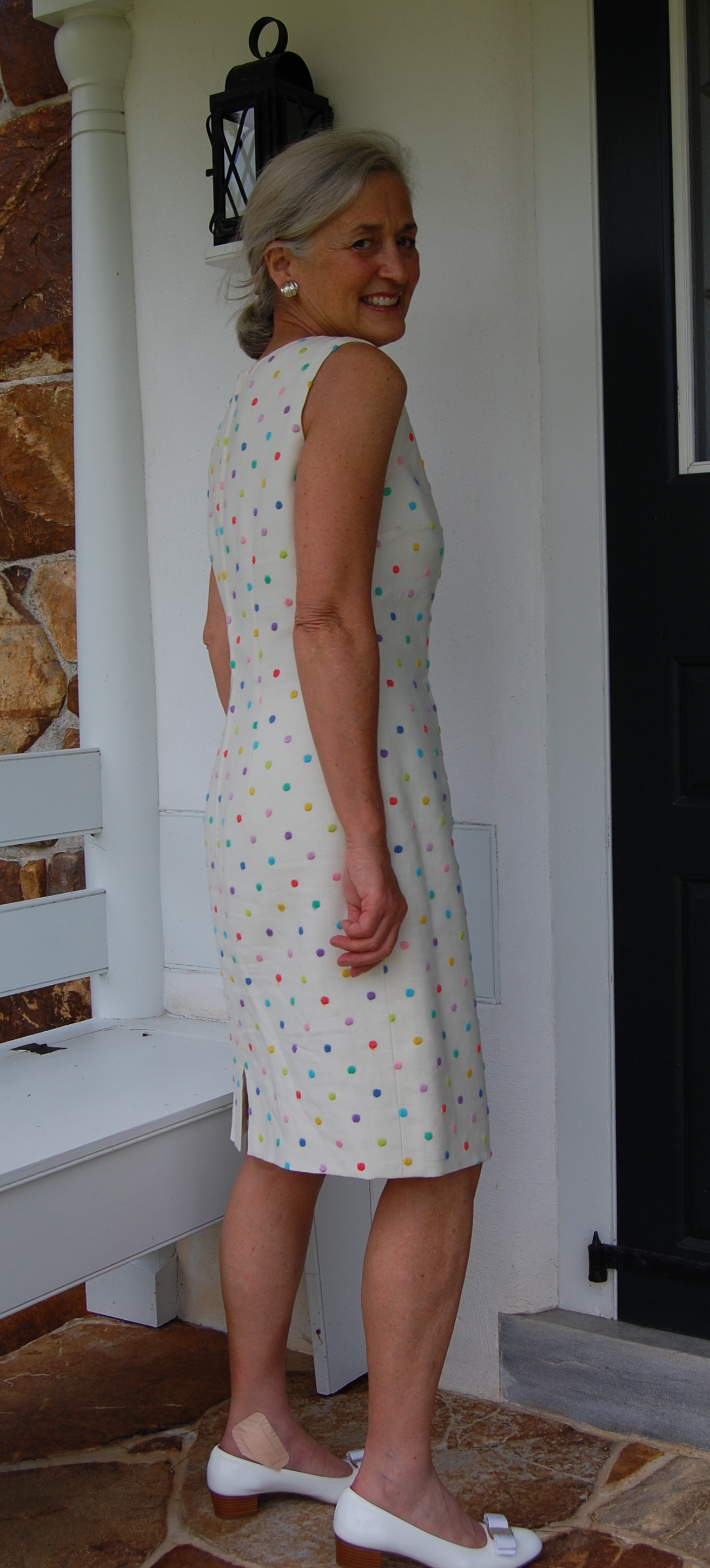
And one more view of the full dress.

And one more view of the full dress.

I finally (as of July 1, 2014) got some pictures taken!

I finally (as of July 1, 2014) got some pictures taken!

Polka dotted linen sheath

Polka dotted linen sheath

I love this dress!

I love this dress!

Moygashel linen is, sadly, no longer manufactured, about which I have written previously. One of its tag lines was “The first name in linen – The last word in quality”. I might change that to read “… The lasting word in quality.” Of course, there are some beautiful linens being manufactured today, but none will ever command a dressmaker’s imagination in quite the same way that Moygashel linen did for decade after fashionable decade.


22 Comments

Filed under hand-sewn zippers, Linen, Moygashel linen, Polka dots, Uncategorized

The World of Couture Sewing

Excitement abounds in the world of couture sewing! The long-anticipated debut of Susan Khalje’s video series has arrived with the release of “The Cocktail Dress”.

Many of you are familiar with the Craftsy Class by Susan in which she guides one through the process of making a dress adhering to the fine and precise construction methods of “The Couture Dress”. Susan’s own video series promises to be more expansive, as she includes patterns, which she has designed and developed, with each video.

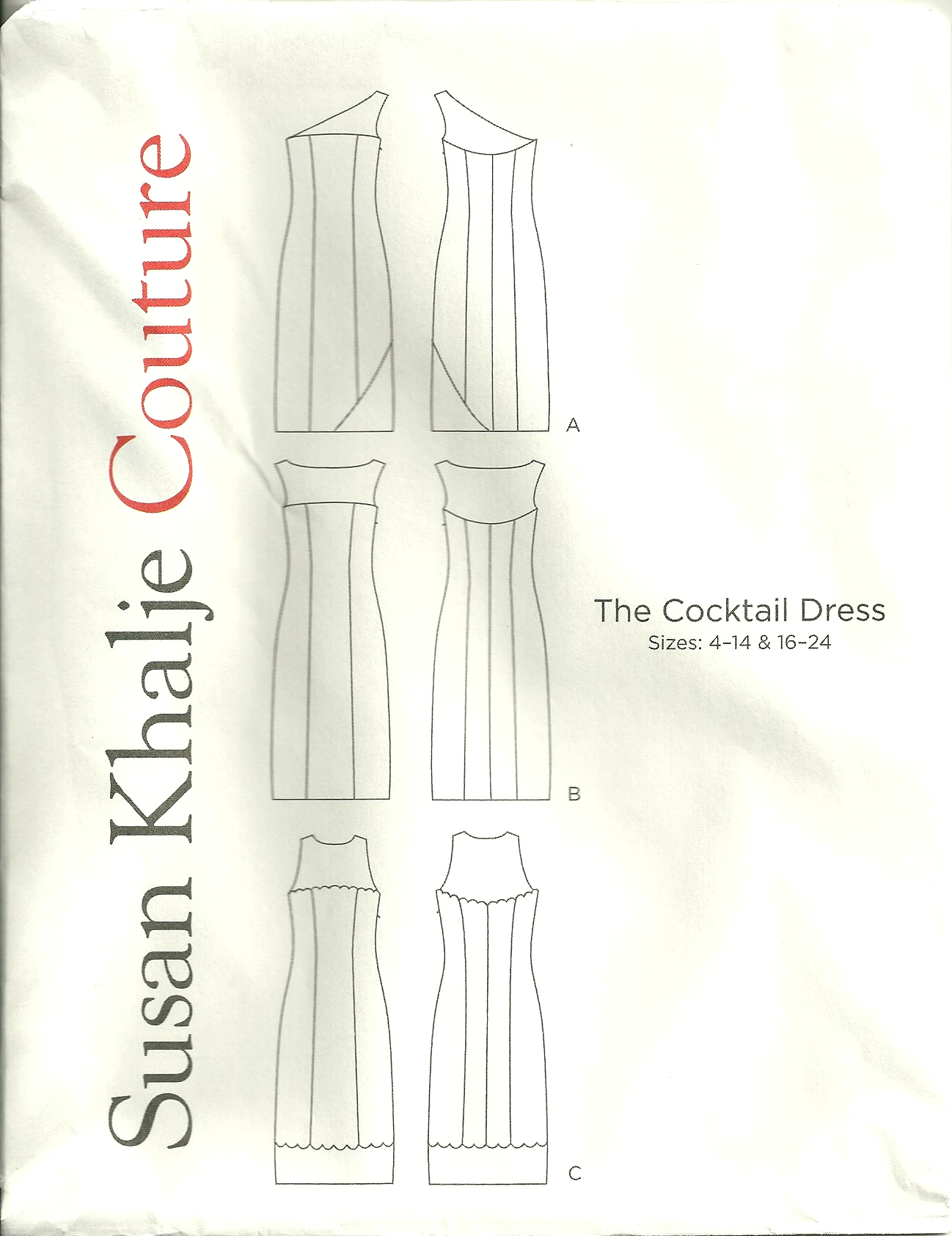
The three views of the Cocktail Dress pattern feature partial lace construction, one with an asymmetrical neckline and hemline insert, and what looks to me to be a (gorgeous!) Balenciaga-inspired bow at the shoulder. The feminine sheath styling, princess lines and Susan’s precise fitting advice are sure to make this dress a classic in one’s wardrobe.

Here is the pattern which comes with your enrollment in The Cocktail Dress.  The three variations of the dress each have their own charms!

Here is the pattern which comes with your enrollment in The Cocktail Dress. The three variations of the dress each have their own charms!

For those of you unfamiliar with Susan’s exceptional teaching style, her video series provides a wonderful opportunity for you: she includes two Free Videos on her website. Check out “Things to Bear in Mind When Choosing Fabrics” and “Choosing the Right Pattern Size” for a small preview of Susan’s friendly, easy-going, informative approach to fashion sewing.

Other courses planned in Susan’s video series are:

  • The French Couture Jacket
  • The Lace Class
  • The Couture Notebook
  • The Little Black Dress
  • The Corset
  • The Skirts Class

Finally – one thing I know, both from completing Susan’s Craftsy course, and from taking classes with Susan in person, is that you will grow as a dressmaker as you make your way through the couture process taught by her. Yes, it takes patience and tenacity, but the finished product is more than just a dress or a jacket (or whatever!) – it is art and craft and style all rolled into one. I am so looking forward to getting started on my Cocktail Dress — care to join me??

17 Comments

Filed under couture construction, Love of sewing

Two Little Dresses

Sewing for very little girls possesses its own special charms, and sewing for a little girl who also happens to be one’s granddaughter is more than sewing – it is sharing part of a sewing legacy. It has its privileges, too. Some of the design details which I most like, I am able to add to these small little articles of clothing. Yes, of course, I am referring to rick rack and sashes.

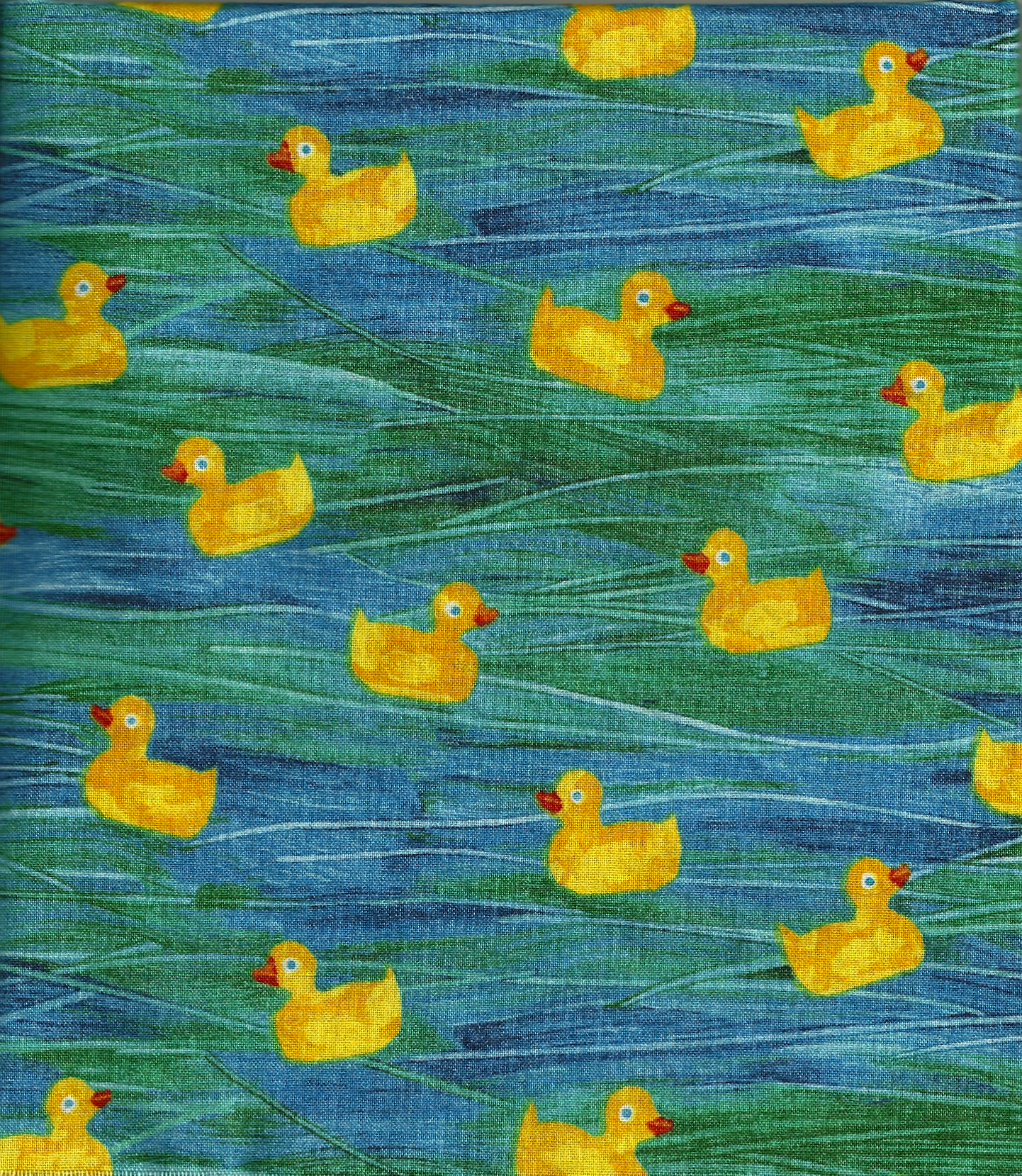
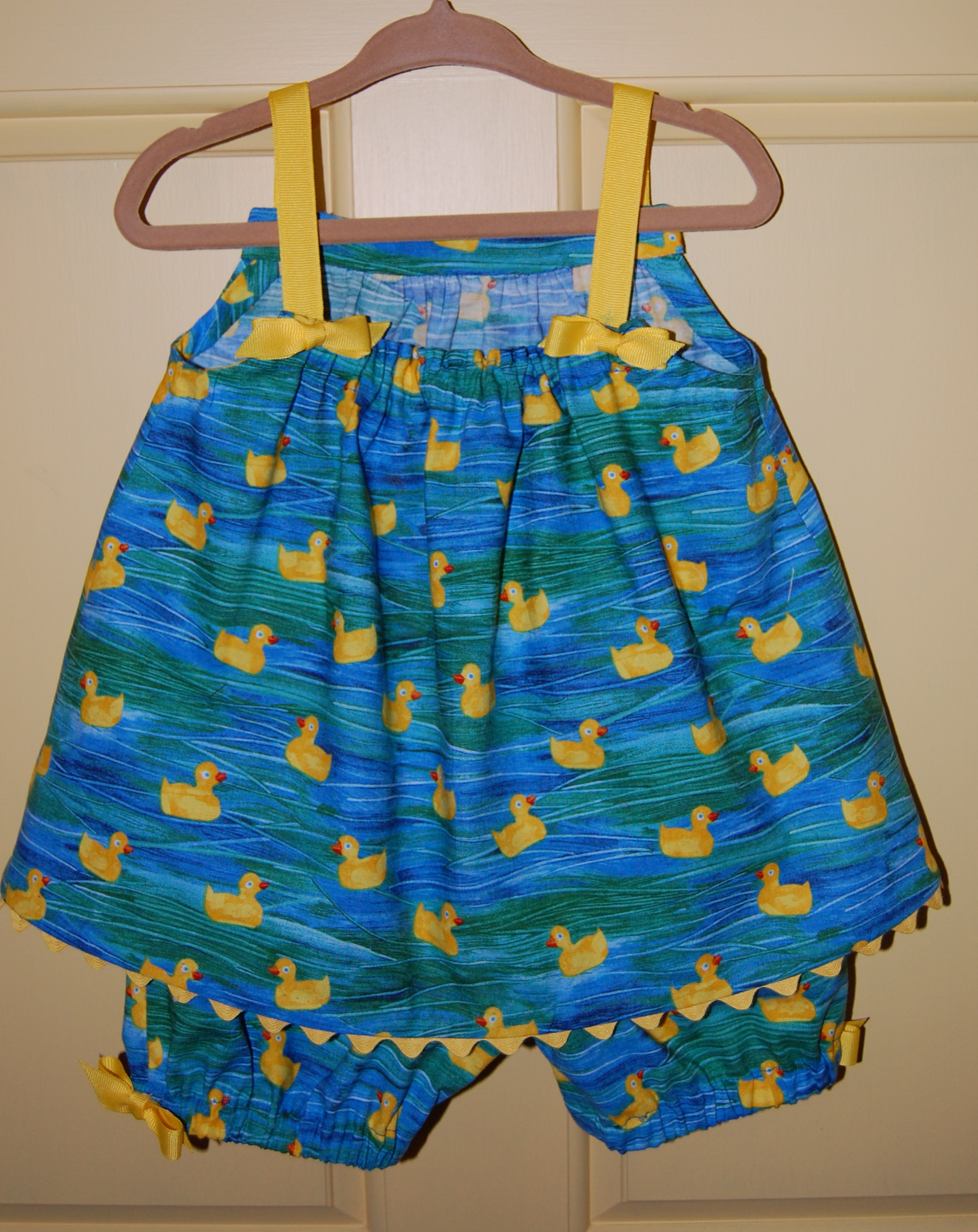
As our little Aida’s first birthday approached in mid-March, I began to plan for at least one little dress to mark the occasion. I already had purchased this cotton fabric at the Eric Carle Museum last October for just such a dress, and knew that it would be quite perfect paired with yellow rick rack.

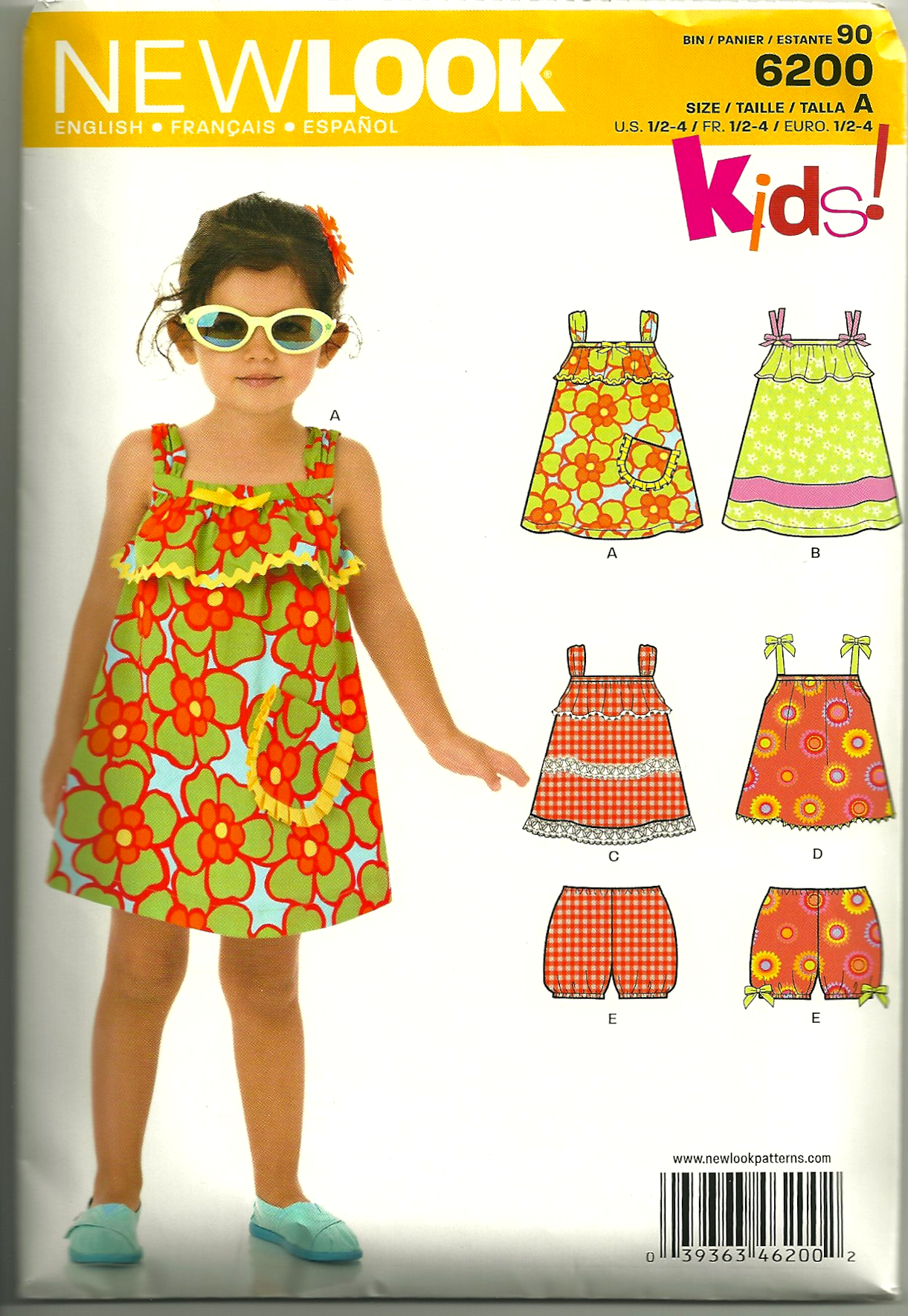
Happy New Sewing Year - carle fabric I set out to find a versatile pattern which would lend itself to this fabric and found myself thumbing through the New Look pattern catalog. There were many cute patterns, but I settled on this one:

I settled on View D, paired with some bloomers.

I decided on View D, paired with some bloomers.

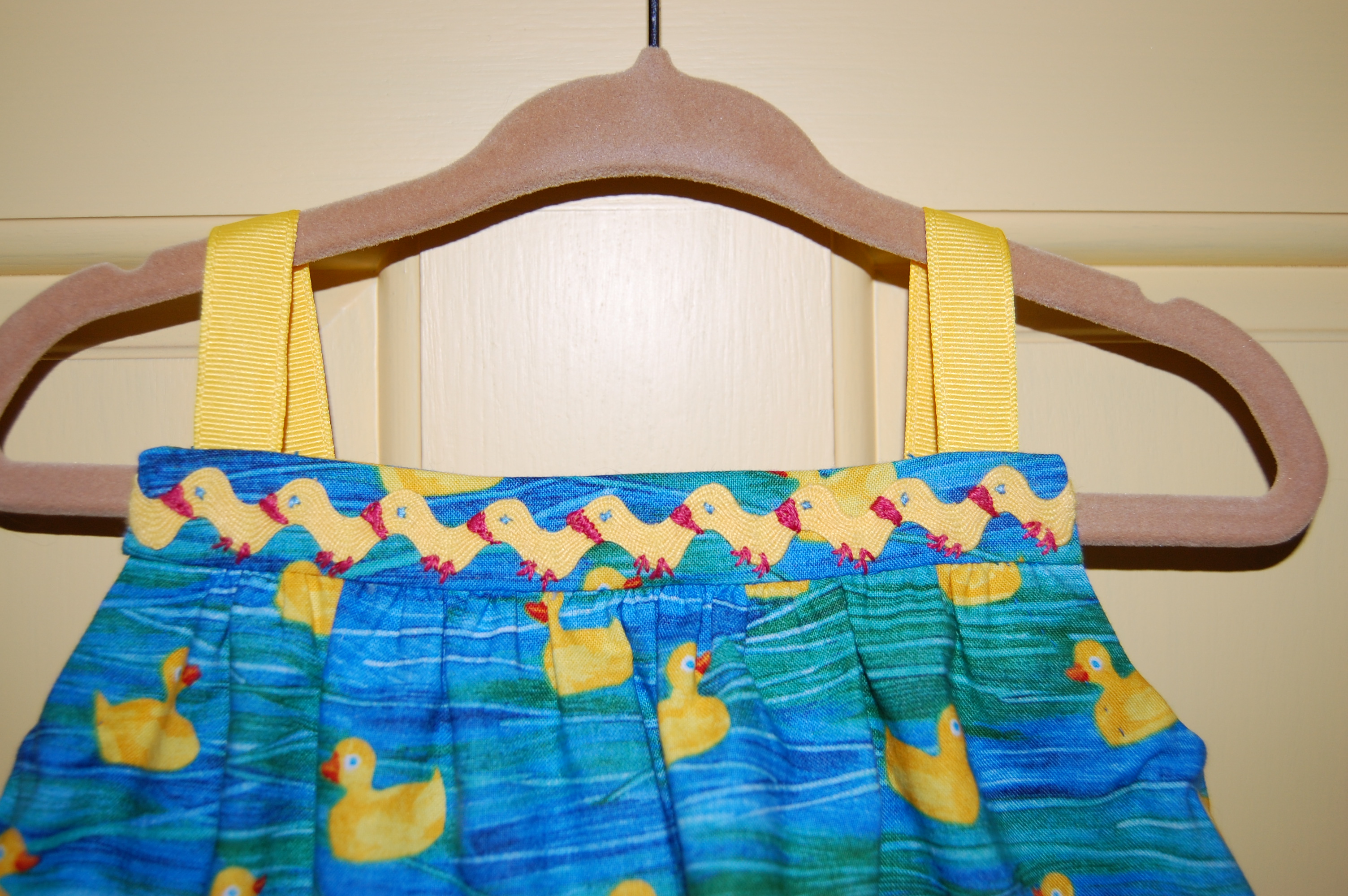
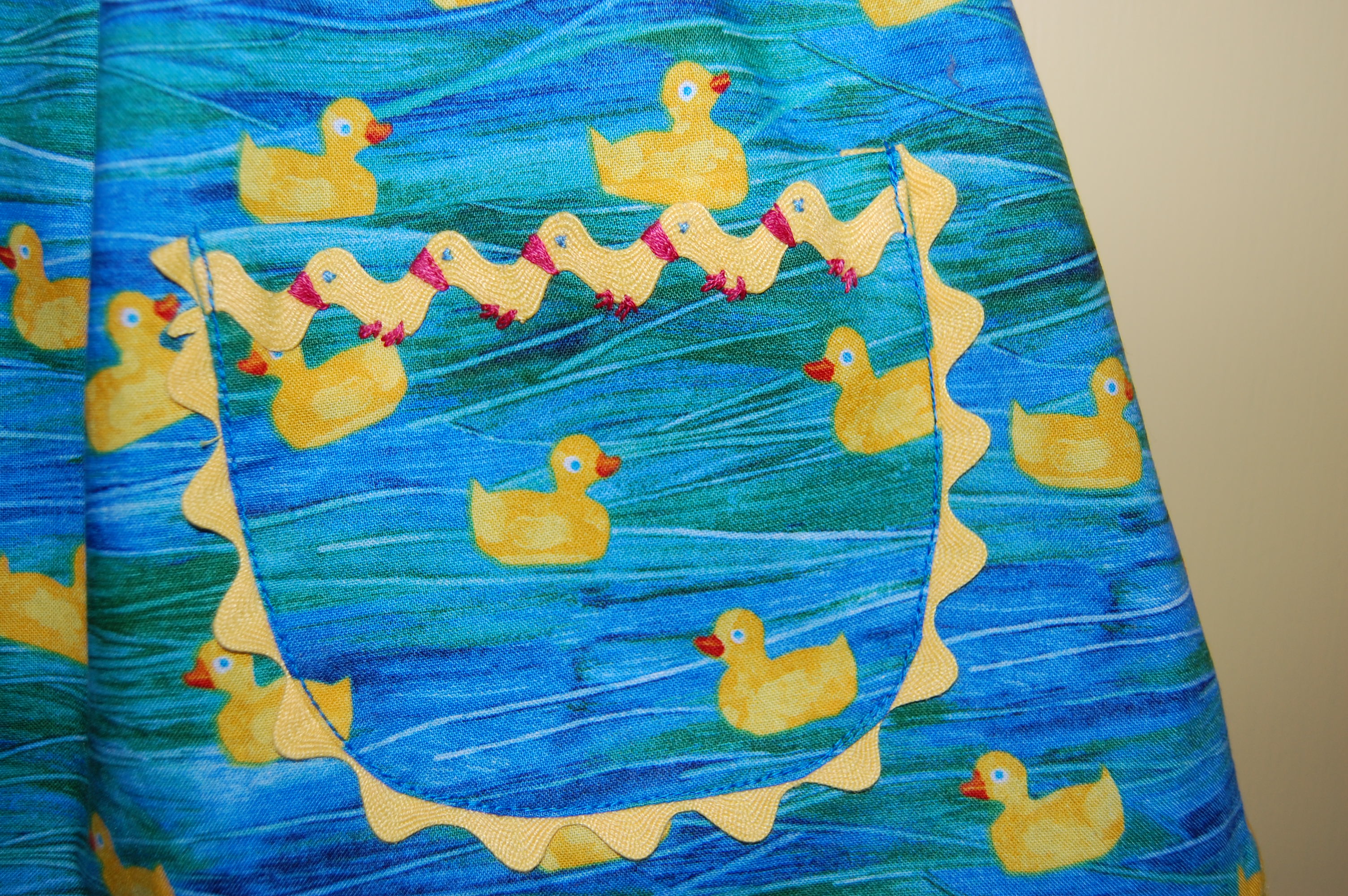
I liked the narrow yoke on the front of the dress, which would be the perfect place to do something creative with rick rack. Specifically, I was thinking of enhancing the little duck theme by turning a strip of rick rack into a row of little duckies. I had seen rick rack turned into little chicks, and it wasn’t too much of a stretch to change the embroidery details to evoke ducklings instead.

Please click on the photo for a close-up look at these little duckies.

Please click on the photo for a close-up look at these little duckies.

Once I had embellished the narrow yoke, I decided to decorate the pocket, too.

two little dresses

Some yellow grosgrain ribbon seemed a good choice for the adjustable straps, which button in back. I added two perky bows to the bloomers, to make the outfit complete.

A front view . . .

A front view . . .

. . . and a back view.

. . . and a back view.

By this time, I had decided that a first birthday called for another little dress, one which Aida’s mommy – my daughter – would know nothing about. (Daughter Susanna had been with me when I purchased the Eric Carle-designed fabric.) After seeing a very simple little sundress design on Pinterest, I figured I could make little dress number 2 without a pattern – and also indulge my love of sashes on little girls!

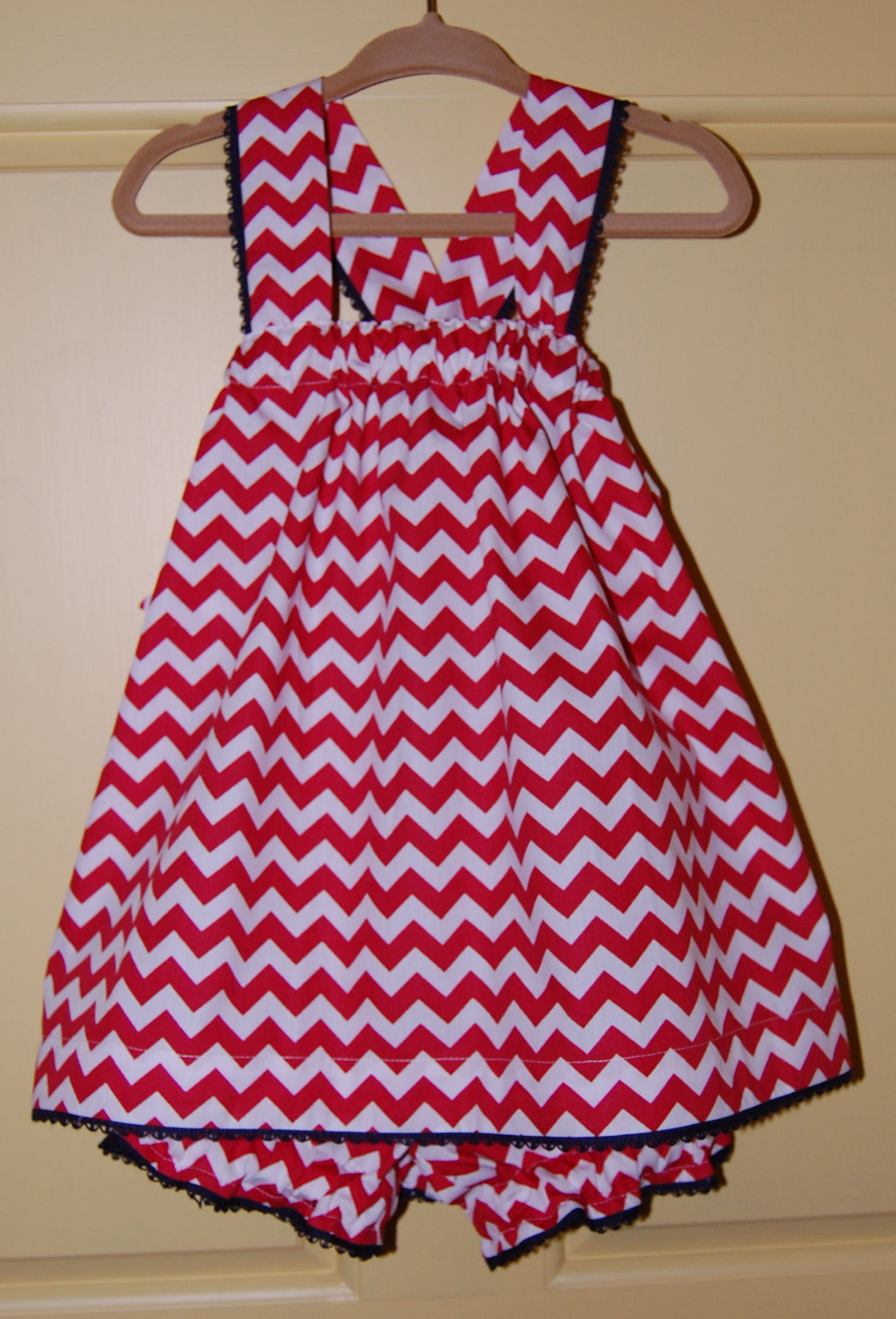
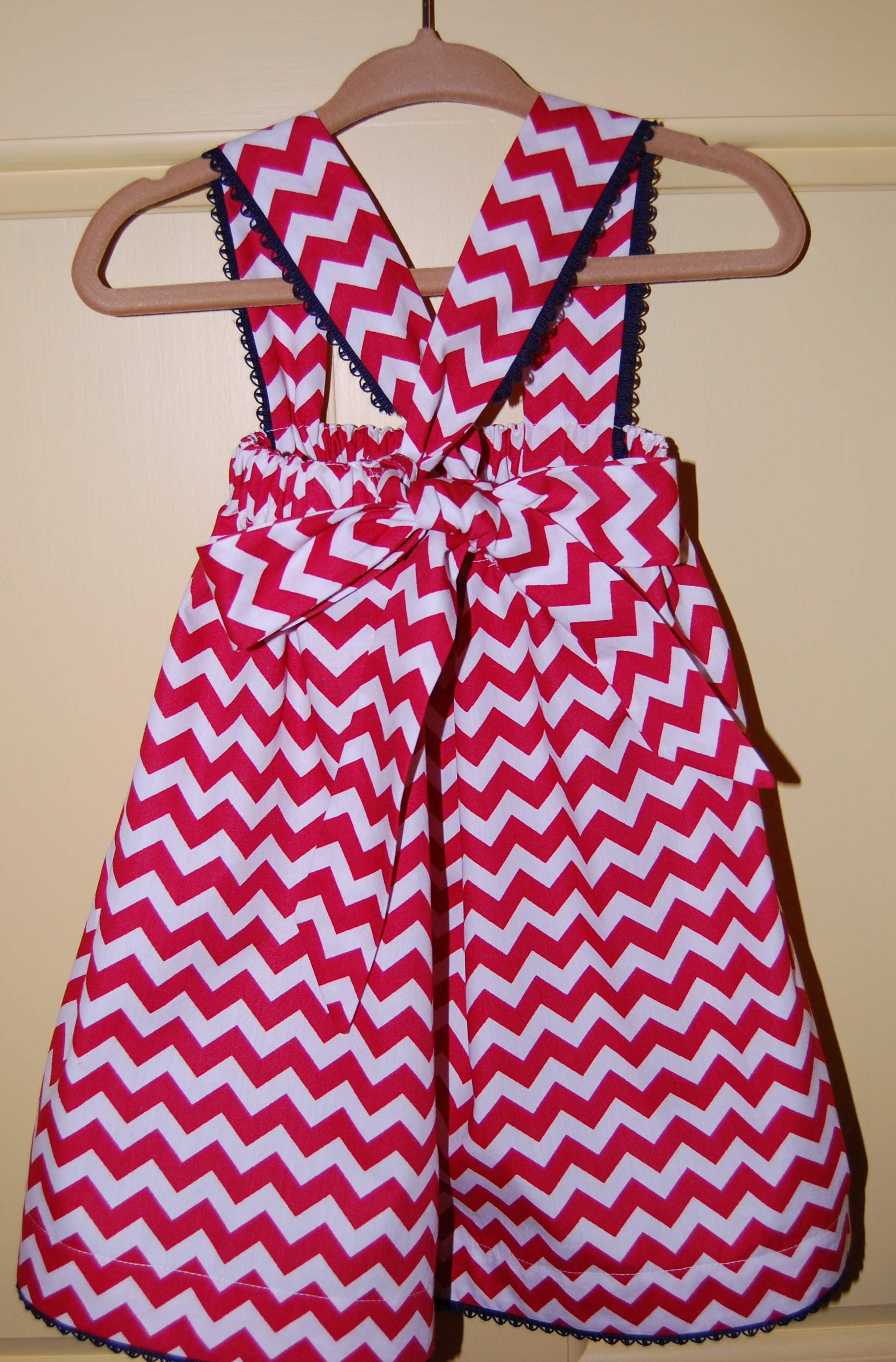
The “going-out-of-business sale” at Waechter’s had earlier provided me with the opportunity to purchase many yards of a red and white chevron print and a petite navy blue trim (among other things). Our perky little Aida may end up with many a dress in this fabric, so I figured there was no time like the present to start the tradition! Here is what I came up with:

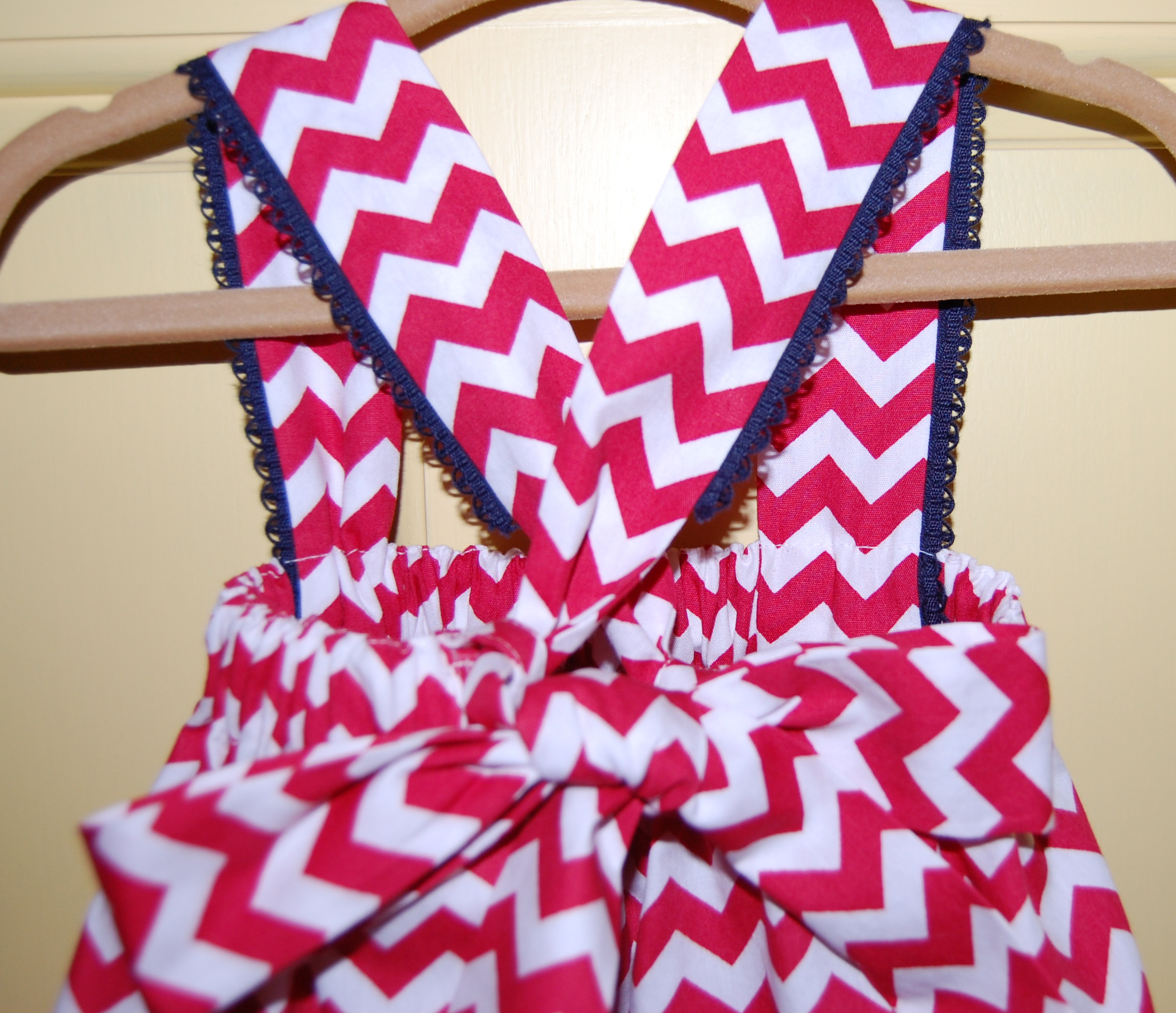
The shoulder straps twist through loops in the back and become the sash for the dress.

The shoulder straps twist through loops in the back and become the sash for the dress.

This detail of the back shows where I ended the trim to accommodate the transition to the sash.

This detail of the back shows where I ended the trim to accommodate the transition to the sash.

A full view of the back of the dress.

A full view of the back of the dress.

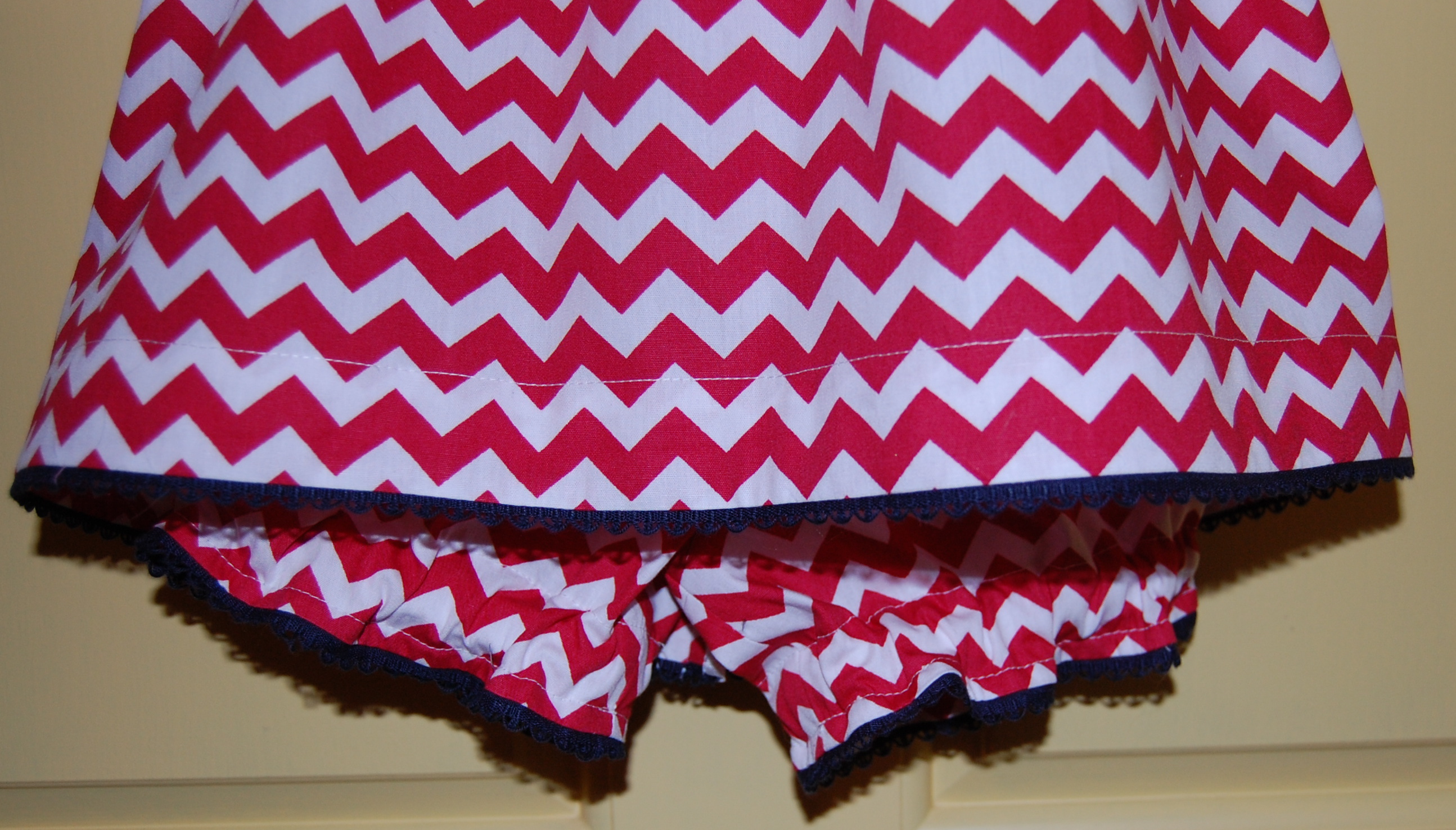
And I made bloomers, too!

And I made bloomers, too!

Two little dresses, rick-racked and be-sashed, seem to be a good beginning for Aida’s second year of fun and frolic and “fashion”!

Happy Mother’s Day to Aida’s wonderful Mommy – and to all Mommies everywhere!


10 Comments

Filed under Sewing for children

Defying the passage of years?

Throughout the 1950s, copyright dates appeared on all Vogue patterns (or, at least that has been my observation). Copyright dates appear on some of the patterns from 1960-‘62, but after that, they are non-existent. It is always a thrill when I find a reference to, or picture of, a pattern, which I own or am working on, in one of The Conde Nast Publications, Inc. magazines or other printed materials. It is one sure way to date an otherwise undated vintage Vogue pattern.

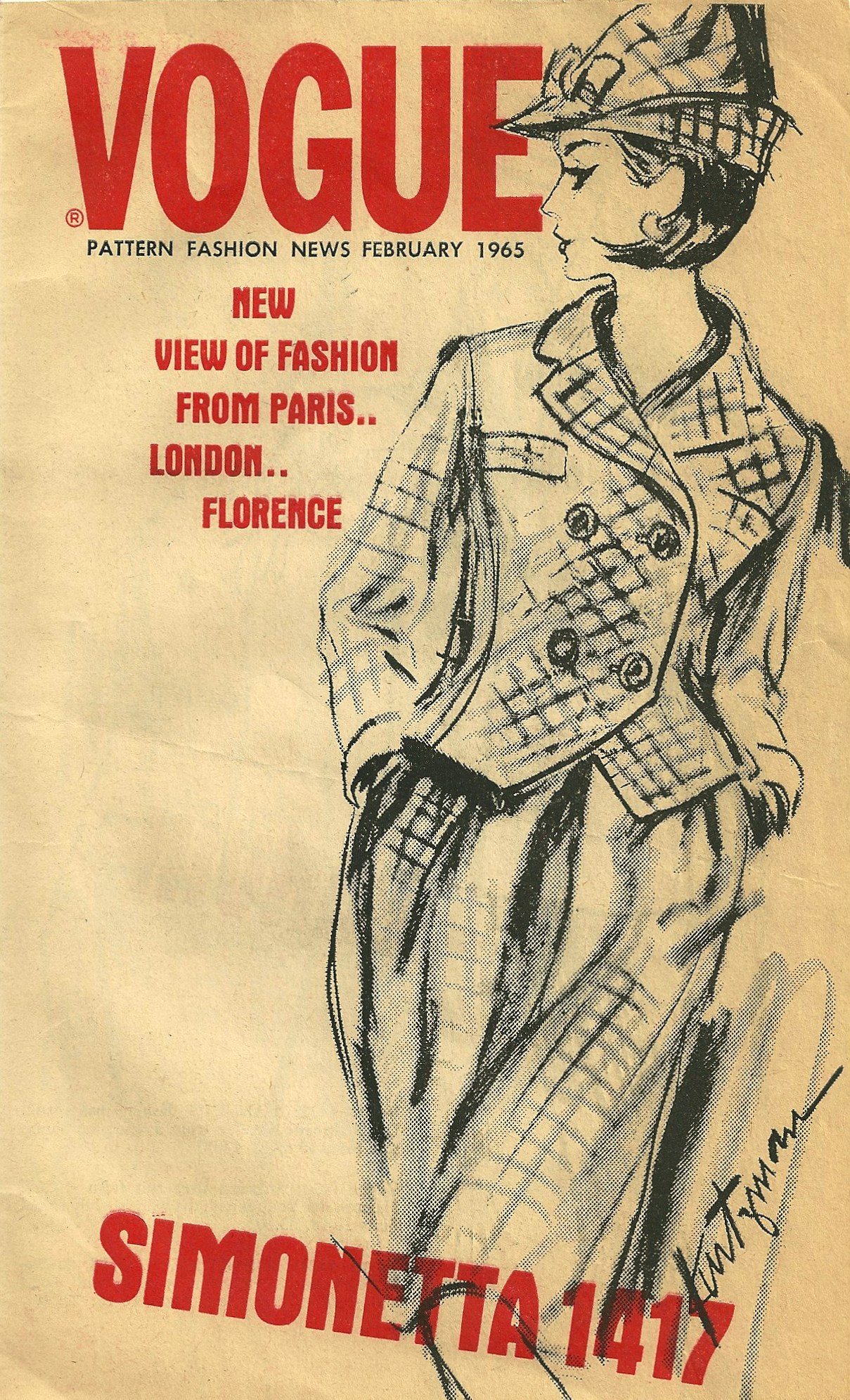
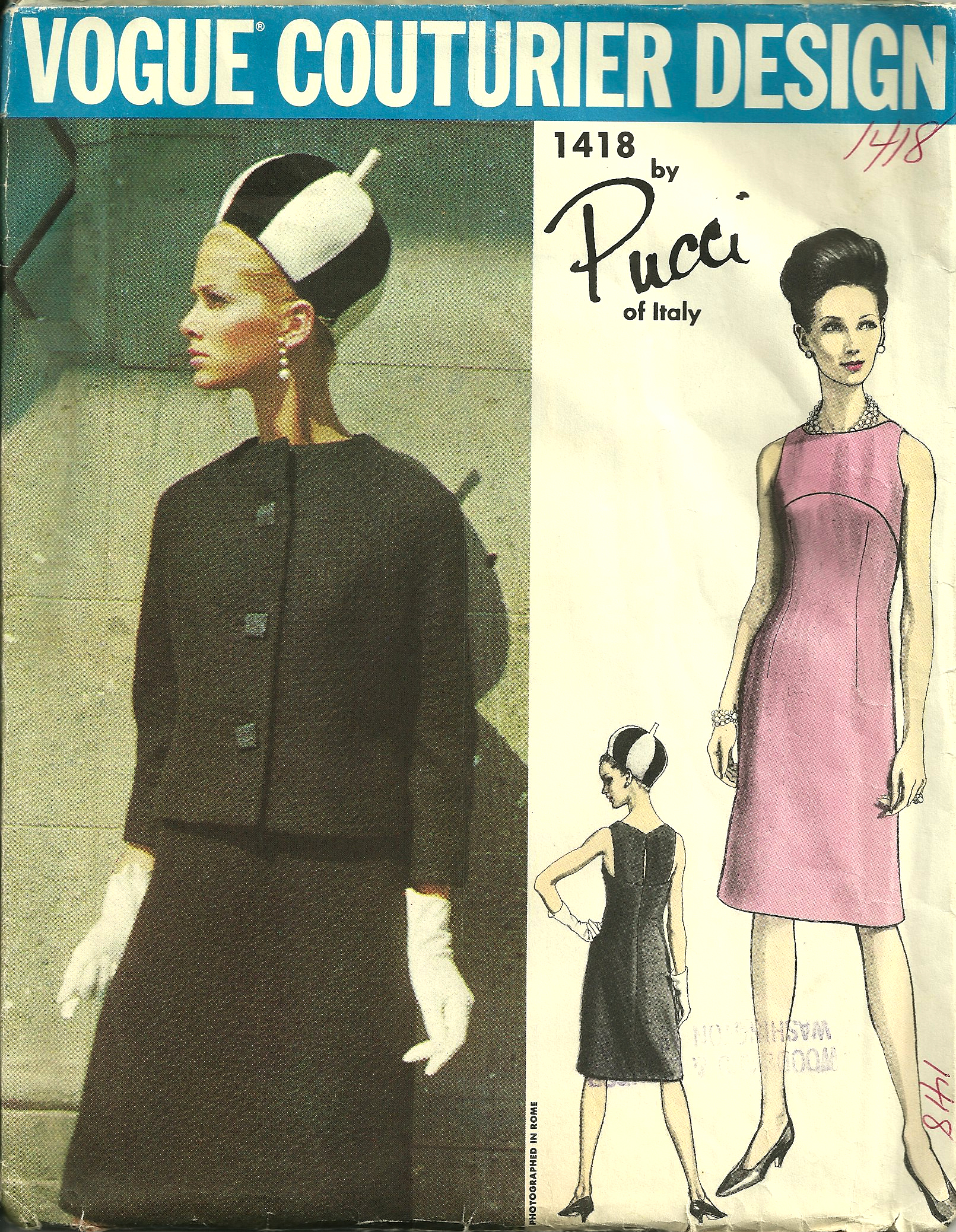
So – you can imagine my delight when a small, 8-page Vogue Pattern Fashion News from February 1965 – which I recently purchased – featured the Emilio Pucci dress and jacket which has been my sewing focus for the past several weeks.

On the cover of this small "flyer", which was available for pick-up wherever Vogue patterns were sold, is the reference to fashion from Florence - as in Pucci's Florence!

On the cover of this small “flyer”, which was available for pick-up wherever Vogue patterns were sold, is the reference to fashion from Florence – as in Pucci’s Florence!

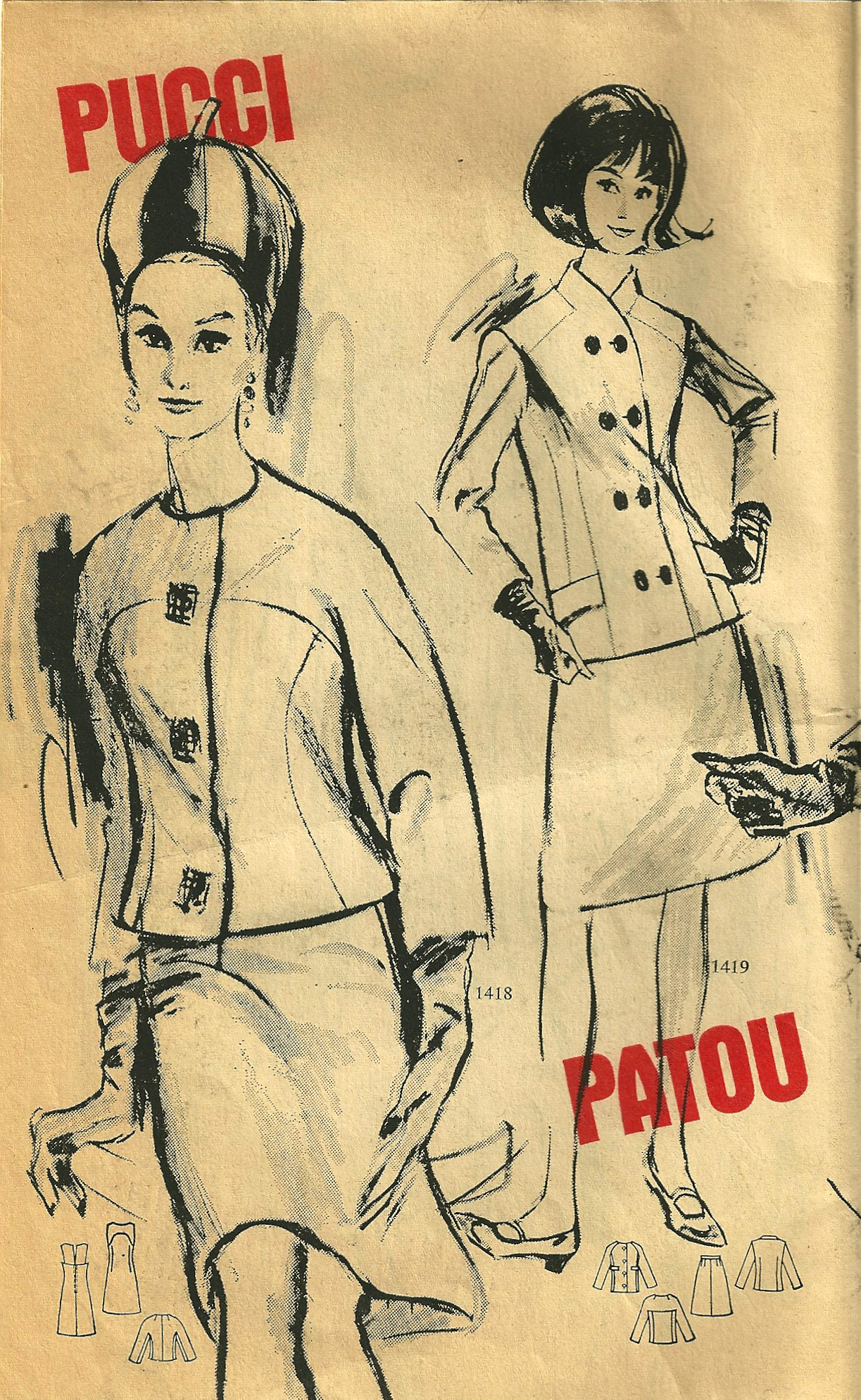
And here is the sketch of "my" Pucci pattern.

And here is the sketch of “my” Pucci pattern.

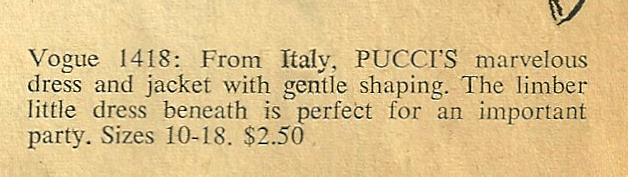
The brief caption gives an apt description of the Pucci pattern:

Pucci pattern - fashion news caption

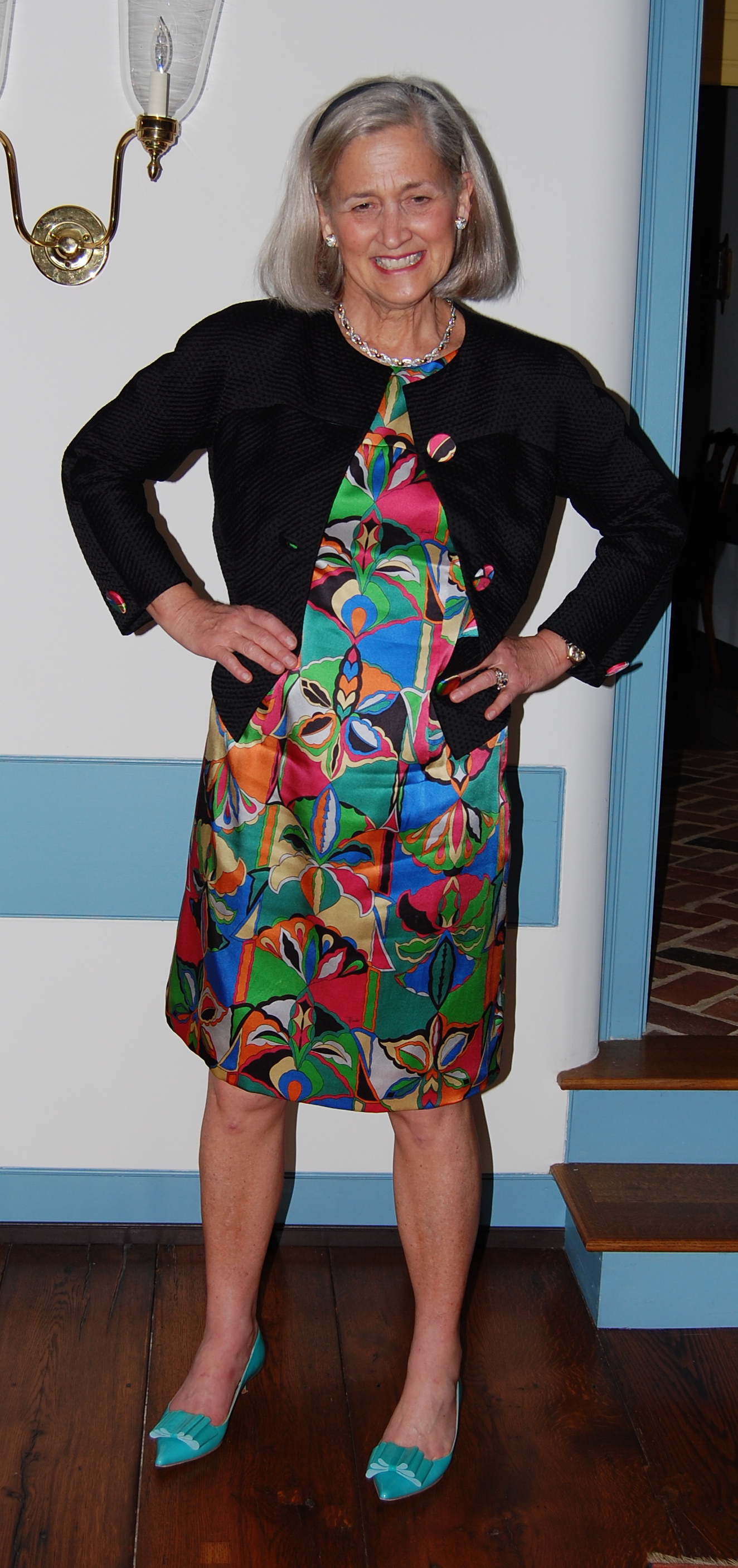
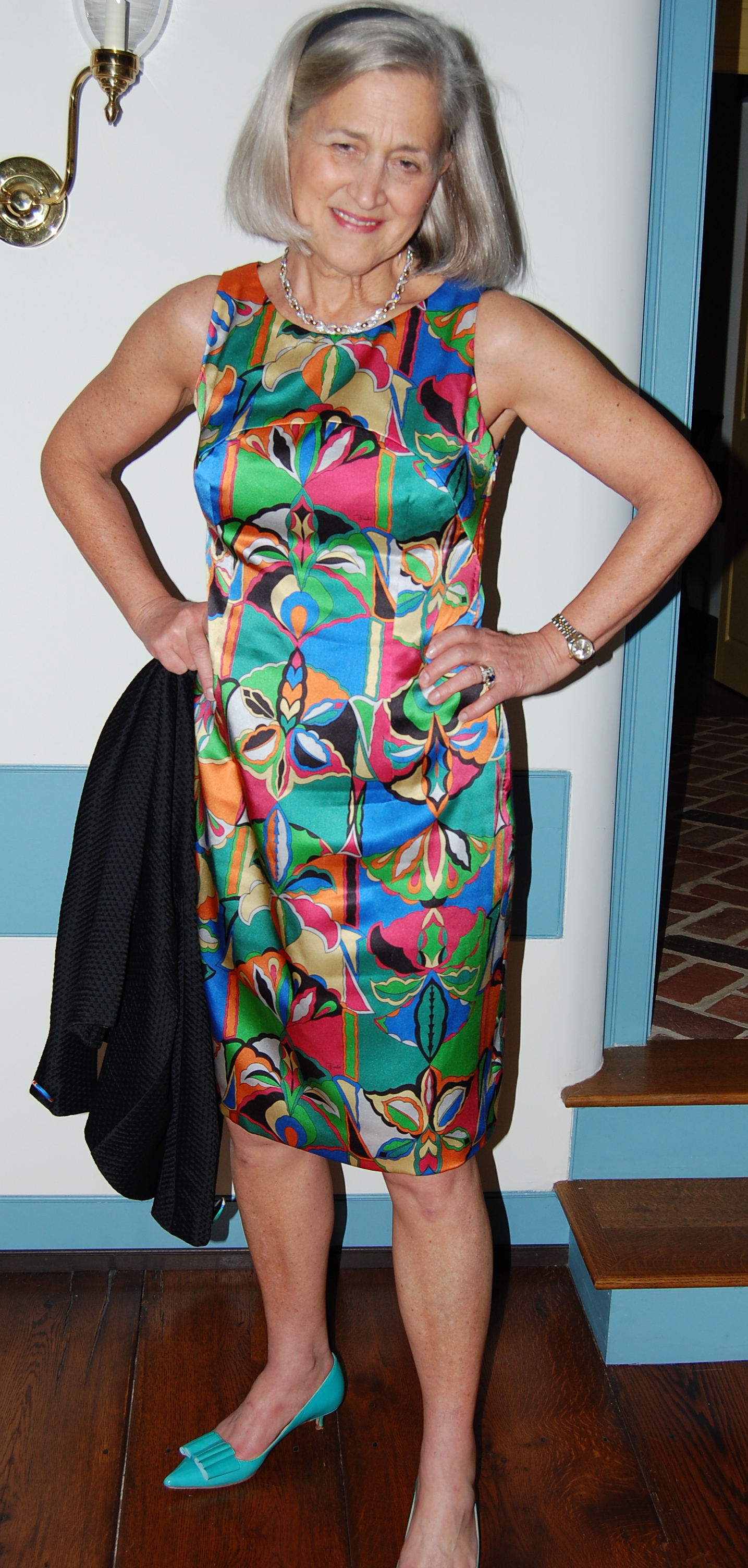
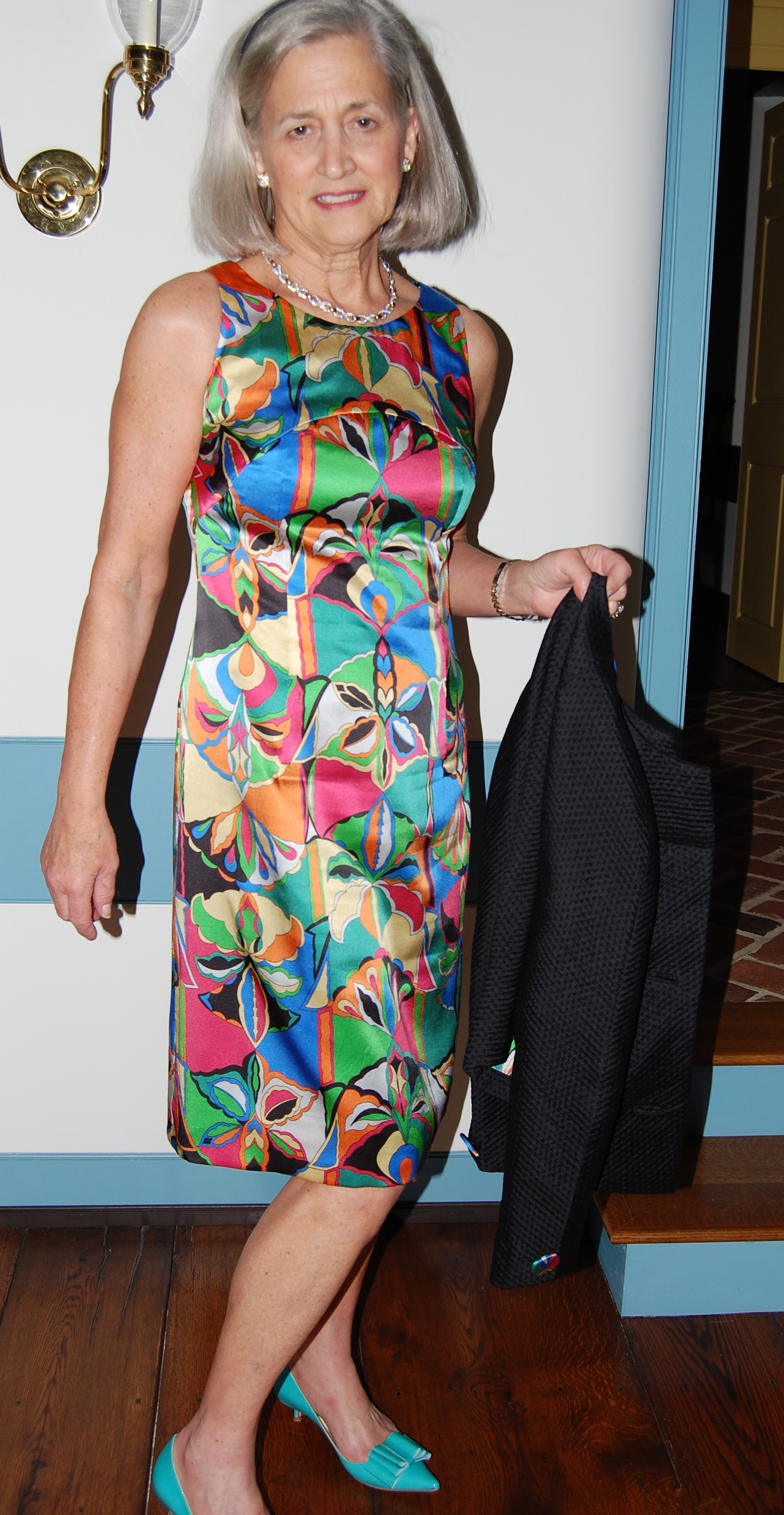
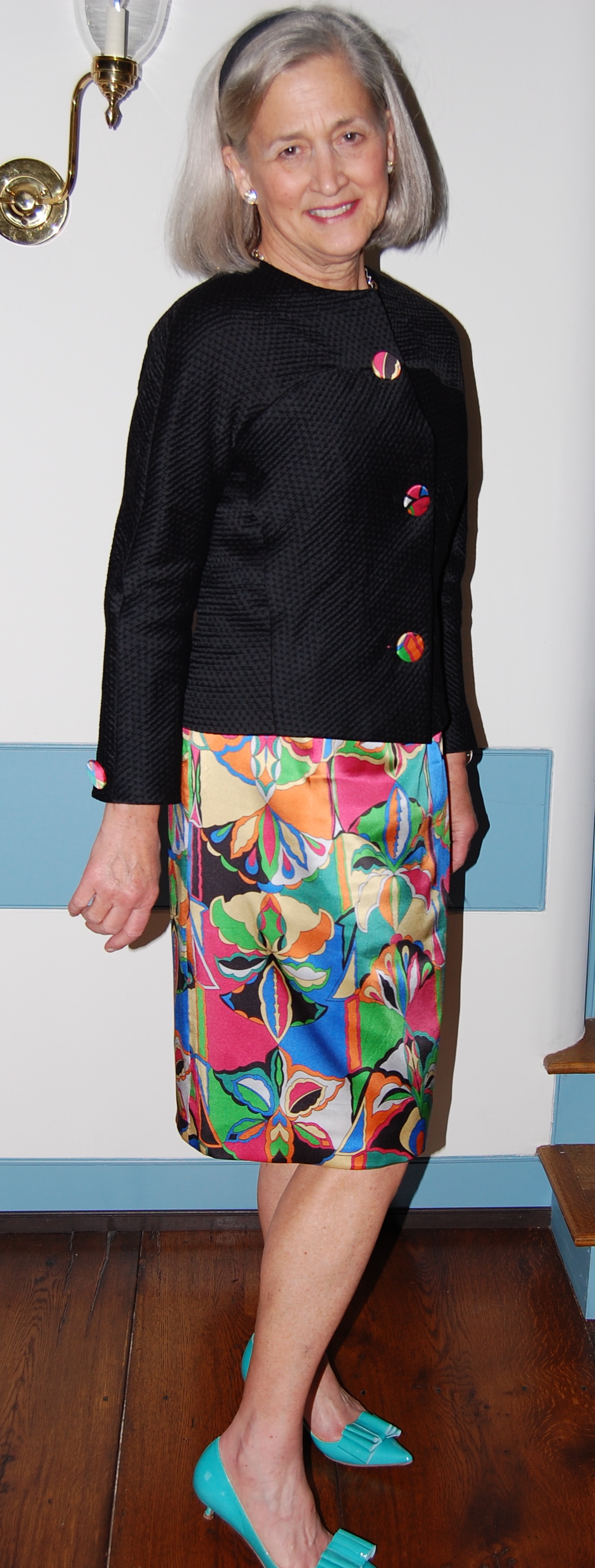
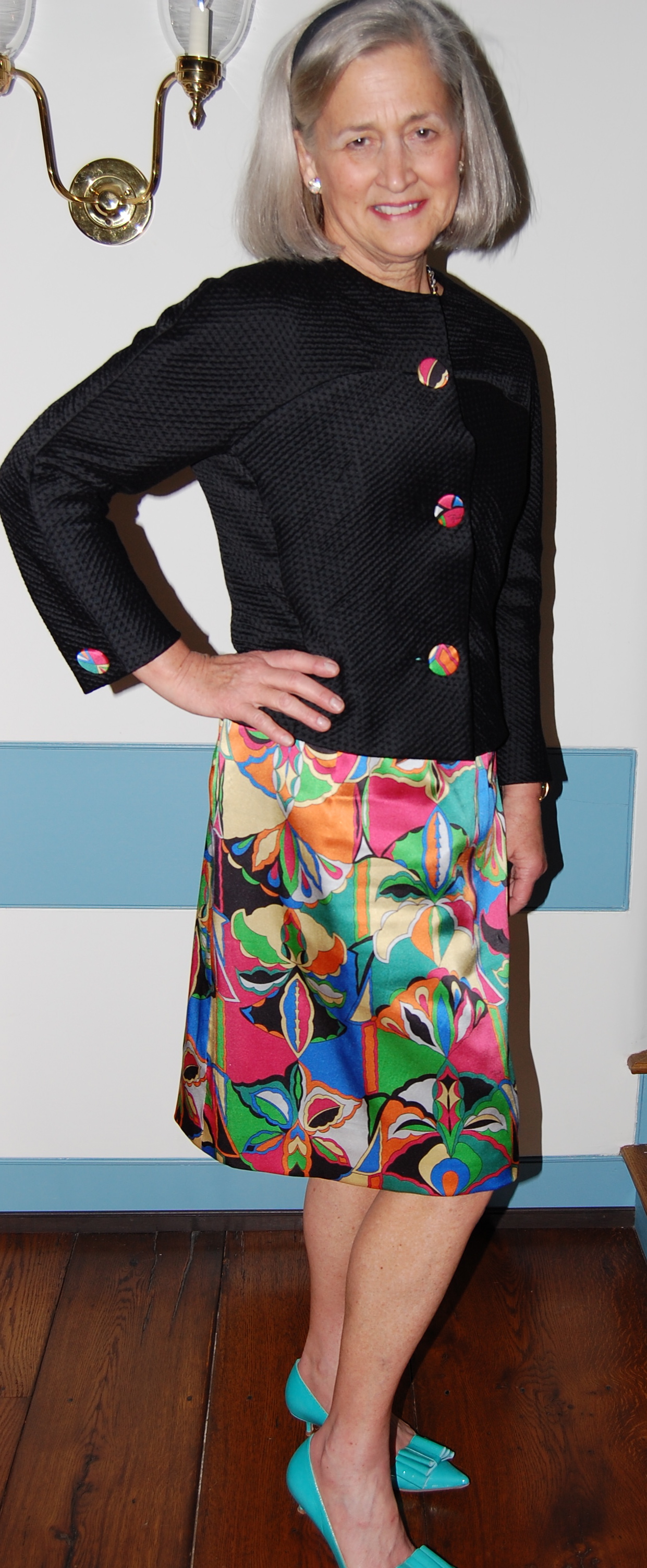
And – I did indeed wear this dress (and jacket) to an “important party” just last weekend – to a beautiful wedding in Center City Philadelphia.


(This photo was not taken at the wedding...)

(This photo was not taken at the wedding…)

I was working diligently all last week to finish the jacket. Here are the details on what was transpiring in my sewing room:

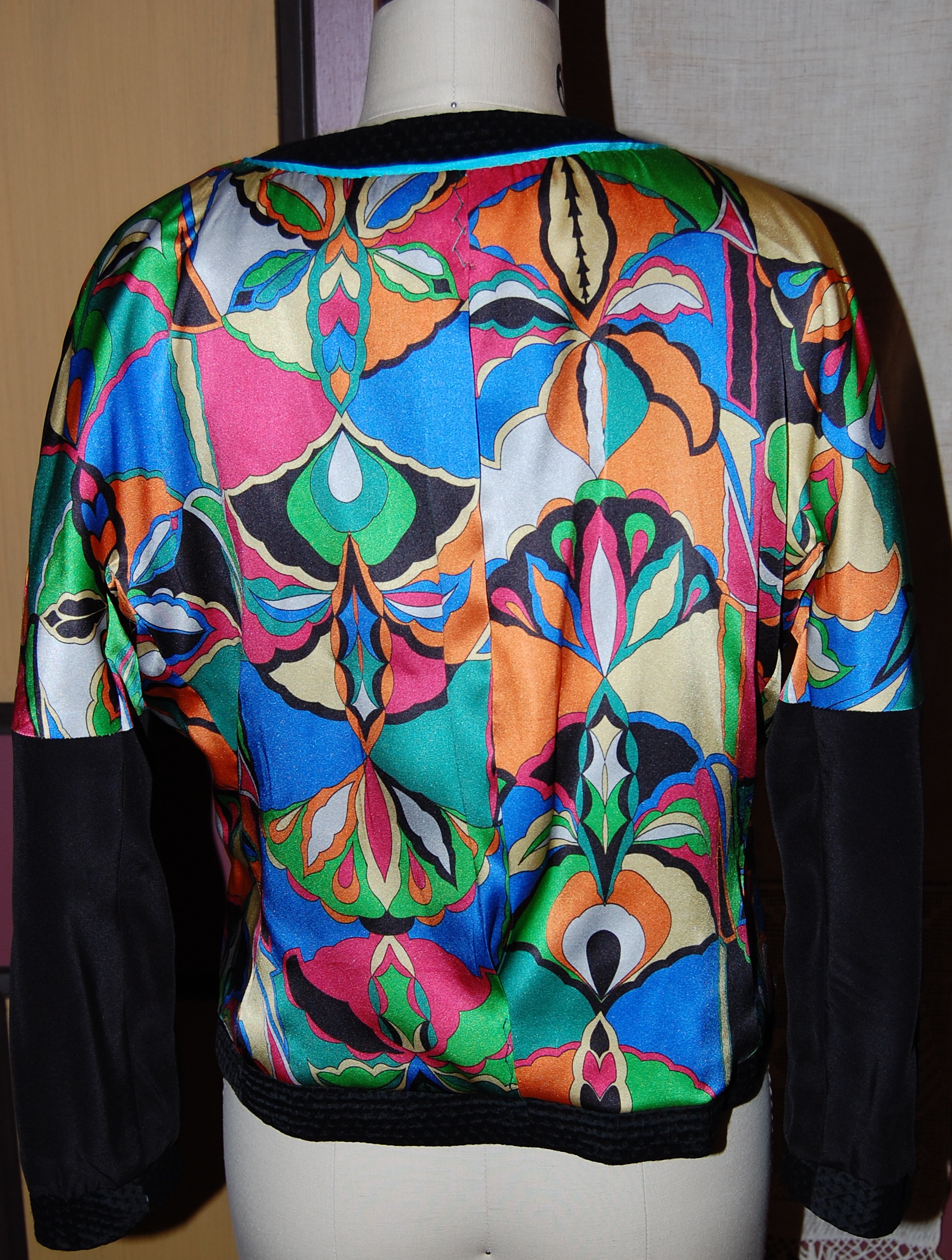
First, I can tell you I was delighted that the pieced sleeve linings worked just as I had hoped they would. Here is the jacket turned inside out, showing the piecing on the lower sleeves.

Defyng the passage of years

Inside out, a back view.

Inside out, a back view.

And here is a photo inside the jacket, looking towards one sleeve, which shows that the piecing does not show! Hurray. I honestly don’t think anyone seeing the jacket slung over a chair is ever going to suspect that the Pucci lining fabric does not extend all the way down the sleeves.

Defying the passage of years

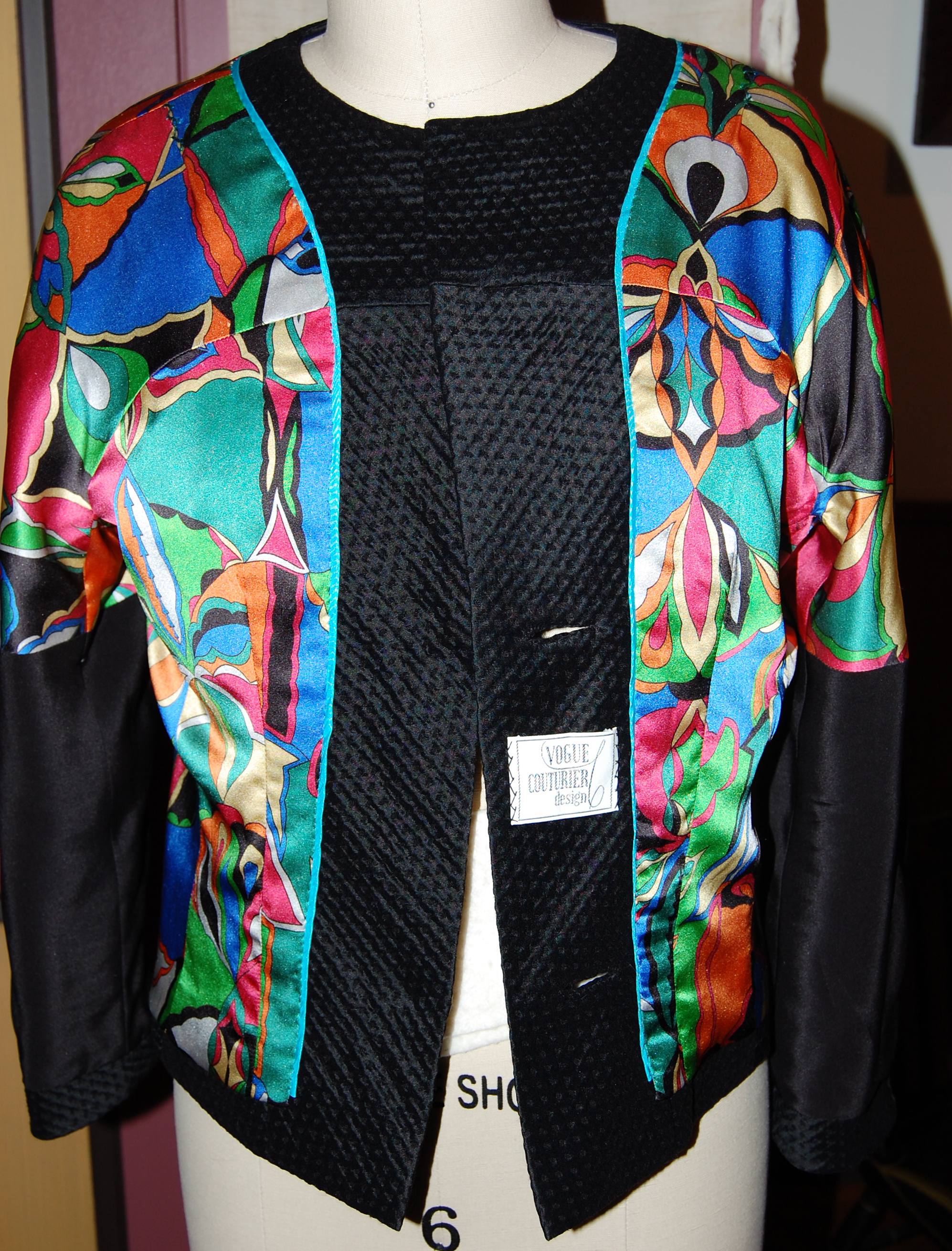
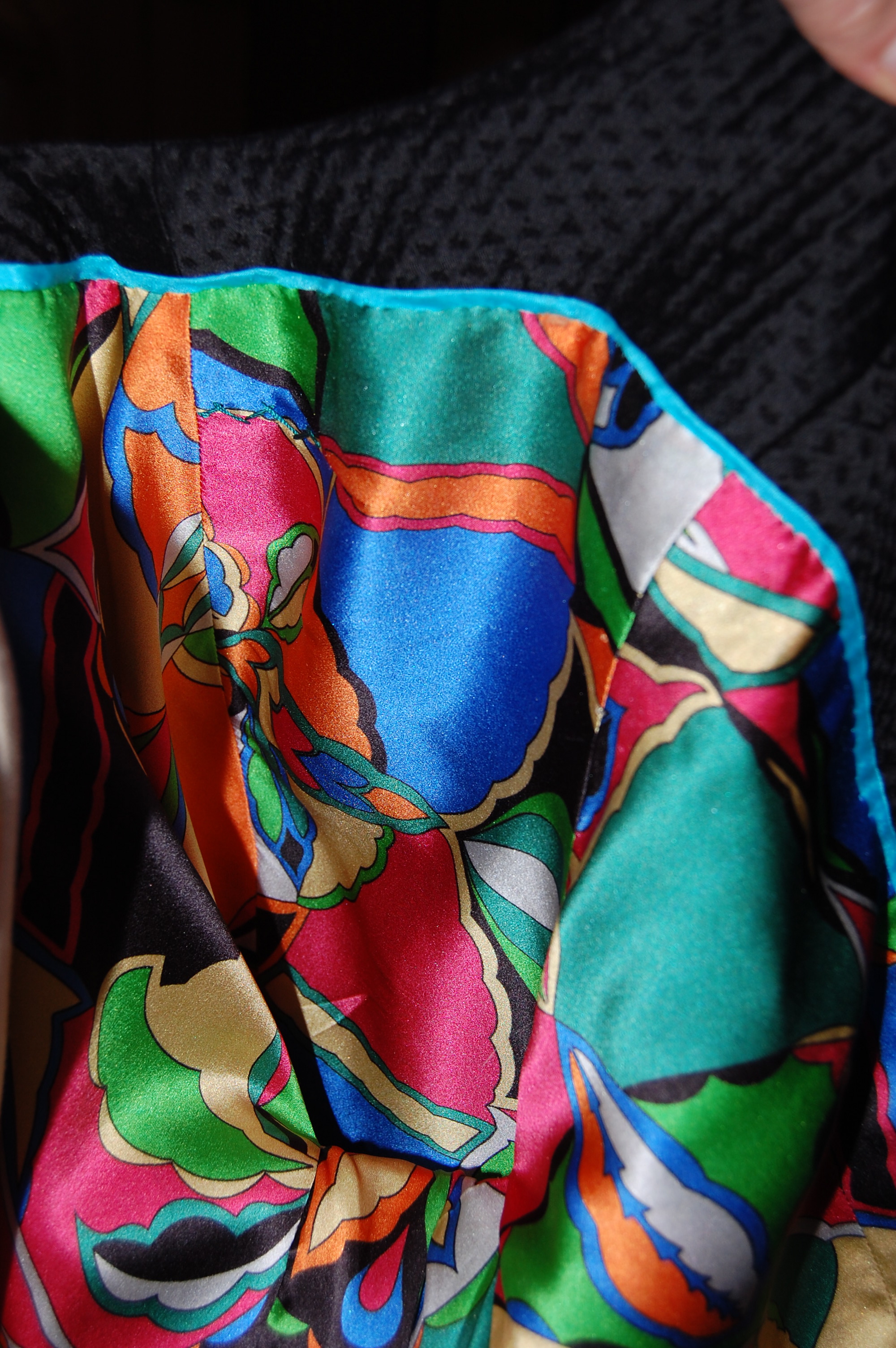
I also had the idea to add a narrow, bias, flat piping to the edge of the lining down the fronts and around the neckline. I found a turquoise silk in my fabric closet which seemed to keep with my “theme” of the turquoise under-stitching on the interior of the dress. This is one of those “dressmaker details” which just makes me happy.

Defying the passage of years

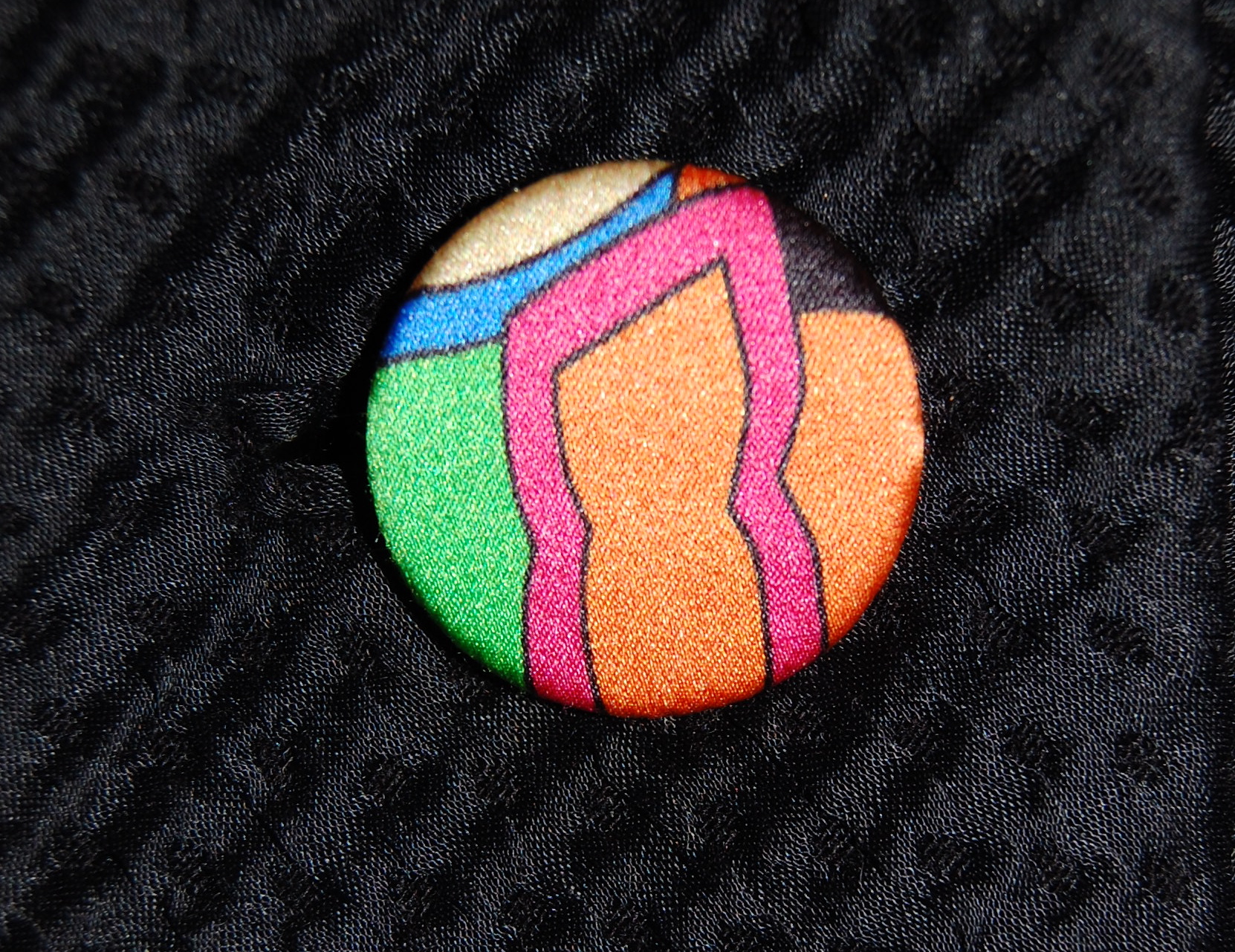
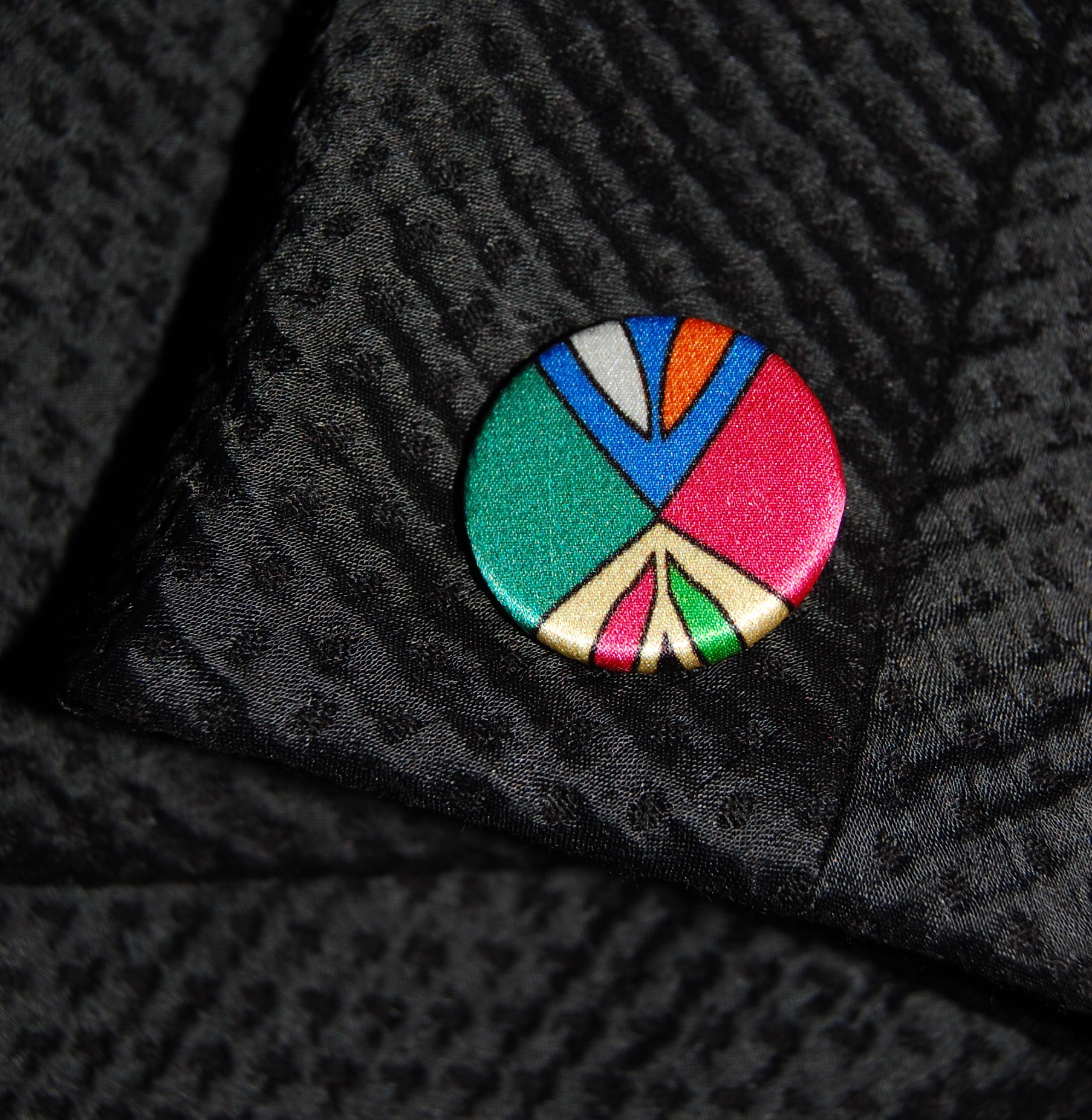
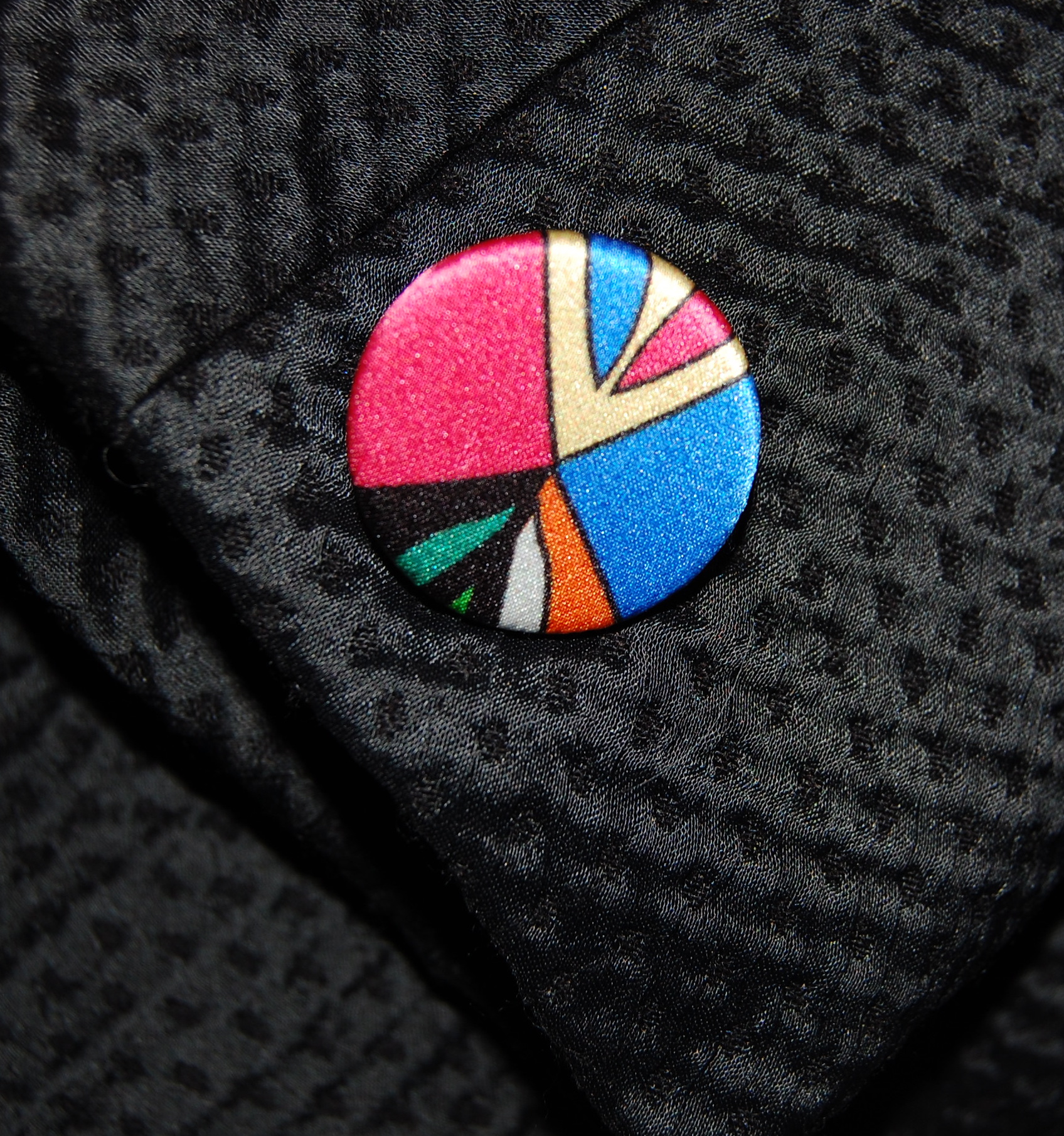
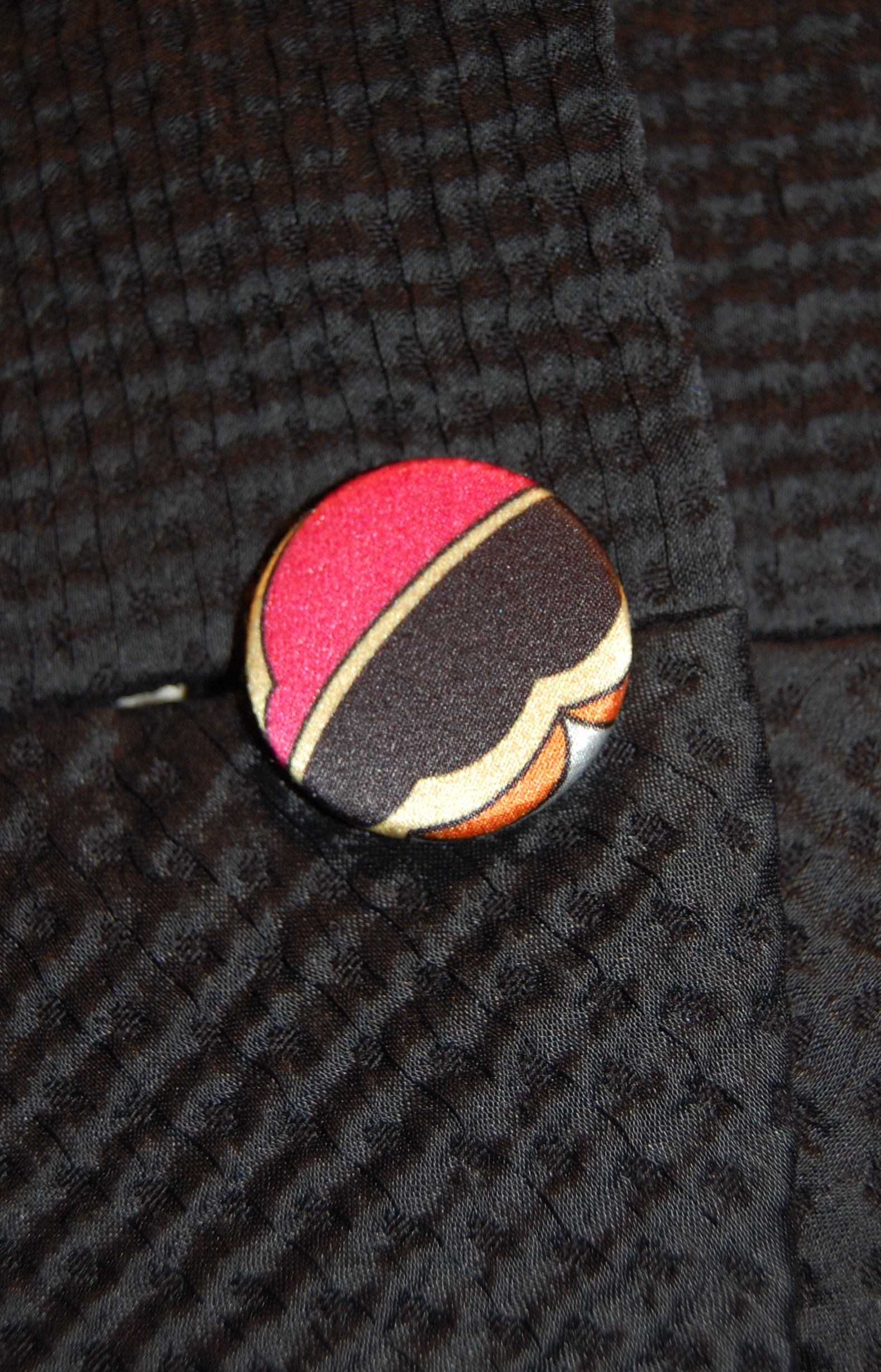
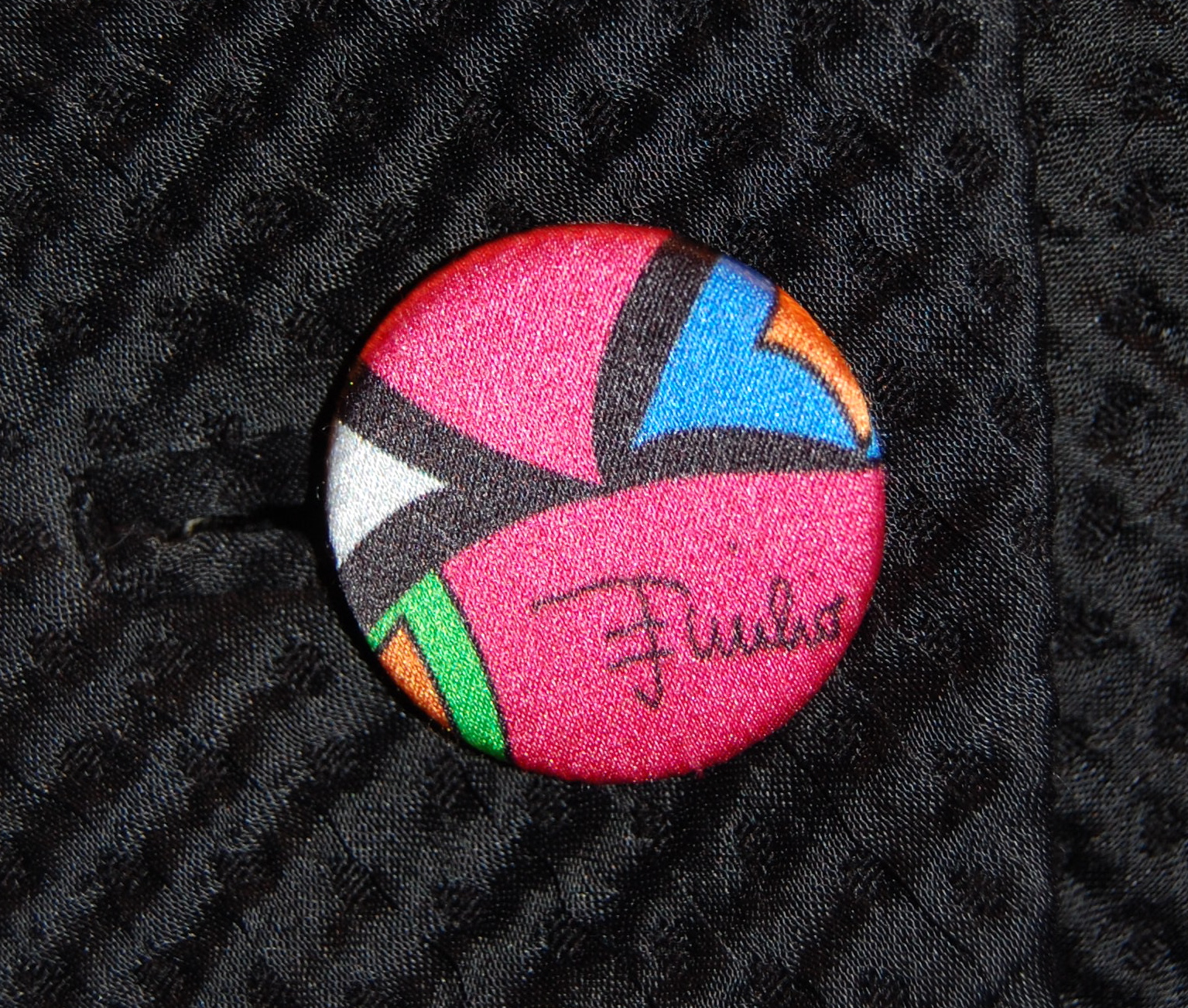
Another thing that makes me happy are the buttons! I picked out specific scraps of the silk, which featured designs I wanted to emphasize on the buttons. I sent them off to Pat Mahoney in Lodi, California, who returned them made into 1¼ inch buttons – flat and beautiful!

This is the button I chose for the top of the jacket.

This is the button I chose for the top of the jacket.  Notice the slot-seam-buttonhole.

The middle button - I couldn't resist featuring the Emilio signature on this one.

The middle button – I couldn’t resist featuring the Emilio signature on this one.

And the lower button.

And the lower button.

I decided to have two extra buttons made in case I wanted to add them to the sleeves.   And – add them, I did. I like the extra subtle  attention they bring to the jacket. (Another dressmaker detail – specifically, an added embellishment.)

Defying the passage of years

Defying the passage of years

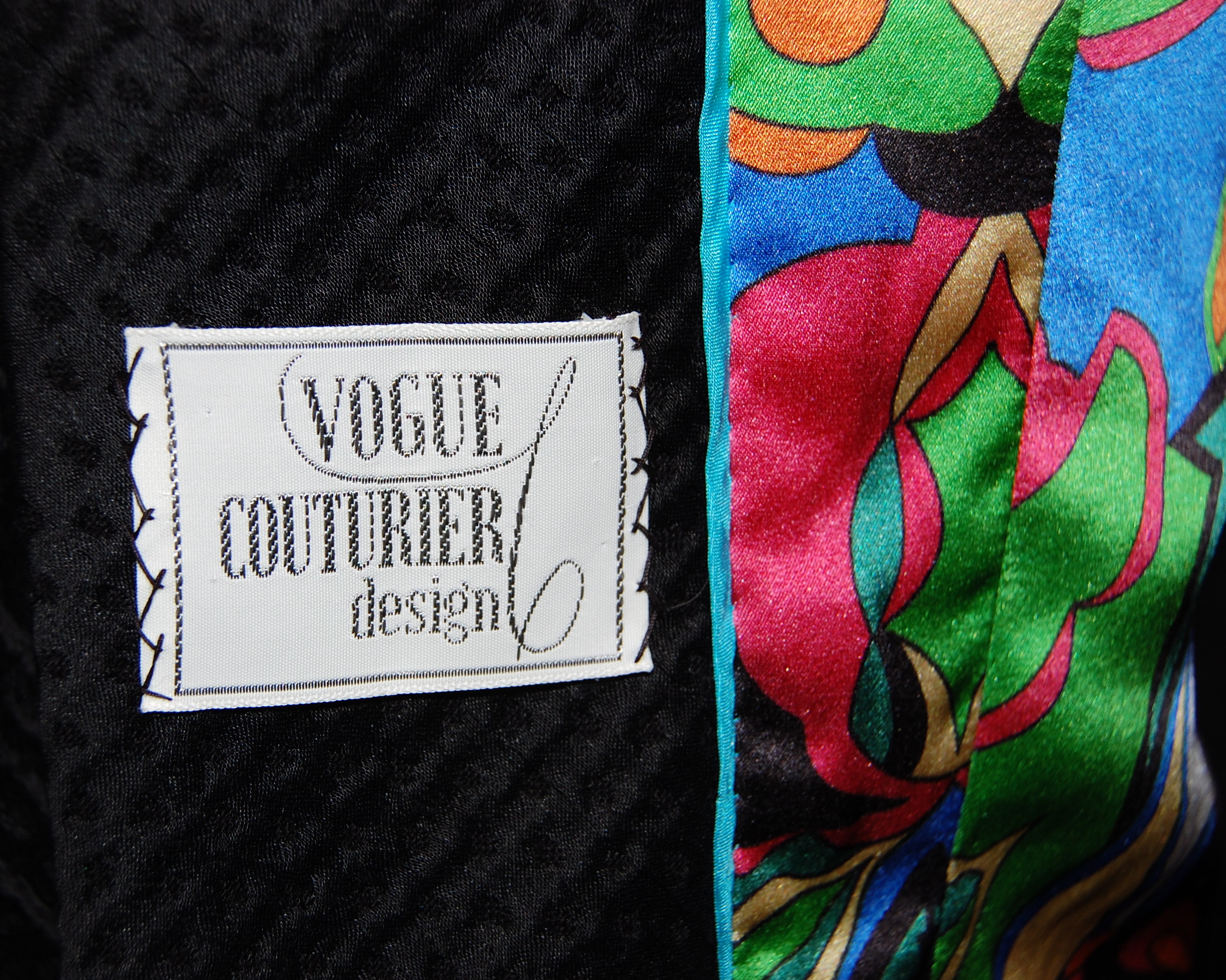
I had the jacket finished when I suddenly remembered that a Vogue label had come with the pattern. Of course, I was delighted to sew it in place.

Defying the passage of years

Defying the passage of years

Defying the passage of years
 Defyng the passage of years

Defying the passage of years

There is something about using a pattern from 1965 that seems quite amazing to me. Yes, it is simple math, but think about this: 1965 was 49 years ago!   Is anyone who sees me in this dress and jacket going to think that it is sewn from a 49-year-old pattern? Somehow I doubt it. I think my secret is safe.


28 Comments

Filed under Buttons - choosing the right ones, couture construction, Dressmaker details, sewing in silk, Slot-seam buttonholes, The Conde Nast Publications, Uncategorized, vintage Vogue Designer patterns, vintage Vogue patterns from the 1960s

A Fascinating Foundation

Vogue patterns from the 1950s, ‘60s, and ‘70s never cease to amaze me. The intricacies of construction, the detailed instructions, and the artistic styling of so many of the patterns from those three decades make sewing from them such a pleasure. Each one is like a mini sewing lesson, neatly packaged with beautiful photos and/or sketches and precise line drawings.

Such has been the Emilio Pucci Designer pattern on which I am currently working.

Happy New Sewing Year - Pucci pattern

The unusual construction of the jacket caught my attention as I was trying to lay out its lining pattern pieces along with pattern pieces for the dress.  As I mentioned before, the front of the jacket is cut on the bias. However the interfacing and the lining pieces for the front are cut on the straight of grain. How, I wondered, is that going to work? The answer to that question is one of the most fascinating construction methods I have ever come across.

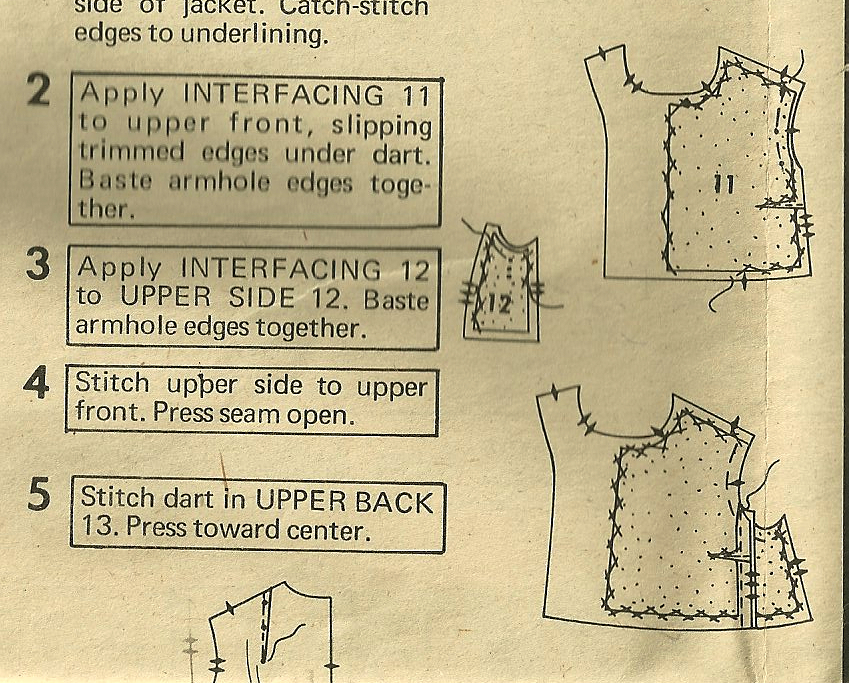
The interfacing and the lining both have deep darts to form the bust line. Of course, the jacket front, cut on the bias, is going to have built-in give for the bust. But in addition to that, there was a “cup-like” pattern piece for adding to the front interfacing, clearly with the goal of enhancing the bust line, and defining it.

The "cup-like" pattern piece is in the lower right.  Notice the large dart in the piece next to it.

The “cup-like” pattern piece is in the lower right. Notice the large dart in the piece next to it.

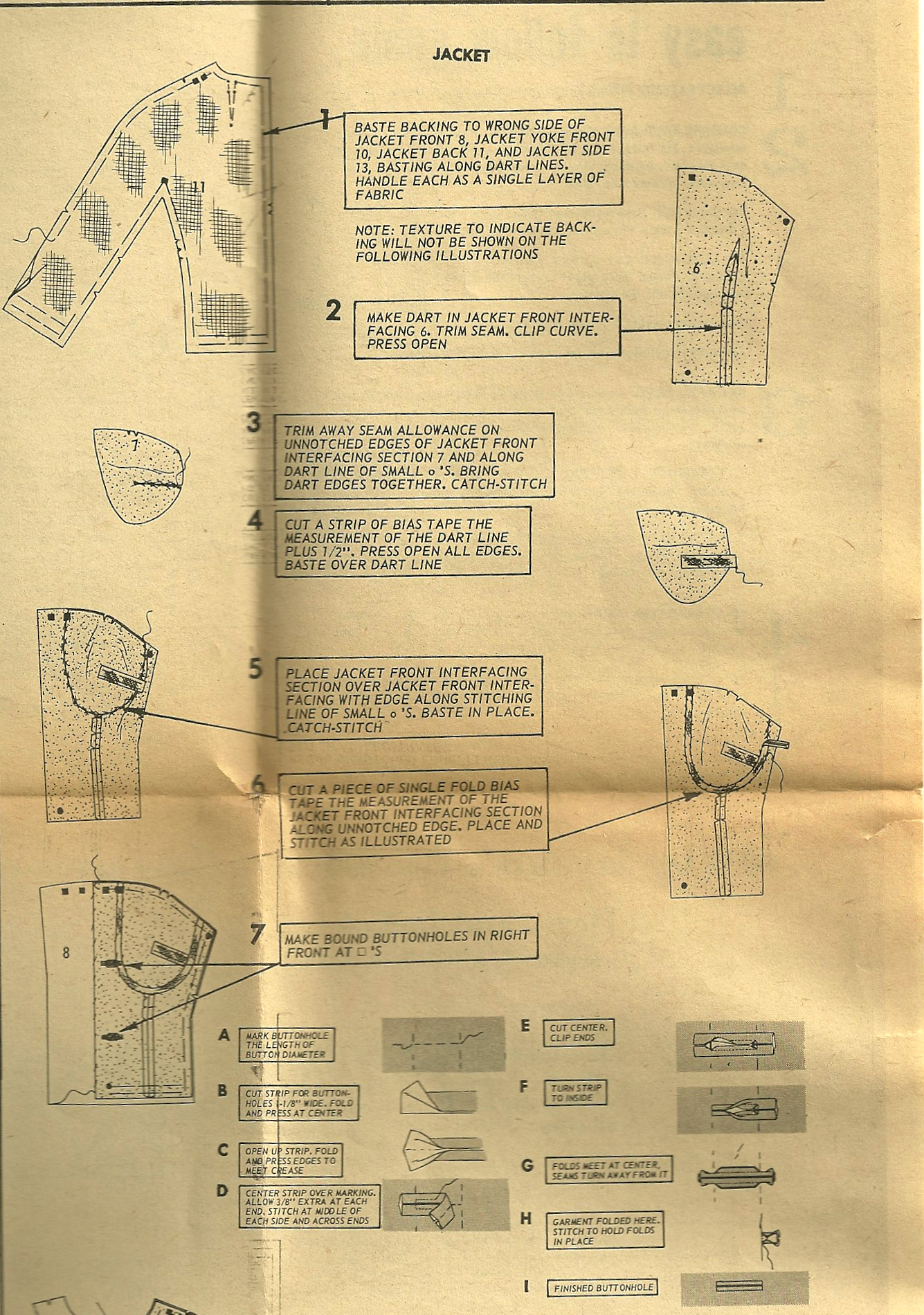
Here is the instruction page for assembling these interfacings. In effect, it is a process for making an interior bra.

Click on the diagram to read it more easily.

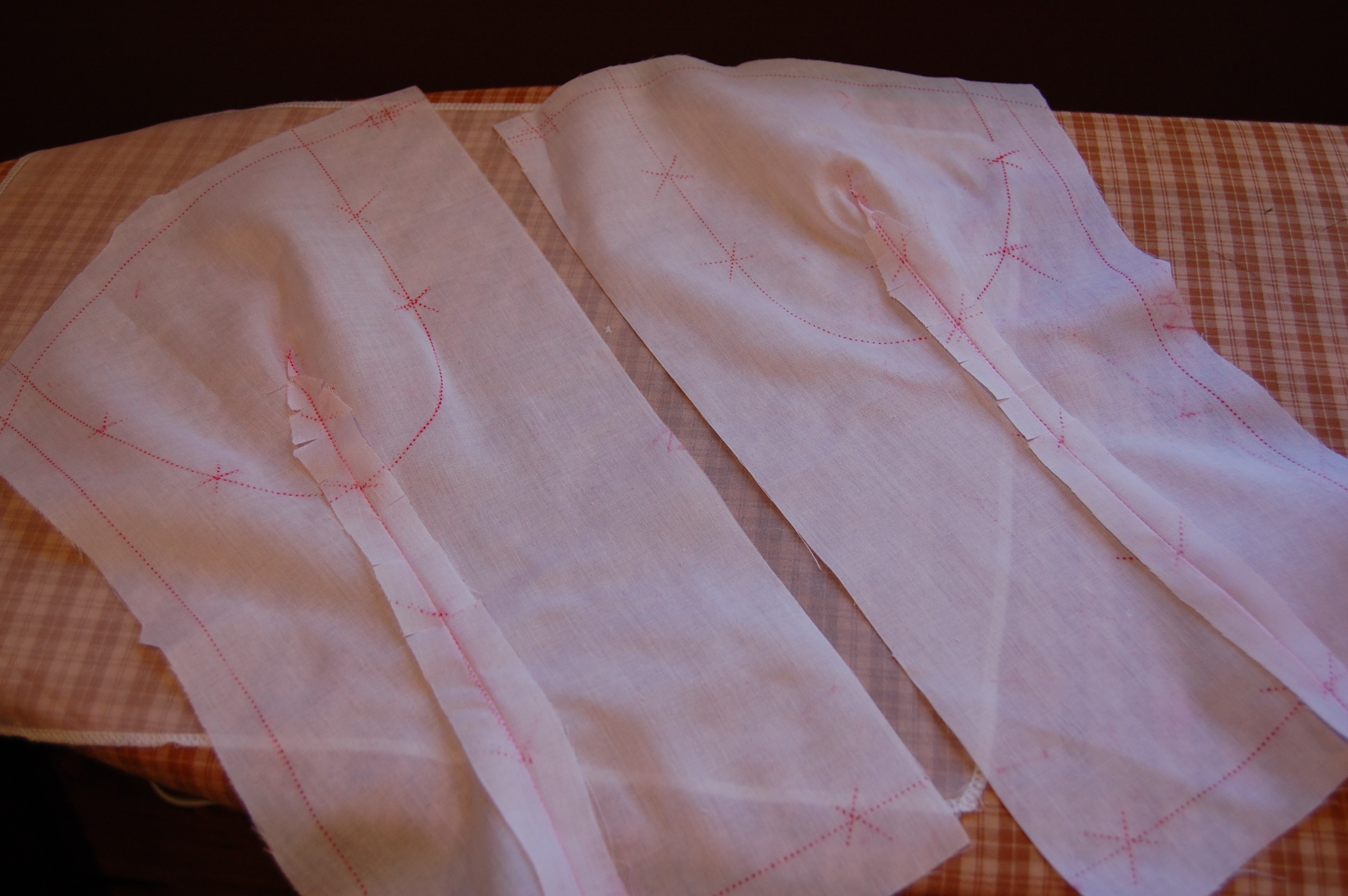
Here are my front interfacing pieces with the darts sewn.

Here are my front interfacing pieces with the darts sewn.

Here I am reinforcing the darts in the bust (cup) interfacings.

Here I am reinforcing the darts in the bust (cup) interfacings.

Here they are ready to be added to the base interfacing pieces.

Here they are ready to be added to the base interfacing pieces.

And here are the front interfacings assembled and ready to be attached.  Looks kind of risque, don't you think?

And here are the front interfacings assembled and ready to be attached. Looks kind of risque, don’t you think?

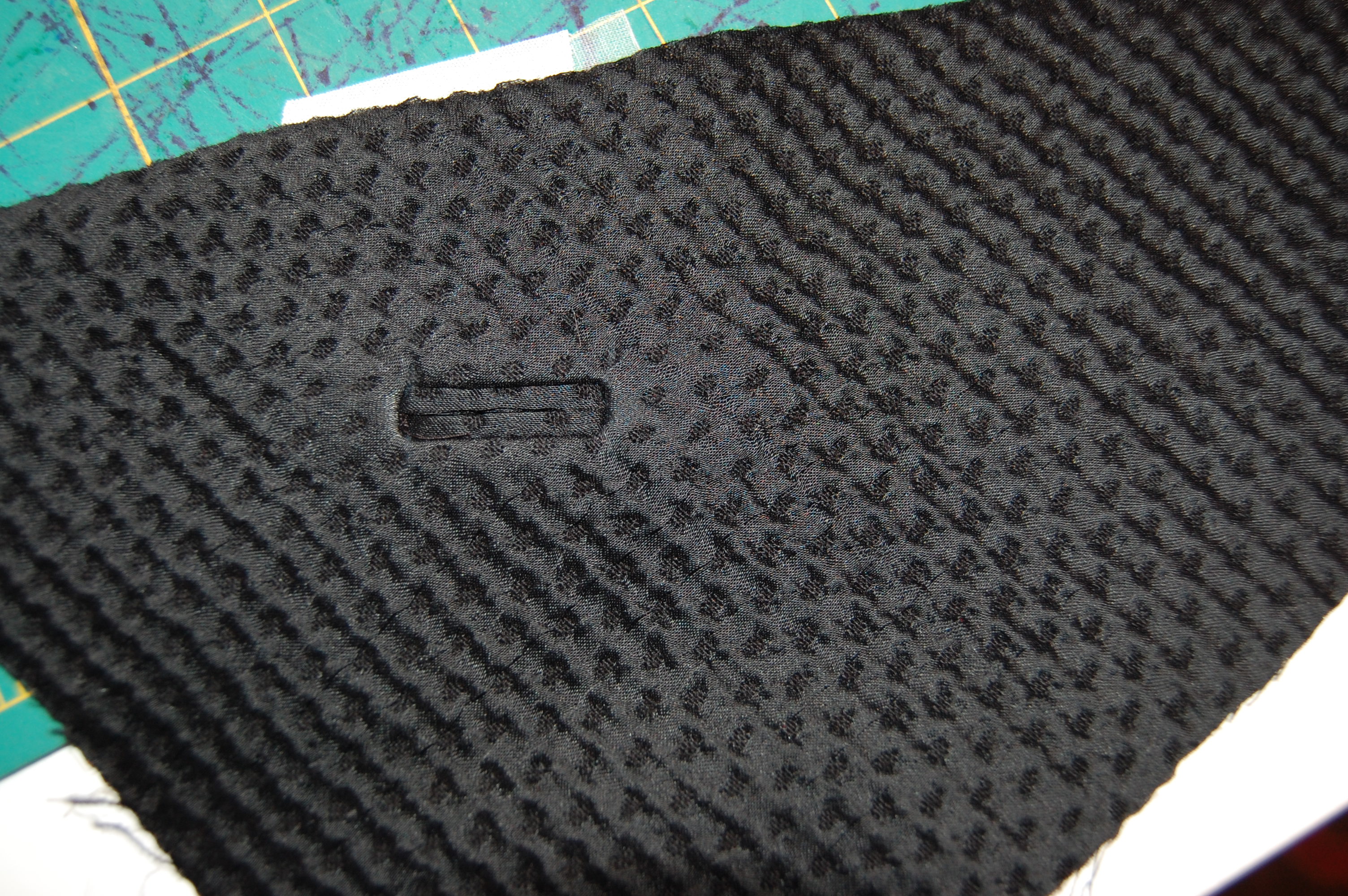
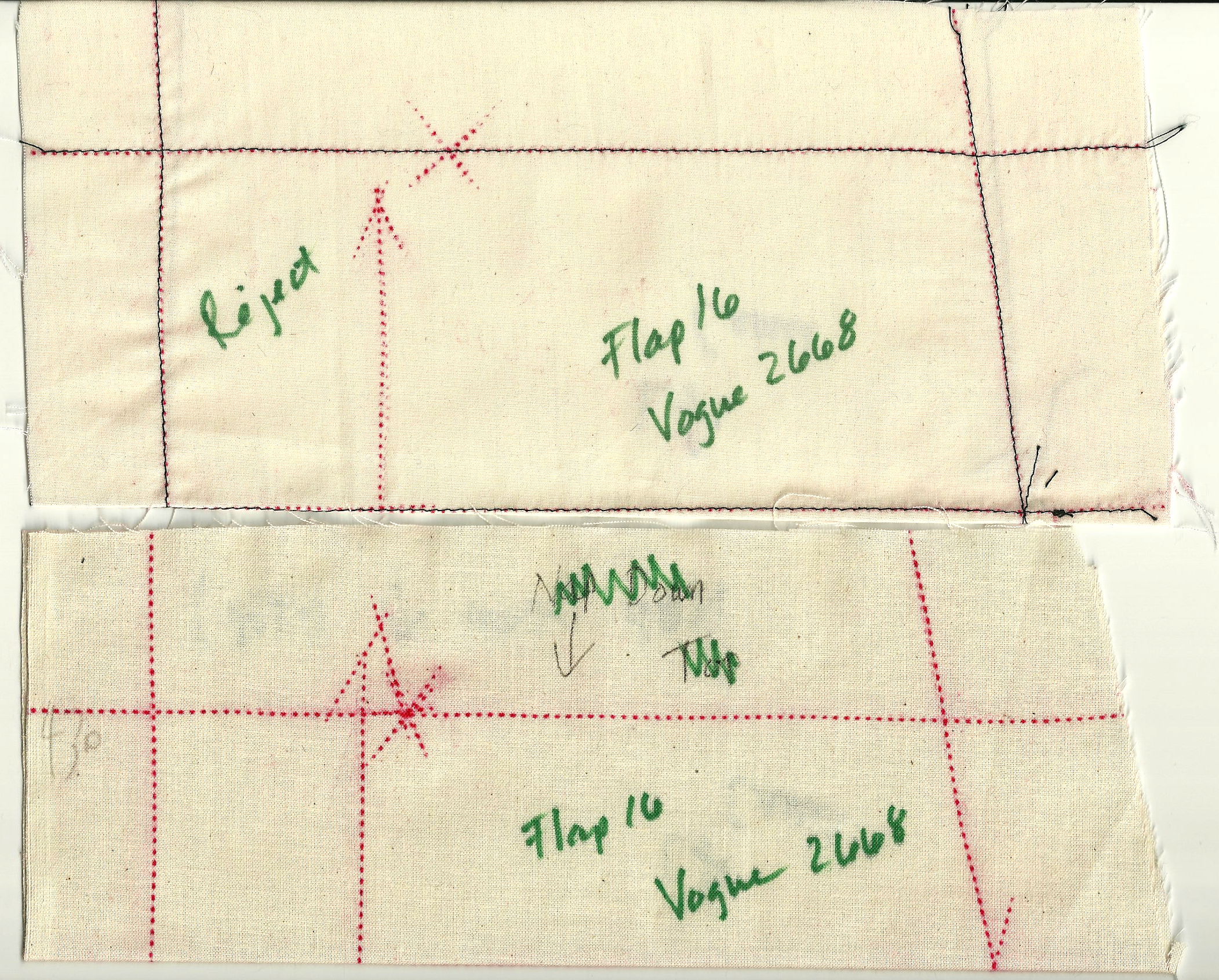
Note also the detailed instructions for making the bound buttonholes on the above instruction sheet. I did a practice run on a bound buttonhole, being careful to layer the fabrics exactly as they would be layered on the front of the jacket.

My sample buttonhole.

My sample buttonhole.

The right jacket front, marked for buttonhole placement.

The right jacket front, marked for buttonhole placement.

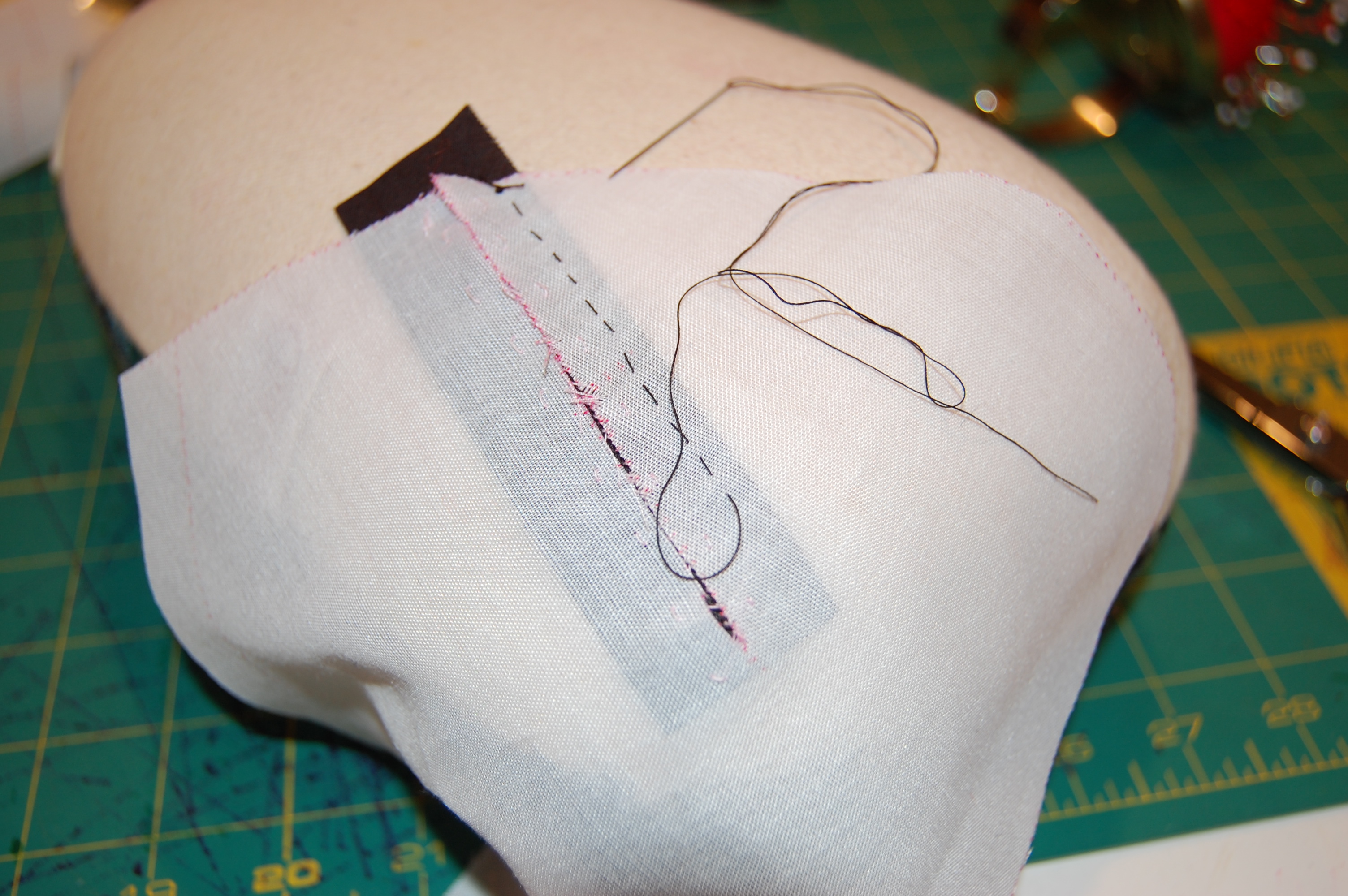
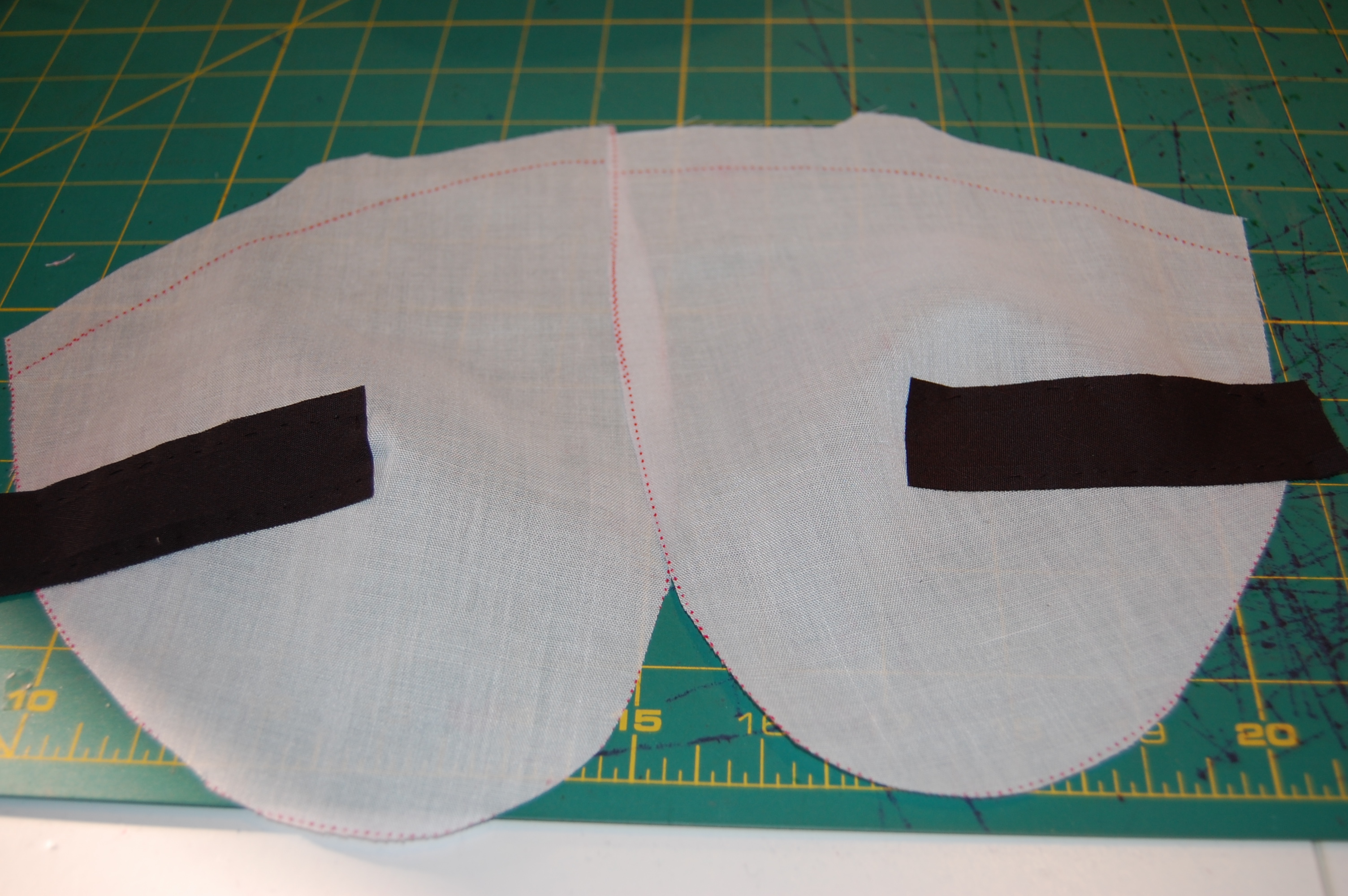
Another detailed instruction was given for the sharp angle under the sleeve. The instructions called for a 2” x 2” square of fabric to reinforce that corner. I used black organza.

The organza patch is sewn on the right side of the jacket and pressed to the inside.

The organza patch is sewn on the right side of the jacket and pressed to the inside.

The organza patch makes a very secure and precisely sewn  corner possible.

The organza patch makes a very secure and precisely sewn corner possible.

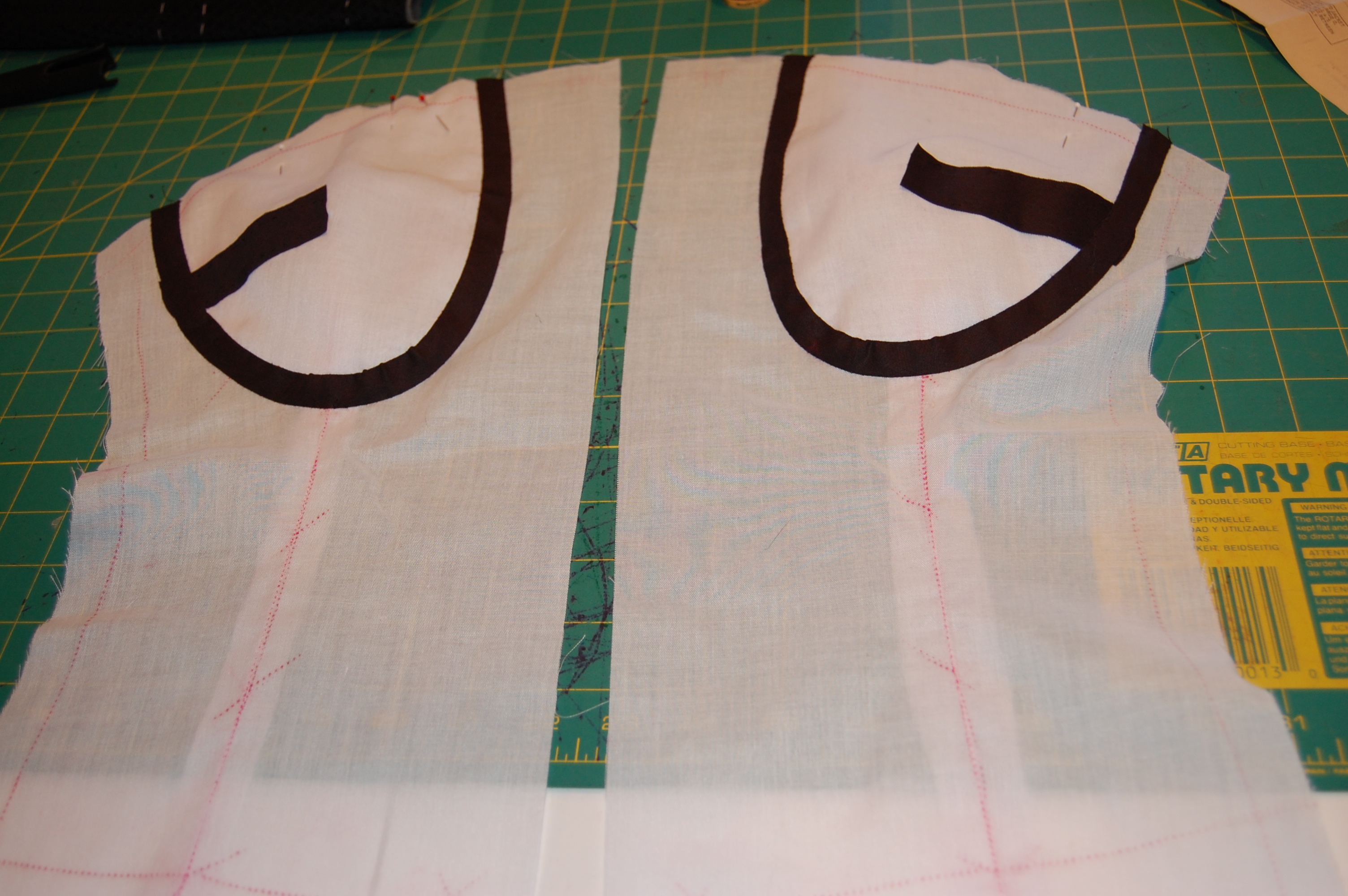
And here are just a couple of photos of the interior of the jacket with the rest of the interfacings attached.

The right front of the jacket, with buttonholes sewn.

The right front of the jacket, with buttonholes sewn.

Thje front of the jacket.  Note the "stays" made our of seam binding.  They are loose except where they are attached at the underarm and at the collar.

Thje front of the jacket. Note the “stays” made out of seam binding. They are loose except where they are attached at the underarm and at the neckline.

The back of the jacket - simple compared to the front!

The back of the jacket – simple compared to the front!

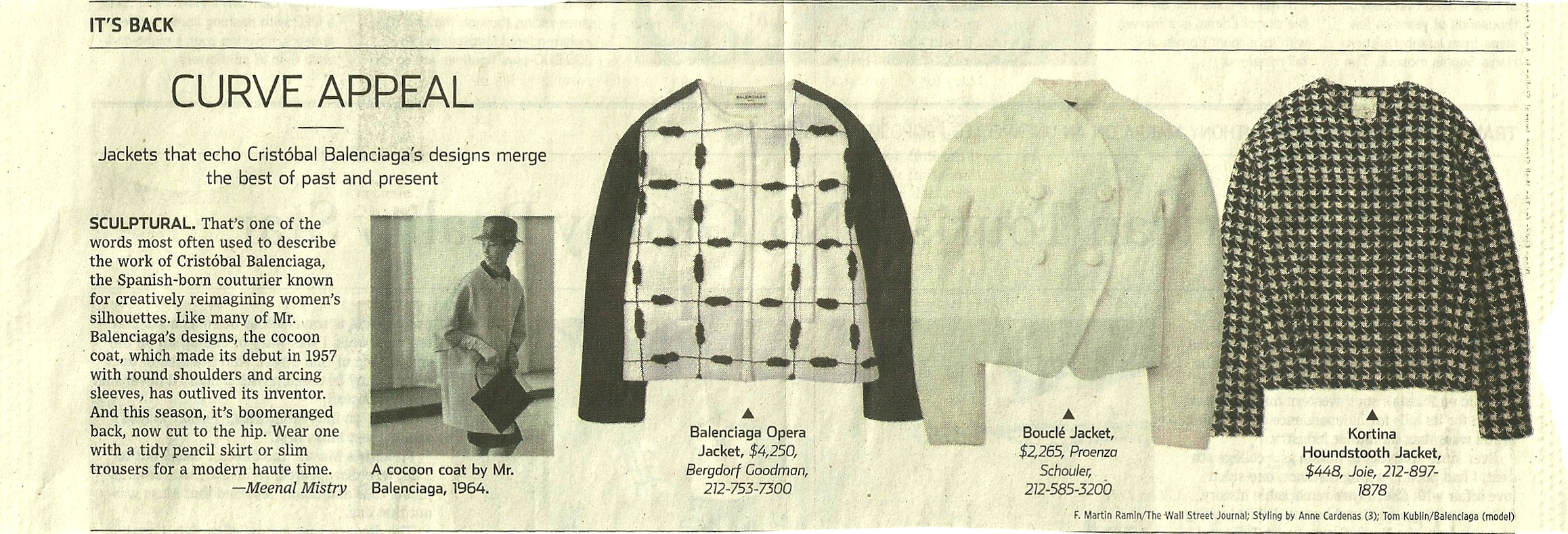
There is something else that never ceases to amaze me either about these sophisticated vintage Vogue patterns.   That is – how stylish and current so many of them are.   Here’s an example of what I mean. Take a look at these recent jackets from current designers.

I clipped this out of The Wall Street Journal sometime within the past year, but I unfortunately forgot to note the date.  Click on the photo for a close-up.

I clipped this out of The Wall Street Journal sometime within the past year, but I unfortunately forgot to note the date. Click on the photo for a close-up.

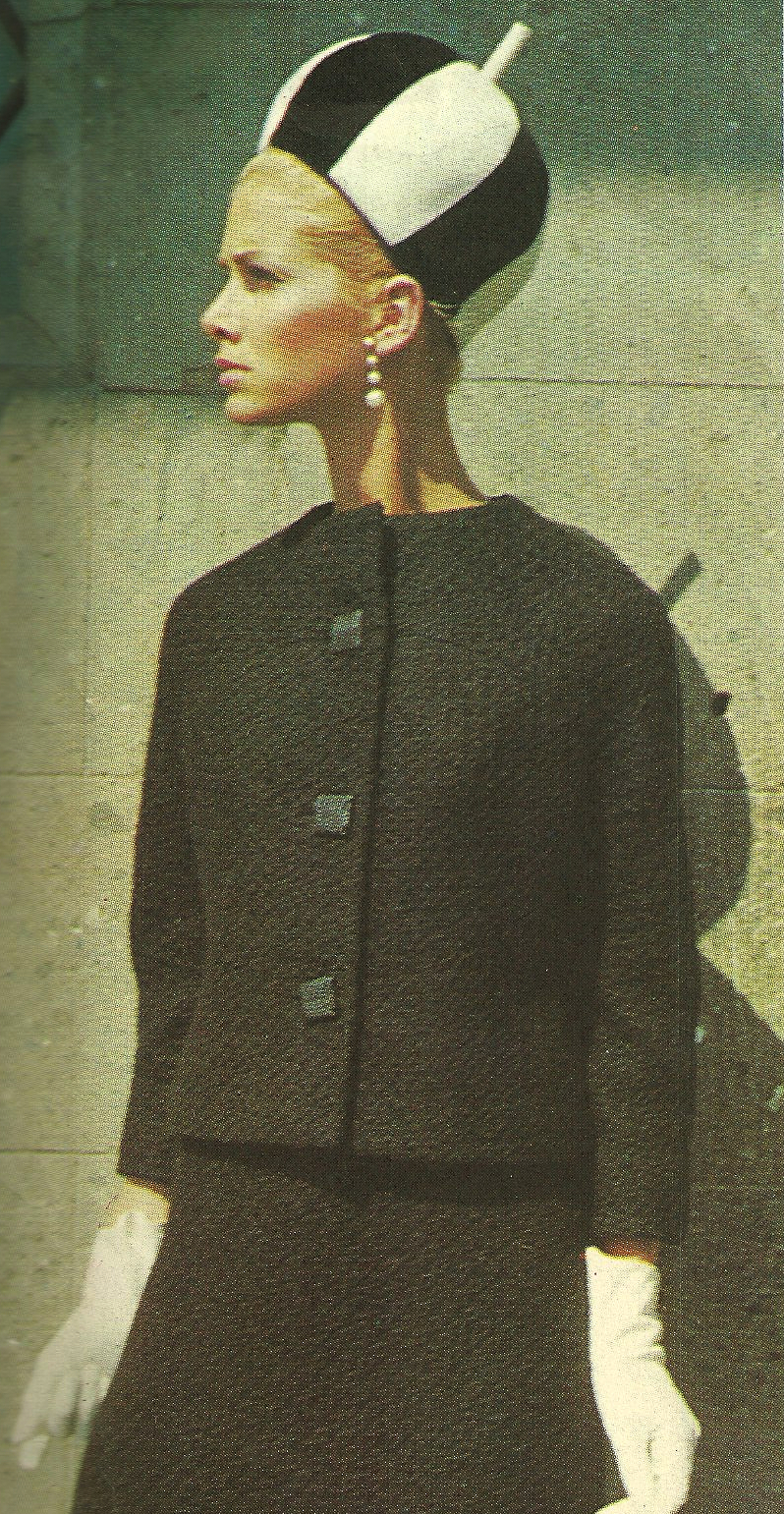
The article rightly makes the reference to Balenciaga, but look how similar these are to the Pucci jacket on which I am working.

A Fascinating foundation -picture of Pucci jacket

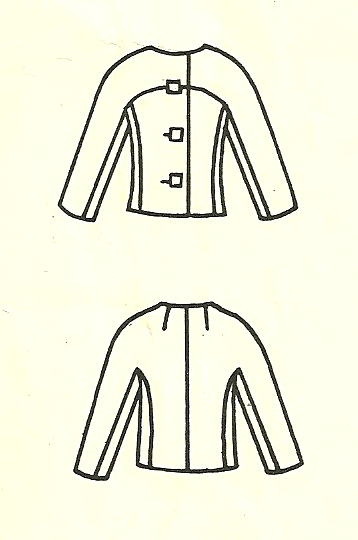
These thumbnail sketches  also help to show the similarity to the current jackets.

These thumbnail sketches also help to show the similarity to the current jackets.

Well! I am looking forward to sharing some more details about this outfit when I can show it completely finished – in my next post – and answering those nagging questions, “Did piecing the lower sleeves on the jacket lining actually work? Will anyone guess my secret?”


21 Comments

Filed under bound buttonholes, couture construction, kimono sleeves, Uncategorized, underlinings, vintage Vogue Designer patterns, vintage Vogue patterns from the 1960s, Vogue patterns

Presently Preferring Pucci

Once I get into a project, especially one that has some complicated decisions or construction to it, I tend to think about it during many of my non-sewing hours. (I wonder if other sewers/dressmakers do that?) Now that I have finished my Pucci dress, I’ll be spending both sewing and non-sewing hours on the jacket.

First, however, some details about the dress are in order.

The dress is finished!
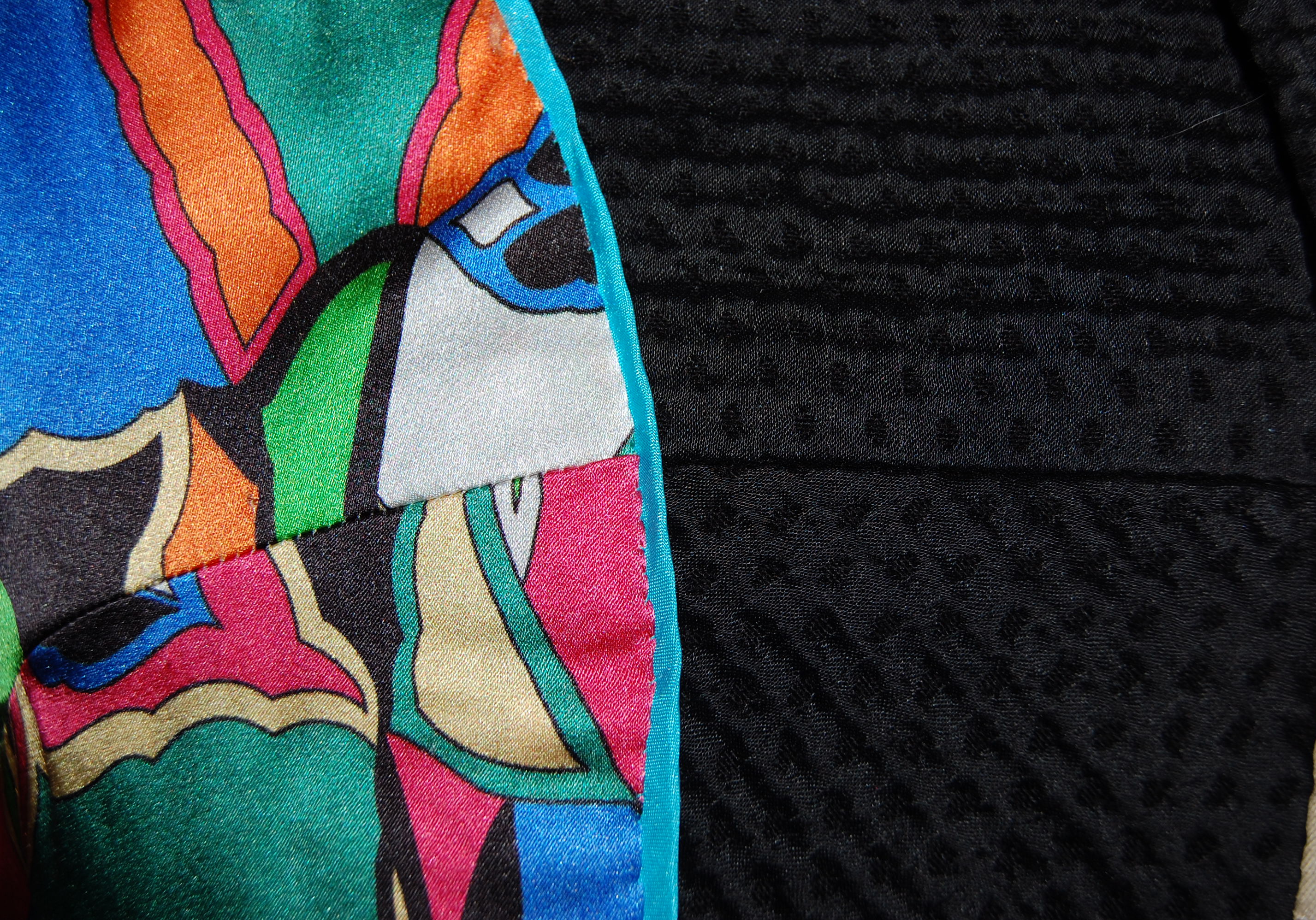
The dress is finished!
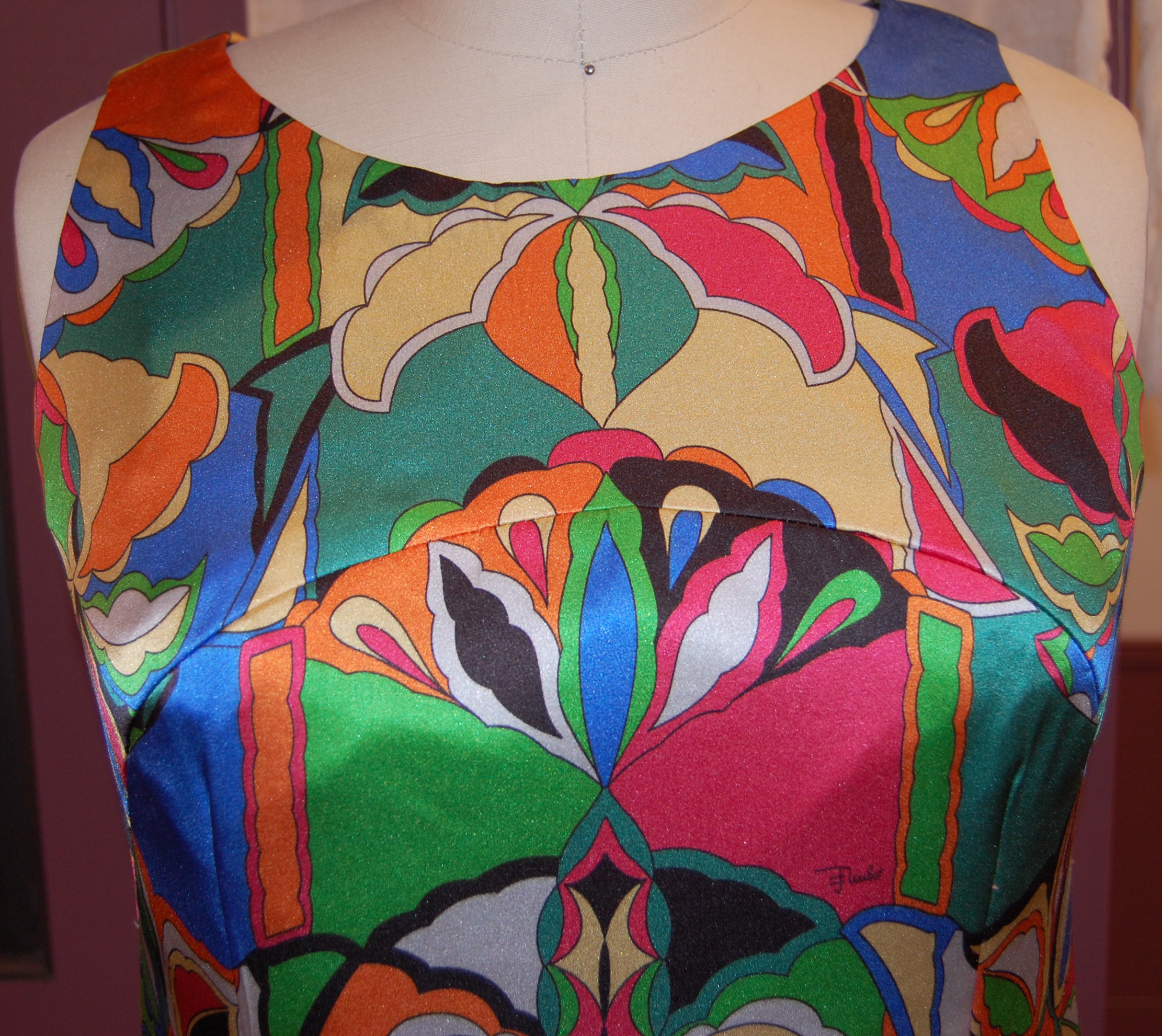
There are a few design aspects of this dress which set it apart from a simple A-line or sheath dress.  Notable to me is the effect that the curved front yoke makes on the bustline. It gives it more definition than it would have with just darts.

If you look closely, you can see the yoke seam.

If you look closely, you can see the yoke seam.

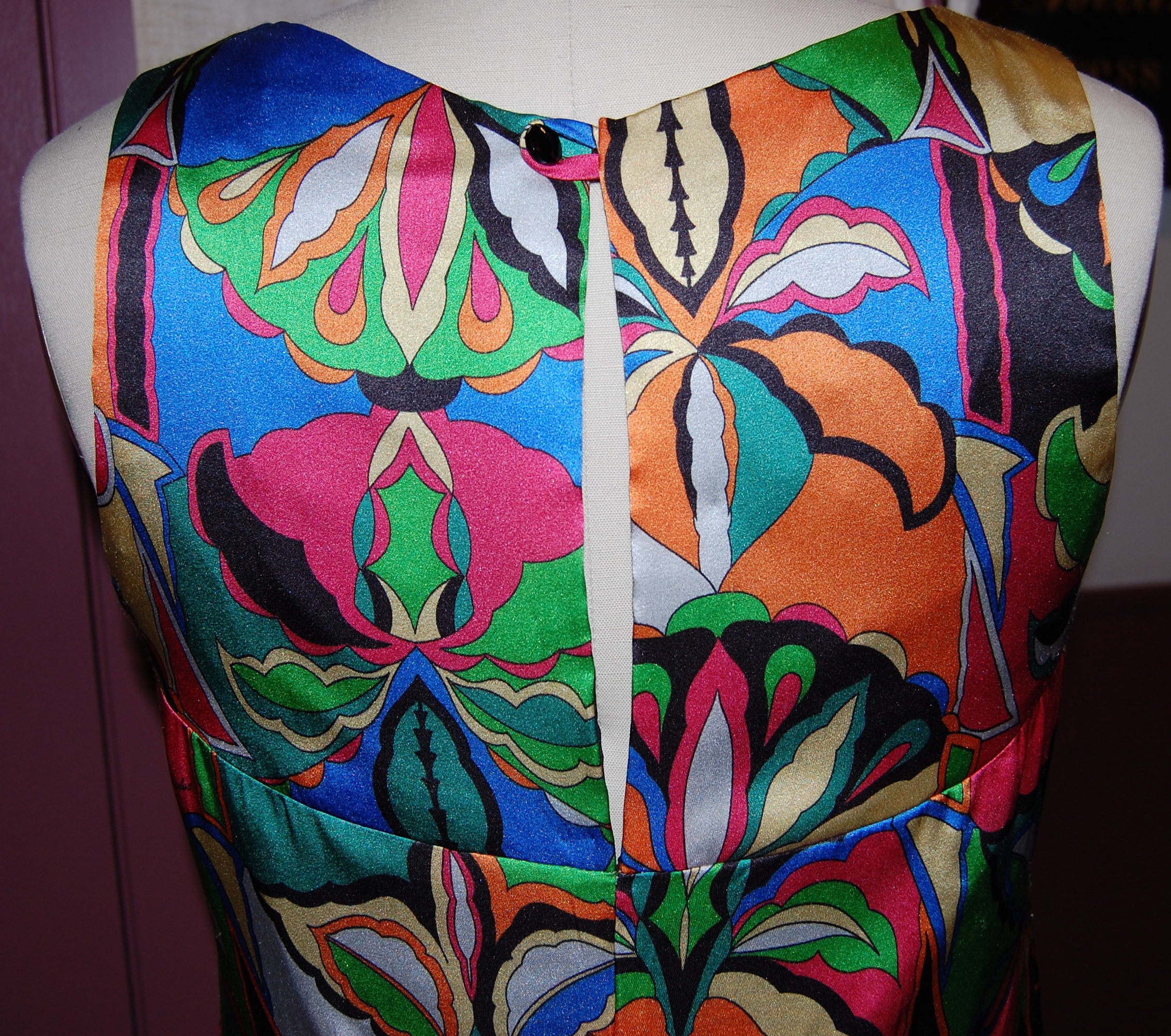
The back yoke adds some “surprise” interest by being split in the middle. In addition, the back of the dress would not be quite so clean looking if the zipper were placed in the center back below the yoke. Its location on the side seam is one of those hallmarks of a carefully planned Designer pattern.

The "open" yoke on the back of the dress.

The “open” yoke on the back of the dress.

I made some changes to the dress, based on the muslin. My six alterations are:

1) I decided to incorporate curved armholes into the two back yoke sections. On a younger person, the more revealing back arm would be fine, but I was not so comfortable with it!  Please see the photo above.
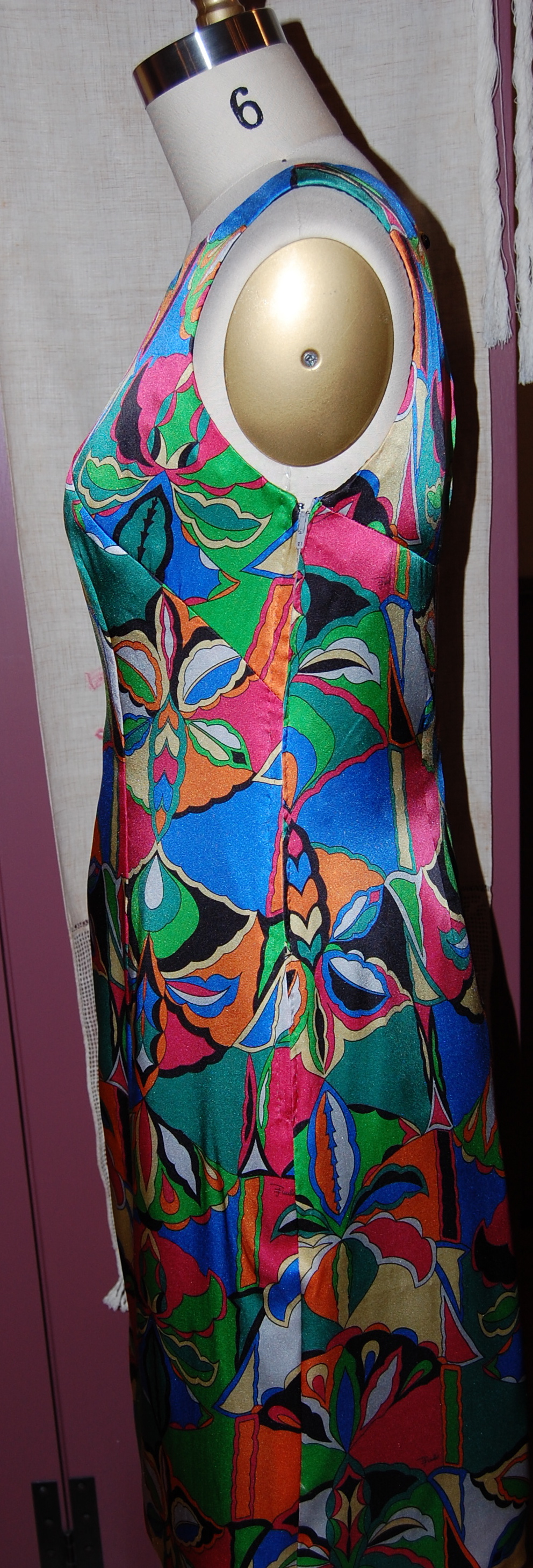
2) I took out some of the A-line from the dress. I wouldn’t say I actually “pegged” it, as I left a slight taper, but the effect is now one of a straighter skirt, which I think is a bit more “current.”

A sdie view shows this alteration best.

A side view shows this alteration best.

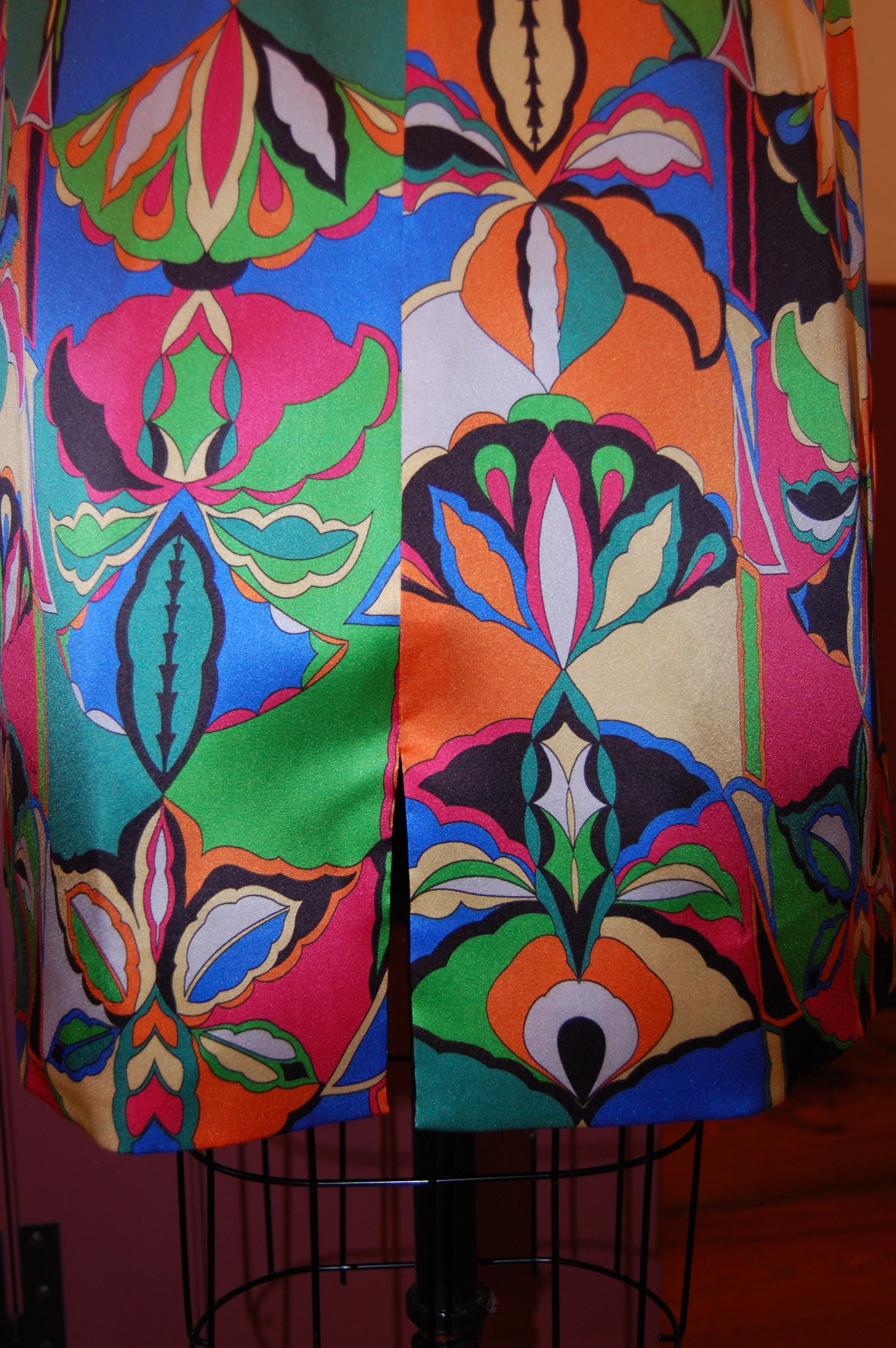
3) Taking out some of the taper meant I had to give myself a bit more ease in the skirt, so I left a slit at the center back.

The center back slit at the hem line.

The center back slit at the hem line.

4) I added two small darts to the back sides at the waist, which adds some definition to it.

5) I lowered the neckline to accommodate a particular necklace that I want to wear with this outfit. Isn’t it just lovely that sewing allows us the ability to make these kind of custom alterations?

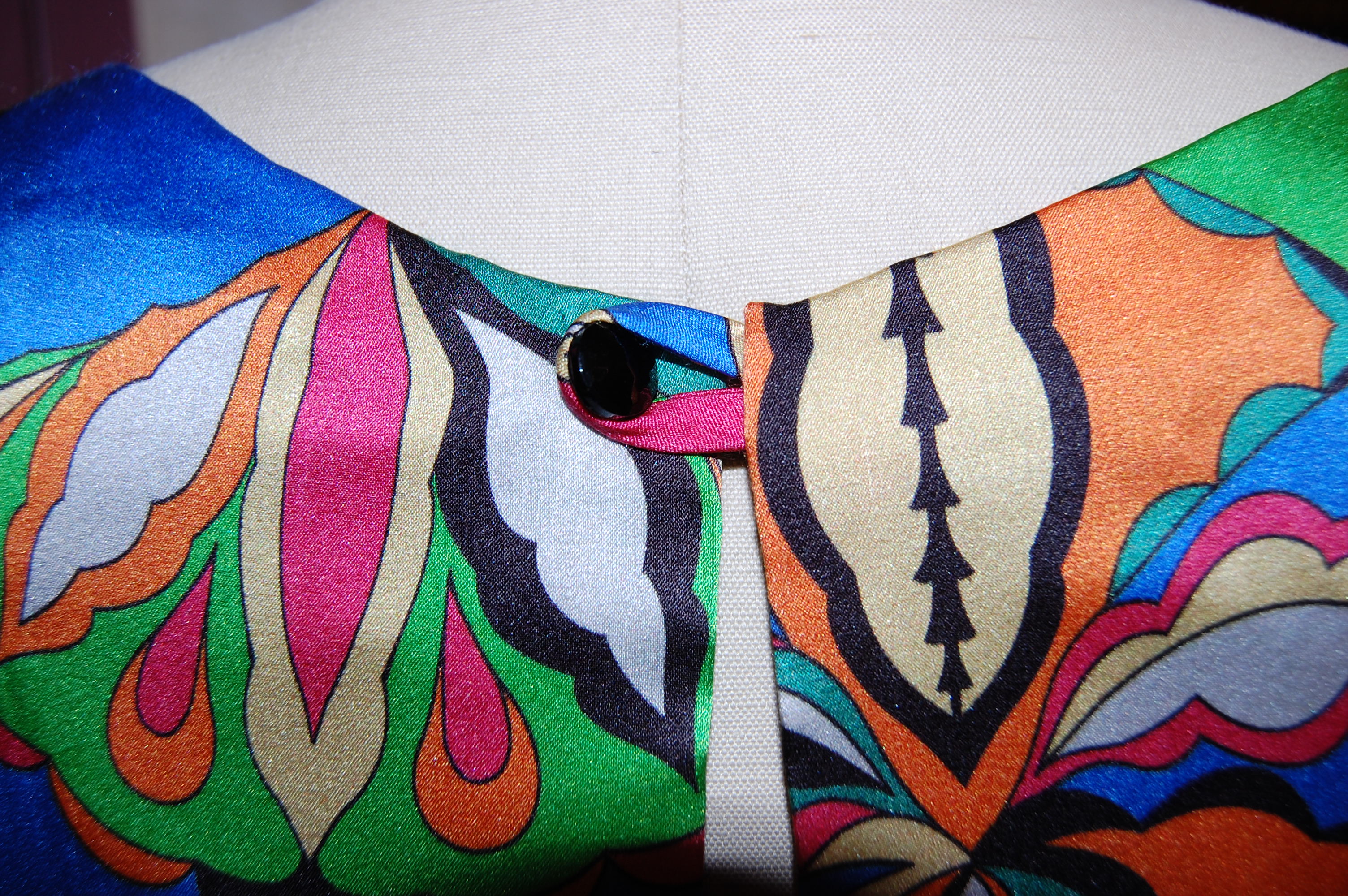
6) The pattern called for a hook and eye at the center back neck. I decided to add a loop and small button instead, although I added an interior hook and eye to help the back neck lay flat.  Adding this button and loop can definitely be called a “dressmaker detail”.

The button is one I have had in my button box for decades!  Its faceted surface seemed perfect for this dress.
The button is one I have had in my button box for decades! Its faceted surface seemed perfect for this dress.

Of course I underlined the dress with silk organza.

Preferring Pucci

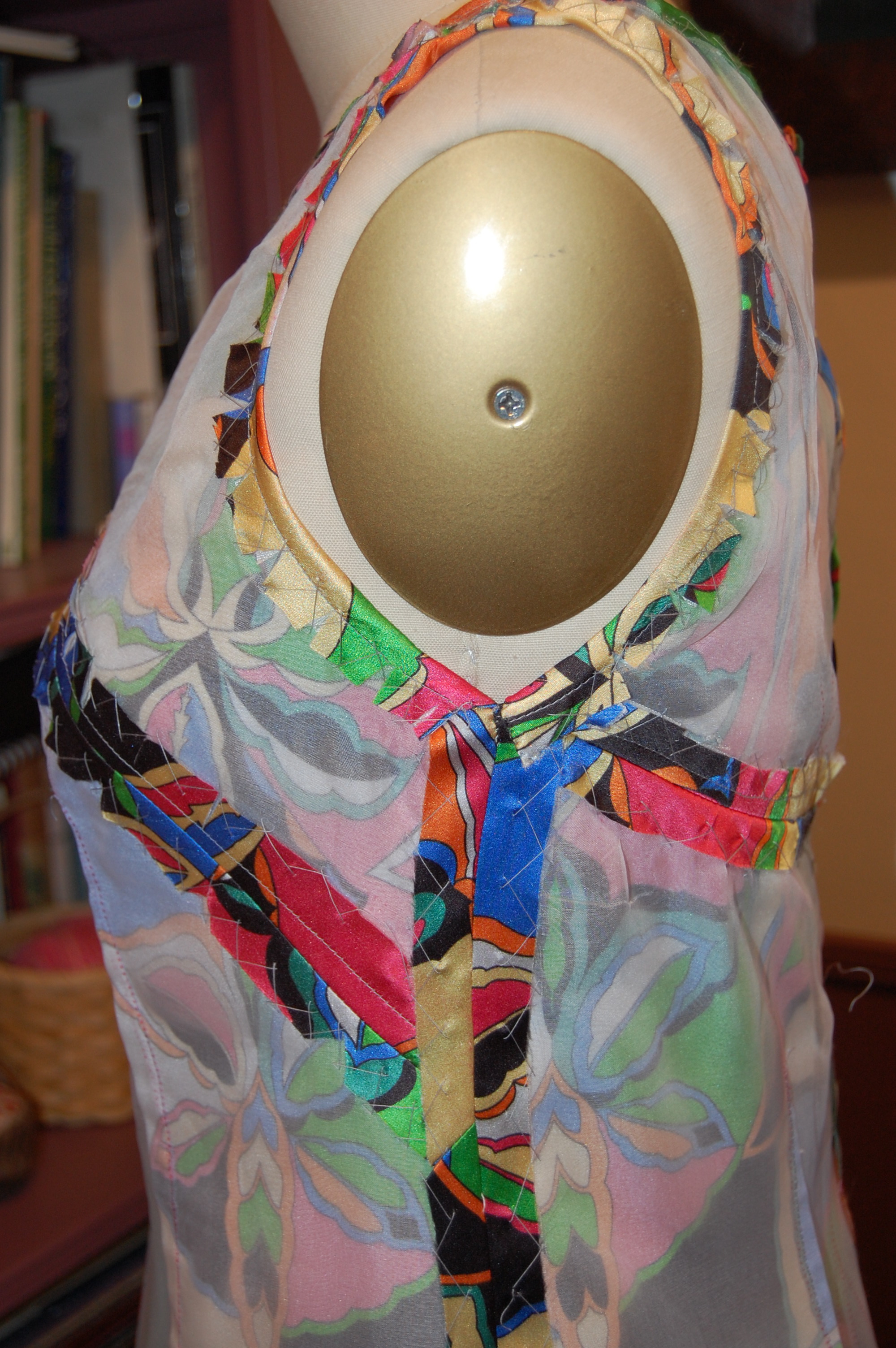
This back view also shows the extended armhole line.

This back view also shows the extended armhole line.

And this side view shows how the front yoke adds definition to the bustline.

And this side view shows how the front yoke adds definition to the bustline.

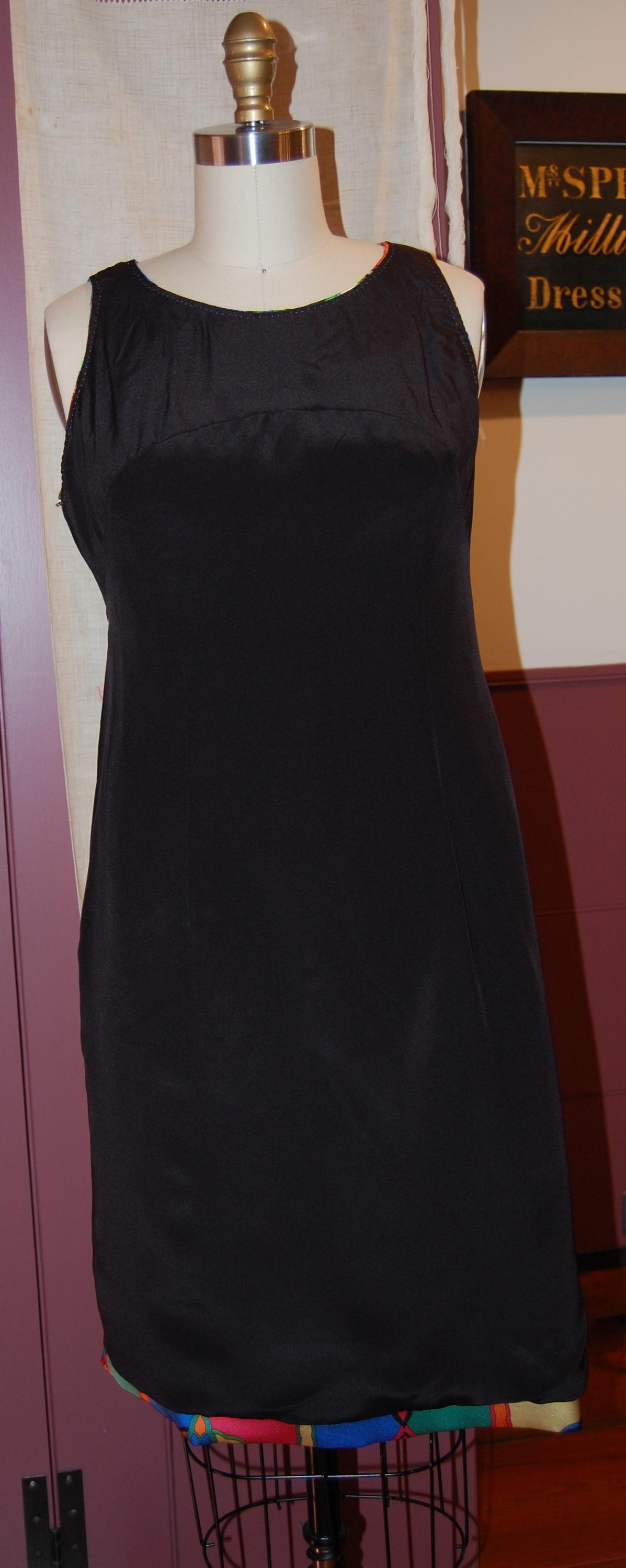
Then I lined the dress in black crepe de chine, and under-stitched the neckline and armhole seams with turquoise silk buttonhole twist, just for fun.

The dress turned inside out.

The dress turned inside out.

Under-stitchibng in turquoise. No one will ever see it, but I love what it adds!

Under-stitching in turquoise. No one will ever see it, but I love what it adds!  Click on the photo for a close-up view.

So – that’s it!

Now here’s a phenomenon that seems to happen to me frequently. I’ll be using a mid-century designer pattern for a project, and I’ll come across a current magazine or newspaper article, which in one way or another relates to what I am sewing or planning to sew. So it was this past weekend, when I was catching up with reading the April WSJ. The Wall Street Journal Magazine, delivered the weekend before. Right there on page 84 was an article on Laudomia Pucci, Emilio’s daughter, entitled: Fortress of Fashion. It is a fascinating account of her commitment to preserve the “fashion legacy” of her father, by reinventing an ancestral estate in Tuscany into an accessible-and-preservation-minded archives. On view are fabrics and fashions, and “already Pucci has hosted several educational events… Two groups of students … have come to study sewing and print design…[would not this be wonderful?! – my addition].  Laudomia is hoping to extend the educational activities to international fashion schools for longer visits.”   Her goal is to encourage the “next generation … to find inspiration for innovative fashion.” Now this is a place where a Preference for Pucci is definitely a way of life!


26 Comments

Filed under Buttons - choosing the right ones, couture construction, Dressmaker details, sewing in silk, side-placed zippers, Uncategorized, underlinings, vintage Vogue Designer patterns, vintage Vogue patterns from the 1960s, Vogue patterns

Searching for Rumplestiltskin

Rarely do I not have enough fabric for a sewing project. I am one of those people who usually errs on the side of excess when I am buying fabric. Sometimes, however, I buy a piece for which I have no immediate plans, and therefore, no real idea what I will end up making. This, of course, was the case when I bought my Pucci silk. Little did I know I would be making a dress, and hoping to line its accompanying jacket in the same matching silk.

Pucci

I dutifully measured and calculated and figured there was a good chance I could eke it out. I had two things going for me: the silk was 60” wide, and I knew I would be taking about three inches off the length of the dress pattern (and still have a nice 3” hem). But I also had two things going against me: I would need to do some matching of the design on the dress, which could prove interesting with a print that seemed to change both its color and motif on a whim. More concerning was the fact that the jacket has kimono sleeves. Kimono sleeves usually require more fabric than set-in sleeves.

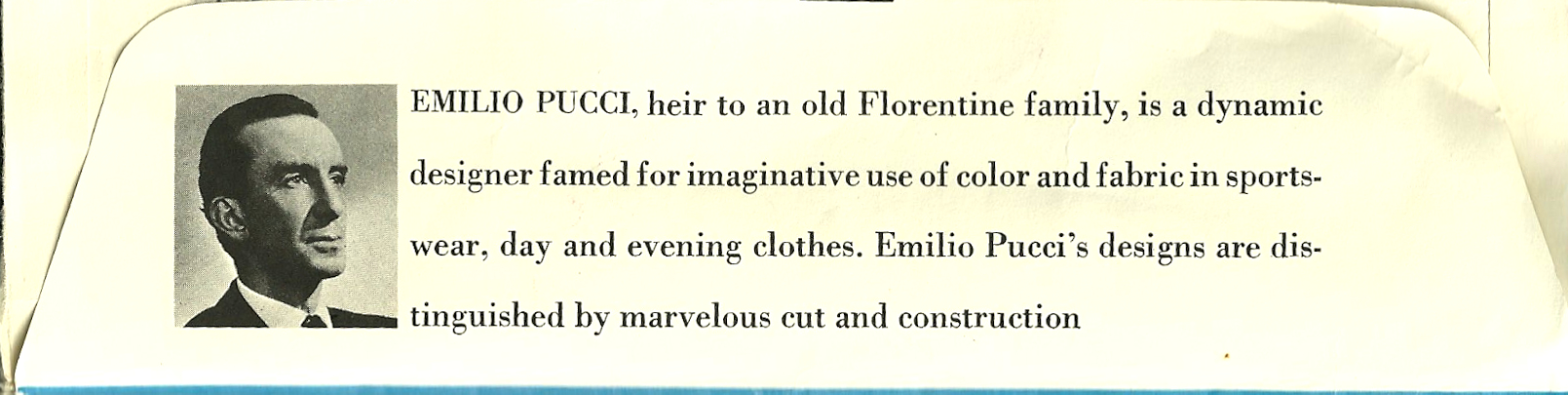
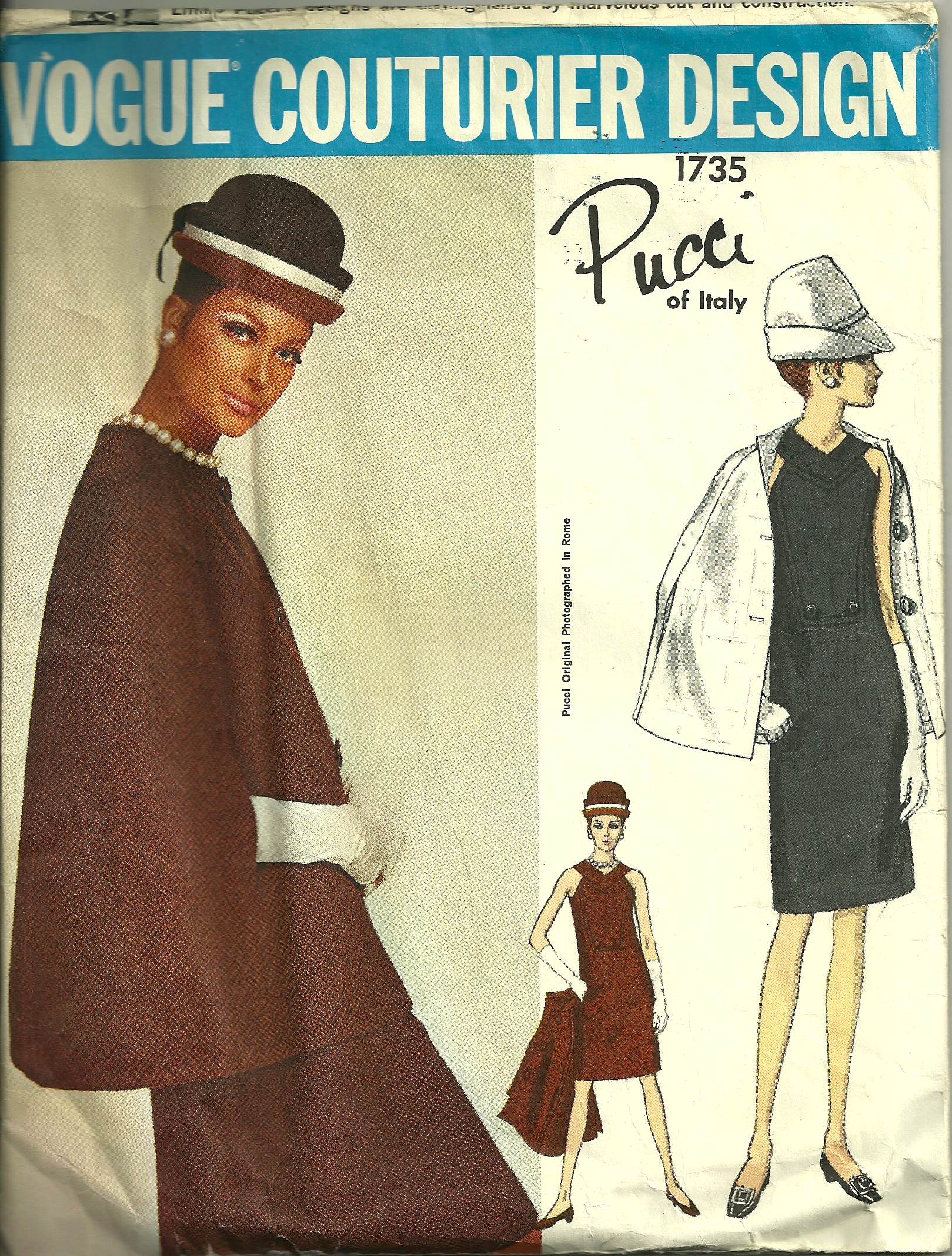
I wasn’t about to panic – yet. First I had to make muslins (toiles) of both the dress and the jacket. Both needed some fitting adjustments (mostly minor), which I will not go into now. One of the most helpful parts of making a muslin, at least for me, is the opportunity it gives me to get acquainted with the construction of whatever it is I am making.   In this case, the dress was very straightforward, but the jacket really intrigued me. No wonder, I thought, that the flap on the pattern envelope states “Emilio Pucci’s designs are distinguished by marvelous cut and construction.”

The vintage Vogue Designer patterns include a short statement about each featured designer on the pattern envelope flap.

The vintage Vogue Designer patterns include a short statement about each featured designer on the pattern envelope flaps.

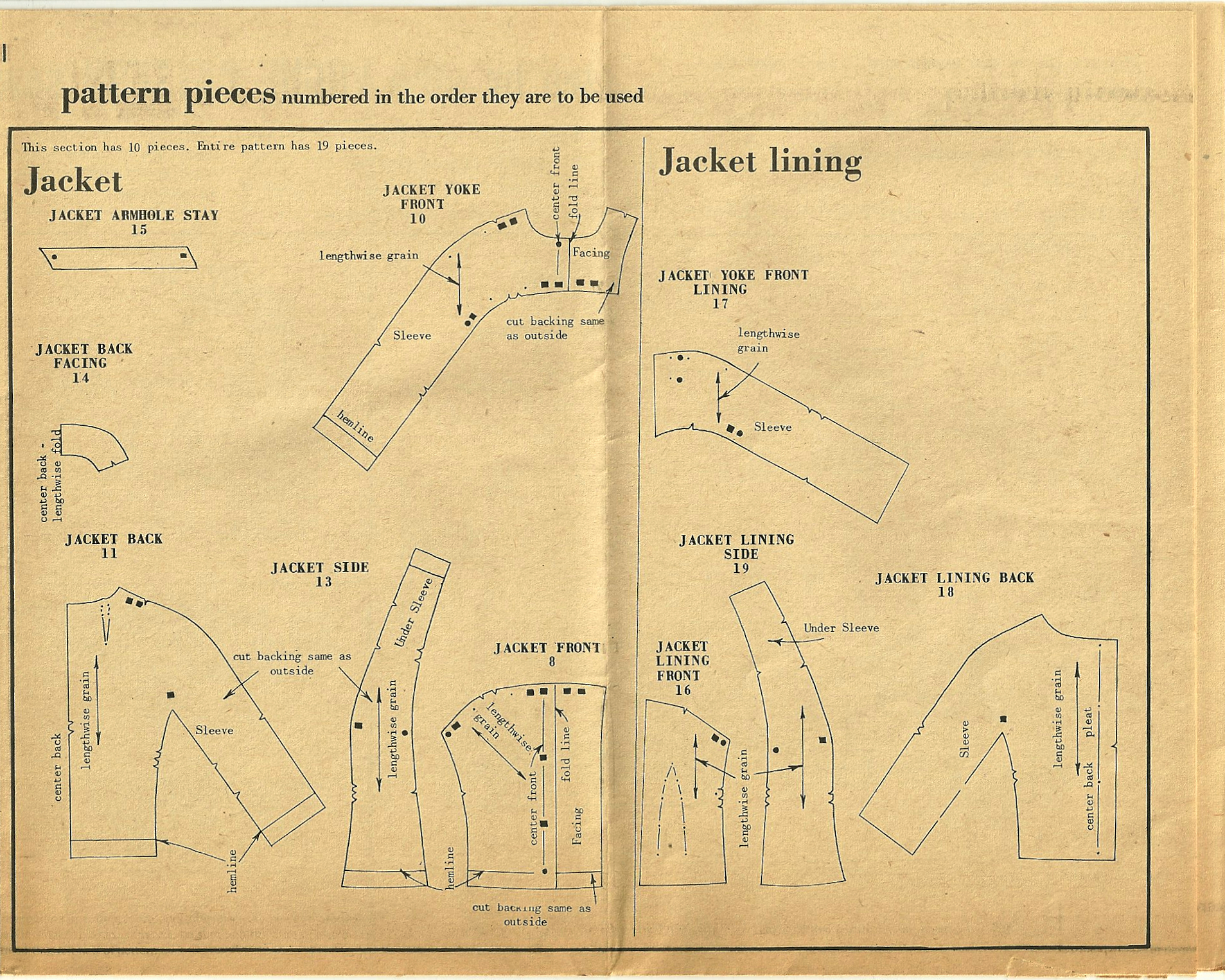
Take a look at the pattern pieces for the jacket. The jacket front (#8) is cut on the diagonal while the accompanying lining front (#16) is cut on the straight of goods, with a deep dart to accommodate the fullness for the bust..

Click on the image for a clearer view of the pattern pieces.

Click on the image for a clearer view of the pattern pieces. Also, note the grain lines.

Now take a look at the jacket side (#13). It is both the jacket side and the under sleeve at the other end. Sewing the muslin together showed me how ingenious this construction is – and I’ll show more about this in another post.

But – back to that silk. Using my adjusted muslin as my pattern, I cut out the silk organza underling for the dress. So now I had all the dress pieces ready to place on the silk, spread out single layer on the dining room table. Then using the tissue pattern pieces for the jacket lining, I was able to eyeball my chances of having enough fabric. There was a thudding moment of truth when I knew in no uncertain terms that there was no way I was going to have enough fabric without making some change in plans.

Where was Rumplestiltskin and his magical spinning powers when I needed him? Alas, I knew I would have to make my own magic to solve this problem! And I could see only one way to make this work. I would have to piece the sleeves so that the lower half of them – the part you can’t really see – were in another fabric, the logical choice being, of course, the black crepe de chine that I would be using to line the dress.

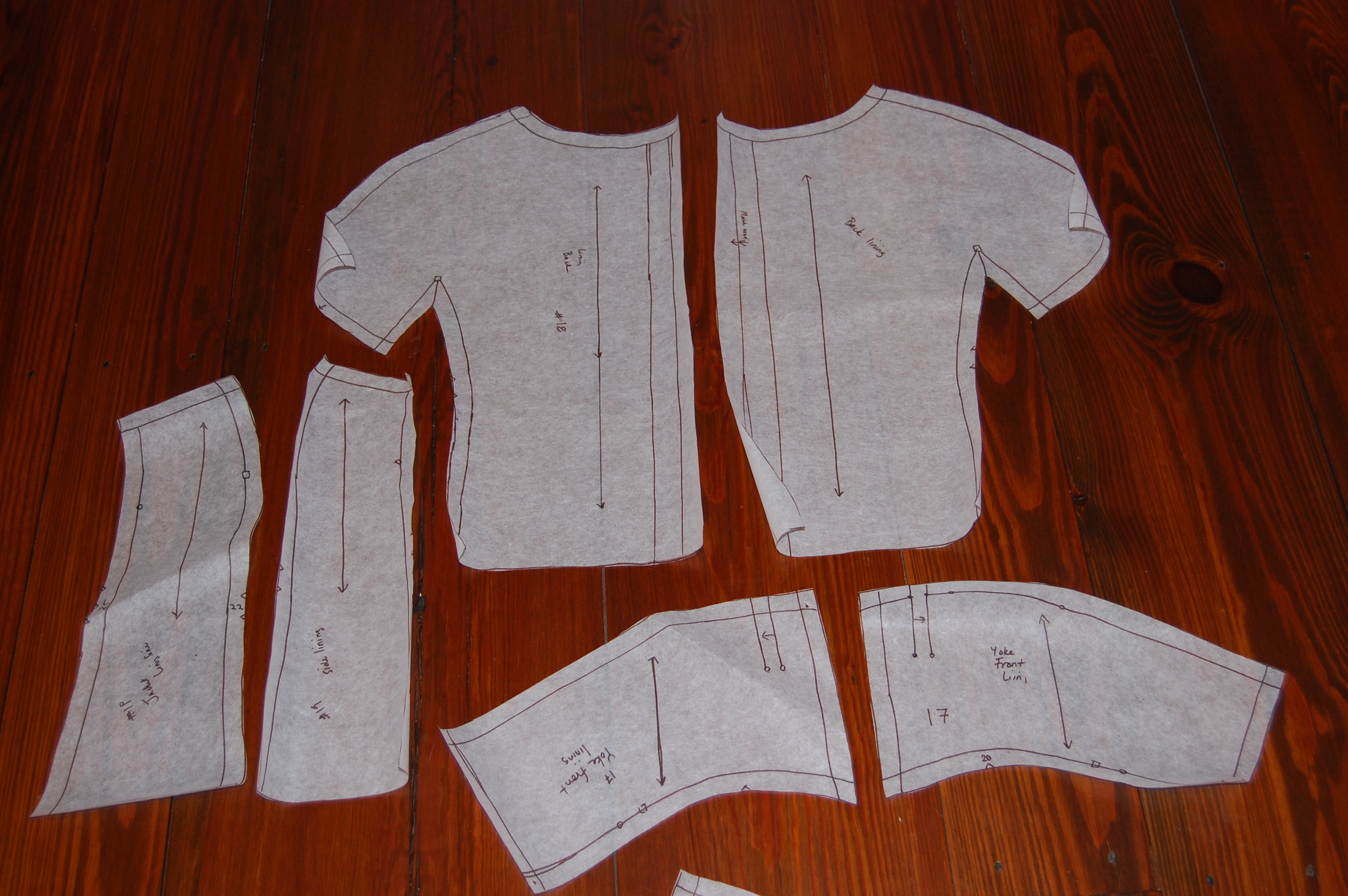
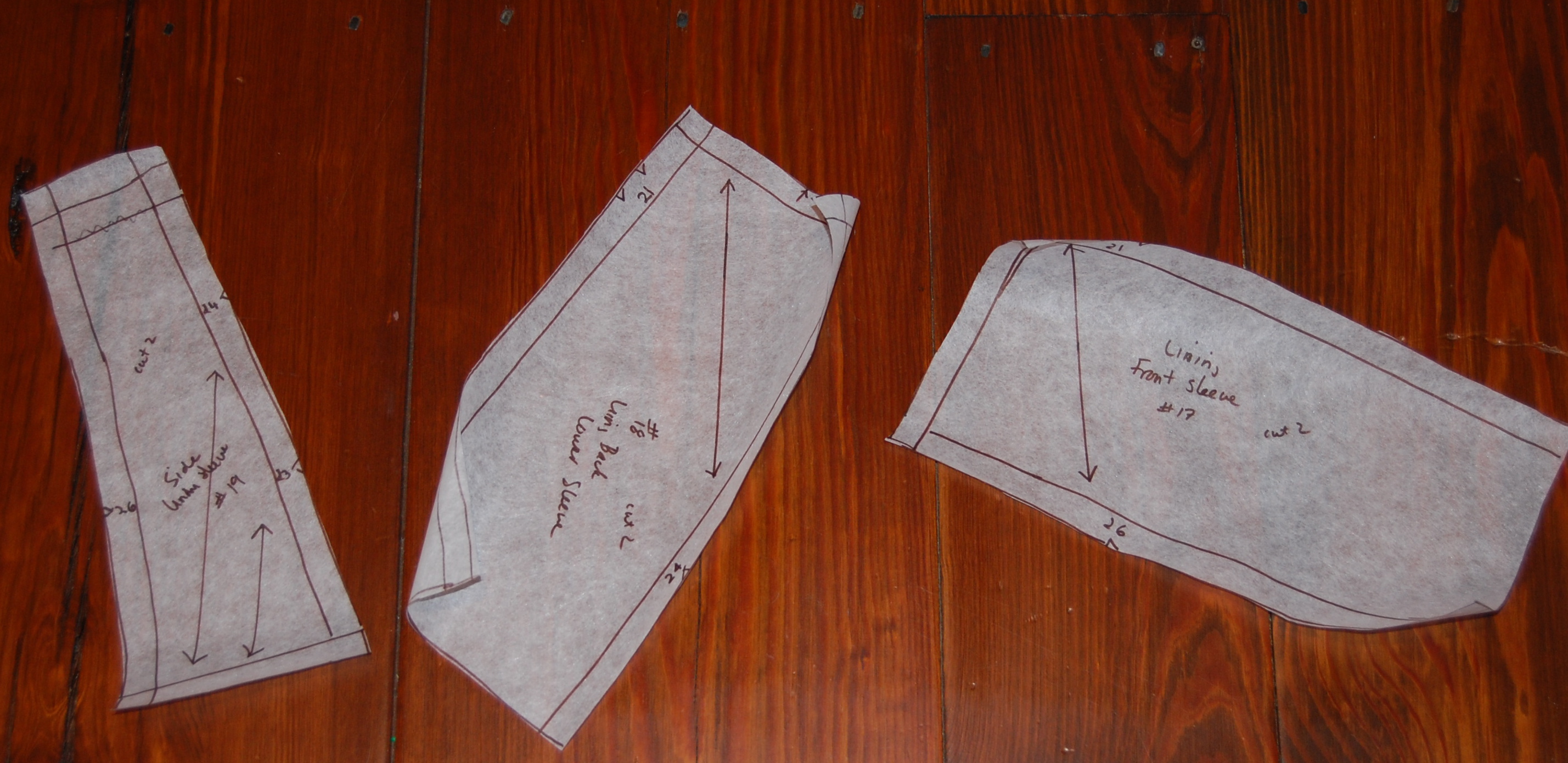
I set about making new pattern pieces for the lining, separating each sleeve section at the “lengthen or shorten here” line and adding seam allowance for sewing the new “bottoms” on each of the three sections. Here are the new patterns for the lining, minus the sleeve ends:

DSC_1197 And here are the sleeve ends. Since I would be able to use the crepe de chine doubled for these pieces (no matching required!), I only needed to make one pattern for each lower sleeve, thus three pattern pieces instead of six:

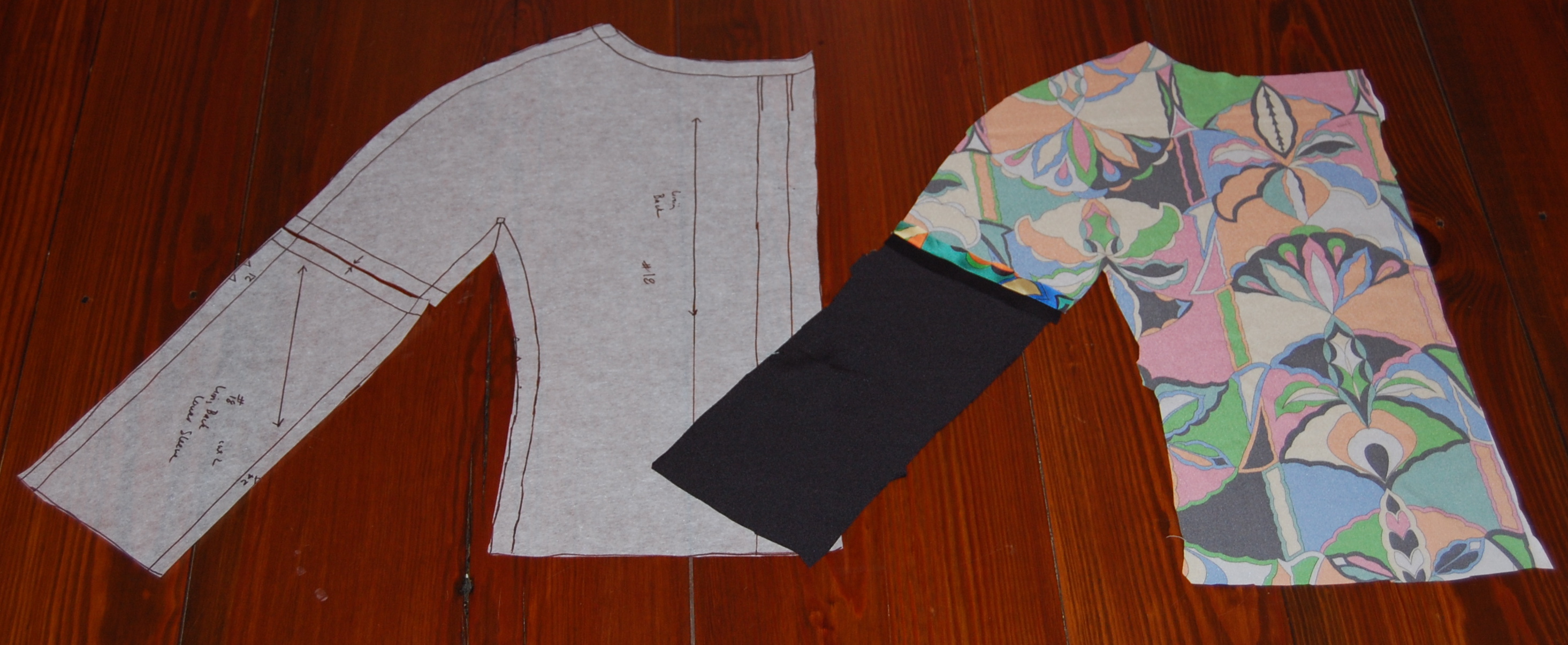
Searching for Rumplestiltskin When I took my new “chopped off sleeve-ends” pattern back to my silk, I was able to fit everything on, including matching the dress yokes to the body of the dress. I checked and rechecked all the pieces. Then I took a leap of faith and cut it out. Although I am currently working on the dress, I wanted to see how the “new” sleeves, with their pieced ends, would look. So, here is one lining back section assembled, with its lower sleeve end added to it.

DSC_1199

Am I positive this will work and not look glaringly – like I didn’t have enough fabric? Not really.  I’ll know soon enough, however. In the meantime, I am enjoying every minute I spend with this Pucci silk.  Eat your heart out, Rumplestiltskin!


14 Comments

Filed under couture construction, kimono sleeves, sewing in silk, Uncategorized, underlinings, vintage Vogue Designer patterns, vintage Vogue patterns from the 1960s, Vogue patterns

A Preoccupation with Emilio Pucci

In the world of designer fashion, there are certain names which are synonymous with specific looks.  Obvious examples are Coco Chanel with her little black dress and classic cardigan jacket, Christian Dior with his figure-enhancing full skirts and feminine décolleté necklines, and Emilio Pucci with his distinctive colorful prints,  smart sportswear and flowing at-home-wear.

Lately I’ve been thinking about Emilio Pucci (1914-1992) a lot.   It all started a couple of years ago on one of my West Coast visits to Britex Fabrics in San Francisco. I had already decided upon several lengths of fabric, when I saw a silk charmeuse, which clearly spoke to me of Pucci.  The design was so amazing, the colors so vibrant, and the silk so luscious, that, with a little encouragement from my husband, I added it to my pile.  At 60” wide, I thought 2 yards would suffice for a blouse, not really knowing what I would make.

Pucci

DSC_1183

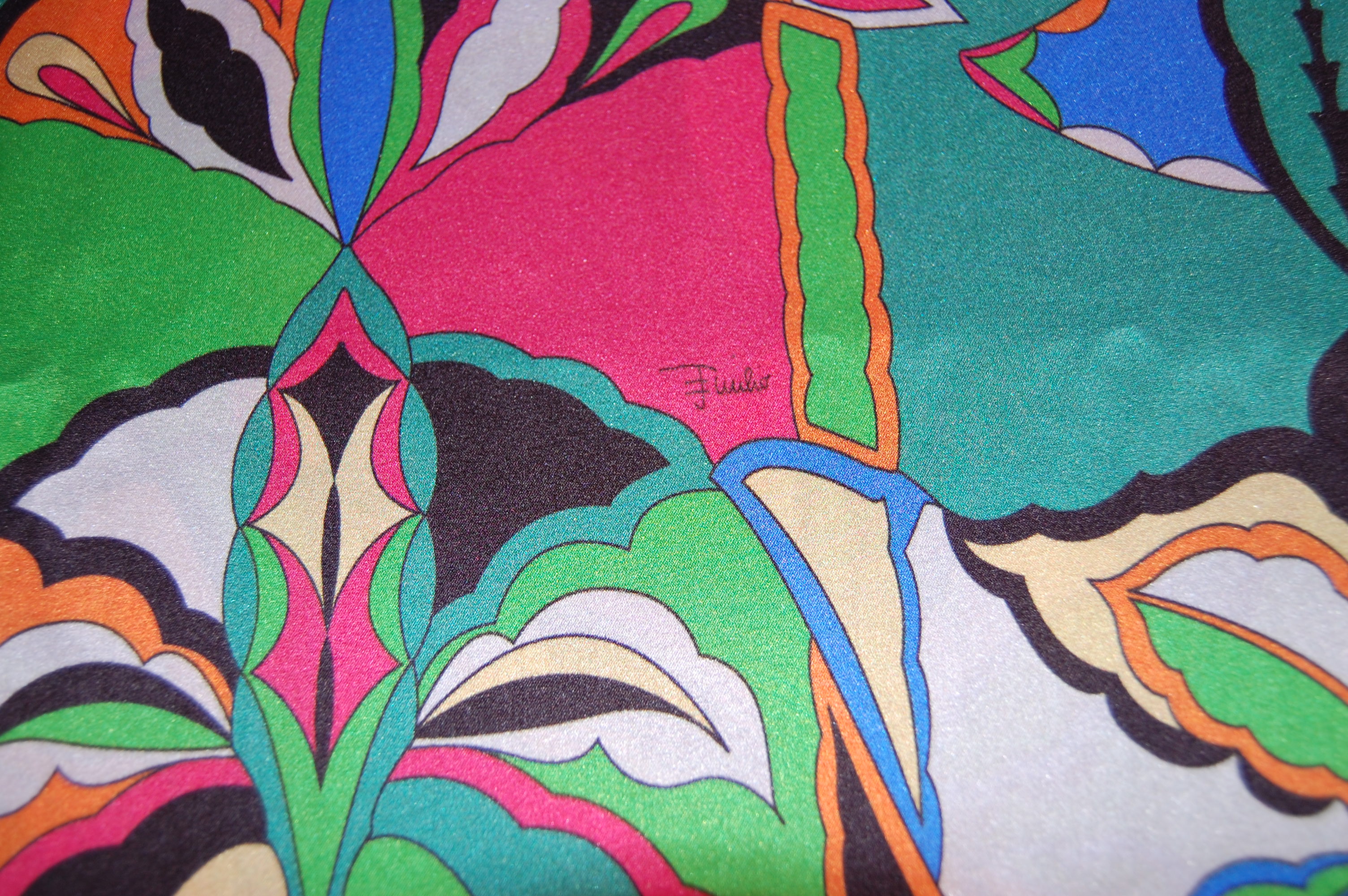
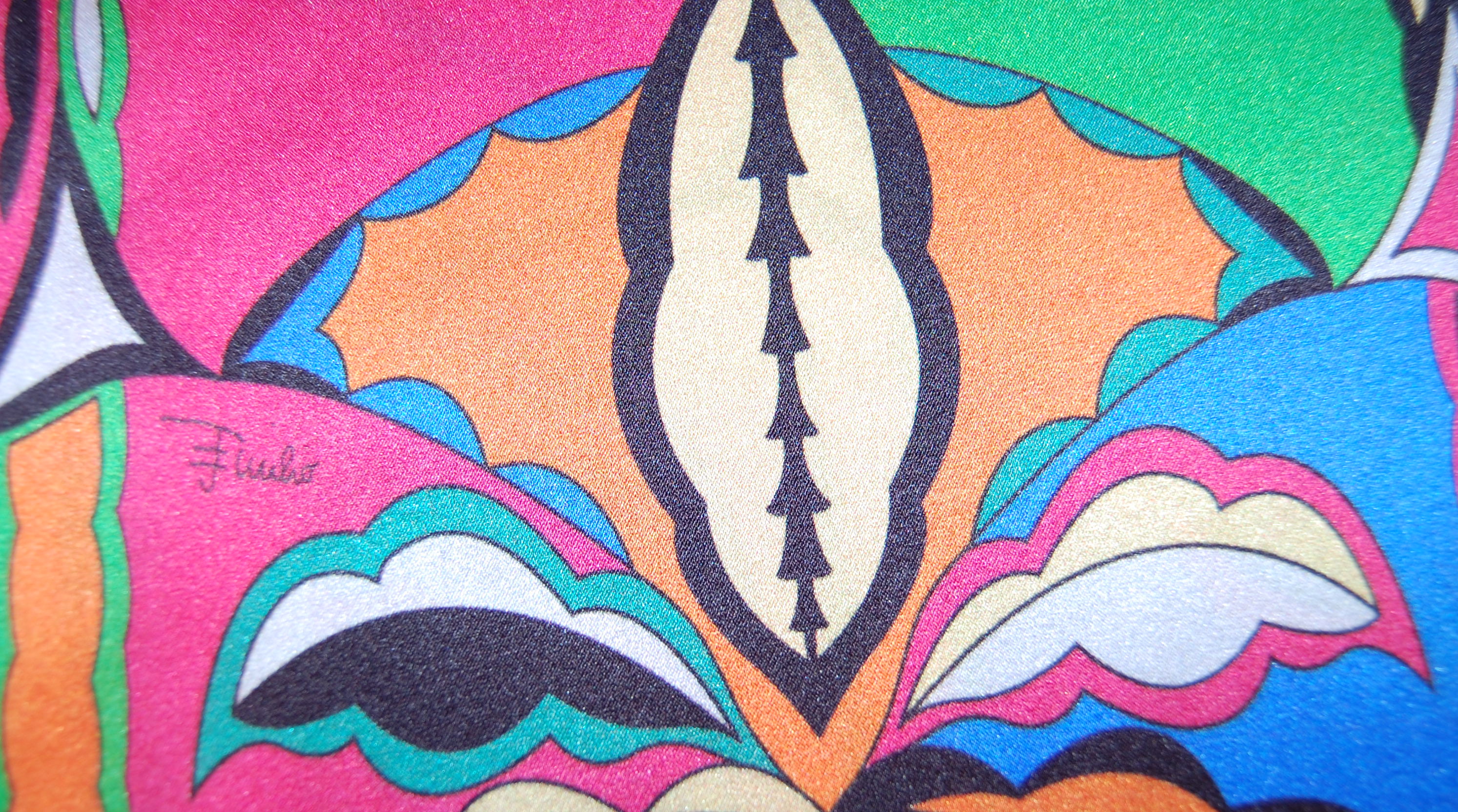
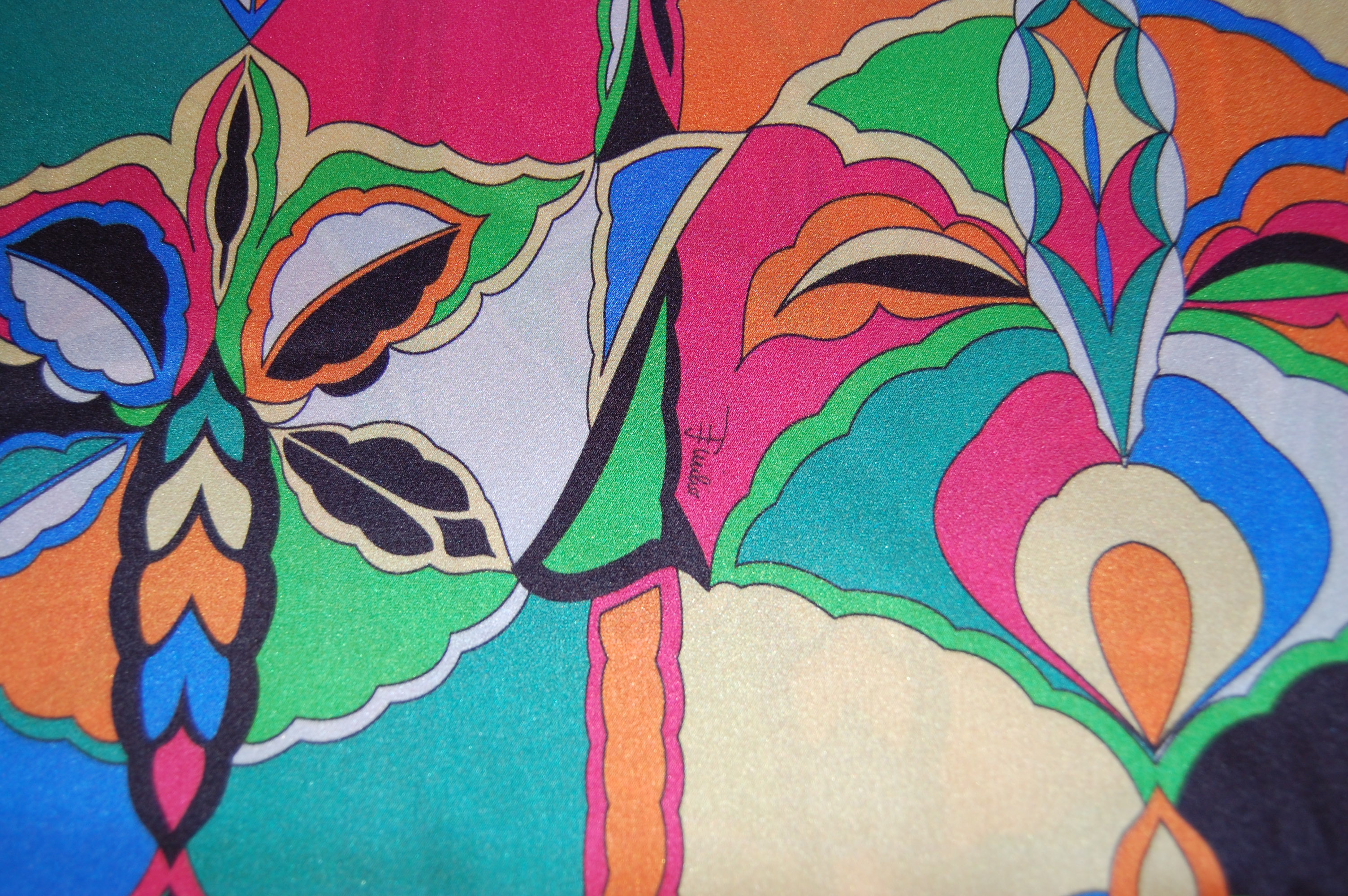
The silk I purchased seemed to have all the bells and whistles of a classic Pucci print.  (Pucci’s daughter, Laudomia took over the business after her father’s death, and has continued her father’s signature style.)  He only used the finest, luscious fabrics with a color palette “straight from the Aegean horizon” according to the entry on him in The St. James Fashion Encyclopedia  ( Visible Ink Press, Detroit, MI, 1997, pages 325-326):  “turquoise and ultramarine set against sea green and lime, or hot fuchsia and sunflower yellow”.  These colors are arranged in “optical fantasies of geometric shapes” which eschew repetitiveness. And, finally, every authentic Pucci fabric carries his discreet “Emilio” signature.  (The Vintage Traveler blog has an excellent post on Pucci and his sporty prints, which shows another example of his signature and his diverse designs.)

The small "Emilio" signature is at the lower part of the pink section.

The small “Emilio” signature is at the lower part of the pink section.

The signature is spread thinly across the expanse of the fabric.

The signature is spread thinly across the expanse of the fabric.

And here is a signature printed vertically rather than horizontally.

And here is a signature printed vertically rather than horizontally.

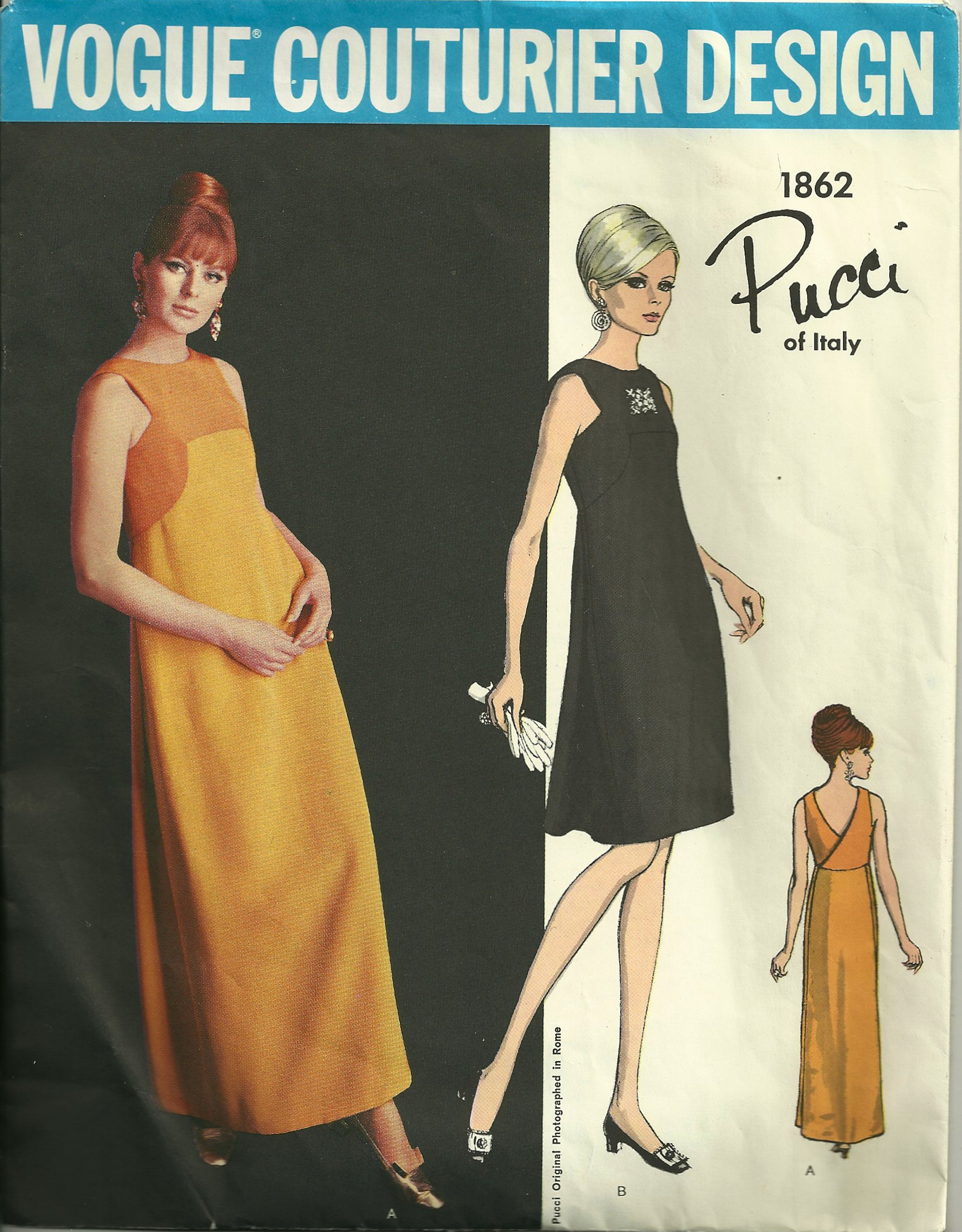
Shortly after this fabric purchase, I began to get a greater and new appreciation for Pucci’s diversity as a fashion designer as I acquired a few of his Vogue Designer patterns.  Instead of featuring styles dependent upon his bright and unusual fabric designs, they showed feminine dresses and jackets, with clean lines and a surprising touch of demureness.   Here are the three patterns I purchased:

Happy New Sewing Year - Pucci pattern

Pucci - pattern envelope

Wrap dress - 5 (Pucci)

Some other of his designs for Vogue patterns were featured in Vogue Pattern Book Magazine:

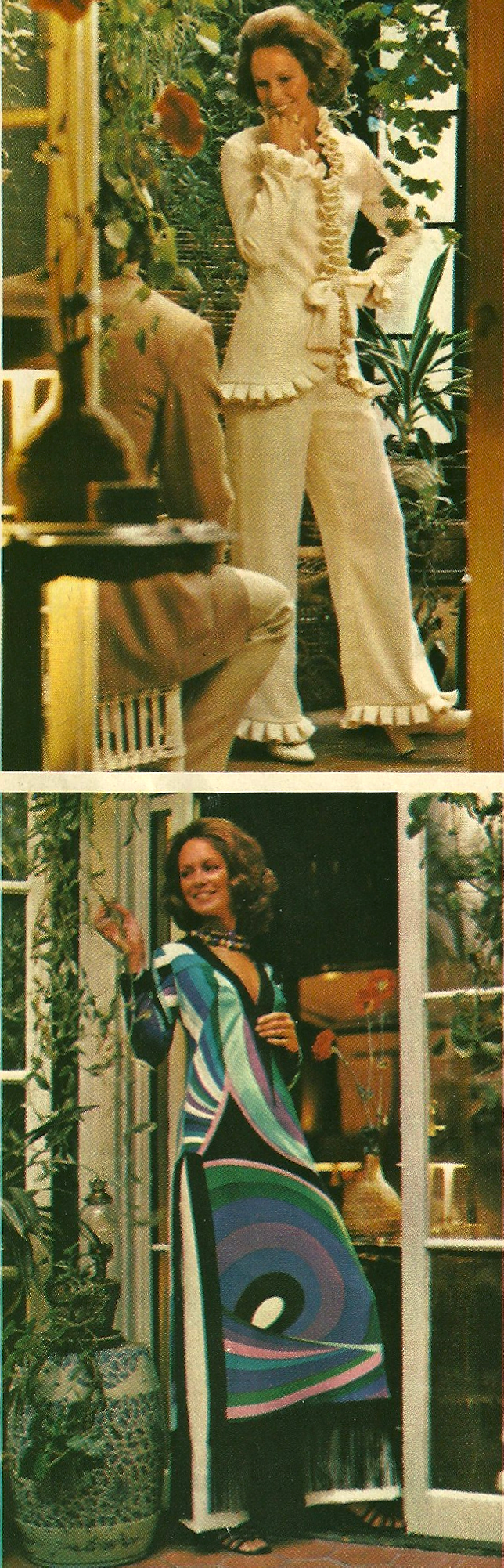
The caption in this June/July 1972 article says:  "Emilio Pucci adds glamour to your life with an off-white silk crepe pantsuit..." while the lower picture shows his "signature colors on a silk jersey  lounge gown."

The caption in this June/July 1972 article says: “Emilio Pucci adds glamour to your life with an off-white silk crepe pantsuit…” while the lower picture shows his “signature colors on a silk jersey lounge gown.”

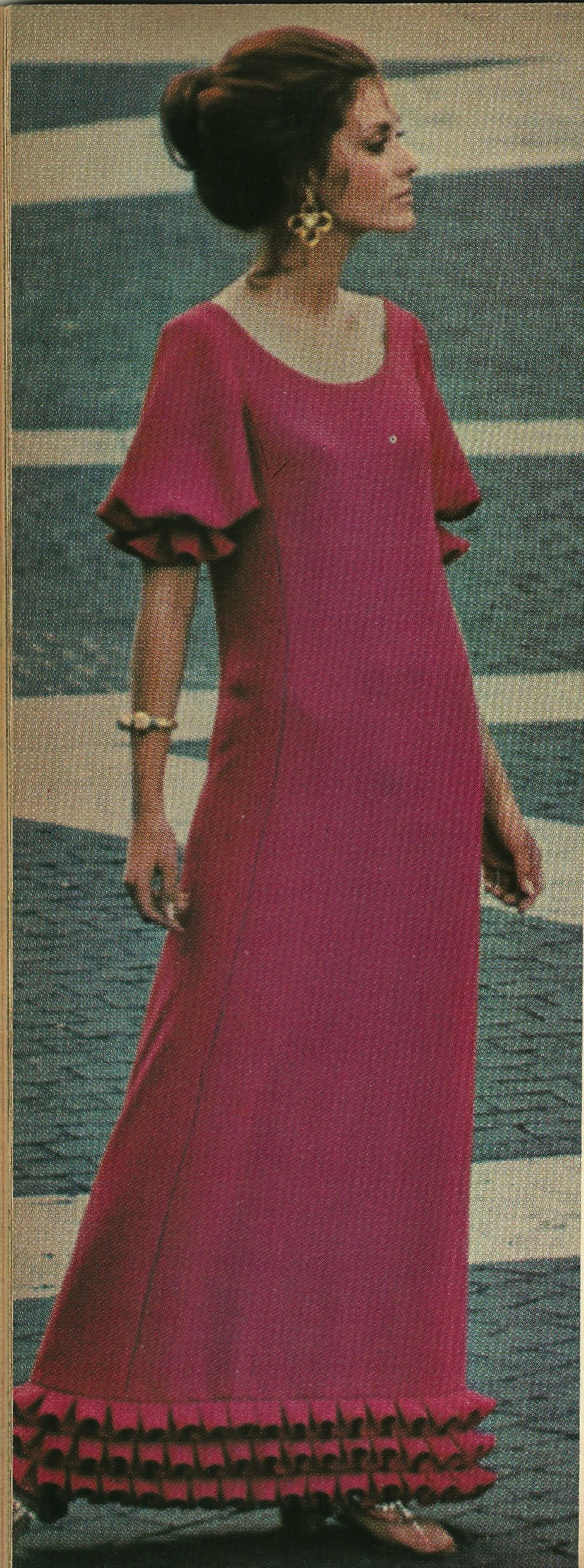
This lovely Pucci gown was shown in the April/May 1970 issue of VPB Magazine.

This lovely Pucci gown was shown in the April/May 1970 issue of VPB Magazine.

Both the fabric and the patterns sat in hibernation in one of the closets in my sewing room until an idea began to take hold in my mind.  I decided I’d like to use one of my Pucci patterns for my authentic Pucci fabric. It just seemed totally logical to me. I measured my fabric again and found I had closer to 2¼ yards.  I was envisioning pattern # 1418, with the dress in the silk print, paired with the jacket in black, lined in the same silk.  With this plan in mind, I found a lightweight, soft and silky wool/cotton waffle weave in black at Britex Fabrics in early February while I was on the West Coast for Susan Khalje’s Couture Sewing School Class – perfect for the jacket.

Hopefully the "waffle" weave shows up enough in this picture.

Hopefully the “waffle” weave shows up enough in this picture.

With pattern, fabrics, and a vision, I was ready to go on my next big project.  There was only one gnawing question – would I have enough yardage of the Pucci silk to make that sheath-style dress and line the jacket?

The answer to that question  – deserves its own Fifty Dresses post!

18 Comments

Filed under sewing in silk, Uncategorized, vintage Vogue patterns from the 1960s, vintage Vogue patterns from the 1970s

Magnificent Obsession

Sometimes the dreams and aspirations of our younger days take a long time to come to fruition.  Although I was doing a lot of fashion sewing for myself when I was in my twenties, there were many more Vogue pattern designs which I never had the opportunity to make.  One was Vogue Paris Original #2668 by Hubert de Givenchy (1927-).

Coats of certain length - 7 I never forgot the jacket, in particular, featured in this Designer Pattern.  Over the years I occasionally obssessed about this pattern, regretting that I had not purchased it.  I never imagined I would have a second chance to make it mine, but thanks to the marvels of the Internet, I did.  When I saw a listing for it in this Etsy store months ago, and it was in my size, I knew it was time to buy it.

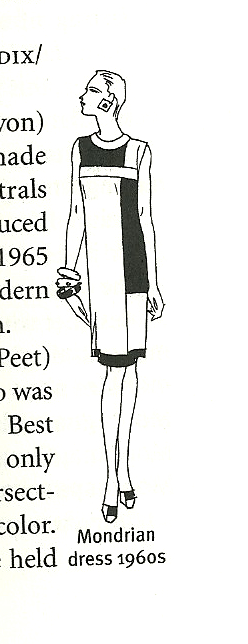
The use of color blocking, as featured in View A, became stylish in the mid-1960s, when Yves Saint Laurent introduced his classic Mondrian dress.

This little sketch from The Fairchild Dictionary of Fashion, Fairchild Publications, Inc., New York, New , York, 2010, p. 329, shows the classic blocked design.

This little sketch from The Fairchild Dictionary of Fashion, Fairchild Publications, Inc., New York, New  York, 2010, p. 329, shows the classic blocked design.

The appeal of the use of large geometrical sections of contrasting colors was widespread then and has, for many of us, never lost its cachet.  The clean precise lines, and diverse use of fabrics in color blocking must have appealed to Hubert de Givenchy’s sense of design.  Known for simplicity and refinement, according to Arlene C. Cooper, writing in the St. James Fashion Encyclopedia, Givenchy emphasizes “line rather than decoration”.  Further, Givenchy is known for “coats that are marvels of line and volume…”  (St. James Fashion Encyclopedia, Visible Ink Press, Detroit, MI, 1997, p. 154).  Vogue Patterns must have been exceptionally pleased to have the rights to this design for its Designer Series in the early 1970’s.

I started my jacket in early February this year in Susan Khalje’s Couture Sewing School class in San Francisco.  I just finished it.

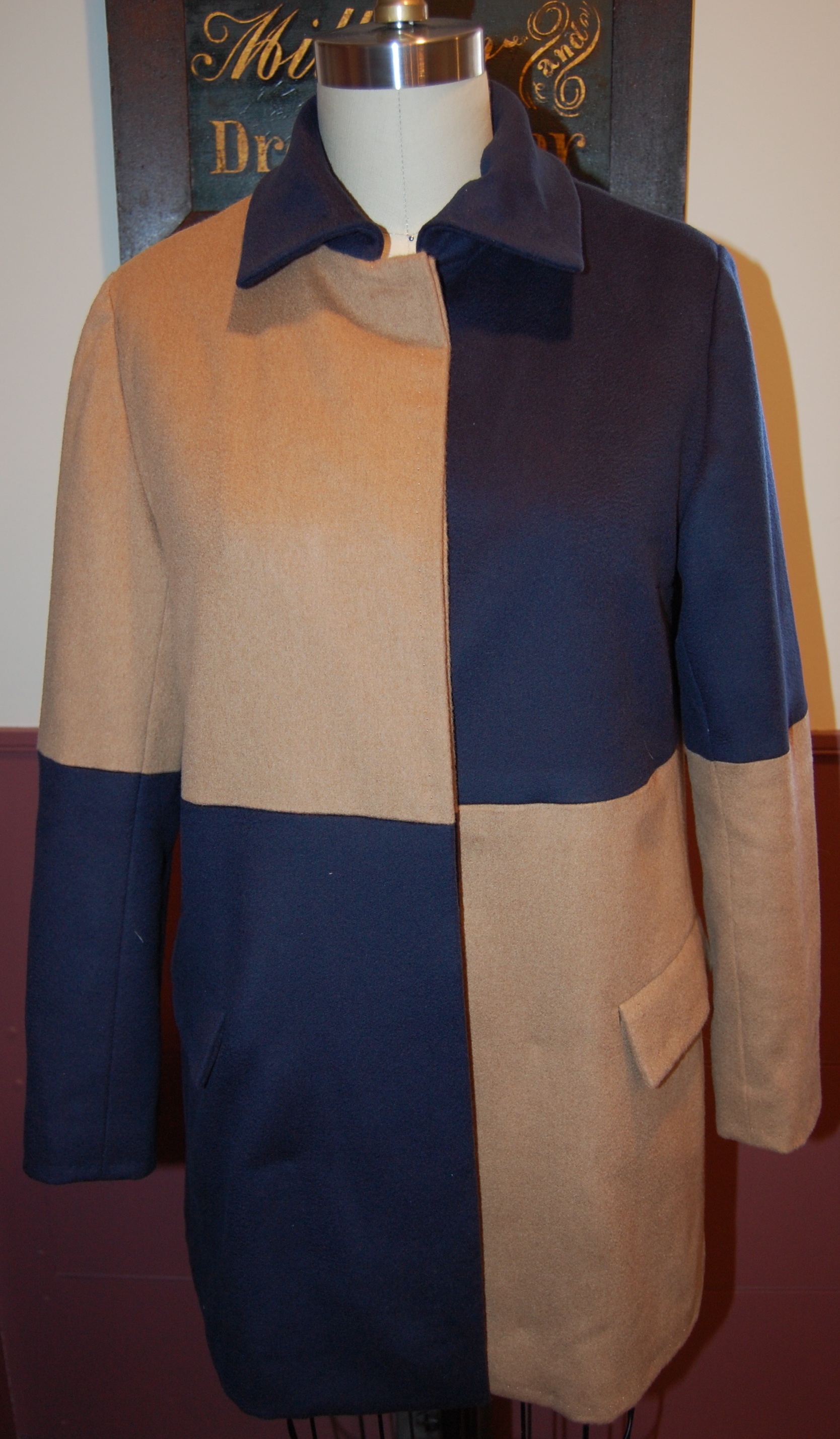
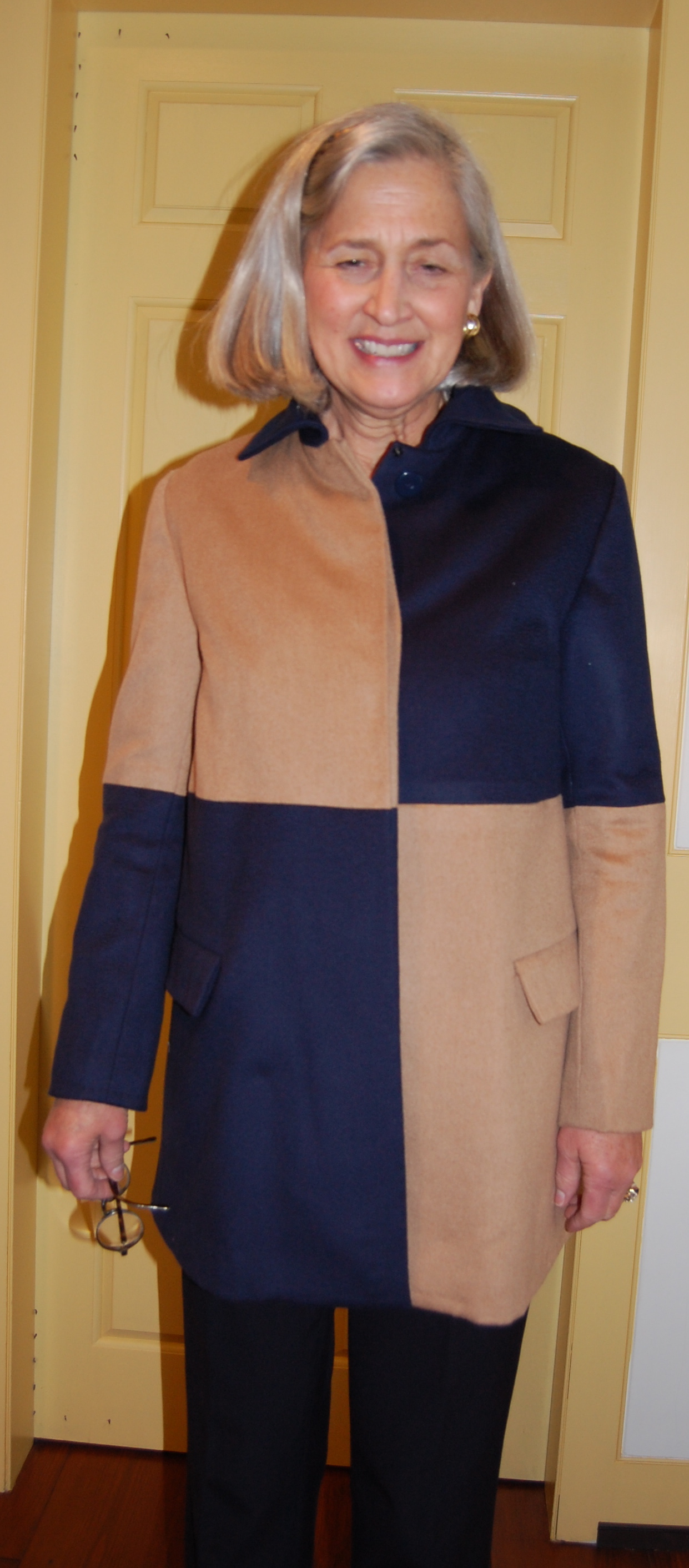
Magnificent Obsession

Magnificent Obsession

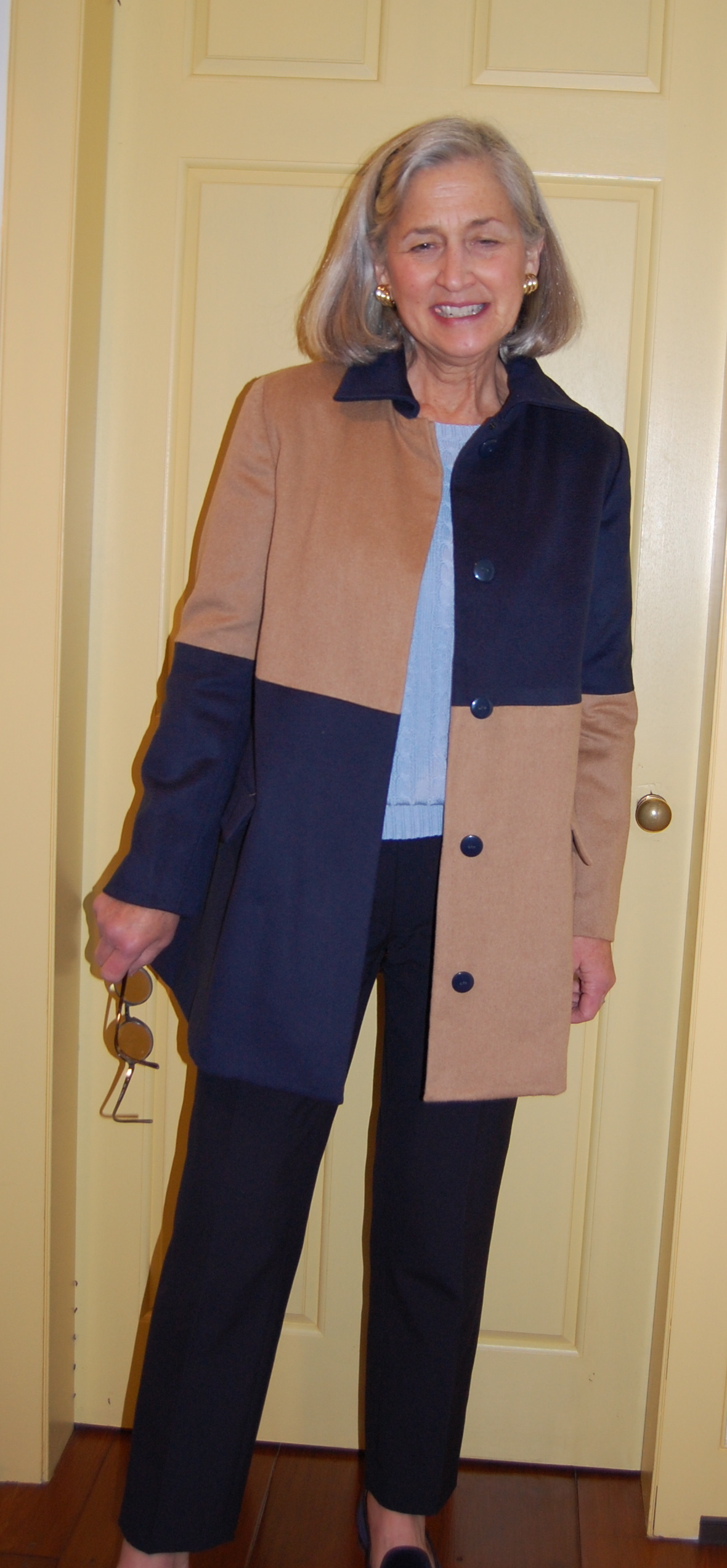
I like it worn open as well...

I like it worn open as well…

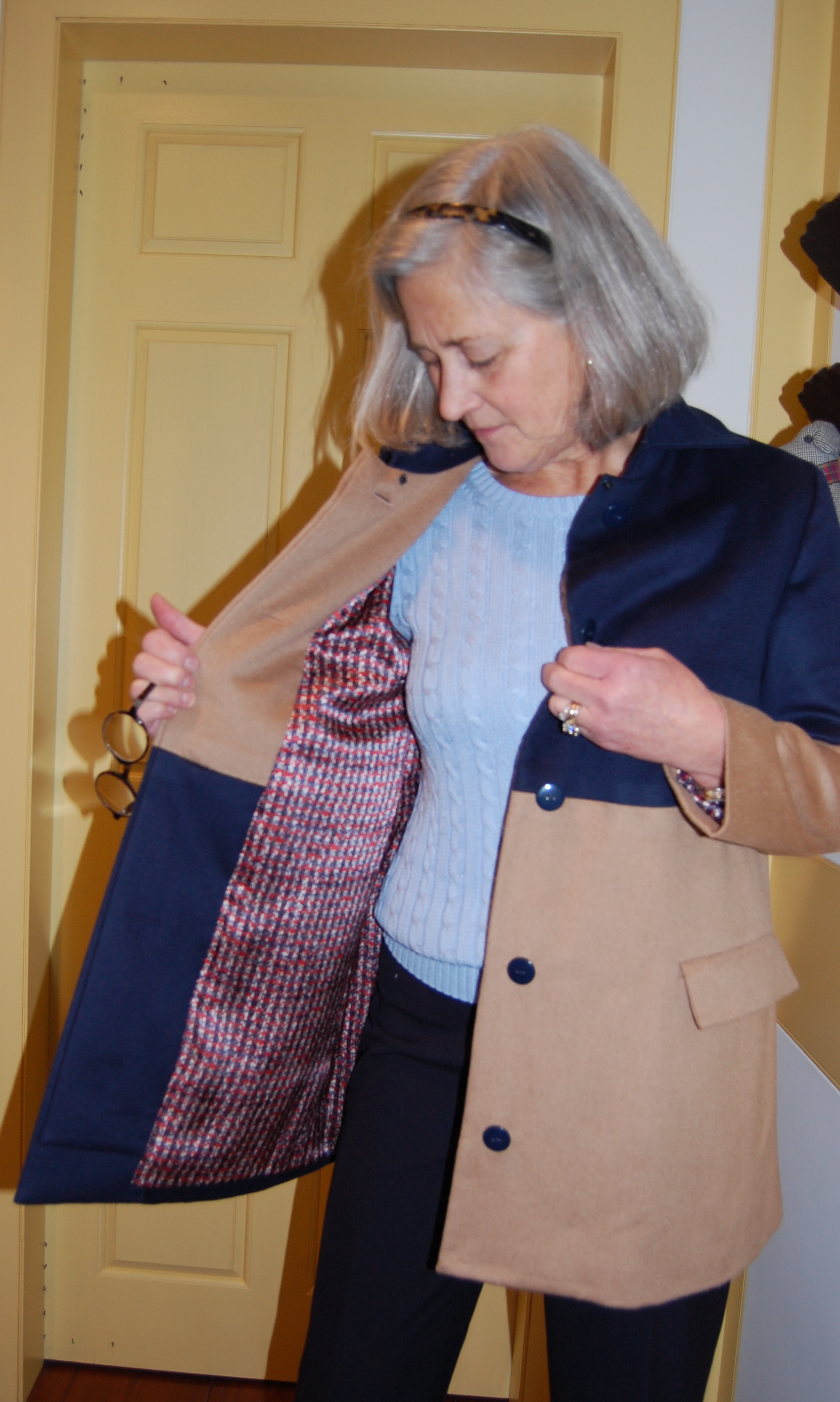
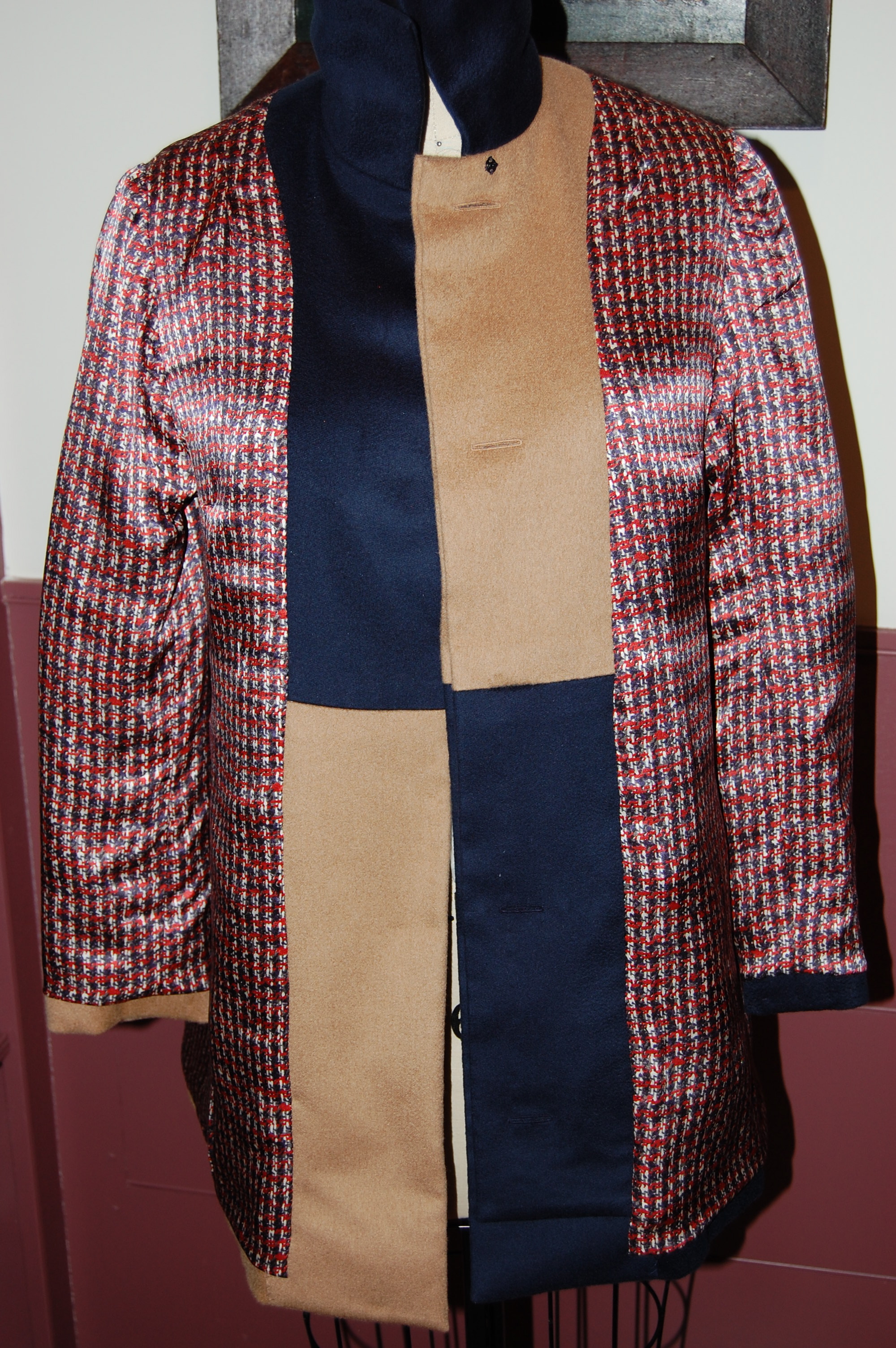
A look inside...

A look inside…

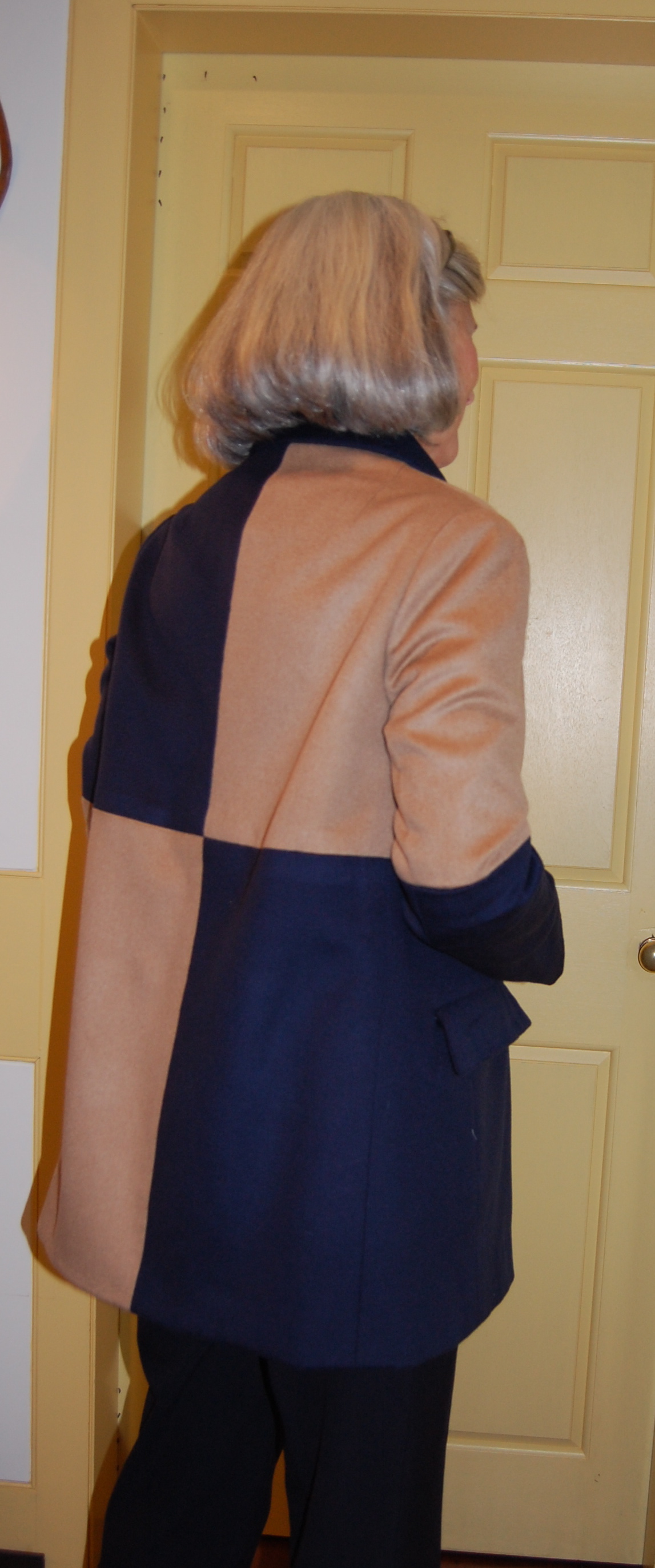
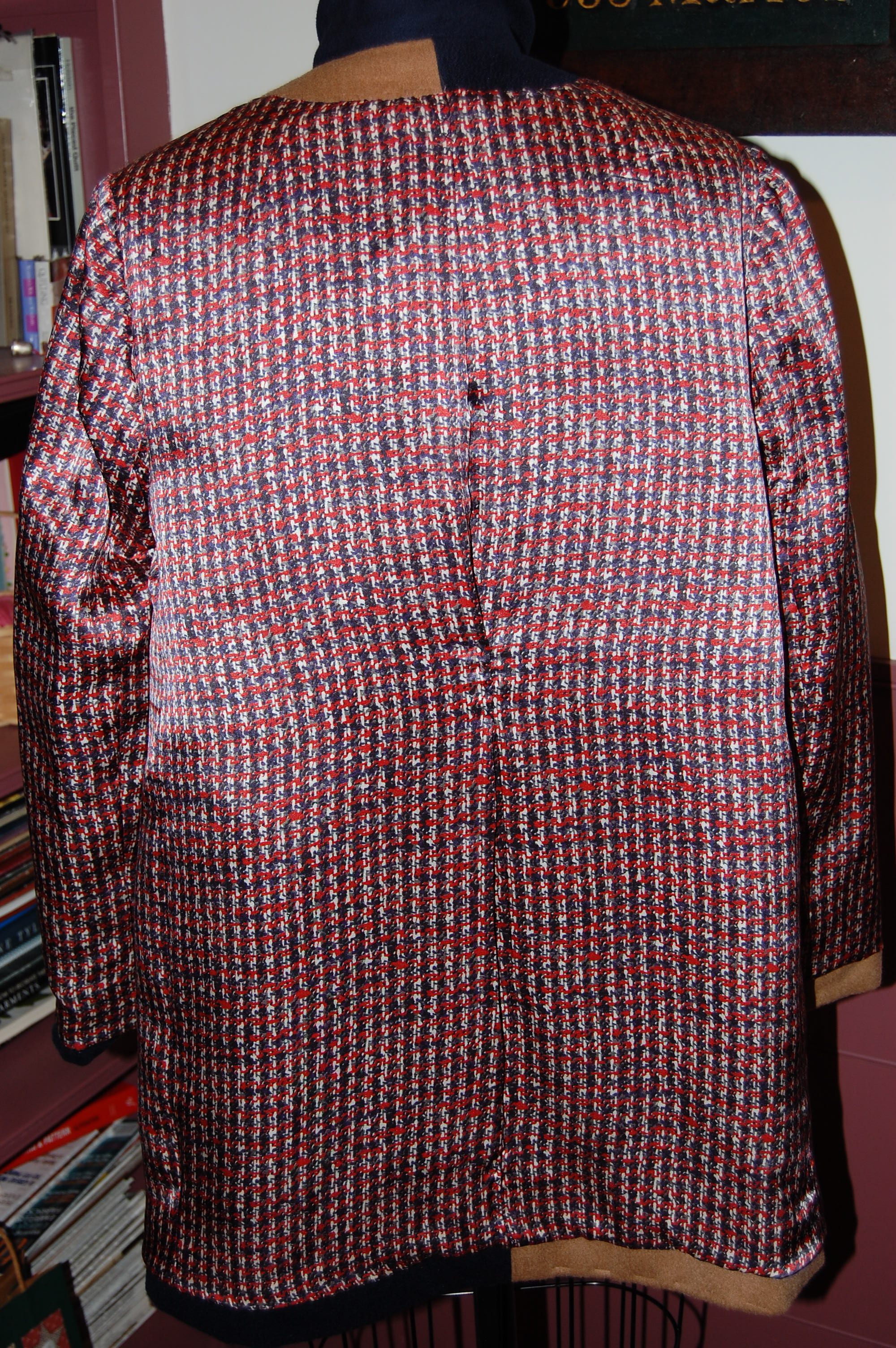
A back view.

A back view.

Making this was one of the most enjoyable sewing experiences I have ever had.  Being privileged to get Susan’s expert guidance on some parts of the jacket certainly was part of the equation.  In addition to that, however, were the preciseness and subtle design details of the pattern, which made it a pleasureable sew.  A few of those details are:

1)  the genius of the extra side panel, which enhances the “swing” line of the coat.

2) that side panel  also allows the use of a Dior dart which adds just enough to the bust to keep the line smooth, but ample.

Th instruction sheet gives a good diagram of the small Dior dart tucked into that front side seam.

The instruction sheet gives a good diagram of the small Dior dart tucked into that front side seam.

3) the concealed front allows the clean appearance of the coat to be unencumbered by buttons.

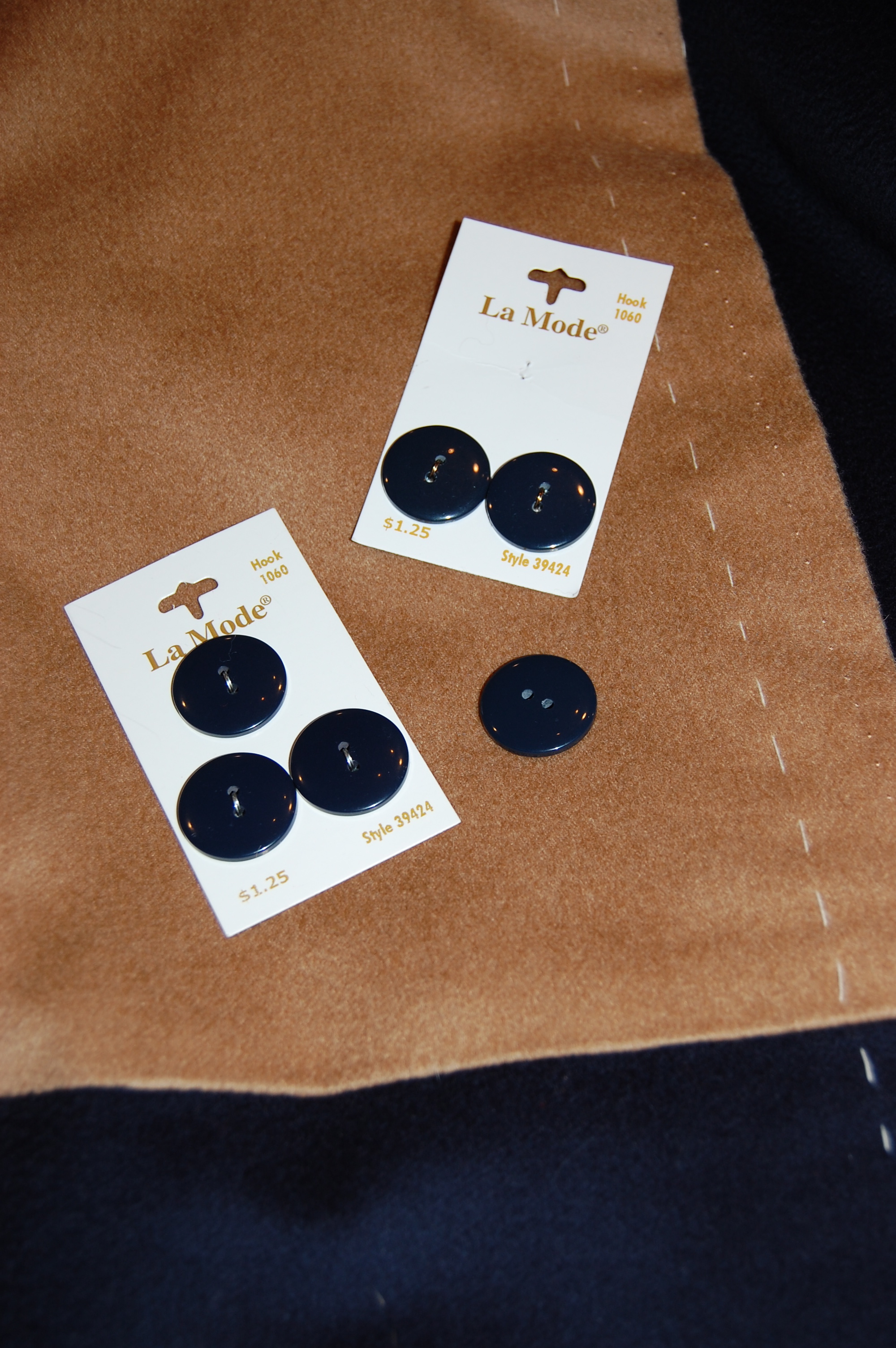
I chose these navy blue buttons for the concealed front.  They are flat, simple, and match the blue exactly.

I chose these navy blue buttons for the concealed front. They are flat, simple, and match the blue exactly.

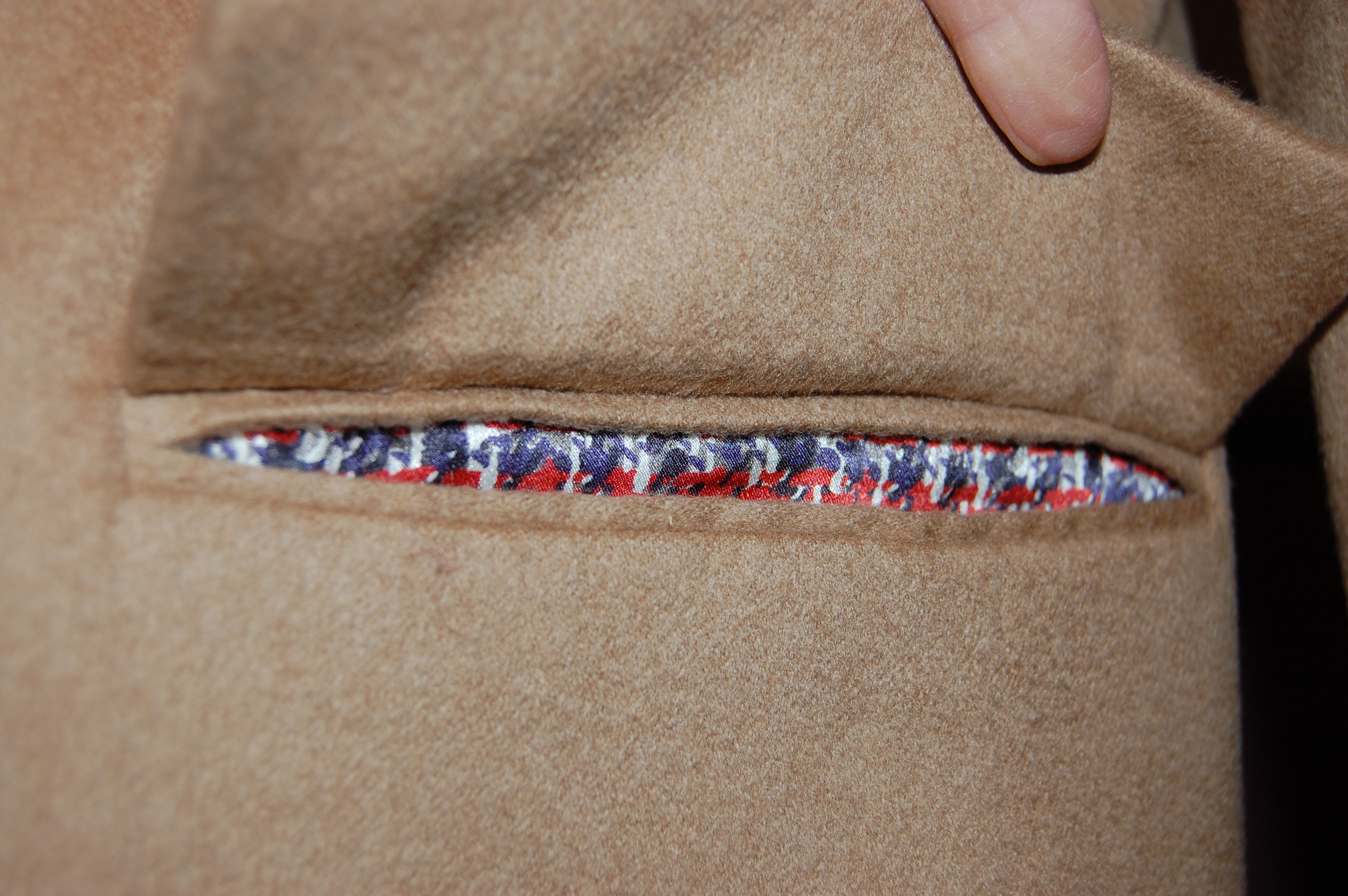
4) the flap pockets, which conceal the openings, again with minimal interruption to the clean and “simple” look.

The concealed opening, with a flash of pretty pocket lining.

The concealed opening, with a flash of pretty pocket lining.

I did make a few changes/alterations to the jacket, ensuring a better fit for me in 2014.

First, with Susan’s assistance, I took some of the volume out of the back seam, as it was just too full for my frame.  Second, I added ½ “ to the diameter of each sleeve, as they were just a little too slim for comfort.  Doing this allowed me to enlarge the lower armscye, also adding comfort and more flexibility.  I felt like I was able to do these alterations without changing the look of the jacket.  I also made two “visible” changes, although still in keeping with the design.  The original flaps looked a little too “’70s” to me.  I reduced the “depth” of them by 7/8″, so that they are more in keeping with modern sensibility.

These muslin patterns are folded in half to show the depth of the original flap and the depth of the altered one below.

These muslin patterns are folded in half to show the depth of the original flap and the depth of the altered one below.

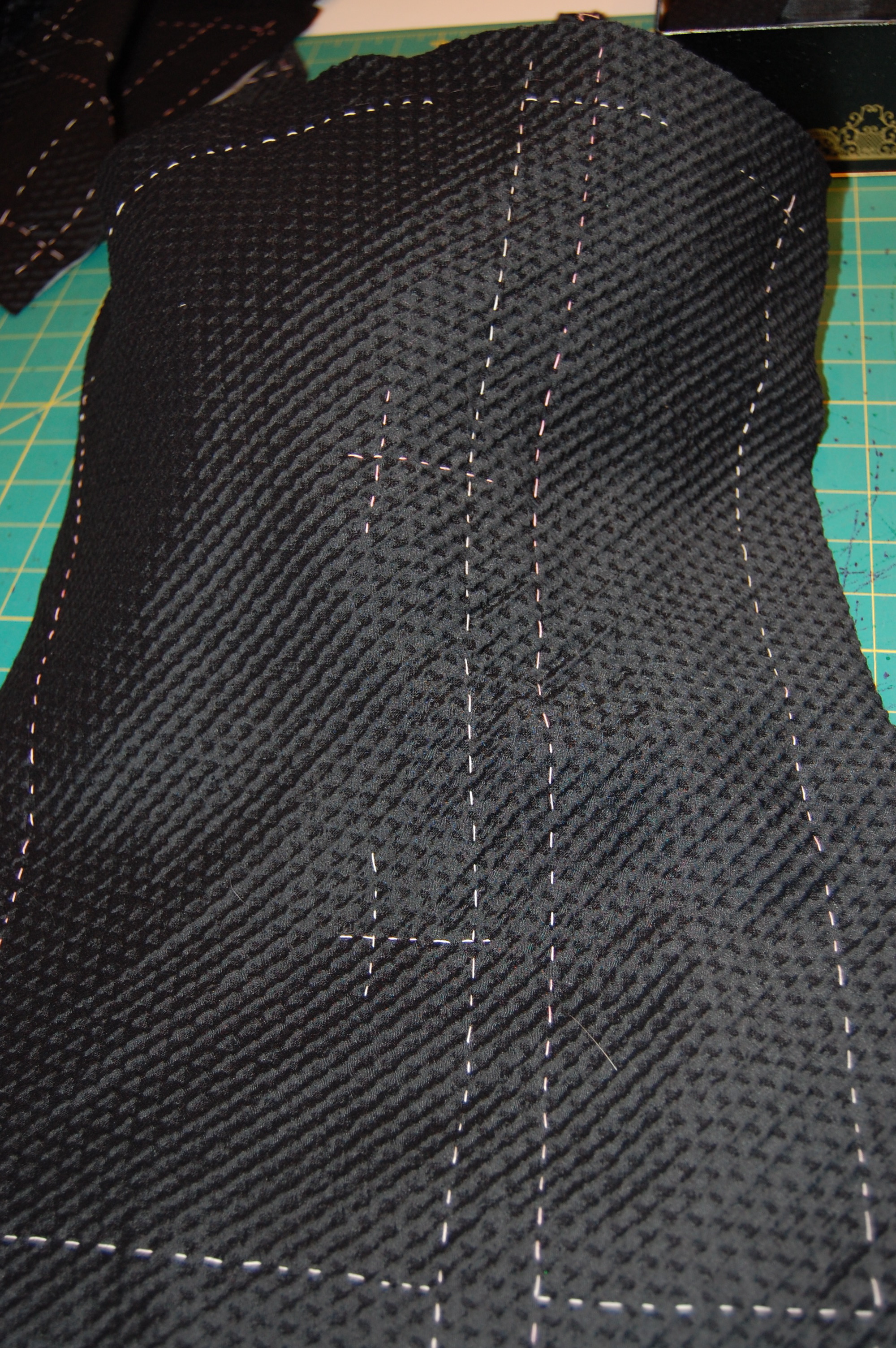
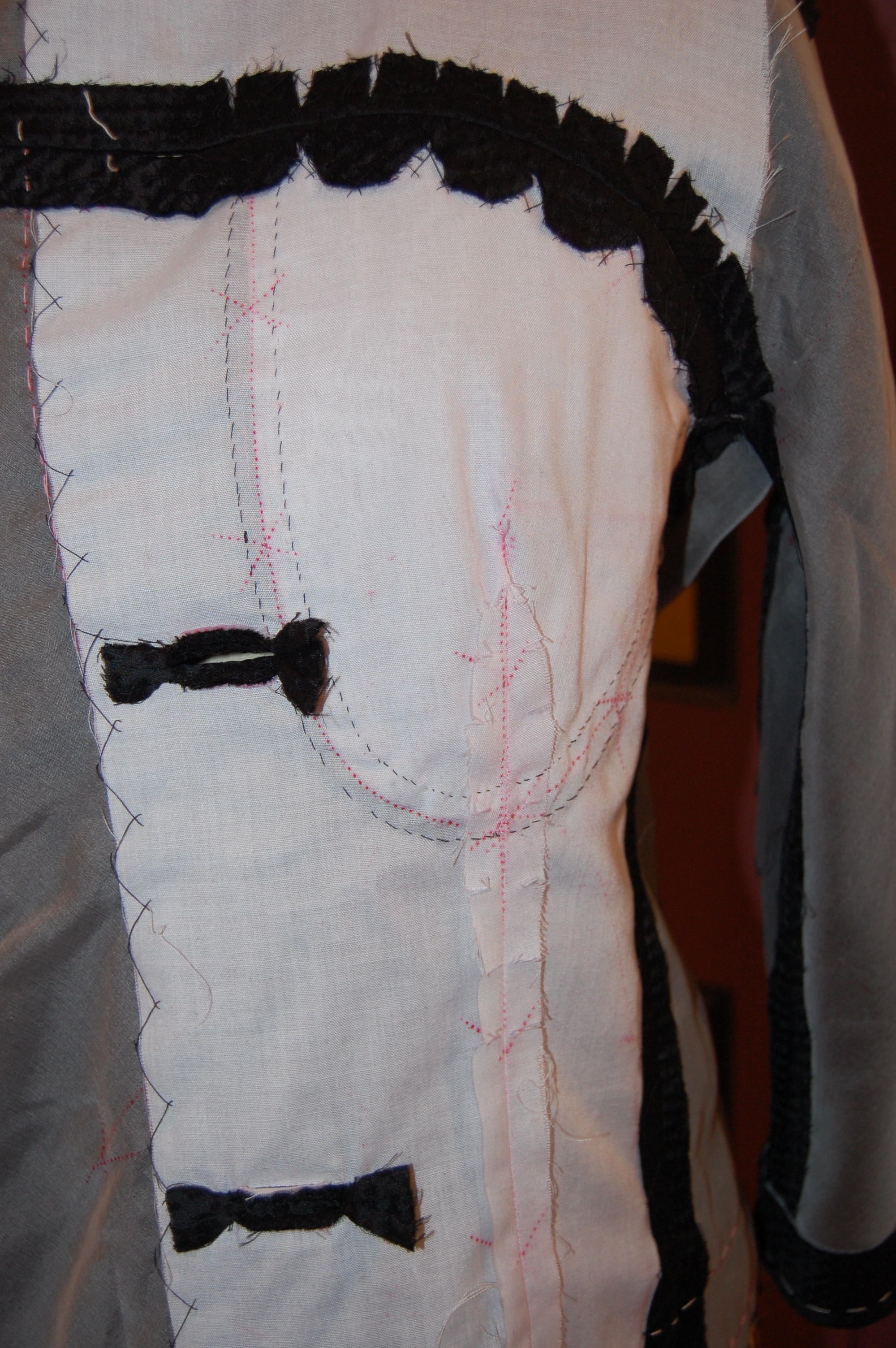
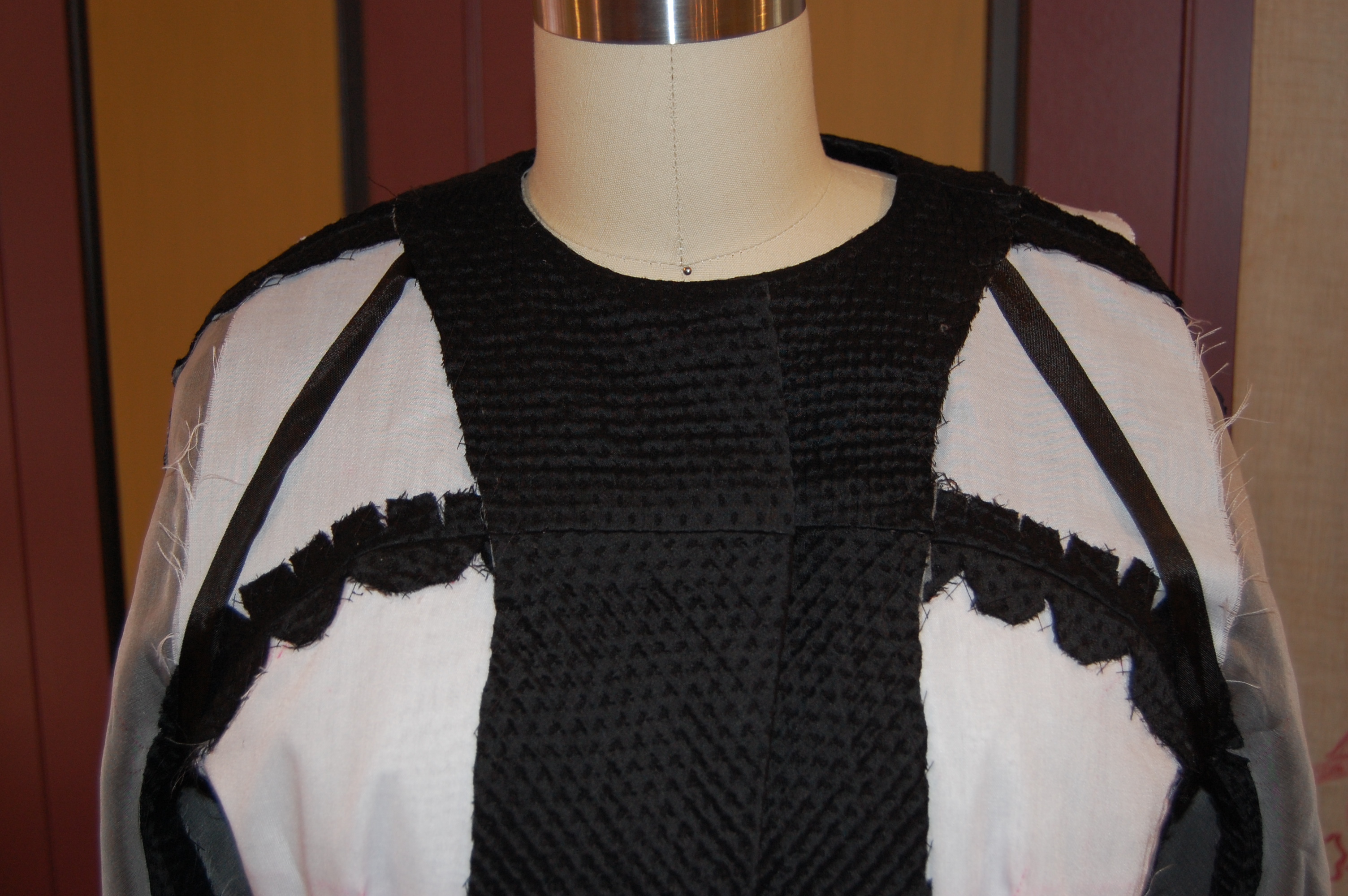
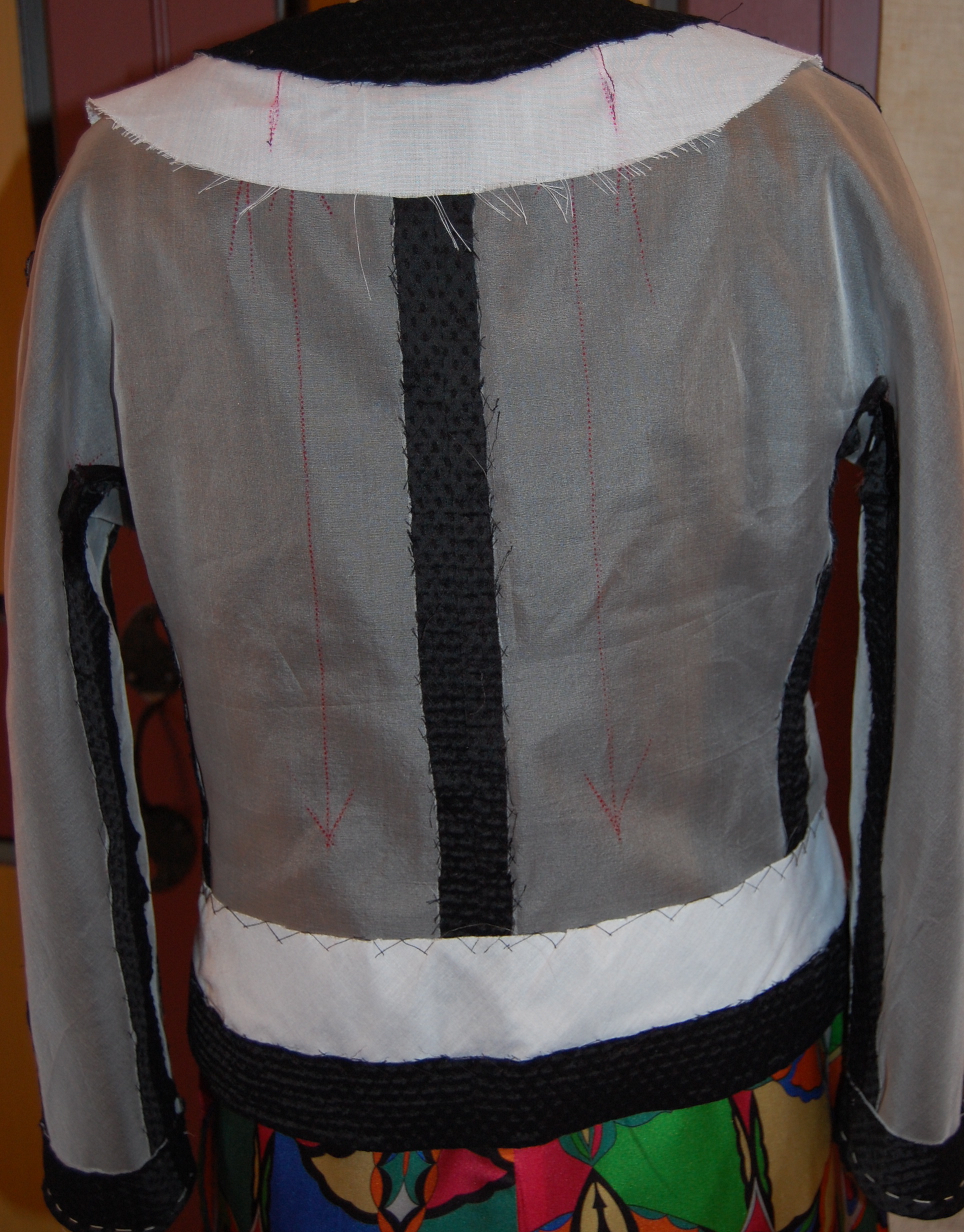
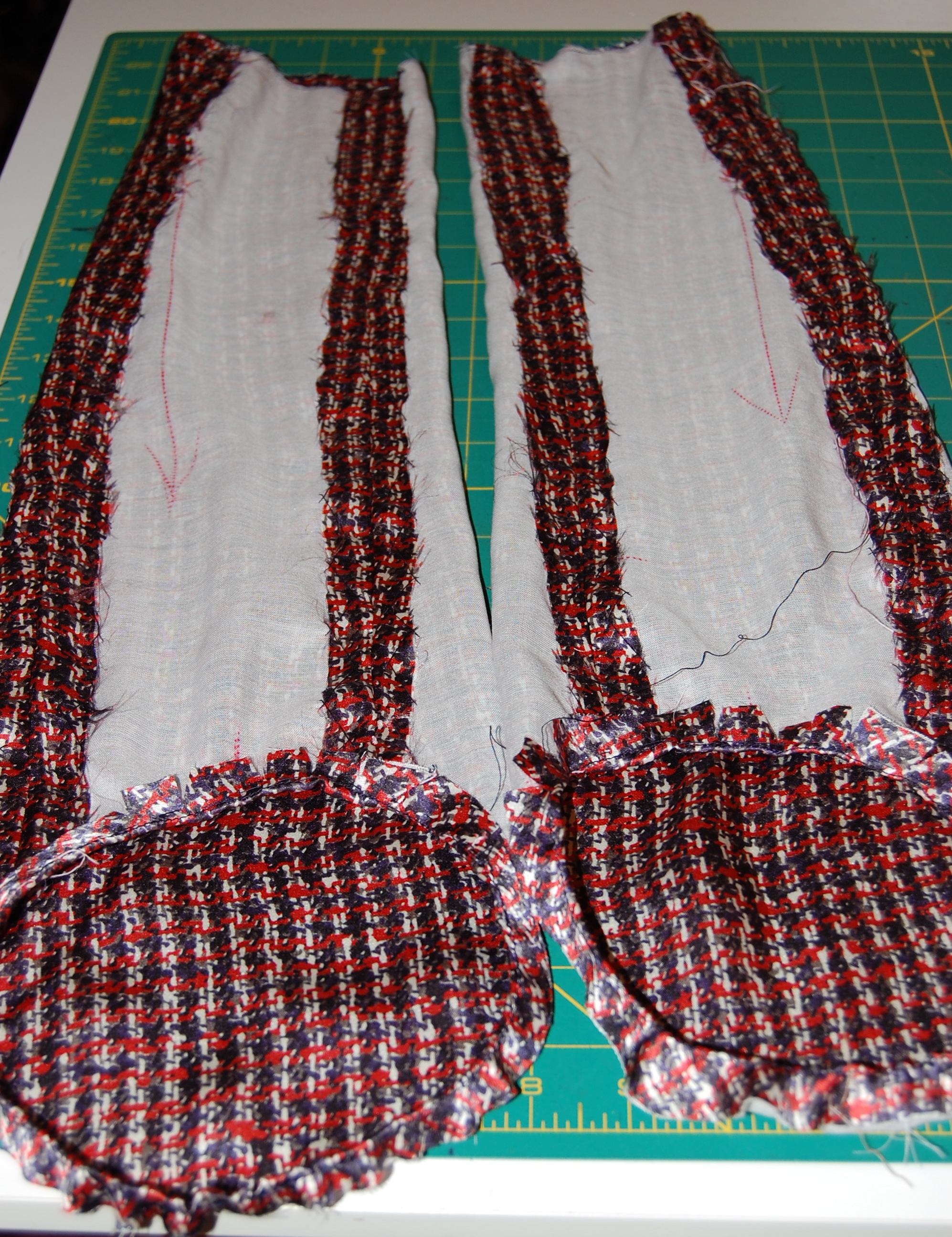
The pattern had separate pieces for the lining, and even the lining followed the blocked design.  I had chosen a printed silk charmeuse (at Britex , naturally!) for my lining, which did not need to be block sewn.  So, using the muslin I had made for the lining, I cut the “lengths” as one piece, eliminating 16 horizontal seams.  I also underlined the silk charmeuse with a very lightweight rayon voile, which made the lining fabric easy to control, and adds another layer of warmth to the overall coat.  This photo shows the underlining in the sleeve linings before I sewed them into the coat.

Magnificent Obsession

The jacket turned inside out, showing the lining.

The jacket turned inside out, showing the lining.

The inside back of the coat.

The inside back of the coat.

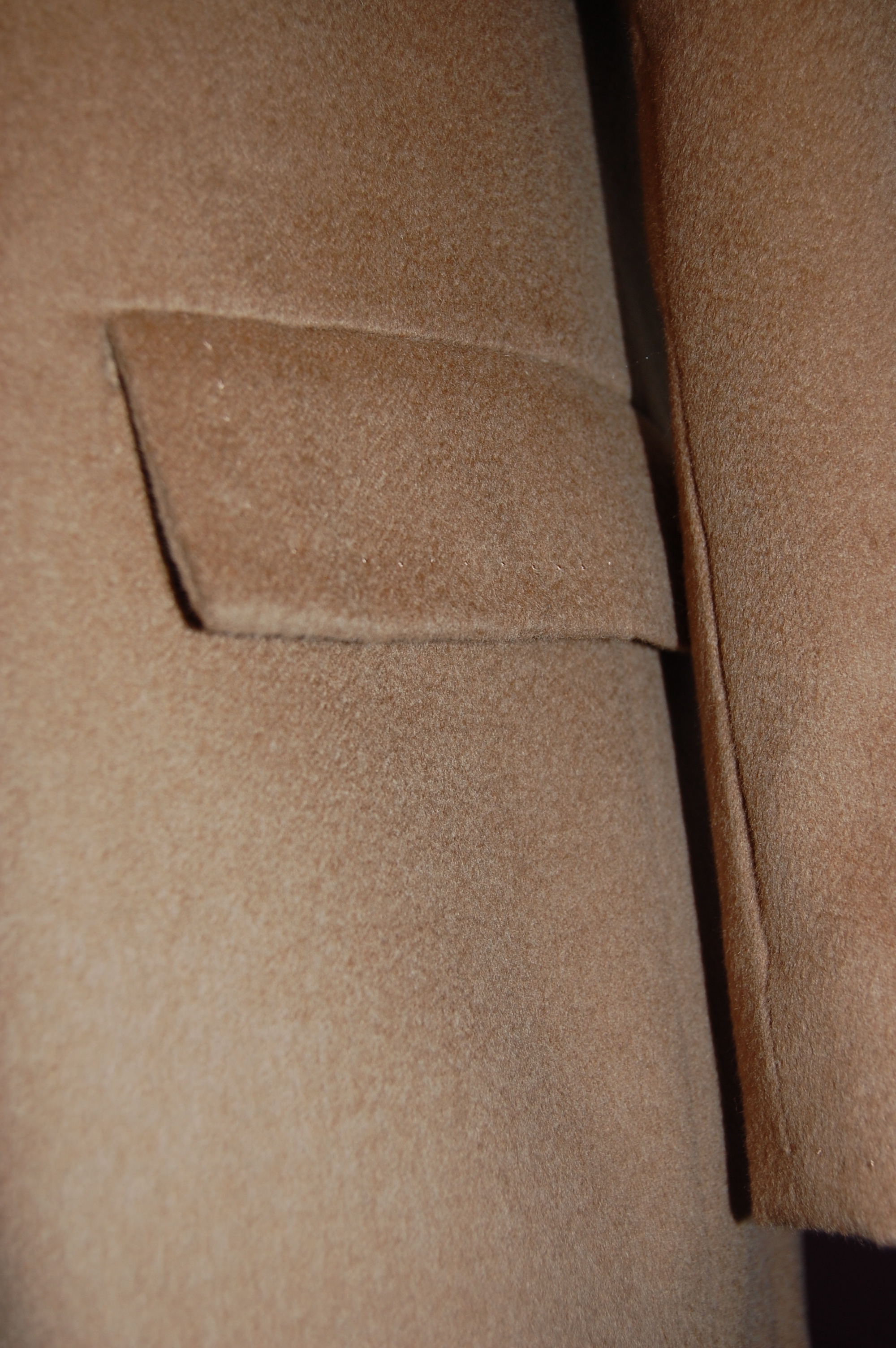
Finally, the pattern called for topstitching the exterior edges of the coat.  Due to the nature of my napped fabric, I thought machine topstitching would detract rather than add.  But – I wasn’t happy with the thought of no topstitching, either.  So I decided to do it by hand.  It wasn’t nearly as time-consuming as I thought it would be, and I am happy with the result.

The topstitching is very subtle, but you can see it here on the pocket flap.

The topstitching is very subtle, but you can see it here on the pocket flap.  Click on the photo for a close-up.

One more thing about this pattern.   When I received it, the pattern pieces for the pants and sleeveless tunic were cut and had obviously been used (although every piece is intact).  The tissue pieces for the coat were still in their factory folds.  On the outside of the pattern in the upper right hand corner is the name Georgia Sanders.  I guess I’ll always wonder if she had plans to make the jacket, too.  I’m so glad she bought this pattern and kept it in such good condition so that it could find its way eventually to me – to help me realize my magnificent obsession from my younger self.

20 Comments

Filed under Buttons - choosing the right ones, Coats, Color blocking, couture construction, Dior darts, underlinings, vintage Vogue Designer patterns, vintage Vogue patterns from the 1970s, Vogue patterns, woolens