Tag Archives: Britex Fabrics

Light Load


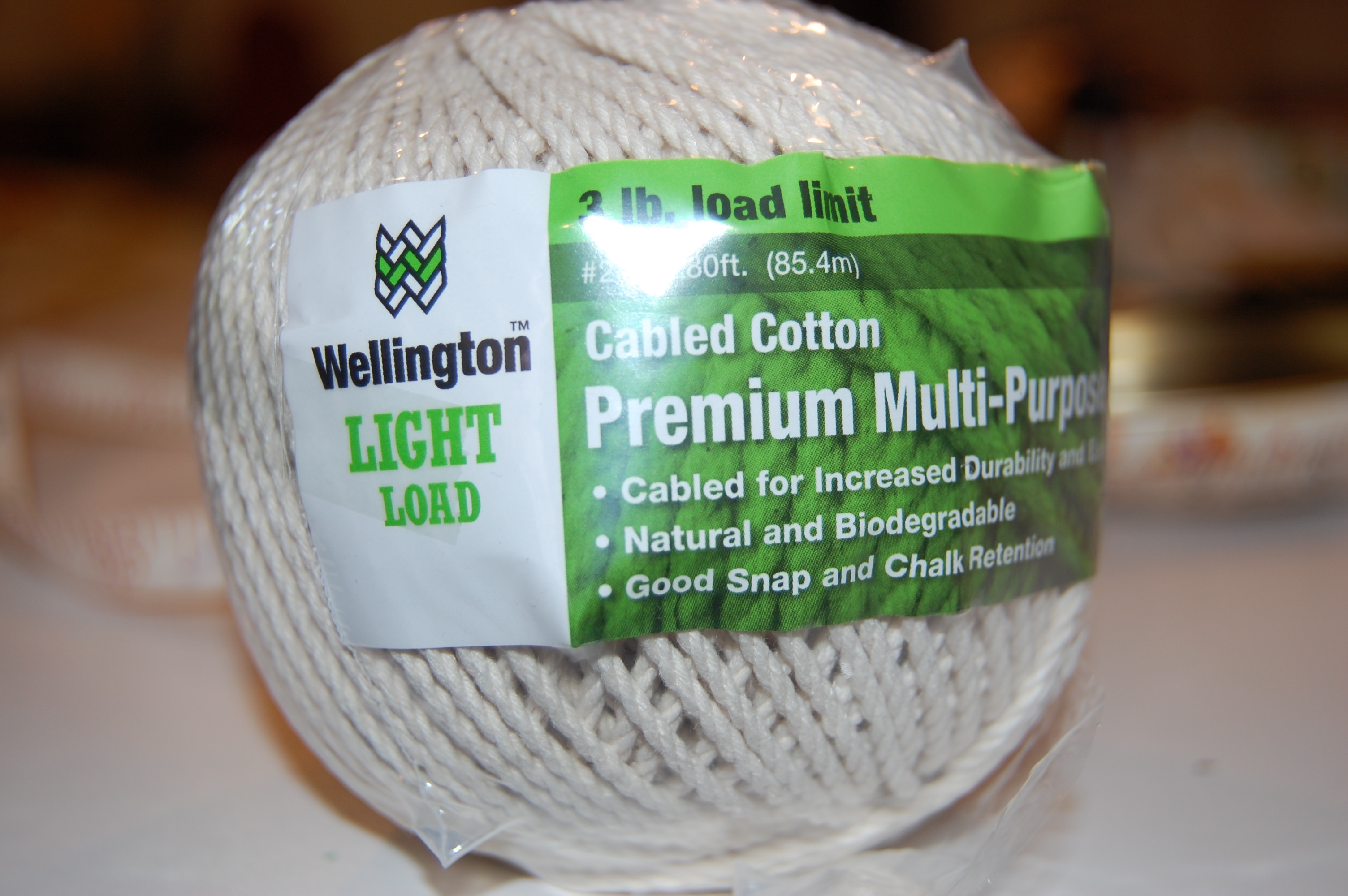
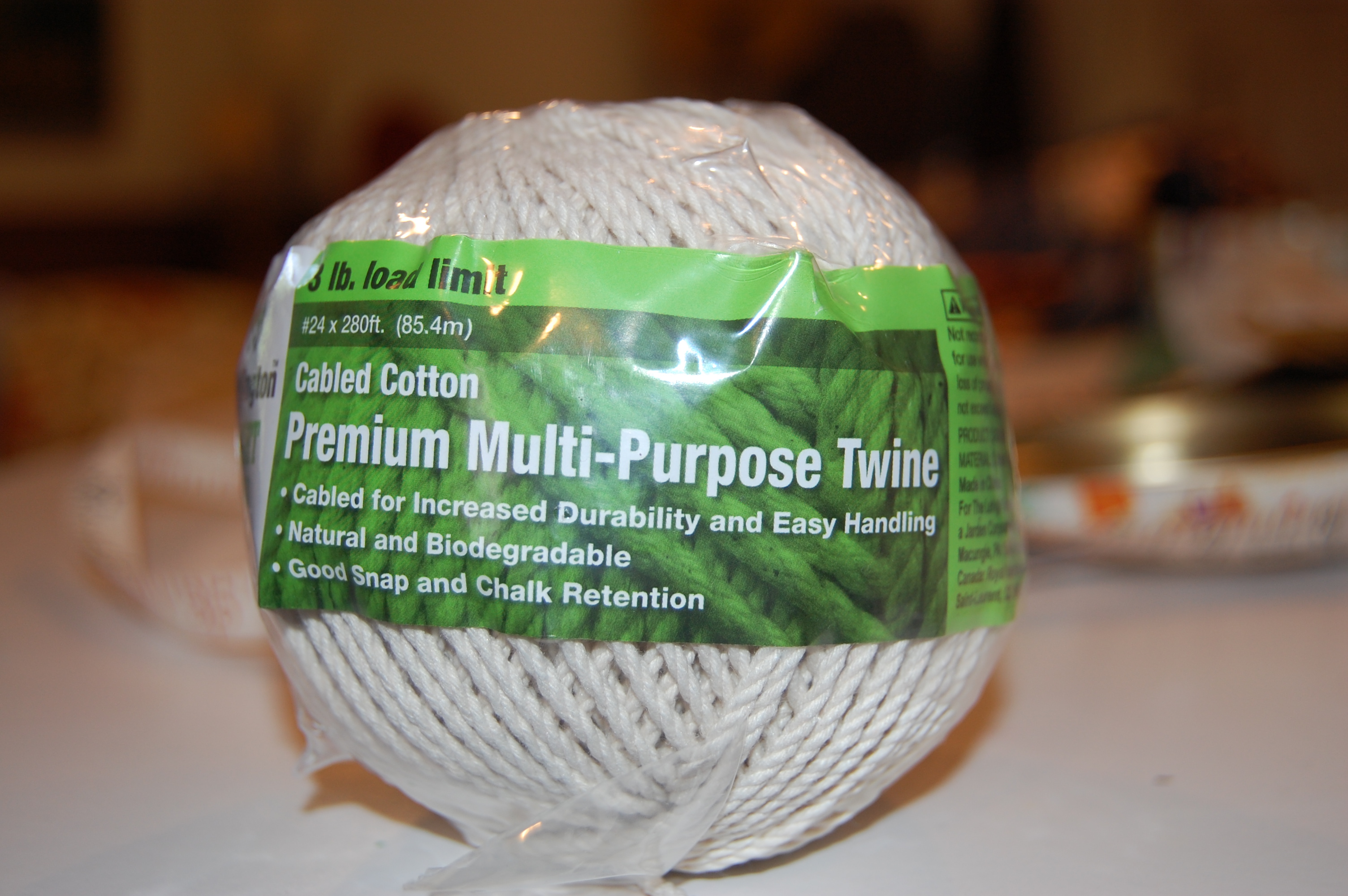
String is a wonderful thing. I am particularly fond of kitchen string. Usually twisted cotton or a twisted cotton blend, it is useful for many things (such as tying together the newspapers for recycling, playing with the cats, securing open bags of flour and sugar, etc., etc.) It also occasionally makes its way upstairs to my sewing room.
Light Load DSC_1380

“Light load” kitchen string happens to be the perfect weight and diameter for making piping to be used in apparel. And – my current project for Fall features piping as one of the main design details.
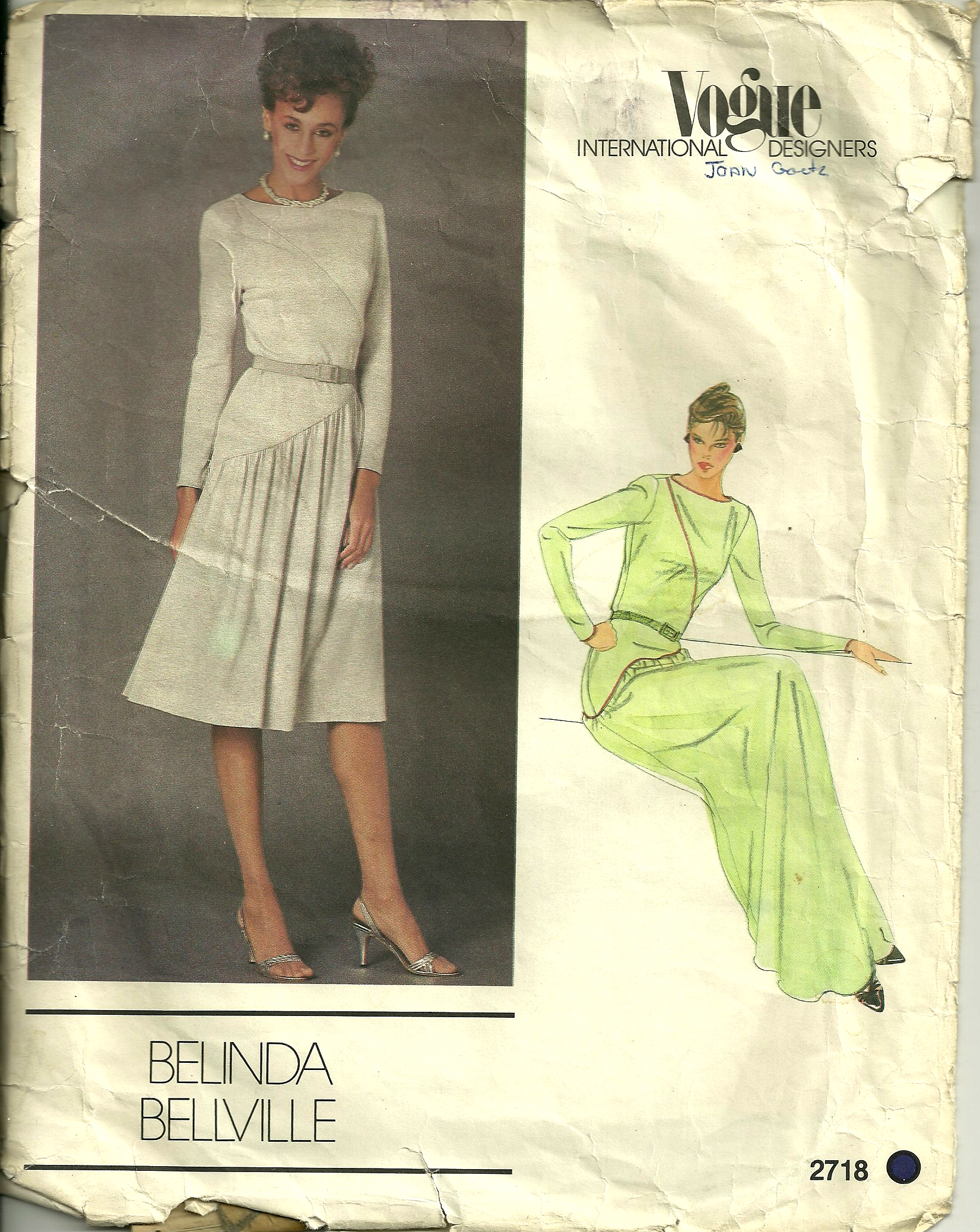
The piping is more clearly visible on the green view of this dress.

The piping is more clearly visible on the green view of this dress.

As luck would have it, I had purchased some hand-dyed silk bias ribbon from Britex Fabrics a couple of years ago. One of the colors I had ordered turned out to be a perfect complement to this silk from Mendel Goldberg, which is slowly making its transformation into a dress.
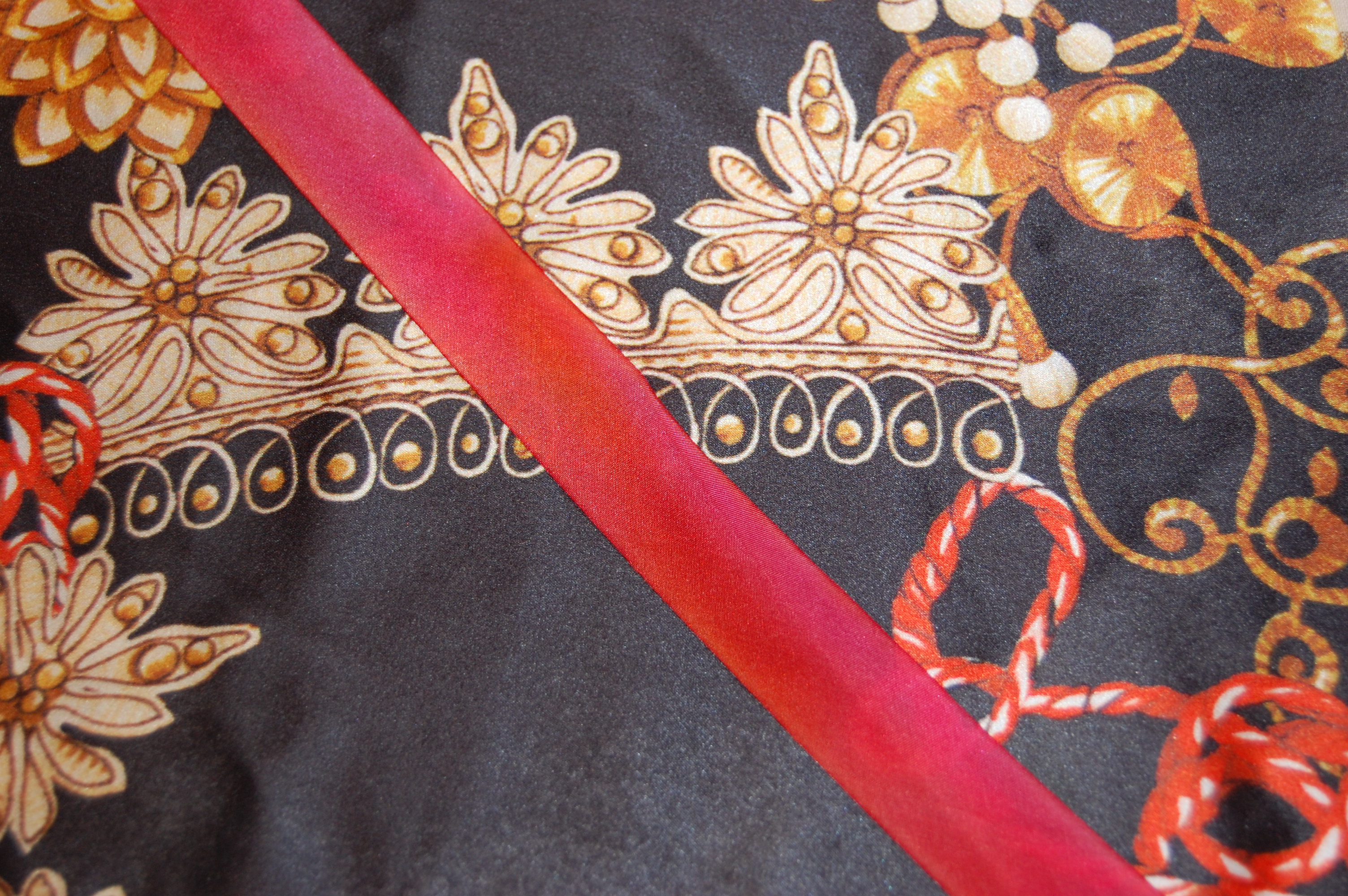
Light Load

After hours and hours of working on the muslin (toile), cutting out the underlining (on the bias to accommodate the stretch of the silk fabric), checking and re-checking (multiple times) to make sure my pattern pieces were laid out properly, and then meticulously basting the gossamer silk gauze underlining and the slippery fashion fabric together, I was ready to do something fun. “What could be easier?” I thought. “The ribbon is already cut on the bias so I’ll just sew up three yards of piping and I’ll be in business.” Except that I kept getting ridges and lumps in my piping as I encased that kitchen string in the silk ribbon. I thought maybe if I stretched it a bit, it might look better, but it really didn’t. I must admit I was discouraged – actually very discouraged. I could not figure out what I was doing wrong, but I knew I needed to take a break from this mess and come back the next day.

Before I left my sewing room, I went to my stack of Threads Magazines to look for a particular issue recently recommended to me for another reason, and in my search found, by chance, the December 1994/January 1995 issue. There on the cover “Techniques for Perfect Piping” was a featured article.
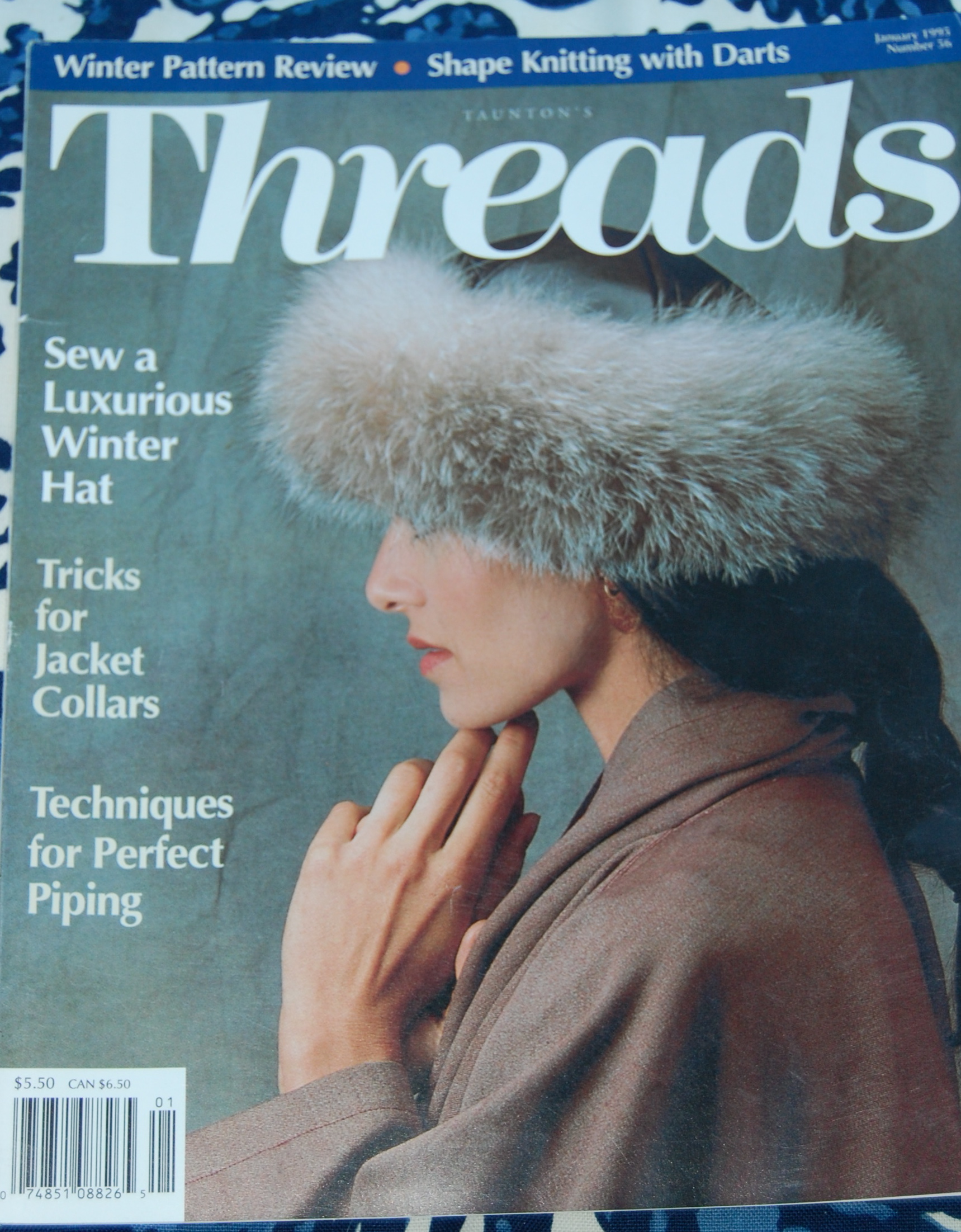
I have many odd issues of Threads Magazine, but earlier in the year I bought the Threads Magazine Archive 1985-2013, available on their website. I can't recommend it highly enough - decades of sewing advice and expertise is readily available at the click of your computer mouse!

I have many odd issues of Threads Magazine, but earlier in the year I bought the Threads Magazine Archive 1985-2013, available for purchase on their website. I can’t recommend it highly enough – decades of sewing advice and expertise is readily available at the click of your computer mouse!

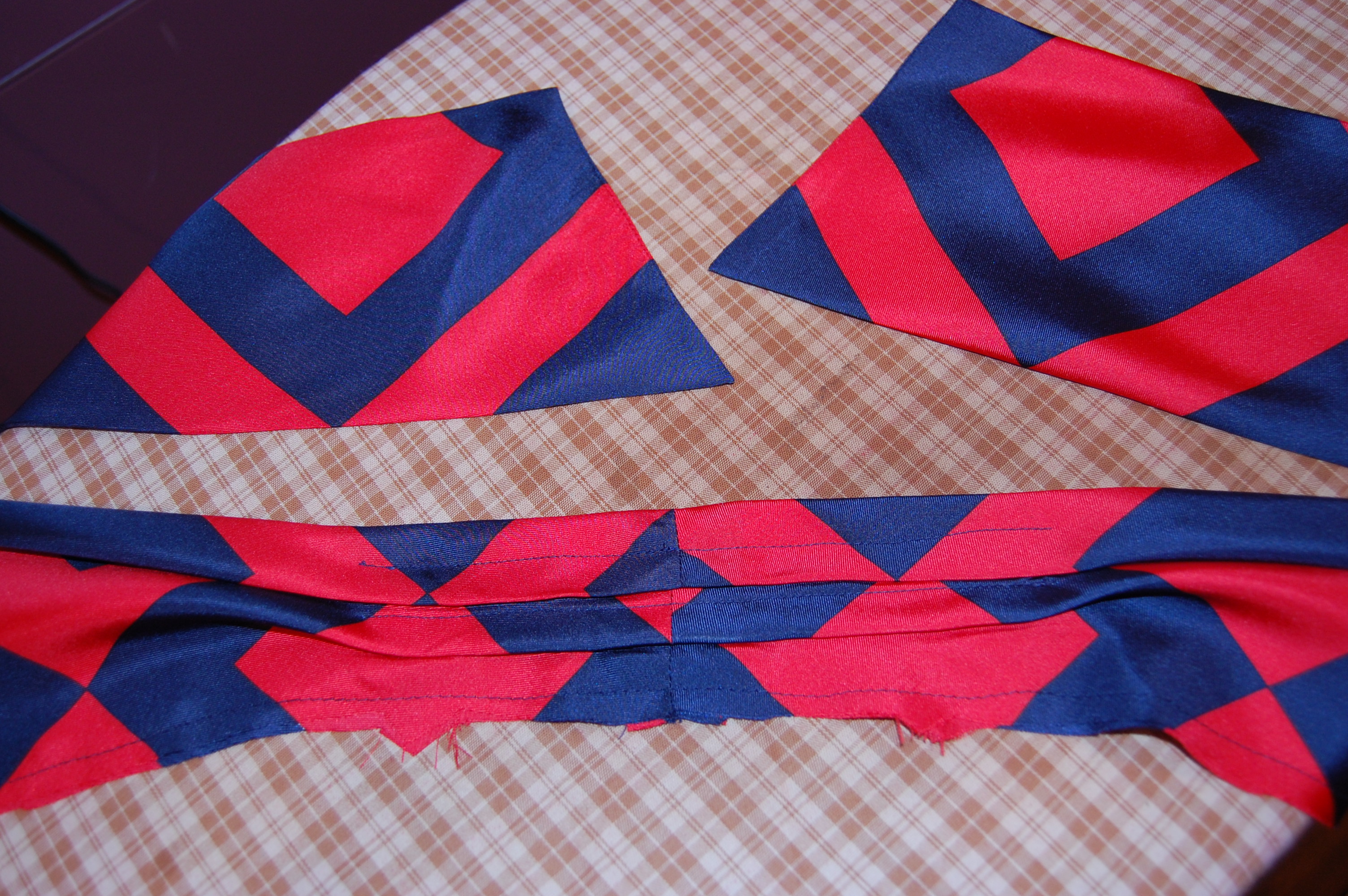
Needless to say, that became my evening reading. One line in this article by Linda Wakefield led me to the solution to my problem: “I also recommend reducing presser foot pressure, if possible, so that the fabric doesn’t twist or ripple as you stitch.” Even though I am unable to change the presser foot tension on my machine, that advice made me think that I needed to stabilize and reinforce the silk bias ribbon somehow to make it feed more evenly through the needle. The next day, back in my sewing room, I got some tissue paper – the kind one uses for wrapping presents – and cut it into strips. I placed a single layer of tissue under the silk ribbon as I stitched – and voila! Perfect piping emerged from my machine.
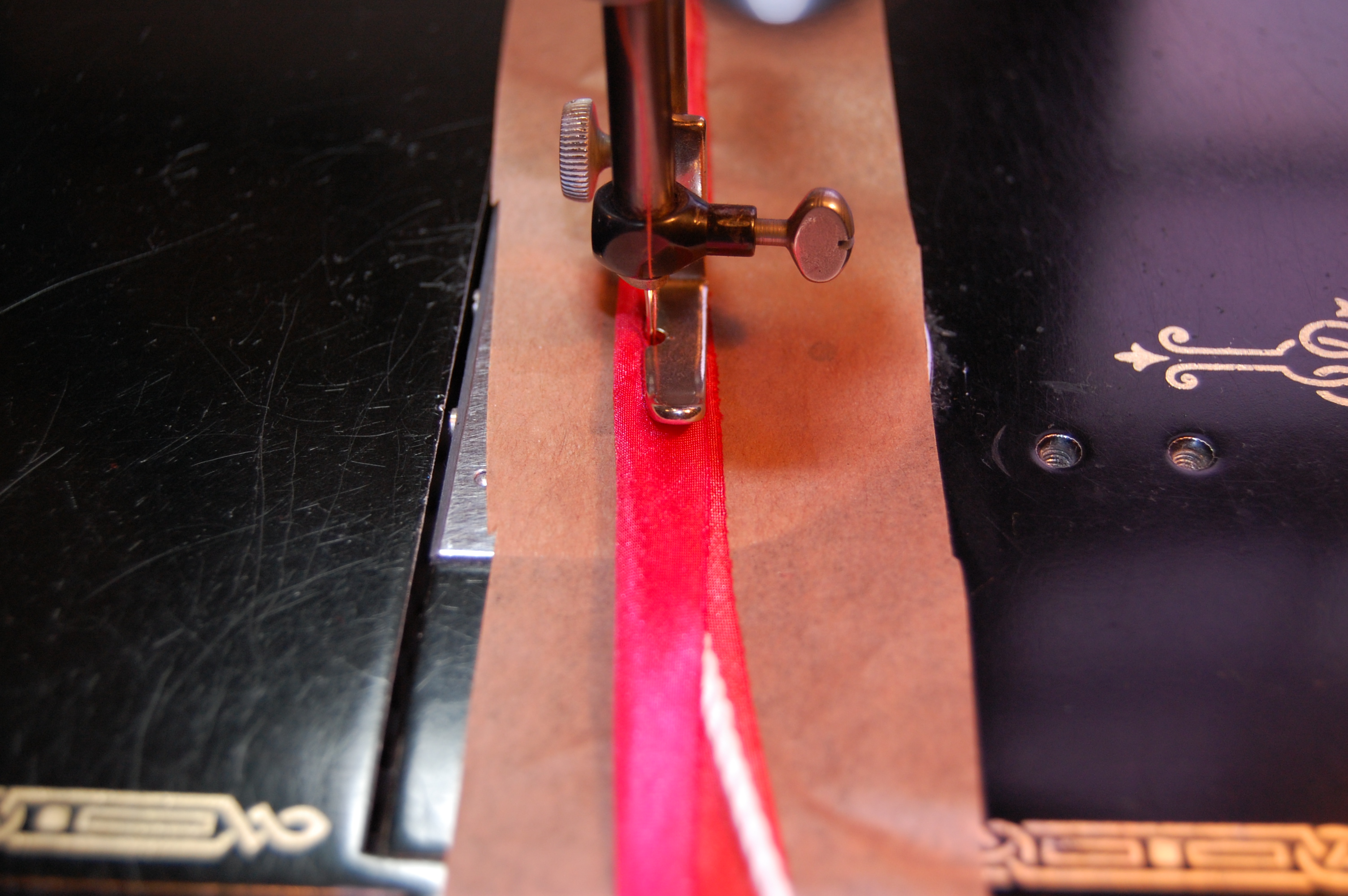
The tissue is brown (which is just some I happened to have with my gift wrapping supplies.)
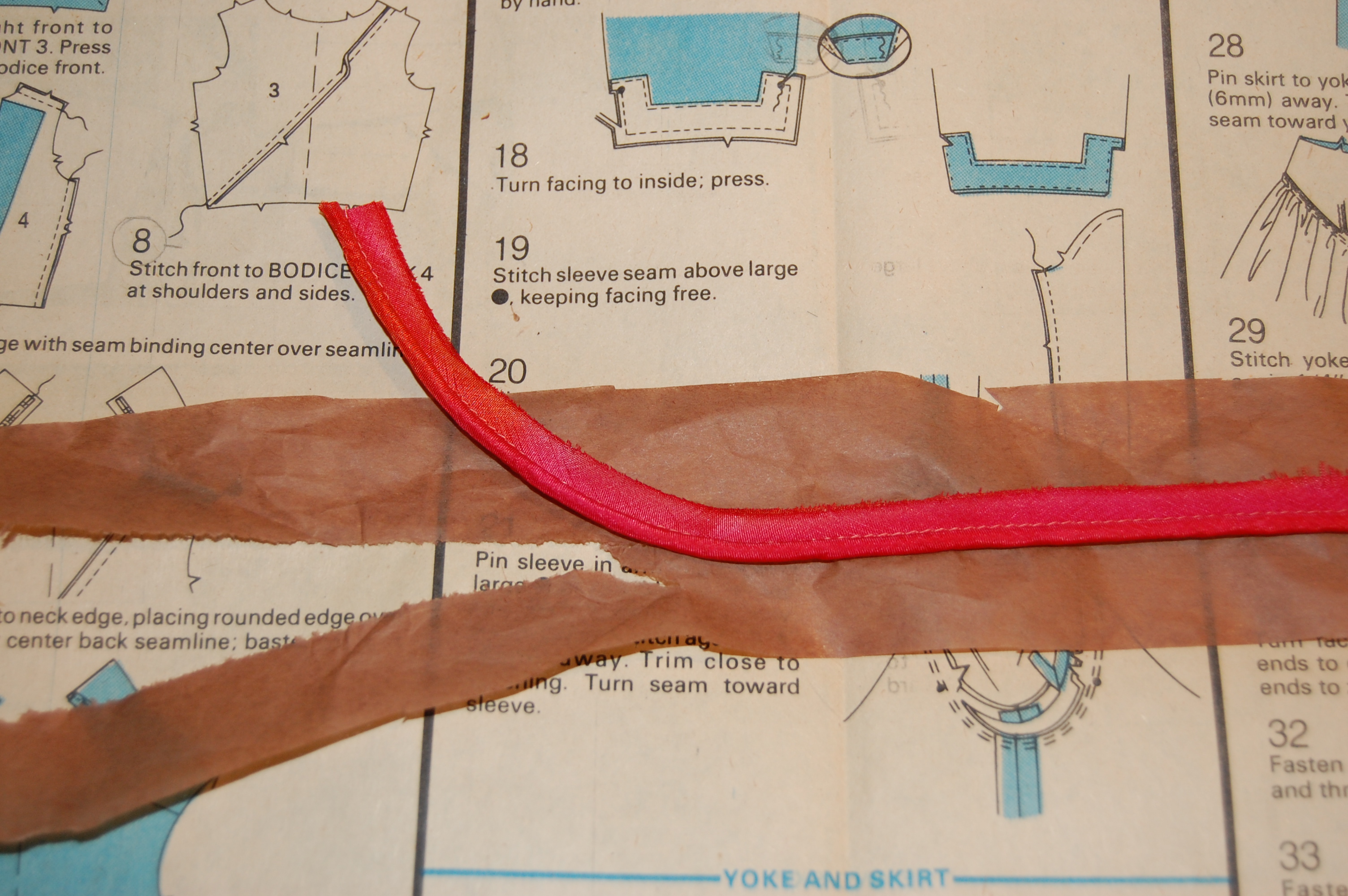
The tissue is brown (which is just some I happened to have with my gift wrapping supplies.)


 The tissue paper tears off easily and cleanly from the silk piping.


The tissue paper tears off easily and cleanly from the silk piping.

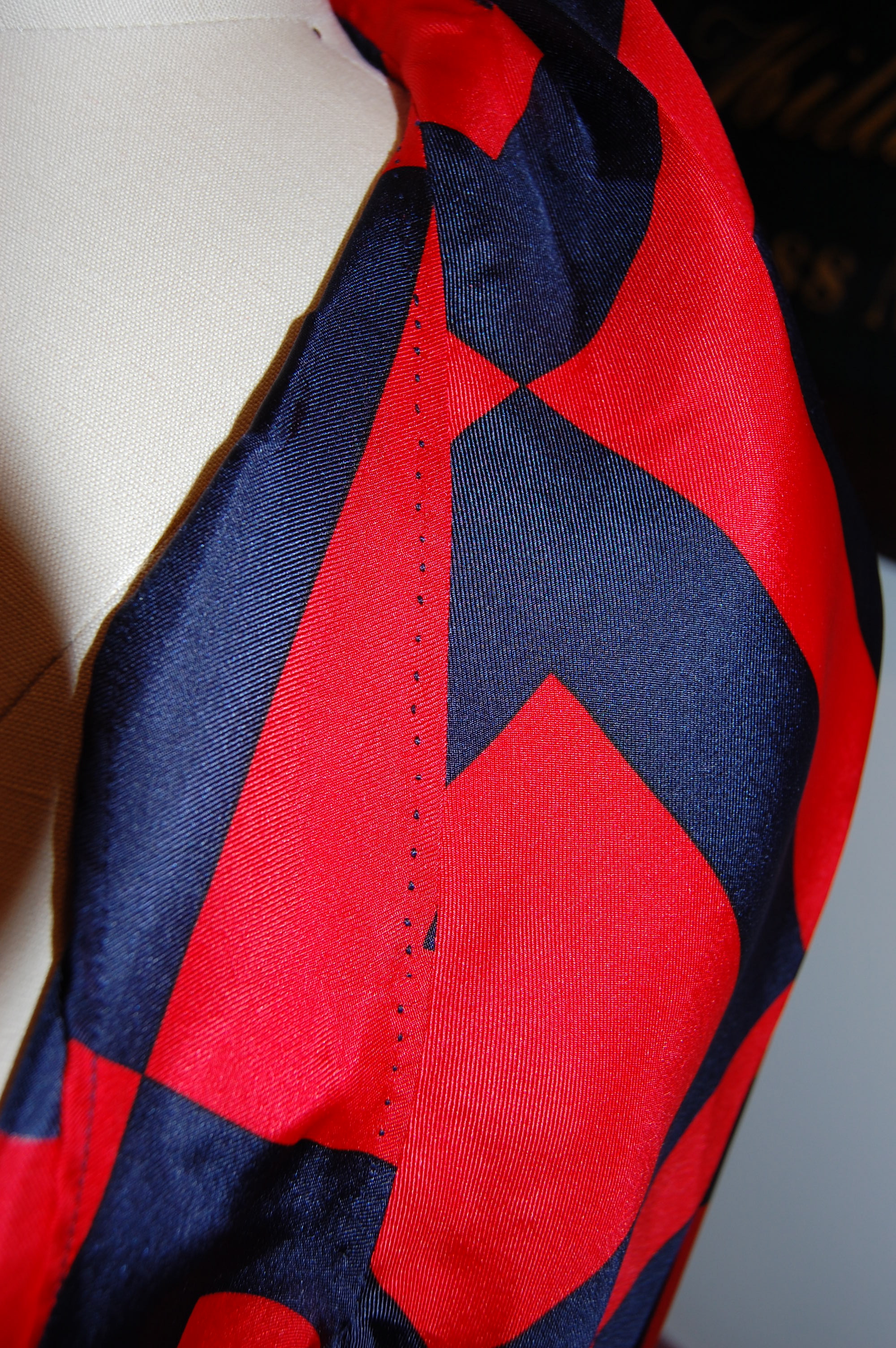
Further advice in the article gave tips on applying the piping. I decided to try my hand with this added guidance, choosing to start with the sleeves. The pattern calls for piping around the lower edge – a nice short distance and easy to fix if I wasn’t happy with the finished look. What do you think?
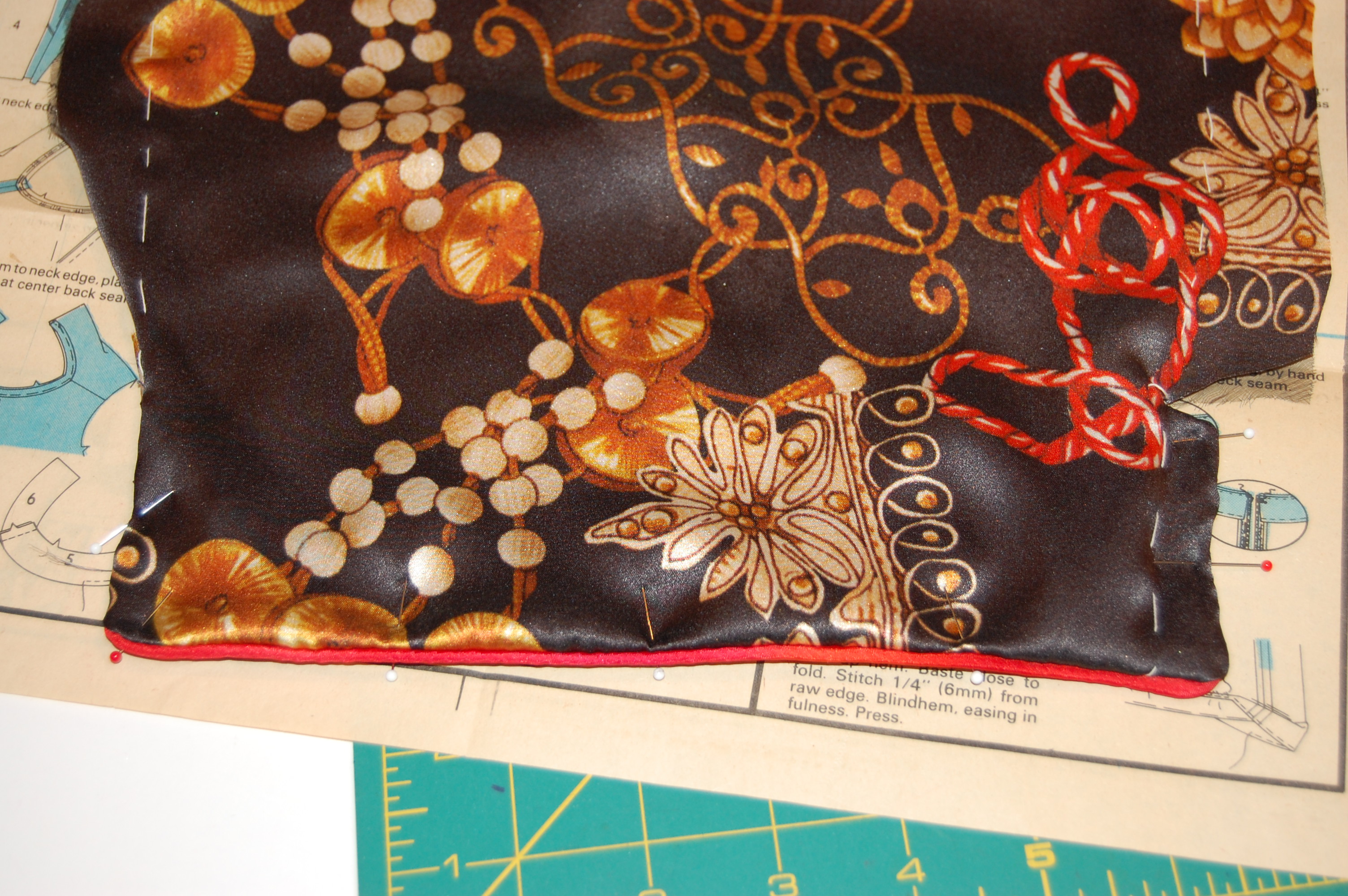
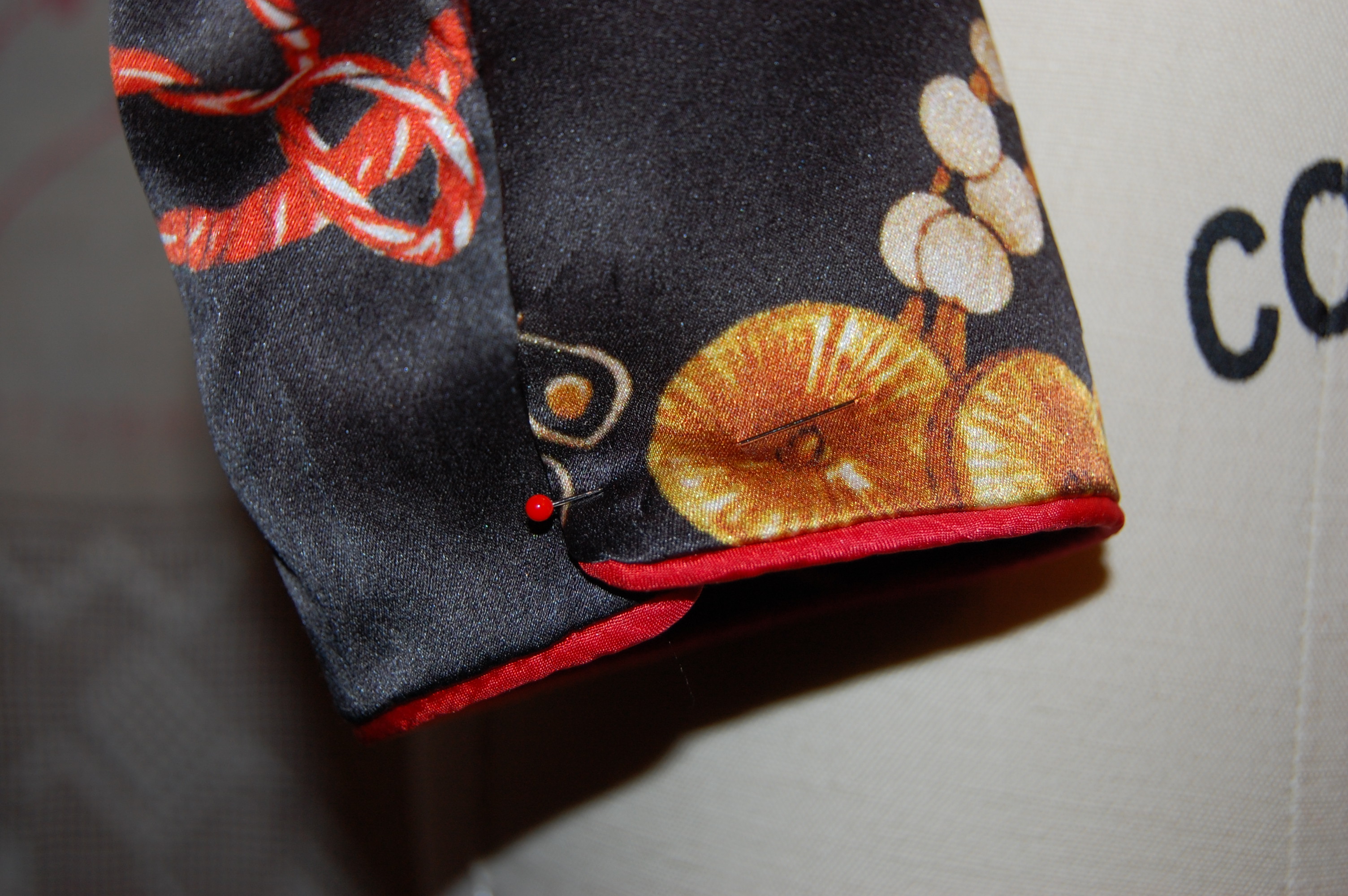
Light Load

The sleeve has a side opening - to be secured by snaps.  Here it is just pinned.

The sleeve has a side opening – to be secured by snaps. Here it is just pinned.

There will still, I am sure, be some tedious moments as I continue work on this dress, but my load was definitely made lighter by something as simple as —- tissue paper!
26 Comments

Filed under 1980's dress patterns, piping, sewing in silk, vintage Vogue Designer patterns

When Enthusiasm Meets Reality

Fashion sewing has it all. Even the making of a simple dress has some or all of these aspects inherent in its construction: color theory, proper fabric selection, proportion and fitting, pattern manipulation and engineering, technical know-how, style sense, intrigue. Intrigue? Yes – Intrigue. I have done it again. I have my heart set on a making a certain style in a certain fabric, and I don’t have very much of that fabric with which to work.

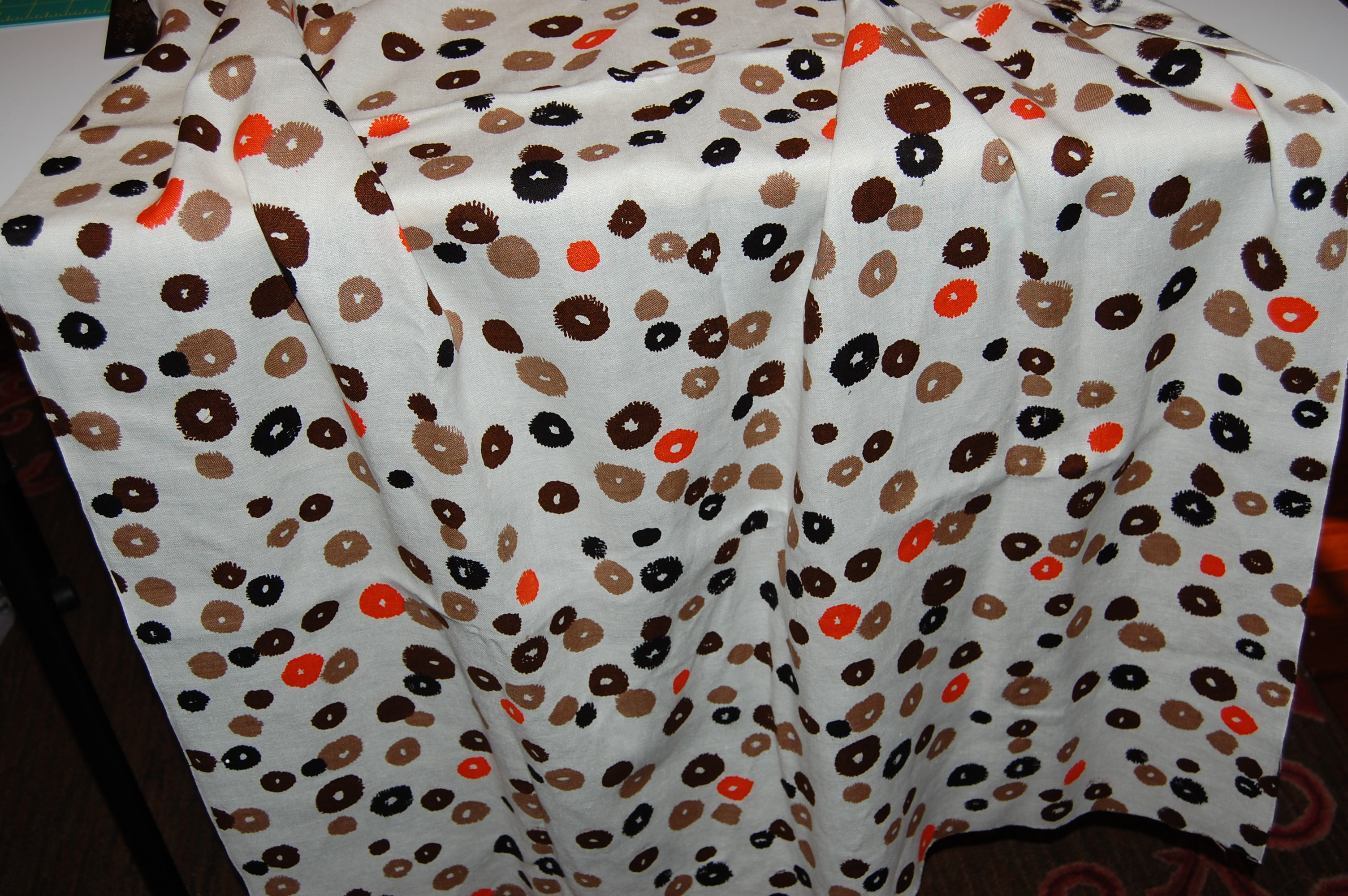
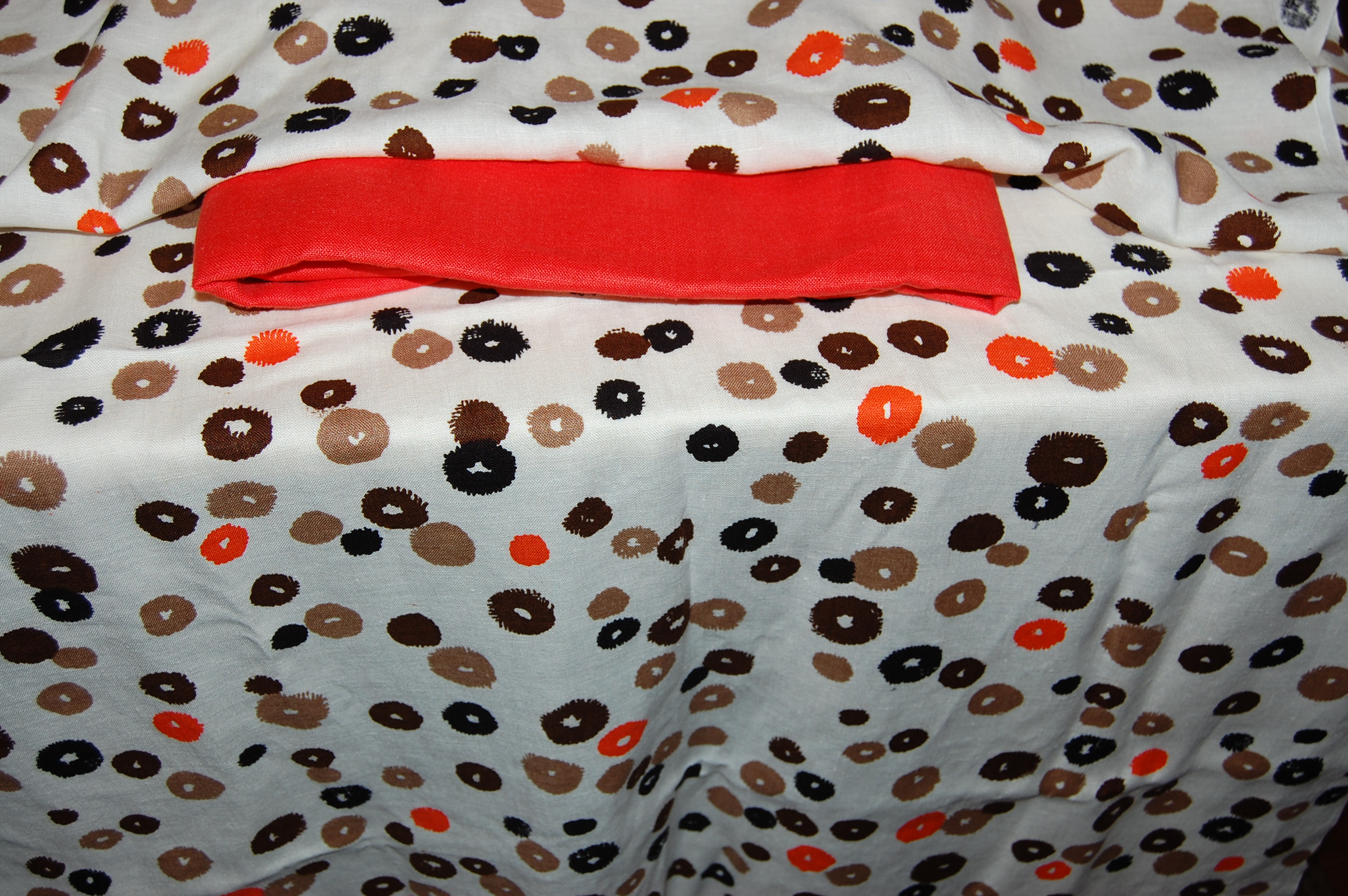
I found this piece of Moygashel linen earlier in the year. (It was sold to me as “probably Moygashel”, and how I determined for certain that is indeed that famous brand of Irish linen required some detective work, which I’ll cover in a future post.)

Enthusiasm meets reality

Freshly laundered, this linen looks and feels like new!

When I first saw it, I immediately thought it would make a cute pair of pants, even though I don’t wear a lot of brown. But I was really drawn to the little explosions of orange scattered throughout the yardage. Actually I should qualify that by saying “scant” yardage. This was only a piece of fabric 1 and 5/8 yards long, which sounds reasonable until the width of the fabric is figured into the equation. At 35” wide, this was not a lot of fabric.   Nevertheless, I certainly figured I could get a slim pair of simple pants out of it. That was my intent until I finished my polka-dotted sheath dress just recently. Cool linen dresses and Summer just seem to go together, and suddenly I decided I did not want a pair of pants – I wanted another sleeveless dress.

This was partly determined by the fact that I have a piece of new orange linen I picked up a couple of years ago from Britex Fabrics, and the thought of pairing this funky, stylized-dot fabric with an orange belt made out of that linen sealed the deal for me in my enthusiastic wardrobe dreams.

Enthusiasm meets reality

Then reality hit. How was I going to manage to squeak a sheath dress out of the amount of fabric in hand? After eyeballing the stretched out fabric, with my sheath dress pattern pieces arranged casually on top, it did not take long for me to know that, NO, this would not work. I would have to figure something else out, but I wasn’t giving up on the dress idea.

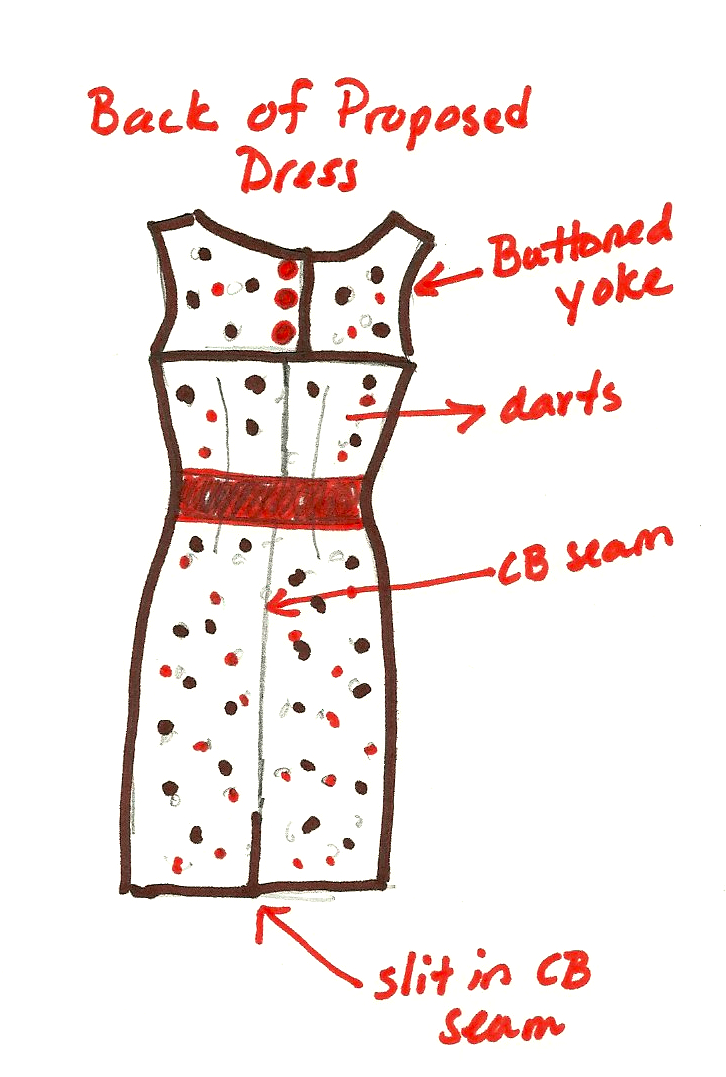
The only solution was to get more creative. I have always loved subtle “back” details on dresses, such as unusual closures, V-necklines above a back zippered opening, an embellishment of some sort, that type of thing. And I suddenly realized that if I could section the back pieces (only) of my sheath pattern so that I would have an upper back yoke, then I could probably fit everything on the fabric (knowing it would still be a squeeze, however).

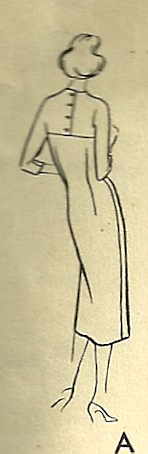
Now I got really excited. One of my favorite patterns (from 1957) features a back- buttoned yoke, which is seamed right above the shaping darts in the back body of the dress. I figured this is exactly the spot where I would need to section the back of the dress to make it fit on my fabric.

The yoke on this dress is obviously part of the kimono sleeve section, but I like the idea of a three-buttoned yoke.

The yoke on this dress is obviously part of the kimono sleeve section, but I like the idea of a three-buttoned yoke.

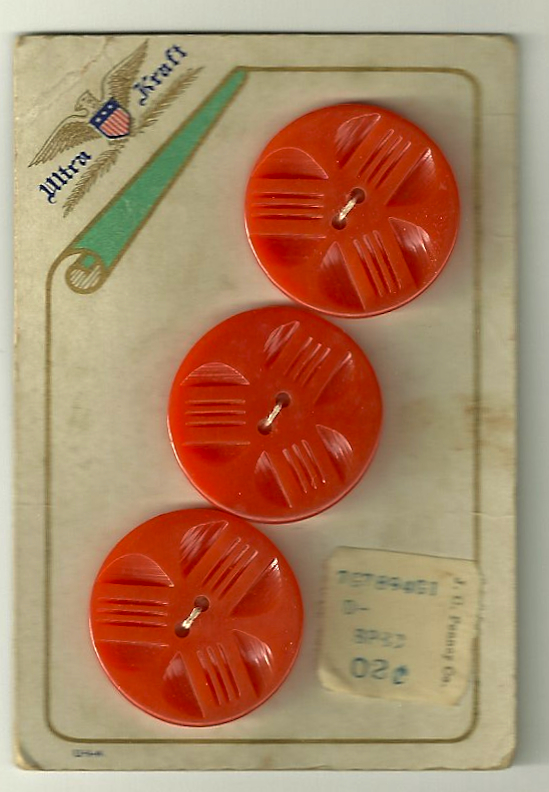
And then – wheels turning in my head – I seemed to remember I had some orange buttons (vintage, no less!) in my button box.   These seem to me to be a perfect pairing with the linen fabric:

This card of buttons cost 2 cents originally!  They seem to mimic the small orange explosions on the dress fabric.

This card of buttons cost 2 cents originally! They seem to mimic the small orange explosions on the dress fabric.

I have spread out my current working sheath dress muslin a couple of times to determine the viability of my plan. I really think it will work. I am prepared to use narrower seam allowances than I usually like, and I may have to face the hem.

This is how I envision the back of my proposed dress.

This is how I envision the back of my proposed dress.

But – first things first. Initially I will be making a new muslin, with the altered and sectioned back pieces. I am sure my enthusiasm for this idea will keep me focused, and in this case, reality may have sewn the seeds for a much more creative outcome than I originally envisioned!


22 Comments

Filed under Buttons - choosing the right ones, Linen, Moygashel linen, Polka dots, Uncategorized, vintage buttons

A Preoccupation with Emilio Pucci

In the world of designer fashion, there are certain names which are synonymous with specific looks.  Obvious examples are Coco Chanel with her little black dress and classic cardigan jacket, Christian Dior with his figure-enhancing full skirts and feminine décolleté necklines, and Emilio Pucci with his distinctive colorful prints,  smart sportswear and flowing at-home-wear.

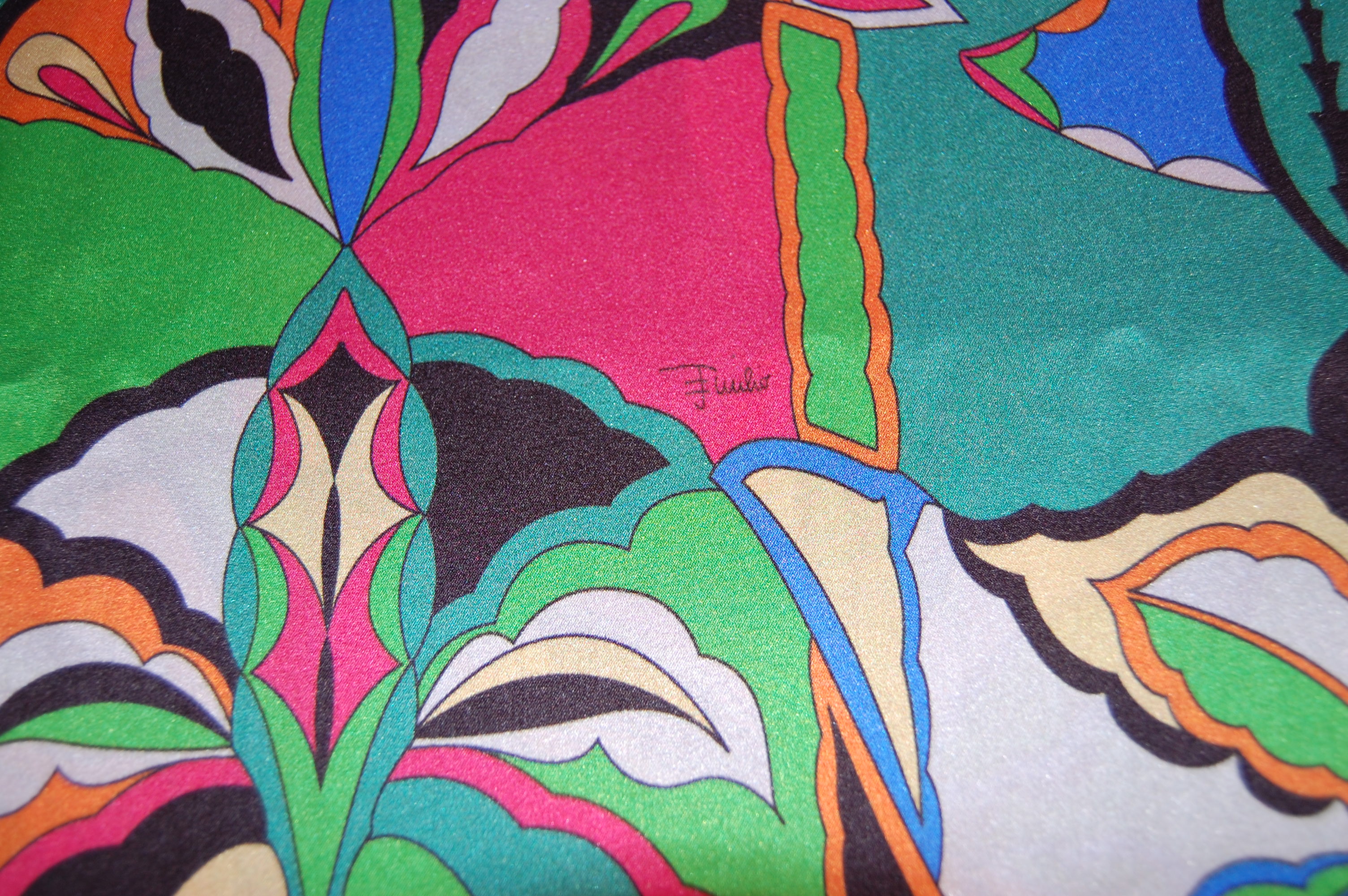
Lately I’ve been thinking about Emilio Pucci (1914-1992) a lot.   It all started a couple of years ago on one of my West Coast visits to Britex Fabrics in San Francisco. I had already decided upon several lengths of fabric, when I saw a silk charmeuse, which clearly spoke to me of Pucci.  The design was so amazing, the colors so vibrant, and the silk so luscious, that, with a little encouragement from my husband, I added it to my pile.  At 60” wide, I thought 2 yards would suffice for a blouse, not really knowing what I would make.

Pucci

DSC_1183

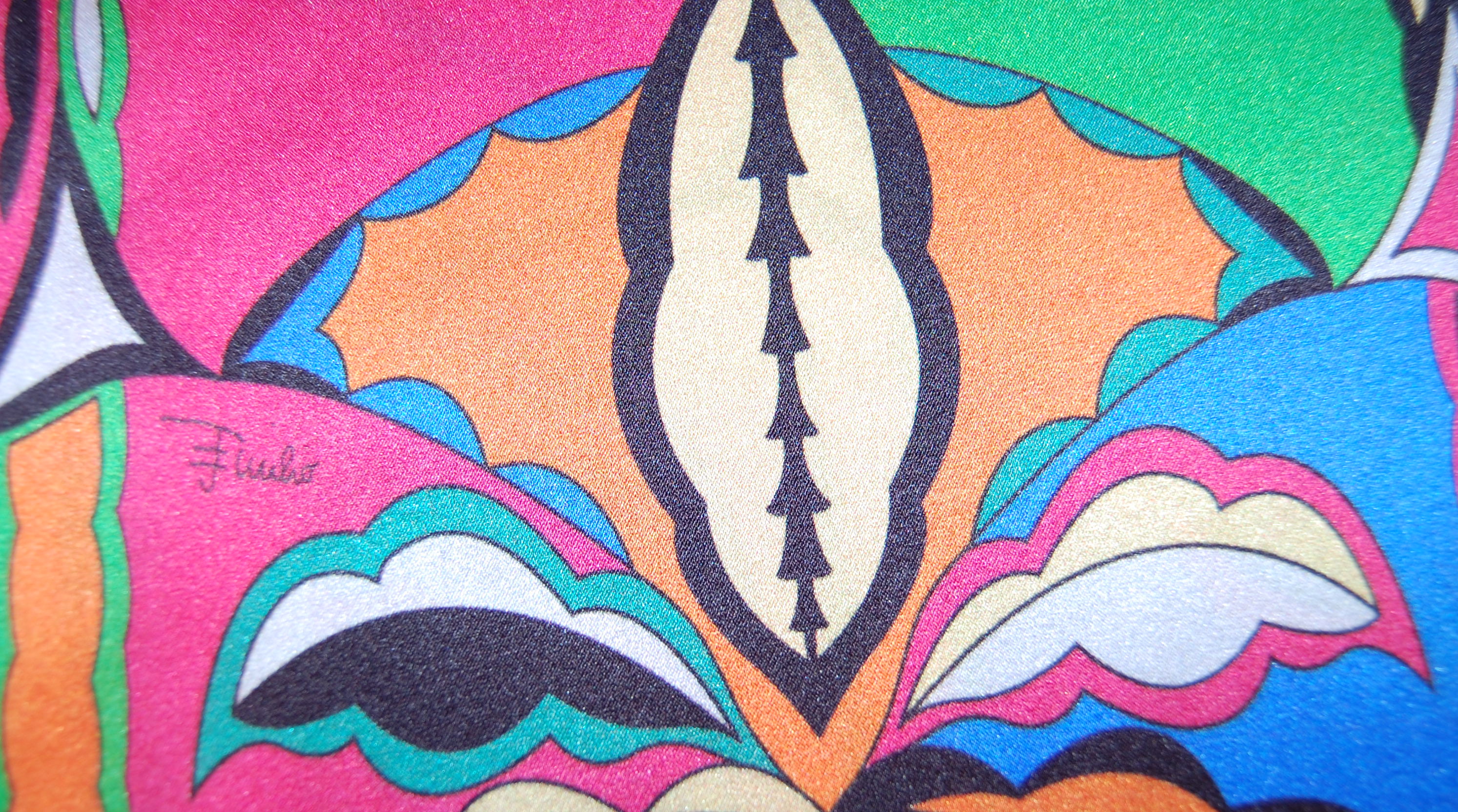
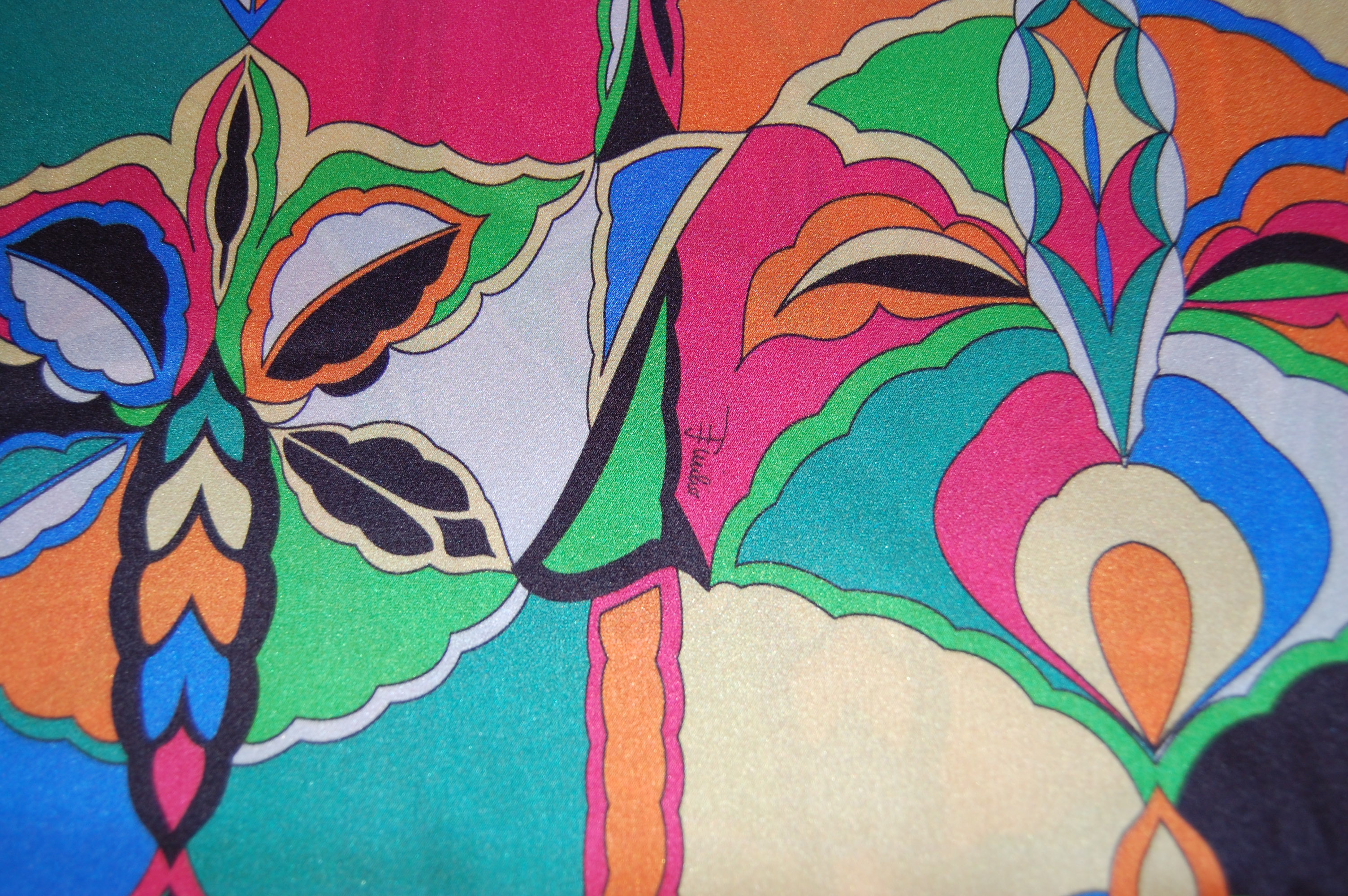
The silk I purchased seemed to have all the bells and whistles of a classic Pucci print.  (Pucci’s daughter, Laudomia took over the business after her father’s death, and has continued her father’s signature style.)  He only used the finest, luscious fabrics with a color palette “straight from the Aegean horizon” according to the entry on him in The St. James Fashion Encyclopedia  ( Visible Ink Press, Detroit, MI, 1997, pages 325-326):  “turquoise and ultramarine set against sea green and lime, or hot fuchsia and sunflower yellow”.  These colors are arranged in “optical fantasies of geometric shapes” which eschew repetitiveness. And, finally, every authentic Pucci fabric carries his discreet “Emilio” signature.  (The Vintage Traveler blog has an excellent post on Pucci and his sporty prints, which shows another example of his signature and his diverse designs.)

The small "Emilio" signature is at the lower part of the pink section.

The small “Emilio” signature is at the lower part of the pink section.

The signature is spread thinly across the expanse of the fabric.

The signature is spread thinly across the expanse of the fabric.

And here is a signature printed vertically rather than horizontally.

And here is a signature printed vertically rather than horizontally.

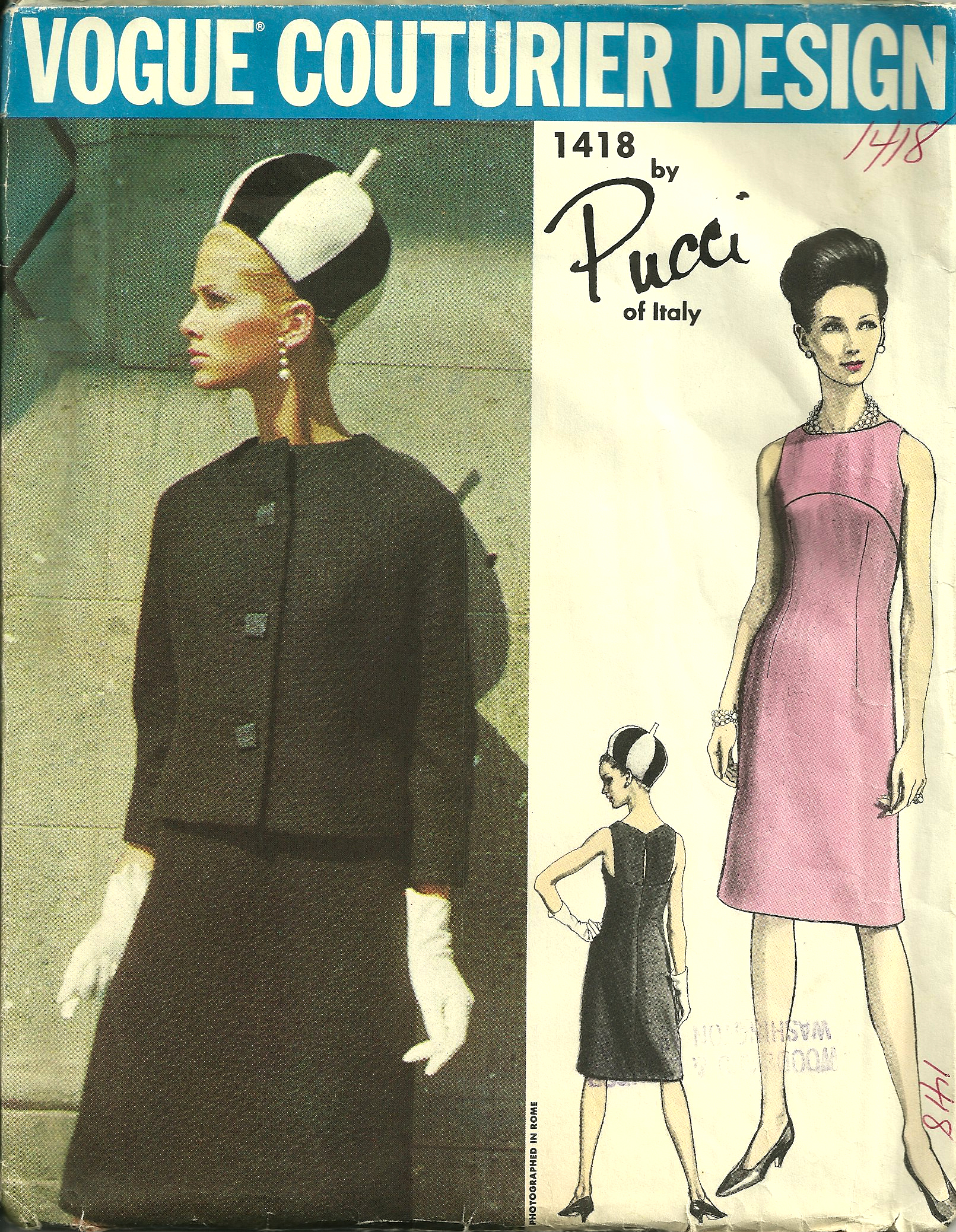
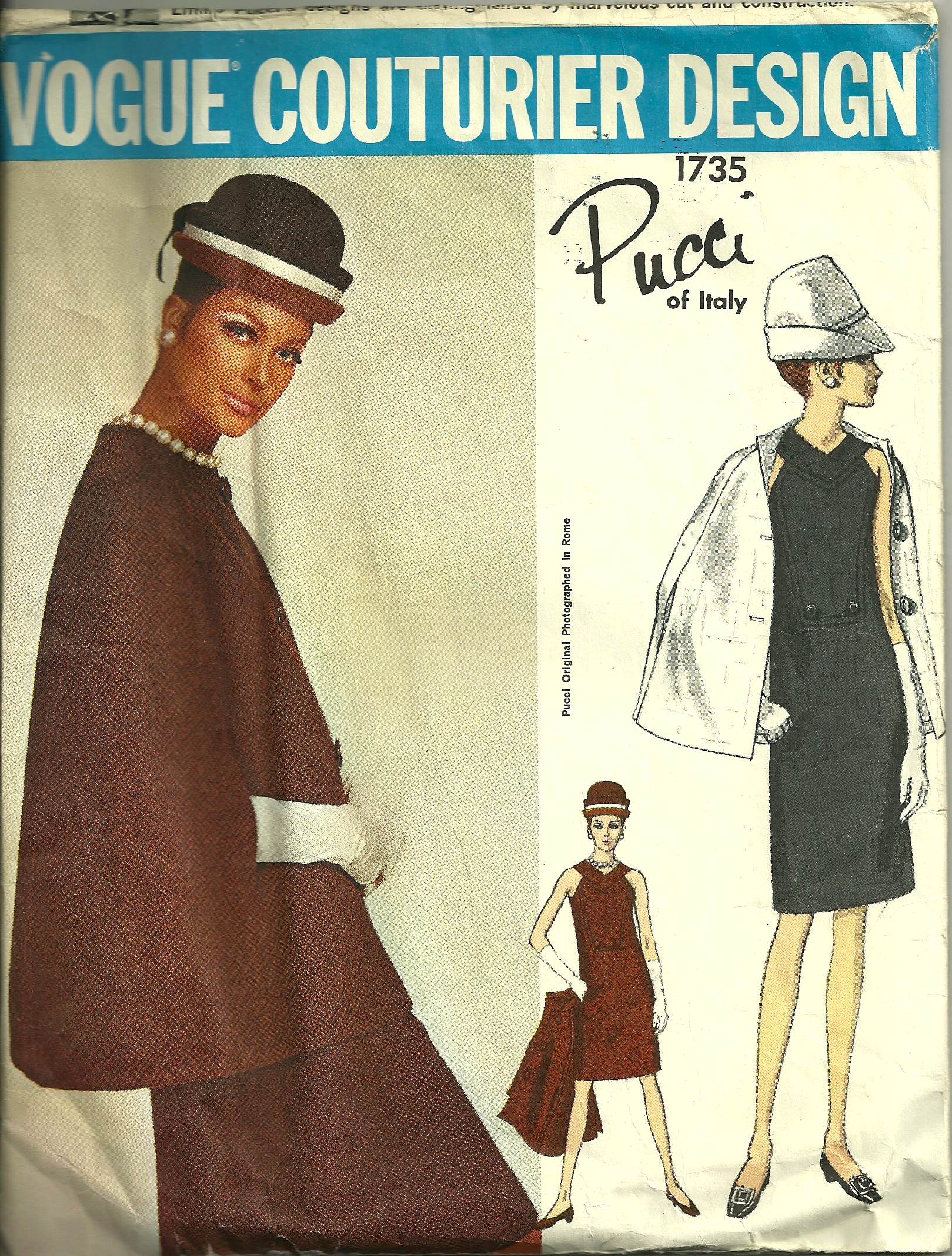
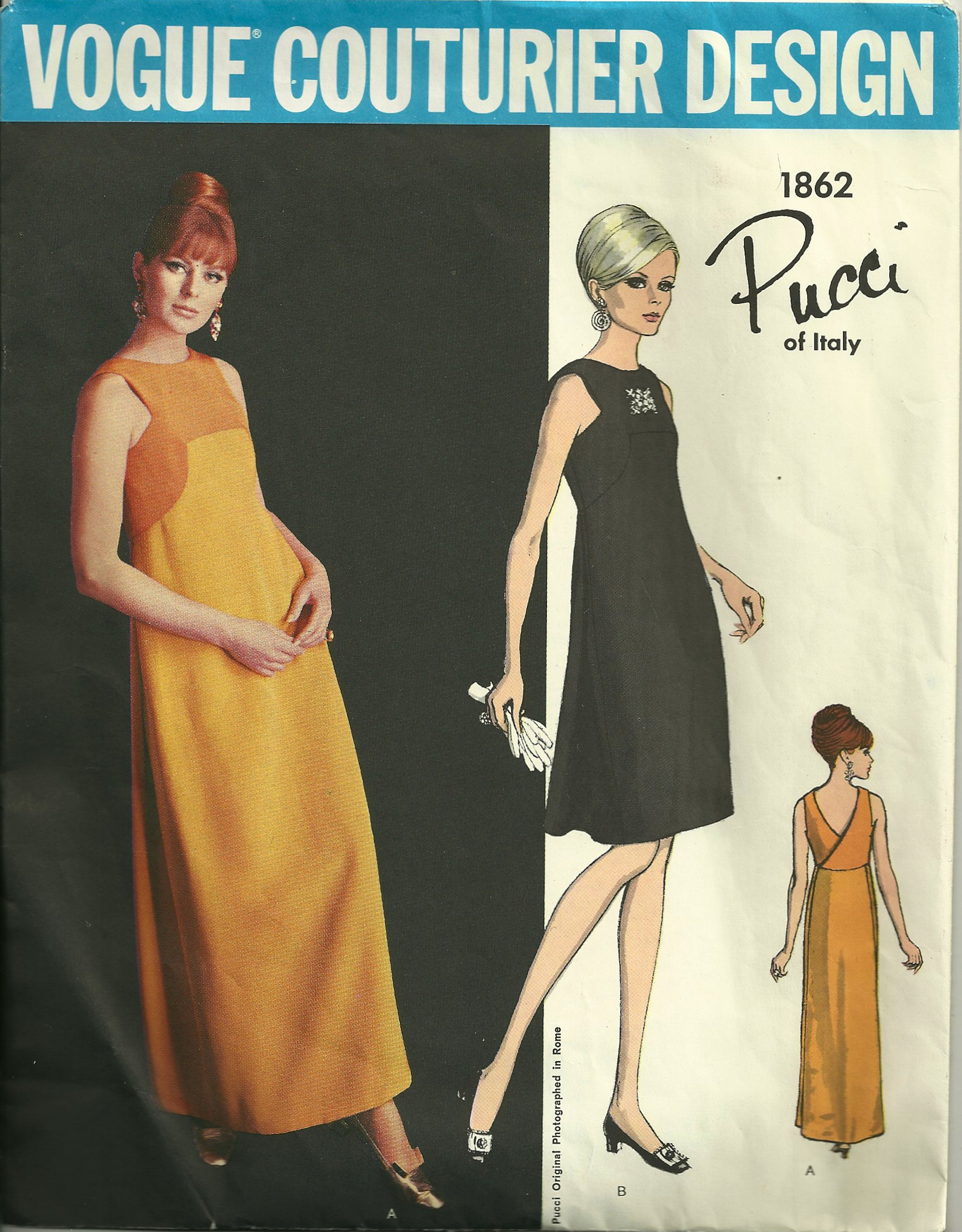
Shortly after this fabric purchase, I began to get a greater and new appreciation for Pucci’s diversity as a fashion designer as I acquired a few of his Vogue Designer patterns.  Instead of featuring styles dependent upon his bright and unusual fabric designs, they showed feminine dresses and jackets, with clean lines and a surprising touch of demureness.   Here are the three patterns I purchased:

Happy New Sewing Year - Pucci pattern

Pucci - pattern envelope

Wrap dress - 5 (Pucci)

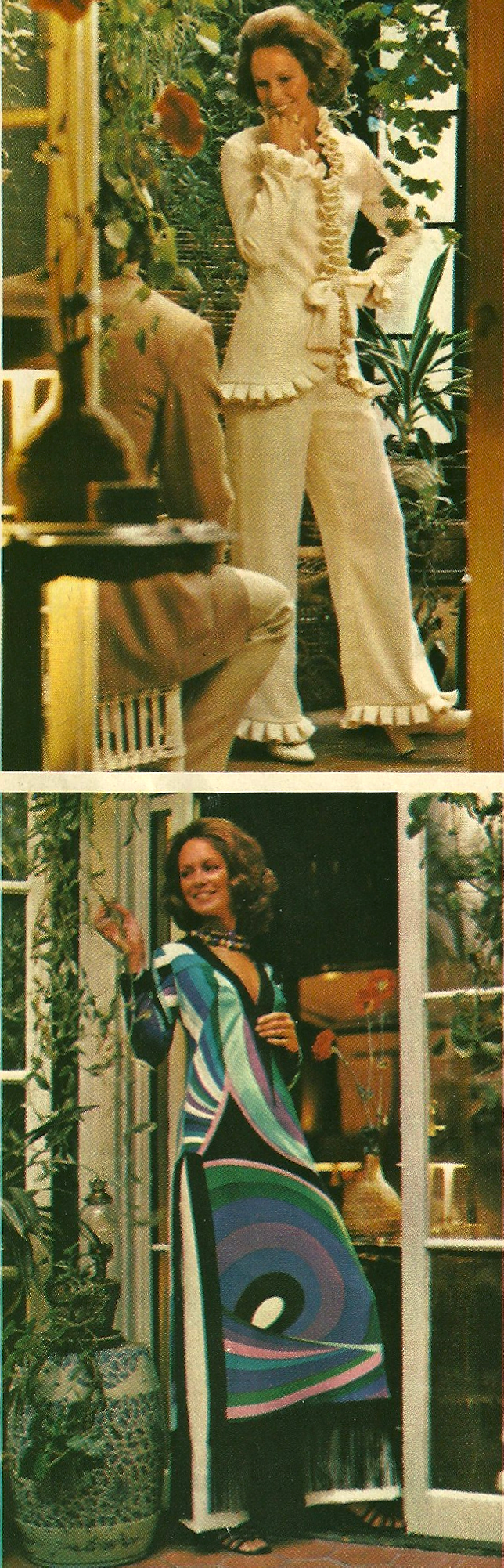
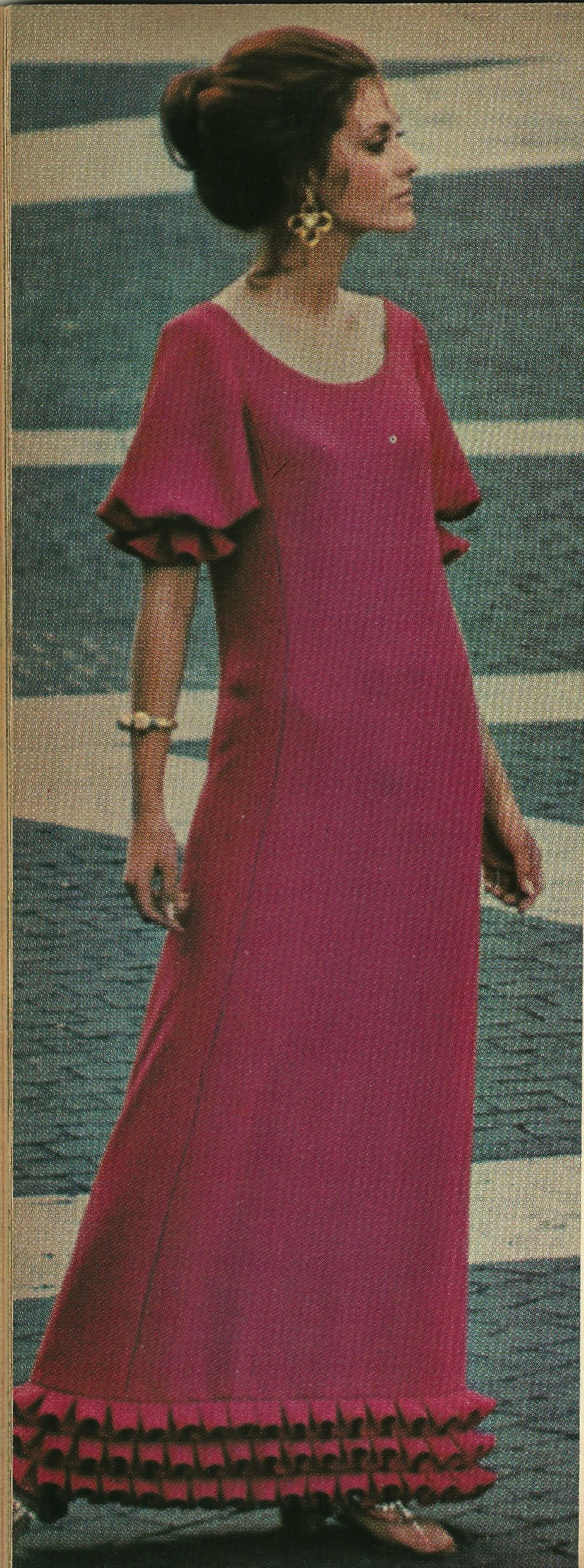
Some other of his designs for Vogue patterns were featured in Vogue Pattern Book Magazine:

The caption in this June/July 1972 article says:  "Emilio Pucci adds glamour to your life with an off-white silk crepe pantsuit..." while the lower picture shows his "signature colors on a silk jersey  lounge gown."

The caption in this June/July 1972 article says: “Emilio Pucci adds glamour to your life with an off-white silk crepe pantsuit…” while the lower picture shows his “signature colors on a silk jersey lounge gown.”

This lovely Pucci gown was shown in the April/May 1970 issue of VPB Magazine.

This lovely Pucci gown was shown in the April/May 1970 issue of VPB Magazine.

Both the fabric and the patterns sat in hibernation in one of the closets in my sewing room until an idea began to take hold in my mind.  I decided I’d like to use one of my Pucci patterns for my authentic Pucci fabric. It just seemed totally logical to me. I measured my fabric again and found I had closer to 2¼ yards.  I was envisioning pattern # 1418, with the dress in the silk print, paired with the jacket in black, lined in the same silk.  With this plan in mind, I found a lightweight, soft and silky wool/cotton waffle weave in black at Britex Fabrics in early February while I was on the West Coast for Susan Khalje’s Couture Sewing School Class – perfect for the jacket.

Hopefully the "waffle" weave shows up enough in this picture.

Hopefully the “waffle” weave shows up enough in this picture.

With pattern, fabrics, and a vision, I was ready to go on my next big project.  There was only one gnawing question – would I have enough yardage of the Pucci silk to make that sheath-style dress and line the jacket?

The answer to that question  – deserves its own Fifty Dresses post!

18 Comments

Filed under sewing in silk, Uncategorized, vintage Vogue patterns from the 1960s, vintage Vogue patterns from the 1970s

Magnificent Obsession

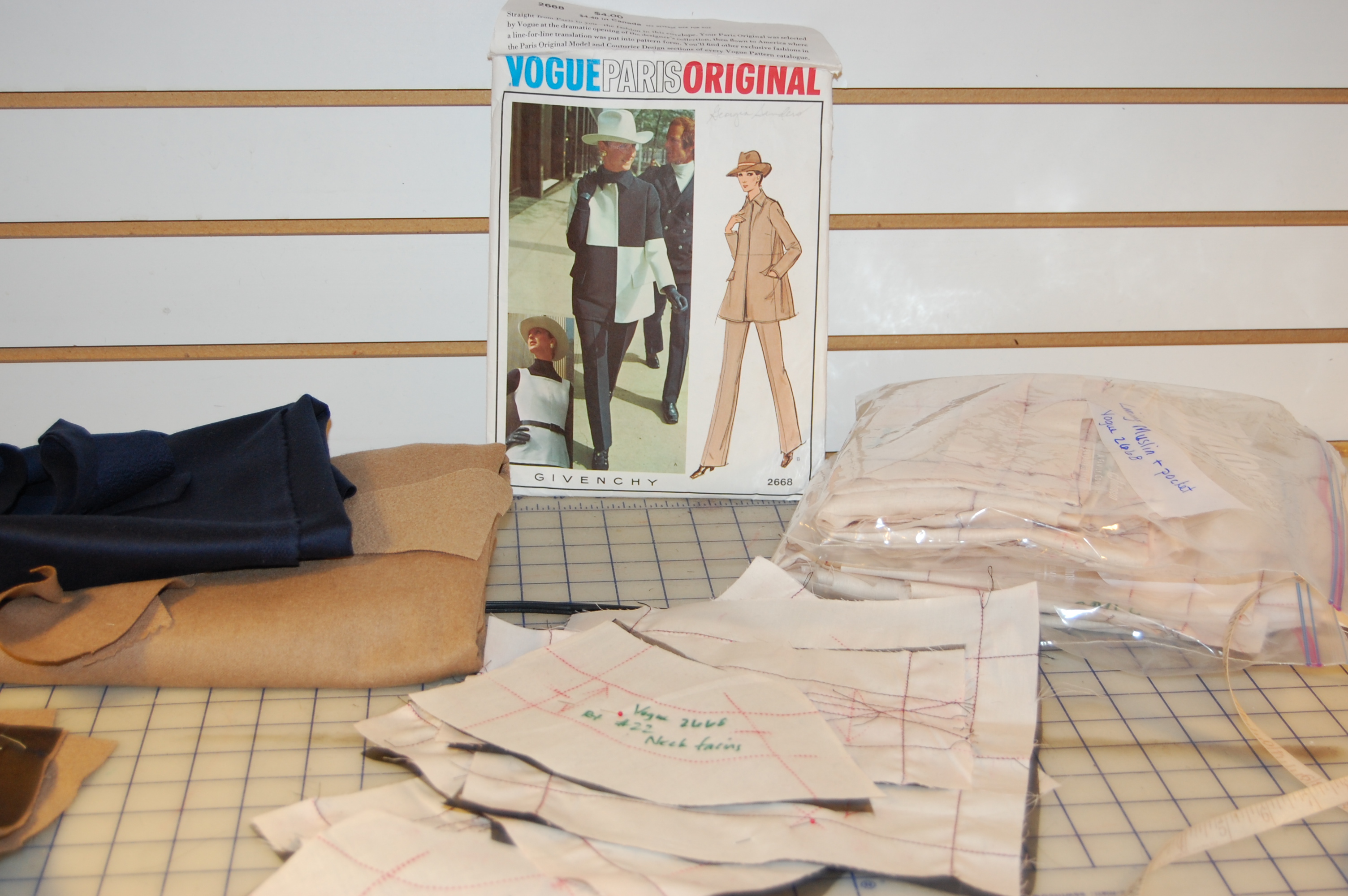
Sometimes the dreams and aspirations of our younger days take a long time to come to fruition.  Although I was doing a lot of fashion sewing for myself when I was in my twenties, there were many more Vogue pattern designs which I never had the opportunity to make.  One was Vogue Paris Original #2668 by Hubert de Givenchy (1927-).

Coats of certain length - 7 I never forgot the jacket, in particular, featured in this Designer Pattern.  Over the years I occasionally obssessed about this pattern, regretting that I had not purchased it.  I never imagined I would have a second chance to make it mine, but thanks to the marvels of the Internet, I did.  When I saw a listing for it in this Etsy store months ago, and it was in my size, I knew it was time to buy it.

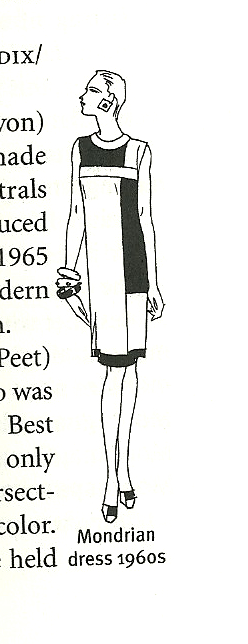
The use of color blocking, as featured in View A, became stylish in the mid-1960s, when Yves Saint Laurent introduced his classic Mondrian dress.

This little sketch from The Fairchild Dictionary of Fashion, Fairchild Publications, Inc., New York, New , York, 2010, p. 329, shows the classic blocked design.

This little sketch from The Fairchild Dictionary of Fashion, Fairchild Publications, Inc., New York, New  York, 2010, p. 329, shows the classic blocked design.

The appeal of the use of large geometrical sections of contrasting colors was widespread then and has, for many of us, never lost its cachet.  The clean precise lines, and diverse use of fabrics in color blocking must have appealed to Hubert de Givenchy’s sense of design.  Known for simplicity and refinement, according to Arlene C. Cooper, writing in the St. James Fashion Encyclopedia, Givenchy emphasizes “line rather than decoration”.  Further, Givenchy is known for “coats that are marvels of line and volume…”  (St. James Fashion Encyclopedia, Visible Ink Press, Detroit, MI, 1997, p. 154).  Vogue Patterns must have been exceptionally pleased to have the rights to this design for its Designer Series in the early 1970’s.

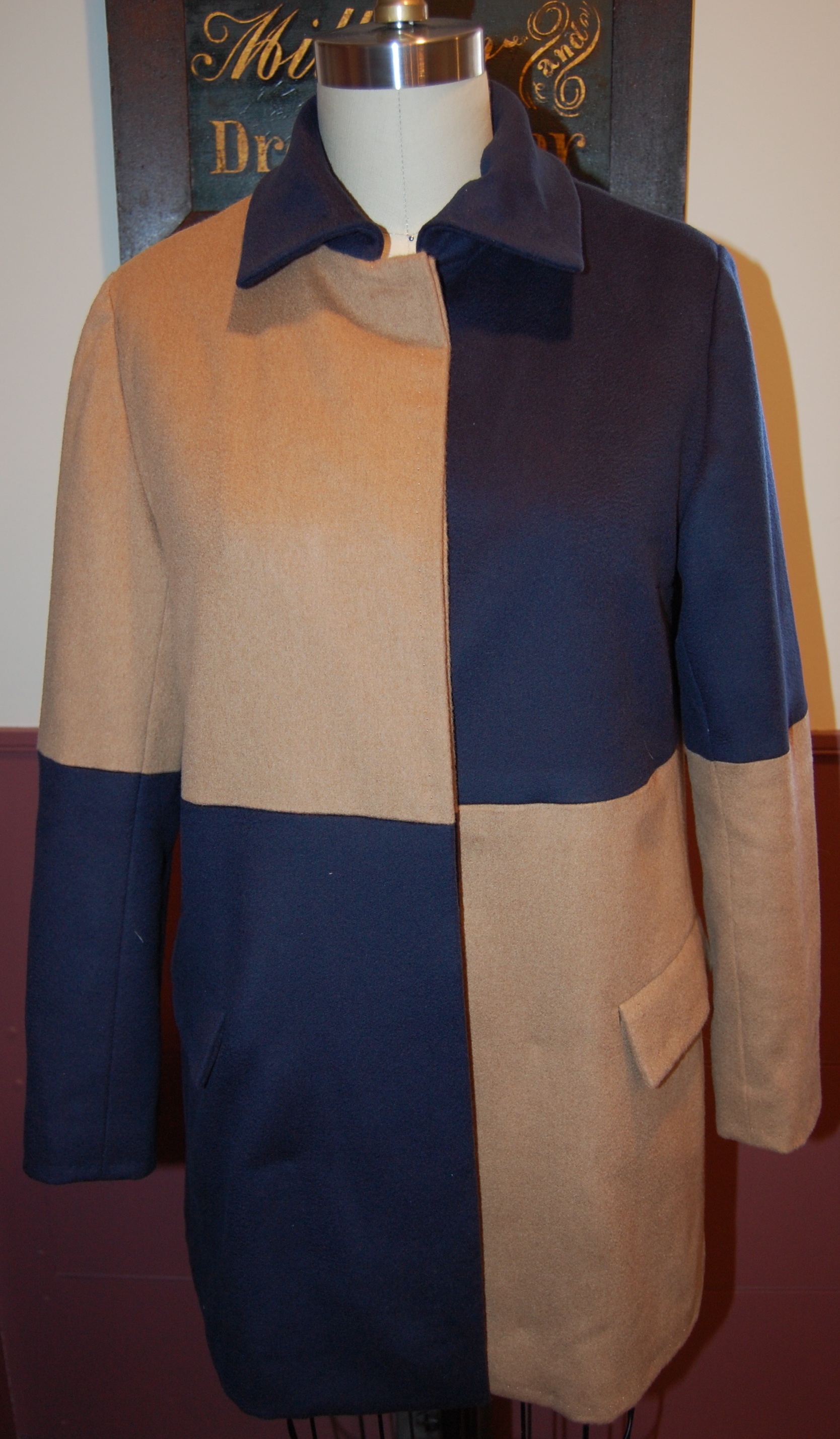
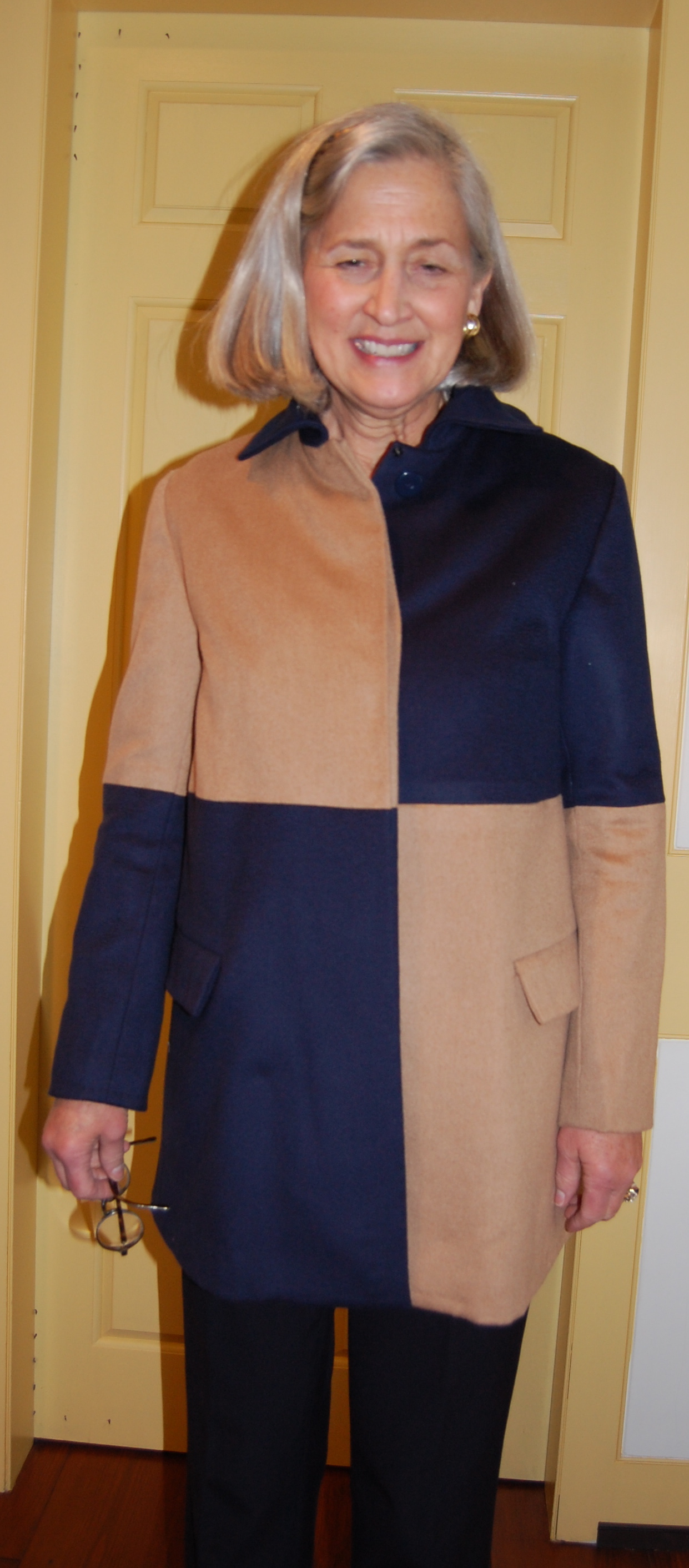
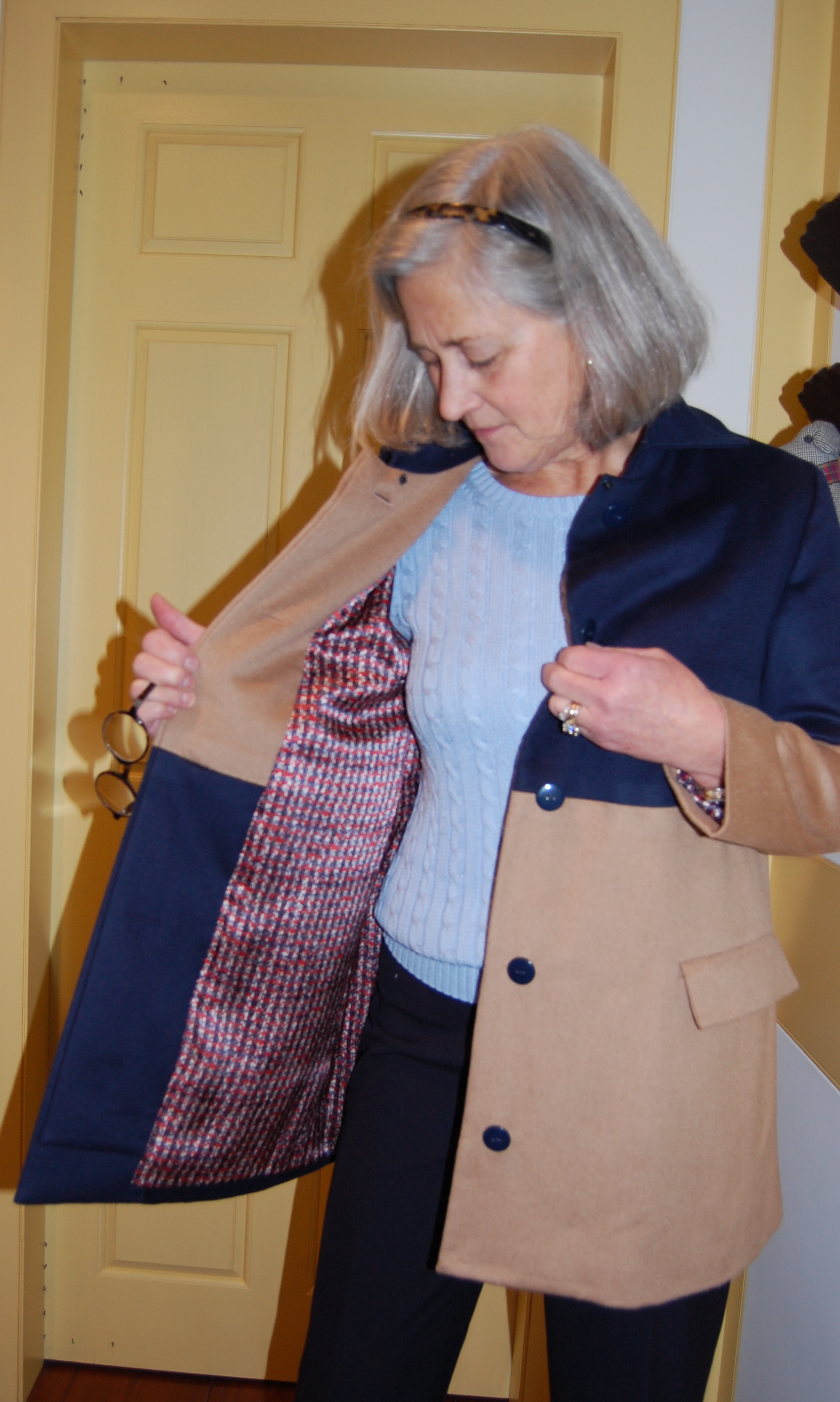
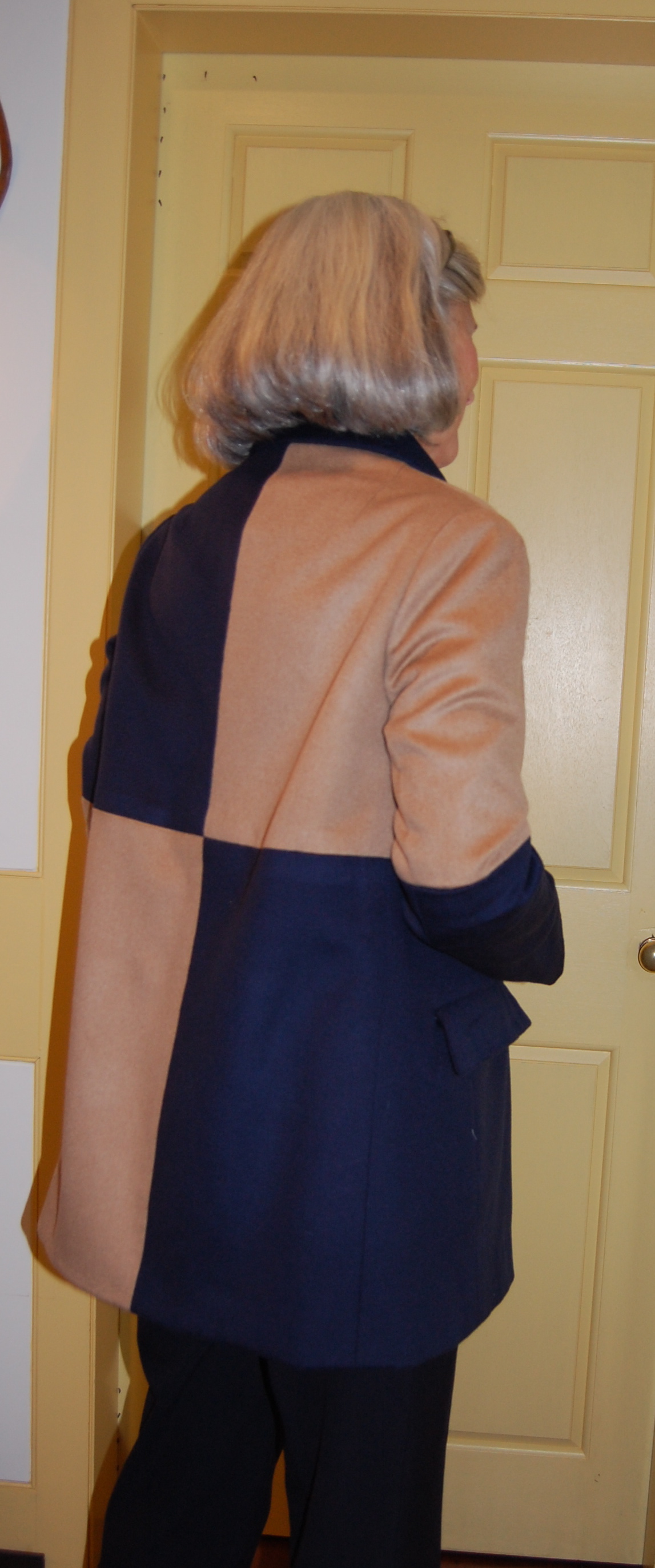
I started my jacket in early February this year in Susan Khalje’s Couture Sewing School class in San Francisco.  I just finished it.

Magnificent Obsession

Magnificent Obsession

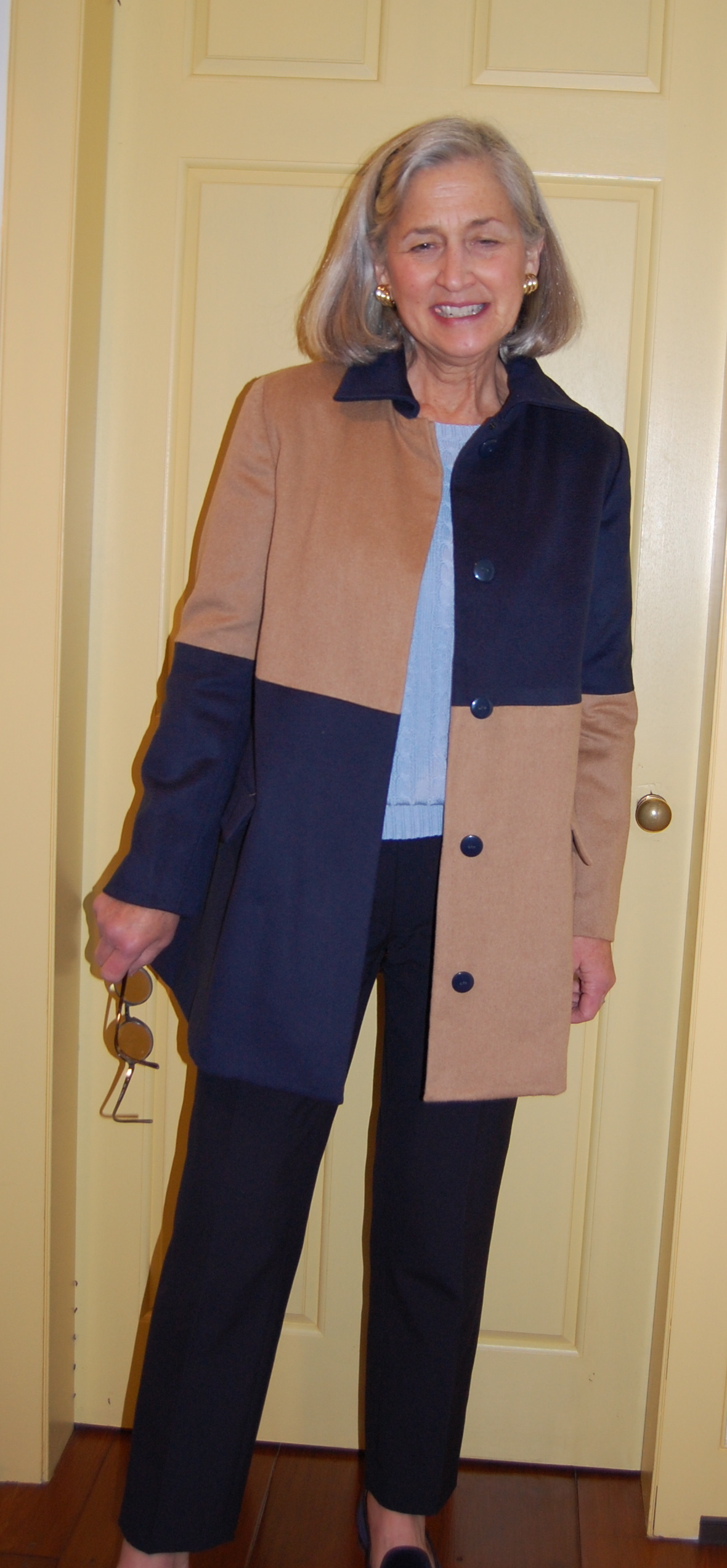
I like it worn open as well...

I like it worn open as well…

A look inside...

A look inside…

A back view.

A back view.

Making this was one of the most enjoyable sewing experiences I have ever had.  Being privileged to get Susan’s expert guidance on some parts of the jacket certainly was part of the equation.  In addition to that, however, were the preciseness and subtle design details of the pattern, which made it a pleasureable sew.  A few of those details are:

1)  the genius of the extra side panel, which enhances the “swing” line of the coat.

2) that side panel  also allows the use of a Dior dart which adds just enough to the bust to keep the line smooth, but ample.

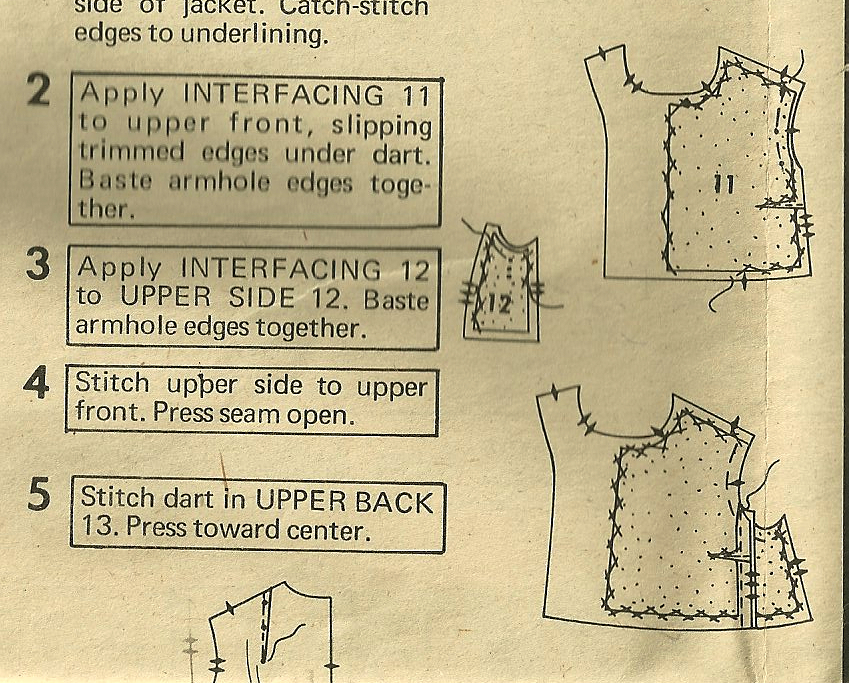
Th instruction sheet gives a good diagram of the small Dior dart tucked into that front side seam.

The instruction sheet gives a good diagram of the small Dior dart tucked into that front side seam.

3) the concealed front allows the clean appearance of the coat to be unencumbered by buttons.

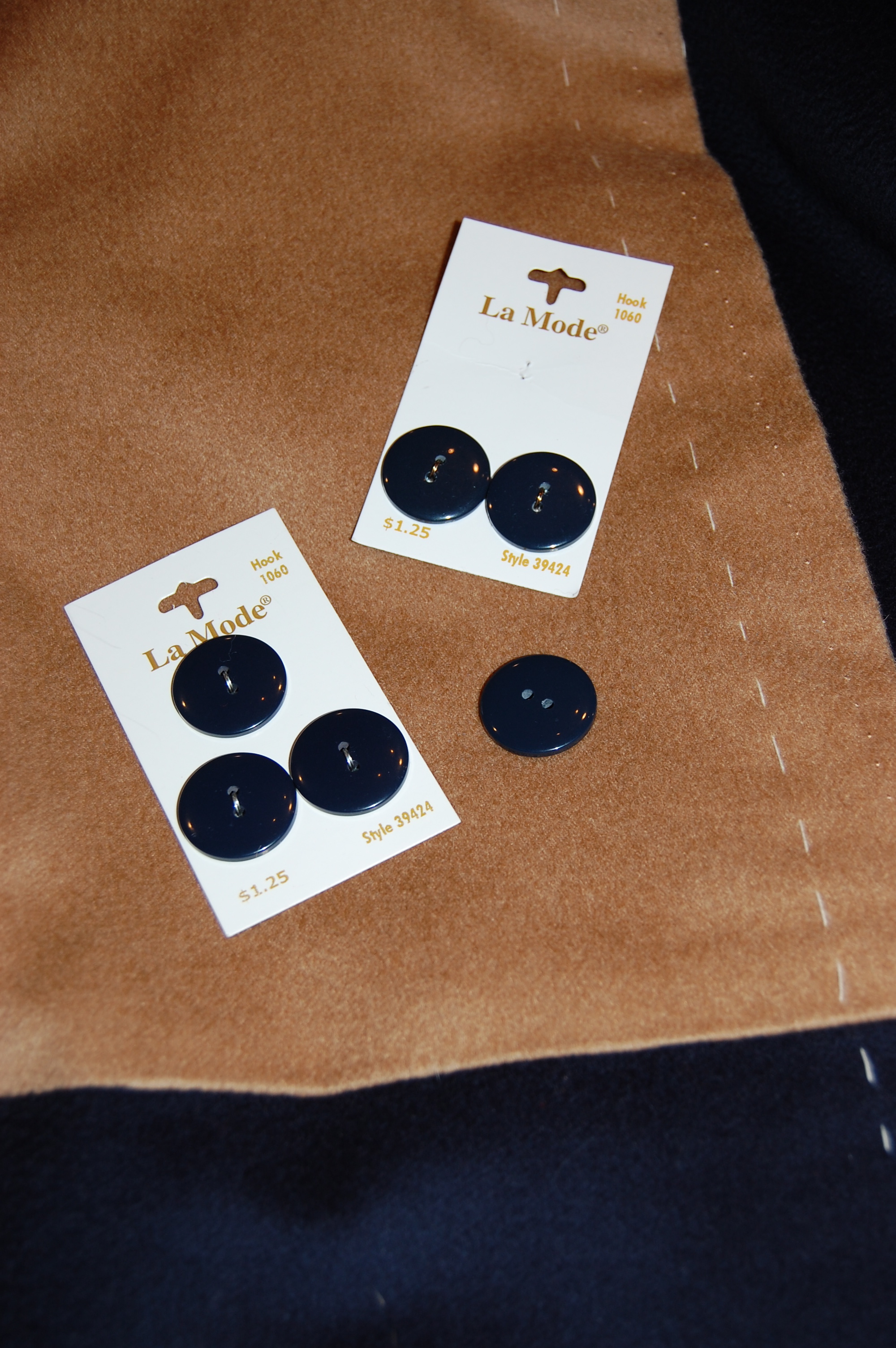
I chose these navy blue buttons for the concealed front.  They are flat, simple, and match the blue exactly.

I chose these navy blue buttons for the concealed front. They are flat, simple, and match the blue exactly.

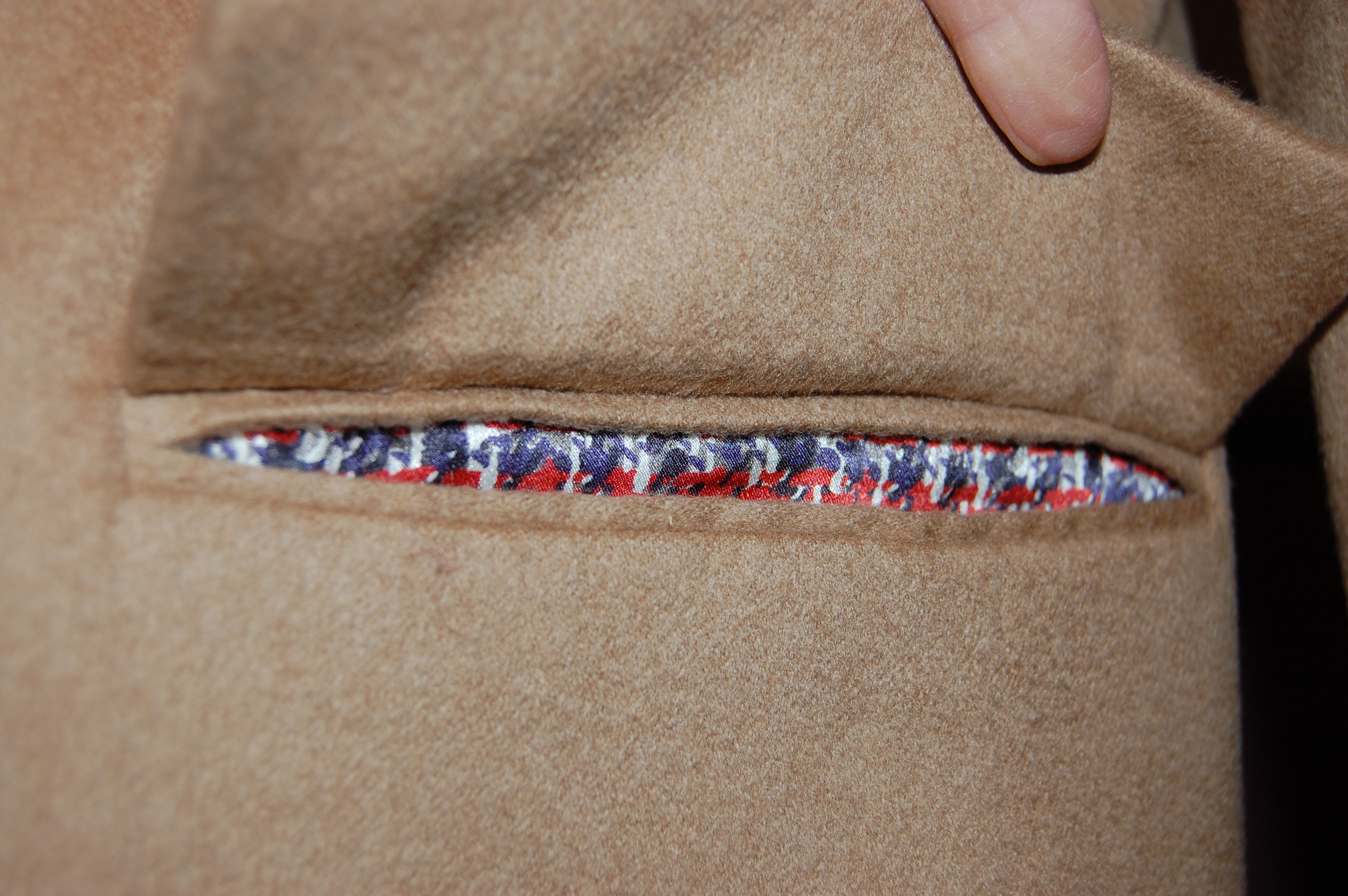
4) the flap pockets, which conceal the openings, again with minimal interruption to the clean and “simple” look.

The concealed opening, with a flash of pretty pocket lining.

The concealed opening, with a flash of pretty pocket lining.

I did make a few changes/alterations to the jacket, ensuring a better fit for me in 2014.

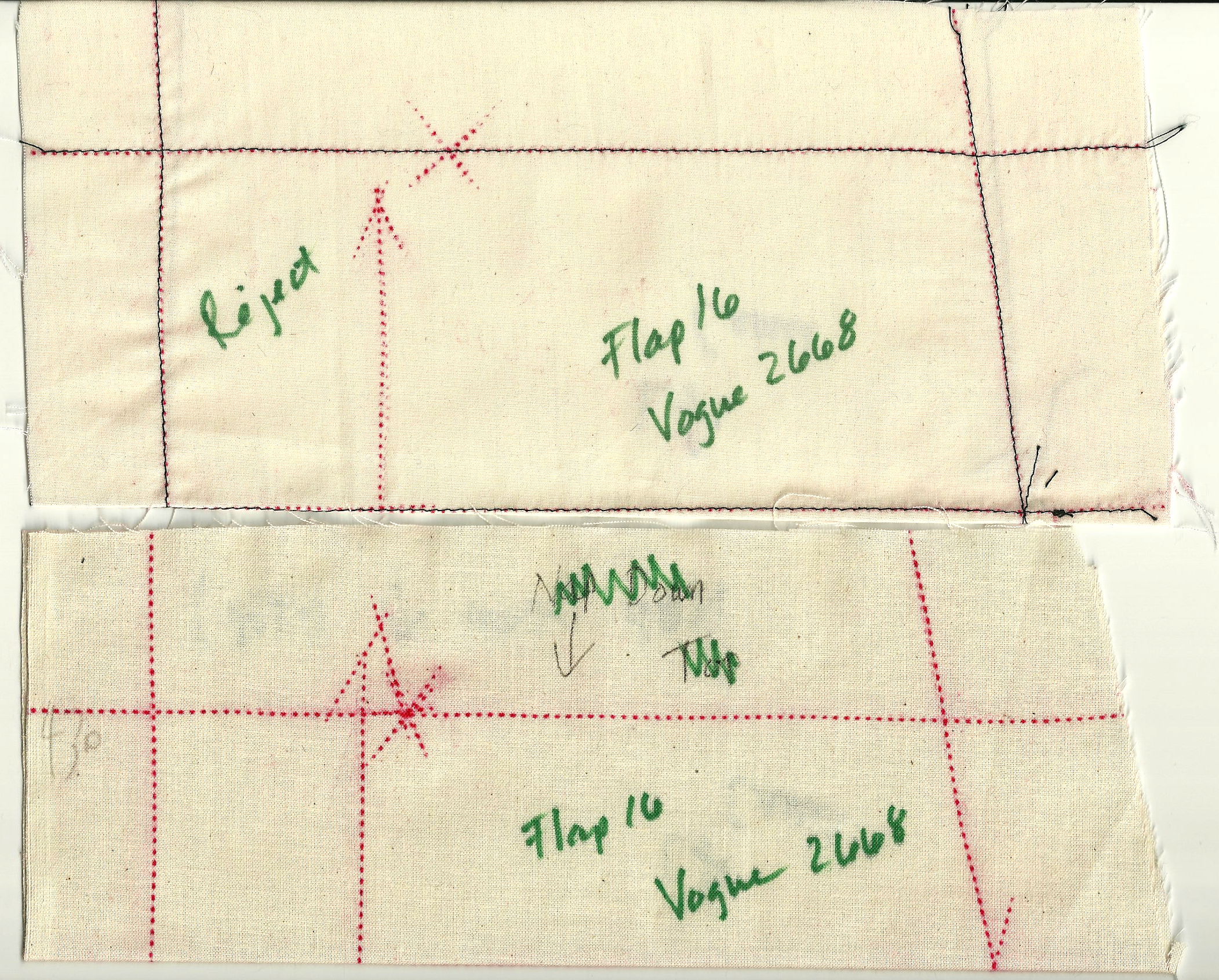
First, with Susan’s assistance, I took some of the volume out of the back seam, as it was just too full for my frame.  Second, I added ½ “ to the diameter of each sleeve, as they were just a little too slim for comfort.  Doing this allowed me to enlarge the lower armscye, also adding comfort and more flexibility.  I felt like I was able to do these alterations without changing the look of the jacket.  I also made two “visible” changes, although still in keeping with the design.  The original flaps looked a little too “’70s” to me.  I reduced the “depth” of them by 7/8″, so that they are more in keeping with modern sensibility.

These muslin patterns are folded in half to show the depth of the original flap and the depth of the altered one below.

These muslin patterns are folded in half to show the depth of the original flap and the depth of the altered one below.

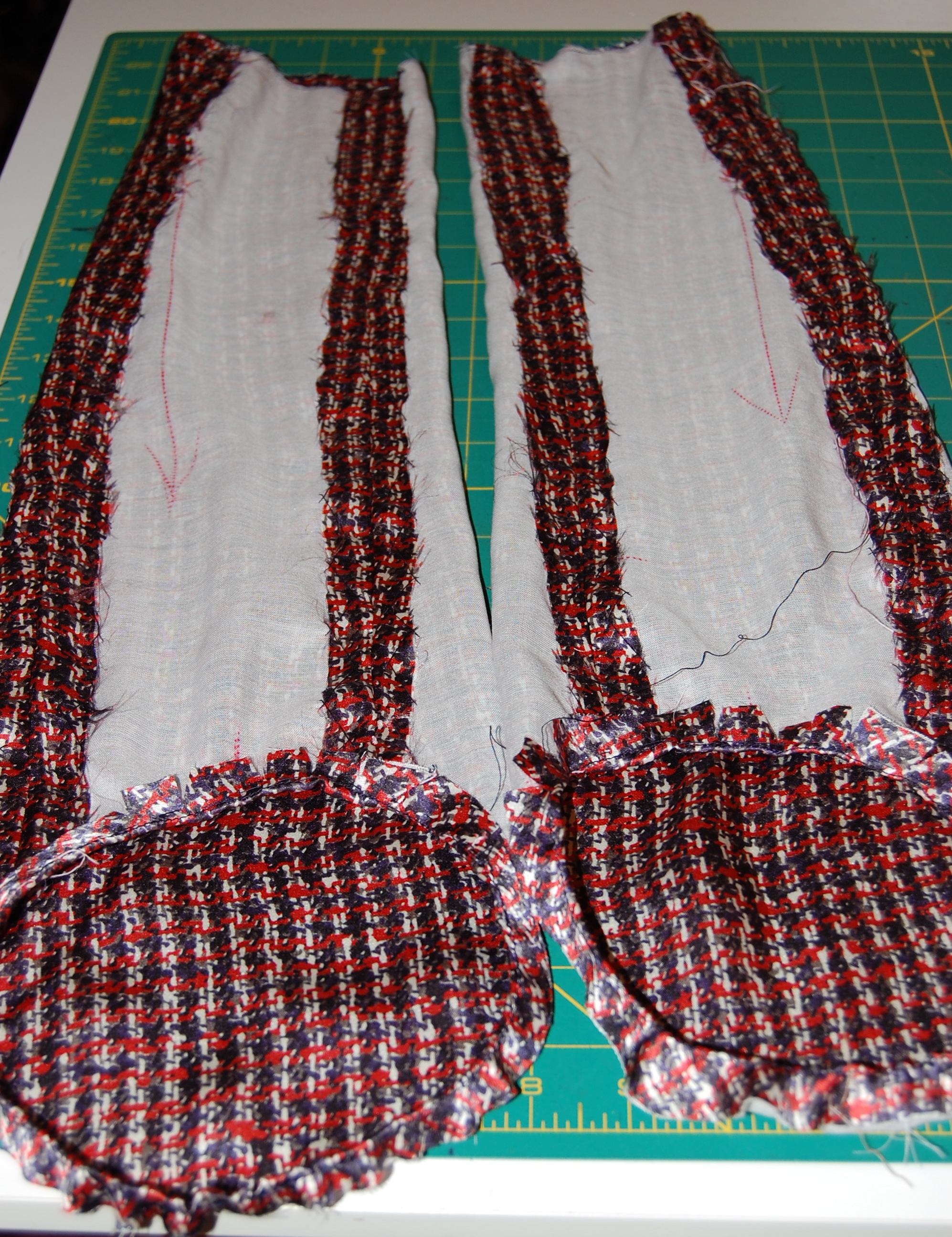
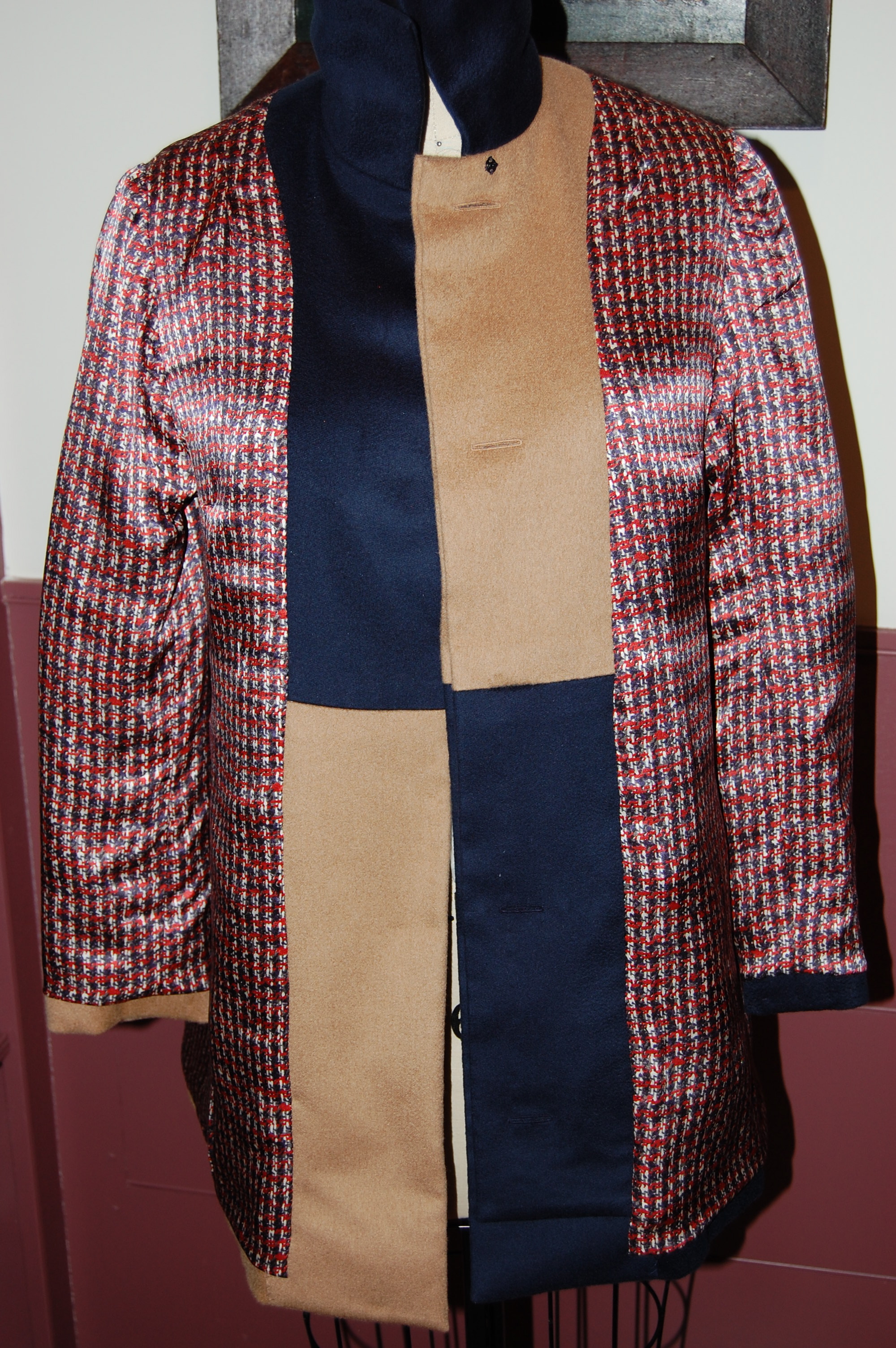
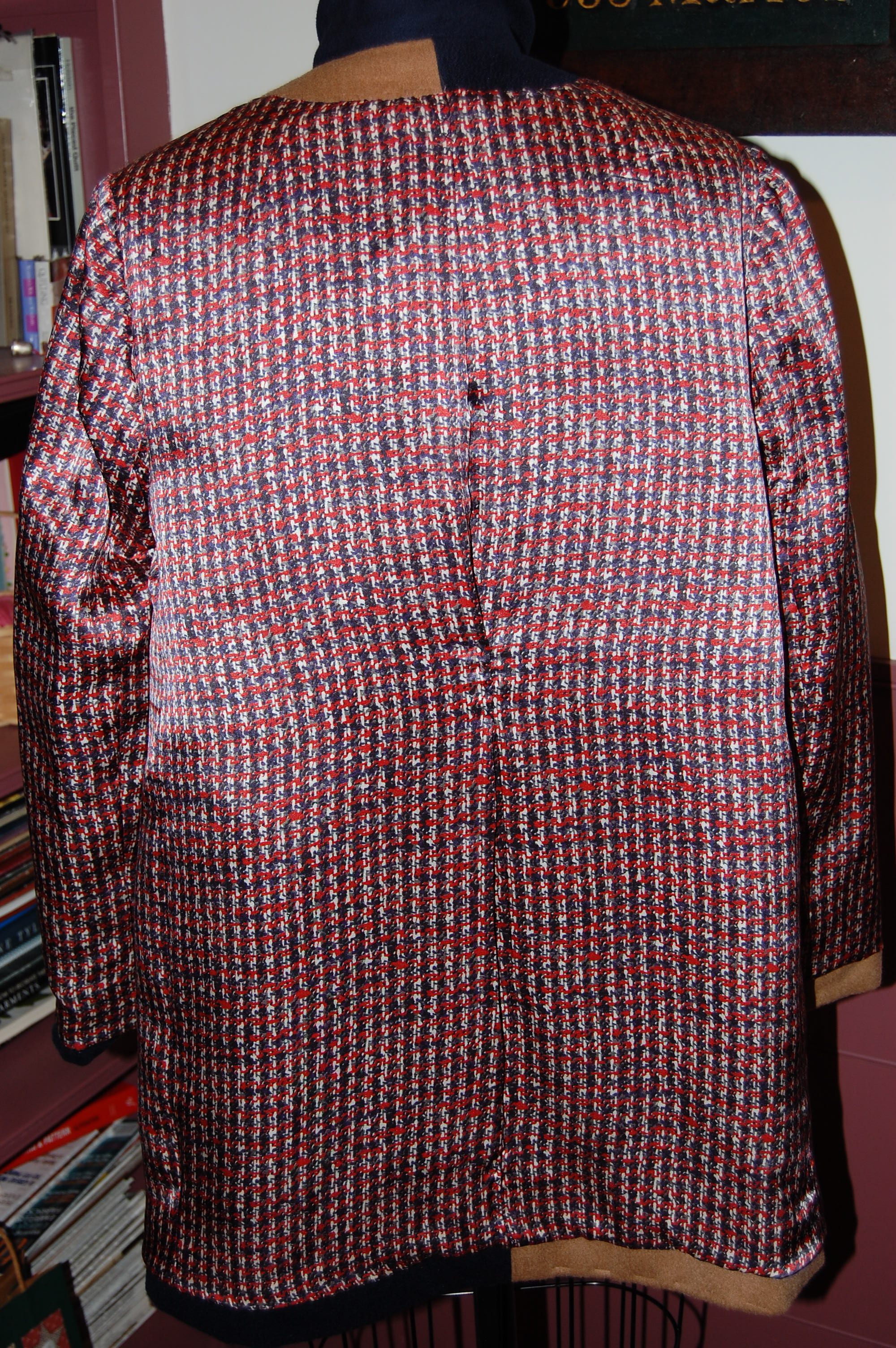
The pattern had separate pieces for the lining, and even the lining followed the blocked design.  I had chosen a printed silk charmeuse (at Britex , naturally!) for my lining, which did not need to be block sewn.  So, using the muslin I had made for the lining, I cut the “lengths” as one piece, eliminating 16 horizontal seams.  I also underlined the silk charmeuse with a very lightweight rayon voile, which made the lining fabric easy to control, and adds another layer of warmth to the overall coat.  This photo shows the underlining in the sleeve linings before I sewed them into the coat.

Magnificent Obsession

The jacket turned inside out, showing the lining.

The jacket turned inside out, showing the lining.

The inside back of the coat.

The inside back of the coat.

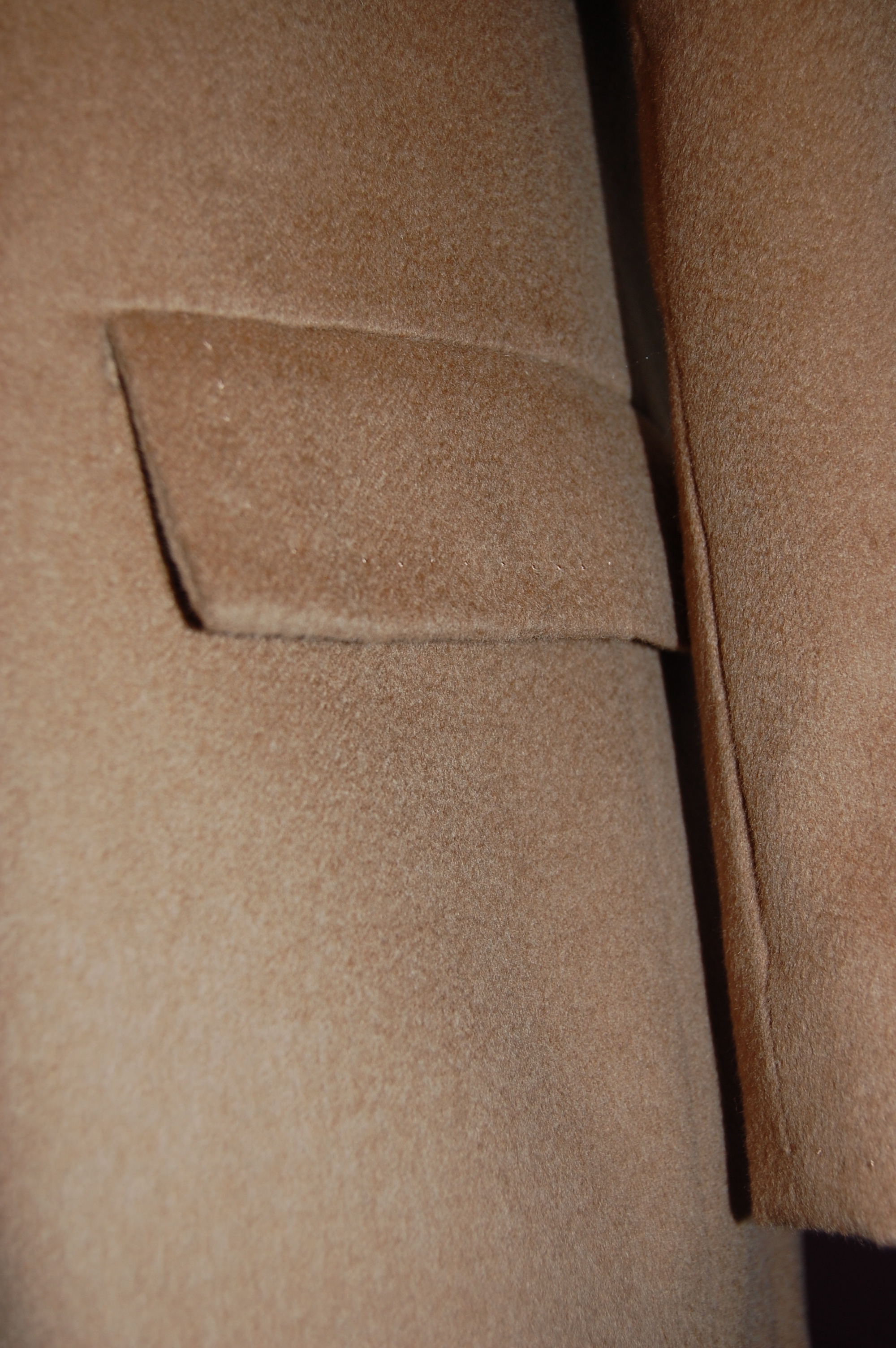
Finally, the pattern called for topstitching the exterior edges of the coat.  Due to the nature of my napped fabric, I thought machine topstitching would detract rather than add.  But – I wasn’t happy with the thought of no topstitching, either.  So I decided to do it by hand.  It wasn’t nearly as time-consuming as I thought it would be, and I am happy with the result.

The topstitching is very subtle, but you can see it here on the pocket flap.

The topstitching is very subtle, but you can see it here on the pocket flap.  Click on the photo for a close-up.

One more thing about this pattern.   When I received it, the pattern pieces for the pants and sleeveless tunic were cut and had obviously been used (although every piece is intact).  The tissue pieces for the coat were still in their factory folds.  On the outside of the pattern in the upper right hand corner is the name Georgia Sanders.  I guess I’ll always wonder if she had plans to make the jacket, too.  I’m so glad she bought this pattern and kept it in such good condition so that it could find its way eventually to me – to help me realize my magnificent obsession from my younger self.

20 Comments

Filed under Buttons - choosing the right ones, Coats, Color blocking, couture construction, Dior darts, underlinings, vintage Vogue Designer patterns, vintage Vogue patterns from the 1970s, Vogue patterns, woolens

The Necessary Blouse

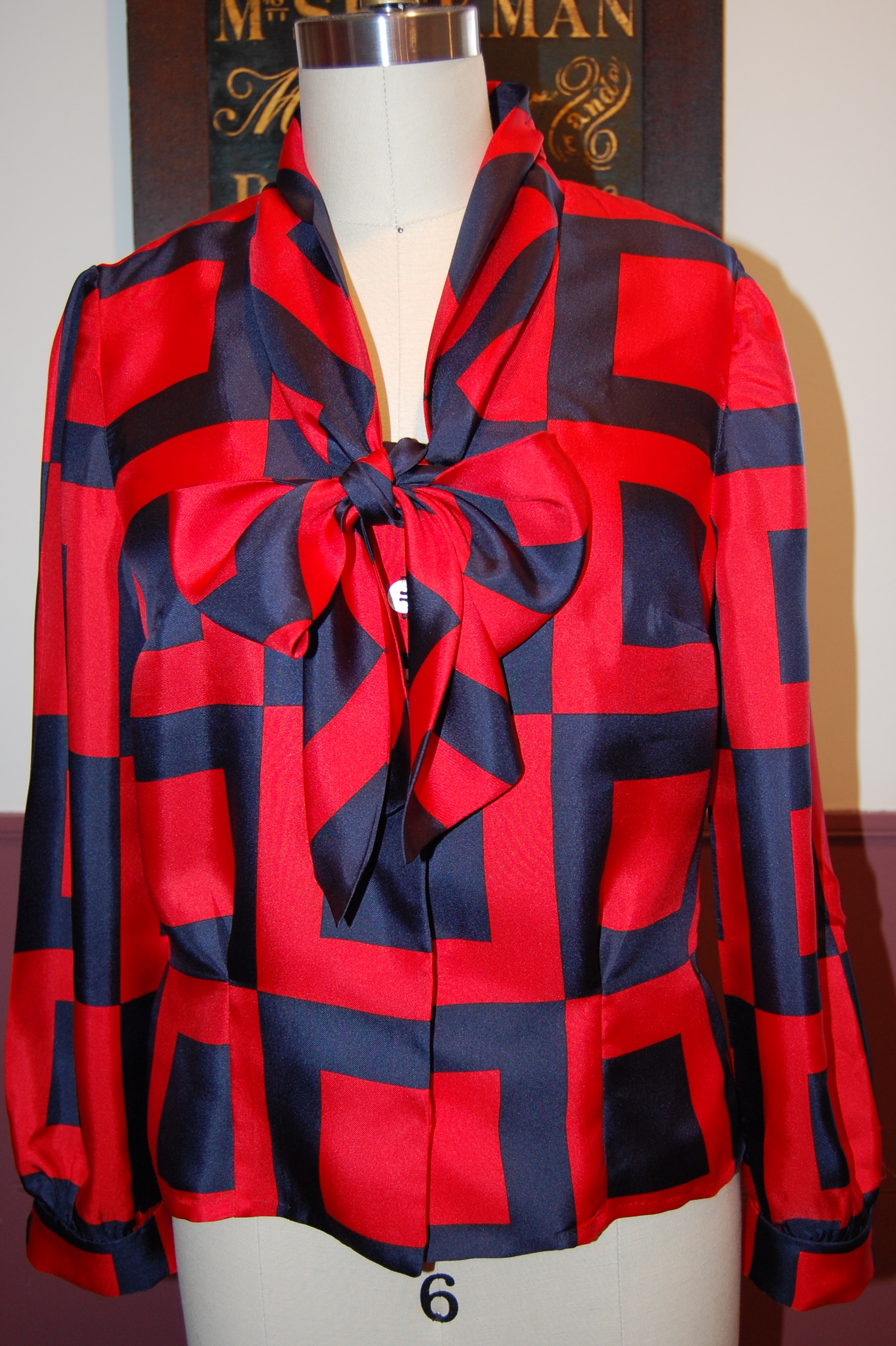
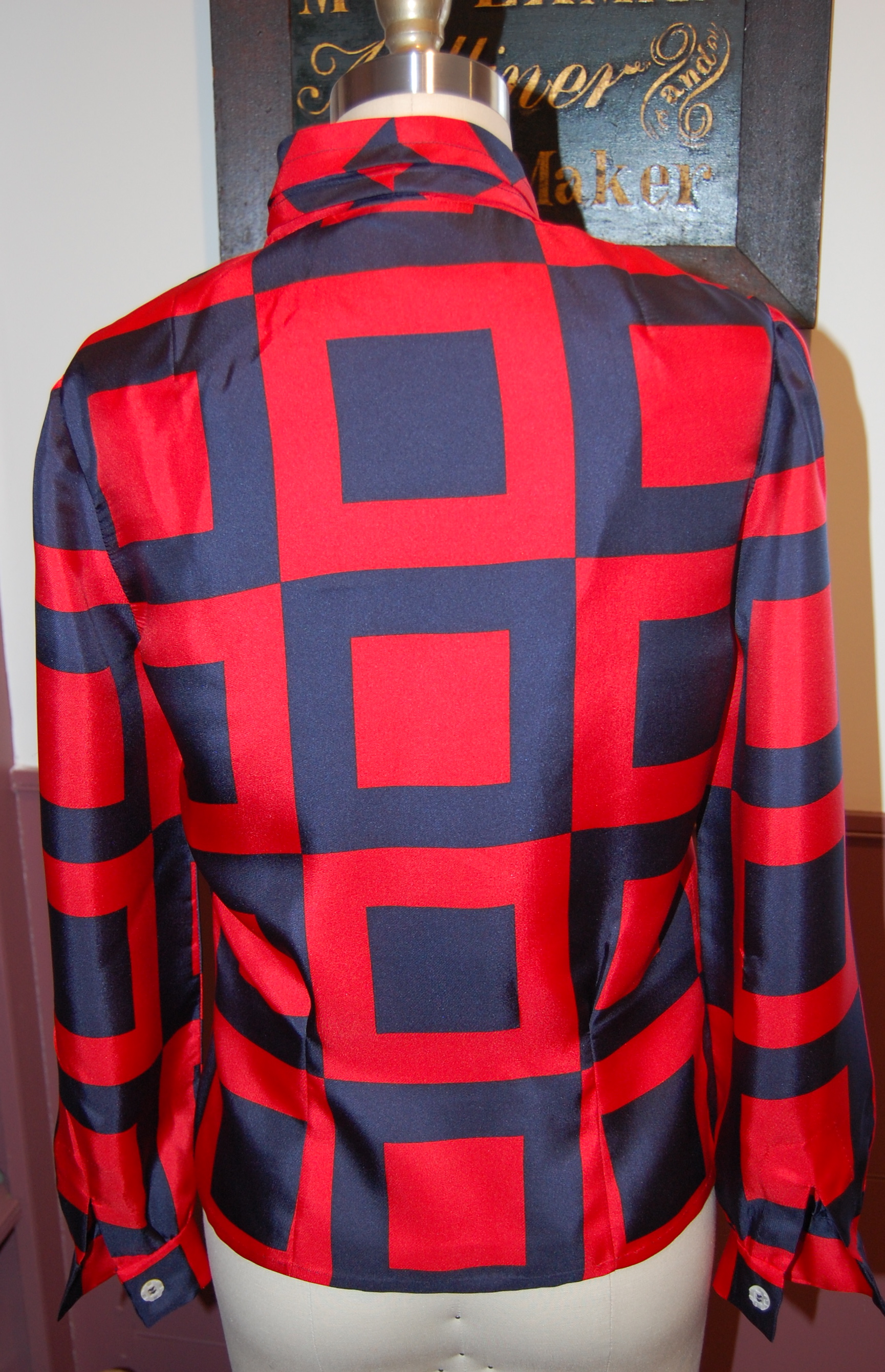
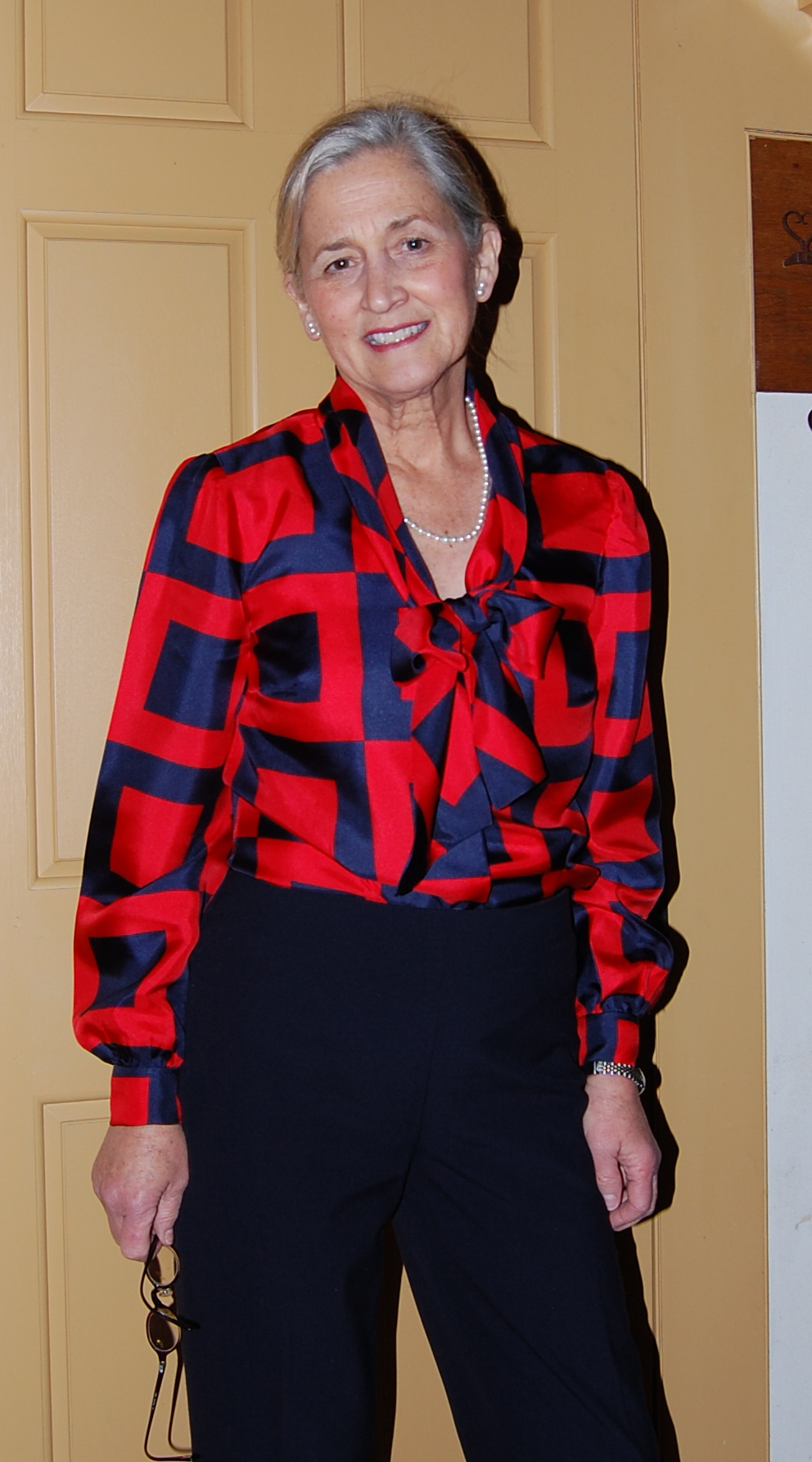
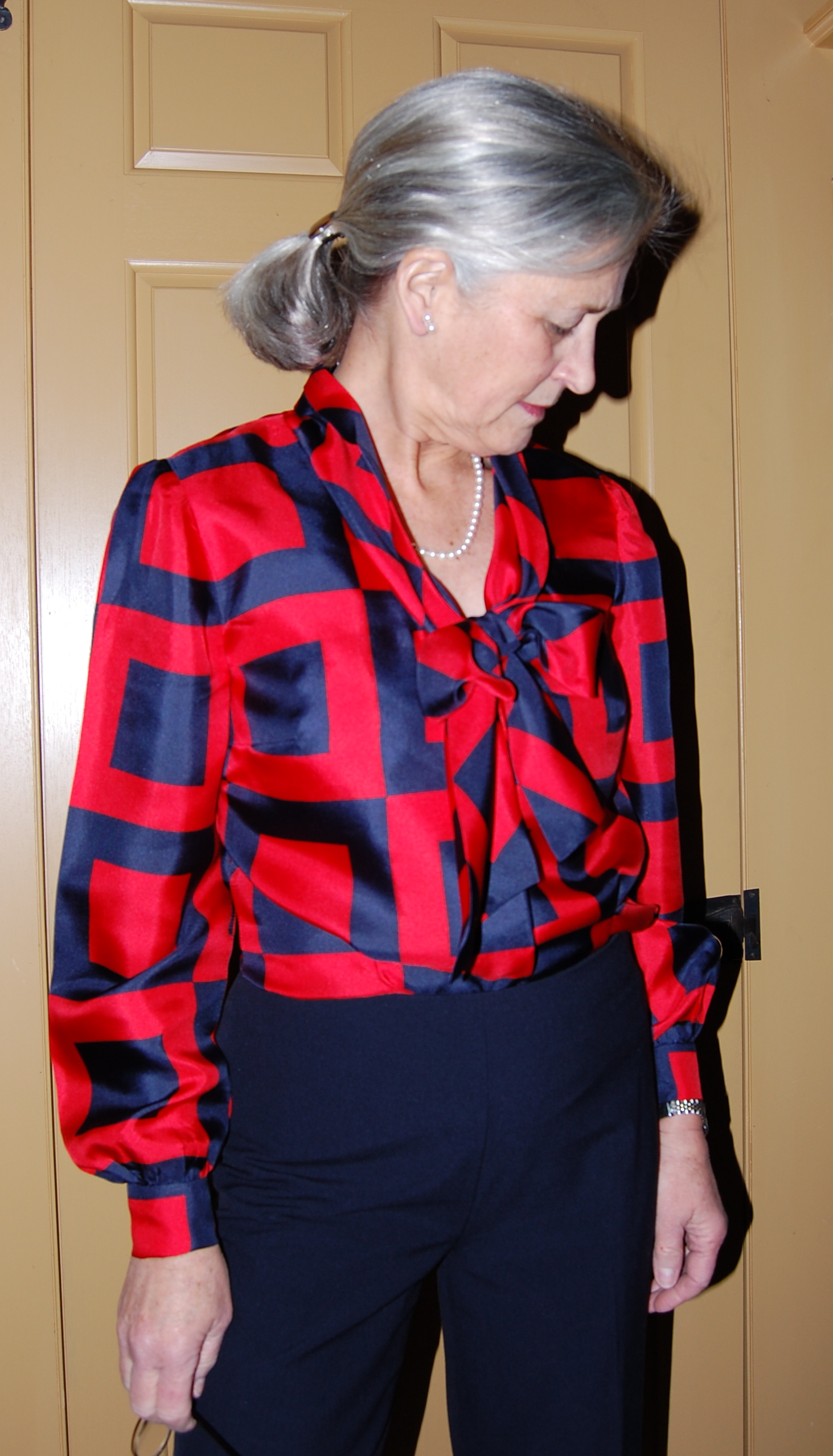
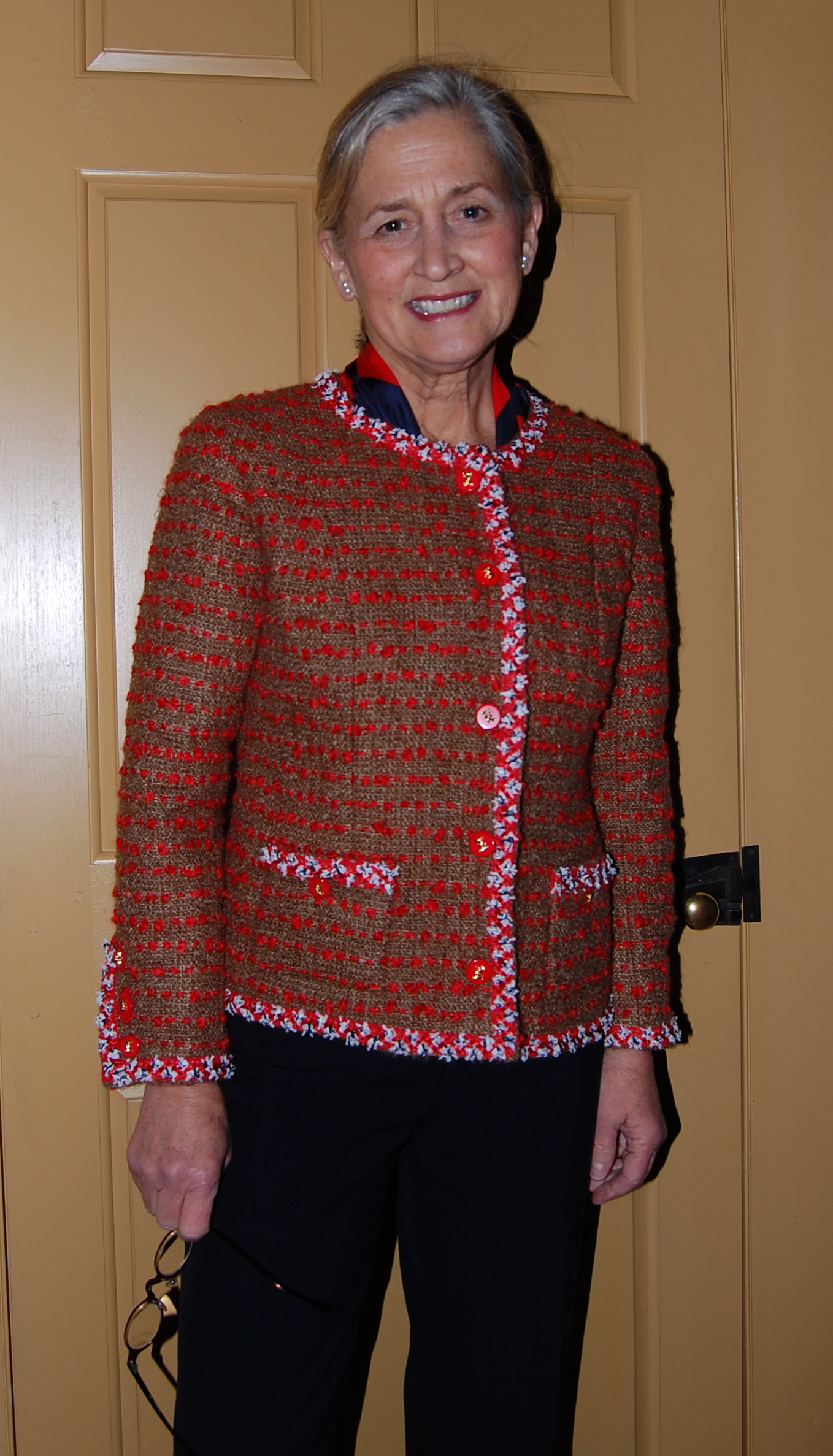
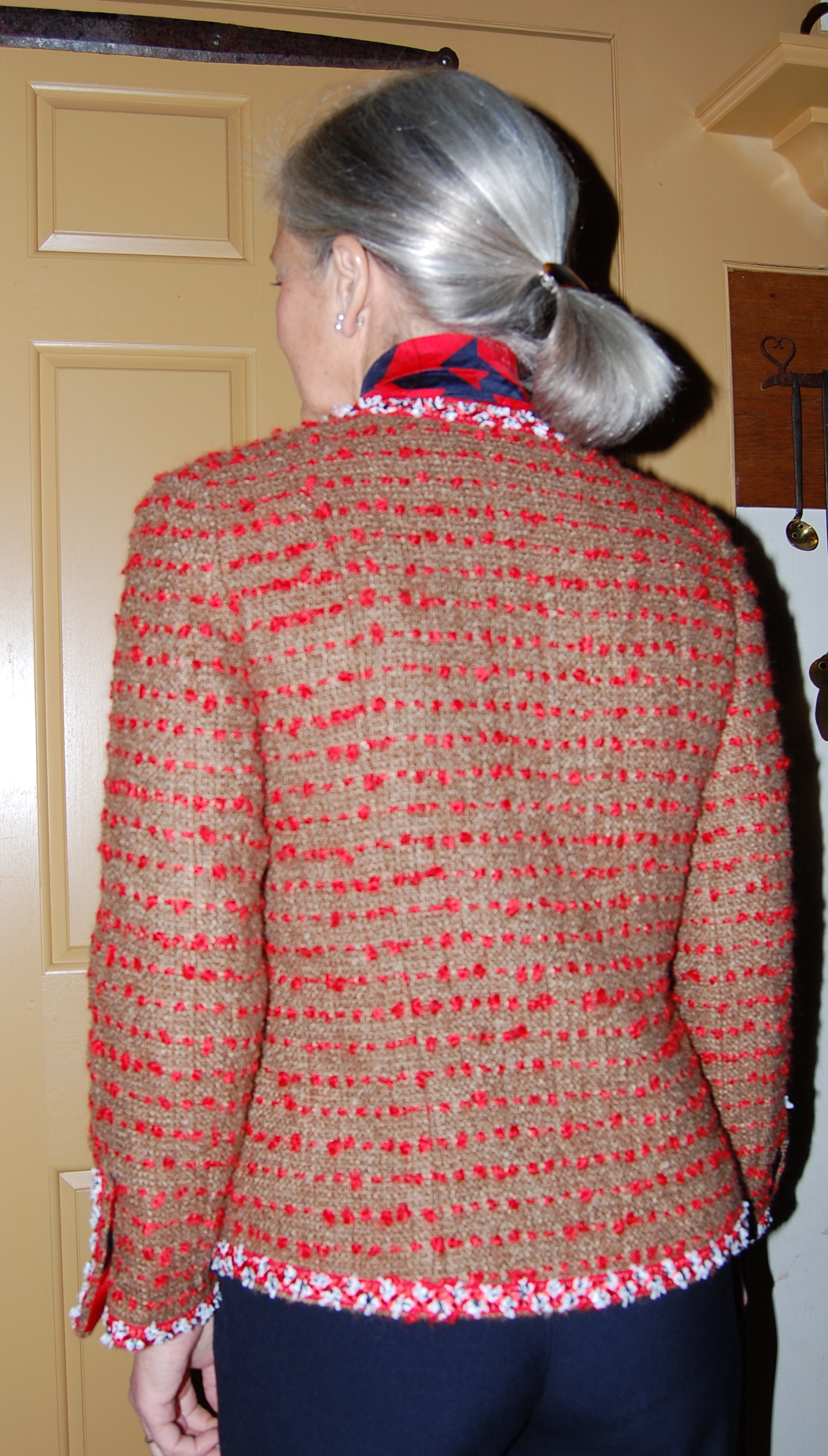
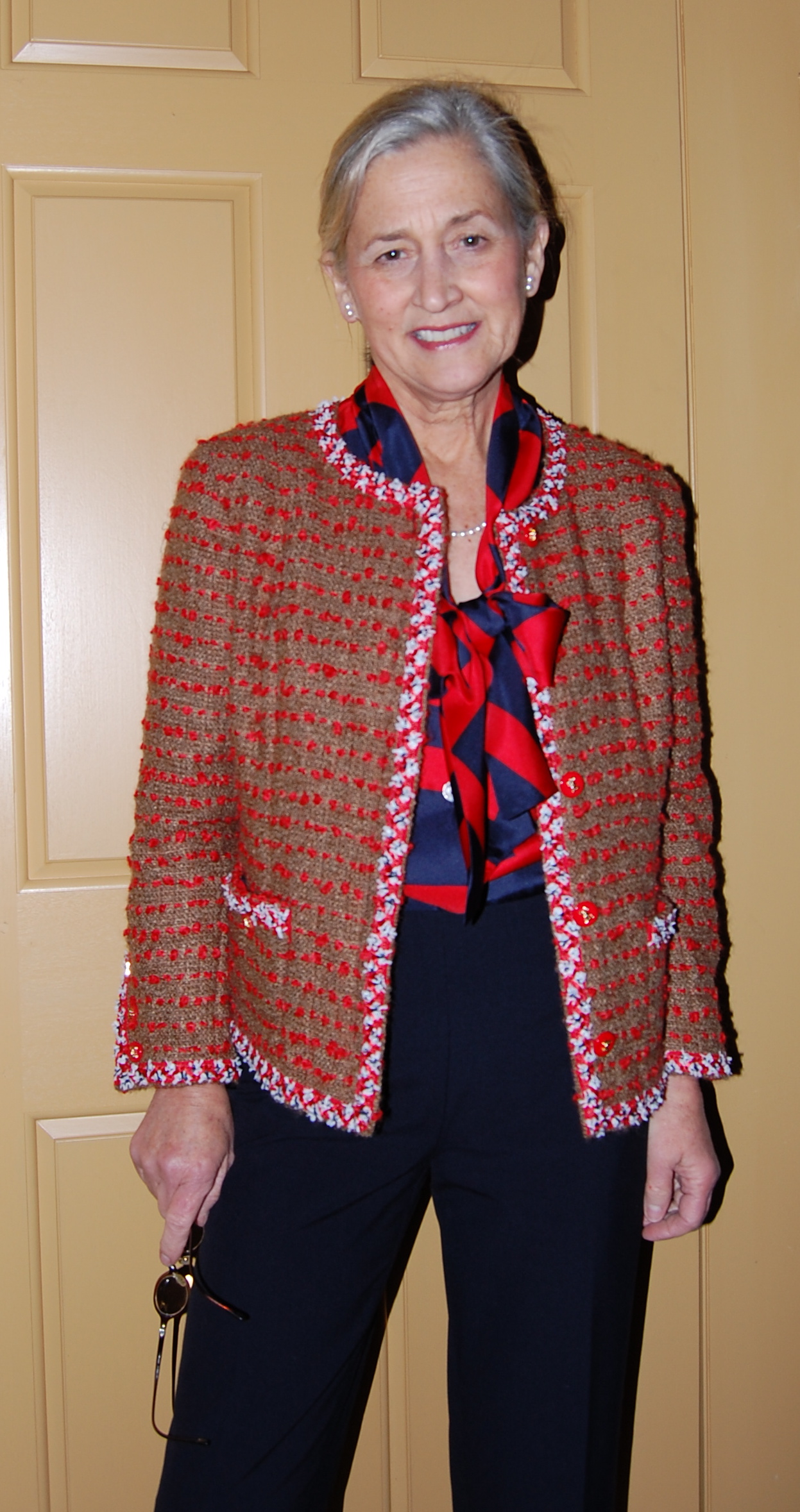
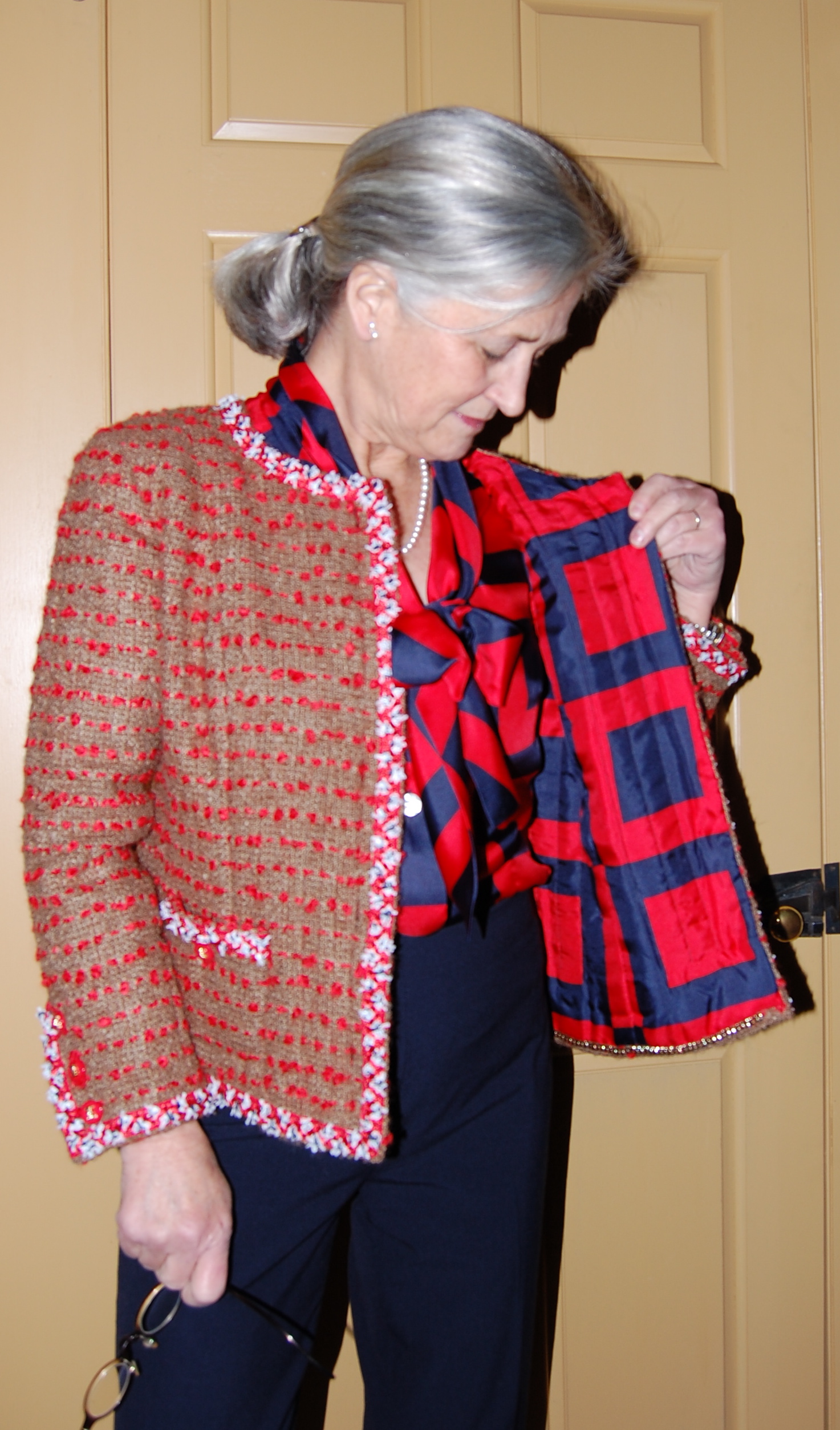
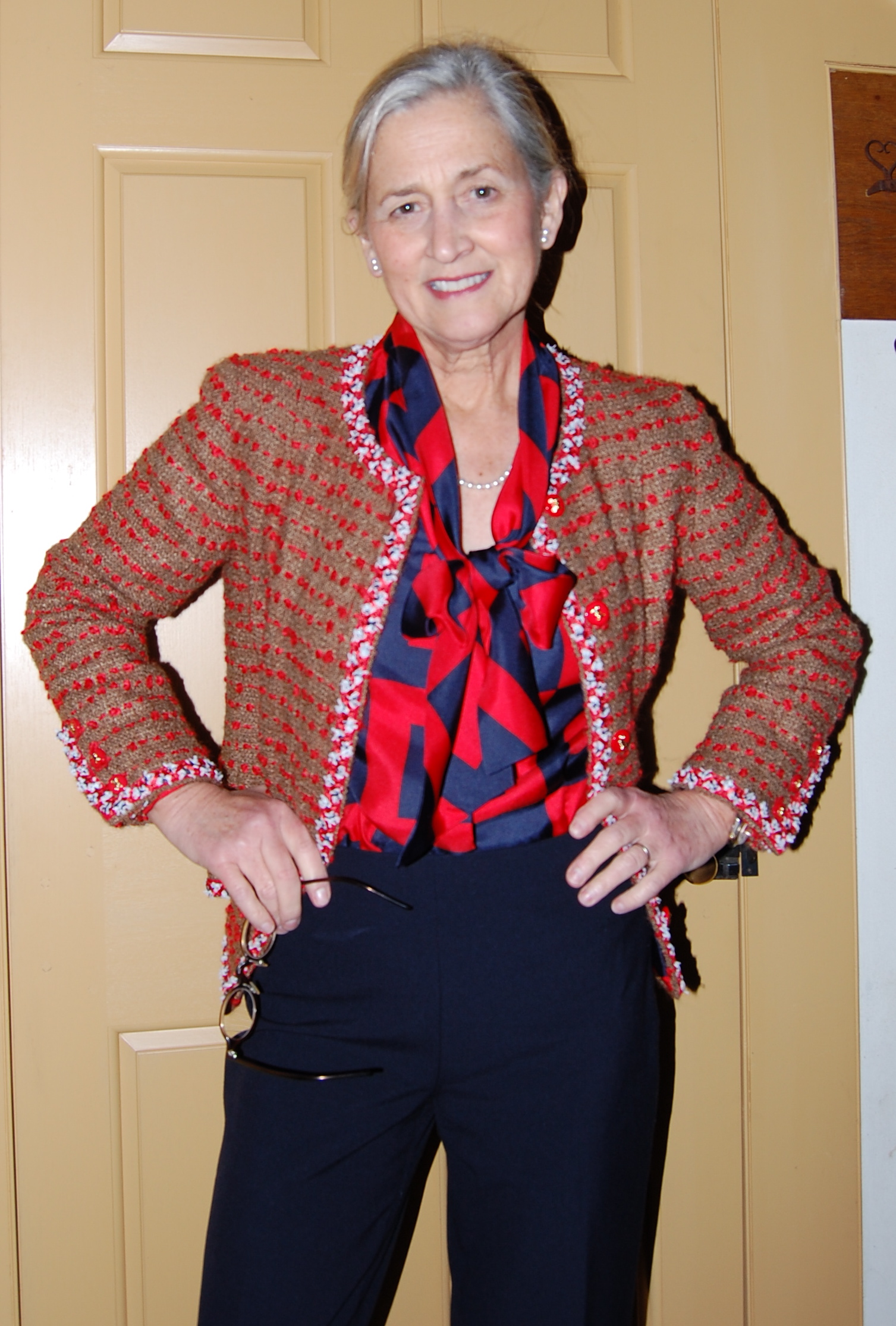
Fashion sewing is an interesting combination of inspiration, aspiration, indulgence and necessity, manifested singly or collectively.  My newly completed bow blouse is an example of a bit of all of these motivations rolled into one.  This is the blouse I made to go with my No. 2 Chanel-inspired jacket, made from the same red and navy blue geometric print silk with which I lined the jacket.

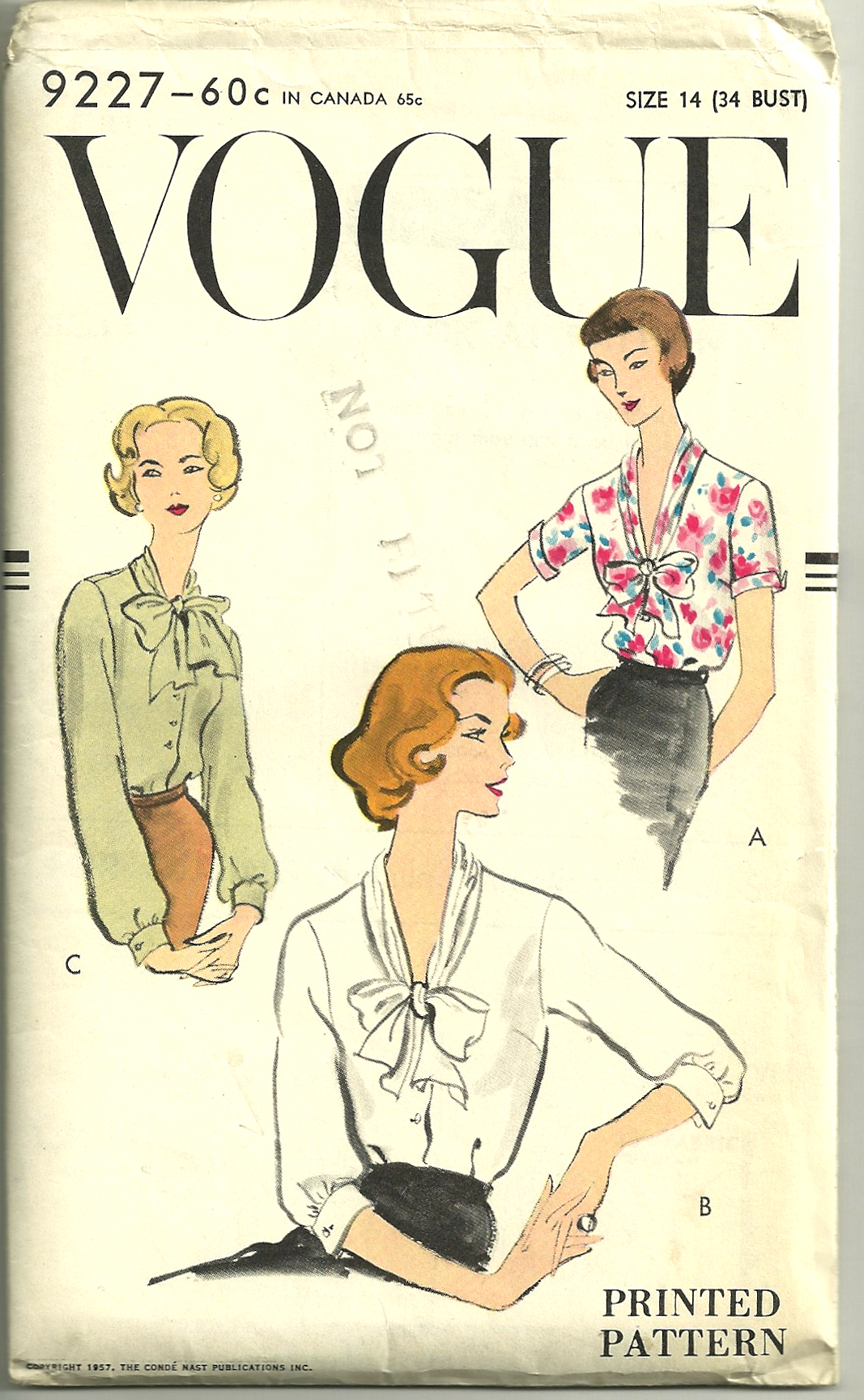
The Necessary Blouse Inspiration came from several sources.  I was mostly inspired by the pattern, which is copyright 1957 by The Conde Nast Publications, Inc. (Vogue Patterns) – so much so, that I purchased it in a size larger than I usually wear, as that was what was available – and with vintage patterns, one is never sure to find a favorite one again soon – or ever.

Looking at blouses 1957

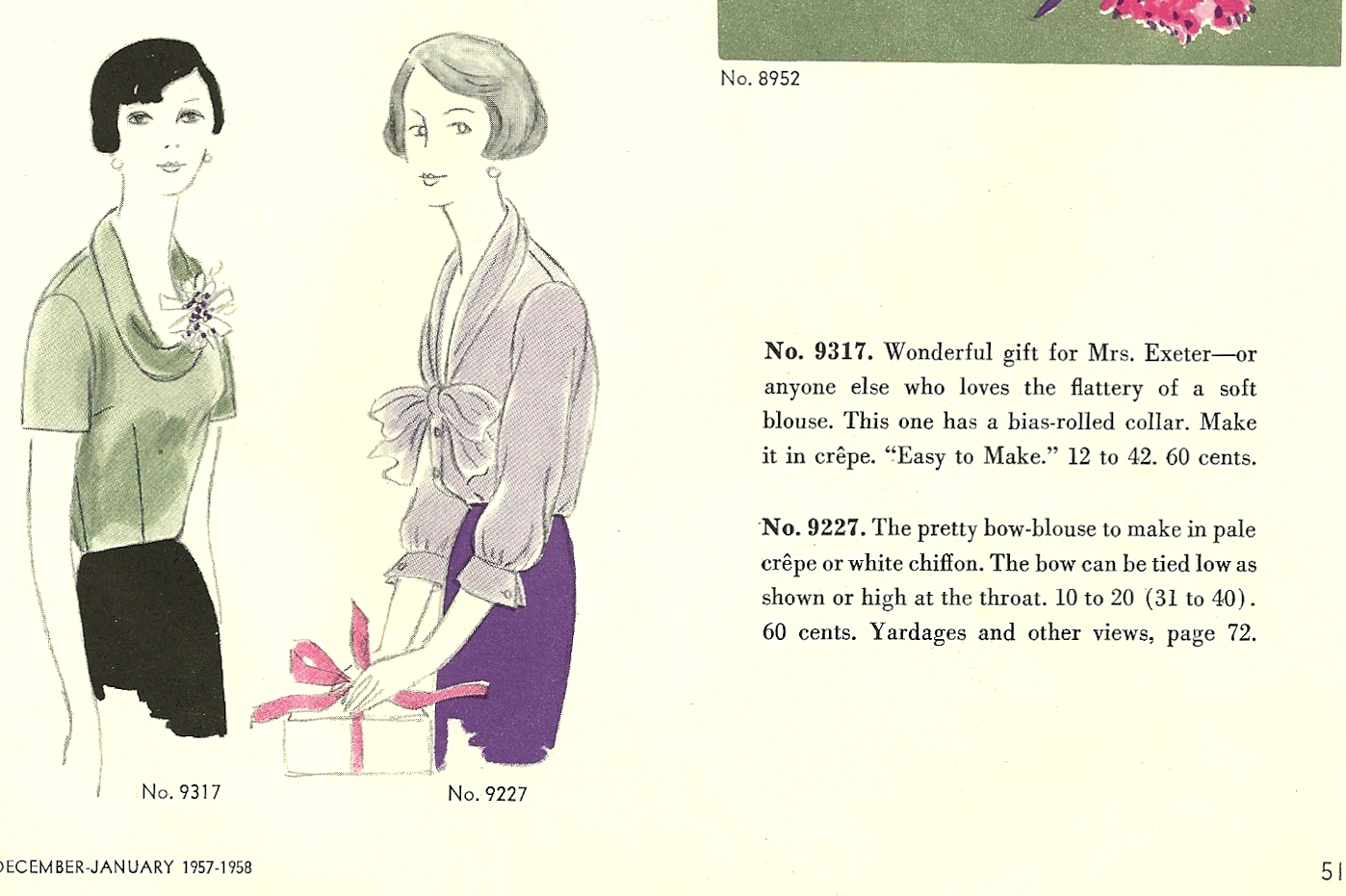
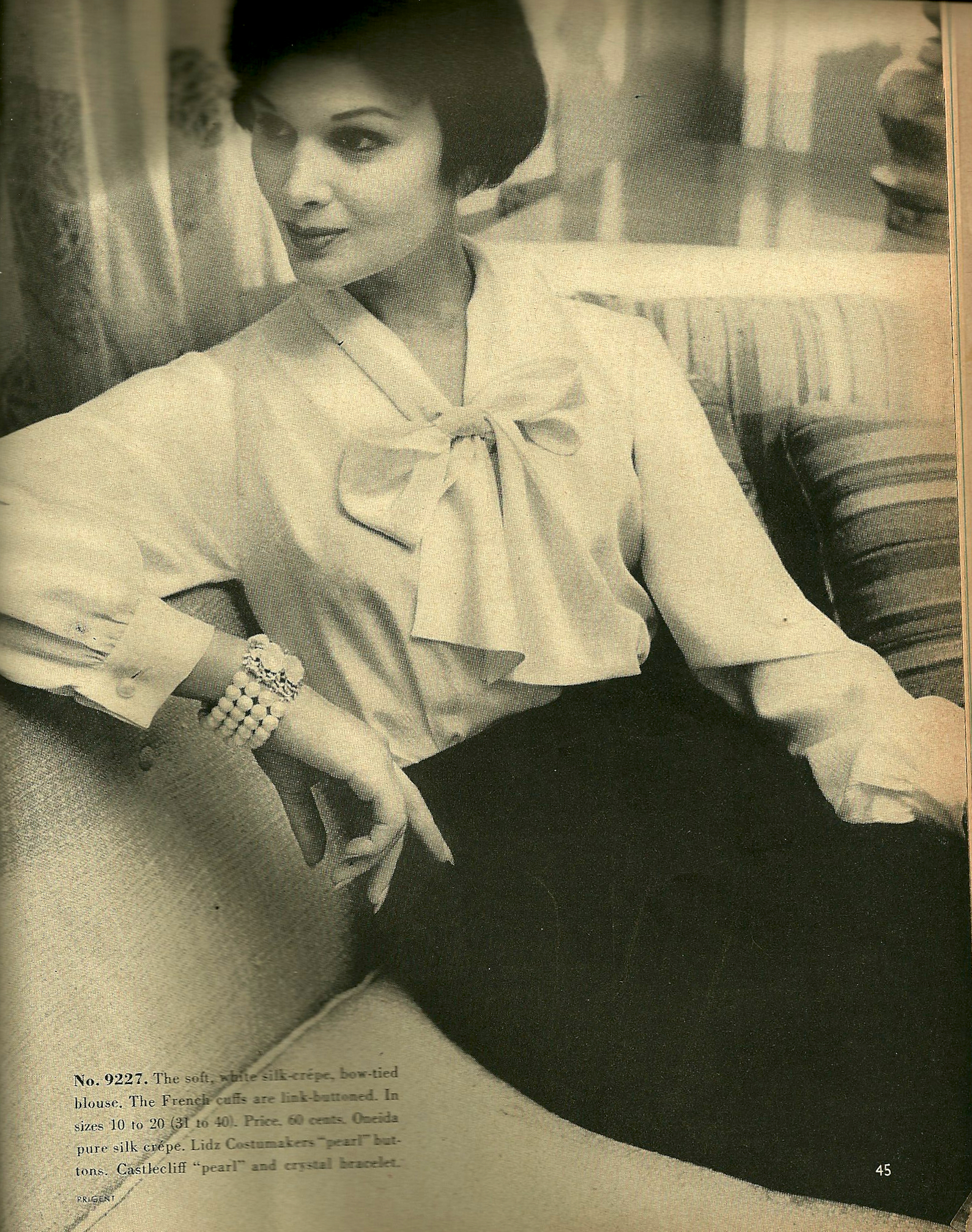
Some of the aspects of the pattern which appealed to me are: 1) the “dropped” bow shown in views A and B; 2) the various sleeve lengths; 3) the shaping in the body of the blouse – soft and understated, but very feminine.  Just for fun, I looked through a few of my Vogue Pattern Book Magazines from 1957 and 1958, to see if I could find examples of this blouse pattern.  That was easy!  Here is one sketch and one photograph of Vogue 9227:

The blouse was featured in the December/January 1957-58 issue.

The blouse was featured in the December/January 1957-58 issue.

Part of a feature entitled "A new era for the soft BLOUSE."  In the August/September, 1957 issue of VPB.

Part of a feature entitled “A new era for the soft BLOUSE.” In the August/September, 1957 issue of VPB. 

After making a sheath dress to coordinate with my Chanel-inspired jacket No. 1, I aspired to pair my Jacket No. 2 with a suitable companion, too.  A bow blouse seemed to be a versatile and useful solution.  And then it became a necessity!   I decided my Jacket No. 2 would not be complete until I finished this blouse.

Back view

Back view

Step number one was to make a muslin (of course), knowing that I would need to alter the pattern to fit me correctly.  Sure enough, I needed to take out the bagginess in the bust and body of the blouse, and I needed to shorten the sleeves.  I went to my favorite book on making alterations which guided me through the correct changes:

I highly recommend this book.

I highly recommend this book.

My muslin showed me that the sleeves were also a little too full for me and for current 2014 styles, so I removed some girth from them as well.  I was skeptical of the bow (cut on the diagonal) when I looked at the pattern and then the muslin.  Would it be too full?  Made up in muslin it seemed a little overwhelming.  But, my silk was so lightweight and fine, that I decided it might just be okay, using the original dimensions.

Here is the bow/collar ready to be attached to the body of the blouse.

Here is the bow/collar ready to be attached to the body of the blouse.

This blouse went together quite as planned, although I worked on one side where the bow/collar joins the corner at the front facing for hours, until I had it inserted correctly.  I kept making the same mistake over and over, which was a little irritating.  I also added some extra hand-sewing, understitching the facing by hand and hand-stitching the hem.

Hand understitching looks just so much nicer than machine stitching!

Hand understitching looks just so much nicer than machine stitching!

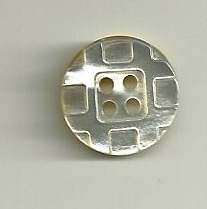
When I started the blouse, I had not yet picked out buttons, thinking I would use some that I have in my vintage collection.  But then I was on Waechter’s website and found these buttons, which seemed just about perfect:

The Necessary Blouse - button

These buttons measure 5/8″. 

(Sadly, Waechter’s is closing their business in Asheville, N. C., to my great dismay.  This makes me even more grateful for Britex Fabrics in San Francisco, from which I purchased all the fabric for this blouse and my Jacket No. 2.)

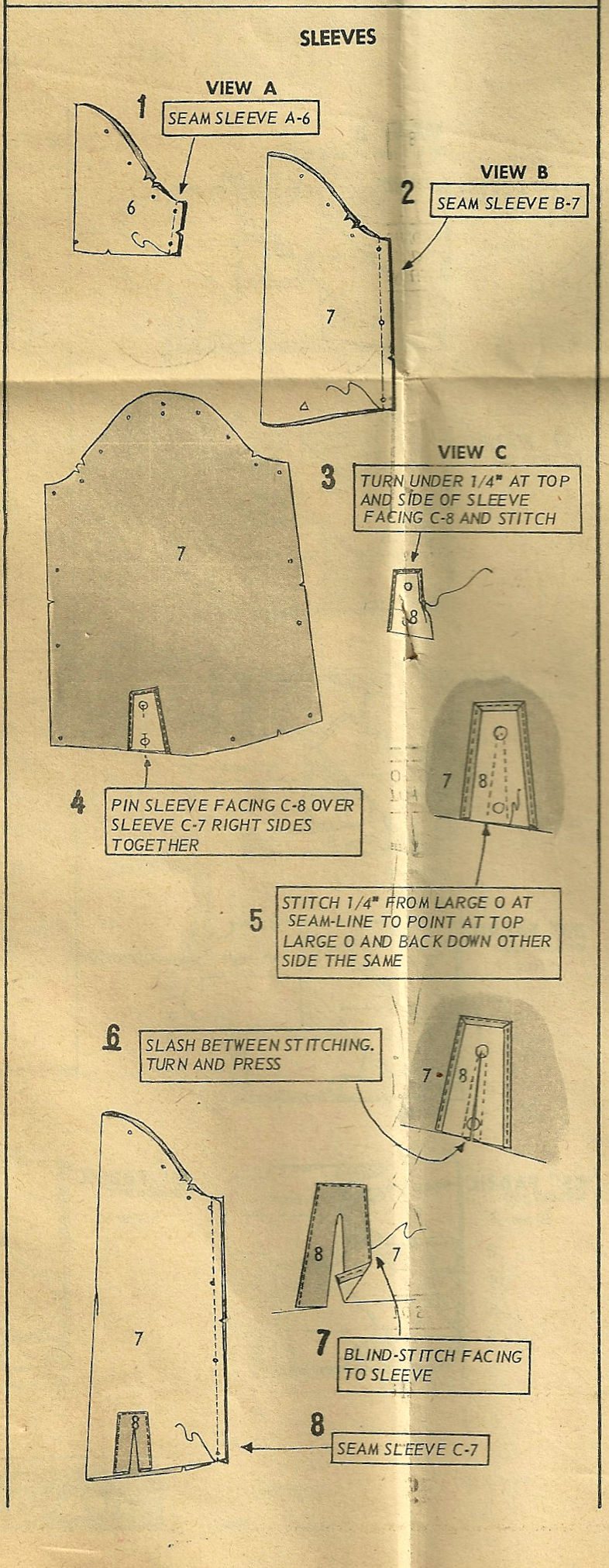
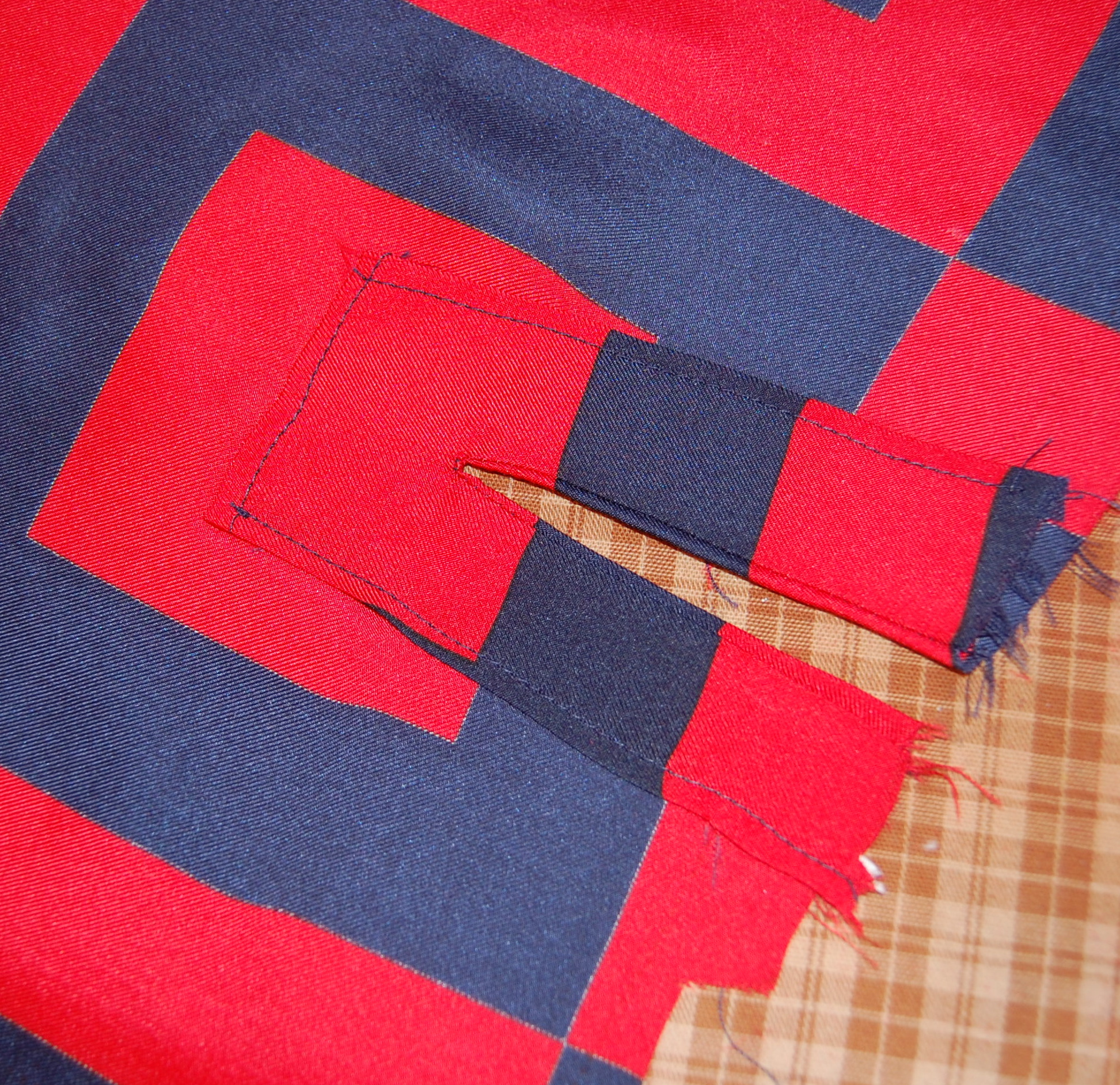
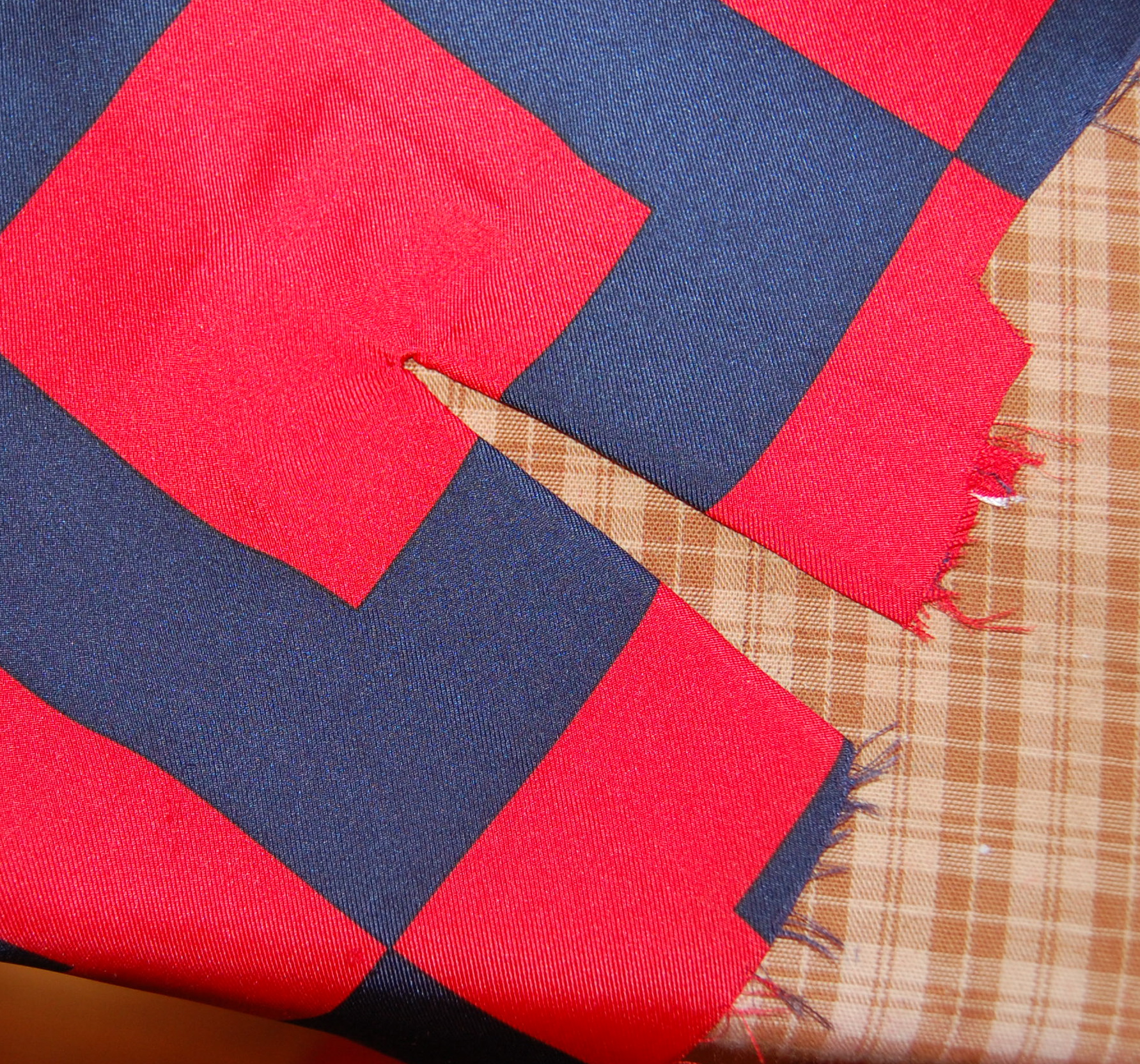
Sewing with vintage patterns is such a pleasure in so many ways.  For example, the sleeve vents had their own separate pattern piece:

The instruction sheet from the pattern . . . .

The instruction sheet from the pattern . . . .

The vent sewn on . . . .

The vent sewn on . . . .

. . . . and the finished vent.

. . . . and the finished vent.

Another classic vintage aspect is the proscribed use of snaps  – in this pattern, at the waist and below, which takes bulk away from the “tuck-in” part of the blouse.

And that bow?  Once I had it made up, was it too much?

I think the bow is just about perfect.

I think the bow is just about perfect.

I am very glad I didn't tinker with the size of the bow!

I am very glad I didn’t tinker with the size of the bow!

Shown with the jacket.  I really like how the collar on the blouse shows a bit when i have the jacket on.

Shown with the jacket. I really like how the collar on the blouse shows a bit when I have the jacket on.

The Necessary Blouse

A comfortable fit.

The Necessary Blouse

Would be nice with a navy skirt as well …

The Necessary Blouse

Whew!  Blouse and jacket turned out as I had hoped!

Whew! Blouse and jacket turned out as I had hoped!

I am feeling quite good about indulging in the extra fabric and extra time needed to make this blouse.  Now that my No. 2 Jacket is complete, I can indulge in my other current project – my color-blocked coat –  which might add a new word to the vocabulary of fashion sewing – obsession!

16 Comments

Filed under Blouse patterns from the 1950's, Blouses, Buttons - choosing the right ones, Chanel-type jackets, sewing in silk, The Conde Nast Publications, Uncategorized, vintage Vogue patterns from the 1950s, Vogue patterns

Powerless in Pennsylvania, Sewing in San Francisco

“She had the loaded handbag of someone who camps out and seldom goes home, or who imagines life must be full of emergencies.”  – Mavis Gallant

Actually, the handbag I took to San Francisco was small, tucked inside a larger tote bag – so that I could use my allotted “carry-on” space for an extra suitcase for fabric purchases.  Off I went on February 1st for Susan Khalje’s Couture Sewing School held at The Sewing Workshop in San Francisco.  I had carefully packed myriad sewing supplies and my prepared muslins, hoping to be ready for any contingency.  Little could I have known that while I was to be sewing on the West Coast, the camping out (or really, camping in!) and the emergencies would be on the East Coast – with the county in Pennsylvania where we live especially hard-hit by a devastating ice storm.  Our house was without power for 5 days, and knowing that my husband was dealing with downed trees, downed power lines, blocked roads, confused pets, a house getting colder and colder with each day, and limited means of communication, weighed on me mightily as I worked away on my color-blocked jacket.

Coats of certain length - 7

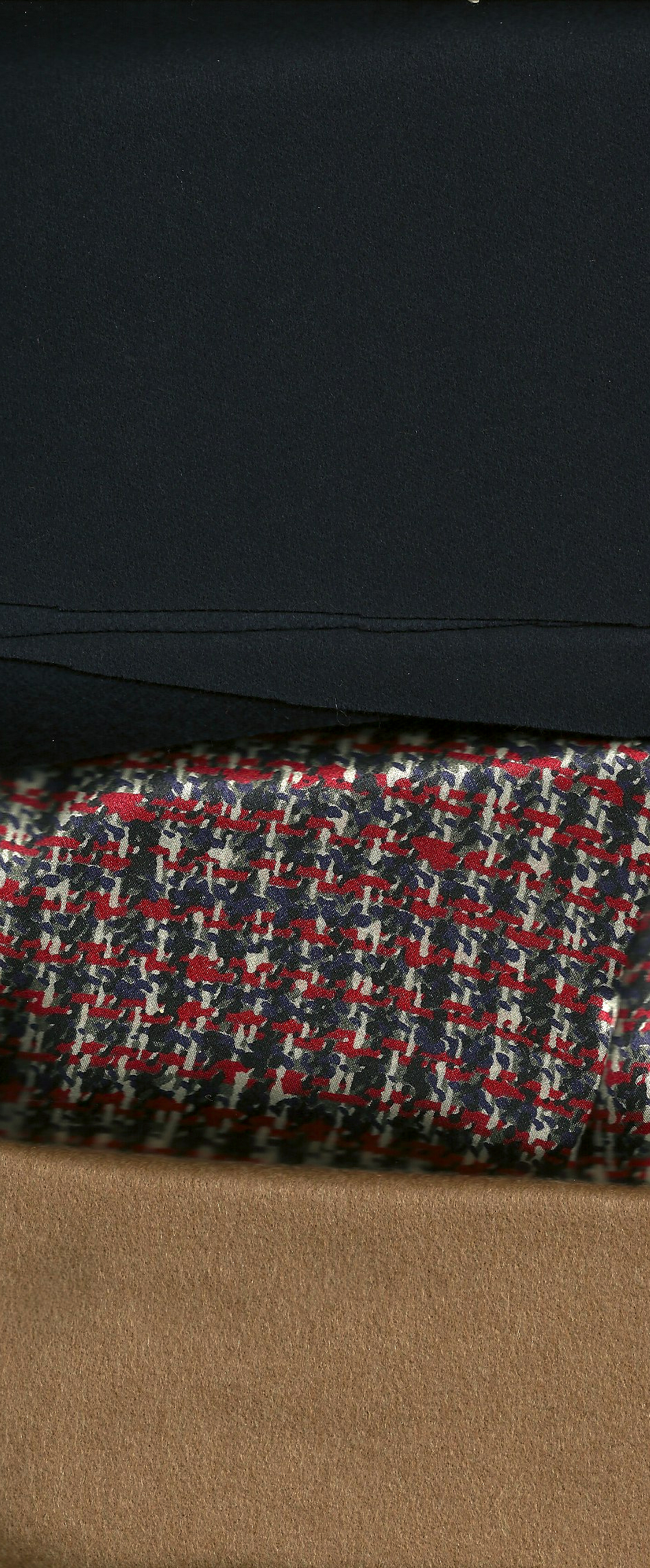
Most of us in the class needed to purchase all our fabric or coordinating fabric or supplies for our intended projects, so off we went to Britex Fabrics on Monday after Susan had fitted most of our muslins.  I had thought long and hard about what color combination I would like to have for this coat.  Knowing that many, many hours of work would go into this project, and also realizing that this jacket could be a go-to piece of outerwear if I chose my fabrics carefully, I decided to look for more conservative colors.  So – no hot pink and apricot orange, at least this time.

Britex carries an extensive selection of coating wools, so much so that it is definitely advantageous to be helped by one of their incredibly knowledgeable sales assistants.  I was fortunate that Inna, who has such a trained and talented eye for color and texture, was able to assist me. We started with a lovely camel hair coating wool, which had a napped silky sheen on one side and was just the right heft for outerwear.  First I wanted to look at pairing it with gray, but nothing in the gray family seemed to strike my fancy.  Then we moved on to the navy blues – and there nestled in among the bolts was the perfect “medium” navy blue, also with a napped sheen on one side.  It was a little heavier than the camel hair, but Susan felt confident we could make the two fabrics work together, especially because their colors complimented each other so perfectly.

Silk lining fabric was next on the list, and I wanted something figured rather than plain.  Inna pulled out a bolt of Italian charmeuse, which picked up the geometric feel of the jacket, and introduced a little red into the mix.  I couldn’t be happier with it.

I am not so sure this gives the best sense of the colors of the fabrics, but you will see more in a future post.

I am not so sure this photo gives the best sense of the colors of the fabrics, but you will see more in other photos.

Back at The Sewing Workshop, armed with fabrics and enthusiasm, I spent the next two days cutting out the multi-, multi-pieced pattern (31 separate pieces, all of which would be cut in tandem, making 62 in all, not including the lining!), and basting the silk organza underlinings to each and every piece.

My well-lit and spacious work space at The Sewing Workshop.

My well-lit and spacious work space at The Sewing Workshop.

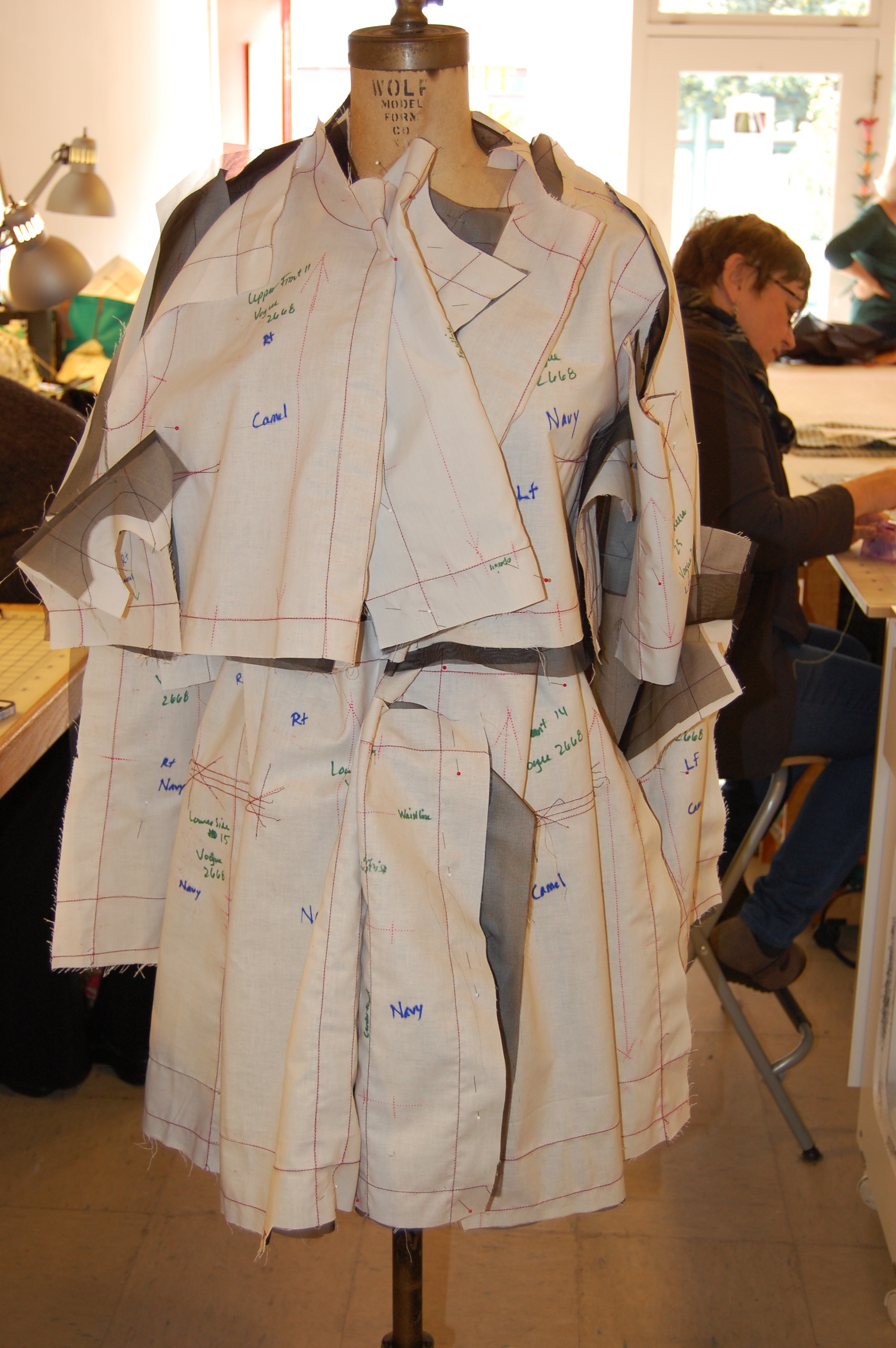
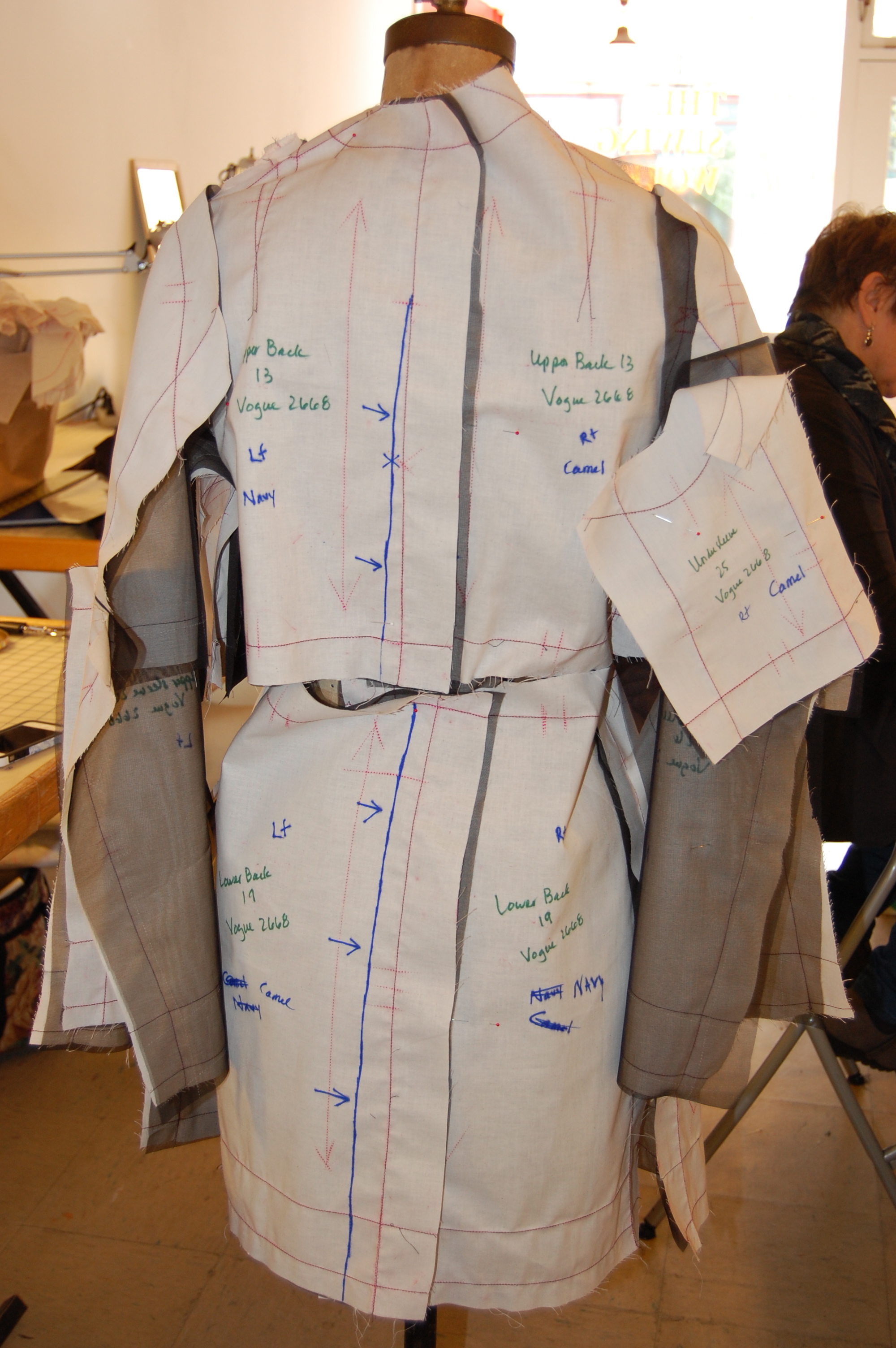
Because of the color blocking, I needed to pay great attention to which piece was to be cut in blue and which piece in camel.  Initially I went through and labeled each muslin piece “navy” or “camel”.  Susan double-checked me, but then suggested that, because I absolutely could not make a costly mistake, that I pin the muslin pieces onto the available dress form in our studio.  What a great idea, one of so many which I picked up from Susan and my classmates!

Here is the "front" of the jacket, pinned onto the dress form.

Here is the “front” of the jacket, pinned onto the dress form.

And here is the back.

And here is the back. 

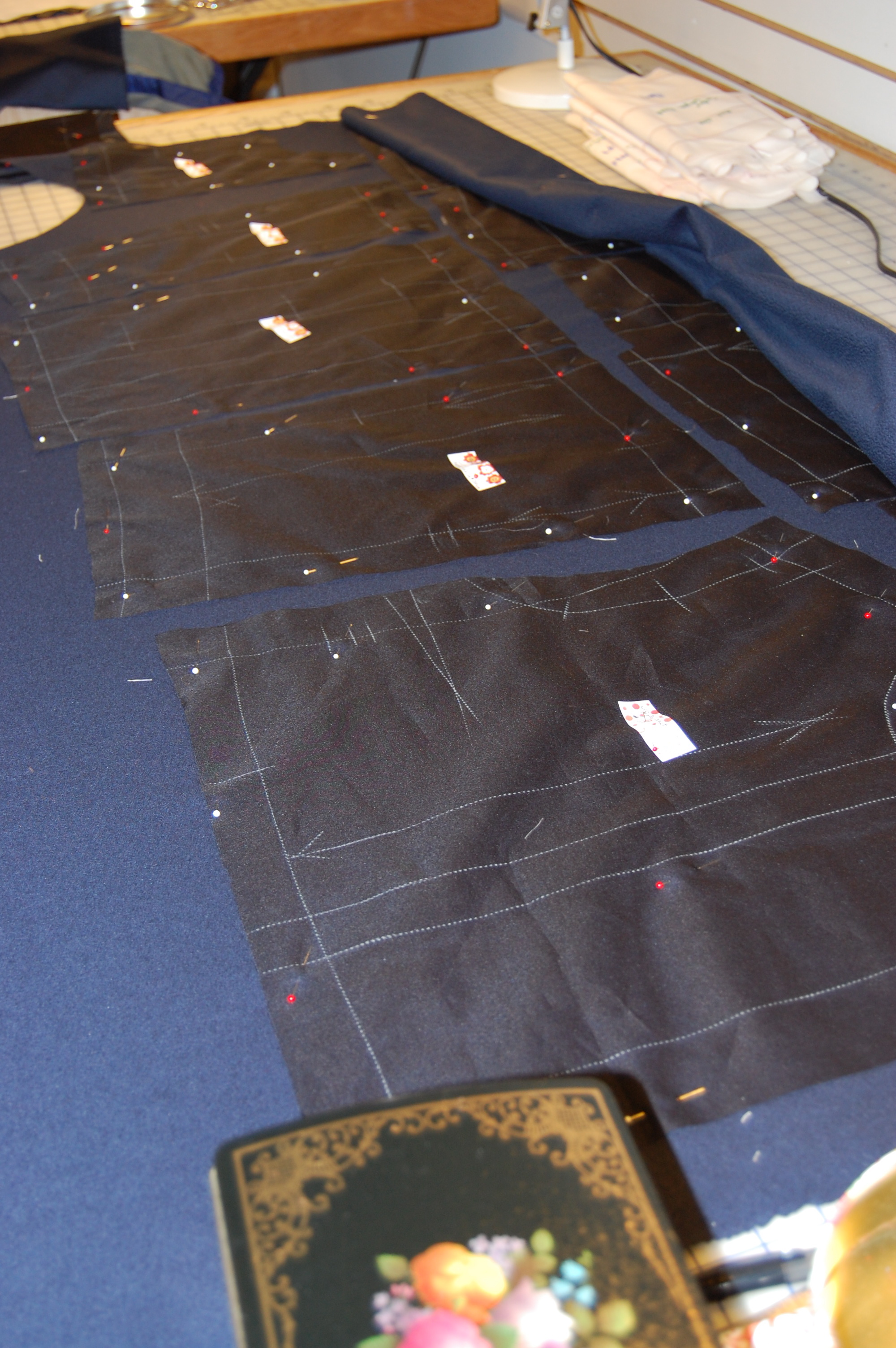
Now, I felt confident and set about to cut my fashion fabric.

Here are the silk organza underlining pieces arranged on the blue fabric.  I pinned a small tag on each piece, telling me each piece's pattern # and description.  A lot of the pieces look alike!

Here are the silk organza underlining pieces arranged on the blue fabric. I pinned a small tag on each piece, telling me each piece’s pattern number and description. A lot of the pieces look alike!

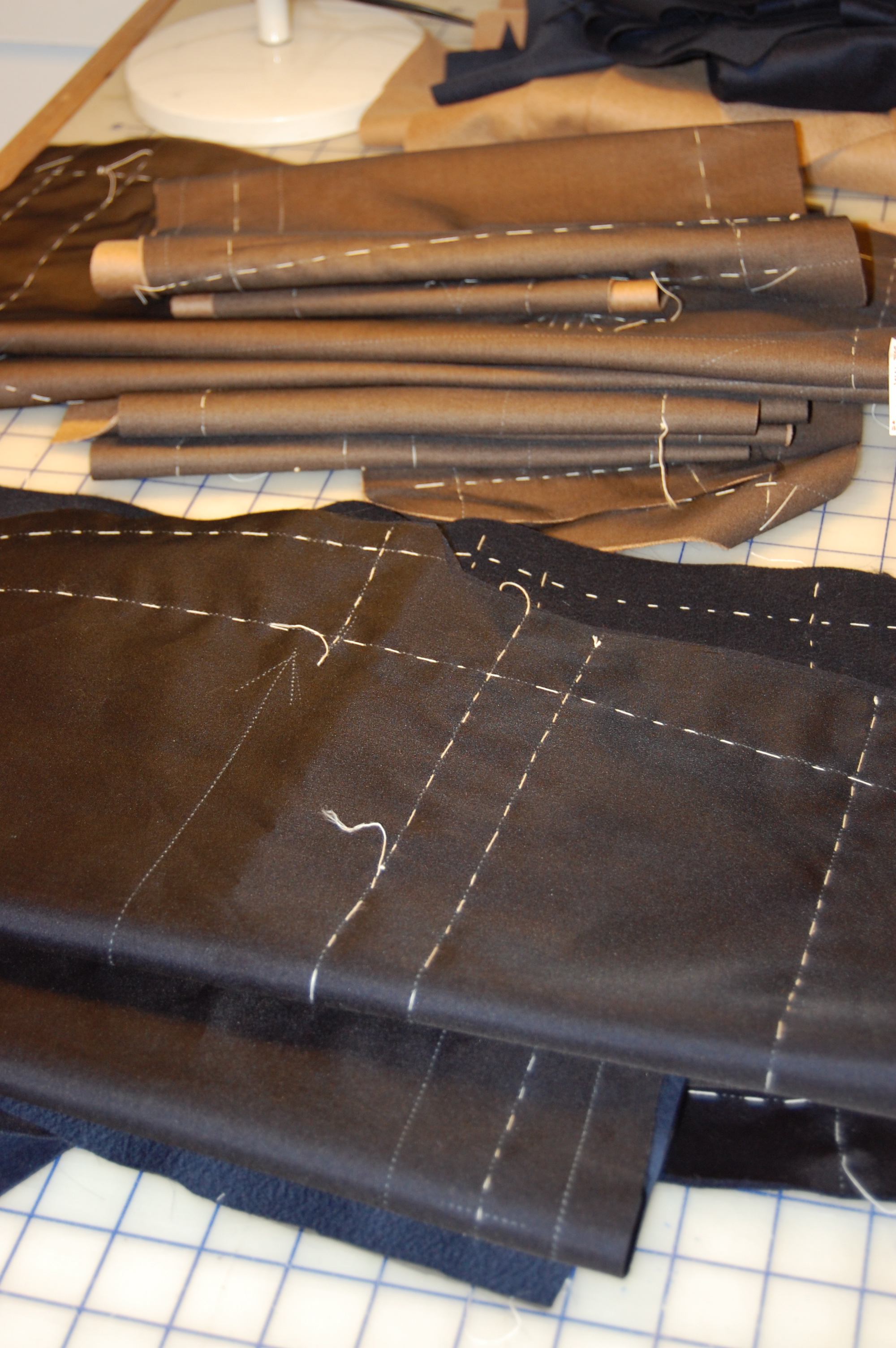
Two piles showing all underlinings basted onto the fashion fabric.

Two piles showing all underlinings basted onto the fashion fabric.

By this time, I was half-way through the 6-day class.  I assessed my situation and determined the parts of the jacket construction upon which I wanted to get expert advice  from Susan:  treatment of the concealed fly front, flap pockets, rolled collar (all of which will be detailed in a future post).  Now I had a plan, which seemed to be much more than anything that was happening back home in Pennsylvania.

My husband joked during one of our few cell-phone conversations, that he had a vision of the power in our house coming back on Sunday evening, February 9th, as he would be driving me home from the airport in Philadelphia.  He was right.  That is exactly what happened.  I came home to a 39F degree house, but the lights were on, and soon the heat was, too.  Almost a week later, it is still snowing and snowing – perfect sewing weather for this sojourner home from San Francisco.

12 Comments

Filed under car coats, Coats, Color blocking, couture construction, Uncategorized, underlinings, vintage Vogue Designer patterns, vintage Vogue patterns from the 1970s, Vogue patterns, woolens

The Second Time Around

Coco Chanel reopened her House of Chanel in 1954, and by the early ‘60s, her suit with its narrow skirt and boxy cardigan jacket, famously made from beautiful boucles, was a dominant fashion look.  I could not help but think of another product of the early ‘60s as I was working on my Chanel-inspired Jacket No. 2:  the song, written by Sammy Cahn and set to music by Jimmy Van Heusen, entitled “The Second Time Around”.  I wondered if making my No. 2 would be “lovelier the second time around”?  And you know what?  It was!  I give so much credit to Susan Khalje, from whom I took the Classic French Jacket Class, whose tips and teachings gave me much confidence as I tackled No. 2 on my own.

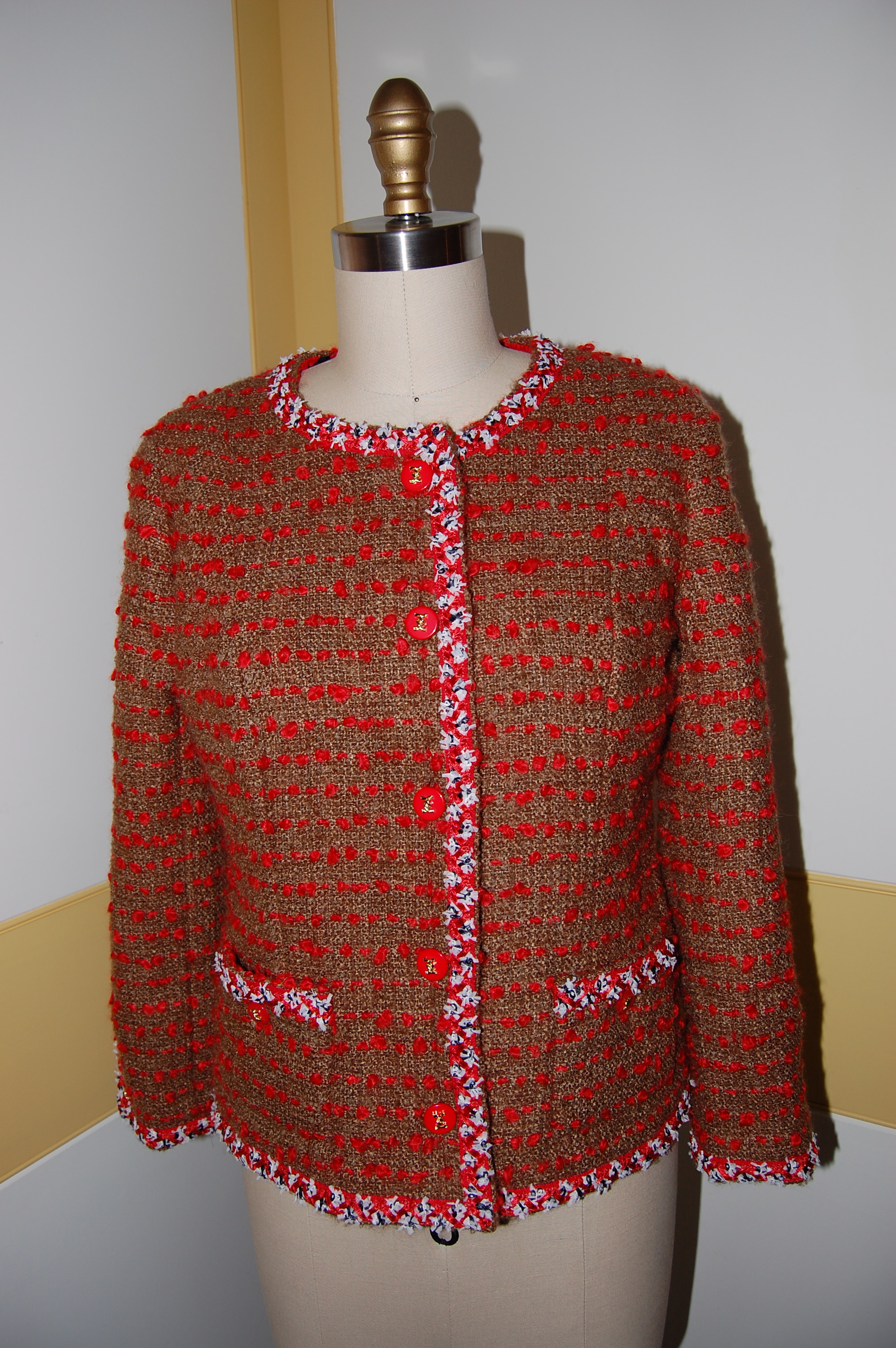
There were a couple of additions and subtractions I decided to try with my second jacket.  The easy one was deciding to have just two pockets rather than four.  The more involved one was deciding to add buttonholes to the front edge, the sleeve plackets, and the pockets.  However, I remembered Susan’s statements about making buttonholes in one of these jackets – and the reason she advocates in her class the use of “hook and eye” fasteners at the abutted front edges.  It is very difficult to make acceptable hand-done buttonholes in this loosely woven fabric, unless one is extremely skilled in this procedure.  Since the only hand-done buttonholes I am used to doing are bound buttonholes – not acceptable in this application, due to the type of fabric – I knew I had to figure out another way to get buttonholes in my No. 2.

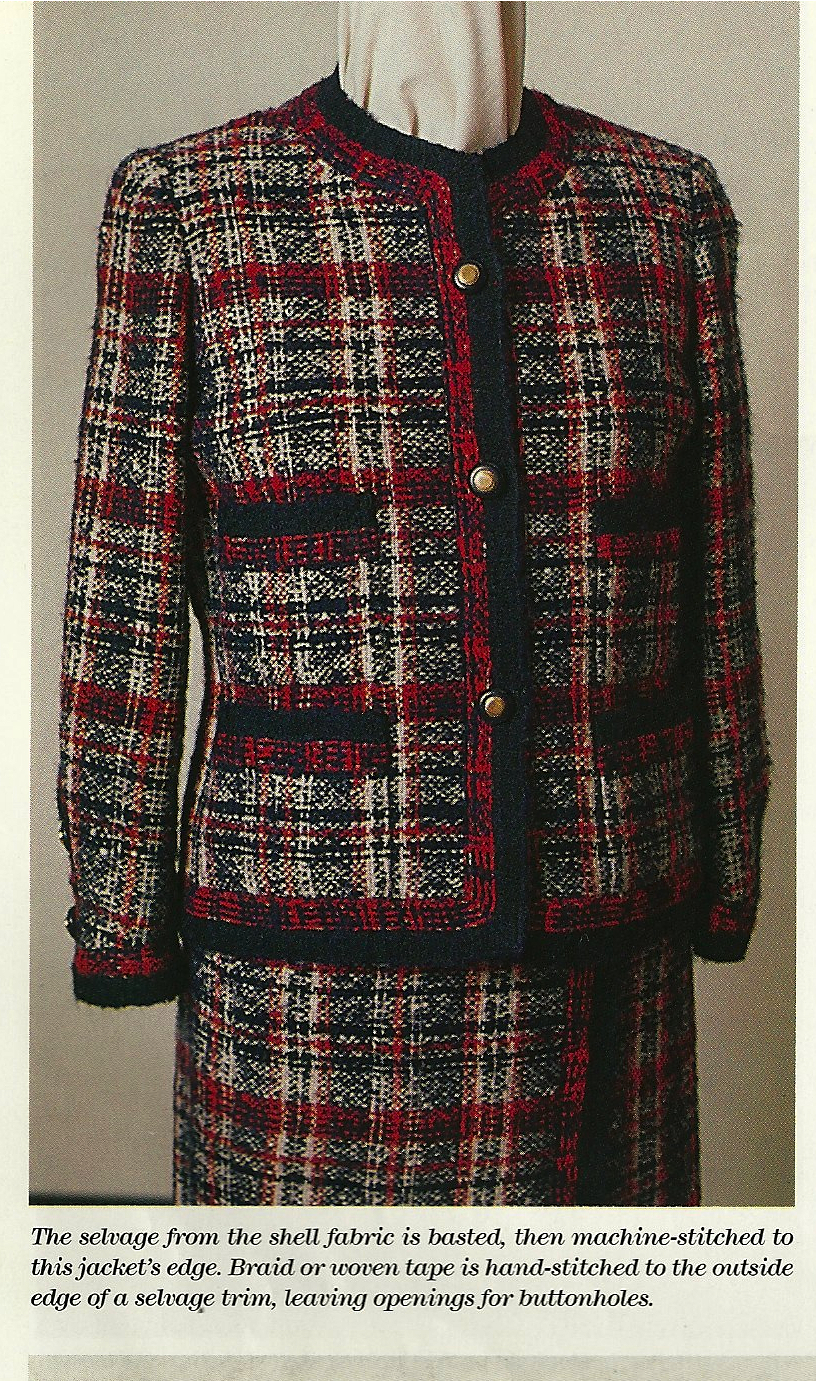
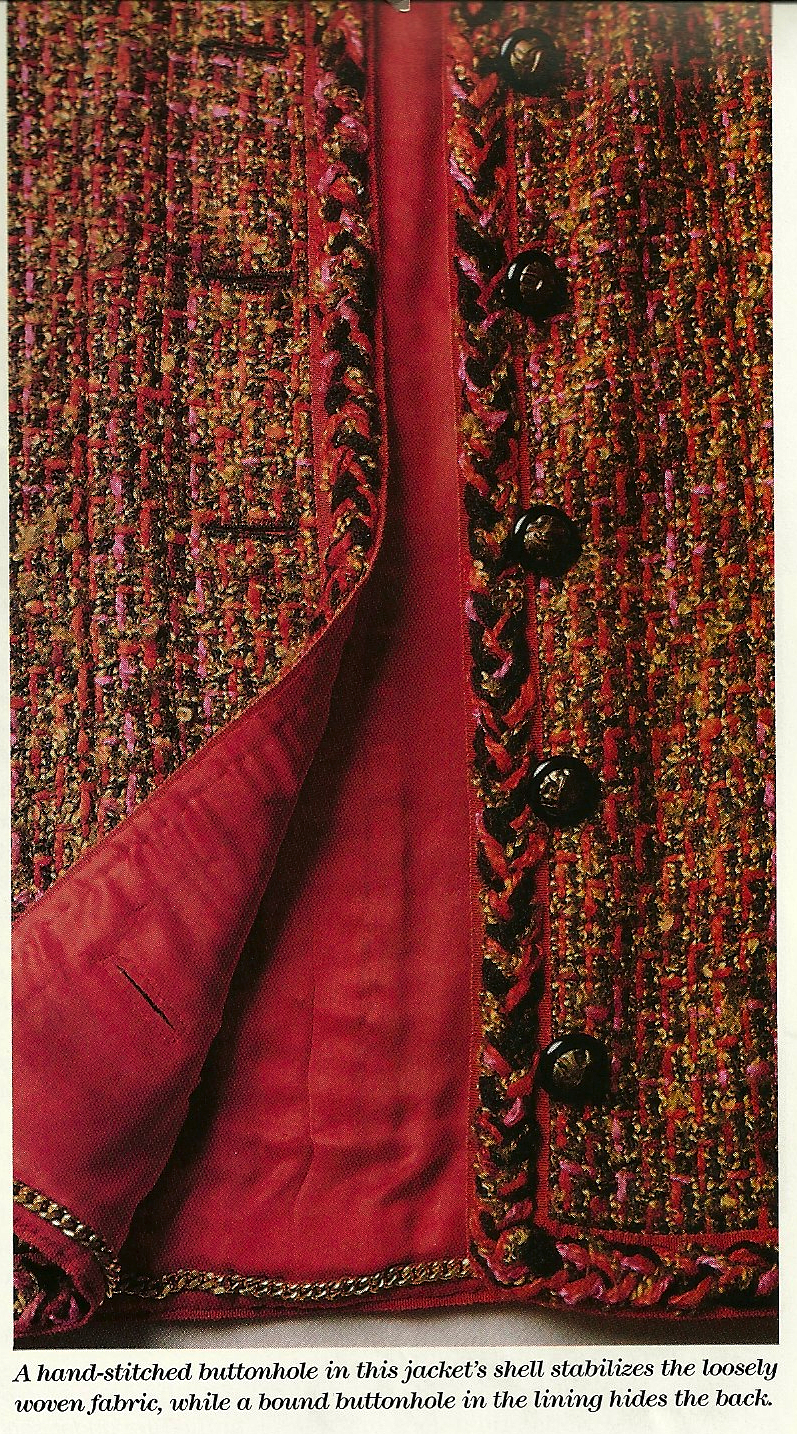
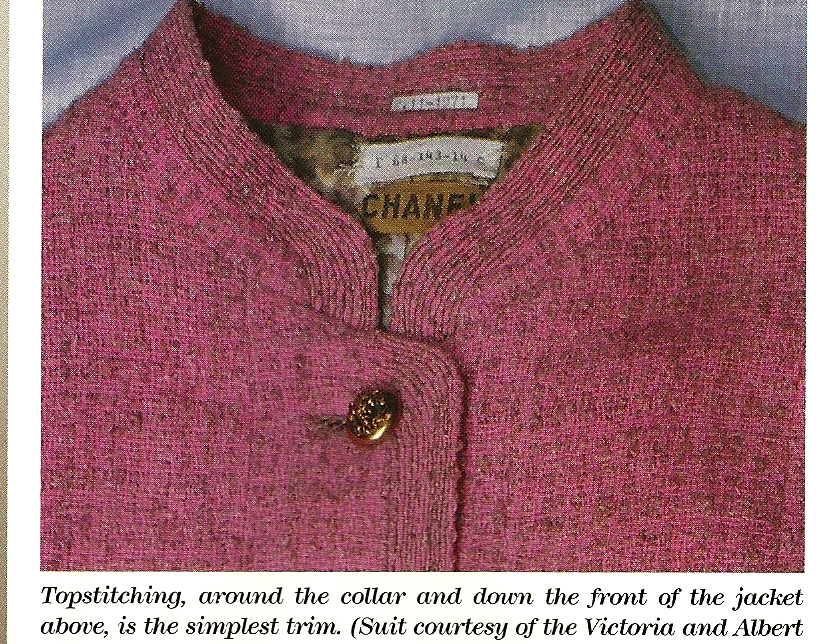
Fortunately, I have an issue of Threads Magazine from June/July 1989 in which Chanel jackets are featured.  This picture gave me the idea for seam-slot buttonholes.

You can tell the buttonholes in this jacket are vertical, nestled between two trims.

You can tell the buttonholes in this jacket are vertical, nestled between two trims.  Pictured in Threads Magazine, June/July 1989, page 28.

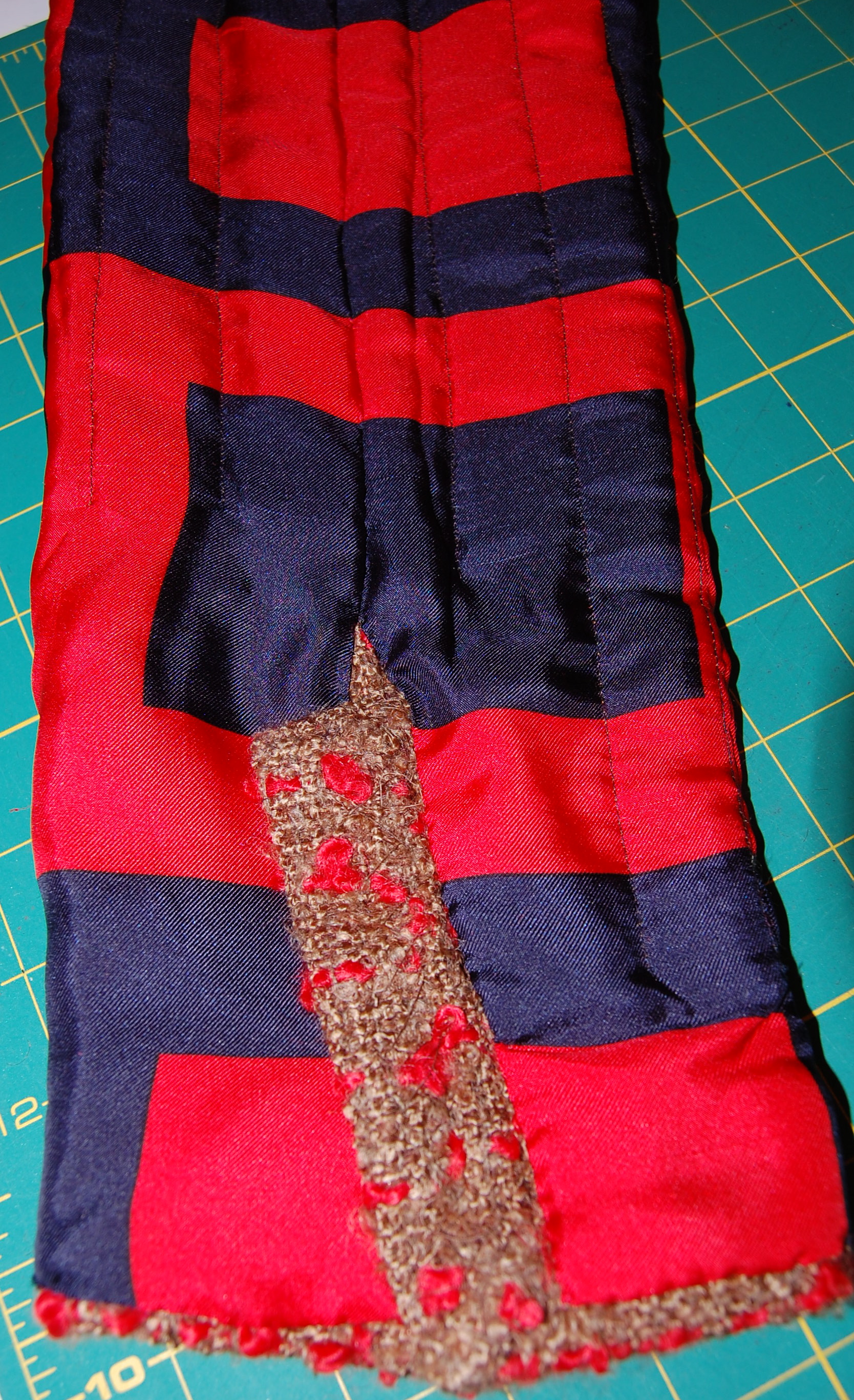
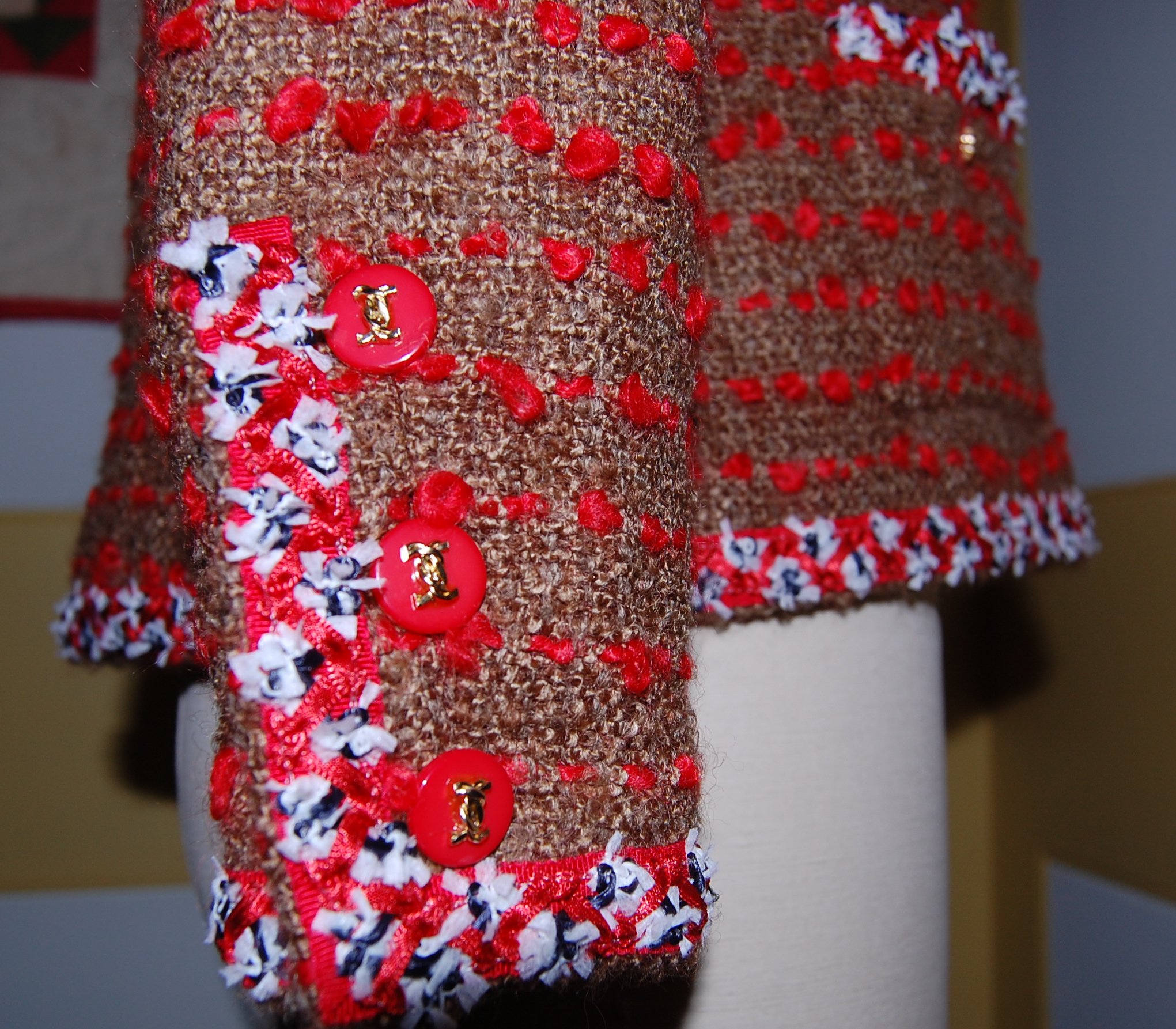
I would just have to add on a separate piece for the right front, make each pocket in two pieces, and make the plackets on the sleeves separate pieces, sewn on with openings in the seams to make the buttonholes.  Here is an example of what I did.

The extension is sewn on separately, leaving three openings, evenly spaced for buttonholes in the seam.

The extension is sewn on separately, leaving three openings, evenly spaced for buttonholes in the seam.

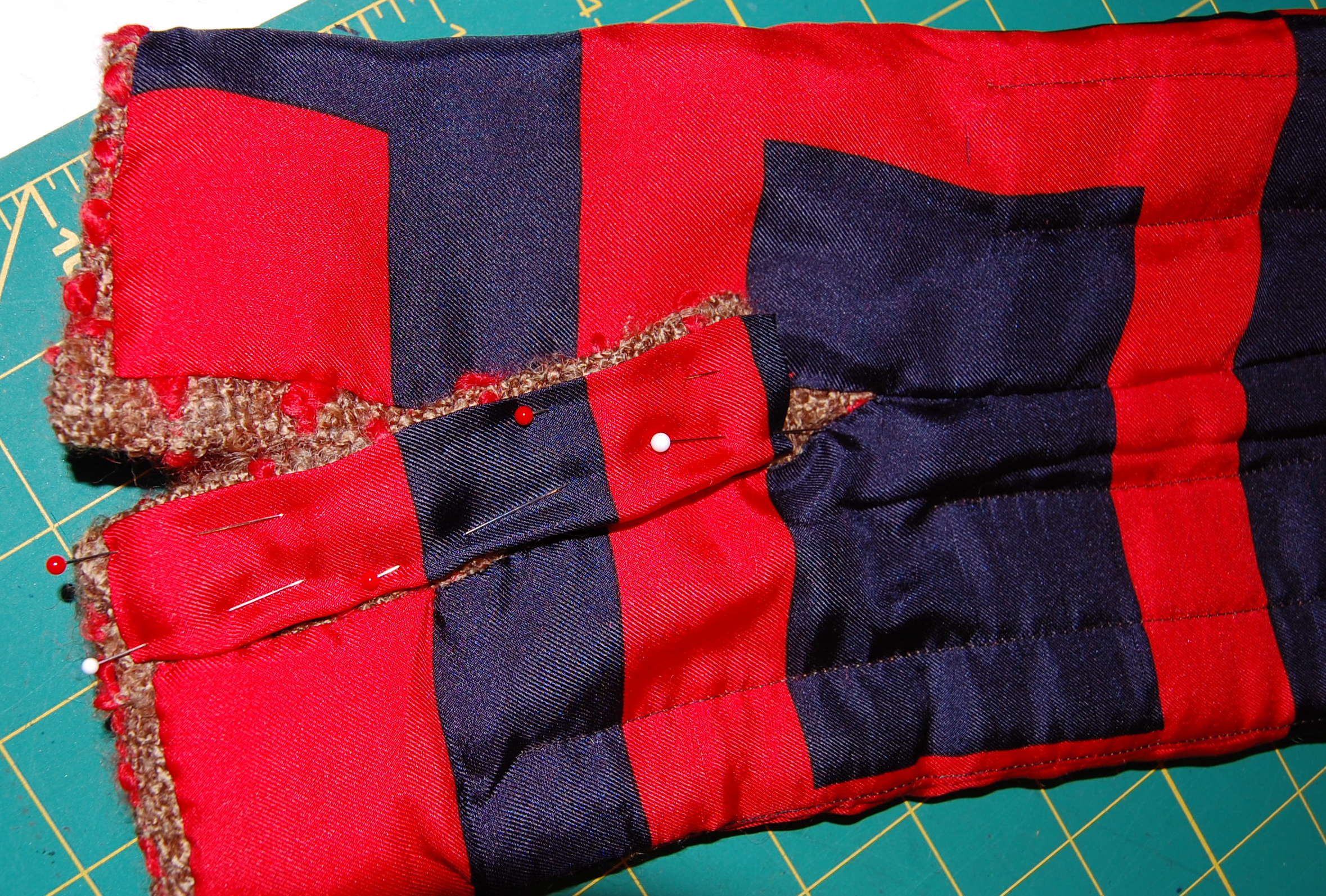
Of course doing these extra pieces meant I had to apply separate linings to each extension.

Here is the separate lining piece being applied to the placket.

Here is the separate lining piece being applied to the placket.

The entire time I was quilting the jacket, working on the seams, and figuring out these buttonholes, I was pondering the trim.  Some of you may recall (if you read my blog regularly) that I could not decide between two different trims.

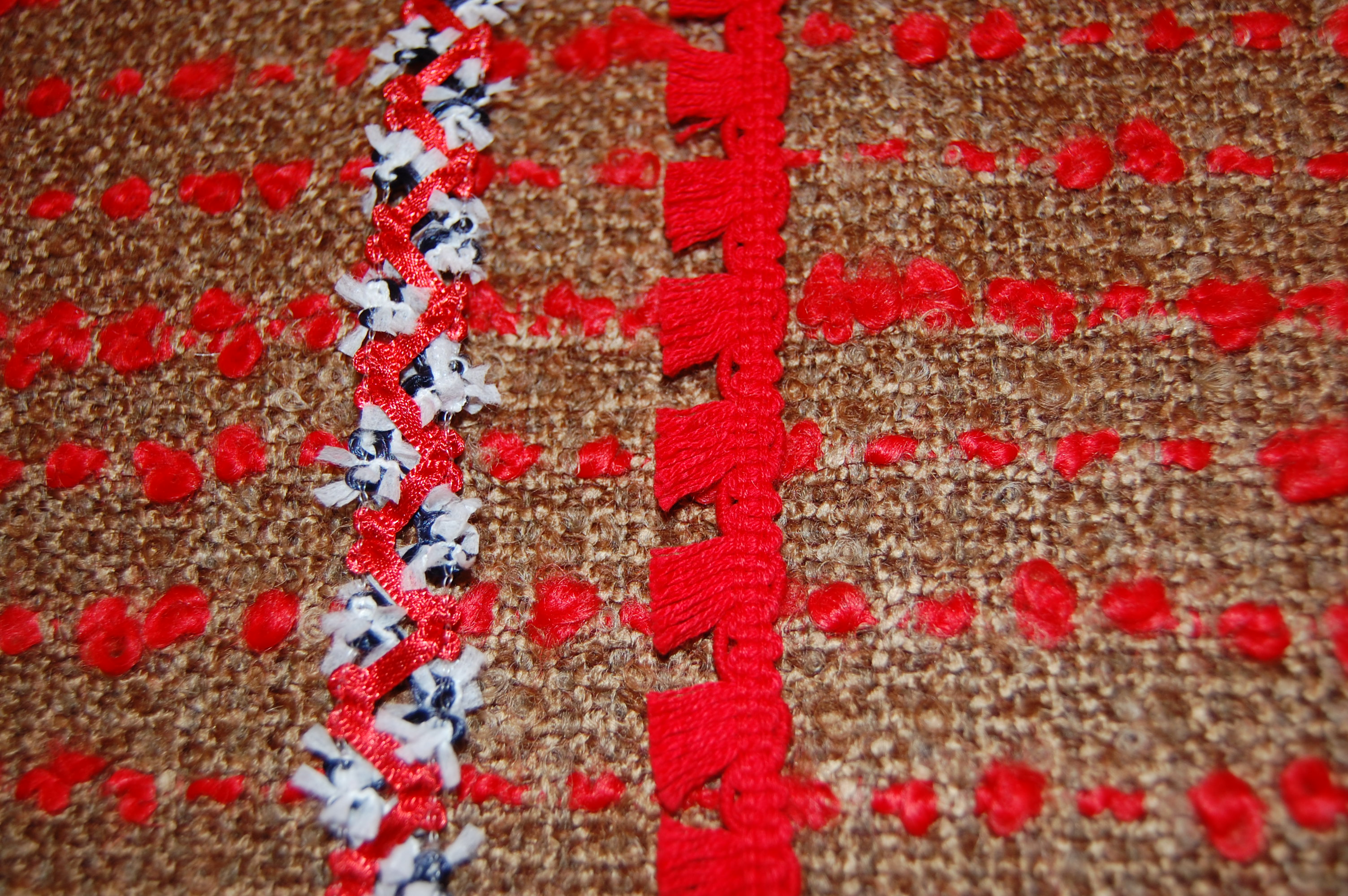
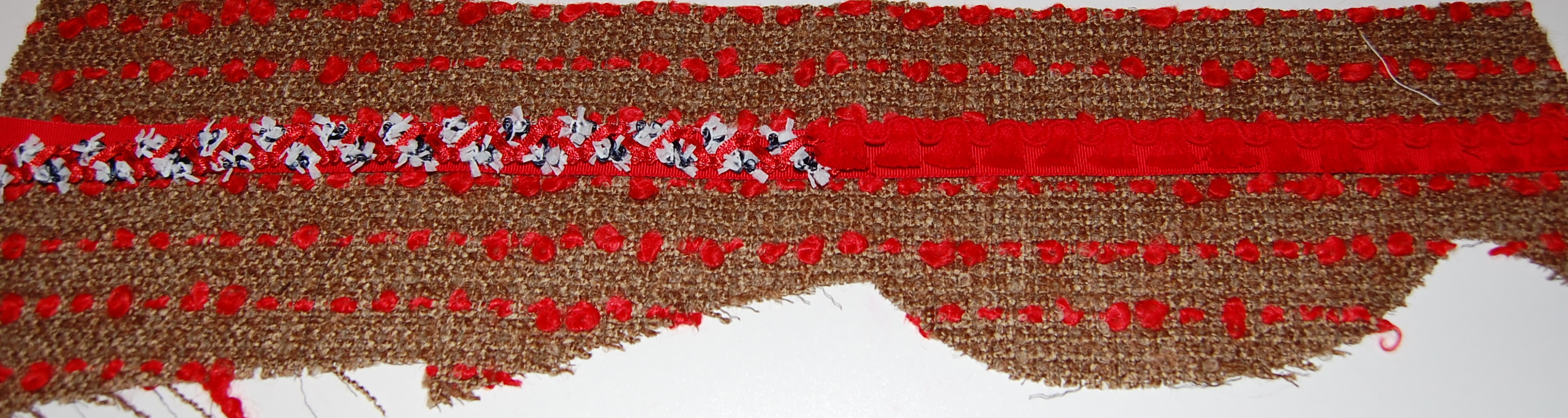
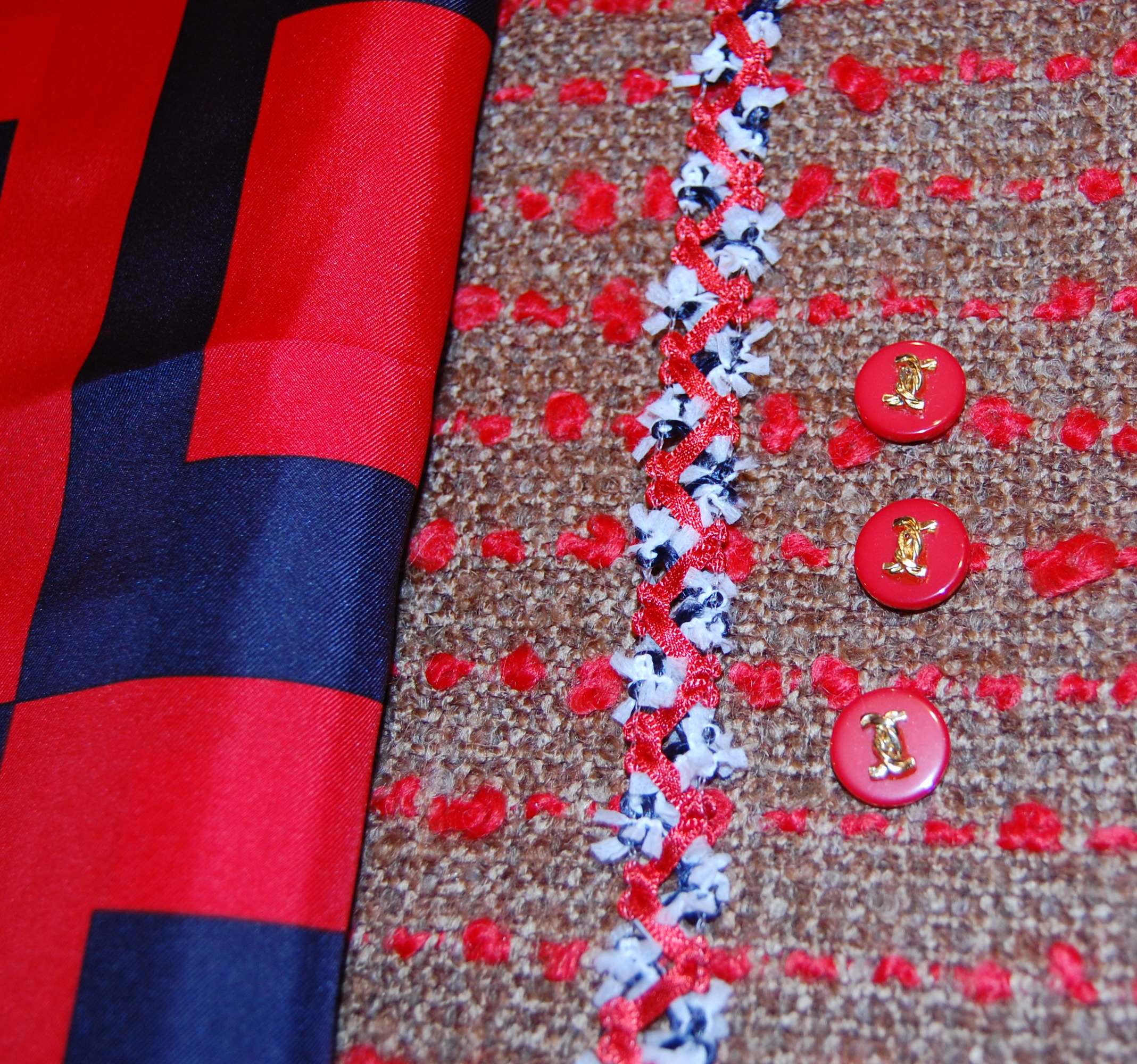
Here are the two trims I had chosen.

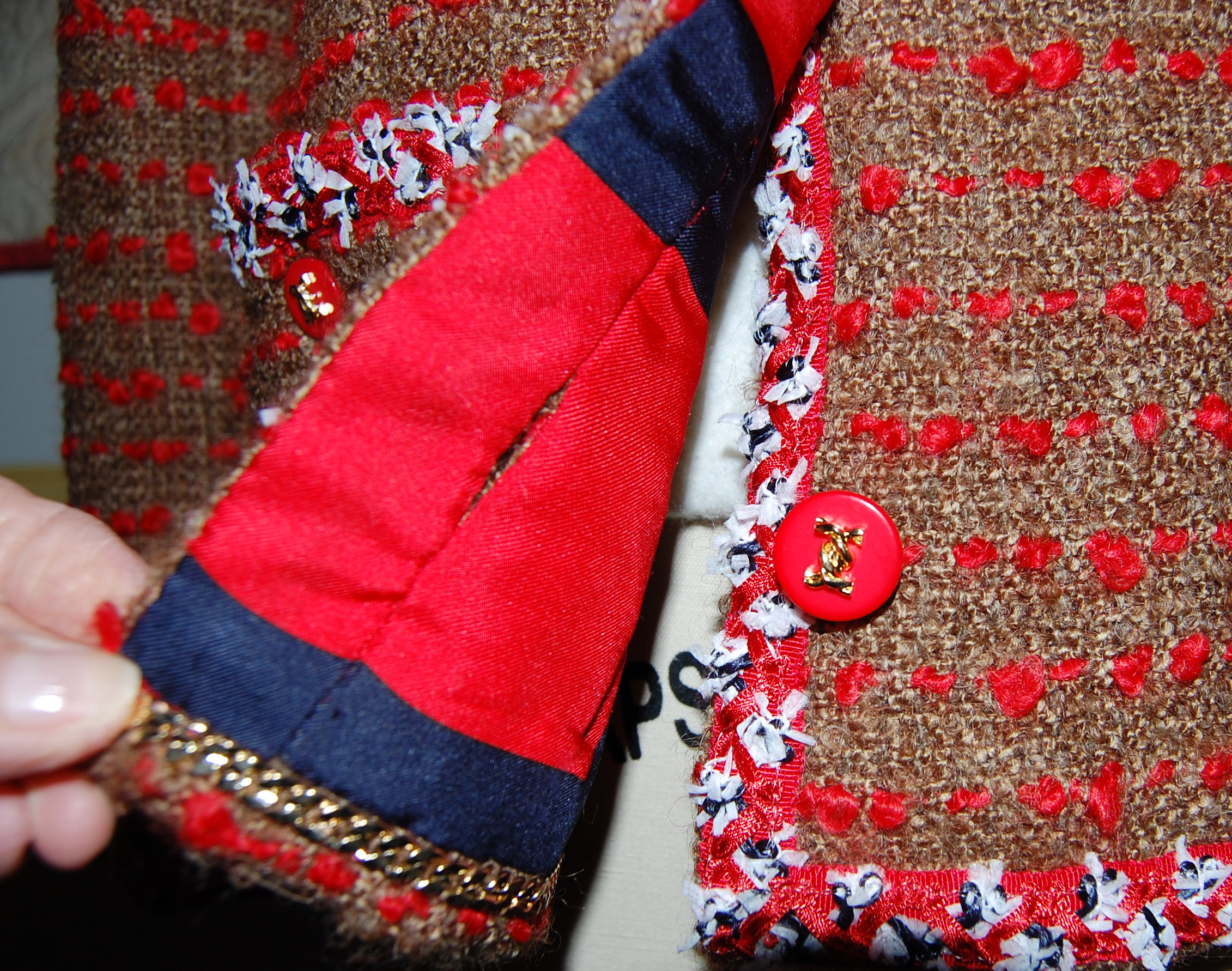
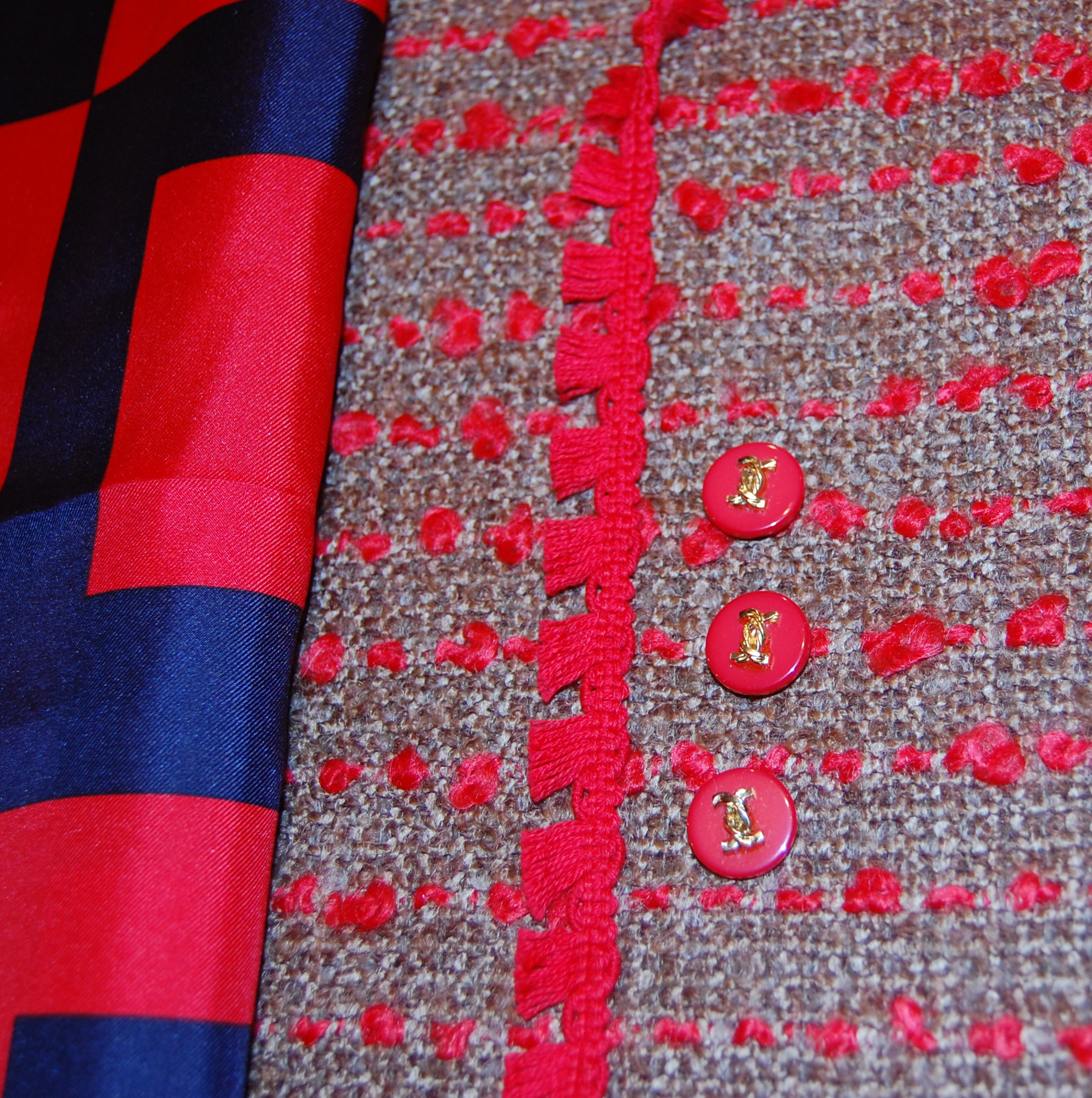
Here are the two trims I had chosen.  I really liked the fact that the spacing on the multi-color trim matched exactly the spacing of the red rows on my fabric.

Because of the lining fabric I had chosen (and from which I am making a blouse), I was leaning towards the red, white and blue trim, but I thought it looked a little “weak”.  What to do?  I started looking at as many pictures of Chanel jackets as I could find, but the one that made the light bulb go off was one from that same issue of Threads Magazine:

The Second Time Around - grosgrain ex

Click on the picture to see the underlying grosgrain ribbon.

If I could find a Petersham grosgrain ribbon in the right color, I thought it would be the perfect backing for either trim.  Once again, Britex Fabrics  (from which I had already purchased the boucle, the lining fabric, the buttons, and the two trims) came to the rescue:  I ordered 5/8 inch Tomato Red ribbon – and then paired it with each trim.

I thought the grosgrain ribbon made both trims look better, but especially the multi-color one.

The grosgrain ribbon made both trims look better, but especially the multi-color one.  Click on the photo for a close-up view.

I thought it added just the right amount of depth to the multi-color trim, and my decision was confidently made.

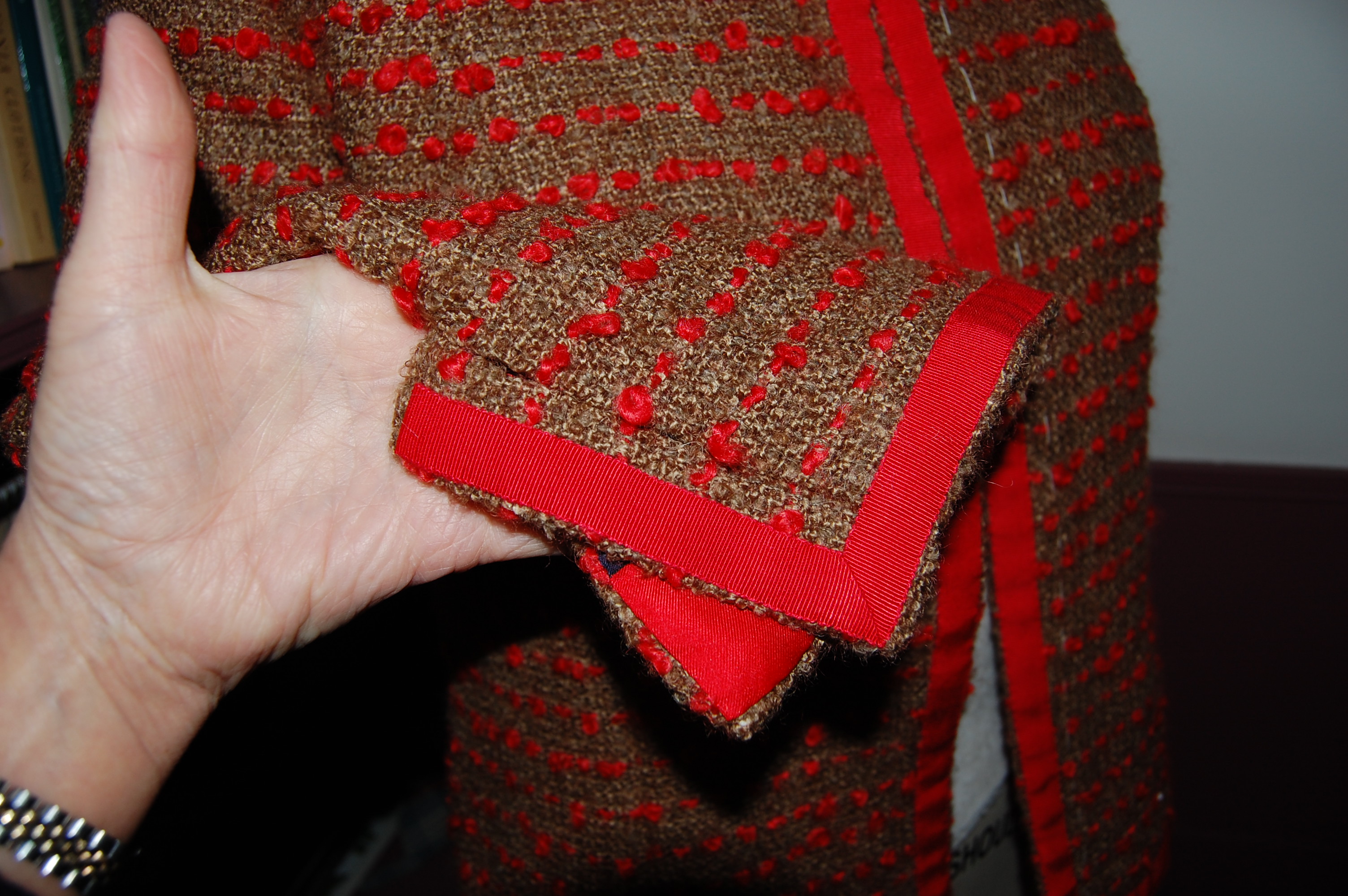
I sewed the Petersham ribbon on before I did the finish work on the inside lining seams.  Then the ribbon provided a wonderful surface on which to attach the trim.

The Petersham ribbon attached.  If you look closely, you can see the sea-slot buttonholes.

The Petersham ribbon attached. If you look closely, you can see the seam-slot buttonholes.

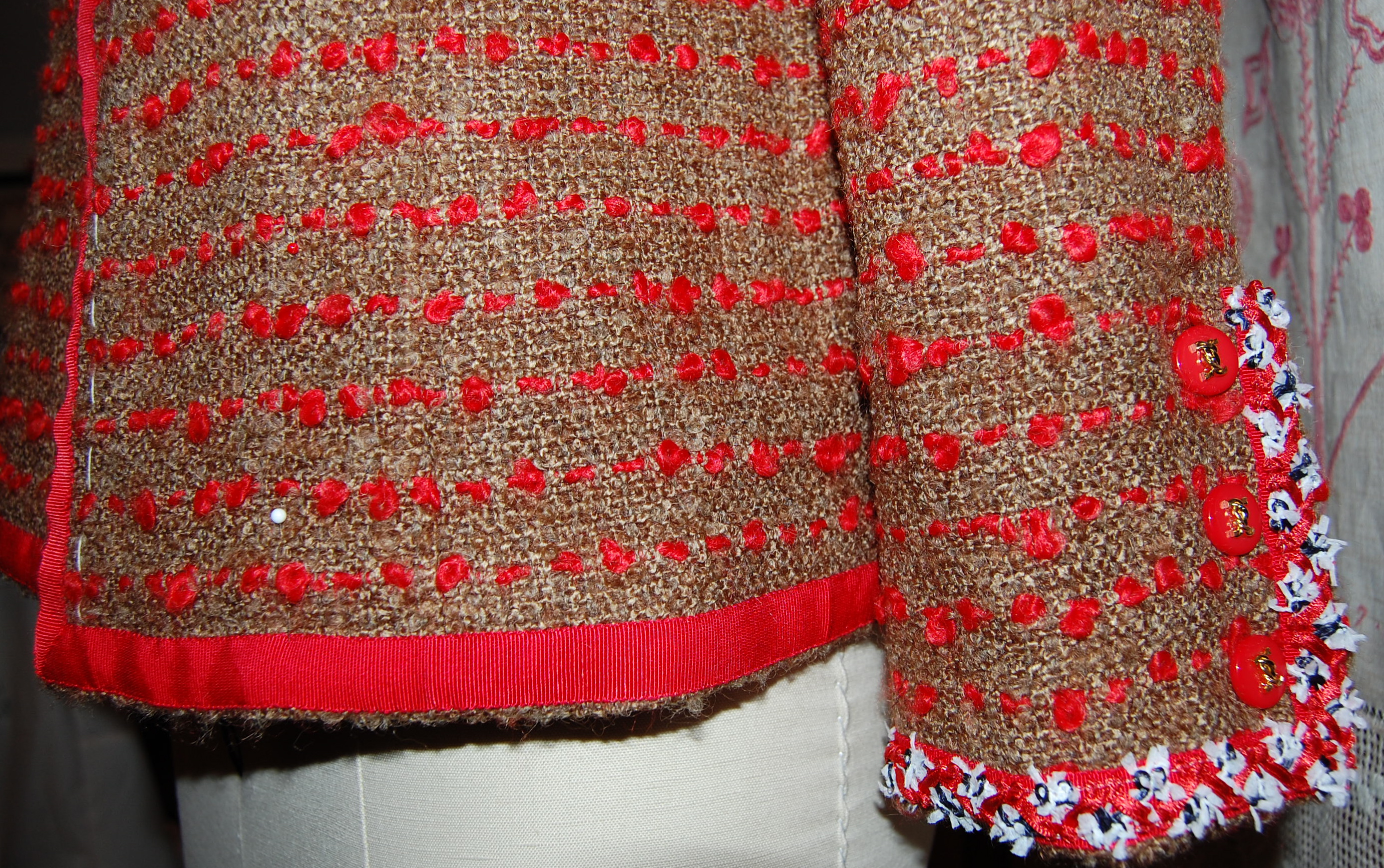
 I took this picture to show the contrast between the trims.  I think the multi-color trim adds more interest to the jacket.

I took this picture to show the contrast between an all red  trim and the multi-color one. I think the multi-color trim adds more interest to the jacket.

So – here’s the jacket (shown on my dress form for now.  Once I get the matching blouse finished, I’ll “model” it for you.)

No 2

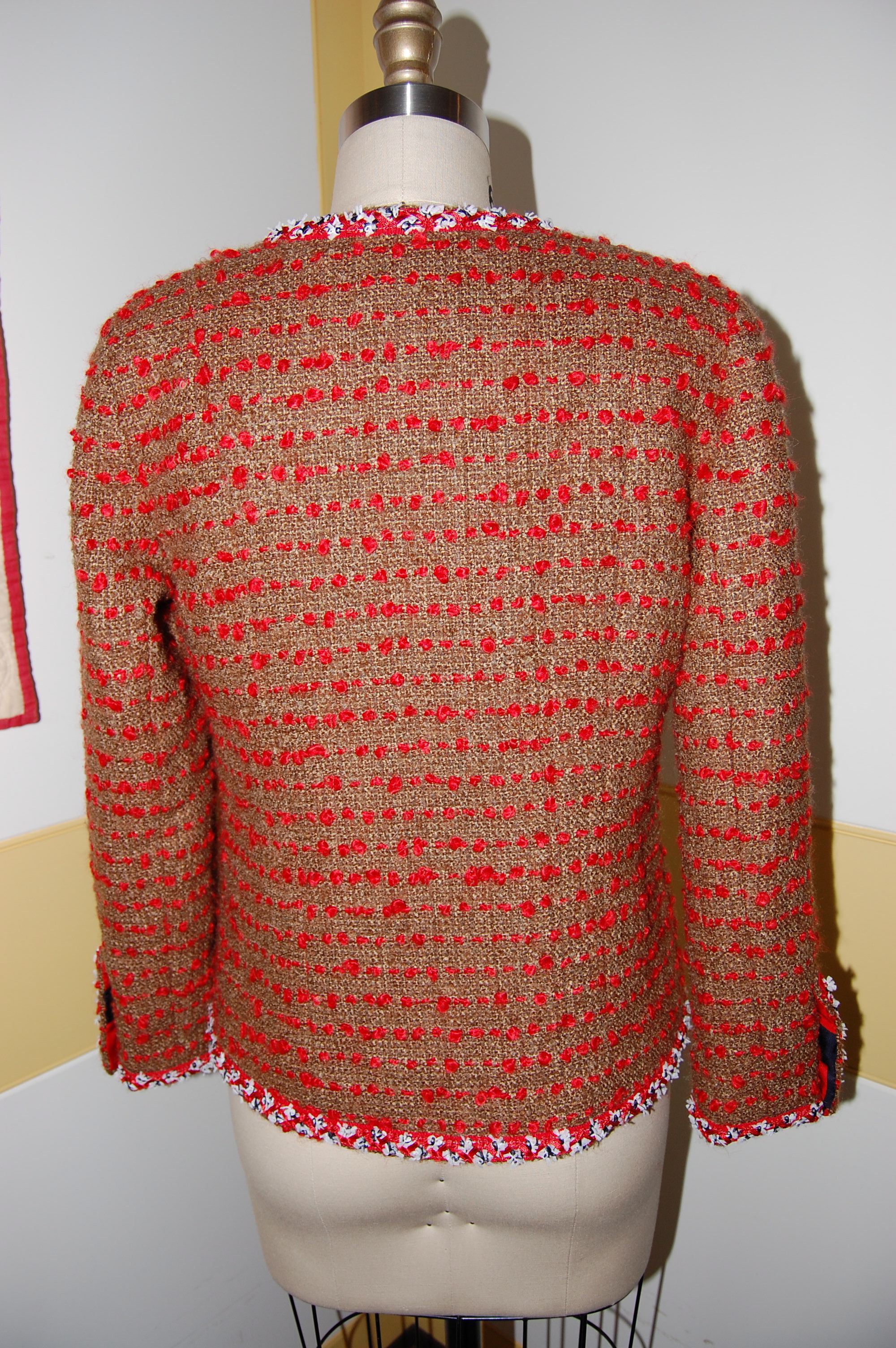
Back view, obviously!

Back view, obviously!

No 2

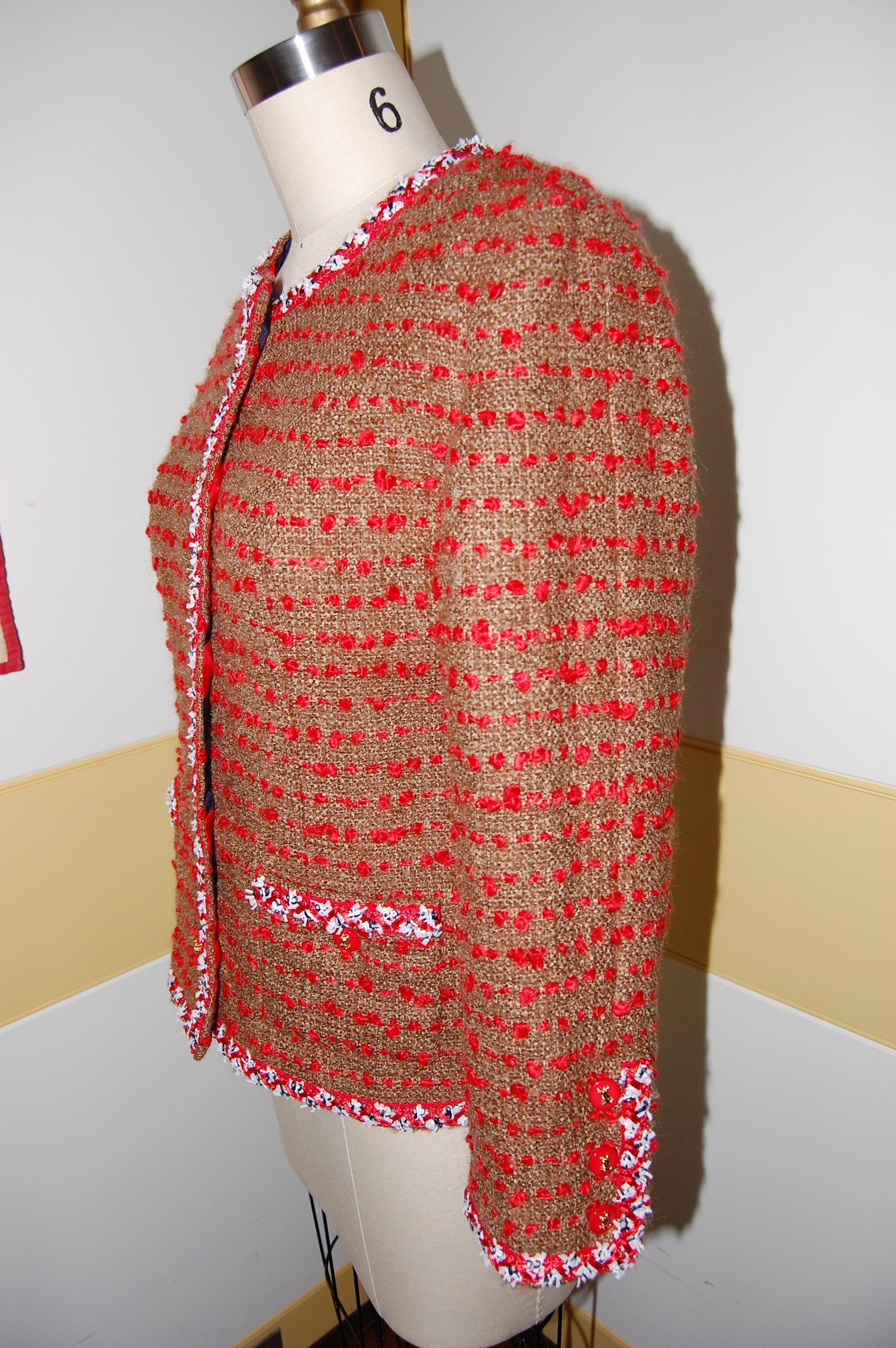
Details, details!

Details, details!  Can you tell that I added a little length to the back of the jacket?  It makes for a more graceful appearance when worn.

Here is the bottom buttonhole on the front of the jacket - and notice the chain!

Here is the bottom buttonhole on the front of the jacket – and notice the chain!

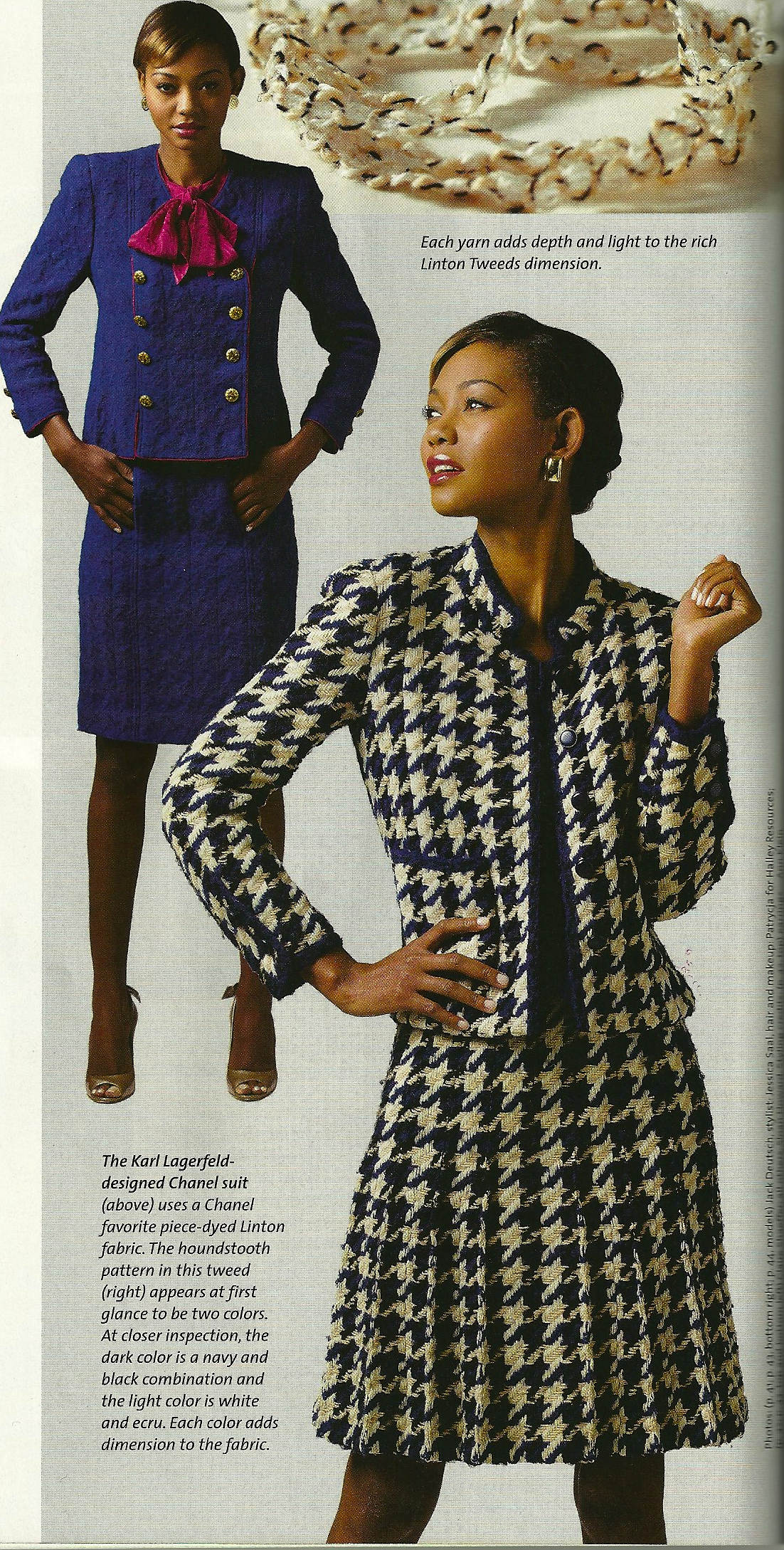
There is no way to make this jacket quickly.  The extra steps I added (buttonholes and 2 layers of trim) added to the length of the process as well.  But – it was incredibly satisfying to see it turn out as well as it did.  I am grateful that I made this No. 2 shortly (well, within 6 months) after my first jacket, as it reinforced my knowledge of the process.  For my next one I’d like to add a “mandarin” type collar, as shown in these examples:

The Second Time Around - mandarin collar ex 1

This example is from Threads Magazine June/July 1989, page 28

I love this suit in houndstooth wool.  This is pictured in Threads Magazine, January 2014, page 44.

I love this suit in houndstooth wool. This is pictured in Threads Magazine, January 2014, page 44.

So when will No. 3 commence?  I don’t see it on the horizon yet, but perhaps when it does, the third time around will be … “the charm”.

23 Comments

Filed under Boucle for French style jackets, Chanel-type jackets, Coco Chanel, couture construction, Uncategorized, woolens

Thoughts on Fabric

One theme I often see in New Year’s sewing resolutions is an emphasis on sewing from one’s “stash” rather than purchasing more new fabric.  I don’t know too many serious sewers who don’t harbor at least a little guilt about all the fabric they have squirreled away (the word “stash” actually does imply something put away, usually in a secretive place!).  I used to feel a lot more guilt about all my fabric than I do now, and here’s why.  First, I don’t consider my fabric a “stash” of anything.  I look at it as a collection, to be used, admired, and taken care of like any valuable thing.  And second, I believe having a selection/collection of beautiful and inspirational fabric adds to the creative process of sewing.

As with the selection and collection of any worthwhile genre, it’s usually best to buy the best you can afford.   There used to be much more stated emphasis on “quality” in fabric than there is now.   It is so interesting to me that fabric manufacturers used to advertise their products by name, obviously with great pride in their newest line of designs.  Some of the manufacturers were almost household names, with tag lines such as  “A fabric you can lean on – that’s Klopman”.  Woolens were known by their manufacturer’s name, such as Forstman and Anglo, to mention just two.  The same was true for cottons, linens, silks, and synthetics. So many of the full-page advertisements in Vogue Pattern Book Magazine in the 1950s, ‘60s, and ‘70s were from fabric manufacturers (whereas now there are virtually none).  Here is a quick look at some from each of those decades:

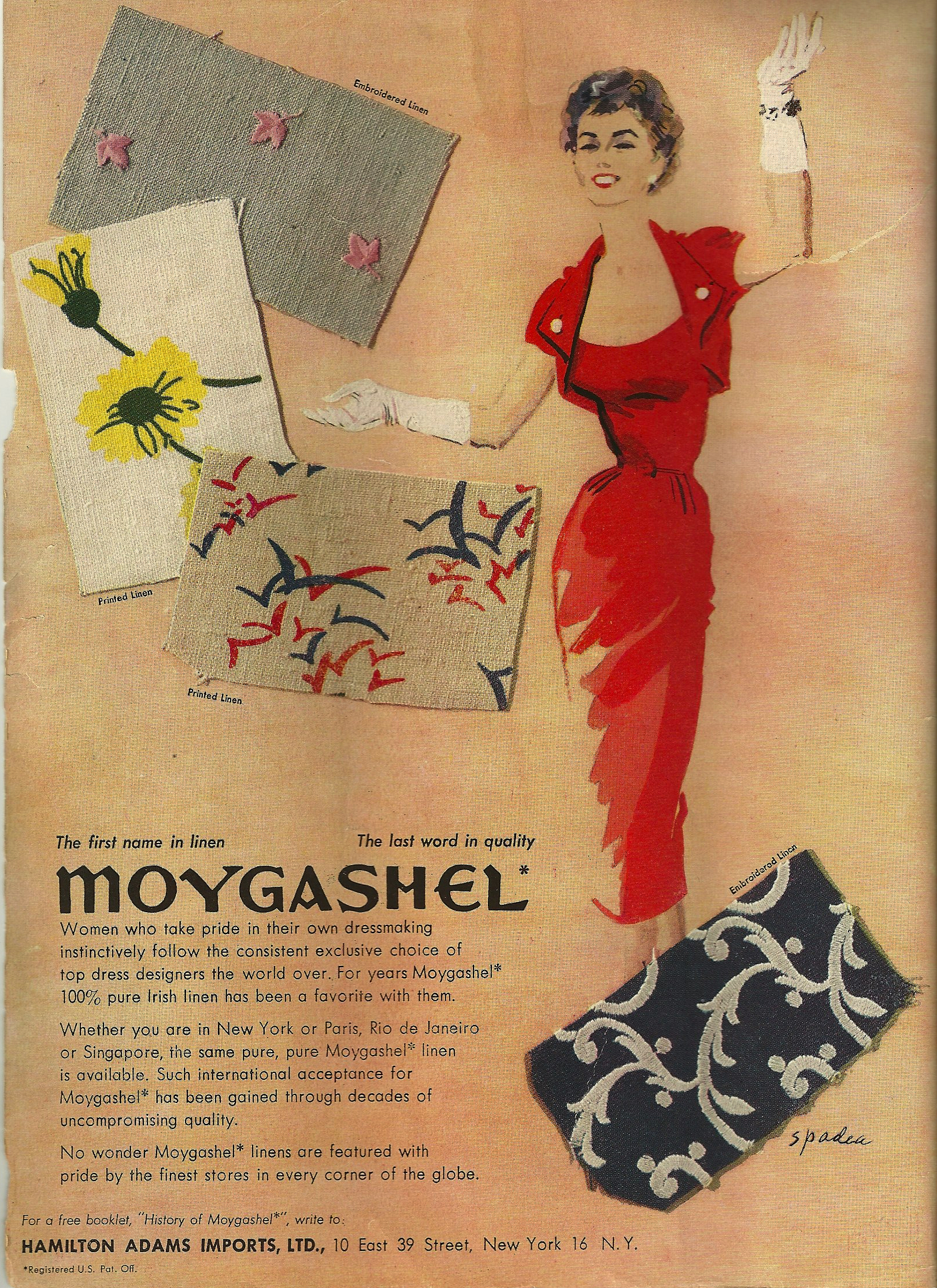
Moygashel Linen advertised heavily in VPB Magazine during that 30-year span of time.  Here is an ad from the inside front cover of the December/January 1953/54 issue:

Thoughts on Fabric - 54

“The first name in linen… The last word in quality”

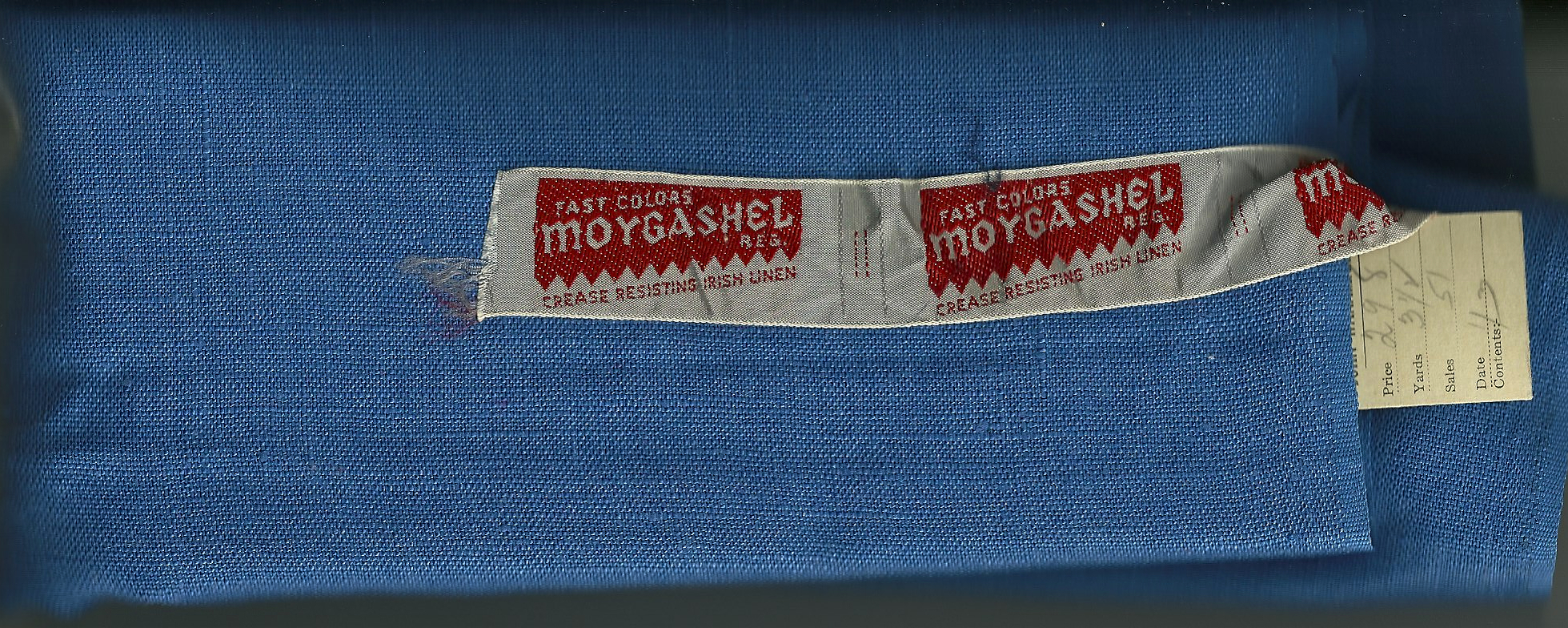
Moygashel was also one of those fabric companies which supplied labels with purchases of their linens.  Here is a string of labels, which came with a recent purchase I made of vintage Moygashel:

Thoughts on Fabric - Moygashel w: tag

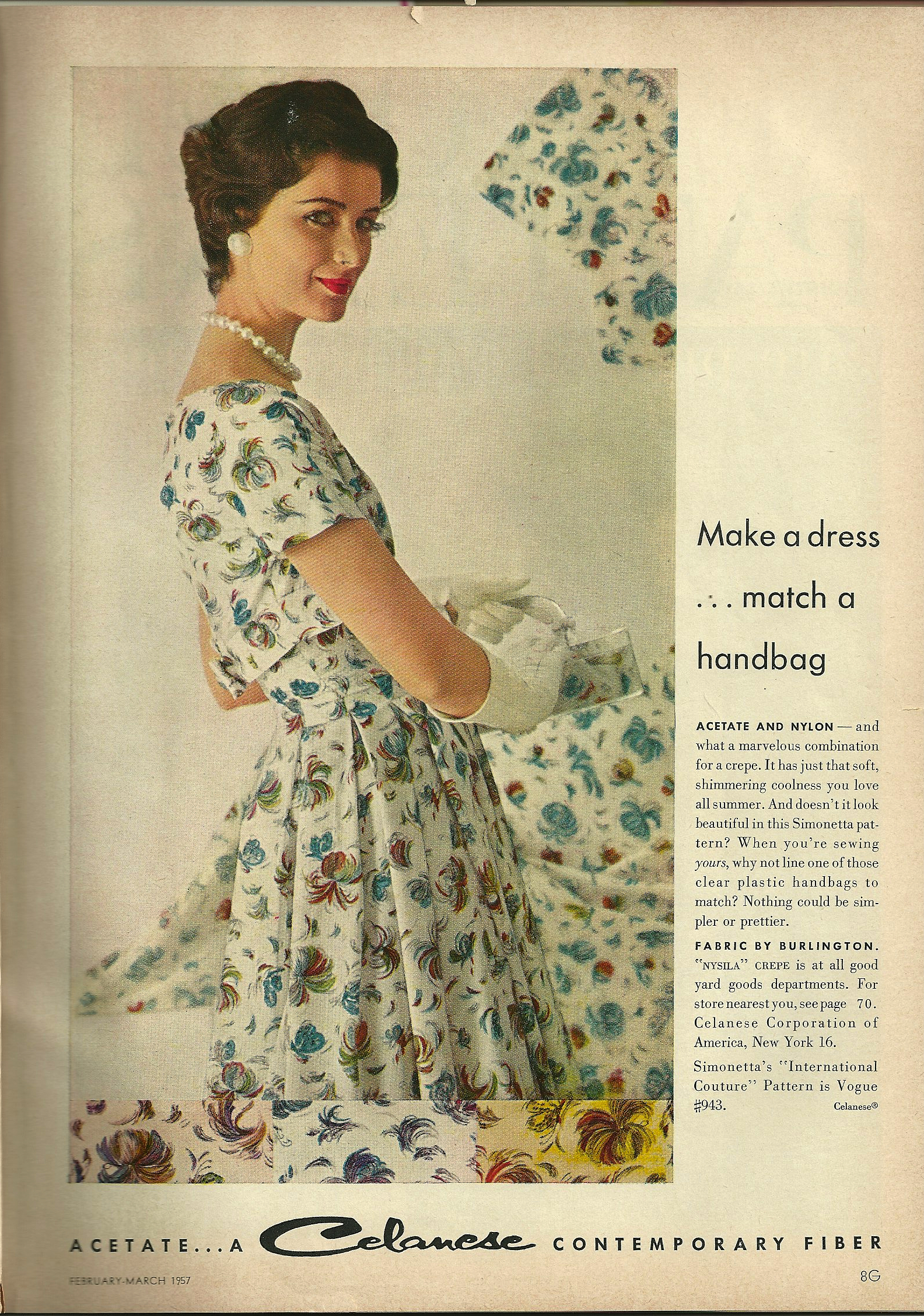
Many new synthetic fabrics were being developed in the post-war era, as evidenced by the many ads from manufacturers of these yard goods.  Here is an ad for acetate, made by the Celanese Corporation of America.  It appeared in the February/March 1957 issue of Vogue Pattern Book Magazine.

Thoughts on Fabric - 57

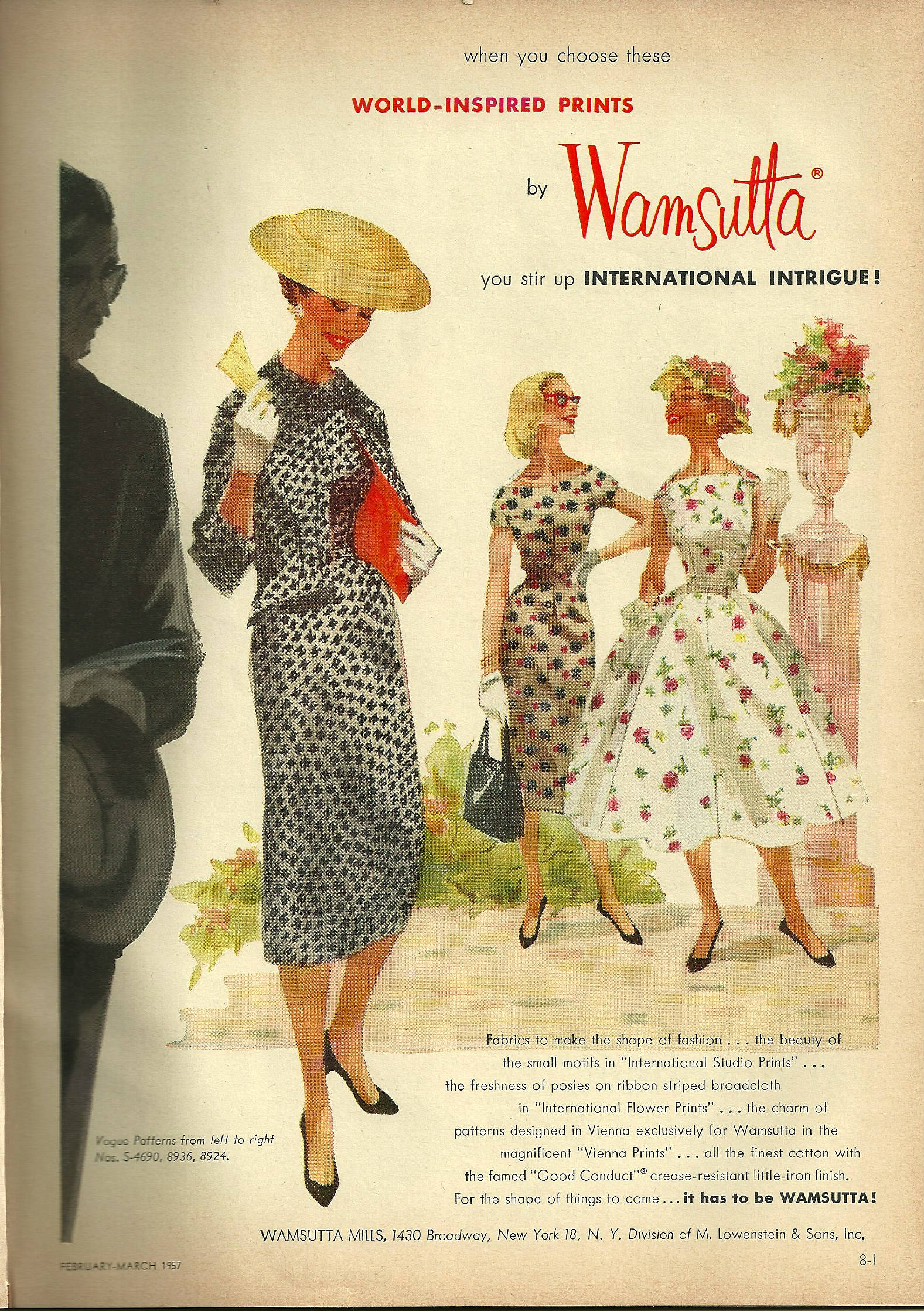
In the same issue was this full page ad for Wamsutta cotton prints.  Now known primarily for sheets, Wamsutta once had the tagline “it has to be WAMSUTTA!” which many a home sewer knew as a sign of quality.

Thoughts on Fabric - 57-2

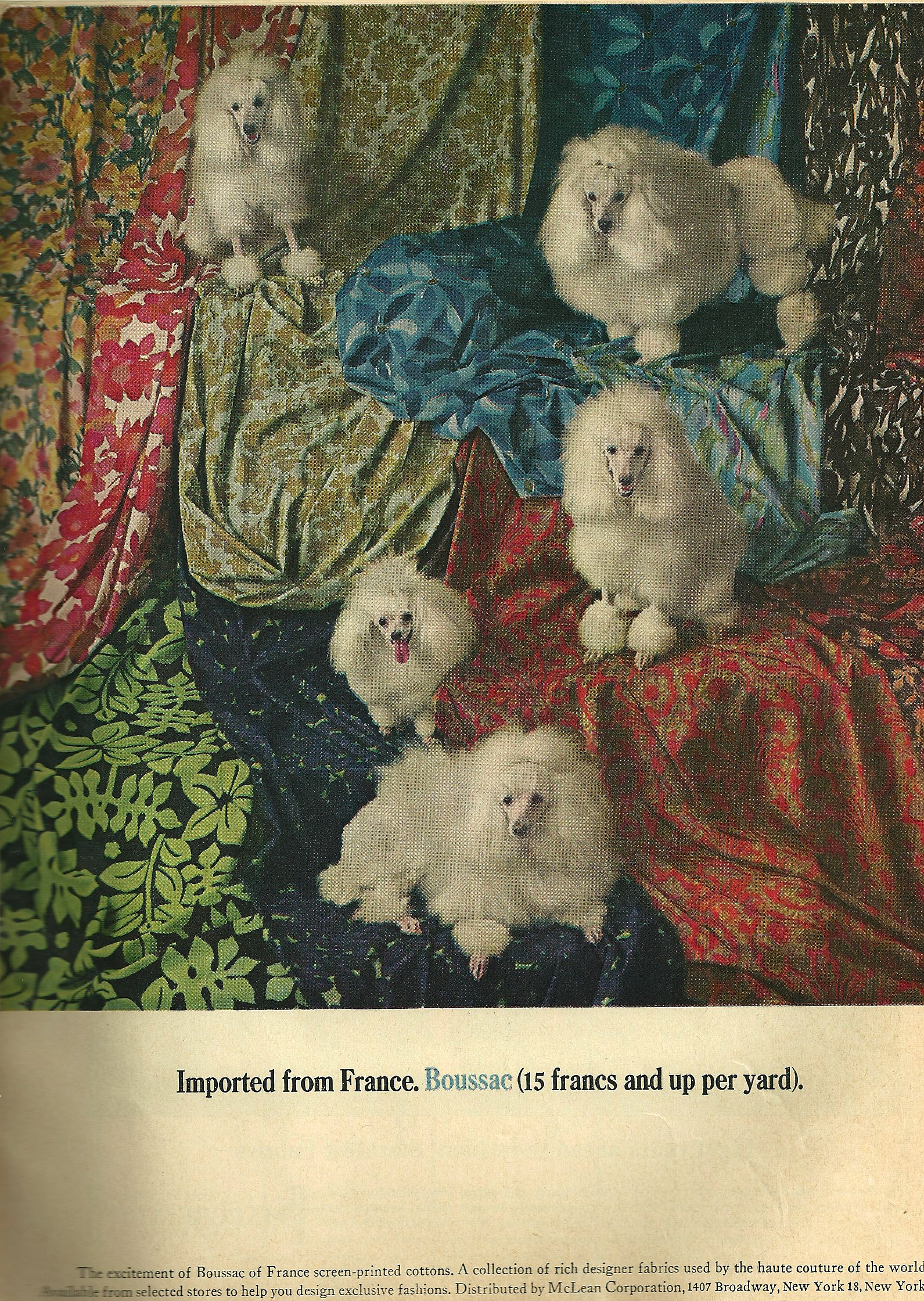
European fabrics also found their place in VPB.  Here is an ad from February/March 1964 for Boussac screen-printed cottons.  “A collection of rich designer fabrics used by the haute couture of the world.”

Thoughts on Fabric - 64

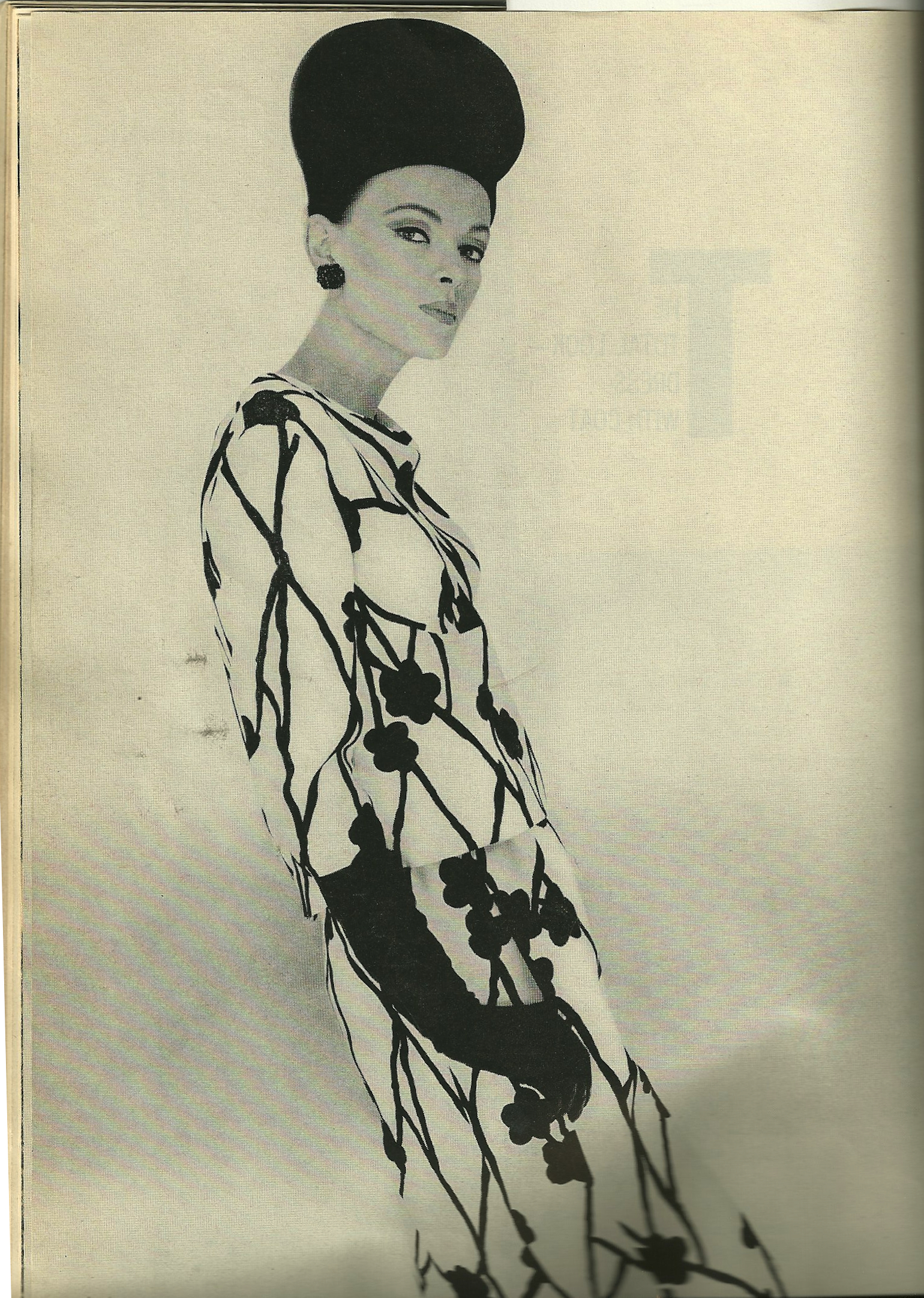
I want to show you something else in that same issue.  Although there was not a dedicated ad for American Silk, Vogue pattern #6105 was sewn in American Silk, as stated in its accompanying caption.

How I would love to find a piece of this silk tucked away in some drawer!

How I would love to find a piece of this silk tucked away in some drawer!
Twelve years later, in 1976, I attended a fashion show featuring the various dress silks made by this company for the home sewing market, another example of the effort put into marketing by specific fabric manufacturers.

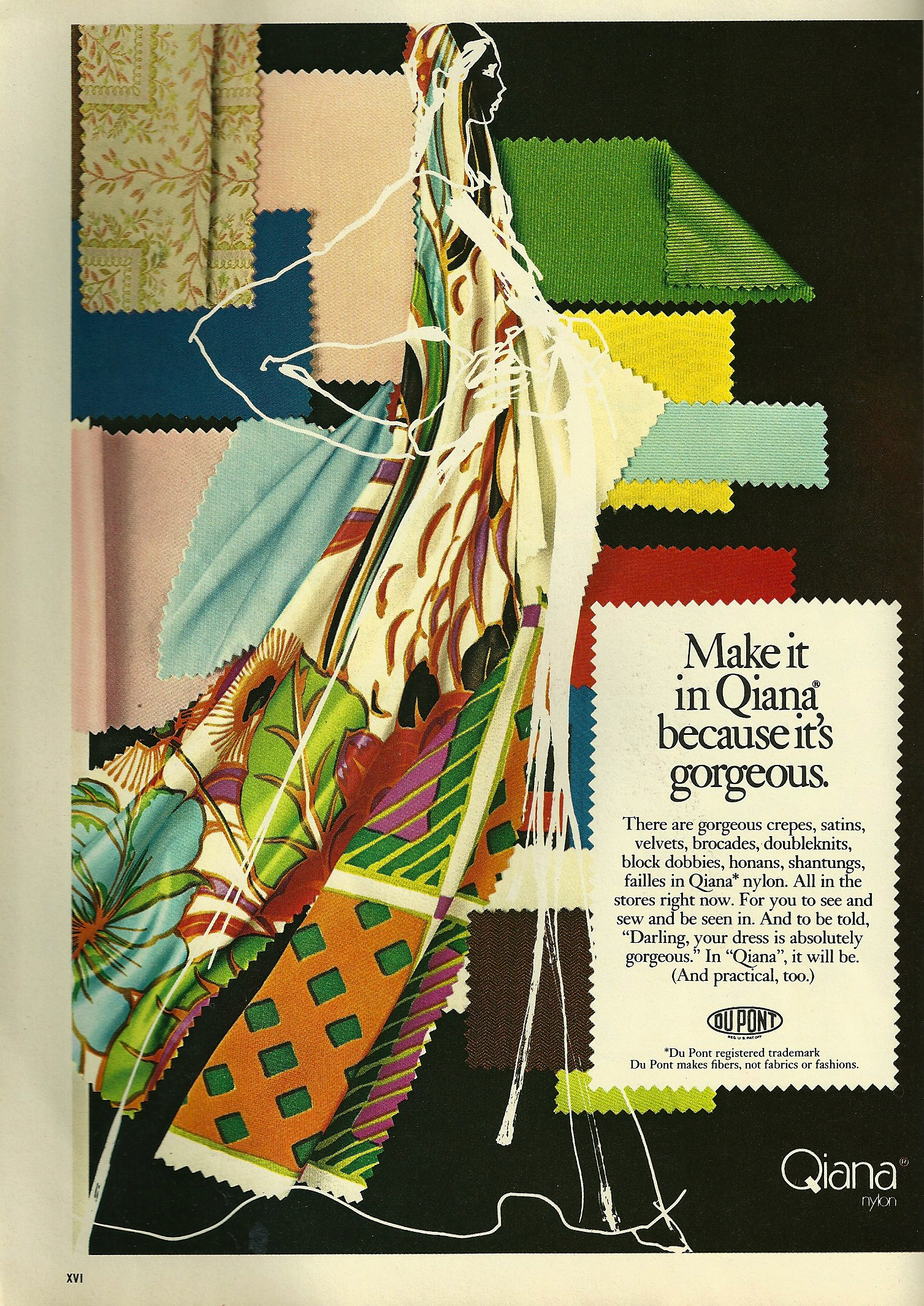
By 1972, the look of VPB Magazine was becoming more sophisticated, but those full-page fabric ads were still abundant.  Here is an ad in the October/November issue devoted to Qiana, a nylon made by DuPont:

Thoughts on Fabric - 72

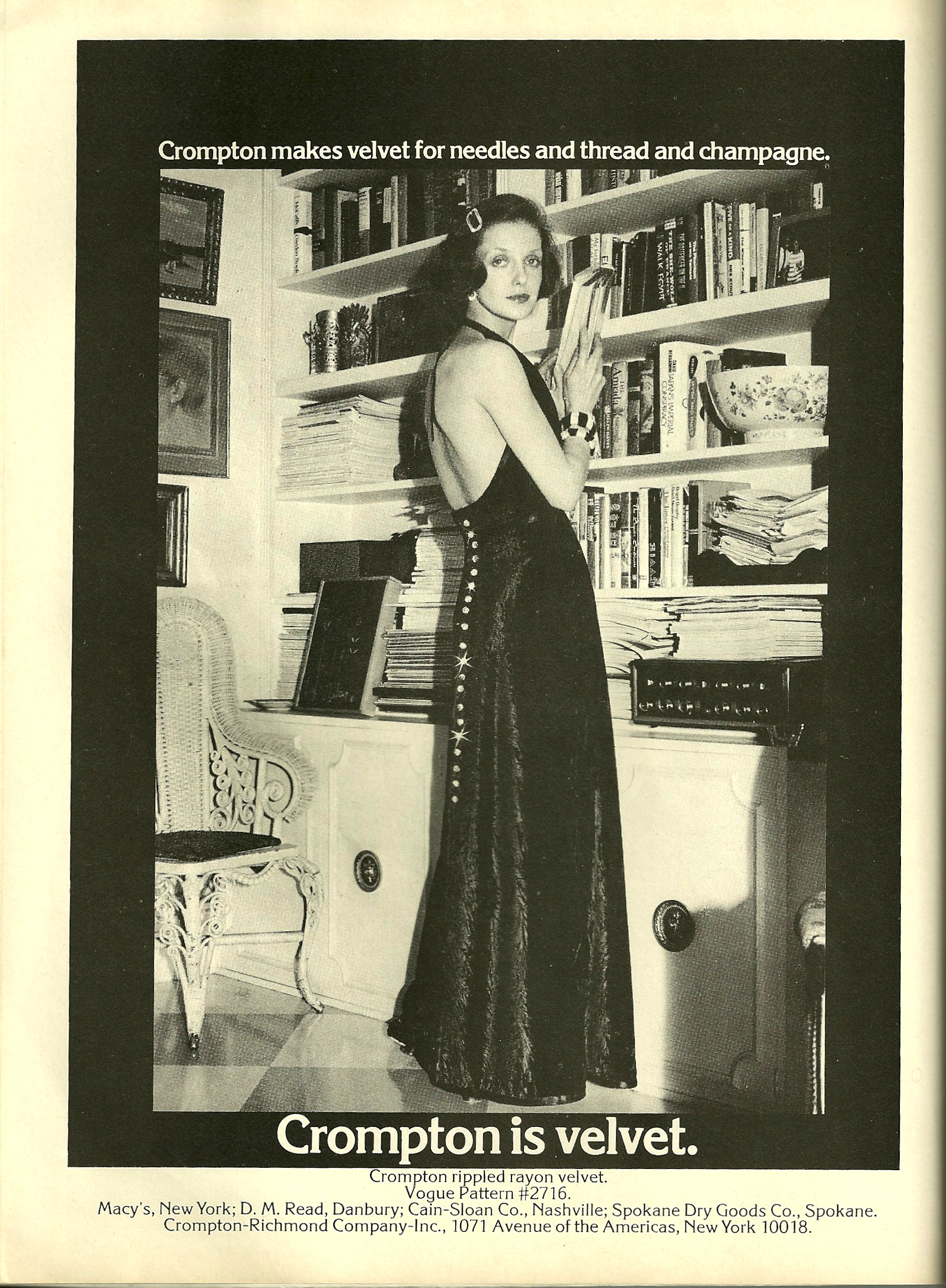
And – Crompton is velvet appeared a few pages further in the same issue:

Thoughts on Fabric - 72-2

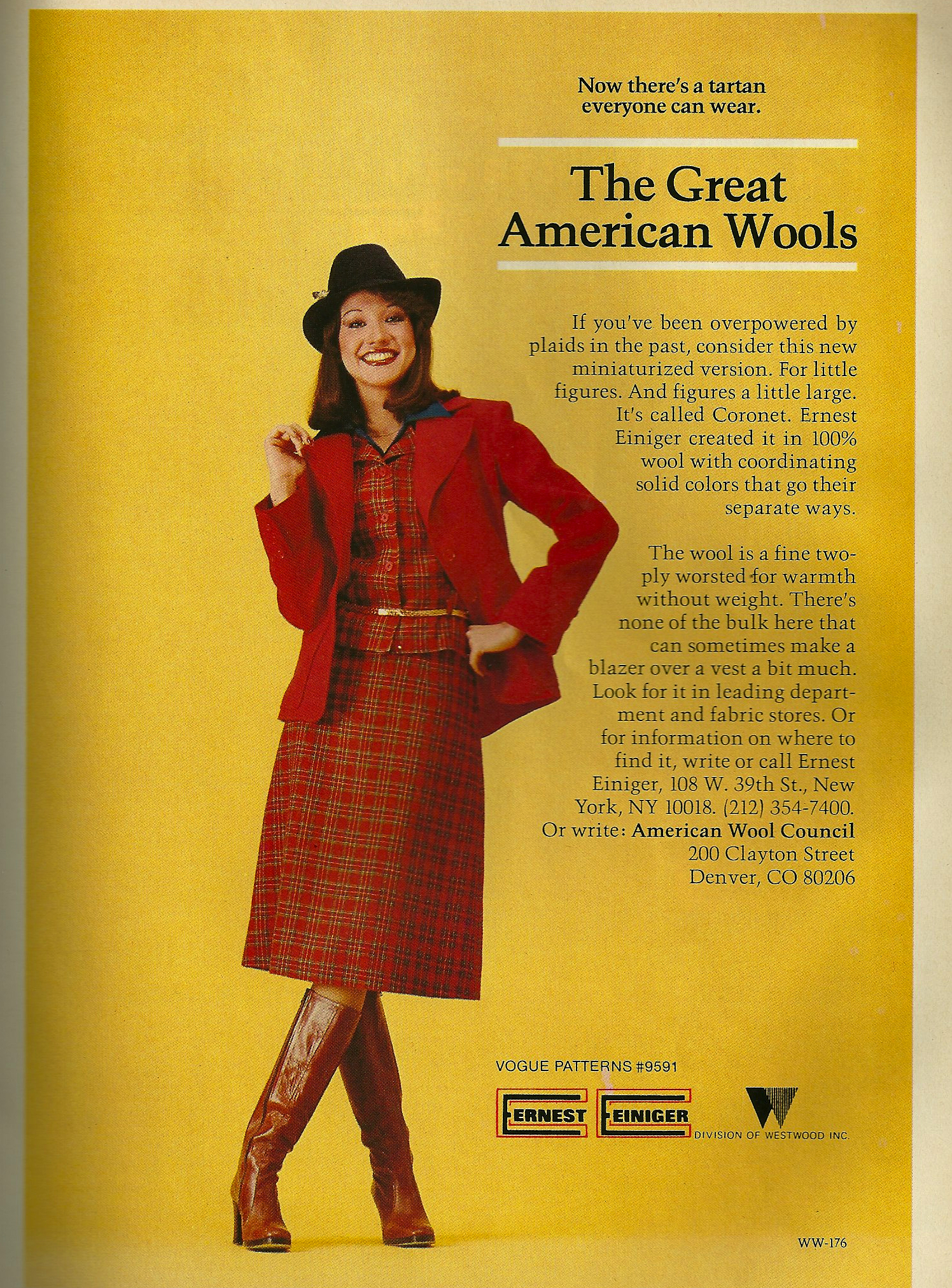
In September/October 1976, Diane von Furstenberg was featured on the cover, and Ernest Einiger had a full-page color ad for “The Great American Wools”.

Thoughts on Fabric - 76-3

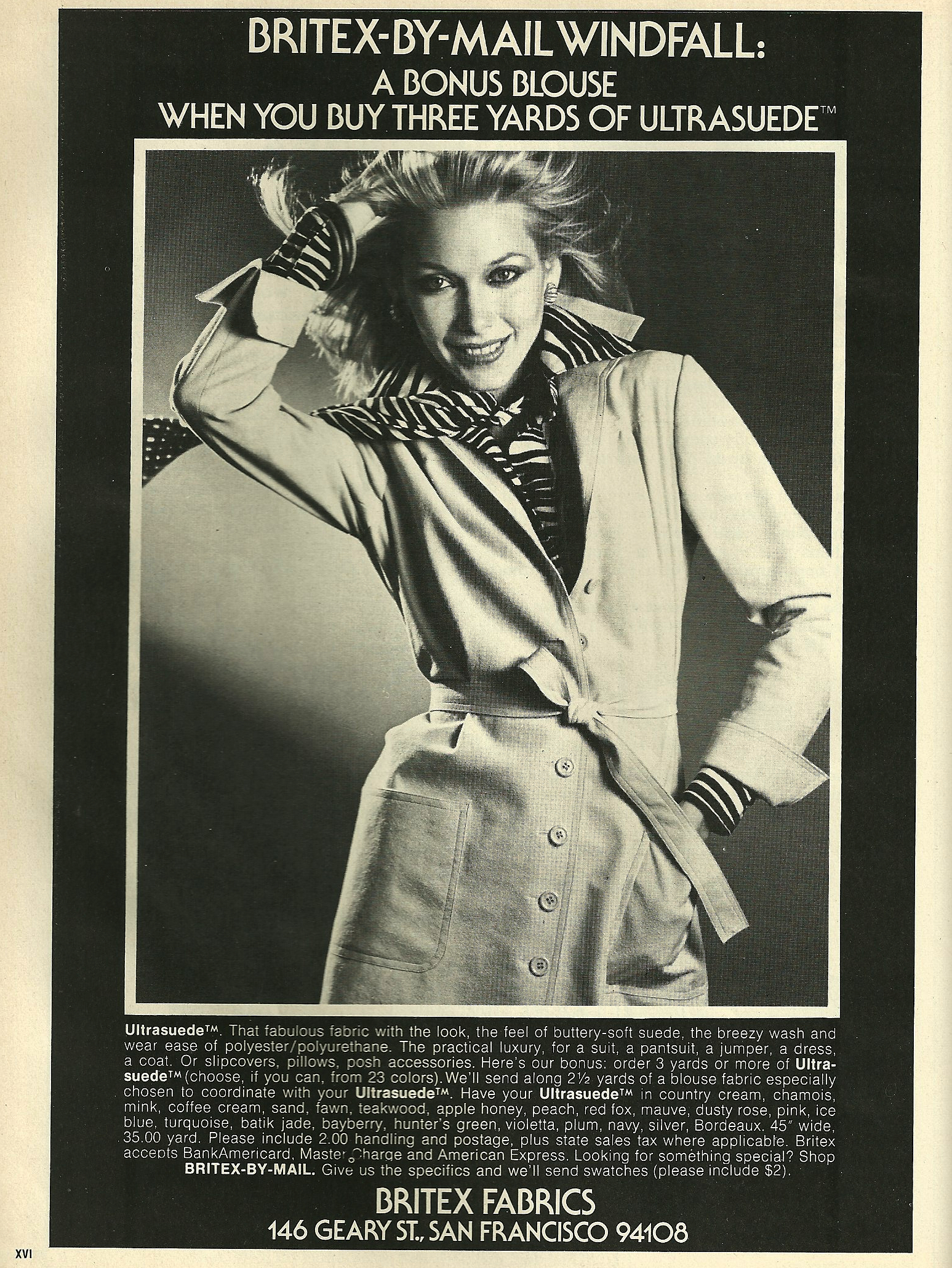
In the same issue, Britex Fabrics in San Francisco offered a buy-by-mail offer for Ultrasuede, the “it” fabric of the decade!
Thoughts on Fabric - 76-2

I can really only think of a few current fabric lines that still retain the distinction of being “known” by their names: Liberty, Pendleton, and Linton Tweeds come to mind.  (Linton Direct advertises in the current VPB magazine, but it is a small column ad, not a full-page “look at me” type of statement.) Then, of course, there are designer fabrics, but the manufacturers of these “name” goods are generally not listed.  For the most part, unless you ask, when you are buying yard goods, the names of the manufacturers are virtually unknown.  It is really kind of a shame, as there are so many exquisite fabrics of the highest quality still being woven in certain parts of the world.  These fabrics (and others, some vintage) make it difficult to say “no” to the opportunity to add to one’s fabric collection.  Here are two such fabrics I could not resist:

This is a linen and cotton blend I purchased from Mood Fabrics a while ago.  It is patiently waiting to be cut and sewn . . .

This is a loosely woven linen and cotton blend I purchased from Mood Fabrics a while ago. It is patiently waiting to be cut and sewn . . .

This is a vintage linen, newly acquired by me.  Although there is nothing printedon the selvedge, I believe it is a Moygashel linen from the 1950s.

This is a vintage linen, newly acquired by me. Although there is nothing printed on the selvedge, I believe it is a Moygashel linen from the 1950s.  I plan to make a sheath dress from this fabric sometime during the Summer of 2014.

William Blake notably said “The road of excess leads to the palace of wisdom.”  I must confess I never knew what that meant until I applied it, somewhat sheepishly,  to collecting fabrics.  It seems the more various and beautiful fabrics I can look at and choose from, the more I am able to determine the perfect pattern with which to pair them.  If I own the fabric already, so much the better!  Sometimes the fabric dictates the sort of garment I should make and sometimes I have a pattern which leads me to my (excessive?) fabric collection, where I can admire anew and oftentimes choose a long-before purchased length of the perfect silk, linen, cotton, or wool.  It is a back and forth process, one filled with visual and tactile components, demanding – and developing – sewing wisdom.  It is one of the reasons I love to sew.
20 Comments

Filed under Liberty cotton, Linen, Love of sewing, Moygashel linen, Polka dots, The Conde Nast Publications, Uncategorized, woolens

No. 2 ~ The Beginning

I may – or may not – find Chanel No. 5 Paris Parfum in my Christmas stocking, but Chanel-inspired, Classic French Jacket No. 2 can currently, definitely, be found in my sewing room.  Well, actually, it’s not a jacket yet.  It is just lengths of fabric and loose trims and buttons, but that is how these things begin, as every home dressmaker knows.

I actually started planning this jacket long before I took the Classic French Jacket Class with Susan Khalje this past summer.  In September of 2012 when I was at Britex Fabrics in San Francisco, I found this boucle and purchased it – even then – as my intended Jacket No. 2.

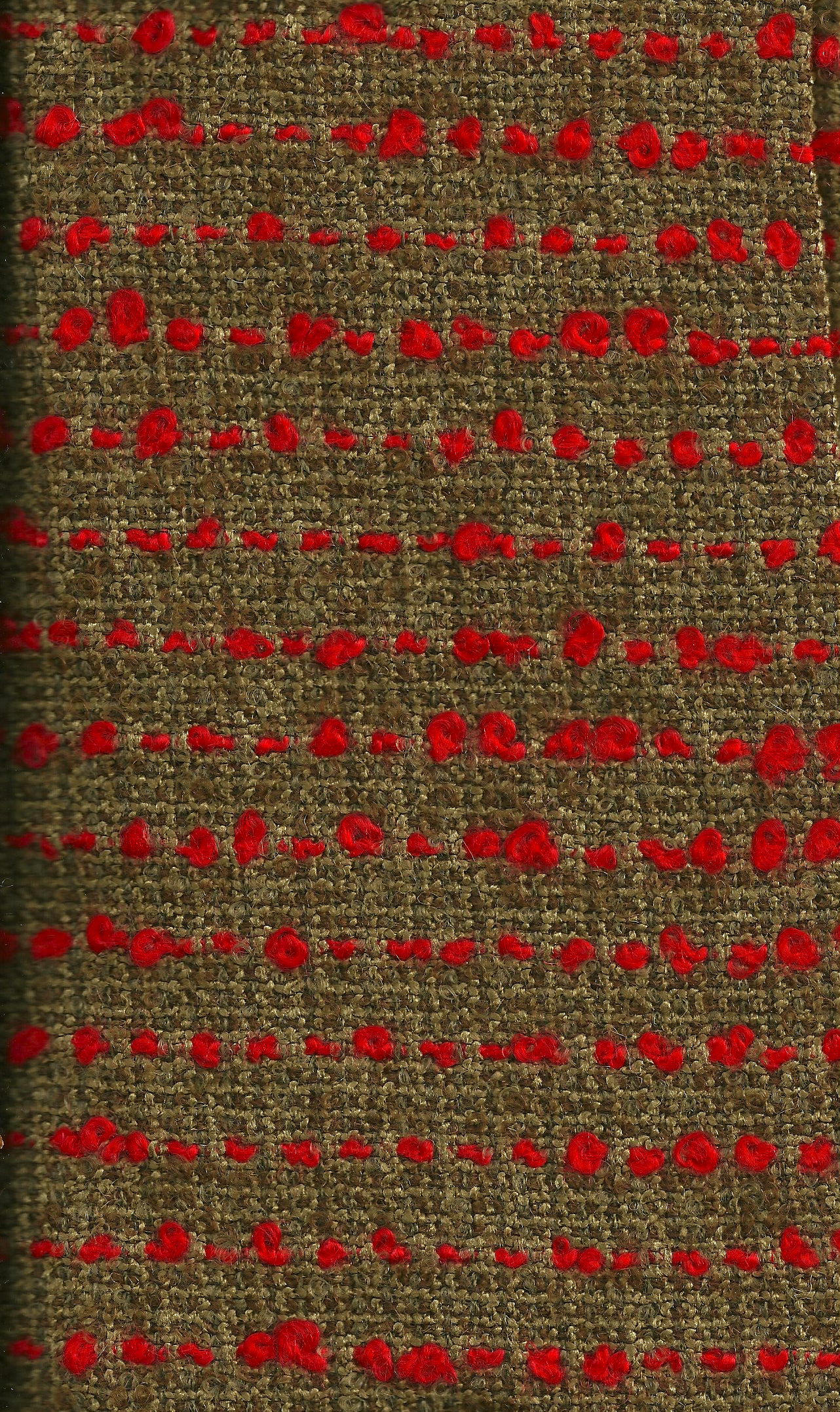
This fabric is very soft, perhaps due to a certain percentage of mohair wool in its composition.

This fabric is very soft, perhaps due to a certain percentage of mohair wool in its composition.

My first jacket is definitely very dressy, so I wanted this one to be less so, which meant I had to find just the right lining, trim, and buttons.  It took another, recent, trip to San Francisco to produce those ingredients – and I couldn’t be more pleased with what I found again at Britex.

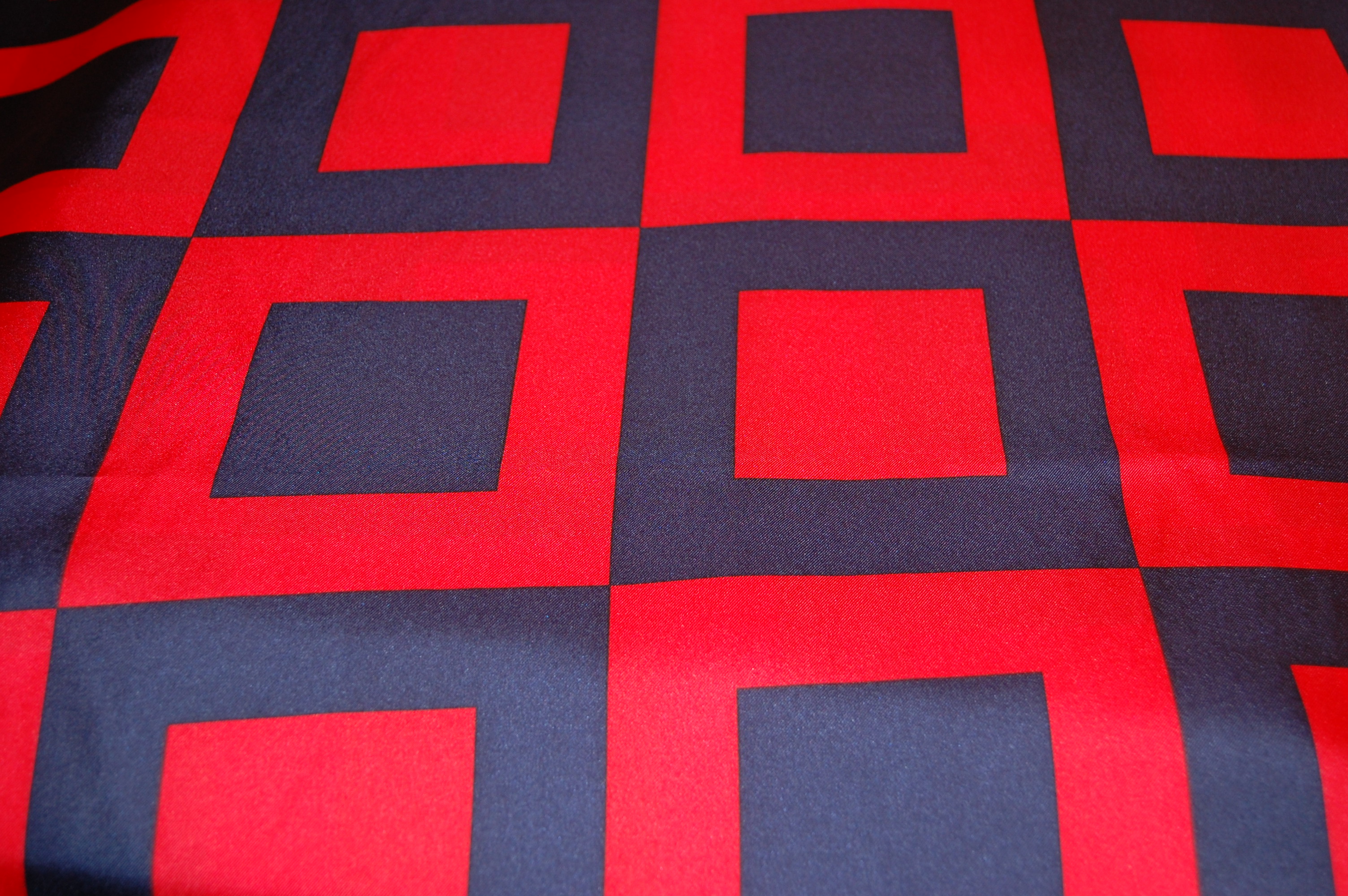
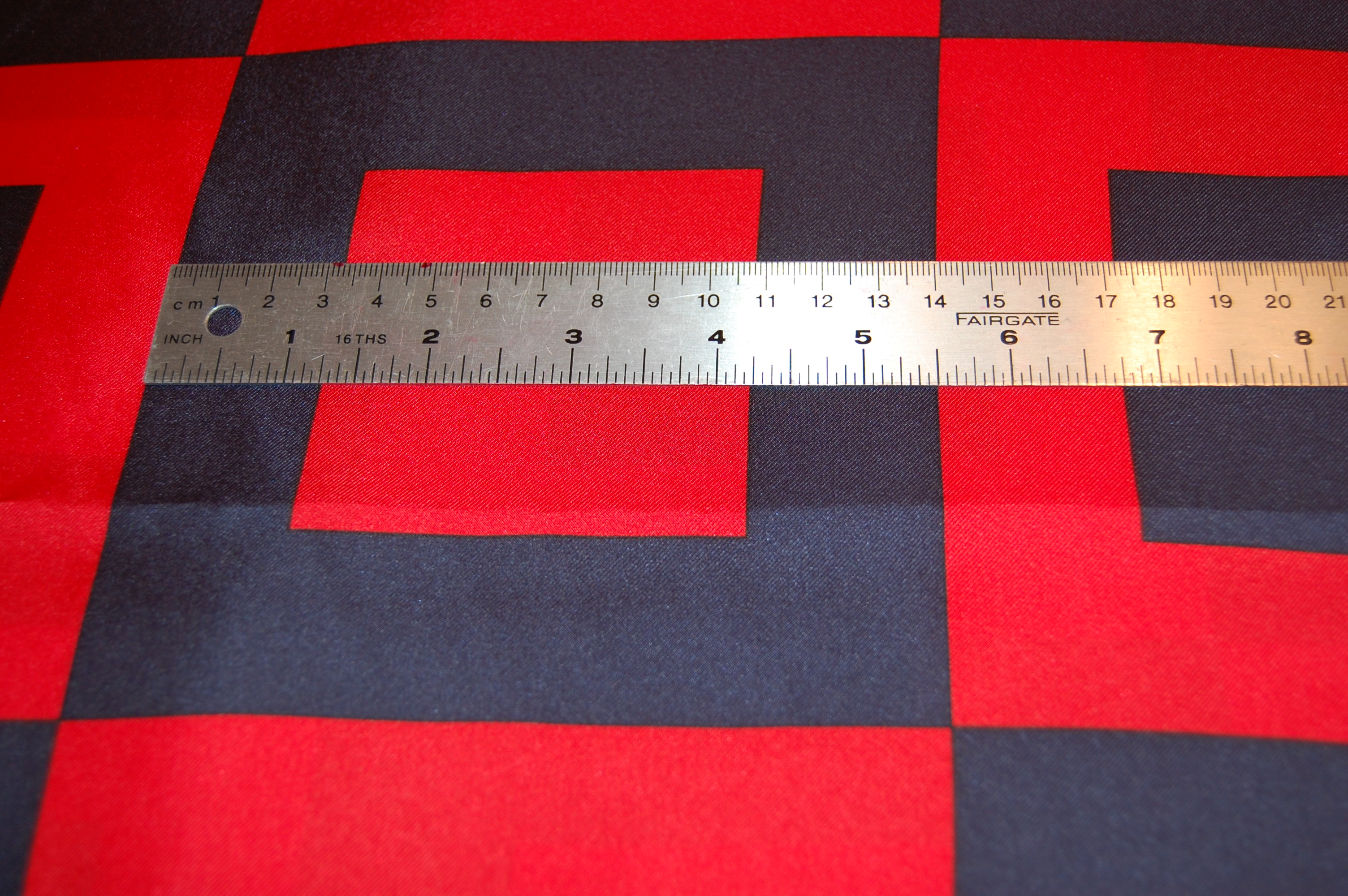
A bolt of this light-weight silk twill was tucked under one of the front tables, and it was love at first sight.  I was hoping to find something with navy blue in it, and the geometric pattern in this fabric makes it bold and less dressy than a floral silk charmeuse would be.

No. 2 jacket

The ruler will help you get a feel for the size of the squares.  Click on the photo for a close-up view.

The ruler will help you get a feel for the size of the squares. Click on the photo for a close-up view.

Immediately, however, I knew that I had to purchase enough for a blouse as well, which I did.  I suspect I’ll be using this pattern from 1957 for a blouse with a bow, which should evoke the correct Coco Chanel look. (A muslin should tell me if I need to tame the bow.  I don’t want it to be overwhelming…)

View B with long sleeves has my vote.

View B with long sleeves has my vote. 

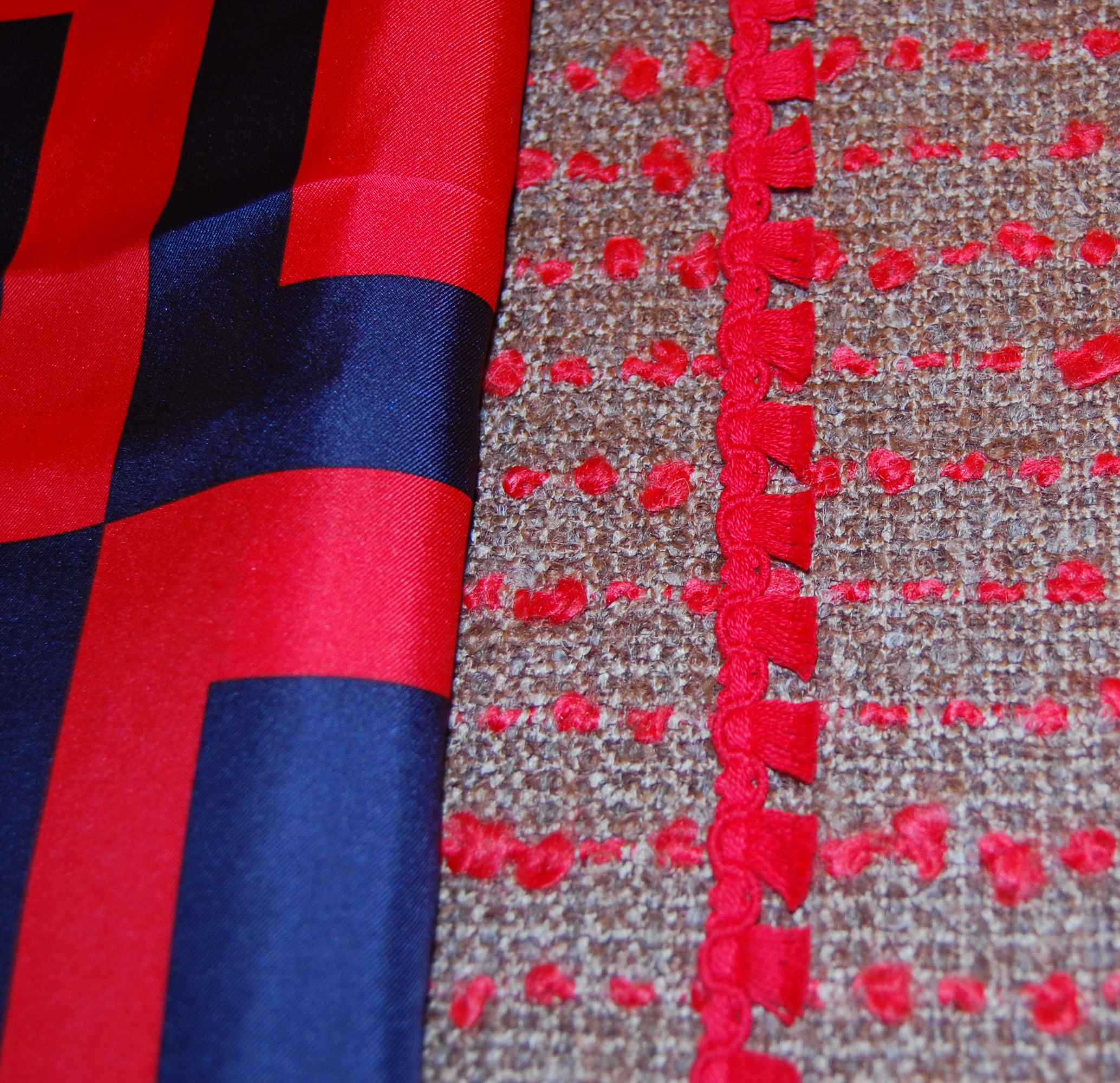
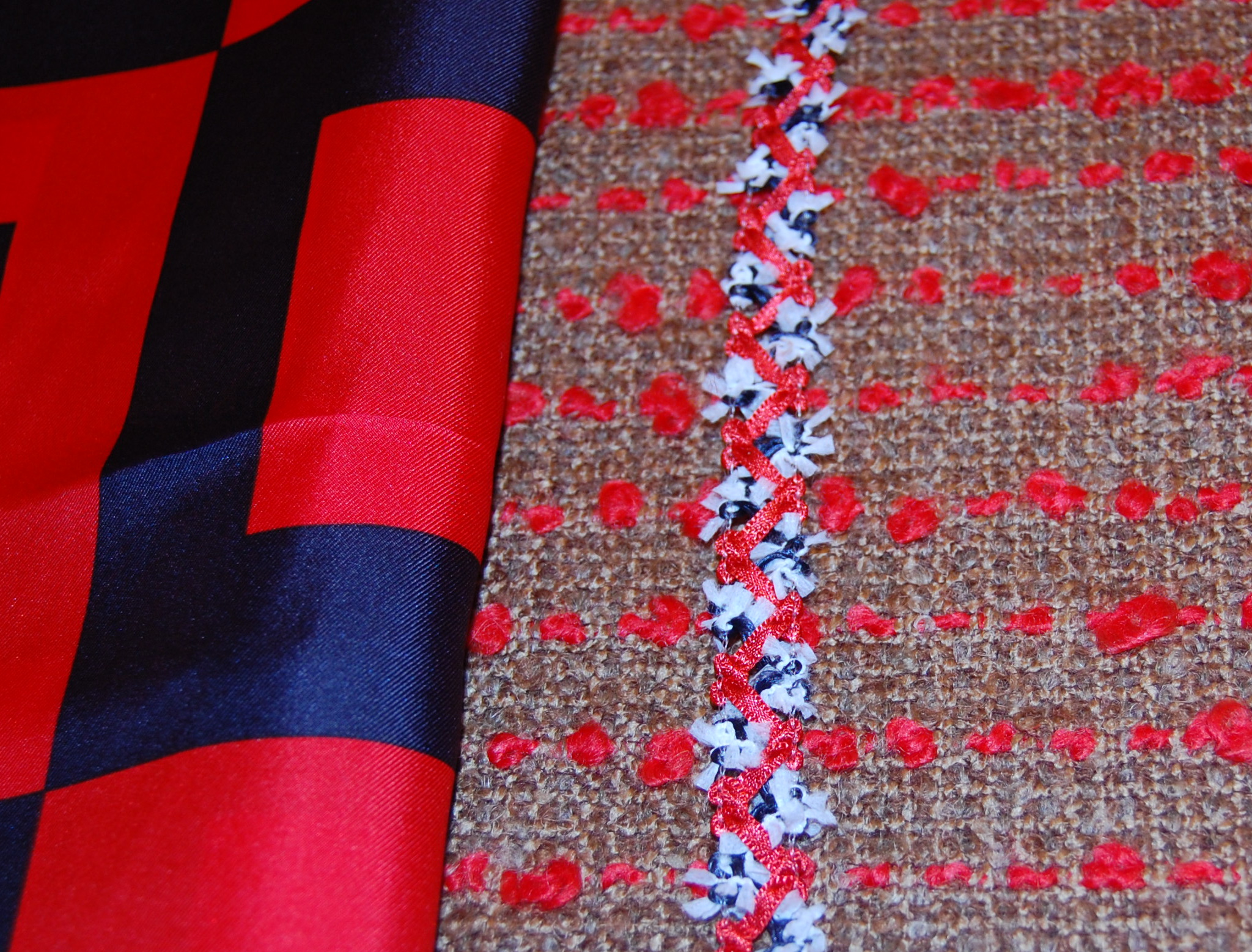
With fabrics in tow, I then headed up to the Buttons and Trims Department on the 3rd floor.  An initial look at the red trims flummoxed me, as none of them seemed right.  Then one of the wonderful assistants in the Department came to my rescue and found these two trims.

No. 2 Jacket

Shown with the lining/blouse fabric...

Shown with the lining/blouse fabric . . .

... and again.

. . . and again. 

Back and forth I went between them, unable to make a decision.  It was then that I went to my fail-safe method of choosing between two equally wonderful trims:  I bought both of them! ( It certainly helped that neither was terribly expensive – and both very versatile.)
Now that I have them home, I am leaning toward one of them – can you guess which one?  Does it help to see the buttons, too?  Once again, the experienced button assistant quickly found these – and there was no question in my mind that they were just what I wanted for this jacket.

These are shank buttons, with gold decoration reminiscent of Chanel "C"s.

These are shank buttons, with gold decoration slightly reminiscent of intertwined Chanel “C”s.

And here with the other trim.

And here with the other trim. 

Well, as in so much in life, timing is everything – or it sometimes seems that way.  My timing could be better to be starting such a lengthy project.  It is, after all, one month until Christmas.  I have those proverbial stockings to fill and much to do, but I’ll just bet I can squeeze in some sewing time before my sewing room transforms into Santa’s workshop.

15 Comments

Filed under Blouse patterns from the 1950's, Boucle for French style jackets, Buttons - choosing the right ones, Chanel-type jackets, Coco Chanel, Uncategorized, vintage Vogue patterns from the 1950s

Wynken, Blynken, and Nod

“. . . and the wooden ship that sailed the skies is a wee one’s trundle bed.”

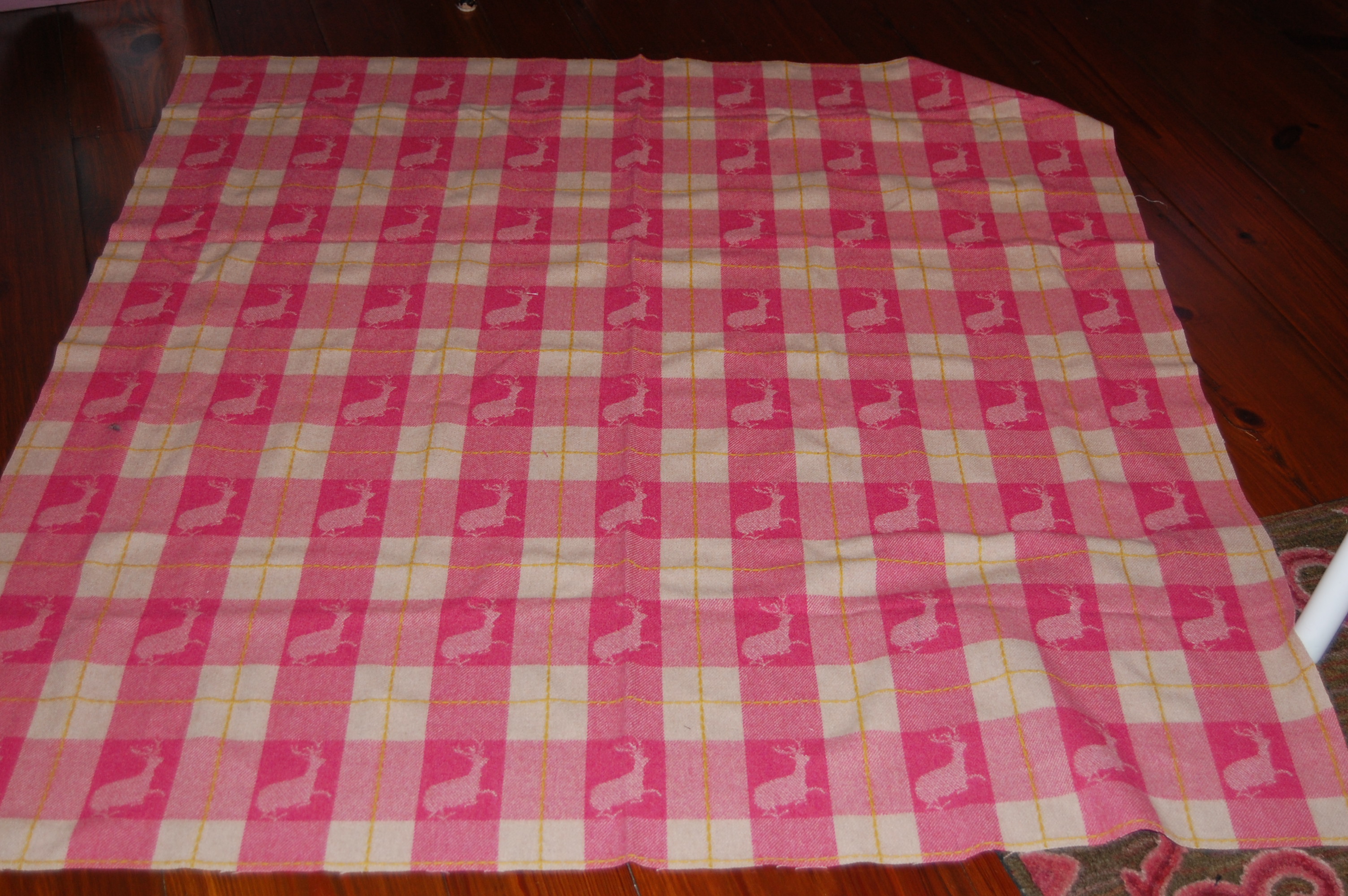
Do you ever see a fabric and feel captivated by its charm, its design, its ambience?  That is what happened to me when I saw this fabric on the website of Britex Fabrics:

Wyncken, Blyncken and Nod - fabric

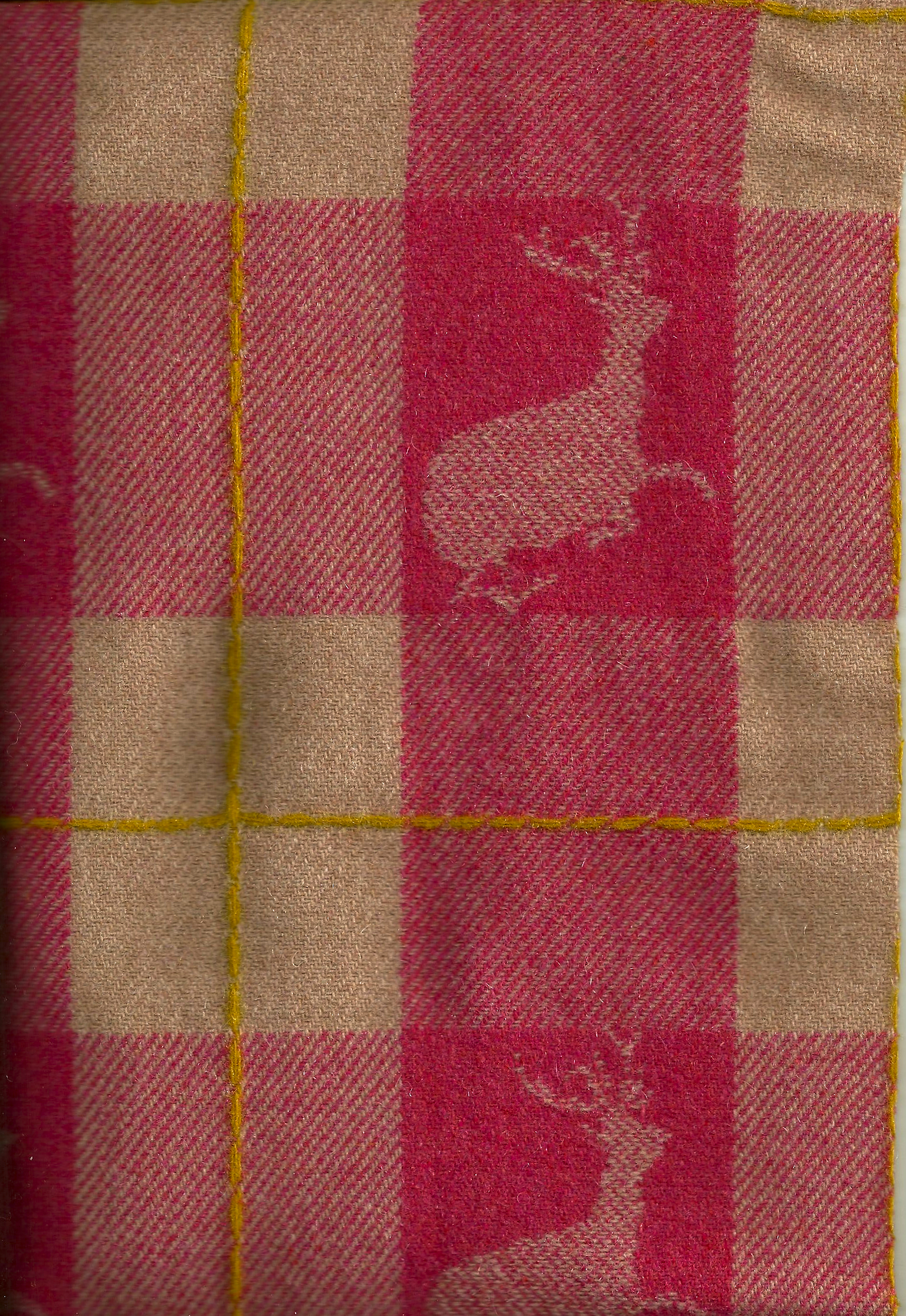
It is a moderately heavy-weight wool blend, made in Italy (the source of so many beautiful and exquisite fabrics), and its friendly jacquard-woven deer, set amongst the bold pink checks, with that subtle gold woolen thread traversing its expanse, seemed to be a blend of Tyrolean style, buffalo checks, and frontier whimsy!  I loved it, but I could not quite imagine it made up into anything wearable – at least for me.

So I decided not to buy it.

But then I did.

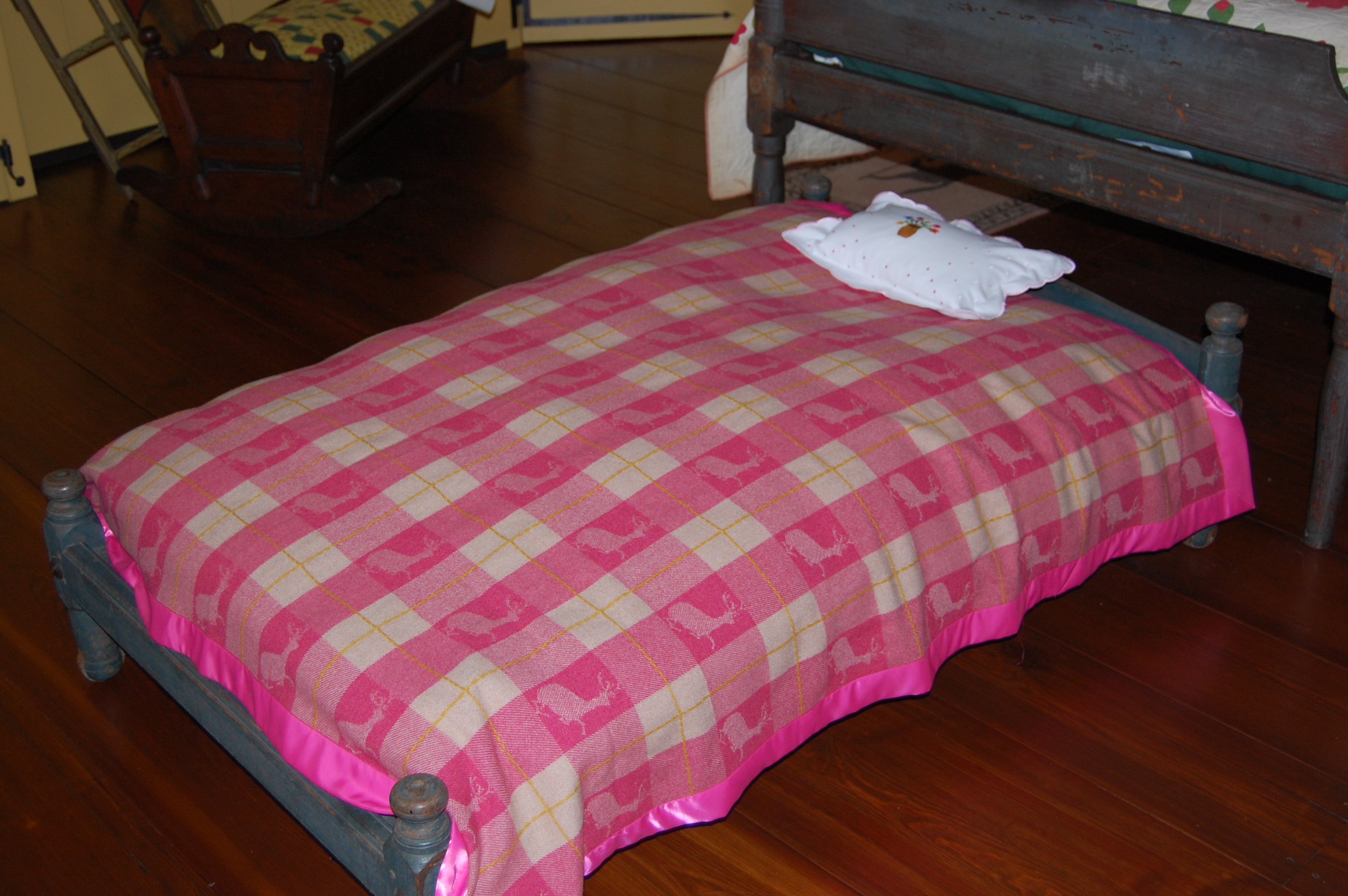
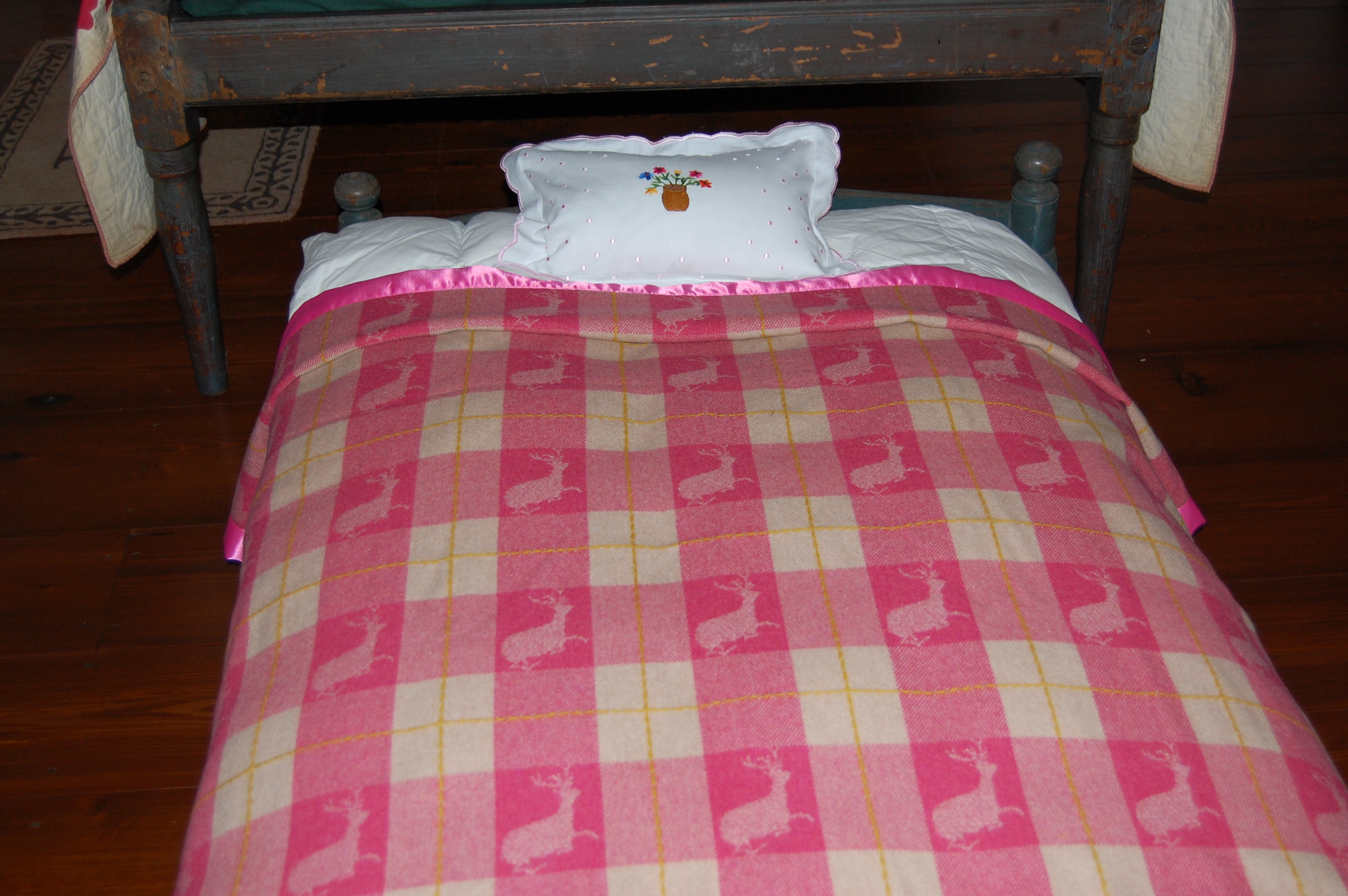
What can I say?  I had to have it.  Of course, by the time I reversed my decision, I had determined it was the perfect fabric from which to make a small blanket – just the right size for a “wee one’s trundle bed.”  The small trundle bed, which we purchased years ago, has been patiently waiting to be used by a wee one – and although our little granddaughter is still in a crib, it won’t be long until this little bed will be the perfect place for her to snuggle and sleep and dream when she is with us.  So of course – a warm, whimsical blanket was in order.  Since it is almost impossible to find linens to fit such specific little beds, making one was very much on my agenda.

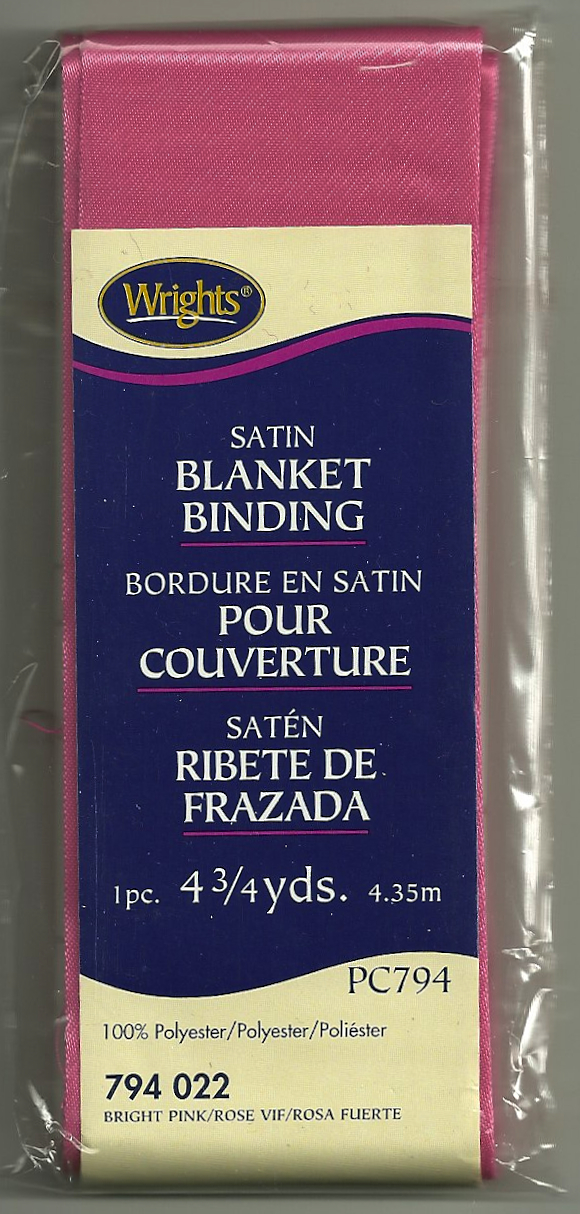
The first thing I did was go to JoAnn’s Fabrics to see if I could get blanket binding.  I could not believe my eyes when I found this bright pink color.

Wyncken, Blyncken and Nod

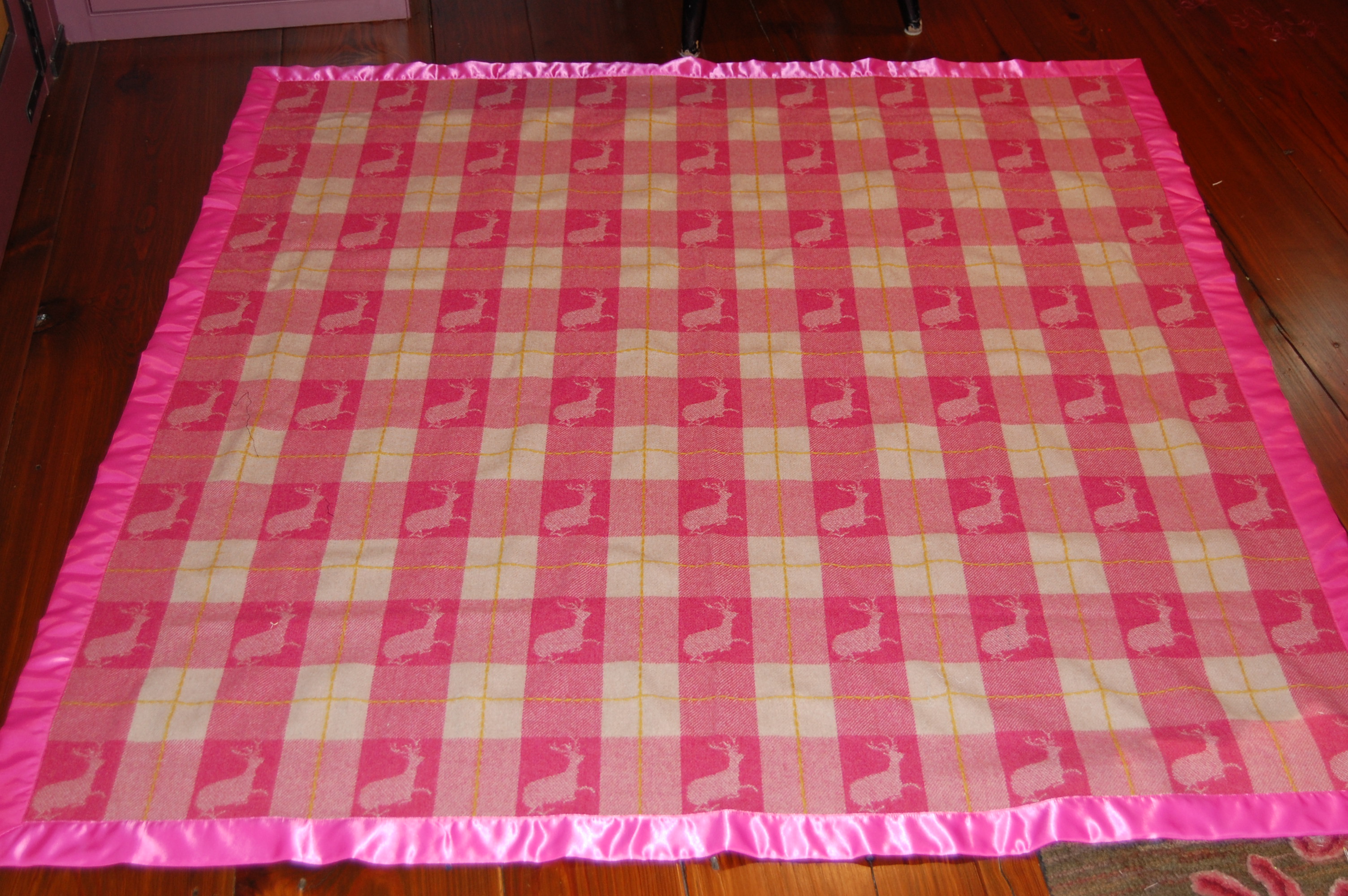
Then it was just a matter of measuring, deciding where in the plaid of the fabric to place the binding, and sew! One thing that made the application of the satin blanket binding much easier was using a walking foot.  Nice and easy and fun.

Cut and ready to be bound.

Cut and ready to be bound.

The binding sewn on, blanket finished!

The binding sewn on, blanket finished! 

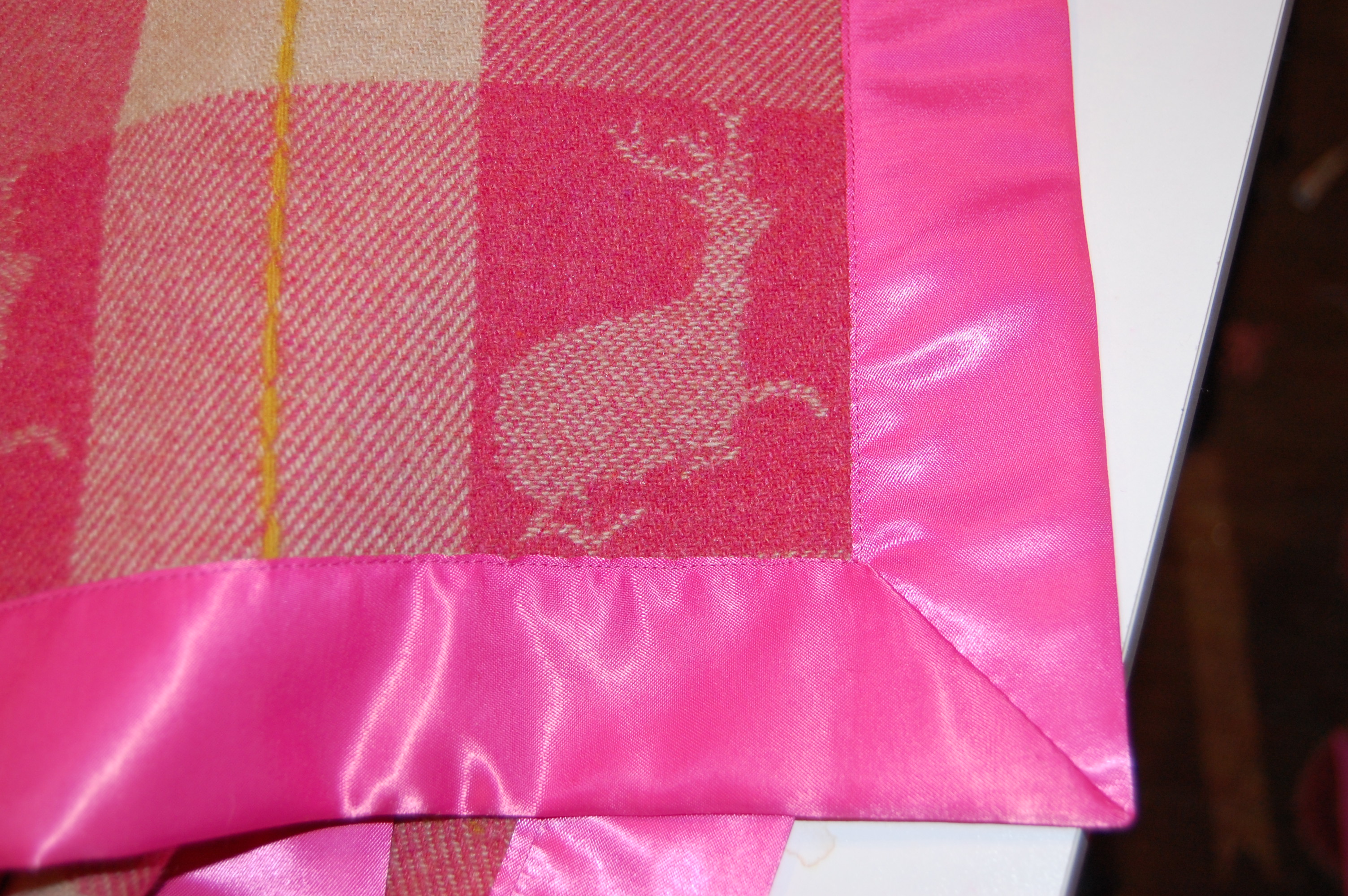
I mitered the corners and used a fell stitch to hand-finish them.

One of the corners.

One of the corners.

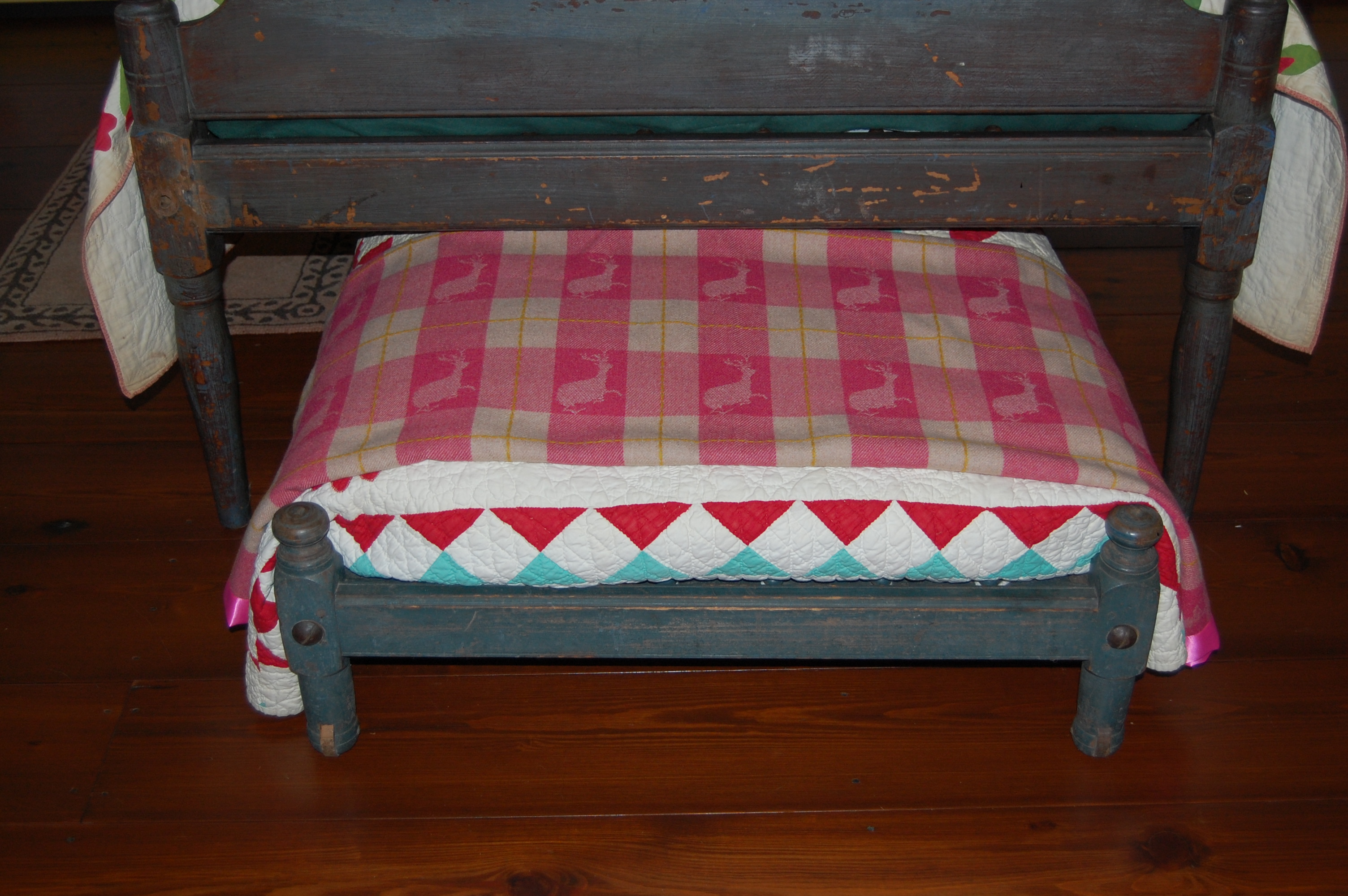
It fits well  . . .

It fits well . . .

. . . and is nice and warm.

. . . and is nice and warm.

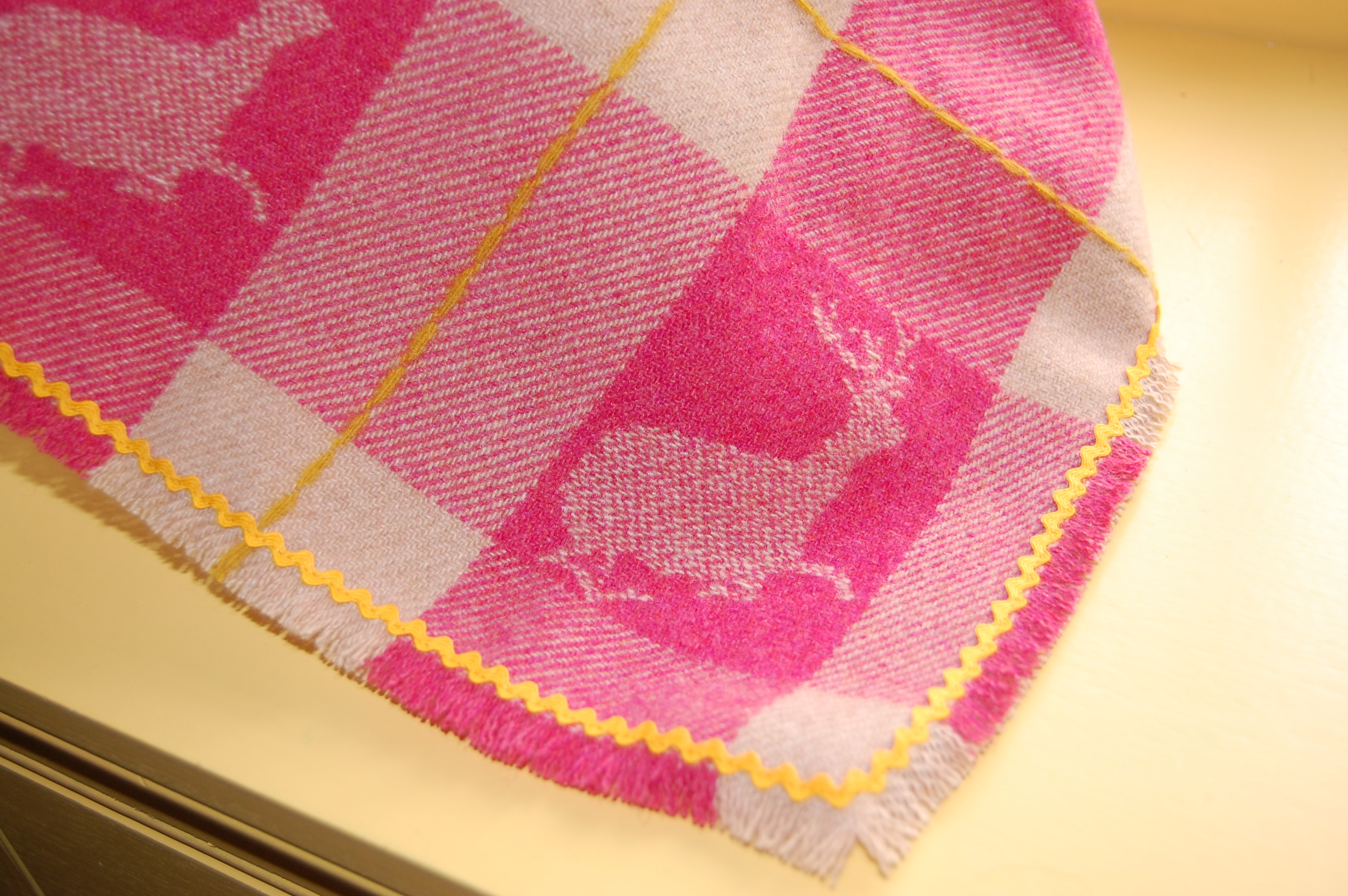
I had ordered a bit more fabric than I thought I might need – enough to make a doll blanket – and maybe a jacket for a teddy bear one day.  Who knows – we’ll wait and see what our wee one asks me to sew.

pink blanket

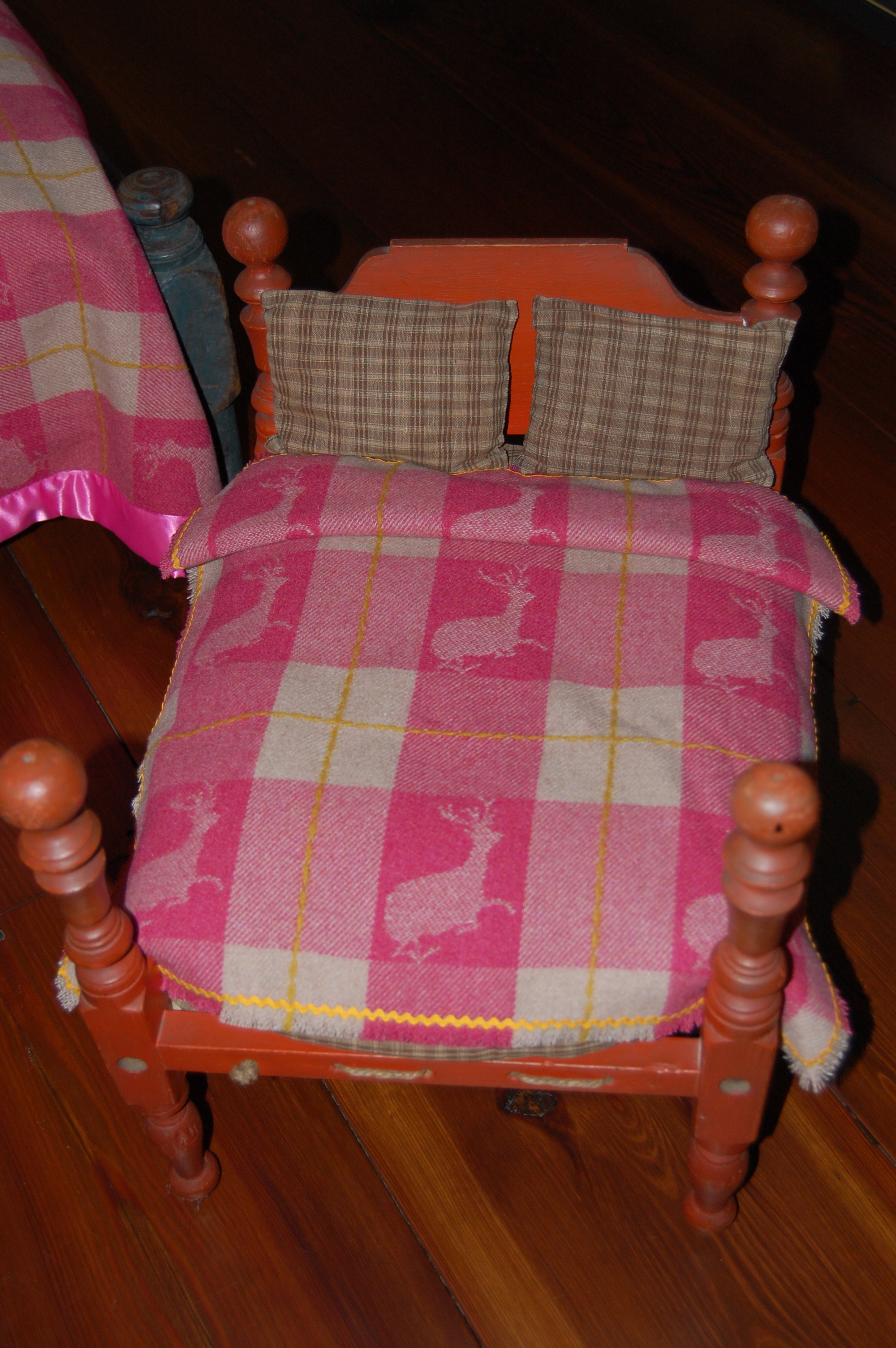
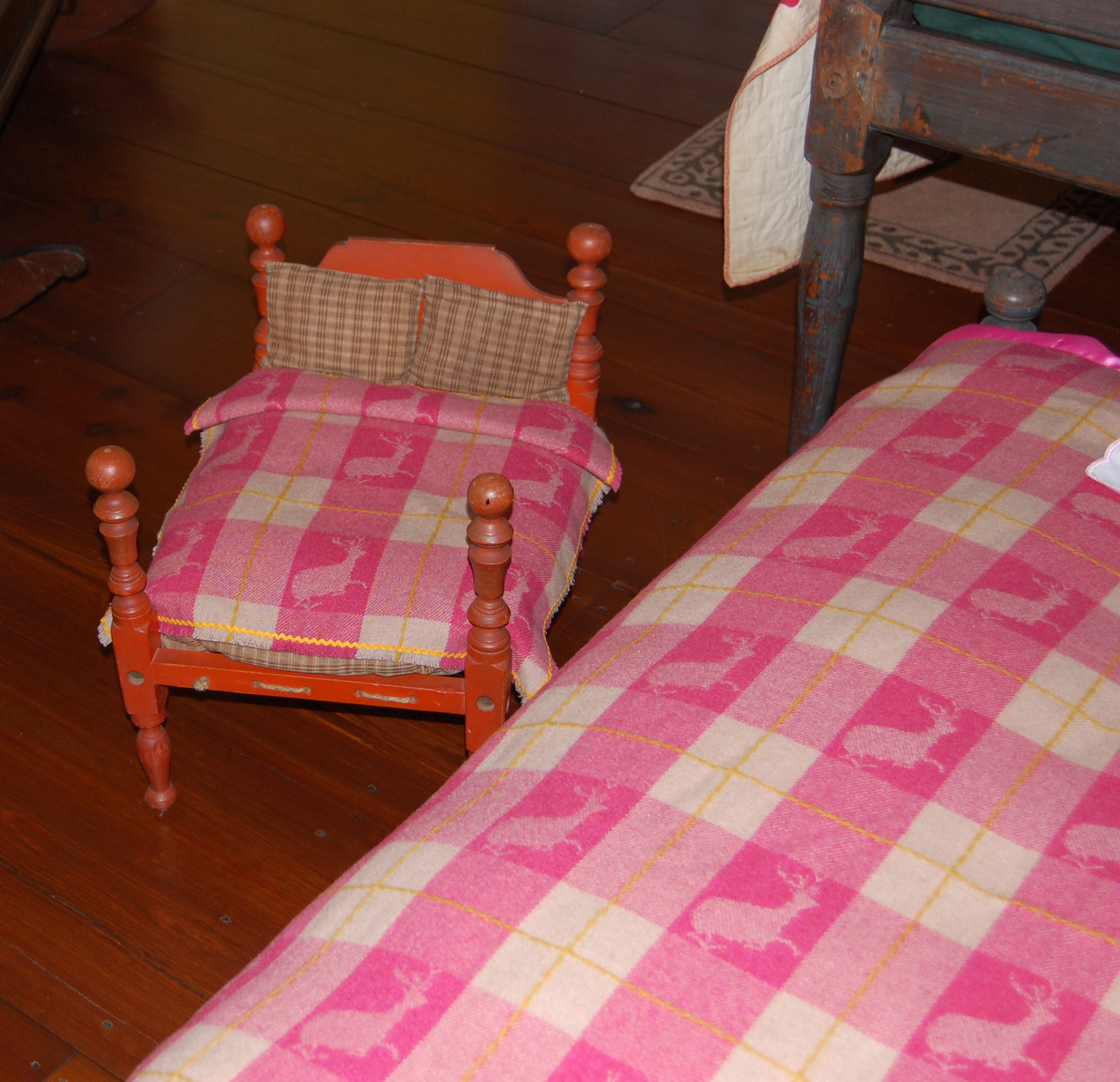
I fringed the edges of the doll blanket and added rick rack for fun!

I fringed the edges of the doll blanket and added rick rack for fun!

pink blanket

Too pretty to go completely out of sight - and easier to pull out for" wee ones".

Too pretty to go completely out of sight – and easier to pull out for” wee ones”.

10 Comments

Filed under Blankets and doll blankets, Uncategorized, woolens