
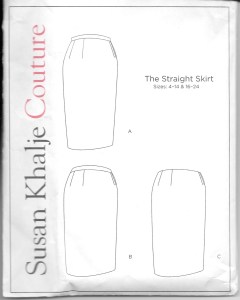
Sounds super simple, doesn’t it? Well, yes, but simple does not necessarily equate with speedy. The skirt in question is this one which I fit into my sewing queue as part of a group project in Susan Khalje’s new subscription sewing club.

Susan provided the pattern to all the members, and the choice of which view to use (if one chose to participate; no pressure in this club, only support!) was entirely up to each individual.
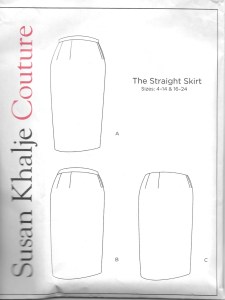
I used View A for my skirt. Although this looks like a simple straight skirt, there are subtle details which make it a step above ordinary. For example, the side seams are set slightly back from the front. There is slight fullness built in at the hip; not enough to be noticeable, but enough to make it more comfortable for wearing. This pattern is available on Susan’s website.
I chose the view with the waistband sitting right at the waist (View A), and decided to use a lovely, soft piece of vintage wool I found recently. As Susan provided video support for each step of the skirt, and answered questions online, I slowly worked through each component while working on my other projects at the same time.
Some of the members in the group have gotten very creative with their renderings of the skirt, but I chose just to keep it simple. I had already used this pattern once when I made my guipure lace skirt last year, but I tweaked the fit again and am now much happier with it. (And now I have a go-to skirt pattern.) One fitting tip that Susan shared was to make sure those side seams are exactly perpendicular to the floor. If they sway to the front or back, then adjustments need to be made.
The wool I used for my skirt was very lightweight, enough so that I determined the lining fabric should be as close in color as possible. Luckily I had a piece of silk crepe de chine in my “linings” box which matched perfectly. (I love it when things like this happen!)
I hand-picked a lapped zipper into the center back seam, and this small detail adds just a touch of class, in my opinion.
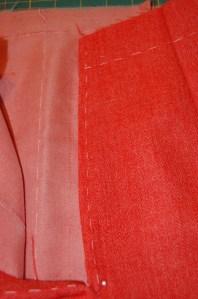
Here my center back seams are clearly marked, necessary for any zipper application, but especially so with a lapped zipper.
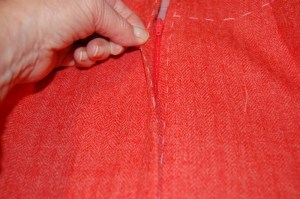
Here the zipper is in, and the center back lines match, showing the offset of the zipper on the left.
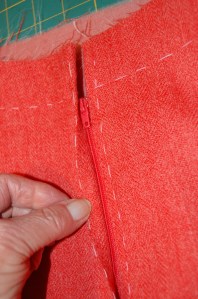
More of the same!
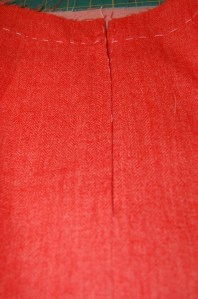
And here is what the zipper looks like when completed.
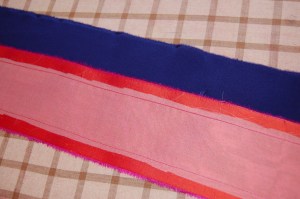
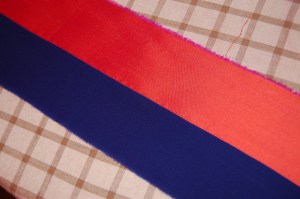
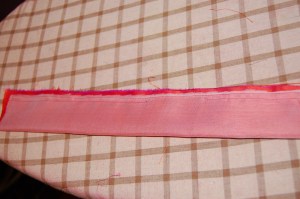
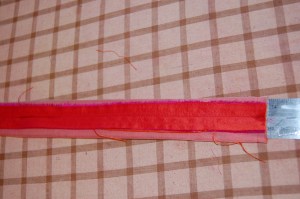
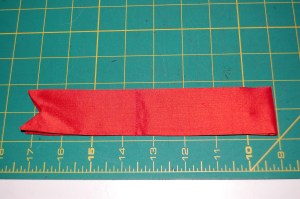
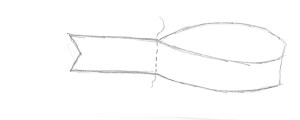
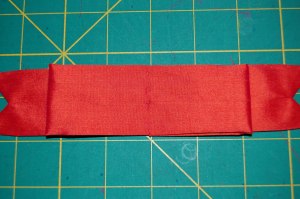
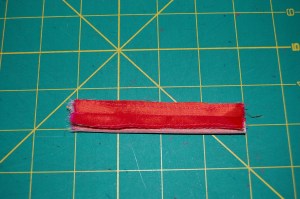
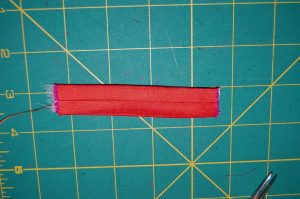
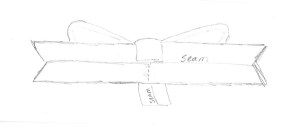
Even though my wool’s lightweight quality would have lent itself to a simple “all-in-one” waistband, I prefer not to have wool up against my bare middle, or my middle, clothed with just a layer of camisole silk between it and the waistband. So – I made a two-piece waistband with a facing out of the lining silk. Inserted into the band is a piece of Petersham ribbon, giving it support and shape.
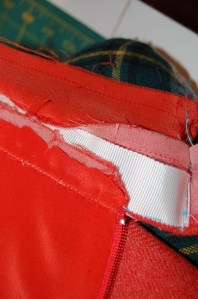
The lining has been attached (see how good the match is to the wool?), and the Petersham ribbon is ready to be encased inside the waistband.
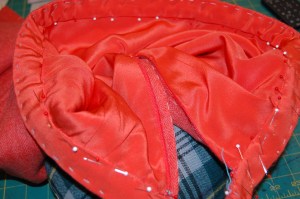
The waistband facing is ready to be attached to the lining/waistline seam.
The back slit of the skirt is angled in about a quarter inch on both sides, so that it hangs and wears with less of a separation.
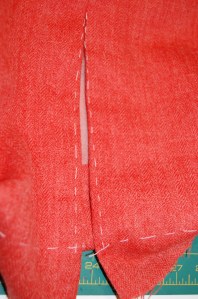
The white basting stitches show the center back. I angled the edges towards the center before finishing the hem.
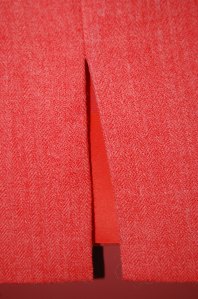
The finished slit and hem.
Not too much else to say about this simple skirt, except that it was a very satisfying little project.

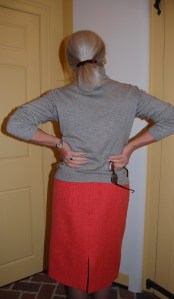
Notice how the back slit hangs together?

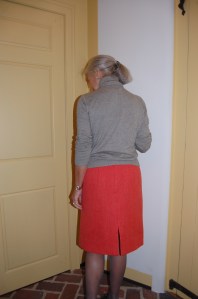

Actually there is one more thing to say – about straight skirts in general. They take very little fabric for most people – often a scant yard in a wide-width wool will suffice. Will there be more straight skirts in my future? Oh, yes. In fact, I already have a wool tartan remnant waiting for early 2019. But there is much to sew before then… not all of it so simple as this!








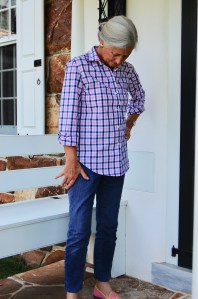


 fiftydresses
A White Blouse
White blouses (or shirts, if you prefer) seem to occupy a niche all to themselves in the annals of fashion. There is something both unpretentious and elegant about a white blouse. A white blouse is almost always noticed and admired, and even the most tailored white blouse has an air of femininity to it.
Here is what Christian Dior had to say about the color white when he wrote The Dictionary of Fashion in 1954: “White is pure and simple and matches with everything. For daytime it has to be used with great care because it must always be really white and immaculate… But nothing gives the impression of good grooming and being well dressed more quickly than spotless white…” (Published again in 2007 by Abrams, New York, New York; page 120).
What could be a better example of being well dressed than this white blouse featured in the February/March 1955 Vogue Pattern Book Magazine (page 28)? With its tucks and French cuffs, it is both demure and sophisticated.
Now this is an elegant blouse!
Timeless is another description that could be given to the classic white blouse. Here is one featured in the August/September 1962 Vogue Pattern Book Magazine, page 49. “In suburbia, nothing has as much unstudied elegance as a classic neat, white shirt…”
By the 1970s, collars look like they had overtaken the world, but even with its outsized points, the white blouse gives this velvet suit its focal point:
This is an advertisement for Crompton velvet, featuring a Vogue pattern (Yves St. Laurent evening suit), page XVI of the October/November 1971 Vogue Pattern Book Magazine.
The Wall Street Journal had a full-page feature on The White Shirt in the Weekend Section of March 26-27, 2016. “Always timely and the quickest shortcut to chic,” says the caption. Part of the feature is shown here:
Although the article fixated on RTW white shirts, a small section was absolutely apropos for those of us who make our white shirts. Finding your Match maintains that there is a certain chemistry involved in finding the perfect shirt for oneself, and it emphasized the importance of choosing the right fabric. While cotton is usually the preferred fabric, even it is subject to an appropriate quality and weave. Choosing a pure cotton fabric will necessitate a commitment to laundering and ironing. Quoted from the article, “You can throw it in the machine, but for a finished look, Ms [Carolina] Herrera (who has made the white shirt her style signature) recommends hand-washing with a splash of starch for a crisp finish. The white shirt, remember, is about contradictions – it may be easy, but it has good manners.” (Oh, yes!)
Well, I can’t say I was thinking about chemistry and laundering and manners when I purchased this white cotton shirting fabric from Britex a few years ago.
I just thought it was so lovely with its woven stripe and scalloped detail. I am happy to say it has been brought to fruition as a classic white blouse.
While the woven stripe IS lovely, it presented some definite considerations when I was laying out my pattern. For example, what reveal of the stripe did I want to show on the collar and cuffs. What about the back yoke? How should the buttons line up on the design on the center front? The following pictures detail my decisions as I worked through each component.
I chose to use the plain white band as the center portion of the cuffs.
I chose to position the stripe on the collar in the middle.
I decided to interface the yoke, as the cotton is lightweight, and the facing of the yoke would have shown through without it. I always use a woven, sew-in interfacing when I am making blouses. It works beautifully. I evenly balanced the placement of the stripe on the yoke, with just a slight plain reveal noticeable at the lower edge.
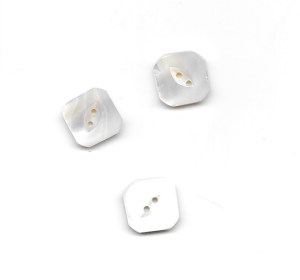
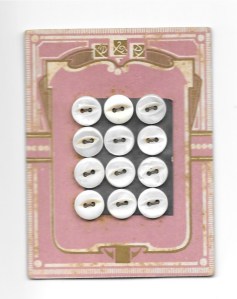
And then, what buttons should I use? It is so easy – and often appropriate – to choose a simple white pearl, two-hole button to accompany this style of shirt. I was prepared to do that until I came across this card of vintage buttons in my collection:
My first thought was, “How perfect! The incised stripes on the buttons mirror the stripe in the cotton. And, to seal the deal, they were also the perfect size, at 3/8”.
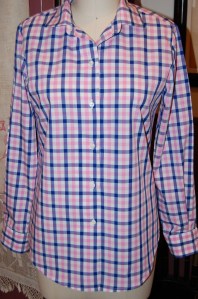
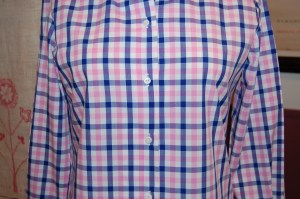
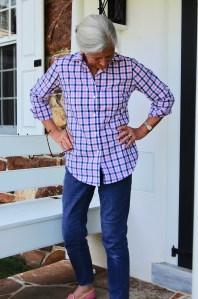
I used the same 1970s’ Simplicity pattern (with my many alterations to it) that I used for the two gingham blouses I made over the summer.
It is always satisfying to use a fabric which had been purchased – in the past, shall we say? It reinforces my thought that there is a time for all those lovely pieces of silk, wool, cotton and linen still waiting for their destination. Perhaps it really is about chemistry, after all.
21 Comments
Filed under Blouses, Buttons - choosing the right ones, Fashion commentary, Fashion history, Uncategorized, underlinings, vintage buttons
Tagged as Britex Fabrics, Choosing buttons, fashion sewing, quotes about fashion, sewing, vintage ads for fabrics, Wall Street Journal Fashion coverage, white shirt