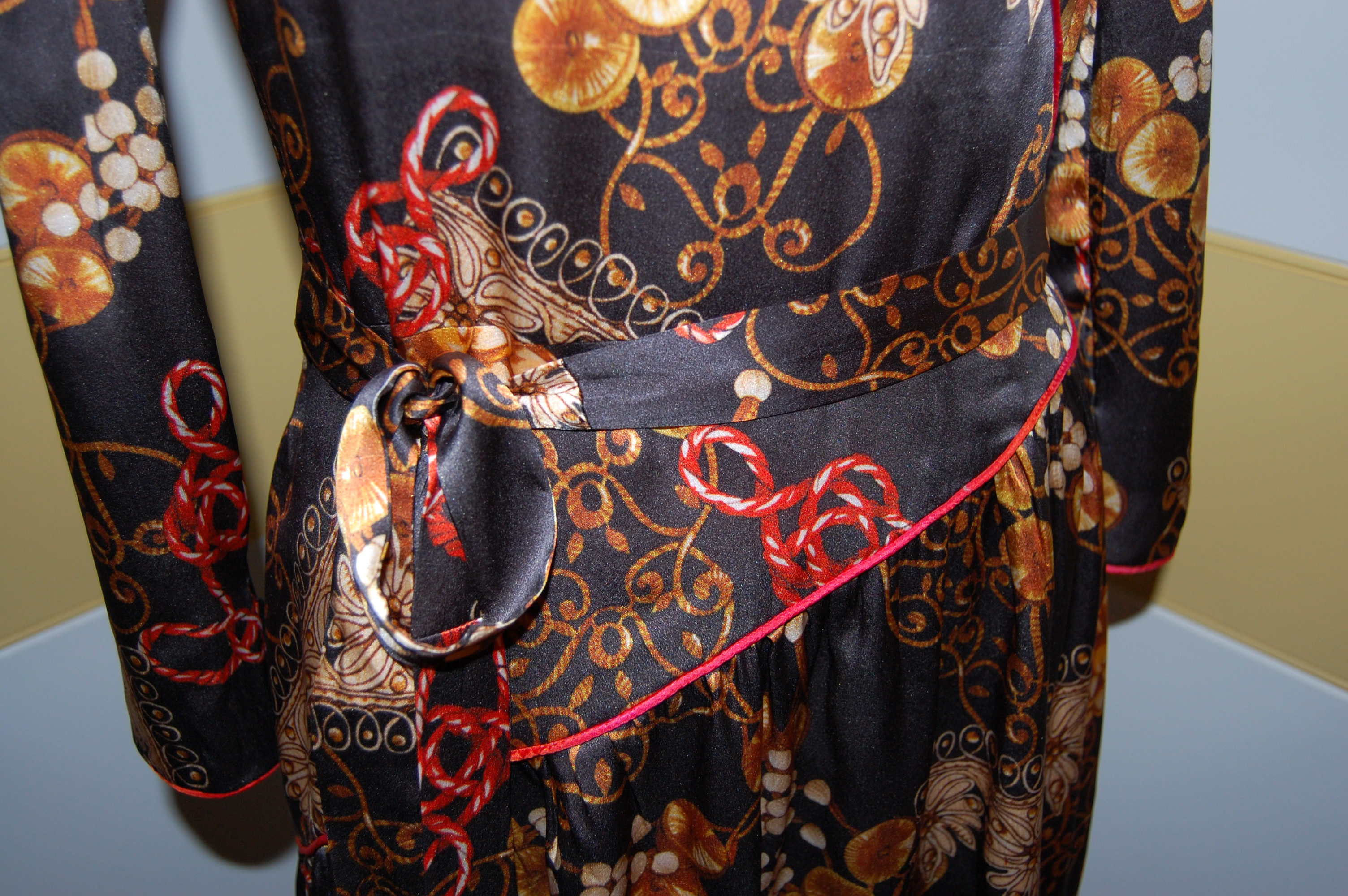
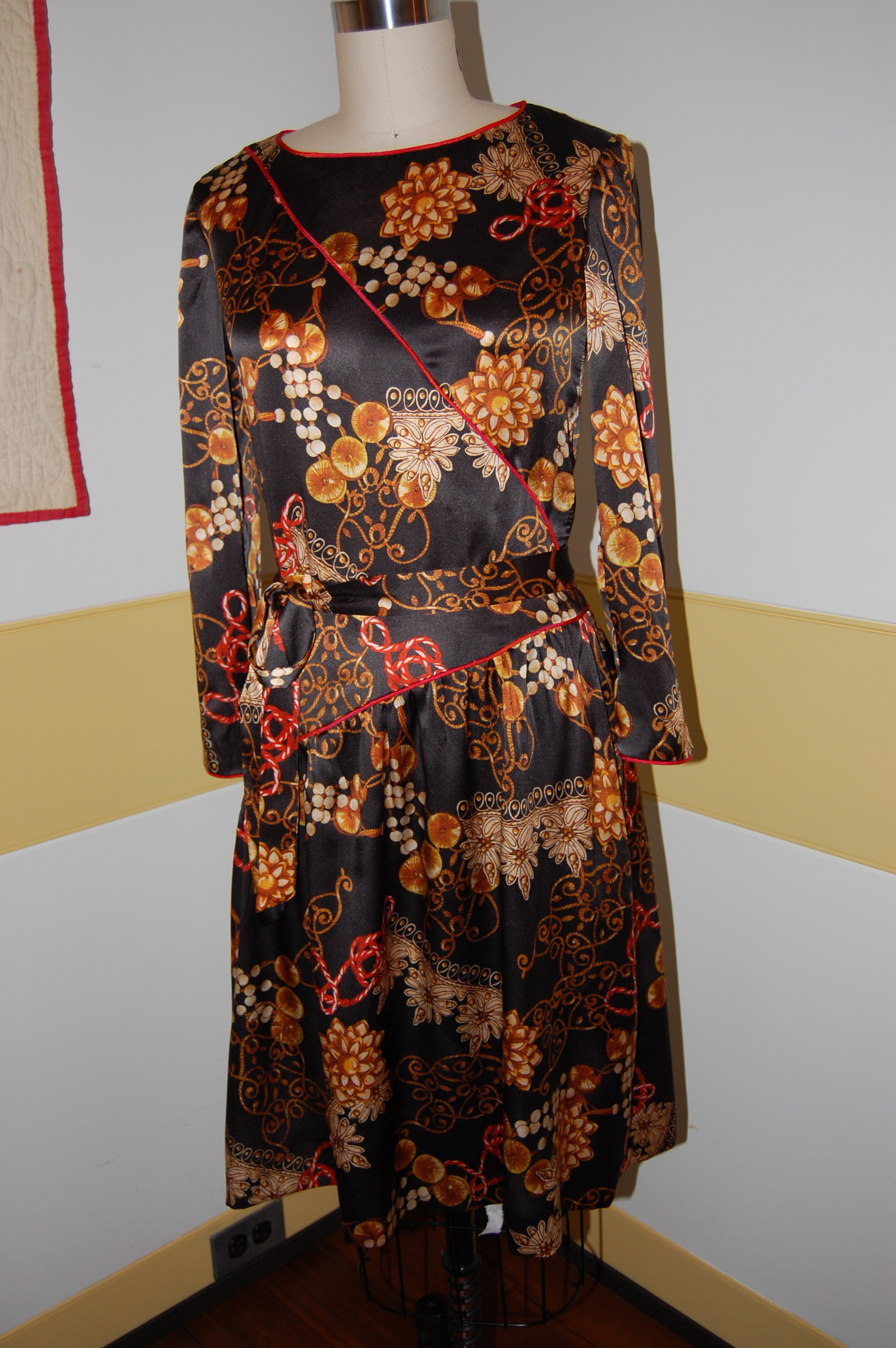
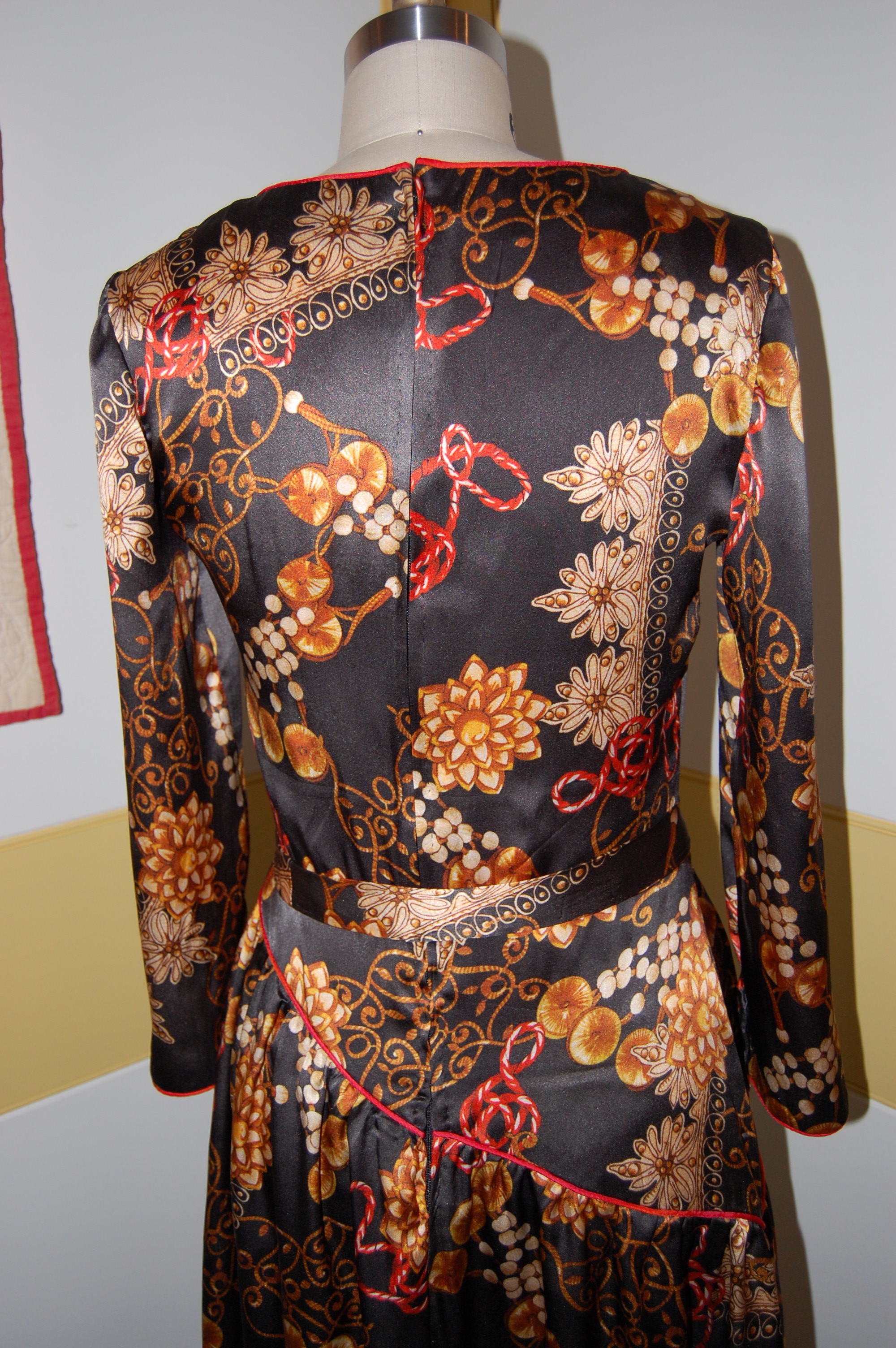
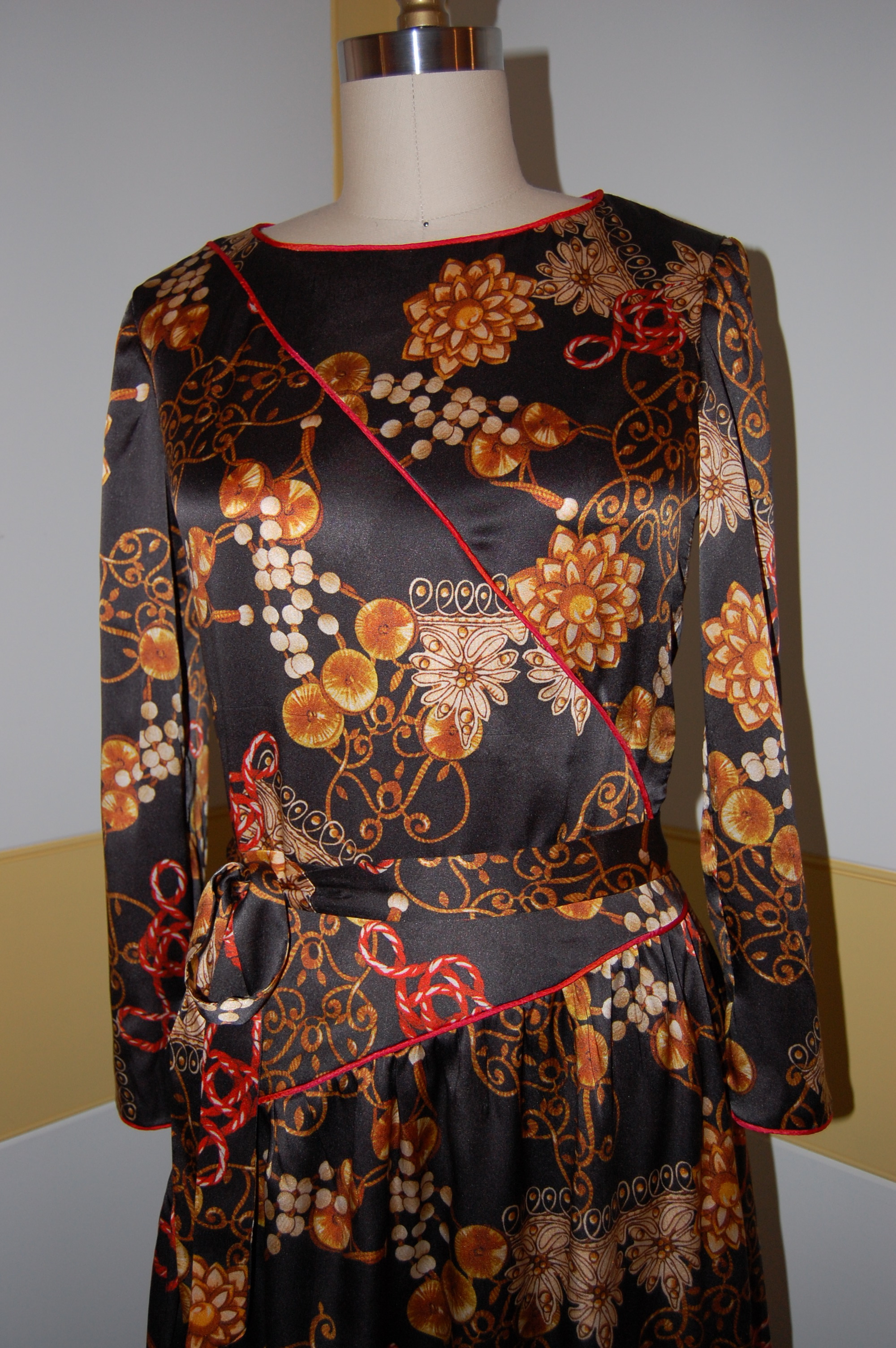
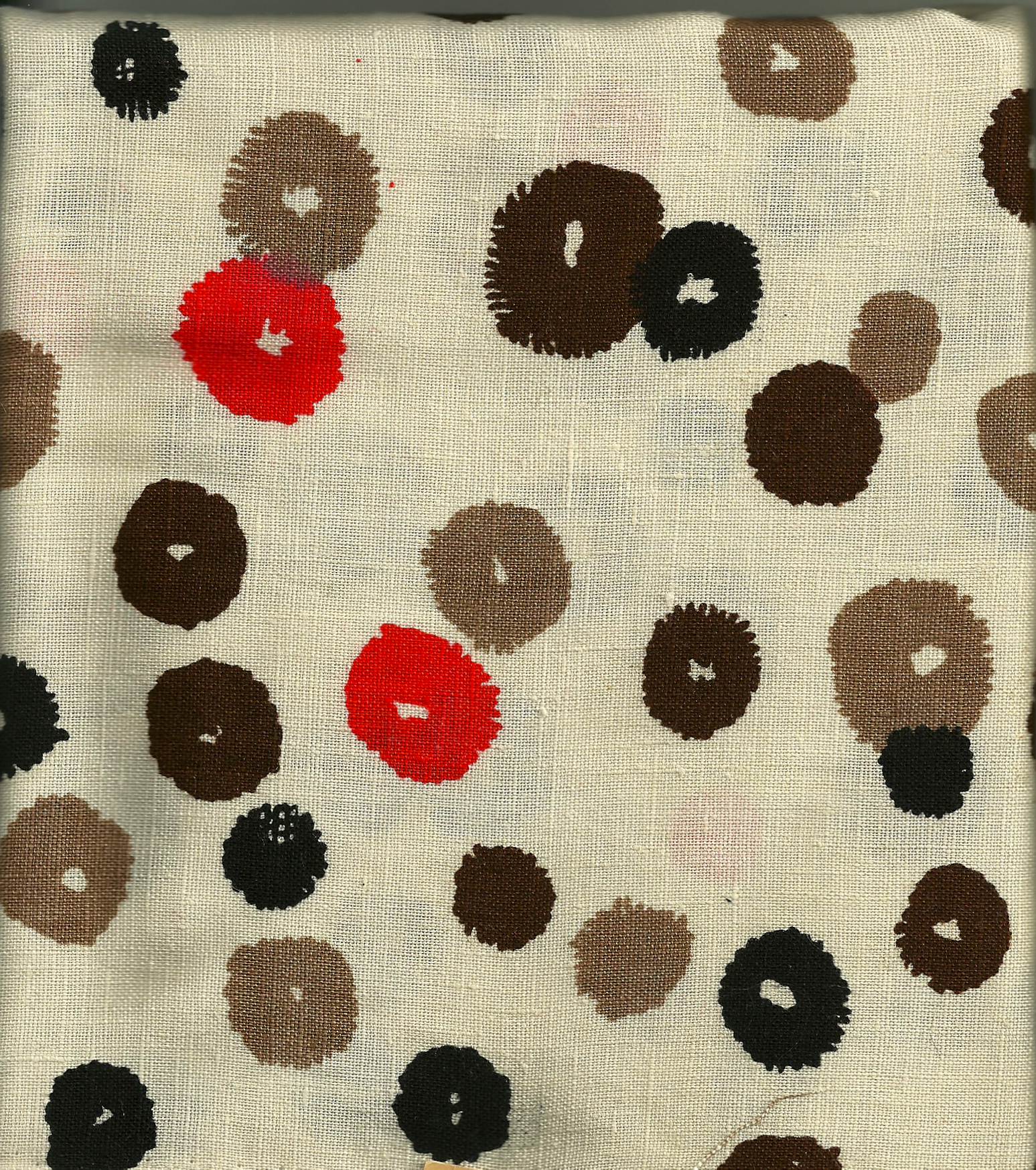
Tag Archives: Mendel Goldberg Fabrics

Scrap

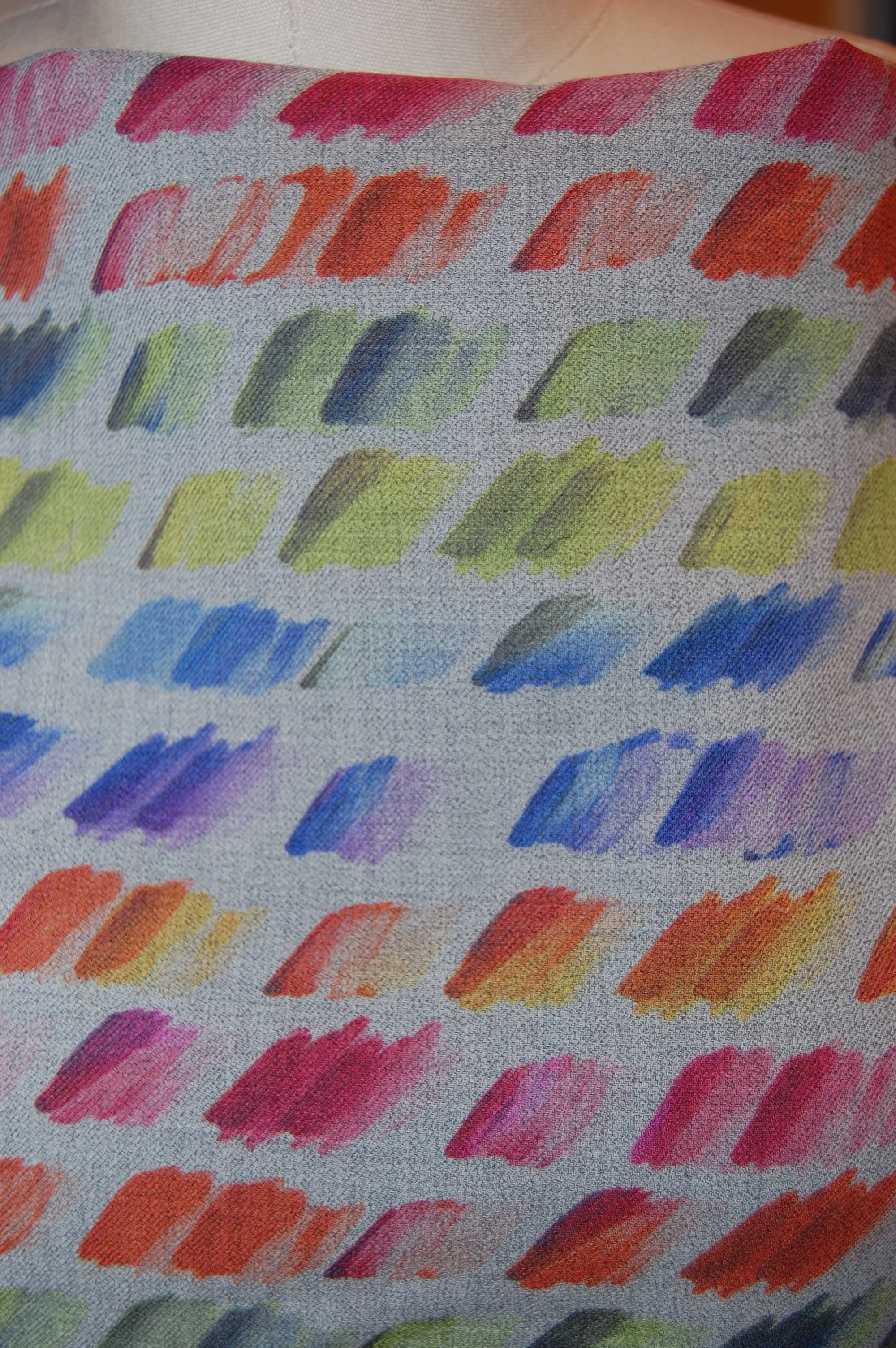
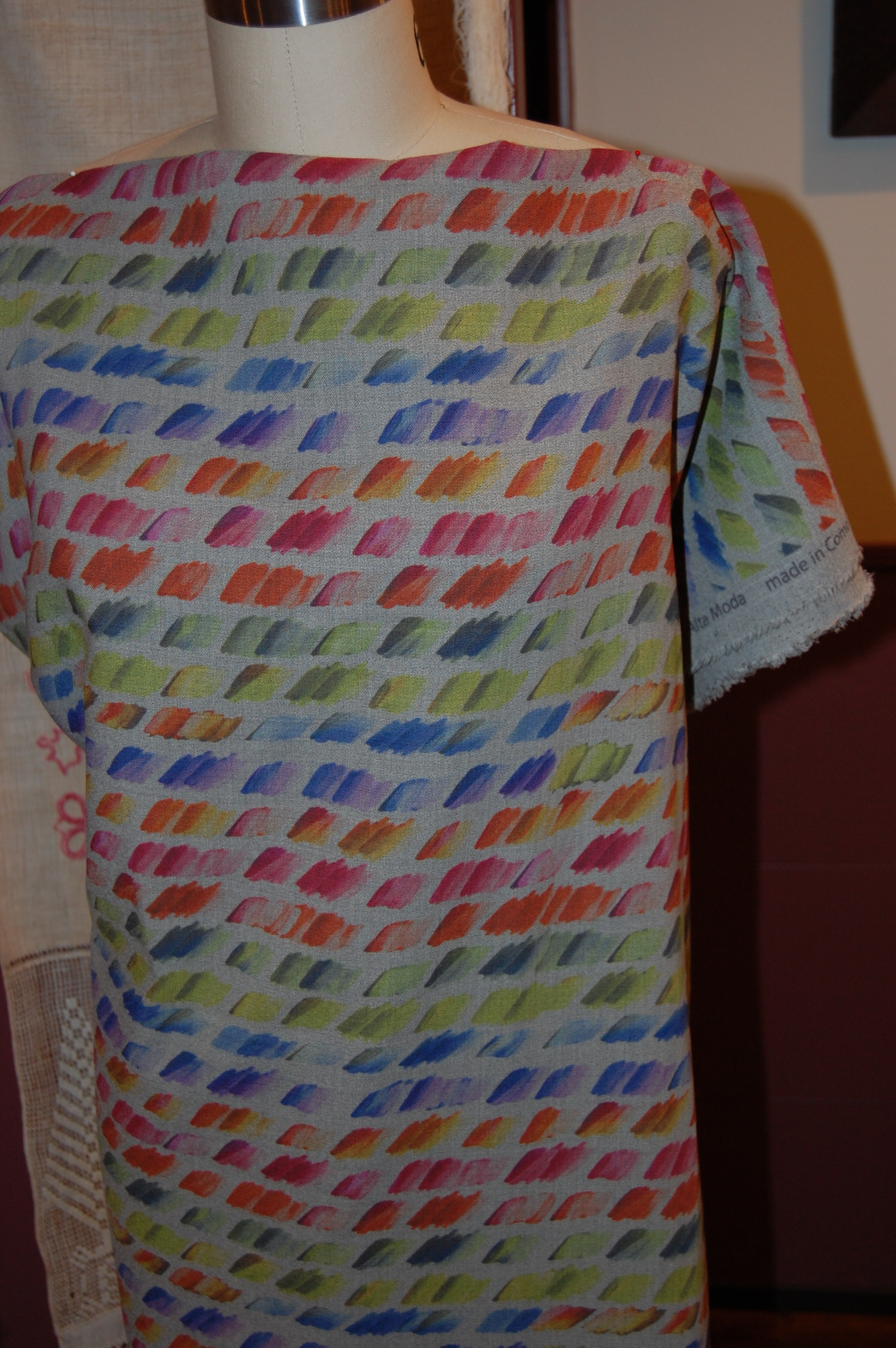
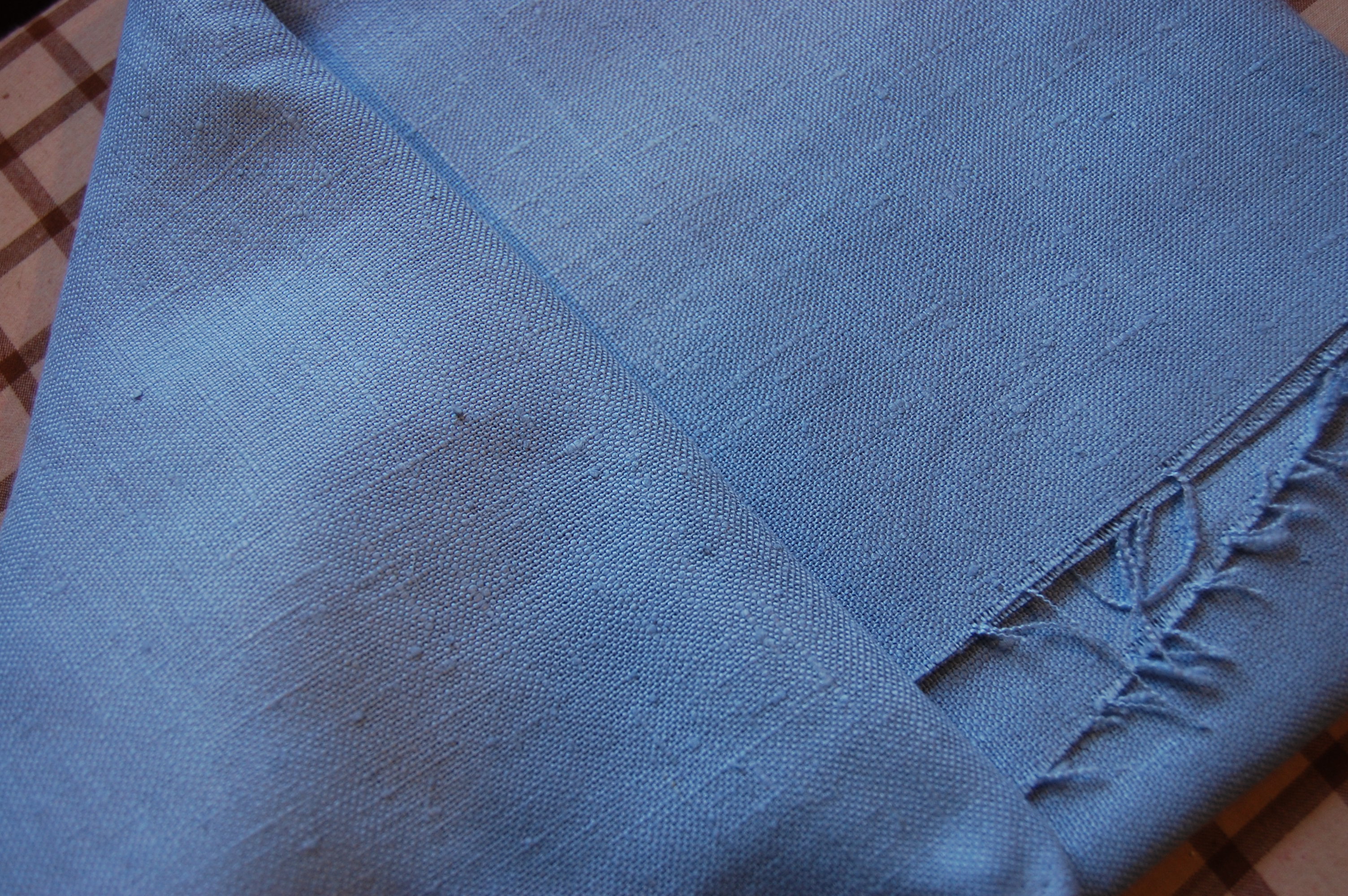
This particular word seems to sum up my experience – so far – with my new project of the month. I have had to “scrap” three complete muslins – as in “throw away” and “discard.” I rather like one of the other definitions for this particular word to sum up my past week of sewing – “a fight or quarrel.”   Yes, it’s been a battle, but I believe I am winning! It all started with this fabric – a soft, lovely, light-weight wool and silk blend – from Mendel Goldberg Fabrics.
Scrap

Here it is draped over my dress form.

Here it is draped over my dress form.

Although I knew I wanted to make a dress with a slim profile – to minimize the fabric’s horizontal design – it took me a while to find the right pattern. I started with one that had curved lines in its bodice and “scraped” that idea after my muslin (toile) revealed many fitting issues. I took that as a sign that the pattern wasn’t the best one to use anyway (which I suspected all along. It’s really important to listen to one’s intuition in things like this!) After another search in my pattern collection, I settled on this dress.
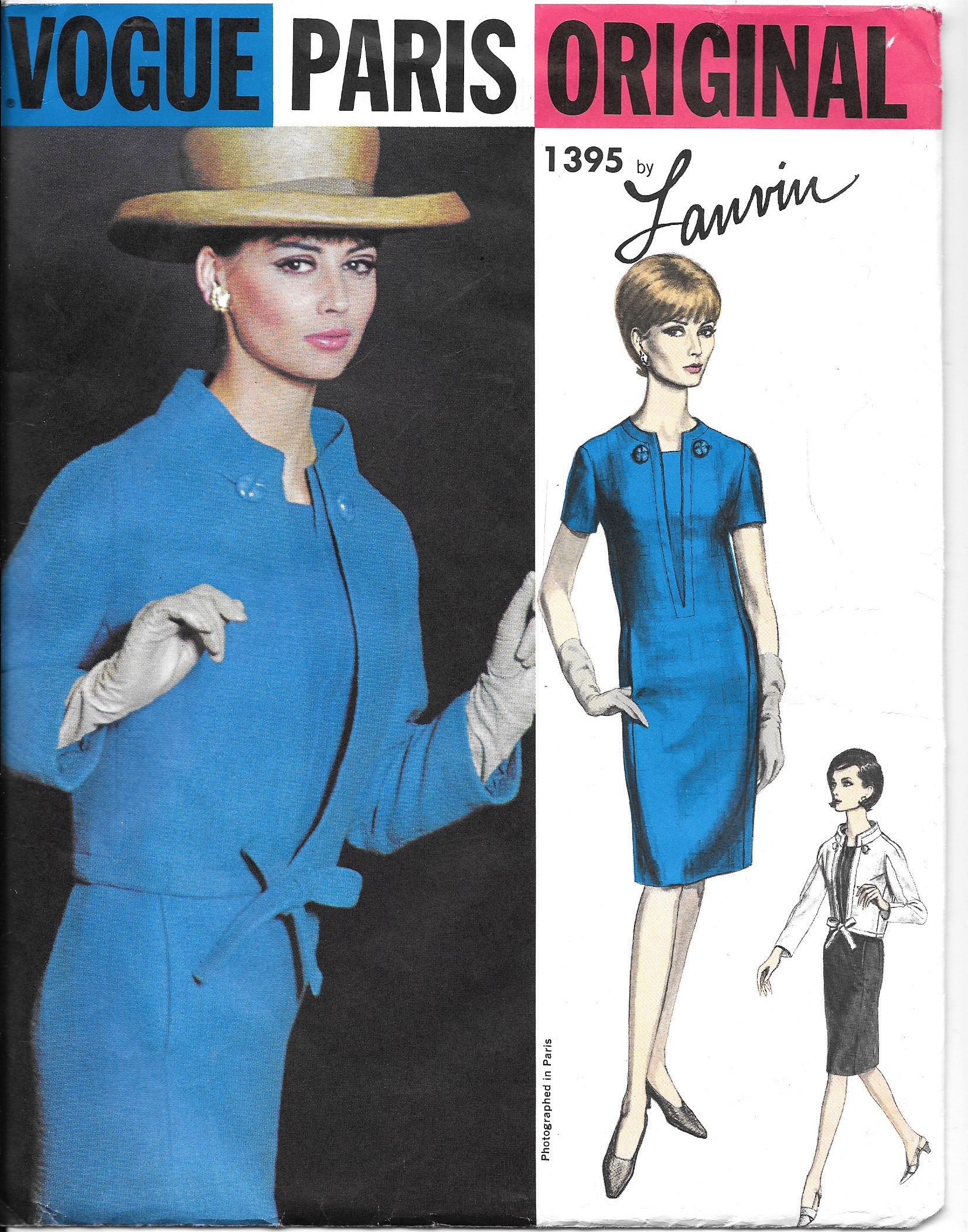
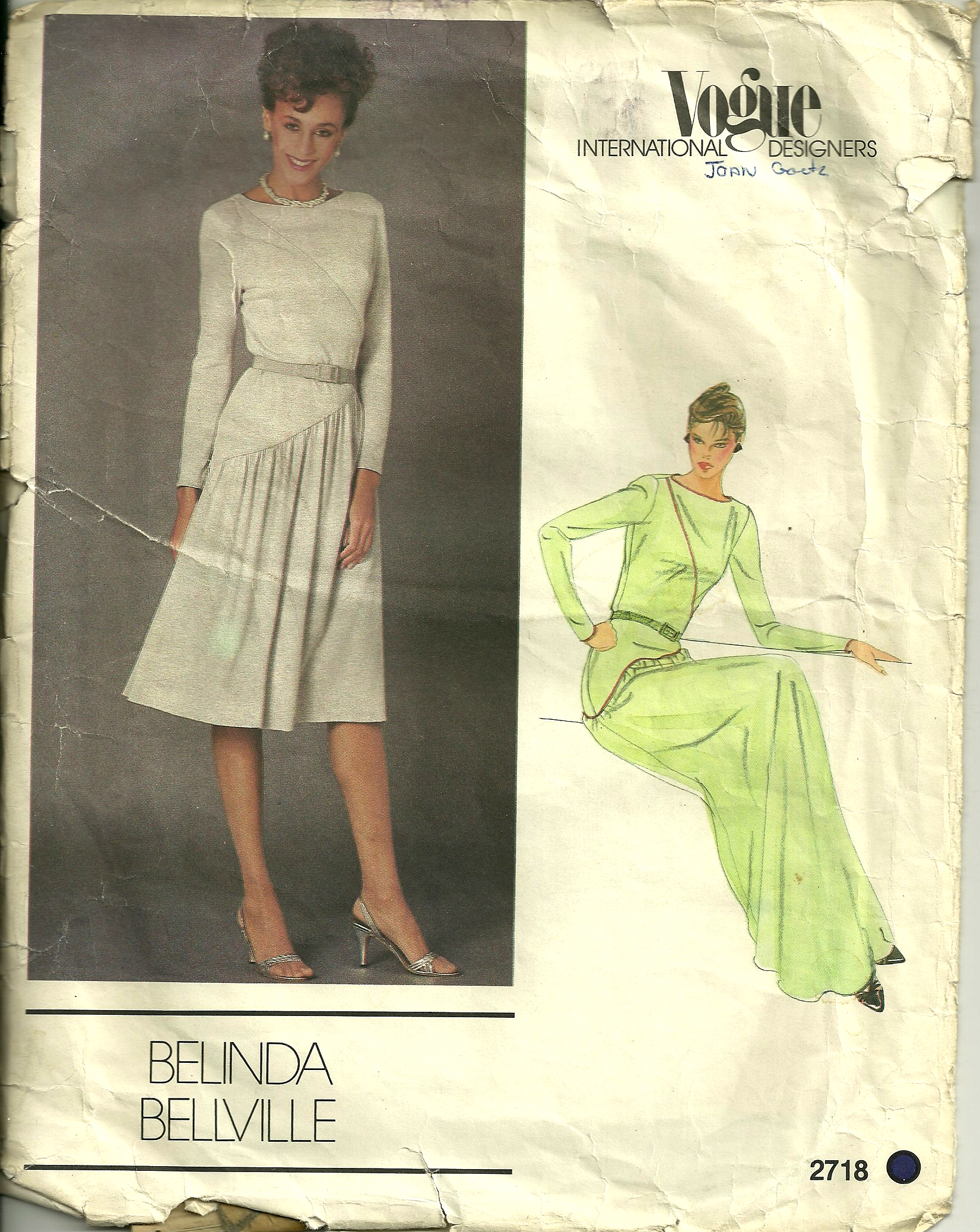
Gray painterly dress - Lanvin pattern

However, I want below-elbow length sleeves so I did a little sketch to try out the look:
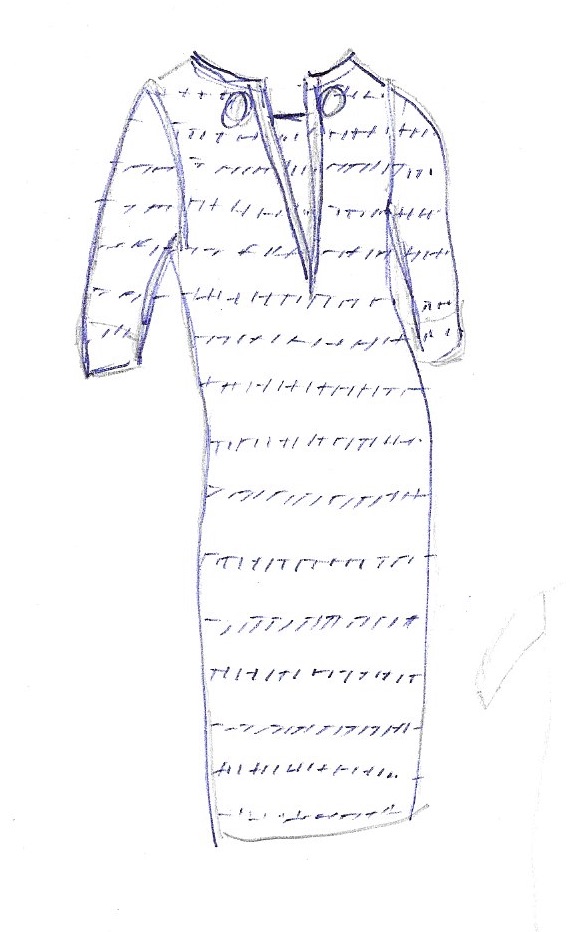
Gray painterly dress - sketchAfter finding a sleeve pattern from another dress which sports two elbow darts, I figured I was in business. Ah, the battle was just beginning. The first muslin I made revealed bust darts that were two inches (two!!) too high. And although I wanted a slim profile, I do have to be able to move in the dress!  I figured I needed to add two inches in total width from the lower armscye down.  Here is a diagram of the pattern pieces. The angle of the bust darts is vital to the fit of the dress so I could not just pivot the apex of the bust. I had to reposition the entire dart, which was getting it awfully close to the pocket.
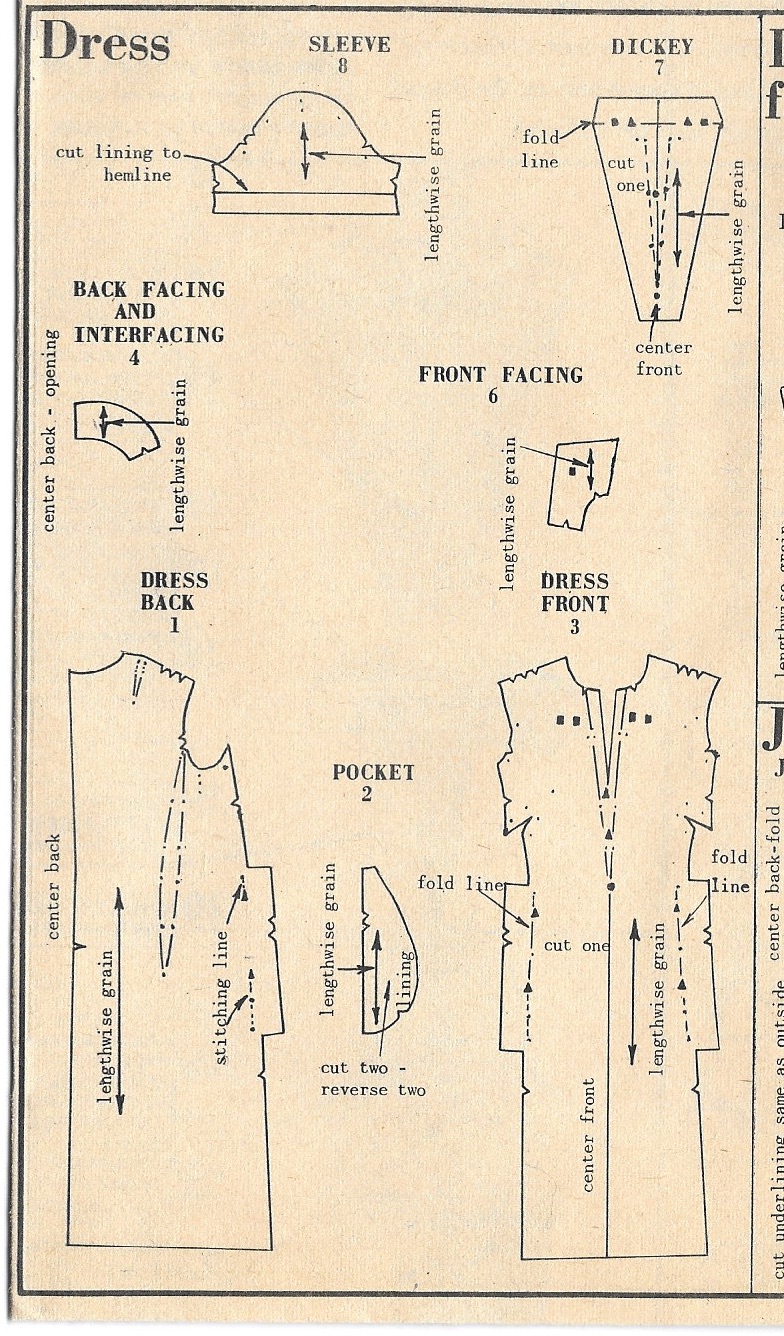
Gray painterly dress - pattern diagram

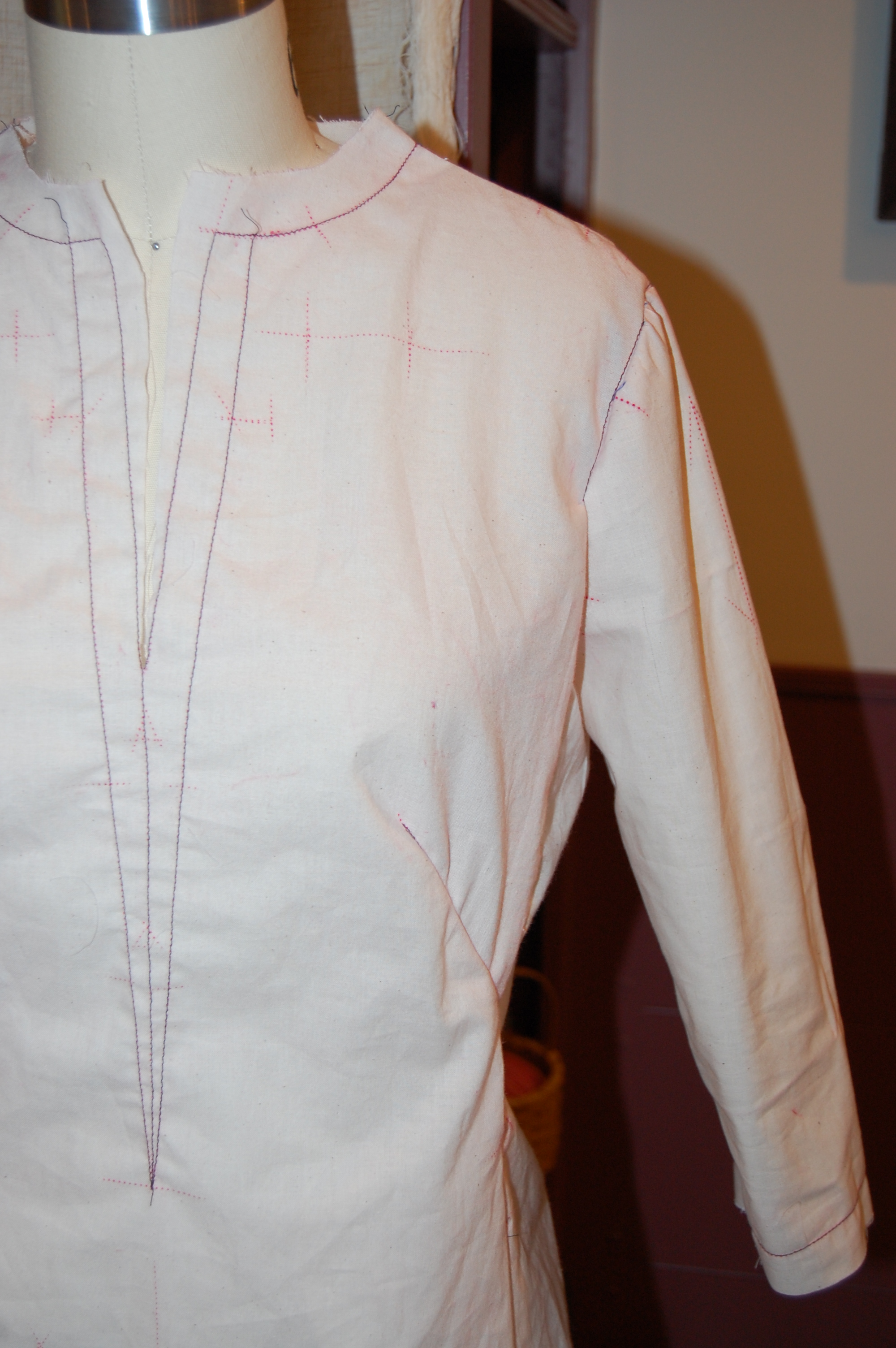
Making changes in that first muslin was just a study in frustration, so I scraped it and made a new one. My second one was better, but still had some kinks in it. The armscye seemed to be off kilter, the reason for which I could not figure out. I’m telling you these are the things that keep me up at night. At this point I went to JoAnn’s and bought more muslin. I was determined to win this fight! A whole new muslin and finally I had one that fit. I was even happy with my mish-mash sleeve (after making a few minor adjustments.)
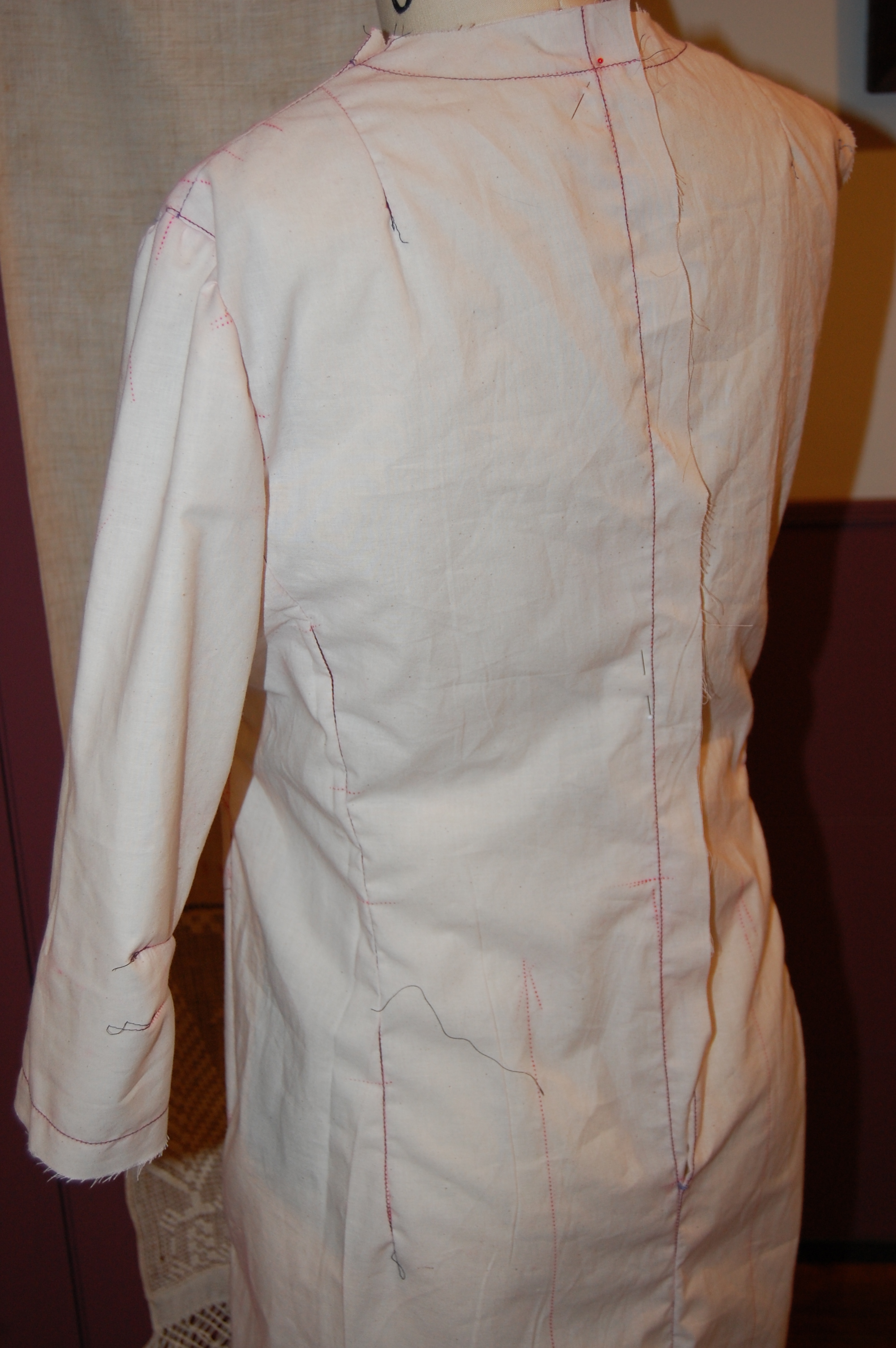
Scrap

Scrap

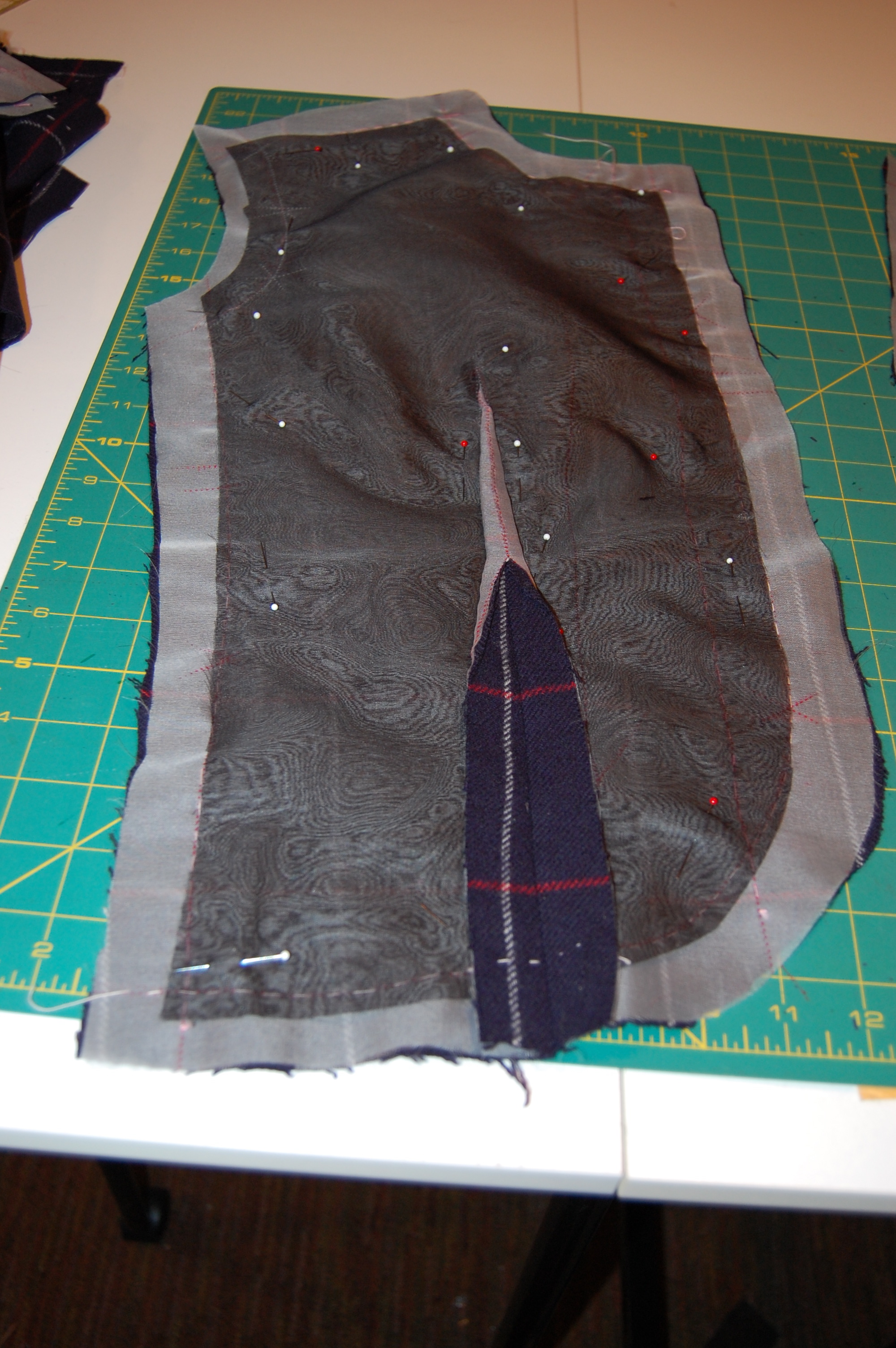
I have now progressed to the silk-organza underlining stage of construction.   Matching the horizontal design of the fabric across the various components of the pattern will take concentration, but that’s a task that always intrigues me.
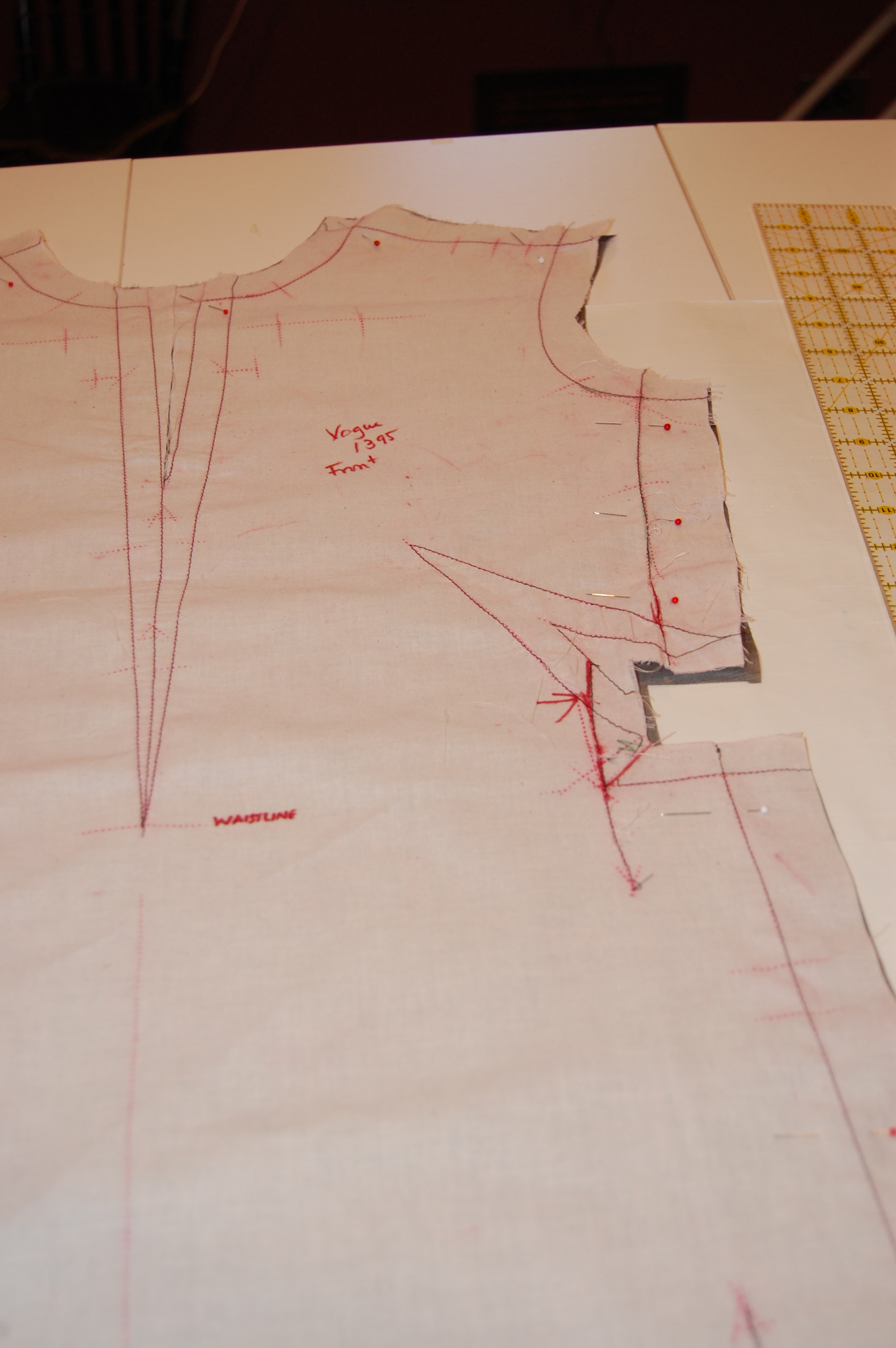
Scrap

A decision about those two buttons, such an important focal point of the dress, is still to be made. The wrong side of the fabric is plain gray, so I might end up using that side for covered buttons. Suggestions, anyone??
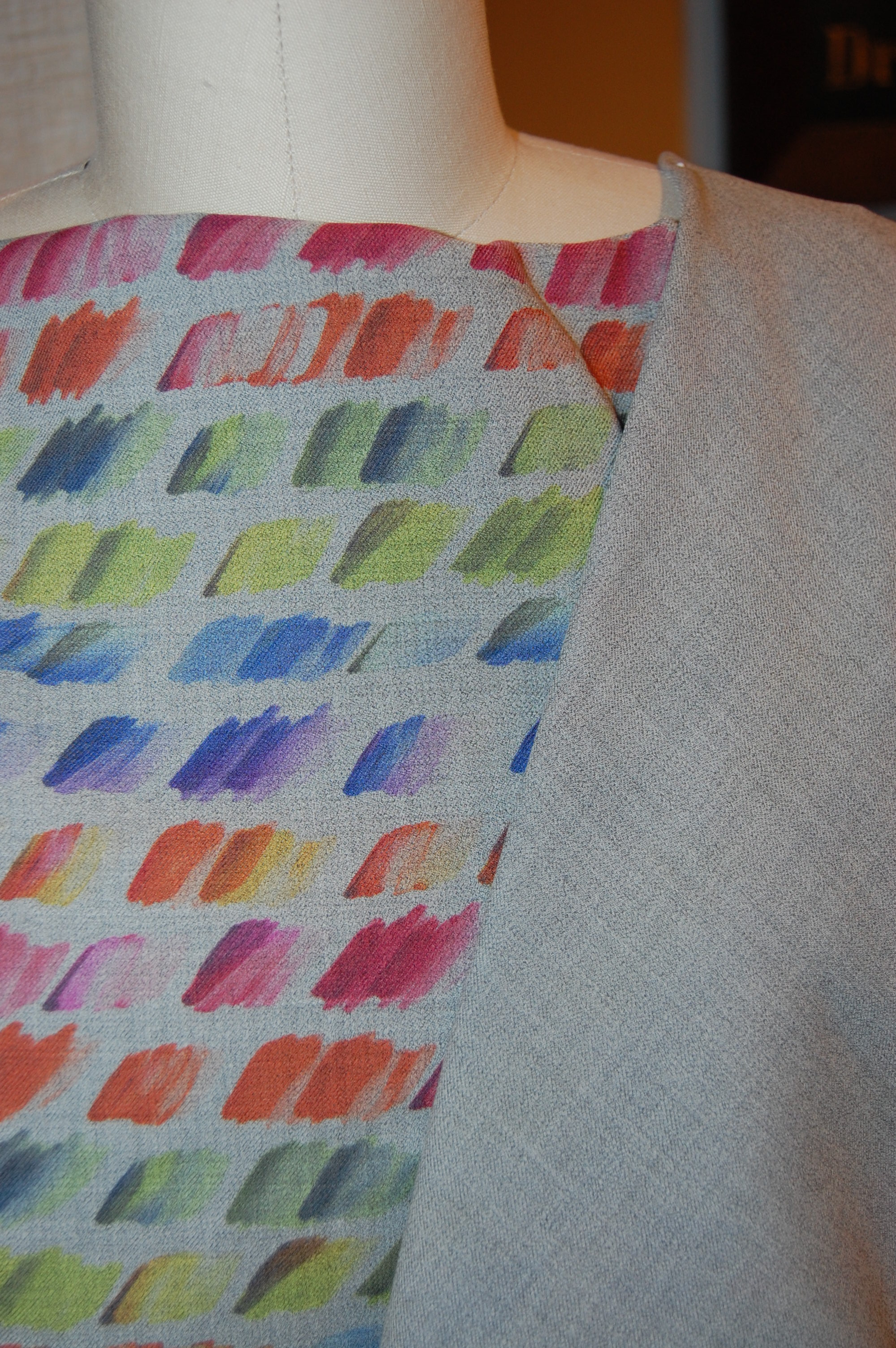
DSC_0900

Other than these challenges, I am feeling fairly confident that my next post will not have to be entitled “Scrap – Continued.”
20 Comments

Filed under Buttons - choosing the right ones, Uncategorized, underlinings, vintage Vogue Designer patterns, vintage Vogue patterns from the 1960s, woolens

A Noisy Spring

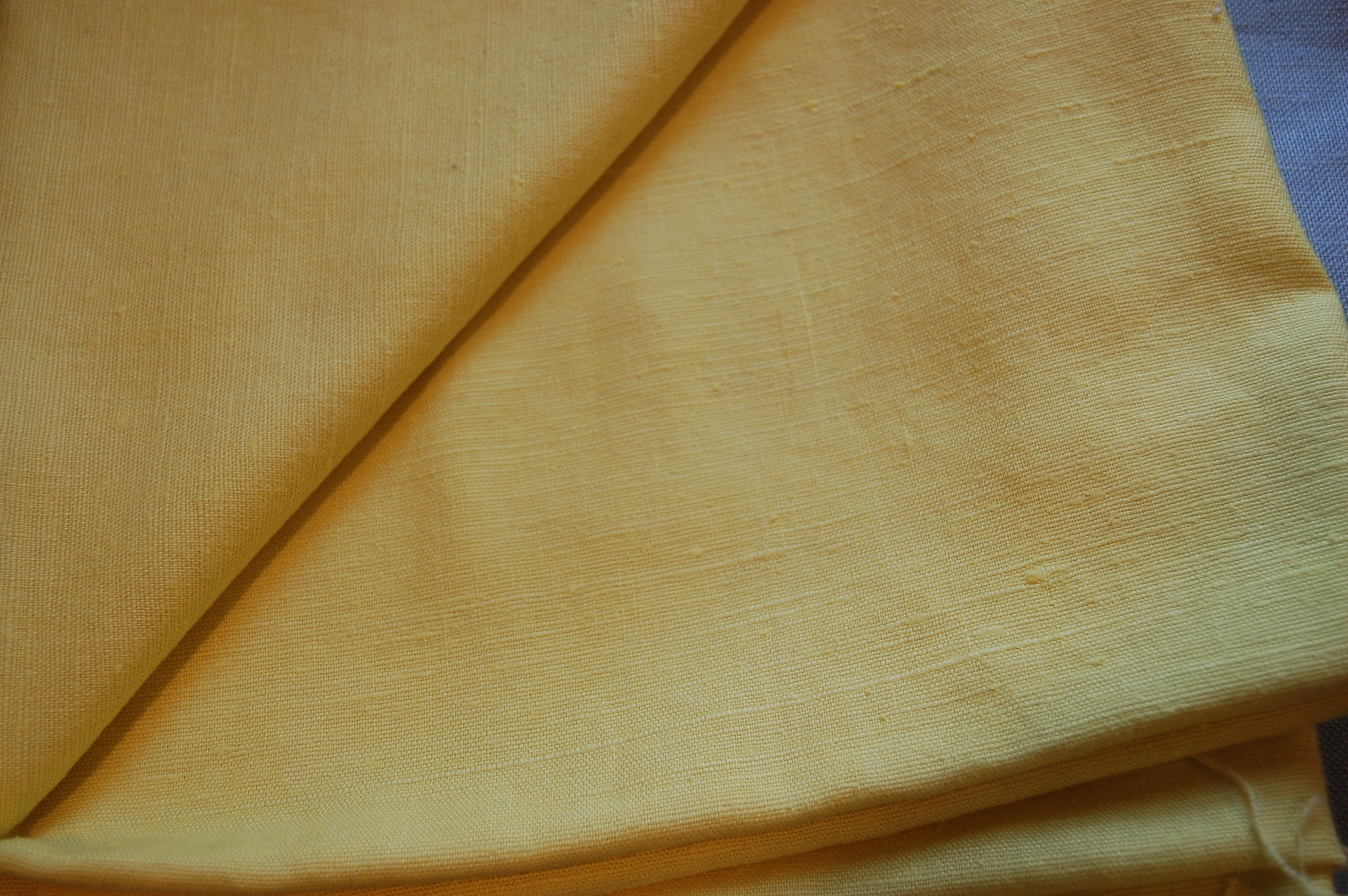
The chatter is endless and getting louder. Whenever I walk into my sewing room, I hear it, and there is no avoiding it. All those lengths of linen, most of it vintage Moygashel, are vying for my attention, hoping they might be selected for a starring role in my sewing agenda for Spring and (now, mostly ) Summer of 2015. Is there any fabric I love more? Probably not, although of course I love woolens, silks and cottons, too. However, there is something about linen, with its crispness, its durability, its versatility, and its ability to evoke a summer day in the midst of winter that totally captivates me.

There is linen that looks serene:

Lovely pale blue

Lovely pale blue

And quiet pale yellow

And quiet pale yellow

There is linen that looks a bit wild and crazy:

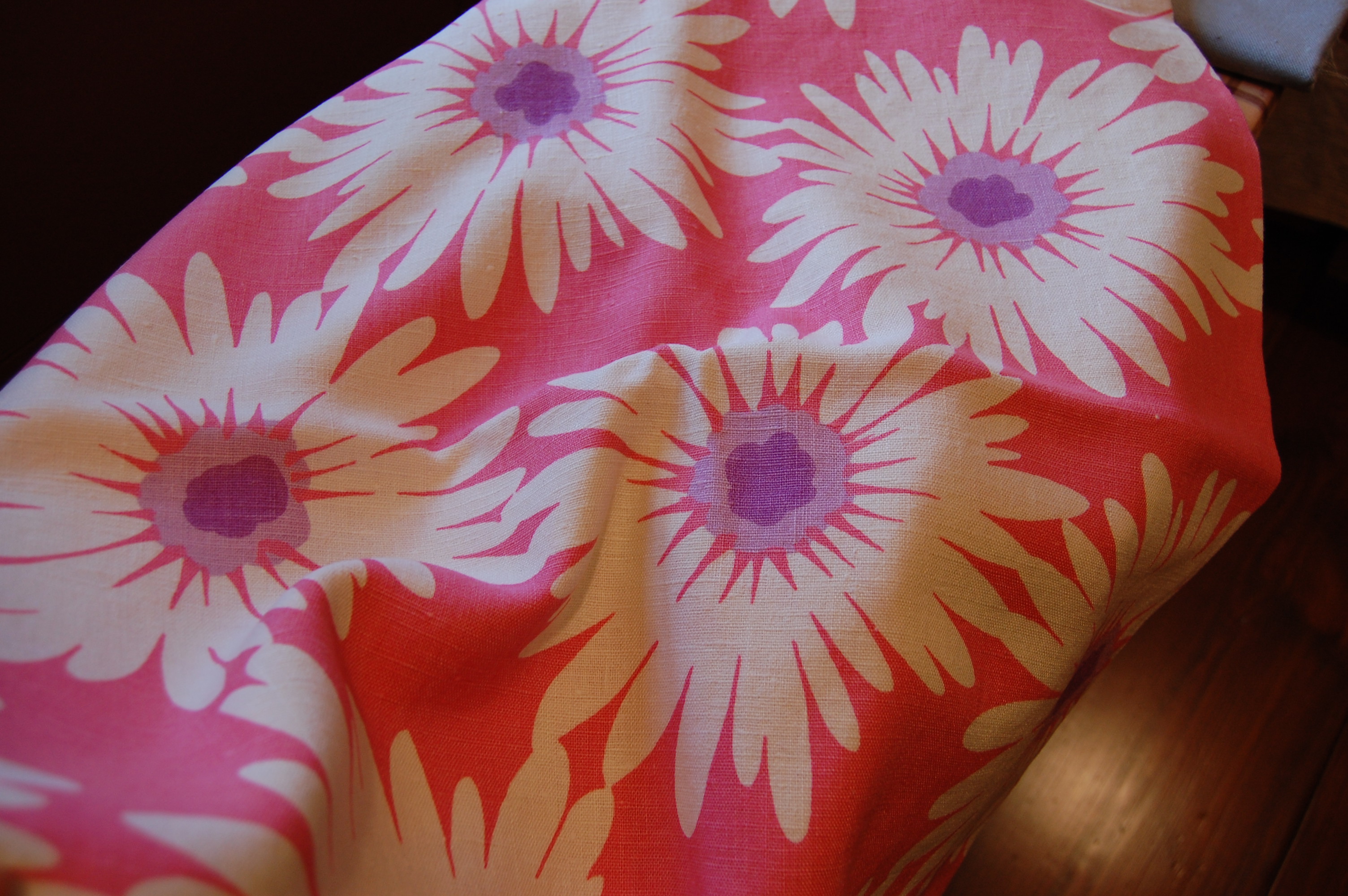
This piece is actually a linen/rayon blend, which has lovely hand to it.

This piece is actually a linen/rayon blend, which has a lovely hand to it.

Big, bright daisies!

Big, bright daisies!

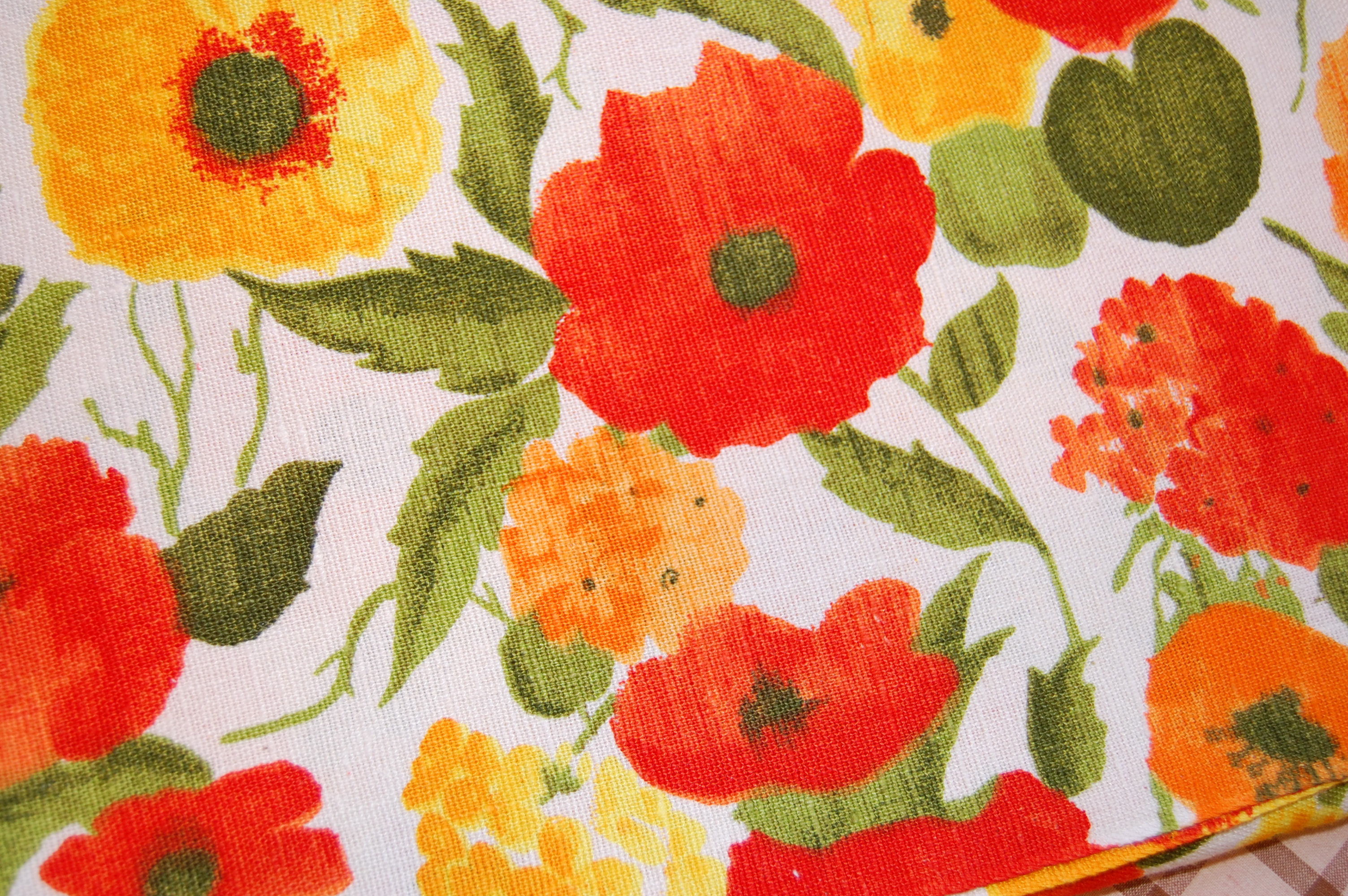
There is linen that says “Look at me!”:

Walking in a field of flowers!

Walking in a field of flowers!

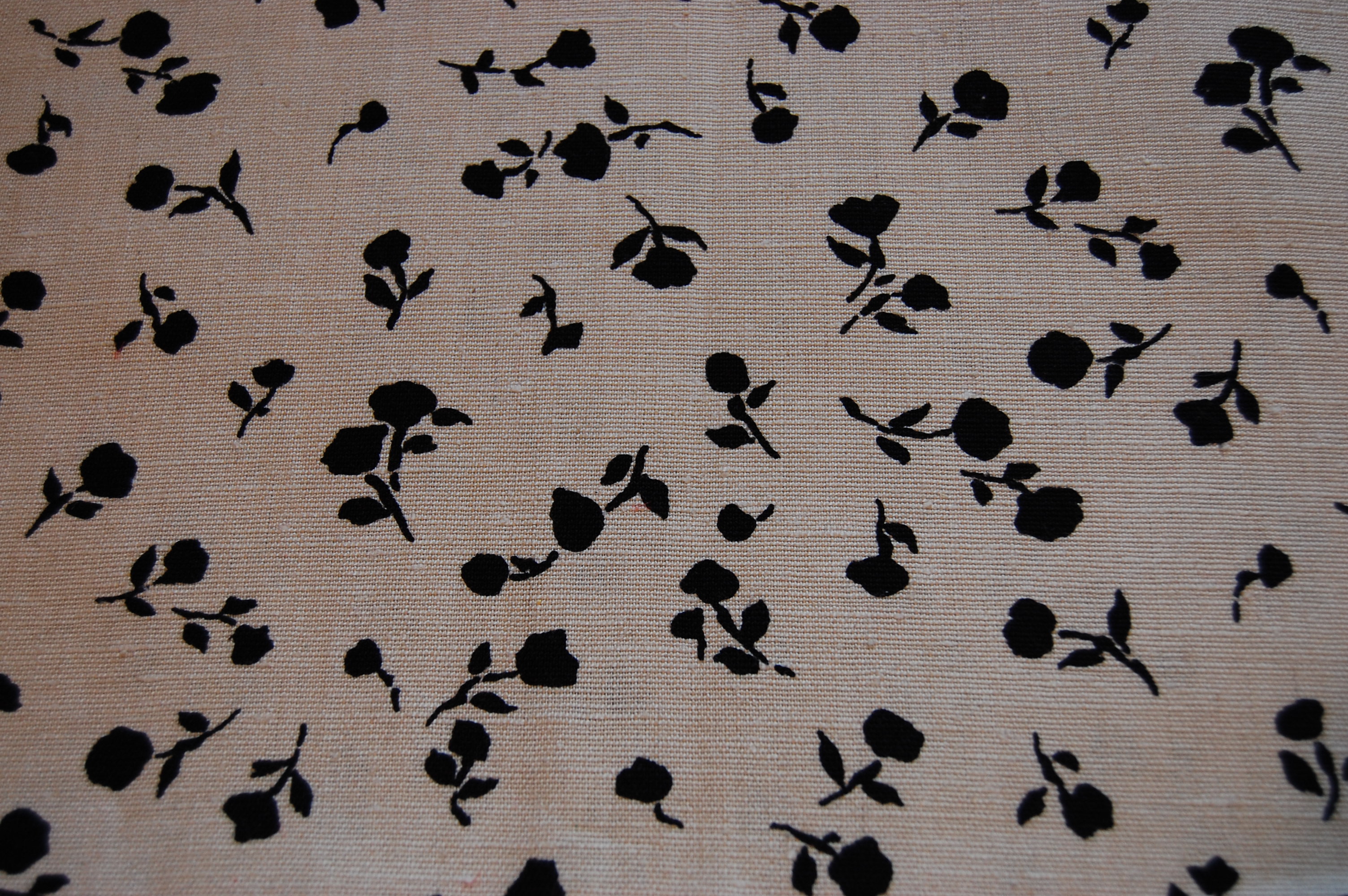
There is linen that is demure:

A very early 1950s' linen, petite black flower silhouettes on a pale ecru background.

A very early 1950s’ linen, petite black flower silhouettes on a pale ecru background.

There is linen that is happy:

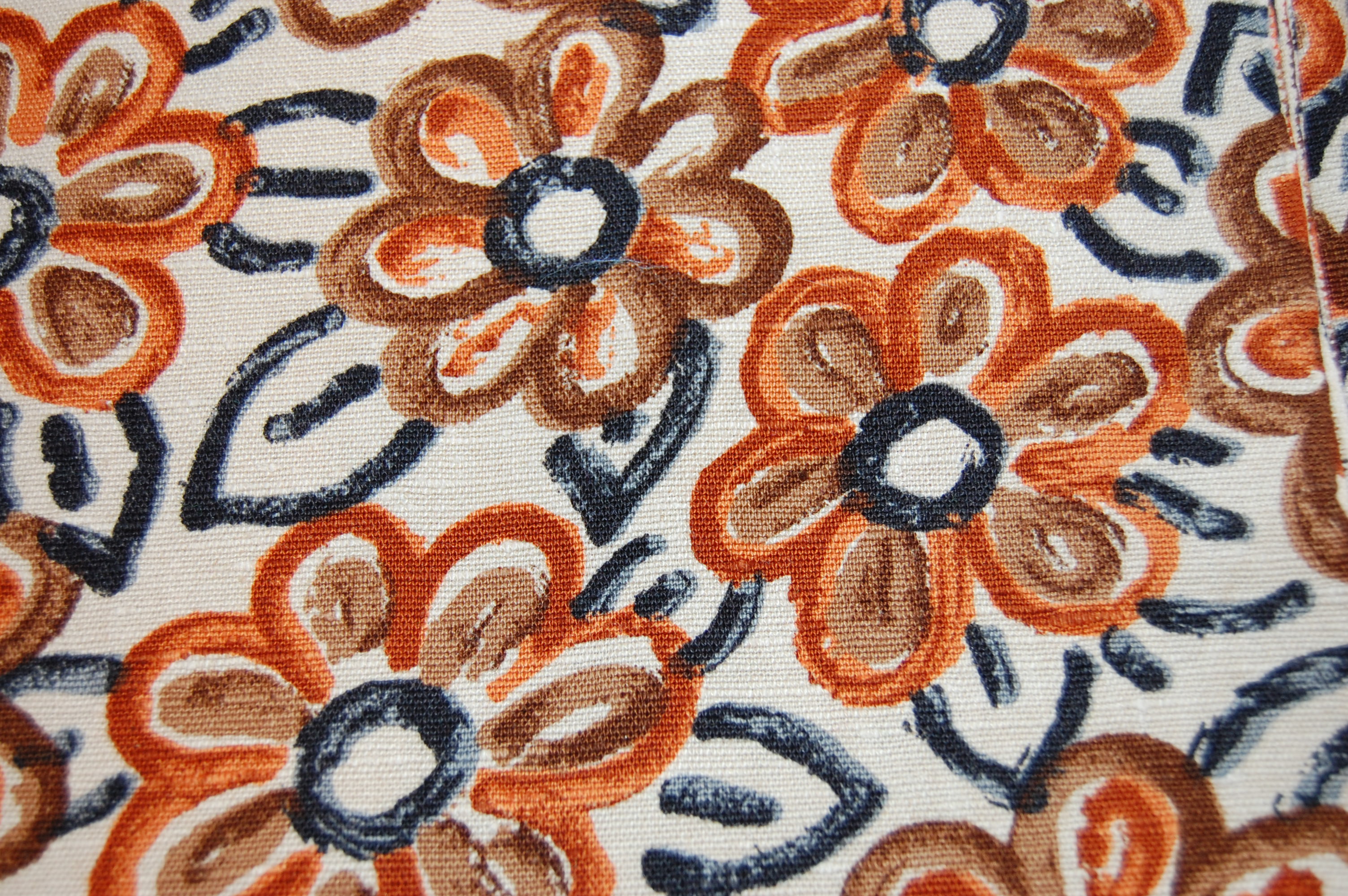
Navy, rust and brown - perfect for early Fall.

Navy, rust and brown – perfect for early Fall.

There is a lot of linen in my fabric collection! Last year I was able to complete three linen dresses (1; 2; 3)during the warmer months. This year I will not be so productive, for a number of reasons, although I haven’t given up hope of making a linen coat and a coordinating dress. The question then becomes, which piece (or pieces) of linen do I choose for such an undertaking?

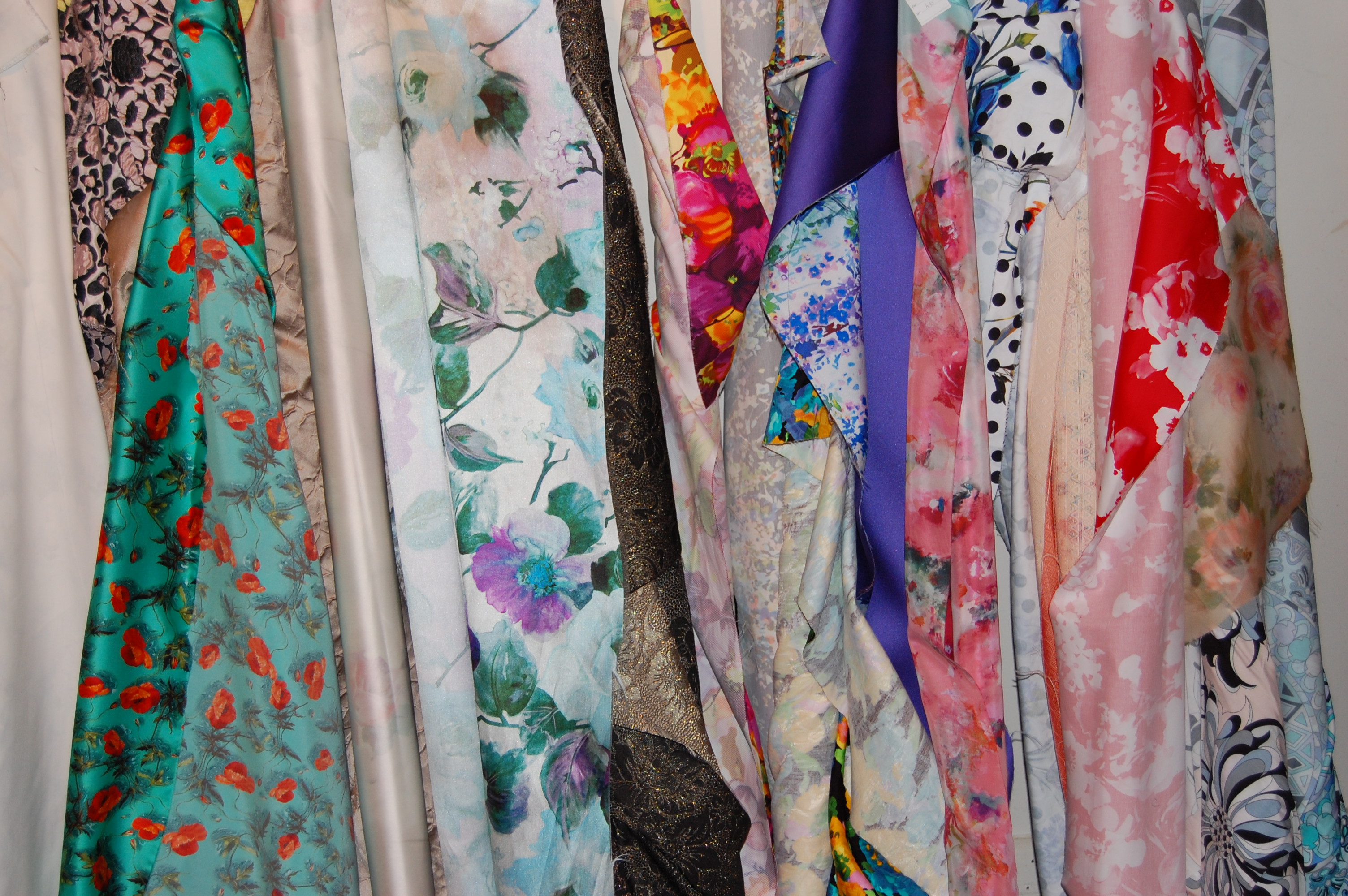
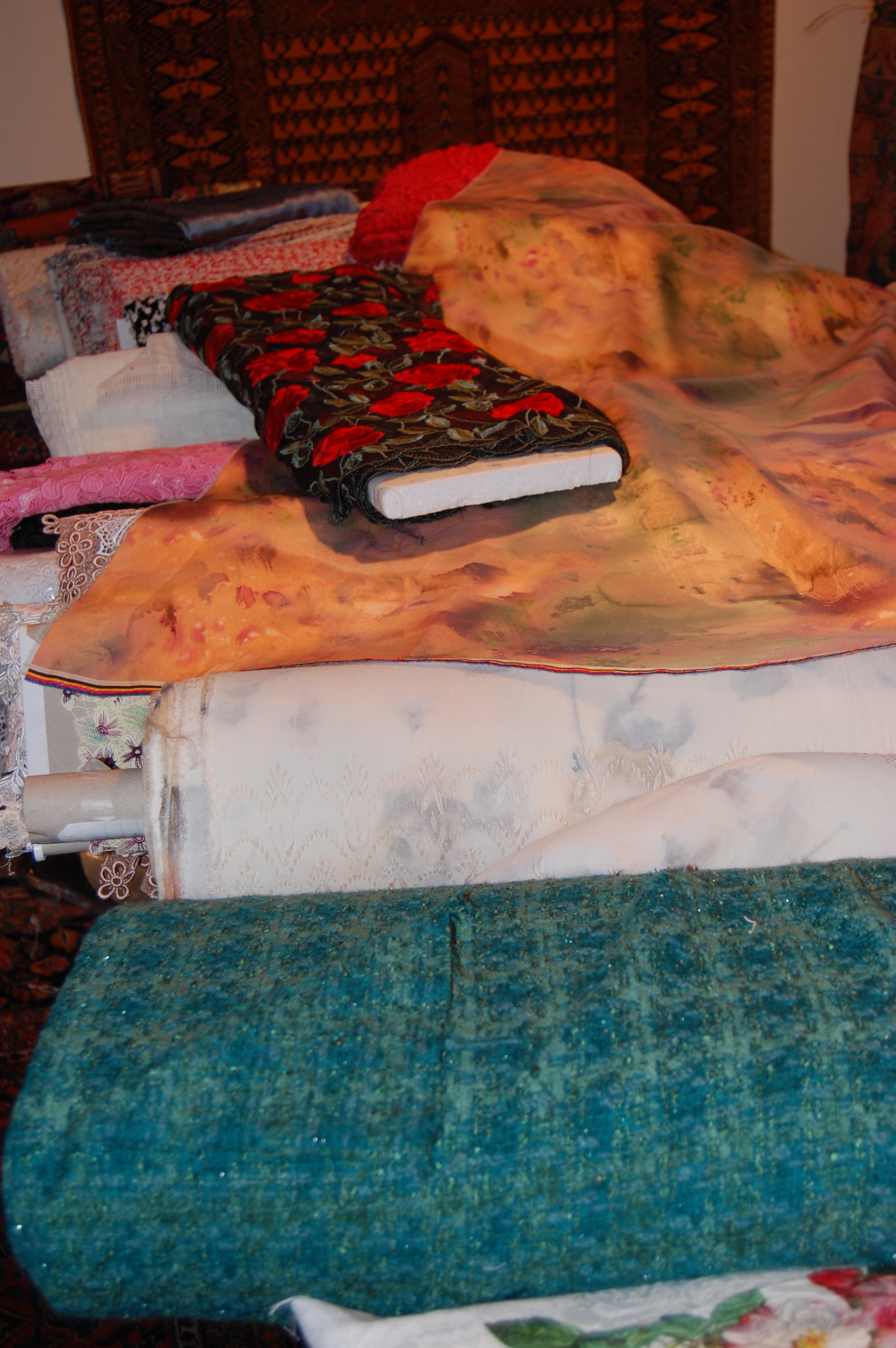
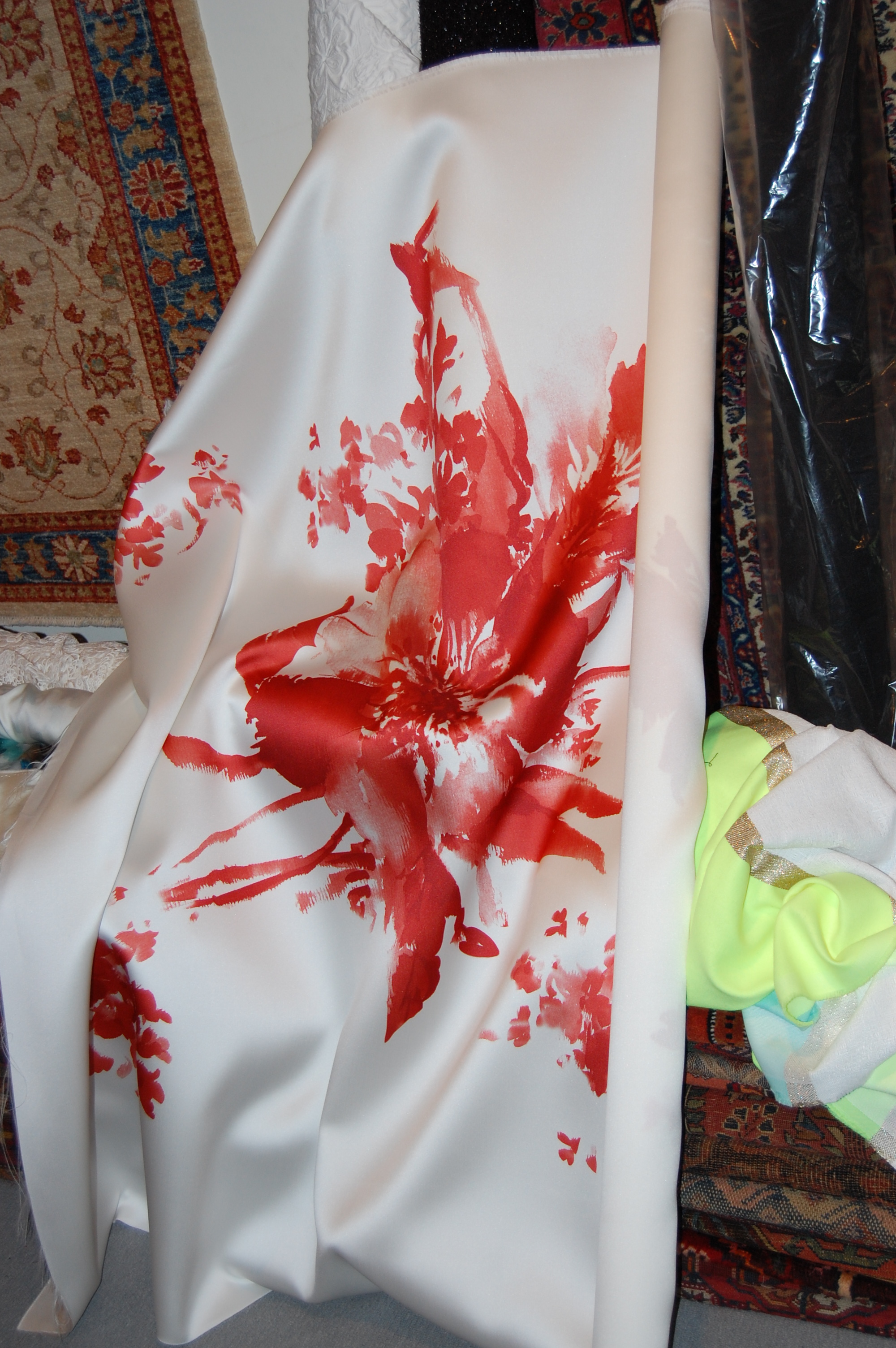
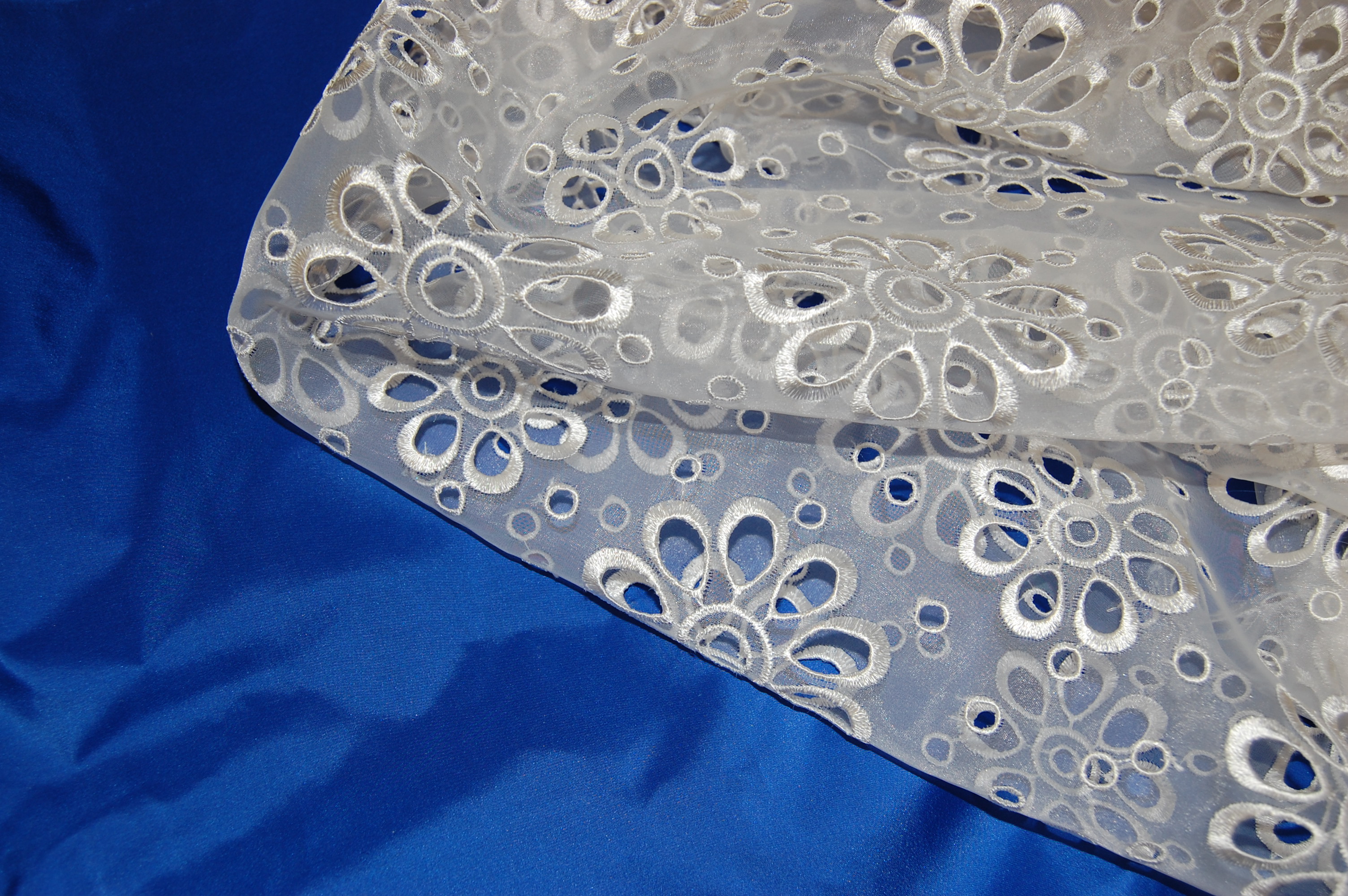
While contemplating the answer to that question, I am starting another project out of necessity: a dress to wear to a “black tie” event in early July. It’s an exciting project for me as it is my focus while I spend another week in Baltimore, Maryland with Susan Khalje and other dedicated dressmakers. The start of our week also began with lots of “chatter”: Alice Wildes of Mendel Goldberg Fabrics arrived on Sunday (the day before the official start of our class) with bolts and bolts of gorgeous and glorious fabrics. Did I succumb to any of these delights? What do you think?

A Noisy Spring

A Noisy Spring

An amazing silk charmeuse . . .

An amazing silk charmeuse . . .

. . . with all the inspiration one would need!

. . . with all the inspiration one would need!

Among the projects being started in our class are: a wedding gown for a daughter; a fancy dress for a grown daughter; a dress reminiscent of something Myrna Loy would have worn mid-century; a suit; shift dresses and “day” dresses; cocktail dresses; a dress and jacket; and, of course, my own dress, to be made from silk taffeta and embroidered silk organza.

A Noisy Spring

Those aforementioned noisy linens will just have to wait a little longer – and share some of their space in my fabric closet with newly acquired silks and wools. There is always room for fabric!

21 Comments

Filed under Linen, Moygashel linen, Uncategorized, Vintage fabric

The Evolution of a Suit Dress, Part 1

“Suit dress – Used in 1960s to refer to a jacket and dress ensemble that resembled a tailored suit.”   (The Fairchild Dictionary of Fashion, Third edition; Fairchild Publications, Inc., New York, New York, 2010)
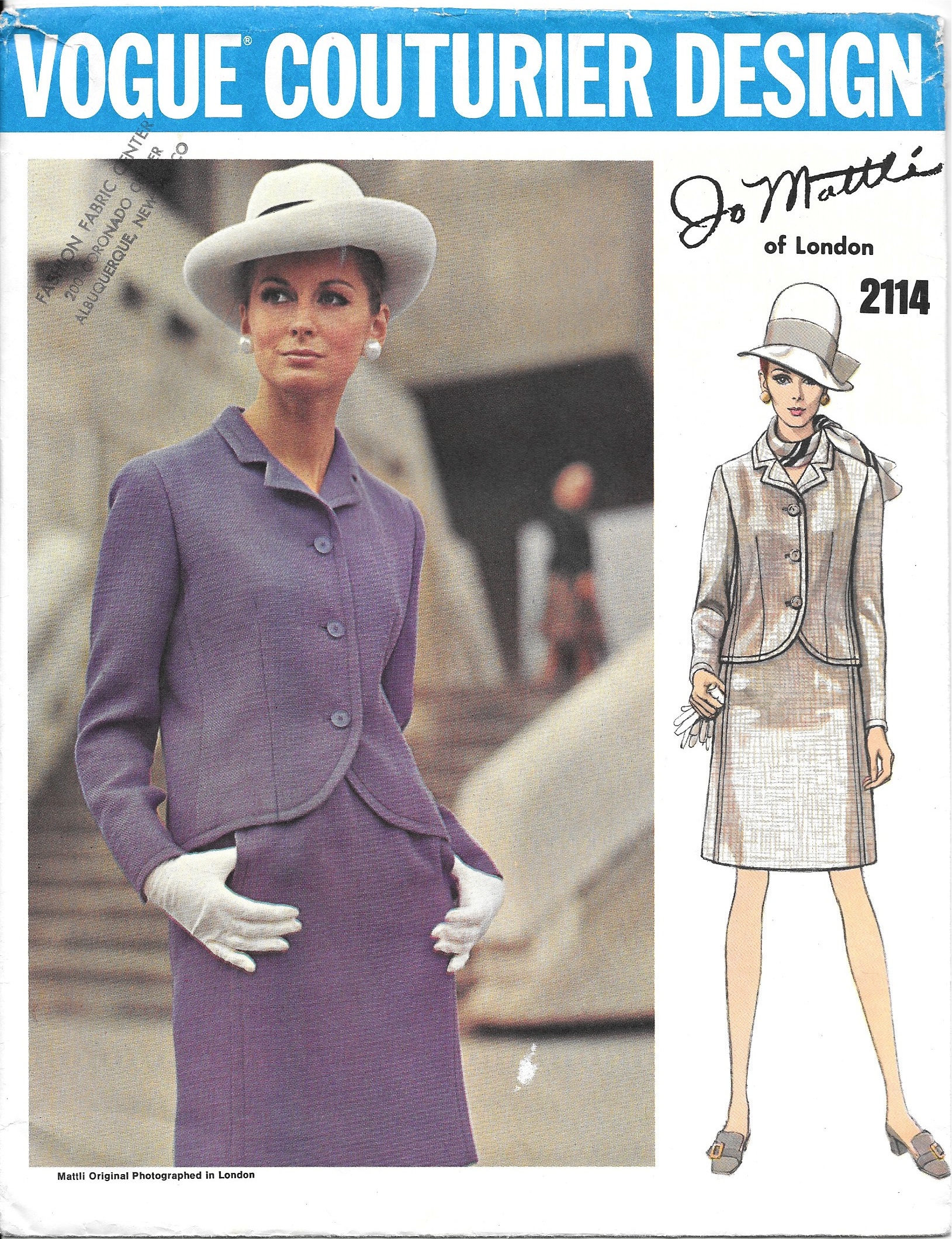
Although the inspiration for my current project does not have its beginnings in the 1960s, it is certainly influenced by that era. The actual beginning was about 1974 or ‘75, although I did not know it then. That was when I first laid my eyes upon this Jo Mattli Designer pattern from Vogue:

Dress Suit - front of pattern envelope

I loved the tailored, but feminine, look of the jacket, with its high, notched collar and its sleeves with gracefully curved slits. (I was less enamored with the style of the skirt, but skirts can easily be substituted, of course.)

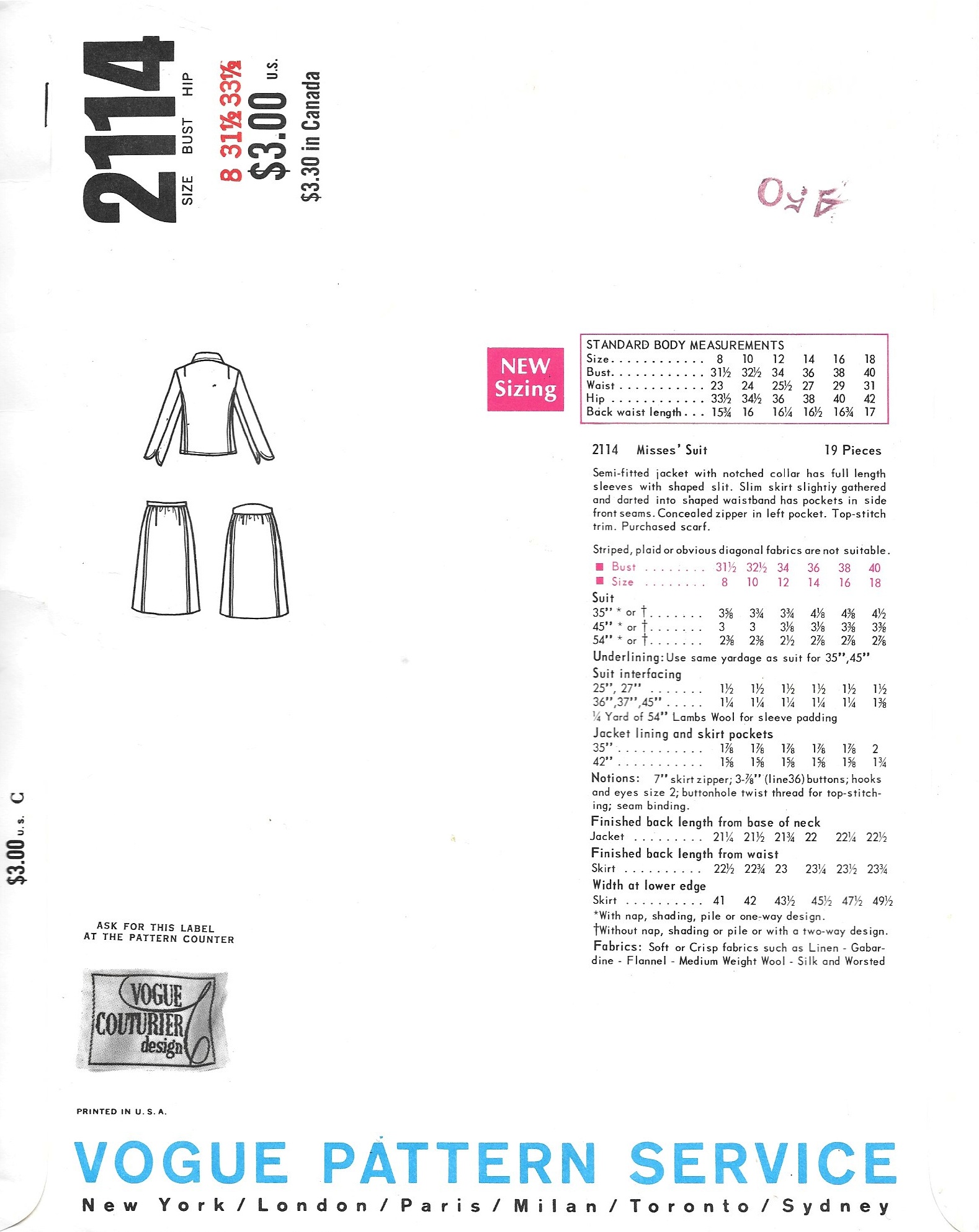
This diagram of the jacket  back better shows the interesting treatment to the cuff edges of the sleeves.

This diagram of the jacket back better shows the interesting treatment to the cuff edges of the sleeves.  Click on the picture to see a close-up view.

I admired this pattern on a regular basis while it was listed for sale in the Vogue Catalogue at my local fabric store, but in the end I didn’t buy it. That hefty $3.00 purchase price, and not knowing for sure that I would actually end up making this outfit,  kept me from its purchase. Now I am not nearly as practical – or maybe I have learned from experience. One must get these things which speak to them while they can! So when I found this pattern a couple of years ago on eBay, I knew it was time to fulfill a long-delayed dream (at a much higher price than $3.00, I might add!).

Shortly thereafter I found this navy blue, windowpane-check cashmere fabric on one of my trips to Britex Fabrics in San Francisco. I purchased what I was sure would be ample yardage to make a two-piece suit (jacket and skirt, with this Jo Mattli design in mind) and to compensate for matching the plaid. Then I set it aside, knowing that the time to start this project had to be right.

The feel of this wool is best described as like soft butter.

The feel of this wool is best described as like soft butter.

I am so glad I waited. As I have grown in my sewing and dressmaking skills (with so much credit in that arena attributed to what I have learned in classes with Susan Khalje), I came to see this fabric and this suit taking on a slightly different appearance. I knew I wanted to make the Mattli jacket, but more and more I felt that this fabric was too special to mix it up with a blouse, no matter what color or how simple that blouse might be. I began to envision the jacket paired with a sheath dress – in effect, a classic 1960s’ inspired suit dress.

But would I have enough fabric? Britex has always been very accommodating when cutting yardages for me, adding inches to compensate for the layout of plaids and designs, and simply being generous in adding a few inches to my requested amount. (I have found most fine fabric stores to be similarly inclined – Mendel Goldberg, for example, also adheres to this customer-friendly practice. Have you found this generally to be true as well?)   Well, those of you who read my blog know that a little shortage of fabric has never kept me from my intended goal. Of course, I would have enough fabric… And so I do, especially with those few extra inches courtesy of Britex added on!

Fitting the muslin (toile) for the jacket took more thought and planning than usual. Much of this is because the pattern I found on eBay was actually one size smaller than what I usually buy and wear. For some reason I find it easier to size down patterns than size them up, so I’d rather, if necessary, start with a too-large pattern than one too small. Adding length and width to the body of the jacket, fitting the sleeves (which also needed a little more circumference) into those new dimensions, and adjusting the front/neck facing, which is part of the notched collar, was quite a puzzle. It took days!

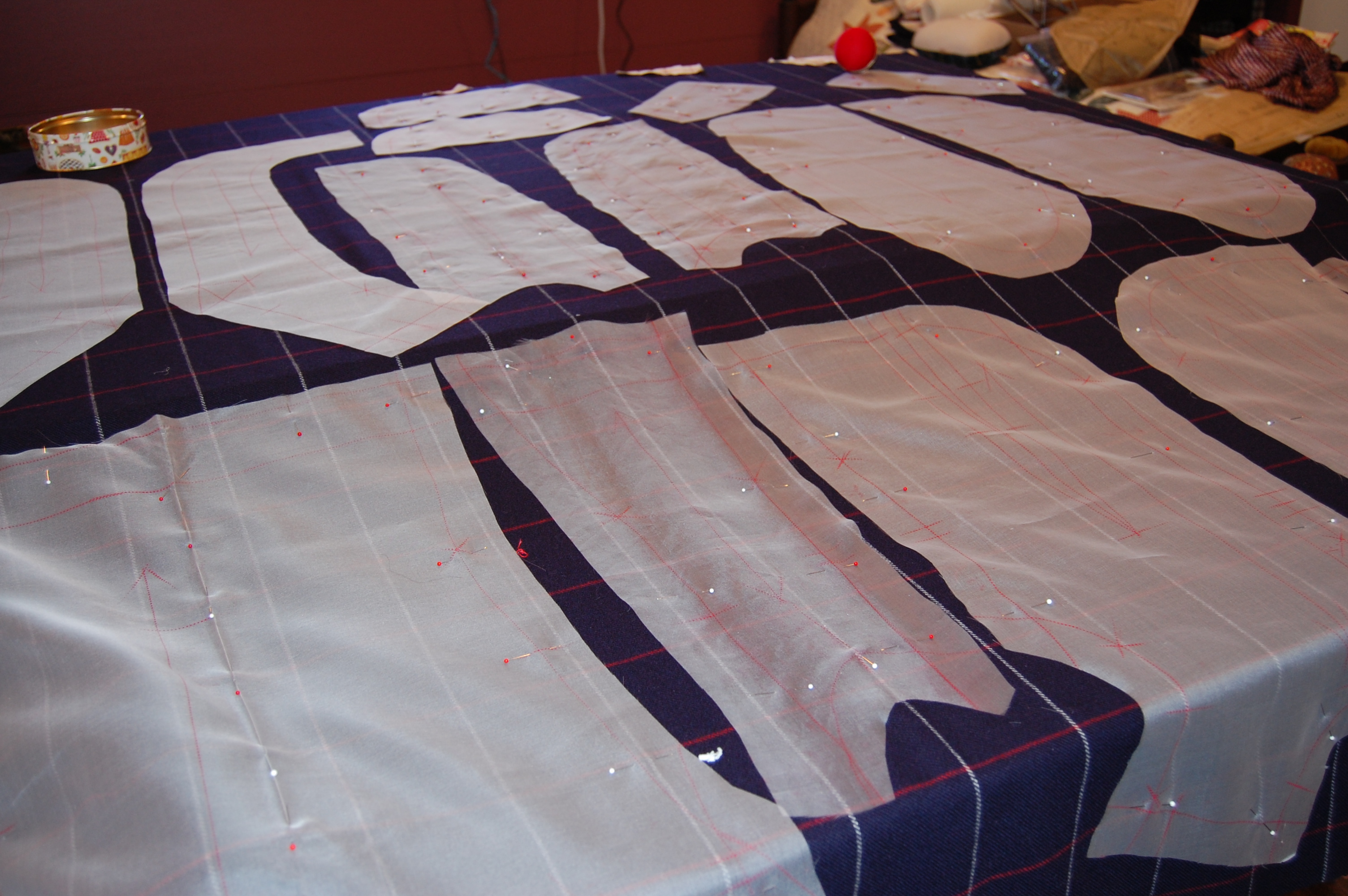
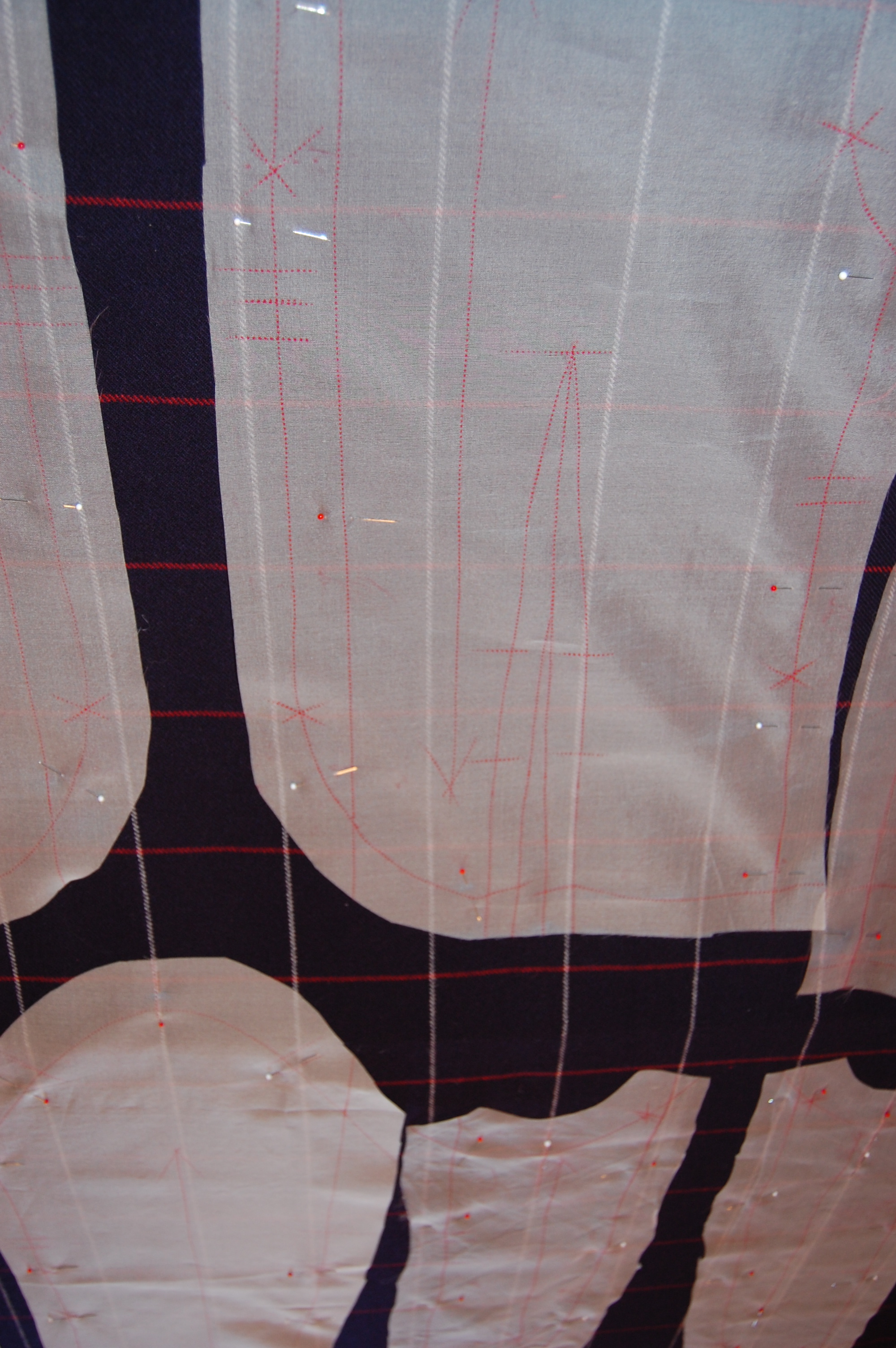
I transferred my final changes from the muslin to silk organza, and then I was in business. I love a challenge, and it’s a good thing I do! Do you know how nerve-racking it is to make sure all your plaid lines match up vertically and horizontally? Also, I knew I could lay out only the jacket pattern pieces initially. There are two reasons for this: one is that I have not yet determined which sheath dress pattern I want to use. The other is that the plaid on the dress is going to have to match – perfectly – the plaid in the jacket horizontally first, with the vertical match being as close as it can be, taking into account darts and the curves in the body of the dress. So – I have to finish the jacket before I can lay out the dress. That fortuitously gives me some more time to think about the dress, which is still taking shape in my mind!

I chose to use white silk organza rather than black, as it is much easier to see the windowpane lines through the white, and easier on the eyes, too.

I chose to use white silk organza underling rather than black, as it is much easier to see the windowpane lines through the white, and easier on the eyes, too.

This photo better shows my markings on the silk organza underlining.

This photo better shows my markings on the silk organza underlining.

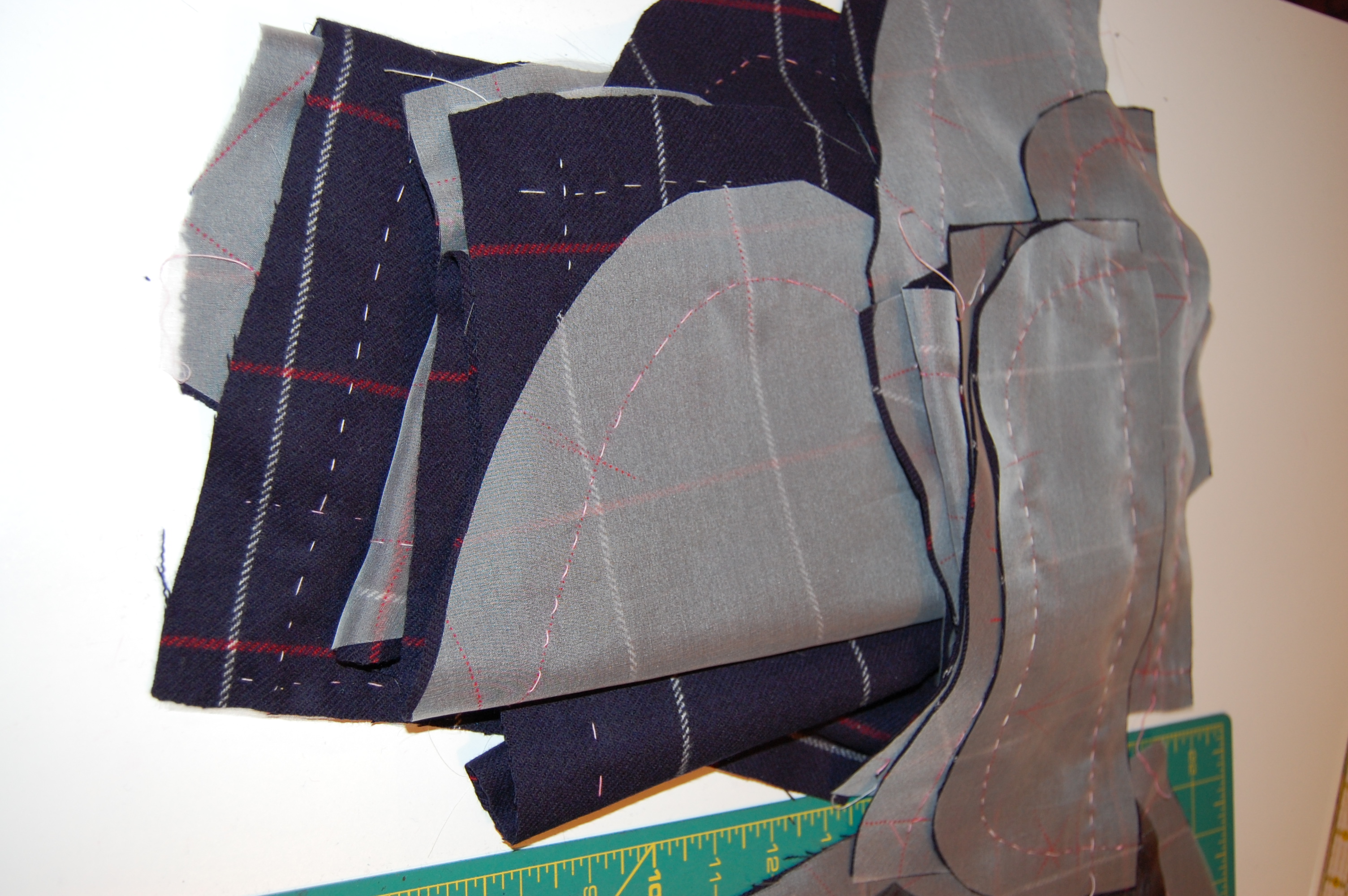
With all the silk organza underlining basted onto the wool, I am ready to sew.

A pile of prepared pieces!

A pile of prepared pieces!

But hold the horses there, Fifty Dresses! First, there are interfacings to be pad-stitched and bound buttonholes to be made.

I am using black silk organza for the interfacing.  This is what I did on my color-blocked coat, under Susan Khalje's tutelage, and I was delighted with the results!

I am using black silk organza for the interfacing. This is what I did on my color-blocked coat, under Susan Khalje’s tutelage, and I was delighted with the results!

It is clear there is no hurrying this jacket, nor should there be. Some dreams just take a little more time.

17 Comments

Filed under couture construction, Dressmaker suits, Mid-Century style, Suit dresses, Uncategorized, vintage Vogue Designer patterns, vintage Vogue patterns from the 1970s, woolens

Sewing Ghosts

The ghost of Joan Goetz has been hanging over my shoulder for the last several weeks. She wrote her name on the envelope of vintage Vogue pattern #2718 which has caused me so angst. I can’t help but wonder who this woman was!

Sewing Ghosts

Goetz sounds awfully like Ghost, don’t you think?

I can tell from the changes she made to the pattern that she was much taller than I, with much longer arms! She added 1” to the arm length, while I subtracted 1½”. She also added three inches to the hem length, and I ended up cutting off 3” from the length. However, nowhere on the pattern does she indicate any problems with construction. I, myself, refrained from scribbling “ARG-G-G-H“ on the pattern, although I was certainly thinking it. When last I wrote about this doomed project, I wasn’t sure if I could save it. Thanks to many good suggestions and words of encouragement from my readers, the future for this dress is looking less ghostly and ghastly. Some of you suggested a break from it, working perfectly into my schedule, which included another trip out of state. Others suggested I sew on something else for a while, which I did and will write about soon. The one thing I did not do was set it aside completely. I was afraid if I left it to finish (if even possible) another time, I never would get back to it.
Actually, I have to admit, that the problems I encountered with this pattern were really not the fault of the pattern. It was entirely of my own making. The pattern required a stretch knit fabric. I used a stretch silk woven charmeuse. That would have been fine, except I insisted on underlining it. I cut the underlining on the bias, which I thought would work, but it was a disaster. It caused the bodice to bind crosswise, pull up lengthwise, and it restricted the stretch of the silk, which was necessary for this particular pattern.

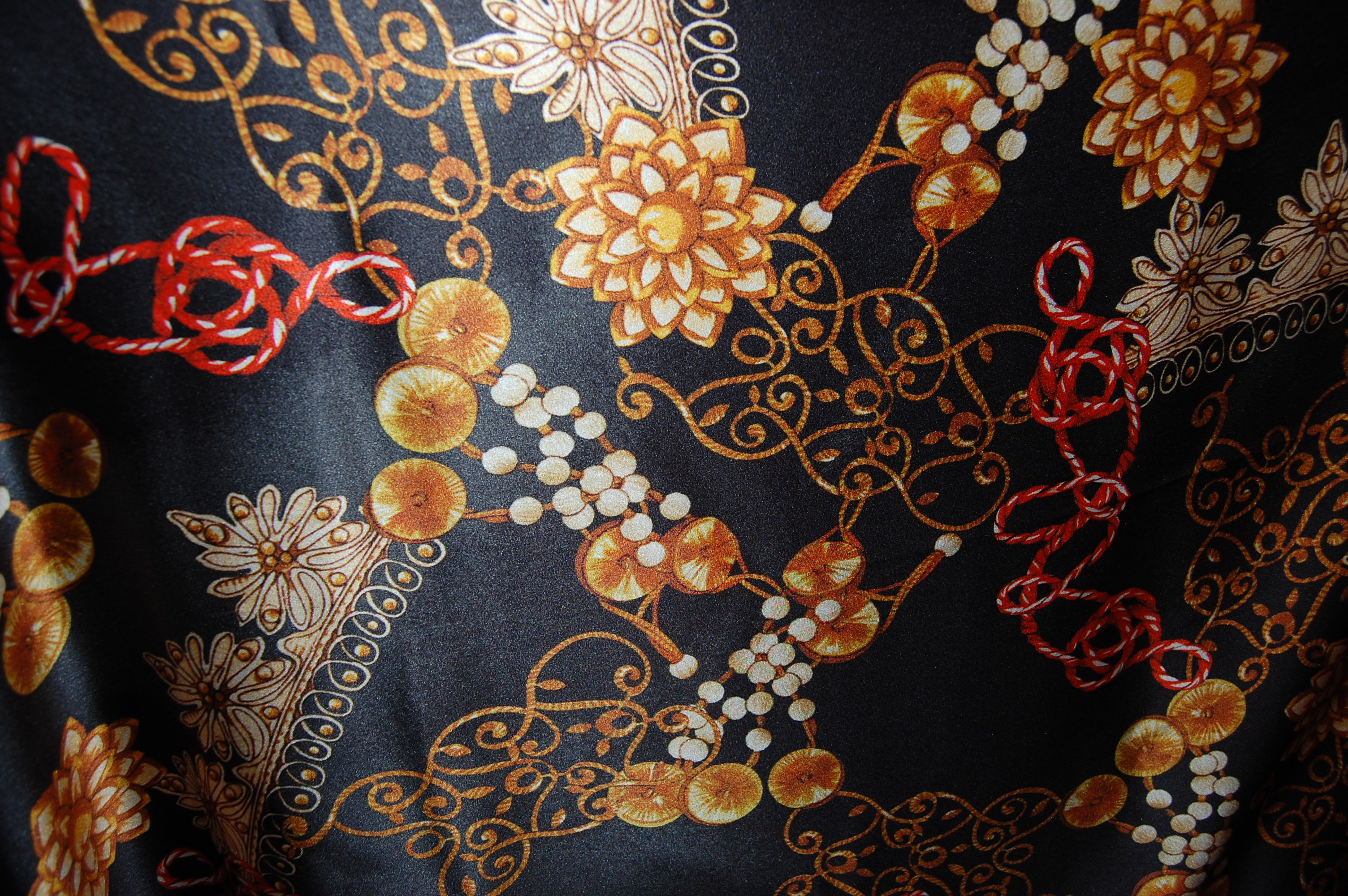
This fabric from Mendel Goldberg Fabrics in NYC is a stretch silk charmeuse, with a wonderful drape to it.

This fabric from Mendel Goldberg Fabrics in NYC is a stretch silk charmeuse, with a wonderful drape to it.

With nothing to lose, I started to remove, meticulously, the silk gauze underlining from all the bodice pieces, starting with the back. I was encouraged enough at the improvement that task made, to continue to do the same with front. Then I tackled the sleeves. What a difference it made! The bodice actually started to fit, although it was still tight across the bust. I then reset the sleeves, releasing about 1/4 “ in the front seam on each side. That was all I could steal from my already-trimmed seam allowances.

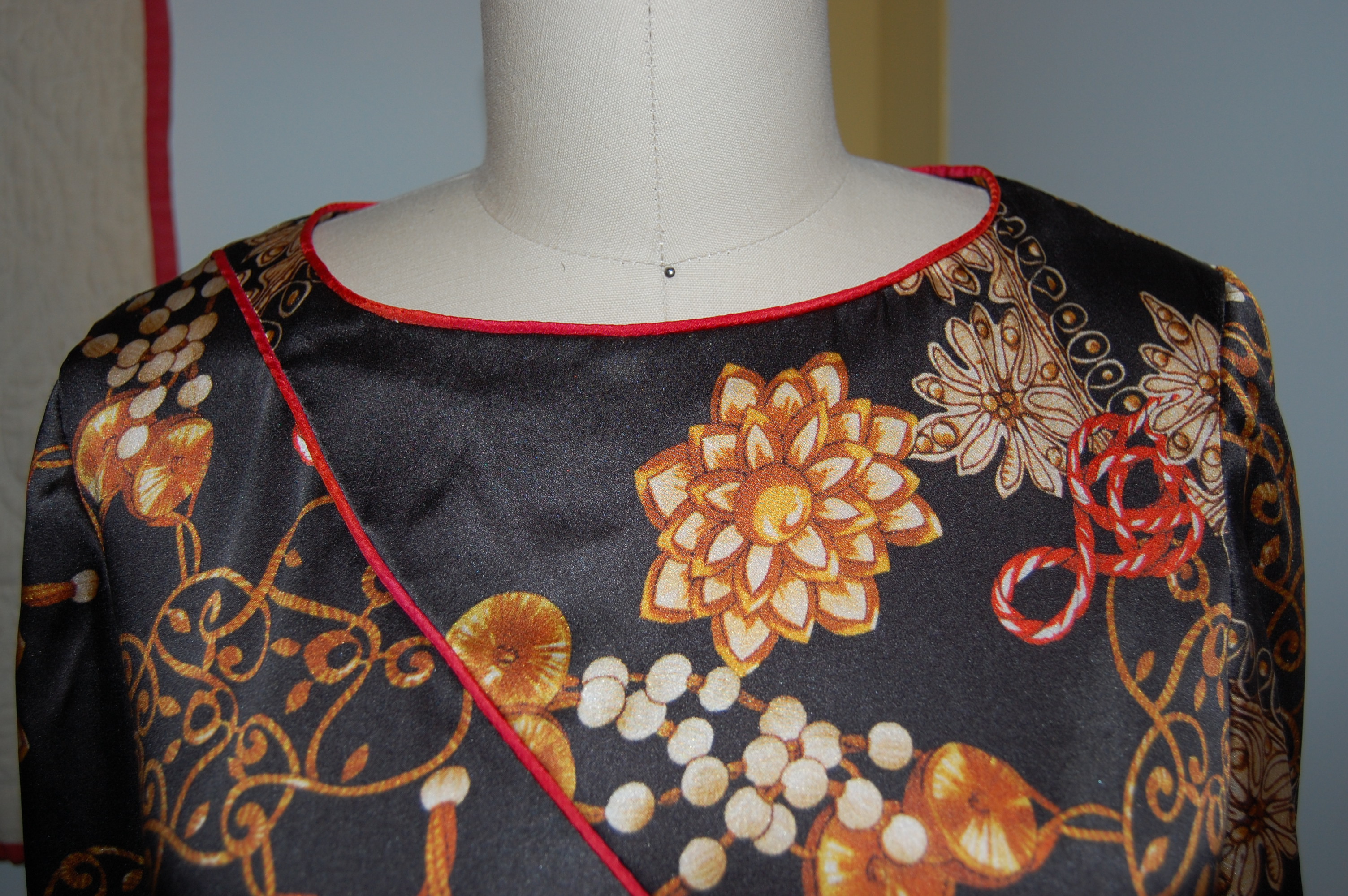
The reset sleeves and the finished neckline, cut a little wider than the pattern.

The reset sleeves and the finished neckline, cut a little wider than the pattern.

I sewed the skirt yoke without underlining, but I did use an underlining, cut on the straight of grain, for the gathered skirt. Once all assembled, I basted in the zipper to check the fit. Still a little tight over the bust, but otherwise, not bad!!

Both views of the pattern show the dress with a purchased belt. I tried three different black belts, of varying widths, and did not like the effect of any of them. All made the dress look like it was cut in half. I took a few scraps of my fabric and tied them around the waist on my dress form. From this I could tell a self-belt would look so much better, but all I had left were scraps. Hopefully no one will notice that this sash is pieced together in four places!

the pieced sash.  I'm glad this fabric design is so busy, otherwise the multiple seams in this sash would definitely show.

The pieced sash. I’m glad the fabric design is so busy, otherwise the multiple seams in this sash would definitely show.

The finale details of this dress (snaps at the sleeve vents and a good press, for starters) are finally complete.  I think I can finally say that I have saved this dress from a ghostly demise.

Sewing ghosts

The dress on the form does not show the slight tightness across the bust.

Sewing ghosts

A back view. Notice the asymmetrical skirt yoke, which I think is a nice detail.

Sewing ghosts

I do love this fabric!

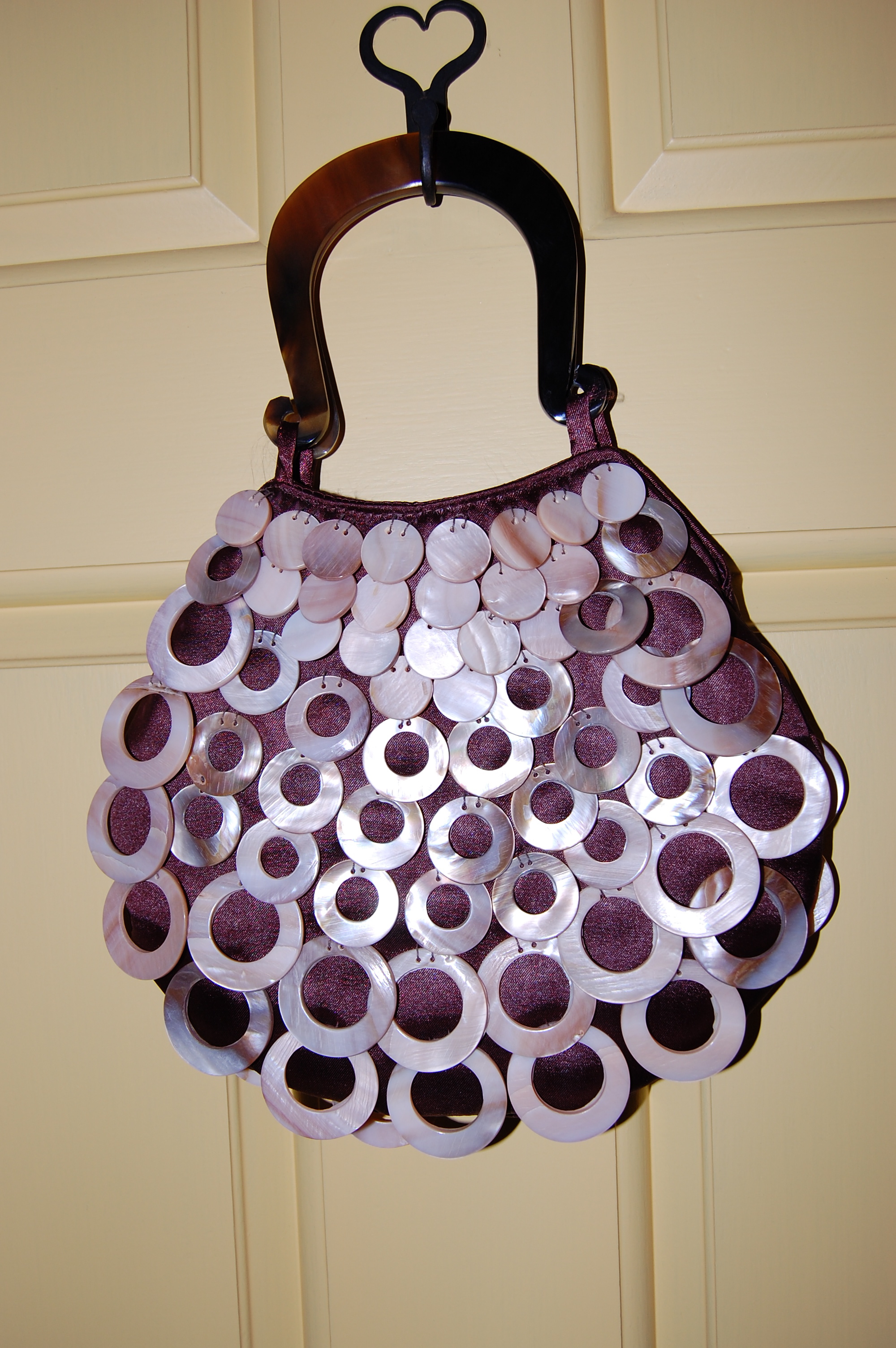
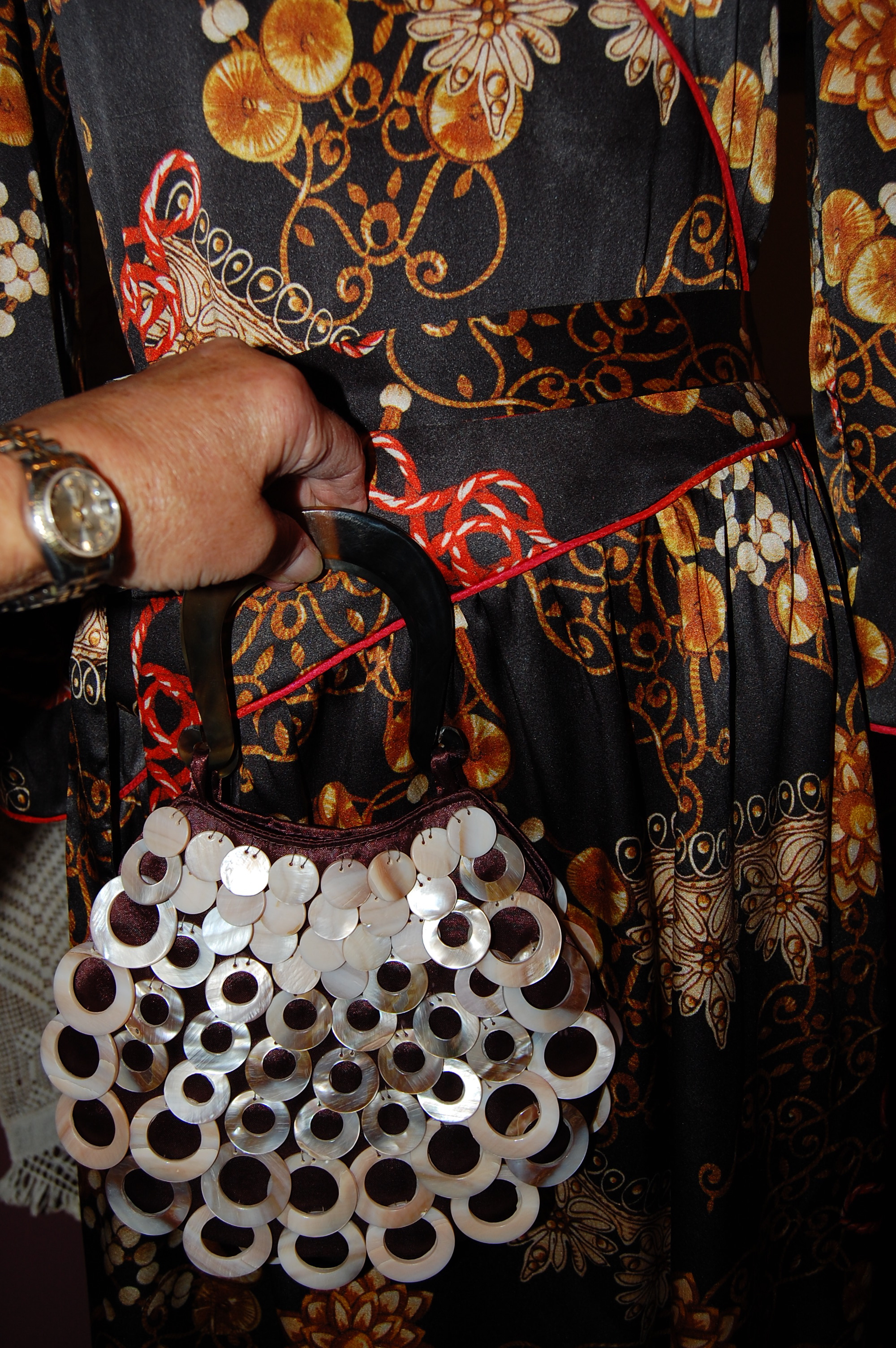
And here is something fun - a dressy handbag to wear with this dress ( a recent find from one of my travels).

And here is something fun – a dressy handbag to wear with this dress ( a recent find from one of my travels).

A nice complement to the dress...

A nice complement to the dress…

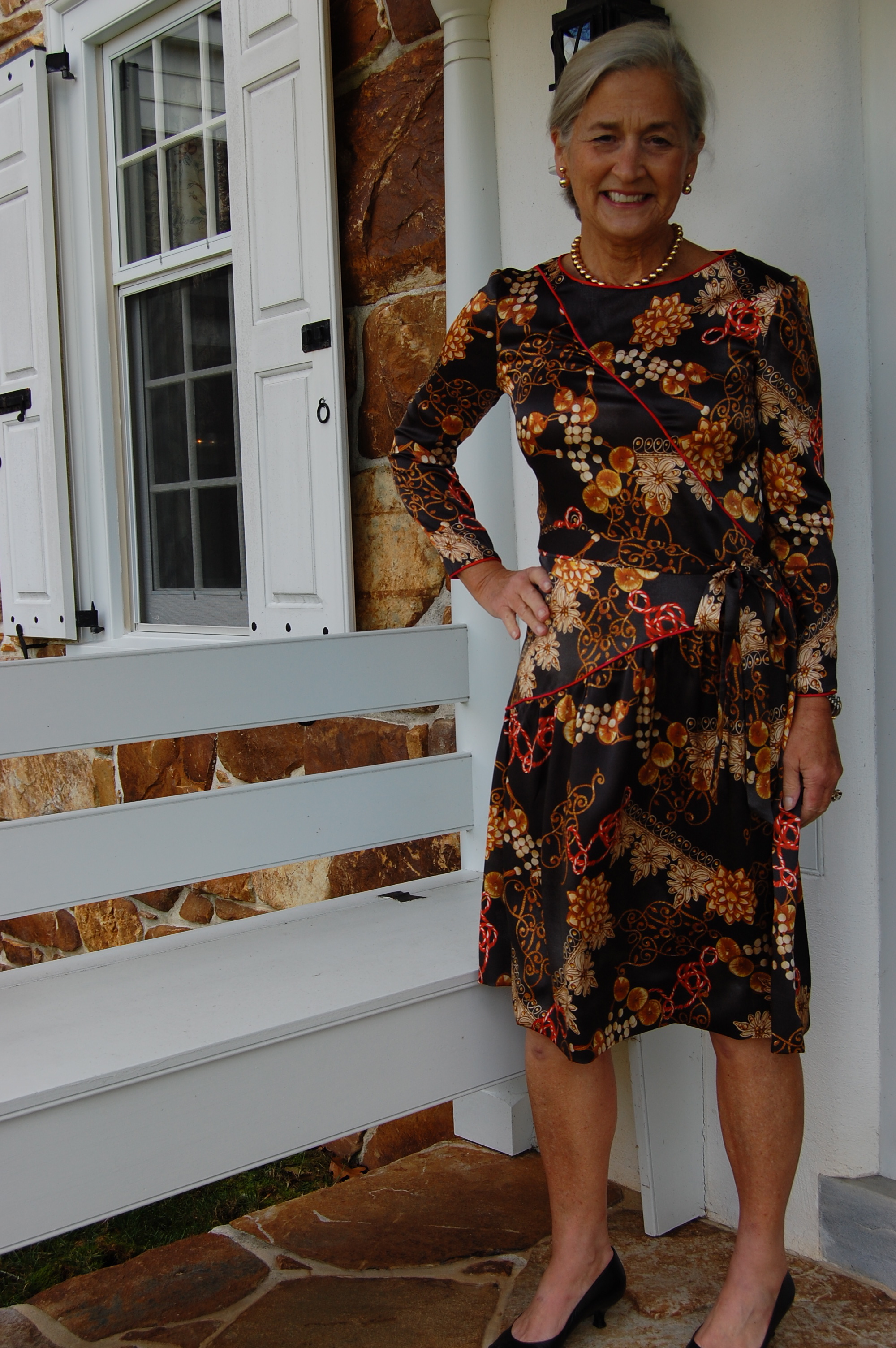
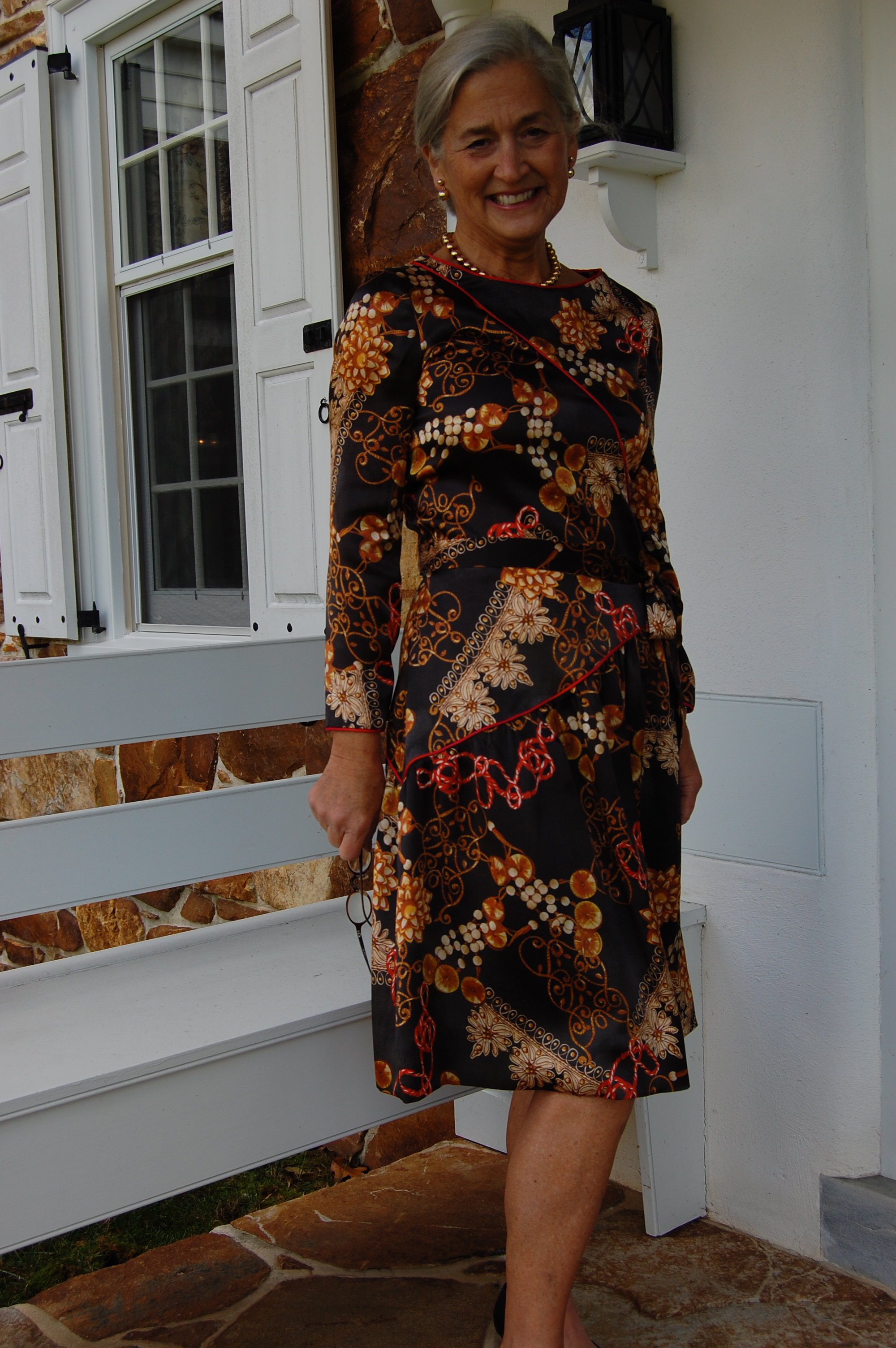
Finally, some photos of me wearing the "ghost" dress!

Finally, some photos of me wearing the “ghost” dress!

Sewing ghosts

DSC_0322

sewing ghosts

sewing ghosts

Finishing this dress successfully definitely warrants a smile!

Will I ever make this pattern again? No.   Have I learned from this project? Yes. Will I enjoy wearing this dress? I think so. And right now, that’s good enough.

22 Comments

Filed under 1980's dress patterns, piping, sewing in silk, vintage Vogue Designer patterns

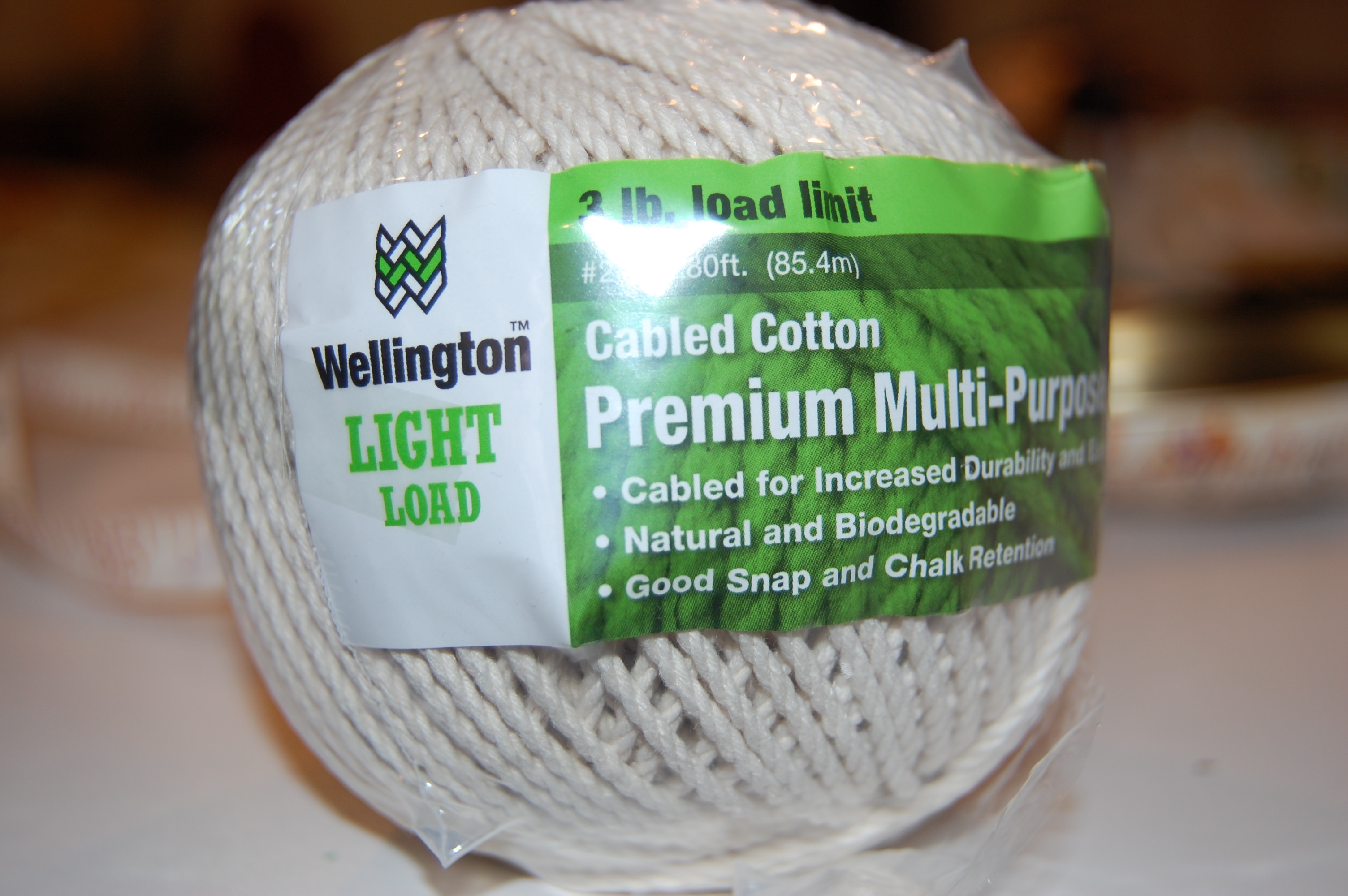
Light Load


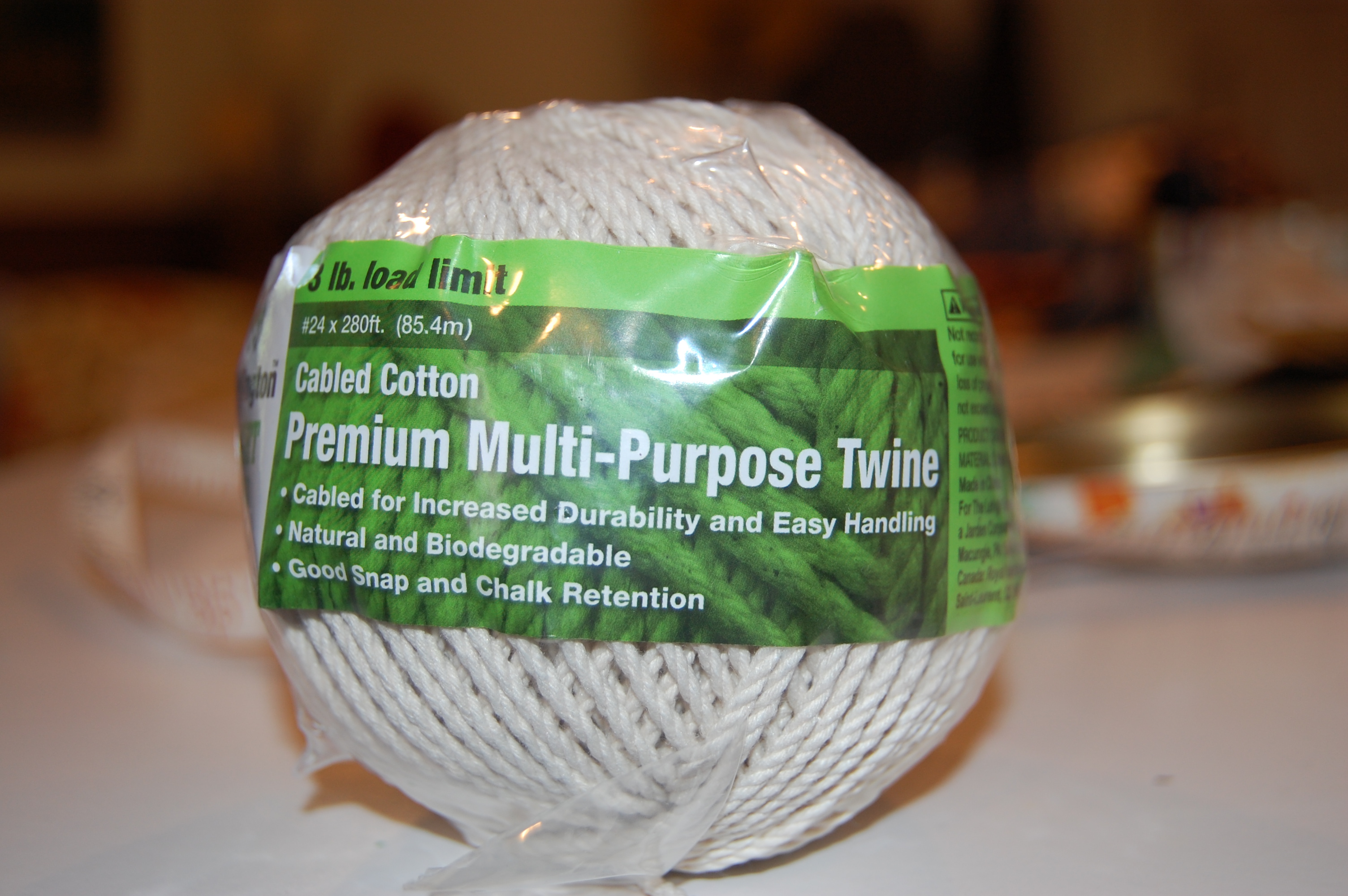
String is a wonderful thing. I am particularly fond of kitchen string. Usually twisted cotton or a twisted cotton blend, it is useful for many things (such as tying together the newspapers for recycling, playing with the cats, securing open bags of flour and sugar, etc., etc.) It also occasionally makes its way upstairs to my sewing room.
Light Load DSC_1380

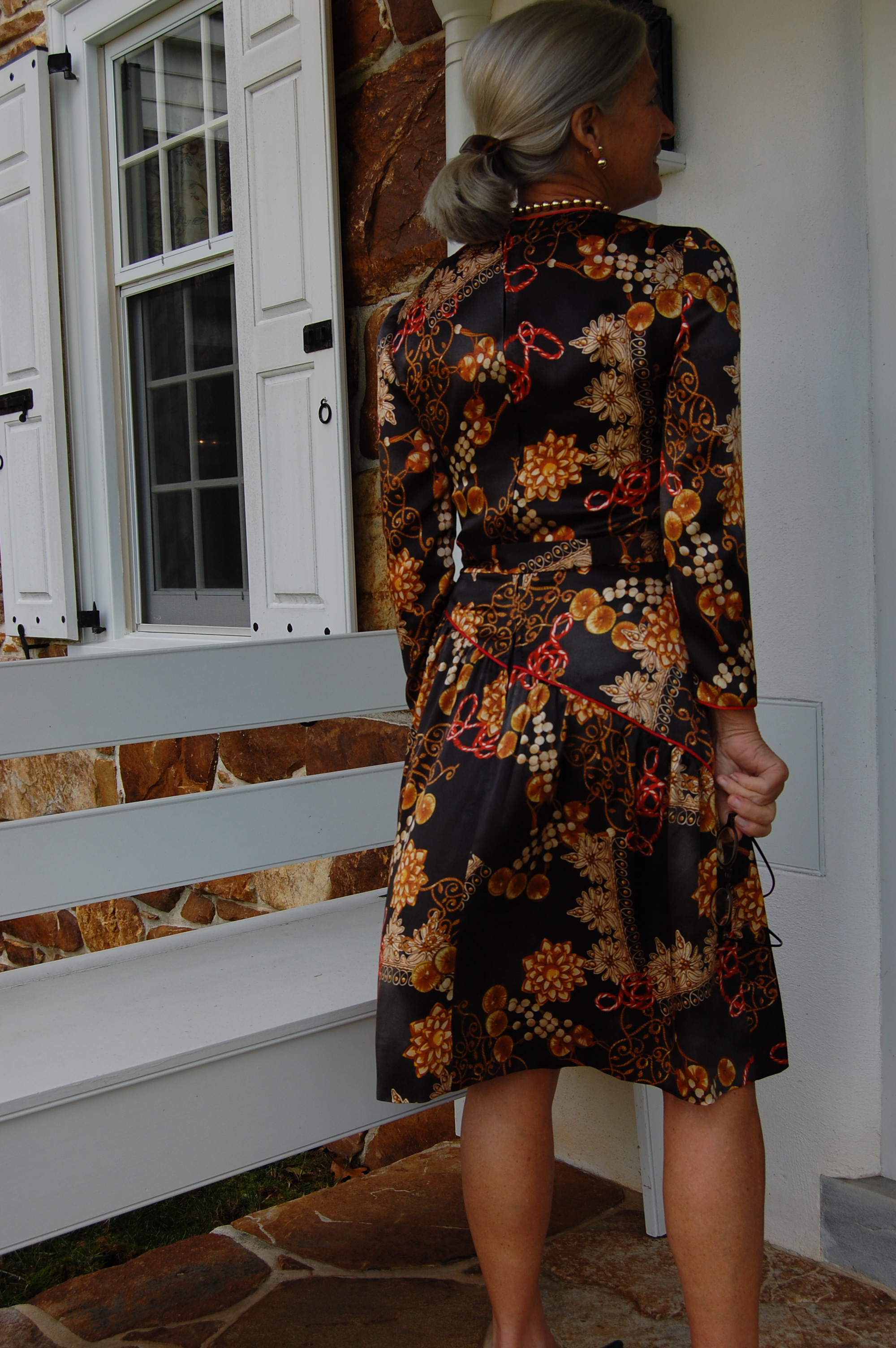
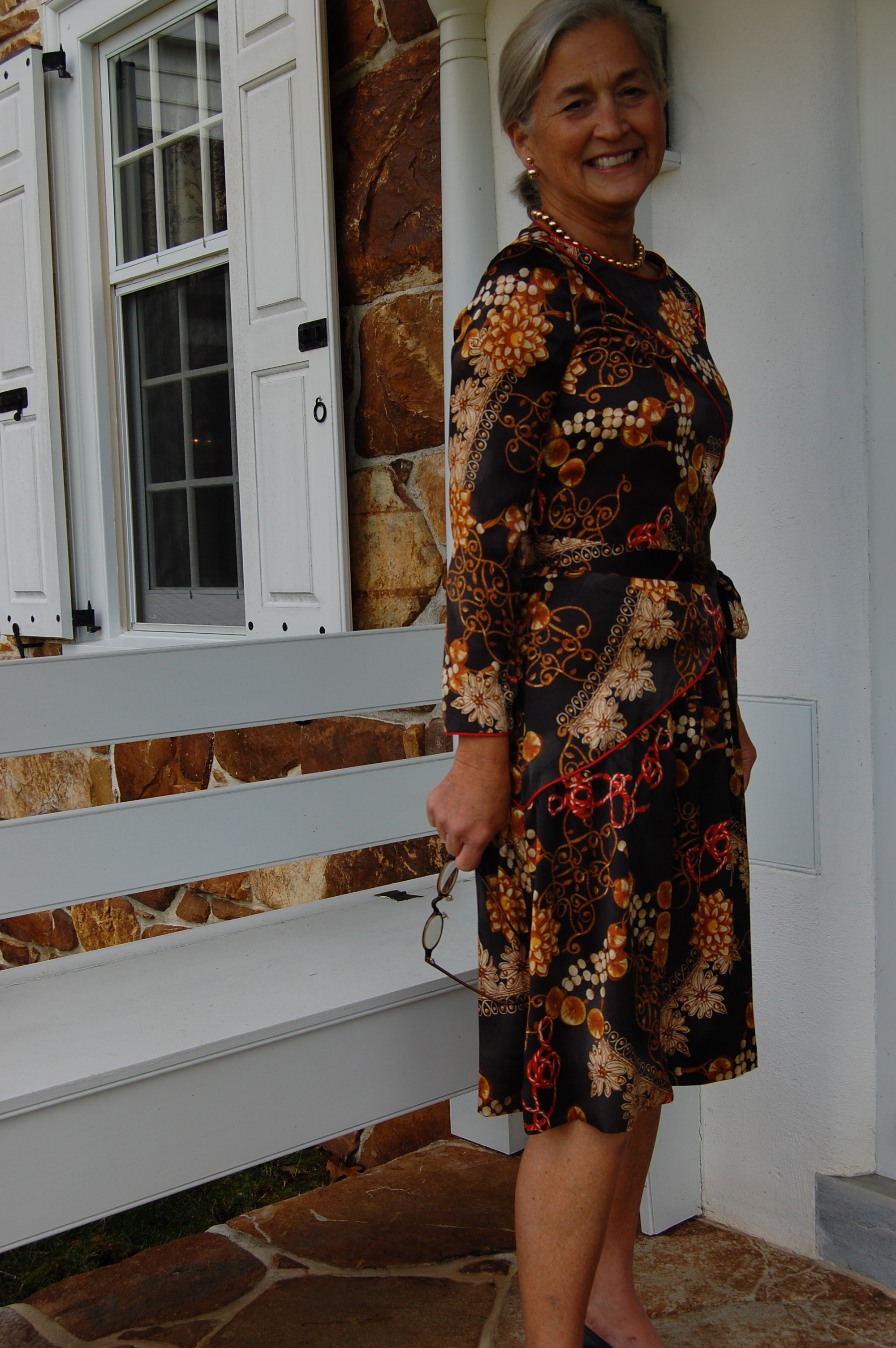
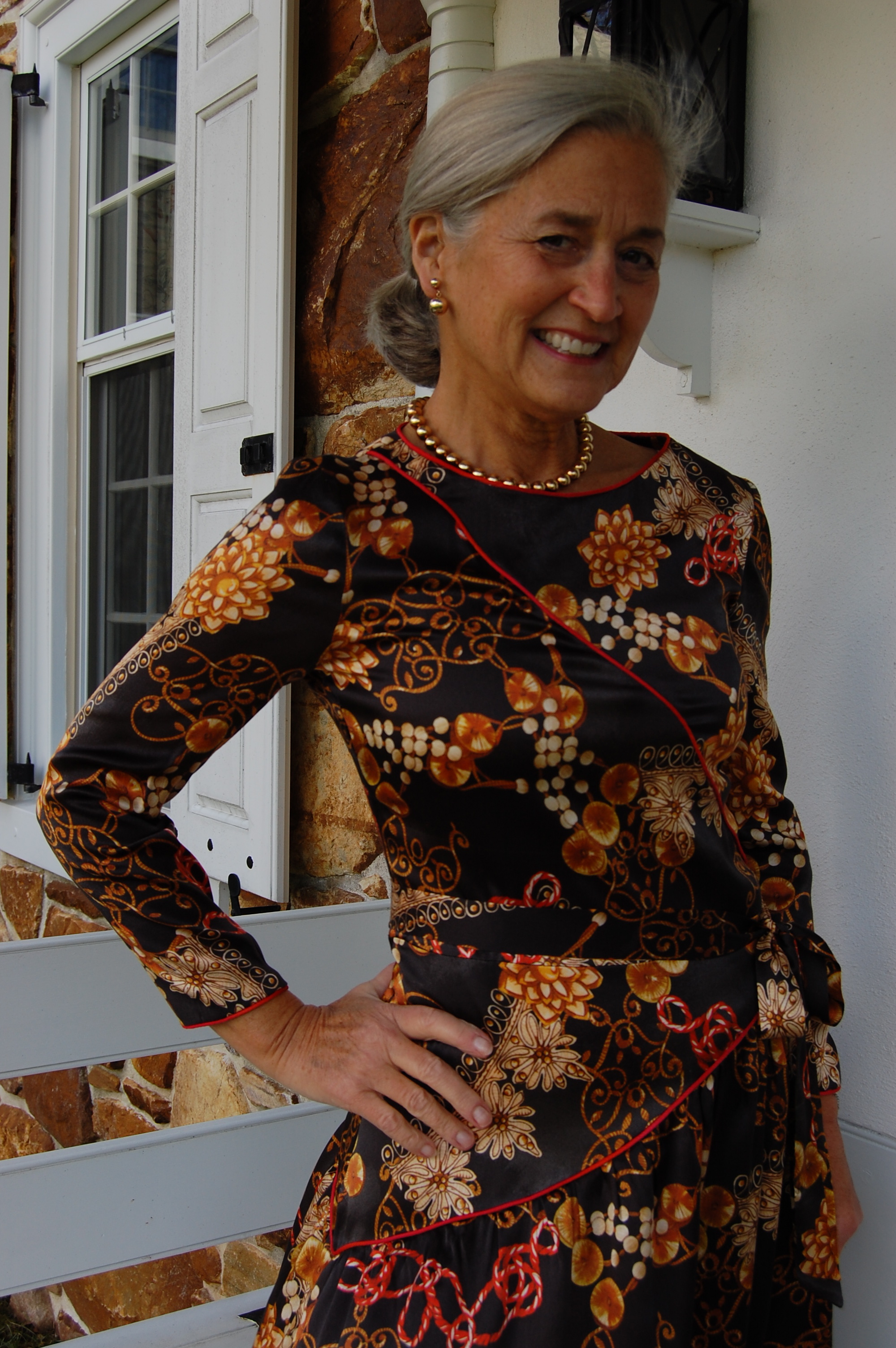
“Light load” kitchen string happens to be the perfect weight and diameter for making piping to be used in apparel. And – my current project for Fall features piping as one of the main design details.

The piping is more clearly visible on the green view of this dress.

The piping is more clearly visible on the green view of this dress.

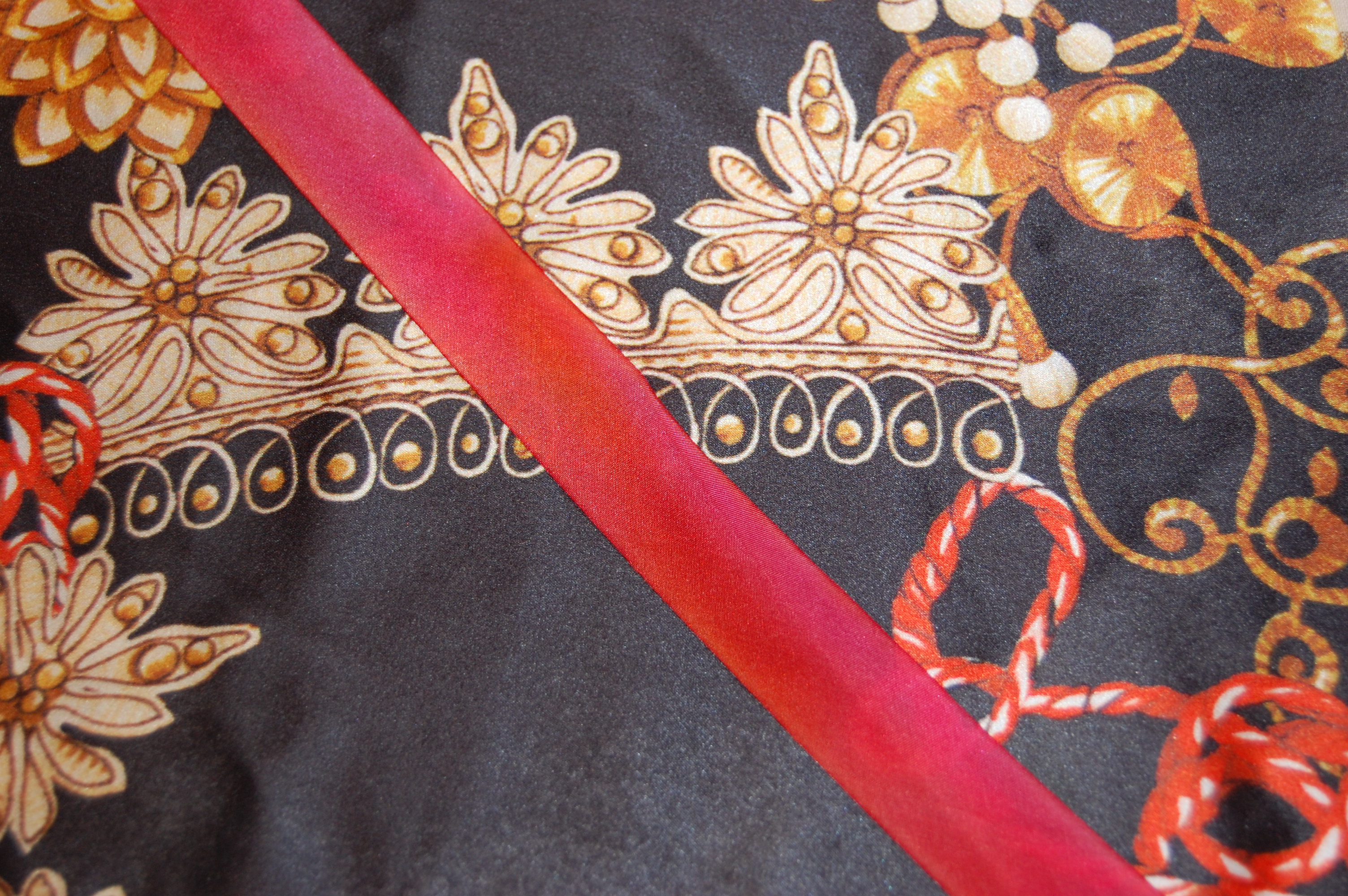
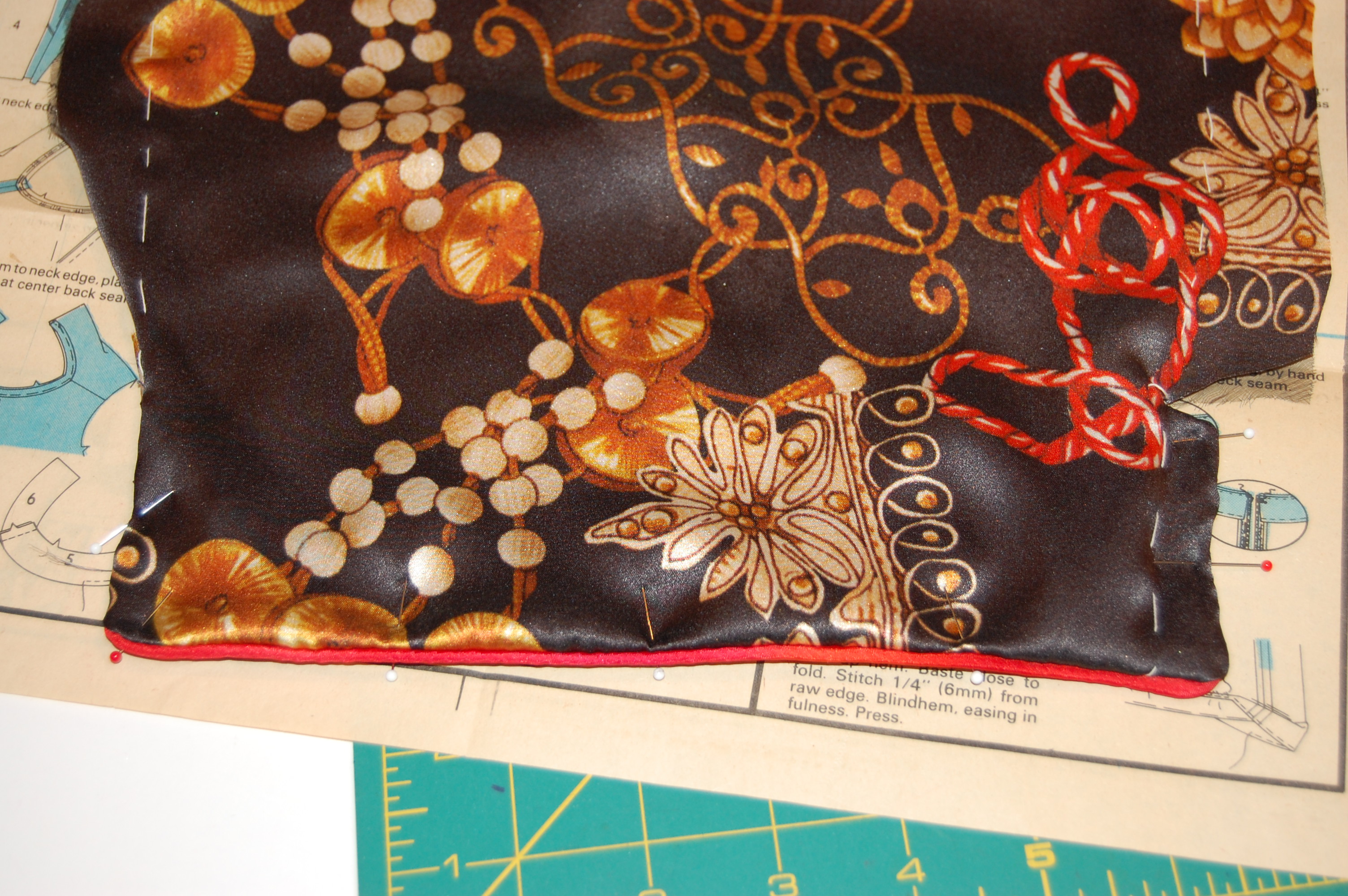
As luck would have it, I had purchased some hand-dyed silk bias ribbon from Britex Fabrics a couple of years ago. One of the colors I had ordered turned out to be a perfect complement to this silk from Mendel Goldberg, which is slowly making its transformation into a dress.

Light Load

After hours and hours of working on the muslin (toile), cutting out the underlining (on the bias to accommodate the stretch of the silk fabric), checking and re-checking (multiple times) to make sure my pattern pieces were laid out properly, and then meticulously basting the gossamer silk gauze underlining and the slippery fashion fabric together, I was ready to do something fun. “What could be easier?” I thought. “The ribbon is already cut on the bias so I’ll just sew up three yards of piping and I’ll be in business.” Except that I kept getting ridges and lumps in my piping as I encased that kitchen string in the silk ribbon. I thought maybe if I stretched it a bit, it might look better, but it really didn’t. I must admit I was discouraged – actually very discouraged. I could not figure out what I was doing wrong, but I knew I needed to take a break from this mess and come back the next day.
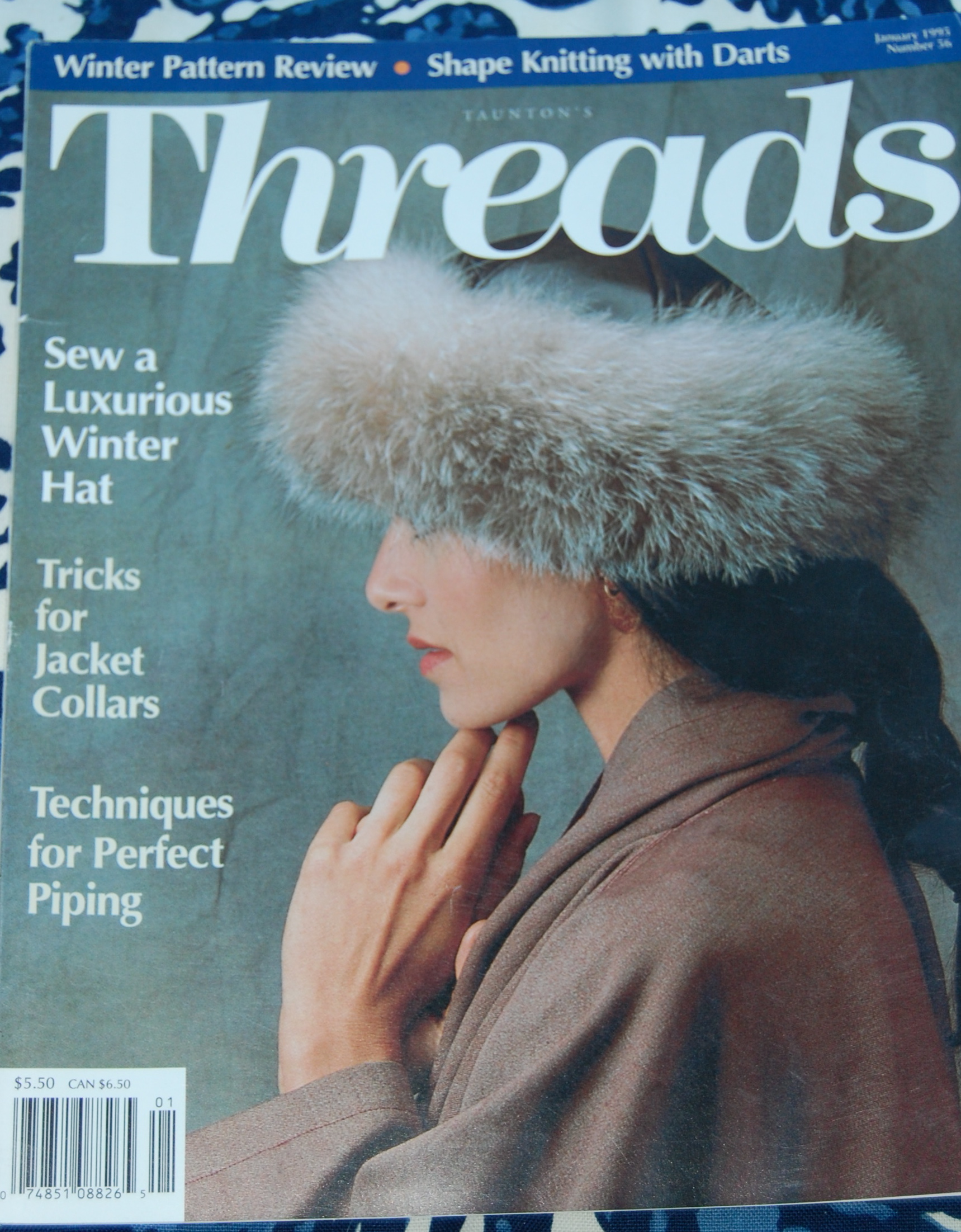
Before I left my sewing room, I went to my stack of Threads Magazines to look for a particular issue recently recommended to me for another reason, and in my search found, by chance, the December 1994/January 1995 issue. There on the cover “Techniques for Perfect Piping” was a featured article.
I have many odd issues of Threads Magazine, but earlier in the year I bought the Threads Magazine Archive 1985-2013, available on their website. I can't recommend it highly enough - decades of sewing advice and expertise is readily available at the click of your computer mouse!

I have many odd issues of Threads Magazine, but earlier in the year I bought the Threads Magazine Archive 1985-2013, available for purchase on their website. I can’t recommend it highly enough – decades of sewing advice and expertise is readily available at the click of your computer mouse!

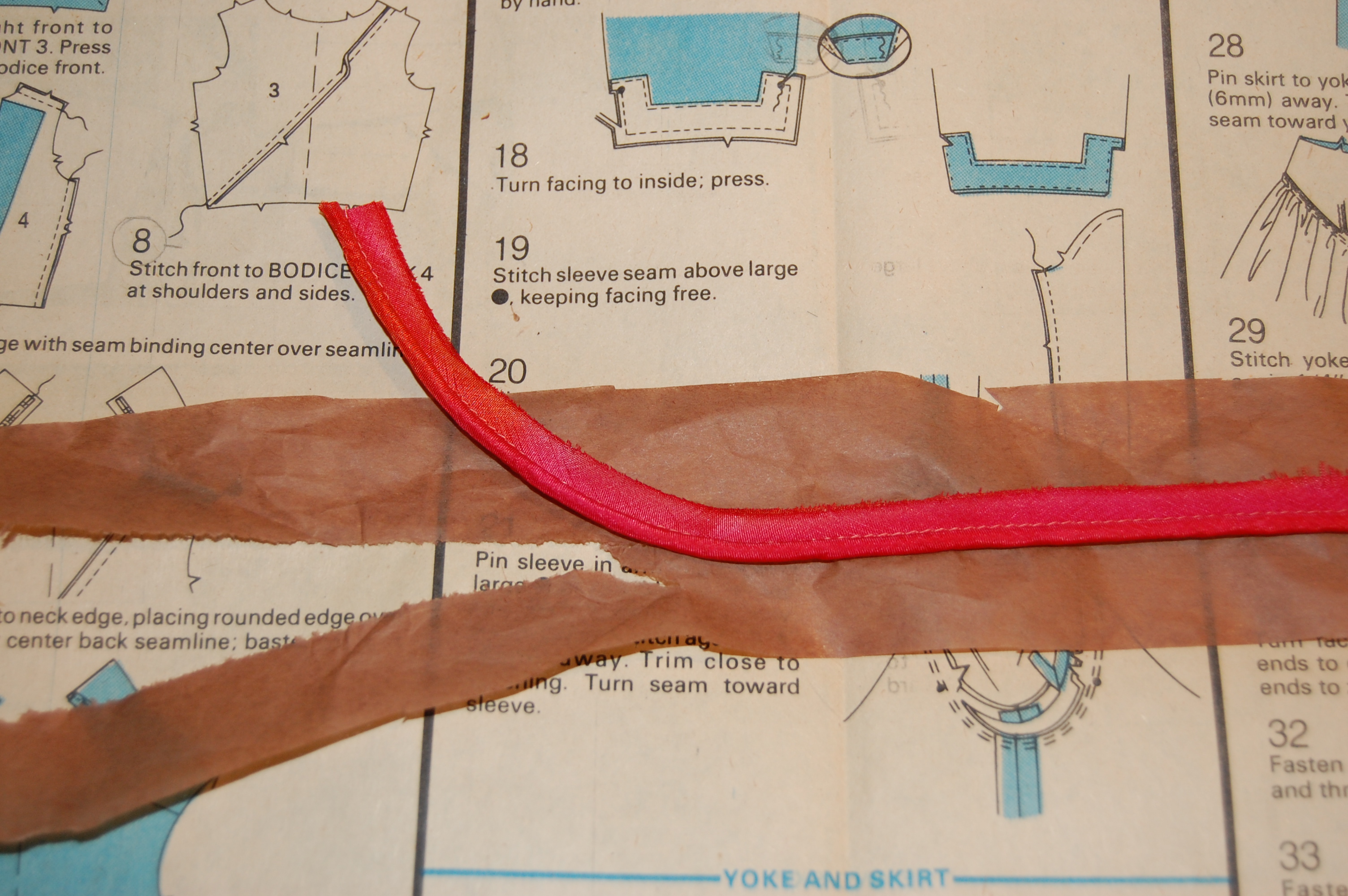
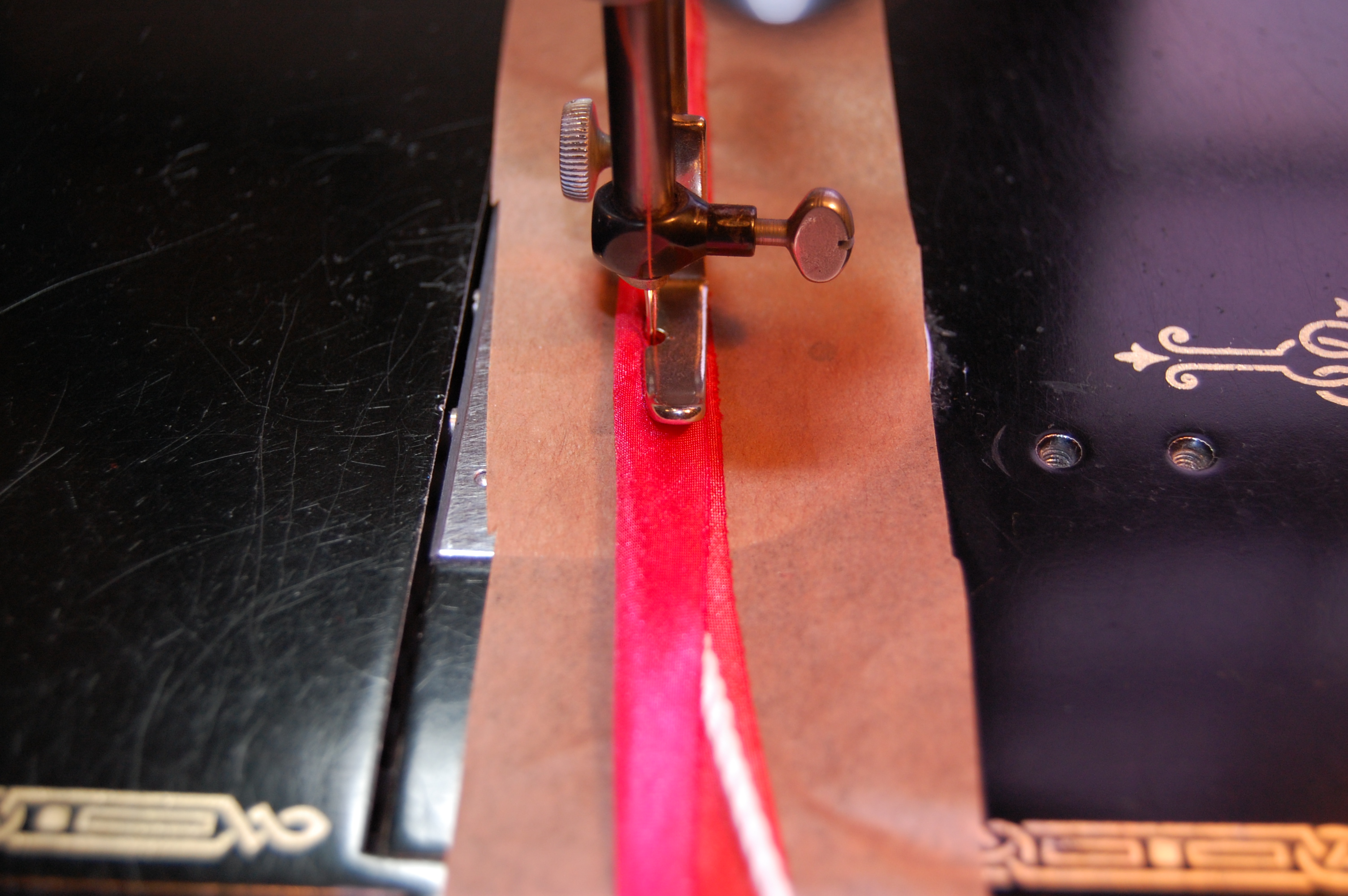
Needless to say, that became my evening reading. One line in this article by Linda Wakefield led me to the solution to my problem: “I also recommend reducing presser foot pressure, if possible, so that the fabric doesn’t twist or ripple as you stitch.” Even though I am unable to change the presser foot tension on my machine, that advice made me think that I needed to stabilize and reinforce the silk bias ribbon somehow to make it feed more evenly through the needle. The next day, back in my sewing room, I got some tissue paper – the kind one uses for wrapping presents – and cut it into strips. I placed a single layer of tissue under the silk ribbon as I stitched – and voila! Perfect piping emerged from my machine.

The tissue is brown (which is just some I happened to have with my gift wrapping supplies.)

The tissue is brown (which is just some I happened to have with my gift wrapping supplies.)


 The tissue paper tears off easily and cleanly from the silk piping.


The tissue paper tears off easily and cleanly from the silk piping.

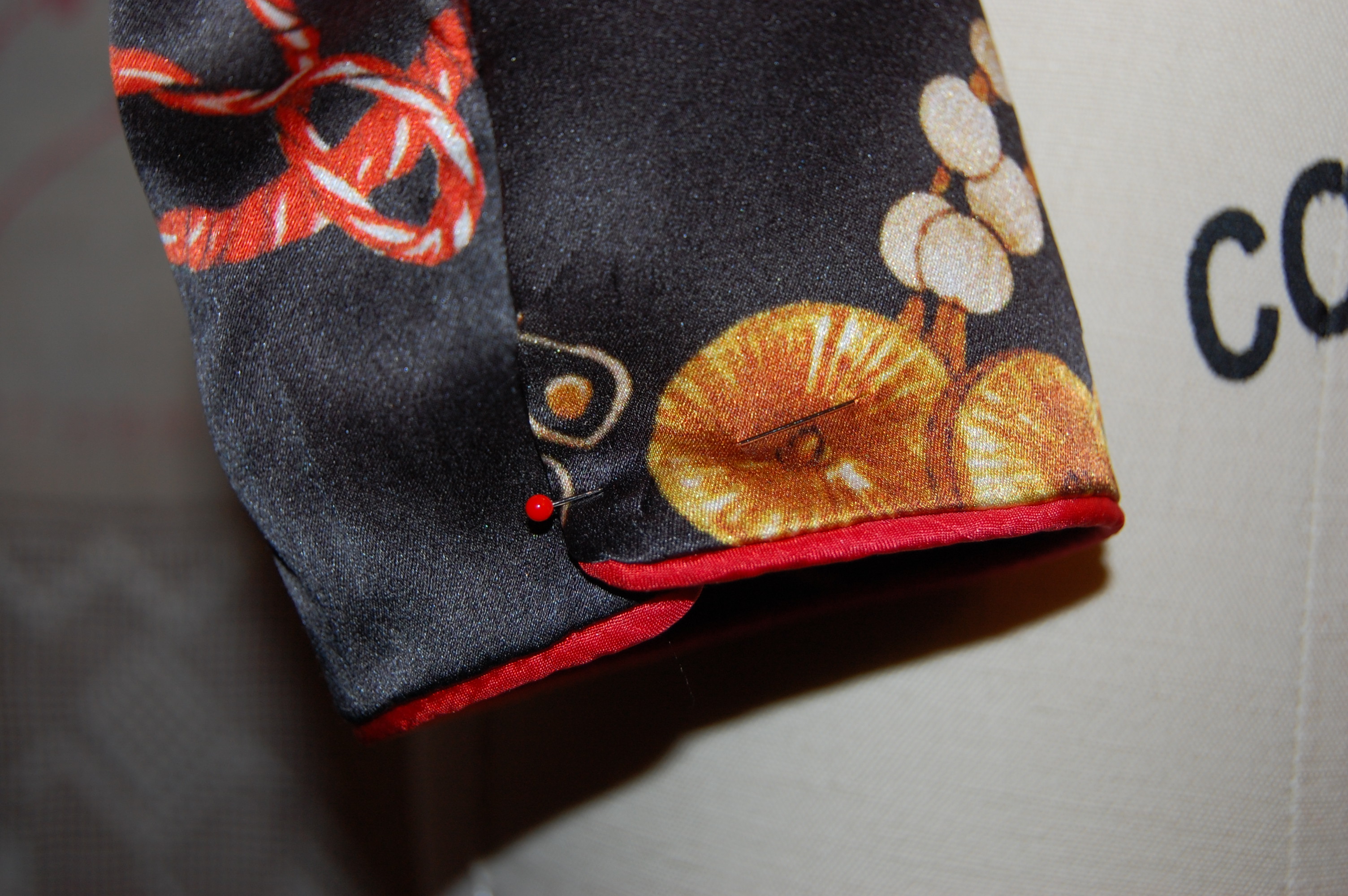
Further advice in the article gave tips on applying the piping. I decided to try my hand with this added guidance, choosing to start with the sleeves. The pattern calls for piping around the lower edge – a nice short distance and easy to fix if I wasn’t happy with the finished look. What do you think?

Light Load

The sleeve has a side opening - to be secured by snaps.  Here it is just pinned.

The sleeve has a side opening – to be secured by snaps. Here it is just pinned.

There will still, I am sure, be some tedious moments as I continue work on this dress, but my load was definitely made lighter by something as simple as —- tissue paper!

26 Comments

Filed under 1980's dress patterns, piping, sewing in silk, vintage Vogue Designer patterns

Happy New Sewing Year

“Dresses for breakfasts, and dinners, and balls;

Dresses to sit in, and stand in, and walk in;

Dresses to dance in, and flirt in, and talk in;

Dresses in which to do nothing at all;

Dresses for Winter, Spring, Summer and Fall”

William Allen Butler (1825-1902) may have thought “Nothing to Wear”, from which these lines are taken, was a satirical poem, but he obviously did not know 21st century fashion sewers.  Isn’t January just the perfect time to plan for the creation of “dresses for Winter, Spring, Summer, and Fall”?  Yes, thank you for agreeing with me.

Last year I took a rather theoretical approach to the new sewing year, but this year I am focusing on more specific plans.  Let me start with Winter.

I have three things that I want to complete while the snow is still flying (which gives me until the end of March, more or less):

1)  My Chanel-inspired classic French jacket is my current project, and I am happy to report that I am making slow but steady progress on it.

2) I won’t consider the jacket really complete until I have made the bow blouse that will match its lining.

3) I am excited to say that I am going to be joining one of Susan Khalje’s Couture Sewing Classes in February, and my intended project is — ta-daa — this jacket which I have wanted to make ever since Vogue Patterns first issued it in the 1970s!

I will definitely be doing the color blocked version when I make this coat.

I will definitely be doing the color blocked version when I make this coat.

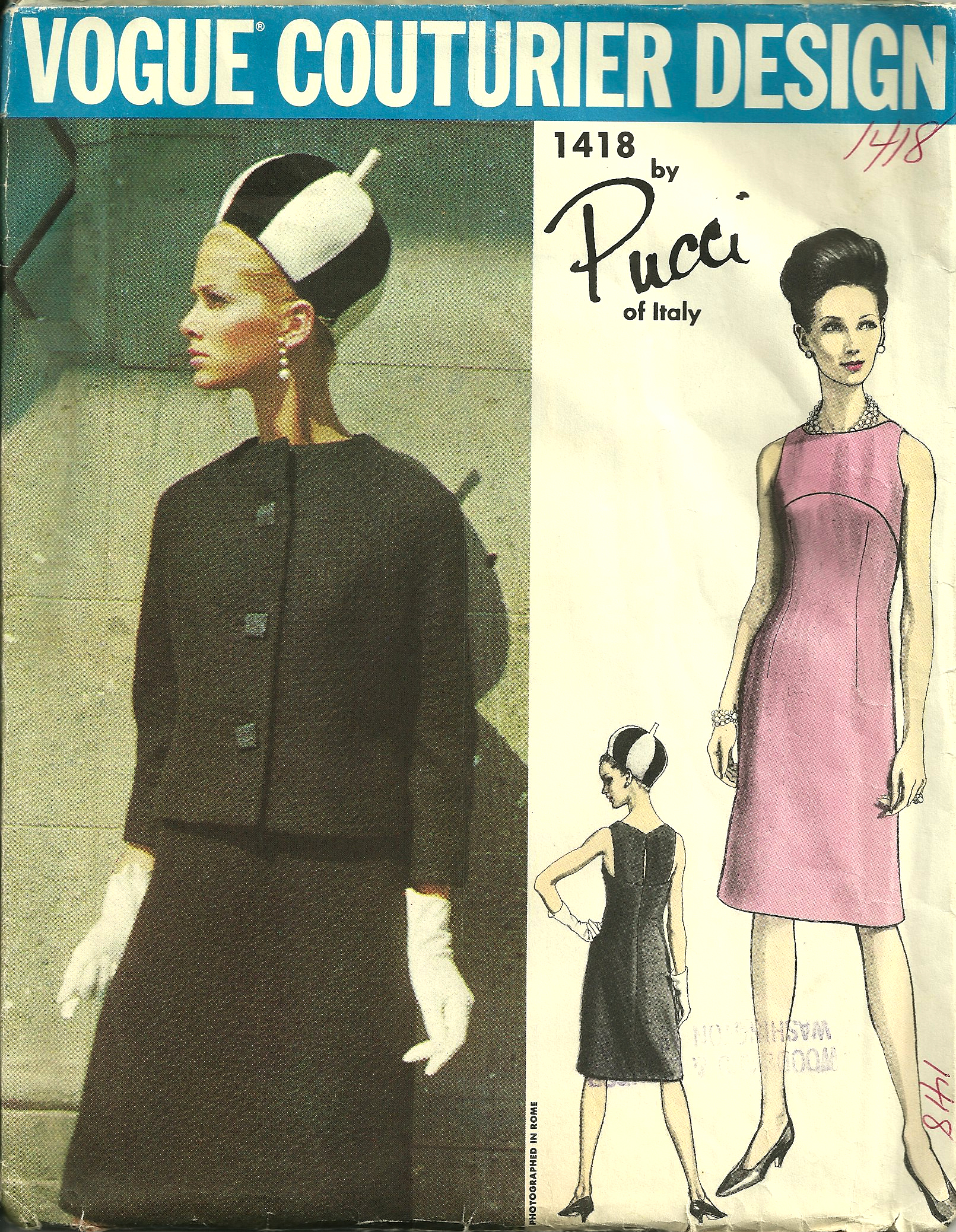
With any luck (or maybe lots of it will be needed), it may still be Winter when I start this project intended for an event in late April event:

I have an authentic Pucci silk from which to make the dress and line the jacket.

I have an authentic Pucci silk from which to make the dress and line the jacket.

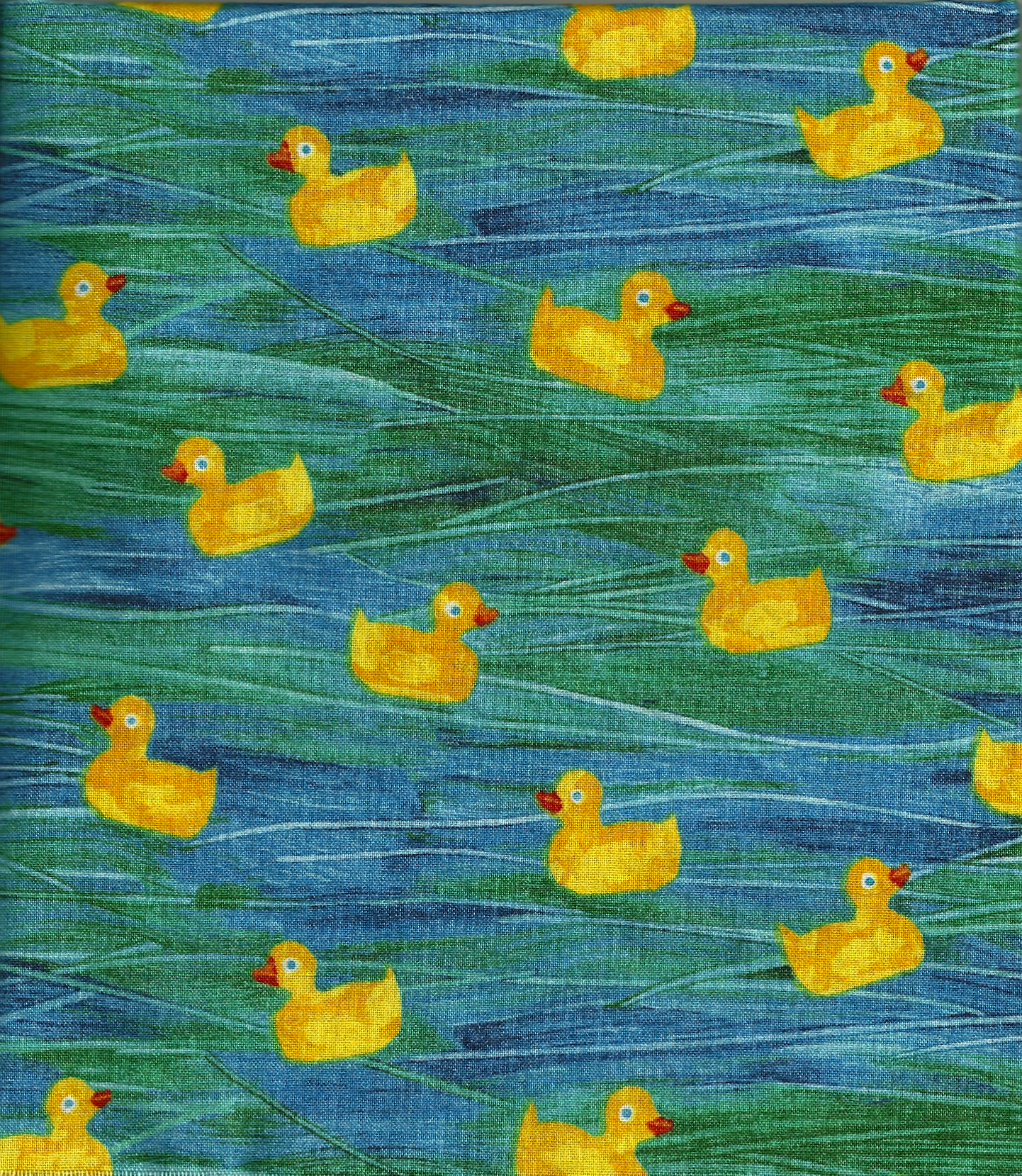
In addition, Spring will not be complete for me until I make a dress for my granddaughter who will be 1-year-old in March.  I purchased this fabric last Fall when I was at the Eric Carle Museum in Amherst, Massachusetts.  You can imagine my excitement when I saw that the gift shop included yardage of soft, quality cotton featuring designs from his books.  I envision these little ducks embellished with yellow rick-rack.

Happy New Sewing Year - carle fabric Before Spring bids us adieu, I may divert from dresses to make another pair of slim pants in this vintage 1950s’ linen:

I only have 1 5/8 yards of this 35" wide fabric, so it remains to be seen if i can squeeze pants out of it.

I only have one and 5/8 yards of this 35″ wide fabric, so it remains to be seen if I can squeeze pants out of it.

If Summer of 2014 is as hot as last Summer (or even if it is not), I’ll be making at least two more cool, linen dresses, one sheath-style and one belted.  More on these linen fabric finds in a future post…

And a bathrobe!!  I am dying to make a swishy bathrobe!

Ah, and then comes Fall (already??), probably my favorite season of all.  I have two projects envisioned:

1) I found this stretch silk charmeuse at Mendel Goldberg Fabrics on a quick day trip to NYC in early Fall.

Another gorgeous Italian silk!

Another gorgeous Italian silk!

I bought it thinking I may use it for the lining for my No. 2 French jacket, but shortly after that I found this pattern on eBay and promptly decided it would be perfect made up in this dress (which requires a stretch fabric.  Well, it says “ knit fabrics only” but I say stretch fabric will do just fine).

This os one of the few patterns from the 1980s which I really like.  However, i will not be duplicating the hairstyle.

This is one of the few patterns from the 1980s which I really like. However, I will not be duplicating the hairstyle.

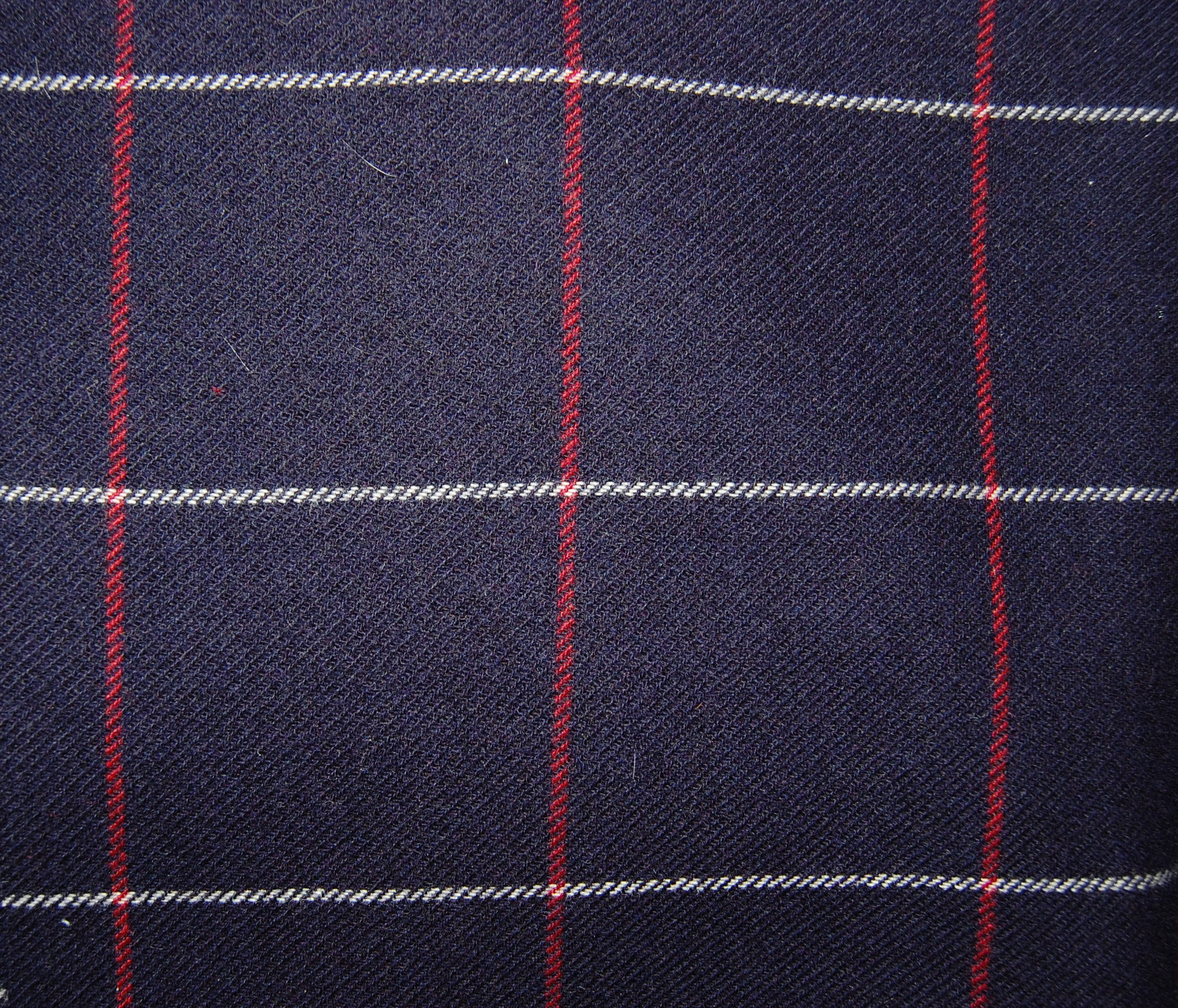
2) I’ve had this buttery soft cashmere wool for a couple of years now.  I originally thought I’d make a suit, but now I’m thinking long-sleeved dress instead.  I’m still sorting this one out in my head so I’m very glad I have until next Fall.

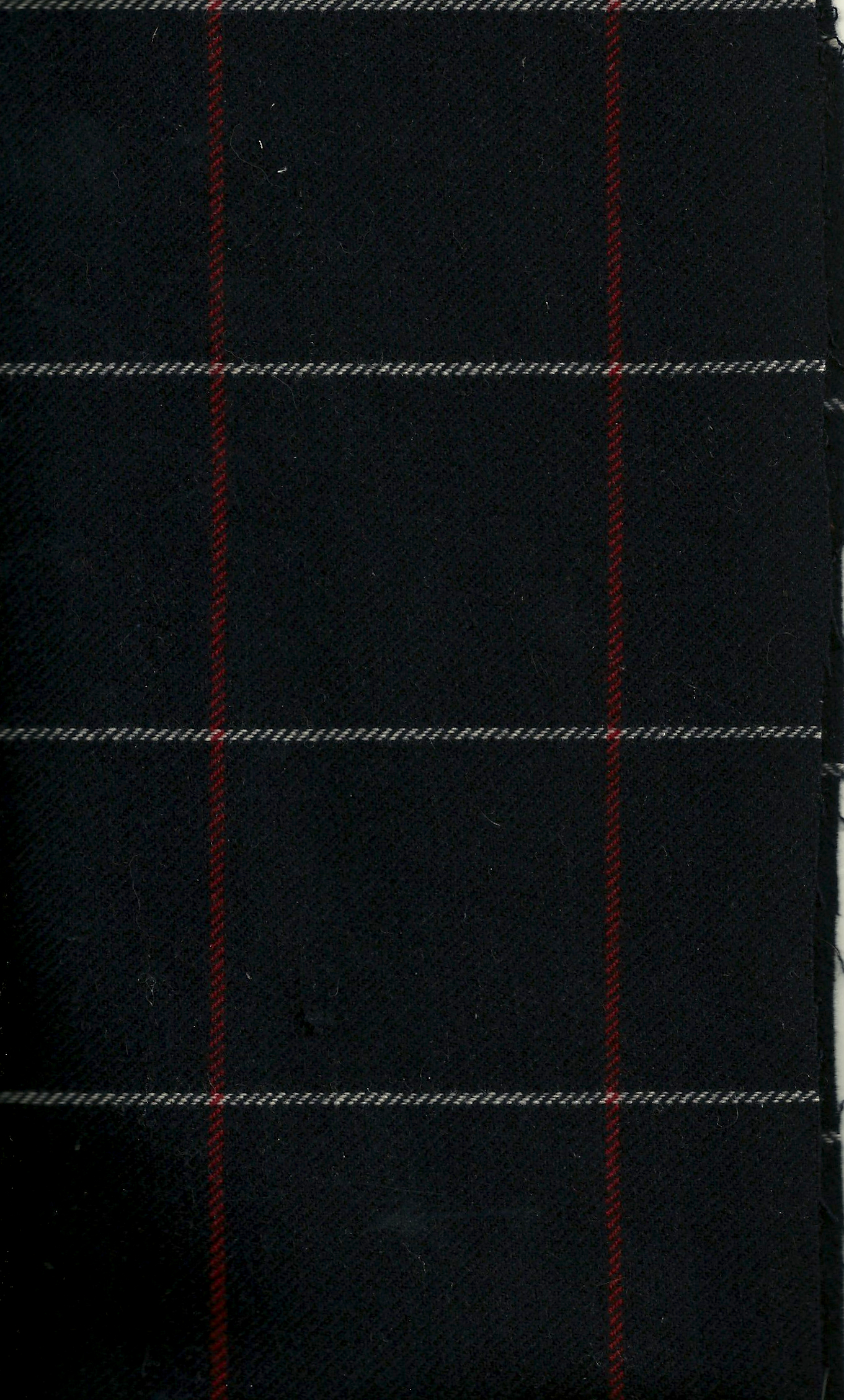
A subtle windowpane check in navy with deep red and ivory intersecting lines.

A subtle windowpane check in navy with deep red and ivory intersecting lines.

Sprinkled among these plans for Winter, Spring, Summer and Fall will surely be more little dresses for granddaughter Aida.  I fully intend for her to have some of the cutest frocks in all of New England.

Finally, if 2013 taught me anything, it is that the unexpected is waiting around every corner.

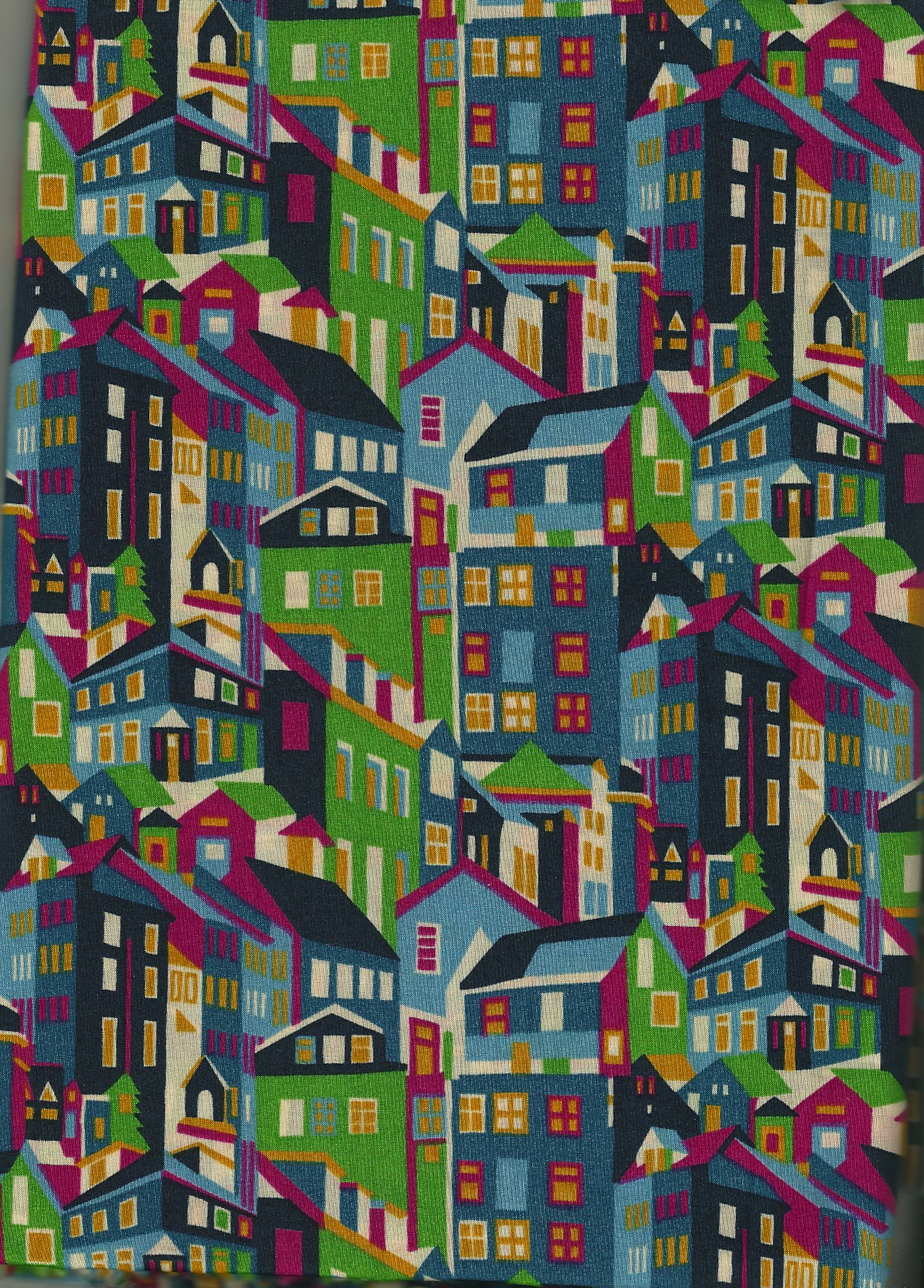
Lots of corners lurking in this Liberty cotton!

Lots of corners lurking in this Liberty cotton!

Life can take sudden turns and twists that are not always sewing-friendly, so I plan to be kind to myself if that happens.  But wouldn’t it be nice for all of us to have the kind of year when we have the extra time to make a dress in which to do “nothing at all”?

14 Comments

Filed under 1980's dress patterns, Boucle for French style jackets, Chanel-type jackets, Coats, Liberty cotton, Linen, Polka dots, Uncategorized, vintage Vogue Designer patterns, vintage Vogue patterns from the 1970s, Vogue patterns, woolens

“P” is for Pearl — and — Perseverance

Among timeless fashion statements, pearls and wrap dresses both make my top-ten list.  The opportunity to combine the two was just too good to pass by, especially after being inspired by a silk charmeuse perfectly suited for just such a pairing.

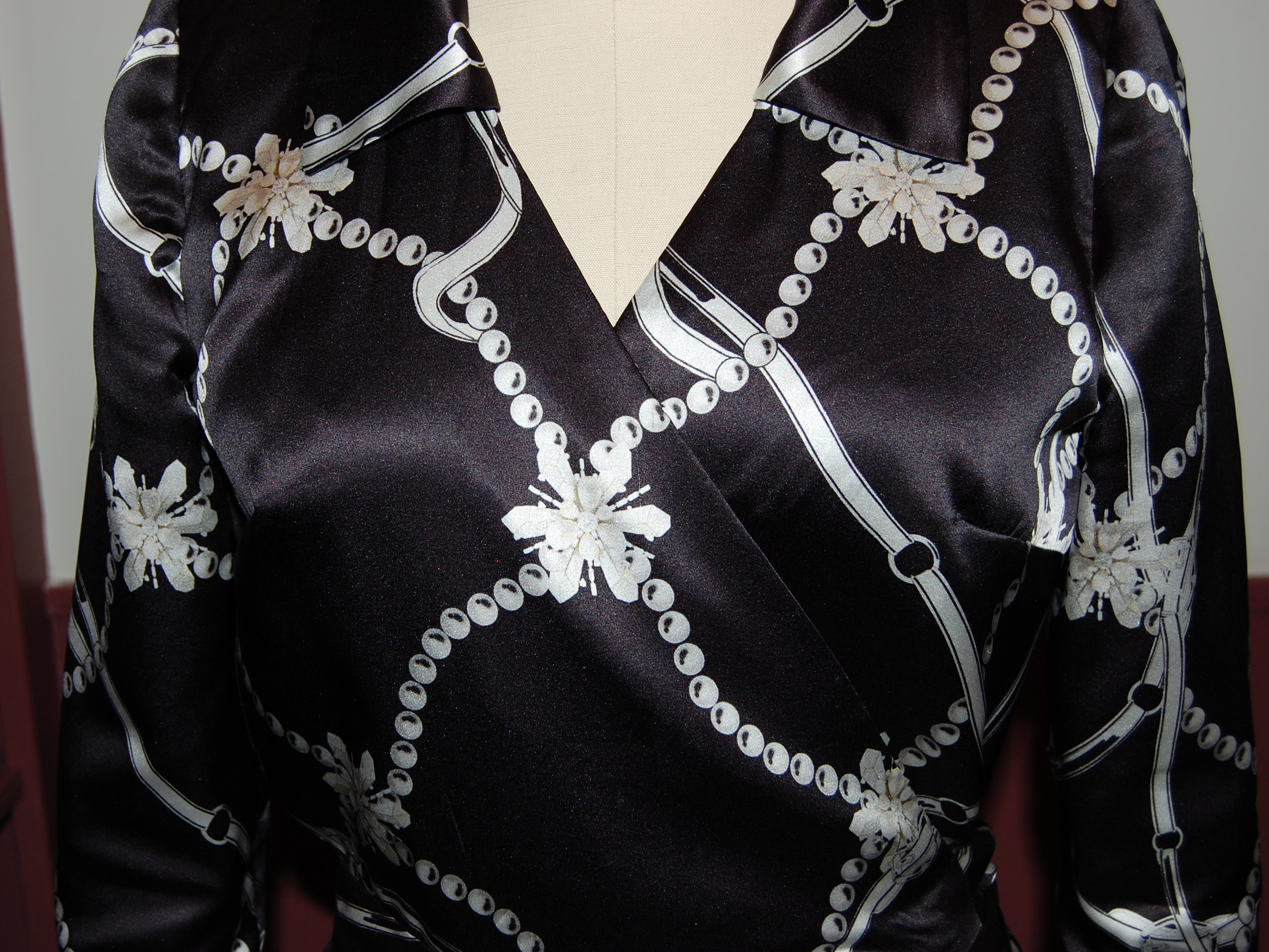
Pearls and ribbons and clusters!

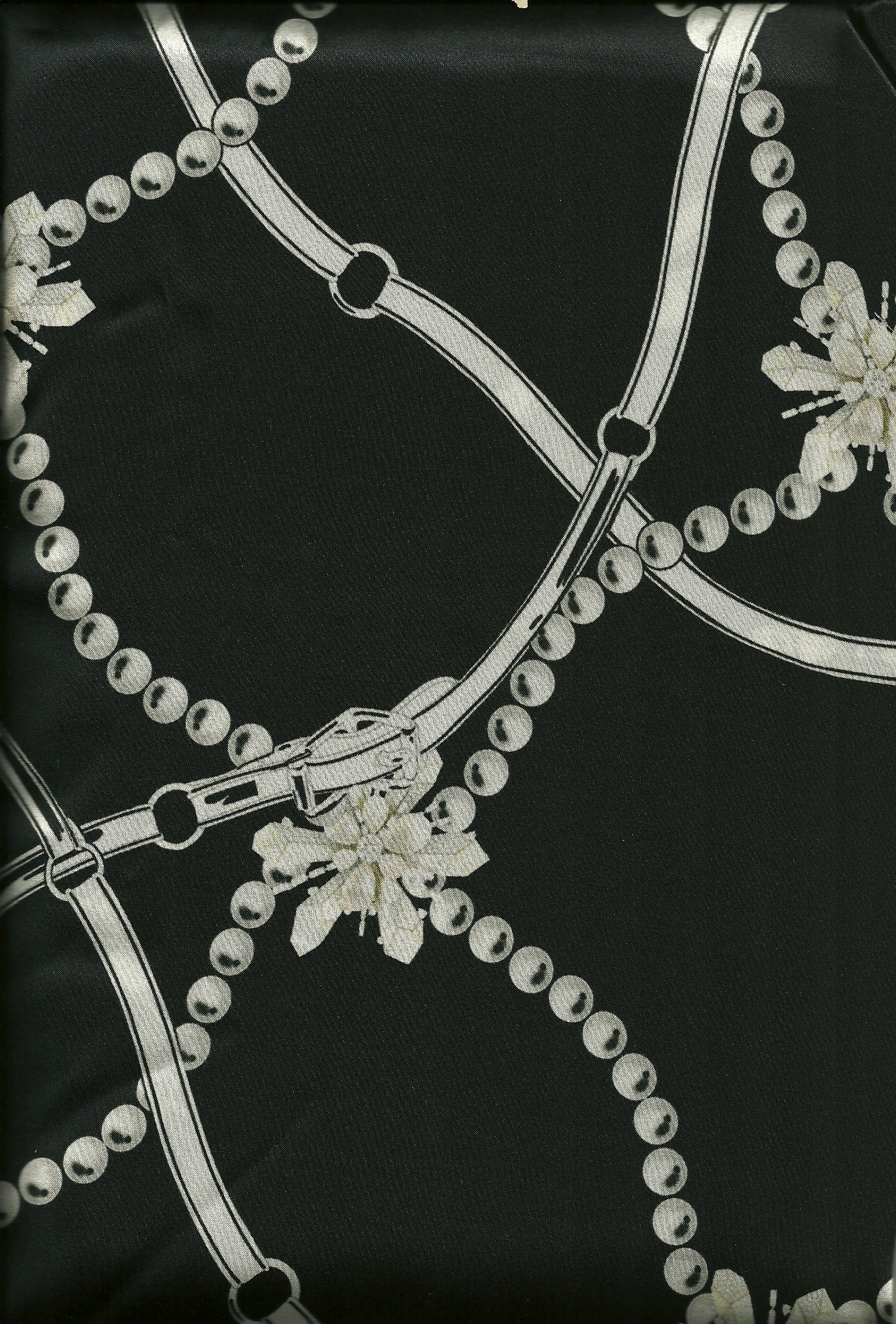
Pearls and ribbons and clusters, fabric purchased from Mendel Goldberg Fabrics in NYC.

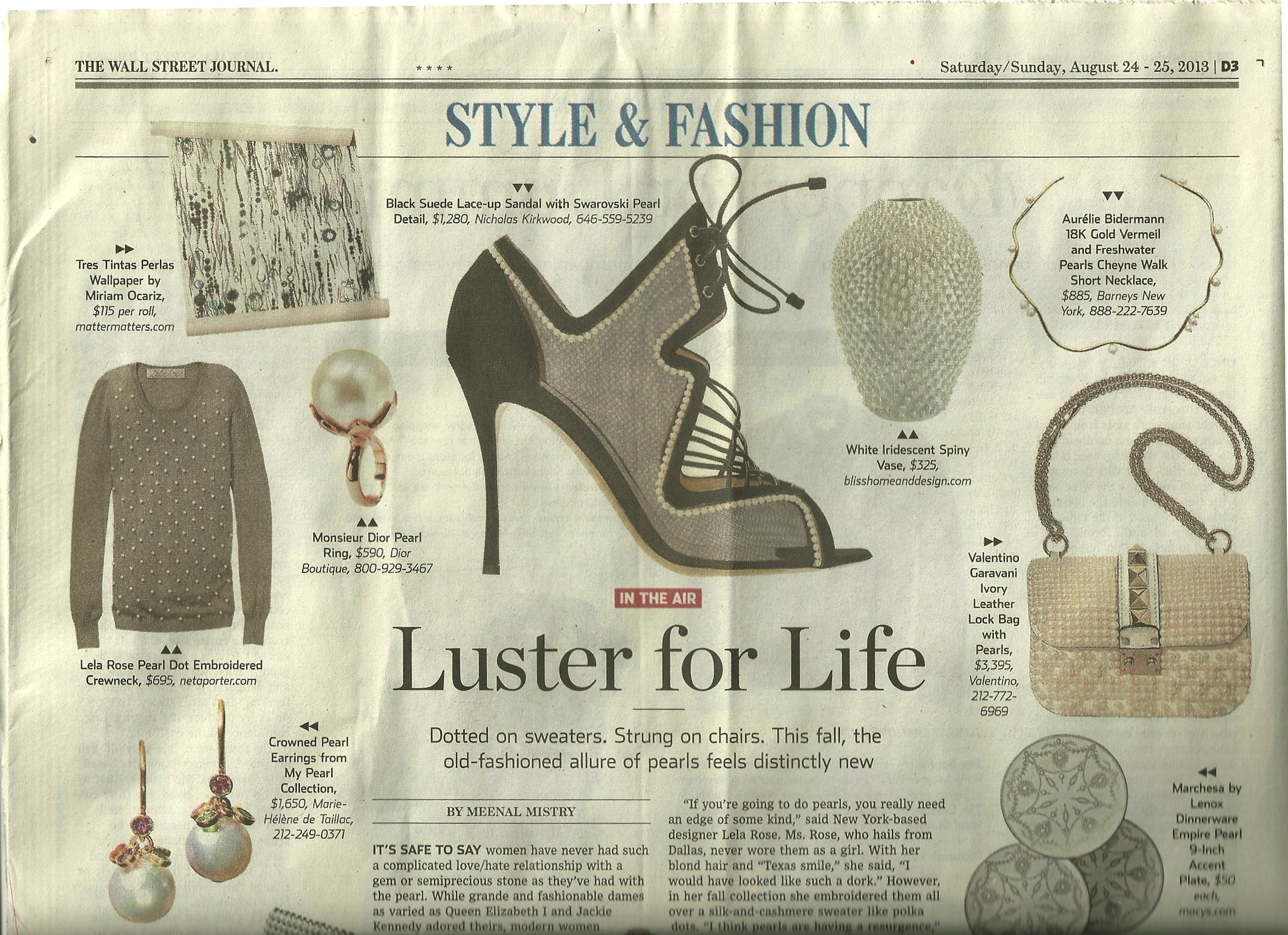
As luck would have it, shortly after I purchased the silk for this dress, an entire article in the Style & Fashion section of The Weekend Wall Street Journal of August 24 – 25 (2013) was devoted to “the old-fashioned allure of pearls…”  It seems that pearls are “showing up on everything from shoes to wallpaper to chairs”  – and to fabric, as evidenced by my Italian silk charmeuse.  I am just “old-fashioned” enough to think that pearls are never not in style, but I must admit that even I was smitten with the unusual and modern approach of this fabric design.

Pearls required - WSJ article

Pearls are showing up everywhere, it seems.

So – how would this modern fabric look, made up in a mid-1970s’ wrap dress pattern?   I thought it would work quite well. But getting there turned out to be challenge.  Although I was lacking the classic Diane von Furstenberg wrap dress pattern that I envisioned for this dress (blogged about here), I thought I could piece together a 1976 Simplicity version and a new Vogue wrap dress pattern to achieve my goal.

This is the dress I wanted to recreate...

This is the dress I wanted to recreate…

The Simplicity "version" of the Diane von Furstenberg wrap dress.

The Simplicity “version” of the Diane von Furstenberg wrap dress.

Vogue 8784 diagrams

Vogue 8784 diagrams

Here’s what I did:

1) I decided to use the princess-seamed bodice back from the new Vogue pattern.

2) I re-cut the collar and the cuffs from the Simplicity pattern so that the points on them would not so extreme.

3) Because the ties on the Simplicity pattern were not attached to the dress (the tie was just like a very long separate sash) I used the ties from this DvF pattern, and attached them to the side seams.

Pearls required - DvF pattern

4) The missing sleeve pattern piece in the Simplicity pattern meant that I had to use the sleeve from the new Vogue pattern and basically redraft it, with an elbow dart, and with cuffs.  I also used Simon Henry’s book The Little Black Dress: How to make the perfect one for you as a reference.

Pearls required - LBD book

This is the wrap LBD dress featured in the book.

5) I ended up making two complete muslins and re-stitching one of those muslins, before I had a workable pattern.  All of this seemed to take forever!

When I finally cut out the black silk organza underlining, I was ready for a celebration, but of course, that would have been premature.  Although the design in the fashion fabric really could not be “matched”, I still had to respect the placement of the “clusters” as they would relate to the bodice.  (I did not want “clusters” at the apex of the bust darts, for example.)   And I felt like the “clusters” should be placed at equal distances from each other over the expanse of the dress, if possible.  After determining all this and  cutting out the fashion fabric, I finally got to sewing, which included lots of basting, catch-stitching all the seams to the underlining, understitching the collar by hand (which worked beautifully, for which I was very grateful!), setting in the sleeves, making the lining, etc., etc.

Here is the final placement of the fabric design on the front of the bodice . . .

Here is the final placement of the fabric design on the front of the bodice . . .

P is for pearl

. . . and here is the bodice back.

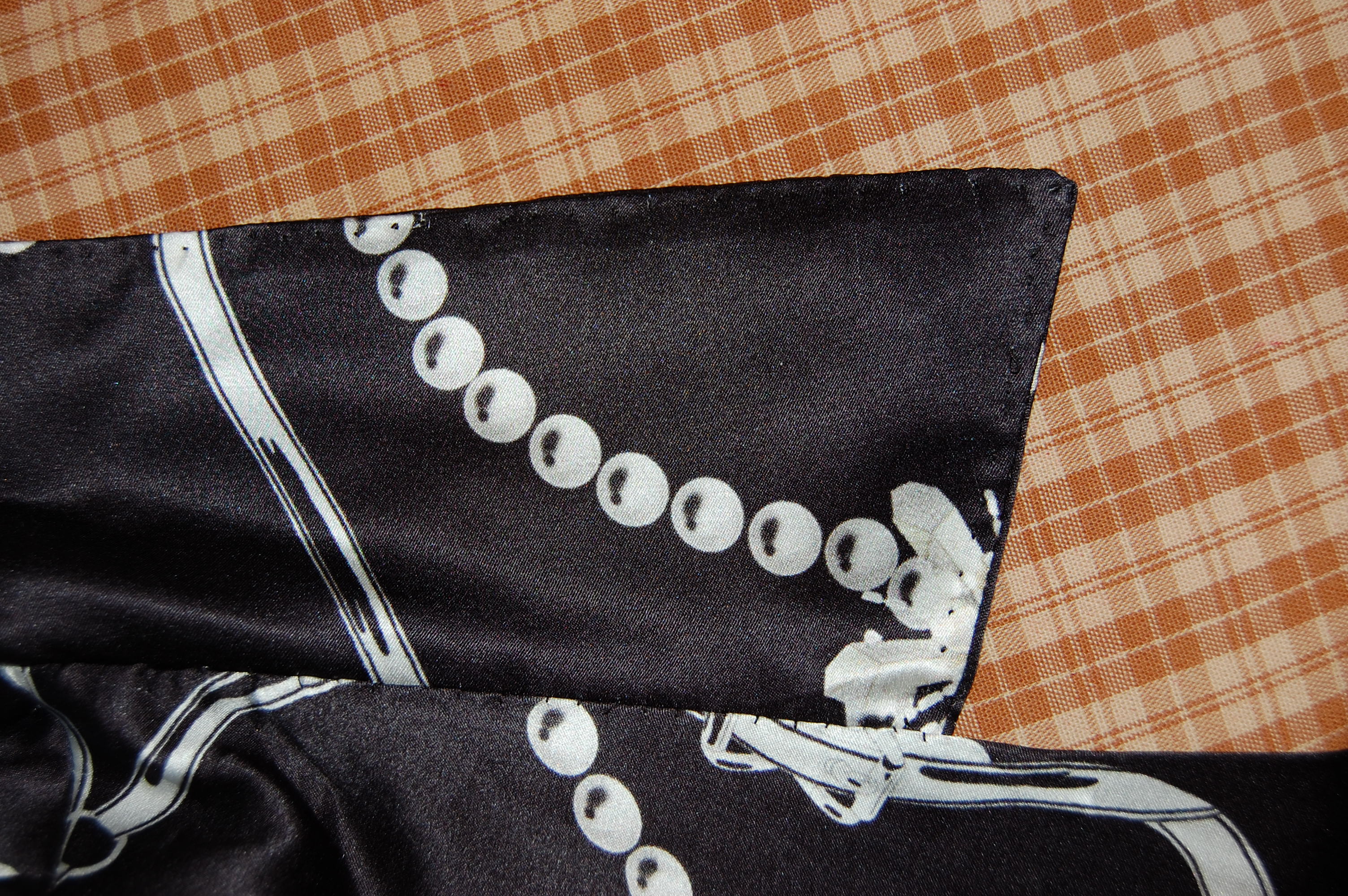
Understitching the collar created a slight under-curve which helps the collar lay flat.

Understitching the collar created a slight under-curve which helps the collar lay flat.

This boring view just shows the lining that was so tedious to attach!

This boring view just shows the lining that was so tedious to attach!

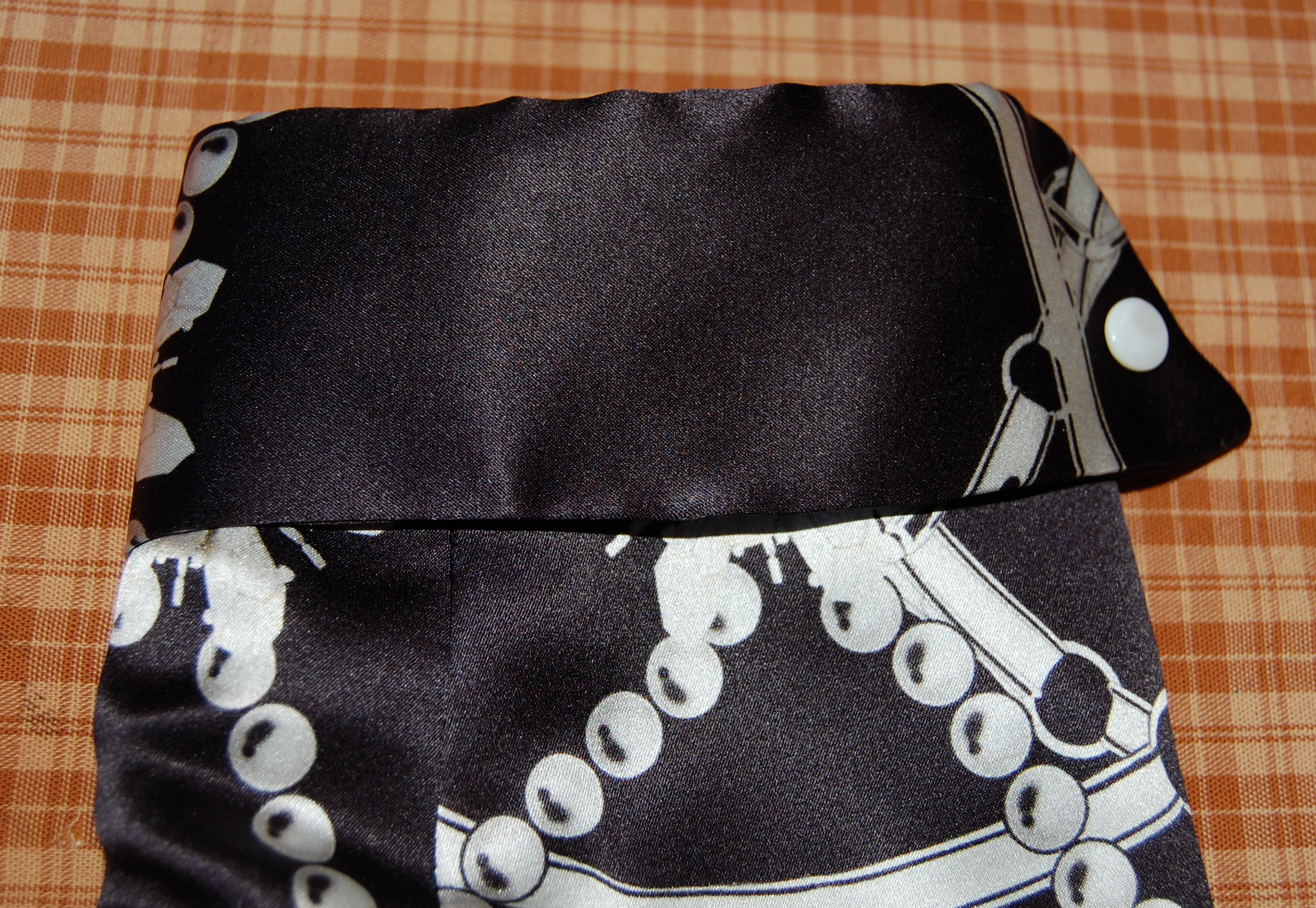
I made the mistake of making the cuffs before a final fitting of the sleeves. (I thought I was being smart and getting “prep” work done, but I just made more work for myself).  I ended up shortening the sleeves and enlargening the openings so that I would be able to push them up on my arms if I wanted to.  The cuffs I had made were not long enough to accommodate these adjustments, so back I went to cut and make new cuffs.  Fortunately I had just enough fabric to squeeze these out!

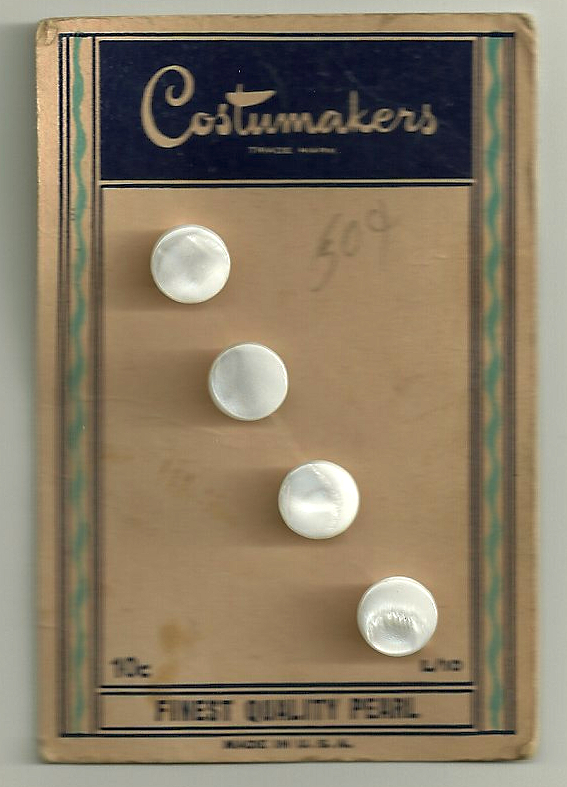
For buttons for the cuffs, I went to my button box and came up with this card:

The original price of these buttons was 10 cents.  I picked them up for 50 cents at some point.  It almost seemed a shame to cut them off of the card!

The original price of these buttons was 10 cents. I picked them up for 50 cents at some point. It almost seemed a shame to cut them off of the card!

Because I had reduced the points on the cuffs, I needed “not-too-big” buttons and these proved to be perfect, I thought, and in keeping with the “pearl” theme.

Here is one of the cuffs with buttons attached.

Here is one of the cuffs with buttons attached.

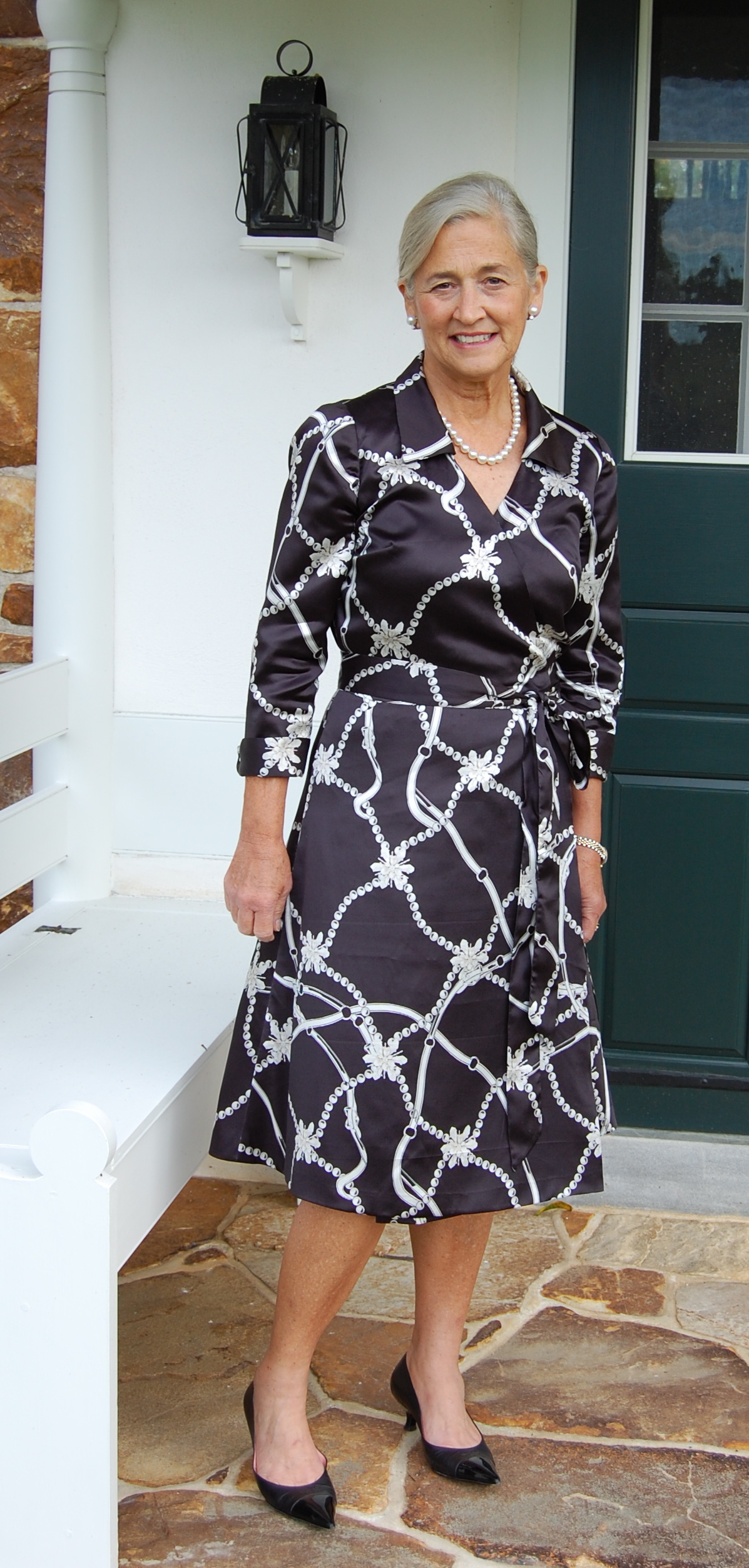
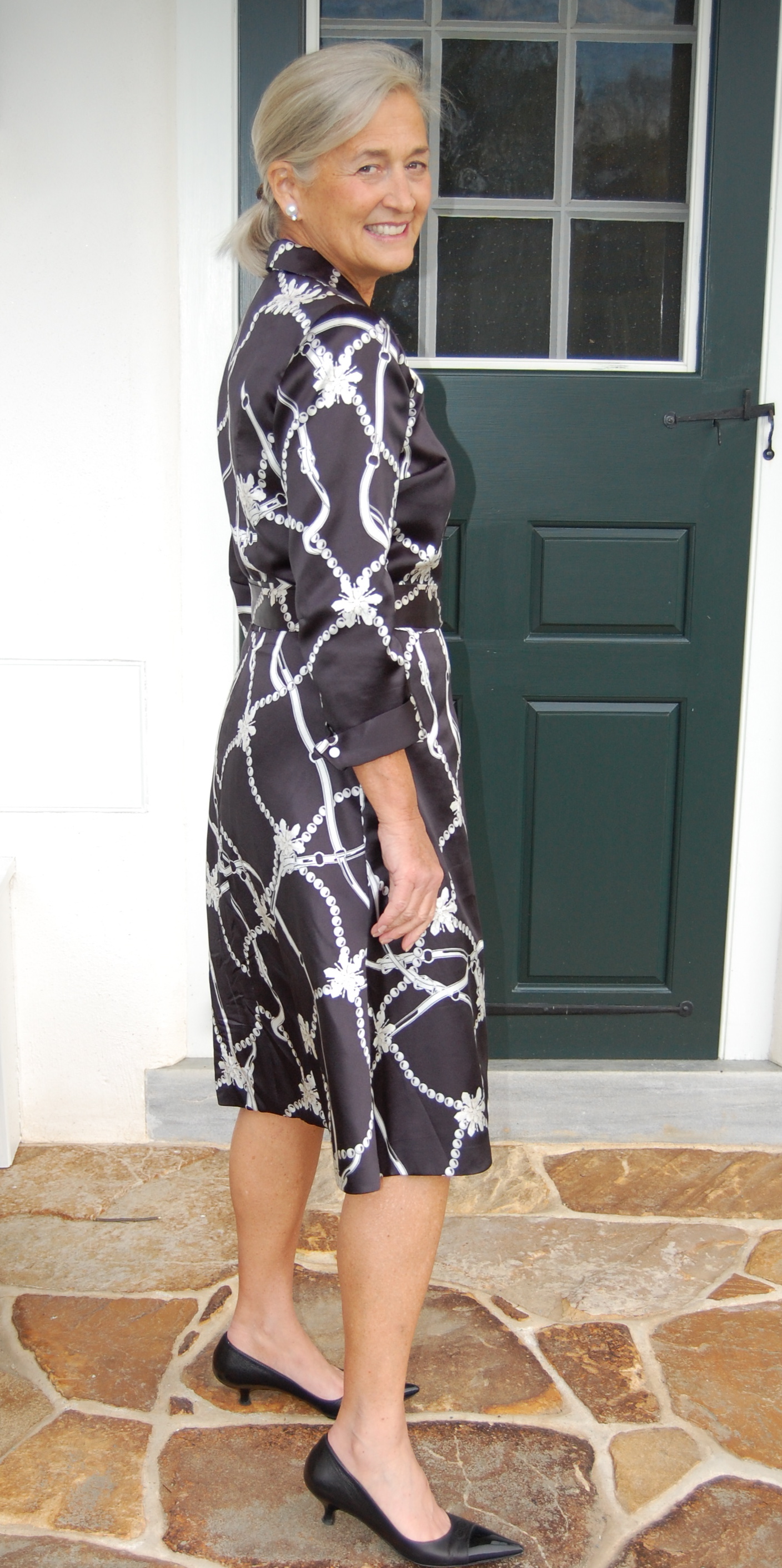
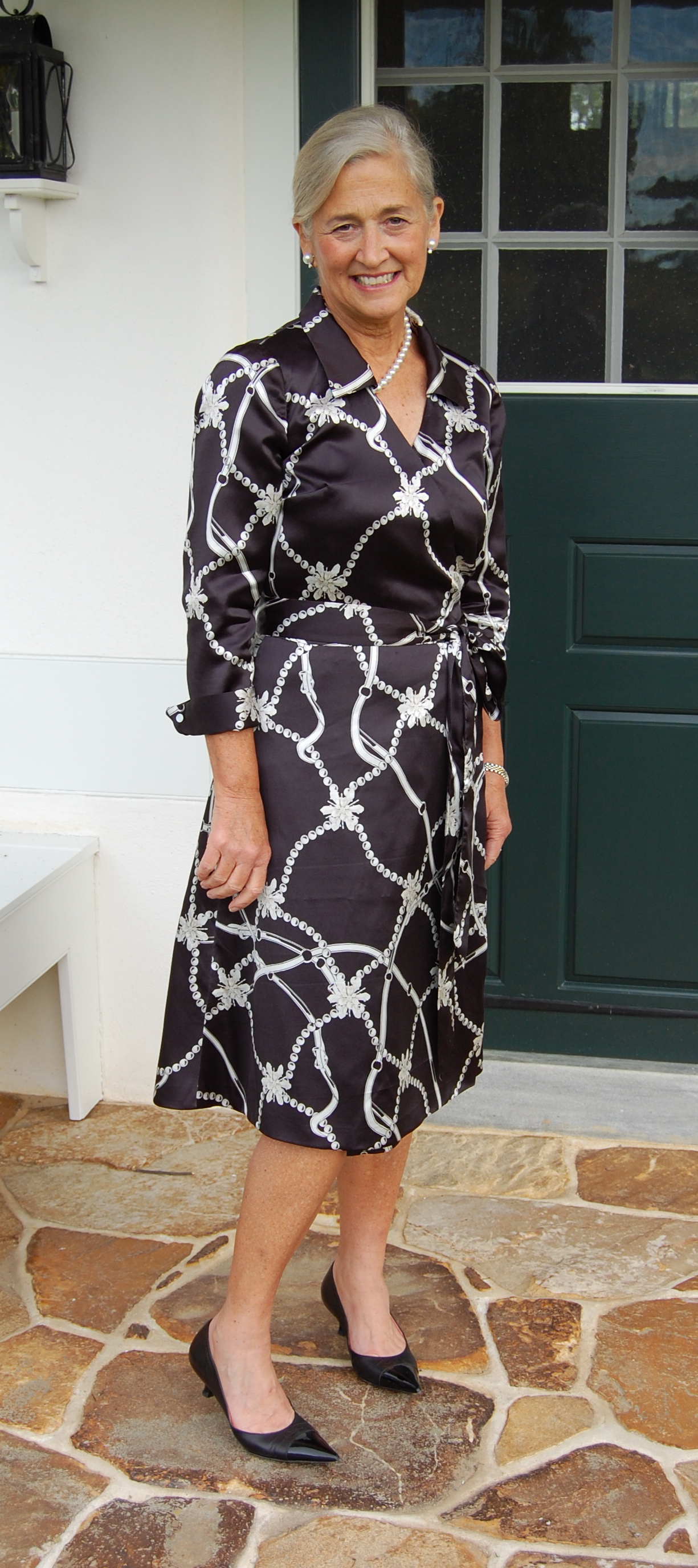
Working on the black fashion and lining fabrics was tedious.  And it seemed the more I worked on this dress, the more there was to do on it!  Kind of like eating a big bowl of pasta – the work seemed to multiply before my eyes.  Fast, easy, and jiffy this was not!  It’s times like this that being of a stubborn nature serves me well.  I persevered and got it done!  And even better, I am really happy with the results.

I will replace this photo with one of me in the dress as soon as I can!

Here is the dress on my new dress form . . .

. . . and here it is on ME!

. . . and here it is on ME!

DSC_1022

DSC_1028

P is for pearl

Now – two more “P” words.  I have “P”romised myself that my next “P”roject will be simple.  Maybe a blouse – or even a blanket?

15 Comments

Filed under Buttons - choosing the right ones, couture construction, Little Black Dress, sewing in silk, Uncategorized, vintage buttons, vintage Vogue Designer patterns, vintage Vogue patterns from the 1970s, Wrap dresses

Wrapping My Mind Around a New Dress for Fall

I am not sure why, but I have been obsessed with wrap dresses lately.  I think it began in May when I wore the dress I made last summer from a mid-‘70s Vogue Diane von Furstenberg pattern.   It seemed to make a hit whenever I had it on – and there is nothing like a compliment to make one try for a repeat!  I just needed to find the perfect fabric – and another perfect pattern.

I made the sleeveless version of this dress in a red and white print.

I made the sleeveless version of this dress in a red and white print.

The perfect fabric turned out to be the easy part of the equation.  One of my classmates in Susan Khalje’s Classic French Jacket Class chose this silk charmeuse for her jacket lining:

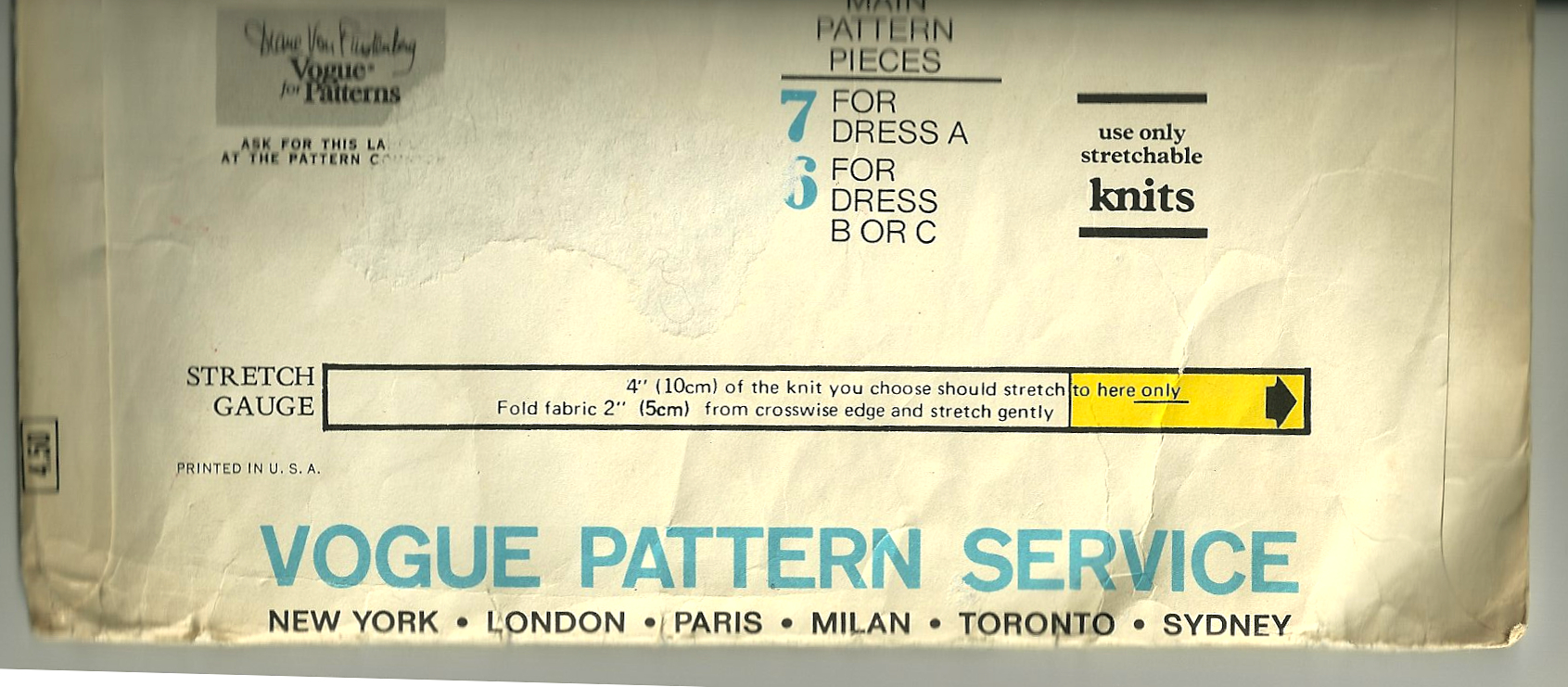
Wrap dress - 9 - fabric I loved the design so much that I asked for a swatch of it while I was at Mendel Goldberg Fabrics in NYC with my classmates.  Well, you can guess the end of this part of the story.  A few weeks after arriving home, I called up Alice at Mendel Goldberg and ordered some yardage.  I could picture this fabric as a wrap dress with ¾ or bracelet-length sleeves.  However, it is a woven fabric (of course), and even though it does have a slight stretch to it, those vintage Diane von Furstenberg patterns require “stretchable knits”, even including a stretch gauge on the pattern envelopes to ensure success.

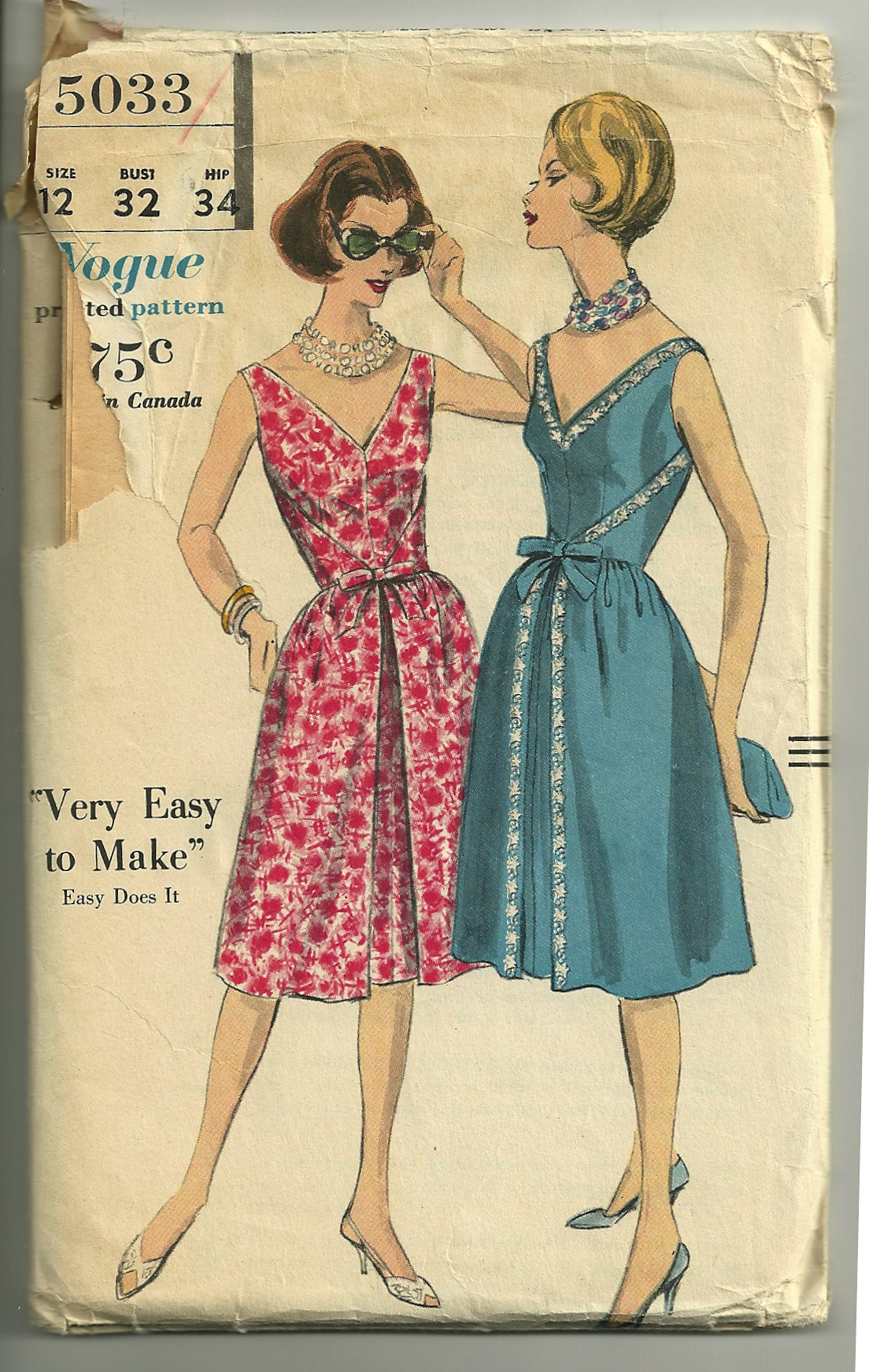
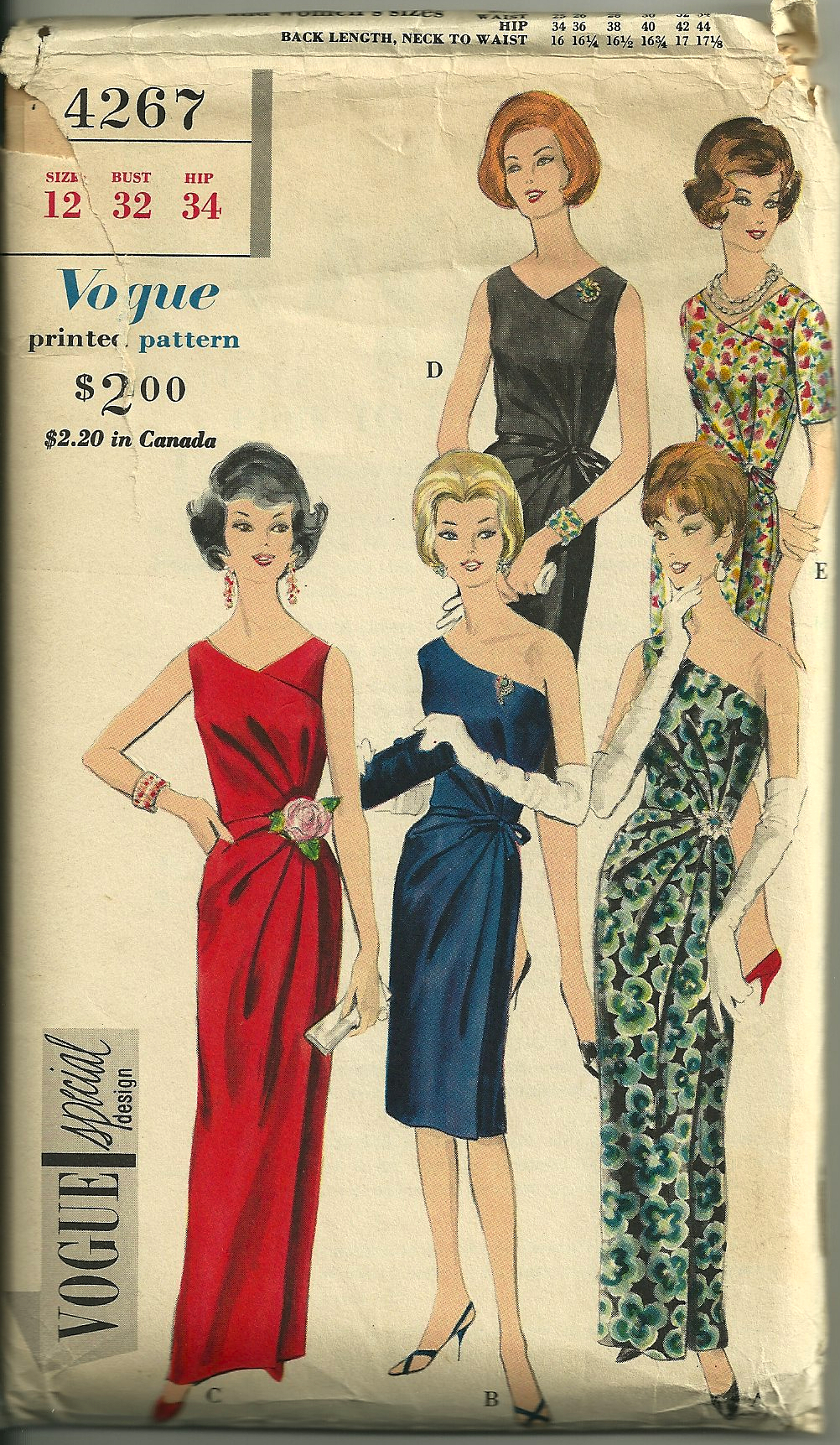
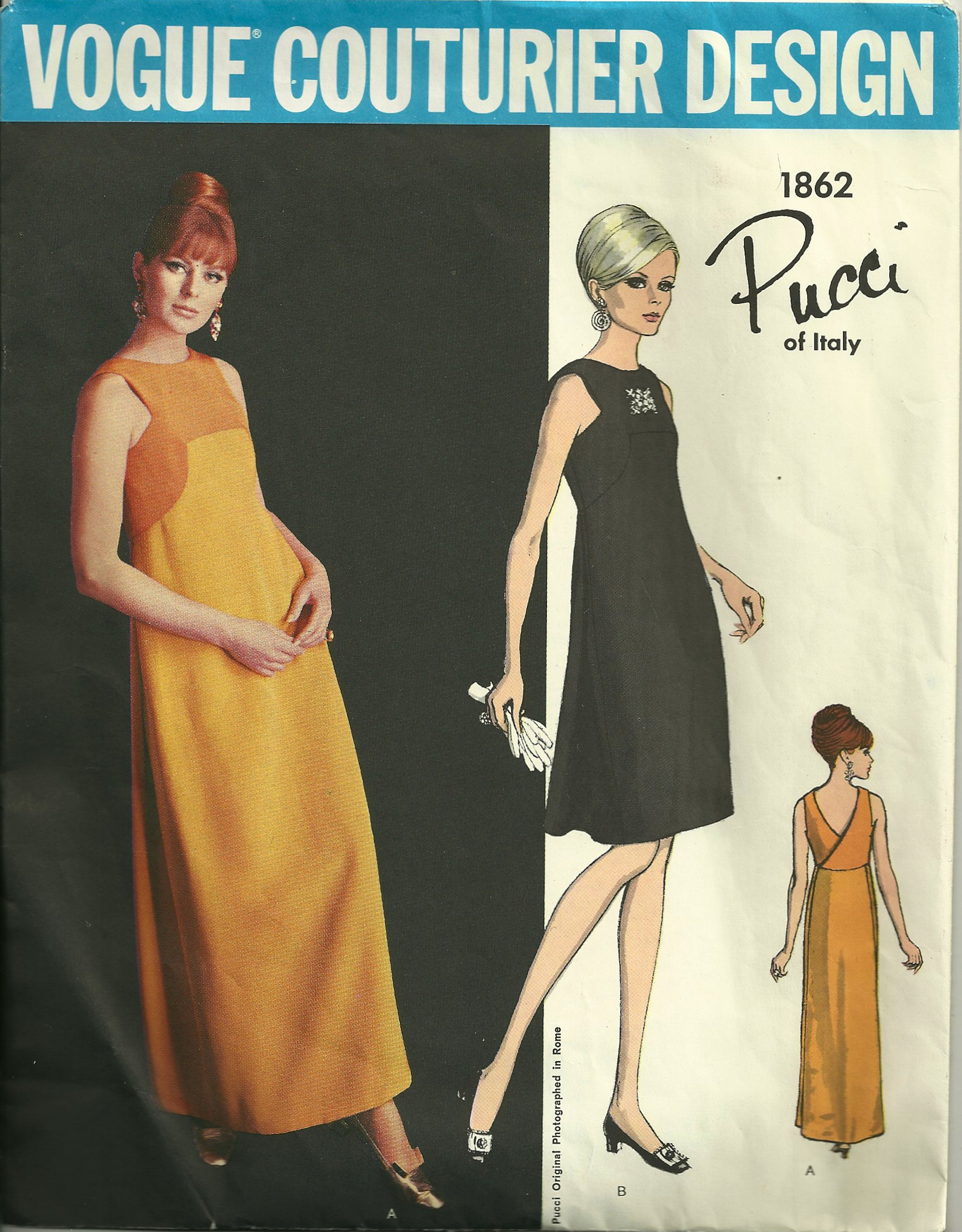
Wrap dress - 8 - stretch gauge Out of curiosity I went through my collection of vintage patterns to see what other “wrap” dresses I could find, and although none of these three were quite the look I wanted, I was struck by the variety of wrap dress patterns available, obviously some long before Diane von Furstenberg made them so popular.

This pattern is copyright 1960.  "slightly gathered skirt back of the sleeveless, easy-does-it dress wraps around plain front to fasten at waist-line with tied belt."

This pattern is copyright 1960. “slightly gathered skirt back of the sleeveless, easy-does-it dress wraps around plain front to fasten at waist-line with tied belt.”

A thumbnail diagram on the back of the pattern envelope.  "Dress opens flat for ironing."

A thumbnail diagram on the back of the pattern envelope. “Dress opens flat for ironing.”

Here is a slightly more elegant wrap dress, also from the early ’60s:

Actually, just the skirt is a wrap on this dress, which has so many different looks, all of them quite stunning.

Actually, just the skirt is a wrap on this dress, which has so many different looks, all of them quite stunning.

Finally this Pucci design, which is another elegant wrap dress:

"Slim, high fitted dress in evening r street length has wrapped back closing, soft side back folds."

“Slim, high fitted dress in evening or street length has wrapped back closing, soft side back folds.”

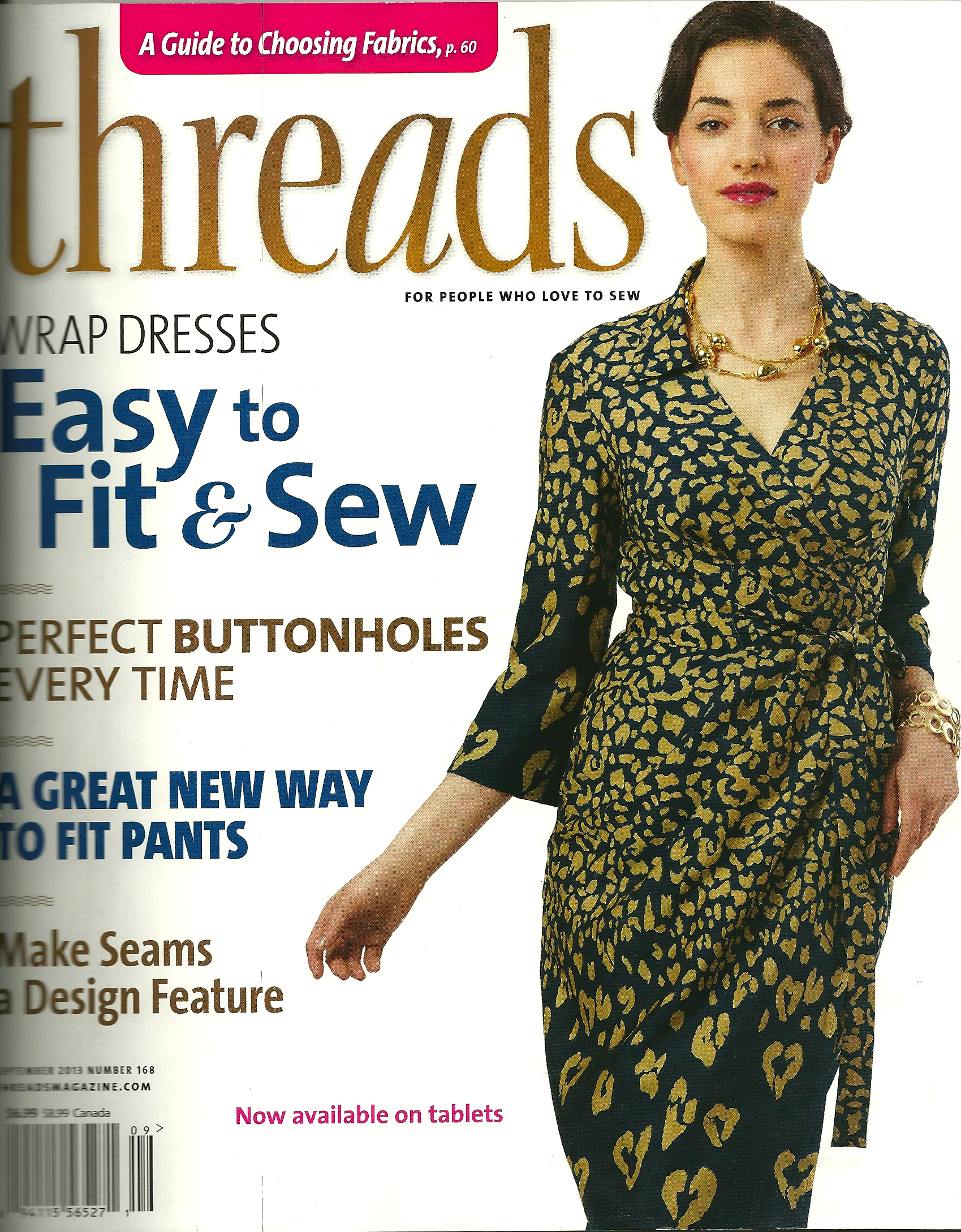
It was about this time that the September issue of Threads magazine arrived in my mailbox.  Now my obsession was in full force, as the main feature article was on Wrap Dresses: Easy to Fit and Sew.

Wrap dress I liked the dress featured on the cover – which happens to be a new Vogue pattern (V8784).  I also liked the fact that it does not require a knit fabric, and that it is to be lined (I could make it using couture techniques).  I did not like the sleeves, however – too baggy and shapeless.

I could not get around the idea that the look I thought I wanted was this D v F dress, featured on the front cover of Vogue Patterns for September/October 1976:

Wrap dress - 6 DvF cover

This presented two major problems, however,  First, I do not own this vintage pattern (yet), which commands high prices when it comes on the market.  And second, even if I did own it, my woven silk fabric would not be appropriate to use for it.

Well, this second part of the equation was beginning to be a problem.  Then, quite by luck, I stumbled on a Simplicity pattern from 1976 in an Etsy store.  The pattern  is obviously a knock-off of the classic Diane von Furstenberg dress I like so much.  However, it is for woven fabrics!  It was in my size, which I took as a “sign” that I was supposed to buy it – which I did.  I thought my search was over.  With a few minor adjustments to the “extreme” points on the collar and the cuffs, I felt sure this pattern would work.

I really don't think there is anything "JIffy" about this pattern . . .

I really don’t think there is anything “JIffy” about this pattern . . .

A few weeks passed as life took me in other directions and with other projects. Then, finally, I eagerly started on the muslin for this dress.   I was eager, that is, until I realized that the pattern piece for the sleeve is missing –  and the pattern is going to require many more alterations than I usually have.

This is not fun.

There – I feel better now that I have said that!  So my quest for the perfect pattern has been a challenge, but it’s not Fall yet.  By hook or by crook, I’ll be wearing a new silk wrap dress before the trees gently release their leaves into the cool, crisp autumn air.


15 Comments

Filed under Uncategorized, vintage Vogue Designer patterns, vintage Vogue patterns from the 1960s, vintage Vogue patterns from the 1970s, Vogue patterns

A Simple Sheath?

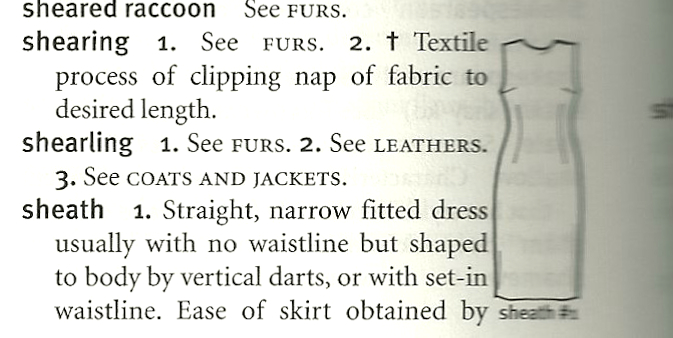
One of the most enduring dress styles in the last 60 years is undoubtably the classic sheath.  According to the definition in Fairchild’s Dictionary of Fashion, a sheath can be one of two constructions:  without a set-in waist or with a set-in waist.  In either case, the silhouette is straight, narrow, and fitted, “shaped to body with vertical darts”, with ease of movement facilitated by a slash at back or an inverted pleat.  “Both styles were popular in 1950s and early 1960s.  Revived periodically.”

Fairchild's illustration of a sheath dress.  copyright 2003, The Fairchild Dictionary of Fashion 3rd Edition, Fairchild Publications, Inc., New York.

Fairchild’s illustration of a sheath dress. copyright 2003, The Fairchild Dictionary of Fashion 3rd Edition, Fairchild Publications, Inc., New York.

It doesn’t take very long looking at current fashion magazines and websites to see that the sheath dress is enjoying one of those revivals right now.  And why not?  It is an infinitely versatile style, going from casual to dressy just by choice of fabric.  Earlier in the Summer when I was shopping at Mendel Goldberg Fabrics in NYC with Susan Khalje’s  “Classic French Jacket” class, I succumbed to purchasing 1½ yards extra of my lining fabric, with the express intention of making a sheath dress out of it.  The fabric is definitely a demonstrative print, so I thought the simpler the style of dress, the better.

My lining and dress fabric, still on the bolt.

My lining and dress fabric, still on the bolt.

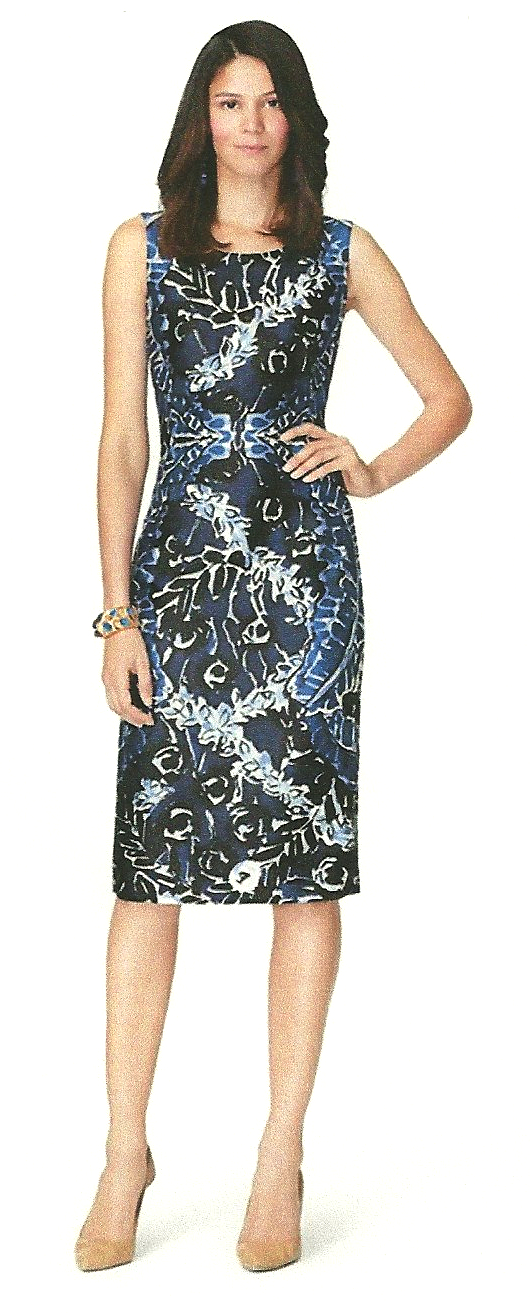
I have to admit I had a few moments when I wondered if that fabric, which I loved as the lining in my jacket, might not be a bit too much for a dress.  Well, too late for any misgivings – this dress was going to happen!  Then suddenly I started seeing photos of more and more sheath dresses, many of them made out of very bold and colorful fabrics.  Two fashion websites I often visit for inspiration and ogling each featured such dresses:

This dress can be found on the Lee Anderson Couture website.

This dress can be found on the Lee Anderson Couture website.

This dress is from Oscar De la Renta's Ready-to-wear line.

This dress is from Oscar De la Renta’s Ready-to-wear line.

Encouraged with this affirmation of my idea, I chose my pattern, ordered china silk for the lining (I already had black organza underlining), purchased the zipper and proceeded to plan my dress.

I decided to adapt this simple pattern, using the third view without the neck and hem bands.

I decided to adapt this simple pattern, using view A (on the right) without the neck and hem bands.

First, of course, I once again sewed up the muslin I had already made for this pattern earlier in the summer.  Here are the changes I made:

1) I sewed the neckband onto the body of the dress and treated it all as one.

2) I eliminated the facings, as I was making this dress with couture techniques.

3) I tweaked the fit a little more, to make it more fitted than my earlier dress (which was belted and needed a little more ease).

4) I adjusted the shoulder to be cut a little higher on the arm.

5) I dipped the neckline a little bit, to match the neckline on my jacket.

6) I added a slit in the back seam for ease of movement.

While I love the look, sheen and feel of silk charmeuse, I don’t think it is the easiest fabric to work with.  I thought I could make my job easier if, when laying out the fabric for pattern (muslin) placement and cutting, I was able to control the slipperiness of it somehow.  I decided to use  half of my dining room table, covered with heavy drapery flannel (which is what I use under tablecloths for cushioning).   The flannel “anchored” it beautifully.

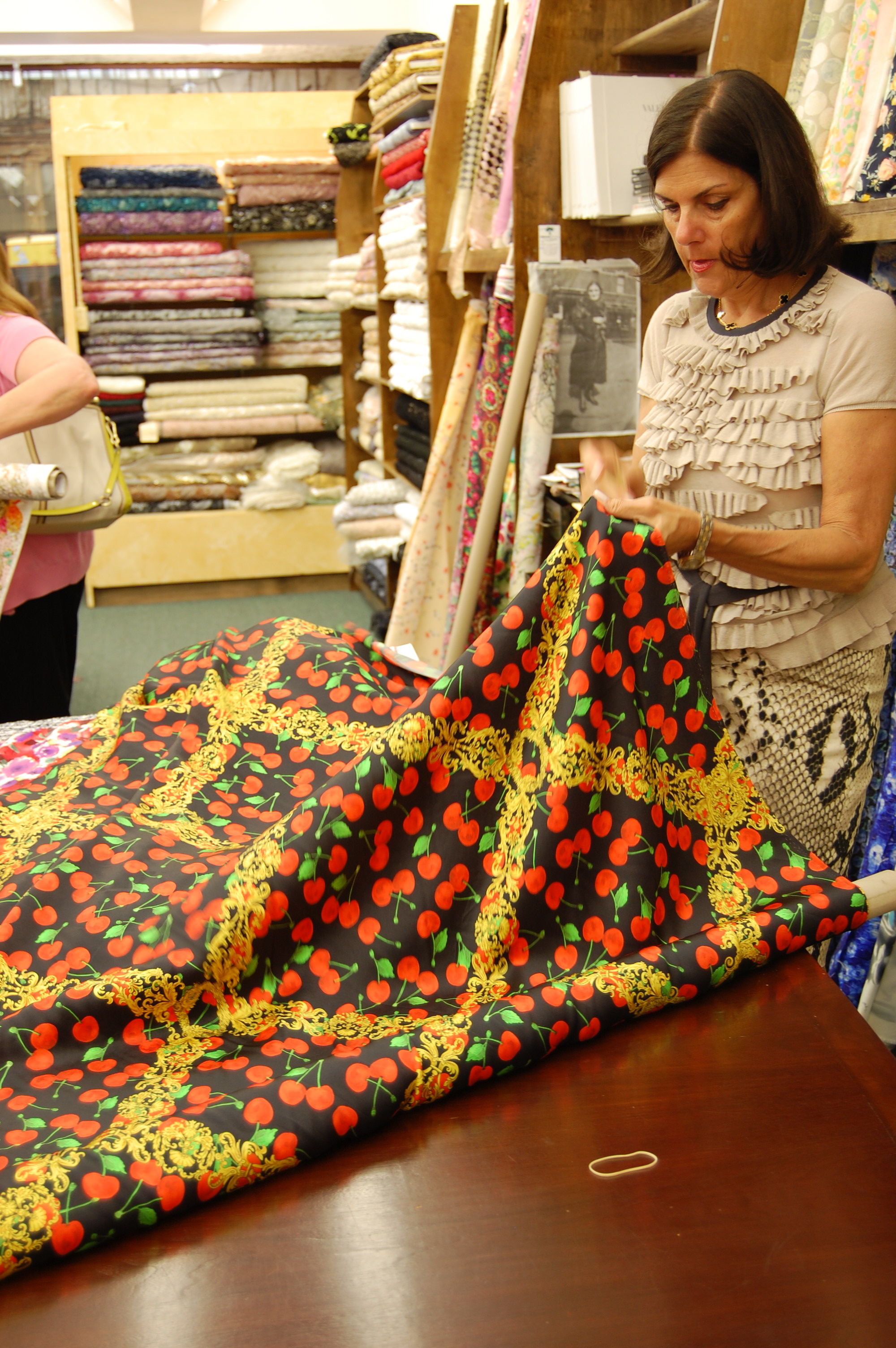
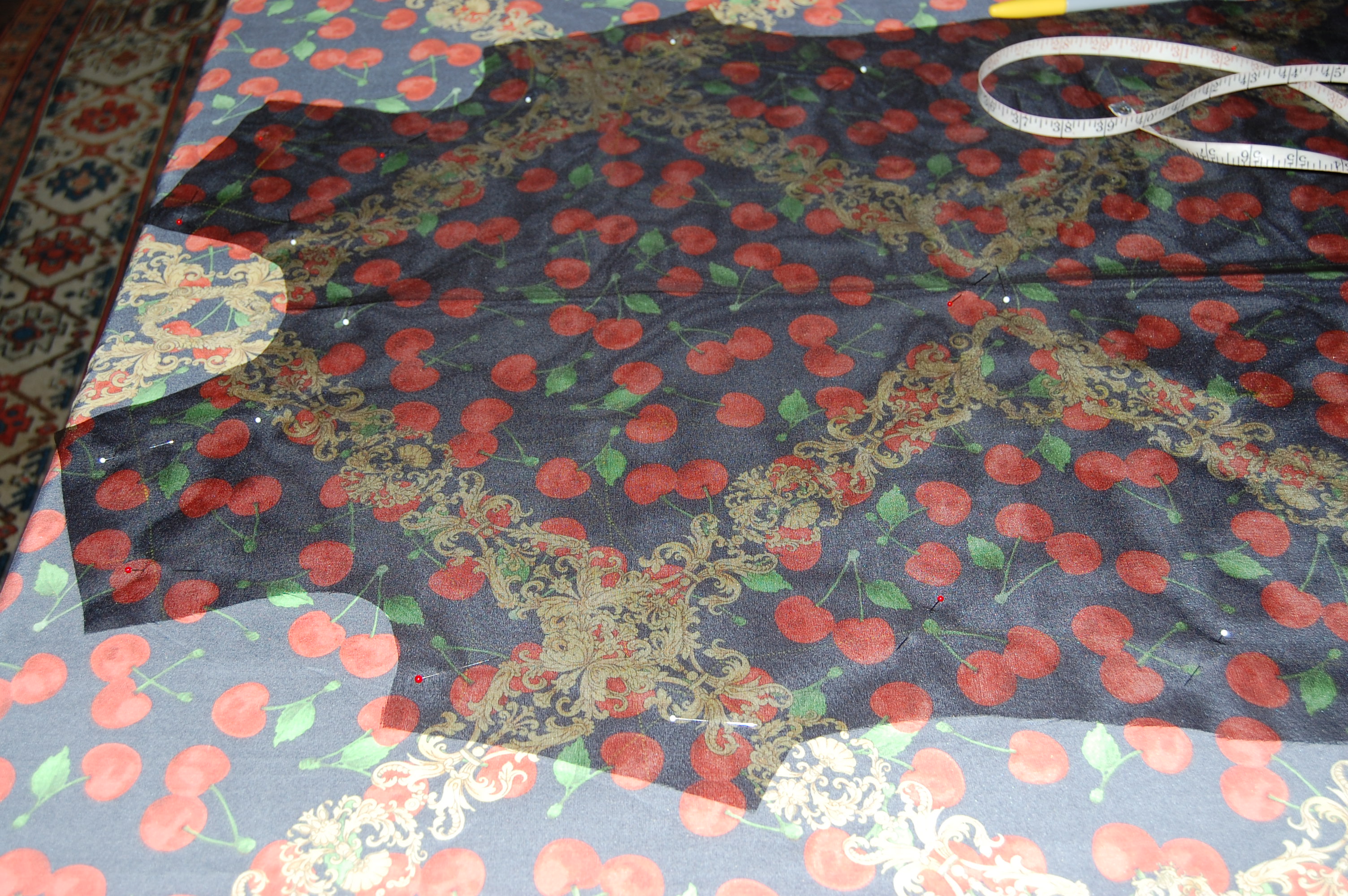
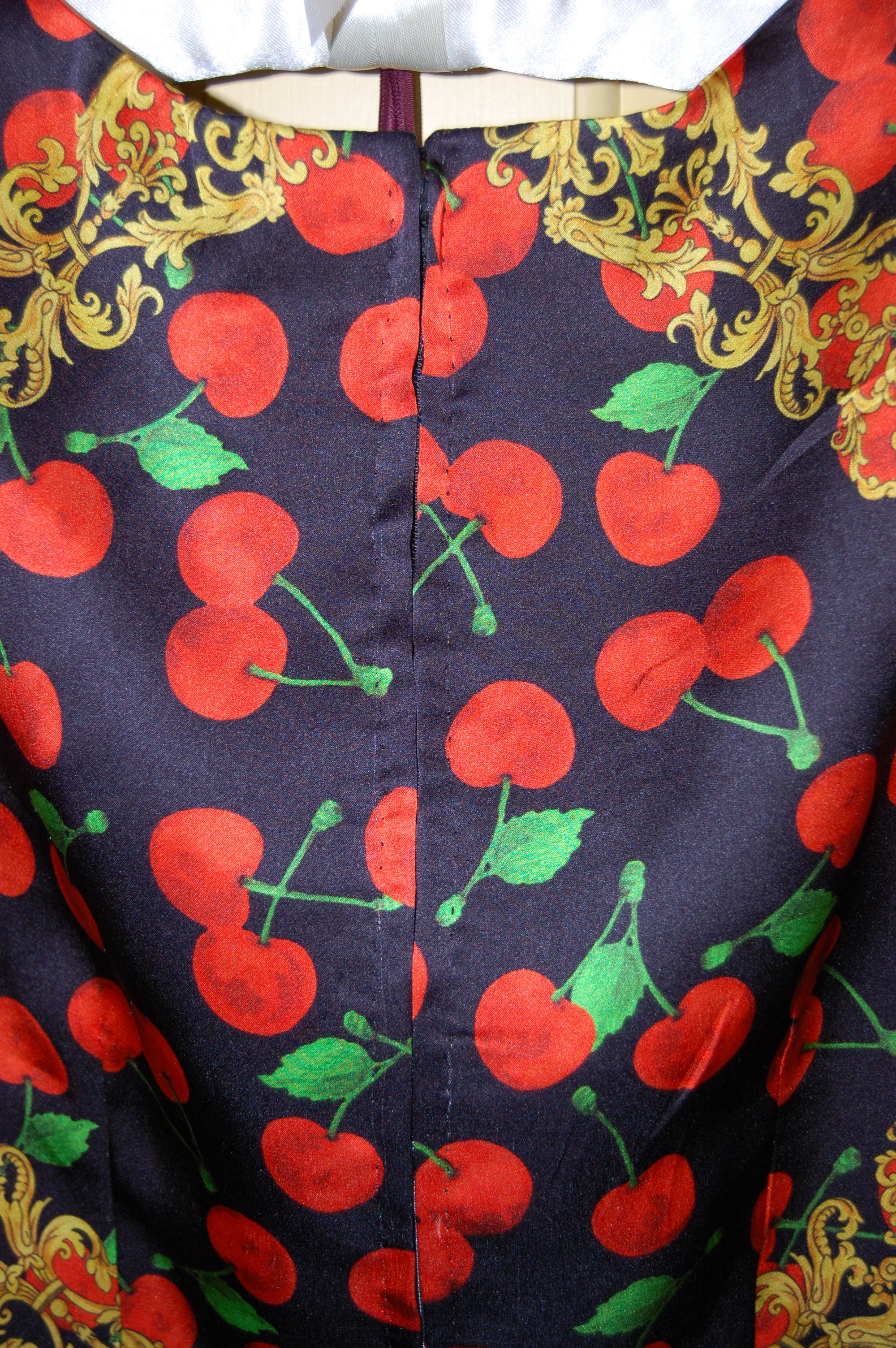
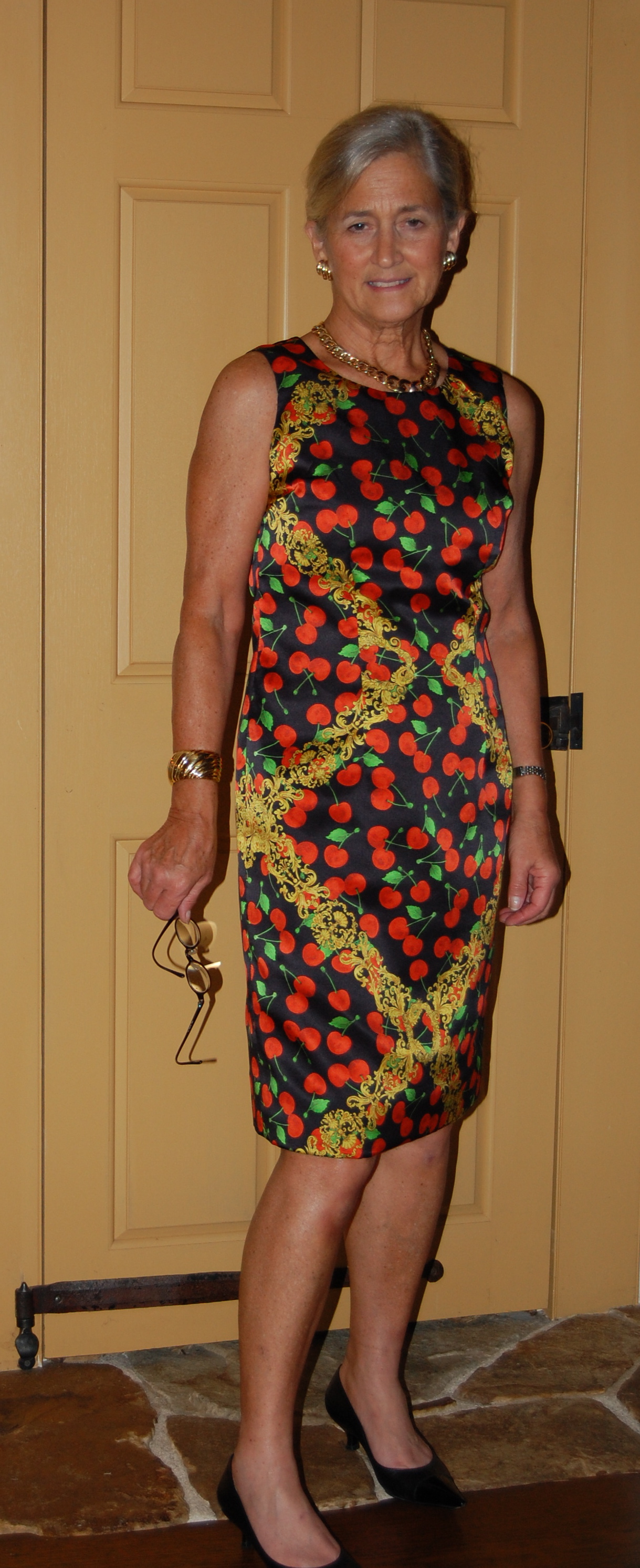
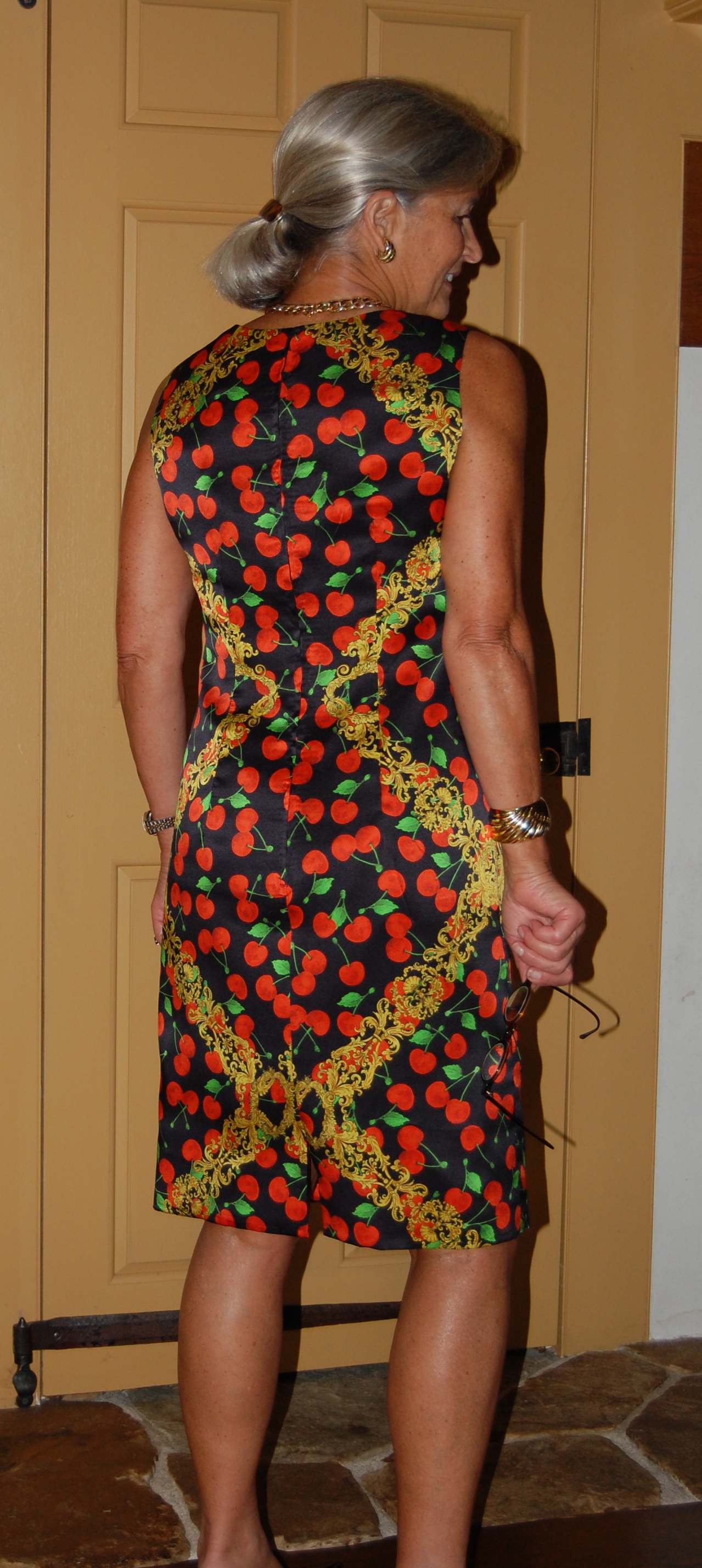
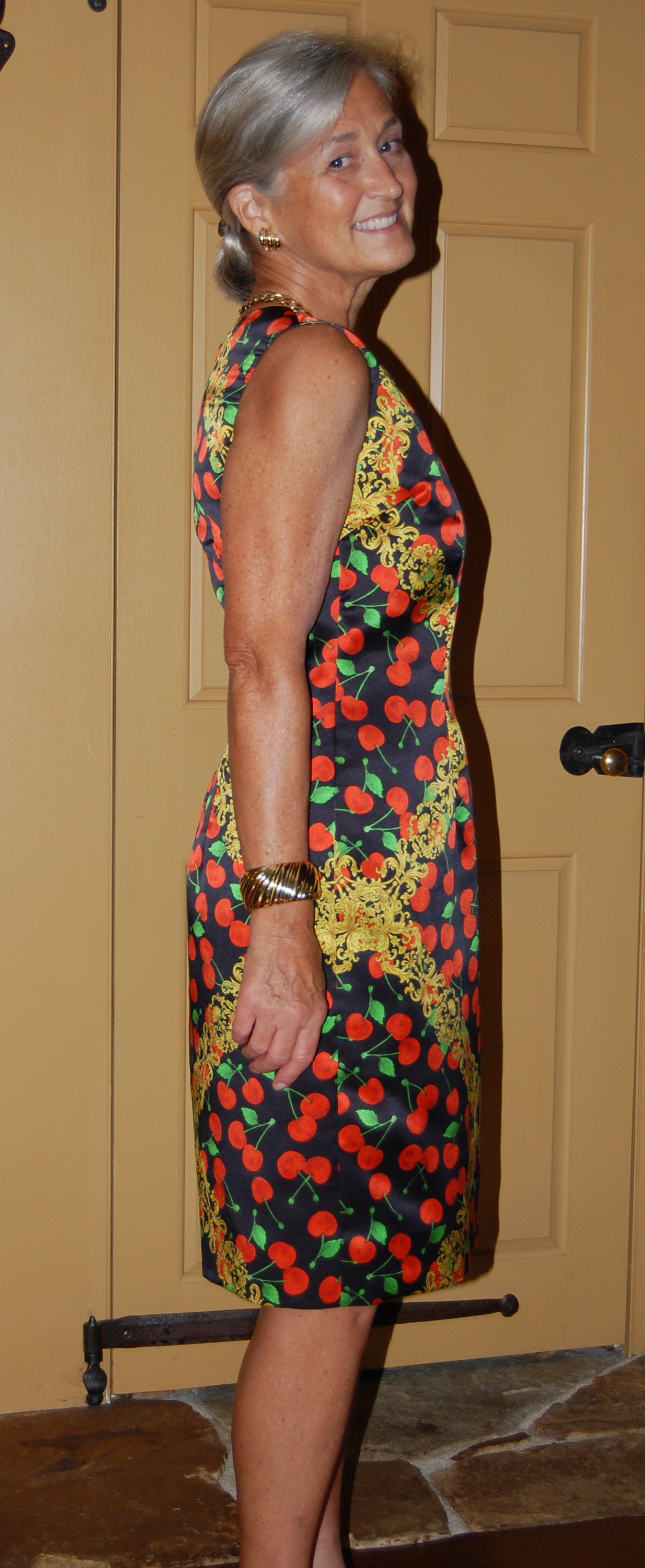
Then I was faced with a design element quandary.  Before I cut out my jacket lining in Susan Khalje’s class, she and I had looked at the fabric with my dress in mind –and had determined that one of the gold “cross” lines in the design should hit at about my breastbone.  However, once I had the fabric remaining from my jacket laid out, I realized that was not going to work.  I tried every which way, and, with the fabric I had available to me, I simply could not match up the pattern in the fabric across the front and two side backs of the pattern and still “cross” my breastbone.  It took a couple of hours, but I finally was able to come up with a new plan – this one to have one of the “cross” details at my waist.  This allowed me to have a shoulder detail I really liked, a black field  (with cherries) at my neckline, and the slimming effect of a “cinched” waist, effected entirely by the design in the fabric!

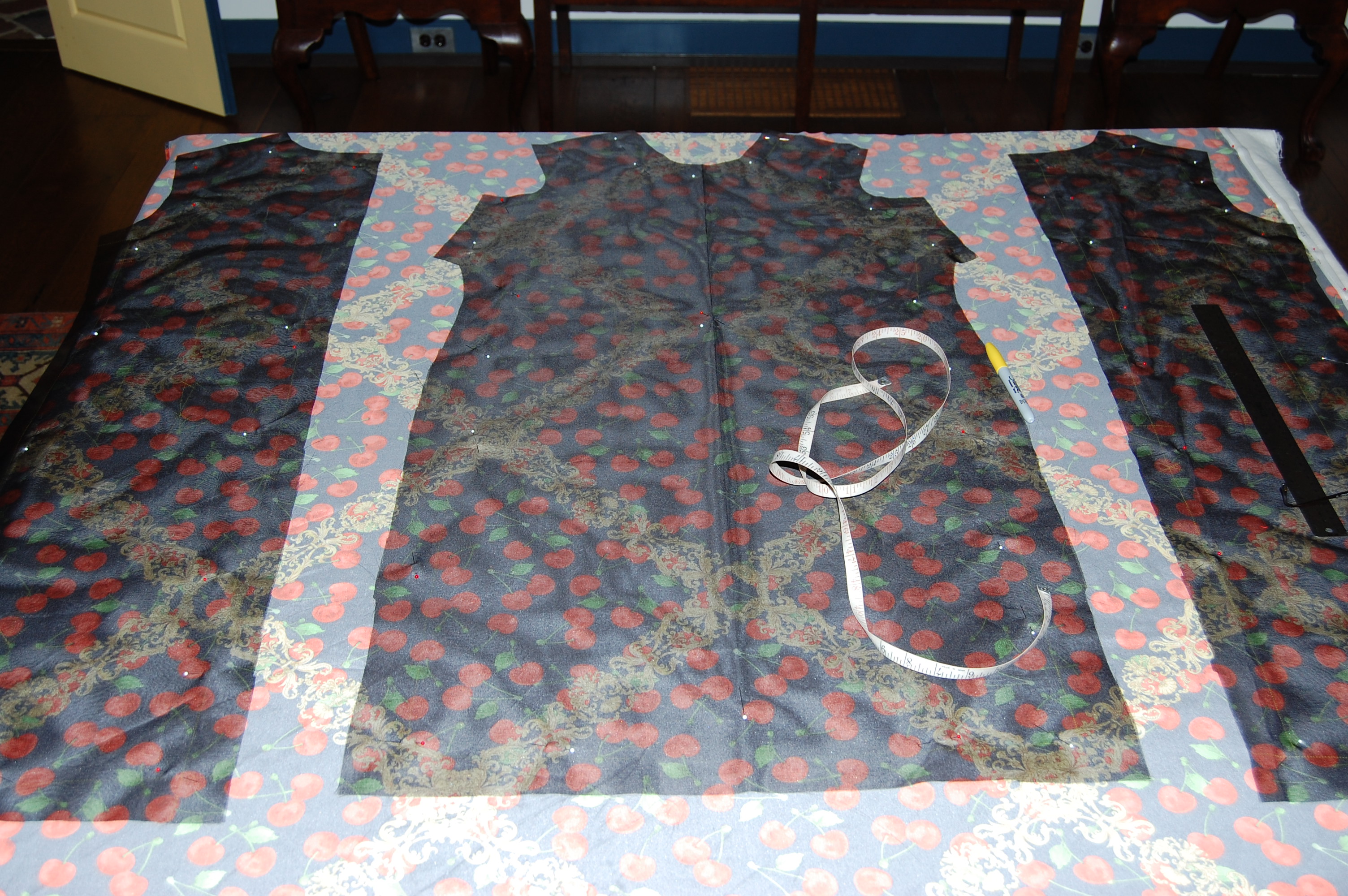
Here are the organza underlining pieces laid out on the fabric.

Here are the organza underlining pieces laid out on the fabric.

This photo shows exactly how I determined where to position the design in the fabric.

This photo shows exactly how I determined where to position the design in the fabric.

Then I was off and sewing!

Zipper and neck details.

Zipper and neck details.

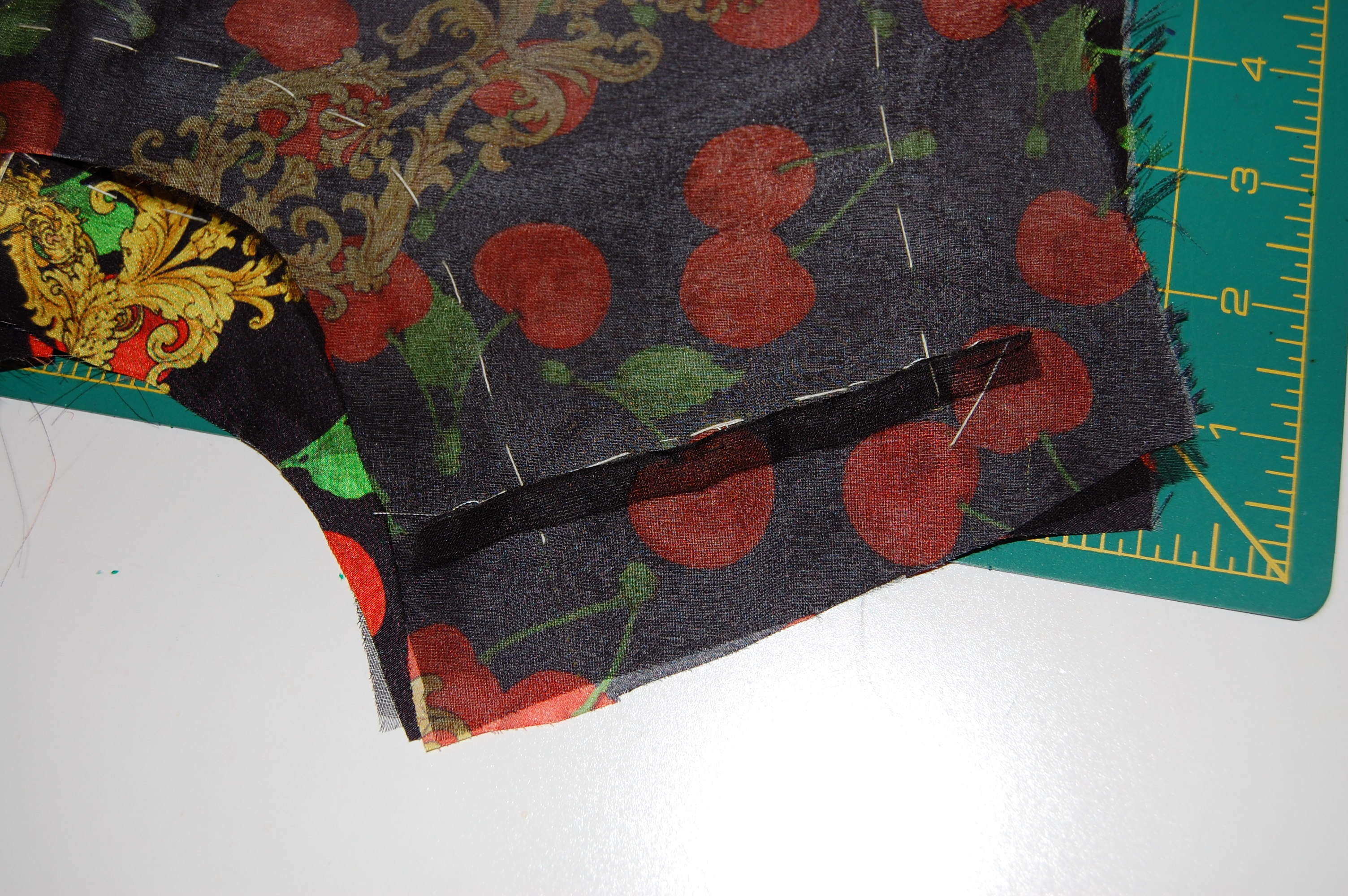
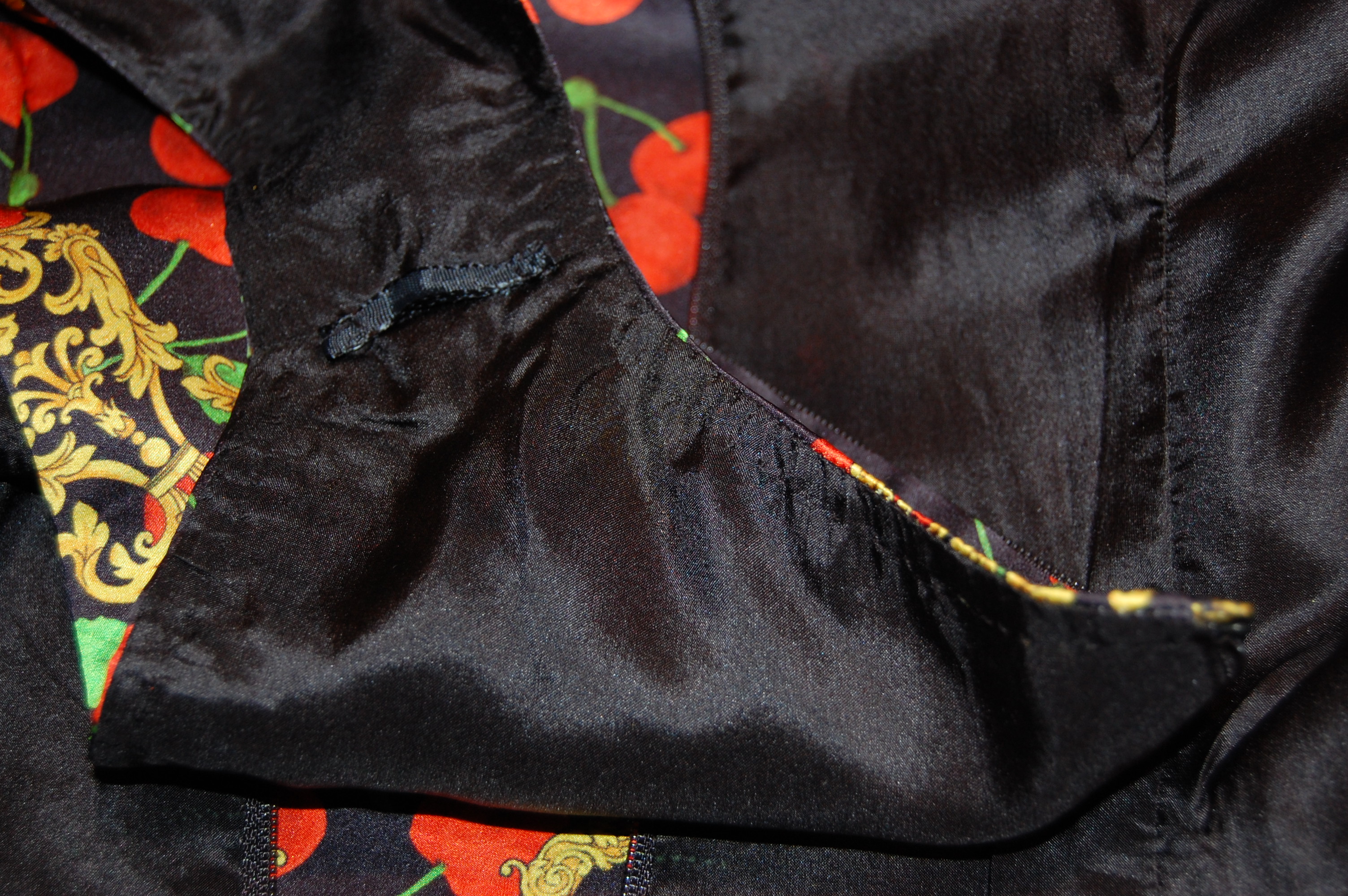
I stabilized the shoulders with a bit of selvedge from the organza underlining.

I stabilized the shoulders with a bit of selvedge from the organza underlining.

A close-up of the hand-picked zipper.

A close-up of the hand-picked zipper.

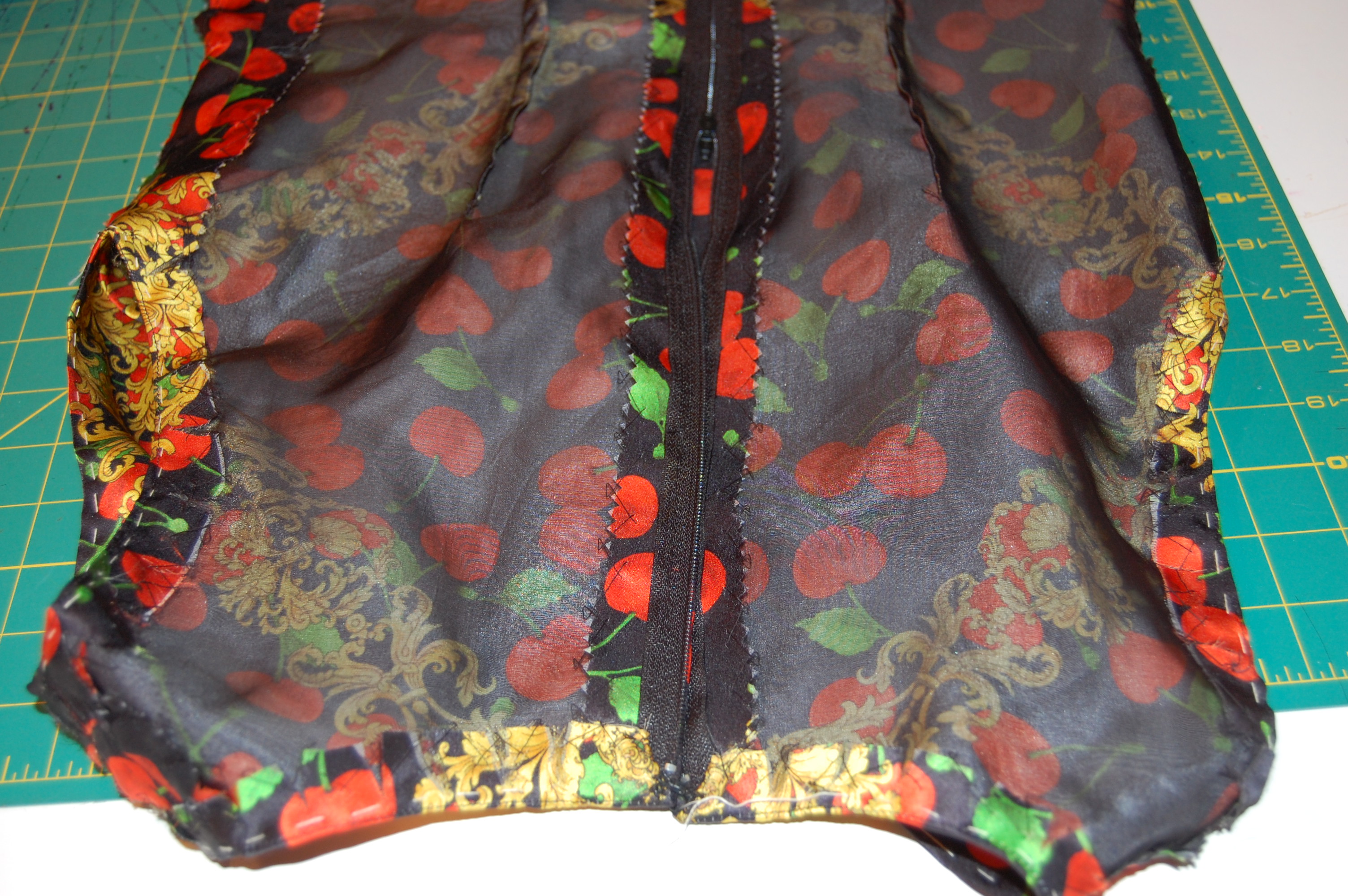
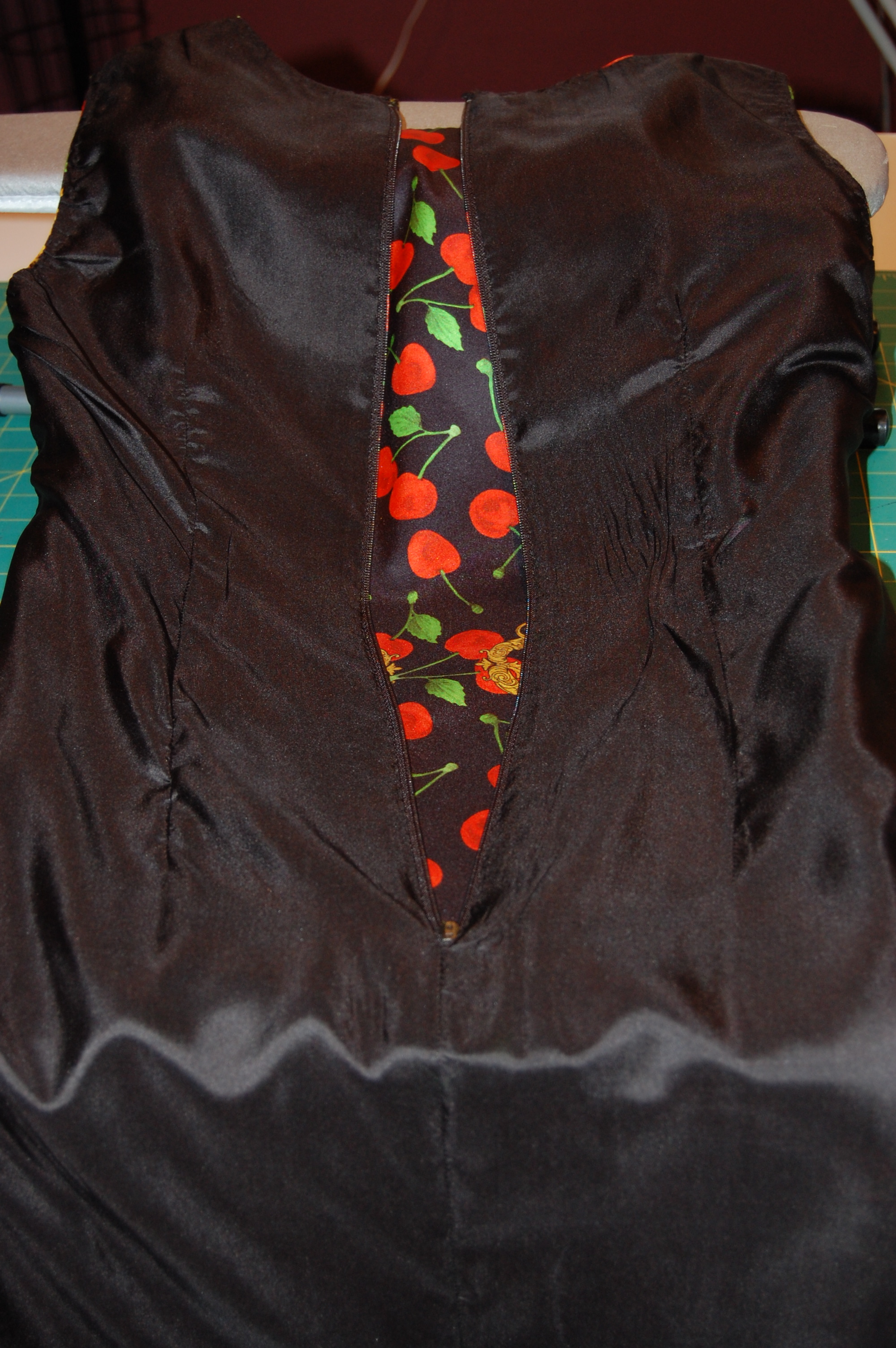
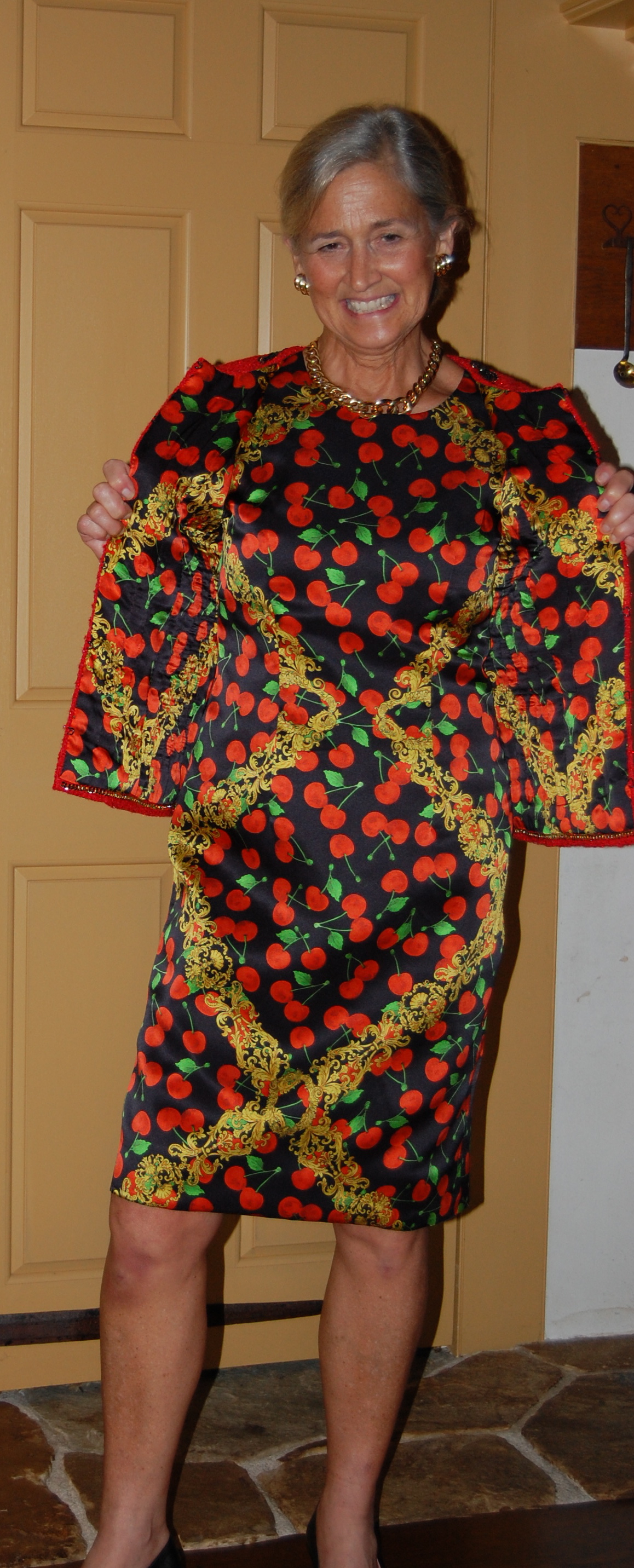
The dress turned inside out!

The dress turned inside out.

A detail of the shoulder and neck edge.

A detail of the shoulder and neck edge.

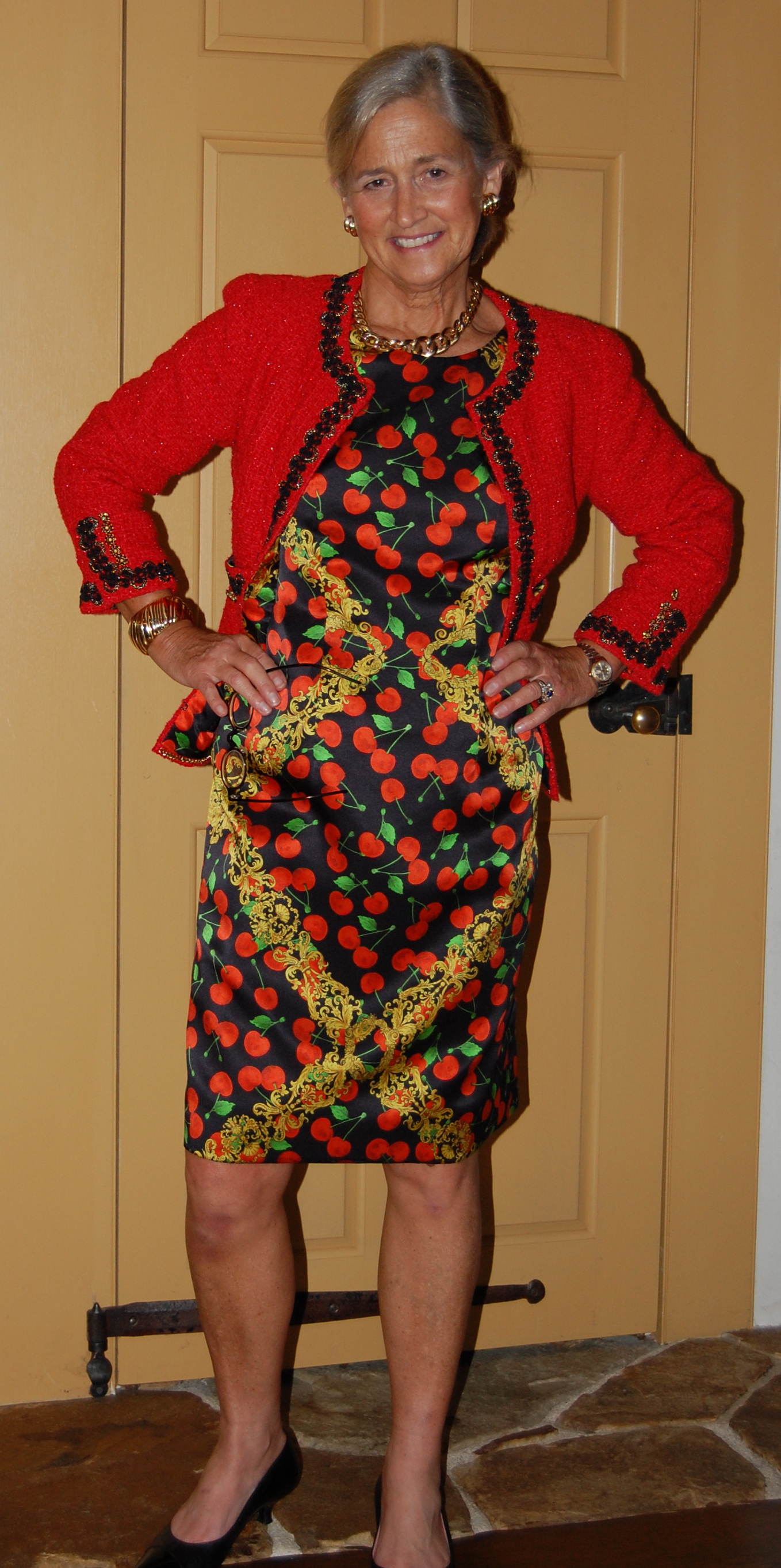
Finished!  What do you think?  Too demonstrative or just right?

Finished! What do you think? Too demonstrative or just right?

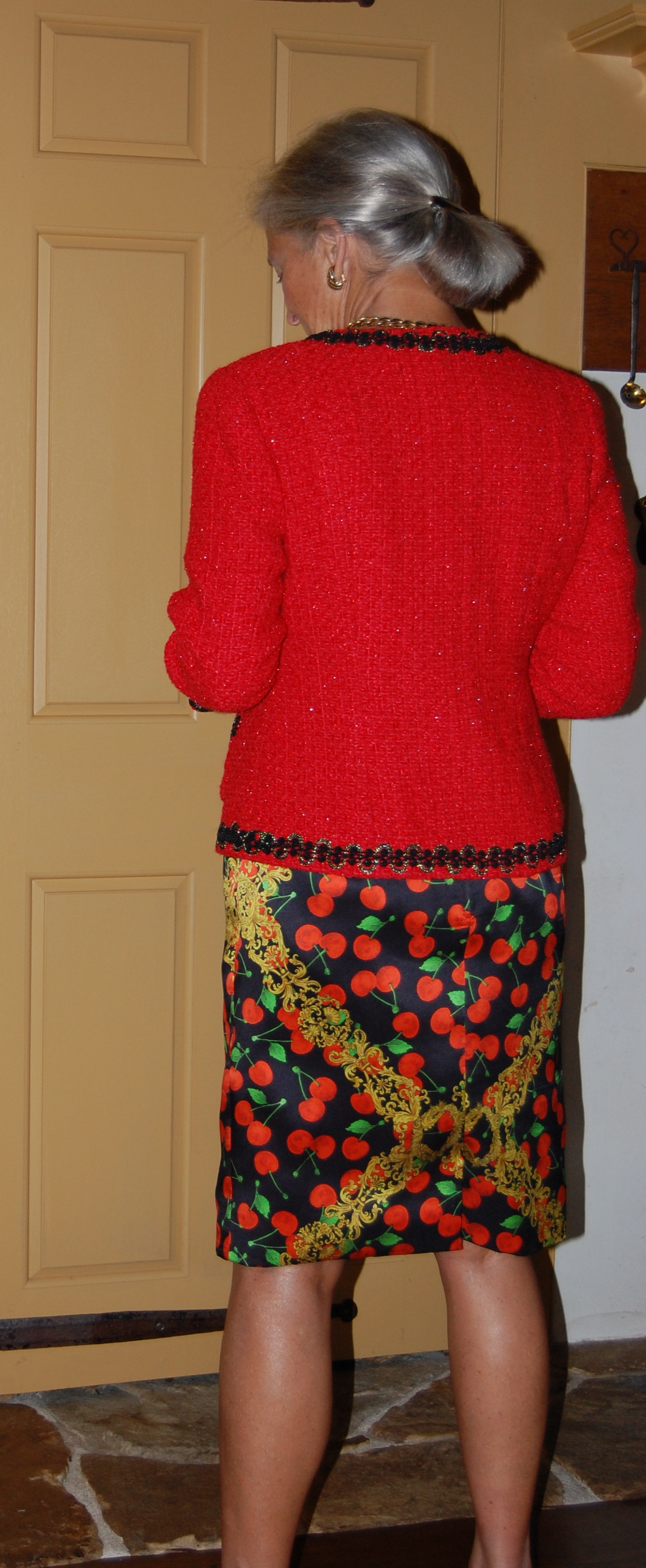
A back view.

A back view.

A side view

A side view

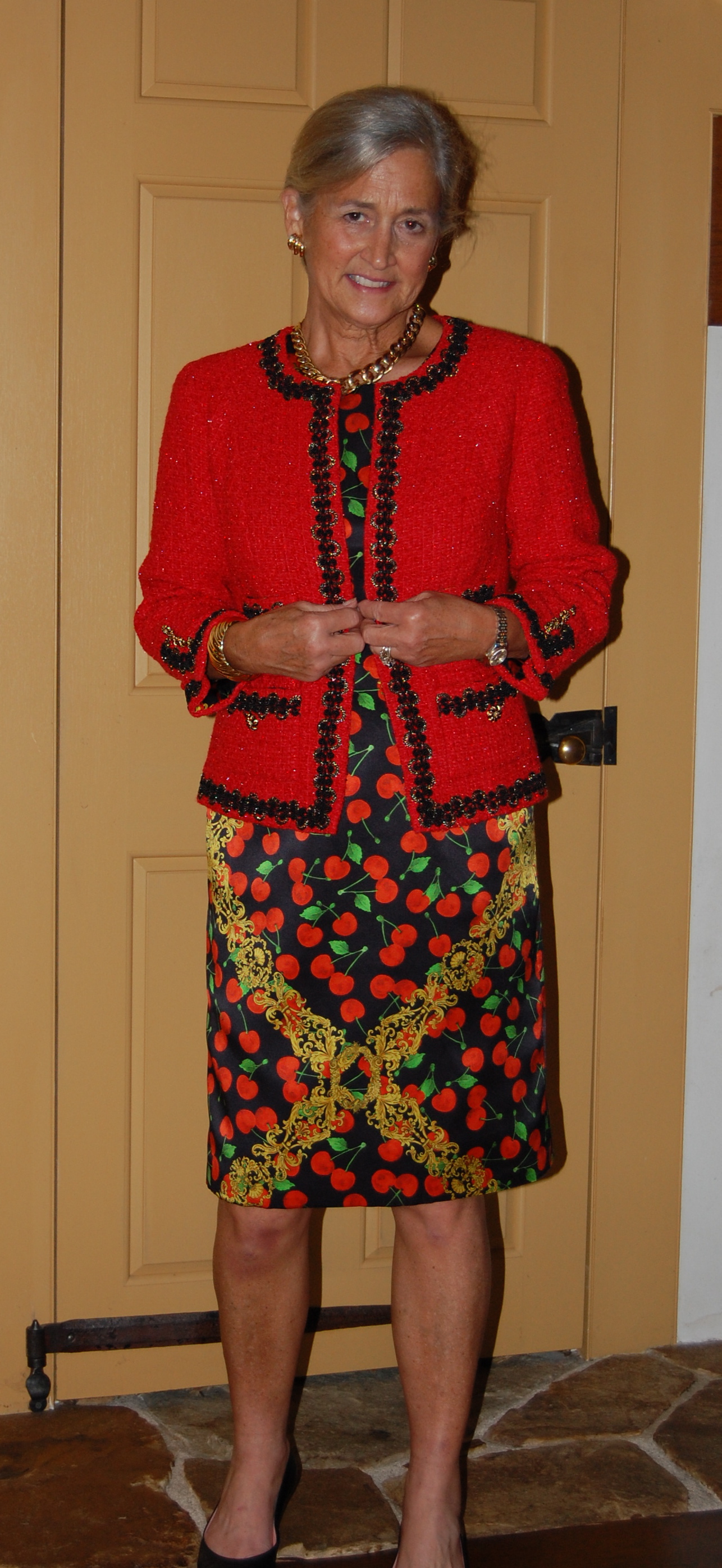
And, of course, I have to show the dress with its Chanel-inspired jacket:

A simple sheathA simple sheath

A simple sheath

This project is complete!

This project is complete!

Once again, I underestimated just how long it takes to make a dress using all couture techniques – even a simple (?) sheath dress.

Was it worth it?  Absolutely!

39 Comments

Filed under Chanel-type jackets, couture construction, hand-sewn zippers, sewing in silk, Uncategorized, underlinings

Shopping for Fabric

Are there any more magical words for those of us who sew?  And what if that shopping trip is to New York City to visit Mendel Goldberg Fabrics?  For those of you unfamiliar with this exceptional purveyor of the finest fabrics, this short statement in their recent (and first) ad in Threads Magazine will help to acquaint you:  “This family-owned business carries European designer fabrics, from French lace to brocades, boucles, Italian silk prints and novelties.  You’ll be amazed by their selection of imported couture fabrics.”

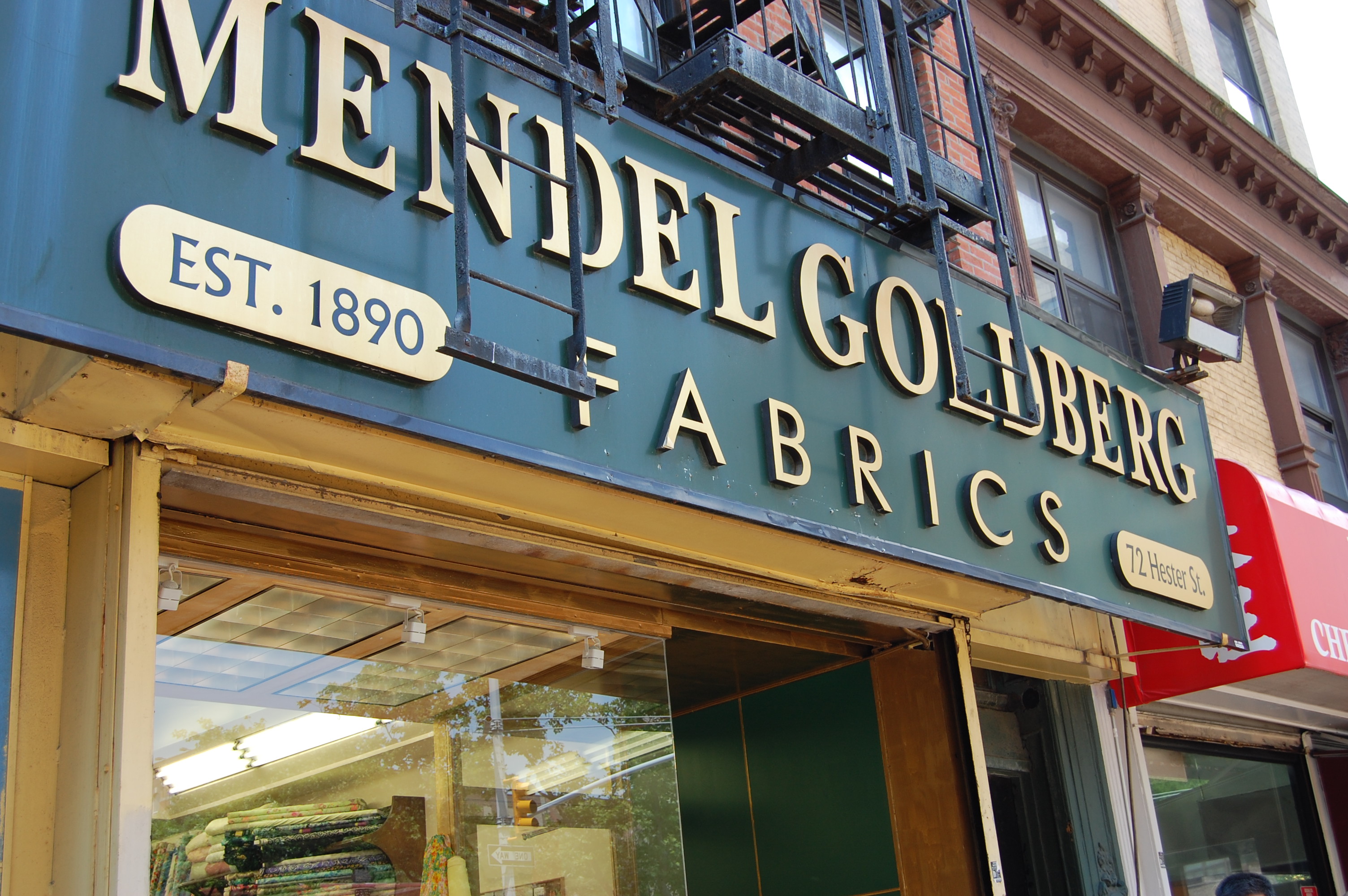
The distinctive sign for Mendel Goldberg Fabrics on Hector Street in NYC.

The distinctive sign for Mendel Goldberg Fabrics on Hester Street in NYC.

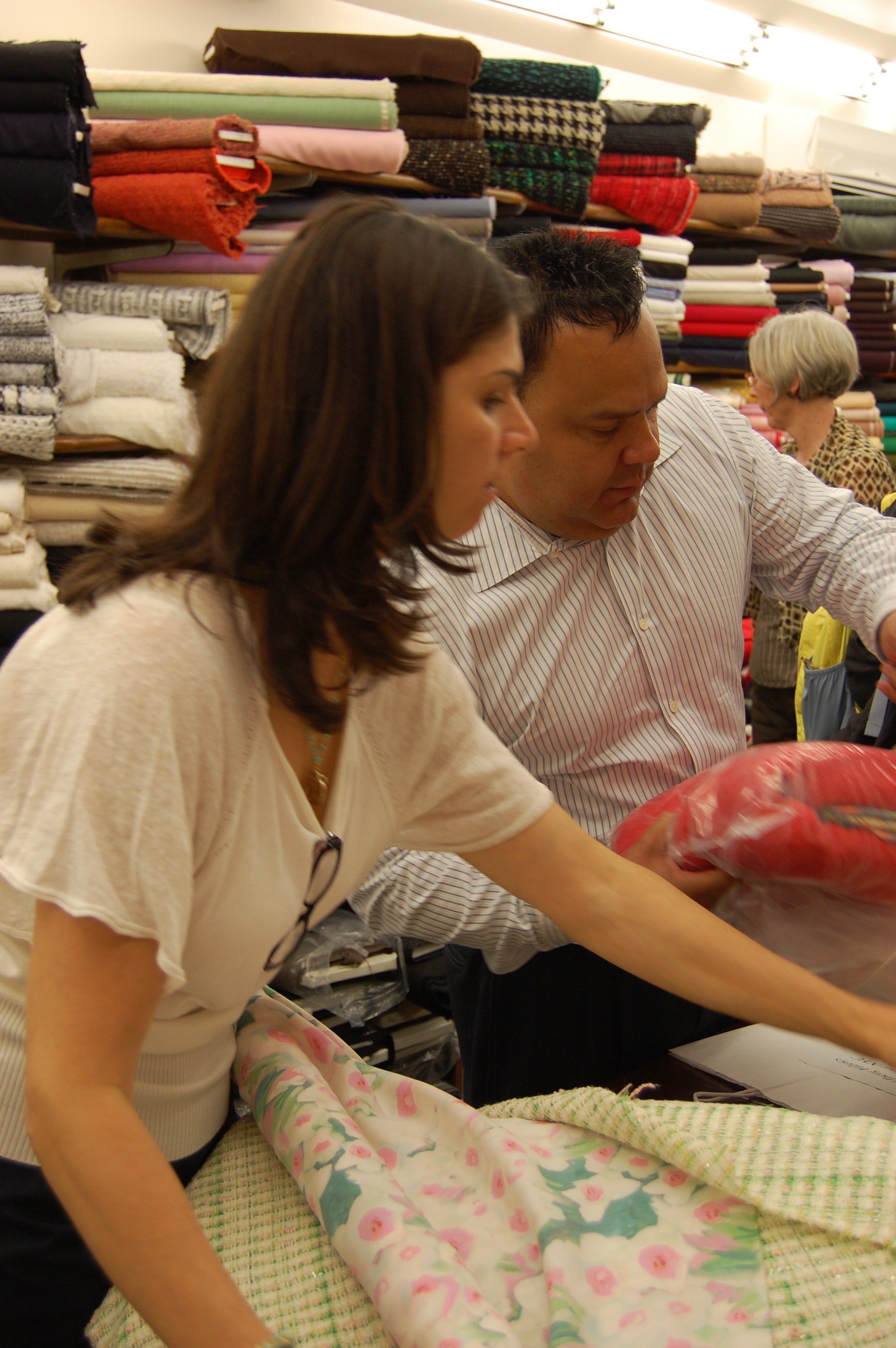
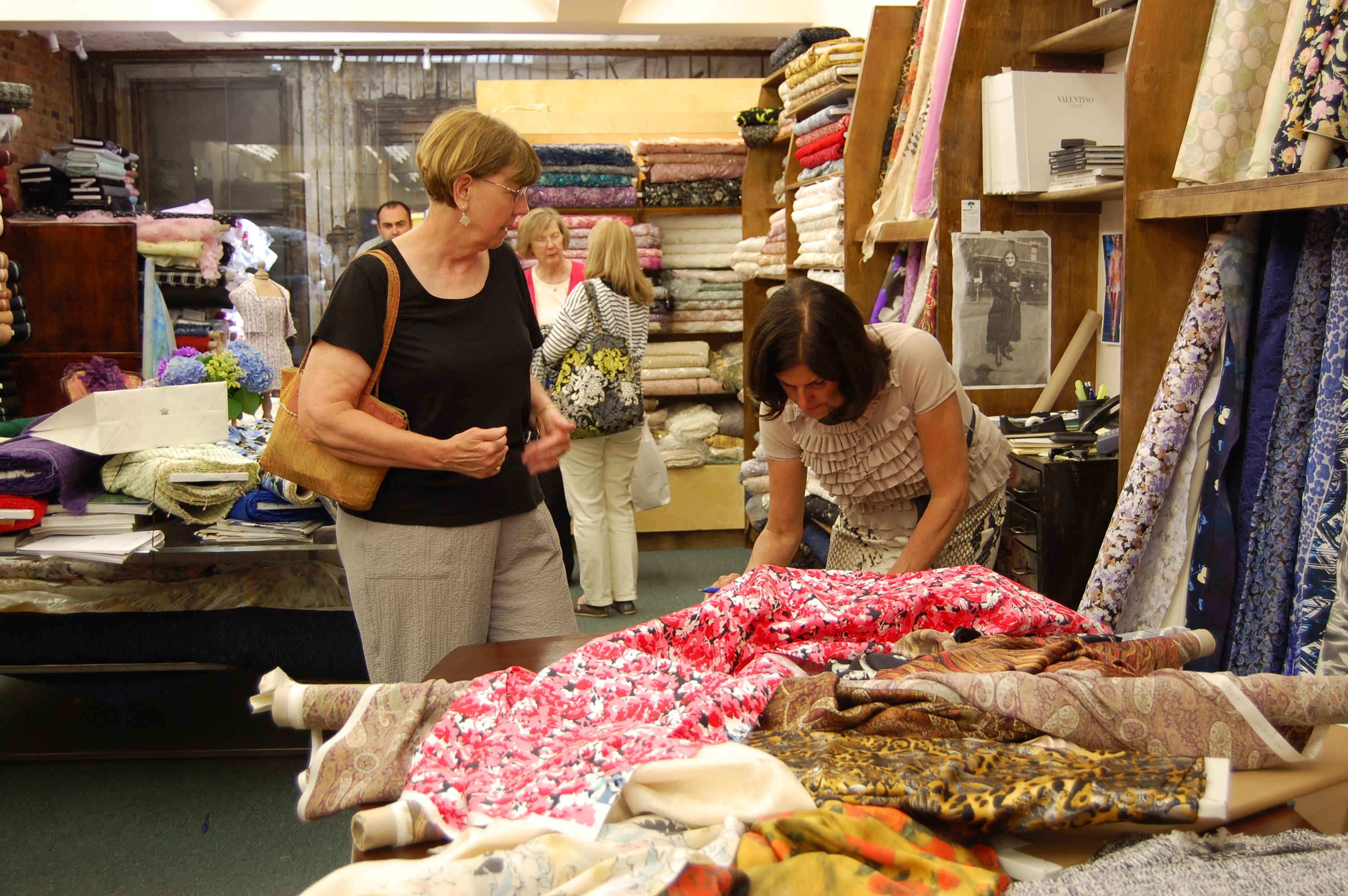
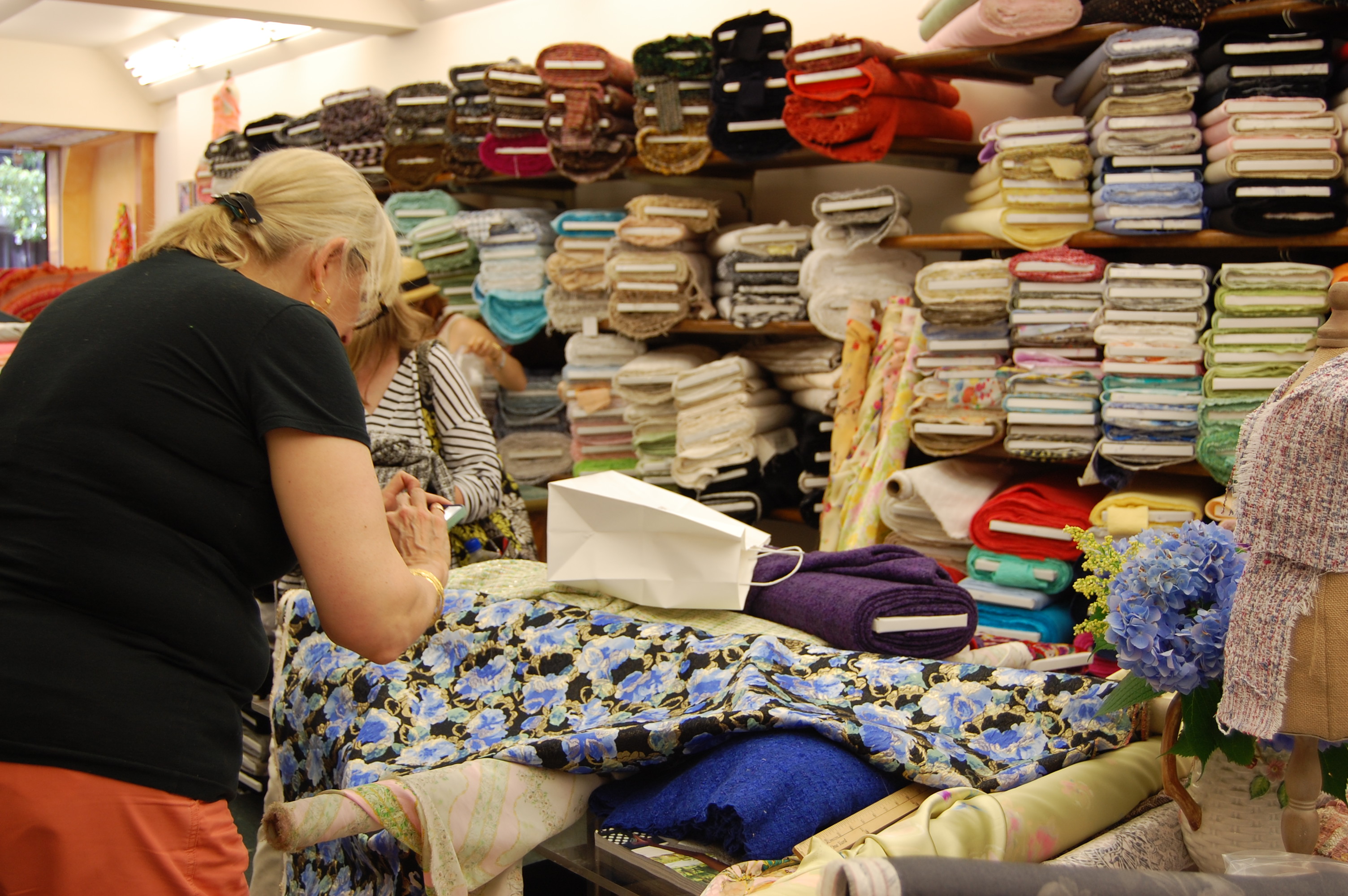
Well, amazed we were – all 11 of us who visited Mendel Goldberg Monday a week ago (June 24) on the first day of our class with Susan Khalje – The Classic French Jacket.  We were also just a little bit giddy (no, we were actually unabashedly giddy) as we viewed the treasures before us.  However, I am getting ahead of myself . . .

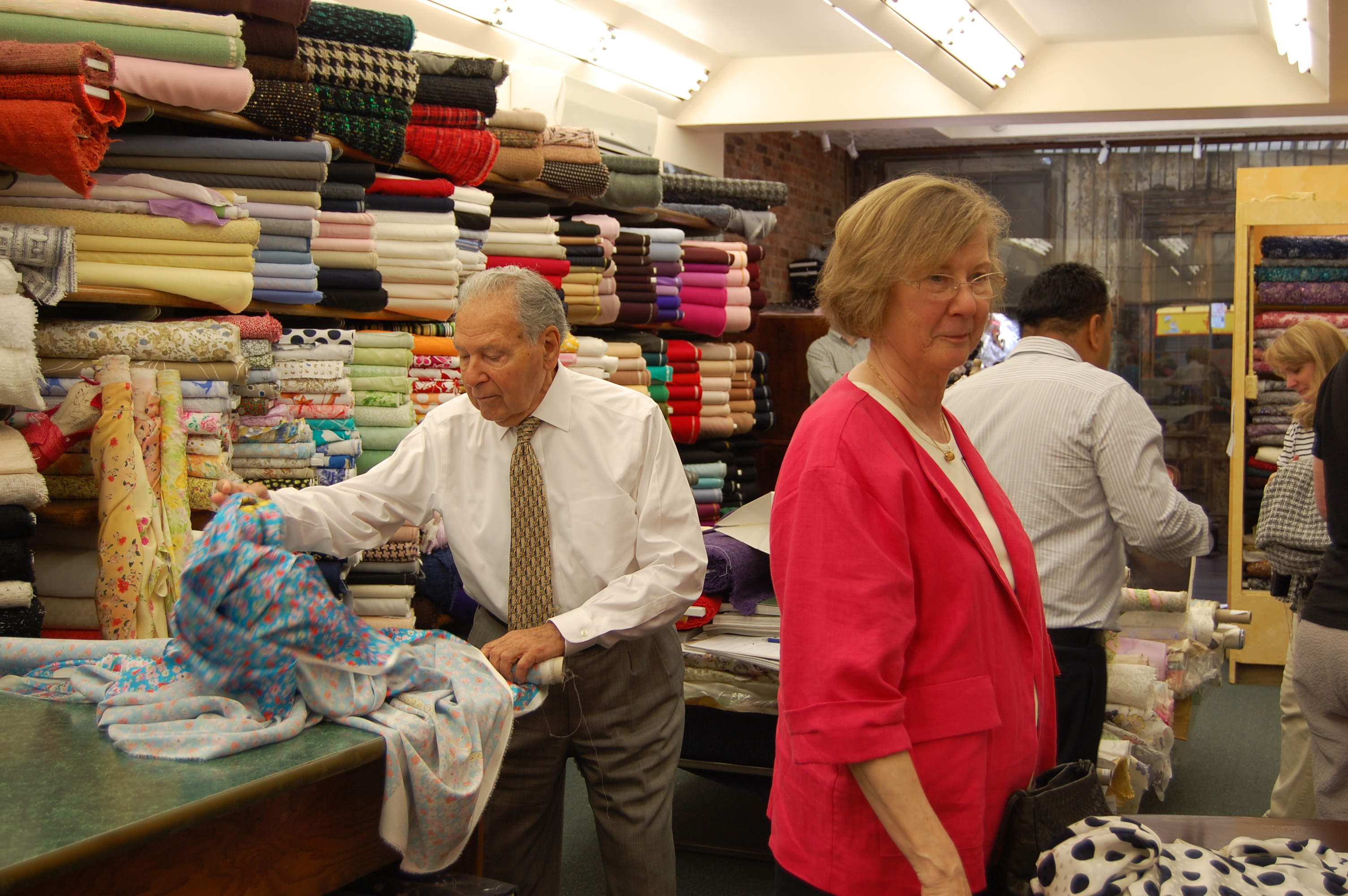
Arriving at the store after our 4-hour drive from Baltimore, we were enthusiastically and graciously met by Alice, the proprietress whose great-grandfather started the business in 1890.  Her daughter Josie works with her, and they are assisted by long-time employee Louis.  Also there to help us was Pierre, a young Frenchman who was interning with the business for two months.

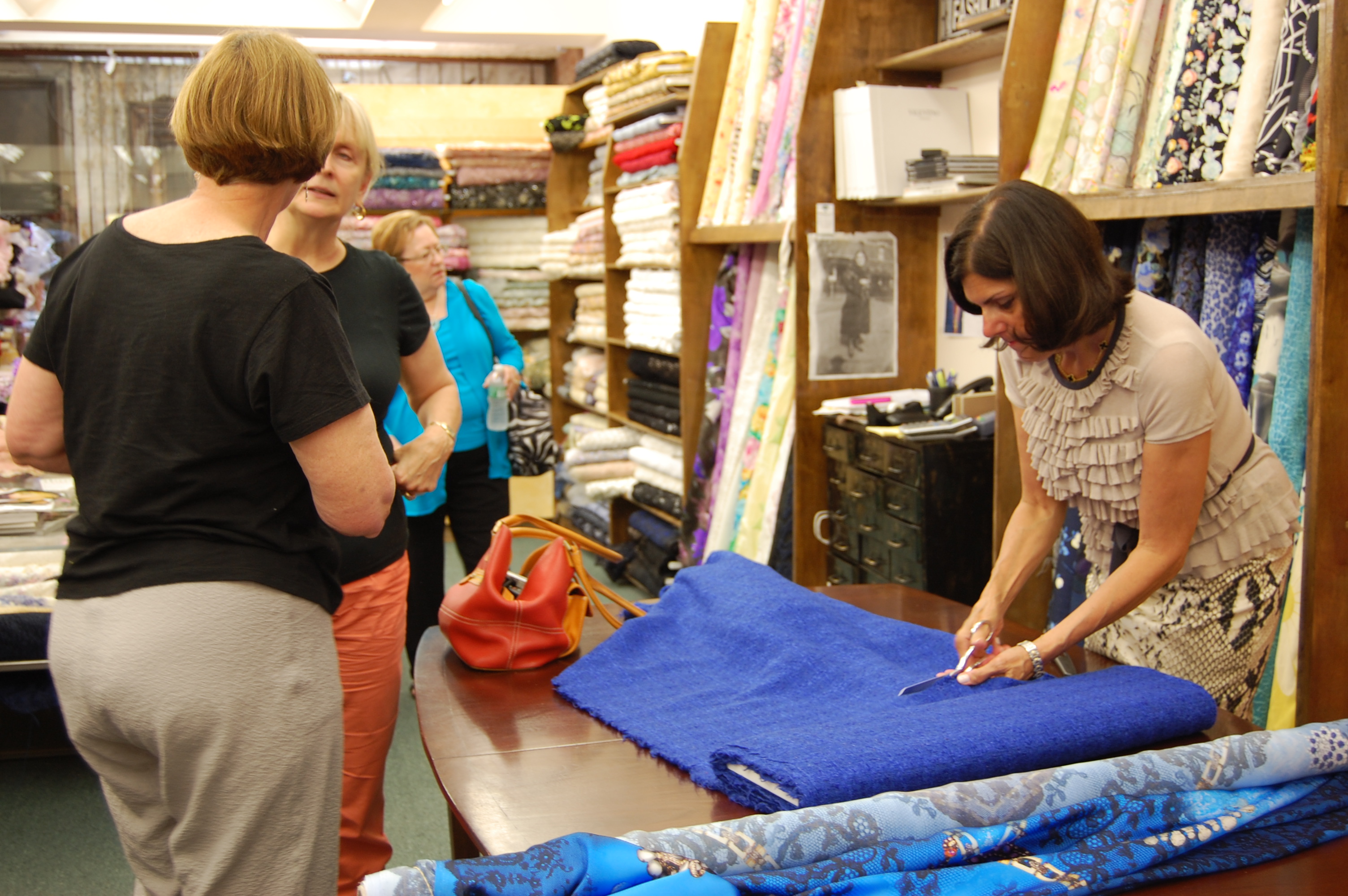
Alice is on the right, in a pose seen often - cutting fabric.

Alice is on the right, in a pose often seen – cutting fabric.

Josie and Louis

Josie and Louis

Pierre shown here in front of all those luscious fabrics.

Pierre shown here in front of all those luscious fabrics.

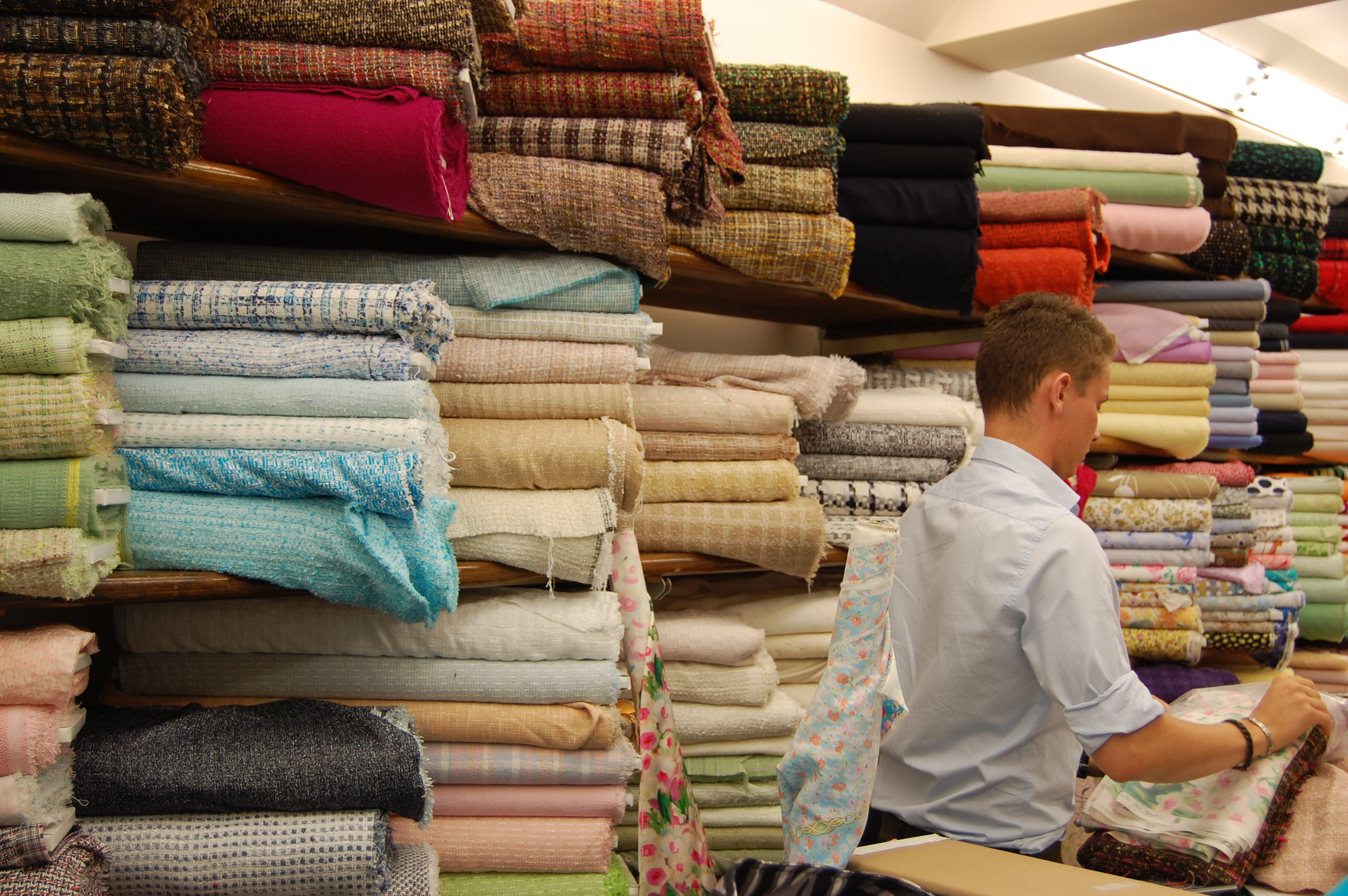
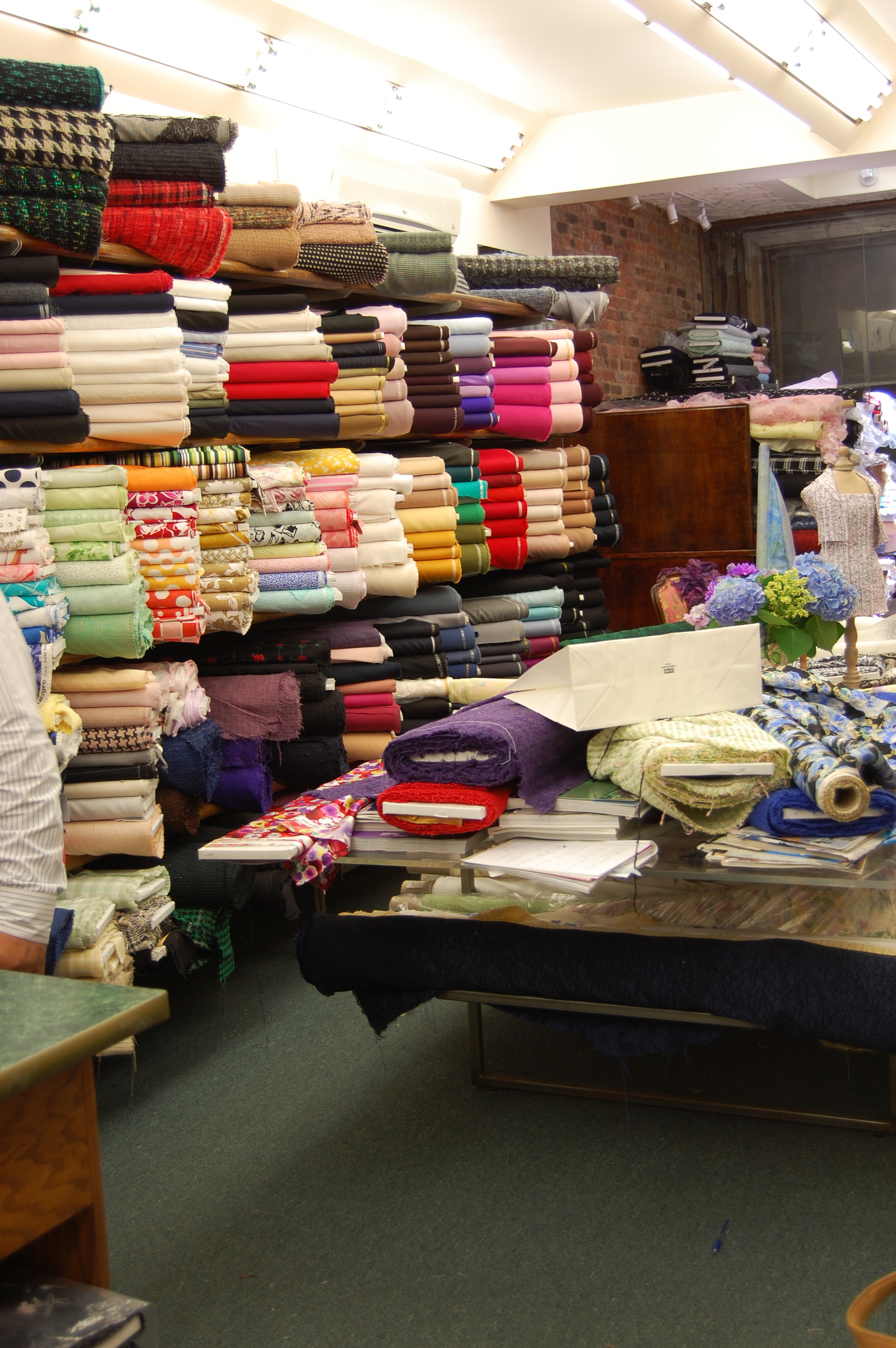
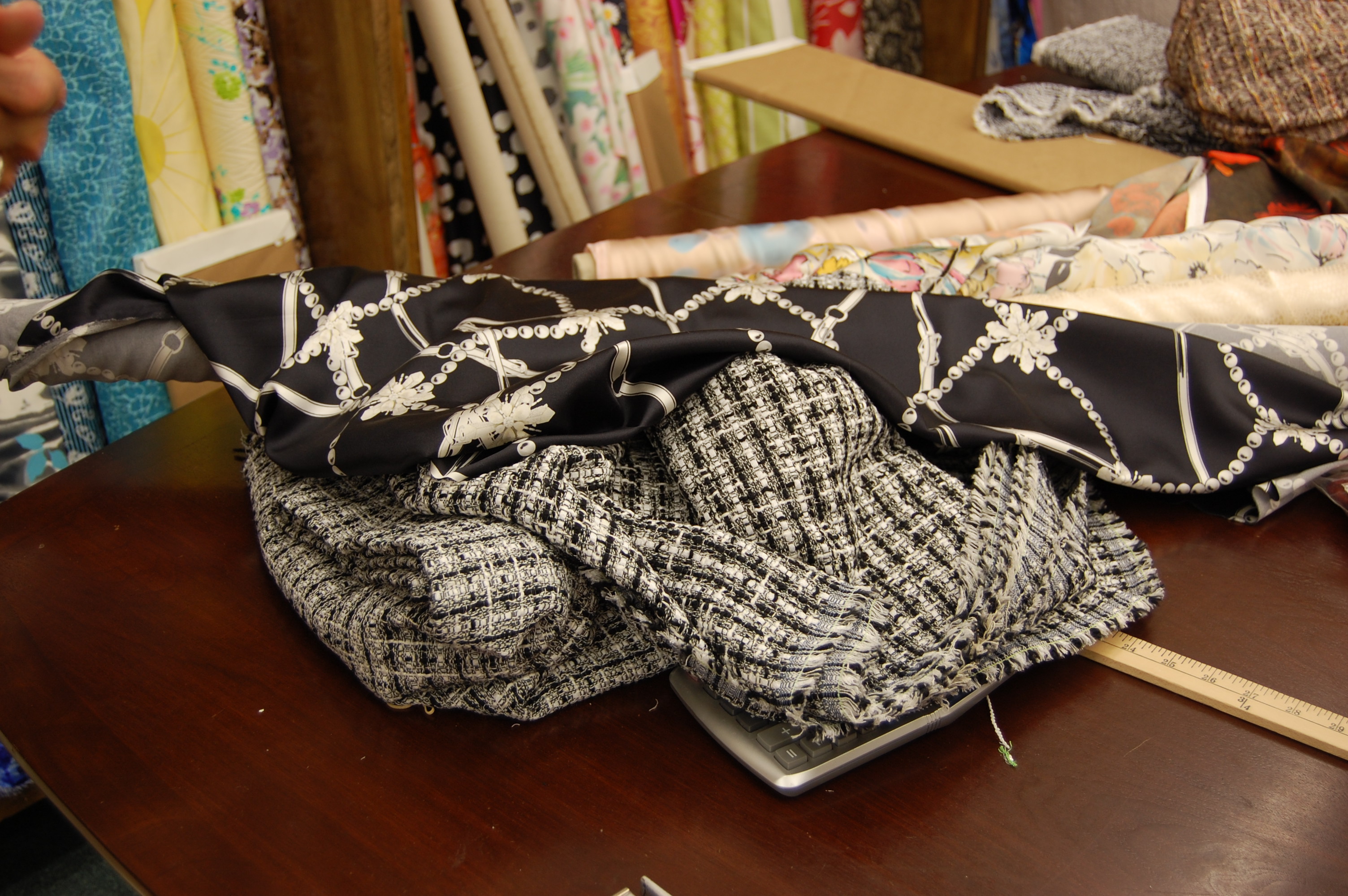
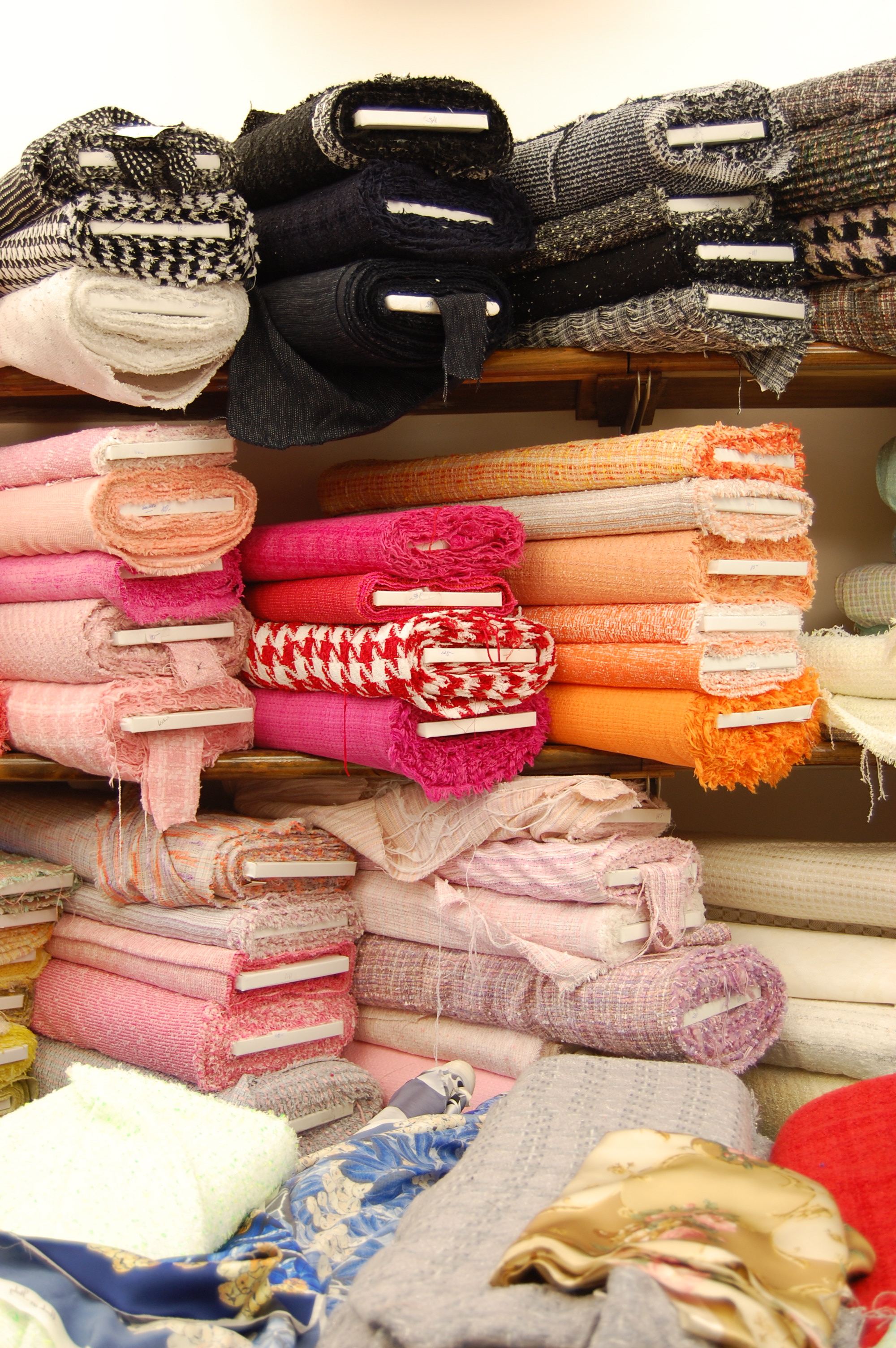
Our mission was to find and purchase our fabrics for the week-long class.  Thus – each of us needed to decide on a boucle for the jacket, and a silk charmeuse (the preferred fabric) for our lining.  The quantity of boucle fabric which Mendel Goldberg carries makes one’s decision fraught with “how can I ever narrow this down to just one?”  Well, of course, being the intrepid shoppers that we were, many of us actually could not narrow down our choice to just one.  Is it any surprise that many more than just 11 lengths each of boucle and charmeuse yardage were cut that day?

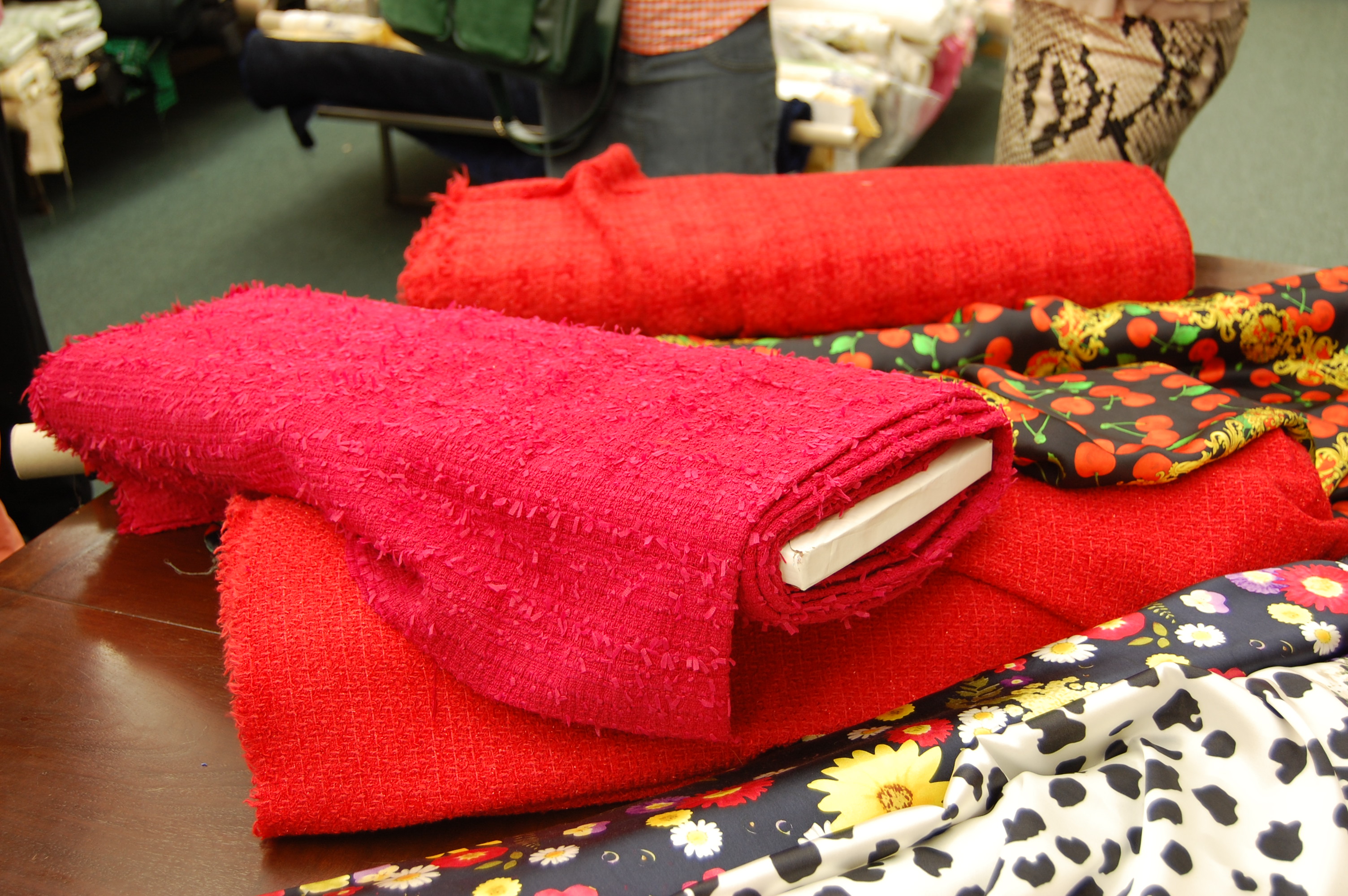
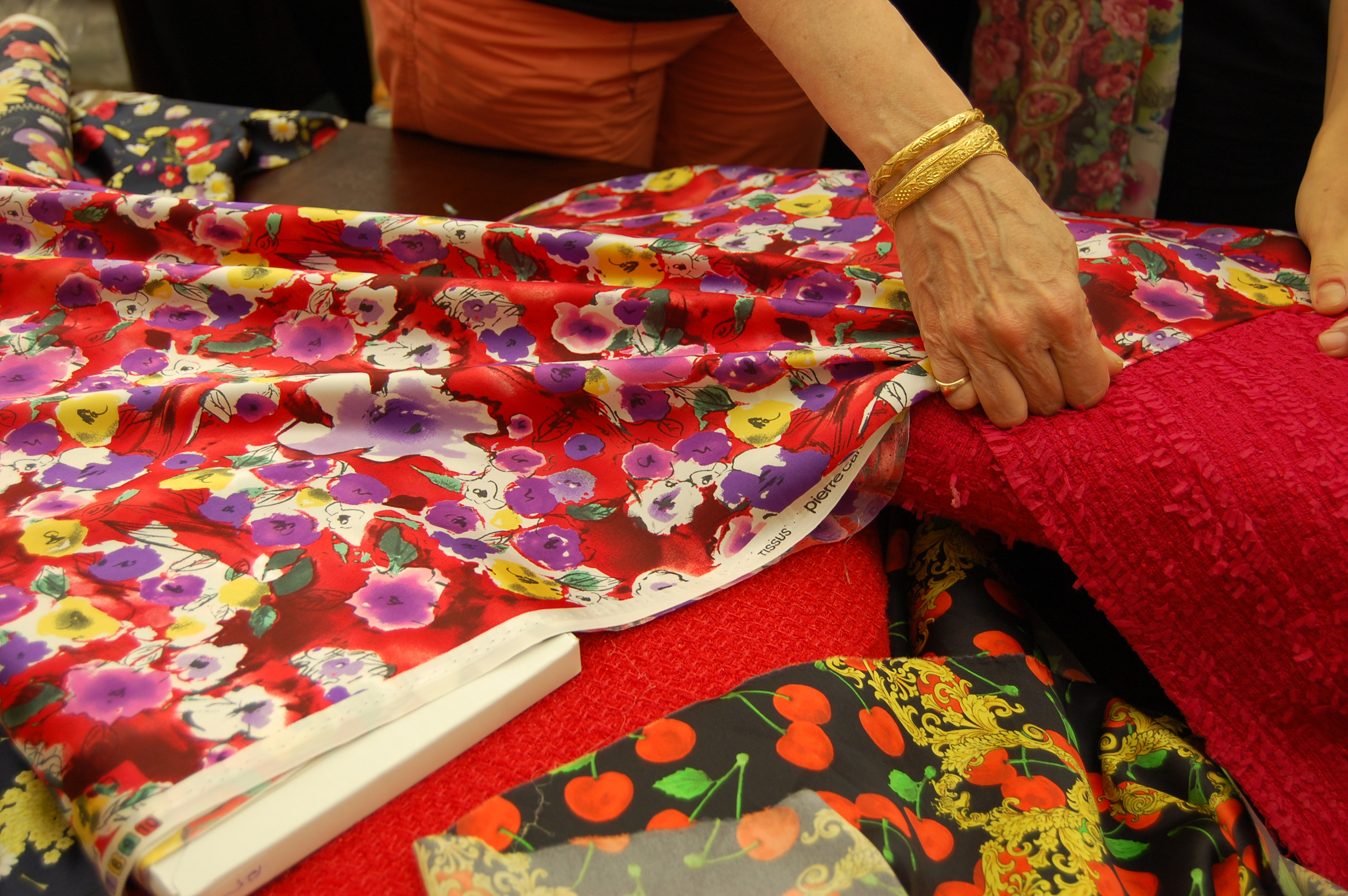
Bolts and bolts of boucles and other fabrics.

Bolts and bolts of boucles and other fabrics.

Just a small sampling of the boucles from which to choose.

Just a small sampling of the boucles from which to choose.

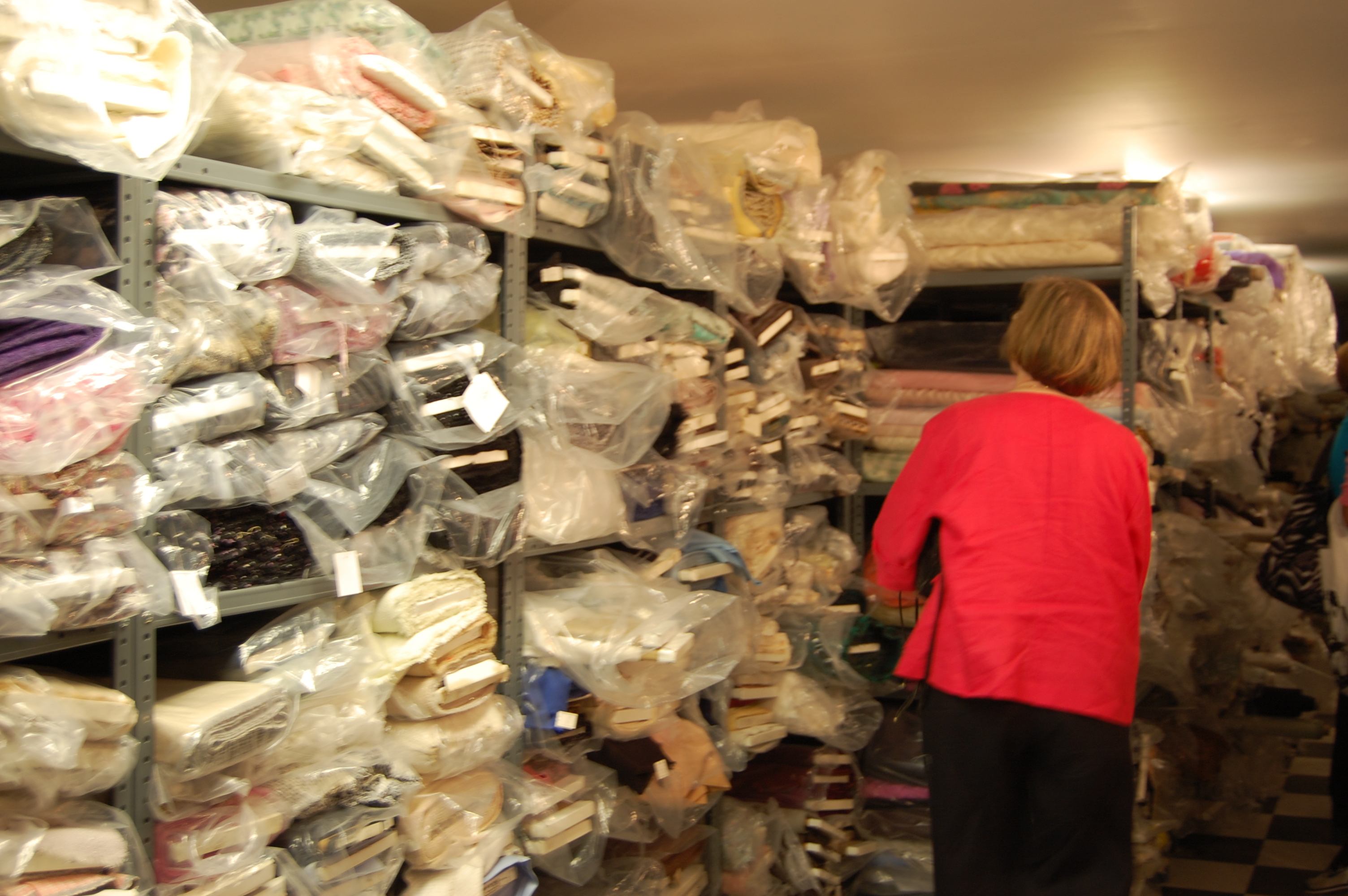
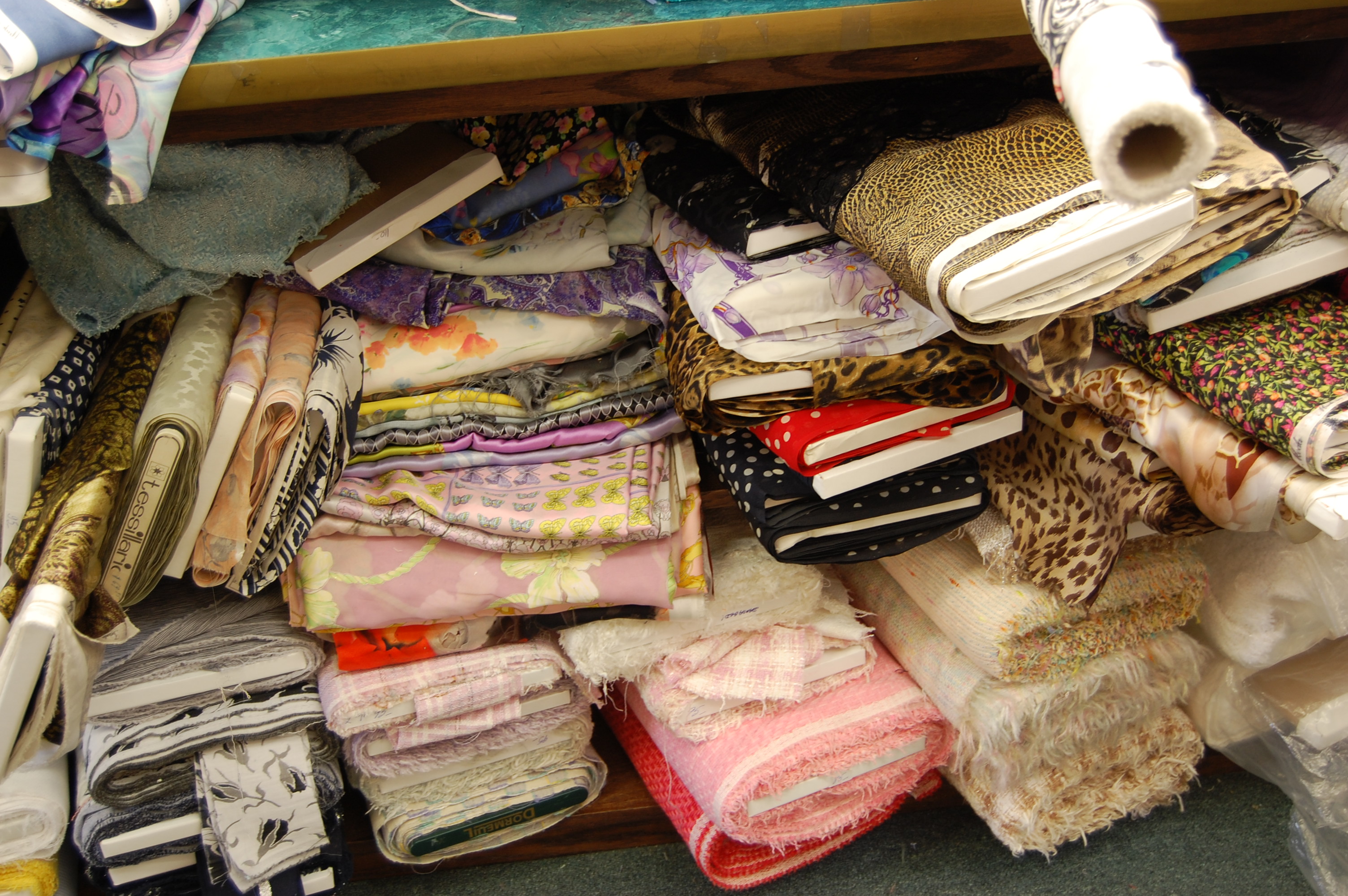
More fabric under the cutting tables.

More fabric under the cutting tables.

And more bolts in the basement, which we were privileged to visit.

And more bolts in the basement, which we were privileged to visit.

A lovely houndstooth, tucked away in the basement.

A lovely houndstooth, tucked away in the basement.

Deciding on the lining fabric was as much fun as the boucle, and the exquisite designs, unique prints, and lustrous quality of Alice’s charmeuses are something to behold.  Truly, the selection is a testament to Alice’s good taste and her diligence in finding the best that is available in France, Italy and Switzerland, and shipping them home to her store in the States.

So many charmeuses from which to choose.

So many charmeuses from which to choose.

Susan helping with the "match-up".

Susan helping with the “match-up”.

Alice bent over more fabric.

Alice bent over more fabric.

Susan  with a beautiful charmeuse.

Susan with a beautiful charmeuse.

Classmate Diane's final selection of boucle and charmeuse.

Classmate Diane’s final selection of boucle and charmeuse.

Alice cutting the charmeuse I selected for my lining to be paired with a bright red boucle.

Alice cutting the charmeuse I selected for my lining.

Alice's father who still comes in to help.

Alice’s father who still comes in to help.

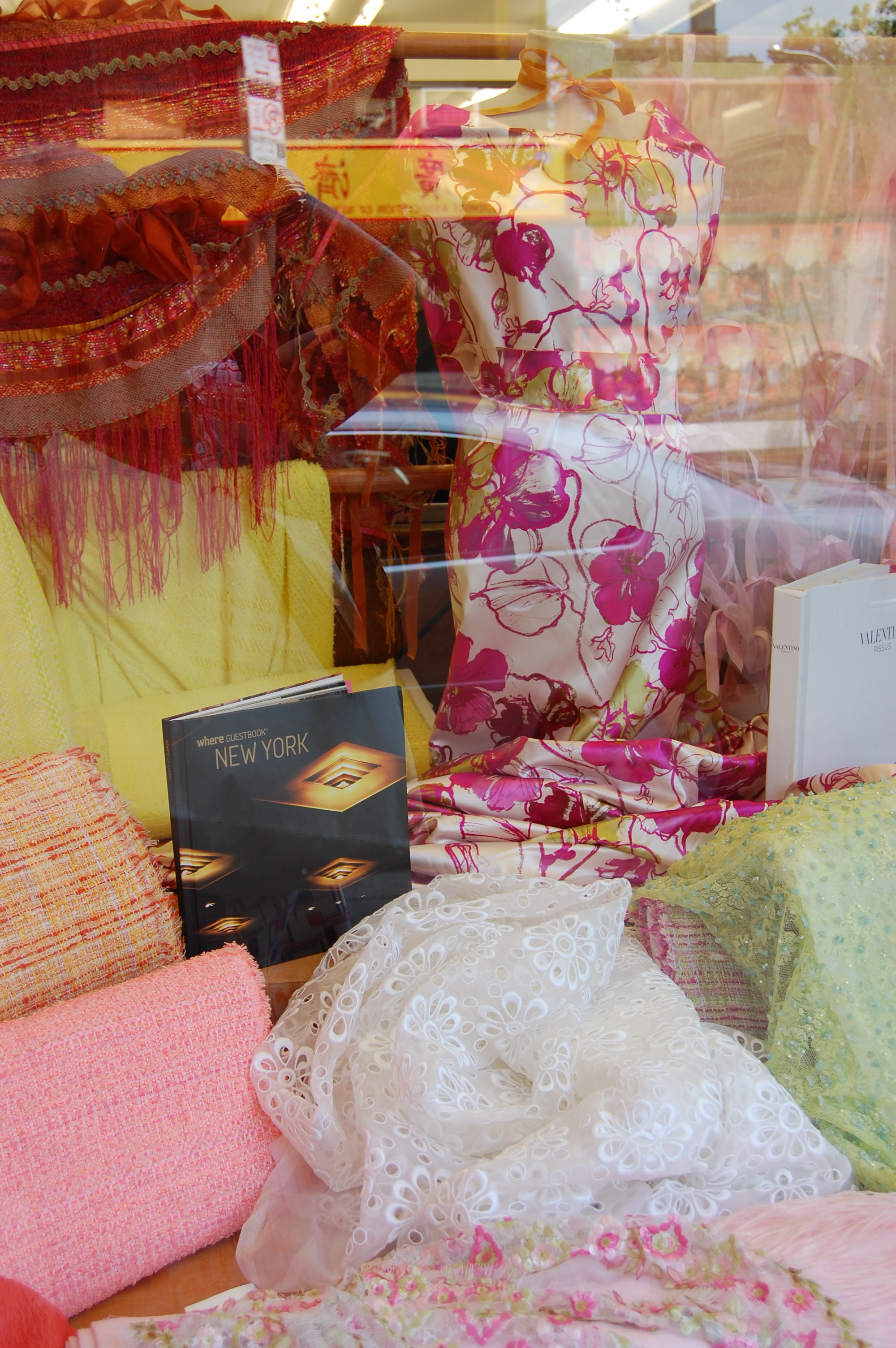
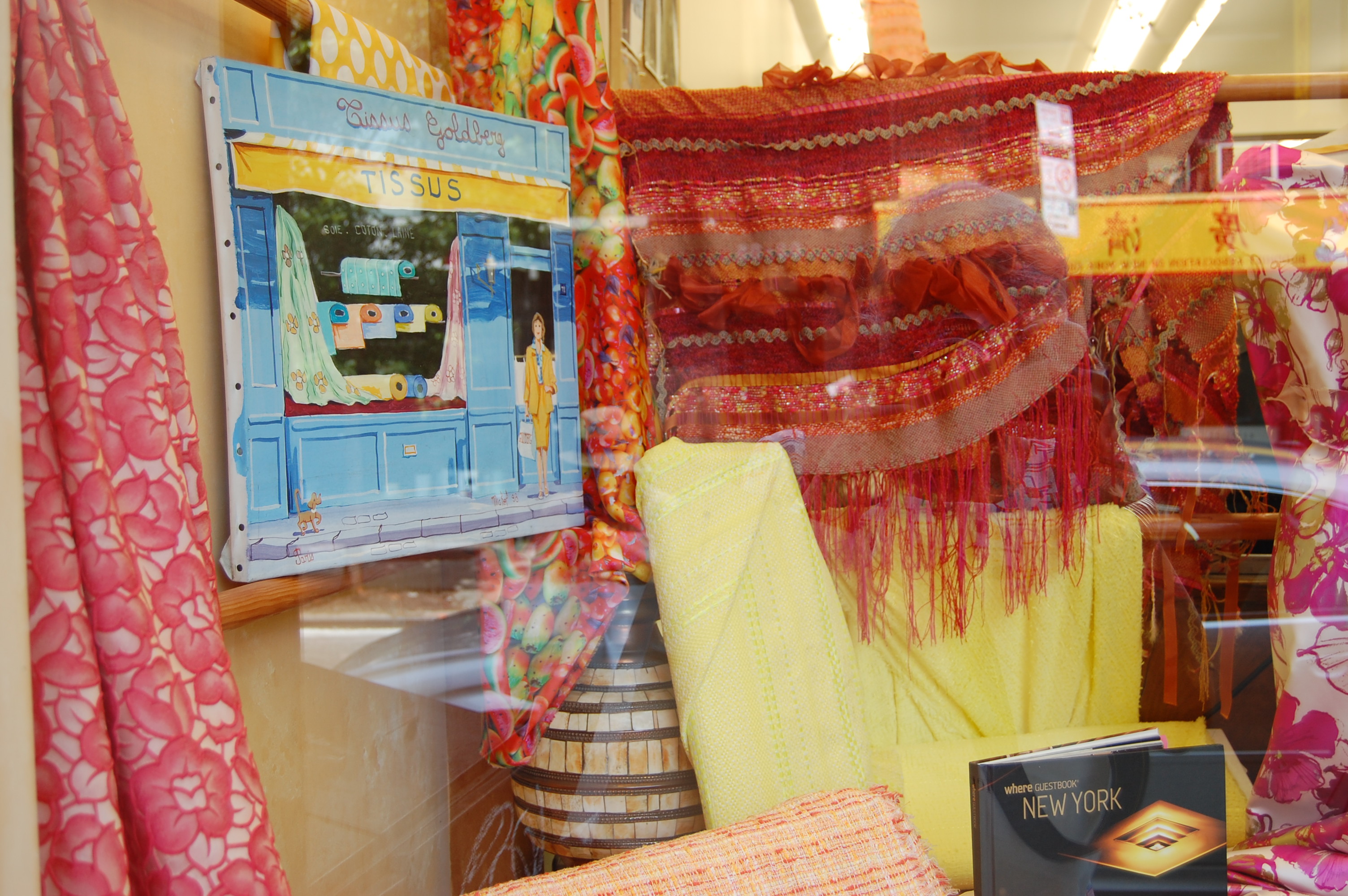
As we left Mendel Goldberg after two quick hours of shopping, I took a moment to view the beautiful display of fabrics in their front window.

Despite the glare, the fabrics still captivate!

Despite the glare, the fabrics still captivate!

More fabric on display in the window.

More fabric on display in the window.

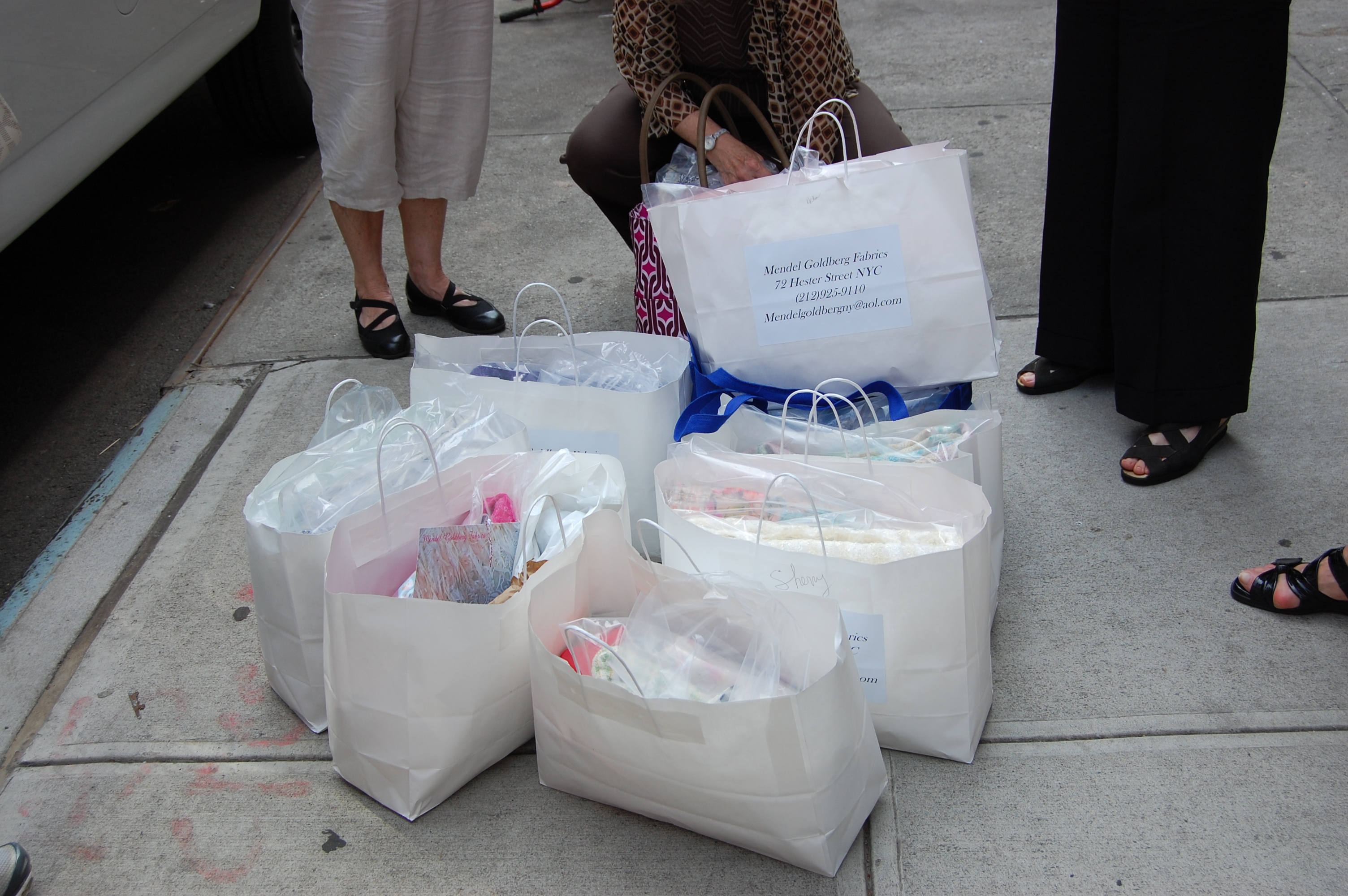
Then we gathered on the street next to our van.  Our bounty of bags spoke to the remarkable, memorable experience of Mendel Goldberg Fabrics.

Just a few of the bags that went home with us!

Just a few of the bags that went home with us!

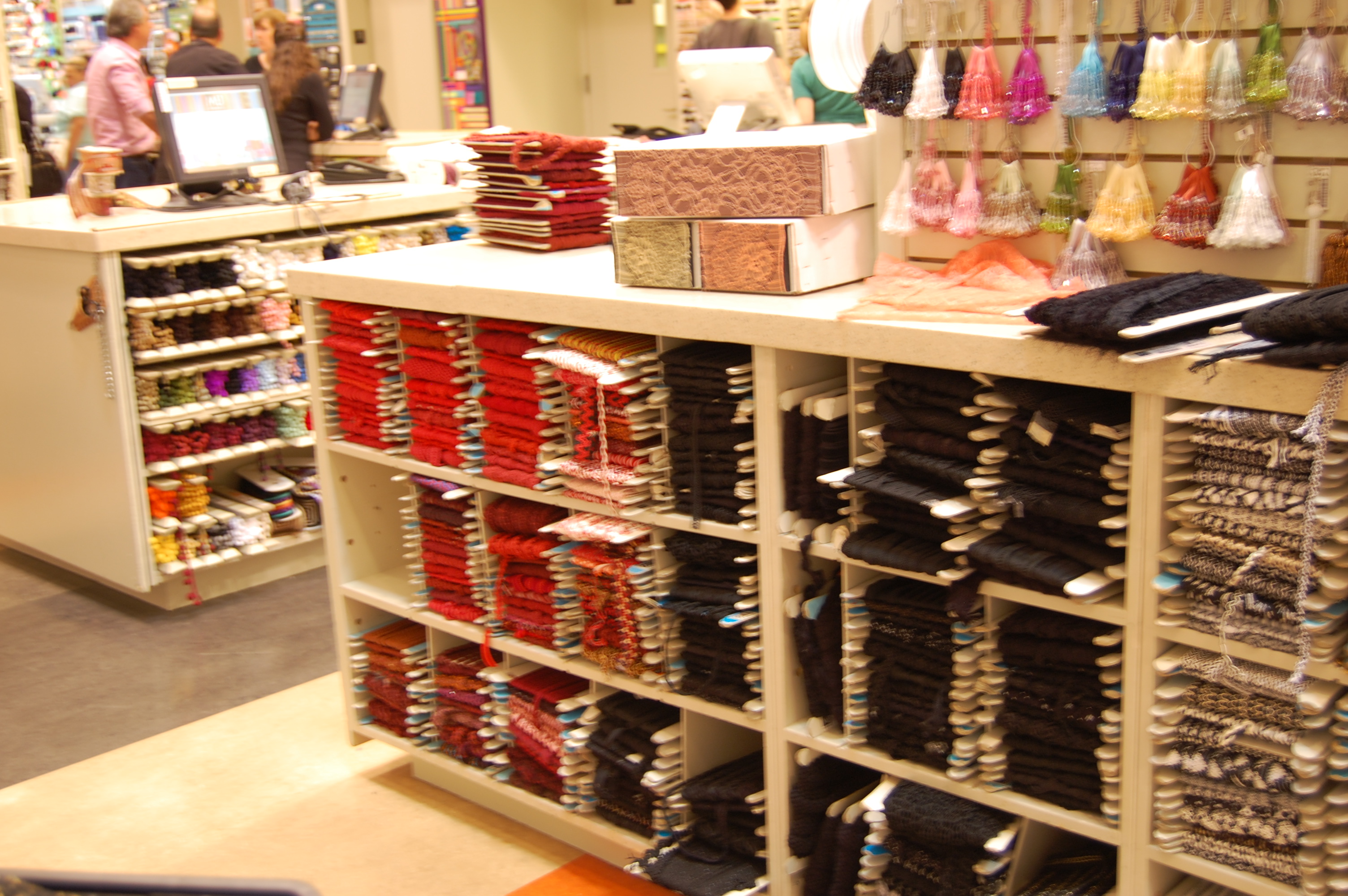
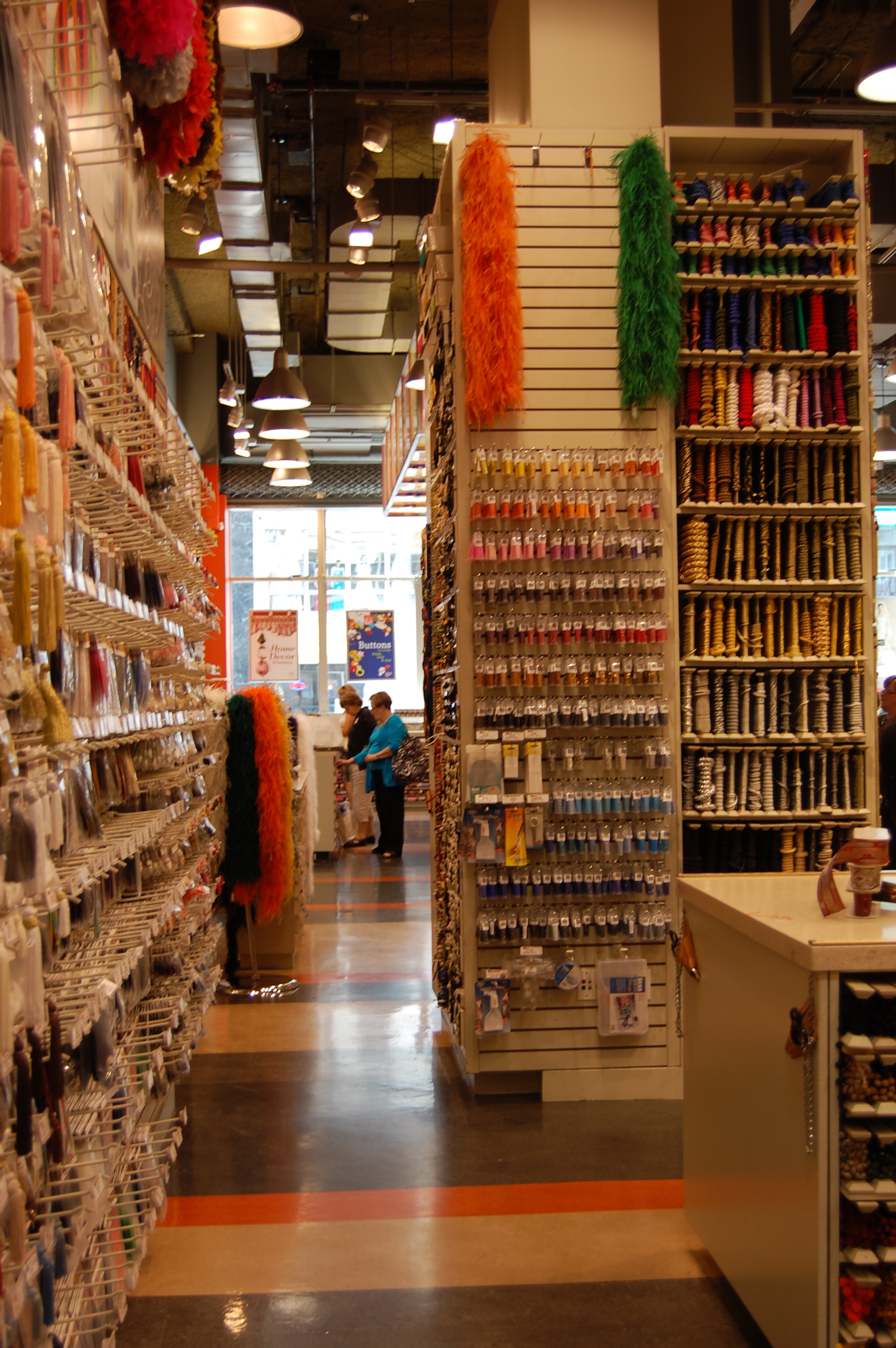
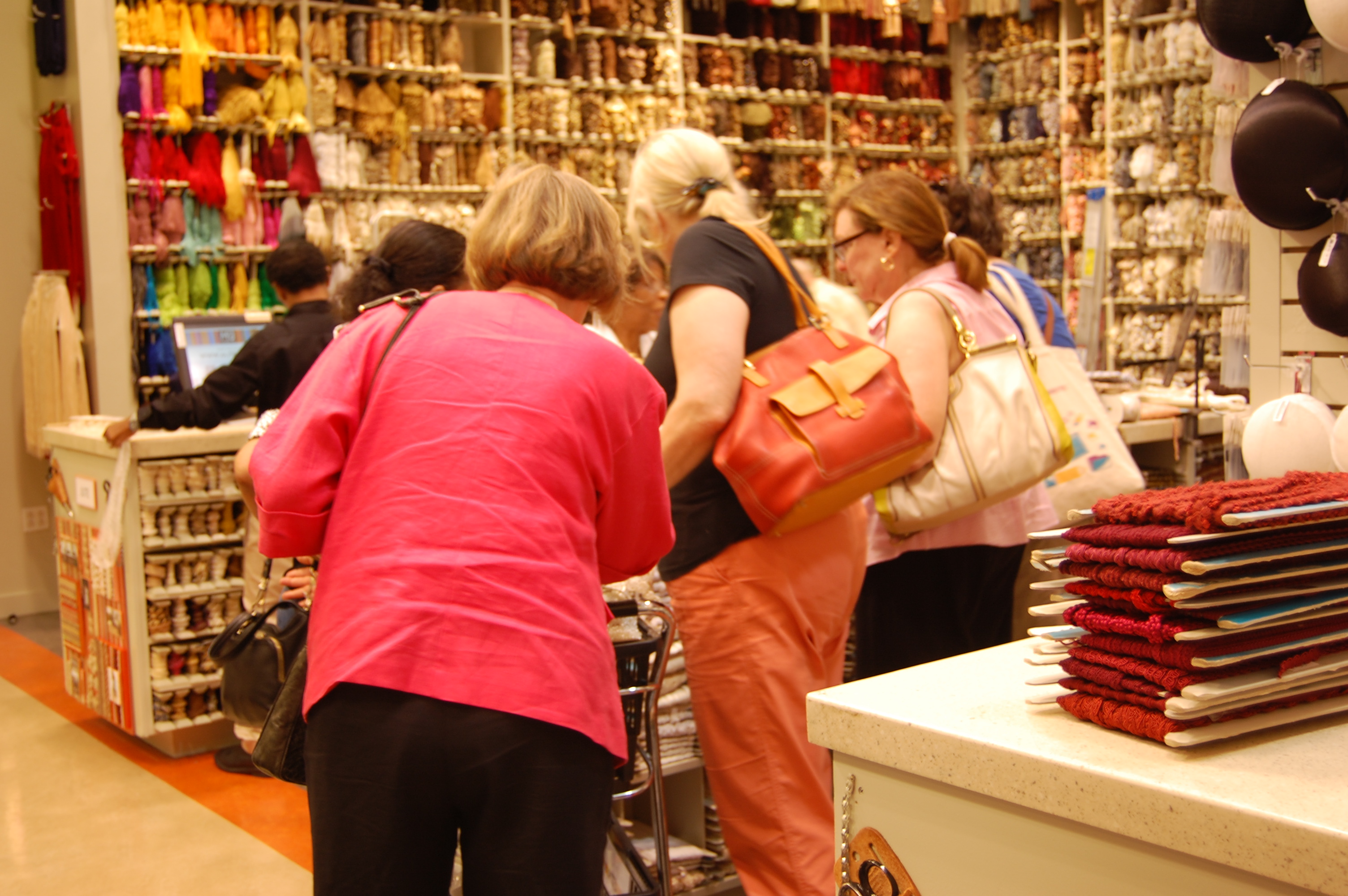
Now that we all had in our possession the two building blocks for our jackets (the fashion fabric and the lining), it was time to look for the embellishments, namely the trim and the buttons.  So off we went to M & J Trimming uptown in the Garment District.   Walking into M & J was a little bit like walking into a penny candy store, only better (no calories and more selection)!  There were trims and people and sales staff everywhere, and it seemed like everyone was on their own important mission.  We certainly were!  With our boucle and our complementary silk charmeuse in hand, we each first needed to find the perfect trim to set off our jackets.  Although numbering in the thousands, the trims were arranged by color and quite logically, so that once we understood the system, we were each able to pick and choose several “possibilities”.  Susan was there to help us make final decisions – and miraculously, we could start to see a glimpse of the final look of each of our own unique jackets.

Red and black trims, waiting for my perusal.

Red and black trims, waiting for my perusal.

A view inside the store.

A view inside the store.

Classmates Sherry  and Carol being assisted by Susan.

Classmates Sherry and Carol being assisted by Susan.

The only thing left to do was pick out buttons.

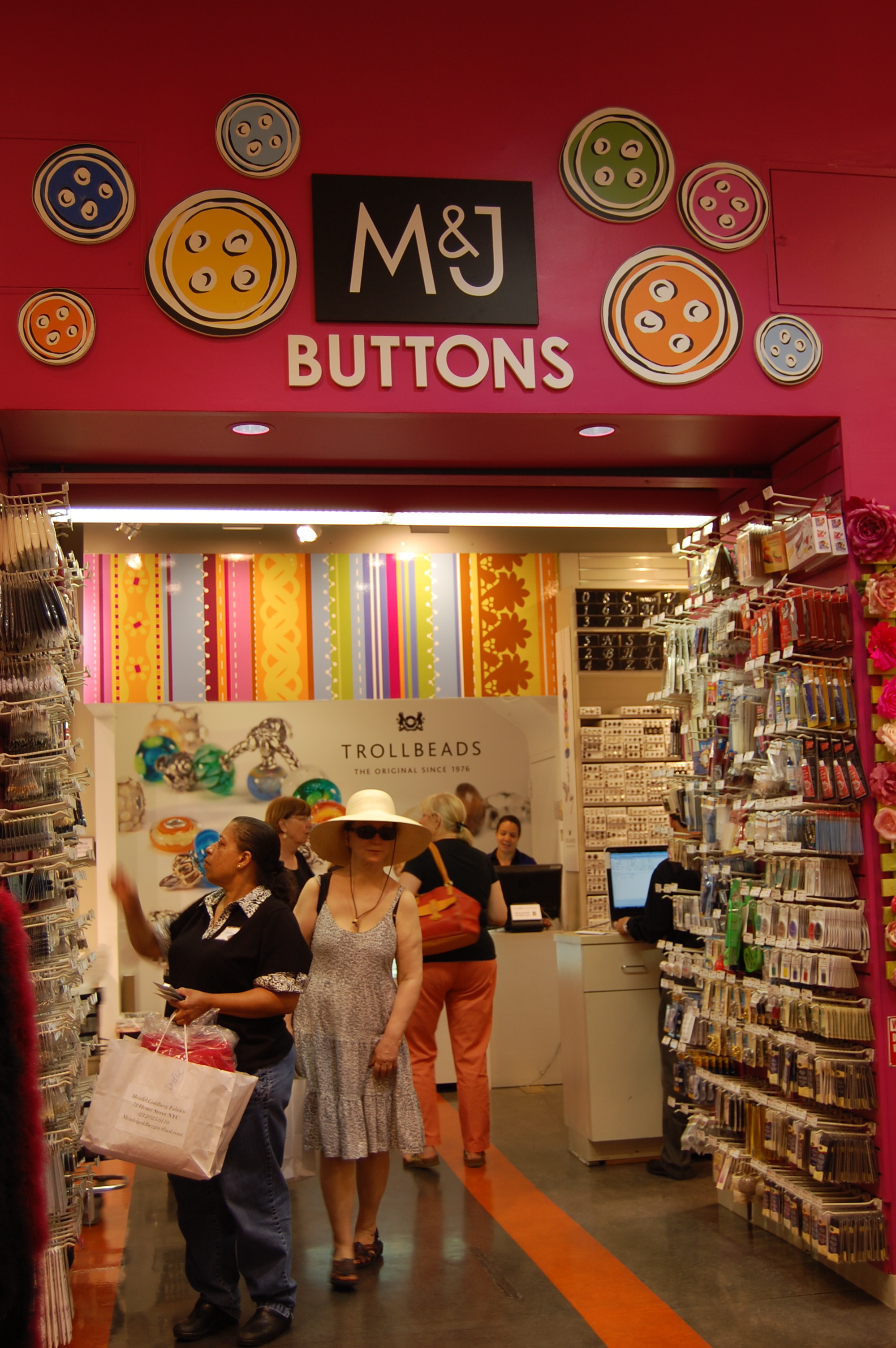
The entrance to the Button section of  M & J Trims.

The entrance to the Button section of
M & J Trimming.

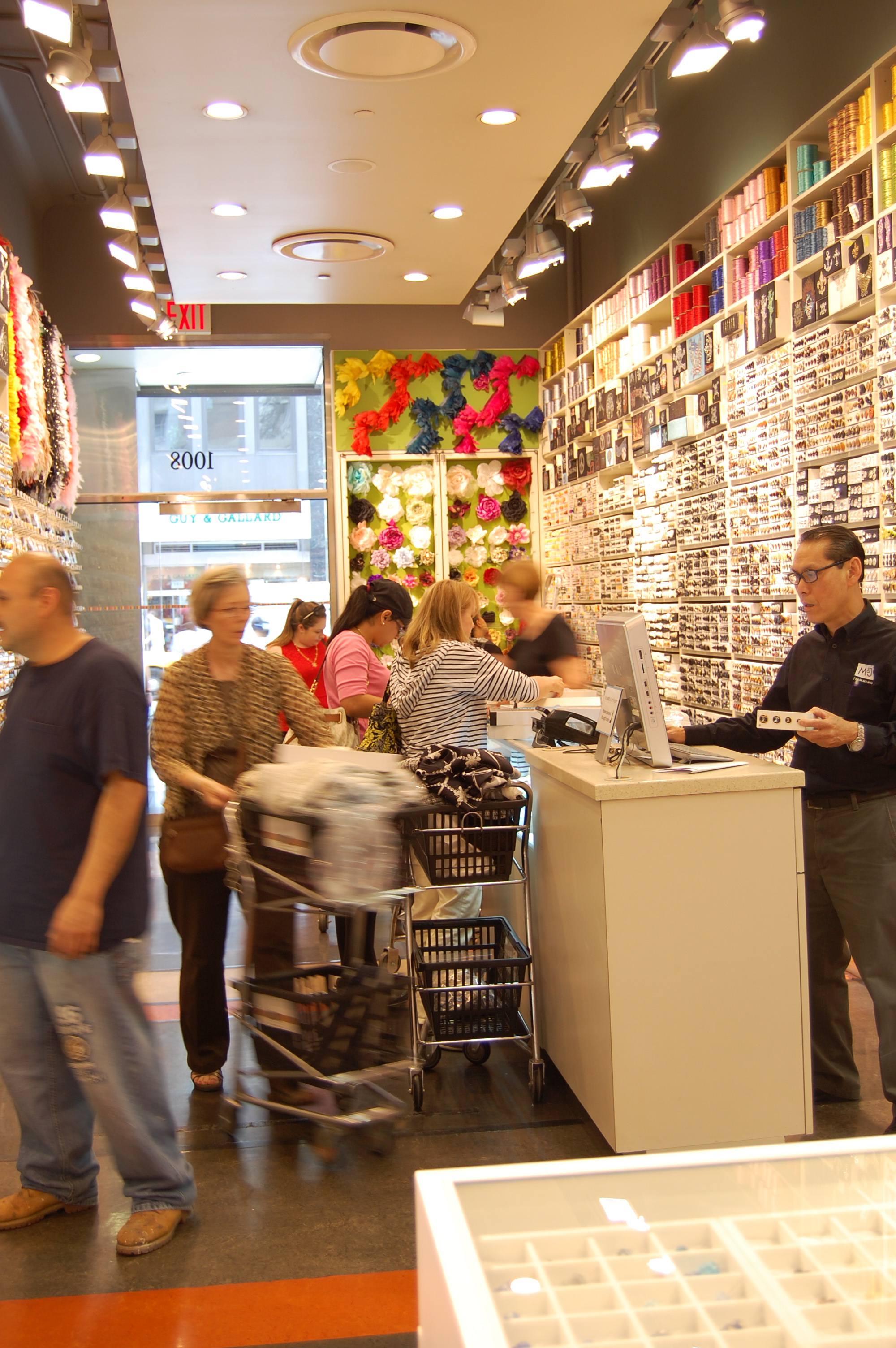
As an enthusiastic fan of unique and beautiful buttons, I was smitten.  The button displays went from floor to ceiling, arranged by color and type, again very logically.

Buttons and more buttons.

Buttons and more buttons.

As sewers, each of us is accustomed to choosing buttons appropriate to our garment. So – what fun it was to place different ones next to our fabrics and trims so they could audition for the final starring part.  With Susan’s guidance, wonderful suggestions, and knowledgeable nod of approval, we all left the store with little bags filled with  great and varied treasures.

Shopping for Fabric - M & J bag

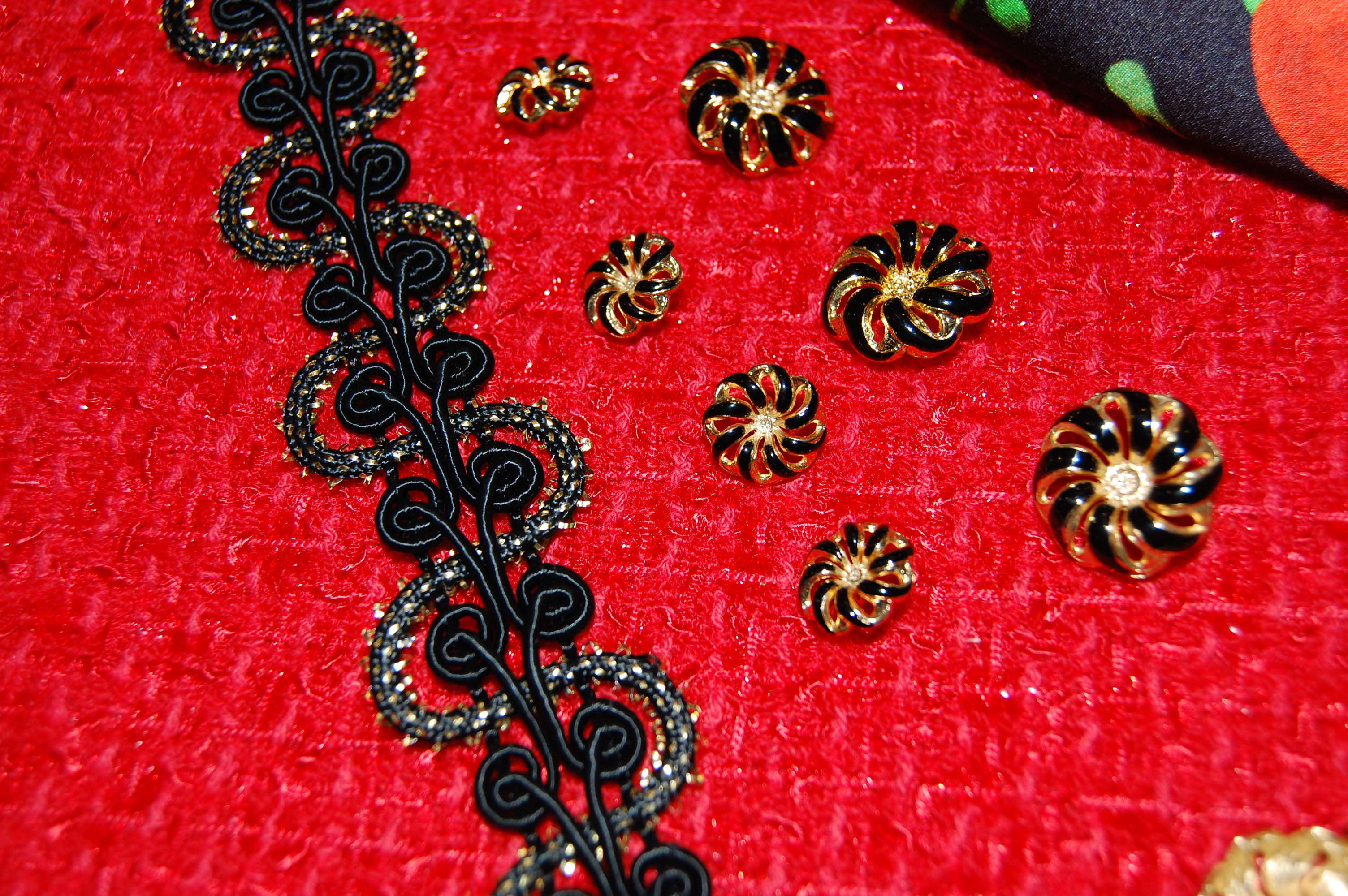
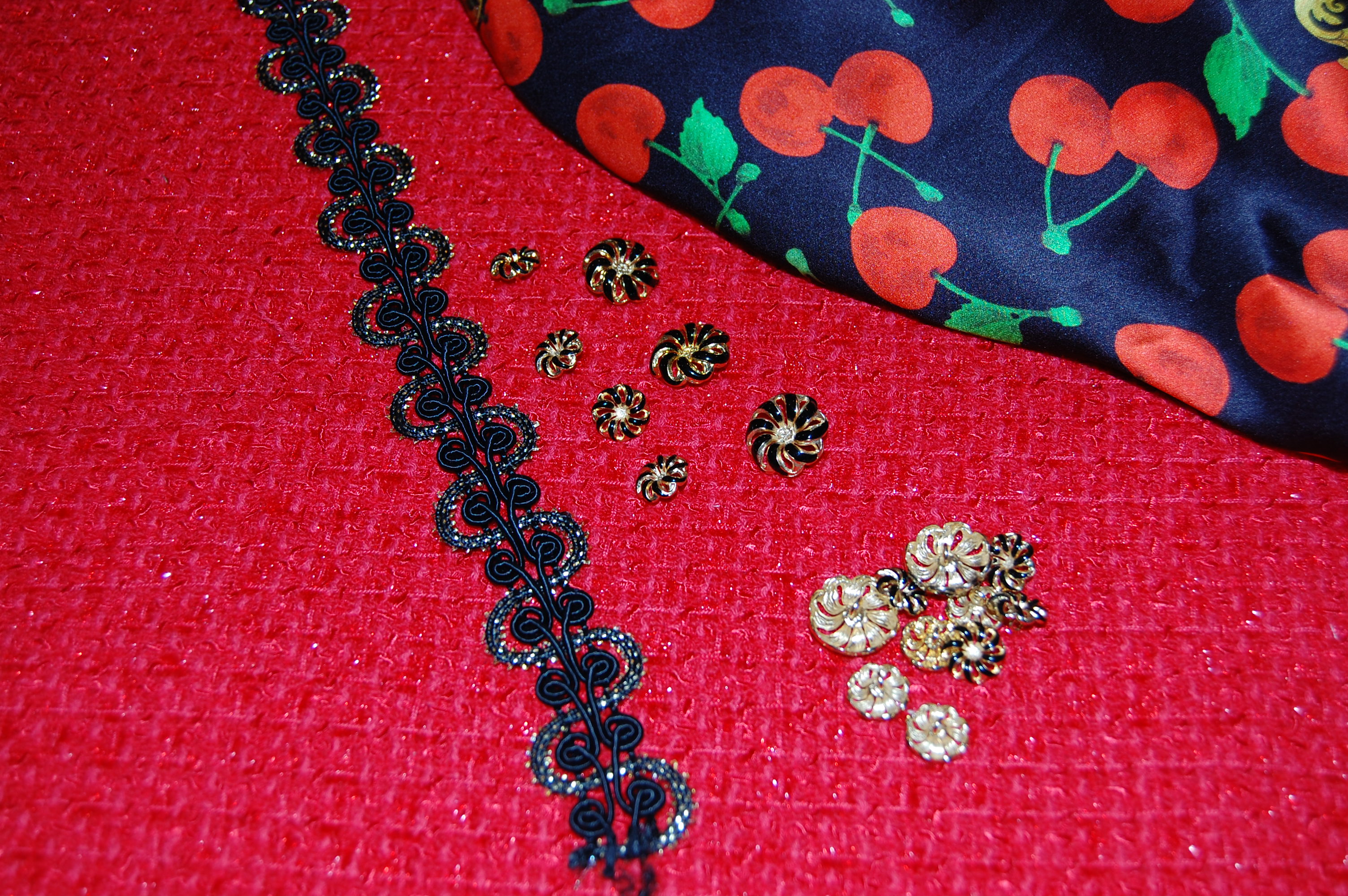
So which of those treasures did I find for my classic French jacket?  I went with the hope of finding a lovely red boucle, which I did.  Paired with that remarkably designed charmeuse shown above, the red seemed to me to be set off most beautifully with black trim and black and gold buttons.

My trim and buttons - click on the photo to see them close-up.

My trim and buttons – click on the photo to see them close-up.

Boucle - charmeuse - trim - buttons.

Boucle – charmeuse – trim – buttons.  All set to begin my jacket . . .

20 Comments

Filed under Buttons - choosing the right ones, Chanel-type jackets, Uncategorized