Tag Archives: Mendel Goldberg Fabrics

Pink Stripes 

“You can never go wrong with a little pink… a lot works for me.” Dana Dalgetty

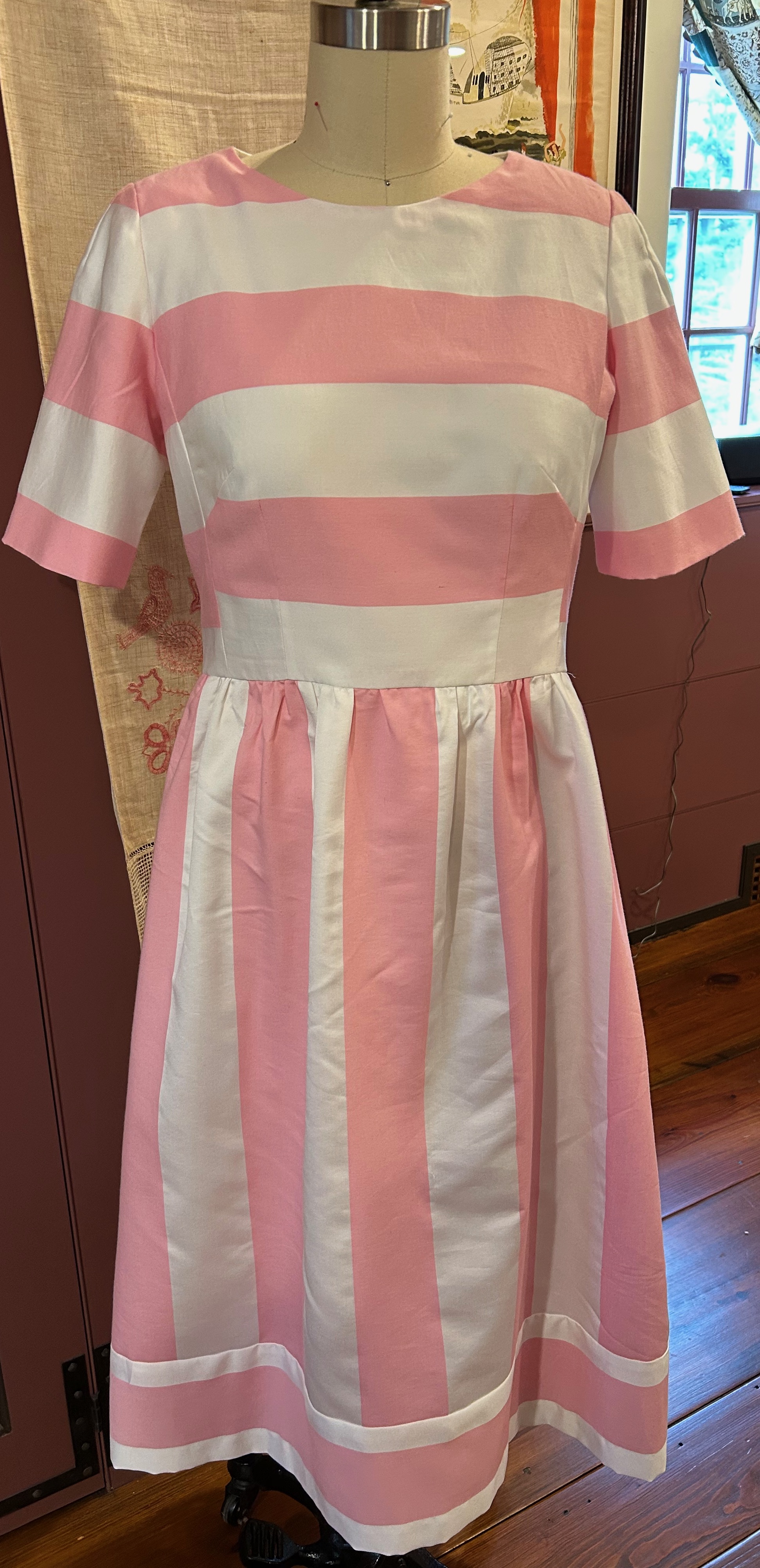
It is extremely difficult for me to resist a bubblegum pink fabric.  And if it is a stripe, too, the odds are very good that fabric will end up in my sewing room.  So it was with this silk and cotton blend found on the website of Mendel Goldberg Fabrics.
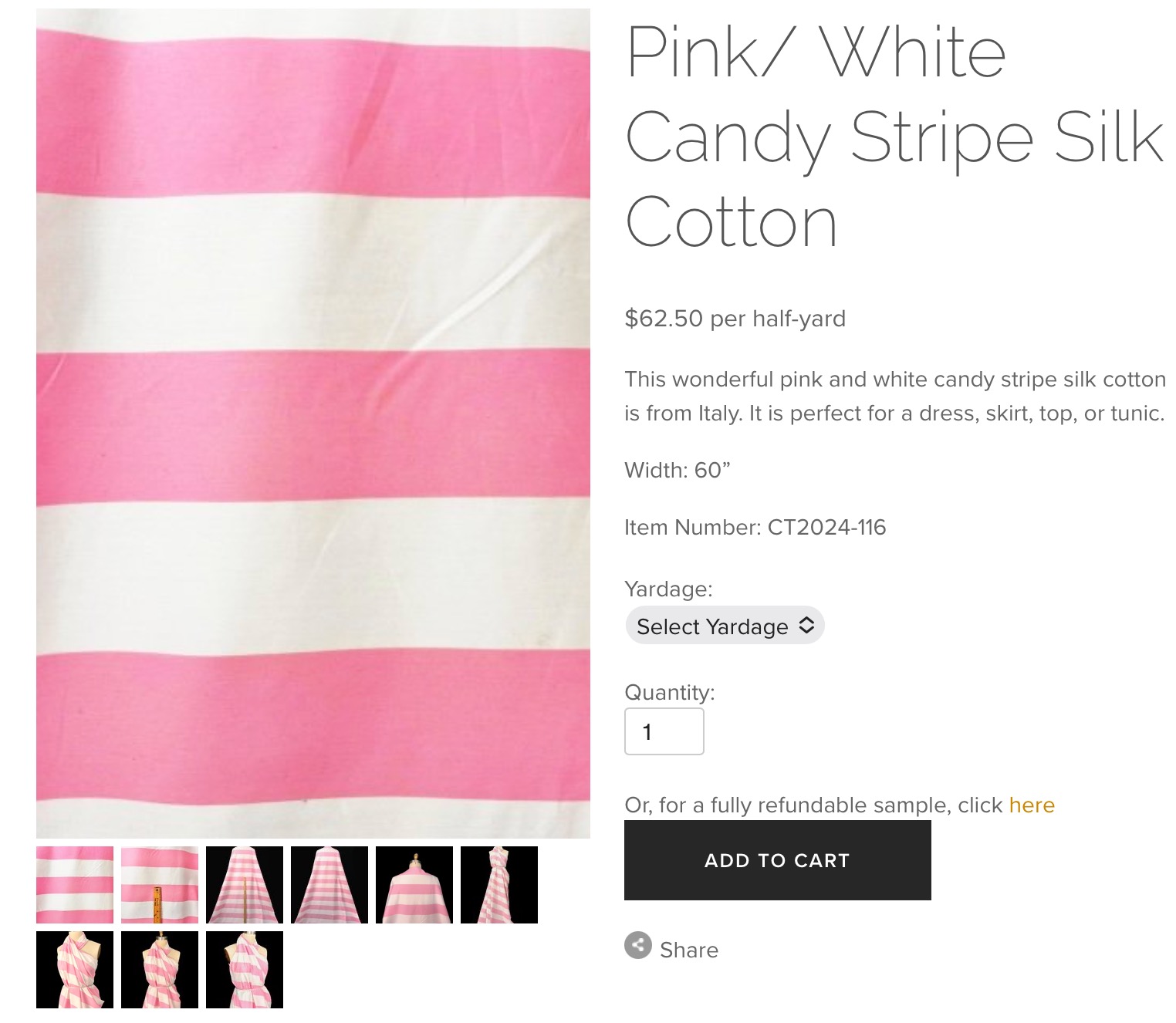
Screenshot

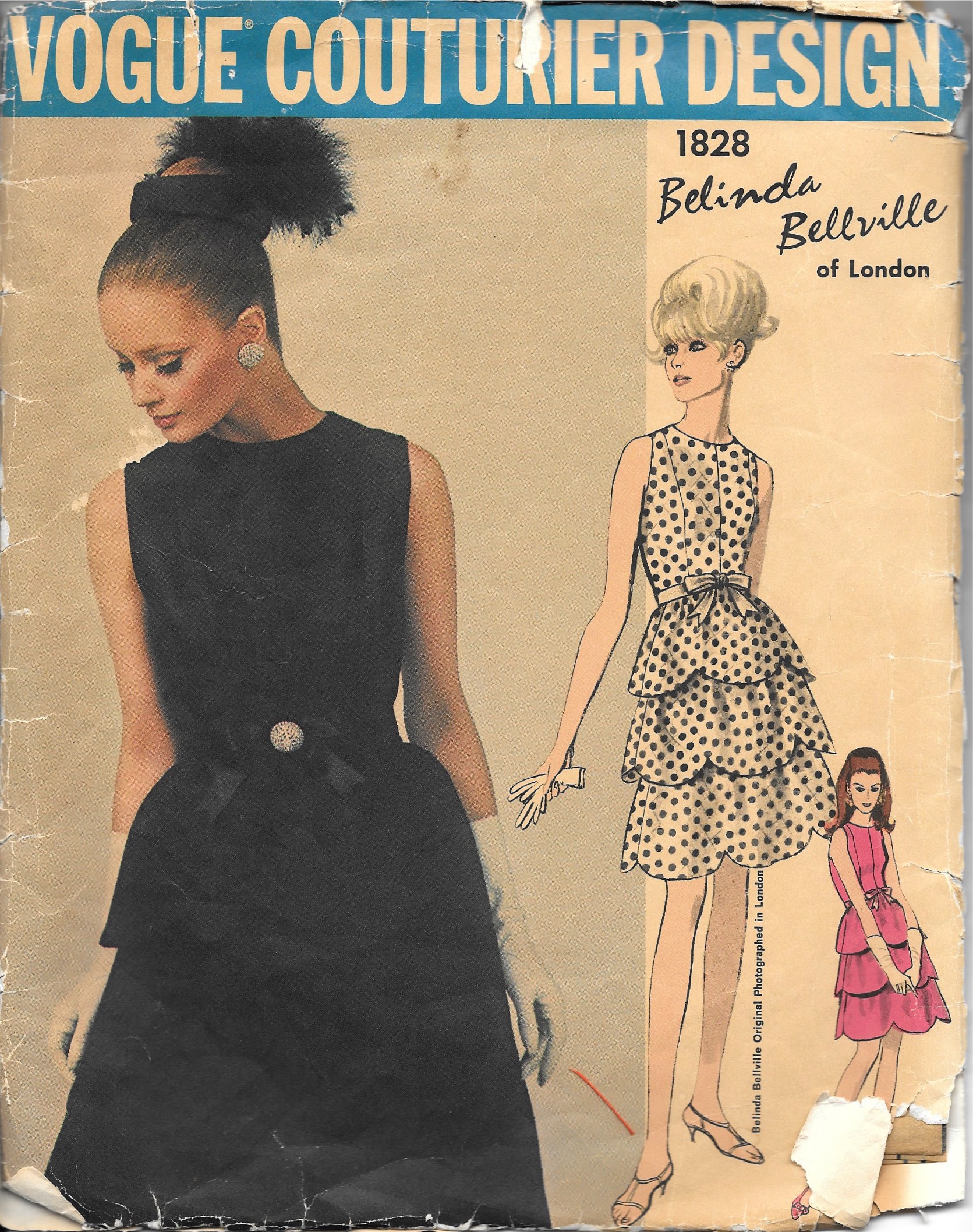
I purchased it last summer during a 20% off sale, and when it arrived, I knew I had made the right decision – although the stripes were a bit bolder in person than I anticipated.  As usual, I wasn’t sure what I was going to make – a coat? a dress? a skirt?  I needed more thinking time so I tucked it away until this Spring.  In the meantime, I purchased this vintage Vogue pattern which I saw as a good basic design which could be easily changed, adapted and altered.  
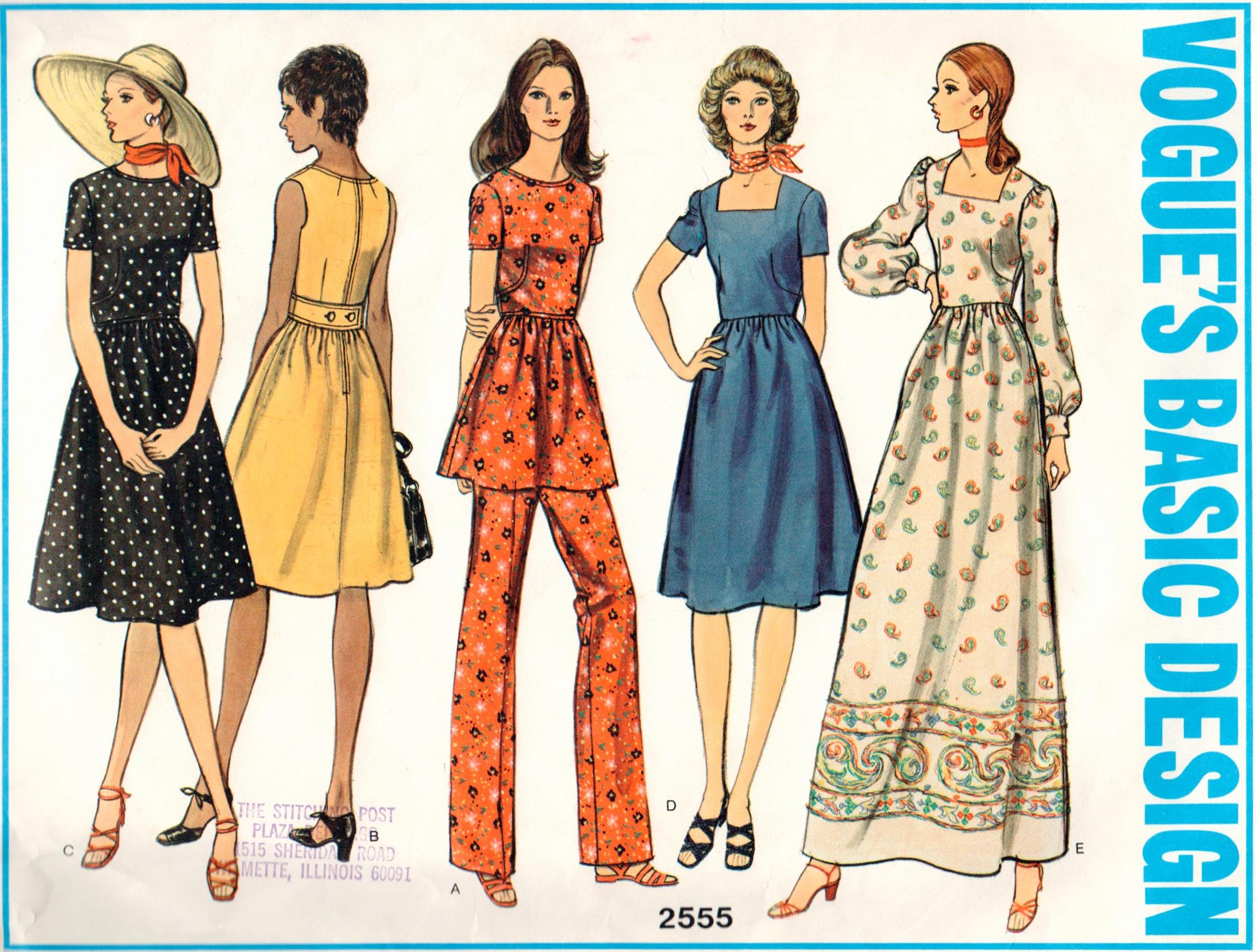
Take note of those curved darts on the bodice, as I will mention them again.

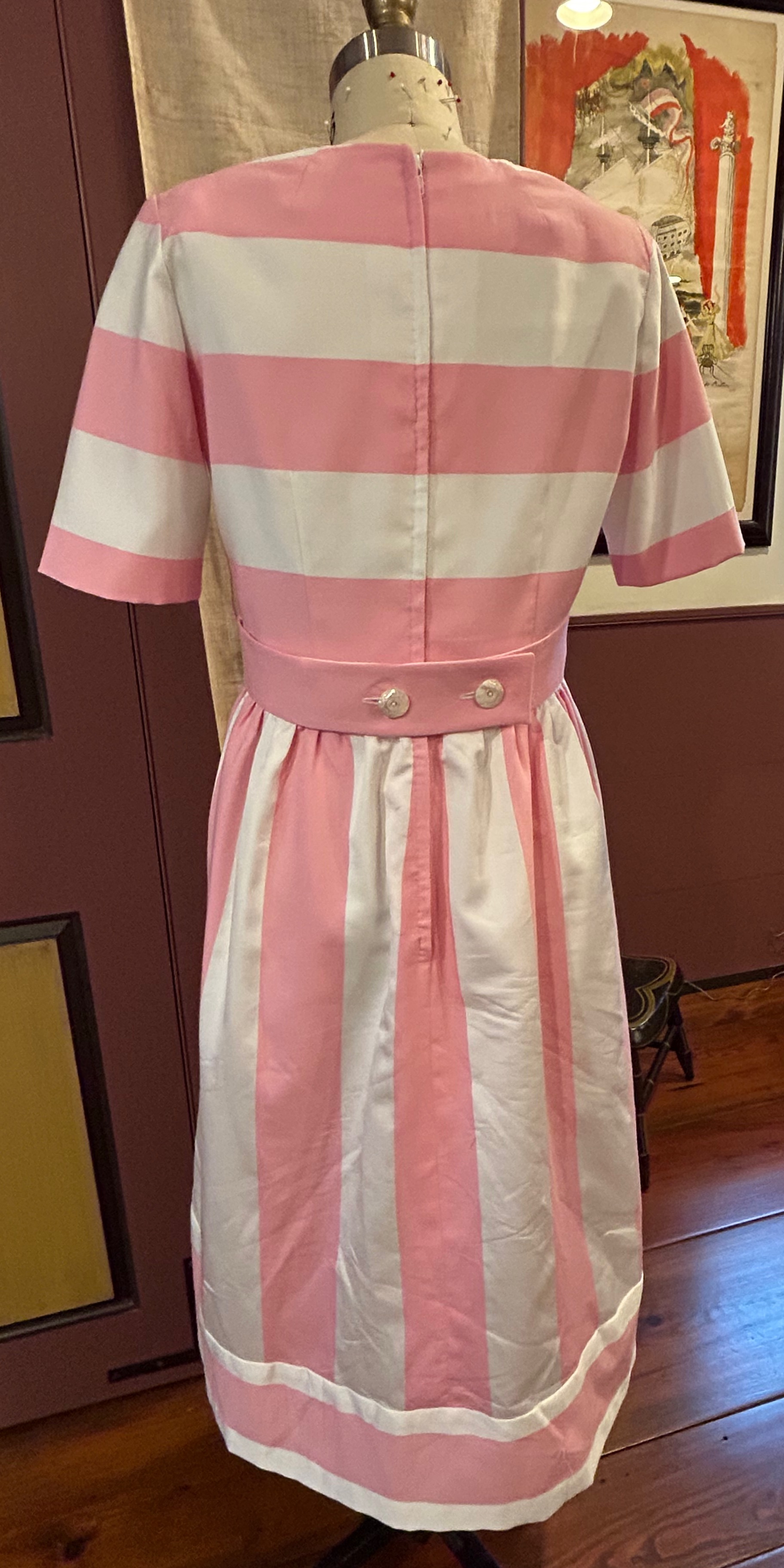
I like dress designs which have some “back“ interest, here the buttoned half belt.  Although I loved the sleeveless view, I have become less comfortable wearing sleeveless dresses as I have gotten older.  Thus, I was drawn to the short-sleeved view (C), knowing I could easily lengthen the sleeves to reach almost to the elbow, if that seemed the way to go.  Thus, it was a logical progression to imagine the pink striped fabric made up in this design, despite the note on the pattern “Not suitable for striped fabrics.” 

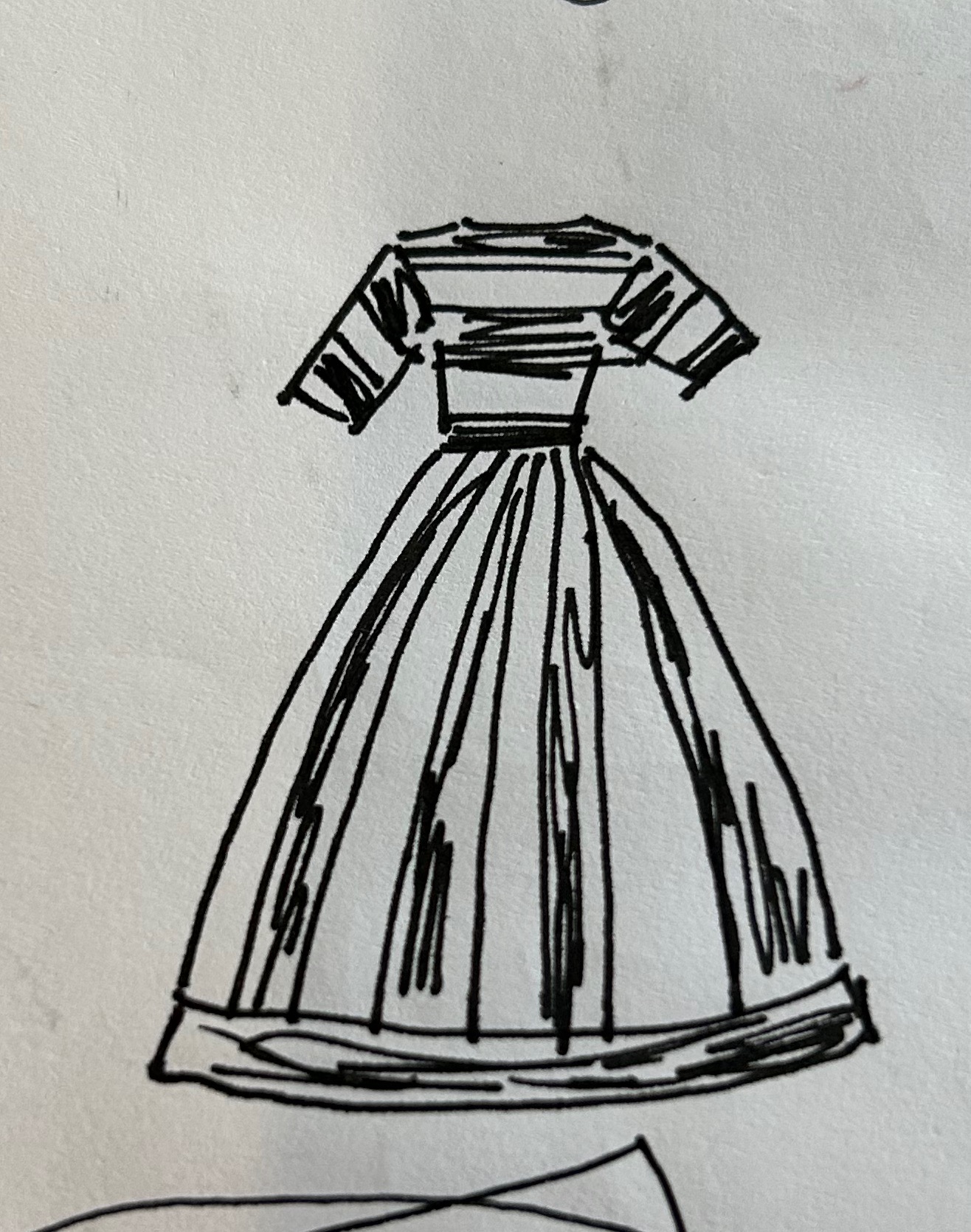
I wasn’t quite ready to forge ahead, however.  My fabric was such a bold stripe, I feared a horizontal orientation of the fabric would be too much, but a vertical orientation was equally problematic.  I went to my Pinterest feed to get some inspiration and in no time at all, the lightbulb went off in my head.  The dress needed a combination horizontal and vertical orientation.  I made this quick sketch, and I knew I had the solution I needed.  
I took these quick photos after I had worn the dress to a party, wrinkles and all. My apologies for the unkempt appearance of the dress!

I set about making a muslin/toile for fitting, and then I hit a brick wall.  Those curved darts you see on the pattern bodice just were not flattering to me, despite my working and reworking them multiple times.  I finally gave up.  I would need to find a substitute pattern for the bodice front and make it work with the bodice back toile which I had fitted successfully.  This was all terribly time-consuming, as you can imagine, but I finally was able to find an existing bodice front in my stash of patterns/toiles which, fingers crossed, would work.  I didn’t know how well it would work until I had the happy surprise of seeing the darts feed into the bold stripes successfully. 
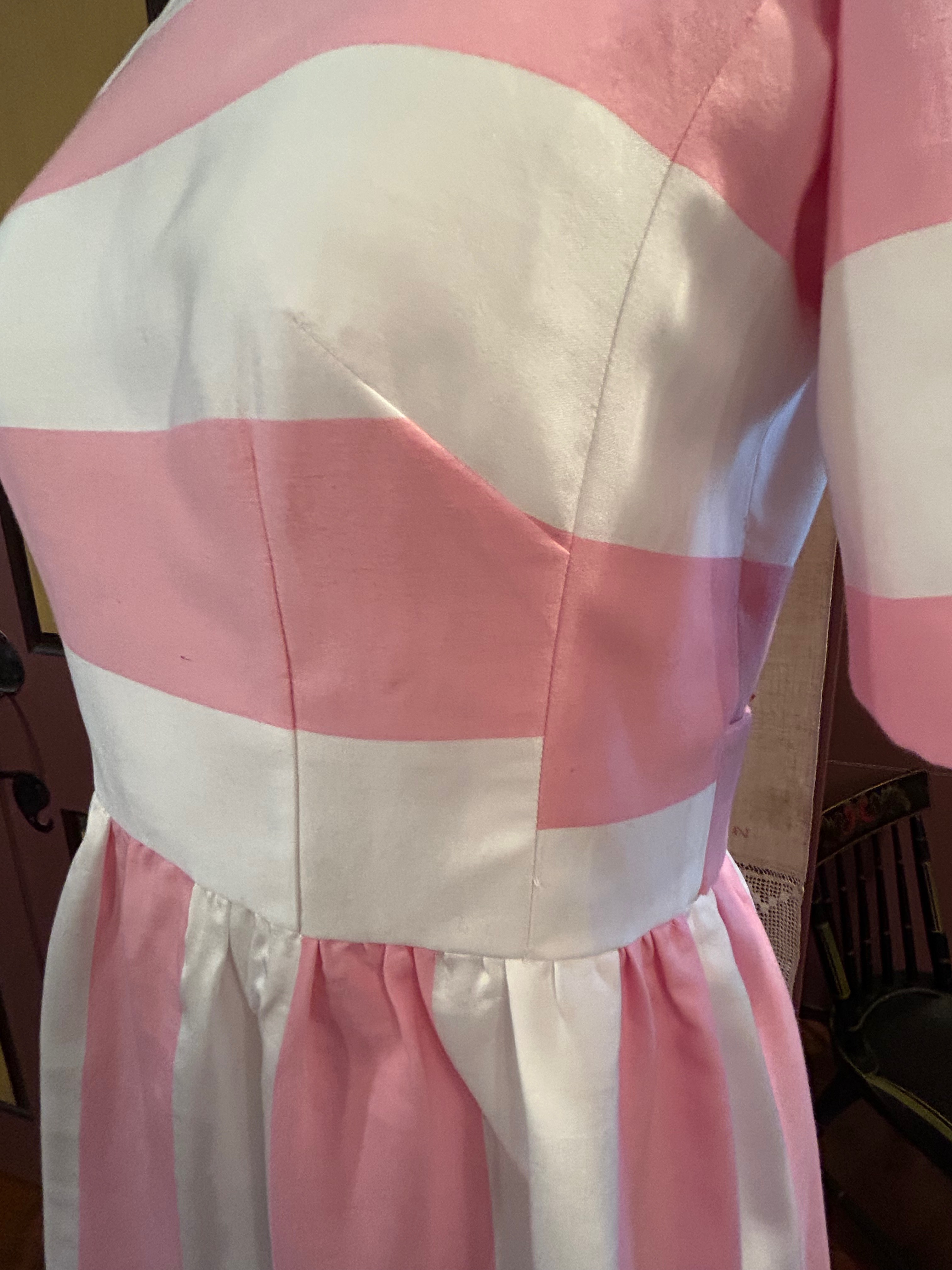
Darts, of course, distort side seams, but this distortion somehow adds to the appearance of the front bodice. I suspect the “unsuitability” of striped fabrics was because of that curved dart, which I unknowingly eliminated when I changed the bodice front.

What was not as successful was the proper alignment of the buttons on the back belt to the center of the dress. That is one of the many downsides of fitting oneself – I could not see what I was doing, and although I measured and fiddled, I was still off by a couple of inches.  
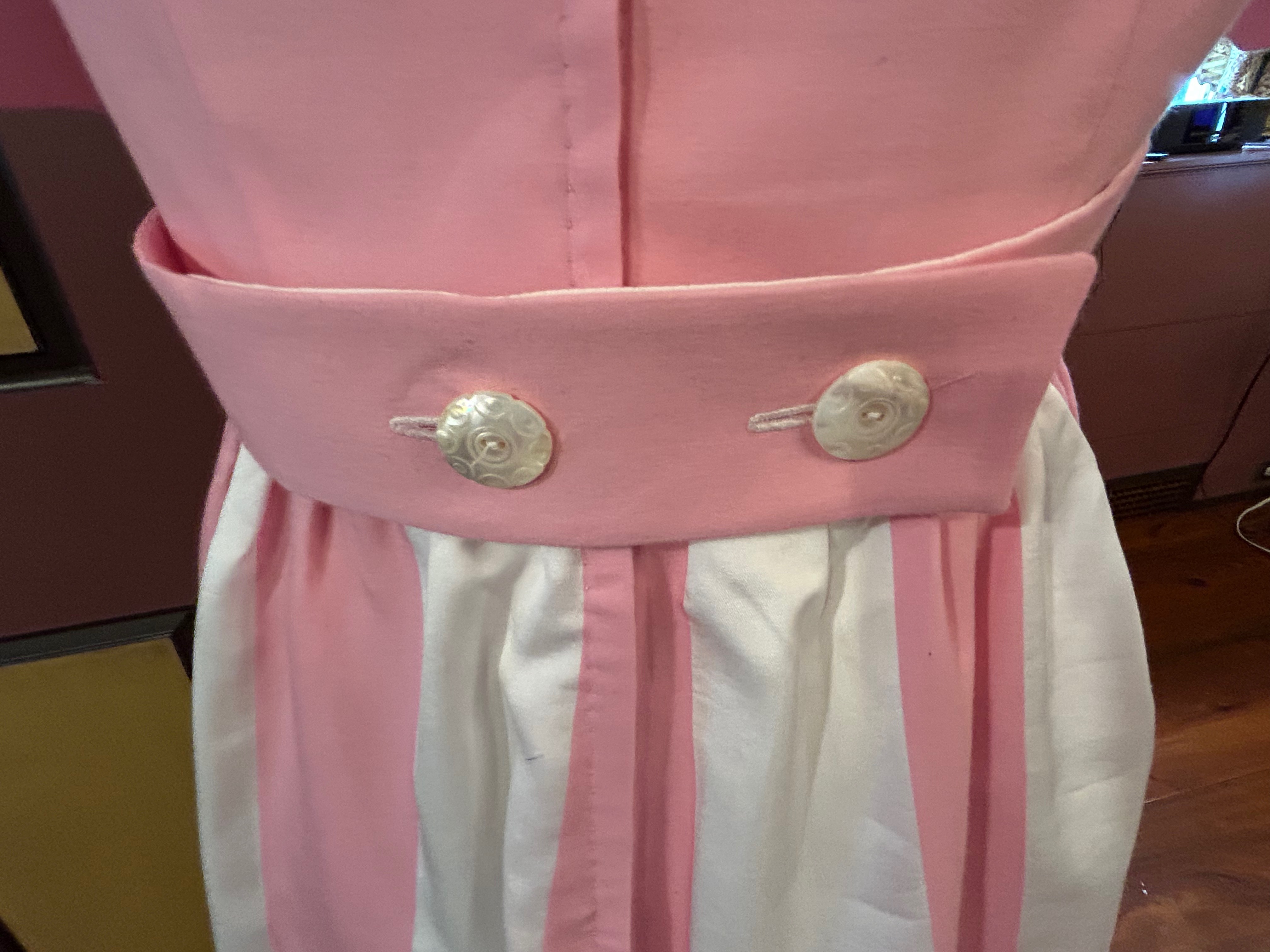
I did a hand-picked lapped zipper and the buttons are vintage mother of pearl from my collection.
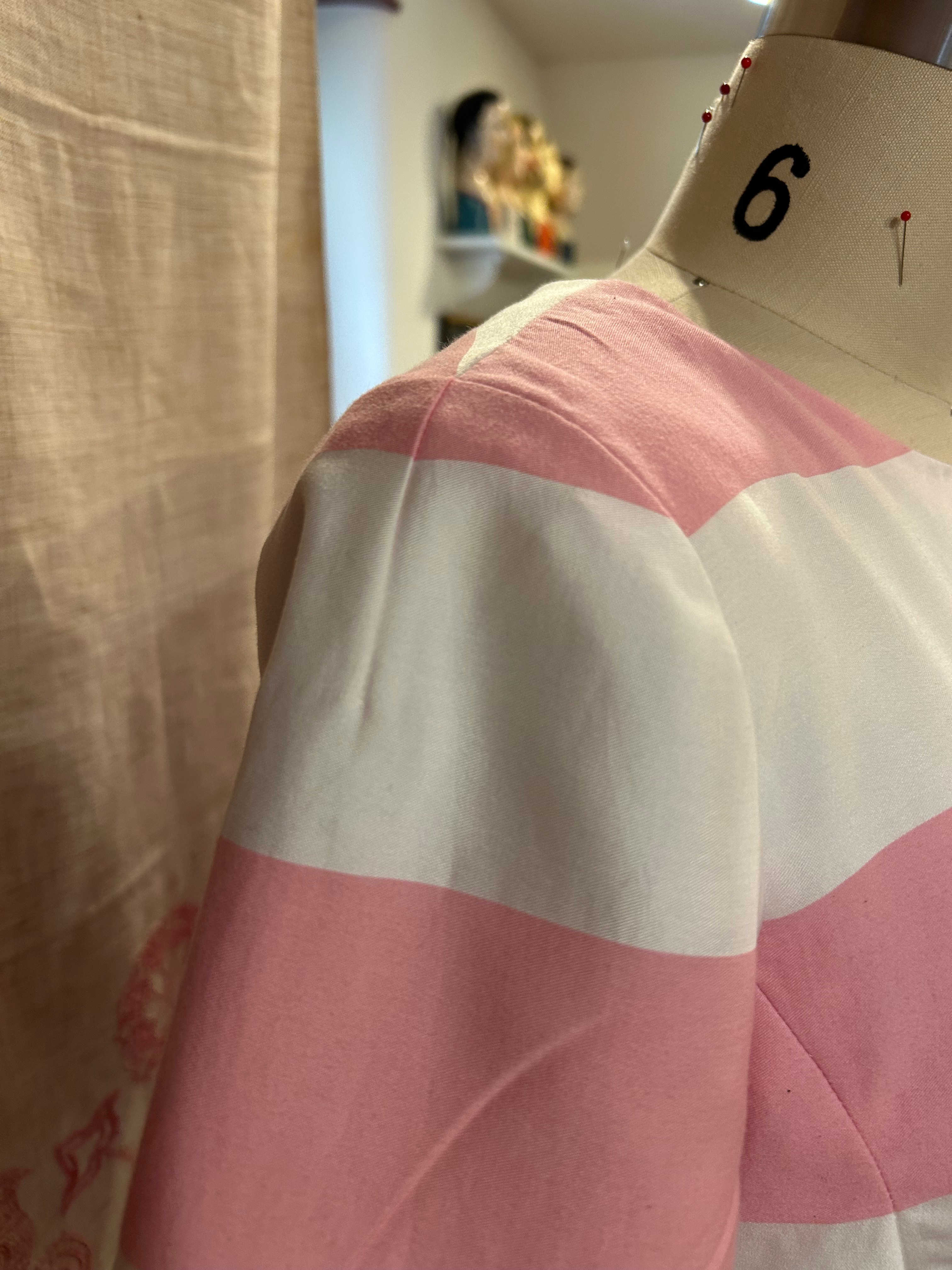
While we are talking details, here is the top of the sleeve. I used a top dart to take in the necessary fullness when setting in the sleeve. This is an alteration I make frequently to accommodate my prominent shoulders.

I lined the entire dress with a soft cotton batiste which complimented the softness of my fabric, adding a little more opaqueness to the finished dress.  I did not use an underlining, reasoning that more structure would not be conducive to the soft flow I wanted in this garment.

A word here about the panel for the hem.   Wow, was I tight on fabric!  I thought the panel should feature one bold pink stripe, bordered by “half” white stripes.  I barely had enough fabric to make this happen, and because the width of the skirt was just a bit bigger than the width of the fabric, I had to piece that panel.  Whew, I just made it.  Here is all the fabric I had left over:
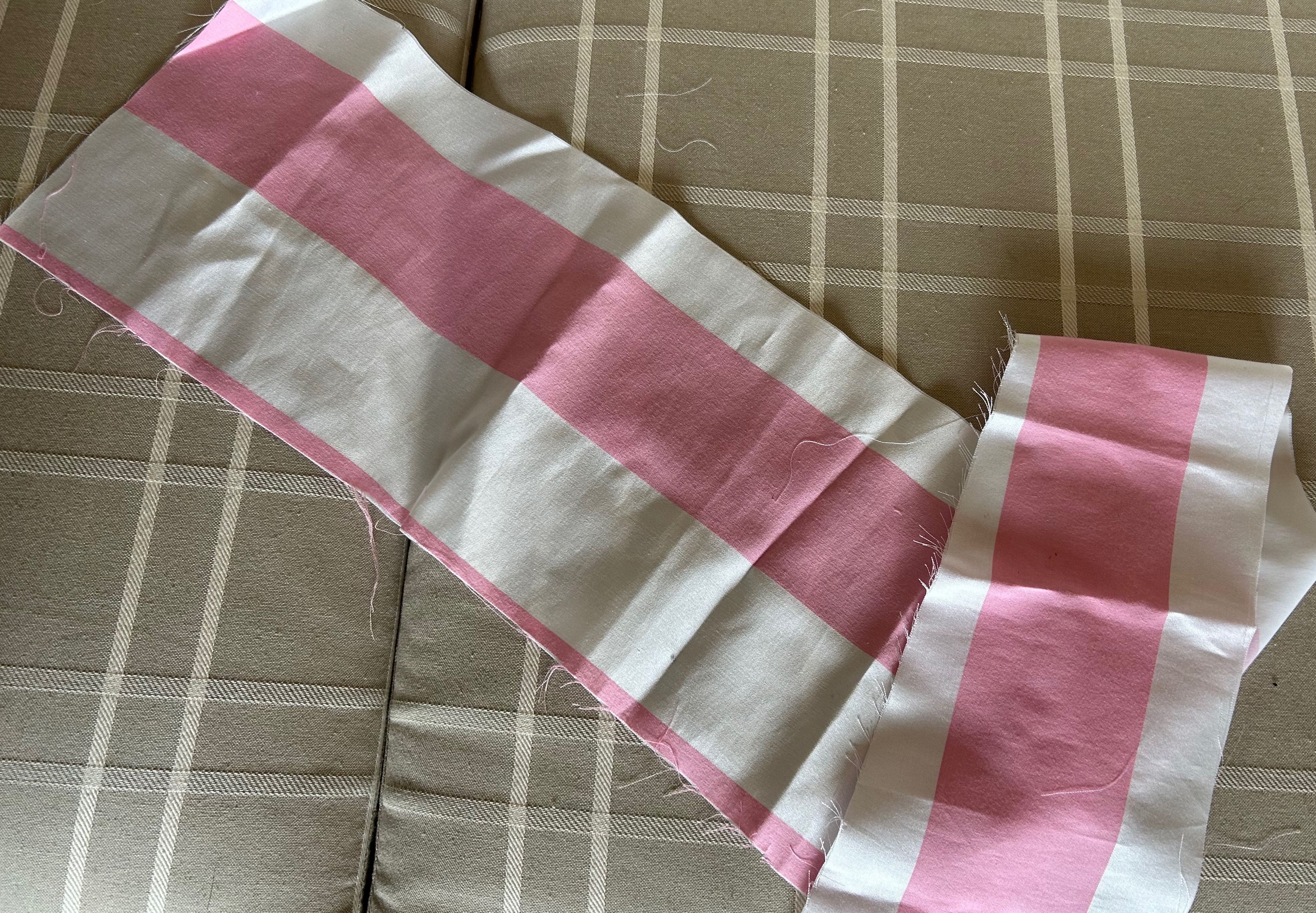
The seaming of the two panel pieces close to the center back is barely visible! Can you see it?

 I was able to wear this dress for two events in May, feeling perfectly dressed for both of them.  

And that little bit of left-over fabric?  I had plans for that, too, which I will share in a future post.  
26 Comments

Filed under Buttons - choosing the right ones, couture construction, Uncategorized, vintage Vogue patterns from the 1970s

Going Around in Circles

When I purchased this sateen, jacquard-woven fabric from Mendel Goldberg a couple of years ago, I wasn’t sure what it would eventually become.  It had a wide repeat to the design (which is something to consider when you know you are facing considerable matching of the design), but it was a lovely 60” wide.  I bought just 2 yards (it was expensive) and hoped I would have enough fabric to finagle something.  

First I thought I would make a midi-skirt to wear with a pretty silk blouse or something.  I even got so far as to make a muslin for a longish skirt, but it just wasn’t going to work.  I didn’t have enough fabric to match the design and create the skirt I wanted.   The next task would be to find a dress pattern which would work.  I kind of viewed this fabric as a good Fall and Spring transition weight, so I wanted sleeves.  And I wanted a pattern which would show off the circle design to its best effect.  One of the patterns in my collection which I have seemed to dwell on frequently is this one:

This pattern is quite interesting. It looks very simple, but in fact, it has a considerable amount of engineering to it and some very nice details.

I like the styling of both the dress and the coat.  I thought I’d take a stab at eyeballing the pattern on my fabric, to see if it might work.  Well, it was going to be a squeaker, but I thought I could manage to get the dress out of the yardage I had – and match all those circles and dots as much as possible. 

One thing I had to consider was the placement of the large dots and the smaller dots on my body.  Working with dots can be a little tricky – you certainly don’t want prominent dots on top of each bust apex, for example, and a row of large dots around the waist might not be all that flattering.  I thought the row of the largest dots would be best as an anchor at the hemline.  That would place the wide band of smaller dots just over the waistline and somewhat below.  This configuration would place one medium size dot over one bust, but I was okay with that since the dot on the other side was off to the side, and therefore not symmetrical.  I also liked the repeat row of largest dots across the upper chest where they were not too obvious.  And – the sleeves followed the line of varying size dots in a pleasing manner, I thought.  It turned out, I had just enough fabric to get things lined up properly – except for the front facing.  No way could I match that to the front of the dress.  

Now, obviously the facing does not show on the right side of the dress.  Still, I like to match across seams if possible.  Which it wasn’t.  I had to give myself permission to have a mismatched facing, and then I moved on.  (I forgot to take a picture of the facing, unfortunately.)  

A word or two about the fabric before I go on.  According to Fairchild’s Dictionary of Fashion, (Third edition, by Charlotte Mankey Calasibetta and Phyllis Tortora, Fairchild Publications, Inc., New York, New York, c2003, page 395) sateen is a “smooth glossy cotton fabric made in the sateen weave with floating crosswise yarns on the right side, giving a lustrous finish.”  This fabric is a combination of cotton sateen, with circles created by a damask weave on a jacquard loom.  It makes for a striking fabric.  And I think the fact it is done in navy blue makes the contrast more definitive.    Christian Dior was a fan of navy blue, calling it “the only one [color] which can ever compete with black, it has all the same qualities.”  (The Little Dictionary of Fashion, Abrams, N.Y., 2007, page 14).  It is a wonderfully versatile color.  

I made a few changes to the pattern.  I cut the neckline a little wider, I shortened the sleeves by a couple of inches, and the big change was I lined the dress in a lovely silk batiste I purchased at Farmhouse Fabrics. (The pattern did not have instructions or pattern pieces for a lining.)   The pleat in the front of the dress was a bit tricky to line, but I figured it out after quite a bit of thought.  By the way, I underlined the dress with silk organza. 

I could only envision gold buttons with this fabric. I’m not sure these are the right buttons, but they will do until I find something better.

The irregularity of the circles precluded exact matching within the “panels” but I rather like the whimsical effect this creates.

The split cuff with its button is one of the nice details of this pattern.

One more thing about the pattern and the dress.  With the pleat in the front of the dress which extends to the hem, it gives the appearance of a coat dress. However, it is not.  Again Fairchild’s gives us a precise definition of a coat dress: “Dress fastened down front from neck to hem, like a coat, in single- or double-breasted style, either belted or unbelted.  A classic since the 1930s.”  ibid., page 84.  Someday I’ll make a coatdress, but this was not it.

The pleat begins below the closure, extending to the hem, giving the dress a nice sway to it.

As I mentioned in an earlier post, I made this dress to wear on my Paris trip, but alas, I never had the opportunity to do so.  I feel certain it will eventually get its debut, but not in Paris!  

26 Comments

Filed under Buttons - choosing the right ones, Christian Dior, Fashion commentary, Loops for buttons, Mid-Century style, Polka dots, Sateen, Uncategorized, underlinings, vintage Vogue patterns from the 1960s, Vogue patterns

An Italian Cotton for an American Summer

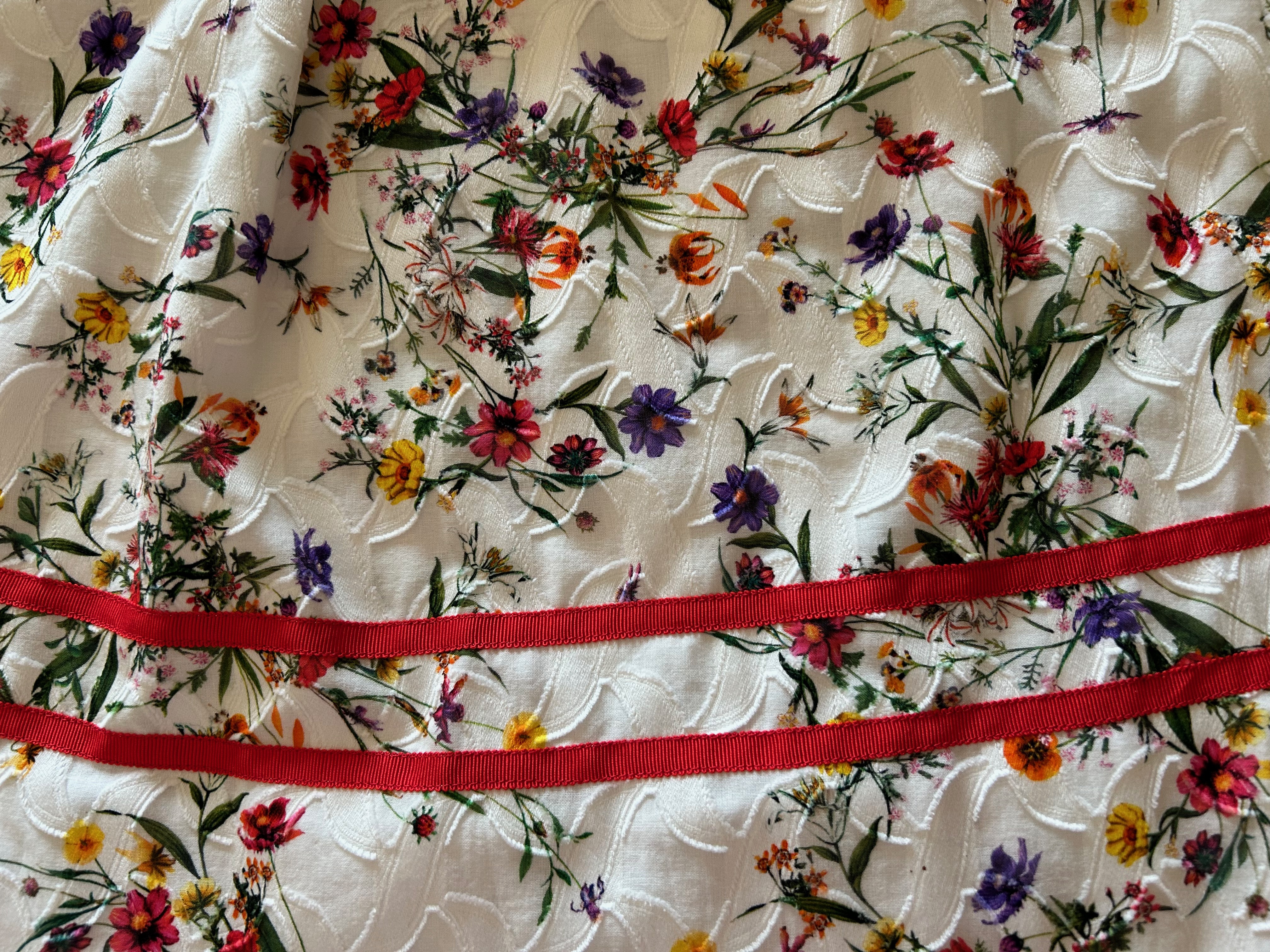
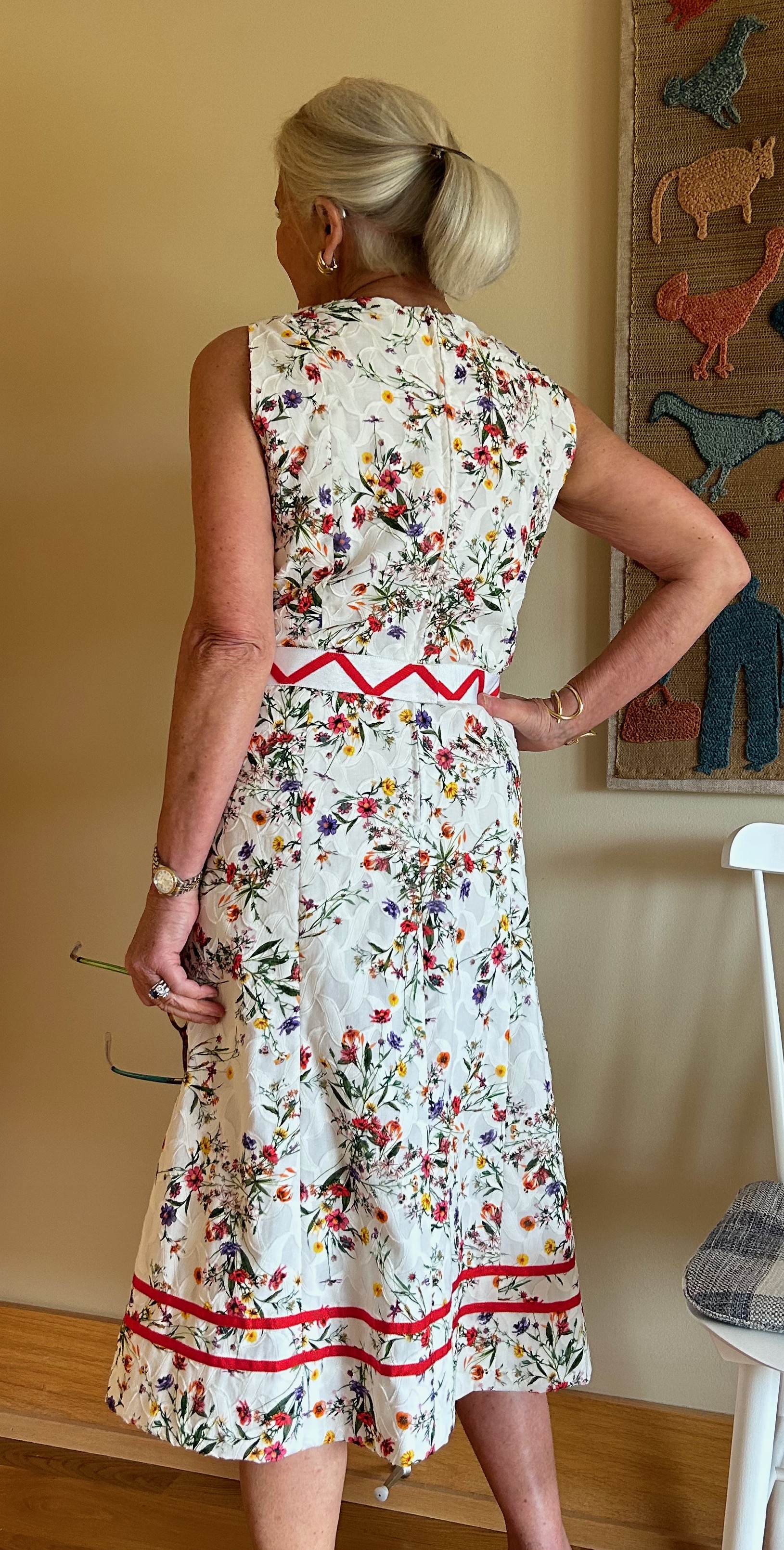
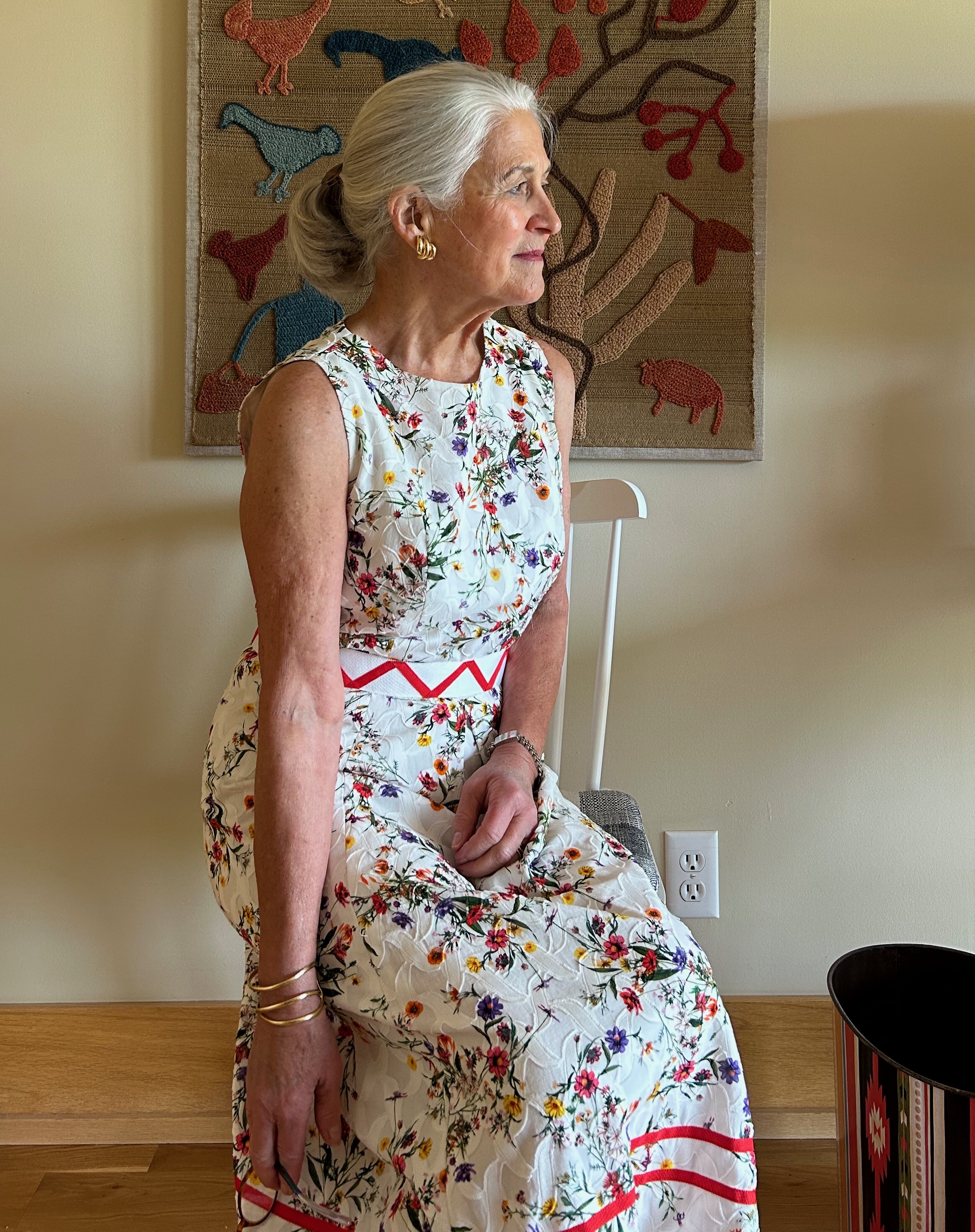
For a number of years this light, filmy, patterned and printed cotton, made in Italy,  had been lurking in my “cottons basket.”  I had purchased two yards of it from Mendel Goldberg Fabrics, for a “future” dress presumably.

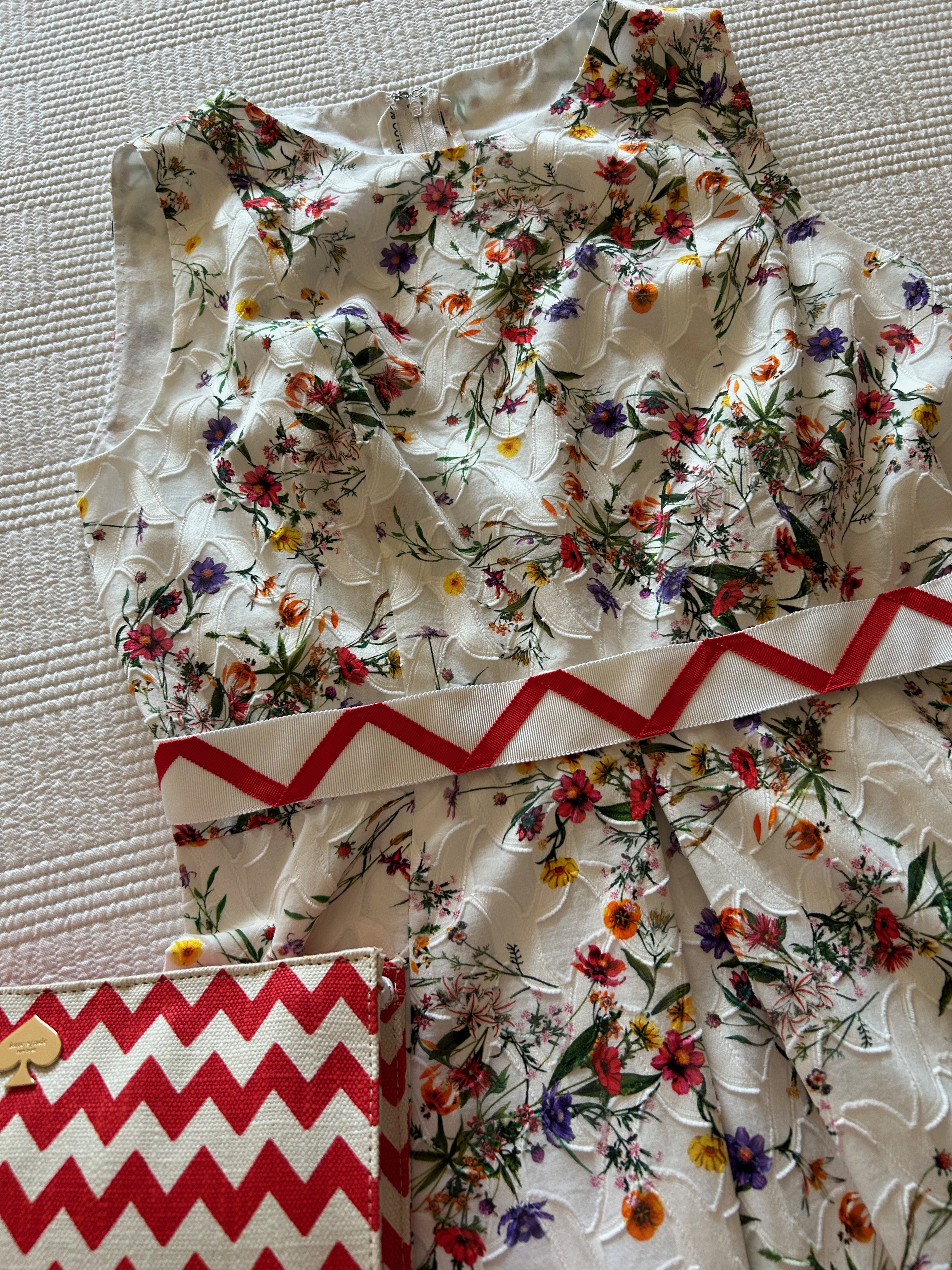
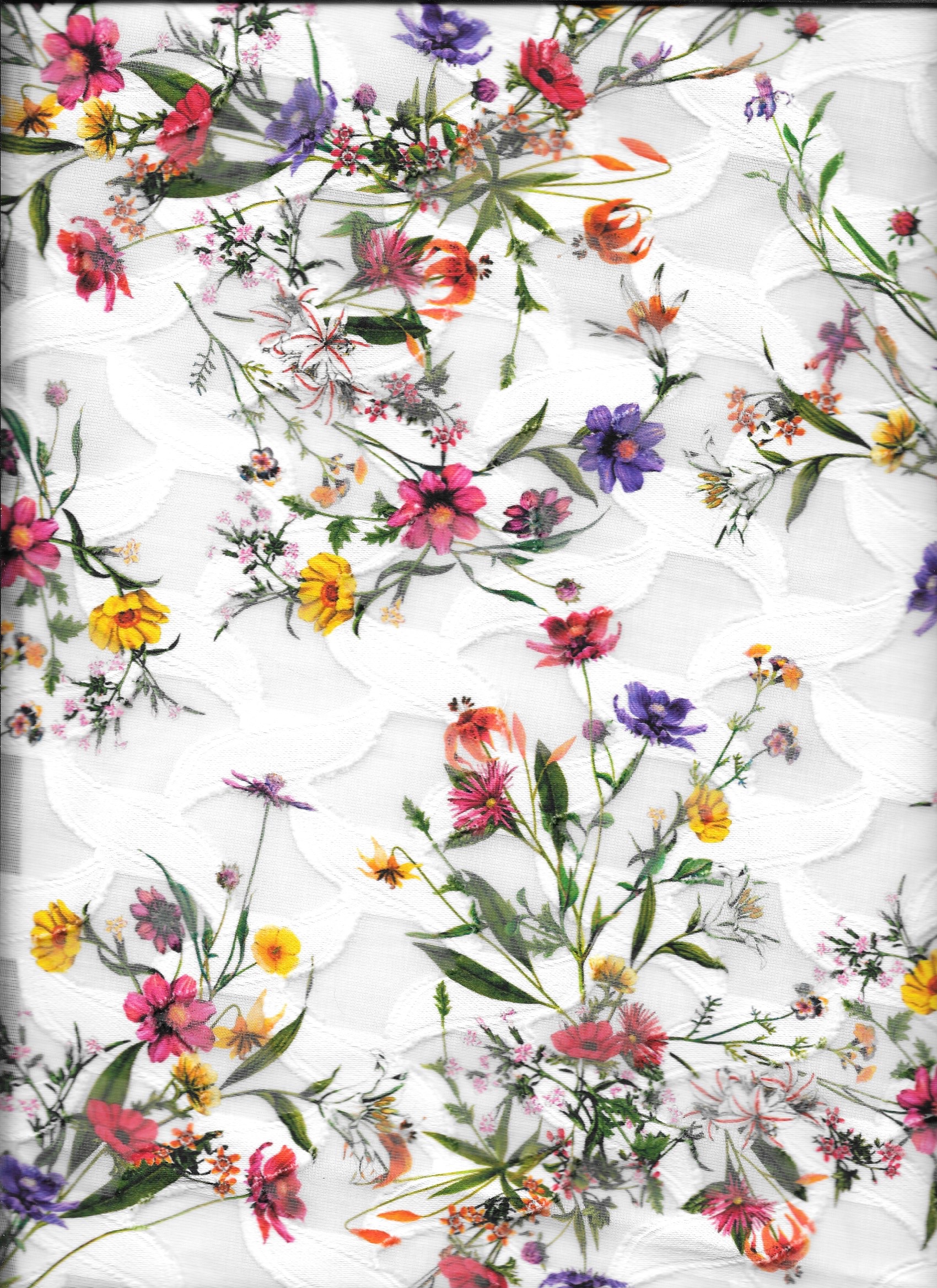
This fabric is partially sheer. The print is overlaid on what appears to be a “burn-out” cotton, ie., two-layered.

At 60” wide, I knew two yards would be sufficient for just about any summer style I chose to make.  It seemed like every Spring I would take it out and consider the possibilities for it, not reaching a decision.  But this Spring, the “future” had finally arrived, at least for this fabric.

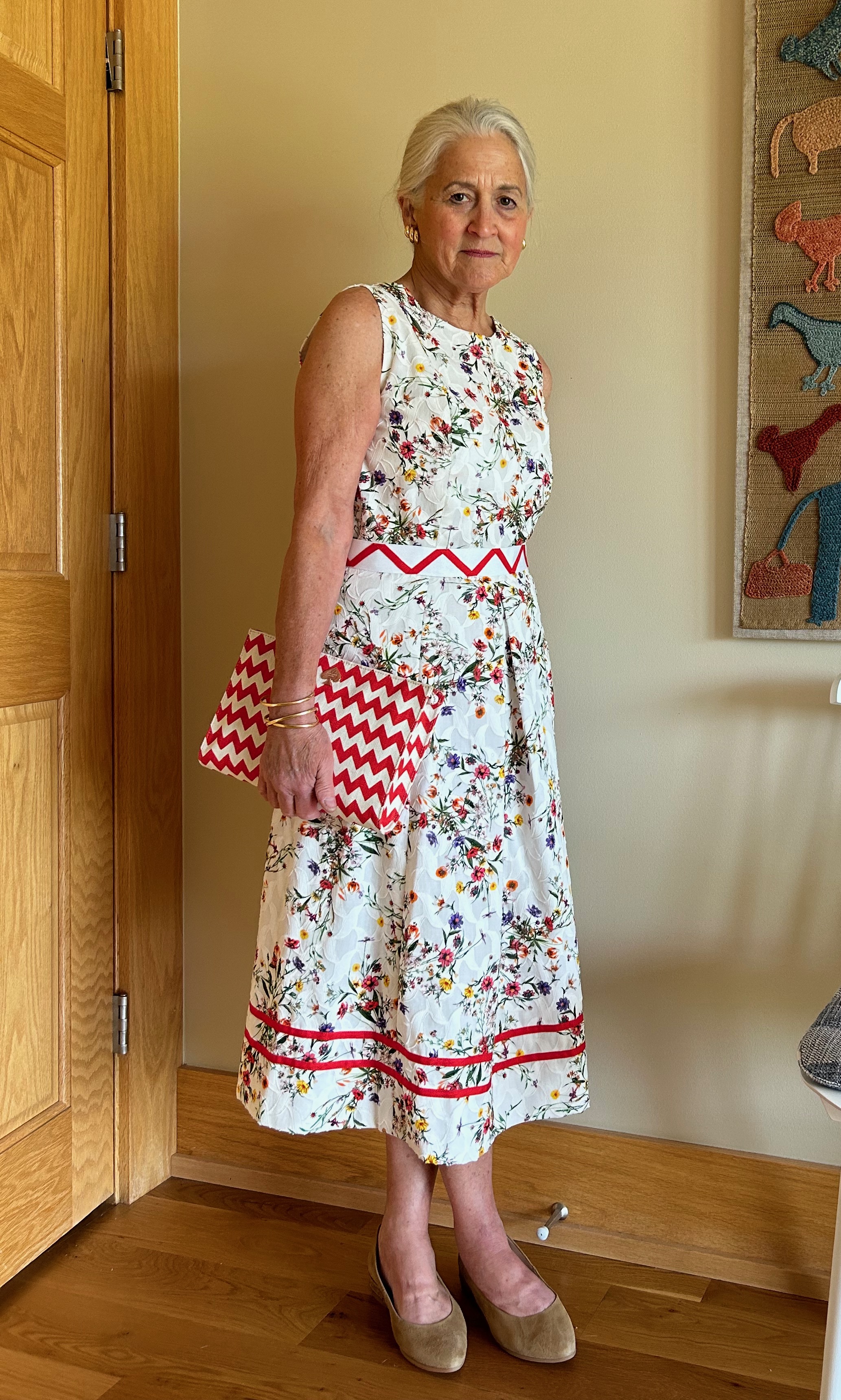
I’m not sure how I came up with the idea to trim it with a coordinating tape/ribbon, but I liked the definition it gave to the colors in the printed floral sprays.  First, I thought purple would be a great color to pair with it, then I went to yellow, then to pink.  None of those seemed to make the fabric pop the way I anticipated they would.  So, even though red is not a dominant color in the print, I decided to try it. And that was it – it worked!

I had already decided on a Vogue pattern I had previously used twice, albeit with a number of obvious changes.  

The first construction decision facing me was whether to underline it with cotton batiste and then also line it with – I wasn’t sure what; or just line it and hope that would be sufficient.  I wanted to preserve the light, airy feel of the fabric, but I also needed to address the sheerness of part of the fabric.  

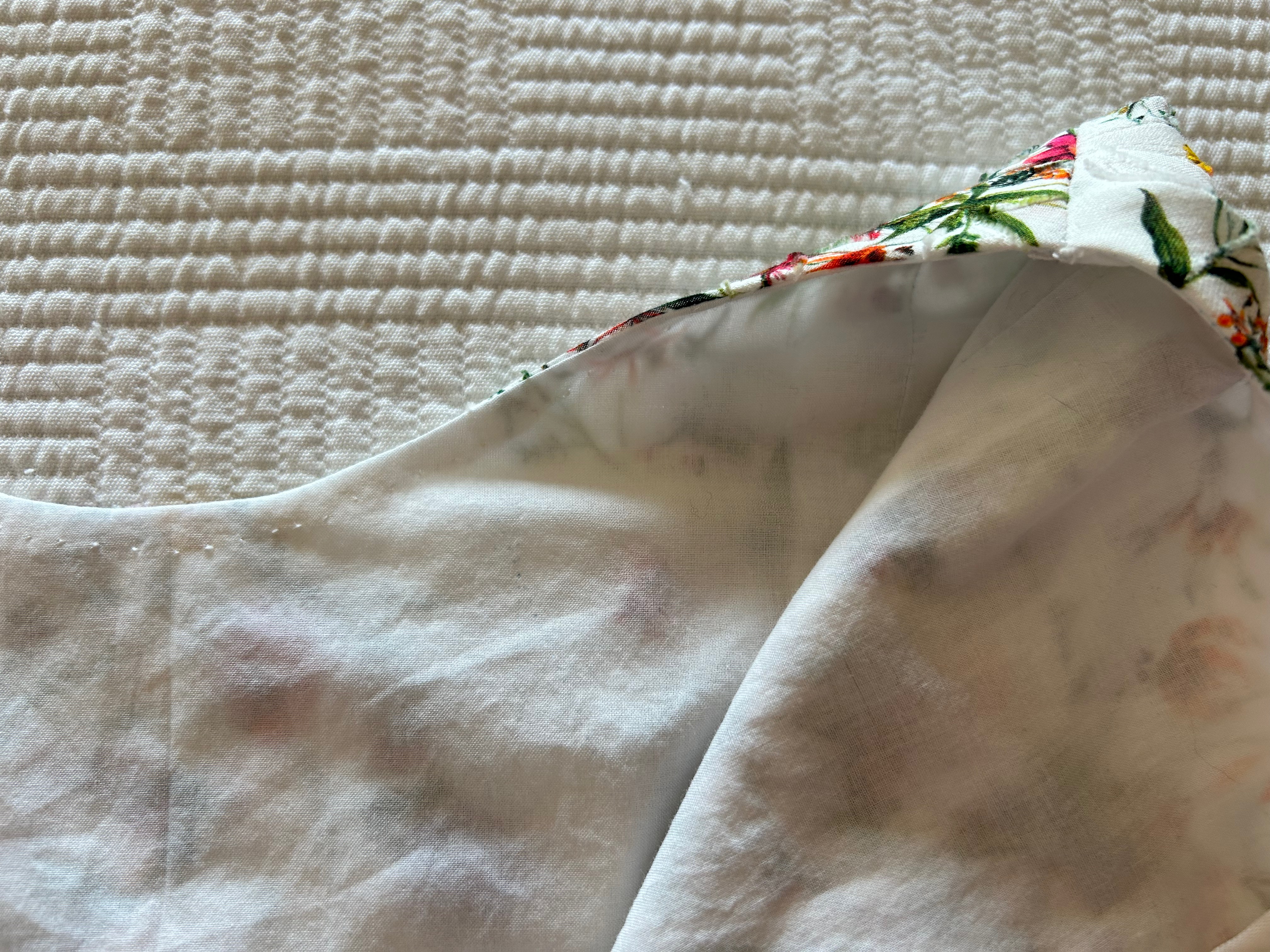
After much thought and experimentation, I went with using only a simple cotton batiste lining. That turned out to be the right decision.  I under-stitched around the inside of the neckline and armscyes even though I did not have an underlining upon which to secure those stitches.  However, the under-stitching – which caught only the seam allowance – still had enough of a stabilizing effect to secure those edges. 

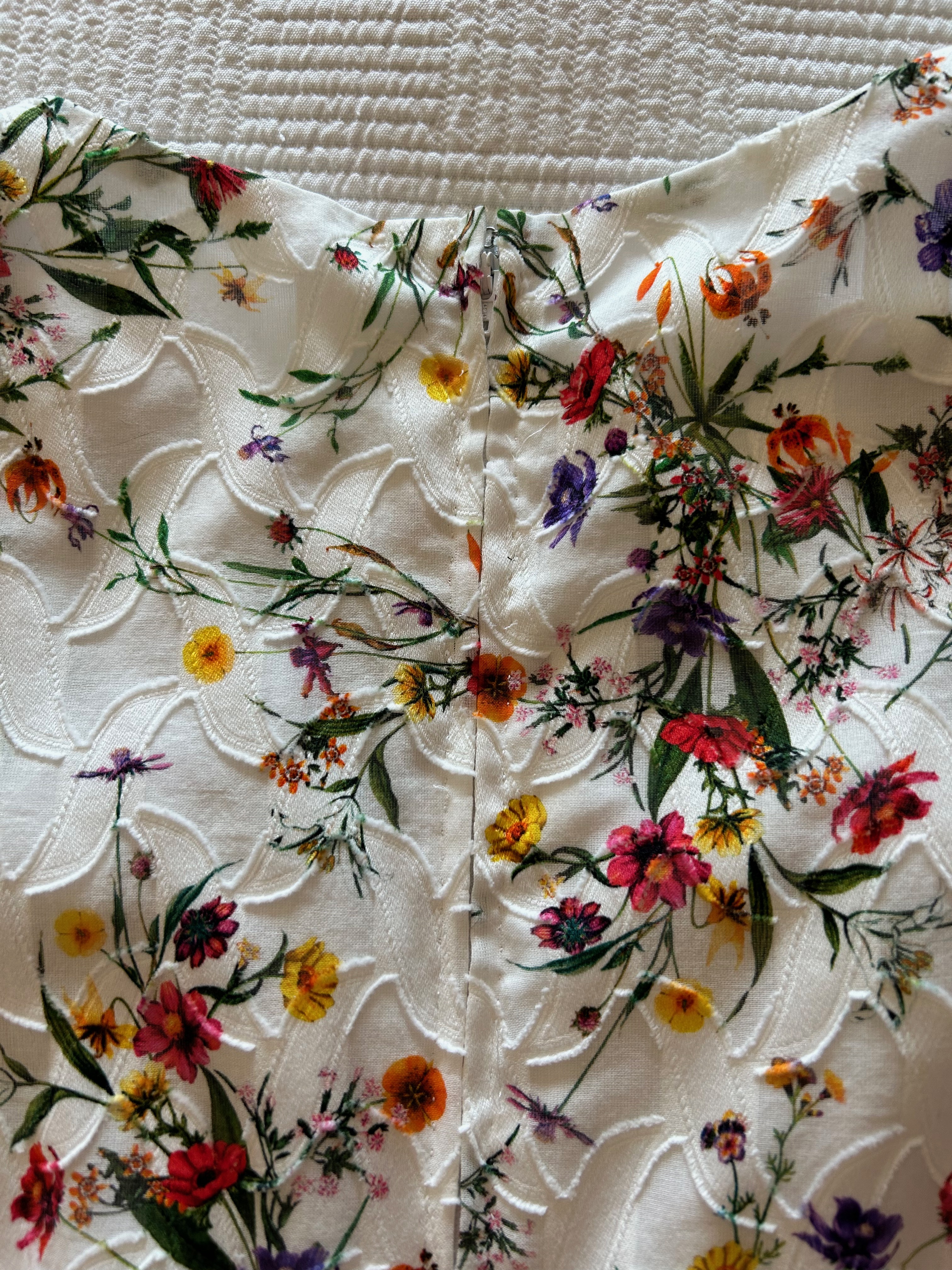
A hand-picked zipper is always a lovely detail to add to a dress like this:

There was some subtle pattern placement on this dress, but no matching.

I’m getting ahead of myself here, but to make this dress, I was eking out small snippets of sewing time during a complicated Spring.  And when the time came to do our annual Summer migration from Pennsylvania to Wyoming, 2200 driving miles west, the dress was unfinished.  

So, I packed it up along with a lot of other sewing-related things, and I eventually picked up where I left off.   I remembered to bring the zipper for the dress, – and the red Petersham ribbon for its embellishment – but I forgot to bring the extra dress fabric.  Why was this a big deal, you might be asking?  Well – I needed to make a belt for the dress, and my intention was to make a self-belt, edged with the red ribbon.  

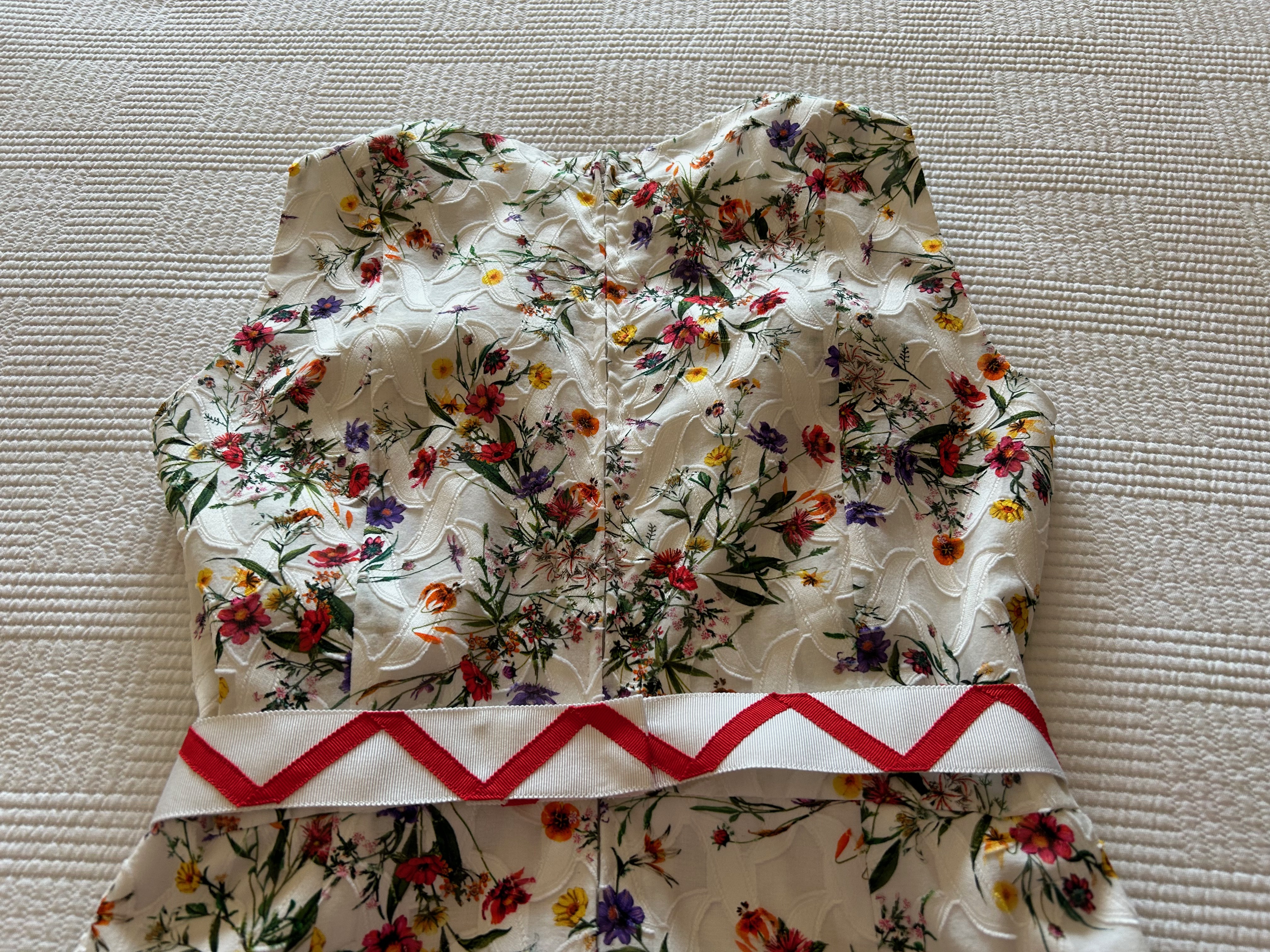
Once again in my sewing life, I found myself going to Plan B – necessary, if I had any thought of wearing this dress this summer.  (Plan B stands for “It BETTER work.”)  I hemmed and hawed and decided there were two options.  One was a white belt and the other was a red belt.  I came to the conclusion a red belt would be too overpowering for the delicate nature of the fabric.  So that left me with a white belt, which wasn’t too exciting.  Then I had a eureka moment when I realized I could pick up the somewhat zigzag overlay motif in the fabric and embellish the belt with my extra red Petersham ribbon, applied in a zigzag pattern.  

This actually shows the back of the bodice. I used flat hooks to secure the belt.

Plan “B” seemed like a good idea when I remembered I had this Kate Spade Summer clutch to pair with my dress.

So – I rather like the Plan B belt although I may decide at some point to make a self-belt as I had originally intended.  We shall see.  One thing I know I will do is make belt loops for this dress from its remaining fabric sleeping back in Pennsylvania.

In the meantime, this is a good dress for a hot American summer.

Ciao!

33 Comments

Filed under couture construction, hand-sewn zippers, Linings, Summer sewing, Uncategorized, vintage Vogue Designer patterns, vintage Vogue patterns from the 1970s

PINK Plans for 2022

Five days into the New Year seems like a good time to look forward and put down in writing new plans and projects, both personally and in my sewing life.  Occasionally in past years, I have chosen a word to guide me in my thinking, and after a sewing friend (thank you, Debra!) suggested this approach again, I happily went with the first word which popped into my mind.  P I N K.

Pink is undoubtably my favorite color.  I love it in all hues and shades, from the palest pink to deepest fuchia, from bubblegum pink to carnation pink.  I love wearing pink and I love sewing with pink fabrics. Looking at fabrics I have collected over the past few years testifies to this fact.

A few of those selections with “assignments” for 2022 will be scattered amongst this exploration into PINK.

And first up is this length of deep pink cashmere blend (Farmhouse Fabrics), from which I plan to make this jacket:

P:

P of course stands for PINK the color.

P is also a good reminder to keep PERSPECTIVE on the year.  If the last two years have taught us anything, it is to be prepared for the unexpected.  Sometimes things are out of our control, thwarting our plans and timing.  Rolling with the punches (another P-word!) is something I need to become better at.  Which brings me to . . .

P is for PERSEVERANCE.  This is an invaluable asset when it comes to sewing well – and living well.  

I have plans to make a day dress out of this soft and supple dress-weight wool, purchased from Mendel Goldberg Fabrics. I am still deciding on the pattern.

I:

I is for INDULGENCE.  I have decided to indulge my love of coats and dresses and fancy clothes even I don’t need them.  So there!  

I is also for INDECISION.  I am not usually one who has trouble making decisions, but sometimes, a fabric or pattern stumps me.  When that happens, I have to step back and let time make the decision for me.  It always works.

I is for INSPIRATION, which is never in short supply among all the vintage patterns, fashions, buttons, and fabrics in the couture-loving-and-sewing online community.

If you follow my blog, you have seen this duo before. Silk charmeuse for a fancy blouse and silk twill for a floaty skirt, both from Britex Fabrics.

N:

N is for NEW ENDEAVORS, both in sewing and in my personal life – NEW patterns, NEW fabrics (YES! Even new fabrics), NEW commitments, determined by answering these two questions:  What can I let go of?  And, more importantly perhaps, What can I not let go of? 

N is also for NOT feeling guilty about all the time I devote to sewing and fashion and dreaming about both. 

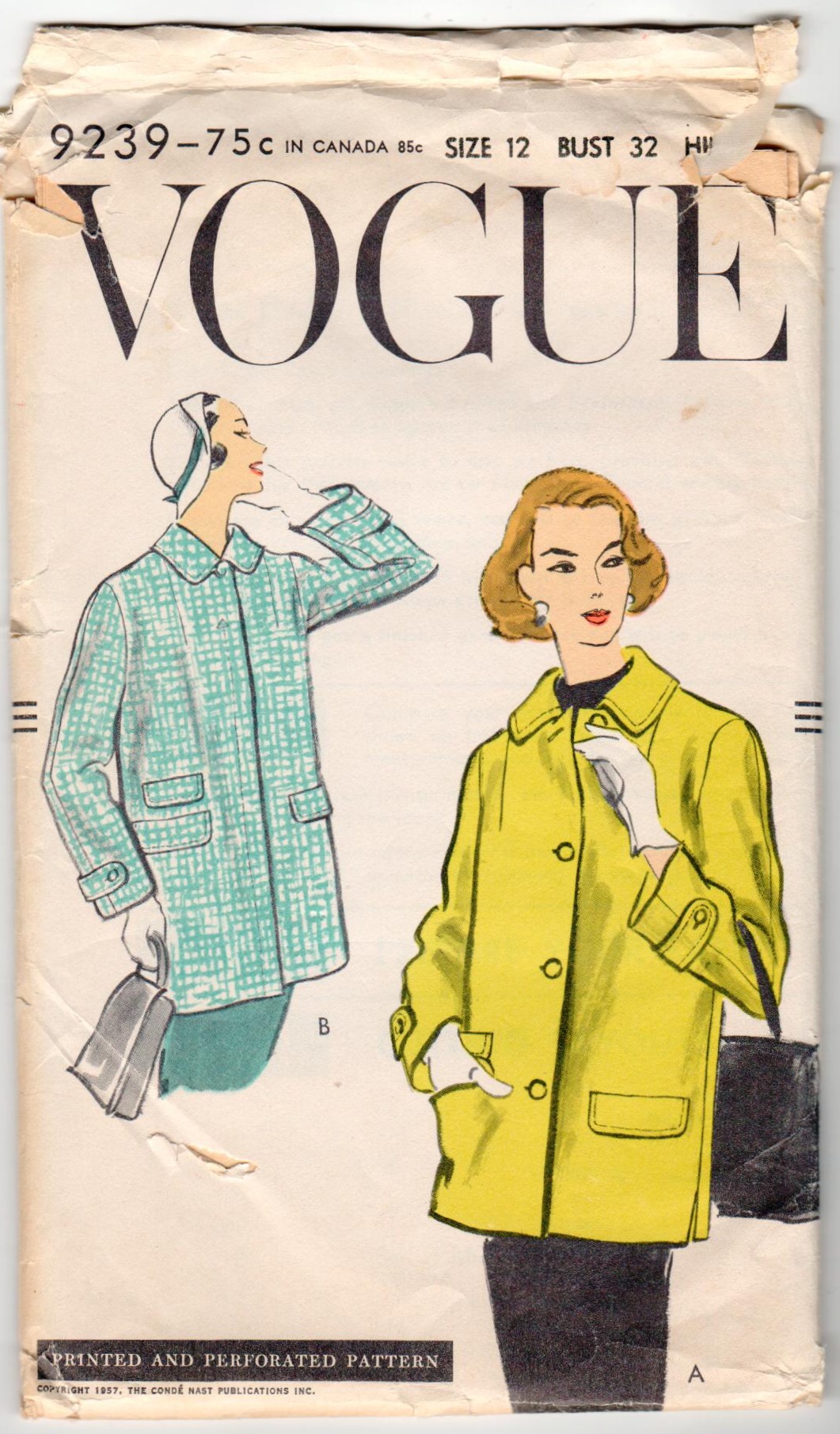
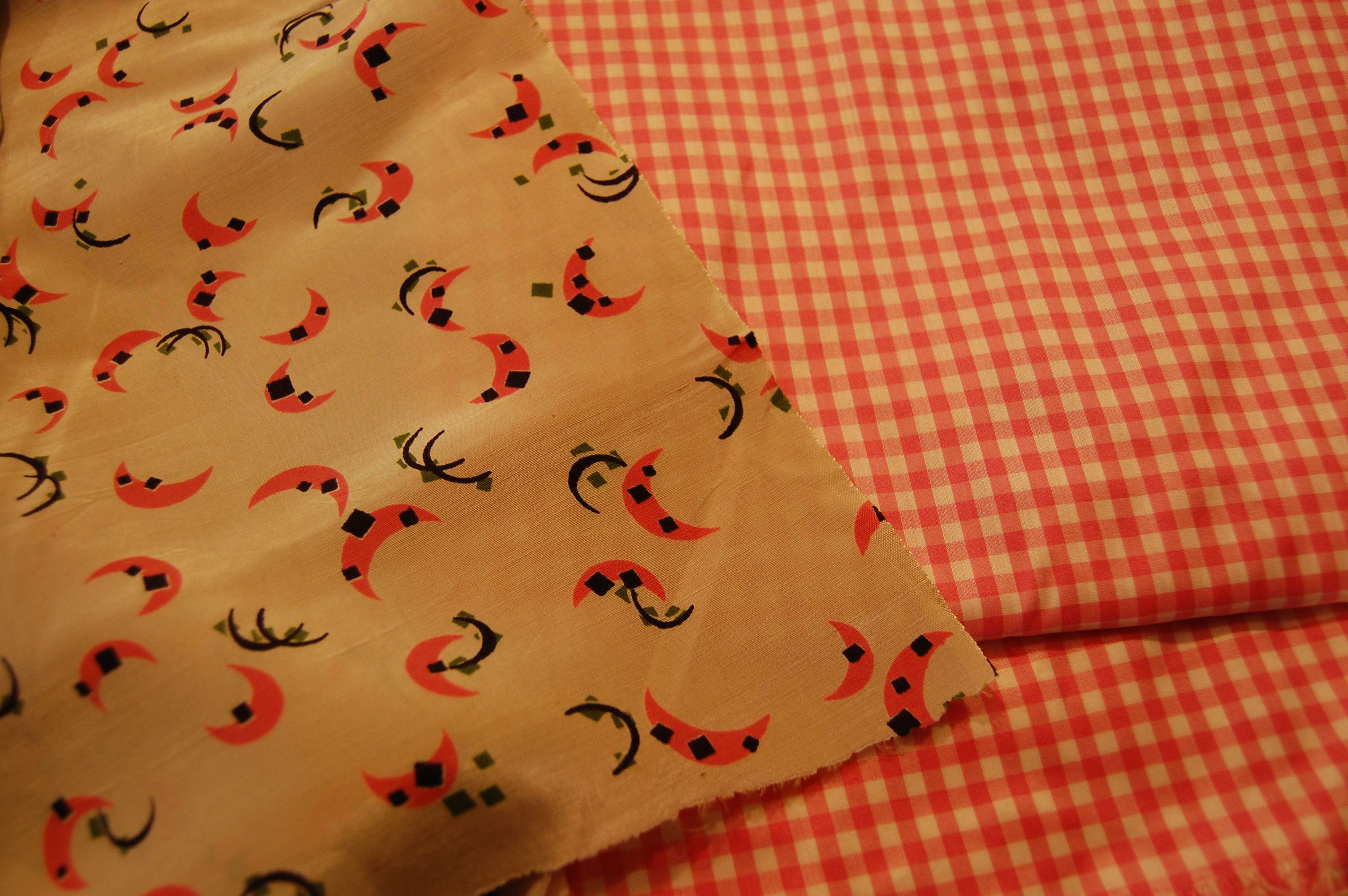
The pink gingham on the right is silk taffeta. When I purchased this fabric from Farmhouse Fabrics, I intended to make a shirt dress, but then it did not seem right to me. A couple of years later, I knew it needed to be a Spring coat instead, lined with the quirky vintage 1950s’ novelty silk. The pattern is below, first used by me in 1974 for a trench coat I sadly no longer have.
I love this pattern now as much as I did when I first made it in my early twenties.

K:

K is for Kindred Spirits – such an amazing camaraderie amongst the global sewing community. I am so grateful to be part of the network of friendships we share.

K is for Keeping Focus, and for the need to Knuckle Down in order to accomplish my sewing and personal goals this year.   

K is finally for Kindness which I hope will guide me throughout this new year.

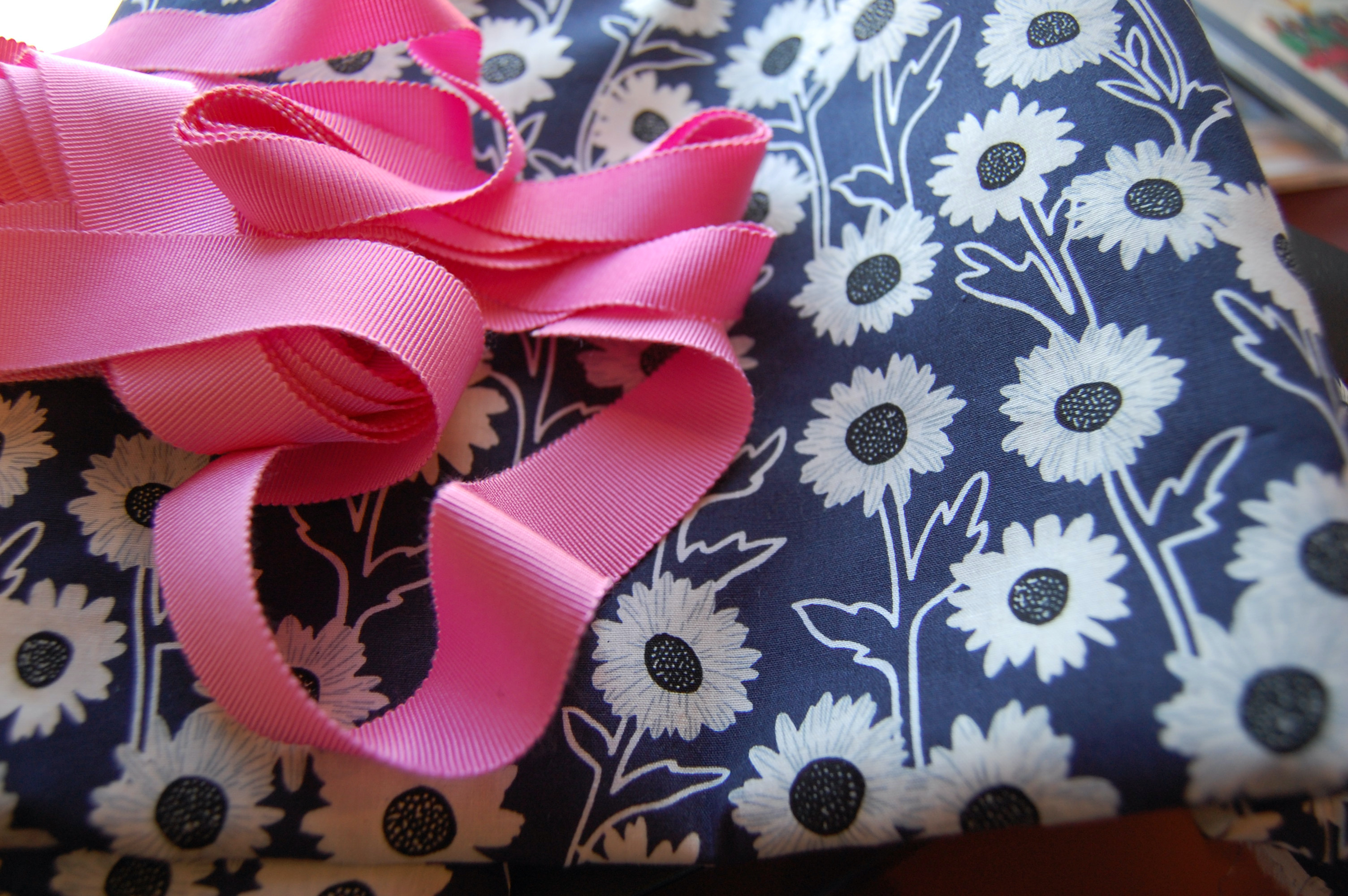
Even when I choose a color other than pink, somehow pink wiggles its way into the design. When I found this fabric at Emma One Sock Fabrics, I immediately thought of making a tunic and trimming it with pink Petersham ribbon.
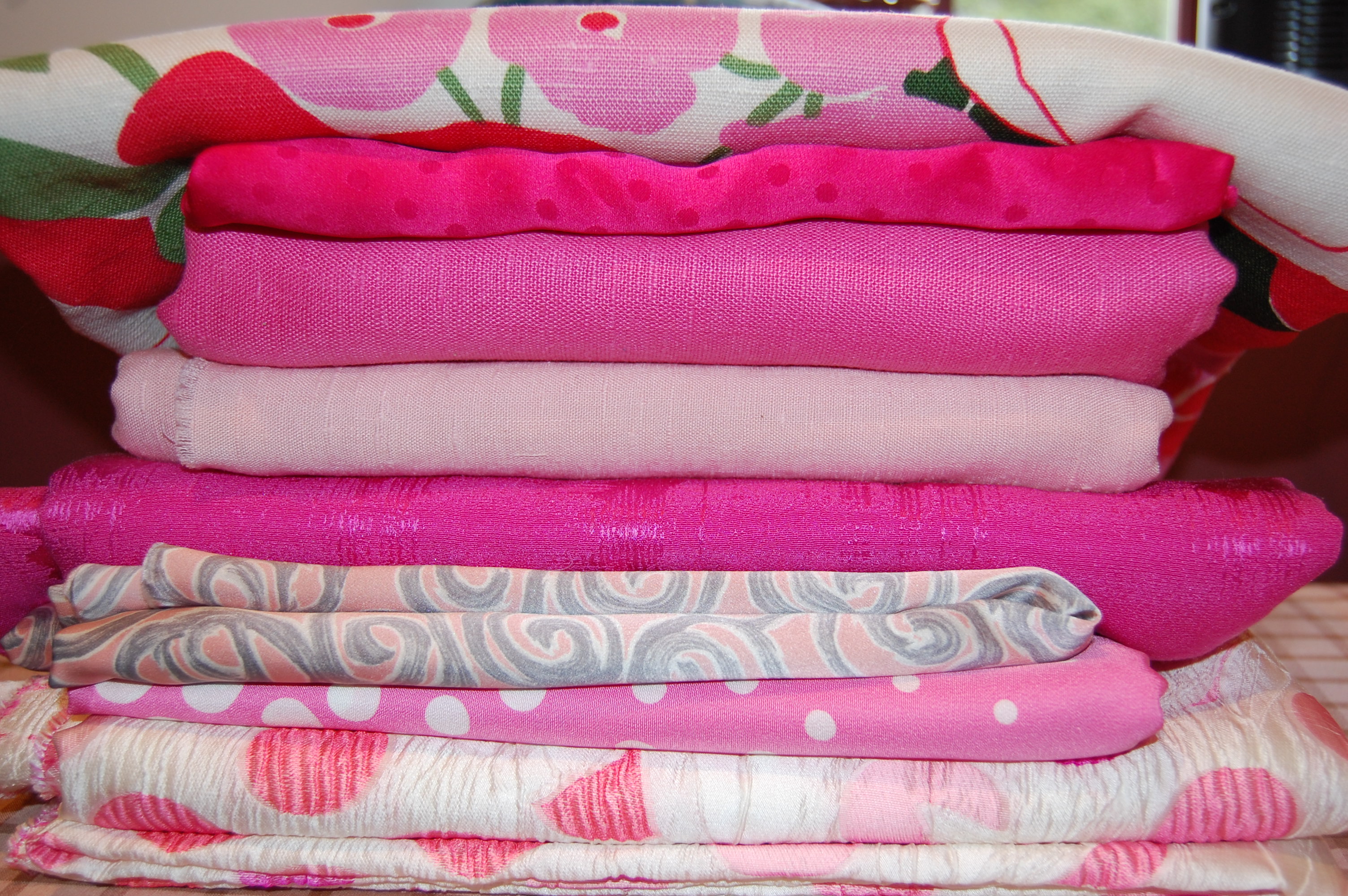
A Pink-Lover’s Dream Collection: From top to bottom: 1)vintage Moygashel linen, purchased on eBay 2) silk charmeuse, purchased from Britex Fabrics 3)vintage Moygashel linen, purchased by me in the 1970s 4) linen, possibly Moygashel, purchased on Etsy 5) silk jacquard purchased from Britex 6) silk charmeuse, purchased from Mendel Goldberg Fabrics 7 & 8) coordinating silks, purchased from Mendel Goldberg.

“And now we welcome the new year, full of things that have never been.”  Rainer Maria Rilke

Happy New Year, dear Sewing Friends.  

26 Comments

Filed under Mid-Century style, silk, Silk taffeta, Uncategorized, Vintage fabric

Dreaming in Color

Way back in January of this year – which seems like a lifetime ago now – making plans for my 2020 sewing was an exciting exercise.  I was eagerly looking forward to some upcoming events, including one in early May which was going to require at least two new dresses.  One of these dresses would be worn to a “fancy” evening.  In this casual world, what dressmaker does not relish the idea of making a dressy frock?  It was definitely going to be a fun trip and a varied multi-day event.

C         A        N        C        E        L        L        E       D

Needless to say, that trip and all its events were cancelled.  Other special occasions were also cancelled, along with many that were not so special.  I looked anew at my sewing plans.  I shifted some things around, eliminated others.  But I kept going back to the thought of that dressy dress.  The fabric was so cheerful, the colors so bright I could not abandon the idea of making it, even without an occasion for its wearing. So in early May I decided to go ahead with my original plans, albeit without a deadline.

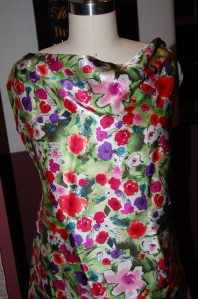
I had purchased this silk charmeuse from Mendel Goldberg Fabrics in New York City several years ago.  It reminded me of fabric which one might see in a design by Christian Dior, due to its “Impressionistic” appearance.

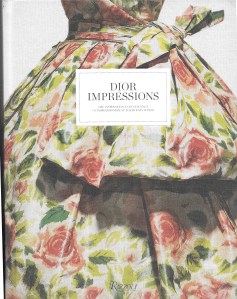
The subtitle for this informative book is The Inspiration and Influence of Impressionism at the House of Dior.

When I unfolded the fabric to give it a press, I saw it was actually a Pierre Cardin design.  It struck me as somewhat unusual for Cardin, so of course I wanted to know if there had ever been any connection between the two couturiers or their fashion houses.  I went to my St. James Fashion Encyclopedia.  Well, yes, as a matter of fact there was:  “From his earliest work for the House of Dior up to the 1950s [my italics],Cardin displays an interest in the sculptural qualities of cut and construction that are still his trademarks in the 1990s.” (p. 87, The St. James Fashion Encyclopedia, Visible Ink Press, Detroit, Michigan, c1997.)

It may be a bit of a stretch to suppose this fabric does indeed have a Dior connection, but still, I wonder.  Could Cardin – now at his advanced age of 97 – and his fashion house still be influenced by those early days with Dior?  Of Dior’s style direction in the early 1950s, Christian Dior himself wrote ”…Colors were inspired by the pictures of the Impressionists and evoked the fields of flowers dear to Renoir and Van Gogh.”  (p. 5, Dior Impressions, Rizzoli International Publications, Inc., New York, New York, c2013.)  It is fascinating to ponder.

Now back to topic:  I started my dress.  I got the silk organza underlining marked and cut, I cut out the fashion fabric, I basted the two layers together, ready to start the actual construction.  Then I had a bad day.  It had nothing to do with my progress or the process, which was going along fine.  I just had this dismal feeling this was all for naught.  Why would I need such a lovely silk dress?  Where would I wear it?  Were all these hours I was spending in my sewing room just a waste of time? What purpose do all these pretty clothes serve without any social gatherings and occasions to which to wear them?  I think it is fair to say I was having a serious existential sewing crisis.  It was dispiriting and discouraging to say the least.  It made me question my otherwise passionate commitment to couture sewing.
That night I had a dream – in vivid color.  I saw myself in a fancy restaurant which was bustling with people – and I was wearing the very dress I had started – now completed and quite notable in its floral print of bright greens, and pinks and reds and purple.   I was seated at a table with three friends and we were lunching. (Not sure this dress is quite the thing I would wear to a midday lunch, but that’s dreams for you.)   The four of us were having the best time. We were laughing and totally engaged in our conversation and in our friendship. It was lovely and it was memorable.

And there was not a facemask in sight.
23 Comments

Filed under Christian Dior, Fashion history, Formal or fancy dresses, Love of sewing, sewing in silk, silk, Uncategorized

Ready To Wear, Ready To Copy

It is no secret that those of us who sew often get inspiration from Ready To Wear.  When select catalogs come in the mail, I love to look at them just to see what ideas I can find which may apply to one of my planned projects.  The same goes for online ads which pop up in all kinds of situations.  The sources of inspiration are practically endless, but every once in a while, I find a bonanza of ideas all bunched together.
Such was the case with the Gorsuch catalog which recently arrived.

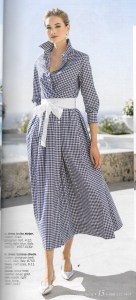
 Getaway 2020 should be renamed Stay at Home and Sew, Sew, Sew!  Shirtwaist dresses are much on my mind right now as I am currently working on a wool challis rendition of that classic style.  I have plans for more versions of this timeless dress in silk and cotton.  So imagine my delight when I turned the page in the catalog and saw this stunner:

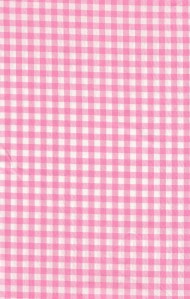
My gingham shirtwaist dress is going to be in pink silk.

I found this pink silk gingham at Farmhouse Fabrics.

And although it will be a few months until I get to it, I had already been pondering what to do for a belt/sash.  I didn’t really want one to match the dress.  Well . . . the wide grosgrain belt in white pictured in the catalog is just the look I know I want.  Would I have thought of this myself?  Probably not.  So hooray for RTW ideas.

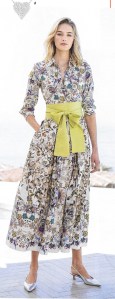
I didn’t have to turn more than a few pages in the same catalog, and I came across this dress:

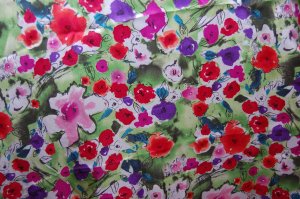
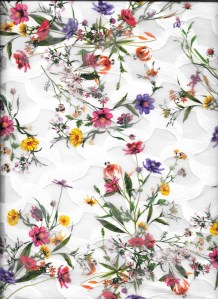
The all-over floral design reminded me of a piece of cotton I purchased from Mendel Goldberg a couple of years ago.

This fabric is partially translucent, so the body of the dress will be underlined in batiste.

I bought this fabric thinking I would make a shirtwaist dress, but I couldn’t quite make it work in my mind.  I thought I would like to emphasize the purple/deep lavender in it, although other colors are more dominant.  I even found lavender buttons, but then thought they may be washed out by the other colors.  But – seeing this dress being so effective with a grosgrain belt (again!) in a very non-dominant color, has given me all the confidence I need to take this future dress in the original direction I envisioned.

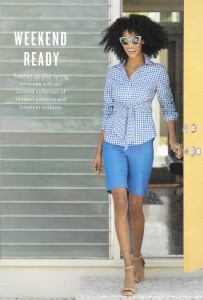
Among my many clippings from catalogs and magazines are some I keep in a separate “pile” in my sewing room.  They are separate because I love the ideas in them so much, I want them to be ever present in my presence!  This blouse featured in a J. McLaughlin catalog last year is just such an idea.

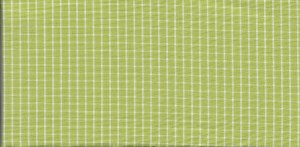
And while I could wear gingham checks forever and ever, I plan to make a copy of this blouse in a grass green windowpane check cotton I found at Farmhouse Fabrics.  I may even make a pair of linen pants to wear with it, but we’ll see.  (Pants are my least favorite item to make.)


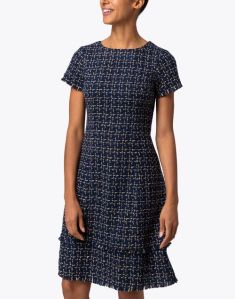
And then there is this inspiration from the online presence of Halsbrook:

Remember this dress.  It is going to be copied….

18 Comments

Filed under Uncategorized

The Last Dress of the Year Past

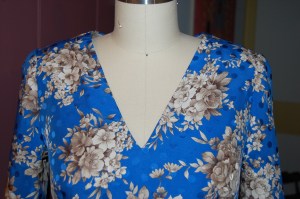
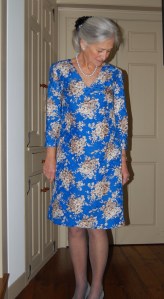
Little did I know when I found this “end-cut” earlier in the year at Mendel Goldberg Fabrics that “classic blue” would be chosen as Pantone’s Color of the Year for 2020.  But so it was, which makes my last dress of 2019 the perfect transition into the new year and the new decade.

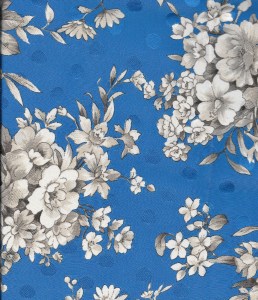
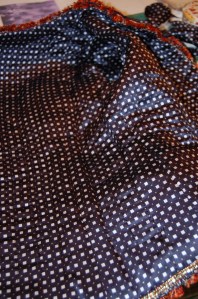
This an Italian silk charmeuse, in a dotted and printed jacquard.

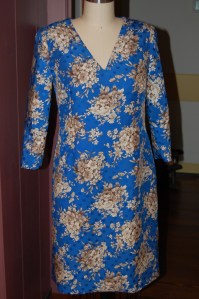
I am one of those people who rarely goes looking for a particular fabric.  I think fabrics find me and when this fabric found me, I really had no plan for what I would make out of it.  But as soon as it arrived, I knew immediately I wanted a sheath dress with three-quarter length sleeves and a V-neck.  I tucked it away, happy with the thought of making this dress, and knowing I had the perfect pattern to make it a reality.

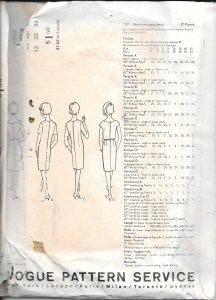
View C, of course! And look at those lovely shaping darts.

This Vogue pattern is from the early 1960s, a little tattered and worn, but very versatile and beautifully engineered.

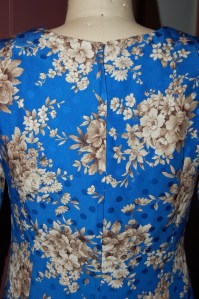
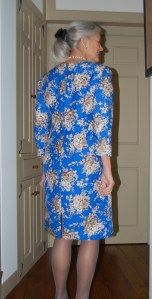
After finishing my granddaughters’ December dresses, and then my pink Parisian Jacket, and then some cute little flannel blouses for gifts for my little girls, I envisioned finishing this dress to wear to holiday parties.  What was I thinking?  First of all, after tweaking the pattern one last time (I had had the pattern fitted a couple of years ago while in a class with Susan Khalje), it took two full days – yes, TWO – to figure out how in the world to lay out my pattern pieces.  Truth be told, I really did not have enough fabric.  I should have reconsidered, but I am stubborn and tenacious when it comes to my sewing “visions.”  I finally decided that I could exactly match the print on the back center seam and make it sleeveless – OR I could have sleeves and not match the back.  I really, really wanted sleeves.  It had to have sleeves.  So I did the best I could with making the back seam look okay, and I got my sleeves.

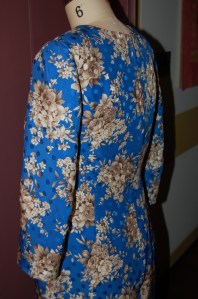
Fortunately the all-over placement of the floral motifs lent itself to imprecise matching better than many fabrics would.

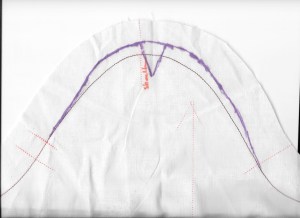
And what lovely sleeves they are!  When Susan fitted the pattern, she elongated the top curve of the sleeve to accommodate my prominent shoulders.  She also added a dart at the shoulder of the sleeve (actually slightly forward from the marked shoulder of the pattern to accommodate the roll of my shoulders).  I added a slight amount to the width of the sleeve, about 3/8”.  I have found these vintage patterns are often narrow in the sleeves.

The purple lines are the changes to the muslin.

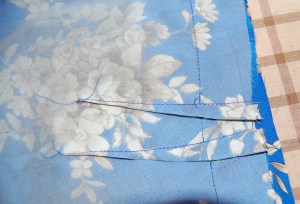
The double elbow darts in the sleeves make a lovely fit and are placed precisely where they should be.

It’s a little difficult to see the double darts, but they are there!

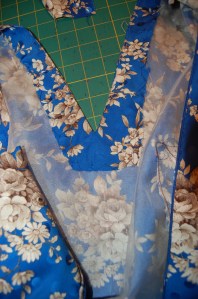
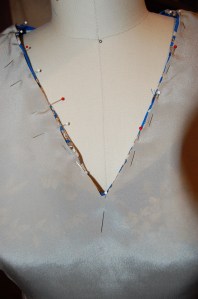
When it came to the V-neck, I knew I would need to use a facing of some sort, but I did not have enough fabric to cut a full facing.  So – I cut a partial facing instead, just enough to be able to turn the V and have it stable.  (The first thing I did when I started sewing the dress, was to reinforce that neckline with a strip of silk organza selvedge.)  Well, this worked like a charm, much to my delight.

The partial facing extends up from the bottom of the V about 2.5 inches, and then the turned- back seam allowance takes over.

Then I brought the lining fabric right to the edge of the neckline and understitched it to secure it in place, just as you would expect a couture dress to be finished.

I chose a “mushroom” colored crepe de chine for my lining. Blues are very difficult to match as you know, so I decided a contrast color would be best. The lining fabric is from Emma One Sock Fabrics.
I used blue thread for the under stitching.

I used a lapped application for the hand-picked zipper.  The more I use the lapped insertion for zippers, the more I like it.  And I especially like it in a center back seam.

I’m feeling quite pleased with this dress!

There is not much more to say about this blue floral dress, except that it was not finished in time to wear to any holiday event.  Which was fine!  Once I realized this would be the case, I was able to really enjoy the process of making it.  It was a delightful way to end the year – and the decade, which has had such a profound effect on my sewing.


37 Comments

Filed under couture construction, hand-sewn zippers, Linings, Mid-Century style, Pantone Color of the Year, Polka dots, sewing in silk, Sheath dresses, Sleeves, Uncategorized, vintage Vogue patterns from the 1960s

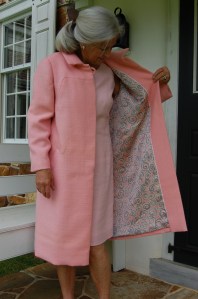
The Pink Coat Odyssey, The Finish!

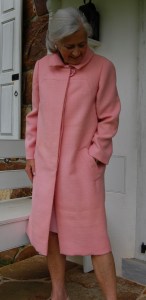
Is it possible to fall in love with a coat?  If so, then that is what has happened with my pink coat.  It was a relationship which grew over several years.

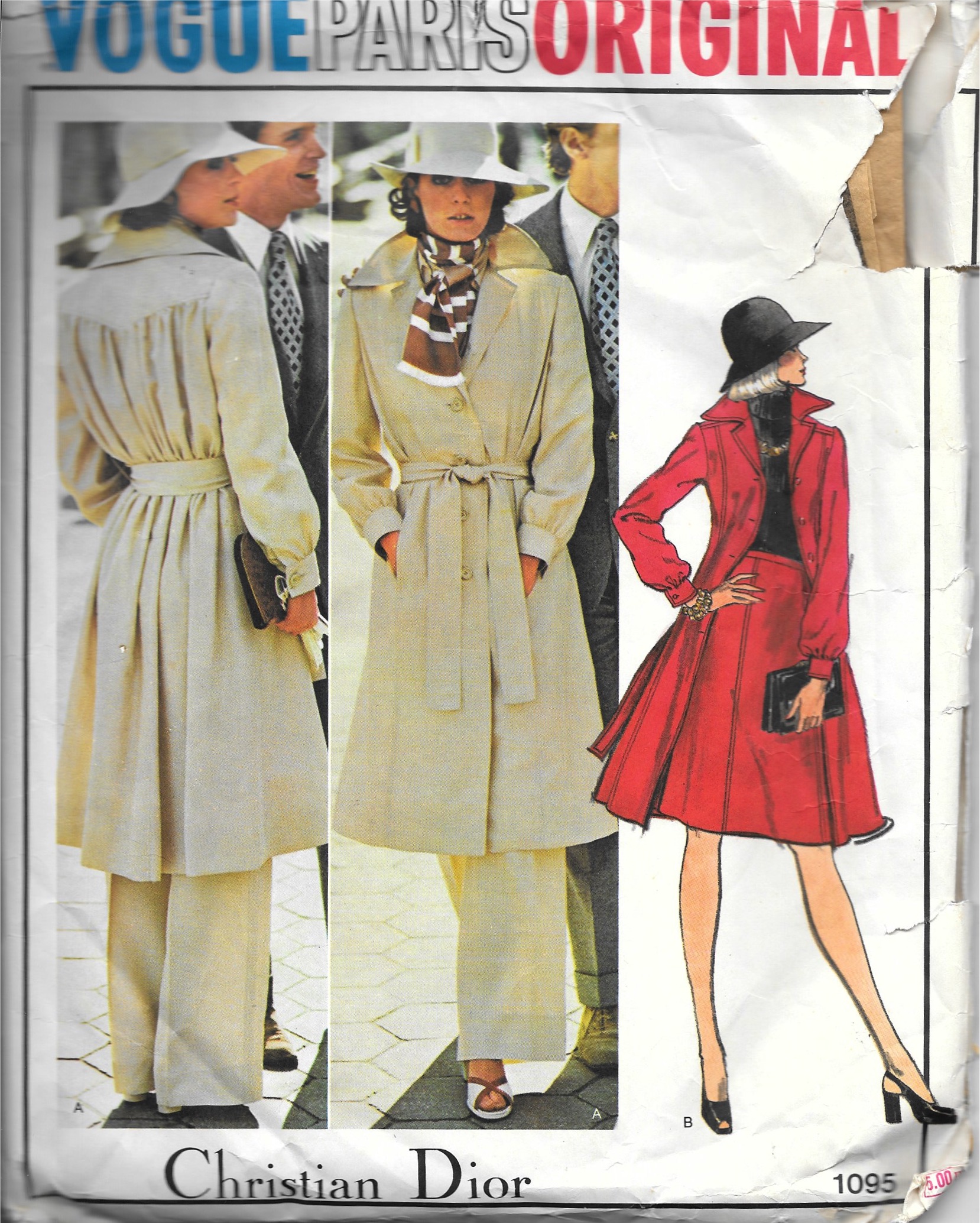
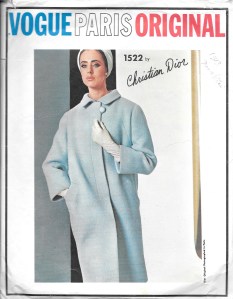
First, I found the pattern, this Vogue Paris Original Designer Pattern from 1965.  It was an eBay purchase made several years ago, with a promise to myself that one day, when I found the right fabric, I would make it.

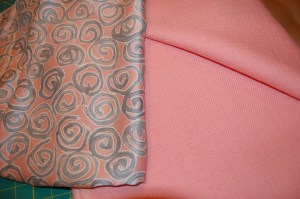
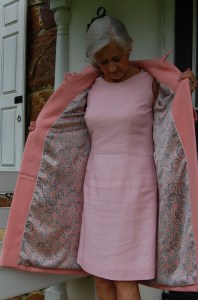
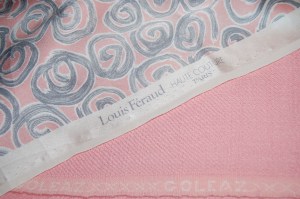
Next I found this silk charmeuse couture fabric on the website of Mendel Goldberg Fabrics. It was an end cut, 2.25 yards, and when I purchased it, I envisioned another wrap dress, not the lining of a coat.  Luckily I had no urgent plans to use it, and thus it eventually found its way inside the pink coat.

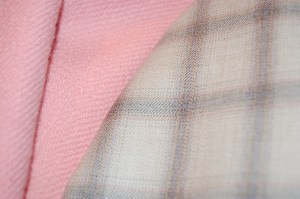
I am showing the lining silk here along with the pink wool to show how well they complement each other.

And then – I found the pink wool.  Also an eBay purchase, this wool was not inexpensively priced, but I recognized its rarity and its “presence” in the posted pictures.  Then I hoped it would live up to its promise once I received it and saw it in person.  Over the years I have found some amazing things on eBay, but this wool is one of the real treasures.

Because I have already posted quite a bit about the coat’s muslin/toile and certain salient details, I will not go into too much more description about the coat’s construction.  But I do want to point out some of this pattern’s engineering charms.

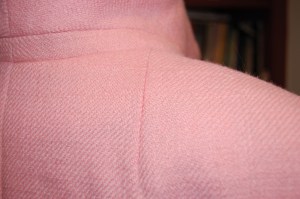
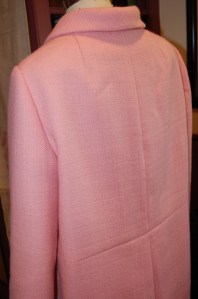
1) On the photo on the pattern envelope, I believe the soft shoulder of the coat is evident.  I used a “cigarette-type” sleeve heading in each shoulder to enhance the smooth transition from the shoulder to the top of the sleeve.  Not so evident on the pattern illustration is the drape of the back of the coat from the shoulder line.  I realized this drape works so well because of the two neckline darts.  They are in the neckline, not the shoulder seam; they add necessary shaping without disturbing the drape.

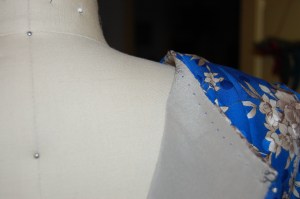
Can you see how the dart comes off from the neckline, not the shoulder seam?

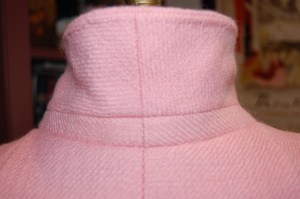
2) The collar is an engineering marvel in my mind.  The under-collar  is constructed from four pieces, two main sections cut on the bias, and a 2-piece collar band, seamed at the center back.  The band helps the collar to turn beautifully.

This photo clearly shows the components of the under-collar. You can also see the under-stitching I did in silk buttonhole twist.

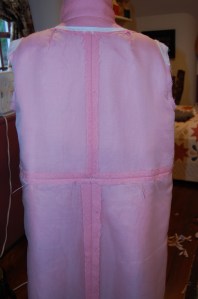
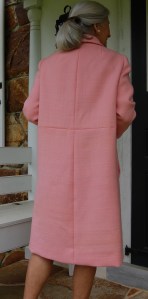
3) When I made the toile, I was concerned about the fullness of the back of the coat.  It seemed a bit much, and I have already written about my intention to add a half belt to draw in the fullness, if needed. Nope!   I am so happy with the finished look – it has that 1960s’ vibe without being overwhelming.  I did move the vertical back seam line up 1.25” to rest at my natural waistline, rather than below it.  For me, this was the correct alteration.  It may not be on someone else who has more height than I do.  Another consideration was that a half belt would have concealed the seam detailing which is so lovely on the back of the coat.

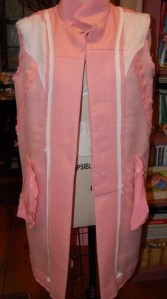
An inside look at the back of the coat, showing its drape from the shoulder seams.

The other significant alteration I made was to remove 1.5″ of width from each sleeve.  I possibly could have taken out even more, but I will be wearing this coat over sweaters and perhaps even a jacket, so the sleeves as I cut them will still accommodate that bulk.  But I would not want them any fuller!

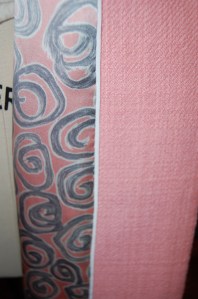
Although the pattern did not call for it, I added flat piping to the edge of the lining.  I chose white silk crepe de chine for this contrast detail.  I felt any other color would have been too demonstrative.

The coat kind of looks like a sack of potatoes in this photo of its front edge!

The finished look of the lining edge.

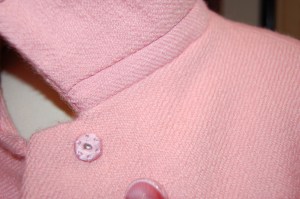
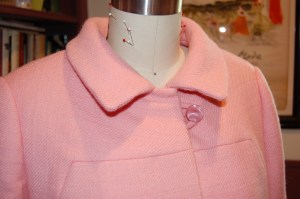
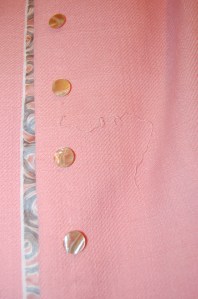
I had some difficulty finding pink buttons.  I ended up with two varieties found in two Etsy shops.  I used a larger pink-swirly one for the looped closure, and smaller pink pearl-y ones for the concealed opening.  If I ever find ones I like better, that’s a easy switch.  But the more I see these, the more I like this combination.

Basting threads are still evident in this photo.

Alas, it is much too warm for wearing wool coats now, but it is ready for next Fall’s cooler days.  By then I hope to have a  windowpane checked skirt, in delicate gray, white and pink wool, specially made to wear with this coat.

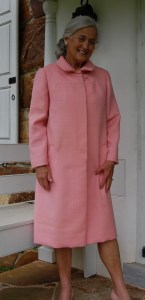
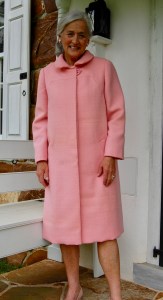
It is always interesting what photos reveal. I am thinking I may need to redo the hem to get a softer look to it. It looks like it has crinkles in it!

I will take any excuse to show the inside of this coat!

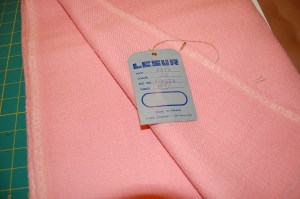
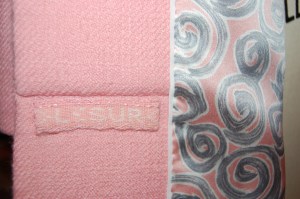
I cut a piece of the selvedge with the Lesur name on it and attached it to the right front facing of the coat right below the placket.  I think this is an important part of the story of this project.

There is a very slight bow to the back of the coat, again reminiscent of the ’60s.

This coat is almost making me anxious for next Fall!

As I worked on this coat, I came to realize how perfectly suited the pattern and the wool were for each other.   It was such a privilege to spend so many hours with such quality.  No wonder I fell in love!

34 Comments

Filed under Buttons - choosing the right ones, Christian Dior, Coats, couture construction, Dressmaker coats, Linings, Mid-Century style, Uncategorized, Vintage fabric, vintage Vogue Designer patterns, vintage Vogue patterns from the 1960s, woolens

Classic French Jacket – Number 5

Never did I imagine that when I last wrote about the progress on this jacket, it would be an entire month before I could declare it “finished.”  But such is a fact of life with the construction of one of these jackets.  They always seem to take much longer to complete than ever imagined.  (I should remind myself that during that month, I also made a wool skirt and I was away twice on short trips, but still…)

As this is the fifth one I have made, I can safely say that I have developed my own set of tips for working my way through the lengthy construction process.  Of course, it all has to start with a pattern which is a perfect fit.  Fortunately my muslin pattern is from a Jackets Class I had with Susan Khalje over five years ago. With this pattern, I can go right to my boucle and get started.

While it is often recommended to cut out just the body of the jacket, minus the sleeves (the variegated weave of which is then checked with the constructed jacket body before cutting them out), I have developed enough confidence that I cut out my sleeves along with the body of the jacket.  This allows me to make the sleeves first.  For me there are two advantages to doing this: 1) there is a psychological benefit in knowing that the sleeves are lined, linings are fell-stitched in place, trim is on, and the sleeves are as finished as they can be before setting them into the body of the jacket, and 2) I like to trim the sleeves first, as a way of testing the trim I have chosen.  If I do not like it, I only have trim on one, or two, sleeves which must be removed.  It is also much easier to sew trim on a sleeve which is still separate from the jacket.

Another tip I have learned is to use my walking foot not only for the channel quilting of the lining and fashion fabric (a must), but also for all the seams.  I pin profusely, but the walking foot helps to keep the fabric from slipping, crucial when matching all those lines and plaids prevalent in a typical boucle weave.

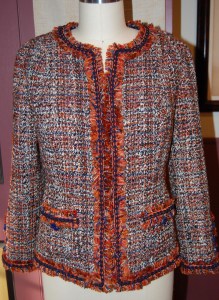
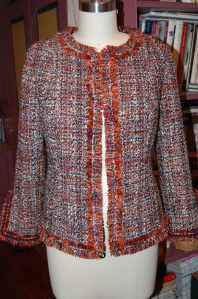
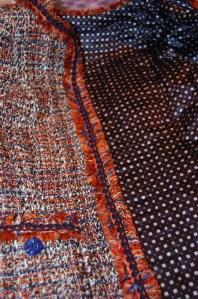
I chose this navy and white silk charmeuse from Britex Fabrics for my lining fabric. The boucle is from Mendel Goldberg Fabrics.

I really went round and round with the trim for this jacket.  I knew I wanted to use self-fringe, but I also knew it would need some definition added to it.  After trying several colors of velvet and Petersham ribbon in the trough of the fringe, I realized I would have to go to a bright orange as an underlay for the navy twisted braid I wanted to place on top.

The trim was applied in three steps. Here the fringe is attached as the first step. Not too exciting all by itself.

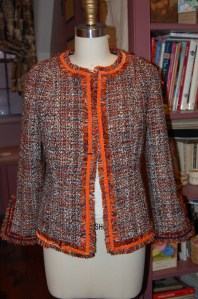
The next step was to apply this bright orange velvet ribbon, also from Britex. It was really a leap of faith to use this very demonstrative color. It looks fairly garish like this! (I sewed each edge of this ribbon separately, so twice around for this part of the trim.)

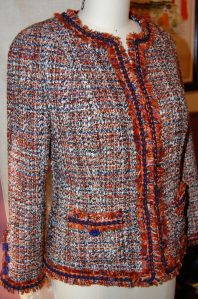
But once the navy twisted braid is on, step number three, that bright orange underlay is fine.

One thing I have done with all my jackets – and this is a tip from Susan Khalje – is to add about 1/2 inch in length to the center back of the jacket, curving it up gently to the side seams. I love the effect that this little bit of extra curve gives to the back of the jacket.

I always wax and iron the thread which I use for applying the trim.  It adds strength, but also is easier with which to work.  For this jacket, I also carefully ironed each “level” of trim as I applied it.

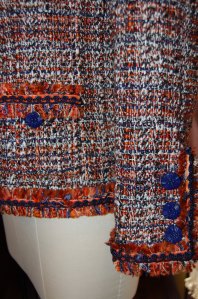
A detail of the right pocket. Of course, and this is preaching to the choir, the pockets absolutely cannot be cut out until the body of the jacket is completed. Their placement is a visual determination which really depends upon the fit and appearance of the finished jacket.

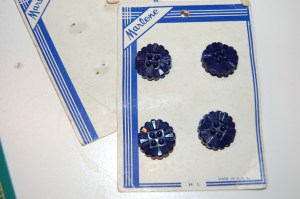
I found these vintage buttons in one of my button boxes.  I knew I wanted to use dark blue buttons, and I kind of liked the appearance of these.

The only hesitation I had is that they are plastic!  It seems a bit of a sacrilege to put plastic buttons on one of these jackets, but I actually think they look okay.  If I find other navy blue buttons in my future travels, I might switch them at some point.  But right now, they work.

Because I had only 8 buttons, I was limited to two pockets, and three buttons on each sleeve. I probably would not have put four pockets on this jacket anyway, so that was not really a compromise.

I have enough of the boucle left over to make a simple straight skirt, I think.  However, that will not happen this year!  I am so ready to move on to my next project.  In fact, it may be well over a year before I plunge into another one of these jackets.  I have but one other boucle lurking about in my fabric closet right now, and I am content to let it stay there for a while.

It was much too cold for outdoor pictures, so these will have to do!

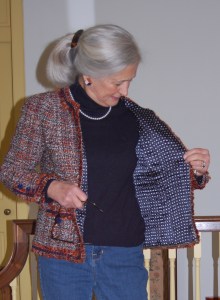
I like the jacket worn closed …

… or open.

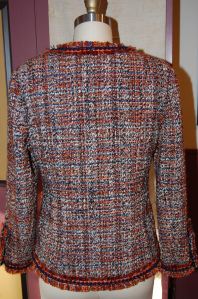
The curve of the back hem is apparent here.

Now it’s time to tiptoe ever so quietly into the lighter shades and fabrics of early Spring, despite the snow that is currently falling. I am so happy to have this jacket in the “finished” column.

40 Comments

Filed under Boucle for French style jackets, Buttons - choosing the right ones, Chanel-type jackets, classic French jacket, couture construction, Linings, Uncategorized, vintage buttons

Another Rosy Outlook for the New Year

There is a fine art to planning ahead, and nowhere is this more obvious than in planning a new sewing year.  No matter how carefully I think it through, I still end up with some fabrics that never make it out of storage and some newly-purchased fabrics that quickly get moved to the head of the queue.  But no matter!  I still find it useful to make a list of intended projects, while at the same time reminding myself that being flexible and realistic about my intentions is what is really necessary.  (There are, after all, those unexpected special events which can’t be planned for, but which take top priority when the “save the date” card arrives in the mail.)

When I look back at what I accomplished in 2018, I happily find that about half my projects used fabrics which I had purchased at least a few years prior.  Some had actually been in my collection for more than a few years! Last year’s list was replete with rosy hues and rosy prints, and this year is not too different, especially considering three of my most favorite fabrics from last year are being forwarded onto my plans for 2019. Will this be the year that I finally get this vintage piece of Moygashel linen made into a dress?  I’ve only been trying to do this for at least three years now!

A very early 1950s’ linen, petite black flower silhouettes on a pale ecru background.

But for starters, and as with last year, I am first finishing up a project which I began, but did not have time to finish before the holidays took over my sewing room – and my life!

I am bound and determined to finish the Classic French Jacket I started in late 2018. While I am currently working on the body of the jacket, having completed its quilting, I am still undecided about trim.  I am auditioning different options, but have yet to find the perfect one.

However, I am anxious to get on with it, as the rest of my list includes:

1)  a wool coat

2)  3 cotton shirtwaist blouses

3)  1 boat-neck blouse (silk, maybe, or still undecided)

I love this French blouse-weight silk, so it is a heavy favorite for a boat-neck blouse to be made along with fellow dressmakers enrolled in Susan Khalje’s Couture Sewing Club.

4)  1 linen skirt

5)  2 wool skirts

6)  1 wool, two-piece dress

7)  1 cotton dress

I found this amazing cotton at Mulberry Silks in North Carolina when I was looking for fabric for the Christmas dresses for my granddaughters.

8)  1 linen dress – referenced above

9)  1 silk dress

10) birthday dresses for my two little granddaughters

11) play dresses for granddaughters

12) holiday/Christmas sewing for those same two little girls

and finally

13) some necessary home decorator sewing, which is not my favorite thing to do, until I see it finished and can enjoy living with it!

The wool coat will be my first major project in 2019 once the French jacket is finished.  I can’t wait to get started on this vintage Lesur wool from Paris, lined in a pink, gray and white silk purchased from Mendel Goldberg a few years ago.

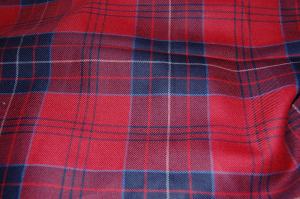
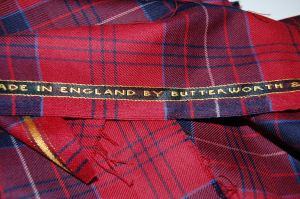
I will probably make a simple wool skirt before starting the coat, as I know it will be a relatively quick project nestled between the jacket and the coat.  I found this wool when Promenade Fabrics was closing their Etsy shop a few months ago.  How I love a red and navy tartan.  I could not resist it, and I am glad I didn’t.

The hand of this wool is so lovely. I think it will make a beautiful skirt. And I have just the shoes to wear with it!

Life is, of course, filled with all kinds of non-sewing duties, and I have plenty on that list, too.  It will be a tricky balancing act to make significant progress in both realms, but my guess is that sewing wins out over cleaning out the attic.

Welcome, 2019, with all your grand opportunities!

10 Comments

Filed under classic French jacket, Coats, Linen, Moygashel linen, Uncategorized, Vintage fabric, woolens