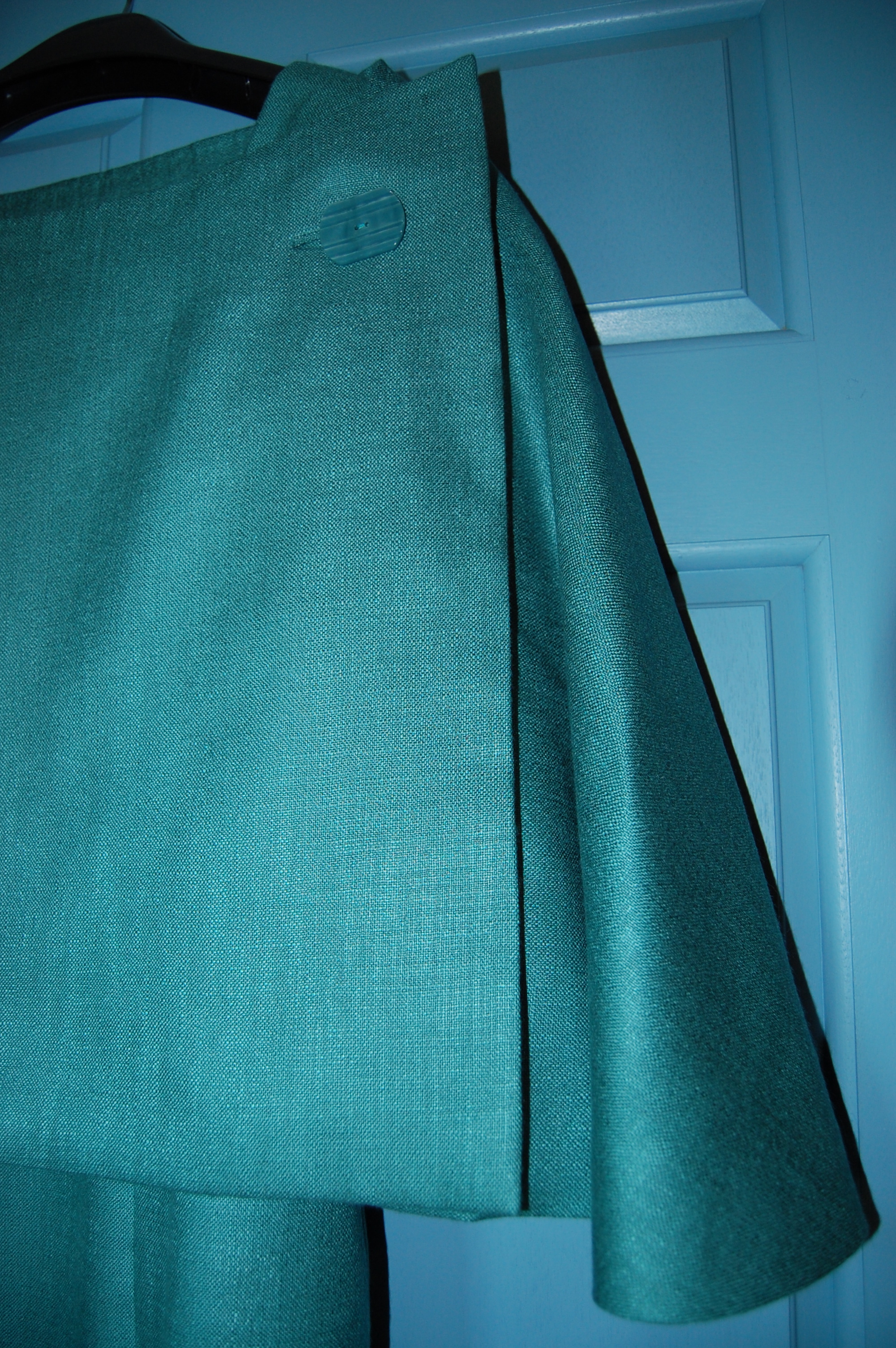
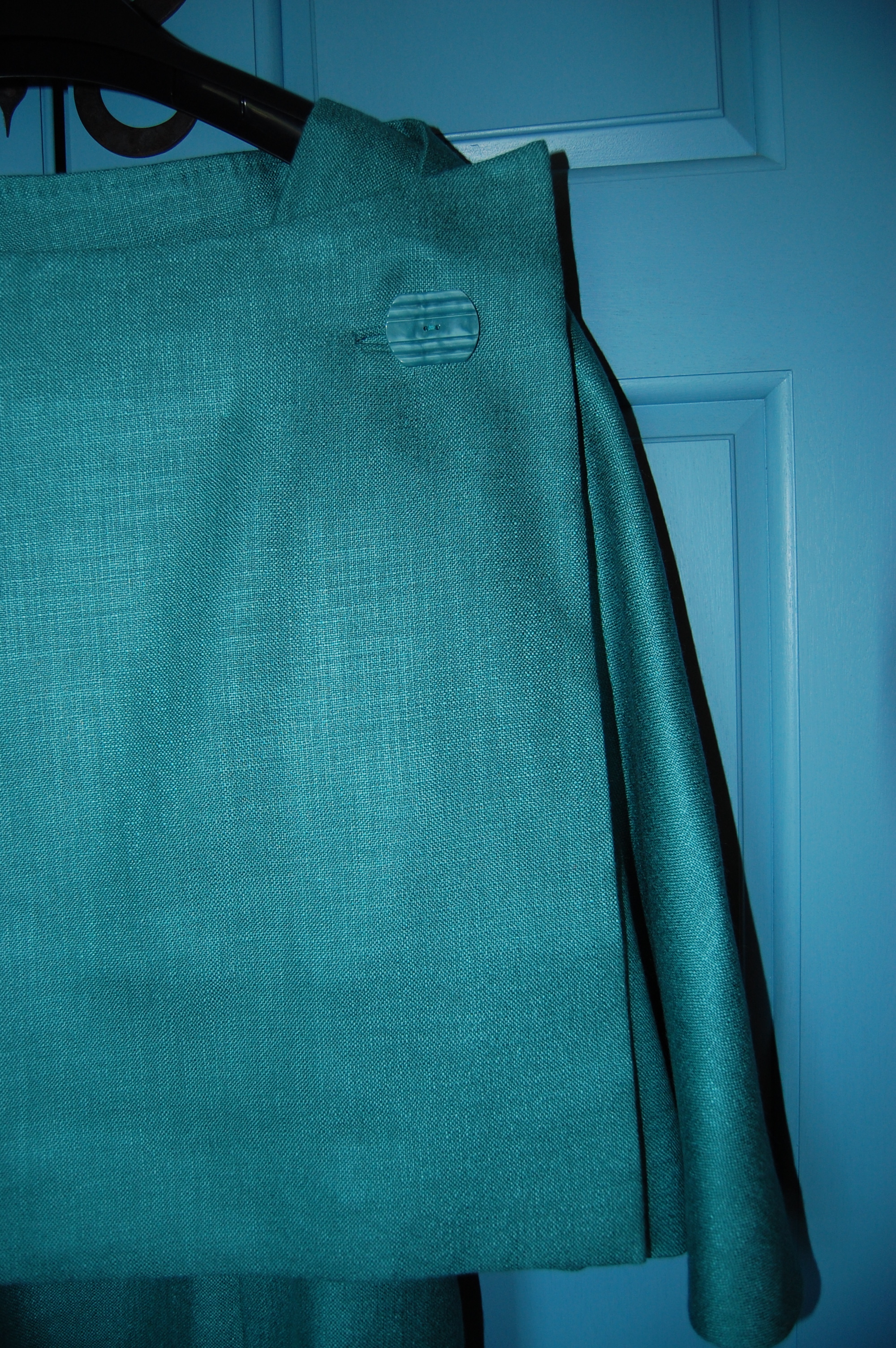
Category Archives: bound buttonholes

A Fine February Finish

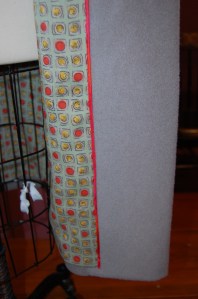
Leap Year, with its extra February day, seemed to be custom made for my sewing schedule. I had hoped to have my gray cashmere coat finished by the end of the month, and thanks to those extra 24 hours, I managed to do just that – barely! I will confess to taking out basting stitches, steaming, and adding two bar tacks to the lining on March 1st (gasp), but now my coat is finished.
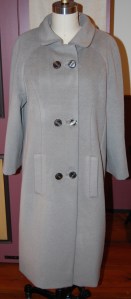
A Fine Feb Finish

A Fine February Finish

Photos of me in this coat will be in a future post…

Like Claire McCardell, who said “I believe in a collection of coats,” and coats are “revealing, a clue to your taste, and your knowledge of Fashion,” I also believe that one should not “make a coat too basic.” The unique aspect of fashion sewing is that one can start with a basic (or not-so-basic) coat pattern and then make it her own.

The first owner of this Vogue Designer Original pattern, designed by Guy Laroche, which I used for my coat, had obviously used it. (This isn’t always the case – many vintage patterns are still “factory-folded” and in their unused condition.)
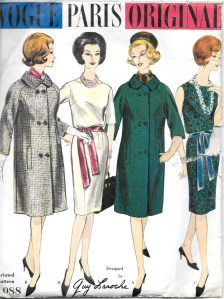
When I purchased the pattern, I had already decided to lengthen the sleeves, which are shown on the pattern envelope as “below-elbow” or bracelet-length. I wanted full-length sleeves as a practical matter. Much to my delight, the original owner had decided the same and had added tissue paper inserts into the sleeve pattern pieces. As it turned out, the length she had decided upon was also exactly right for me.
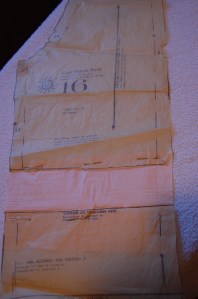
What a nice surprise to find the sleeves already lengthened!

What a nice surprise to find the sleeves already lengthened!

There are really only a few details I chose for this coat which serve to make it “not basic.” Besides the bound buttonholes (which used to be basic but are not so much anymore!), I put emphasis on the buttons, the lining and a couple of the finishing details.

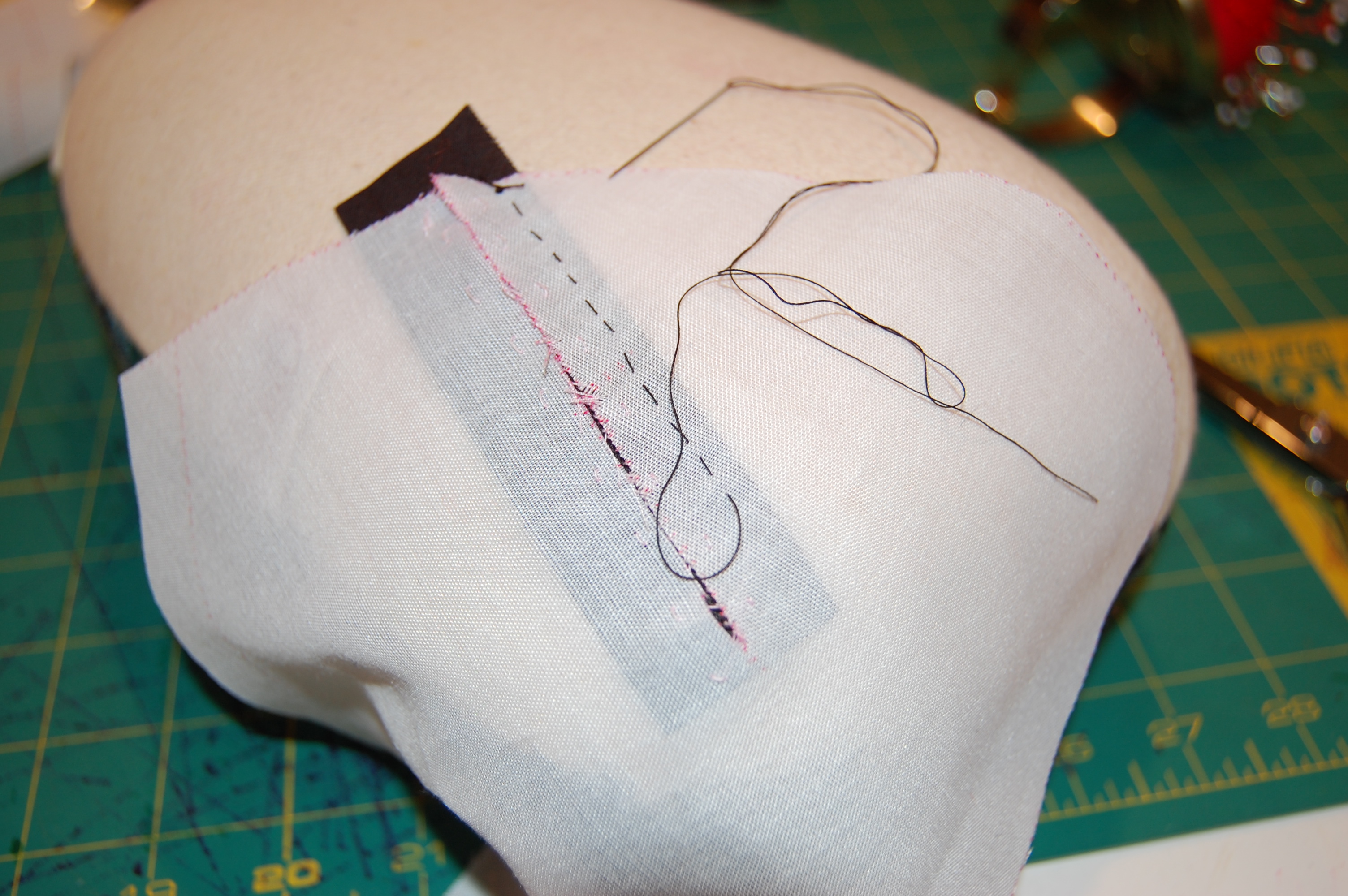
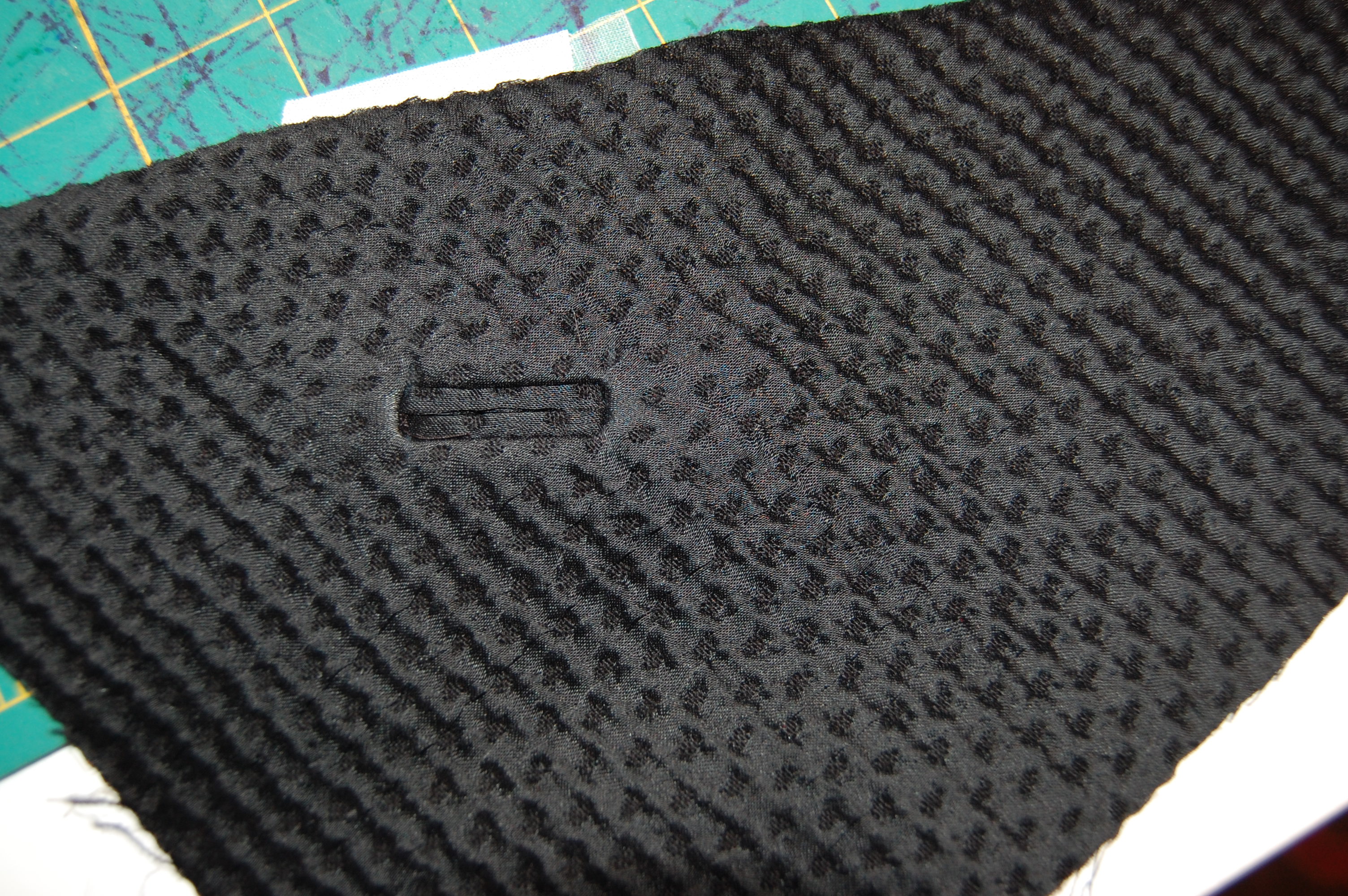
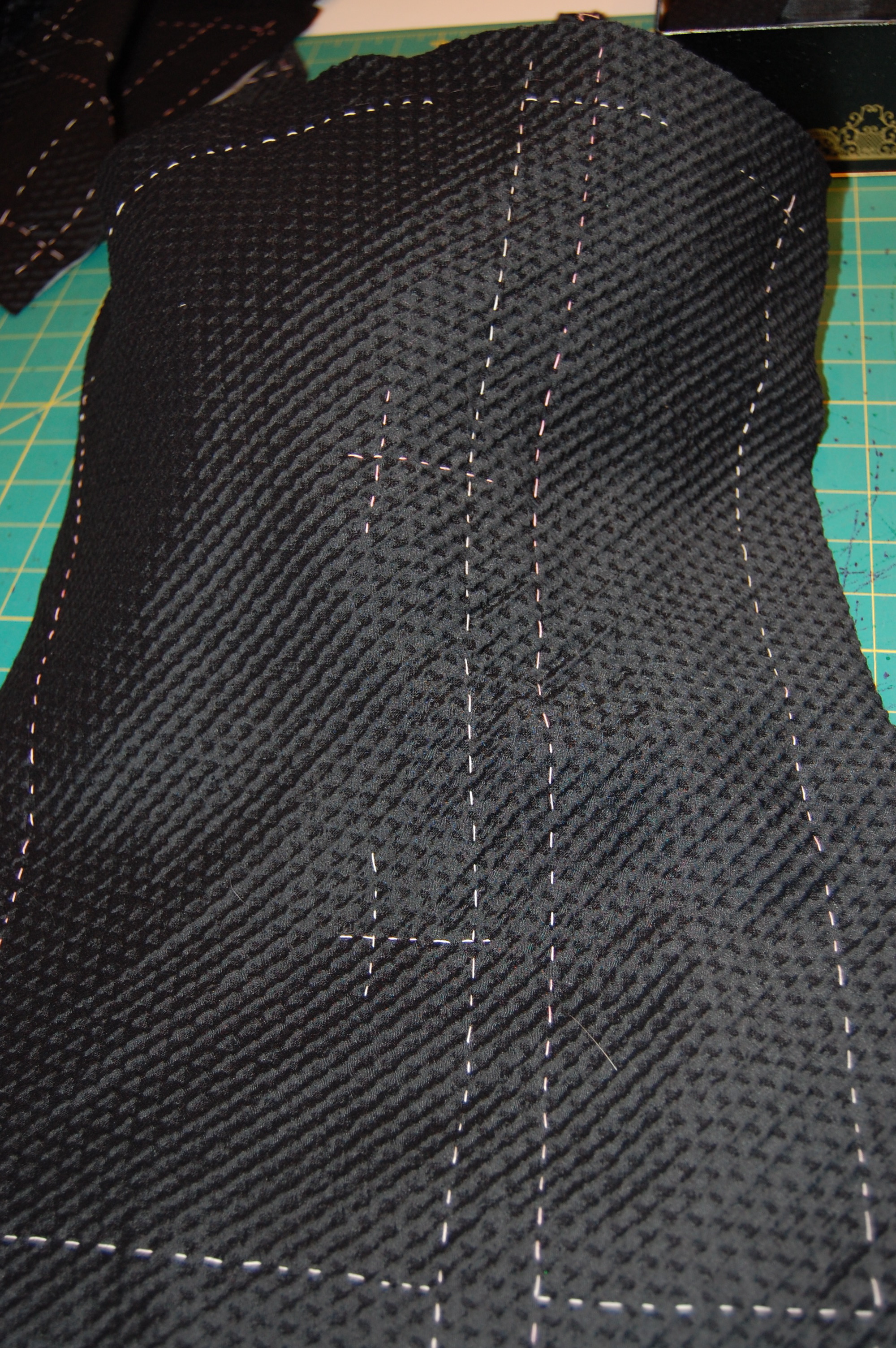
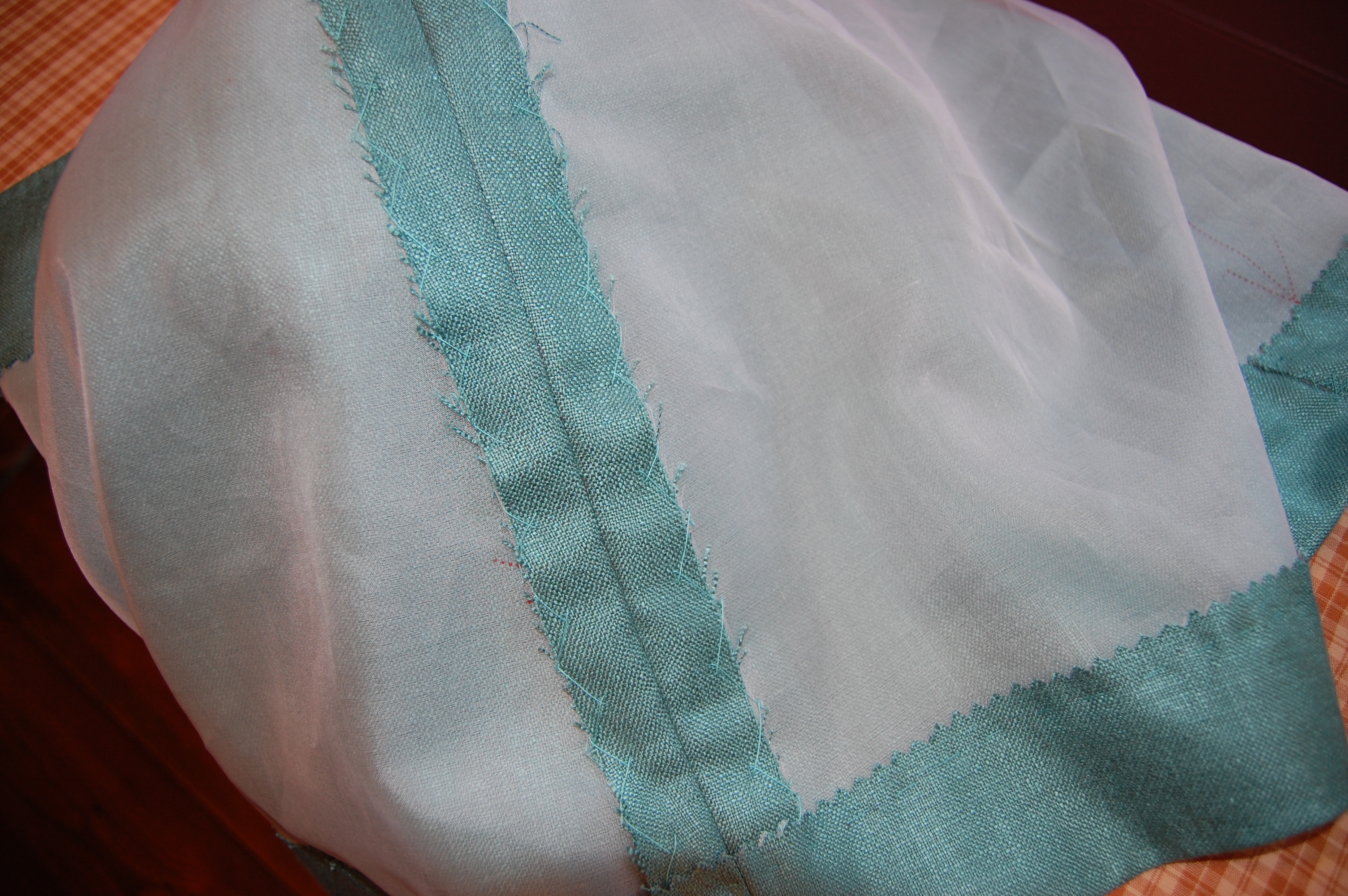
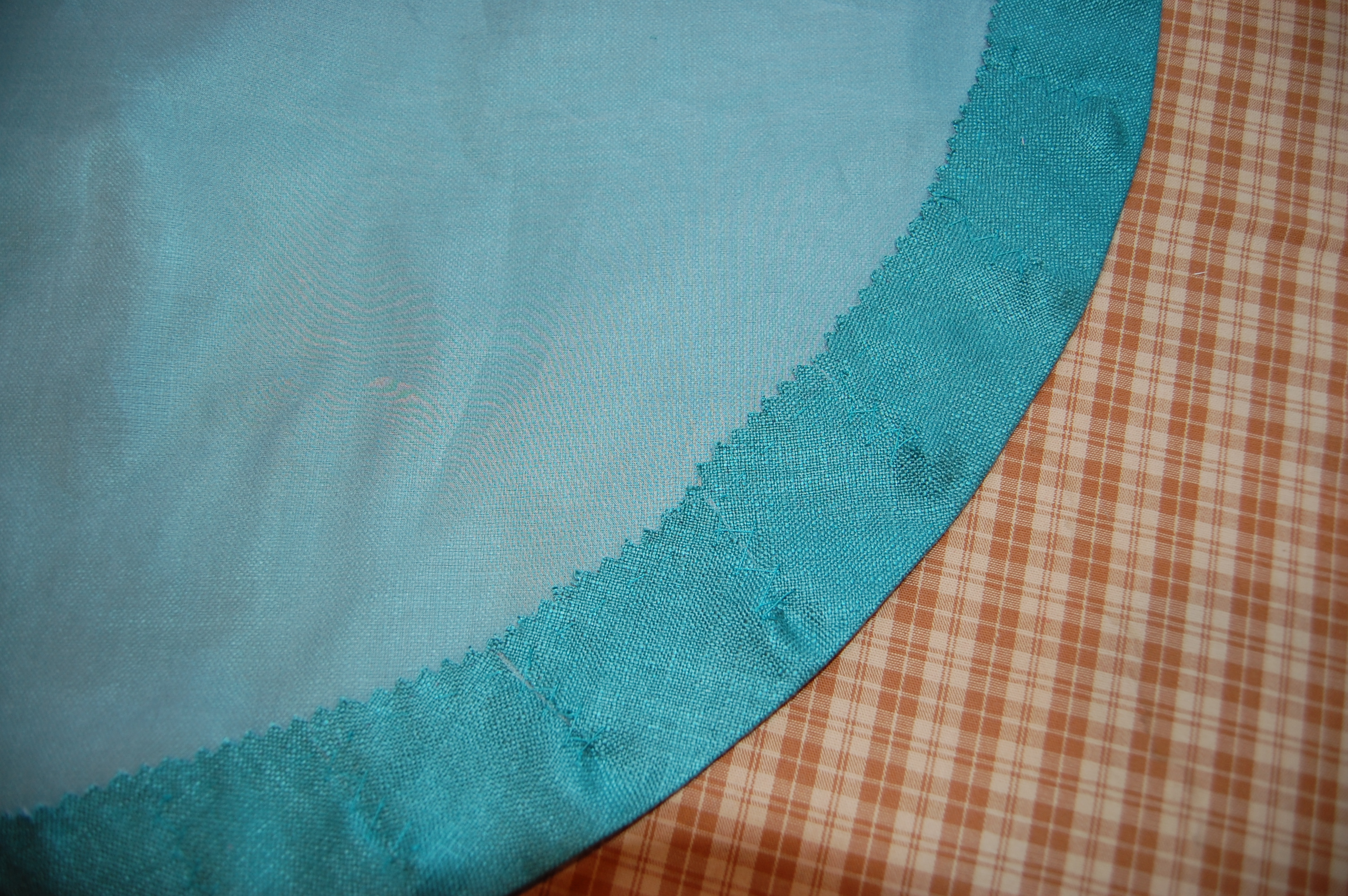
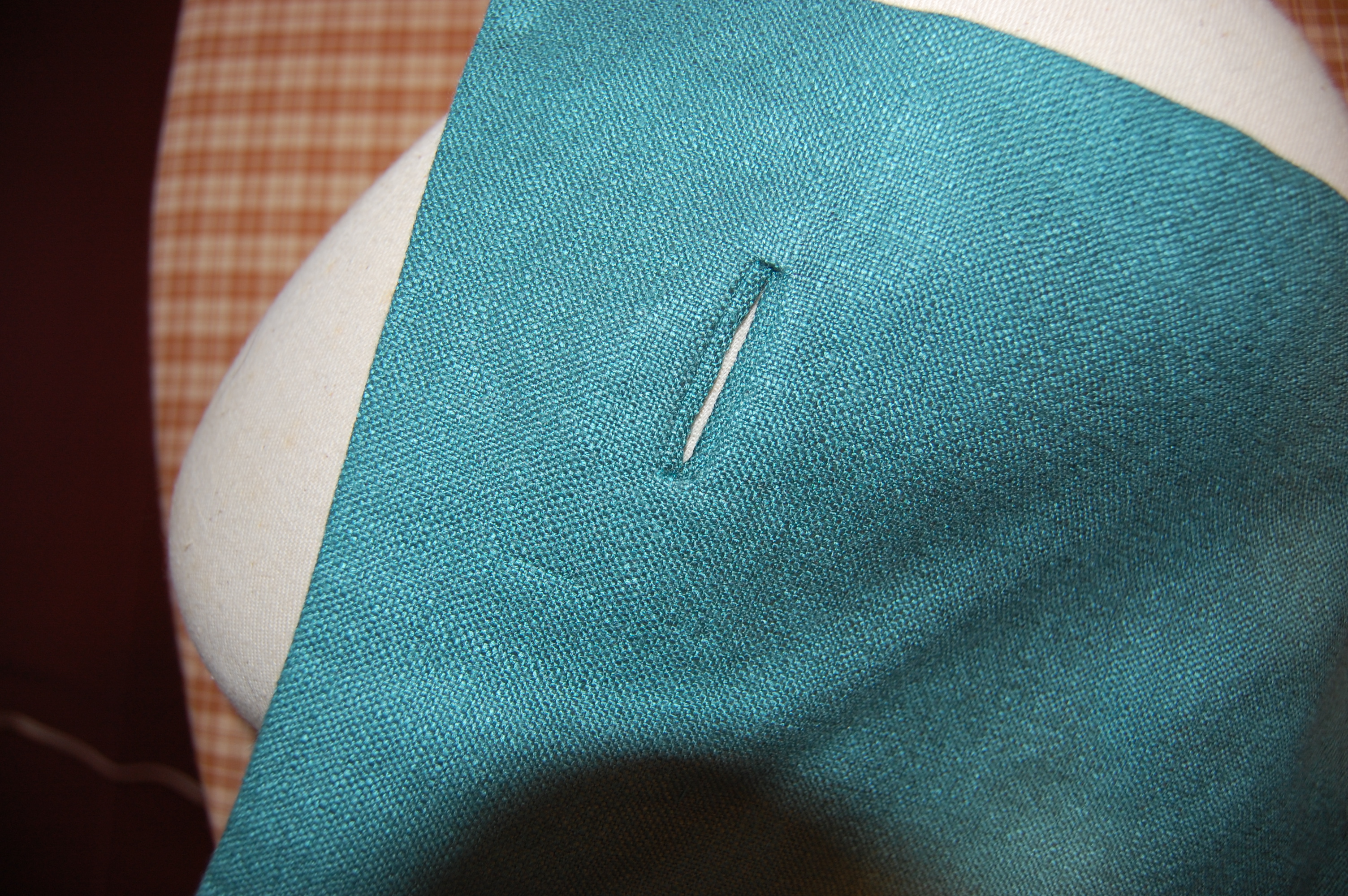
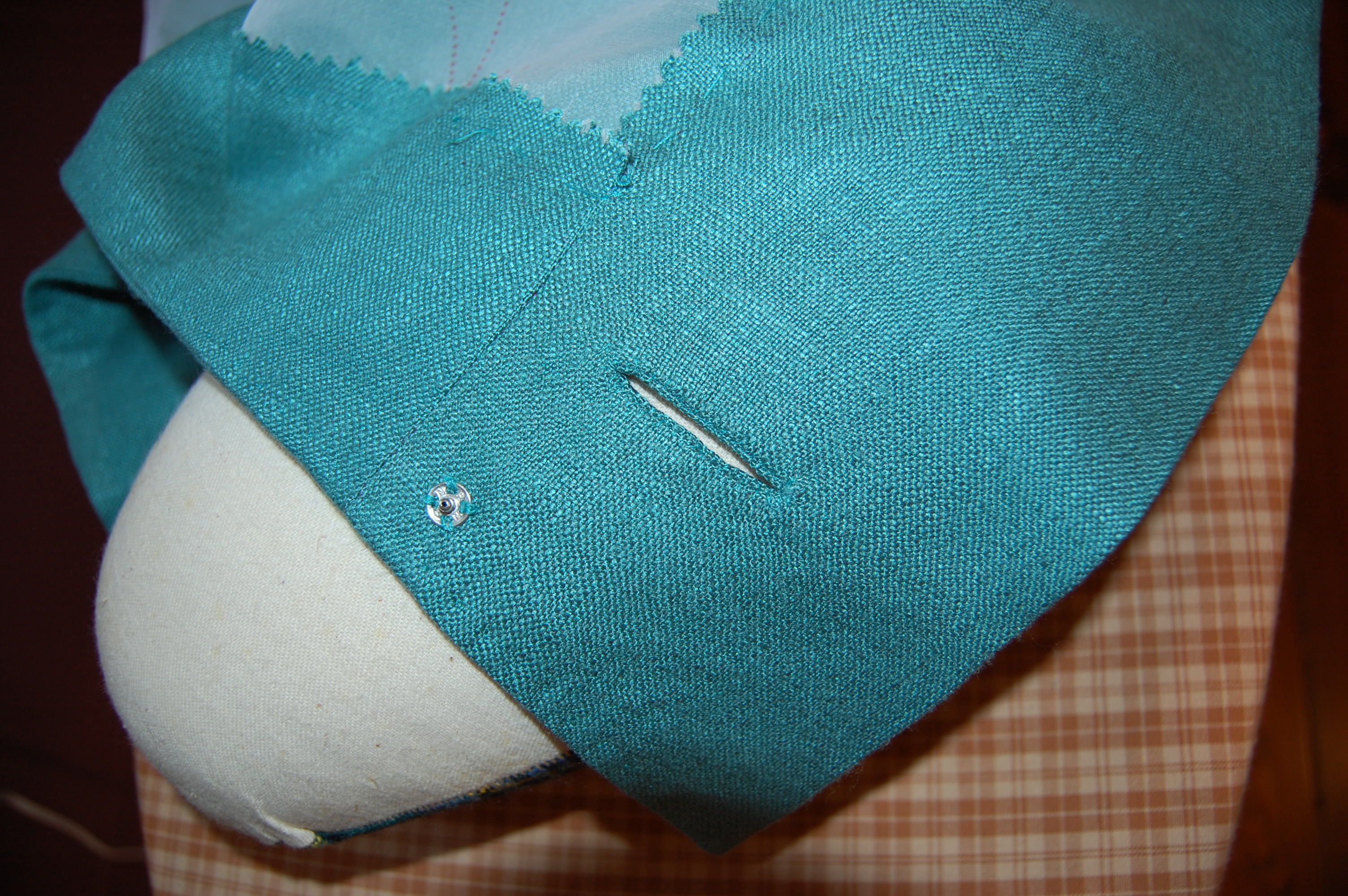
First the buttonholes and buttons: because the cashmere fabric is coat-weight, I needed to make the “lips” of the buttonholes a bit wider than normal. Once again, I used an organza patch on the underside of the buttonholes, which makes a very nice interior finish:
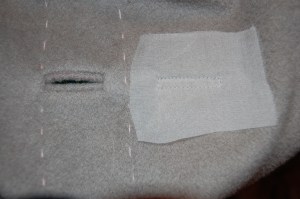
The line of basting stitches is the fold line - the organza patch is on the facing part of the front edge.

The line of basting stitches is the fold line – the organza patch is on the facing part of the front edge.
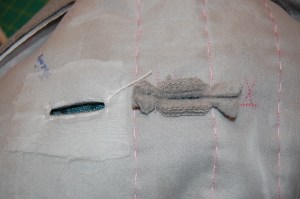
Here is the patch ready to be sewn onto the back of the buttonhole.

Here is the patch ready to be sewn onto the back of the buttonhole.

I found these vintage buttons in an Etsy shop. Although they appear to be gray mother-of-pearl, they are actually plastic. The iridescent strip through the middle of each one, along with the square detail on the tops, gave me the idea to arrange them on an angle. I think they add just the right amount of interest to the front of the coat.
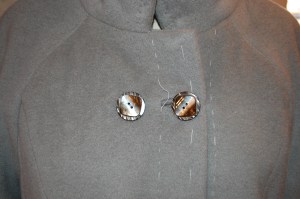
The "square" detail on the buttons picks up the design in the lining fabric.
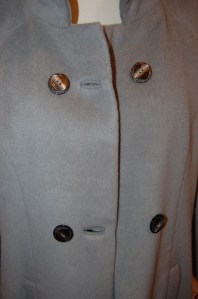
The “square” detail on the buttons picks up the design in the lining fabric.

A Fine February Finish

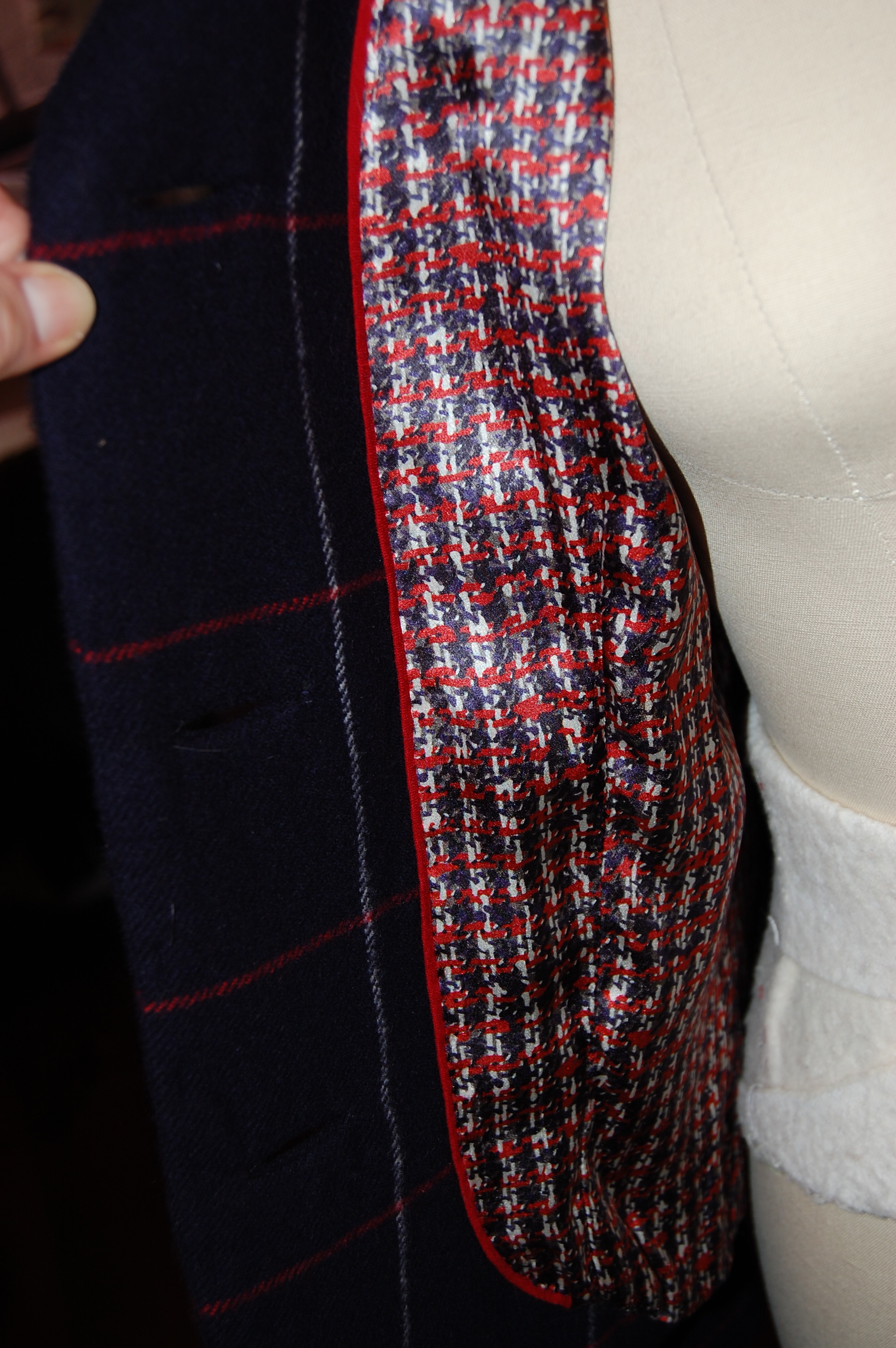
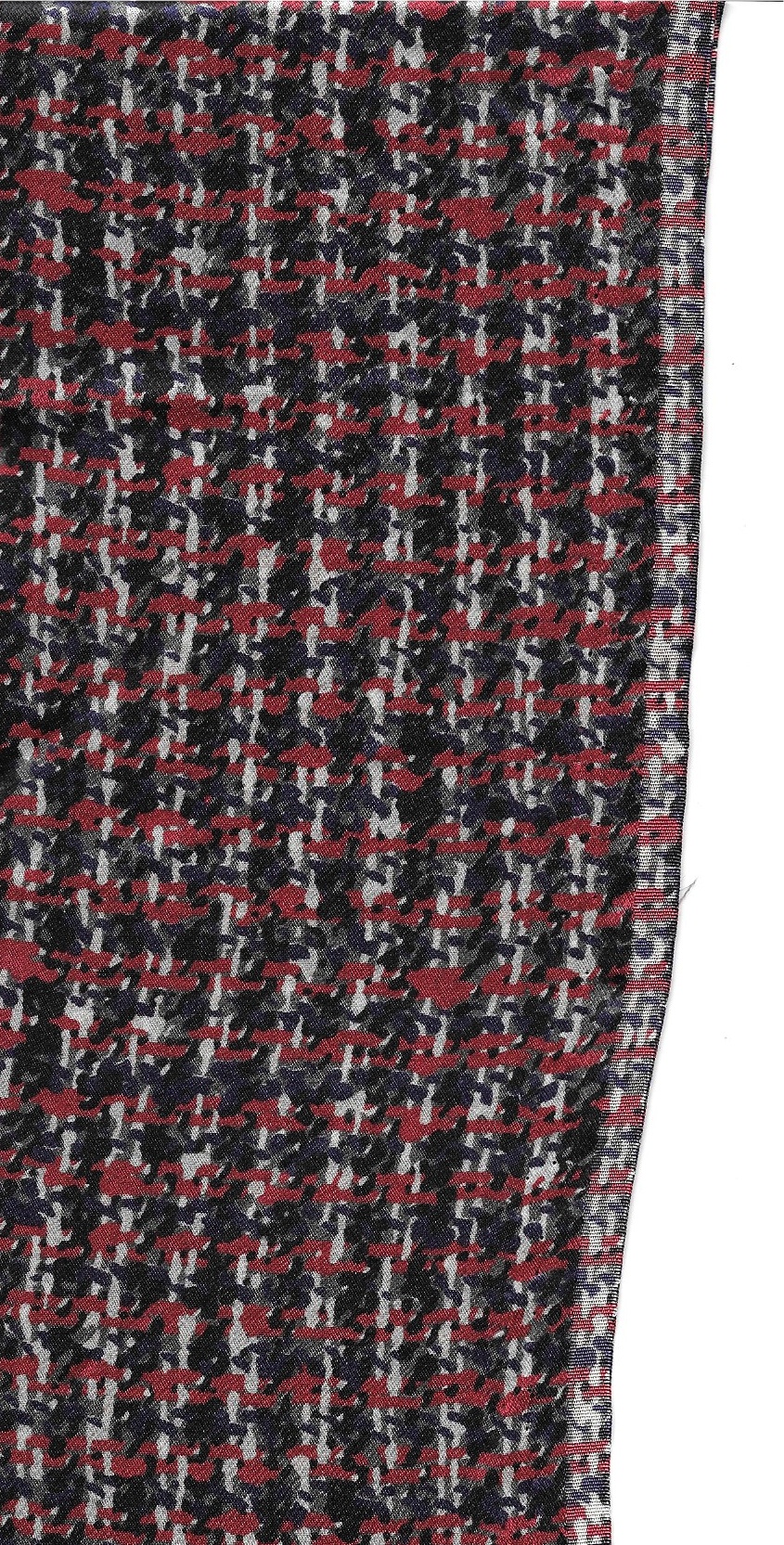
Using the printed wool challis for the lining certainly elevates this coat to a notch above ordinary. The sleeves are lined with gray rayon Bemberg for practicality’s sake.
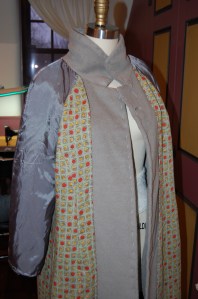
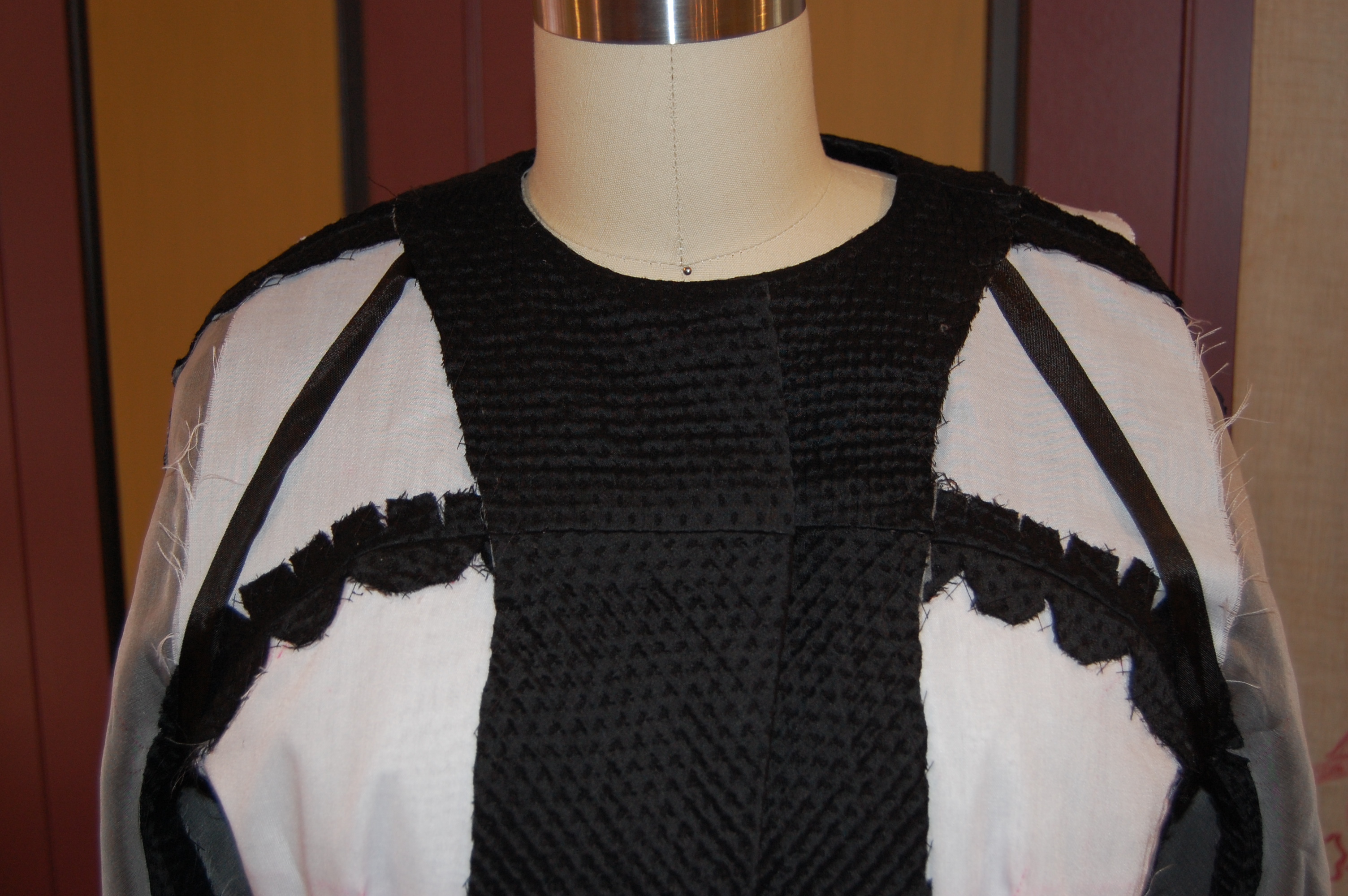
An inside out view, trying out the lining.
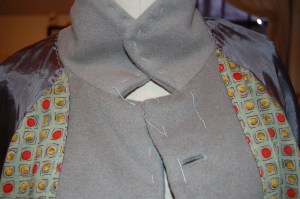
An inside out view, trying out the lining.

This photo shows a good look at the finished buttonholes, too.

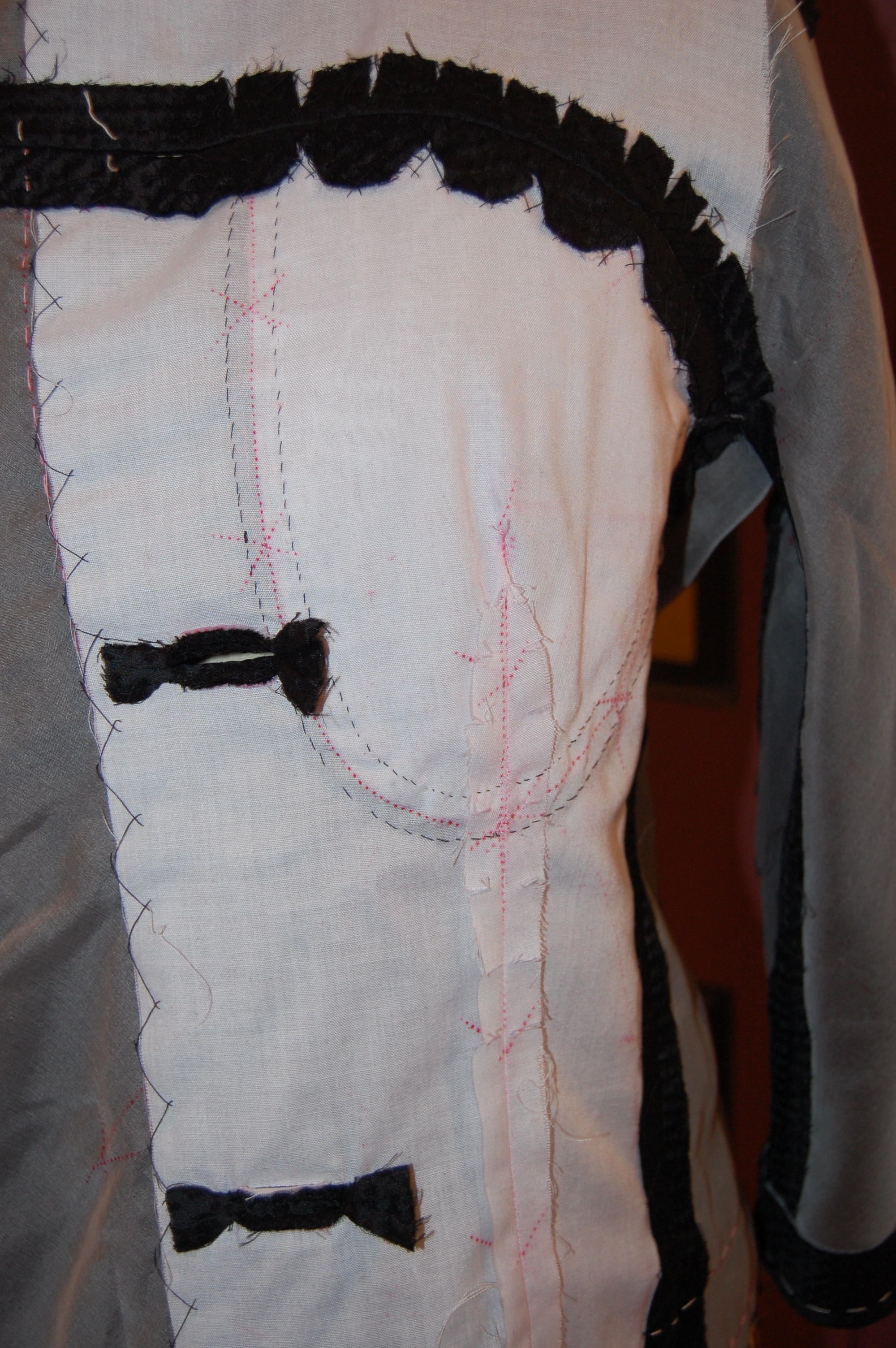
This photo shows a good look at the underside of the finished buttonholes, too.

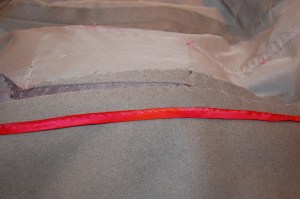
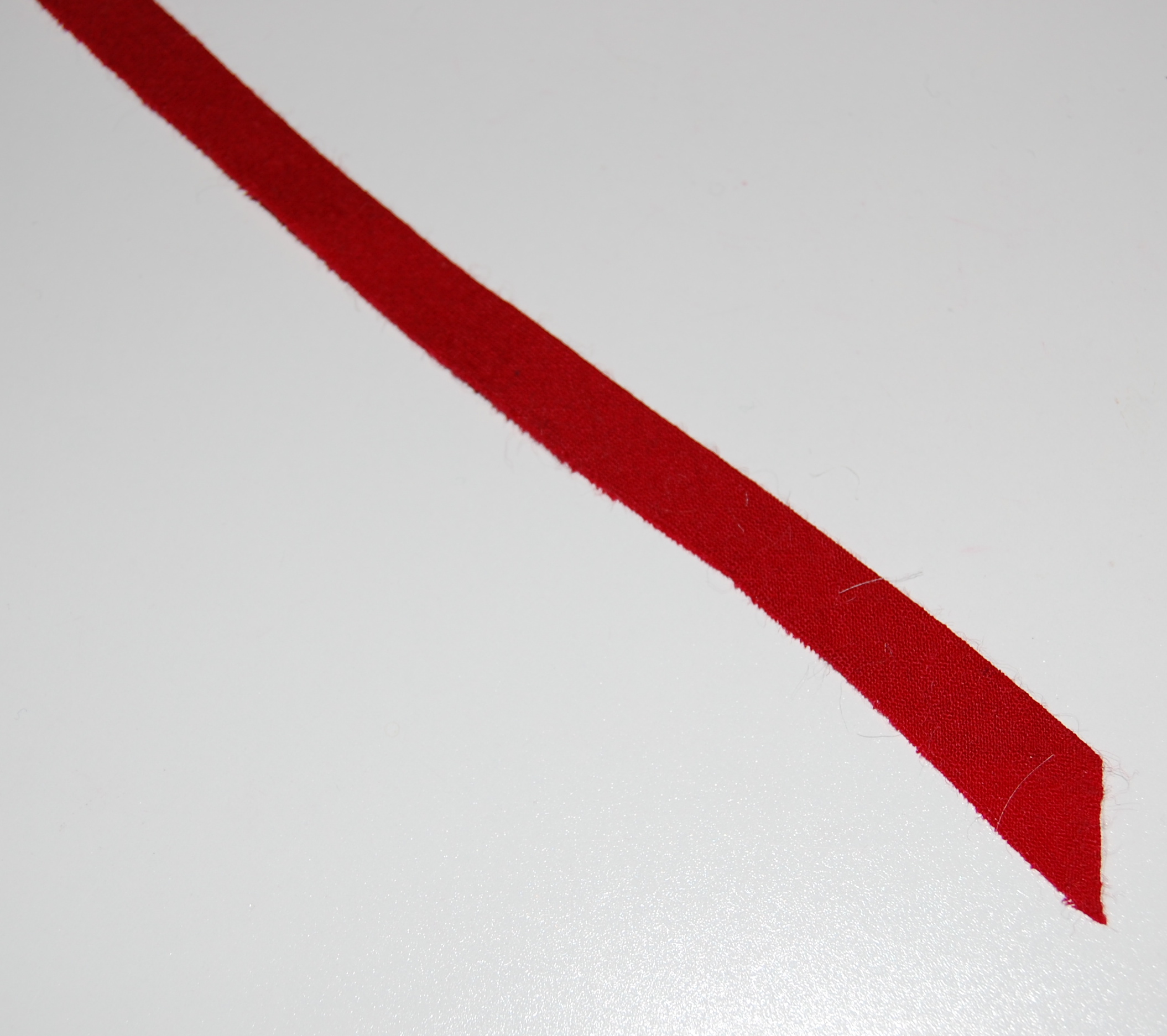
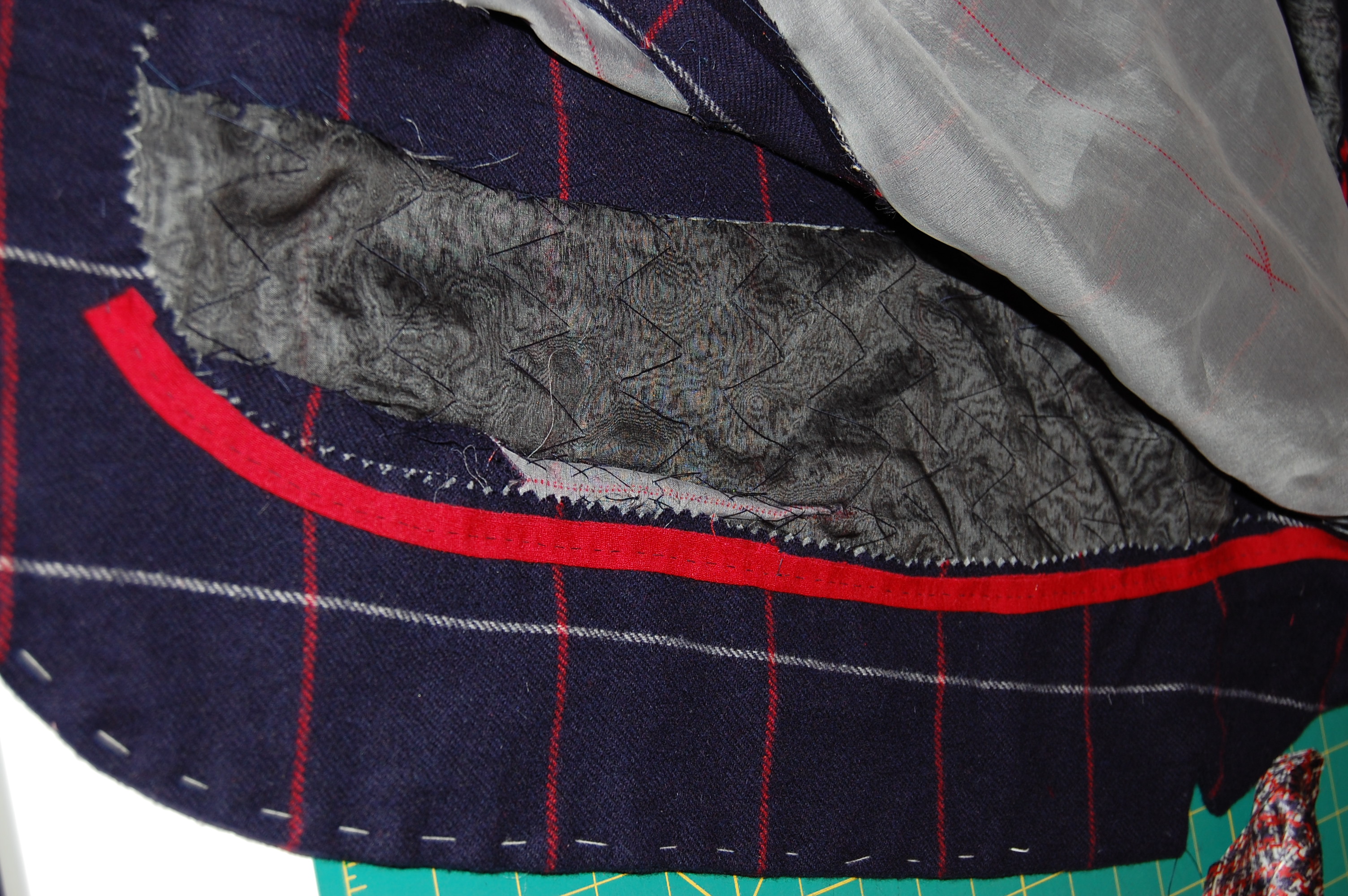
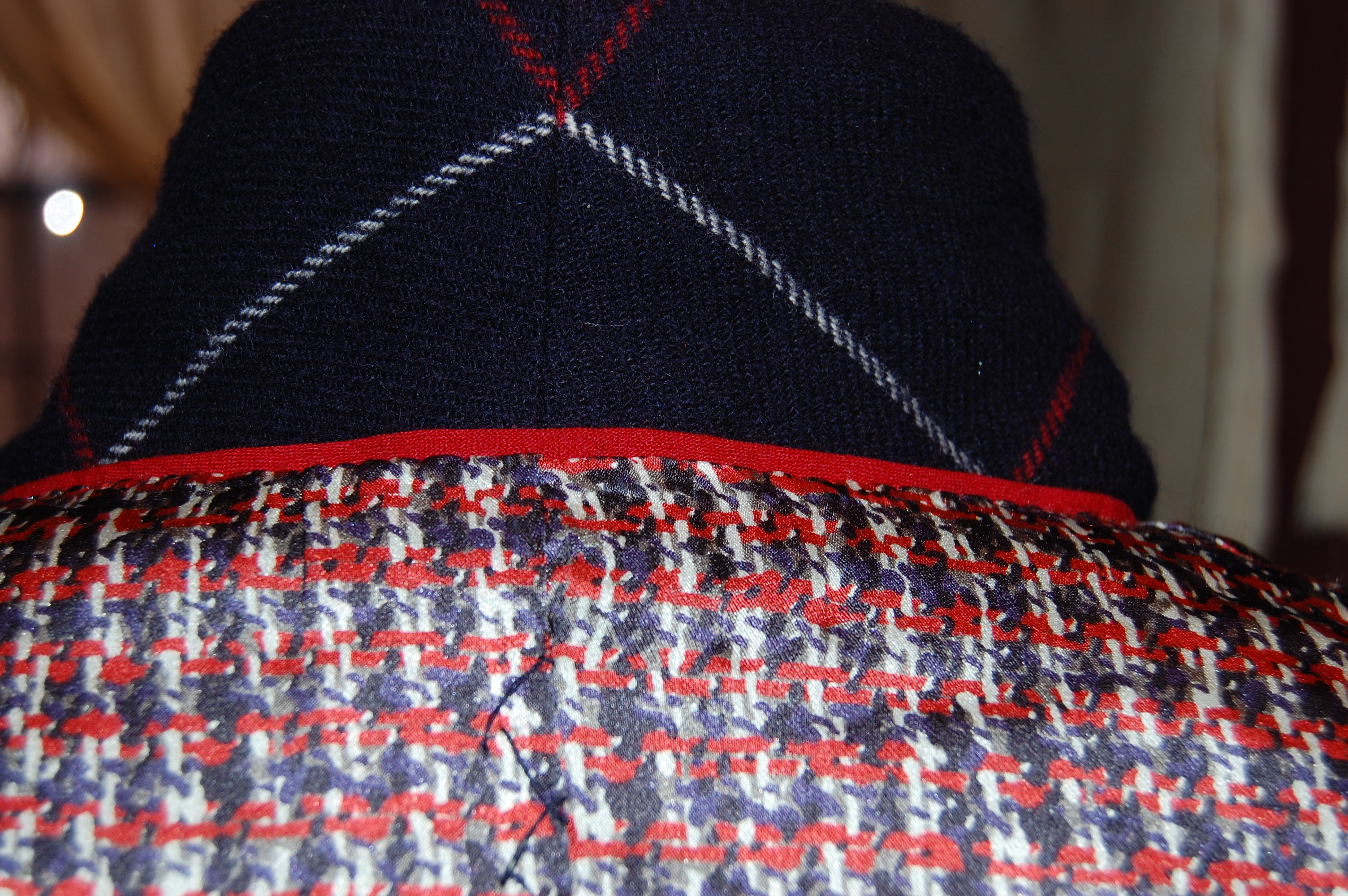
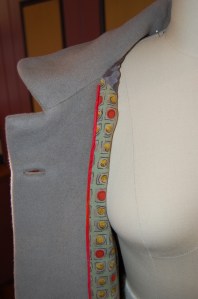
Of course the detail I love the most is the flat piping I added to the front interior edges of the lining.  As I have said before, doing this is so easy and adds so much.
A Fine Feb Finish

A Fine February Finish

Here is the flat piping stitched in place - so easy!

Here is the flat piping stitched in place – so easy!

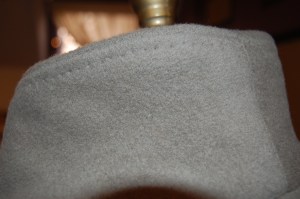
The final small detail, which helps the collar to keep its shape, is under-stitching (by hand) on its underside.
A Fine February Finish

So what else did Claire McCardell say about coats? To quote from her book, What Shall I Wear, page 69, “… you can take another step and get a coat and dress that go together—never to be separated, never to be worn with any other dress or any other coat, and always with a special feeling of satisfaction. If you take a little trouble, you may be able to manage a heavy fabric skirt to go with the coat.”  I plan to take that little bit of trouble – a skirt out of the gray cashmere, and a blouse from the printed challis – to complete the outfit, and I will hope for that “special feeling of satisfaction.”
30 Comments

Filed under bound buttonholes, Buttons - choosing the right ones, Coats, couture construction, Dressmaker coats, Mid-Century style, Quotes about sewing, Uncategorized, vintage buttons, Vintage fabric, vintage Vogue Designer patterns, vintage Vogue patterns from the 1960s, woolens

A Fitting Finish to Summer Sewing

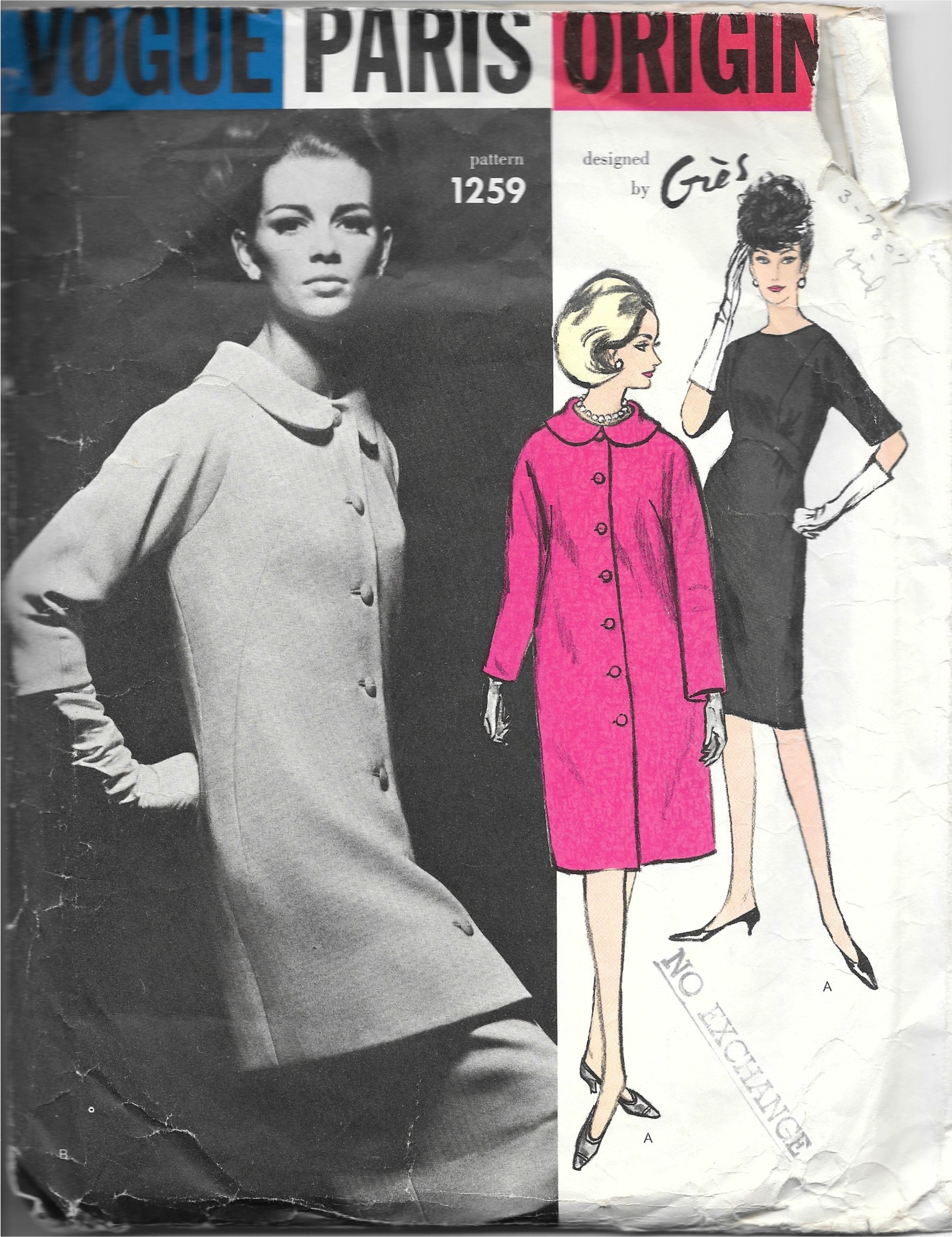
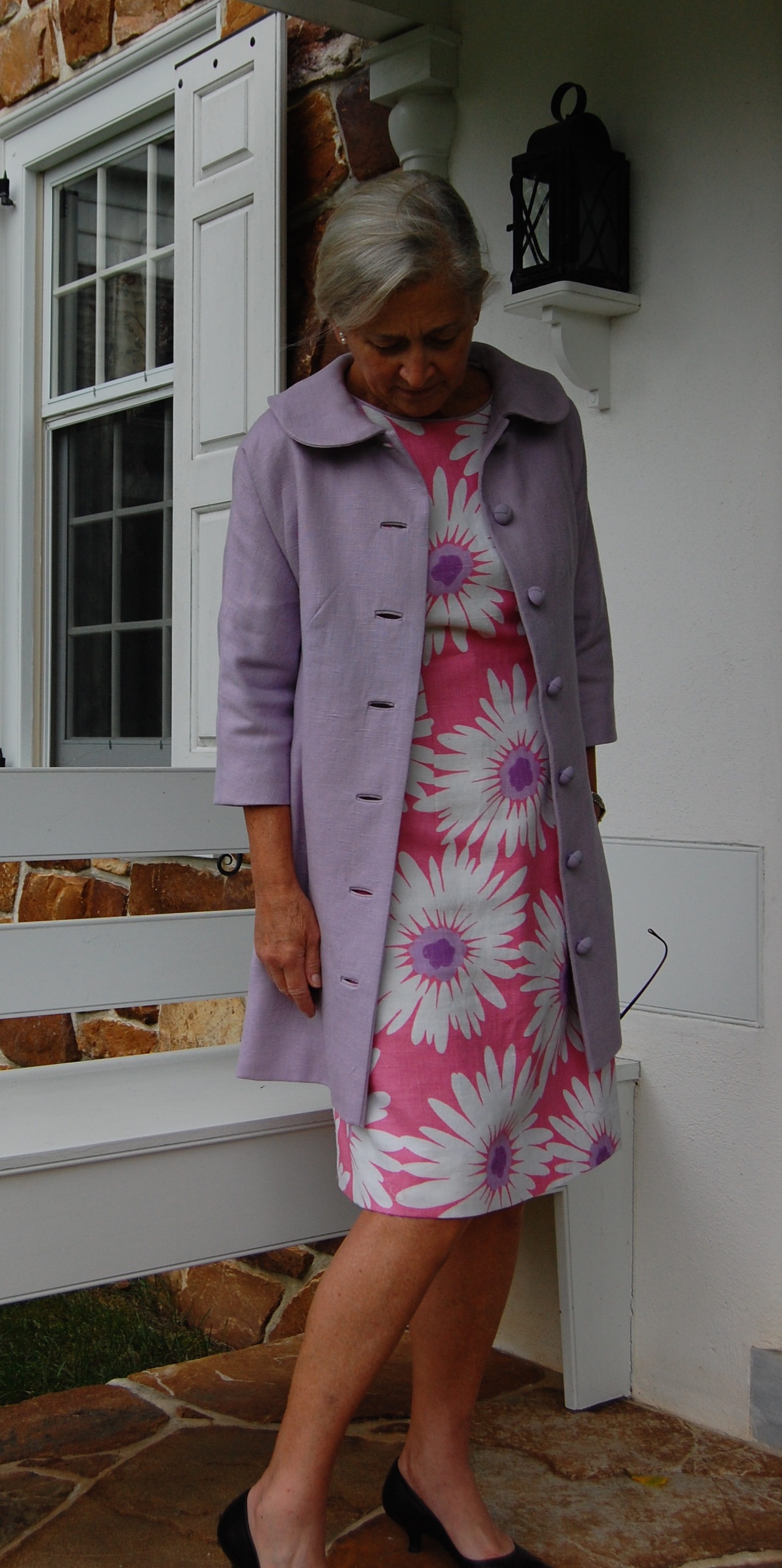
Summer slipped quietly away this week with nary a peep except for the sighs coming from my sewing room. No matter how hard I tried, I could not keep up with the calendar to finish my final Summer project.  However, a few days late on “delivery” doesn’t really upset me, as I can look forward to wearing my Madame Gres-designed coat next Spring.

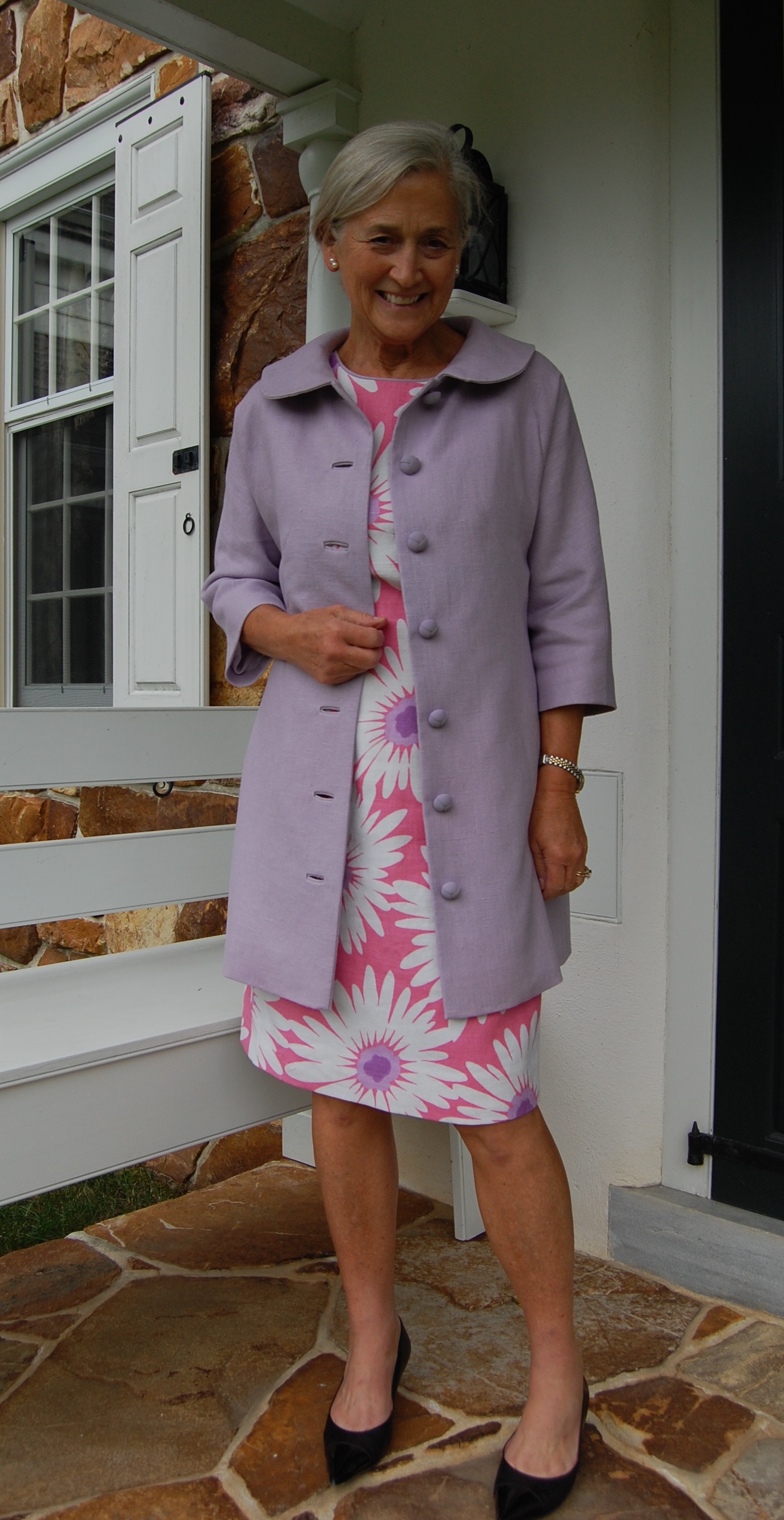
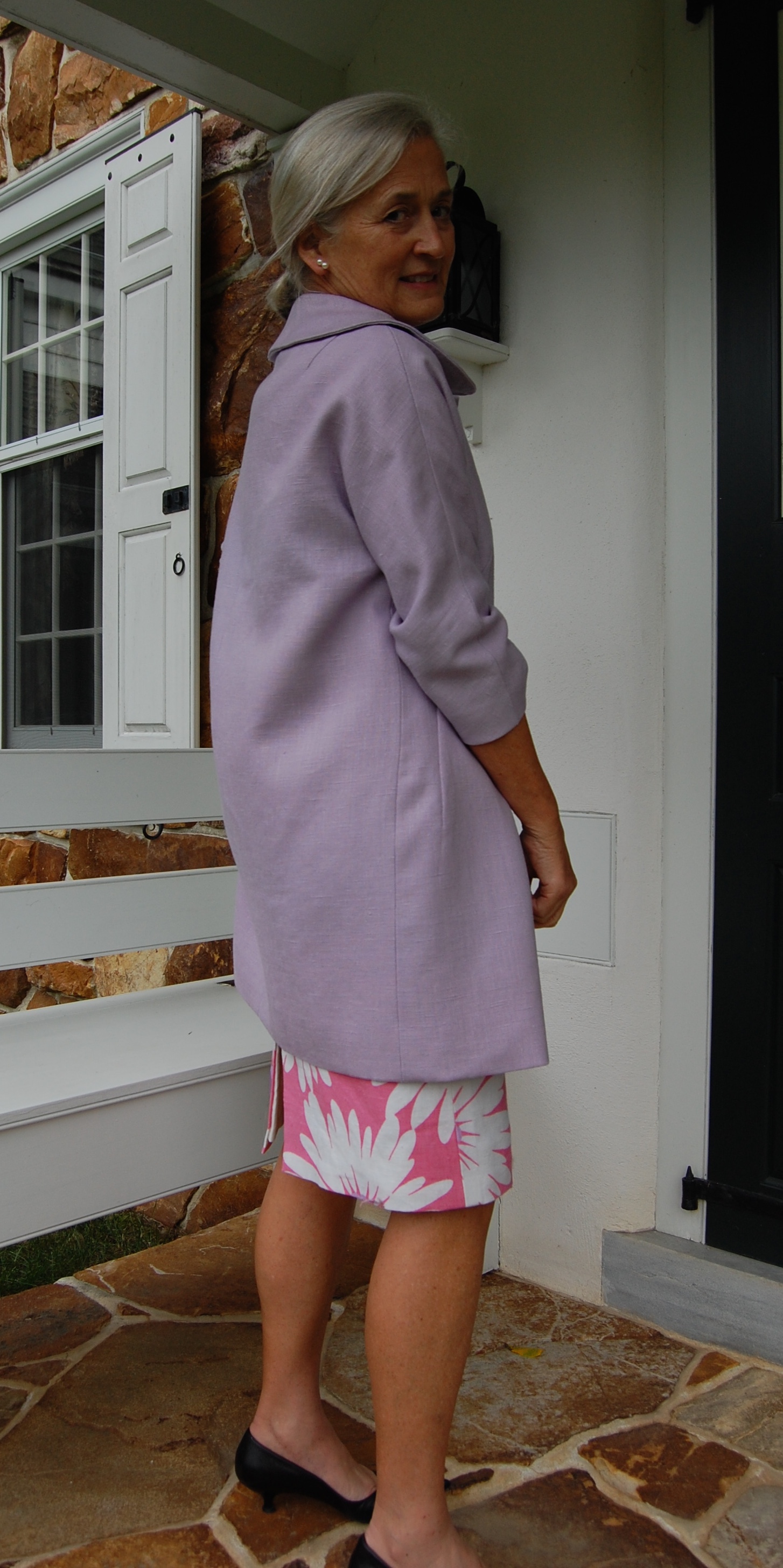
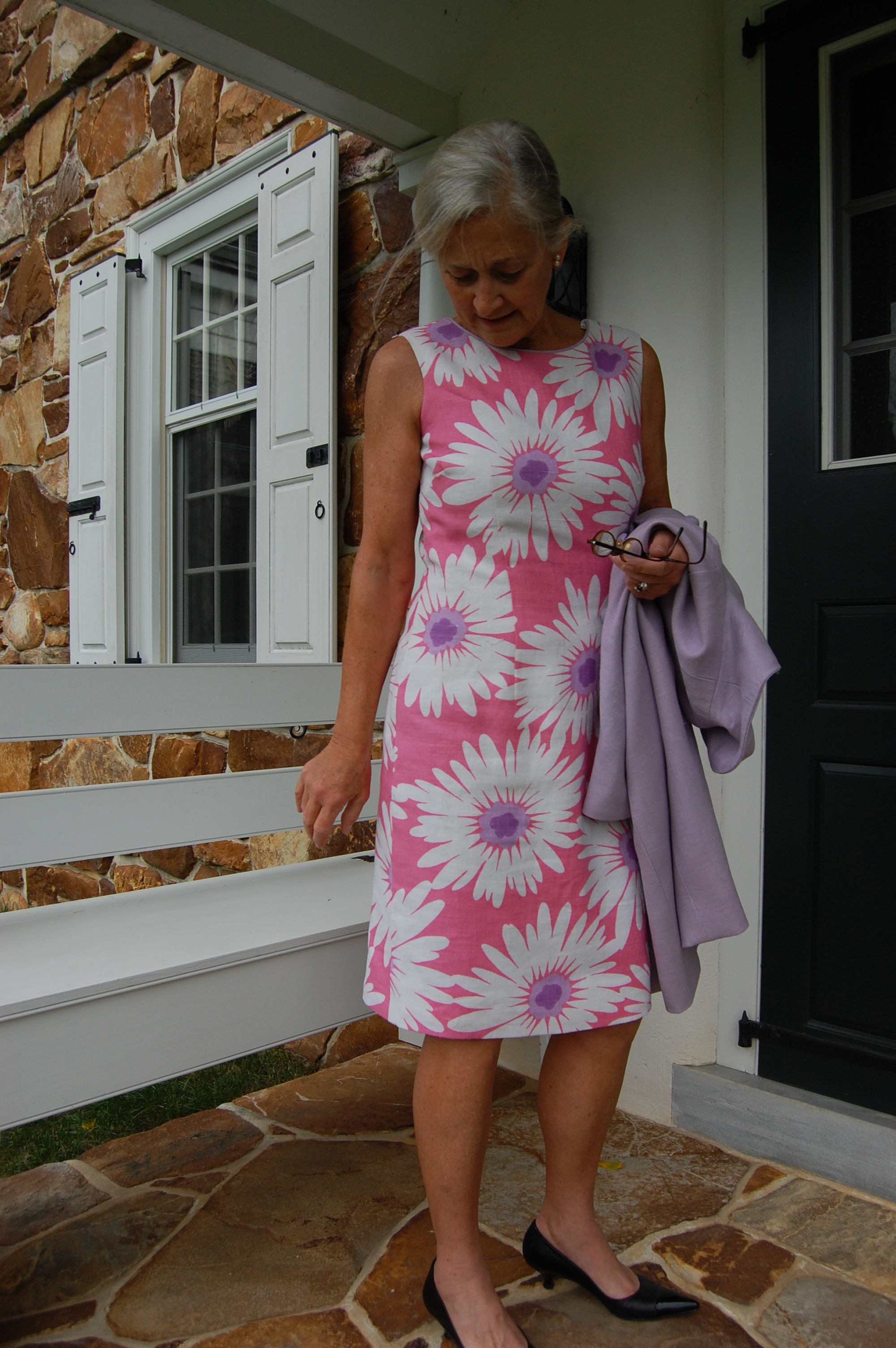
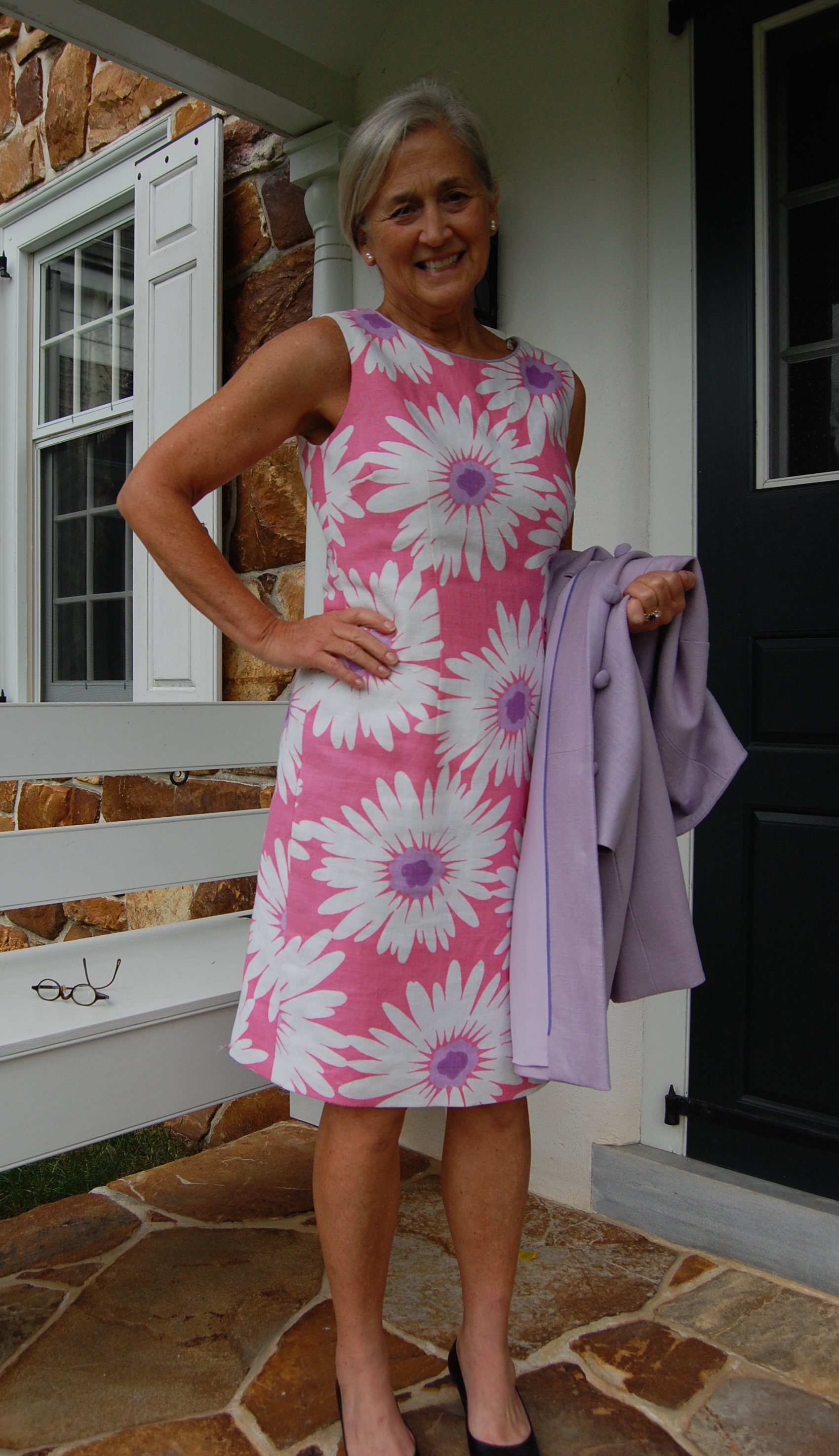
Vogue Gres coat and dress

DSC_0851

I am not sure I can remember a sewing project which I have enjoyed more. The coat pattern is actually quite a simple design, imaginatively shaped with unusual darts and seams. Perhaps the fact that I made it from vintage Moygashel linen helped make the sewing of it enjoyable, as the linen is so stable. Darts and seams can be crisply sewn and ironed, the grain of the fabric is so easy to see, and the fabric drapes with a fluid sturdiness, if that makes sense.

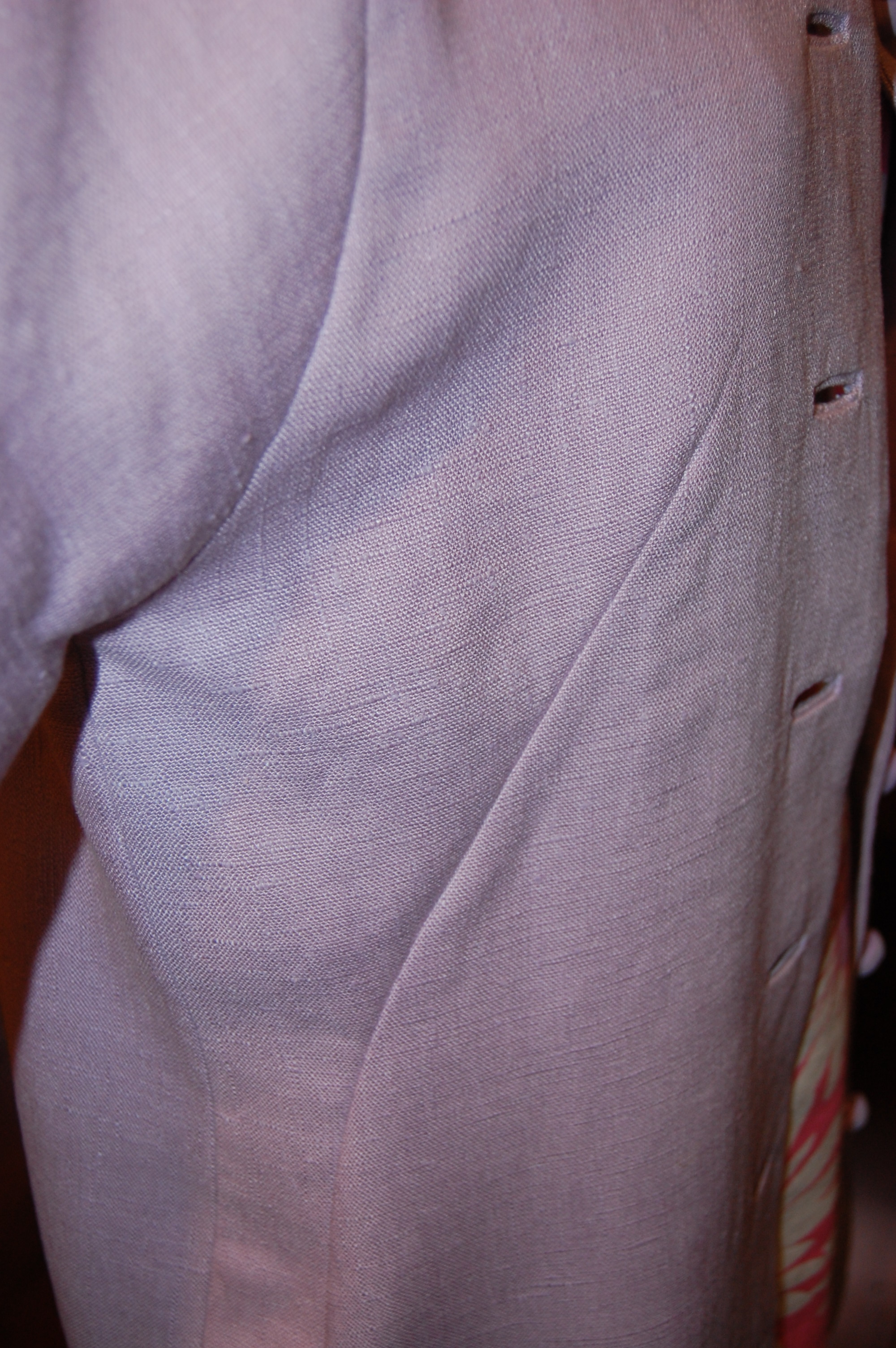
This shows the side darts which shape the coat and the dart/seam at the front of the kimono sleeve.

This shows the side darts which shape the coat and the dart/seam at the front of the kimono sleeve.

I covered the changes I made to those front darts in an earlier post; those were the only alterations I made to the final design except for lengthening the sleeves by one inch and the length of the coat by 1½ inches. Besides those shaping darts, there is one other feature of this coat which defines it. Do you know what it is?   Yes, it is the bound buttonholes and their buttons. Seven of them, to be precise.

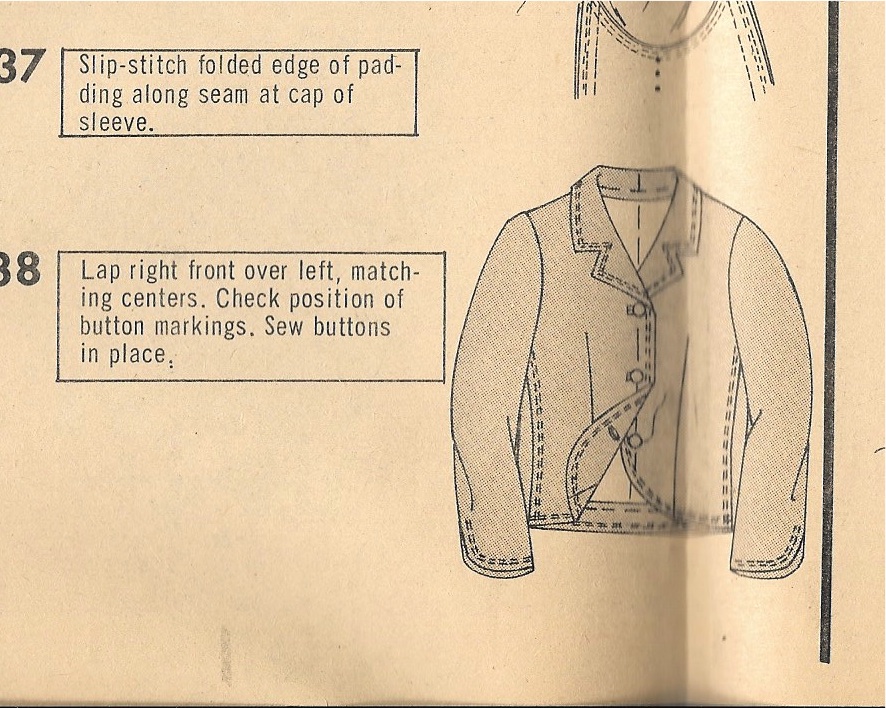
The pattern instruction sheets call for bound buttonholes, as shown here:

I love how these vintage Vogue patterns give such precise instructions; there are various ways to make bound buttonholes, but the method described here is my favorite.

I love how these vintage Vogue patterns give such precise instructions; there are various ways to make bound buttonholes, but the method described here is my favorite.

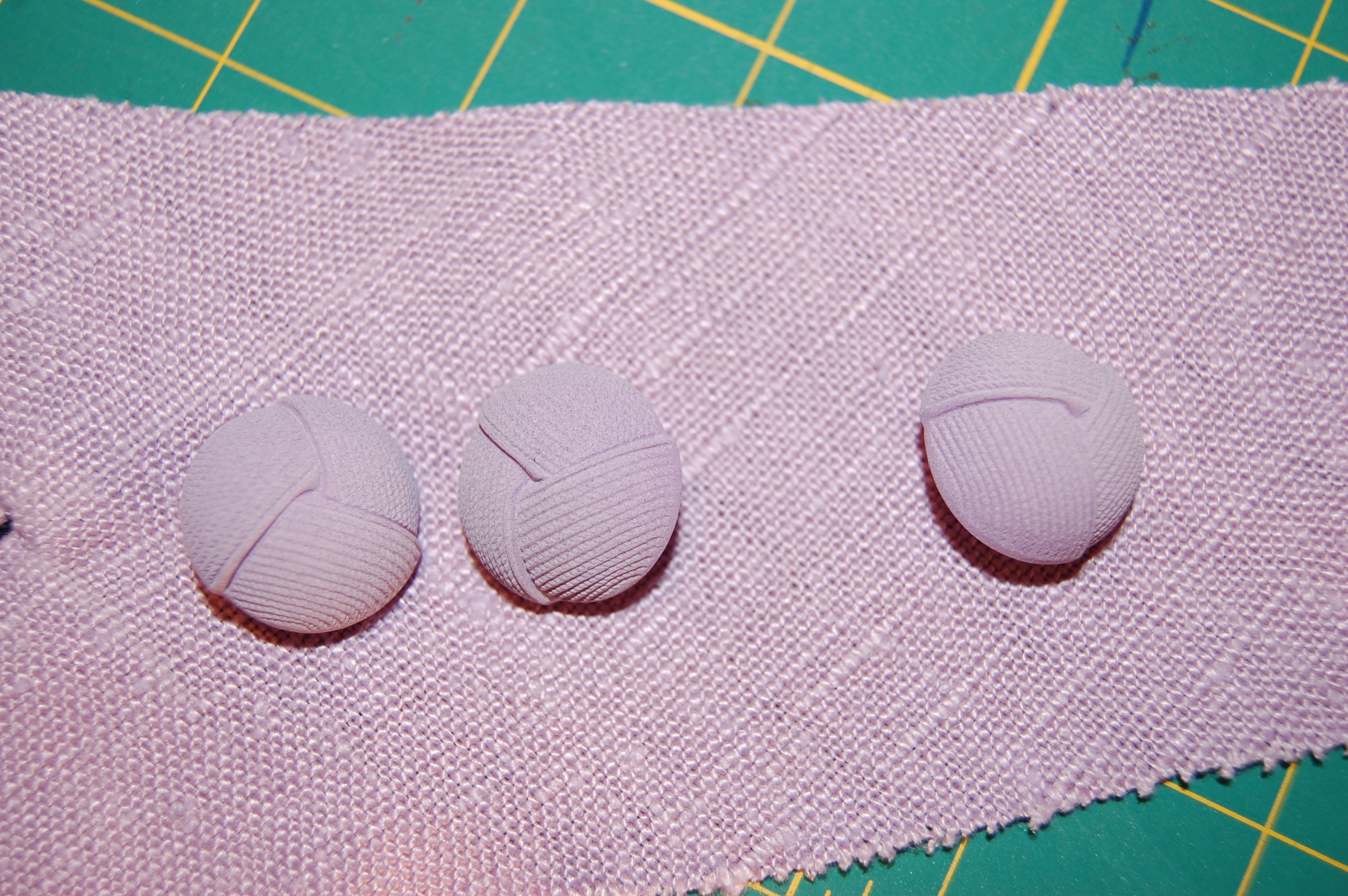
I have made a lot of bound buttonholes in my sewing life, but seven of them lined up as the focal point of the front of my coat is still a little intimidating. First of all, I had to find buttons that were “perfect.” I found some lavender buttons on the Britex website, and although they looked like a good match in color and appearance, ordering something like that online is always imprecise. However, when they arrived, they were, indeed, “perfect!” With buttons in hand, I made a sample buttonhole, as I always do.
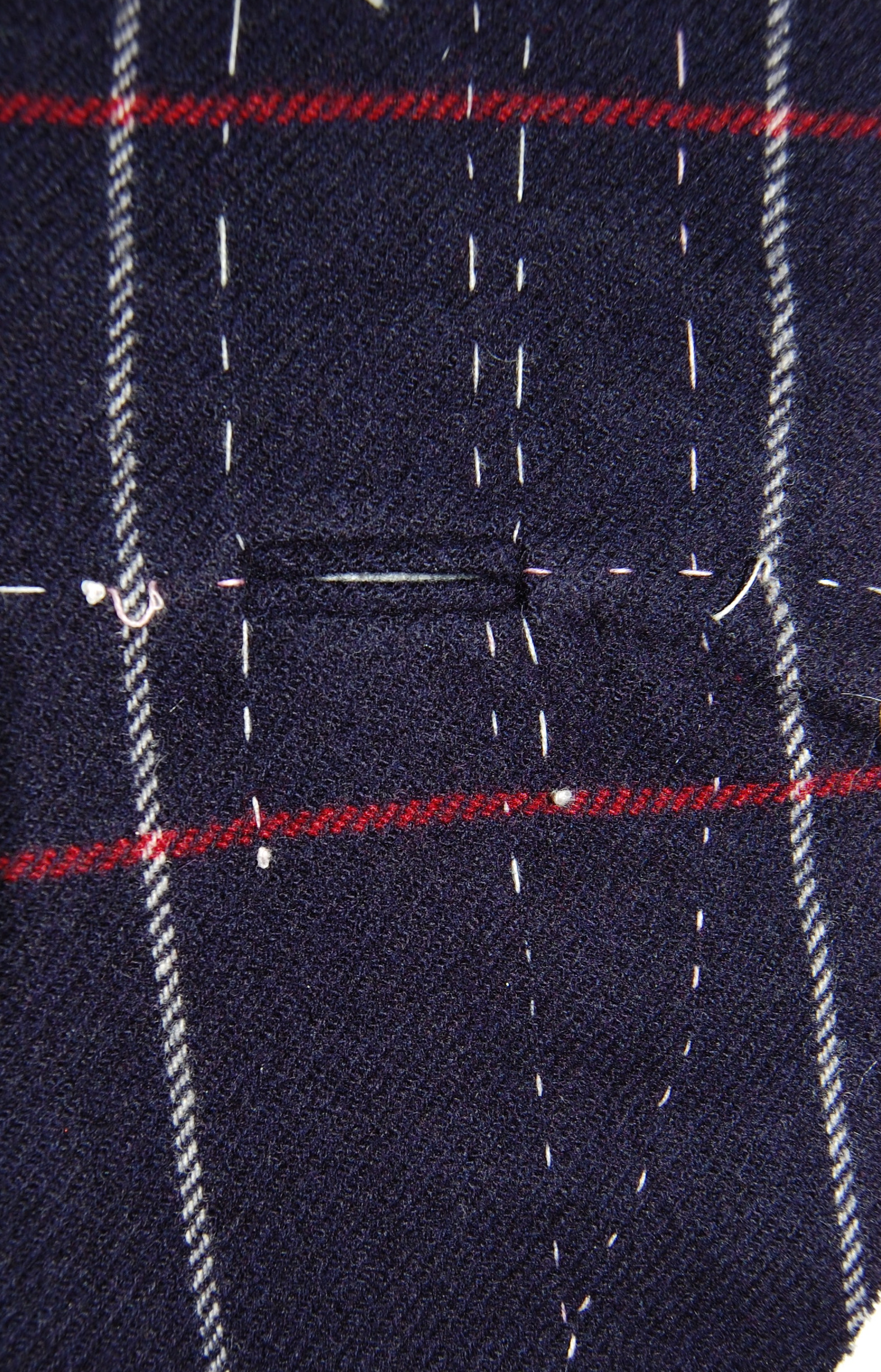
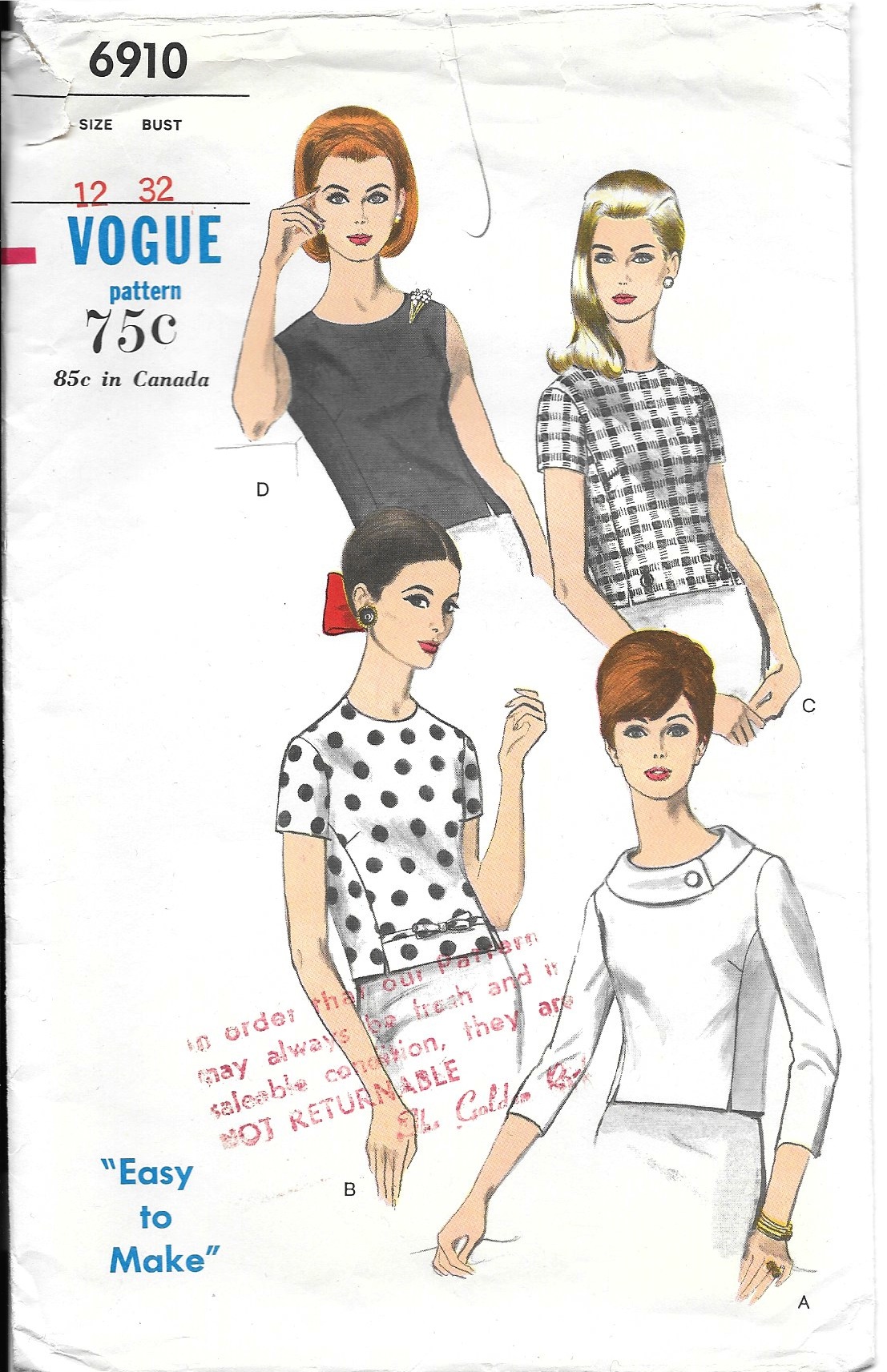
DSC_0819

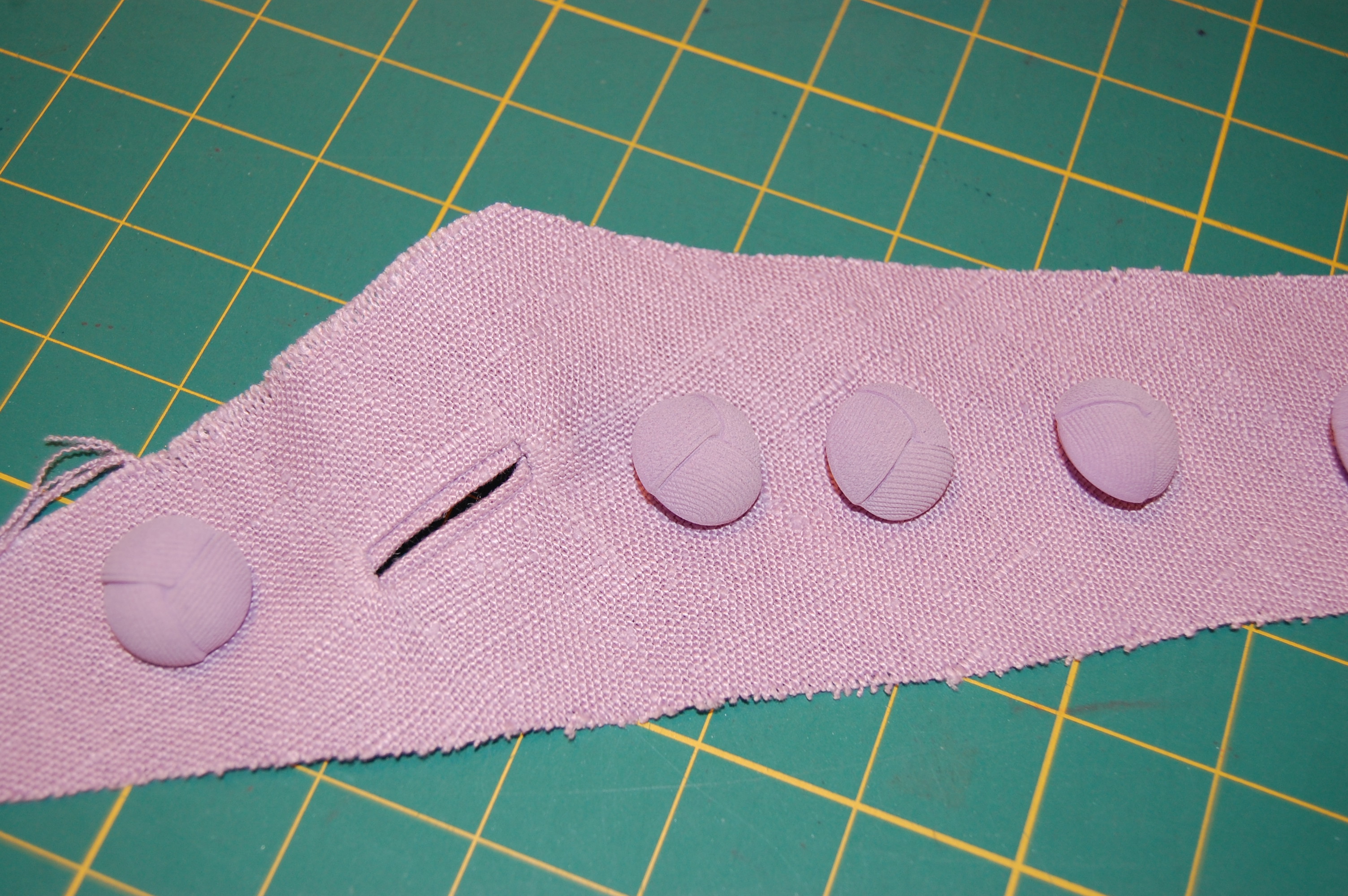
I think this photo shows the "monkey's knot" design in the buttons, which compliments the linen weave, I think.

This photo shows the “monkey’s knot” design in the buttons, which compliments the linen weave, I think.

Then it was on to a marathon buttonhole session one afternoon.

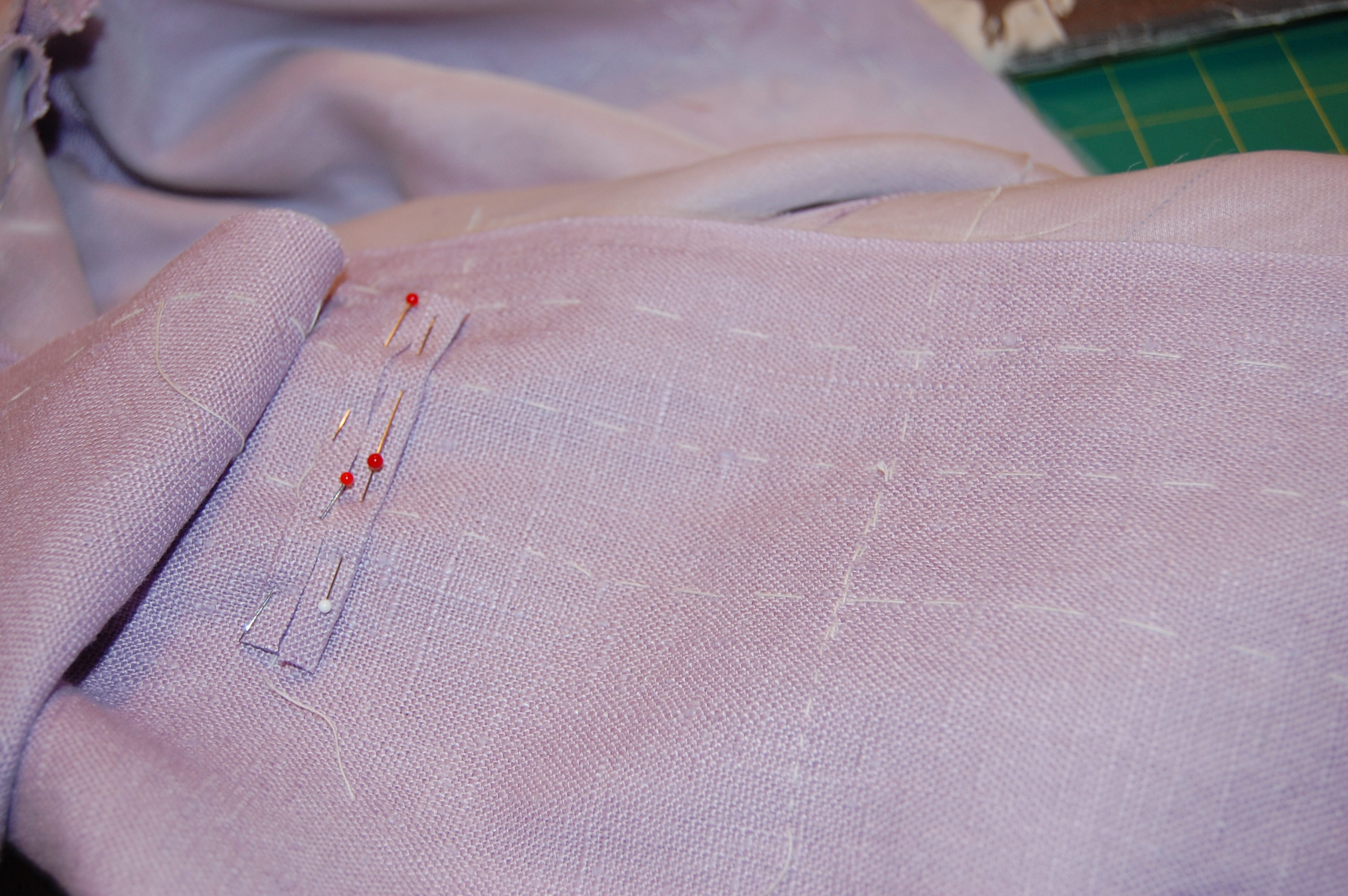
The most important ingredient in making successful bound buttonholes is precise marking.

The most important ingredient in making successful bound buttonholes is precise marking.

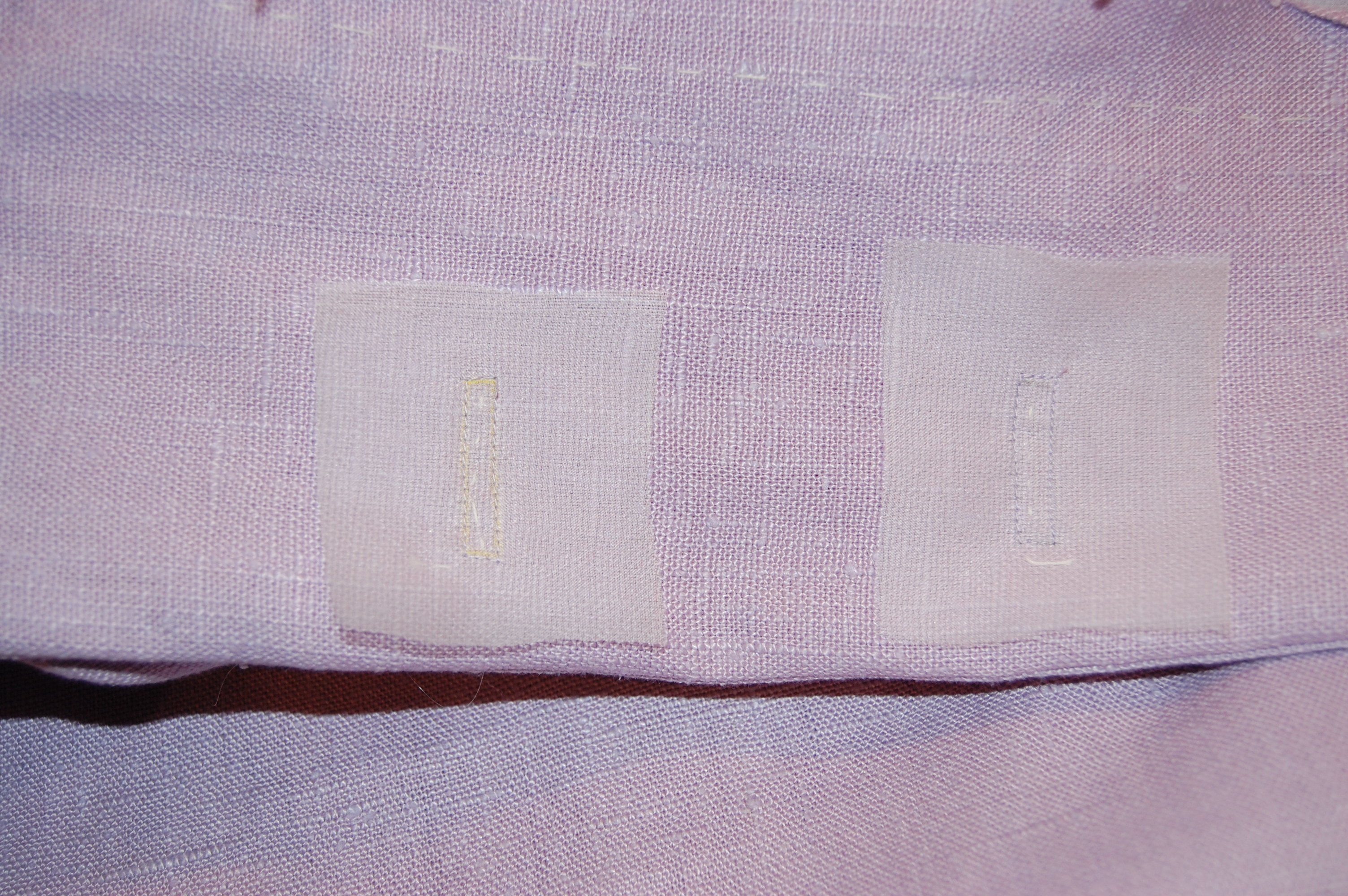
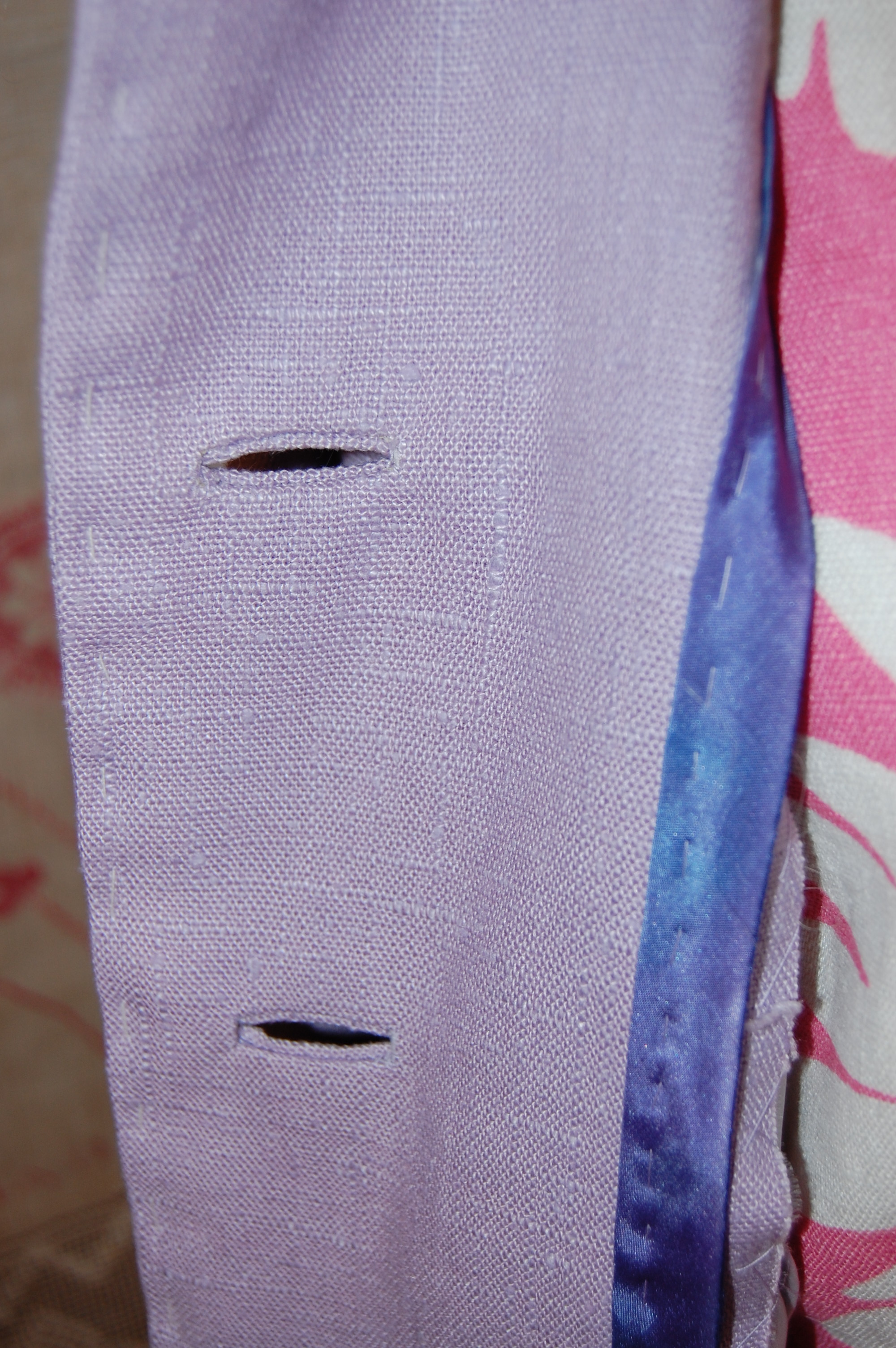
I finished the underside (on the facing) of the buttonholes using organza patches, which makes a beautiful, sturdy finish.

I finished the underside (on the facing) of the buttonholes using organza patches, which makes a beautiful, sturdy finish.

Here is the underside of the buttonholes before I finished the edges.

Here is the underside of the buttonholes before I finished the edges.

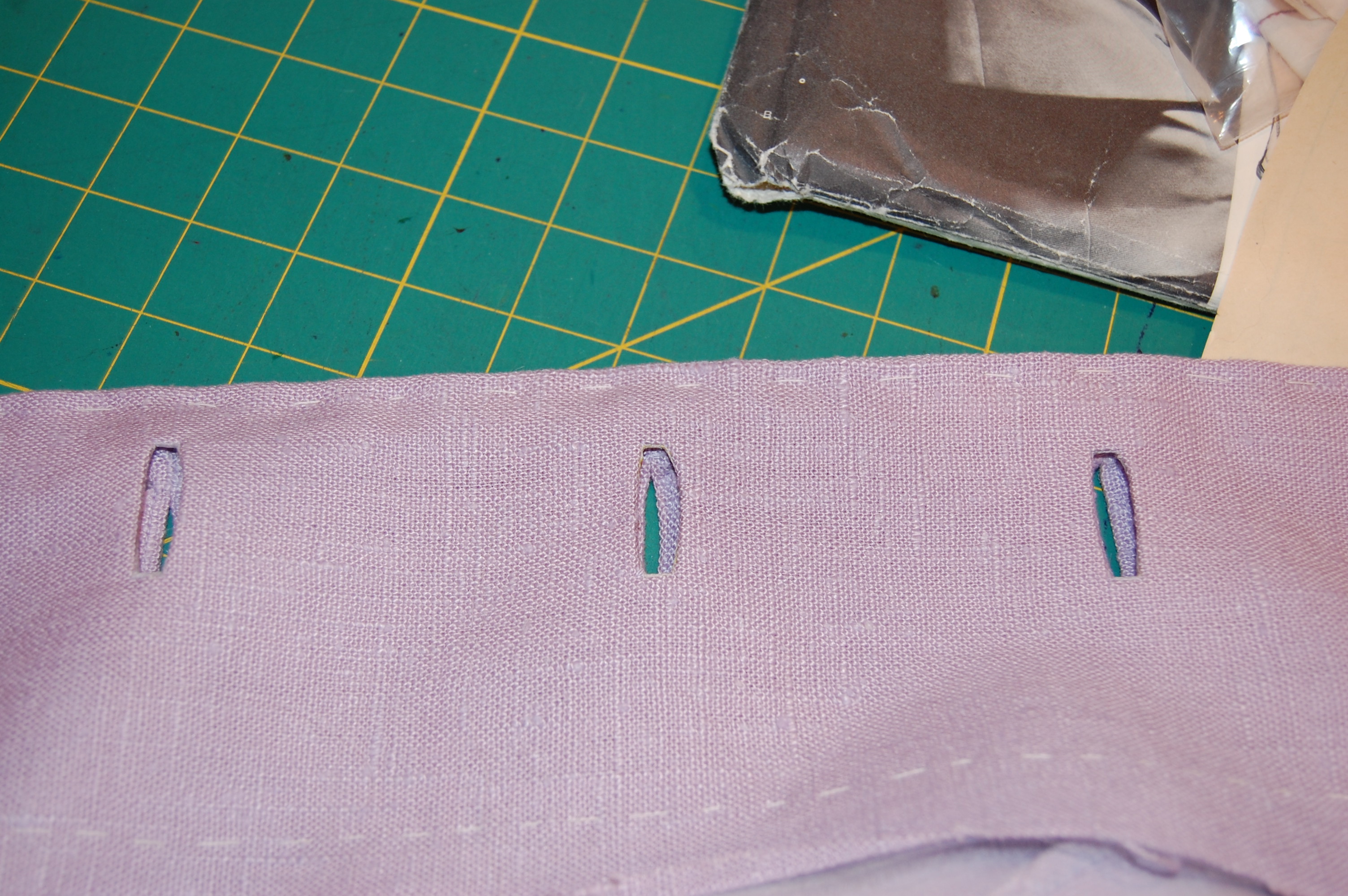
And here is the facing side, finished.

And here is the facing side, finished.

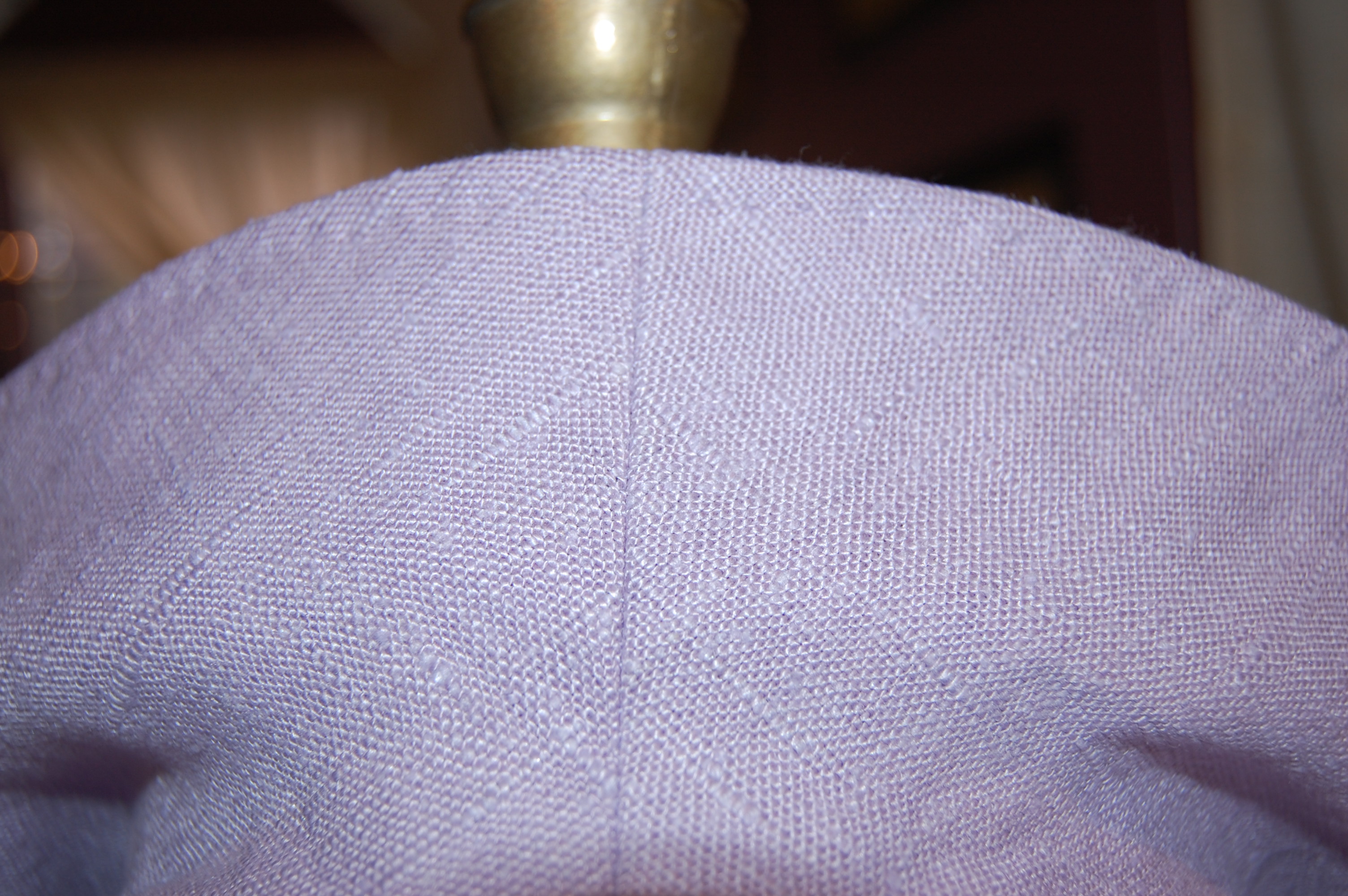
Another charm of this pattern is the coat collar, which is seamed in the center back on the bias, causing it to “turn” beautifully. I under-stitched the undercollar to help keep the perimeter seam properly in line (this is a trick I learned from one of Susan Khalje’s classes):

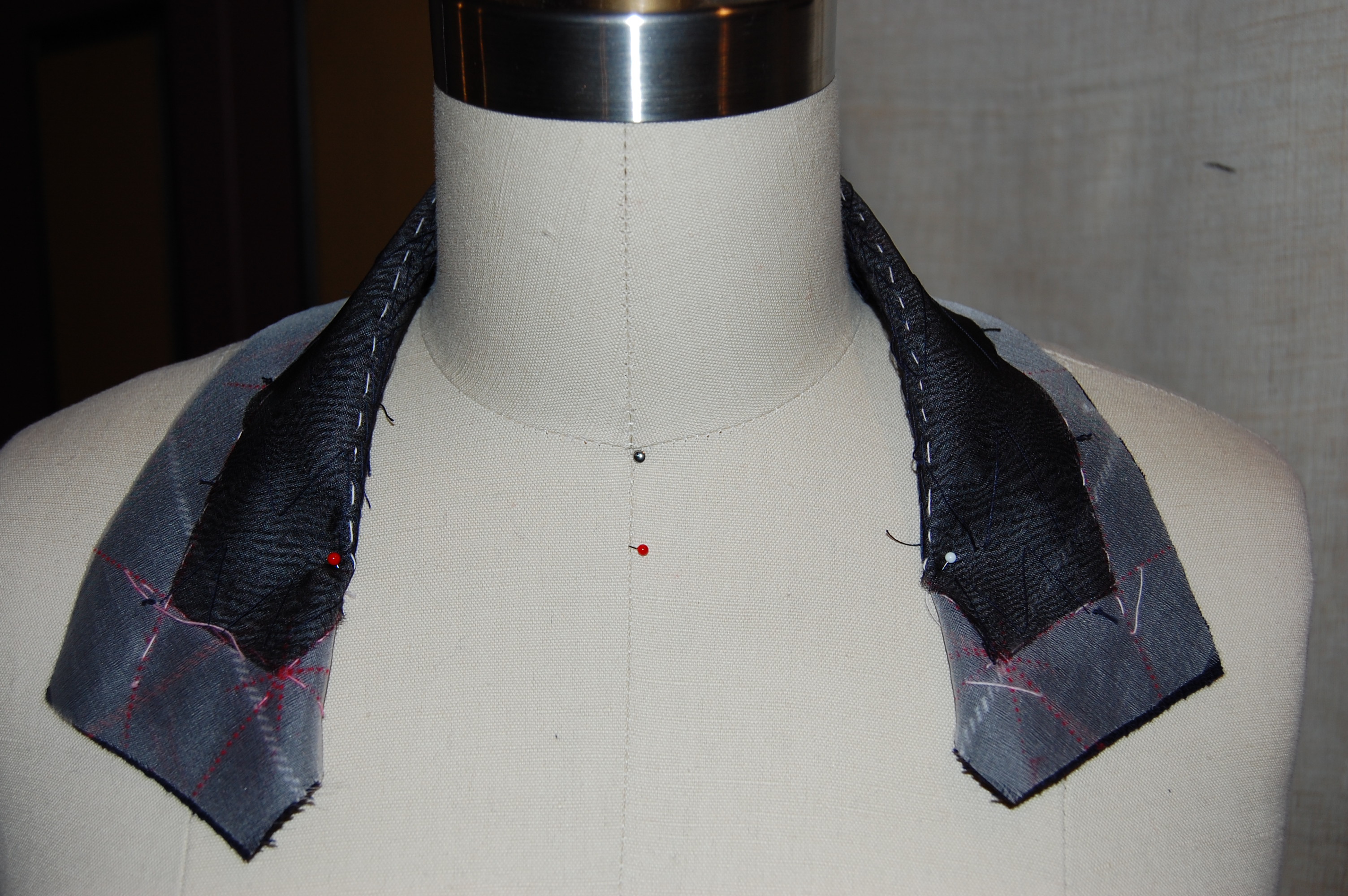
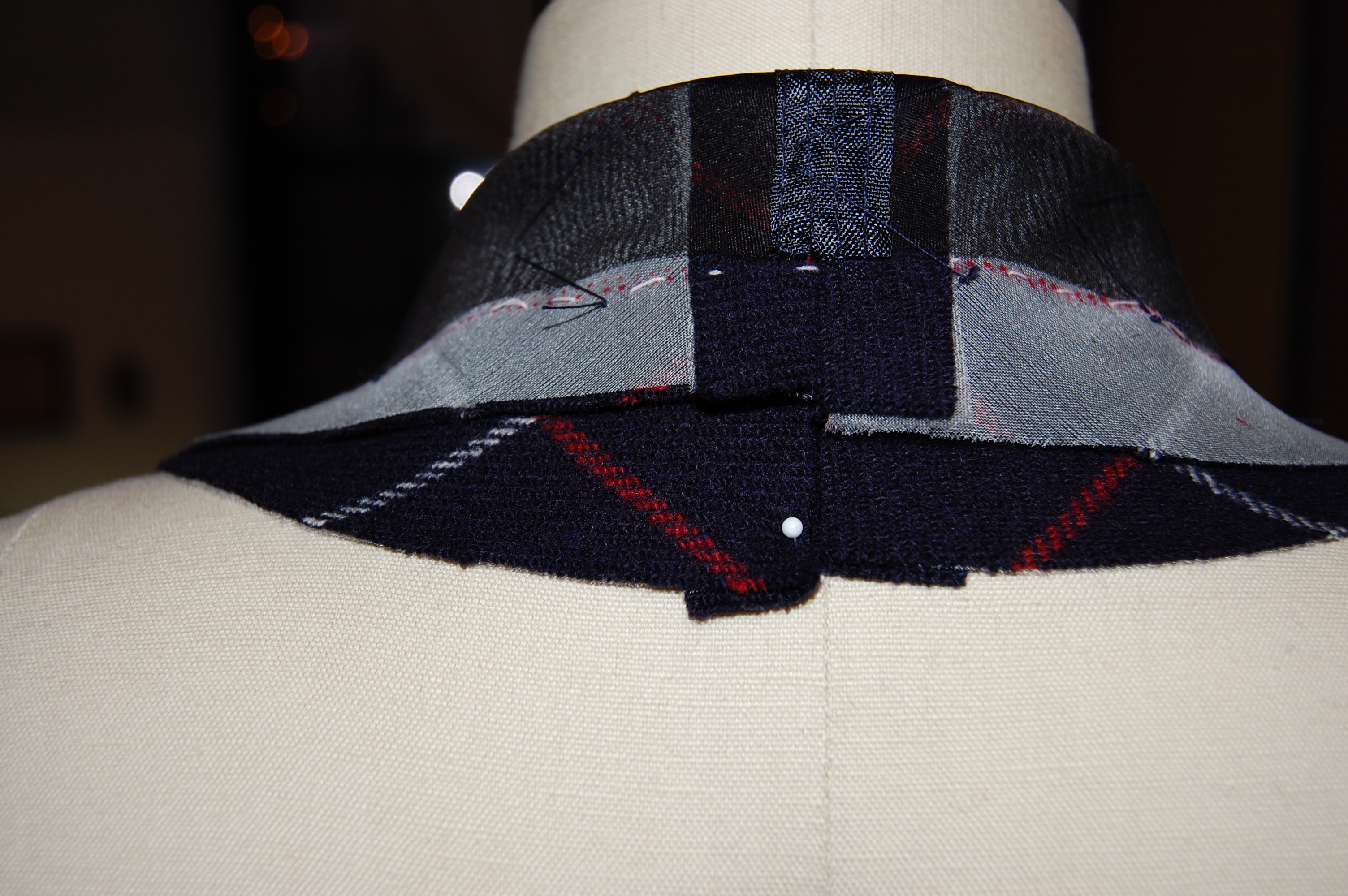
This is the undercover, showing center back seam and the under-stitching I used to secure the perimeter seam.

This is the undercollar, showing center back seam and the under-stitching I used to secure the perimeter seam.

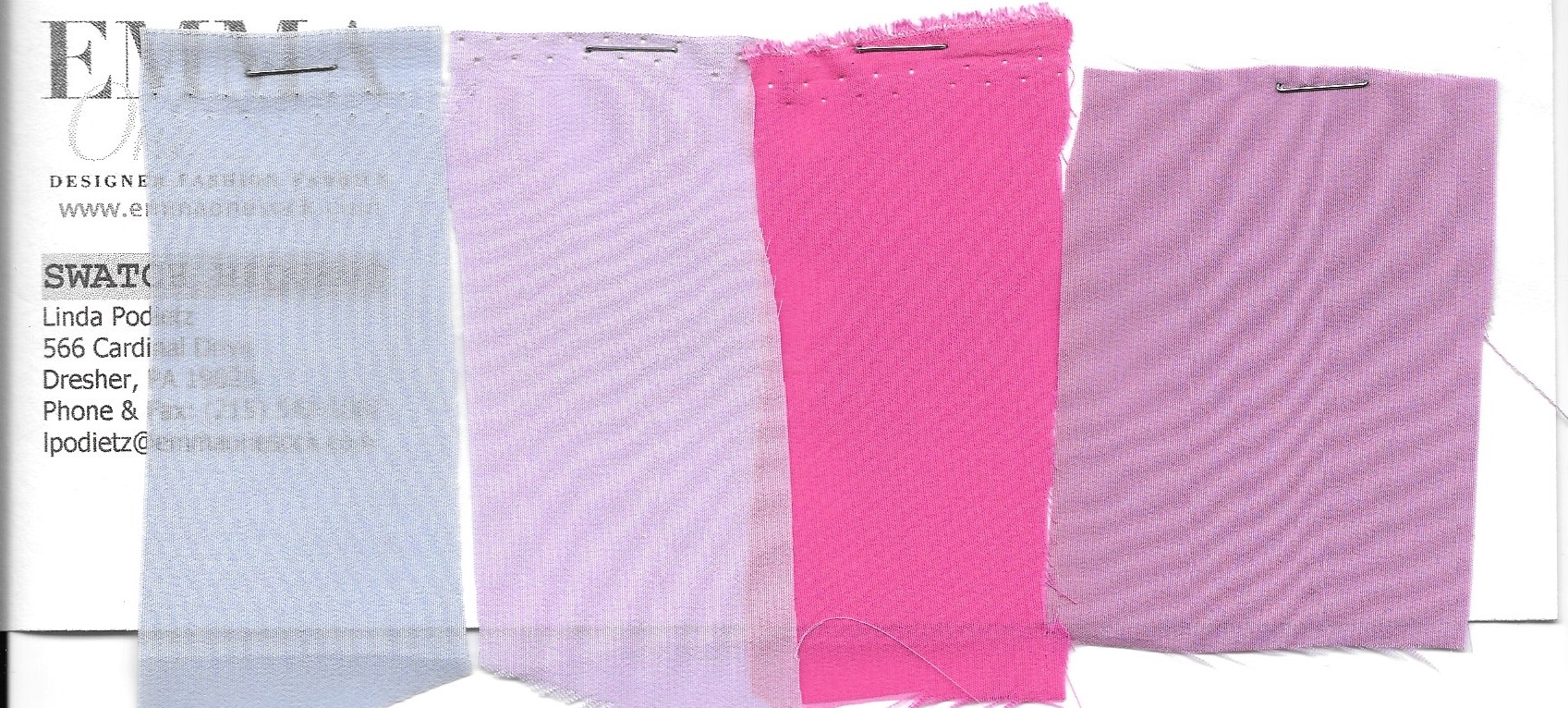
When it came to the lining, I knew I wanted to use silk crepe de chine. I ordered some swatches from Emma One Sock fabrics:

A Fitting finish swatches

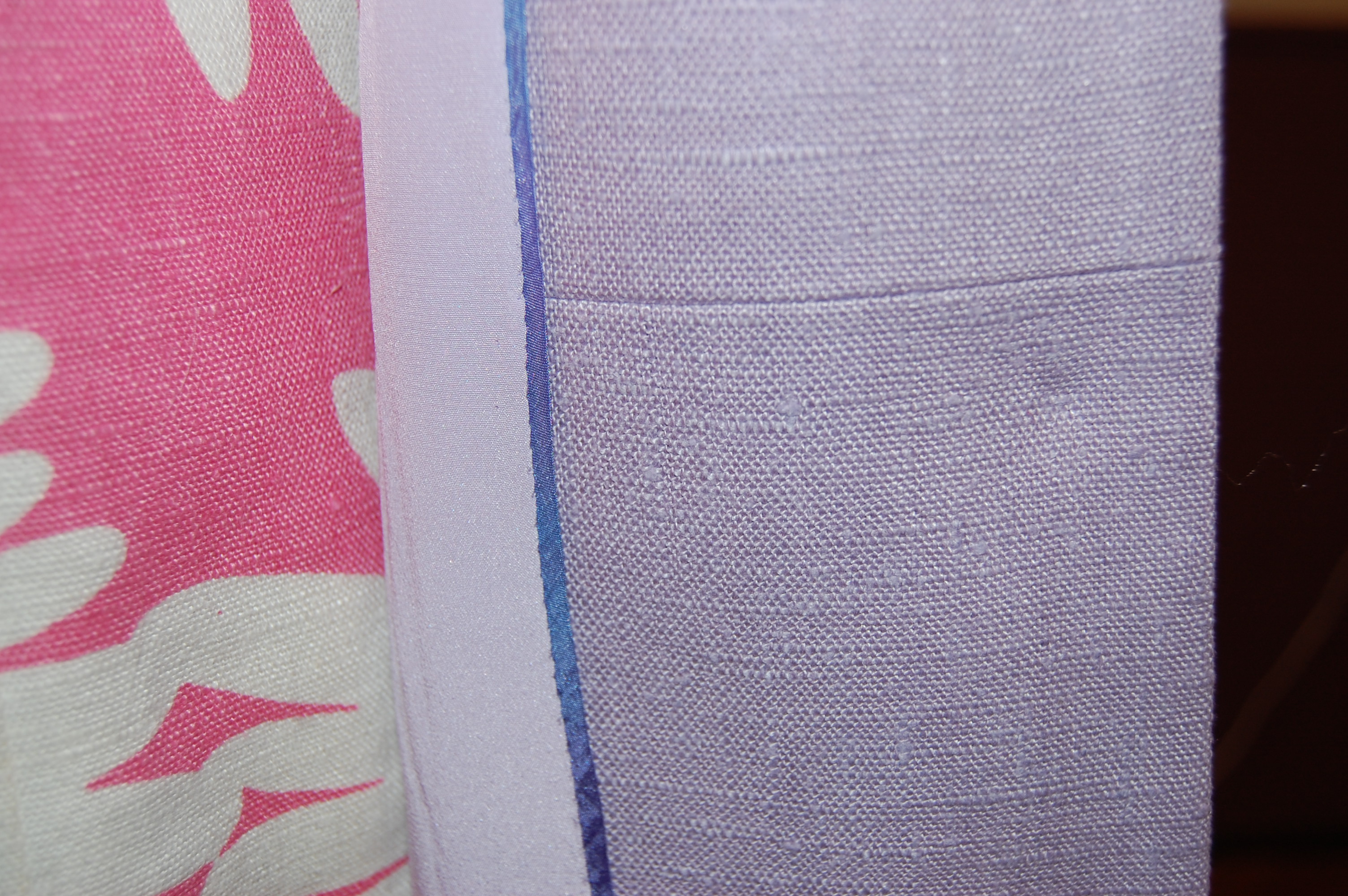
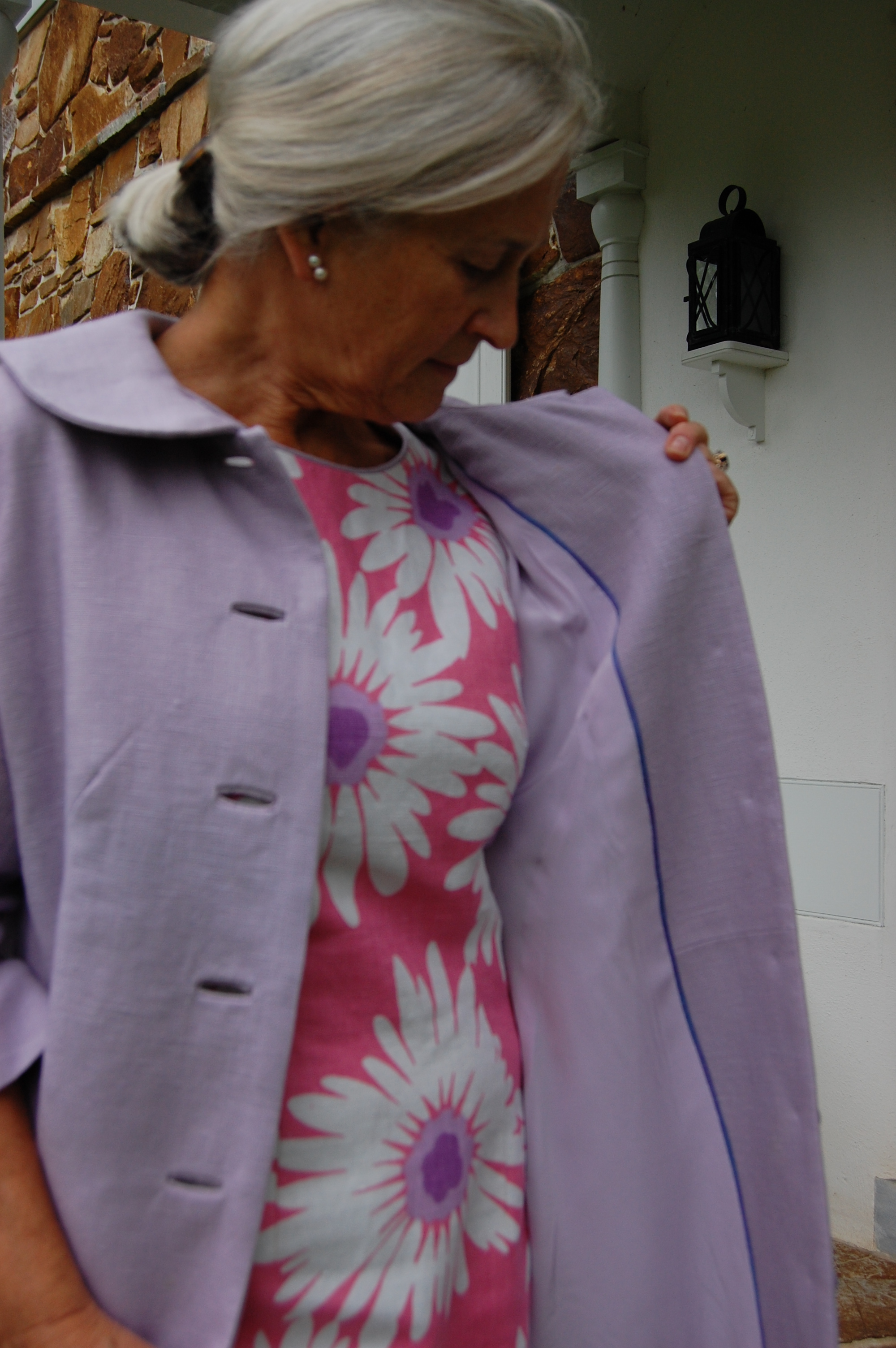
Fortunately my sister was visiting and so I could get her opinion on which one to order. I was a bit smitten with the idea of a bright pink lining, but she wisely asked if I hoped to wear this Spring coat with dresses other than the pink flowered one which had inspired it. Well, yes, I do want that flexibility! That made the decision easy – I chose the pale lavender silk, which is just about a perfect match. I added a bias, flat piped edge to the lining, which is now something I always do with coats and jackets I make. It is so easy and adds so much!

Fitting finish

Some of you may recall that I had to piece one of the facings because I was just a little short of the fabric I needed. Here is the seam on the left facing. I really don't think anyone will ever see it! (Except all of you, of course!)

Some of you may recall that I had to piece one of the facings because I was just a little short of  fabric. Here is the seam on the left facing. I really don’t think anyone will ever see it (except all of you, of course!)

DSC_0844

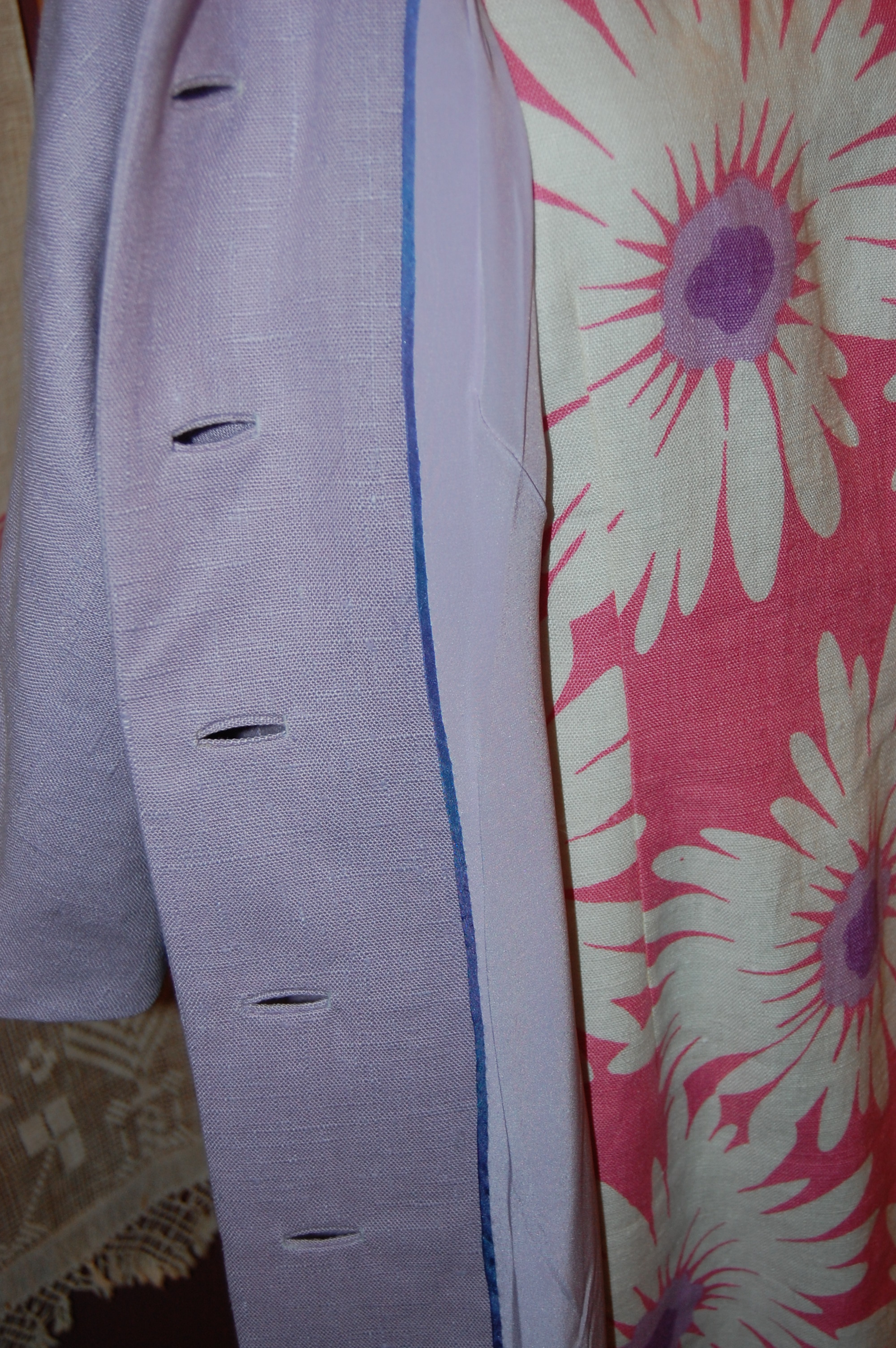
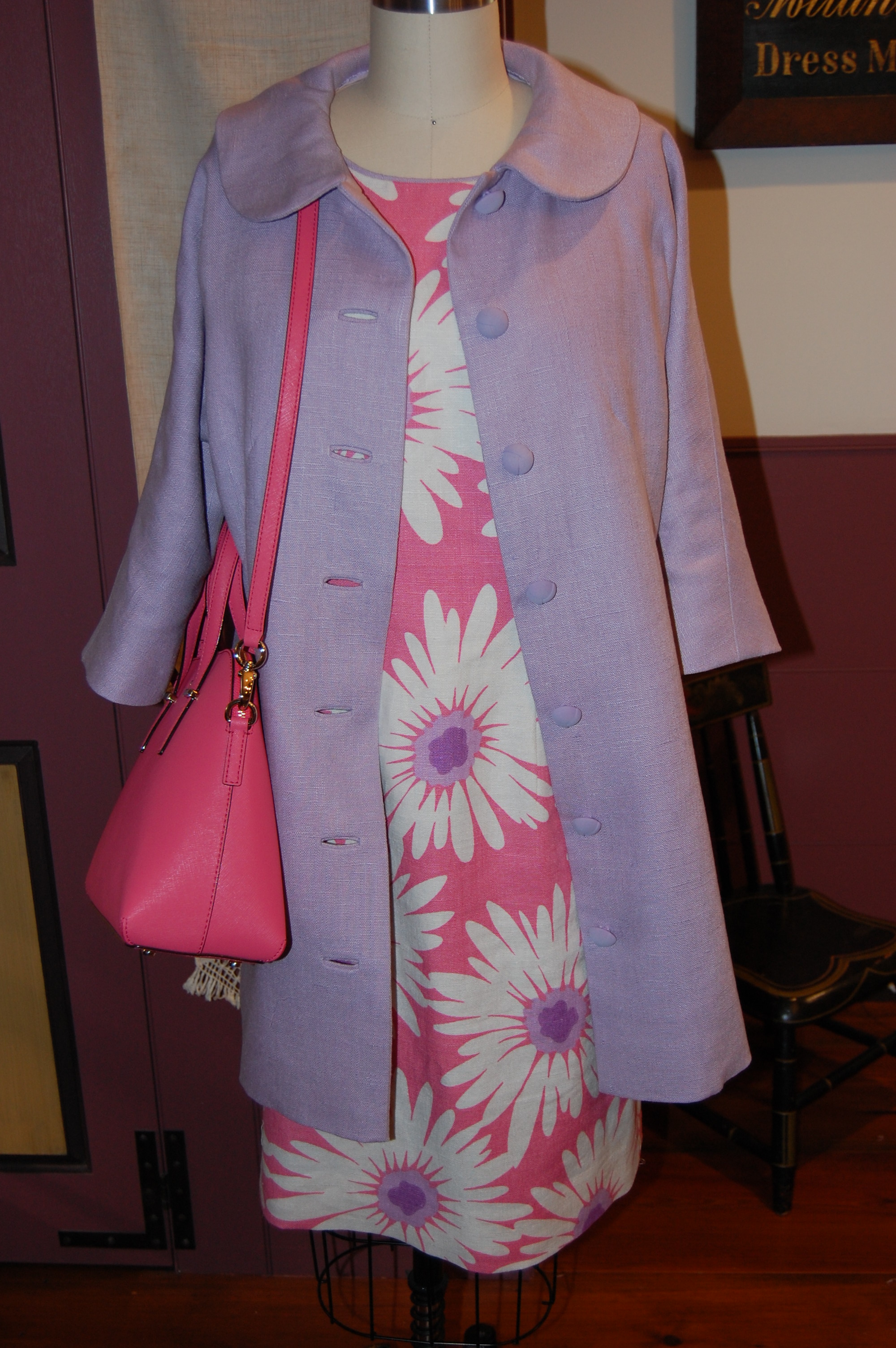
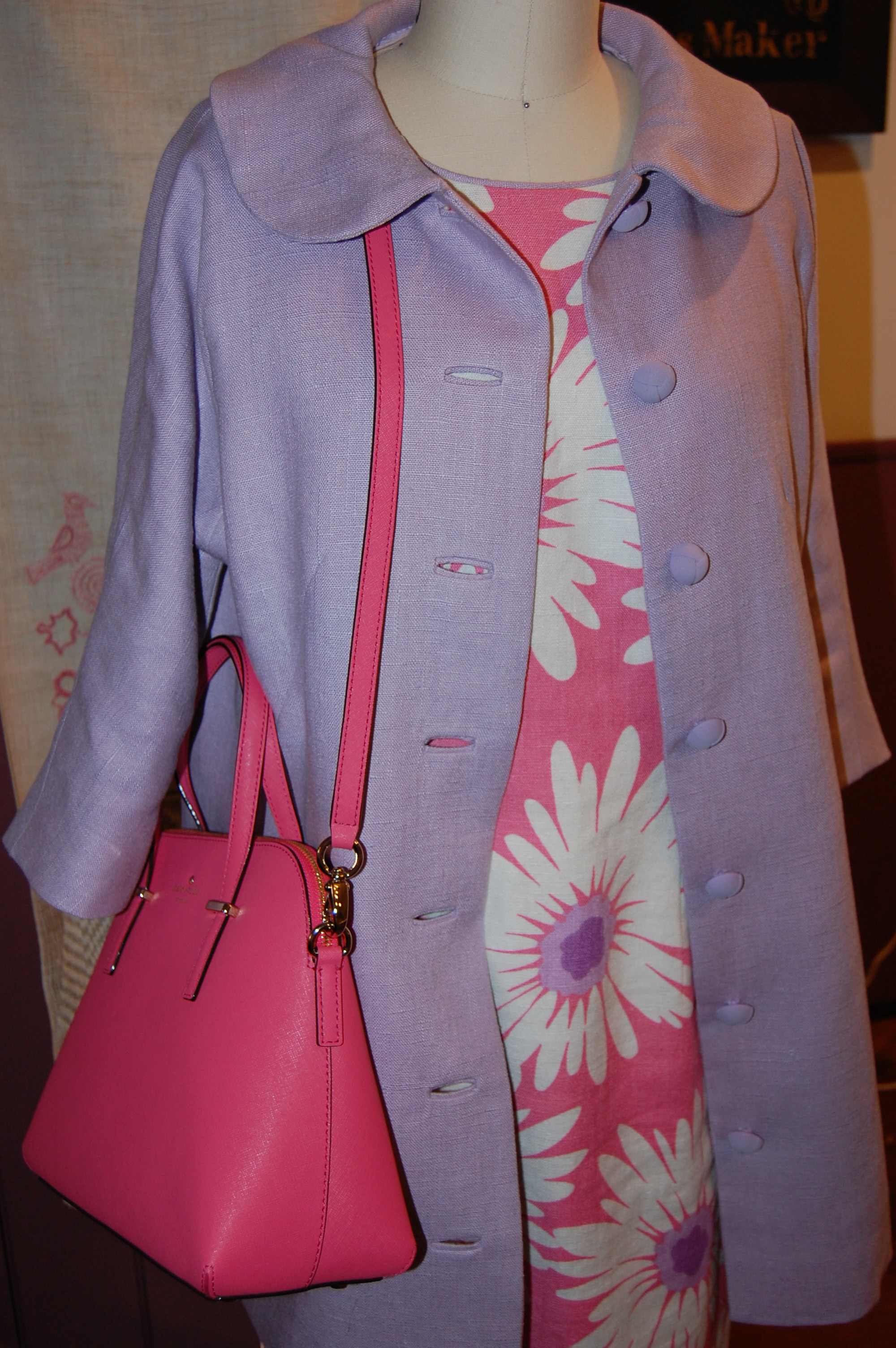
This is a good look at the bound buttonholes and what they add to the overall look of the coat. If you visualize machine made buttonholes in their place, you will get an idea of how vital the bound ones are to the design of the coat.

Another thing that will add to the total look of my 2016 Spring ensemble is this Kate Spade handbag which my grown children gave to me:

Fitting finish

DSC_0855

Fitting Finish

Fitting finish

Fitting finish

DSC_0837

Now all I need are lavender pumps…

43 Comments

Filed under bound buttonholes, Buttons - choosing the right ones, Coats, couture construction, kimono sleeves, Linen, Love of sewing, Moygashel linen, Uncategorized, Vintage fabric, vintage Vogue Designer patterns, vintage Vogue patterns from the 1960s

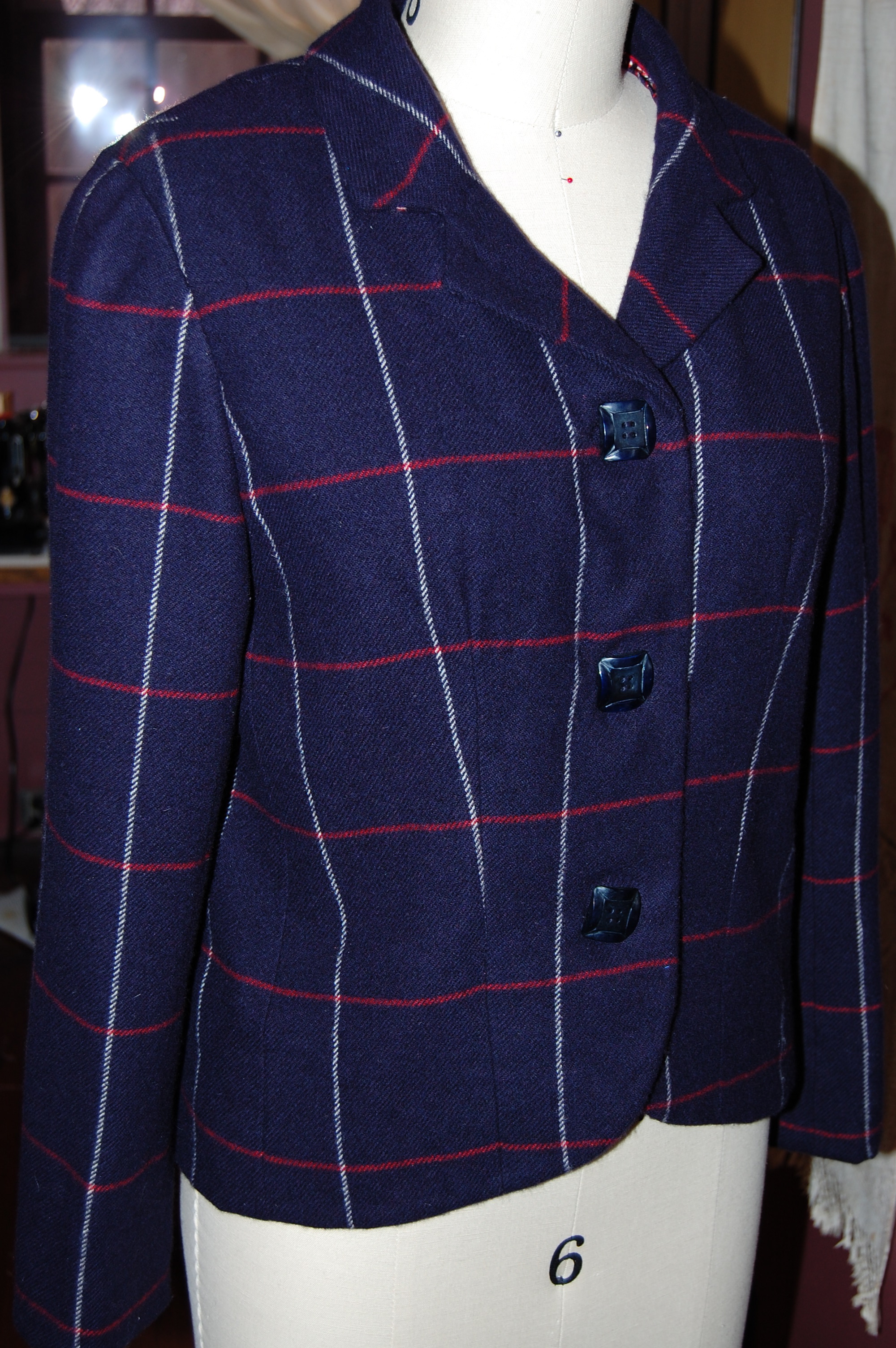
The Evolution of a Suit Dress – Part 3: Finished Jacket

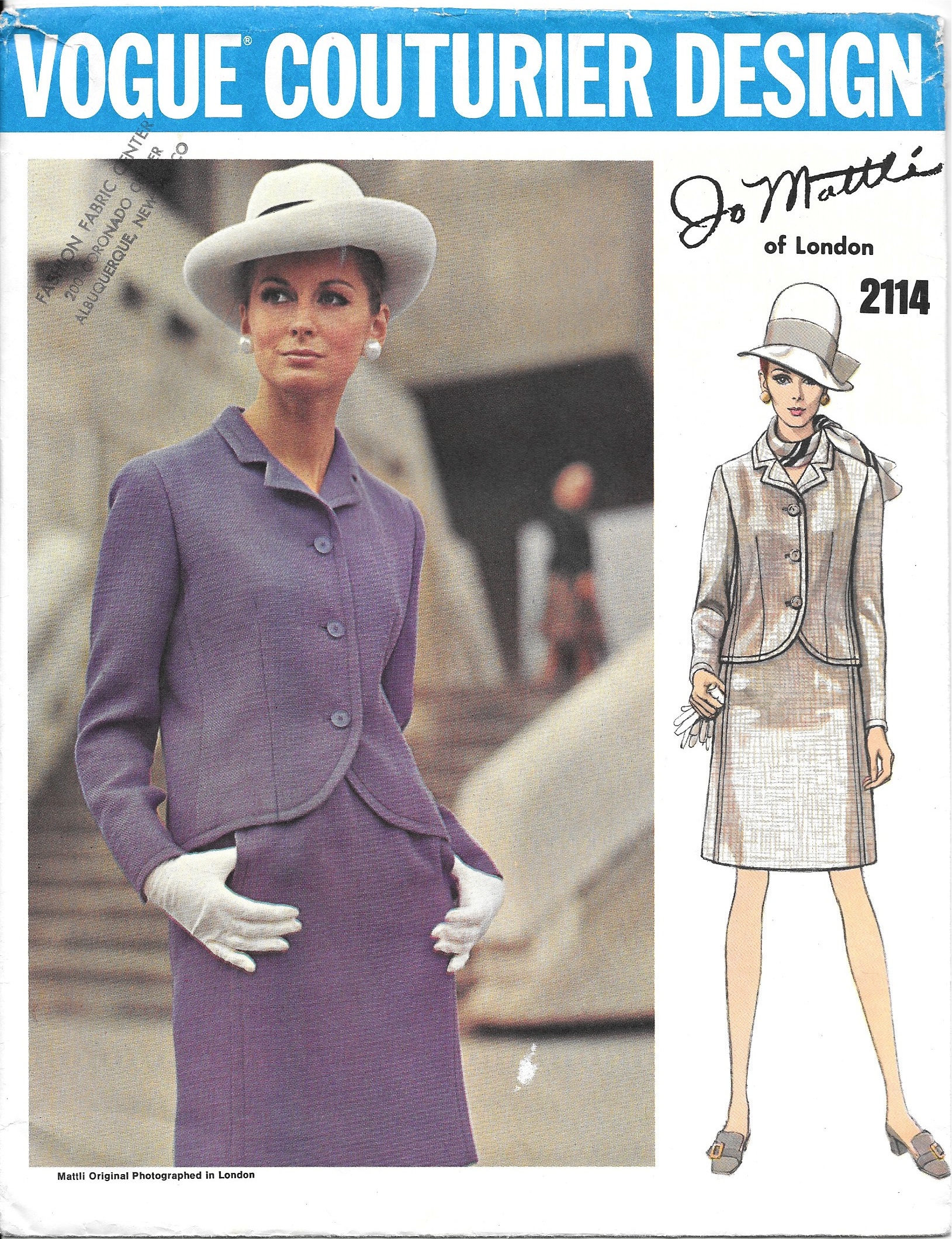
It is a fairly well-known fact that making a classic French “Chanel-like” jacket takes about (or at least!) 70 dedicated hours of sewing time. I did not keep track of the hours I spent on my Jo Mattli-designed jacket, but I am guessing that it rivals – in time spent sewing – both of the classic French jackets I have made. However, I am not complaining. I would commit to it all over again. And just think – I still have to make the coordinating dress for this jacket!

Mattli jacket But it is finished, and happily so. One of the true joys of sewing is the ability it gives us to make some stylistic changes, add embellishments if desired, and use our heads to determine what works and what doesn’t work for the fabric we are using and the intended usage of our garments. While I did not make any stylistic changes to this jacket, I did add my own “dressmaker details” while stitching my way through this project. But first a few more regular details, picking up where I left off in my last post.

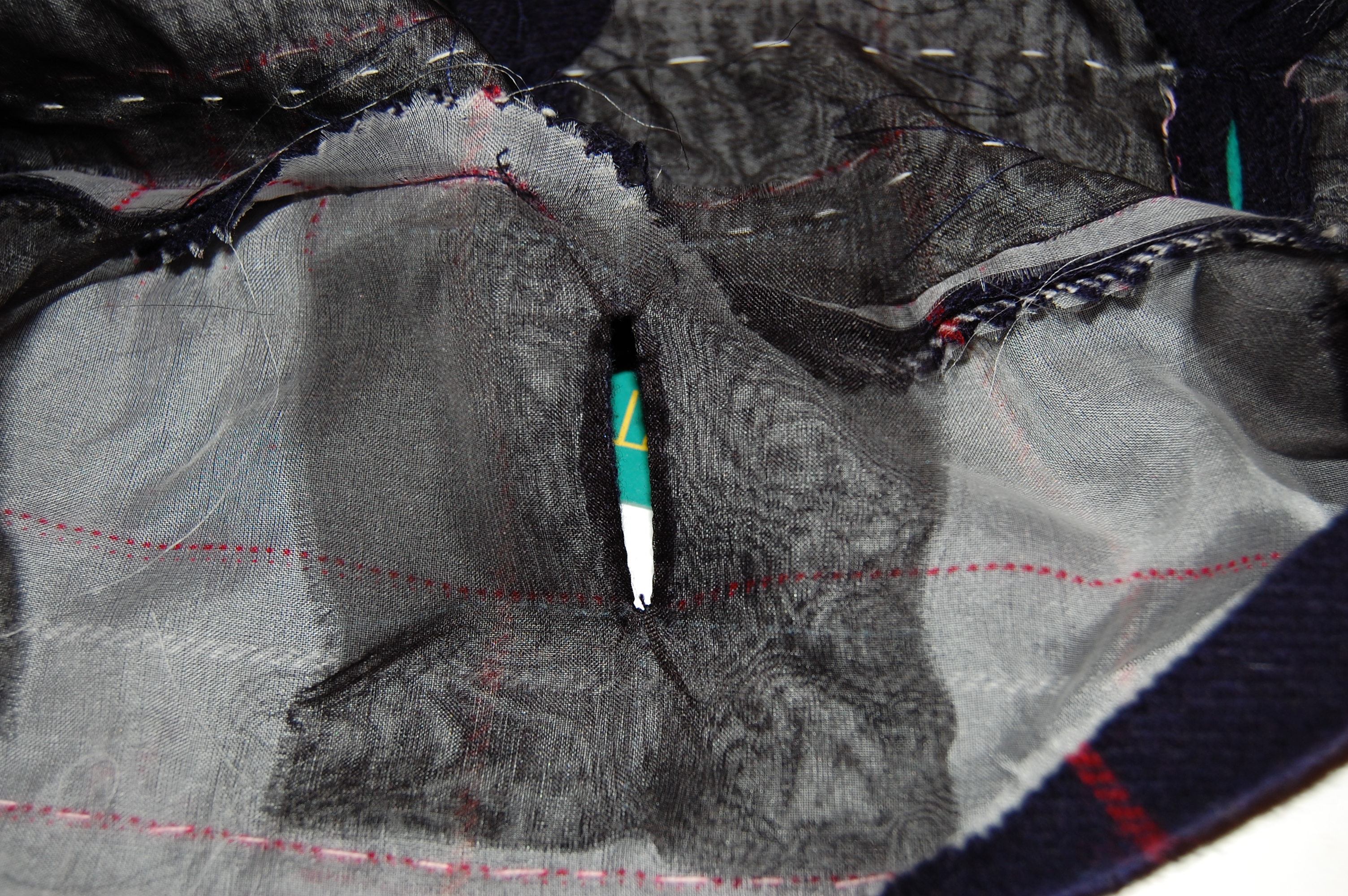
1) To finish the underside of the bound buttonholes, I used organza patches. I have started using this method all the time, as it makes such a neat, fool-proof finish.

The silk organza patch is sewn onto the right side.  After cutting and clipping the corners - carefully! - you turn the organza and you have a perfectly finished opening to back up to your bound buttonhole.  then it is easy to sew the two sides together very neatly.

The silk organza patch is sewn onto the right side. After cutting and clipping the corners – carefully! – you turn the organza and you have a perfectly finished opening to back up to your bound buttonhole. Then it is easy to sew the two sides together very neatly.

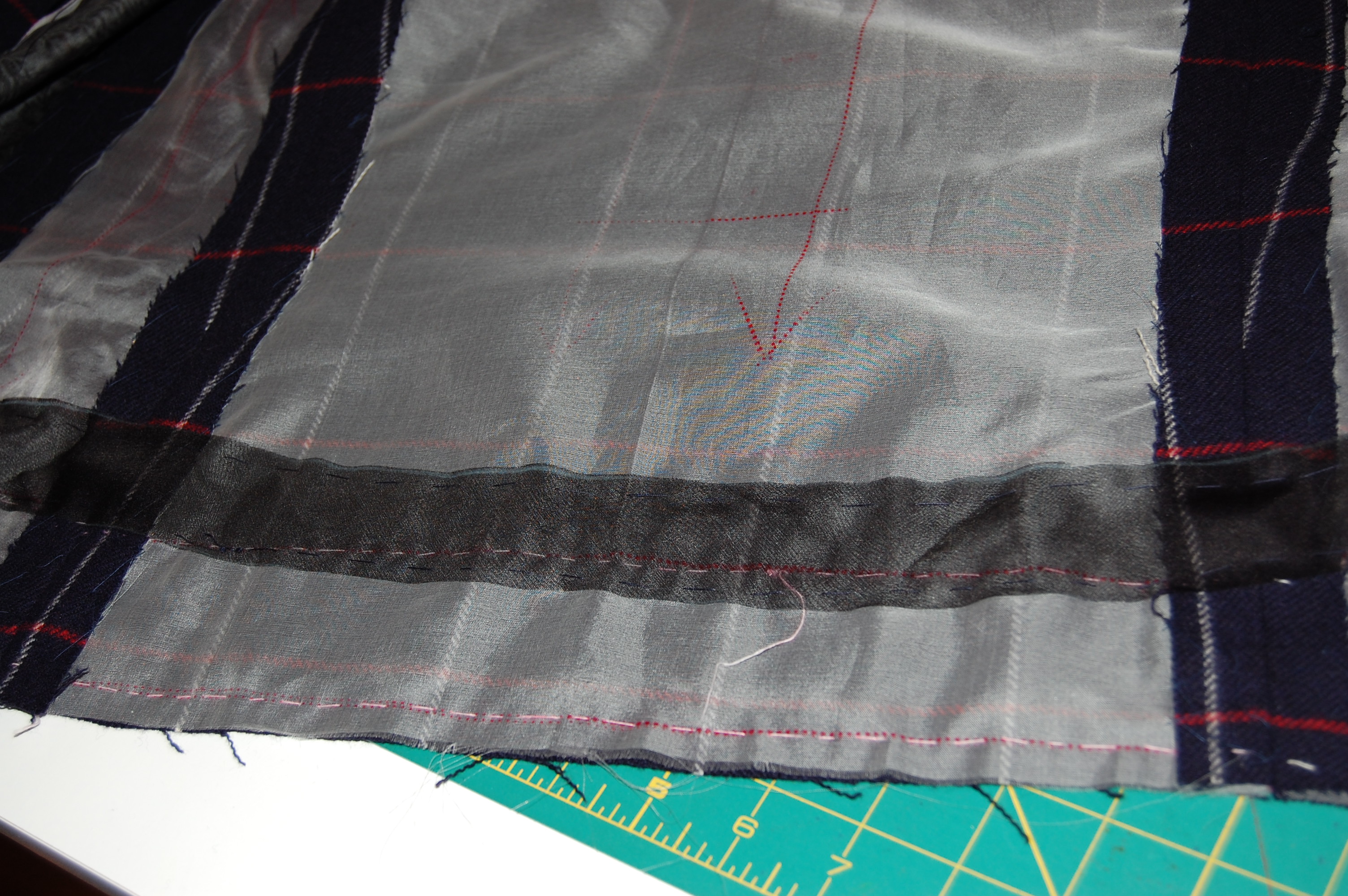
2) Even though the entire jacket is underlined with silk organza, I added another layer of silk organza “interfacing” to the hemline, as directed in the pattern instructions.

Mattli jacket

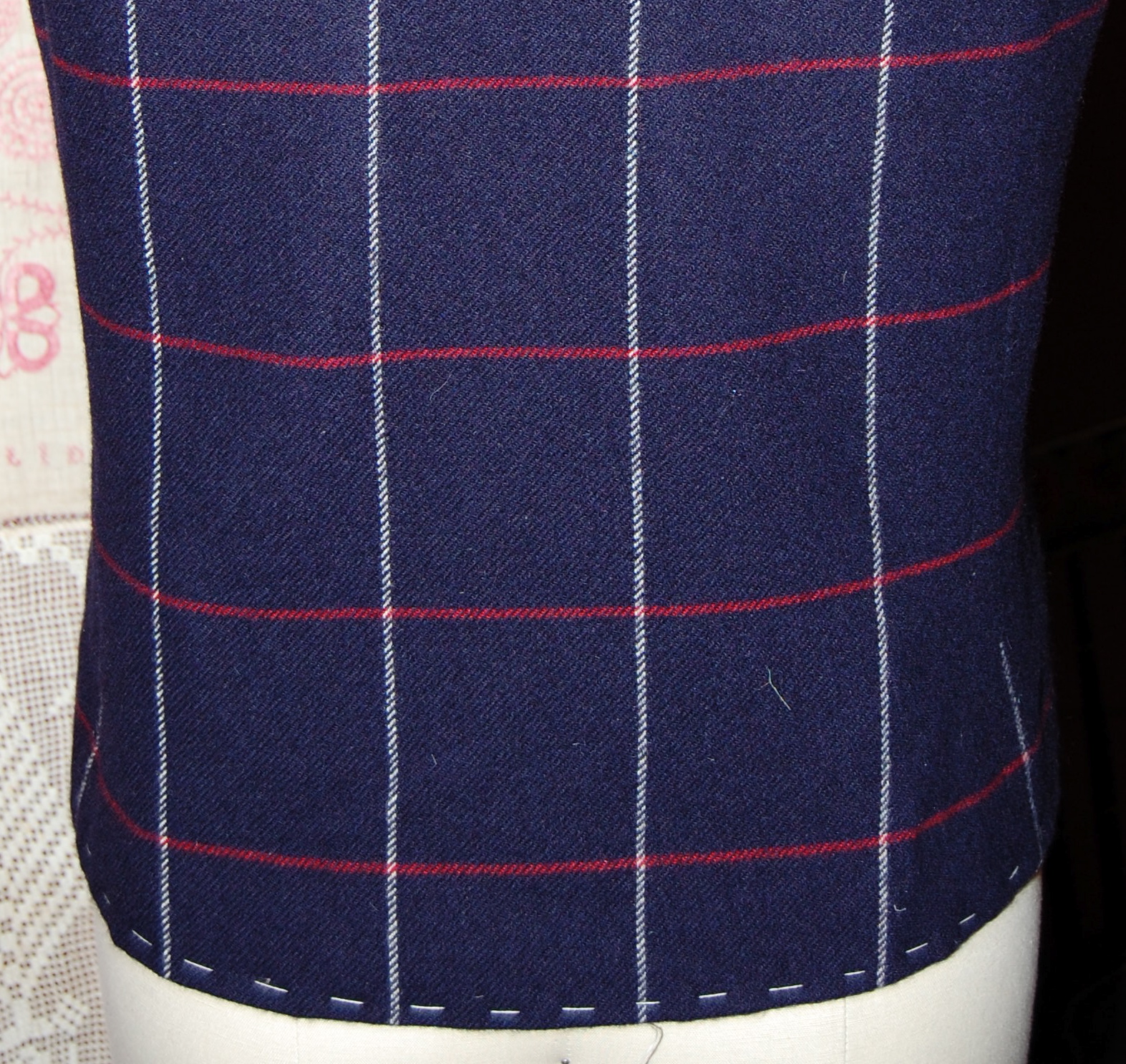
I always like to baste the hem along the bottom edge to stabilize it until the jacket is complete.

I always like to baste the hem along the bottom edge to stabilize it until the jacket is complete.

3) I used black “cigarette” which I purchase from Susan Khalje’s store for the sleeve headings. I doubled and graduated the two layers to achieve the correct amount of sleeve–cap cushioning. Unfortunately, no photos were able to pick up the details in this – too much black and navy blue and not enough contrast!

This is what the "cigarette" looks like.

This is what the “cigarette” looks like.

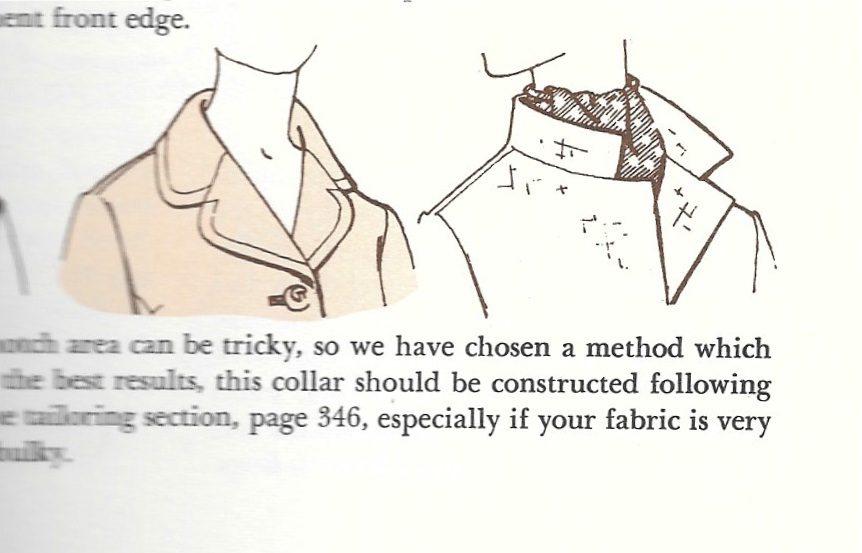
One of the interesting construction details in this design is the notched collar. Most notched collars are seamed at the “notch,”,joining the upper collar and the front facing and forming a “V”.

This diagram from The Vogue Sewing Book. c. 1970, Butterick Division, New York, New York, shows a classic notched collar.

This diagram from The Vogue Sewing Book. c. 1970, Butterick Division, New York, New York, shows a classic notched collar.

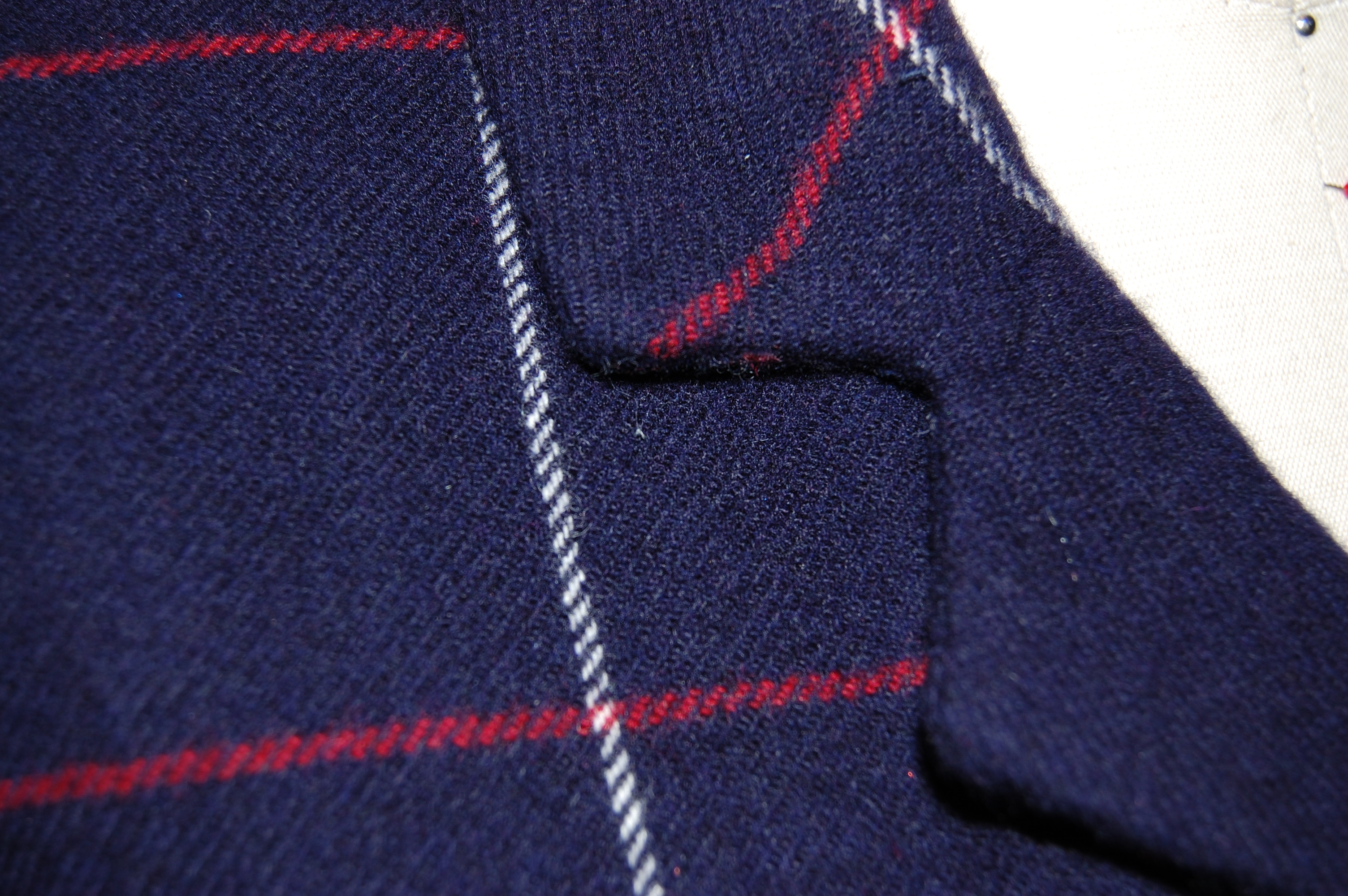
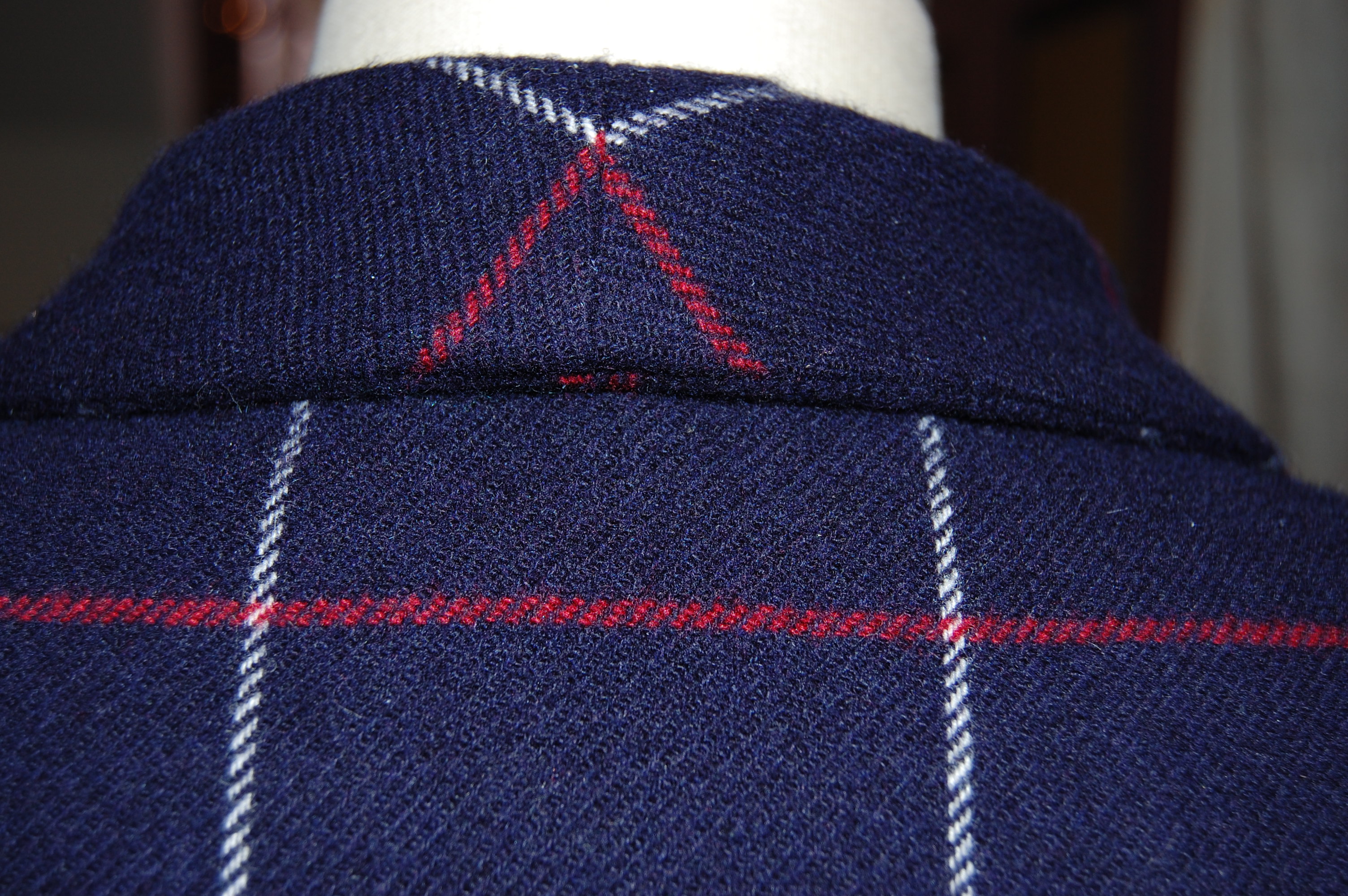
However, the collar in this Mattli design is formed by extensions of the front facing, with a center back seam on the upper-collar portion of the facings.   Hopefully these photos will explain better than words can:

You can see there is no seam at the "notch."

You can see there is no seam at the “notch.”
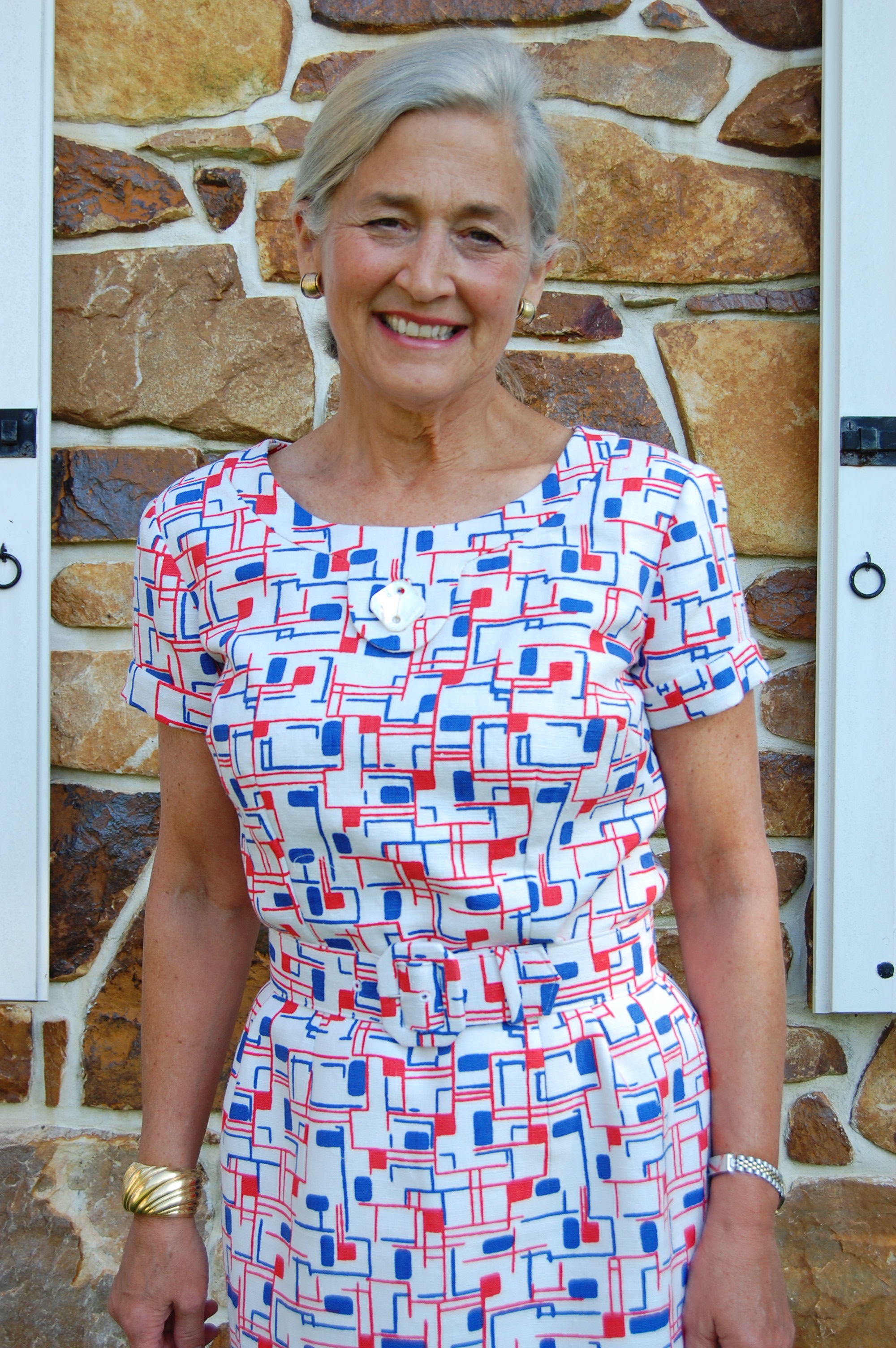
Here is the seam at the back upper collar.

Here is the seam at the back upper collar.

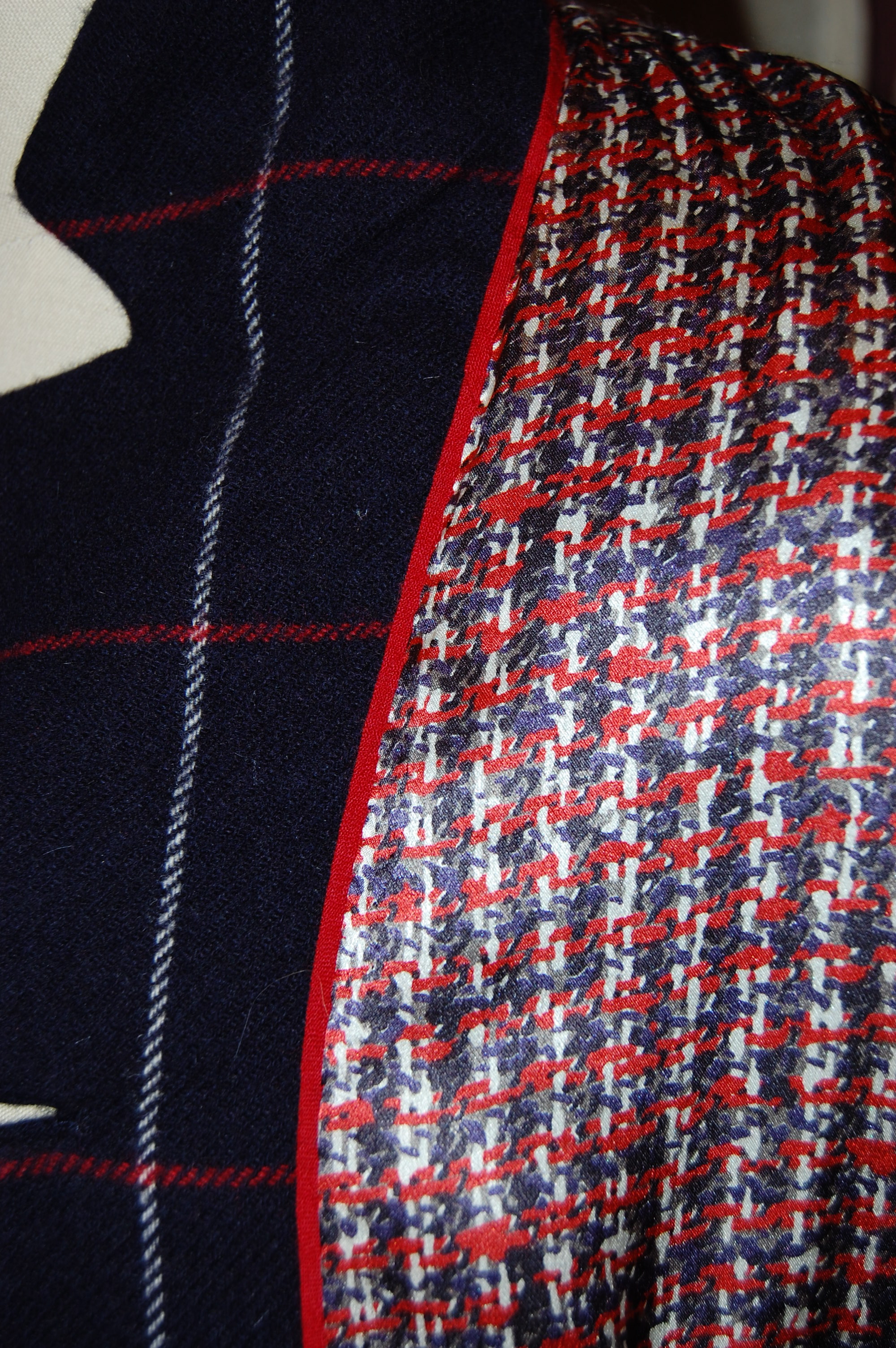
While I was contemplating the lining for the jacket, I thought it would add just a really special touch if I did a interior bias piping to set off the lining where it joins the jacket along the front edges and around the neck. Normally this is made out of silk, but I did not have any light-weight silk which was the correct color of red. However, I did find some scraps left over from a red wool challis maternity dress I made for myself over 34 years ago. (Yes, you read that correctly!) Very light in weight – and the exact color I needed – made it the perfect fabric for this detail.

I cut a bias strip one inch in width and folded it in half.  I guess this proves it pays to save scraps!?

I cut a bias strip one inch in width and folded it in half. I guess this proves it pays to save scraps!?

This is such an easy flourish to do, and it adds such a professional touch.  Adding this flat “piping” is quickly becoming a standard for me when I make jackets or coats. Once you have your bias strip cut, folded in half and pressed, all you need to do is baste it in place along the line where the lining will be hand-stitched to the jacket interior.
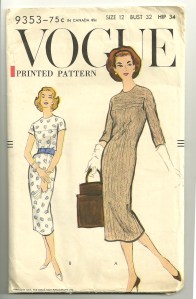
The bias "piping" basted in place.

The bias “piping” basted in place. Click on the photo to see it close-up.

And here’s what the finished lining looks like:

Mattli jacket

Here is the back neck edge.

Here is the back neck edge.

I really like this extra flourish.

I really like this extra flourish.

Now – true confessions!  After top-stitching the sleeve edges, the collar and most of one front, I decided I did not like it.  I thought it detracted from the windowpane of the fabric, so I took it all out.  NO top-stitching – for me – on this jacket!

Finally, I made a small change to the back hem of the jacket. Can you figure out what it is? (A previous photo of the jacket back will also give you a clue.)

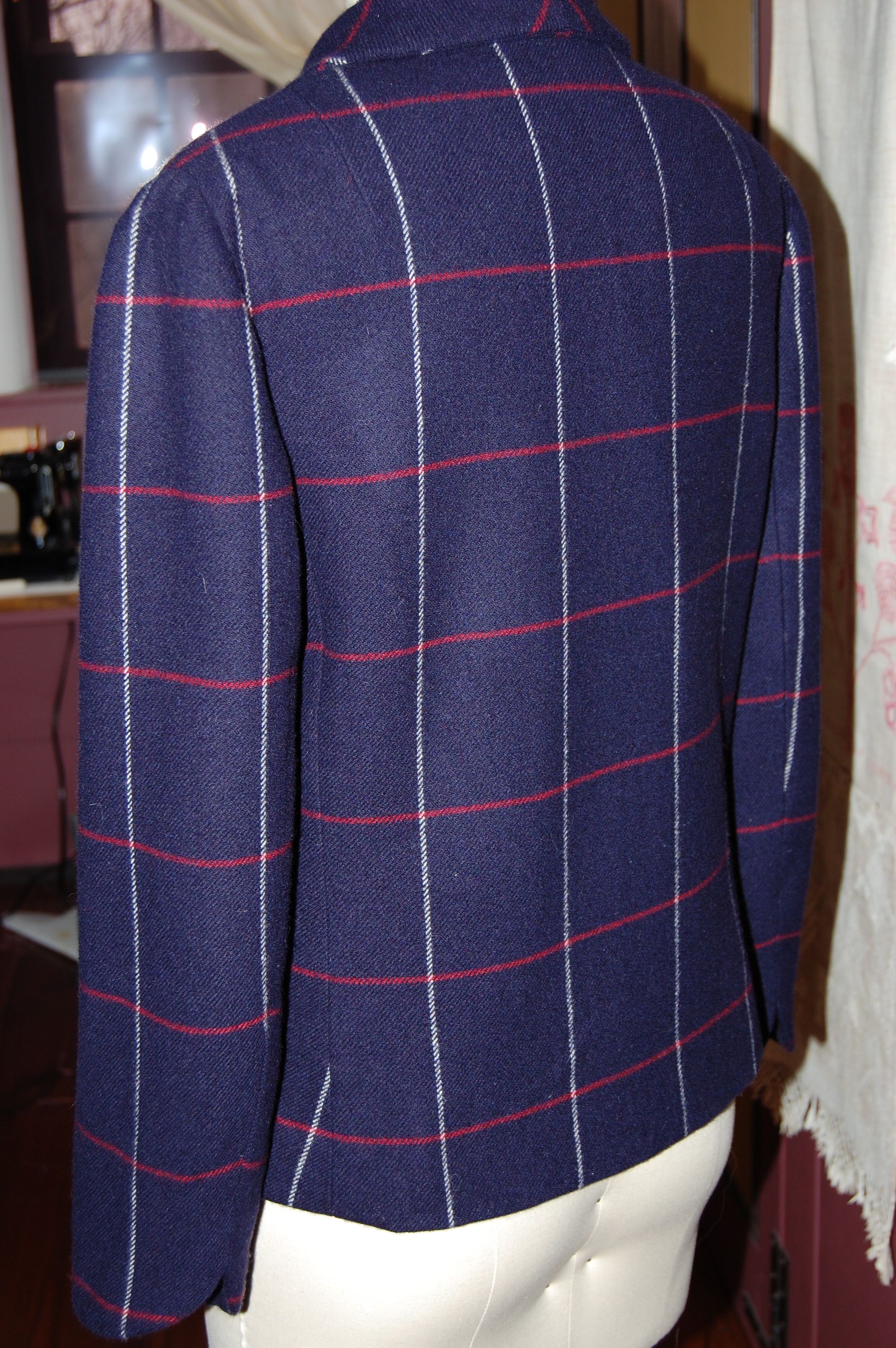
Mattli jacket I used a trick I learned from my French Jacket class with Susan Khalje: I added a slight curve to the hem and lengthened it by about a half-inch, graduating it back to the prescribed hemline at the side back seams. I love this graceful detail. I believe it will be especially effective when it is paired with the dress. (This photo also shows that all the hours I spent on the layout, making sure I had matched the plaid, was time well spent!)

Speaking of the dress (and matching more plaid) . . .   I never imagined I wouldn’t have this entire ensemble completed by about now. So – it looks like I’ll still be sewing on wool when Spring arrives. Hopefully by the time Spring departs I will have moved on to something more seasonal!

26 Comments

Filed under bound buttonholes, couture construction, Dressmaker details, piping, Suit dresses, Uncategorized, underlinings, vintage Vogue Designer patterns, vintage Vogue patterns from the 1970s, woolens

The Evolution of a Suit Dress, Part 2: Details, Details

How can something which is taking so much time to make still be so much fun? It must be because of all the delightful details to consider, to execute, to alter, and to research. One of the most important details for the jacket of a project like this is the choice of buttons.

Dress Suit - front of pattern envelope

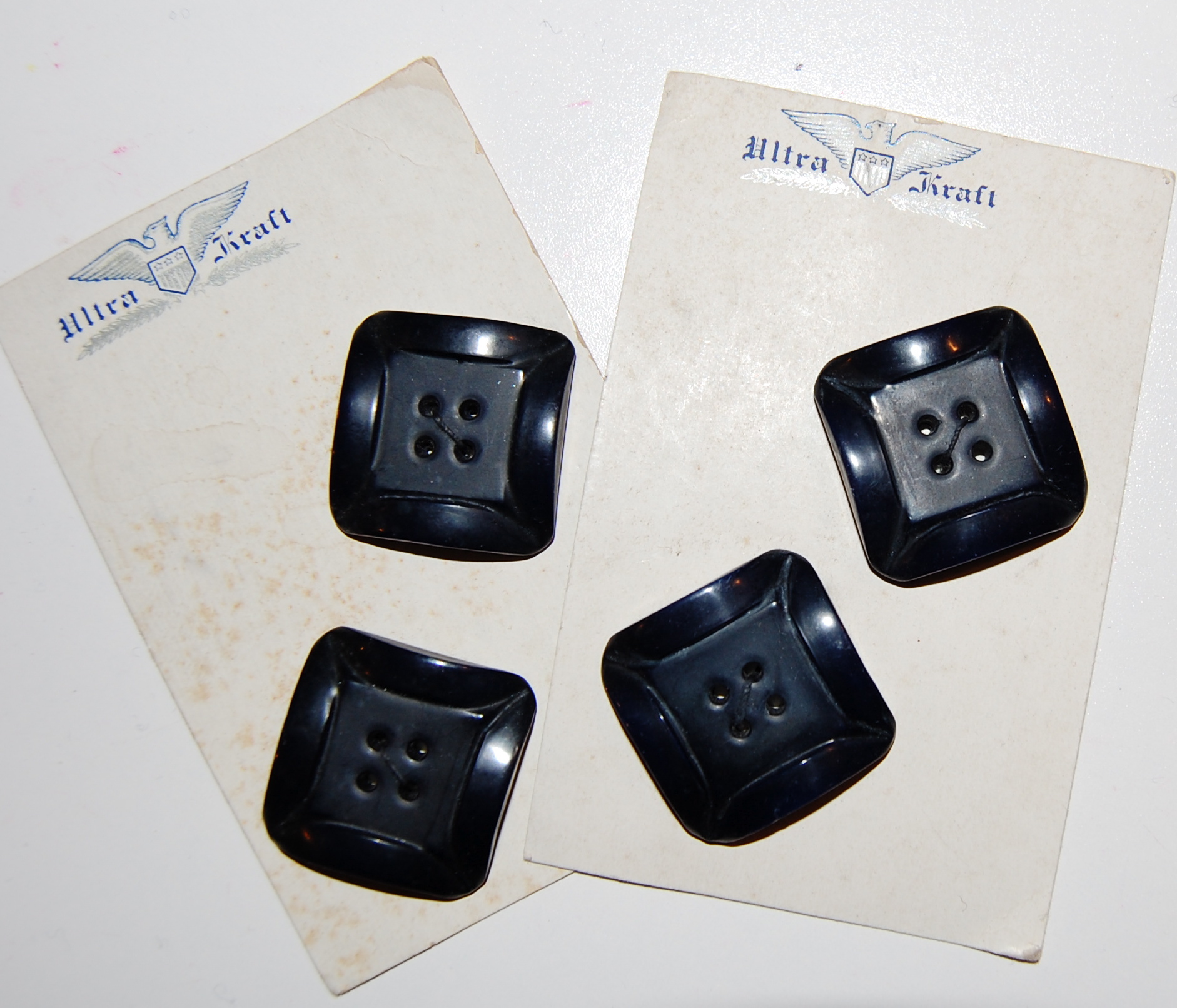
One of the advantages of having my blue windowpane-checked cashmere for a couple of years before sewing with it has been the opportunity to find just the right buttons. When I came across these buttons in an Etsy shop, I knew they would be perfect.

These buttons are 7/8" square.

These buttons are 7/8″ square.

The size is right, as is the shape – which picks up the “square” in the fabric. How I was so lucky to find them in navy blue, I’m not sure. Additionally, and this is very subtle, but the depth of the buttons allows a curvature to each edge, which mimics the curved front edge of the jacket and also the curved cuffs. Of course, when making bound buttonholes, one must have the buttons in hand before beginning the project, since the buttonholes are one of the first details to execute.

ne can never have too many markings basted in place for bound buttonholes!

One can never have too many markings basted in place for bound buttonholes!

Because I need only three buttons for the jacket, the fourth button has been rattling around in my brain. I think  I might possibly be able to use it as a coordinating detail on the sheath dress I have planned for this ensemble. Back to my vintage pattern collection I have gone to look for some suitable inspiration. What I have found is this pattern:

Dress Suit 2 - blouse pattern-2 Although I have yet to work out the logistics, I am thinking that I can turn the collared blouse with the one-button detail (lower right) into a sleeveless sheath dress. The button may not really show (I think) unless I take the jacket off, but I kind of like the subtlety of it all. Once I make a muslin (toile), I will have a better idea of how it will look, so stay tuned! One thing I do know, is that such a collar on the dress will need to lay very flat, with no bulkiness. One way to achieve that will be to back it with the silk charmeuse I will be using for the jacket and dress lining instead of backing it with another layer of wool.

So what am I using for the lining? When I bought the lining for my color-blocked coat last winter, I purchased extra yardage of the silk charmeuse (from Britex). Now I can’t remember what my reasoning was, but once I got it home from San Francisco and I saw how complimentary it was with the navy blue cashmere, I knew I should save it for this project. Fortunately, I have enough of it to line both the jacket and the dress. Not that anyone is ever going to see the lining in the dress, but I’ll know it’s beautiful – and oh, so wonderful to wear!

Dress Suit 2 - lining fabric There are always lots of details in the construction of a rolled collar. At the risk of boring some of you, I’ll quickly go over a few tricks I learned from Susan Khalje last year when I made my color-blocked coat. First, here is a picture (by request from some of you) of the lightly pad-stitched and interfaced jacket front.

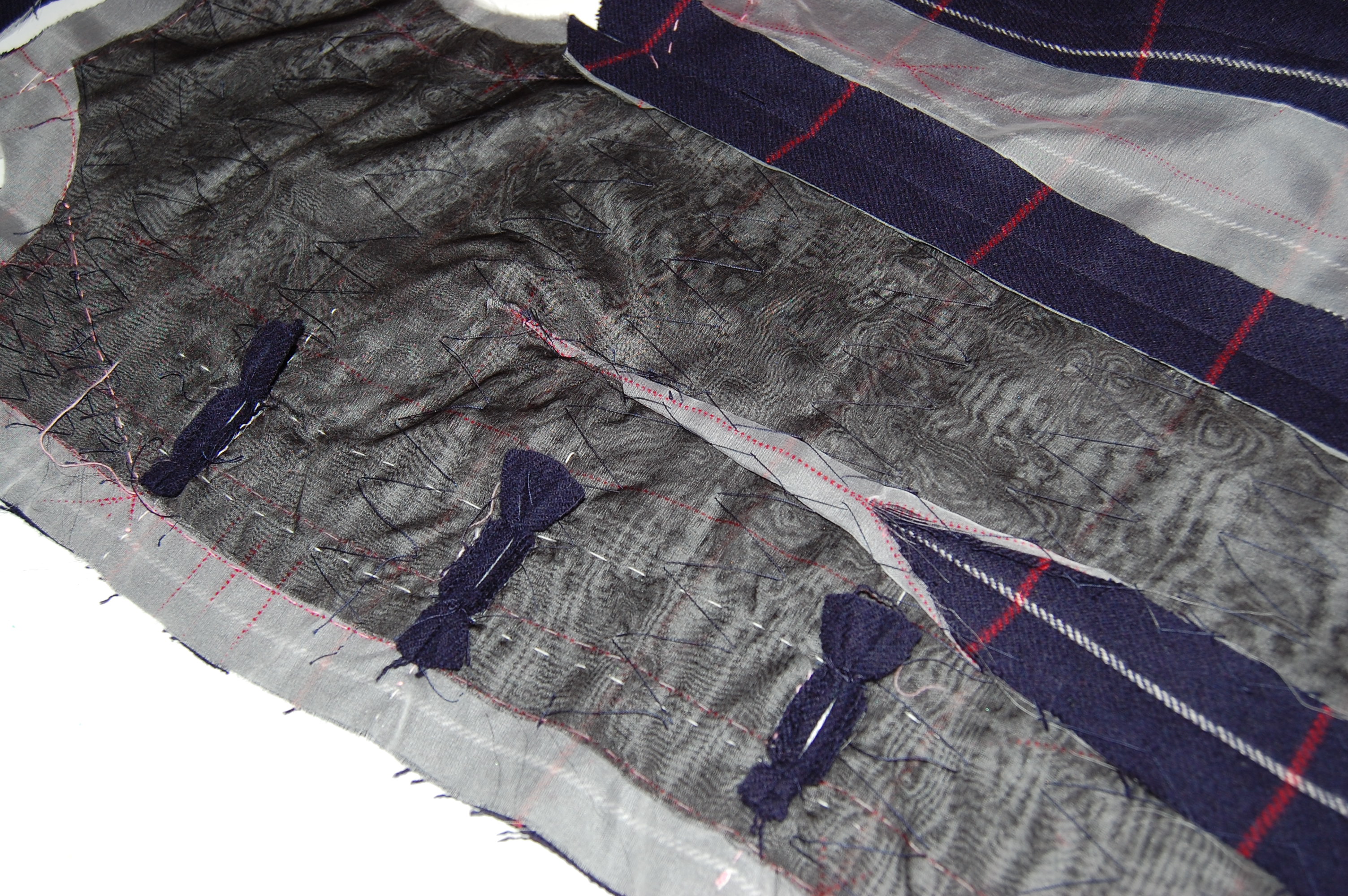
Here is an inside look at the interfaced right side of the jacket showing the underside of the buttonholes.

Here, too, is an inside look at the underside of the three bound buttonholes.

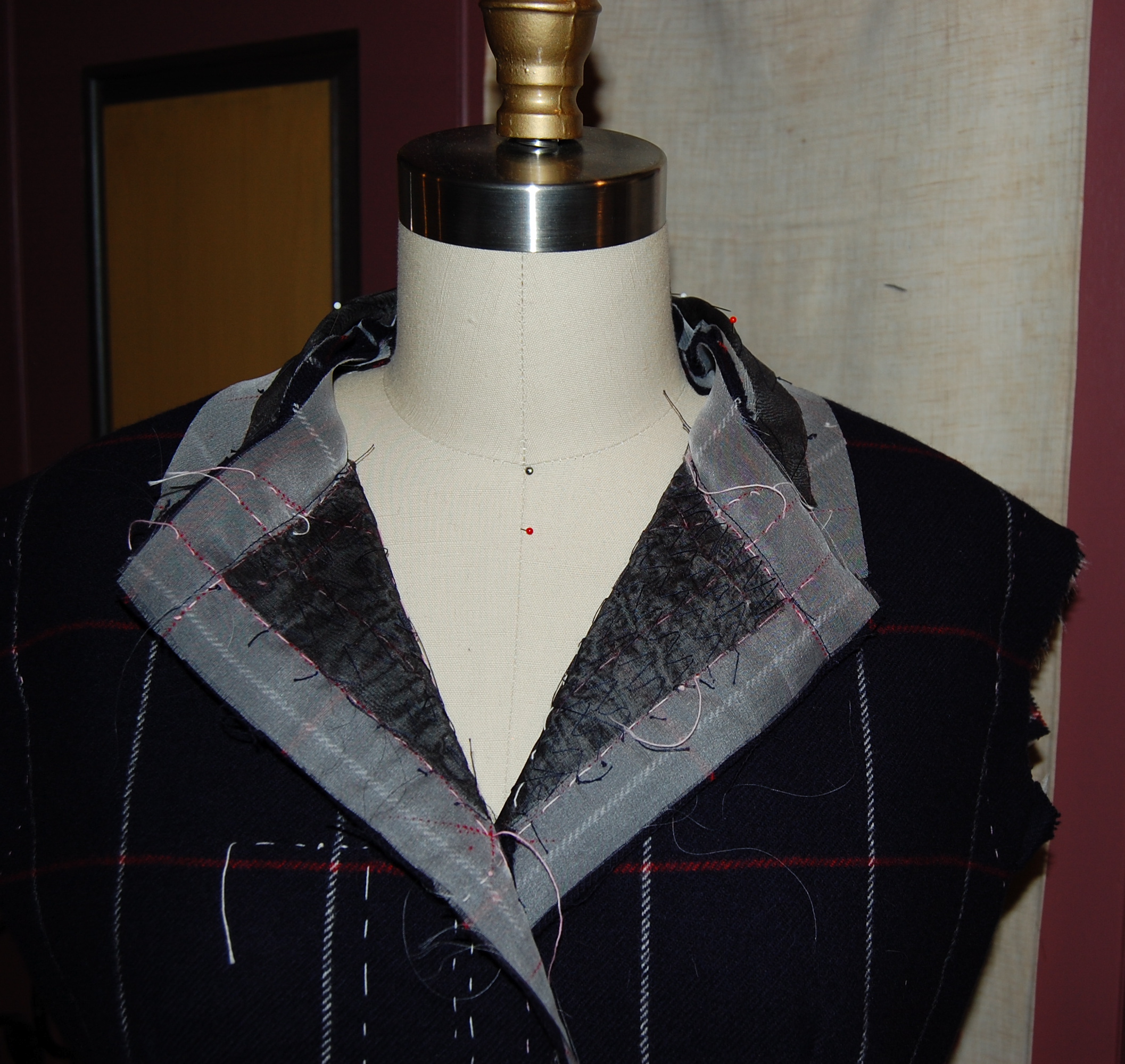
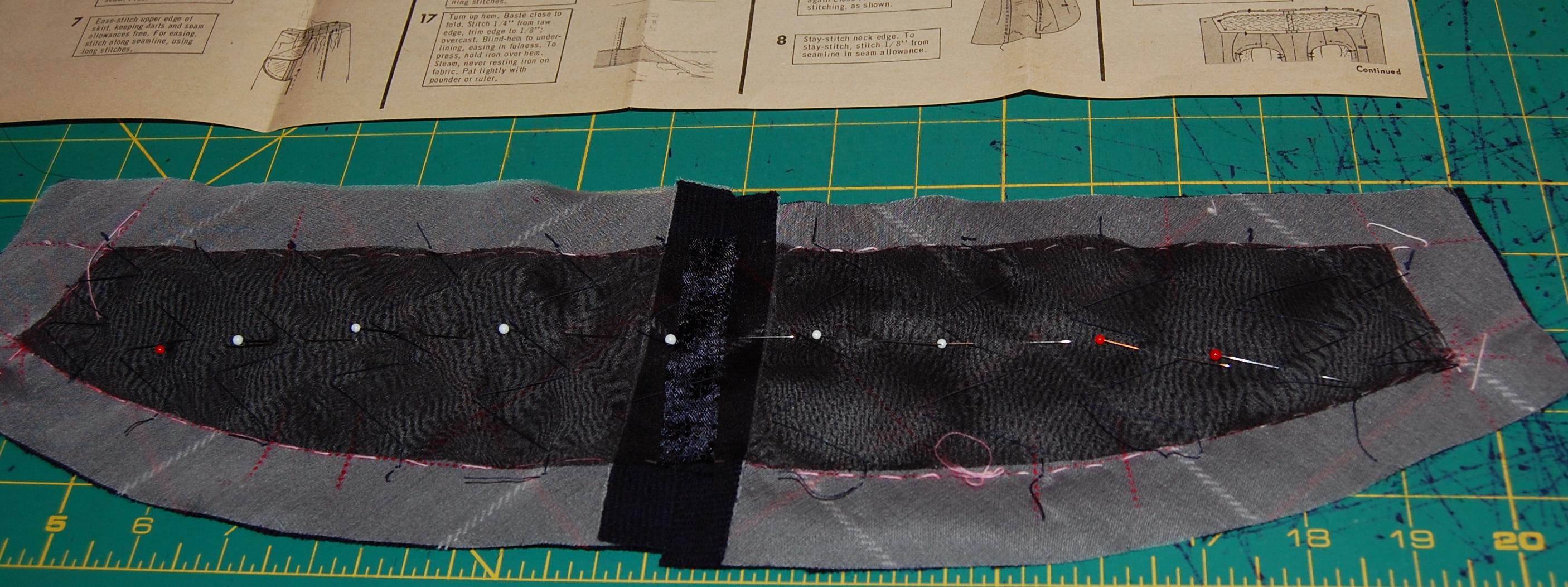
The undercollar is also interfaced with black silk organza. It is basted onto the body of the jacket in order to establish the roll line. Once I marked the roll line with pins, I removed it and basted along the roll line in preparation for heavy pad-stitching of that section.

Establishing the roll line of the undercollar.

Establishing the roll line of the undercollar.

Suit dress under collar

The roll line is marked with pins; then I basted along that pin line.

Once I finished the pad-stitching (impossible to see here on the black organza), I then placed it on the dress form, pinned it in place and steamed it. This process reinforces the “memory” of the roll.

A dress form is indispensable for steaming the undercollar.  You can see the basted roll lie in this photo.

A dress form is indispensable for steaming the undercollar. You can see the basted roll line in this photo.

The back of the undercollar after steaming.

The back of the undercollar after steaming.

As I make progress on this jacket, I am reconsidering the amount of top-stitching I want to do on it. The pattern calls for double rows of top-stitching along seam lines, front edges and sleeve edges. I plan on modifying this somewhat.

Dress Suit 2 - topstitching detail-1

This diagram clearly shows the extent of proposed top-stitching. I will definitely not be doing this much!

Top-stitching always makes me nervous. It may be my least favorite part of sewing. I’d rather sew on buttons than top-stitch! Let’s see how well I do with it – in my next post – before I can get back to more fun-stitching.

16 Comments

Filed under bound buttonholes, Buttons - choosing the right ones, couture construction, Suit dresses, Uncategorized, vintage buttons, vintage Vogue Designer patterns, vintage Vogue patterns from the 1970s, woolens

The Long and Mysterious Journey of Sandhurst 121

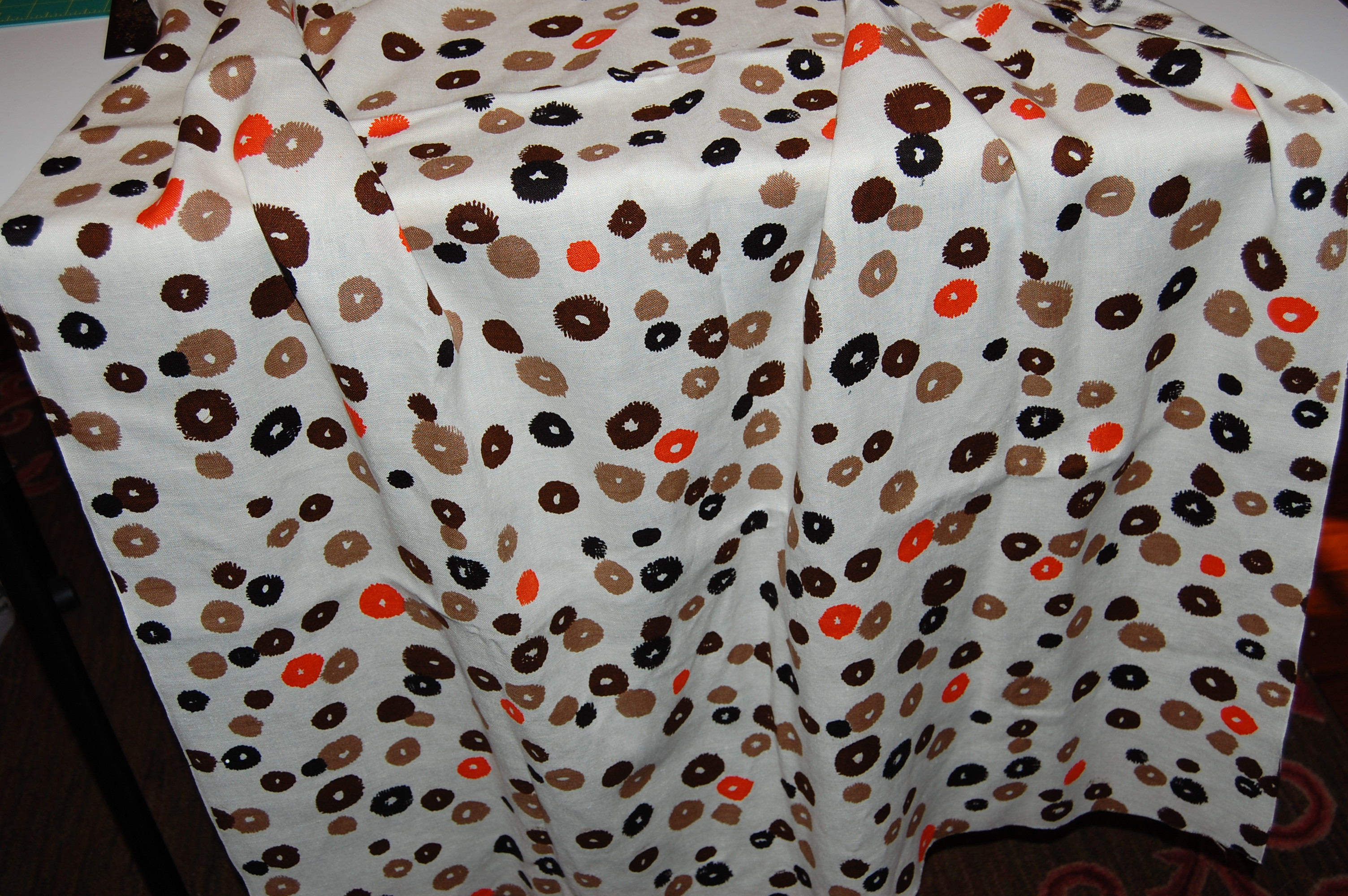
When the piece of linen I had purchased arrived in the mail, I was not sure what to expect. I had bought it with the hope that it was, indeed, a piece of Moygashel linen, but I had nothing to go on except an educated hunch. I knew it was an early piece of fabric, as its width was 35”, a common width for pre-1960’s dress-goods. I liked the design in the photo from which I made my decision, although it was not a colorway to which I normally gravitate. Upon opening the package, I found the only identifying mark on the fabric to be this tag:

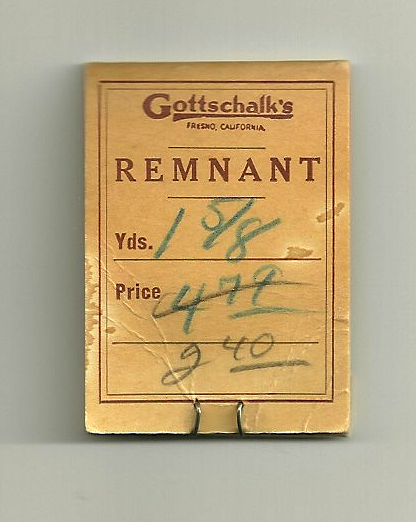
Gottshalk's in Fresno, California obviously sold fine fabrics.

Gottschalk’s in Fresno, California obviously sold fine fabrics.

This short length of fabric had been on the remnant table, and, being too good of a bargain to pass by, some home dressmaker in California (USA) scooped it up with all good intentions of making something out of it someday. It must have lived in a dark drawer somewhere, carefully buffered from stains and yellowing. It didn’t even have much of a crease in it. And so, after many years in dormancy, it arrived at my home in Pennsylvania. I knew immediately that it was a Moygashel linen. I could tell by the hand of the fabric, the unique, slightly funky design, and by its amazing survival virtually wrinkle-free.

Sandhurst 121

As I mentioned in a former post, my only dilemma was the scant yardage, combined with the narrow width. So, I stuck it in my fabric closet, to think about another day. One thing nagged at me, however. I really, really wanted to know what year it was from.

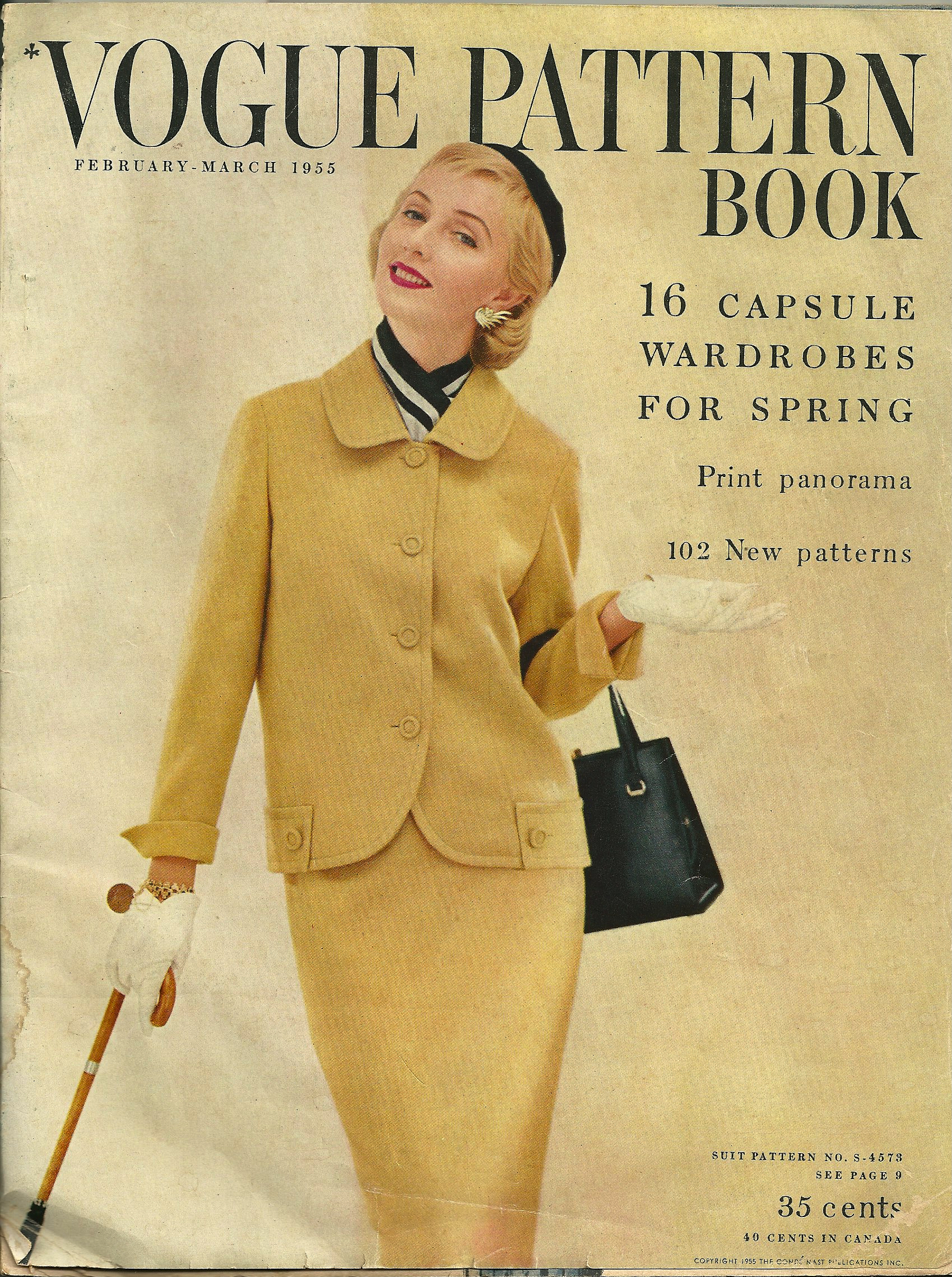
Over the past three years or so, I have had some luck in finding copies of old and older (1950-1980) Vogue Pattern Book Magazines. They are fascinating, and treasure troves of mid-century fashion as it relates to home sewing. I have tried to get a good cross-section of magazines from those three decades. One issue, which I tried a couple of times to get – and did not (on eBay) – finally became available to me. I loved the suit on the cover, and those mid-fifties styles are just so chic, even though most Vogue patterns from that time period were unprinted, and therefore, very difficult to use. (By 1957, Vogue was starting to produce many of their patterns in printed and perforated format.)

This is the February/March 1955 issue.

This is the February/March 1955 issue.

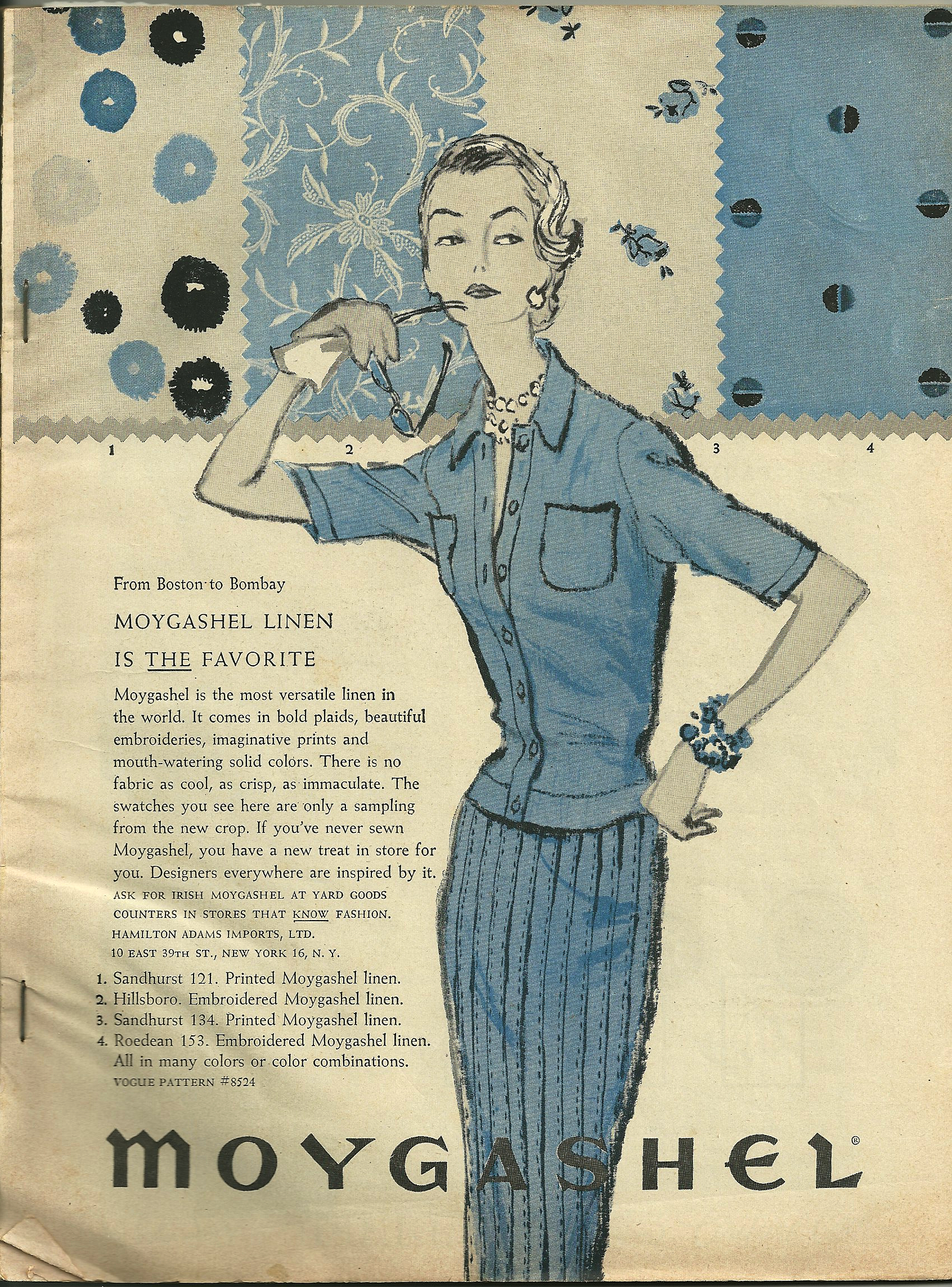
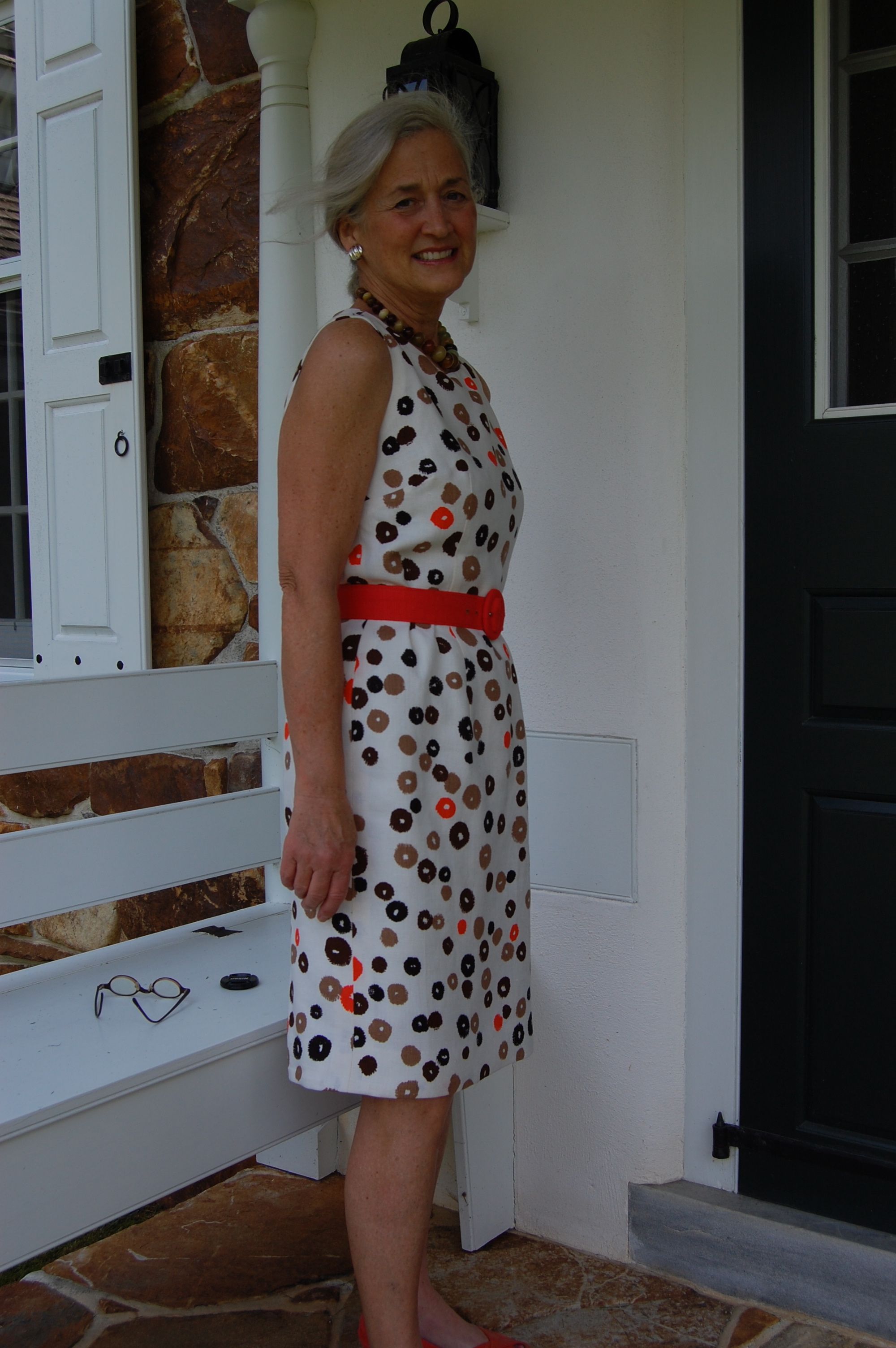
Perhaps you can see where I am going with this? I was looking through this particular issue once again in May of this year, and low and behold, a full-page ad for Moygashel linen clearly pictured “my” linen as one of their “new crop”. The colorway was different, but Moygashel was known for producing their fabrics “all in many colors or color combinations.” Maybe a lot of people wouldn’t get so excited about such a discovery, but I was ecstatic! Now I knew, for certain, that the linen I had purchased made its debut in early 1955. (I would be turning 5 years old a little later that year!) I even had a name for it now – Sandhurst 121. I suddenly very much wanted to sew this linen, this Summer!

There is my linen in the upper left hand corner of the full-page advertisement.

There is my linen in the upper left hand corner of the full-page advertisement.

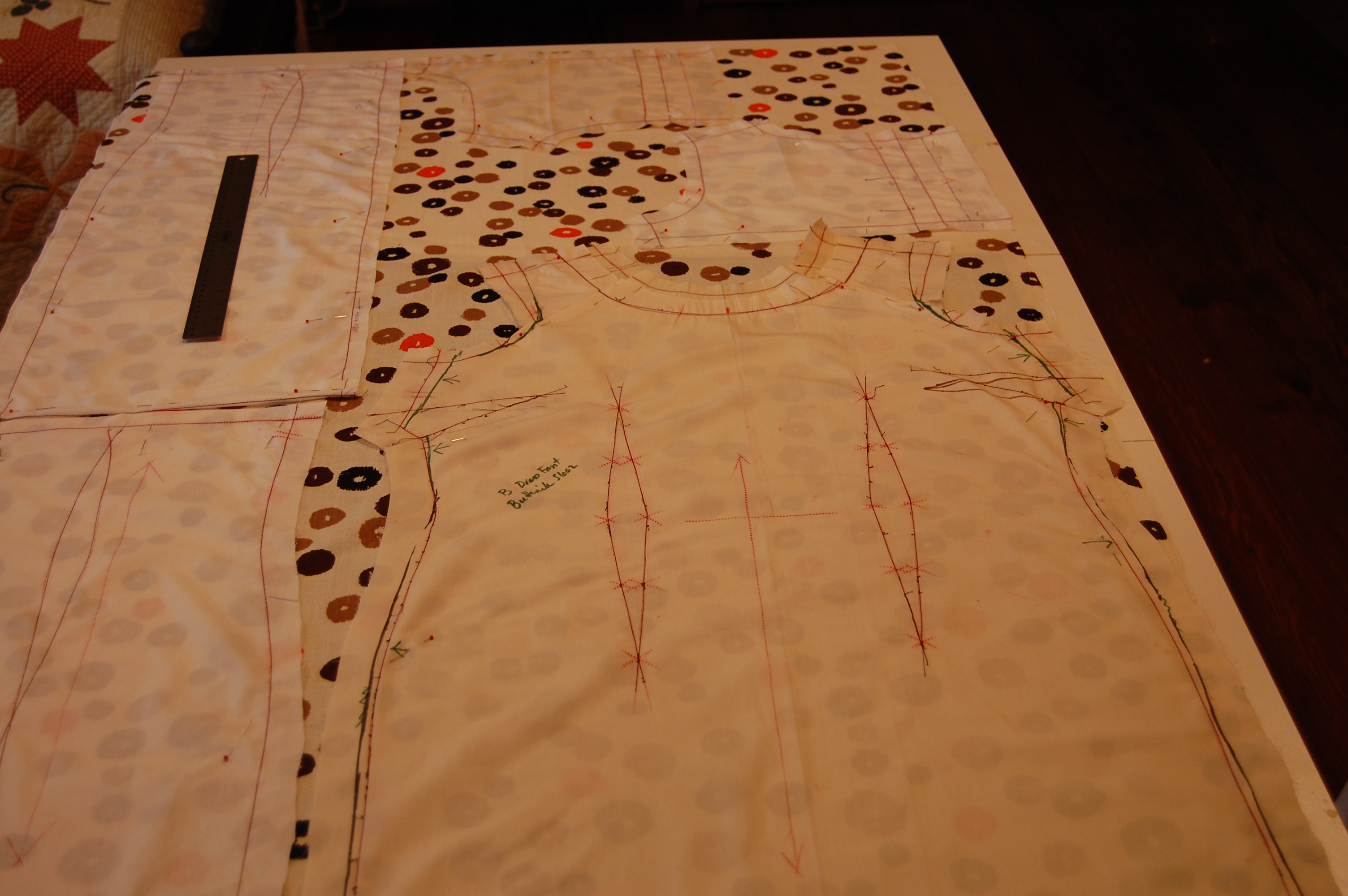
By now, many of you know that I determined to make a sheath dress out of this scant yardage of fabric, and in order to do so, I had to reconfigure my sheath dress pattern to include a back yoke. Here’s the fabric layout, which hopefully will show how sectioning the back enabled me to fit the pattern on the available fabric:

The fabric is shown 35" flat on my cutting table.  The muslin pattern piece for the front of the dress is on the right, and the two shortened back pieces are lined up smack against each other on the left.  The yoke pieces then fit above the dress front.  I did not need facings, as I lined the entire dress in a light weight linen/cotton blend, and finished the neck and armholes all by hand.

The fabric is shown 35″ flat on my cutting table. The muslin pattern piece for the front of the dress is on the right, and the two shortened back pieces are lined up smack against each other on the left. The yoke pieces then fit on the fabric  above the dress front. I did not need facings, as I lined the entire dress in a light weight linen/cotton blend, and finished the neck and armholes all by hand.  I had to face the hem as I did not have enough fabric to do a self hem!

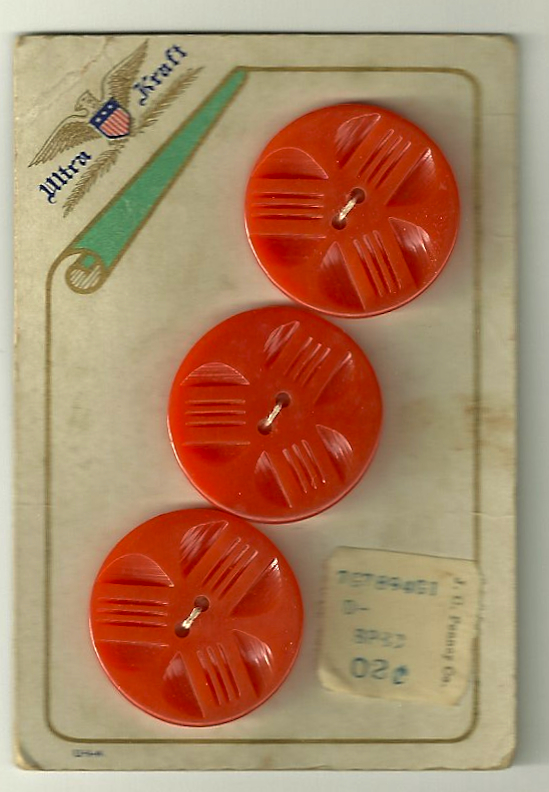
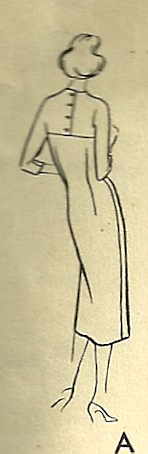
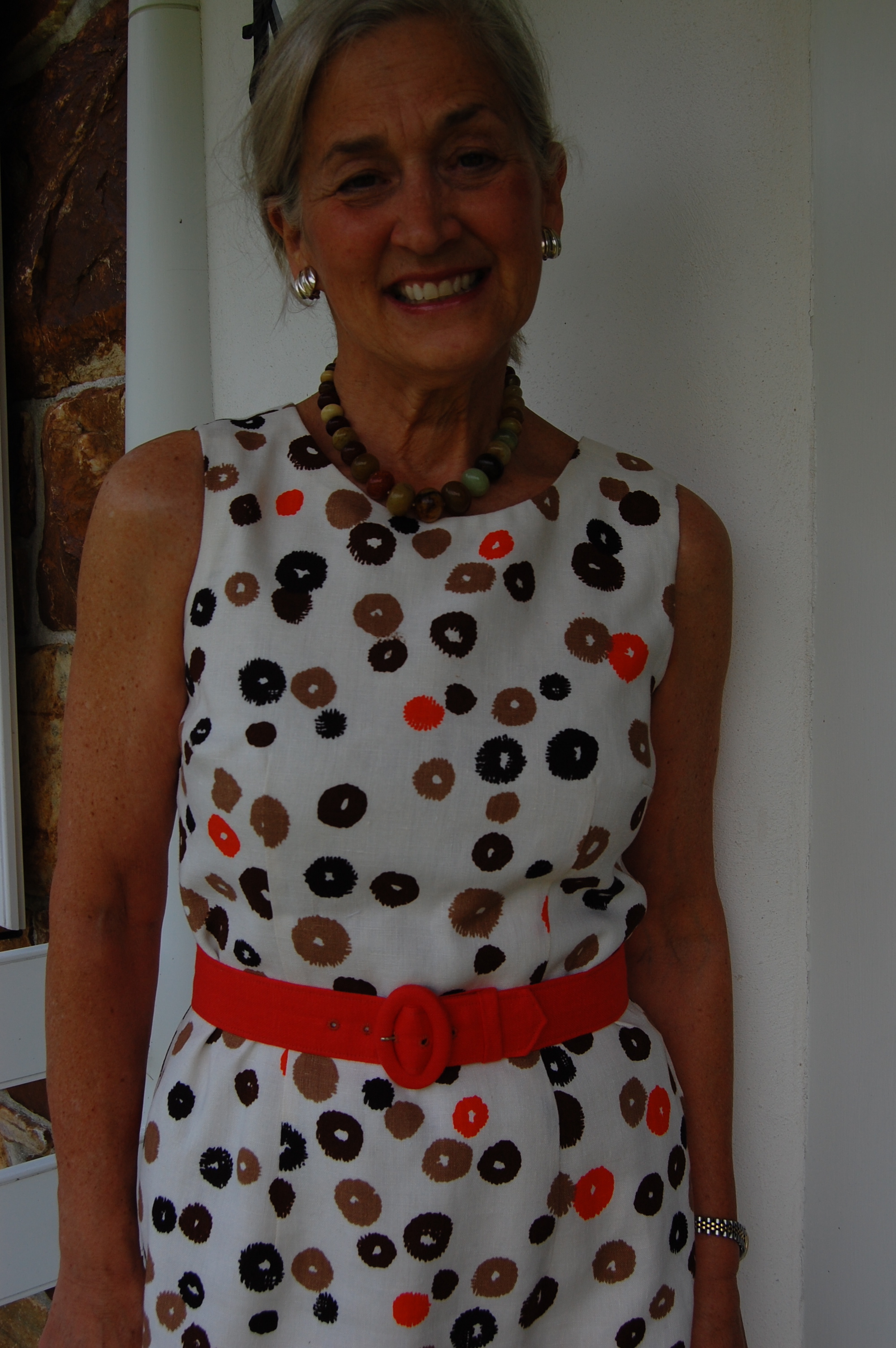
Many of you also know that fortune shone her happy face again on this project when I found three orange vintage buttons, which I knew would help make a back yoke far more interesting. I relied on a Vogue pattern from 1957, which has a back yoke to help me with this reconfigure.

This card of buttons cost 2 cents originally!  They seem to mimic the small orange explosions on the dress fabric.

This card of buttons cost 2 cents originally! They seem to mimic the small orange explosions on the dress fabric.  They may actually be even earlier than the fabric.

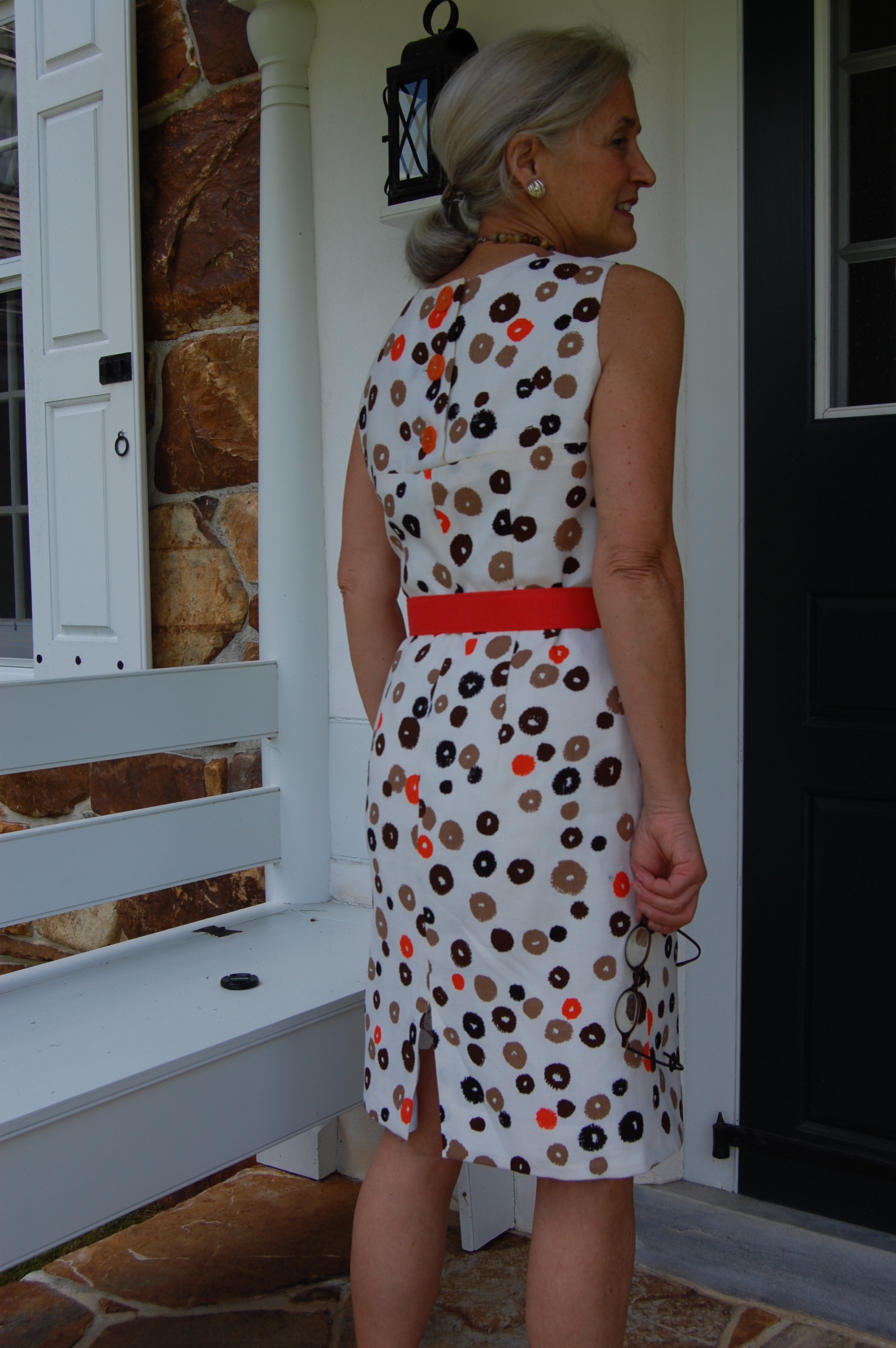
The yoke on this dress uses 4 buttons.  I only had three, but their large size still makes the proportions work well.

The yoke on this dress uses 4 buttons. I only had three, but their large size still makes the proportions work well.

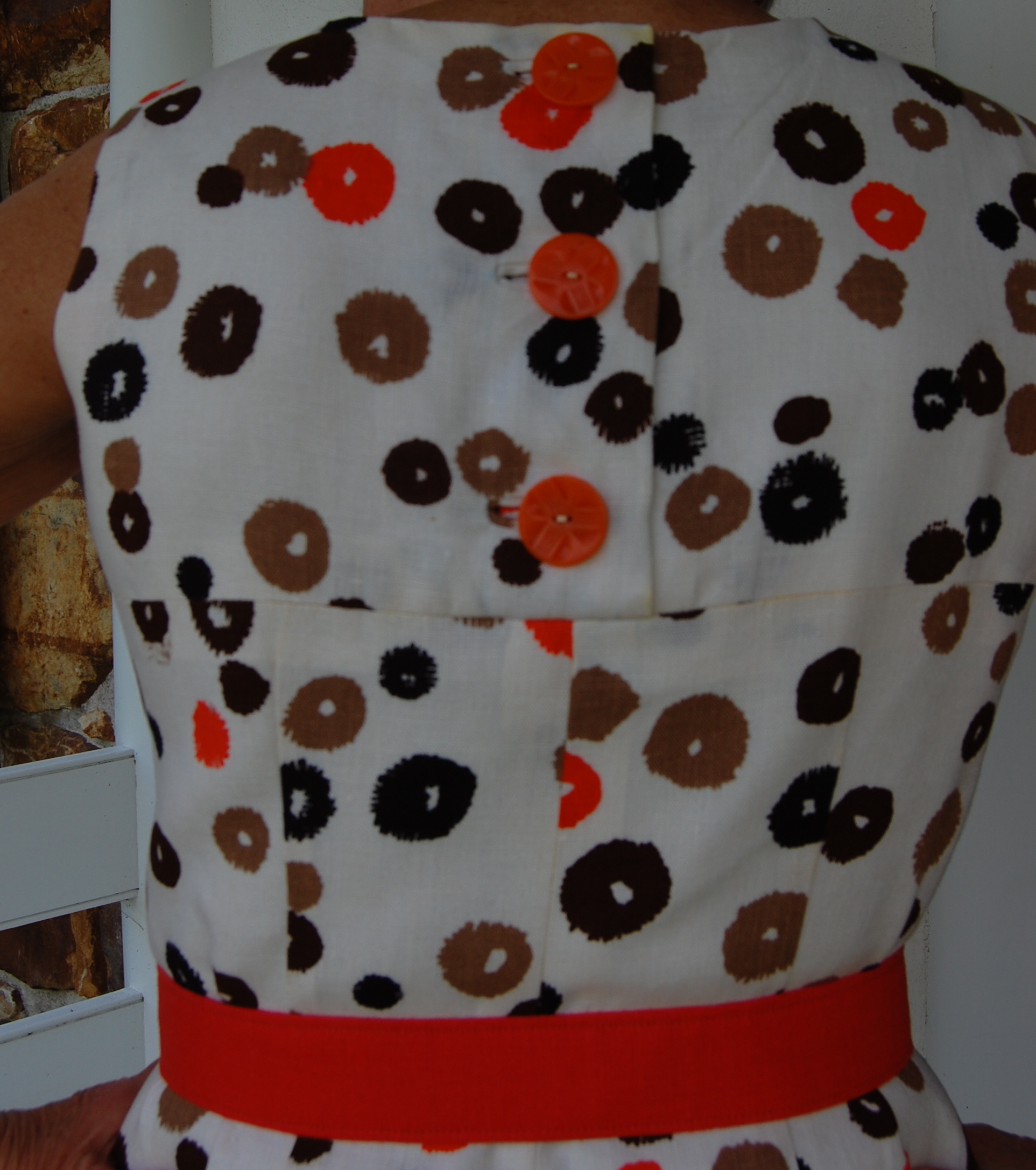
A close-up of the back of the dress.

A close-up of the back of the dress.  I made bound buttonholes – very 1950-ish!

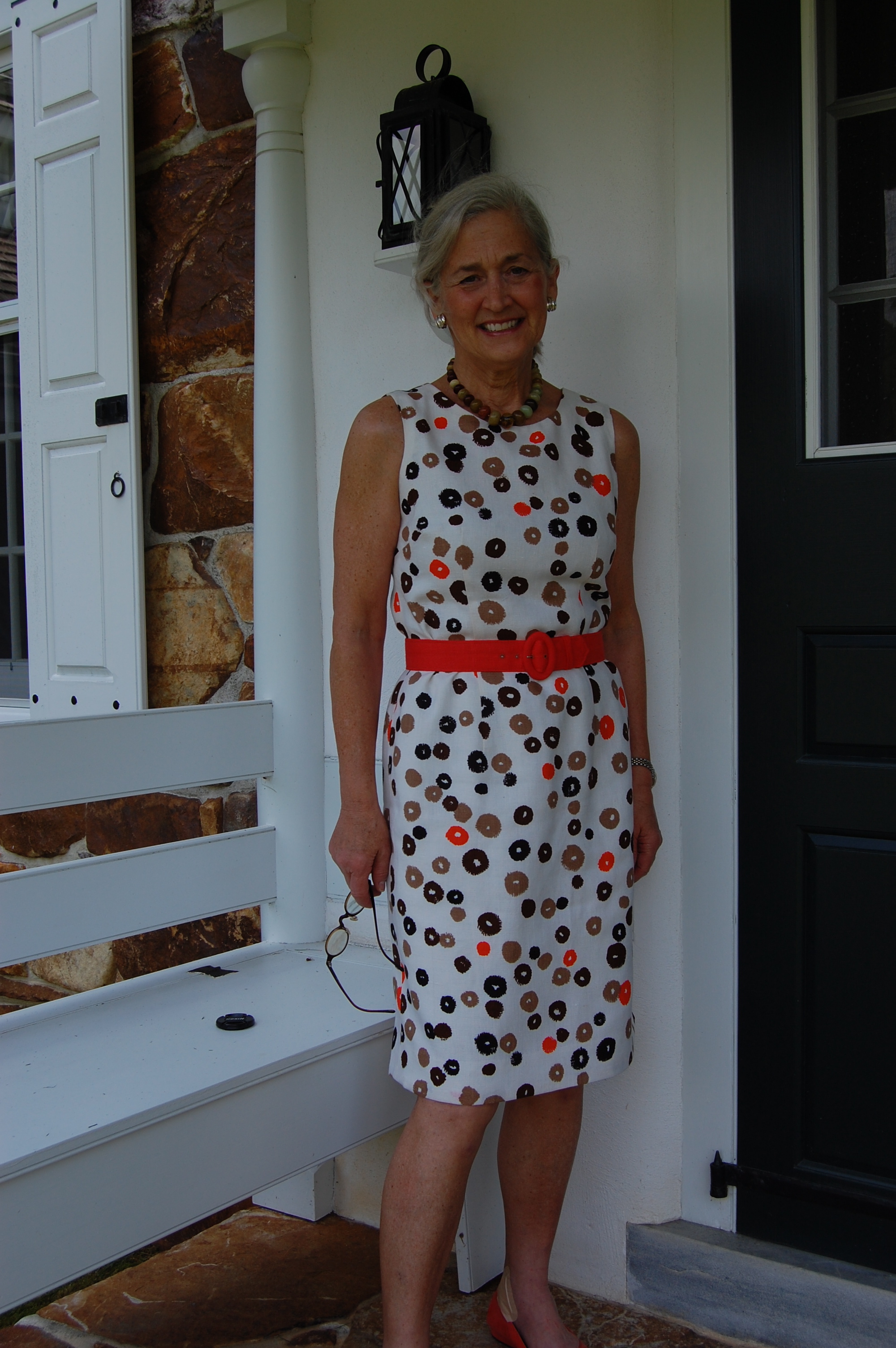
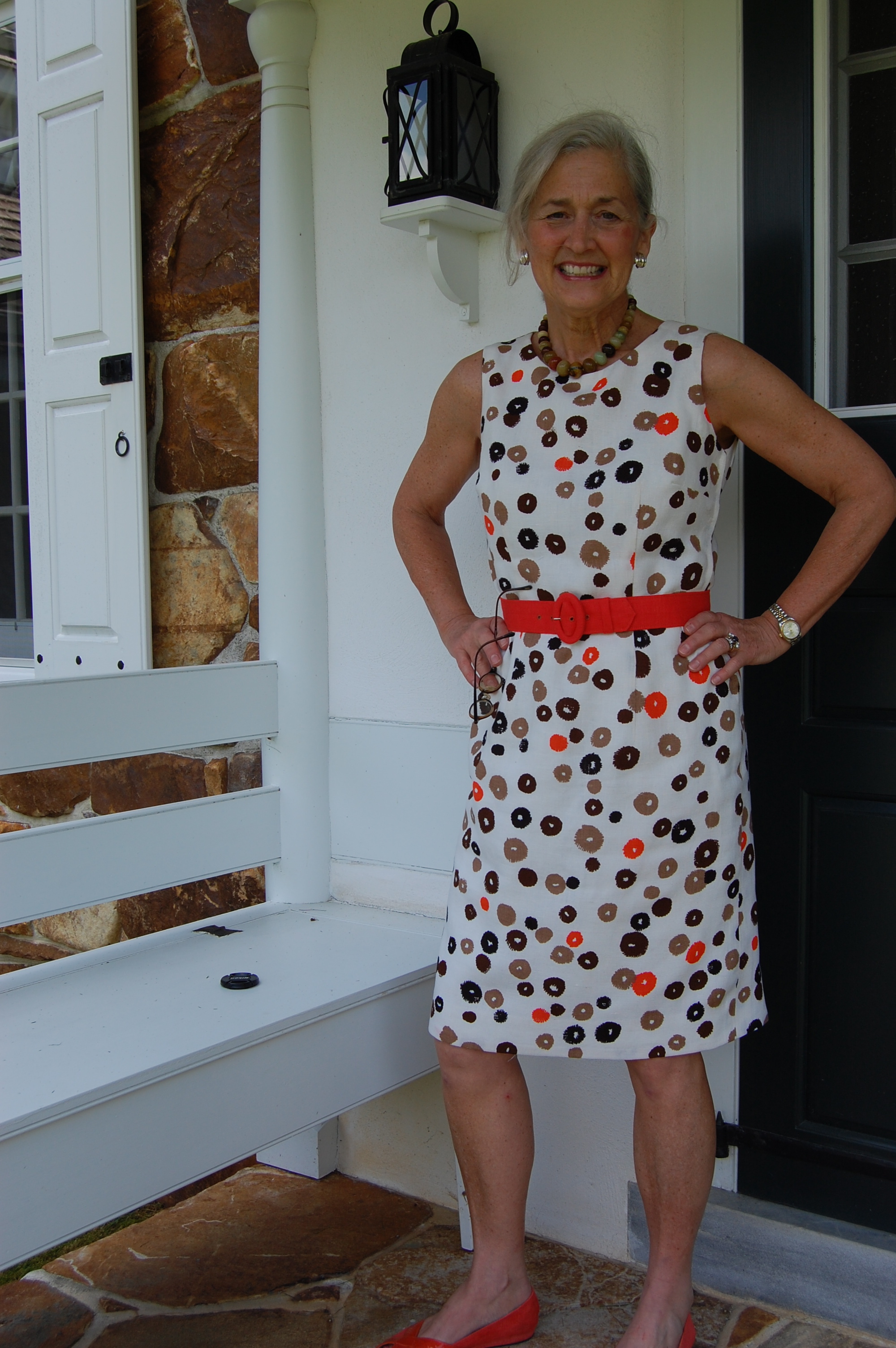
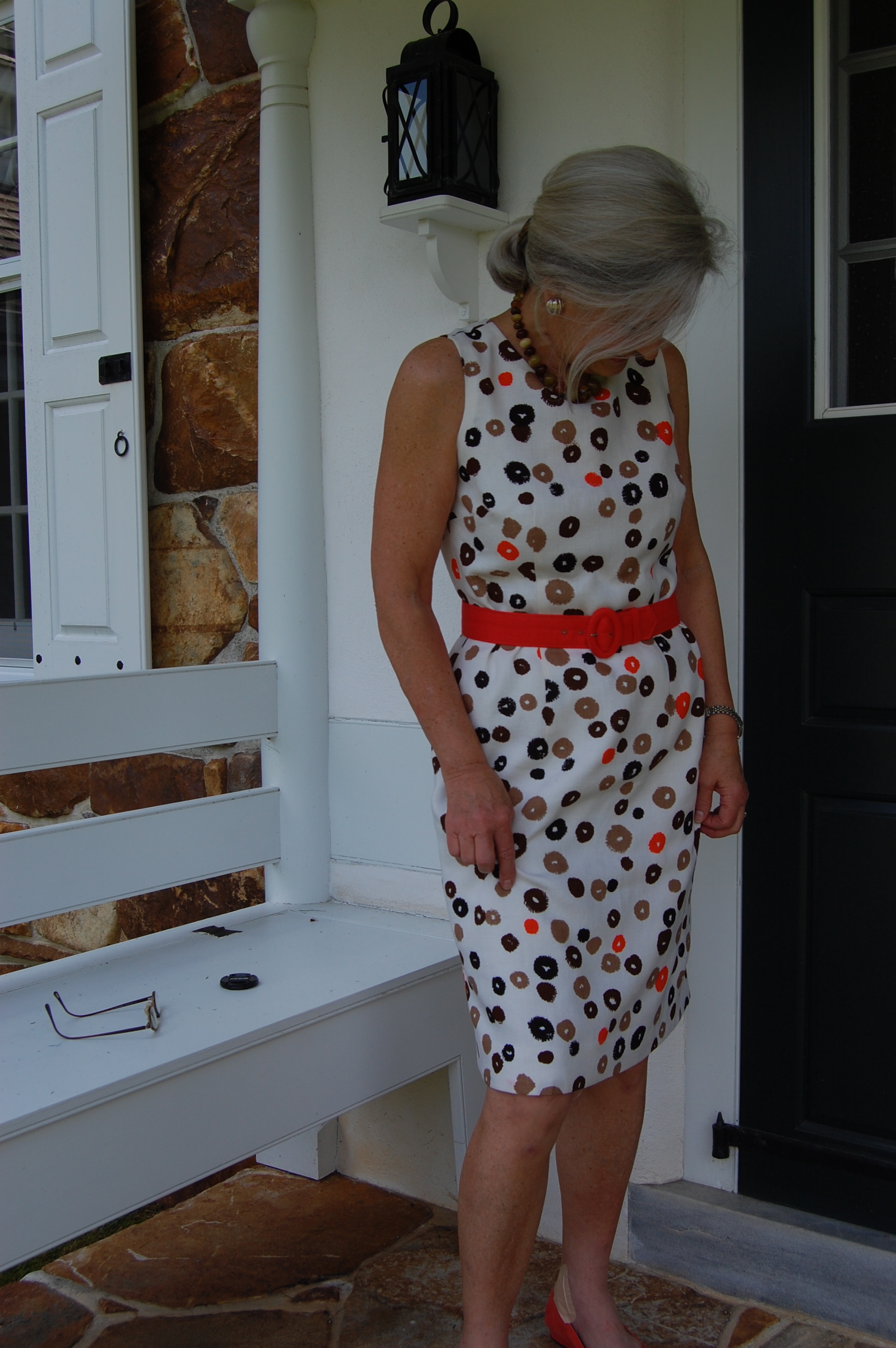
And then, another classic 1950s’ design detail worked right into this dress: I would need to move the zipper to the side in order for the back yoke to look correct. Now I will be the first to tell you that a side zipper is not as convenient as a back zipper, but it is a small sacrifice when everything else is enhanced by this placement.   After these obeisances to ‘50s’ style, I slipped right into 2014 with a bright orange, newly made belt, a widened jewel neckline, slightly cut-in shoulders, and a back slit to enhance comfort. I like to choose the best from the ‘50s, but I really don’t want to look like the 1950s.

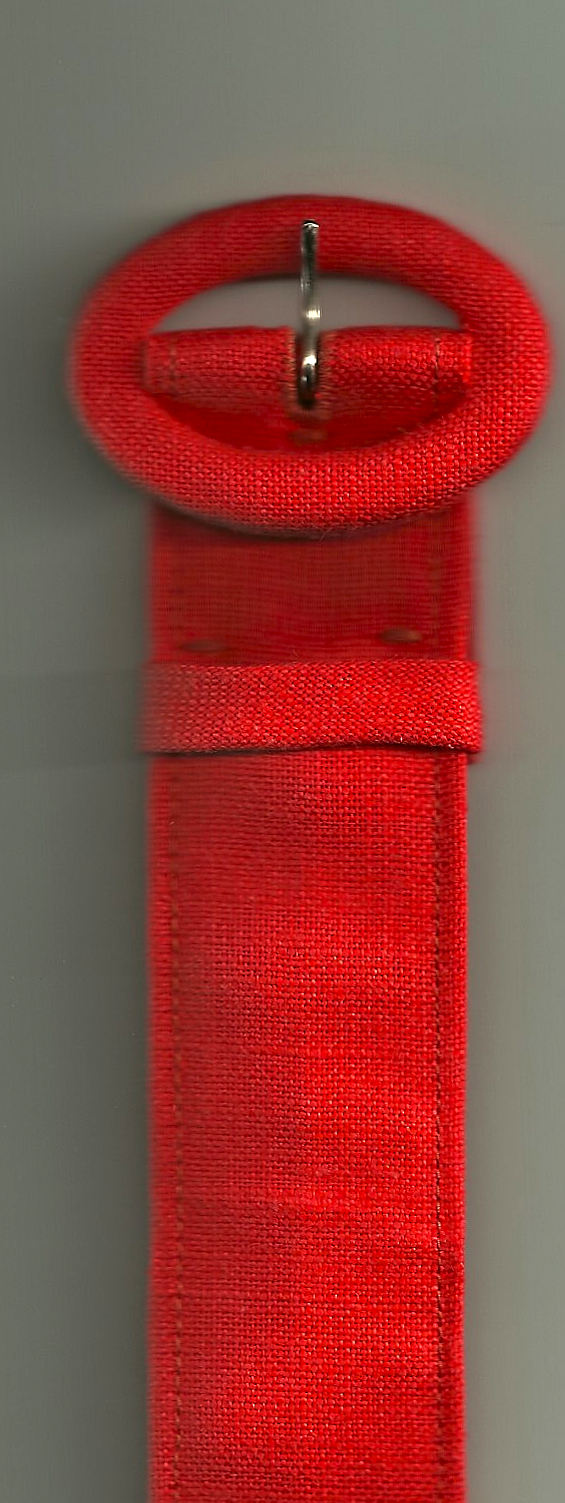
I sent new orange linen to Pat Mahoney of Pat's Custom Belts and Buttons  and this lovely belt came back to me in the mail.

I sent new orange linen to Pat Mahoney of Pat’s Custom Belts and Buttons and this lovely belt came back to me in the mail.

Cool and summery-looking, don't you think?

Cool and summery-looking, don’t you think?

Sandhurst 121

Sandhurst 121

Sandhurst 121

Sandhurst 121

Sandhurst 121

Not every dress can have a story, nor should it. But this fabric, which began its life in Ireland, no doubt entered this country through New York City, ordered by a store in Fresno, California, purchased and squirreled away for decades by persons unknown – has now found a starring role in my wardrobe almost 60 years later. Sewing is just so much fun!


37 Comments

Filed under bound buttonholes, Buttons - choosing the right ones, hand-sewn zippers, Linen, Love of sewing, Moygashel linen, Polka dots, side-placed zippers, The Conde Nast Publications, Uncategorized, Unprinted patterns from the 1950s, vintage buttons, Vintage fabric, vintage Vogue patterns from the 1950s

A Fascinating Foundation

Vogue patterns from the 1950s, ‘60s, and ‘70s never cease to amaze me. The intricacies of construction, the detailed instructions, and the artistic styling of so many of the patterns from those three decades make sewing from them such a pleasure. Each one is like a mini sewing lesson, neatly packaged with beautiful photos and/or sketches and precise line drawings.

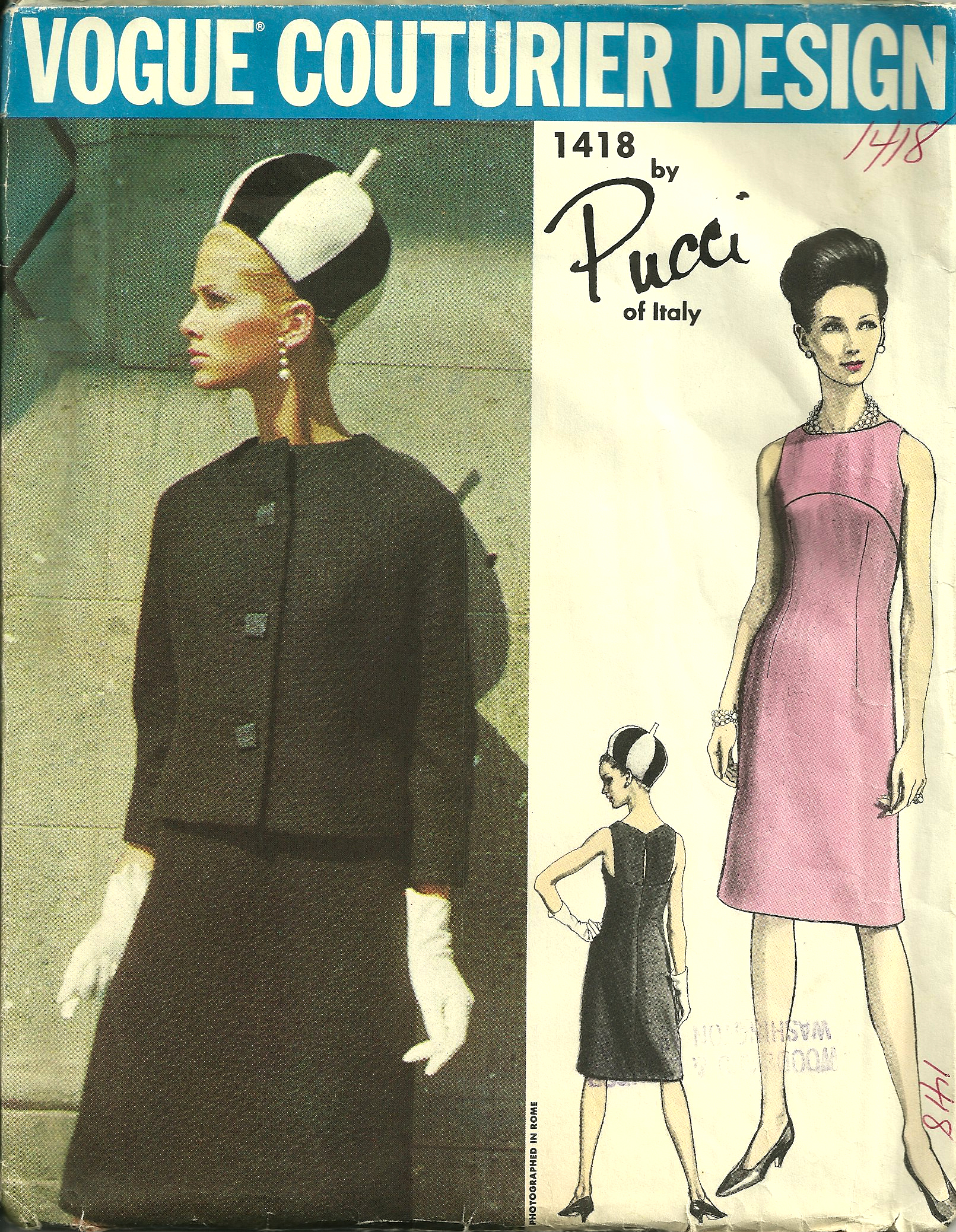
Such has been the Emilio Pucci Designer pattern on which I am currently working.

Happy New Sewing Year - Pucci pattern

The unusual construction of the jacket caught my attention as I was trying to lay out its lining pattern pieces along with pattern pieces for the dress.  As I mentioned before, the front of the jacket is cut on the bias. However the interfacing and the lining pieces for the front are cut on the straight of grain. How, I wondered, is that going to work? The answer to that question is one of the most fascinating construction methods I have ever come across.

The interfacing and the lining both have deep darts to form the bust line. Of course, the jacket front, cut on the bias, is going to have built-in give for the bust. But in addition to that, there was a “cup-like” pattern piece for adding to the front interfacing, clearly with the goal of enhancing the bust line, and defining it.

The "cup-like" pattern piece is in the lower right.  Notice the large dart in the piece next to it.

The “cup-like” pattern piece is in the lower right. Notice the large dart in the piece next to it.

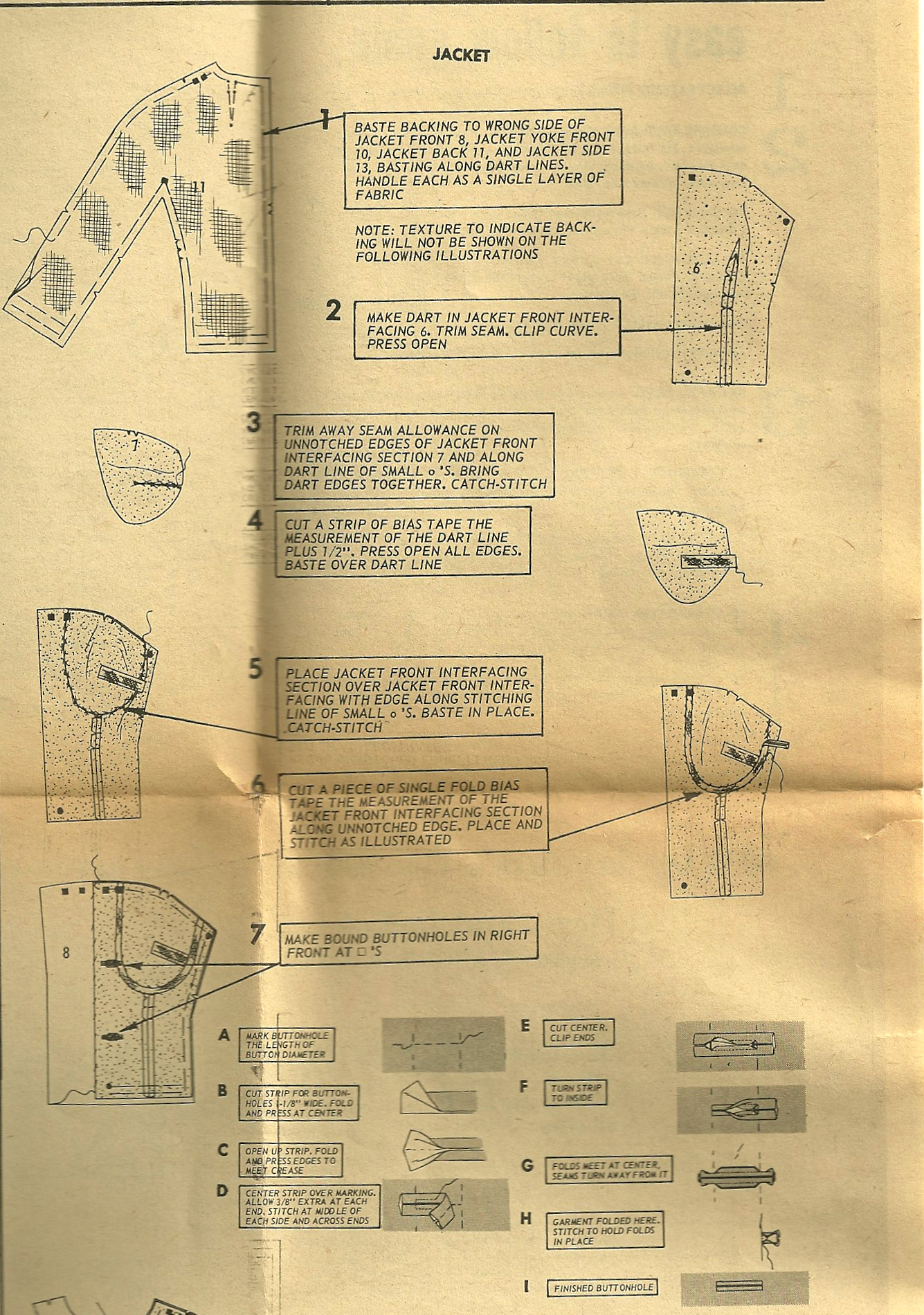
Here is the instruction page for assembling these interfacings. In effect, it is a process for making an interior bra.

Click on the diagram to read it more easily.

Here are my front interfacing pieces with the darts sewn.

Here are my front interfacing pieces with the darts sewn.

Here I am reinforcing the darts in the bust (cup) interfacings.

Here I am reinforcing the darts in the bust (cup) interfacings.

Here they are ready to be added to the base interfacing pieces.

Here they are ready to be added to the base interfacing pieces.

And here are the front interfacings assembled and ready to be attached.  Looks kind of risque, don't you think?

And here are the front interfacings assembled and ready to be attached. Looks kind of risque, don’t you think?

Note also the detailed instructions for making the bound buttonholes on the above instruction sheet. I did a practice run on a bound buttonhole, being careful to layer the fabrics exactly as they would be layered on the front of the jacket.

My sample buttonhole.

My sample buttonhole.

The right jacket front, marked for buttonhole placement.

The right jacket front, marked for buttonhole placement.

Another detailed instruction was given for the sharp angle under the sleeve. The instructions called for a 2” x 2” square of fabric to reinforce that corner. I used black organza.

The organza patch is sewn on the right side of the jacket and pressed to the inside.

The organza patch is sewn on the right side of the jacket and pressed to the inside.

The organza patch makes a very secure and precisely sewn  corner possible.

The organza patch makes a very secure and precisely sewn corner possible.

And here are just a couple of photos of the interior of the jacket with the rest of the interfacings attached.

The right front of the jacket, with buttonholes sewn.

The right front of the jacket, with buttonholes sewn.

Thje front of the jacket.  Note the "stays" made our of seam binding.  They are loose except where they are attached at the underarm and at the collar.

Thje front of the jacket. Note the “stays” made out of seam binding. They are loose except where they are attached at the underarm and at the neckline.

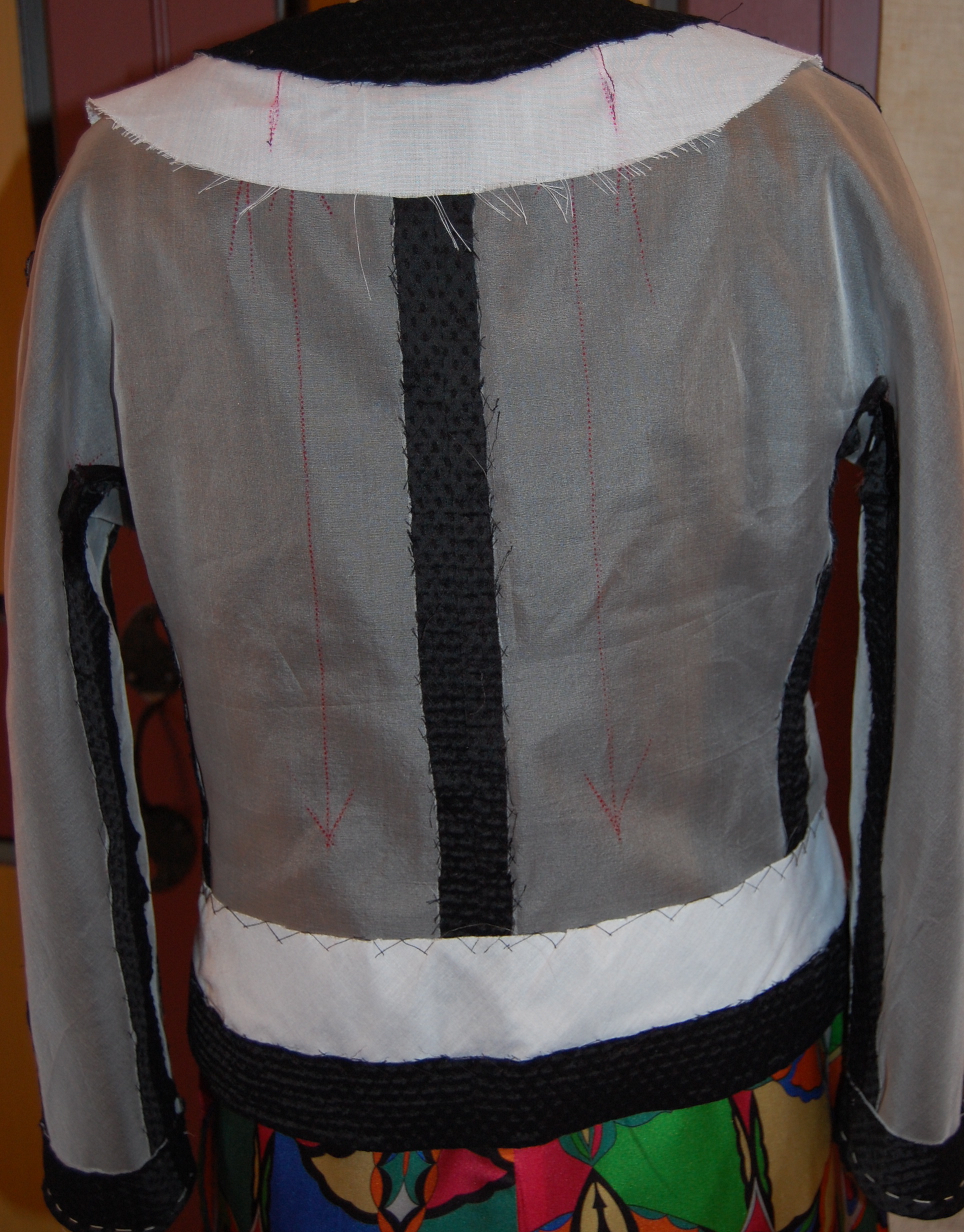
The back of the jacket - simple compared to the front!

The back of the jacket – simple compared to the front!

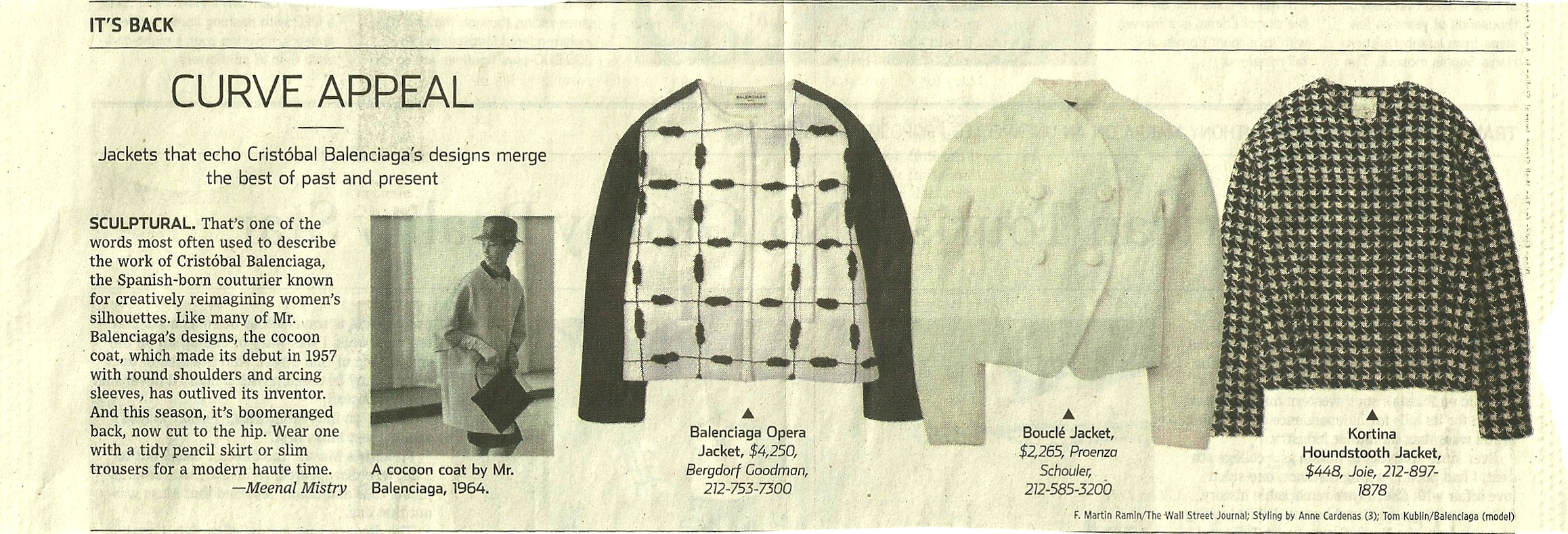
There is something else that never ceases to amaze me either about these sophisticated vintage Vogue patterns.   That is – how stylish and current so many of them are.   Here’s an example of what I mean. Take a look at these recent jackets from current designers.

I clipped this out of The Wall Street Journal sometime within the past year, but I unfortunately forgot to note the date.  Click on the photo for a close-up.

I clipped this out of The Wall Street Journal sometime within the past year, but I unfortunately forgot to note the date. Click on the photo for a close-up.

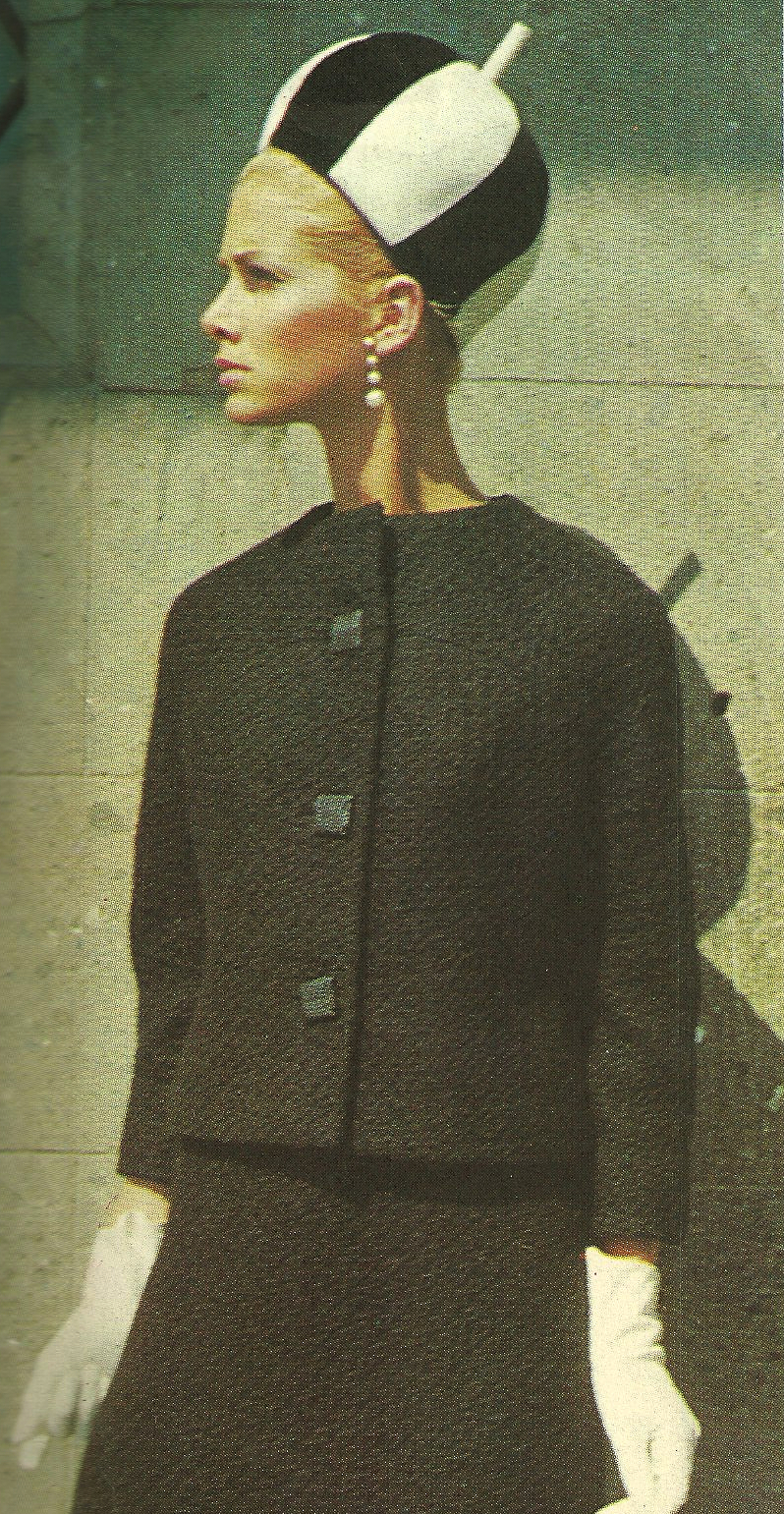
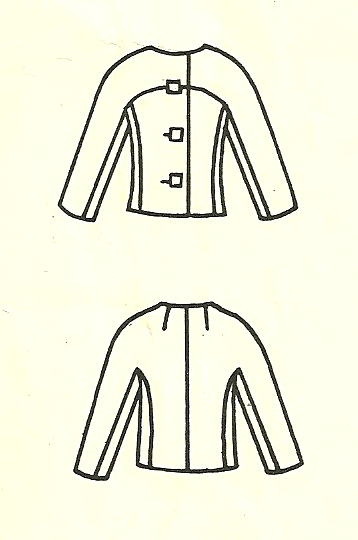
The article rightly makes the reference to Balenciaga, but look how similar these are to the Pucci jacket on which I am working.

A Fascinating foundation -picture of Pucci jacket

These thumbnail sketches  also help to show the similarity to the current jackets.

These thumbnail sketches also help to show the similarity to the current jackets.

Well! I am looking forward to sharing some more details about this outfit when I can show it completely finished – in my next post – and answering those nagging questions, “Did piecing the lower sleeves on the jacket lining actually work? Will anyone guess my secret?”


21 Comments

Filed under bound buttonholes, couture construction, kimono sleeves, Uncategorized, underlinings, vintage Vogue Designer patterns, vintage Vogue patterns from the 1960s, Vogue patterns

Inspiration and Adaptation

Sometimes in life – and in sewing – you have to alter your plans to accommodate the situation at hand.

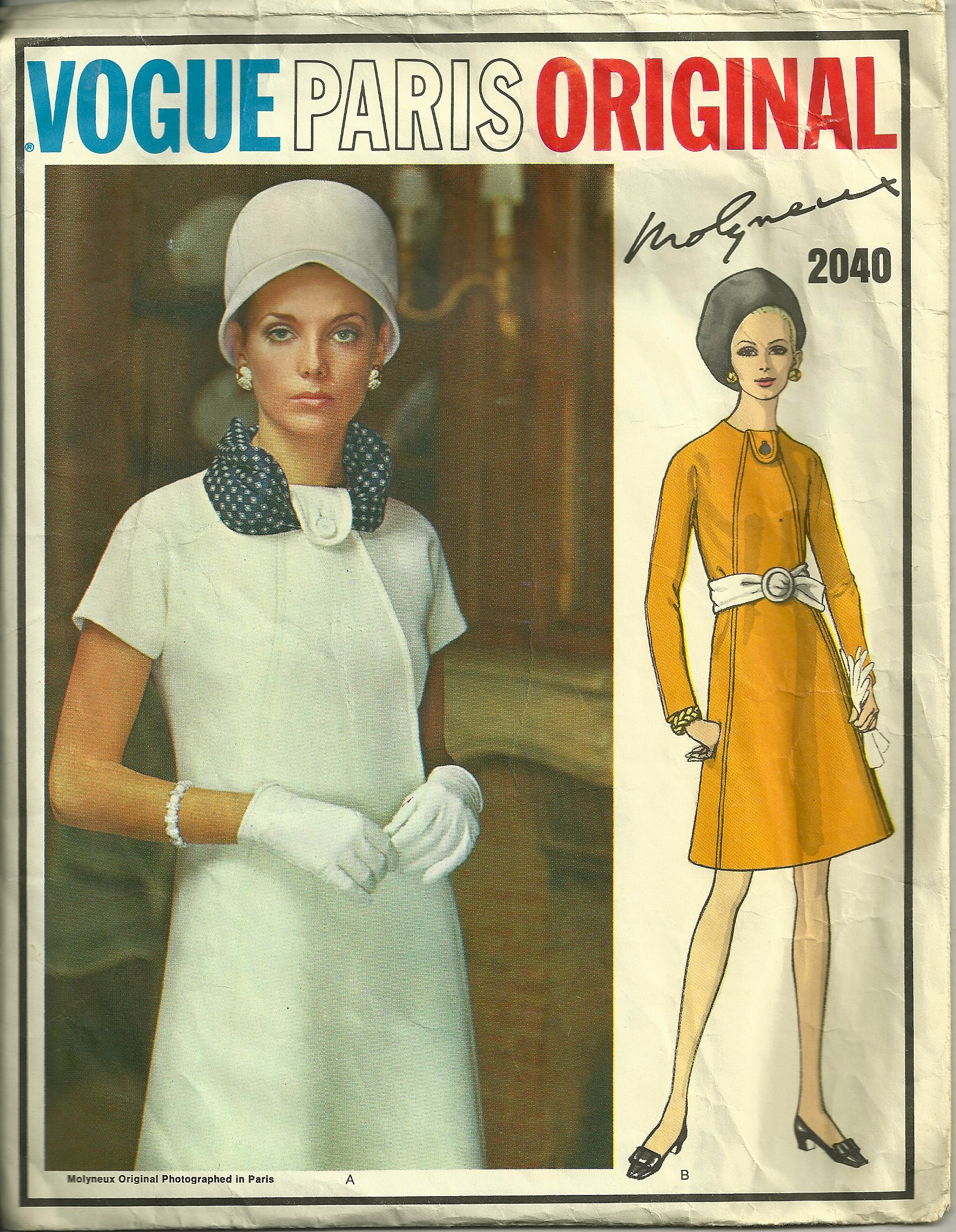
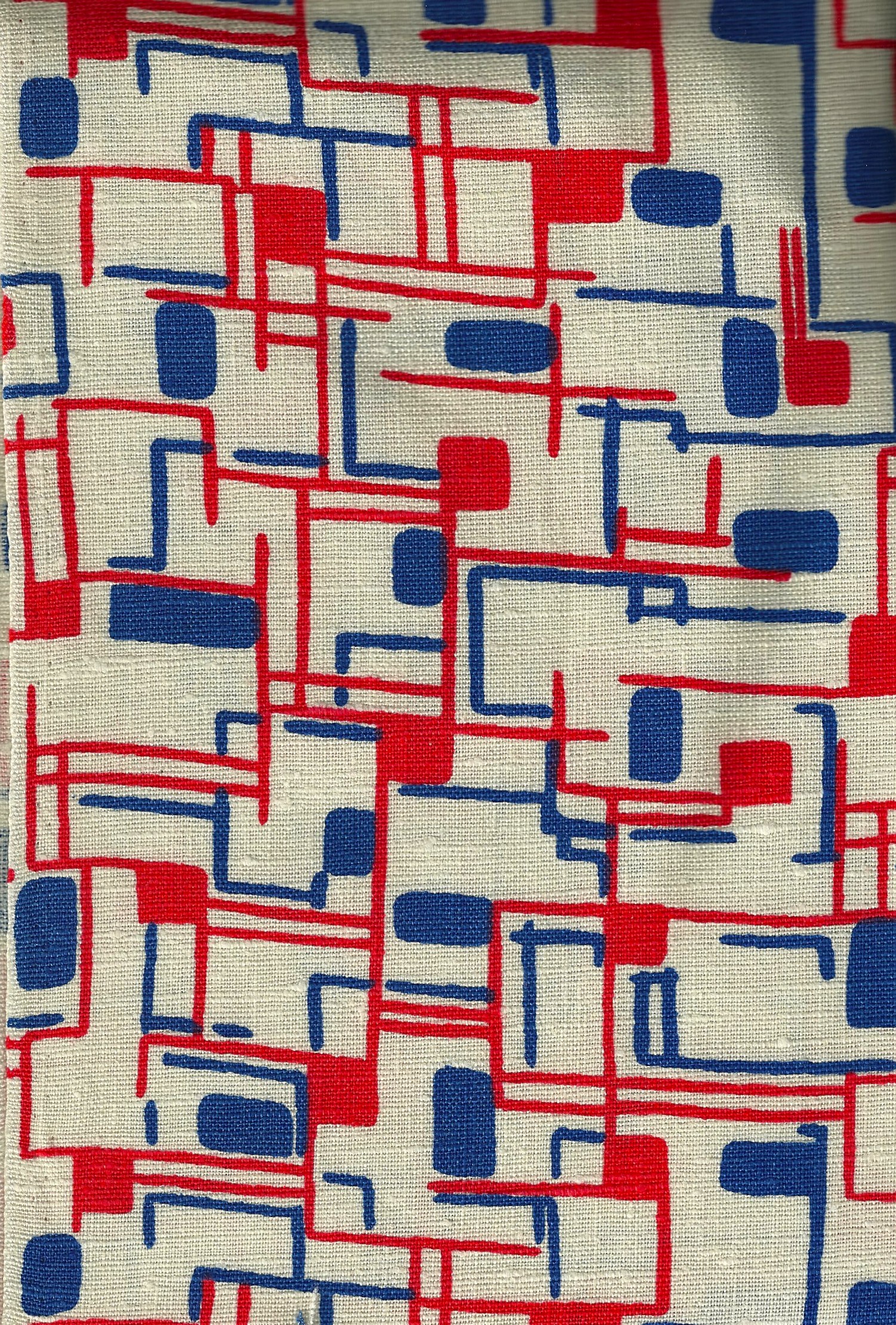
This is the situation I found myself in:  I had my heart set on pairing a favorite vintage Vogue Designer pattern with a piece of vintage Moygashel linen I had found in an Etsy shop.  They are both likely from the early 1970s and seemed destined to be together.

Molyneux has always been a favorite designer of mine.  My thought was to make the dress with short sleeves, but belt it as shown in View B.

Molyneux has always been one of my favorite designers. My thought was to make the dress with short sleeves, but with a belt as shown in View B.

My best guess is that this Moygashel linen is from the very early '70s.

My best guess is that this Moygashel linen is from the very early ’70s.

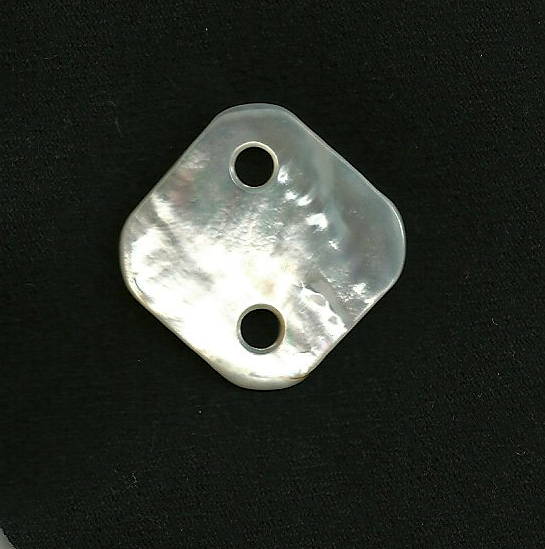
To make this pairing of fabric and pattern even more enticing, I was given this amazing pearl button by my dear friend Nancy C.  (Thanks, Nancy!)

I love this unique button!

I love this unique button!

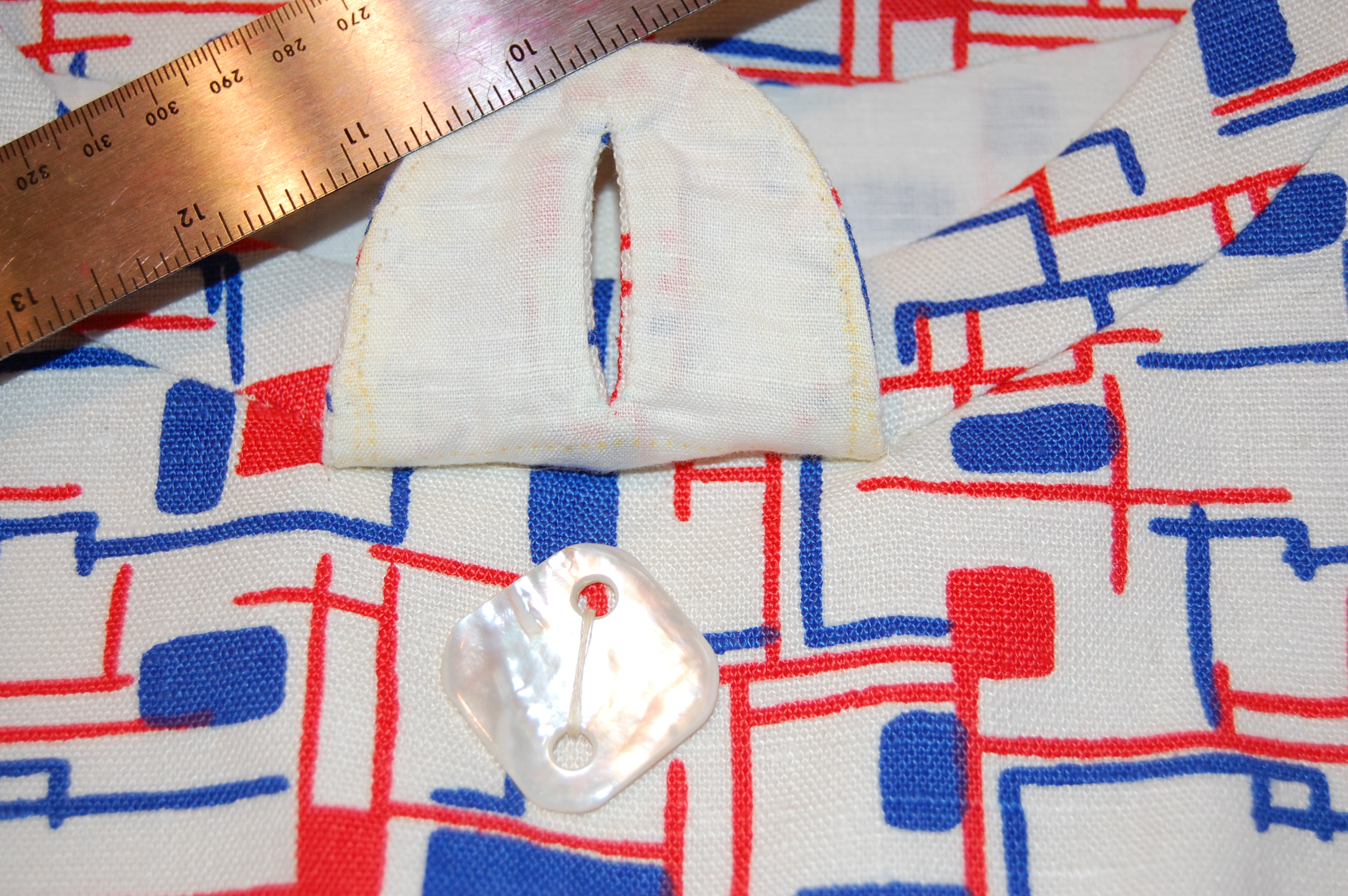
The square shape of the button – and its largeness (1 3/16” square) – and the fact that I had exactly one of these beauties – made it seem custom made for the design of the fabric and the tab featured on the pattern.

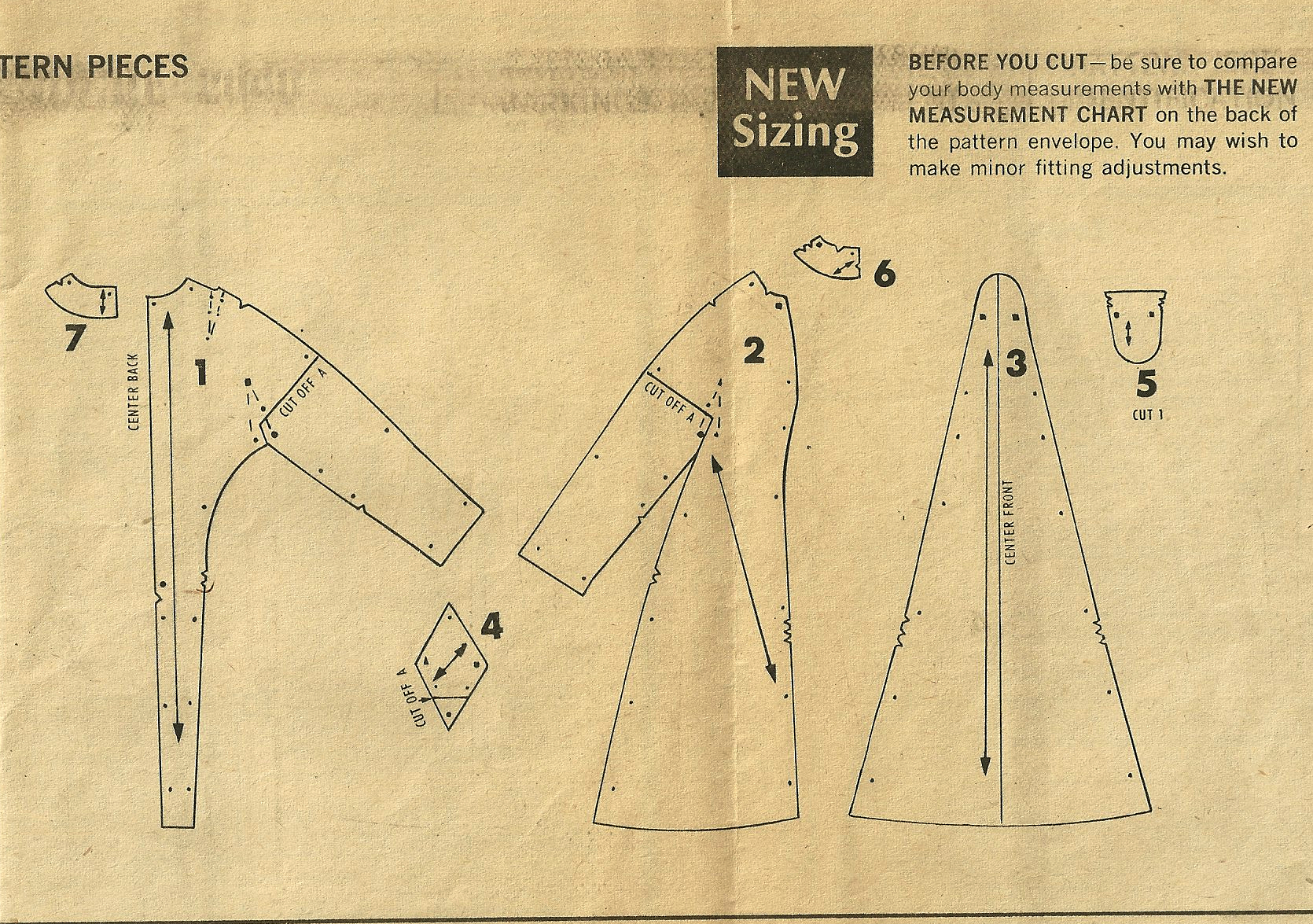
I couldn’t wait to get started!  I pulled out all the pattern pieces, ironed them flat, ready to make a muslin – and then the “uh-oh” moment struck.  The “straight of grains” on the pattern pieces could not have signaled more trouble if they had been flashing in bright red.   I grabbed the pattern envelope – and right there in plain English was stated:  “Not suitable for obvious plaids.”  (Why won’t I learn to read those envelopes more closely???)  While this fabric is not a plaid, it reads like a plaid.  My heart sank – as I realized very quickly that I absolutely could not use this pattern for this fabric.  It just would not work.  End of discussion.

If you look carefully at these line drawings, it's obvious that "plaids" would not work.

If you look carefully at these line drawings, it’s obvious that “plaids” will not work.

I took a few deep breaths – and went back to my vintage pattern file.  None of my other vintage patterns would do.  I had my vision for this fabric and no pattern came even remotely close.   It was then I decided I would have to adapt a new pattern to achieve the look I wanted.  Once I made this decision (Plan B, as in “it BETTER work!”), I began to see the advantages, and the possibilities for an even better look than I originally thought.

The first thing that went right was having this pattern in my “new pattern” file:

I picked up this pattern a few months ago as i thought it looked very versatile!

I picked up this pattern a few months ago as I thought it looked very versatile.

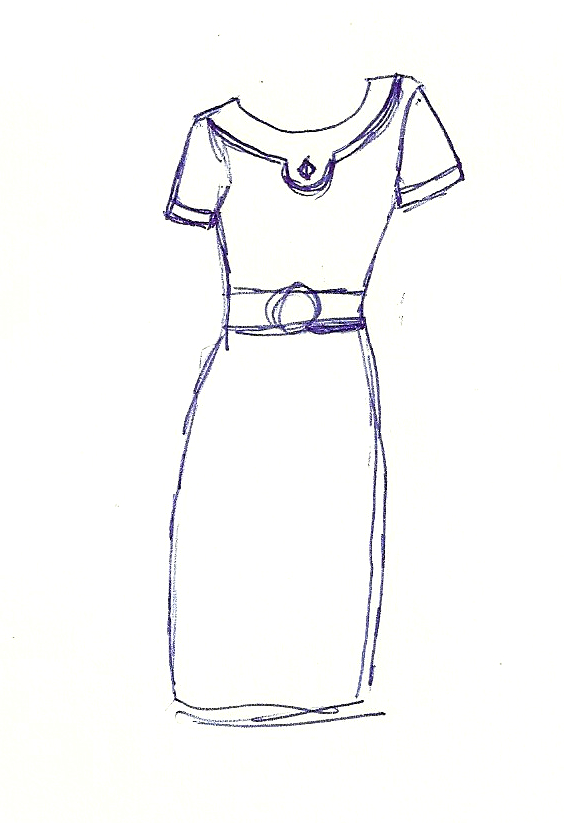
I figured if I used View B, I could alter the neck band to incorporate a center tab.  I wanted to belt it, but I happily thought the tapered darts at the mid-section, front and back, would help create less bulk at the waist (and that’s always welcome).  I liked the shape of the neck (and had actually planned to widen and lower the neckline on the vintage Vogue….).  I would have to lengthen it, but I had plenty of fabric.  I also like the banded sleeves.  To envision the look, I did a quick sketch:

More about the belt later - it was ready before the dress was even cut out.

More about the belt later – it was ready before the dress was even cut out.

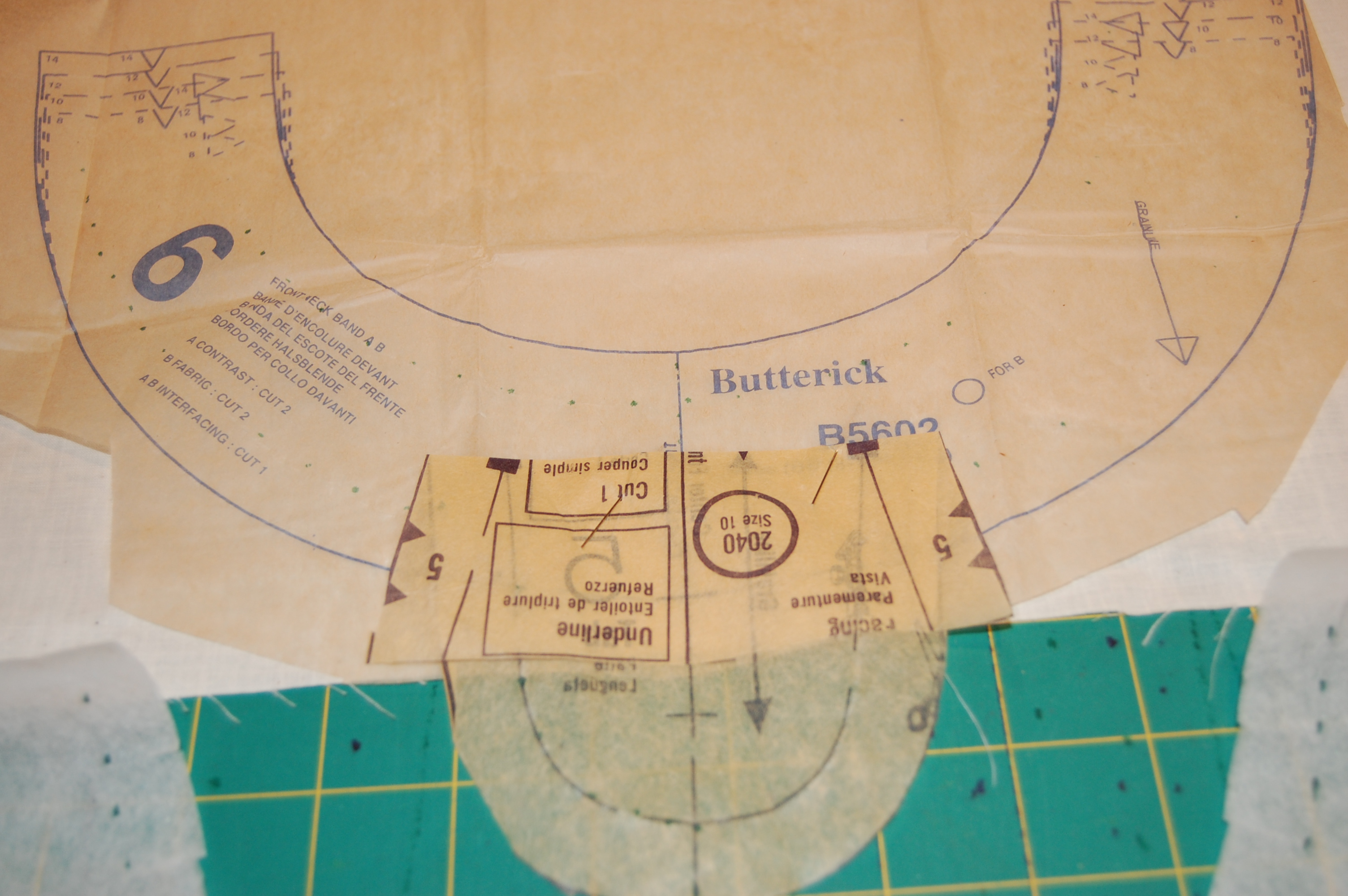
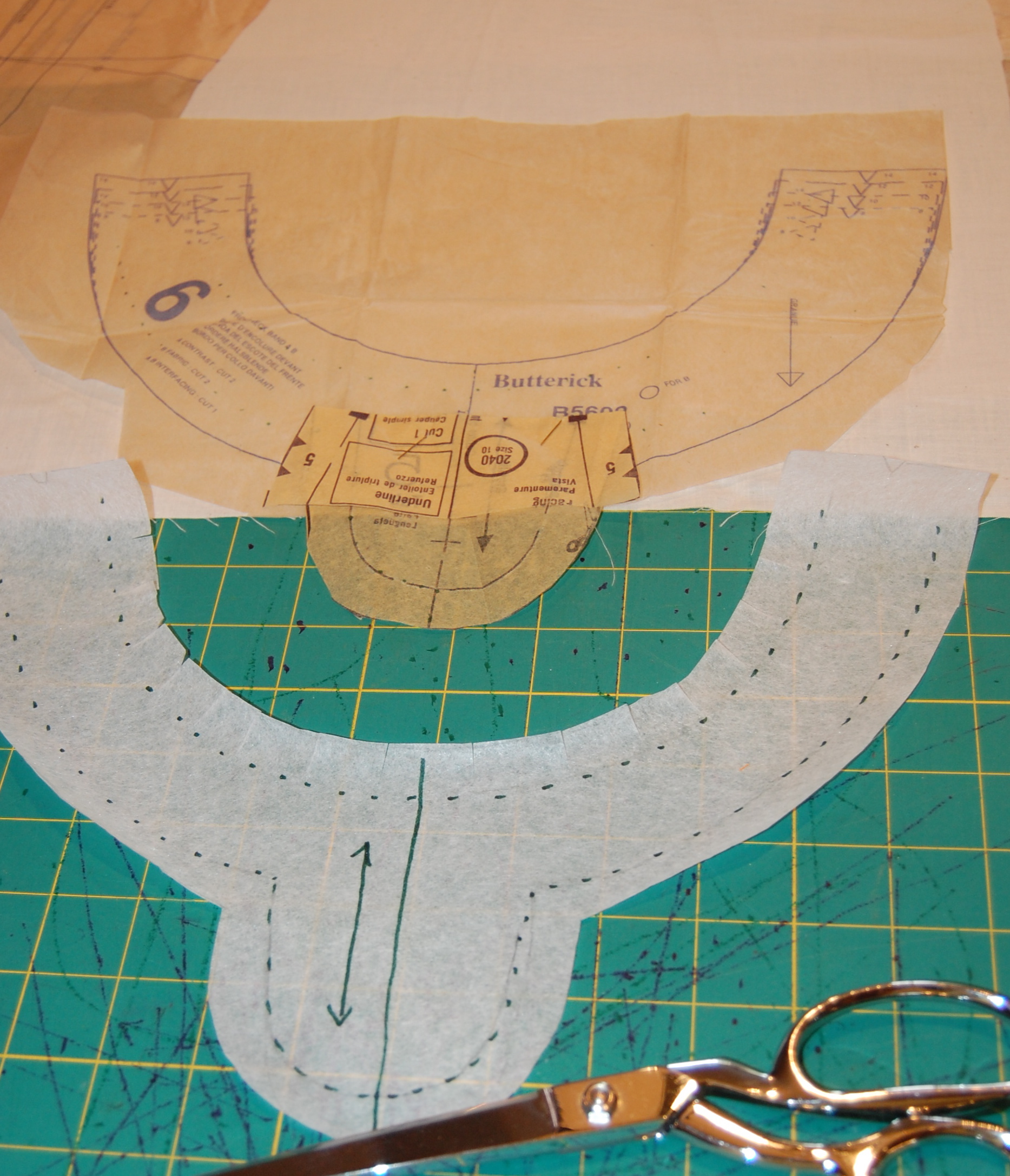
Then I set about adding the 1970’s tab to the neckband.  I actually used the pattern piece for the original tab facing so that I could get the correct size and look.

I placed the old pattern piece onto the new neckband.

I placed the old pattern piece onto the new neckband.

Then I made a new pattern piece.

Then I made a new pattern piece.

I made my muslin and then proceeded to use some couture techniques, but not all I normally would.  For one thing, I did not want to underline this linen fabric with silk organza (to preserve the breathability of the linen and keep it as light as possible).  The pattern called for the dress (but not the sleeves) to be lined.  I used a very lightweight cotton/linen blend for this which worked beautifully.  I also decided to use the facings included in the pattern (usually eliminated with couture sewing), and I’m really happy with that decision.

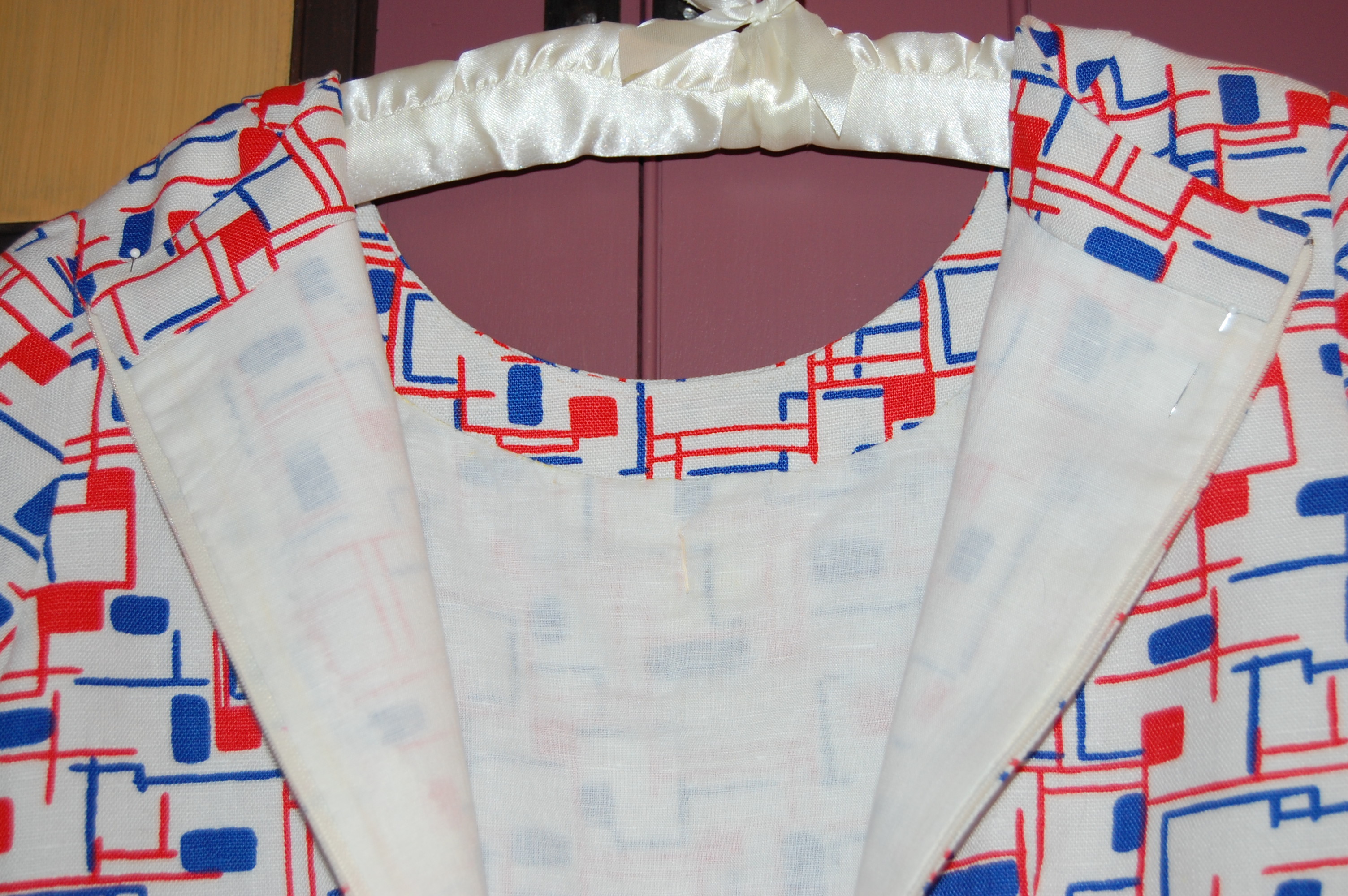
This photo shows the neck facing and the off-white lining I used for the body of the dress.

This photo shows the neck facing and the off-white lining I used for the body of the dress.

I hand-picked the zipper, understitched the facings by hand, and sewed the hem oh-so-carefully so that my stitches would not show (one of the disadvantages of not using an underlining is that there is no layer to sew the hem to, except for the actual fashion fabric). I made a bound buttonhole for that big lovely button (the original Vogue pattern calls for a bound buttonhole).

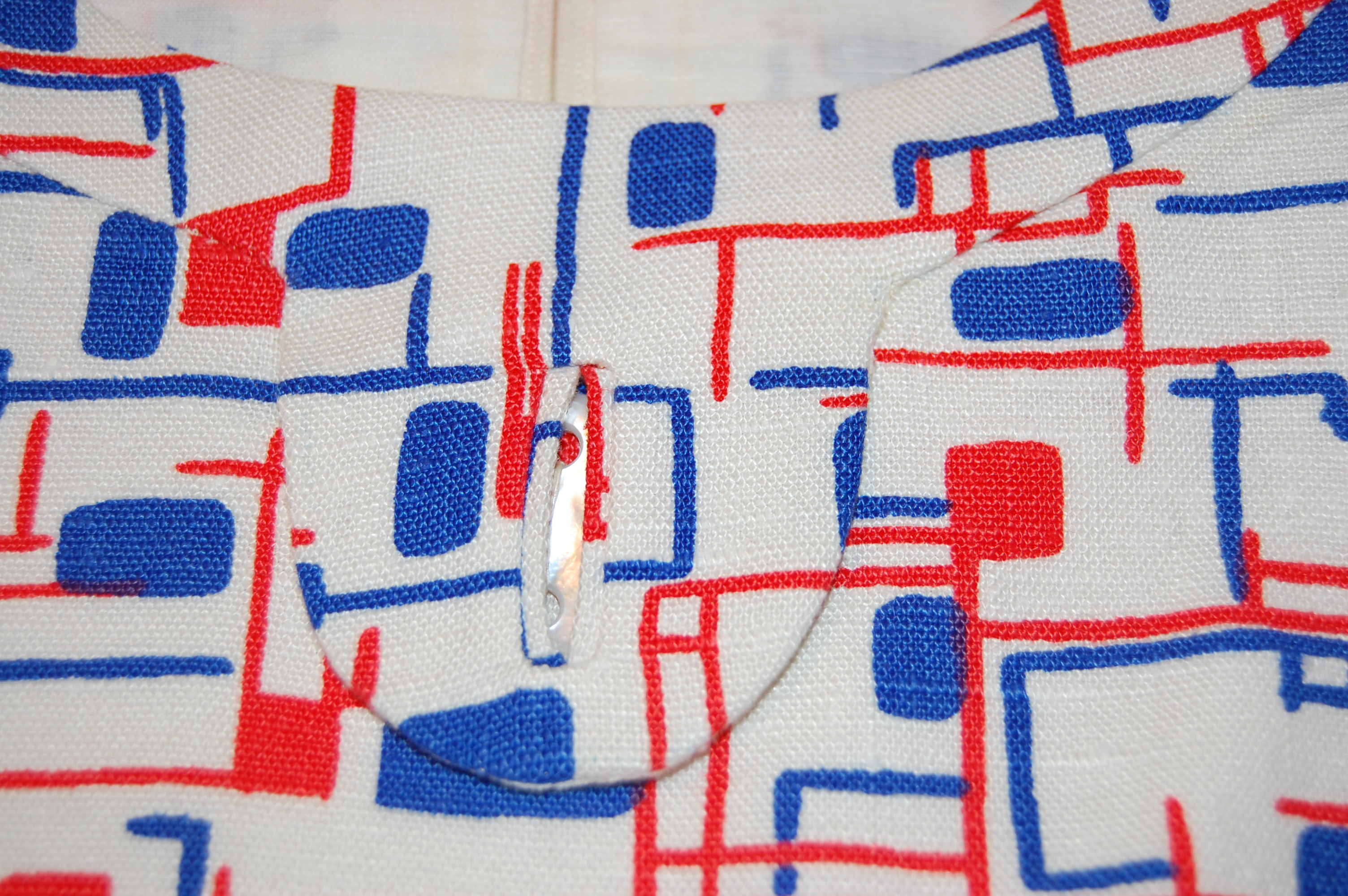
Here's the buttonhole, with the button peeking through!

Here’s the buttonhole, with the button peeking through!

The underside of the tab.

The underside of the tab.

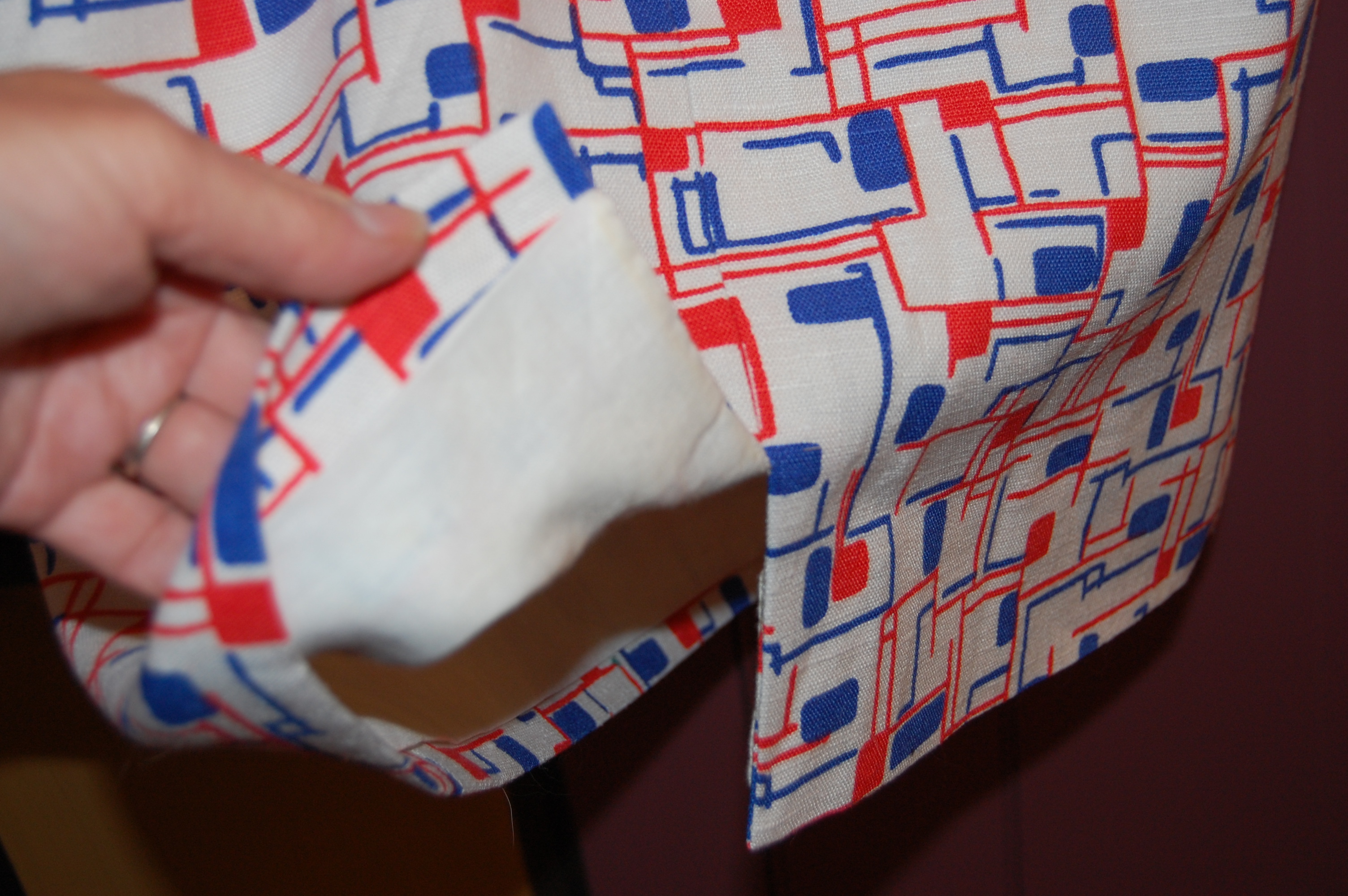
I also added a slit to the back seam as once I lengthened the dress, I thought I might need the extra wiggle room.

a quick look at the slit I added to the back center seam.

A quick look at the slit I added to the back center seam.

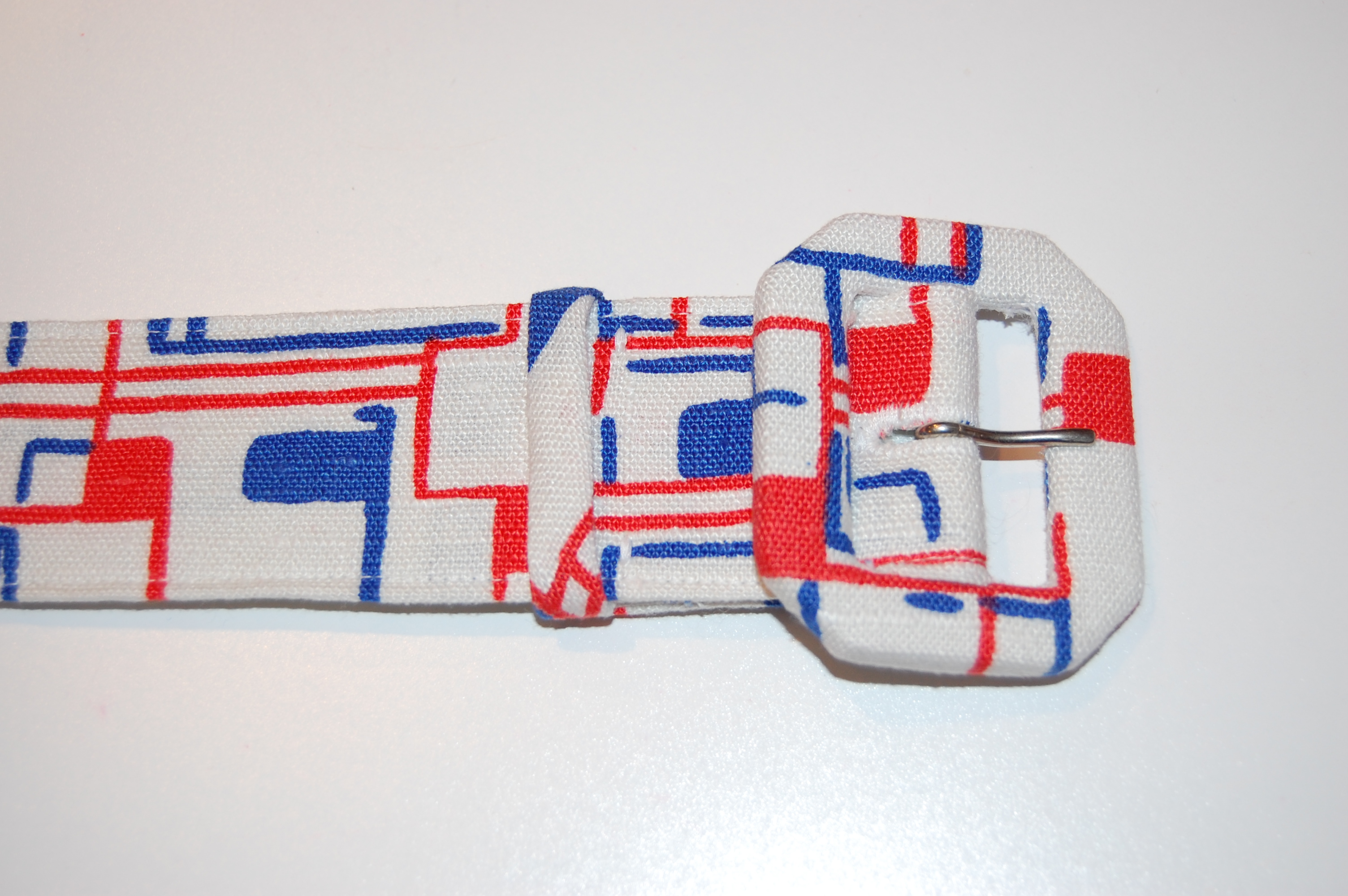
I had the belt made by Pat Mahoney of Pat’s Custom Belts and Buckles.  What a great decision!  I could never make as neat a belt and buckle as she does.

Pat Mahoney does nt have a website, but she can be contacted at: 209-369-5410; 537 York Street, P.O. Box 335, Lodi, California 95241, USA.

Pat Mahoney does not have a website, but she can be contacted at: 209-369-5410; 537 York Street, P.O. Box 335, Lodi, California 95241, USA.

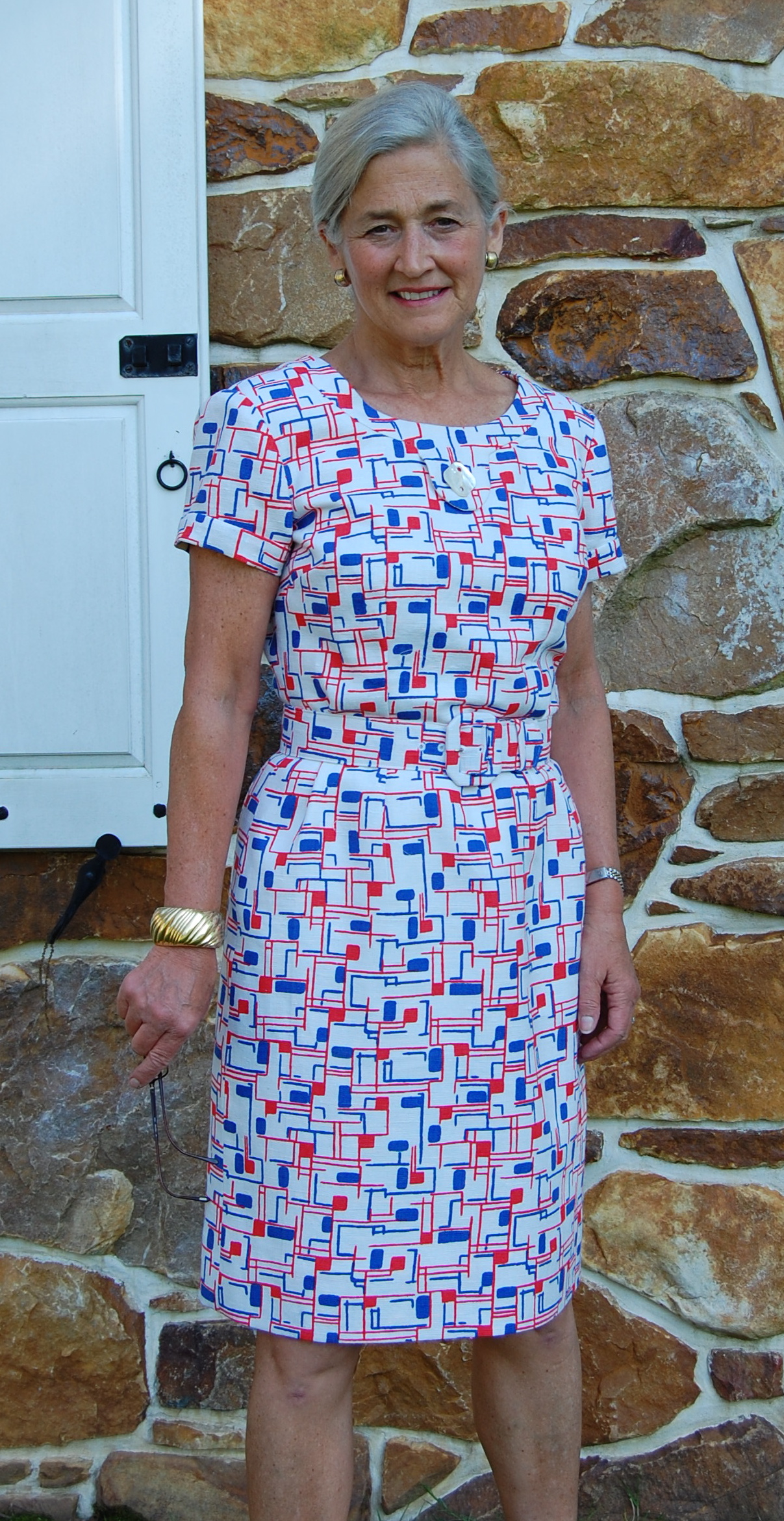
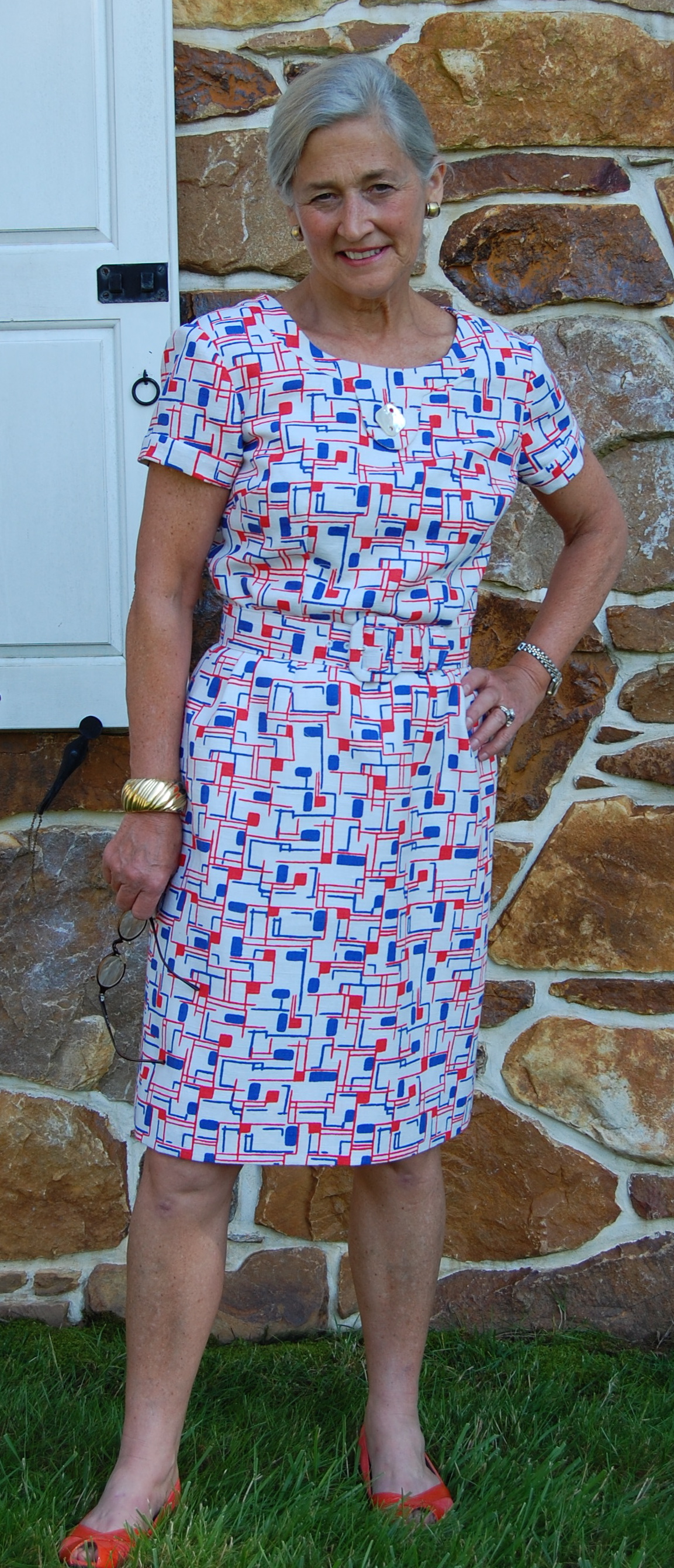
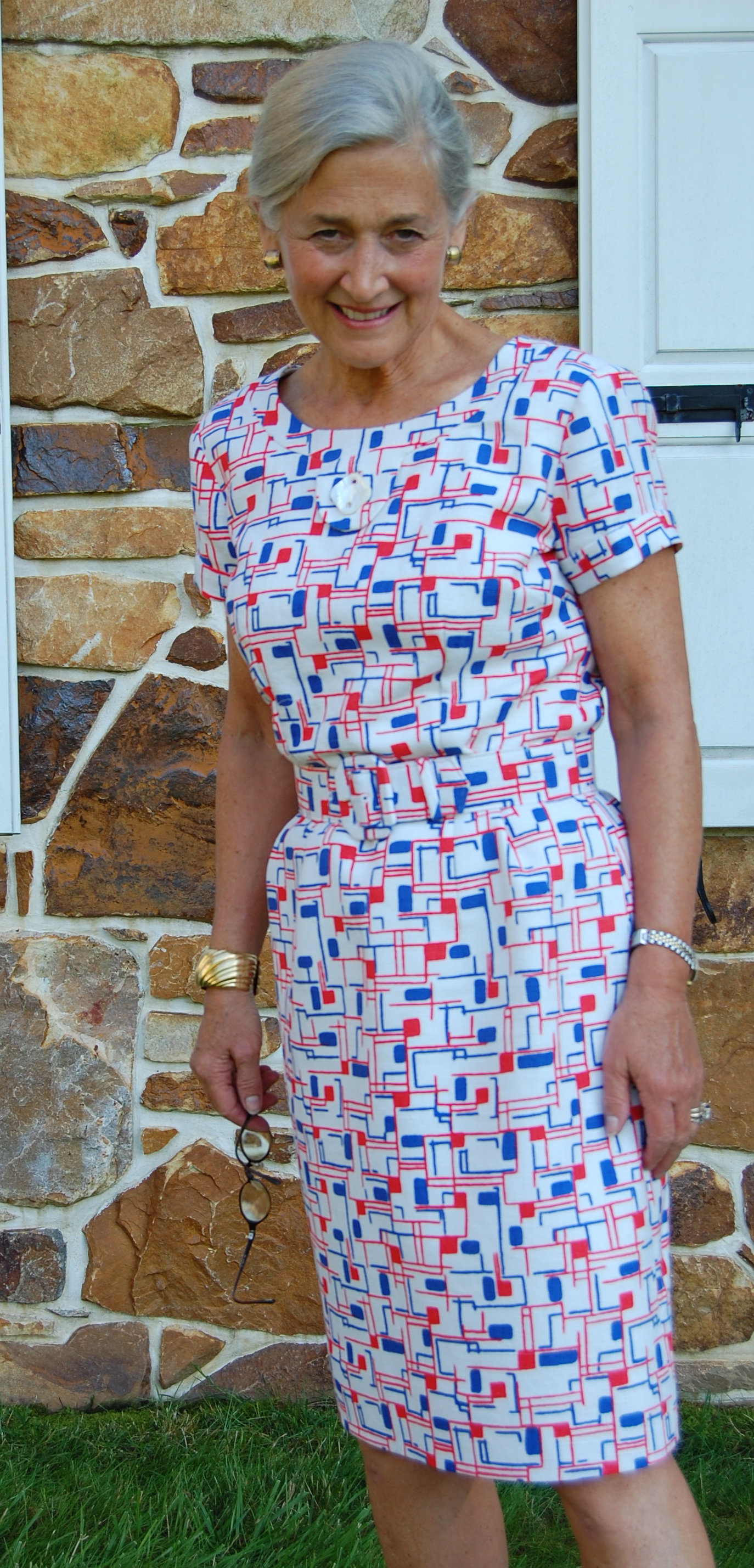
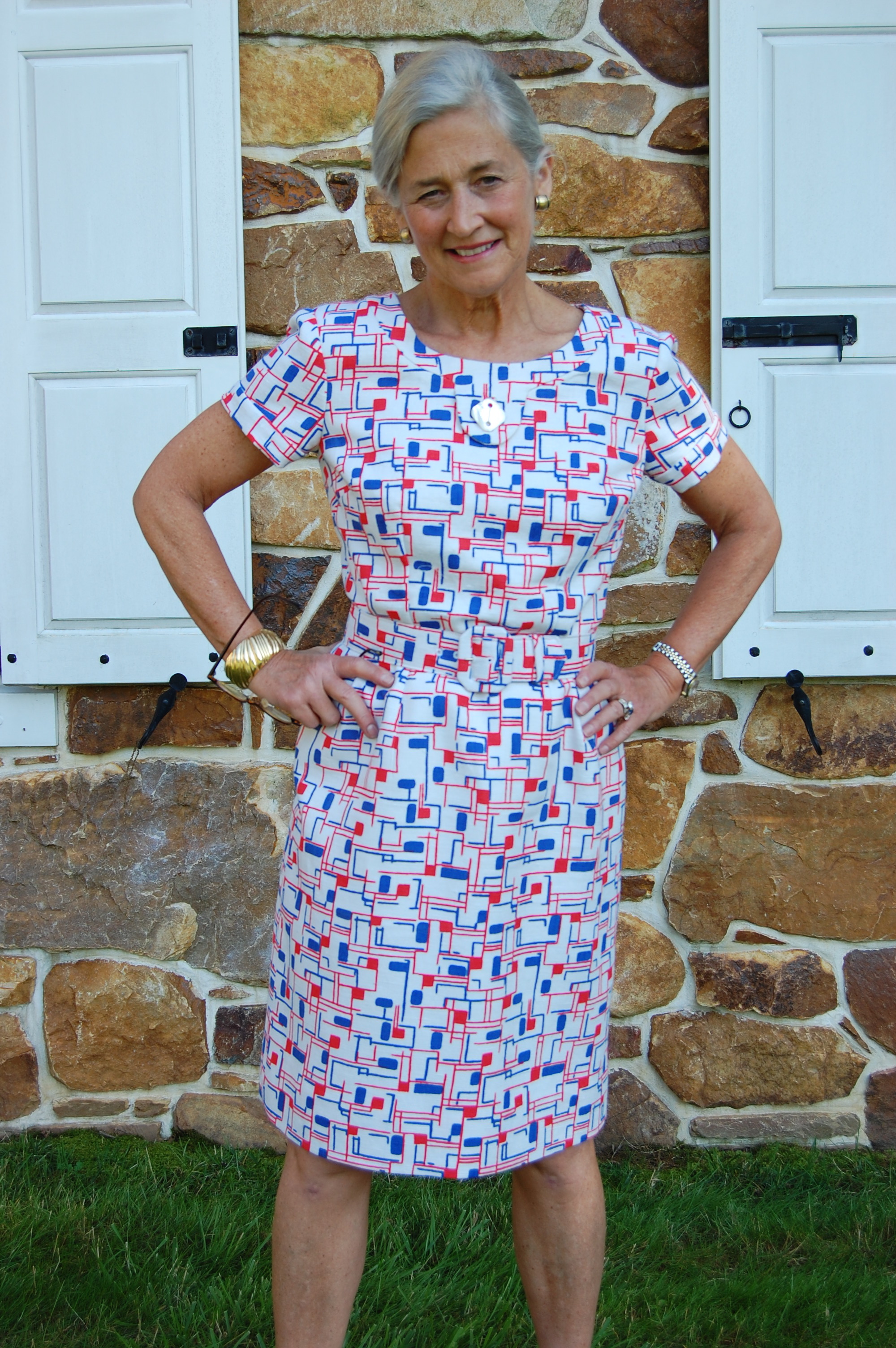
Here is the finished dress.

linen tab dress

DSC_0882

DSC_0886

DSC_0887

DSC_0892

DSC_0893

DSC_0894

I am bound and determined to make a summer dress using that vintage Vogue pattern.  But – now I know I’ll have to use a plain fabric for best results (maybe a solid linen…).  It will, however,  have to wait for another Summer, as  I have other projects in mind!

Making this dress has reminded me that sometimes Plan B turns out to be the BEST plan of all.

21 Comments

Filed under bound buttonholes, Buttons - choosing the right ones, couture construction, Linen, Moygashel linen, Uncategorized, vintage buttons, vintage Vogue Designer patterns, vintage Vogue patterns from the 1970s, Vogue patterns

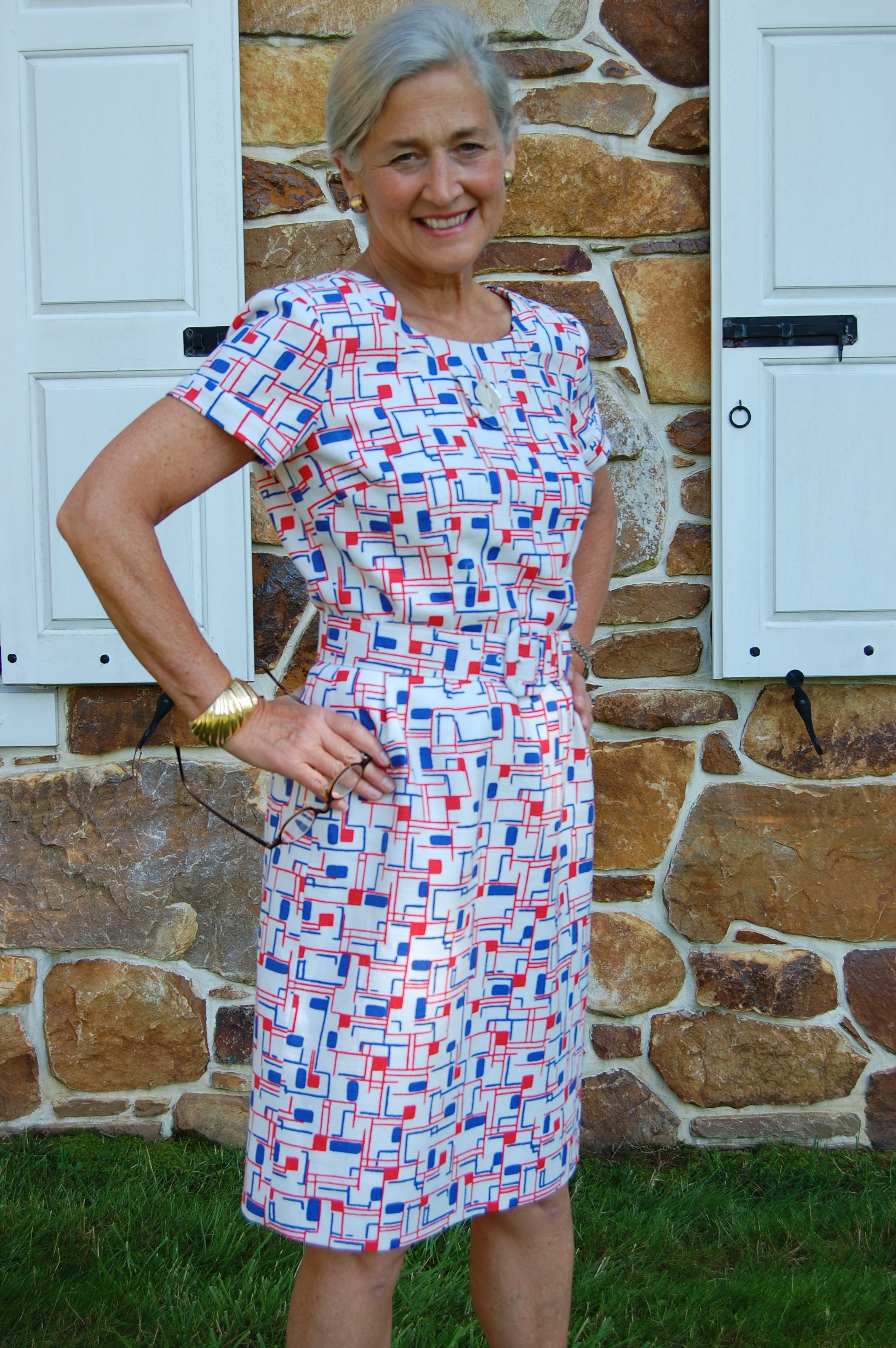
A Newly Defined ‘50s’ Frock

I have finished making a new dress from an old pattern, which isn’t anything too unusual for me.  What is unusual is the spell which this pattern cast over me from the time I first saw it last January, and then purchased it from an Etsy shop.

The length of this dress as shown on the envelope is very 1950's.  I'll be making it in knee-length.

The back of the envelope, showing the back yoke detail.  Don't you love the handbags that the artist included?

The back of the envelope, showing the back yoke detail. Don’t you love the handbags that the artist included?

Copyright 1957, this pattern has intrigued me for both how modern it looks, and how quintessentially “1950s” its various details are – such as:

1) Kimono sleeves in three-quarter length.  Cut in one with the bodice, kimono sleeves were common in the ‘50s, and now seem to be making a comeback.  Three quarter length is extremely flattering for most women, and was popular then and now.

2) Side zipper.  This dress goes over the head and needs that side zipper to accommodate the wiggle room needed to accomplish this method of dressing.  A back zipper would completely ruin the effect of the four-buttoned back yoke.

3) No pockets.  While pockets are lovely inventions, this dress would lose some of its slim and flattering line should pockets bulge out from the side seams.

4) Mid-calf length.  This length looks great in the pattern illustration, but not so much on me.  One of the beauties of these vintage patterns is adapting them for current wear – so I opted for knee-length instead.

5) Bound buttonholes.  Although this pattern is called “easy to make” on the back of the envelope, it still calls for bound buttonholes.  And, oh, they add such a nice detail.

Now to the specifics.  I found this black and white herringbone alpaca wool (made in the USA) on Britex Fabrics’ website, and purchased it on sale a few months ago, specifically for use with this pattern.

This is the swatch I ordered from Britex sometime over the Summer.

This is the swatch I ordered from Britex sometime over the Summer.

I wanted to make the dress using couture techniques (learned in the online Craftsy course The Couture Dress taught by Susan Khalje.)  This meant that I would 1) make a muslin for fitting and pattern tracing; 2) underline the entire dress with silk organza; 3) eliminate the separate neck facing; 4) finish all the interior seams by catch-stitching them to the underlining; and 5) line the entire dress, which I did using Bemberg instead of china silk (more on that in a bit).

There were a number of decisions/problems/successes involved in making this dress. First, the nature of the fabric is that there are slight imperfections in the weave, and it is quite loosely woven, making it quite susceptible to raveling.  When I laid it out to cut it, I wanted to avoid any obvious imperfections front and center.  Patterns with kimono sleeves demand large expanses of fabric and thus do not allow a lot of jiggling of their placement.  I can honestly say that I had JUST enough fabric and not an inch more than I needed!

One of the first problems I realized I was going to have concerned the buttonholes.  I quickly discovered that the loose weave of the fabric meant that I was not going to be able to make bound buttonholes using self-fabric for the “strips”.  I considered using a plain black wool for these strips, but I thought that would be too much of a contrast.  Well, now I know why I save all kinds of scraps from previous projects – you never know when one of those random pieces of fabric will come in handy.  I spied a scrap in my fabric closet and quickly decided that one part of the weave would be perfect to delineate those buttonholes:

I used the "gray"portion of this windowpane check for the buttonhole "strips".

I used the “gray” portion of this windowpane check for the buttonhole “strips”. Click on the photo to see this up close.

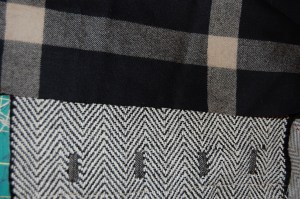
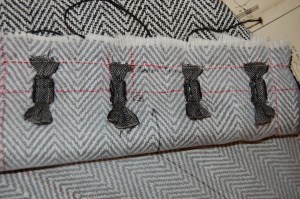
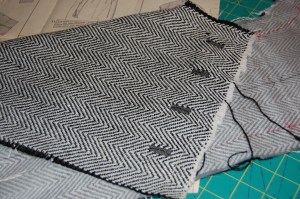
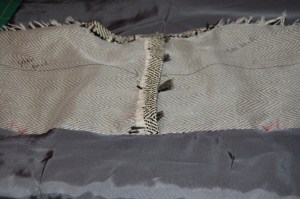
An inside look at the buttonholes in progress

An inside look at the buttonholes in progress

And an outside look...

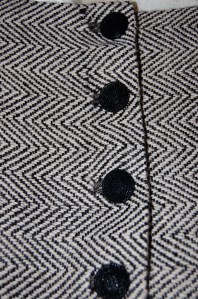
And an outside look…

When it came to deciding on buttons, I could not find any I liked.  But I remembered some buttons I had sewn onto a RTW jacket several years ago (to replace the ones that came on it.)  They have a “herringbone” look to them – it’s very subtle, but effective.  The jacket is one I haven’t worn in a couple of years, so I just robbed the cuffs of their buttons and used them on my dress.  (Now I guess I know for sure I won’t be wearing that jacket again!)  But – the buttons are perfect for this dress.

My buttons of choice!

My buttons of choice!

Choosing to use couture techniques was a “dress-saver”.  The larger seam allowances took away the panic I might have felt, once I realized the fabric frayed so easily.  And finishing off each interior seam with catch-stitching controlled the fraying and helped the seams to lay perfectly flat.

Eliminating the separate neck facing was also a bonus to ease construction.  First of all, I wanted to widen the neckline, which I worked out in my muslin.  Using the seam allowance and hand-applied, under-stitched lining for the neck facing made it lay flat, and of course, it’s not itchy either!

The "couture-constructed" neckline, before the lining is attached.

The “couture-constructed” neckline, before the lining is attached.

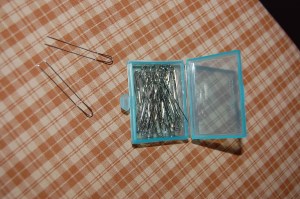
Even though I did not have “plaids” to match, I needed to pay close attention to the rows in the herringbone weave, so that none of them were crooked.  This is where Clover two-pronged pins (recommended by Susan Khalje in The Couture Dress class) came in handy and helped me keep those rows lined up evenly.

Clover "fork" pins

Clover “fork” pins

Finally, I decided to use Bemberg lining fabric instead of China silk because I thought it might be a bit more substantial for this somewhat heavy weight wool.  When I was deciding what color to make the lining, I considered ivory, black, and even a bright color, such as red.  But I settled on deep gray, and it seems just right.

In fact, everything about this dress seems just right.  It is delightfully rewarding when a pattern does not disappoint – and when it turns out to be a complete winner, well, that is reason to make it again (which I will)!

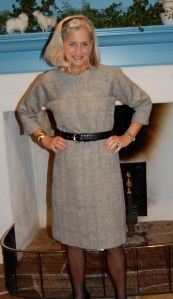
I can wear this dress as a sheath, unbelted, but I love it with this Coach black belt.

I can wear this dress as a sheath, unbelted, but I love it with this Coach black belt.

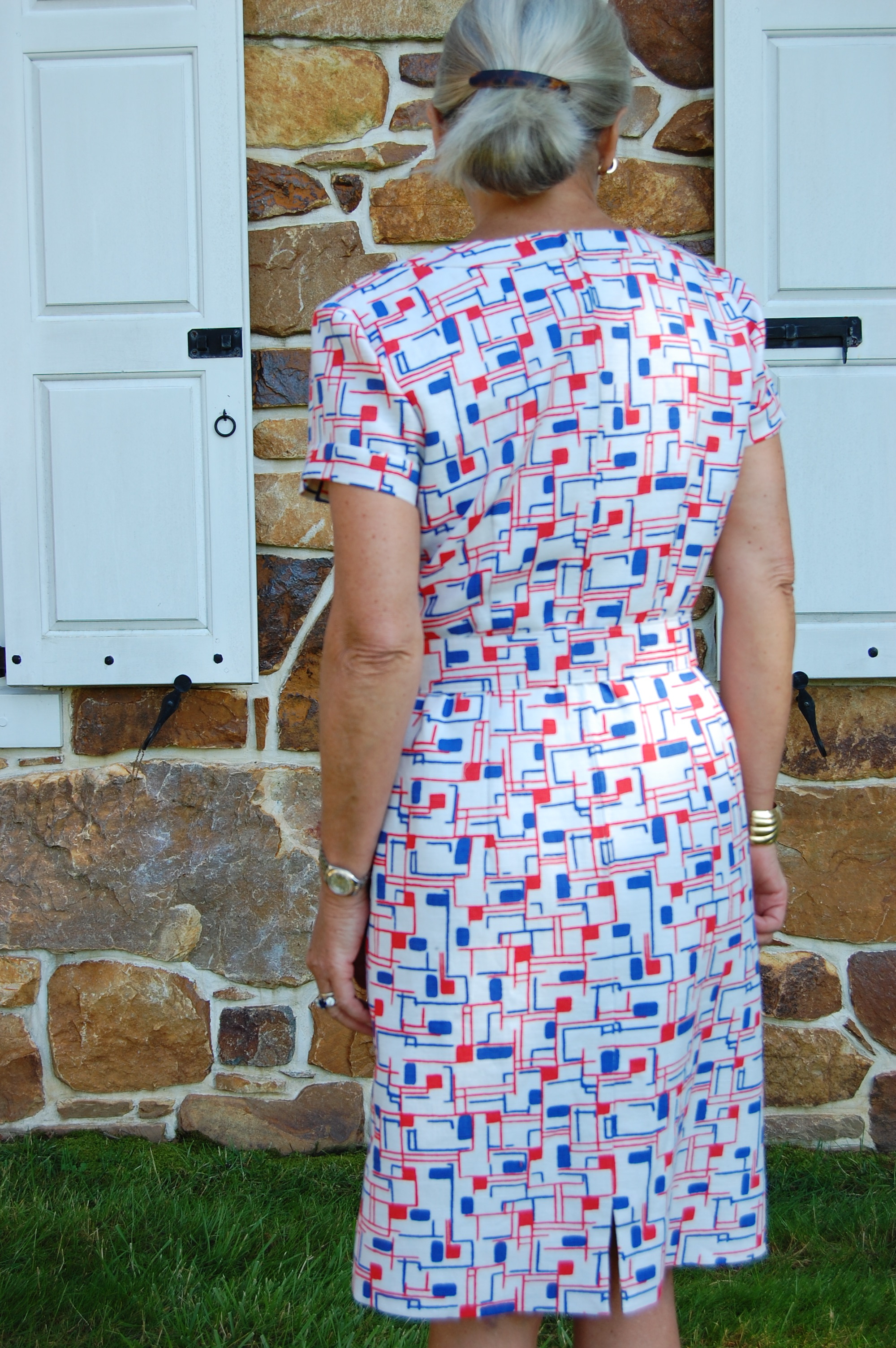
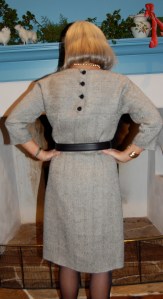
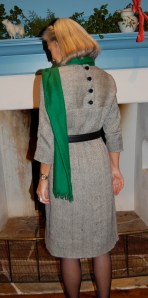
The back view

With a touch of emerald green for the holiday season

With a touch of emerald green for the holiday season.

With green gloves for a '50s' look!

With green gloves for a ’50s’ look!

And another back view.

And another back view. Alpaca is a very warm wool – so this dress is very cozy.

For now, however, my sewing room is “gift-wrap central”.  The colorful ribbons, paper and tags are cheerful tokens of a season of blessings and family and home.  To all of you celebrating the season, may it be a time of great peace and love for you and yours. And, as I  take a couple of weeks “off”, I send a heartfelt Merry Christmas from me to you…

24 Comments

Filed under bound buttonholes, Buttons - choosing the right ones, couture construction, kimono sleeves, side-placed zippers, Uncategorized, underlinings, vintage Vogue patterns from the 1950s, woolens

A Timely Arrival

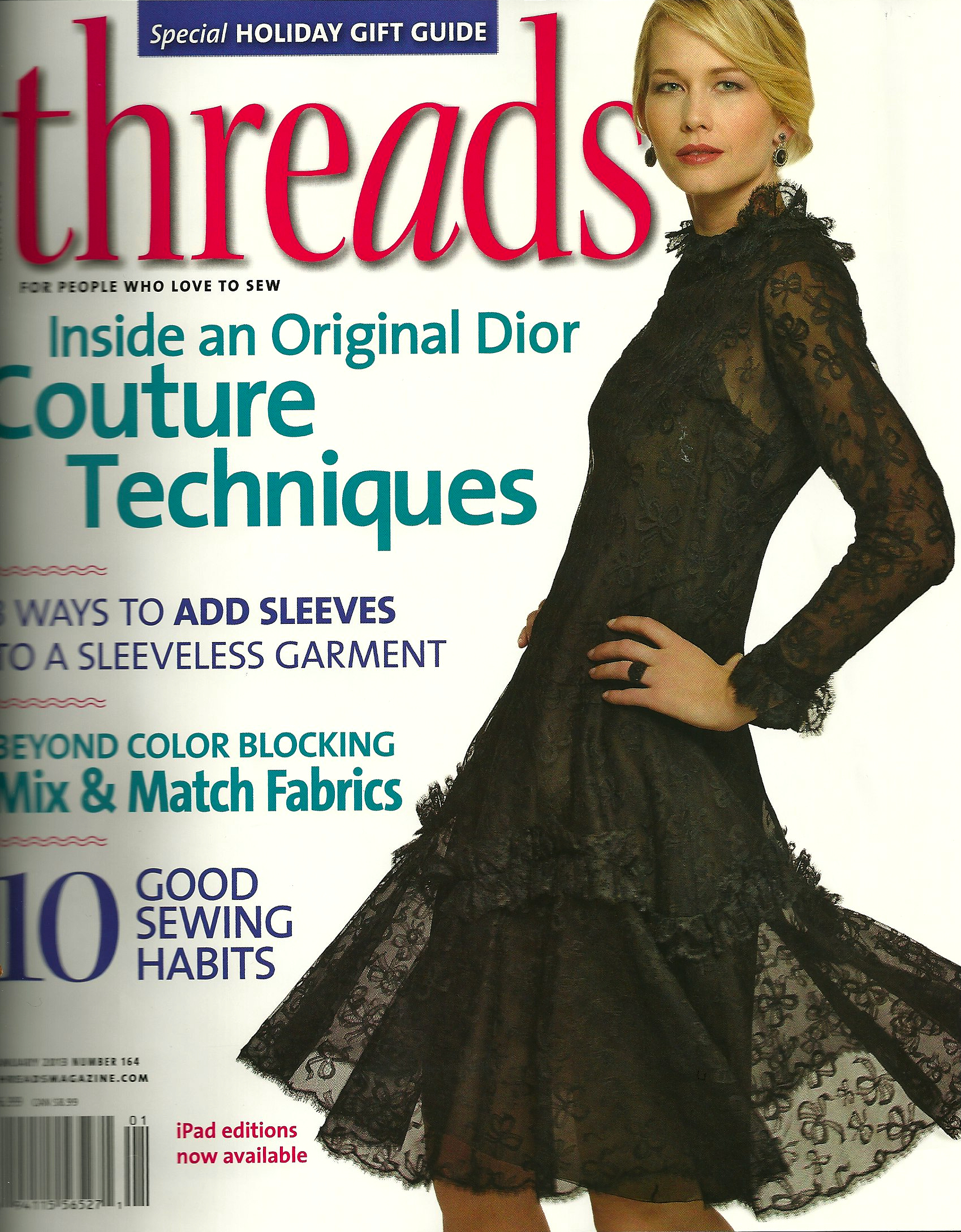
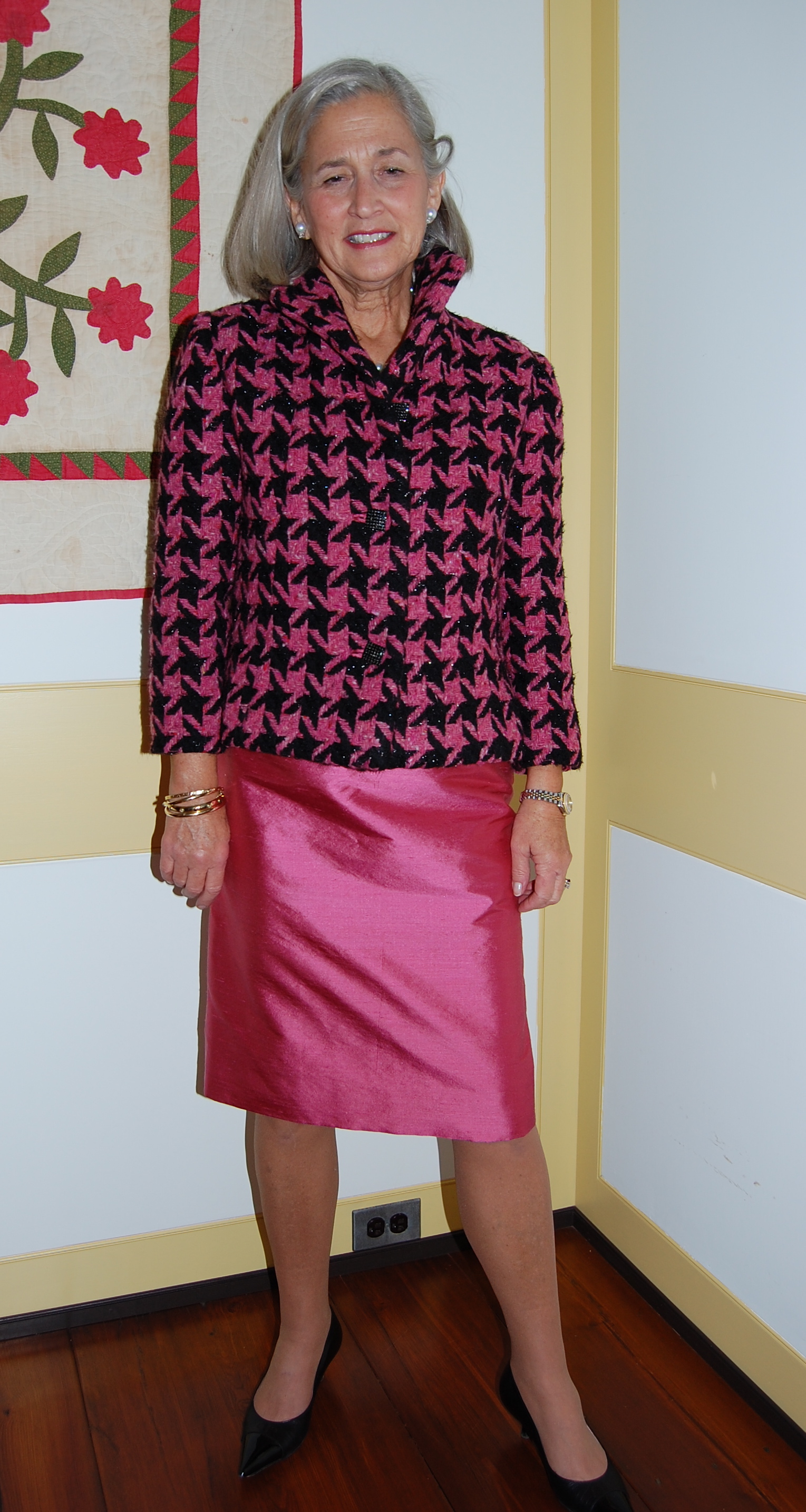
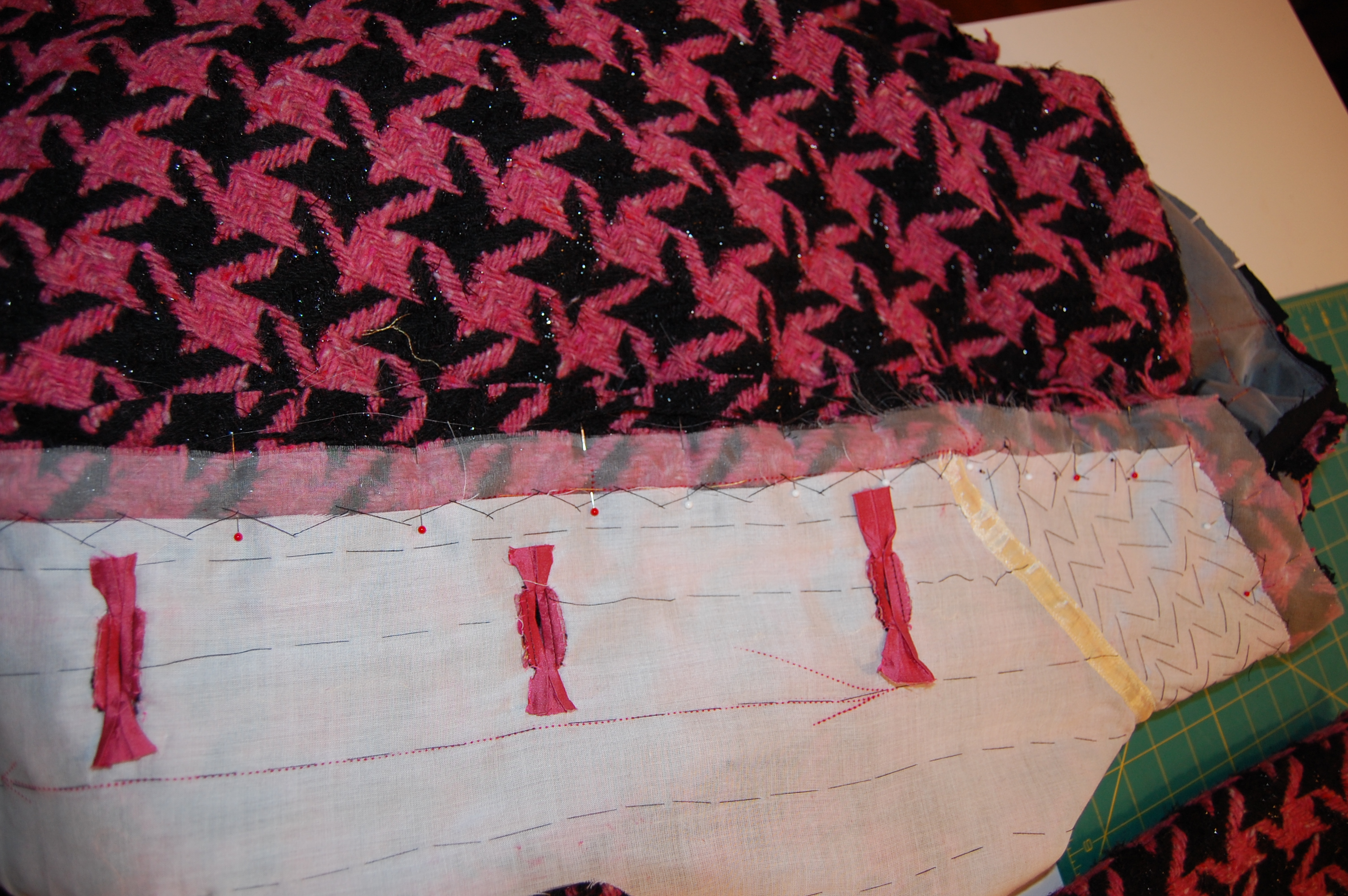
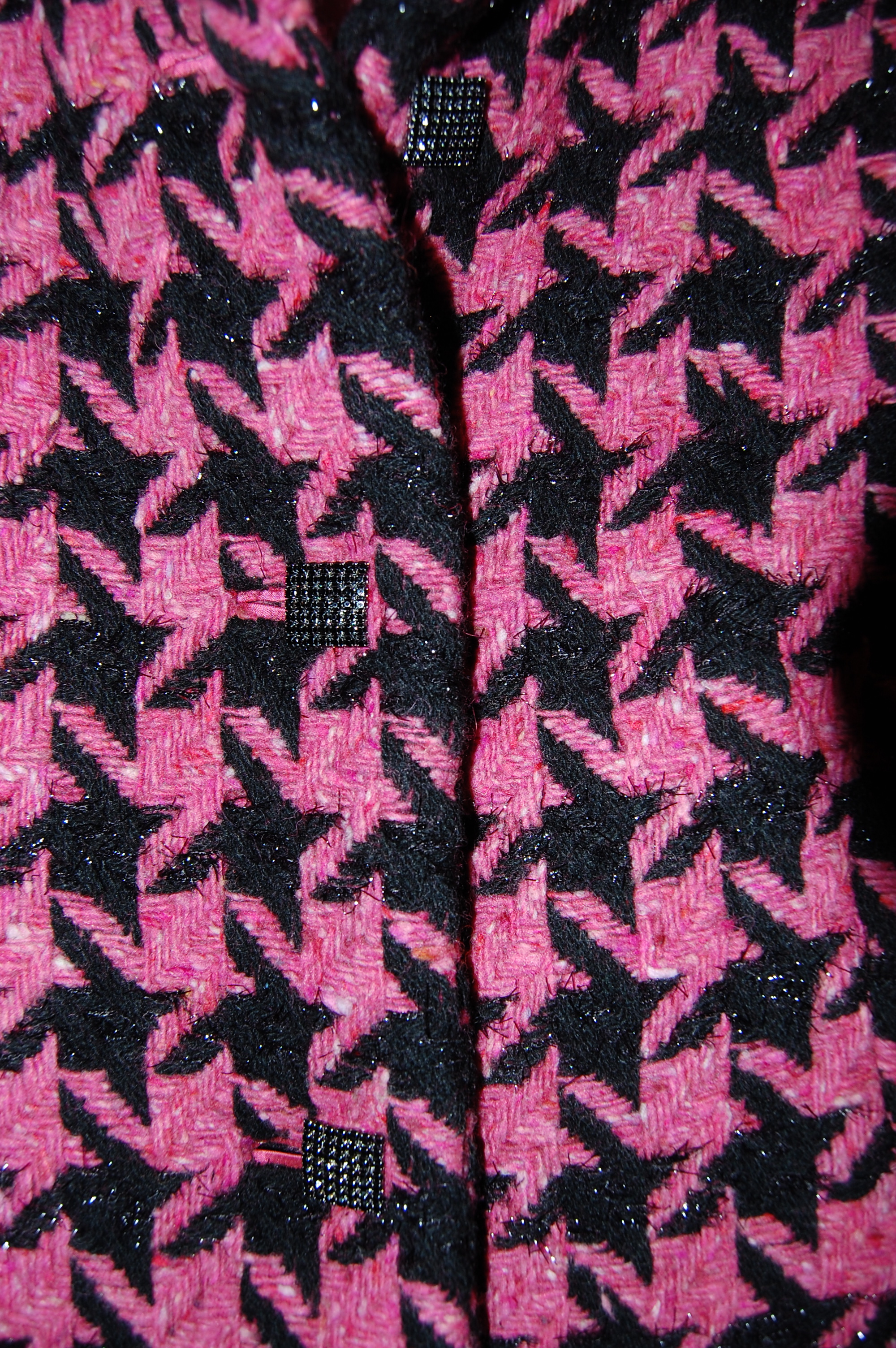
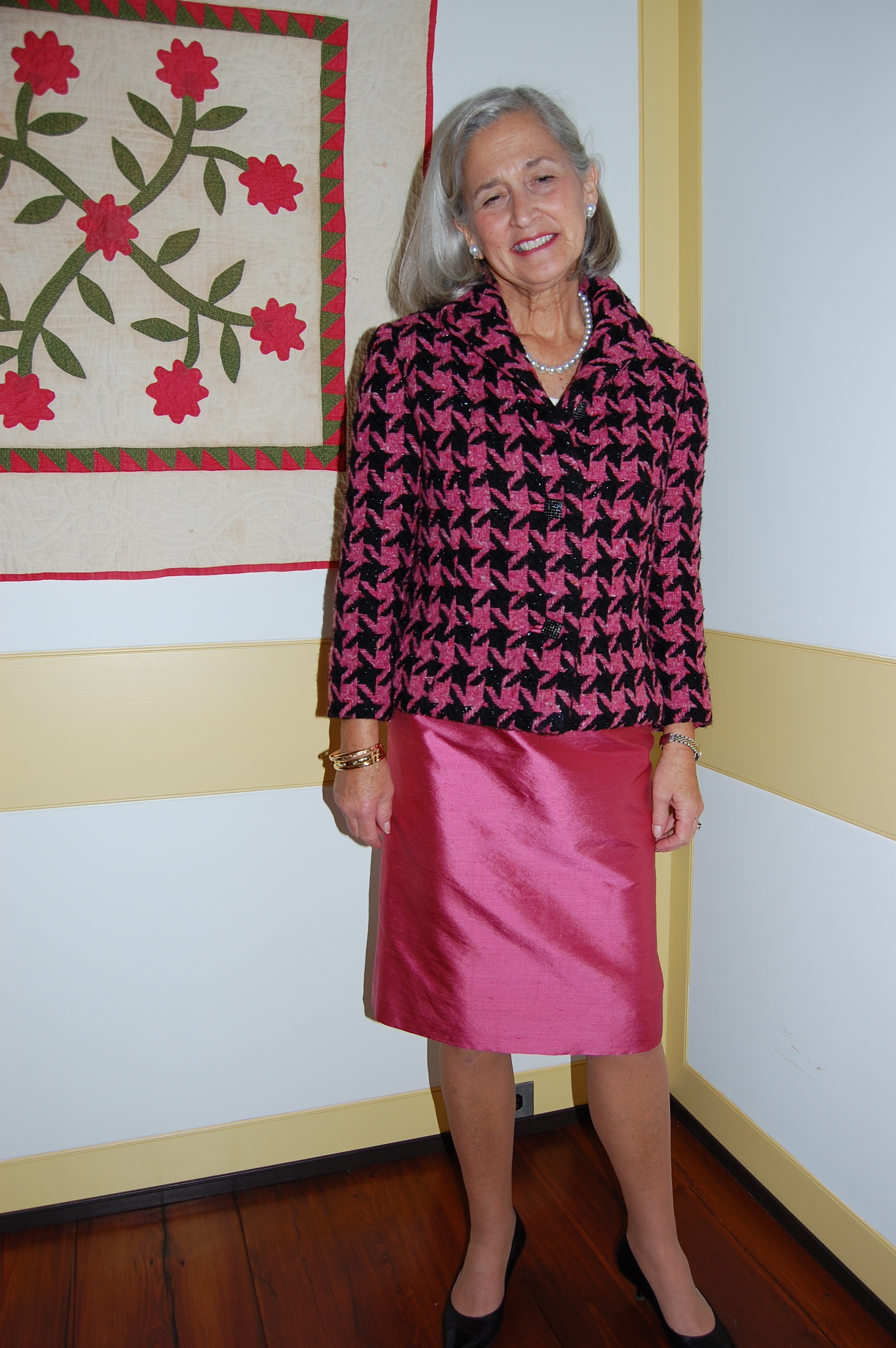
Last week, as I was putting in some final hours on a suit I have been sewing, I was  thinking about some of the “creative” solutions I had to come up with to make the jacket turn out successfully.  I had, unbeknownst to me, made a “bad” decision about the fabric. Even though I (still) love the color and design of the black and pink hounds-tooth wool blend, it turned out to be a very heavy, bulky fabric to sew.  Well, my newest Threads magazine arrived in the mail last Friday – and right there on page 56 is an article entitled “Better Sewing Habits”.  Number 4, by Claire Shaeffer, is:  Choose fabrics appropriate to the garment design.  Printed in bold is this line:  “Select a fabric that is recommended for the pattern”. 

This issue of Threads is packed with all kinds of great advice and ideas!

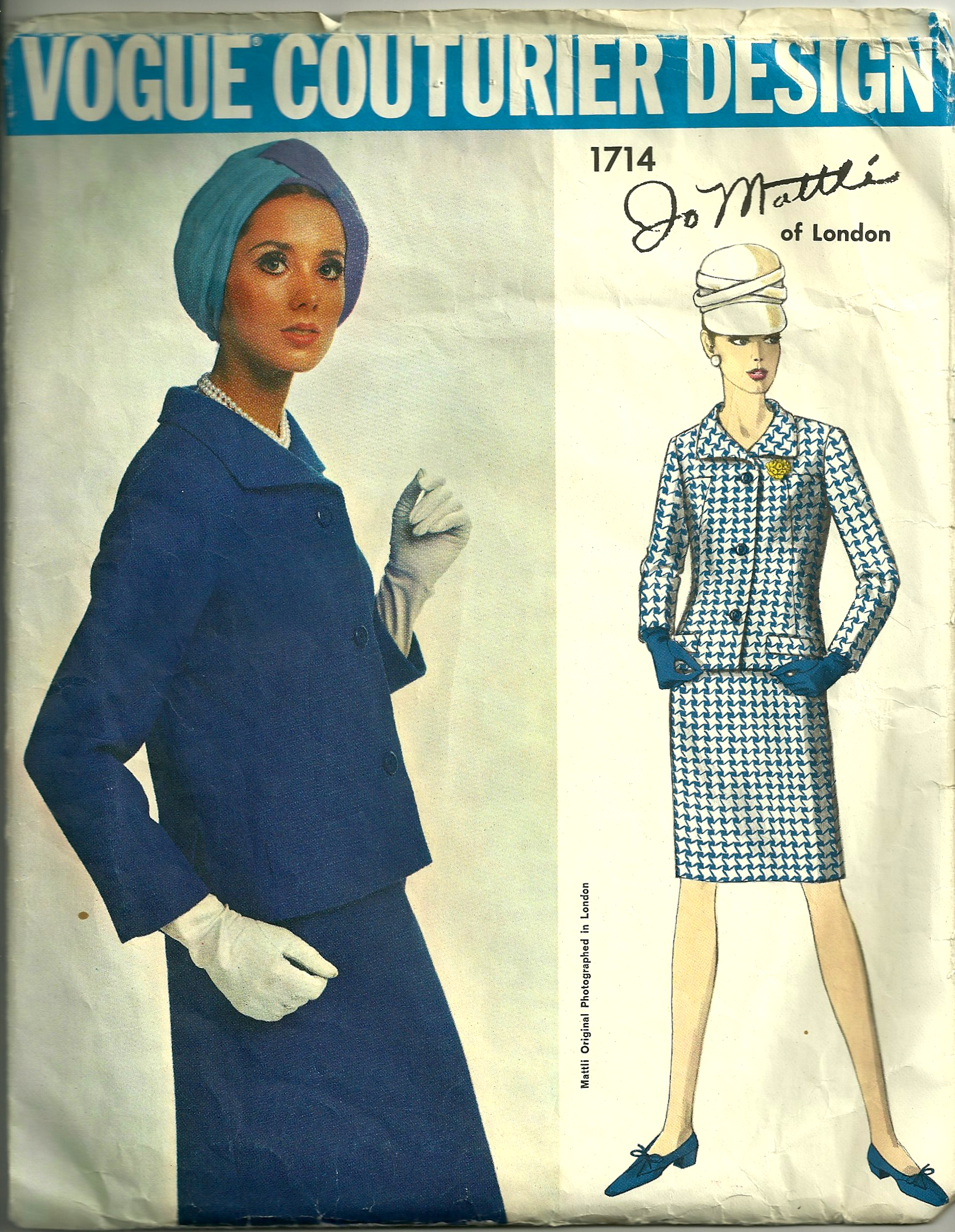
Sure enough, when I went back to the pattern envelope, there in plain English for the recommended fabrics is:  “Lightweight wool.”  I really felt that sinking feeling, but I tried to console myself by reminding myself that I had made some changes to the pattern and to the construction to accommodate the heavy fabric.  I was trying to feel grateful that I actually have some skills which allow me to make changes and try different approaches to solve sewing problems.  And, actually, now that the jacket is finished, I am happy with it.

This is the pattern I used – from Vogue’s Designer series, Jo Mattli, circa early 1970s.

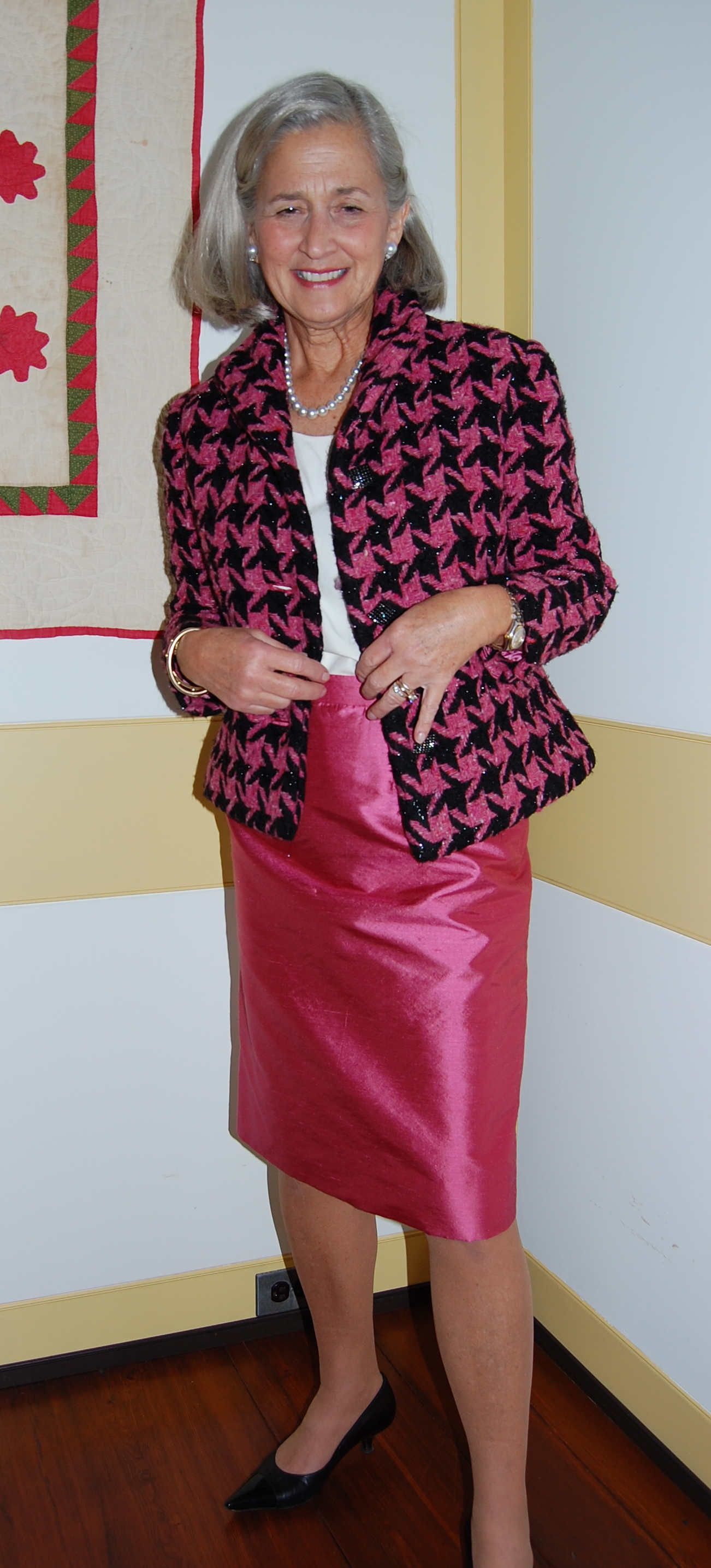
The completed outfit – wool blend jacket and silk skirt.

Here is what went well:

1) I was able to match the design quite well across seam lines, shoulders, and sleeves.

2) I think I nailed the fit!  Of course, I made a muslin first, so it’s not like that just happened.

3) I reduced the spread of the collar, which actually turned out to be a good decision, when I realized how difficult double layers of the fabric were to work with.

Here is what either did not go well or needed to be “creatively” approached:

1) I really wanted to make bound buttonholes, but the loosely woven, heavy fabric gave me pause.  So I decided to make them out of the silk skirt fabric.  I backed the buttonhole strips with silk organza by fusing them together.  This made the silk stiff enough to stand up to that heavy wool.

The strips attached for the bound buttonholes.

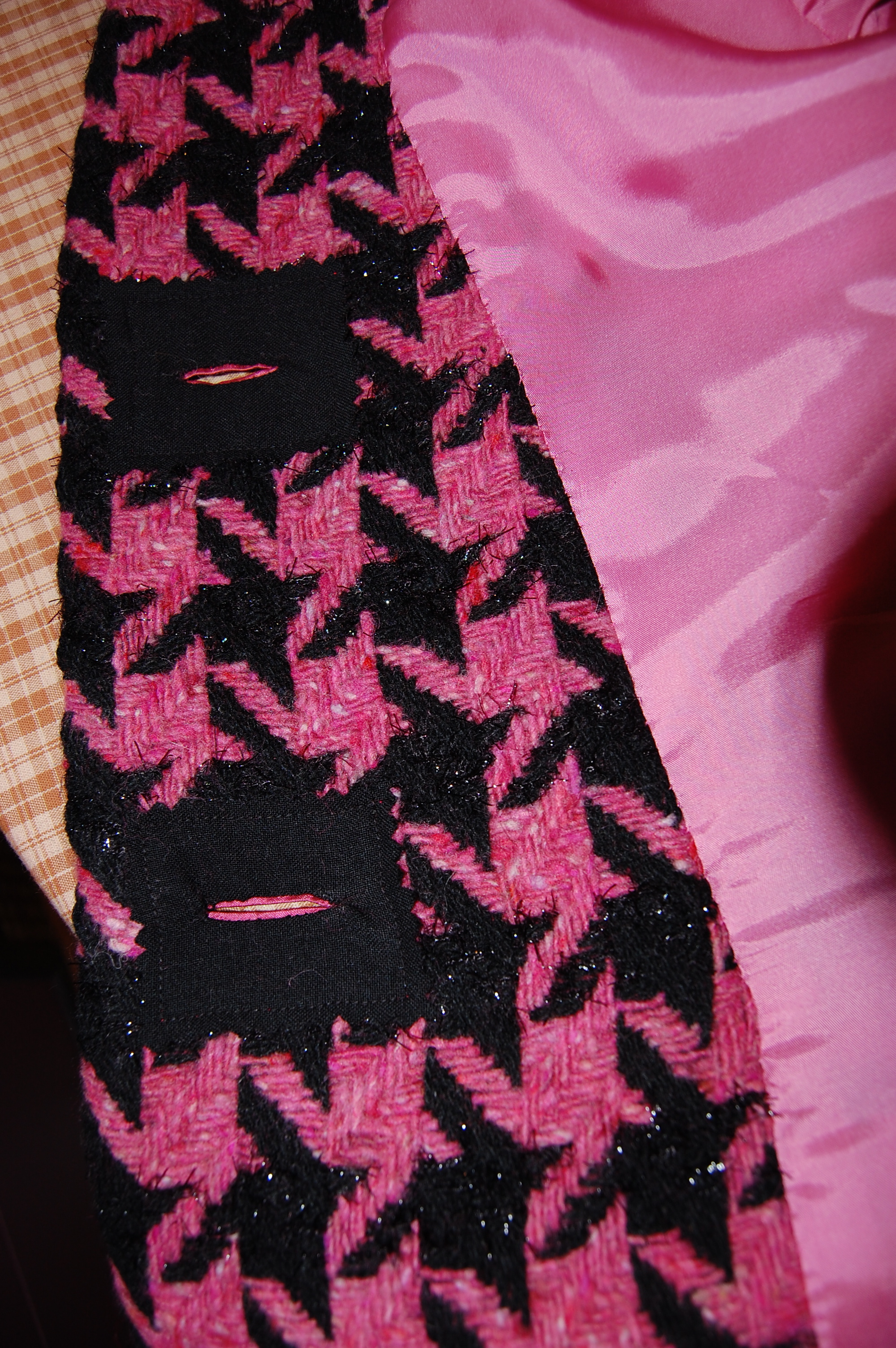
I made the topmost  buttonhole a “blind” one as I determined that I would not be buttoning that top button anyway.  I knew I could never finish the back of the two remaining buttonholes by the normal method, so I “patched” behind them on the interfacing with a lightweight black wool.

Here is a close-up of the bound buttonholes – and the happily matched front!  Click on the photo for a closer-up view.

Before I sewed the front facing, I attached these “patches” to back up to the buttonholes. Then I cut away the heavy fabric underneath, so that I could finish the underneath of the buttonholes somewhat successfully. Click on the photo to see this up close.

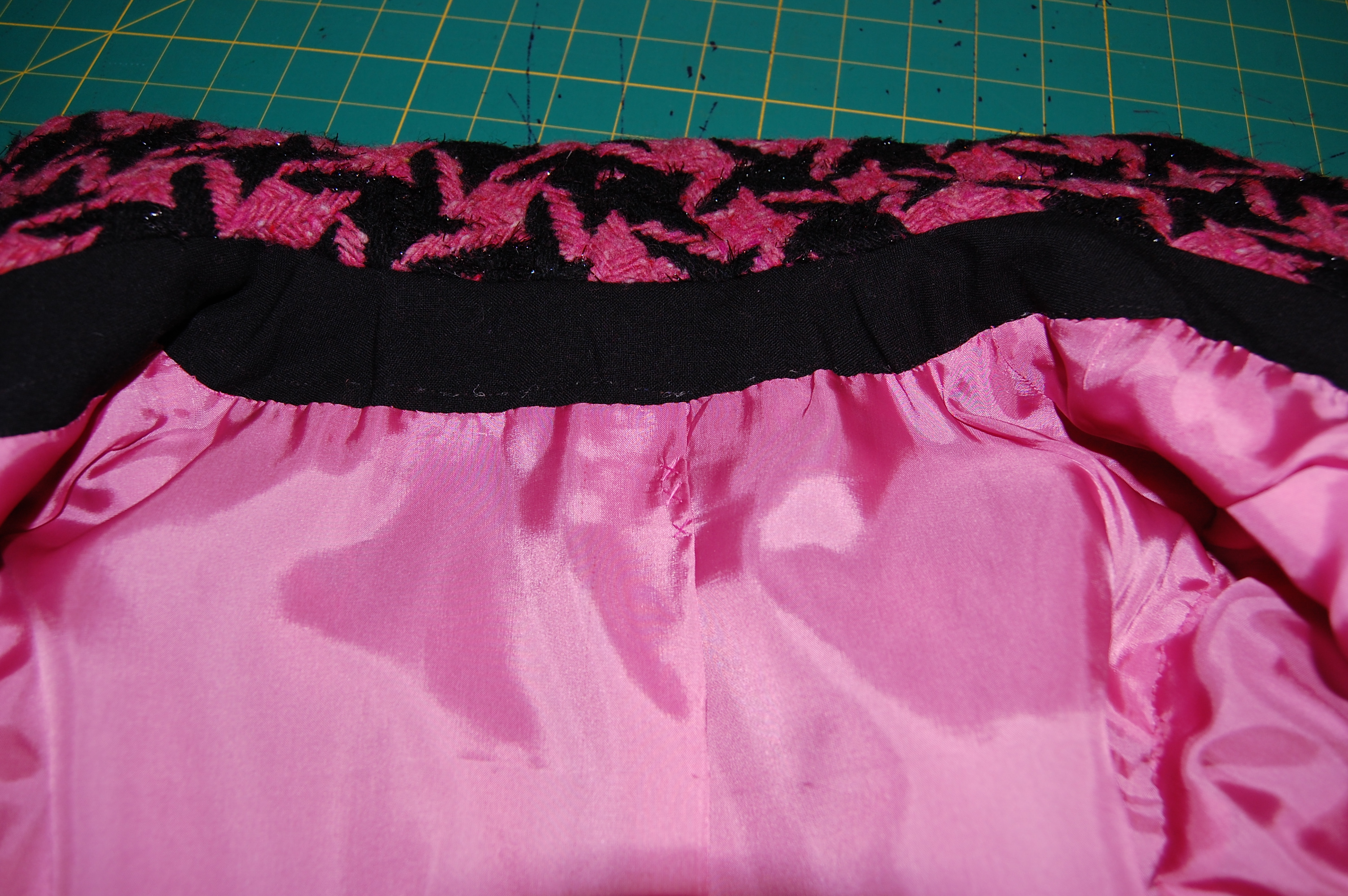
2) The neck facing was going to be too heavy using the pink/black wool.  So I used that same lightweight black wool for it instead.

Using a lightweight black wool for the facing made the neckline much more manageable.

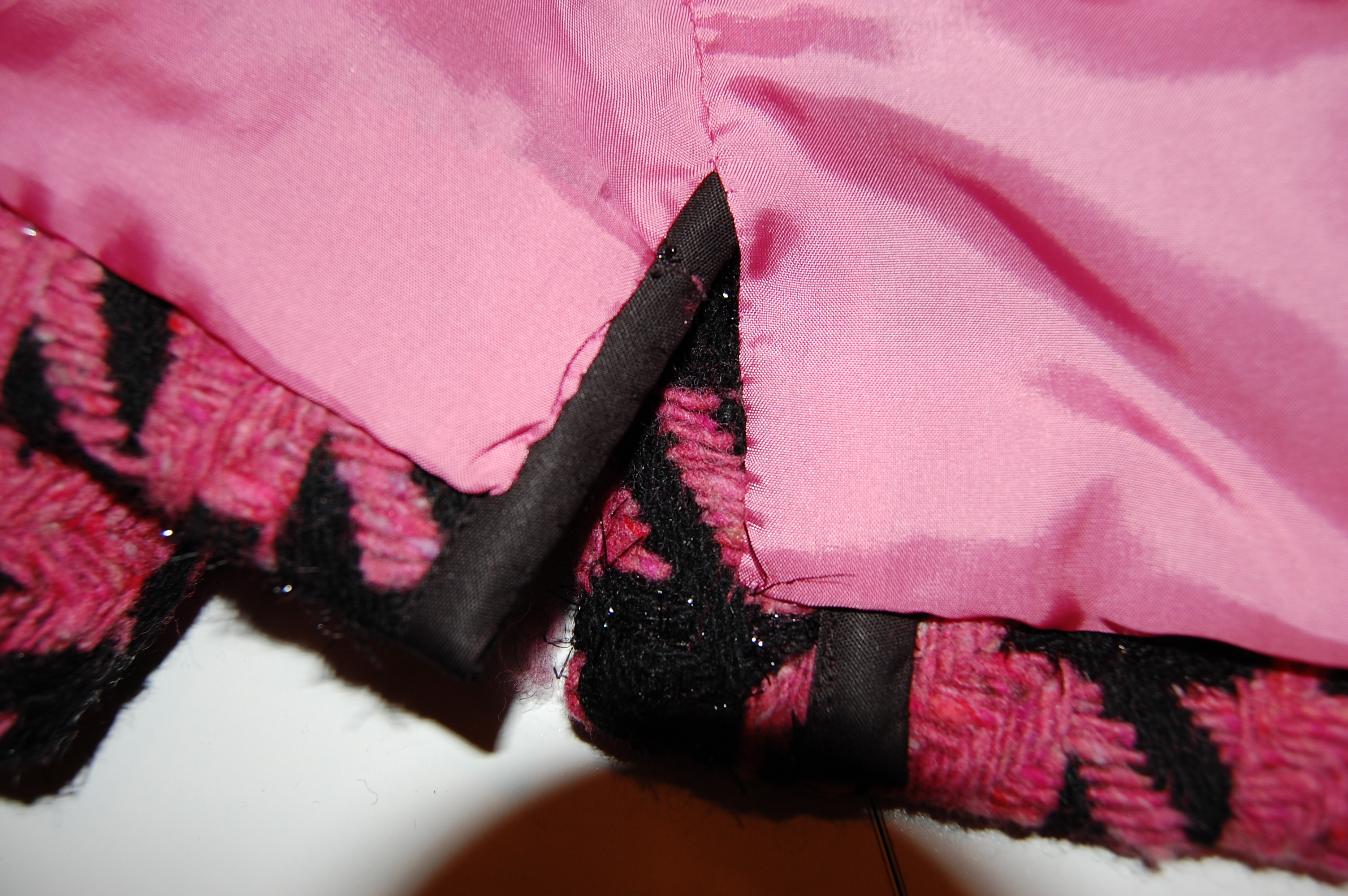
3) The back vents were not going to lay flat if I turned in the raw edges as the pattern instructions indicated.  So I bound them with black bias tape instead.

Instead of turning back the facing edge to finish it, I attached this bias binding.

4) Setting in the sleeves was an exercise in sewing terror!  I was sure they would never look good, but somehow they came out unpuckered and pretty well matched.  I only used a sleeve heading to round out the shoulder, even though the pattern called for shoulder pads.

5) I have steamed and steamed, but still feel like the front edge could use some further attention.  I might take the jacket to the dry cleaners and have it professionally steamed….

I actually really liked the engineering of the pattern: with the correct weight fabric, the jacket would go together quite well and the skirt pattern is a winner, with its shaped waistband.

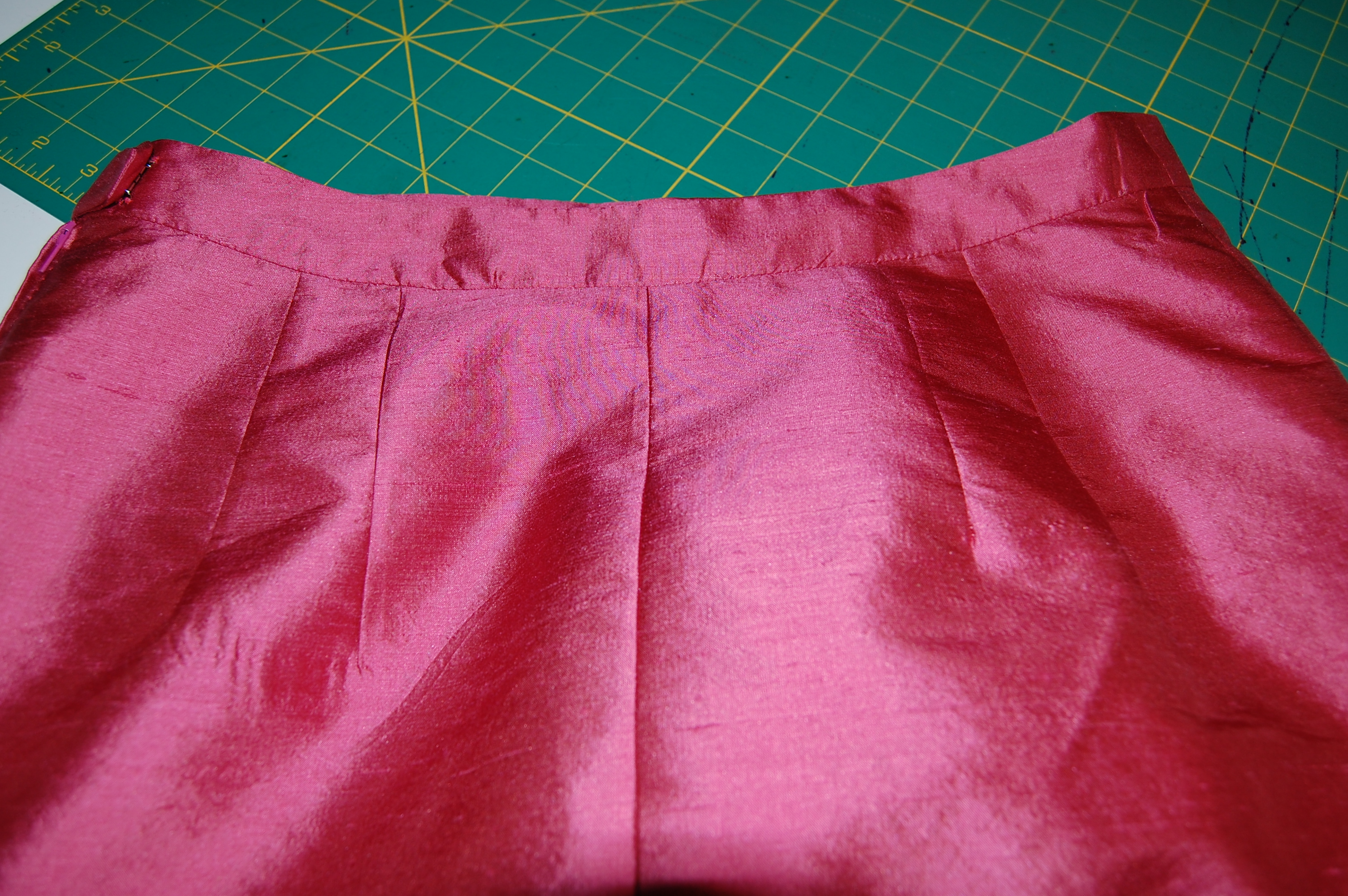
This view of the back waistband shows how it is shaped.

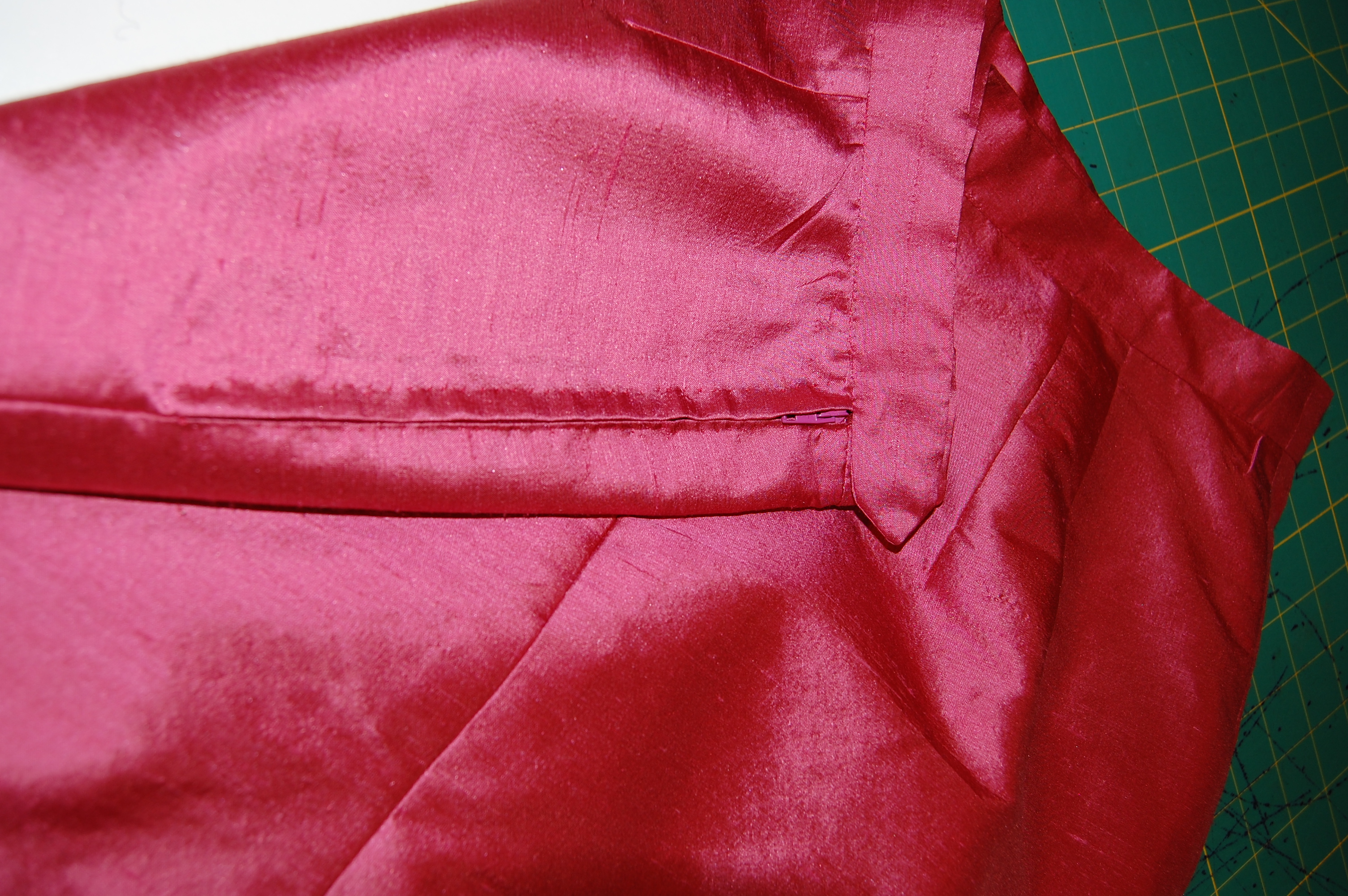
And, of course, I inserted the zipper by hand.

Another look at the finished suit.

And one more…

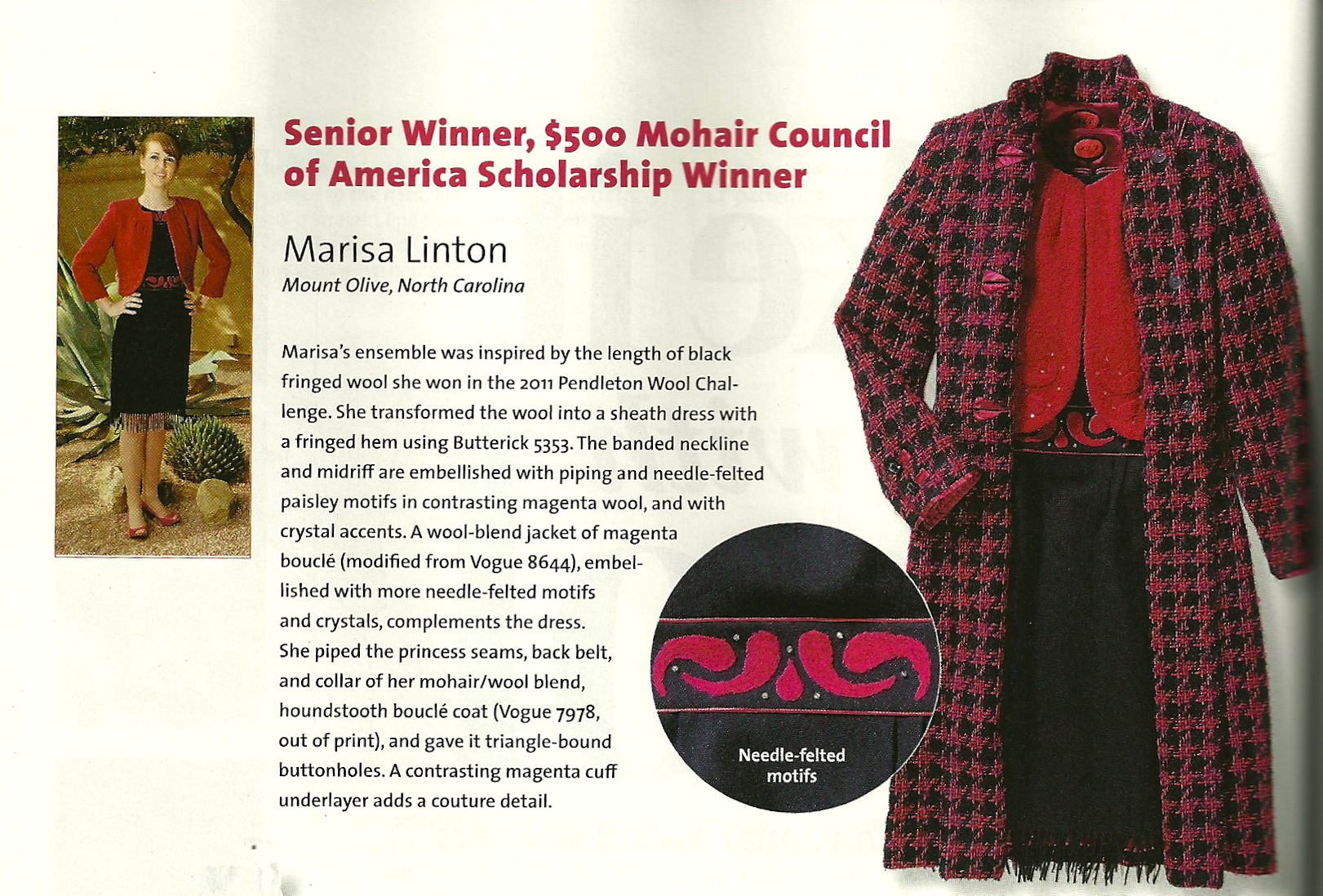
Interestingly enough, in the same issue of Threads, the winners of the “Make it with Wool” contest were featured.  I couldn’t believe my eyes when I saw that the Senior Winner of the Mohair Council of America, Marisa Linton, of Mount Olive, North Carolina, had used either the same fabric or one very close to “my” fabric to make the coat for her entry (which is stunning, I might add!).  She had used a very original and successful technique for her buttonholes, which are part of the details which make her outfit so noteworthy.

Do you think this is the same fabric? (Threads, January 2013, page 52)

So – it seems the past 7 days have been a time of many arrivals, including a huge and destructive East Coast storm – and the first day of November.    May the next 7 days bring the final arrival of power and comfort to so many who lost so much in the storm, and make us all grateful for resilience, whether it be in life – or in sewing .

13 Comments

Filed under bound buttonholes, hand-sewn zippers, sewing in silk, Shoulder shapes (shoulder pads), Uncategorized, vintage Vogue Designer patterns, vintage Vogue patterns from the 1970s, woolens

Spending time on the Cape.

Doesn’t this sound like a wonderful vacation?  Picture billowy clouds reminiscent of  silk organza, gently undulating waves of turquoise hue, windswept flowers lining the landscape. . .   So where would one find this perfect setting?  I hope you’re not disappointed to learn that it all happened in my sewing room.  Yes, that’s correct – it has been wonderful, but this cape is the wearable kind, and I have definitely spent time on it!

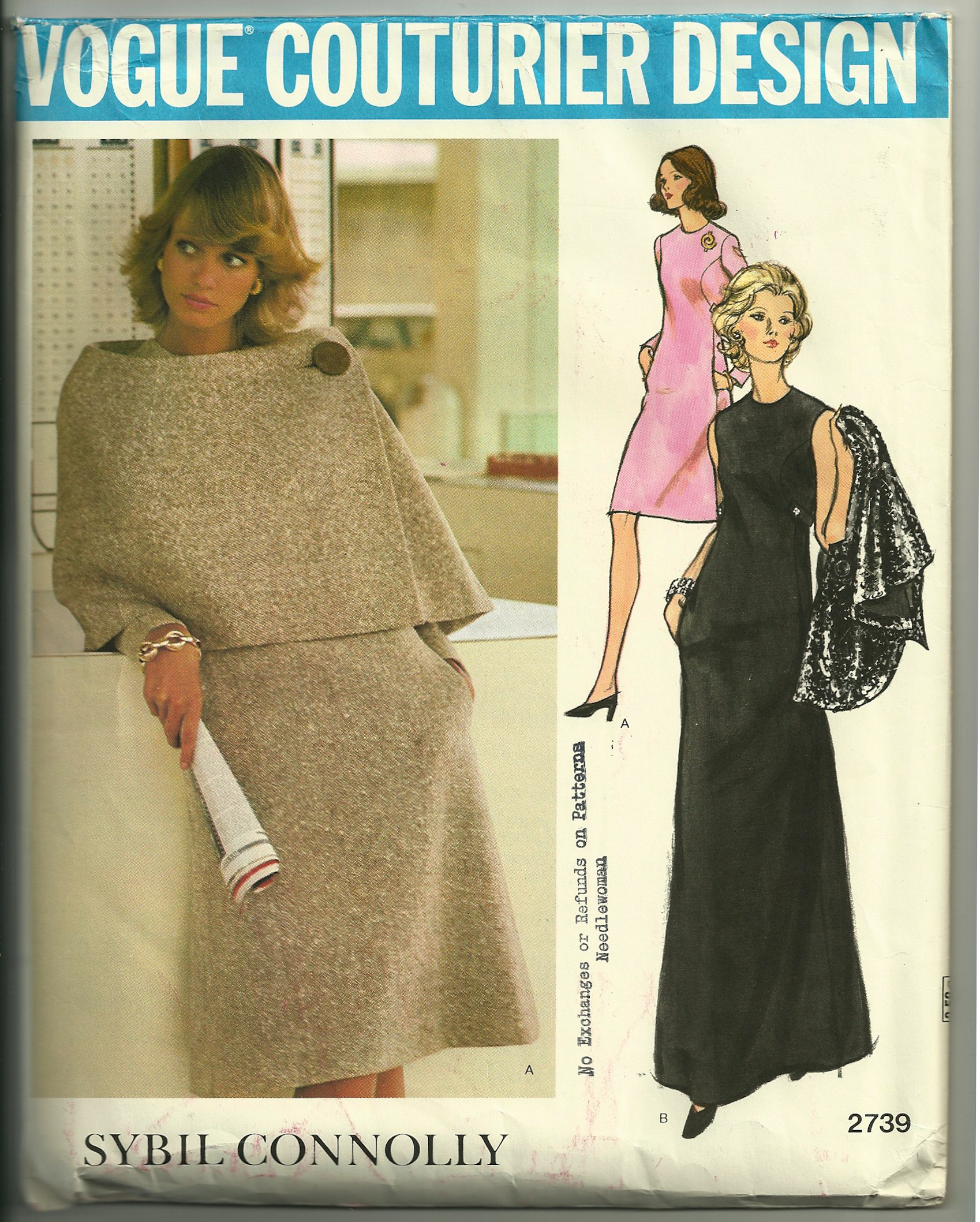
The fabric in which I made my Couture dress was a length of linen I picked up last April.  When I found it, I did not yet have a pattern in mind for it so I thought I’d purchase enough (3 yards) to cover just about anything, and at 58” wide, I had a nice amount left over from my dress.  It just so happens that earlier in the Summer, I had found this pattern and added it to my collection:

Capes were in fashion in the 1970s and are again today!

I remembered this pattern from the 1970s and always liked the short cape, with its asymmetrical opening and clever folds of fabric resulting from that detail.

As I was working on my dress, I started to think about what else I could make from this lovely linen.  I didn’t particularly want to make a jacket, as I envisioned the dress as the focal point, but I did think it would be nice to have some kind of matching “wrap” for cool evenings. Well, the rest is quite obvious – I decided to make a short cape to go with my dress.

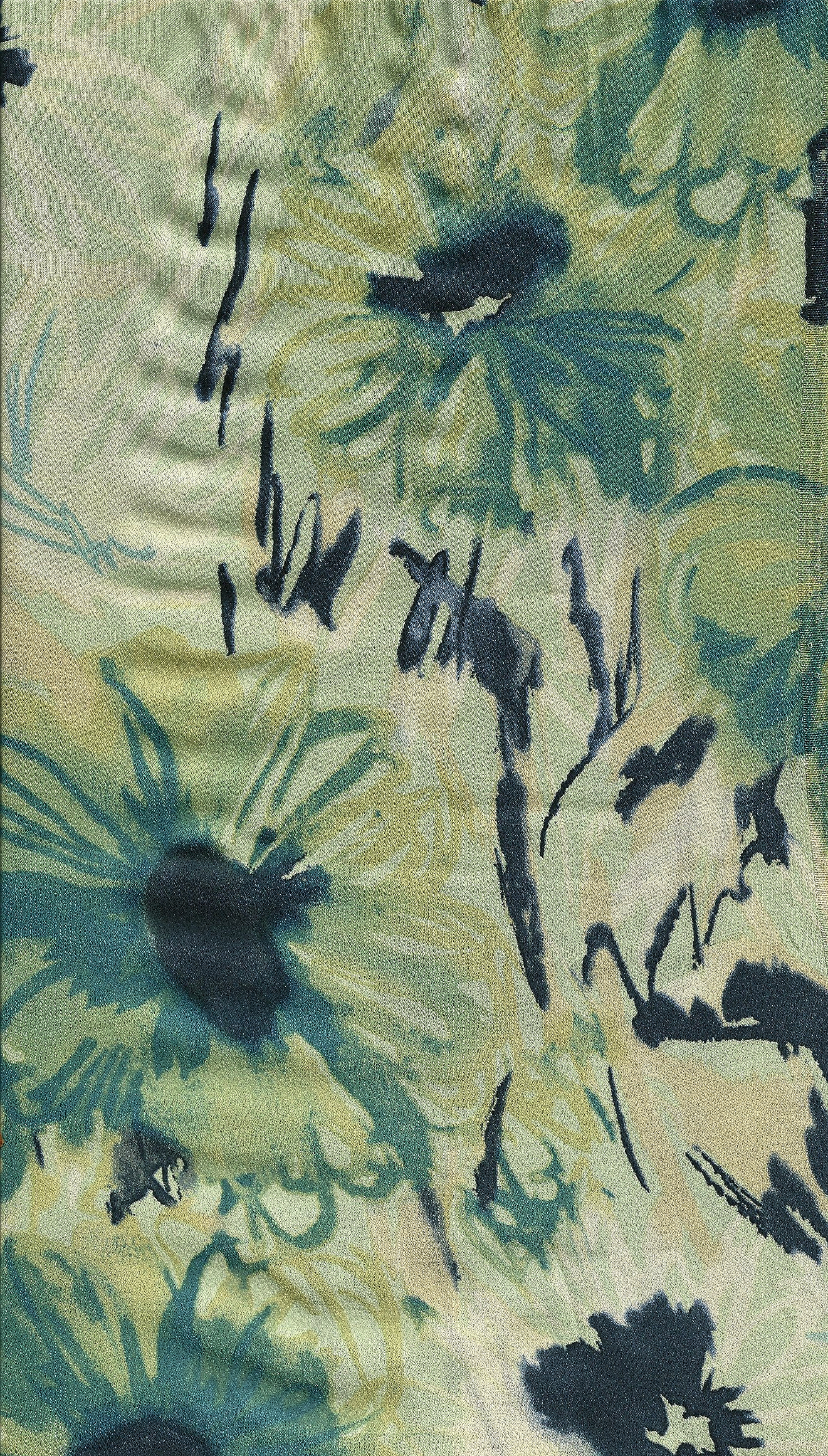
First I needed to find a silk lining fabric, which would compliment the linen.  I wanted a print of some sort to add some interest to the finished look.  I think I looked at every printed silk available on the internet!  I found lots of gorgeous designs, but only one which presented the possibility of both coordinating with the teal blue linen and introducing some other colors as well.  My old friend Britex Fabrics not only had this fabric, but  also had a vintage button among their extensive offerings, which looked like a good candidate for my needs.  I sent off for the button and swatch, and did indeed then order the silk charmeuse.

I like the abstract quality to this print.

Armed with my new-found couture techniques, I made a muslin pattern which helped me get the perfect fit over the shoulders (which is pretty much what a cape is all about).  I underlined the cape in that oh-so-wonderful silk organza, and added  interfacing, where required, of the same.  Some of this was a judgment call, as I determined were I could use couture features and where I had to follow the tailored construction of the cape.

This shows the silk organza underlining, and the side seam, catch-stitched to it.

One of the hem techniques I learned in The Couture Dress class was helpful with this hem.

Call me crazy, but I just love to make bound buttonholes.  Although the pattern called for a 2-inch button, the one I found was 1½ inches (and I thought it a more refined size anyway).  That still calls for a large buttonhole!  I practiced first, then got to work on the real thing.

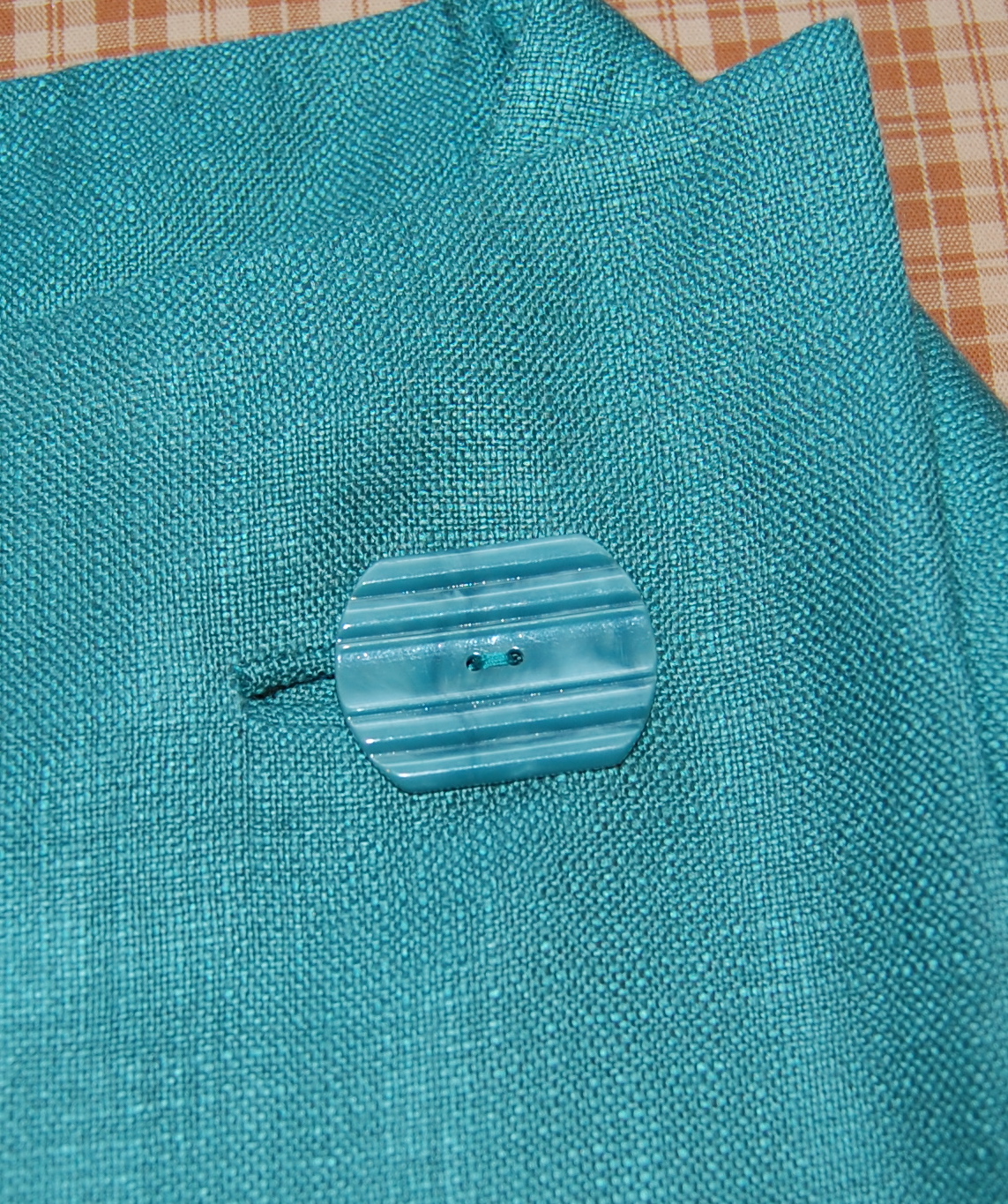
The finished bound buttonhole

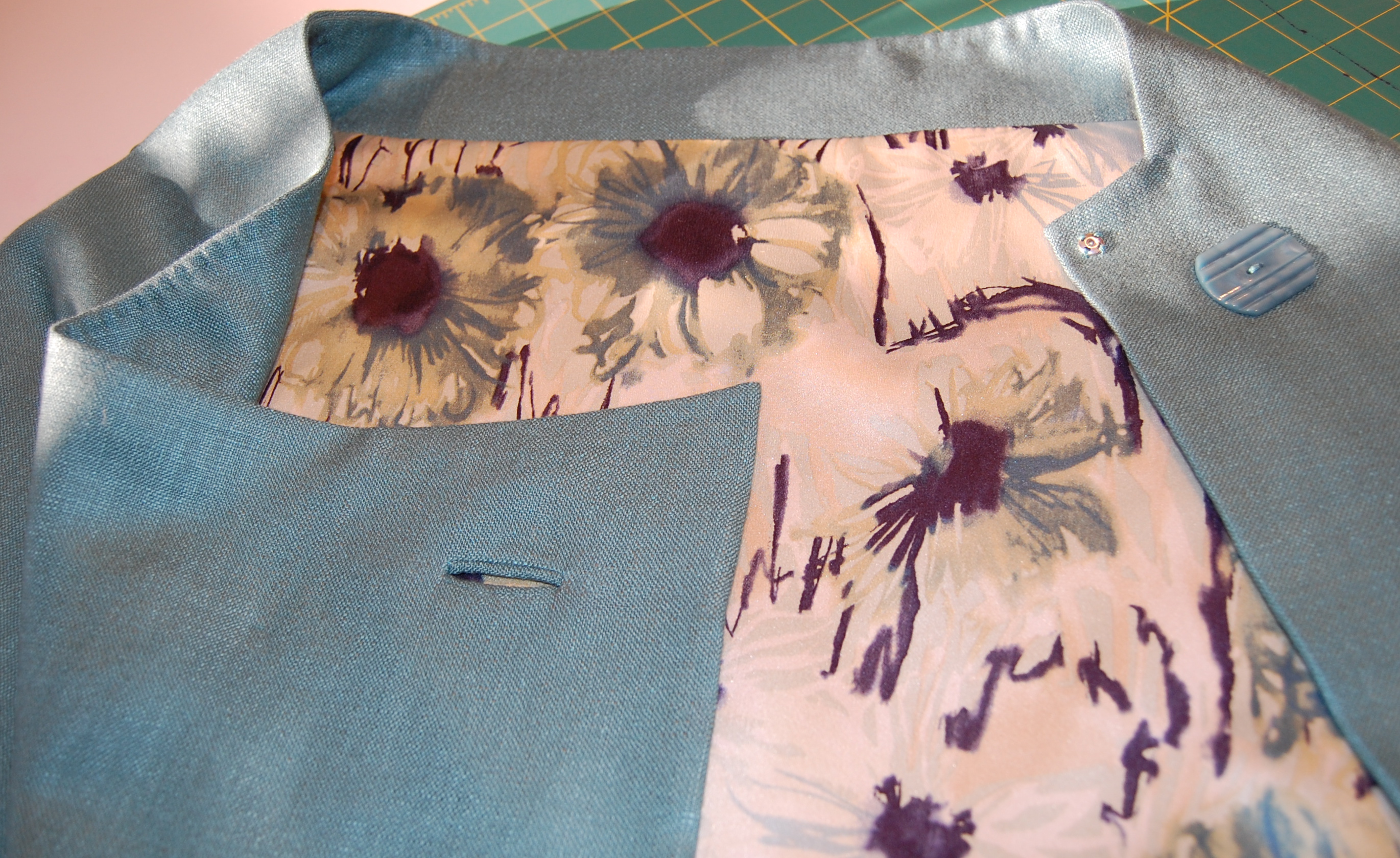
And the finished underside of the buttonhole.

And the button…

I understitched the facings by hand with that beautiful prick stitch, and attached the lining with the fell stitch.

A peak inside the cape.

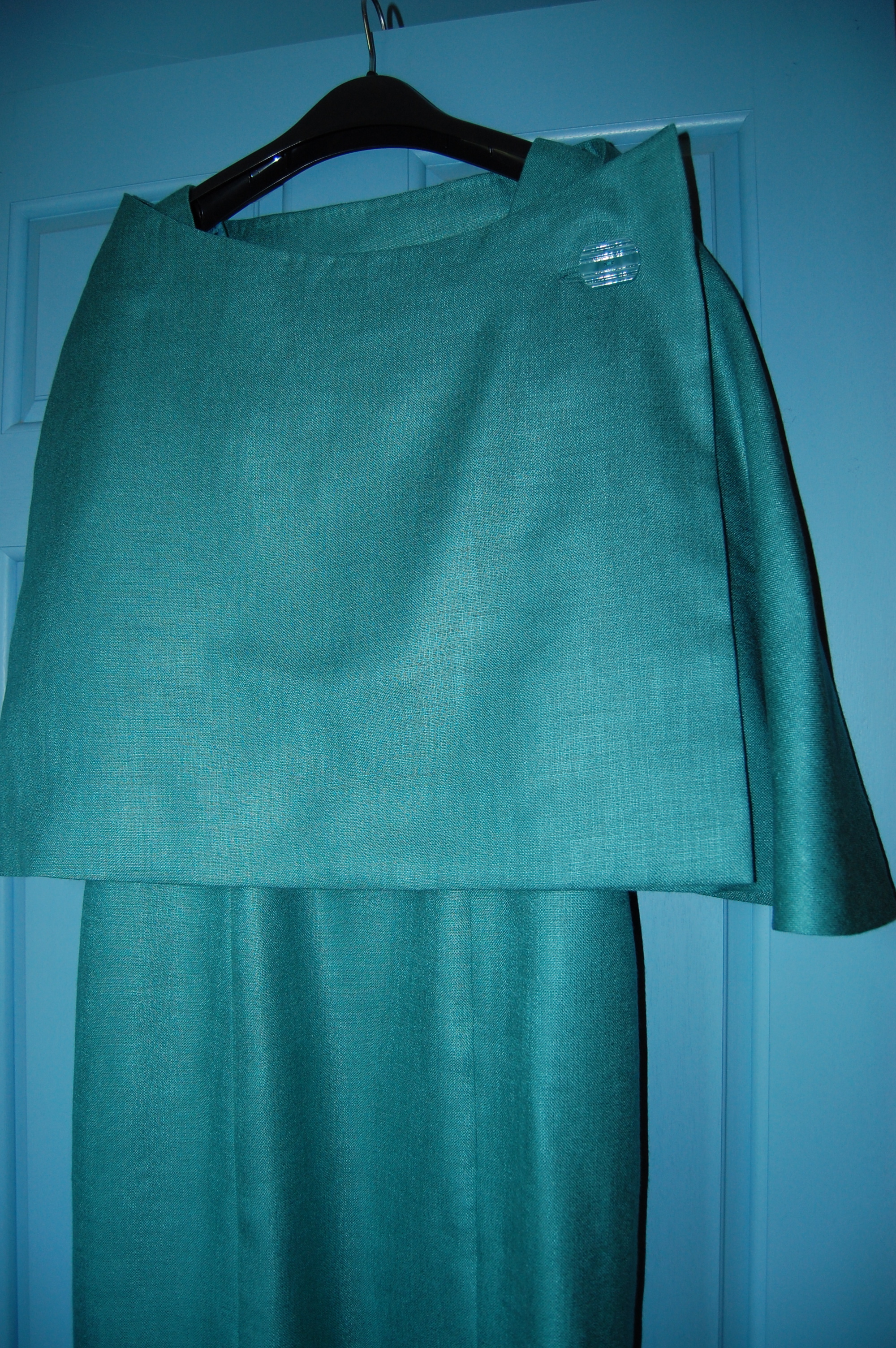
Here is the finished look (unfortunately on a hanger and not on me…).

Here is the cape shown over my Couture dress

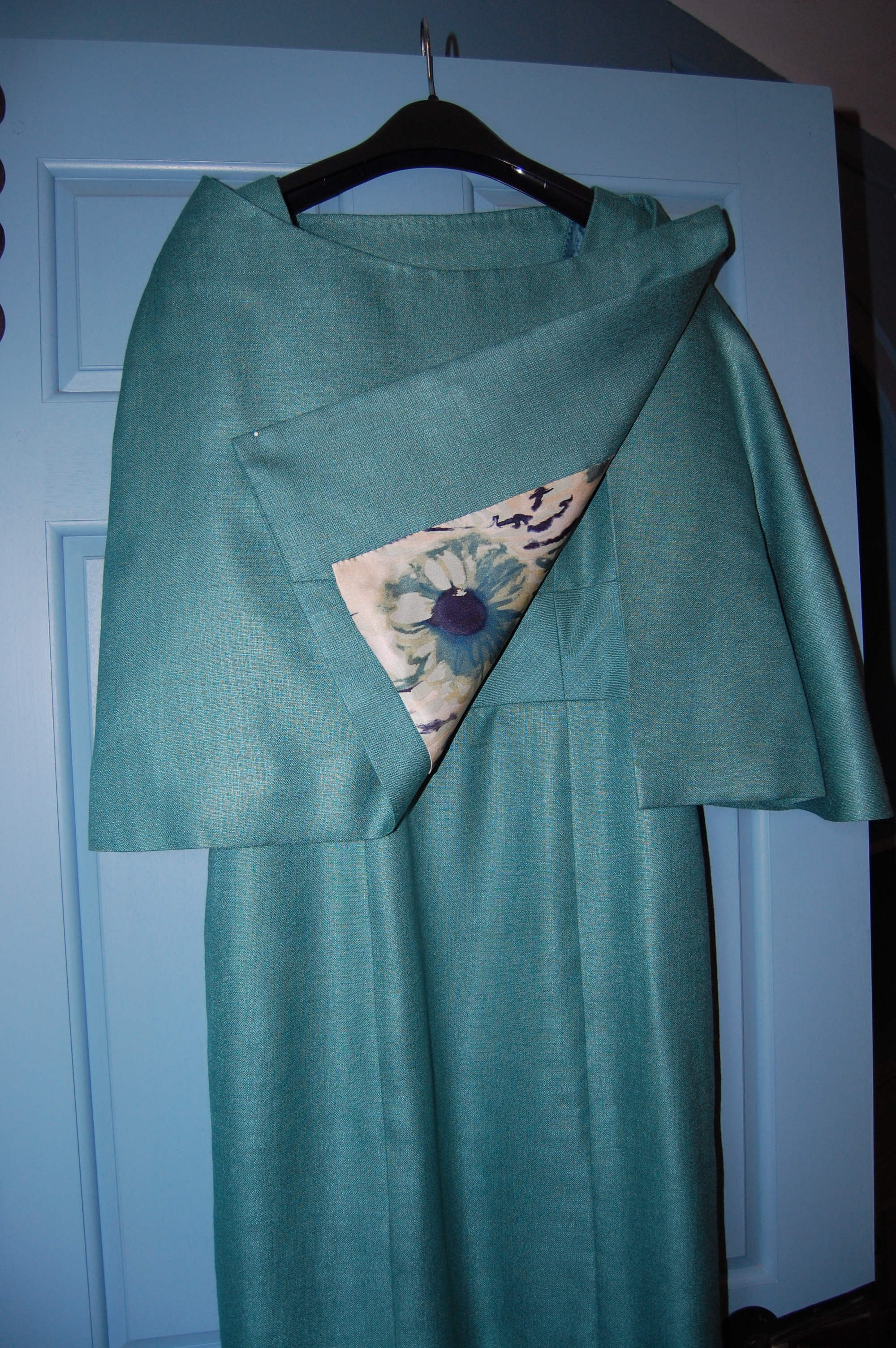
With one corner pinned up to show the lining.

This view shows the lovely draping formed by the asymmetrical opening.

And one more view.

Well, my time on the Cape officially draws my summer sewing to a close.  Now it’s going to be all wools or wool blends and maybe some silks – and I can’t wait!  Let’s throw an extra blanket on the bed and dream of cool nights and crisp days filled with creative hours of sewing. . .

10 Comments

Filed under bound buttonholes, Buttons - choosing the right ones, Capes, couture construction, Linen, sewing in silk, Uncategorized, vintage buttons, vintage Vogue Designer patterns, vintage Vogue patterns from the 1970s