And – what do you know about them? One of the more venerable sewing contests is the annual Make It With Wool. Founded in 1947, it is still going strong and features winners in various categories/age groups. Prizes for winners and runners’-up include scholarships, sewing machines and fabrics, and of course, national recognition in the field. Pattern Review sponsors several sewing competitions throughout each year, in addition to a “sewing bee.” Its followers are legion at this point, and it is always a coup to be a winner, selected by readers’ votes.
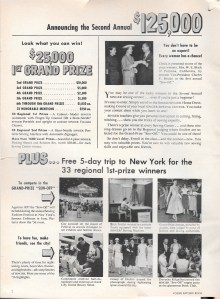
But what would you say if I told you that in 1956 the Singer Sewing Machine Company introduced a national sewing contest with prize money totaling $125,000? The 1st Grand Prize carried the unbelievable reward of $25,000. In current 2020 American dollars, that is almost $240,000! Not only that, the 33 regional first prize winners also received a free trip to New York. Take a look at the following two-page ad which appeared in the February/March 1957 Vogue Pattern Book Magazine, announcing the second year of the competition.
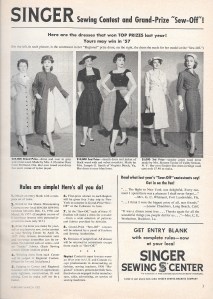
Vogue Pattern Book Magazine of August/September 1957 included this page “as we go to press…”
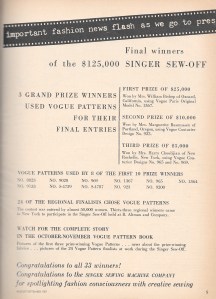
Vogue Pattern Company was rightly proud of their representation in this contest and in others.
And then here is the feature article on those winners in the following issue (October/November, 1957):
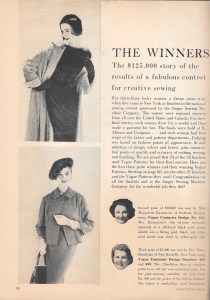
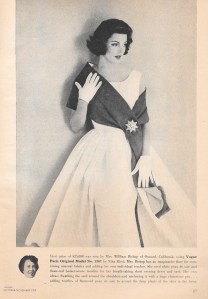
Judging was based on “fashion points of appearance, fit and selection of design, colour and fabric, plus construction points of quality and accuracy of cutting, sewing and finishing.” Isn’t this what most of us strive to attain in our own sewing?
By the next year, 1958, the contest included a new category, called the Young Homemaker Division, for young women between the ages of 18 – 25. $9,000 of prize money was awarded to the top four winners. What beautiful dresses and ensembles they created!
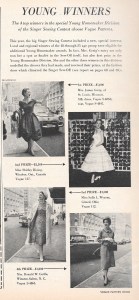
I suspect these young women continued to sew throughout their lives.
Also that year, the General Federation of Women’s Clubs sponsored their own sewing contest. The theme of the contest was “the ideal costume for a clubwoman’s wardrobe.” Points of consideration in the judging were: “fashion-rightness,” “versatility and appropriateness for club occasions,” “becomingness to the wearer,” “over-all fashion effect,” and “workmanship.” 24 of the state finalists submitted entries consisting of a dress with its own jacket or coat. That is still to this day a winning combination, classic and chic.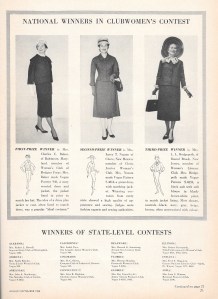
The prize money was certainly less impressive in this contest, at $250, $150 and $100 for the first-, second-, and third-place winners, but imagine the prestige of winning for “your” club, at a time when there were 1,485 clubs represented in the contest!
By 1963, Singer Sewing Company had started the Young Stylemaker Contest for girls aged 10 – 21. The caption on the following article tells it all: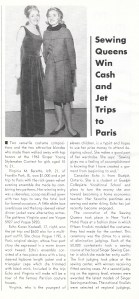
Included in the trip to Paris for the two winners was a tour of the famous Parisian couture houses. Can you imagine having such an opportunity at that point in your life?
This contest had expanded its scope by 1965, ferrying fifteen finalists to Rome via a chartered jet for a 5-day stay before the final judging of the Stylemaker Contest. Notes by the contestants included the charming observation “how very chic the Italian women are.”
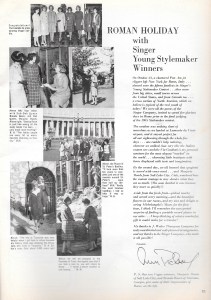
By 1969, this contest had drawn more than 93,000 participants! As part of their prize, the three winners each were given an all-expense paid, one-week trip for two to London, Paris or Rome. The purpose of the Stylemaker Contest was to “encourage young and creative talents in Fashion sewing.”
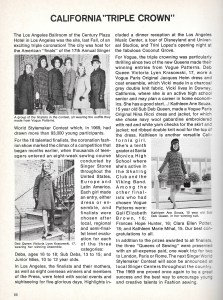
By 1971, it appears that changes were in the air for the Stylemaker Contest. Whittled down to two winning divisions, only the overall winner received a trip to London, Paris or Rome for two, although both final winners also received cash prizes of $800 and $600 respectively. The “heyday” period of home fashion sewing was sadly beginning to draw to a close.
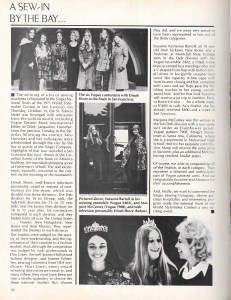
Needless to say, fashion sewing contests no longer command such notable and generous prize money or trips. Those were heady times in the 1950s, ‘60s, and ‘70s, likely never to be experienced again. However, I would like to think a new sewing heyday is upon us – or perhaps we are it. What place do contests have in our current global community of sewing?
I rarely enter sewing contests, not for any reason other than the fact that I have so many projects in my queue that the last thing I need to put my attention on is something that is not top priority for me. But that doesn’t mean I will never enter a contest. I actually think I probably should at some point. So – again, what do you think of them? Sewing is creative, so obviously contests today still value and encourage creativity. Surely emphasis is still placed on fashion appropriateness, workmanship, style, a flattering assessment, fabric and color selection. It is precisely these goals which make fashion sewing so exciting, at least for me, and I suspect for most of us.
Let’s learn a little from the past and make it new again.
























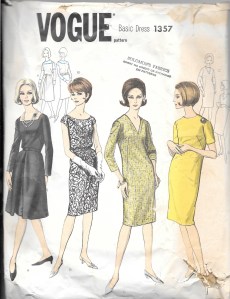
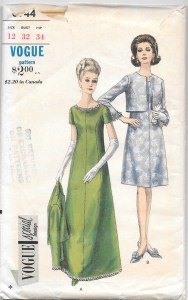
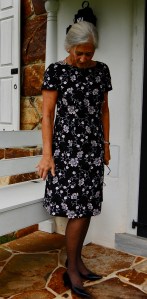
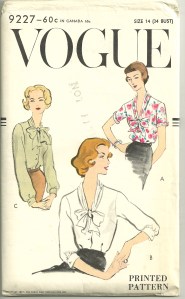
 fiftydresses
Odds and Ends and One Thing You Mustn’t Miss
Sewing has been, well, challenging this summer. In reality, I think I have been able to accomplish just about all I could have hoped for – so far, at least – but it certainly doesn’t seem like very much.
When I packed fabric to bring along to our new vacation home in Wyoming, I tried to think ahead and determine exactly what I would need. For instance, I brought two decorator fabrics which I had picked out for two of our “new” bedrooms, with plans for making decorative pillows and at least one bed skirt. I also brought two fabrics with which to make dresses for our two little granddaughters who were arriving, along with the rest of our immediate family, in late July. I also brought some vintage Moygashel linen, many pieces of shirting and dress cottons, skirt fabric, and a piece of Viyella cotton/wool blend. What was I thinking?!! Certainly no one could accuse me of being under-ambitious!
I totally misjudged how much of my time would be taken up with organizing and setting up a new household. So – what have I been able to sew? A number of decorative pillows, for one thing. I find them – and all that self-bias tape I had to construct – utterly boring to make, but satisfying once they are completed. The bed skirts have been moved to the “still to do” list.
I was able to make dresses for my granddaughters. My original intent was to make each dress out of a different fabric, but when I stretched out my ladybug embroidered, striped fabric from Emma One Sock, I realized I had more than I needed for one dress. With one minor compromise, I knew I could get two dresses from my existing yardage. So I changed plans and made matching dresses.
I made white piping for the pockets and collars out of kitchen string and white batiste. The ladybug embroidered fabric is really so cute!
The compromise I had to make involved the sashes, as I did not have enough fabric to cut sashes for two dresses. Fortunately I had enough of the coordinating red fabric to make the sashes. Now I’m glad it worked out that way, as I think it makes the dresses cuter.
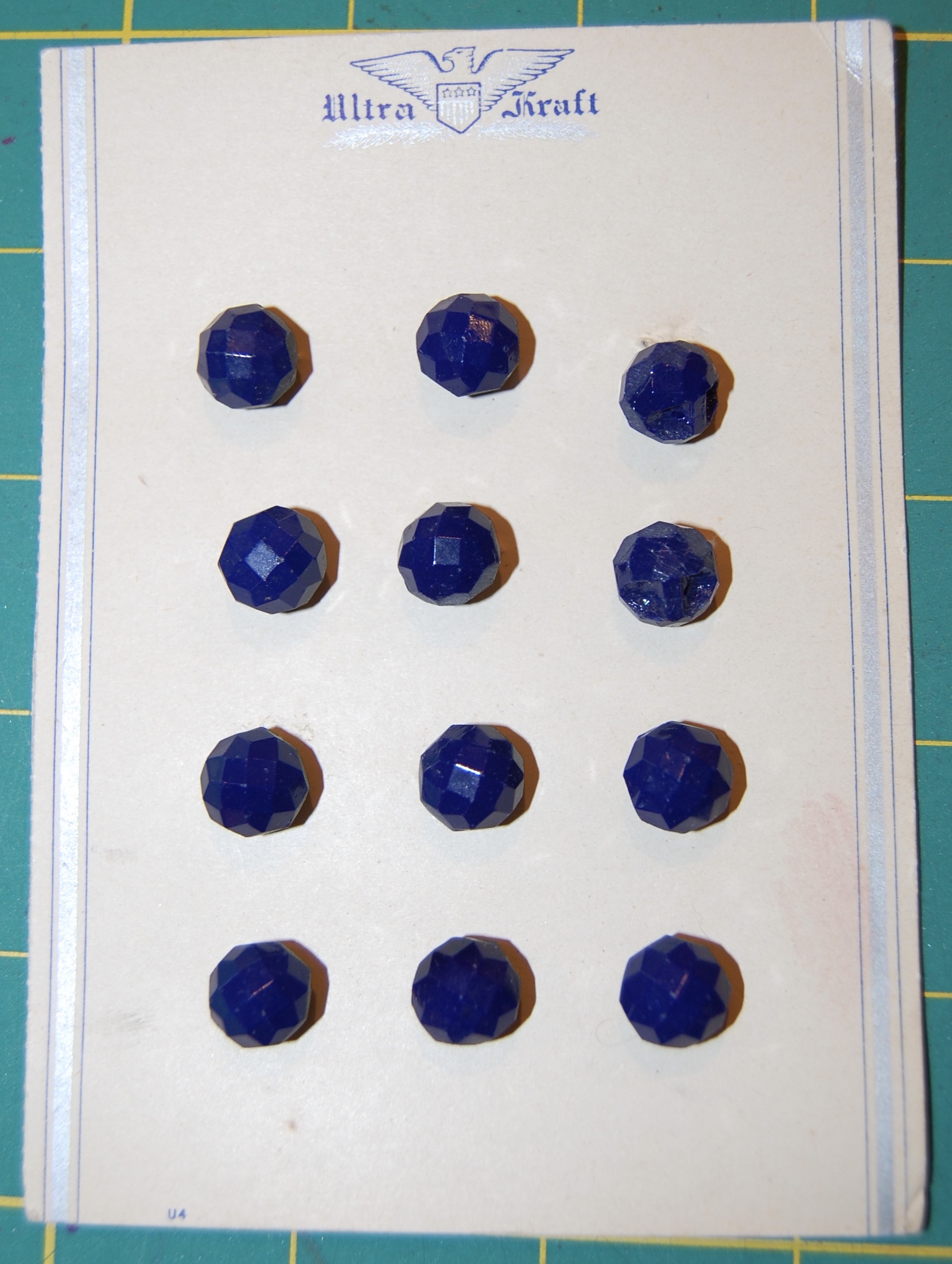
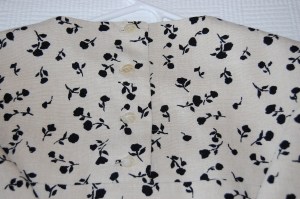
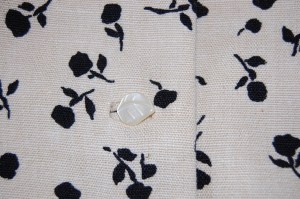
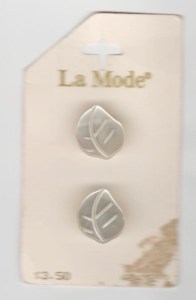
I had pre-purchased red decorative buttons, thinking I would need them for just one dress. Normally I would put three in a row centered beneath the collar, but with four buttons, and two dresses … Well, you do the math! Two on each dress it is!
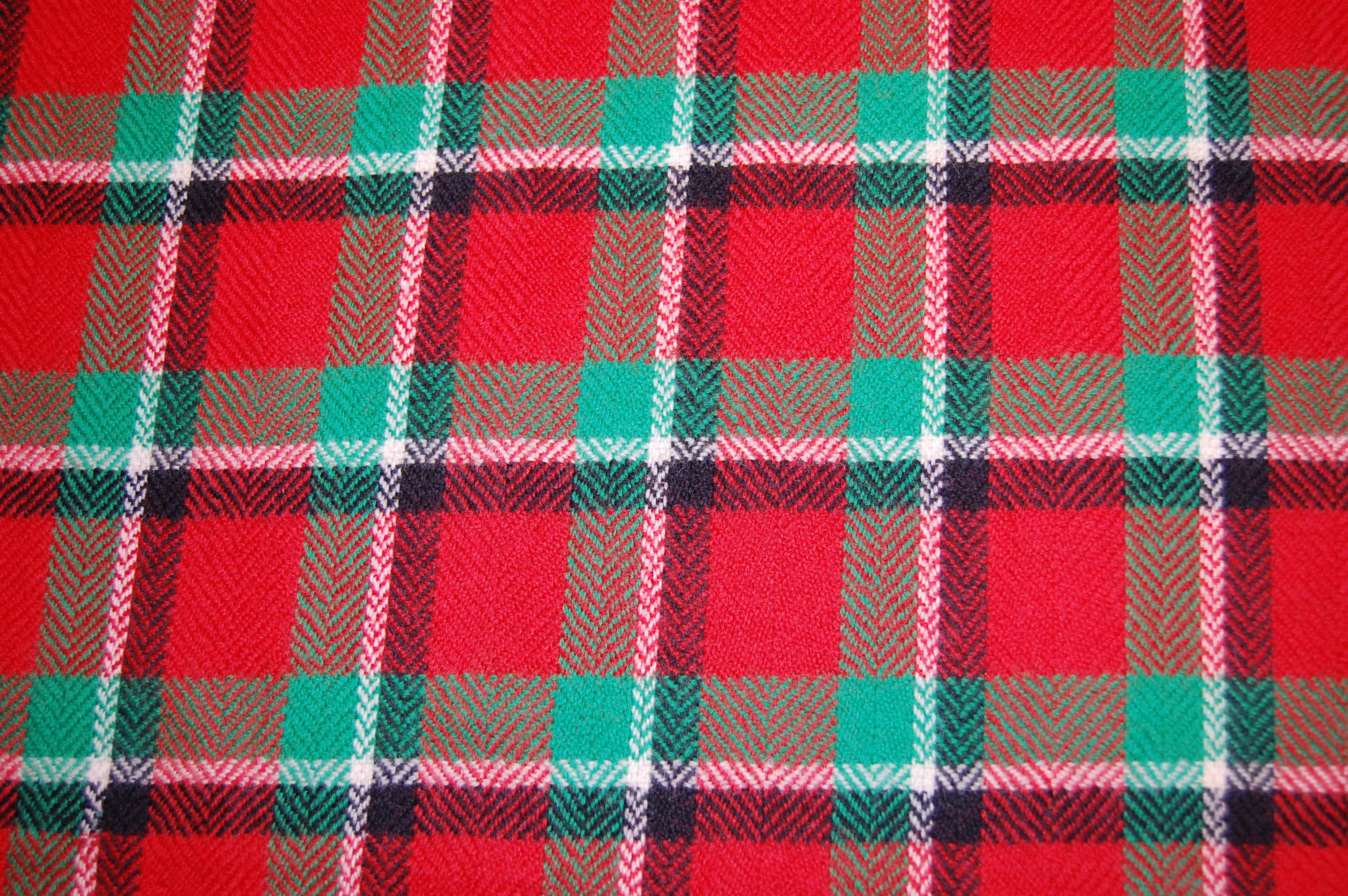
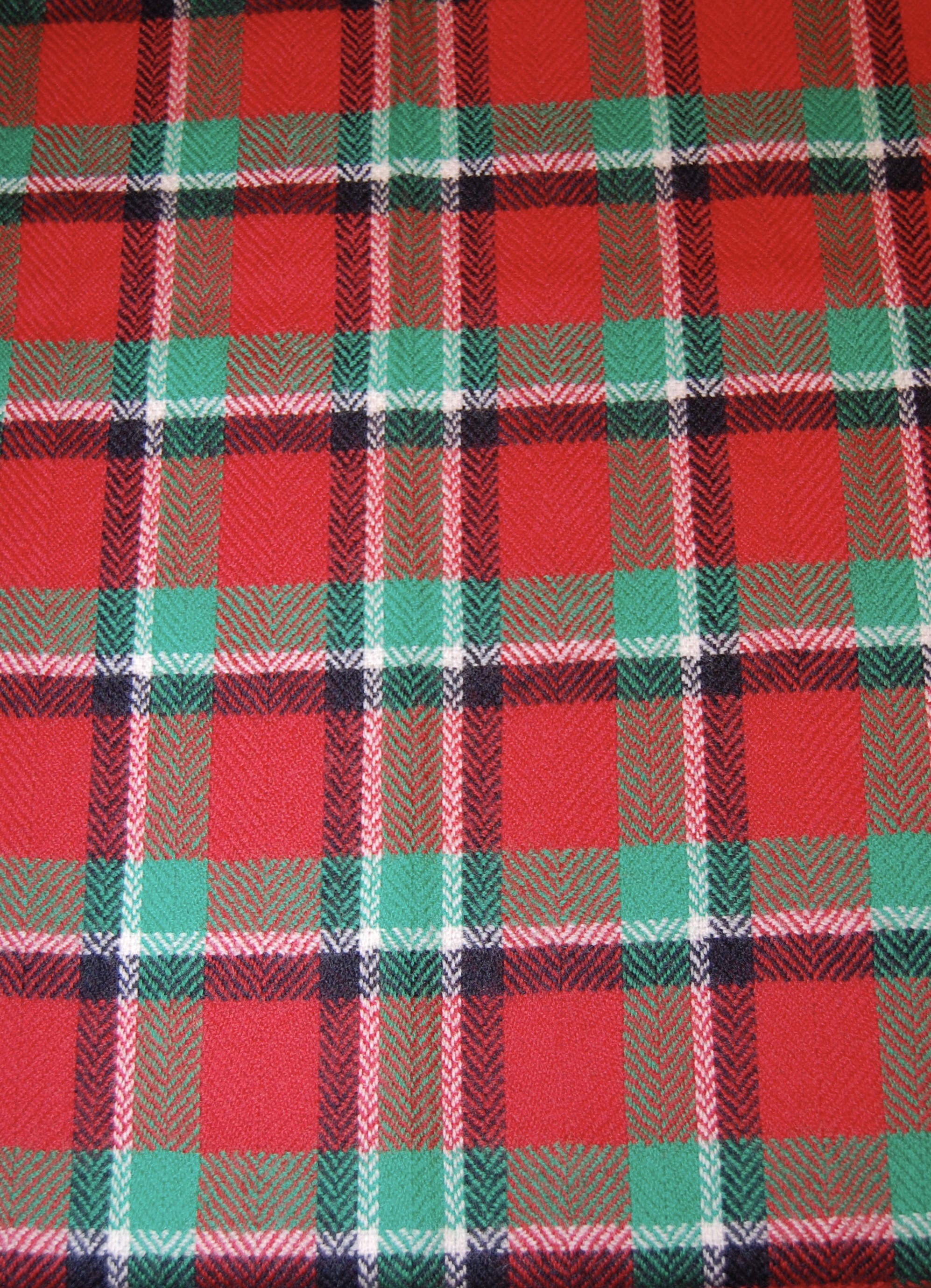
Having spent many summer days and nights in Wyoming before this year, I knew from experience how chilly the mornings – and nights – can be throughout the summer. (The days are warm and glorious, however.) Warm cozy slippers and a winter-weight bathrobe are necessities. And that is why I brought along the afore-mentioned Viyella fabric. Although I packed a winter-weight robe which I made a few years ago, I wanted to make a new robe which I can leave here, therefore eliminating one bulky item from future suitcases.
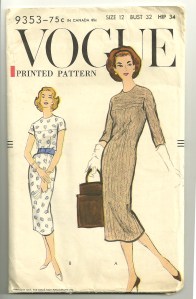
How lovely to have the opportunity to use this vintage Vogue pattern once again.
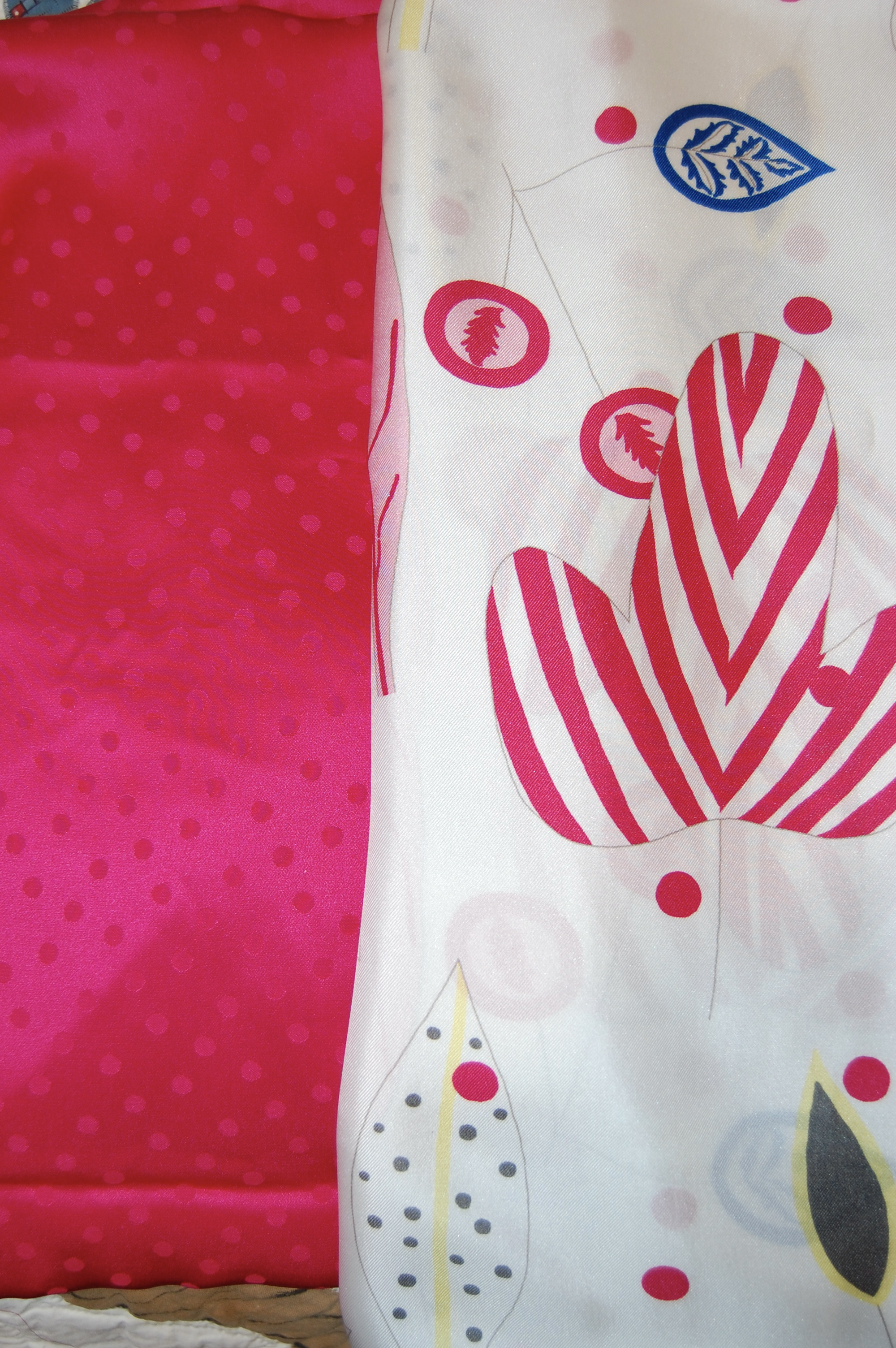
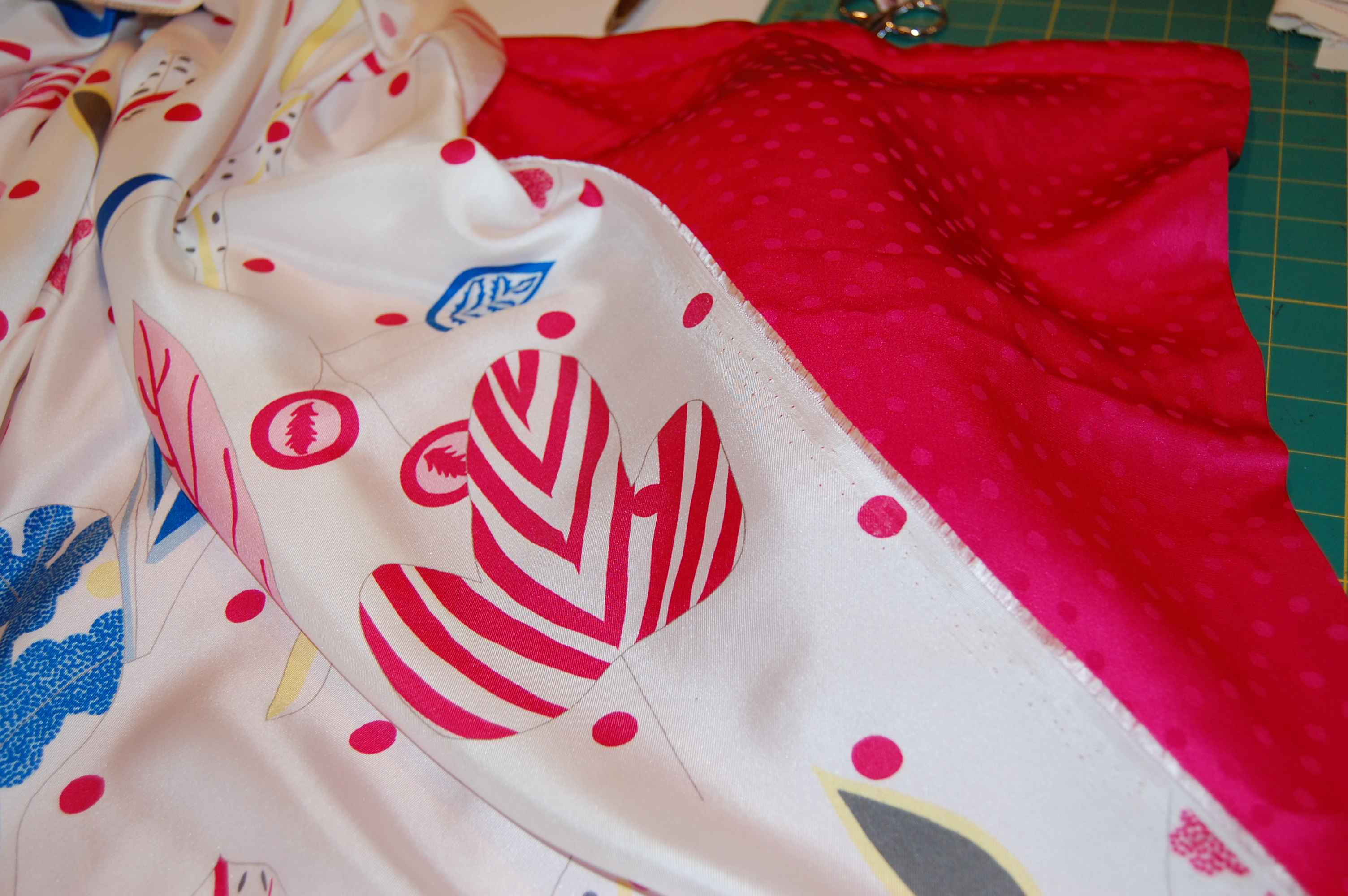
This robe takes a lot of fabric, and it was a tight squeeze fitting all the pattern pieces on it and matching the plaid as well. I had to make the sash out of two pieces of fabric, seaming it in the back. Additionally, I had enough fabric for only one pocket (I prefer two.) But, I am happy with the outcome, and very pleased to have used one more piece of fabric from my sizeable collection!
Viyella is the perfect fabric for a lightweight, but warm bathrobe. It is machine washable, and gets softer with age.
While the bathrobe, and the little dresses, were enjoyable to make, neither were challenging in the “couture” sense. So I did my “couture” dreaming vicariously through the Susan Khalje Couture Sewing Club, where inspiration abounds in many forms. Earlier in the month, Susan was interviewed for the “Love to Sew” podcast. Treat yourself and spend a lovely hour-plus listening to it, if you haven’t already done so. The interview, Episode 106, dated August 12th, can be found here:
www.lovetosewpodcast.com.
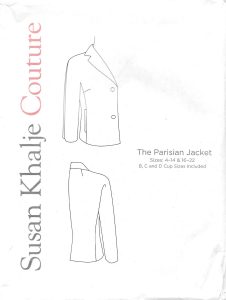
Among Susan’s new pattern offerings is this jacket:
When I arrive back home in Pennsylvania, I will be searching through my fabric closet for the perfect pairing for this pattern. I am just itching to challenge myself with such a project. No more pillows, at least for now!
15 Comments
Filed under Bathrobes, Buttons - choosing the right ones, Fashion commentary, Sewing for children, Uncategorized, Vintage fabric, vintage Vogue patterns from the 1950s
Tagged as 1950's Vogue patterns, Bathrobes, fashion sewing, sewing for children, Susan Khalje Couture, vintage Vogue patterns