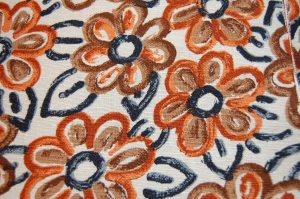
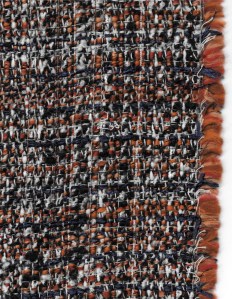
Tag Archives: fashion sewing

Déjà vu

After completing my “Classic French Jacket” and its coordinating sheath dress, I wanted something easy – and relatively quick – for my next project. I didn’t think it was going to be another bathrobe, but that’s what it has turned out to be, to my great surprise.

Because we had such a chilly Spring, I was wearing my newly constructed Winter bathrobe into June. But, suddenly, Summer arrived in the middle of that month, with its humidity and often beastly temperatures. It was then I pulled out my old, lightweight Summer robe – you know, the one with the missing button – and the small tear – and the tea stain which somehow became a permanent fixture. Not such a pretty sight.  Having become used to my new Winter robe which makes me happy whenever I put it on, I decided maybe it was time to replace my Summer robe, too.

I already had a three-yard length of “water-color-designed cotton lawn” from Britex Fabrics.
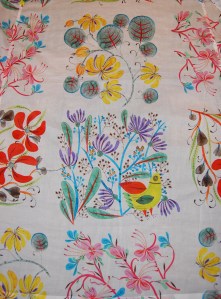
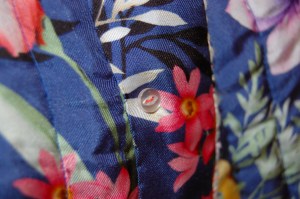
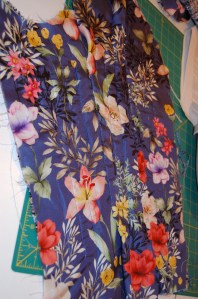
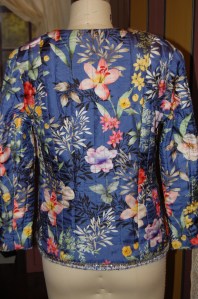
I forgot to get a photo of the fabric before I cut into it.  This is a partial view of the back of the robe.  I purchased this Italian-produced, fine cotton during one of the online sales at Britex Fabrics in San Francisco.

At 56” wide, I thought it would be enough to make a robe, using the same wonderful pattern I had used for my Winter robe.
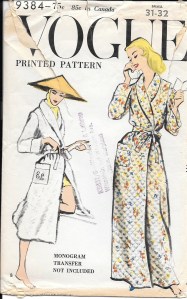
This pattern from 1959 is so well engineered, with subtle details which give it a polished appearance.

My only reservation was that the fabric makes quite a statement. I wondered if perhaps it was going to be too, too much in an ankle length robe. Truthfully, though, how many people see me in my bathrobe? I figured I’d go for it.

Once again, laying out the pattern was quite the task, done entirely on the floor. Although the pattern matching didn’t have to be quite as precise as working with an orderly plaid, I did have to pay attention to the large squares and where they would end up in relation to each other and in relation to the dimensions of the front and back of the robe.
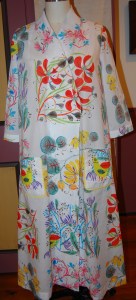
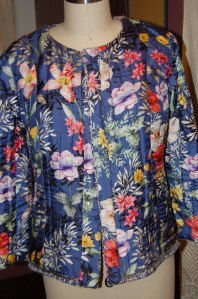
The front of the robe, sans its sash.
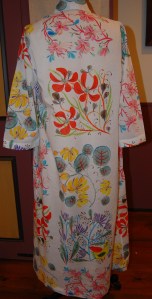
And a back view. Without lining up the “watercolor blocks” in some relation to each other, the effect would really have been chaos!
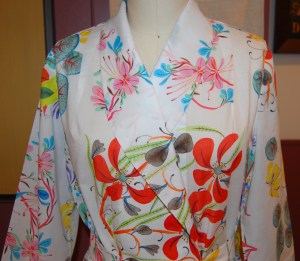
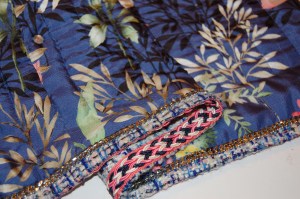
The fineness of the fabric is apparent if you look closely at the collar, where there is some fade-through of the design. (The interfacing is attached to the under section of the collar.)
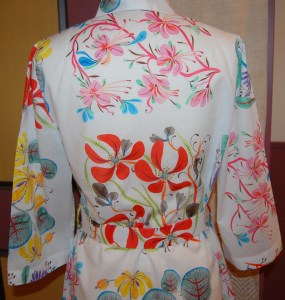
I did not have enough fabric to “match” the designs on the sleeves, but I rather like them not exactly alike.  Also, I shortened the sleeves to below elbow length, more appropriate for a Summer robe, but also necessary to save fabric!
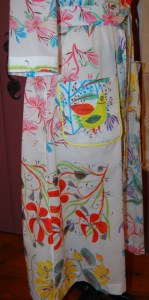
I used flat felled seams for the body of the robe.

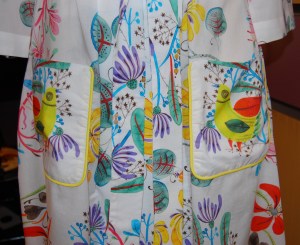
After just barely managing to get the two fronts, one back, the sleeves and collar and front facings placed on the fabric, I knew I was not going to have enough fabric left to match the pockets to their underlaying design. I did, however, have two fabric blocks featuring those quirky little birds, enough to make two pockets. The birds could even face each other.
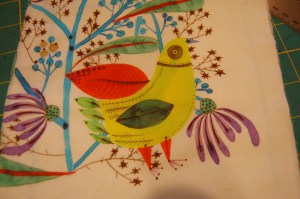
But I knew they would look a little “lost in space” unless I set them off somehow. That’s when I went to my tried and true solution for all kinds of sewing fixes – piping! Yellow seemed to delineate the pockets the best – beating out green, red, pink and purple, all of which I “auditioned.”
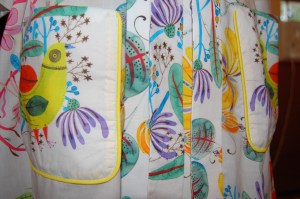
I quite like those little birds, looking cheery and chirpy on the front of my robe.
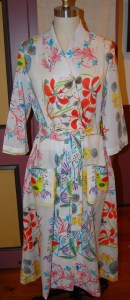
 

Ready for its debut!

The fabric is so lovely, almost diaphanous in its effect. And that bold, colorful pattern which had given me pause? It has an exotic flair to it, quite acceptable for a summer robe. I just hope it doesn’t panic the cat.
31 Comments

Filed under Bathrobes, Mid-Century style, piping, Uncategorized, vintage Vogue patterns from the 1950s

Summer Dreaming

In the midst of summer, I am dreaming about – Winter sewing? I wouldn’t be doing such a thing, except that when opportunity knocks, it’s a good idea to take advantage of it.

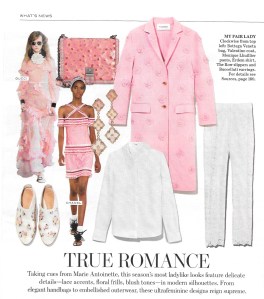
For a while now, I have been thinking about wanting to make a pale pink wool coat. My idea was definitely solidified when I saw pictures of this stunning Valentino coat:
Looming large on page 58 of the November 2016 Wall Street Journal Magazine is a Valentino coat, traditional in design, but made very special by its exquisite embroidered pink wool.

Although making a pink coat hasn’t necessarily been a top priority for me, I’ve been quietly keeping a watch out for the right fabric, should I find it somewhere. Then a couple of weeks ago, I had the rare opportunity to purchase a piece of wool, loomed in France in the early 1960s.

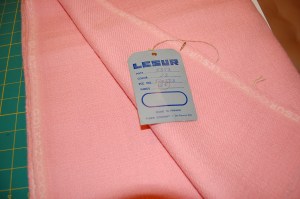
It was an eBay offering, with a substantial first bid requirement, so I thought quite a bit about it, especially since the seller did not accept returns. It is somewhat difficult to buy fabrics, either vintage or new, online, especially without a swatch. The photos in the offering confirmed that it was Lesur wool, made in France.  I could tell by the style of printing on the attached tag that the 2.5 yard piece was most likely from the early 1960s. The weight of the fabric was, of course, unknown to me. The description said it was a boucle, but I doubted that attribution based on the photos.  However, that gave me the feeling that it was a heavier-than-dress-weight wool. At least I hoped so! At 56” wide, this was an ample piece of fabric. My intuition told me this was an opportunity not to miss, so I went for it!

When the package arrived a couple of days later, I was elated. The color is luscious, the weight of the fabric is perfect for a coat (but not too heavy), and the piece is in pristine condition.

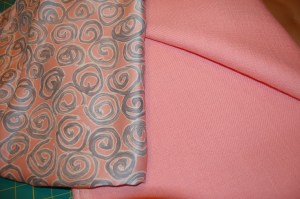
To put the icing on the cake, within the past year, I had purchased an end-cut of pink and gray charmeuse silk from Mendel Goldberg which looks so beautiful with it. I was going to make a wrap dress out of that silk, but now it is going to be my coat lining.
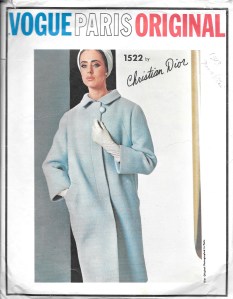
Shortly before I found the fabric, I purchased this coat pattern, which now seems perfect for the pink wool, although I always reserve the right to change my mind!

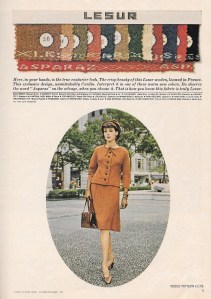
But this is not the end of the story. I am endlessly fascinated by the fabrics available to home dressmakers in the ‘50s, ‘60s, and ‘70s. On a whim, I decided to look through some of my Vogue Pattern Book Magazines from the early ‘60s to see if I could find any other examples of Lesur wool. The first one I opened had this ad in it:

From the October/November 1962 issue of Vogue Pattern Book Magazine.

Further sleuthing provided more examples of Lesur wool made into Vogue Couturier designs.  Here are a few examples:

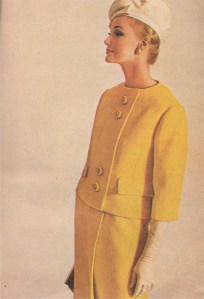
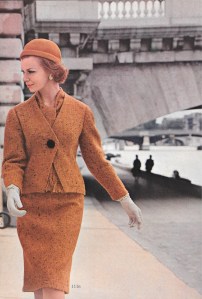
The description of the Lesur fabric reads: “purest marigold nubbed wool.” From the April/May 1963 issue.

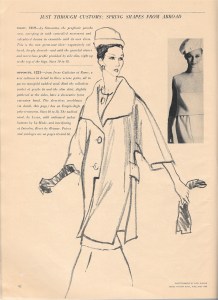
Here is the description of the yellow suit, plus the inset shows its overblouse.

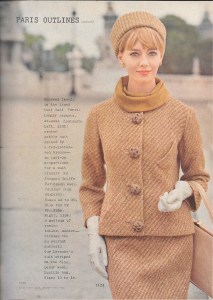
Here the Lesur wool is shown in a Guy Laroche design. From the February/March 1962 Vogue Pattern Book Magazine.

From the same issue of VPB Magazine, a design by Nina Ricci; the description of the fabric is: “A leonine tweed by Lesur.” Note the fringed self scarf.

In several of the magazines, there are listings of Fabric Houses:

Click on the image to read the list!

Can you imagine having the opportunity to visit these fabric houses and make purchases?  Put me in a  time capsule and take me there, please!

Getting back to reality – I won’t be working on my pink coat anytime soon, as there are already several projects in the queue that need my attention first, including some pressing Summer sewing. But – Summer dreaming is just so much fun!

20 Comments

Filed under Coats, Dressmaker suits, Linings, Mid-Century style, Uncategorized, Vintage fabric, woolens

Jacket AND Dress!

One of the aspects of fashion sewing that appeals to me so much is how projects seem to take on a life of their own. By the time I have it finished, a piece rarely ends up being exactly how I thought it might be when I started it. Most of the time, that’s a good thing. (There are those flops, which are bad things, but thankfully this post is not about a flop.)

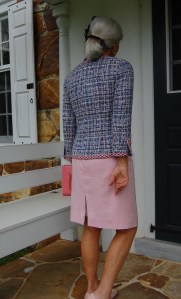
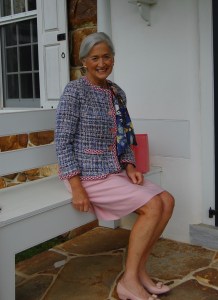
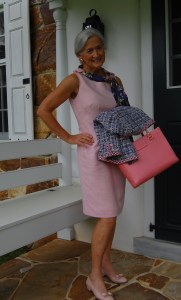
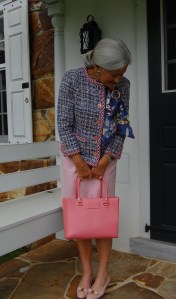
When I did the planning and started the construction of my recent Classic French Jacket, I really thought I would be making a pale blue linen sheath to wear with it, using fabric already in my collection. But somehow that pink accent in the weave of the boucle, the trim I selected, and the buttons, all conspired together and changed my mind for me.

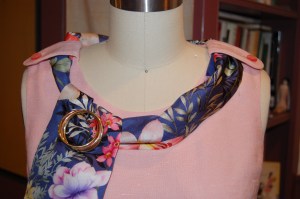
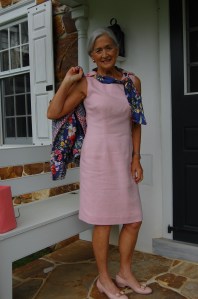
Fortunately, I also had a piece of pale pink linen in my fabric collection (at this point, I might ask myself, what color linen do I not have in my collection? But let’s not go there….) By this time I had already decided I needed to figure out a way to show that gorgeous lining silk in my jacket, rather than having it solely hidden inside. Having seen accent scarves paired with Chanel jackets on Pinterest gave me the idea to make a scarf. Then I thought it might be fun to “attach” the scarf to the pink (planned) dress in some fashion.

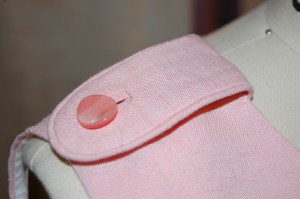
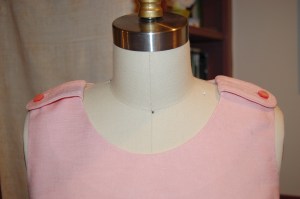
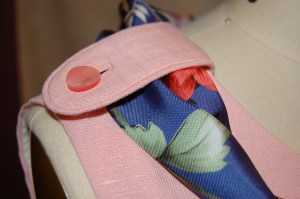
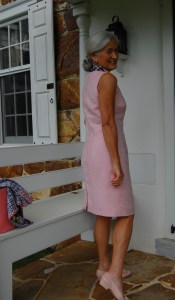
I came up with buttoned shoulder tabs as a possibility. I had purchased eight small buttons for my jacket – three for each sleeve and one for each pocket, long before I had this idea. You might recall in my last post, that I decided to make the sleeve vents for two buttons instead of three? That’s where I found/got the two buttons I needed for shoulder tabs.

I ended up liking my two button vents!

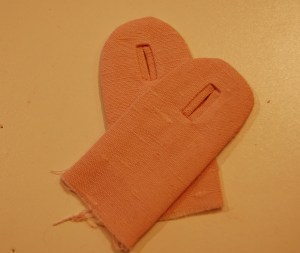
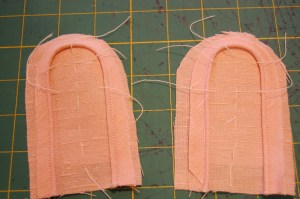
The first tabs I made just did not look right. First of all, they did not turn well, with a pleasing curve And when I placed them at the neckline of my dress, all I saw were the seams.

I even finished the bound buttonholes before deciding I didn’t like these.

I had to think through lots of possible solutions and finally had a eureka moment when I thought of piping the edges.

Piping makes the sewn curve much easier to turn well.

So much better!

I placed the tabs slightly forward rather than exactly on top of the shoulder seam.

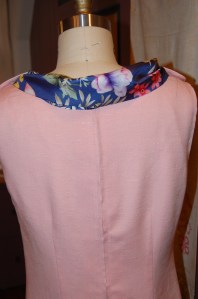
The rest of the dress was very straightforward, as sheath dresses tend to be. It is lined with a lightweight, cotton/linen blend, but I did not underline it, as I like to preserve the washability of most of my linen garments (easier without an underlining.)  It is also cooler without an underlining.

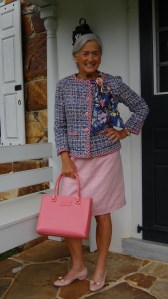
Being a lover of pink, I already had pink pumps that match the dress exactly – and a handbag which brings out the peachy part of the pink in the boucle.

The tabs on this dress give it kind of a ’60s vibe. Unintended, but kind of a nice touch to go with the jacket.

Because these two pieces – and this look – came together from so many sources, I think it is a good idea to give credit where credit is due:

Boucle: Mendel Goldberg Fabrics , NYC, gift from my grown children.

Soutache Braid and Buttons: M & J Trimming, NYC

Pink Petersham Ribbon: Britex Fabrics, San Francisco

Lining and Scarf silk: Britex Fabrics, San Francisco

Pink Linen: vintage Moygashel, 35” wide, purchased on Etsy

Cotton/linen lining for the dress: JoAnn’s Fabrics, purchased in bulk a couple of years ago

Shoes: Ferragamo, old!

Handbag: Kate Spade, also old.

I do love pink!

So that’s it! One major project now residing in my closet rather than in my sewing room. Time to start something new…

33 Comments

Filed under Boucle for French style jackets, bound buttonholes, Buttons - choosing the right ones, Chanel-type jackets, Linen, Linings, Mid-Century style, Moygashel linen, piping, Scarves, Shoes to make an outfit complete, Uncategorized, Vintage fabric

“Secret” Ingredients

Like that extra dash of nutmeg, which makes a dish sparkle in an indecipherable way, Classic French Jackets also have some secret ingredients. Except, they really are not secrets at all. They are, however, a few of the components which help to make these jackets so “classic” and just a step above ordinary.

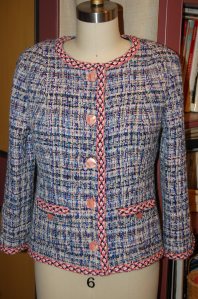
Before I get to those details, however, let me show you my finished – yes, finished! – jacket.

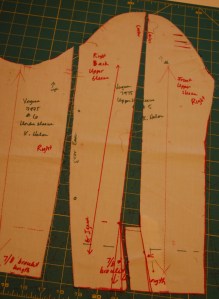
To start with, one of the main features of a classic French jacket is the three-piece sleeve. The seam placed along the center point of the shoulder and running down along the outside of the arm does two things: it allows for the all-important vent and it provides a gentle curved shaping of the sleeve. The under-sleeve piece, which straddles the underarm area reduces bulk in the lower armscye and also contributes to the shaping of the sleeve.

The depth and width of the extension on the vent is entirely subject to the decision of the dressmaker. I opted to make my vents and their extensions suitable for two buttons. I originally planned on making a three-button vent, but I changed my mind, for reasons you will see in a future post.

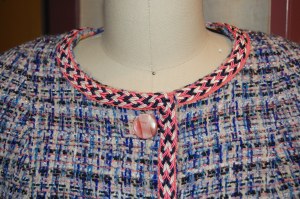
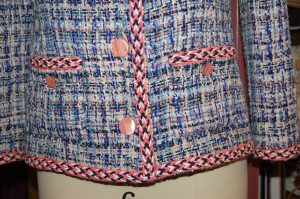
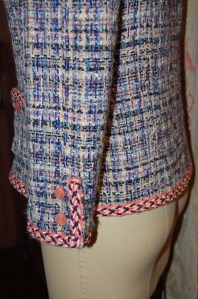
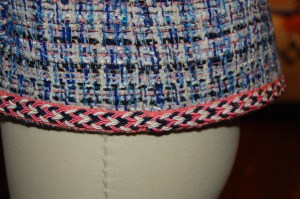
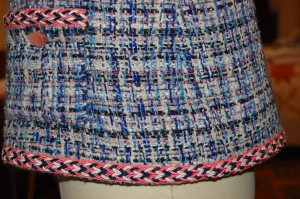
Probably the most visible component of one of these jackets is the trim. This is such a personal choice, and the selection of the trim can really change the entire complexion of the jacket. As you all may know by now, I decided to use a layer of Petersham ribbon under the braid I selected. Once the Petersham was on, and I had started applying the soutache braid, I took this picture to illustrate how combining two layers of trim can effect such a different look.

On this jacket I placed my trim right on the outside edges of the parts being adorned, but this is also a personal choice.   Yes, there are “rules” to making these jackets, but the way you trim your jacket is not one of them! I also like to apply my trim after the interior of the jacket is finished, but I have seen a number of very successful jackets where the trim was applied before the edges were finished in the interior.

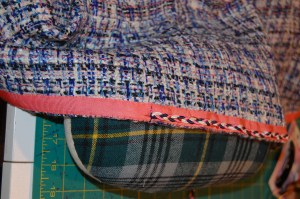
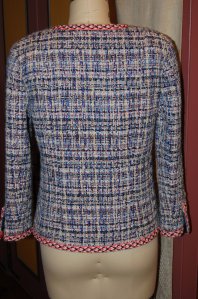
In the Classic French Jacket Class I took with Susan Khalje a few summers ago (which I cannot recommend highly enough!), she made the point that a lot of couture jackets are hemmed slightly longer in back, allowing for a gentle curve that is flattering and feminine. I love this look and used it again for this jacket. I think it is particularly effective with contrasting trim.

The gentle slope of the back hem is a little more apparent in this side view.

Obviously the trim has to have a starting point and an ending point somewhere on the jacket, right? Common sense tells us it should be in the most inconspicuous place – which, for the most part, happens to be in the side seam under your non-dominant arm. I am right-handed, so I made my starting and ending spot under my left arm.

I decided to make a double continuous loop of the soutache braid in order to reduce the bulk at the beginning and ending spot. Here you can see how I looped it in order to apply it this way.

From a little farther away, it is barely perceptible. By the way, do you see how that pocket is buckling?  I realized I had sewn the button on a little too low, so I had to do that over.  Seems there is always something to “tweak” at the end!

Because the boucle I used for this jacket is more of a lightweight weave, I decided I needed to anchor the buttons in some way. So I sewed them on (with waxed and ironed, double thread, of course), attaching them on the lining side with small white buttons.

While we are looking inside, here are photos of the jacket turned inside out.

I did not make any attempt to “match” the print because I did not think it would have made any difference.

Another key, necessary ingredient to one of these jackets is the chain which weights the jacket and keeps it looking neat and tidy. Sewing on the chain has to follow the Goldilocks rule: not too tight and not too loose.

I chose a silver-toned chain for this color combination.

The lining fabric I used for this jacket is such a lovely silk twill print. It seems a shame to hide such a beauty on the inside, although the interiors of these jackets are one of their most delightful secret ingredients. You will, however, be seeing more of this silk, along with photos of me wearing my jacket – all in a post to come soon!

33 Comments

Filed under Boucle for French style jackets, Chanel-type jackets, couture construction, Linings, Uncategorized

More on Making a Classic French Jacket

What more can be said about the process of making a classic French jacket? Well, actually, quite a lot! These jackets look deceptively simple (and elegant) when finished, but their looks belie the hours involved in their construction.

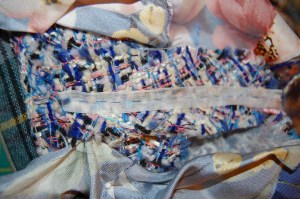
One of their sneaky little secrets is the sewing of the sleeves onto the body of the jacket. The shoulder seam is one of the few areas of the jacket which requires interior reinforcement. The selvedge edge of the lining fabric can be used for this, but I prefer to use a selvedge edge of silk organza.

The strip of organza is sewn on the seam line by hand.

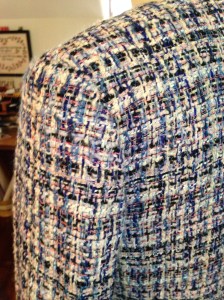
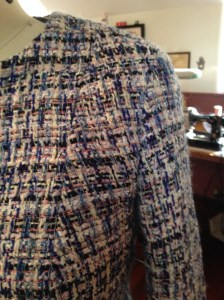
Once that is in place, the sleeve is ready to be inserted – all by hand! Pinning the sleeve in place accurately is so important, as the grainline of the boucle needs to hang perfectly both vertically and horizontally (and match, too, of course.) The top half of the sleeve is sewn from the outside with small, tight fell stitches. Then the lower half of the sleeve is sewn on the inside with small backstitches, both segments using waxed, double thread. If done correctly, the cap of the sleeve will curve nicely.

Looking at the sleeve head from the back of the jacket

And from the front.

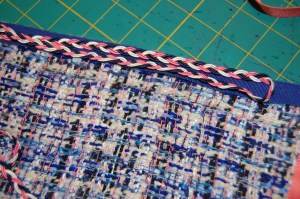
Finishing the sleeve insertion is, for me, the last big hurdle to get over before the really fun part starts. That, of course, is the trim. I deliberated quite a bit over the trim for this jacket. I originally thought I would emphasize the blue in the boucle, using pink as a small accent. When I could not find a “demonstrative, stand-alone” trim I liked, I determined to use an underlay of Petersham ribbon, with a coordinating, narrower trim on top.

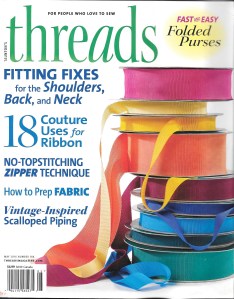
For those of you who are not familiar with Petersham ribbon, take a look at this cover from Threads Magazine, May 2016.

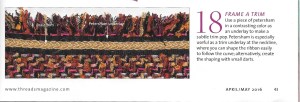
In the accompanying article by Susan Khalje, one of her suggestions is to use Petersham ribbon to frame a trim.

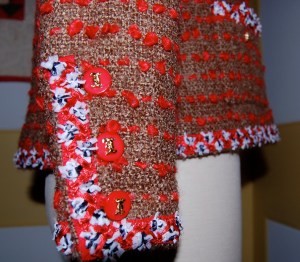
I used Petersham ribbon on my last French Jacket, and was really delighted with the effect.

Red Petersham ribbon under the frilly trim gives it more dimension.

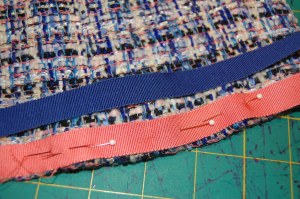
The more I looked at the blue, the more I thought it did not give the effect I wanted. I then decided to try Petersham ribbon in a pink hue.

There are actually two pinks in the weave of the boucle, one peachy and one clear pink. Doing the trim this way brings out both hues, which I really like.

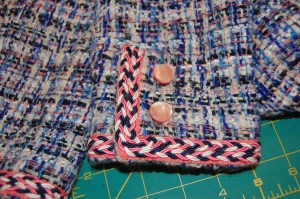
The Petersham ribbon is peachy, while the soutache trim has a clear pink intertwined with white and navy blue. The buttons take either hue!

Of course, this application of trims means four times around the perimeter of the jacket by hand to apply first the Petersham and then the double row of soutache trim. I never make things easy. Is it any wonder this jacket isn’t finished yet?

19 Comments

Filed under Boucle for French style jackets, Chanel-type jackets, couture construction, Uncategorized

Out of the Chaos …

It is not all that unusual for a big sewing projects to begin in some sort of controlled chaos, whether it is unwieldy pattern pieces, or slippery fabric, or complicated instructions – or no instructions! But nothing quite comes up to the chaos that making a classic French jacket creates.

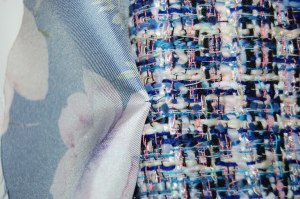
Two main things contribute to the chaos. The first is the nature of boucle fabric, which is the building block of the jacket. Boucle is, by nature, a loosely woven, sometimes wildly variegated fabric. The loose weave is what gives it the ability to be quilted “invisibly” to its lining. But, it is also what makes the fabric fray so easily, demanding careful handling throughout the construction process.

Then there is that quilting process. To say that the construction of this type of jacket is unconventional is an understatement. Once one has her fashion fabric (boucle) pieces thread traced and cut out, the lining is cut to conform to the shape of each individual jacket and sleeve piece. Then, the lining is quilted onto the boucle following  guidelines (selected by you!), but dictated by the boucle.

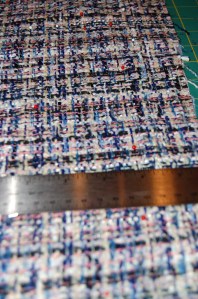
A ruler and pins help me determine where my quilting lines should be, generally about an inch apart from each other and set in an inch from the side seams.

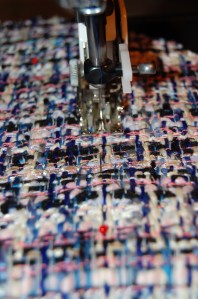
Quilting with a walking foot.

The ends of the quilting lines stop a couple of inches from the top and bottom of the marked seam lines, and the loose threads are fished into the inside and tied off, each one with three loops to secure the knot.

Although it is difficult to see, here is the tying off of one quilting line in-between the two layers.

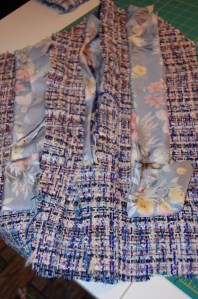
How strange is this? Then the edges of the lining are hanging loose while you proceed to sew the seams of the boucle. I pin the edges of the lining back in order to make this process a little more orderly, but it is still kind of a mess.

One of the sleeves, quilted, with its lining pinned back.

I have a great advantage in making this jacket, in that I have a muslin pattern which I know fits me well. Knowing this allows me the option of finishing the sleeves before I do the main part of the jacket, and that is what I have done.

I have finished off two of the three sleeve seams here before sewing the final, third seam.

All the sleeve seams are now sewn, and I am about to finish attaching the lining at the cuff ends of the sleeves.

I also decided once again to make slot-seam buttonholes on the sleeves and at the center front.

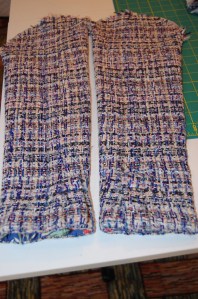
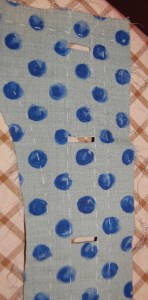
Here is the extension on the sleeve cuff. Normally cut as one with that section of the sleeve, I make it a separate piece so that I can leave two openings for the buttonholes. If you look closely at this photo, you can see the slots for the buttonholes.

This shows the extensions for the buttonholes.

Two finished sleeves, except for the trim, of course.

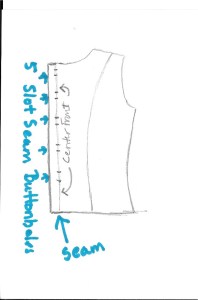
Now, here is a diagram of what I do to make the slot-seam buttonholes for the front of the jacket.

It is important to know how much width you need for your trim and buttons before deciding the width of that extra extension piece sewn onto the front. In this case, I determined I needed a piece with a finished (not including seam allowances) width of 1¼“. Then I proceeded to sew the seams together.

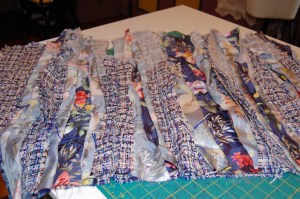
The body of the jacket really looks like chaos here!

Gradually the chaos will begin to be tamed as I hand-stitch the edges of the lining in place.

Perhaps the eventual control of such chaos is what helps to make the construction of these types of jackets so appealing. It is a good thing to remember that the creative process can be messy and tedious and very time-consuming. Sometimes, as in life, you just have to see it through to the other side to be able to appreciate the journey.

24 Comments

Filed under Boucle for French style jackets, Chanel-type jackets, couture construction, Slot-seam buttonholes, Uncategorized

Timeless: The Classic French Jacket

So much has been written and illustrated about Coco Chanel’s classic cardigan jacket, it is difficult to imagine more can be said, but that won’t keep me from trying. Of course, only Chanel is Chanel, and that fashion house rightly owns the claim to the mystique and allure of its trademark design. However, interpretations of that classic French jacket – and those who are making them – have added to the jacket’s lexicon over the years. In many ways, I think the advanced (in skill level, not age) sewing community has been instrumental in adding a whole new dimension to the way we look at the jacket and then personalize it.

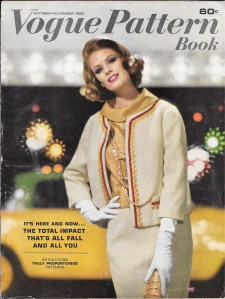
Interest by home dressmakers in the classic Chanel jacket has been evident for decades. This Vogue Pattern Book Magazine from October/November 1962 is a prime example. To quote precisely, the caption for the cover says: “the new after-dark dazzle involves a certain amount of alchemy. Take a clean-lined suit design (shades of Chanel) and make it shimmer: a springy white suit wool scored with gold metallic and red braid…”

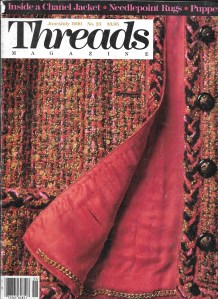
The June/July 1989 issue of Threads Magazine has one of the most iconic covers ever, described above the masthead as “Inside a Chanel jacket.” The extensive article by Claire Shaeffer covers the history of the jacket, idiosyncrasies of its construction and tips for the home dressmaker wishing to make her own Chanel-inspired jacket.

In more recent years, books and instructions for making the classic French jacket have been joined by classes, most notably on Craftsy and by couture teachers such as Susan Khalje, who, in my opinion, teaches the purest jacket construction interpretation available to the sewing community. If you are unable to attend one of her Classic French Jacket classes, then by all means, subscribe to her video for the next best thing.

There are several reasons, I believe, why the classic French jacket appeals to home dressmakers, particularly to those of us who delight in couture procedures, hand work, and artistic license. It is we who have the ability to chose from such a broad array of beautiful boucles and silk charmeuses, both at select fabric shops and online. Therefore, we are not limited to the fabric selections of a particular fashion house. Furthermore, we can adapt the jacket to our own individual preferences, for example, fitted or boxy, longer or shorter, collarless or not, to mention just a few potential changes. Finally, the finishing components of trim and buttons make it unique and uniquely our own.

This quote from Oscar Wilde is an appropriate summation of how home dressmakers, privileged as we are to know the “recipe” of jacket construction, approach the making of our classic French jackets: “To look at a thing is very different from seeing a thing.” We dressmakers see the jacket from various viewpoints:

1) construction techniques; including, but not limited to, the unique method of marking seamlines, quilting the layers of boucle and lining silk together, and hand-finishing the raw interior seams.

2) as already stated, the privilege of selecting our own fabrics, trims and buttons.

3) stylistic details which enhance the ability of the jacket to flatter ones particular form, such as altering the length of the sleeves, pocket details, front neckline variations, adding bust darts in certain situations, etc.

4) an appreciation for – and knowledge of – the engineering magic of invisibly quilting two fabrics together to produce an entirely new medium.

In my opinion, it is this ability to see – and appreciate firsthand- the complexities of the jacket which makes it such a worthy undertaking.

You may ask at this point why I am thinking so much about classic French jackets. Could there be any other reason than the fact that I have started work on my third, but far from final, one? Using boucle gifted to me by my grown children a little over a year ago, I am intently working through the “process.” Because I am fortunate enough to have a fitted pattern muslin template from my class with Susan Khalje 3½ years ago, my initial progress has been speedier than normal.

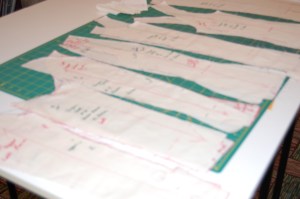
Here are my muslin pattern pieces freshly ironed and ready to start.

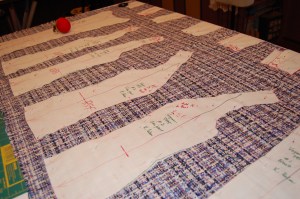
My muslin pattern arranged on the boucle, ready to double-check and cut out.

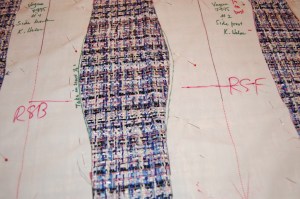
Allowing for wide seam allowances…

Pieces cut and thread-traced.  Next step:  the lining fabric.

Stay tuned as I make further posts about my time-consuming progress on this timeless style.

23 Comments

Filed under Chanel-type jackets, Coco Chanel, couture construction, Mid-Century style, Uncategorized

Coming and Going: a Split Personality Dress

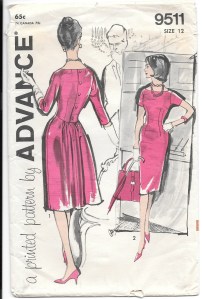
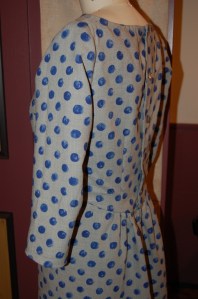
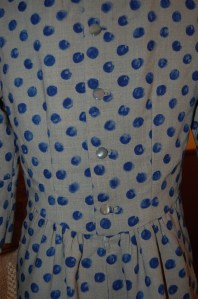
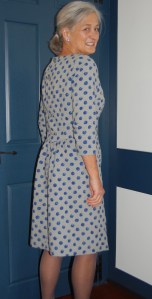
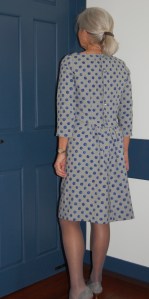
Dresses – and garments in general – with back interest have always intrigued me. The addition of a simple back belt can add so much to a coat design, for example, and a yoke in the back of a dress can be the perfect place to add complimentary buttons which might not have a place on the front of the dress. Perhaps it was this reason why I was drawn to this Advance pattern, which I found in an Etsy store.

Thanks to one of my readers, I know that this pattern dates to 1964.

Thanks to one of my readers, I know that this pattern dates to 1960.

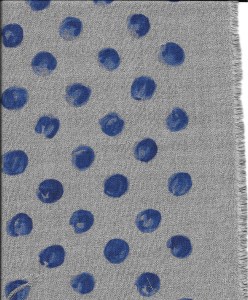
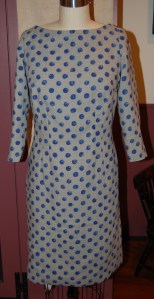
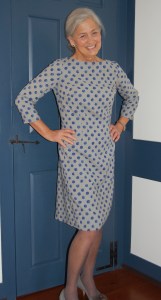
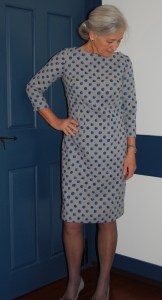
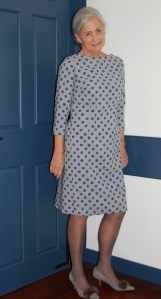
I hesitated for quite a while before buying it, as I just wasn’t so sure the gathered back skirt on this dress would look as good on me as it looked on the pattern envelope. I also did not want a “dated” or “too cutesy” look. But finally I gave in and made the purchase. The buttoned back and the dropped back waist were two details which really appealed to me, as well as the sleek sheath look of the front of the dress. I also knew that the right fabric could work wonders, and I bought the pattern with this gray and blue polka dotted wool/silk blend in mind.

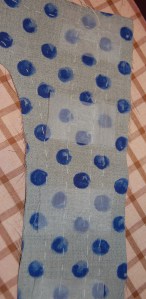
I purchased this fabric from Mendel Goldberg in New York City.

I purchased this fabric from Mendel Goldberg in New York City.

Then, there is always that steadfast fall-back, as well – making a muslin (toile) and if it really doesn’t work, then just scrapping it! What could I lose besides a few yards of cheap muslin and a few hours of time?

I had never used an Advance vintage pattern before, so I was interested to see how one would make up. I was impressed! The pattern pieces went together very precisely, and, in particular, the flounce, or gathering, at the back of the skirt was not overdone. The only initial change I made to the pattern before cutting out my muslin was to lower the bust dart, which I always have to do. Once I made the muslin, it was a little snug across the front, so I added ¼” to either side seam. As it turned out, I needed the extra width just across the midriff area, and ended up taking out quite a bit of extra width from the waist down.

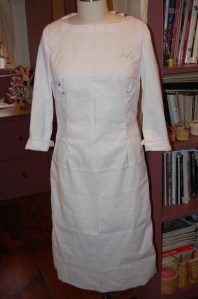
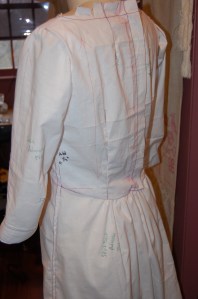
Some pictures of my muslin.

Some pictures of my muslin.

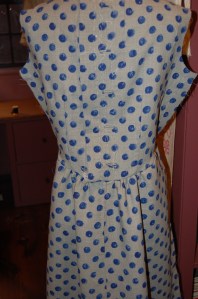
Coming and Going

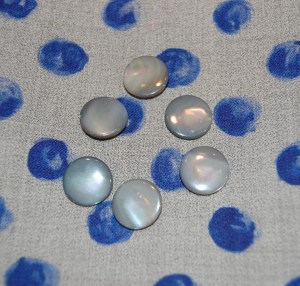
While I was working on the muslin, I was in a quandary over the buttons. I had to have them before I could start work on the fashion fabric because of those pesky, but beautiful, bound buttonholes, which are one of the first things to go in. Nothing I had on hand was right and after a very brief dalliance with the thought of blue buttons (what was I thinking, even briefly??), I knew gray mother-of-pearl buttons were what was needed. As luck would have it I found a set of six 5/8” buttons in an Etsy shop, which were described as blue-gray mother-of-pearl. As soon as they arrived in my mailbox, I knew they were perfect.

Coming and going

By this time I had transposed the muslin onto white silk organza, made my working pattern, basted the fashion fabric and the organza together, and ordered marine blue crepe de chine from EmmaOneSock for the lining.

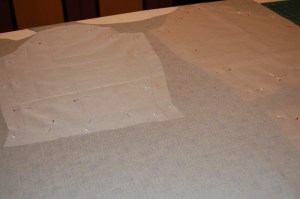
For those of you who asked, here is a picture of the silk organza being used as the pattern piece. when cut out, the two are basted together by hand along the seam lines, dart markings, and hem lines.

For those of you who asked, here is a picture of the silk organza being used as the pattern. When cut out, the two are basted together by hand along the seam lines, dart markings, and hem lines and then handled as one piece.

I also used silk organza patches for the facings for the bound buttonholes.

I also used silk organza patches for the facings for the bound buttonholes.

Here the facings are turned towards the inside. Proper measuring is essential for this technique to be successful.

Here the facings are turned towards the inside. Proper measuring is essential for this technique to be successful.

The back of the dress during construction.

The back of the dress during construction.

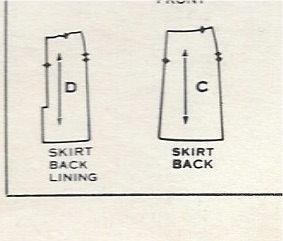
Although the pattern called for lining only the skirt back, I wanted to fully line the entire dress. The pattern for the back skirt lining is shown here in the thumbnail diagram:

coming-and-going-thumbnail-sketch

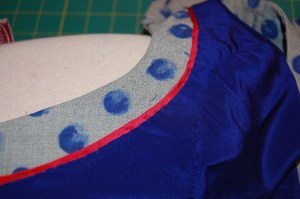
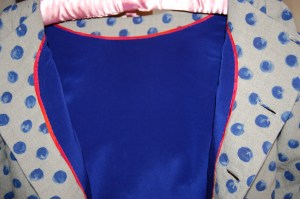
It was cut narrower than the skirt back, with darts for shaping rather than gathering. I had to make a decision about how to complete the lining – should I attach it to the waist seam at the back and somehow join the front to the back at the side seams, or should I make the lining as a completely free-falling piece? I opted for the latter, with the sleeves, of course, being inserted separately. It worked beautifully. Then, for some extra detail, I added a contrasting flat piping to the edge where the lining meets the facing.

I had this coral colored silk bias tape which I chose to use for this extra detail.

I had this coral colored silk bias tape which I chose to use for this extra detail.

Coming and going

Often facings are eliminated in couture sewing, but in this case, with the buttoned placket in the back, I decided to keep the facings so the buttonholes and buttons would have a firmer foundation.

This dress turned out to be all that I wanted – a classic slim sheath from the front, with surprise back detail which (I think?) is flattering, adding extreme comfort to its wearing, and which sets it apart from the average design.

Coming and going

Coming and Going

Coming and going


Coming and going

Coming and going

Coming and going

Coming and Going

Coming and going

coming and going

Coming and going, it feels like a good way to start off the new sewing year .

41 Comments

Filed under Advance vintage patterns, bound buttonholes, Buttons - choosing the right ones, couture construction, Day dresses, Linings, Mid-Century style, Polka dots, Uncategorized, vintage buttons

Focus on Fabric for 2017

Every new sewing year seems to have its own personality. Some of that depends on significant events that may be happening during the year, for which certain outfits must be sewn. Other influences might be travel, or the need to add some “basics” to your wardrobe, or, better yet, sewing classes, requiring planning/ muslin-making/special purchases. For me, this new year of 2017 – it is still new, isn’t it? – is going to have a focus on fabrics. I wish I could say I am resolved not to purchase new fabrics until I use some of what I already have, but I have already made that an impossibility, and the year is a scant three-weeks-old. (Thank you, Mendel Goldberg Fabrics, for tempting me beyond any recognition of reasonable doubt!) However, back to my premise – sometimes I have patterns which are just keeping me awake at night until I use them. Not so much of that this year; it is rather some of the gorgeous fabrics in my collection which are doing their best to disrupt my sleep.

Here are some of them, starting with Winter sewing.

I purchased this fabric from Mendel Goldberg in New York City. It is a wool/silk blend, and it is my current project.

I purchased this fabric from Mendel Goldberg in New York City. It is a wool/silk blend, and it is my current project.

My current bathrobe is in desperate need of replacement. This is the fabric I want to use for this new addition to my cozy, home attire.

My current bathrobe is in desperate need of replacement. This is the fabric I want to use for this new addition to my cozy home attire.

This boucle bridges the gap between Winter and Spring. Given to me for Christmas of 2015, it is a blend of wool, cotton and silk, tightly woven and lightweight. I will be trying to devote most of March to making this into a Classic French Jacket. I will be able to wear it well into Spring and then, of course, it will be perfect for next Fall and Winter, too.

2 full yards of this glorious boucle! I purchased a variety of trims to coordinate with this fabric this past summer in NYC and in San Francisco. Now I just have to decide which one(s) to use.

2 full yards of this glorious boucle! This past summer, I purchased a variety of trims to coordinate with this fabric. Now I just have to decide which one(s) to use.

Spring and Summer sewing always poses the most difficult decisions for me. That is because I have so many gorgeous pieces of vintage linen, and trying to determine which ones to use is a frustrating exercise for me. I would love to make a simple sheath out of this baby blue Moygashel linen, as it would look so lovely with that jacket mentioned above.

Lovely, crisp, pale blue.

Crisp, pale blue linen from the 1950s.

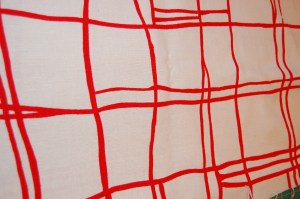
Then there is this amazing abstract design in red and white – also Moygashel – which somehow just has to wiggle its way into the sewing queue:

Red/white abstract linen

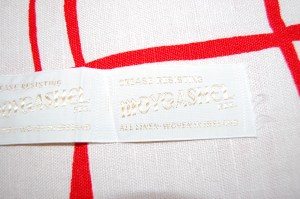
This fabric is from the mid to late 1960s, and it arrived with the label intact.

This fabric is from the mid to late 1960s, and it arrived with the label intact.

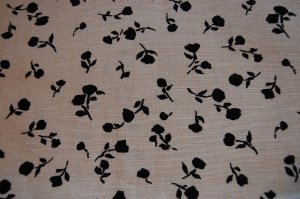
On the other extreme is this demure flower print, an early 1950s’ Moygashel linen. I have been wanting to make a dress from this for several years. Perhaps this will be the year I get it done.

A very early 1950s' linen, petite black flower silhouettes on a pale ecru background.

Petite black flower silhouettes on a pale ecru background.

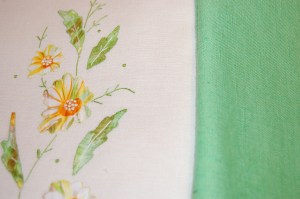
Another piece of vintage linen is this duo with lengths of plain and embroidered panels. Originally intended for an A-line shift, I envision it as a dress-length tunic, accented with the grass-green linen shown here. That would be one way I could honor the Pantone Color of the Year, Greenery, as well as make a unique and versatile dress.

Focus on Fabric

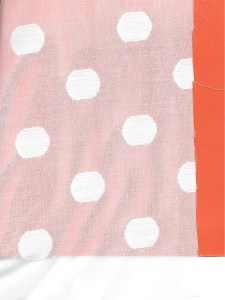
How I will ever find the time to make a blouse out of this white dotted cotton, I don’t know, but hope springs eternal for this, too:

I backed this fabric with a piece of orange paper so that the polka dot design shows. The dots are woven into this fine cotton from Britex Fabrics.

I backed this fabric with a piece of orange paper so that the polka dot design shows. The dots are woven into this fine cotton from Britex Fabrics.

With weeks of travel planned for parts of the final five months of the year, it will be folly to plan too much, but I do hope to make one more linen dress which will have wearing power into the Fall.

Navy, rust and brown - perfect for early Fall.

Navy, rust and brown – perfect for early Fall.

And can I possibly get one more Classic French Jacket completed before Thanksgiving? If so, it will be made from this boucle:

focus-on-fabric-boucle

Sprinkled among all these projects will be sewing for my two little granddaughters, too. As usual, I have much more planned than I ever can hope to accomplish, but it is fun to think of the infinite possibilities that dwell in my fabric closet – and in my head.

PS – One fashion observation for 2017:  DRESS GLOVES ARE BACK!

20 Comments

Filed under Boucle for French style jackets, Linen, Moygashel linen, Uncategorized, Vintage fabric

A Good Start

Happy December! It seems like a long time since I have been here with a new post for Fifty Dresses. The first thing I want to say, since my forced hiatus from sewing (due to my badly injured left hand), is “Thank You!” to so many of you who gave me encouragement, sent sympathy and healing thoughts, and made me feel like such a valued part of our worldwide fashion sewing community. Your kindnesses meant the world to me at a personally difficult and discouraging time.

Although my heart never left sewing (attested to by the new vintage patterns and a couple of lengths of new fabrics which have somehow found their way to my sewing room over the past weeks!), my hands have finally come back to it as well. While I still have weeks and weeks of “hand therapy” to attend in an effort to restore full use of my left hand, I now can sew at the machine, cut and mark fabric, and even hand sew. Having said that, I wish I had something truly spectacular to show you to prove that point, but alas, I do not. What I can show you is a promise of things to come, things which are now destined to make their appearance in 2017 instead of in November or December of 2016.

I had my heart set on getting this fabric made into a dress to wear during this month of December, even though back in October I still had not settled on a pattern for it.

I purchased this fabric from Mendel Goldberg in New York City. It is a wool/silk blend, similar to fabric in a dress I made last Fall.

I purchased this fabric from Mendel Goldberg in New York City. It is a wool/silk blend, similar to fabric in a dress I made last Fall.

After searching online through many, many vintage patterns, I finally came across this one, an Advance pattern (a small departure from my normal preference for Vogue):

I still need to do a little research on the exact date for this pattern, but it appears to be from the mid-1960s.

I still need to do a little research on the exact date for this pattern, but it appears to be from the mid-1960s.

I could easily see this dress made up in polka dots, with the three-quarter sleeves. I think the back detail with the buttons is so pretty. My muslin is in the process of being completed, and then I will determine if this style looks good on me. I certainly hope so…

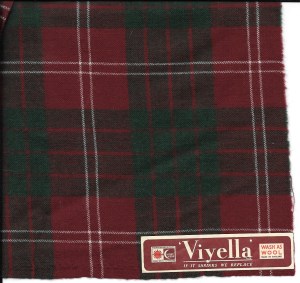
Another project I wanted to complete this Fall was a new bathrobe. A while ago I found this vintage Viyella fabric (cotton/wool blend, warm but light-weight, 5¼ yards, 35” wide), and it just spoke “bathrobe” to me.

The paper label is still attached to this length of fabric.

The paper label is still attached to this length of fabric.  Isn’t it lovely that this fabric is washable?

This Vogue pattern seems just about perfect for it, as long as I can match the plaid and still have enough yardage to eke it out. My muslin will tell the story.

I definitely want to make the long version of this robe.

I definitely want to make the long version of this robe. This pattern is from the late 1950s.

But before I can get any further on either of these projects, I have some sewing to do for Christmas gifts. The countdown is on, but I think I have a good start. It is wonderful to be back in my sewing room, which now looks like a cross between a couture atelier and Santa’s workshop, with fabric and wrapping paper and ribbons vying for equal space.  Happy December, indeed!

38 Comments

Filed under Day dresses, Mid-Century style, Uncategorized, vintage Vogue patterns from the 1950s