Gingham fabric has been around for a long, long time. Since the early 17thcentury to be exact, although the look of the fabric has changed considerably since those days. The word “gingham” is from a Malay word “gingang” which means “with space between,” hence, striped. Yes, originally gingham was a striped fabric. It appears that it became a checked fabric sometime in the mid 1700s, and of course, that is how we think of it today.
Gingham has a fresh, timeless appeal to it, and the iterations of it are countless. The size of the checks can be absolutely miniscule or large and prominent.
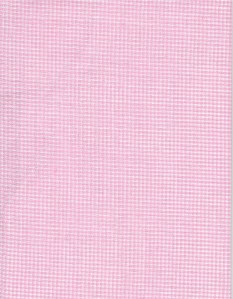
Each check in this gingham is only a couple of threads wide. I do not have an example of a really large checked gingham, but you can surely visualize it.
There are two types of gingham; the entry in The Fairchild Dictionary of Fashion (Third Edition, by Charlotte Mankey Calasibetta and Phyllis Tortora; Fairchild Publications, Inc., New York, New York, c2003, page 209) explains it beautifully: “Checked ginghams are two-colored effects made by using two colors, or one color and white, for groups of yarns in both the lengthwise and crosswise. Plaid ginghams are yarn-dyed designs of several colors.”
And do you know what zephyr ginghams are? “Zephyr ginghams,” according to Fairchild’s “are made with fine, silky, mercerized yarns.” Obviously both checked and plaid ginghams can be zephyr ginghams.
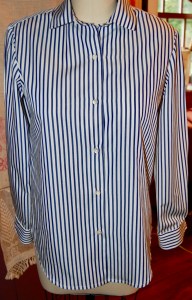
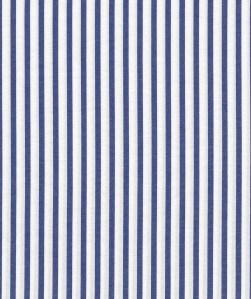
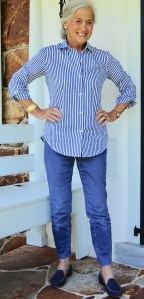
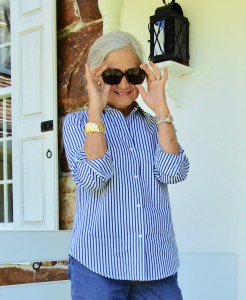
And indeed, it was a zephyr plaid gingham which I used for my most recent blouse:
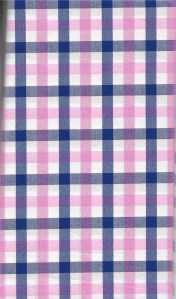
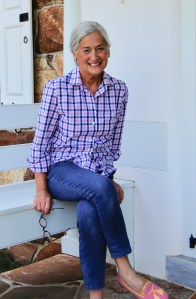
I purchased this fabric at the same time I ordered the fabric for my lavender gingham blouse. I still had the “blouse bug,” so I decided to go for it! I made a few tweaks to the pattern; specifically I added a tapered half inch to the lower half of the sleeves, to give me a little more ease in rolling them up. Of course, this meant I needed to add a half inch to the diameter of the cuffs. I also increased the length of the sleeve vent by about 1.25 inches. I find these changes just add a bit more finesse to the wearing of this blouse, which is super comfortable anyway.
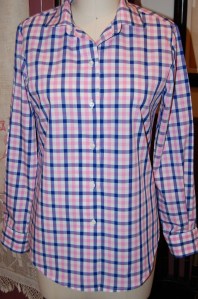
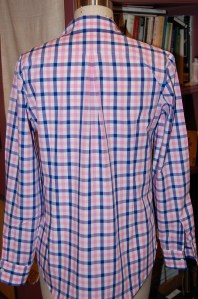
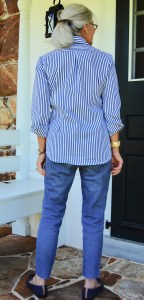
I kept the center back pleat, as it just makes this blouse so comfortable to wear, especially on a hot summer day.
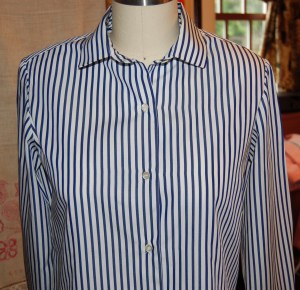
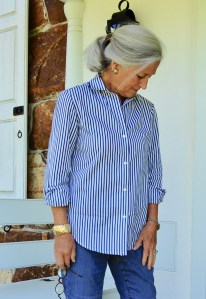
Now, do you see that double navy blue line at the center front?
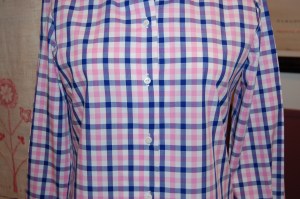
That is a mistake. I thought I had calculated the grid of the plaid correctly to have a continuous pattern across the front of the blouse. About halfway through its construction, I discovered I had calculated incorrectly. At that point I did not have enough fabric left over to cut out two – or even one – new fronts, so my fate was sealed. Now I know what I did wrong, and hopefully I won’t make that mistake the next time I make a gingham blouse. (And there will be a next time, but probably not this year.)
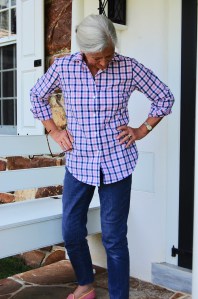
This is a blue jean kind of blouse!
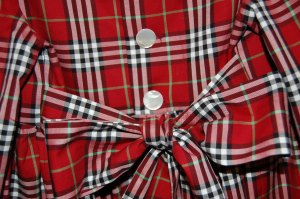
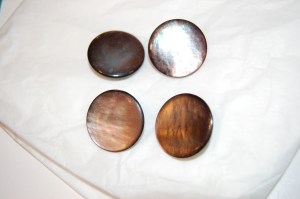
Being a button aficionado, I of course searched again for the right buttons for this blouse. I thought about using these vintage pearl buttons with their square motif. However, at 5/8” wide, they were just too big.
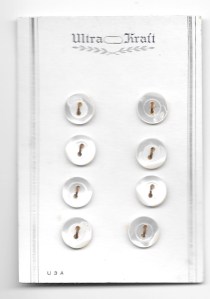
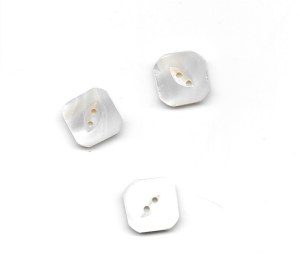 I finally admitted to myself that buttons on a blouse like this should not be the focal point; they should be delicate and discreet – which led me to this card of vintage buttons in my collection:
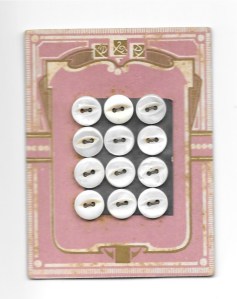
These buttons are 3/8″ in diameter.
The luminosity of the pearl in these buttons actually picks up the pink in the plaid in a very subtle way – and they are definitely discreet.
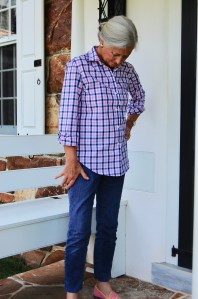
I used the spread collar again for this blouse.
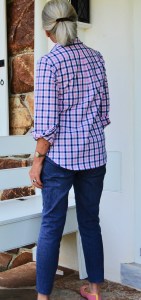
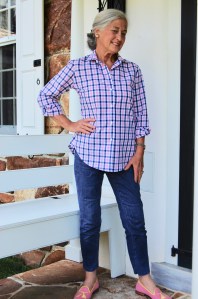
I love any excuse to wear pink shoes!
Well, I don’t want to end this post without giving you a few more fun facts on gingham. Did you know that “gingham” was a colloquial term for an umbrella in the 19thcentury? Again, according to Fairchild’s Dictionary (page 462), “so called because the less expensive types were made out of gingham fabric.”
And who doesn’t know that Dorothy Gale in The Wizard of Oz wore a blue gingham dress? Or that Brigitte Bardot wore a pink gingham wedding dress (which led to a shortage of this fabric in France, according to Wikipedia)?
If you have not recently read the classic poem by Eugene Field (1850-1895), “The Gingham Dog and the Calico Cat,” it might be time to reacquaint yourself. Here is how it starts: “The gingham dog and the calico cat, side by side on the table sat.” Just the mention of the fabrics creates a mental picture of what is to ensue between these two!
There are few fashion references to gingham that are noteworthy, save for this one from interior designer Kelly Wearstler, “The best thing I ever bought is a vintage Oscar de la Renta short gingham dress that I wore to my rehearsal dinner the night before my wedding.”
And finally, this from Christian Dior on “checks” (The Little Dictionary of Fashion, by Christian Dior, Harry N. Abrams, New York, New York, 2007, page 21): “I love checks. They can be fancy and simple; elegant and easy; young and always right…. They are always in fashion … and there are so many styles of checks to choose that there will be one to suit every age and figure.”
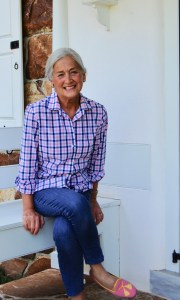
Feeling happy about this blouse despite that center front mistake.
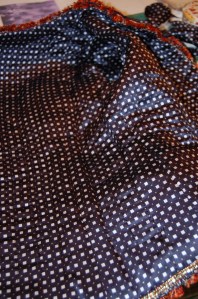
From “always right” cotton gingham, I now head to another “always right,” forever, classic motif: polka dots – in silk! New month, new project. Happy July, everyone!










 fiftydresses
Odds and Ends and One Thing You Mustn’t Miss
Sewing has been, well, challenging this summer. In reality, I think I have been able to accomplish just about all I could have hoped for – so far, at least – but it certainly doesn’t seem like very much.
When I packed fabric to bring along to our new vacation home in Wyoming, I tried to think ahead and determine exactly what I would need. For instance, I brought two decorator fabrics which I had picked out for two of our “new” bedrooms, with plans for making decorative pillows and at least one bed skirt. I also brought two fabrics with which to make dresses for our two little granddaughters who were arriving, along with the rest of our immediate family, in late July. I also brought some vintage Moygashel linen, many pieces of shirting and dress cottons, skirt fabric, and a piece of Viyella cotton/wool blend. What was I thinking?!! Certainly no one could accuse me of being under-ambitious!
I totally misjudged how much of my time would be taken up with organizing and setting up a new household. So – what have I been able to sew? A number of decorative pillows, for one thing. I find them – and all that self-bias tape I had to construct – utterly boring to make, but satisfying once they are completed. The bed skirts have been moved to the “still to do” list.
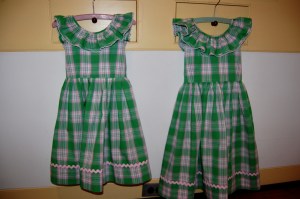
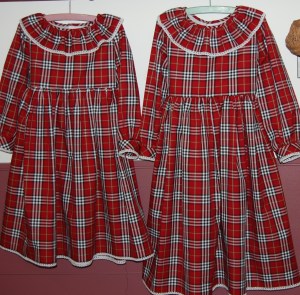
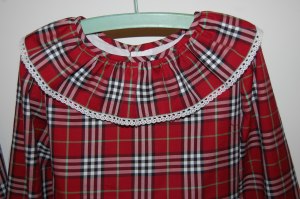
I was able to make dresses for my granddaughters. My original intent was to make each dress out of a different fabric, but when I stretched out my ladybug embroidered, striped fabric from Emma One Sock, I realized I had more than I needed for one dress. With one minor compromise, I knew I could get two dresses from my existing yardage. So I changed plans and made matching dresses.
I made white piping for the pockets and collars out of kitchen string and white batiste. The ladybug embroidered fabric is really so cute!
The compromise I had to make involved the sashes, as I did not have enough fabric to cut sashes for two dresses. Fortunately I had enough of the coordinating red fabric to make the sashes. Now I’m glad it worked out that way, as I think it makes the dresses cuter.
I had pre-purchased red decorative buttons, thinking I would need them for just one dress. Normally I would put three in a row centered beneath the collar, but with four buttons, and two dresses … Well, you do the math! Two on each dress it is!
Having spent many summer days and nights in Wyoming before this year, I knew from experience how chilly the mornings – and nights – can be throughout the summer. (The days are warm and glorious, however.) Warm cozy slippers and a winter-weight bathrobe are necessities. And that is why I brought along the afore-mentioned Viyella fabric. Although I packed a winter-weight robe which I made a few years ago, I wanted to make a new robe which I can leave here, therefore eliminating one bulky item from future suitcases.
How lovely to have the opportunity to use this vintage Vogue pattern once again.
This robe takes a lot of fabric, and it was a tight squeeze fitting all the pattern pieces on it and matching the plaid as well. I had to make the sash out of two pieces of fabric, seaming it in the back. Additionally, I had enough fabric for only one pocket (I prefer two.) But, I am happy with the outcome, and very pleased to have used one more piece of fabric from my sizeable collection!
Viyella is the perfect fabric for a lightweight, but warm bathrobe. It is machine washable, and gets softer with age.
While the bathrobe, and the little dresses, were enjoyable to make, neither were challenging in the “couture” sense. So I did my “couture” dreaming vicariously through the Susan Khalje Couture Sewing Club, where inspiration abounds in many forms. Earlier in the month, Susan was interviewed for the “Love to Sew” podcast. Treat yourself and spend a lovely hour-plus listening to it, if you haven’t already done so. The interview, Episode 106, dated August 12th, can be found here:
www.lovetosewpodcast.com.
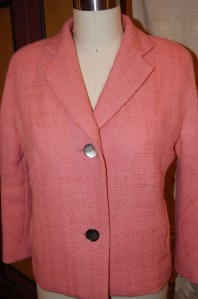
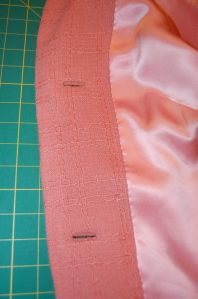
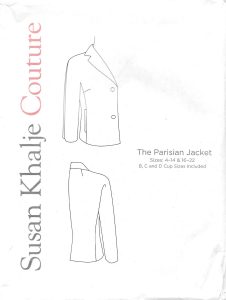
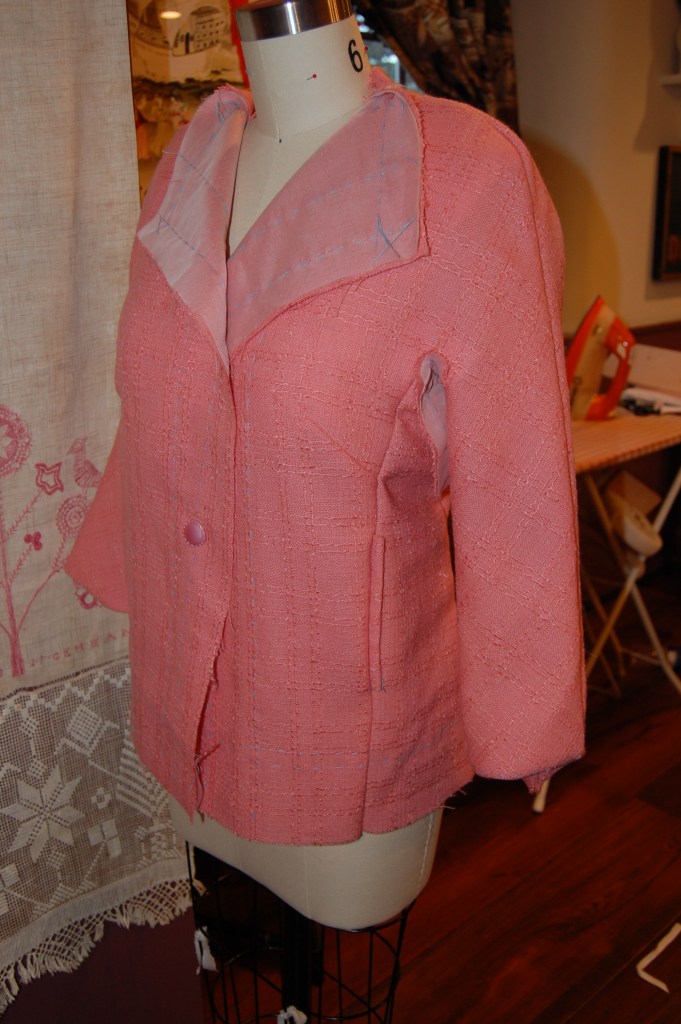
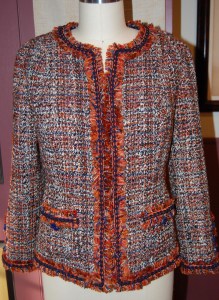
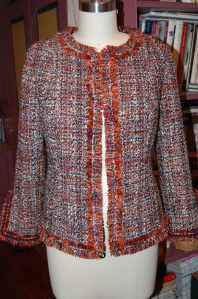
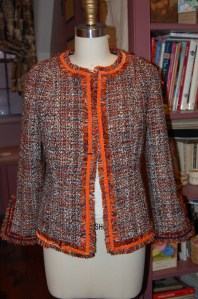
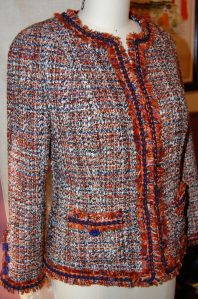
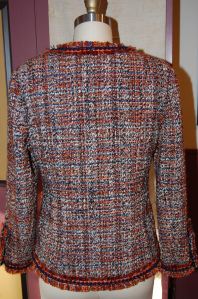
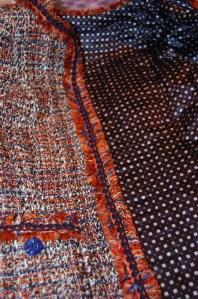
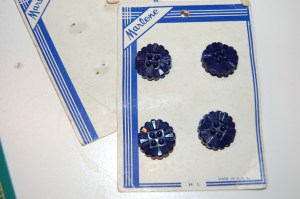
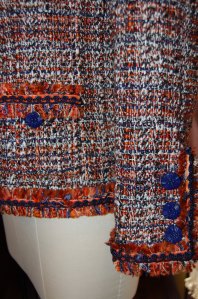
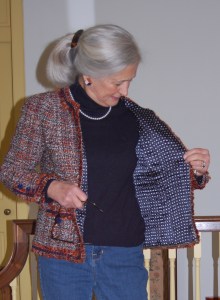
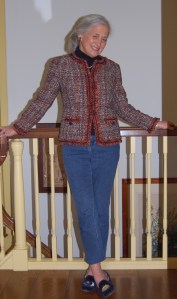
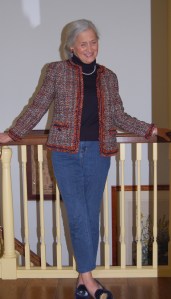
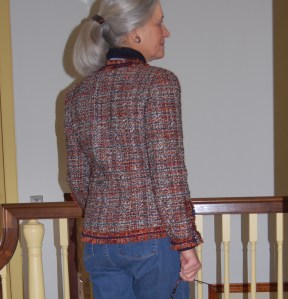
Among Susan’s new pattern offerings is this jacket:
When I arrive back home in Pennsylvania, I will be searching through my fabric closet for the perfect pairing for this pattern. I am just itching to challenge myself with such a project. No more pillows, at least for now!
15 Comments
Filed under Bathrobes, Buttons - choosing the right ones, Fashion commentary, Sewing for children, Uncategorized, Vintage fabric, vintage Vogue patterns from the 1950s
Tagged as 1950's Vogue patterns, Bathrobes, fashion sewing, sewing for children, Susan Khalje Couture, vintage Vogue patterns